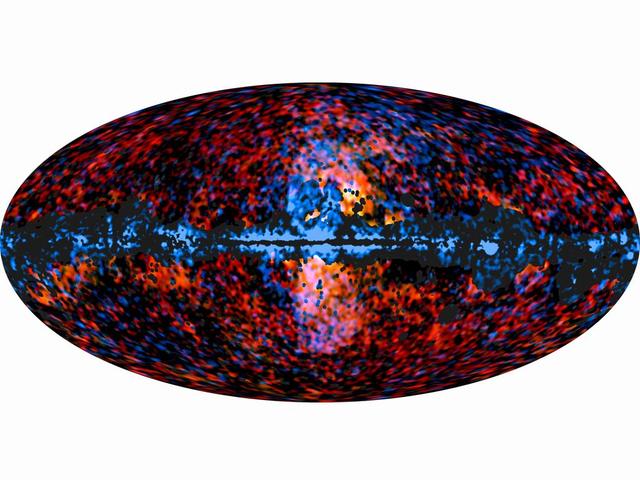
This all-sky image shows the distribution of the galactic haze seen by ESA Planck mission at microwave frequencies superimposed over the high-energy sky, as seen by NASA Fermi Gamma-ray Space Telescope.
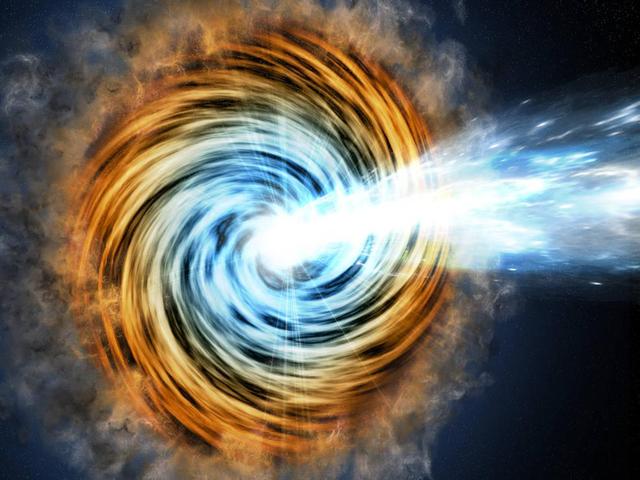
Black-hole-powered galaxies called blazars are the most common sources detected by NASA's Fermi Gamma-ray Space Telescope. As matter falls toward the supermassive black hole at the galaxy's center, some of it is accelerated outward at nearly the speed of light along jets pointed in opposite directions. When one of the jets happens to be aimed in the direction of Earth, as illustrated here, the galaxy appears especially bright and is classified as a blazar. http://photojournal.jpl.nasa.gov/catalog/PIA20912
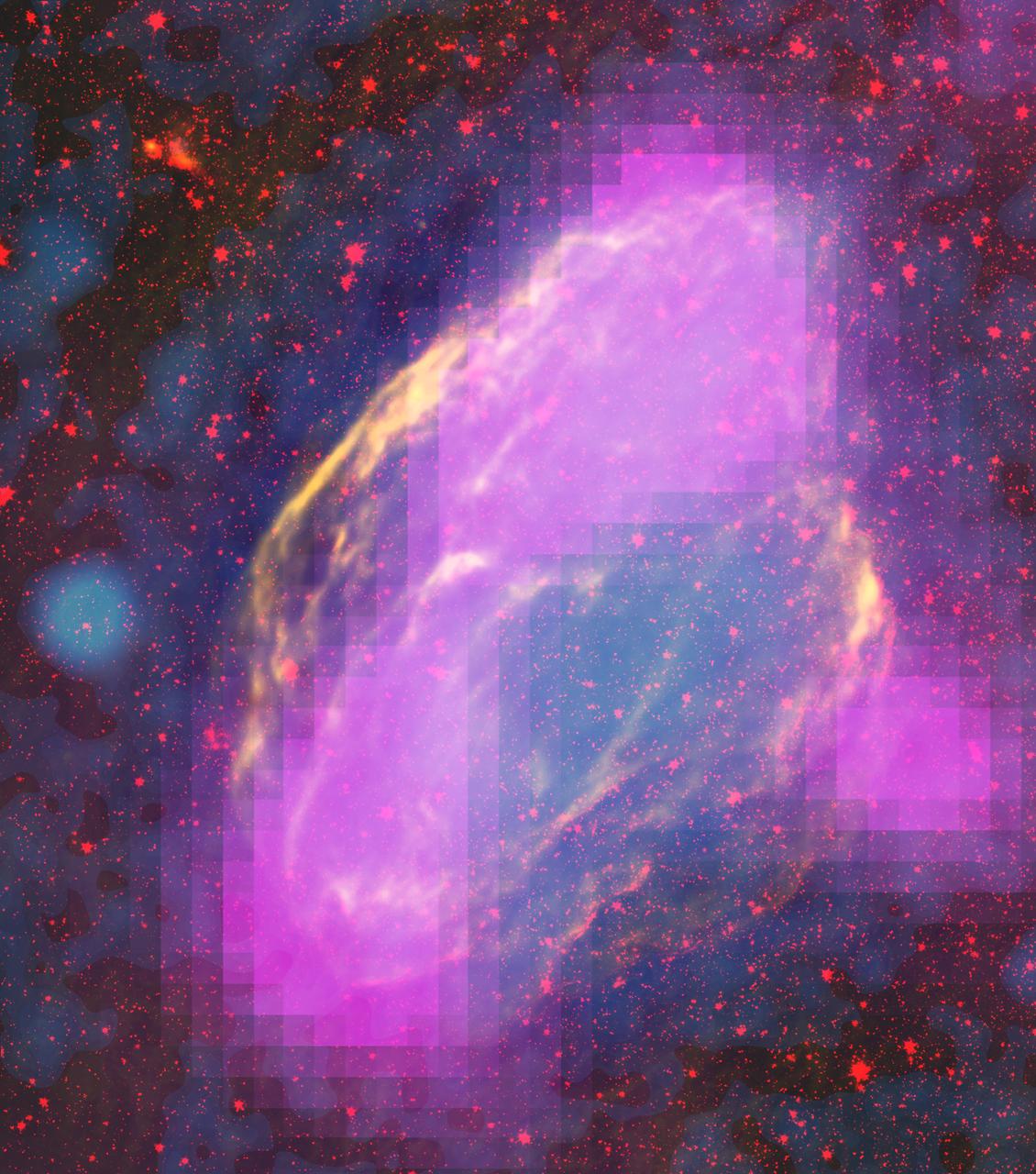
NASA's Fermi Closes on Source of Cosmic Rays New images from NASA's Fermi Gamma-ray Space Telescope show where supernova remnants emit radiation a billion times more energetic than visible light. The images bring astronomers a step closer to understanding the source of some of the universe's most energetic particles -- cosmic rays. Fermi mapped GeV-gamma-ray emission regions (magenta) in the W44 supernova remnant. The features clearly align with filaments detectable in other wavelengths. This composite merges X-rays (blue) from the Germany-led ROSAT mission, infrared (red) from NASA's Spitzer Space Telescope, and radio (orange) from the Very Large Array near Socorro, N.M. Credit: NASA/DOE/Fermi LAT Collaboration, ROSAT, JPL-Caltech, and NRAO/AUI For more information: <a href="http://www.nasa.gov/mission_pages/GLAST/news/cosmic-rays-source.html" rel="nofollow">www.nasa.gov/mission_pages/GLAST/news/cosmic-rays-source....</a>
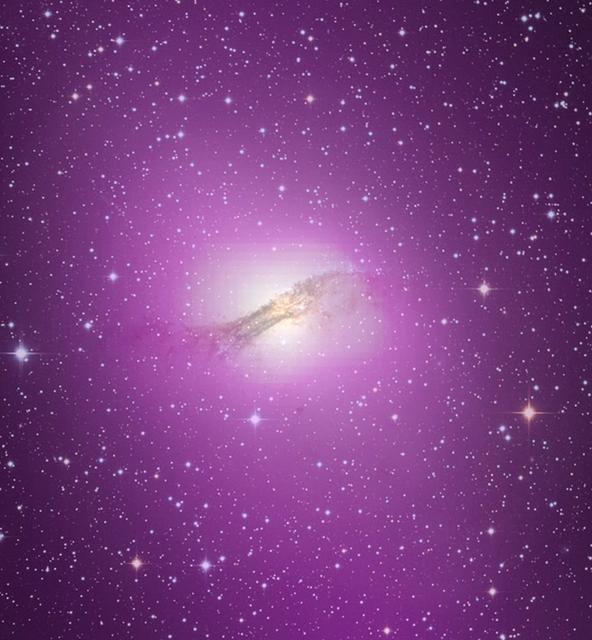
NASA release April 1, 2010 The gamma-ray output from Cen A's lobes exceeds their radio output by more than ten times. High-energy gamma rays detected by Fermi's Large Area Telescope are depicted as purple in this gamma ray/optical composite of the galaxy. Credit: NASA/DOE/Fermi LAT Collaboration, Capella Observatory To learn more about these images go to: <a href="http://www.nasa.gov/mission_pages/GLAST/news/smokestack-plumes.html" rel="nofollow">www.nasa.gov/mission_pages/GLAST/news/smokestack-plumes.html</a> <b><a href="http://www.nasa.gov/centers/goddard/home/index.html" rel="nofollow">NASA Goddard Space Flight Center</a></b> is home to the nation's largest organization of combined scientists, engineers and technologists that build spacecraft, instruments and new technology to study the Earth, the sun, our solar system, and the universe.
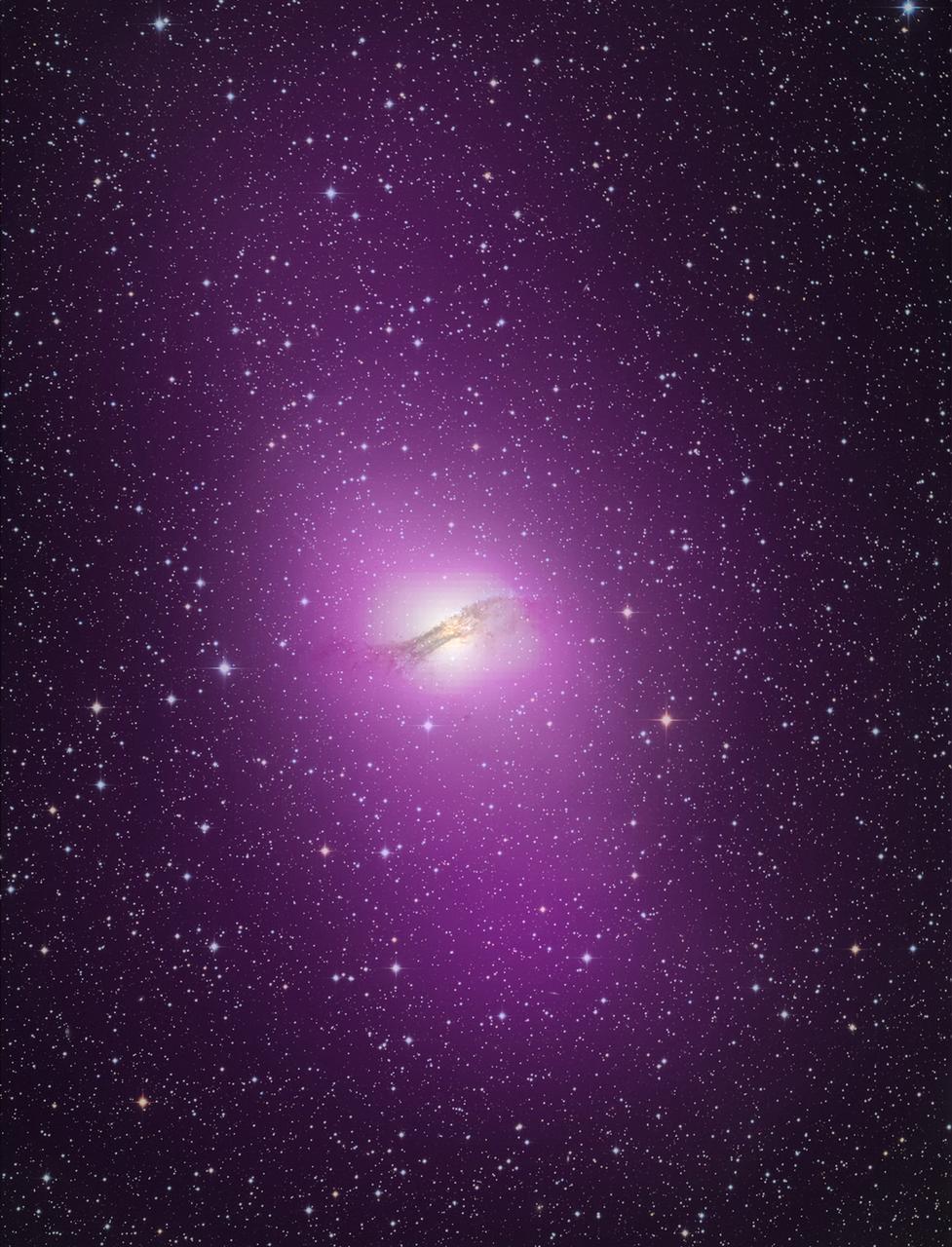
NASA release April 1, 2010 The gamma-ray output from Cen A's lobes exceeds their radio output by more than ten times. High-energy gamma rays detected by Fermi's Large Area Telescope are depicted as purple in this gamma ray/optical composite of the galaxy. Credit: NASA/DOE/Fermi LAT Collaboration, Capella Observatory To learn more about these images go to: <a href="http://www.nasa.gov/mission_pages/GLAST/news/smokestack-plumes.html" rel="nofollow">www.nasa.gov/mission_pages/GLAST/news/smokestack-plumes.html</a> <b><a href="http://www.nasa.gov/centers/goddard/home/index.html" rel="nofollow">NASA Goddard Space Flight Center</a></b> is home to the nation's largest organization of combined scientists, engineers and technologists that build spacecraft, instruments and new technology to study the Earth, the sun, our solar system, and the universe.
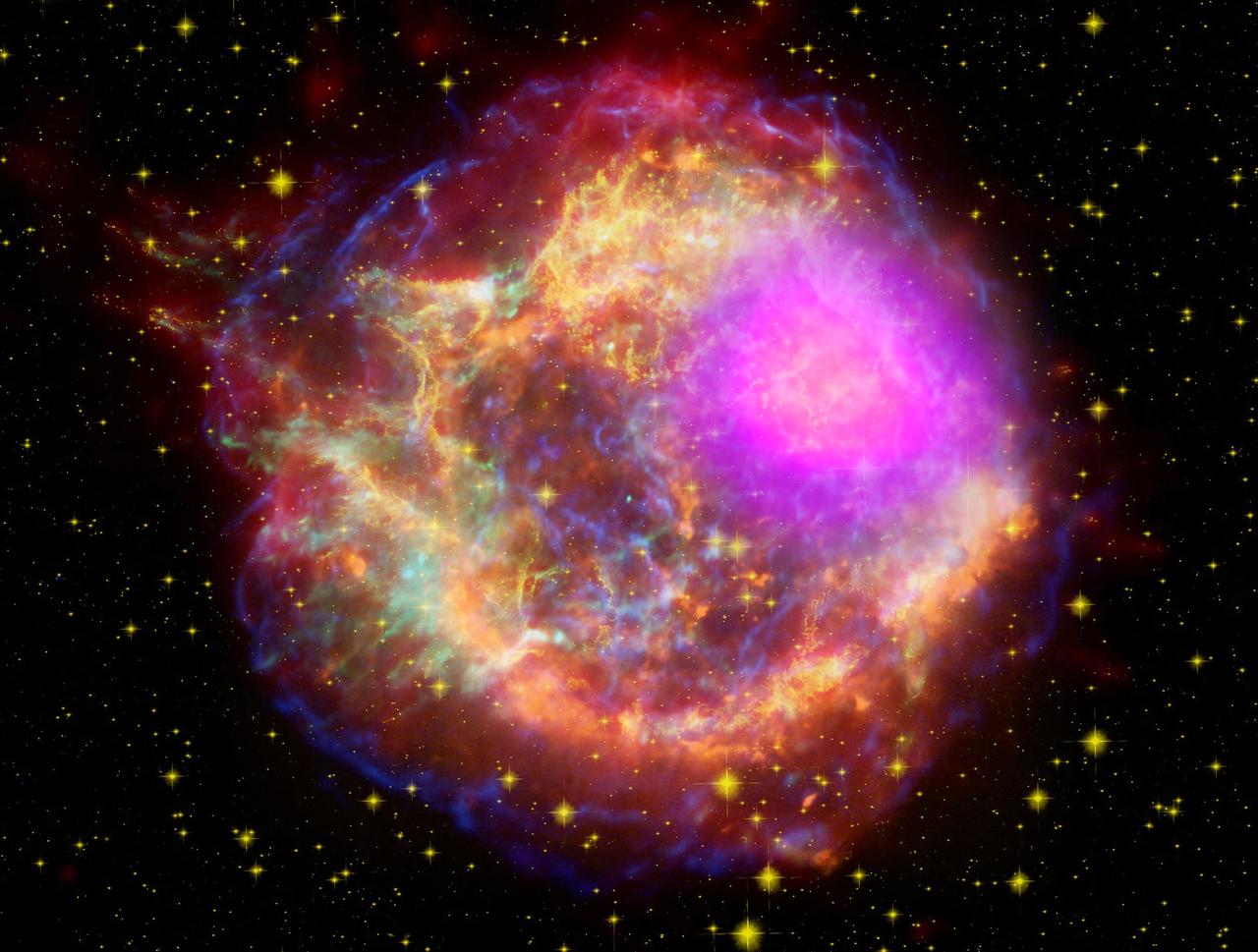
NASA's Fermi Closes on Source of Cosmic Rays New images from NASA's Fermi Gamma-ray Space Telescope show where supernova remnants emit radiation a billion times more energetic than visible light. The images bring astronomers a step closer to understanding the source of some of the universe's most energetic particles -- cosmic rays. This composite shows the Cassiopeia A supernova remnant across the spectrum: Gamma rays (magenta) from NASA's Fermi Gamma-ray Space Telescope; X-rays (blue, green) from NASA's Chandra X-ray Observatory; visible light (yellow) from the Hubble Space Telescope; infrared (red) from NASA's Spitzer Space Telescope; and radio (orange) from the Very Large Array near Socorro, N.M. Credit: NASA/DOE/Fermi LAT Collaboration, CXC/SAO/JPL-Caltech/Steward/O. Krause et al., and NRAO/AUI For more information: <a href="http://www.nasa.gov/mission_pages/GLAST/news/cosmic-rays-source.html" rel="nofollow">www.nasa.gov/mission_pages/GLAST/news/cosmic-rays-source....</a> <b><a href="http://www.nasa.gov/centers/goddard/home/index.html" rel="nofollow">NASA Goddard Space Flight Center</a></b> is home to the nation's largest organization of combined scientists, engineers and technologists that build spacecraft, instruments and new technology to study the Earth, the sun, our solar system, and the universe. <b>Follow us on <a href="http://twitter.com/NASA_GoddardPix" rel="nofollow">Twitter</a></b> <b>Join us on <a href="http://www.facebook.com/pages/Greenbelt-MD/NASA-Goddard/395013845897?ref=tsd" rel="nofollow">Facebook</a><b> </b></b>
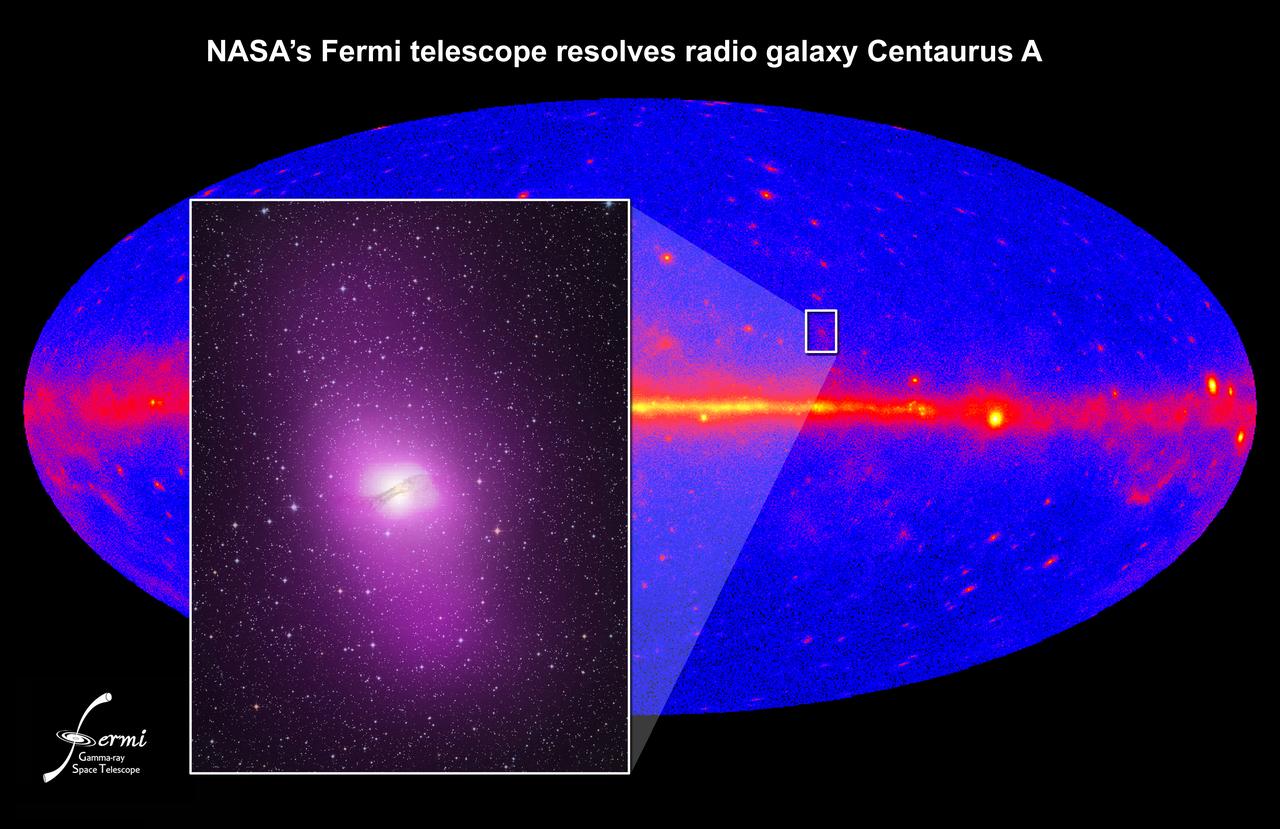
NASA release April 1, 2010 Fermi's Large Area Telescope resolved high-energy gamma rays from an extended region around the active galaxy Centaurus A. The emission corresponds to million-light-year-wide radio-emitting gas thrown out by the galaxy's supersized black hole. This inset shows an optical/gamma-ray composite of the galaxy and its location on the Fermi one-year sky map. Credit: NASA/DOE/Fermi LAT Collaboration, Capella Observatory To learn more about these images go to: <a href="http://www.nasa.gov/mission_pages/GLAST/news/smokestack-plumes.html" rel="nofollow">www.nasa.gov/mission_pages/GLAST/news/smokestack-plumes.html</a> <b><a href="http://www.nasa.gov/centers/goddard/home/index.html" rel="nofollow">NASA Goddard Space Flight Center</a></b> is home to the nation's largest organization of combined scientists, engineers and technologists that build spacecraft, instruments and new technology to study the Earth, the sun, our solar system, and the universe.
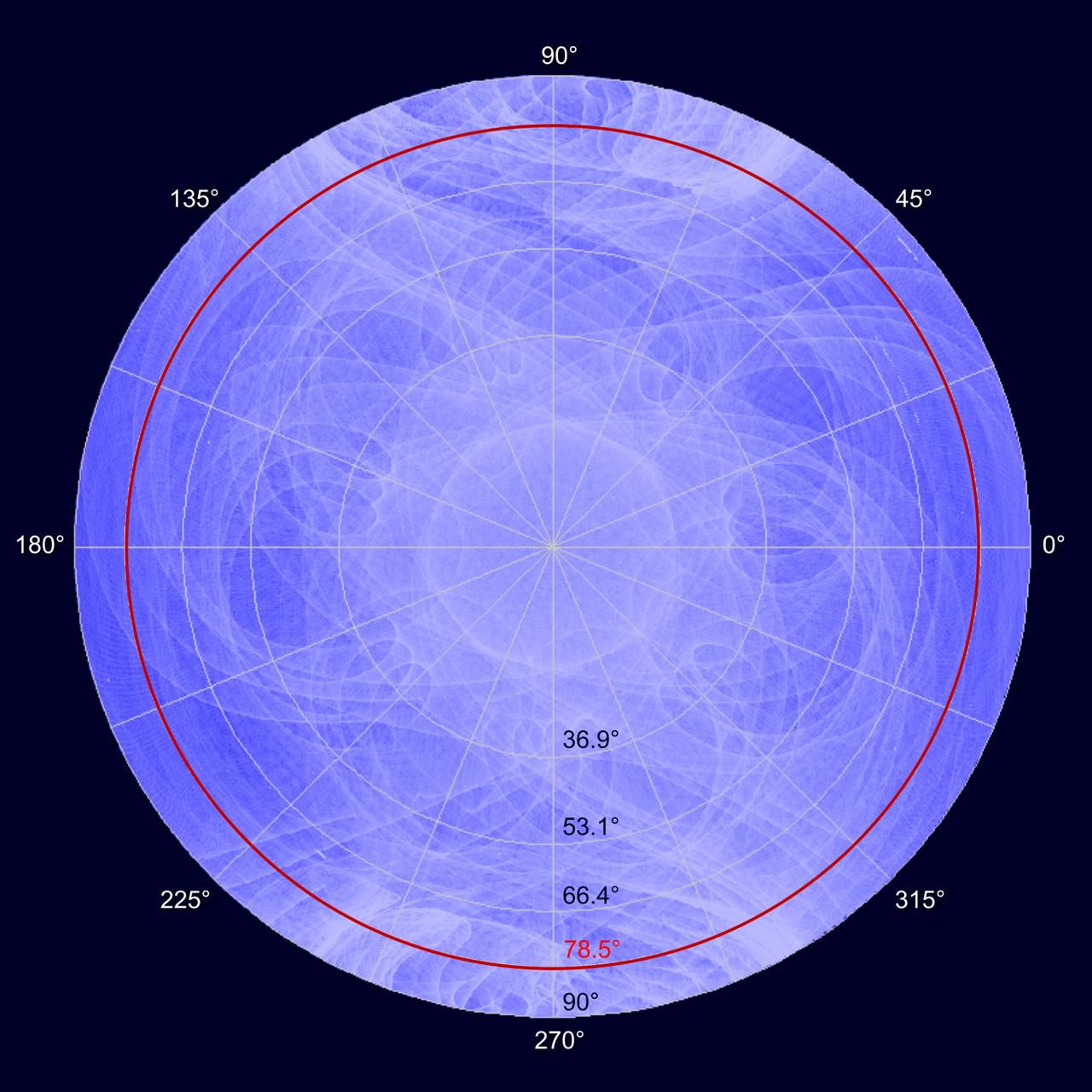
The LAT's sensitivity to gamma rays is greatest in the center of its wide field of view and decreases toward the edge. LAT scientists regard the effective limit of the instrument's field of view to be 78.5 degrees (red circle) from its center. View a video of this here: <a href="http://bit.ly/Y2K4LN" rel="nofollow">bit.ly/Y2K4LN</a>. Credit: NASA/DOE/Fermi LAT Collaboration ----- NASA's Fermi Gamma-ray Space Telescope orbits our planet every 95 minutes, building up increasingly deeper views of the universe with every circuit. Its wide-eyed Large Area Telescope (LAT) sweeps across the entire sky every three hours, capturing the highest-energy form of light -- gamma rays -- from sources across the universe. These range from supermassive black holes billions of light-years away to intriguing objects in our own galaxy, such as X-ray binaries, supernova remnants and pulsars. Now a Fermi scientist has transformed LAT data of a famous pulsar into a mesmerizing movie that visually encapsulates the spacecraft's complex motion. Click here to continue reading: <a href="http://1.usa.gov/WhYwCU" rel="nofollow">1.usa.gov/WhYwCU</a> <b><a href="http://www.nasa.gov/audience/formedia/features/MP_Photo_Guidelines.html" rel="nofollow">NASA image use policy.</a></b> <b><a href="http://www.nasa.gov/centers/goddard/home/index.html" rel="nofollow">NASA Goddard Space Flight Center</a></b> enables NASA’s mission through four scientific endeavors: Earth Science, Heliophysics, Solar System Exploration, and Astrophysics. Goddard plays a leading role in NASA’s accomplishments by contributing compelling scientific knowledge to advance the Agency’s mission. <b>Follow us on <a href="http://twitter.com/NASA_GoddardPix" rel="nofollow">Twitter</a></b> <b>Like us on <a href="http://www.facebook.com/pages/Greenbelt-MD/NASA-Goddard/395013845897?ref=tsd" rel="nofollow">Facebook</a></b> <b>Find us on <a href="http://instagram.com/nasagoddard?vm=grid" rel="nofollow">Instagram</a></b>
![Final still from Fermi video [<a href="http://bit.ly/Y2K4LN" rel="nofollow">bit.ly/Y2K4LN</a>]. Credit: NASA/DOE/Fermi LAT Collaboration ----- NASA's Fermi Gamma-ray Space Telescope orbits our planet every 95 minutes, building up increasingly deeper views of the universe with every circuit. Its wide-eyed Large Area Telescope (LAT) sweeps across the entire sky every three hours, capturing the highest-energy form of light -- gamma rays -- from sources across the universe. These range from supermassive black holes billions of light-years away to intriguing objects in our own galaxy, such as X-ray binaries, supernova remnants and pulsars. Now a Fermi scientist has transformed LAT data of a famous pulsar into a mesmerizing movie that visually encapsulates the spacecraft's complex motion. Click here to continue reading: <a href="http://1.usa.gov/WhYwCU" rel="nofollow">1.usa.gov/WhYwCU</a> <b><a href="http://www.nasa.gov/audience/formedia/features/MP_Photo_Guidelines.html" rel="nofollow">NASA image use policy.</a></b> <b><a href="http://www.nasa.gov/centers/goddard/home/index.html" rel="nofollow">NASA Goddard Space Flight Center</a></b> enables NASA’s mission through four scientific endeavors: Earth Science, Heliophysics, Solar System Exploration, and Astrophysics. Goddard plays a leading role in NASA’s accomplishments by contributing compelling scientific knowledge to advance the Agency’s mission. <b>Follow us on <a href="http://twitter.com/NASA_GoddardPix" rel="nofollow">Twitter</a></b> <b>Like us on <a href="http://www.facebook.com/pages/Greenbelt-MD/NASA-Goddard/395013845897?ref=tsd" rel="nofollow">Facebook</a></b> <b>Find us on <a href="http://instagram.com/nasagoddard?vm=grid" rel="nofollow">Instagram</a></b>](https://images-assets.nasa.gov/image/GSFC_20171208_Archive_e001547/GSFC_20171208_Archive_e001547~small.jpg)
Final still from Fermi video [<a href="http://bit.ly/Y2K4LN" rel="nofollow">bit.ly/Y2K4LN</a>]. Credit: NASA/DOE/Fermi LAT Collaboration ----- NASA's Fermi Gamma-ray Space Telescope orbits our planet every 95 minutes, building up increasingly deeper views of the universe with every circuit. Its wide-eyed Large Area Telescope (LAT) sweeps across the entire sky every three hours, capturing the highest-energy form of light -- gamma rays -- from sources across the universe. These range from supermassive black holes billions of light-years away to intriguing objects in our own galaxy, such as X-ray binaries, supernova remnants and pulsars. Now a Fermi scientist has transformed LAT data of a famous pulsar into a mesmerizing movie that visually encapsulates the spacecraft's complex motion. Click here to continue reading: <a href="http://1.usa.gov/WhYwCU" rel="nofollow">1.usa.gov/WhYwCU</a> <b><a href="http://www.nasa.gov/audience/formedia/features/MP_Photo_Guidelines.html" rel="nofollow">NASA image use policy.</a></b> <b><a href="http://www.nasa.gov/centers/goddard/home/index.html" rel="nofollow">NASA Goddard Space Flight Center</a></b> enables NASA’s mission through four scientific endeavors: Earth Science, Heliophysics, Solar System Exploration, and Astrophysics. Goddard plays a leading role in NASA’s accomplishments by contributing compelling scientific knowledge to advance the Agency’s mission. <b>Follow us on <a href="http://twitter.com/NASA_GoddardPix" rel="nofollow">Twitter</a></b> <b>Like us on <a href="http://www.facebook.com/pages/Greenbelt-MD/NASA-Goddard/395013845897?ref=tsd" rel="nofollow">Facebook</a></b> <b>Find us on <a href="http://instagram.com/nasagoddard?vm=grid" rel="nofollow">Instagram</a></b>

The CTB 1 supernova remnant resembles a ghostly bubble in this image, which combines new 1.5 gigahertz observations from the Very Large Array (VLA) radio telescope (orange, near center) with older observations from the Dominion Radio Astrophysical Observatory’s Canadian Galactic Plane Survey (1.42 gigahertz, magenta and yellow; 408 megahertz, green) and infrared data (blue). The VLA data clearly reveal the straight, glowing trail from pulsar J0002+6216 and the curved rim of the remnant’s shell. CTB 1 is about half a degree across, the apparent size of a full Moon. Credits: Composite by Jayanne English, University of Manitoba, using data from NRAO/F. Schinzel et al., DRAO/Canadian Galactic Plane Survey and NASA/IRAS More info: https://go.nasa.gov/2TKpyWF
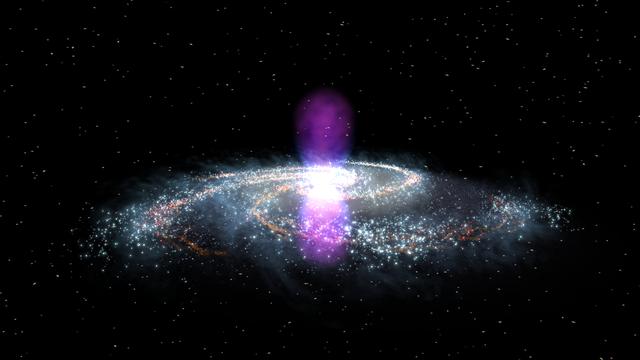
NASA image release November 9, 2010 To view a video about this story go to: <a href="http://www.flickr.com/photos/gsfc/5162413062">www.flickr.com/photos/gsfc/5162413062</a> Using data from NASA's Fermi Gamma-ray Space Telescope, scientists have recently discovered a gigantic, mysterious structure in our galaxy. This never-before-seen feature looks like a pair of bubbles extending above and below our galaxy's center. But these enormous gamma-ray emitting lobes aren't immediately visible in the Fermi all-sky map. However, by processing the data, a group of scientists was able to bring these unexpected structures into sharp relief. Each lobe is 25,000 light-years tall and the whole structure may be only a few million years old. Within the bubbles, extremely energetic electrons are interacting with lower-energy light to create gamma rays, but right now, no one knows the source of these electrons. Are the bubbles remnants of a massive burst of star formation? Leftovers from an eruption by the supermassive black hole at our galaxy's center? Or or did these forces work in tandem to produce them? Scientists aren't sure yet, but the more they learn about this amazing structure, the better we'll understand the Milky Way. To learn more go to: <a href="http://www.nasa.gov/mission_pages/GLAST/news/new-structure.html" rel="nofollow">www.nasa.gov/mission_pages/GLAST/news/new-structure.html</a> <b><a href="http://www.nasa.gov/centers/goddard/home/index.html" rel="nofollow">NASA Goddard Space Flight Center</a></b> enables NASA’s mission through four scientific endeavors: Earth Science, Heliophysics, Solar System Exploration, and Astrophysics. Goddard plays a leading role in NASA’s accomplishments by contributing compelling scientific knowledge to advance the Agency’s mission. <b>Follow us on <a href="http://twitter.com/NASA_GoddardPix" rel="nofollow">Twitter</a></b> <b>Join us on <a href="http://www.facebook.com/pages/Greenbelt-MD/NASA-Goddard/395013845897?ref=tsd" rel="nofollow">Facebook</a></b> Credit: <a href="http://svs.gsfc.nasa.gov/index.html" rel="nofollow">NASA/Goddard Space Flight Center Scientific Visualization Studio</a>
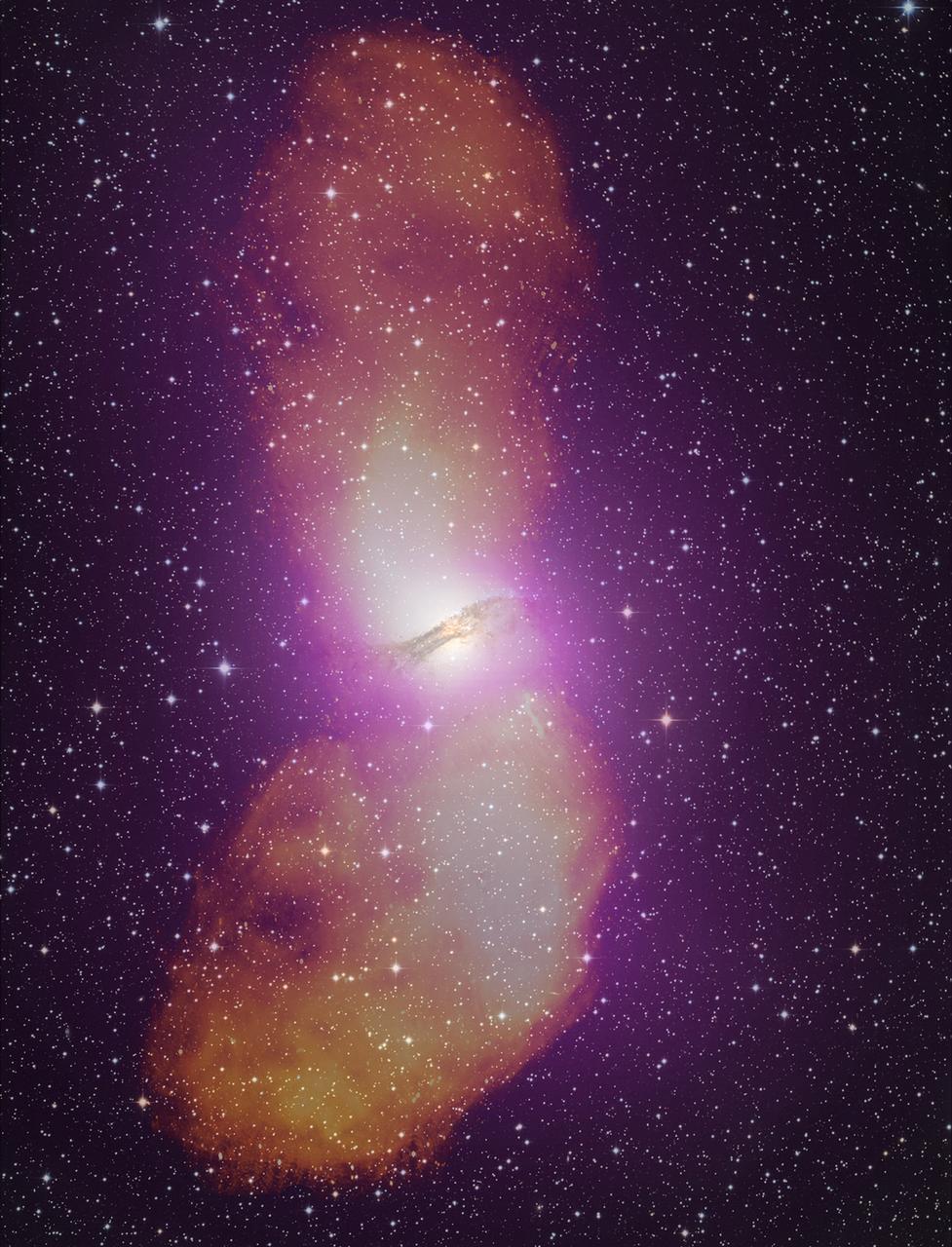
NASA release April 1, 2010 It takes the addition of radio data (orange) to fully appreciate the scale of Cen A's giant radio-emitting lobes, which stretch more than 1.4 million light-years. Gamma-rays from Fermi's Large Area Telescope (purple) and an image of the galaxy in visible light are also included in this composite. Credit: NASA/DOE/Fermi LAT Collaboration, Capella Observatory, and Ilana Feain, Tim Cornwell, and Ron Ekers (CSIRO/ATNF), R. Morganti (ASTRON), and N. Junkes (MPIfR) To learn more about these images go to: <a href="http://www.nasa.gov/mission_pages/GLAST/news/smokestack-plumes.html" rel="nofollow">www.nasa.gov/mission_pages/GLAST/news/smokestack-plumes.html</a> <b><a href="http://www.nasa.gov/centers/goddard/home/index.html" rel="nofollow">NASA Goddard Space Flight Center</a></b> is home to the nation's largest organization of combined scientists, engineers and technologists that build spacecraft, instruments and new technology to study the Earth, the sun, our solar system, and the universe.
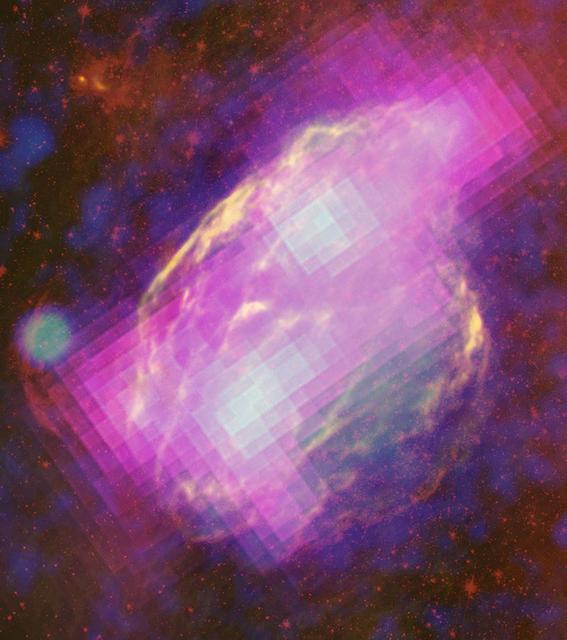
The W44 supernova remnant is nestled within and interacting with the molecular cloud that formed its parent star. Fermi's LAT detects GeV gamma rays (magenta) produced when the gas is bombarded by cosmic rays, primarily protons. Radio observations (yellow) from the Karl G. Jansky Very Large Array near Socorro, N.M., and infrared (red) data from NASA's Spitzer Space Telescope reveal filamentary structures in the remnant's shell. Blue shows X-ray emission mapped by the Germany-led ROSAT mission. To read more go to: <a href="http://1.usa.gov/14V14qi" rel="nofollow">1.usa.gov/14V14qi</a> <b><a href="http://www.nasa.gov/audience/formedia/features/MP_Photo_Guidelines.html" rel="nofollow">NASA image use policy.</a></b> <b><a href="http://www.nasa.gov/centers/goddard/home/index.html" rel="nofollow">NASA Goddard Space Flight Center</a></b> enables NASA’s mission through four scientific endeavors: Earth Science, Heliophysics, Solar System Exploration, and Astrophysics. Goddard plays a leading role in NASA’s accomplishments by contributing compelling scientific knowledge to advance the Agency’s mission. <b>Follow us on <a href="http://twitter.com/NASA_GoddardPix" rel="nofollow">Twitter</a></b> <b>Like us on <a href="http://www.facebook.com/pages/Greenbelt-MD/NASA-Goddard/395013845897?ref=tsd" rel="nofollow">Facebook</a></b> <b>Find us on <a href="http://instagram.com/nasagoddard?vm=grid" rel="nofollow">Instagram</a></b> Credit: NASA/DOE/Fermi LAT Collaboration, NRAO/AUI, JPL-Caltech, ROSAT

This is a Hubble Space Telescope composite image of a supernova explosion designated SN 2014J in the galaxy M82. At a distance of approximately 11.5 million light-years from Earth it is the closest supernova of its type discovered in the past few decades. The explosion is categorized as a Type Ia supernova, which is theorized to be triggered in binary systems consisting of a white dwarf and another star — which could be a second white dwarf, a star like our sun, or a giant star. Astronomers using a ground-based telescope discovered the explosion on January 21, 2014. This Hubble photograph was taken on January 31, as the supernova approached its peak brightness. The Hubble data are expected to help astronomers refine distance measurements to Type Ia supernovae. In addition, the observations could yield insights into what kind of stars were involved in the explosion. Hubble’s ultraviolet-light sensitivity will allow astronomers to probe the environment around the site of the supernova explosion and in the interstellar medium of the host galaxy. Because of their consistent peak brightness, Type Ia supernovae are among the best tools to measure distances in the universe. They were fundamental to the 1998 discovery of the mysterious acceleration of the expanding universe. A hypothesized repulsive force, called dark energy, is thought to cause the acceleration. Among the other major NASA space-based observatories used in the M82 viewing campaign are Spitzer Space Telescope, Chandra X-ray Observatory, Nuclear Spectroscopic Telescope Array (NuSTAR), Fermi Gamma-ray Space Telescope, Swift Gamma Ray Burst Explorer, and the Stratospheric Observatory for Infrared Astronomy (SOFIA). Image Credit: NASA, ESA, A. Goobar (Stockholm University), and the Hubble Heritage Team (STScI/AURA) <b><a href="http://www.nasa.gov/audience/formedia/features/MP_Photo_Guidelines.html" rel="nofollow">NASA image use policy.</a></b> <b><a href="http://www.nasa.gov/centers/goddard/home/index.html" rel="nofollow">NASA Goddard Space Flight Center</a></b> enables NASA’s mission through four scientific endeavors: Earth Science, Heliophysics, Solar System Exploration, and Astrophysics. Goddard plays a leading role in NASA’s accomplishments by contributing compelling scientific knowledge to advance the Agency’s mission. <b>Follow us on <a href="http://twitter.com/NASAGoddardPix" rel="nofollow">Twitter</a></b> <b>Like us on <a href="http://www.facebook.com/pages/Greenbelt-MD/NASA-Goddard/395013845897?ref=tsd" rel="nofollow">Facebook</a></b> <b>Find us on <a href="http://instagram.com/nasagoddard?vm=grid" rel="nofollow">Instagram</a></b>