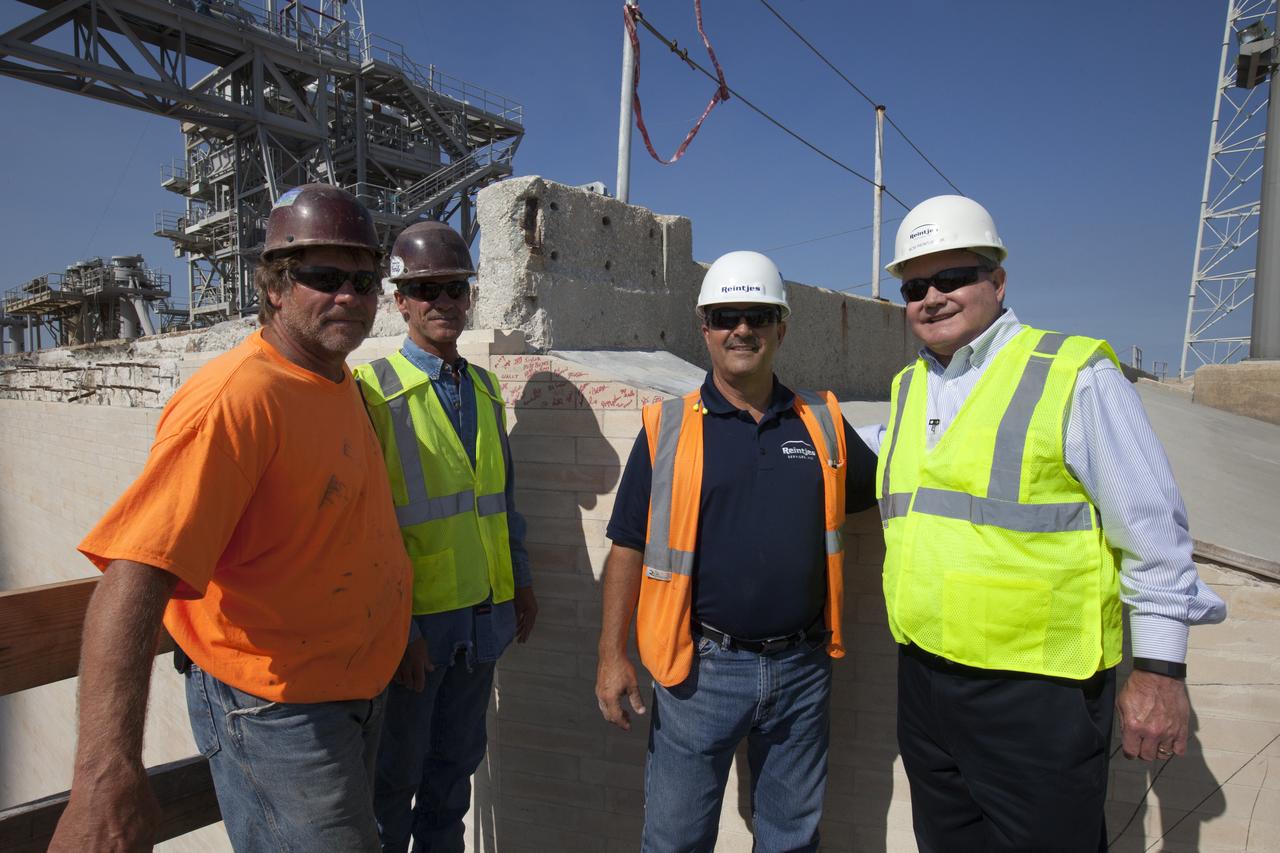
Construction workers sign the final bricks after they were installed on the north side of the flame trench at Launch Complex 39B at NASA’s Kennedy Space Center in Florida. The walls of the flame trench are being upgraded to withstand the intense heat and fire at launch of NASA's Space Launch System rocket with Orion atop. About 96,000 heat-resistant bricks, in three different sizes, were secured to the walls using bonding mortar in combination with adhesive anchors. The Ground Systems Development and Operations Program is overseeing upgrades and modifications to Pad 39B to support the launch of the SLS and Orion spacecraft for Exploration Mission-1 and NASA’s journey to Mars.
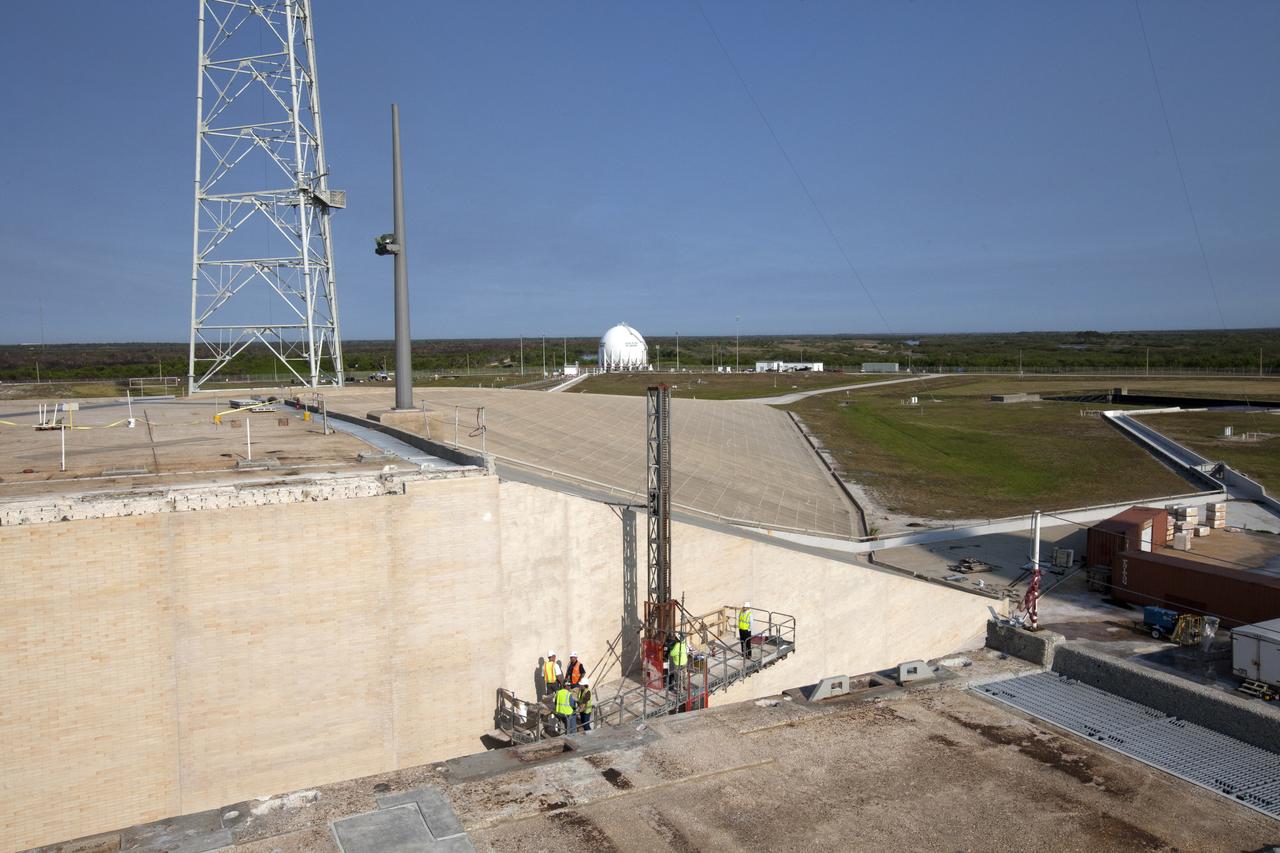
Preparations are underway to install the final brick on the north side of the flame trench at Launch Complex 39B at NASA's Kennedy Space Center in Florida. The walls of the flame trench are being upgraded to withstand the intense heat and fire at launch of NASA's Space Launch System rocket with Orion atop. About 96,000 heat-resistant bricks, in three different sizes, were secured to the walls using bonding mortar in combination with adhesive anchors. The Ground Systems Development and Operations Program is overseeing upgrades and modifications to Pad 39B to support the launch of the SLS and Orion spacecraft for Exploration Mission-1 and NASA’s journey to Mars.
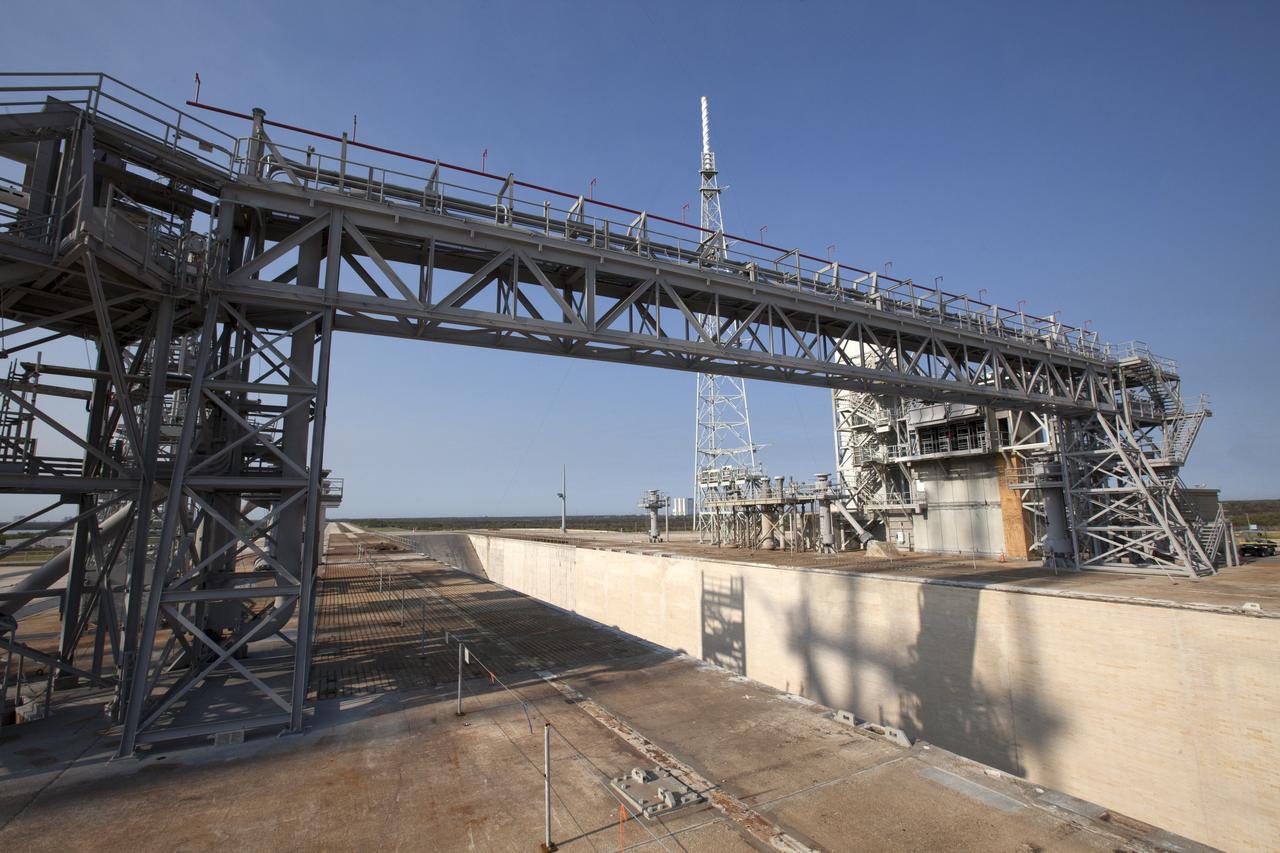
A view of the north side of the flame trench at Launch Complex 39B at NASA's Kennedy Space Center in Florida. The final brick was installed in the flame trench, completing about a year's worth of work to upgrade the walls to withstand the intense heat and fire at launch of NASA's Space Launch System rocket with Orion atop. About 96,000 heat-resistant bricks, in three different sizes, were secured to the walls using bonding mortar in combination with adhesive anchors. The Ground Systems Development and Operations Program is overseeing upgrades and modifications to Pad 39B to support the launch of the SLS and Orion spacecraft for Exploration Mission-1 and NASA’s journey to Mars.
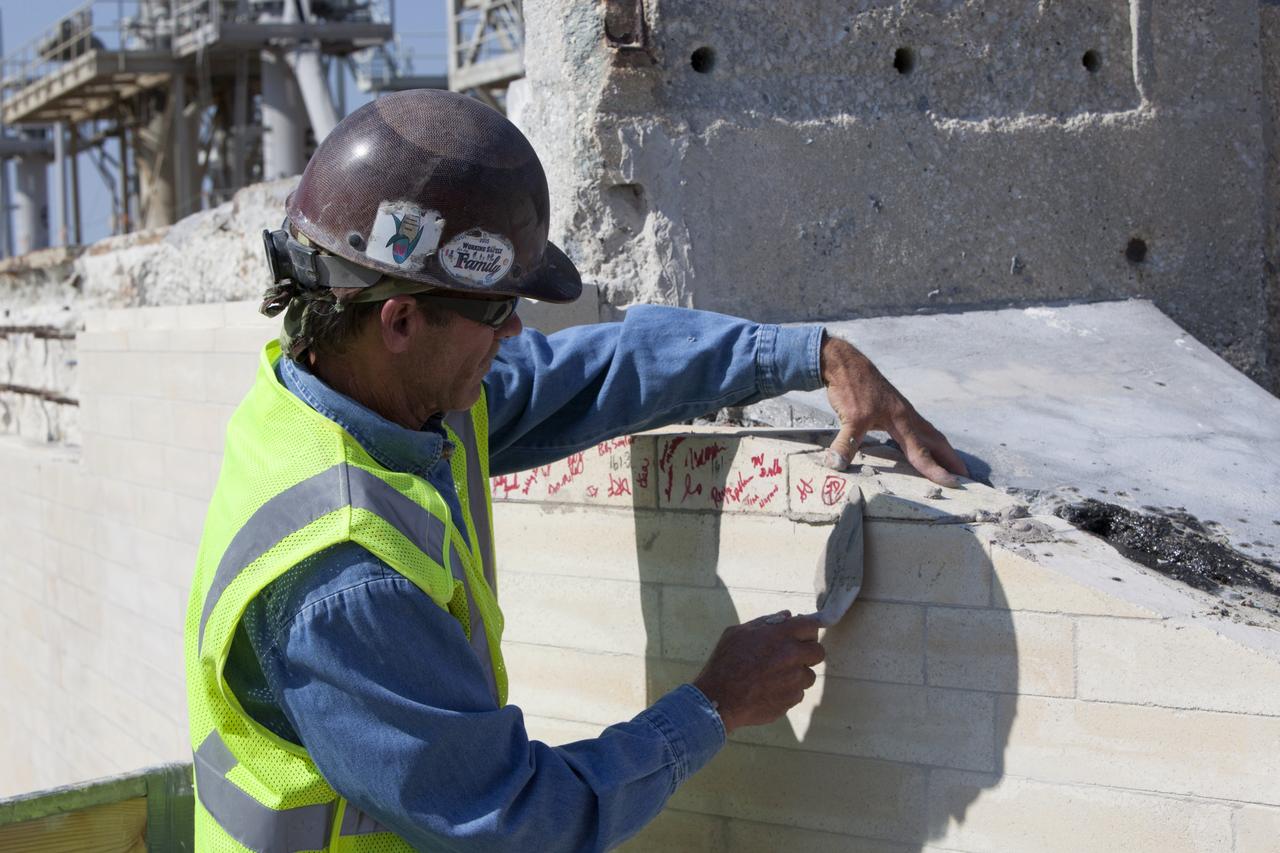
A construction worker installs the final brick on the north side of the flame trench at Launch Complex 39B at NASA's Kennedy Space Center in Florida. The walls of the flame trench are being upgraded to withstand the intense heat and fire at launch of NASA's Space Launch System rocket with Orion atop. About 96,000 heat-resistant bricks, in three different sizes, were secured to the walls using bonding mortar in combination with adhesive anchors. The Ground Systems Development and Operations Program is overseeing upgrades and modifications to Pad 39B to support the launch of the SLS and Orion spacecraft for Exploration Mission-1 and NASA’s journey to Mars.
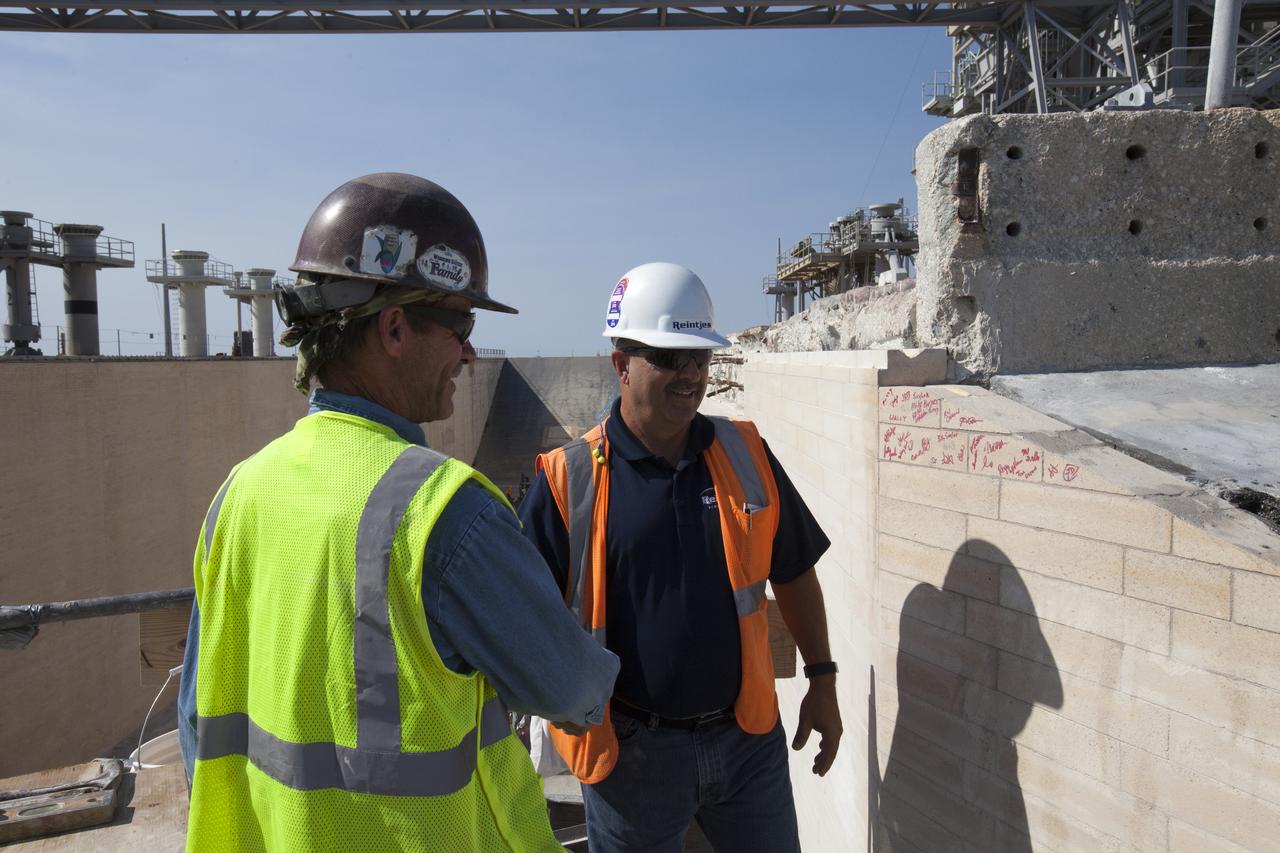
Construction workers sign the final bricks after they were installed on the north side of the flame trench at Launch Complex 39B at NASA’s Kennedy Space Center in Florida. The walls of the flame trench are being upgraded to withstand the intense heat and fire at launch of NASA's Space Launch System rocket with Orion atop. About 96,000 heat-resistant bricks, in three different sizes, were secured to the walls using bonding mortar in combination with adhesive anchors. The Ground Systems Development and Operations Program is overseeing upgrades and modifications to Pad 39B to support the launch of the SLS and Orion spacecraft for Exploration Mission-1 and NASA’s journey to Mars.
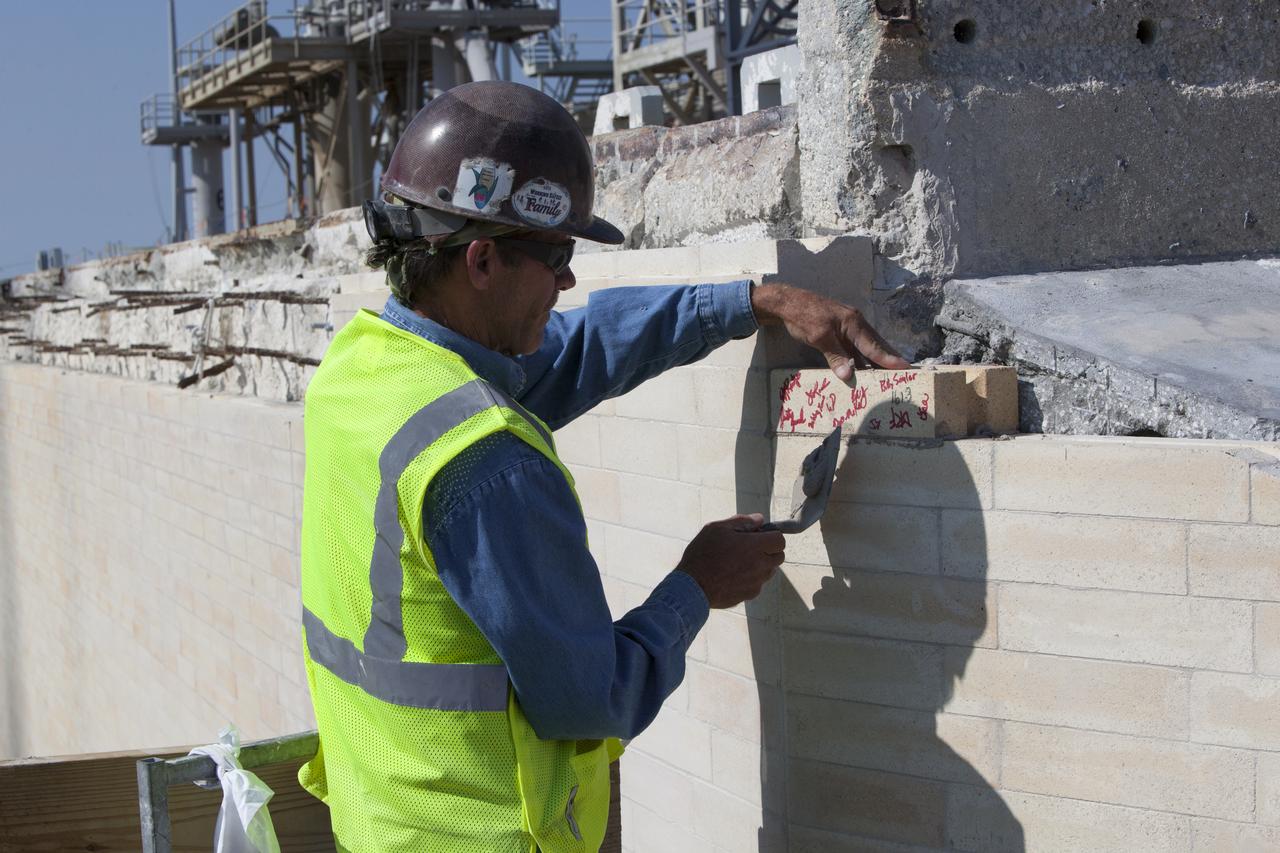
A construction worker installs one of the final bricks on the north side of the flame trench at Launch Complex 39B at NASA's Kennedy Space Center in Florida. The walls of the flame trench are being upgraded to withstand the intense heat and fire at launch of NASA's Space Launch System rocket with Orion atop. About 96,000 heat-resistant bricks, in three different sizes, were secured to the walls using bonding mortar in combination with adhesive anchors. The Ground Systems Development and Operations Program is overseeing upgrades and modifications to Pad 39B to support the launch of the SLS and Orion spacecraft for Exploration Mission-1 and NASA’s journey to Mars.

The final brick was installed on the north side of the flame trench at Launch Complex 39B at NASA’s Kennedy Space Center in Florida. The walls of the flame trench are being upgraded to withstand the intense heat and fire at launch of NASA's Space Launch System rocket with Orion atop. About 96,000 heat-resistant bricks, in three different sizes, were secured to the walls using bonding mortar in combination with adhesive anchors. The Ground Systems Development and Operations Program is overseeing upgrades and modifications to Pad 39B to support the launch of the SLS and Orion spacecraft for Exploration Mission-1 and NASA’s journey to Mars.
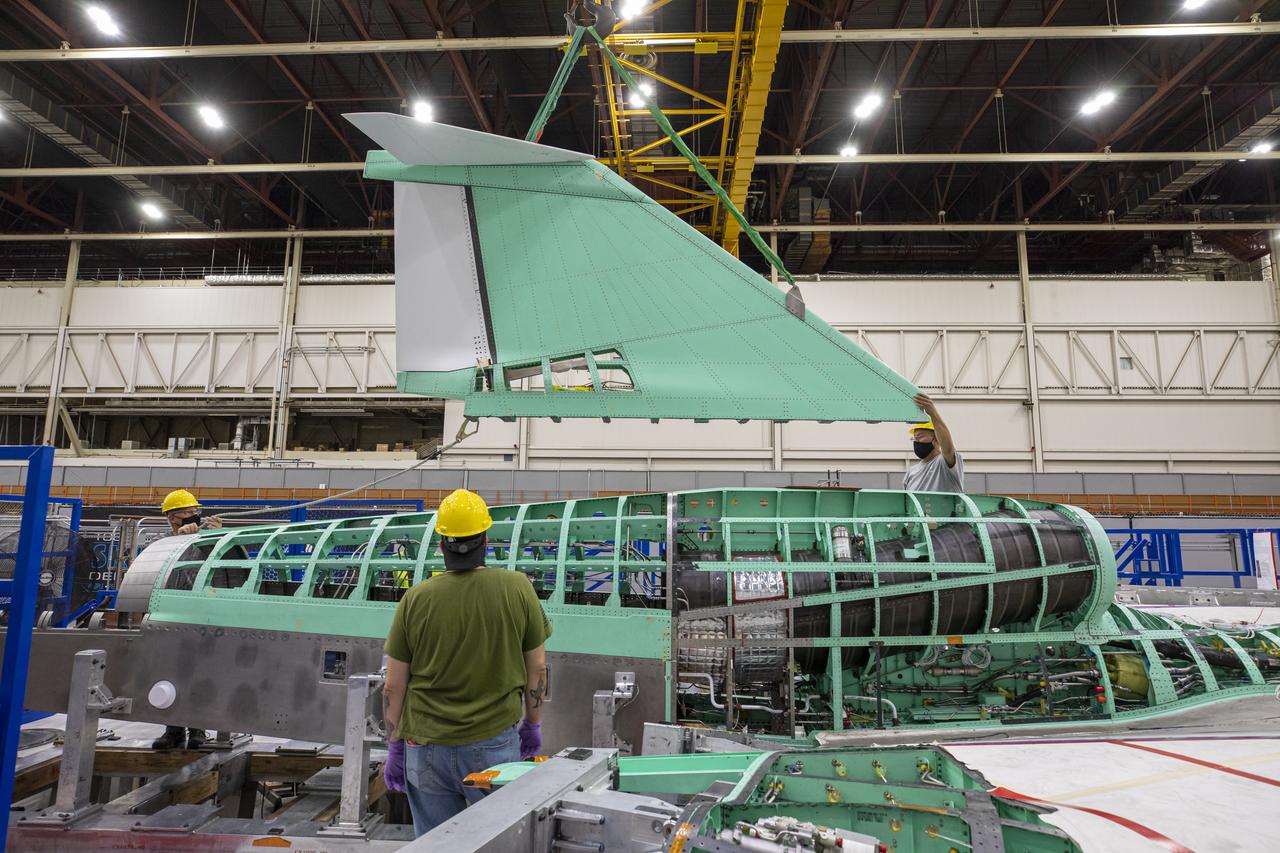
Event: SEG 570 Vertical Tail Assembly - Final Install Lockheed Martin technicians work on a fit check and installation of the vertical tail onto the X-59 aircraft. The plane is under construction at Lockheed Martin Skunk Works in Palmdale, California, will fly to demonstrate the ability to fly supersonic while reducing the loud sonic boom to a quiet sonic thump.
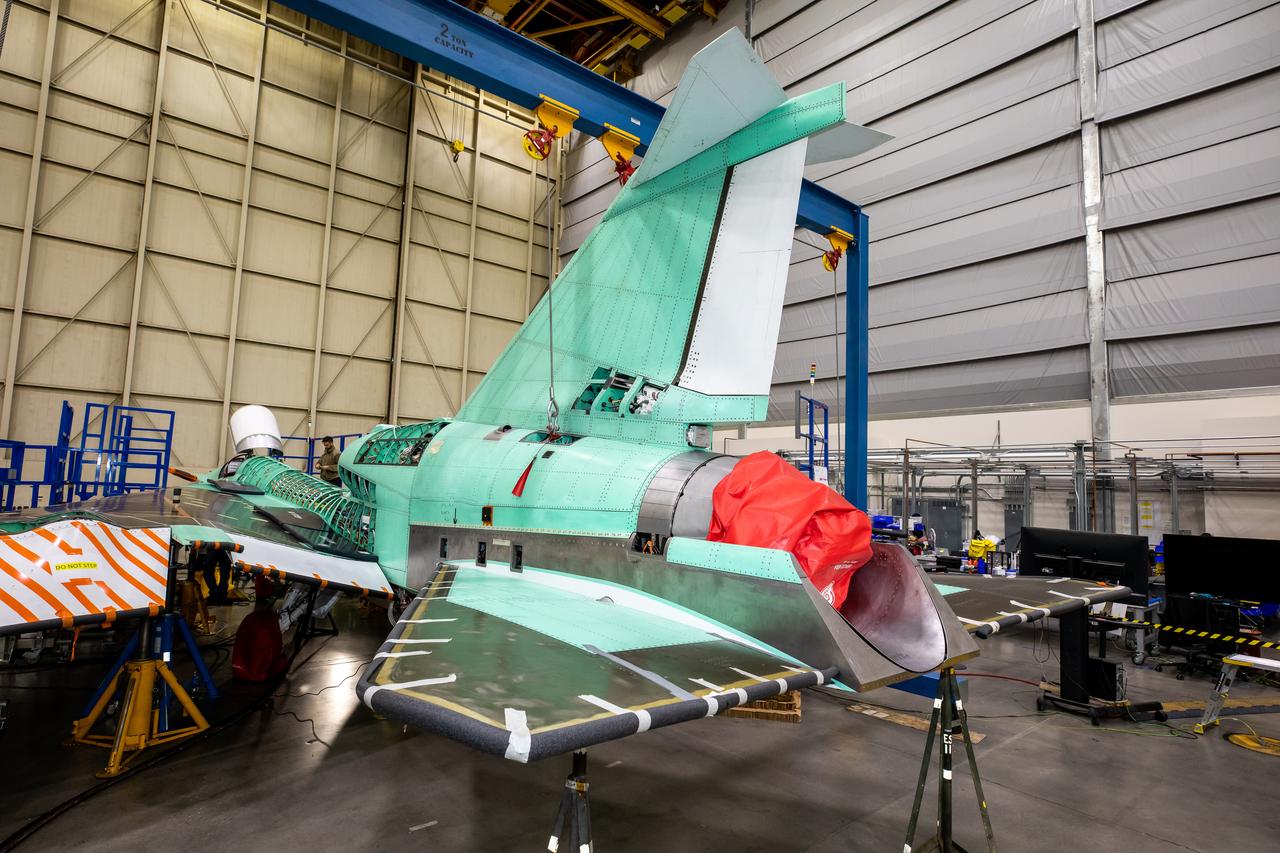
The tail of NASA’s X-59 aircraft is shown here in late March at Lockheed Martin Skunk Works in Palmdale, California where the plane recently underwent a final install of the lower empennage or better known as tail section of the plane.
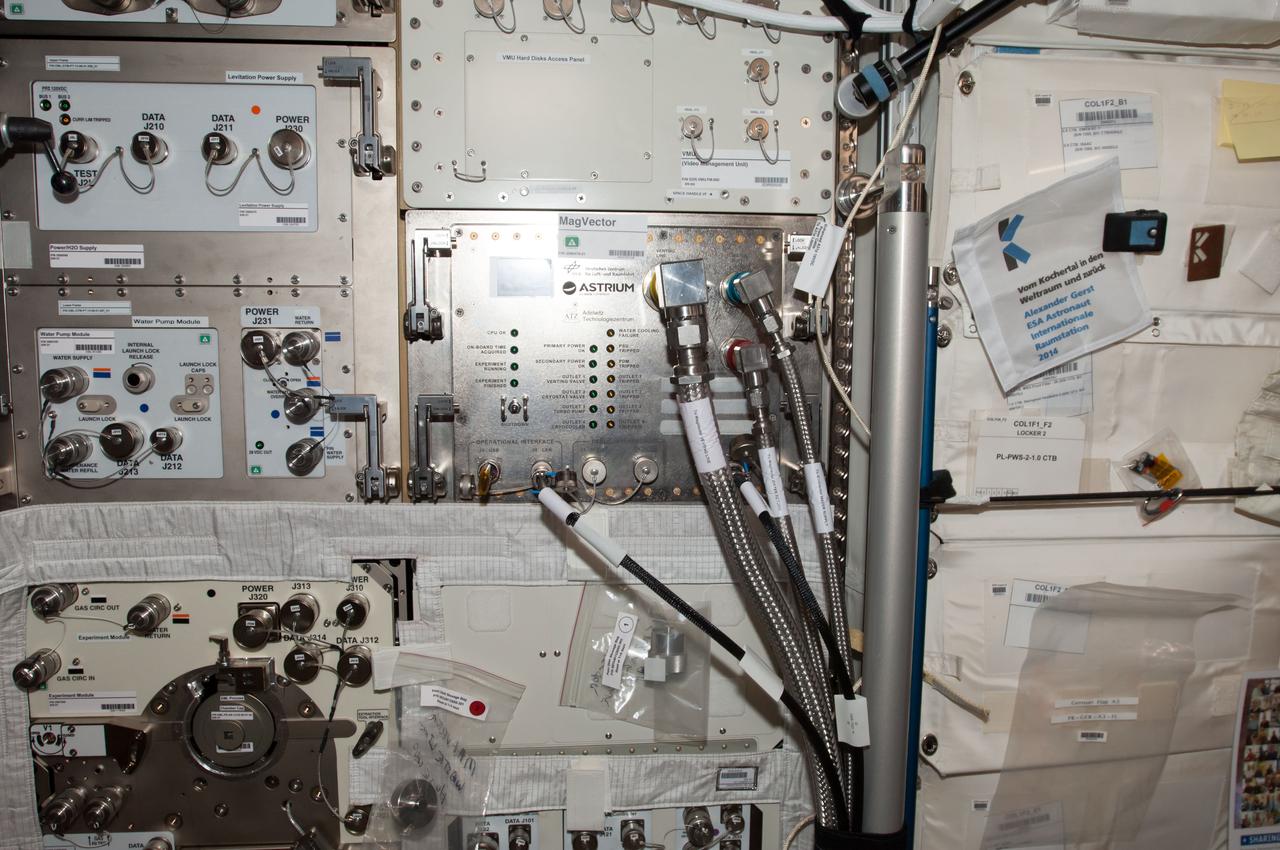
iss040e123621 (9/4/2014) --- Photographic documentation of final installation of MAGVECTOR hardware in the Columbus module aboard the International Space Station (ISS). MAGVECTOR qualitatively investigates the interaction between a moving magnetic field and an electrical conductor. The set up will provide initial insights regarding the principal feasibility on board the ISS,future improvements and phenomenological trends and dependencies. The expected changes in the magnetic field structure on the Ram and Wake side of the electrical conductor are of interest for technical applications as well as for astrophysical research.
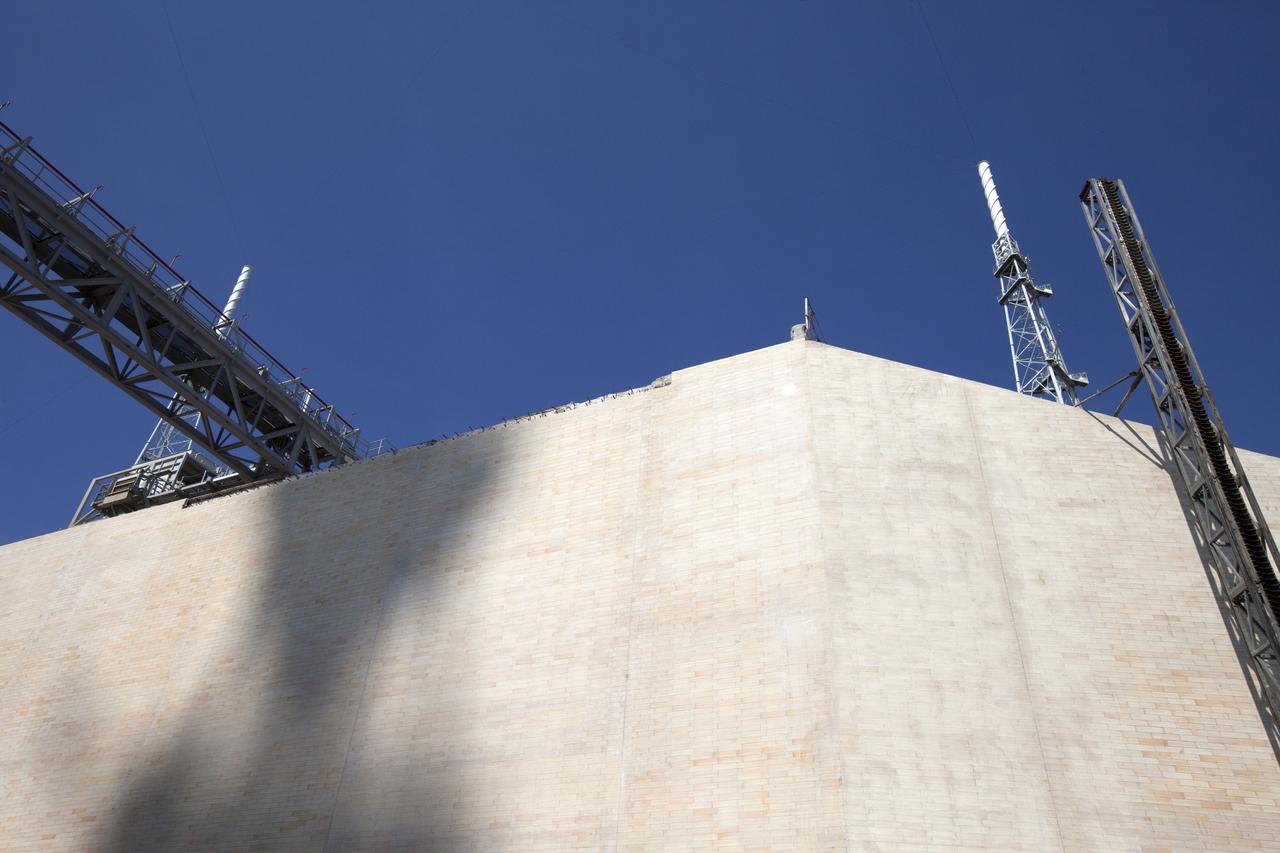
A view looking up from the north side of the flame trench beneath the pad at Launch Complex 39B at NASA's Kennedy Space Center in Florida. The walls of the flame trench are being upgraded to withstand the intense heat and fire at launch of NASA's Space Launch System rocket with Orion atop. About 96,000 heat-resistant bricks, in three different sizes, were secured to the walls using bonding mortar in combination with adhesive anchors. The Ground Systems Development and Operations Program is overseeing upgrades and modifications to Pad 39B to support the launch of the SLS and Orion spacecraft for Exploration Mission-1 and NASA’s journey to Mars.

Inside Building 1555 at Vandenberg Air Force Base in California, technicians and engineers perform final wing installations on the Orbital ATK Pegasus XL rocket which will launch eight NASA Cyclone Global Navigation Satellite System, or CYGNSS, spacecraft. When preparations are completed at Vandenberg, the rocket, with CYGNSS in its payload fairing, will be attached to the Orbital ATK L-1011 carrier aircraft and transported to NASA’s Kennedy Space Center in Florida. On Dec. 12, 2016, the carrier aircraft is scheduled to take off from the Skid Strip at Cape Canaveral Air Force Station and CYGNSS will launch on the Pegasus XL rocket with the L-1011 flying off shore. CYGNSS will make frequent and accurate measurements of ocean surface winds throughout the life cycle of tropical storms and hurricanes. The data that CYGNSS provides will enable scientists to probe key air-sea interaction processes that take place near the core of storms, which are rapidly changing and play a critical role in the beginning and intensification of hurricanes.
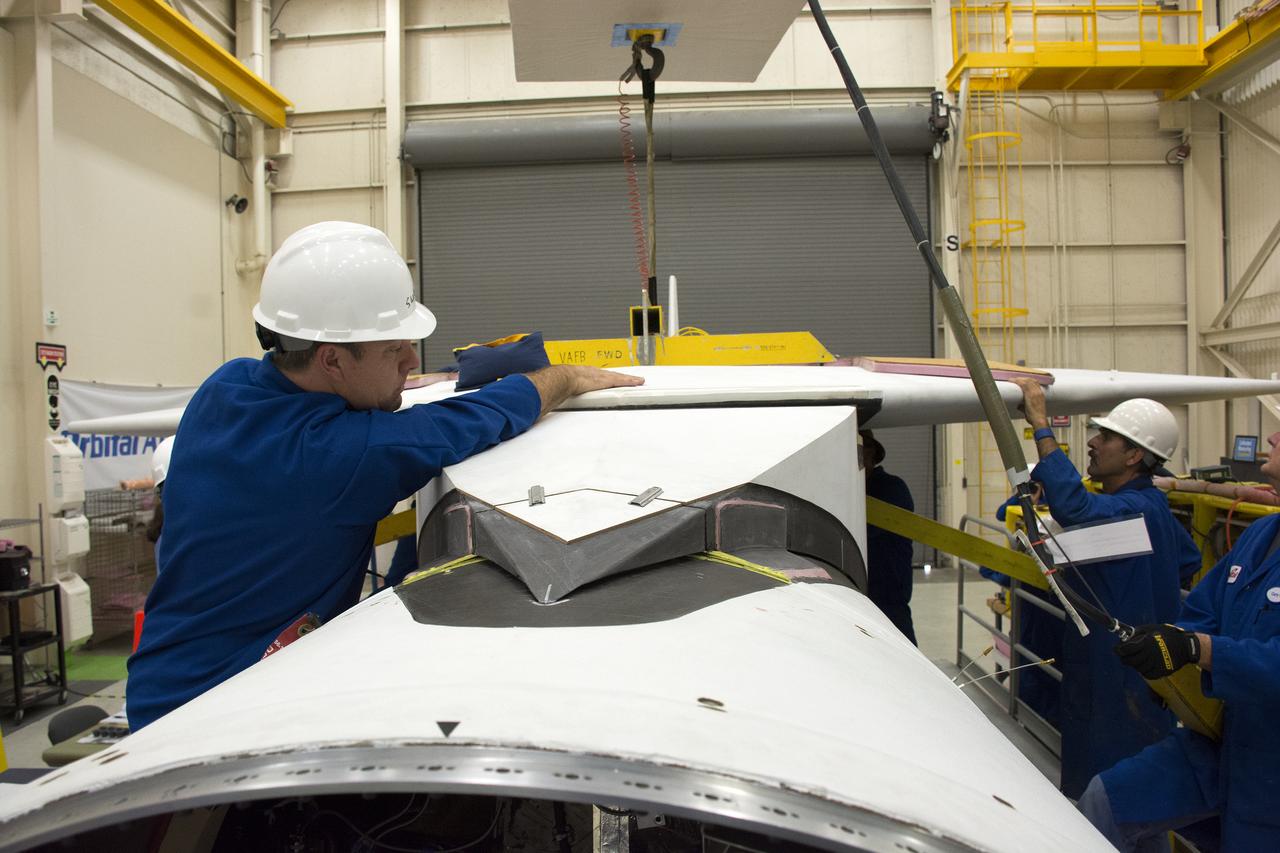
Inside Building 1555 at Vandenberg Air Force Base in California, technicians and engineers perform final wing installations on the Orbital ATK Pegasus XL rocket which will launch eight NASA Cyclone Global Navigation Satellite System, or CYGNSS, spacecraft. When preparations are completed at Vandenberg, the rocket, with CYGNSS in its payload fairing, will be attached to the Orbital ATK L-1011 carrier aircraft and transported to NASA’s Kennedy Space Center in Florida. On Dec. 12, 2016, the carrier aircraft is scheduled to take off from the Skid Strip at Cape Canaveral Air Force Station and CYGNSS will launch on the Pegasus XL rocket with the L-1011 flying off shore. CYGNSS will make frequent and accurate measurements of ocean surface winds throughout the life cycle of tropical storms and hurricanes. The data that CYGNSS provides will enable scientists to probe key air-sea interaction processes that take place near the core of storms, which are rapidly changing and play a critical role in the beginning and intensification of hurricanes.
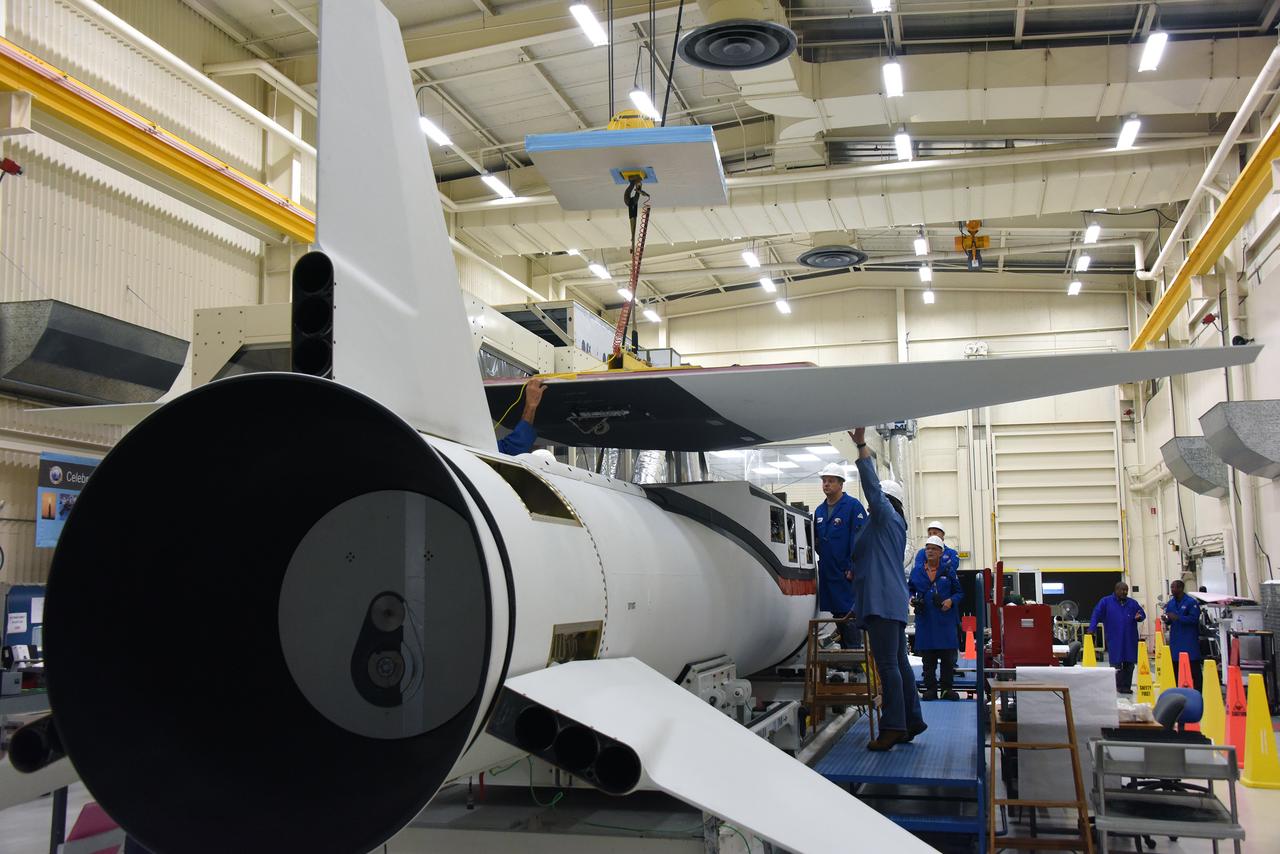
Inside Building 1555 at Vandenberg Air Force Base in California, technicians and engineers perform final wing installations on the Orbital ATK Pegasus XL rocket which will launch eight NASA Cyclone Global Navigation Satellite System, or CYGNSS, spacecraft. When preparations are completed at Vandenberg, the rocket, with CYGNSS in its payload fairing, will be attached to the Orbital ATK L-1011 carrier aircraft and transported to NASA’s Kennedy Space Center in Florida. On Dec. 12, 2016, the carrier aircraft is scheduled to take off from the Skid Strip at Cape Canaveral Air Force Station and CYGNSS will launch on the Pegasus XL rocket with the L-1011 flying off shore. CYGNSS will make frequent and accurate measurements of ocean surface winds throughout the life cycle of tropical storms and hurricanes. The data that CYGNSS provides will enable scientists to probe key air-sea interaction processes that take place near the core of storms, which are rapidly changing and play a critical role in the beginning and intensification of hurricanes.
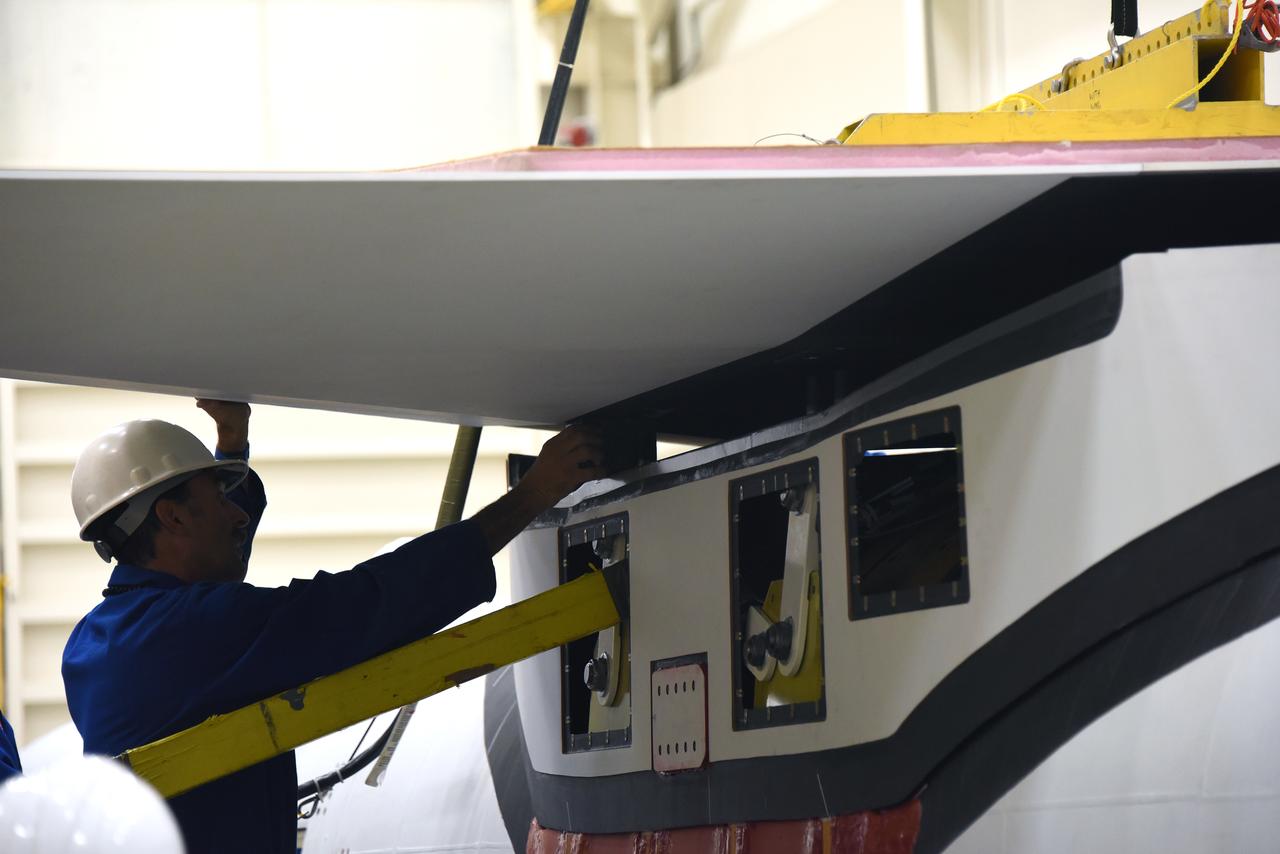
Inside Building 1555 at Vandenberg Air Force Base in California, technicians and engineers perform final wing installations on the Orbital ATK Pegasus XL rocket which will launch eight NASA Cyclone Global Navigation Satellite System, or CYGNSS, spacecraft. When preparations are completed at Vandenberg, the rocket, with CYGNSS in its payload fairing, will be attached to the Orbital ATK L-1011 carrier aircraft and transported to NASA’s Kennedy Space Center in Florida. On Dec. 12, 2016, the carrier aircraft is scheduled to take off from the Skid Strip at Cape Canaveral Air Force Station and CYGNSS will launch on the Pegasus XL rocket with the L-1011 flying off shore. CYGNSS will make frequent and accurate measurements of ocean surface winds throughout the life cycle of tropical storms and hurricanes. The data that CYGNSS provides will enable scientists to probe key air-sea interaction processes that take place near the core of storms, which are rapidly changing and play a critical role in the beginning and intensification of hurricanes.
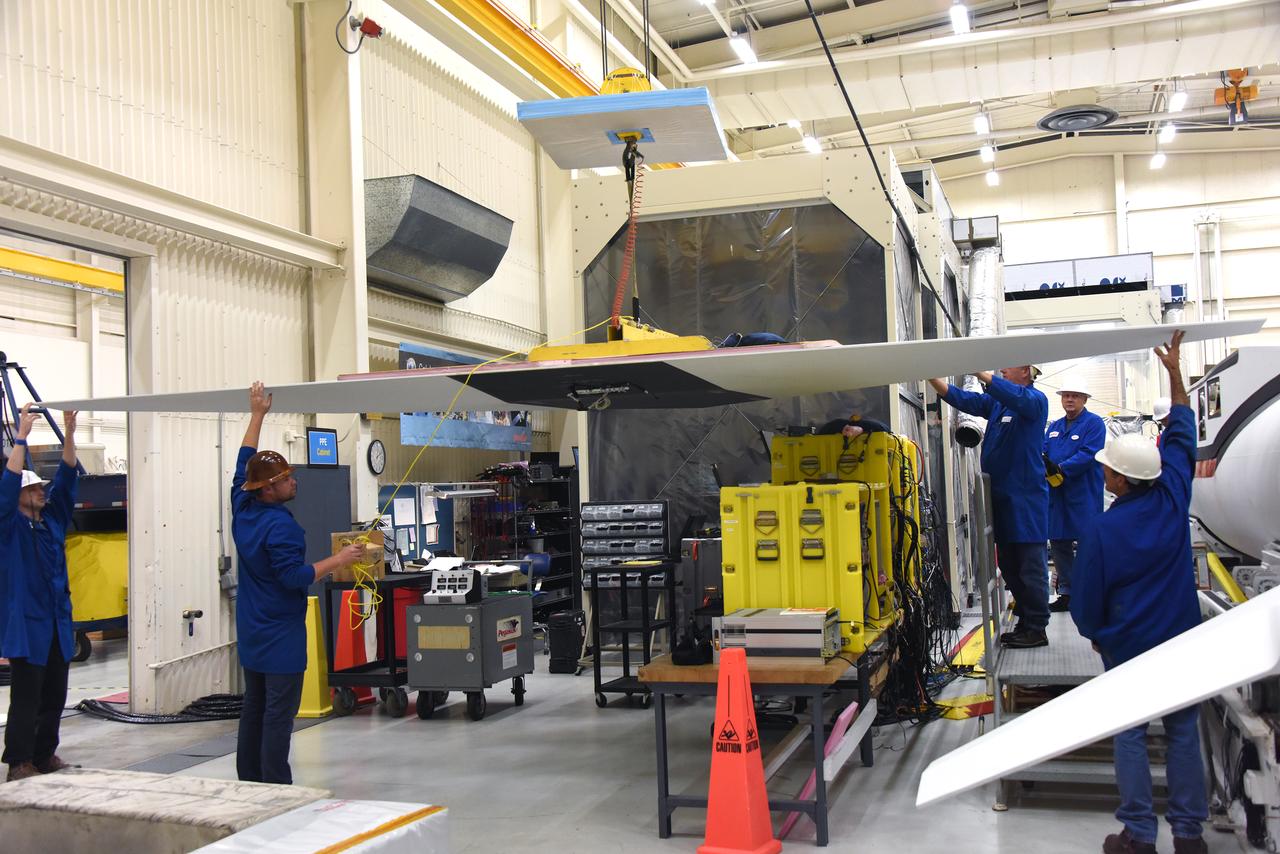
Inside Building 1555 at Vandenberg Air Force Base in California, technicians and engineers perform final wing installations on the Orbital ATK Pegasus XL rocket which will launch eight NASA Cyclone Global Navigation Satellite System, or CYGNSS, spacecraft. When preparations are completed at Vandenberg, the rocket, with CYGNSS in its payload fairing, will be attached to the Orbital ATK L-1011 carrier aircraft and transported to NASA’s Kennedy Space Center in Florida. On Dec. 12, 2016, the carrier aircraft is scheduled to take off from the Skid Strip at Cape Canaveral Air Force Station and CYGNSS will launch on the Pegasus XL rocket with the L-1011 flying off shore. CYGNSS will make frequent and accurate measurements of ocean surface winds throughout the life cycle of tropical storms and hurricanes. The data that CYGNSS provides will enable scientists to probe key air-sea interaction processes that take place near the core of storms, which are rapidly changing and play a critical role in the beginning and intensification of hurricanes.
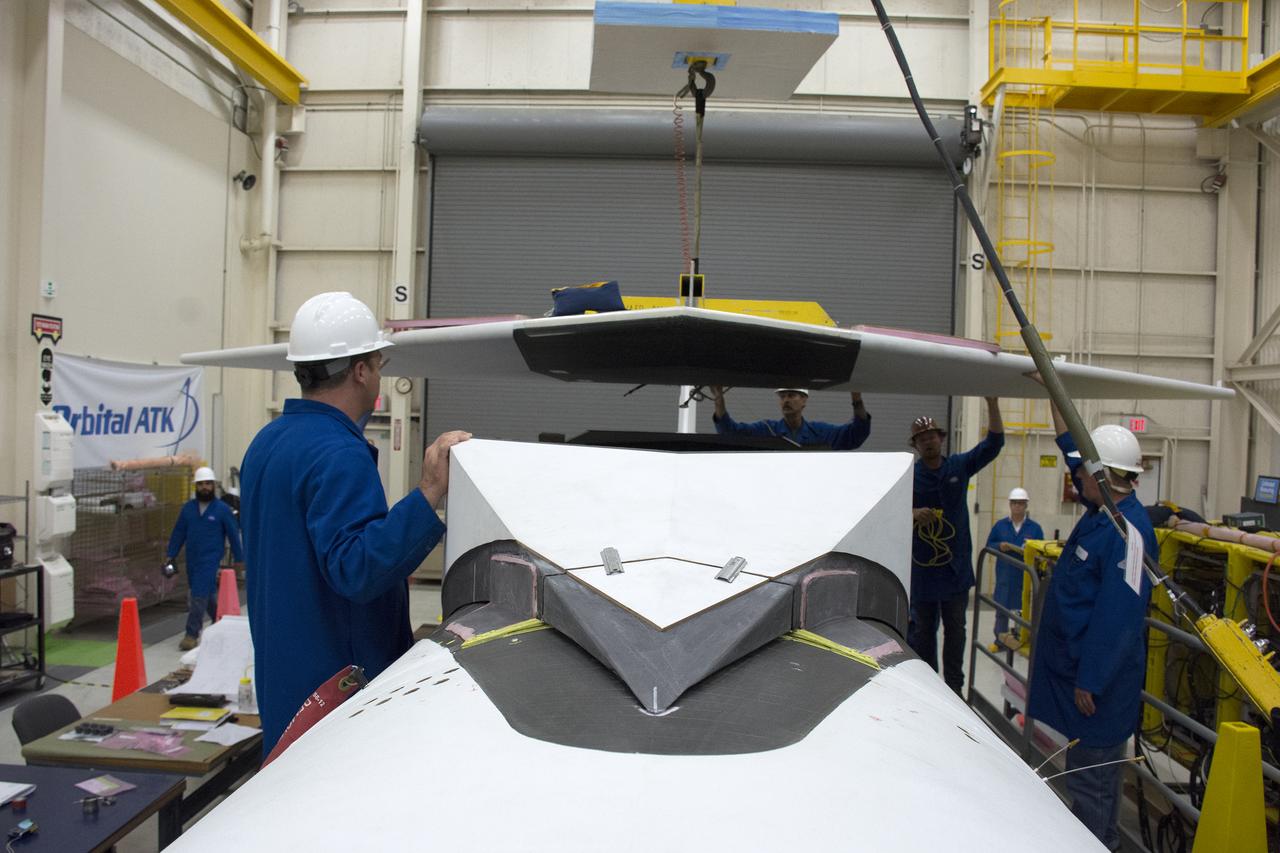
Inside Building 1555 at Vandenberg Air Force Base in California, technicians and engineers perform final wing installations on the Orbital ATK Pegasus XL rocket which will launch eight NASA Cyclone Global Navigation Satellite System, or CYGNSS, spacecraft. When preparations are completed at Vandenberg, the rocket, with CYGNSS in its payload fairing, will be attached to the Orbital ATK L-1011 carrier aircraft and transported to NASA’s Kennedy Space Center in Florida. On Dec. 12, 2016, the carrier aircraft is scheduled to take off from the Skid Strip at Cape Canaveral Air Force Station and CYGNSS will launch on the Pegasus XL rocket with the L-1011 flying off shore. CYGNSS will make frequent and accurate measurements of ocean surface winds throughout the life cycle of tropical storms and hurricanes. The data that CYGNSS provides will enable scientists to probe key air-sea interaction processes that take place near the core of storms, which are rapidly changing and play a critical role in the beginning and intensification of hurricanes.
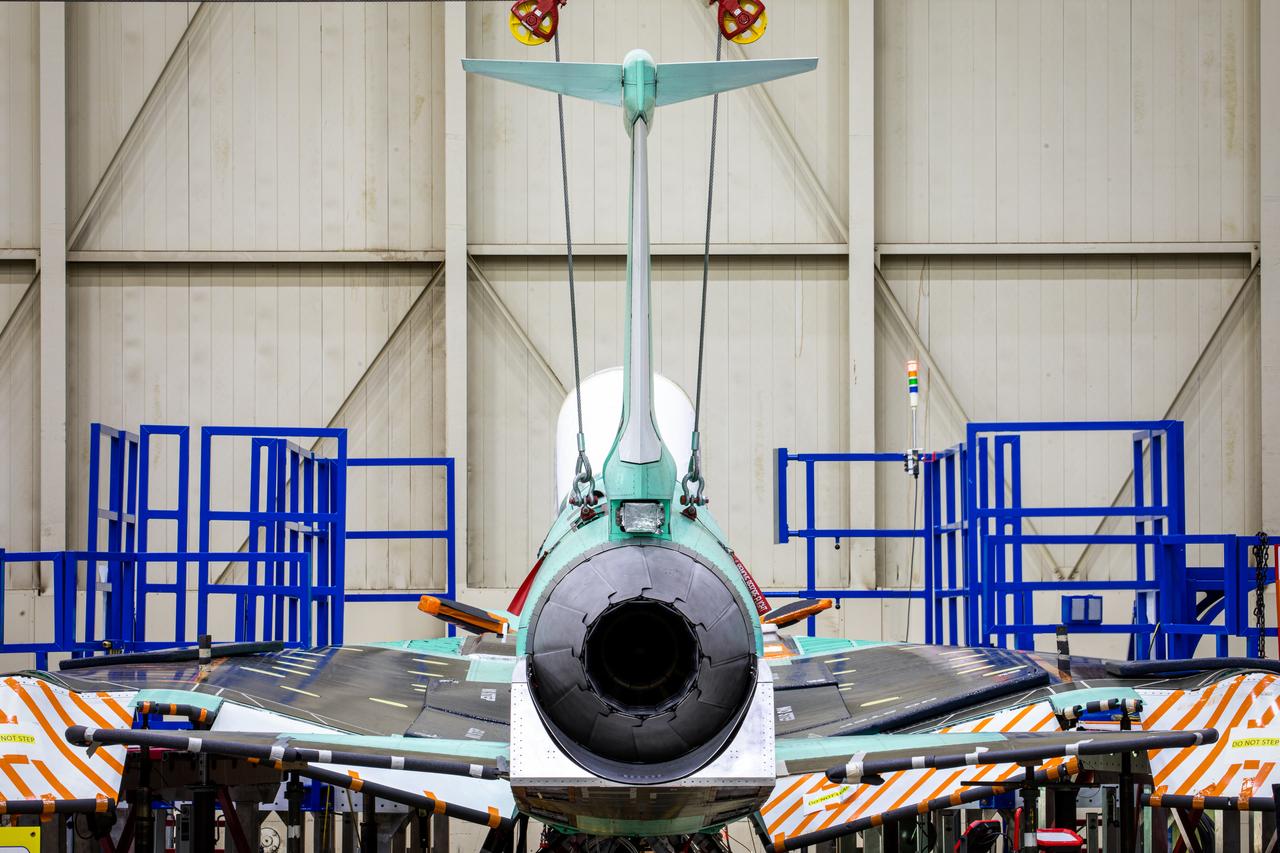
A perfectly framed up rearview shot of NASA’s X-59 tail after its recent installation of the lower empennage, or tail section, in late March at Lockheed Martin Skunk Works in Palmdale, California.
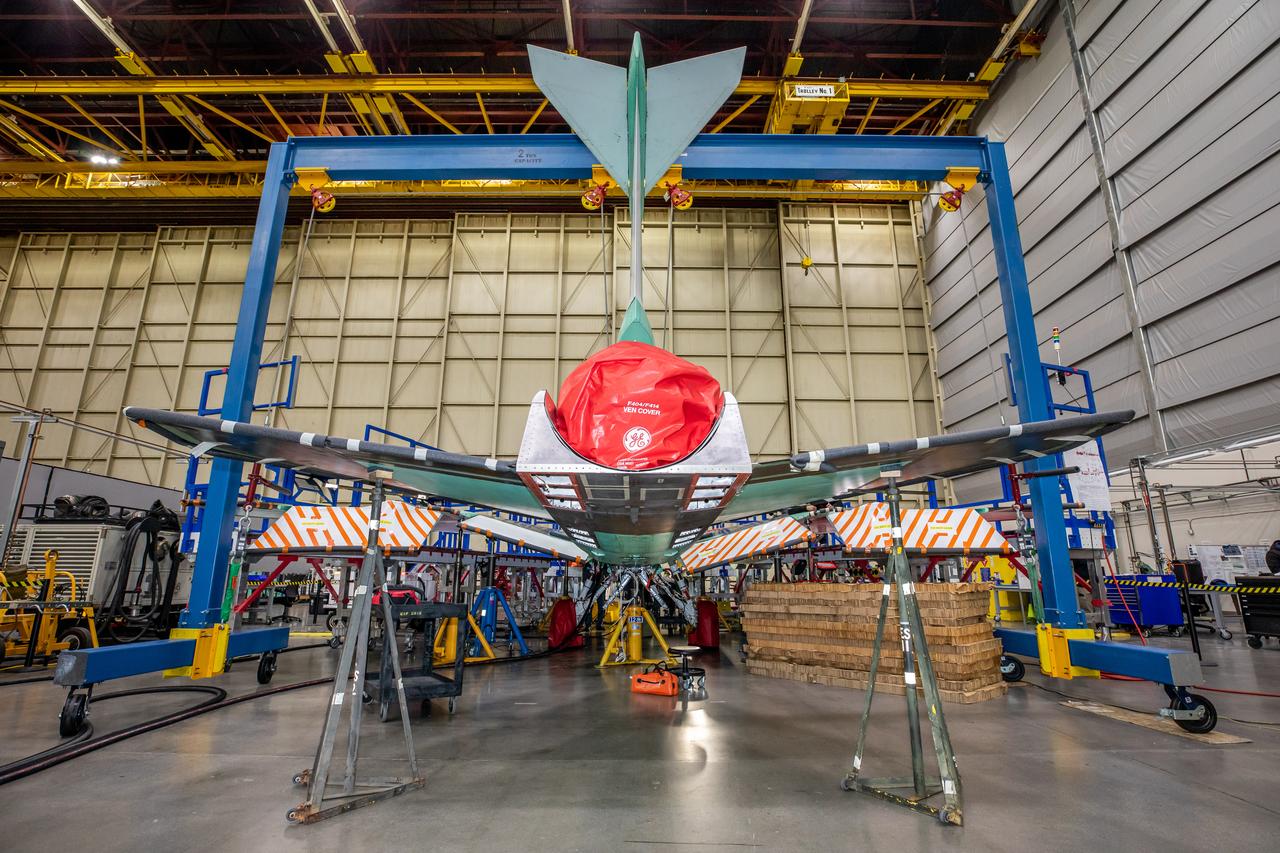
NASA’s X-59 sits in support framing while undergoing the installation of its lower empennage, or tail section, at Lockheed Martin Skunk Works in Palmdale, California in late March.
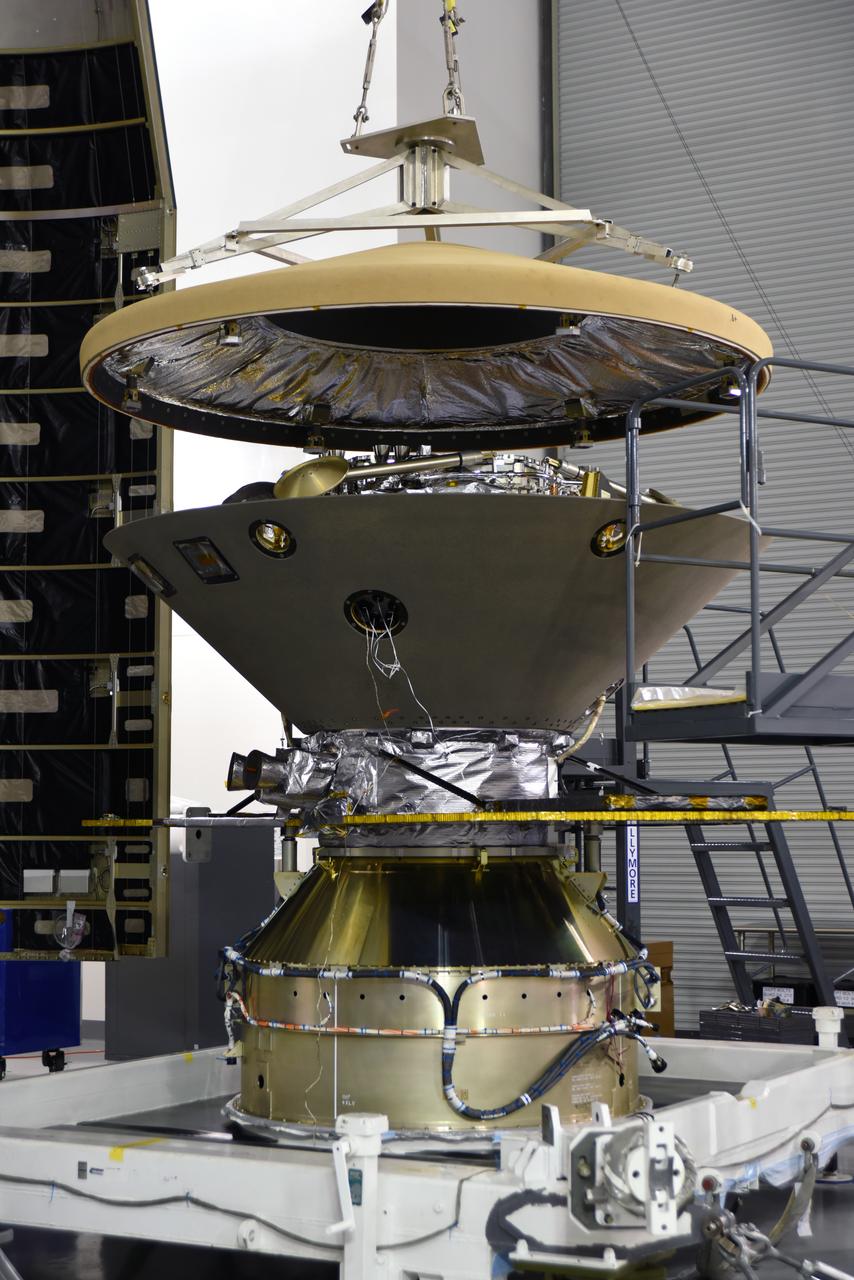
In the Astrotech facility at Vandenberg Air Force Base in California, the heatshield is placed on NASA's Interior Exploration using Seismic Investigations, Geodesy and Heat Transport, or InSight, Mars lander prior to encapsulation in its payload fairing. InSight will be the first mission to look deep beneath the Martian surface. It will study the planet's interior by measuring its heat output and listen for marsquakes. The spacecraft will use the seismic waves generated by marsquakes to develop a map of the planet’s deep interior. The resulting insight into Mars’ formation will provide a better understanding of how other rocky planets, including Earth, were created. InSight is scheduled for liftoff May 5, 2018.
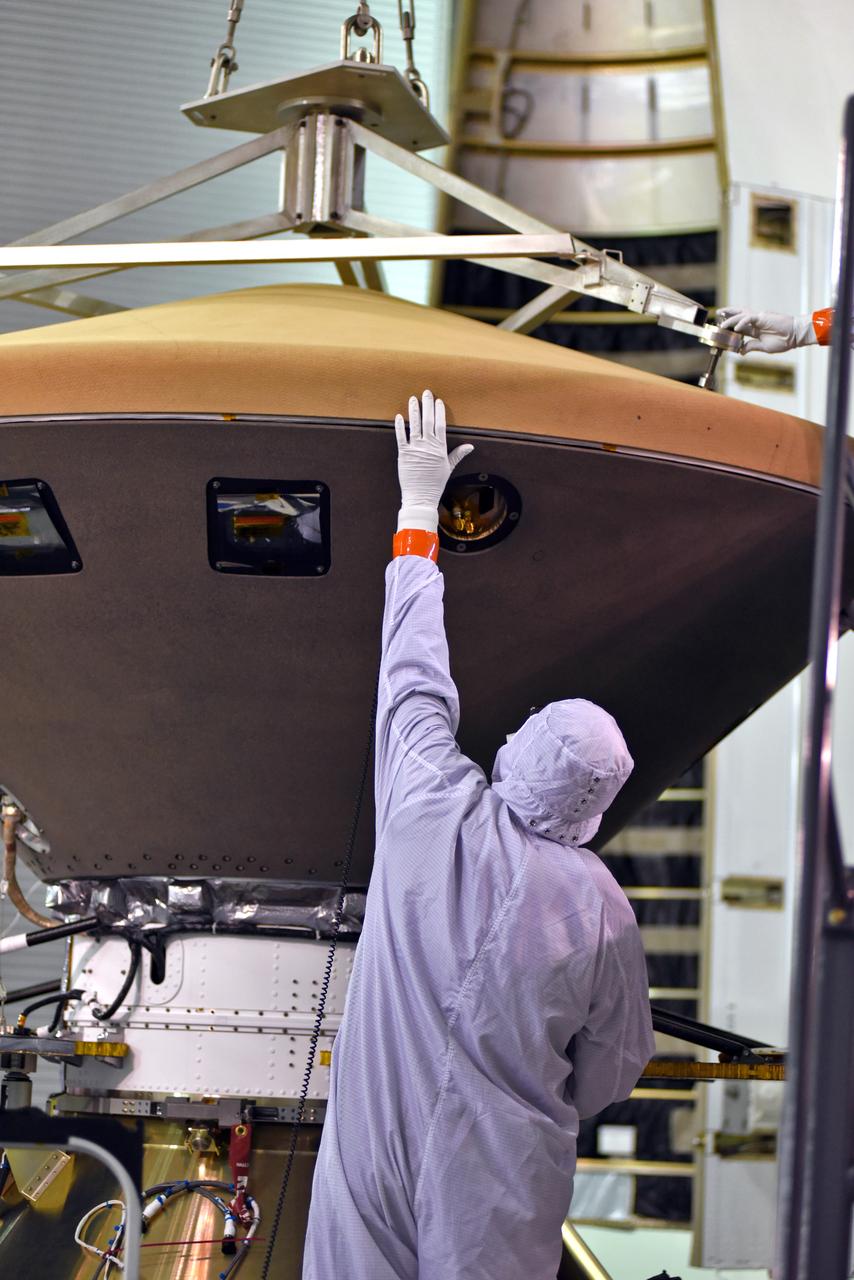
In the Astrotech facility at Vandenberg Air Force Base in California, a technician monitors progress as the heatshield is placed on NASA's Interior Exploration using Seismic Investigations, Geodesy and Heat Transport, or InSight, Mars. InSight will be the first mission to look deep beneath the Martian surface. It will study the planet's interior by measuring its heat output and listen for marsquakes. The spacecraft will use the seismic waves generated by marsquakes to develop a map of the planet’s deep interior. The resulting insight into Mars’ formation will provide a better understanding of how other rocky planets, including Earth, were created. InSight is scheduled for liftoff May 5, 2018.
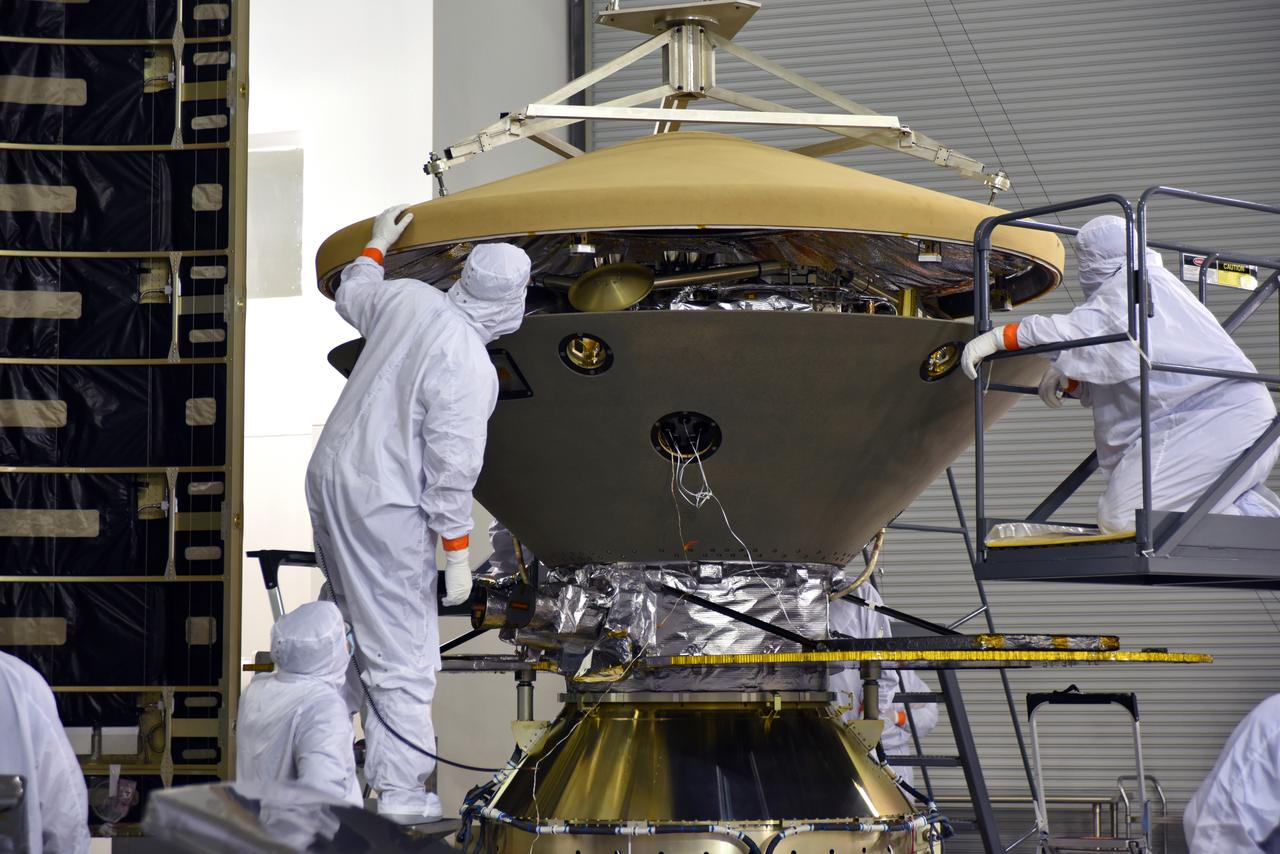
In the Astrotech facility at Vandenberg Air Force Base in California, technicians and engineers place the heatshield on NASA's Interior Exploration using Seismic Investigations, Geodesy and Heat Transport, or InSight, Mars lander prior to encapsulation in its payload fairing. InSight will be the first mission to look deep beneath the Martian surface. It will study the planet's interior by measuring its heat output and listen for marsquakes. The spacecraft will use the seismic waves generated by marsquakes to develop a map of the planet’s deep interior. The resulting insight into Mars’ formation will provide a better understanding of how other rocky planets, including Earth, were created. InSight is scheduled for liftoff May 5, 2018.
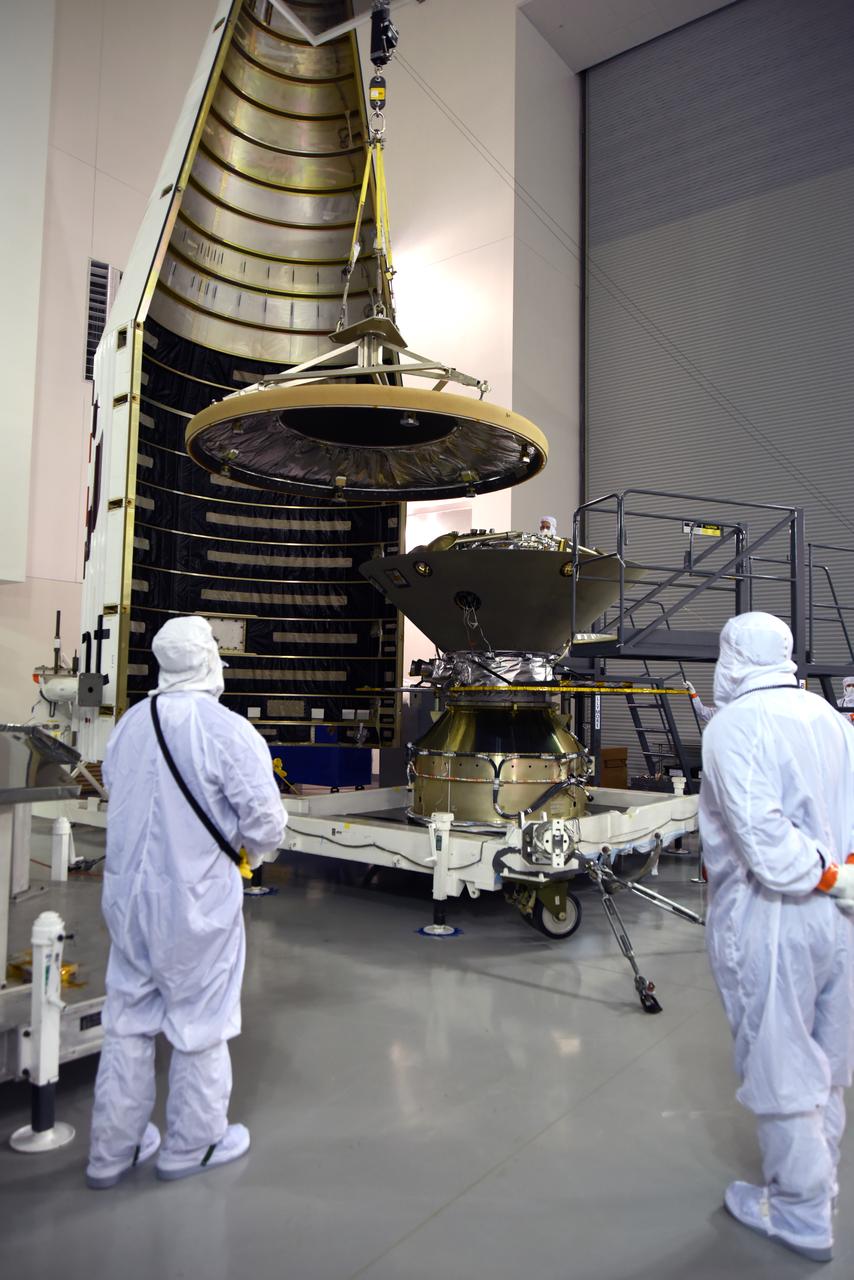
In the Astrotech facility at Vandenberg Air Force Base in California, the heatshield is placed on NASA's Interior Exploration using Seismic Investigations, Geodesy and Heat Transport, or InSight, Mars lander prior to encapsulation in its payload fairing. InSight will be the first mission to look deep beneath the Martian surface. It will study the planet's interior by measuring its heat output and listen for marsquakes. The spacecraft will use the seismic waves generated by marsquakes to develop a map of the planet’s deep interior. The resulting insight into Mars’ formation will provide a better understanding of how other rocky planets, including Earth, were created. InSight is scheduled for liftoff May 5, 2018.
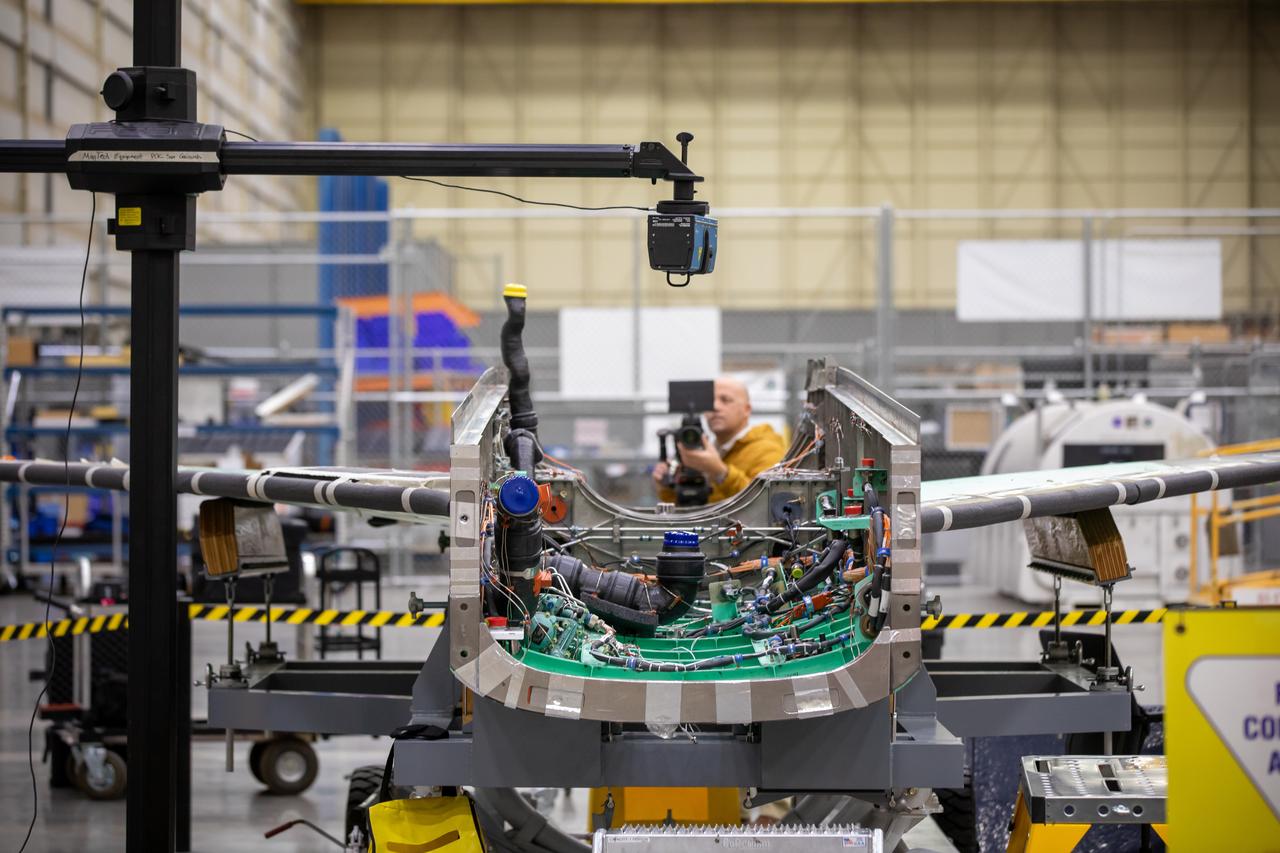
A laser scans the inside of the X-59 aircraft’s lower engine bay at Lockheed Martin Skunk Works in Palmdale, California. These scans can help identify potential hardware or wiring interferences prior to the final installation of the engine and lower tail.
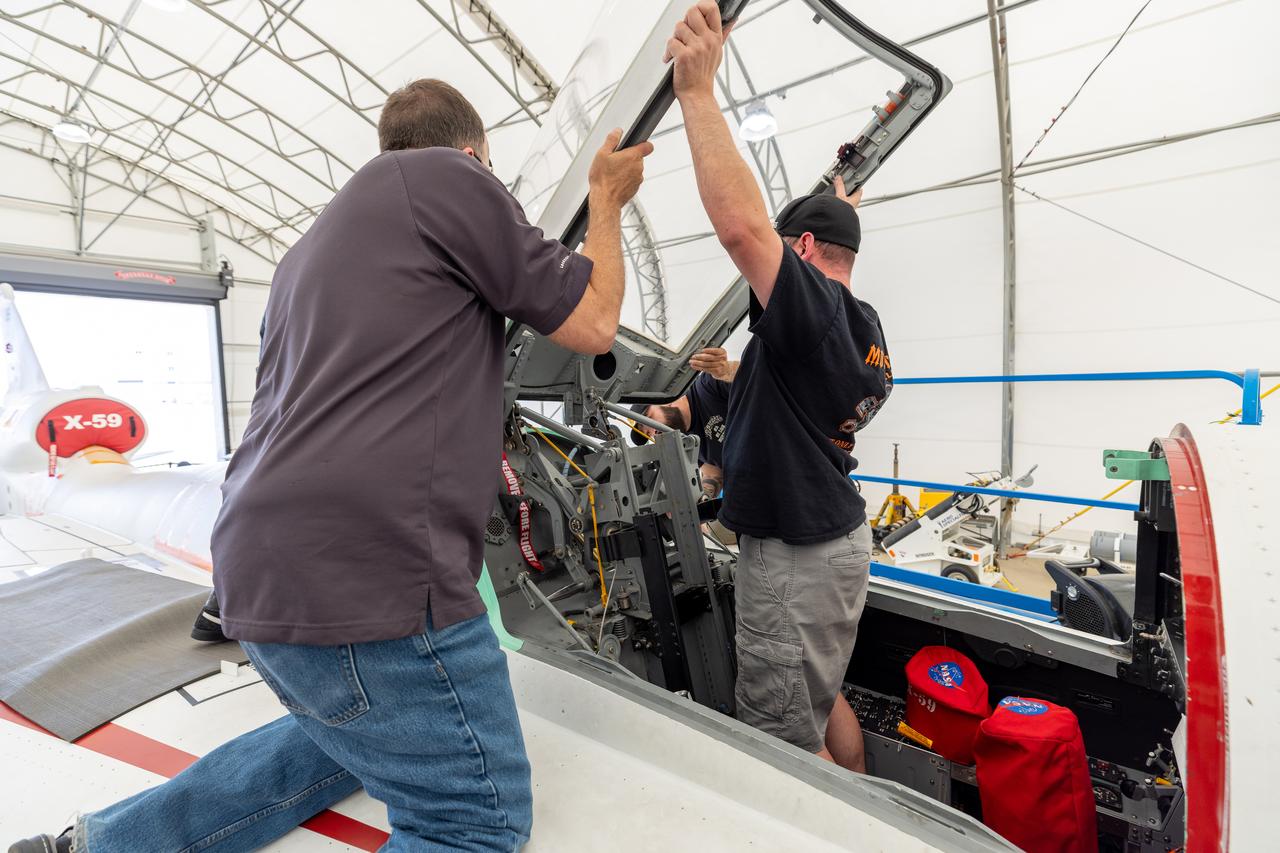
Lockheed Martin technicians temporarily remove the canopy from the X-59 in preparation for final installation of the ejection seat into the aircraft.
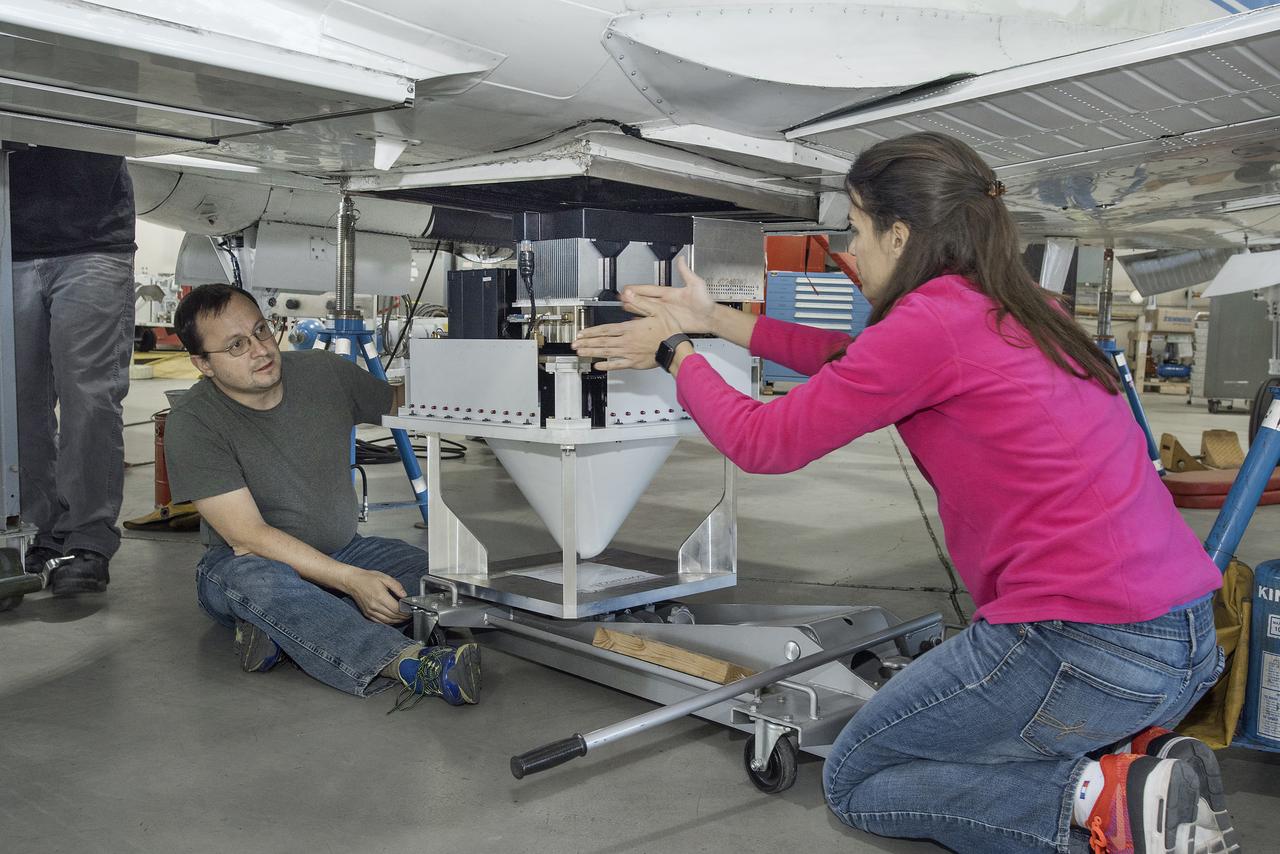
Engineers Raquel Rodriguez Monje and Fabien Nicaise discuss placement of the DopplerScatt radar instrument on the NASA B200 before its final installation onto the aircraft’s fuselage.
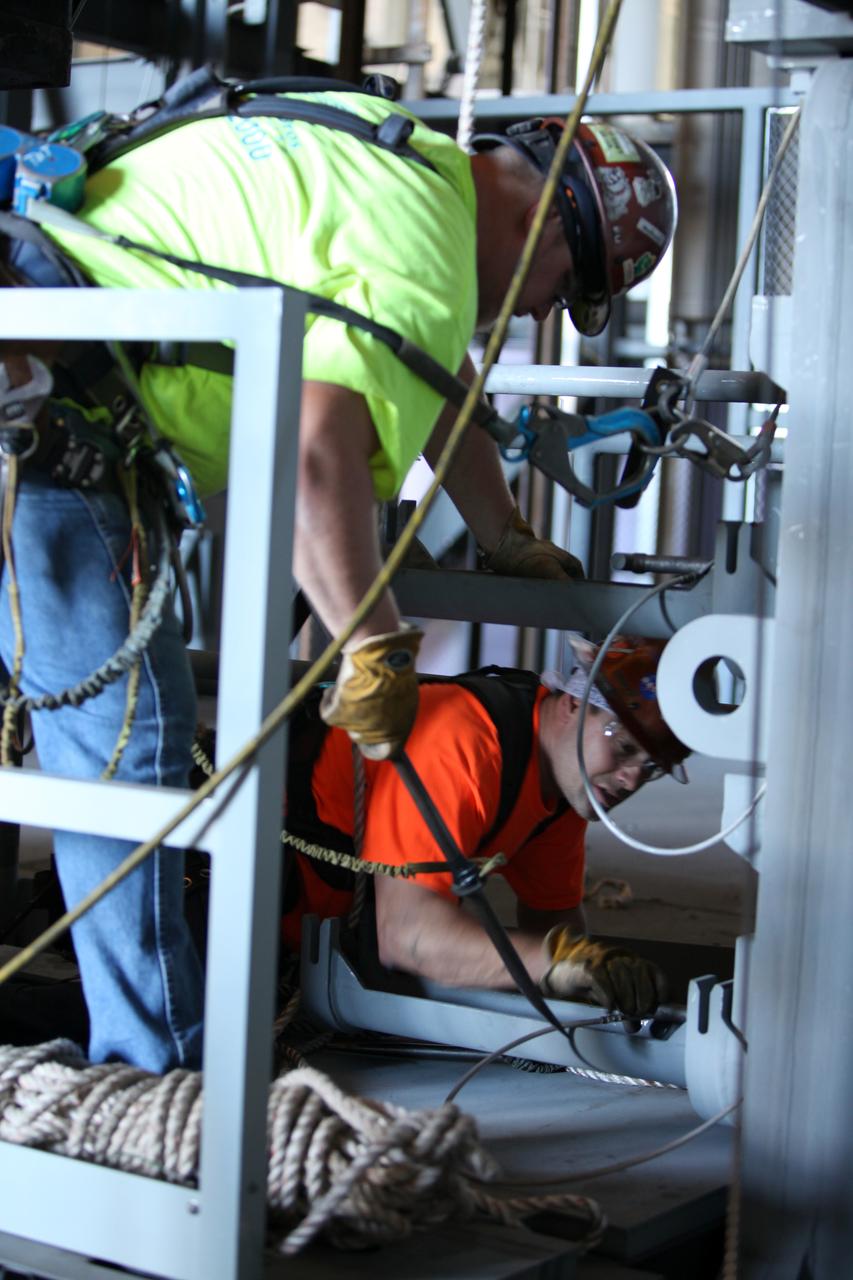
High up in the Vehicle Assembly Building (VAB) at NASA's Kennedy Space Center in Florida, construction workers assist with the installation of the final work platform, A north, in High Bay 3, as a crane lowers the platform into place. The platform will be installed and secured on its rail beam high up on the north wall of the high bay. The installation of the final topmost level completes the 10 levels of work platforms, 20 platform halves altogether, that will surround NASA's Space Launch System rocket and the Orion spacecraft and allow access during processing for missions, including the first uncrewed flight test of Orion atop the SLS rocket in 2018. The A-level platforms will provide access to the Orion spacecraft's Launch Abort System for Orion lifting sling removal and installation of the closeout panels. The Ground Systems Development and Operations Program, with support from the center's Engineering Directorate, is overseeing upgrades and modifications to the VAB, including installation of the new work platforms.
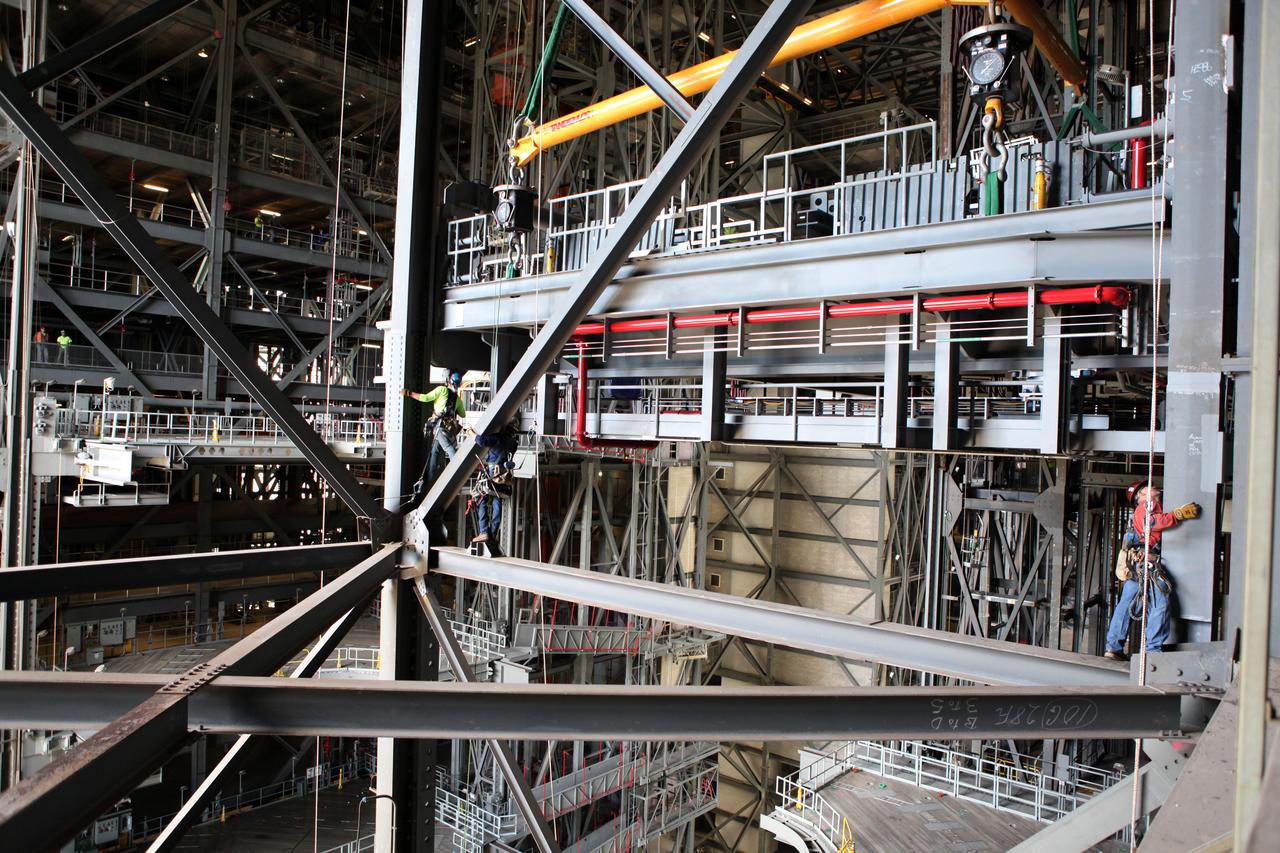
High up in the Vehicle Assembly Building (VAB) at NASA's Kennedy Space Center in Florida, construction workers assist with the installation of the final work platform, A north, in High Bay 3, as a crane lowers the platform into place. The platform will be installed and secured on its rail beam high up on the north wall of the high bay. The installation of the final topmost level completes the 10 levels of work platforms, 20 platform halves altogether, that will surround NASA's Space Launch System rocket and the Orion spacecraft and allow access during processing for missions, including the first uncrewed flight test of Orion atop the SLS rocket in 2018. The A-level platforms will provide access to the Orion spacecraft's Launch Abort System for Orion lifting sling removal and installation of the closeout panels. The Ground Systems Development and Operations Program, with support from the center's Engineering Directorate, is overseeing upgrades and modifications to the VAB, including installation of the new work platforms.
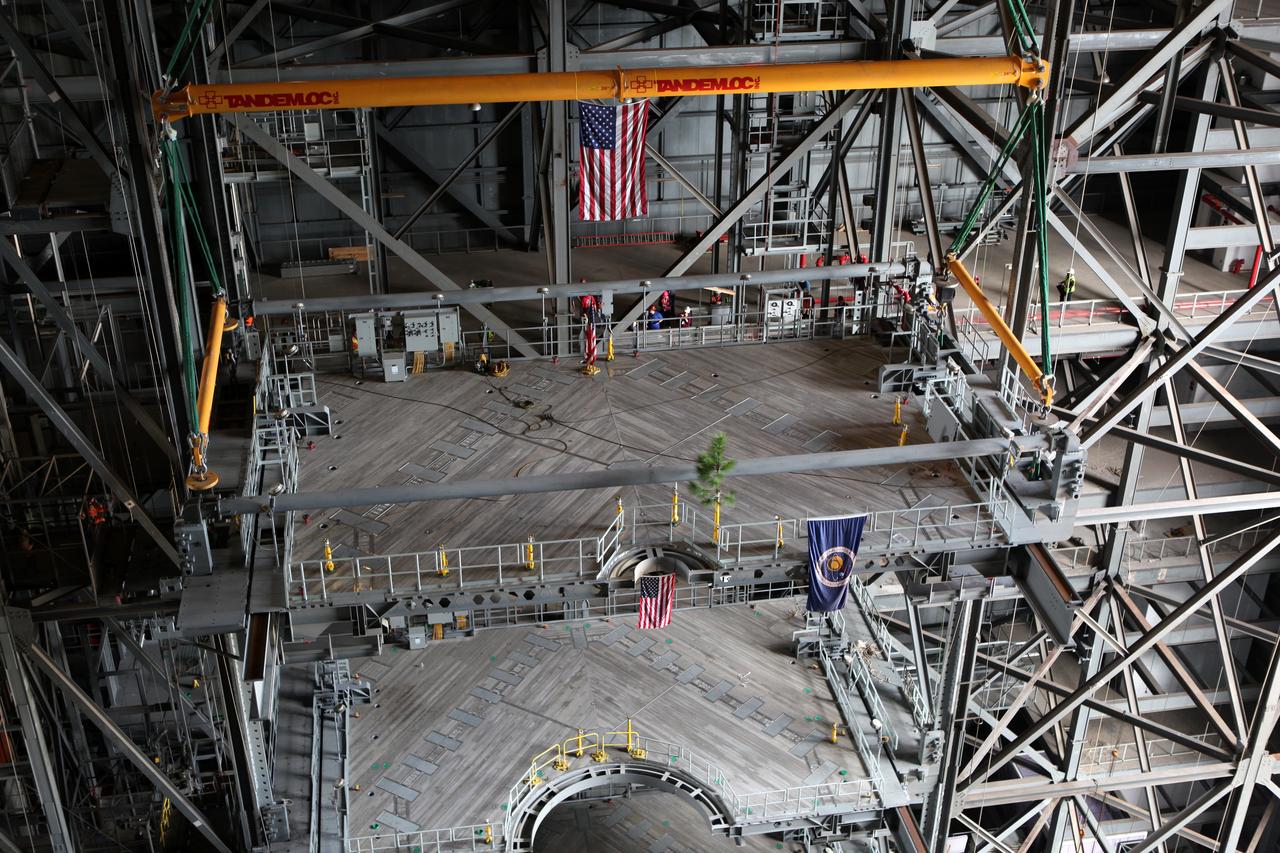
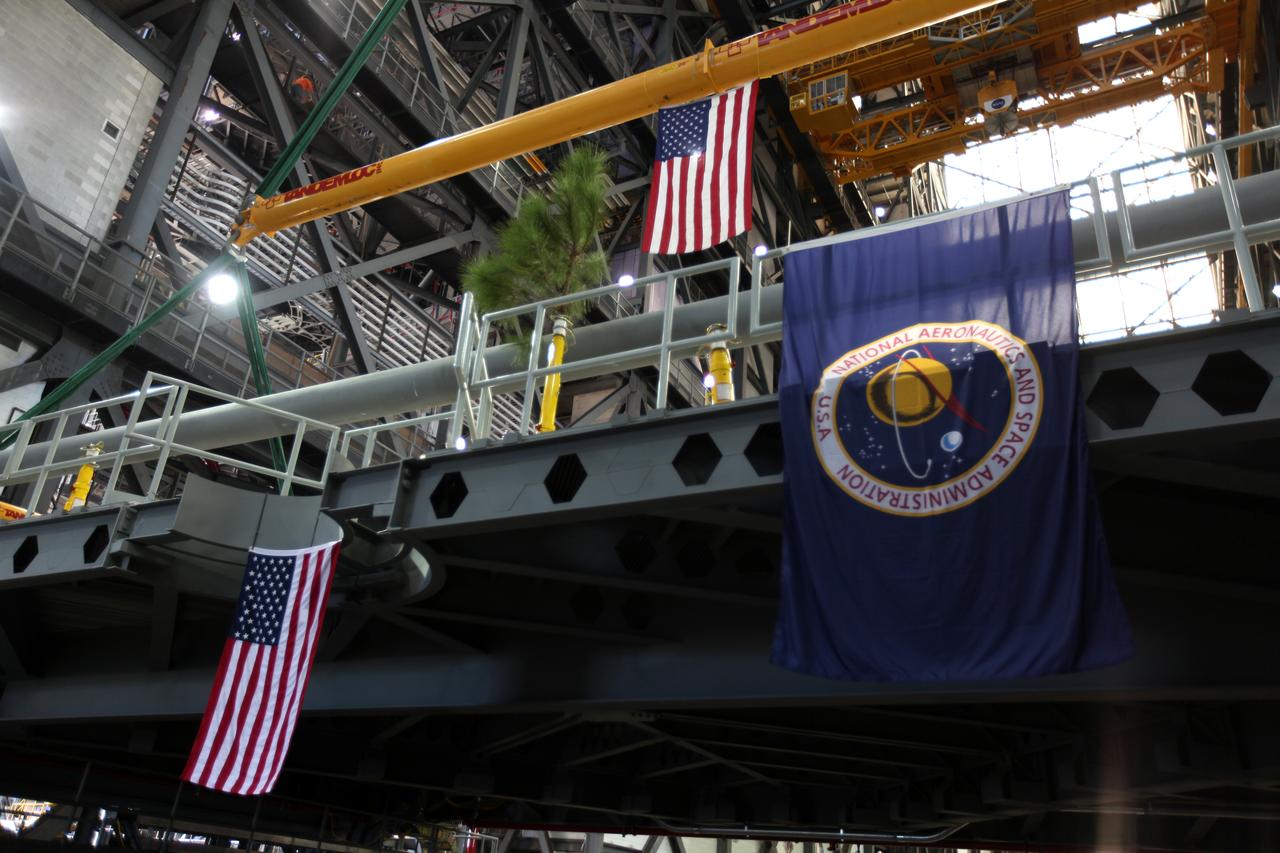
High up in the Vehicle Assembly Building (VAB) at NASA's Kennedy Space Center in Florida, a crane lowers the final work platform, A north, for installation in High Bay 3. The platform will be installed and secured on its rail beam high up on the north wall of the high bay. In view on the platform are the American flag and a small tree. The installation of the final topmost level completes the 10 levels of work platforms, 20 platform halves altogether, that will surround NASA's Space Launch System rocket and the Orion spacecraft and allow access during processing for missions, including the first uncrewed flight test of Orion atop the SLS rocket in 2018. The A-level platforms will provide access to the Orion spacecraft's Launch Abort System for Orion lifting sling removal and installation of the closeout panels. The Ground Systems Development and Operations Program, with support from the center's Engineering Directorate, is overseeing upgrades and modifications to the VAB, including installation of the new work platforms.
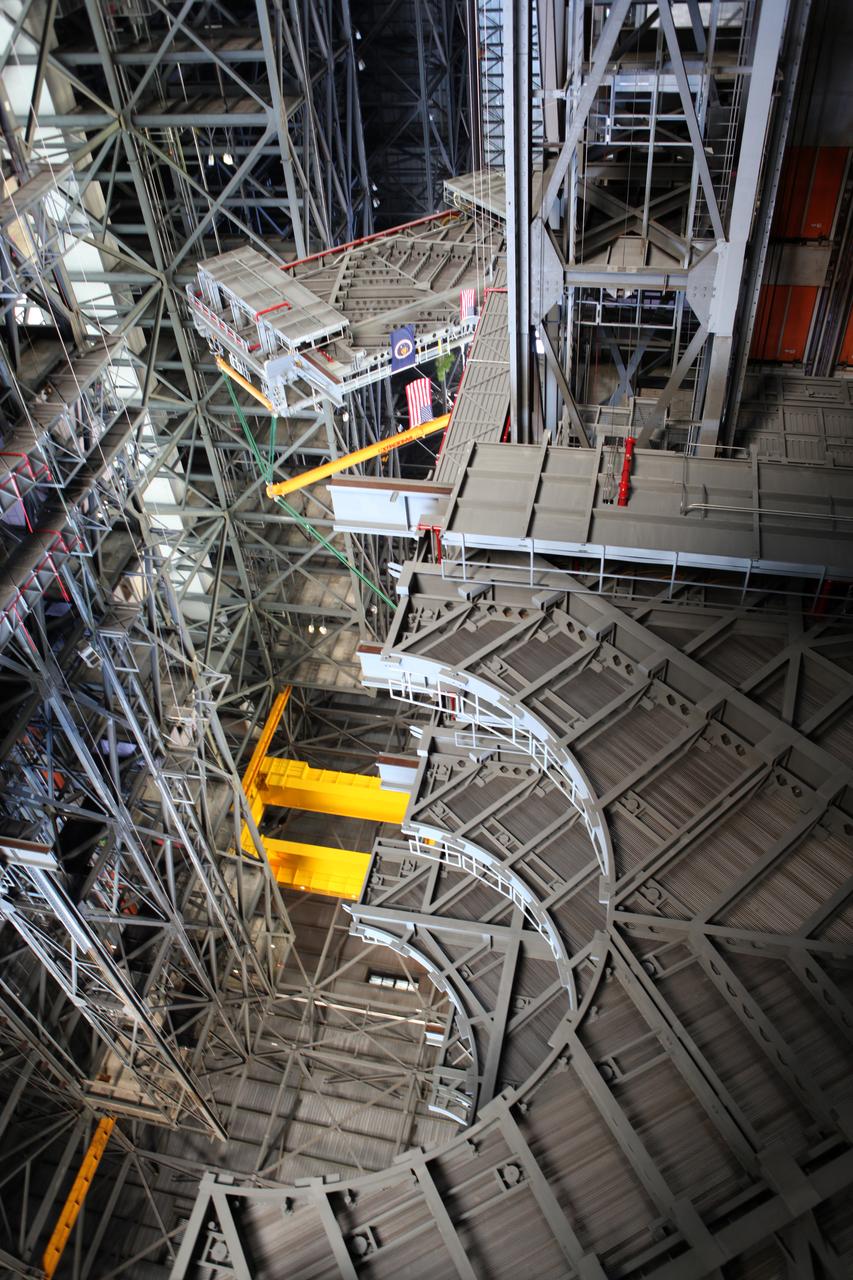
High up in the Vehicle Assembly Building (VAB) at NASA's Kennedy Space Center in Florida, a crane lowers the final work platform, A north, for installation in High Bay 3. The platform will be installed and secured on its rail beam high up on the north wall of the high bay. The installation of the final topmost level completes the 10 levels of work platforms, 20 platform halves altogether, that will surround NASA's Space Launch System rocket and the Orion spacecraft and allow access during processing for missions, including the first uncrewed flight test of Orion atop the SLS rocket in 2018. The A-level platforms will provide access to the Orion spacecraft's Launch Abort System for Orion lifting sling removal and installation of the closeout panels. The Ground Systems Development and Operations Program, with support from the center's Engineering Directorate, is overseeing upgrades and modifications to the VAB, including installation of the new work platforms.
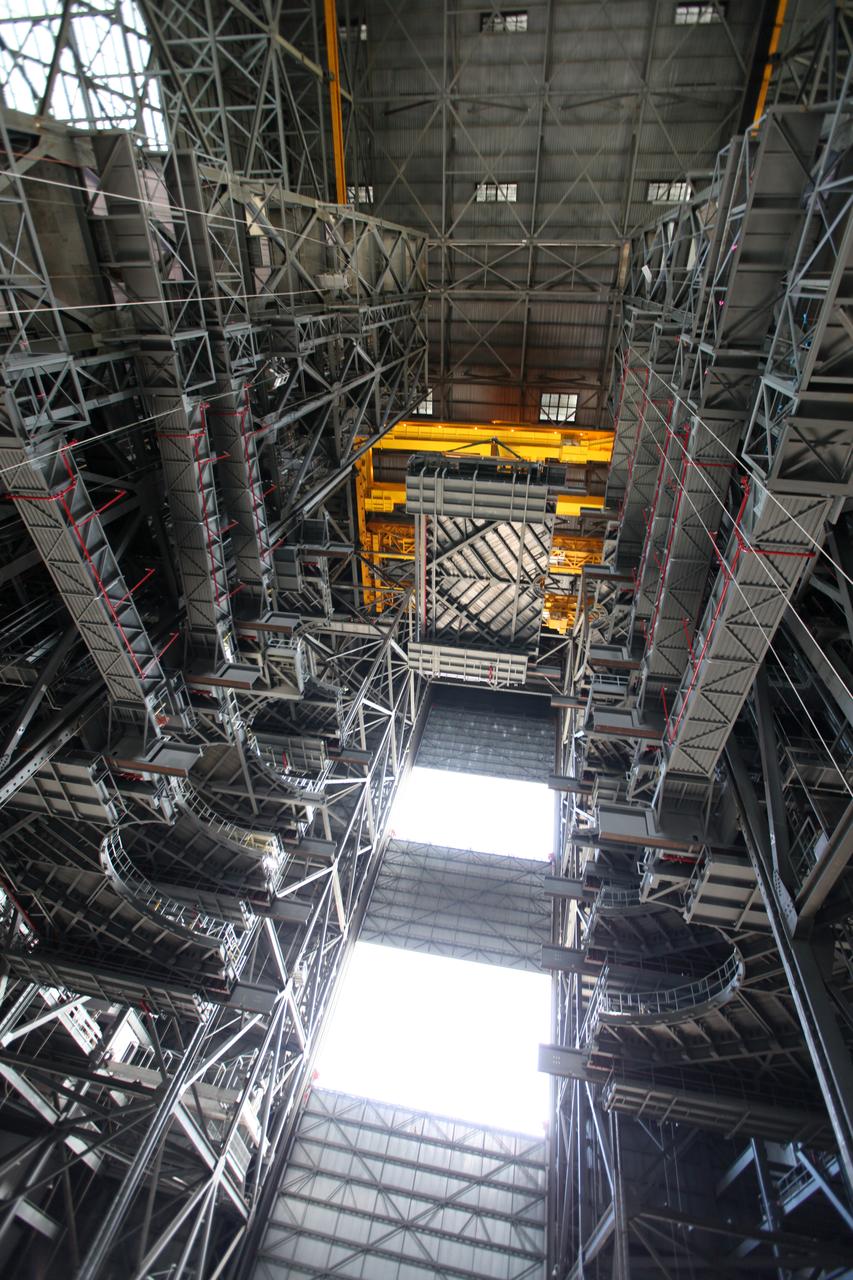
High up in the Vehicle Assembly Building (VAB) at NASA's Kennedy Space Center in Florida, a crane lowers the final work platform, A north, for installation in High Bay 3. The platform will be installed and secured on its rail beam high up on the north wall of the high bay. The installation of the final topmost level completes the 10 levels of work platforms, 20 platform halves altogether, that will surround NASA's Space Launch System rocket and the Orion spacecraft and allow access during processing for missions, including the first uncrewed flight test of Orion atop the SLS rocket in 2018. The A-level platforms will provide access to the Orion spacecraft's Launch Abort System for Orion lifting sling removal and installation of the closeout panels. The Ground Systems Development and Operations Program, with support from the center's Engineering Directorate, is overseeing upgrades and modifications to the VAB, including installation of the new work platforms.
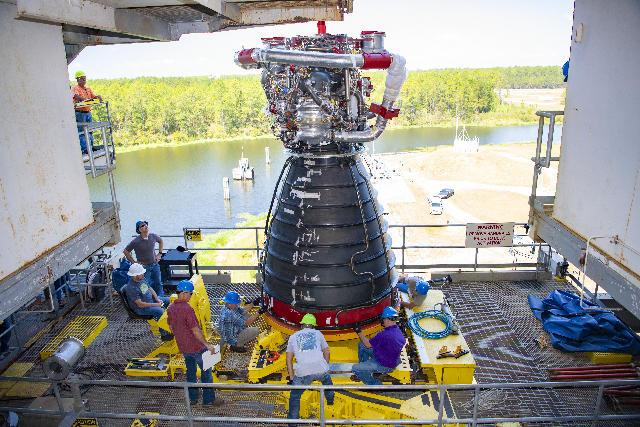
Once crews place the RS-25 engine on the engine vertical installer and it is attached to the Fred Haise Test Stand at NASA’s Stennis Space Center, the installer moves away, and technicians ensure all connections to the test facility are complete for the second certification test series to collect data for the final RS-25 design certification review.
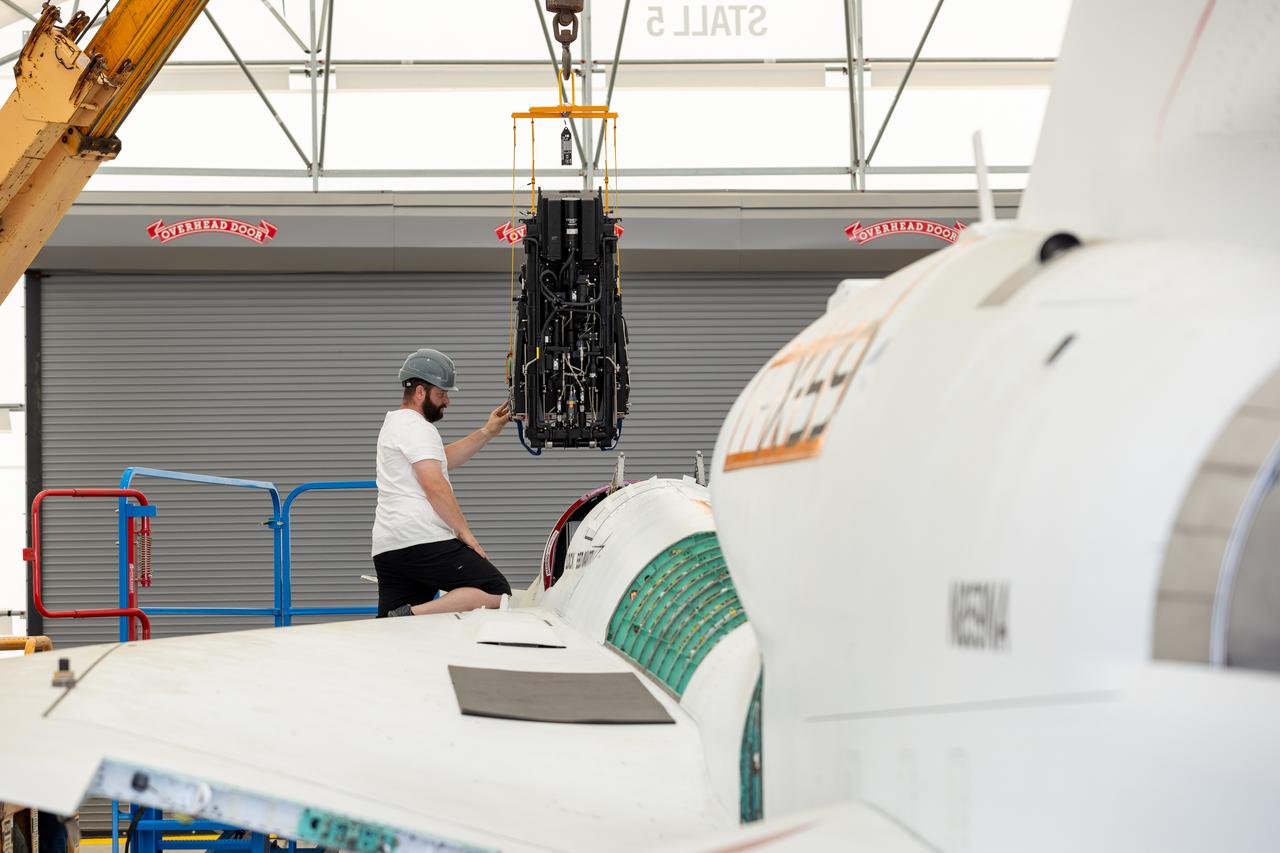
NASA Life Support Technician Mathew Sechler provides support as the X-59’s ejection seat is installed into the aircraft at Lockheed Martin Skunk Works’ facilities in Palmdale, California. Completion of the seat’s installation marks an integration milestone for the aircraft as it prepares for final ground tests.
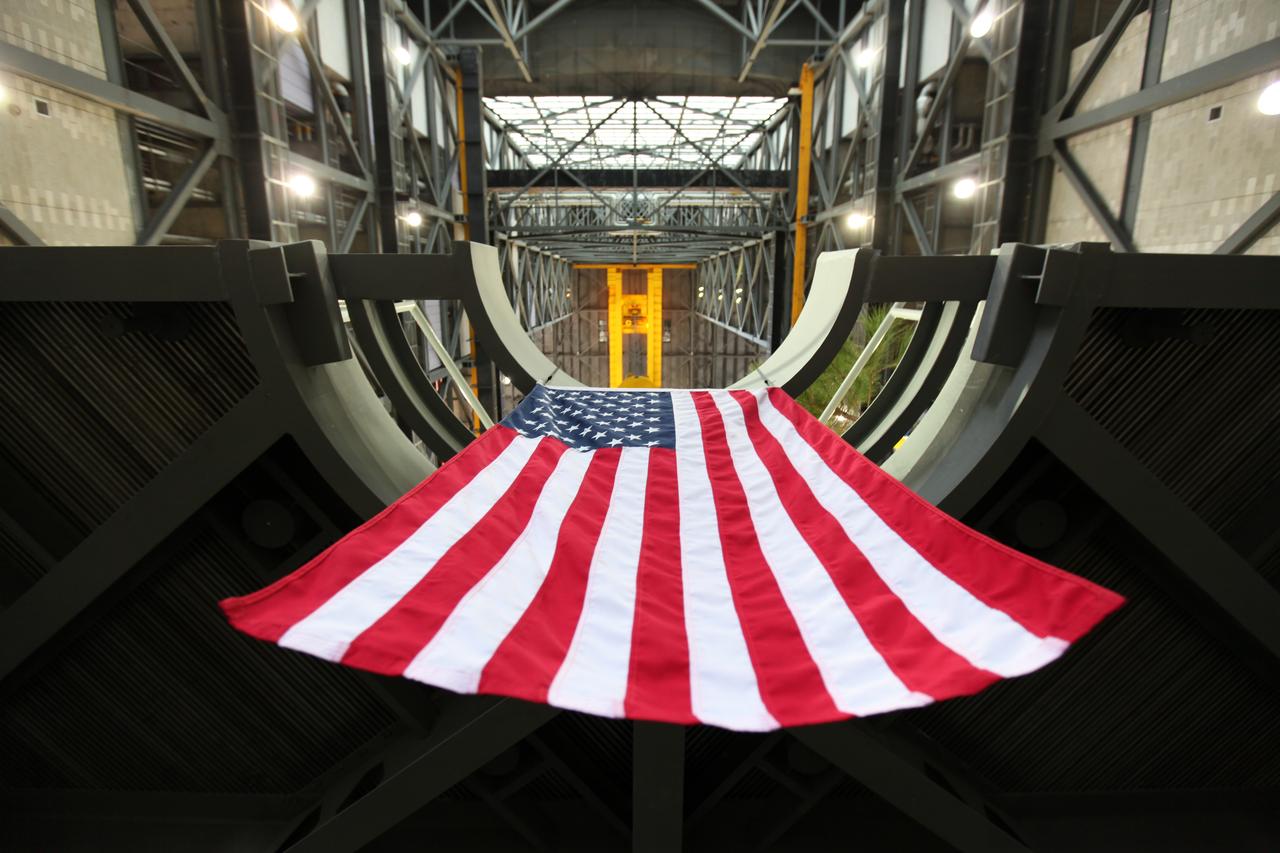
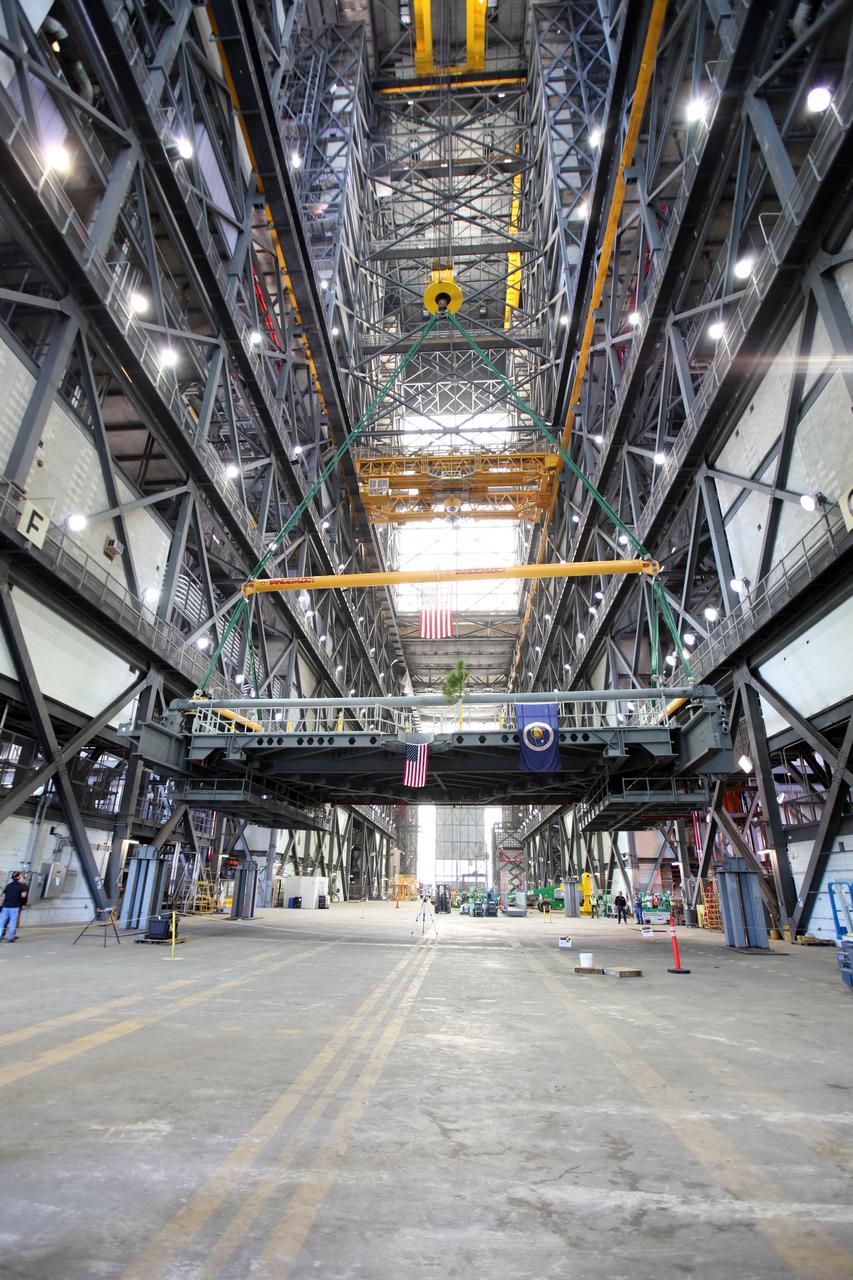
In a view from below, the American flag is in view hanging from the final work platform, A north, as the platform is lifted up by crane from the transfer aisle in the Vehicle Assembly Building (VAB) at NASA's Kennedy Space Center in Florida. The platform will be installed and secured on its rail beam high up on the north wall of High Bay 3. The installation of the final topmost level completes the 10 levels of work platforms, 20 platform halves altogether, that will surround NASA's Space Launch System rocket and the Orion spacecraft and allow access during processing for missions, including the first uncrewed flight test of Orion atop the SLS rocket in 2018. The A-level platforms will provide access to the Orion spacecraft's Launch Abort System for Orion lifting sling removal and installation of the closeout panels. The Ground Systems Development and Operations Program, with support from the center's Engineering Directorate, is overseeing upgrades and modifications to the VAB, including installation of the new work platforms.
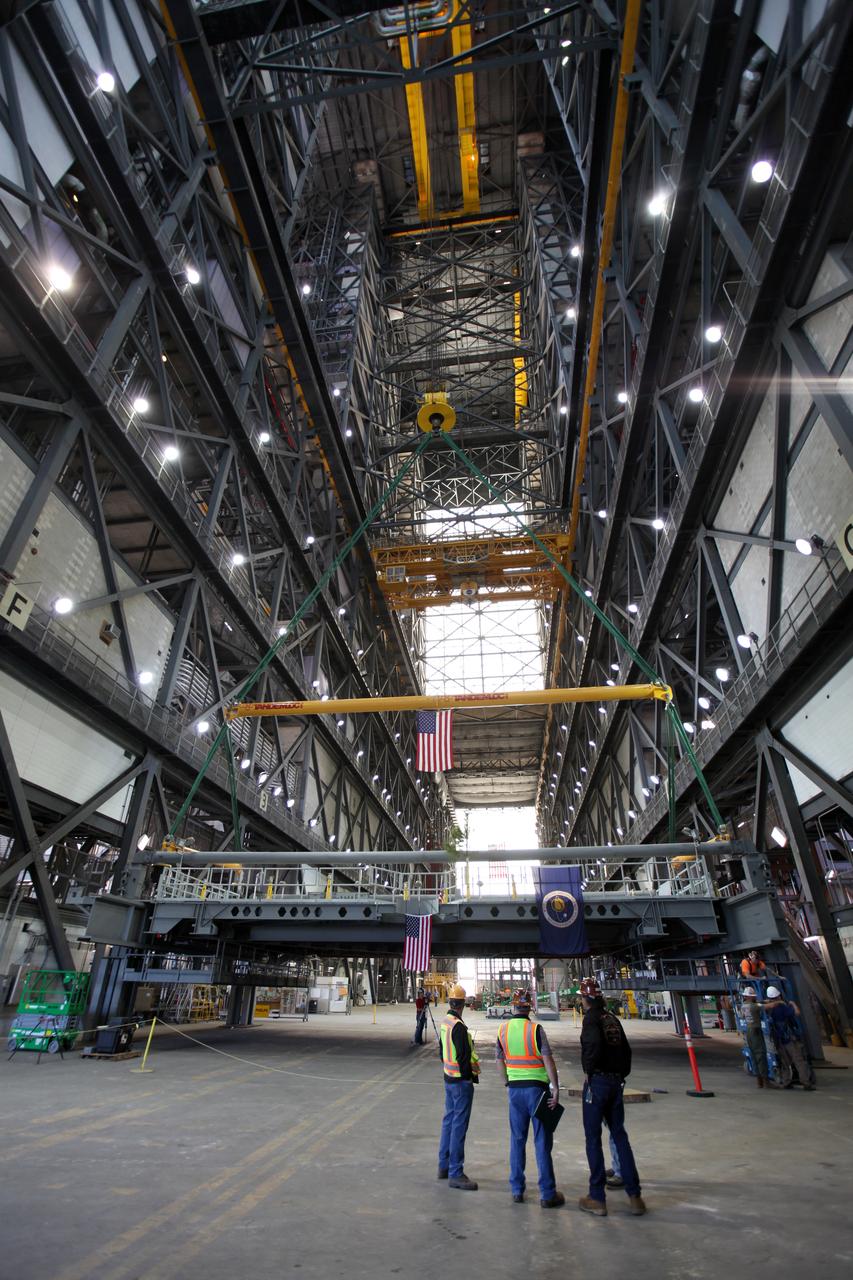
Preparations are underway to lift the final work platform, A north, up from the transfer aisle in the Vehicle Assembly Building (VAB) at NASA's Kennedy Space Center in Florida. The platform will be installed and secured on its rail beam high up on the north wall of High Bay 3. The installation of the final topmost level completes the 10 levels of work platforms, 20 platform halves altogether, that will surround NASA's Space Launch System rocket and the Orion spacecraft and allow access during processing for missions, including the first uncrewed flight test of Orion atop the SLS rocket in 2018. The A-level platforms will provide access to the Orion spacecraft's Launch Abort System for Orion lifting sling removal and installation of the closeout panels. The Ground Systems Development and Operations Program, with support from the center's Engineering Directorate, is overseeing upgrades and modifications to the VAB, including installation of the new work platforms.
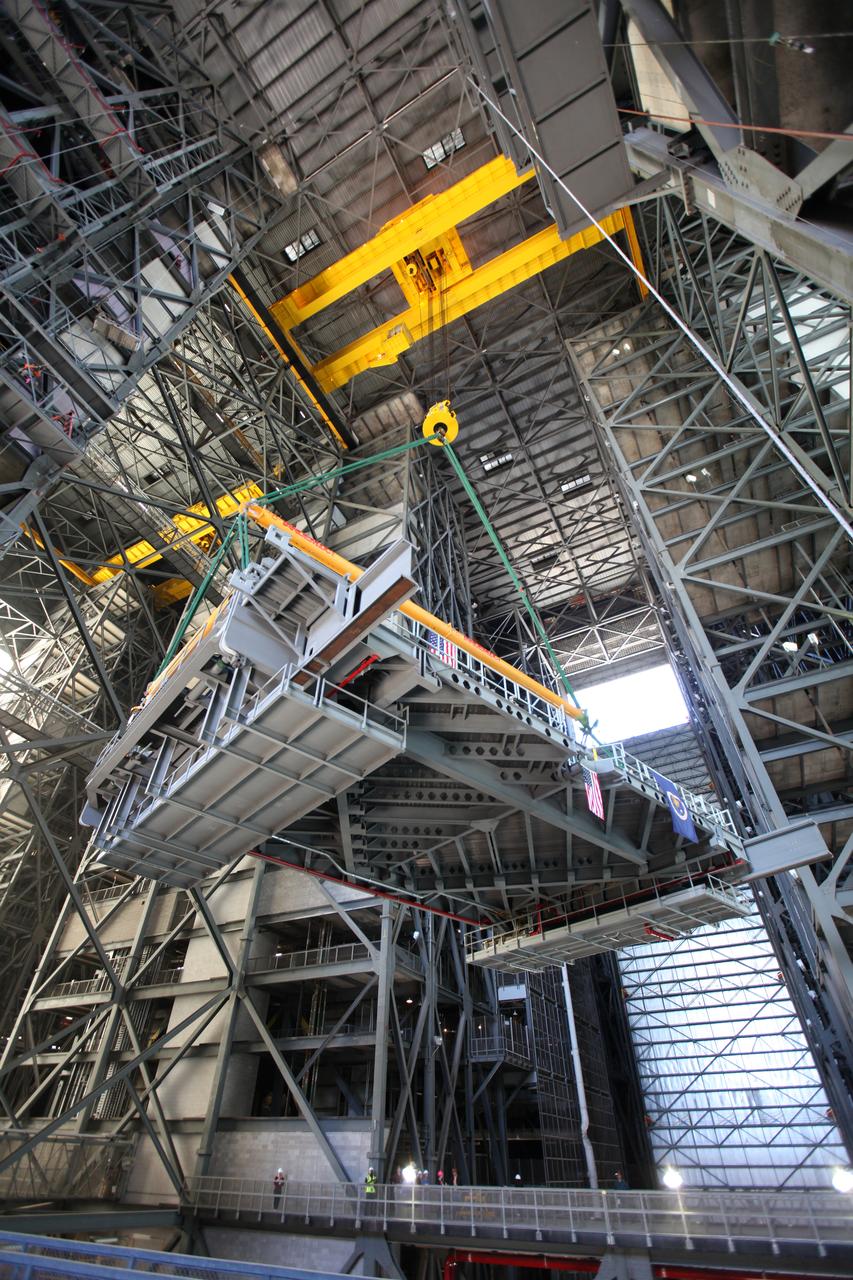
A crane lifts the final work platform, A north, high up in the transfer aisle of the Vehicle Assembly Building (VAB) at NASA's Kennedy Space Center in Florida. The platform will be installed and secured on its rail beam high up on the north wall of High Bay 3. The installation of the final topmost level completes the 10 levels of work platforms, 20 platform halves altogether, that will surround NASA's Space Launch System rocket and the Orion spacecraft and allow access during processing for missions, including the first uncrewed flight test of Orion atop the SLS rocket in 2018. The A-level platforms will provide access to the Orion spacecraft's Launch Abort System for Orion lifting sling removal and installation of the closeout panels. The Ground Systems Development and Operations Program, with support from the center's Engineering Directorate, is overseeing upgrades and modifications to the VAB, including installation of the new work platforms.
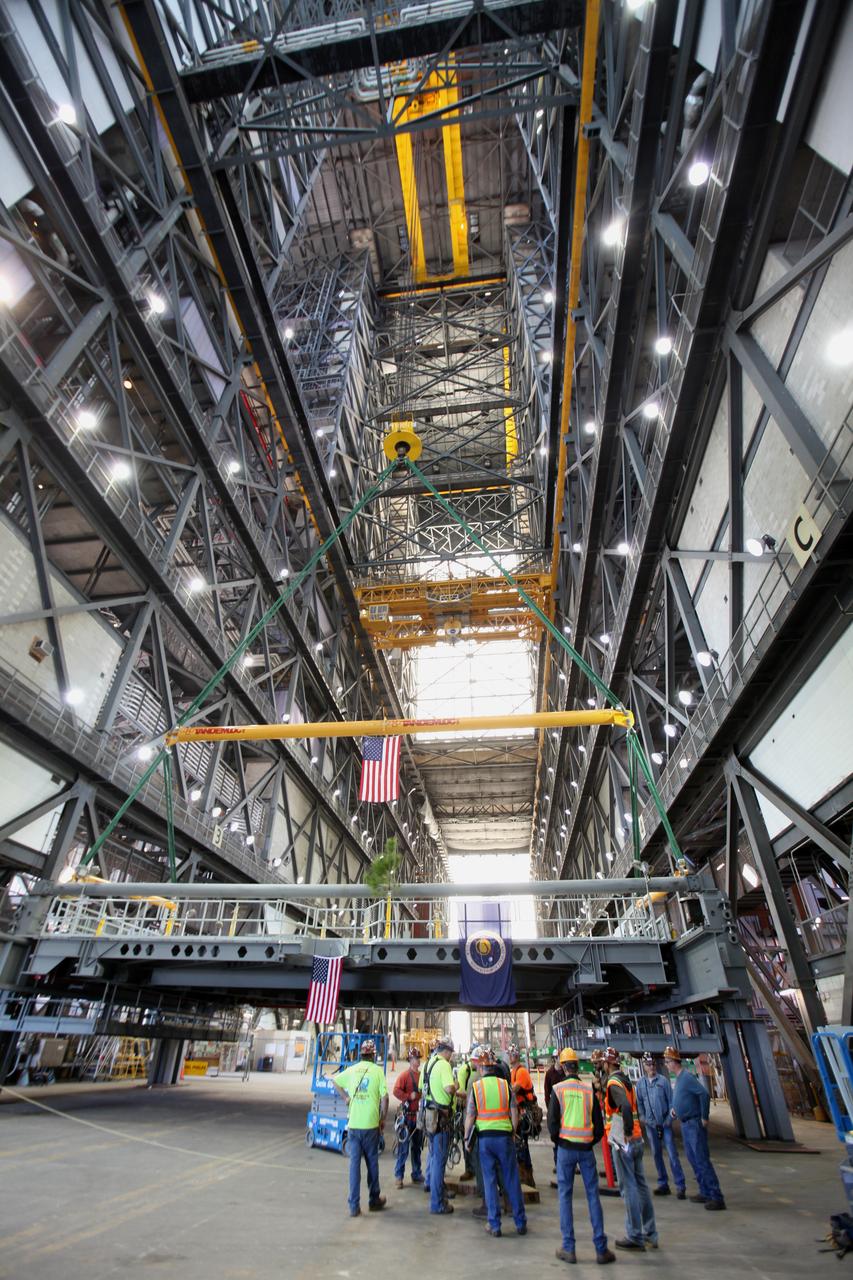
The American flag and a small tree are in view on the final work platform, A north, as the platform is lifted up by crane from the transfer aisle in the Vehicle Assembly Building (VAB) at NASA's Kennedy Space Center in Florida. The platform will be installed and secured on its rail beam high up on the north wall of High Bay 3. The installation of the final topmost level completes the 10 levels of work platforms, 20 platform halves altogether, that will surround NASA's Space Launch System rocket and the Orion spacecraft and allow access during processing for missions, including the first uncrewed flight test of Orion atop the SLS rocket in 2018. The A-level platforms will provide access to the Orion spacecraft's Launch Abort System for Orion lifting sling removal and installation of the closeout panels. The Ground Systems Development and Operations Program, with support from the center's Engineering Directorate, is overseeing upgrades and modifications to the VAB, including installation of the new work platforms.
Construction workers watch as a crane lifts the final work platform, A north, high up from the transfer aisle in the Vehicle Assembly Building (VAB) at NASA's Kennedy Space Center in Florida. The platform will be installed and secured on its rail beam high up on the north wall of High Bay 3. The installation of the final topmost level completes the 10 levels of work platforms, 20 platform halves altogether, that will surround NASA's Space Launch System rocket and the Orion spacecraft and allow access during processing for missions, including the first uncrewed flight test of Orion atop the SLS rocket in 2018. The A-level platforms will provide access to the Orion spacecraft's Launch Abort System for Orion lifting sling removal and installation of the closeout panels. The Ground Systems Development and Operations Program, with support from the center's Engineering Directorate, is overseeing upgrades and modifications to the VAB, including installation of the new work platforms.
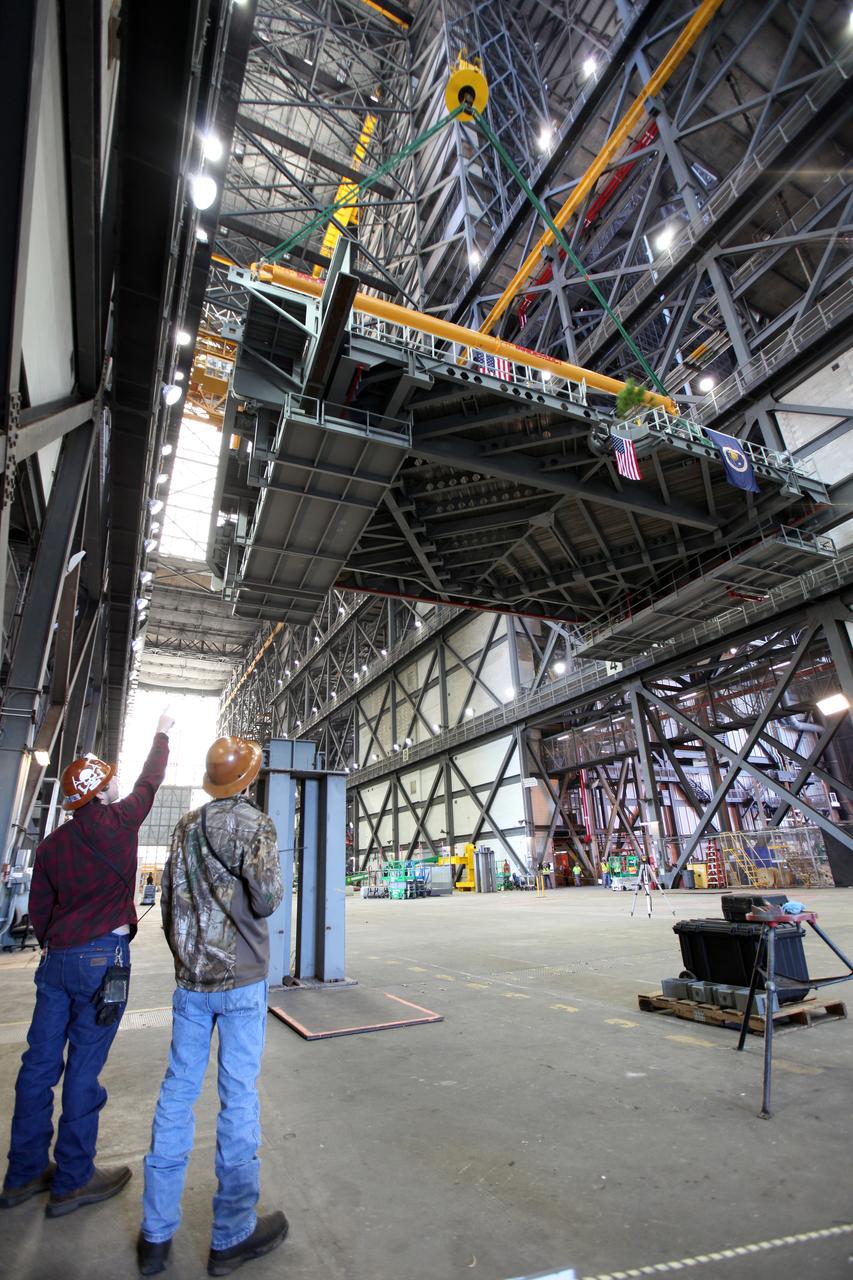
Construction workers watch as a crane begins to lift the final work platform, A north, in the transfer aisle of the Vehicle Assembly Building (VAB) at NASA's Kennedy Space Center in Florida. The platform will be installed and secured on its rail beam high up on the north wall of High Bay 3. The installation of the final topmost level completes the 10 levels of work platforms, 20 platform halves altogether, that will surround NASA's Space Launch System rocket and the Orion spacecraft and allow access during processing for missions, including the first uncrewed flight test of Orion atop the SLS rocket in 2018. The A-level platforms will provide access to the Orion spacecraft's Launch Abort System for Orion lifting sling removal and installation of the closeout panels. The Ground Systems Development and Operations Program, with support from the center's Engineering Directorate, is overseeing upgrades and modifications to the VAB, including installation of the new work platforms.
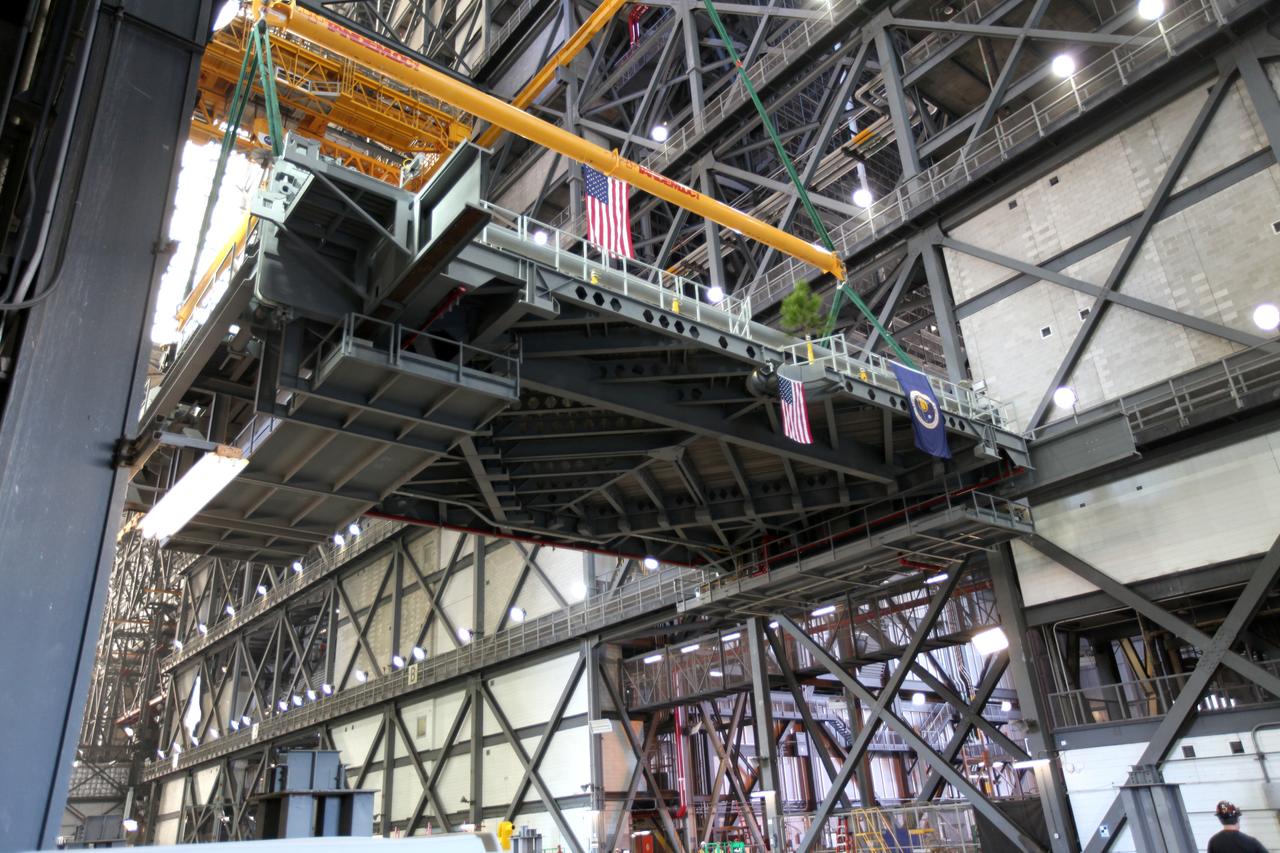
A crane begins to lift the final work platform, A north, in the transfer aisle of the Vehicle Assembly Building (VAB) at NASA's Kennedy Space Center in Florida. The platform will be installed and secured on its rail beam high up on the north wall of High Bay 3. The installation of the final topmost level completes the 10 levels of work platforms, 20 platform halves altogether, that will surround NASA's Space Launch System rocket and the Orion spacecraft and allow access during processing for missions, including the first uncrewed flight test of Orion atop the SLS rocket in 2018. The A-level platforms will provide access to the Orion spacecraft's Launch Abort System for Orion lifting sling removal and installation of the closeout panels. The Ground Systems Development and Operations Program, with support from the center's Engineering Directorate, is overseeing upgrades and modifications to the VAB, including installation of the new work platforms.
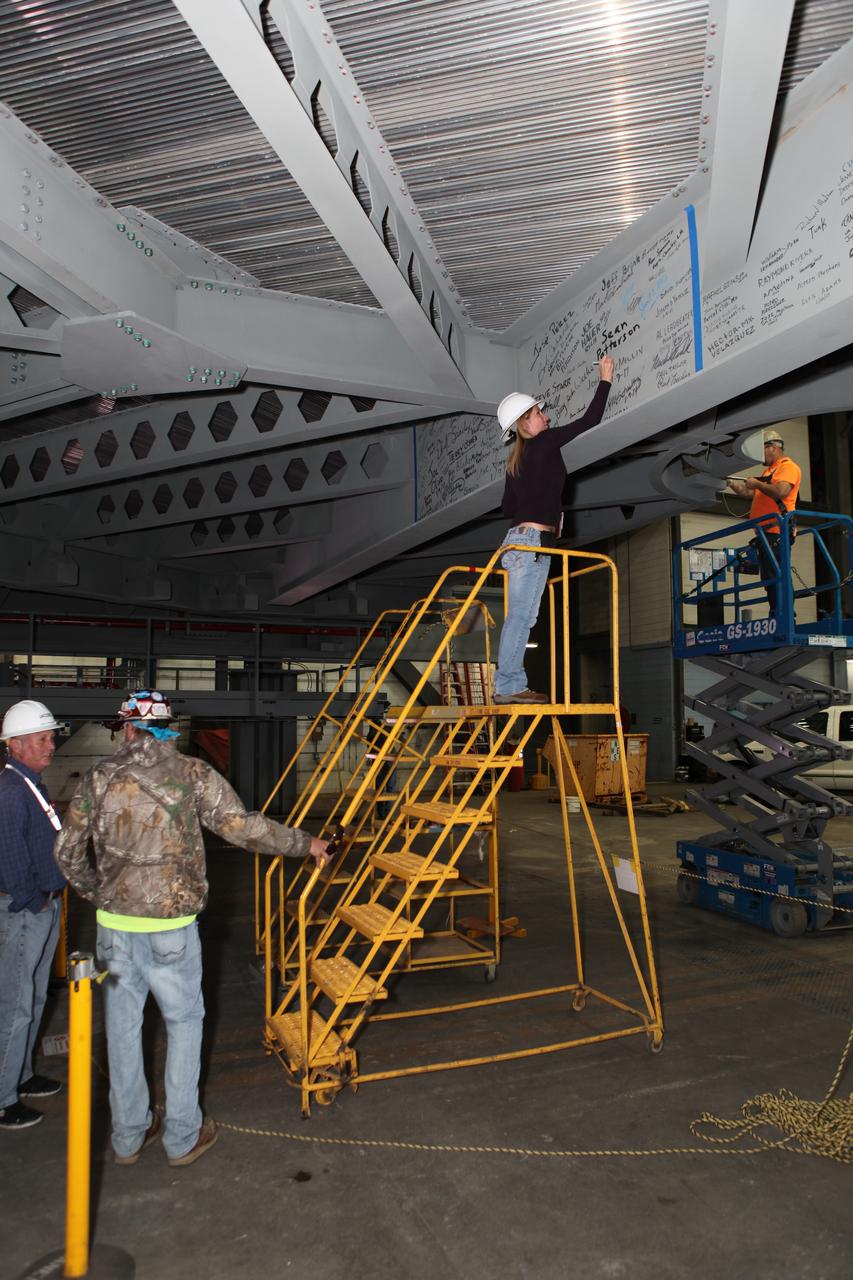
NASA Kennedy Space Center's Engineering Directorate coordinated a platform beam signing event to celebrate the culmination of the NASA and contractor team's last several years of study, design, construction and installation of 20 new work platforms in High Bay 3 of the Vehicle Assembly (VAB). Workers signed the final platform, A North, in the transfer aisle of the VAB. The platform will be lifted, installed and secured on its rail beam high up on the north wall of High Bay 3. The installation of the final topmost level completes the 10 levels of work platforms, 20 platform halves altogether, that will surround NASA's Space Launch System rocket and the Orion spacecraft and allow access during processing for missions, including the first uncrewed flight test of Orion atop the SLS rocket in 2018. The Ground Systems Development and Operations Program, with support from the center's Engineering Directorate, is overseeing upgrades and modifications to the VAB, including installation of the new work platforms.
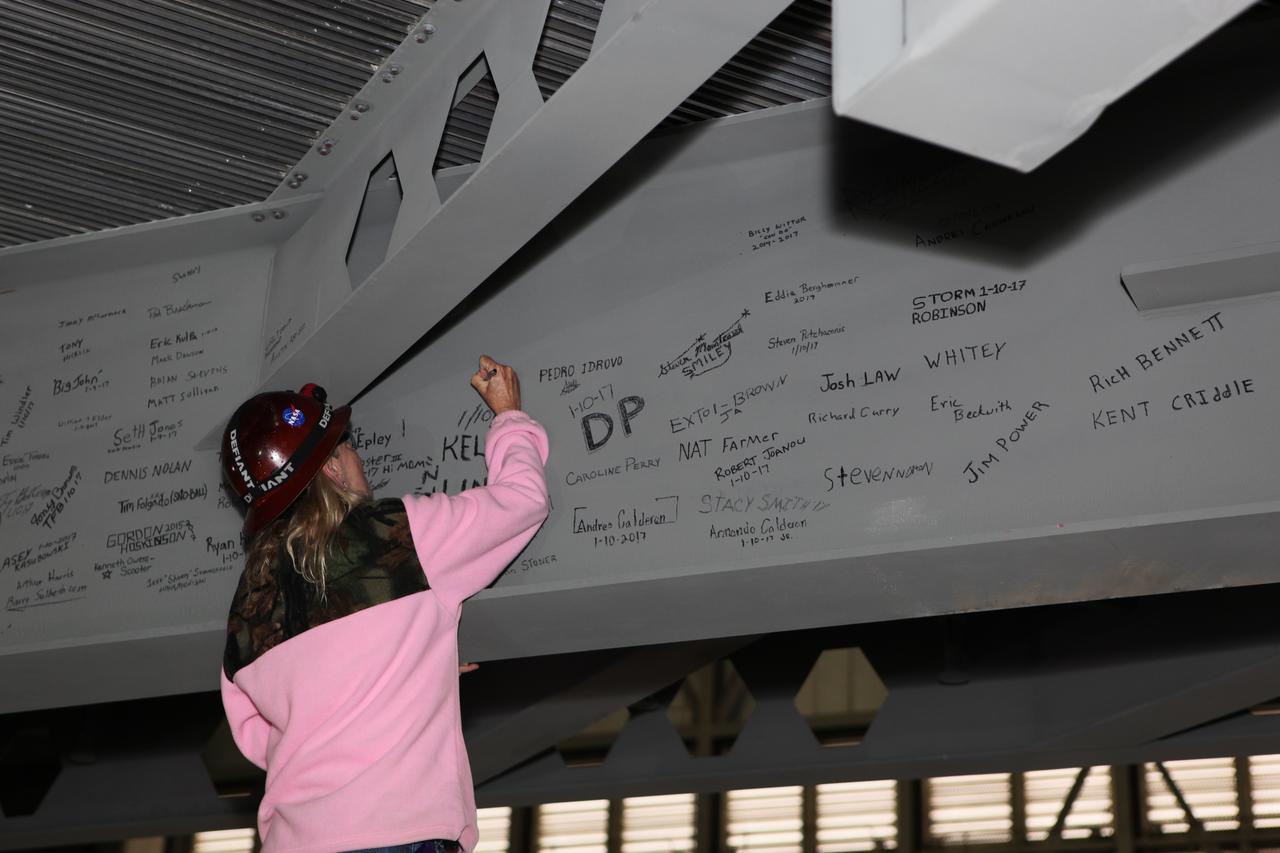
NASA Kennedy Space Center's Engineering Directorate coordinated a platform beam signing event to celebrate the culmination of the NASA and contractor team's last several years of study, design, construction and installation of 20 new work platforms in High Bay 3 of the Vehicle Assembly (VAB). Workers signed the final platform, A North, in the transfer aisle of the VAB. The platform will be lifted, installed and secured on its rail beam high up on the north wall of High Bay 3. The installation of the final topmost level completes the 10 levels of work platforms, 20 platform halves altogether, that will surround NASA's Space Launch System rocket and the Orion spacecraft and allow access during processing for missions, including the first uncrewed flight test of Orion atop the SLS rocket in 2018. The Ground Systems Development and Operations Program, with support from the center's Engineering Directorate, is overseeing upgrades and modifications to the VAB, including installation of the new work platforms.
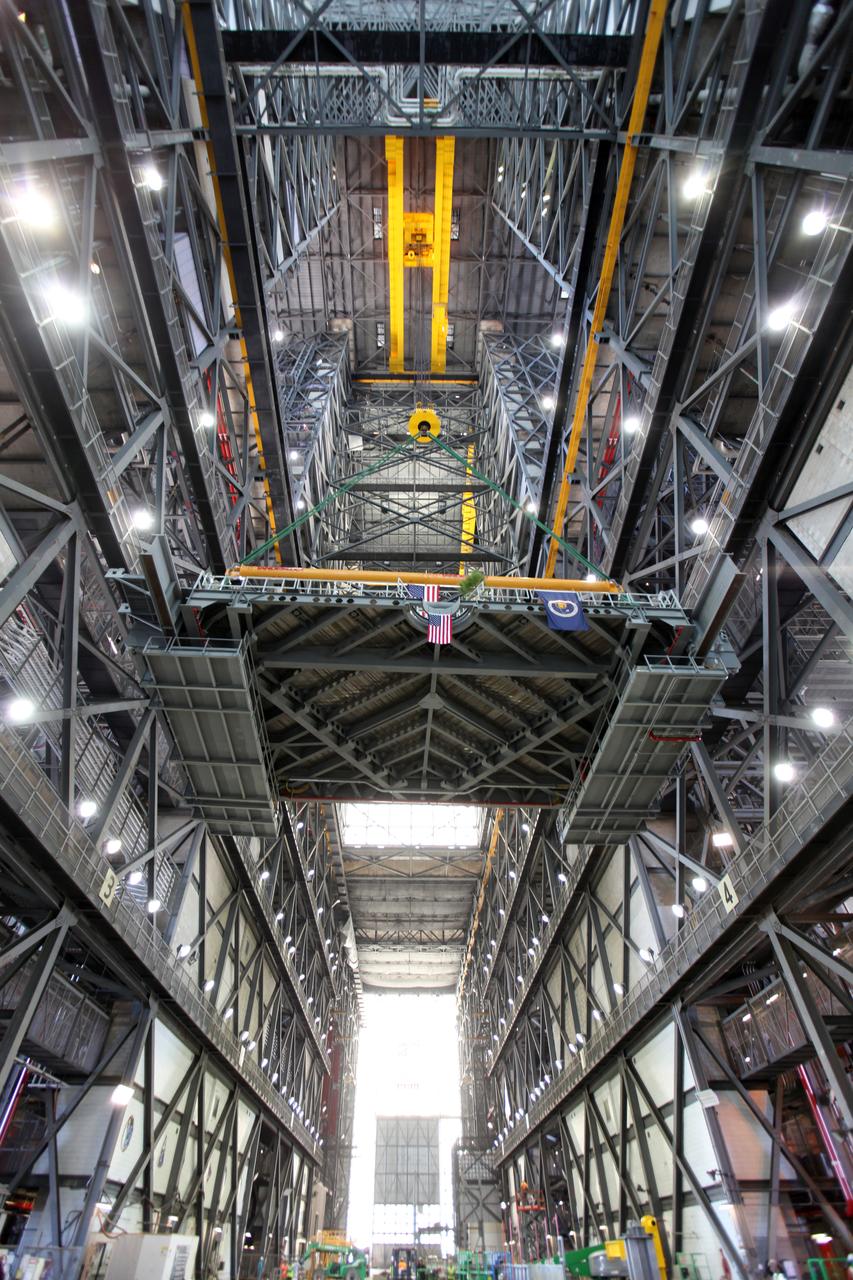
A crane lifts the final work platform, A north, up from the transfer aisle in the Vehicle Assembly Building (VAB) at NASA's Kennedy Space Center in Florida. The platform will be installed and secured on its rail beam high up on the north wall of High Bay 3. The installation of the final topmost level completes the 10 levels of work platforms, 20 platform halves altogether, that will surround NASA's Space Launch System rocket and the Orion spacecraft and allow access during processing for missions, including the first uncrewed flight test of Orion atop the SLS rocket in 2018. The A-level platforms will provide access to the Orion spacecraft's Launch Abort System for Orion lifting sling removal and installation of the closeout panels. The Ground Systems Development and Operations Program, with support from the center's Engineering Directorate, is overseeing upgrades and modifications to the VAB, including installation of the new work platforms.
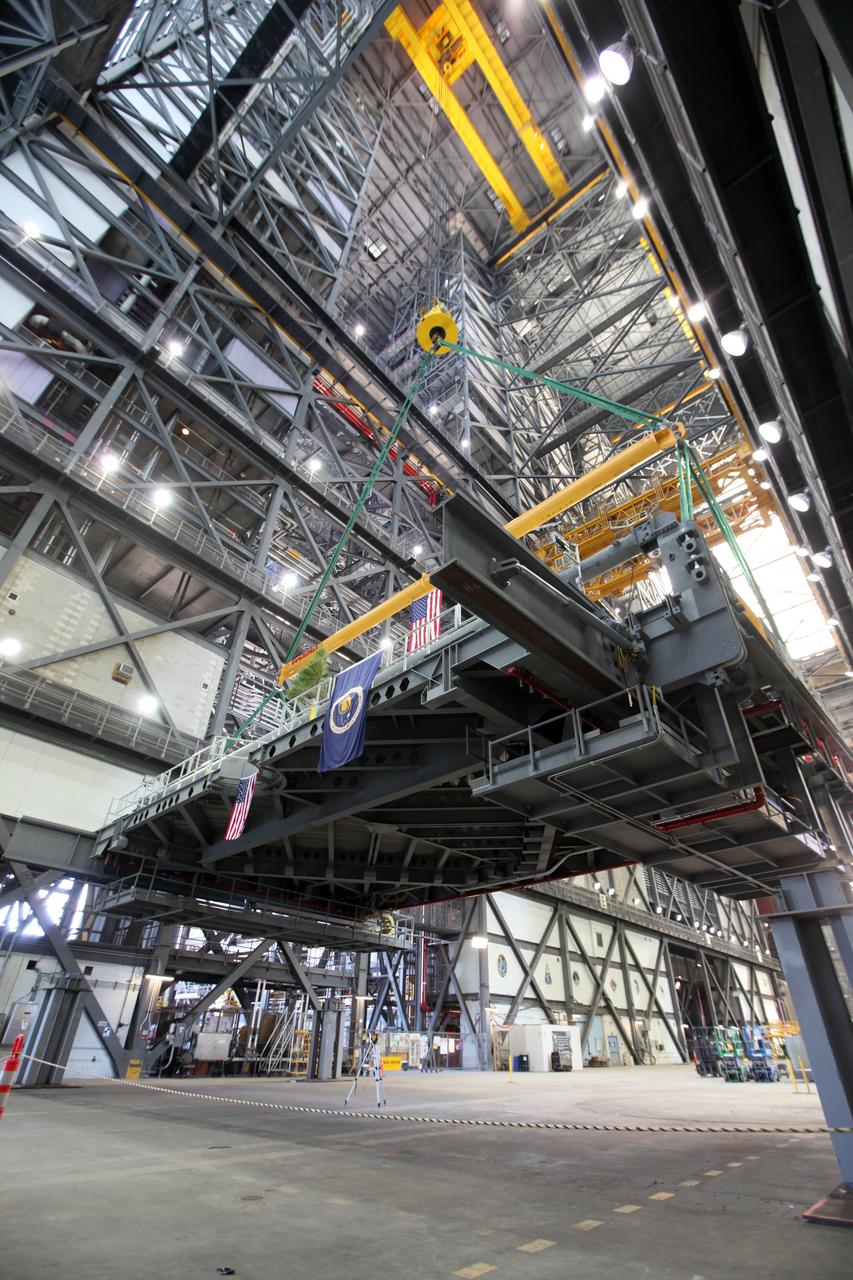
A crane begins to lift the final work platform, A north, in the transfer aisle of the Vehicle Assembly Building (VAB) at NASA's Kennedy Space Center in Florida. The platform will be installed and secured on its rail beam high up on the north wall of High Bay 3. The installation of the final topmost level completes the 10 levels of work platforms, 20 platform halves altogether, that will surround NASA's Space Launch System rocket and the Orion spacecraft and allow access during processing for missions, including the first uncrewed flight test of Orion atop the SLS rocket in 2018. The A-level platforms will provide access to the Orion spacecraft's Launch Abort System for Orion lifting sling removal and installation of the closeout panels. The Ground Systems Development and Operations Program, with support from the center's Engineering Directorate, is overseeing upgrades and modifications to the VAB, including installation of the new work platforms.
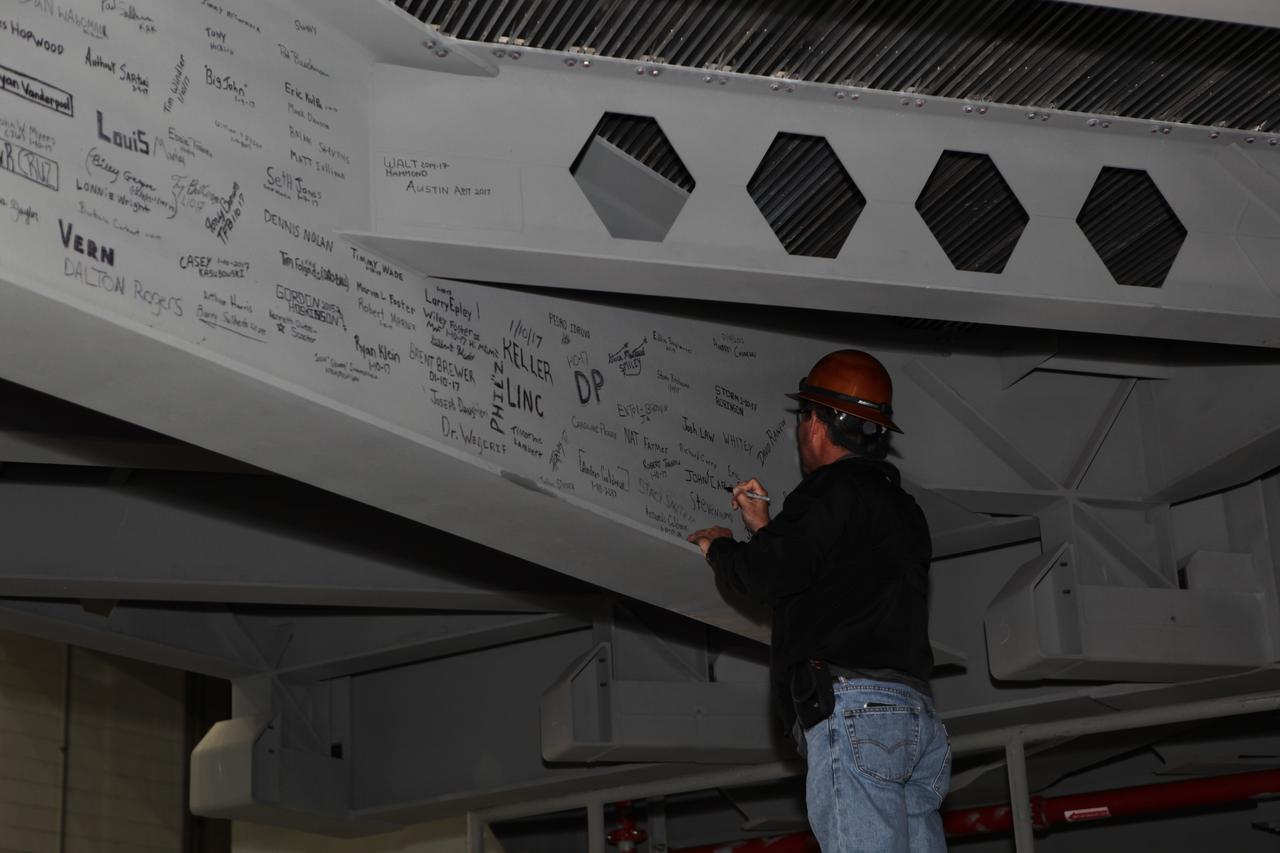
NASA Kennedy Space Center's Engineering Directorate coordinated a platform beam signing event to celebrate the culmination of the NASA and contractor team's last several years of study, design, construction and installation of 20 new work platforms in High Bay 3 of the Vehicle Assembly (VAB). Workers signed the final platform, A North, in the transfer aisle of the VAB. The platform will be lifted, installed and secured on its rail beam high up on the north wall of High Bay 3. The installation of the final topmost level completes the 10 levels of work platforms, 20 platform halves altogether, that will surround NASA's Space Launch System rocket and the Orion spacecraft and allow access during processing for missions, including the first uncrewed flight test of Orion atop the SLS rocket in 2018. The Ground Systems Development and Operations Program, with support from the center's Engineering Directorate, is overseeing upgrades and modifications to the VAB, including installation of the new work platforms.
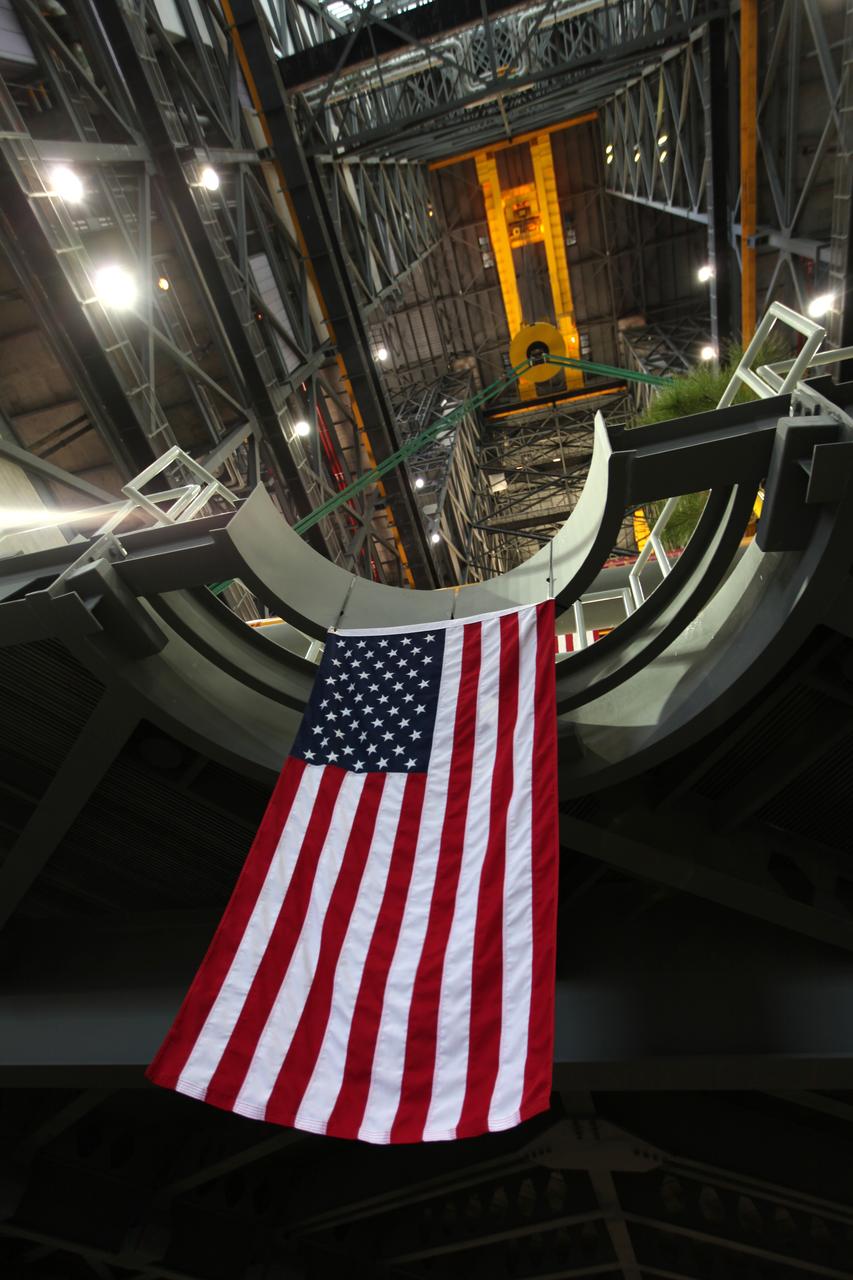
The American flag can be seen hanging from the final work platform, A north, as the platform is lifted up by crane from the transfer aisle in the Vehicle Assembly Building (VAB) at NASA's Kennedy Space Center in Florida. The platform will be installed and secured on its rail beam high up on the north wall of High Bay 3. The installation of the final topmost level completes the 10 levels of work platforms, 20 platform halves altogether, that will surround NASA's Space Launch System rocket and the Orion spacecraft and allow access during processing for missions, including the first uncrewed flight test of Orion atop the SLS rocket in 2018. The A-level platforms will provide access to the Orion spacecraft's Launch Abort System for Orion lifting sling removal and installation of the closeout panels. The Ground Systems Development and Operations Program, with support from the center's Engineering Directorate, is overseeing upgrades and modifications to the VAB, including installation of the new work platforms.

High up in the transfer aisle of the Vehicle Assembly Building (VAB) at NASA's Kennedy Space Center in Florida, a crane turns the final work platform, A north, for transfer into High Bay 3. The platform will be installed and secured on its rail beam high up on the north wall of the high bay. The installation of the final topmost level completes the 10 levels of work platforms, 20 platform halves altogether, that will surround NASA's Space Launch System rocket and the Orion spacecraft and allow access during processing for missions, including the first uncrewed flight test of Orion atop the SLS rocket in 2018. The A-level platforms will provide access to the Orion spacecraft's Launch Abort System for Orion lifting sling removal and installation of the closeout panels. The Ground Systems Development and Operations Program, with support from the center's Engineering Directorate, is overseeing upgrades and modifications to the VAB, including installation of the new work platforms.
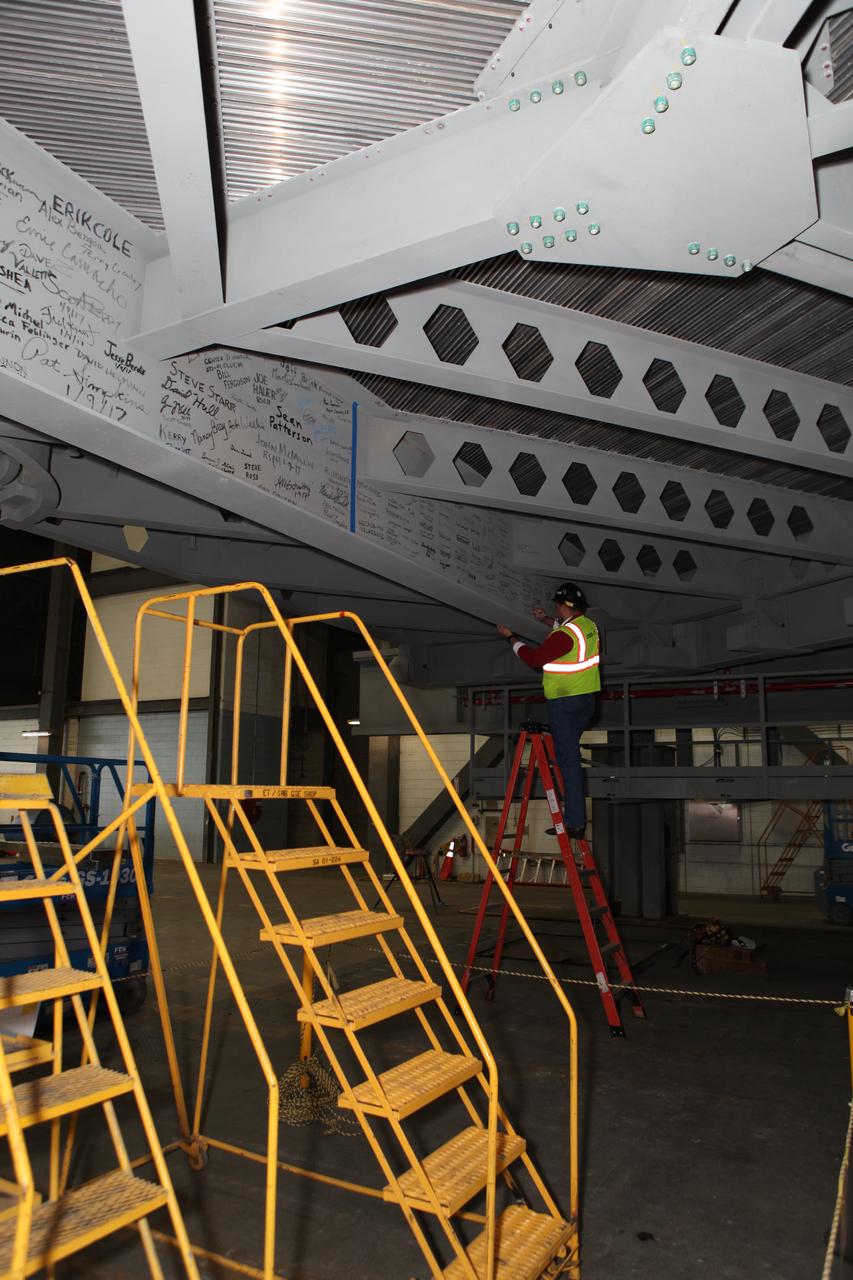
NASA Kennedy Space Center's Engineering Directorate coordinated a platform beam signing event to celebrate the culmination of the NASA and contractor team's last several years of study, design, construction and installation of 20 new work platforms in High Bay 3 of the Vehicle Assembly (VAB). Workers signed the final platform, A North, in the transfer aisle of the VAB. The platform will be lifted, installed and secured on its rail beam high up on the north wall of High Bay 3. The installation of the final topmost level completes the 10 levels of work platforms, 20 platform halves altogether, that will surround NASA's Space Launch System rocket and the Orion spacecraft and allow access during processing for missions, including the first uncrewed flight test of Orion atop the SLS rocket in 2018. The Ground Systems Development and Operations Program, with support from the center's Engineering Directorate, is overseeing upgrades and modifications to the VAB, including installation of the new work platforms.
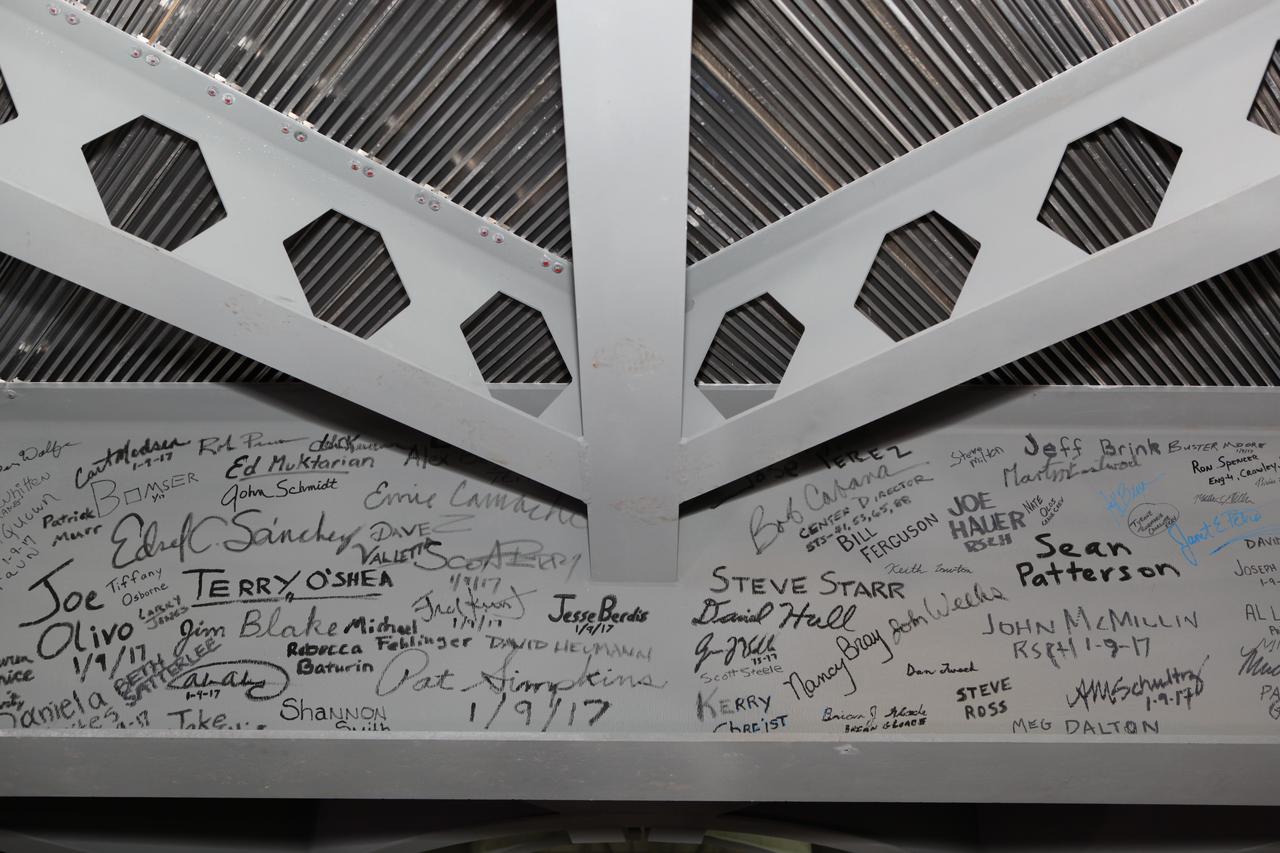
NASA Kennedy Space Center's Engineering Directorate coordinated a platform beam signing event to celebrate the culmination of the NASA and contractor team's last several years of study, design, construction and installation of 20 new work platforms in High Bay 3 of the Vehicle Assembly (VAB). Workers signed the final platform, A North, in the transfer aisle of the VAB. The platform will be lifted, installed and secured on its rail beam high up on the north wall of High Bay 3. The installation of the final topmost level completes the 10 levels of work platforms, 20 platform halves altogether, that will surround NASA's Space Launch System rocket and the Orion spacecraft and allow access during processing for missions, including the first uncrewed flight test of Orion atop the SLS rocket in 2018. The Ground Systems Development and Operations Program, with support from the center's Engineering Directorate, is overseeing upgrades and modifications to the VAB, including installation of the new work platforms.
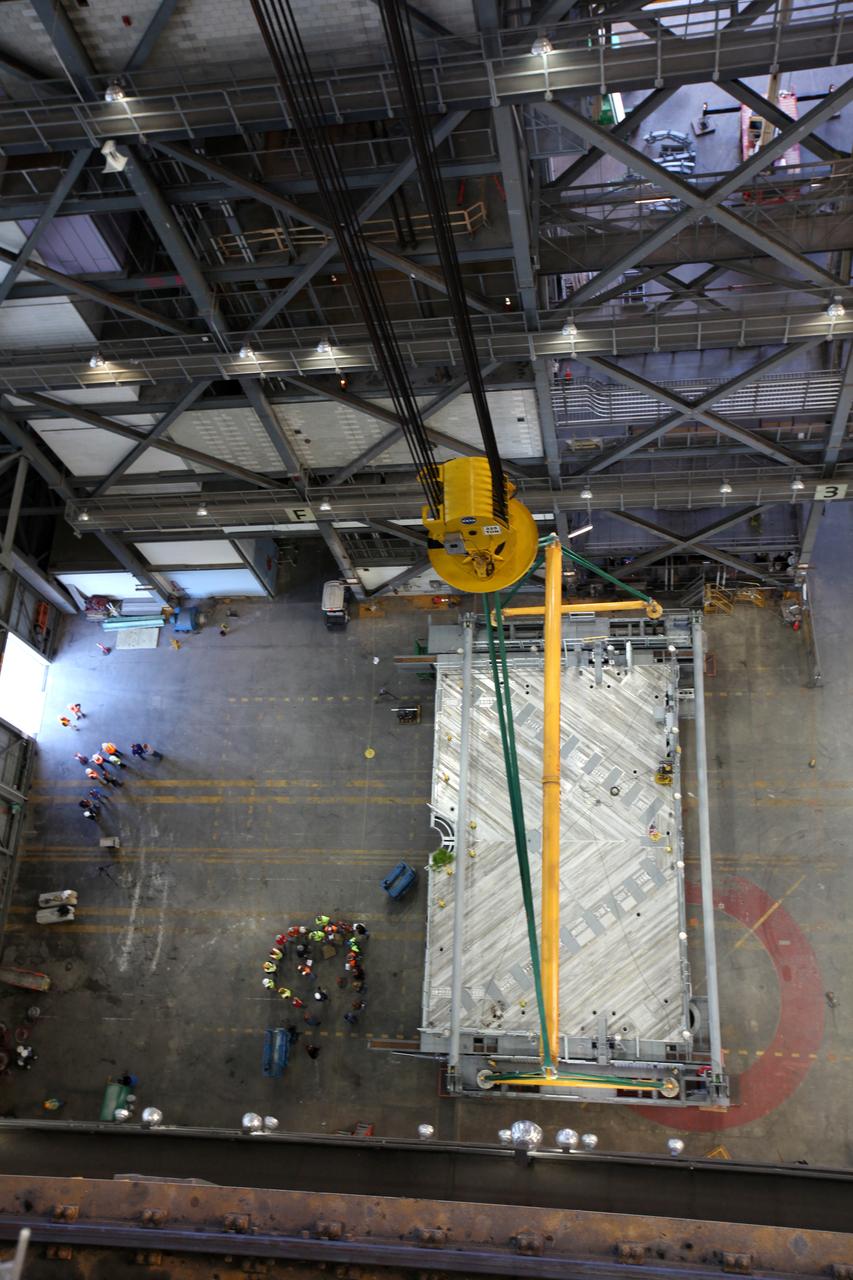
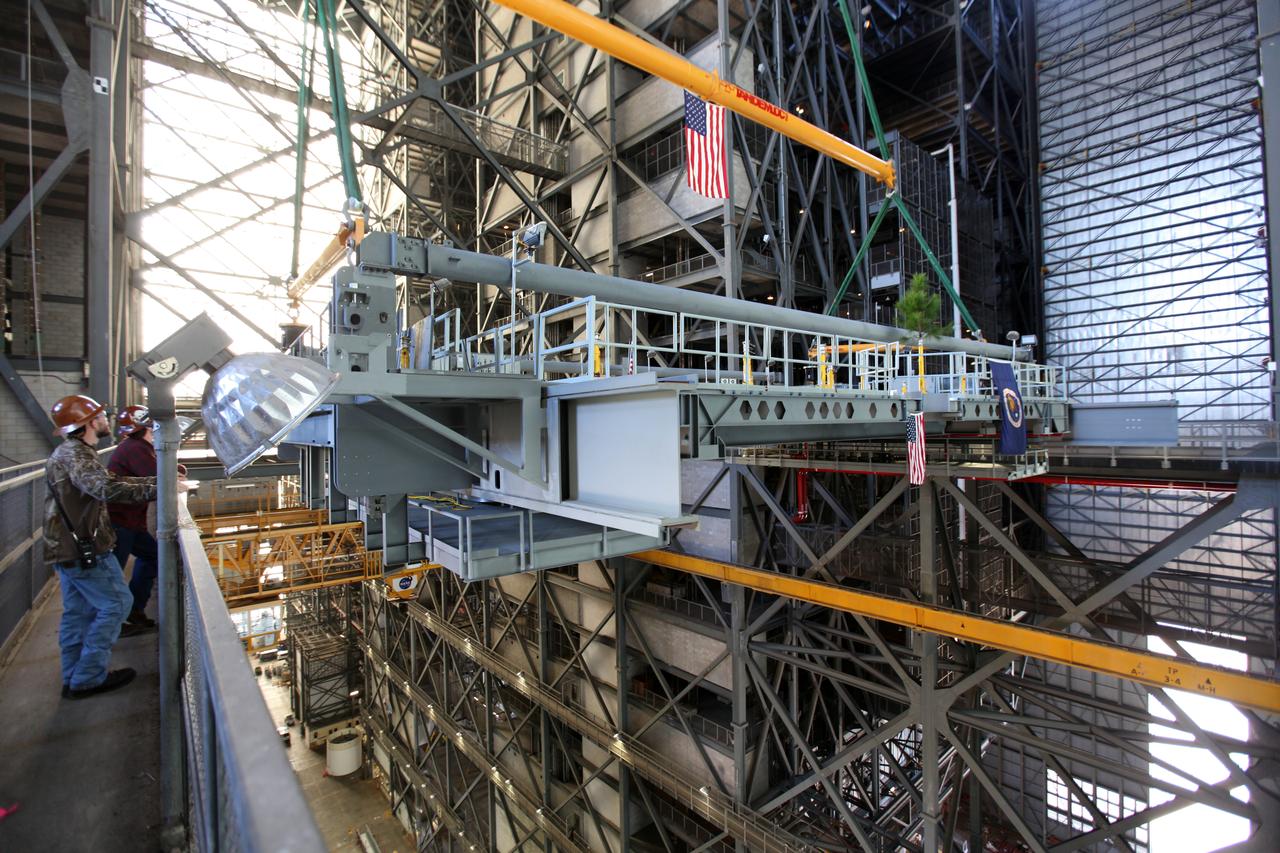
In this view from above, preparations are underway to lift the final work platform, A north, up from the transfer aisle in the Vehicle Assembly Building (VAB) at NASA's Kennedy Space Center in Florida. The platform will be installed and secured on its rail beam high up on the north wall of High Bay 3. The installation of the final topmost level completes the 10 levels of work platforms, 20 platform halves altogether, that will surround NASA's Space Launch System rocket and the Orion spacecraft and allow access during processing for missions, including the first uncrewed flight test of Orion atop the SLS rocket in 2018. The A-level platforms will provide access to the Orion spacecraft's Launch Abort System for Orion lifting sling removal and installation of the closeout panels. The Ground Systems Development and Operations Program, with support from the center's Engineering Directorate, is overseeing upgrades and modifications to the VAB, including installation of the new work platforms.
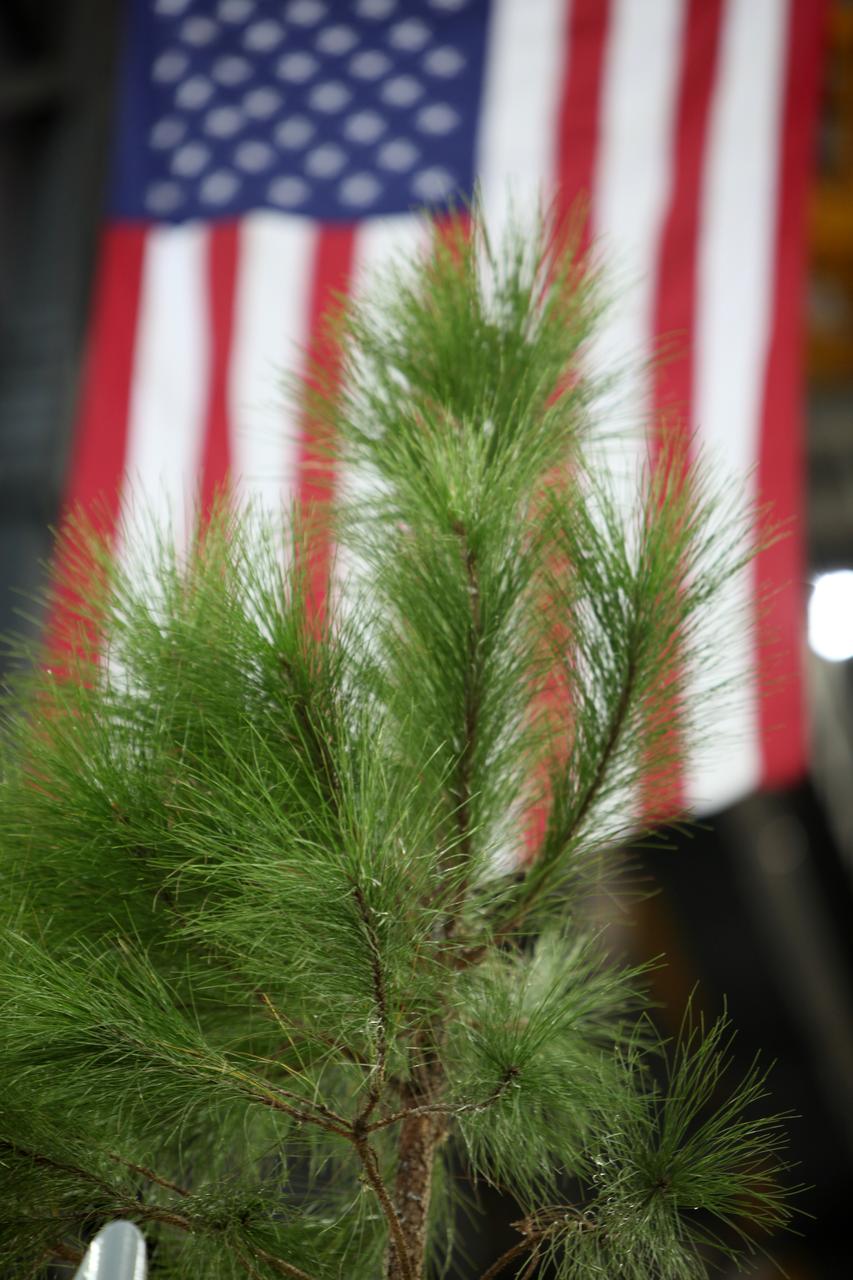
A close-up view of an American flag and a small tree on the final work platform, A north, as the platform is lifted up by crane from the transfer aisle in the Vehicle Assembly Building (VAB) at NASA's Kennedy Space Center in Florida. The platform will be installed and secured on its rail beam high up on the north wall of High Bay 3. The installation of the final topmost level completes the 10 levels of work platforms, 20 platform halves altogether, that will surround NASA's Space Launch System rocket and the Orion spacecraft and allow access during processing for missions, including the first uncrewed flight test of Orion atop the SLS rocket in 2018. The A-level platforms will provide access to the Orion spacecraft's Launch Abort System for Orion lifting sling removal and installation of the closeout panels. The Ground Systems Development and Operations Program, with support from the center's Engineering Directorate, is overseeing upgrades and modifications to the VAB, including installation of the new work platforms.
The American flag can be seen hanging from the final work platform, A north, as the platform is lifted up by crane from the transfer aisle in the Vehicle Assembly Building (VAB) at NASA's Kennedy Space Center in Florida. The platform will be installed and secured on its rail beam high up on the north wall of High Bay 3. The installation of the final topmost level completes the 10 levels of work platforms, 20 platform halves altogether, that will surround NASA's Space Launch System rocket and the Orion spacecraft and allow access during processing for missions, including the first uncrewed flight test of Orion atop the SLS rocket in 2018. The A-level platforms will provide access to the Orion spacecraft's Launch Abort System for Orion lifting sling removal and installation of the closeout panels. The Ground Systems Development and Operations Program, with support from the center's Engineering Directorate, is overseeing upgrades and modifications to the VAB, including installation of the new work platforms.
A crane begins to lift the final work platform, A north, in the transfer aisle of the Vehicle Assembly Building (VAB) at NASA's Kennedy Space Center in Florida. The platform will be installed and secured on its rail beam high up on the north wall of High Bay 3. The installation of the final topmost level completes the 10 levels of work platforms, 20 platform halves altogether, that will surround NASA's Space Launch System rocket and the Orion spacecraft and allow access during processing for missions, including the first uncrewed flight test of Orion atop the SLS rocket in 2018. The A-level platforms will provide access to the Orion spacecraft's Launch Abort System for Orion lifting sling removal and installation of the closeout panels. The Ground Systems Development and Operations Program, with support from the center's Engineering Directorate, is overseeing upgrades and modifications to the VAB, including installation of the new work platforms.
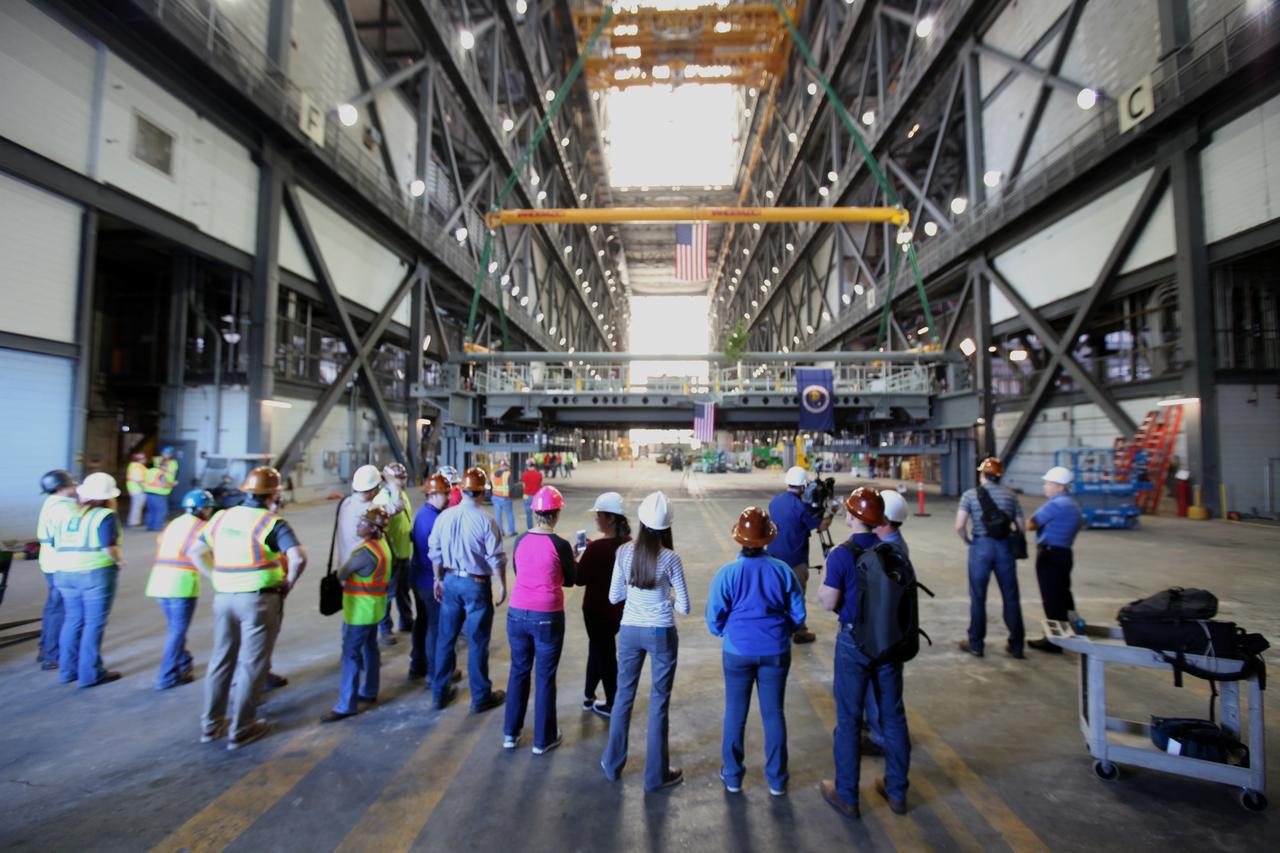
NASA and contractor workers watch as the final work platform, A north, is prepared for lifting in the transfer aisle of the Vehicle Assembly Building (VAB) at NASA's Kennedy Space Center in Florida. The platform will be installed and secured on its rail beam high up on the north wall of High Bay 3. The installation of the final topmost level completes the 10 levels of work platforms, 20 platform halves altogether, that will surround NASA's Space Launch System rocket and the Orion spacecraft and allow access during processing for missions, including the first uncrewed flight test of Orion atop the SLS rocket in 2018. The A-level platforms will provide access to the Orion spacecraft's Launch Abort System for Orion lifting sling removal and installation of the closeout panels. The Ground Systems Development and Operations Program, with support from the center's Engineering Directorate, is overseeing upgrades and modifications to the VAB, including installation of the new work platforms.
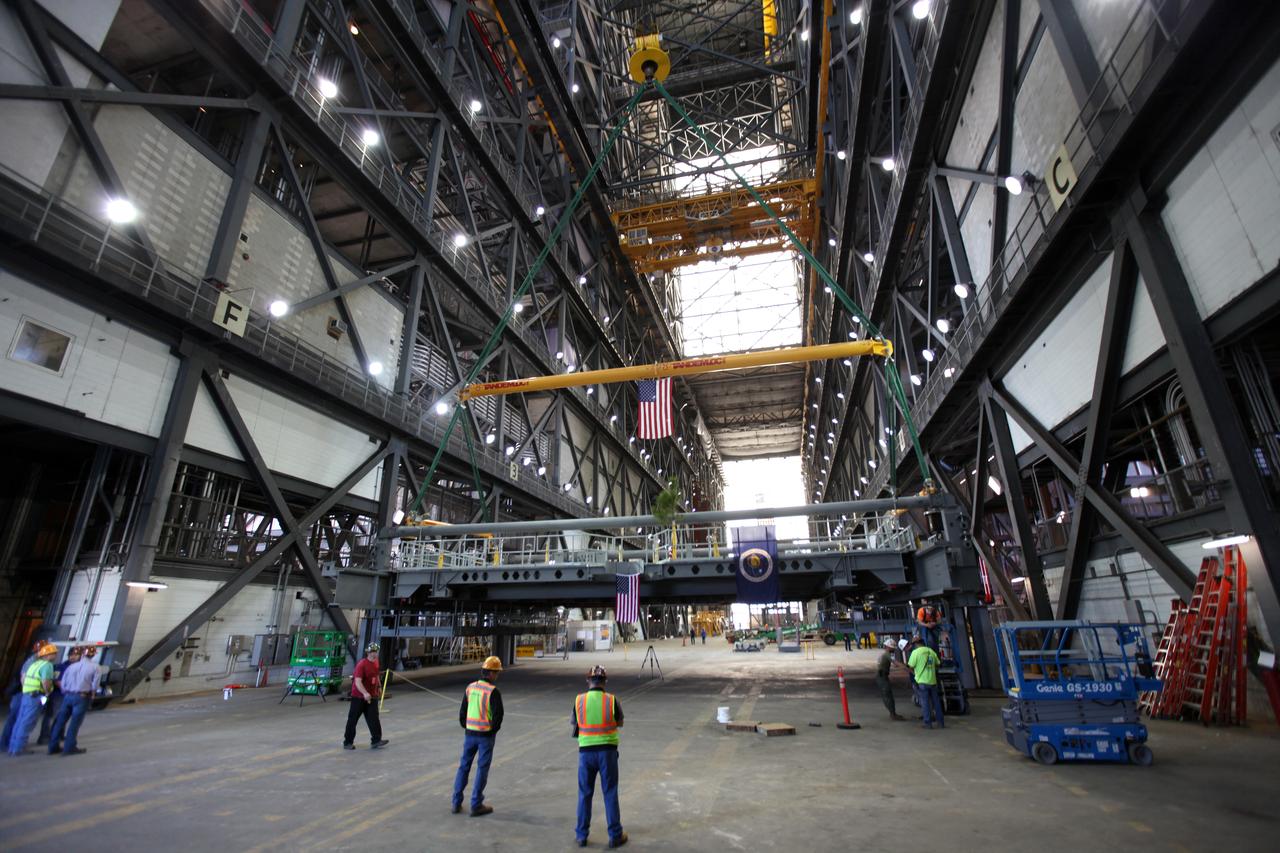
Preparations are underway to lift the final work platform, A north, up from the transfer aisle in the Vehicle Assembly Building (VAB) at NASA's Kennedy Space Center in Florida. The platform will be installed and secured on its rail beam high up on the north wall of High Bay 3. The installation of the final topmost level completes the 10 levels of work platforms, 20 platform halves altogether, that will surround NASA's Space Launch System rocket and the Orion spacecraft and allow access during processing for missions, including the first uncrewed flight test of Orion atop the SLS rocket in 2018. The A-level platforms will provide access to the Orion spacecraft's Launch Abort System for Orion lifting sling removal and installation of the closeout panels. The Ground Systems Development and Operations Program, with support from the center's Engineering Directorate, is overseeing upgrades and modifications to the VAB, including installation of the new work platforms.
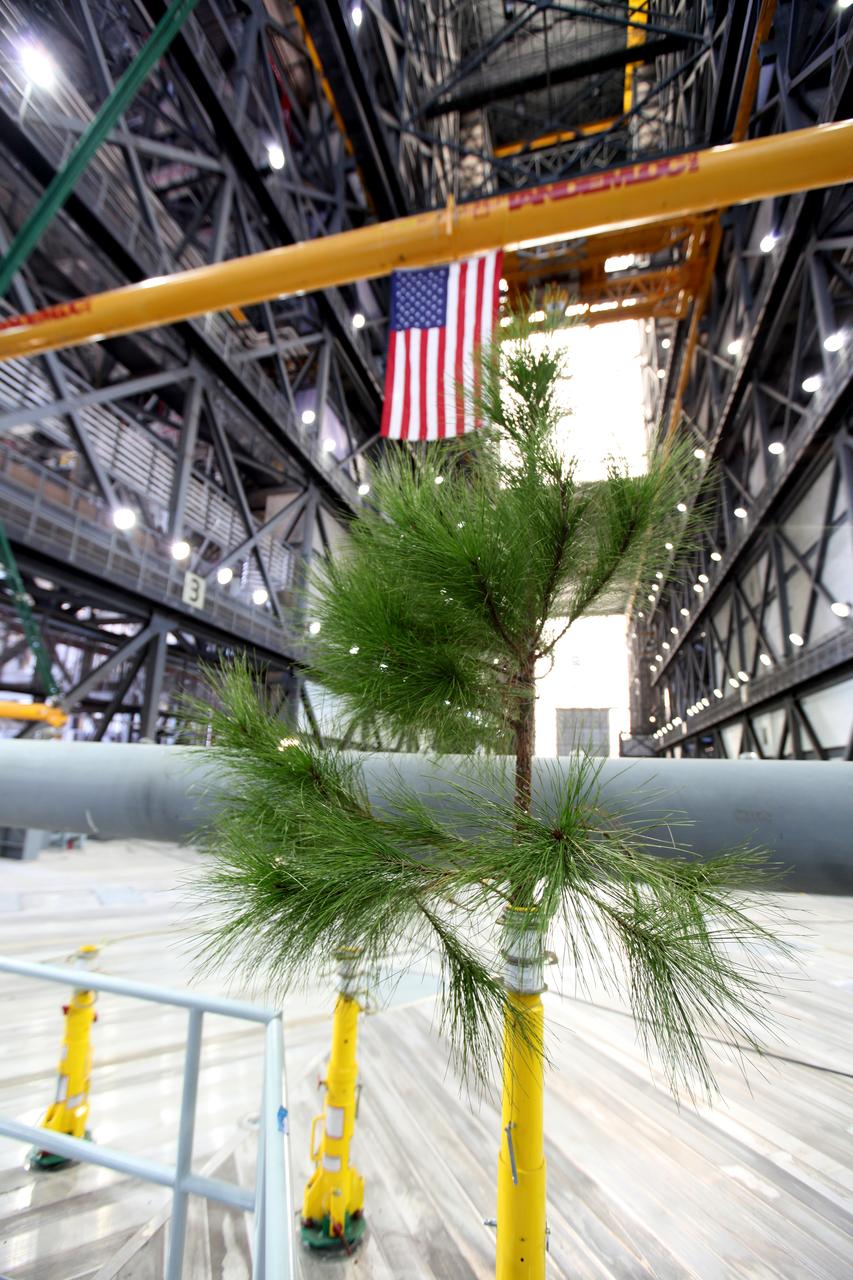
The American flag and a small tree are in view on the final work platform, A north, as the platform is lifted up by crane from the transfer aisle in the Vehicle Assembly Building (VAB) at NASA's Kennedy Space Center in Florida. The platform will be installed and secured on its rail beam high up on the north wall of High Bay 3. The installation of the final topmost level completes the 10 levels of work platforms, 20 platform halves altogether, that will surround NASA's Space Launch System rocket and the Orion spacecraft and allow access during processing for missions, including the first uncrewed flight test of Orion atop the SLS rocket in 2018. The A-level platforms will provide access to the Orion spacecraft's Launch Abort System for Orion lifting sling removal and installation of the closeout panels. The Ground Systems Development and Operations Program, with support from the center's Engineering Directorate, is overseeing upgrades and modifications to the VAB, including installation of the new work platforms.

Technicians at General Atomics Aeronautical Systems, Inc., (GA-ASI) facility at Adelanto, Calif., carefully install a turboprop engine to the rear fuselage of NASA's Altair aircraft during final assembly operations.
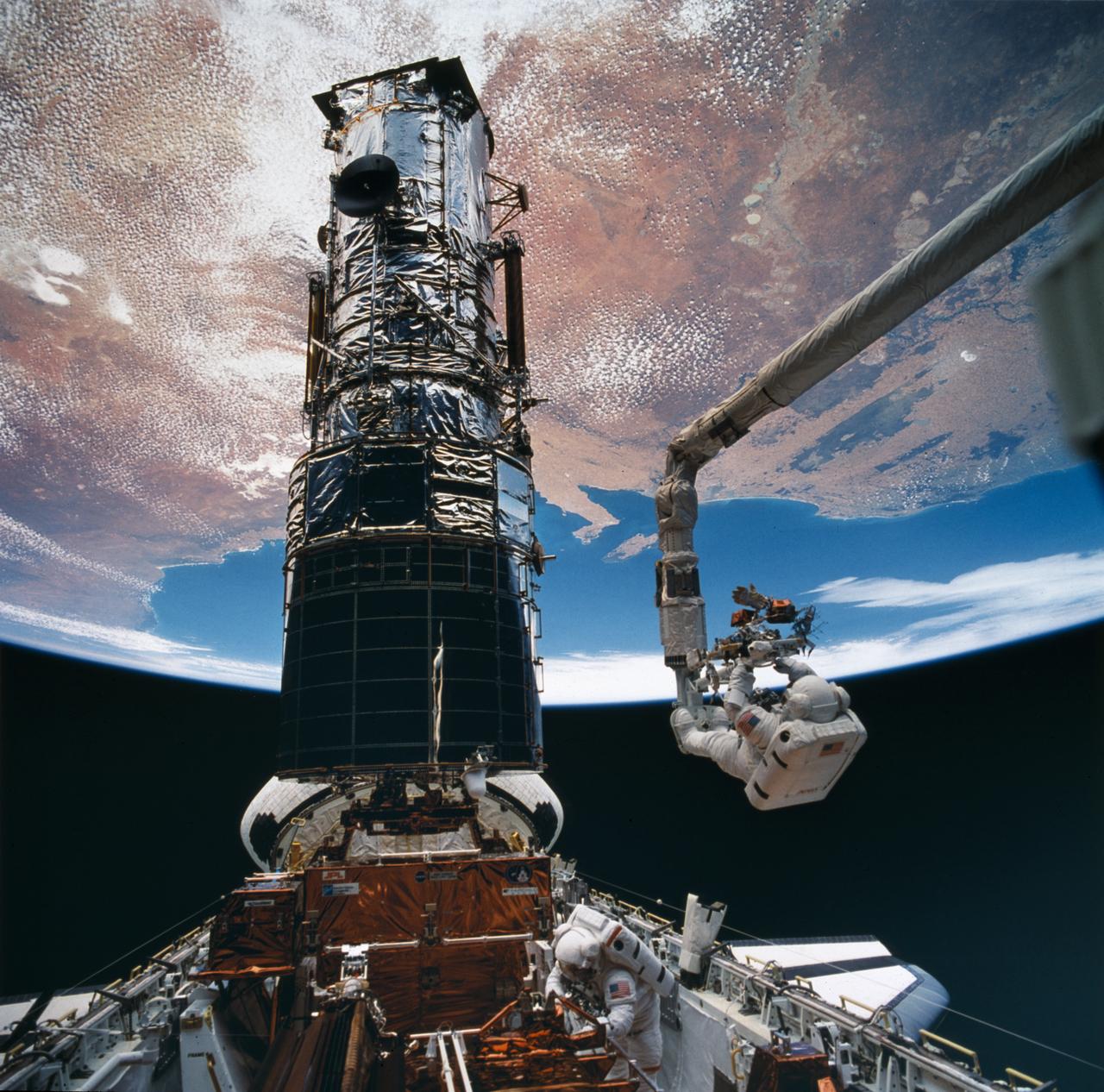
Astronaut Story Musgrave, anchored to the end of the remote manipulator arm, prepares to be elevated to the top of the towering Hubble Space Telescope (HST) to install protective covers on magnetometers. Astornaut Jeffrey Hoffman assisted Musgrave with the final servicing tasks.
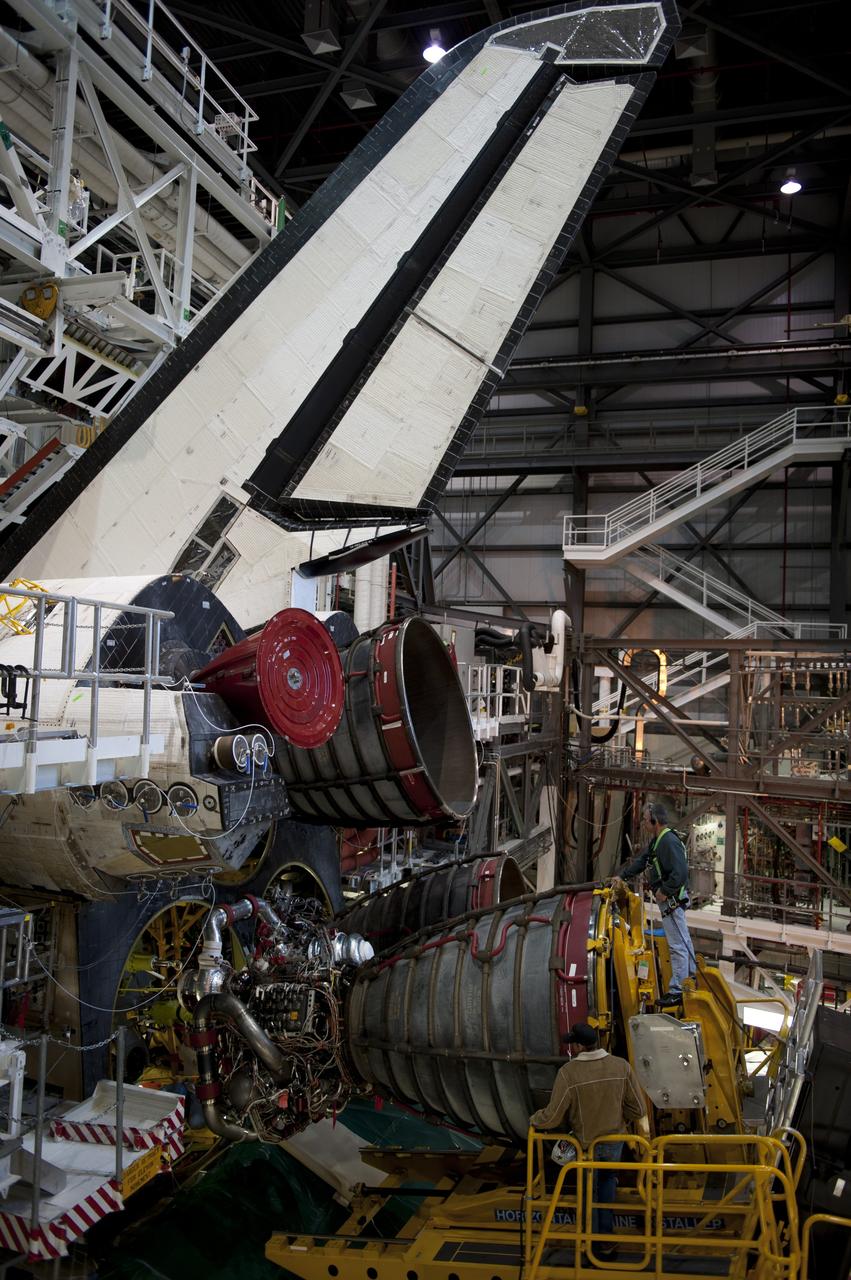
CAPE CANAVERAL, Fla. -- In Orbiter Processing Facility-1 at NASA's Kennedy Space Center in Florida, a Hyster forklift moves engine #2, the last of three space shuttle main engines, into position for installation on shuttle Atlantis. Each engine is 14 feet long, weighs about 6,700 pounds, and is 7.5 feet in diameter at the end of the nozzle. This is the final planned engine installation for the Space Shuttle Program. Atlantis is being prepared for the "launch on need," or potential rescue mission, for the final planned shuttle flight, Endeavour's STS-134 mission. For more information, visit www.nasa.gov/shuttle. Photo credit: NASA/Kim Shiflett
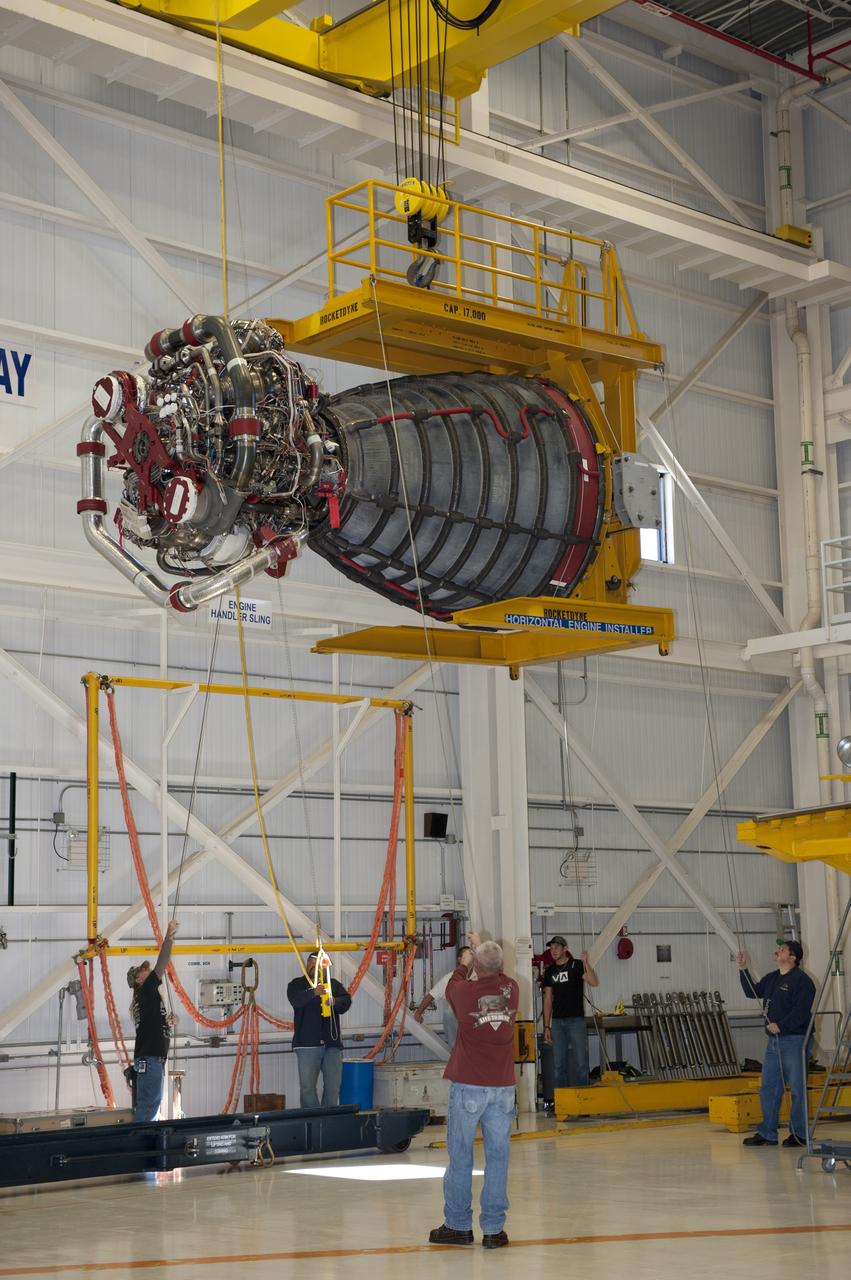
CAPE CANAVERAL, Fla. -- Workers in the Space Shuttle Main Engine (SSME) Shop at NASA's Kennedy Space Center in Florida raise the second of shuttle Atlantis' three main engines so it can be attached to a Hyster forklift. Then, the engine will be transported to Orbiter Processing Facility-1 where it will be installed in the shuttle. Each engine is 14 feet long, weighs about 6,700 pounds, and is 7.5 feet in diameter at the end of the nozzle. This is the final planned engine installation for the Space Shuttle Program. Atlantis is being prepared for the "launch on need," or potential rescue mission, for the final planned shuttle flight, Endeavour's STS-134 mission. For more information, visit www.nasa.gov/shuttle. Photo credit: NASA/Kim Shiflett
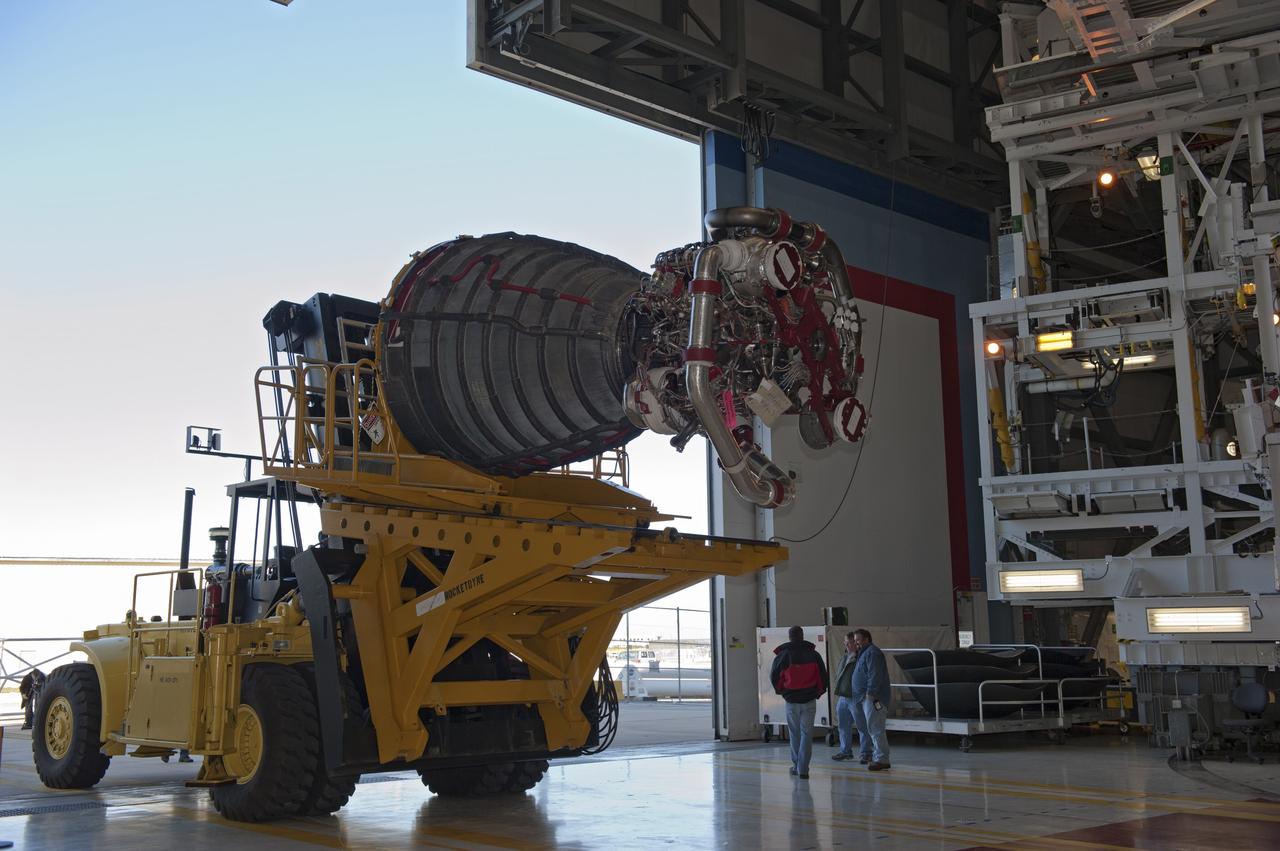
CAPE CANAVERAL, Fla. -- A Hyster forklift transporting the second of shuttle Atlantis' three main engines arrives at Orbiter Processing Facility-1 from the Space Shuttle Main Engine (SSME) Shop at NASA's Kennedy Space Center in Florida. There, the engine will be installed in the shuttle. Each engine is 14 feet long, weighs about 6,700 pounds, and is 7.5 feet in diameter at the end of the nozzle. This is the final planned engine installation for the Space Shuttle Program. Atlantis is being prepared for the "launch on need," or potential rescue mission, for the final planned shuttle flight, Endeavour's STS-134 mission. For more information, visit www.nasa.gov/shuttle. Photo credit: NASA/Kim Shiflett
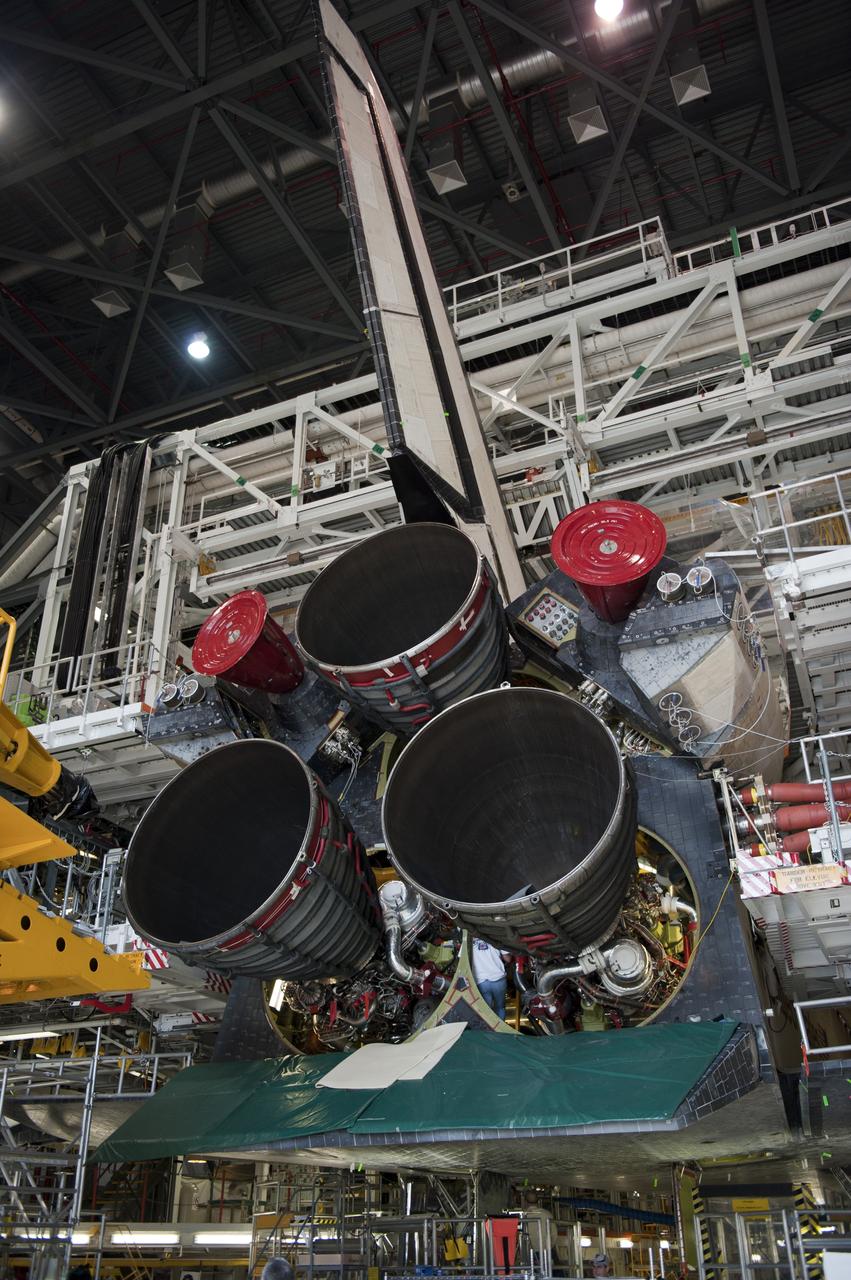
CAPE CANAVERAL, Fla. -- In Orbiter Processing Facility-1 at NASA's Kennedy Space Center in Florida, engine #2, the last of three space shuttle main engines is installed in shuttle Atlantis. Each engine is 14 feet long, weighs about 6,700 pounds, and is 7.5 feet in diameter at the end of the nozzle. This is the final planned engine installation for the Space Shuttle Program. Atlantis is being prepared for the "launch on need," or potential rescue mission, for the final planned shuttle flight, Endeavour's STS-134 mission. For more information, visit www.nasa.gov/shuttle. Photo credit: NASA/Kim Shiflett
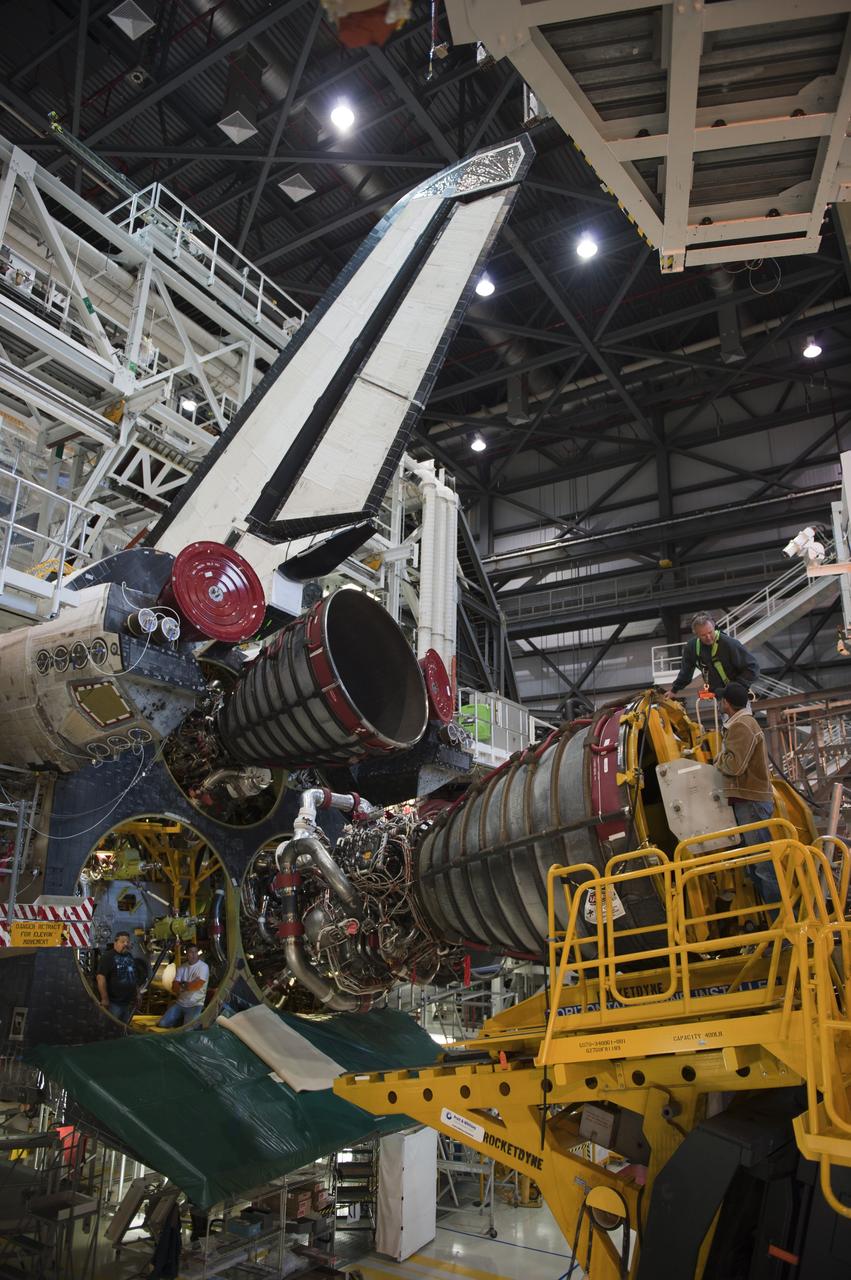
CAPE CANAVERAL, Fla. -- A Hyster forklift transporting the second of shuttle Atlantis' three main engines arrives at Orbiter Processing Facility-1 from the Space Shuttle Main Engine (SSME) Shop at NASA's Kennedy Space Center in Florida. There, the engine will be installed in the shuttle. Each engine is 14 feet long, weighs about 6,700 pounds, and is 7.5 feet in diameter at the end of the nozzle. This is the final planned engine installation for the Space Shuttle Program. Atlantis is being prepared for the "launch on need," or potential rescue mission, for the final planned shuttle flight, Endeavour's STS-134 mission. For more information, visit www.nasa.gov/shuttle. Photo credit: NASA/Kim Shiflett
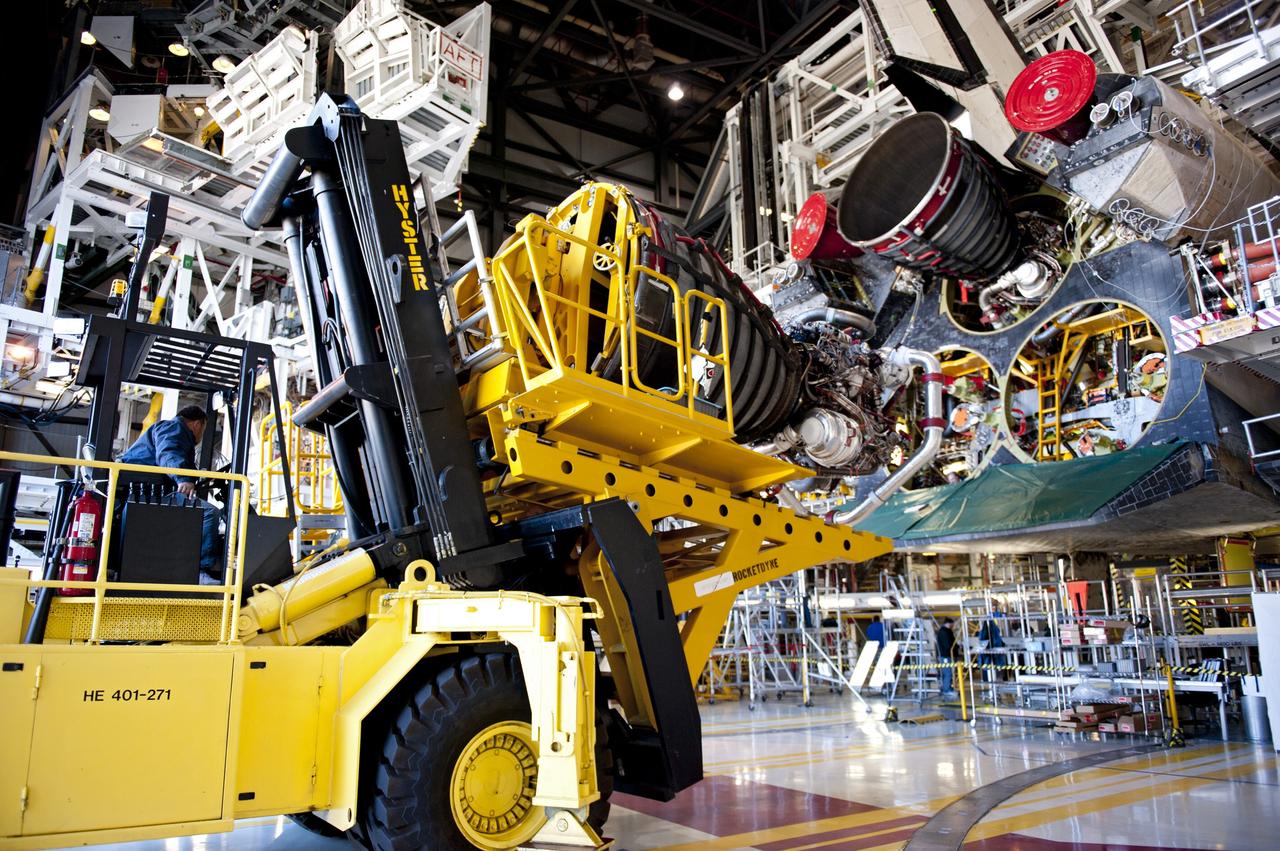
CAPE CANAVERAL, Fla. -- In Orbiter Processing Facility-1 at NASA's Kennedy Space Center in Florida, a Hyster forklift moves engine #2, the last of three space shuttle main engines, into position for installation on shuttle Atlantis. Each engine is 14 feet long, weighs about 6,700 pounds, and is 7.5 feet in diameter at the end of the nozzle. This is the final planned engine installation for the Space Shuttle Program. Atlantis is being prepared for the "launch on need," or potential rescue mission, for the final planned shuttle flight, Endeavour's STS-134 mission. For more information, visit www.nasa.gov/shuttle. Photo credit: NASA/Kim Shiflett
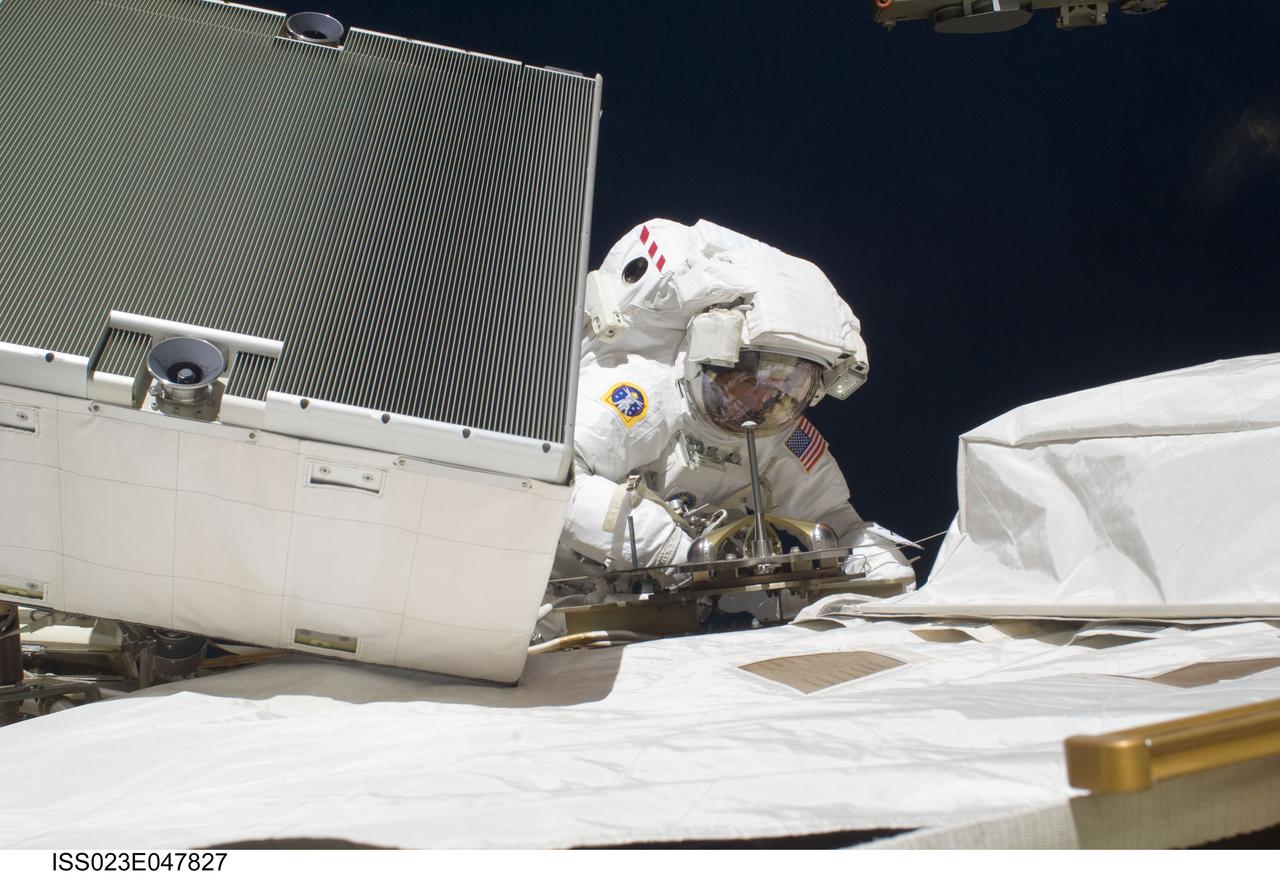
ISS023-E-047827 (21 May 2010) --- NASA astronaut Michael Good, STS-132 mission specialist, participates in the mission?s third and final session of extravehicular activity (EVA) as construction and maintenance continue on the International Space Station. During the six-hour, 46-minute spacewalk, Good and NASA astronaut Garrett Reisman (out of frame), mission specialist, completed the installation of the final two of the six new batteries for the B side of the port 6 solar array. In addition, the astronauts installed a backup ammonia jumper cable between the port 4 and 5 trusses of the station, transferred a Power and Data Grapple Fixture from the shuttle to the station, and reconfigured some tools.
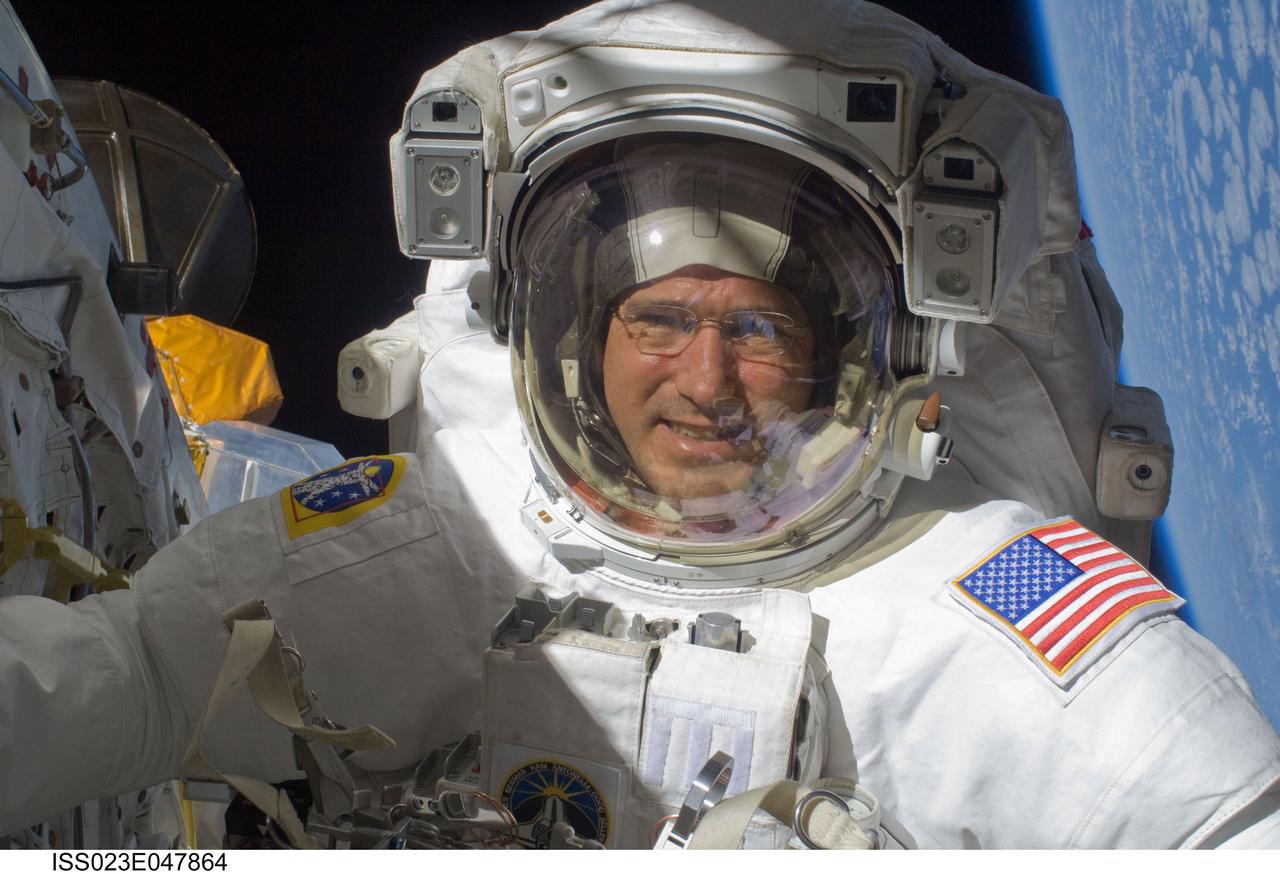
ISS023-E-047864 (21 May 2010) --- NASA astronaut Michael Good, STS-132 mission specialist, participates in the mission?s third and final session of extravehicular activity (EVA) as construction and maintenance continue on the International Space Station. During the six-hour, 46-minute spacewalk, Good and NASA astronaut Garrett Reisman (out of frame), mission specialist, completed the installation of the final two of the six new batteries for the B side of the port 6 solar array. In addition, the astronauts installed a backup ammonia jumper cable between the port 4 and 5 trusses of the station, transferred a Power and Data Grapple Fixture from the shuttle to the station, and reconfigured some tools.
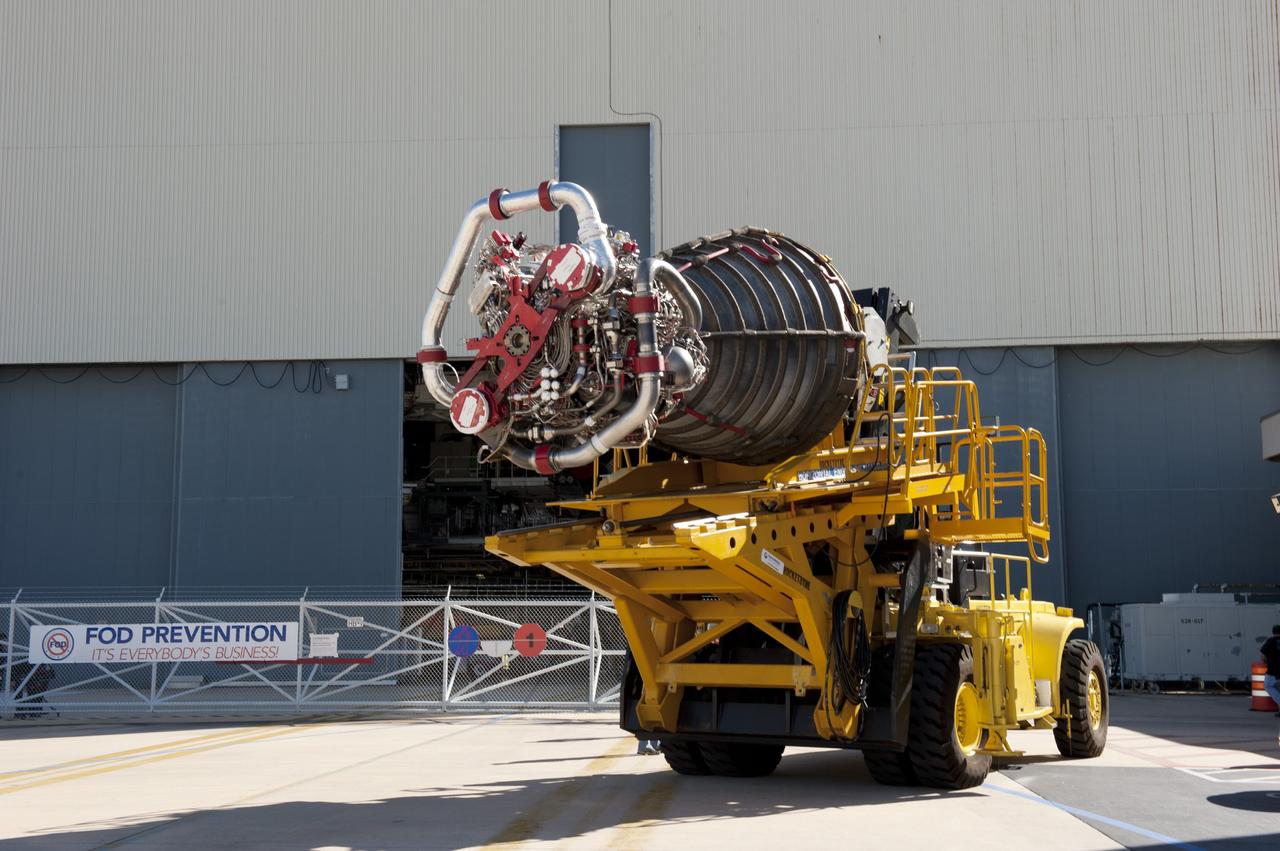
CAPE CANAVERAL, Fla. -- A Hyster forklift transports engine #2, the last of shuttle Atlantis' three main engines, from the Space Shuttle Main Engine (SSME) Shop to Orbiter Processing Facility-1 at NASA's Kennedy Space Center in Florida. Inside the processing facility, the engine will be installed in the shuttle. Each engine is 14 feet long, weighs about 6,700 pounds, and is 7.5 feet in diameter at the end of the nozzle. This is the final planned engine installation for the Space Shuttle Program. Atlantis is being prepared for the "launch on need," or potential rescue mission, for the final planned shuttle flight, Endeavour's STS-134 mission. For more information, visit www.nasa.gov/shuttle. Photo credit: NASA/Kim Shiflett
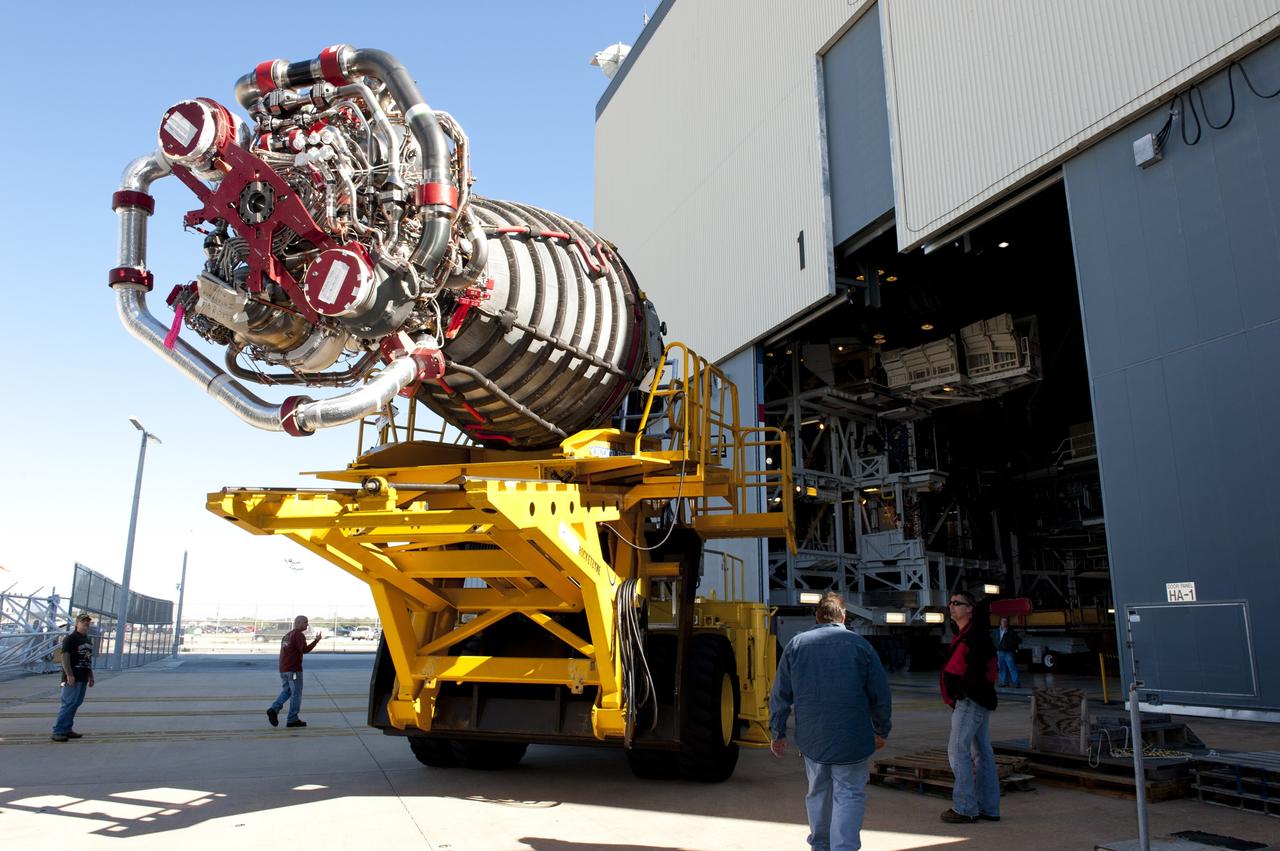
CAPE CANAVERAL, Fla. -- A Hyster forklift transports the second of shuttle Atlantis' three main engines from the Space Shuttle Main Engine (SSME) Shop to Orbiter Processing Facility-1 at NASA's Kennedy Space Center in Florida. Once inside the processing facility, the engine will be installed in the shuttle. Each engine is 14 feet long, weighs about 6,700 pounds, and is 7.5 feet in diameter at the end of the nozzle. This is the final planned engine installation for the Space Shuttle Program. Atlantis is being prepared for the "launch on need," or potential rescue mission, for the final planned shuttle flight, Endeavour's STS-134 mission. For more information, visit www.nasa.gov/shuttle. Photo credit: NASA/Kim Shiflett
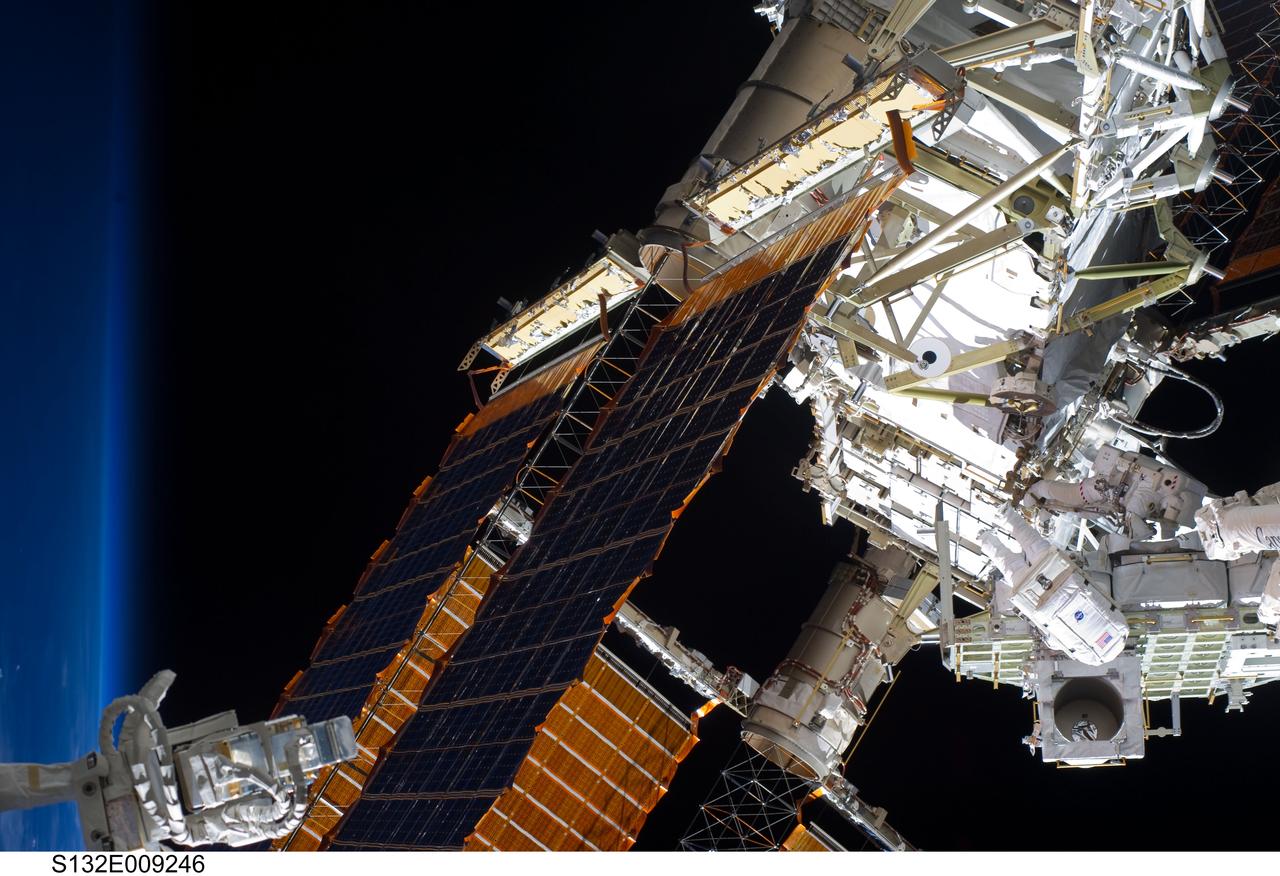
S132-E-009246 (21 May 2010) --- NASA astronauts Michael Good and Garrett Reisman, both STS-132 mission specialists, participate in the mission’s third and final session of extravehicular activity (EVA) as construction and maintenance continue on the International Space Station. During the six-hour, 46-minute spacewalk, Good and Reisman completed the installation of the final two of the six new batteries for the B side of the port 6 solar array. In addition, the astronauts installed a backup ammonia jumper cable between the port 4 and 5 trusses of the station, transferred a Power and Data Grapple Fixture from the shuttle to the station, and reconfigured some tools.
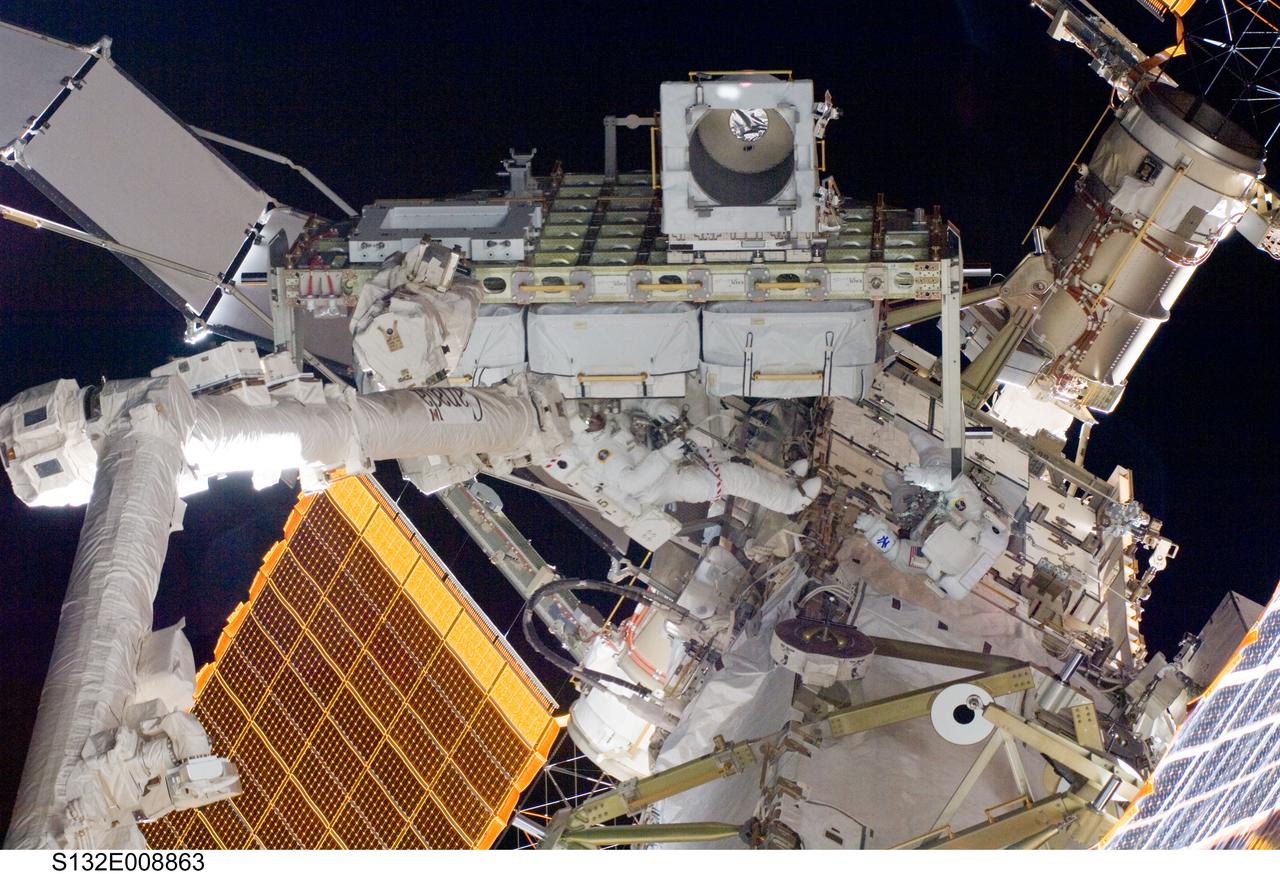
S132-E-008863 (21 May 2010) --- NASA astronauts Garrett Reisman (right) and Michael Good, both STS-132 mission specialists, participate in the mission’s third and final session of extravehicular activity (EVA) as construction and maintenance continue on the International Space Station. During the six-hour, 46-minute spacewalk, Good and Reisman completed the installation of the final two of the six new batteries for the B side of the port 6 solar array. In addition, the astronauts installed a backup ammonia jumper cable between the port 4 and 5 trusses of the station, transferred a Power and Data Grapple Fixture from the shuttle to the station, and reconfigured some tools.
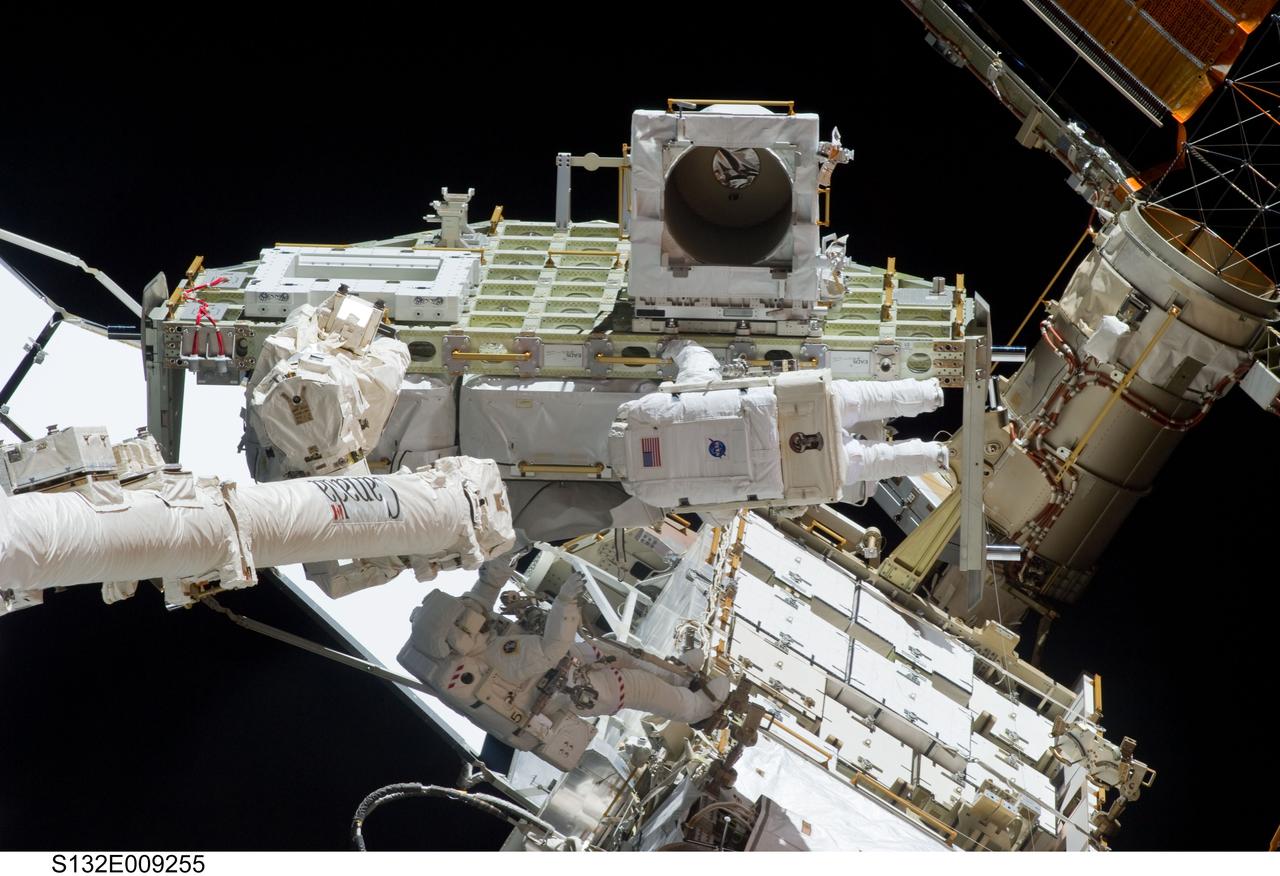
S132-E-009255 (21 May 2010) --- NASA astronauts Michael Good (bottom center) and Garrett Reisman, both STS-132 mission specialists, participate in the mission’s third and final session of extravehicular activity (EVA) as construction and maintenance continue on the International Space Station. During the six-hour, 46-minute spacewalk, Good and Reisman completed the installation of the final two of the six new batteries for the B side of the port 6 solar array. In addition, the astronauts installed a backup ammonia jumper cable between the port 4 and 5 trusses of the station, transferred a Power and Data Grapple Fixture from the shuttle to the station, and reconfigured some tools.
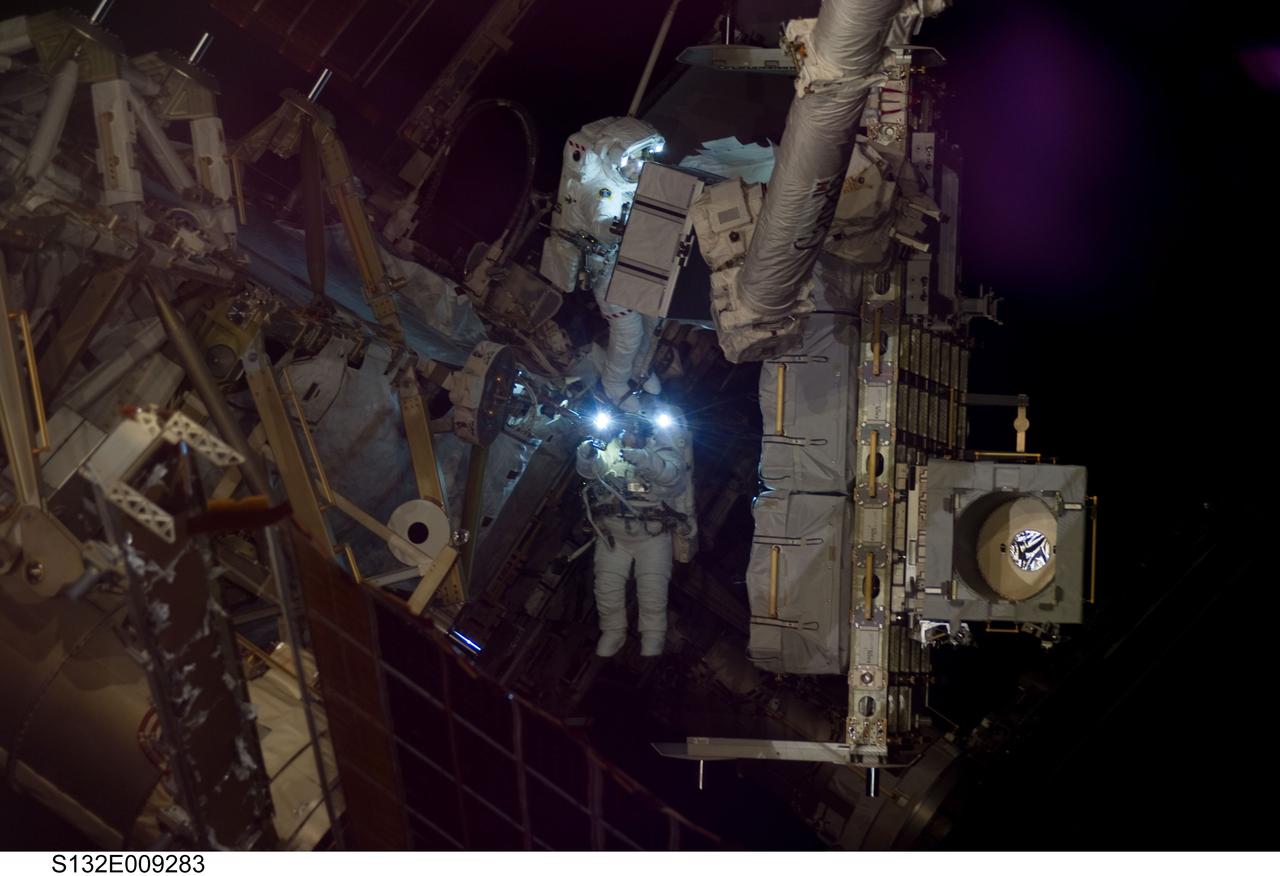
S132-E-009283 (21 May 2010) --- NASA astronauts Michael Good (top center) and Garrett Reisman, both STS-132 mission specialists, participate in the mission’s third and final session of extravehicular activity (EVA) as construction and maintenance continue on the International Space Station. During the six-hour, 46-minute spacewalk, Good and Reisman completed the installation of the final two of the six new batteries for the B side of the port 6 solar array. In addition, the astronauts installed a backup ammonia jumper cable between the port 4 and 5 trusses of the station, transferred a Power and Data Grapple Fixture from the shuttle to the station, and reconfigured some tools.
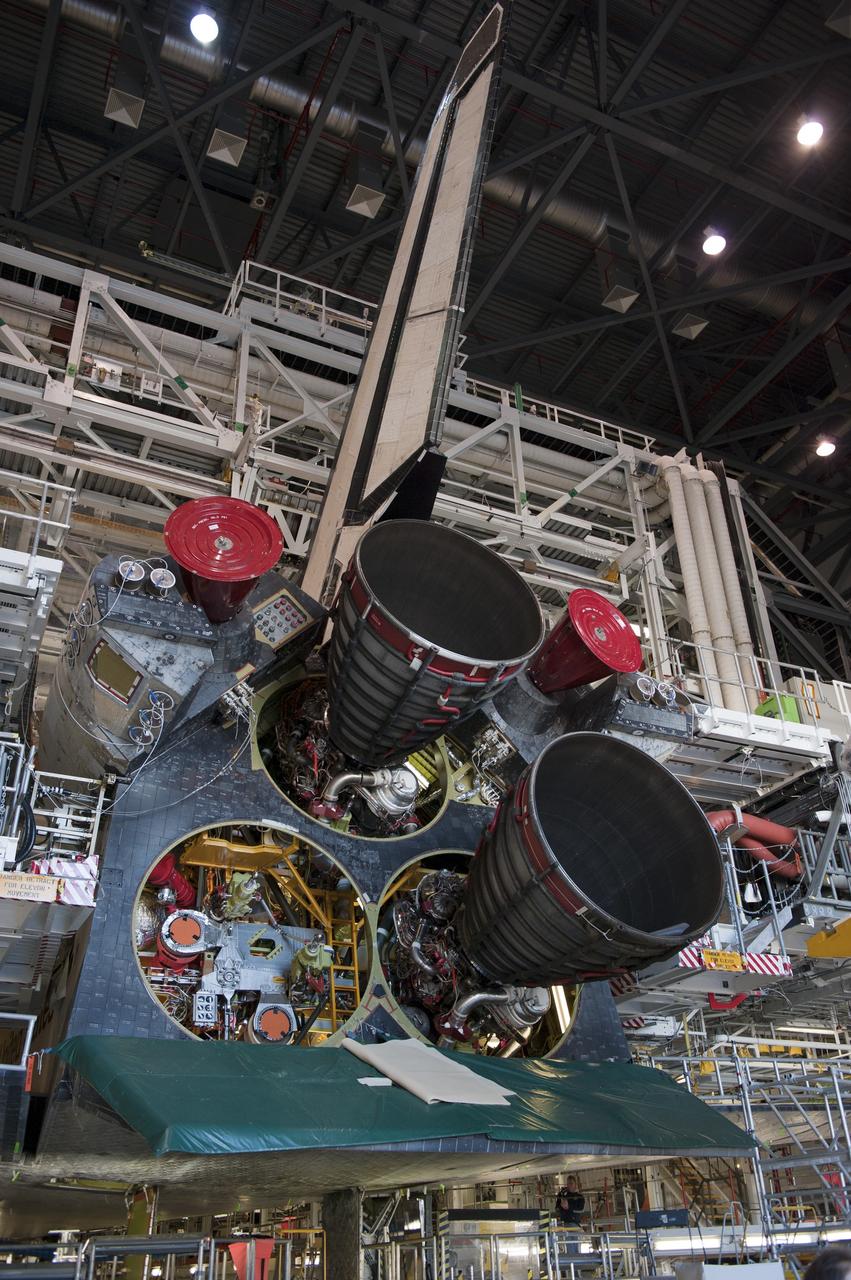
CAPE CANAVERAL, Fla. -- In Orbiter Processing Facility-1 at NASA's Kennedy Space Center in Florida, the second of three space shuttle main engines is installed in shuttle Atlantis. Each engine is 14 feet long, weighs about 6,700 pounds, and is 7.5 feet in diameter at the end of the nozzle. This is the final planned engine installation for the Space Shuttle Program. Atlantis is being prepared for the "launch on need," or potential rescue mission, for the final planned shuttle flight, Endeavour's STS-134 mission. For more information, visit www.nasa.gov/shuttle. Photo credit: NASA/Kim Shiflett
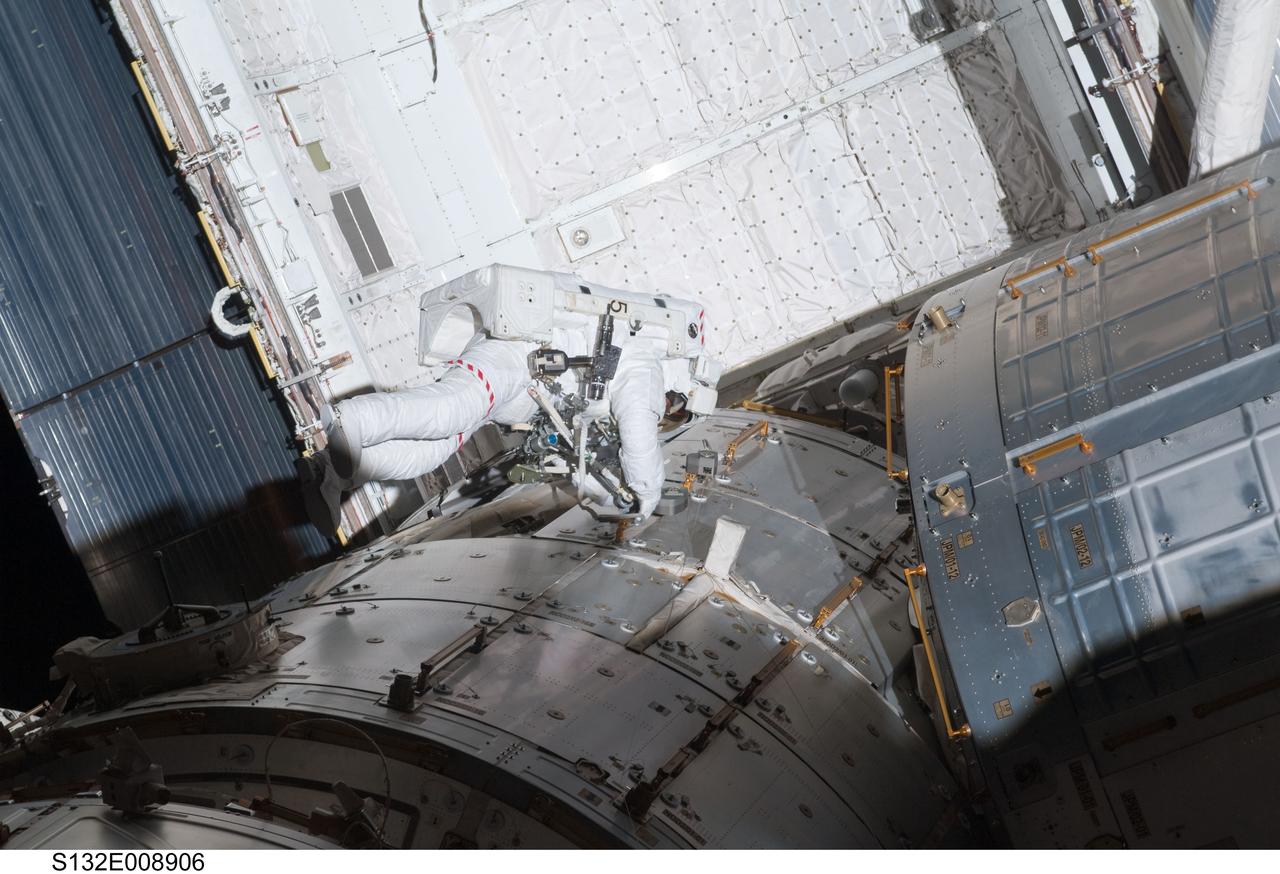
S132-E-008906 (21 May 2010) --- NASA astronaut Michael Good, STS-132 mission specialist, participates in the mission’s third and final session of extravehicular activity (EVA) as construction and maintenance continue on the International Space Station. During the six-hour, 46-minute spacewalk, Good and NASA astronaut Garrett Reisman (out of frame), mission specialist, completed the installation of the final two of the six new batteries for the B side of the port 6 solar array. In addition, the astronauts installed a backup ammonia jumper cable between the port 4 and 5 trusses of the station, transferred a Power and Data Grapple Fixture from the shuttle to the station, and reconfigured some tools.
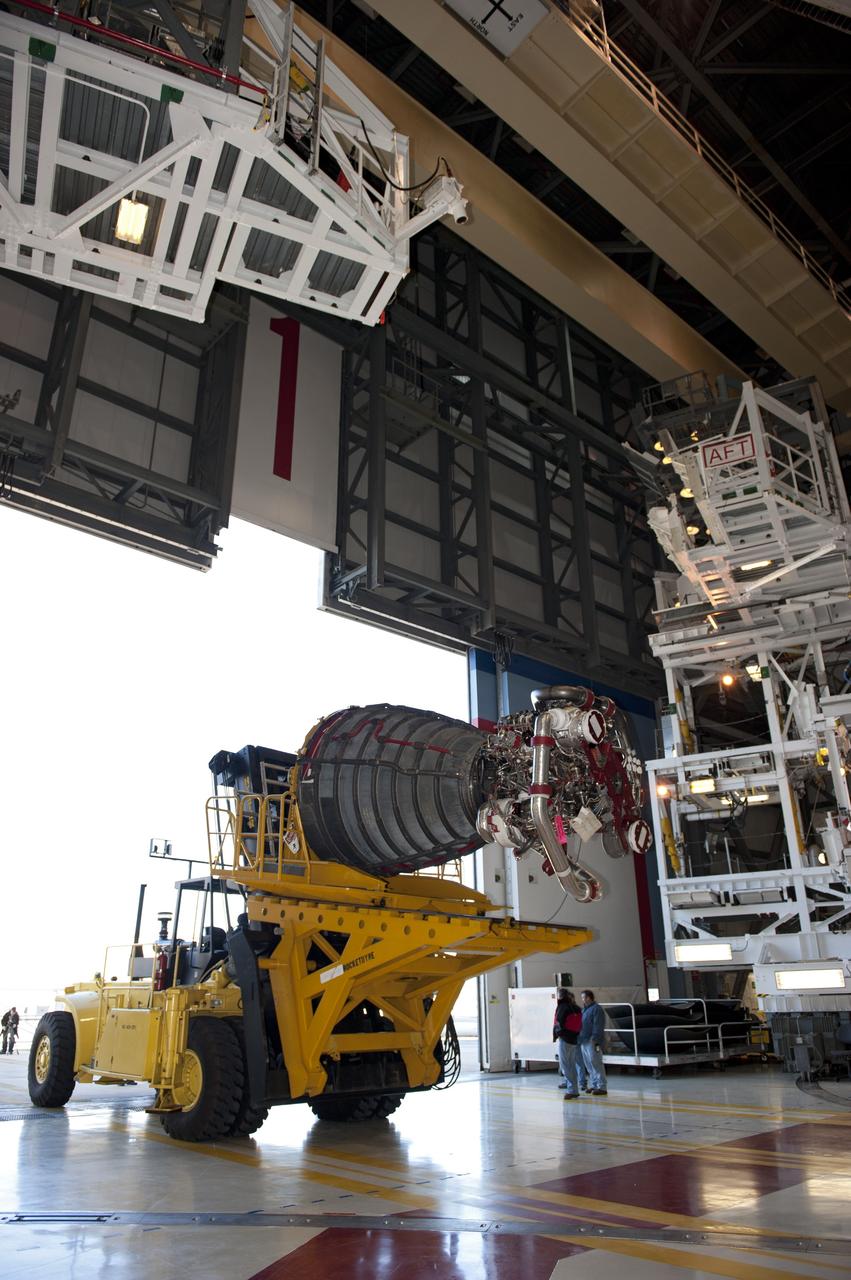
CAPE CANAVERAL, Fla. -- A Hyster forklift transporting the second of shuttle Atlantis' three main engines arrives at Orbiter Processing Facility-1 from the Space Shuttle Main Engine (SSME) Shop at NASA's Kennedy Space Center in Florida. There, the engine will be installed in the shuttle. Each engine is 14 feet long, weighs about 6,700 pounds, and is 7.5 feet in diameter at the end of the nozzle. This is the final planned engine installation for the Space Shuttle Program. Atlantis is being prepared for the "launch on need," or potential rescue mission, for the final planned shuttle flight, Endeavour's STS-134 mission. For more information, visit www.nasa.gov/shuttle. Photo credit: NASA/Kim Shiflett
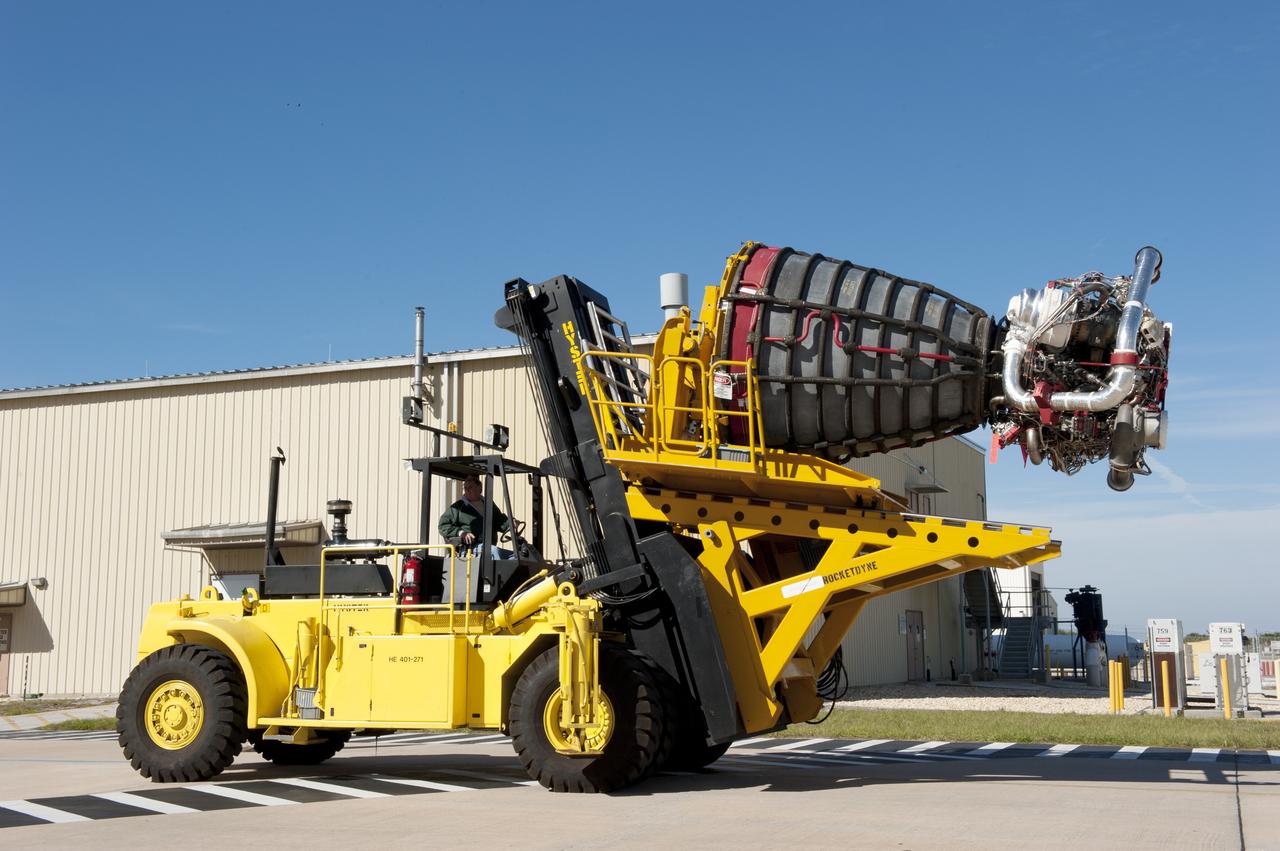
CAPE CANAVERAL, Fla. -- A Hyster forklift transports engine #2, the last of shuttle Atlantis' three main engines, from the Space Shuttle Main Engine (SSME) Shop to Orbiter Processing Facility-1 at NASA's Kennedy Space Center in Florida. Inside the processing facility, the engine will be installed in the shuttle. Each engine is 14 feet long, weighs about 6,700 pounds, and is 7.5 feet in diameter at the end of the nozzle. This is the final planned engine installation for the Space Shuttle Program. Atlantis is being prepared for the "launch on need," or potential rescue mission, for the final planned shuttle flight, Endeavour's STS-134 mission. For more information, visit www.nasa.gov/shuttle. Photo credit: NASA/Kim Shiflett
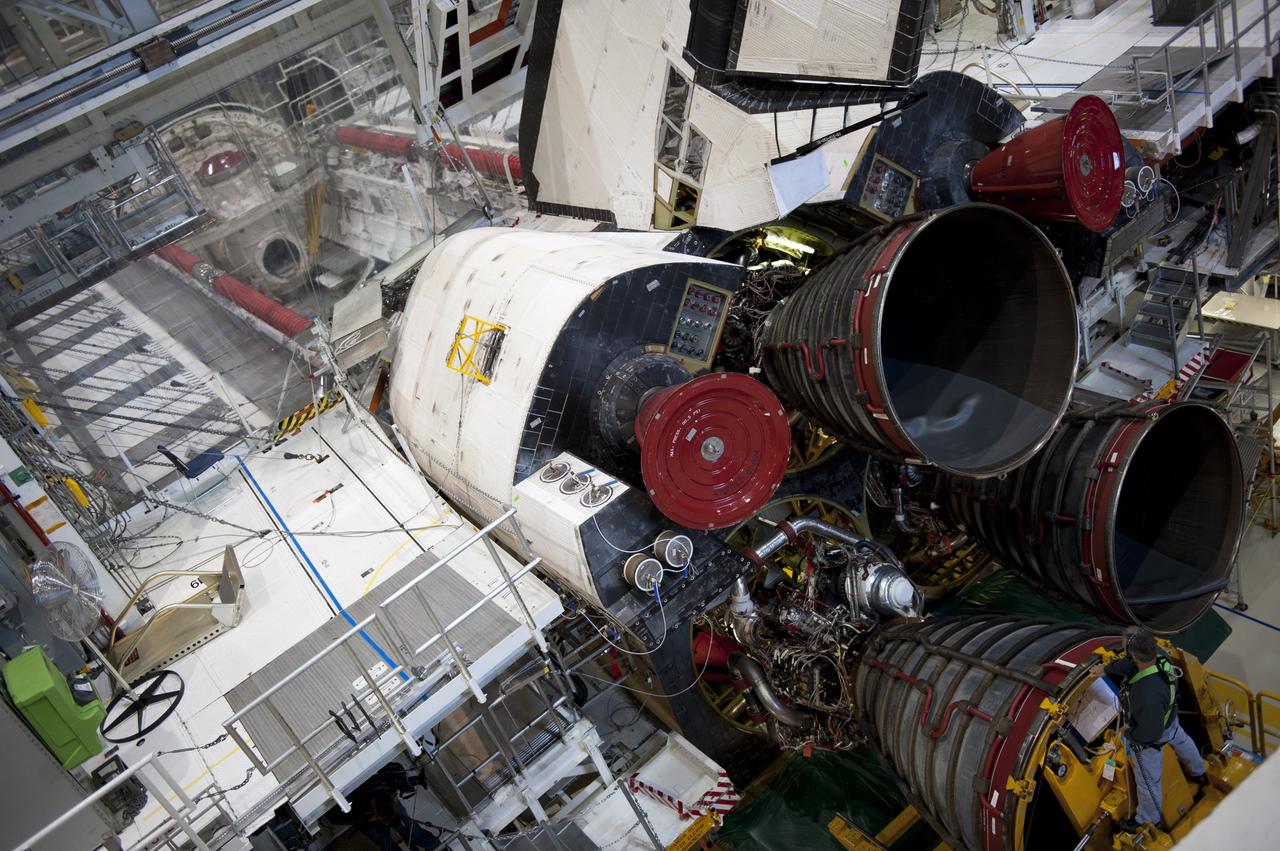
CAPE CANAVERAL, Fla. -- In Orbiter Processing Facility-1 at NASA's Kennedy Space Center in Florida, engine #2, the last of three space shuttle main engines is installed in shuttle Atlantis. Each engine is 14 feet long, weighs about 6,700 pounds, and is 7.5 feet in diameter at the end of the nozzle. This is the final planned engine installation for the Space Shuttle Program. Atlantis is being prepared for the "launch on need," or potential rescue mission, for the final planned shuttle flight, Endeavour's STS-134 mission. For more information, visit www.nasa.gov/shuttle. Photo credit: NASA/Kim Shiflett
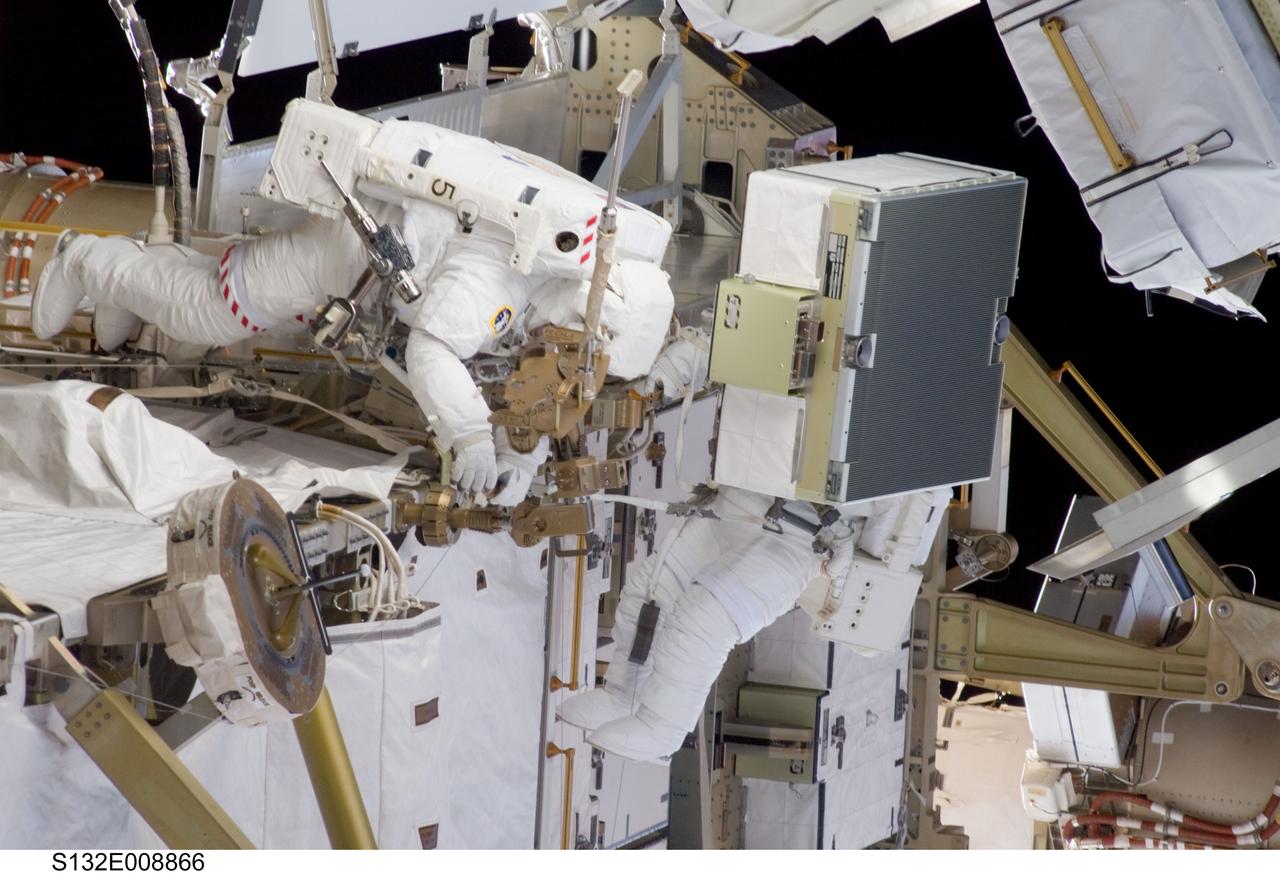
S132-E-008866 (21 May 2010) --- NASA astronauts Michael Good and Garrett Reisman (partially obscured), both STS-132 mission specialists, participate in the mission’s third and final session of extravehicular activity (EVA) as construction and maintenance continue on the International Space Station. During the six-hour, 46-minute spacewalk, Good and Reisman completed the installation of the final two of the six new batteries for the B side of the port 6 solar array. In addition, the astronauts installed a backup ammonia jumper cable between the port 4 and 5 trusses of the station, transferred a Power and Data Grapple Fixture from the shuttle to the station, and reconfigured some tools.
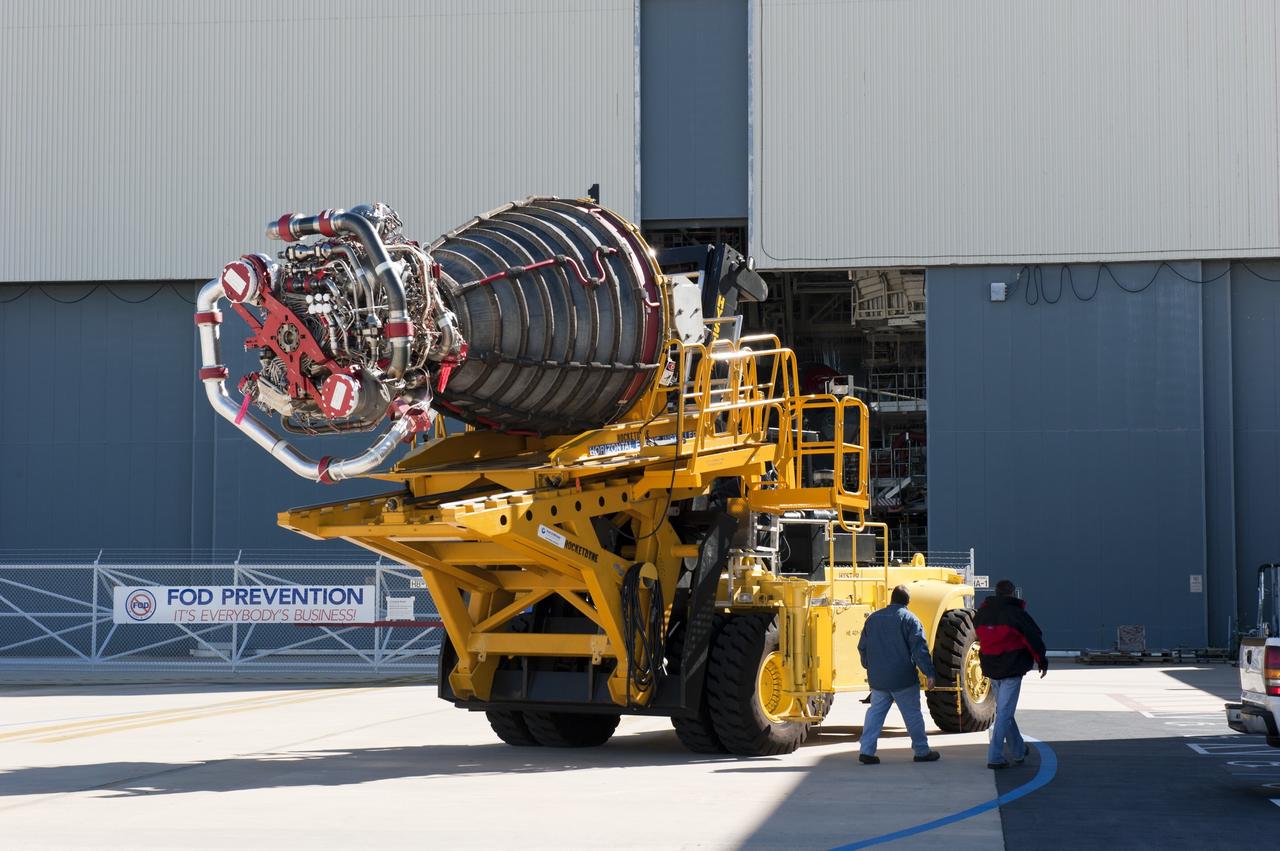
CAPE CANAVERAL, Fla. -- A Hyster forklift transports the second of shuttle Atlantis' three main engines from the Space Shuttle Main Engine (SSME) Shop to Orbiter Processing Facility-1 at NASA's Kennedy Space Center in Florida. Once inside the processing facility, the engine will be installed in the shuttle. Each engine is 14 feet long, weighs about 6,700 pounds, and is 7.5 feet in diameter at the end of the nozzle. This is the final planned engine installation for the Space Shuttle Program. Atlantis is being prepared for the "launch on need," or potential rescue mission, for the final planned shuttle flight, Endeavour's STS-134 mission. For more information, visit www.nasa.gov/shuttle. Photo credit: NASA/Kim Shiflett
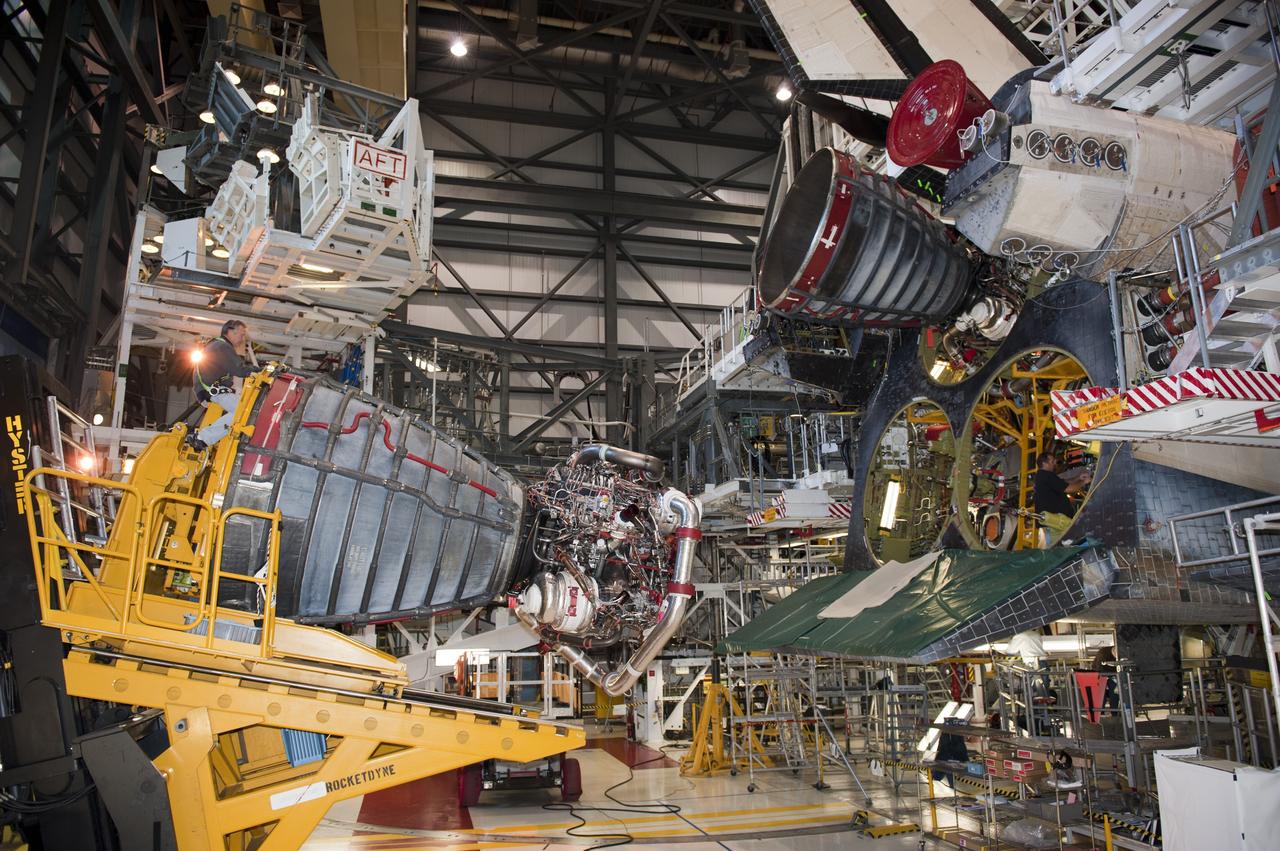
CAPE CANAVERAL, Fla. -- In Orbiter Processing Facility-1 at NASA's Kennedy Space Center in Florida, a Hyster forklift moves the second of three space shuttle main engines closer to shuttle Atlantis for installation. Each engine is 14 feet long, weighs about 6,700 pounds, and is 7.5 feet in diameter at the end of the nozzle. This is the final planned engine installation for the Space Shuttle Program. Atlantis is being prepared for the "launch on need," or potential rescue mission, for the final planned shuttle flight, Endeavour's STS-134 mission. For more information, visit www.nasa.gov/shuttle. Photo credit: NASA/Kim Shiflett
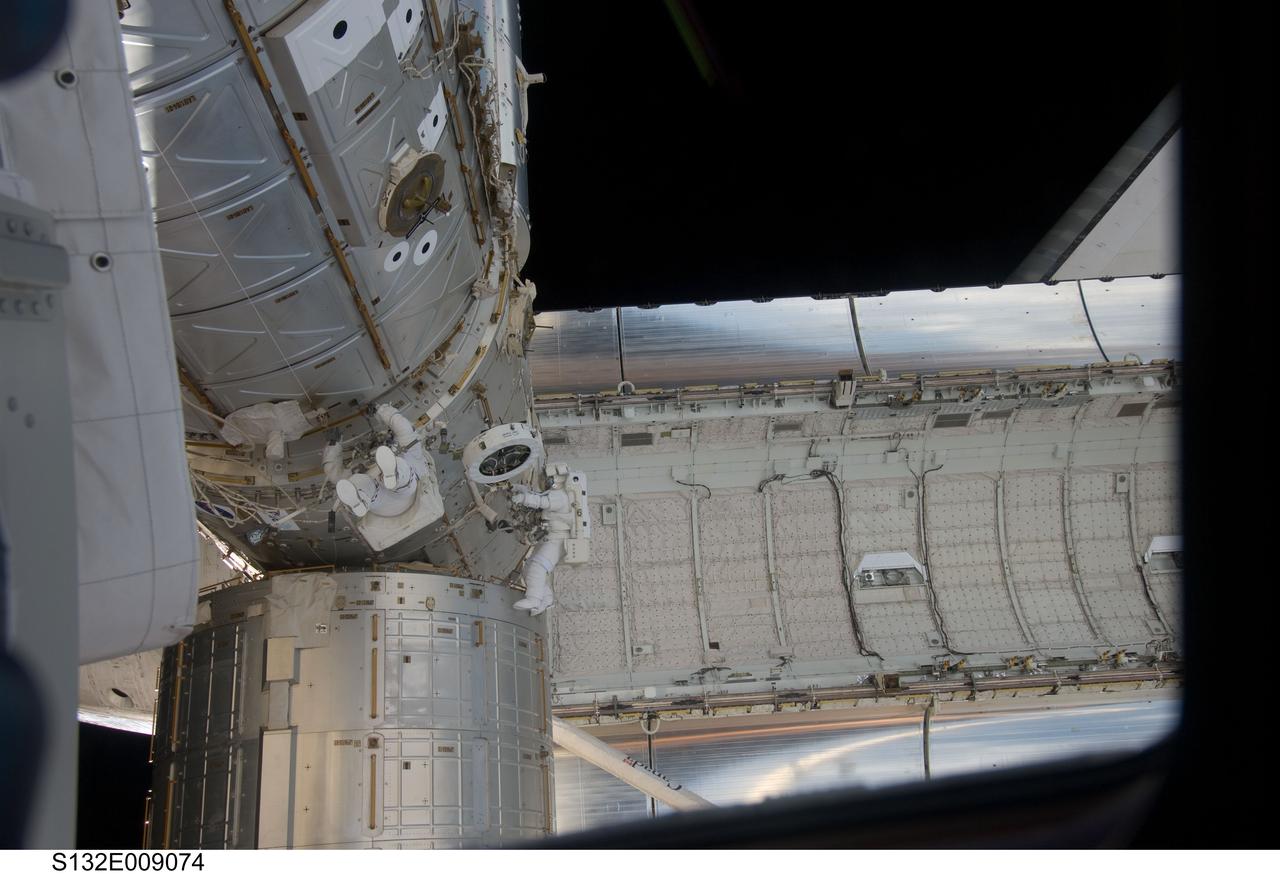
S132-E-009074 (21 May 2010) --- NASA astronauts Michael Good (left) and Garrett Reisman, both STS-132 mission specialists, participate in the mission’s third and final session of extravehicular activity (EVA) as construction and maintenance continue on the International Space Station. During the six-hour, 46-minute spacewalk, Good and Reisman completed the installation of the final two of the six new batteries for the B side of the port 6 solar array. In addition, the astronauts installed a backup ammonia jumper cable between the port 4 and 5 trusses of the station, transferred a Power and Data Grapple Fixture from the shuttle to the station, and reconfigured some tools.
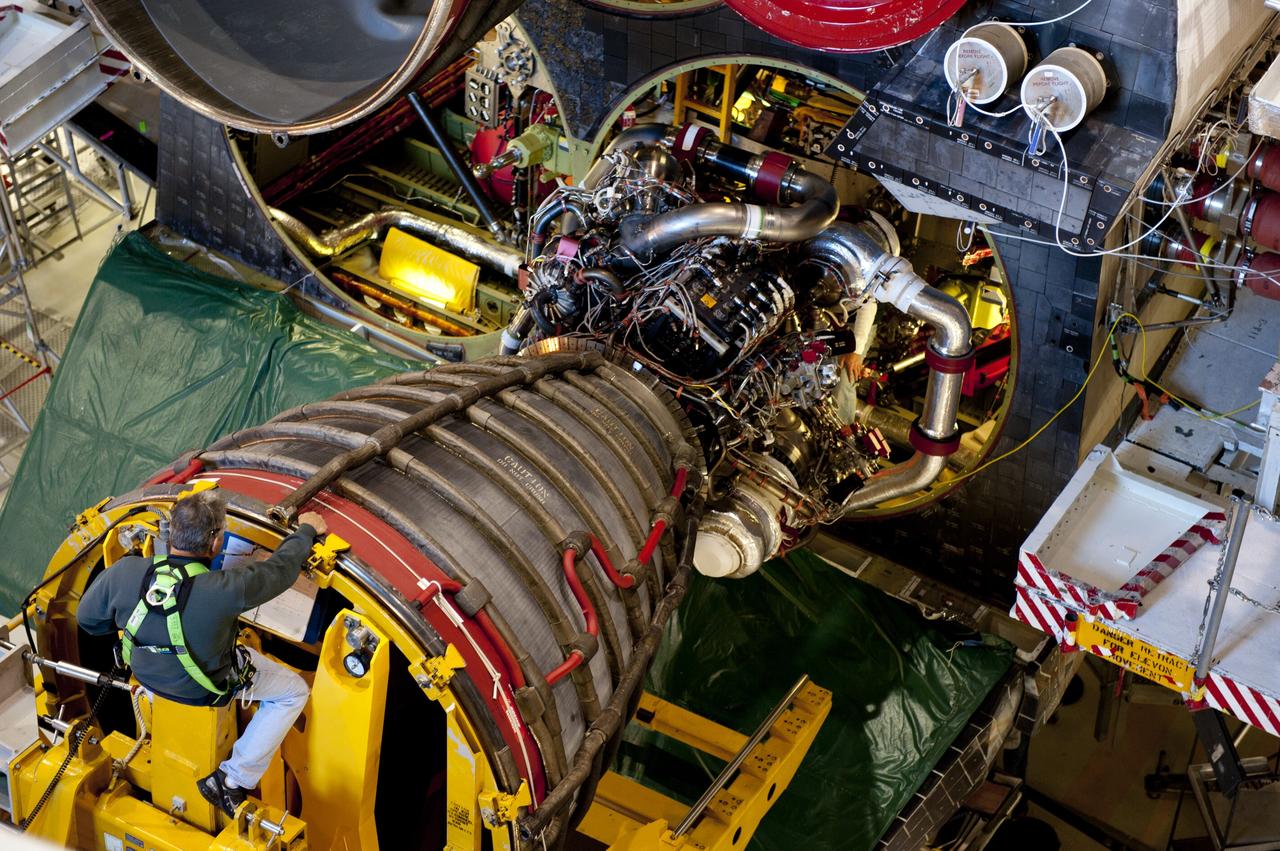
CAPE CANAVERAL, Fla. -- In Orbiter Processing Facility-1 at NASA's Kennedy Space Center in Florida, a Hyster forklift moves the second of three space shuttle main engines closer to shuttle Atlantis for installation. Each engine is 14 feet long, weighs about 6,700 pounds, and is 7.5 feet in diameter at the end of the nozzle. This is the final planned engine installation for the Space Shuttle Program. Atlantis is being prepared for the "launch on need," or potential rescue mission, for the final planned shuttle flight, Endeavour's STS-134 mission. For more information, visit www.nasa.gov/shuttle. Photo credit: NASA/Kim Shiflett
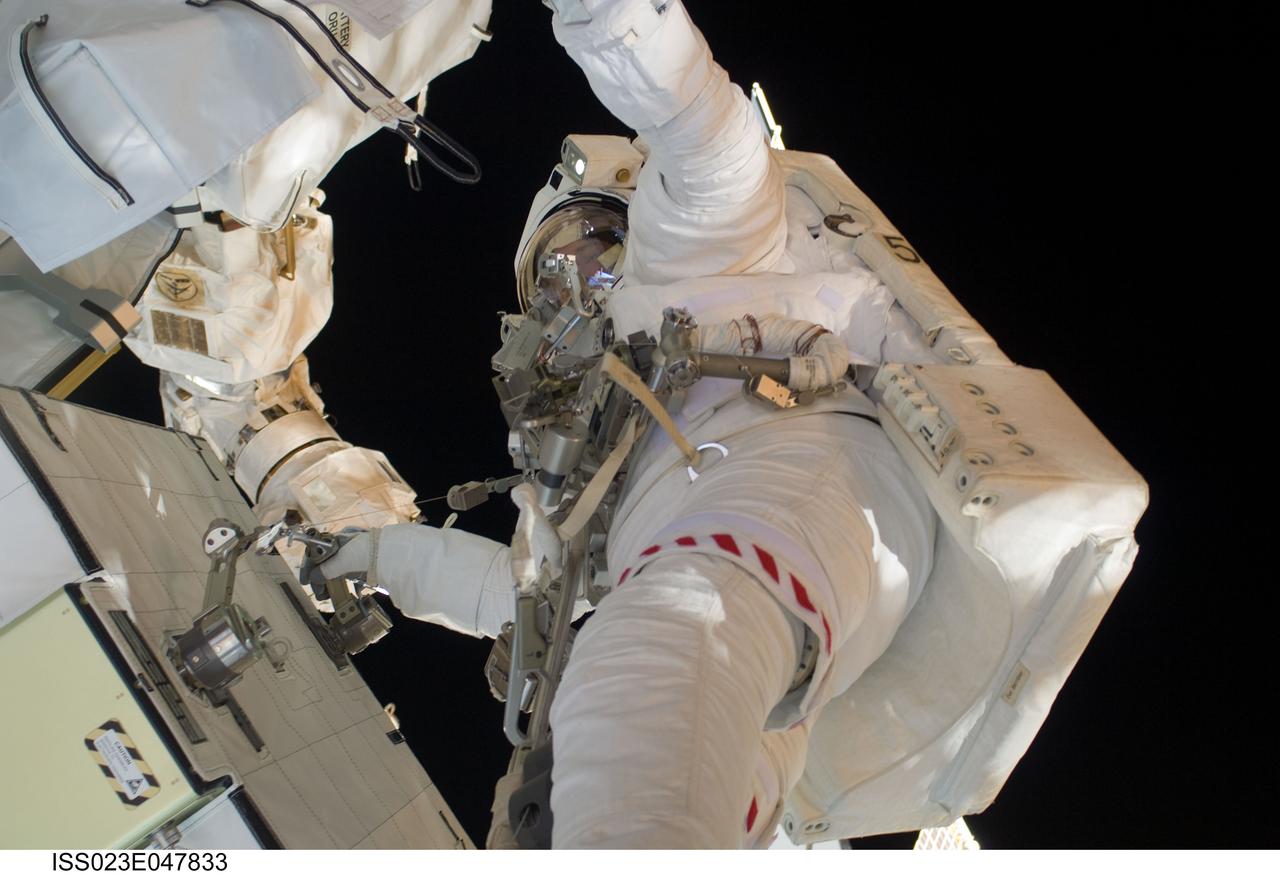
ISS023-E-047833 (21 May 2010) --- NASA astronaut Michael Good, STS-132 mission specialist, participates in the mission?s third and final session of extravehicular activity (EVA) as construction and maintenance continue on the International Space Station. During the six-hour, 46-minute spacewalk, Good and NASA astronaut Garrett Reisman (out of frame), mission specialist, completed the installation of the final two of the six new batteries for the B side of the port 6 solar array. In addition, the astronauts installed a backup ammonia jumper cable between the port 4 and 5 trusses of the station, transferred a Power and Data Grapple Fixture from the shuttle to the station, and reconfigured some tools.
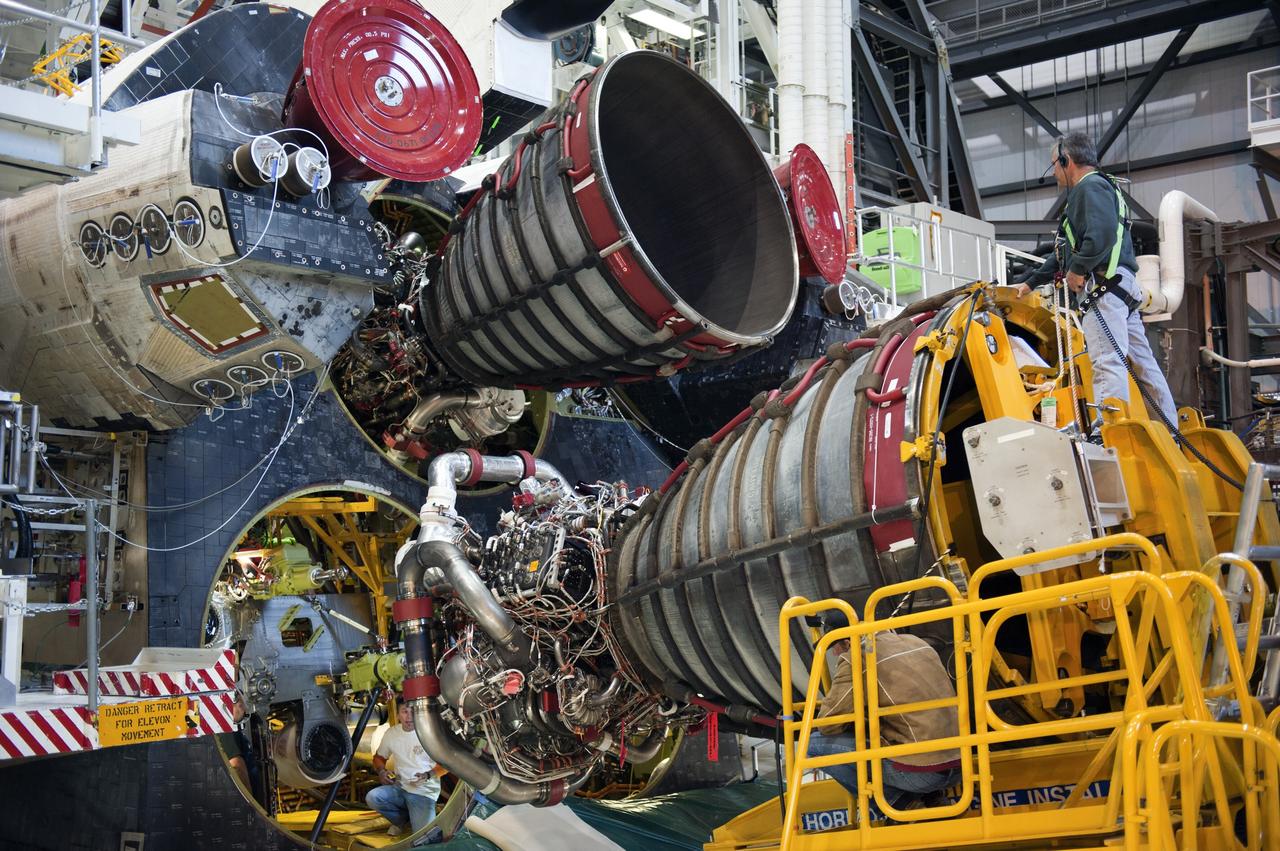
CAPE CANAVERAL, Fla. -- In Orbiter Processing Facility-1 at NASA's Kennedy Space Center in Florida, a Hyster forklift moves engine #2, the last of three space shuttle main engines, into position for installation on shuttle Atlantis. Each engine is 14 feet long, weighs about 6,700 pounds, and is 7.5 feet in diameter at the end of the nozzle. This is the final planned engine installation for the Space Shuttle Program. Atlantis is being prepared for the "launch on need," or potential rescue mission, for the final planned shuttle flight, Endeavour's STS-134 mission. For more information, visit www.nasa.gov/shuttle. Photo credit: NASA/Kim Shiflett
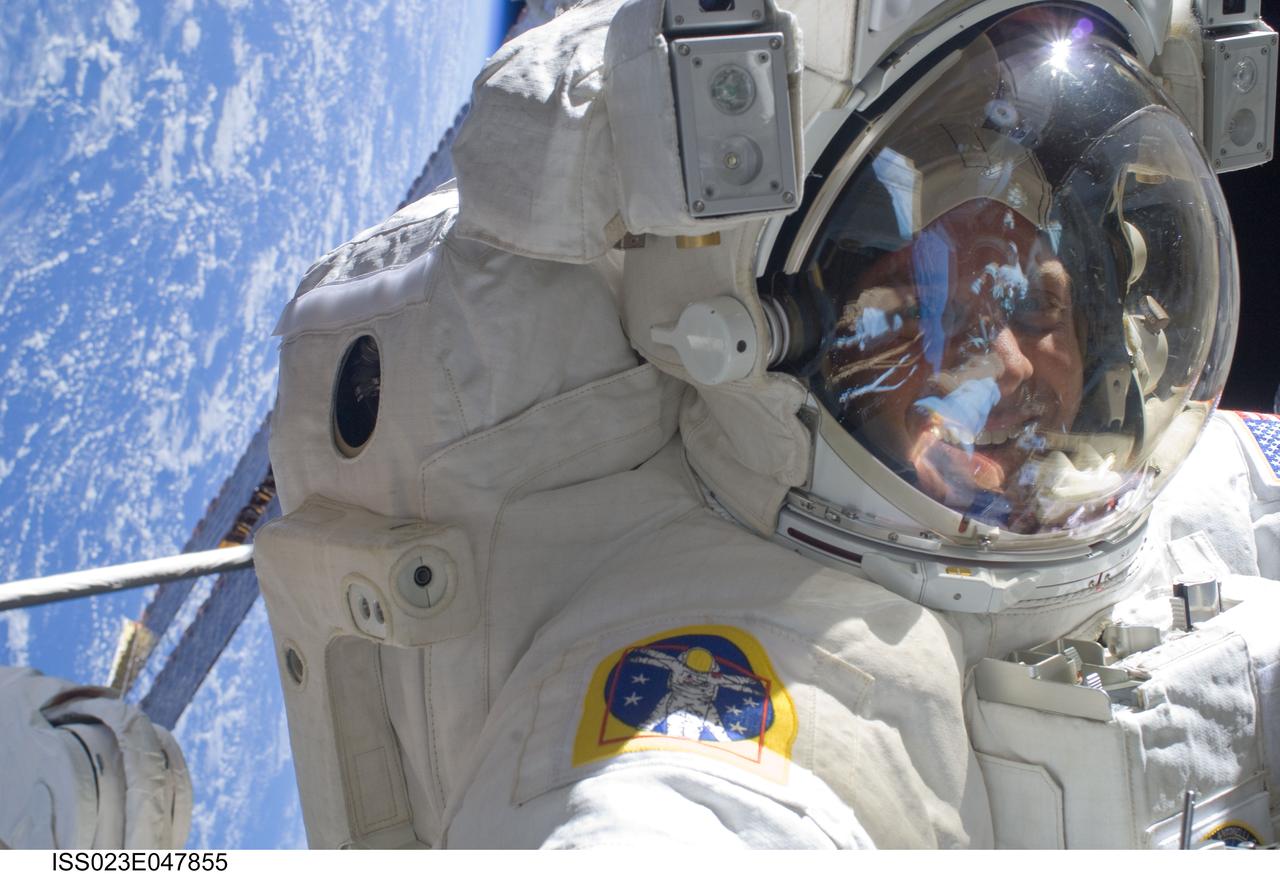
ISS023-E-047855 (21 May 2010) --- NASA astronaut Garrett Reisman, STS-132 mission specialist, participates in the mission?s third and final session of extravehicular activity (EVA) as construction and maintenance continue on the International Space Station. During the six-hour, 46-minute spacewalk, Reisman and NASA astronaut Michael Good (out of frame), mission specialist, completed the installation of the final two of the six new batteries for the B side of the port 6 solar array. In addition, the astronauts installed a backup ammonia jumper cable between the port 4 and 5 trusses of the station, transferred a Power and Data Grapple Fixture from the shuttle to the station, and reconfigured some tools.
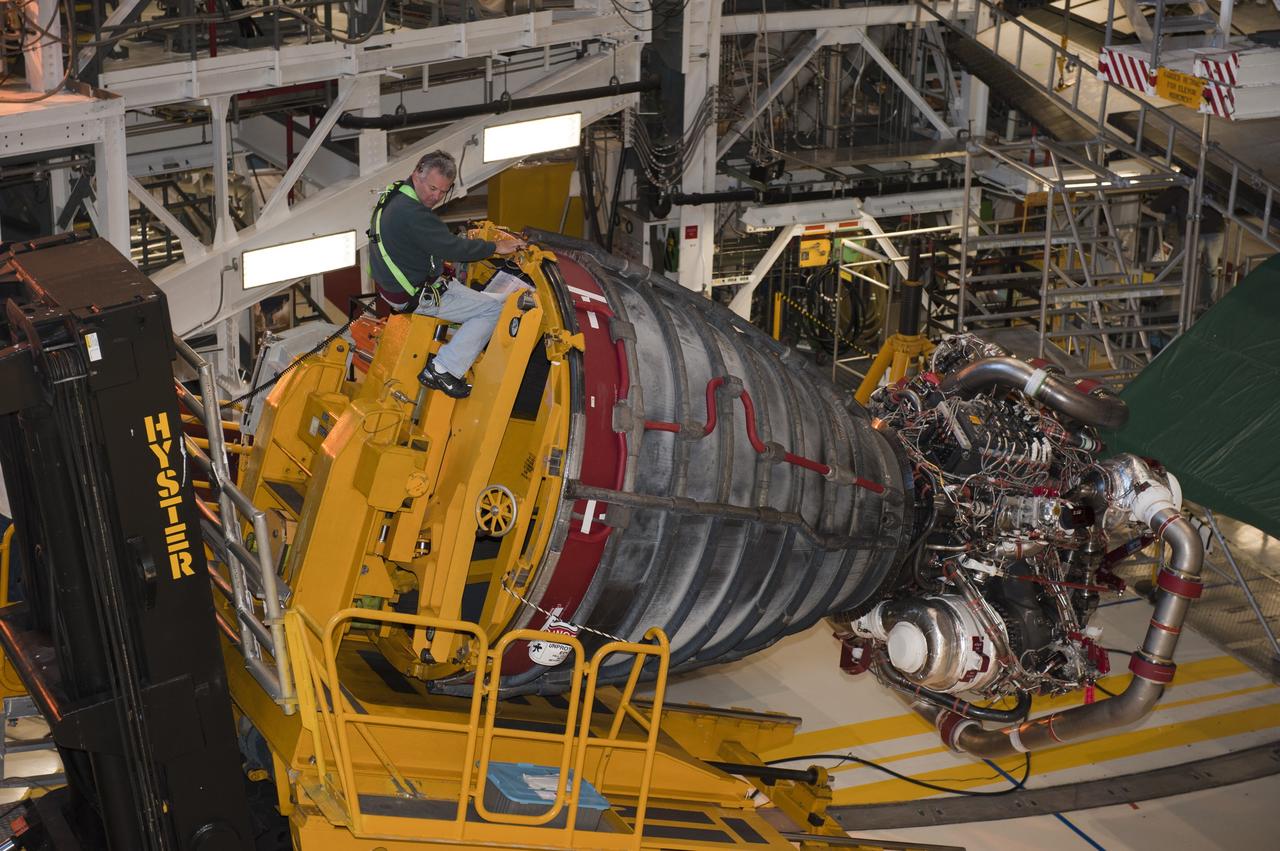
CAPE CANAVERAL, Fla. -- In Orbiter Processing Facility-1 at NASA's Kennedy Space Center in Florida, a Hyster forklift moves the first of three space shuttle main engines closer to space shuttle Atlantis for installation. Each engine is 14 feet long, weighs about 6,700 pounds, and is 7.5 feet in diameter at the end of the nozzle. This is the final planned engine installation for the Space Shuttle Program. Atlantis is being prepared for the "launch on need," or potential rescue mission, for the final planned shuttle flight, Endeavour's STS-134 mission. For more information, visit www.nasa.gov/shuttle. Photo credit: NASA/Kim Shiflett
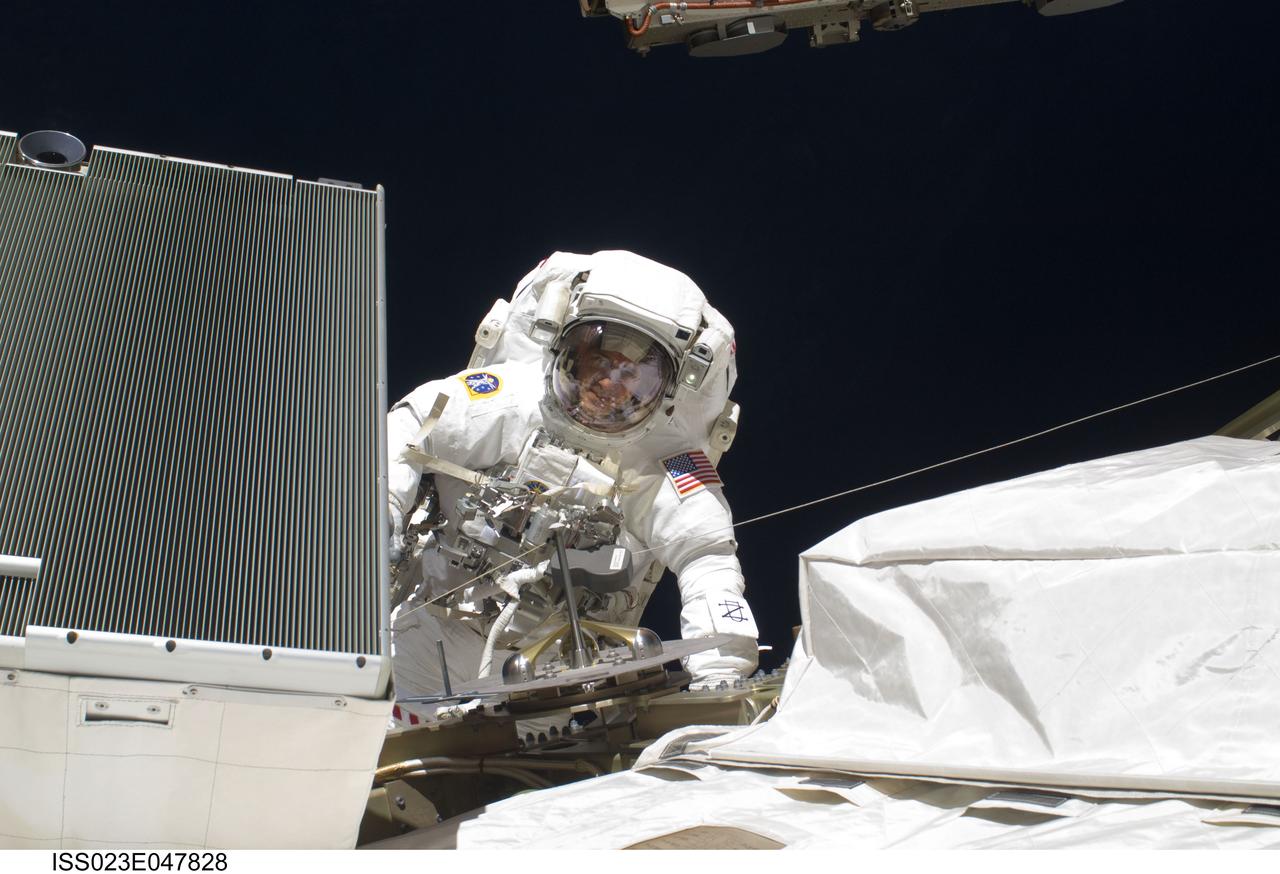
ISS023-E-047828 (21 May 2010) --- NASA astronaut Michael Good, STS-132 mission specialist, participates in the mission?s third and final session of extravehicular activity (EVA) as construction and maintenance continue on the International Space Station. During the six-hour, 46-minute spacewalk, Good and NASA astronaut Garrett Reisman (out of frame), mission specialist, completed the installation of the final two of the six new batteries for the B side of the port 6 solar array. In addition, the astronauts installed a backup ammonia jumper cable between the port 4 and 5 trusses of the station, transferred a Power and Data Grapple Fixture from the shuttle to the station, and reconfigured some tools.
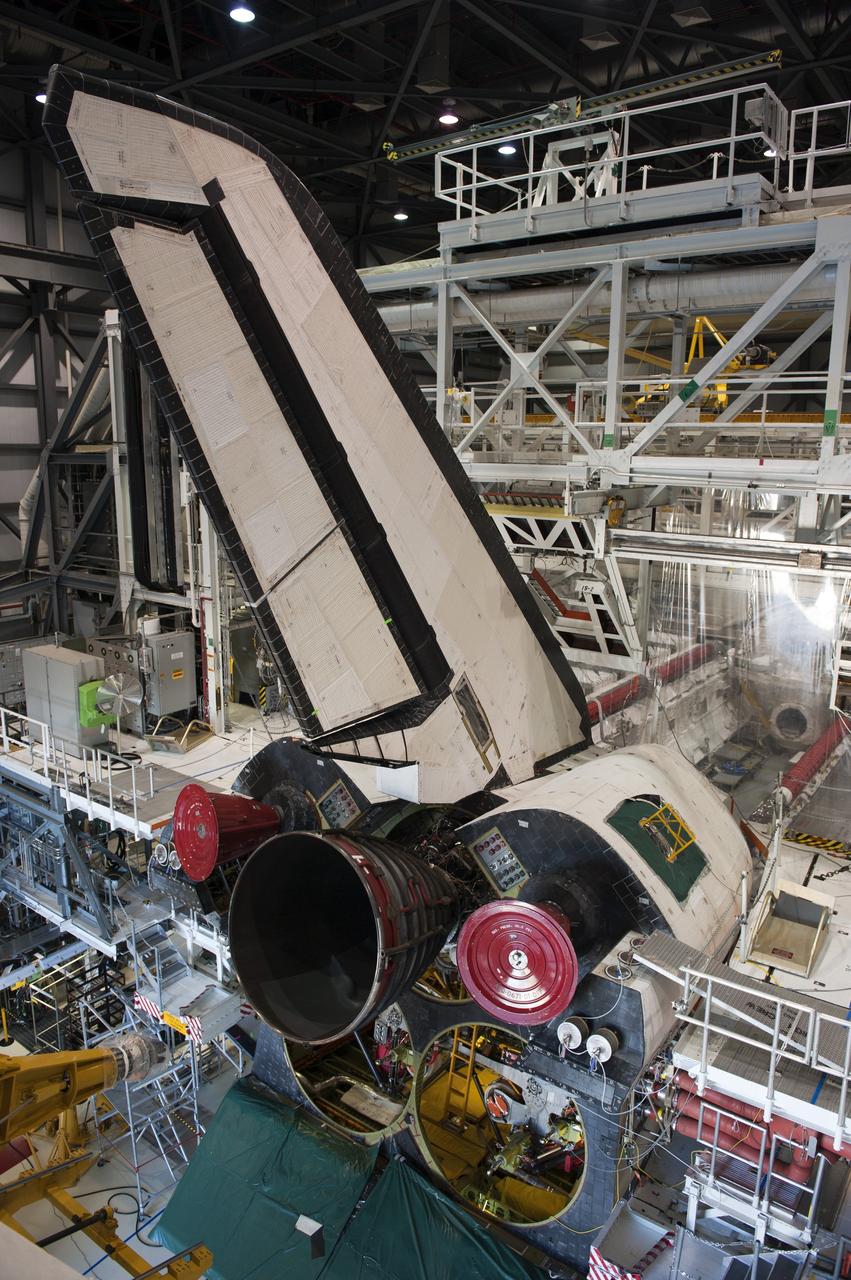
CAPE CANAVERAL, Fla. -- In Orbiter Processing Facility-1 at NASA's Kennedy Space Center in Florida, the first of three space shuttle main engines is installed in space shuttle Atlantis. Each engine is 14 feet long, weighs about 6,700 pounds, and is 7.5 feet in diameter at the end of the nozzle. This is the final planned engine installation for the Space Shuttle Program. Atlantis is being prepared for the "launch on need," or potential rescue mission, for the final planned shuttle flight, Endeavour's STS-134 mission. For more information, visit www.nasa.gov/shuttle. Photo credit: NASA/Kim Shiflett
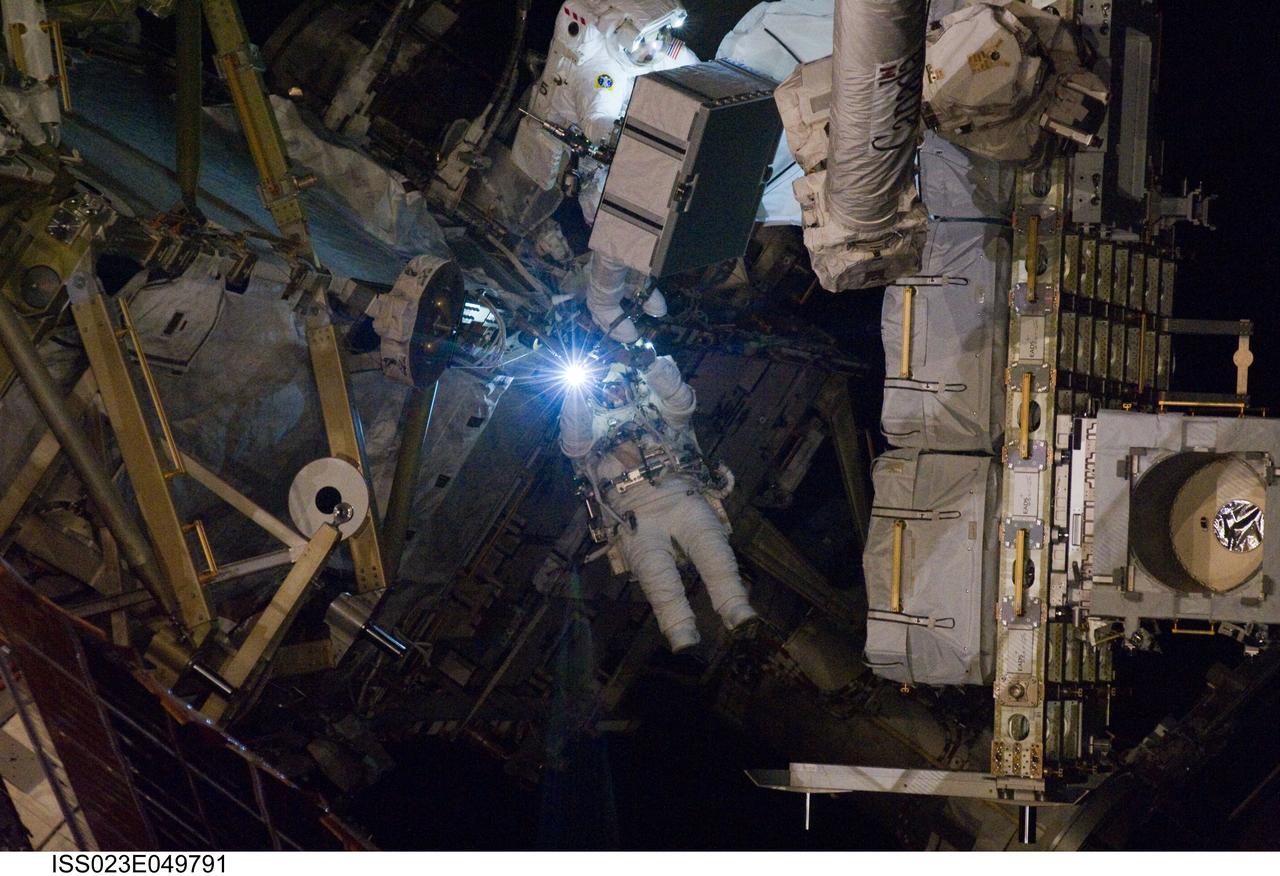
ISS023-E-049791 (21 May 2010) --- NASA astronauts Garrett Reisman (bottom) and Michael Good, both STS-132 mission specialists, participate in the mission?s third and final session of extravehicular activity (EVA) as construction and maintenance continue on the International Space Station. During the six-hour, 46-minute spacewalk, Reisman and Good completed the installation of the final two of the six new batteries for the B side of the port 6 solar array. In addition, the astronauts installed a backup ammonia jumper cable between the port 4 and 5 trusses of the station, transferred a Power and Data Grapple Fixture from the shuttle to the station, and reconfigured some tools.
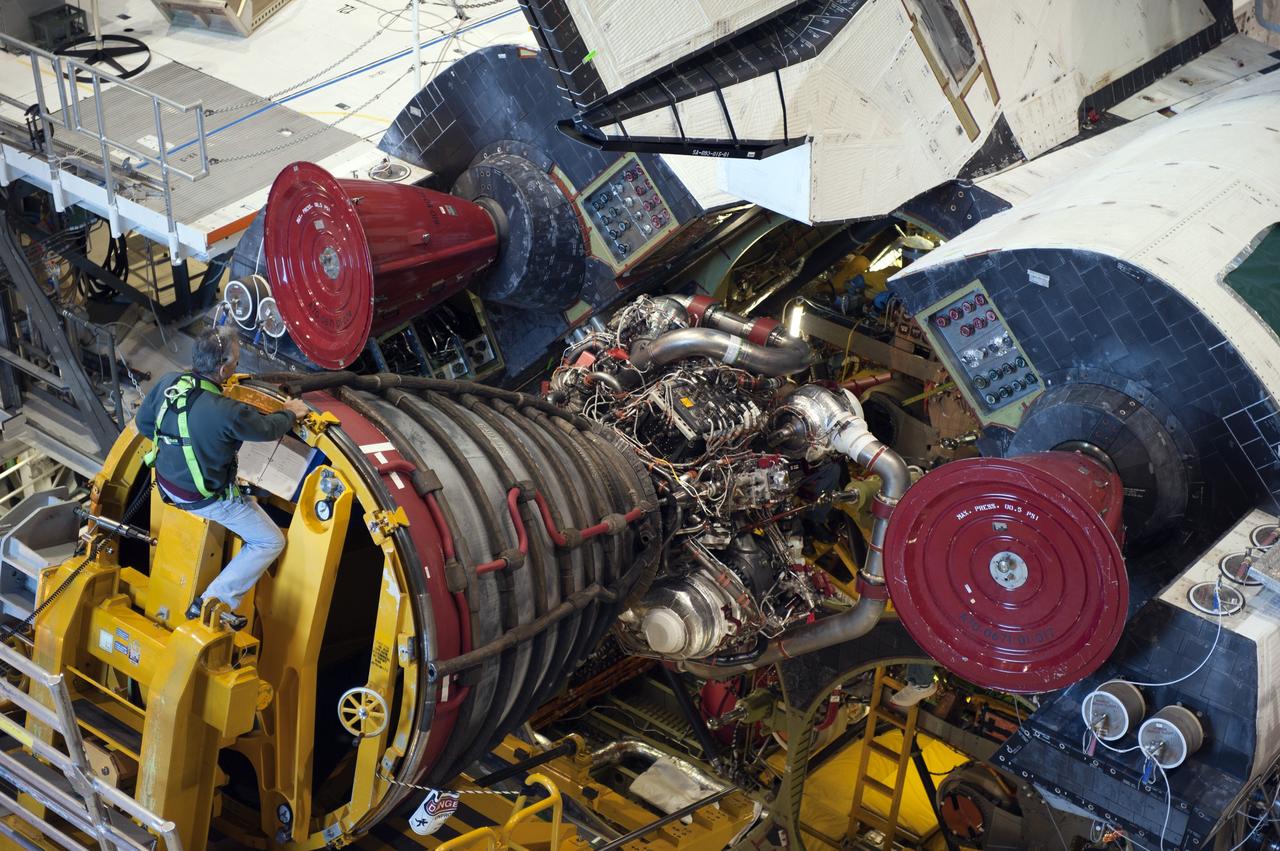
CAPE CANAVERAL, Fla. -- In Orbiter Processing Facility-1 at NASA's Kennedy Space Center in Florida, a Hyster forklift moves the first of three space shuttle main engines closer to space shuttle Atlantis for installation. Each engine is 14 feet long, weighs about 6,700 pounds, and is 7.5 feet in diameter at the end of the nozzle. This is the final planned engine installation for the Space Shuttle Program. Atlantis is being prepared for the "launch on need," or potential rescue mission, for the final planned shuttle flight, Endeavour's STS-134 mission. For more information, visit www.nasa.gov/shuttle. Photo credit: NASA/Kim Shiflett

ISS023-E-047845 (21 May 2010) --- NASA astronaut Michael Good, STS-132 mission specialist, participates in the mission?s third and final session of extravehicular activity (EVA) as construction and maintenance continue on the International Space Station. During the six-hour, 46-minute spacewalk, Good and NASA astronaut Garrett Reisman (out of frame), mission specialist, completed the installation of the final two of the six new batteries for the B side of the port 6 solar array. In addition, the astronauts installed a backup ammonia jumper cable between the port 4 and 5 trusses of the station, transferred a Power and Data Grapple Fixture from the shuttle to the station, and reconfigured some tools.
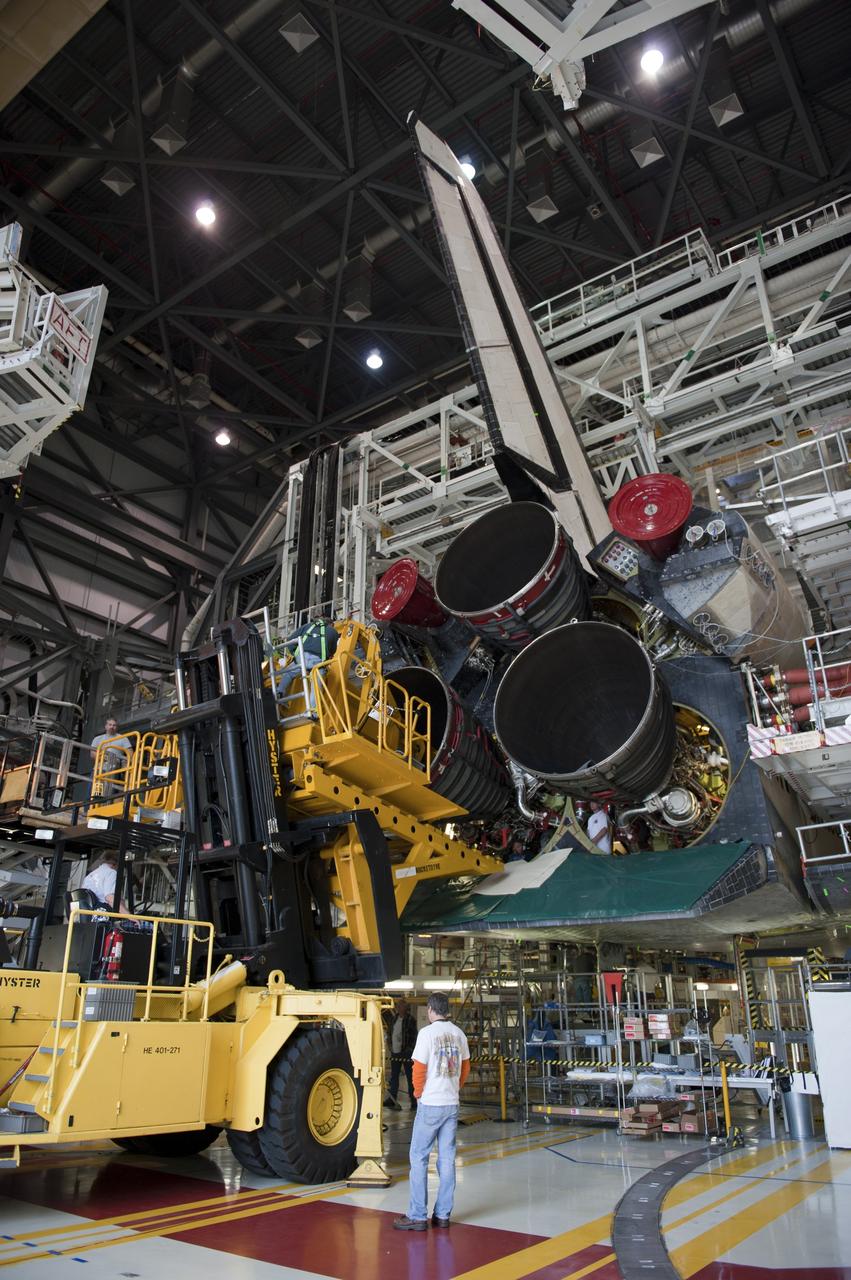
CAPE CANAVERAL, Fla. -- In Orbiter Processing Facility-1 at NASA's Kennedy Space Center in Florida, engine #2, the last of three space shuttle main engines is being installed in shuttle Atlantis. Each engine is 14 feet long, weighs about 6,700 pounds, and is 7.5 feet in diameter at the end of the nozzle. This is the final planned engine installation for the Space Shuttle Program. Atlantis is being prepared for the "launch on need," or potential rescue mission, for the final planned shuttle flight, Endeavour's STS-134 mission. For more information, visit www.nasa.gov/shuttle. Photo credit: NASA/Kim Shiflett
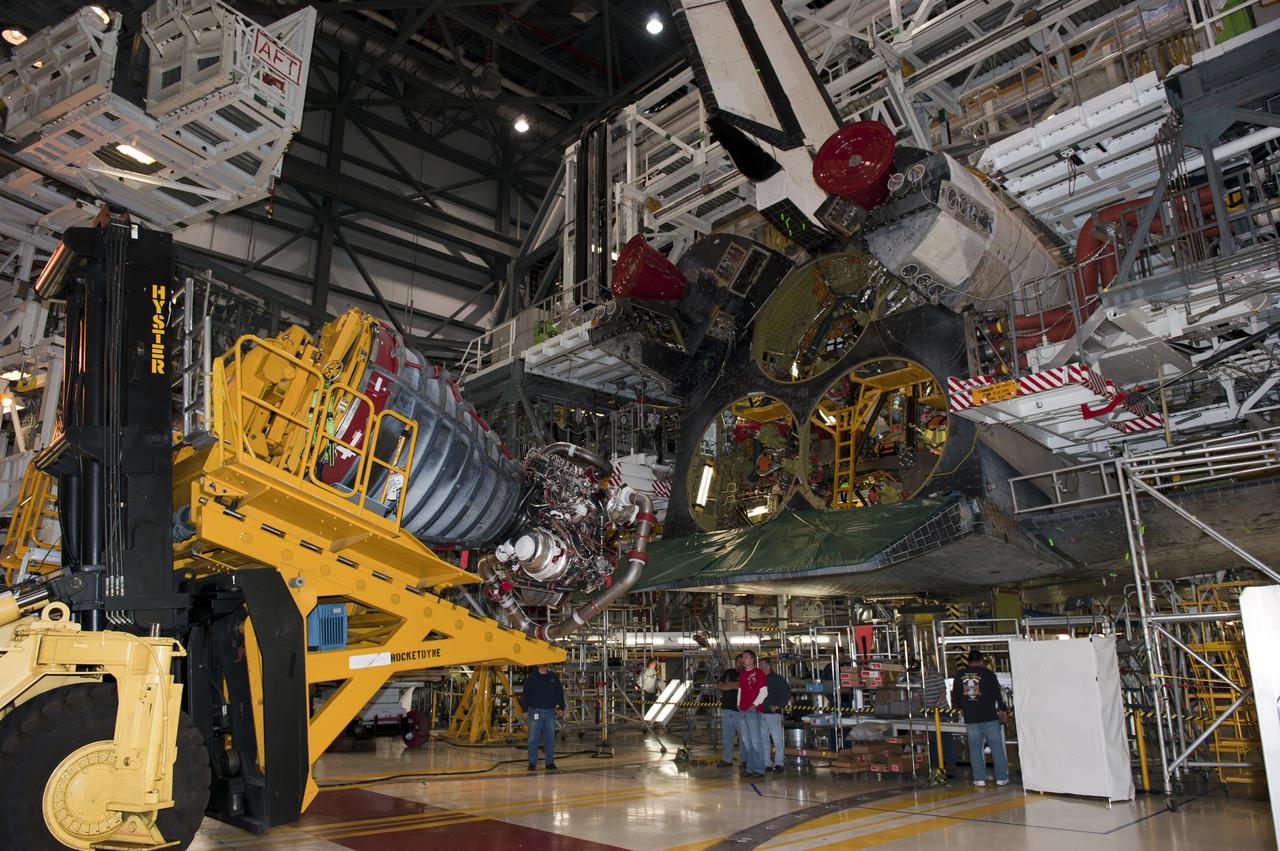
CAPE CANAVERAL, Fla. -- In Orbiter Processing Facility-1 at NASA's Kennedy Space Center in Florida, a Hyster forklift moves the first of three space shuttle main engines closer to space shuttle Atlantis for installation. Each engine is 14 feet long, weighs about 6,700 pounds, and is 7.5 feet in diameter at the end of the nozzle. This is the final planned engine installation for the Space Shuttle Program. Atlantis is being prepared for the "launch on need," or potential rescue mission, for the final planned shuttle flight, Endeavour's STS-134 mission. For more information, visit www.nasa.gov/shuttle. Photo credit: NASA/Kim Shiflett
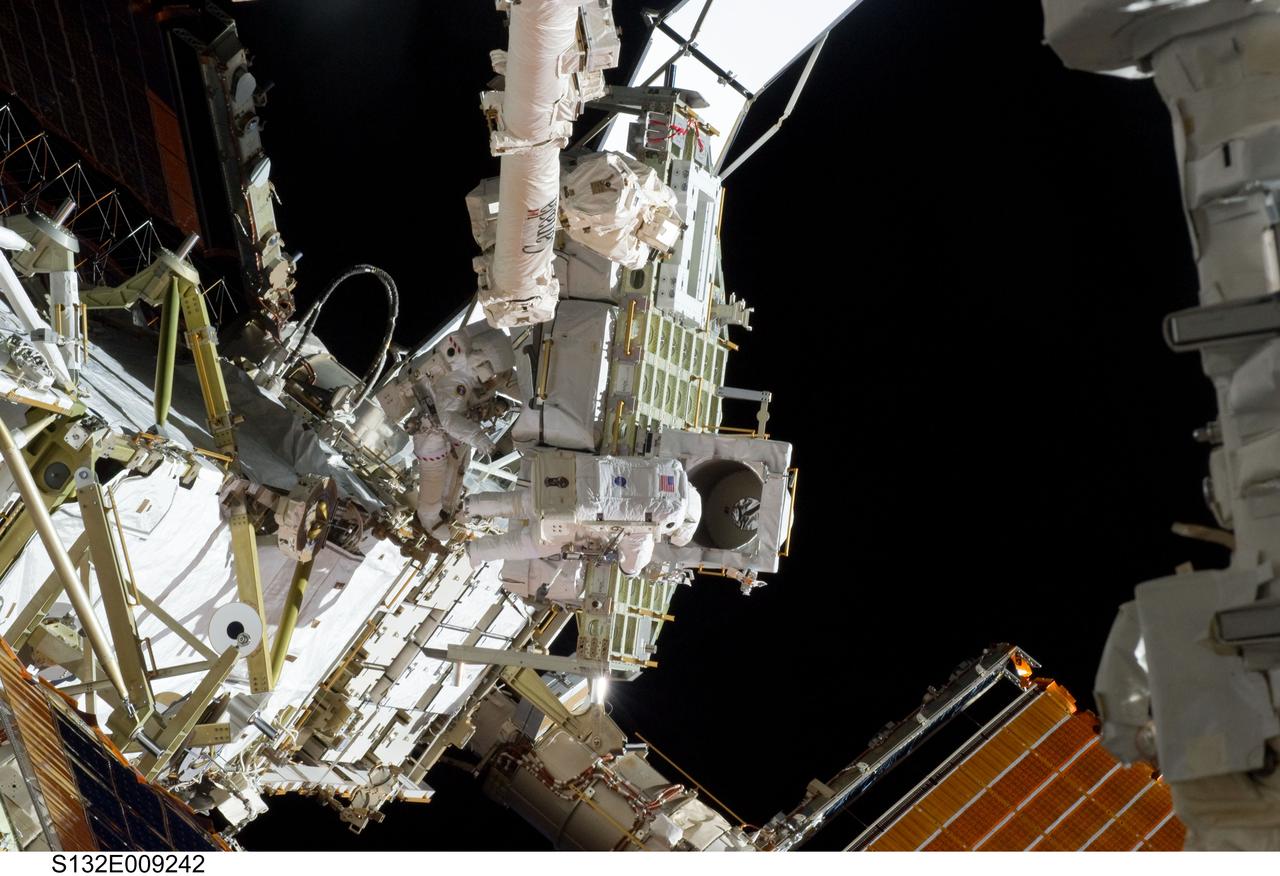
S132-E-009242 (21 May 2010) --- NASA astronauts Michael Good (left) and Garrett Reisman, both STS-132 mission specialists, participate in the mission’s third and final session of extravehicular activity (EVA) as construction and maintenance continue on the International Space Station. During the six-hour, 46-minute spacewalk, Good and Reisman completed the installation of the final two of the six new batteries for the B side of the port 6 solar array. In addition, the astronauts installed a backup ammonia jumper cable between the port 4 and 5 trusses of the station, transferred a Power and Data Grapple Fixture from the shuttle to the station, and reconfigured some tools.
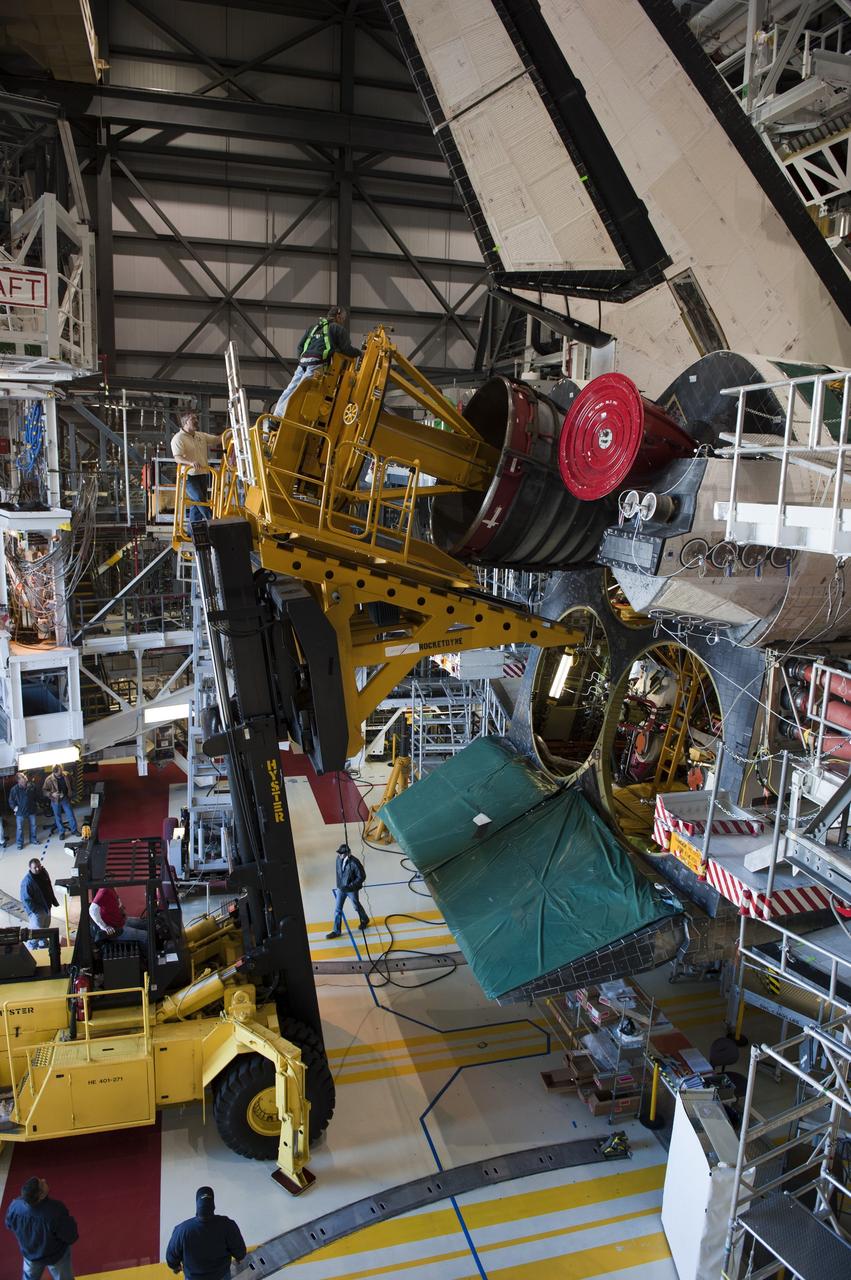
CAPE CANAVERAL, Fla. -- In Orbiter Processing Facility-1 at NASA's Kennedy Space Center in Florida, a Hyster forklift moves the first of three space shuttle main engines closer to space shuttle Atlantis for installation. Each engine is 14 feet long, weighs about 6,700 pounds, and is 7.5 feet in diameter at the end of the nozzle. This is the final planned engine installation for the Space Shuttle Program. Atlantis is being prepared for the "launch on need," or potential rescue mission, for the final planned shuttle flight, Endeavour's STS-134 mission. For more information, visit www.nasa.gov/shuttle. Photo credit: NASA/Kim Shiflett
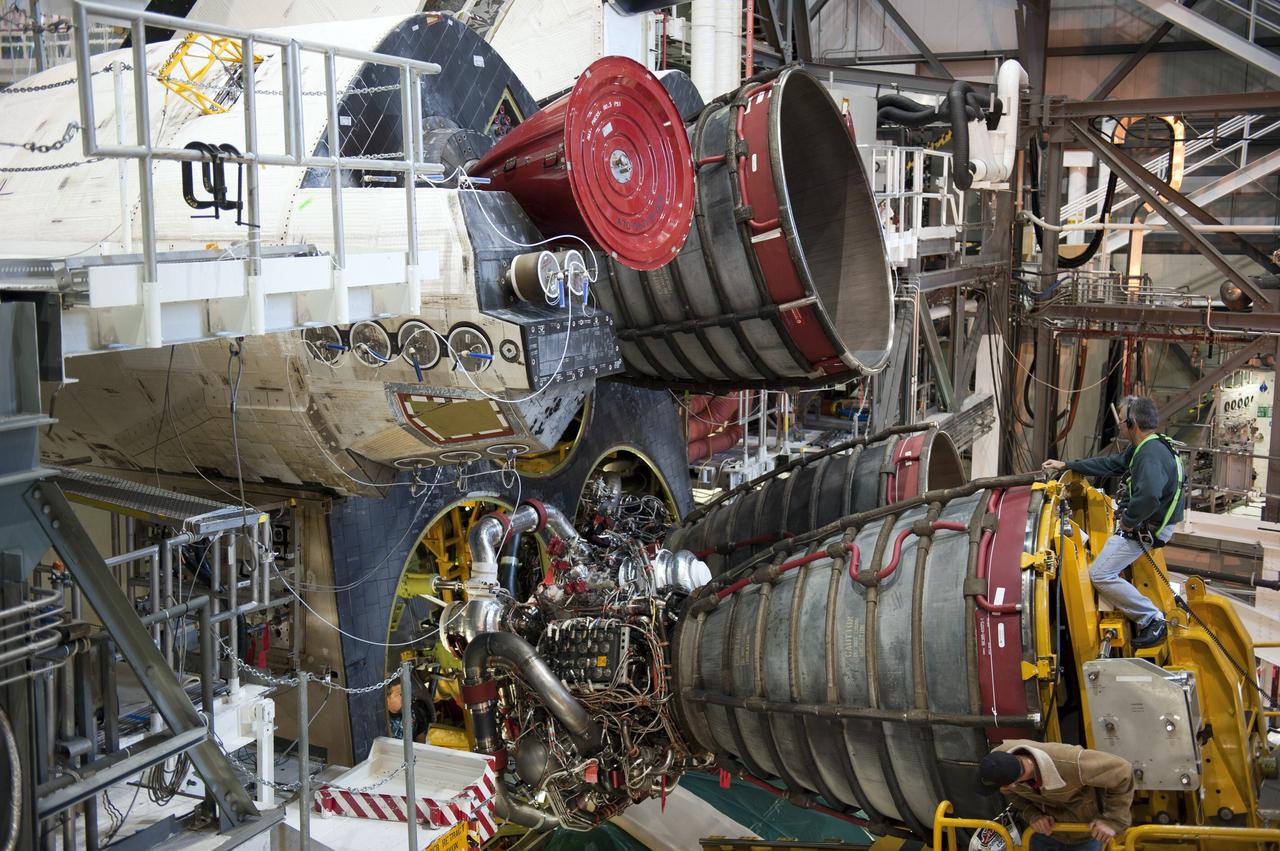
CAPE CANAVERAL, Fla. -- In Orbiter Processing Facility-1 at NASA's Kennedy Space Center in Florida, engine #2, the last of three space shuttle main engines is being installed in shuttle Atlantis. Each engine is 14 feet long, weighs about 6,700 pounds, and is 7.5 feet in diameter at the end of the nozzle. This is the final planned engine installation for the Space Shuttle Program. Atlantis is being prepared for the "launch on need," or potential rescue mission, for the final planned shuttle flight, Endeavour's STS-134 mission. For more information, visit www.nasa.gov/shuttle. Photo credit: NASA/Kim Shiflett
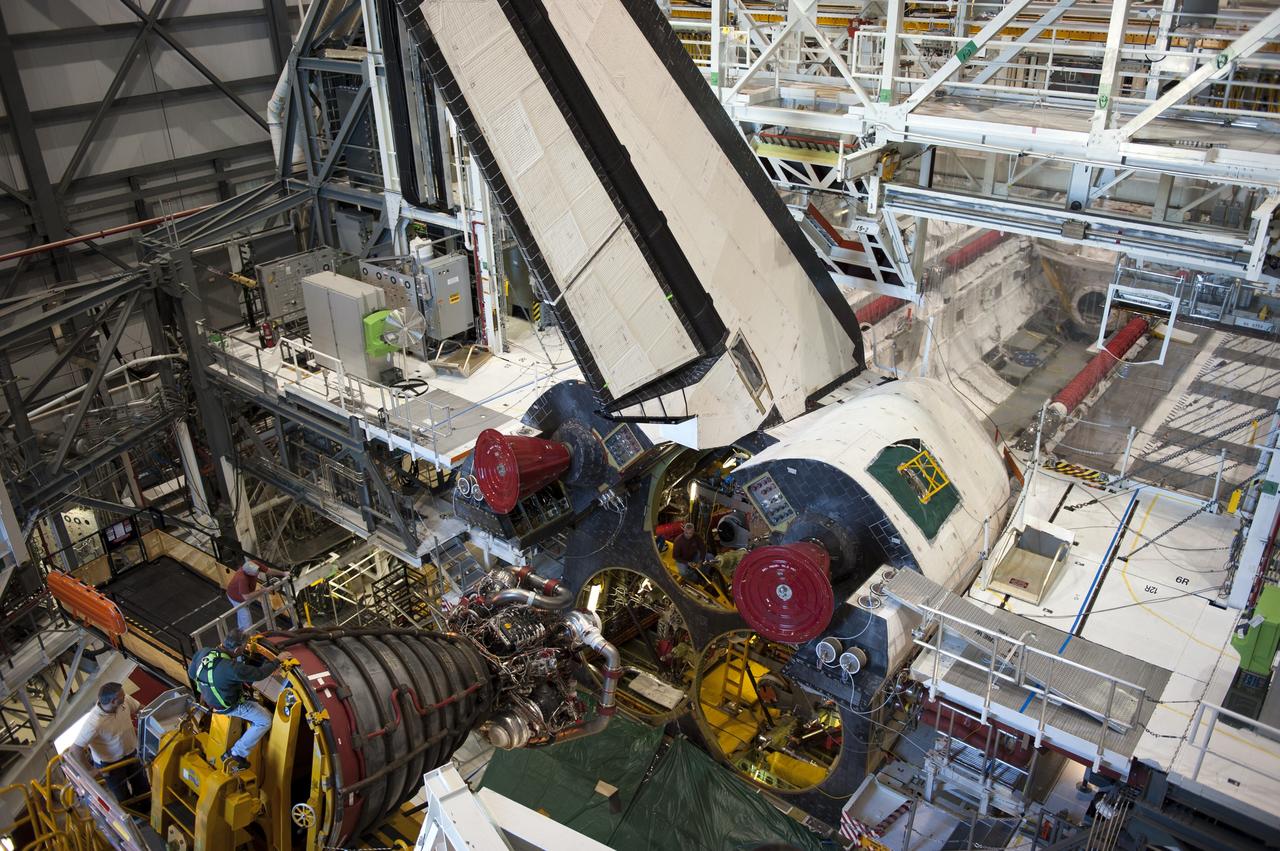
CAPE CANAVERAL, Fla. -- In Orbiter Processing Facility-1 at NASA's Kennedy Space Center in Florida, a Hyster forklift moves the first of three space shuttle main engines closer to space shuttle Atlantis for installation. Each engine is 14 feet long, weighs about 6,700 pounds, and is 7.5 feet in diameter at the end of the nozzle. This is the final planned engine installation for the Space Shuttle Program. Atlantis is being prepared for the "launch on need," or potential rescue mission, for the final planned shuttle flight, Endeavour's STS-134 mission. For more information, visit www.nasa.gov/shuttle. Photo credit: NASA/Kim Shiflett
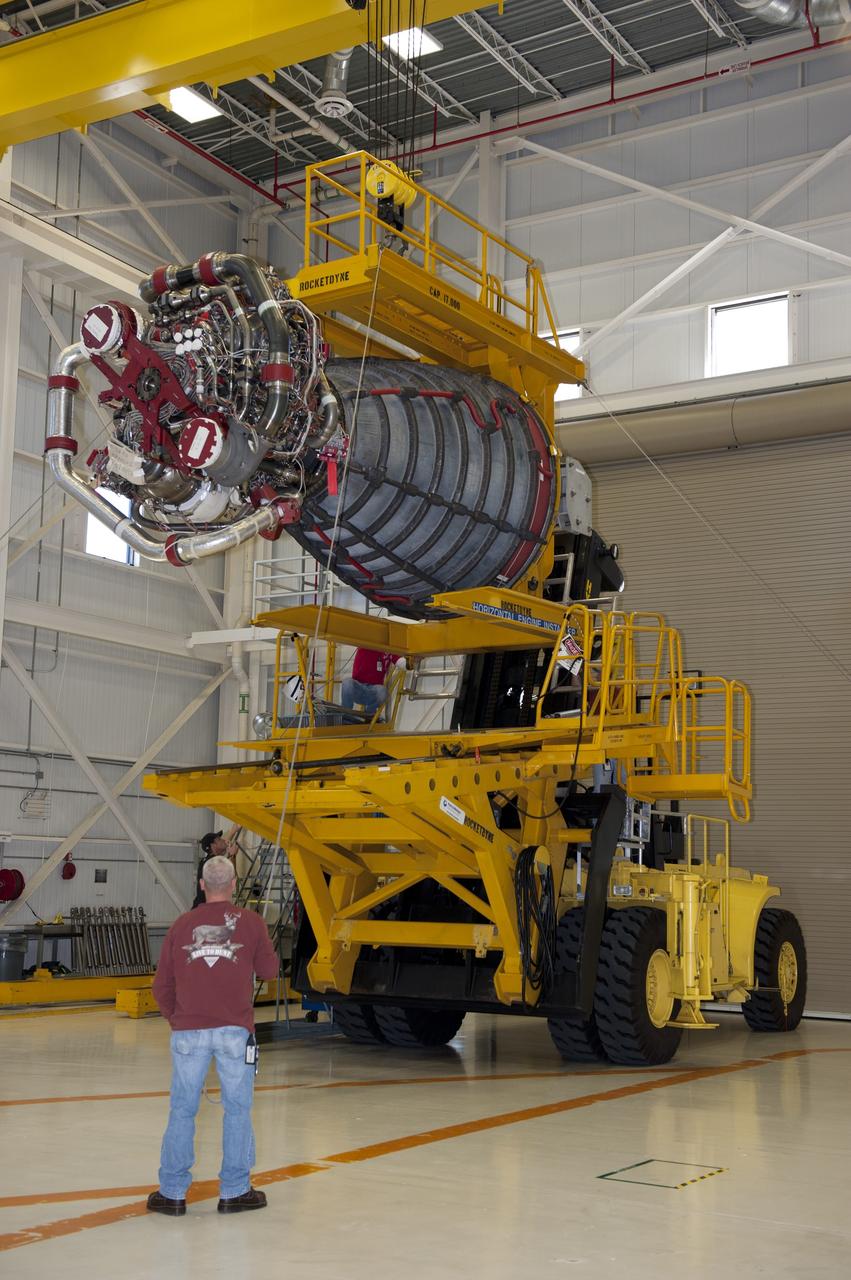
CAPE CANAVERAL, Fla. -- Workers in the Space Shuttle Main Engine (SSME) Shop at NASA's Kennedy Space Center in Florida attached the second of shuttle Atlantis' three main engines to a Hyster forklift. Next, the engine will be transported to Orbiter Processing Facility-1 where it will be installed in the shuttle. Each engine is 14 feet long, weighs about 6,700 pounds, and is 7.5 feet in diameter at the end of the nozzle. This is the final planned engine installation for the Space Shuttle Program. Atlantis is being prepared for the "launch on need," or potential rescue mission, for the final planned shuttle flight, Endeavour's STS-134 mission. For more information, visit www.nasa.gov/shuttle. Photo credit: NASA/Kim Shiflett
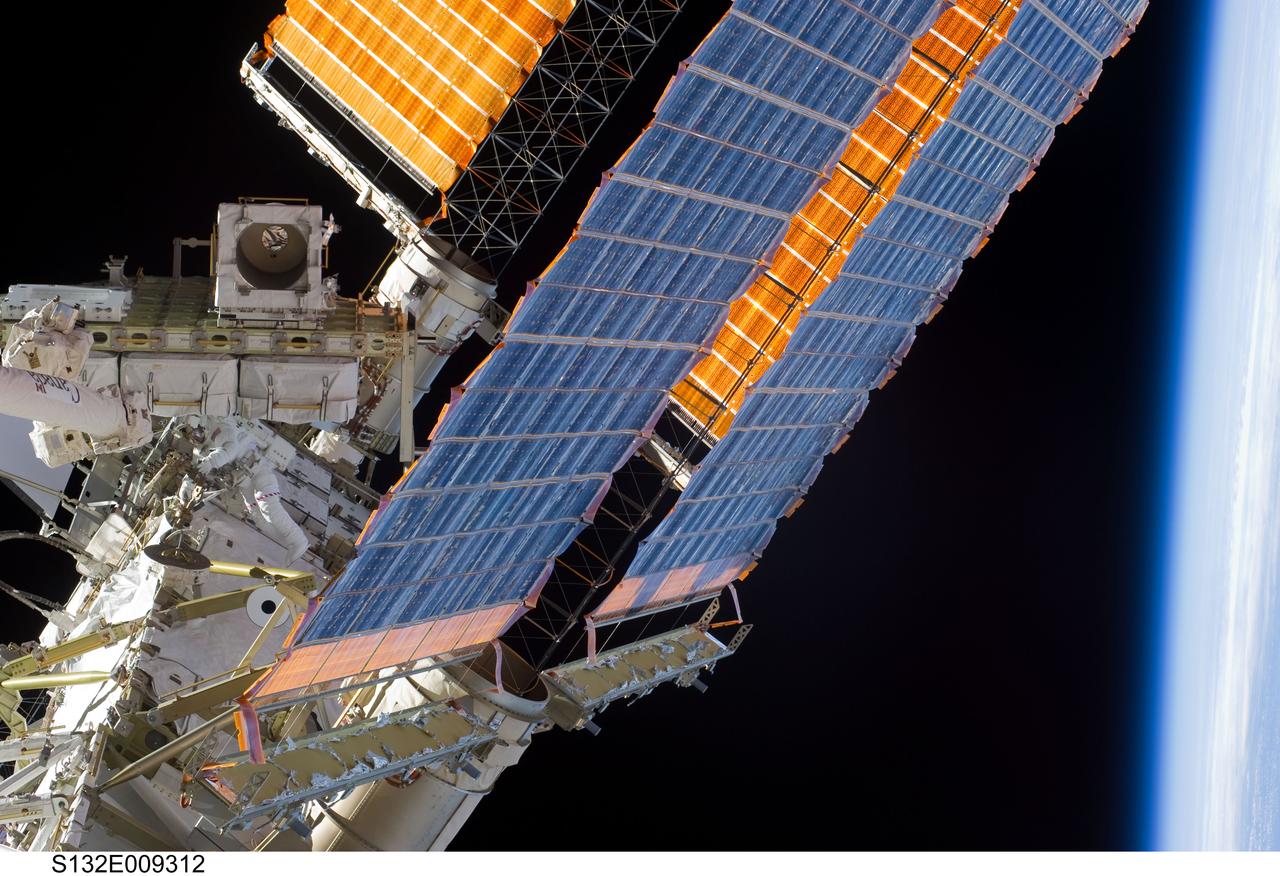
S132-E-009312 (21 May 2010) --- NASA astronaut Michael Good, STS-132 mission specialist, participates in the mission’s third and final session of extravehicular activity (EVA) as construction and maintenance continue on the International Space Station. During the six-hour, 46-minute spacewalk, Good and NASA astronaut Garrett Reisman (out of frame), mission specialist, completed the installation of the final two of the six new batteries for the B side of the port 6 solar array. In addition, the astronauts installed a backup ammonia jumper cable between the port 4 and 5 trusses of the station, transferred a Power and Data Grapple Fixture from the shuttle to the station, and reconfigured some tools.
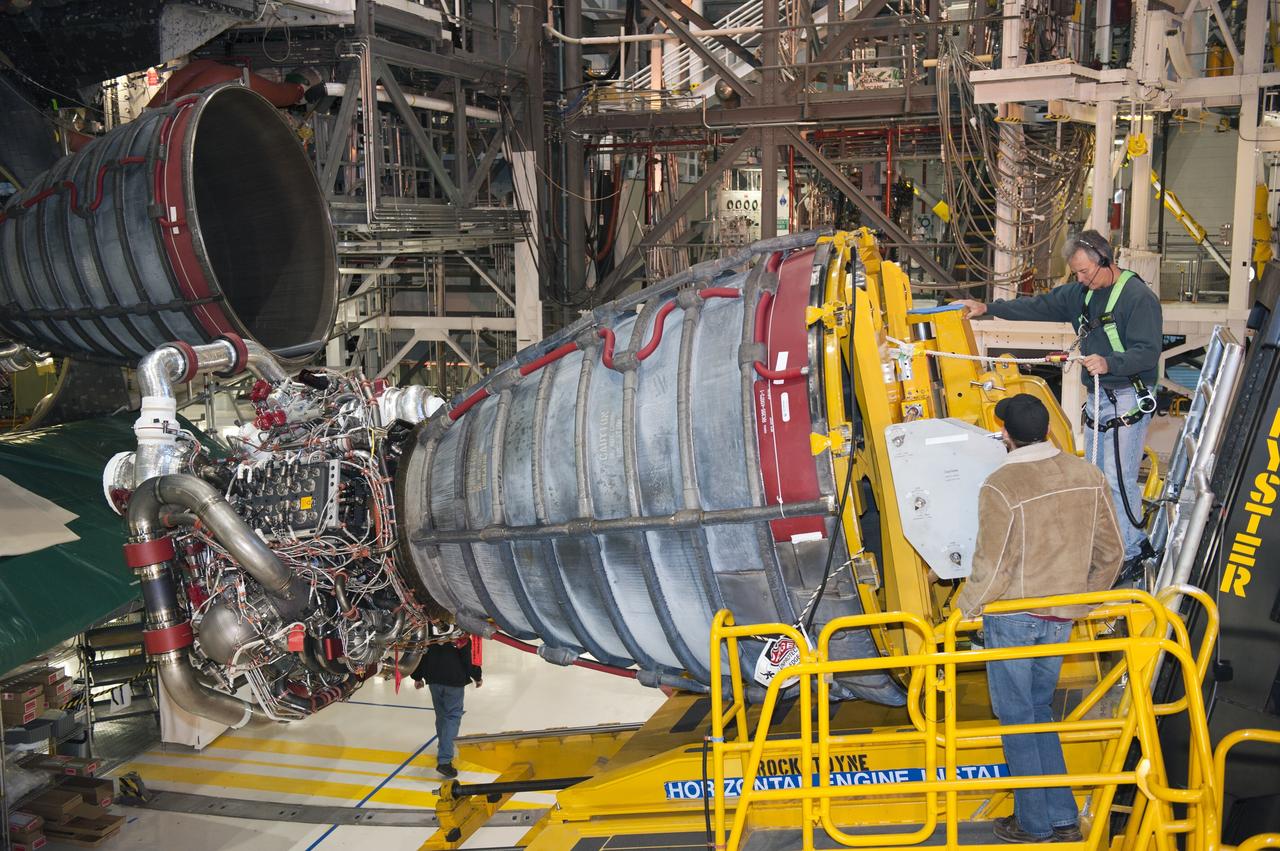
CAPE CANAVERAL, Fla. -- In Orbiter Processing Facility-1 at NASA's Kennedy Space Center in Florida, a Hyster forklift moves engine #2, the last of three space shuttle main engines, closer to shuttle Atlantis for installation. Each engine is 14 feet long, weighs about 6,700 pounds, and is 7.5 feet in diameter at the end of the nozzle. This is the final planned engine installation for the Space Shuttle Program. Atlantis is being prepared for the "launch on need," or potential rescue mission, for the final planned shuttle flight, Endeavour's STS-134 mission. For more information, visit www.nasa.gov/shuttle. Photo credit: NASA/Kim Shiflett