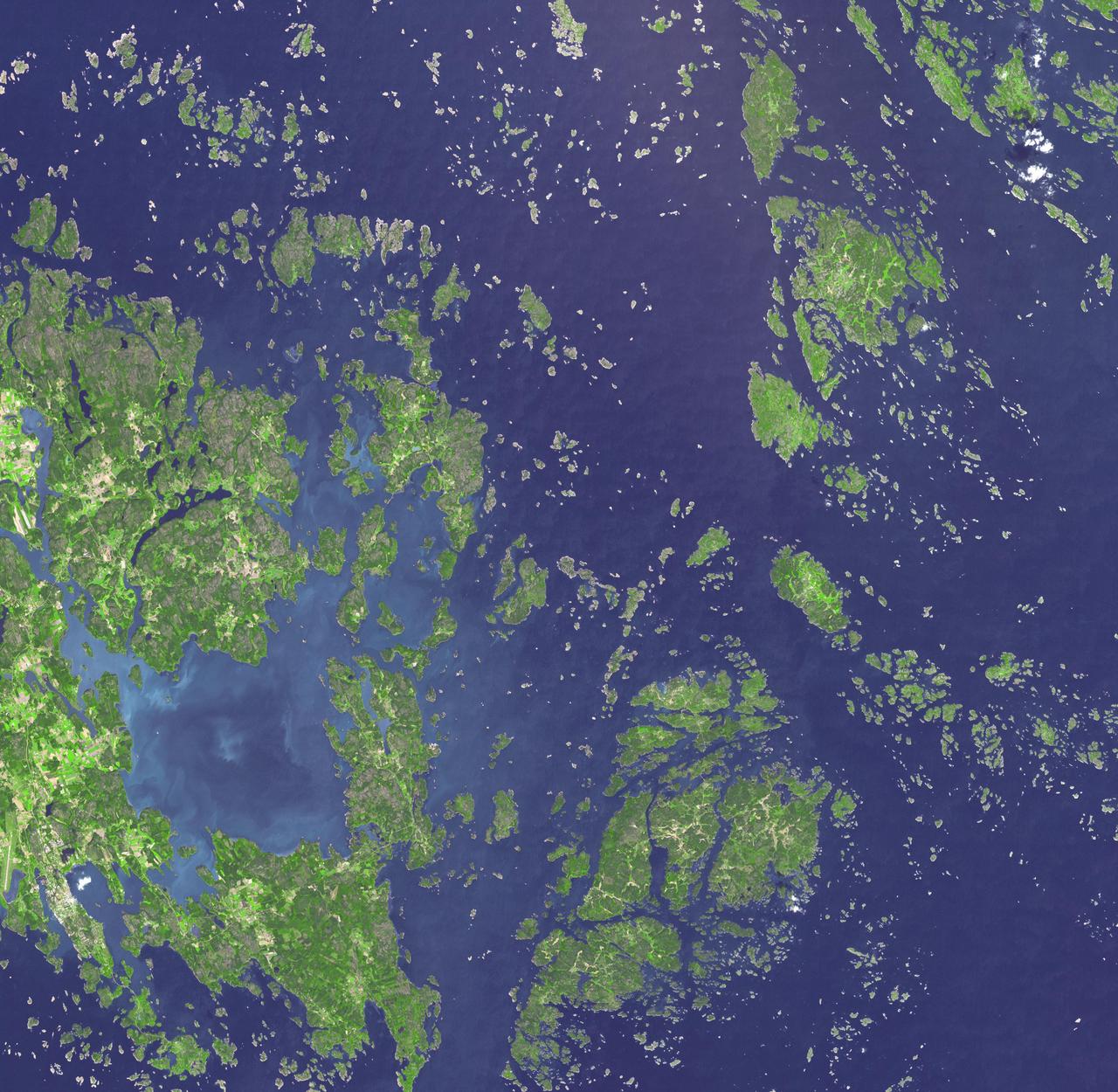
This image, acquired by NASA Terra spacecraft, is of the Aaland archipelago at the mouth of the Gulf of Bothnia which belongs to Finland, though it enjoys autonomy from Helsinki and locals speak Swedish.

The border between Russia and Finland is shown in this MISR Mystery Quiz #12 captured by NASA Terra spacecraft.
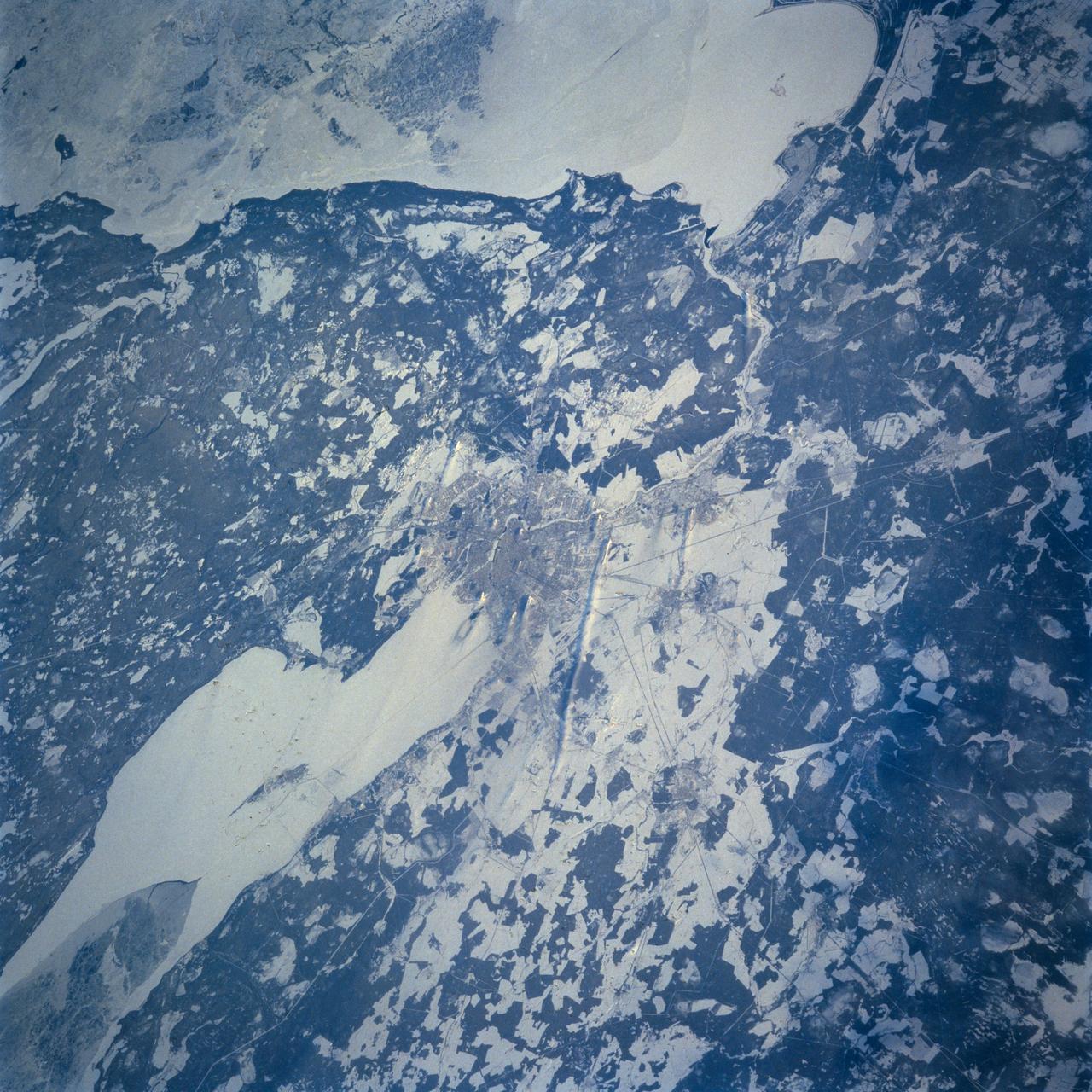
STS060-103-055 (3-11 Feb 1994) --- This wintertime photograph shows the large city of St. Petersburg Russia at the head of the Gulf of Finland. The city, built by Peter the Great, is situated in the former swampy delta of the Neva River which connects the large Lake Ladoga (the frozen white surface on the edge of the photograph) to the Gulf of Finland. An interesting feature of St. Petersburg which can be discerned in this photograph is the new storm surge barrier built from both sides of the Gulf of Finland out to the island of Kronstadt in the middle. This barrier, similar to that which was built on the Thames River south of London to protect it from storm surges out of the North Sea, was constructed to protect St. Petersburg from storm surges coming out of the Baltic Sea and being magnified by the topography and hydrography of the Gulf of Finland. Also visible as a thin line between Kronstadt and St. Petersburg is the ice-free shipping channel kept open much of the winter. Power plant plumes are also visible on the frame. St. Petersburg is the home of the Russian cosmonaut, Sergei Krikalev, who flew aboard the Space Shuttle Discovery during STS-60.
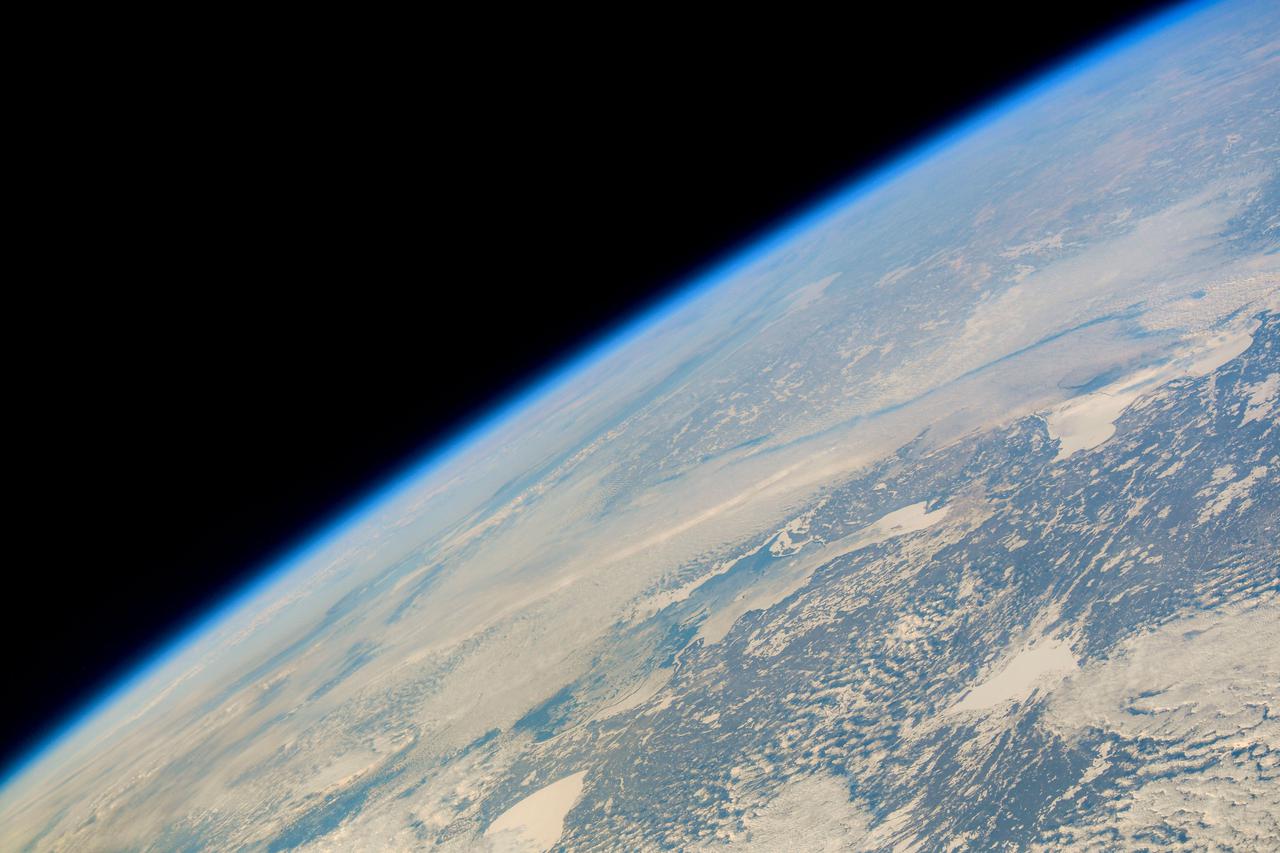
iss064e030134 (Feb. 8, 2021) --- An icy northern Europe, looking across Estonia, Russia and Finland, is pictured from the International Space Station as it orbited 265 miles above Ukraine. Credit: Roscosmos
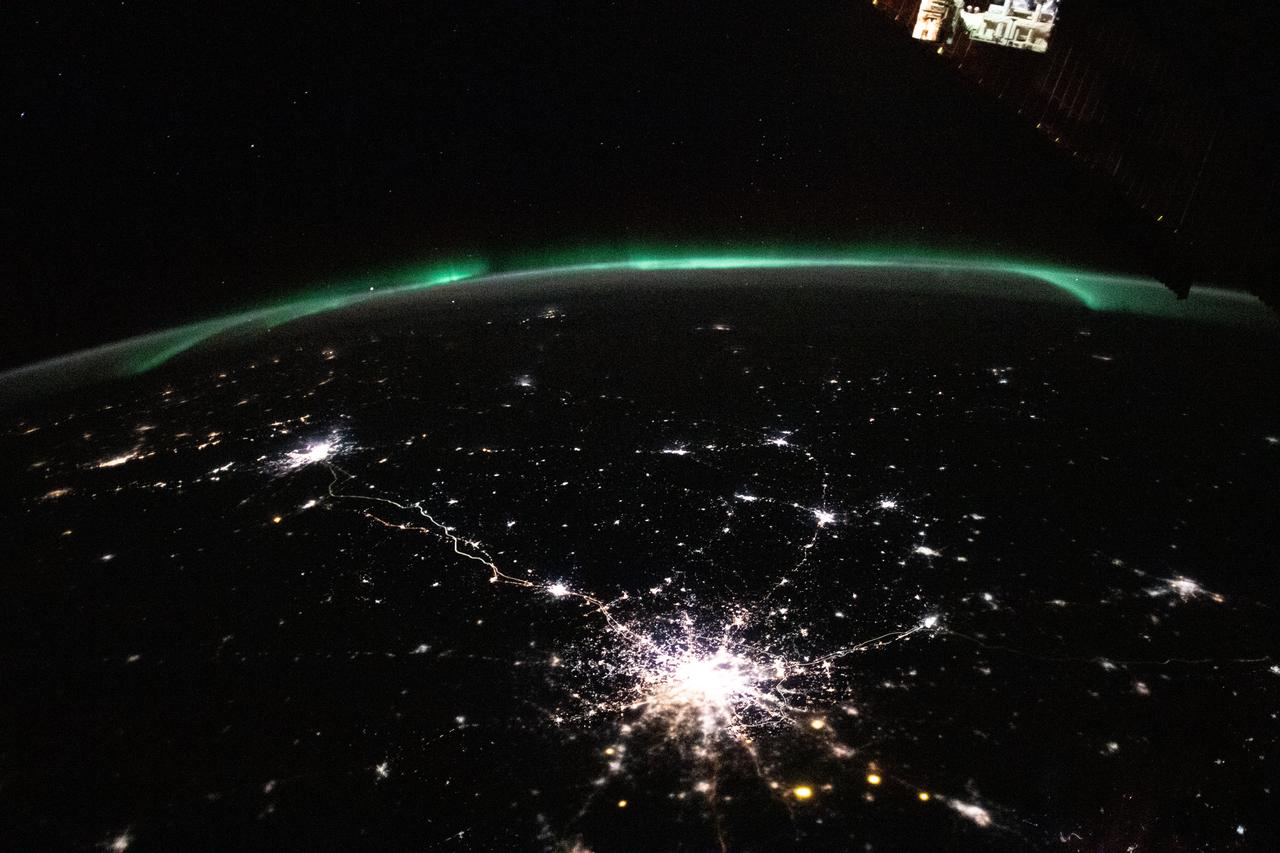
iss070e026402 (Nov. 17, 2023) --- The city lights (bottom center to far left) of Moscow and Saint Petersburg in Russia, to Helsinki, Finland, are framed by an aurora in this photograph from the International Space Station as it orbited 264 miles above.

iss064e024089 (Jan. 18, 2021) --- The International Space Station was orbiting 263 miles above Romania when this photograph was taken of the city lights of Sweden and Finland with an aurora above the Earth's horizon. The dark area in between the two Scandinavian nations is the Baltic Sea. Credit: Roscosmos

NASA's Landsat 8 satellite collected this view of phytoplankton blooming in the southern Gulf of Bothnia, in the Baltic Sea, between Sweden and Finland on April 14, 2019. Jupiter's atmosphere is one of the most turbulent places in the solar system. Orbiting Jupiter and its 79 moons is NASA's Juno spacecraft, which sends images from the largest planet in our solar system back to researchers on Earth. These images from Juno have given oceanographers the raw materials to study the rich turbulence at Jupiter's poles and the physical forces that drive large cyclones on the gas giant. Lia Siegelman, a physical oceanographer and postdoctoral scholar at Scripps Institution of Oceanography at the University of California, San Diego, observed similarities between the richness of turbulence around Jovian cyclones and the filaments around smaller eddies with turbulence seen in Earth's oceans. These similarities between the phenomena on Earth and Jupiter are especially evident on high-resolution images of plankton blooms, as seen above. https://photojournal.jpl.nasa.gov/catalog/PIA25033
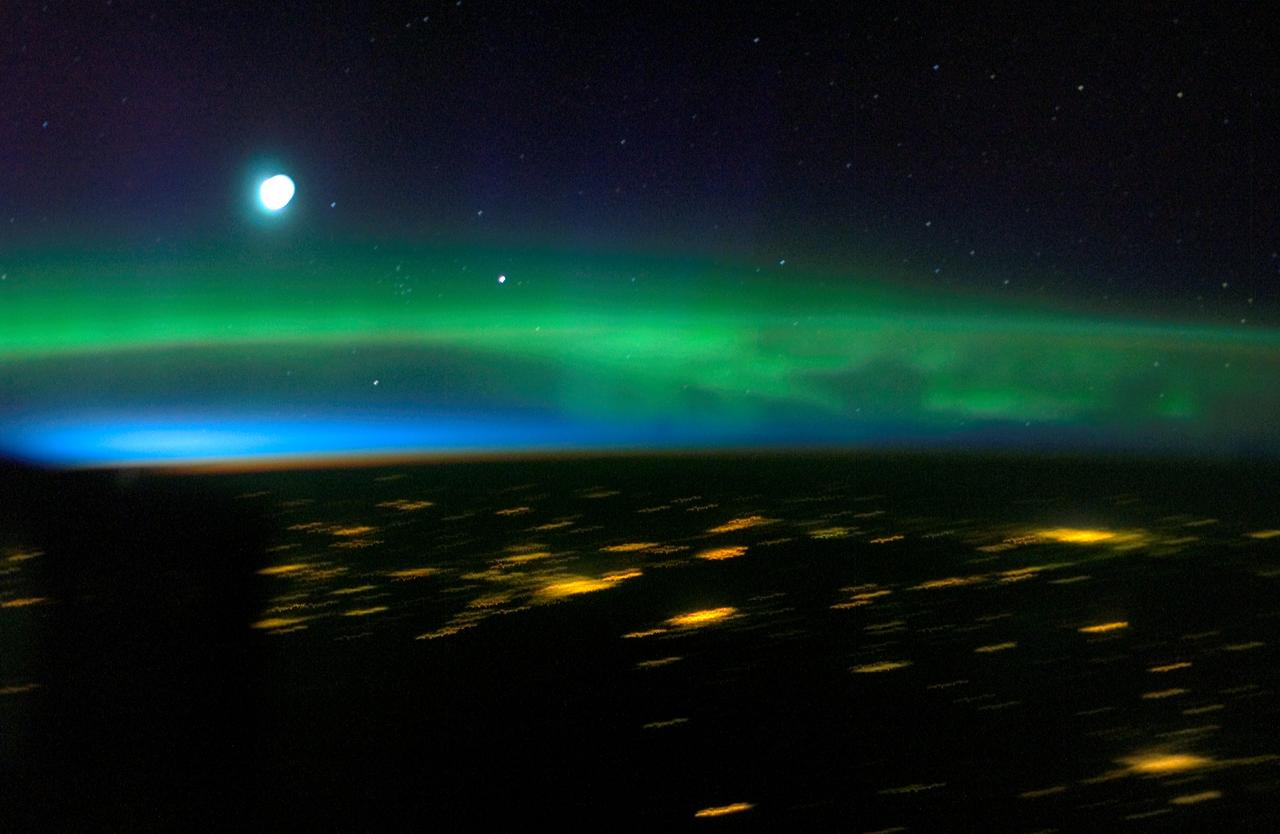
ISS011-E-12415 (31 August 2005) --- Aurora Borealis and lights in Finland, Russia, Estonia and Latvia are featured in this digital still picture taken by the Expedition 11 crew aboard the international space station. If it were daylight parts of the Eastern Baltic Sea would be visible. The station was over a point on Earth located at 50.6 degrees north latitude and 15.1 degees east longitude at the time. The cluster of stars to the lower right of the thin crescent Moon is the Praesepe or Beehive Cluster in Cancer. Just to the right of that is the planet Saturn.
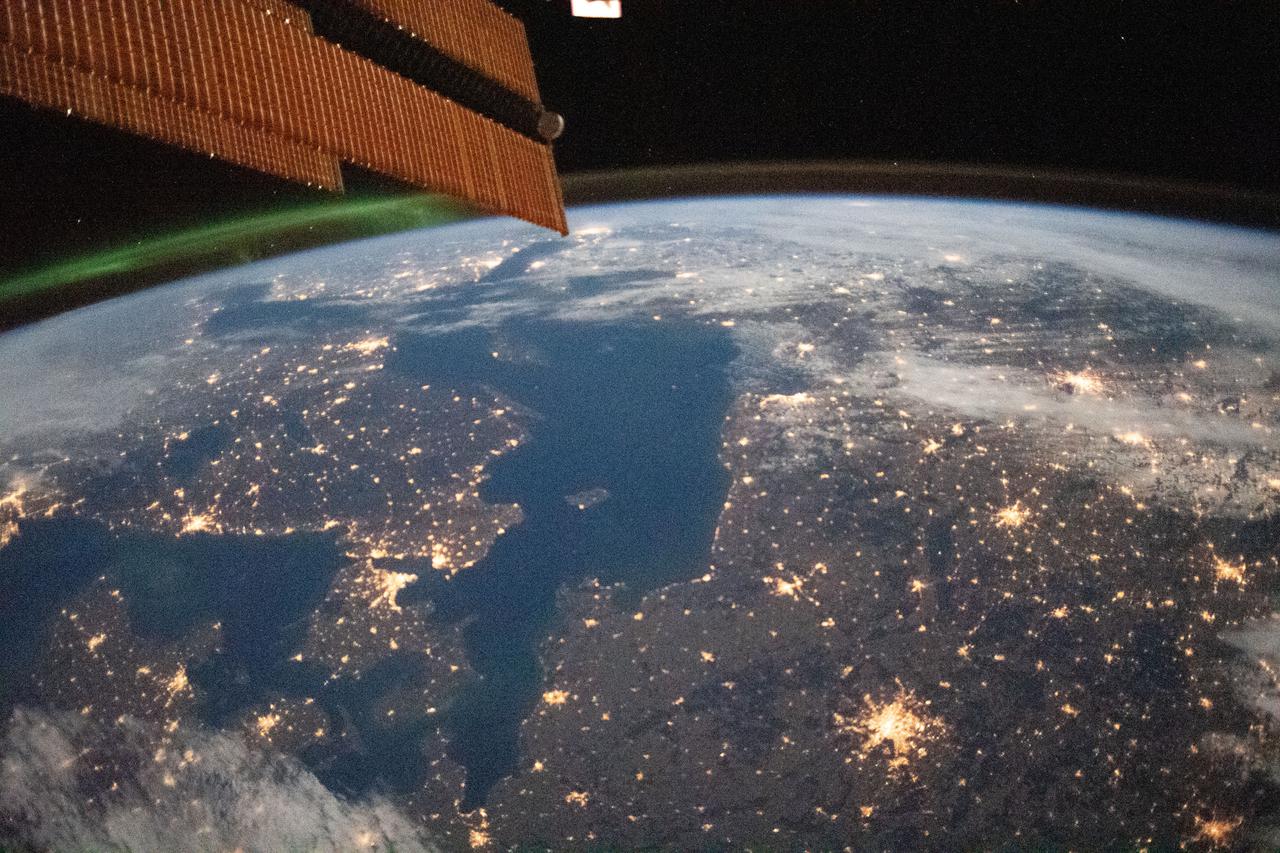
iss066e116300 (Jan. 17, 2022) --- A faint aurora and the Earth's atmospheric glow crown this night time photograph of Northern Europe, as the International Space Station orbited 262 miles above. Prominent city lights include those of (from right to left) Berlin, Germany; Copenhagen, Denmark; and Oslo, Norway. At center, is the Baltic Sea separating the Scandinavian nations of Sweden and Finland from the Baltic states of Estonia, Latvia and Lithuania

ISS011-E-12401 (10 July 2005) --- Gulf of Finland is featured in this image photographed by an Expedition 11 crew member on the international space station. This strongly oblique view shows the Gulf of Finland and Lake Ladoga in the sunglint of late afternoon. The image was taken from the station when the position of the craft lay north of the Caspian Sea, approximately 2,500 kilometers to the southeast on the Russia–Kazakhstan border. The Neva River appears in sunglint, connecting Lake Ladoga to the gulf. Although not visible, St. Petersburg—the home town of Sergei Krikalev, space station commander when this picture was taken—lies on the Neva River delta. In this view taken with a powerful 400 millimeter lens, sunglint even reveals the causeways to Kotlin Island in the gulf—including some of the details of their construction. Oblique views reveal marked layers of gray haze generated by air pollution, a common sight over Western Europe. Pollution also renders the bright glint areas a copper color.
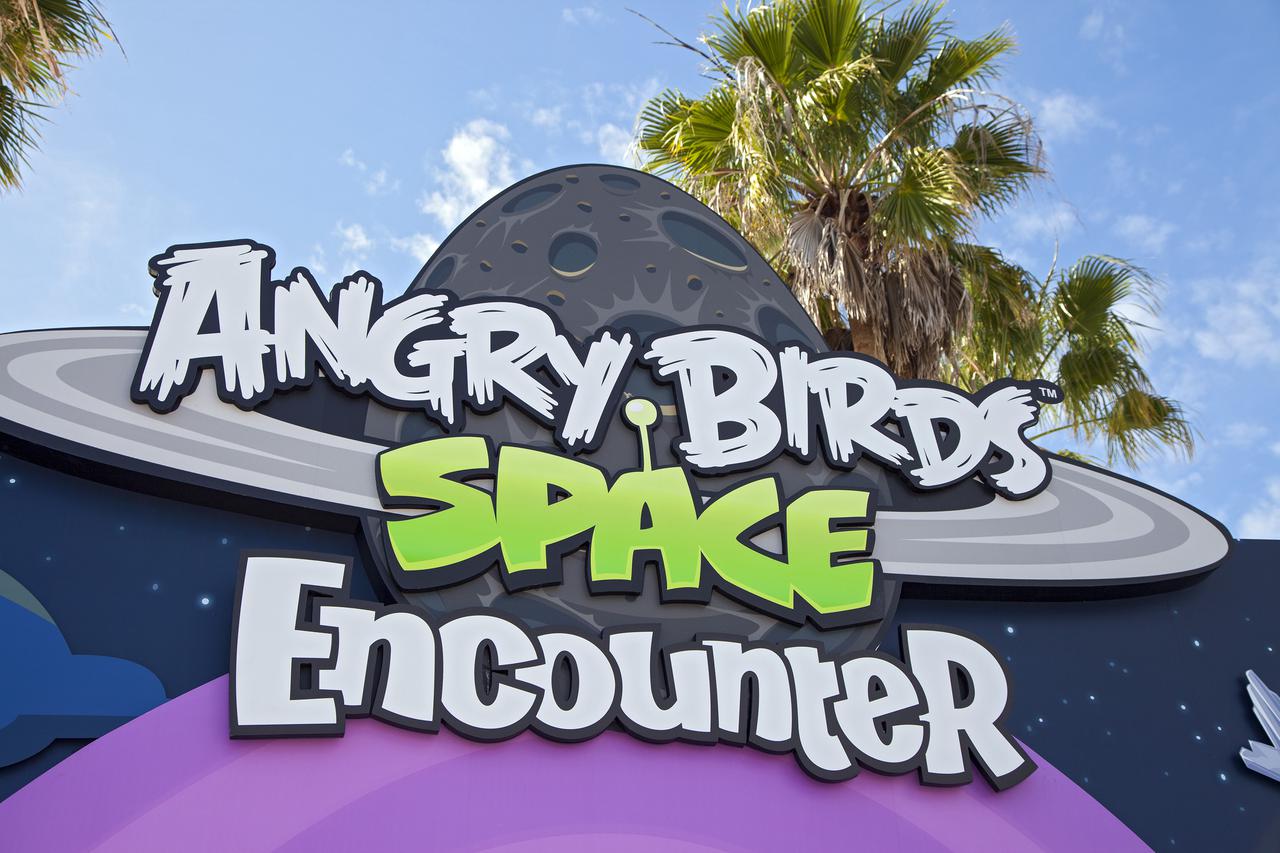
CAPE CANAVERAL, Fla. -- At NASA’s Kennedy Space Center Visitor Complex in Florida, a grand opening celebration was held for the new Angry Birds Space Encounter. Finland-based Rovio Entertainment, the creator of the Angry Birds Space game, partnered with Kennedy Space Center to bring the beloved characters to life. It is the first Angry Birds interactive exhibit in the United States designed for people of all ages. The 4,485-square-foot facility hosts the space adventures of the Angry Birds as they travel into an intergalactic wormhole, come face-to-face with Space Pigs and discover heroic superpowers. Six interactive stations are designed to encourage children in science, technology, engineering and mathematics fields of study. Photo credit: NASA_Kim Shiflett
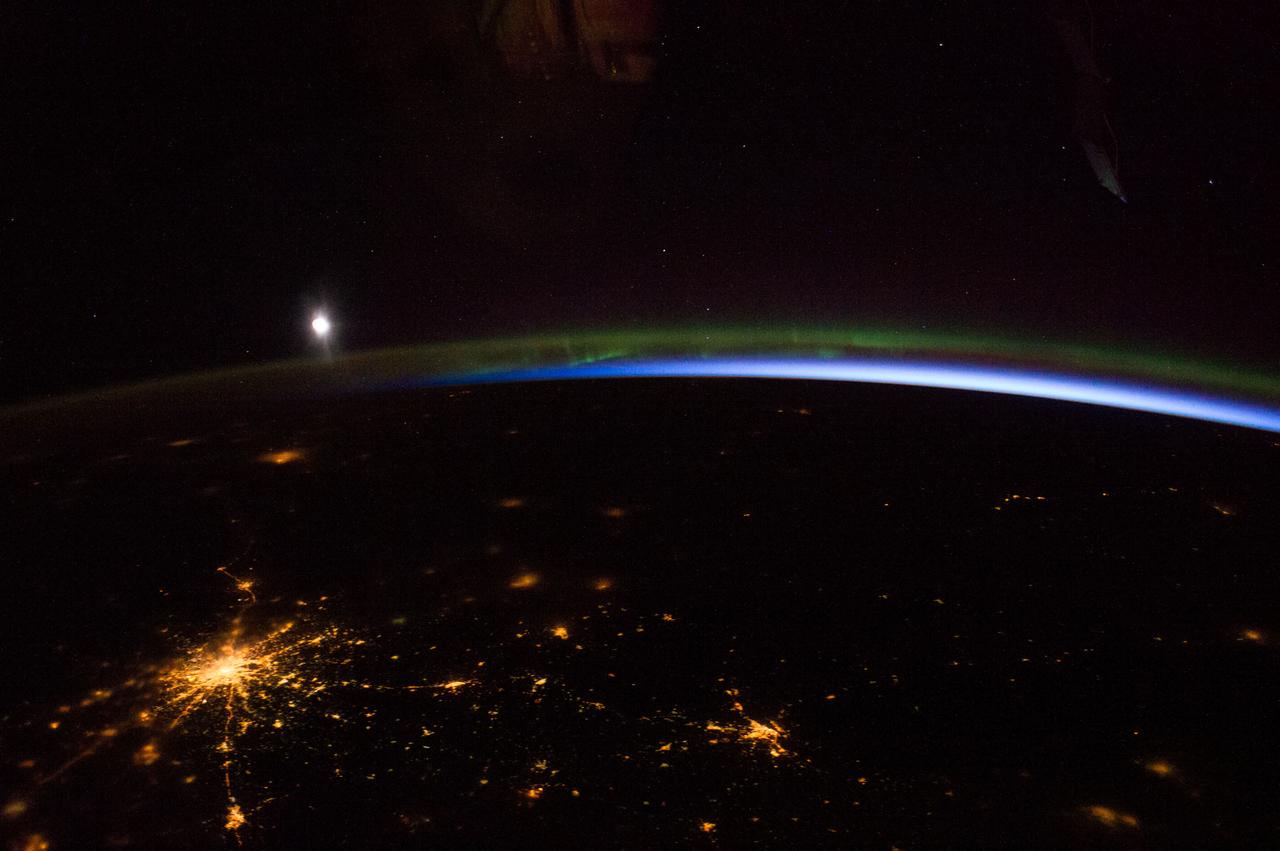
ISS039-E-009160 (2 April 2014) --- This nighttime view featuring the aurora borealis, the moon and Moscow was photographed by an Expedition 39 crew member on the International Space Station. A thin green line of the aurora borealis crosses the top of this image. The moon appears as a white disc just above the aurora. Airglow appears as a blue-white cusp on Earth's limb. Russia's capital city Moscow makes a splash of yellow (lower left), with its easily recognized radial pattern of highways. Other cities are Nizhni Novgorod (lower center) 400 kilometers from Moscow, St. Petersburg (left) 625 kilometers from Moscow, and Finland?s capital city Helsinki.
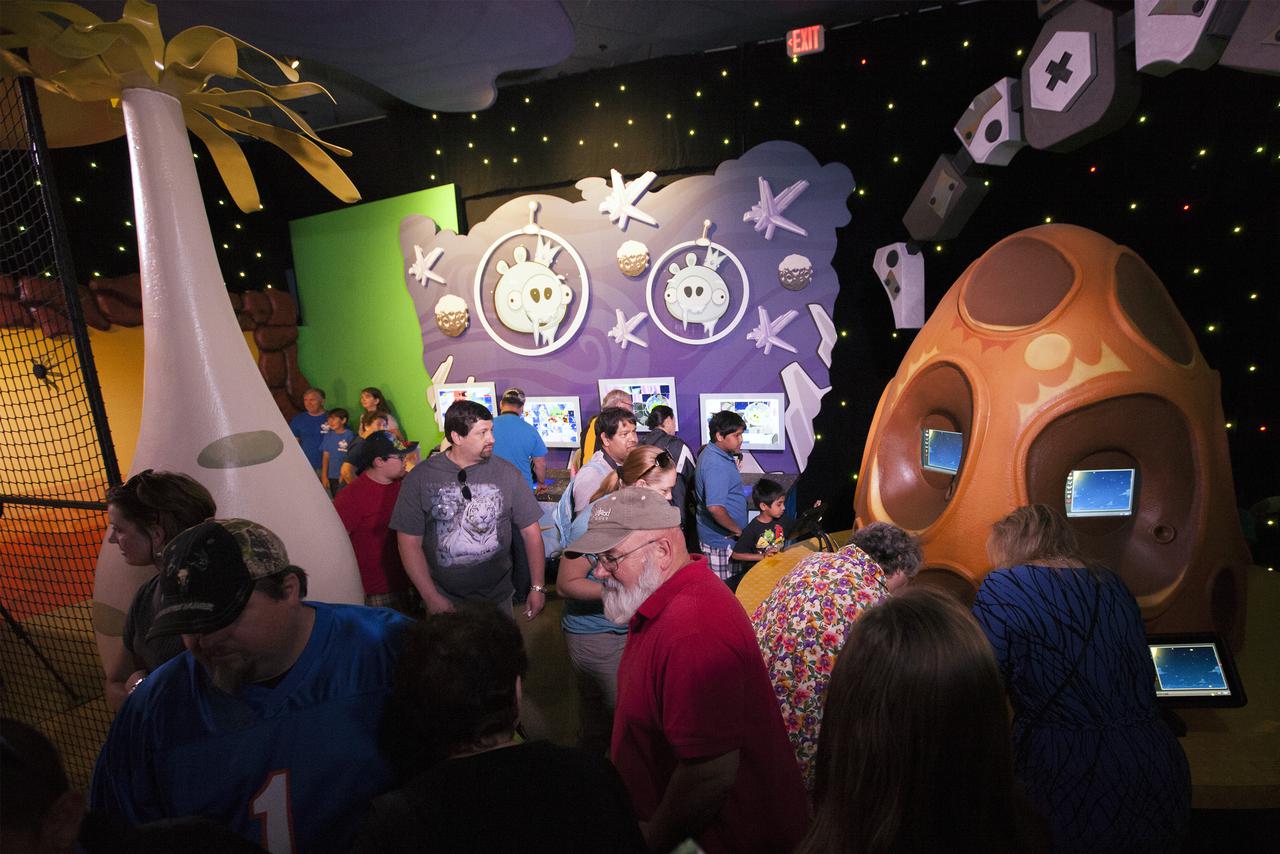
CAPE CANAVERAL, Fla. -- At NASA’s Kennedy Space Center Visitor Complex in Florida, visitors try out some of the interactive exhibits inside the Angry Birds Space Encounter after the grand opening ceremony for the new attraction. Finland-based Rovio Entertainment, the creator of the Angry Birds Space game, partnered with Kennedy Space Center to bring the beloved characters to life. It is the first Angry Birds interactive exhibit in the United States designed for people of all ages. The 4,485-square-foot facility hosts the space adventures of the Angry Birds as they travel into an intergalactic wormhole, come face-to-face with Space Pigs and discover heroic superpowers. Six interactive stations are designed to encourage children in science, technology, engineering and mathematics fields of study. Photo credit: NASA_Kim Shiflett
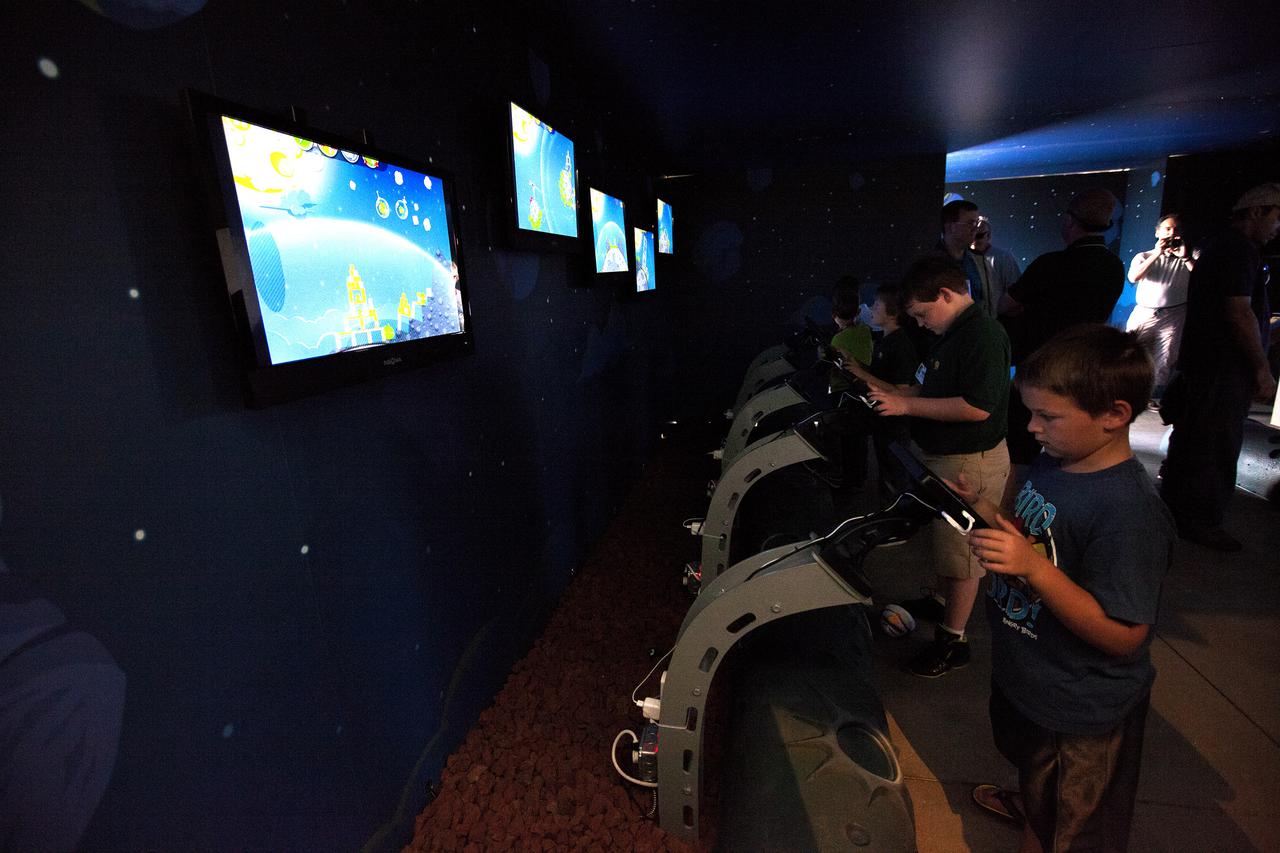
CAPE CANAVERAL, Fla. -- At NASA’s Kennedy Space Center Visitor Complex in Florida, children try out some of the interactive exhibits inside the new Angry Birds Space Encounter after the grand opening ceremony for the new attraction. Finland-based Rovio Entertainment, the creator of the Angry Birds Space game, partnered with Kennedy Space Center to bring the beloved characters to life. It is the first Angry Birds interactive exhibit in the United States designed for people of all ages. The 4,485-square-foot facility hosts the space adventures of the Angry Birds as they travel into an intergalactic wormhole, come face-to-face with Space Pigs and discover heroic superpowers. Six interactive stations are designed to encourage children in science, technology, engineering and mathematics fields of study. Photo credit: NASA_Kim Shiflett
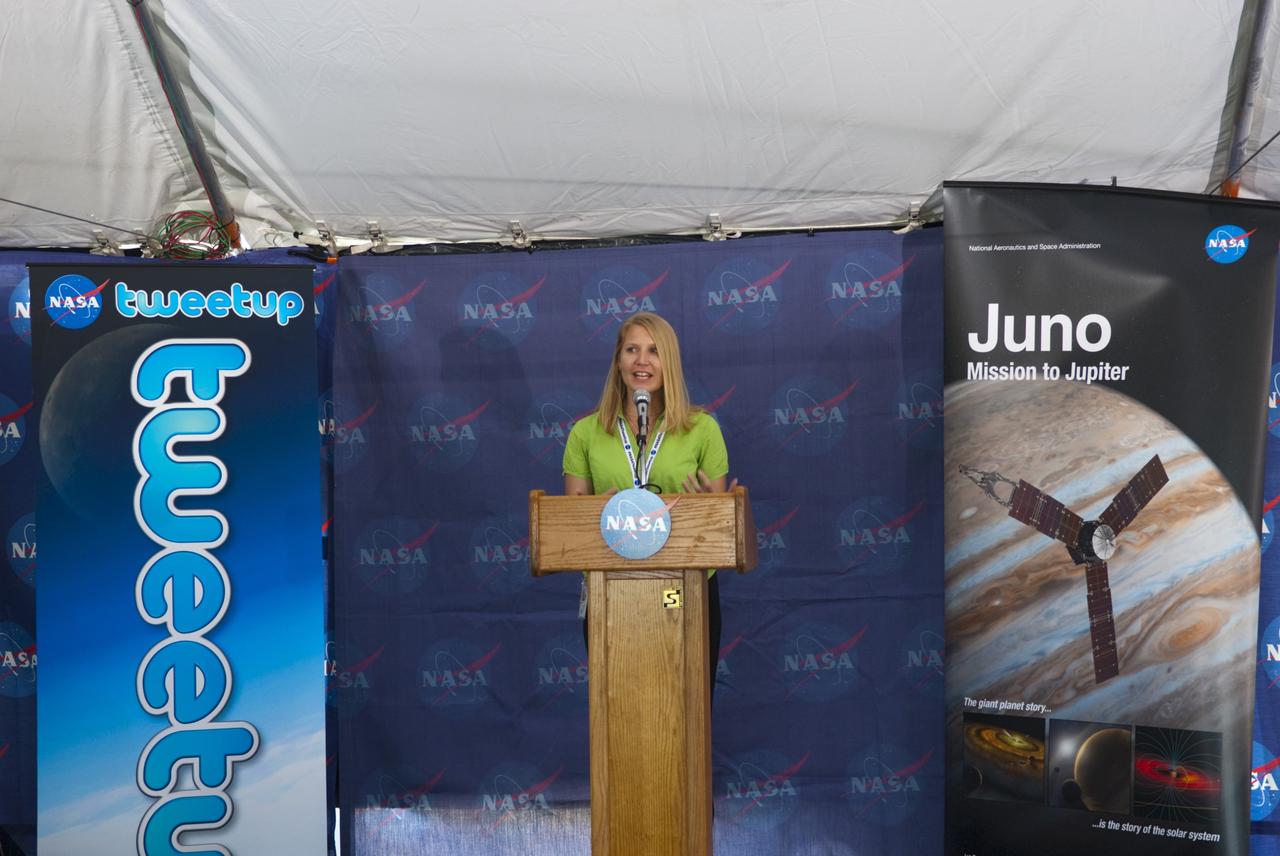
CAPE CANAVERAL, Fla. – At NASA’s Kennedy Space Center in Florida, NASA Tweetup coordinator Stephanie Schierholz welcomes about 150 tweeters to Juno Tweetup activities inside a tent at the Press Site. The tweeters are at the center for two days of prelaunch activities. Juno is NASA’s mission to Jupiter to study the giant planet and improve our understanding of the planet’s formation and evolution. The tweeters will share their experiences with followers through the social networking site Twitter. Attendees represent 28 states, the District of Columbia and five other countries: Canada, Finland, Norway, Spain and the United Kingdom. This is the first time NASA has invited Twitter followers to experience the launch of a planetary spacecraft. The Juno spacecraft is scheduled to launch on an Atlas V rocket from Space Launch Complex 41 at Cape Canaveral Air Force Station in Florida, Aug. 5, at 11:34 a.m. EDT. For more information, visit http://www.nasa.gov/juno. Photo credit: Jim Grossmann
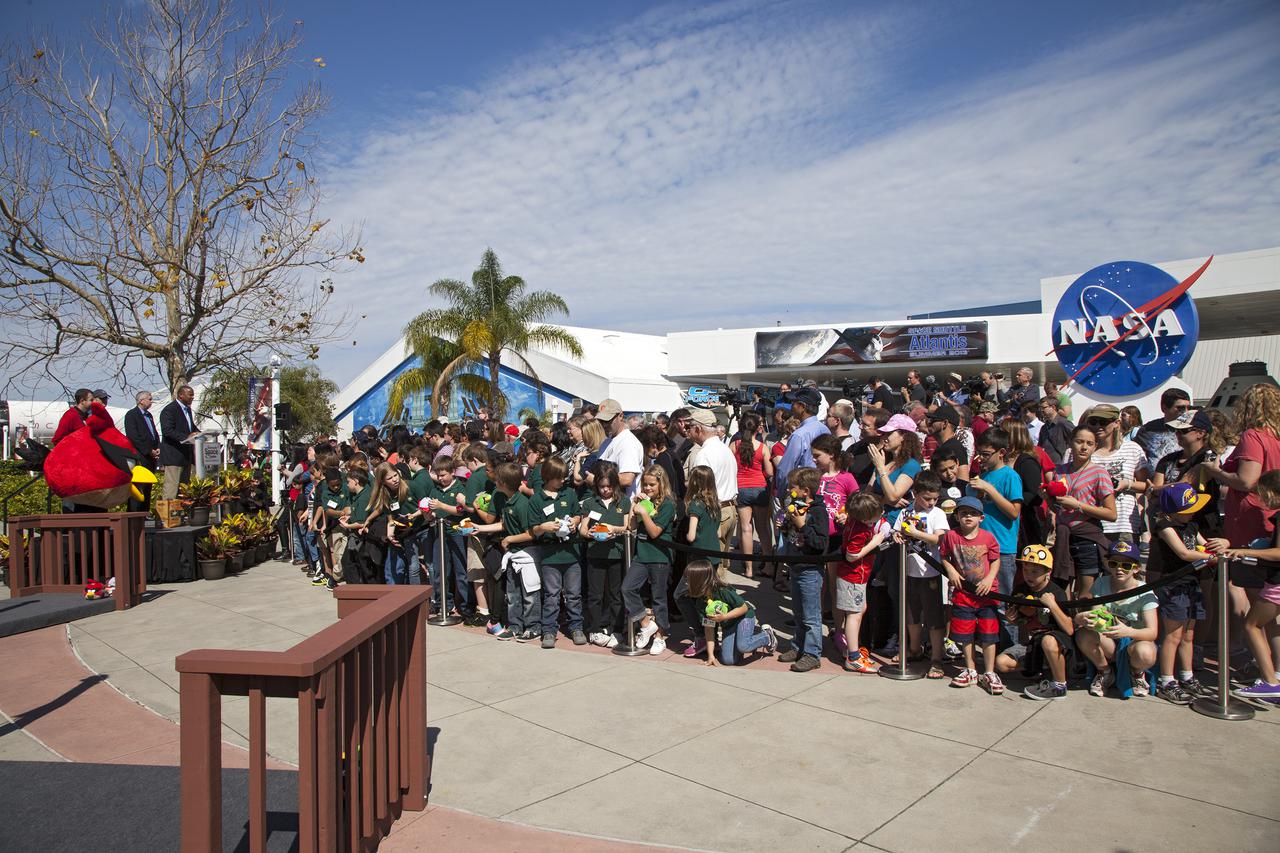
CAPE CANAVERAL, Fla. -- At NASA’s Kennedy Space Center Visitor Complex in Florida, Kelvin Manning, associate deputy director of Kennedy Space Center, speaks to visitors during the grand opening of the new Angry Birds Space Encounter. To Manning’s left is Red Bird, one of the Angry Bird Space characters. Finland-based Rovio Entertainment, the creator of the Angry Birds Space game, partnered with Kennedy Space Center to bring the beloved characters to life. It is the first Angry Birds interactive exhibit in the United States designed for people of all ages. The 4,485-square-foot facility hosts the space adventures of the Angry Birds as they travel into an intergalactic wormhole, come face-to-face with Space Pigs and discover heroic superpowers. Six interactive stations are designed to encourage children in science, technology, engineering and mathematics fields of study. Photo credit: NASA_Kim Shiflett
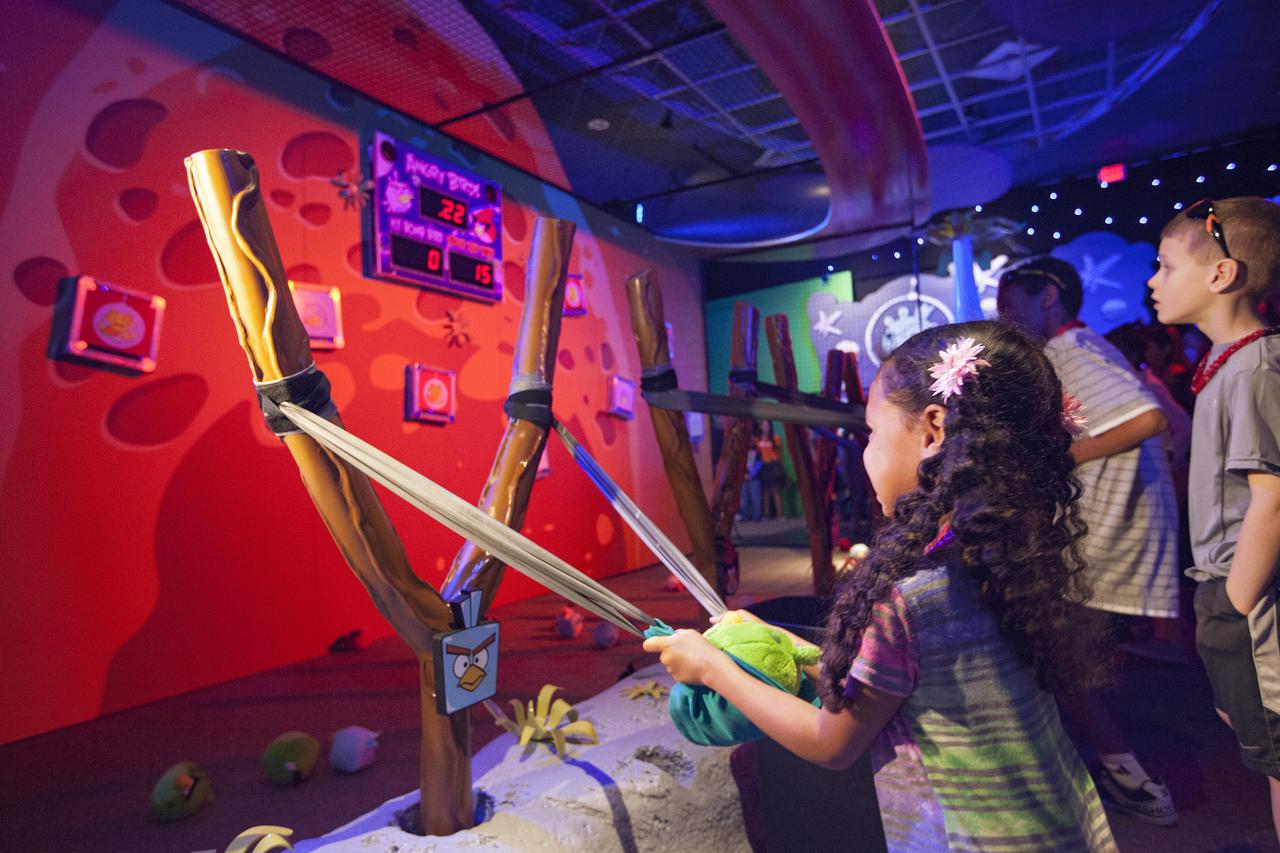
CAPE CANAVERAL, Fla. -- At NASA’s Kennedy Space Center Visitor Complex in Florida, children try out some of the interactive exhibits inside the new Angry Birds Space Encounter after the grand opening ceremony for the new attraction. Finland-based Rovio Entertainment, the creator of the Angry Birds Space game, partnered with Kennedy Space Center to bring the beloved characters to life. It is the first Angry Birds interactive exhibit in the United States designed for people of all ages. The 4,485-square-foot facility hosts the space adventures of the Angry Birds as they travel into an intergalactic wormhole, come face-to-face with Space Pigs and discover heroic superpowers. Six interactive stations are designed to encourage children in science, technology, engineering and mathematics fields of study. Photo credit: NASA_Kim Shiflett
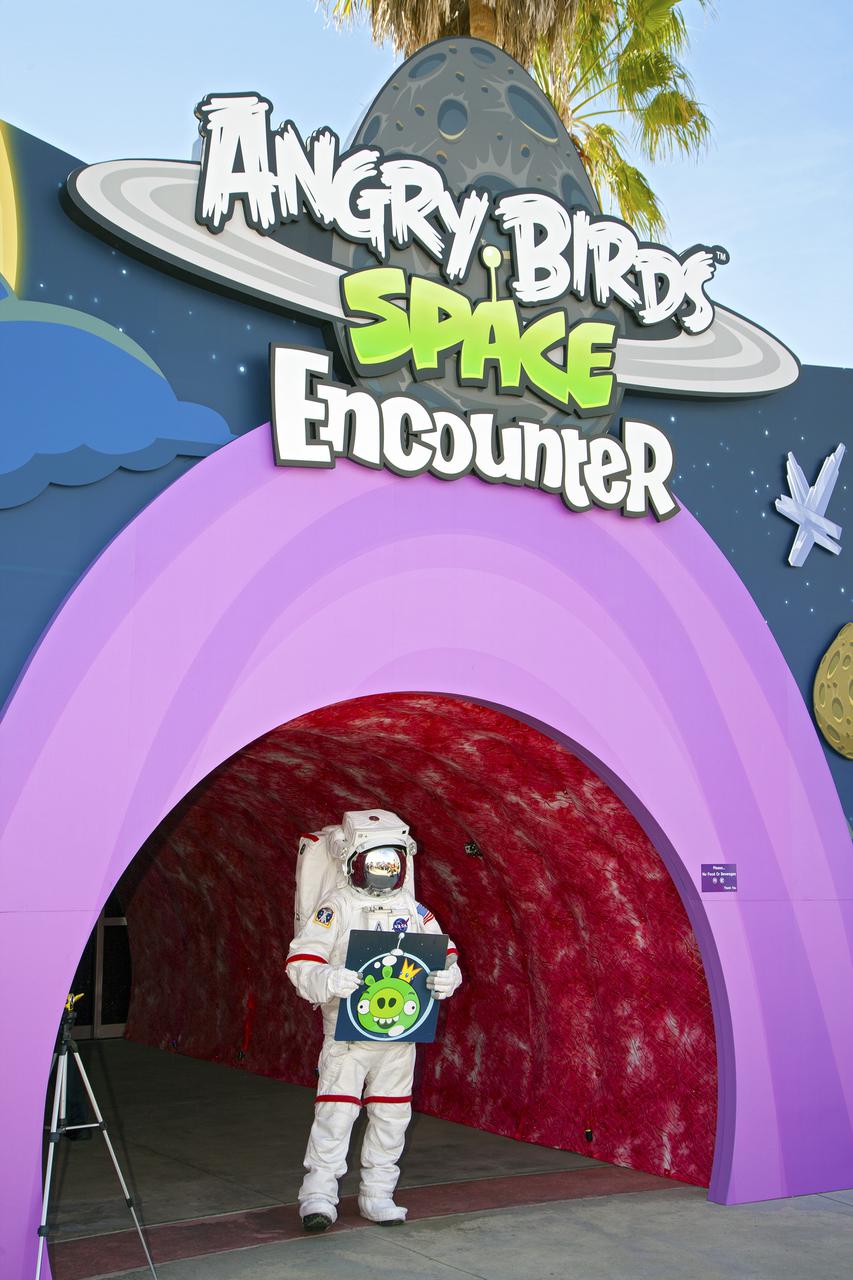
CAPE CANAVERAL, Fla. -- At NASA’s Kennedy Space Center Visitor Complex in Florida, the Spaceperson stands at the entrance of the new Angry Birds Space Encounter during the grand opening ceremony. Finland-based Rovio Entertainment, the creator of the Angry Birds Space game, partnered with Kennedy Space Center to bring the beloved characters to life. It is the first Angry Birds interactive exhibit in the United States designed for people of all ages. The 4,485-square-foot facility hosts the space adventures of the Angry Birds as they travel into an intergalactic wormhole, come face-to-face with Space Pigs and discover heroic superpowers. Six interactive stations are designed to encourage children in science, technology, engineering and mathematics fields of study. Photo credit: NASA_Kim Shiflett
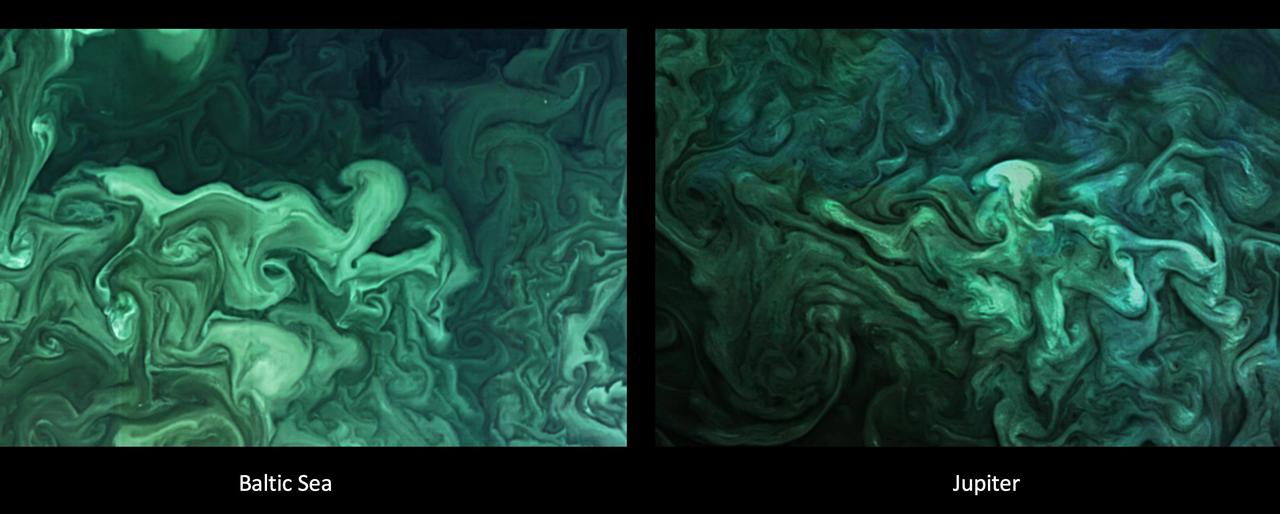
The left image shows a close-up of a phytoplankton blooming in the southern Gulf of Bothnia, in the Baltic Sea, between Sweden and Finland on April 14, 2019. The right image shows turbulent clouds in Jupiter's atmosphere. Jupiter's atmosphere is one of the most turbulent places in the solar system. Orbiting Jupiter and its 79 moons is NASA's Juno spacecraft, which sends images from the largest planet in our solar system back to researchers on Earth. These images from Juno have given oceanographers the raw materials to study the rich turbulence at Jupiter's poles and the physical forces that drive large cyclones on Jupiter. Lia Siegelman, a physical oceanographer and postdoctoral scholar at Scripps Institution of Oceanography at the University of California San Diego, observed similarities between the richness of turbulence around Jovian cyclones and the filaments around smaller eddies with turbulence seen in Earth's oceans. https://photojournal.jpl.nasa.gov/catalog/PIA25034
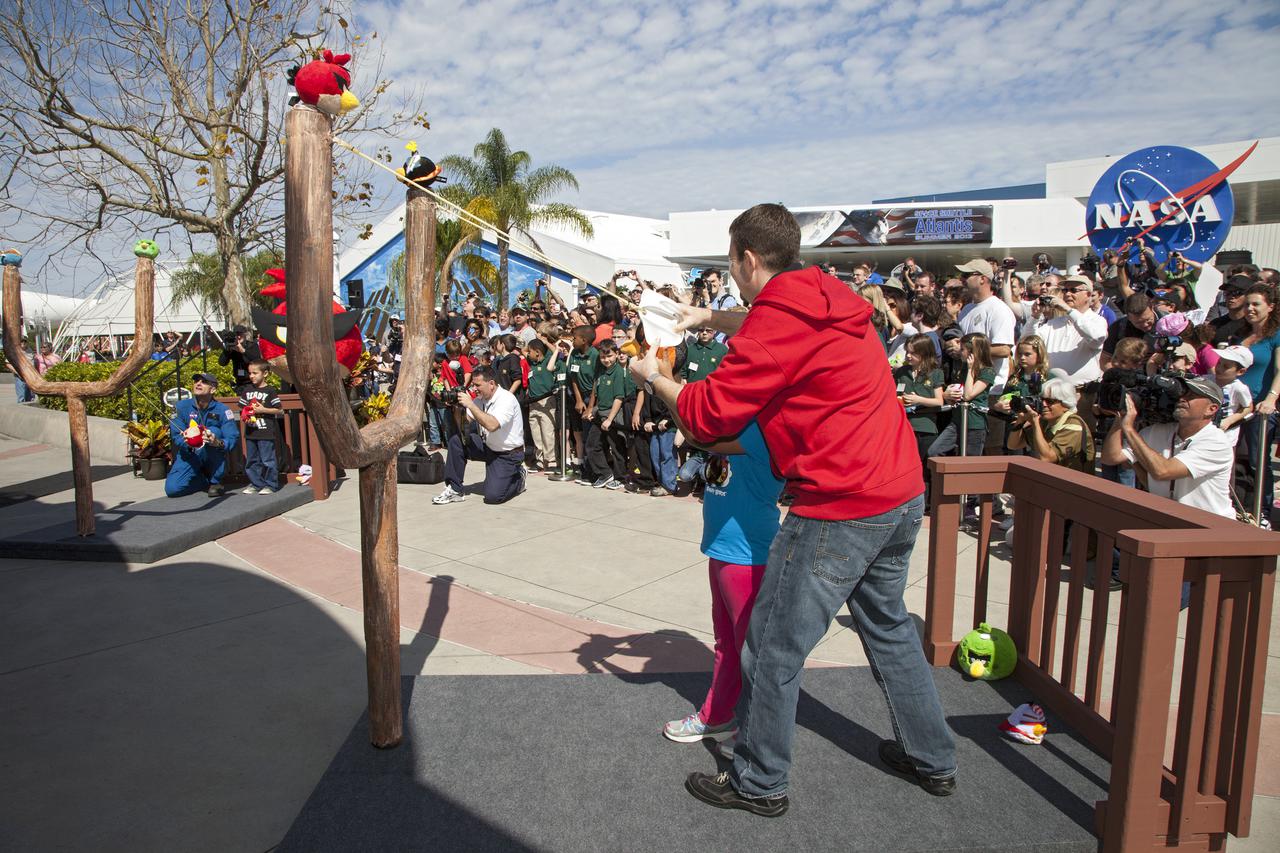
CAPE CANAVERAL, Fla. -- At NASA’s Kennedy Space Center Visitor Complex in Florida, Dan Mitchell, director of location-based entertainment for Rovio Entertainment, uses a giant slingshot to launch a plush Angry Bird character during the grand opening of the new Angry Birds Space Encounter. To Mitchell’s left is NASA astronaut Don Pettit. Finland-based Rovio Entertainment, the creator of the Angry Birds Space game, partnered with Kennedy Space Center to bring the beloved characters to life. It is the first Angry Birds interactive exhibit in the United States designed for people of all ages. The 4,485-square-foot facility hosts the space adventures of the Angry Birds as they travel into an intergalactic wormhole, come face-to-face with Space Pigs and discover heroic superpowers. Six interactive stations are designed to encourage children in science, technology, engineering and mathematics fields of study. Photo credit: NASA_Kim Shiflett
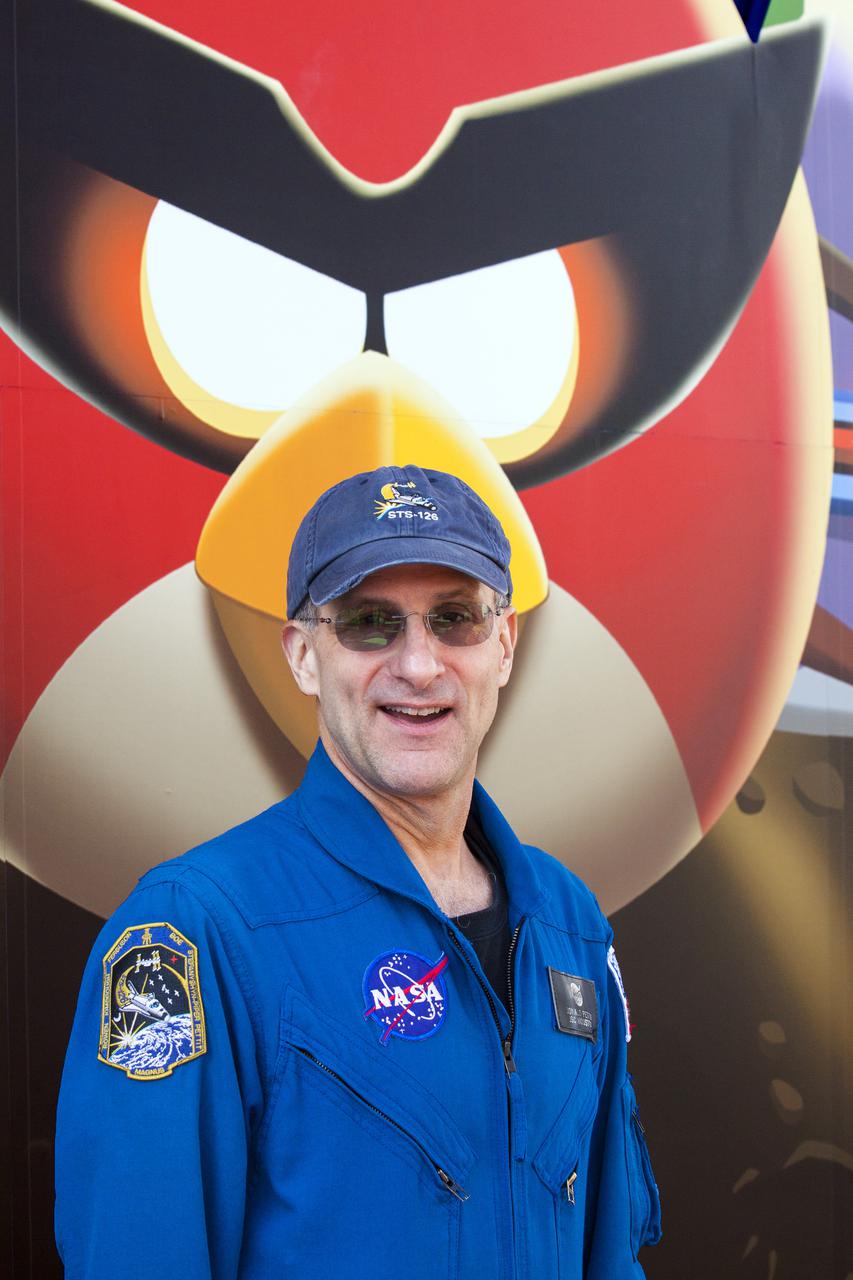
CAPE CANAVERAL, Fla. -- At NASA’s Kennedy Space Center Visitor Complex in Florida, NASA astronaut Don Pettit stands near the entrance to the new Angry Birds Space Encounter during the grand opening ceremony. Pettit spent a total of 12 months during two separate missions aboard the International Space Station and introduced Angry Birds Space while floating in zero gravity. Finland-based Rovio Entertainment, the creator of the Angry Birds Space game, partnered with Kennedy Space Center to bring the beloved characters to life. It is the first Angry Birds interactive exhibit in the United States designed for people of all ages. The 4,485-square-foot facility hosts the space adventures of the Angry Birds as they travel into an intergalactic wormhole, come face-to-face with Space Pigs and discover heroic superpowers. Six interactive stations are designed to encourage children in science, technology, engineering and mathematics fields of study. Photo credit: NASA_Kim Shiflett
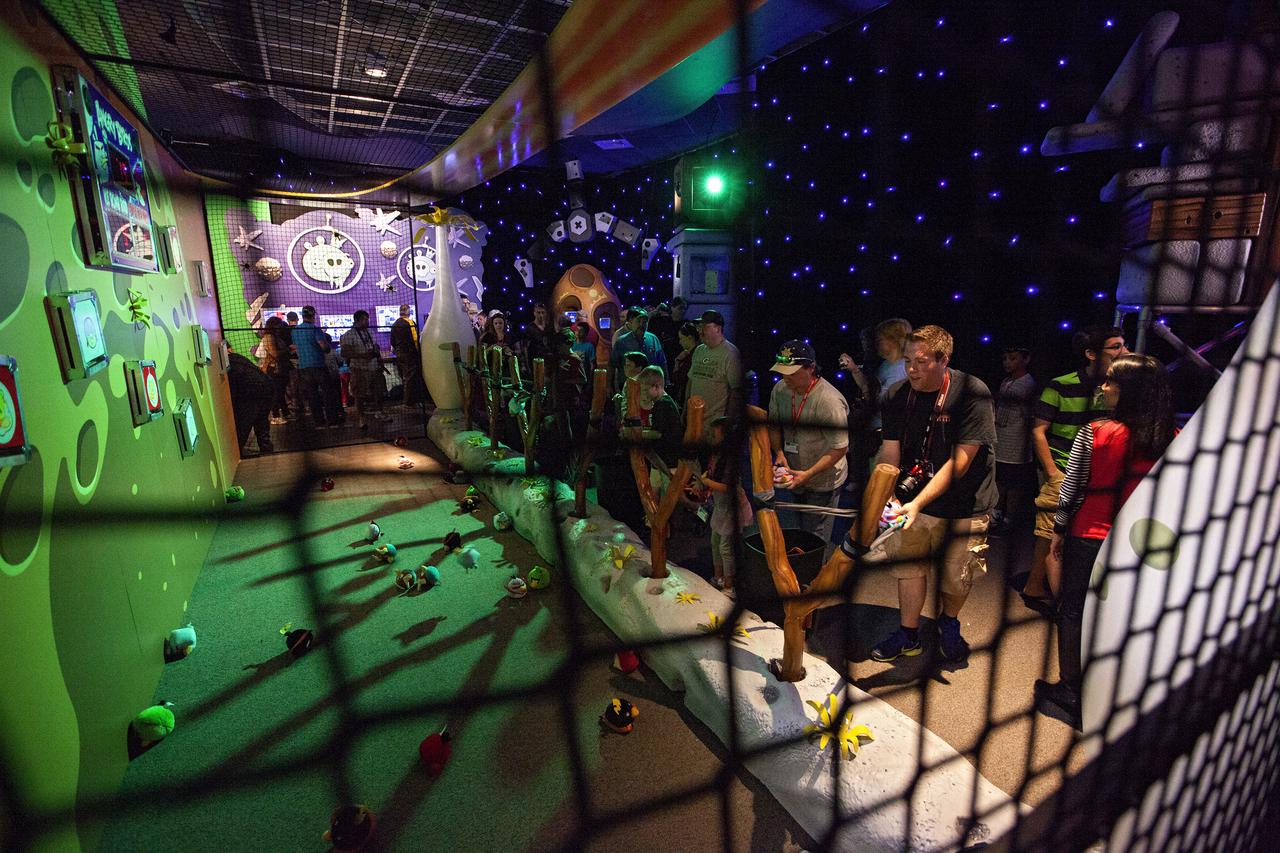
CAPE CANAVERAL, Fla. -- At NASA’s Kennedy Space Center Visitor Complex in Florida, visitors try out some of the interactive exhibits inside the Angry Birds Space Encounter after the grand opening ceremony for the new attraction. Finland-based Rovio Entertainment, the creator of the Angry Birds Space game, partnered with Kennedy Space Center to bring the beloved characters to life. It is the first Angry Birds interactive exhibit in the United States designed for people of all ages. The 4,485-square-foot facility hosts the space adventures of the Angry Birds as they travel into an intergalactic wormhole, come face-to-face with Space Pigs and discover heroic superpowers. Six interactive stations are designed to encourage children in science, technology, engineering and mathematics fields of study. Photo credit: NASA_Kim Shiflett
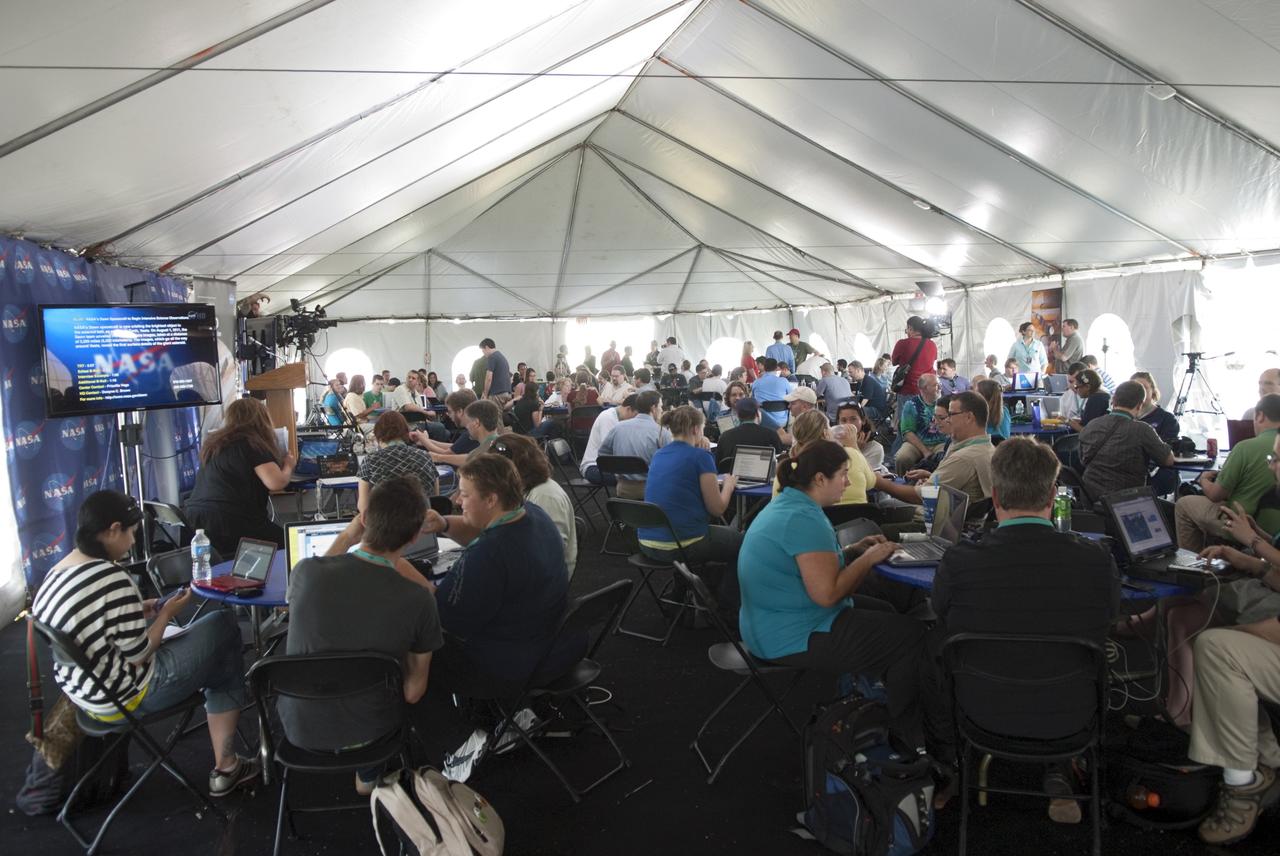
CAPE CANAVERAL, Fla. – At NASA’s Kennedy Space Center in Florida, about 150 followers of the agency’s Twitter account arrived at the Tweetup tent at the Press Site for two days of Juno prelaunch activities. Juno is NASA’s mission to Jupiter to study the giant planet and improve our understanding of the planet’s formation and evolution. The tweeters will share their experiences with followers through the social networking site Twitter. Attendees represent 28 states, the District of Columbia and five other countries: Canada, Finland, Norway, Spain and the United Kingdom. This is the first time NASA has invited Twitter followers to experience the launch of a planetary spacecraft. The Juno spacecraft is scheduled to launch on an Atlas V rocket from Space Launch Complex 41 at Cape Canaveral Air Force Station in Florida, Aug. 5, at 11:34 a.m. EDT. For more information, visit http://www.nasa.gov/juno. Photo credit: Jim Grossmann
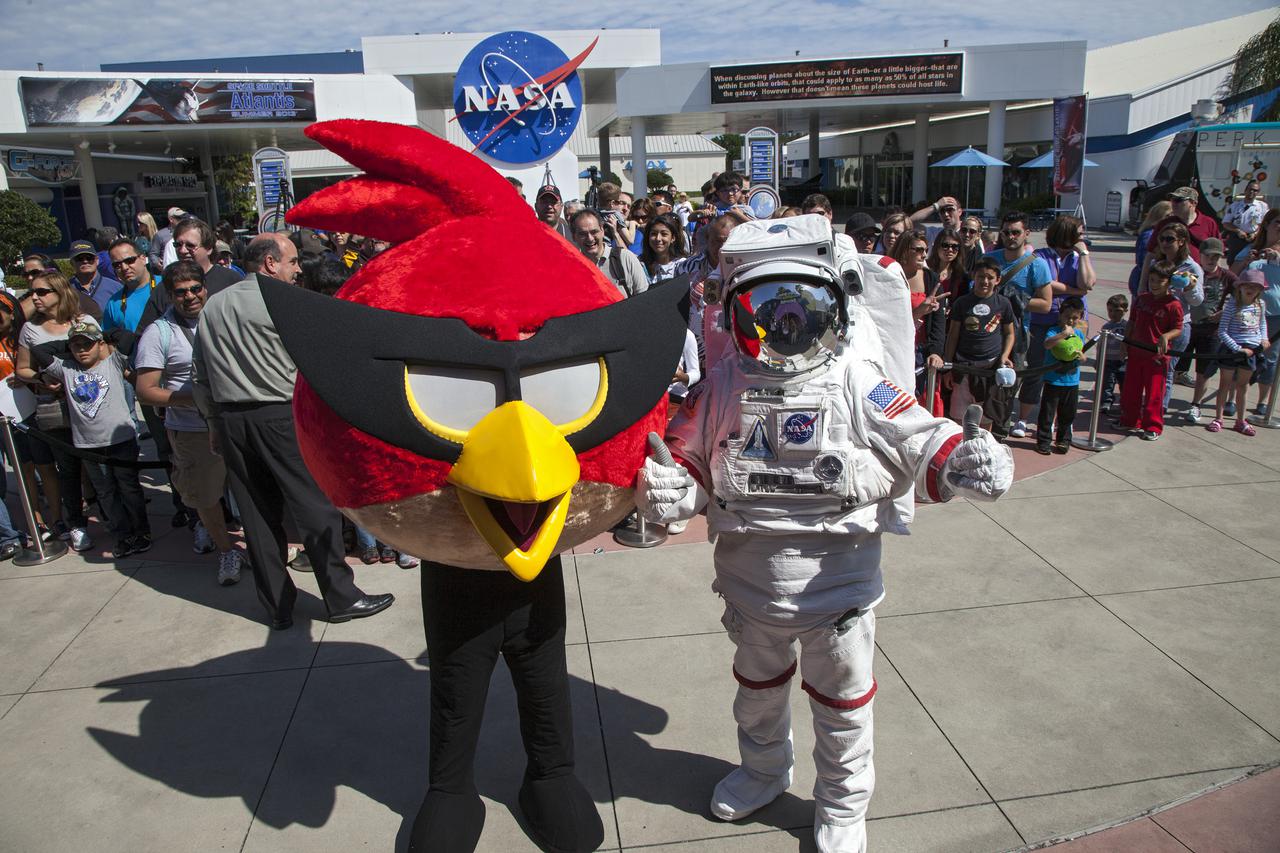
CAPE CANAVERAL, Fla. -- At NASA’s Kennedy Space Center Visitor Complex in Florida, the Spaceperson and Red Bird, one of the Angry Bird characters, welcome visitor to the Angry Birds Space Encounter grand opening ceremony. Finland-based Rovio Entertainment, the creator of the Angry Birds Space game, partnered with Kennedy Space Center to bring the beloved characters to life. It is the first Angry Birds interactive exhibit in the United States designed for people of all ages. The 4,485-square-foot facility hosts the space adventures of the Angry Birds as they travel into an intergalactic wormhole, come face-to-face with Space Pigs and discover heroic superpowers. Six interactive stations are designed to encourage children in science, technology, engineering and mathematics fields of study. Photo credit: NASA_Kim Shiflett
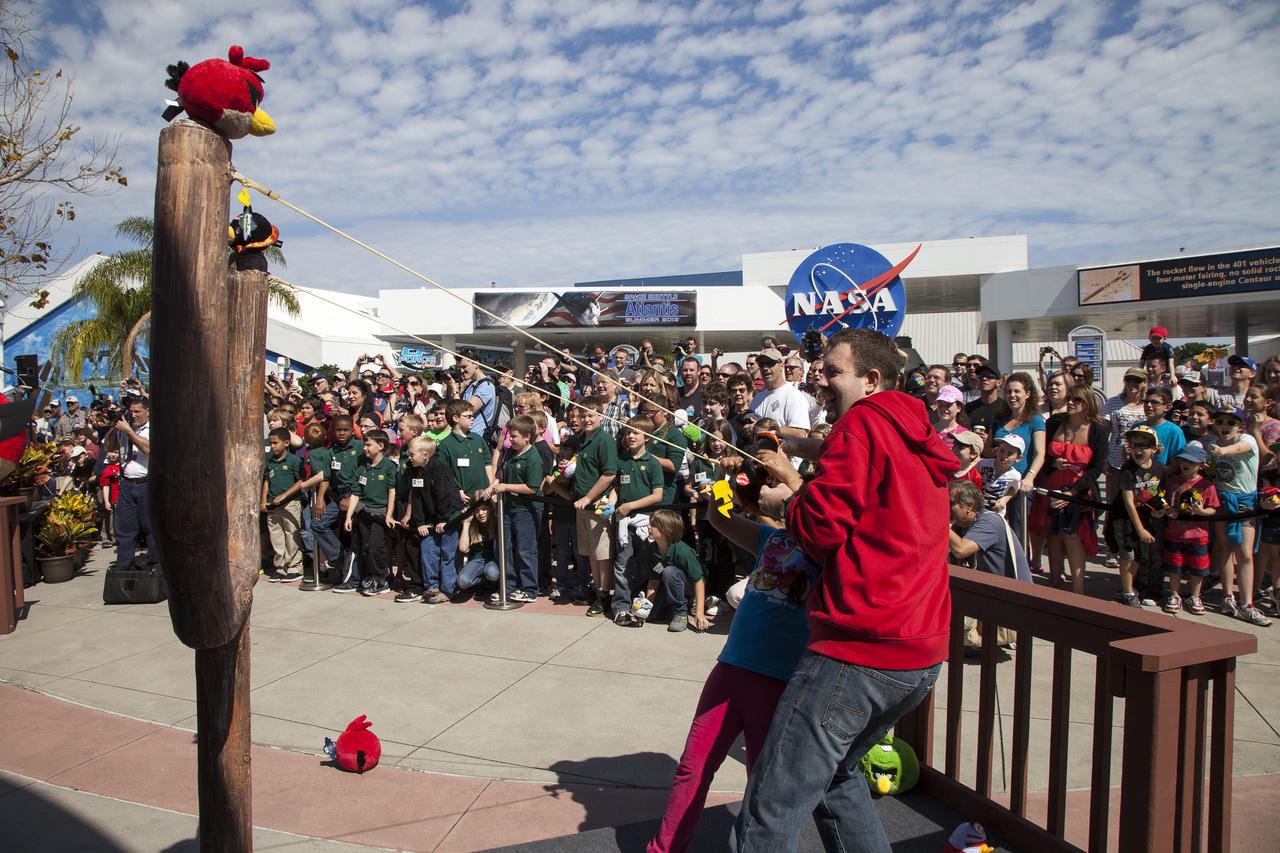
CAPE CANAVERAL, Fla. -- At NASA’s Kennedy Space Center Visitor Complex in Florida, Dan Mitchell, director of location-based entertainment for Rovio Entertainment, helps a child use a giant slingshot to launch a plush Angry Bird character during the grand opening of the new Angry Birds Space Encounter. Finland-based Rovio Entertainment, the creator of the Angry Birds Space game, partnered with Kennedy Space Center to bring the beloved characters to life. It is the first Angry Birds interactive exhibit in the United States designed for people of all ages. The 4,485-square-foot facility hosts the space adventures of the Angry Birds as they travel into an intergalactic wormhole, come face-to-face with Space Pigs and discover heroic superpowers. Six interactive stations are designed to encourage children in science, technology, engineering and mathematics fields of study. Photo credit: NASA_Kim Shiflett
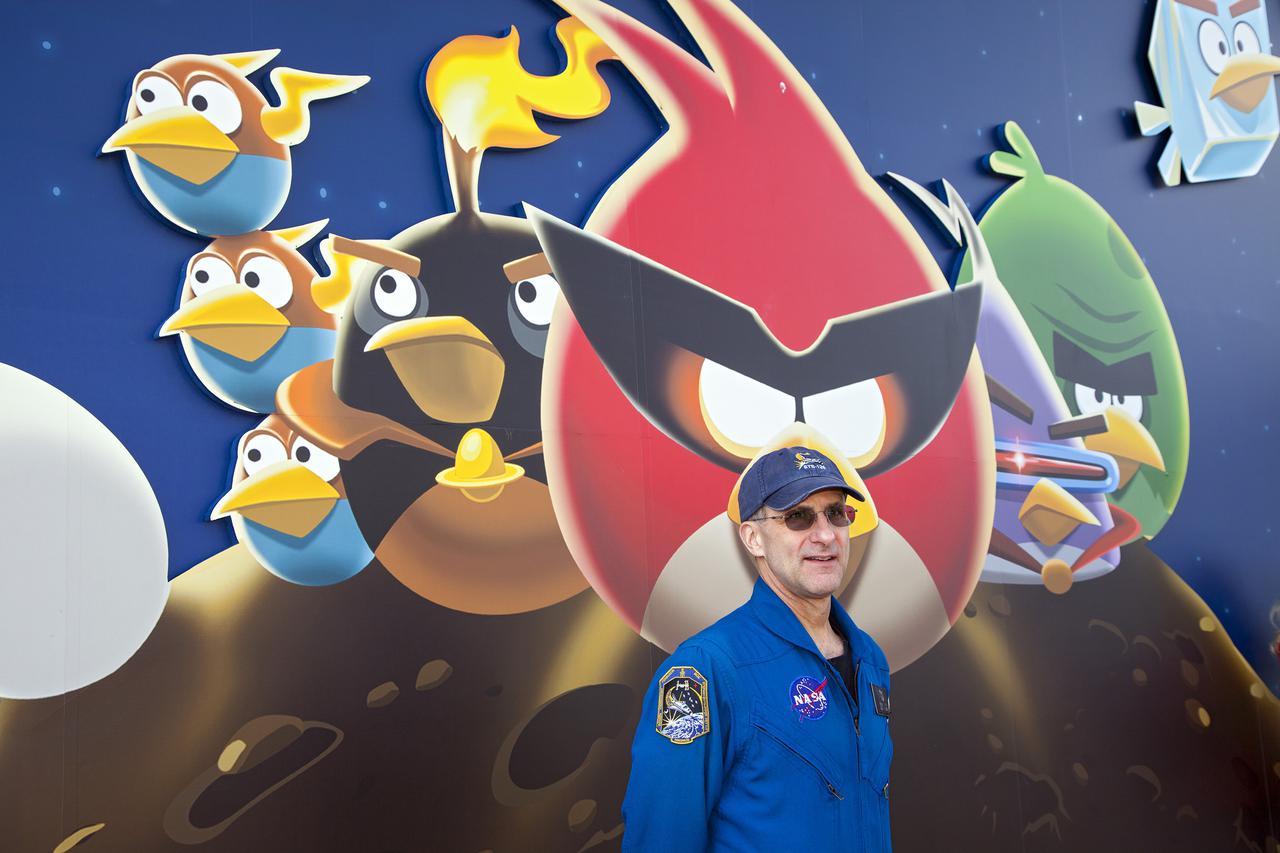
CAPE CANAVERAL, Fla. -- At NASA’s Kennedy Space Center Visitor Complex in Florida, NASA astronaut Don Pettit stands near the entrance to the new Angry Birds Space Encounter during the grand opening ceremony. Pettit spent a total of 12 months during two separate missions aboard the International Space Station and introduced Angry Birds Space while floating in zero gravity. Finland-based Rovio Entertainment, the creator of the Angry Birds Space game, partnered with Kennedy Space Center to bring the beloved characters to life. It is the first Angry Birds interactive exhibit in the United States designed for people of all ages. The 4,485-square-foot facility hosts the space adventures of the Angry Birds as they travel into an intergalactic wormhole, come face-to-face with Space Pigs and discover heroic superpowers. Six interactive stations are designed to encourage children in science, technology, engineering and mathematics fields of study. Photo credit: NASA_Kim Shiflett
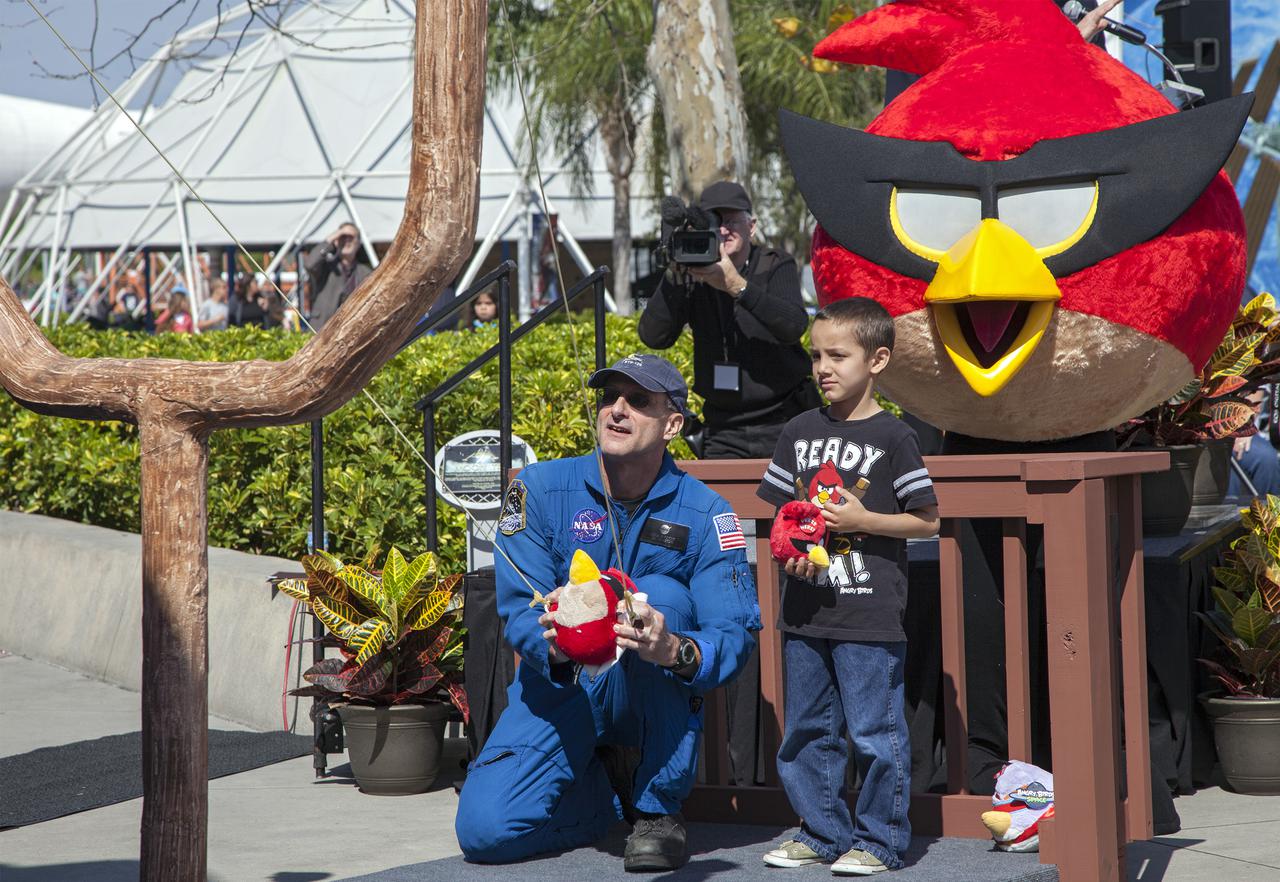
CAPE CANAVERAL, Fla. -- At NASA’s Kennedy Space Center Visitor Complex in Florida, NASA astronaut Don Pettit uses a giant slingshot to launch a plush Angry Bird character during the grand opening of the new Angry Birds Space Encounter. Standing behind Pettit is Red Bird, one of the Angry Bird characters. Finland-based Rovio Entertainment, the creator of the Angry Birds Space game, partnered with Kennedy Space Center to bring the beloved characters to life. It is the first Angry Birds interactive exhibit in the United States designed for people of all ages. The 4,485-square-foot facility hosts the space adventures of the Angry Birds as they travel into an intergalactic wormhole, come face-to-face with Space Pigs and discover heroic superpowers. Six interactive stations are designed to encourage children in science, technology, engineering and mathematics fields of study. Photo credit: NASA_Kim Shiflett
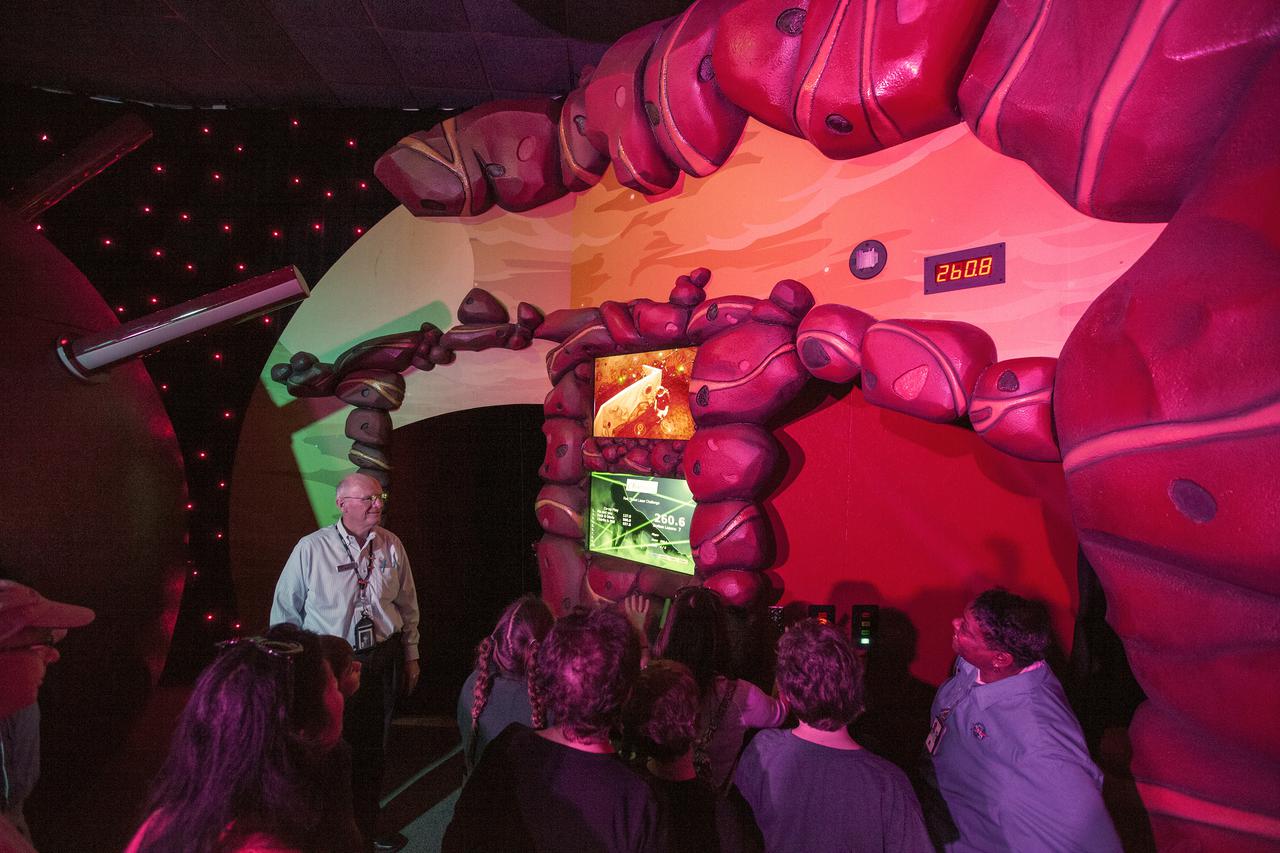
CAPE CANAVERAL, Fla. -- At NASA’s Kennedy Space Center Visitor Complex in Florida, children try out some of the interactive exhibits inside the new Angry Birds Space Encounter after the grand opening ceremony for the new attraction. Finland-based Rovio Entertainment, the creator of the Angry Birds Space game, partnered with Kennedy Space Center to bring the beloved characters to life. It is the first Angry Birds interactive exhibit in the United States designed for people of all ages. The 4,485-square-foot facility hosts the space adventures of the Angry Birds as they travel into an intergalactic wormhole, come face-to-face with Space Pigs and discover heroic superpowers. Six interactive stations are designed to encourage children in science, technology, engineering and mathematics fields of study. Photo credit: NASA_Kim Shiflett
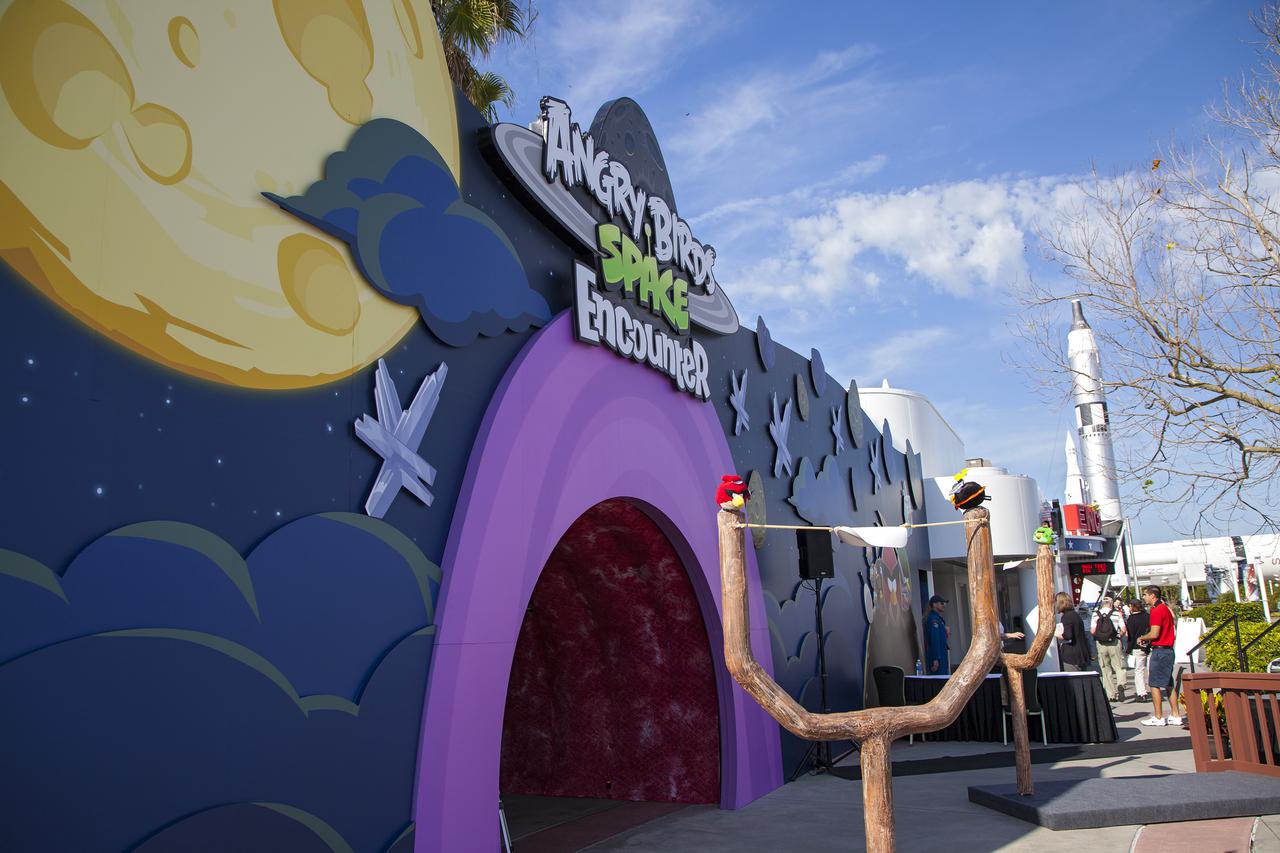
CAPE CANAVERAL, Fla. -- At NASA’s Kennedy Space Center Visitor Complex in Florida, the entrance to the new Angry Birds Space Encounter is seen before the grand opening celebration begins. Finland-based Rovio Entertainment, the creator of the Angry Birds Space game, partnered with Kennedy Space Center to bring the beloved characters to life. It is the first Angry Birds interactive exhibit in the United States designed for people of all ages. The 4,485-square-foot facility hosts the space adventures of the Angry Birds as they travel into an intergalactic wormhole, come face-to-face with Space Pigs and discover heroic superpowers. Six interactive stations are designed to encourage children in science, technology, engineering and mathematics fields of study. Photo credit: NASA_Kim Shiflett
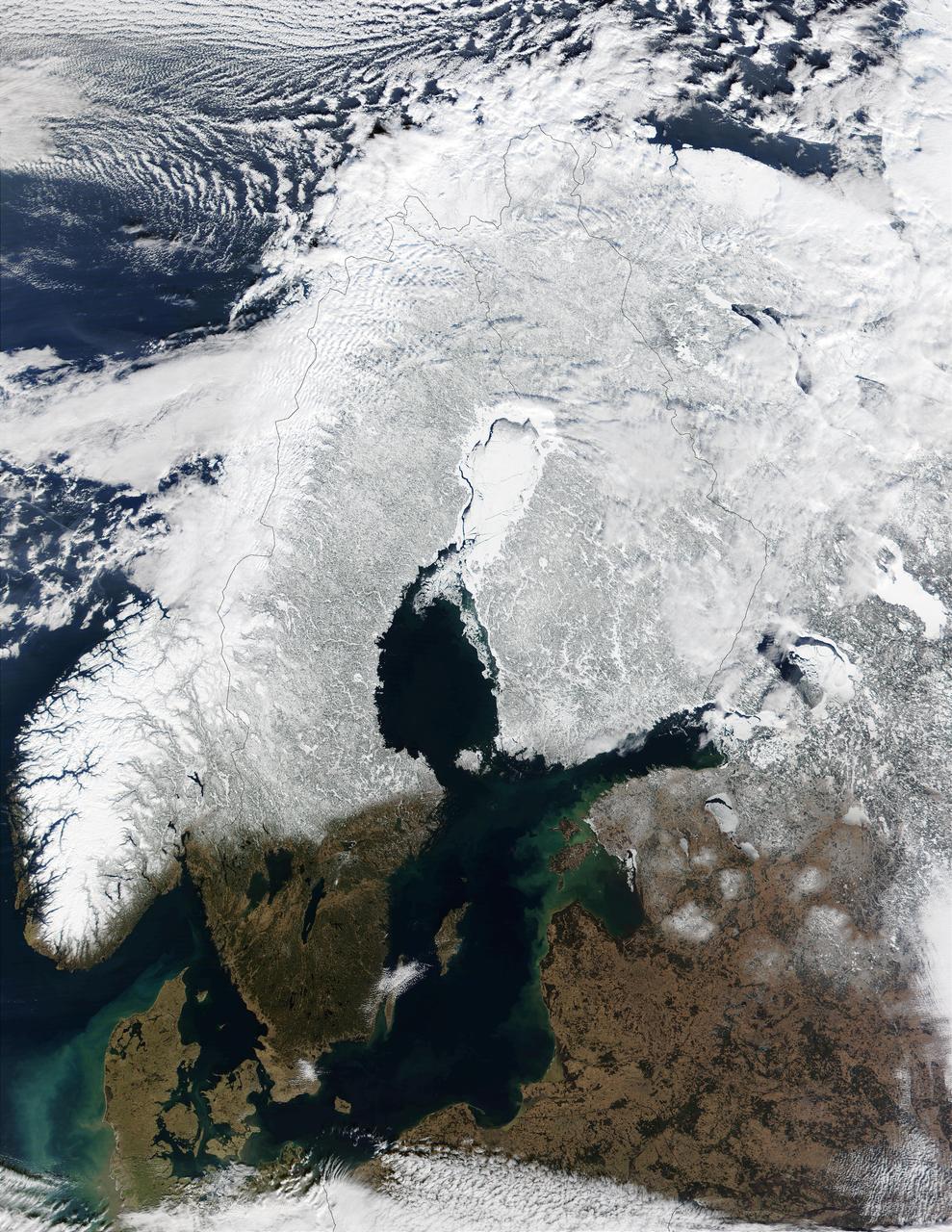
In this mostly cloud-free true-color scene, much of Scandinavia can be seen to be still covered by snow. From left to right across the top of this image are the countries of Norway, Sweden, Finland, and northwestern Russia. The Baltic Sea is located in the bottom center of this scene, with the Gulf of Bothnia to the north (in the center of this scene) and the Gulf of Finland to the northeast. This image was acquired on March 15, 2002, by the Moderate-resolution Imaging Spectroradiometer (MODIS), flying aboard NASA's Terra satellite. Image courtesy Jacques Descloitres, rapidfire.sci.gsfc.nasa.gov/ MODIS Land Rapid Response Team at NASA GSFC Credit: <b><a href="http://www.earthobservatory.nasa.gov/" rel="nofollow"> NASA Earth Observatory</a></b> <b><a href="http://www.nasa.gov/audience/formedia/features/MP_Photo_Guidelines.html" rel="nofollow">NASA image use policy.</a></b> <b><a href="http://www.nasa.gov/centers/goddard/home/index.html" rel="nofollow">NASA Goddard Space Flight Center</a></b> enables NASA’s mission through four scientific endeavors: Earth Science, Heliophysics, Solar System Exploration, and Astrophysics. Goddard plays a leading role in NASA’s accomplishments by contributing compelling scientific knowledge to advance the Agency’s mission. <b>Follow us on <a href="http://twitter.com/NASAGoddardPix" rel="nofollow">Twitter</a></b> <b>Like us on <a href="http://www.facebook.com/pages/Greenbelt-MD/NASA-Goddard/395013845897?ref=tsd" rel="nofollow">Facebook</a></b> <b>Find us on <a href="http://instagram.com/nasagoddard?vm=grid" rel="nofollow">Instagram</a></b>
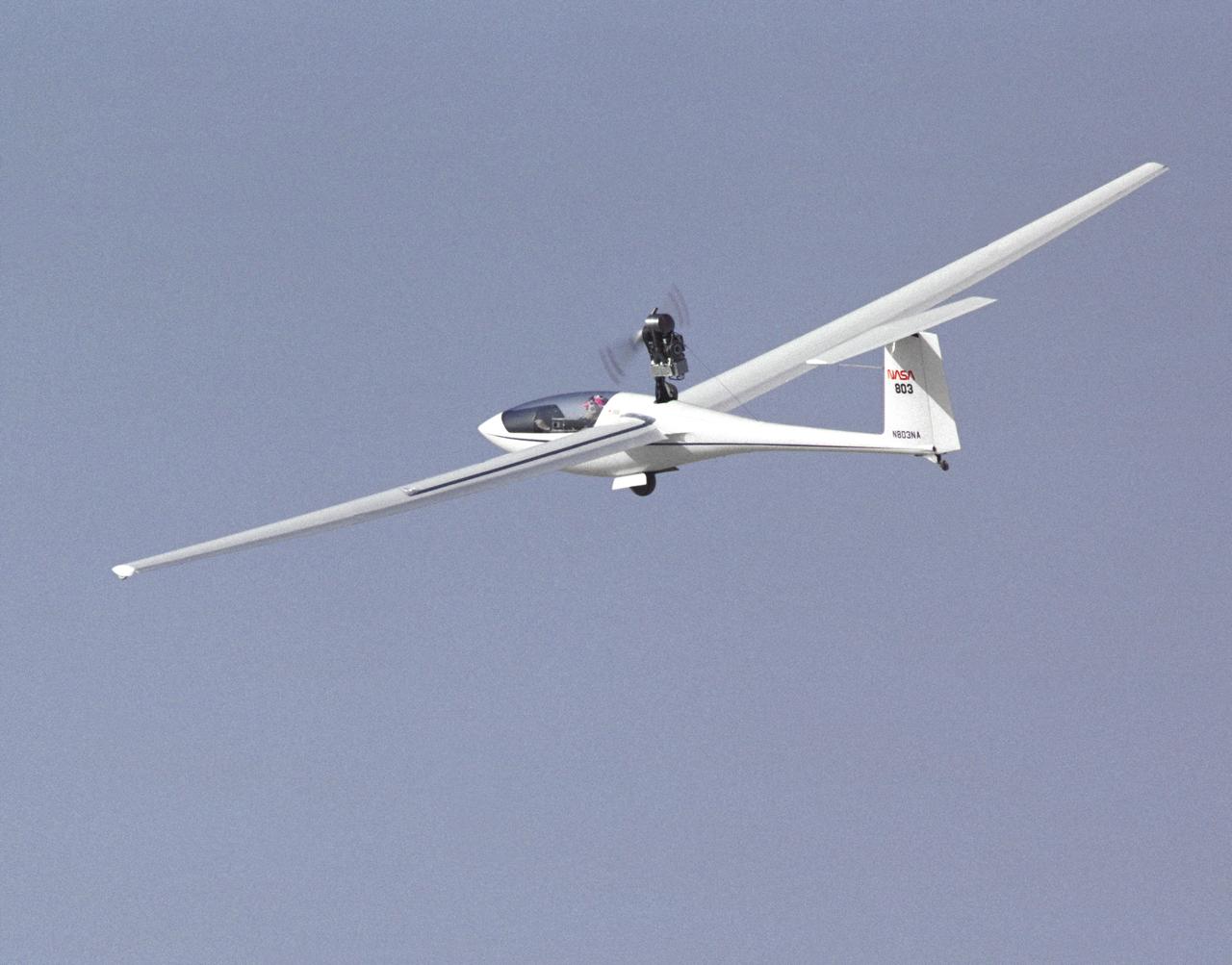
This photo shows NASA's PIK-20E motor-glider sailplane during a research flight from the Ames-Dryden Flight Research Facility (later, the Dryden Flight Research Center), Edwards, California, in 1991.
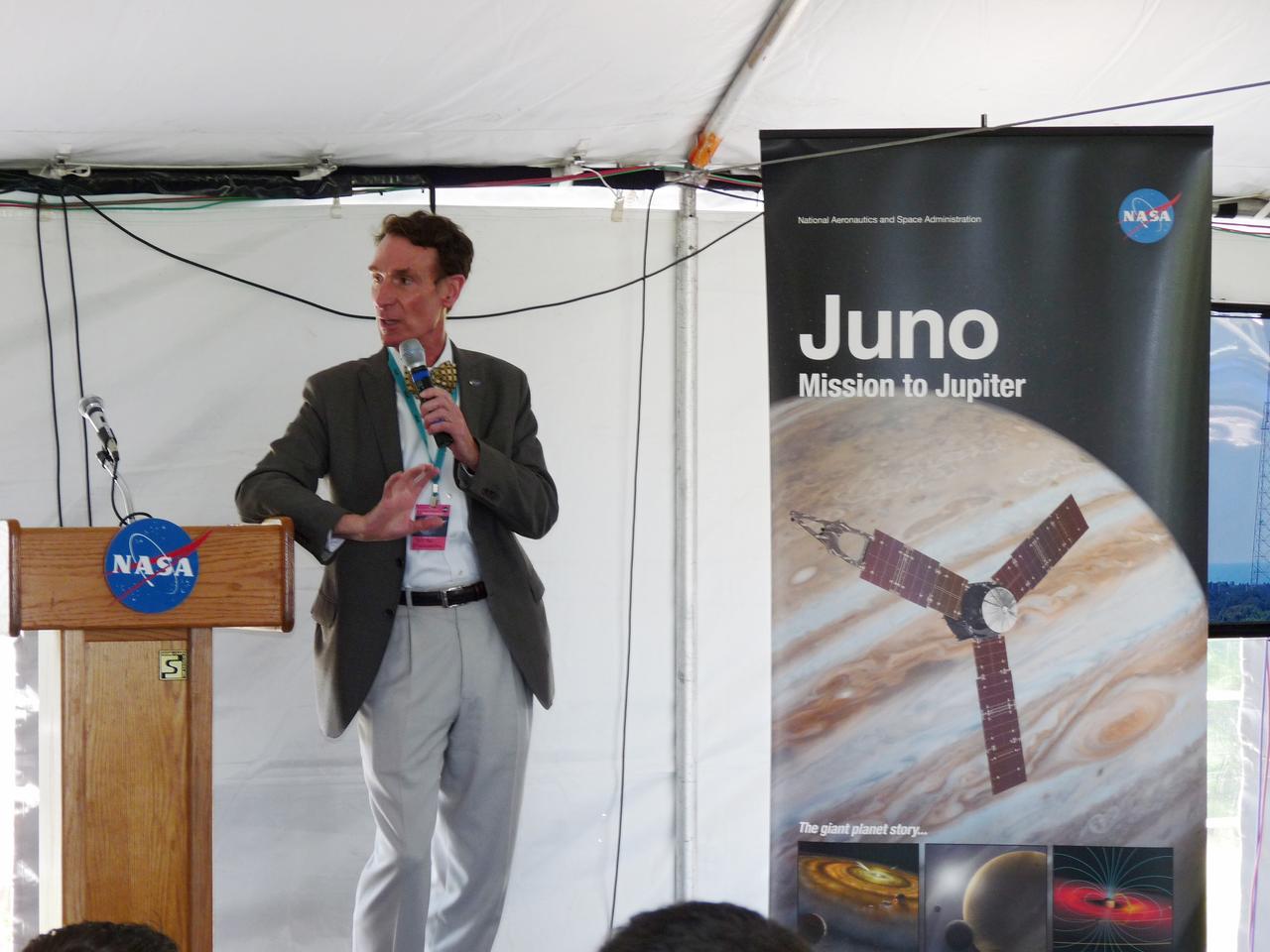
CAPE CANAVERAL, Fla. – At NASA’s Kennedy Space Center in Florida, television personality Bill Nye, the science guy, speaks to about 150 followers of the agency’s Twitter account during Juno Tweetup activities inside a tent at the Press Site. The tweeters are at the center for two days of prelaunch activities. Juno is NASA’s mission to Jupiter to study the giant planet and improve our understanding of the planet’s formation and evolution. The tweeters will share their experiences with followers through the social networking site Twitter. Attendees represent 28 states, the District of Columbia and five other countries: Canada, Finland, Norway, Spain and the United Kingdom. This is the first time NASA has invited Twitter followers to experience the launch of a planetary spacecraft. The Juno spacecraft is scheduled to launch on an Atlas V rocket from Space Launch Complex 41 at Cape Canaveral Air Force Station in Florida, Aug. 5, at 11:34 a.m. EDT. For more information, visit http://www.nasa.gov/juno. Photo credit: NASA/Fletcher Hildreth
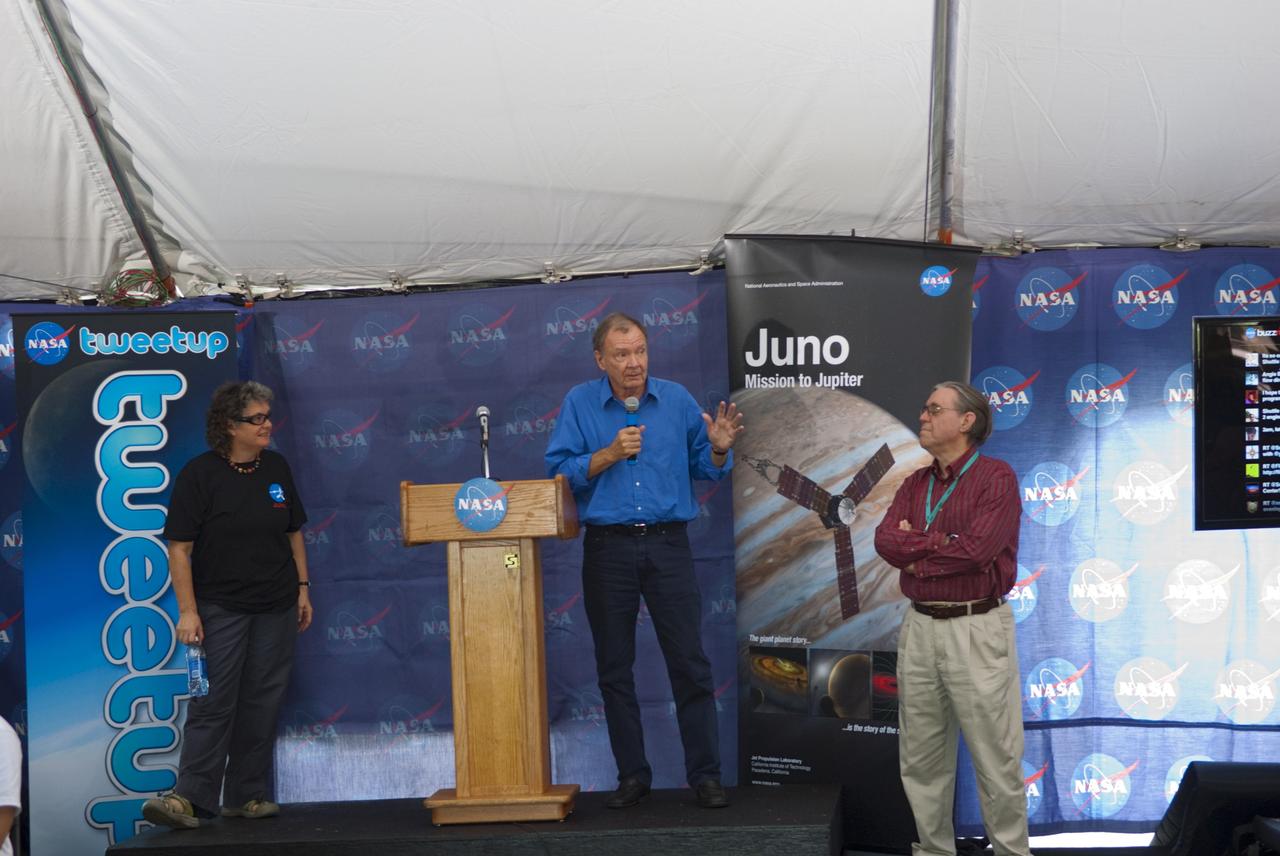
CAPE CANAVERAL, Fla. – At NASA’s Kennedy Space Center in Florida, Toby Owen, Juno co-investigator from the University of Hawaii, speaks to about 150 followers of the agency’s Twitter account during Juno Tweetup activities inside a tent at the Press Site. The tweeters are at the center for two days of prelaunch activities. Juno is NASA’s mission to Jupiter to study the giant planet and improve our understanding of the planet’s formation and evolution. The tweeters will share their experiences with followers through the social networking site Twitter. Attendees represent 28 states, the District of Columbia and five other countries: Canada, Finland, Norway, Spain and the United Kingdom. This is the first time NASA has invited Twitter followers to experience the launch of a planetary spacecraft. The Juno spacecraft is scheduled to launch on an Atlas V rocket from Space Launch Complex 41 at Cape Canaveral Air Force Station in Florida, Aug. 5, at 11:34 a.m. EDT. For more information, visit http://www.nasa.gov/juno. Photo credit: Jim Grossmann
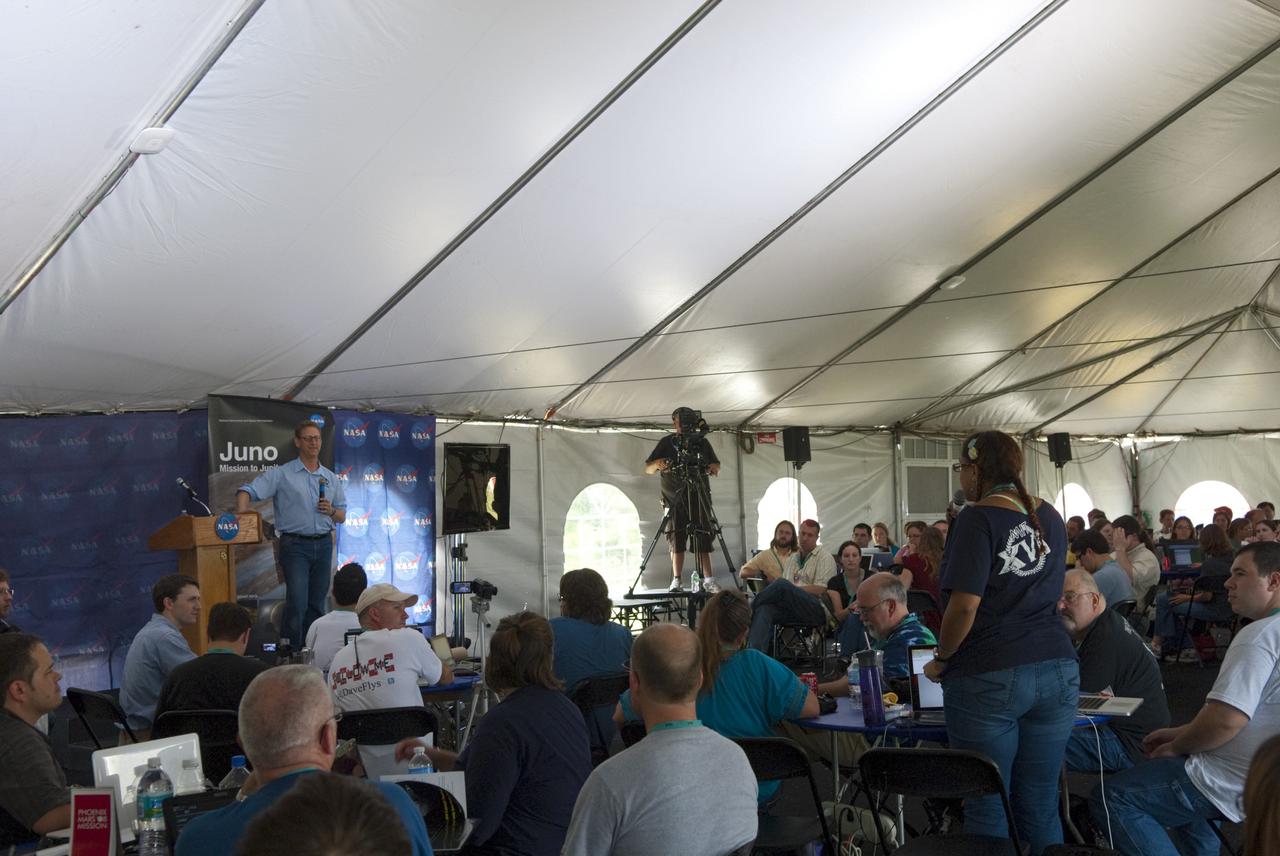
CAPE CANAVERAL, Fla. – At NASA’s Kennedy Space Center in Florida, Steve Levin, Juno project scientist from the Jet Propulsion Laboratory in Pasadena, Calif., speaks to about 150 followers of the agency’s Twitter account during Juno Tweetup activities inside a tent at the Press Site. The tweeters are at the center for two days of prelaunch activities. Juno is NASA’s mission to Jupiter to study the giant planet and improve our understanding of the planet’s formation and evolution. The tweeters will share their experiences with followers through the social networking site Twitter. Attendees represent 28 states, the District of Columbia and five other countries: Canada, Finland, Norway, Spain and the United Kingdom. This is the first time NASA has invited Twitter followers to experience the launch of a planetary spacecraft. The Juno spacecraft is scheduled to launch on an Atlas V rocket from Space Launch Complex 41 at Cape Canaveral Air Force Station in Florida, Aug. 5, at 11:34 a.m. EDT. For more information, visit http://www.nasa.gov/juno. Photo credit: Jim Grossmann
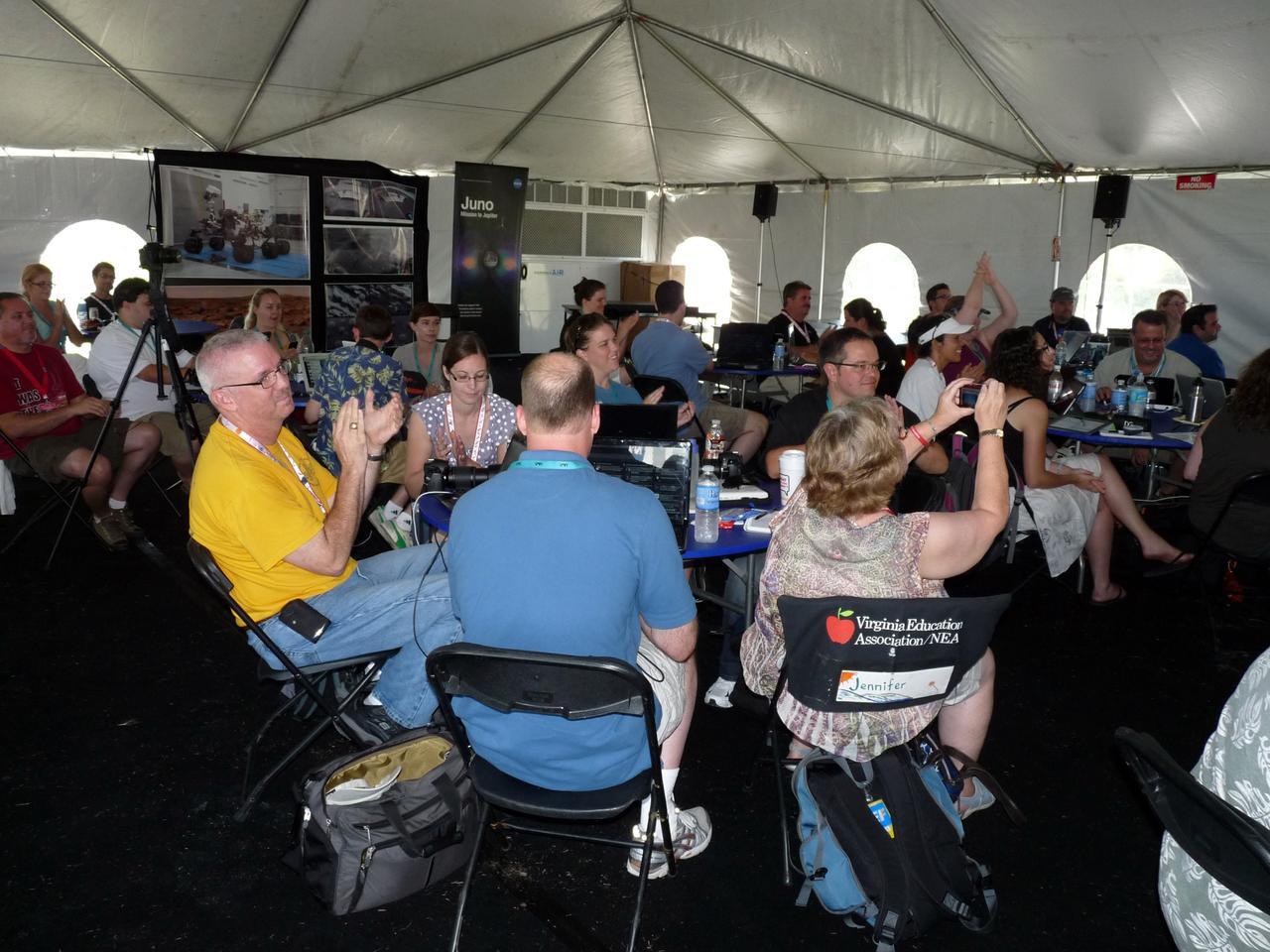
CAPE CANAVERAL, Fla. – At NASA’s Kennedy Space Center in Florida, about 150 followers of the agency’s Twitter account listen to presentations about NASA’s Juno mission to Jupiter during Tweetup activities inside a tent at the Press Site. The tweeters are at the center for two days of Juno prelaunch activities. Juno is NASA’s mission to Jupiter to study the giant planet and improve our understanding of the planet’s formation and evolution. The tweeters will share their experiences with followers through the social networking site Twitter. Attendees represent 28 states, the District of Columbia and five other countries: Canada, Finland, Norway, Spain and the United Kingdom. This is the first time NASA has invited Twitter followers to experience the launch of a planetary spacecraft. The Juno spacecraft is scheduled to launch on an Atlas V rocket from Space Launch Complex 41 at Cape Canaveral Air Force Station in Florida, Aug. 5, at 11:34 a.m. EDT. For more information, visit http://www.nasa.gov/juno. Photo credit: NASA/Fletcher Hildreth
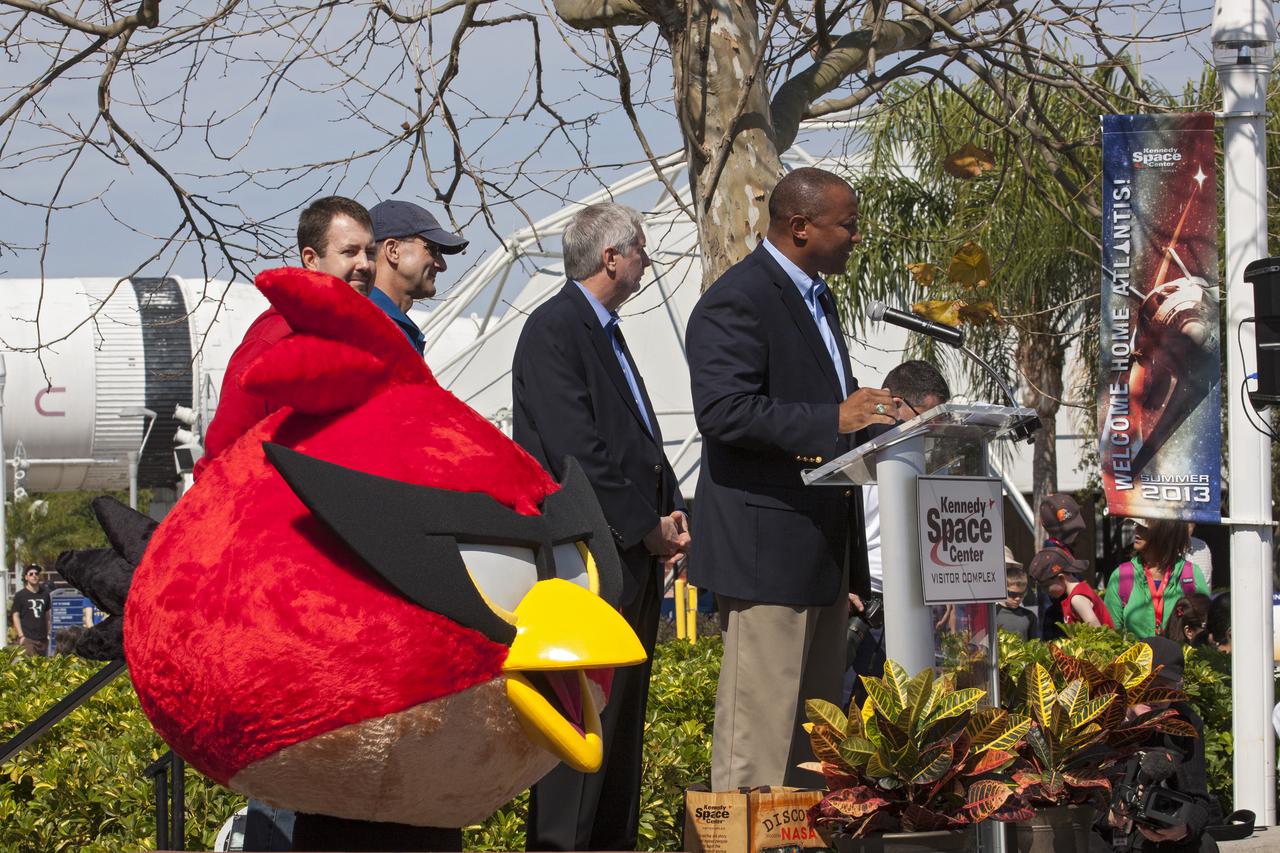
CAPE CANAVERAL, Fla. -- At NASA’s Kennedy Space Center Visitor Complex in Florida, Kelvin Manning, associate deputy director of Kennedy Space Center, speaks to visitors during the grand opening of the new Angry Birds Space Encounter. Standing behind Manning, from left are Dan Mitchell, director of location-based entertainment for Rovio Entertainment NASA astronaut Don Pettit and Bill Moore, chief operating officer with the KSC visitor complex. Also in the photo is Red Bird, one of the Angry Bird Space characters. Finland-based Rovio Entertainment, the creator of the Angry Birds Space game, partnered with Kennedy Space Center to bring the beloved characters to life. It is the first Angry Birds interactive exhibit in the United States designed for people of all ages. The 4,485-square-foot facility hosts the space adventures of the Angry Birds as they travel into an intergalactic wormhole, come face-to-face with Space Pigs and discover heroic superpowers. Six interactive stations are designed to encourage children in science, technology, engineering and mathematics fields of study. Photo credit: NASA_Kim Shiflett

CAPE CANAVERAL, Fla. – At NASA’s Kennedy Space Center in Florida, about 150 followers of the agency’s Twitter account listen to presentations about NASA’s Juno mission to Jupiter during Tweetup activities inside a tent at the Press Site. The tweeters are at the center for two days of Juno prelaunch activities. Juno is NASA’s mission to Jupiter to study the giant planet and improve our understanding of the planet’s formation and evolution. The tweeters will share their experiences with followers through the social networking site Twitter. Attendees represent 28 states, the District of Columbia and five other countries: Canada, Finland, Norway, Spain and the United Kingdom. This is the first time NASA has invited Twitter followers to experience the launch of a planetary spacecraft. The Juno spacecraft is scheduled to launch on an Atlas V rocket from Space Launch Complex 41 at Cape Canaveral Air Force Station in Florida, Aug. 5, at 11:34 a.m. EDT. For more information, visit http://www.nasa.gov/juno. Photo credit: NASA/Fletcher Hildreth
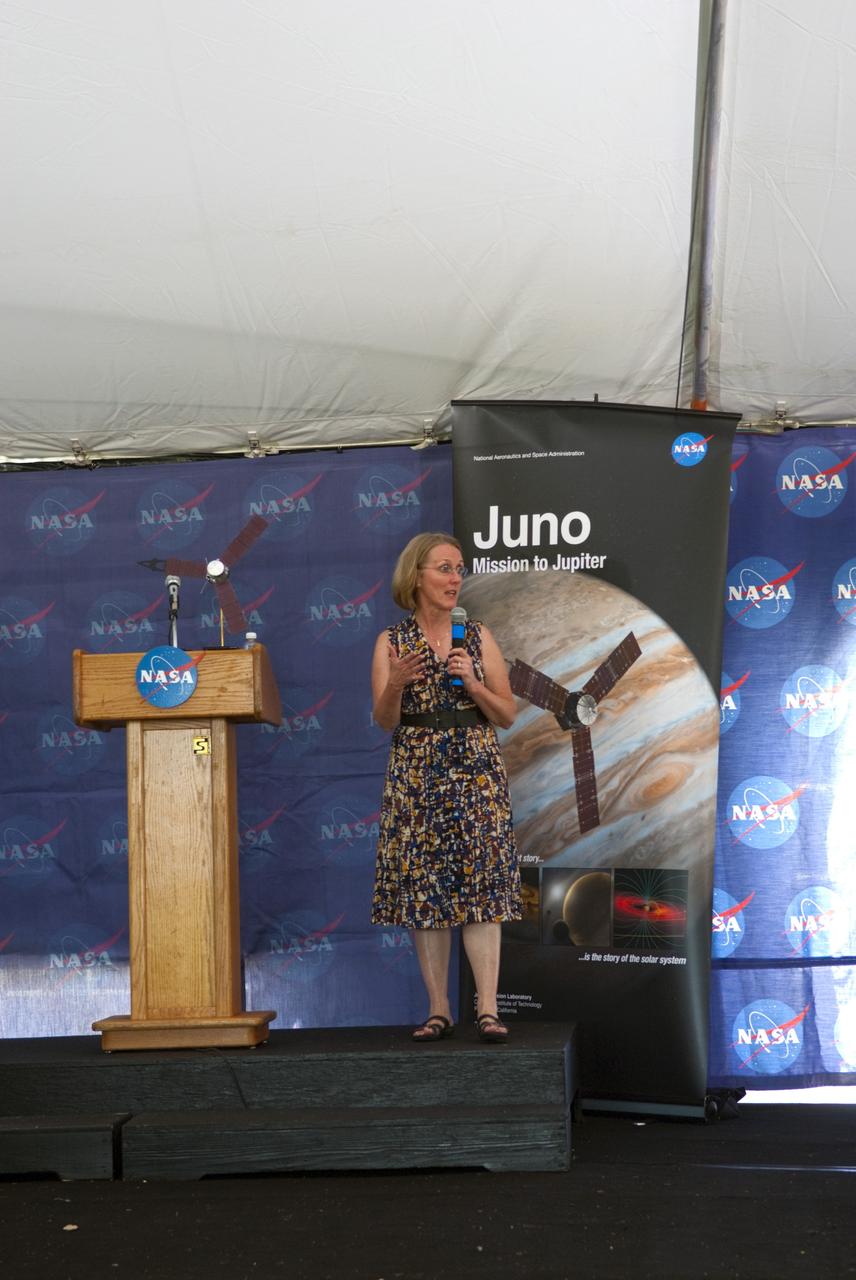
CAPE CANAVERAL, Fla. – At NASA’s Kennedy Space Center in Florida, Jan Chodas, Juno project manager from the Jet Propulsion Laboratory in Pasadena, Calif., speaks to about 150 followers of the agency’s Twitter account during Juno Tweetup activities inside a tent at the Press Site. The tweeters are at the center for two days of prelaunch activities. Juno is NASA’s mission to Jupiter to study the giant planet and improve our understanding of the planet’s formation and evolution. The tweeters will share their experiences with followers through the social networking site Twitter. Attendees represent 28 states, the District of Columbia and five other countries: Canada, Finland, Norway, Spain and the United Kingdom. This is the first time NASA has invited Twitter followers to experience the launch of a planetary spacecraft. The Juno spacecraft is scheduled to launch on an Atlas V rocket from Space Launch Complex 41 at Cape Canaveral Air Force Station in Florida, Aug. 5, at 11:34 a.m. EDT. For more information, visit http://www.nasa.gov/juno. Photo credit: Jim Grossmann
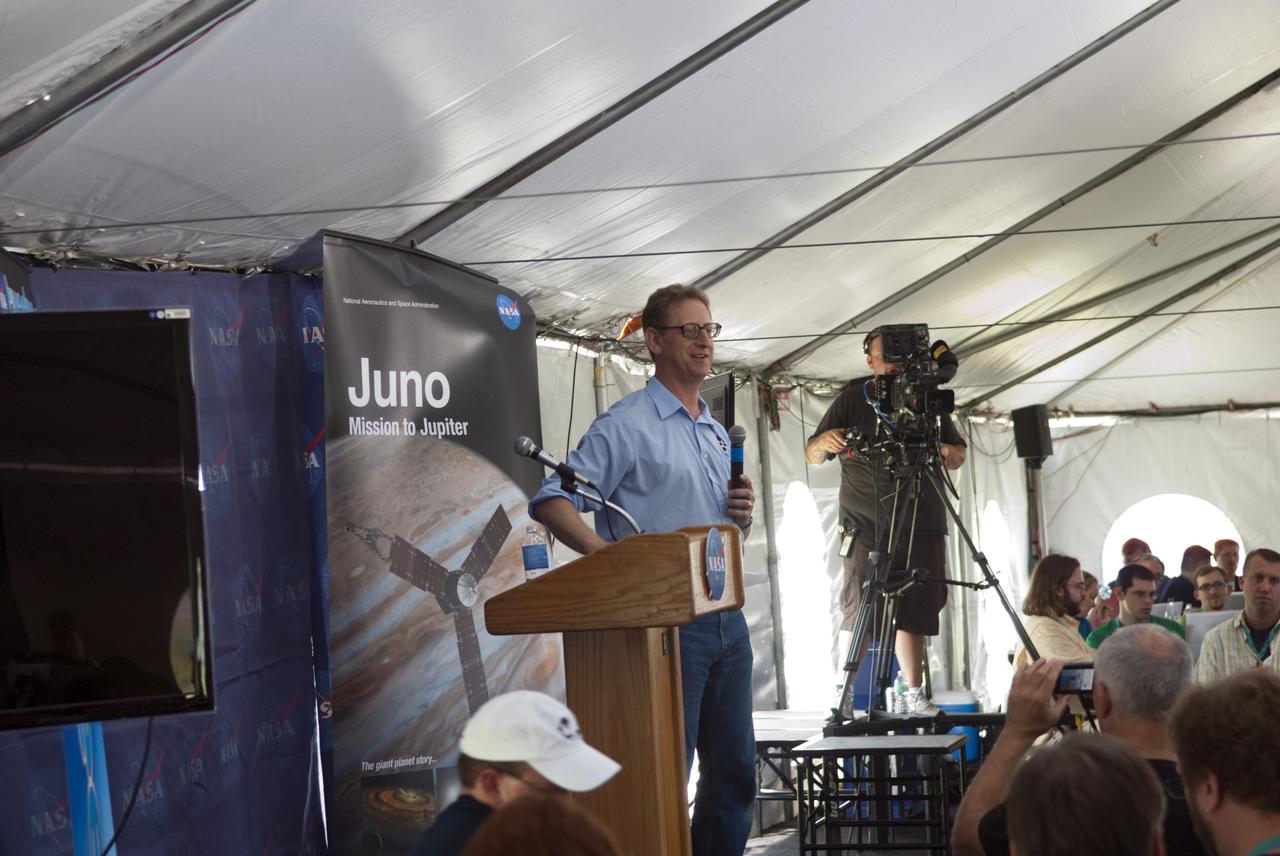
CAPE CANAVERAL, Fla. – At NASA’s Kennedy Space Center in Florida, Steve Levin, Juno project scientist from the Jet Propulsion Laboratory in Pasadena, Calif., speaks to about 150 followers of the agency’s Twitter account during Juno Tweetup activities inside a tent at the Press Site. The tweeters are at the center for two days of prelaunch activities. Juno is NASA’s mission to Jupiter to study the giant planet and improve our understanding of the planet’s formation and evolution. The tweeters will share their experiences with followers through the social networking site Twitter. Attendees represent 28 states, the District of Columbia and five other countries: Canada, Finland, Norway, Spain and the United Kingdom. This is the first time NASA has invited Twitter followers to experience the launch of a planetary spacecraft. The Juno spacecraft is scheduled to launch on an Atlas V rocket from Space Launch Complex 41 at Cape Canaveral Air Force Station in Florida, Aug. 5, at 11:34 a.m. EDT. For more information, visit http://www.nasa.gov/juno. Photo credit: Jim Grossmann
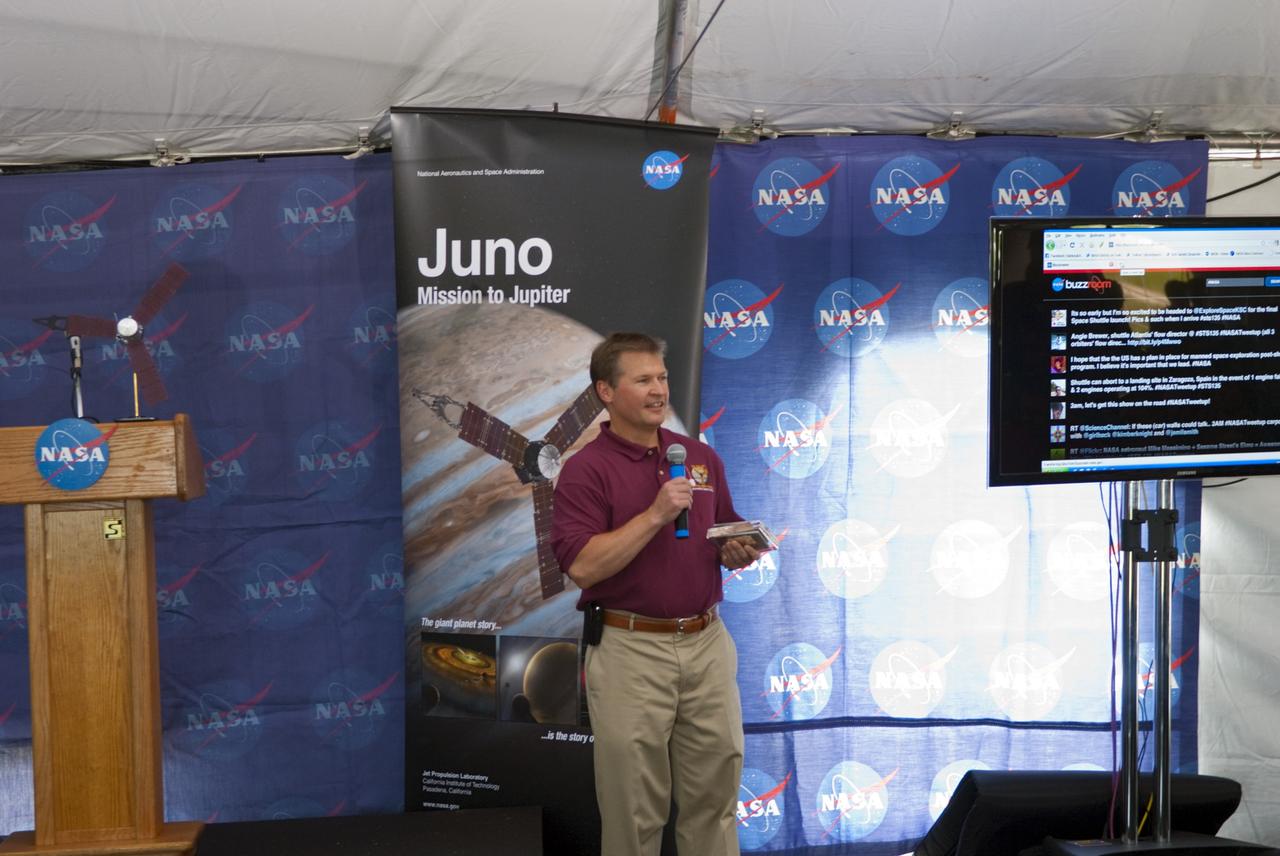
CAPE CANAVERAL, Fla. – At NASA’s Kennedy Space Center in Florida, Chris Brosious, Juno chief systems engineer for Lockheed Martin, speaks to about 150 followers of the agency’s Twitter account during Juno Tweetup activities inside a tent at the Press Site. The tweeters are at the center for two days of prelaunch activities. Juno is NASA’s mission to Jupiter to study the giant planet and improve our understanding of the planet’s formation and evolution. The tweeters will share their experiences with followers through the social networking site Twitter. Attendees represent 28 states, the District of Columbia and five other countries: Canada, Finland, Norway, Spain and the United Kingdom. This is the first time NASA has invited Twitter followers to experience the launch of a planetary spacecraft. The Juno spacecraft is scheduled to launch on an Atlas V rocket from Space Launch Complex 41 at Cape Canaveral Air Force Station in Florida, Aug. 5, at 11:34 a.m. EDT. For more information, visit http://www.nasa.gov/juno. Photo credit: Jim Grossmann

CAPE CANAVERAL, Fla. – At NASA’s Kennedy Space Center in Florida, Andrew Aldrin, director of Business Development and Advanced Programs for the United Launch Alliance, speaks to about 150 followers of the agency’s Twitter account during Juno Tweetup activities inside a tent at the Press Site. The tweeters are at the center for two days of prelaunch activities. Juno is NASA’s mission to Jupiter to study the giant planet and improve our understanding of the planet’s formation and evolution. The tweeters will share their experiences with followers through the social networking site Twitter. Attendees represent 28 states, the District of Columbia and five other countries: Canada, Finland, Norway, Spain and the United Kingdom. This is the first time NASA has invited Twitter followers to experience the launch of a planetary spacecraft. The Juno spacecraft is scheduled to launch on an Atlas V rocket from Space Launch Complex 41 at Cape Canaveral Air Force Station in Florida, Aug. 5, at 11:34 a.m. EDT. For more information, visit http://www.nasa.gov/juno. Photo credit: NASA/Gianni M. Woods
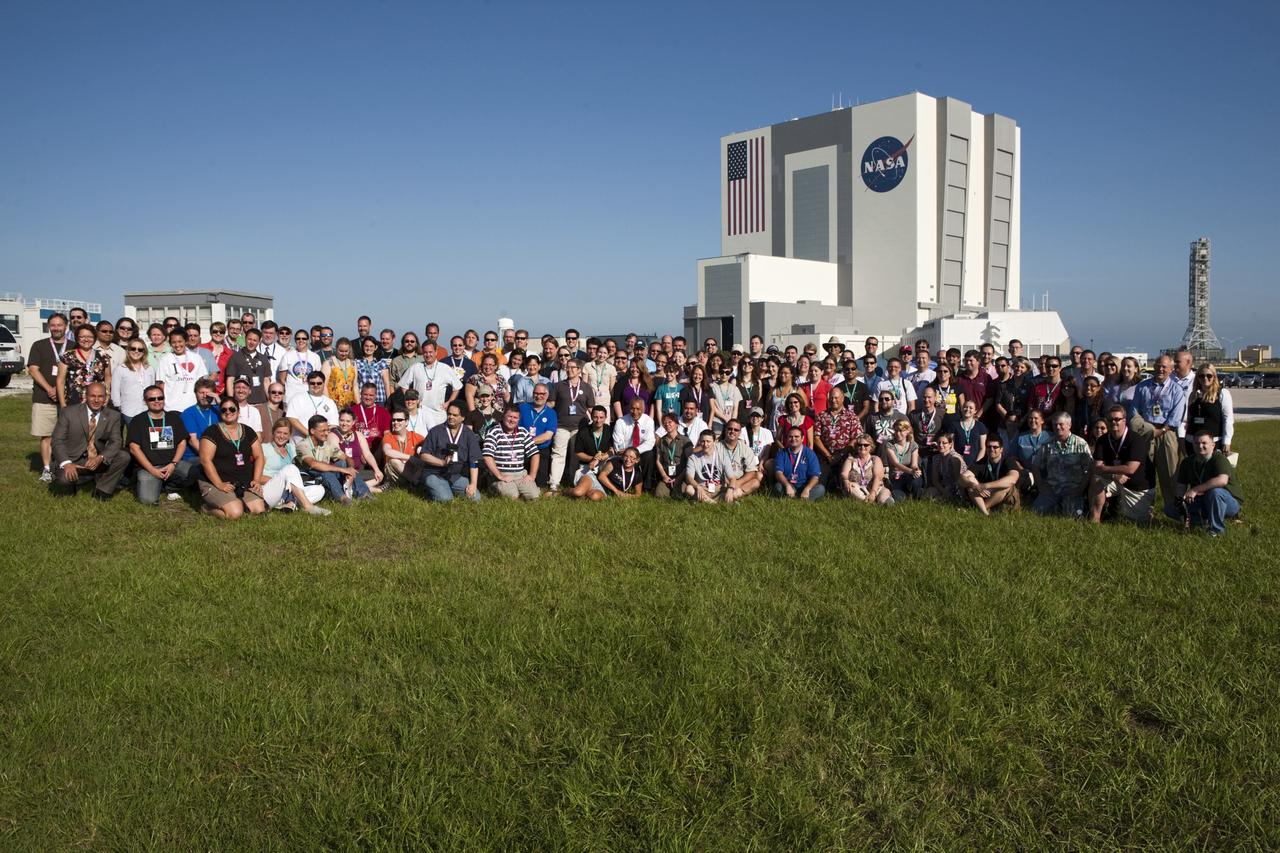
CAPE CANAVERAL, Fla. – At NASA’s Kennedy Space Center in Florida, NASA Administrator Charles Bolden (front row center, red tie) poses for a group portrait with about 150 followers of the agency’s Twitter account during Juno Tweetup activities at the Press Site. In the background is the 525-foot-tall Vehicle Assembly Building. The tweeters are at the center for two days of prelaunch activities. Juno is NASA’s mission to Jupiter to study the giant planet and improve our understanding of the planet’s formation and evolution. The tweeters will share their experiences with followers through the social networking site Twitter. Attendees represent 28 states, the District of Columbia and five other countries: Canada, Finland, Norway, Spain and the United Kingdom. This is the first time NASA has invited Twitter followers to experience the launch of a planetary spacecraft. The Juno spacecraft is scheduled to launch on an Atlas V rocket from Space Launch Complex 41 at Cape Canaveral Air Force Station in Florida, Aug. 5, at 11:34 a.m. EDT. For more information, visit http://www.nasa.gov/juno. Photo credit: NASA/Gianni M. Woods

CAPE CANAVERAL, Fla. – At NASA’s Kennedy Space Center in Florida, about 150 followers of the agency’s Twitter account listen to presentations about NASA’s Juno mission to Jupiter during Tweetup activities inside a tent at the Press Site. The tweeters are at the center for two days of Juno prelaunch activities. Juno is NASA’s mission to Jupiter to study the giant planet and improve our understanding of the planet’s formation and evolution. The tweeters will share their experiences with followers through the social networking site Twitter. Attendees represent 28 states, the District of Columbia and five other countries: Canada, Finland, Norway, Spain and the United Kingdom. This is the first time NASA has invited Twitter followers to experience the launch of a planetary spacecraft. The Juno spacecraft is scheduled to launch on an Atlas V rocket from Space Launch Complex 41 at Cape Canaveral Air Force Station in Florida, Aug. 5, at 11:34 a.m. EDT. For more information, visit http://www.nasa.gov/juno. Photo credit: Jim Grossmann
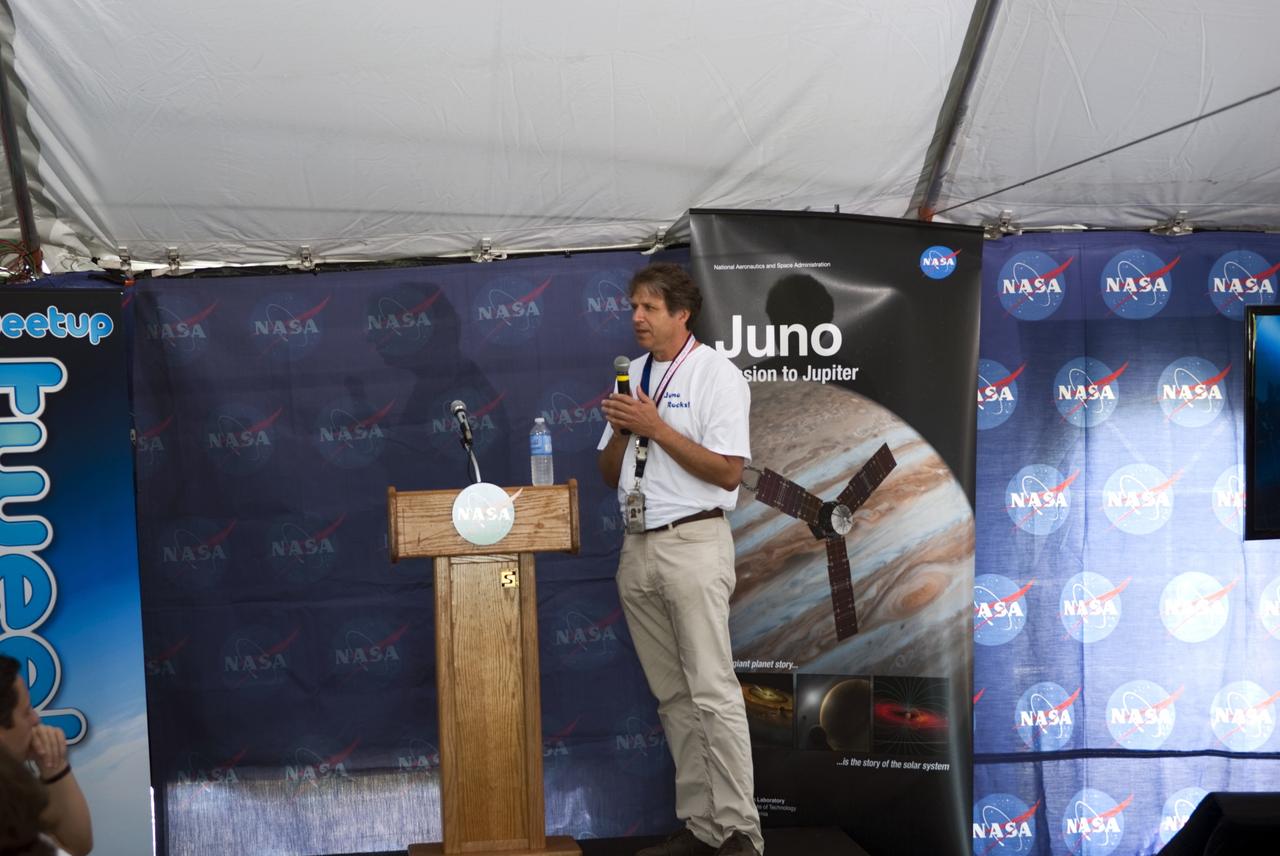
CAPE CANAVERAL, Fla. – At NASA’s Kennedy Space Center in Florida, Scott Bolton, Juno primary investigator from the Southwest Research Institute in San Antonio, speaks to about 150 followers of the agency’s Twitter account during Juno Tweetup activities inside a tent at the Press Site. The tweeters are at the center for two days of prelaunch activities. Juno is NASA’s mission to Jupiter to study the giant planet and improve our understanding of the planet’s formation and evolution. The tweeters will share their experiences with followers through the social networking site Twitter. Attendees represent 28 states, the District of Columbia and five other countries: Canada, Finland, Norway, Spain and the United Kingdom. This is the first time NASA has invited Twitter followers to experience the launch of a planetary spacecraft. The Juno spacecraft is scheduled to launch on an Atlas V rocket from Space Launch Complex 41 at Cape Canaveral Air Force Station in Florida, Aug. 5, at 11:34 a.m. EDT. For more information, visit http://www.nasa.gov/juno. Photo credit: Jim Grossmann
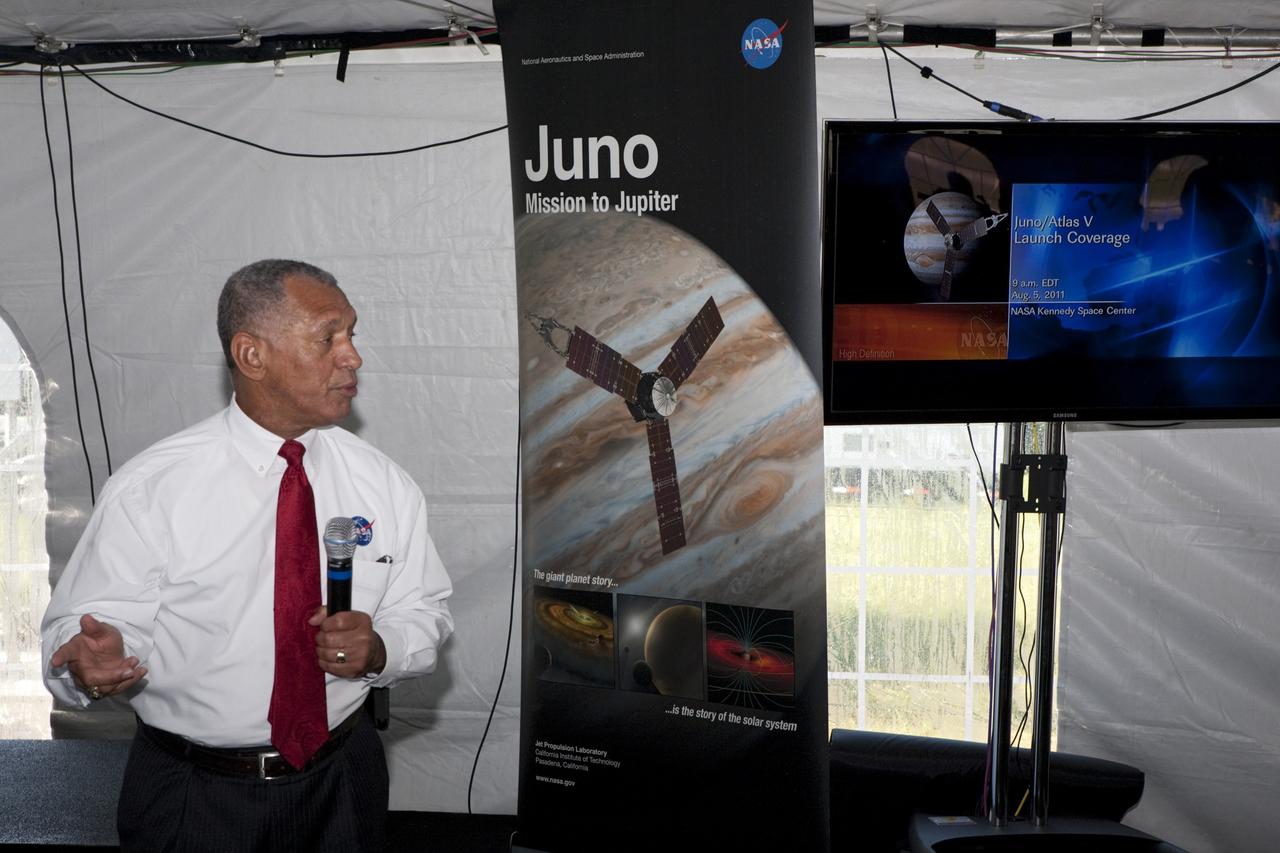
CAPE CANAVERAL, Fla. – At NASA’s Kennedy Space Center in Florida, NASA Administrator Charles Bolden speaks to about 150 followers of the agency’s Twitter account during Juno Tweetup activities inside a tent at the Press Site. The tweeters are at the center for two days of prelaunch activities. Juno is NASA’s mission to Jupiter to study the giant planet and improve our understanding of the planet’s formation and evolution. The tweeters will share their experiences with followers through the social networking site Twitter. Attendees represent 28 states, the District of Columbia and five other countries: Canada, Finland, Norway, Spain and the United Kingdom. This is the first time NASA has invited Twitter followers to experience the launch of a planetary spacecraft. The Juno spacecraft is scheduled to launch on an Atlas V rocket from Space Launch Complex 41 at Cape Canaveral Air Force Station in Florida, Aug. 5, at 11:34 a.m. EDT. For more information, visit http://www.nasa.gov/juno. Photo credit: NASA/Gianni M. Woods
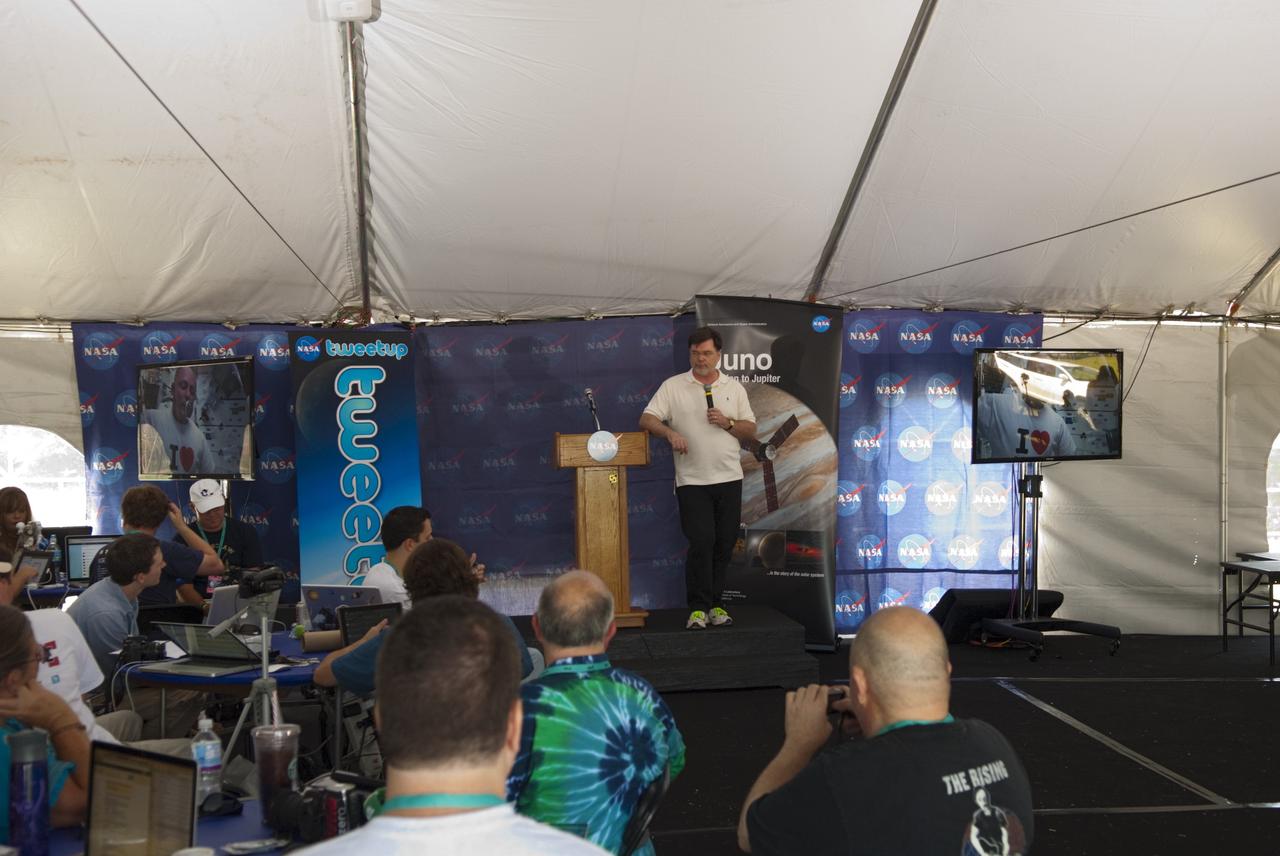
CAPE CANAVERAL, Fla. – At NASA’s Kennedy Space Center in Florida, Jim Adams, NASA deputy director of Planetary Science, speaks to about 150 followers of the agency’s Twitter account during Juno Tweetup activities inside a tent at the Press Site. The tweeters are at the center for two days of prelaunch activities. Juno is NASA’s mission to Jupiter to study the giant planet and improve our understanding of the planet’s formation and evolution. The tweeters will share their experiences with followers through the social networking site Twitter. Attendees represent 28 states, the District of Columbia and five other countries: Canada, Finland, Norway, Spain and the United Kingdom. This is the first time NASA has invited Twitter followers to experience the launch of a planetary spacecraft. The Juno spacecraft is scheduled to launch on an Atlas V rocket from Space Launch Complex 41 at Cape Canaveral Air Force Station in Florida, Aug. 5, at 11:34 a.m. EDT. For more information, visit http://www.nasa.gov/juno. Photo credit: Jim Grossmann

CAPE CANAVERAL, Fla. – At NASA’s Kennedy Space Center in Florida, NASA Chief Scientist Waleed Abdalati speaks to about 150 followers of the agency’s Twitter account during Juno Tweetup activities inside a tent at the Press Site. The tweeters are at the center for two days of prelaunch activities. Juno is NASA’s mission to Jupiter to study the giant planet and improve our understanding of the planet’s formation and evolution. The tweeters will share their experiences with followers through the social networking site Twitter. Attendees represent 28 states, the District of Columbia and five other countries: Canada, Finland, Norway, Spain and the United Kingdom. This is the first time NASA has invited Twitter followers to experience the launch of a planetary spacecraft. The Juno spacecraft is scheduled to launch on an Atlas V rocket from Space Launch Complex 41 at Cape Canaveral Air Force Station in Florida, Aug. 5, at 11:34 a.m. EDT. For more information, visit http://www.nasa.gov/juno. Photo credit: NASA/Gianni M. Woods
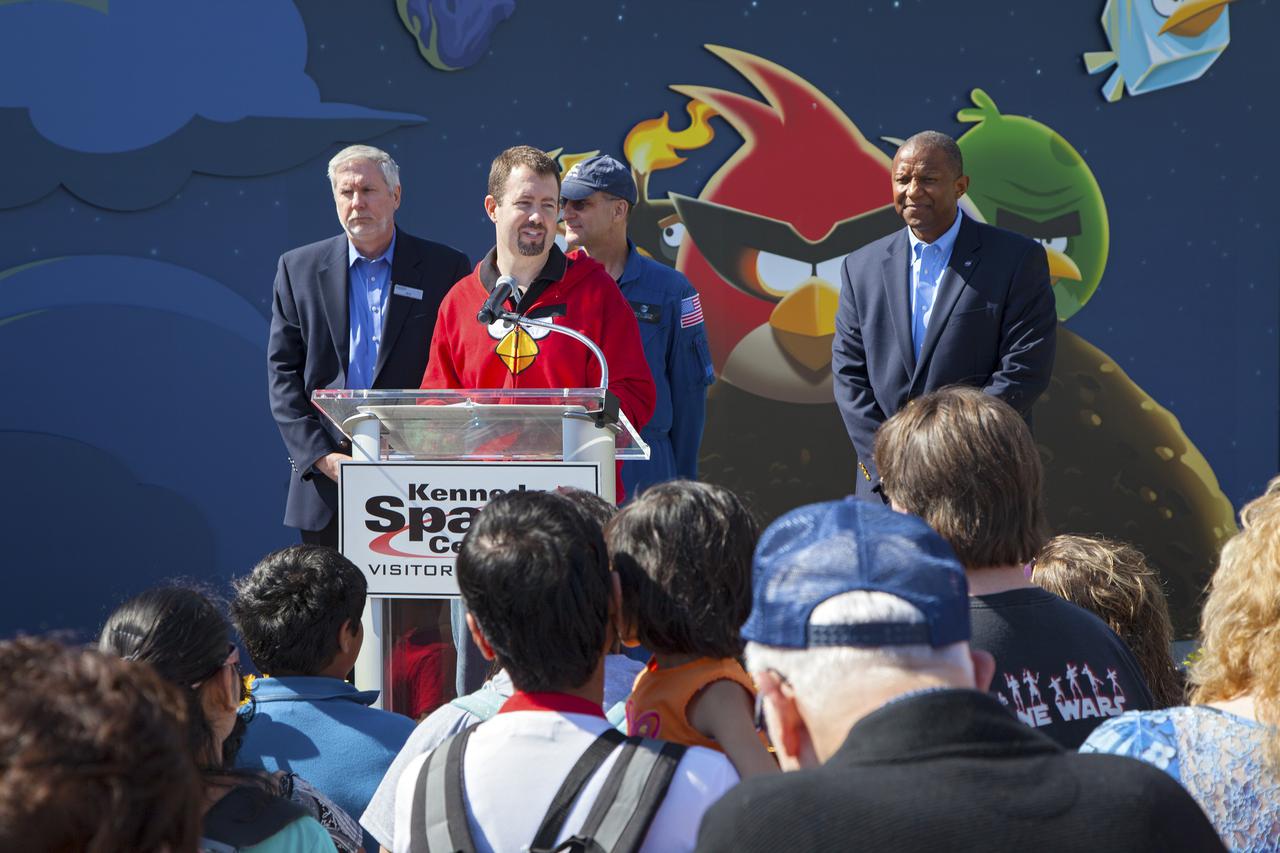
CAPE CANAVERAL, Fla. -- At NASA’s Kennedy Space Center Visitor Complex in Florida, Dan Mitchell, director of location-based entertainment for Rovio Entertainment, speaks to visitors during the grand opening of the new Angry Birds Space Encounter. Standing behind Mitchell, from left are Bill Moore, chief operating officer with the KSC visitor complex NASA astronaut Don Pettit and Kelvin Manning, associate deputy director of Kennedy Space Center. Finland-based Rovio Entertainment, the creator of the Angry Birds Space game, partnered with Kennedy Space Center to bring the beloved characters to life. It is the first Angry Birds interactive exhibit in the United States designed for people of all ages. The 4,485-square-foot facility hosts the space adventures of the Angry Birds as they travel into an intergalactic wormhole, come face-to-face with Space Pigs and discover heroic superpowers. Six interactive stations are designed to encourage children in science, technology, engineering and mathematics fields of study. Photo credit: NASA_Kim Shiflett
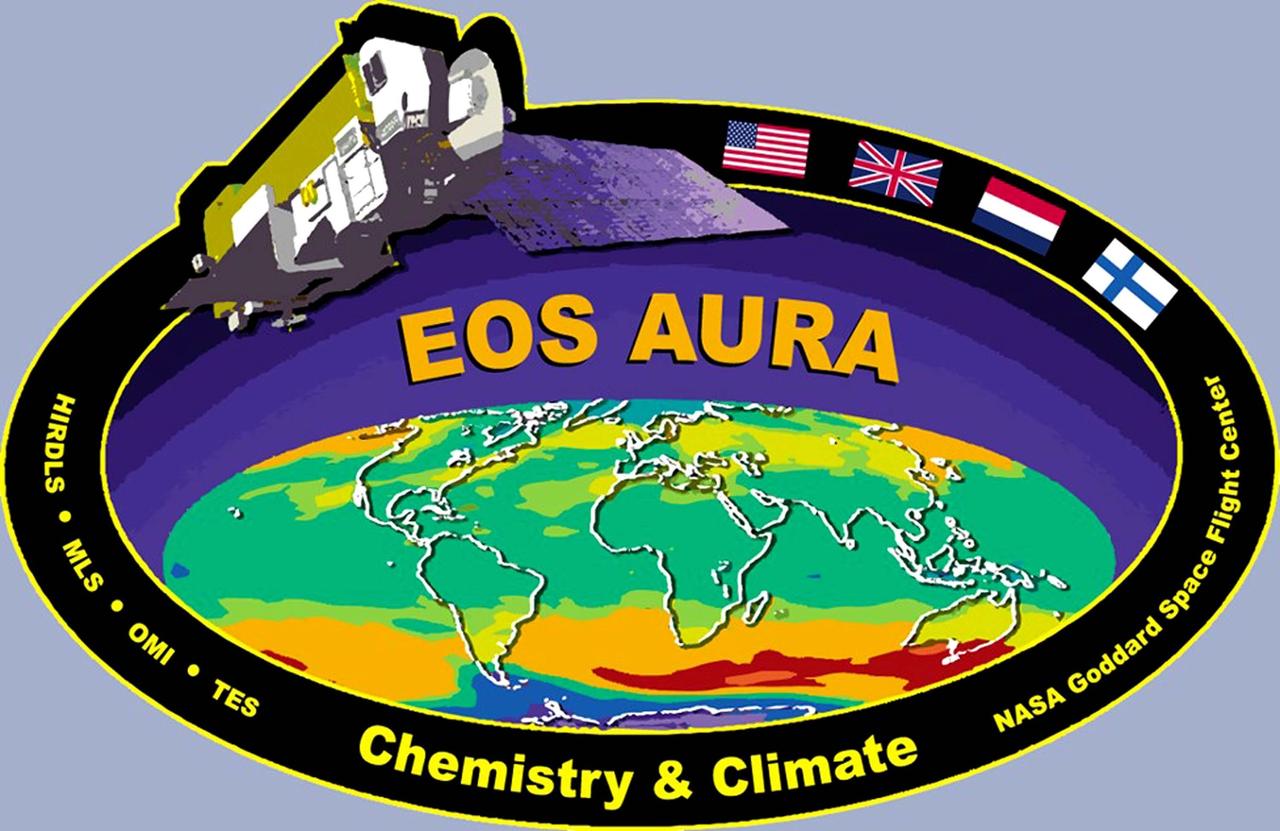
KENNEDY SPACE CENTER, FLA. -- EOS Aura: The Aura mission will study air quality, climate and stratospheric ozone depletion. Aura is the third of NASA’s major Earth Observing System (EOS) orbital platforms and has four instruments. The Microwave Limb Sounder (MLS) and the High Resolution Dynamics Limb Sounder (HIRDLS) will make complementary measurements of stratospheric ozone and the chemicals that destroy it. HIRDELS and MLS will also measure upper tropospheric water vapor and ozone - key gases that regulate climate. The Aura payload also includes the Tropospheric Emission Spectrometer (TES), which will make the first global measurements of lower atmospheric ozone, and the Ozone Monitoring Instrument (OMI), which will measure the total amount of atmospheric ozone as well as lower atmospheric dust, smoke and other aerosols. Aura is scheduled to launch in 2004. The flags on the decals represent the countries participating in the mission: United States, United Kingdom, Netherlands and Finland. The EOS Aura mission is being managed by NASA’s Goddard Space Flight Center.
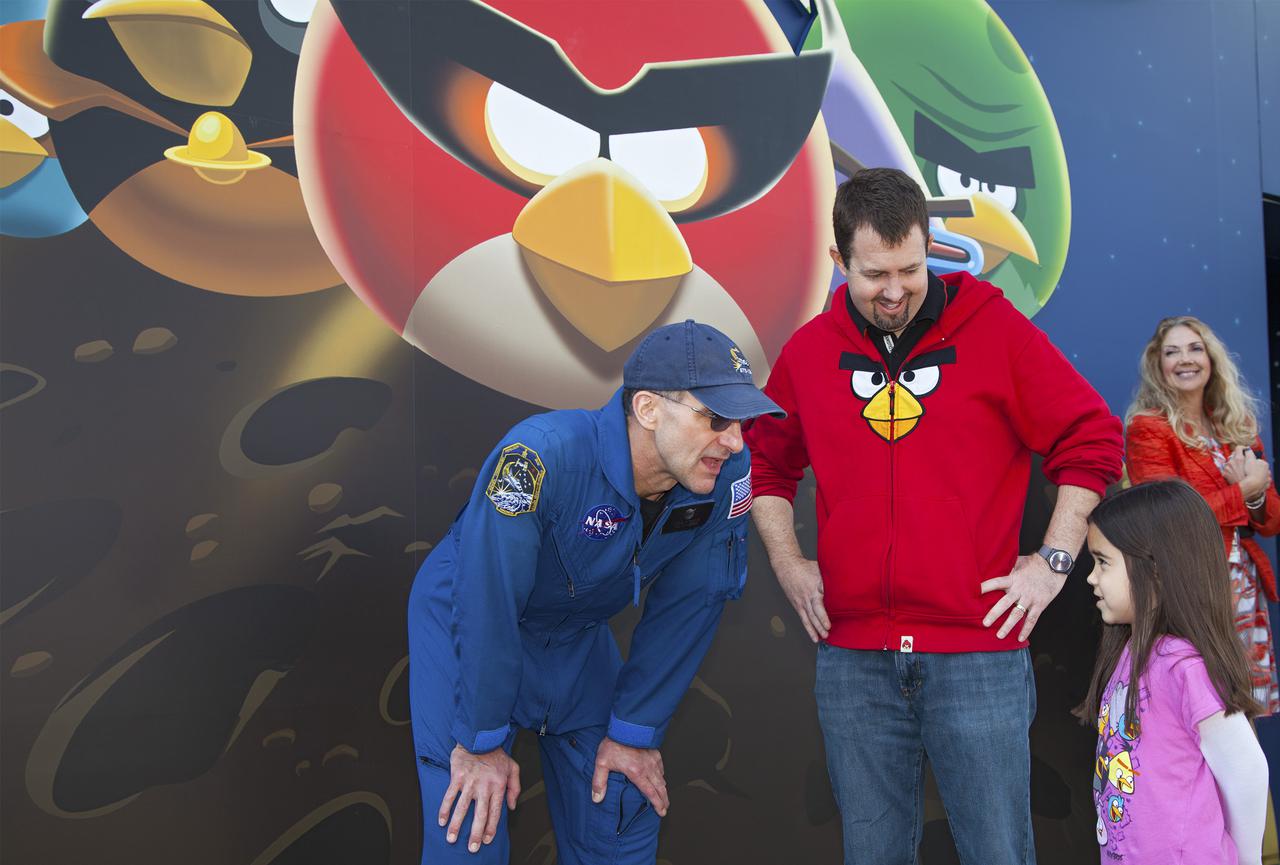
CAPE CANAVERAL, Fla. -- At NASA’s Kennedy Space Center Visitor Complex in Florida, NASA astronaut Don Pettit and Rovio Entertainment Director Dan Mitchell greet visitors near the entrance to the new Angry Birds Space Encounter during the grand opening ceremony. Pettit spent a total of 12 months during two separate missions aboard the International Space Station and introduced Angry Birds Space while floating in zero gravity. Finland-based Rovio Entertainment, the creator of the Angry Birds Space game, partnered with Kennedy Space Center to bring the beloved characters to life. It is the first Angry Birds interactive exhibit in the United States designed for people of all ages. The 4,485-square-foot facility hosts the space adventures of the Angry Birds as they travel into an intergalactic wormhole, come face-to-face with Space Pigs and discover heroic superpowers. Six interactive stations are designed to encourage children in science, technology, engineering and mathematics fields of study. Photo credit: NASA_Kim Shiflett
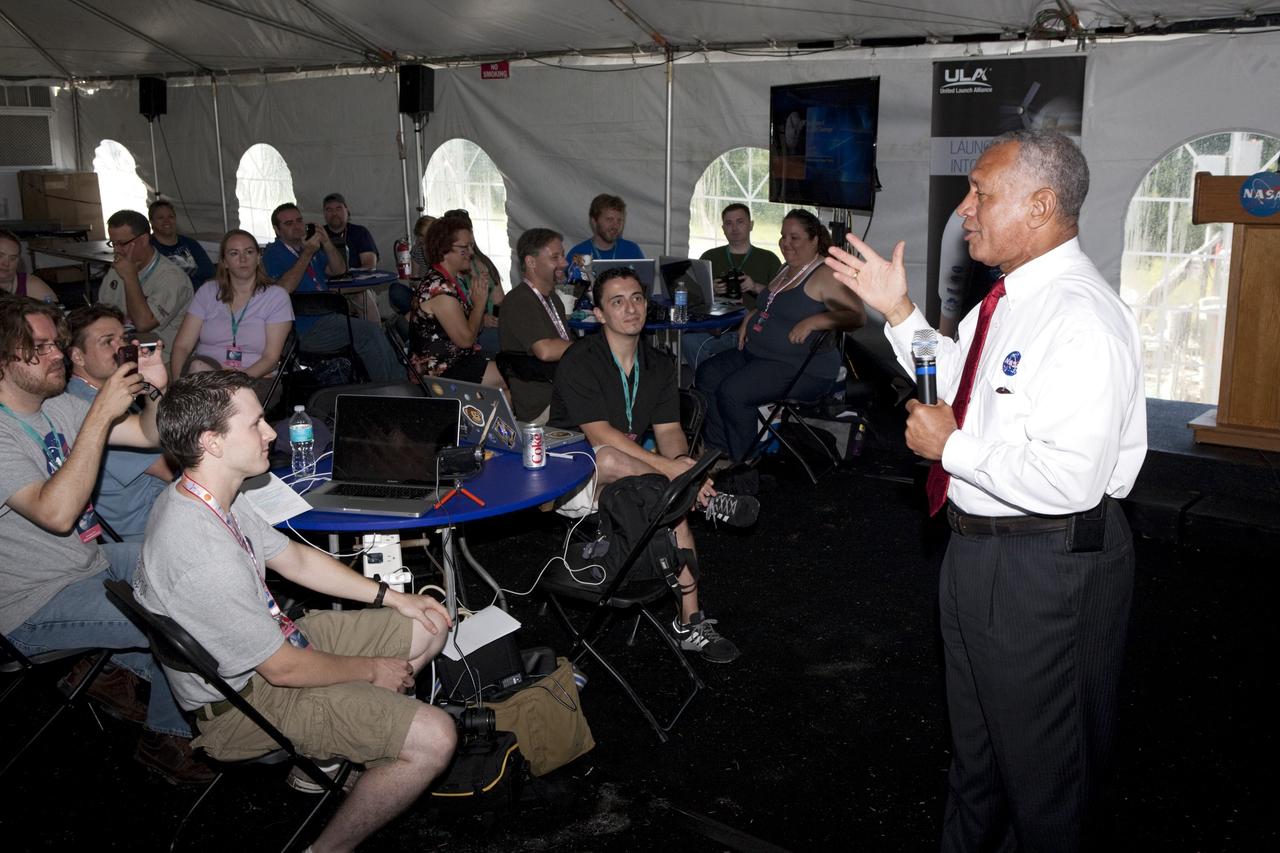
CAPE CANAVERAL, Fla. – At NASA’s Kennedy Space Center in Florida, NASA Administrator Charles Bolden speaks to about 150 followers of the agency’s Twitter account during Juno Tweetup activities inside a tent at the Press Site. The tweeters are at the center for two days of prelaunch activities. Juno is NASA’s mission to Jupiter to study the giant planet and improve our understanding of the planet’s formation and evolution. The tweeters will share their experiences with followers through the social networking site Twitter. Attendees represent 28 states, the District of Columbia and five other countries: Canada, Finland, Norway, Spain and the United Kingdom. This is the first time NASA has invited Twitter followers to experience the launch of a planetary spacecraft. The Juno spacecraft is scheduled to launch on an Atlas V rocket from Space Launch Complex 41 at Cape Canaveral Air Force Station in Florida, Aug. 5, at 11:34 a.m. EDT. For more information, visit http://www.nasa.gov/juno. Photo credit: NASA/Gianni M. Woods
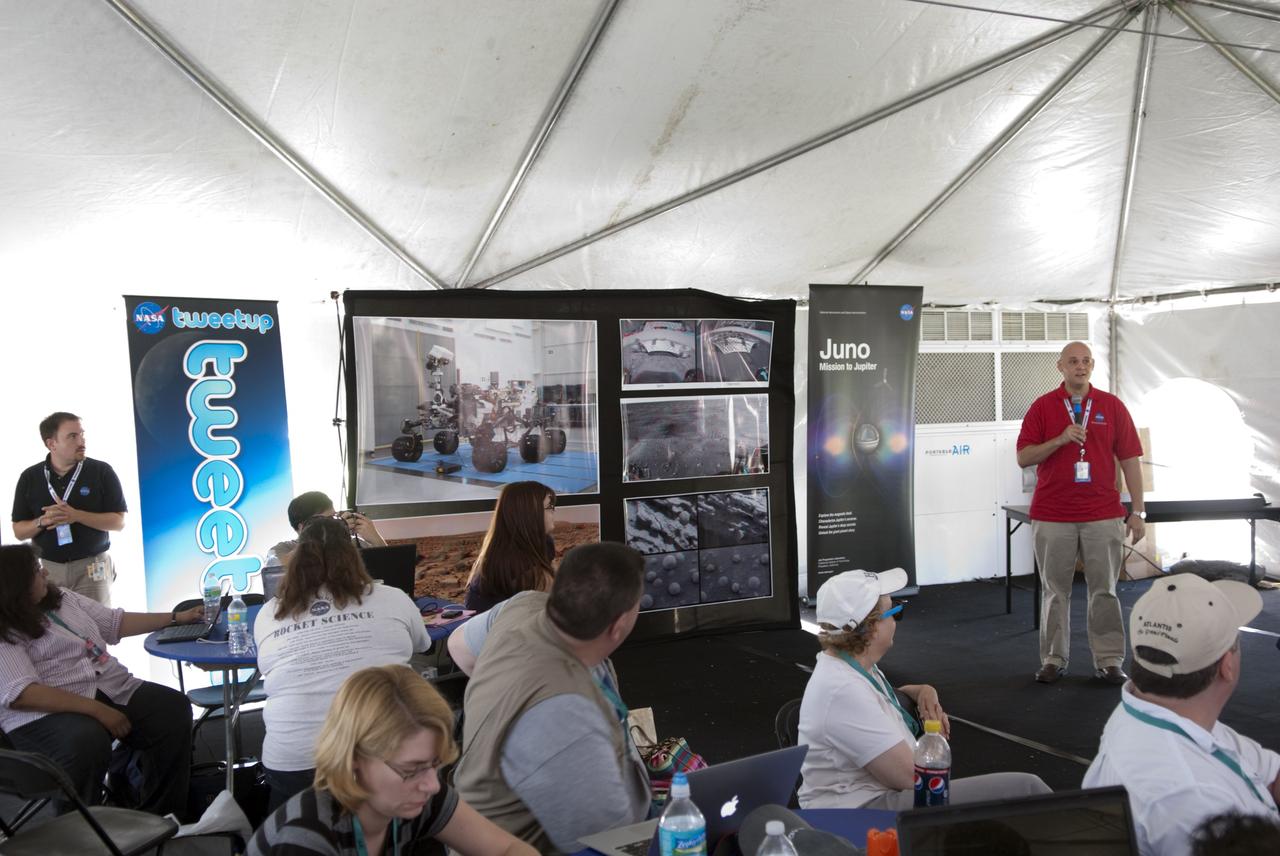
CAPE CANAVERAL, Fla. – At NASA’s Kennedy Space Center in Florida, about 150 followers of the agency’s Twitter account listen to presentations about NASA’s Juno mission to Jupiter during Tweetup activities inside a tent at the Press Site. The tweeters are at the center for two days of Juno prelaunch activities. Juno is NASA’s mission to Jupiter to study the giant planet and improve our understanding of the planet’s formation and evolution. The tweeters will share their experiences with followers through the social networking site Twitter. Attendees represent 28 states, the District of Columbia and five other countries: Canada, Finland, Norway, Spain and the United Kingdom. This is the first time NASA has invited Twitter followers to experience the launch of a planetary spacecraft. The Juno spacecraft is scheduled to launch on an Atlas V rocket from Space Launch Complex 41 at Cape Canaveral Air Force Station in Florida, Aug. 5, at 11:34 a.m. EDT. For more information, visit http://www.nasa.gov/juno. Photo credit: Jim Grossmann
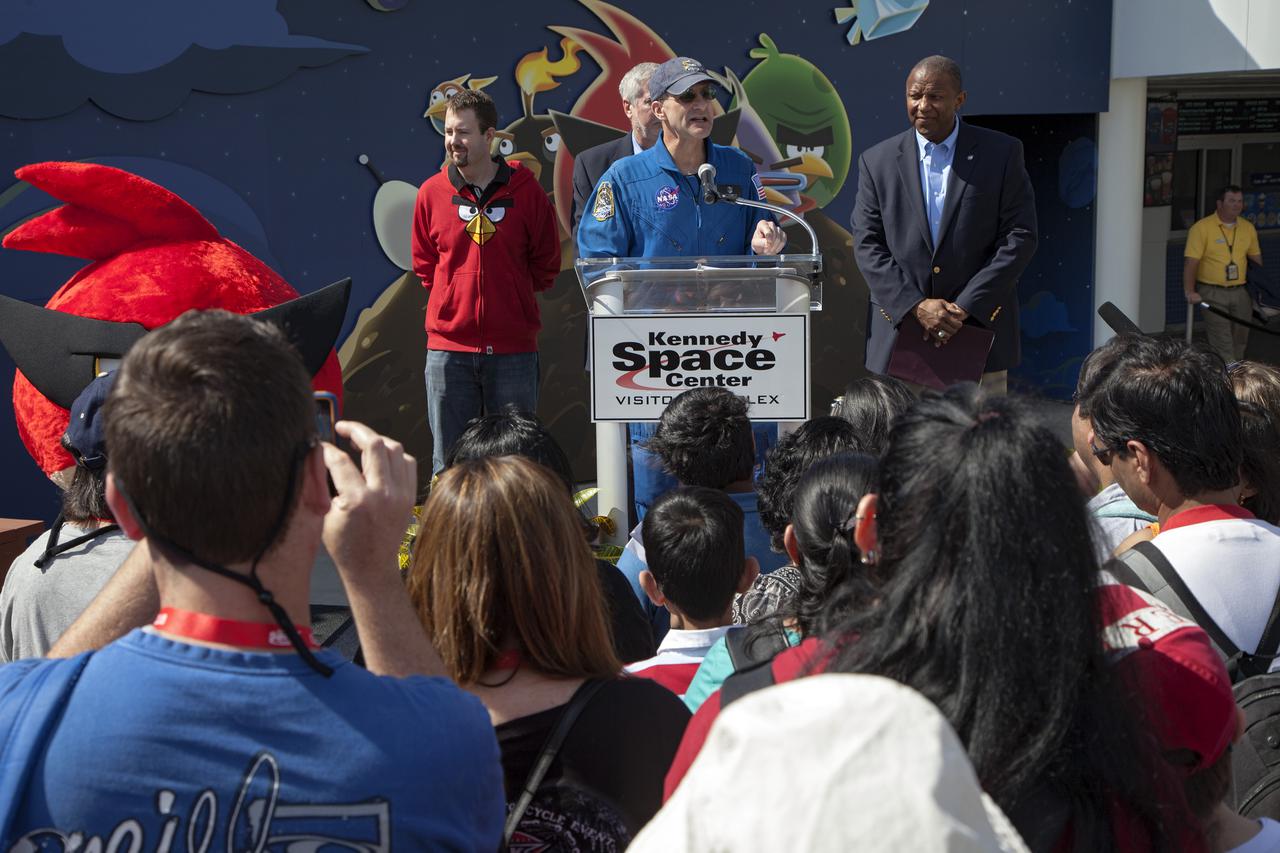
CAPE CANAVERAL, Fla. -- At NASA’s Kennedy Space Center Visitor Complex in Florida, NASA astronaut Don Pettit speaks to visitors during the grand opening of the new Angry Birds Space Encounter. Standing behind Pettit, from left are Dan Mitchell, director of location-based entertainment for Rovio Entertainment Bill Moore, chief operating officer with the KSC visitor complex and Kelvin Manning, associate deputy director of Kennedy Space Center. Also in the photo is Red Bird, one of the Angry Bird Space characters. Finland-based Rovio Entertainment, the creator of the Angry Birds Space game, partnered with Kennedy Space Center to bring the beloved characters to life. It is the first Angry Birds interactive exhibit in the United States designed for people of all ages. The 4,485-square-foot facility hosts the space adventures of the Angry Birds as they travel into an intergalactic wormhole, come face-to-face with Space Pigs and discover heroic superpowers. Six interactive stations are designed to encourage children in science, technology, engineering and mathematics fields of study. Photo credit: NASA_Kim Shiflett
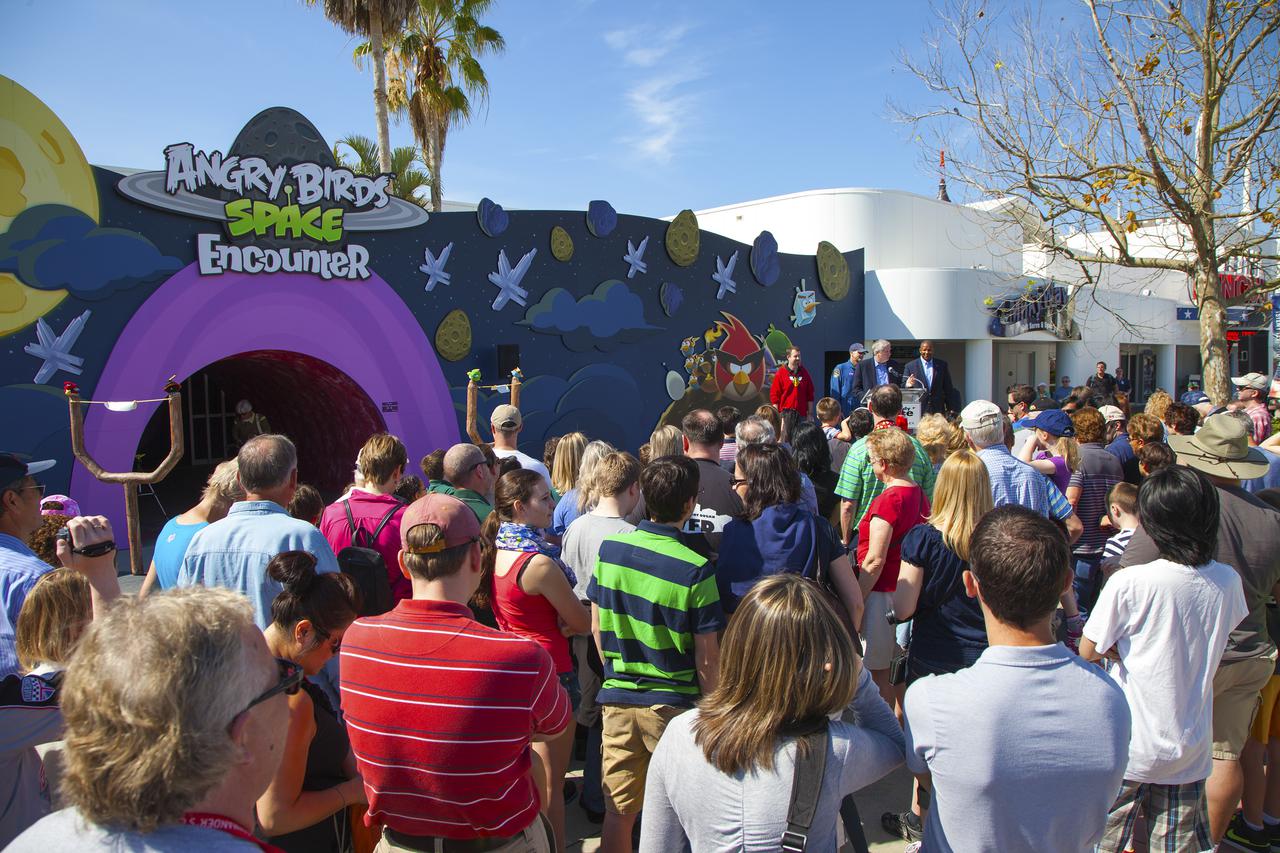
CAPE CANAVERAL, Fla. -- At NASA’s Kennedy Space Center Visitor Complex in Florida, a crowd of people gather for the grand opening of the new Angry Birds Space Encounter. On stage, from left are Dan Mitchell, director of location-based entertainment with Rovio Entertainment Bill Moore, chief operating officer with the KSC visitor complex and Kelvin Manning, associate deputy director of Kennedy Space Center. Standing behind Moore is NASA astronaut Don Pettit. Finland-based Rovio Entertainment, the creator of the Angry Birds Space game, partnered with Kennedy Space Center to bring the beloved characters to life. It is the first Angry Birds interactive exhibit in the United States designed for people of all ages. The 4,485-square-foot facility hosts the space adventures of the Angry Birds as they travel into an intergalactic wormhole, come face-to-face with Space Pigs and discover heroic superpowers. Six interactive stations are designed to encourage children in science, technology, engineering and mathematics fields of study. Photo credit: NASA_Kim Shiflett
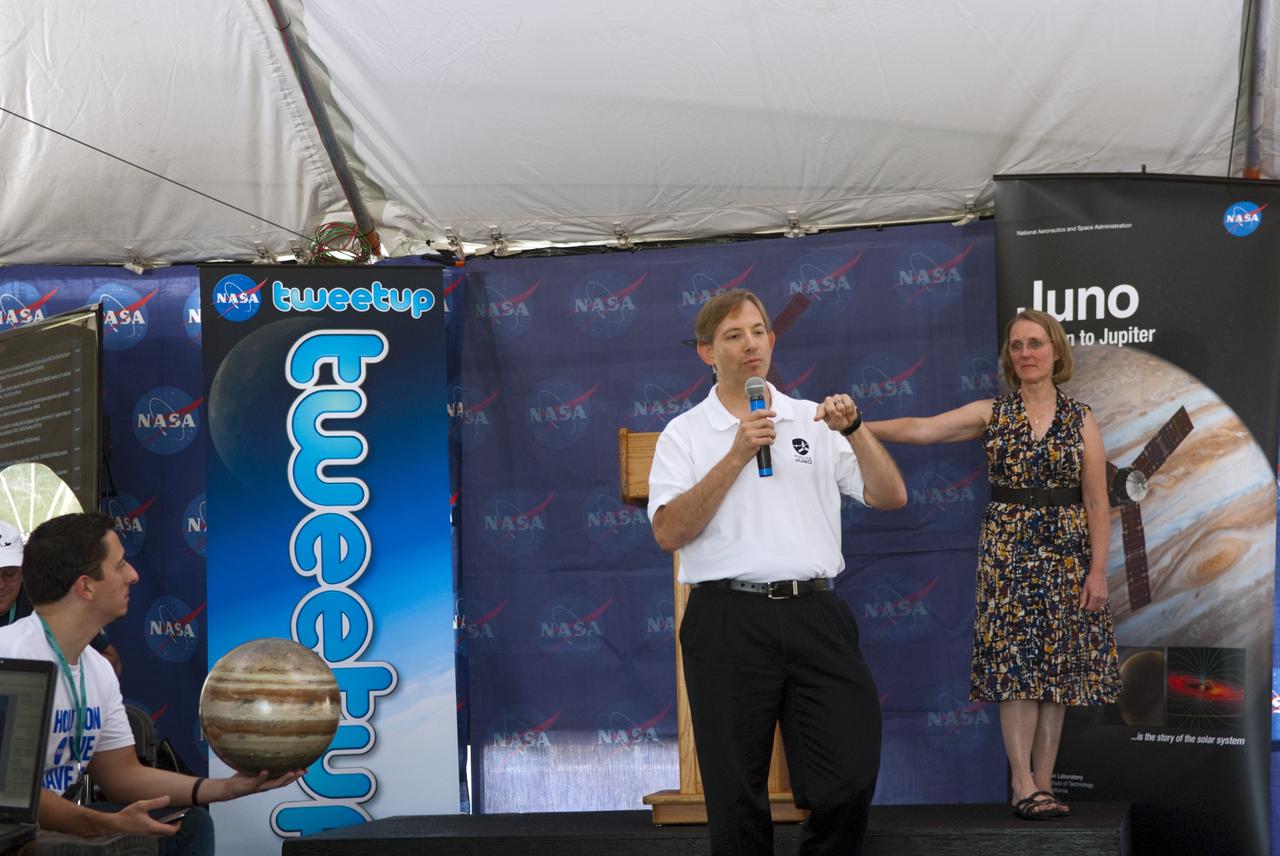
CAPE CANAVERAL, Fla. – At NASA’s Kennedy Space Center in Florida, Steve Matousek (left), former Juno mission manager, and Jan Chodas, Juno project manager, both from the Jet Propulsion Laboratory in Pasadena, Calif., speak to about 150 followers of the agency’s Twitter account during Juno Tweetup activities inside a tent at the Press Site. The tweeters are at the center for two days of prelaunch activities. Juno is NASA’s mission to Jupiter to study the giant planet and improve our understanding of the planet’s formation and evolution. The tweeters will share their experiences with followers through the social networking site Twitter. Attendees represent 28 states, the District of Columbia and five other countries: Canada, Finland, Norway, Spain and the United Kingdom. This is the first time NASA has invited Twitter followers to experience the launch of a planetary spacecraft. The Juno spacecraft is scheduled to launch on an Atlas V rocket from Space Launch Complex 41 at Cape Canaveral Air Force Station in Florida, Aug. 5, at 11:34 a.m. EDT. For more information, visit http://www.nasa.gov/juno. Photo credit: Jim Grossmann
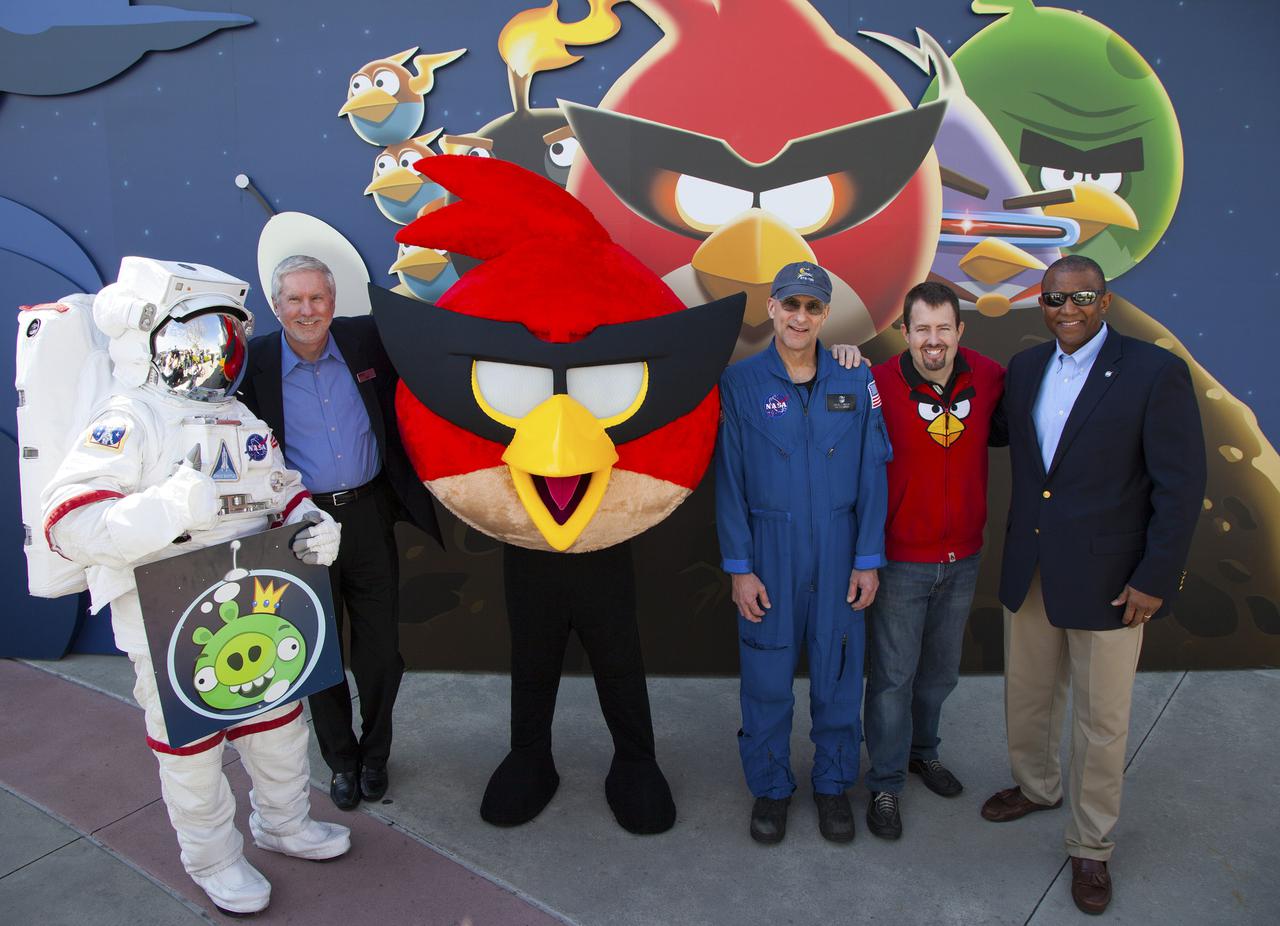
CAPE CANAVERAL, Fla. -- At NASA’s Kennedy Space Center Visitor Complex in Florida, the new Angry Birds Space Encounter was opened to visitors during a grand opening celebration. Helping to open the new attraction, from left are Spaceperson Bill Moore, chief operating officer of the KSC visitor complex Red Bird, one of the Angry Bird characters NASA astronaut Don Pettit Dan Mitchell, director of location-based entertainment for Rovio Entertainment and Kelvin Manning, associate deputy director of Kennedy Space Center. Finland-based Rovio Entertainment, the creator of the Angry Birds Space game, partnered with Kennedy Space Center to bring the beloved characters to life. It is the first Angry Birds interactive exhibit in the United States designed for people of all ages. The 4,485-square-foot facility hosts the space adventures of the Angry Birds as they travel into an intergalactic wormhole, come face-to-face with Space Pigs and discover heroic superpowers. Six interactive stations are designed to encourage children in science, technology, engineering and mathematics fields of study. Photo credit: NASA_Kim Shiflett