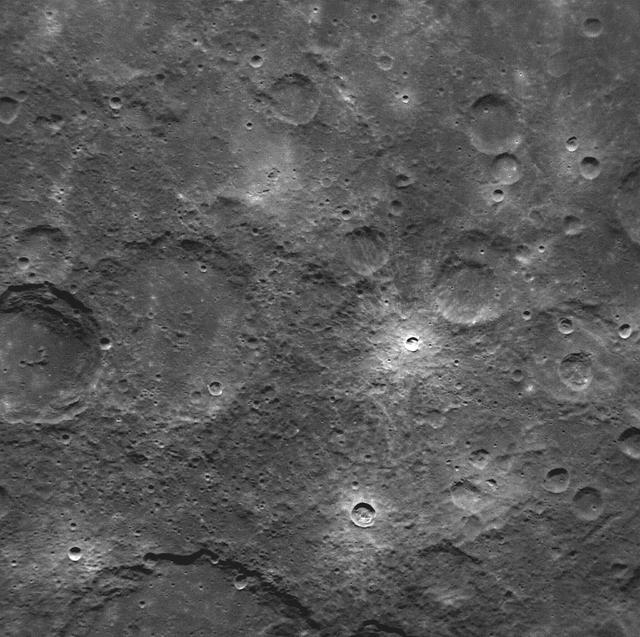
First NAC Image Obtained in Mercury Orbit
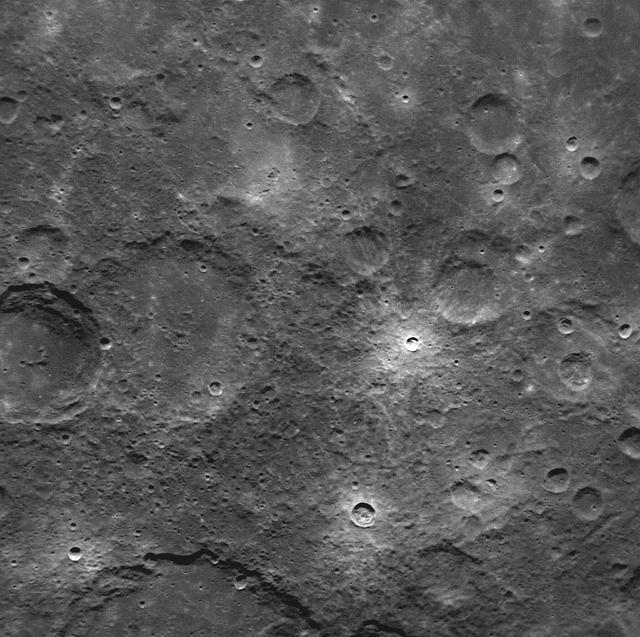
NASA image acquired: March 29, 2011 This is the first image of Mercury taken from orbit with MESSENGER’s Narrow Angle Camera (NAC). MESSENGER’s camera system, the Mercury Dual Imaging System (MDIS), has two cameras: the Narrow Angle Camera and the Wide Angle Camera (WAC). Comparison of this image with MESSENGER’s first WAC image of the same region shows the substantial difference between the fields of view of the two cameras. At 1.5°, the field of view of the NAC is seven times smaller than the 10.5° field of view of the WAC. This image was taken using MDIS’s pivot. MDIS is mounted on a pivoting platform and is the only instrument in MESSENGER’s payload capable of movement independent of the spacecraft. The other instruments are fixed in place, and most point down the spacecraft’s boresight at all times, relying solely on the guidance and control system for pointing. The 90° range of motion of the pivot gives MDIS a much-needed extra degree of freedom, allowing MDIS to image the planet’s surface at times when spacecraft geometry would normally prevent it from doing so. The pivot also gives MDIS additional imaging opportunities by allowing it to view more of the surface than that at which the boresight-aligned instruments are pointed at any given time. On March 17, 2011 (March 18, 2011, UTC), MESSENGER became the first spacecraft ever to orbit the planet Mercury. The mission is currently in the commissioning phase, during which spacecraft and instrument performance are verified through a series of specially designed checkout activities. In the course of the one-year primary mission, the spacecraft's seven scientific instruments and radio science investigation will unravel the history and evolution of the Solar System's innermost planet. Visit the Why Mercury? section of this website to learn more about the science questions that the MESSENGER mission has set out to answer. Credit: NASA/Johns Hopkins University Applied Physics Laboratory/Carnegie Institution of Washington <b><a href="http://www.nasa.gov/centers/goddard/home/index.html" rel="nofollow">NASA Goddard Space Flight Center</a></b> enables NASA’s mission through four scientific endeavors: Earth Science, Heliophysics, Solar System Exploration, and Astrophysics. Goddard plays a leading role in NASA’s accomplishments by contributing compelling scientific knowledge to advance the Agency’s mission. <b>Follow us on <a href="http://twitter.com/NASA_GoddardPix" rel="nofollow">Twitter</a></b> <b>Join us on <a href="http://www.facebook.com/pages/Greenbelt-MD/NASA-Goddard/395013845897?ref=tsd" rel="nofollow">Facebook</a></b>
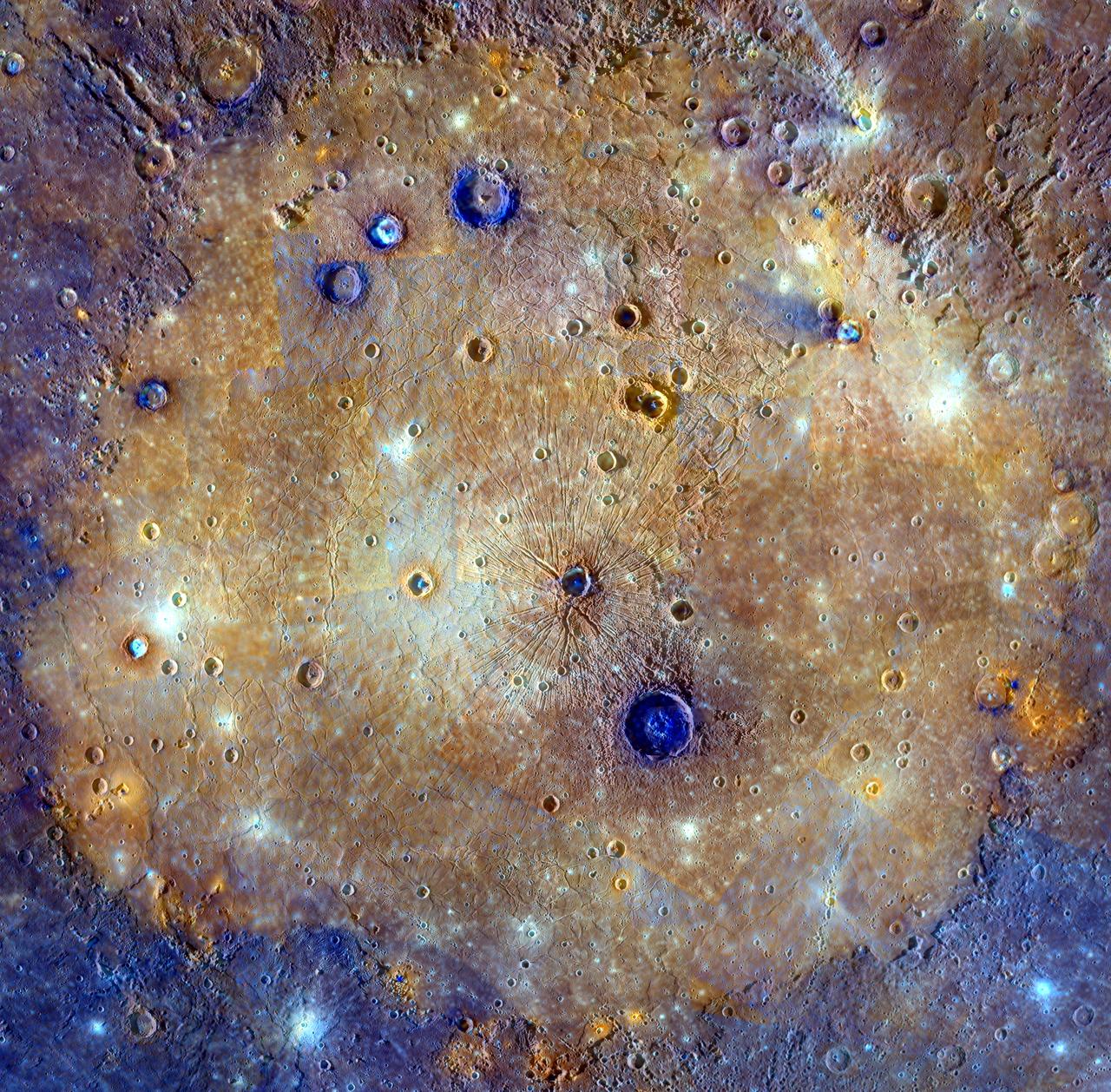
This mosaic of Caloris basin is an enhanced-color composite overlain on a monochrome mosaic featured in a previous post. The color mosaic is made up of WAC images obtained when both the spacecraft and the Sun were overhead, conditions best for discerning variations in albedo, or brightness. The monochrome mosaic is made up of WAC and NAC images obtained at off-vertical Sun angles (i.e., high incidence angles) and with visible shadows so as to reveal clearly the topographic form of geologic features. The combination of the two datasets allows the correlation of geologic features with their color properties. In portions of the scene, color differences from image to image are apparent. Ongoing calibration efforts by the MESSENGER team strive to minimize these differences. Caloris basin has been flooded by lavas that appear orange in this mosaic. Post-flooding craters have excavated material from beneath the surface. The larger of these craters have exposed low-reflectance material (blue in this mosaic) from beneath the surface lavas, likely giving a glimpse of the original basin floor material. Analysis of these craters yields an estimate of the thickness of the volcanic layer: 2.5–3.5 km (1.6–2.2 mi.). The MESSENGER spacecraft is the first ever to orbit the planet Mercury, and the spacecraft's seven scientific instruments and radio science investigation are unraveling the history and evolution of the Solar System's innermost planet. In the mission's more than three years of orbital operations, MESSENGER has acquired over 250,000 images and extensive other data sets. MESSENGER is capable of continuing orbital operations until early 2015. Credit: NASA/Johns Hopkins University Applied Physics Laboratory/Carnegie Institution of Washington <b><a href="http://www.nasa.gov/audience/formedia/features/MP_Photo_Guidelines.html" rel="nofollow">NASA image use policy.</a></b> <b><a href="http://www.nasa.gov/centers/goddard/home/index.html" rel="nofollow">NASA Goddard Space Flight Center</a></b> enables NASA’s mission through four scientific endeavors: Earth Science, Heliophysics, Solar System Exploration, and Astrophysics. Goddard plays a leading role in NASA’s accomplishments by contributing compelling scientific knowledge to advance the Agency’s mission. <b>Follow us on <a href="http://twitter.com/NASAGoddardPix" rel="nofollow">Twitter</a></b> <b>Like us on <a href="http://www.facebook.com/pages/Greenbelt-MD/NASA-Goddard/395013845897?ref=tsd" rel="nofollow">Facebook</a></b> <b>Find us on <a href="http://instagrid.me/nasagoddard/?vm=grid" rel="nofollow">Instagram</a></b>