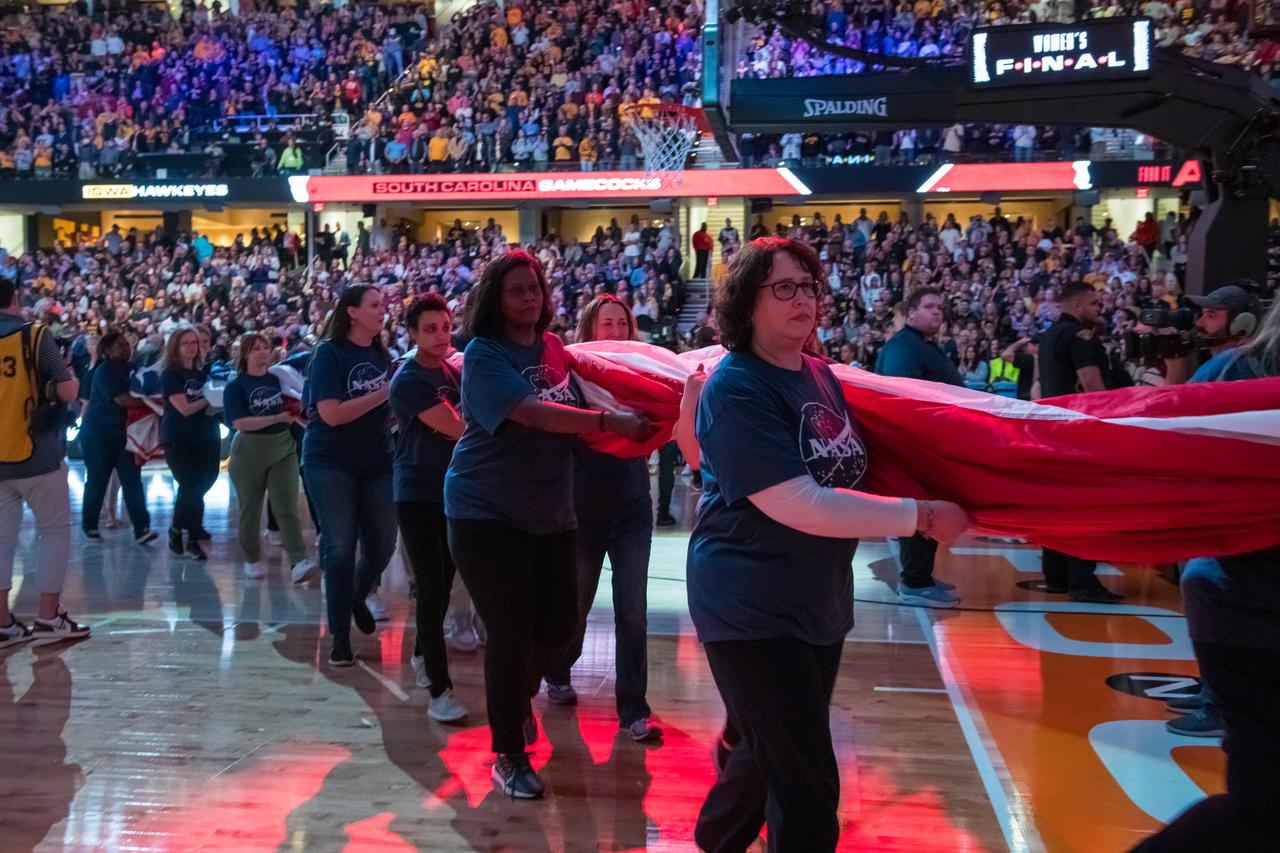
NASA women leaders present the flag at the NCAA championship game on Sunday, April 7th at Rocket Mortgage Fieldhouse in Cleveland, OH. Photo Credit: (NASA/Jef Janis)
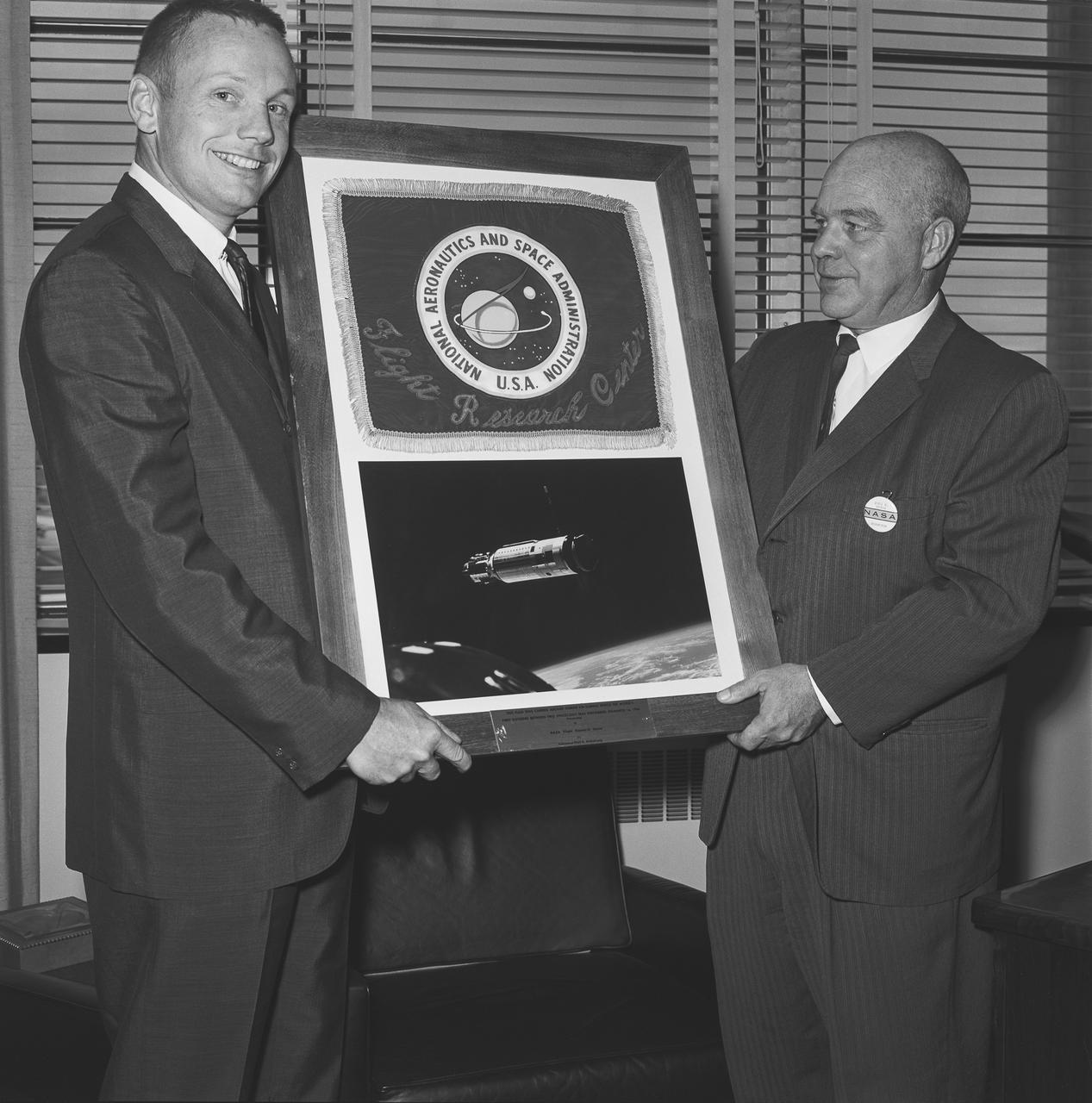
Neil A. Armstrong, left, presents a flag from the Moon to Paul F. Bikle, director of NASA’s Flight Research Center (now NASA’s Armstrong Flight Research Center), in 1966 in Edwards, California.

Charlie Lundquist, NASA Orion deputy program manager, right, presents an American flag flown aboard the Orion capsule during the Exploration Flight Test-1 mission to Armstrong Deputy Director Patrick Stoliker.
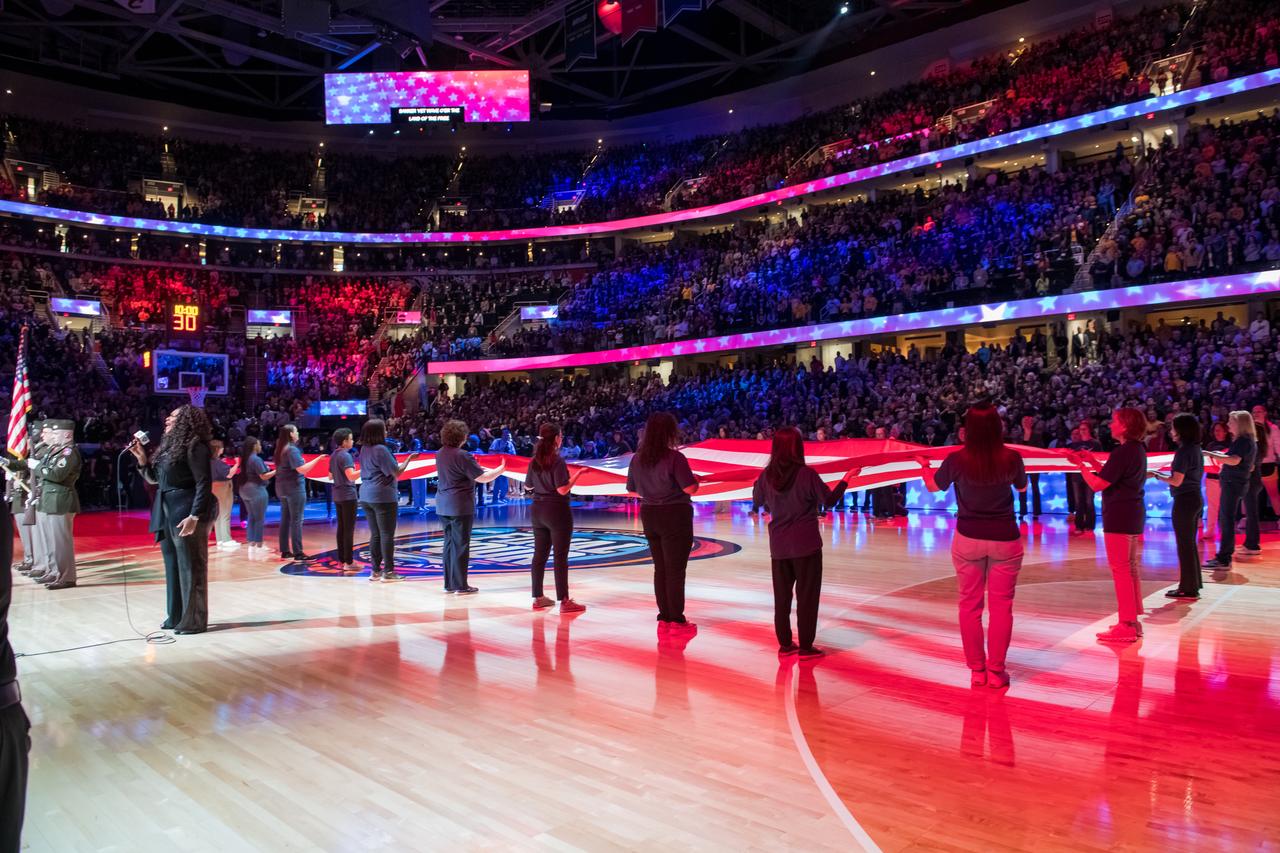
NASA women leaders present the flag at the NCAA championship game on Sunday, April 7th at Rocket Mortgage Fieldhouse in Cleveland, OH.
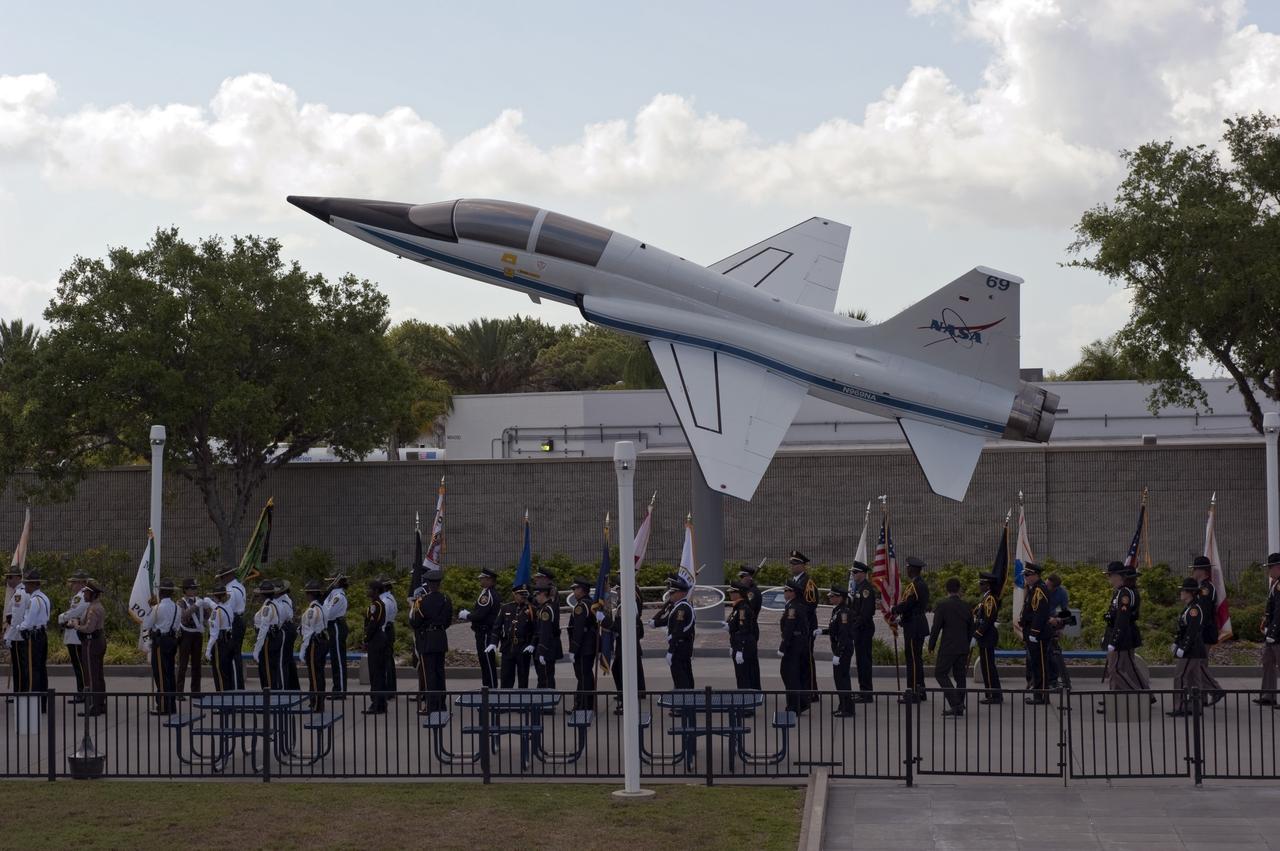
CAPE CANAVERAL, Fla. -- Honor guards march to the Astronaut Memorial Mirror at NASA's Kennedy Space Center Visitor Complex to participate in a U.S. Honor Flag presentation ceremony. The flag is presented to NASA to be prepared to fly aboard space shuttle Atlantis on the Space Shuttle Program's final mission, STS-135. The U.S. Honor Flag has been flown nationwide, at Ground Zero and throughout the world to honor heroes who have lost their lives while serving their community and country, including police officers, firefighters, members of the Armed Forces and astronauts. More than 100 honor guard members traveled to the Space Coast to take part in the ceremony. After the flag returns to Earth, it will continue as a traveling memorial. Photo credit: NASA/Kim Shiflett
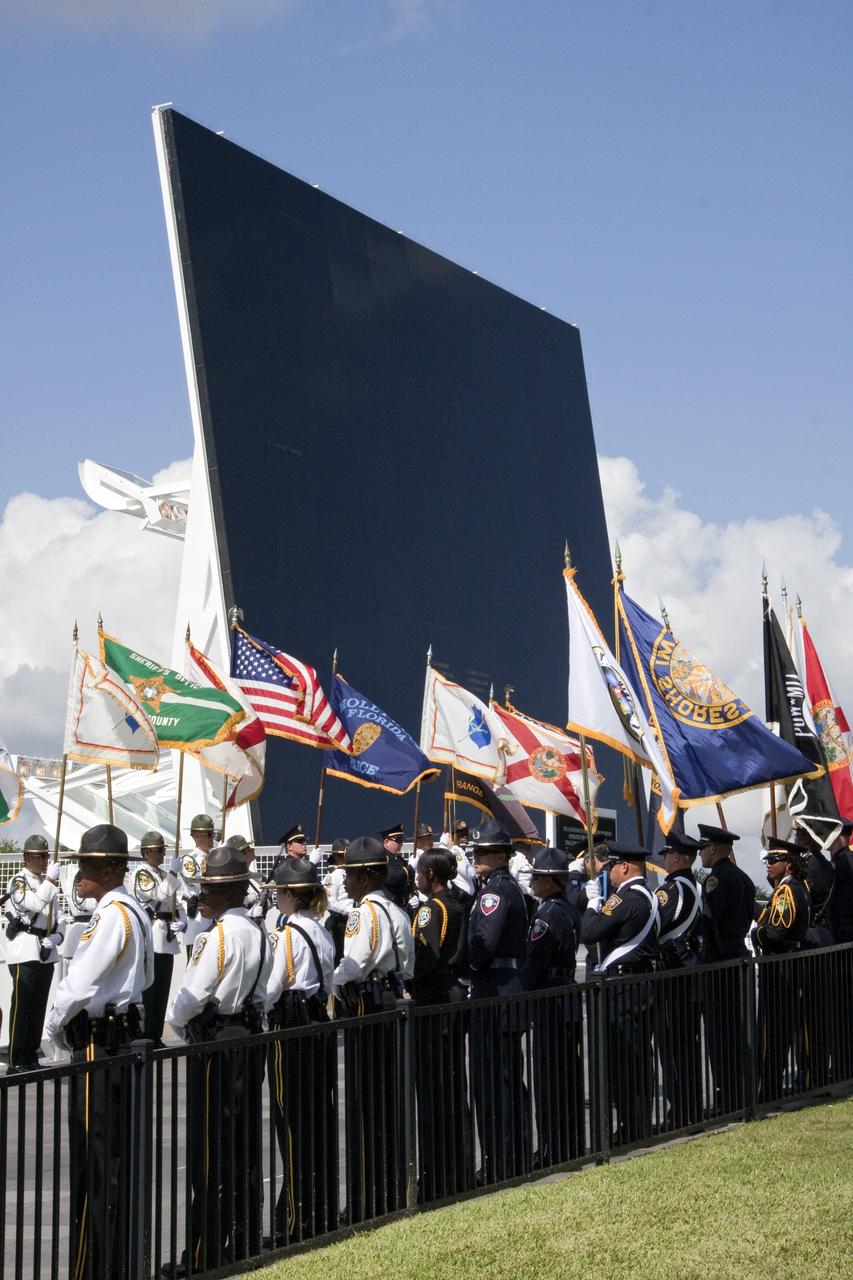
CAPE CANAVERAL, Fla. -- Honor guards march to the Astronaut Memorial Mirror at NASA's Kennedy Space Center Visitor Complex to participate in a U.S. Honor Flag presentation ceremony. The flag is presented to NASA to be prepared to fly aboard space shuttle Atlantis on the Space Shuttle Program's final mission, STS-135. The U.S. Honor Flag has been flown nationwide, at Ground Zero and throughout the world to honor heroes who have lost their lives while serving their community and country, including police officers, firefighters, members of the Armed Forces and astronauts. More than 100 honor guard members traveled to the Space Coast to take part in the ceremony. After the flag returns to Earth, it will continue as a traveling memorial. Photo credit: NASA/Troy Cryder

CAPE CANAVERAL, Fla. -- At NASA's Kennedy Space Center Visitor Complex, Center Director Bob Cabana signs his autograph for a guest after the U.S. Honor Flag presentation. The flag is presented to NASA to be prepared to fly aboard space shuttle Atlantis on the Space Shuttle Program's final mission, STS-135. The U.S. Honor Flag has been flown nationwide, at Ground Zero and throughout the world to honor heroes who have lost their lives while serving their community and country, including police officers, firefighters, members of the Armed Forces and astronauts. More than 100 honor guard members traveled to the Space Coast to take part in the ceremony. After the flag returns to Earth, it will continue as a traveling memorial. Photo credit: NASA/Kim Shiflett
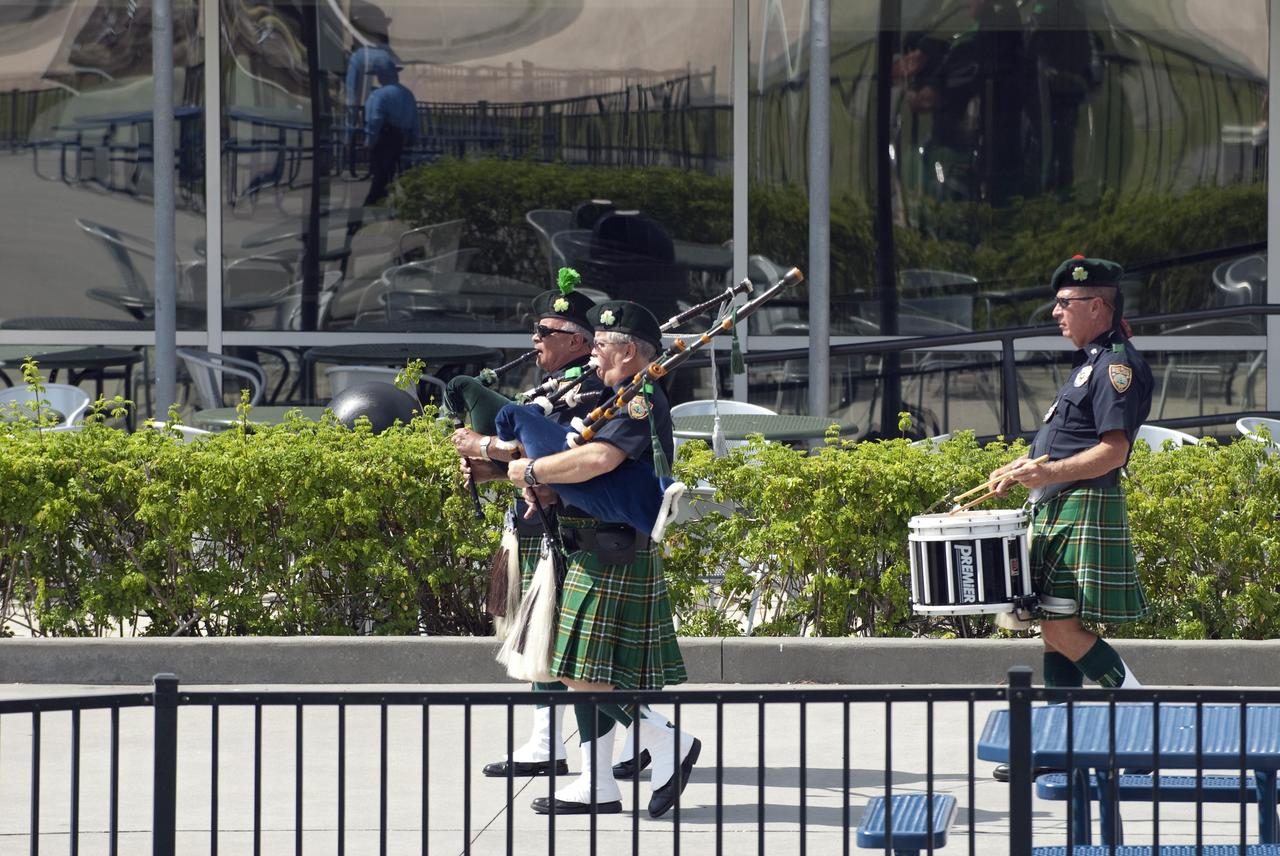
CAPE CANAVERAL, Fla. -- The Miami Beach Police Department Celtic Pride Bagpipe and Drum Corps play the bagpipes as they make their way to the Astronaut Memorial Mirror at NASA's Kennedy Space Center Visitor Complex for the U.S. Honor Flag presentation ceremony. The flag will be presented to NASA to be prepared to fly aboard space shuttle Atlantis on the Space Shuttle Program's final mission, STS-135. The U.S. Honor Flag has been flown nationwide, at Ground Zero and throughout the world to honor heroes who have lost their lives while serving their community and country, including police officers, firefighters, members of the Armed Forces and astronauts. More than 100 honor guard members traveled to the Space Coast to take part in the ceremony. After the flag returns to Earth, it will continue as a traveling memorial. Photo credit: NASA/Kim Shiflett
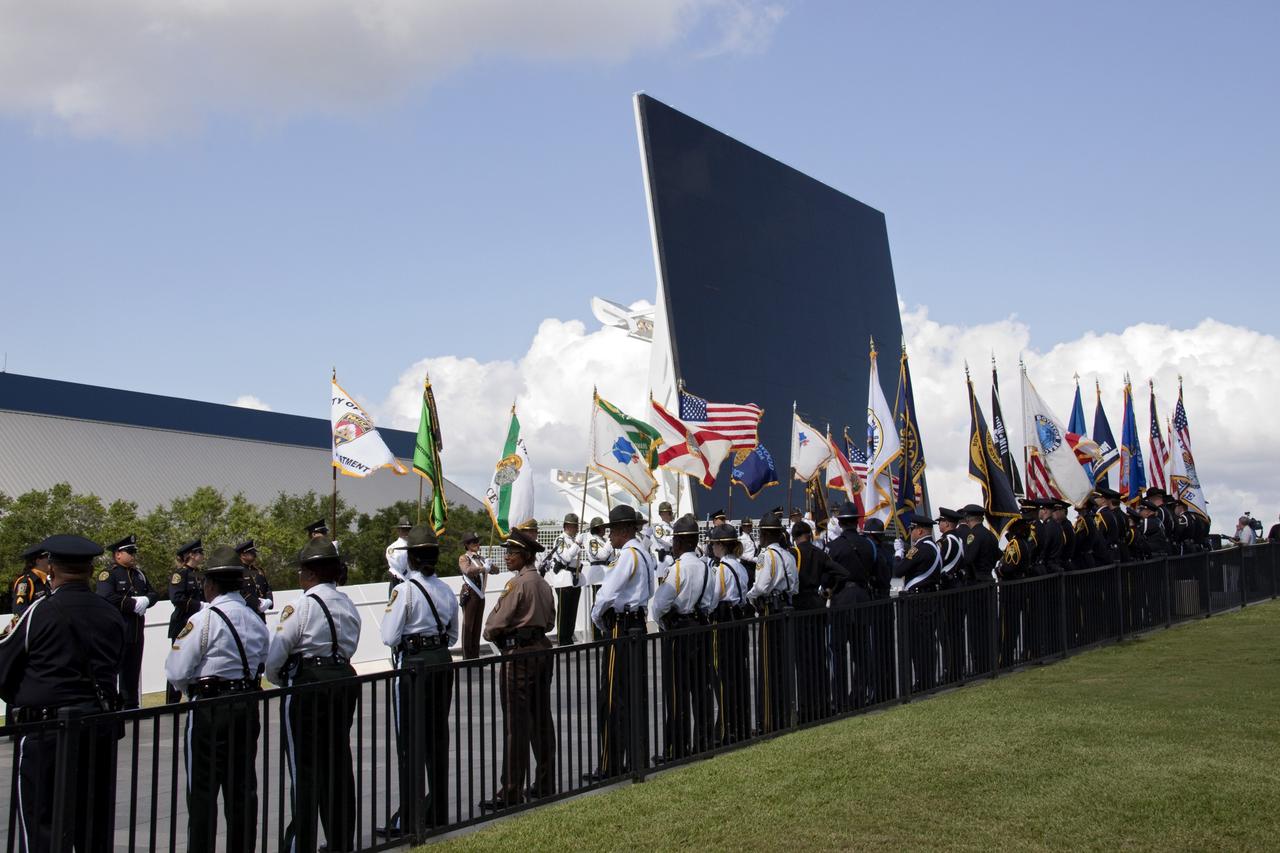
CAPE CANAVERAL, Fla. -- Honor guards march to the Astronaut Memorial Mirror at NASA's Kennedy Space Center Visitor Complex to participate in a U.S. Honor Flag presentation ceremony. The flag is presented to NASA to be prepared to fly aboard space shuttle Atlantis on the Space Shuttle Program's final mission, STS-135. The U.S. Honor Flag has been flown nationwide, at Ground Zero and throughout the world to honor heroes who have lost their lives while serving their community and country, including police officers, firefighters, members of the Armed Forces and astronauts. More than 100 honor guard members traveled to the Space Coast to take part in the ceremony. After the flag returns to Earth, it will continue as a traveling memorial. Photo credit: NASA/Troy Cryder
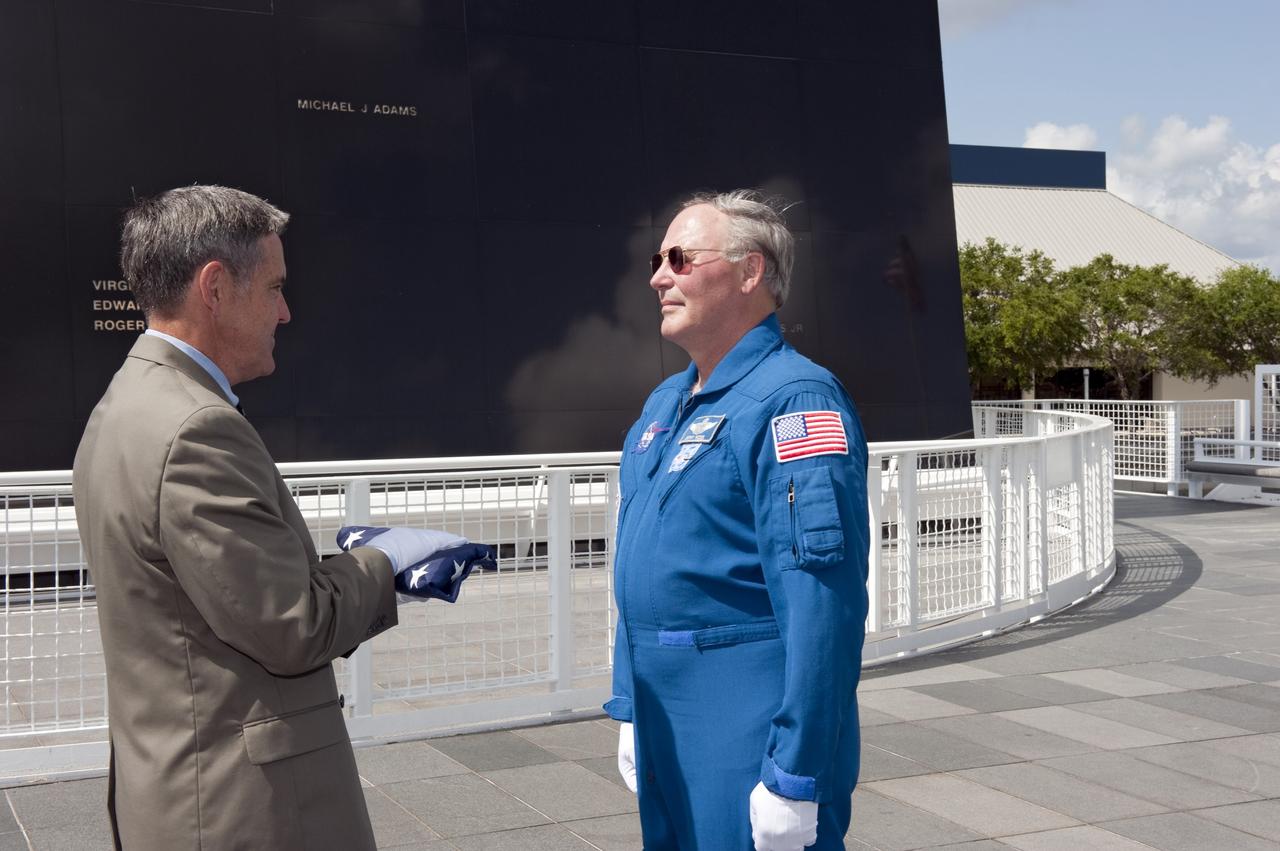
CAPE CANAVERAL, Fla. -- At NASA's Kennedy Space Center Visitor Complex's Astronaut Memorial Mirror, Center Director Bob Cabana presents the U.S. Honor Flag to Jerry Ross, chief of the Vehicle Integration Test Office. The flag is presented to NASA to be prepared to fly aboard space shuttle Atlantis on the Space Shuttle Program's final mission, STS-135. The U.S. Honor Flag has been flown nationwide, at Ground Zero and throughout the world to honor heroes who have lost their lives while serving their community and country, including police officers, firefighters, members of the Armed Forces and astronauts. More than 100 honor guard members traveled to the Space Coast to take part in the ceremony. After the flag returns to Earth, it will continue as a traveling memorial. Photo credit: NASA/Kim Shiflett
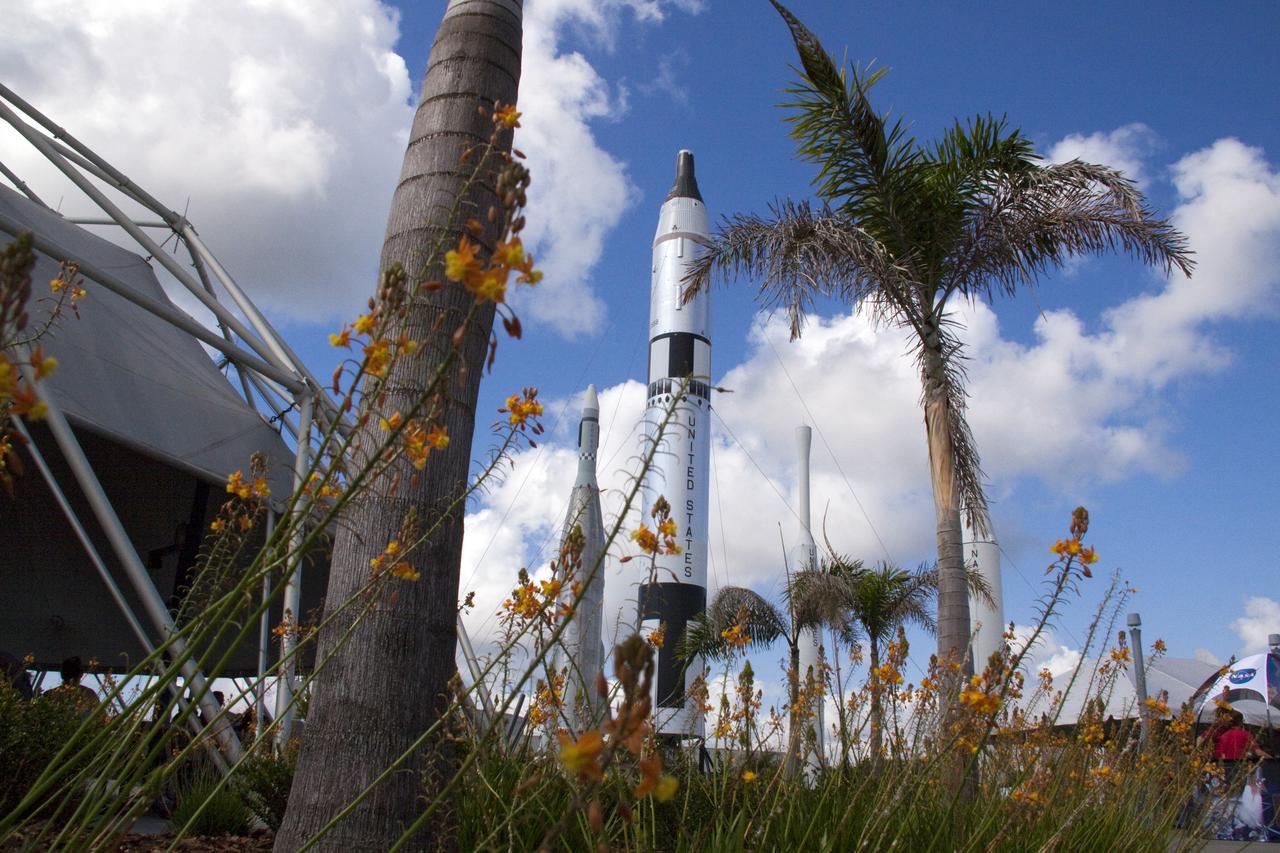
CAPE CANAVERAL, Fla. -- Rockets are on display in an area known as the "Rocket Garden" at NASA's Kennedy Space Center Visitor Complex where a U.S. Honor Flag presentation ceremony is taking place at the Astronaut Memorial Mirror. The flag is presented to NASA to be prepared to fly aboard space shuttle Atlantis on the Space Shuttle Program's final mission, STS-135. The U.S. Honor Flag has been flown nationwide, at Ground Zero and throughout the world to honor heroes who have lost their lives while serving their community and country, including police officers, firefighters, members of the Armed Forces and astronauts. More than 100 honor guard members traveled to the Space Coast to take part in the ceremony. After the flag returns to Earth, it will continue as a traveling memorial. Photo credit: NASA/Troy Cryder
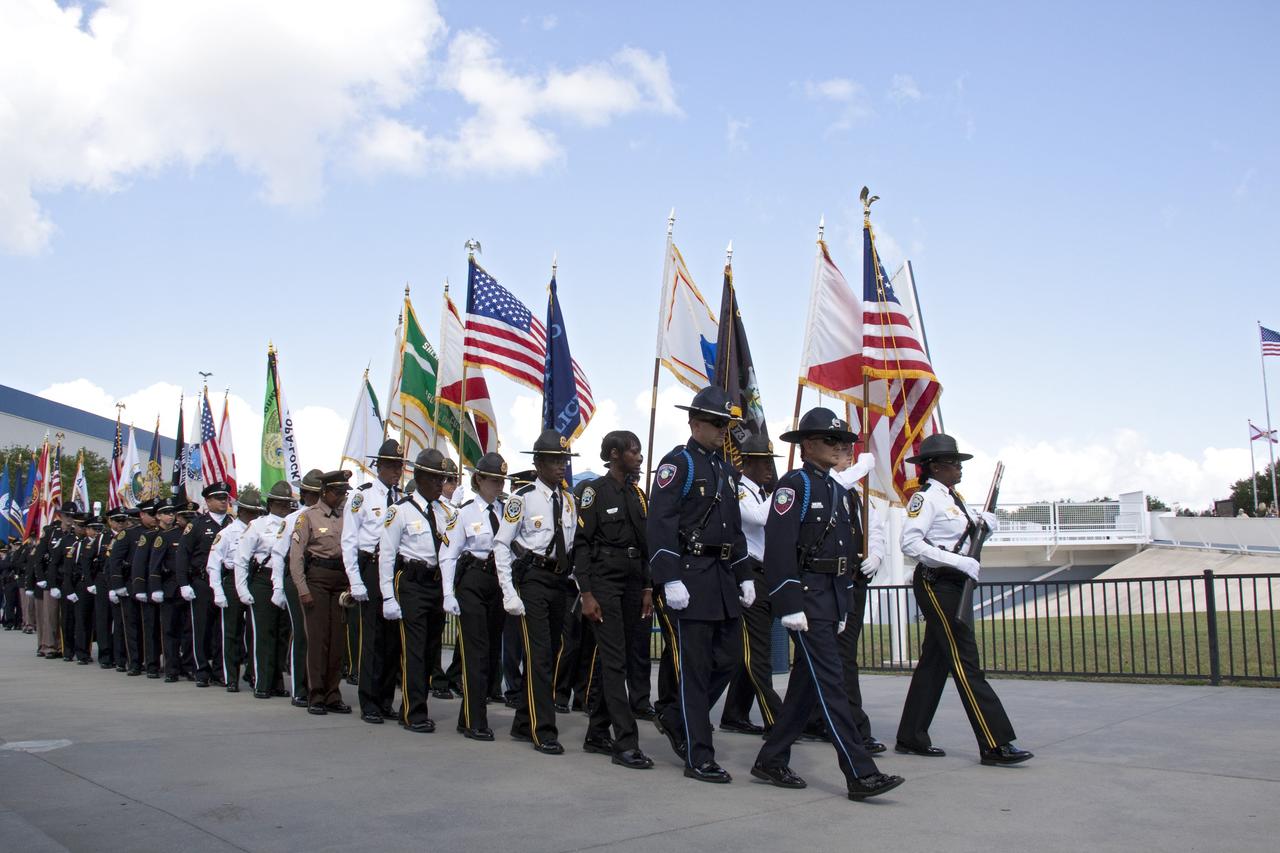
CAPE CANAVERAL, Fla. -- Honor guards march to the Astronaut Memorial Mirror at NASA's Kennedy Space Center Visitor Complex to participate in a U.S. Honor Flag presentation ceremony. The flag is presented to NASA to be prepared to fly aboard space shuttle Atlantis on the Space Shuttle Program's final mission, STS-135. The U.S. Honor Flag has been flown nationwide, at Ground Zero and throughout the world to honor heroes who have lost their lives while serving their community and country, including police officers, firefighters, members of the Armed Forces and astronauts. More than 100 honor guard members traveled to the Space Coast to take part in the ceremony. After the flag returns to Earth, it will continue as a traveling memorial. Photo credit: NASA/Troy Cryder
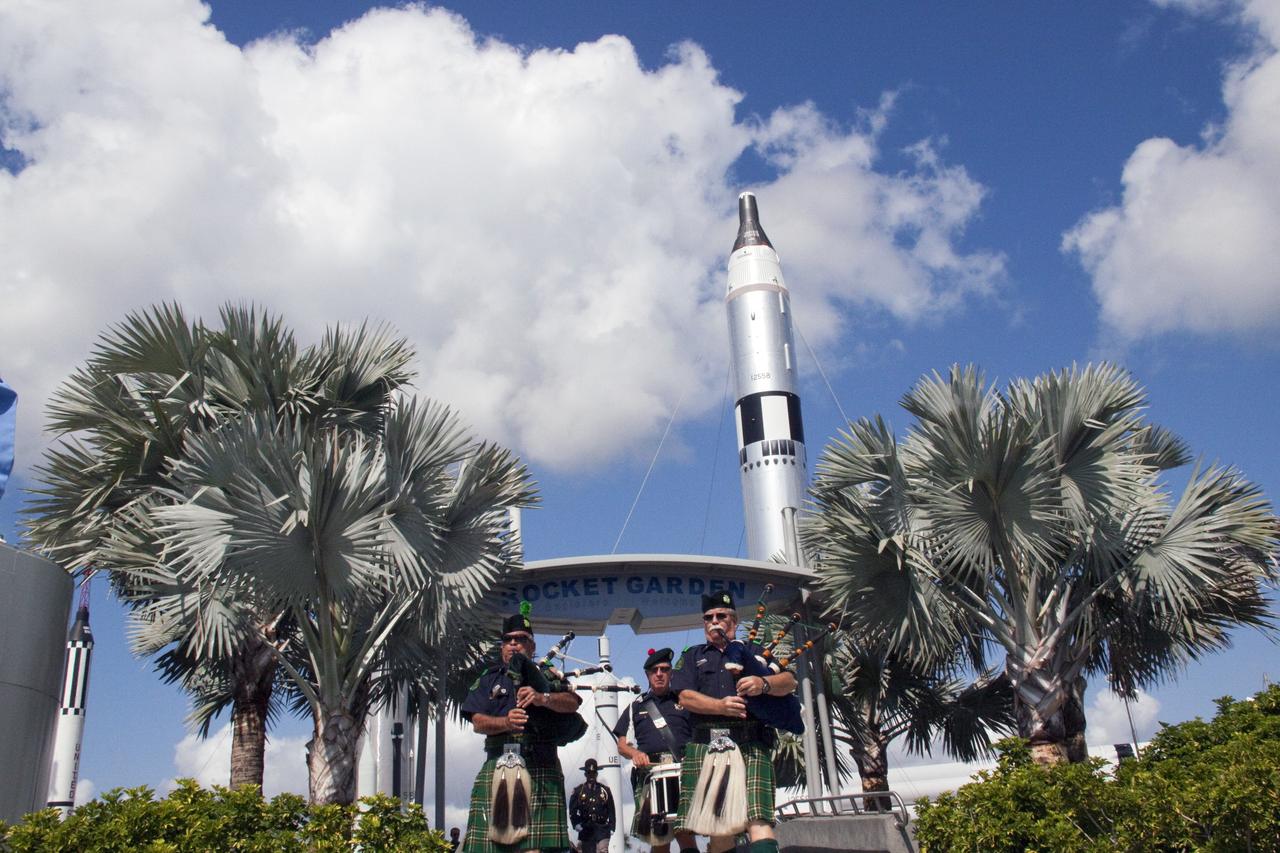
CAPE CANAVERAL, Fla. -- The Miami-Dade Police Department Honor Guard Unit play the bagpipes as they make their way to the Astronaut Memorial Mirror at NASA's Kennedy Space Center Visitor Complex for the U.S. Honor Flag presentation ceremony. The flag is presented to NASA to be prepared to fly aboard space shuttle Atlantis on the Space Shuttle Program's final mission, STS-135. The U.S. Honor Flag has been flown nationwide, at Ground Zero and throughout the world to honor heroes who have lost their lives while serving their community and country, including police officers, firefighters, members of the Armed Forces and astronauts. More than 100 honor guard members traveled to the Space Coast to take part in the ceremony. After the flag returns to Earth, it will continue as a traveling memorial. Photo credit: NASA/Troy Cryder

CAPE CANAVERAL, Fla. -- At NASA's Kennedy Space Center Visitor Complex's Astronaut Memorial Mirror, James Loftus (right), director of the Miami-Dade Police Department; Jerry Ross, chief of the Vehicle Integration Test Office; and Kennedy Center Director Bob Cabana salute the Space Mirror Memorial during a U.S. Honor Flag presentation. The flag is presented to NASA to be prepared to fly aboard space shuttle Atlantis on the Space Shuttle Program's final mission, STS-135. The U.S. Honor Flag has been flown nationwide, at Ground Zero and throughout the world to honor heroes who have lost their lives while serving their community and country, including police officers, firefighters, members of the Armed Forces and astronauts. More than 100 honor guard members traveled to the Space Coast to take part in the ceremony. After the flag returns to Earth, it will continue as a traveling memorial. Photo credit: NASA/Kim Shiflett

CAPE CANAVERAL, Fla. -- At the base of the Astronaut Memorial Mirror at NASA's Kennedy Space Center Visitor Complex, Center Director Bob Cabana salutes as James Loftus (right), director of the Miami-Dade Police Department presents him with the U.S. Honor Flag. The flag is presented to NASA to be prepared to fly aboard space shuttle Atlantis on the Space Shuttle Program's final mission, STS-135. The U.S. Honor Flag has been flown nationwide, at Ground Zero and throughout the world to honor heroes who have lost their lives while serving their community and country, including police officers, firefighters, members of the Armed Forces and astronauts. More than 100 honor guard members traveled to the Space Coast to take part in the ceremony. After the flag returns to Earth, it will continue as a traveling memorial. Photo credit: NASA/Kim Shiflett
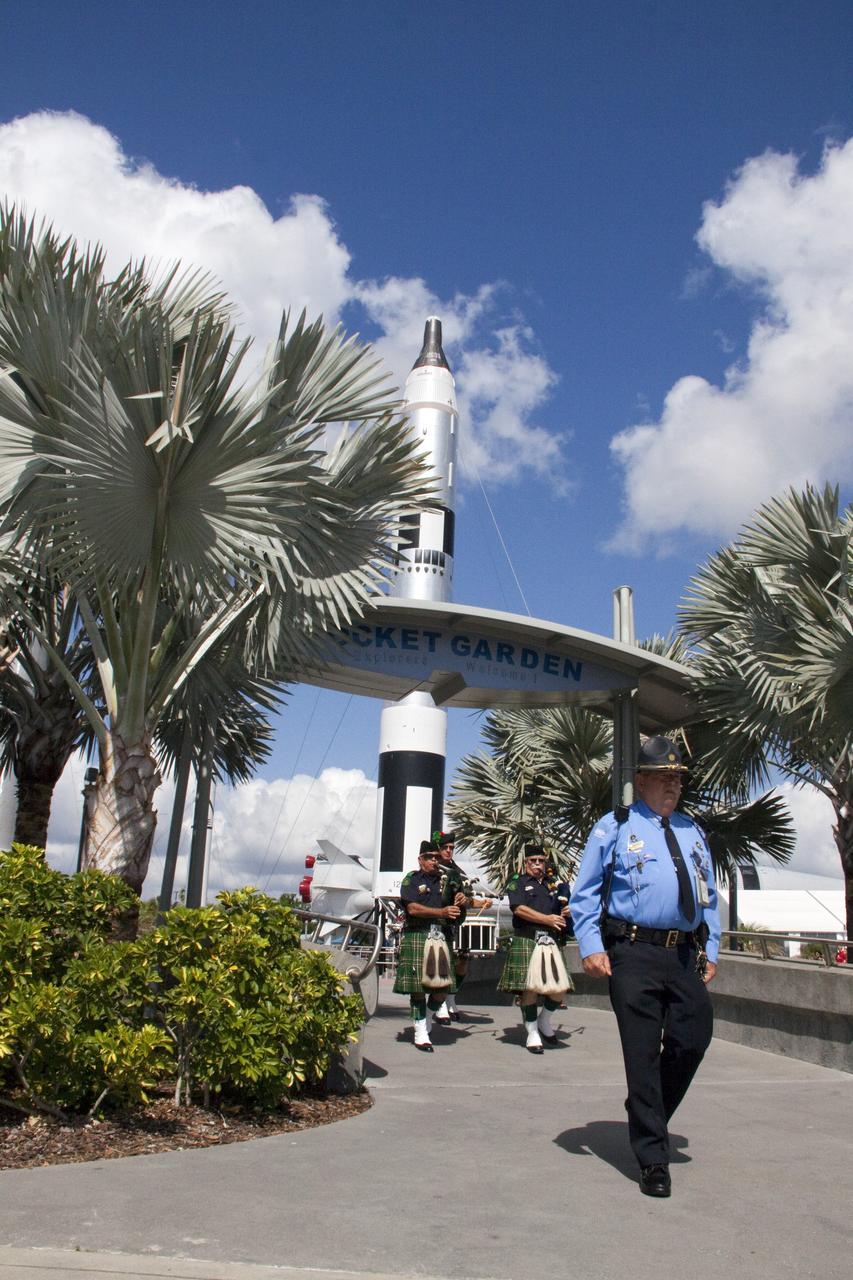
CAPE CANAVERAL, Fla. -- The Miami-Dade Police Department Honor Guard Unit play the bagpipes as they make their way to the Astronaut Memorial Mirror at NASA's Kennedy Space Center Visitor Complex for the U.S. Honor Flag presentation ceremony. The flag is presented to NASA to be prepared to fly aboard space shuttle Atlantis on the Space Shuttle Program's final mission, STS-135. The U.S. Honor Flag has been flown nationwide, at Ground Zero and throughout the world to honor heroes who have lost their lives while serving their community and country, including police officers, firefighters, members of the Armed Forces and astronauts. More than 100 honor guard members traveled to the Space Coast to take part in the ceremony. After the flag returns to Earth, it will continue as a traveling memorial. Photo credit: NASA/Troy Cryder
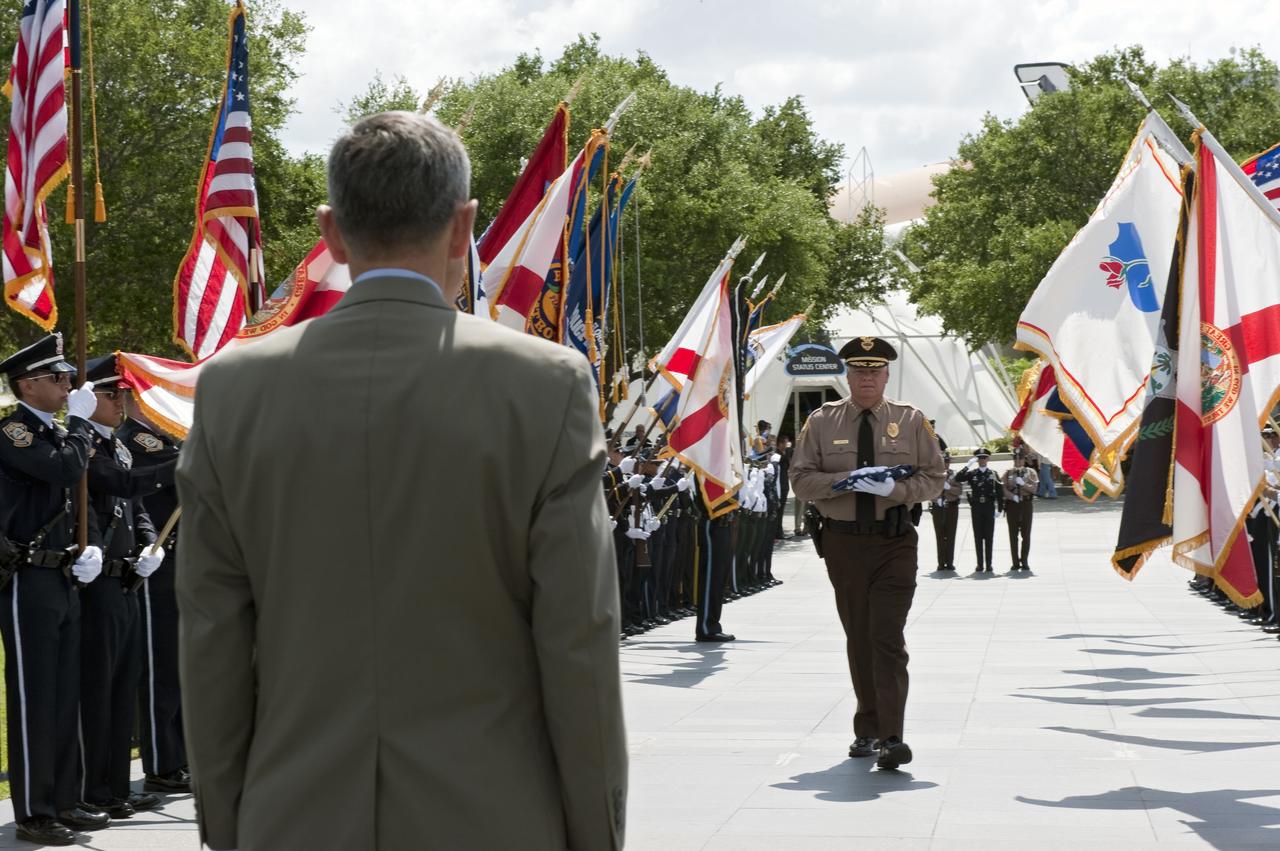
CAPE CANAVERAL, Fla. -- At NASA's Kennedy Space Center Visitor Complex, Center Director Bob Cabana stands at the base of the Astronaut Memorial Mirror to accept the U.S. Honor Flag presented to him by James Loftus (right), director of the Miami-Dade Police Department. The flag is presented to NASA to be prepared to fly aboard space shuttle Atlantis on the Space Shuttle Program's final mission, STS-135. The U.S. Honor Flag has been flown nationwide, at Ground Zero and throughout the world to honor heroes who have lost their lives while serving their community and country, including police officers, firefighters, members of the Armed Forces and astronauts. More than 100 honor guard members traveled to the Space Coast to take part in the ceremony. After the flag returns to Earth, it will continue as a traveling memorial. Photo credit: NASA/Kim Shiflett

CAPE CANAVERAL, Fla. -- At NASA's Kennedy Space Center Visitor Complex, Center Director Bob Cabana stands at the base of the Astronaut Memorial Mirror awaiting the arrival of James Loftus, director of the Miami-Dade Police Department who will present to him the U.S. Honor Flag. The flag is presented to NASA to be prepared to fly aboard space shuttle Atlantis on the Space Shuttle Program's final mission, STS-135. The U.S. Honor Flag has been flown nationwide, at Ground Zero and throughout the world to honor heroes who have lost their lives while serving their community and country, including police officers, firefighters, members of the Armed Forces and astronauts. More than 100 honor guard members traveled to the Space Coast to take part in the ceremony. After the flag returns to Earth, it will continue as a traveling memorial. Photo credit: NASA/Kim Shiflett

CAPE CANAVERAL, Fla. -- At NASA's Kennedy Space Center Visitor Complex's Astronaut Memorial Mirror, James Loftus (right), director of the Miami-Dade Police Department; Jerry Ross, chief of the Vehicle Integration Test Office; and Kennedy Center Director Bob Cabana salute the Space Mirror Memorial during a U.S. Honor Flag presentation. The flag is presented to NASA to be prepared to fly aboard space shuttle Atlantis on the Space Shuttle Program's final mission, STS-135. The U.S. Honor Flag has been flown nationwide, at Ground Zero and throughout the world to honor heroes who have lost their lives while serving their community and country, including police officers, firefighters, members of the Armed Forces and astronauts. More than 100 honor guard members traveled to the Space Coast to take part in the ceremony. After the flag returns to Earth, it will continue as a traveling memorial. Photo credit: NASA/Kim Shiflett
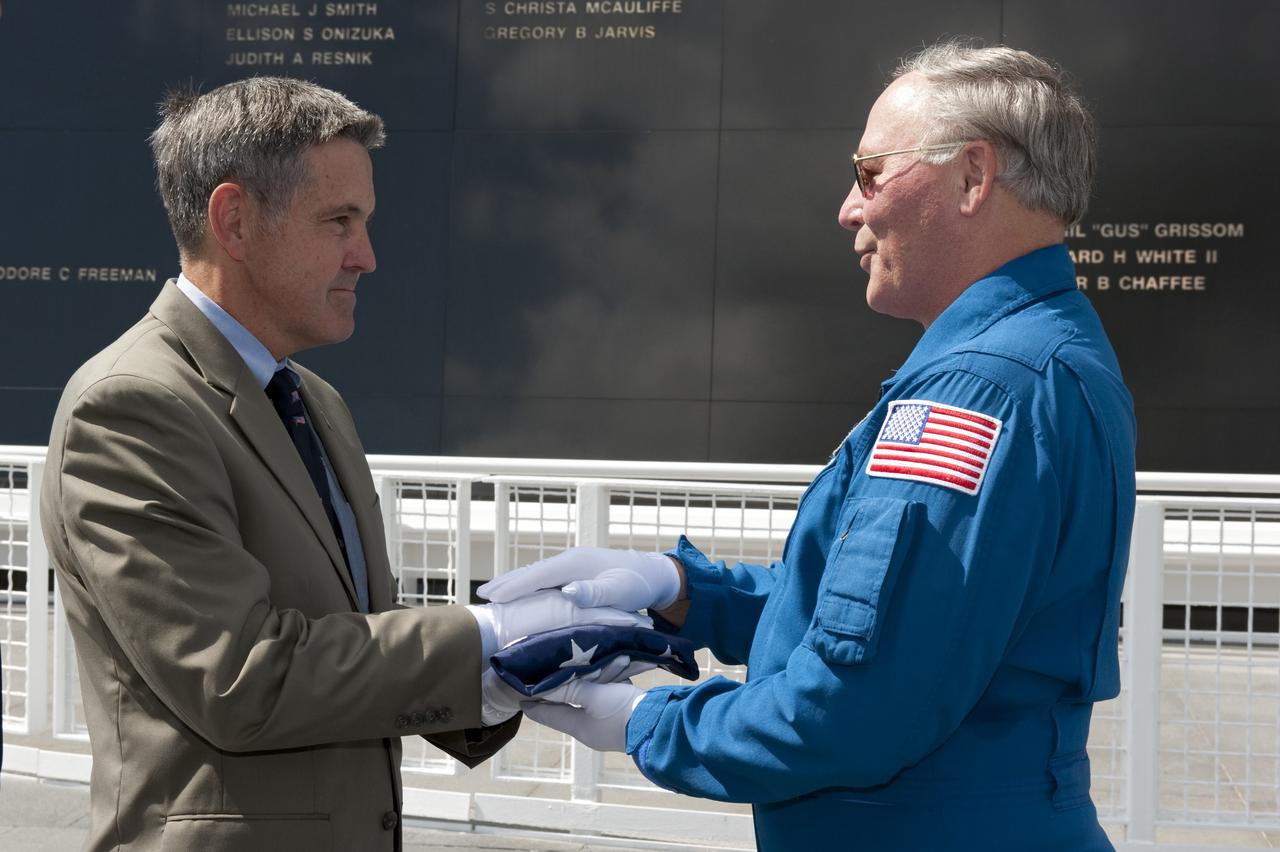
CAPE CANAVERAL, Fla. -- At NASA's Kennedy Space Center Visitor Complex's Astronaut Memorial Mirror, Jerry Ross, chief of the Vehicle Integration Test Office accepts the U.S. Honor Flag presented to him by Center Director Bob Cabana. The flag is presented to NASA to be prepared to fly aboard space shuttle Atlantis on the Space Shuttle Program's final mission, STS-135. The U.S. Honor Flag has been flown nationwide, at Ground Zero and throughout the world to honor heroes who have lost their lives while serving their community and country, including police officers, firefighters, members of the Armed Forces and astronauts. More than 100 honor guard members traveled to the Space Coast to take part in the ceremony. After the flag returns to Earth, it will continue as a traveling memorial. Photo credit: NASA/Kim Shiflett
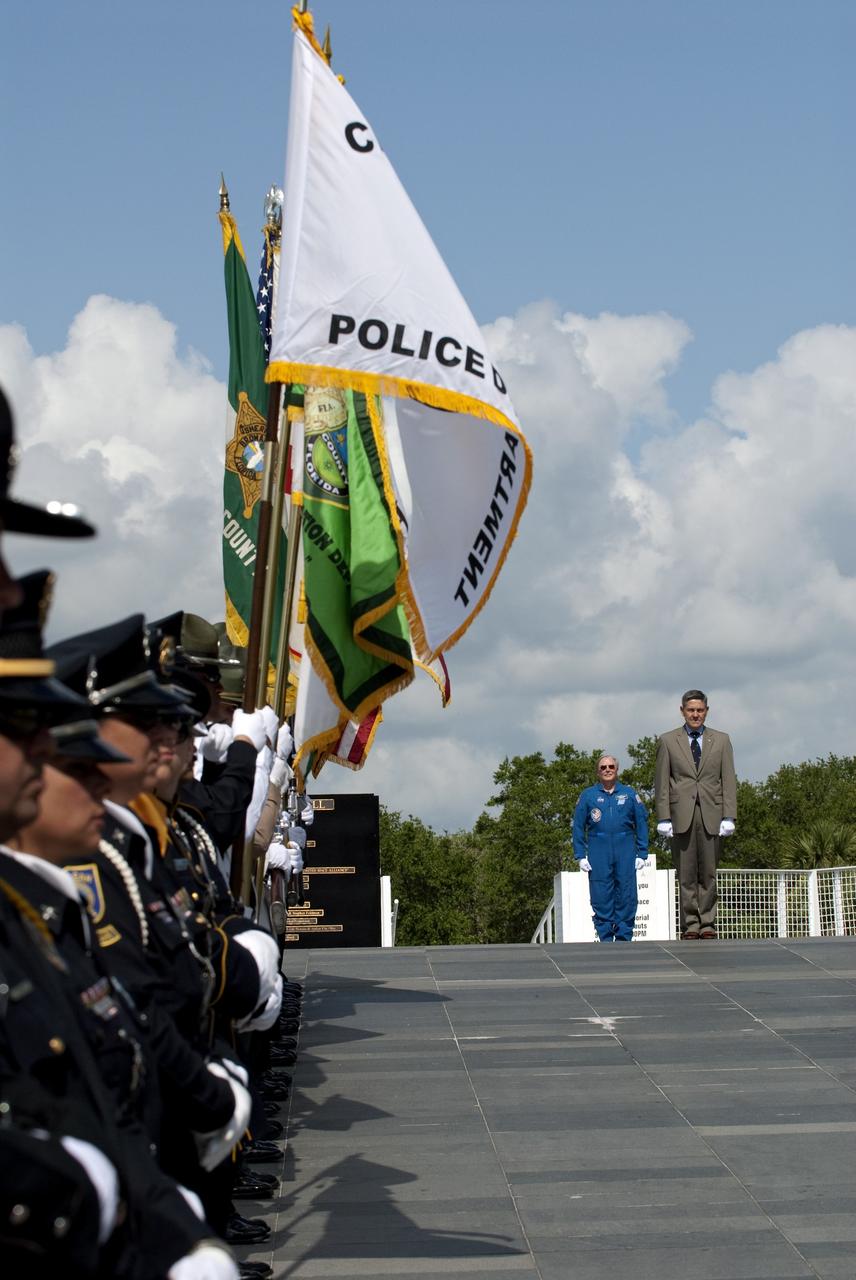
CAPE CANAVERAL, Fla. -- Kennedy Center Director Bob Cabana and Vehicle Integration Test Office and former NASA astronaut Jerry Ross walk past an honor guard as they make their way to the Astronaut Memorial Mirror at NASA's Kennedy Space Center Visitor Complex to participate in a U.S. Honor Flag presentation ceremony. The flag will be presented to NASA to be prepared to fly aboard space shuttle Atlantis on the Space Shuttle Program's final mission, STS-135. The U.S. Honor Flag has been flown nationwide, at Ground Zero and throughout the world to honor heroes who have lost their lives while serving their community and country, including police officers, firefighters, members of the Armed Forces and astronauts. More than 100 honor guard members traveled to the Space Coast to take part in the ceremony. After the flag returns to Earth, it will continue as a traveling memorial. Photo credit: NASA/Kim Shiflett
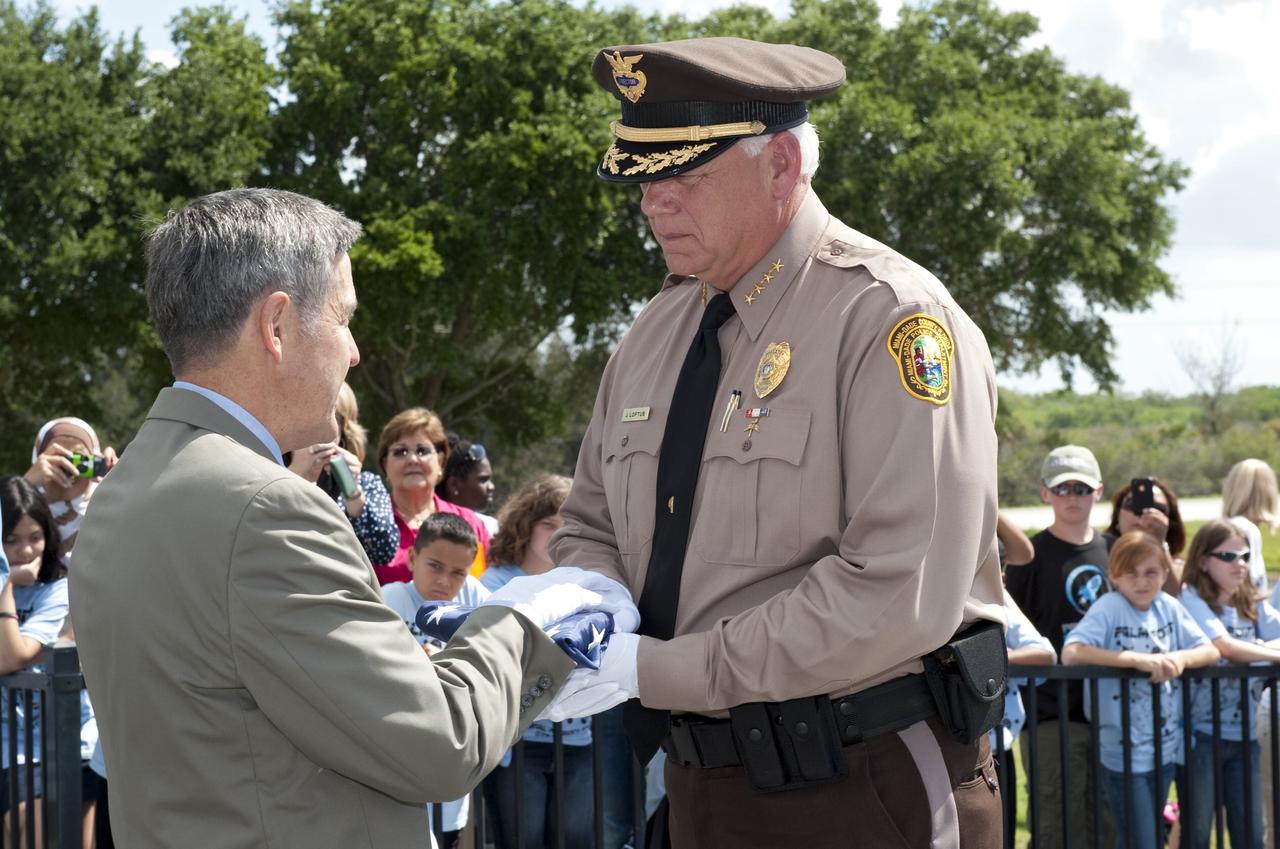
CAPE CANAVERAL, Fla. -- At the base of the Astronaut Memorial Mirror at NASA's Kennedy Space Center Visitor Complex, Center Director Bob Cabana accepts the U.S. Honor Flag presented to him by James Loftus (right), director of the Miami-Dade Police Department. The flag is presented to NASA to be prepared to fly aboard space shuttle Atlantis on the Space Shuttle Program's final mission, STS-135. The U.S. Honor Flag has been flown nationwide, at Ground Zero and throughout the world to honor heroes who have lost their lives while serving their community and country, including police officers, firefighters, members of the Armed Forces and astronauts. More than 100 honor guard members traveled to the Space Coast to take part in the ceremony. After the flag returns to Earth, it will continue as a traveling memorial. Photo credit: NASA/Kim Shiflett
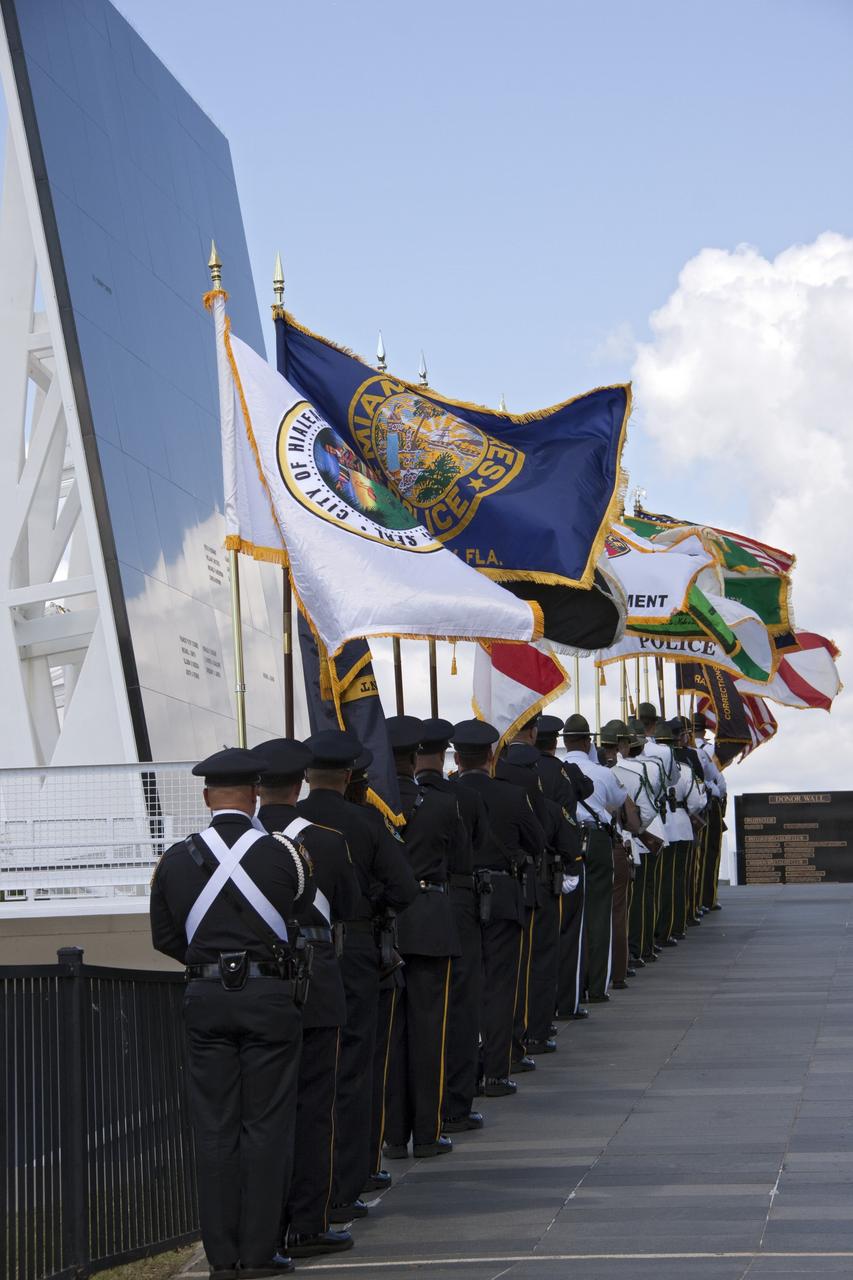
CAPE CANAVERAL, Fla. -- Honor guards march to the Astronaut Memorial Mirror at NASA's Kennedy Space Center Visitor Complex to participate in a U.S. Honor Flag presentation ceremony. The flag is presented to NASA to be prepared to fly aboard space shuttle Atlantis on the Space Shuttle Program's final mission, STS-135. The U.S. Honor Flag has been flown nationwide, at Ground Zero and throughout the world to honor heroes who have lost their lives while serving their community and country, including police officers, firefighters, members of the Armed Forces and astronauts. More than 100 honor guard members traveled to the Space Coast to take part in the ceremony. After the flag returns to Earth, it will continue as a traveling memorial. Photo credit: NASA/Troy Cryder
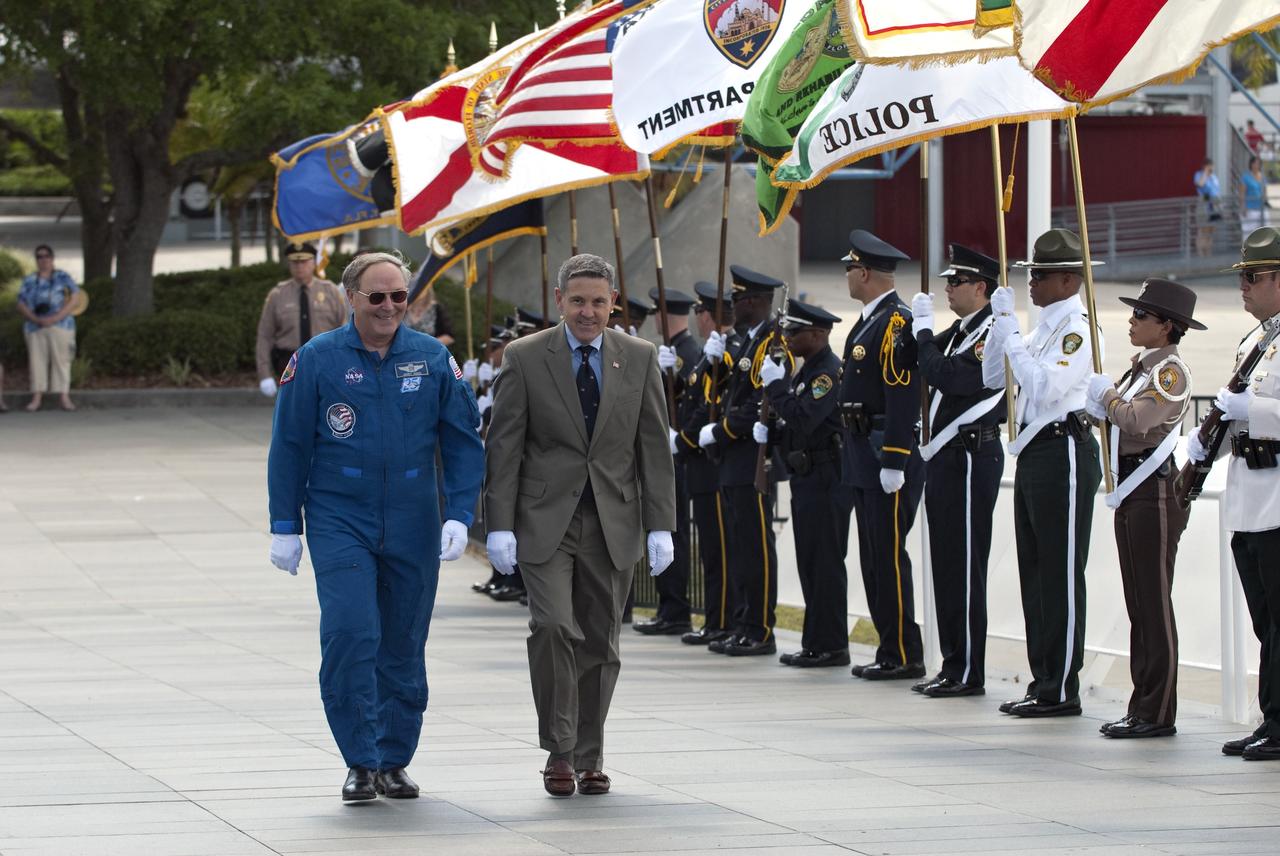
CAPE CANAVERAL, Fla. -- Kennedy Center Director Bob Cabana and Vehicle Integration Test Office and former NASA astronaut Jerry Ross walk past an honor guard at NASA's Kennedy Space Center Visitor Complex to participate in a U.S. Honor Flag presentation ceremony. The flag will be presented to NASA to be prepared to fly aboard space shuttle Atlantis on the Space Shuttle Program's final mission, STS-135. The U.S. Honor Flag has been flown nationwide, at Ground Zero and throughout the world to honor heroes who have lost their lives while serving their community and country, including police officers, firefighters, members of the Armed Forces and astronauts. More than 100 honor guard members traveled to the Space Coast to take part in the ceremony. After the flag returns to Earth, it will continue as a traveling memorial. Photo credit: NASA/Kim Shiflett

CAPE CANAVERAL, Fla. -- At NASA's Kennedy Space Center Visitor Complex, guests circle around an honor guard member after the U.S. Honor Flag presentation. The flag is presented to NASA to be prepared to fly aboard space shuttle Atlantis on the Space Shuttle Program's final mission, STS-135. The U.S. Honor Flag has been flown nationwide, at Ground Zero and throughout the world to honor heroes who have lost their lives while serving their community and country, including police officers, firefighters, members of the Armed Forces and astronauts. More than 100 honor guard members traveled to the Space Coast to take part in the ceremony. After the flag returns to Earth, it will continue as a traveling memorial. Photo credit: NASA/Kim Shiflett
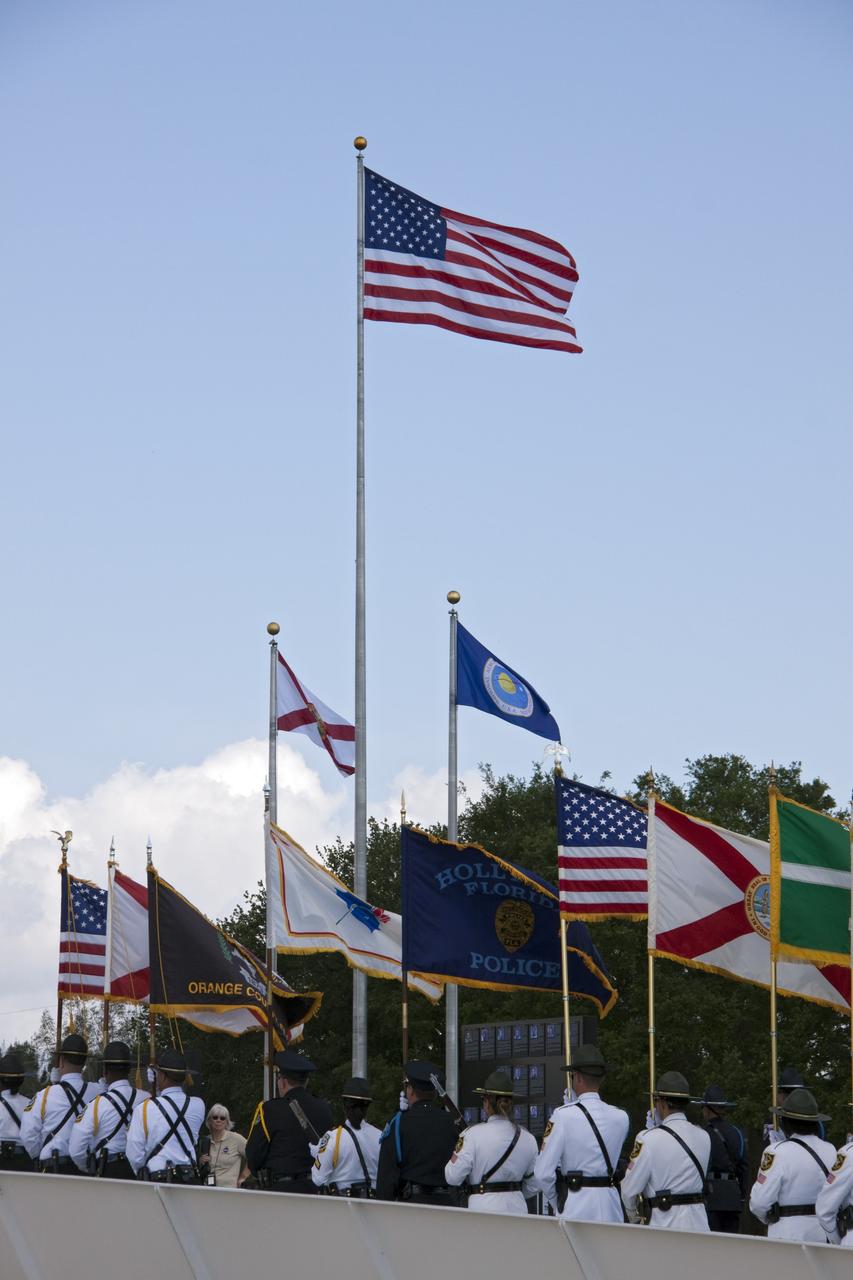
CAPE CANAVERAL, Fla. -- Honor guards march to the Astronaut Memorial Mirror at NASA's Kennedy Space Center Visitor Complex to participate in a U.S. Honor Flag presentation ceremony. The flag is presented to NASA to be prepared to fly aboard space shuttle Atlantis on the Space Shuttle Program's final mission, STS-135. The U.S. Honor Flag has been flown nationwide, at Ground Zero and throughout the world to honor heroes who have lost their lives while serving their community and country, including police officers, firefighters, members of the Armed Forces and astronauts. More than 100 honor guard members traveled to the Space Coast to take part in the ceremony. After the flag returns to Earth, it will continue as a traveling memorial. Photo credit: NASA/Troy Cryder
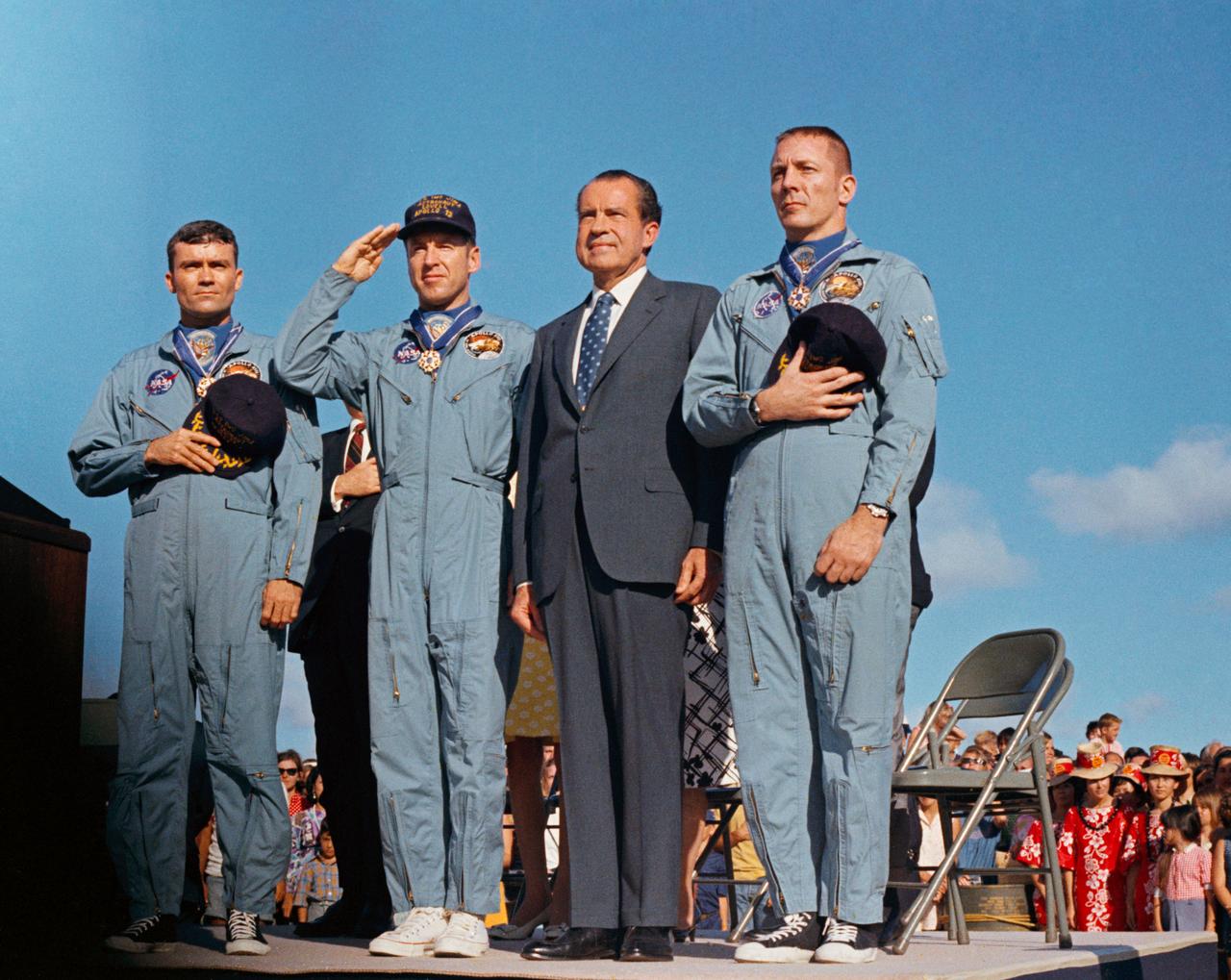
S70-15526 (18 April 1970) --- President Richard M. Nixon and the Apollo 13 crew members pay honor to the United States flag during the post-mission ceremonies at Hickam Air Force Base, Hawaii. Astronauts James A. Lovell Jr., (United States Navy Captain, salutes the flag) commander; John L. Swigert Jr., command module pilot (right); and Fred W. Haise Jr., lunar module pilot (left), were presented the Presidential Medal of Freedom by the Chief Executive. The Apollo 13 splashdown occurred at 12:07:44 p.m. (CST), April 17, 1970, about a day and a half prior to the award presentation.

ISS028-E-017451 (18 July 2011)--- Inside the International Space Station's Node 2 or Harmony, the STS-135 crew presented the Expedition 28 crew this special U.S. flag and mounted it on the hatch leading to Atlantis. The flag was flown on the first space shuttle mission, STS-1, and flew on this mission to be presented to the space station crew. It will remain onboard until the next crew launched from the U.S. will retrieve it for return to Earth. It will fly from Earth again, with the crew that launches from the U.S. on a journey of exploration beyond Earth orbit.
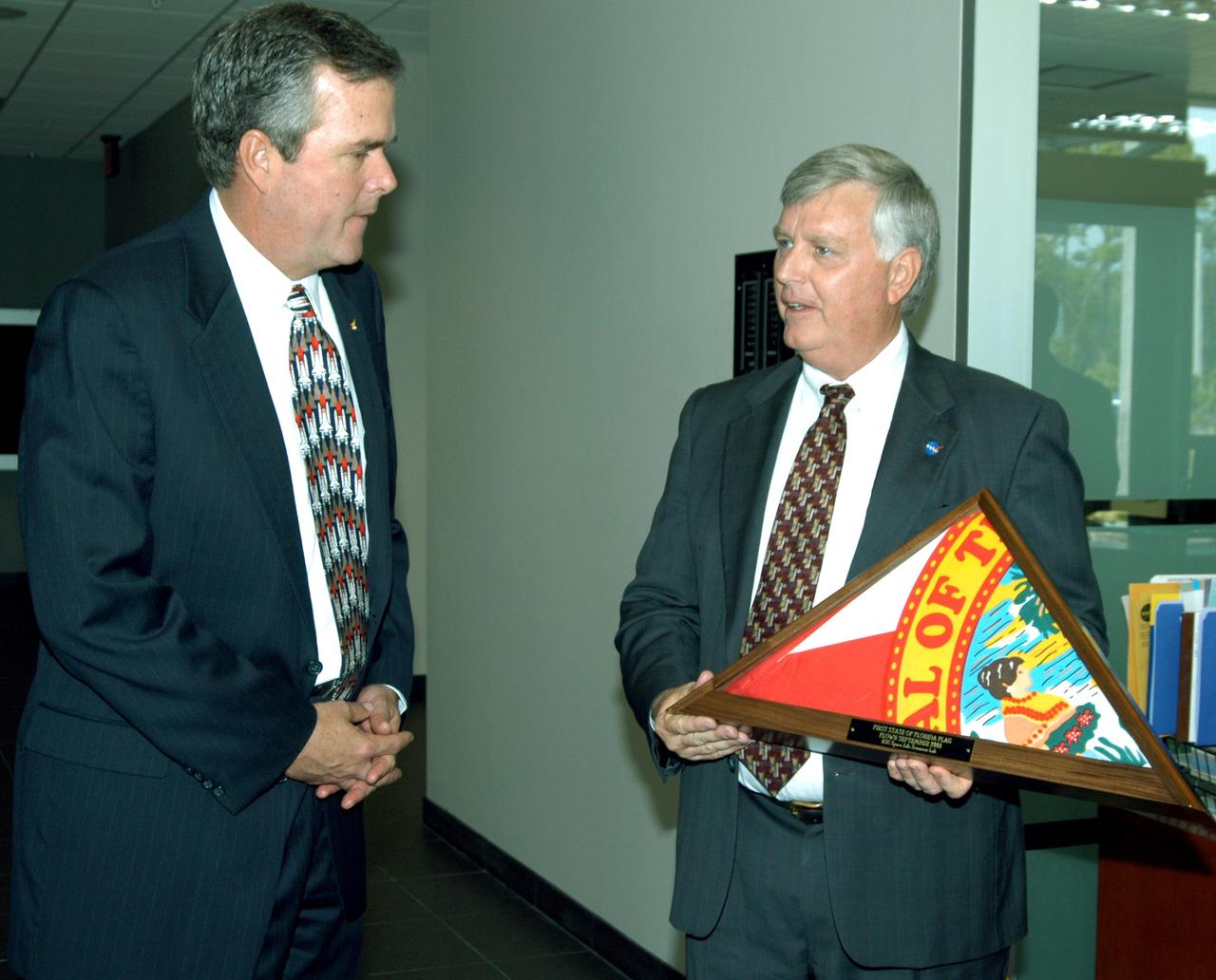
KENNEDY SPACE CENTER, FLA. -- Center Director Jim Kennedy presents a Florida flag to Florida Gov. Jeb Bush. The flag was flown during construction of the Space Life Sciences Lab through dedication of the Lab. The presentation was during a tour of the Lab following the launching ceremony at the KSC Visitor Complex for the new Florida quarter issued by the U.S. Mint. The ceremony was emceed by Center Director Jim Kennedy and included remarks by NASA Administrator Sean O’Keefe, Bush, U.S. Mint Director Henrietta Holsman Fore and Deputy Secretary of the Treasury Samuel W. Bodman. The new lab is a state-of-the-art facility built for ISS biotechnology research. It was developed as a partnership between NASA-KSC and the State of Florida.
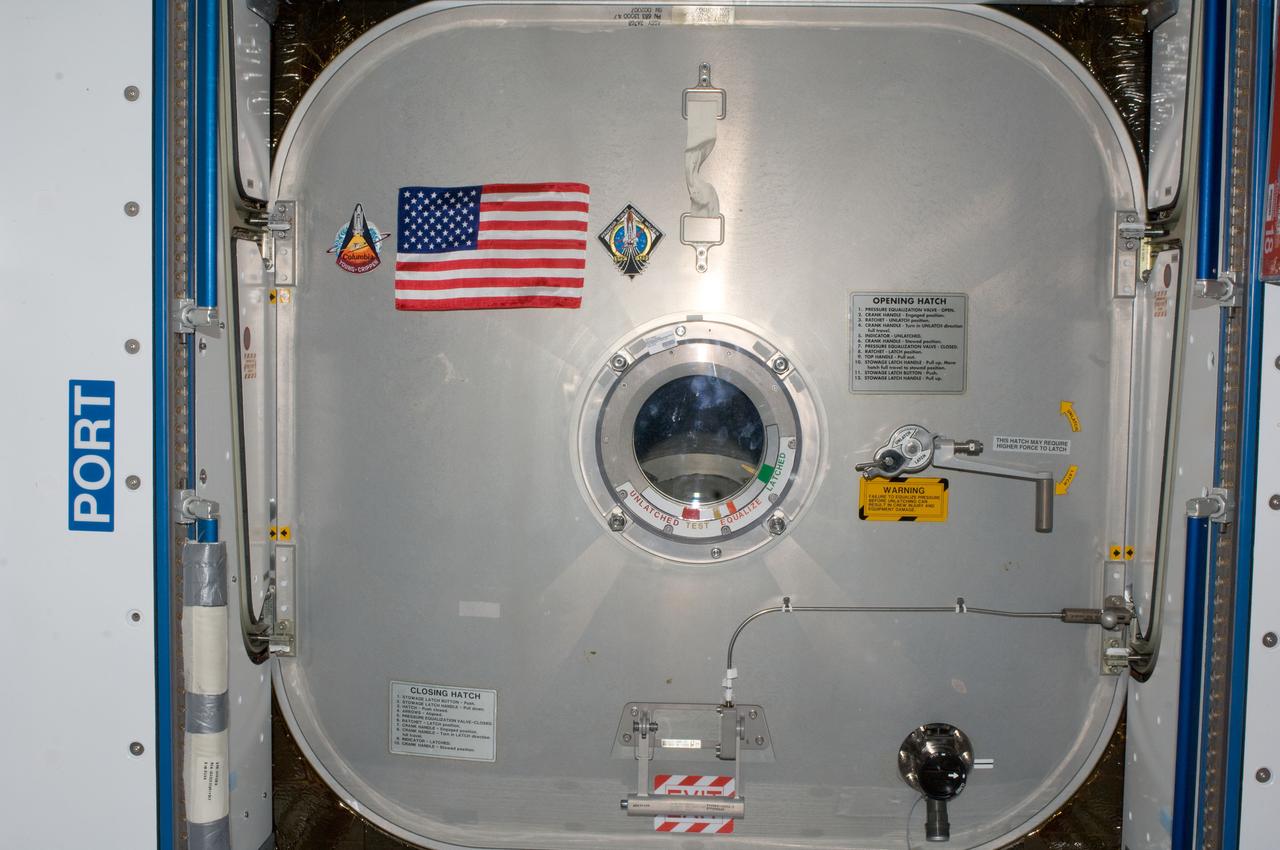
ISS028-E-017457 (18 July 2011)--- Inside the International Space Station's Node 2 or Harmony, the STS-135 crew presented the Expedition 28 crew this special U.S. flag and mounted it on the hatch leading to Atlantis. The flag was flown on the first space shuttle mission, STS-1, and flew on this mission to be presented to the space station crew. It will remain onboard until the next crew launched from the U.S. will retrieve it for return to Earth. It will fly from Earth again, with the crew that launches from the U.S. on a journey of exploration beyond Earth orbit.
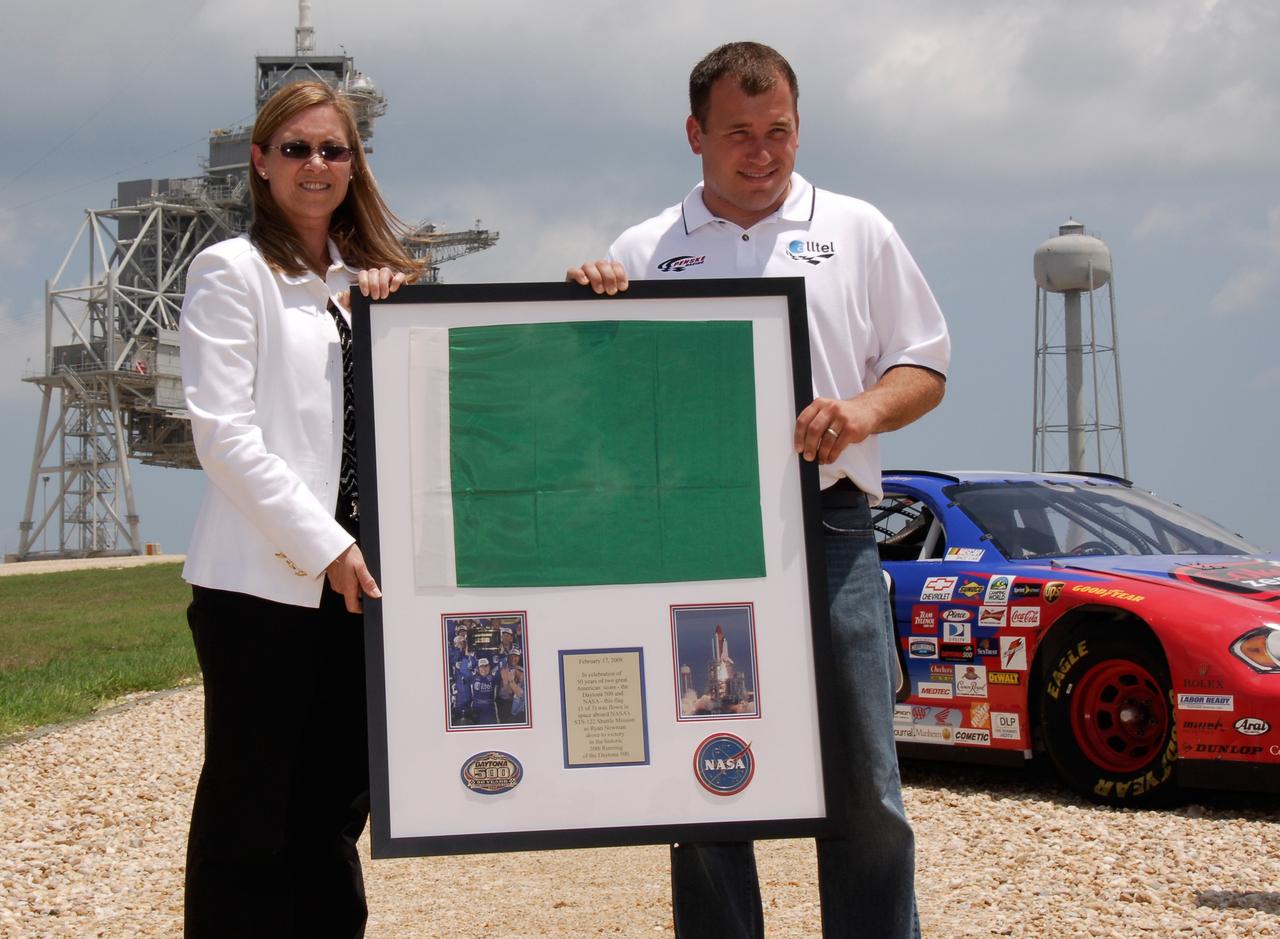
CAPE CANAVERAL, Fla. – On Launch Pad 39A at NASA's Kennedy Space Center, Janet Petro, Kennedy's deputy center director, presents 2008 Daytona 500 winner Ryan Newman one of the racing flags flown last February aboard space shuttle Atlantis' STS-122 mission to the International Space Station. Behind him, at right, is the Daytona International Speedway show car. Newman is visiting Kennedy in honor of NASA's 50th anniversary and the 50th running of NASCAR's Daytona 500 in February. NASA presented Newman two green racing flags. One flag was given to Newman, the second was presented to Daytona 500 Experience General Manager Kim Isemann. A third flag that was flown will be kept by NASA for public display. The connection between NASA and Daytona's International Speedway extends beyond their close proximity to one another. During recent years, technology developed for the space program has found many uses on Earth, including helping NASCAR drivers stay safe and increase performance. Photo credit: NASA/Kim Shiflett

CAPE CANAVERAL, Fla. – At NASA's Kennedy Space Center, 2008 Daytona 500 winner Ryan Newman drives the Astrovan that takes shuttle crews to the launch pad for launches. Newman is visiting Kennedy in honor of NASA's 50th anniversary and the 50th running of NASCAR's Daytona 500 in February. NASA presented Newman two green racing flags that were flown last February aboard space shuttle Atlantis' STS-122 mission to the International Space Station. One flag was given to Newman, the second was presented to Daytona 500 Experience General Manager Kim Isemann. A third flag that was flown will be kept by NASA for public display. The connection between NASA and Daytona's International Speedway extends beyond their close proximity to one another. During recent years, technology developed for the space program has found many uses on Earth, including helping NASCAR drivers stay safe and increase performance. Photo credit: NASA/Kim Shiflett
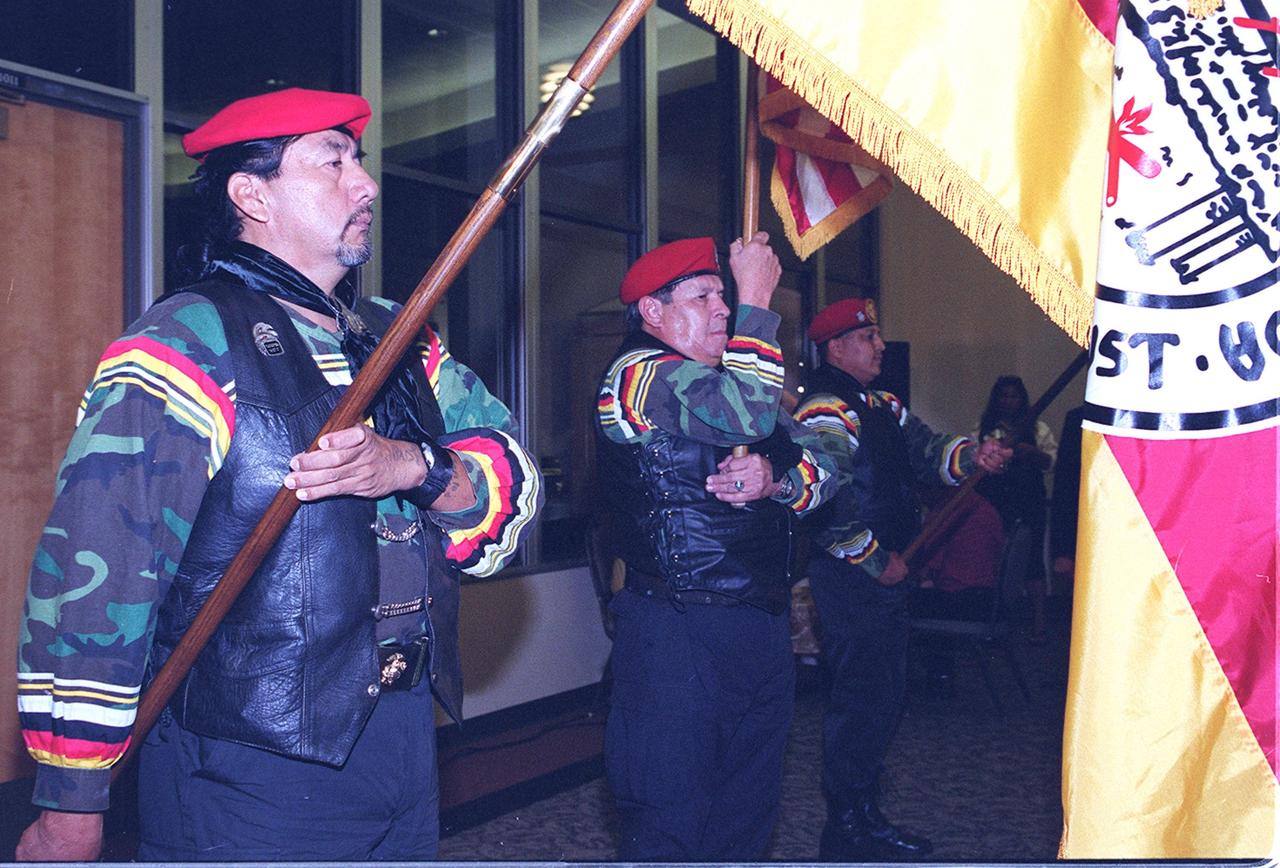
KENNEDY SPACE CENTER, FLA. -- -- The Seminole Native American Veterans Color Guard (Seminole Flag, U.S. Flag, and State of Florida Flag) present colors during a dinner at the Debus Conference Center in the KSC Visitor Complex. The dinner honored John B. Herrington, the first tribally enrolled Native American astronaut to fly on a Shuttle mission. Herrington is a Mission Specialist on STS-113. In addition to the dinner at KSC, several hundred Native Americans from around the country attended a symposium in Orlando commemorating the launch event. The Native Americans, many of them Chickasaw, were here to honor John, who is a Chickasaw from Oklahoma.
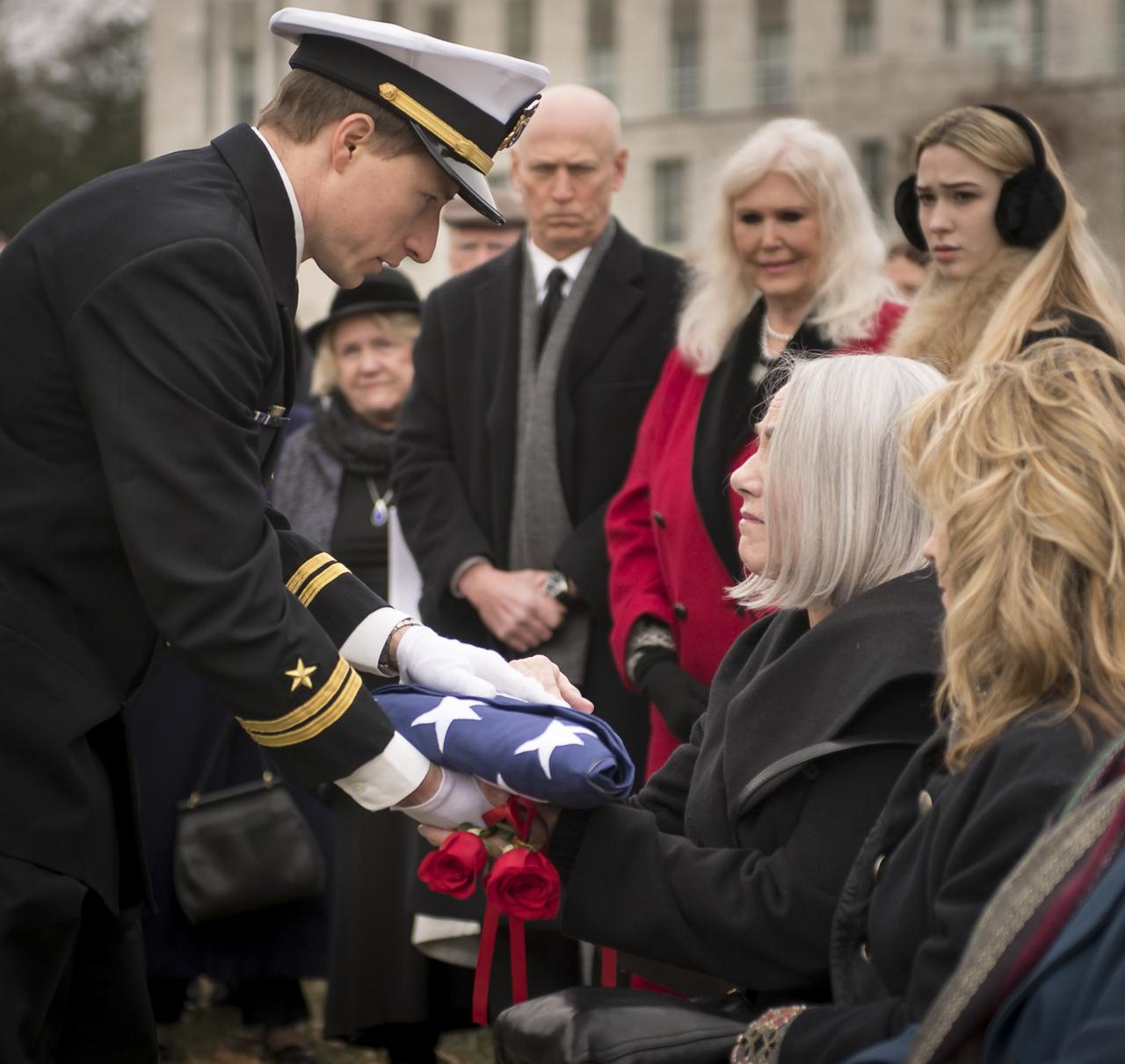
The flag that draped the casket of former NASA astronaut Captain Bruce McCandless II, USN (Ret.) is presented to his wife Ellen Shields McCandless during his interment service, Tuesday, Jan. 16, 2018 at the United States Naval Academy Cemetery in Annapolis, Maryland. Photo Credit: (NASA/Bill Ingalls)
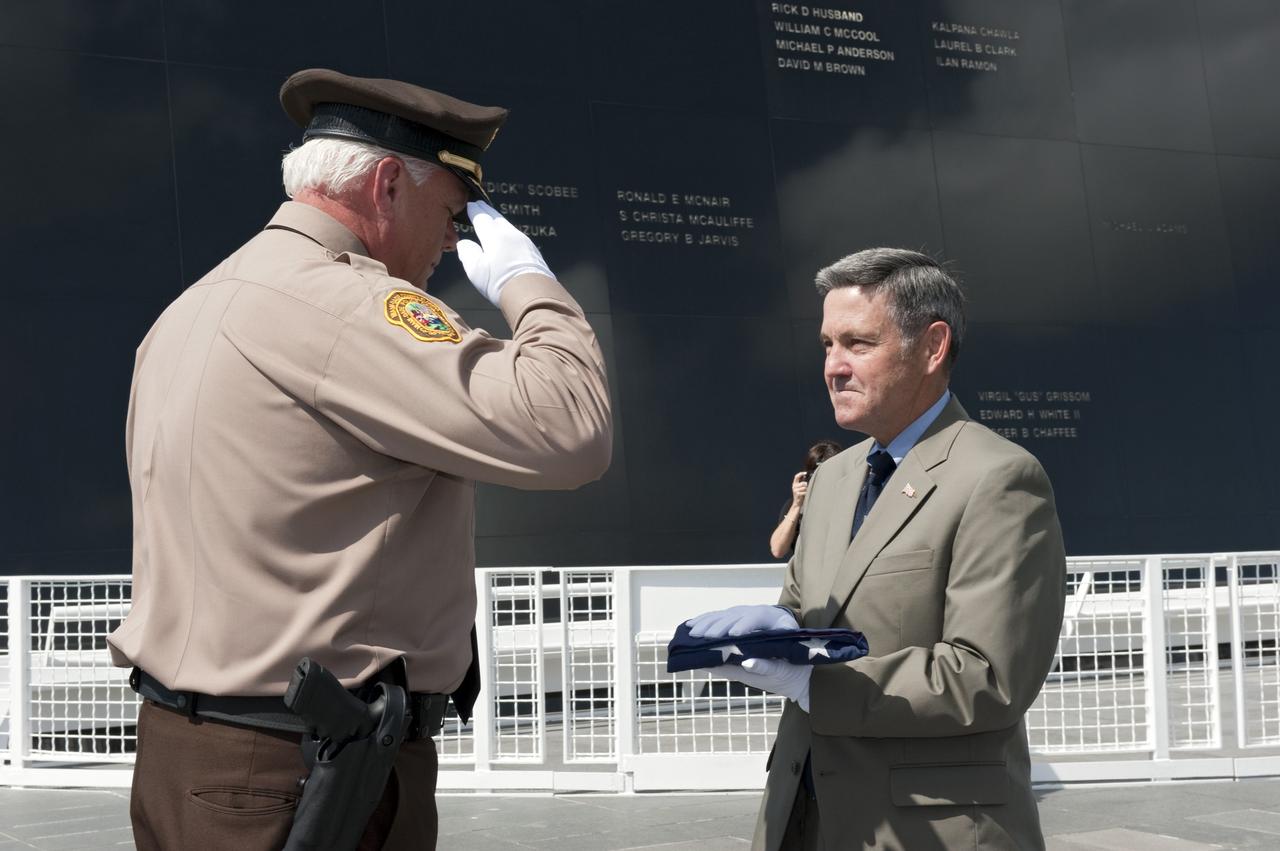
CAPE CANAVERAL, Fla. -- At the base of the Astronaut Memorial Mirror at NASA's Kennedy Space Center Visitor Complex, James Loftus (left), director of the Miami-Dade Police Department Center salutes as Director Bob Cabana accepts the U.S. Honor Flag. The flag is presented to NASA to be prepared to fly aboard space shuttle Atlantis on the Space Shuttle Program's final mission, STS-135. The U.S. Honor Flag has been flown nationwide, at Ground Zero and throughout the world to honor heroes who have lost their lives while serving their community and country, including police officers, firefighters, members of the Armed Forces and astronauts. More than 100 honor guard members traveled to the Space Coast to take part in the ceremony. After the flag returns to Earth, it will continue as a traveling memorial. Photo credit: NASA/Kim Shiflett
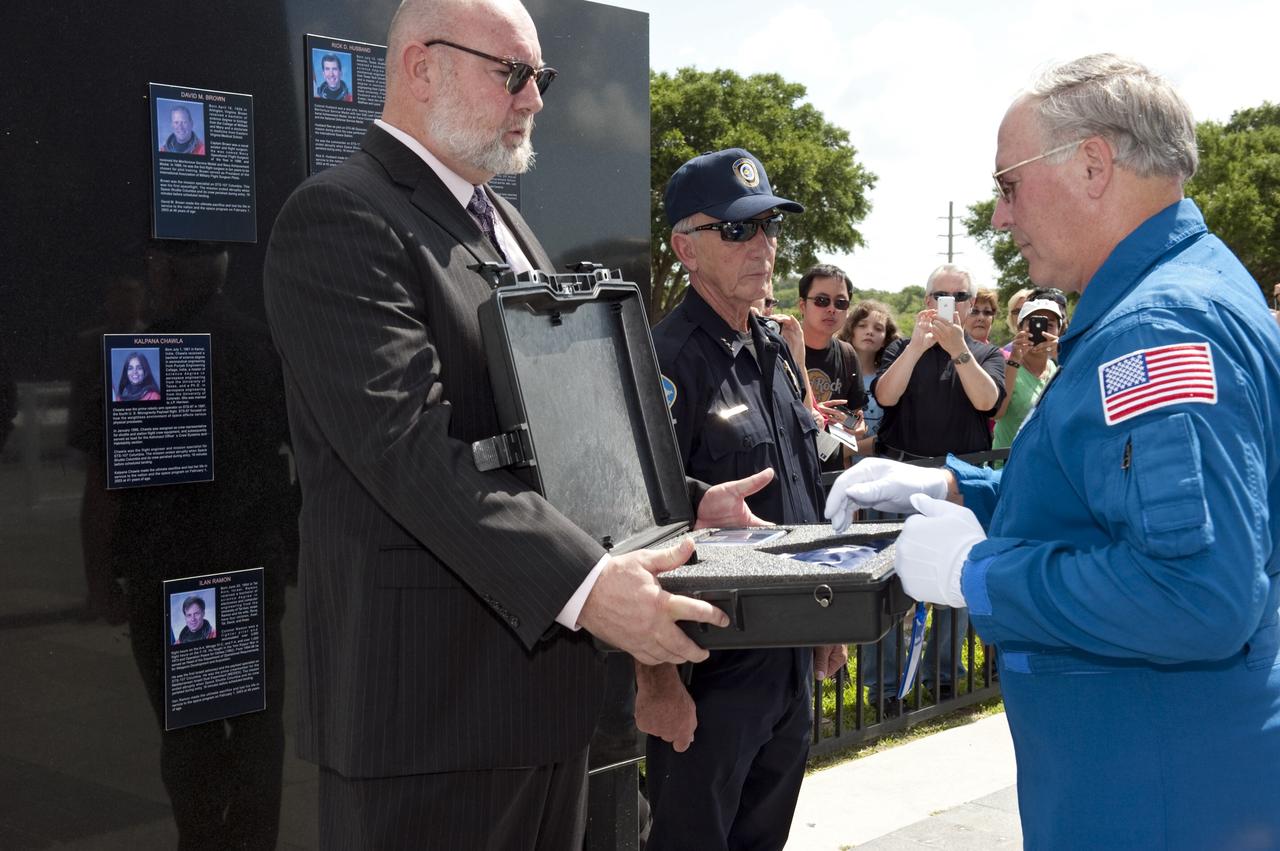
CAPE CANAVERAL, Fla. -- At NASA's Kennedy Space Center Visitor Complex's Astronaut Memorial Mirror, Jerry Ross, chief of the Vehicle Integration Test Office places the U.S. Honor Flag in a secure case held by Mark Borsi NASA security director. The flag is presented to NASA to be prepared to fly aboard space shuttle Atlantis on the Space Shuttle Program's final mission, STS-135. The U.S. Honor Flag has been flown nationwide, at Ground Zero and throughout the world to honor heroes who have lost their lives while serving their community and country, including police officers, firefighters, members of the Armed Forces and astronauts. More than 100 honor guard members traveled to the Space Coast to take part in the ceremony. After the flag returns to Earth, it will continue as a traveling memorial. Photo credit: NASA/Kim Shiflett
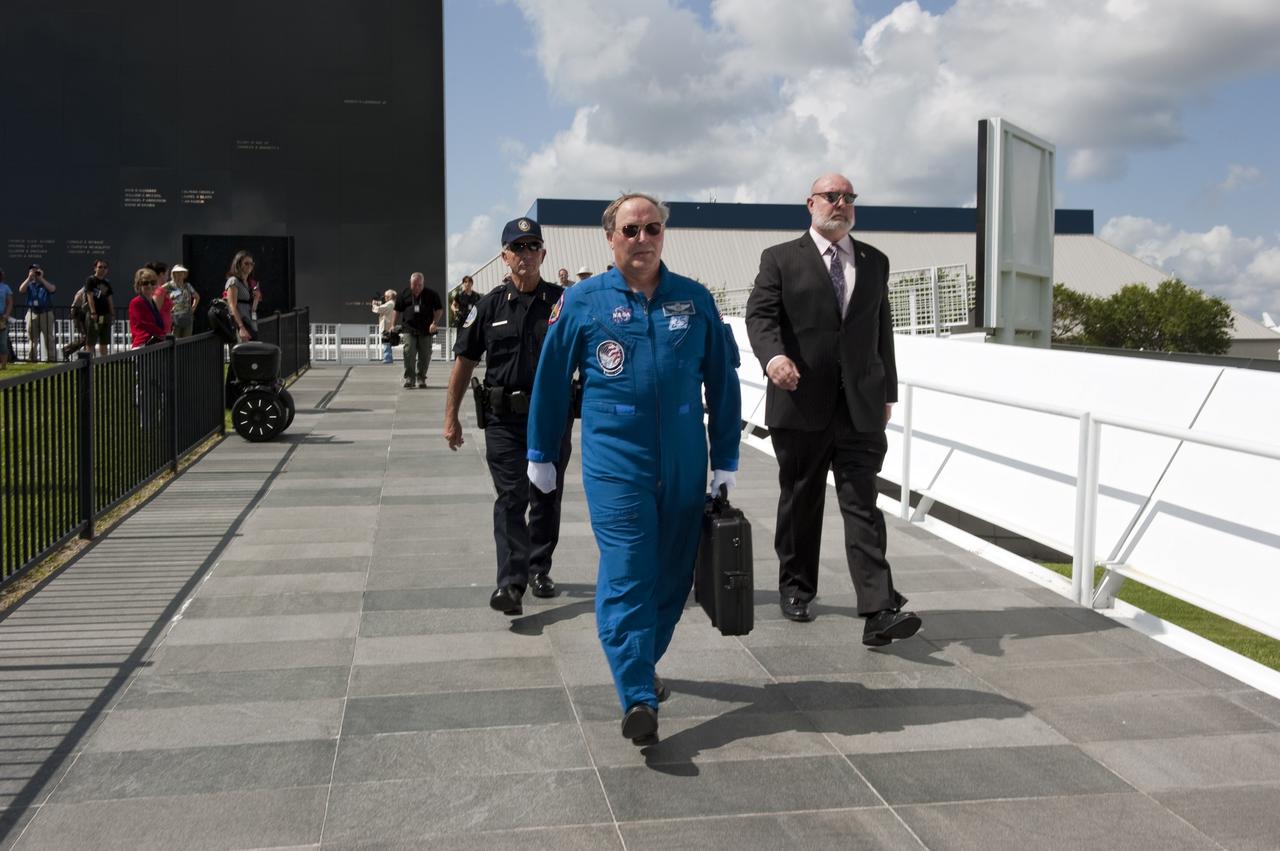
CAPE CANAVERAL, Fla. -- At NASA's Kennedy Space Center Visitor Complex's Astronaut Memorial Mirror, Jerry Ross, chief of the Vehicle Integration Test Office holds onto the secure case containing the U.S. Honor Flag accompanied by Mark Borsi NASA security director (right) and a security guard. The flag is presented to NASA to be prepared to fly aboard space shuttle Atlantis on the Space Shuttle Program's final mission, STS-135. The U.S. Honor Flag has been flown nationwide, at Ground Zero and throughout the world to honor heroes who have lost their lives while serving their community and country, including police officers, firefighters, members of the Armed Forces and astronauts. More than 100 honor guard members traveled to the Space Coast to take part in the ceremony. After the flag returns to Earth, it will continue as a traveling memorial. Photo credit: NASA/Kim Shiflett
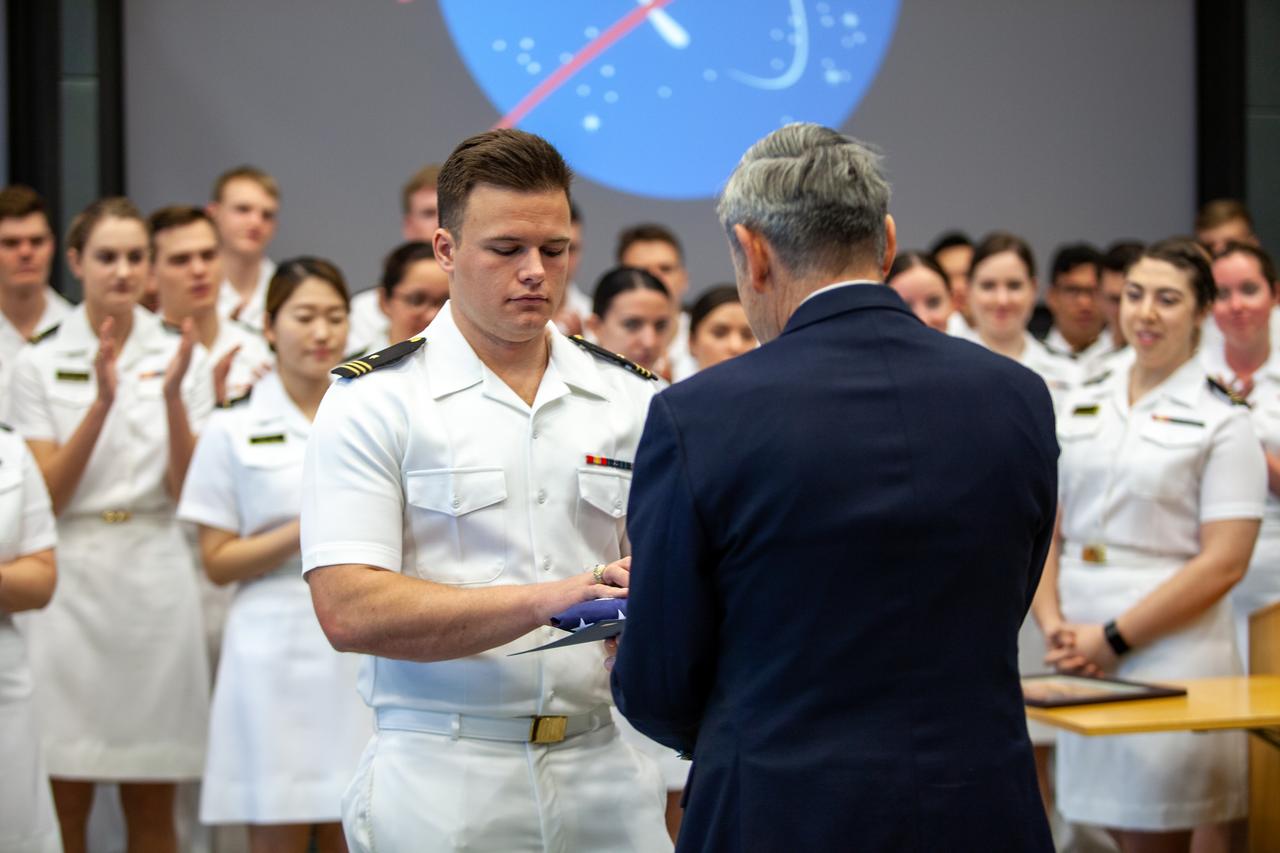
Kennedy Space Center Director Bob Cabana is presented with a flag that was flown over the United States Naval Academy in his honor during a special event at the Florida spaceport on March 10, 2020. The event included a performance by the U.S. Naval Academy Glee Club and a presentation by Cabana, who discussed the deep historical ties between NASA and the U.S. Navy. The highly acclaimed Glee Club has achieved prominence as one of America’s premier choral ensembles, performing throughout the nation each year.

KENNEDY SPACE CENTER, FLA. -- Former astronaut Winston Scott (left) presents a NASA flag flown at the KSC Space Life Sciences Lab to NASA Administrator Sean O’Keefe. The flag was flown during construction through the dedication of the Lab. The presentation was during a tour of the Lab following the launching ceremony at the KSC Visitor Complex for the new Florida quarter issued by the U.S. Mint. The ceremony was emceed by Center Director Jim Kennedy and included remarks by O’Keefe, Florida Gov. Jeb Bush, U.S. Mint Director Henrietta Holsman Fore and Deputy Secretary of the Treasury Samuel W. Bodman. The new lab is a state-of-the-art facility built for ISS biotechnology research. It was developed as a partnership between NASA-KSC and the State of Florida.
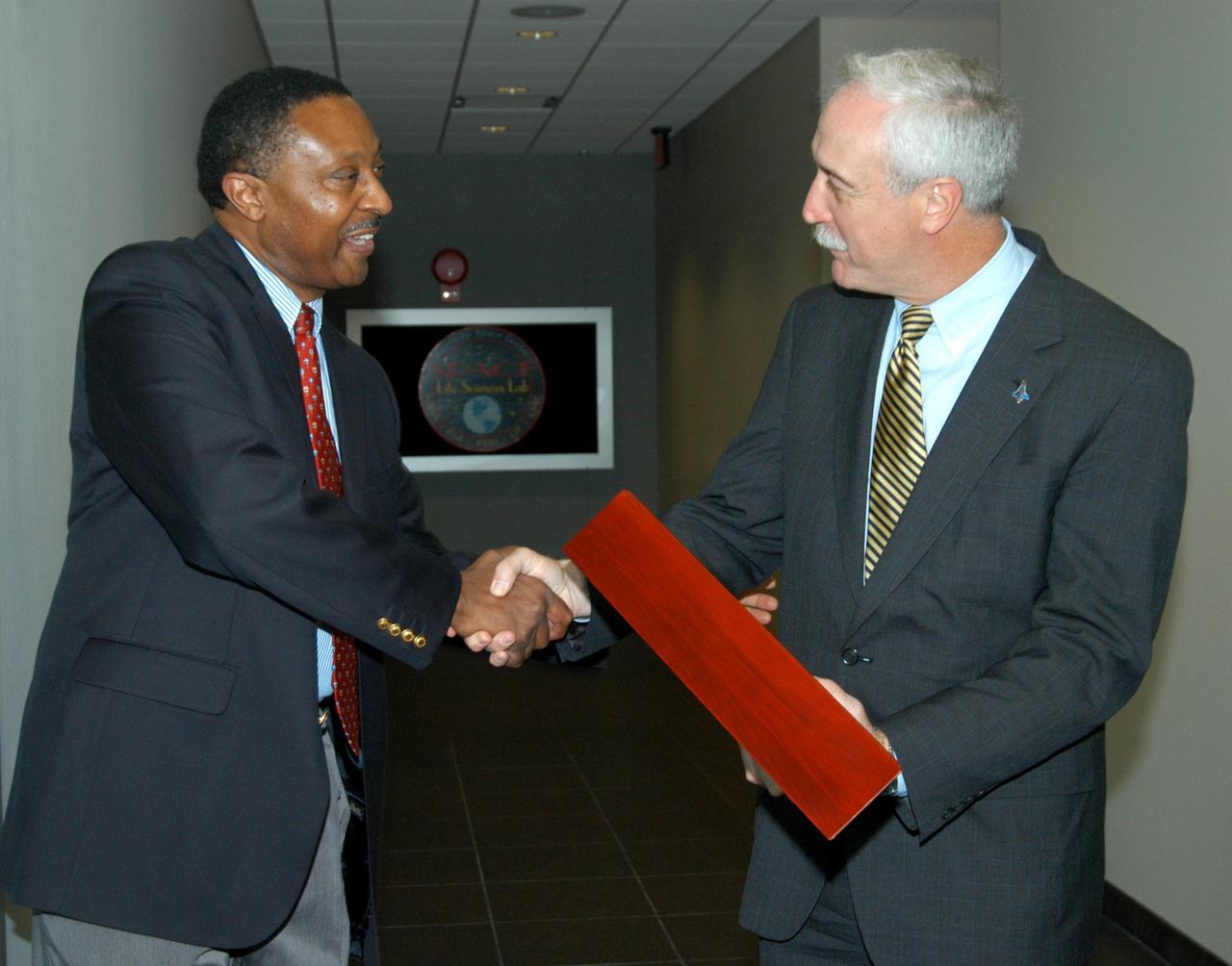
KENNEDY SPACE CENTER, FLA. -- Former astronaut Winston Scott (left) presents a NASA flag flown at the KSC Space Life Sciences Lab to NASA Administrator Sean O’Keefe. The flag was flown during construction through the dedication of the Lab. The presentation was during a tour of the Lab following the launching ceremony at the KSC Visitor Complex for the new Florida quarter issued by the U.S. Mint. The ceremony was emceed by Center Director Jim Kennedy and included remarks by O’Keefe, Florida Gov. Jeb Bush, U.S. Mint Director Henrietta Holsman Fore and Deputy Secretary of the Treasury Samuel W. Bodman. The new lab is a state-of-the-art facility built for ISS biotechnology research. It was developed as a partnership between NASA-KSC and the State of Florida.

S73-38345 (11 Dec. 1973) --- Two of the three Apollo 17 crewmen join in commemoration of their historical lunar landing mission of one year ago by presenting to flight controllers in Mission Control Center (MCC) the U.S. flag which flew with them to the moon. Astronauts Eugene A. Cernan, center, Apollo 17 commander, and Harrison H. Schmitt, right, lunar module pilot, are shown with Eugene F. Kranz, who accepted the flag on behalf of all the flight controllers during special ceremonies in the Mission Operations Control Room (MOCR) of MCC during the third manned Skylab mission. Kranz is chief of the Flight Control Division of the Flight Operations Directorate at JSC.
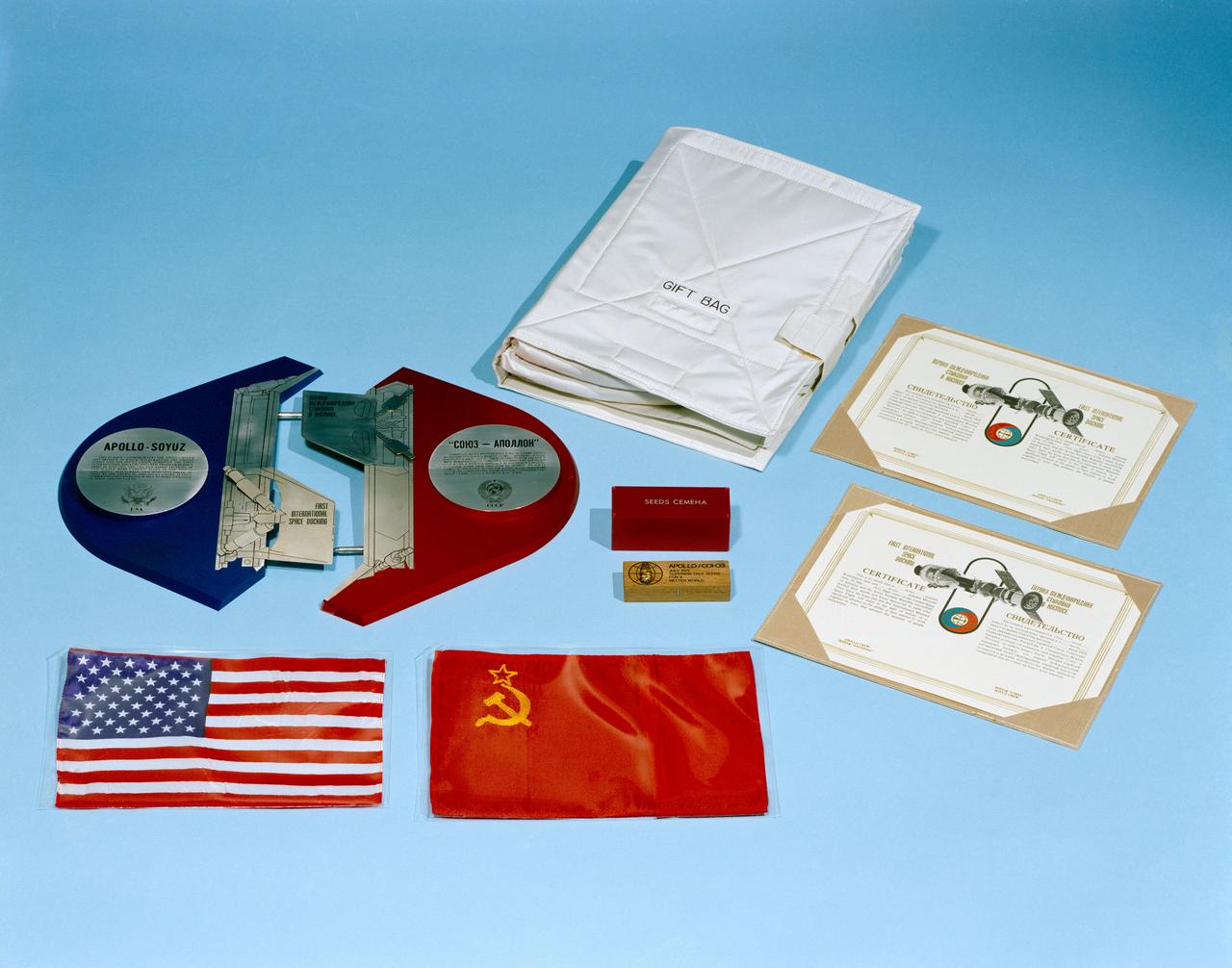
S75-27952 (July 1975) --- A close-up view of the special ?gift bag? in which several exchange/gift items will be carried aboard the Apollo Command Module during the joint U.S.-USSR Apollo-Soyuz Test Project mission. Some of these items are seen here alongside the bag. They are the sectionized ASTP Commemorative Plaque, ten 8x12 inch American flags, ten 8.07x16.14 inch (205mm x 410mm) Soviet Union flags, a special box of white spruce tree seeds, and the ASTP Certification to authorize the ASTP docking. The gifts will be presented and the exchange made while the Apollo and Soyuz spacecraft are docked in Earth orbit.
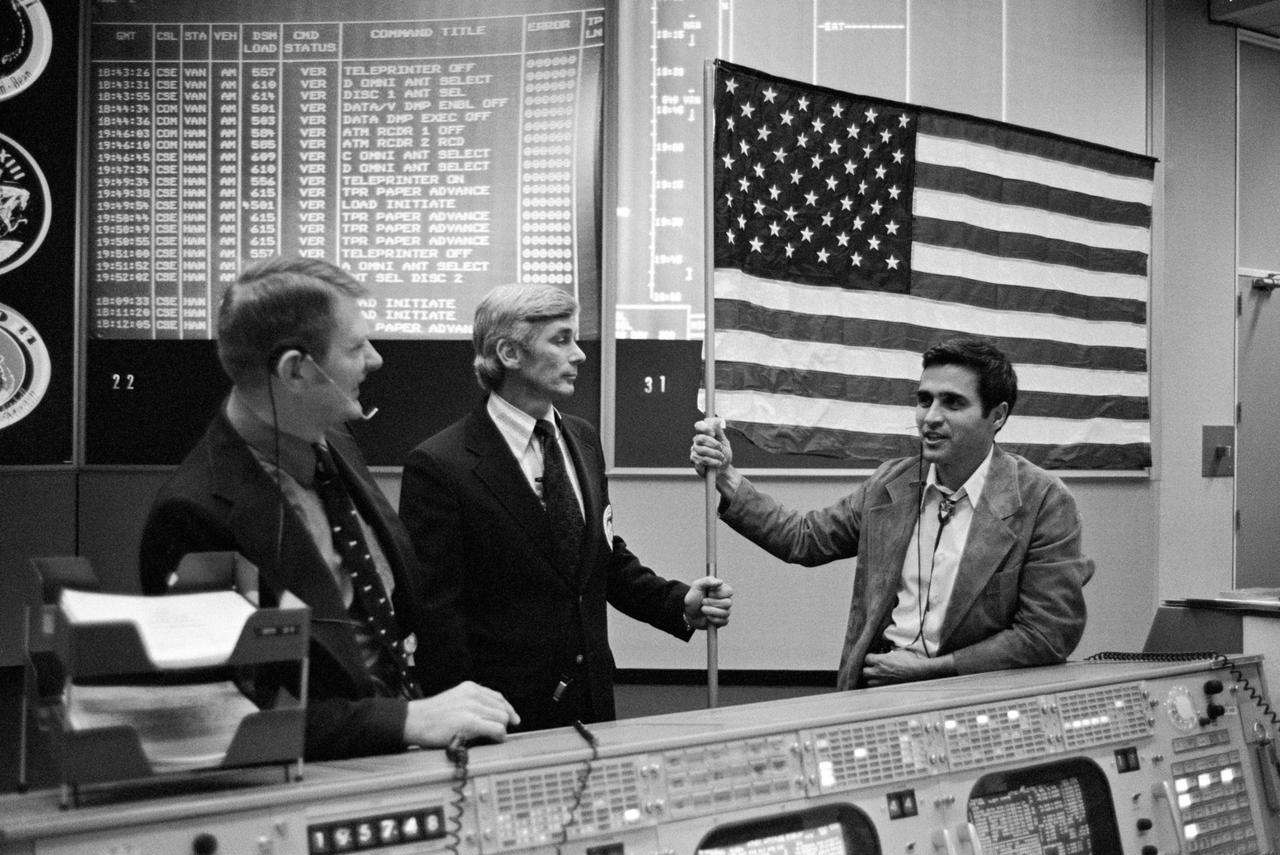
S73-38346 (11 Dec. 1973) --- Two of the three Apollo 17 crewmen join in commemoration of their historical lunar landing mission of one year ago by presenting to flight controllers in Mission Control Center (MCC) the U.S. flag which flew with them to the moon. Astronauts Eugene A. Cernan, center, Apollo 17 commander, and Harrison H. Schmitt, right, lunar module pilot, are shown with Eugene F. Kranz, who accepted the flag on behalf of all the flight controllers during special ceremonies in the Mission Operations Control Room (MOCR) of MCC during the third manned Skylab mission. Kranz is chief of the Flight Control Division of the Flight Operations Directorate at JSC.
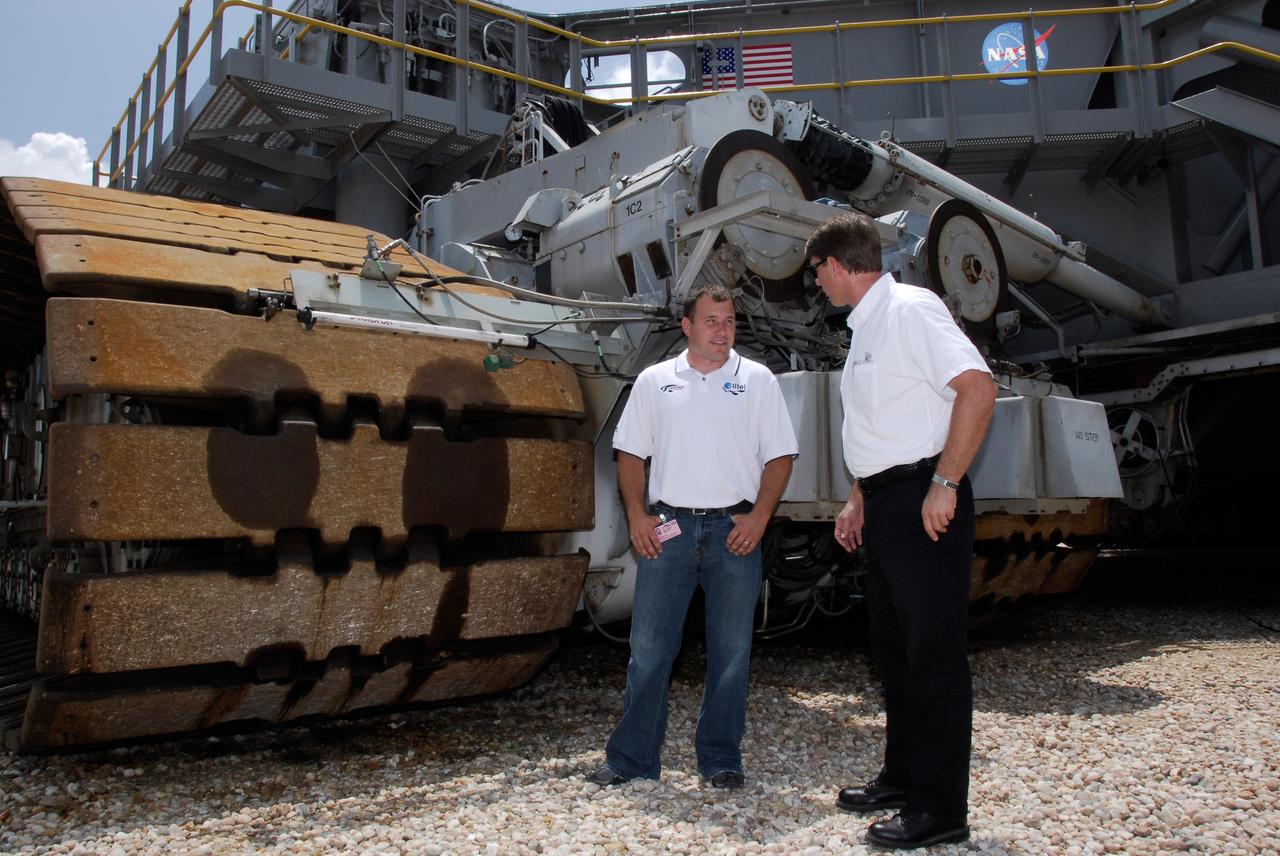
CAPE CANAVERAL, Fla. – 2008 Daytona 500 winner Ryan Newman learns more from Gordon Coffey, NASA systems engineer, about the crawler-transporter behind him. Standing 20 feet tall, the crawler weighs 5.5 million pounds unloaded. It has 16 traction motors of 375 hp each and only travels 2 mph unloaded. Newman is visiting Kennedy in honor of NASA's 50th anniversary and the 50th running of NASCAR's Daytona 500 in February. NASA presented Newman two green racing flags that were flown last February aboard space shuttle Atlantis' STS-122 mission to the International Space Station. One flag was given to Newman, the second was presented to Daytona 500 Experience General Manager Kim Isemann. A third flag that was flown will be kept by NASA for public display. The connection between NASA and Daytona's International Speedway extends beyond their close proximity to one another. During recent years, technology developed for the space program has found many uses on Earth, including helping NASCAR drivers stay safe and increase performance. Photo credit: NASA/Kim Shiflett
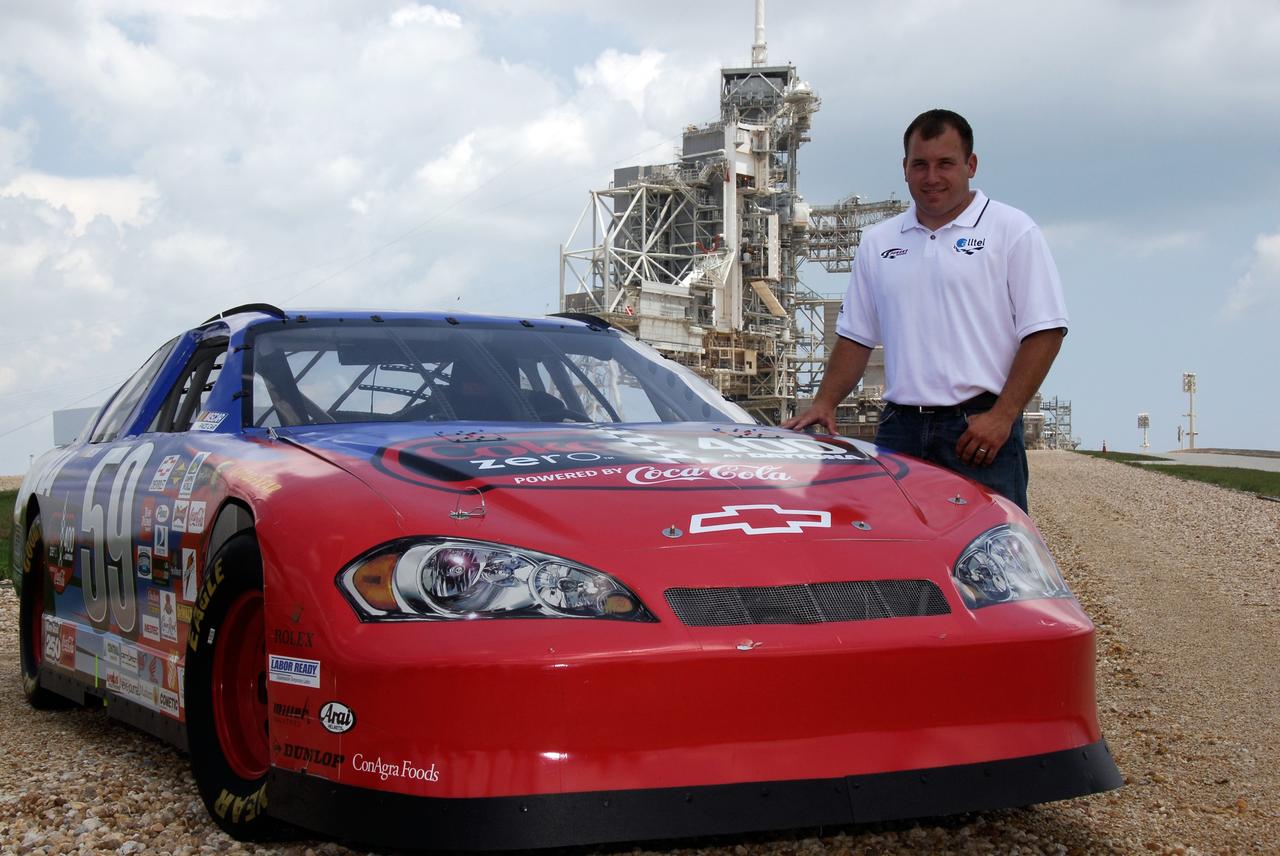
CAPE CANAVERAL, Fla. – On Launch Pad 39A at NASA's Kennedy Space Center, 2008 Daytona 500 winner Ryan Newman poses for photographers with the Daytona International Speedway show car. Newman is visiting Kennedy in honor of NASA's 50th anniversary and the 50th running of NASCAR's Daytona 500 in February. NASA presented Newman two green racing flags that were flown last February aboard space shuttle Atlantis' STS-122 mission to the International Space Station. One flag was given to Newman, the second was presented to Daytona 500 Experience General Manager Kim Isemann. A third flag that was flown will be kept by NASA for public display. The connection between NASA and Daytona's International Speedway extends beyond their close proximity to one another. During recent years, technology developed for the space program has found many uses on Earth, including helping NASCAR drivers stay safe and increase performance. Photo credit: NASA/Kim Shiflett
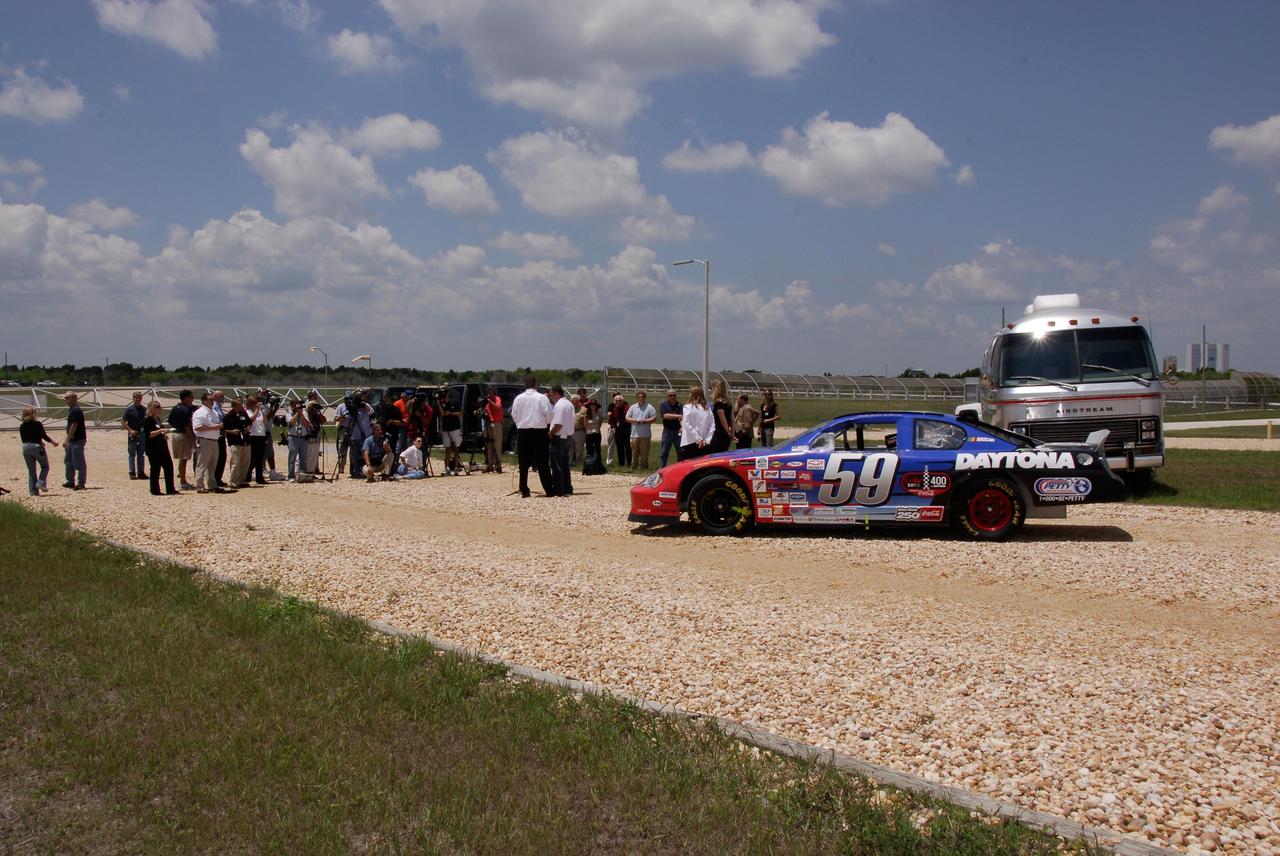
CAPE CANAVERAL, Fla. – Members of the media stretch across the crawlerway on Launch Pad 39A at NASA's Kennedy Space Center to interview 2008 Daytona 500 winner Ryan Newman (center right). At left is Daytona International Speedway President Robin Braig. The Daytona International Speedway show car, shown here, is in sharp contrast to the crawler-transporter that usually travels the special road to the pad at a maximum speed of 2 mph. Newman is visiting Kennedy in honor of NASA's 50th anniversary and the 50th running of NASCAR's Daytona 500 in February. NASA presented Newman two green racing flags that were flown last February aboard space shuttle Atlantis' STS-122 mission to the International Space Station. One flag was given to Newman, the second was presented to Daytona 500 Experience General Manager Kim Isemann. A third flag that was flown will be kept by NASA for public display. The connection between NASA and Daytona's International Speedway extends beyond their close proximity to one another. During recent years, technology developed for the space program has found many uses on Earth, including helping NASCAR drivers stay safe and increase performance. Photo credit: NASA/Kim Shiflett
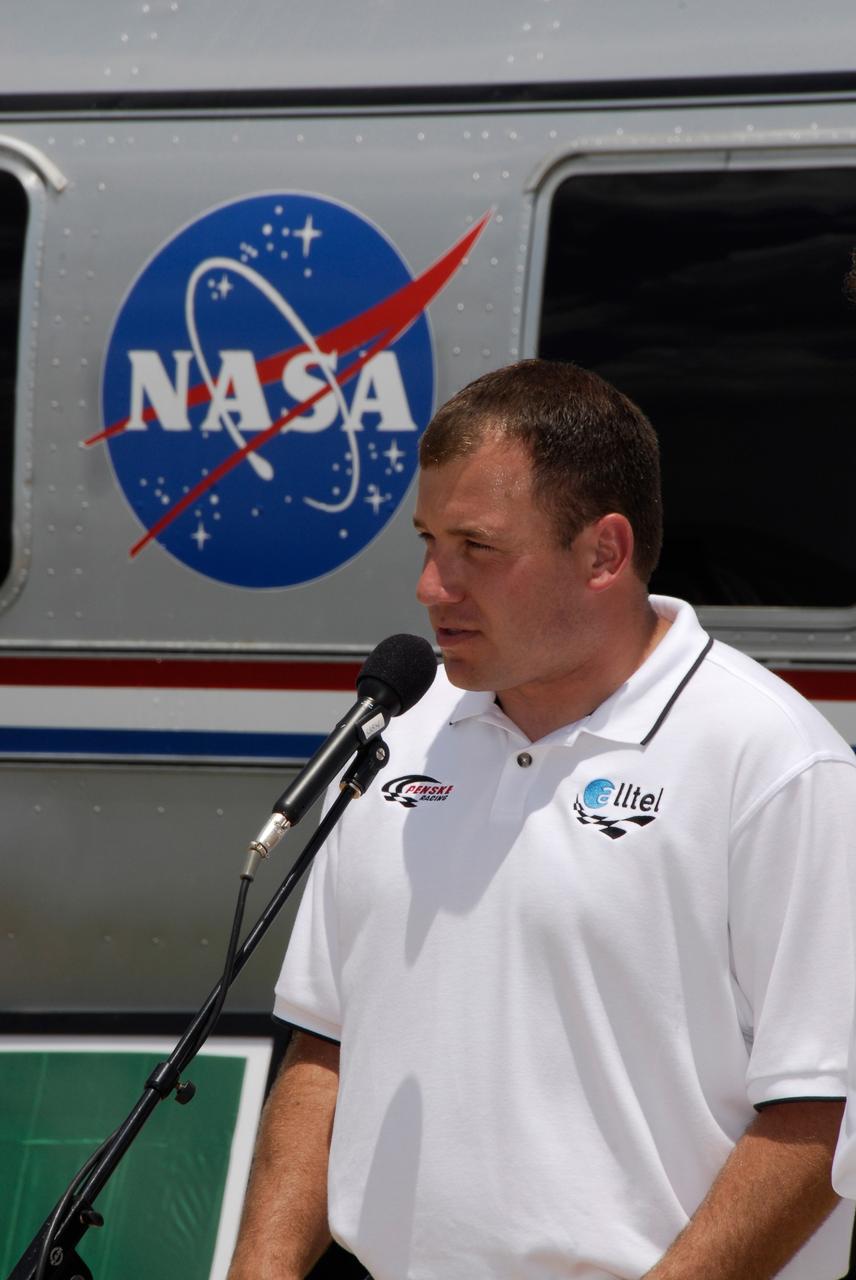
CAPE CANAVERAL, Fla. – 2008 Daytona 500 winner Ryan Newman talks to the media gathered on the crawlerway on Launch Pad 39A. The Daytona International Speedway show car, shown here, is in sharp contrast to the crawler-transporter that usually travels the special road to the pad. Newman is visiting Kennedy in honor of NASA's 50th anniversary and the 50th running of NASCAR's Daytona 500 in February. NASA presented Newman two green racing flags that were flown last February aboard space shuttle Atlantis' STS-122 mission to the International Space Station. One flag was given to Newman, the second was presented to Daytona 500 Experience General Manager Kim Isemann. A third flag that was flown will be kept by NASA for public display. The connection between NASA and Daytona's International Speedway extends beyond their close proximity to one another. During recent years, technology developed for the space program has found many uses on Earth, including helping NASCAR drivers stay safe and increase performance. Photo credit: NASA/Kim Shiflett

CAPE CANAVERAL, Fla. – On Launch Pad 39A at NASA's Kennedy Space Center, Daytona International Speedway President Robin Braig (left) and 2008 Daytona 500 winner Ryan Newman pose for photographers with the Daytona International Speedway show car. Newman is visiting Kennedy in honor of NASA's 50th anniversary and the 50th running of NASCAR's Daytona 500 in February. NASA presented Newman two green racing flags that were flown last February aboard space shuttle Atlantis' STS-122 mission to the International Space Station. One flag was given to Newman, the second was presented to Daytona 500 Experience General Manager Kim Isemann. A third flag that was flown will be kept by NASA for public display. The connection between NASA and Daytona's International Speedway extends beyond their close proximity to one another. During recent years, technology developed for the space program has found many uses on Earth, including helping NASCAR drivers stay safe and increase performance. Photo credit: NASA/Kim Shiflett
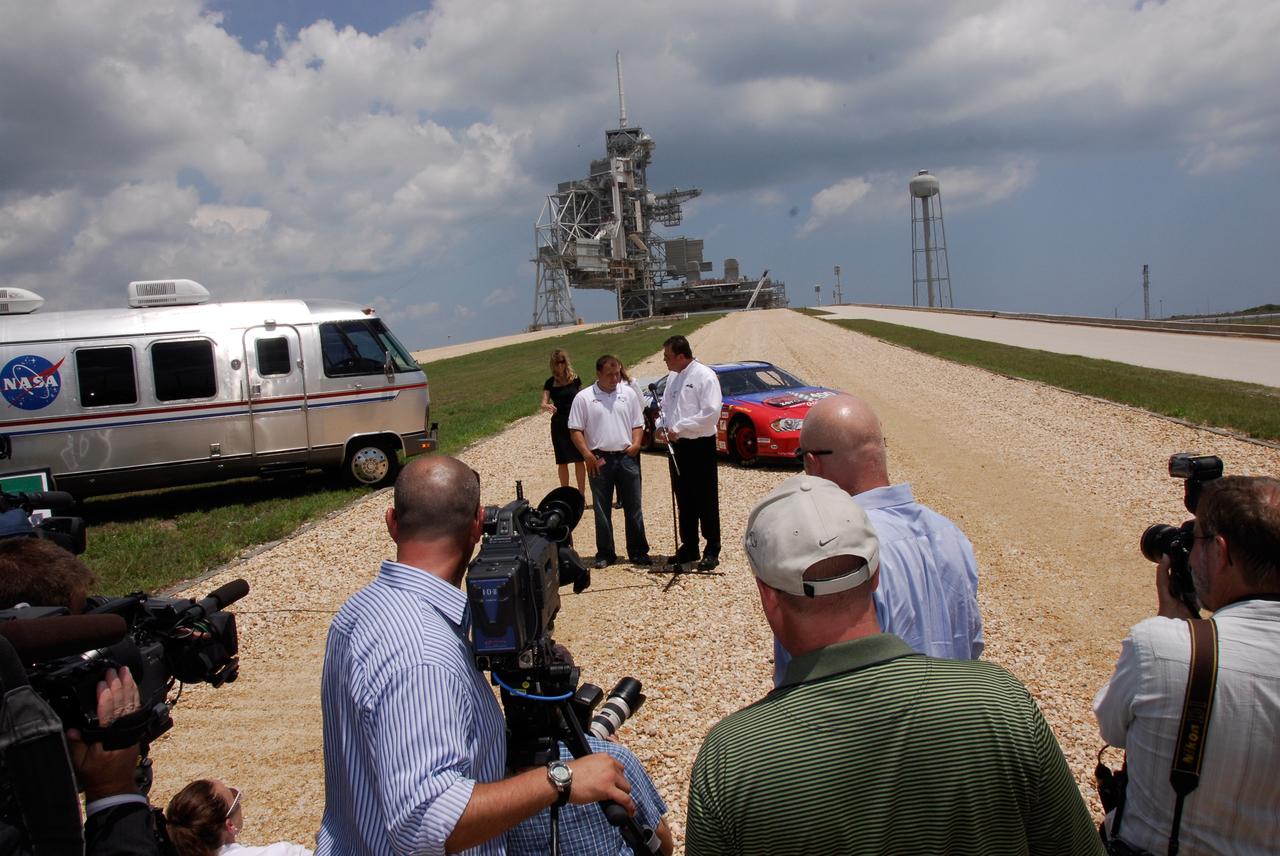
CAPE CANAVERAL, Fla. – 2008 Daytona 500 winner Ryan Newman (left) and Daytona International Speedway President Robin Braig talk to the media gathered on the crawlerway on Launch Pad 39A at NASA's Kennedy Space Center. The Daytona International Speedway show car, shown here, is in sharp contrast to the crawler-transporter that usually travels the special road to the pad. Newman is visiting Kennedy in honor of NASA's 50th anniversary and the 50th running of NASCAR's Daytona 500 in February. NASA presented Newman two green racing flags that were flown last February aboard space shuttle Atlantis' STS-122 mission to the International Space Station. One flag was given to Newman, the second was presented to Daytona 500 Experience General Manager Kim Isemann. A third flag that was flown will be kept by NASA for public display. The connection between NASA and Daytona's International Speedway extends beyond their close proximity to one another. During recent years, technology developed for the space program has found many uses on Earth, including helping NASCAR drivers stay safe and increase performance. Photo credit: NASA/Kim Shiflett
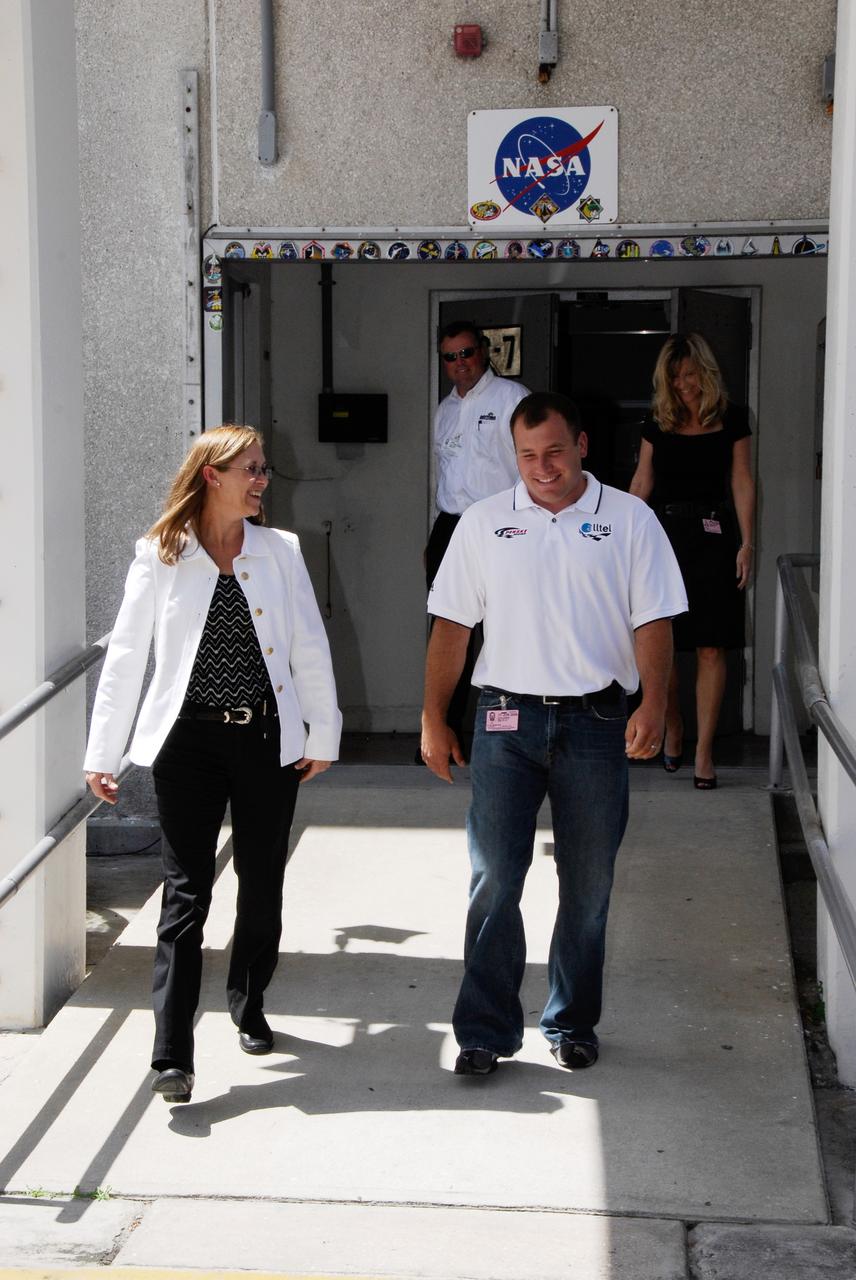
CAPE CANAVERAL, Fla. – 2008 Daytona 500 winner Ryan Newman leaves the Operations and Checkout Building at NASA's Kennedy Space Center, emulating the exit of shuttle crews before a launch. At left is Janet Petro, Kennedy's deputy center director. Behind them are Daytona International Speedway President Robin Braig (left) and Daytona 500 Experience General Manager Kim Isemann. Newman is visiting Kennedy in honor of NASA's 50th anniversary and the 50th running of NASCAR's Daytona 500 in February. NASA presented Newman two green racing flags that were flown last February aboard space shuttle Atlantis' STS-122 mission to the International Space Station. One flag was given to Newman, the second was presented to Daytona 500 Experience General Manager Kim Isemann. A third flag that was flown will be kept by NASA for public display. The connection between NASA and Daytona's International Speedway extends beyond their close proximity to one another. During recent years, technology developed for the space program has found many uses on Earth, including helping NASCAR drivers stay safe and increase performance. Photo credit: NASA/Kim Shiflett
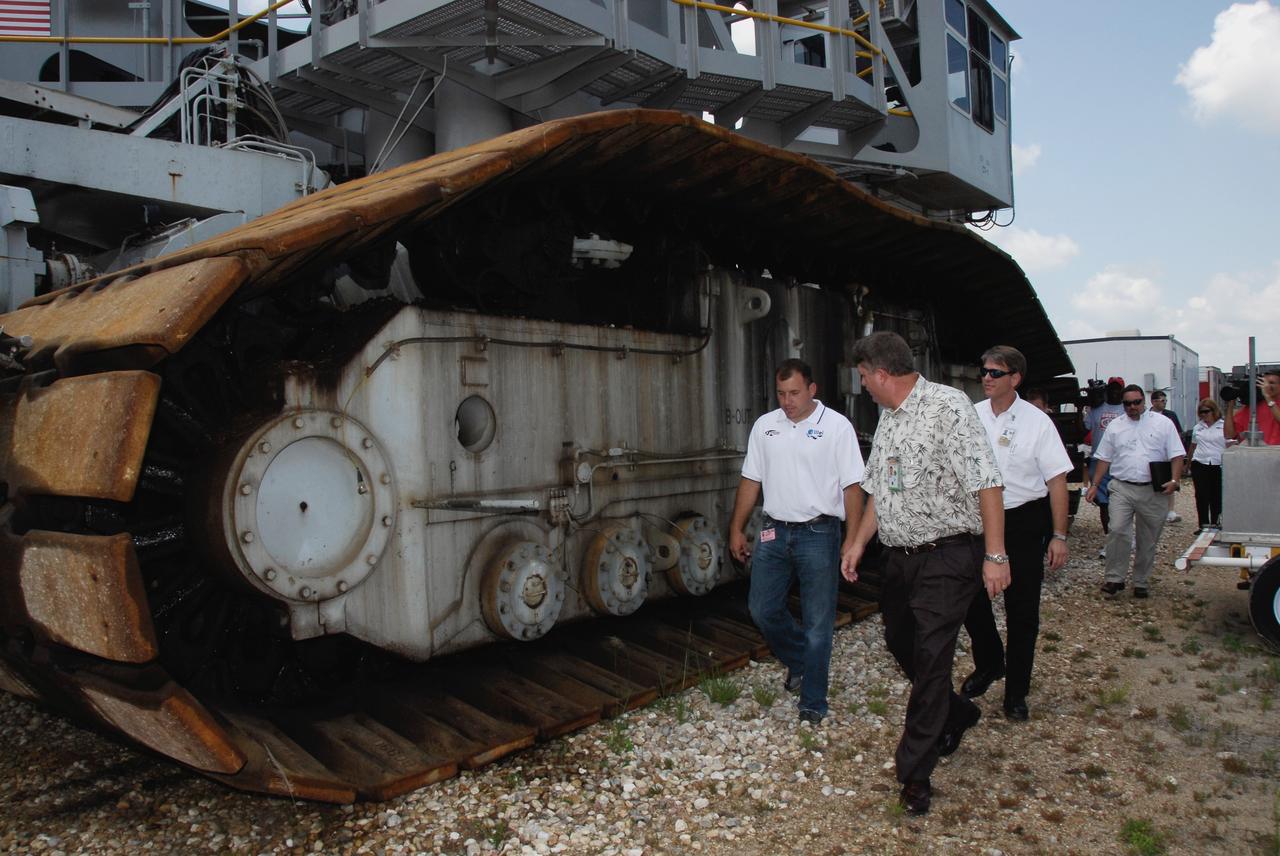
CAPE CANAVERAL, Fla. – 2008 Daytona 500 winner Ryan Newman (left) gets a close look at a crawler-transporter with Perry Becker, chief of the Shuttle Grounds Structural Branch, at NASA's Kennedy Space Center. Unlike his winning race car, the maximum speed of a crawler is 2 mph unloaded. Newman is visiting Kennedy in honor of NASA's 50th anniversary and the 50th running of NASCAR's Daytona 500 in February. NASA presented Newman two green racing flags that were flown last February aboard space shuttle Atlantis' STS-122 mission to the International Space Station. One flag was given to Newman, the second was presented to Daytona 500 Experience General Manager Kim Isemann. A third flag that was flown will be kept by NASA for public display. The connection between NASA and Daytona's International Speedway extends beyond their close proximity to one another. During recent years, technology developed for the space program has found many uses on Earth, including helping NASCAR drivers stay safe and increase performance. Photo credit: NASA/Kim Shiflett
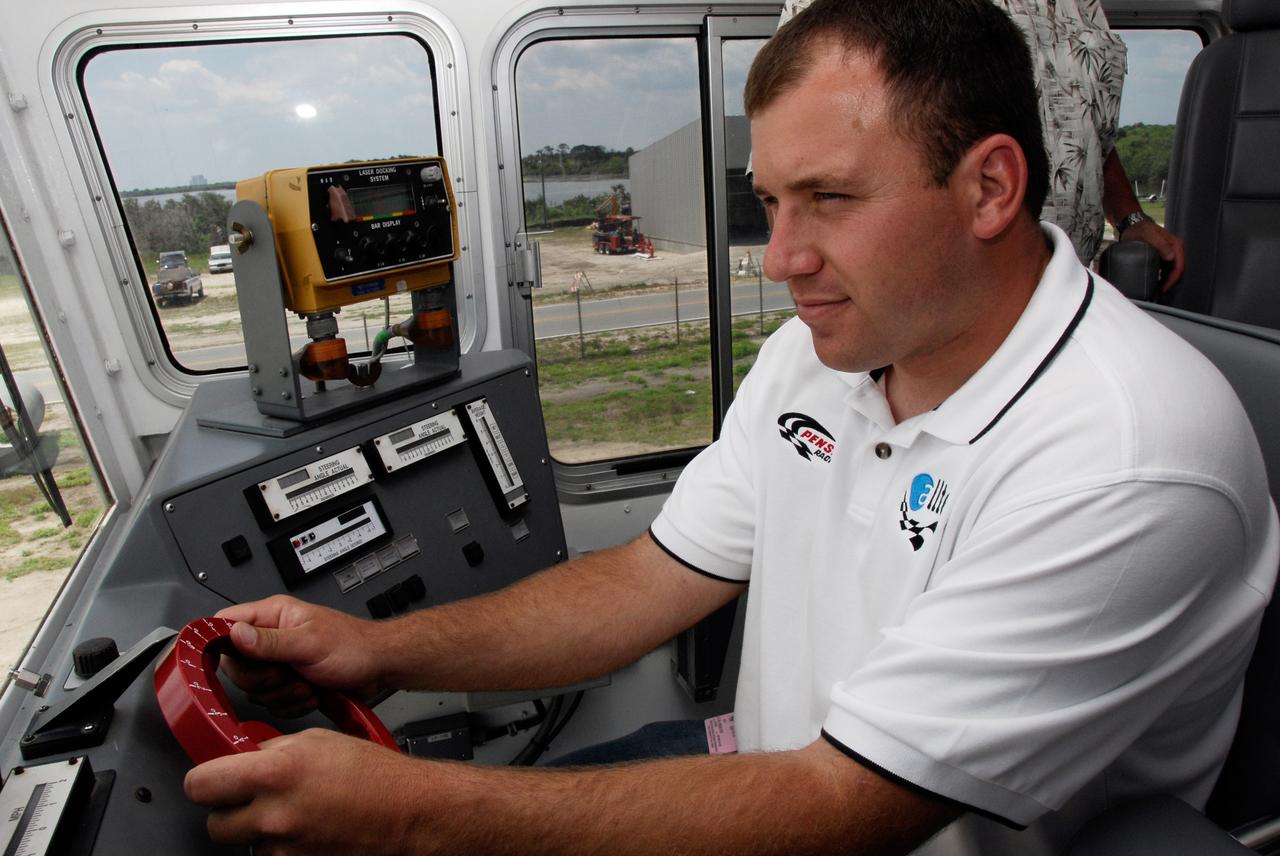
CAPE CANAVERAL, Fla. – 2008 Daytona 500 winner Ryan Newman sits behind the wheel of a crawler-transporter at NASA's Kennedy Space Center. Unlike his winning race car, the maximum speed of a crawler is 2 mph unloaded. Newman is visiting Kennedy in honor of NASA's 50th anniversary and the 50th running of NASCAR's Daytona 500 in February. NASA presented Newman two green racing flags that were flown last February aboard space shuttle Atlantis' STS-122 mission to the International Space Station. One flag was given to Newman, the second was presented to Daytona 500 Experience General Manager Kim Isemann. A third flag that was flown will be kept by NASA for public display. The connection between NASA and Daytona's International Speedway extends beyond their close proximity to one another. During recent years, technology developed for the space program has found many uses on Earth, including helping NASCAR drivers stay safe and increase performance. Photo credit: NASA/Kim Shiflett
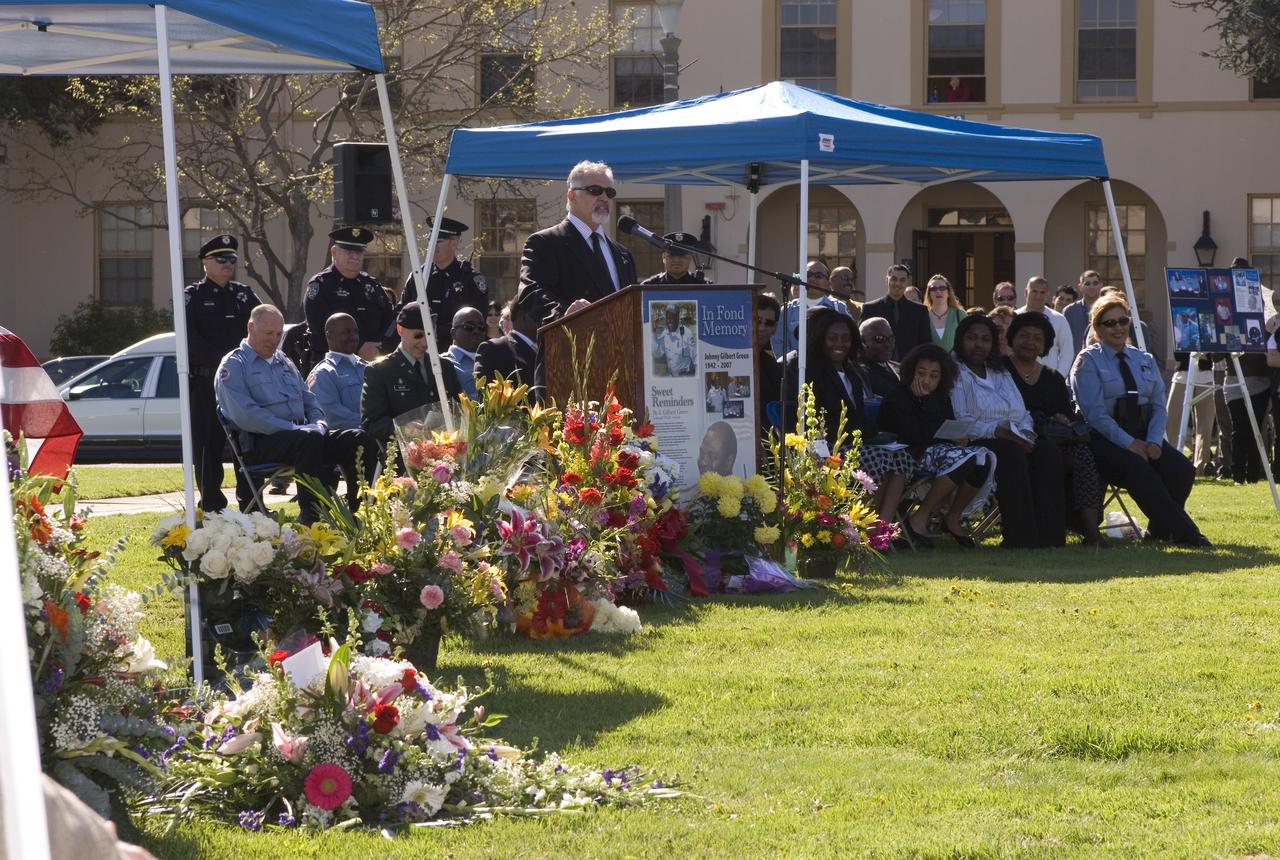
Memorial services for Ames Security Guard Johnny Green. funeral services on the NRP parade ground. Eugolies presented b Chris Christensen, Deputy Center Director, Ames Research Center, Robert Dlci, Cief, Protective Services, Roger Higby, Lt., Ames Protectives serices, Cynthia Green, Daughter, Sloan Thompson, Granddaughter - Awarding of California Commendation Medal, Col. Amos Bagdasarian 129th Rescue Wing, CA Ang, Military Shadow Box, CPO Mike Di Santo, USN, Presentation of American Flags, Robert Dolci
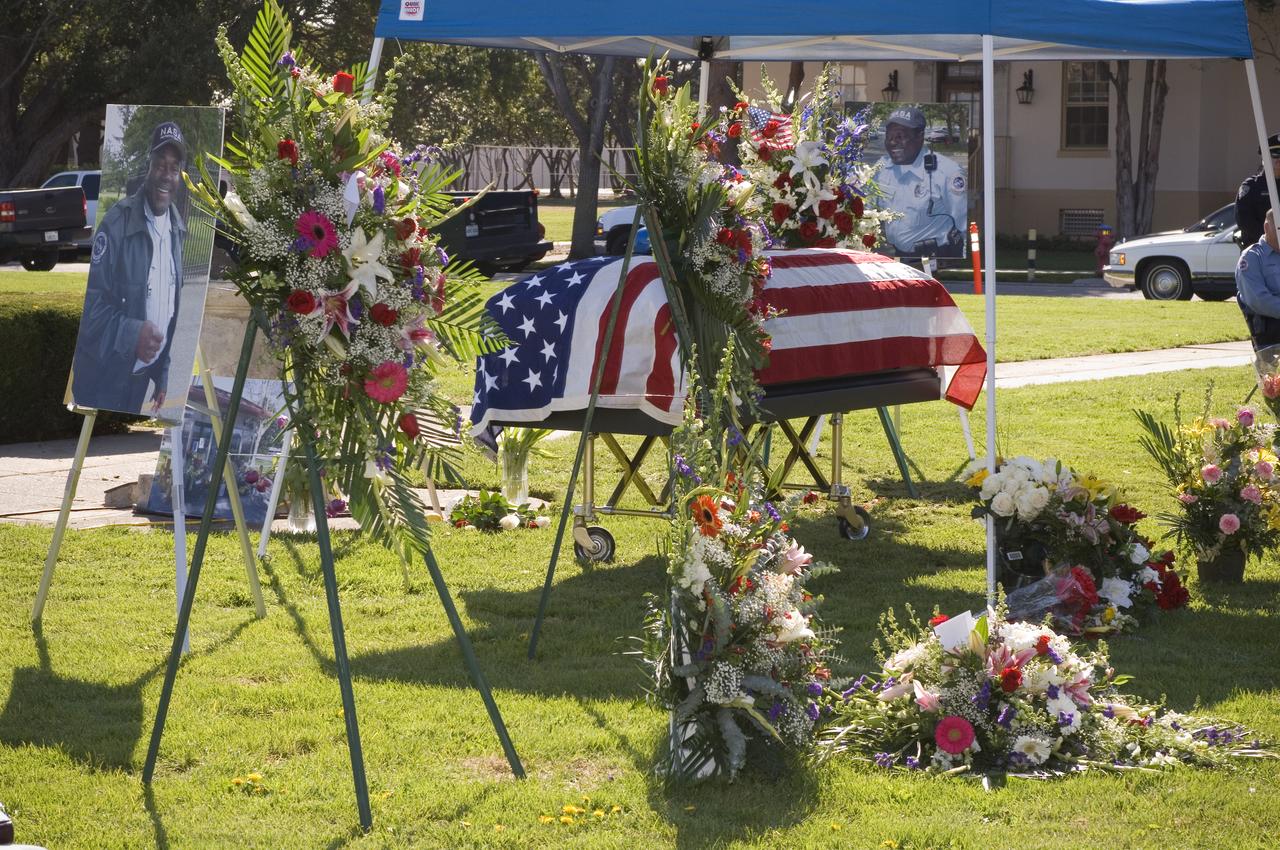
Memorial services for Ames Security Guard Johnny Green. funeral services on the NRP parade ground. Eugolies presented b Chris Christensen, Deputy Center Director, Ames Research Center, Robert Dlci, Cief, Protective Services, Roger Higby, Lt., Ames Protectives serices, Cynthia Green, Daughter, Sloan Thompson, Granddaughter - Awarding of California Commendation Medal, Col. Amos Bagdasarian 129th Rescue Wing, CA Ang, Military Shadow Box, CPO Mike Di Santo, USN, Presentation of American Flags, Robert Dolci
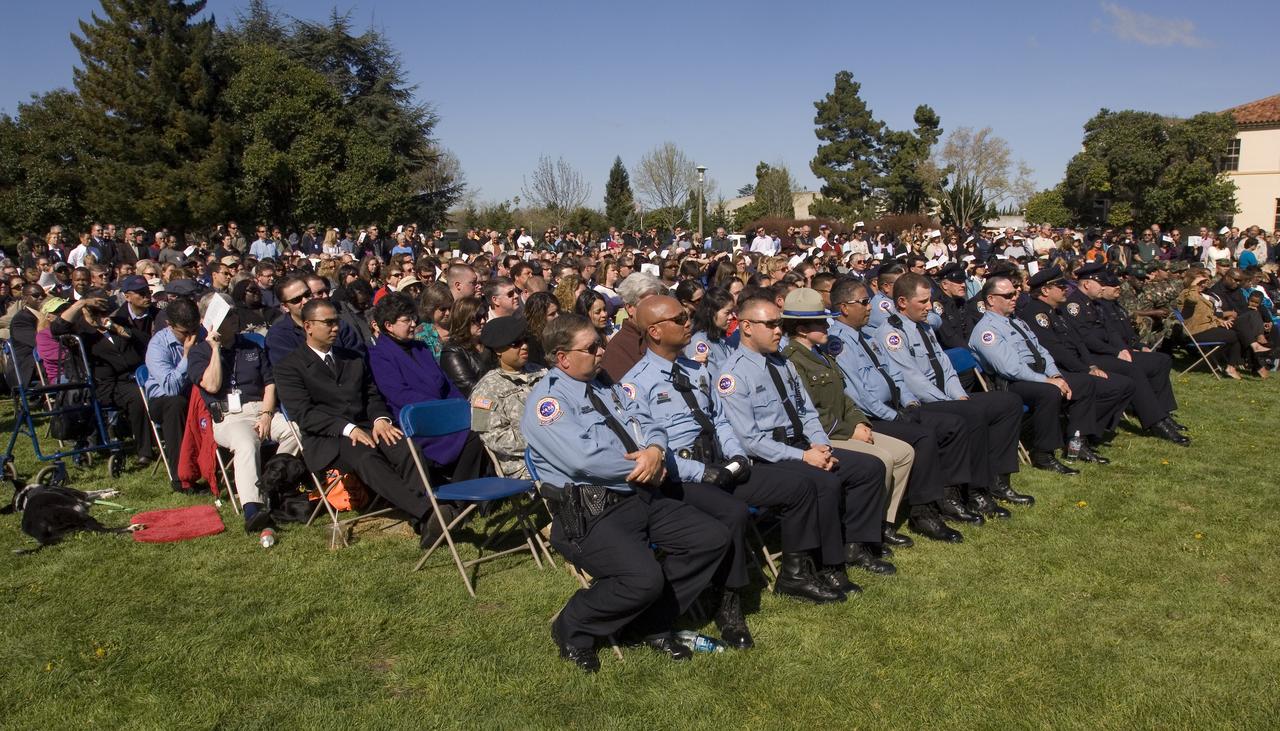
Memorial services for Ames Security Guard Johnny Green. funeral services on the NRP parade ground. Eugolies presented b Chris Christensen, Deputy Center Director, Ames Research Center, Robert Dlci, Cief, Protective Services, Roger Higby, Lt., Ames Protectives serices, Cynthia Green, Daughter, Sloan Thompson, Granddaughter - Awarding of California Commendation Medal, Col. Amos Bagdasarian 129th Rescue Wing, CA Ang, Military Shadow Box, CPO Mike Di Santo, USN, Presentation of American Flags, Robert Dolci
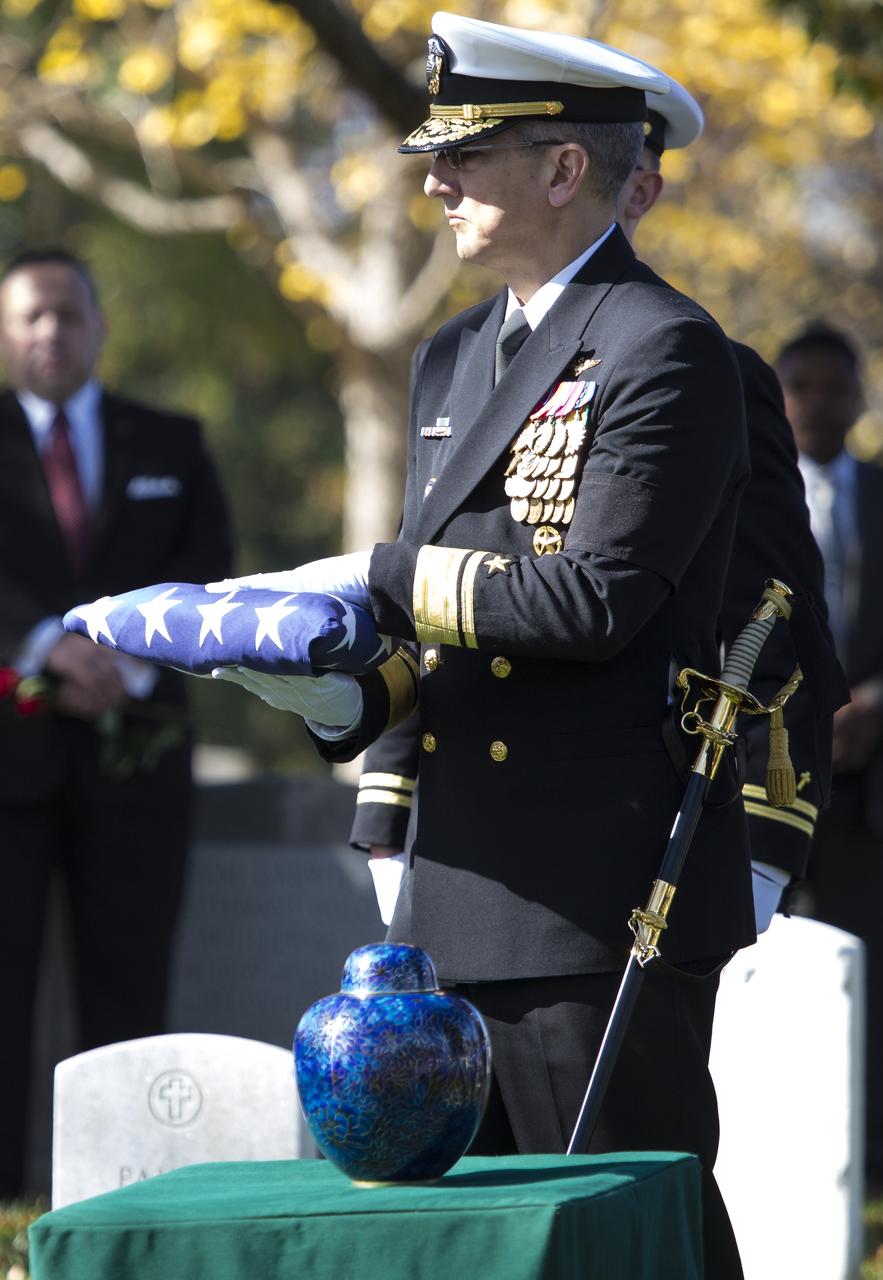
U.S. Navy Rear Adm. James Bynum prepares to present the folded American Flag to Leslie Bean, wife of former astronaut Alan Bean, during his interment service, Thursday, Nov. 8, 2018 at Arlington National Cemetery in Virginia. Selected as an astronaut in 1963, Bean flew in space twice, becoming the fourth human to walk on the Moon on Nov. 19, 1969 and spent 59 days in space as commander of the second Skylab mission in 1973. Photo Credit: (NASA/Joel Kowsky)
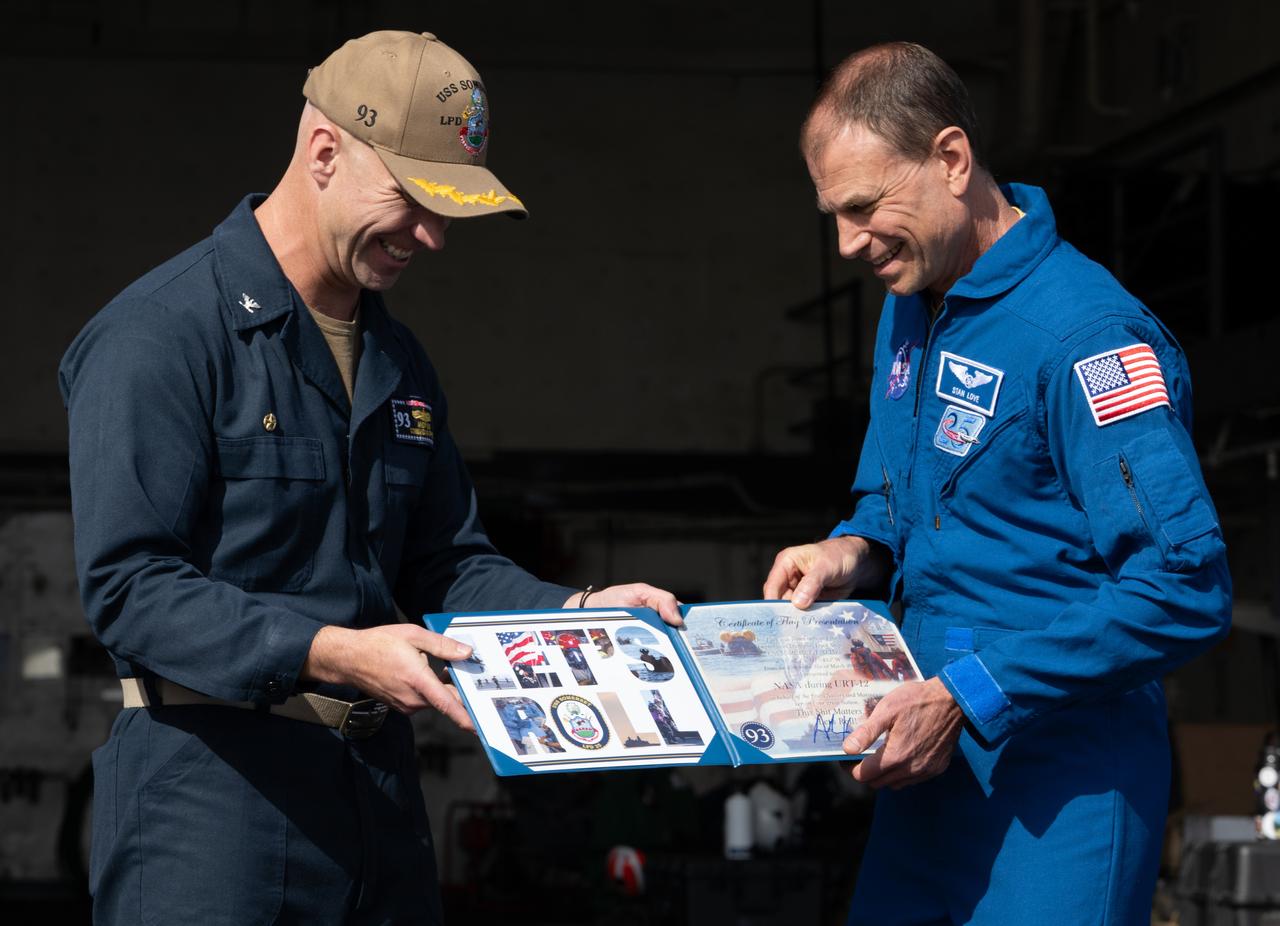
NASA astronaut Stan Love receives a presentation of a flown flag from Capt. Andrew Koy, commanding officer of USS Somerset as NASA and Department of Defense teams participate in Underway Recovery Test-12 onboard USS Somerset off the coast of California, Saturday, March 29, 2025. During the test, NASA and Department of Defense teams are practicing to ensure recovery procedures are validated as NASA plans to send the Artemis II astronauts around the Moon and splashdown in the Pacific Ocean. Photo Credit: (NASA/Joel Kowsky)
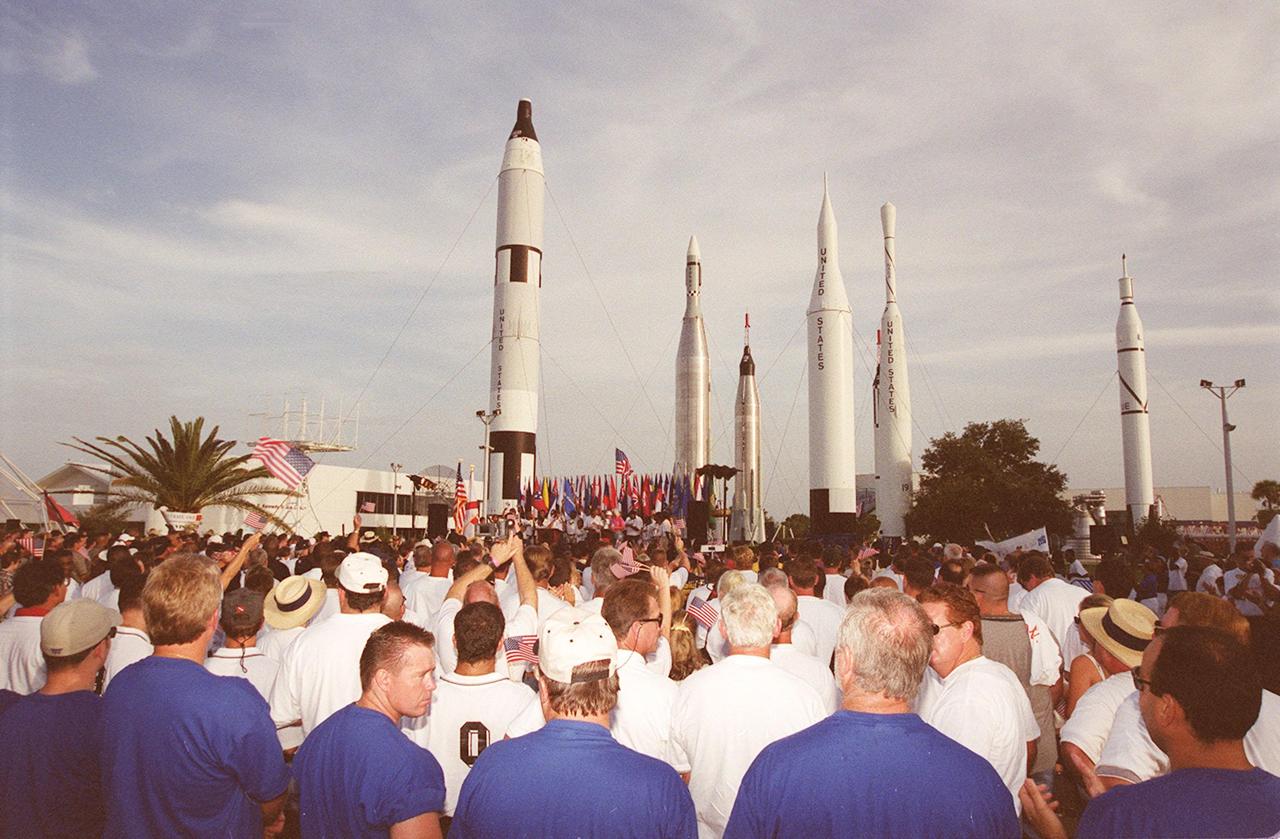
A crowd of police officers and their families cheer a presentation of flags during opening ceremonies of the 2000 International Law Enforcement Games. Held in the KSC Visitor Complex Rocket Garden, the ceremony hosted more than 1,850 participants and their families for events that included parades, torch lighting and a tug of war. The games feature officers from 15 countries and 37 United States in competitions around Brevard County, Fla
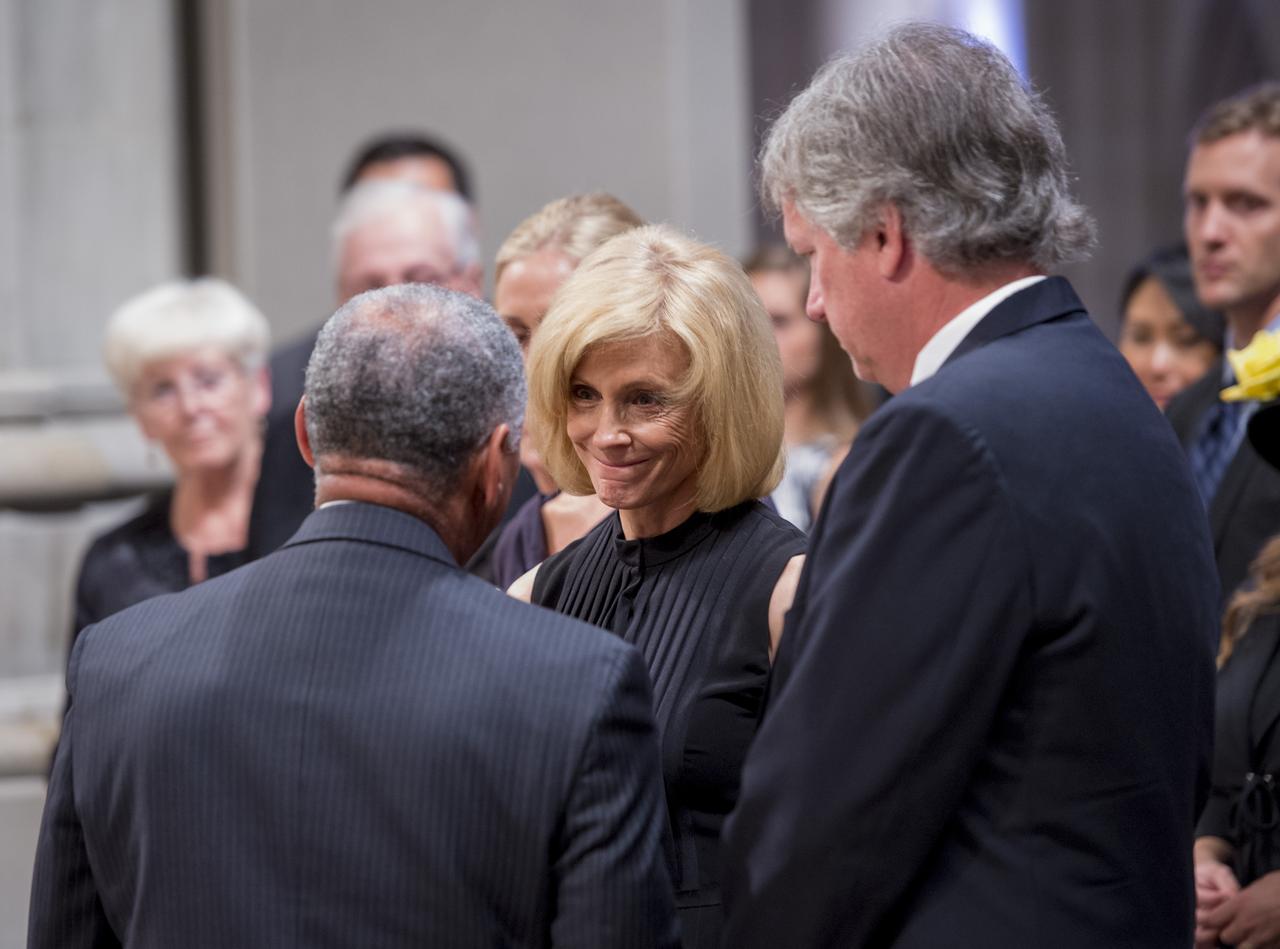
NASA Administrator Charles Bolden, back to camera, speaks with Carol Armstrong after presenting her with a U.S. Flag that was flown at half-mast over Mission Control at Johnson Space Center in Houston, on the day of her husband’s passing, during a memorial service celebrating the life of Neil Armstrong at the Washington National Cathedral, Thursday, Sept. 13, 2012. Armstrong, the first man to walk on the moon during the 1969 Apollo 11 mission, died Saturday, Aug. 25. He was 82. Photo Credit: (NASA/Bill Ingalls)
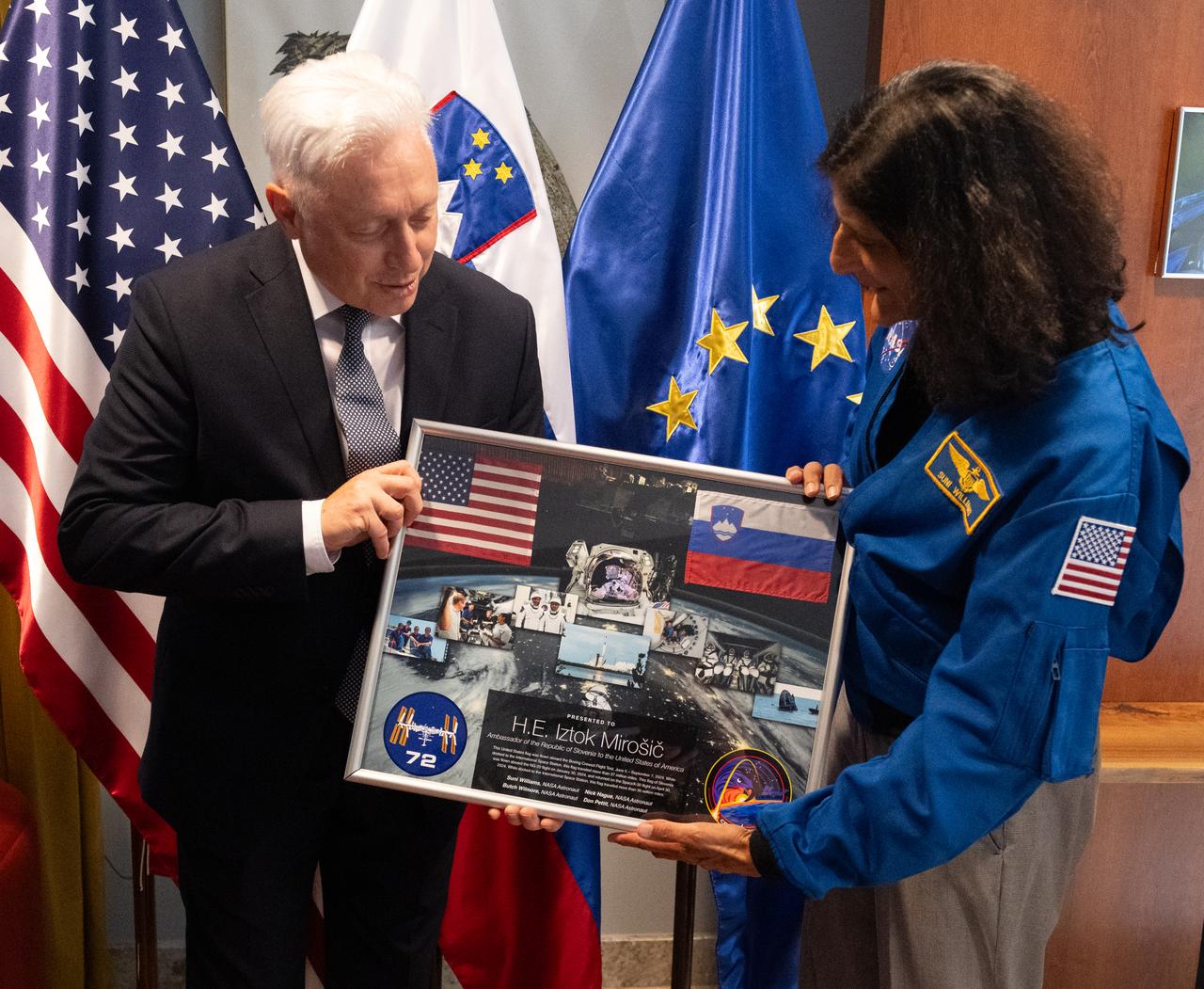
On behalf of the Expedition 72 crew NASA astronaut Suni Williams presents Iztok Mirošič, Ambassador of the Republic of Slovenia to the United States to the United States, with a montage including flags of the United States and Slovenia that have been flown in space before participating in a panel discussion at the Embassy of Slovenia, Wednesday, Sept. 17, 2025, in Washington. Williams, Don Pettit, Nick Hague, and Butch Wilmore served as part of Expedition 72 onboard the International Space Station. Photo Credit: (NASA/Joel Kowsky)
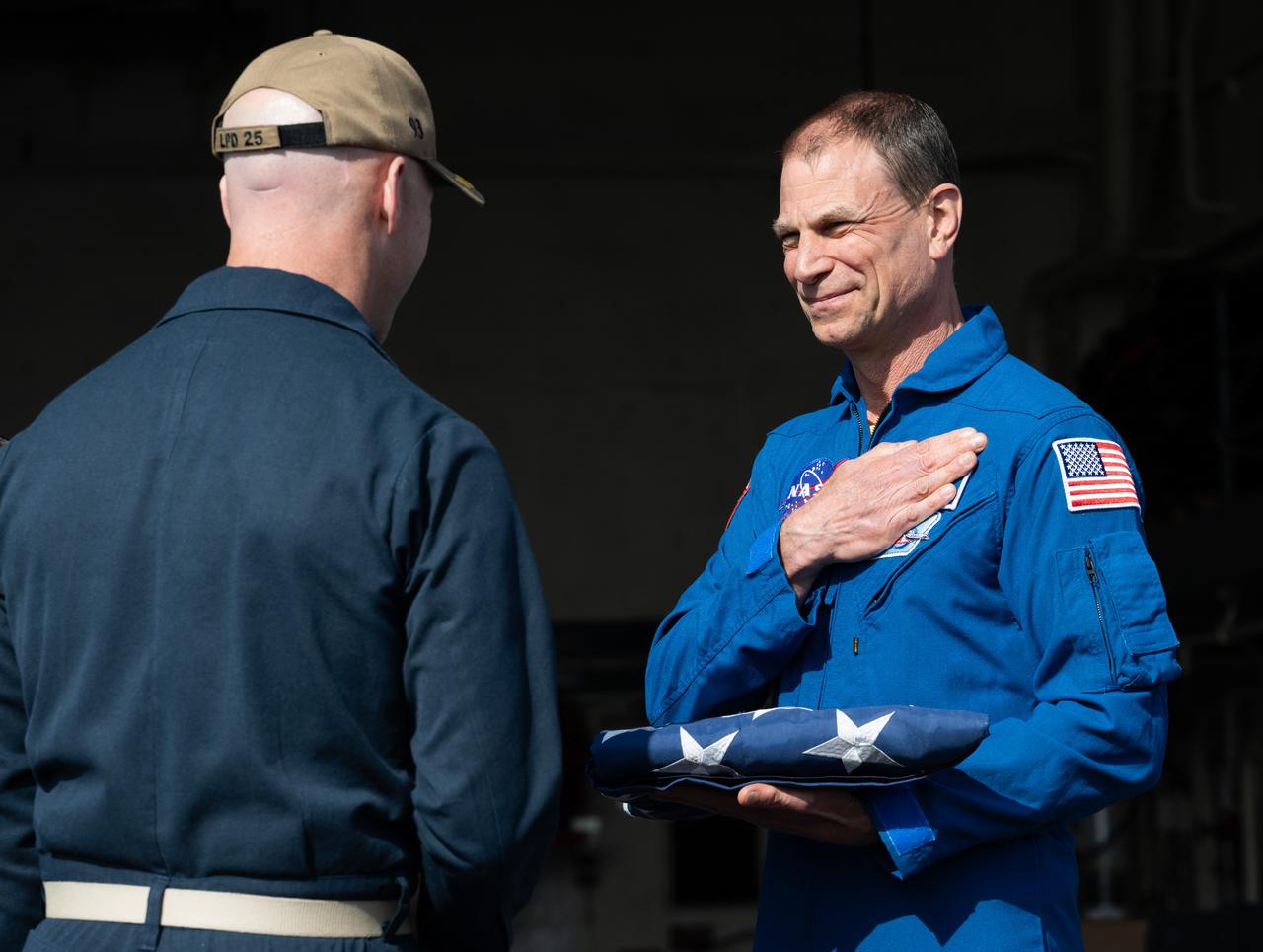
NASA astronaut Stan Love receives a presentation of a flag flown on USS Somerset from Capt. Andrew Koy, commanding officer of USS Somerset as NASA and Department of Defense teams participate in Underway Recovery Test-12 onboard USS Somerset off the coast of California, Saturday, March 29, 2025. During the test, NASA and Department of Defense teams are practicing to ensure recovery procedures are validated as NASA plans to send the Artemis II astronauts around the Moon and splashdown in the Pacific Ocean. Photo Credit: (NASA/Joel Kowsky)
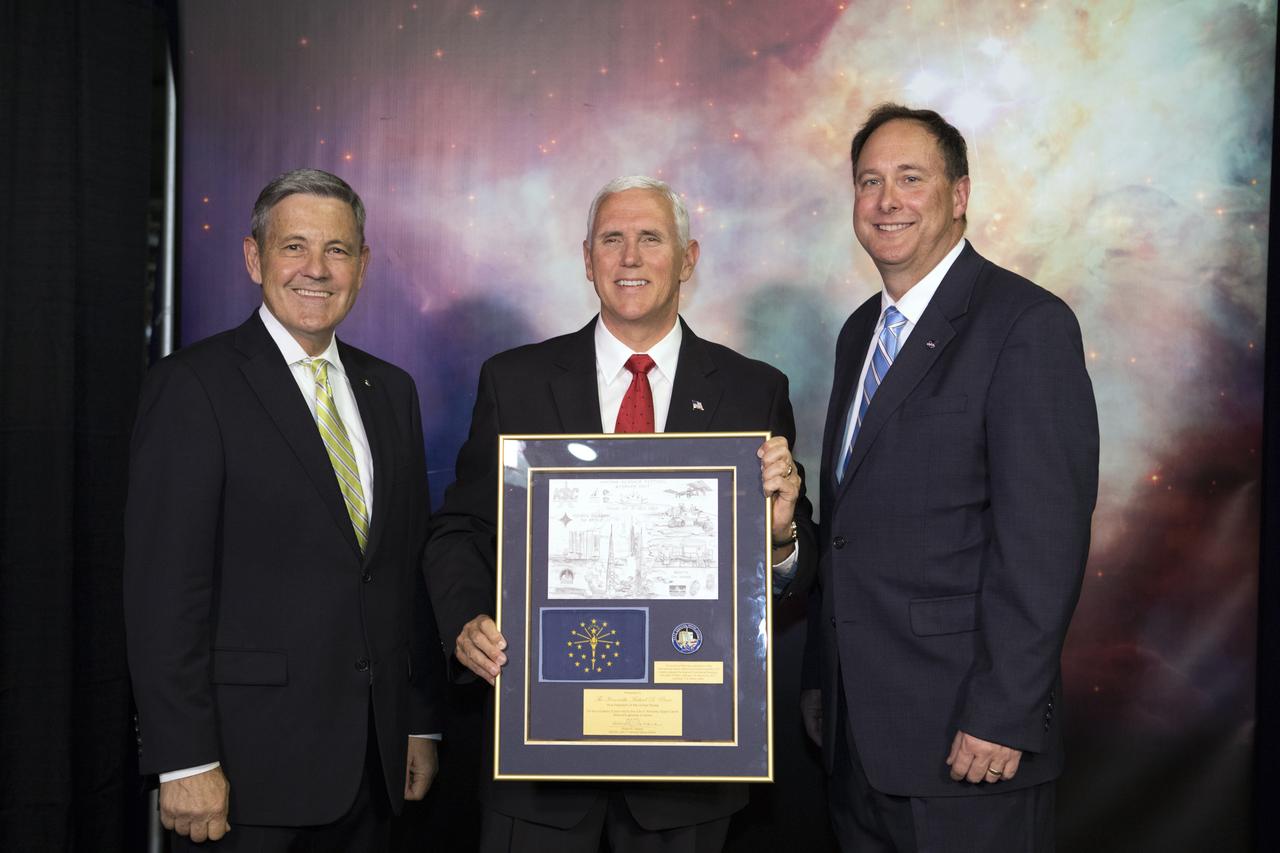
Kennedy Space Center Bob Cabana, left, and NASA's Acting Administrator Robert Lightfoot, right present Vice President Mike Pence with a framed plaque. At the top is an illustration featuring NASA's efforts to explore Mars. Also included is the flag of the Vice President's home state of Indiana that was flown on the SpaceX Commercial Resupply Services-10 flight in February and March this year. During his visit to Kennedy, the Vice President spoke inside the iconic Vehicle Assembly Building, where he thanked employees for advancing American leadership in space.
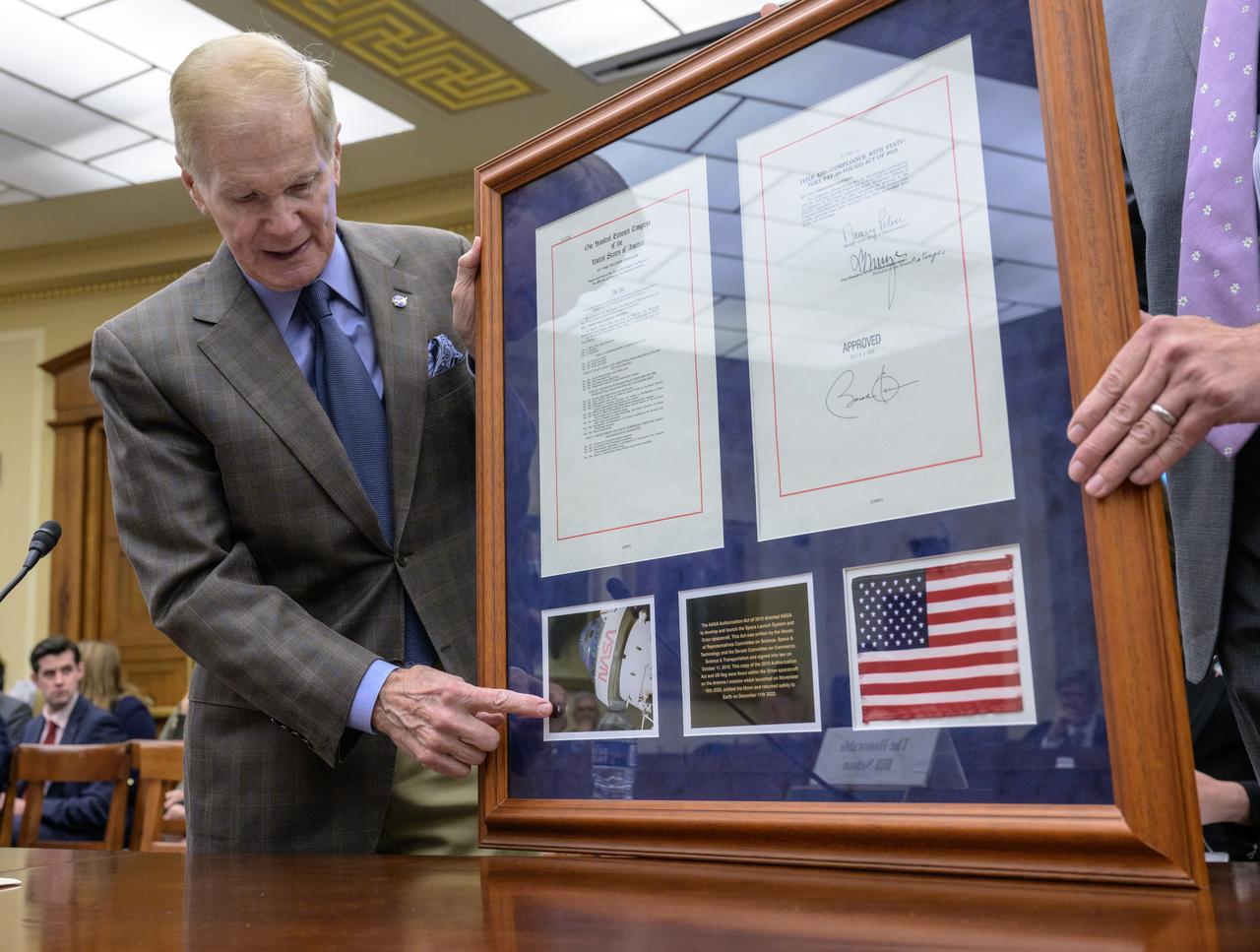
NASA Administrator Bill Nelson presents to the House Science, Space and Technology Committee, a plaque containing a copy of the NASA authorization Act of 2010 and a US flag that were flown within the Orion Spacecraft on the Artemis I mission and orbited the Moon, during a hearing on “An Overview of the Fiscal Year 2024 Proposed Budget Request for NASA,” Thursday, April 27, 2023 at the Rayburn House Office Building in Washington. Photo Credit: (NASA/Bill Ingalls)
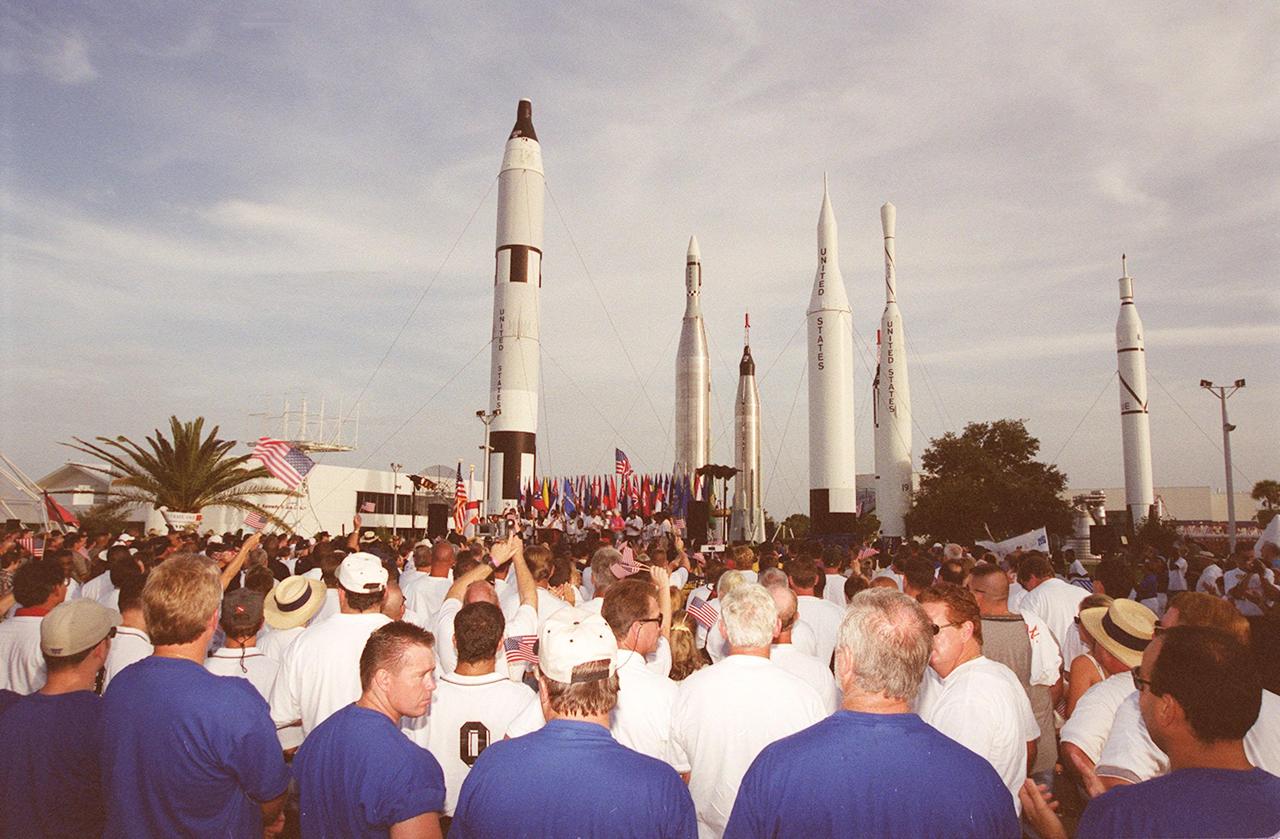
A crowd of police officers and their families cheer a presentation of flags during opening ceremonies of the 2000 International Law Enforcement Games. Held in the KSC Visitor Complex Rocket Garden, the ceremony hosted more than 1,850 participants and their families for events that included parades, torch lighting and a tug of war. The games feature officers from 15 countries and 37 United States in competitions around Brevard County, Fla
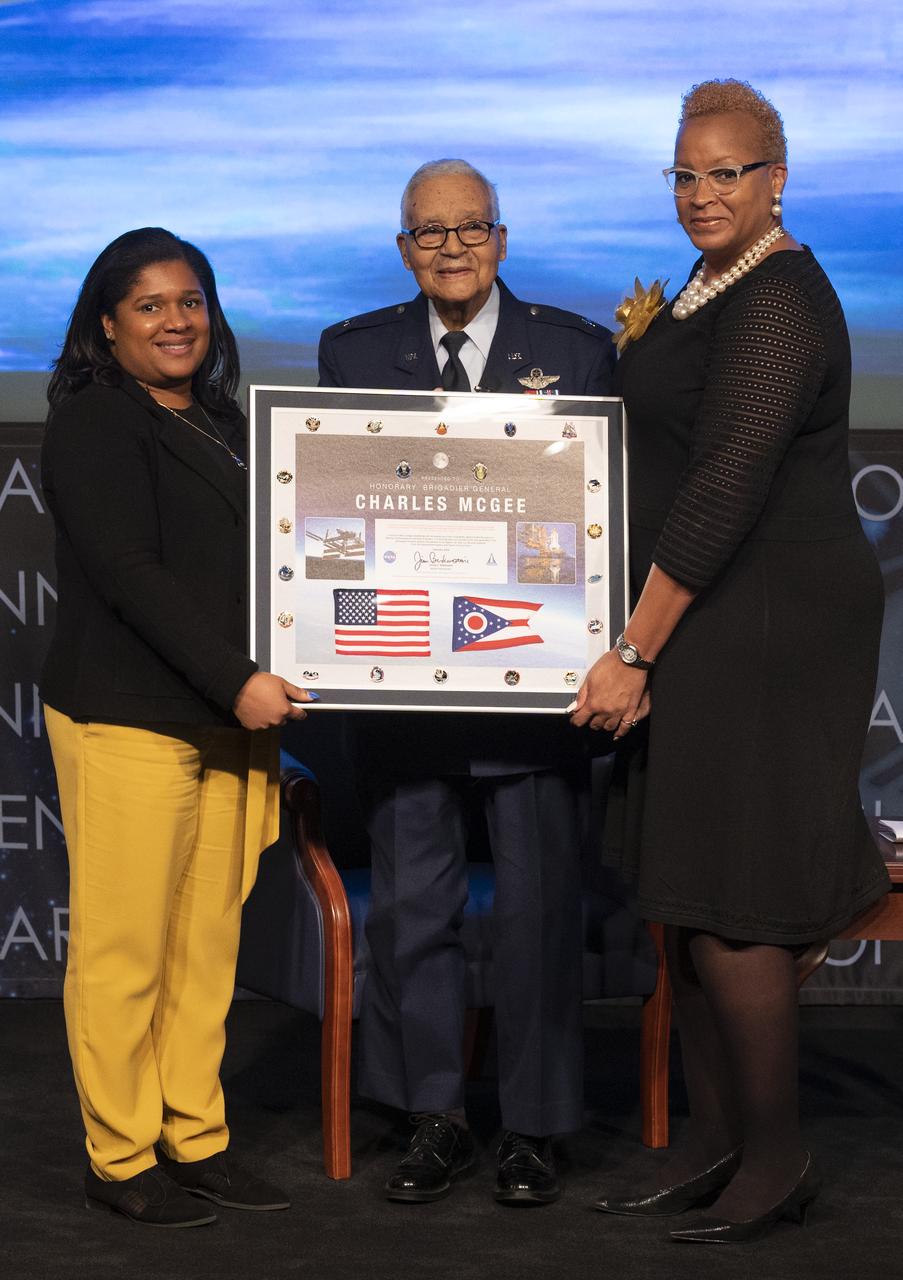
Zudayyah Taylor-Dunn, president of the NASA Headquarters Chapter of Blacks in Government (BIG), left, and LaVerne Randolph, vice president of the NASA Headquarters Chapter of BIG, present a montage containing an American Flag and Ohio State flag flown in space to Retired U.S. Air Force Honorary Brigadier General Charles McGee during a Black History Month program titled “Trailblazers, The Story of a Tuskegee Airman,” Wednesday, Feb. 5, 2020, at NASA Headquarters in Washington, DC. McGee, a pilot with the Tuskegee Airmen during World War II, was a career officer in the Air Force also serving during the Korean and Vietnam Wars. Over his 30 years of service he flew 409 combat missions. Of the 355 Tuskegee pilots who flew in combat, McGee is one of only nine surviving. Photo Credit: (NASA/Joel Kowsky)
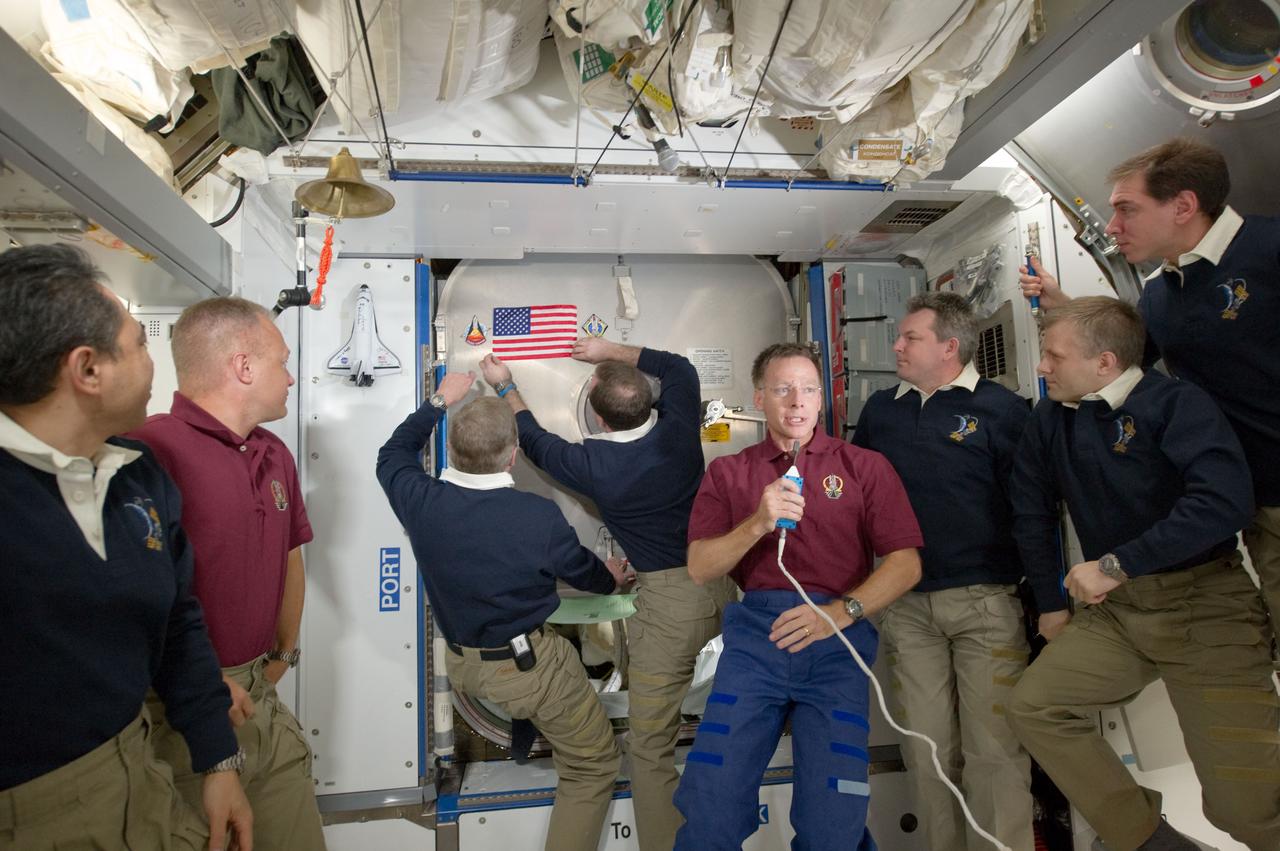
S135-E-009414 (18 July 2011) --- At the farewell ceremony before the shuttle crew returned to Atlantis, NASA astronaut Chris Ferguson (center with microphone), STS-135 commander, made some special presentations of a U.S. flag and a space shuttle model. Members of the joint shuttle and International Space Station crews in the picture are, from the left, JAXA astronaut Satoshi Furukawa, NASA astronauts Doug Hurley, Mike Fossum, Ron Garan and Ferguson, along with Russian cosmonauts Alexander Samokutyaev, Andrey Borisenko and Sergei Volkov. Not in the picture are NASA astronauts Sandy Magnus and Rex Walheim. The shuttle commander presented to the station and its current crew the small shuttle model and the U.S. flag that was originally flown into space on the first shuttle mission in 1981, and seen here at the finger tips of Fossum and Garan. The shuttle model, seen on the wall between Hurley and Fossum, was signed by program officials and the mission?s lead shuttle and station flight directors. ?What you don?t see is the signatures of the tens of thousands who rose to orbit with us over the past 30 years, if only in spirit,? Ferguson said. Photo credit: NASA
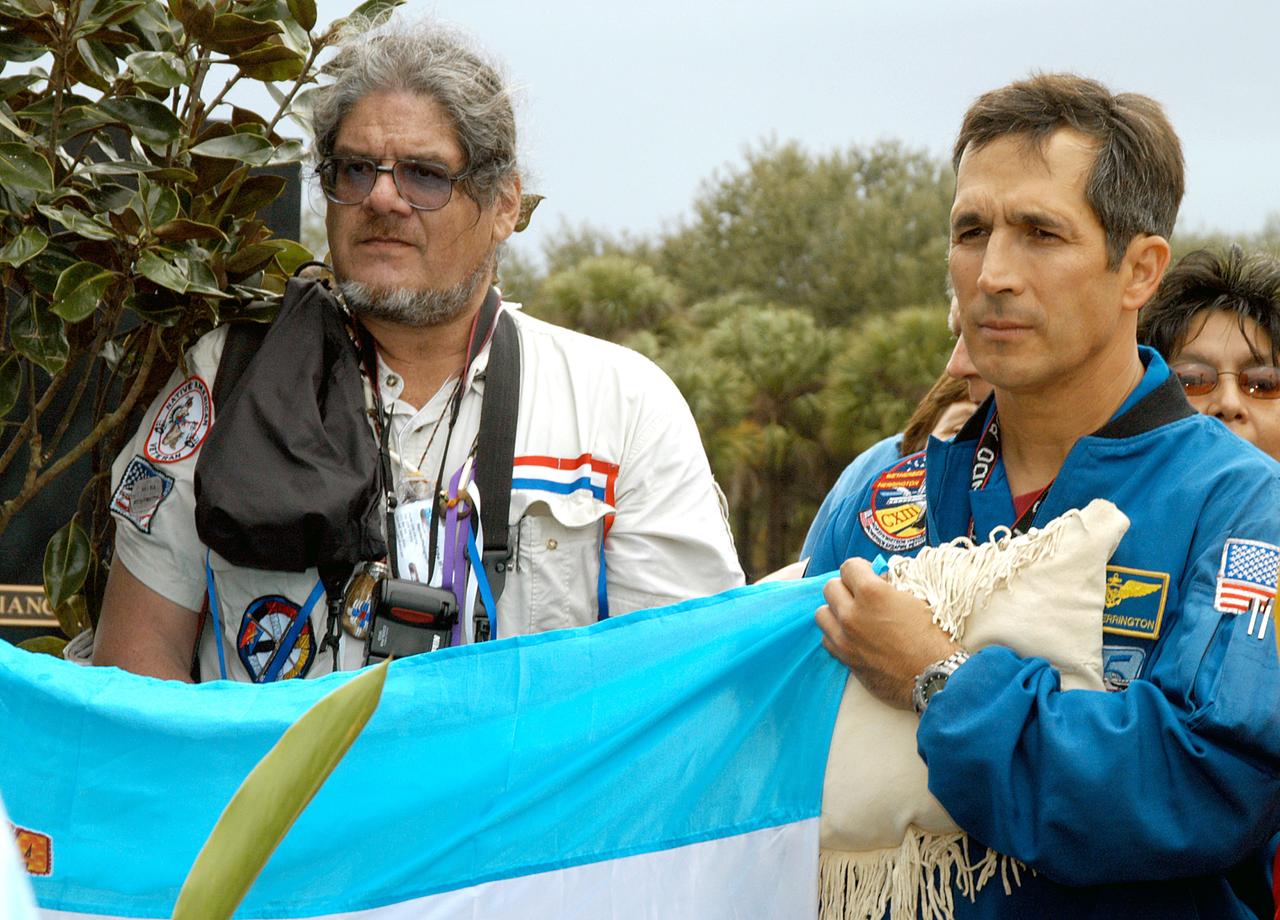
KENNEDY SPACE CENTER, FLA. - Astronaut John Herrington (right) holds part of a flag presented by dancers from the Shoshone-Bannock Junior-Senior High School, Fort Hall, Idaho, commemorating the orbiter Columbia and her crew. The dancers performed a healing ceremony during the memorial service held at the Space Memorial Mirror for the crew of Columbia. Feb. 1 is the one-year anniversary of the loss of the crew and orbiter Columbia in a tragic accident as the ship returned to Earth following mission STS-107. Students and staff of the Shoshone-Bannock Nation had an experiment on board Columbia. The public was invited to the memorial service, held in the KSC Visitor Complex, which included comments by Center Director Jim Kennedy and Executive Director of Florida Space Authority Winston Scott. Scott is a former astronaut who flew on Columbia in 1997.
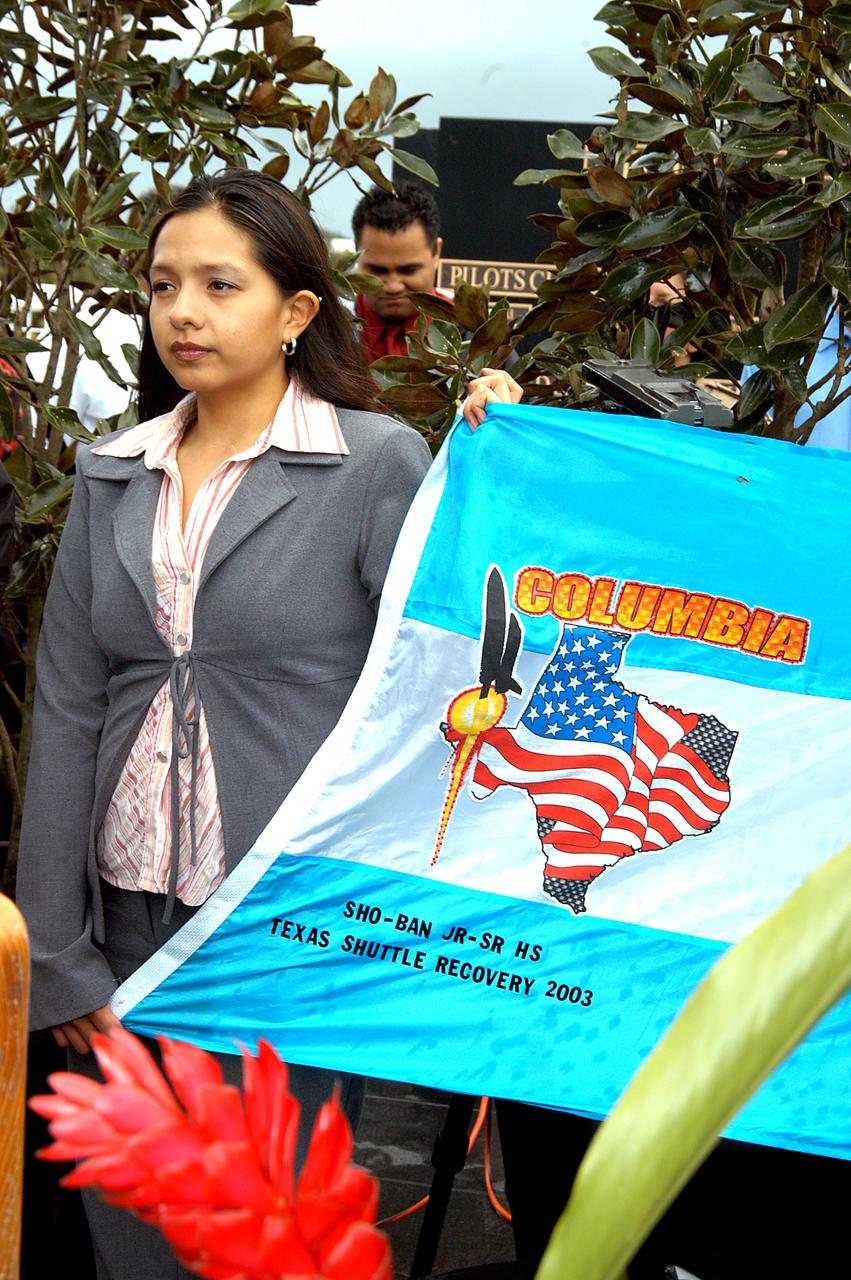
KENNEDY SPACE CENTER, FLA. - A student from Shoshone-Bannock Junior-Senior High School, Fort Hall, Idaho, holds part of a flag presented by dancers from the Shoshone-Bannock Native American community, Fort Hall, Idaho, commemorating the orbiter Columbia and her crew. The dancers performed a healing ceremony during the memorial service held at the Space Memorial Mirror for the crew of Columbia. Feb. 1 is the one-year anniversary of the loss of the crew and orbiter Columbia in a tragic accident as the ship returned to Earth following mission STS-107. Students and staff of the Shoshone-Bannock Nation had an experiment on board Columbia. The public was invited to the memorial service, held in the KSC Visitor Complex, which included comments by Center Director Jim Kennedy and Executive Director of Florida Space Authority Winston Scott. Scott is a former astronaut who flew on Columbia in 1997.
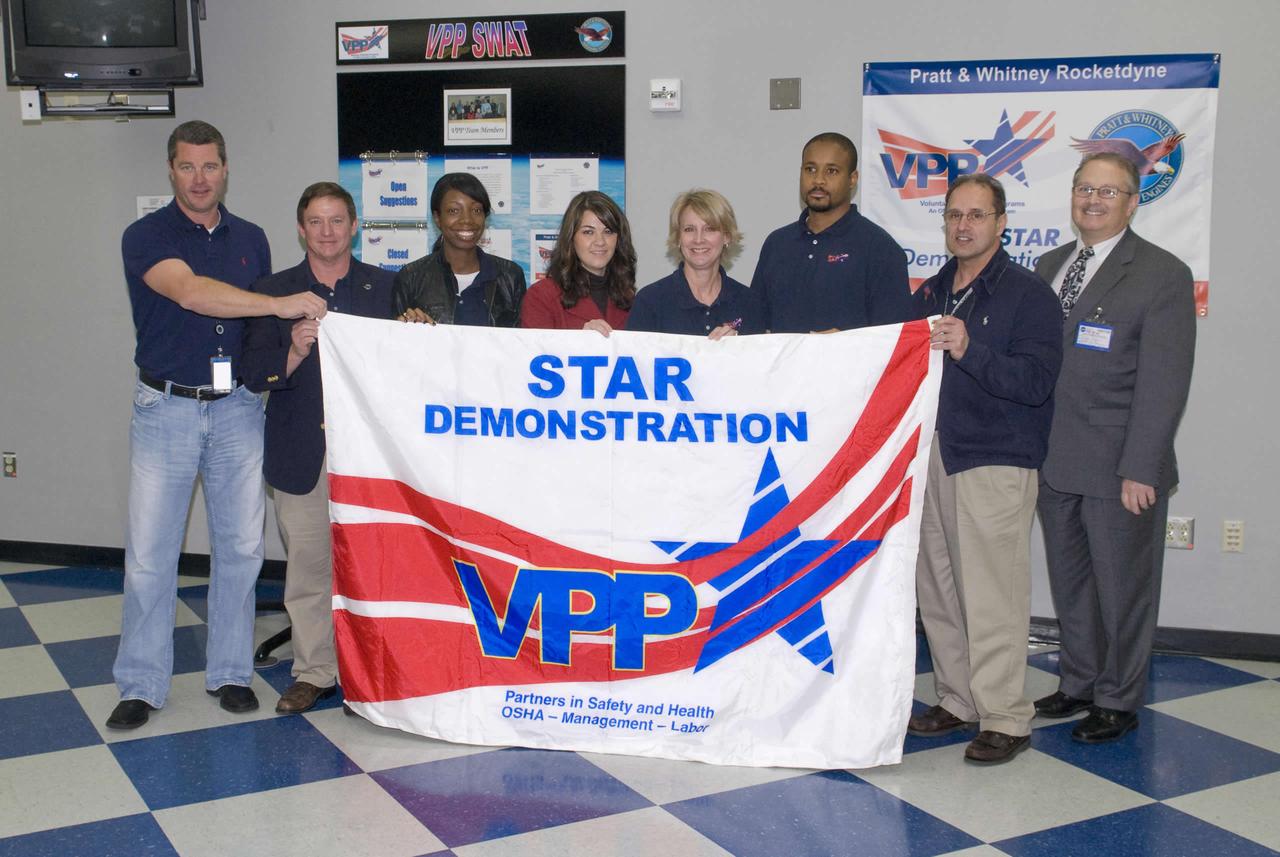
Pratt and Whitney Rocketdyne at NASA's John C. Space Center was presented its Voluntary Protection Programs (VPP) Star Demonstration banner by the Occupational Safety and Health administration (OSHA) during a Dec. 8 ceremony. Pratt Whitney Rocketdyne VPP Safe Working Action Team members Alan Howe (l to r), Mike McDaniel, April Page, Nyla Trumbach, Donna Pullman, Gary Simpson and Frank Pellegrino received the VPP Star Demonstration flag from OSHA Area Director Clyde Payne (right). OSHA established VPP in 1982 as a proactive safety management model so organizations and their employees could be recognized for excellence in safety and health.
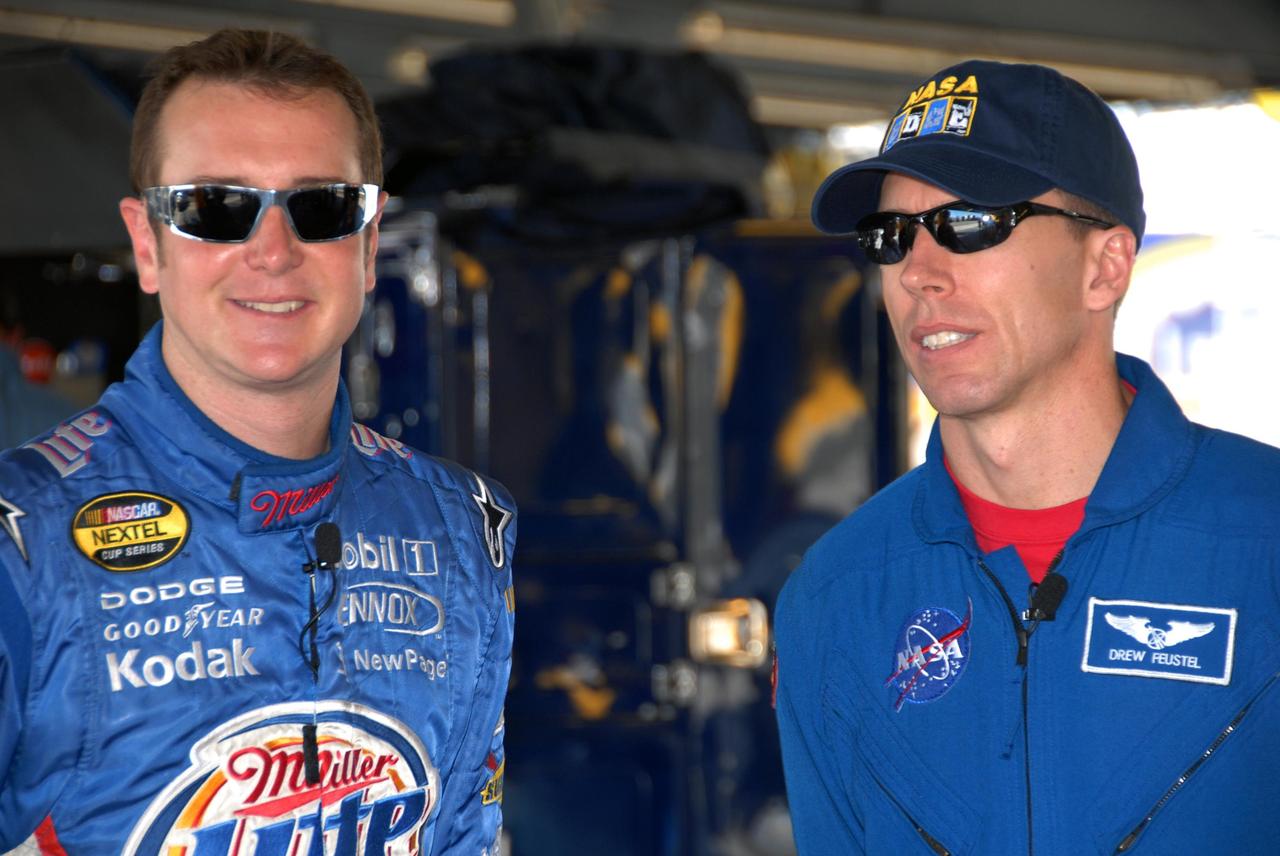
KENNEDY SPACE CENTER, FLA. -- Astronaut Andrew Feustel (right) is ready to participate in NASCAR's Preseason Thunder Fan Fest at Daytona International Speedway. At left is NASCAR driver Kurt Busch. Feustel's appearance celebrates NASA's 50th anniversary and the speedway's 50th running of the Daytona 500 in February. Besides meeting with fans and media, Feustel will ride around the track, taking "hot laps," in an official track vehicle. The NASA/NASCAR association spans decades. Technology developed for the space program has helped NASCAR drivers increase their performance and stay safe over the years. They wear cooling suits similar to what astronauts wear during a spacewalk. Foam that NASA developed for aircraft seats protects racecar drivers' necks in crashes. In addition to participating in the fan festival, NASA will fly three Daytona 500 flags aboard an upcoming space shuttle flight. Speedway officials plan to wave one of the flags to begin the 2008 installment of the Daytona 500, while another will be presented to the winning driver. NASA will keep the third. Feustel will fly on the space shuttle mission STS-125 to the Hubble Space Telescope. The mission will extend and improve the observatory's capabilities through 2013. Launch is targeted for August 2008. Photo credit: NASA/George Shelton
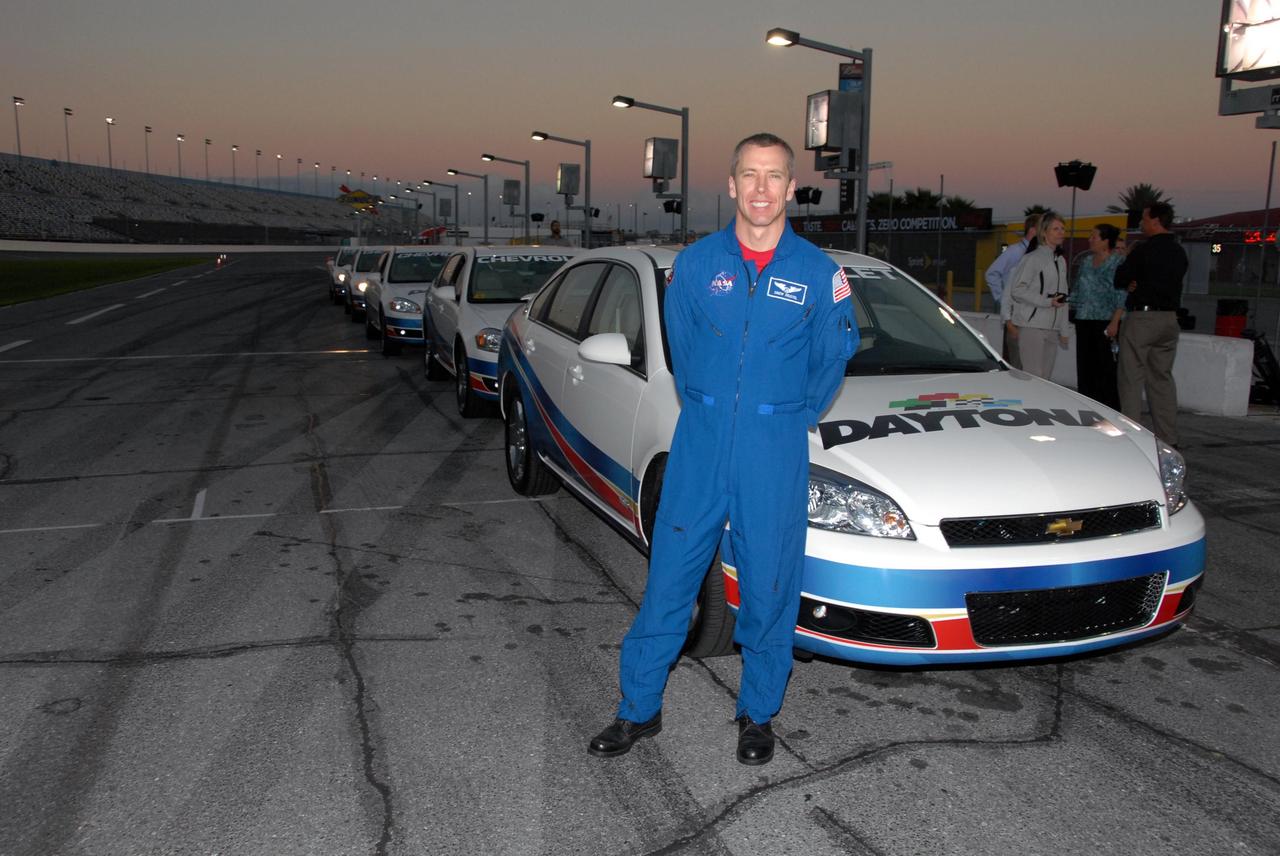
KENNEDY SPACE CENTER, FLA. -- Astronaut Andrew Feustel poses with track vehicles during NASCAR's Preseason Thunder Fan Fest at the Daytona International Speedway. Feustel's appearance celebrates NASA's 50th anniversary and the speedway's 50th running of the Daytona 500 in February. The NASA/NASCAR association spans decades. Technology developed for the space program has helped NASCAR drivers increase their performance and stay safe over the years. They wear cooling suits similar to what astronauts wear during a spacewalk. Foam that NASA developed for aircraft seats protects racecar drivers' necks in crashes. In addition to participating in the fan festival, NASA will fly three Daytona 500 flags aboard an upcoming space shuttle flight. Speedway officials plan to wave one of the flags to begin the 2008 installment of the Daytona 500, while another will be presented to the winning driver. NASA will keep the third. Feustel will fly on the space shuttle mission STS-125 to the Hubble Space Telescope. The mission will extend and improve the observatory's capabilities through 2013. Launch is targeted for August 2008. Photo credit: NASA/George Shelton
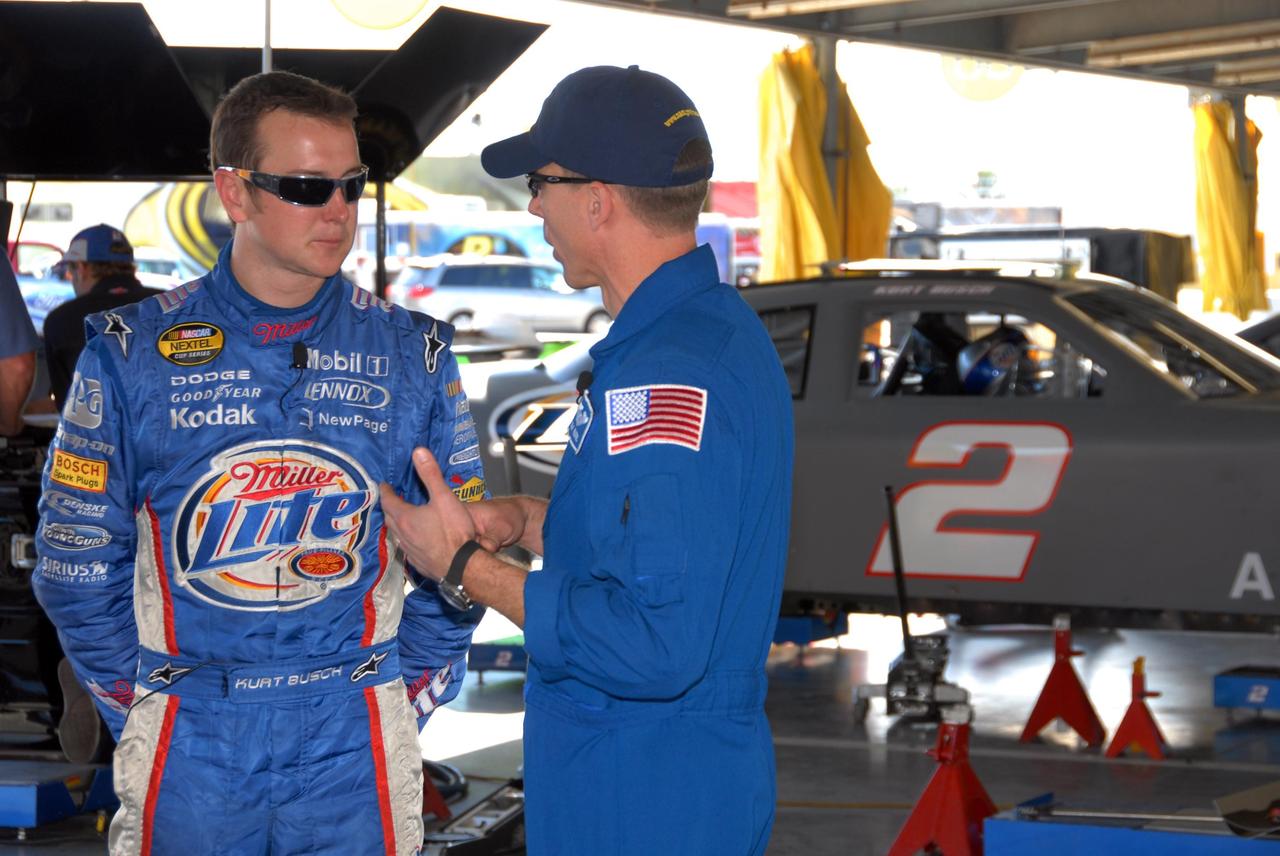
KENNEDY SPACE CENTER, FLA. -- Astronaut Andrew Feustel (right) talks to NASCAR driver Kurt Busch about his pending "hot laps" in an official track vehicle around the Daytona International Speedway. Feustel is participating in NASCAR's Preseason Thunder Fan Fest at. Feustel's appearance celebrates NASA's 50th anniversary and the speedway's 50th running of the Daytona 500 in February. Besides the driving experience, Feuster will meet with fans and the media. The NASA/NASCAR association spans decades. Technology developed for the space program has helped NASCAR drivers increase their performance and stay safe over the years. They wear cooling suits similar to what astronauts wear during a spacewalk. Foam that NASA developed for aircraft seats protects racecar drivers' necks in crashes. In addition to participating in the fan festival, NASA will fly three Daytona 500 flags aboard an upcoming space shuttle flight. Speedway officials plan to wave one of the flags to begin the 2008 installment of the Daytona 500, while another will be presented to the winning driver. NASA will keep the third. Feustel will fly on the space shuttle mission STS-125 to the Hubble Space Telescope. The mission will extend and improve the observatory's capabilities through 2013. Launch is targeted for August 2008. Photo credit: NASA/George Shelton
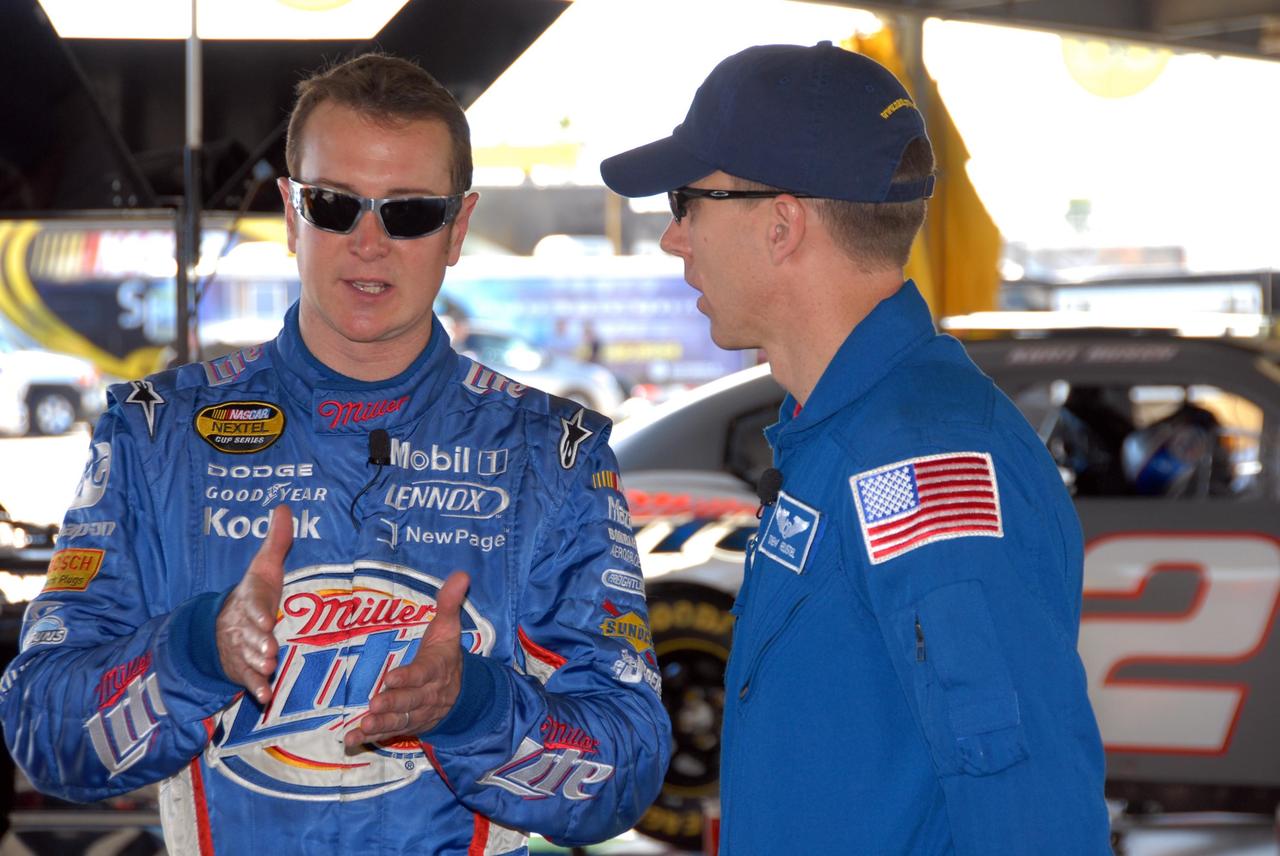
KENNEDY SPACE CENTER, FLA. -- NASCAR driver Kurt Busch (left) talks to astronaut Andrew Feustel about driving. Feustel is participating in NASCAR's Preseason Thunder Fan Fest at Daytona International Speedway. Feustel's appearance celebrates NASA's 50th anniversary and the speedway's 50th running of the Daytona 500 in February. Besides meeting with fans and media, Feustel will ride around the track, taking "hot laps," in an official track vehicle. The NASA/NASCAR association spans decades. Technology developed for the space program has helped NASCAR drivers increase their performance and stay safe over the years. They wear cooling suits similar to what astronauts wear during a spacewalk. Foam that NASA developed for aircraft seats protects racecar drivers' necks in crashes. In addition to participating in the fan festival, NASA will fly three Daytona 500 flags aboard an upcoming space shuttle flight. Speedway officials plan to wave one of the flags to begin the 2008 installment of the Daytona 500, while another will be presented to the winning driver. NASA will keep the third. Feustel will fly on the space shuttle mission STS-125 to the Hubble Space Telescope. The mission will extend and improve the observatory's capabilities through 2013. Launch is targeted for August 2008. Photo credit: NASA/George Shelton
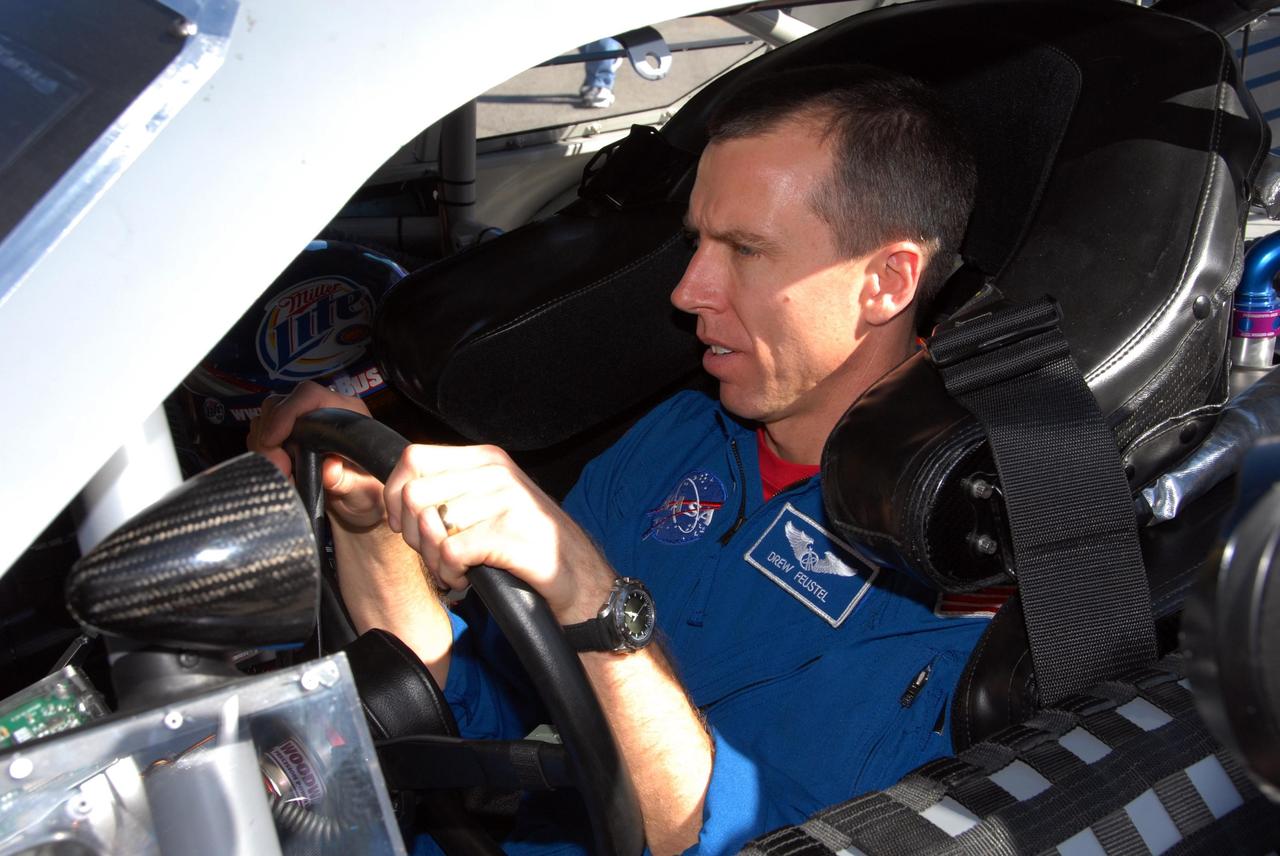
KENNEDY SPACE CENTER, FLA. -- Astronaut Andrew Feustel gets adjusted to the driver's seat in an official track vehicle at Daytona International Speedway. Feustel is participating in NASCAR's Preseason Thunder Fan Fest at the speedway and will ride around the track, taking "hot laps" in the car. Feustel's appearance celebrates NASA's 50th anniversary and the speedway's 50th running of the Daytona 500 in February. Besides the driving experience, Feuster will meet with fans and the media. The NASA/NASCAR association spans decades. Technology developed for the space program has helped NASCAR drivers increase their performance and stay safe over the years. They wear cooling suits similar to what astronauts wear during a spacewalk. Foam that NASA developed for aircraft seats protects racecar drivers' necks in crashes. In addition to participating in the fan festival, NASA will fly three Daytona 500 flags aboard an upcoming space shuttle flight. Speedway officials plan to wave one of the flags to begin the 2008 installment of the Daytona 500, while another will be presented to the winning driver. NASA will keep the third. Feustel will fly on the space shuttle mission STS-125 to the Hubble Space Telescope. The mission will extend and improve the observatory's capabilities through 2013. Launch is targeted for August 2008. Photo credit: NASA/George Shelton

KENNEDY SPACE CENTER, FLA. -- Astronaut Andrew Feustel (right) thanks NASCAR driver Kurt Busch (center) for his views about his pending "hot laps" in an official track vehicle around the Daytona International Speedway. Feustel is participating in NASCAR's Preseason Thunder Fan Fest at. Feustel's appearance celebrates NASA's 50th anniversary and the speedway's 50th running of the Daytona 500 in February. Besides the driving experience, Feuster will meet with fans and the media. The NASA/NASCAR association spans decades. Technology developed for the space program has helped NASCAR drivers increase their performance and stay safe over the years. They wear cooling suits similar to what astronauts wear during a spacewalk. Foam that NASA developed for aircraft seats protects racecar drivers' necks in crashes. In addition to participating in the fan festival, NASA will fly three Daytona 500 flags aboard an upcoming space shuttle flight. Speedway officials plan to wave one of the flags to begin the 2008 installment of the Daytona 500, while another will be presented to the winning driver. NASA will keep the third. Feustel will fly on the space shuttle mission STS-125 to the Hubble Space Telescope. The mission will extend and improve the observatory's capabilities through 2013. Launch is targeted for August 2008. Photo credit: NASA/George Shelton
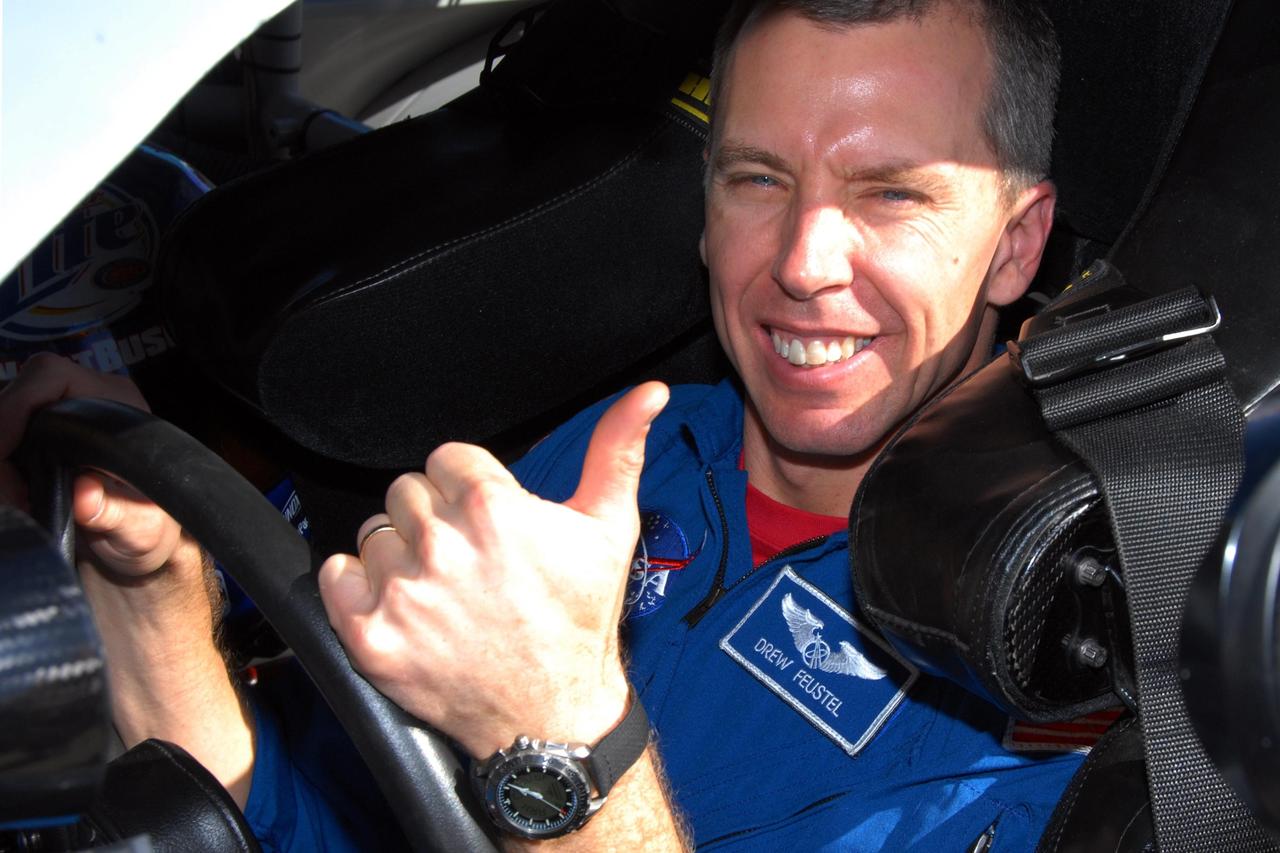
KENNEDY SPACE CENTER, FLA. -- Astronaut Andrew Feustel is ready for his ride in an official track vehicle at Daytona International Speedway. Feustel is participating in NASCAR's Preseason Thunder Fan Fest at the speedway and will ride around the track, taking "hot laps" in the car. Feustel's appearance celebrates NASA's 50th anniversary and the speedway's 50th running of the Daytona 500 in February. Besides the driving experience, Feuster will meet with fans and the media. The NASA/NASCAR association spans decades. Technology developed for the space program has helped NASCAR drivers increase their performance and stay safe over the years. They wear cooling suits similar to what astronauts wear during a spacewalk. Foam that NASA developed for aircraft seats protects racecar drivers' necks in crashes. In addition to participating in the fan festival, NASA will fly three Daytona 500 flags aboard an upcoming space shuttle flight. Speedway officials plan to wave one of the flags to begin the 2008 installment of the Daytona 500, while another will be presented to the winning driver. NASA will keep the third. Feustel will fly on the space shuttle mission STS-125 to the Hubble Space Telescope. The mission will extend and improve the observatory's capabilities through 2013. Launch is targeted for August 2008. Photo credit: NASA/George Shelton
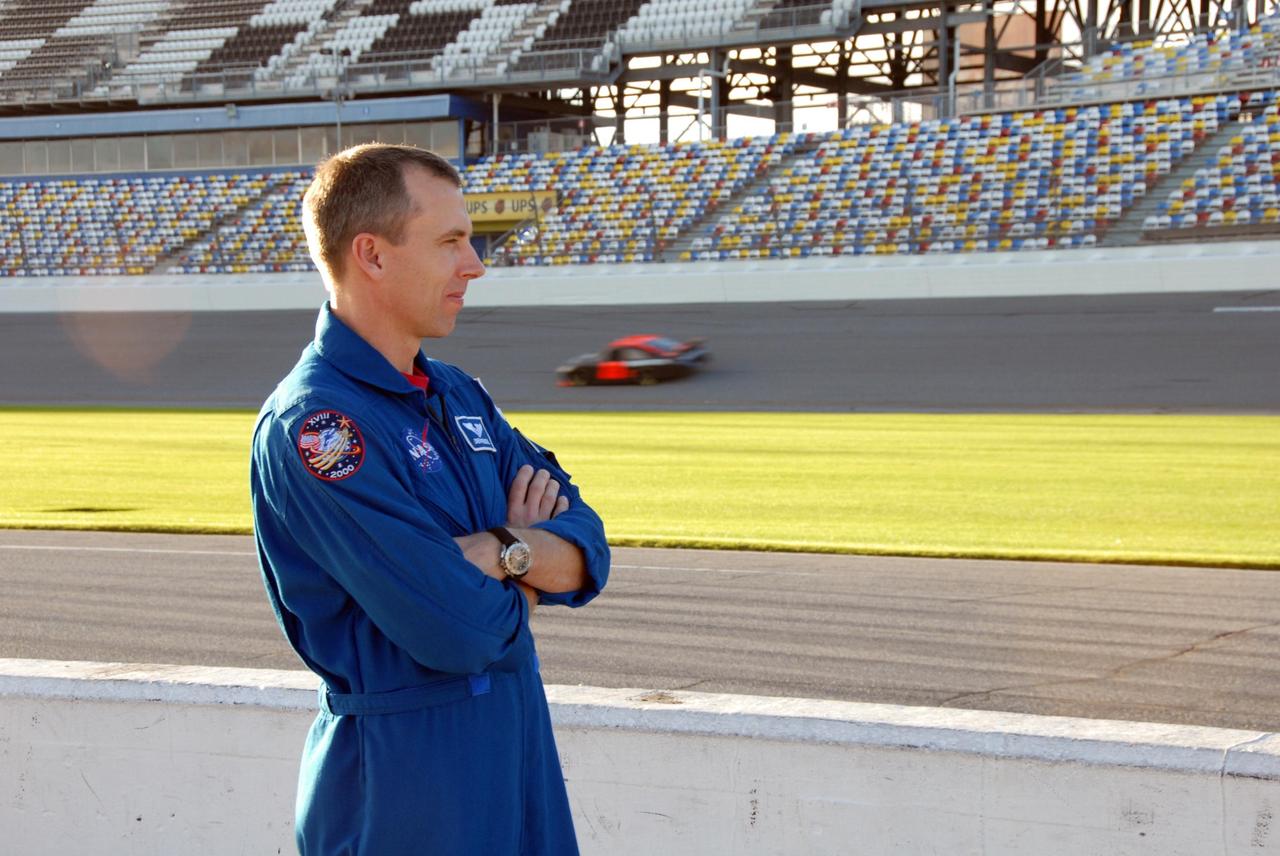
KENNEDY SPACE CENTER, FLA. -- Astronaut Andrew Feustel watches other cars on the Daytona International Speedway. Feustel had his turn at riding around the track, taking "hot laps" in an official track vehicle. Feustel is participating in NASCAR's Preseason Thunder Fan Fest at the speedway, also meeting with fans and the media. Feustel's appearance celebrates NASA's 50th anniversary and the speedway's 50th running of the Daytona 500 in February. The NASA/NASCAR association spans decades. Technology developed for the space program has helped NASCAR drivers increase their performance and stay safe over the years. They wear cooling suits similar to what astronauts wear during a spacewalk. Foam that NASA developed for aircraft seats protects racecar drivers' necks in crashes. In addition to participating in the fan festival, NASA will fly three Daytona 500 flags aboard an upcoming space shuttle flight. Speedway officials plan to wave one of the flags to begin the 2008 installment of the Daytona 500, while another will be presented to the winning driver. NASA will keep the third. Feustel will fly on the space shuttle mission STS-125 to the Hubble Space Telescope. The mission will extend and improve the observatory's capabilities through 2013. Launch is targeted for August 2008. Photo credit: NASA/George Shelton
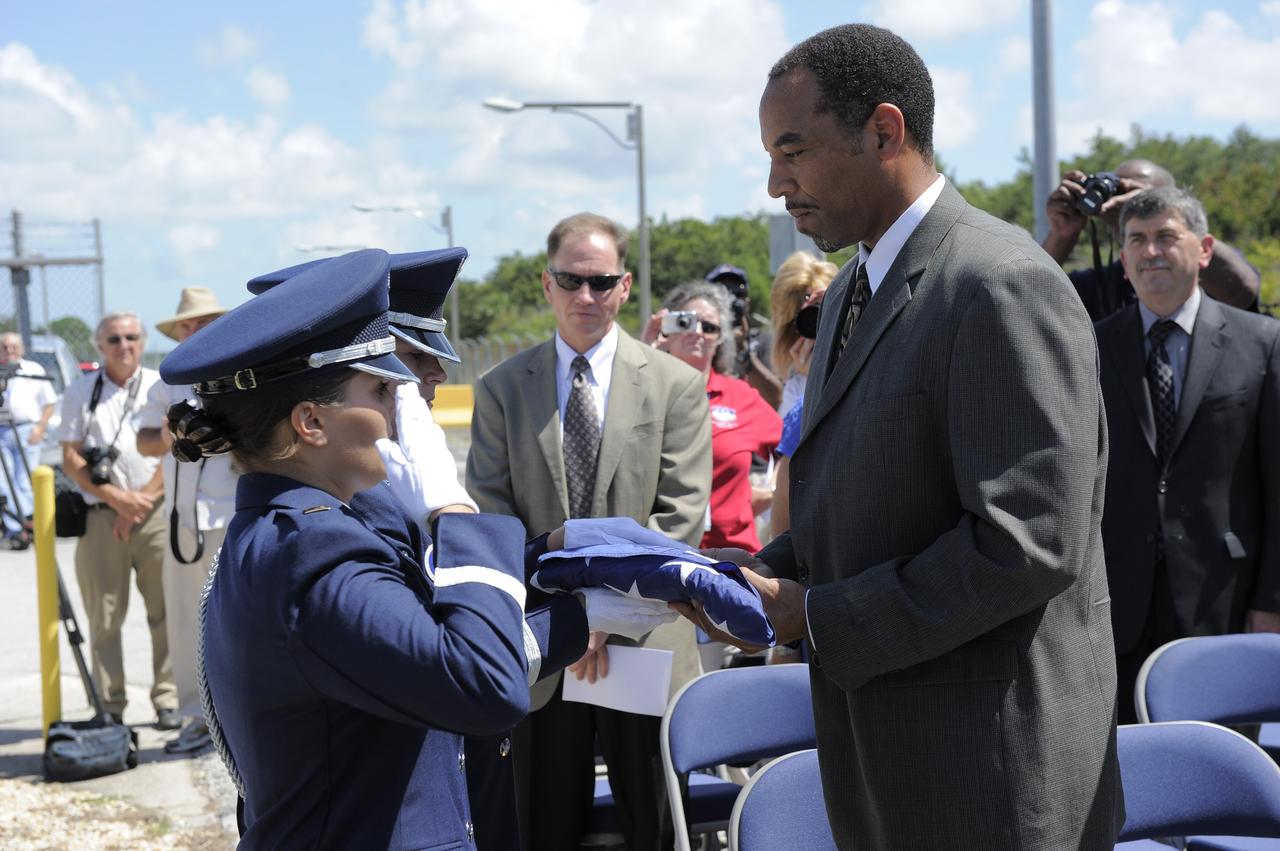
CAPE CANAVERAL, Fla. -- At the Merritt Island Launch Annex (MILA) Spaceflight Tracking and Data Network Station at NASA's Kennedy Space Center in Florida, the Patrick Air Force Base Color Guard presents the U.S. flag which flew over the station to David Carter, Near Earth Network project manager at Goddard Space Flight Center, during a closing ceremony recognizing the station's 45 years of service. The flag will be displayed in a Network Integration Center display cabinet at Goddard. The station was originally established by NASA's Goddard Space Flight Center as one of 17 Space Flight Tracking and Data Network stations around the world. Commissioned for the Apollo Program, the first launch it supported was the Apollo/Saturn 203 test flight from Launch Complex 37 on July 5, 1966. It also provided orbital support for low earth-orbiting scientific satellites. In recent history, the station has been used almost exclusively for space shuttle launch and landing support. Following the final launch and landing of the Space Shuttle Program in July 2011, the MILA station is officially decommissioned. For more information, visit http://www.nasa.gov/centers/kennedy/pdf/167424main_MILA-08C.pdf. Photo credit: NASA/Kim Shiflett
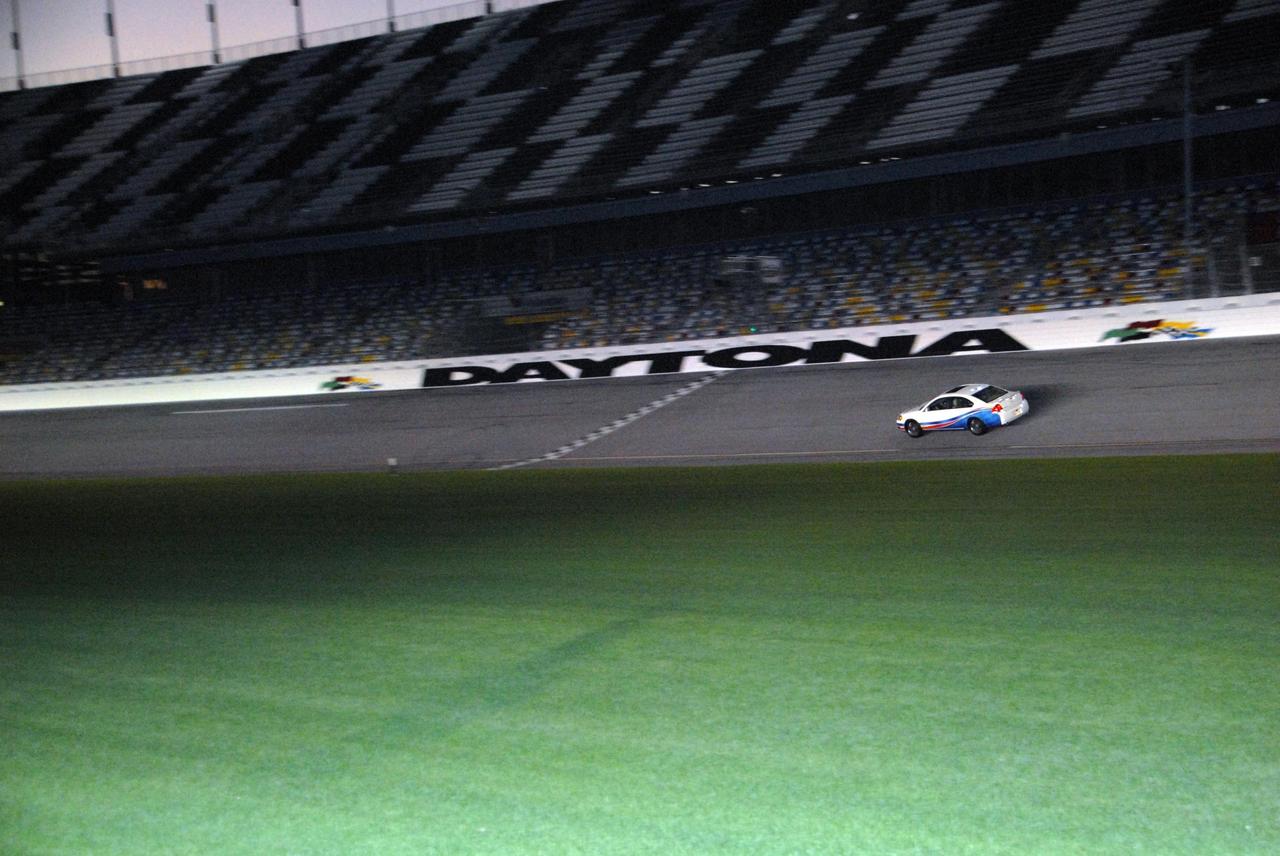
KENNEDY SPACE CENTER, FLA. -- Astronaut Andrew Feustel drives an official track vehicle at Daytona International Speedway. Feustel is participating in NASCAR's Preseason Thunder Fan Fest at the speedway and will ride around the track, taking "hot laps" in the car. Feustel's appearance celebrates NASA's 50th anniversary and the speedway's 50th running of the Daytona 500 in February. Besides the driving experience, Feuster will meet with fans and the media. The NASA/NASCAR association spans decades. Technology developed for the space program has helped NASCAR drivers increase their performance and stay safe over the years. They wear cooling suits similar to what astronauts wear during a spacewalk. Foam that NASA developed for aircraft seats protects racecar drivers' necks in crashes. In addition to participating in the fan festival, NASA will fly three Daytona 500 flags aboard an upcoming space shuttle flight. Speedway officials plan to wave one of the flags to begin the 2008 installment of the Daytona 500, while another will be presented to the winning driver. NASA will keep the third. Feustel will fly on the space shuttle mission STS-125 to the Hubble Space Telescope. The mission will extend and improve the observatory's capabilities through 2013. Launch is targeted for August 2008. Photo credit: NASA/George Shelton
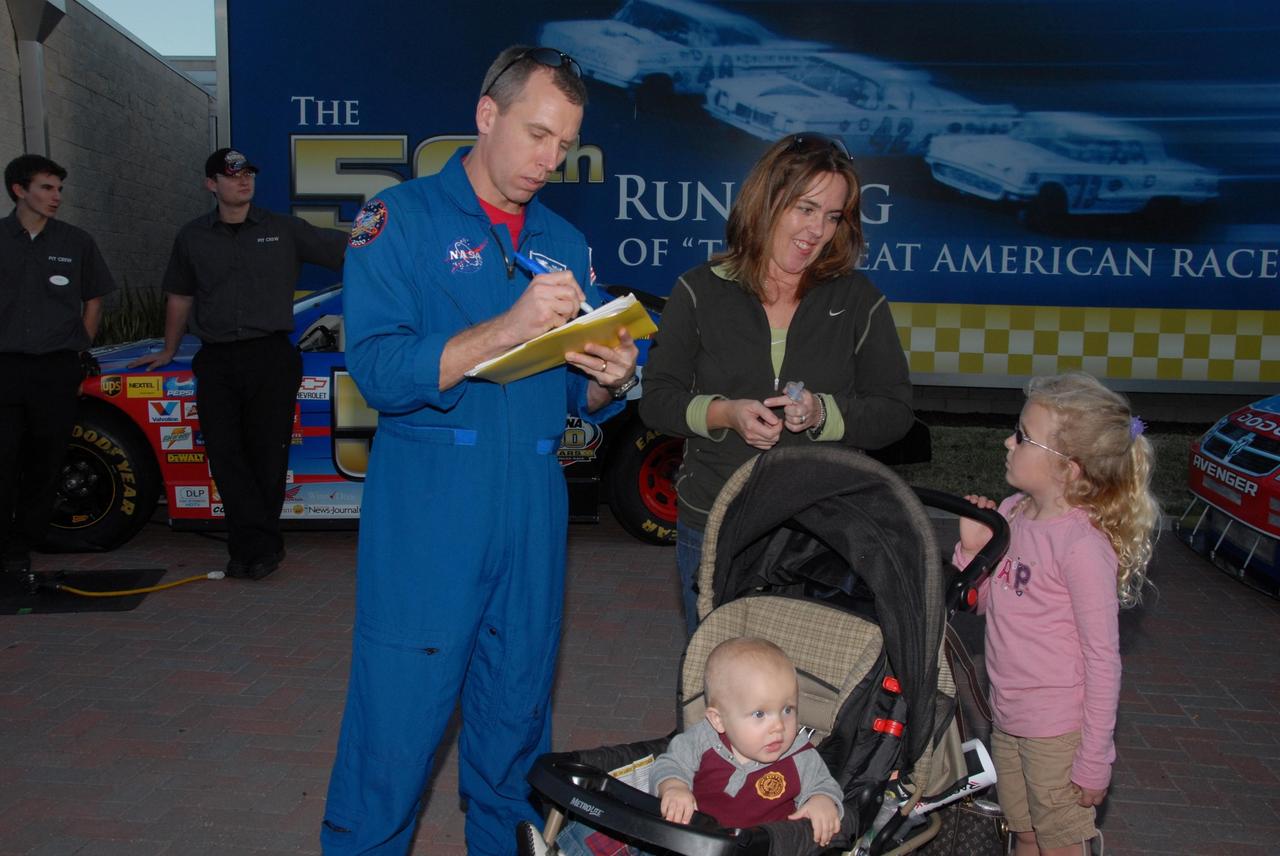
KENNEDY SPACE CENTER, FLA. -- Astronaut Andrew Feustel gives an autograph to a fan during NASCAR's Preseason Thunder Fan Fest at the Daytona International Speedway. Feustel's appearance celebrates NASA's 50th anniversary and the speedway's 50th running of the Daytona 500 in February. The NASA/NASCAR association spans decades. Technology developed for the space program has helped NASCAR drivers increase their performance and stay safe over the years. They wear cooling suits similar to what astronauts wear during a spacewalk. Foam that NASA developed for aircraft seats protects racecar drivers' necks in crashes. In addition to participating in the fan festival, NASA will fly three Daytona 500 flags aboard an upcoming space shuttle flight. Speedway officials plan to wave one of the flags to begin the 2008 installment of the Daytona 500, while another will be presented to the winning driver. NASA will keep the third. Feustel will fly on the space shuttle mission STS-125 to the Hubble Space Telescope. The mission will extend and improve the observatory's capabilities through 2013. Launch is targeted for August 2008. Photo credit: NASA/George Shelton
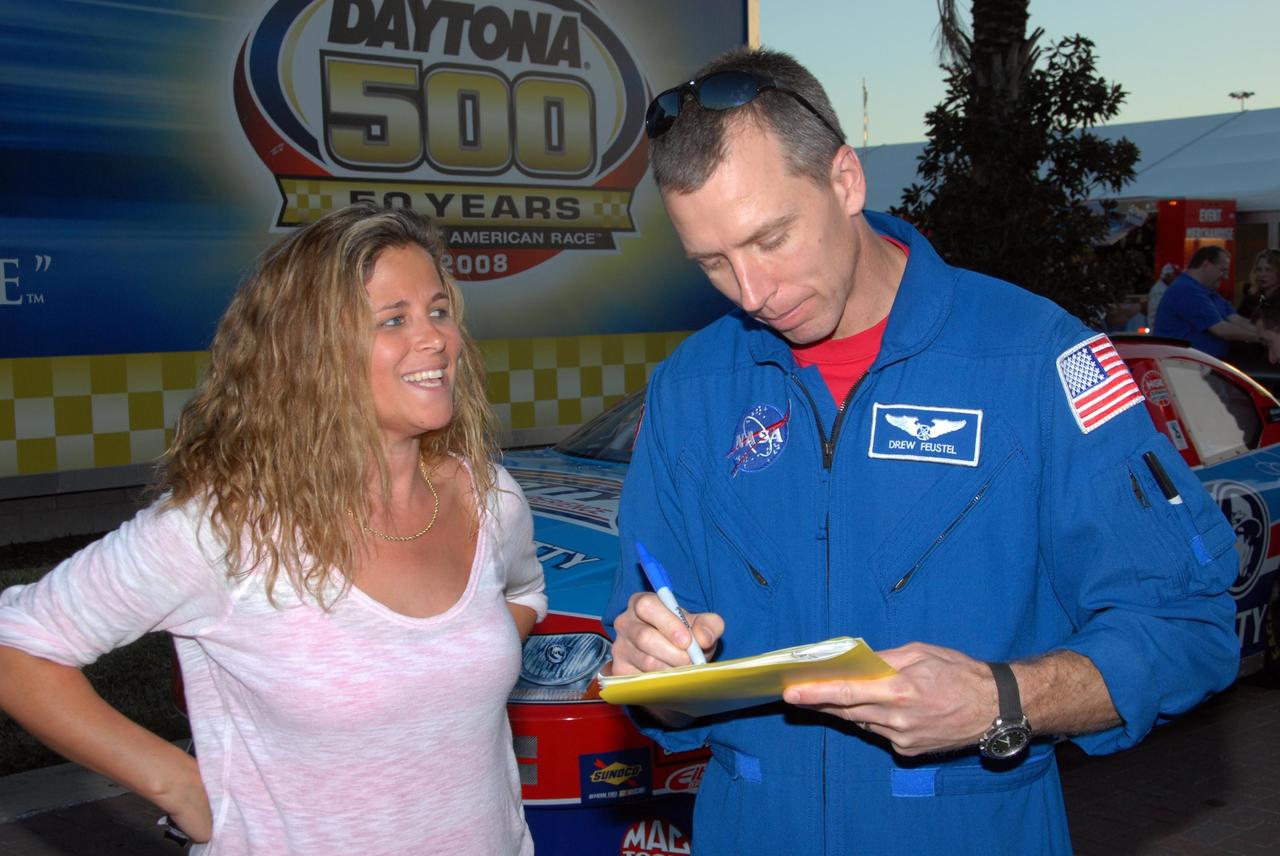
KENNEDY SPACE CENTER, FLA. -- Astronaut Andrew Feustel gives an autograph to a fan during NASCAR's Preseason Thunder Fan Fest at the Daytona International Speedway. Feustel's appearance celebrates NASA's 50th anniversary and the speedway's 50th running of the Daytona 500 in February. The NASA/NASCAR association spans decades. Technology developed for the space program has helped NASCAR drivers increase their performance and stay safe over the years. They wear cooling suits similar to what astronauts wear during a spacewalk. Foam that NASA developed for aircraft seats protects racecar drivers' necks in crashes. In addition to participating in the fan festival, NASA will fly three Daytona 500 flags aboard an upcoming space shuttle flight. Speedway officials plan to wave one of the flags to begin the 2008 installment of the Daytona 500, while another will be presented to the winning driver. NASA will keep the third. Feustel will fly on the space shuttle mission STS-125 to the Hubble Space Telescope. The mission will extend and improve the observatory's capabilities through 2013. Launch is targeted for August 2008. Photo credit: NASA/George Shelton
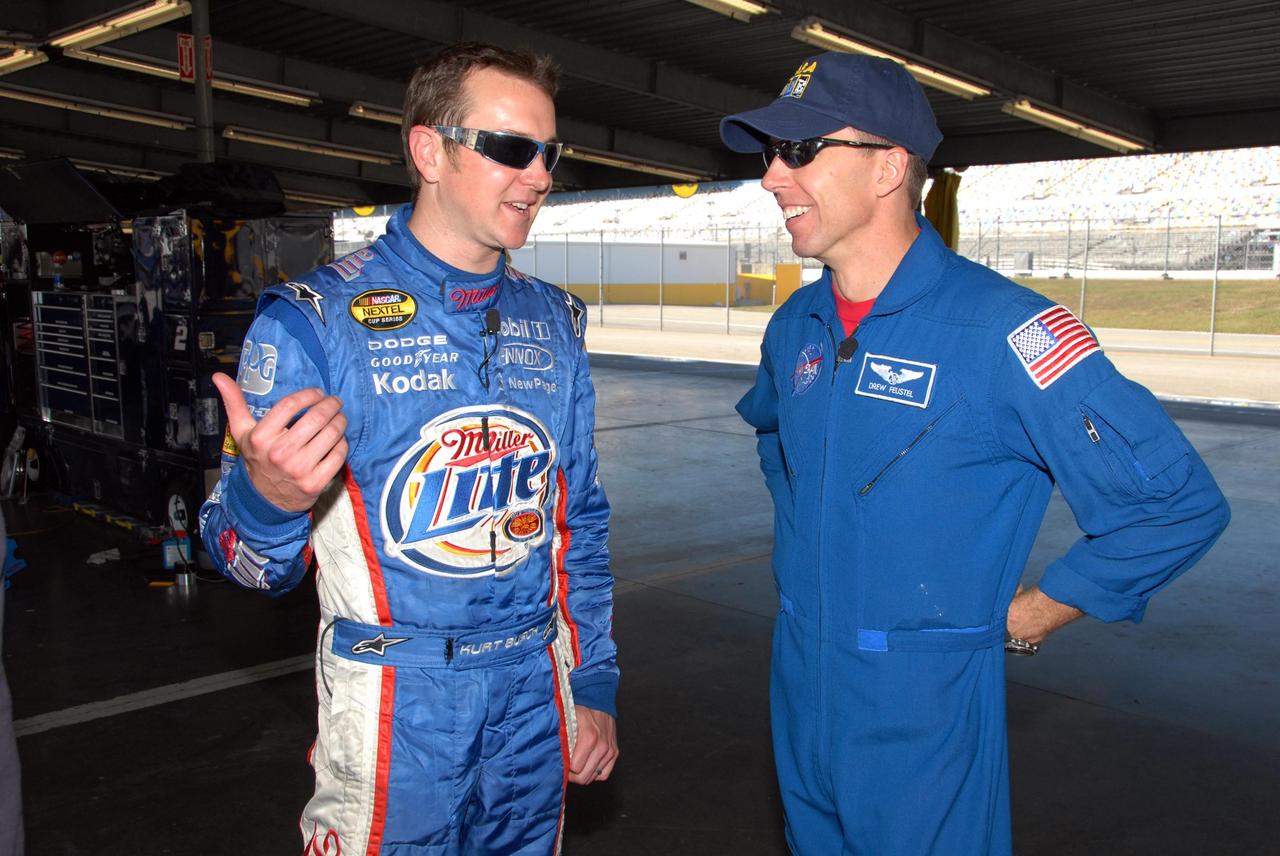
KENNEDY SPACE CENTER, FLA. -- NASCAR driver Kurt Busch (left) talks to astronaut Andrew Feustel about driving. Feustel is participating in NASCAR's Preseason Thunder Fan Fest at Daytona International Speedway. Feustel's appearance celebrates NASA's 50th anniversary and the speedway's 50th running of the Daytona 500 in February. Besides meeting with fans and media, Feustel will ride around the track, taking "hot laps," in an official track vehicle. The NASA/NASCAR association spans decades. Technology developed for the space program has helped NASCAR drivers increase their performance and stay safe over the years. They wear cooling suits similar to what astronauts wear during a spacewalk. Foam that NASA developed for aircraft seats protects racecar drivers' necks in crashes. In addition to participating in the fan festival, NASA will fly three Daytona 500 flags aboard an upcoming space shuttle flight. Speedway officials plan to wave one of the flags to begin the 2008 installment of the Daytona 500, while another will be presented to the winning driver. NASA will keep the third. Feustel will fly on the space shuttle mission STS-125 to the Hubble Space Telescope. The mission will extend and improve the observatory's capabilities through 2013. Launch is targeted for August 2008. Photo credit: NASA/George Shelton
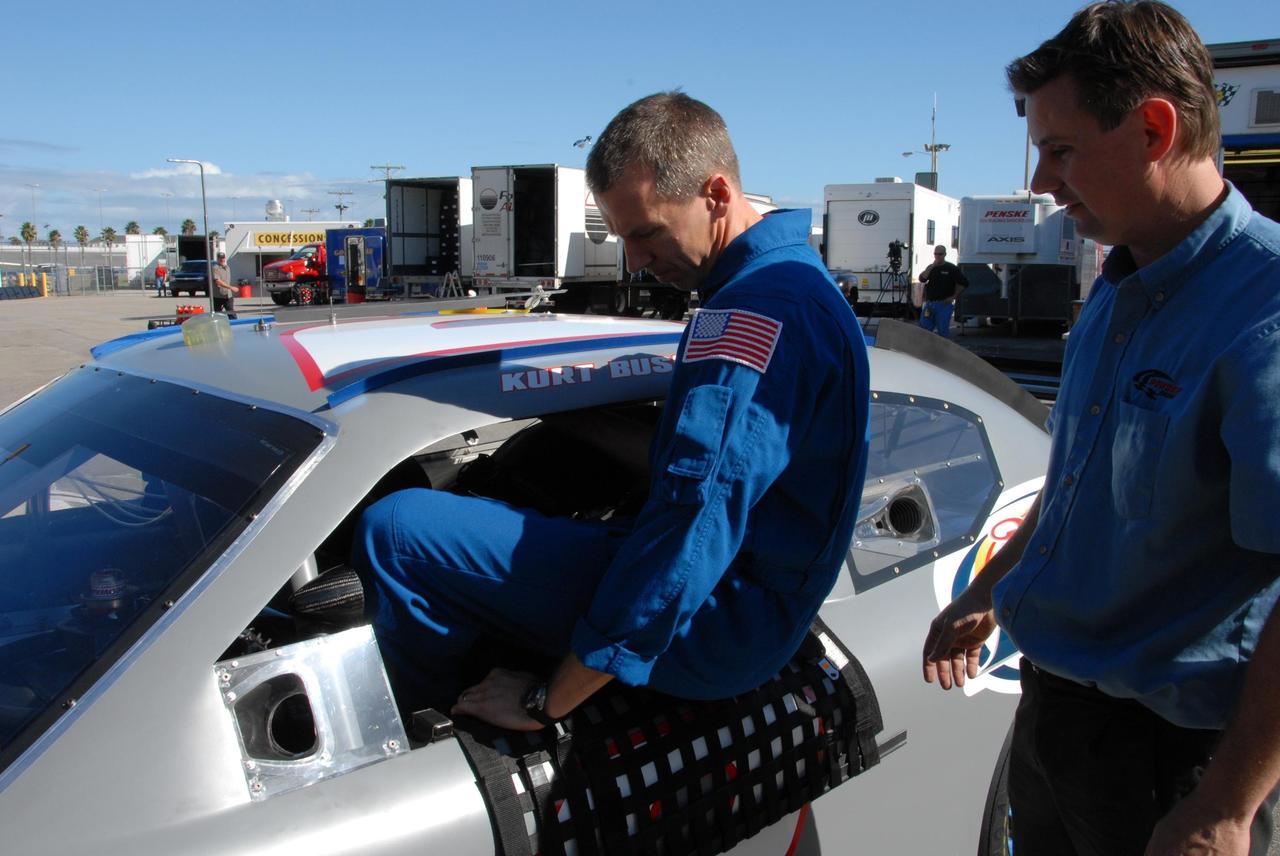
KENNEDY SPACE CENTER, FLA. -- Astronaut Andrew Feustel climbs into the driver's seat of an official track vehicle at Daytona International Speedway. Feustel is participating in NASCAR's Preseason Thunder Fan Fest at the speedway and will ride around the track, taking "hot laps" in the car. Feustel's appearance celebrates NASA's 50th anniversary and the speedway's 50th running of the Daytona 500 in February. Besides the driving experience, Feuster will meet with fans and the media. The NASA/NASCAR association spans decades. Technology developed for the space program has helped NASCAR drivers increase their performance and stay safe over the years. They wear cooling suits similar to what astronauts wear during a spacewalk. Foam that NASA developed for aircraft seats protects racecar drivers' necks in crashes. In addition to participating in the fan festival, NASA will fly three Daytona 500 flags aboard an upcoming space shuttle flight. Speedway officials plan to wave one of the flags to begin the 2008 installment of the Daytona 500, while another will be presented to the winning driver. NASA will keep the third. Feustel will fly on the space shuttle mission STS-125 to the Hubble Space Telescope. The mission will extend and improve the observatory's capabilities through 2013. Launch is targeted for August 2008. Photo credit: NASA/George Shelton
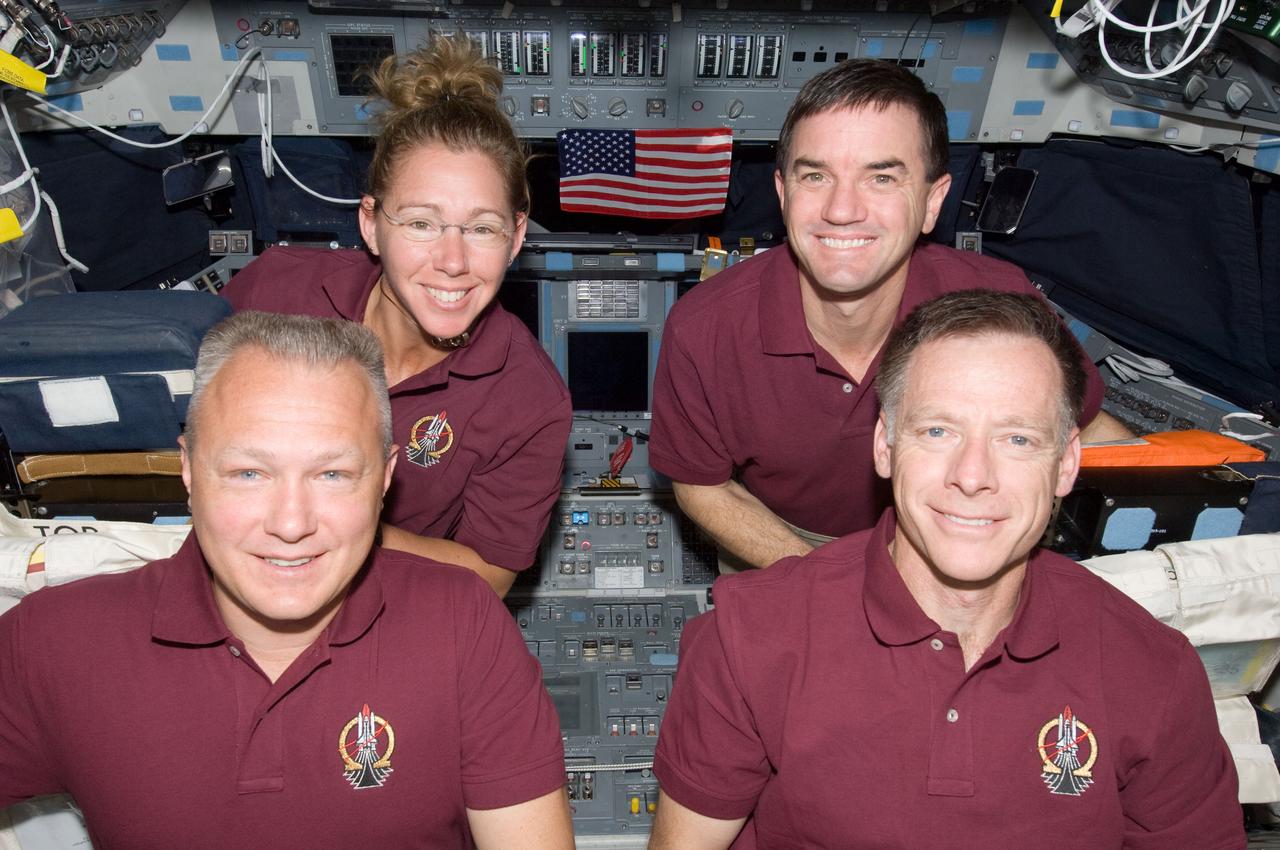
S135-E-008715 (16 July 2011) --- The four crew members of the Atlantis STS-135 mission pose for a picture on the spacecraft's flight deck. On the front row are NASA astronauts Doug Hurley (left) and Chris Ferguson, pilot and commander respectively. In the rear are NASA astronauts Sandy Magnus and Rex Walheim, both mission specialists. The U.S. flag pictured was flown on the first space shuttle mission, STS-1, and flew on this mission to be presented to the space station crew. It will remain onboard the station until the next crew launched from the U.S. will retrieve it for return to Earth. It will fly from Earth again, with the crew that launches from the U.S. on a journey of exploration beyond Earth orbit. Photo credit: NASA
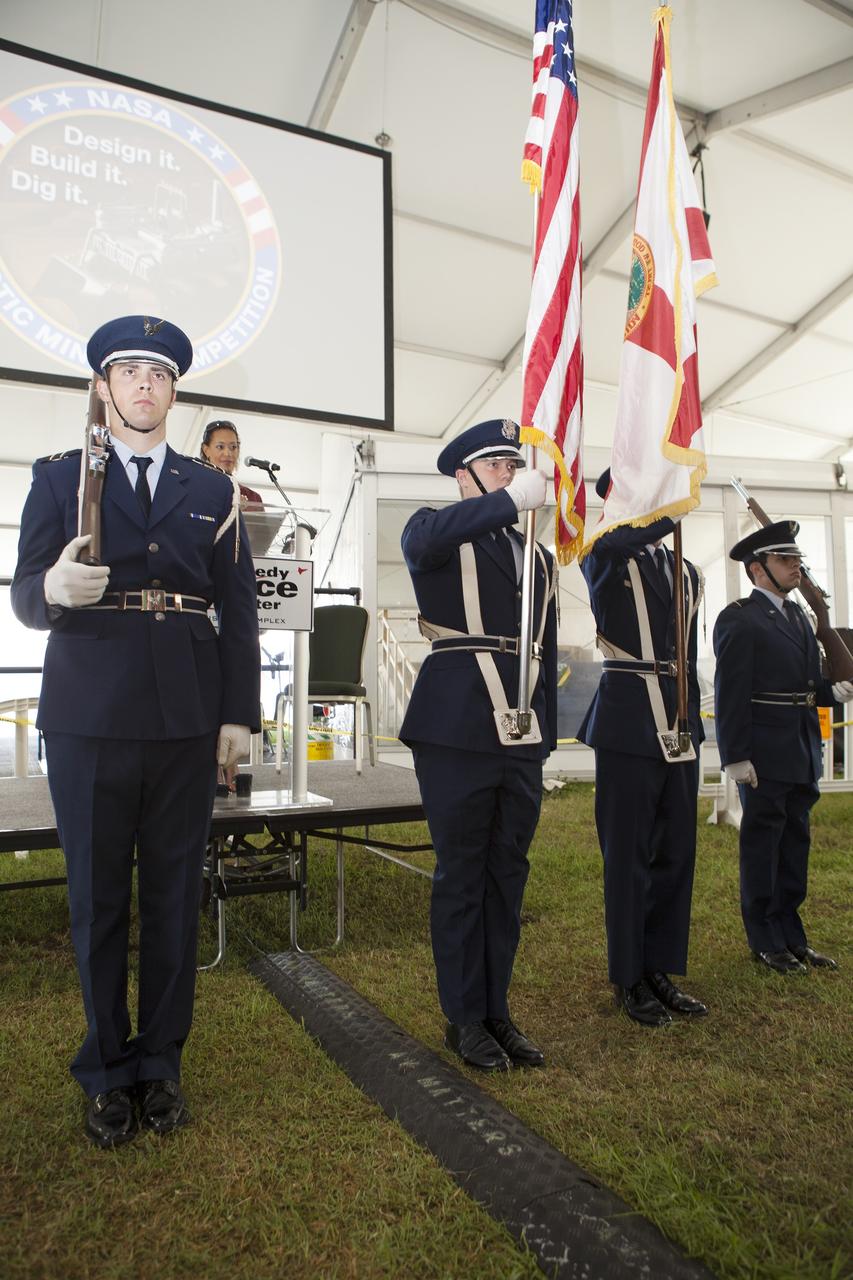
CAPE CANAVERAL, Fla. – Members of the West Virginia University color guard stand at attention during presentation of the U.S. Flag at the opening ceremony of NASA’s 2014 Robotics Mining Competition at the Kennedy Space Center Visitor Complex in Florida. More than 35 teams from around the U.S. have designed and built remote-controlled robots for the mining competition. The competition is a NASA Human Exploration and Operations Mission Directorate project designed to engage and retain students in science, technology, engineering and mathematics, or STEM, fields by expanding opportunities for student research and design. Teams use their remote-controlled robotics to maneuver and dig in a supersized sandbox filled with a crushed material that has characteristics similar to Martian soil. The objective of the challenge is to see which team’s robot can collect and move the most regolith within a specified amount of time. For more information, visit www.nasa.gov/nasarmc. Photo credit: NASA/Frankie Martin
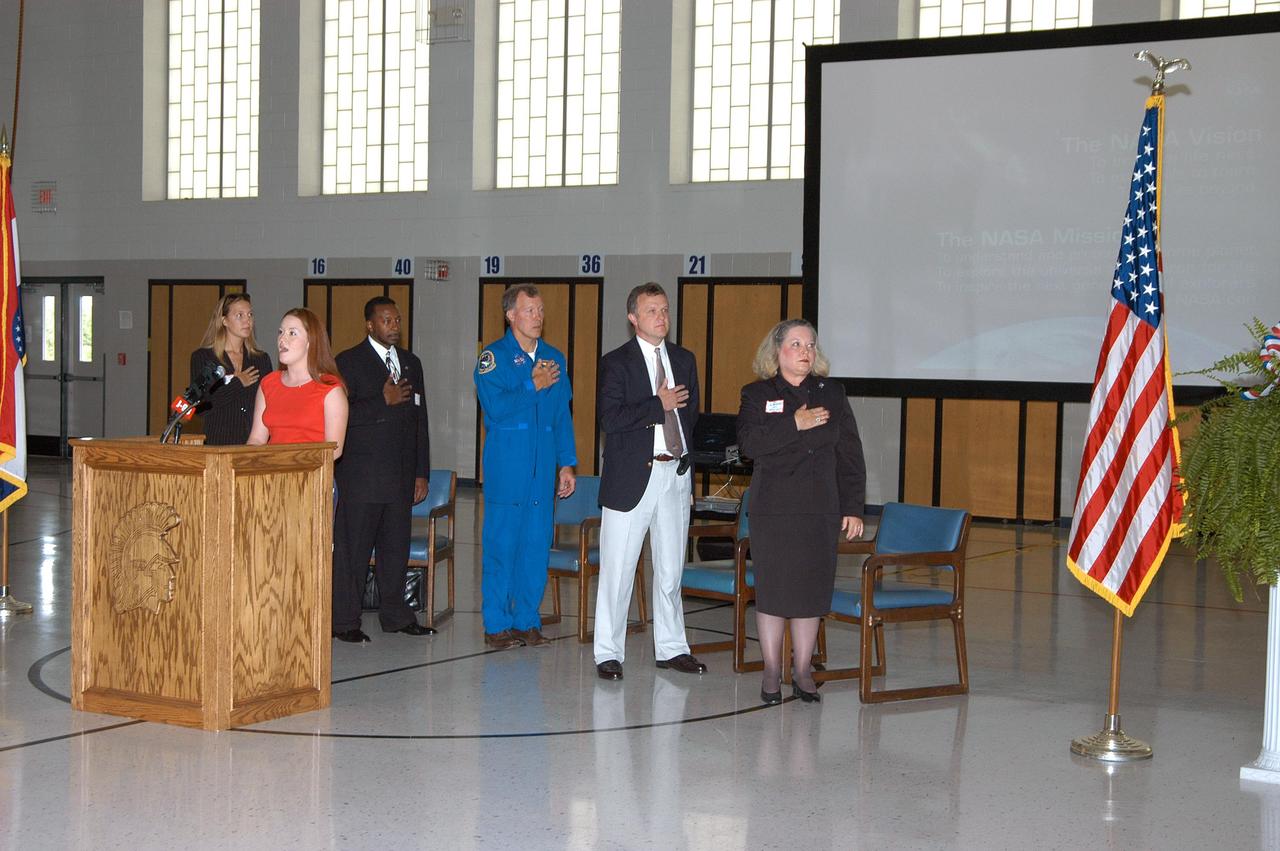
KENNEDY SPACE CENTER, FLA. -- Prior to a presentation at Trojan Intermediate School in Potosi, Mo., Amber Marek, KSC Deputy Director Dr. Woodrow Whitlow, astronaut Dom Gorie, Superintendent of Schools Randy Davis and Principal Jo Peukert salute the American flag. Students from three area schools— Potosi High School, John Evans Middle School and Trojan — are on a team taking part in NASA’s Explorer Schools program. Whitlow and Gorie are visiting the school to share America’s new vision for space exploration with the next generation of explorers. They are talking with students about our destiny as explorers, NASA’s stepping stone approach to exploring Earth, the Moon, Mars and beyond, how space impacts our lives, and how people and machines rely on each other in space.
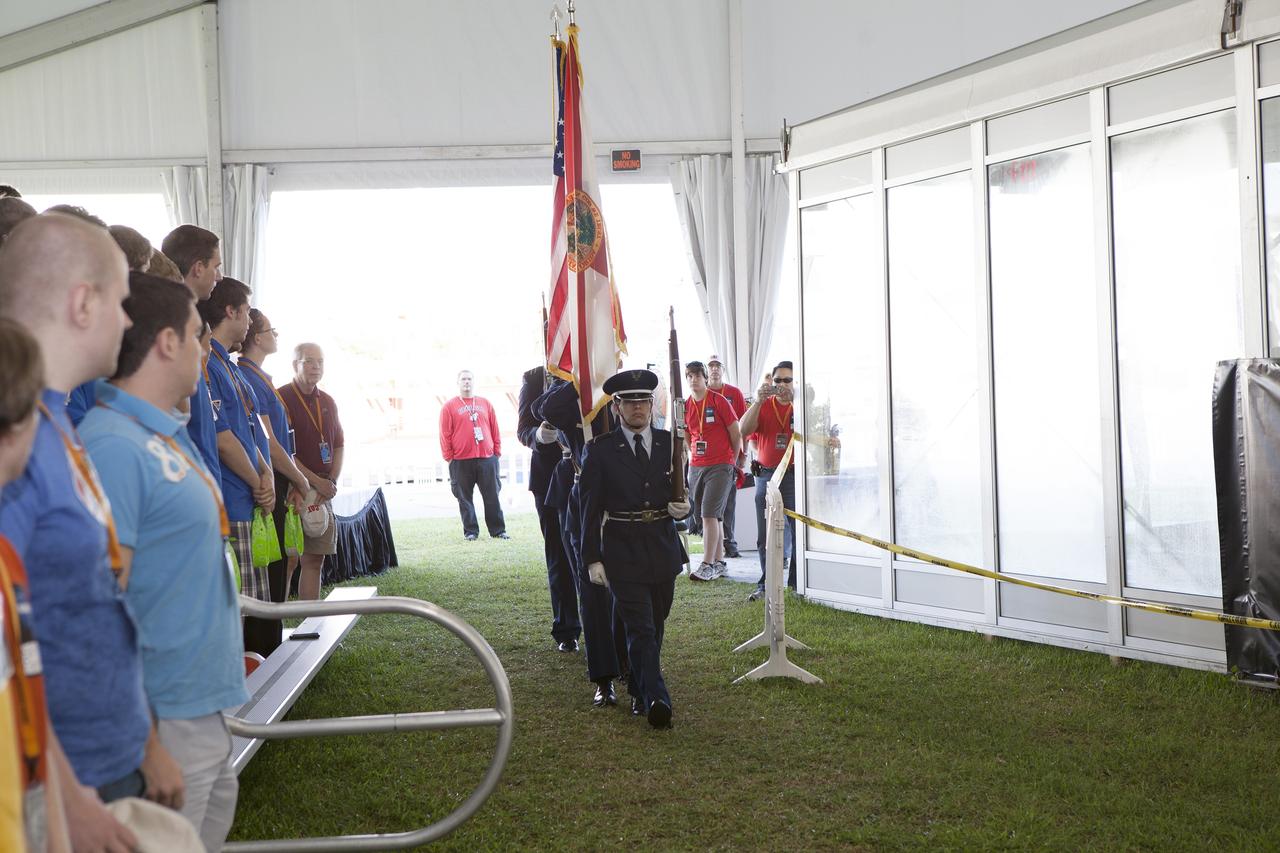
CAPE CANAVERAL, Fla. – Members of the West Virginia University color guard present the U.S. Flag during the opening ceremony of NASA’s 2014 Robotics Mining Competition at the Kennedy Space Center Visitor Complex in Florida. More than 35 teams from around the U.S. have designed and built remote-controlled robots for the mining competition. The competition is a NASA Human Exploration and Operations Mission Directorate project designed to engage and retain students in science, technology, engineering and mathematics, or STEM, fields by expanding opportunities for student research and design. Teams use their remote-controlled robotics to maneuver and dig in a supersized sandbox filled with a crushed material that has characteristics similar to Martian soil. The objective of the challenge is to see which team’s robot can collect and move the most regolith within a specified amount of time. For more information, visit www.nasa.gov/nasarmc. Photo credit: NASA/Frankie Martin
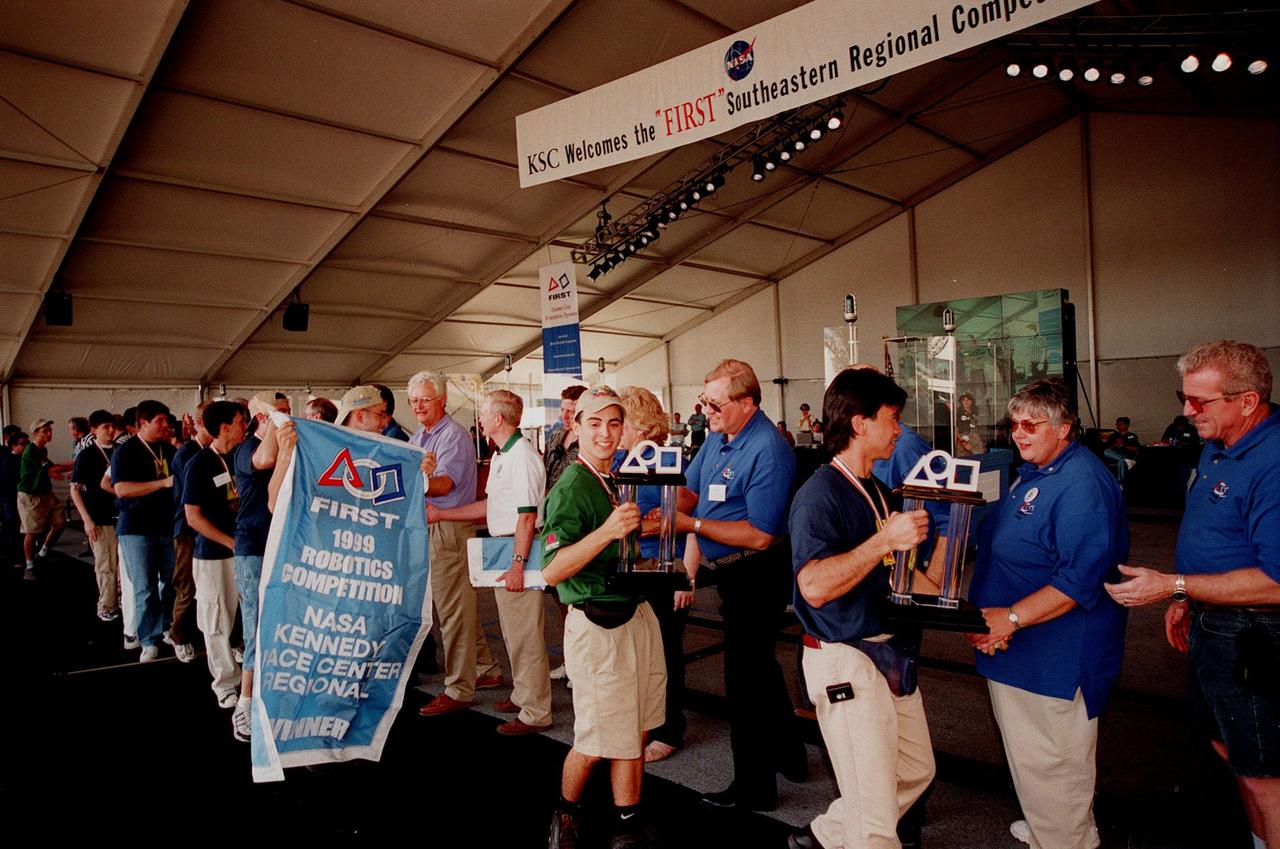
At the award ceremony for the 1999 FIRST Southeastern Regional robotic competition held at KSC, the winning teams from Miami and San German, Puerto Rico, parade with their trophies and championship flag by the line of judges and officials. In the middle of the line is Center Director Roy Bridges. At the far right is Deputy Director for Launch and Payload Processing Loren Shriver, who served as one of the judges for the competition. FIRST is a nonprofit organization, For Inspiration and Recognition of Science and Technology, that sponsors the event pitting gladiator robots against each other in an athletic-style competition. The FIRST robotics competition is designed to provide students with a hands-on, inside look at engineering and other professional careers, pairing high school students with engineer mentors and corporations. The regional event comprised 27 teams. Along with the championship award, 15 other awards were presented
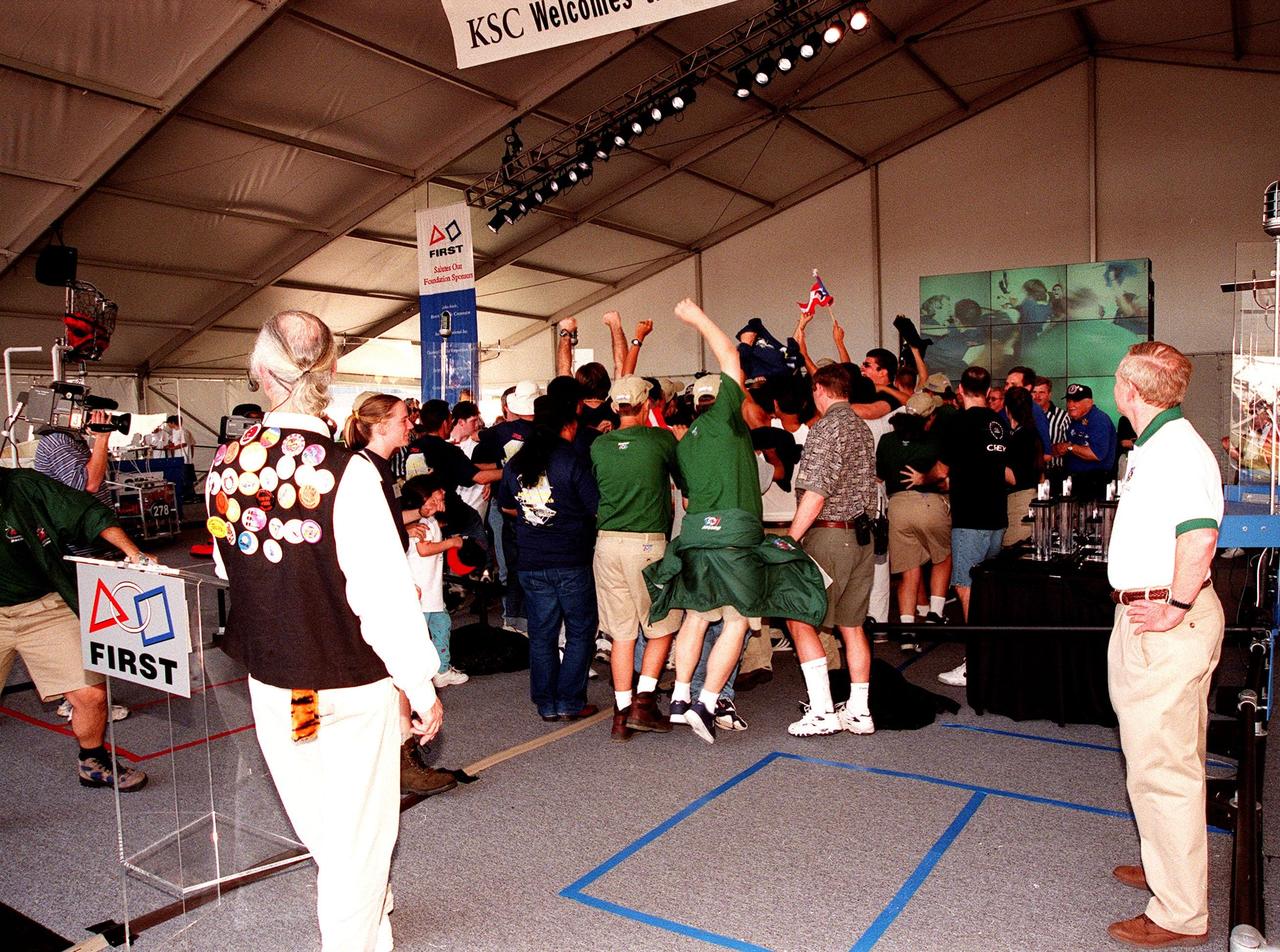
At the award ceremony for the 1999 FIRST Southeastern Regional robotic competition held at KSC, the winning teams, from Miami and San German, Puerto Rico, jump for joy and wave a flag. In the foreground, at left, are Woody Flowers, national advisor to FIRST, and at right, Roy Bridges, KSC director. FIRST is a nonprofit organization, For Inspiration and Recognition of Science and Technology, that sponsors the event pitting gladiator robots against each other in an athletic-style competition. The FIRST robotics competition is designed to provide students with a hands-on, inside look at engineering and other professional careers, pairing high school students with engineer mentors and corporations. The regional event comprised 27 teams. Along with the championship award, 15 other awards were presented
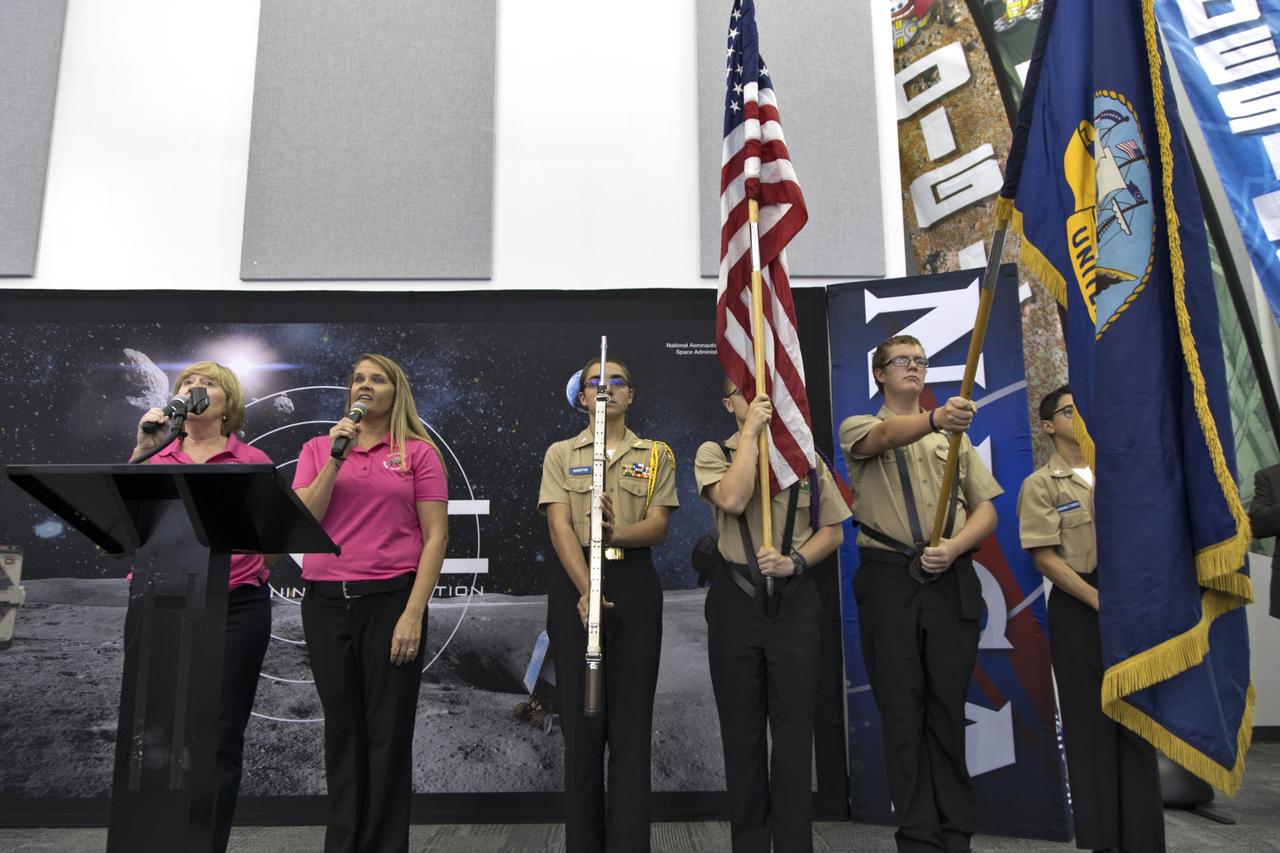
A flag presentation and singing of the National Anthem are part of the opening ceremony of NASA's 9th Robotic Mining Competition, May 15, in the RobotPits in the Educator Resource Center at Kennedy Space Center Visitor Complex in Florida. More than 40 student teams from colleges and universities around the U.S. will use their uniquely designed mining robots to dig in a supersized sandbox filled with BP-1, or simulated Lunar soil, gravel and rocks, and participate in other competition requirements. The Robotic Mining Competition is a NASA Human Exploration and Operations Mission Directorate project designed to encourage students in science, technology, engineering and math, or STEM fields. The project provides a competitive environment to foster innovative ideas and solutions that could be used on NASA's deep space missions.

NASA Administrator Dan Goldin congratulates Phase I Shuttle/Mir Program Manager Frank Culbertson on the successful conclusion of Phase I of the joint U.S.-Russian International Space Station Program at KSC's Shuttle Landing Facility following Discovery's landing, as Mission Commander Charles J. Precourt (applauding) and the other members of the STS-91 flight crew look on. Culbertson is holding an American flag, a special wrench, and an optical disc, which he had just been presented by Goldin. The flag rode aboard Mir from the beginning of the Phase I program, the wrench was used on Mir and will be used on the International Space Station, and the optical disc holds data recorded on Mir. All of these items were brought back to Earth from Mir by the STS-91 crew. Discovery's main gear touchdown on Runway 15 was at 2:00:18 p.m. EDT on June 12, 1998, on orbit 155 of the mission. The wheels stopped at 2:01:22 p.m. EDT, for a total mission-elapsed time of 9 days, 19 hours, 55 minutes and 1 second. The 91st Shuttle mission was the 44th KSC landing in the history of the Space Shuttle program and the 15th consecutive landing at KSC. Besides Commander Precourt, the STS-91 flight crew also included Pilot Dominic L. Gorie and Mission Specialists Wendy B. Lawrence, Franklin R. Chang-Diaz, Janet Lynn Kavandi and Valery Victorovitch Ryumin of the Russian Space Agency. Astronaut Andrew S. W. Thomas also returned to Earth from Mir as an STS-91 crew member after 141 days in space
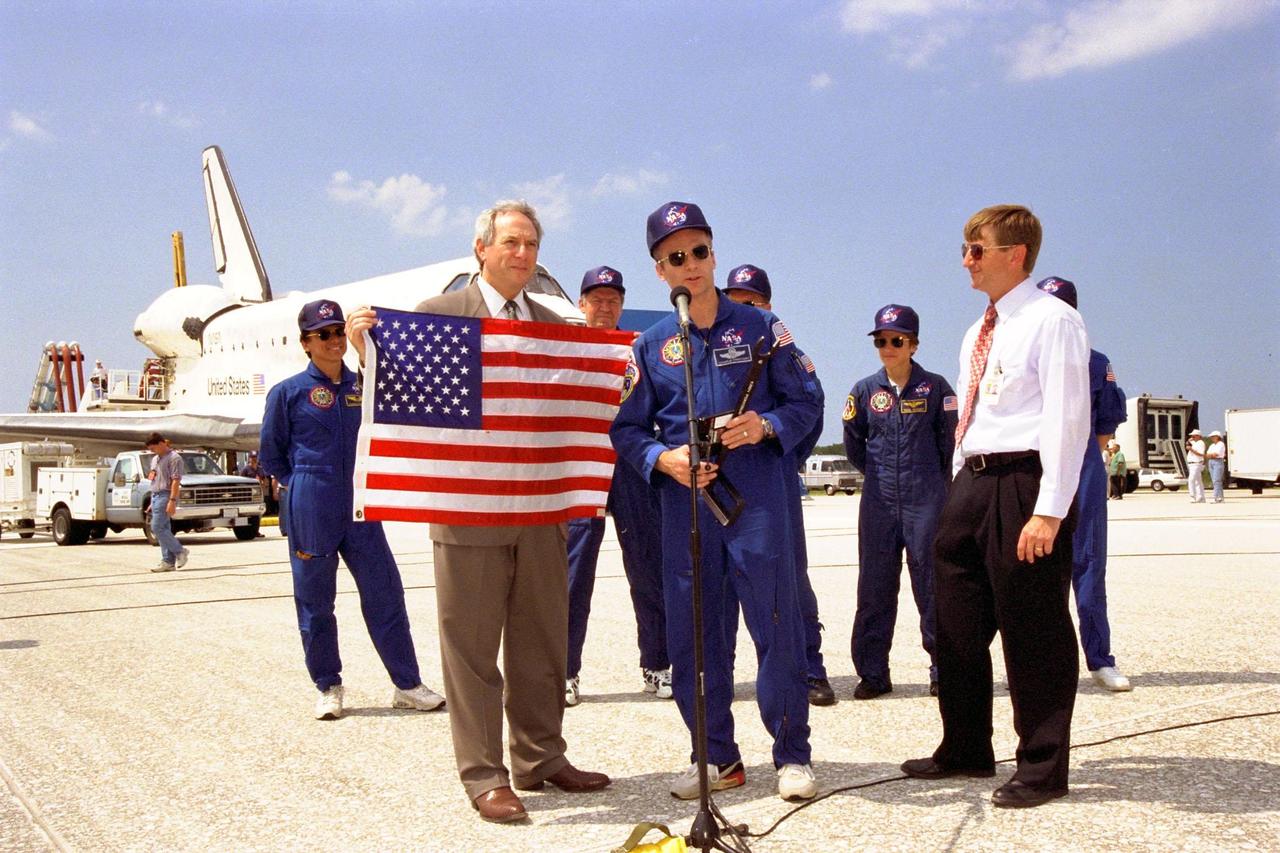
STS-91 Mission Commander Charles J. Precourt (at microphone) presents an American flag, a special wrench, and an optical disc to NASA Administrator Dan Goldin following Discovery's landing at KSC's Shuttle Landing Facility, as Phase I Shuttle/Mir Program Manager Frank Culbertson and the other members of the STS-91 flight crew look on. This landing not only concluded the STS-91 mission, but Phase I of the joint U.S.-Russian International Space Station Program as well. The flag rode aboard Mir from the beginning of the Phase I program, the wrench was used on Mir and will be used on the International Space Station, and the optical disc holds data recorded on Mir. All of these items were brought back to Earth from Mir by the STS-91 crew. Discovery's main gear touchdown on Runway 15 was at 2:00:18 p.m. EDT on June 12, 1998, on orbit 155 of the mission. The wheels stopped at 2:01:22 p.m. EDT, for a total mission-elapsed time of 9 days, 19 hours, 55 minutes and 1 second. The 91st Shuttle mission was the 44th KSC landing in the history of the Space Shuttle program and the 15th consecutive landing at KSC. Besides Commander Precourt, the STS-91 flight crew also included Pilot Dominic L. Gorie and Mission Specialists Wendy B. Lawrence, Franklin R. Chang-Diaz, Janet Lynn Kavandi and Valery Victorovitch Ryumin of the Russian Space Agency. Astronaut Andrew S. W. Thomas also returned to Earth from Mir as an STS-91 crew member after 141 days in space
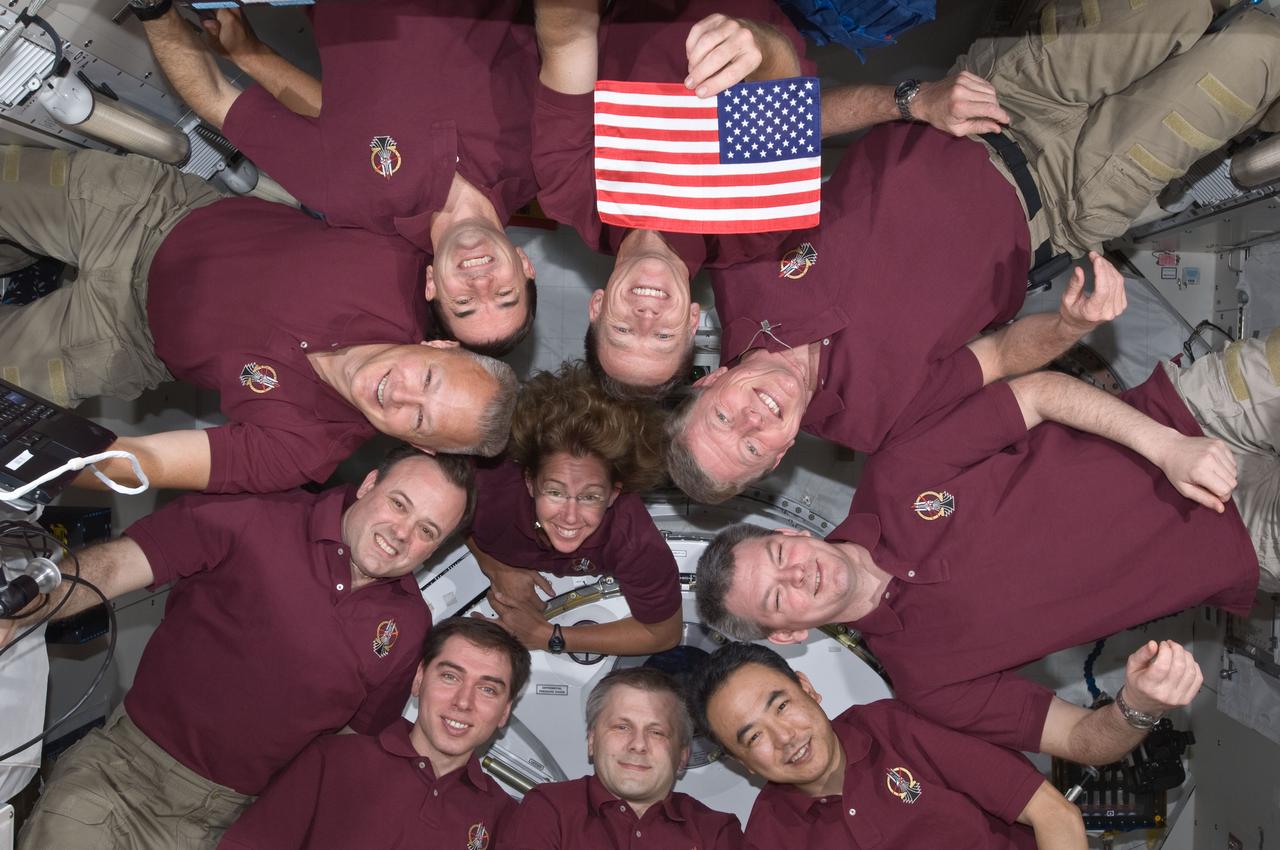
S135-E-008059 (15 July 2011) --- In an occurrence which became somewhat of a tradition for shuttle crews and those of the International Space Station expeditions, the Expedition 28 crew and the STS-135 Atlantis astronauts formed a microgravity circle for a portrait aboard the orbiting complex's Kibo laboratory of the Japan Aerospace Exploration Agency. The STS-135 crew consists of NASA astronauts Chris Ferguson, Doug Hurley, Sandy Magnus and Rex Walheim; the Expedition 28 crewmembers are JAXA astronaut Satoshi Furukawa, NASA astronauts Ron Garan and Mike Fossum, and Russian cosmonauts Andrey Borisenko, Alexander Samokutyaev and Sergei Volkov. Shuttle and station commanders Ferguson and Borisenko are in the 12 o'clock and six o'clock positions, respectively, on the circle. The U.S. flag pictured was flown on the first space shuttle mission, STS-1, and flew on this mission to be presented to the space station crew. It will remain onboard until the next crew launched from the U.S. will retrieve it for return to Earth. It will fly from Earth again, with the crew that launches from the U.S. on a journey of exploration beyond Earth orbit. Photo credit: NASA
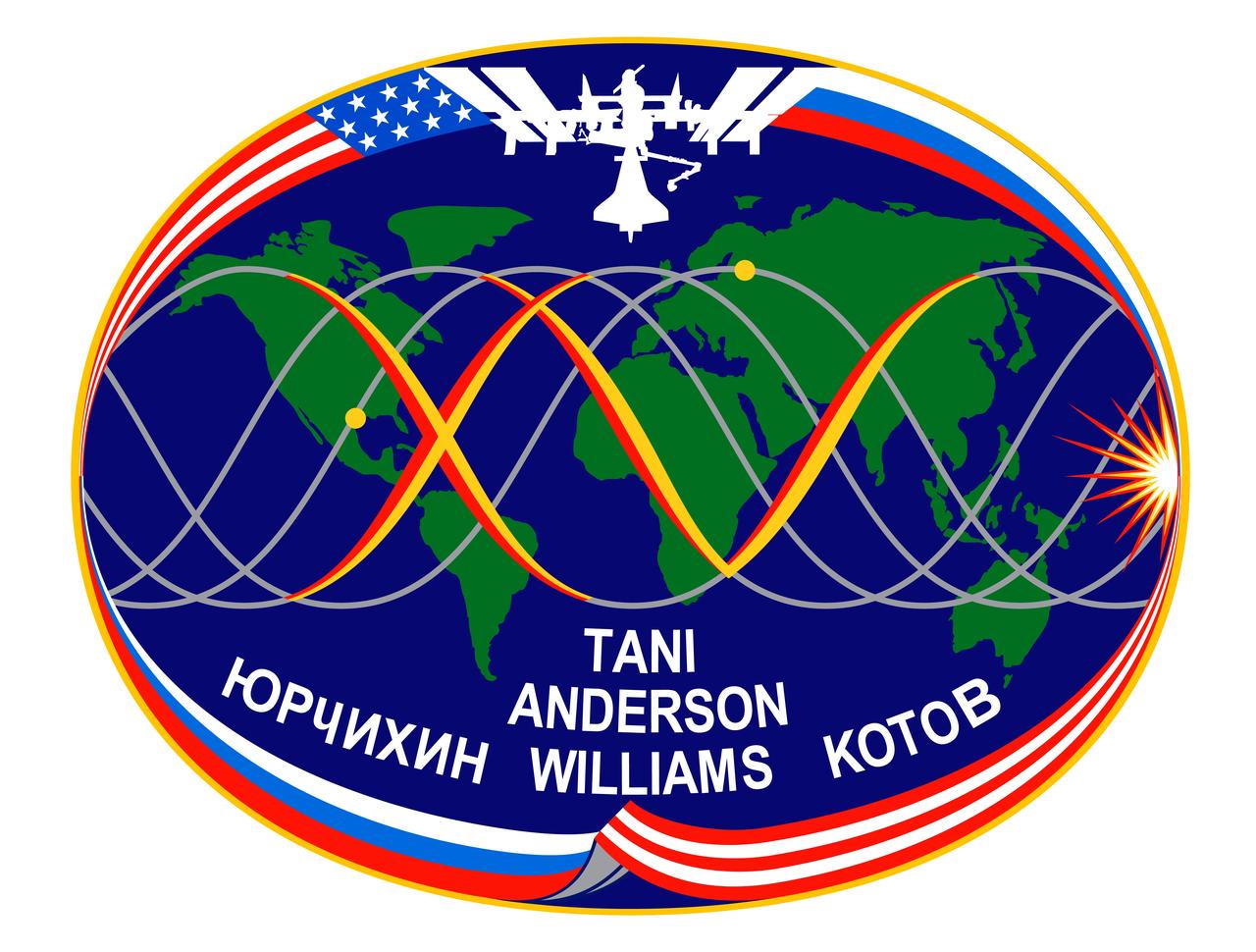
ISS015-S-001F (November 2006) --- The operational teamwork between human space flight controllers and the on-orbit crew take center stage in this emblem. Against a backdrop familiar to all flight controllers, past and present, independent of any nationality, the fifteenth expedition to the ISS is represented in Roman numeral form as part of the ground track traces emblazoned on the Mercator projection of the home planet Earth. The ISS, shown in its fully operational, assembly complete configuration, unfurls and then reunites the flags of this Russian and American crew in a show of our continuing international cooperation. Golden spheres placed strategically on the ground track near the flight control centers of the United States and Russia serve to symbolize both the joint efforts from each nation's team of flight controllers and the shuttle and Soyuz crew vehicles in their chase orbit as they rendezvous with the ISS. A rising sun provides a classic touch to the emblem signifying the perpetual nature of manned space flight operations and their origin in these two space-faring nations. The NASA insignia design for shuttle and space station flights is reserved for use by the astronauts and for other official use as the NASA Administrator may authorize. Public availability has been approved only in the forms of illustrations by the various news media. When and if there is any change in this policy, which is not anticipated, the change will be publicly announced.
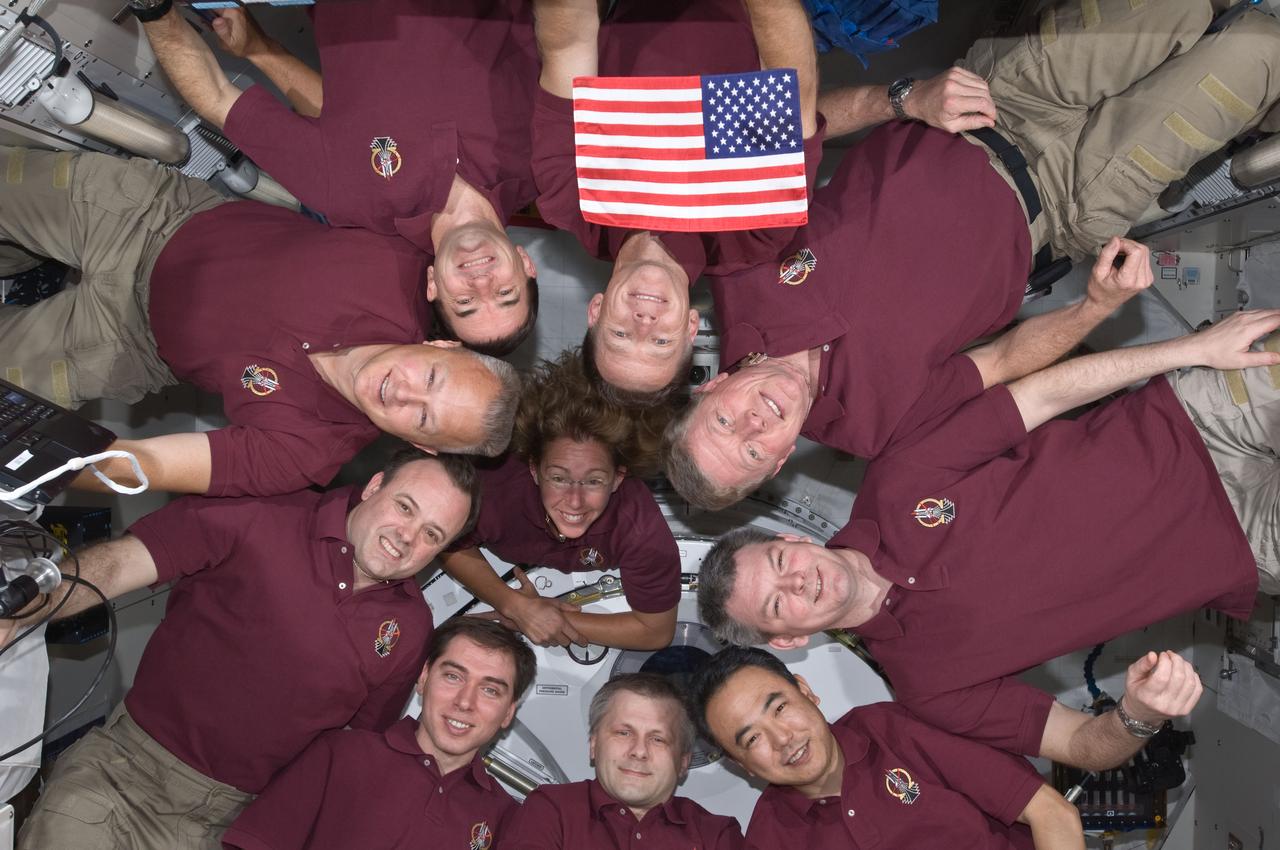
S135-E-008061 (15 July 2011) --- In an occurrence which became somewhat of a tradition for shuttle crews and those of the International Space Station expeditions, the Expedition 28 crew and the STS-135 Atlantis astronauts formed a microgravity circle for a portrait aboard the orbiting complex's Kibo laboratory of the Japan Aerospace Exploration Agency. The STS-135 crew consists of NASA astronauts Chris Ferguson, Doug Hurley, Sandy Magnus and Rex Walheim; the Expedition 28 crewmembers are JAXA astronaut Satoshi Furukawa, NASA astronauts Ron Garan and Mike Fossum, and Russian cosmonauts Andrey Borisenko, Alexander Samokutyaev and Sergei Volkov. Shuttle and station commanders Ferguson and Borisenko are in the 12 o'clock and six o'clock positions, respectively, on the circle. The U.S. flag pictured was flown on the first space shuttle mission, STS-1, and flew on this mission to be presented to the space station crew. It will remain onboard until the next crew launched from the U.S. will retrieve it for return to Earth. It will fly from Earth again, with the crew that launches from the U.S. on a journey of exploration beyond Earth orbit. Photo credit: NASA

S135-E-008051 (15 July 2011) --- In an occurrence which became somewhat of a tradition for shuttle crews and those of the International Space Station expeditions, the Expedition 28 crew and the STS-135 Atlantis astronauts formed a microgravity circle for a portrait aboard the orbiting complex's Kibo laboratory of the Japan Aerospace Exploration Agency. The STS-135 crew consists of NASA astronauts Chris Ferguson, Doug Hurley, Sandy Magnus and Rex Walheim; the Expedition 28 crewmembers are JAXA astronaut Satoshi Furukawa, NASA astronauts Ron Garan and Mike Fossum, and Russian cosmonauts Andrey Borisenko, Alexander Samokutyaev and Sergei Volkov. Shuttle and station commanders Ferguson and Borisenko are in the 12 o'clock and six o'clock positions, respectively, on the circle. The U.S. flag pictured was flown on the first space shuttle mission, STS-1, and flew on this mission to be presented to the space station crew. It will remain onboard until the next crew launched from the U.S. will retrieve it for return to Earth. It will fly from Earth again, with the crew that launches from the U.S. on a journey of exploration beyond Earth orbit. Photo credit: NASA
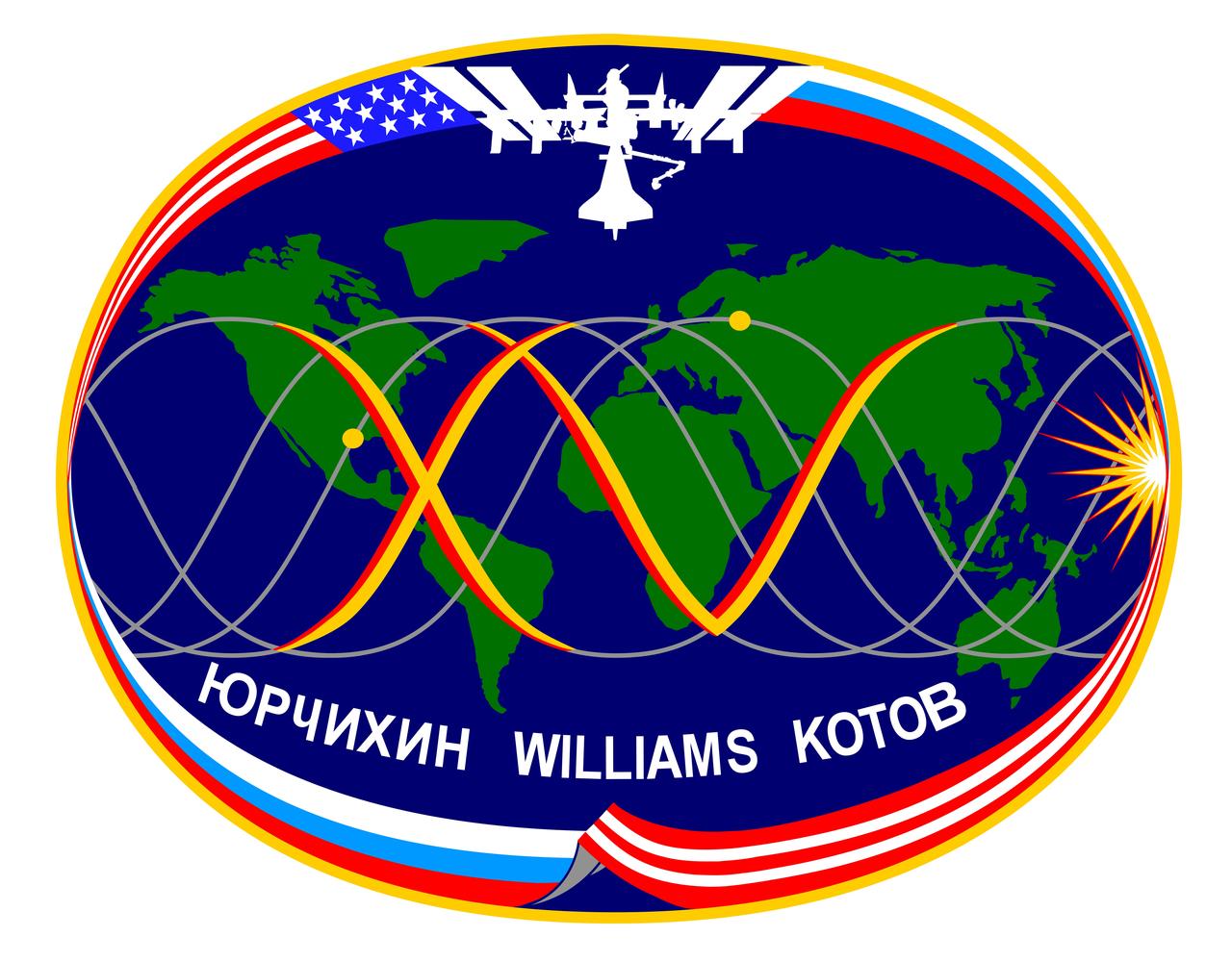
ISS015-S-001A (Nov. 2006) --- The operational teamwork between human space flight controllers and the on-orbit crew take center stage in this emblem. Against a backdrop familiar to all flight controllers, past and present, independent of any nationality, the fifteenth expedition to the ISS is represented in Roman numeral form as part of the ground track traces emblazoned on the Mercator projection of the home planet Earth. The ISS, shown in its fully operational, assembly complete configuration, unfurls and then reunites the flags of this Russian and American crew in a show of our continuing international cooperation. Golden spheres placed strategically on the ground track near the flight control centers of the United States and Russia serve to symbolize both the joint efforts from each nation's team of flight controllers and the shuttle and Soyuz crew vehicles in their chase orbit as they rendezvous with the ISS. A rising sun provides a classic touch to the emblem signifying the perpetual nature of manned space flight operations and their origin in these two space-faring nations. The NASA insignia design for shuttle and space station flights is reserved for use by the astronauts and for other official use as the NASA Administrator may authorize. Public availability has been approved only in the forms of illustrations by the various news media. When and if there is any change in this policy, which is not anticipated, the change will be publicly announced.
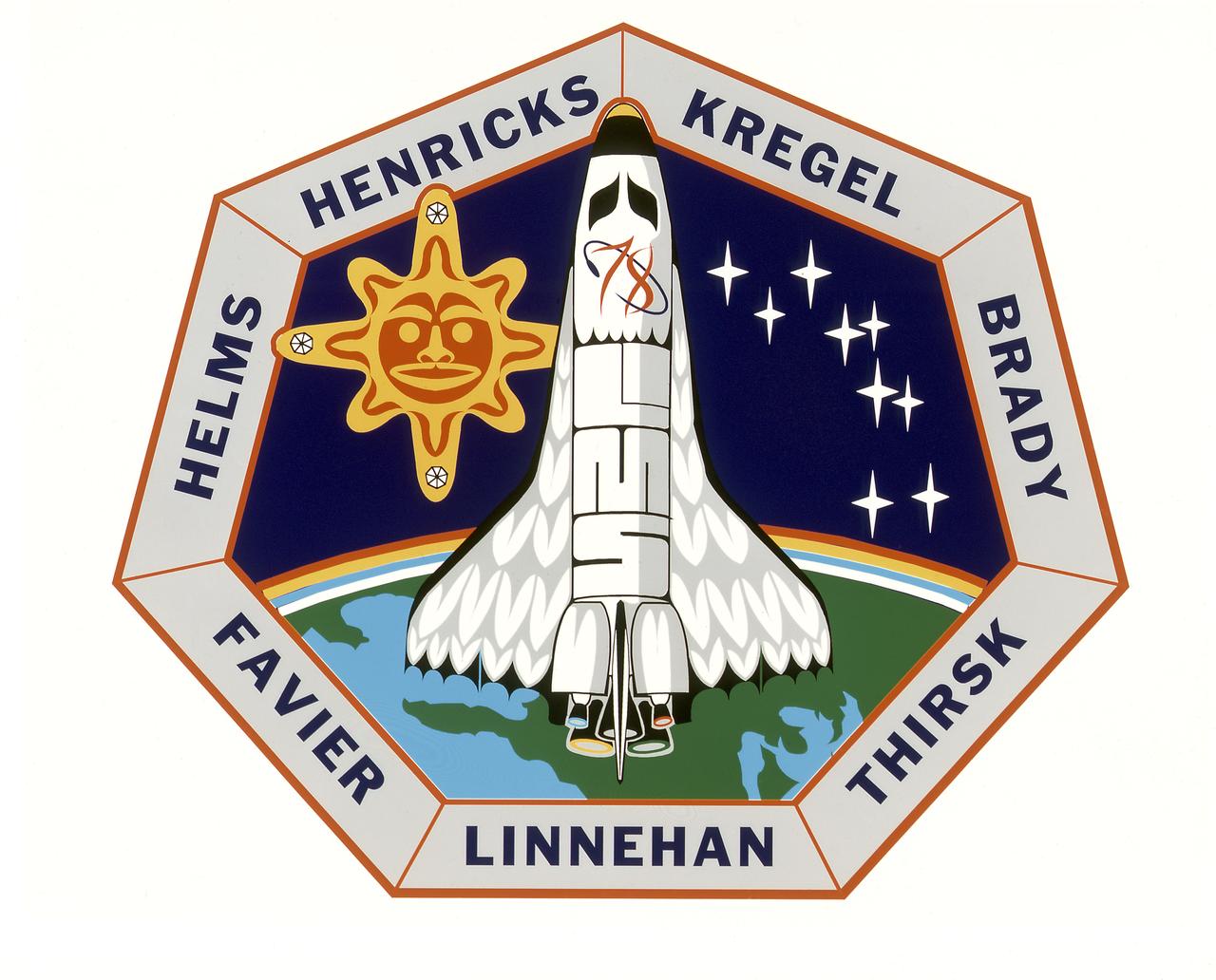
The STS-78 patch links past with present to tell the story of its mission and science through a design imbued with the strength and vitality of the 2-dimensional art of North America's northwest coast Indians. Central to the design is the space Shuttle whose bold lines and curves evoke the Indian image for the eagle, a native American symbol of power and prestige as well as the national symbol of the United States. The wings of the Shuttle suggest the wings of the eagle whose feathers, indicative of peace and friendship in Indian tradition, are captured by the U forms, a characteristic feature of Northwest coast Indian art. The nose of the Shuttle is the strong downward curve of the eagle's beak, and the Shuttle's forward windows, the eagle's eyes, represented through the tapered S forms again typical of this Indian art form. The basic black and red atoms orbiting the mission number recall the original NASA emblem while beneath, utilizing Indian ovoid forms, the major mission scientific experiment package LMS (Life and Materials Sciences) housed in the Shuttle's cargo bay is depicted in a manner reminiscent of totem-pole art. This image of a bird poised for flight, so common to Indian art, is counterpointed by an equally familiar Tsimshian Indian symbol, a pulsating sun with long hyperbolic rays, the symbol of life. Within each of these rays are now encased crystals, the products of this mission's 3 major, high-temperature materials processing furnaces. And as the sky in Indian lore is a lovely open country, home of the Sun Chief and accessible to travelers through a hole in the western horizon, so too, space is a vast and beckoning landscape for explorers launched beyond the horizon. Beneath the Tsimshian sun, the colors of the earth limb are appropriately enclosed by a red border representing life to the Northwest coast Indians. The Indian colors of red, navy blue, white, and black pervade the STS-78 path. To the right of the Shuttle-eagle, the constellation Delphinus recalls the dolphin, friend of ancient sailors and, now perhaps too, of the 9 space voyagers suggested by this constellation's blaze of 9 stars. The patch simultaneously celebrates international unity fostered by the Olympic spirit of sports competition at the 1996 Olympic Games in Atlanta, Georgia, U.S.A. Deliberately poised over the city of Atlanta, the Space Shuttle glows at its base with the 5 official Olympic rings in the 5 Olympic colors which can also be found throughout the patch, rings and colors which signify the 5 continents of the earth. This is an international mission and for the first time in NASA patch history, astronauts have dispensed with identifying country flags beneath their names to celebrate the spirit of international unity so characteristic of this flight.