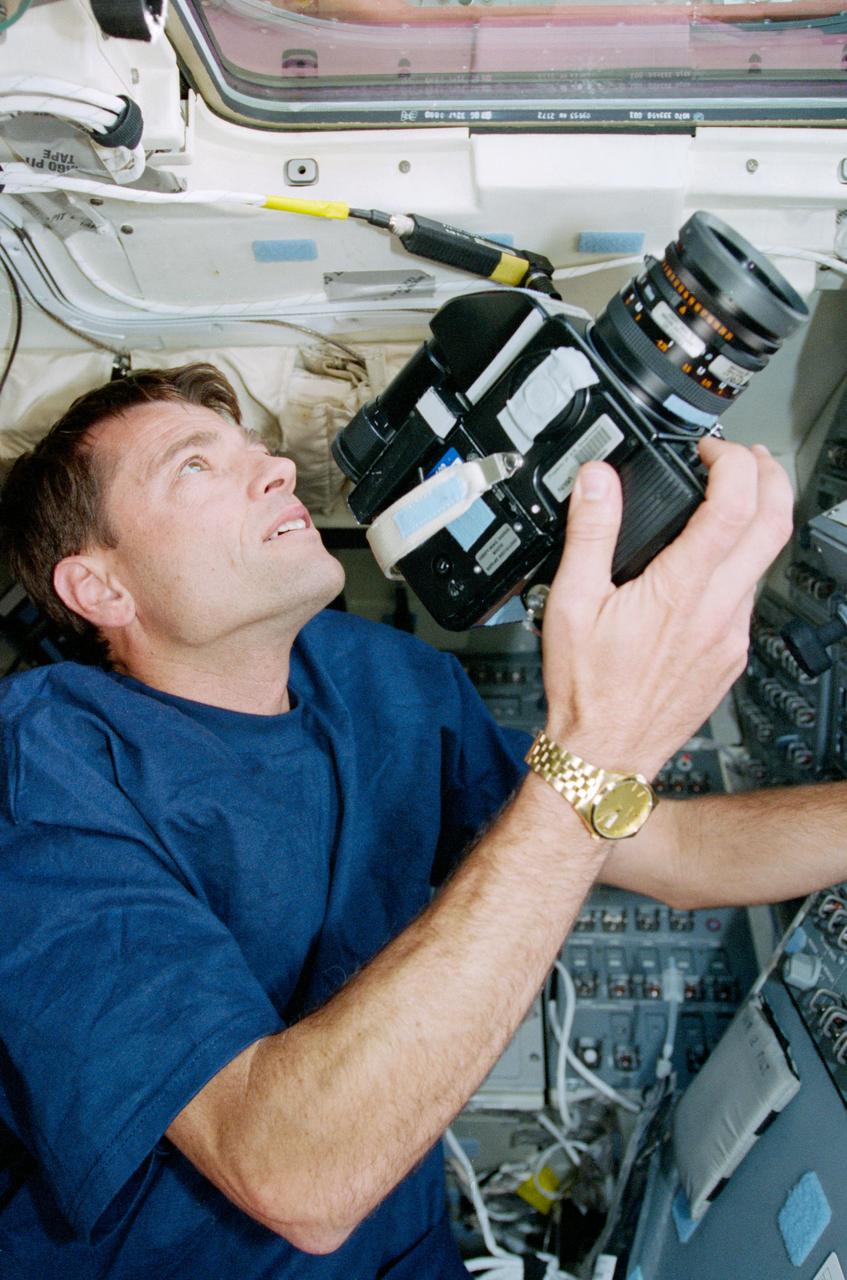
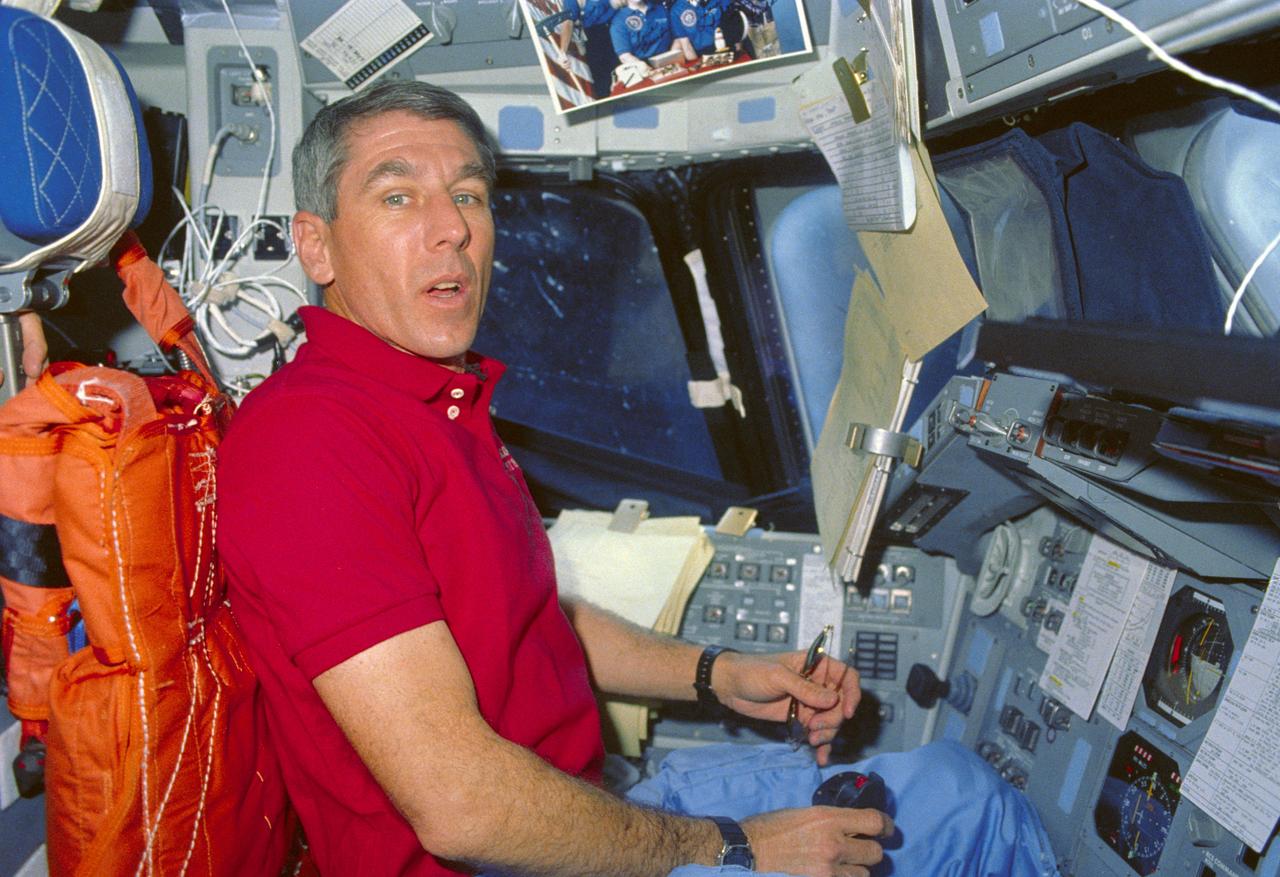
AS07-04-1586 (20 Oct. 1968) --- Astronaut Walter Cunningham, Apollo 7 lunar module pilot, writes with space pen as he is photographed performing flight tasks on the ninth day of the Apollo 7 mission. Note the 70mm Hasselblad camera film magazine just above Cunningham's right hand floating in the weightless (zero gravity) environment of the spacecraft.
Astronaut Walter Cunningham photographed performing flight tasks
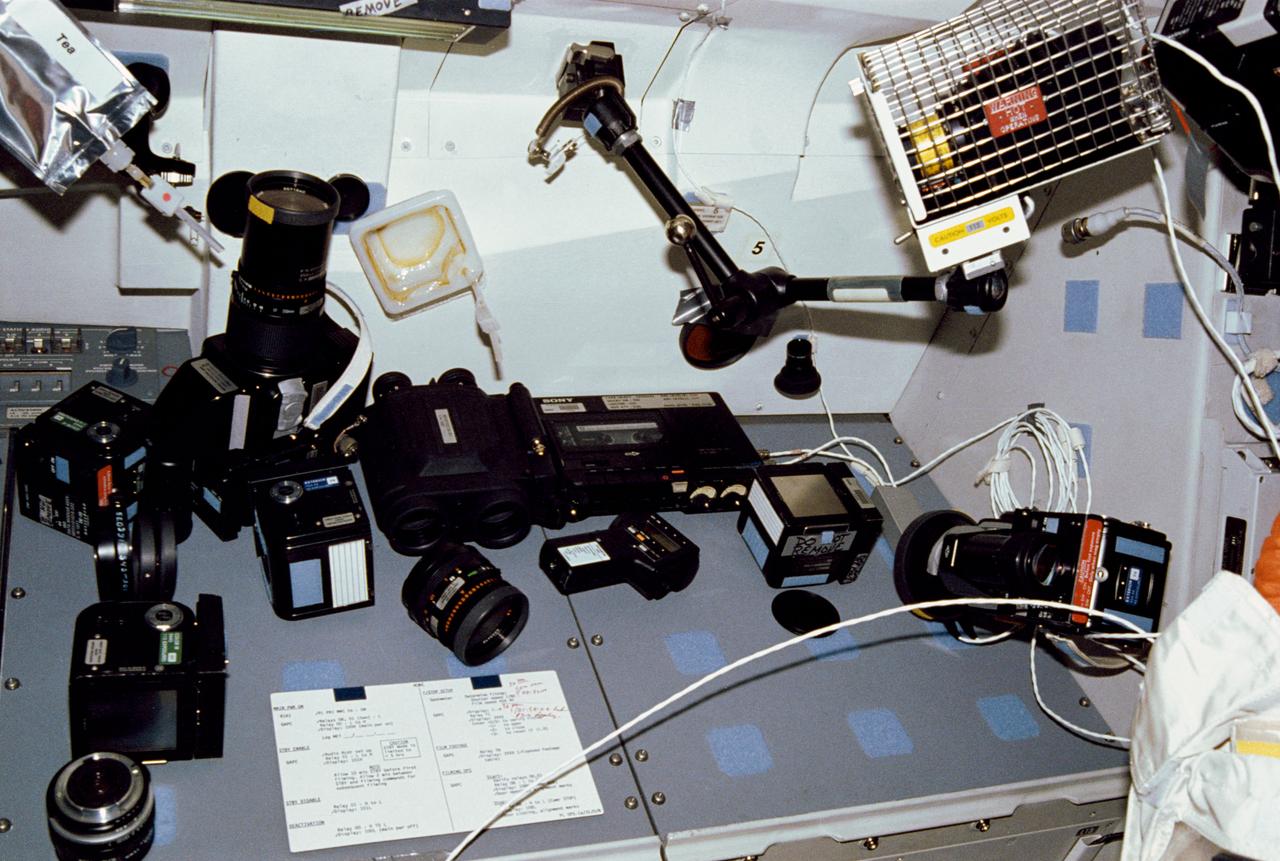
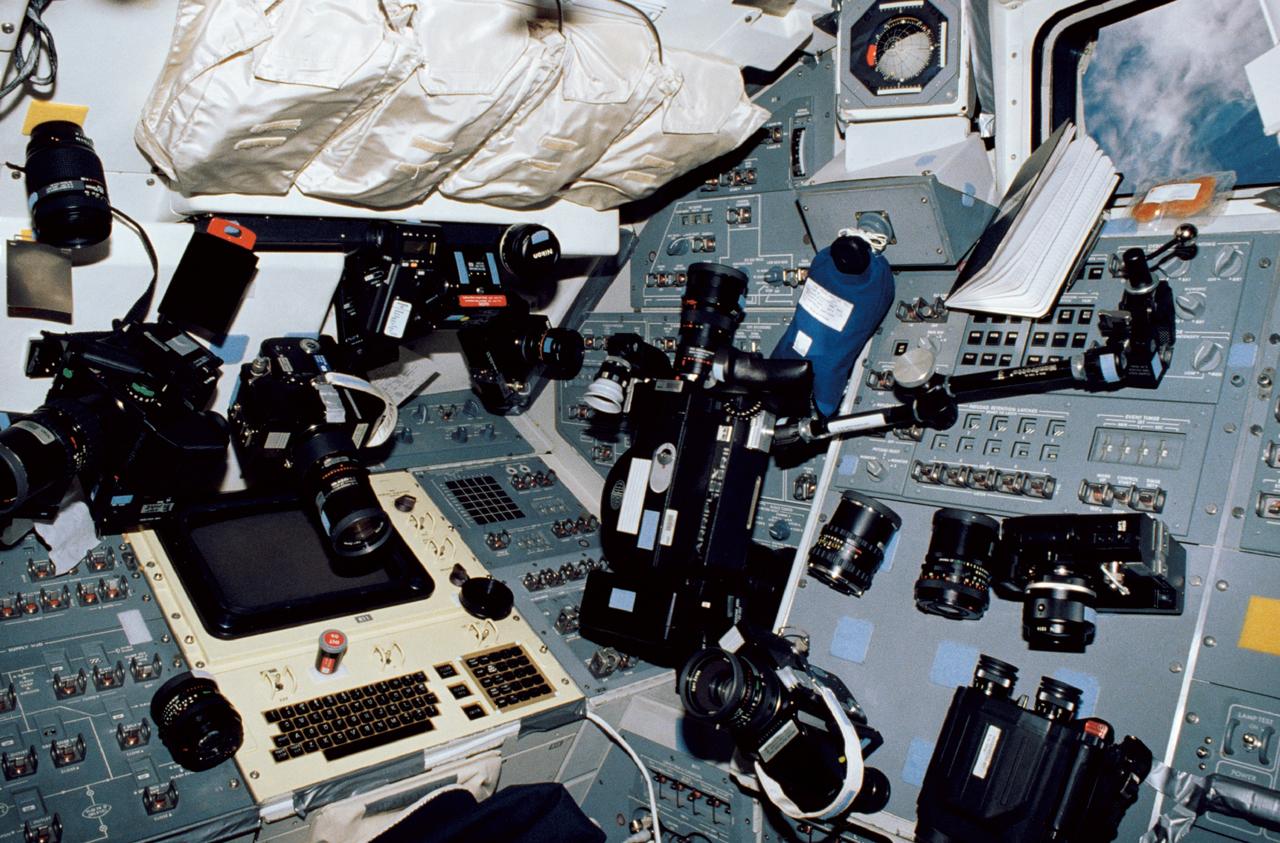
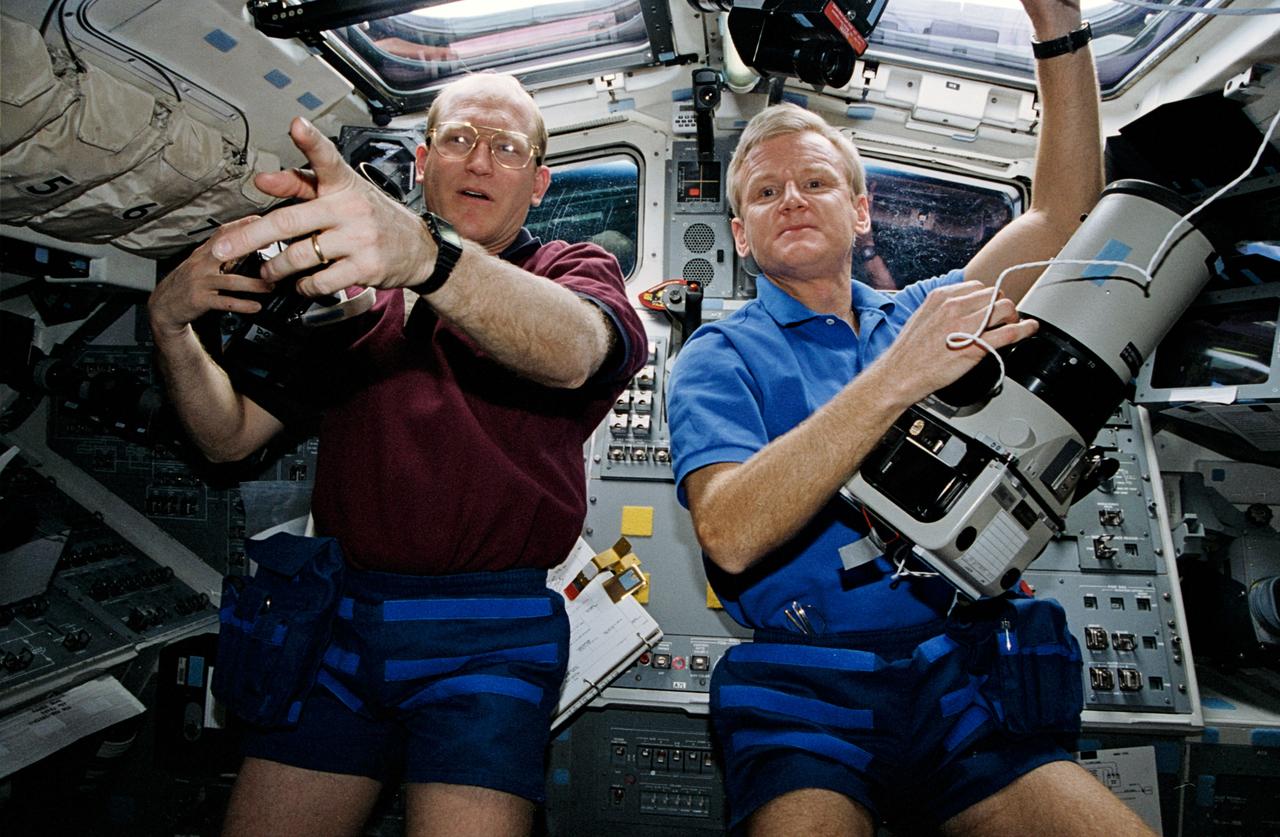
This array of photographic equipment, displayed on the aft flight deck payload station, represents just a part of the imaging and recording hardware which was carried aboard Discovery, Orbiter Vehicle (OV) 103, for STS-31's five day mission. Lenses, film magazines, cassettes, recorders, camera chassis, a pair of binoculars, spot meter, tape recorder, and a bracket-mounted light fixture are included among the array.
STS-31 camera & photographic equipment displayed on OV-103's aft flight deck
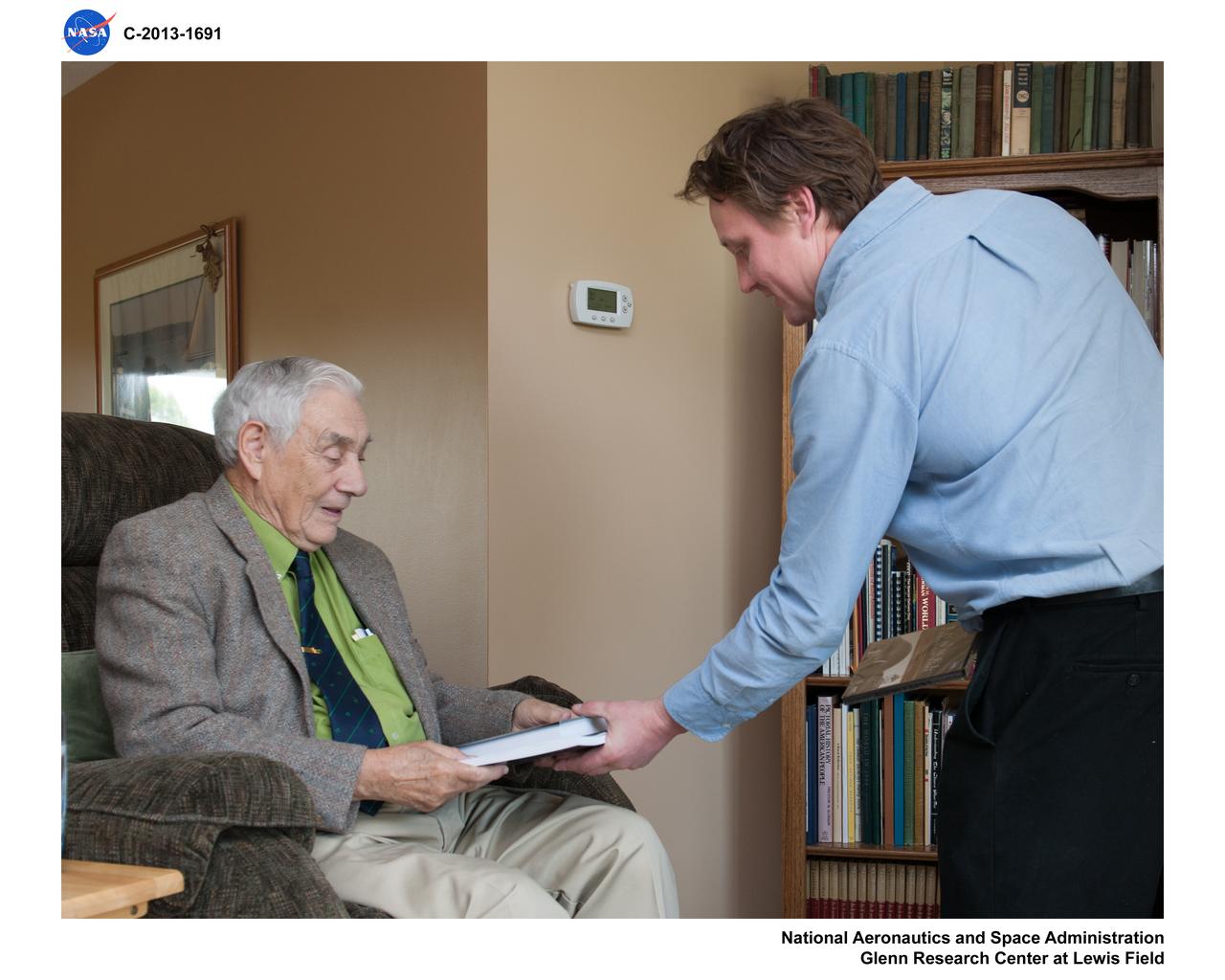
Interview with a NACA, National Advisory Committee for Aeronautics, Flight Photographer, William Wynne
GRC-2013-C-01691
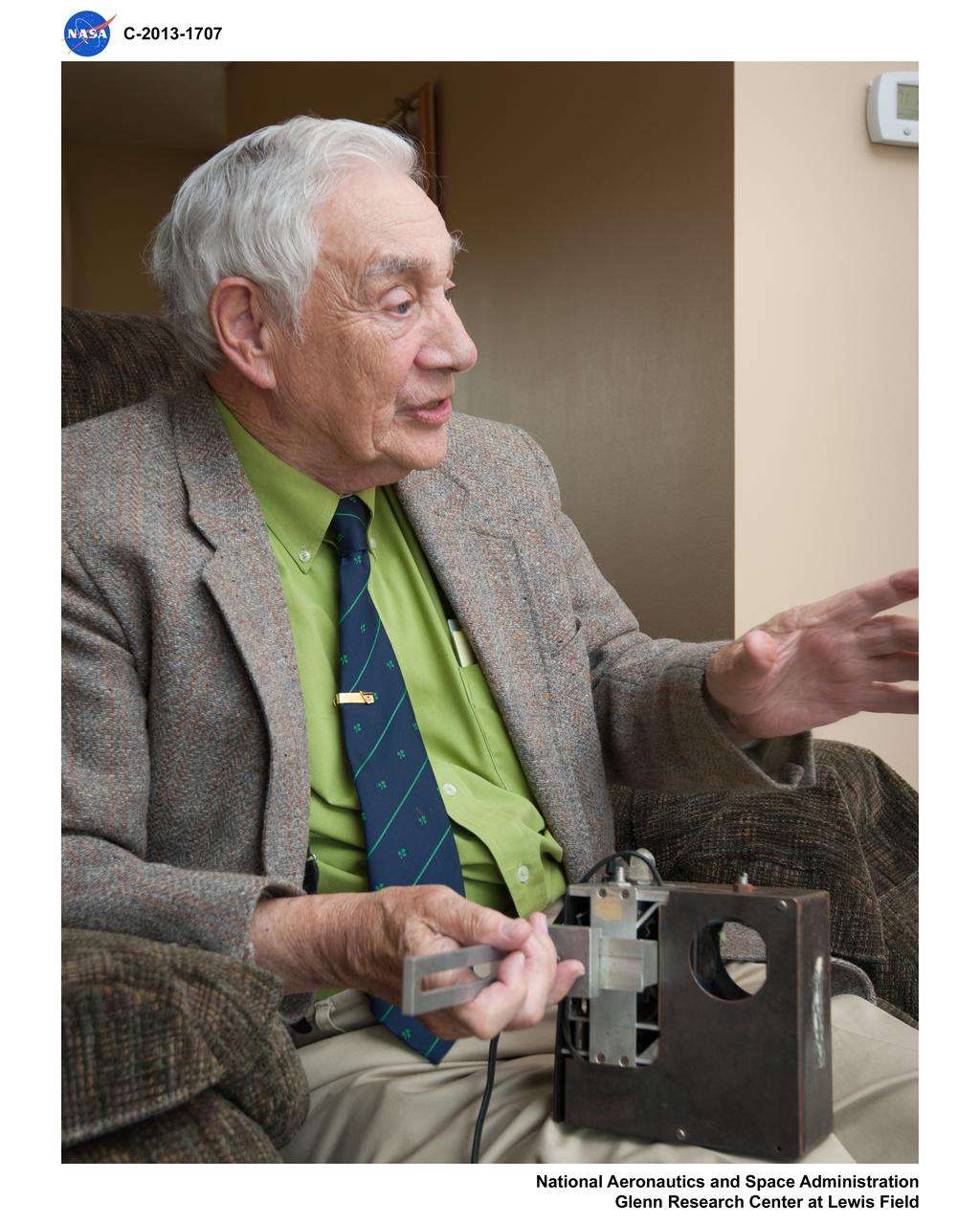
Interview with a NACA, National Advisory Committee for Aeronautics, Flight Photographer, William Wynne.
GRC-2013-C-01707
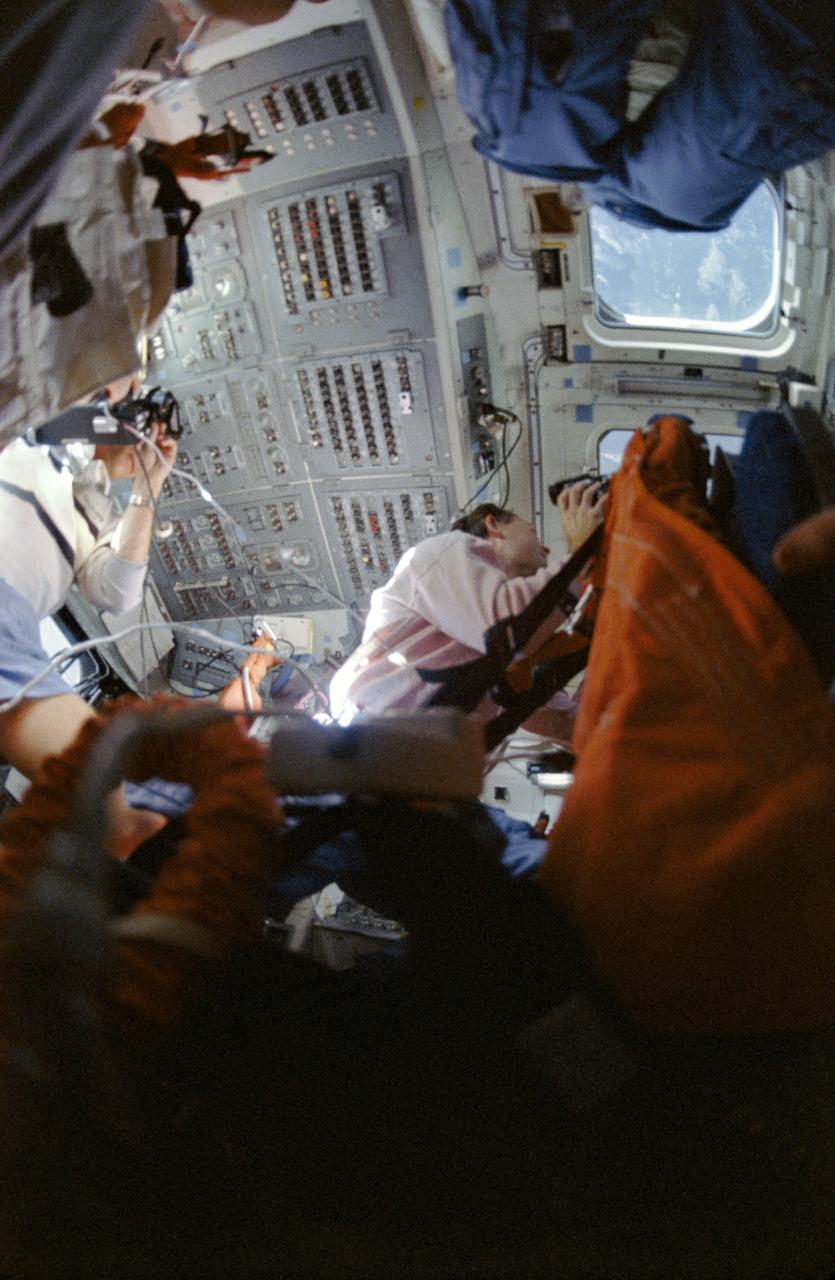
STS035-10-015 (2-10 Dec 1990) --- This busy scene shows cameras and supportive photographic gear temporarily stowed on Space Shuttle Columbia's aft flight deck. It was photographed with a 35mm camera by astronaut Jeffrey A. Hoffman, mission specialist, who called the cluster a "camera forest." The seven STS-35 crewmembers trained to record a wide variety of imagery with an equally broad range of equipment. In addition to cameras, a spot meter, film, a pair of binoculars, a bracket, lenses, lens cleaner and other photographic equipment are in the scene. Clouds over ocean waters are framed by an aft flight deck window at upper right.
STS-35 aft flight deck of Columbia, OV-102, with an array of camera equipment
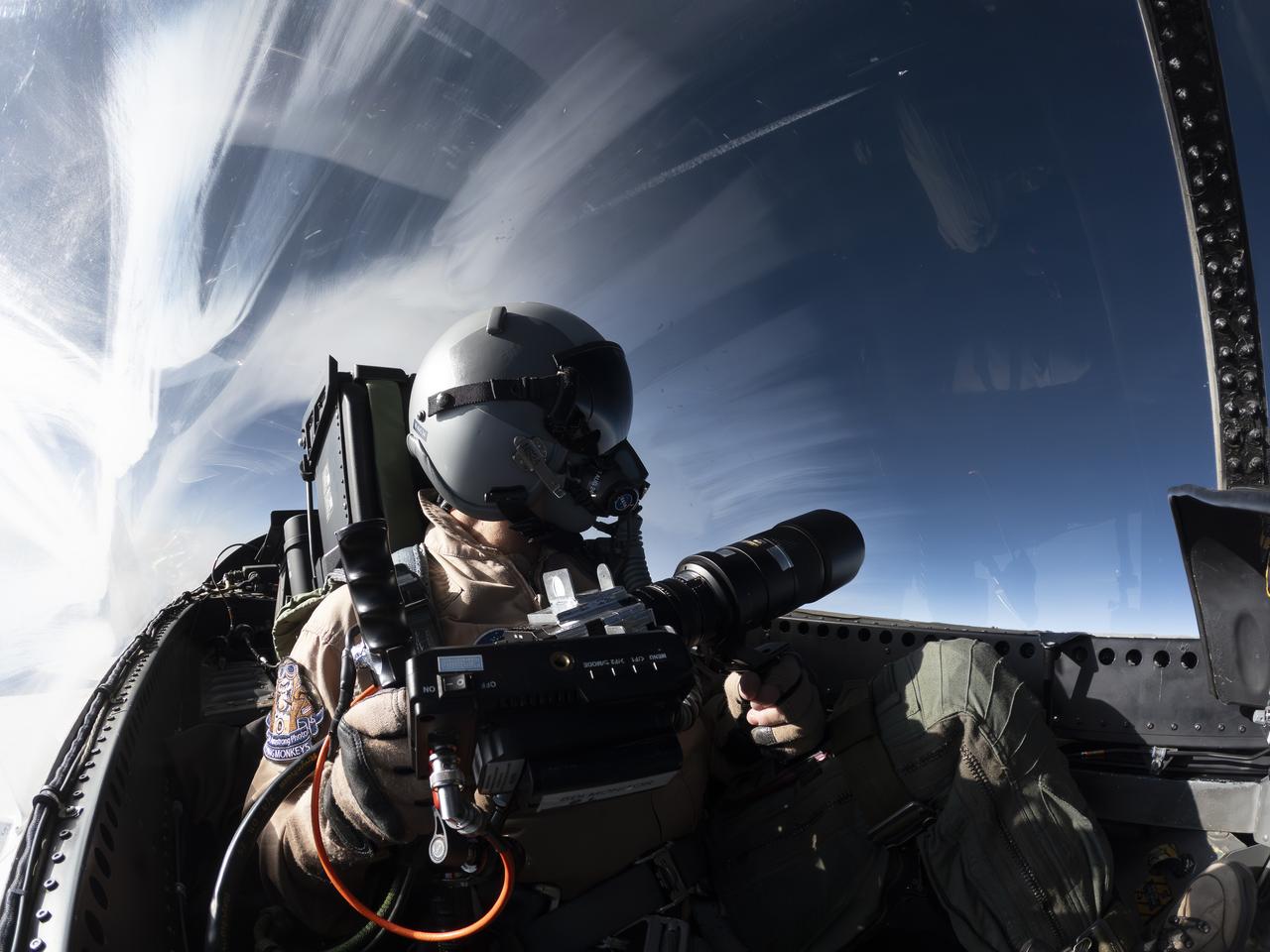
NASA Photographer Carla Thomas holds the Airborne Schlieren Photography System (ASPS), aiming it out the window in flight. The ASPS uses a photographic method called schlieren imaging, capable of visualizing changes in air density and revealing shock waves and air flow patterns around moving objects. The system is one of several tools validated during recent dual F-15 flights at NASA’s Armstrong Flight Research Center in Edwards, California, in support of NASA’s Quesst mission, ahead of the X-59’s first flight.
NASA Photographer Uses Schlieren Photography System
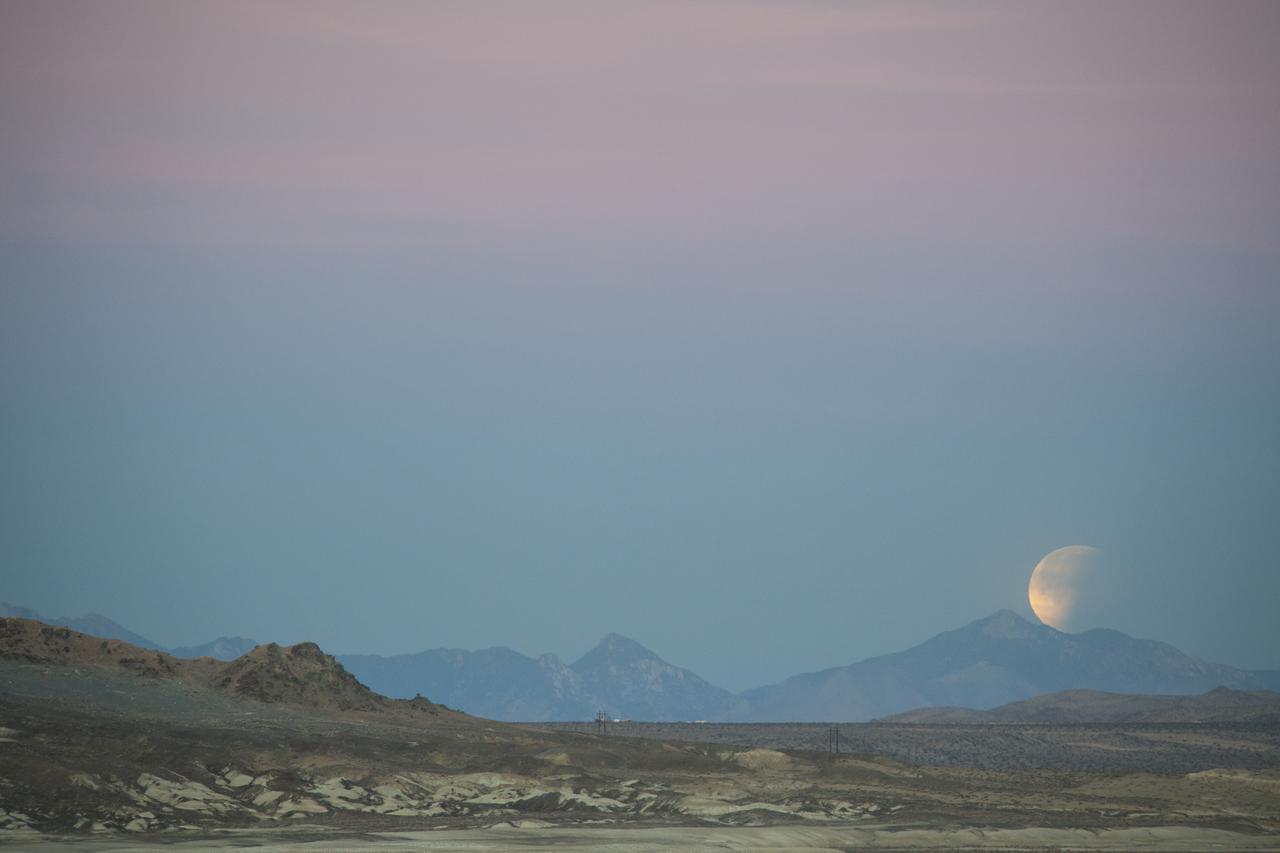
California's NASA Armstrong Flight Research Center photographer Carla Thomas takes photos on January 31 of the rare opportunity to capture a supermoon, a blue moon and a lunar eclipse at the same time. A supermoon occurs when the Moon is closer to Earth in its orbit and appearing 14 percent brighter than usual. As the second full moon of the month, this moon is also commonly known as a blue moon, though it will not be blue in appearance. The super blue moon will pass through Earth's shadow and take on a reddish tint, known as a blood moon. This total lunar eclipse occurs when the Sun, Earth, and a full moon form a near-perfect lineup in space. The Moon passes directly behind the Earth into its umbra (shadow).
NASA photographer captures Super Blue Blood Moon beginning its eclipse January 31 from NASA's Armstrong Flight Research Center on the West Coast.
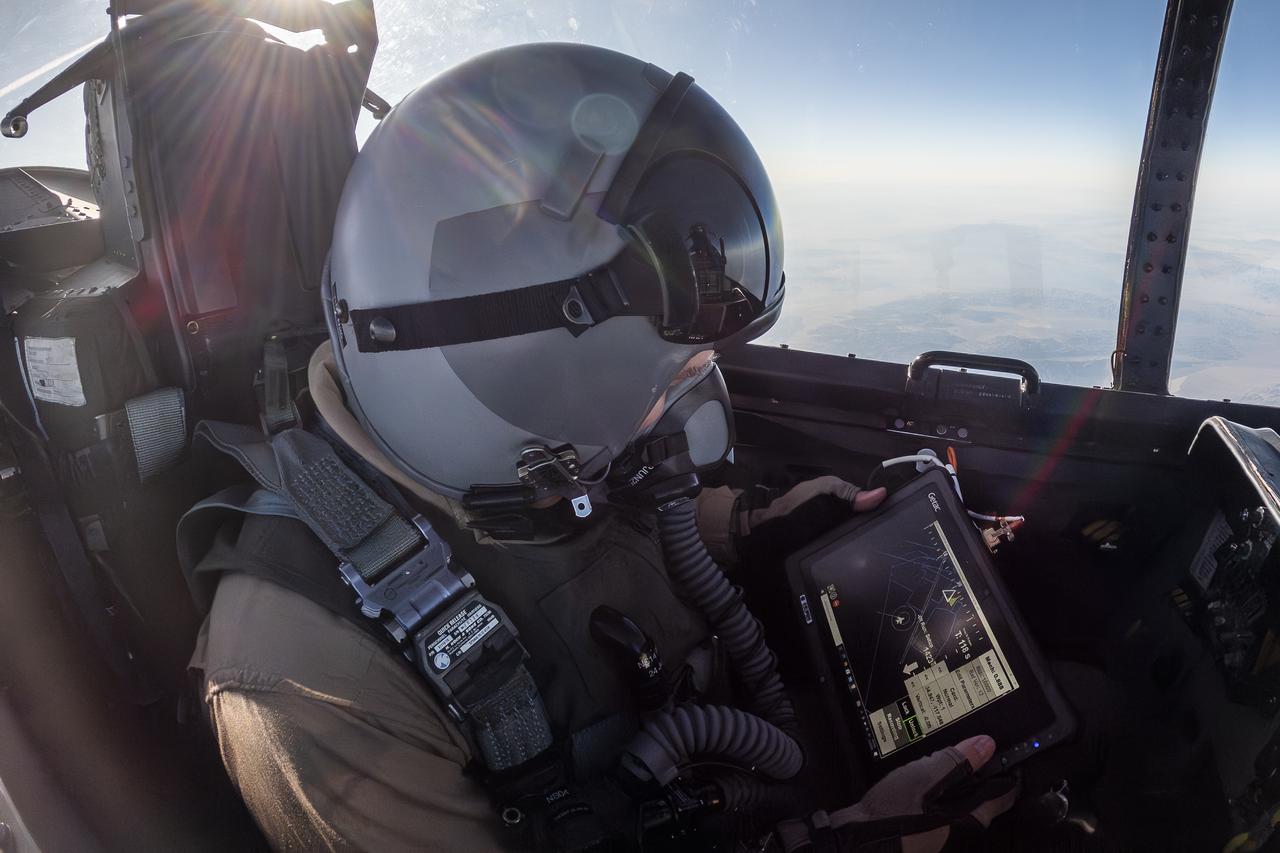
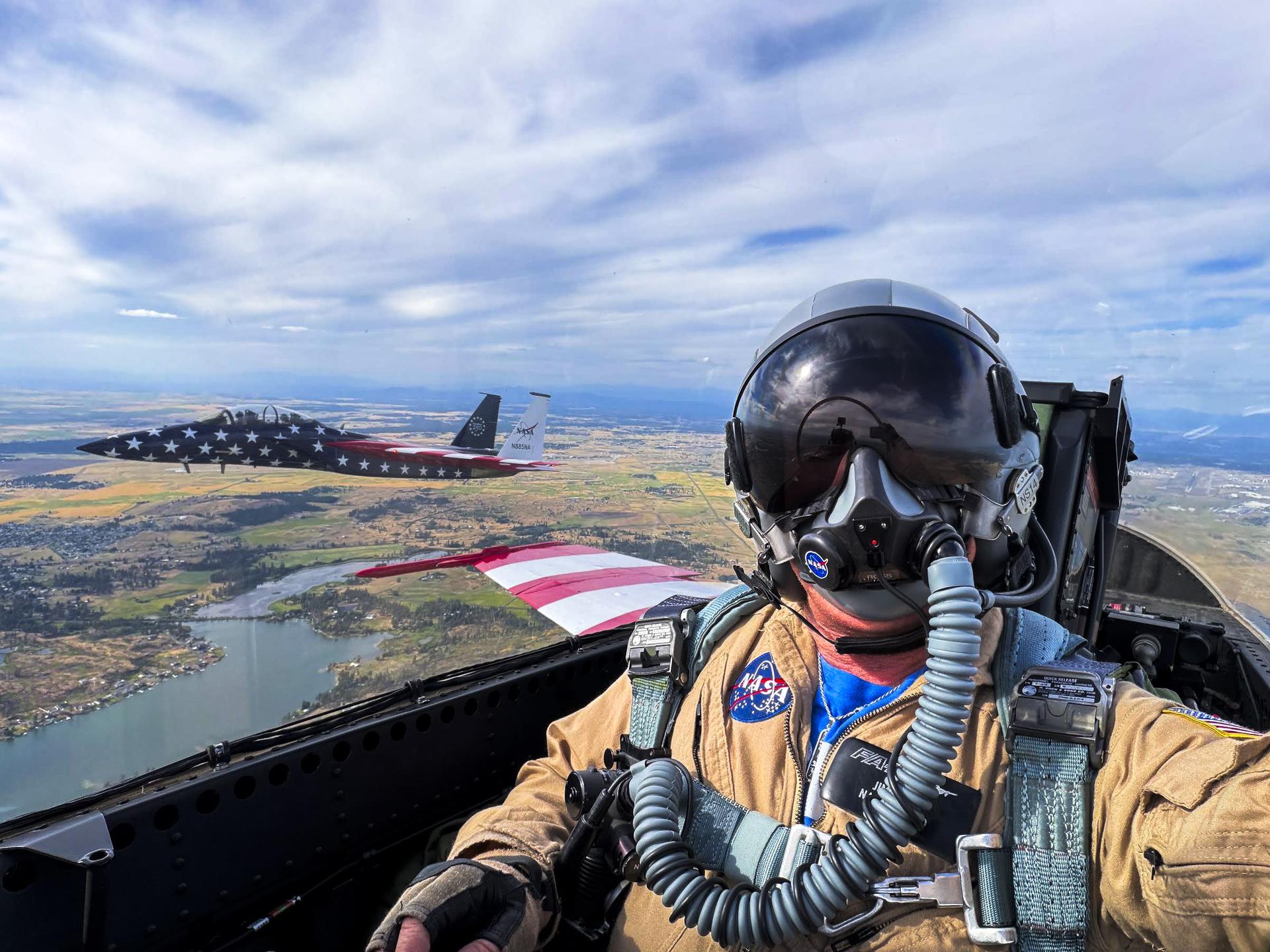
NASA photographer James Ross monitors the Airborne Location Integrating Geospatial Navigation System (ALIGNS) from the backseat of an F-15 near NASA’s Armstrong Flight Research Center in Edwards, California. The ALIGNS provides real-time positioning guidance between aircraft for shock wave probing and schlieren imagery capture.
NASA Photographer Tracks Airborne Location Integrating Geospatial Navigation System
AS15-98-13311 (31 July 1971) --- The solar corona, as photographed from the Apollo 15 spacecraft about one minute prior to sunrise on July 31, 1971, is seen just beyond the lunar horizon. The bright object on the opposite of the frame is the planet Mercury. The bright star near the frame center is Regulus, and the lesser stars form the head of the constellation Leo. Mercury is approximately 28 degrees from the center of the sun. The solar coronal streamers, therefore, appear to extend about eight degrees from the sun's center. This solar corona photograph was the second in a series of seven. Three such series were obtained by astronaut Alfred M. Worden, command module pilot, during the solo part of his lunar orbital flight. They represent man's first view of this part of the sun's light. While astronauts David R. Scott, commander, and James B. Irwin, lunar module pilot, descended in the Lunar Module (LM) "Falcon" to explore the Hadley-Apennine area of the moon, astronaut Worden remained with the Command and Service Modules (CSM) in lunar orbit.
Solar corona photographed from Apollo 15 one minute prior to sunrise
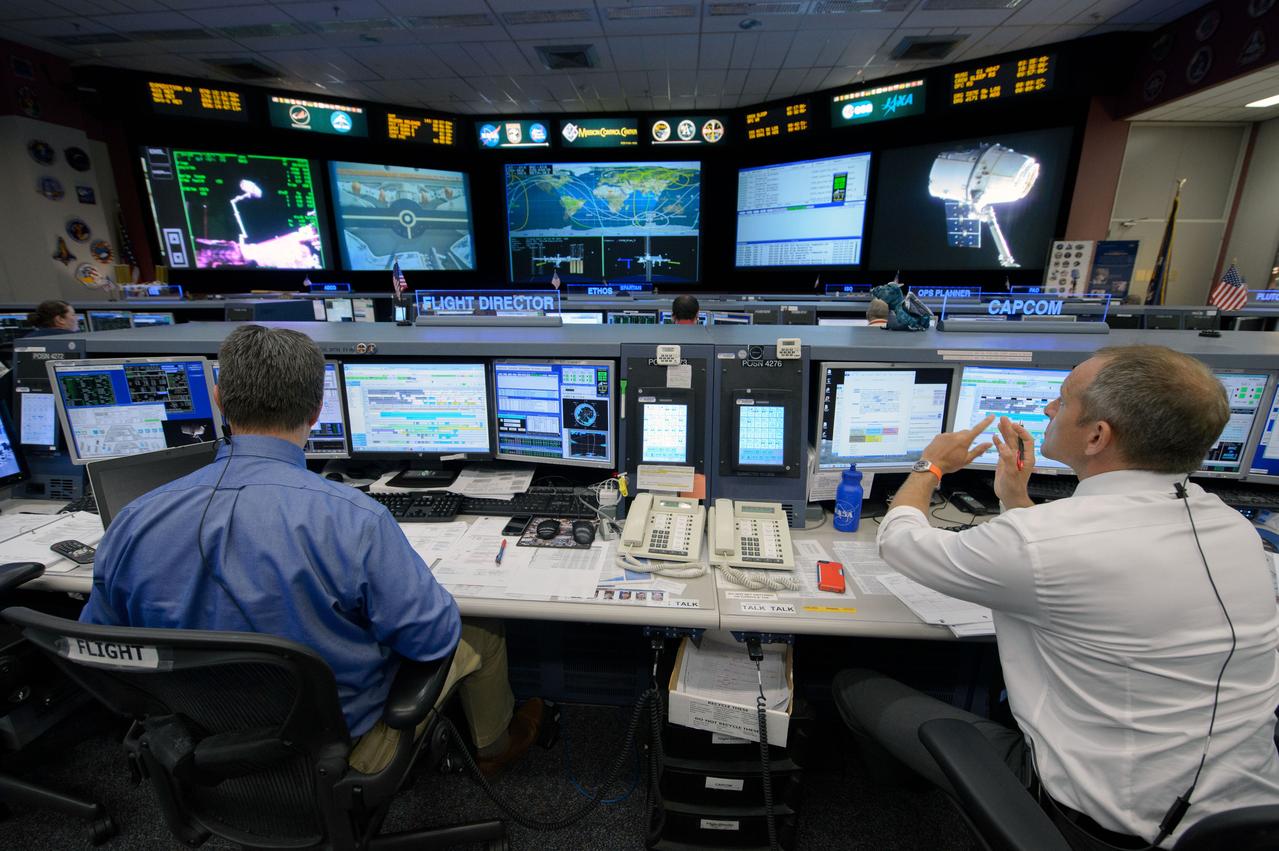
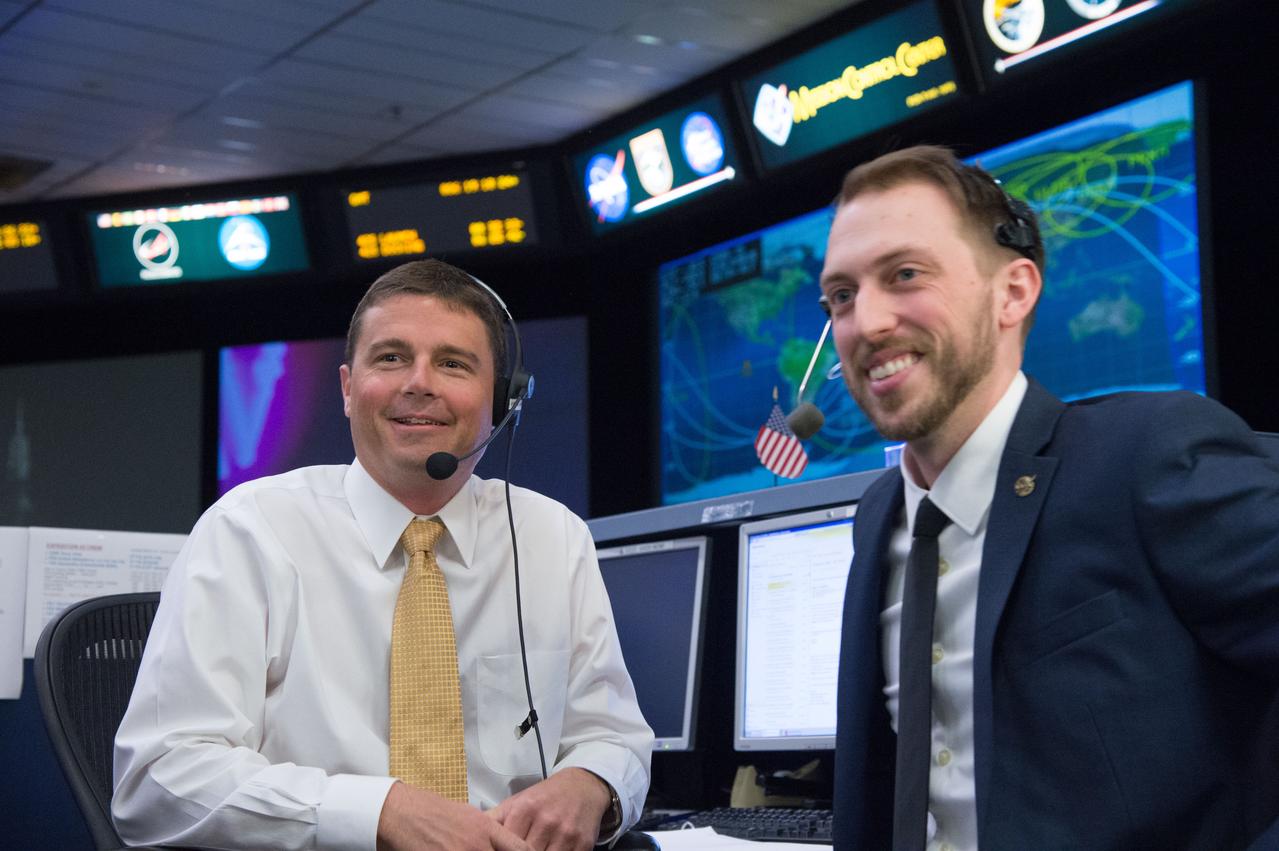
Expedition 43 flight control team with Flight Director Gary Horlacher during the release of SpaceX Dragon cargo vehicle.  Photo Date: May 21, 2015.  Location: Building 30 - FCR1.  Photographer: Robert Markowitz
Expedition 43 flight control team with Flight Director Gary Horlacher during the release of SpaceX Dragon cargo vehicle. Photo Date: May 21, 2015. Location: Building 30 - FCR1. Photographer: Robert Markowitz
STS093-327-016 (23-27 July 1999) --- Astronaut Jeffrey S. Ashby, pilot, prepares to take a still photograph  from Columbia's flight deck.  Ashby and  four other astronauts spent almost five  days in Earth orbit in July 1999.
STS-93 Pilot Ashby takes some photographs of the Earth from the flight deck
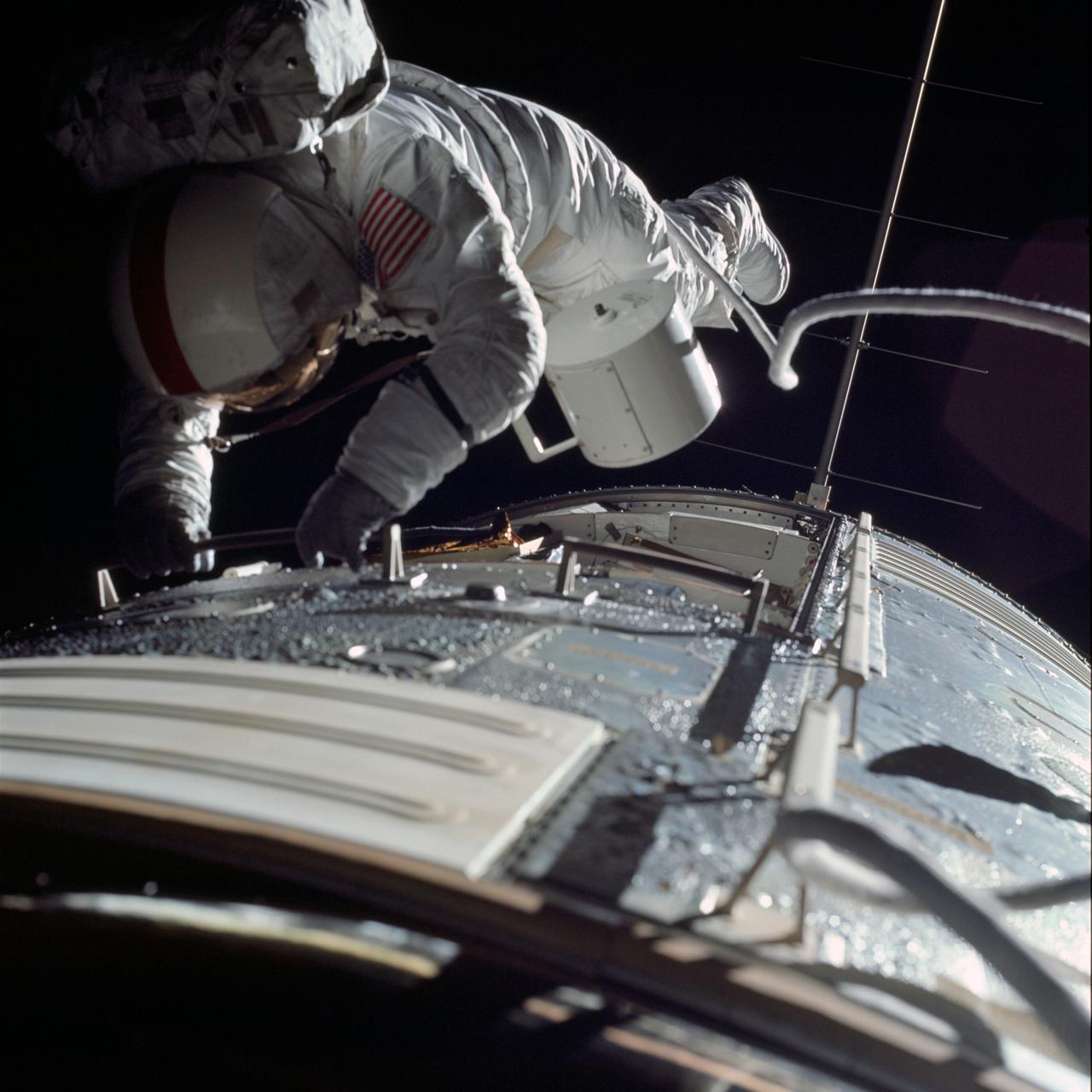
AS17-152-23393 (17 Dec. 1972) --- Astronaut Ronald E. Evans is photographed performing extravehicular activity during the Apollo 17 spacecraft's trans-Earth coast. During his EVA, command module pilot Evans retrieved film cassettes from the Lunar Sounder, Mapping Camera, and Panoramic Camera. The cylindrical object at Evans' left side is the Mapping Camera cassette. The total time for the trans-Earth EVA was one hour seven minutes 18 seconds, starting at ground elapsed time of 257:25 (2:28 p.m.) and ending at ground elapsed timed of 258:42 (3:35 p.m.) on Sunday, Dec. 17, 1972.
Astronaut Ronald Evans photographed during transearth coast EVA
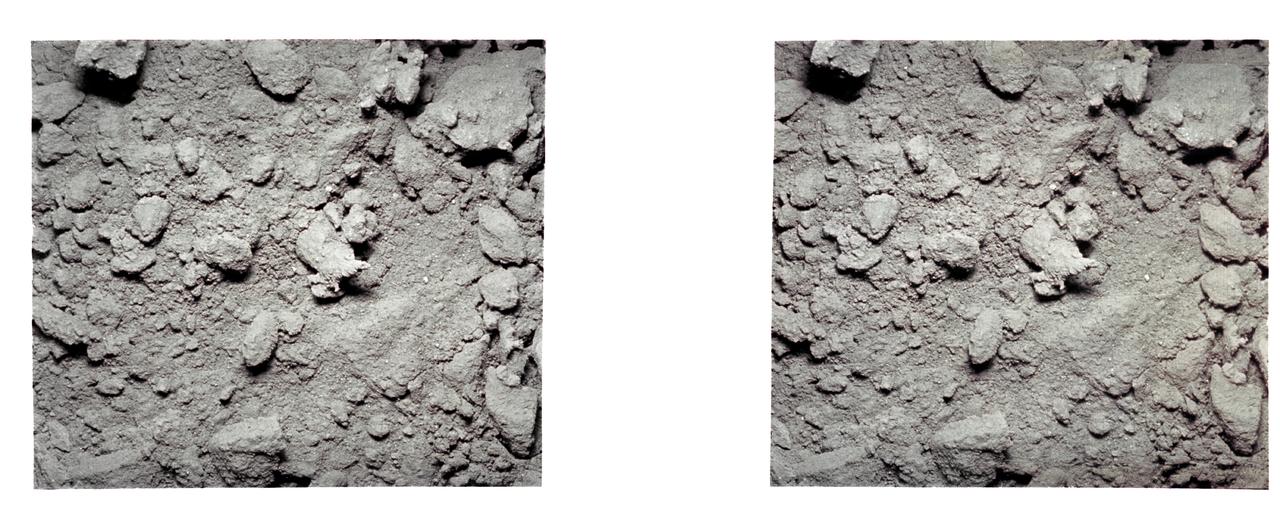
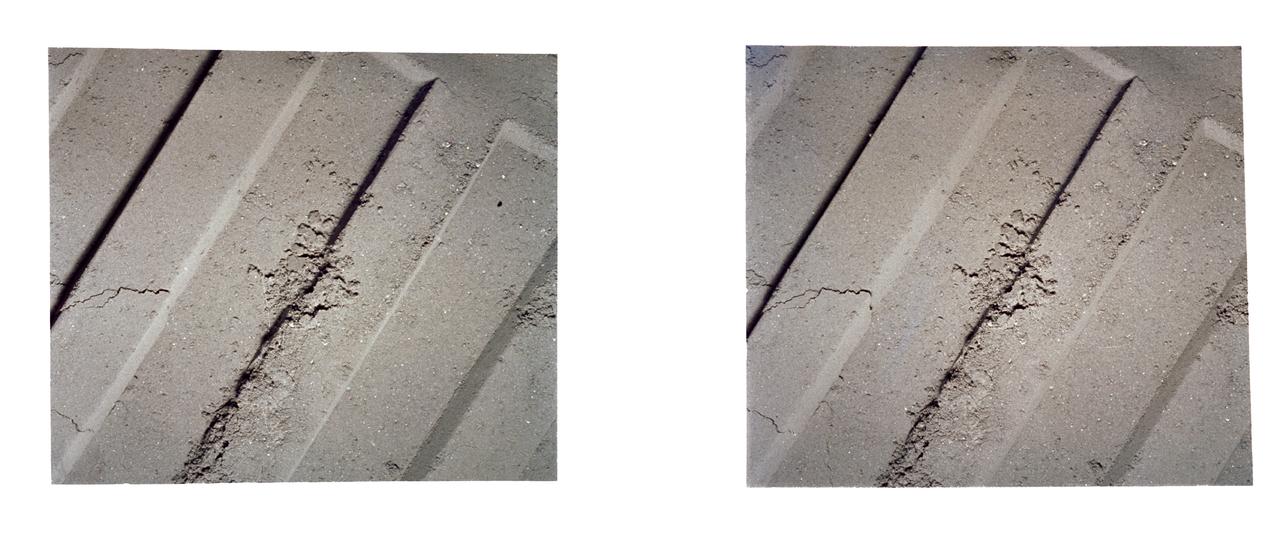
AS12-57-8455 (19-20 Nov. 1969) --- An Apollo 12 stereo view showing a three-inch square of the lunar surface. The exposure was made with an Apollo 35mm stereo close-up camera during extravehicular activity of the Apollo 12 lunar landing mission. The camera was developed to get the highest possible resolution of a small area. The three-inch square is photographed with a flash illumination and at a fixed distance. The camera is mounted on a walking stick, and the astronauts use it by holding it up against the object to be photographed and pulling the trigger. Astronauts Charles Conrad Jr., commander, and Alan L. Bean, lunar module pilot, descended in the Apollo 12 Lunar Module to explore the moon while astronaut Richard F. Gordon Jr. remained with the Command and Service Modules in lunar orbit in the capacity of command module pilot.
Apollo 12 stereo view of lunar surface
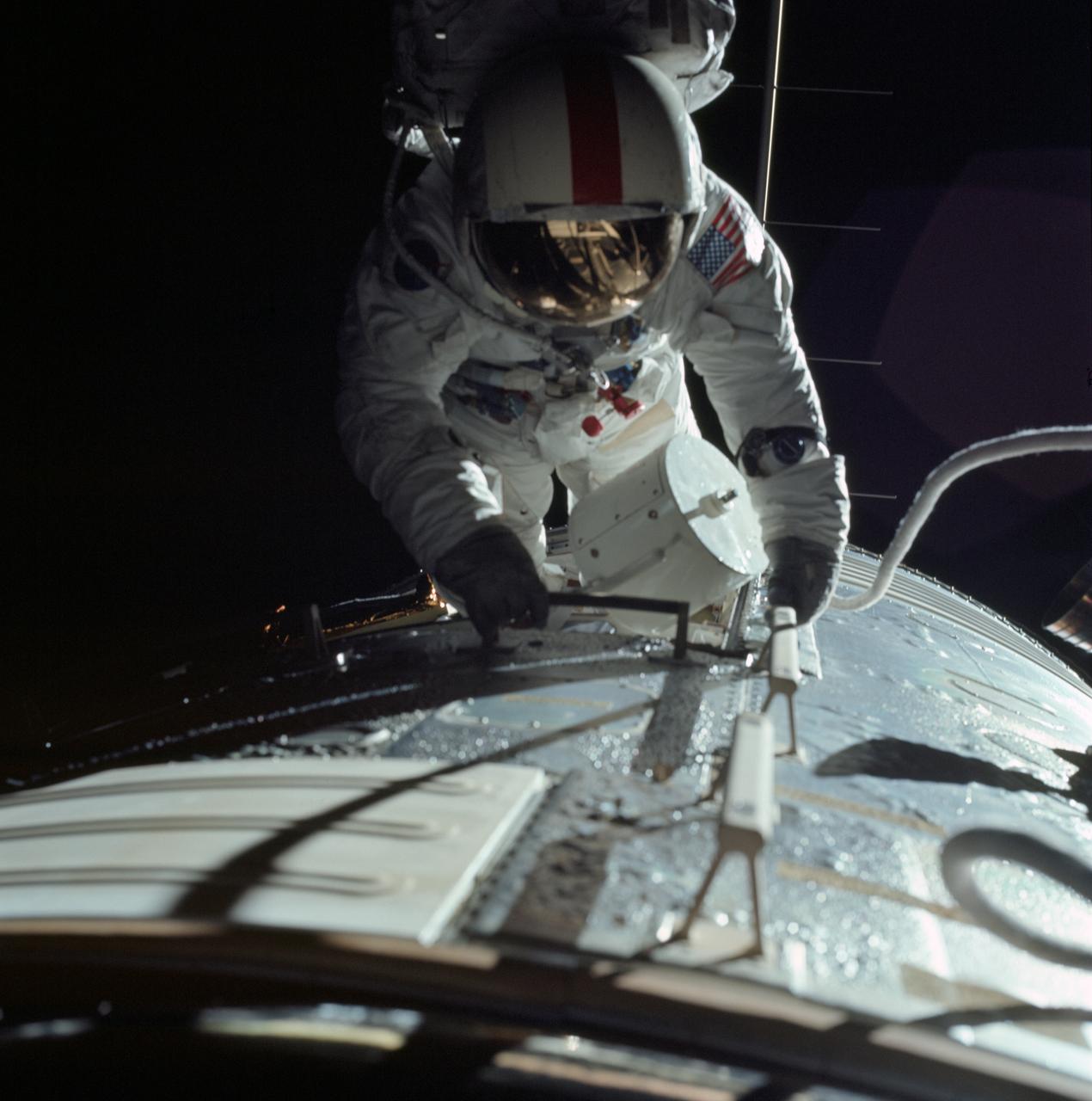
AS17-152-23391 (17 Dec. 1972) --- Astronaut Ronald E. Evans is photographed performing extravehicular activity during the Apollo 17 spacecraft's trans-Earth coast. During his EVA, Evans, command module pilot, retrieved film cassettes from the lunar sounder, mapping camera and panoramic camera. The cylindrical object at Evans' left side is the mapping camera cassette. The total time for the trans-Earth EVA was one hour, seven minutes, 18 seconds, starting at ground elapsed time of 257:25 (2:28 p.m.) and ending at G.E.T. of 258:42 (3:35 p.m.) on Sunday, Dec. 17, 1972.
Astronaut Ronald Evans photographed during transearth coast EVA
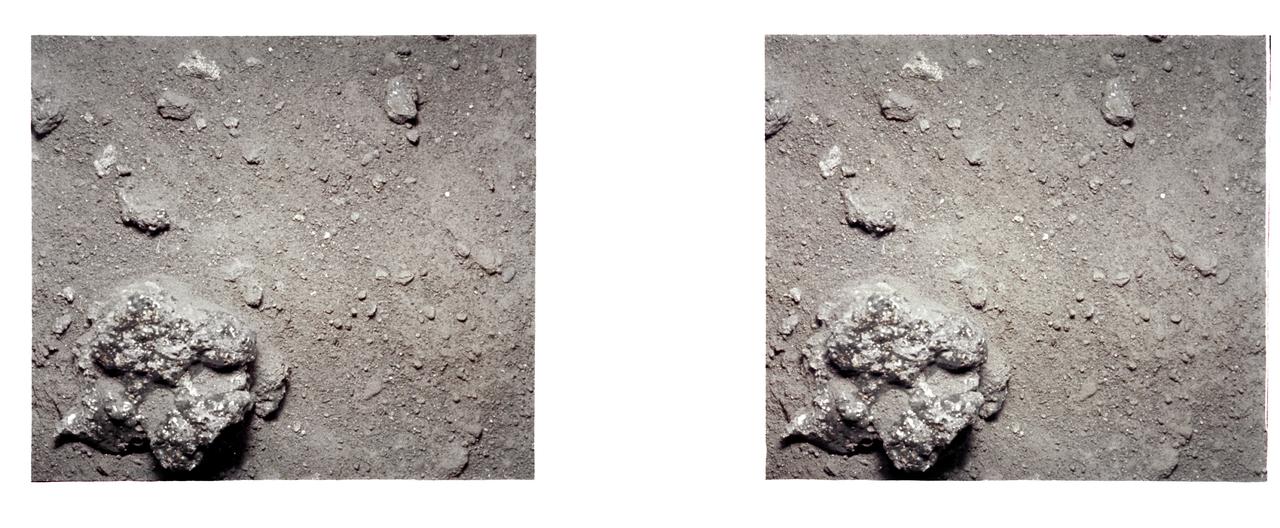
AS12-57-8452 (19-20 Nov. 1969) --- An Apollo 12 stereo view showing a three-inch square of the lunar surface. The exposure was made with an Apollo 35mm stereo close-up camera during extravehicular activity of the Apollo 12 lunar landing mission. The camera was developed to get the highest possible resolution of a small area. The three-inch square is photographed with a flash illumination and at a fixed distance. The camera is mounted on a walking stick, and the astronauts use it by holding it up against the object to be photographed and pulling the trigger. Astronauts Charles Conrad Jr., commander, and Alan L. Bean, lunar module pilot, descended in the Apollo 12 Lunar Module to explore the moon while astronaut Richard F. Gordon Jr. remained with the Command and Service Modules in lunar orbit in the capacity of command module pilot.
Apollo 12 stereo view of lunar surface
STS033-05-014A (22-27 Nov 1989) --- A low-angle view of STS-33's two astronaut medical doctors doubling as photographers and Earth observers on the flight deck of the Earth-orbiting Space Shuttle Discovery.  Astronauts Story Musgrave, left, and Manley L. Carter and three other crewmembers shared five days aboard the Discovery for this DOD-devoted mission.
STS-33 crewmembers on OV-103's aft flight deck photograph Earth observations
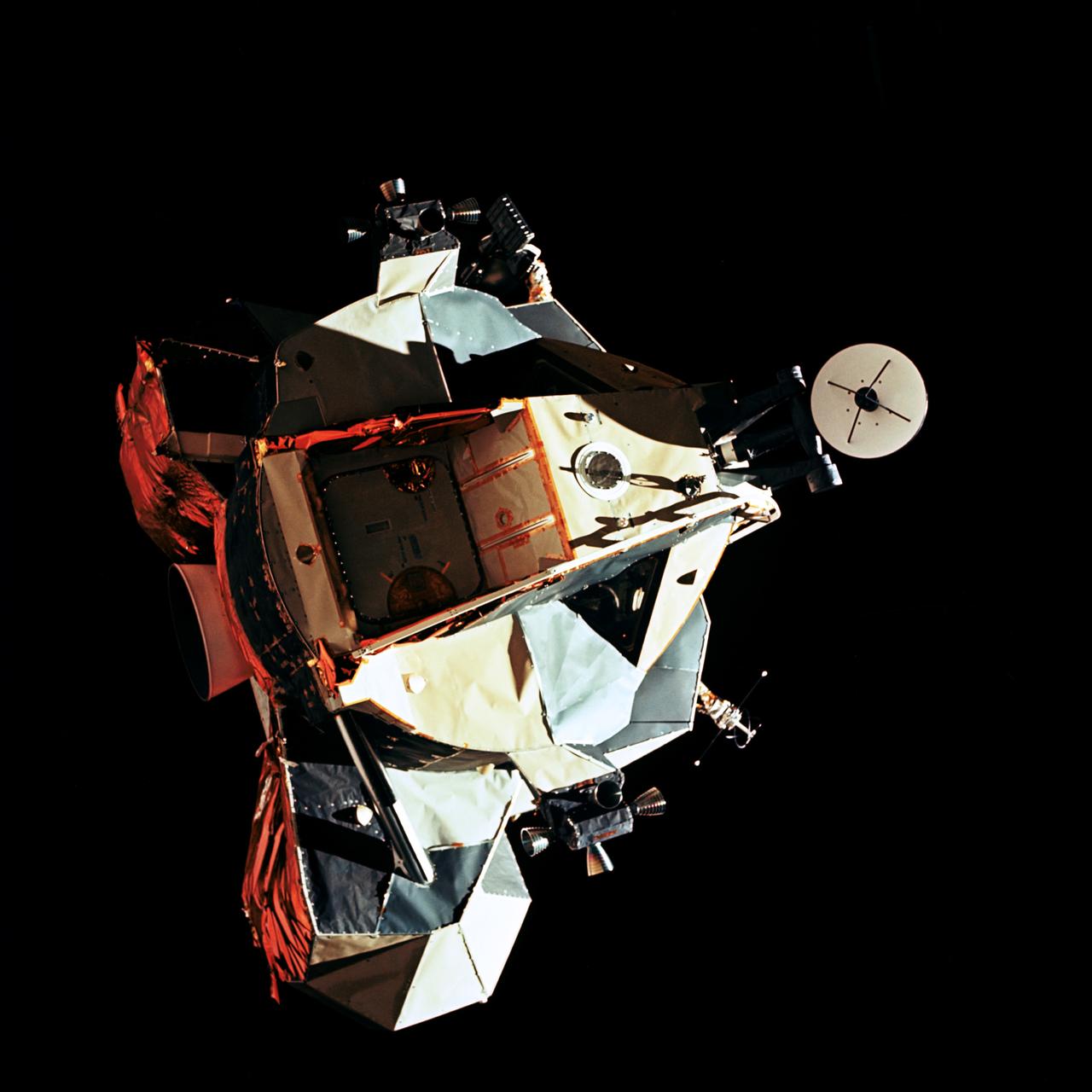
AS17-149-22857 (14 Dec. 1972) --- This 70mm view of the Lunar Module (LM) "Challenger" in lunar orbit before rendezvous with the Apollo 17 Command and Service Modules (CSM). While astronauts Eugene A. Cernan, commander, and Harrison H. Schmitt, lunar module pilot, descended in the Challenger to explore the Taurus-Littrow region of the moon, astronaut Ronald E. Evans, command module pilot, remained with the CSM "America" in lunar orbit.
View of the Lunar Module "Challenger" in lunar orbit
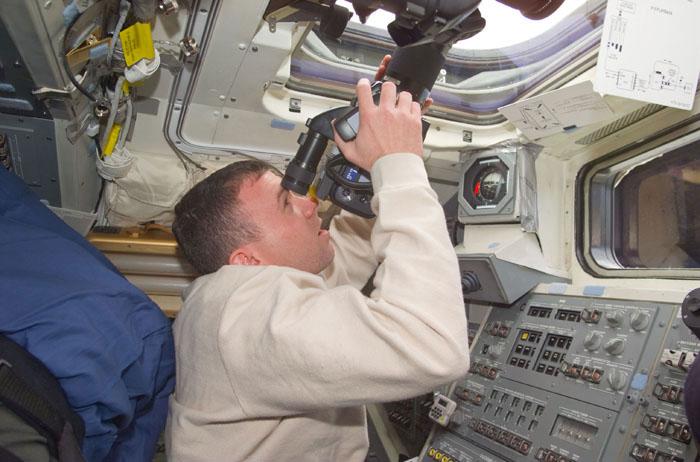
STS102-E-5008 (9 March 2001) --- Astronaut James M. Kelly, pilot,   aims a camera through an overhead window on the aft flight deck of the  Earth-orbiting Space Shuttle Discovery   late on the initial day in space for   the STS-102 crew.
Pilot Kelly photographs the Earth from the flight deck
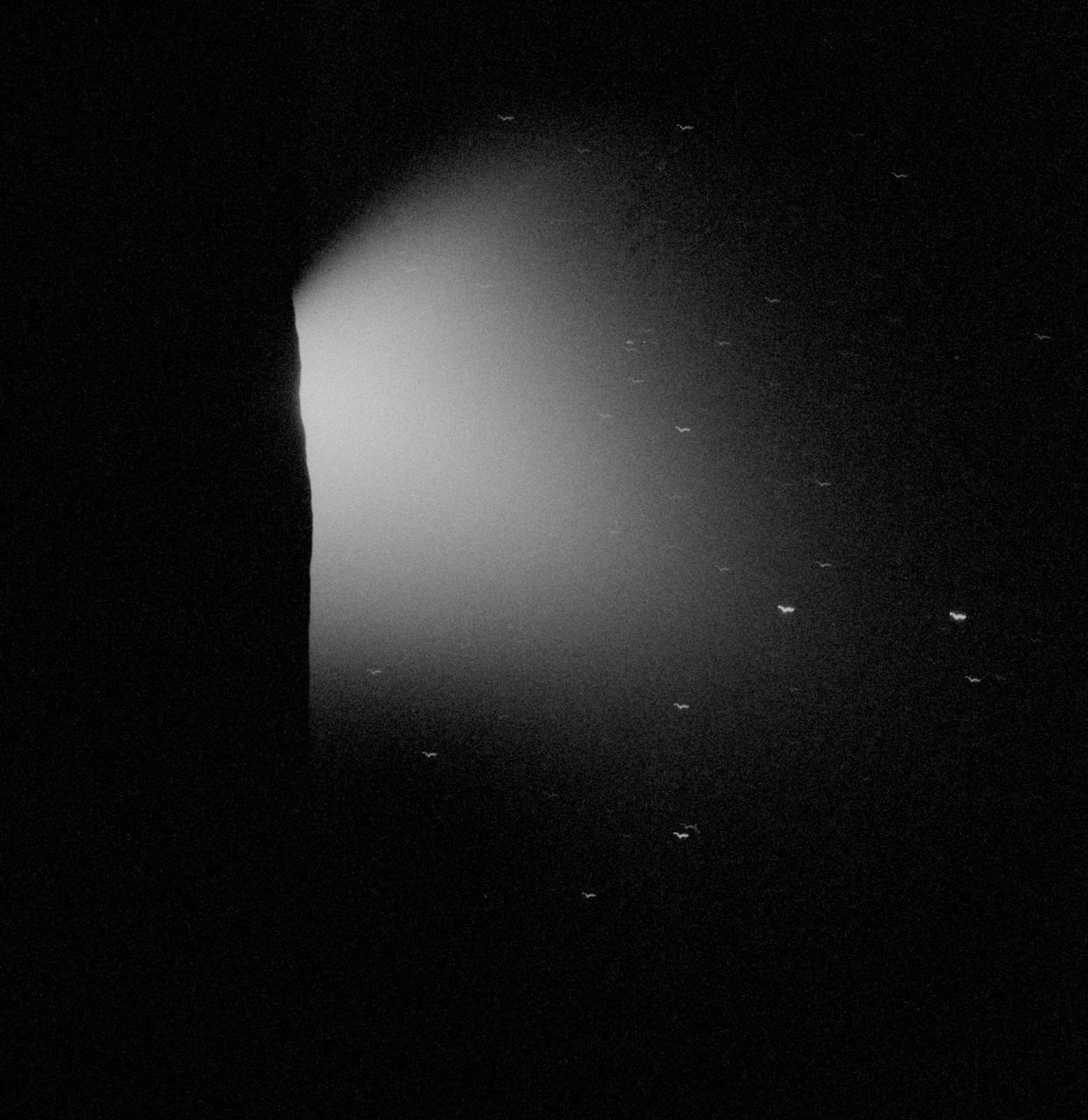
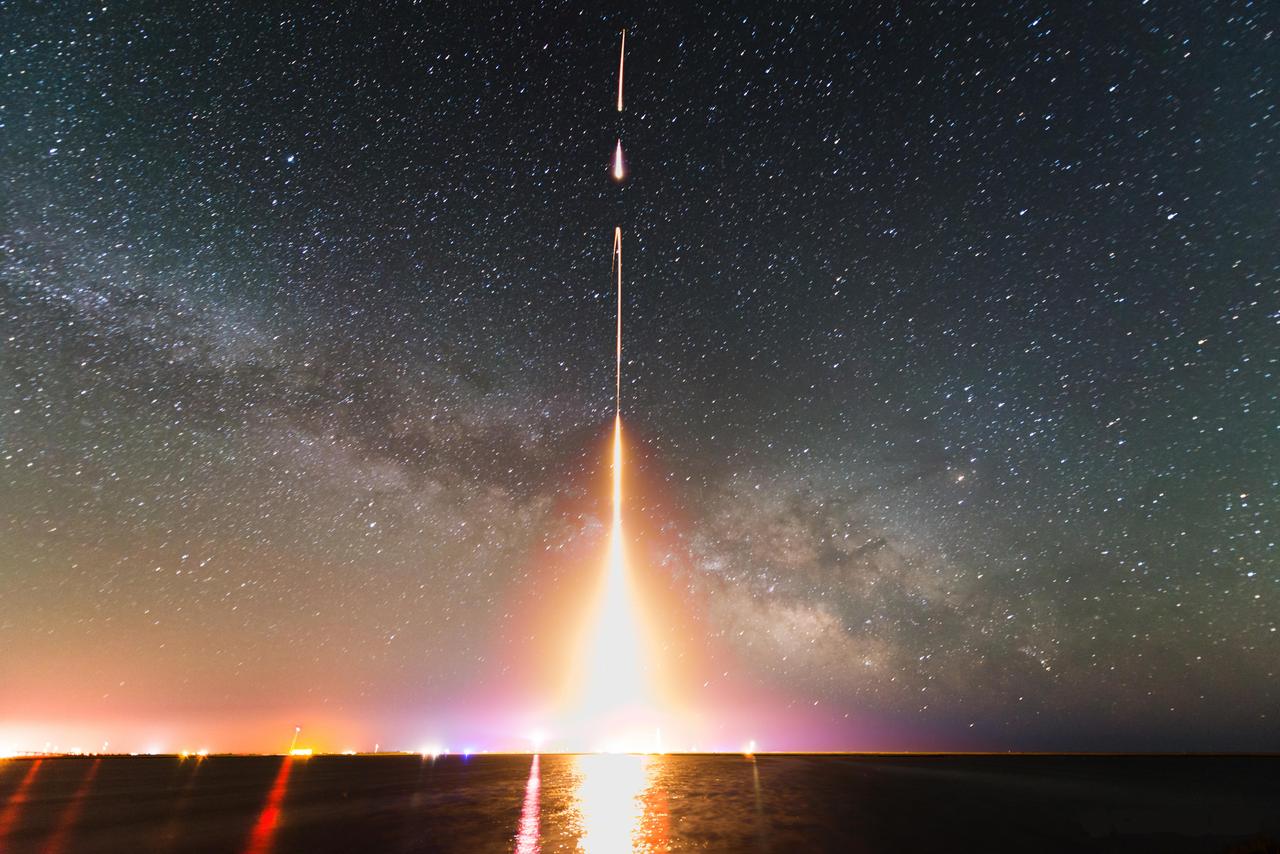
A time-lapse photograph of the CIBER rocket launch, taken from NASA Wallops Flight Facility in Virginia in 2013. This was the last of four launches of the Cosmic Infrared Background Experiment CIBER.
CIBER Launch
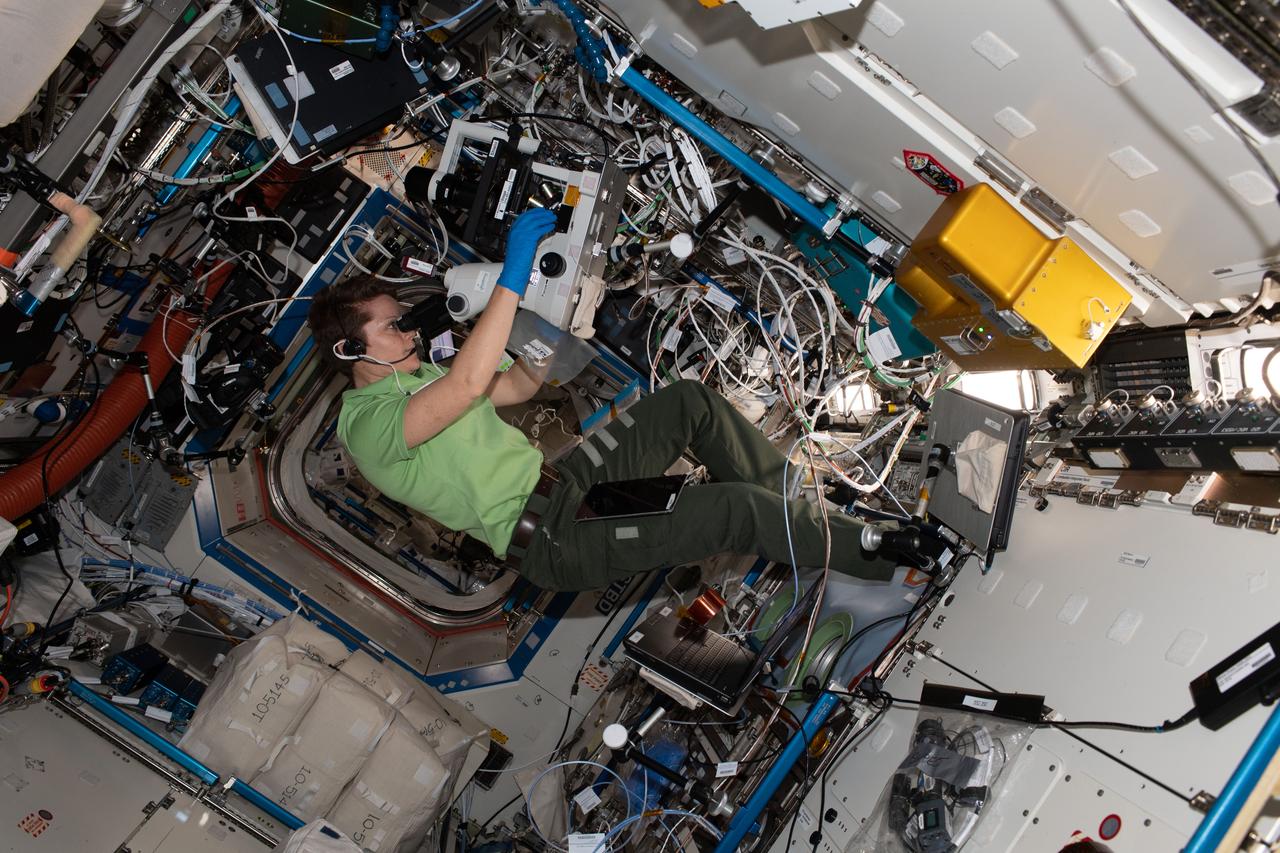
iss058e001945 (Jan. 3, 2019) --- Expedition 58 Flight Engineer and astronaut Anne McClain of NASA peers into a microscope and takes photographs for the Protein Crystal Growth-16 experiment that is exploring therapies for Parkinson's disease.
Astronaut Anne McClain of NASA peers into a microscope
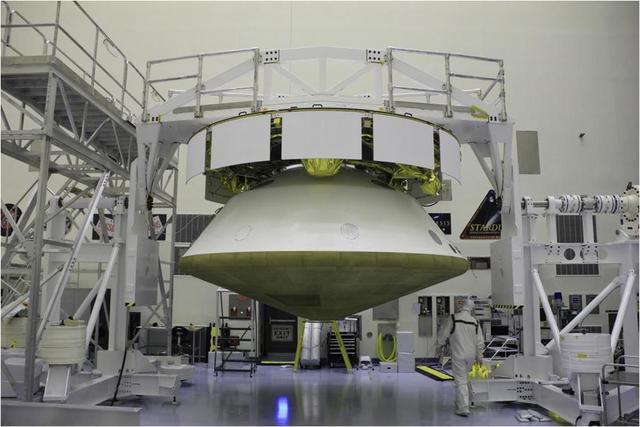
NASA Mars Science Laboratory spacecraft has been fully stacked for flight in this photograph from inside the Payload Hazardous Servicing Facility at NASA Kennedy Space Center, Fla., in October 2011.
Mars Science Laboratory Stacked Spacecraft
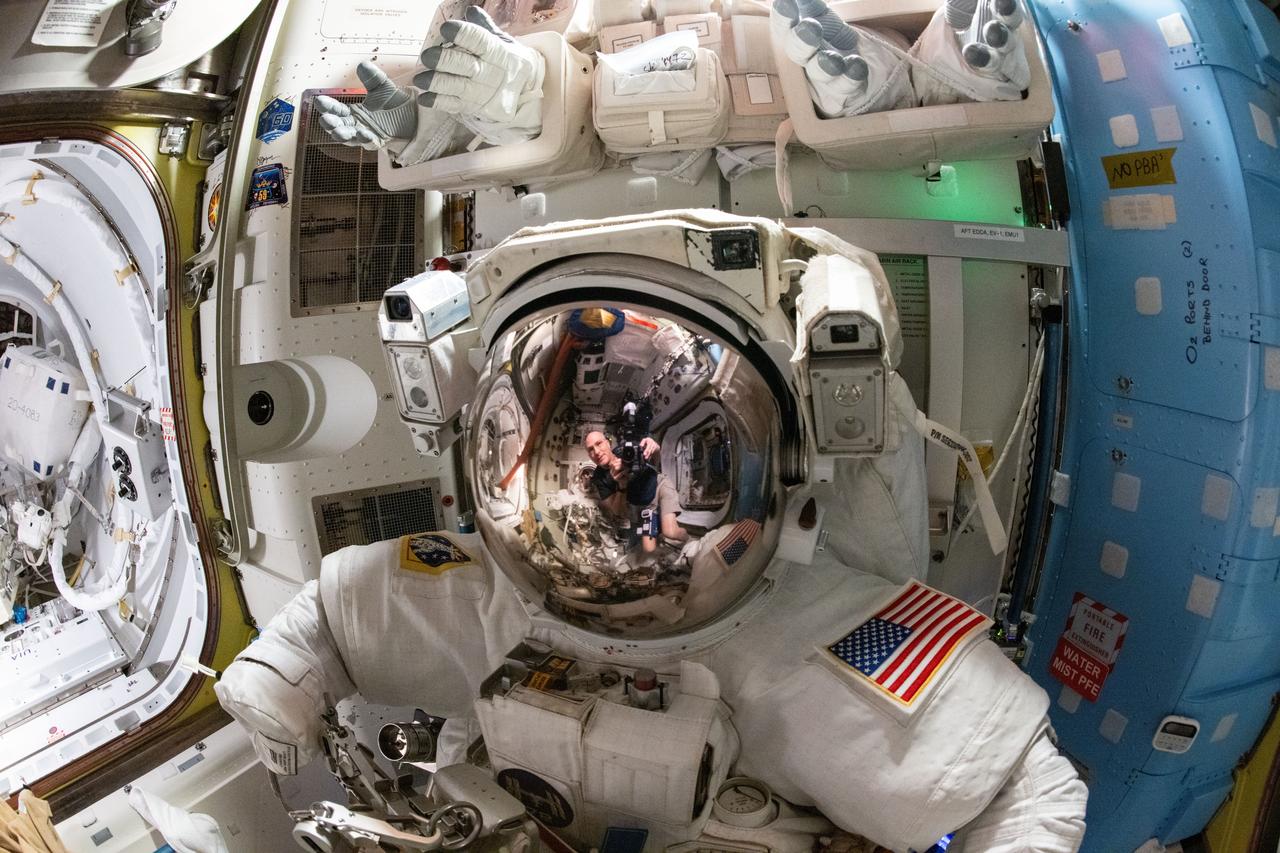
iss072e518423 (Jan. 23, 2025) --- NASA astronaut and Expedition 72 Flight Engineer Don Pettit's reflection is pictured on the helmet visor of a spacesuit in this photograph he took inside the International Space Station's Quest airlock.
Astronaut Don Pettit's reflection is pictured on the helmet visor of a spacesuit
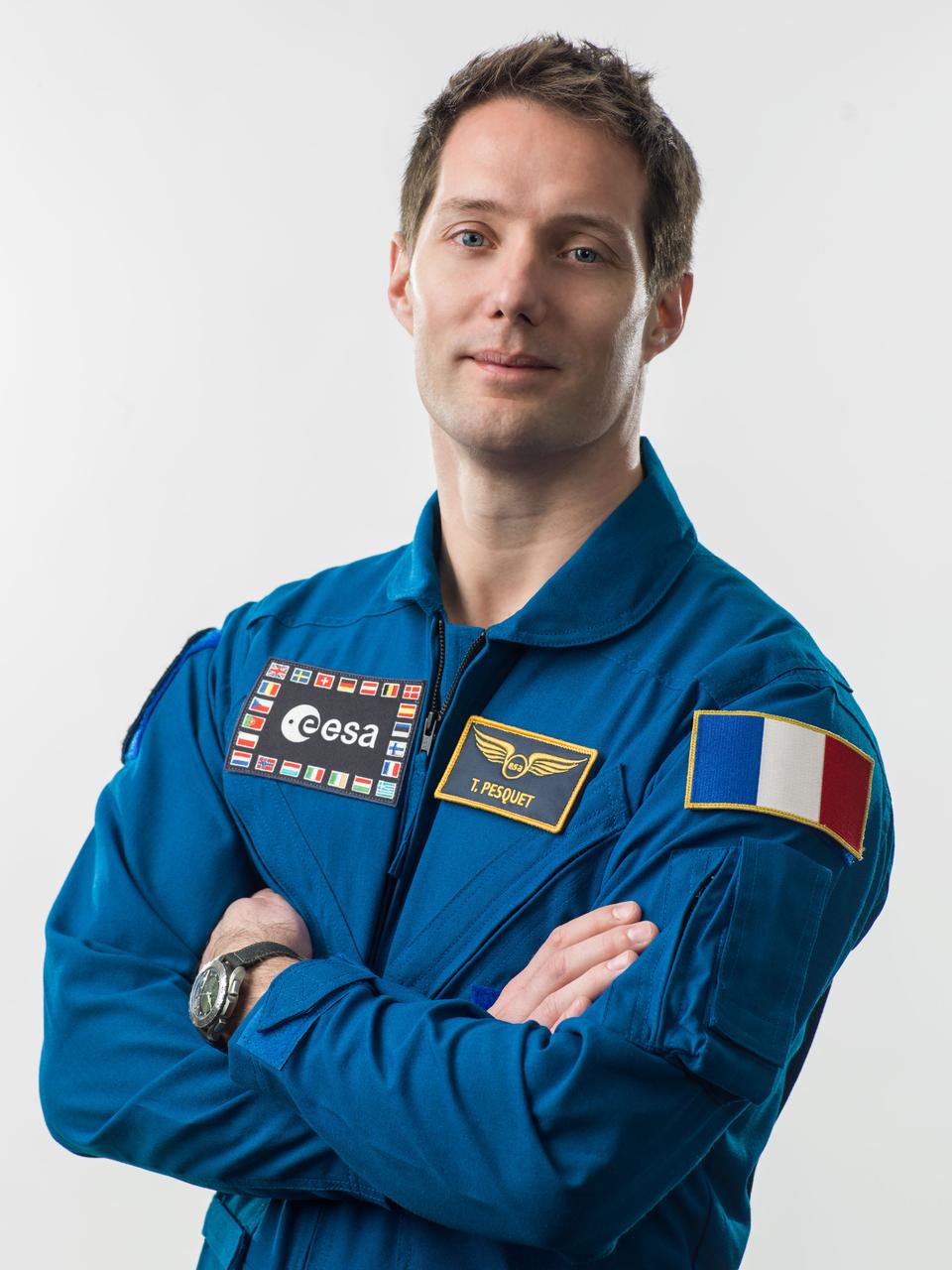
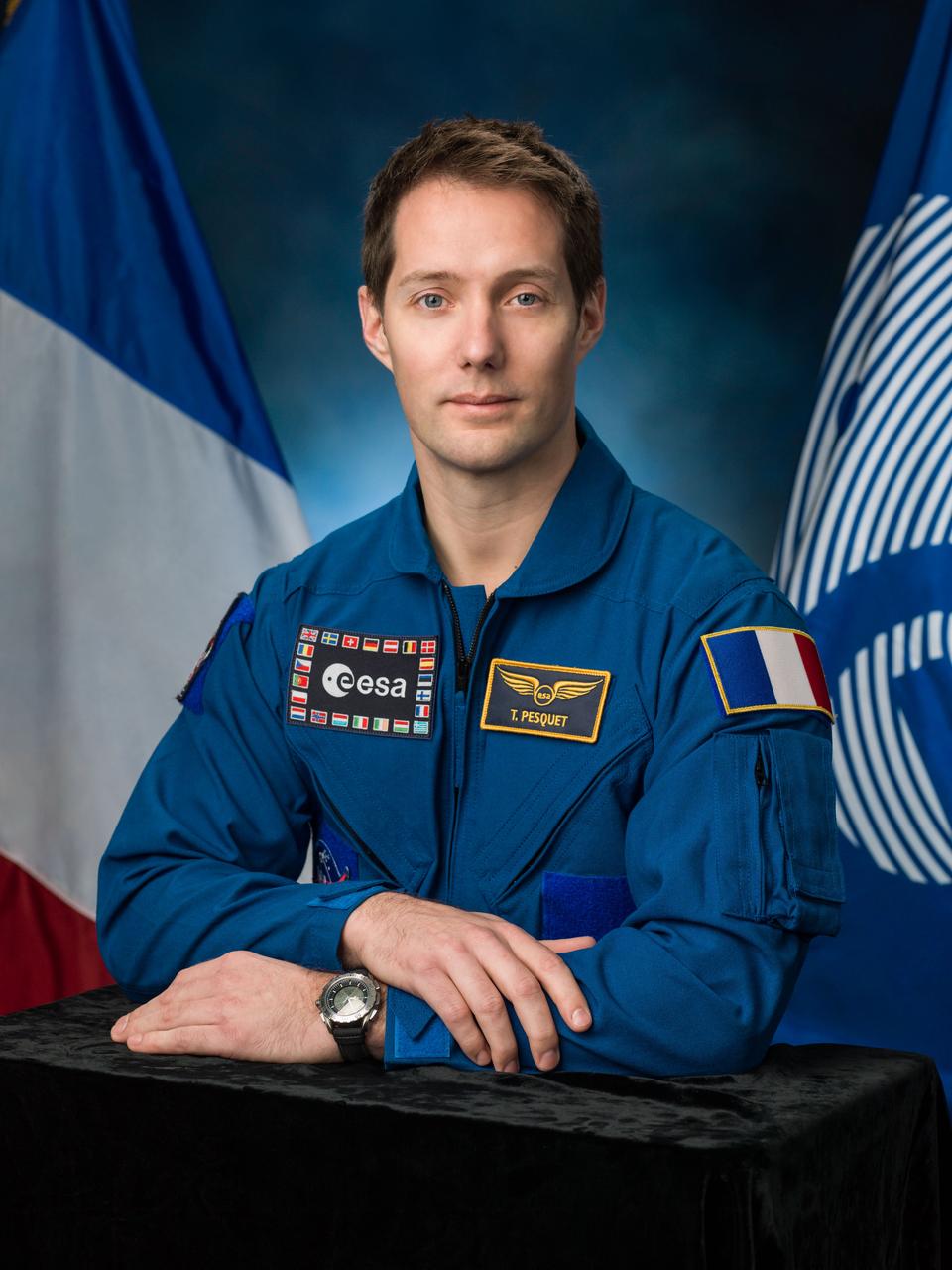
PHOTO DATE: 01-14-16 LOCATION: Bldg. 8, Room 183 - Photo Studio SUBJECT: Official portrait of ESA astronaut & Expedition 50/51 crew member Thomas Pesquet in blue flight suit. PHOTOGRAPHER: BILL STAFFORD
PHOTO DATE: 01-14-16.LOCATION: Bldg. 8, Room 183 - Photo Studio.SUBJECT: Official portrait of ESA astronaut & Expedition 50/51 crew member Thomas Pesquet in blue flight suit..PHOTOGRAPHER: BILL STAFFORD
PHOTO DATE: 01-14-16 LOCATION: Bldg. 8, Room 183 - Photo Studio SUBJECT: Official portrait of ESA astronaut & Expedition 50/51 crew member Thomas Pesquet in blue flight suit. PHOTOGRAPHER: BILL STAFFORD
PHOTO DATE: 01-14-16.LOCATION: Bldg. 8, Room 183 - Photo Studio.SUBJECT: Official portrait of ESA astronaut & Expedition 50/51 crew member Thomas Pesquet in blue flight suit..PHOTOGRAPHER: BILL STAFFORD
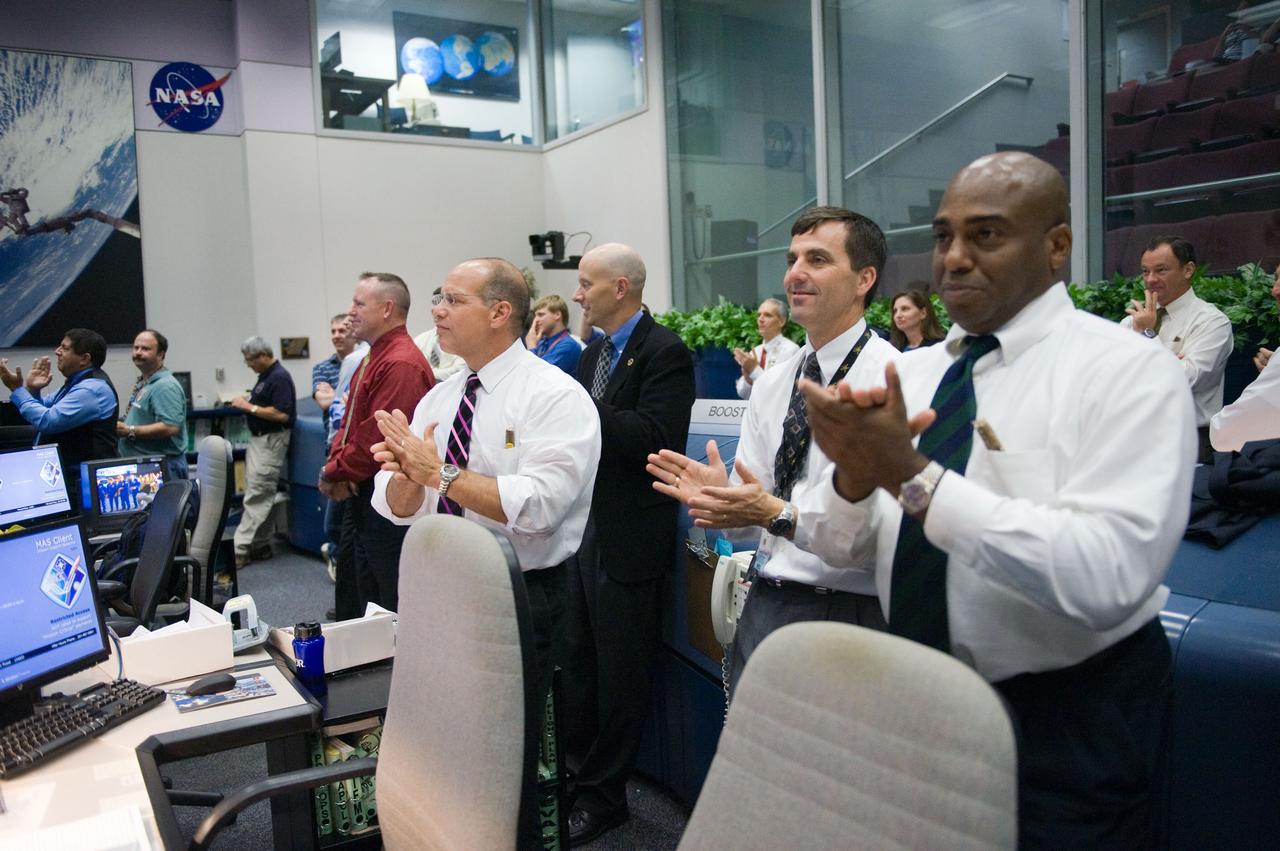
DATE: 3-27-15 LOCATION:  Building 30 - ISS FCR-1 SUBJECT: Flight controllers during the launch of Scott Kelly and Cosmonaut Mikhail Kornienko for their historic one-year mission aboard the ISS.  PHOTOGRAPHER: Lauren Harnett
DATE: 3-27-15.LOCATION: Building 30 - ISS FCR-1.SUBJECT: Flight controllers during the launch of Scott Kelly and Cosmonaut Mikhail Kornienko for their historic one-year mission aboard the ISS. .PHOTOGRAPHER: Lauren Harnett
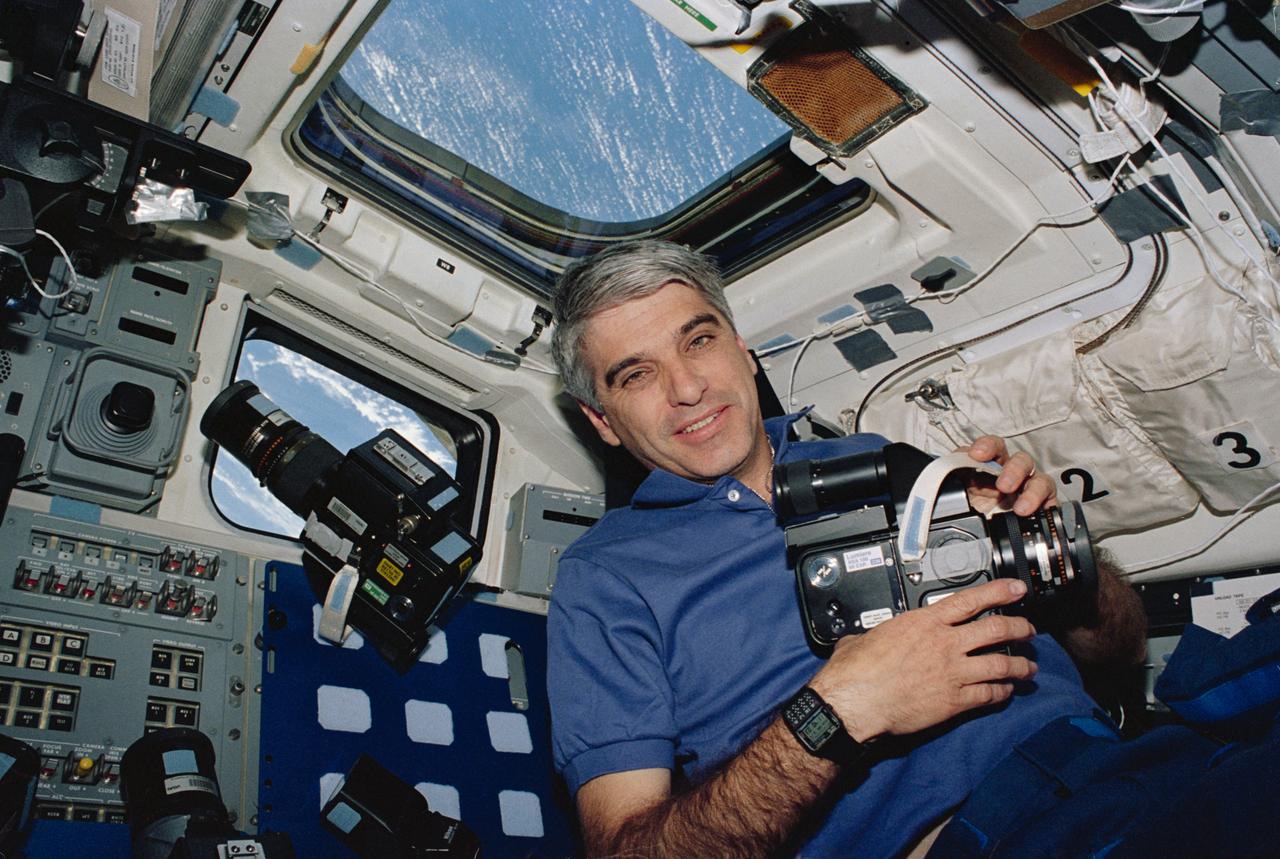
STS059-19-004 (9-20 April 1994) --- Astronaut Sidney M. Gutierrez, mission commander, pauses on the flight deck during Earth observations on the Space Shuttle Endeavour.  Gutierrez, who was joined by five other NASA astronauts for 11-days in Earth orbit, holds a 70mm Hasselblad camera.  The camera was one of several instruments used during the SRL mission to record an unprecedented compilation of data on planet Earth.
Astronaut Sidney Gutierrez on flight deck holding Hasselblad camera
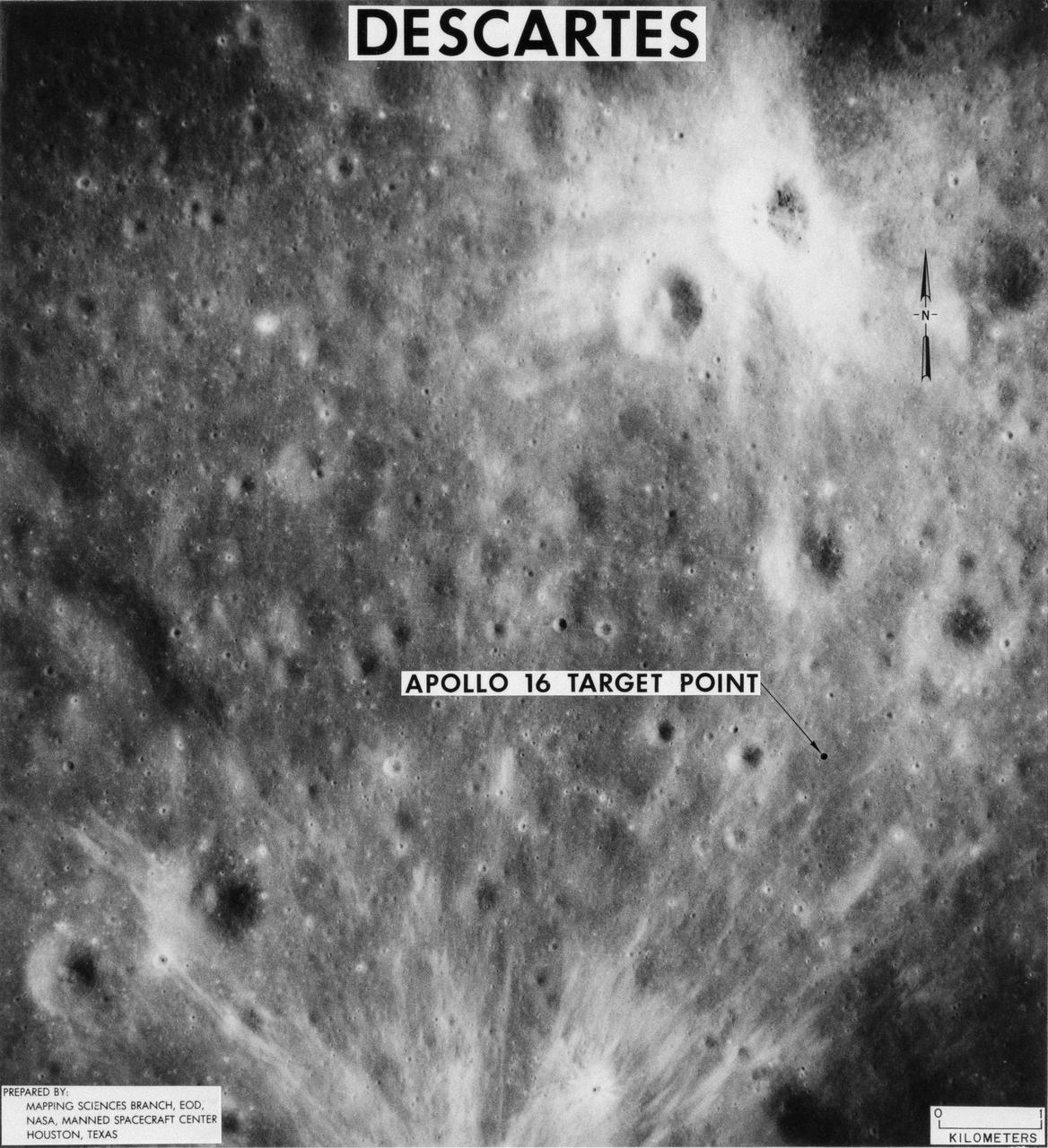
S71-44150 (February 1971) --- A vertical view of the Apollo 16 landing site located in the Descartes area on the lunar nearside. The overlay indicates the location of the proposed touchdown point for the Apollo 16 Lunar Module (LM). Descartes is located west of the Sea of Nectar and southwest of the Sea of Tranquility. This photograph was taken with a 500mm lens camera from lunar orbit by the Apollo 16 crew. Astronauts John W. Young, commander; and Charles M. Duke Jr., lunar module pilot; descended in the Apollo 16 LM "Orion" to explore the Descartes highlands landing site on the moon. Astronaut Thomas K. Mattingly II, command module pilot, remained with the Command and Service Modules (CSM) "Casper" in lunar orbit.
Vertical view of Apollo 16 landing site located Descartes area lunar nearside
STS062-06-030 (4-18 March 1994) --- With cameras in hand two of the STS-62 astronauts prepare to take pictures of their home planet.  John H. Casper (right), mission commander, handles a large format, Linhof camera, while Charles D. (Sam) Gemar, mission specialist, has just added a roll of film to a 70mm handheld Hasselblad camera.  Earth observations and documentation occupied muc of the on-duty time of all five of the STS-62 crewmembers during their 14-day mission in earth orbit.
Astronauts Casper and Gemar prepare to use cameras
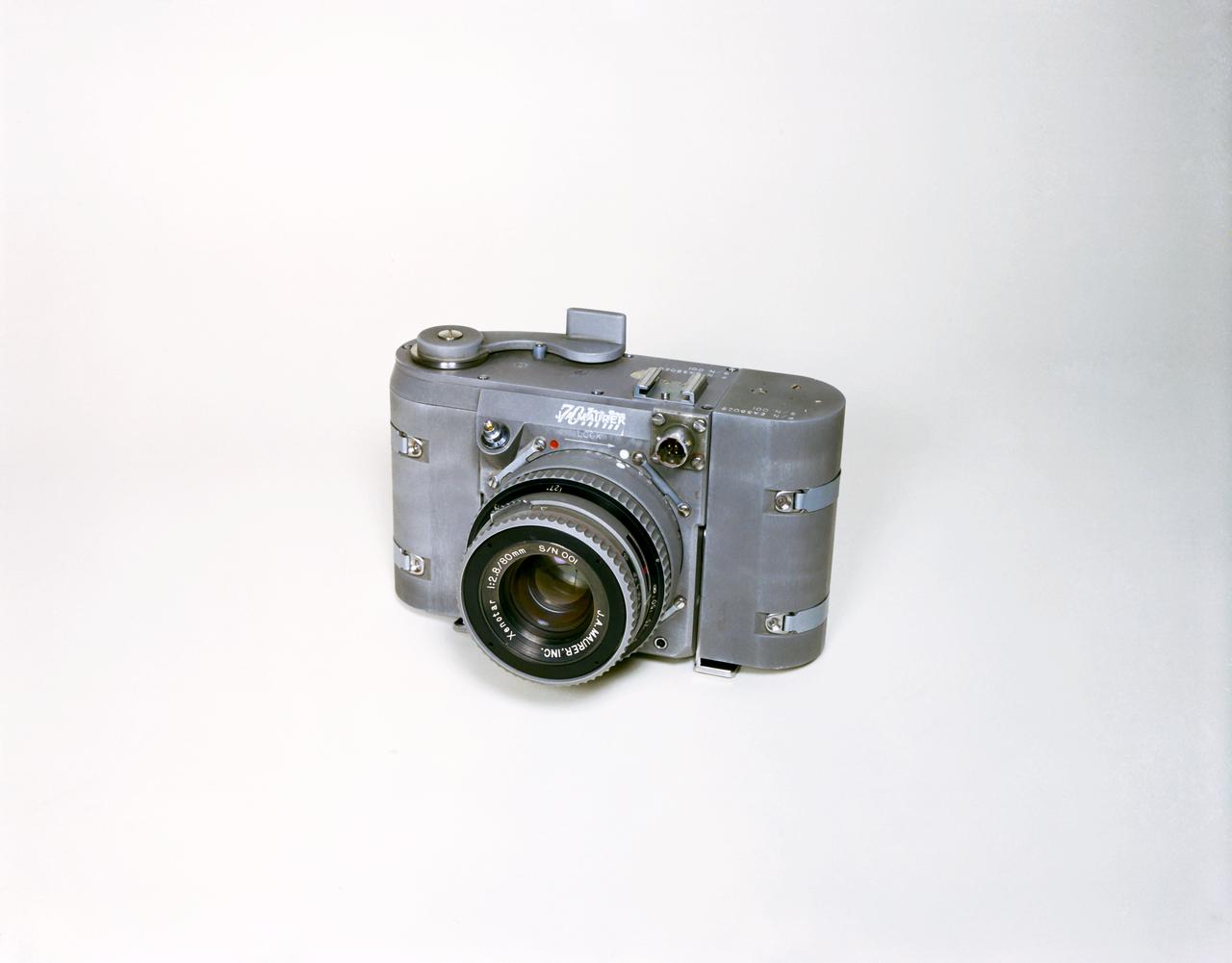
S65-23639 (28 April 1965) --- A bench view of a 70mm camera expected to be used by the Gemini-4 astronauts.
Handheld camera for use on Gemini 4 mission
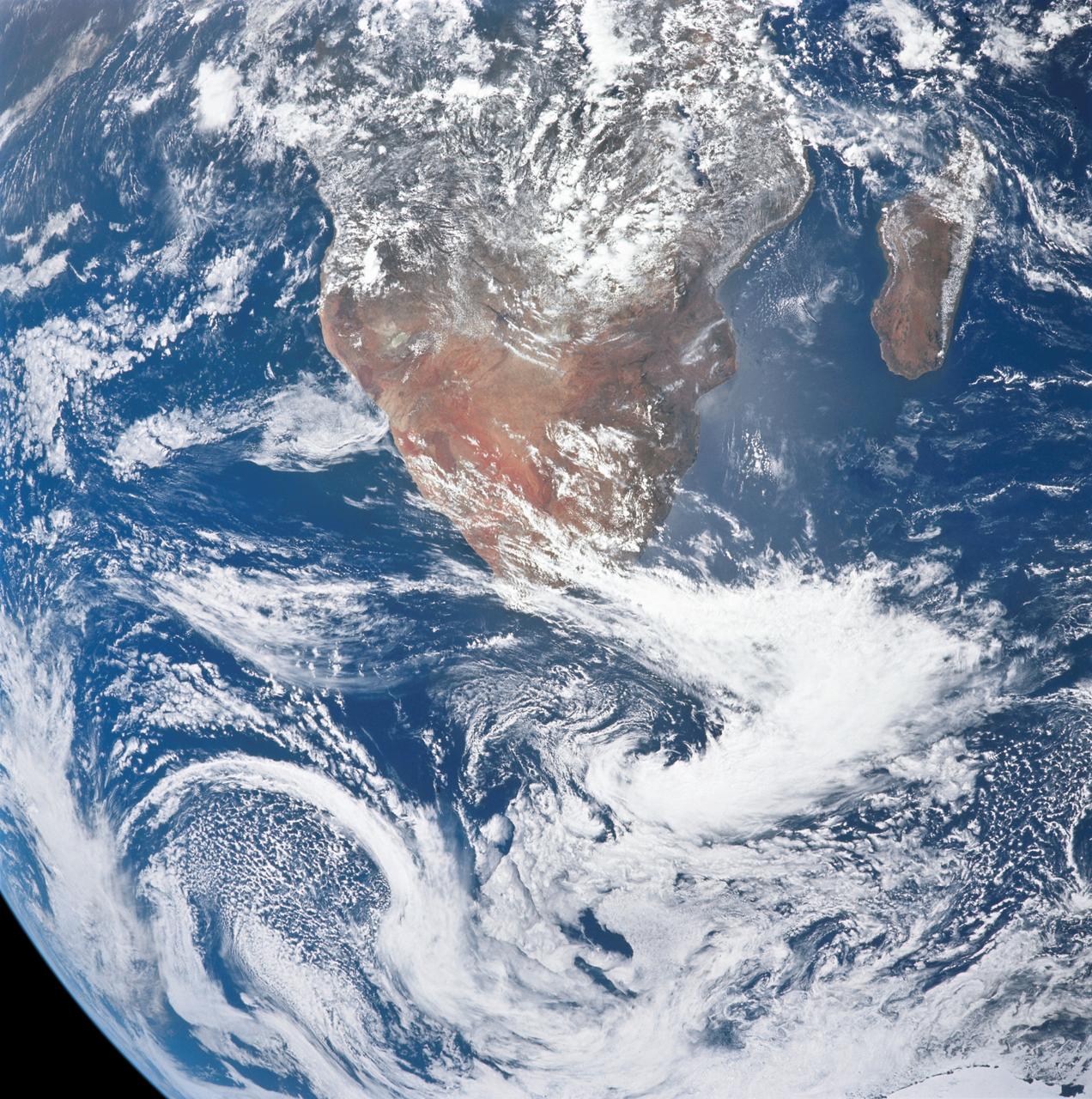
AS17-148-22717 (7 Dec. 1972) --- This view of a portion of Earth was taken from the Apollo 17 spacecraft following trans-lunar insertion during the final lunar landing mission in NASA's Apollo Program. The visible land mass is the southern two-thirds of the African continent, with Madagascar at right. A portion of Antarctica is visible at bottom frame. Onboard the Apollo 17 spacecraft were astronauts Eugene A. Cernan, commander; Ronald E. Evans, command module pilot; and Harrison H. Schmitt, lunar module pilot. While astronauts Cernan and Schmitt descended in the Lunar Module (LM) "Challenger" to explore the Hadley-Apennine region of the moon, astronaut Evans remained with the Command and Service Modules (CSM) "America" in lunar orbit.
View of Africa and Madagascar from the Apollo 17 spacecraft
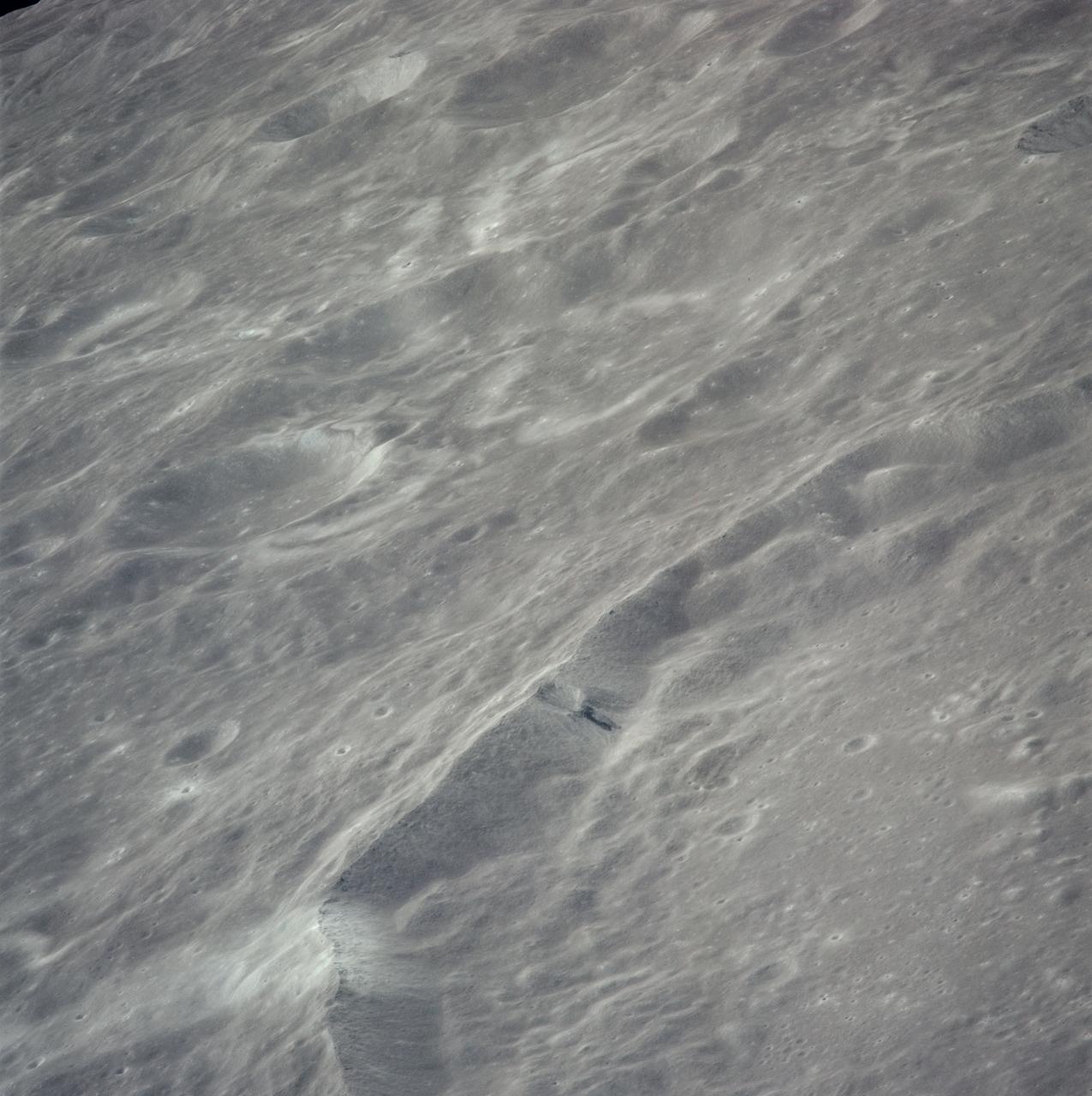
AS16-121-19407 (April 1972) --- An oblique view of a rim of Guyot Crater on the lunar farside, as photographed from the Apollo 16 spacecraft in lunar orbit. The coordinates of the center of Guyot Crater are 116.5 degrees east longitude and 10.5 degrees north latitude. Note the black coloration which appears to be lava flow down the side of the crater rim. While astronauts John W. Young, commander; and Charles M. Duke Jr., lunar module pilot; descended in the Apollo 16 Lunar Module (LM) "Orion" to explore the Descartes highlands site on the moon, astronaut Thomas K. Mattingly II, command module pilot, remained with the Command and Service Modules (CSM) "Casper" in lunar orbit.
Oblique view of rim of Guyot crater on lunar farside as seen by Apollo 16
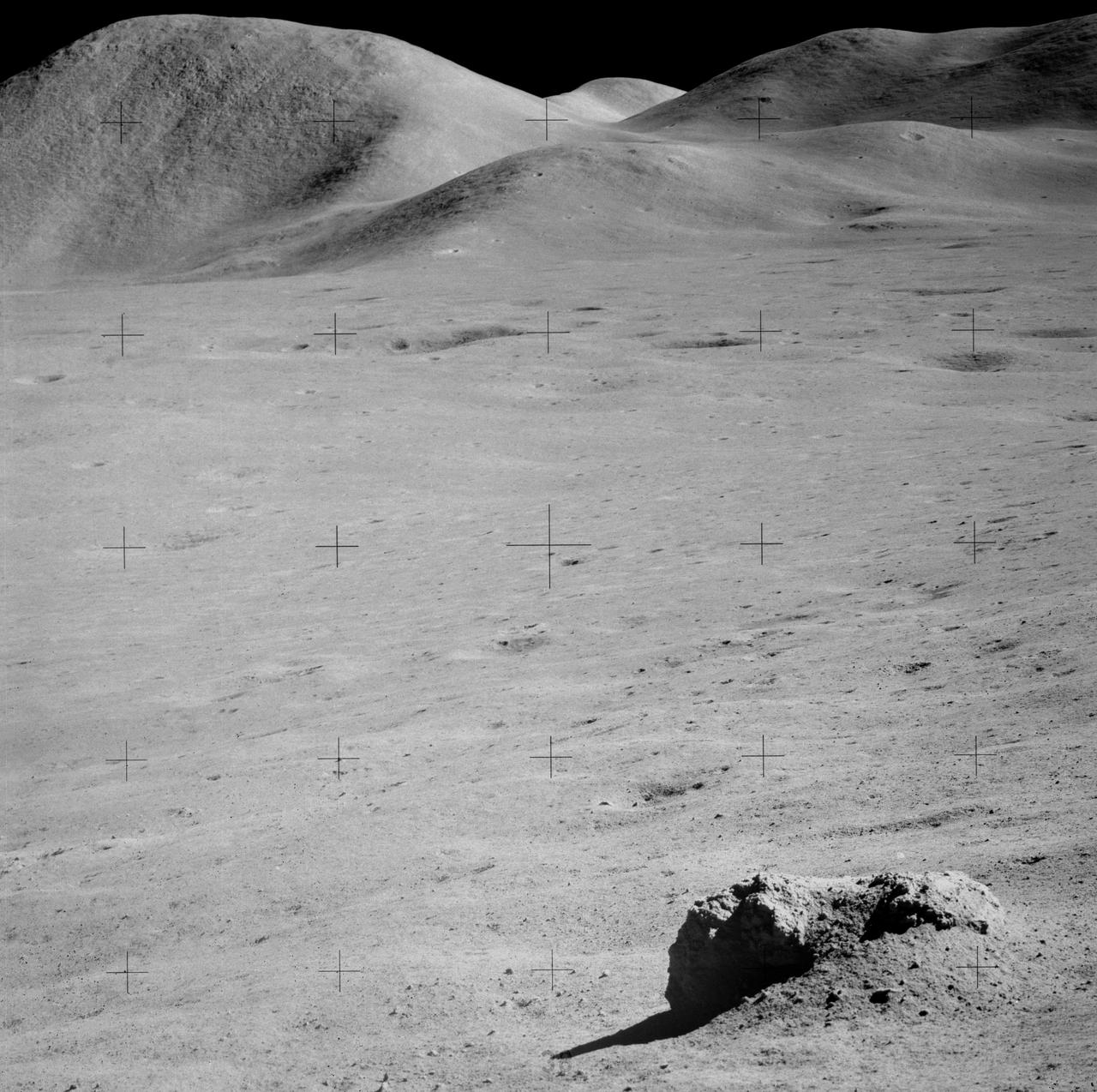
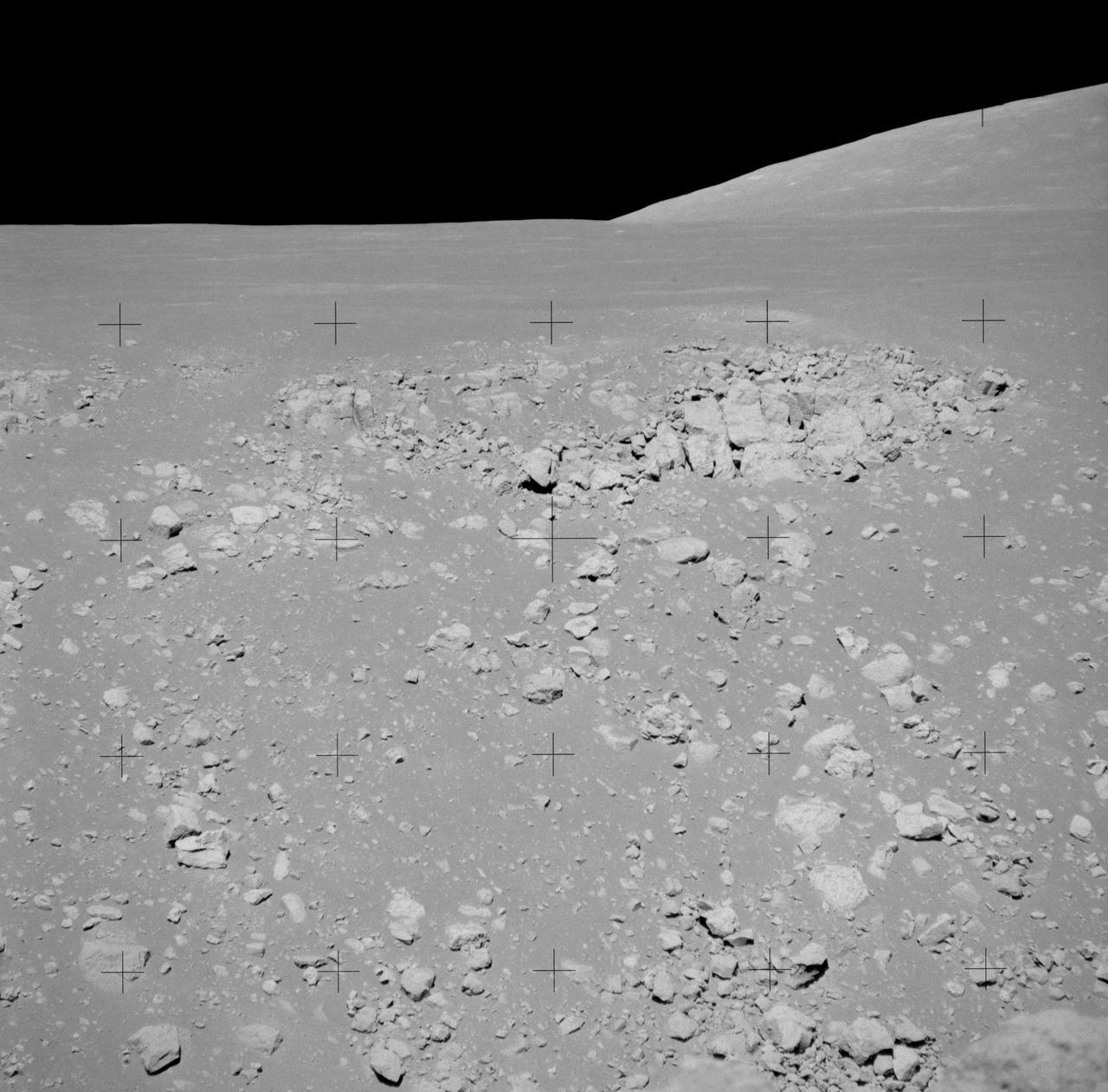
AS15-90-12187 (31 July-2 Aug. 1971) --- This view, looking generally north, shows the tall Mount Hadley in the left background. The photograph was taken from the slope of Hadley Delta during Apollo 15 extravehicular activity (EVA). The crewmen of Apollo 15 noted the visible layering feature of the mountain. Note boulder in foreground. Mount Hadley rises approximately 14,765 feet (about 4,500 meters) above the plain.
View looking north showing Mount Hadley photographed during Apollo 15 EVA
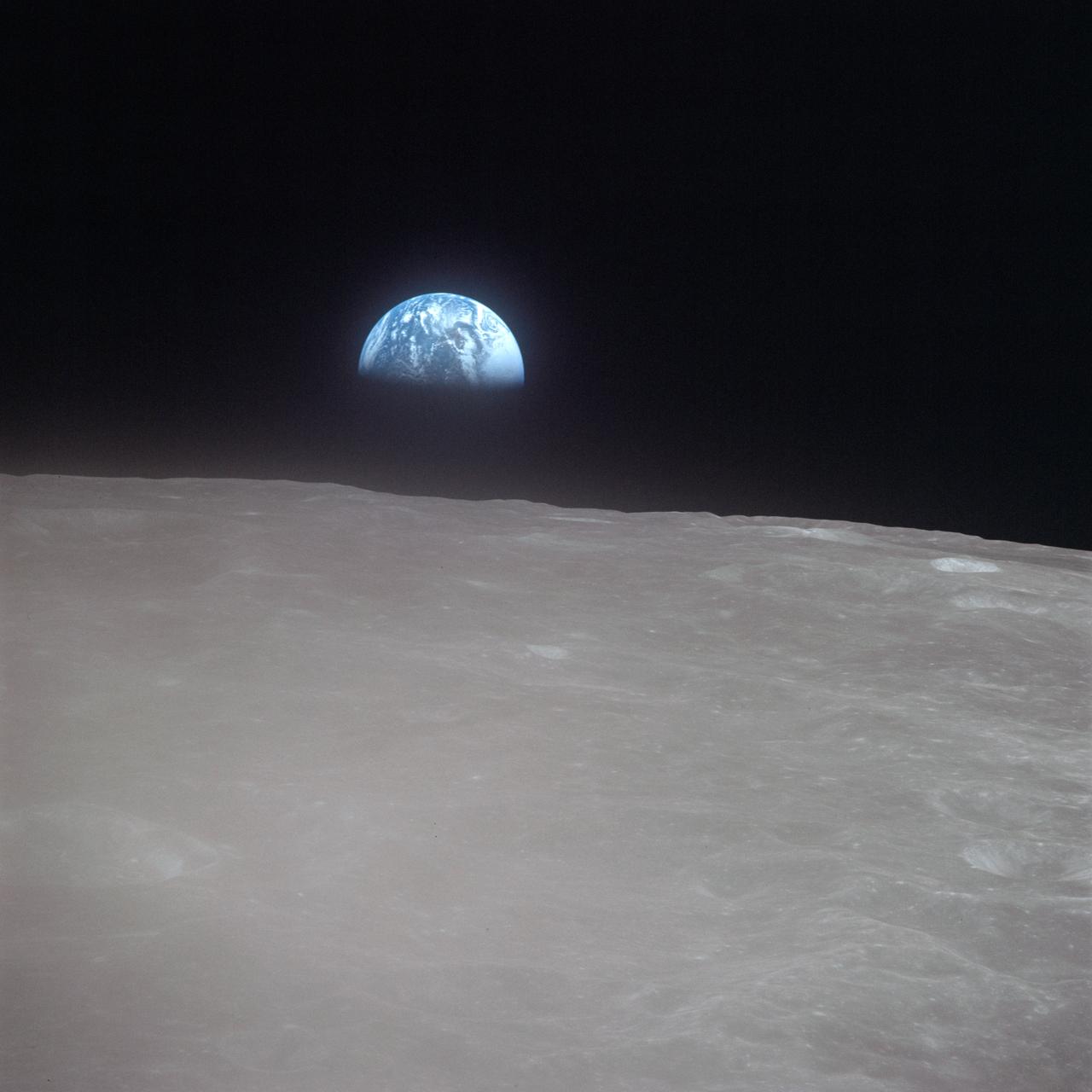
AS16-120-19187 (19 April 1972) --- Apollo 16 astronauts captured this Earth rise scene with a handheld Hasselblad camera during the second revolution of the moon. Identifiable craters seen on the moon include Saha, Wyld, and Saenger. Much of the terrain seen here is never visible from Earth, as the Command Module (CM) was just passing onto what is known as the dark side or far side of the moon. Crewmen aboard the CM at the time the photo was made were astronauts John W. Young, Thomas K. Mattingly II and Charles M. Duke Jr. Mattingly remained later with the CM in lunar orbit while Young and Duke descended in the lunar module (LM) to explore the surface of the moon.
Earth rise as photographed by Apollo 16
AS15-89-12100 (2 Aug. 1971) --- A telephoto lens view looking across Hadley Rille, photographed during the third Apollo 15 lunar surface extravehicular activity (EVA) at the Hadley-Apennine landing site on the nearside of the moon. The blocky outcrop at the top of the west wall of the rille is about 1.9 kilometers (1.1 statute miles) from the camera. About one-half of the debris-covered wall is visible in the photograph. On the horizon the northern end of Hill 305 is more than 16 kilometers (10 statute miles) from the camera.
Telephoto view across Hadley Rille photographed during Apollo 15 EVA
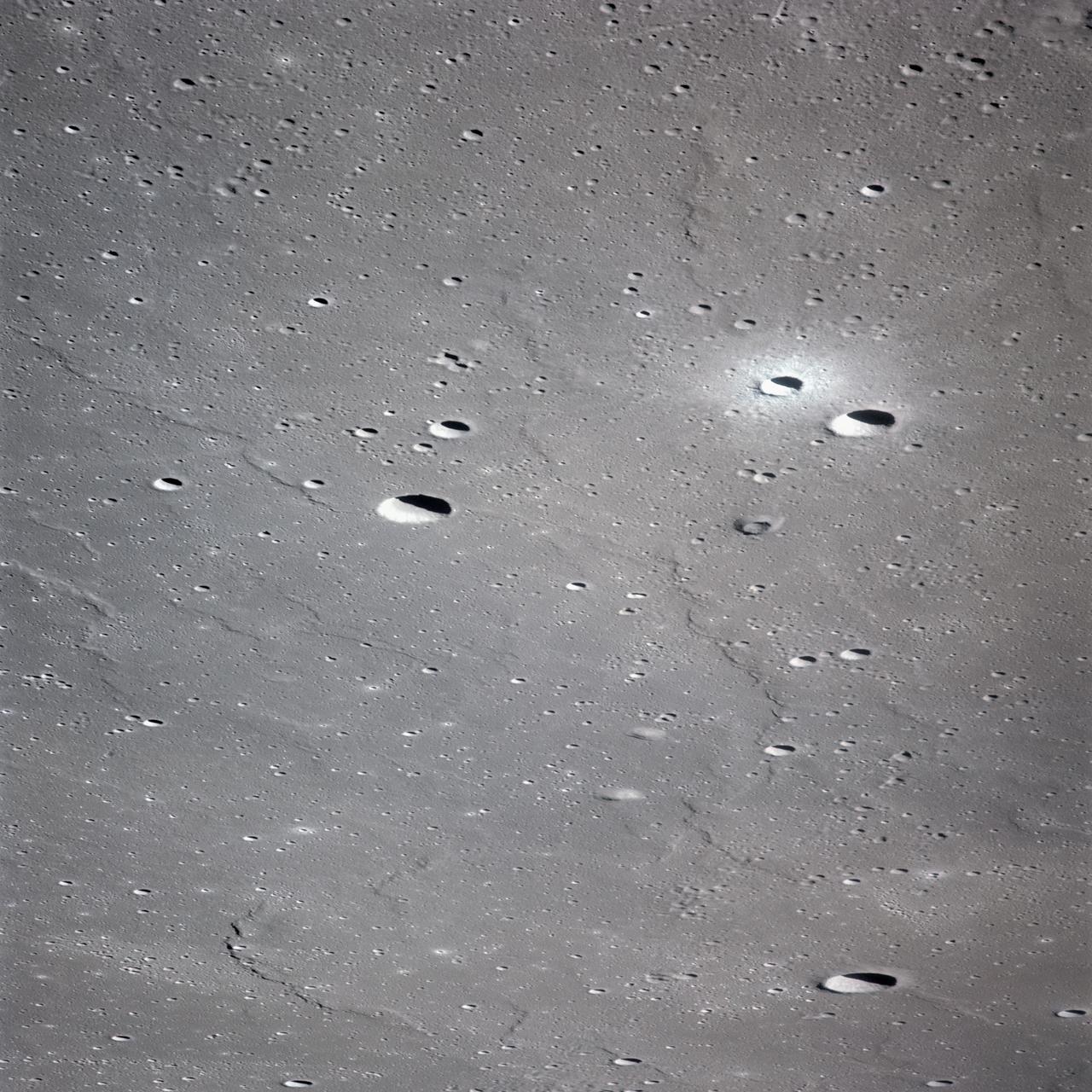
AS16-120-19237 (April 1972) --- An oblique view of a portion of the lunar nearside as photographed from the Apollo 16 spacecraft in lunar orbit. The small, bright crater is Lassell D at the northeastern edge of Mare Nubium (Sea of Clouds). The area seen in this picture is immediately west of Lassell C Crater, southwest of Guoricke Crater, and southwest of Davy Crater.
Oblique view of lunar nearside photographed from Apollo 16 spacecraft
AS12-57-8448 (19-20 Nov. 1969) --- An Apollo 12 stereo view showing a three-inch square of the lunar surface upon which an astronaut had stepped. Taken during extravehicular activity of astronauts Charles Conrad Jr. and Alan L. Bean, the exposure of the boot imprint was made with an Apollo 35mm stereo close-up camera. The camera was developed to get the highest possible resolution of a small area. The three-inch square is photographed with a flash illumination and at a fixed distance. The camera is mounted on a walking stick, and the astronauts use it by holding it up against the object to be photographed and pulling the trigger. While astronauts Conrad and Bean descended in their Apollo 12 Lunar Module to explore the lunar surface, astronaut Richard F. Gordon Jr. remained with the Command and Service Modules in lunar orbit.
Apollo 12 stereo view of lunar surface upon which astronaut had stepped
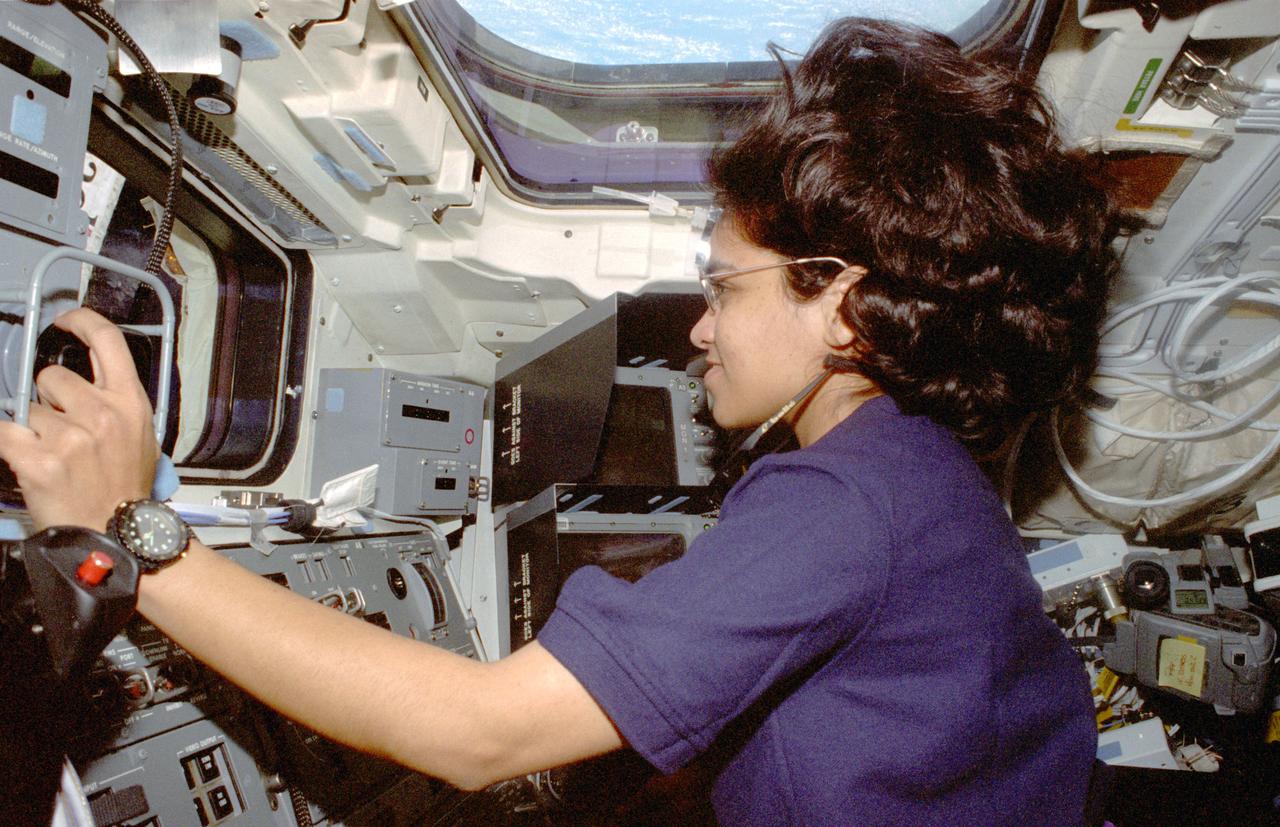
STS087-357-019 (19 November - 5 December 1997) --- Astronaut Kalpana Chawla, mission specialist, operates Columbia's Remote Manipulator System (RMS) on the aft flight deck during operations with the Spartan 201 satellite.  Chawla joined four other astronauts and a Ukrainian payload specialist for 16-days of research in Earth-orbit in support of the United States Microgravity Payload 4 (USMP-4) mission.
Chawla is photographed at the aft flight deck station controlling the RMS
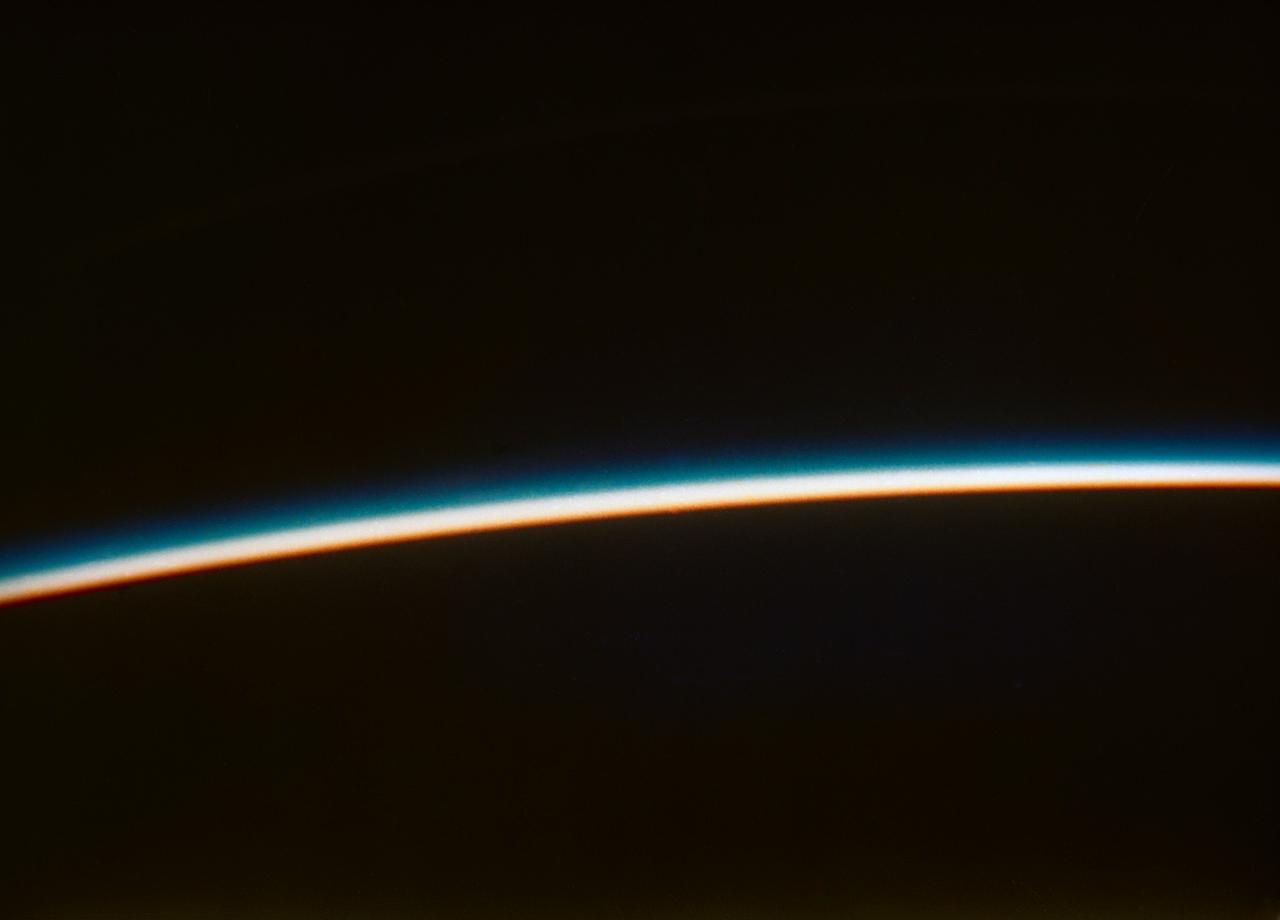
S62-06040 (20 Feb. 1962) --- Orbital sunset photographed by astronaut John H. Glenn Jr. aboard the "Friendship 7" during his Mercury-Atlas 6 (MA-6) spaceflight. Photo credit: NASA
Orbital sunset photographed by Astronaut John Glenn during MA-6 flight
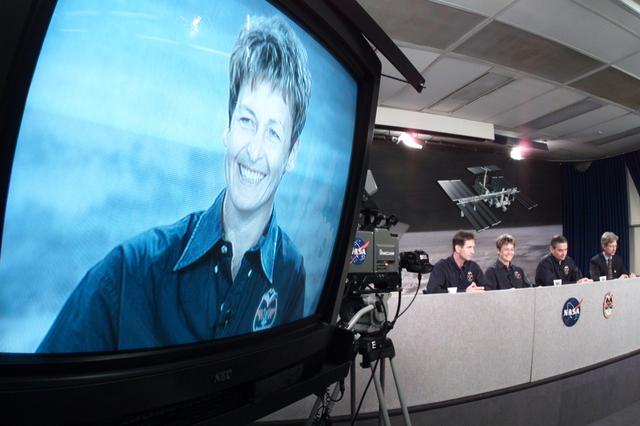
JSC2002-E-21247 (20 May 2002) --- A close-up image of astronaut Peggy A. Whitson, Expedition Five flight engineer, shows on a nearby television monitor during a pre-flight press conference at Johnson Space Center (JSC). The entire crew can be seen in the background.
Photographic coverage of the Expedition Five pre-flight press conference at JSC
STS029-11-027 (13-18 March 1989) --- Astronaut John E. Blaha holds up a picture of the crewmembers' wives from the pilot's station on Discovery's flight deck.  The photo, unlike the numbers of printed information and photos which were sent up by the text and graphics system (TAGS), was found by crewmembers upon their ingressing the spacecraft at Kennedy Space Center on launch day.
STS-29 Pilot Blaha displays photograph of crewmembers' wives on flight deck
S63-06447 (15-16 May 1963) --- The Great Indian Desert, located west of New Delhi, India, as photographed from the Mercury-Atlas 9 (MA-9) capsule by astronaut L. Gordon Cooper Jr., during his 22-orbit MA-9 spaceflight. Photo credit: NASA
Great Indian Desert photographed during MA-9 flight
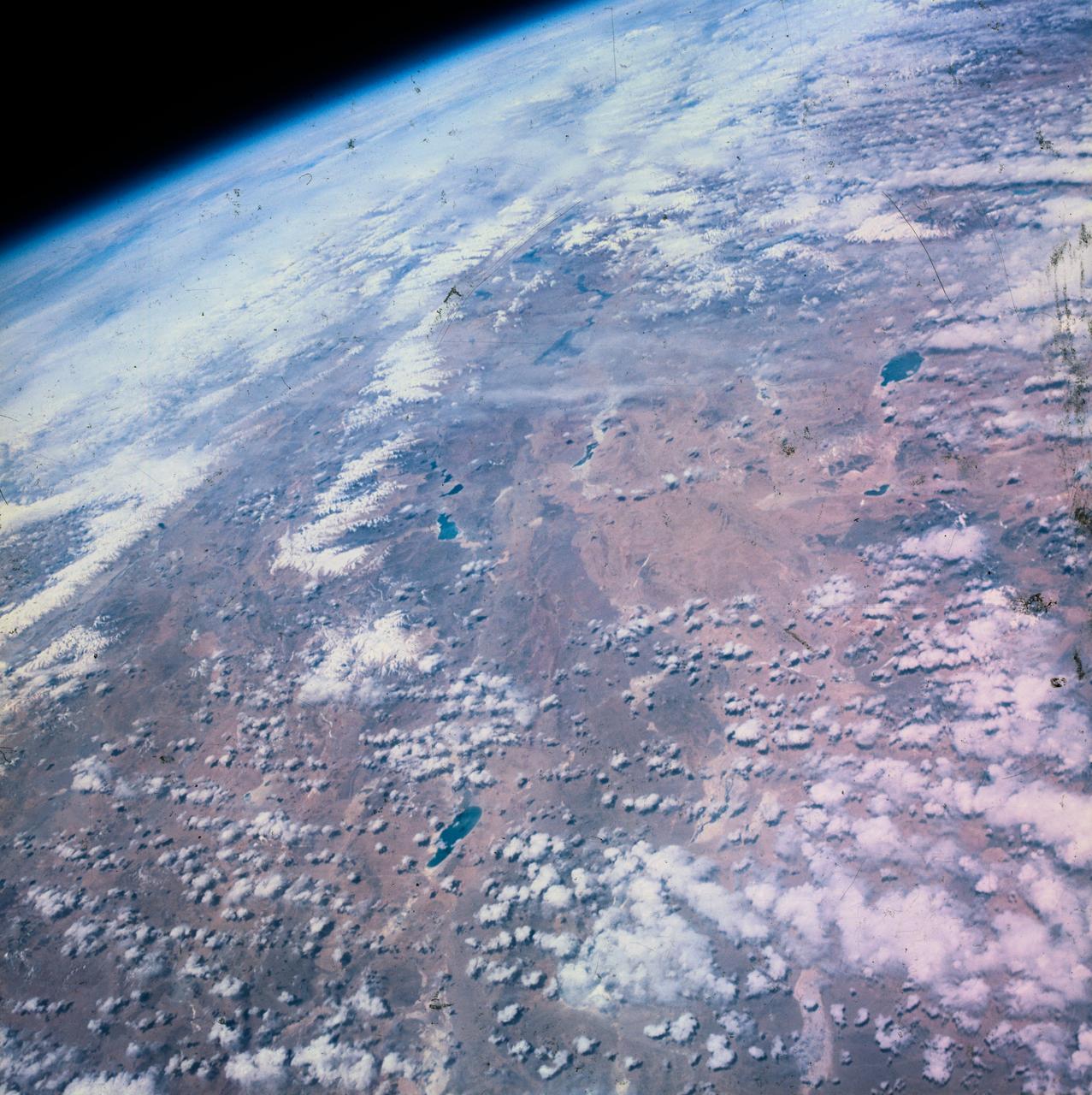
S63-06444 (15-16 May 1963) --- Tibet-Kashmir, looking northwest, as photographed from the Mercury-Atlas 9 (MA-9) capsule by astronaut L. Gordon Cooper Jr. during his 22-orbit MA-9 spaceflight. Lake Ch'in-Tzu-Hu is at upper right, Lake Yen-K'o-Ling-Ts is at lower left center. The Korakaram Range is at upper center portion of the picture. Photo credit: NASA
Tibet-Kashmir, looking northwest, photographed during MA-9 flight
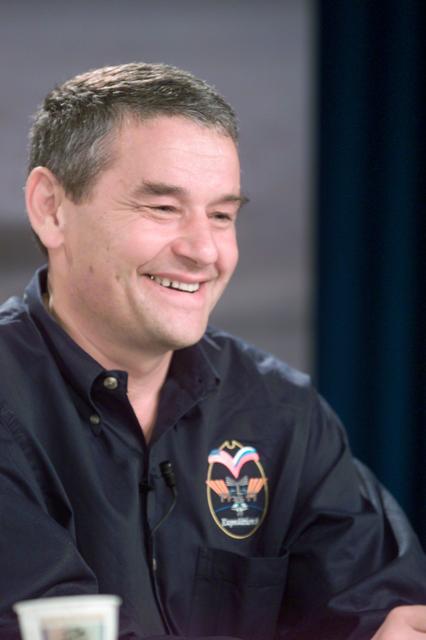
JSC2002-E-21246 (20 May 2002) --- Cosmonaut Valery G. Korzun, Expedition Five mission commander representing Rosaviakosmos, responds to a query during a pre-flight press conference at Johnson Space Center (JSC).
Photographic coverage of the Expedition Five pre-flight press conference at JSC
JSC2002-E-21249 (20 May 2002) --- Astronaut Peggy A. Whitson, Expedition Five flight engineer, responds to a query during a pre-flight press conference at Johnson Space Center (JSC).
Photographic coverage of the Expedition Five pre-flight press conference at JSC
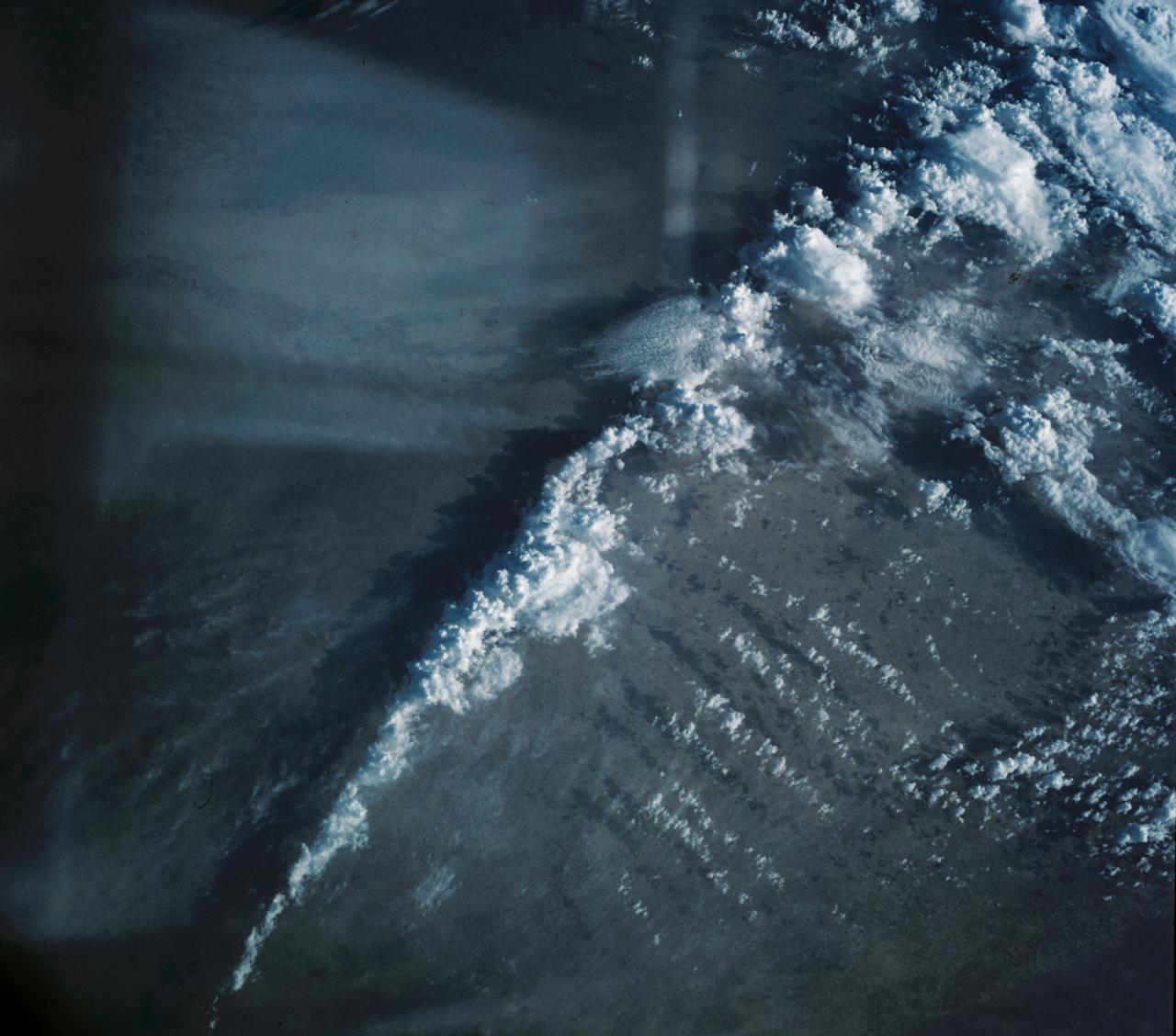
S63-06455 (15-16 May 1963) --- Indus River above Hyderabad, photographed from the Mercury-Atlas 9 (MA-9) capsule by astronaut L. Gordon Cooper Jr., during his 22-orbit MA-9 spaceflight. Photo credit: NASA
Indus River above Hyderabad photographed during MA-9 flight
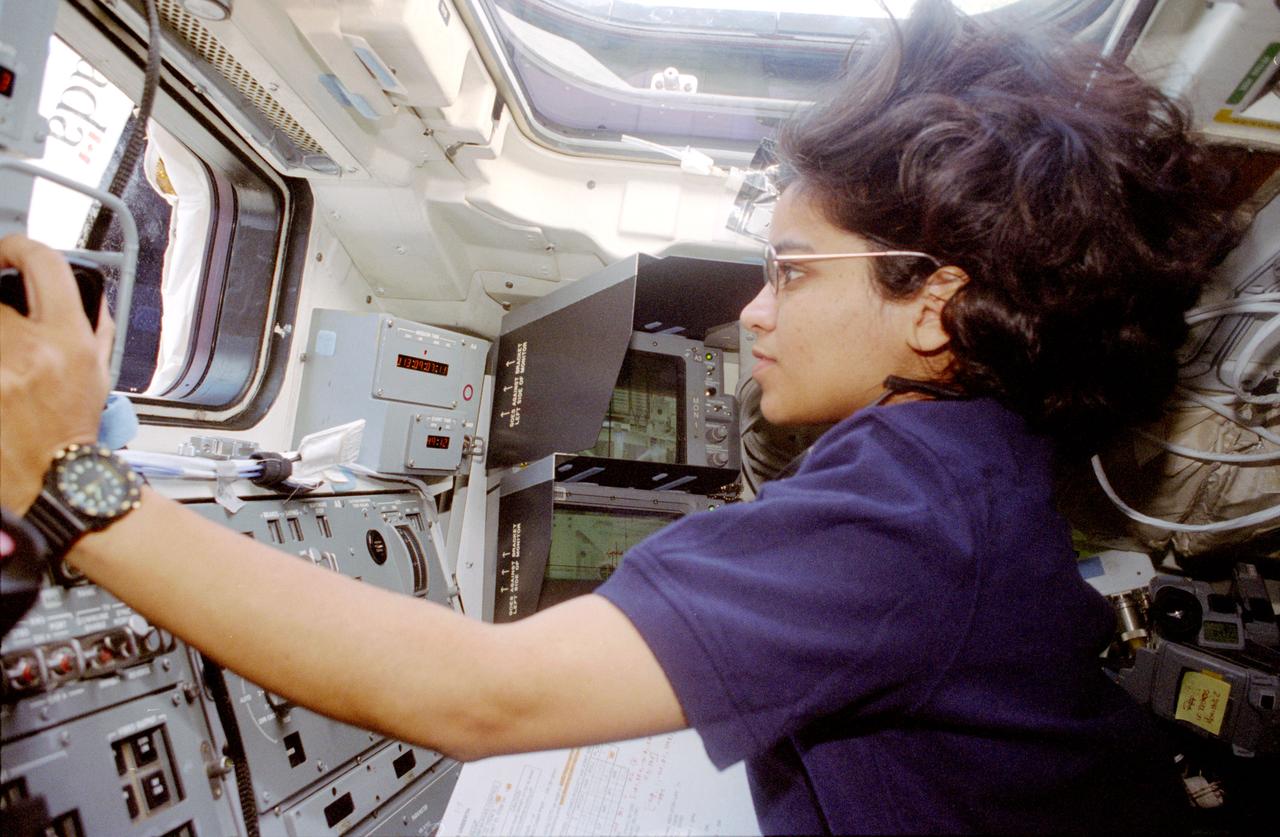
STS087-357-022 (19 November – 5 December 1997) --- Astronaut Kalpana Chawla, mission specialist, operates the Space Shuttle Columbia's Remote Manipulator System (RMS) on the aft flight deck during operations with the Spartan 201 satellite.  Kalpana Chawla joined four other astronauts and a Ukrainian payload specialist for 16-days of research in Earth-orbit in support of the United States Microgravity Payload 4 (USMP-4) mission.  The light blue and white colors associated with the crew's nearby home planet are visible in the overhead window.
Chawla is photographed at the aft flight deck station controlling the RMS
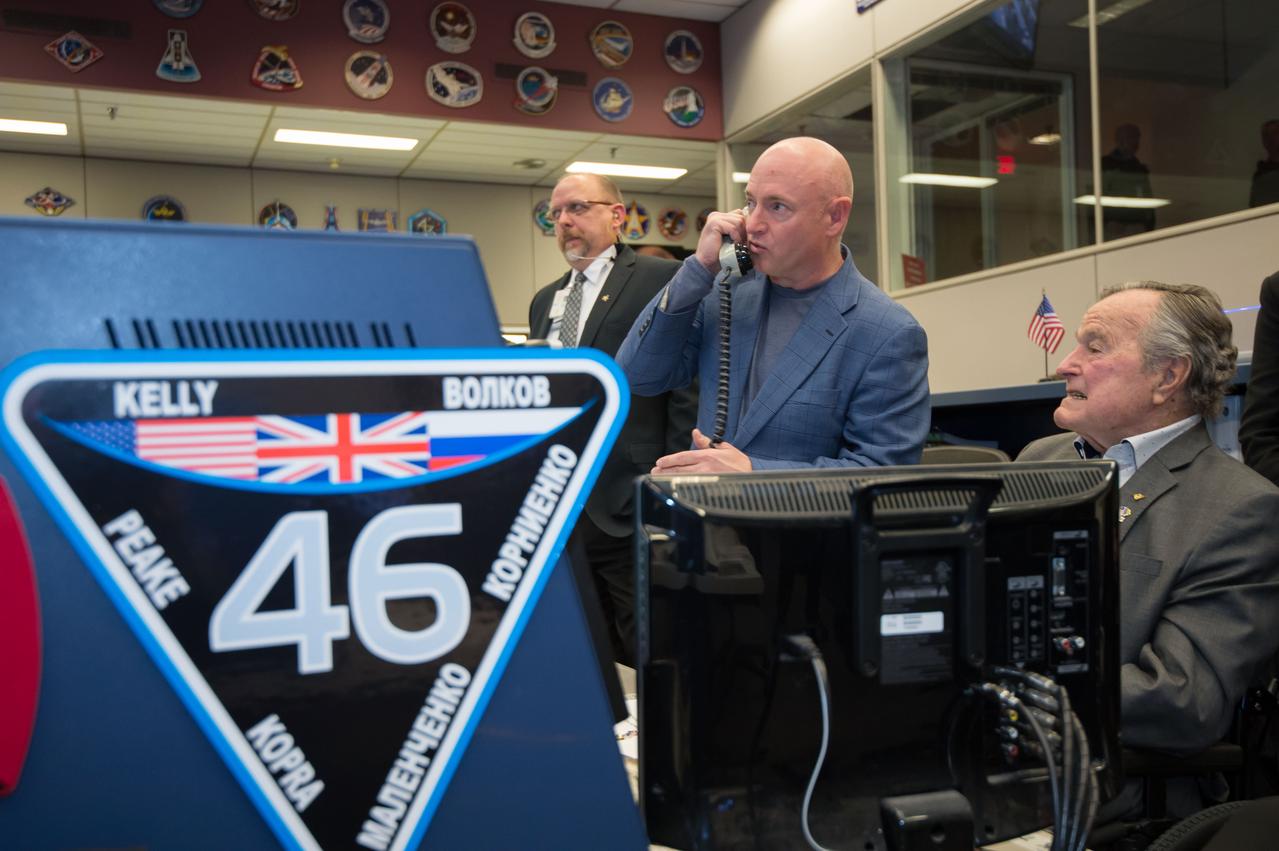
Former President George H.W. Bush paid a visit to NASA's Johnson Space Center to speak with Expedition 46 Commander Scott Kelly and Flight Engineer Tim Kopra and take a tour of the Space Vehicle Mockup Facility.   Kelly’s twin brother, Mark Kelly and his wife, former Congresswoman Gabrielle Giffords were also present.  Photo Date: February 5, 2016.  Location: Building 30 - ISS Flight Control Room.  Photographer: Robert Markowitz
Former President George H.W. Bush paid a visit to NASA's Johnson Space Center to speak with Expedition 46 Commander Scott Kelly and Flight Engineer Tim Kopra and take a tour of the Space Vehicle Mockup Facility. Kelly���s twin brother, Mark Kelly and his wife, former Congresswoman Gabrielle Giffords were also present. Photo Date: February 5, 2016. Location: Building 30 - ISS Flight Control Room. Photographer: Robert Markowitz
PHOTO DATE:  11-17-08 LOCATION:  Bldg 2N, 212 SUBJECT: Photographic support for Media Services:  Photograph STS-126 Flight Day 3 Mission Status Briefing. PHOTOGRAPHER: JAMES  BLAIR
STS-126 Flight Day 3 Mission Status Briefing.
PHOTO DATE:  11-17-08 LOCATION:  Bldg 2N, 212 SUBJECT: Photographic support for Media Services:  Photograph STS-126 Flight Day 3 Mission Status Briefing. PHOTOGRAPHER: JAMES  BLAIR
STS-126 Flight Day 3 Mission Status Briefing.
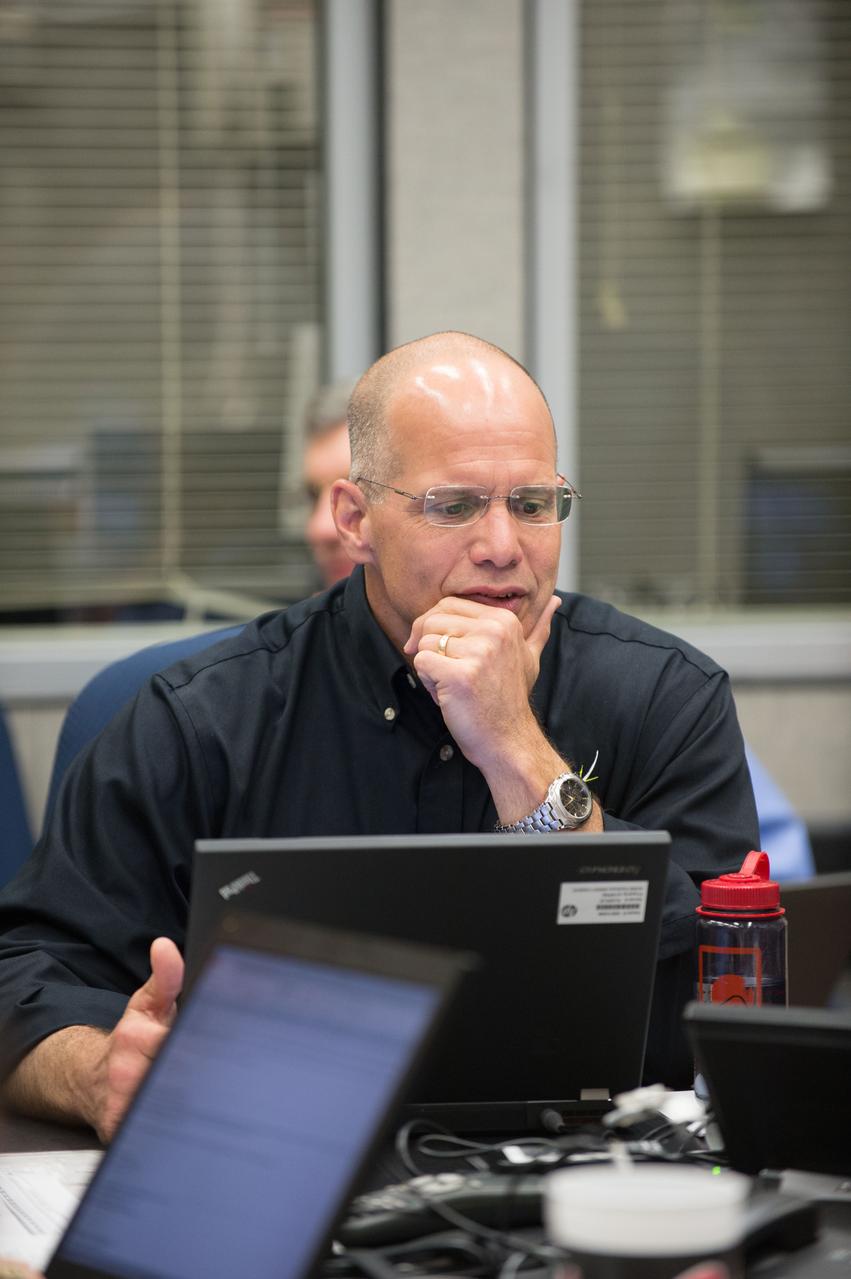
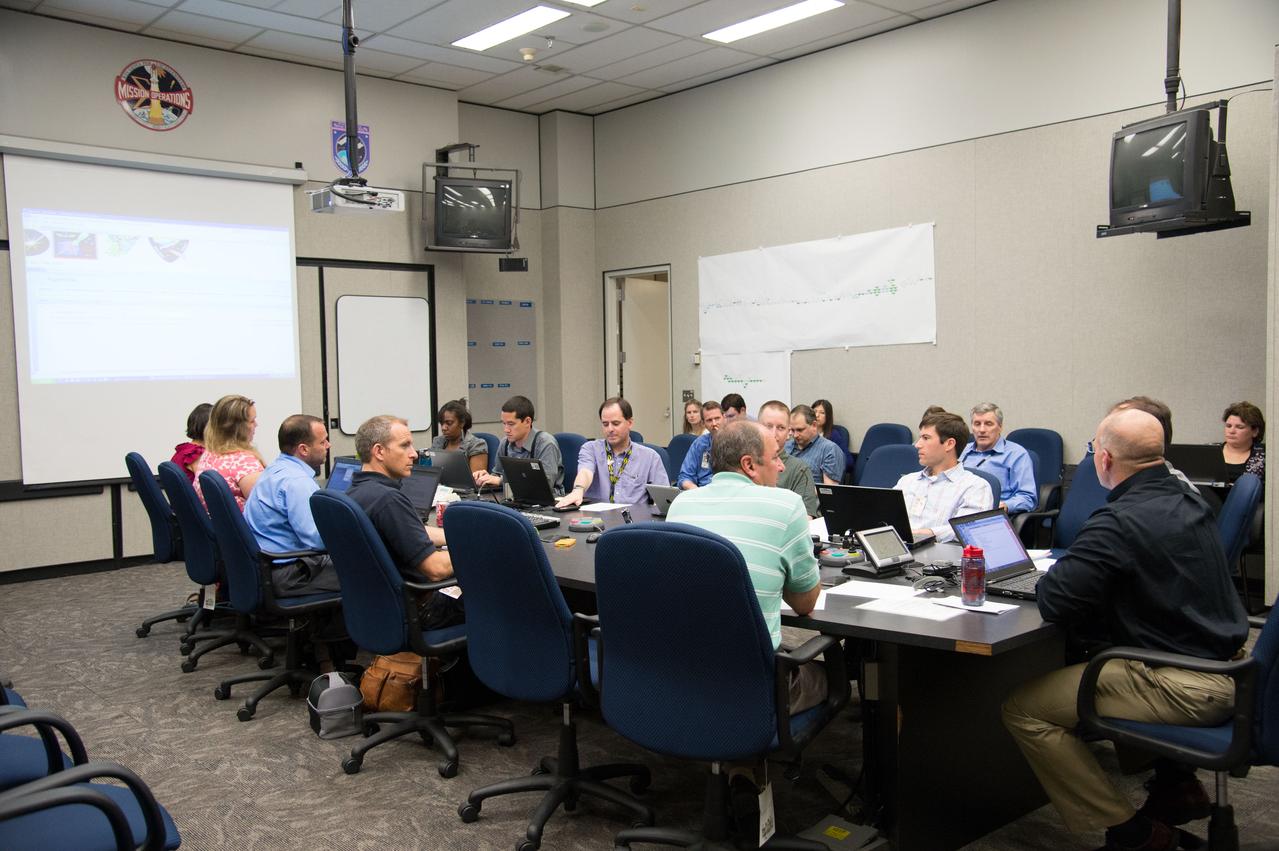
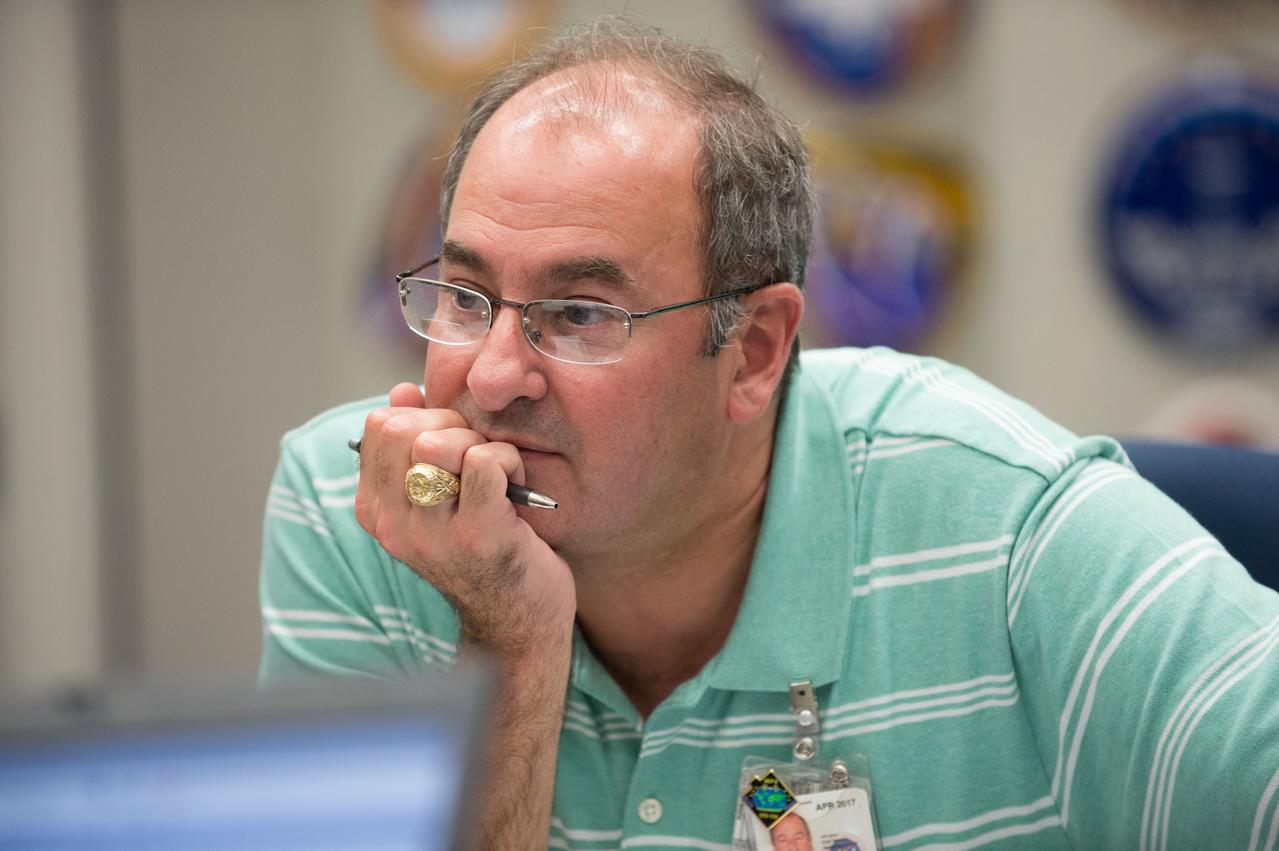
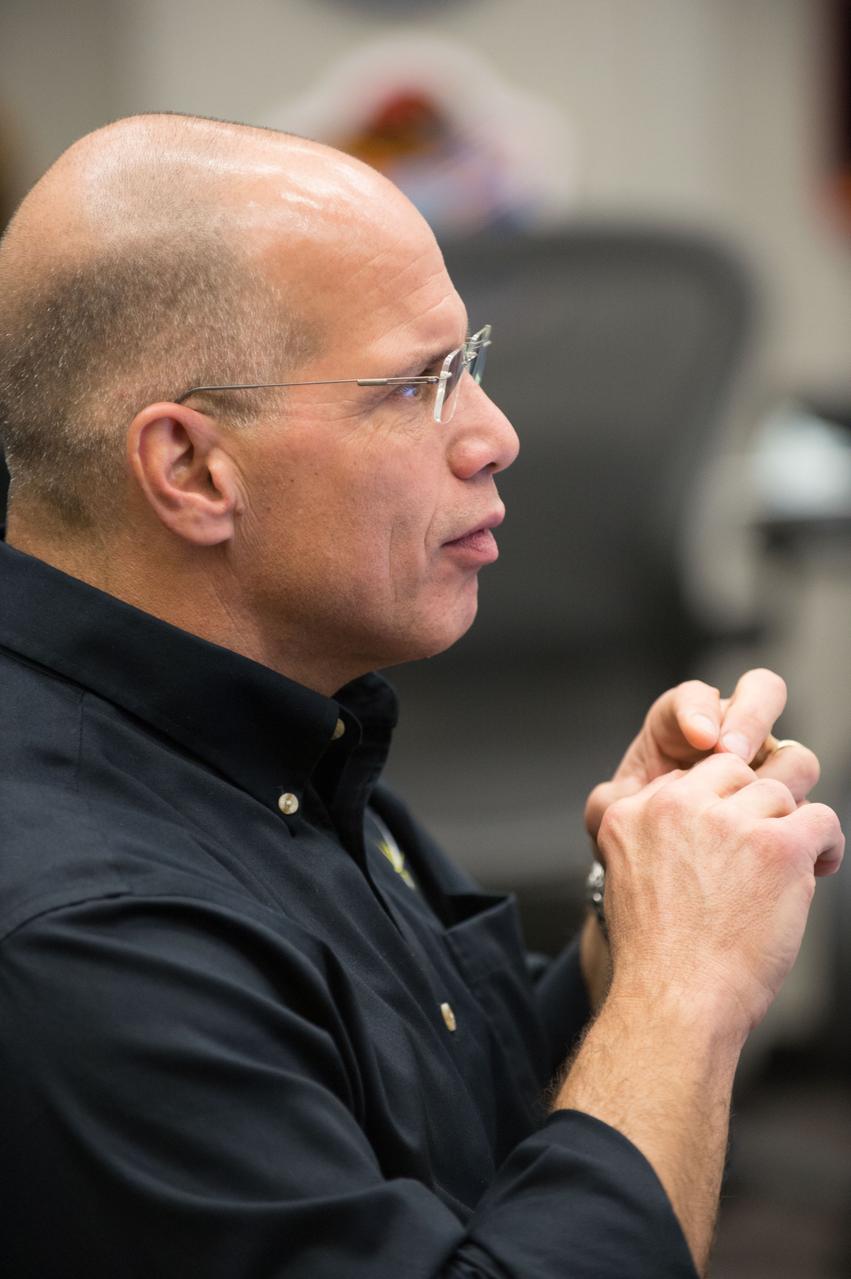
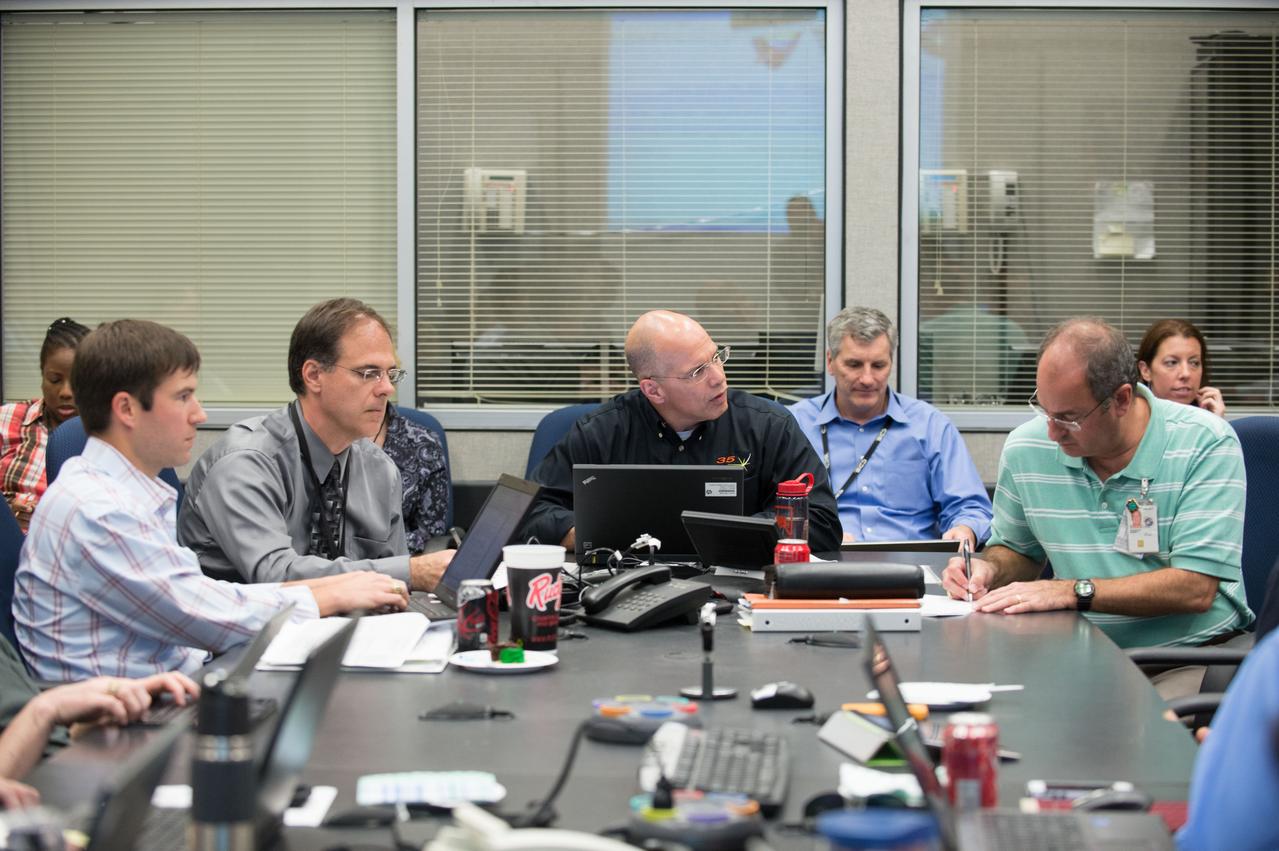
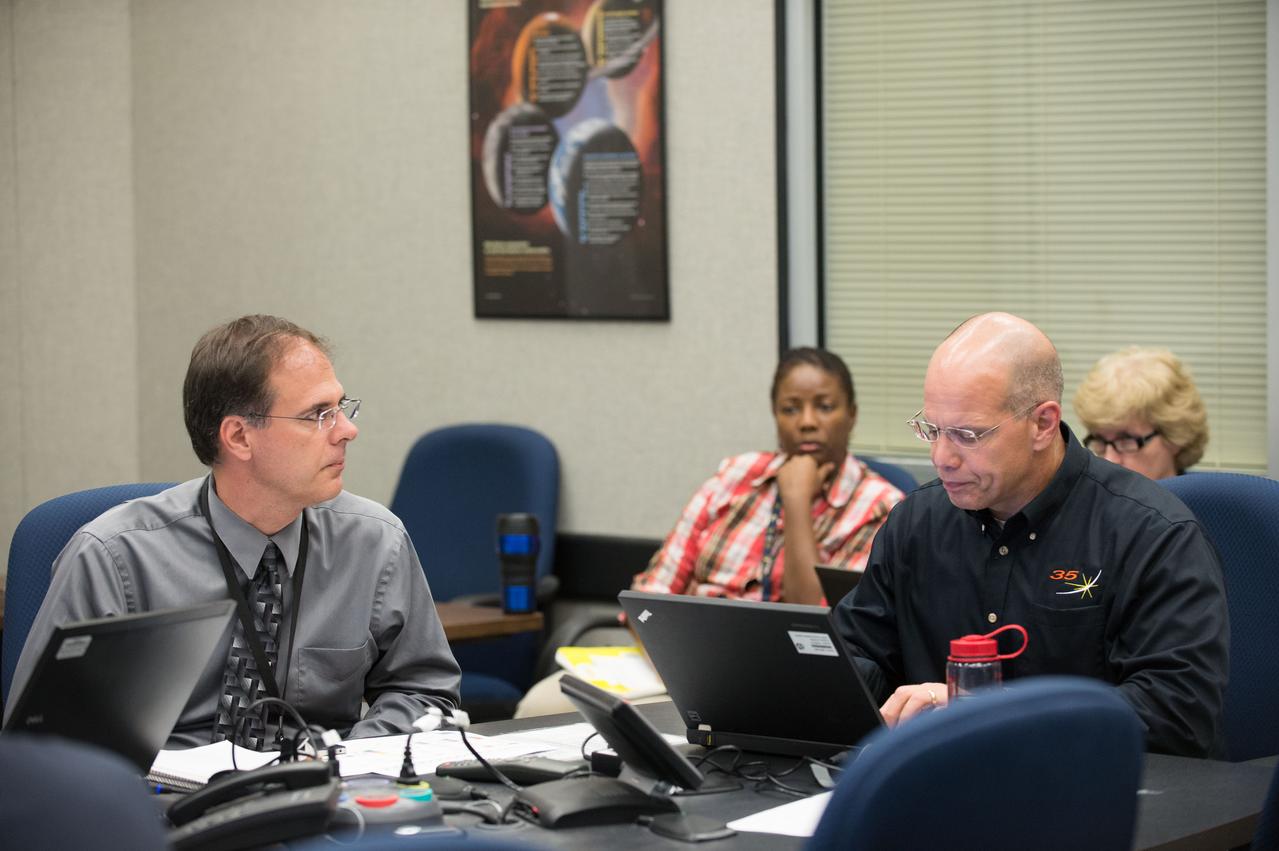
Photograph Increment 35 Lead Flight Director and Flight Control Team during JOP Meeting.  Photo Date: 17 April 2013. Location: Bldg. 30, Room 225A.  Photographer: Robert Markowitz
jsc2013e024724
Photograph Increment 35 Lead Flight Director and Flight Control Team during JOP Meeting.  Photo Date: 17 April 2013. Location: Bldg. 30, Room 225A.  Photographer: Robert Markowitz
jsc2013e024751
Photograph Increment 35 Lead Flight Director and Flight Control Team during JOP Meeting.  Photo Date: 17 April 2013. Location: Bldg. 30, Room 225A.  Photographer: Robert Markowitz
jsc2013e024733
Photograph Increment 35 Lead Flight Director and Flight Control Team during JOP Meeting.  Photo Date: 17 April 2013. Location: Bldg. 30, Room 225A.  Photographer: Robert Markowitz
jsc2013e024736
Photograph Increment 35 Lead Flight Director and Flight Control Team during JOP Meeting.  Photo Date: 17 April 2013. Location: Bldg. 30, Room 225A.  Photographer: Robert Markowitz
jsc2013e024744
Photograph Increment 35 Lead Flight Director and Flight Control Team during JOP Meeting.  Photo Date: 17 April 2013. Location: Bldg. 30, Room 225A.  Photographer: Robert Markowitz
jsc2013e024734
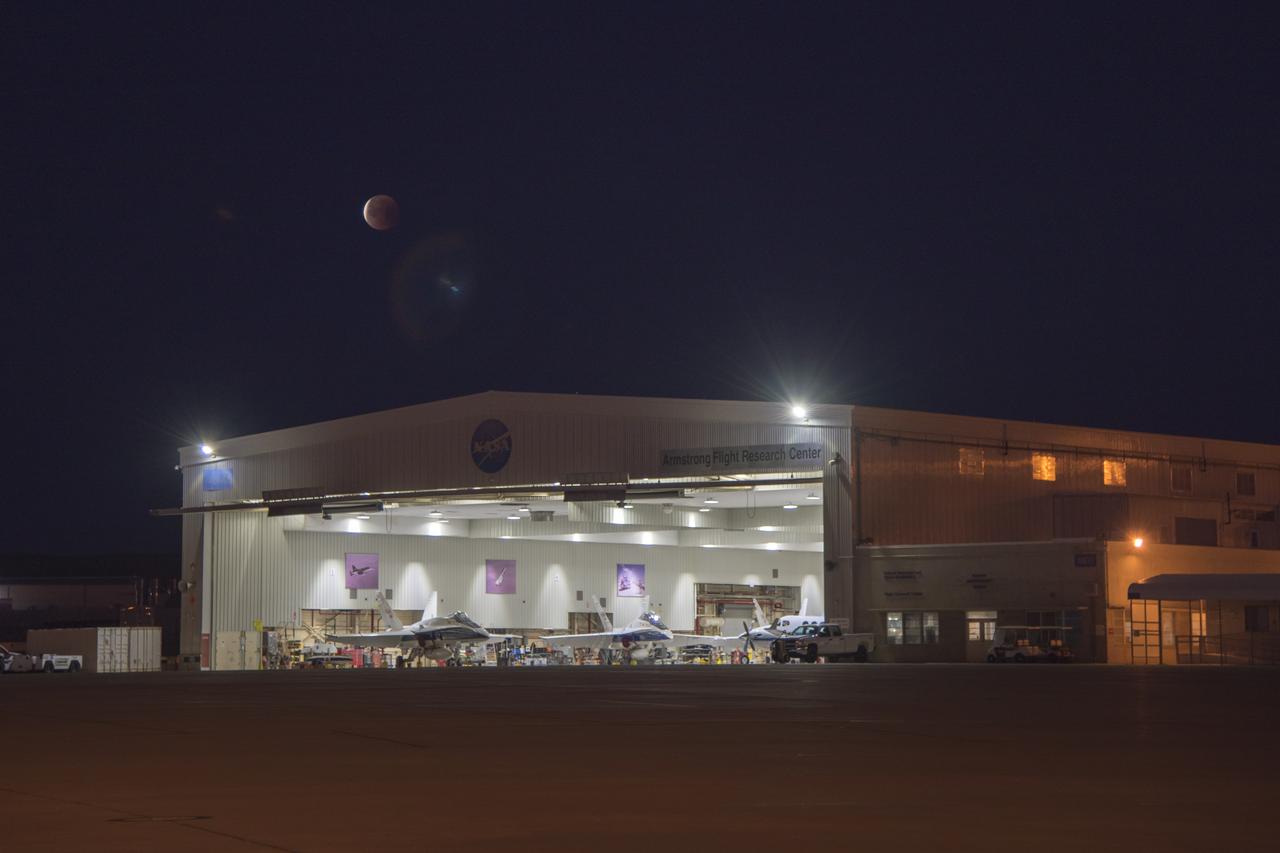
California's NASA Armstrong Flight Research Center photographer Carla Thomas takes photos on January 31 of the rare opportunity to capture a supermoon, a blue moon and a lunar eclipse at the same time. A supermoon occurs when the Moon is closer to Earth in its orbit and appearing 14 percent brighter than usual. As the second full moon of the month, this moon is also commonly known as a blue moon, though it will not be blue in appearance. The super blue moon passed through Earth's shadow and took on a reddish tint, known as a blood moon. This total lunar eclipse occurs when the Sun, Earth, and a full moon form a near-perfect lineup in space. The Moon passes directly behind the Earth into its umbra (shadow).
Image is NASA Armstrong Flight Research Center's aircraft hangar that houses the jets and other aircraft with the eclipsed moon overhead during Jan. 31 Super Blue Blood Moon.
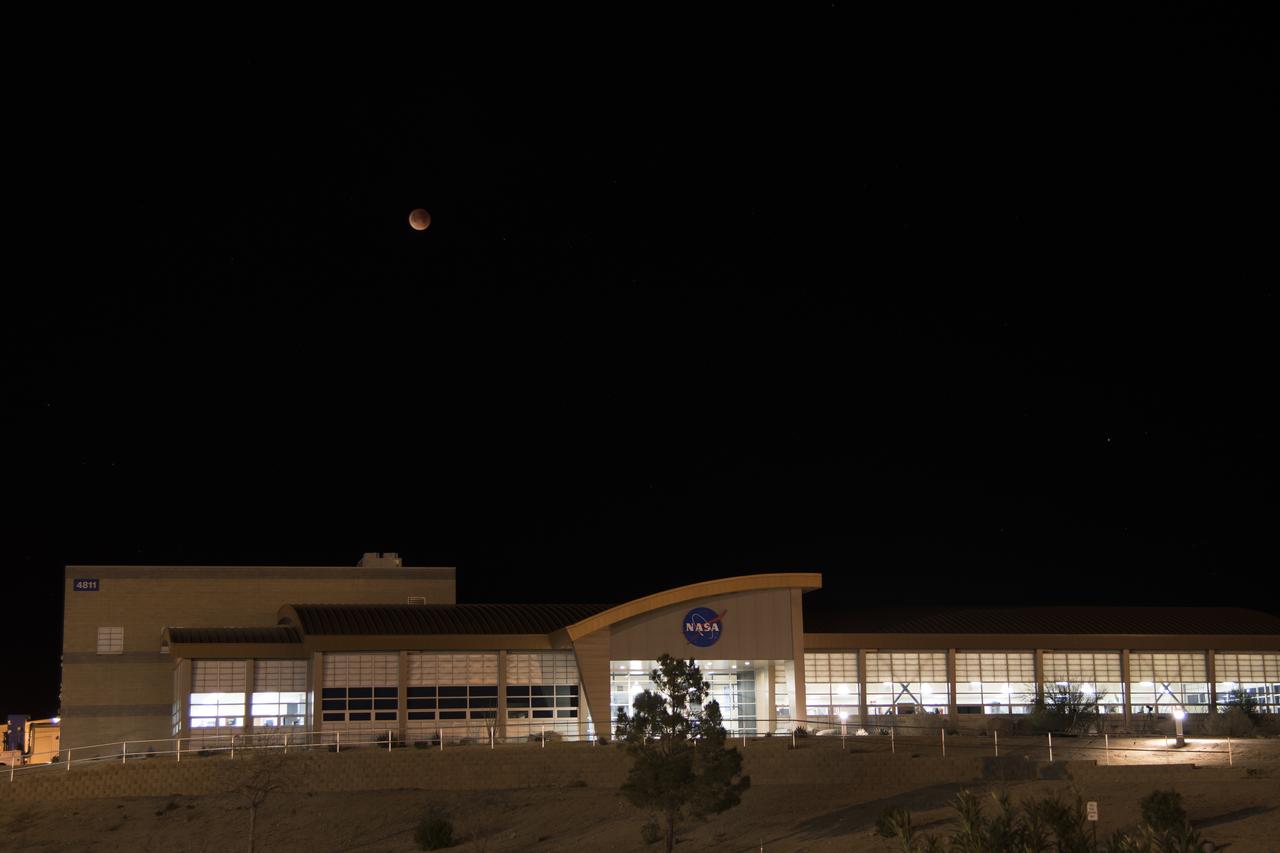
California's NASA Armstrong Flight Research Center photographer Carla Thomas takes photos on January 31 of the rare opportunity to capture a supermoon, a blue moon and a lunar eclipse at the same time. A supermoon occurs when the Moon is closer to Earth in its orbit and appearing 14 percent brighter than usual. As the second full moon of the month, this moon is also commonly known as a blue moon, though it will not be blue in appearance. The super blue moon passed through Earth's shadow and took on a reddish tint, known as a blood moon. This total lunar eclipse occurs when the Sun, Earth, and a full moon form a near-perfect lineup in space. The Moon passes directly behind the Earth into its umbra (shadow).
Image shows January 31 Super Blue Blood Moon starting the lunar eclipse over NASA Armstrong Flight Research Center's mission support building located in California.
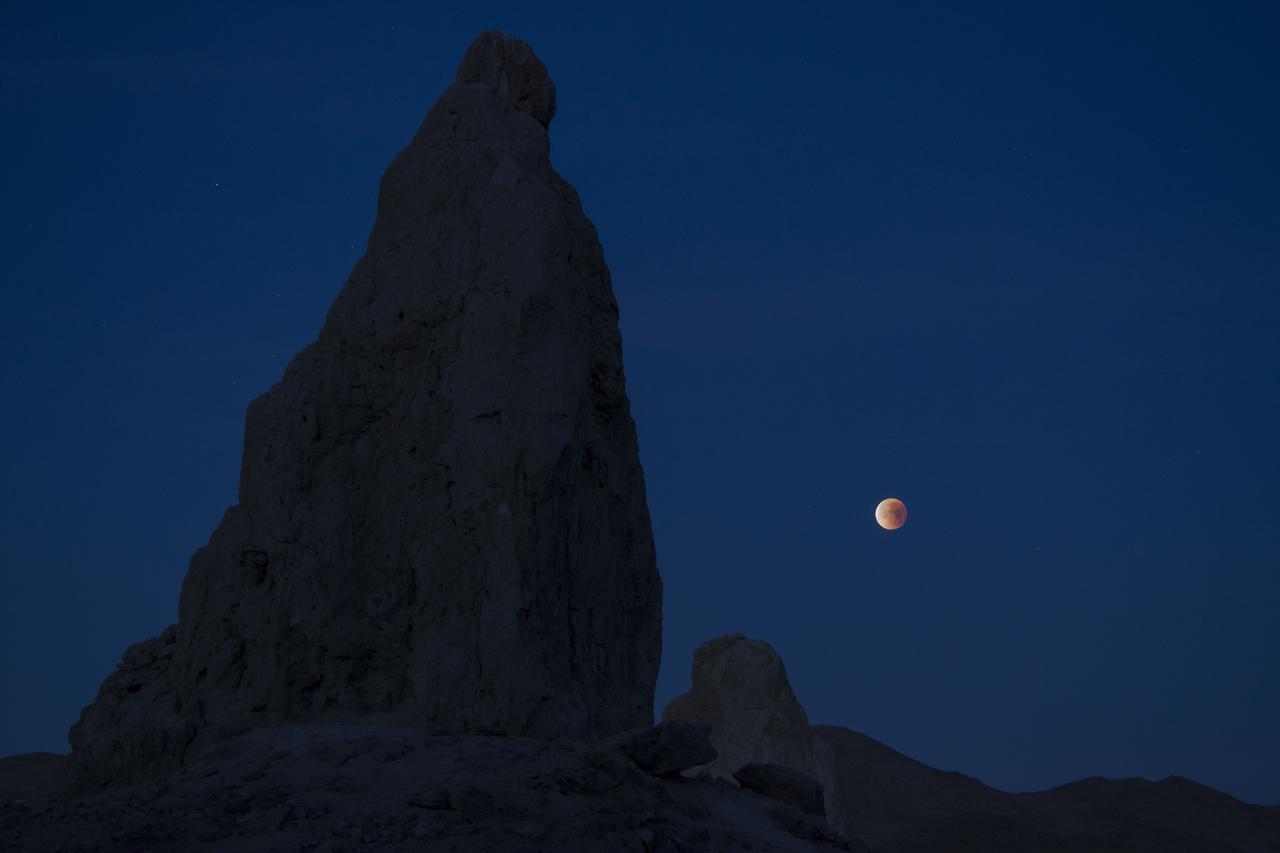
NASA Armstrong Flight Research Center photographer Lauren Hughes takes photos of the Super Blue Blood Moon eclipse from California’s Trona Pinnacles Desert National Conservation for the Jan. 31 of the total lunar eclipse that provided a rare opportunity to capture a supermoon, a blue moon and a lunar eclipse at the same time. A supermoon occurs when the Moon is closer to Earth in its orbit and appearing 14 percent brighter than usual. As the second full moon of the month, this moon is also commonly known as a blue moon, though it will not be blue in appearance. The super blue moon passed through Earth’s shadow and took on a reddish tint, known as a blood moon. This total lunar eclipse occurs when the Sun, Earth, and a full moon form a near-perfect lineup in space. The Moon passes directly behind the Earth into its umbra (shadow).
Image shows Trona Pinnacles near California’s NASA Armstrong Flight Research Center during Jan. 31 Super Blue Blood Moon. Trona Pinnacles is an unusual geological feature of the state’s Desert National Conservation.
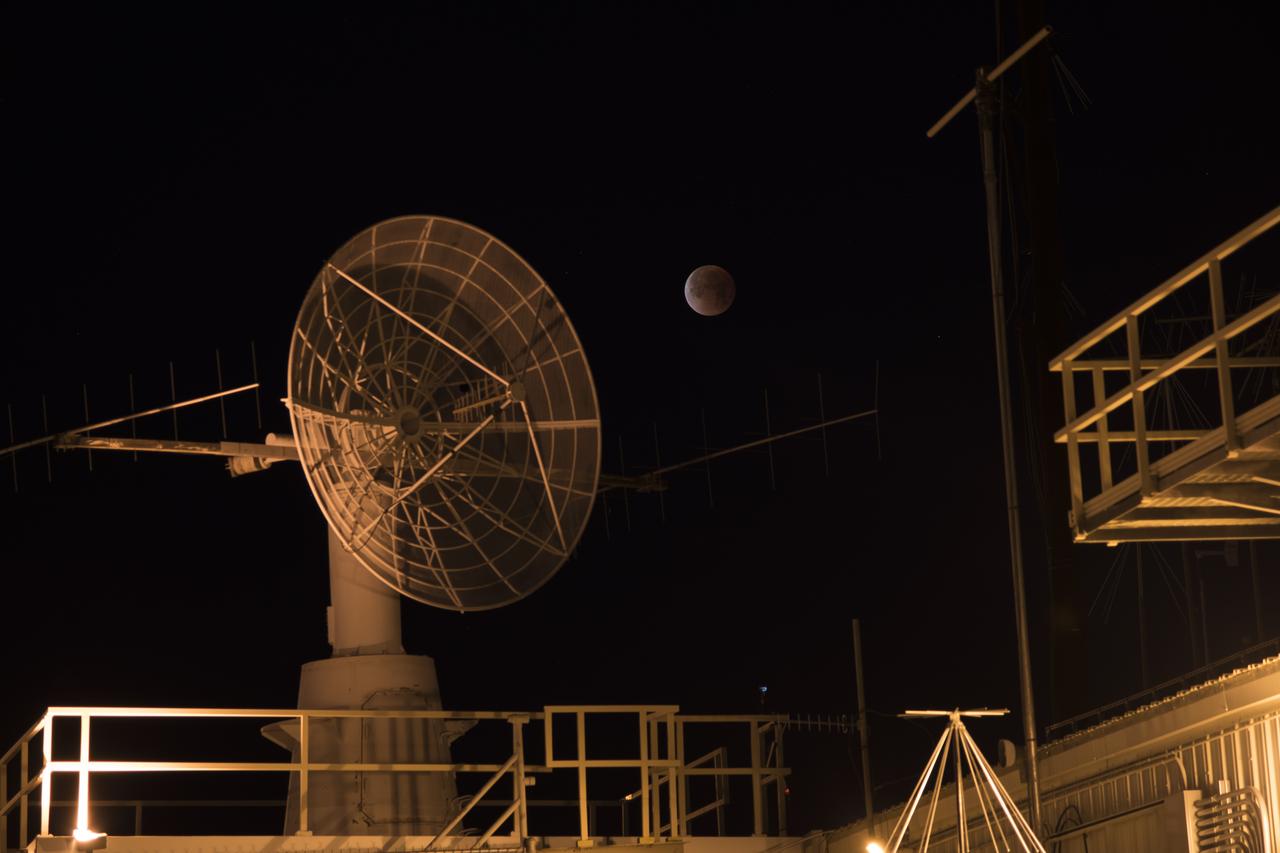
California’s NASA Armstrong Flight Research Center’s photographer Carla Thomas takes photos on January 31 of the rare opportunity to capture a supermoon, a blue moon and a lunar eclipse at the same time. A supermoon occurs when the Moon is closer to Earth in its orbit and appearing 14 percent brighter than usual. As the second full moon of the month, this moon is also commonly known as a blue moon, though it will not be blue in appearance. The super blue moon passed through Earth’s shadow and took on a reddish tint, known as a blood moon. This total lunar eclipse occurs when the Sun, Earth, and a full moon form a near-perfect lineup in space. The Moon passes directly behind the Earth into its umbra (shadow).
NASA Armstrong Flight Research Center’s communications facility with radar dish and antennas is shown having the eclipsed moon overhead during Jan. 31 Super Blue Blood Moon.
NASA Armstrong Flight Research Center photographer Lauren Hughes takes photos of the Super Blue Blood Moon eclipse from California’s Trona Pinnacles Desert National Conservation for the Jan. 31 of the total lunar eclipse that provided a rare opportunity to capture a supermoon, a blue moon and a lunar eclipse at the same time. A supermoon occurs when the Moon is closer to Earth in its orbit and appearing 14 percent brighter than usual. As the second full moon of the month, this moon is also commonly known as a blue moon, though it will not be blue in appearance. The super blue moon passed through Earth’s shadow and took on a reddish tint, known as a blood moon. This total lunar eclipse occurs when the Sun, Earth, and a full moon form a near-perfect lineup in space. The Moon passes directly behind the Earth into its umbra (shadow).
Image shows Trona Pinnacles near California’s NASA Armstrong Flight Research Center during Jan. 31 Super Blue Blood Moon. Trona Pinnacles is an unusual geological feature of the state’s Desert National Conservation.
NASA Armstrong Flight Research Center photographer Lauren Hughes takes photos of the Super Blue Blood Moon eclipse from California's Trona Pinnacles Desert National Conservation for the Jan. 31 of the total lunar eclipse that provided a rare opportunity to capture a supermoon, a blue moon and a lunar eclipse at the same time. A supermoon occurs when the Moon is closer to Earth in its orbit and appearing 14 percent brighter than usual. As the second full moon of the month, this moon is also commonly known as a blue moon, though it will not be blue in appearance. The super blue moon passed through Earth's shadow and took on a reddish tint, known as a blood moon. This total lunar eclipse occurs when the Sun, Earth, and a full moon form a near-perfect lineup in space. The Moon passes directly behind the Earth into its umbra (shadow).
Image shows Trona Pinnacles near California's NASA Armstrong Flight Research Center during Jan. 31 Super Blue Blood Moon. Trona Pinnacles is an unusual geological feature of the state's Desert National Conservation.
California's NASA Armstrong Flight Research Center photographer Carla Thomas takes photos on January 31 of the rare opportunity to capture a supermoon, a blue moon and a lunar eclipse at the same time. A supermoon occurs when the Moon is closer to Earth in its orbit and appearing 14 percent brighter than usual. As the second full moon of the month, this moon is also commonly known as a blue moon, though it will not be blue in appearance. The super blue moon passed through Earth's shadow and took on a reddish tint, known as a blood moon. This total lunar eclipse occurs when the Sun, Earth, and a full moon form a near-perfect lineup in space. The Moon passes directly behind the Earth into its umbra (shadow).
NASA Armstrong Flight Research Center's communications facility with radar dish and the eclipsed moon overhead during Jan. 31 Super Blue Blood Moon.
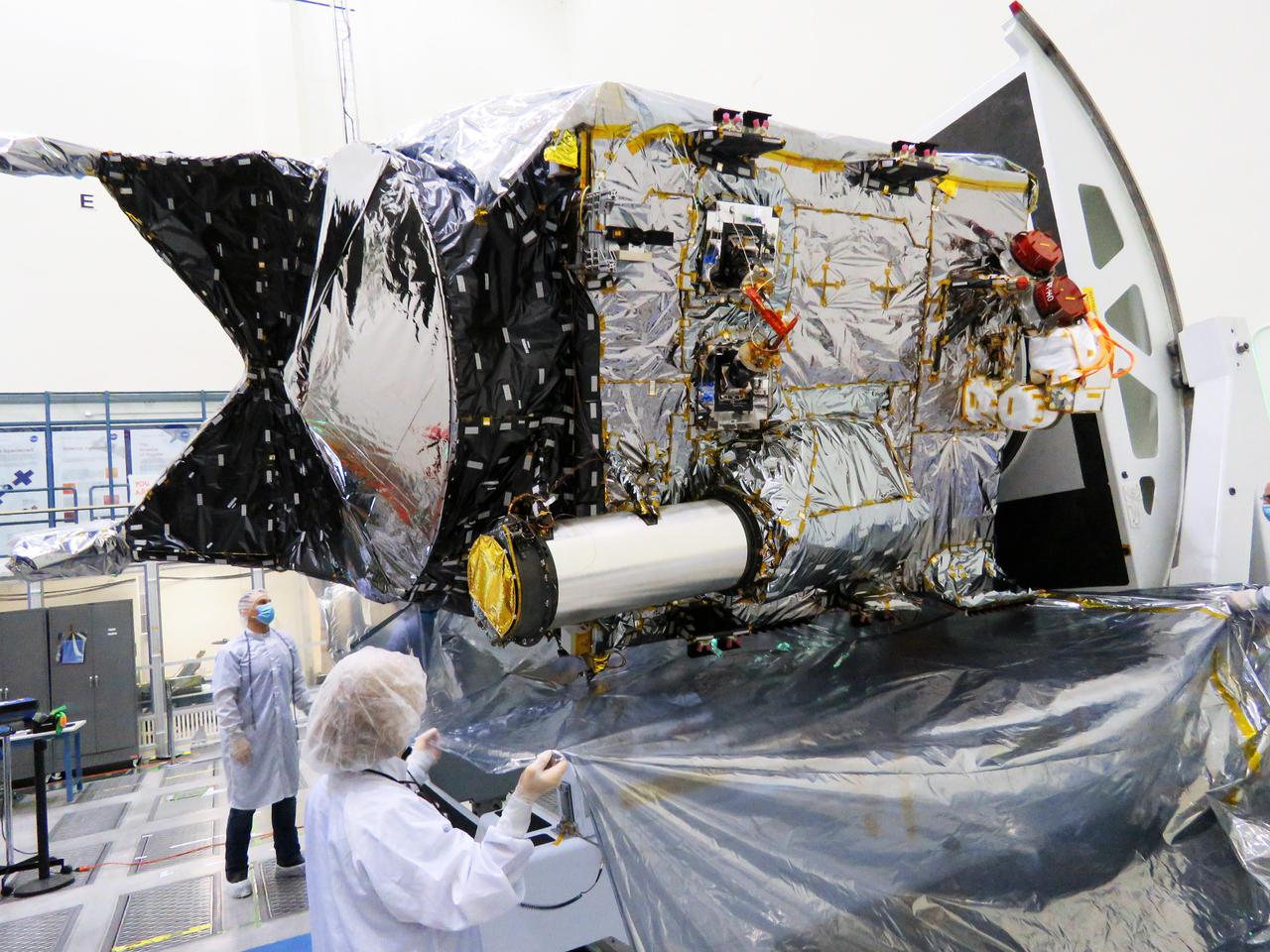
The Deep Space Optical Communications (DSOC) technology demonstration's flight laser transceiver can be easily identified on NASA's Psyche spacecraft, seen in this December 2021 photograph inside a clean room at the agency's Jet Propulsion Laboratory in Southern California. DSOC's tube-like gray/silver sunshade can be seen protruding from the side of the spacecraft. The bulge to which the sunshade is attached is DSOC's transceiver, which consists of a near-infrared laser transmitter to send high-rate data to Earth and a sensitive photon-counting camera to receive ground-transmitted low-rate data.  The DSOC experiment is the agency's first demonstration of optical communications beyond the Earth-Moon system. DSOC is a system that consists of this flight laser transceiver, a ground laser transmitter, and a ground laser receiver. New advanced technologies have been implemented in each of these elements. The transceiver will "piggyback" on NASA's Psyche spacecraft when it launches in August 2022 to the metal-rich asteroid of the same name. The DSOC technology demonstration will begin shortly after launch and continue as the spacecraft travels from Earth to its gravity-assist flyby of Mars.  https://photojournal.jpl.nasa.gov/catalog/PIA24570
DSOC Flight Laser Transceiver Integrated with NASA's Psyche Spacecraft
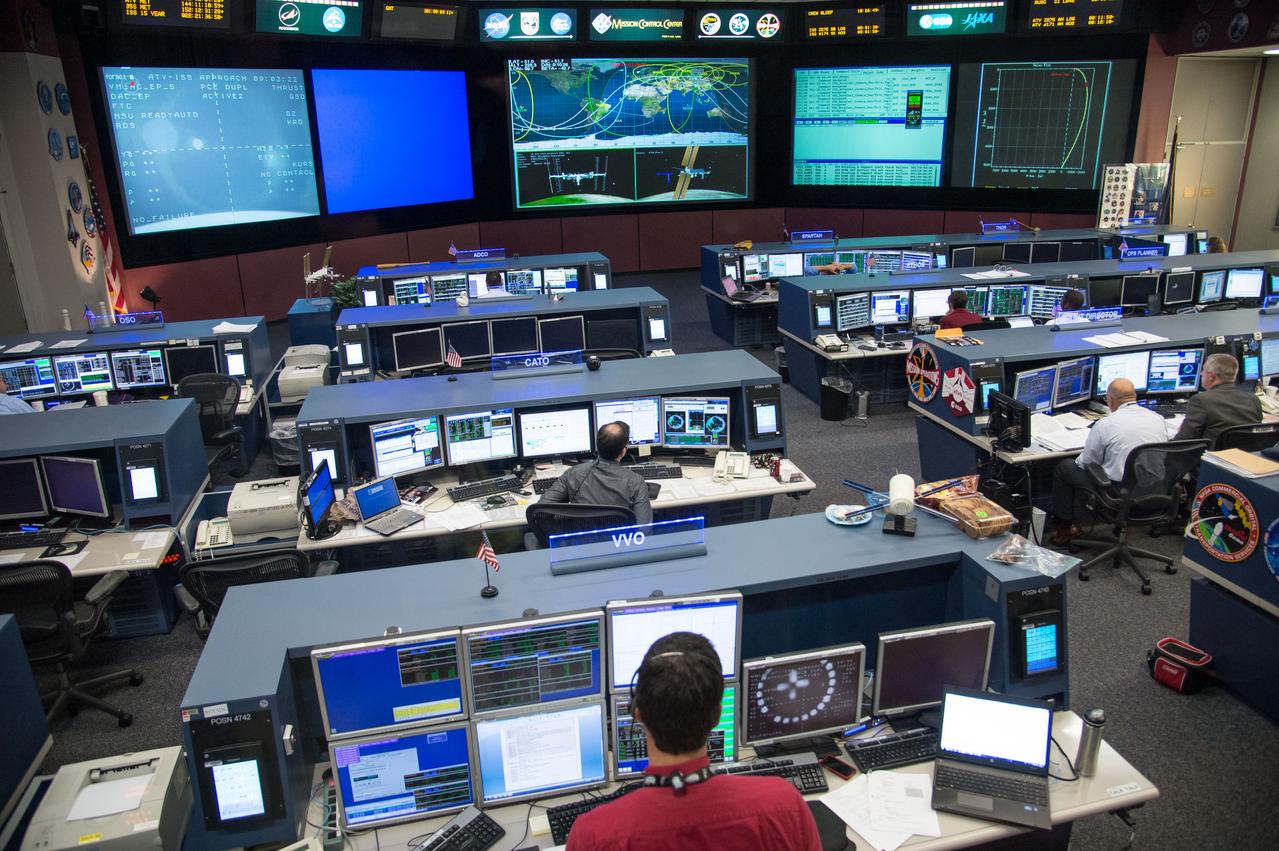
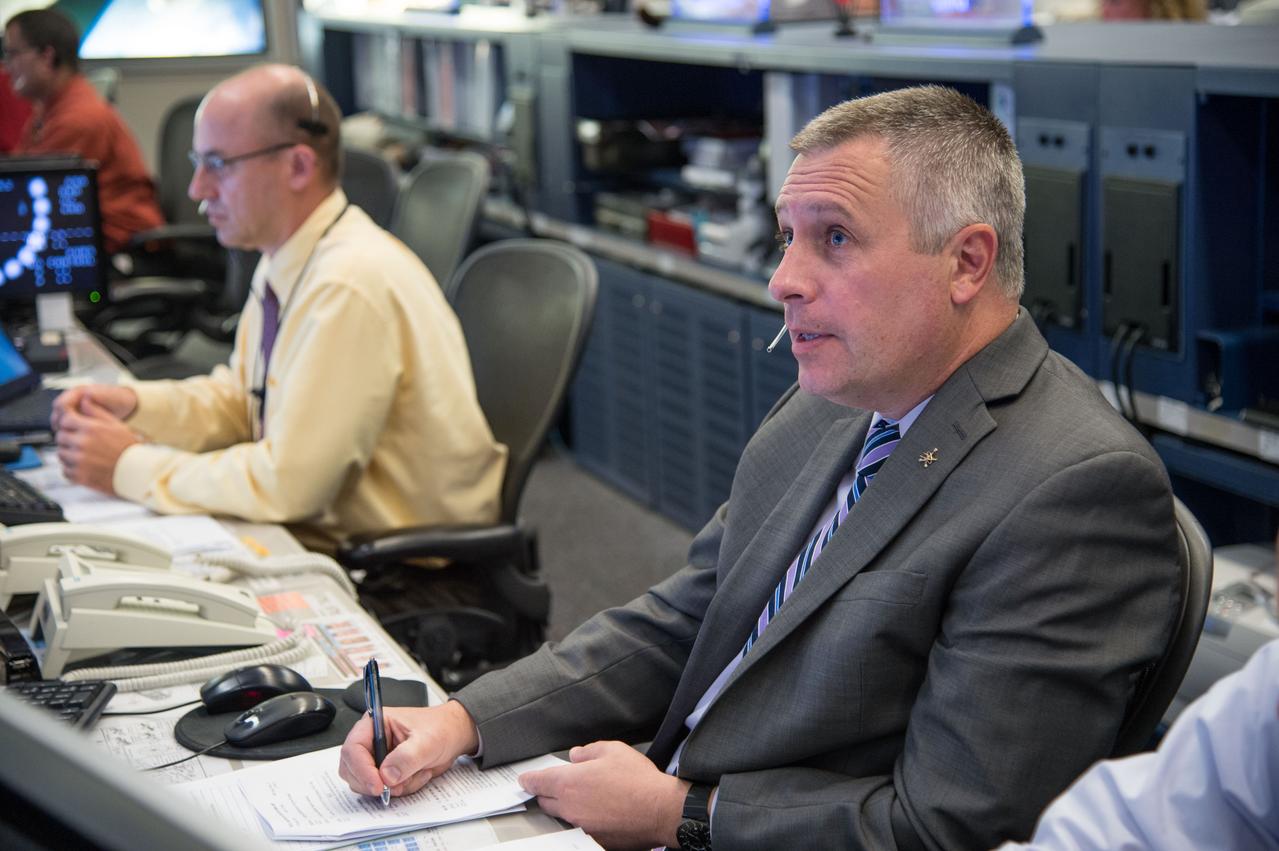
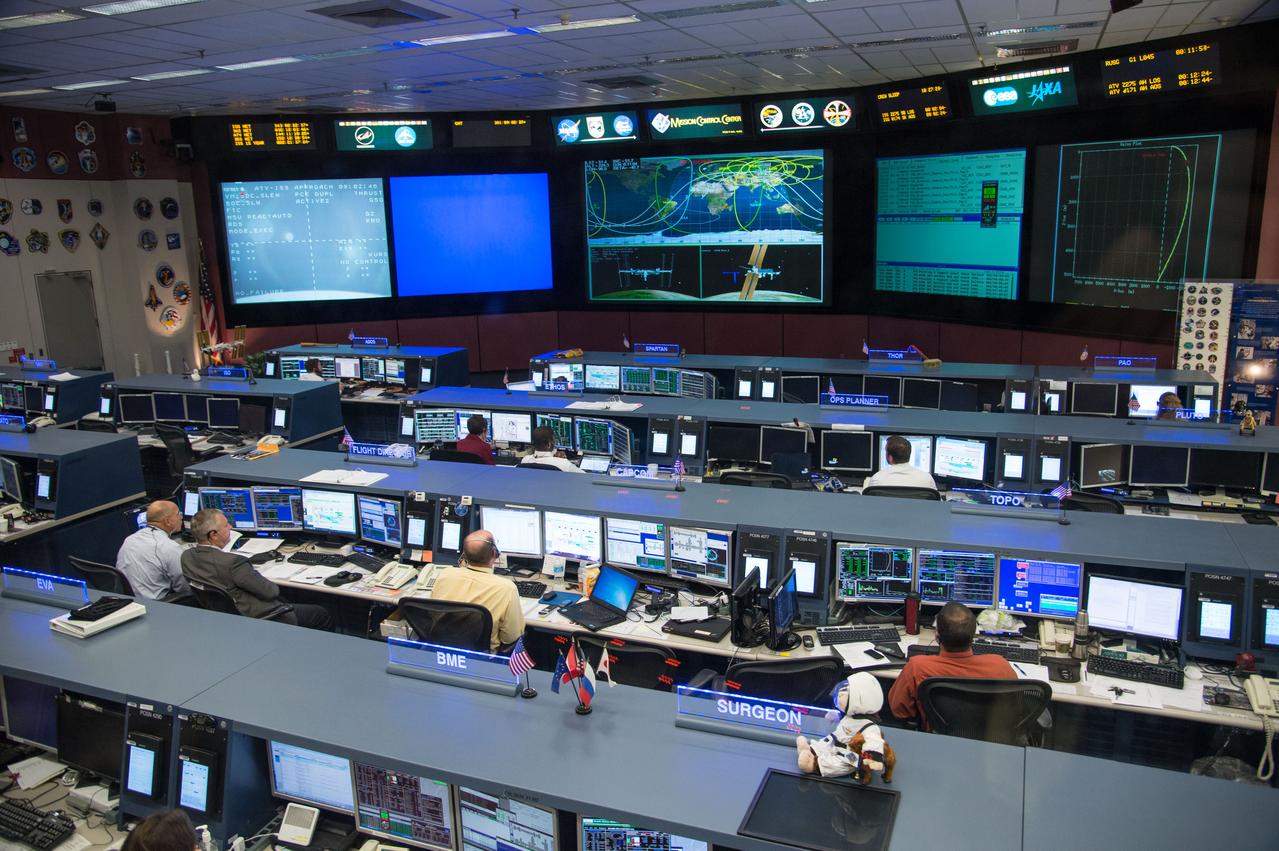
Photographic coverage of Expedition 37 flight controllers on console with Flight Director's Jerry Jason and Tony Ceccacci during the undocking of Europe's 4th Automated Transfer Vehicle (ATV) from the International Space Station.  Photo Date: October 28, 2013.  Location: Building 30 - FCR1.  Photographer: Robert Markowitz
jsc2013e090912
Photographic coverage of Expedition 37 flight controllers on console with Flight Director's Jerry Jason and Tony Ceccacci during the undocking of Europe's 4th Automated Transfer Vehicle (ATV) from the International Space Station.  Photo Date: October 28, 2013.  Location: Building 30 - FCR1.  Photographer: Robert Markowitz
jsc2013e090898
Photograph STS-135 entry flight controllers on console during the landing of Space Shuttle Atlantis with Flight Director Tony Ceccacci.  Photo Date: July 21, 2011.  Location: Building 30 south - WFCR.  Photographer: Robert Markowitz
STS-135 entry flight controllers on console
Photographic coverage of Expedition 37 flight controllers on console with Flight Director's Jerry Jason and Tony Ceccacci during the undocking of Europe's 4th Automated Transfer Vehicle (ATV) from the International Space Station.  Photo Date: October 28, 2013.  Location: Building 30 - FCR1.  Photographer: Robert Markowitz
jsc2013e090910
Photographic coverage of Expedition 37 flight controllers on console with Flight Director's Jerry Jason and Tony Ceccacci during the undocking of Europe's 4th Automated Transfer Vehicle (ATV) from the International Space Station.  Photo Date: October 28, 2013.  Location: Building 30 - FCR1.  Photographer: Robert Markowitz
jsc2013e090913
Photographic coverage of Expedition 37 flight controllers on console with Flight Director's Jerry Jason and Tony Ceccacci during the undocking of Europe's 4th Automated Transfer Vehicle (ATV) from the International Space Station.  Photo Date: October 28, 2013.  Location: Building 30 - FCR1.  Photographer: Robert Markowitz
jsc2013e090914
Photographic coverage of Expedition 37 flight controllers on console with Flight Director's Jerry Jason and Tony Ceccacci during the undocking of Europe's 4th Automated Transfer Vehicle (ATV) from the International Space Station.  Photo Date: October 28, 2013.  Location: Building 30 - FCR1.  Photographer: Robert Markowitz
jsc2013e090894
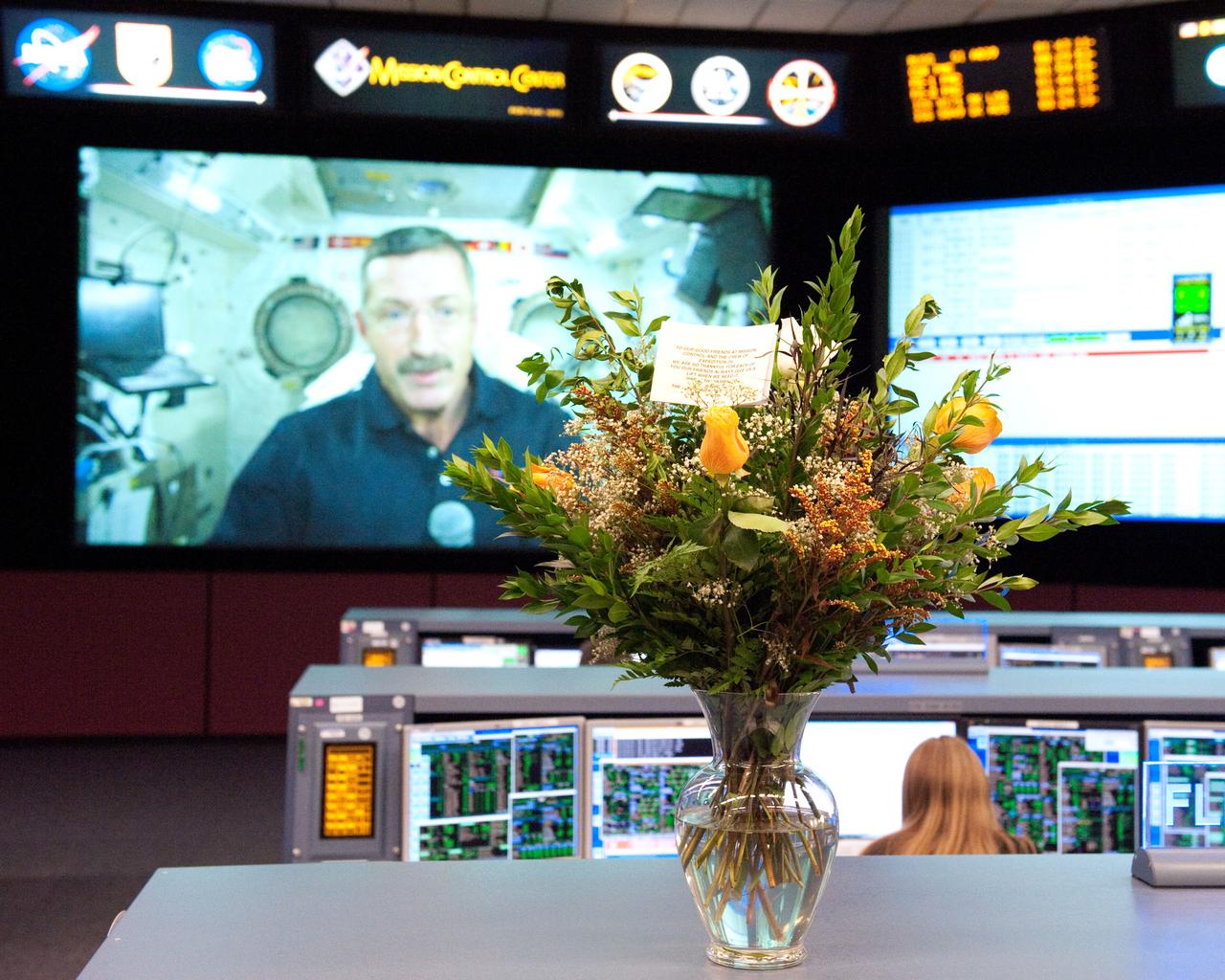
Date: 11-23-11 Location: Bldg 30, FCR-1 Subject: Photograph flowers sent by Shelton/Murphy family in honor of the Expedition 29 flight control team for Thanksgiving Photographer: James Blair
jsc2011e212005
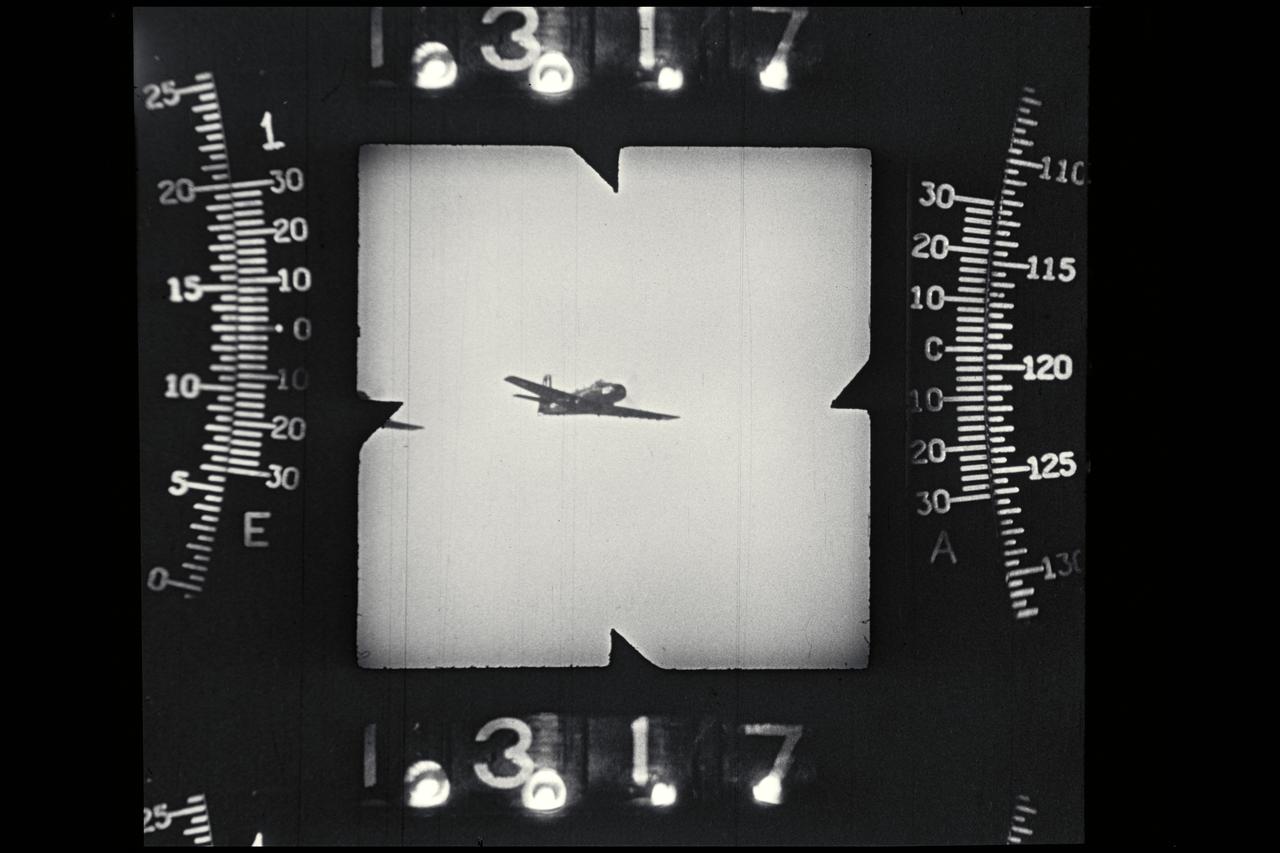
NACA photographer: Phototheodolite camera record image of P-51 in flight propellers on
ARC-1955-A-20977
This photograph shows an early moment of the first test flight of the Saturn V vehicle for the Apollo 4 mission, photographed by a ground tracking camera, on the morning of November 9, 1967. This mission was the first launch of the Saturn V launch vehicle. Objectives of the unmarned Apollo 4 test flight were to obtain flight information on launch vehicle and spacecraft structural integrity and compatibility, flight loads, stage separation, and subsystems operation including testing of restart of the S-IVB stage, and to evaluate the Apollo command module heat shield.
Saturn Apollo Program
Astronaut Reid Wiseman,Expedition 40 flight engineer,is photographed playing with a yoyo in the Node 2 module.
Wiseman with yoyo in Node 2
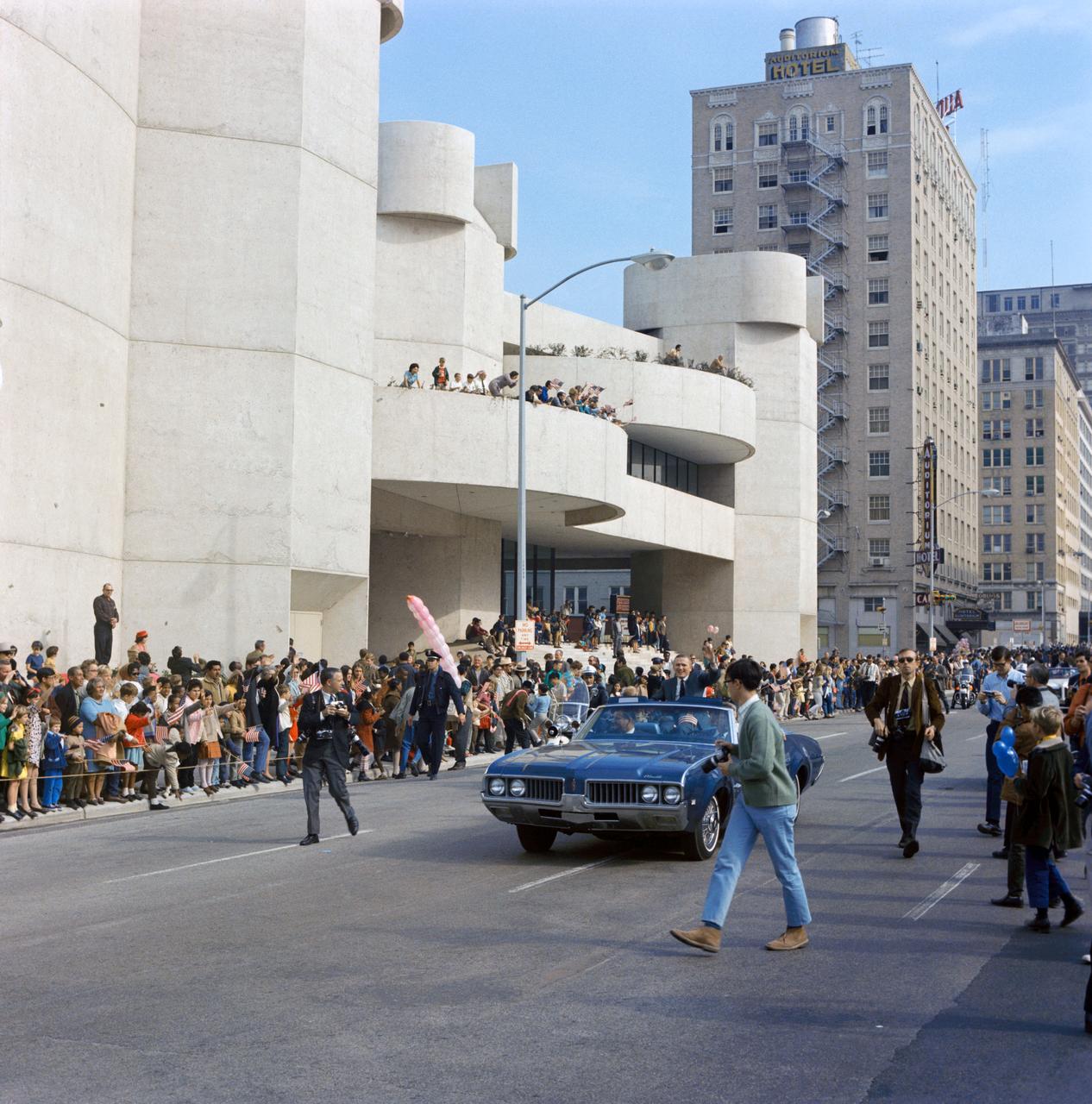
Astronaut Frank Borman, commander; and family are photographed during parade through Houston at the end of the Apollo VIII flight.
Postflight - Apollo VIII (Parade/Awards) - TX
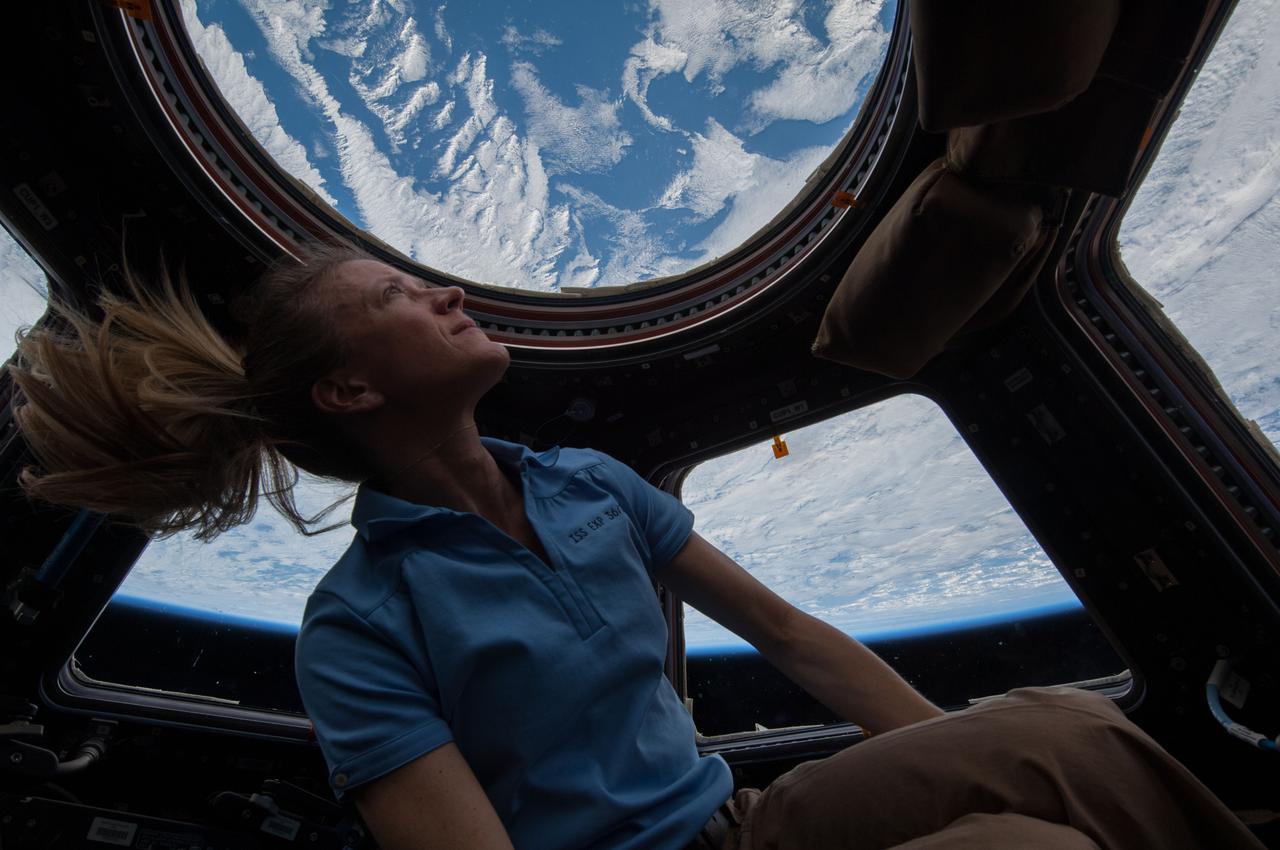
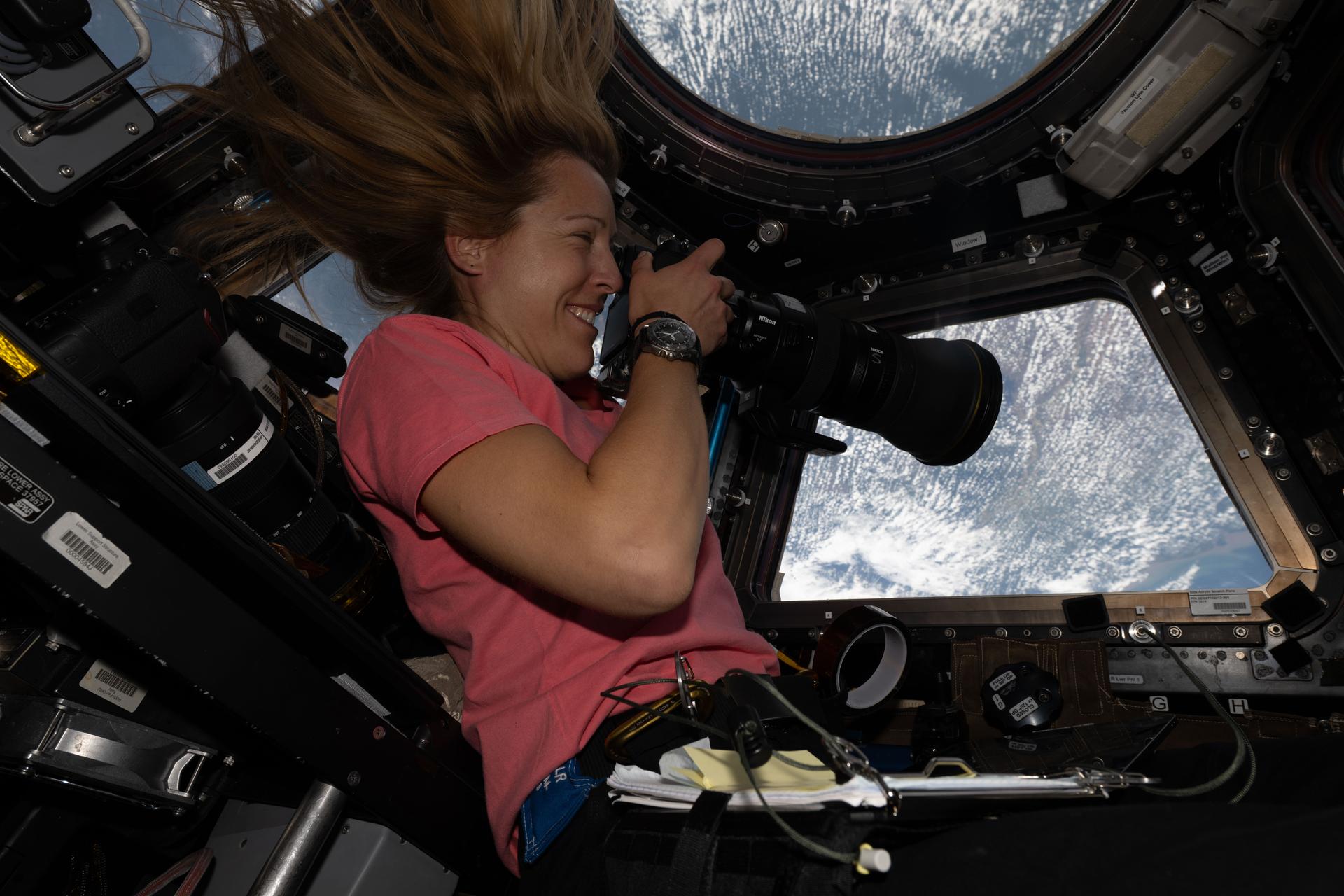
Astronaut Karen Nyberg, Expedition 37 flight engineer, is photographed in front of the windows in the Cupola module .
Nyberg in Cupola
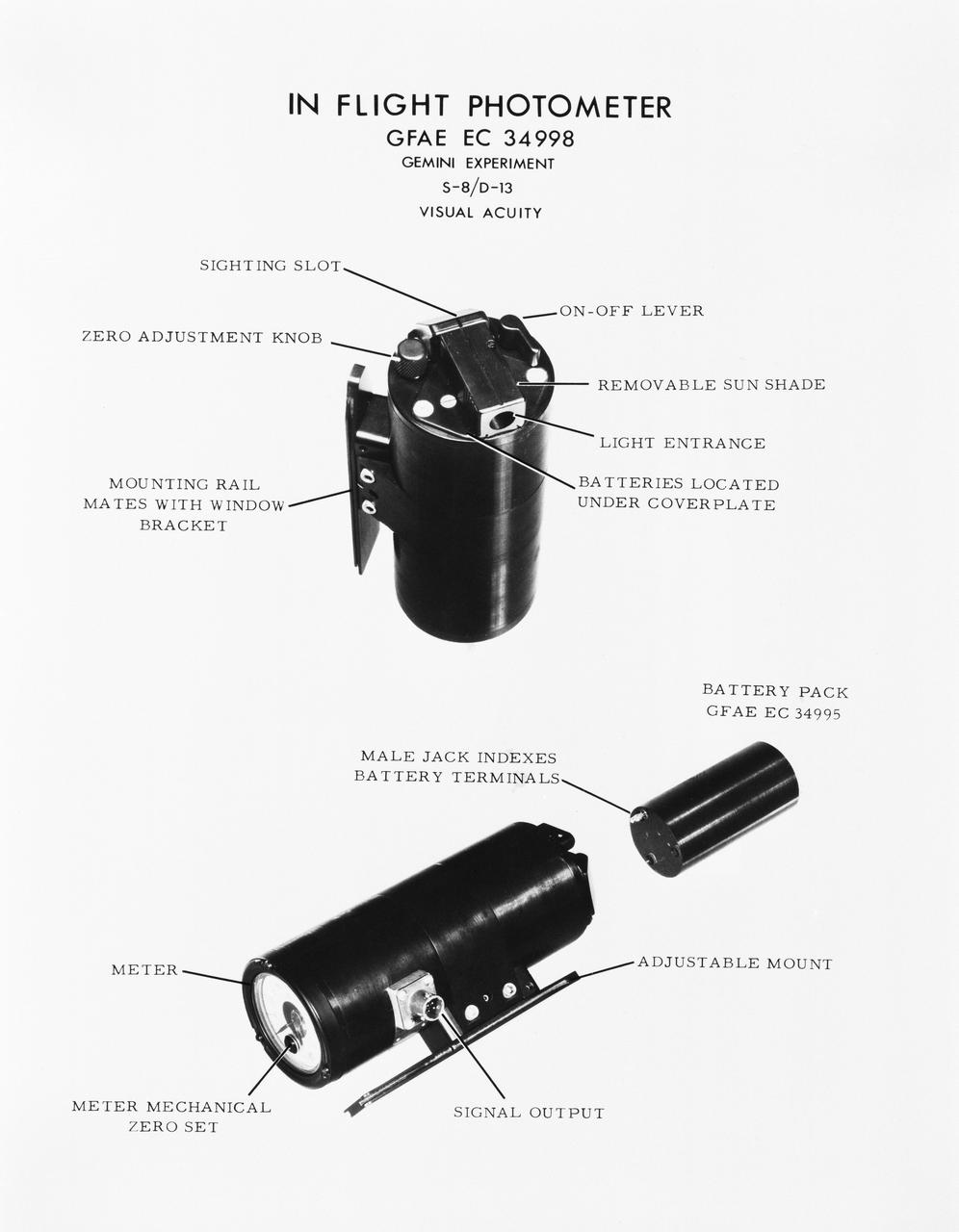
S65-28645 (June 1965) --- Photograph showing the component parts of the Gemini experiment In-flight Photometer.
Chart - Visual Acuity - Inflight Photometer - CA
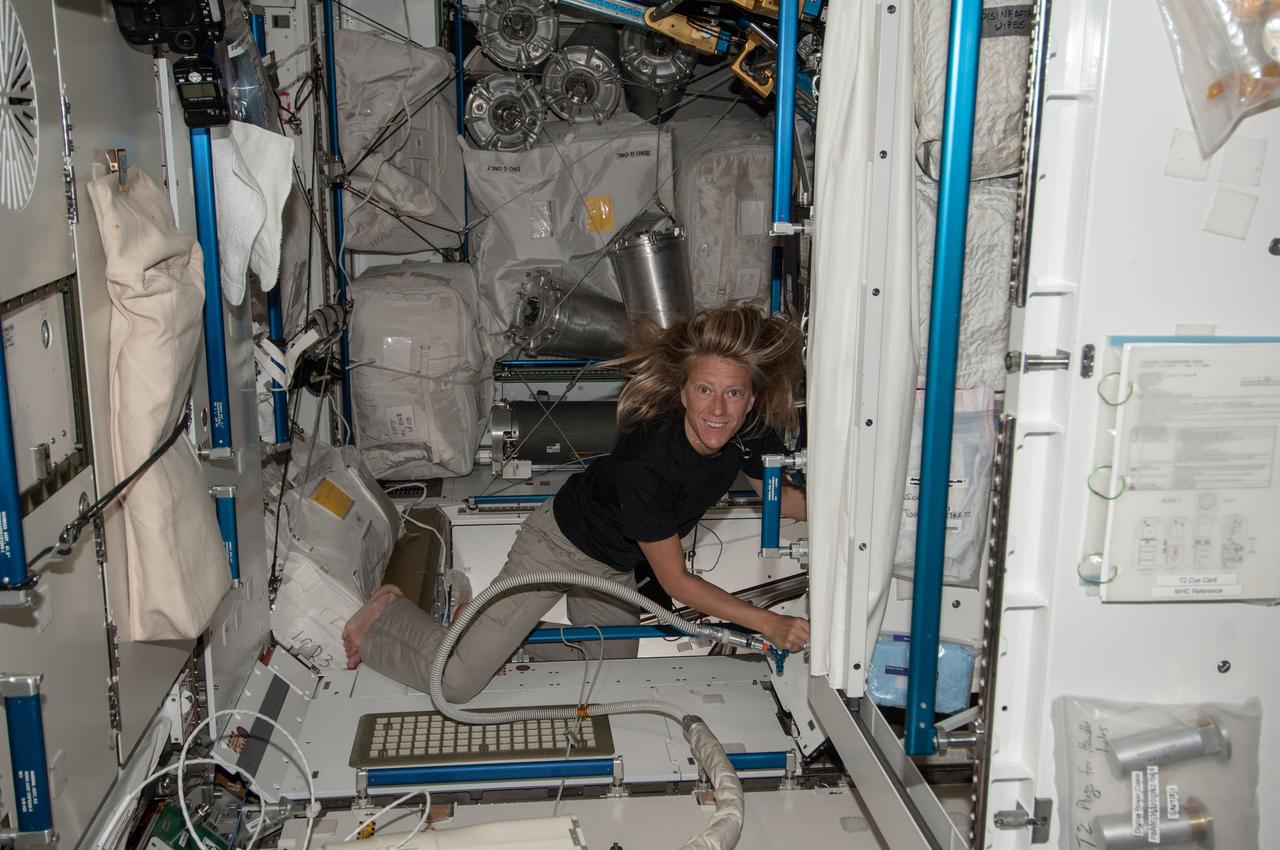
Astronaut Karen Nyberg,Expedition 36 flight engineer,is photographed at work in the U.S. Laboratory module.
Nyberg in U.S. Lab
Scientist photographs STS- 26 Post-flight (VDA) Vapor Diffusion Apparatus Tray with (PCG) Protein Crystal Growth Samples.
Microgravity
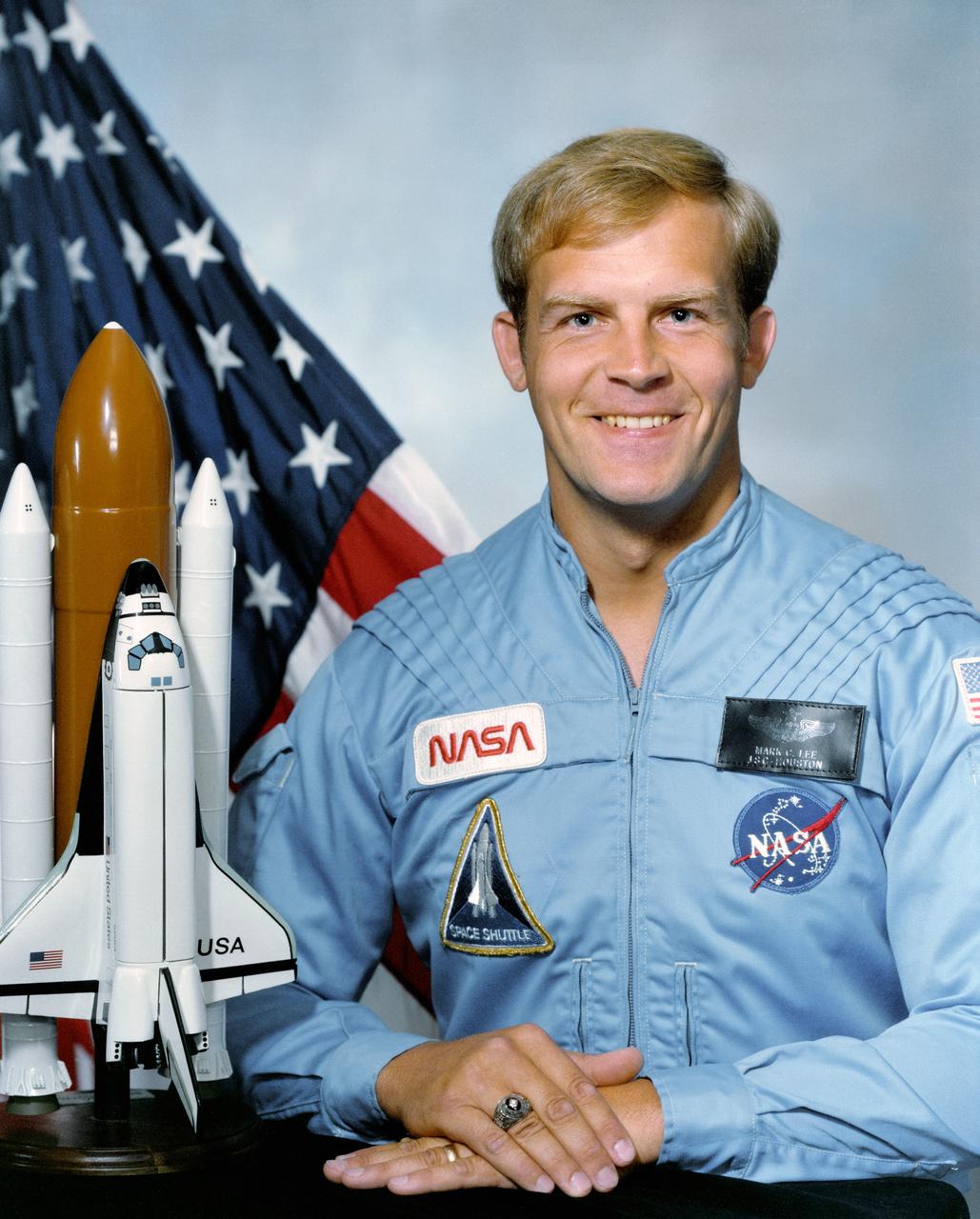
Official portrait photograph of Astronaut Mark C. Lee dressed in blue flight suit, with Flag and a Space Shuttle model (left).
Official Portrait - Astronaut Mark C. Lee
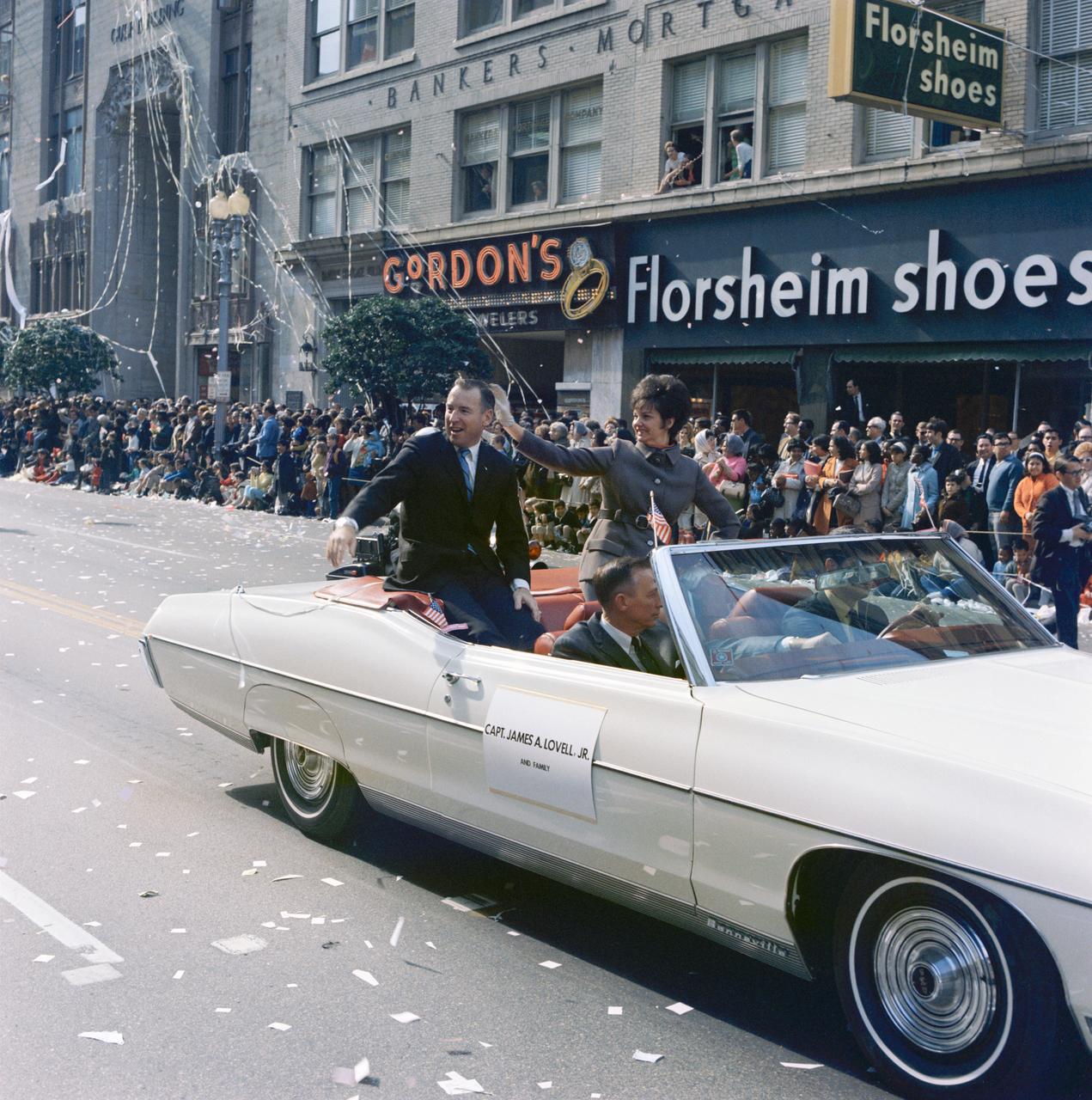
Capt. James A Lovell Jr., command module pilot; and family are photographed during parade in Houston after Apollo VIII flight.
Postflight - Apollo VIII (Parade/Awards) - TX
PANORAMA PHOTOGRAPHS OF THE NEWLY REMODELED PAYLOAD OPERATIONS INTEGRATION CENTER (POIC) IN BUILDING 4663 AT THE MARSHALL SPACE FLIGHT CENTER
1300415
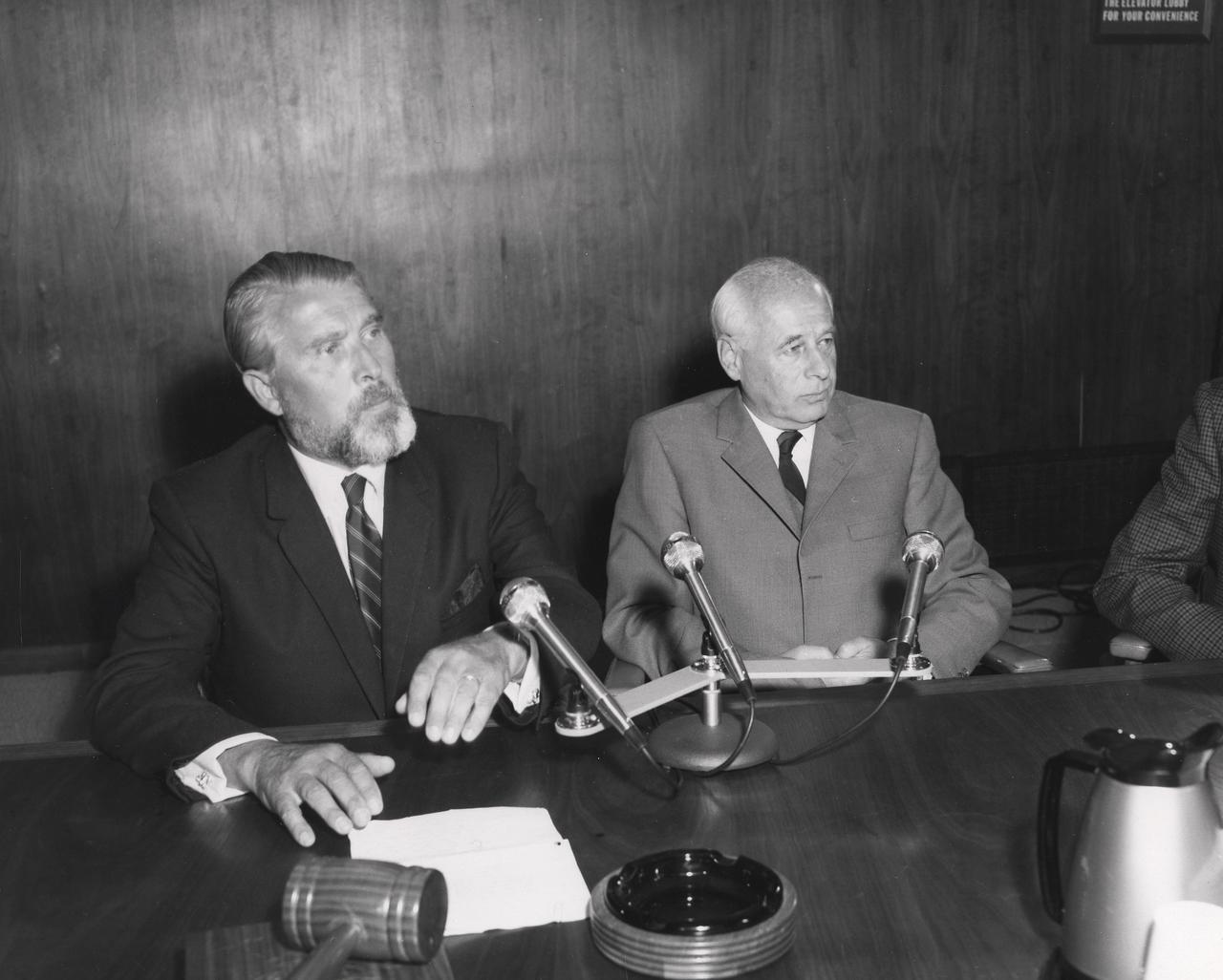
This is a photograph of Dr. von Braun and Dr. Eberhard Rees at a press conference in 1970 at the Marshall Space Flight Center.
Wernher von Braun
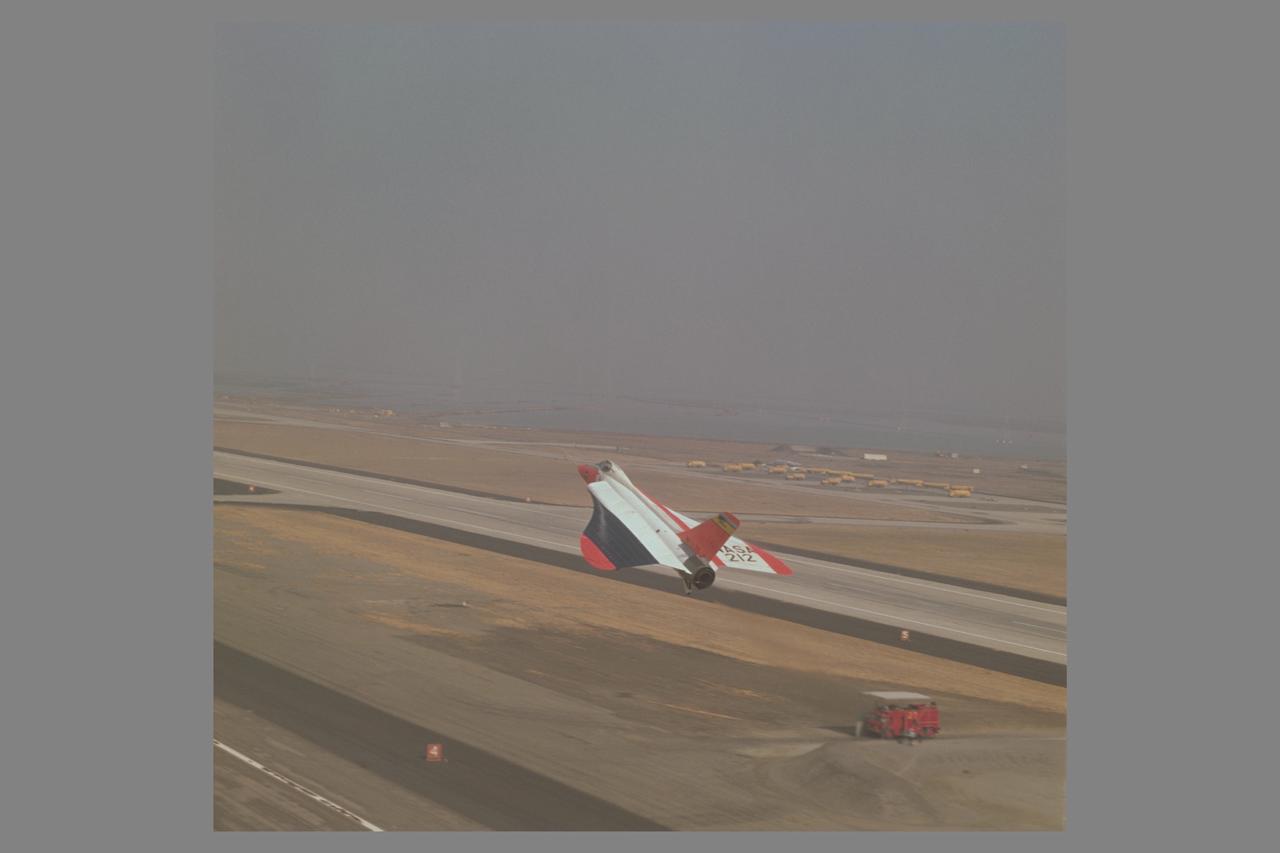
ON LANDING.  OGEE Wing Plan Form on F5D-1 Airplane FLight Tests.  'Flow Visualization Photographs'.
ARC-1964-AC-33500-4
Astronaut Karen Nyberg,Expedition 36 flight engineer,is photographed holding a drink packet in the Node 2 module.
Nyberg in Node 2
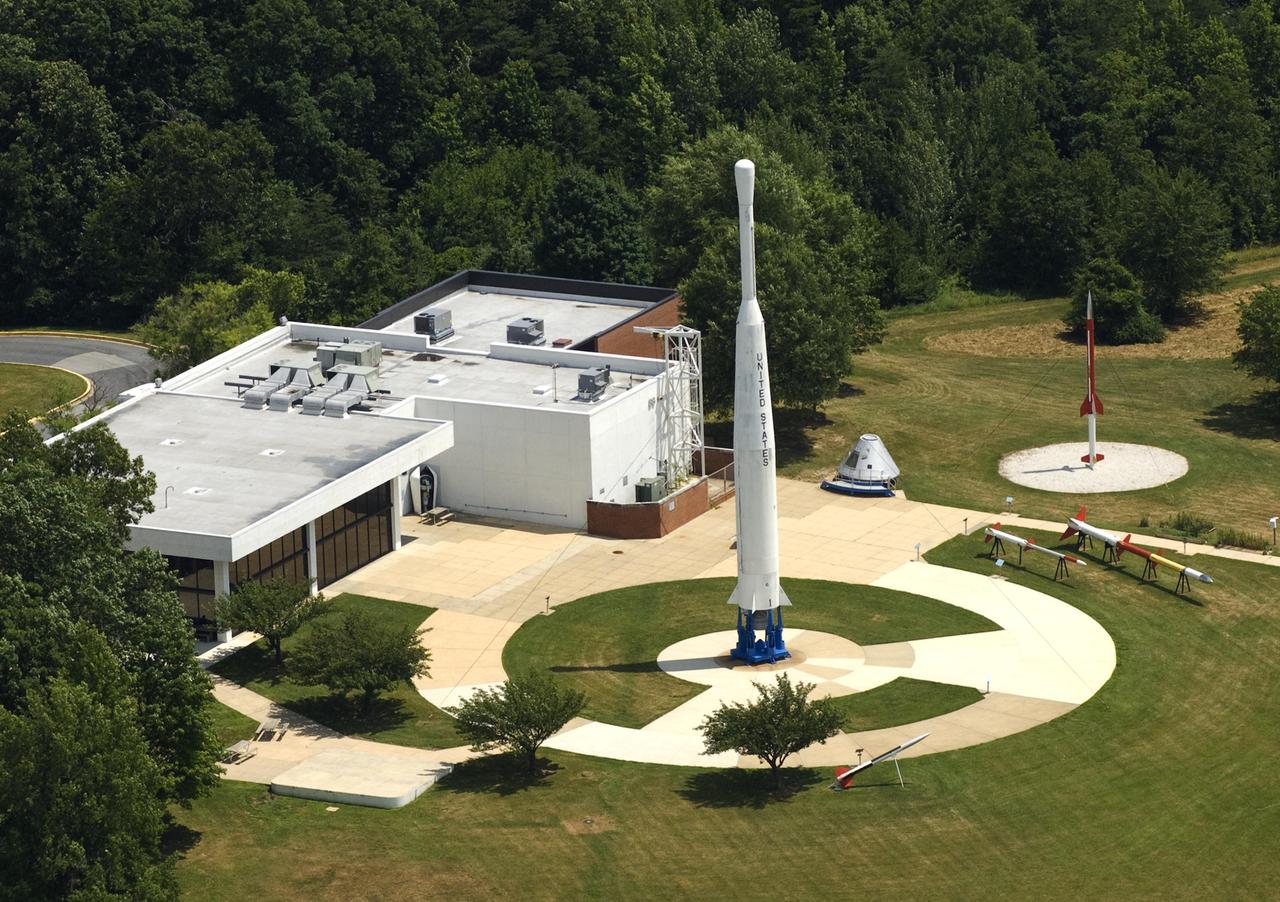
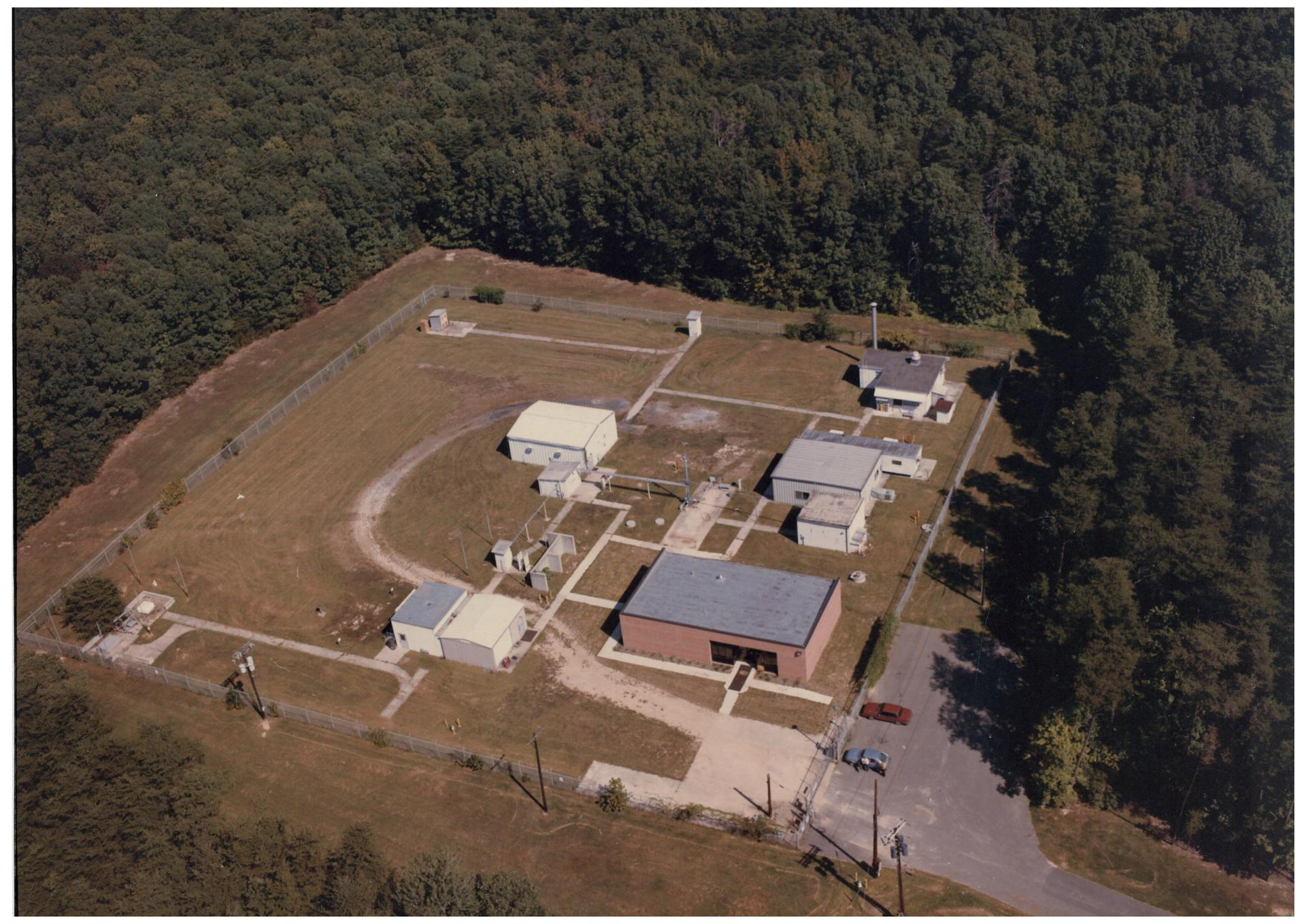
Aerial photograph showing the Visitor Center and grounds at NASA's Goddard Space Flight Center in Greenbelt, Md.
G-2010-0241-014
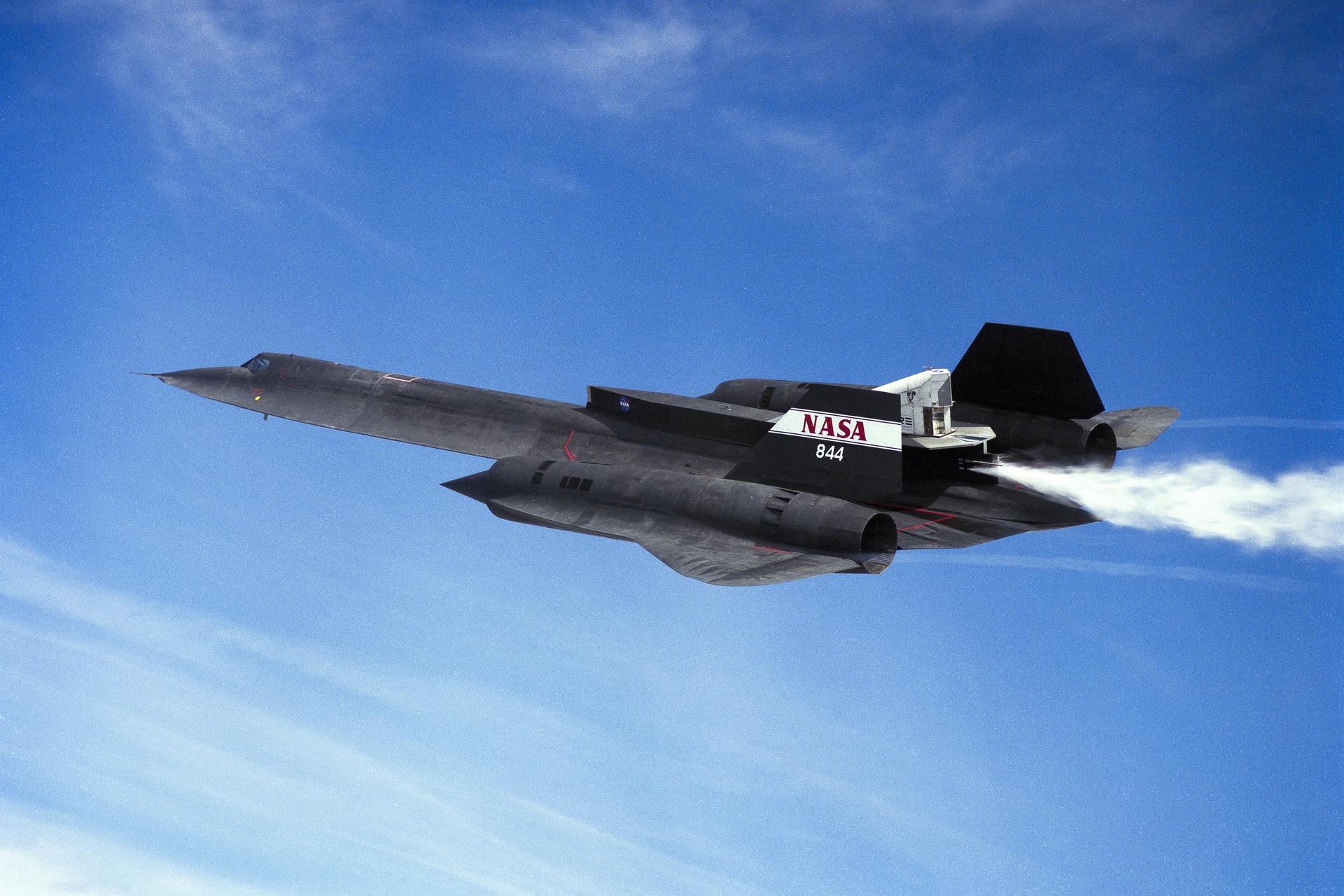
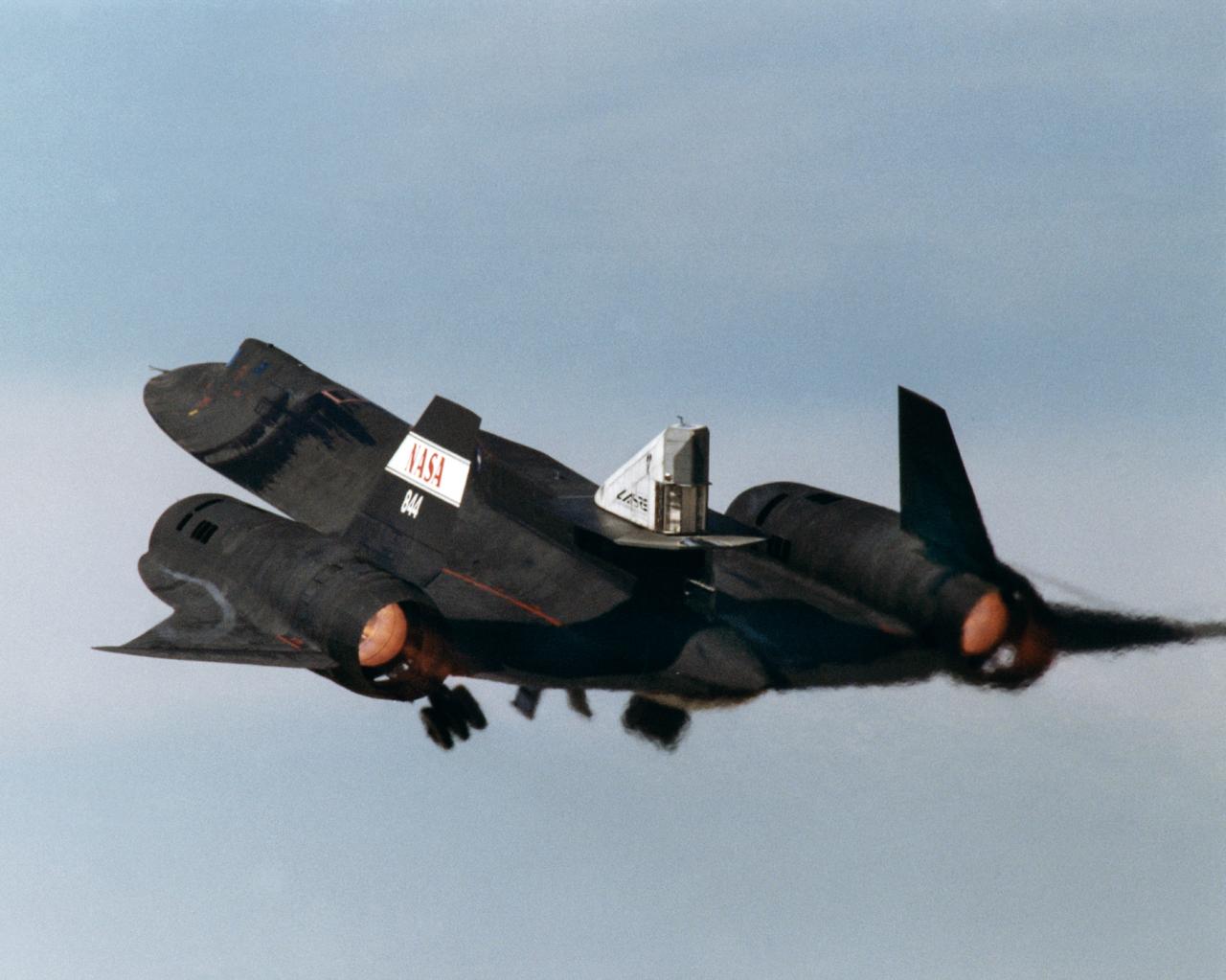
This photograph shows the LASRE pod on the upper rear fuselage of an SR-71 aircraft during take-off of the first flight to experience an in-flight cold flow test. The flight occurred on 4 March 1998.
Linear Aerospike SR-71 Experiment (LASRE) during first in-flight cold flow test
S66-42763 (18 July 1966) --- Astronaut Michael Collins (left), Gemini-10 prime crew pilot, inspects a camera during prelaunch activity at Cape Kennedy, Florida. In center background is Dr. Donald K. Slayton, Manned Spacecraft Center (MSC) Director of Flight Crew Operations. Photo credit: NASA
Astronaut Michael Collins inspects camera during prelaunch activity
AS17-148-22718 (7-19 Dec. 1972) --- This excellent view of Saudi Arabia and the north eastern portion of the African continent was photographed by the Apollo 17 astronauts with a hand-held camera on their trans-lunar coast toward man's last lunar visit. Egypt, Sudan, Ethiopia are some of the African nations are visible. Iran, Iraq, Jordan are not so clearly visible because of cloud cover and their particular location in the picture. India is dimly visible at right of frame. The Red Sea is seen entirely in this one single frame, a rare occurrence in Apollo photography or any photography taken from manned spacecraft. The Gulf of Suez, the Dead Sea, Gulf of Aden, Persian Gulf and Gulf of Oman are also visible. This frame is one of 169 frames on film magazine NN carried aboard Apollo 17, all of which are SO368 (color) film. A 250mm lens on a 70mm Hasselblad camera recorded the image, one of 92 taken during the trans-lunar coast. Note AS17-148-22727 (also magazine NN) for an excellent full Earth picture showing the entire African continent.
View of Saudi Arabia and north eastern Africa from the Apollo 17 spacecraft
AS17-145-22254 (14 Dec. 1972) --- An excellent view of the Apollo 17 Command and Service Modules (CSM) photographed from the Lunar Module (LM) "Challenger" during rendezvous and docking maneuvers in lunar orbit. The LM ascent stage, with astronauts Eugene A. Cernan and Harrison H. Schmitt aboard, had just returned from the Taurus-Littrow landing site on the lunar surface. Astronaut Ronald E. Evans remained with the CSM in lunar orbit. Note the exposed Scientific Instrument Module (SIM) Bay in Sector 1 of the Service Module (SM). Three experiments are carried in the SIM bay: S-209 lunar sounder, S-171 infrared scanning spectrometer, and the S-169 far-ultraviolet spectrometer. Also mounted in the SIM bay are the panoramic camera, mapping camera and laser altimeter used in service module photographic tasks. A portion of the LM is on the right.
Apollo 17 Command/Service modules photographed from lunar module in orbit
STS027-14-021 (2-6 Dec. 1988) --- Astronaut Guy S. Gardner, STS-27 pilot, appears to have enough cameras as he prepares to take photographs onboard the Earth-orbiting space shuttle Atlantis. Photo credit: NASA
STS-27 Pilot Gardner works with cameras on aft flight deck at window W8
STS030-08-015 (4-8 May 1989) --- Astronaut Mark C. Lee, STS-30 mission specialist, pauses from a of Earth photography on Atlantis' aft flight deck.  He holds a 70mm camera. The scene was recorded with a 35mm camera.  The photo was in a group released by NASA following the completion of a four-day mission in space.
STS-30 MS Lee, wearing sunglasses, uses 70mm camera on aft flight deck
S92-45751 (1 Sept 1992) --- Astronaut Mario Runco Jr., mission specialist assigned to fly aboard the Space Shuttle Endeavour for the STS-54 mission, gets in some rehearsal time with a camcorder.  He is on the middeck of a Shuttle trainer.
STS-54 MS1 Runco participates in camera familiarization in JSC's CCT
STS027-10-021 (2-6 Dec. 1988) --- Astronaut Richard M. (Mike) Mullane, STS-27 mission specialist, is able to handle a number of cameras with the aid of the microgravity in the shirt sleeve environment of the Earth-orbiting space shuttle Atlantis. Photo credit: NASA
STS-27 MS Mullane on aft flight deck with camera equipment
AS17-145-22273 (7-19 Dec. 1972) --- In this view, taken from the Lunar Module (LM), the Command and Service Module (CSM) are seen preparing to rendezvous with the LM. Note the reflection of the lunar surface on the CSM. The CSM, is piloted by Ronald E. Evans; while astronauts Eugene A. Cernan, commander; and Harrison W. Schmitt, lunar module pilot, are onboard the LM, following their extravehicular activities (EVA) on the moon's surface. While astronauts Cernan and Schmitt descended in the LM "Challenger" to explore the Taurus-Littrow region of the moon, astronaut Evans remained with the CSM "America" in lunar orbit.
Apollo 17 Command/Service modules photographed from lunar module in orbit
STS038-25-005 (20 Nov 1990) --- STS-38 Mission Specialist (MS) Robert C. Springer, holding HASSELBLAD camera, positions himself under aft flight deck overhead window W7 before recording the Earth's surface below. Behind Springer are Atlantis', Orbiter Vehicle (OV) 104's, on orbit station and aft flight deck viewing windows.
STS-38 Mission Specialist (MS) Springer uses camera on OV-104 aft flight deck
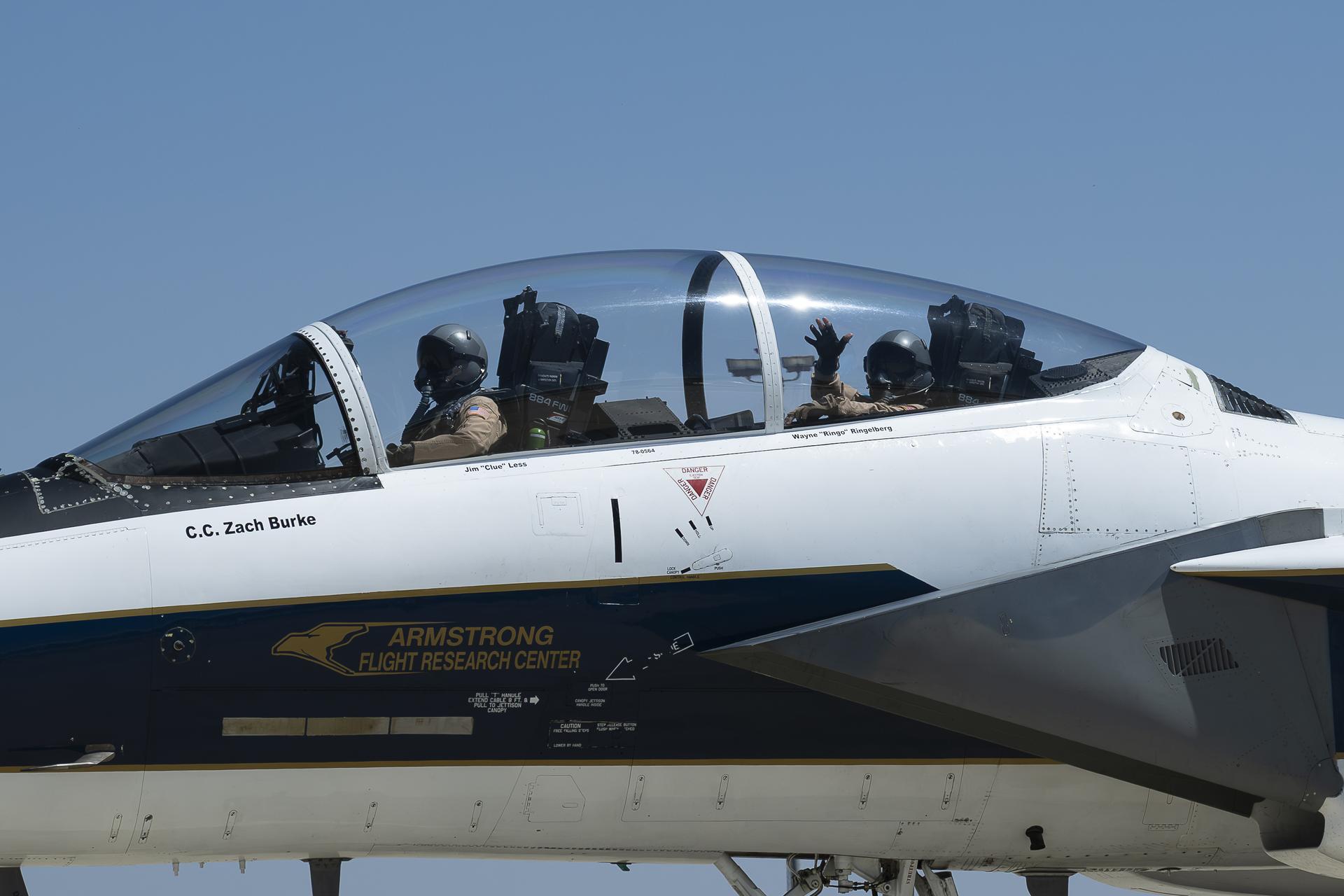
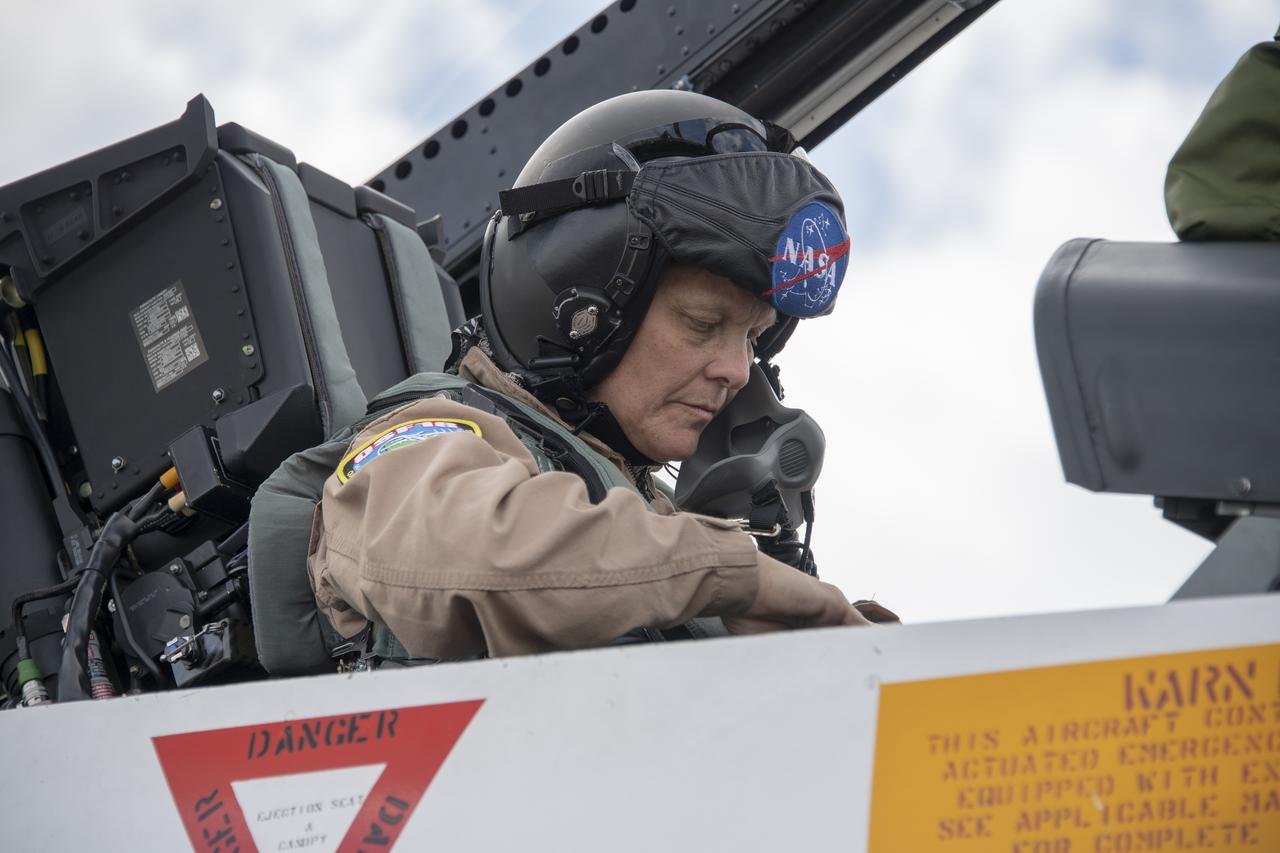
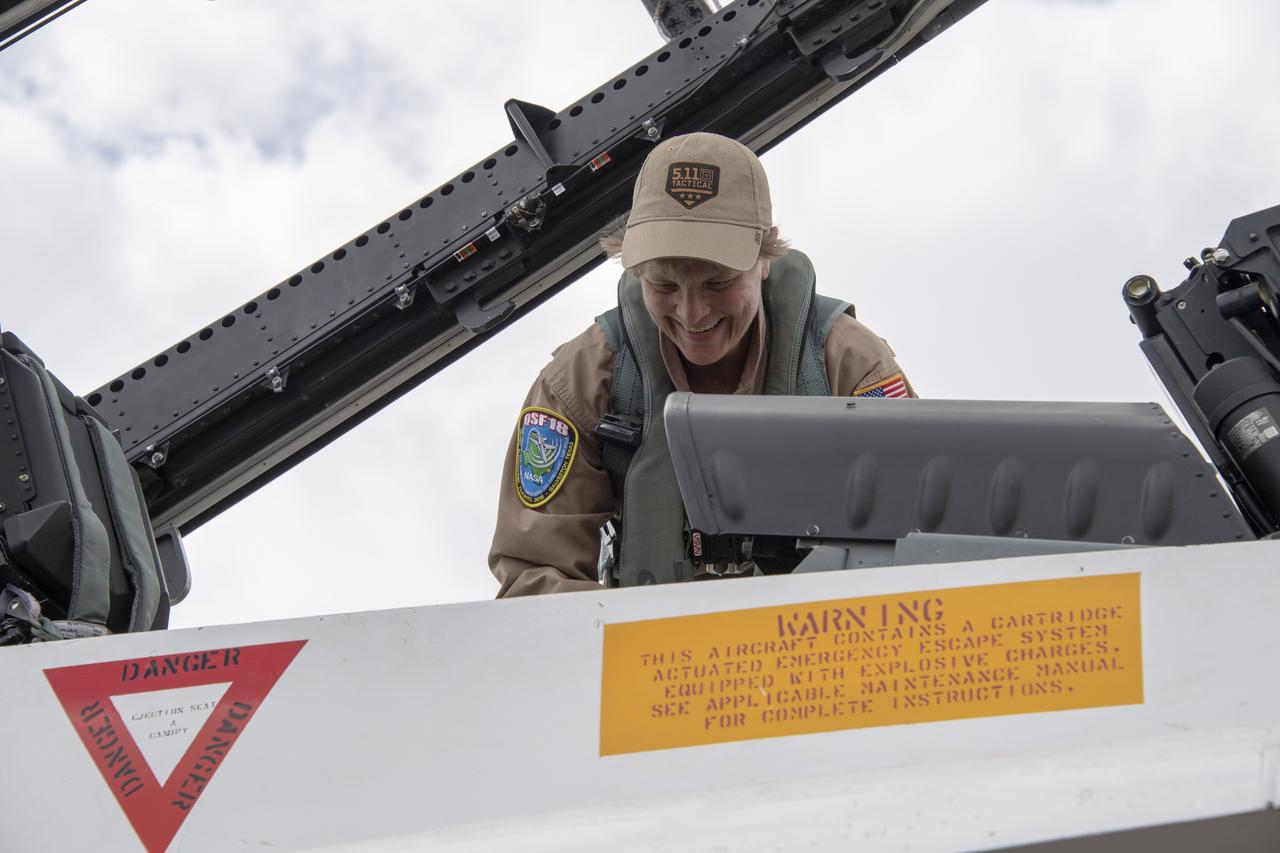
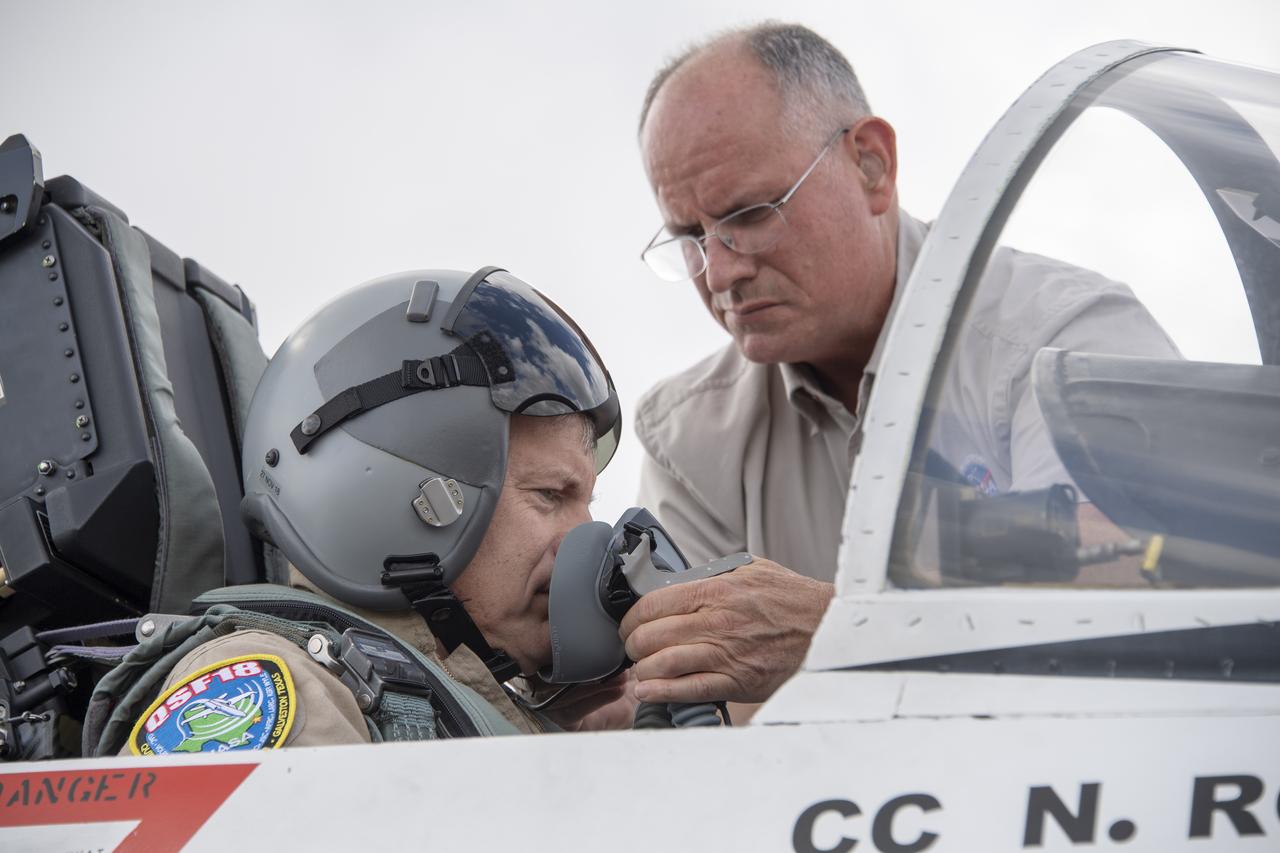
NASA test pilot Wayne “Ringo” Ringelberg and photographer Carla Thomas prepare to take off for a supersonic research flight in support of the QSF18 campaign off the coast of Texas. NASA photographers and videographers take part in operations to support mission documentation.
NASA F/A-18 Prepares for Supersonic Research Flight
NASA test pilot Wayne “Ringo” Ringelberg and photographer Carla Thomas prepare to take off for a supersonic research flight in support of the QSF18 campaign off the coast of Texas. NASA photographers and videographers take part in operations to support mission documentation.
NASA F/A-18 Prepares for Supersonic Research Flight
NASA test pilot Wayne “Ringo” Ringelberg and photographer Carla Thomas prepare to take off for a supersonic research flight in support of the QSF18 campaign off the coast of Texas. NASA photographers and videographers take part in operations to support mission documentation.
NASA F/A-18 Prepares for Supersonic Research Flight
NASA test pilot Wayne “Ringo” Ringelberg and photographer Carla Thomas prepare to take off for a supersonic research flight in support of the QSF18 campaign off the coast of Texas. NASA photographers and videographers take part in operations to support mission documentation.
NASA F/A-18 Prepares for Supersonic Research Flight