
N-210 Flight Systems Research Laboratory, pre-design renolvation project - dismatelling of 6 degree freedom of motion simulator
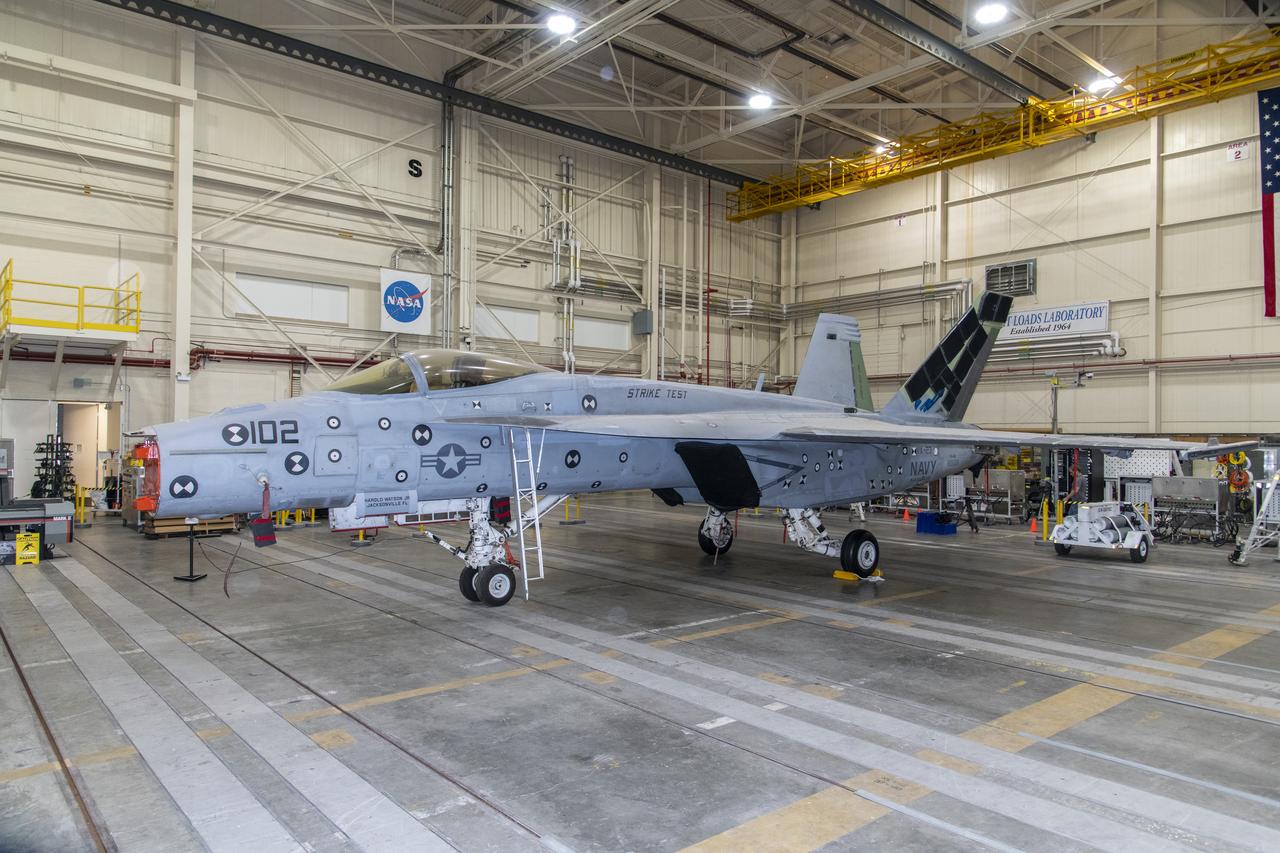
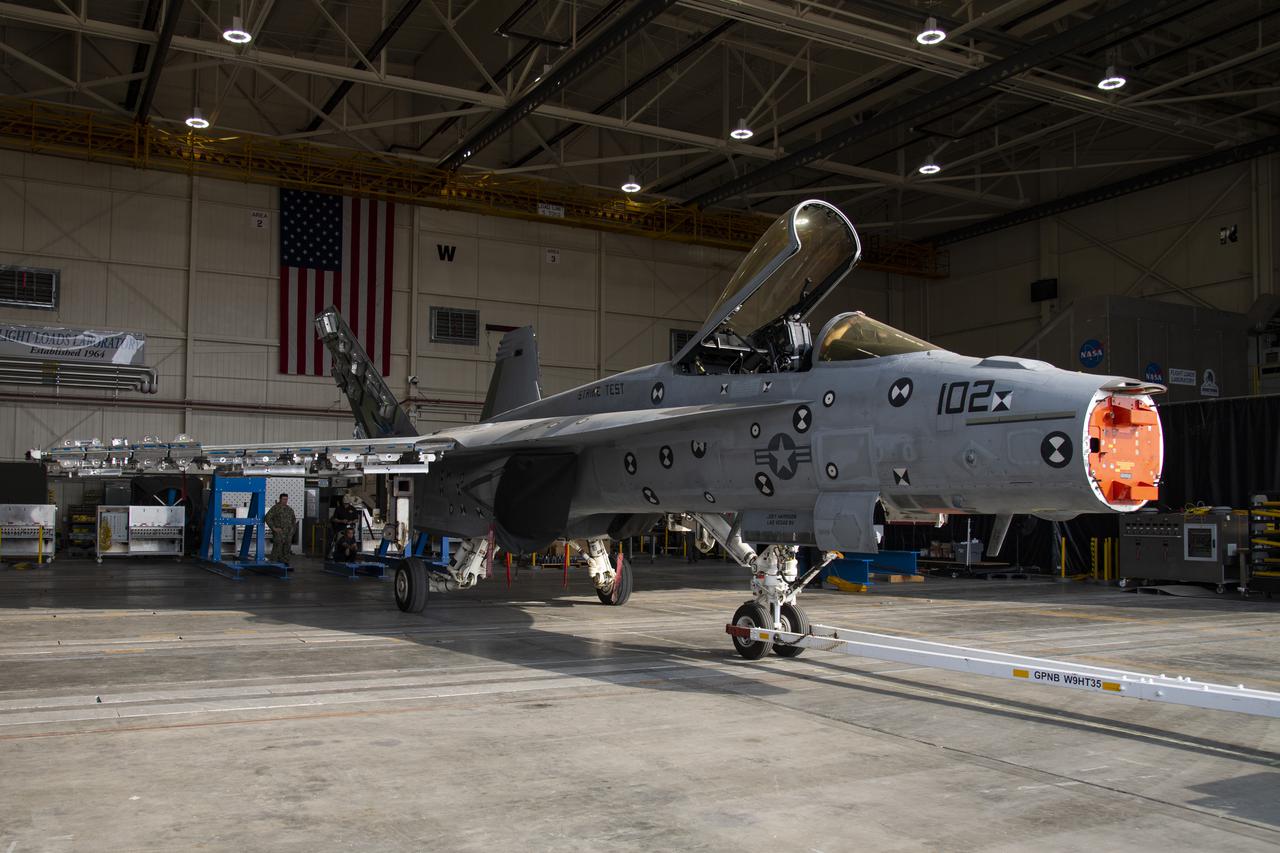
This right-side view shows an F/A-18E from the Naval Air Systems Command (NAVAIR) in Patuxent River, Maryland. The aircraft is in NASA’s Armstrong Flight Research Center Flight Loads Laboratory in Edwards, California, where it underwent the center’s biggest load calibrations tests. This testing will permit the aircraft to serve as a test vehicle for determining if it can safely manage maneuvers and proposed upgrades.
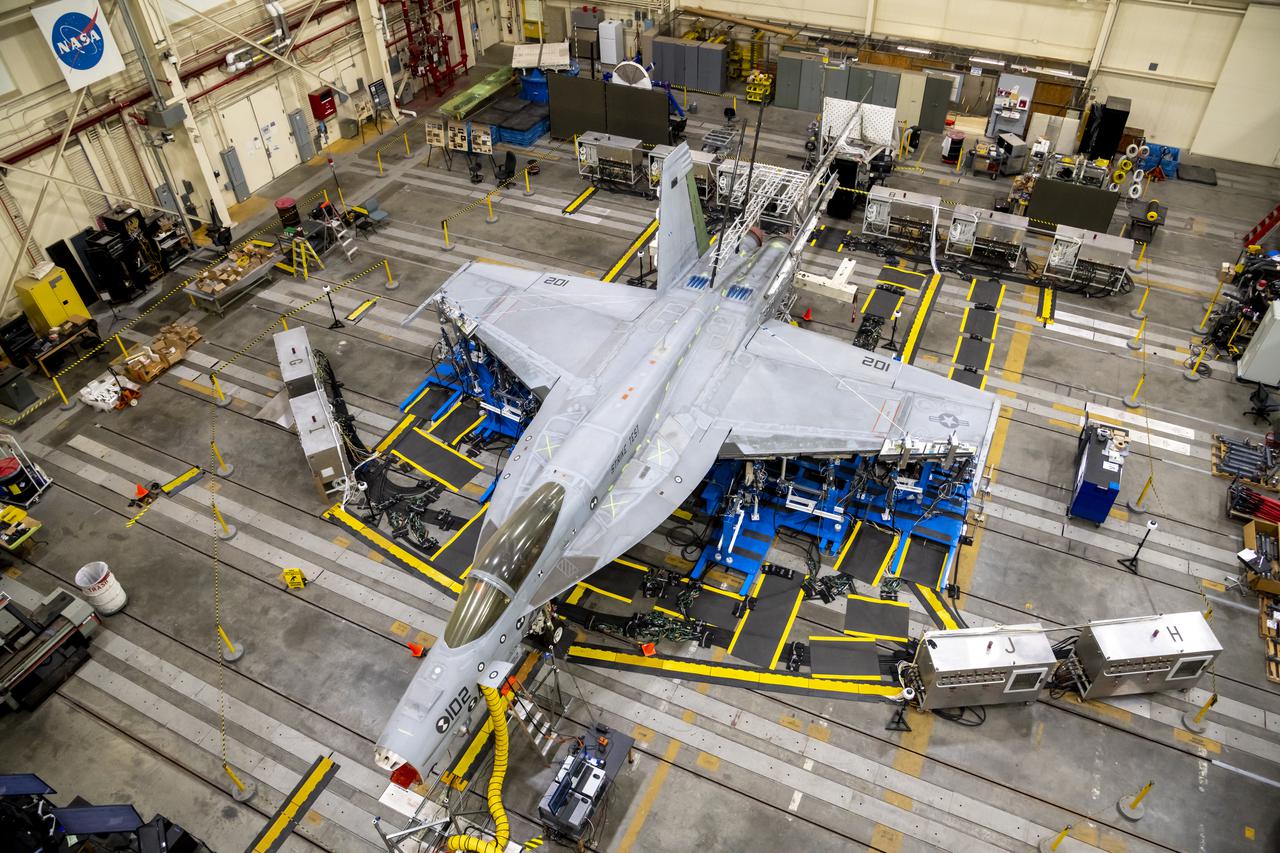
A top view shows the wing loading test configuration of a F/A-18E from the Naval Air Systems Command (NAVAIR) in Patuxent River, Maryland. The aircraft is in NASA’s Armstrong Flight Research Center Flight Loads Laboratory in Edwards, California, for the center’s biggest load calibrations tests. This testing is needed before the aircraft can serve as a test vehicle for determining if it can safely manage maneuvers and proposed upgrades.
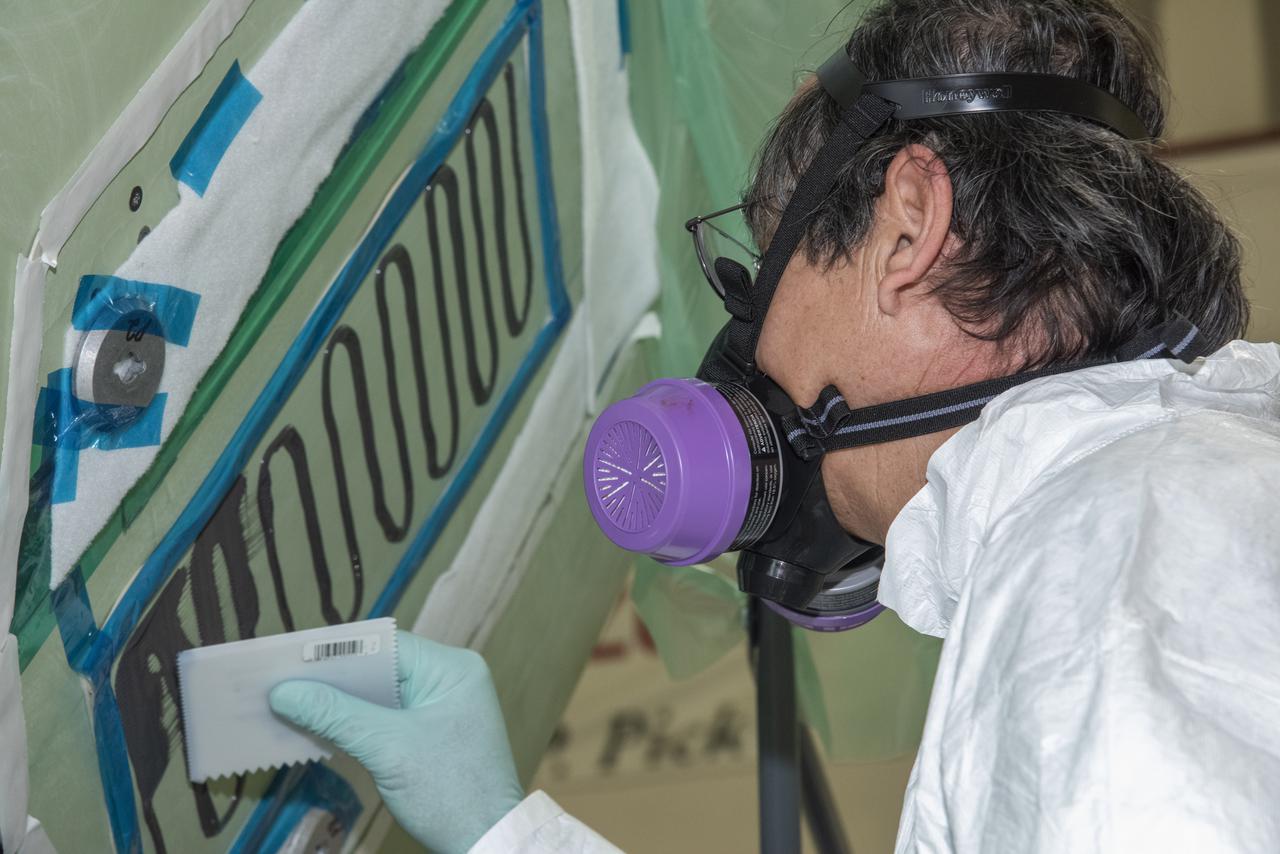
The load pad bonding process for the vertical tails was a preliminary step in the process to test the F/A-18E from the Naval Air Systems Command (NAVAIR) in Patuxent River, Maryland. The aircraft is in NASA’s Armstrong Flight Research Center Flight Loads Laboratory in Edwards, California, for the center’s biggest load calibrations tests. This testing is needed before the aircraft can serve as a test vehicle for determining if it can safely manage maneuvers and proposed upgrades.
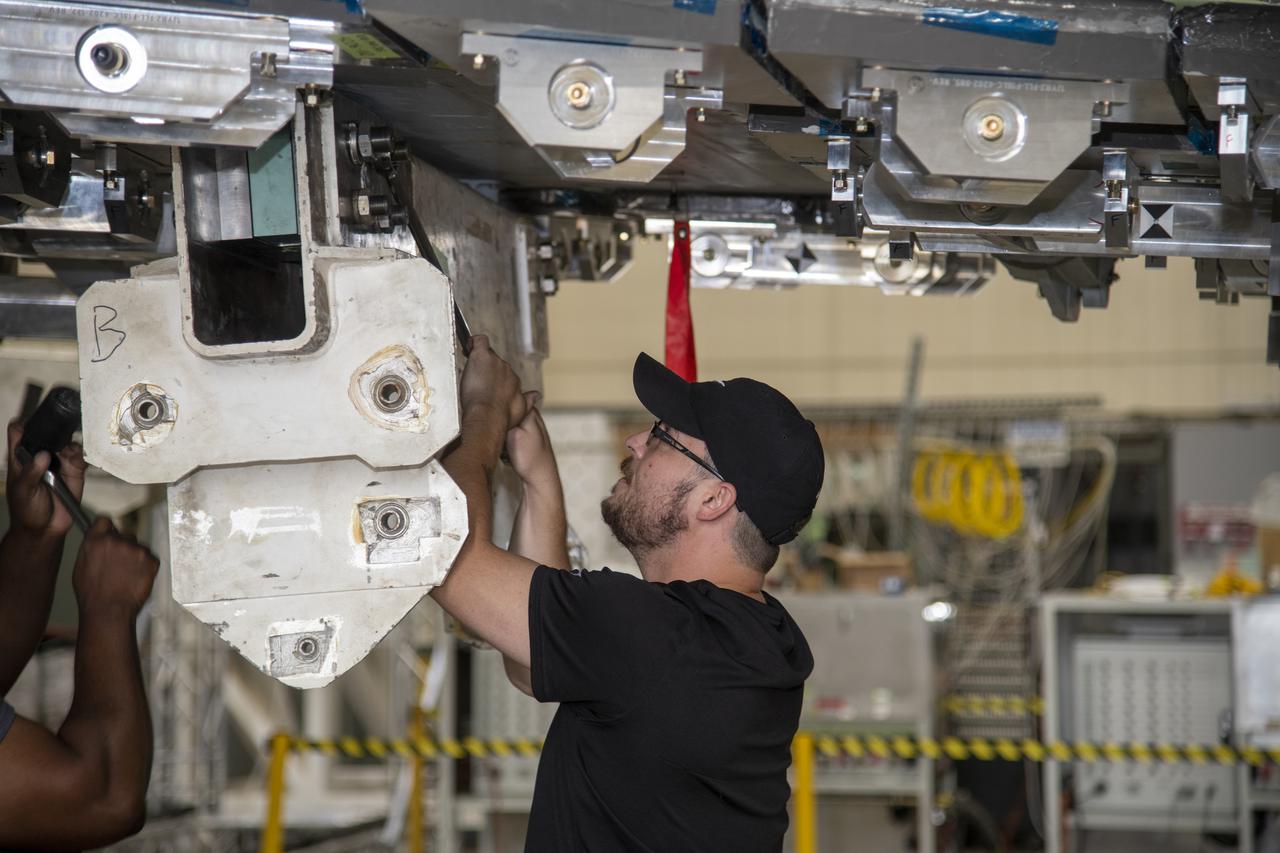
The outboard pylon load fixture is secured for the F/A-18E from the Naval Air Systems Command (NAVAIR) in Patuxent River, Maryland. The aircraft is in NASA’s Armstrong Flight Research Center Flight Loads Laboratory in Edwards, California, for the center’s biggest load calibrations tests. This testing is needed before the aircraft can serve as a test vehicle for determining if it can safely manage maneuvers and proposed upgrades.
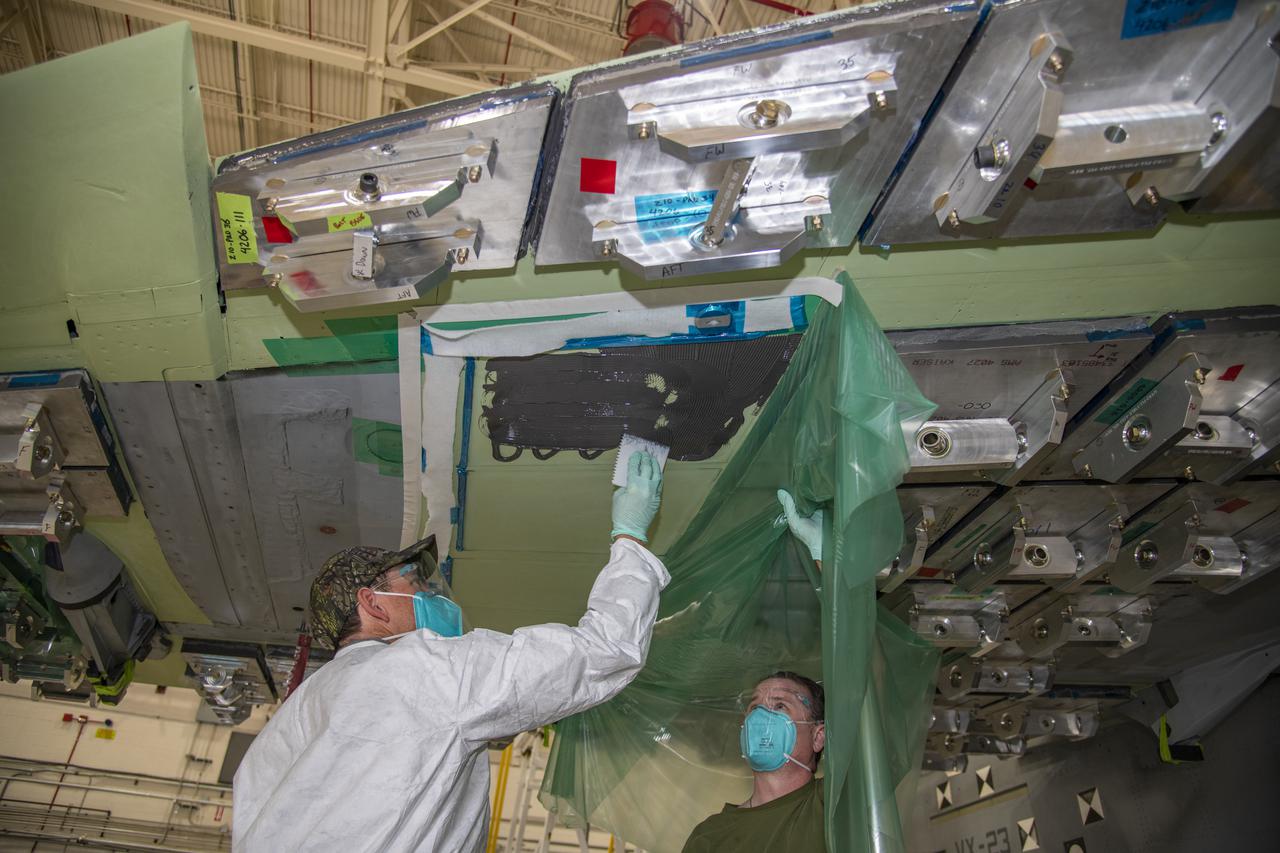
Ray Sadler, left, and Chris Mount spread tank sealant on the aircraft surface of a F/A-18E from the Naval Air Systems Command (NAVAIR) in Patuxent River, Maryland. The aircraft is in NASA’s Armstrong Flight Research Center Flight Loads Laboratory in Edwards, California, for the center’s biggest load calibrations tests. This testing is needed before the aircraft can serve as a test vehicle for determining if it can safely manage maneuvers and proposed upgrades.
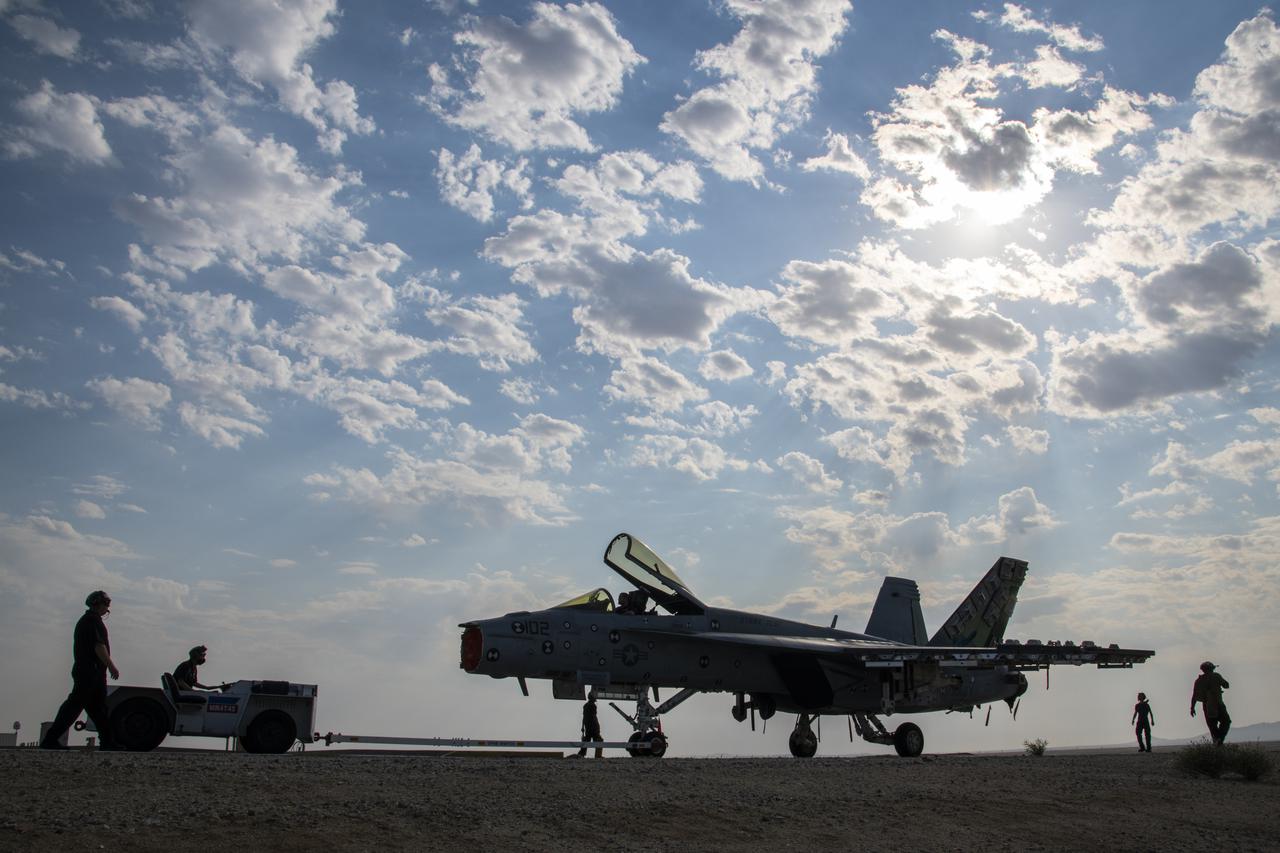
The Naval Air Systems Command (NAVAIR) in Patuxent River, Maryland F/A-18E is moved to NASA’s Armstrong Flight Research Center Flight Loads Laboratory in Edwards, California. NASA Armstrong is working on its biggest load calibrations tests on an F/A-18E Super Hornet. This testing is needed before the aircraft can serve as a test vehicle for determining if it can safely manage maneuvers and proposed upgrades.
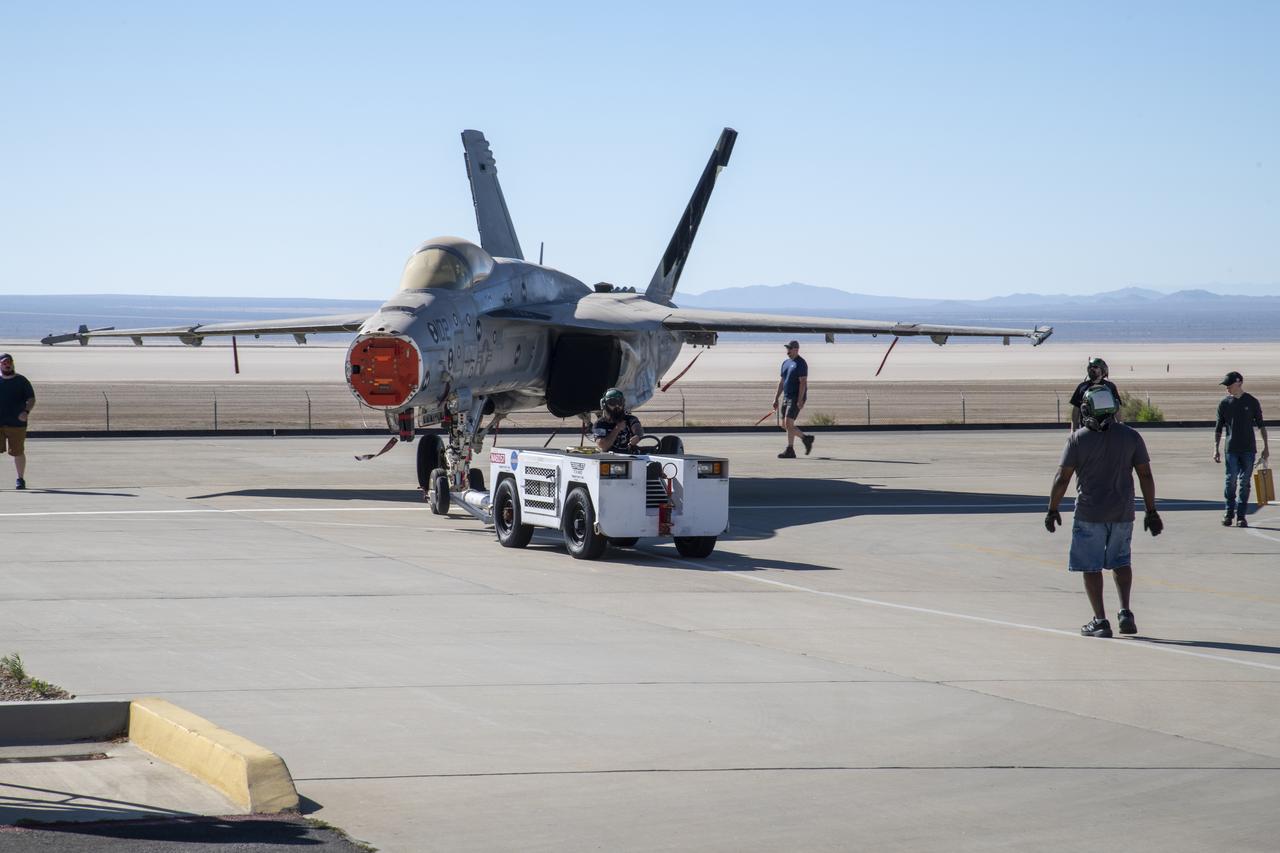
An F/A-18E from the Naval Air Systems Command (NAVAIR) in Patuxent River, Maryland, is moved from NASA’s Armstrong Flight Research Center Flight Loads Laboratory in Edwards, California, to a hangar where it will undergo final preparations to return to its squadron. The aircraft underwent the center’s biggest load calibrations tests. The testing will permit the aircraft to serve as a test vehicle to determine if it can safely manage maneuvers and proposed upgrades.
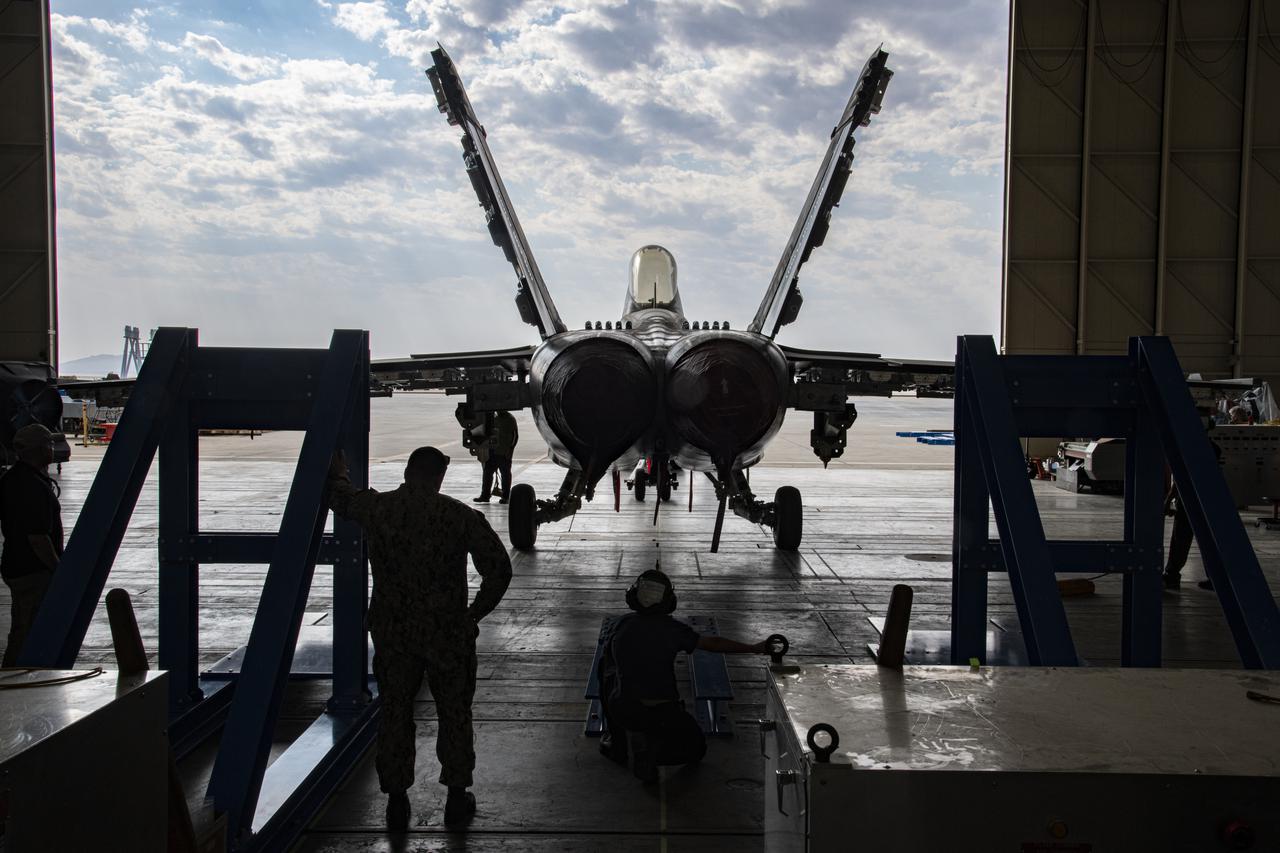
The Naval Air Systems Command (NAVAIR) in Patuxent River, Maryland F/A-18E is moved to NASA’s Armstrong Flight Research Center Flight Loads Laboratory in Edwards, California. NASA Armstrong is working on its biggest load calibrations tests on an F/A-18E Super Hornet. This testing is needed before the aircraft can serve as a test vehicle for determining if it can safely manage maneuvers and proposed upgrades.
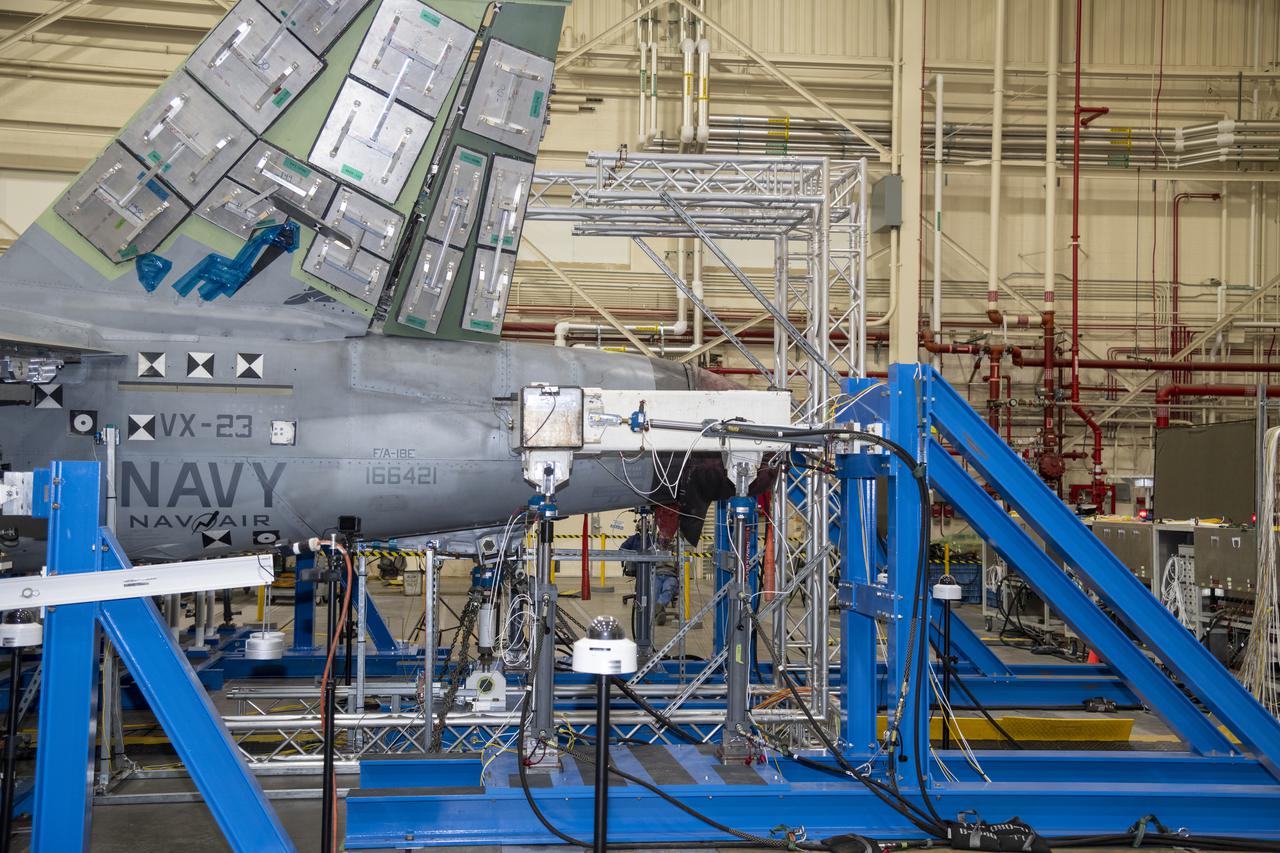
The horizontal tail is under test load on a F/A-18E from the Naval Air Systems Command (NAVAIR) in Patuxent River, Maryland. The aircraft is in NASA’s Armstrong Flight Research Center Flight Loads Laboratory in Edwards, California, for the center’s biggest load calibrations tests. This testing is needed before the aircraft can serve as a test vehicle for determining if it can safely manage maneuvers and proposed upgrades.
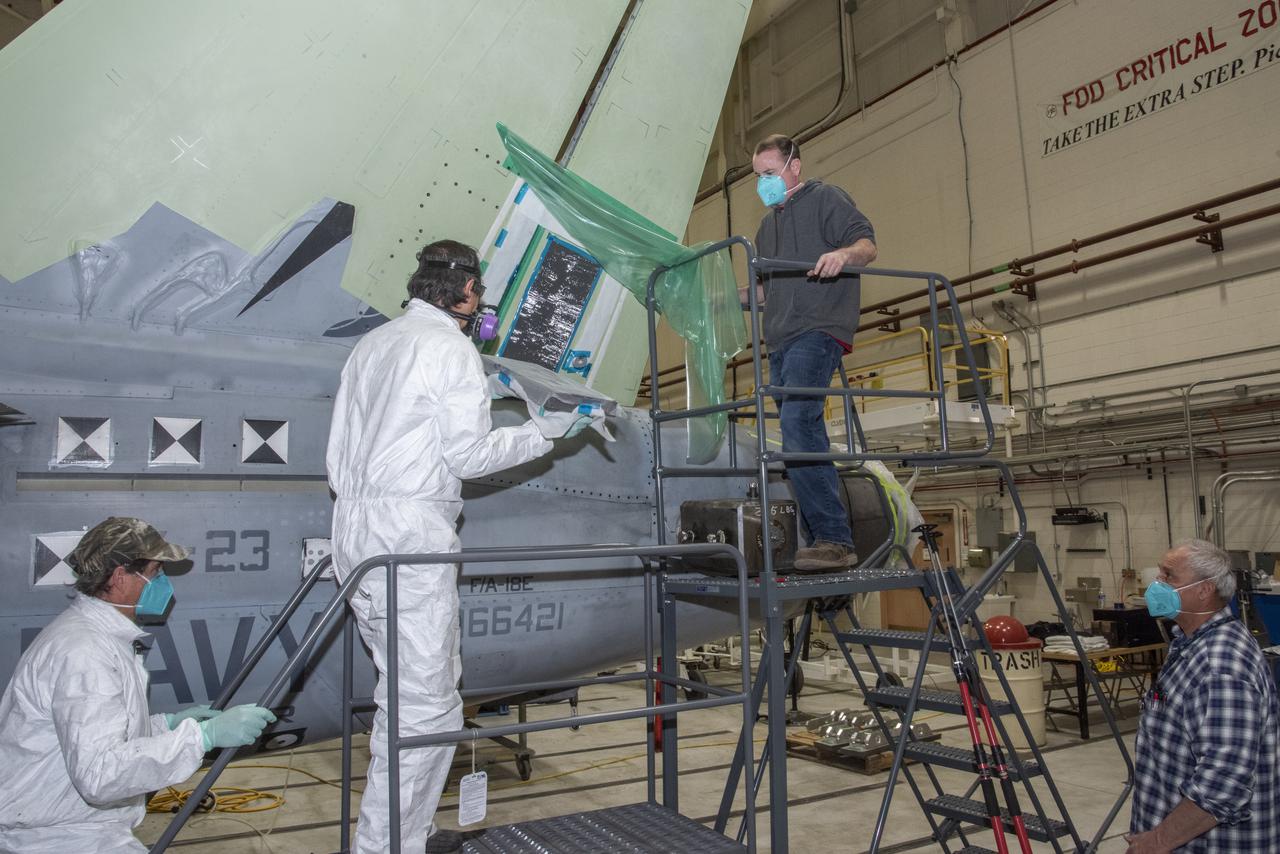
The load pad bonding process for the vertical tails was a preliminary step in the process to test the F/A-18E from the Naval Air Systems Command (NAVAIR) in Patuxent River, Maryland. The aircraft is in NASA’s Armstrong Flight Research Center Flight Loads Laboratory in Edwards, California, for the center’s biggest load calibrations tests. This testing is needed before the aircraft can serve as a test vehicle for determining if it can safely manage maneuvers and proposed upgrades.
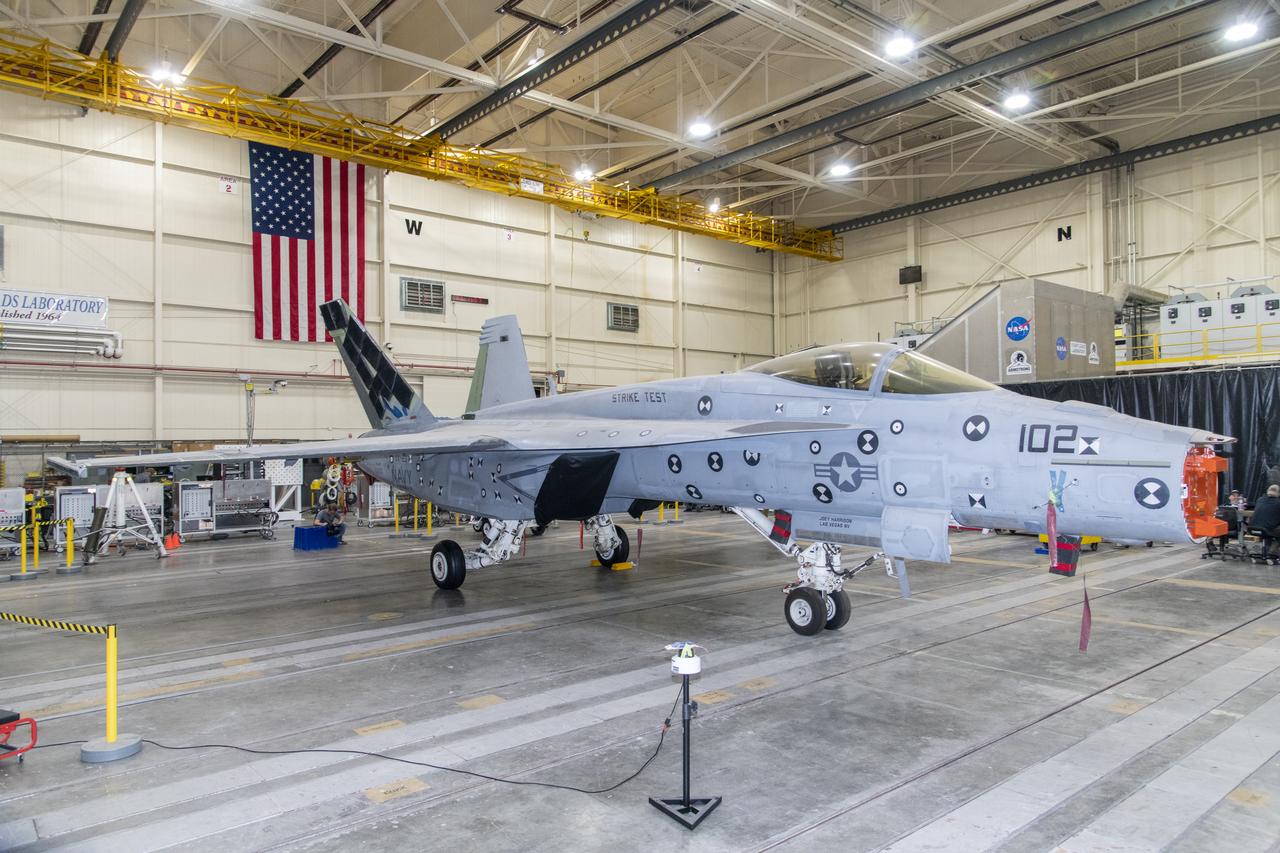
This left-side view shows an F/A-18E from the Naval Air Systems Command (NAVAIR) in Patuxent River, Maryland. The aircraft is in NASA’s Armstrong Flight Research Center Flight Loads Laboratory in Edwards, California, where it underwent the center’s biggest load calibrations tests. This testing will permit the aircraft to serve as a test vehicle to determine if it can safely manage maneuvers and proposed upgrades.
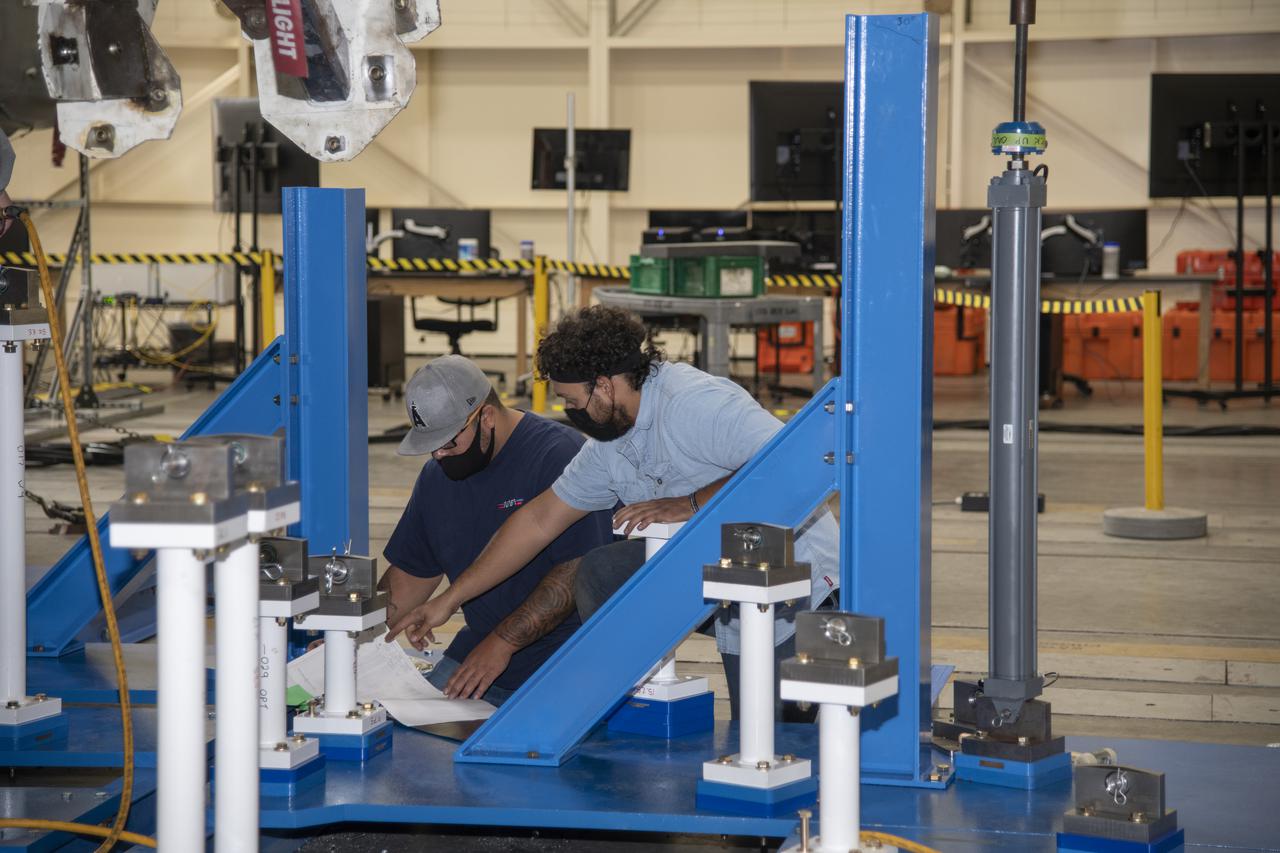
From left, Dominic Barela and Lucas Oramas review a drawing for installing the wing load test fixturing on a F/A-18E from the Naval Air Systems Command (NAVAIR) in Patuxent River, Maryland. The aircraft is in NASA’s Armstrong Flight Research Center Flight Loads Laboratory in Edwards, California, for the center’s biggest load calibrations tests. This testing is needed before the aircraft can serve as a test vehicle for determining if it can safely manage maneuvers and proposed upgrades.
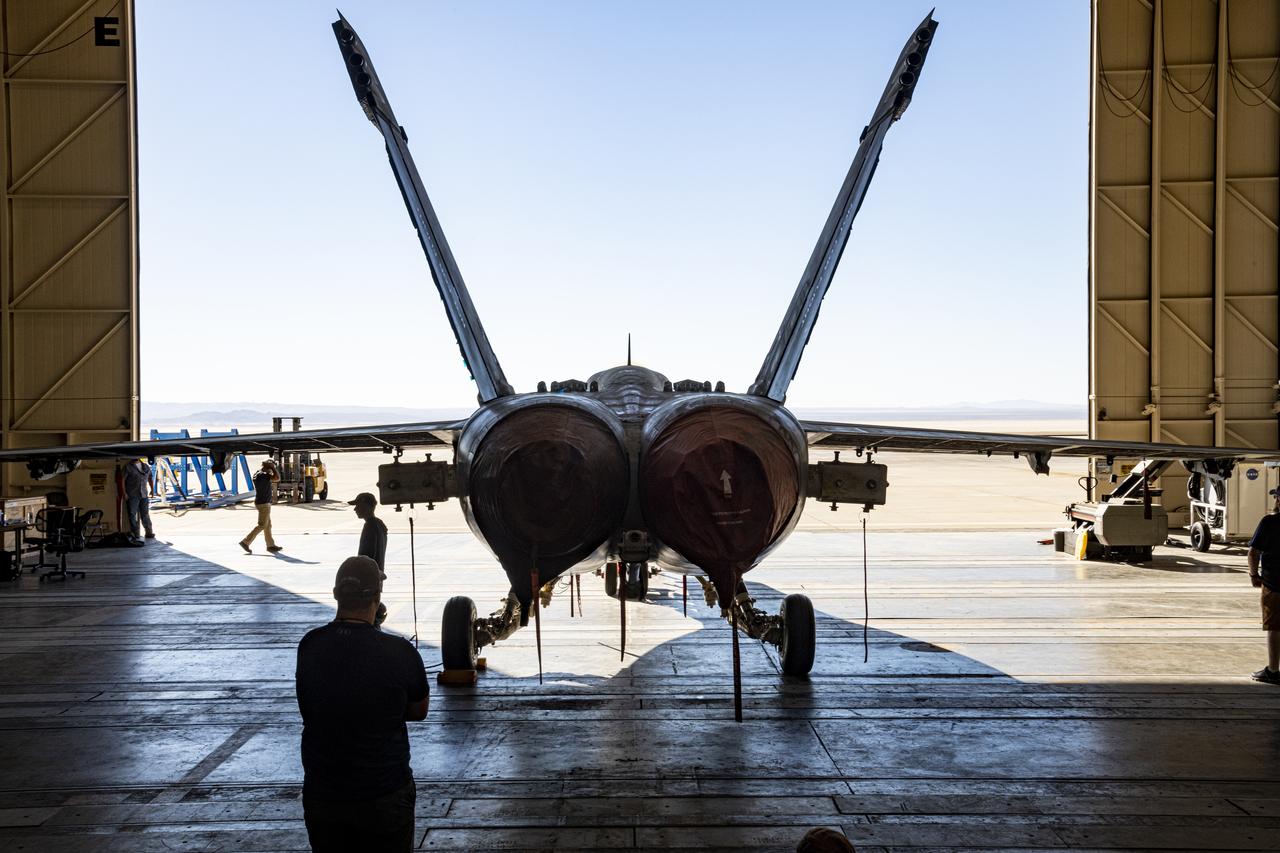
This rear view shows an F/A-18E from the Naval Air Systems Command (NAVAIR) in Patuxent River, Maryland. The aircraft is in NASA’s Armstrong Flight Research Center Flight Loads Laboratory in Edwards, California, where it underwent the center’s biggest load calibrations tests. This testing will permit the aircraft to serve as a test vehicle to determine if it can safely manage maneuvers and proposed upgrades.
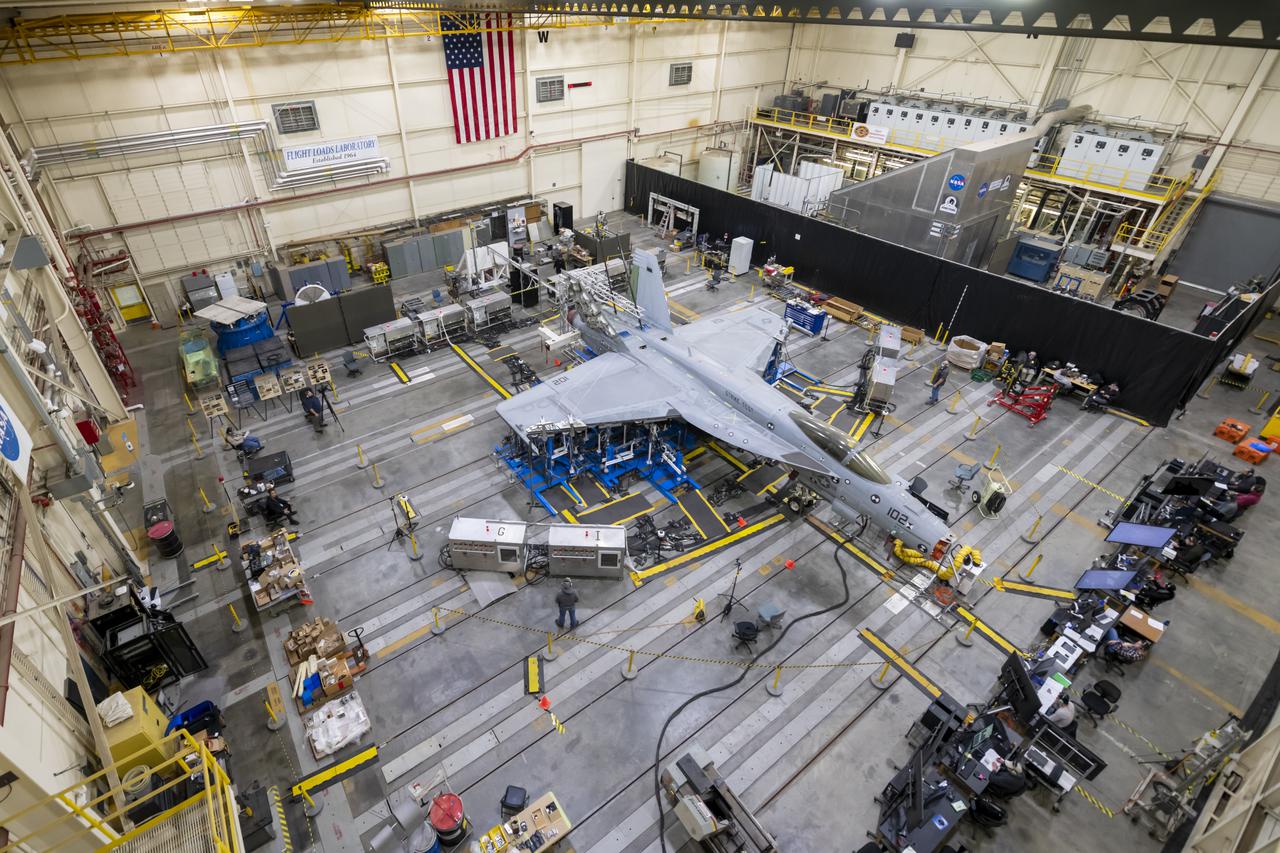
A top view shows the wing loading test configuration and testing area of an F/A-18E from the Naval Air Systems Command (NAVAIR) in Patuxent River; Maryland. The aircraft is in NASA's Armstrong Flight Research Center Flight Loads Laboratory in Edwards; California; for the center's biggest load calibrations tests. This testing is needed before the aircraft can serve as a test vehicle for determining if it can safely manage maneuvers and proposed upgrades.
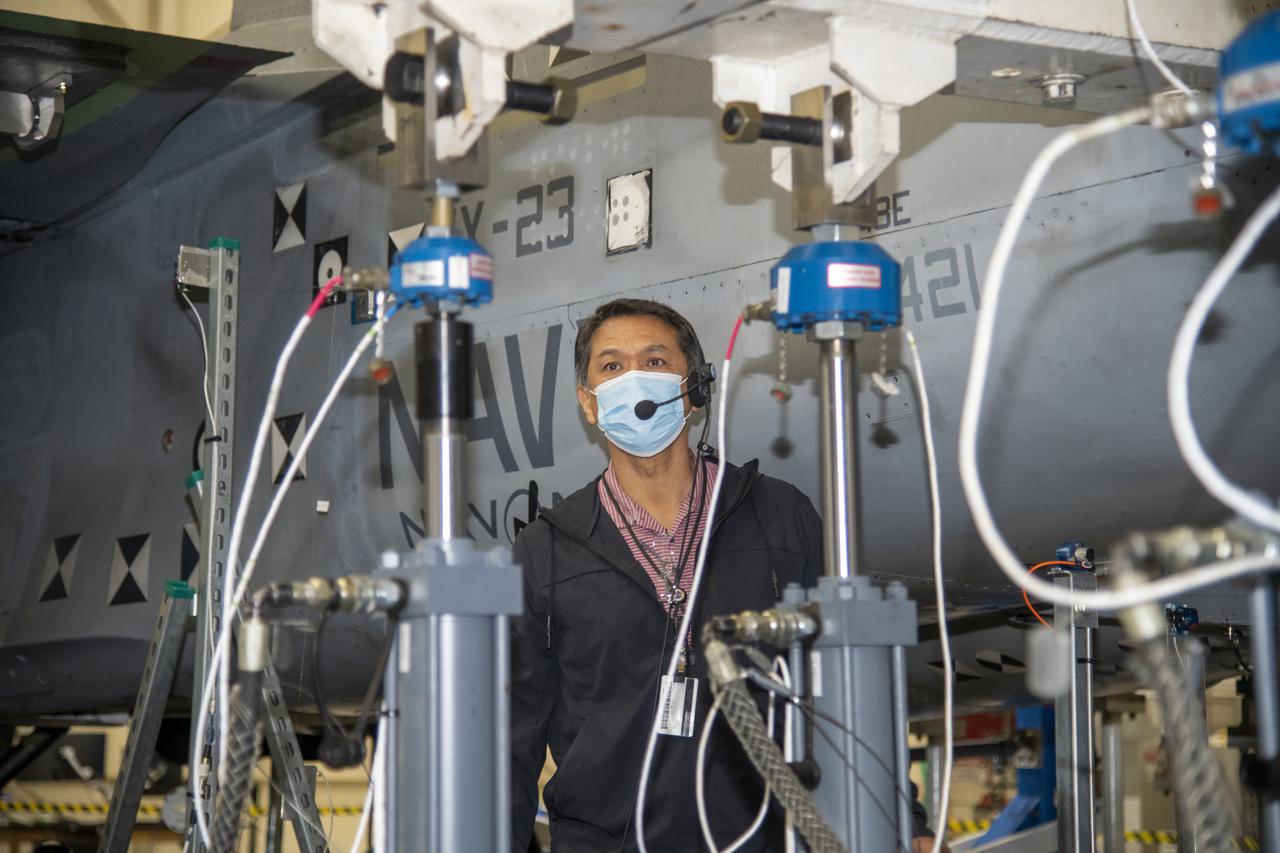
Larry Hudson does an inspection after the actuator on the F/A-18E from the Naval Air Systems Command (NAVAIR) in Patuxent River, Maryland, is pinned to the horizontal tail load test fixture. The aircraft is in NASA’s Armstrong Flight Research Center Flight Loads Laboratory in Edwards, California, for the center’s biggest load calibrations tests. This testing is needed before the aircraft can serve as a test vehicle for determining if it can safely manage maneuvers and proposed upgrades.
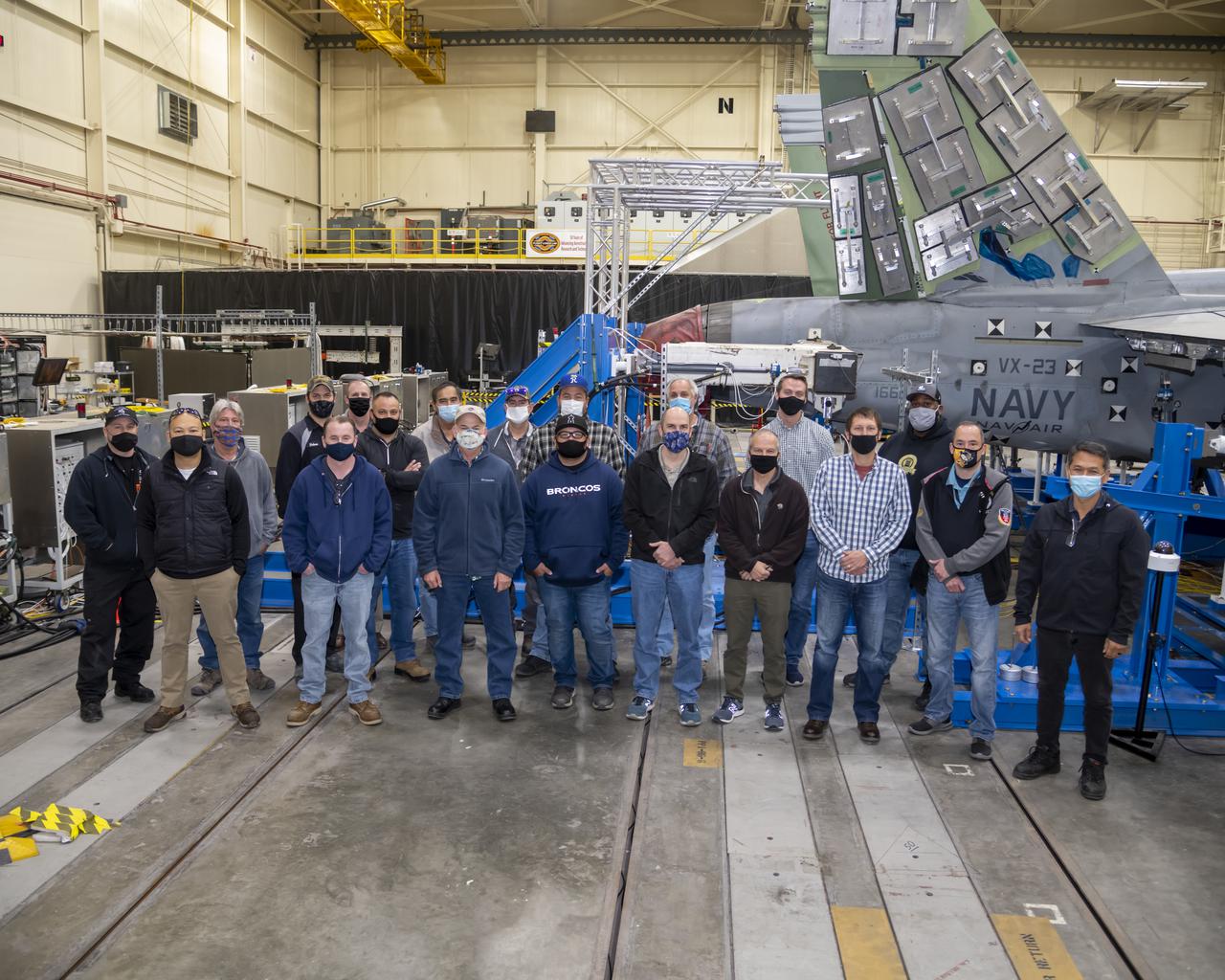
– A team working on tests on a F/A-18E from the Naval Air Systems Command (NAVAIR) in Patuxent River, Maryland, stand by the aircraft. The F/A-18E is in NASA’s Armstrong Flight Research Center Flight Loads Laboratory in Edwards, California, for the center’s biggest load calibrations tests. This testing is needed before the aircraft can serve as a test vehicle for determining if it can safely manage maneuvers and proposed upgrades.
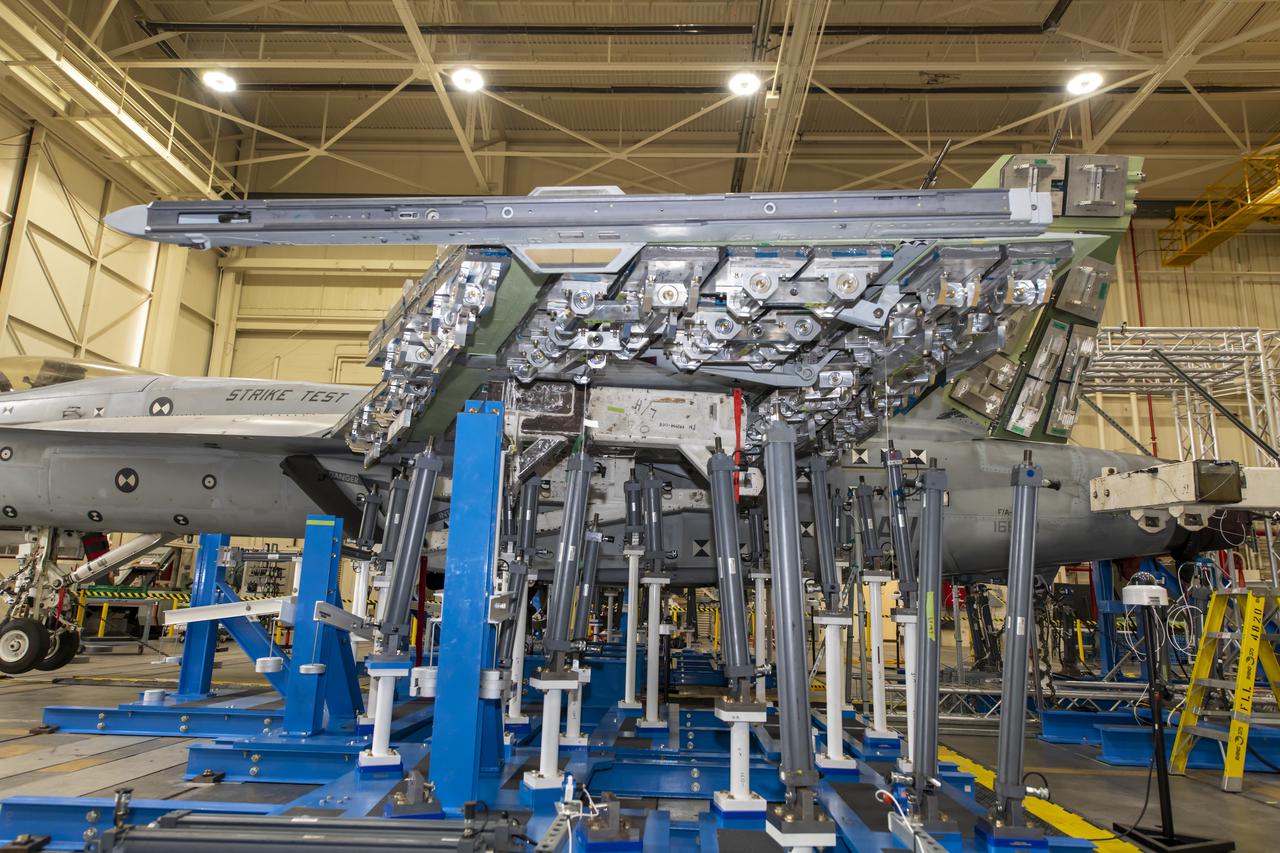
– Installation of wing load test hardware is installed under the wing of a F/A-18E from the Naval Air Systems Command (NAVAIR) in Patuxent River, Maryland. The aircraft is in NASA’s Armstrong Flight Research Center Flight Loads Laboratory in Edwards, California, for the center’s biggest load calibrations tests. This testing is needed before the aircraft can serve as a test vehicle for determining if it can safely manage maneuvers and proposed upgrades.
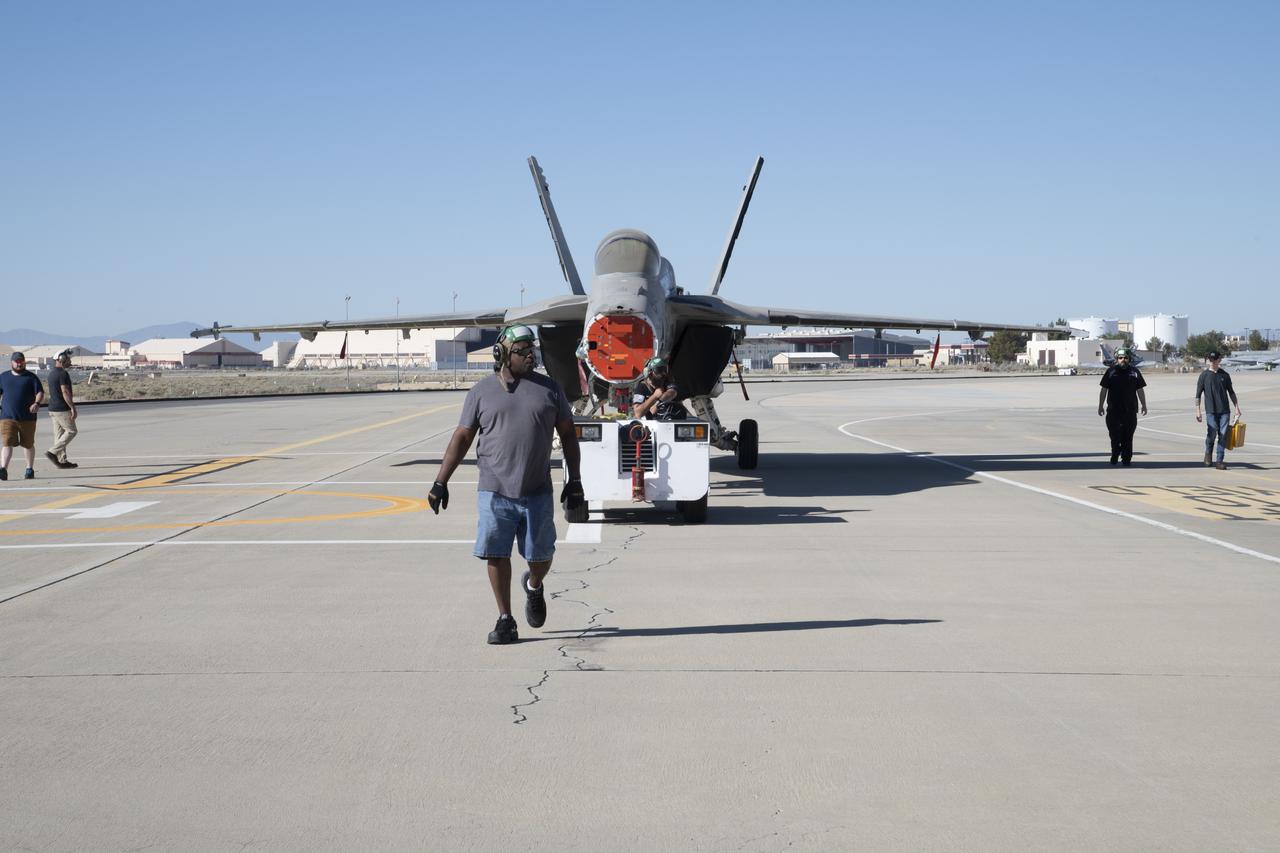
An F/A-18E from the Naval Air Systems Command (NAVAIR) in Patuxent River, Maryland, is moved from NASA’s Armstrong Flight Research Center Flight Loads Laboratory in Edwards, California, to a hangar where it will undergo final preparations to return to its squadron. The aircraft underwent the center’s biggest load calibrations tests. The testing will permit the aircraft to serve as a test vehicle to determine if it can safely manage maneuvers and proposed upgrades.

From left, Ray Sadler, Ted Powers, and Walter Hargis align load pads on the aircraft surface of a F/A-18E from the Naval Air Systems Command (NAVAIR) in Patuxent River, Maryland. The aircraft is in NASA’s Armstrong Flight Research Center Flight Loads Laboratory in Edwards, California, for the center’s biggest load calibrations tests. This testing is needed before the aircraft can serve as a test vehicle for determining if it can safely manage maneuvers and proposed upgrades.
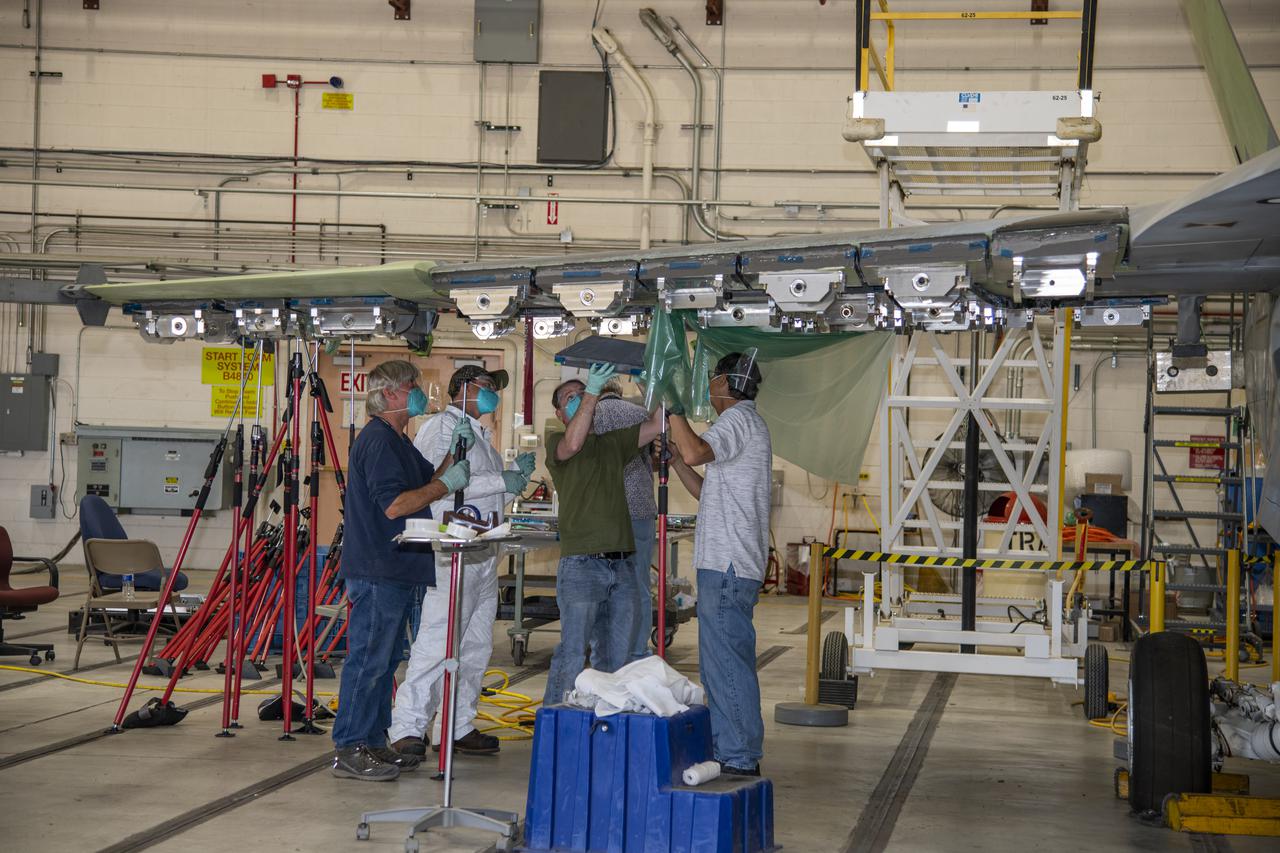
From left, Wally Hargis, Ray Sadler, Chris Mount, and Ronnie Haraguchi place a load pad on the aircraft surface of a F/A-18E from the Naval Air Systems Command (NAVAIR) in Patuxent River, Maryland. The aircraft is in NASA’s Armstrong Flight Research Center Flight Loads Laboratory in Edwards, California, for the center’s biggest load calibrations tests. This testing is needed before the aircraft can serve as a test vehicle for determining if it can safely manage maneuvers and proposed upgrades.

The jacks are lowered to remove them from under the F/A-18E from the Naval Air Systems Command (NAVAIR) in Patuxent River, Maryland. The aircraft is in NASA’s Armstrong Flight Research Center Flight Loads Laboratory in Edwards, California, for the center’s biggest load calibrations tests. This testing is needed before the aircraft can serve as a test vehicle for determining if it can safely manage maneuvers and proposed upgrades.
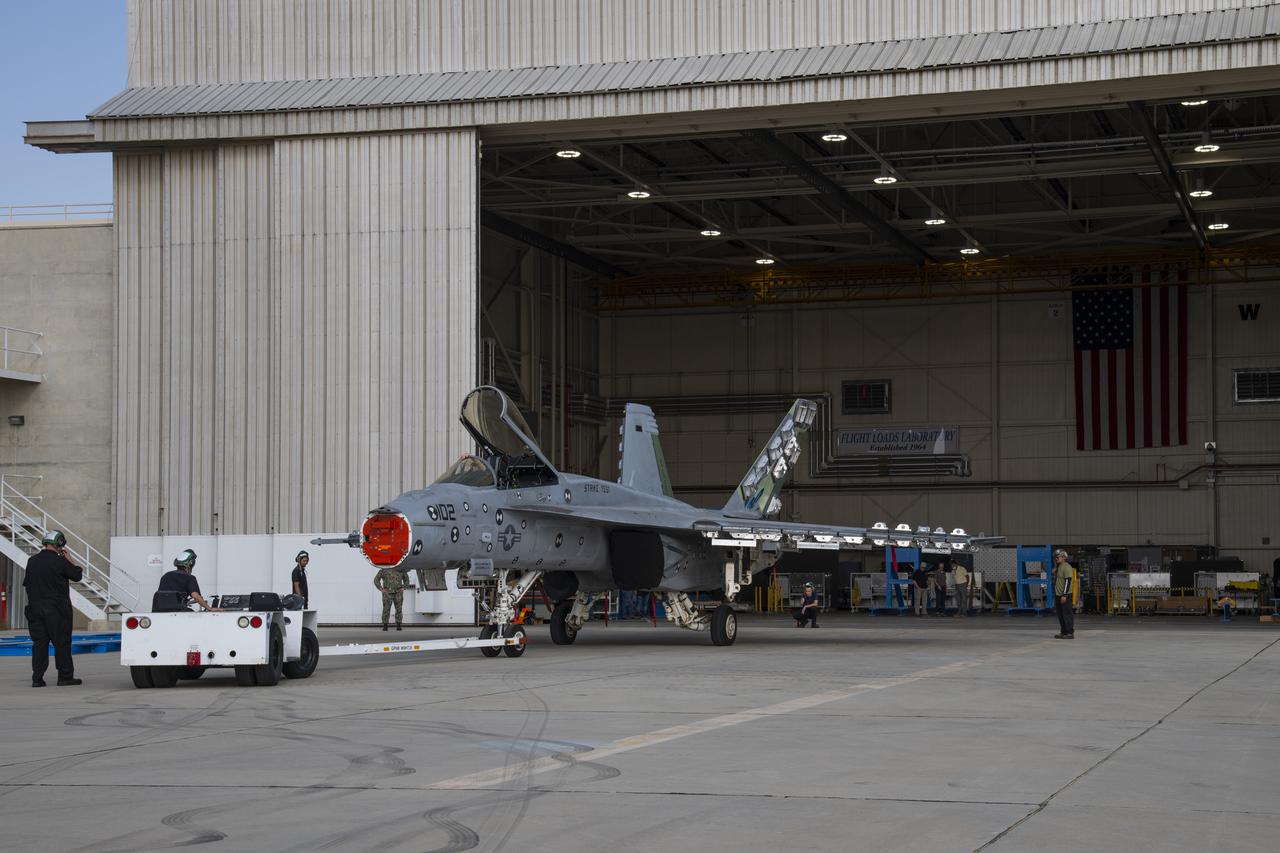
The Naval Air Systems Command (NAVAIR) in Patuxent River, Maryland F/A-18E is moved to NASA’s Armstrong Flight Research Center Flight Loads Laboratory in Edwards, California. NASA Armstrong is working on its biggest load calibrations tests on an F/A-18E Super Hornet. This testing is needed before the aircraft can serve as a test vehicle for determining if it can safely manage maneuvers and proposed upgrades.
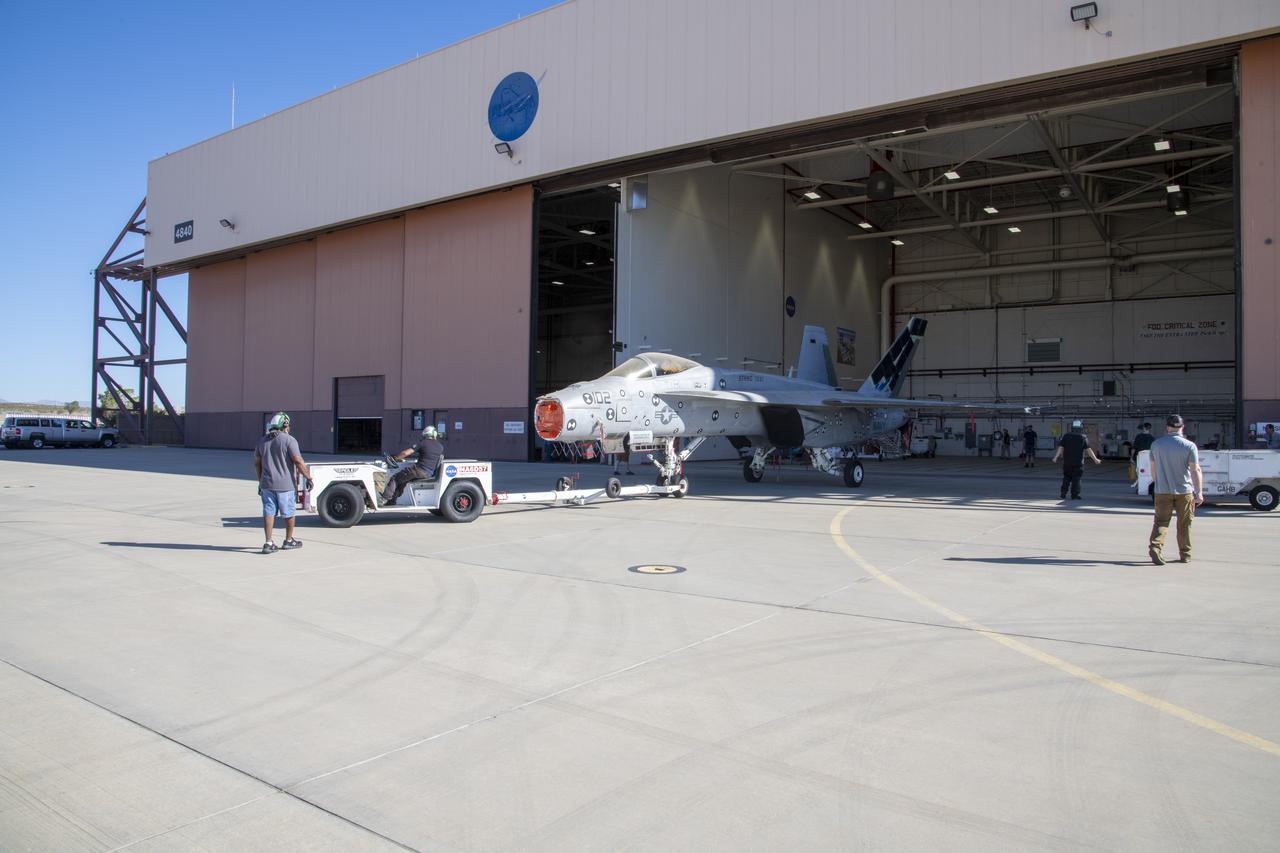
An F/A-18E from the Naval Air Systems Command (NAVAIR) in Patuxent River, Maryland, is moved from NASA’s Armstrong Flight Research Center Flight Loads Laboratory in Edwards, California, to a hangar where it will undergo final preparations to return to its squadron. The aircraft underwent the center’s biggest load calibrations tests. The testing will permit the aircraft to serve as a test vehicle to determine if it can safely manage maneuvers and proposed upgrades.

The load pad bonding process for the vertical tails was a preliminary step in the process to test the F/A-18E from the Naval Air Systems Command (NAVAIR) in Patuxent River, Maryland. The aircraft is in NASA’s Armstrong Flight Research Center Flight Loads Laboratory in Edwards, California, for the center’s biggest load calibrations tests. This testing is needed before the aircraft can serve as a test vehicle for determining if it can safely manage maneuvers and proposed upgrades.
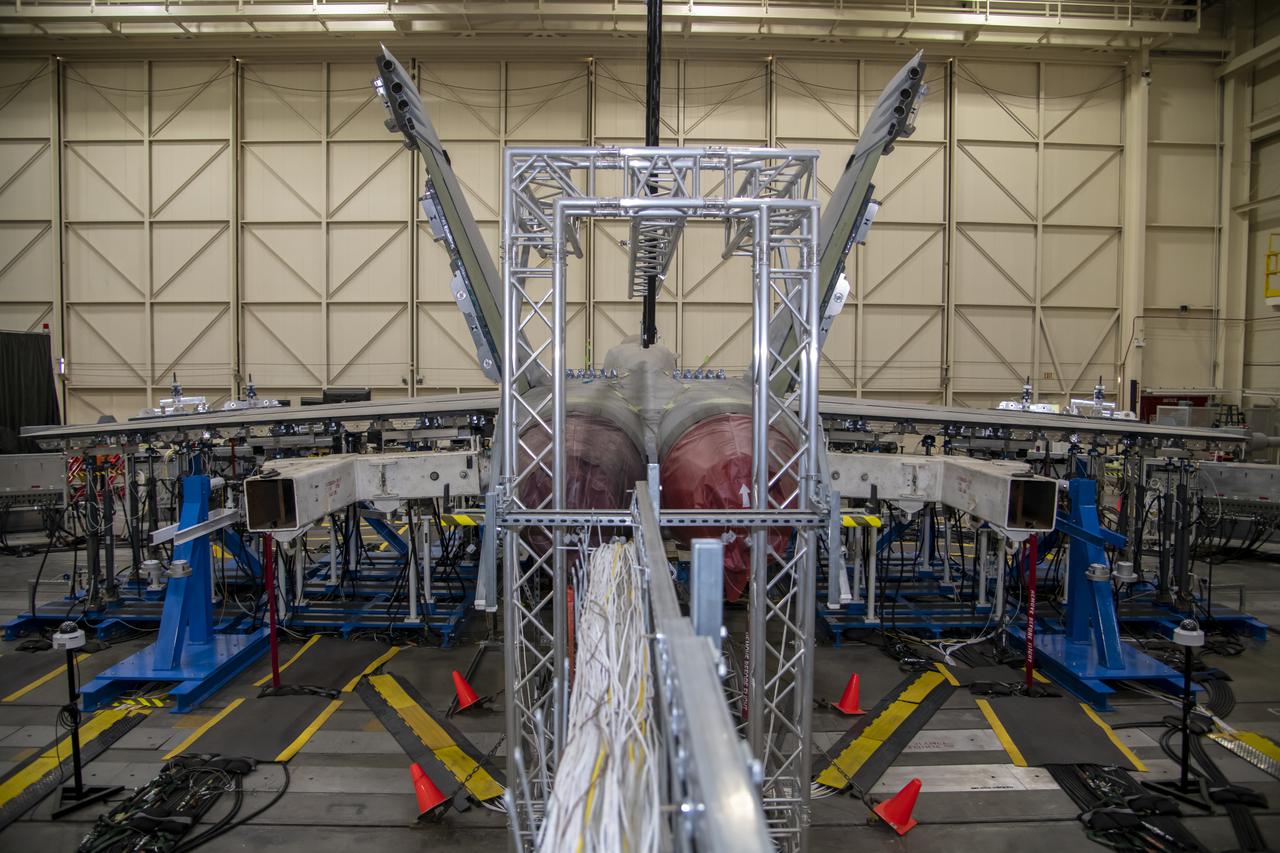
This rear view shows the wing loading test configuration and testing area of an F/A-18E from the Naval Air Systems Command (NAVAIR) in Patuxent River, Maryland. The aircraft is in NASA's Armstrong Flight Research Center Flight Loads Laboratory in Edwards, California, for the center's biggest load calibrations tests. This testing is needed before the aircraft can serve as a test vehicle for determining if it can safely manage maneuvers and proposed upgrades
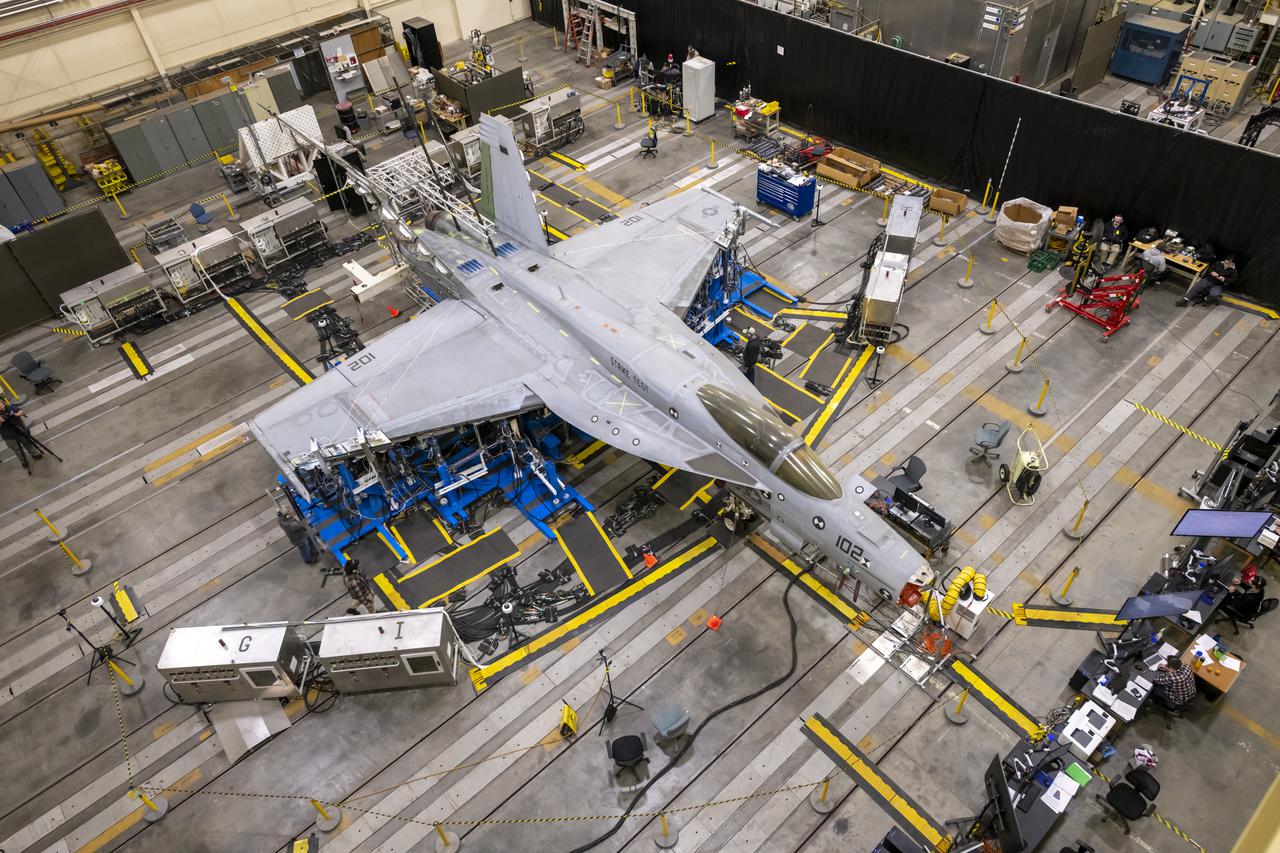
A top view shows the wing loading test configuration of an F/A-18E from the Naval Air Systems Command (NAVAIR) in Patuxent River; Maryland. The aircraft is in NASA's Armstrong Flight Research Center Flight Loads Laboratory in Edwards; California; for the center's biggest load calibrations tests. This testing is needed before the aircraft can serve as a test vehicle for determining if it can safely manage maneuvers and proposed upgrades.
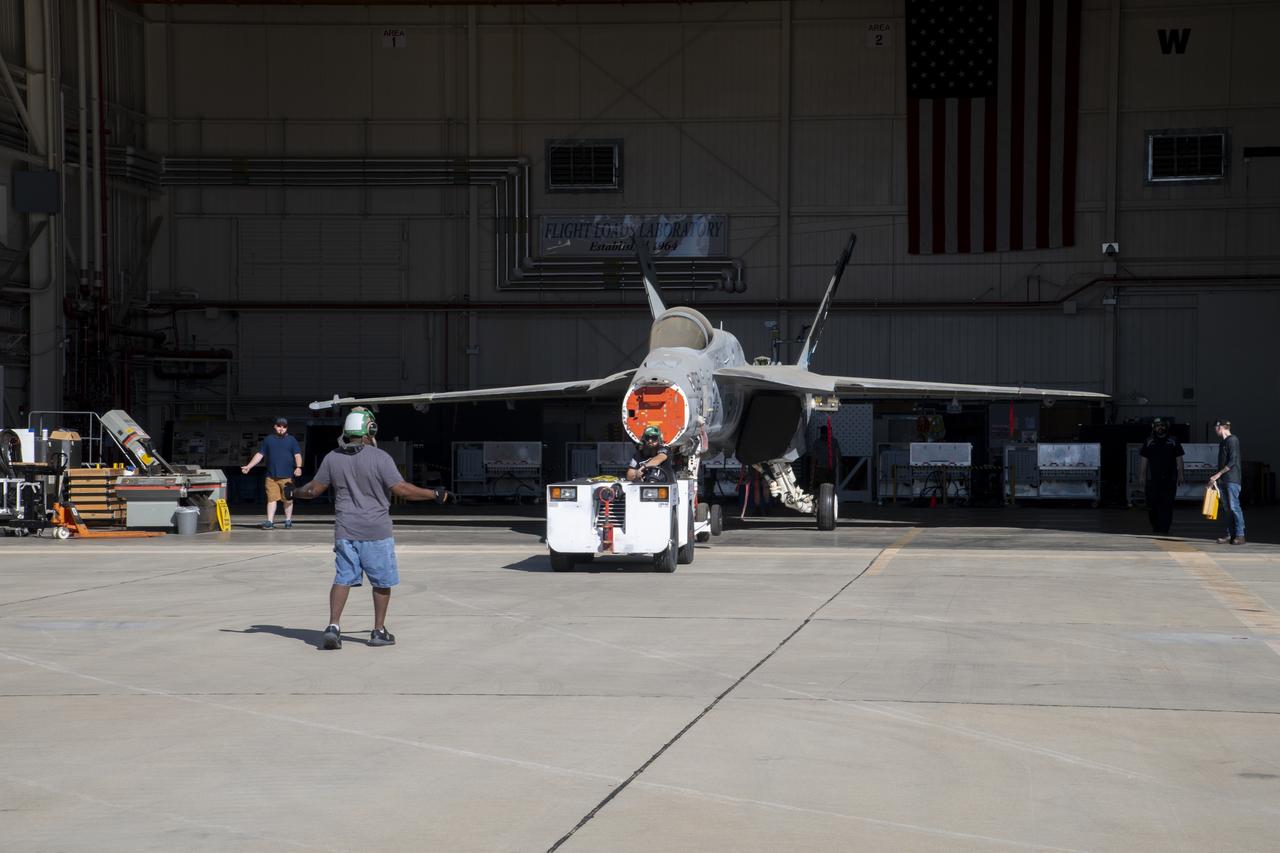
An F/A-18E from the Naval Air Systems Command (NAVAIR) in Patuxent River, Maryland, is moved from NASA’s Armstrong Flight Research Center Flight Loads Laboratory in Edwards, California, to a hangar where it will undergo final preparations to return to its squadron. The aircraft underwent the center’s biggest load calibrations tests. The testing will permit the aircraft to serve as a test vehicle to determine if it can safely manage maneuvers and proposed upgrades.
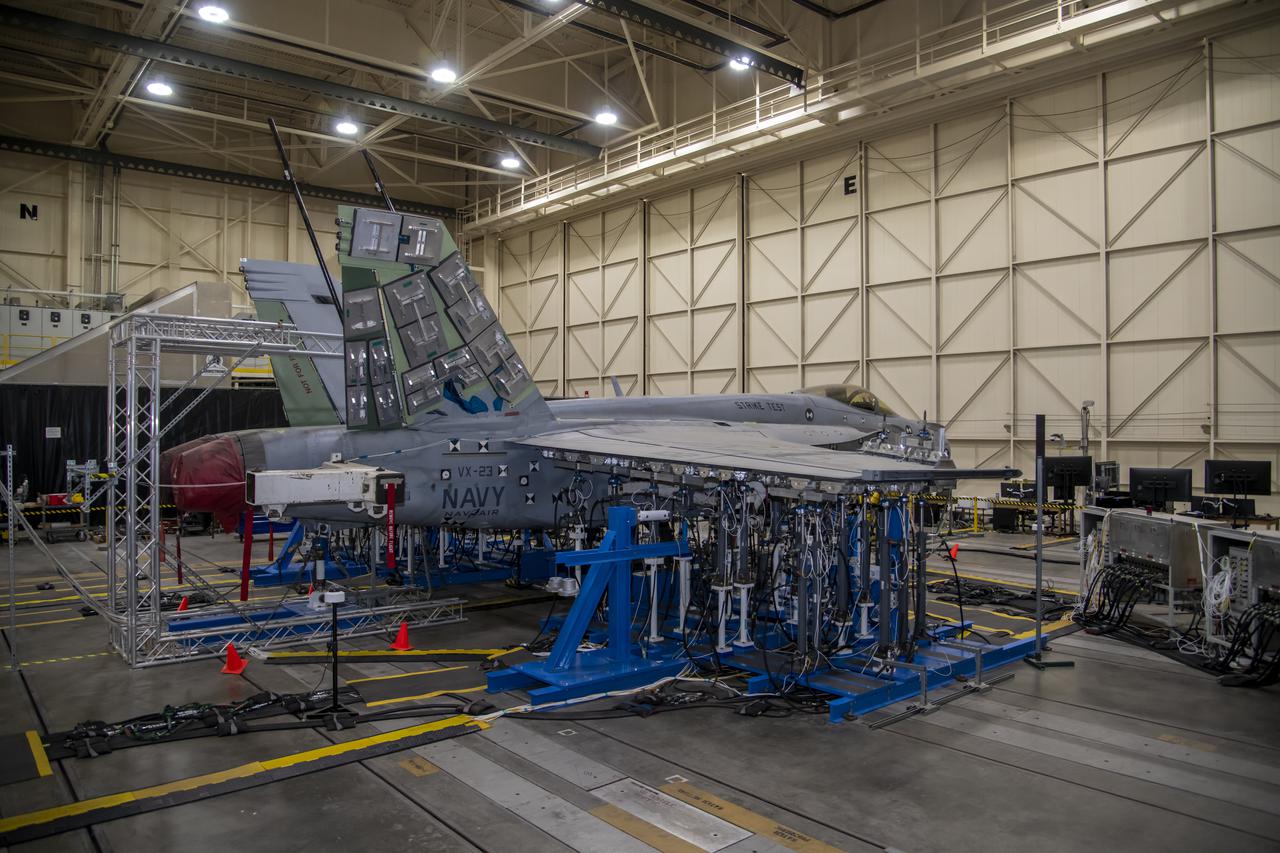
This rear view of the right wing load hardware shows the setup for testing a F/A-18E from the Naval Air Systems Command (NAVAIR) in Patuxent River, Maryland. The aircraft is in NASA's Armstrong Flight Research Center Flight Loads Laboratory in Edwards, California, for the center's biggest load calibrations tests. This testing is needed before the aircraft can serve as a test vehicle for determining if it can safely manage maneuvers and proposed upgrades.
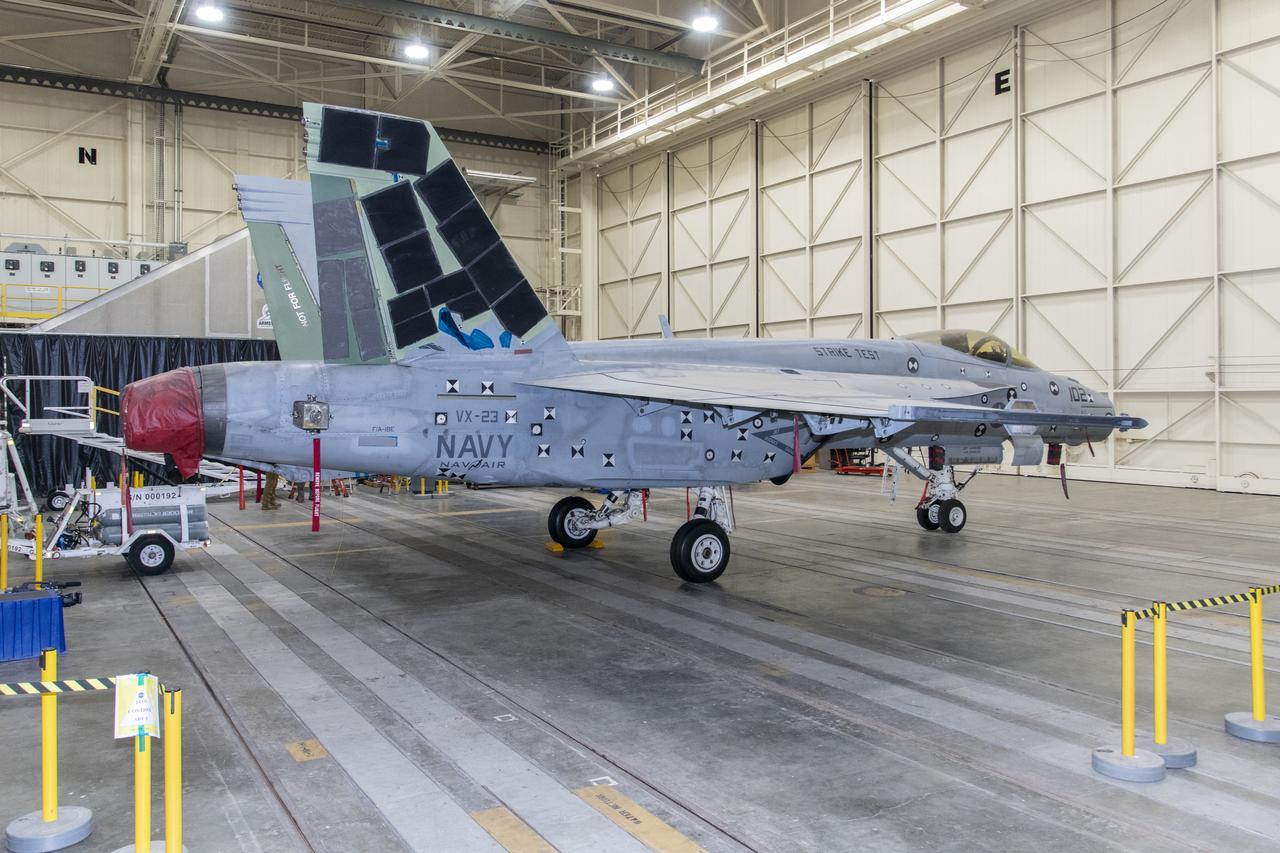
This left-side view shows an F/A-18E from the Naval Air Systems Command (NAVAIR) in Patuxent River, Maryland. The aircraft is in NASA’s Armstrong Flight Research Center Flight Loads Laboratory in Edwards, California, where it underwent the center’s biggest load calibrations tests. This testing will permit the aircraft to serve as a test vehicle to determine if it can safely manage maneuvers and proposed upgrades.
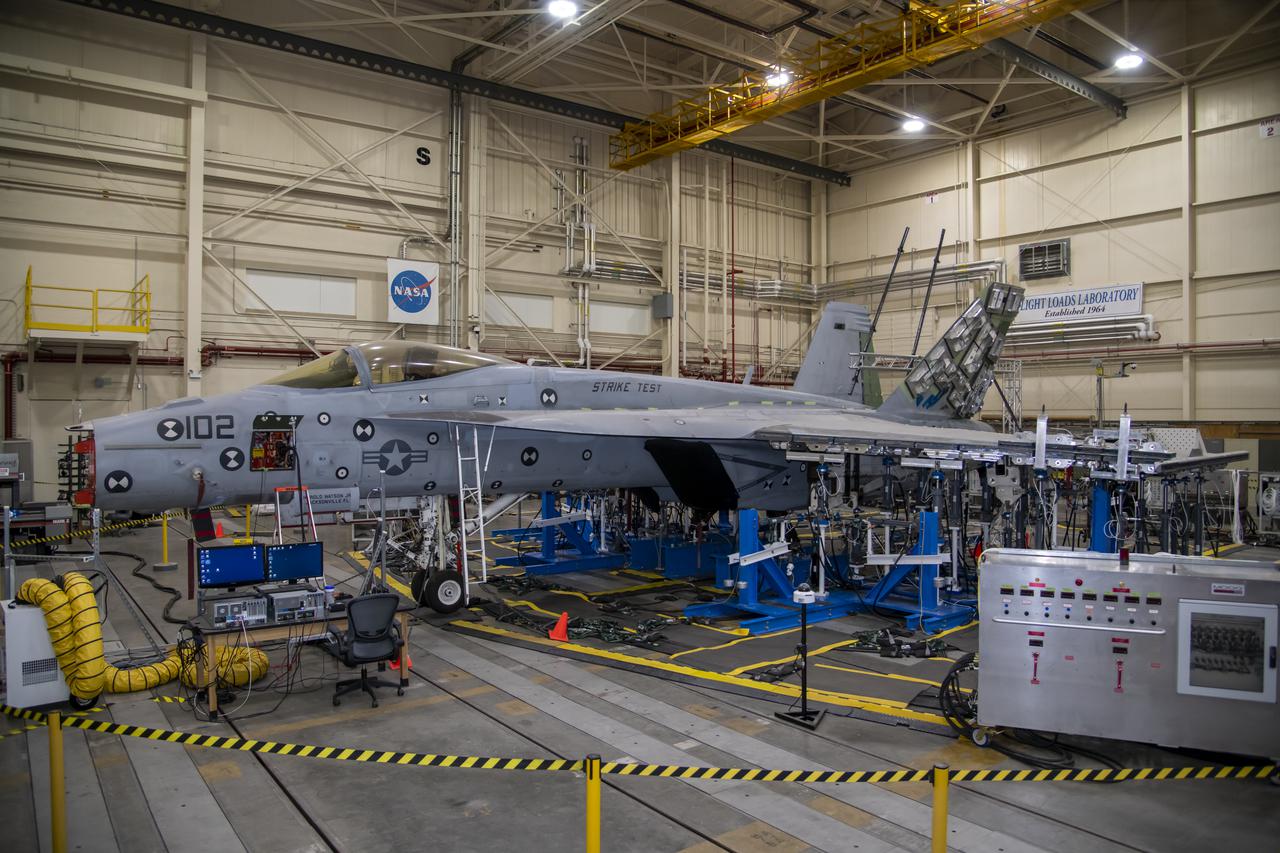
This view shows the left wing loading test configuration and testing area of an F/A-18E from the Naval Air Systems Command (NAVAIR) in Patuxent River, Maryland. The aircraft is in NASA's Armstrong Flight Research Center Flight Loads Laboratory in Edwards, California, for the center's biggest load calibrations tests. This testing is needed before the aircraft can serve as a test vehicle for determining if it can safely manage maneuvers and proposed upgrades.
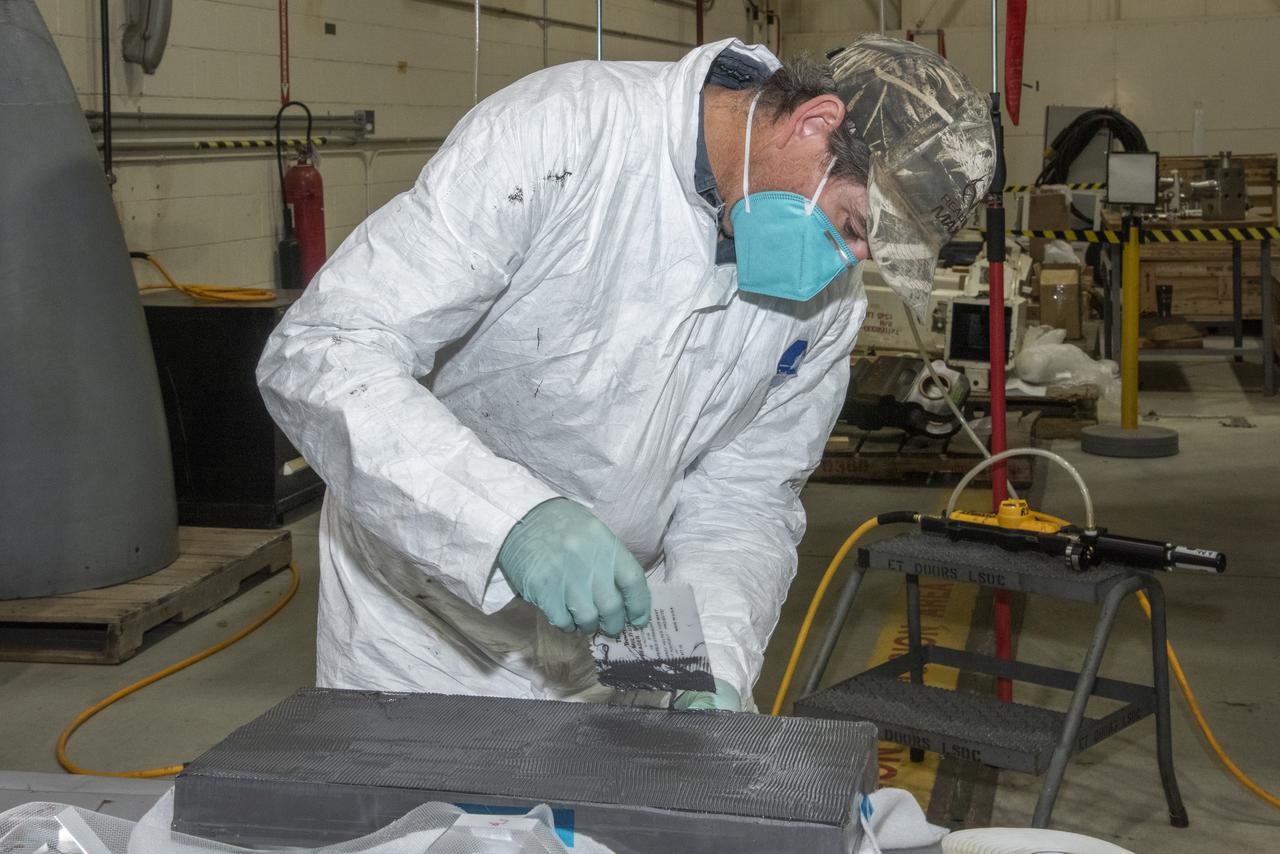
The load pad bonding process for the vertical tails was a preliminary step in the process to test the F/A-18E from the Naval Air Systems Command (NAVAIR) in Patuxent River, Maryland. The aircraft is in NASA’s Armstrong Flight Research Center Flight Loads Laboratory in Edwards, California, for the center’s biggest load calibrations tests. This testing is needed before the aircraft can serve as a test vehicle for determining if it can safely manage maneuvers and proposed upgrades.
The Naval Air Systems Command (NAVAIR) in Patuxent River, Maryland F/A-18E is moved to NASA’s Armstrong Flight Research Center Flight Loads Laboratory in Edwards, California. NASA Armstrong is working on its biggest load calibrations tests on an F/A-18E Super Hornet. This testing is needed before the aircraft can serve as a test vehicle for determining if it can safely manage maneuvers and proposed upgrades.
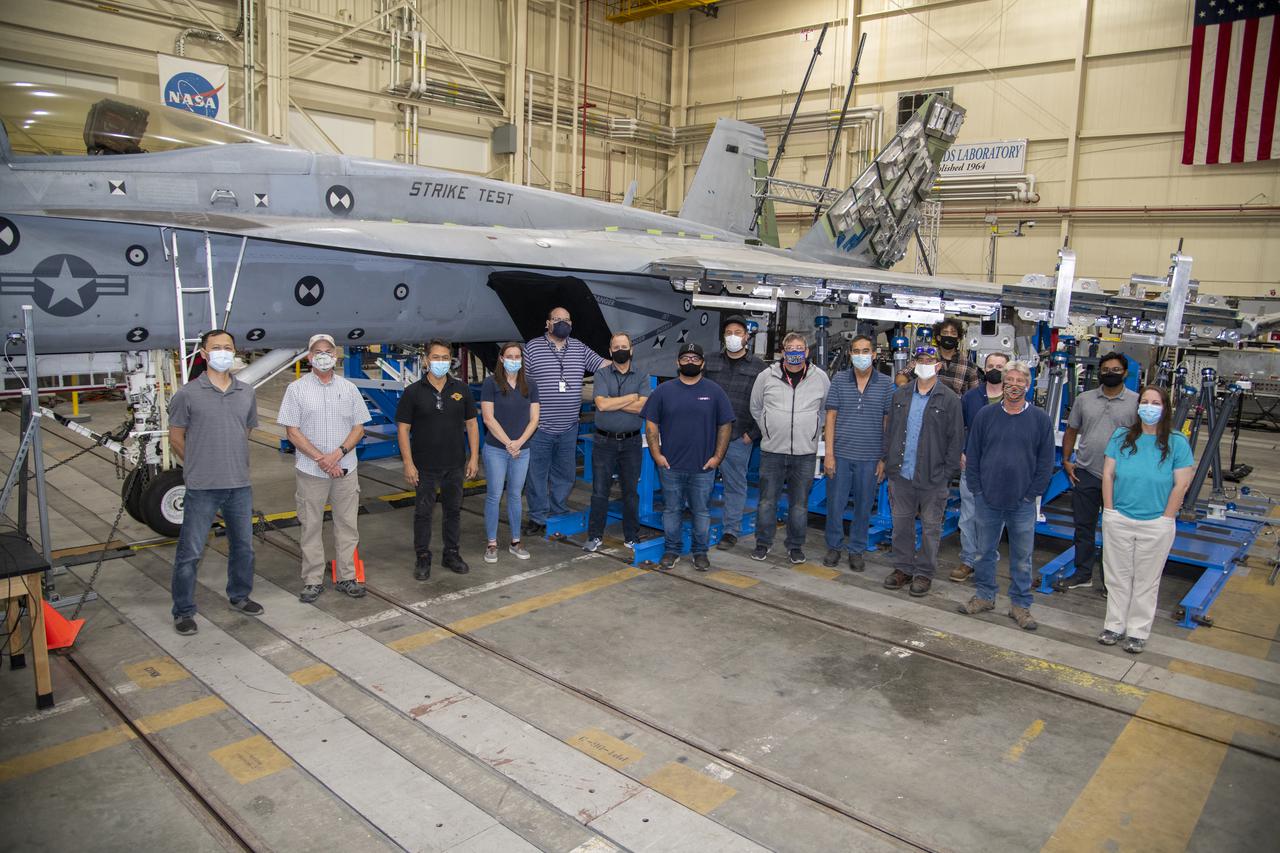
The team who worked on the load testing of the horizontal tails stands by the F/A-18E from the Naval Air Systems Command (NAVAIR) in Patuxent River, Maryland. The aircraft is in NASA’s Armstrong Flight Research Center Flight Loads Laboratory in Edwards, California, for the center’s biggest load calibrations tests. This testing is needed before the aircraft can serve as a test vehicle for determining if it can safely manage maneuvers and proposed upgrades.
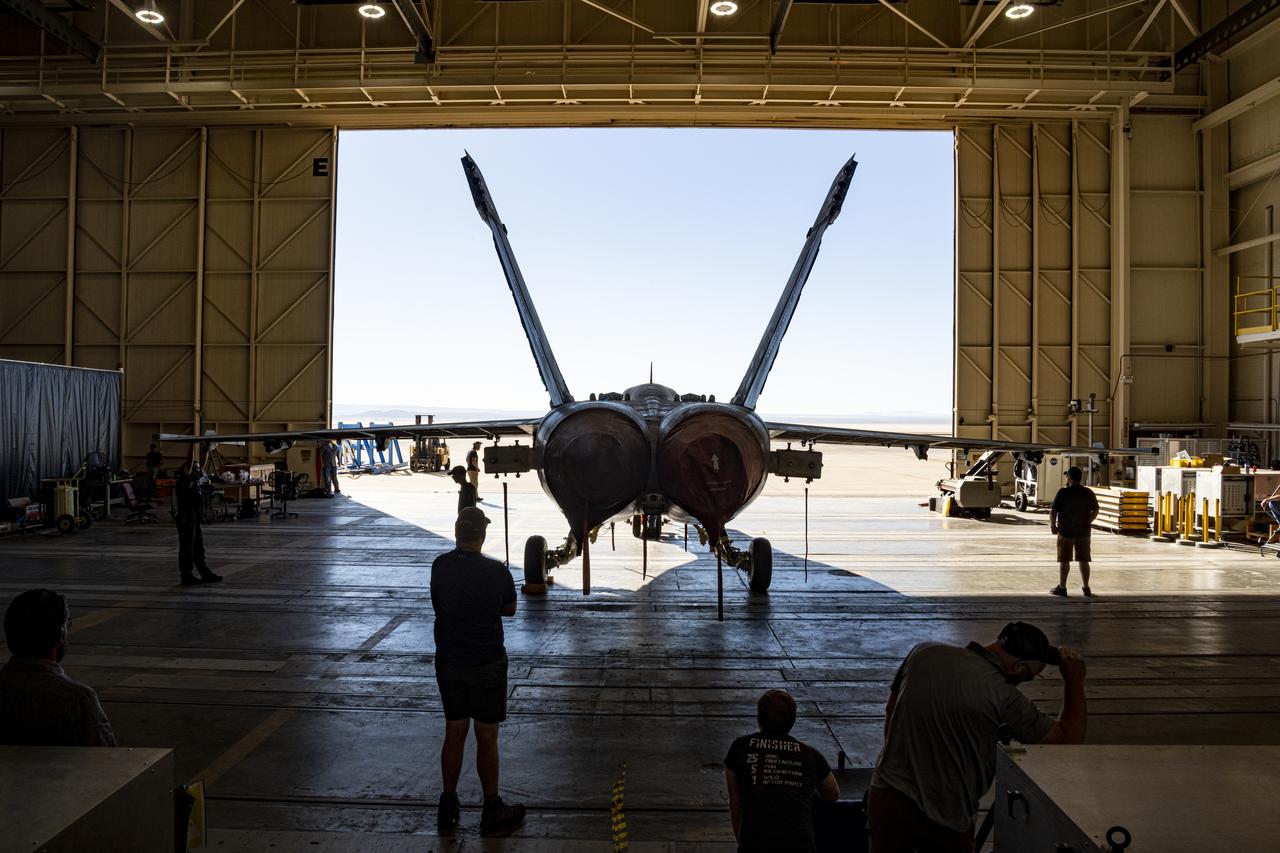
This rear view shows an F/A-18E from the Naval Air Systems Command (NAVAIR) in Patuxent River, Maryland. The aircraft is in NASA’s Armstrong Flight Research Center Flight Loads Laboratory in Edwards, California, where it underwent the center’s biggest load calibrations tests. This testing will permit the aircraft to serve as a test vehicle to determine if it can safely manage maneuvers and proposed upgrades.
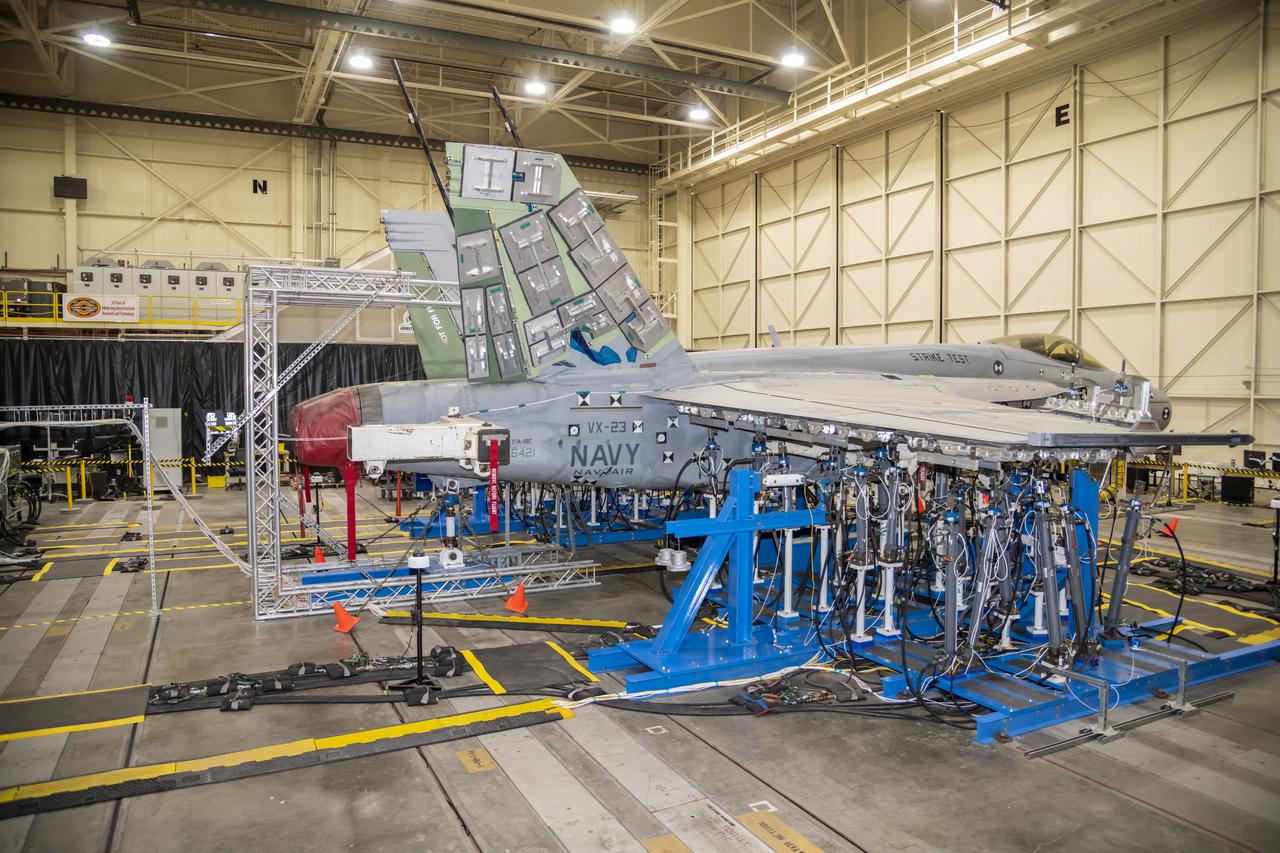
Wing load test hardware is setup under wing of a F/A-18E from the Naval Air Systems Command (NAVAIR) in Patuxent River, Maryland. The aircraft is in NASA’s Armstrong Flight Research Center Flight Loads Laboratory in Edwards, California, for the center’s biggest load calibrations tests. This testing is needed before the aircraft can serve as a test vehicle for determining if it can safely manage maneuvers and proposed upgrades.
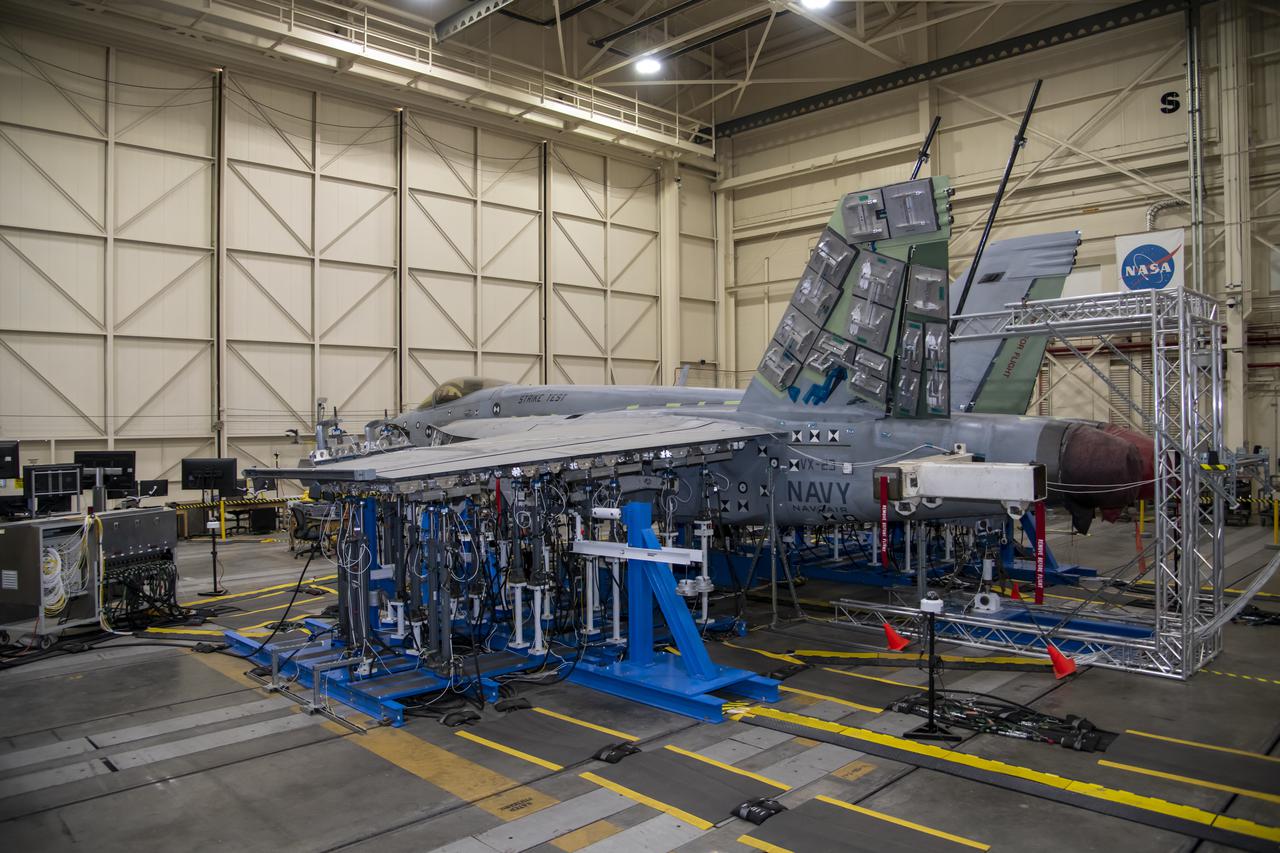
This rear view of the left wing load hardware shows the setup for testing a F/A-18E from the Naval Air Systems Command (NAVAIR) in Patuxent River, Maryland. The aircraft is in NASA's Armstrong Flight Research Center Flight Loads Laboratory in Edwards, California, for the center's biggest load calibrations tests. This testing is needed before the aircraft can serve as a test vehicle for determining if it can safely manage maneuvers and proposed upgrades.Â
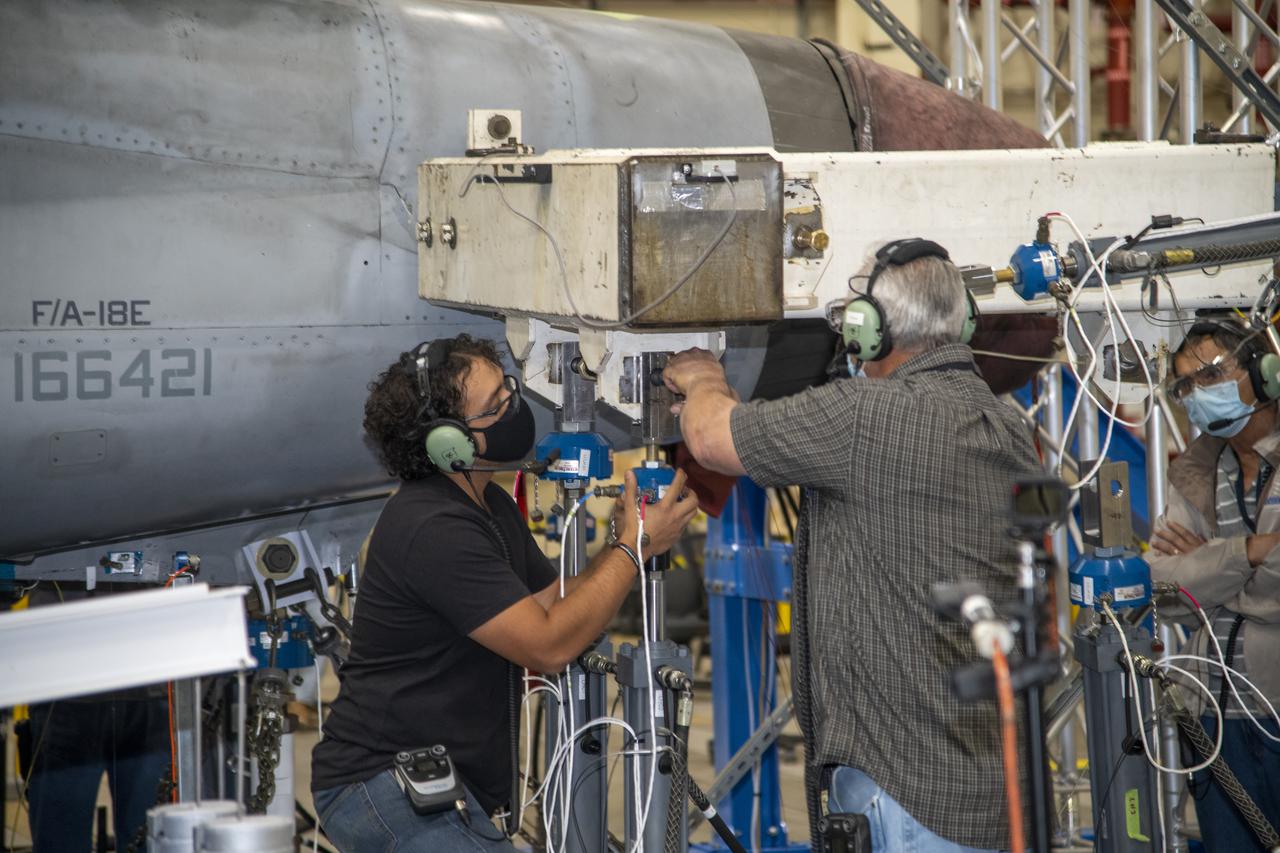
The actuator on the F/A-18E from the Naval Air Systems Command (NAVAIR) in Patuxent River, Maryland, is pinned to the horizontal tail load test fixture. The aircraft is in NASA’s Armstrong Flight Research Center Flight Loads Laboratory in Edwards, California, for the center’s biggest load calibrations tests. This testing is needed before the aircraft can serve as a test vehicle for determining if it can safely manage maneuvers and proposed upgrades.
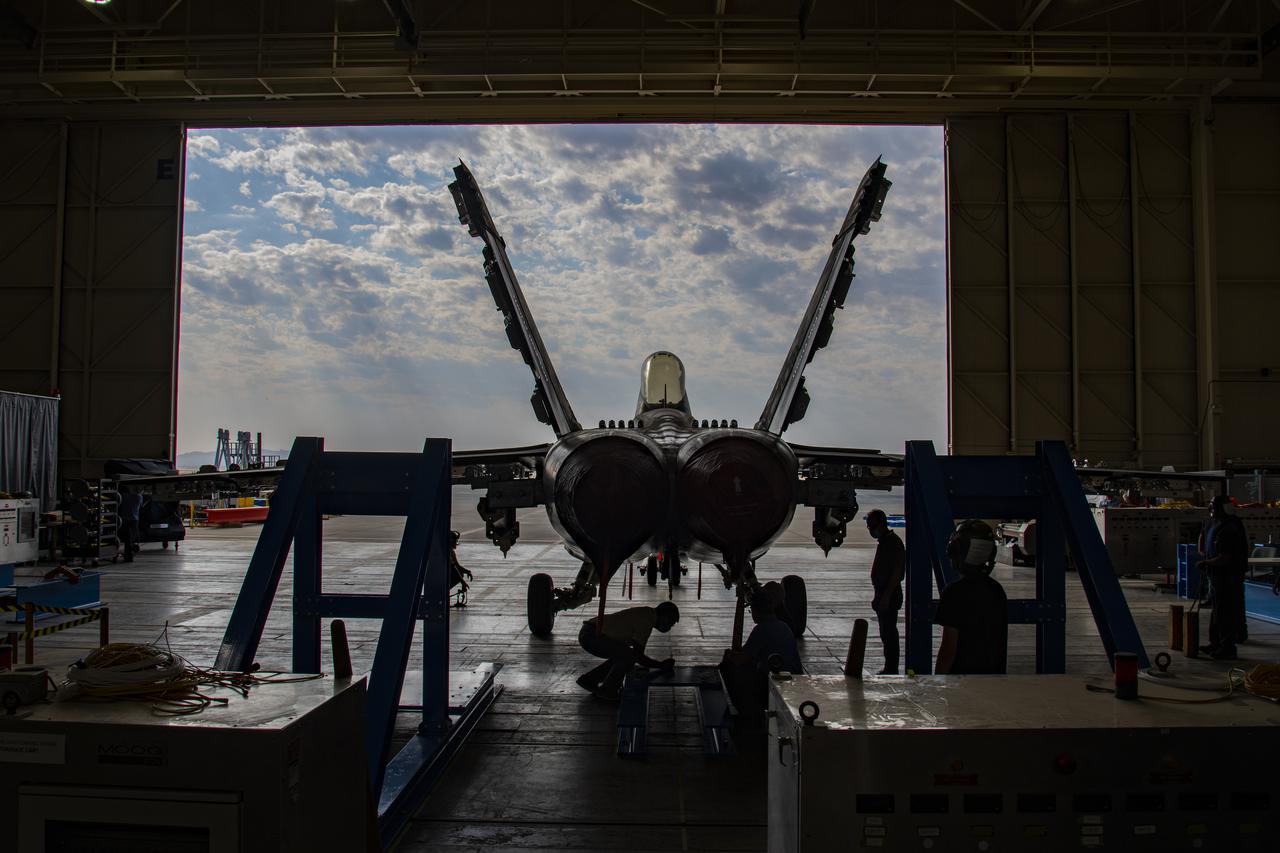
The Naval Air Systems Command (NAVAIR) in Patuxent River, Maryland F/A-18E is moved to NASA’s Armstrong Flight Research Center Flight Loads Laboratory in Edwards, California. NASA Armstrong is working on its biggest load calibrations tests on an F/A-18E Super Hornet. This testing is needed before the aircraft can serve as a test vehicle for determining if it can safely manage maneuvers and proposed upgrades.
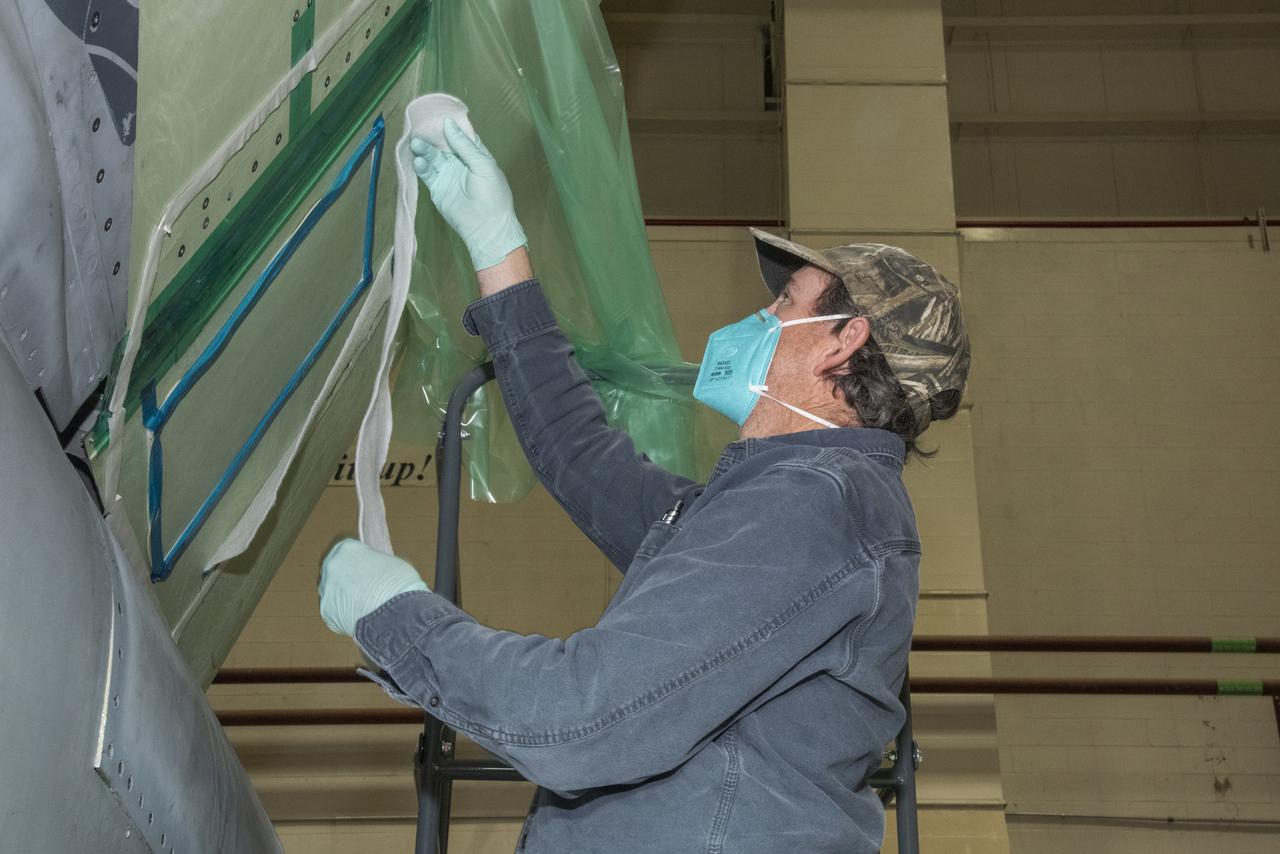
The load pad bonding process for the vertical tails was a preliminary step in the process to test the F/A-18E from the Naval Air Systems Command (NAVAIR) in Patuxent River, Maryland. The aircraft is in NASA’s Armstrong Flight Research Center Flight Loads Laboratory in Edwards, California, for the center’s biggest load calibrations tests. This testing is needed before the aircraft can serve as a test vehicle for determining if it can safely manage maneuvers and proposed upgrades.
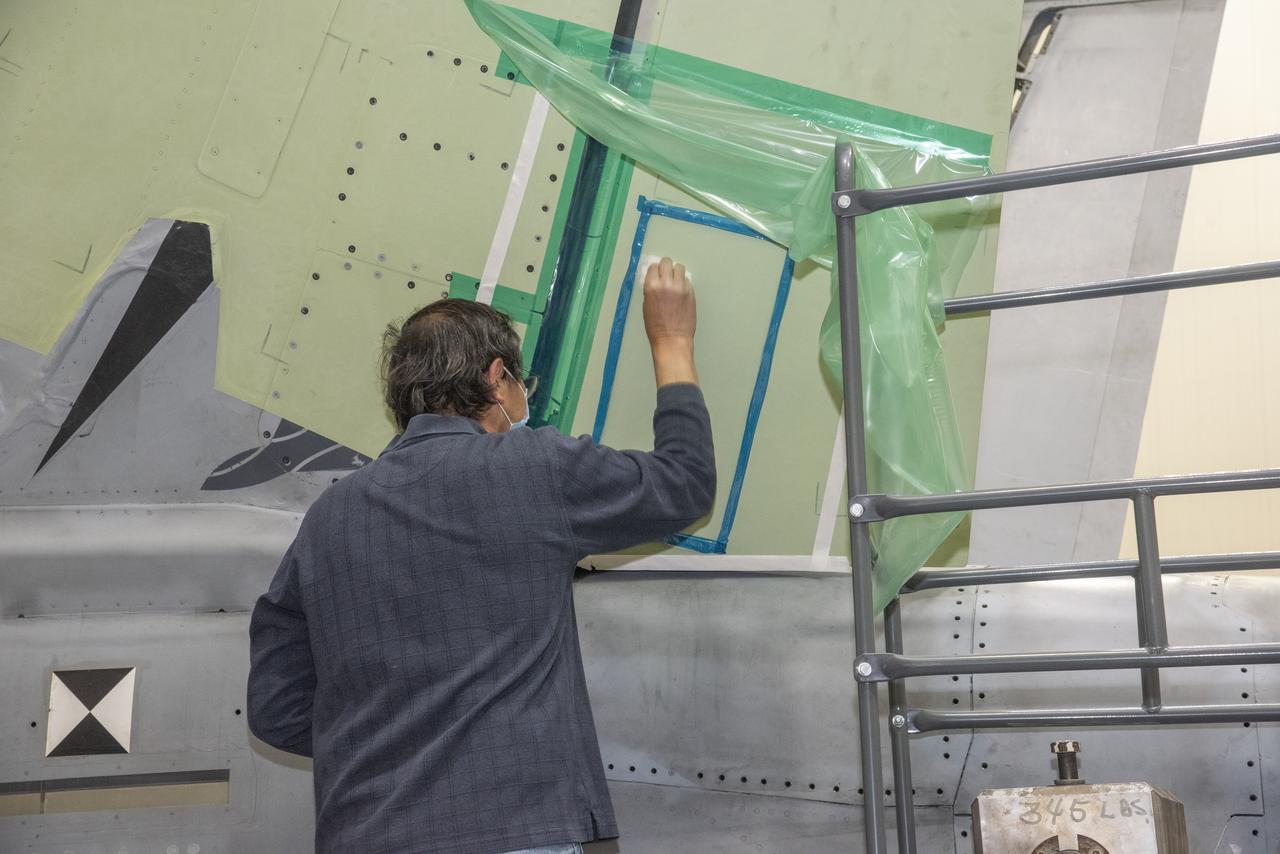
The load pad bonding process for the vertical tails was a preliminary step in the process to test the F/A-18E from the Naval Air Systems Command (NAVAIR) in Patuxent River, Maryland. The aircraft is in NASA’s Armstrong Flight Research Center Flight Loads Laboratory in Edwards, California, for the center’s biggest load calibrations tests. This testing is needed before the aircraft can serve as a test vehicle for determining if it can safely manage maneuvers and proposed upgrades.
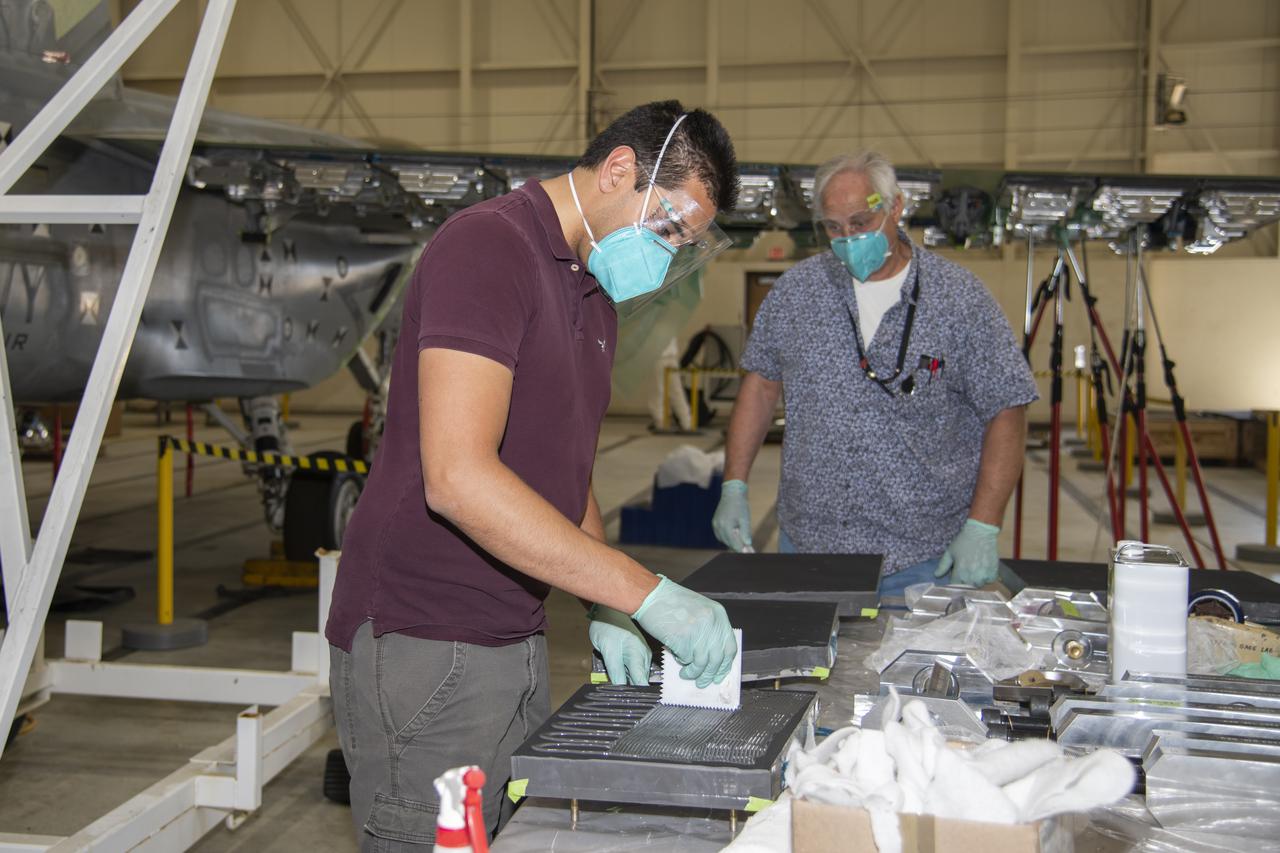
Jeremy Woellner, from left, and Ted Powers spread tank sealant on rubber load pads, a step in the process to test a F/A-18E from the Naval Air Systems Command (NAVAIR) in Patuxent River, Maryland. The aircraft is in NASA’s Armstrong Flight Research Center Flight Loads Laboratory in Edwards, California, for the center’s biggest load calibrations tests. This testing is needed before the aircraft can serve as a test vehicle for determining if it can safely manage maneuvers and proposed upgrades.

Walter Hargis, left, and Chris Mount apply tank sealant on the aircraft surface of a F/A-18E from the Naval Air Systems Command (NAVAIR) in Patuxent River, Maryland. The aircraft is in NASA’s Armstrong Flight Research Center Flight Loads Laboratory in Edwards, California, for the center’s biggest load calibrations tests. This testing is needed before the aircraft can serve as a test vehicle for determining if it can safely manage maneuvers and proposed upgrades.
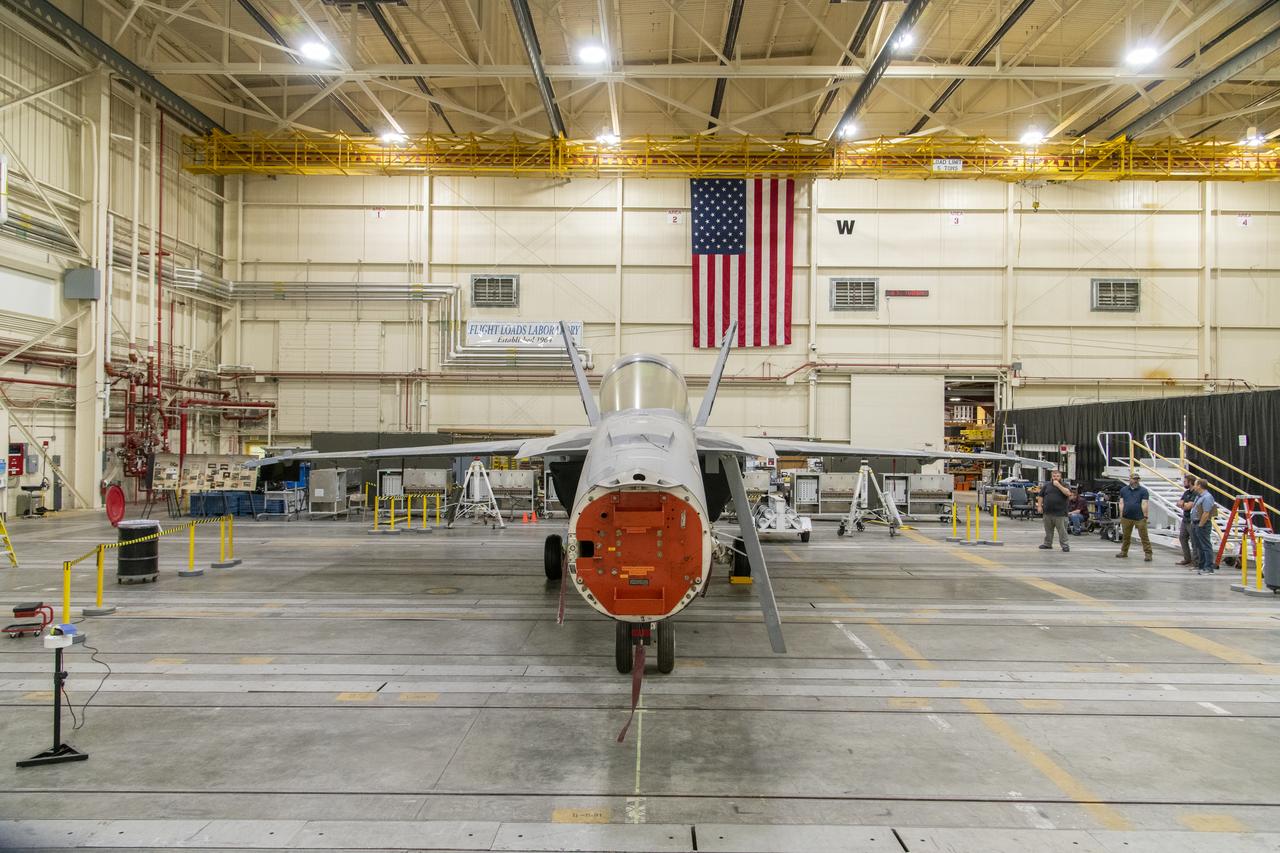
This front view shows an F/A-18E from the Naval Air Systems Command (NAVAIR) in Patuxent River, Maryland. The aircraft is in NASA’s Armstrong Flight Research Center Flight Loads Laboratory in Edwards, California, where it underwent the center’s biggest load calibrations tests. This testing will permit the aircraft to serve as a test vehicle to determine if it can safely manage maneuvers and proposed upgrades.

An F/A-18E from the Naval Air Systems Command (NAVAIR) in Patuxent River, Maryland, is moved from NASA’s Armstrong Flight Research Center Flight Loads Laboratory in Edwards, California, to a hangar where it will undergo final preparations to return to its squadron. The aircraft underwent the center’s biggest load calibrations tests. The testing will permit the aircraft to serve as a test vehicle to determine if it can safely manage maneuvers and proposed upgrades.
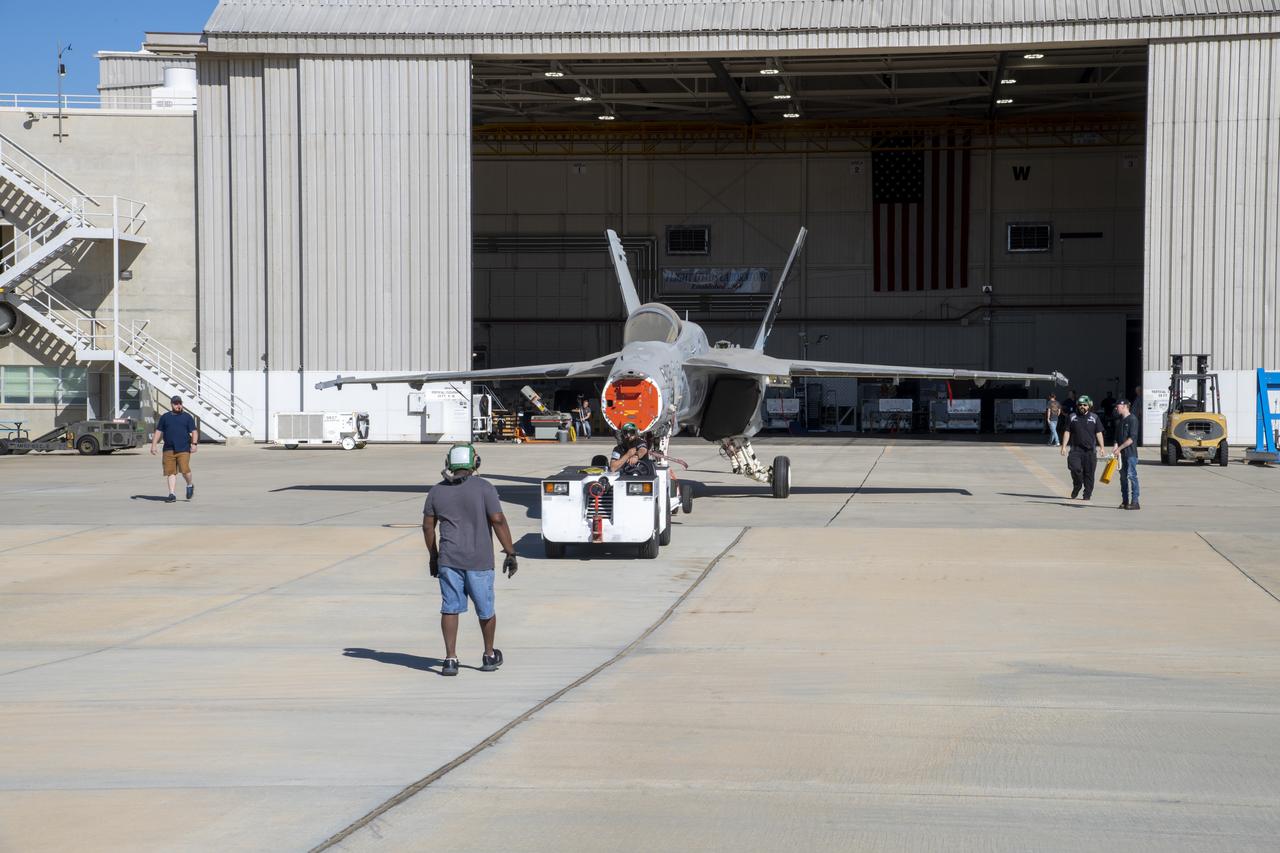
An F/A-18E from the Naval Air Systems Command (NAVAIR) in Patuxent River, Maryland, is moved from NASA’s Armstrong Flight Research Center Flight Loads Laboratory in Edwards, California, to a hangar where it will undergo final preparations to return to its squadron. The aircraft underwent the center’s biggest load calibrations tests. The testing will permit the aircraft to serve as a test vehicle to determine if it can safely manage maneuvers and proposed upgrades.
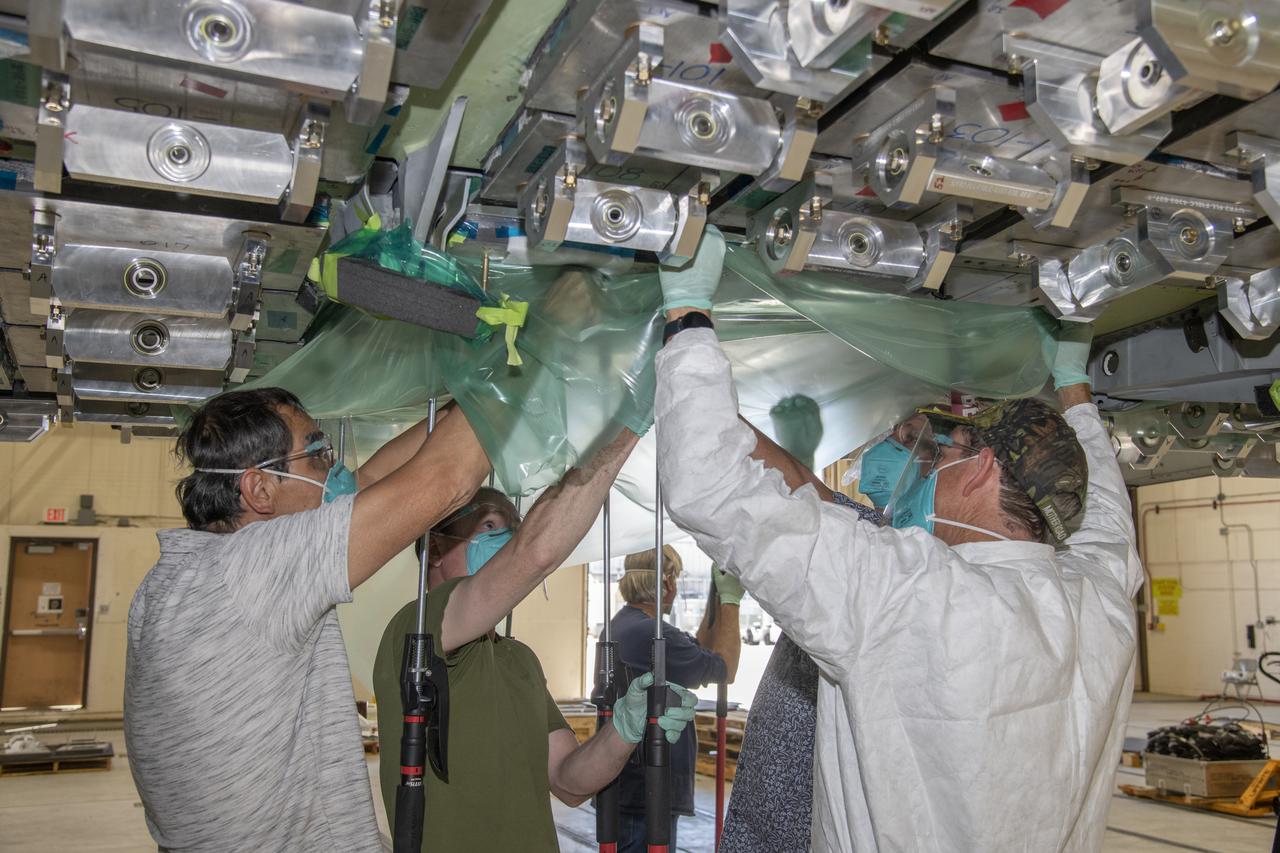
From left, Ronnie Haraguchi, Chris Mount, and Ray Sadler vacuum bag load pads on the aircraft surface of a F/A-18E from the Naval Air Systems Command (NAVAIR) in Patuxent River, Maryland. The aircraft is in NASA's Armstrong Flight Research Center Flight Loads Laboratory in Edwards, California, for the center's biggest load calibrations tests. This testing is needed before the aircraft can serve as a test vehicle for determining if it can safely manage maneuvers and proposed upgrades.
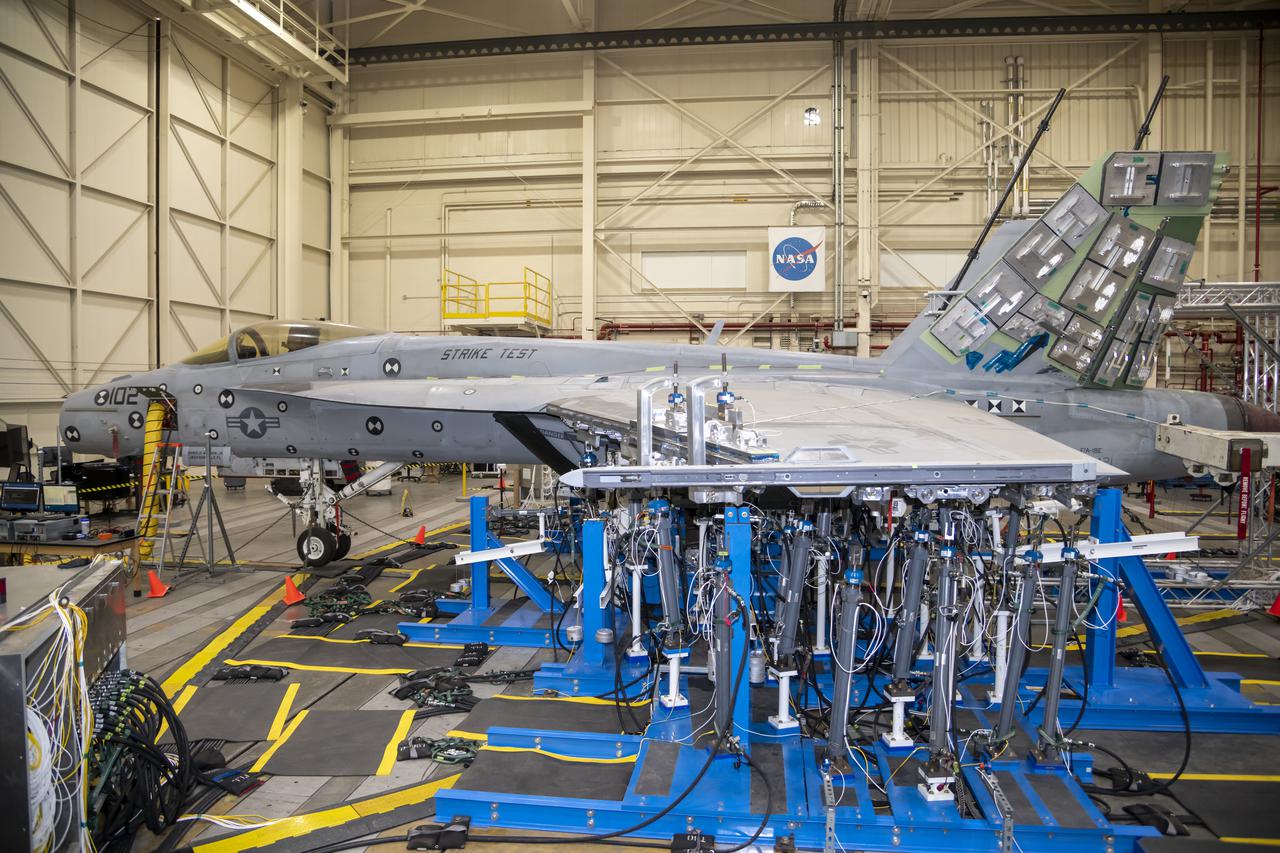
Left wing load hardware is setup for testing a F/A-18E from the Naval Air Systems Command (NAVAIR) in Patuxent River, Maryland. The aircraft is in NASA's Armstrong Flight Research Center Flight Loads Laboratory in Edwards, California, for the center's biggest load calibrations tests. This testing is needed before the aircraft can serve as a test vehicle for determining if it can safely manage maneuvers and proposed upgrades.
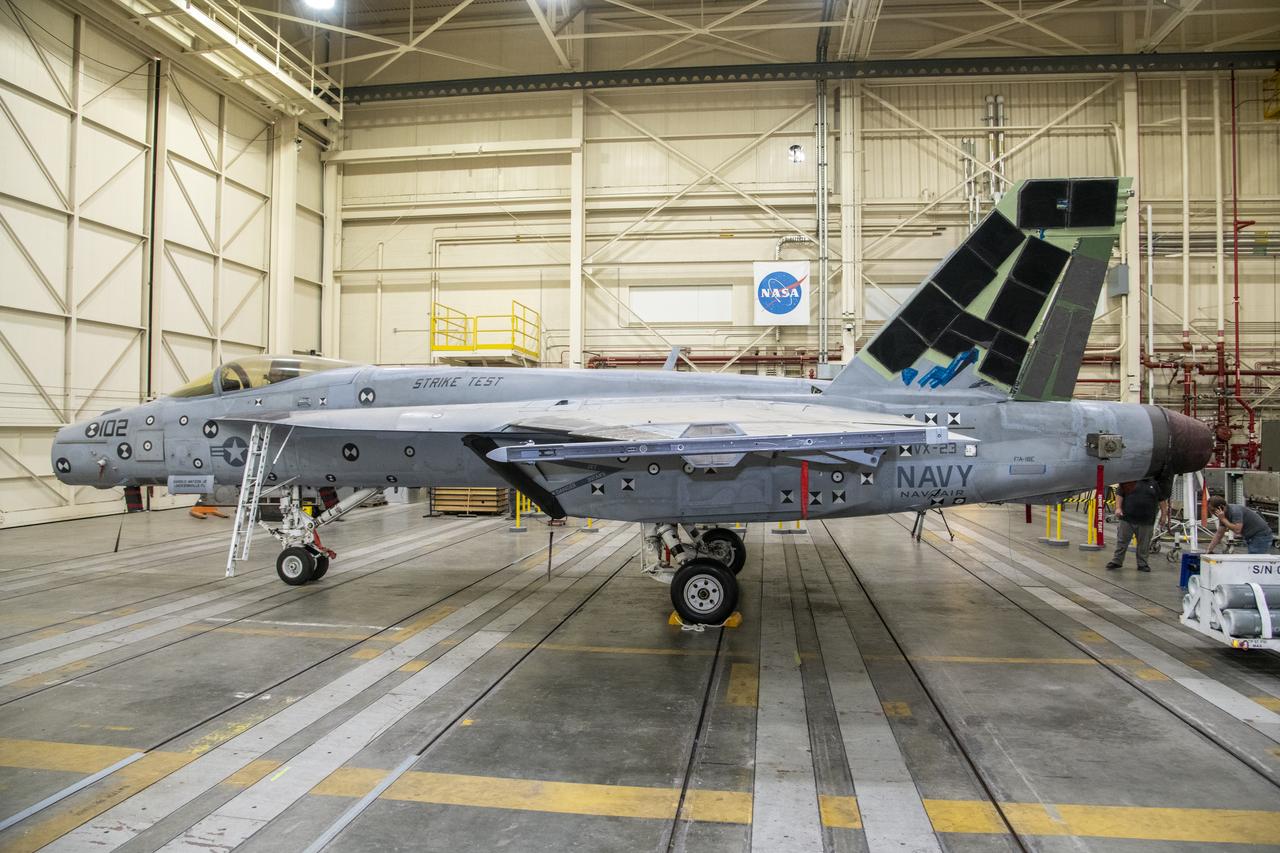
This right-side view shows an F/A-18E from the Naval Air Systems Command (NAVAIR) in Patuxent River, Maryland. The aircraft is in NASA’s Armstrong Flight Research Center Flight Loads Laboratory in Edwards, California, where it underwent the center’s biggest load calibrations tests. This testing will permit the aircraft to serve as a test vehicle to determine if it can safely manage maneuvers and proposed upgrades.
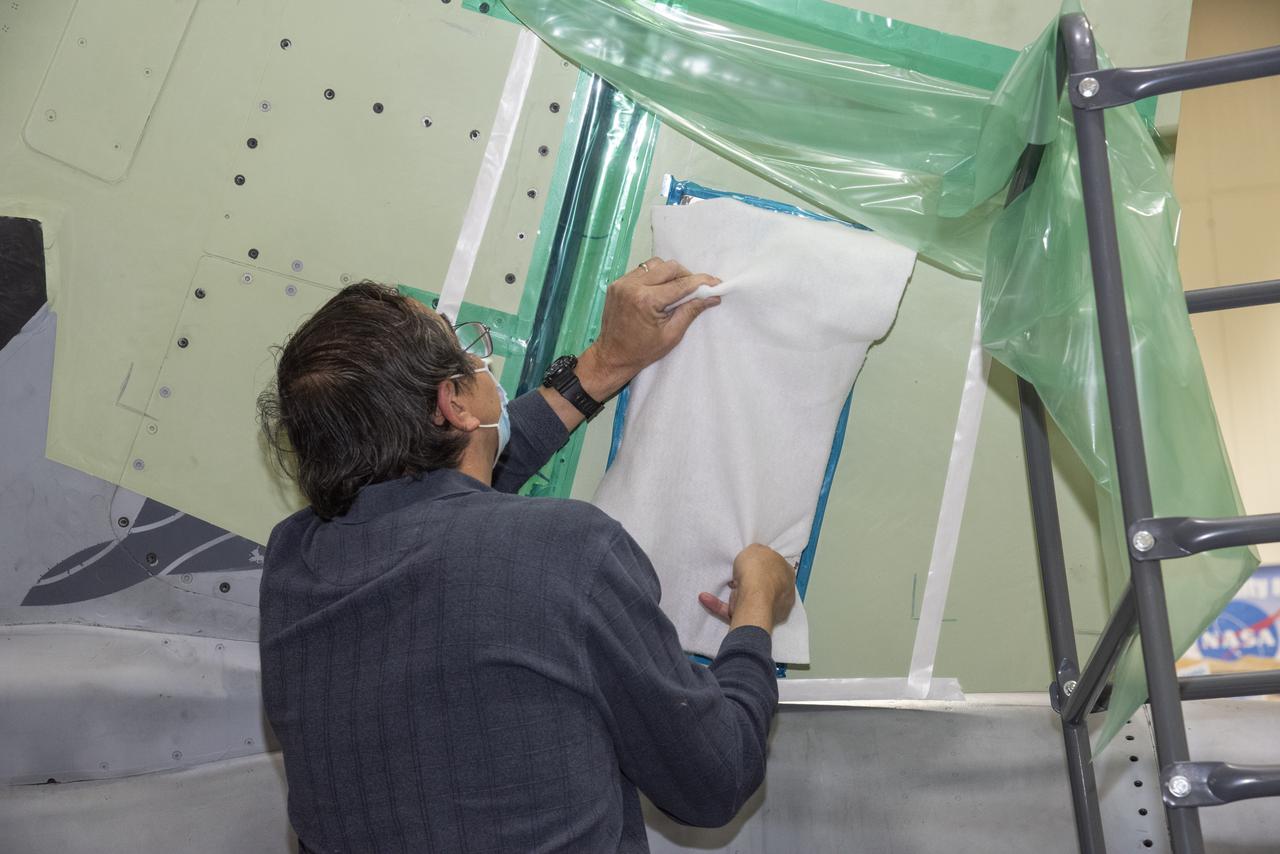
The load pad bonding process for the vertical tails was a preliminary step in the process to test the F/A-18E from the Naval Air Systems Command (NAVAIR) in Patuxent River, Maryland. The aircraft is in NASA’s Armstrong Flight Research Center Flight Loads Laboratory in Edwards, California, for the center’s biggest load calibrations tests. This testing is needed before the aircraft can serve as a test vehicle for determining if it can safely manage maneuvers and proposed upgrades.
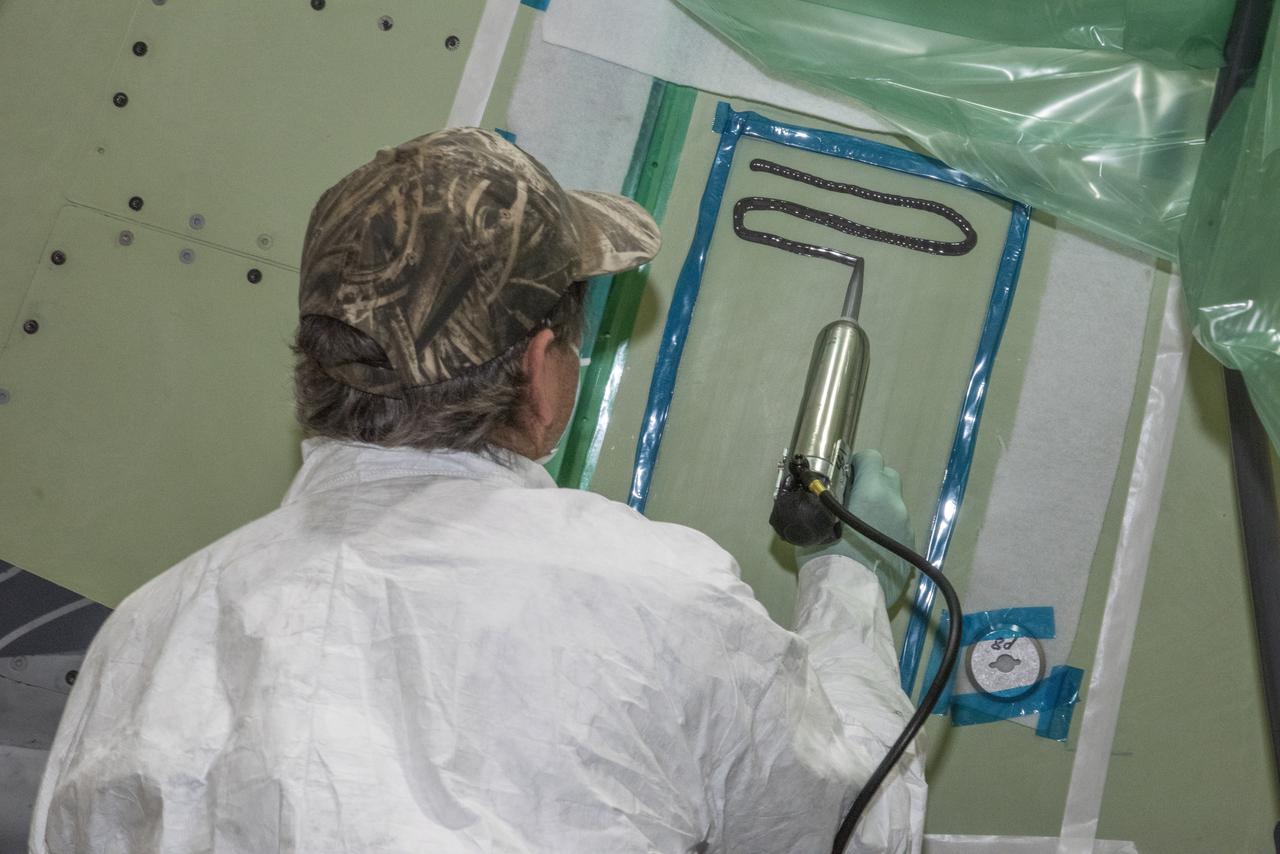
The load pad bonding process for the vertical tails was a preliminary step in the process to test the F/A-18E from the Naval Air Systems Command (NAVAIR) in Patuxent River, Maryland. The aircraft is in NASA’s Armstrong Flight Research Center Flight Loads Laboratory in Edwards, California, for the center’s biggest load calibrations tests. This testing is needed before the aircraft can serve as a test vehicle for determining if it can safely manage maneuvers and proposed upgrades.
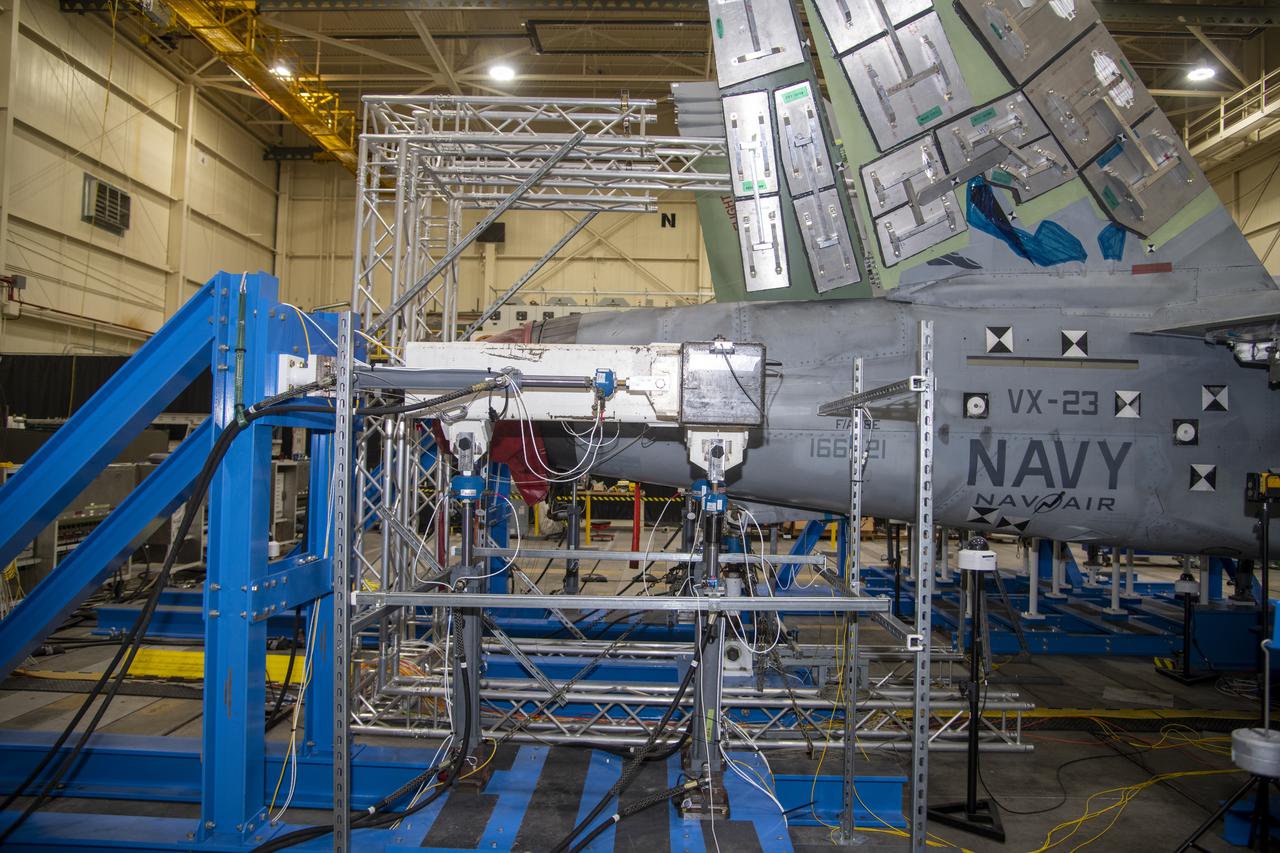
– Hydraulic actuators are pinned to horizontal tail test fixture for testing a F/A-18E from the Naval Air Systems Command (NAVAIR) in Patuxent River, Maryland. The aircraft is in NASA’s Armstrong Flight Research Center Flight Loads Laboratory in Edwards, California, for the center’s biggest load calibrations tests. This testing is needed before the aircraft can serve as a test vehicle for determining if it can safely manage maneuvers and proposed upgrades.

Load pads are bonded to the aircraft surface of a F/A-18E from the Naval Air Systems Command (NAVAIR) in Patuxent River, Maryland, while under pressure. The aircraft is in NASA’s Armstrong Flight Research Center Flight Loads Laboratory in Edwards, California, for the center’s biggest load calibrations tests. This testing is needed before the aircraft can serve as a test vehicle for determining if it can safely manage maneuvers and proposed upgrades
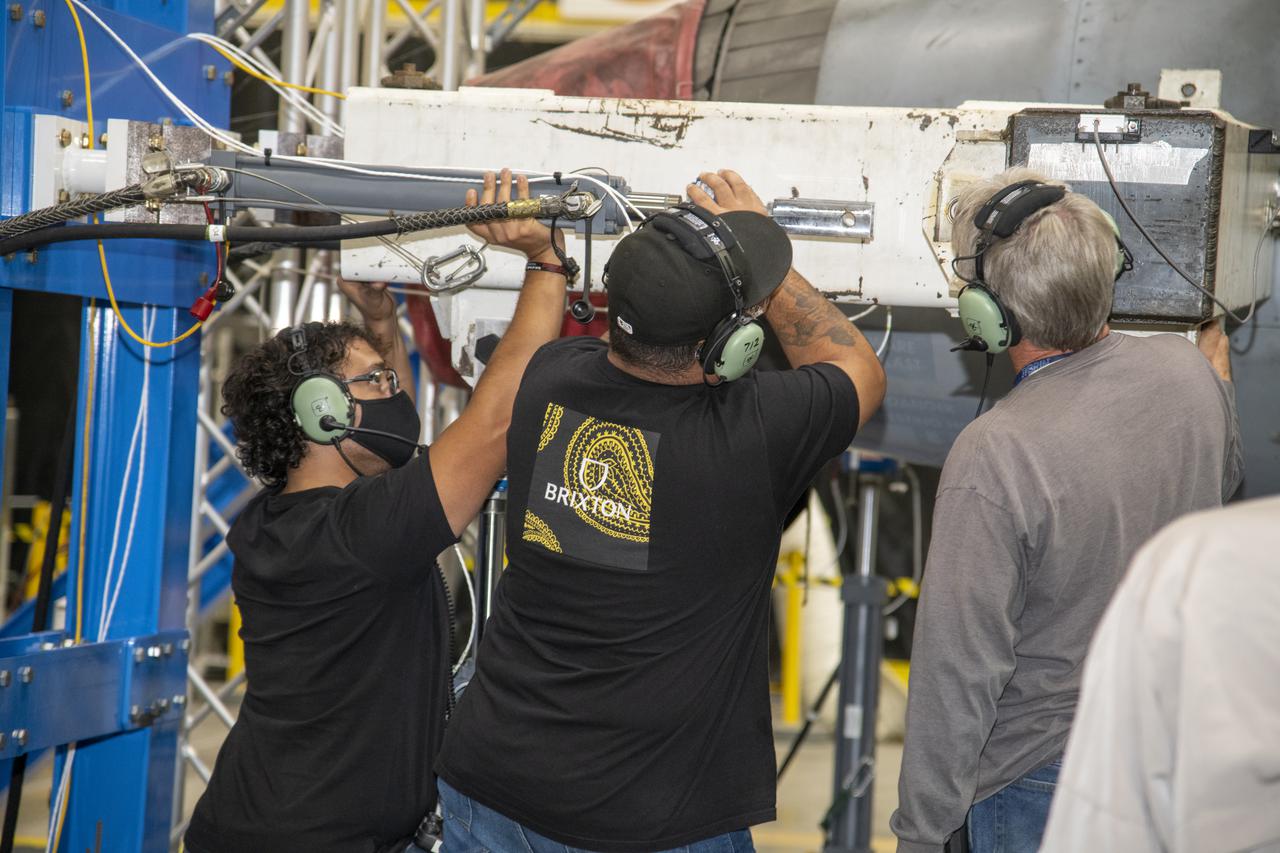
The actuator on the F/A-18E from the Naval Air Systems Command (NAVAIR) in Patuxent River, Maryland, is positioned for pinning to the horizontal tail load test fixture. The aircraft is in NASA’s Armstrong Flight Research Center Flight Loads Laboratory in Edwards, California, for the center’s biggest load calibrations tests. This testing is needed before the aircraft can serve as a test vehicle for determining if it can safely manage maneuvers and proposed upgrades.
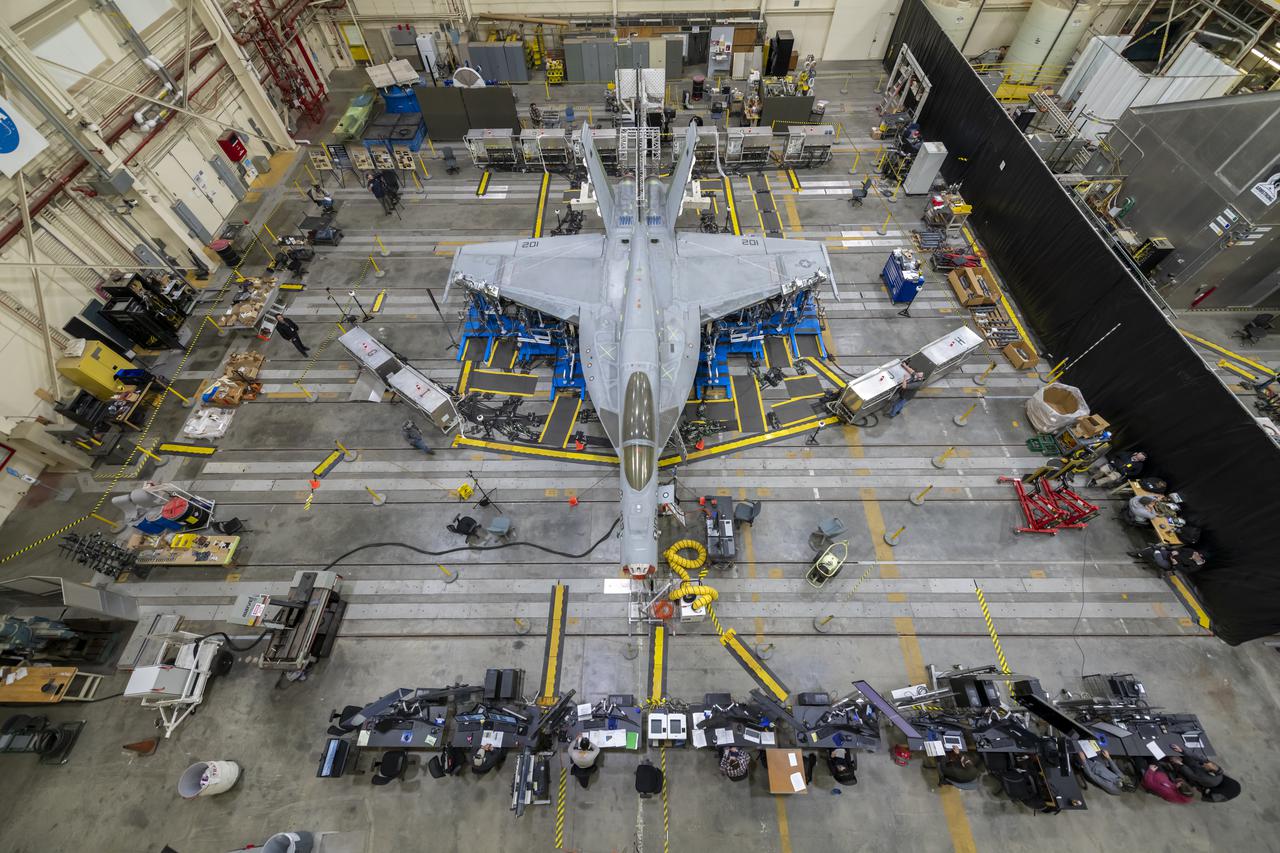
A center top view shows the wing loading test configuration and testing area of an F/A-18E from the Naval Air Systems Command (NAVAIR) in Patuxent River; Maryland. The aircraft is in NASA's Armstrong Flight Research Center Flight Loads Laboratory in Edwards; California; for the center's biggest load calibrations tests. This testing is needed before the aircraft can serve as a test vehicle for determining if it can safely manage maneuvers and proposed upgrades.
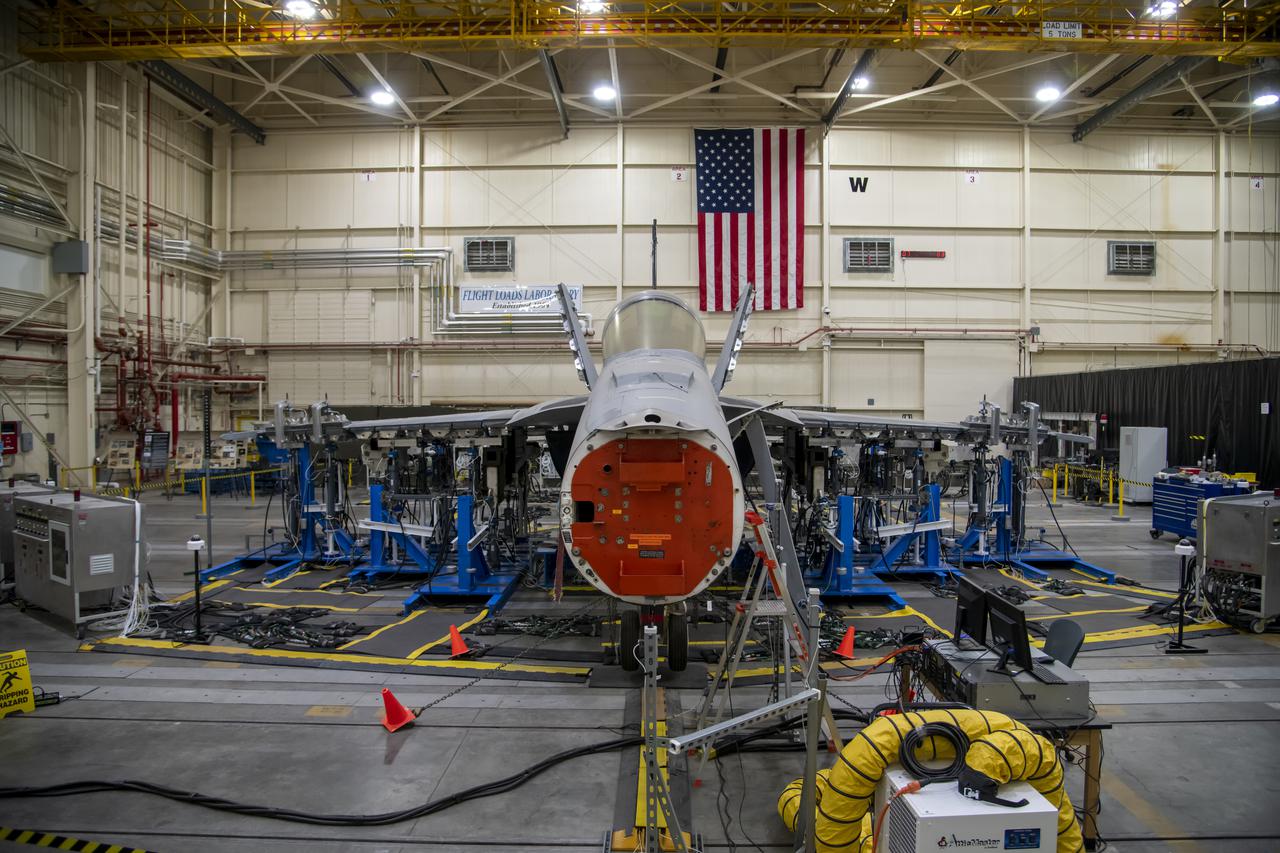
This front view shows the wing loading test configuration and testing area of an F/A-18E from the Naval Air Systems Command (NAVAIR) in Patuxent River, Maryland. The aircraft is in NASA's Armstrong Flight Research Center Flight Loads Laboratory in Edwards, California, for the center's biggest load calibrations tests. This testing is needed before the aircraft can serve as a test vehicle for determining if it can safely manage maneuvers and proposed upgrades.
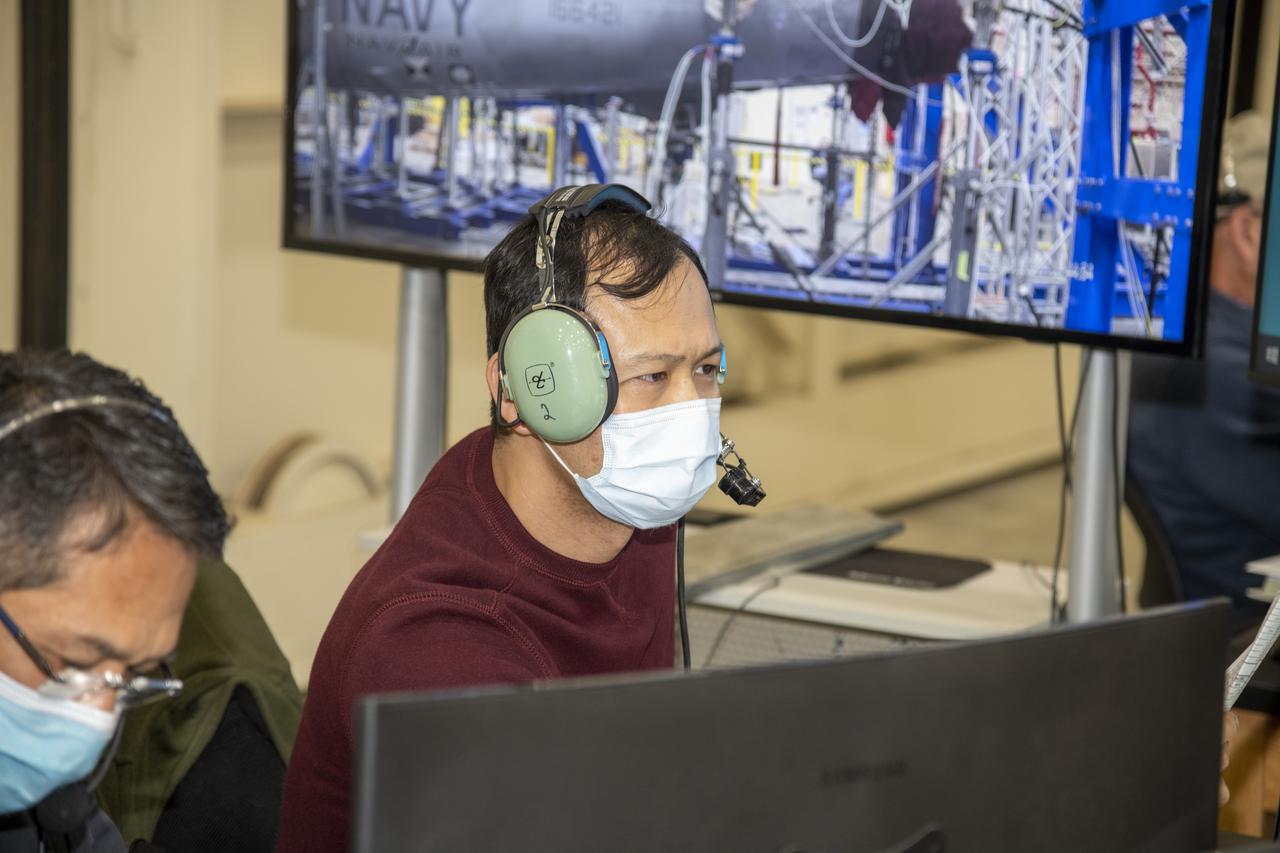
Larry Hudson and Tony Chen inspect test data during horizontal tail testing on a F/A-18E from the Naval Air Systems Command (NAVAIR) in Patuxent River, Maryland. The aircraft is in NASA's Armstrong Flight Research Center Flight Loads Laboratory in Edwards, California, for the center's biggest load calibrations tests. This testing is needed before the aircraft can serve as a test vehicle for determining if it can safely manage maneuvers and proposed upgrades.
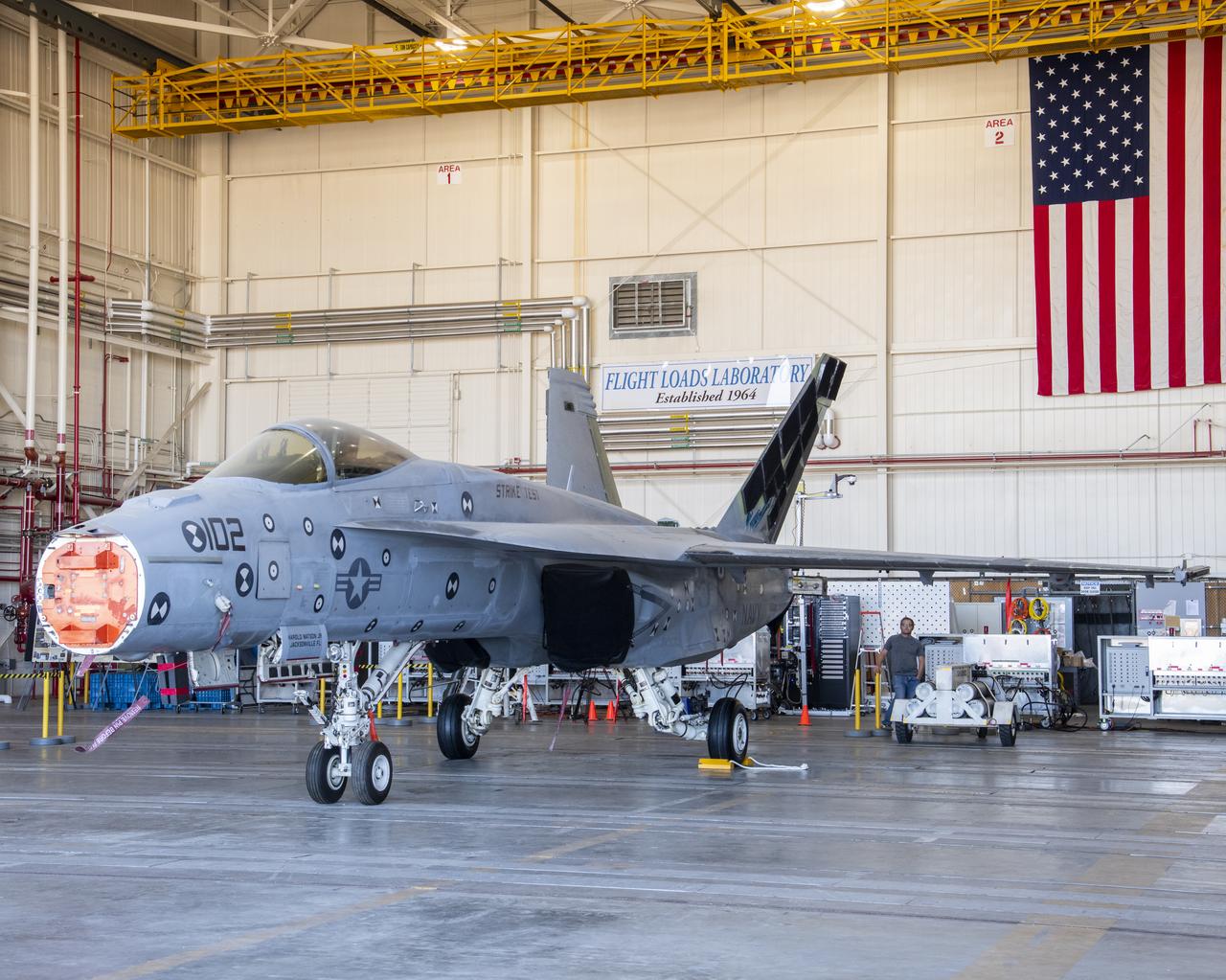
This front view shows an F/A-18E from the Naval Air Systems Command (NAVAIR) in Patuxent River, Maryland. The aircraft is in NASA’s Armstrong Flight Research Center Flight Loads Laboratory in Edwards, California, where it underwent the center’s biggest load calibrations tests. This testing will permit the aircraft to serve as a test vehicle to determine if it can safely manage maneuvers and proposed upgrades.
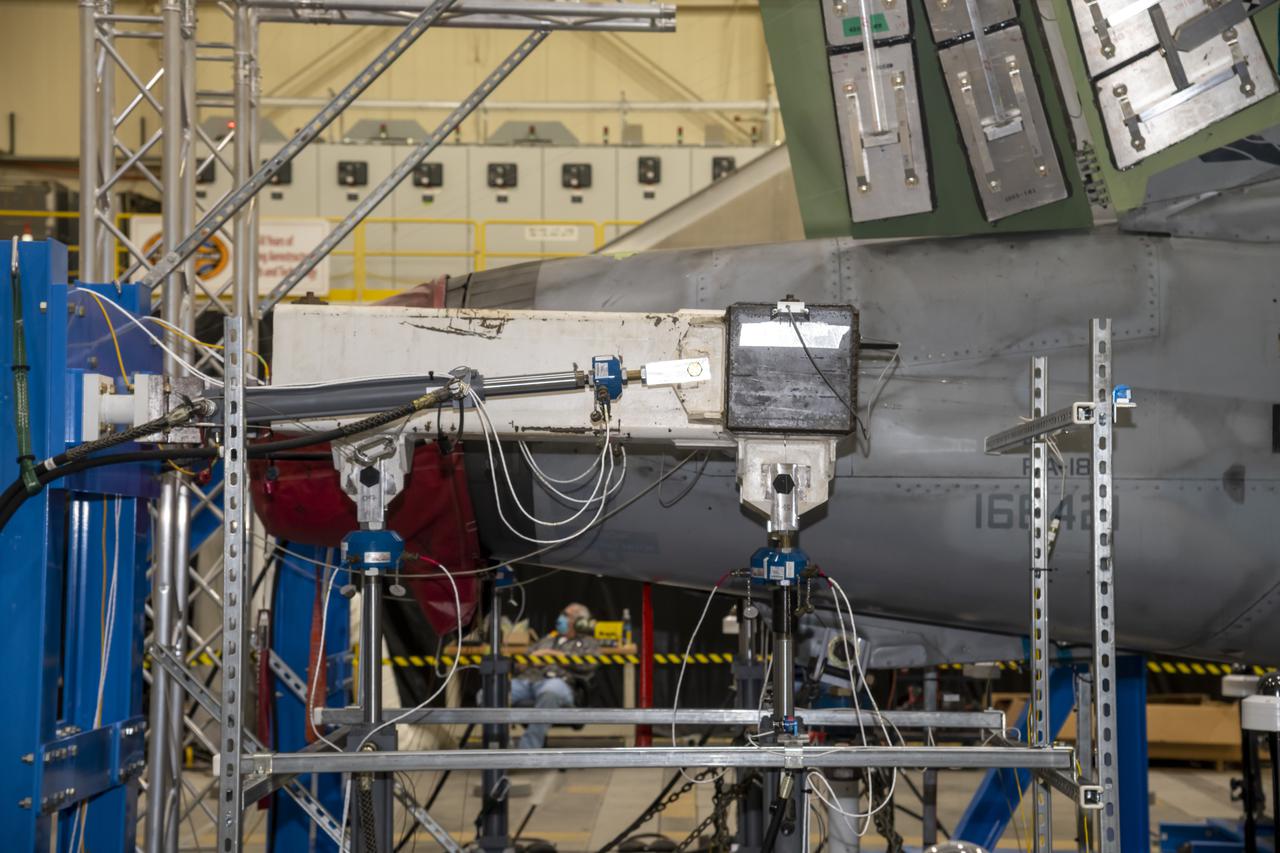
The horizontal tail is under test load on a F/A-18E from the Naval Air Systems Command (NAVAIR) in Patuxent River, Maryland. The aircraft is in NASA’s Armstrong Flight Research Center Flight Loads Laboratory in Edwards, California, for the center’s biggest load calibrations tests. This testing is needed before the aircraft can serve as a test vehicle for determining if it can safely manage maneuvers and proposed upgrades.
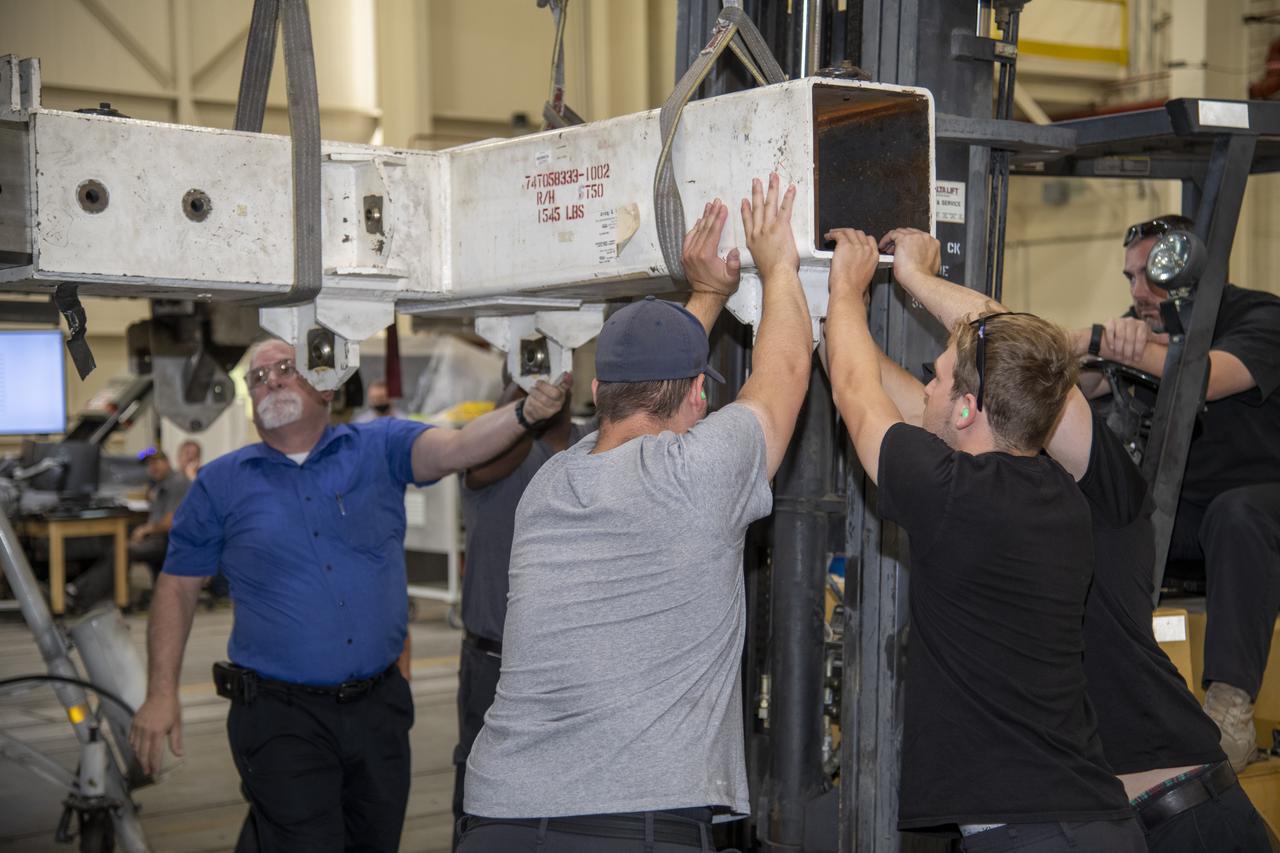
The horizontal tail and load fixture is moved into position for testing the F/A-18E from the Naval Air Systems Command (NAVAIR) in Patuxent River, Maryland. The aircraft is in NASA’s Armstrong Flight Research Center Flight Loads Laboratory in Edwards, California, for the center’s biggest load calibrations tests. This testing is needed before the aircraft can serve as a test vehicle for determining if it can safely manage maneuvers and proposed upgrades.
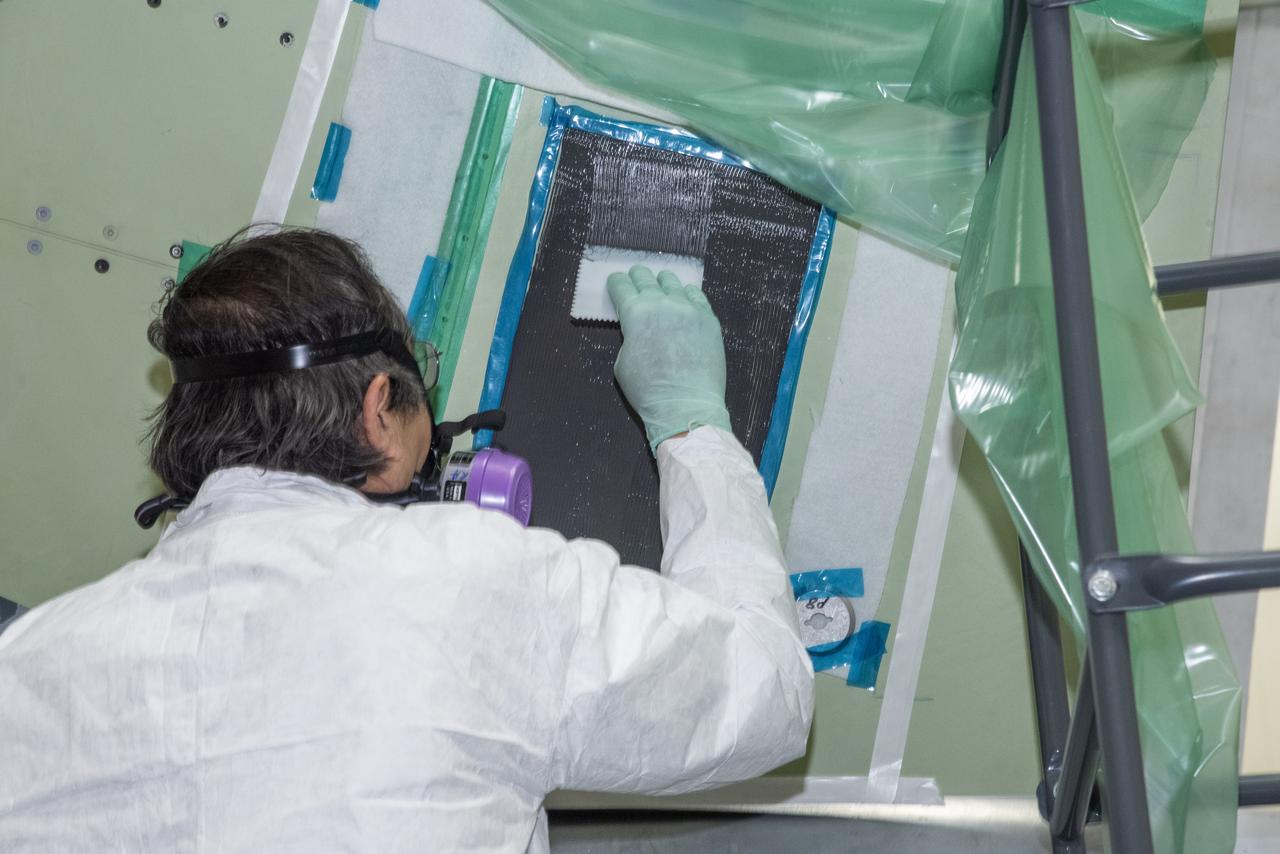
The load pad bonding process for the vertical tails was a preliminary step in the process to test the F/A-18E from the Naval Air Systems Command (NAVAIR) in Patuxent River, Maryland. The aircraft is in NASA’s Armstrong Flight Research Center Flight Loads Laboratory in Edwards, California, for the center’s biggest load calibrations tests. This testing is needed before the aircraft can serve as a test vehicle for determining if it can safely manage maneuvers and proposed upgrades.
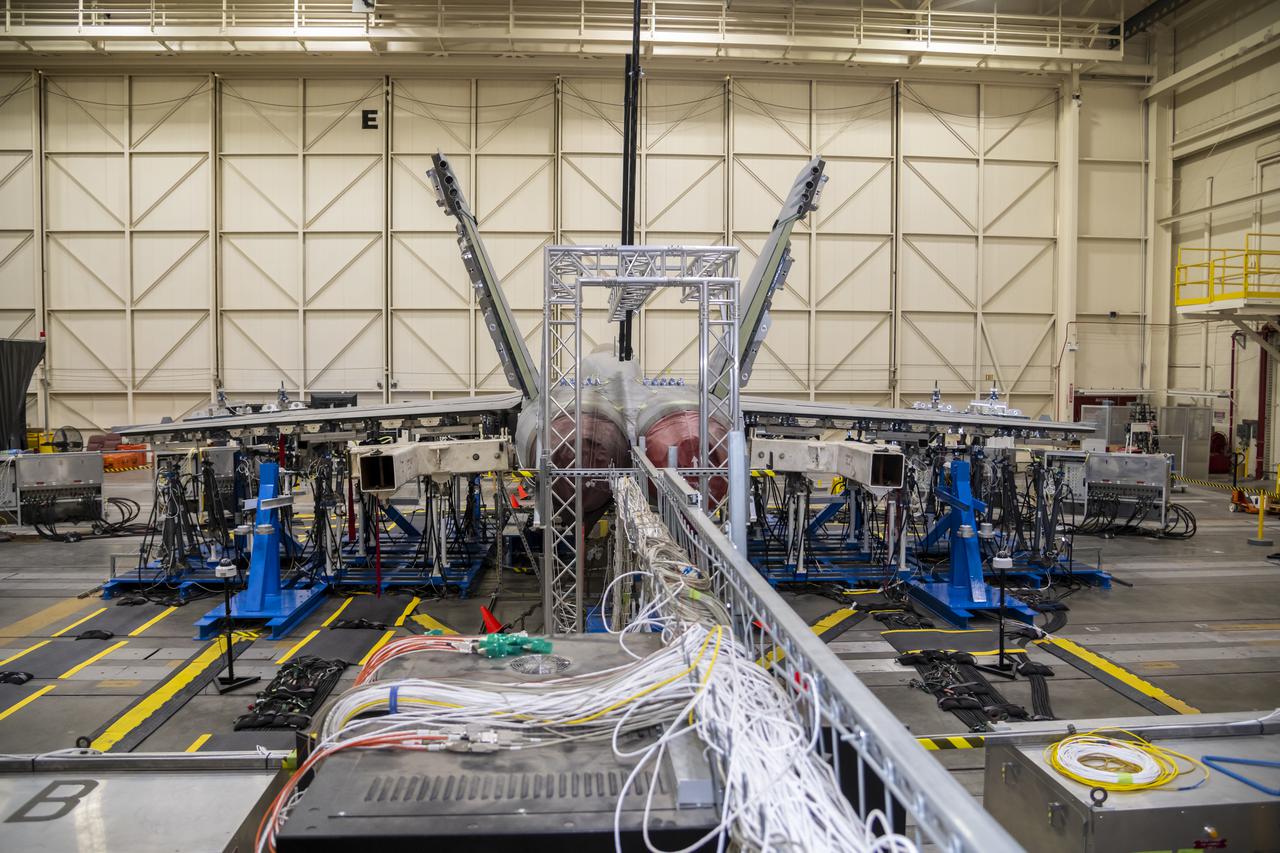
Instrumentation wire extends from the aft end of a F/A-18E from the Naval Air Systems Command (NAVAIR) in Patuxent River, Maryland. The aircraft is in NASA’s Armstrong Flight Research Center Flight Loads Laboratory in Edwards, California, for the center’s biggest load calibrations tests. This testing is needed before the aircraft can serve as a test vehicle for determining if it can safely manage maneuvers and proposed upgrades.
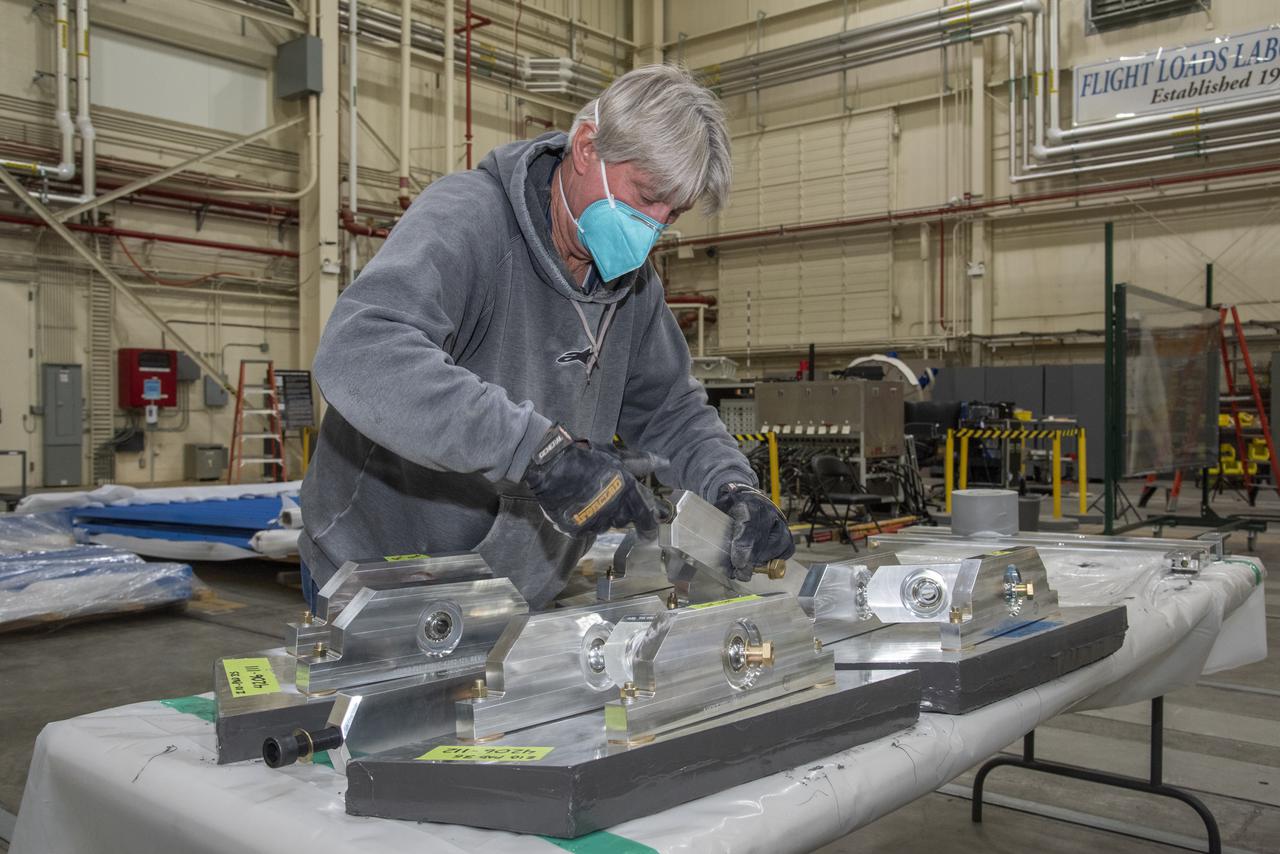
Assembled test structures called whiffle trees, which are needed to distribute prescribed hydraulic actuator loads, are attached to load pads to test the F/A-18E from the Naval Air Systems Command (NAVAIR) in Patuxent River, Maryland. The aircraft is in NASA’s Armstrong Flight Research Center Flight Loads Laboratory in Edwards, California, for the center’s biggest load calibrations tests. This testing is needed before the aircraft can serve as a test vehicle for determining if it can safely manage maneuvers and proposed upgrades.
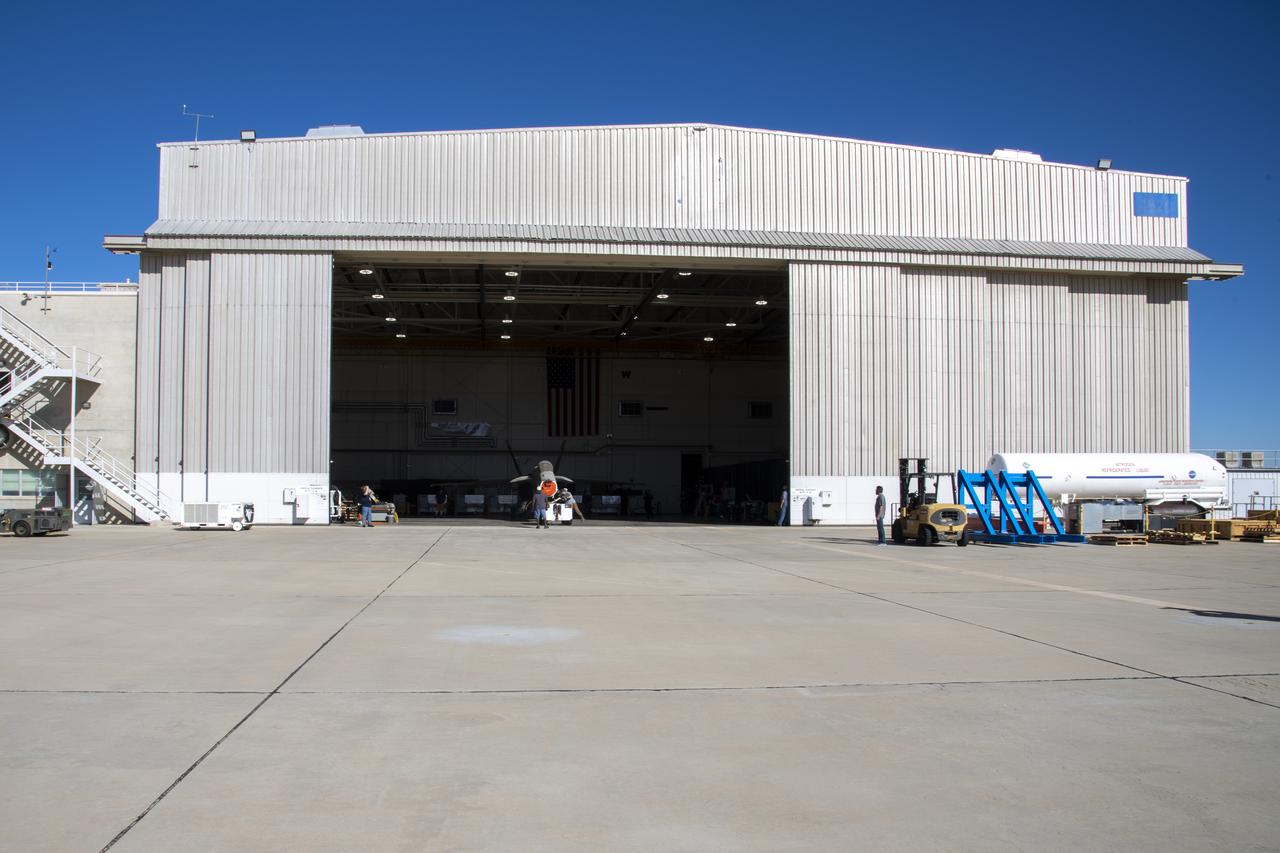
An F/A-18E from the Naval Air Systems Command (NAVAIR) in Patuxent River, Maryland, is moved from NASA’s Armstrong Flight Research Center Flight Loads Laboratory in Edwards, California, to a hangar where it will undergo final preparations to return to its squadron. The aircraft underwent the center’s biggest load calibrations tests. The testing will permit the aircraft to serve as a test vehicle to determine if it can safely manage maneuvers and proposed upgrades.
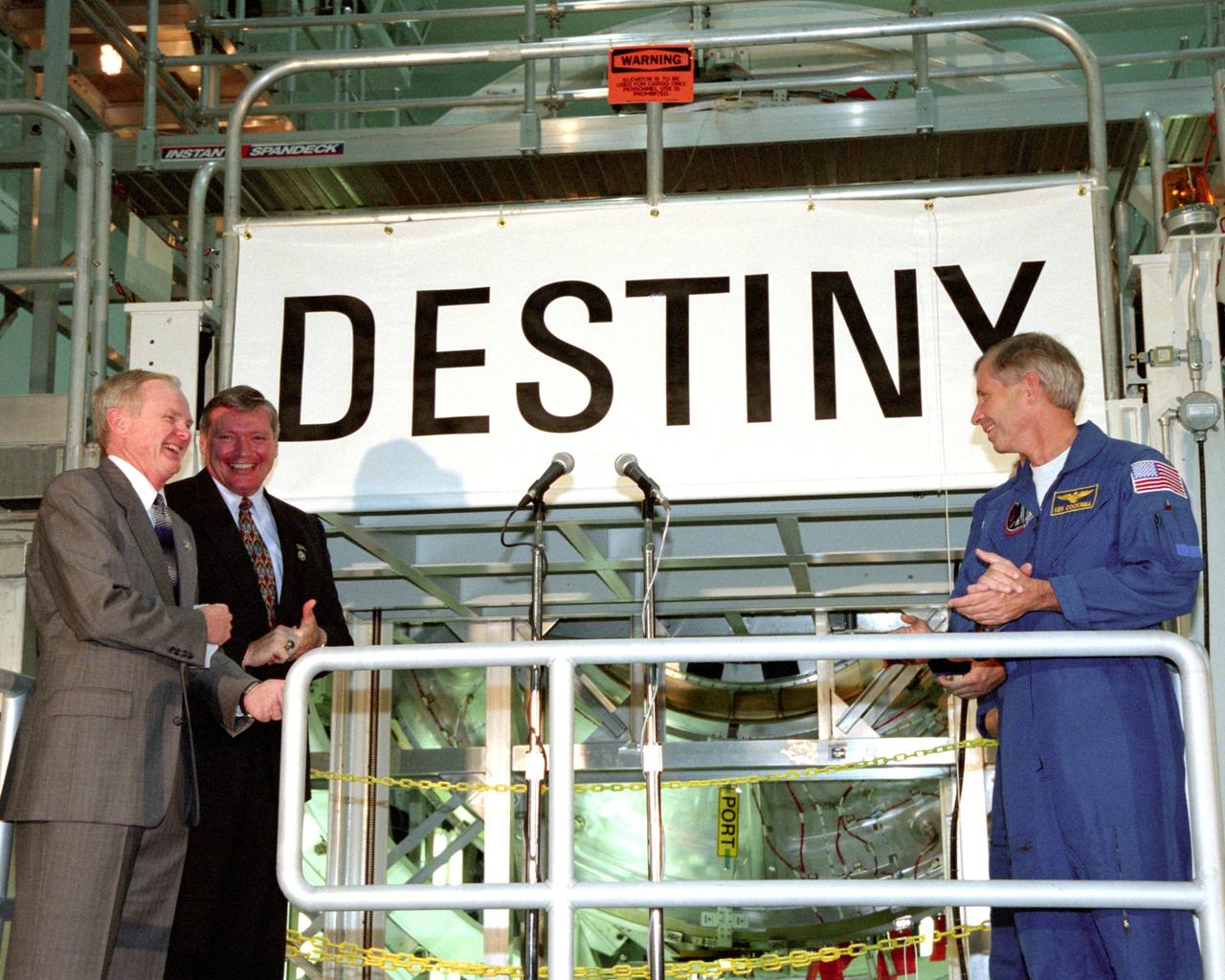
KENNEDY SPACE CENTER, FLA. - In the Space Station Processing Facility, Center Director Roy Bridges (left), Program Manager of the International Space Station (ISS) Randy Brinkley (second from left) and STS-98 Commander Ken Cockrell (right) applaud the unveiling of the name "Destiny" for the U.S. Laboratory module. The lab, which is behnd them on a workstand, is scheduled to be launched on STS-98 on Space Shuttle Endeavour in early 2000. It will become the centerpiece of scientific research on the ISS. The Shuttle will spend six days docked to the Station while the laboratory is attached and three spacewalks are conducted to compete its assembly. The laboratory will be launched with five equipment racks aboard, which will provide essential functions for Station systems, including high data-rate communications, and maintain the Station's orientation using control gyroscopes launched earlier. Additional equipment and research racks will be installed in the laboratory on subsequent Shuttle flights.
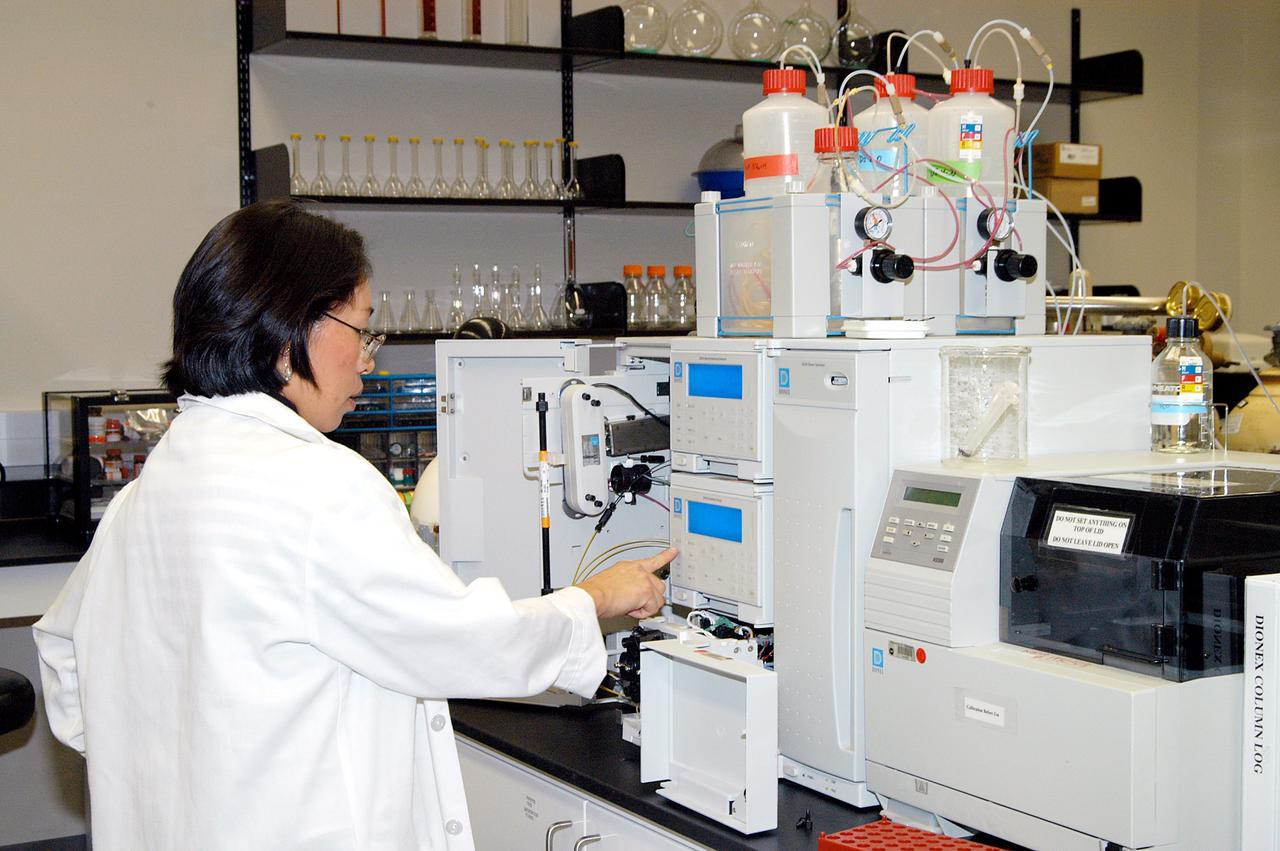
KENNEDY SPACE CENTER, FLA. -- Lanfang Levine, with Dynamac Corp., helps install a Dionex DX-500 IC/HPLC system in the Space Life Sciences Lab. The equipment will enable analysis of volatile compounds, such as from plants. The 100,000 square-foot facility houses labs for NASA’s ongoing research efforts, microbiology/microbial ecology studies and analytical chemistry labs. Also calling the new lab home are facilities for space flight-experiment and flight-hardware development, new plant growth chambers, and an Orbiter Environment Simulator that will be used to conduct ground control experiments in simulated flight conditions for space flight experiments. The SLS Lab, formerly known as the Space Experiment Research and Processing Laboratory or SERPL, provides space for NASA’s Life Sciences Services contractor Dynamac Corporation, Bionetics Corporation, and researchers from the University of Florida. NASA’s Office of Biological and Physical Research will use the facility for processing life sciences experiments that will be conducted on the International Space Station. The SLS Lab is the magnet facility for the International Space Research Park at KSC being developed in partnership with Florida Space Authority.

The Flight Operations crew stands before a Republic P-47G Thunderbolt at the National Advisory Committee for Aeronautics (NACA) Aircraft Engine Research Laboratory in Cleveland, Ohio. The laboratory’s Flight Research Section was responsible for conducting a variety of research flights. During World War II most of the test flights complemented the efforts in ground-based facilities to improve engine cooling systems or study advanced fuel mixtures. The Republic P–47G was loaned to the laboratory to test NACA modifications to the Wright R–2800 engine’s cooling system at higher altitudes. The laboratory has always maintained a fleet of aircraft so different research projects were often conducted concurrently. The flight research program requires an entire section of personnel to accomplish its work. This staff generally consists of a flight operations group, which includes the section chief, pilots and administrative staff; a flight maintenance group with technicians and mechanics responsible for inspecting aircraft, performing checkouts and installing and removing flight instruments; and a flight research group that integrates the researchers’ experiments into the aircraft. The staff at the time of this March 1944 photograph included 3 pilots, 16 planning and analysis engineers, 36 mechanics and technicians, 10 instrumentation specialists, 6 secretaries and 5 computers.
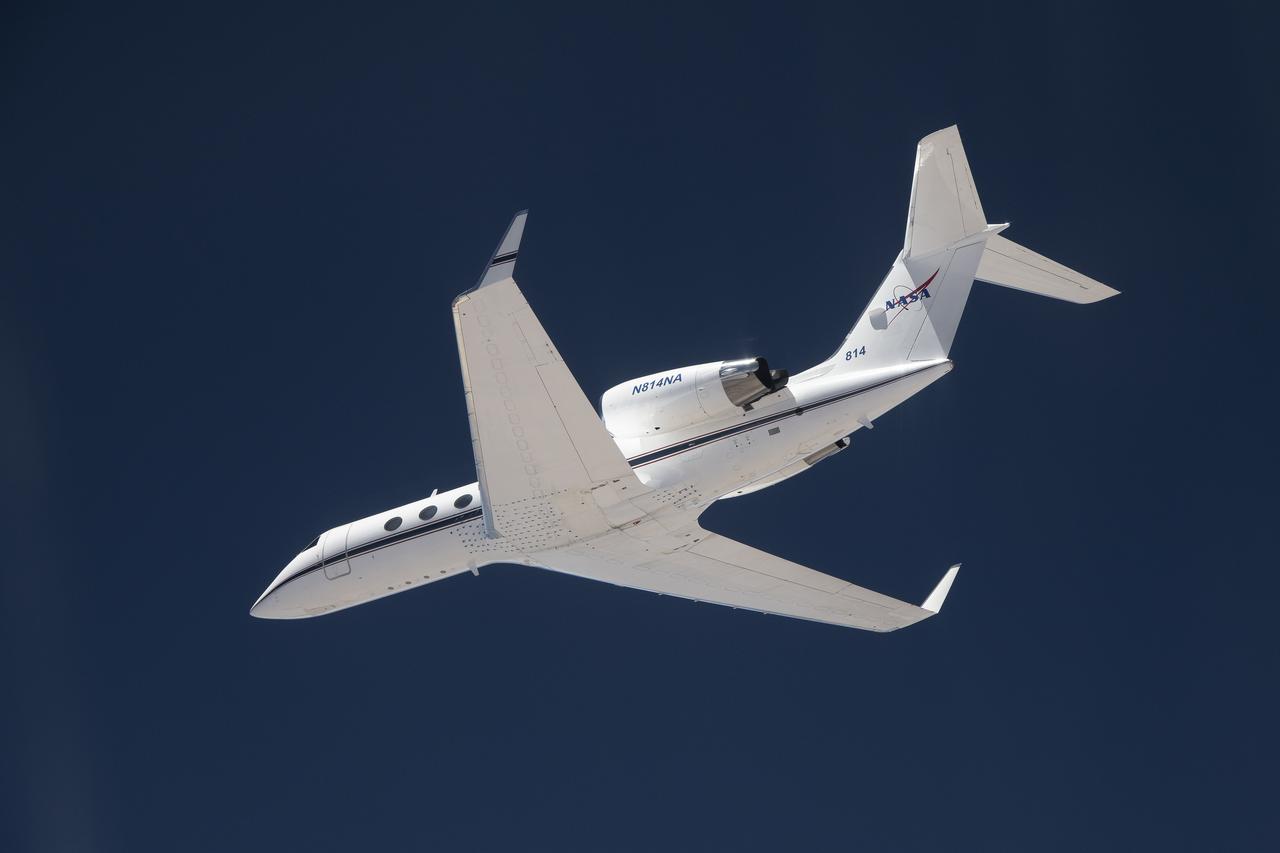
The G-IV aircraft flies overhead in the Mojave Desert near NASA’s Armstrong Flight Research Center in Edwards, California. Baseline flights like this one occurred in June 2024, and future flights in service of science research will benefit from the installment of the Soxnav navigational system, developed in collaboration with NASA’s Jet Propulsion Laboratory in Southern California and the Bay Area Environmental Research Institute in California’s Silicon Valley. This navigational system provides precise, economical aircraft guidance for a variety of aircraft types moving at high speeds.
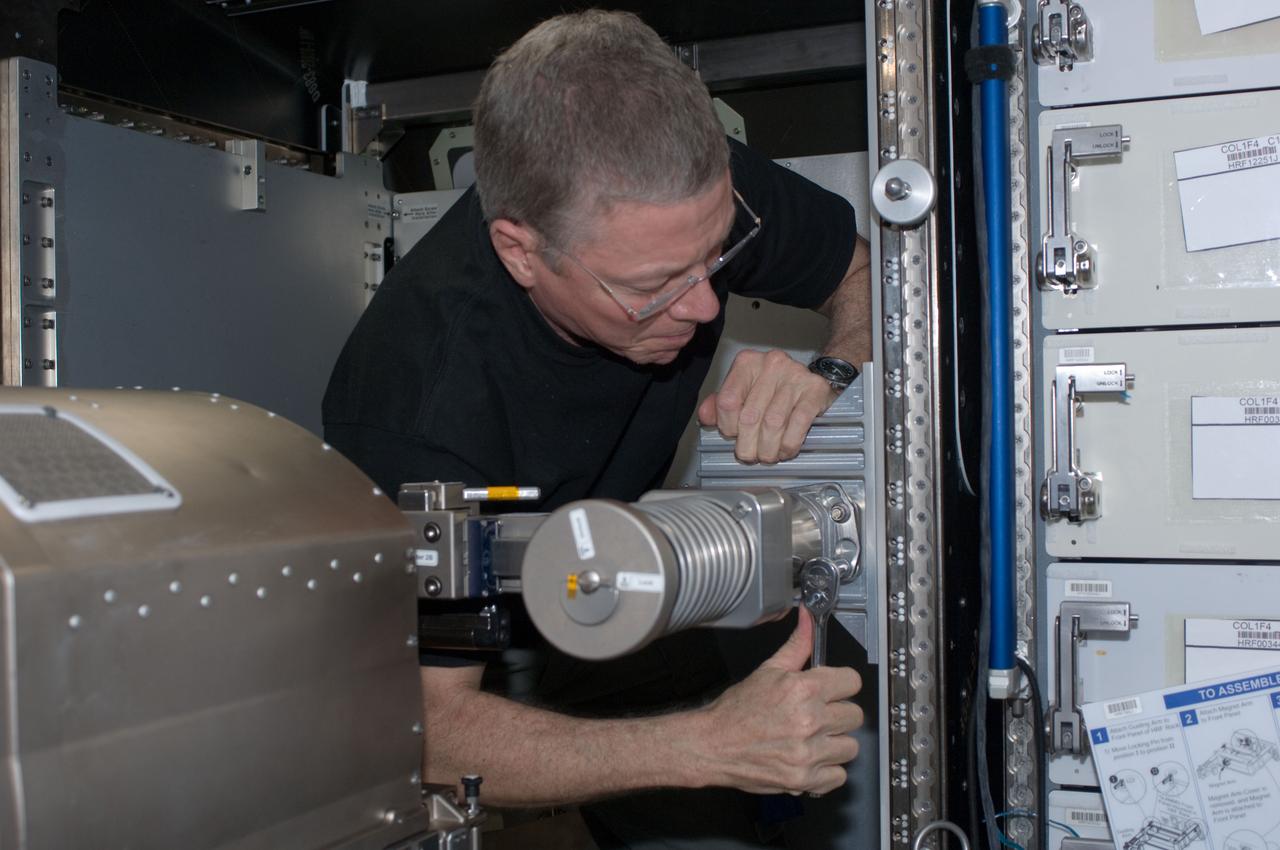
ISS028-E-035002 (30 Aug. 2011) --- NASA astronaut Mike Fossum, Expedition 28 flight engineer, performs in-flight maintenance on the Muscle Atrophy Research & Exercise System (MARES) in the Columbus laboratory of the International Space Station.
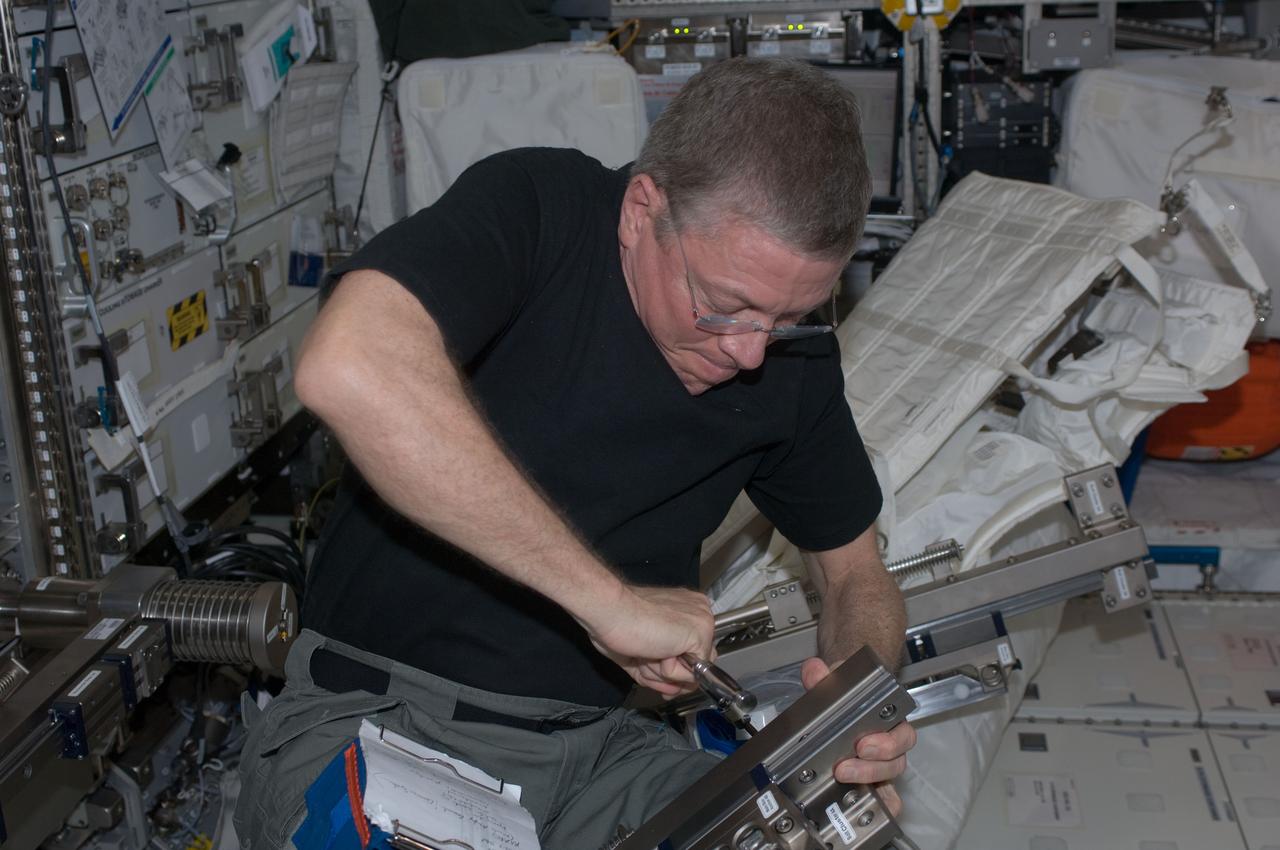
ISS028-E-034984 (30 Aug. 2011) --- NASA astronaut Mike Fossum, Expedition 28 flight engineer, performs in-flight maintenance on the Muscle Atrophy Research & Exercise System (MARES) in the Columbus laboratory of the International Space Station.
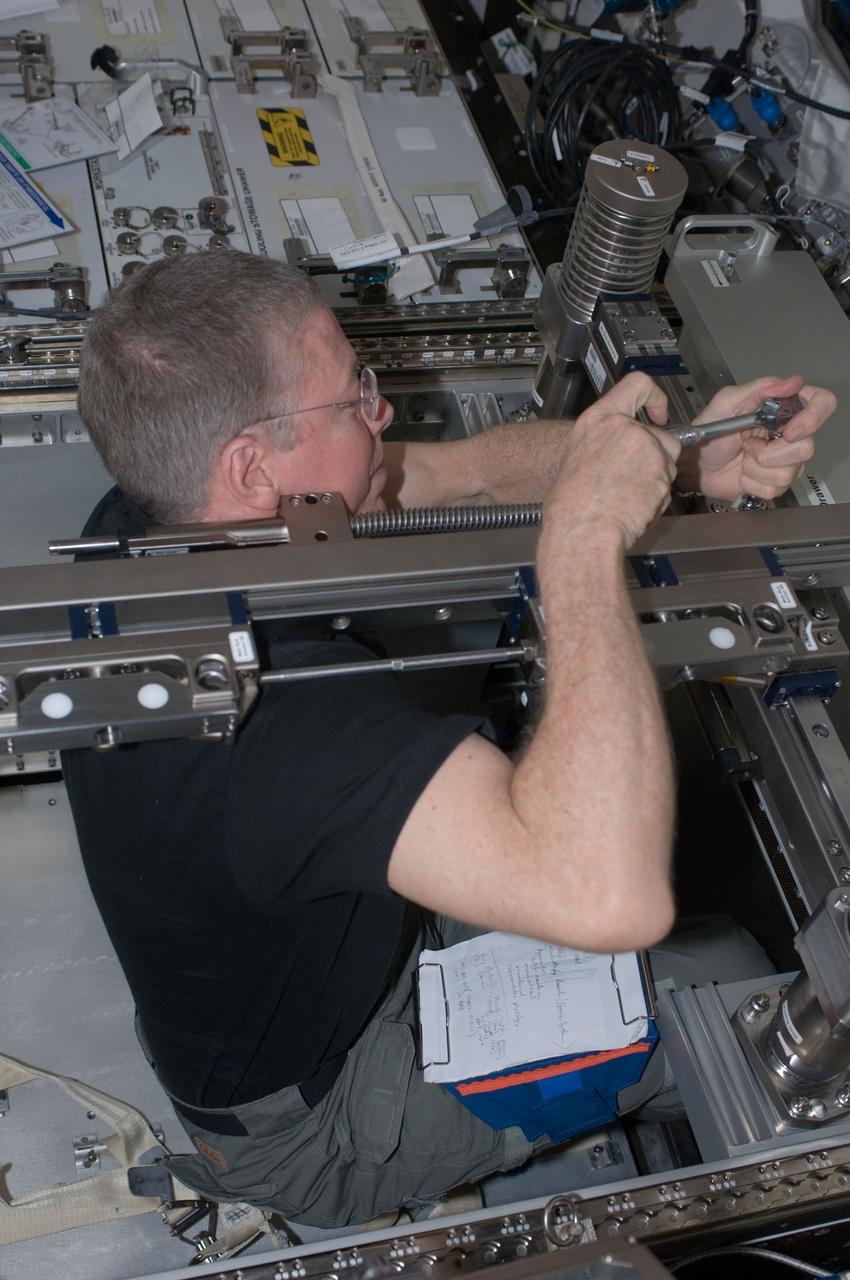
ISS028-E-034992 (30 Aug. 2011) --- NASA astronaut Mike Fossum, Expedition 28 flight engineer, performs in-flight maintenance on the Muscle Atrophy Research & Exercise System (MARES) in the Columbus laboratory of the International Space Station.
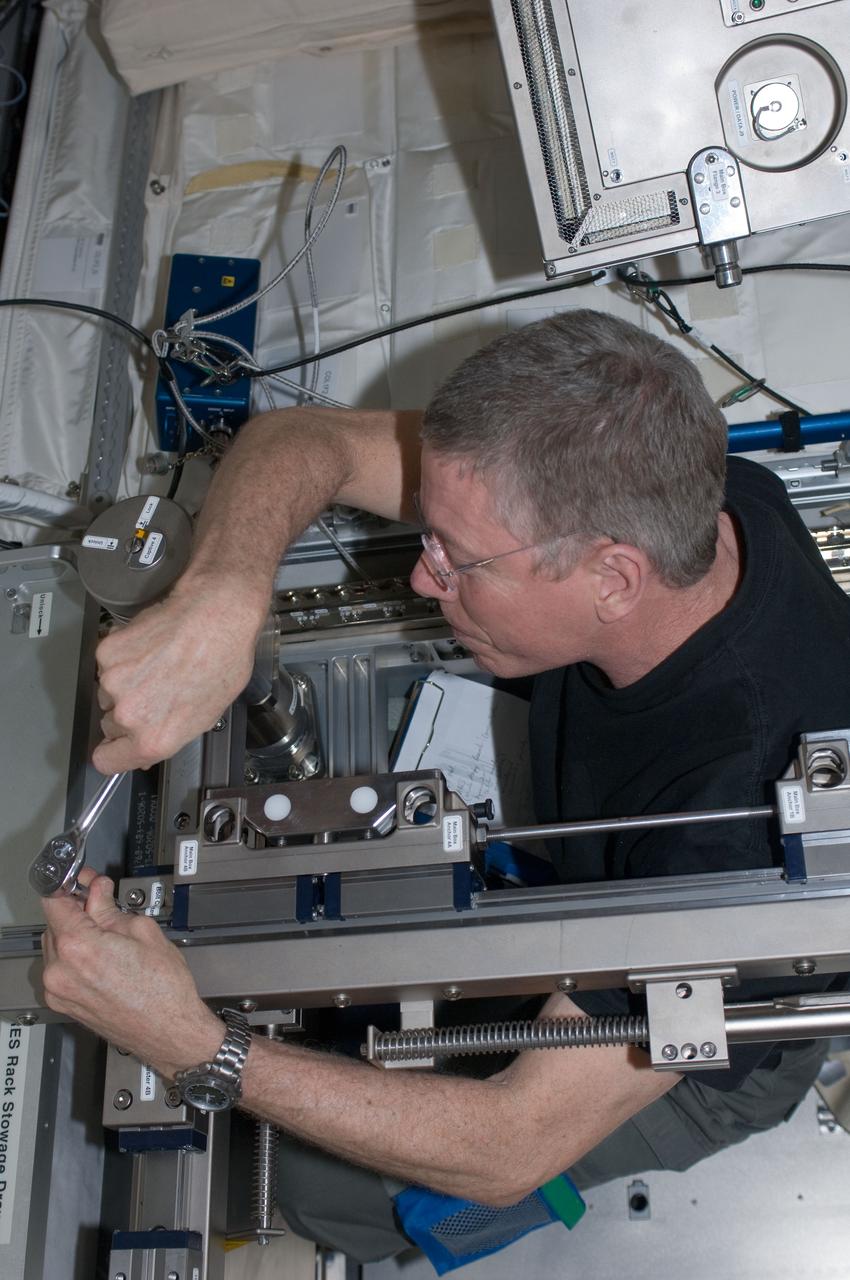
ISS028-E-034993 (30 Aug. 2011) --- NASA astronaut Mike Fossum, Expedition 28 flight engineer, performs in-flight maintenance on the Muscle Atrophy Research & Exercise System (MARES) in the Columbus laboratory of the International Space Station.
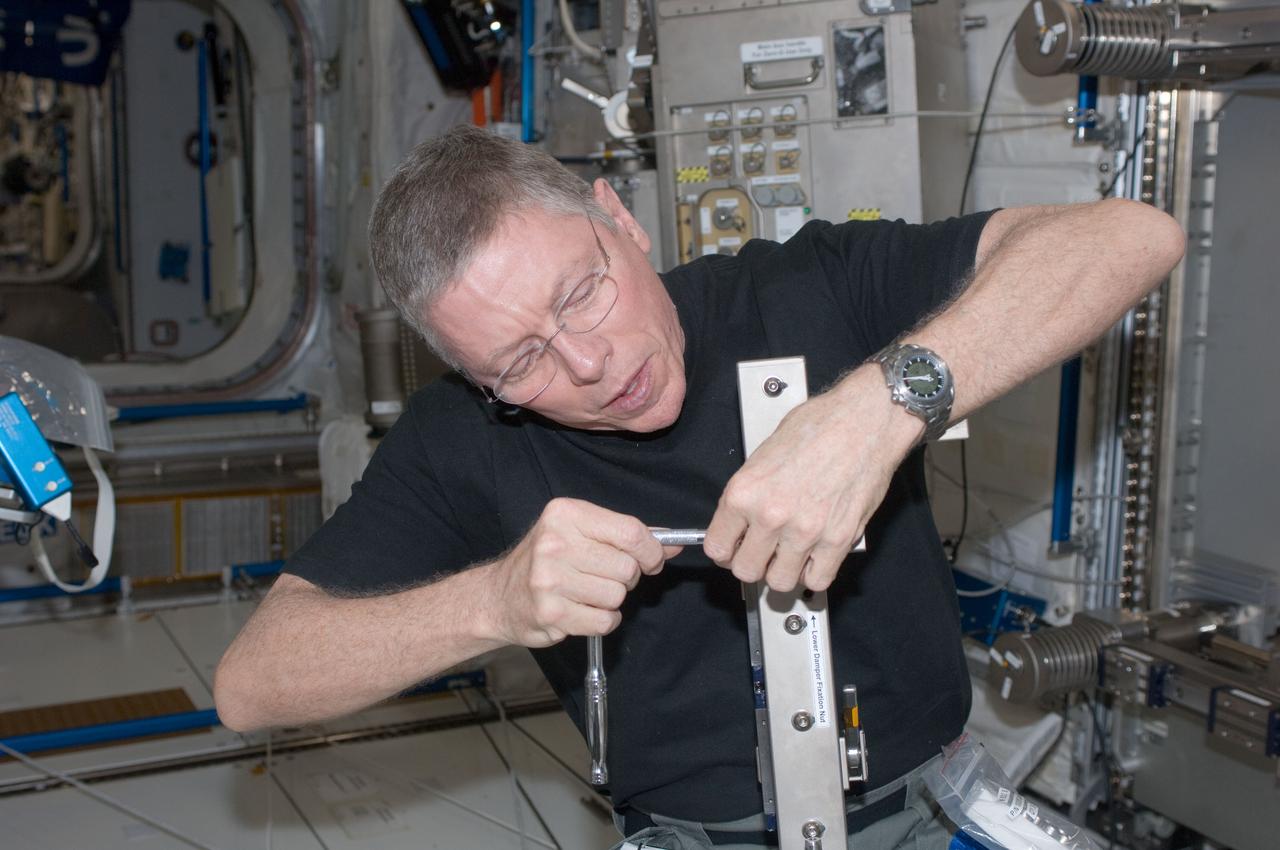
ISS028-E-034980 (30 Aug. 2011) --- NASA astronaut Mike Fossum, Expedition 28 flight engineer, performs in-flight maintenance on the Muscle Atrophy Research & Exercise System (MARES) in the Columbus laboratory of the International Space Station.
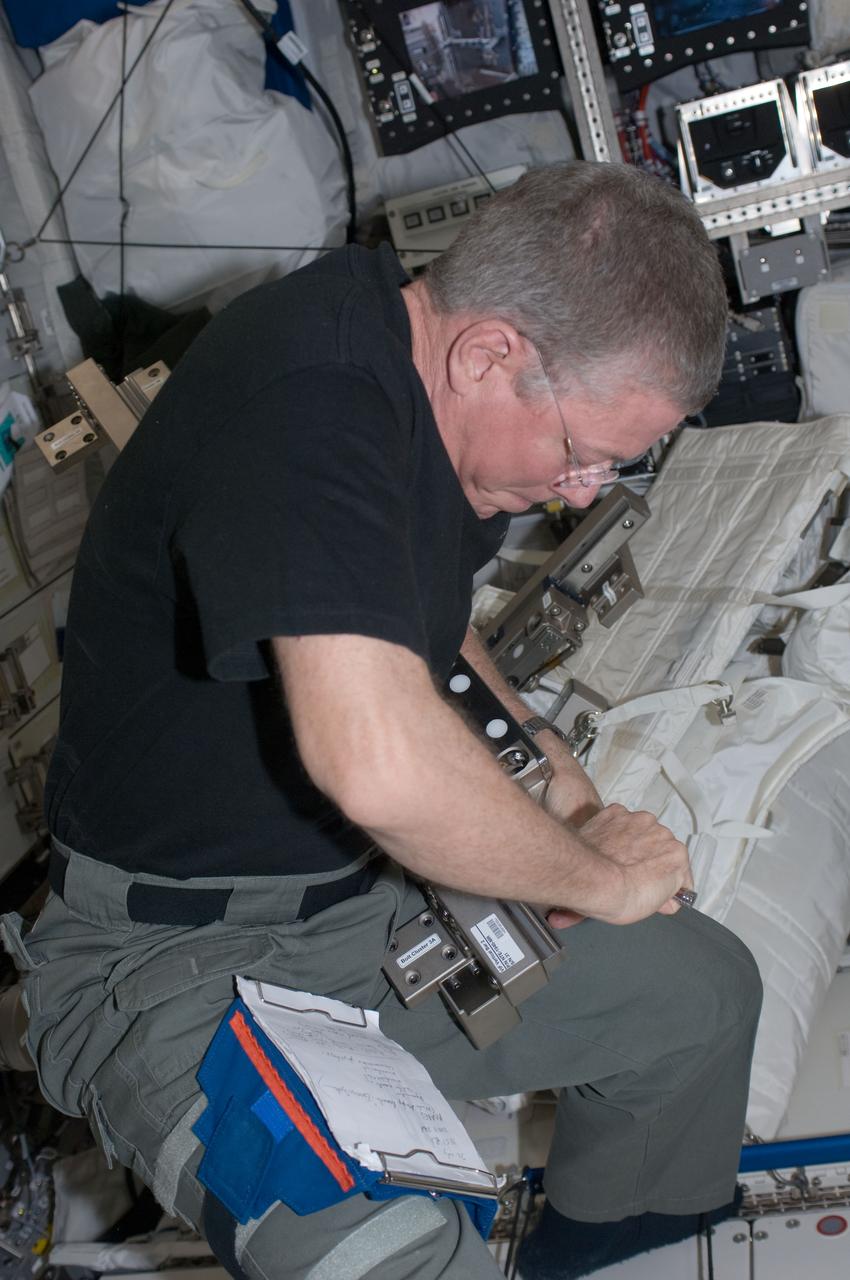
ISS028-E-034978 (30 Aug. 2011) --- NASA astronaut Mike Fossum, Expedition 28 flight engineer, performs in-flight maintenance on the Muscle Atrophy Research & Exercise System (MARES) in the Columbus laboratory of the International Space Station.
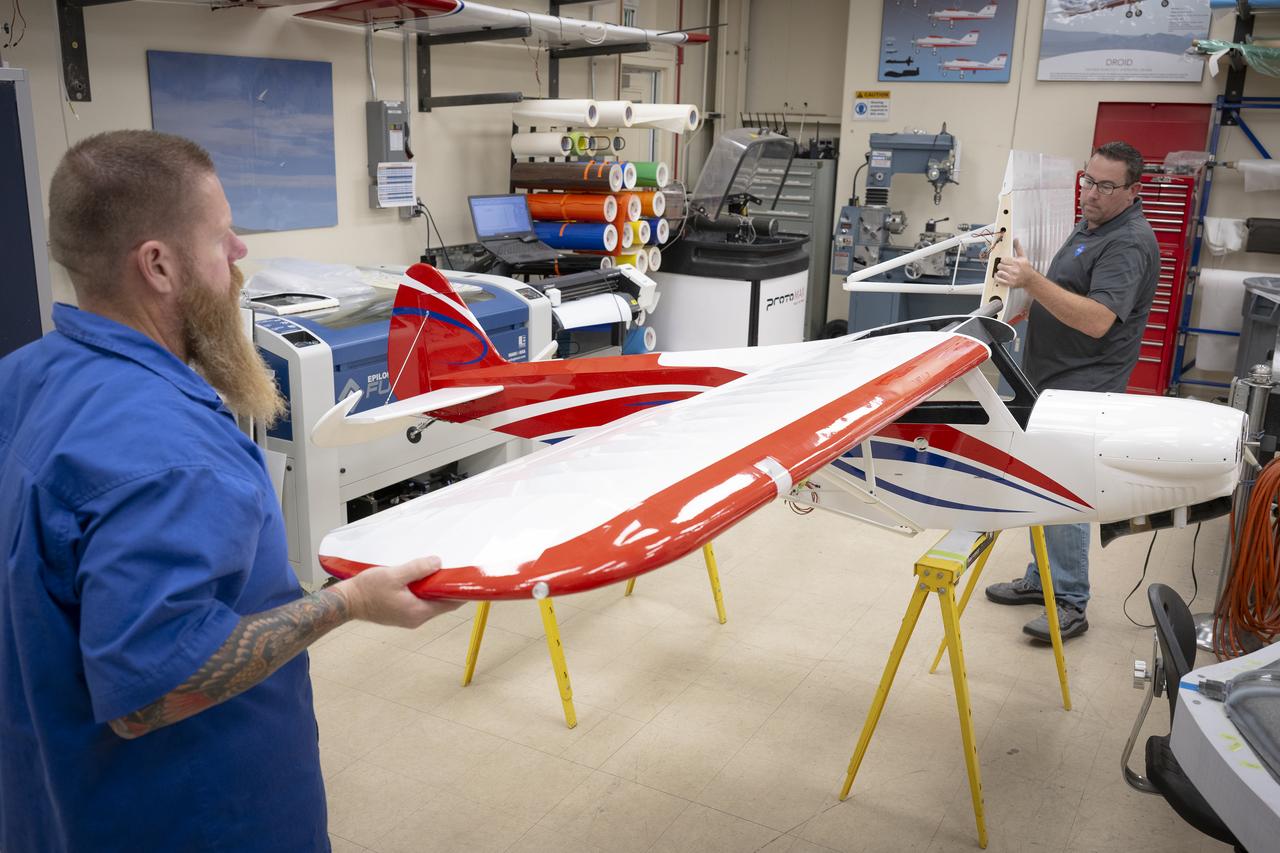
Justin Hall, left, and Justin Link attach the wings onto a subscale aircraft on Wednesday, Sept. 3, 2025, at NASA’s Armstong Flight Research Center in Edwards, California. Hall is chief pilot at the center’s Dale Reed Subscale Flight Research Laboratory and Link is a pilot for small uncrewed aircraft systems.
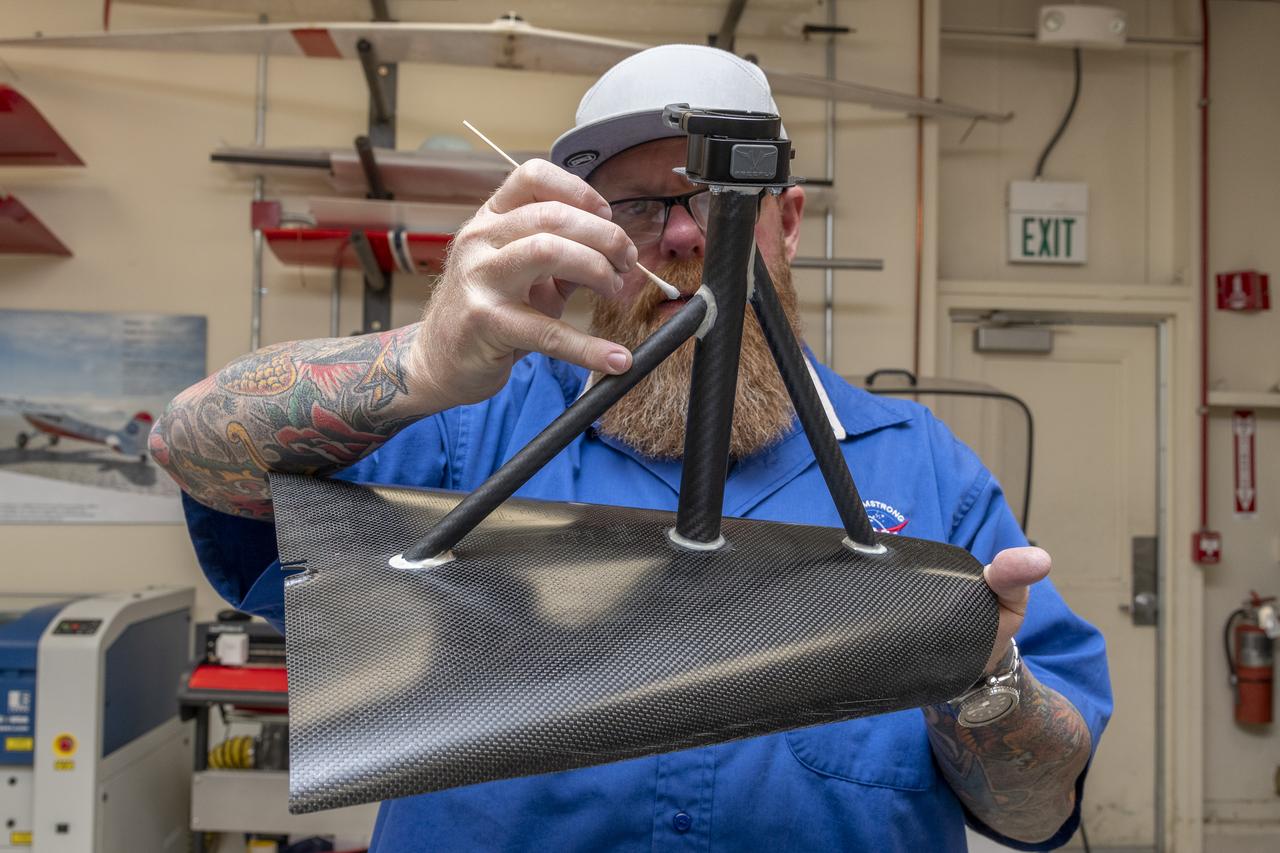
Justin Hall bonds pieces of a cradle for a rotorcraft launch system for a proposed atmospheric probe set to fly in summer 2024 at NASA’s Armstrong Flight Research Center in Edwards, California. Hall is a designer, technician, and pilot at the center’s Dale Reed Subscale Flight Research Laboratory.
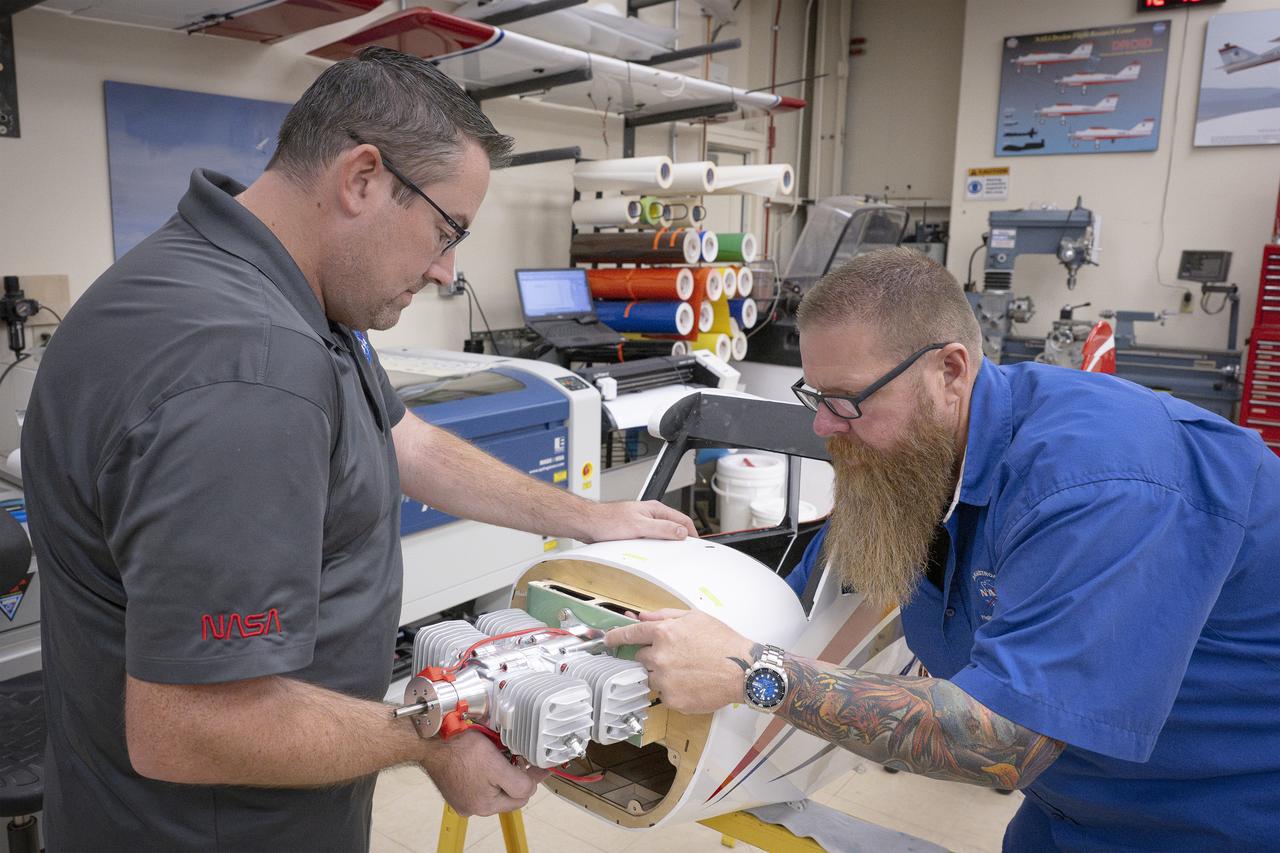
Justin Link, left, and Justin Hall attach an engine onto a subscale aircraft on Wednesday, Sept. 3, 2025, at NASA’s Armstong Flight Research Center in Edwards, California. Link is a pilot for small uncrewed aircraft systems at the center’s Dale Reed Subscale Flight Research Laboratory and Hall is the lab’s chief pilot.
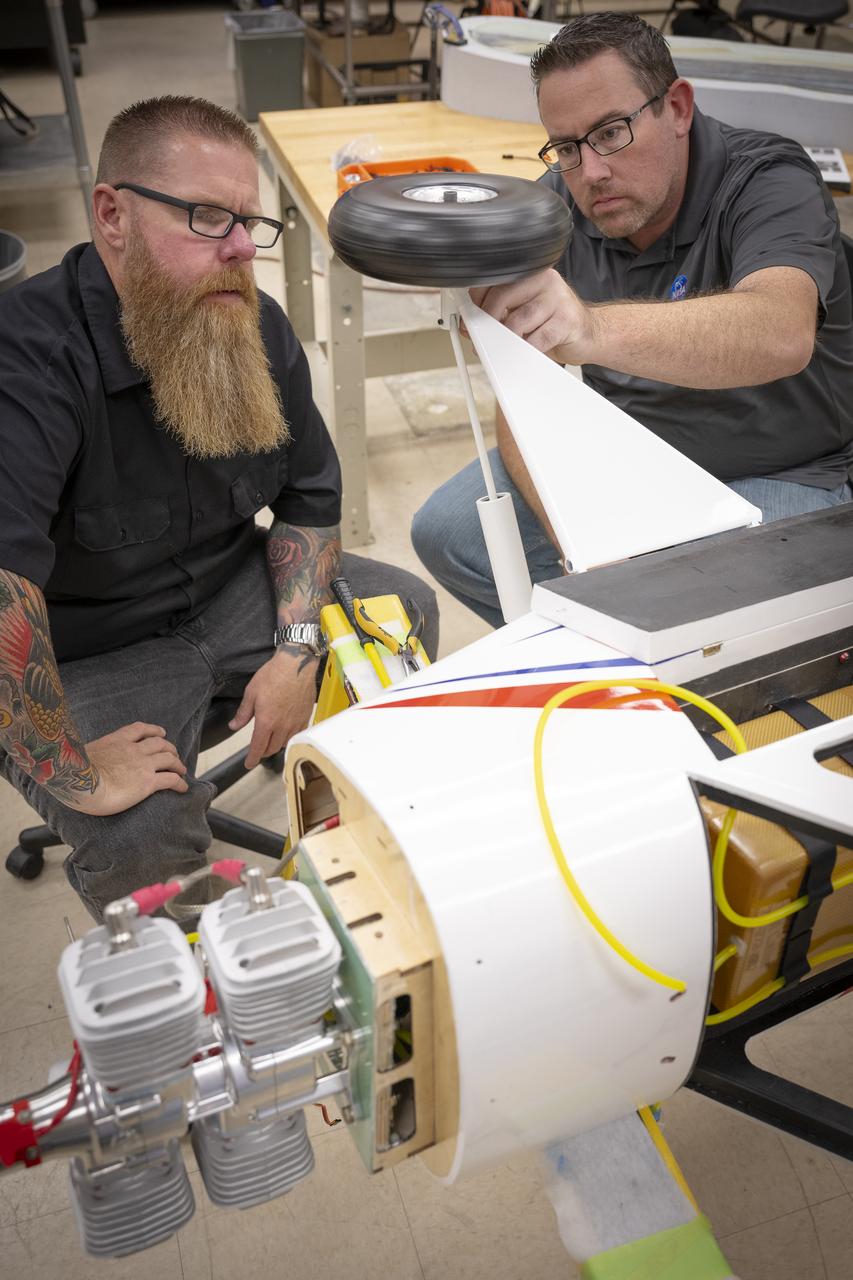
Justin Hall, left, and Justin Link attach a section of landing gear onto a subscale aircraft on Friday, Sept. 12, 2025, at NASA’s Armstong Flight Research Center in Edwards, California. Hall is chief pilot at the center’s Dale Reed Subscale Flight Research Laboratory and Link is a pilot for small uncrewed aircraft systems.
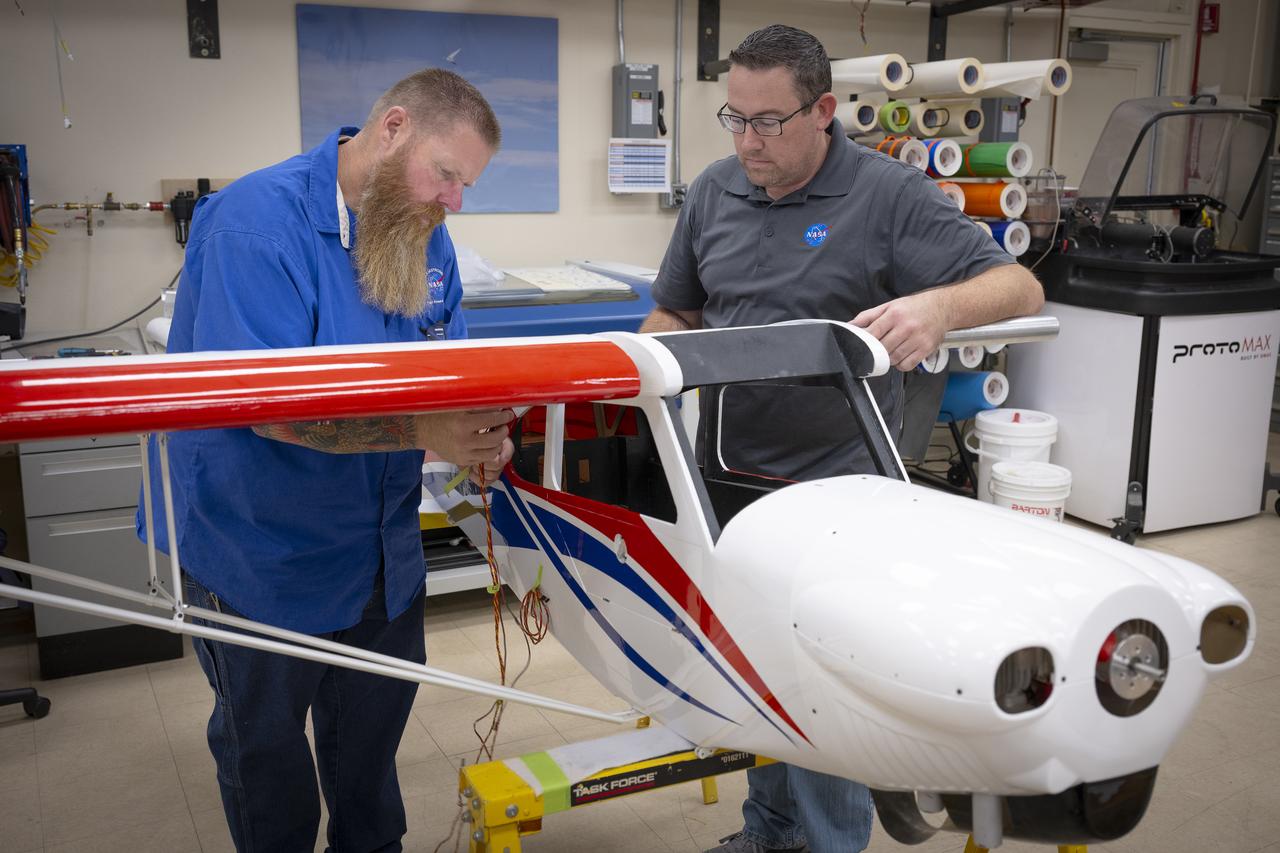
Justin Hall, left, and Justin Link secure a wing onto a subscale aircraft on Wednesday, Sept. 3, 2025, at NASA’s Armstong Flight Research Center in Edwards, California. Hall is chief pilot at the center’s Dale Reed Subscale Flight Research Laboratory and Link is a pilot for small uncrewed aircraft systems.
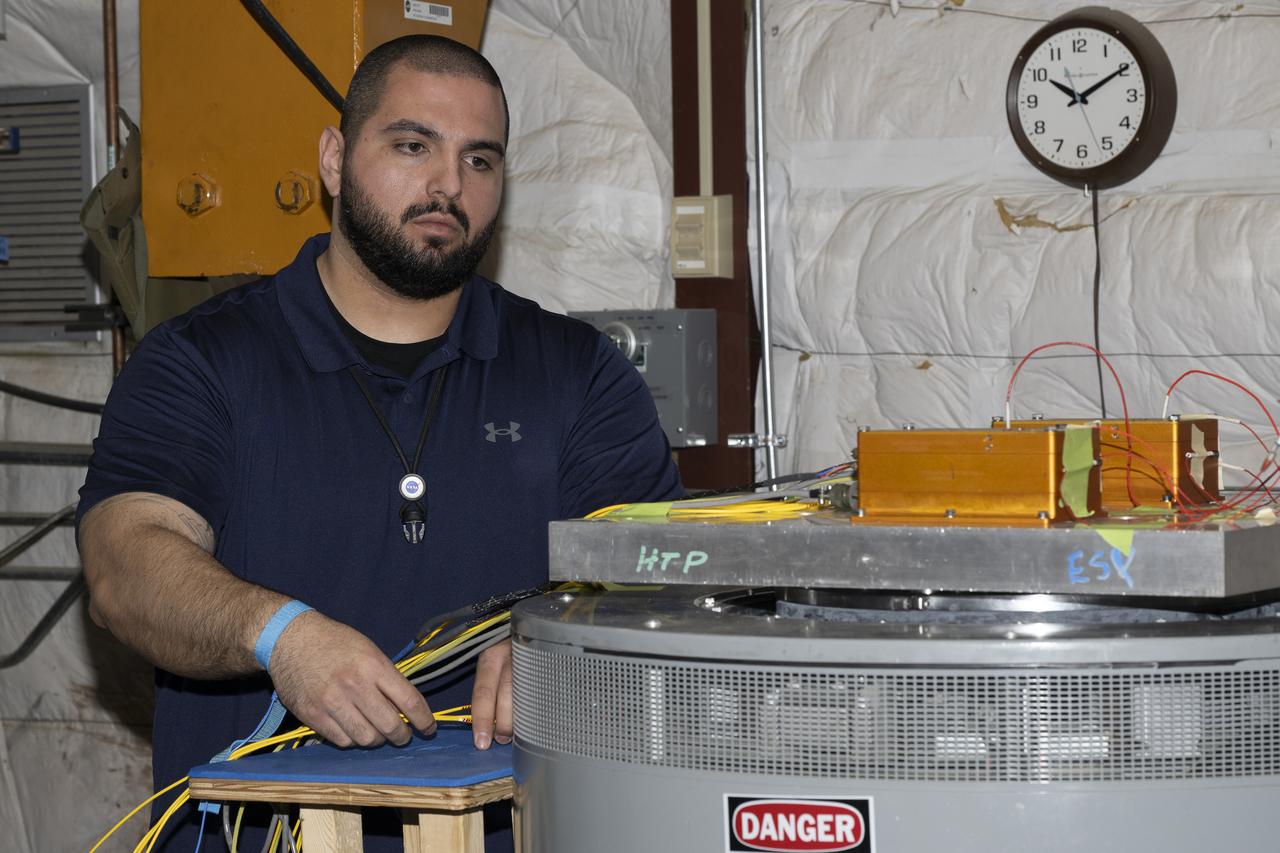
Jonathan Lopez prepares the hypersonic Fiber Optic Sensing System for vibration tests in the Environmental Laboratory at NASA’s Armstrong Flight Research Center in Edwards, California. Testing on a machine called a shaker proved that the system could withstand the severe vibration it will endure in hypersonic flight, or travel at five times the speed of sound.
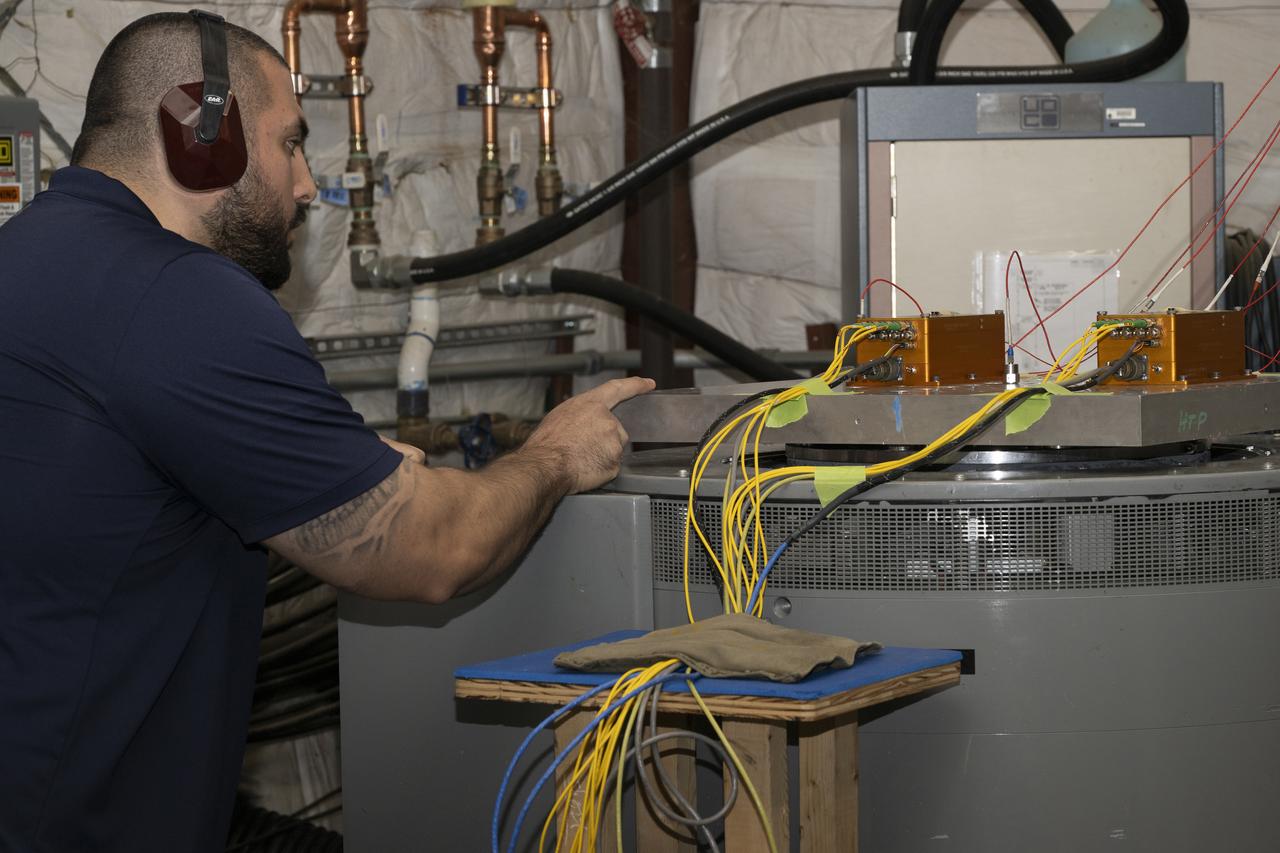
Jonathan Lopez prepares the hypersonic Fiber Optic Sensing System for vibration tests in the Environmental Laboratory at NASA’s Armstrong Flight Research Center in Edwards, California. Testing on a machine called a shaker proved that the system could withstand the severe vibration it will endure in hypersonic flight, or travel at five times the speed of sound.
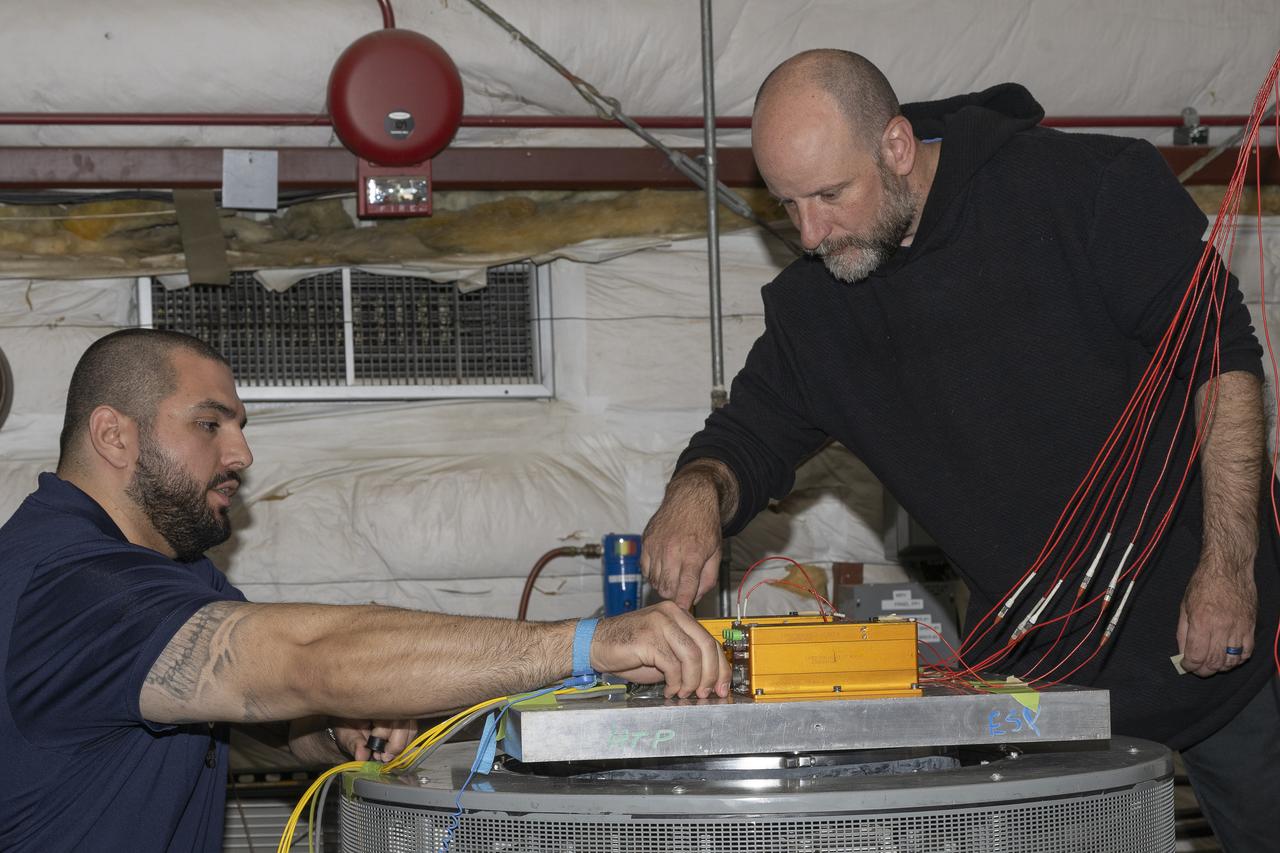
Jonathan Lopez and Nathan Rick prepare the hypersonic Fiber Optic Sensing System for vibration tests in the Environmental Laboratory at NASA’s Armstrong Flight Research Center in Edwards, California. Testing on a machine called a shaker proved that the system could withstand the severe vibration it will endure in hypersonic flight, or travel at five times the speed of sound.
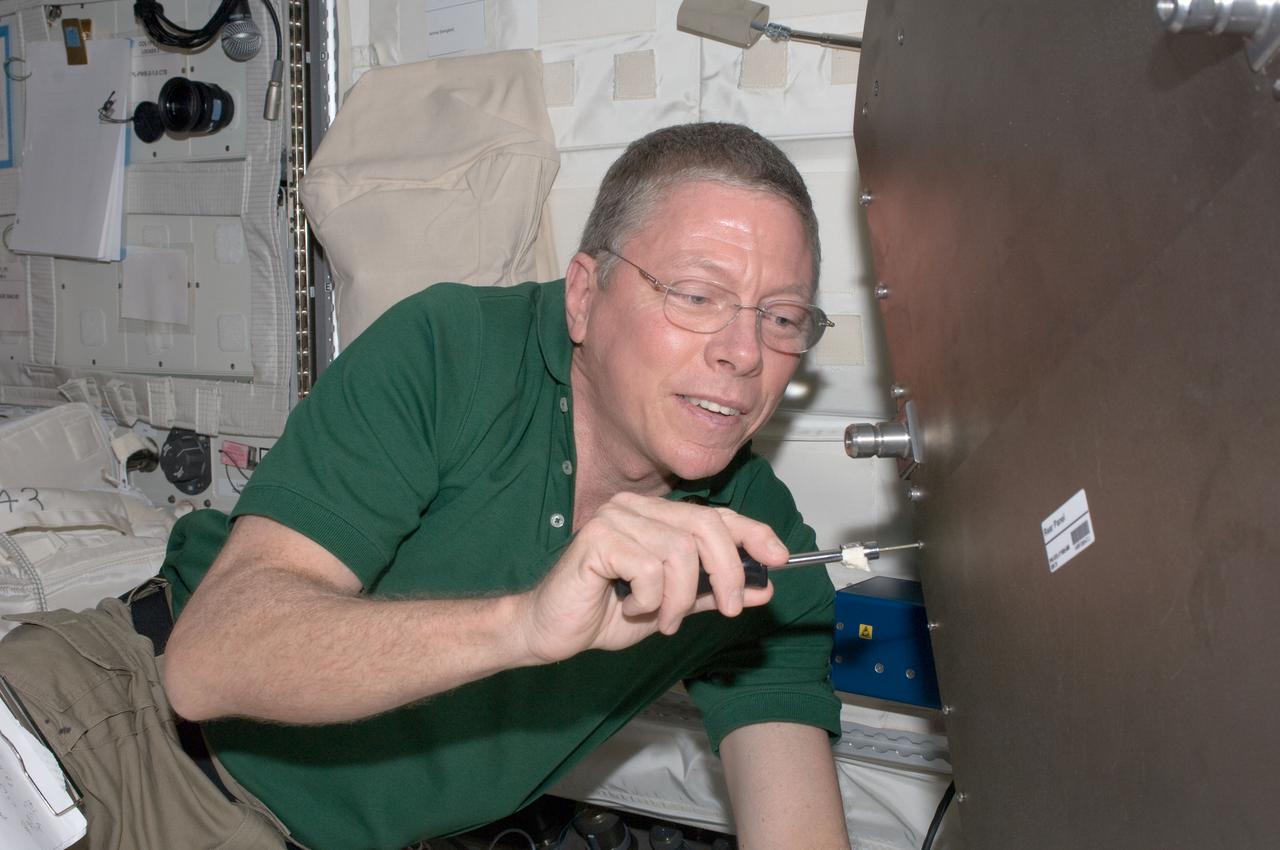
ISS028-E-035603 (31 Aug. 2011) --- NASA astronaut Mike Fossum, Expedition 28 flight engineer, works with Muscle Atrophy Research & Exercise System (MARES) hardware in the Columbus laboratory of the International Space Station.
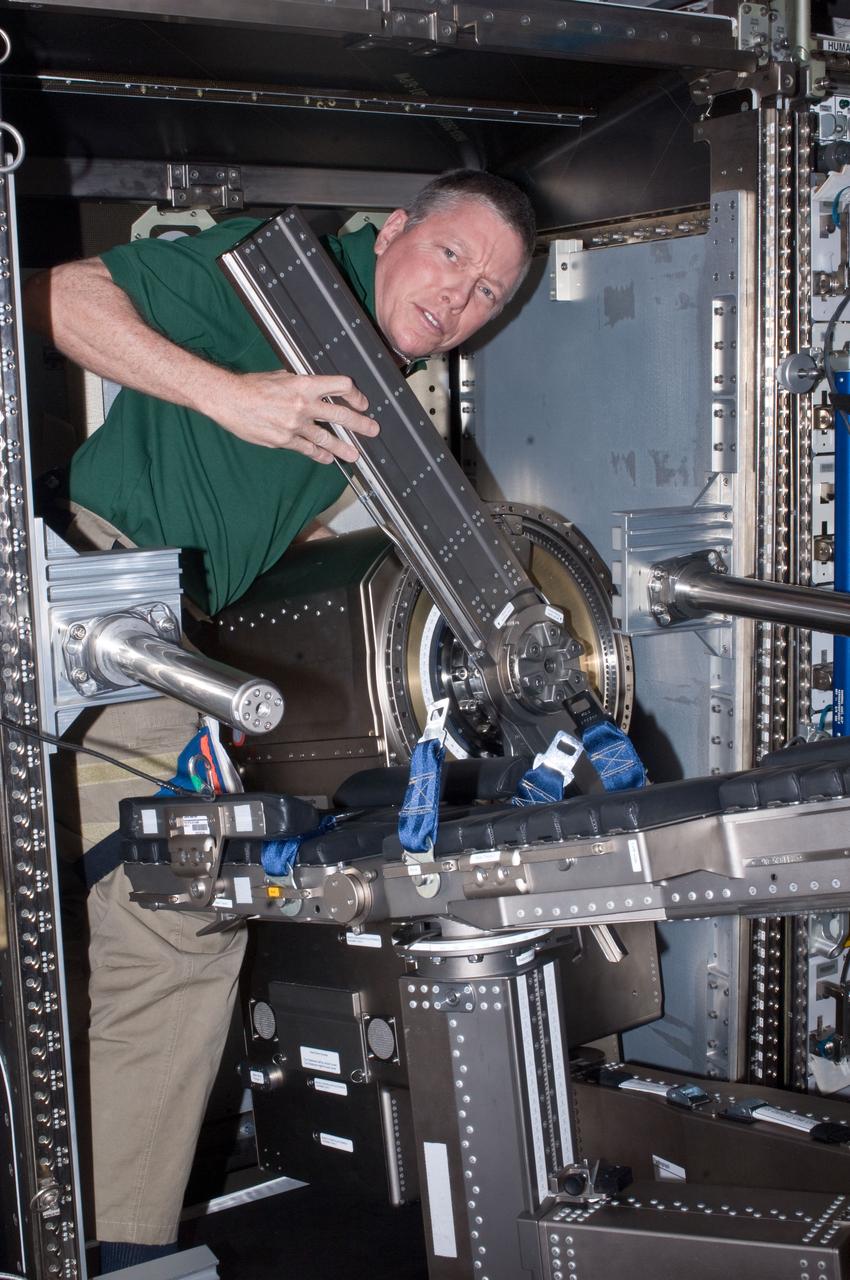
ISS028-E-035301 (31 Aug. 2011) --- NASA astronaut Mike Fossum, Expedition 28 flight engineer, works with Muscle Atrophy Research & Exercise System (MARES) hardware in the Columbus laboratory of the International Space Station.
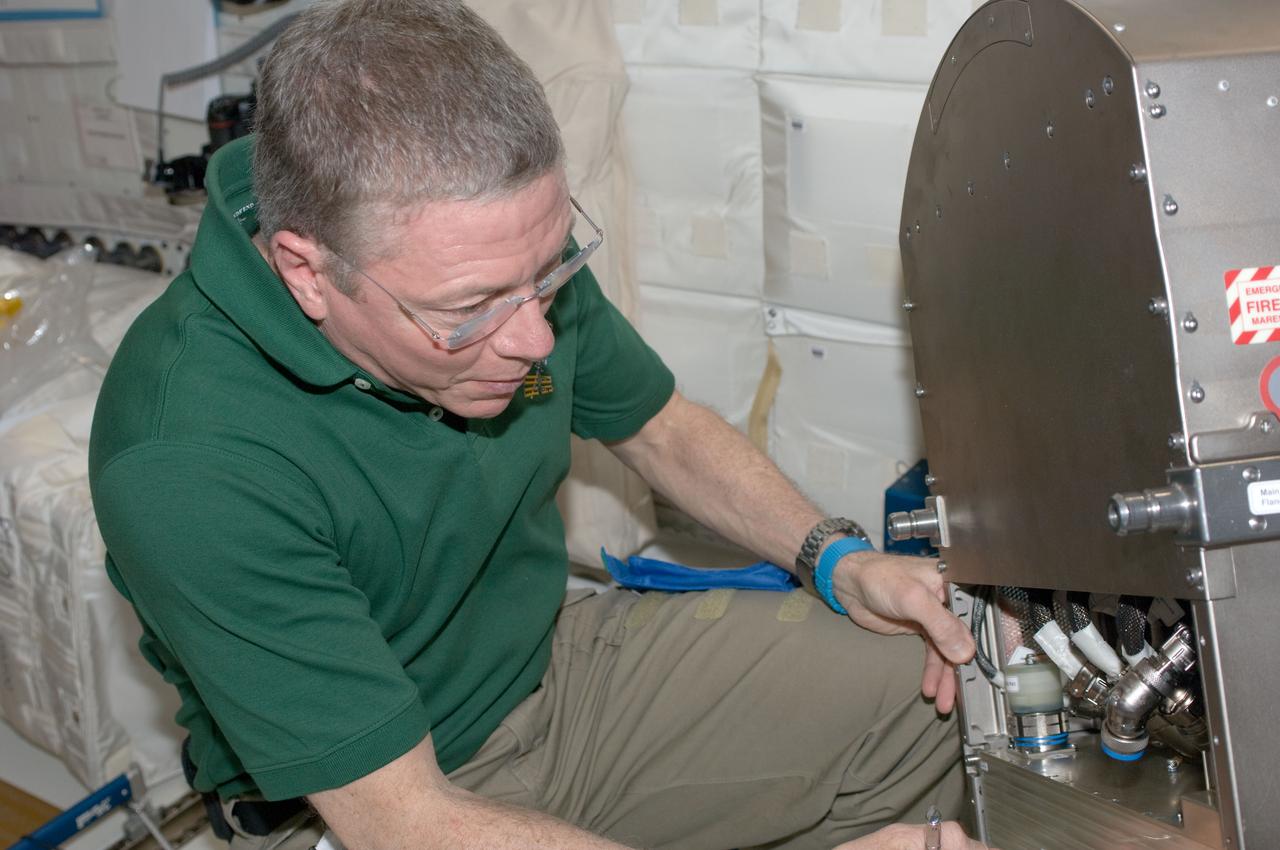
ISS028-E-035566 (31 Aug. 2011) --- NASA astronaut Mike Fossum, Expedition 28 flight engineer, works with Muscle Atrophy Research & Exercise System (MARES) hardware in the Columbus laboratory of the International Space Station.
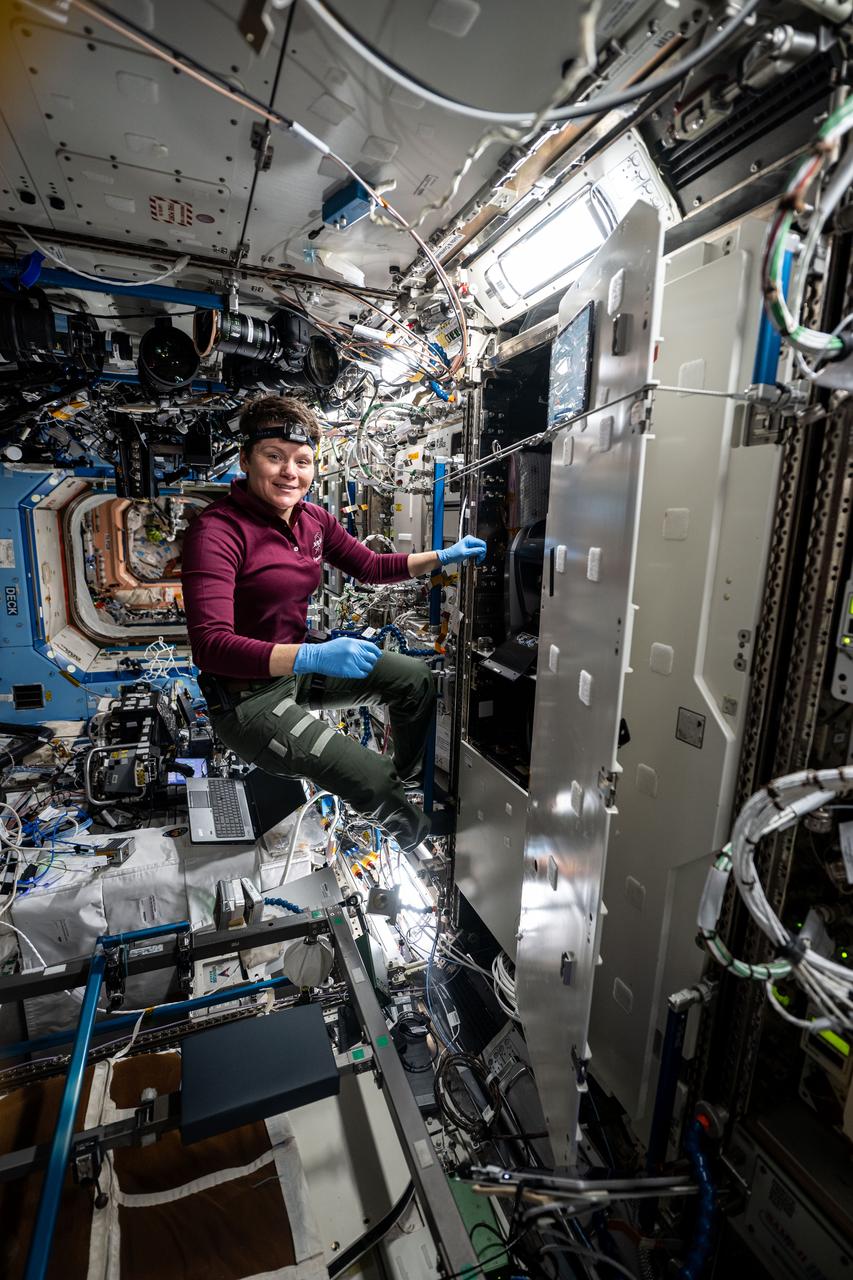
iss073e0118086 (May 29, 2025) --- NASA astronaut and Expedition 73 Flight Engineer Anne McClain works inside the Destiny laboratory module's Materials Science Research Rack and swaps filters inside the Kermit microscope. Kermit is an all-in-one fluorescence microscope system used to conduct biological, physical, and materials science research.
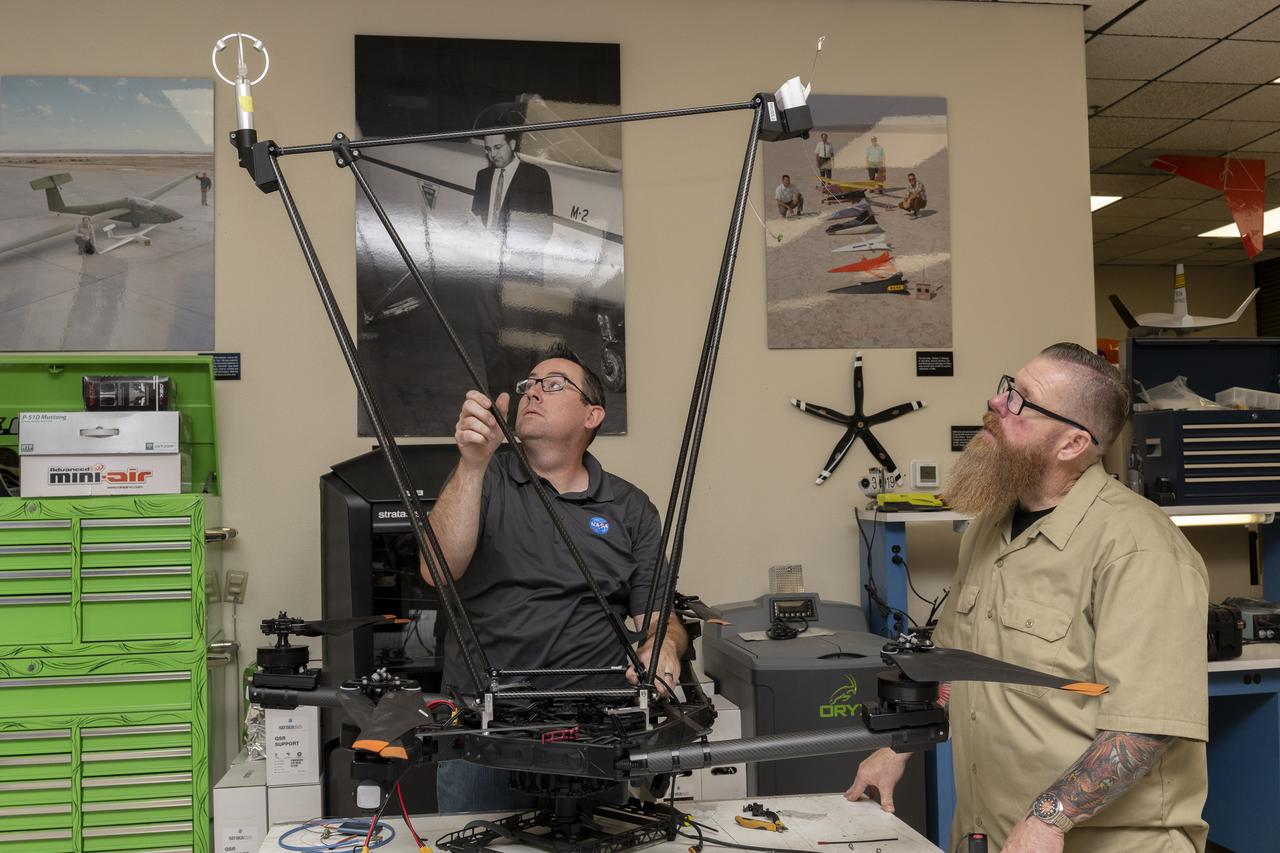
Justin Link, left, pilot for small uncrewed aircraft systems, and Justin Hall, chief pilot for small uncrewed aircraft systems, install weather instruments on NASA’s Alta X drone at the agency’s Armstrong Flight Research Center in Edwards, California. Members of the center’s Dale Reed Subscale Flight Research Laboratory used the Alta X to support the agency’s FireSense project in March 2025 for a prescribed burn in Geneva State Forest, which is about 100 miles south of Montgomery, Alabama.
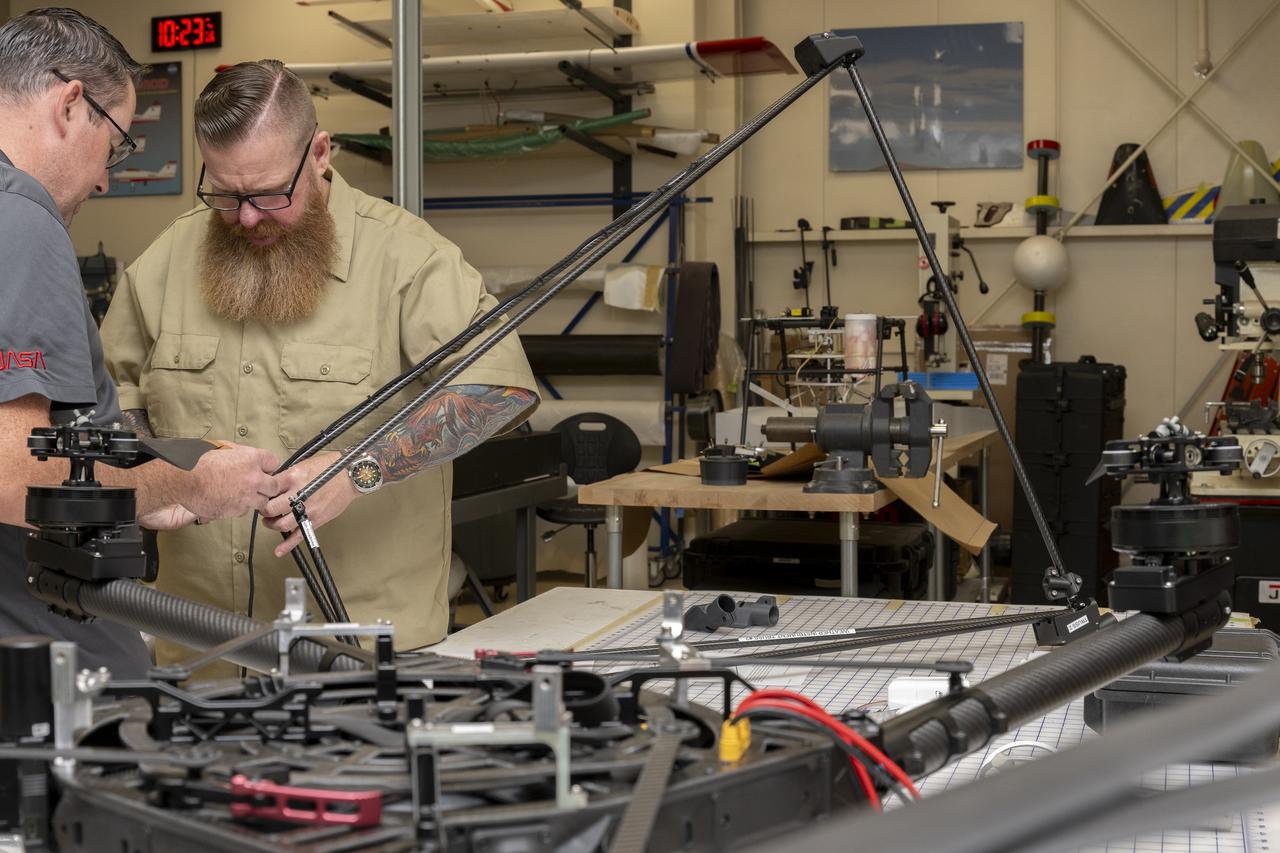
Justin Link, left, pilot for small uncrewed aircraft systems, and Justin Hall, chief pilot for small uncrewed aircraft systems, install weather instruments on NASA’s Alta X drone at the agency’s Armstrong Flight Research Center in Edwards, California. Members of the center’s NASA Armstrong Dale Reed Subscale Flight Research Laboratory used the Alta X to support the NASA’s FireSense project in March 2025 for a prescribed burn in Geneva State Forest, which is about 100 miles south of Montgomery, Alabama.
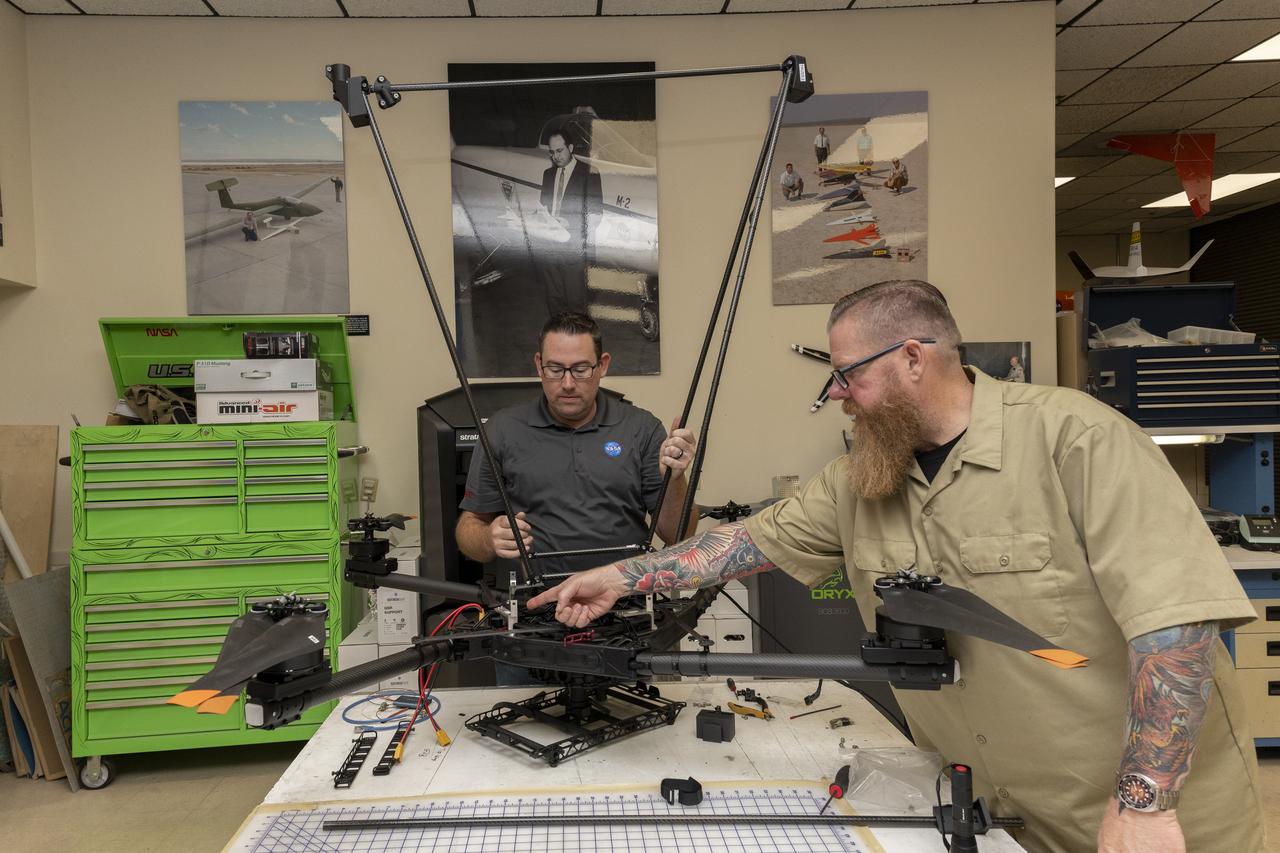
Justin Link, left, pilot for small uncrewed aircraft systems, and Justin Hall, chief pilot for small uncrewed aircraft systems, install weather instruments on NASA’s Alta X drone at the agency’s Armstrong Flight Research Center in Edwards, California. Members of the center’s NASA Armstrong Dale Reed Subscale Flight Research Laboratory used the Alta X to support the NASA’s FireSense project in March 2025 for a prescribed burn in Geneva State Forest, which is about 100 miles south of Montgomery, Alabama.
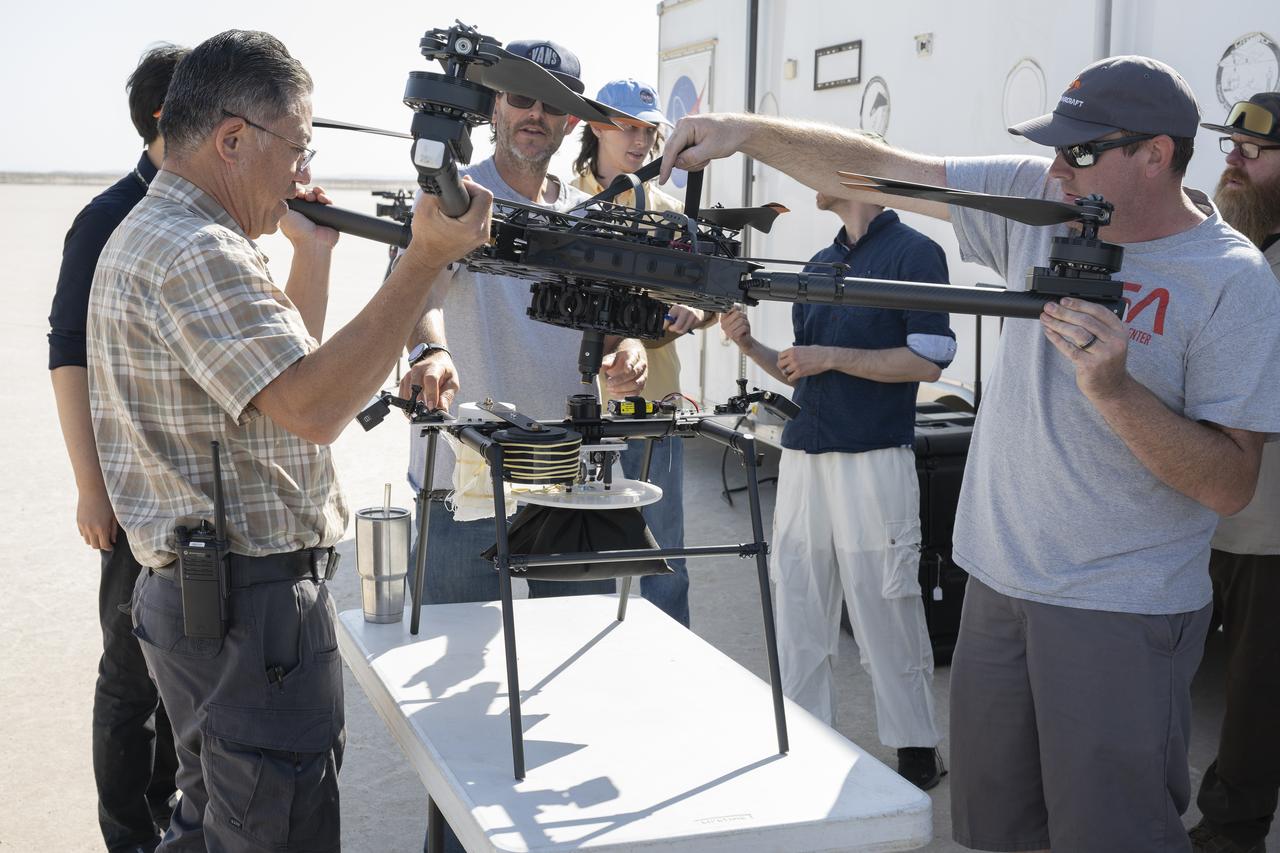
Derek Abramson, left, and Justin Link, right, attach an Alta X drone to the Enhancing Parachutes by Instrumenting the Canopy test experiment on June 4, 2025, at NASA’s Armstong Flight Research Center in Edwards, California. Abramson is NASA chief engineer at the center’s Dale Reed Subscale Flight Research Laboratory, where Link also works as a pilot for small uncrewed aircraft systems. NASA researchers are developing technology to make supersonic parachutes safer and more reliable for delivering science instruments and payloads to Mars.
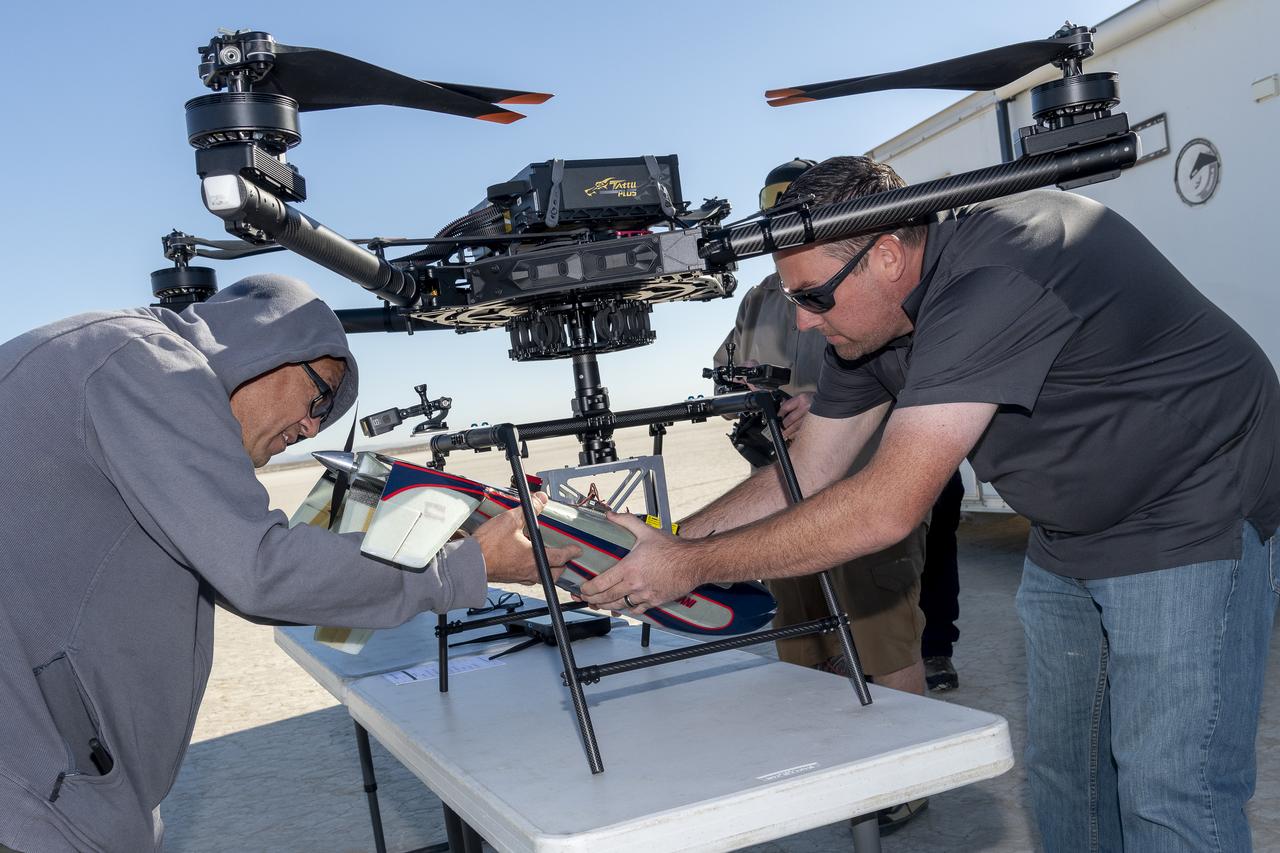
Derek Abramson, left, chief engineer for the Dale Reed Subscale Flight Research Laboratory, and Justin Link, small unmanned aircraft systems pilot, prepare an atmospheric probe model for flight on Oct. 22, 2024. A quad rotor remotely piloted aircraft released the probe above Rogers Dry Lake, a flight area adjacent to NASA’s Armstrong Flight Research Center in Edwards, California. The probe was designed and built at the center.
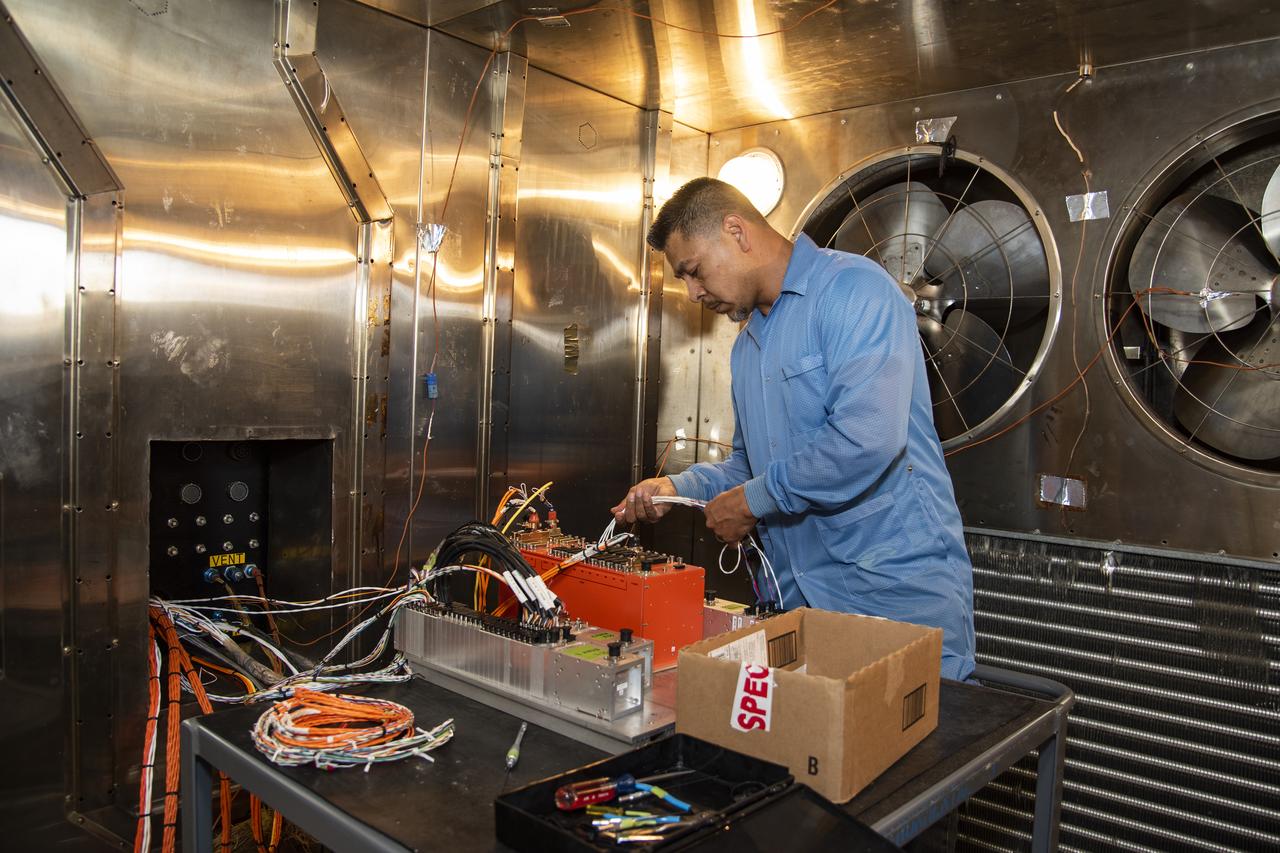
Angelo De La Rosa works inside the Environmental Laboratory’s thermal chamber to attach test articles to the testing architecture at NASA’s Armstrong Flight Research Center in California. The center is testing components for integration into the Orion AA-2 test article scheduled for a test flight of the launch abort system in 2019.
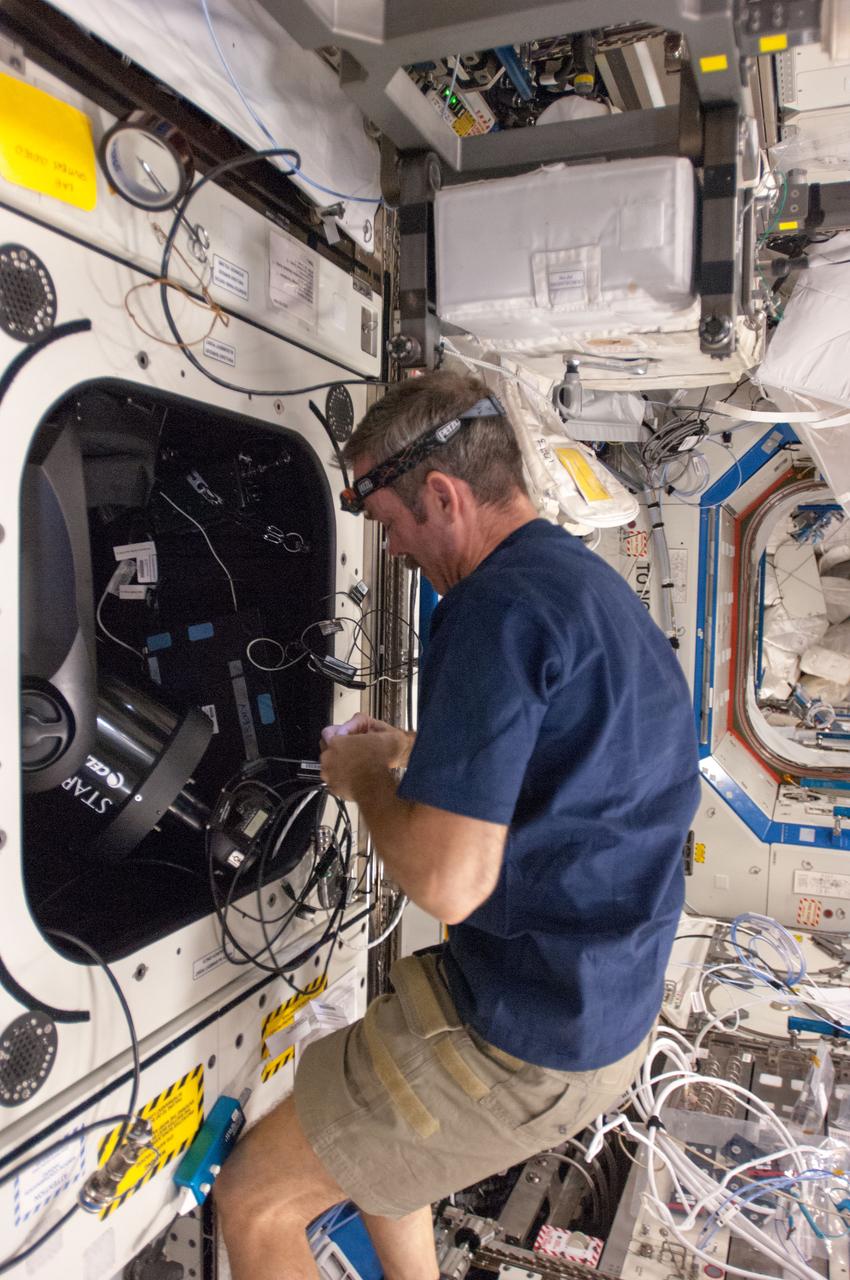
ISS034-E-029975 (15 Jan. 2013) --- Canadian Space Agency astronaut Chris Hadfield, Expedition 34 flight engineer, sets up the ISS SERVIR Environmental Research and Visualization System (ISERV) in the Destiny laboratory of the International Space Station. ISERV is a fully automated image data acquisition system that flies aboard the space station and deploys in the Window Observational Research Facility (WORF) rack within Destiny. The study is expected to provide useful images for use in disaster monitoring and assessment and environmental decision making.
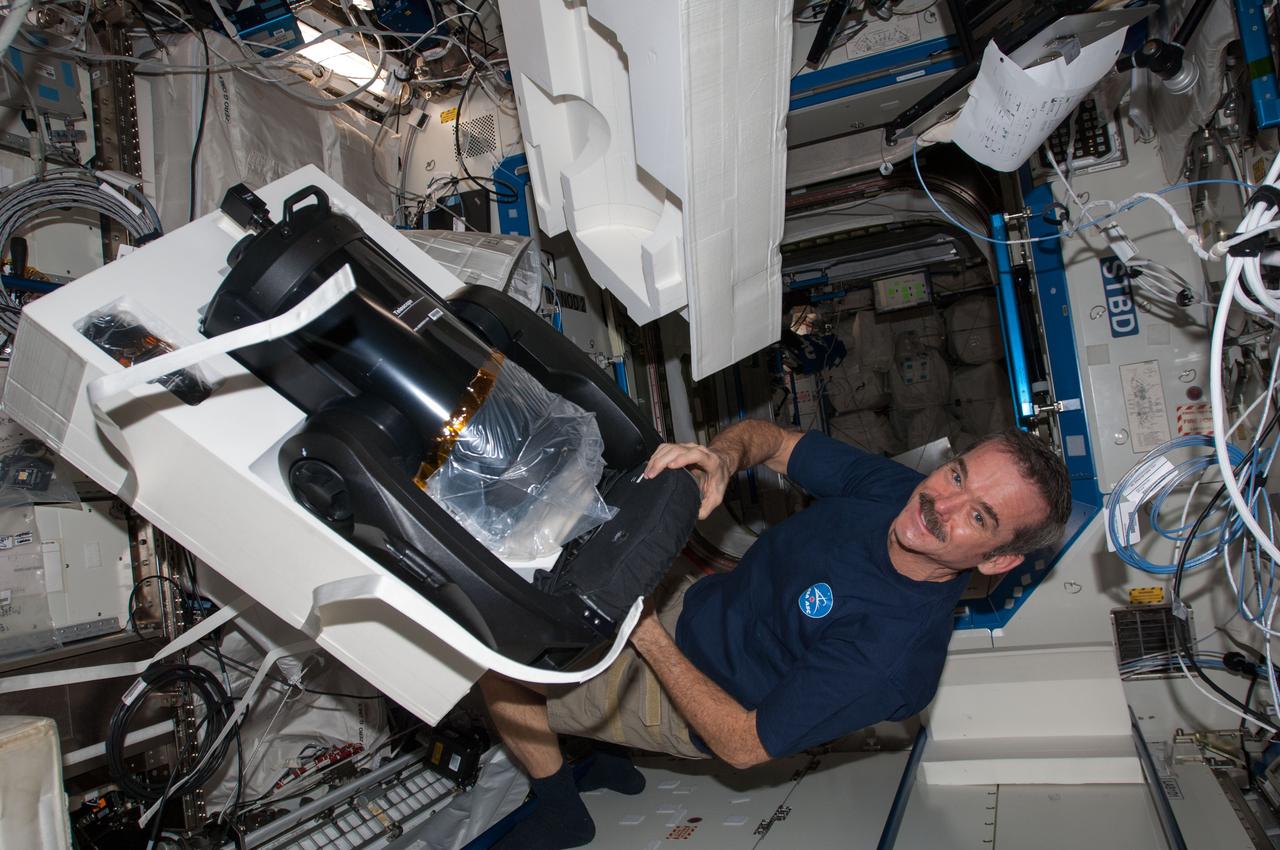
View of Canadian Space Agency (CSA) Chris Hadfield,Expedition 34 Flight Engineer (FE),unpacking ISS SERVIR Environmental Research and Visualization System (ISERV) in the U.S. Laboratory. ISERV is a fully automated image data acquisition system in the Window Observational Research Facility (WORF) rack. Kevin Ford,Expedition 34 Commander is visible on the right of frame. Photo was taken during Expedition 34.
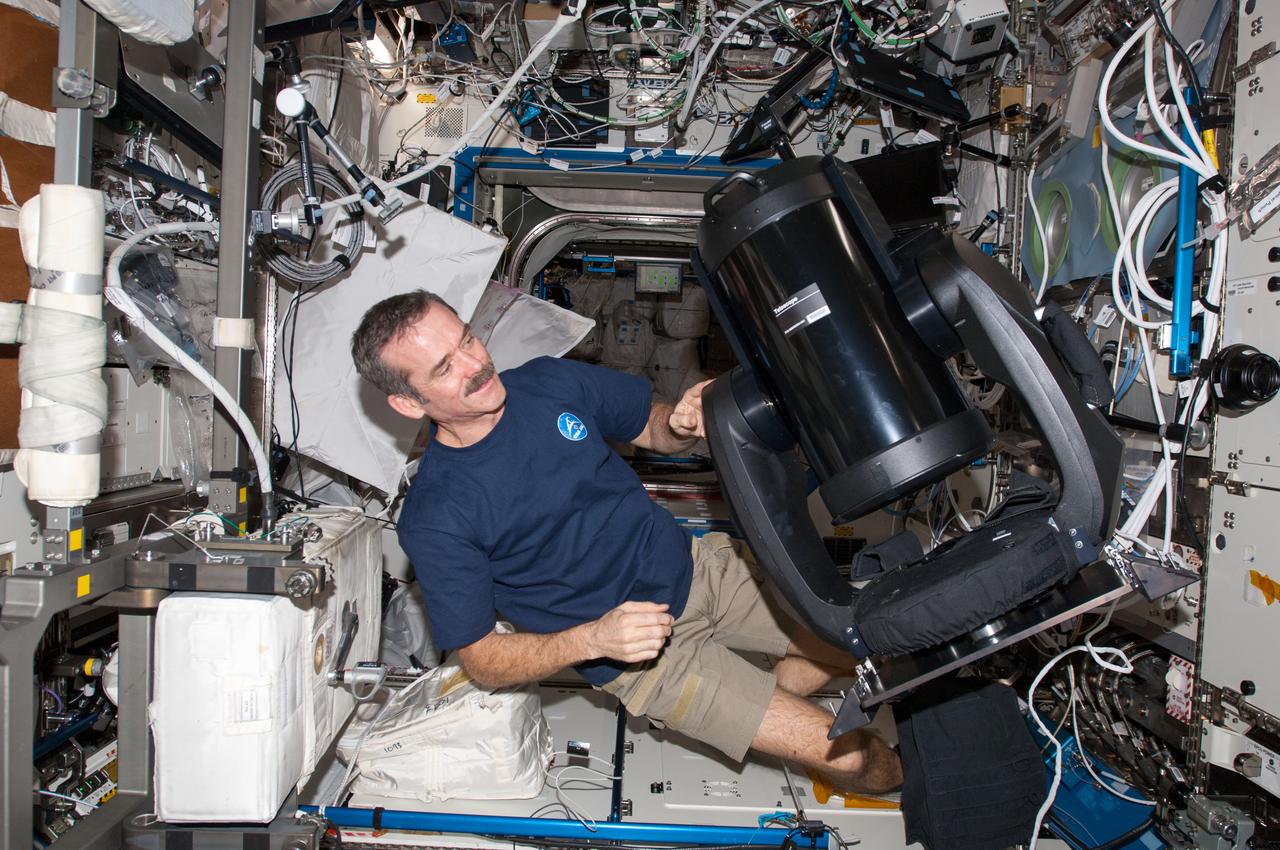
ISS034-E-029961 (15 Jan. 2013) --- Canadian Space Agency astronaut Chris Hadfield, Expedition 34 flight engineer, prepares to set up the ISS SERVIR Environmental Research and Visualization System (ISERV) in the Destiny laboratory of the International Space Station. ISERV is a fully automated image data acquisition system that flies aboard the space station and deploys in the Window Observational Research Facility (WORF) rack within Destiny. The study is expected to provide useful images for use in disaster monitoring and assessment and environmental decision making.
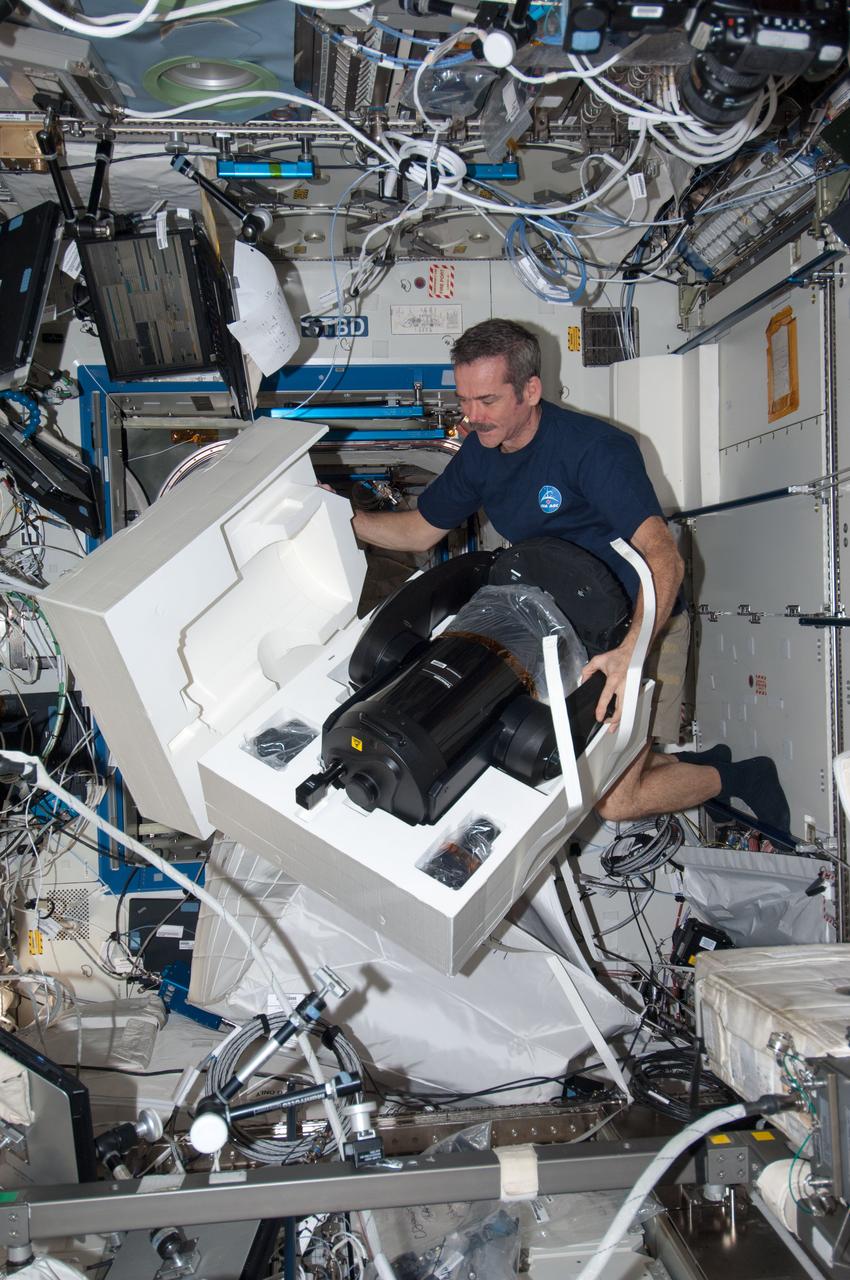
ISS034-E-029914 (15 Jan. 2013) --- Canadian Space Agency astronaut Chris Hadfield, Expedition 34 flight engineer, prepares to set up the ISS SERVIR Environmental Research and Visualization System (ISERV) in the Destiny laboratory of the International Space Station. ISERV is a fully automated image data acquisition system that flies aboard the space station and deploys in the Window Observational Research Facility (WORF) rack within Destiny. The study is expected to provide useful images for use in disaster monitoring and assessment and environmental decision making.
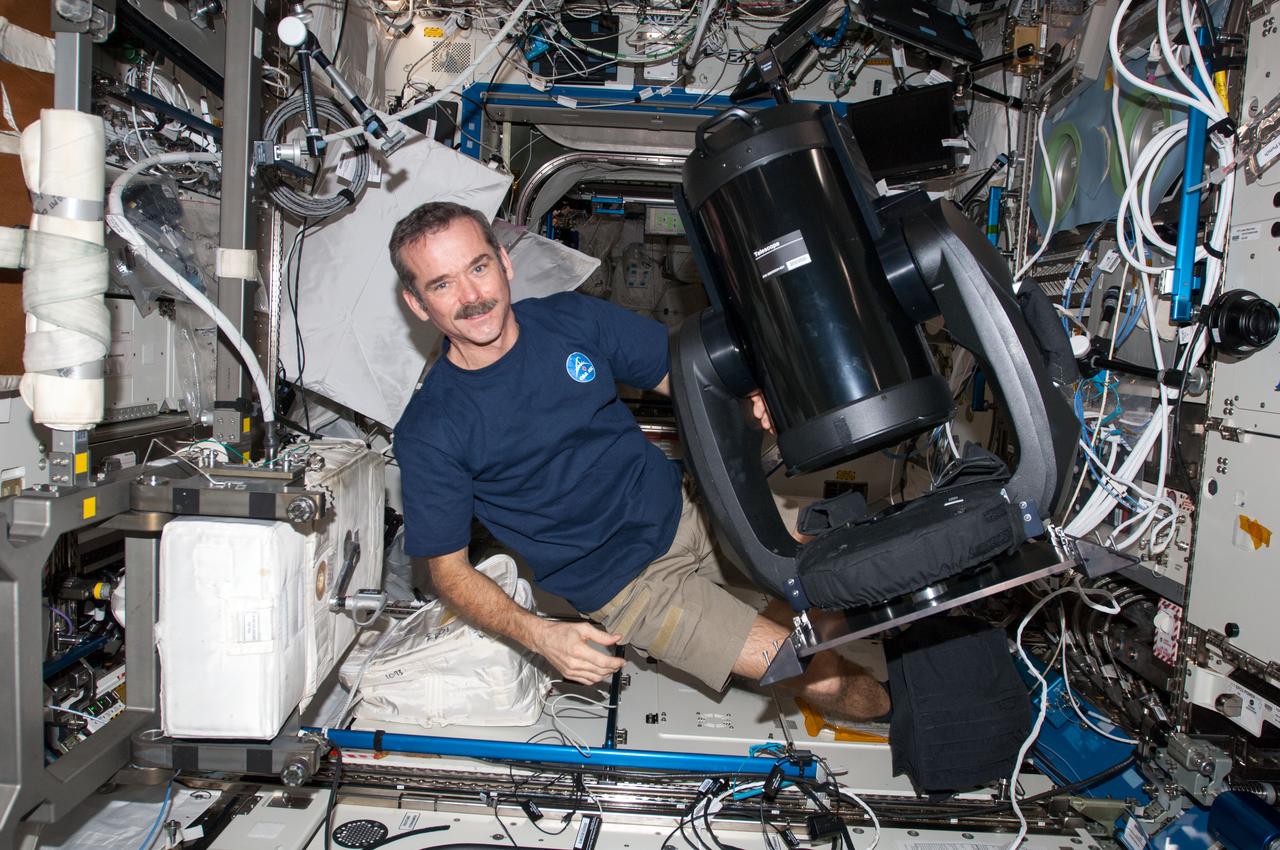
View of Canadian Space Agency (CSA) Chris Hadfield,Expedition 34 Flight Engineer (FE), preparing to setup the ISS SERVIR Environmental Research and Visualization System (ISERV) in the U.S. Laboratory. ISERV is a fully automated image data acquisition system in the Window Observational Research Facility (WORF) rack. Kevin Ford,Expedition 34 Commander is visible on the right of frame. Photo was taken during Expedition 34.
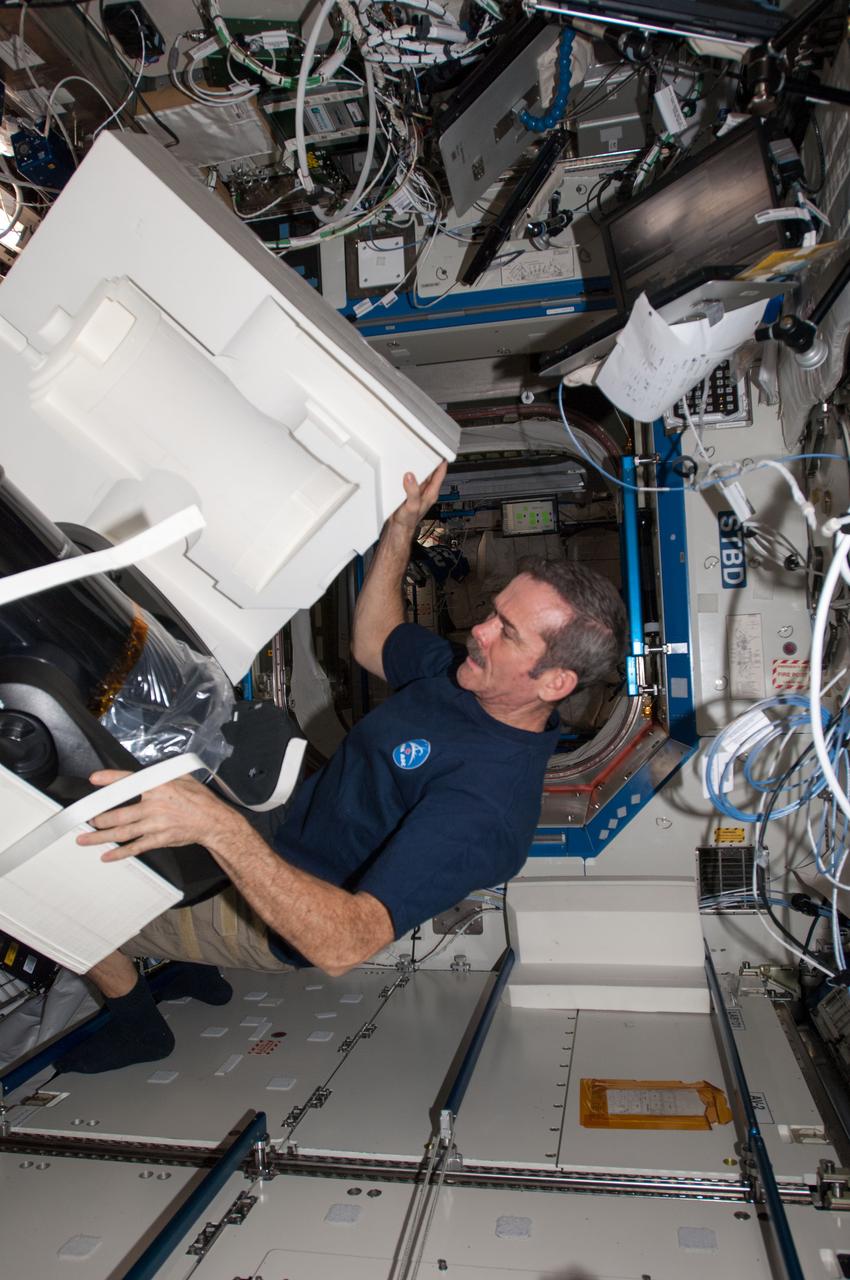
ISS034-E-029954 (15 Jan. 2013) --- Canadian Space Agency astronaut Chris Hadfield, Expedition 34 flight engineer, prepares to set up the ISS SERVIR Environmental Research and Visualization System (ISERV) in the Destiny laboratory of the International Space Station. ISERV is a fully automated image data acquisition system that flies aboard the space station and deploys in the Window Observational Research Facility (WORF) rack within Destiny. The study is expected to provide useful images for use in disaster monitoring and assessment and environmental decision making.
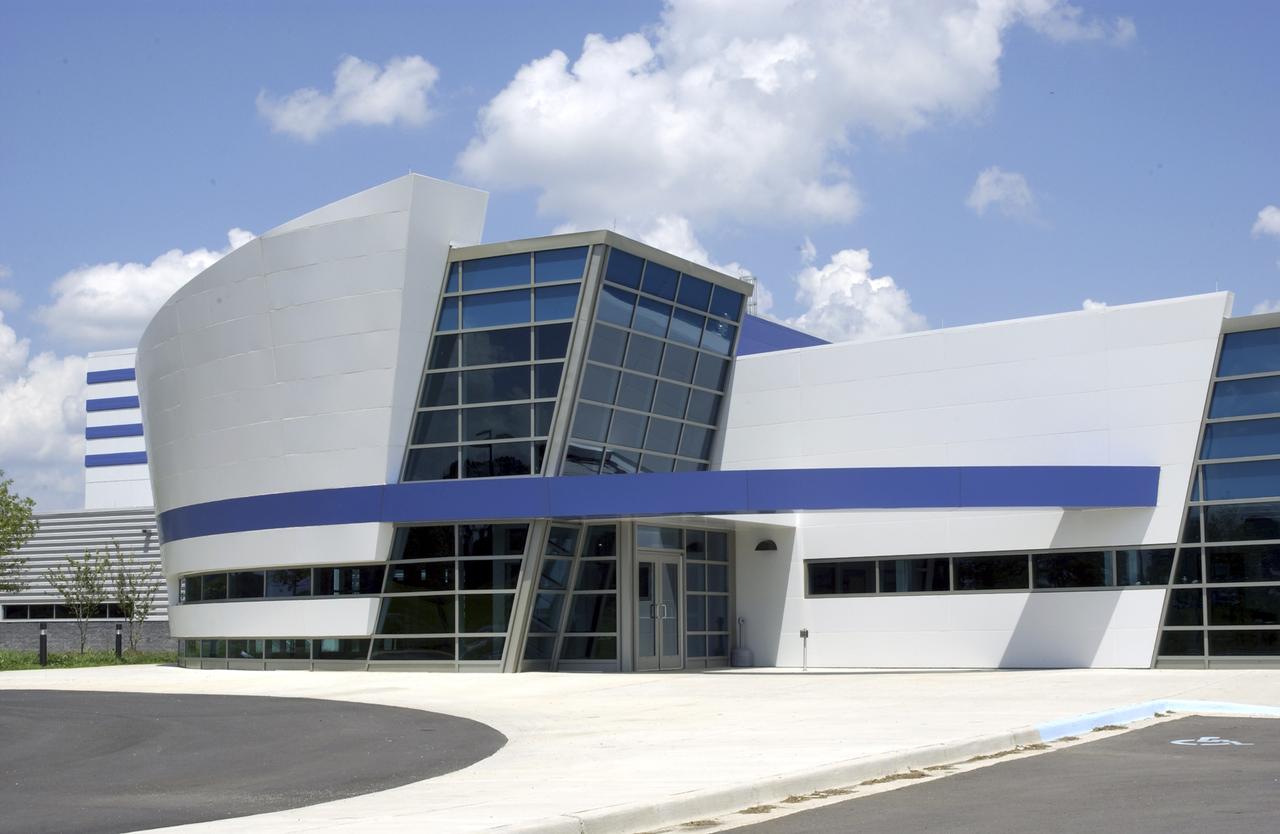
The grand opening of NASA’s new, world-class laboratory for research into future space transportation technologies located at the Marshall Space Flight Center (MSFC) in Huntsville, Alabama, took place in July 2004. The state-of-the-art Propulsion Research Laboratory (PRL) serves as a leading national resource for advanced space propulsion research. Its purpose is to conduct research that will lead to the creation and development of innovative propulsion technologies for space exploration. The facility is the epicenter of the effort to move the U.S. space program beyond the confines of conventional chemical propulsion into an era of greatly improved access to space and rapid transit throughout the solar system. The laboratory is designed to accommodate researchers from across the United States, including scientists and engineers from NASA, the Department of Defense, the Department of Energy, universities, and industry. The facility, with 66,000 square feet of useable laboratory space, features a high degree of experimental capability. Its flexibility allows it to address a broad range of propulsion technologies and concepts, such as plasma, electromagnetic, thermodynamic, and propellant propulsion. An important area of emphasis is the development and utilization of advanced energy sources, including highly energetic chemical reactions, solar energy, and processes based on fission, fusion, and antimatter. The Propulsion Research Laboratory is vital for developing the advanced propulsion technologies needed to open up the space frontier, and sets the stage of research that could revolutionize space transportation for a broad range of applications.
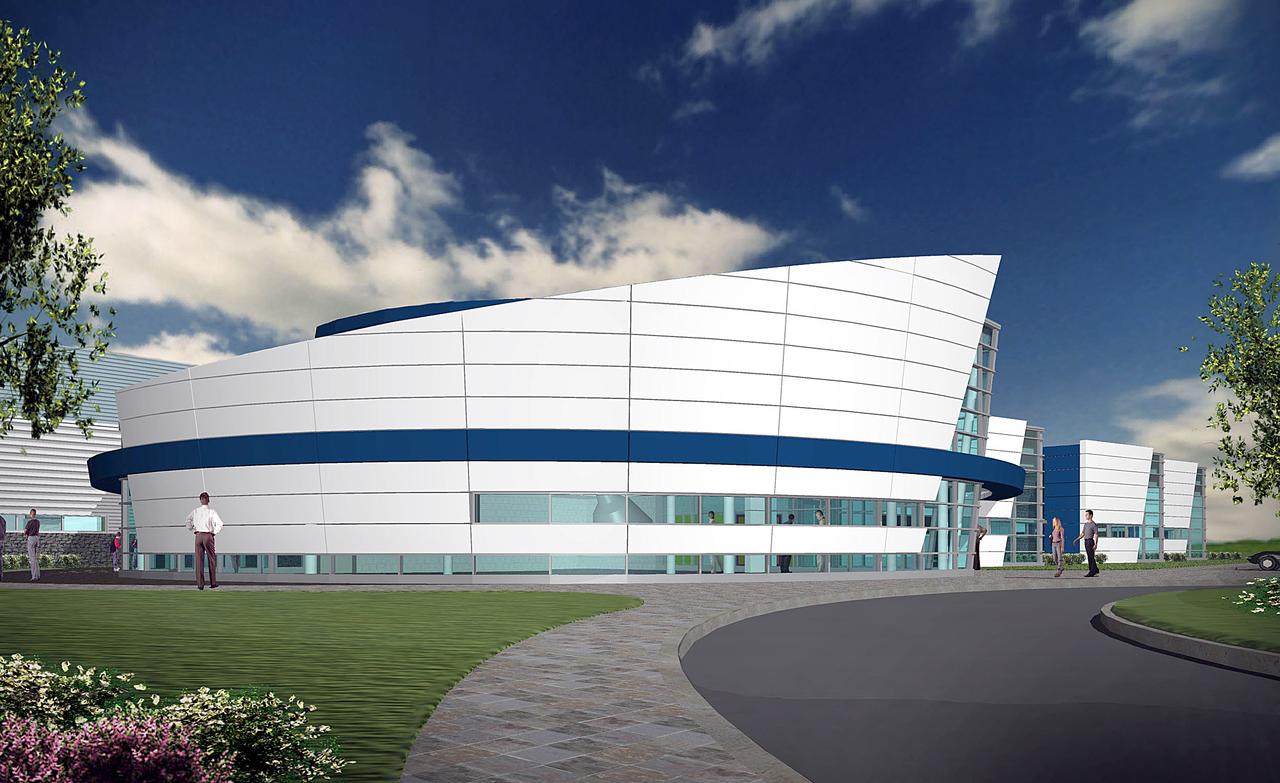
A new, world-class laboratory for research into future space transportation technologies is under construction at the Marshall Space Flight Center (MSFC) in Huntsville, AL. The state-of-the-art Propulsion Research Laboratory will serve as a leading national resource for advanced space propulsion research. Its purpose is to conduct research that will lead to the creation and development of irnovative propulsion technologies for space exploration. The facility will be the epicenter of the effort to move the U.S. space program beyond the confines of conventional chemical propulsion into an era of greatly improved access to space and rapid transit throughout the solar system. The Laboratory is designed to accommodate researchers from across the United States, including scientists and engineers from NASA, the Department of Defense, the Department of Energy, universities, and industry. The facility, with 66,000 square feet of useable laboratory space, will feature a high degree of experimental capability. Its flexibility will allow it to address a broad range of propulsion technologies and concepts, such as plasma, electromagnetic, thermodynamic, and propellantless propulsion. An important area of emphasis will be development and utilization of advanced energy sources, including highly energetic chemical reactions, solar energy, and processes based on fission, fusion, and antimatter. The Propulsion Research Laboratory is vital for developing the advanced propulsion technologies needed to open up the space frontier, and will set the stage of research that could revolutionize space transportation for a broad range of applications.