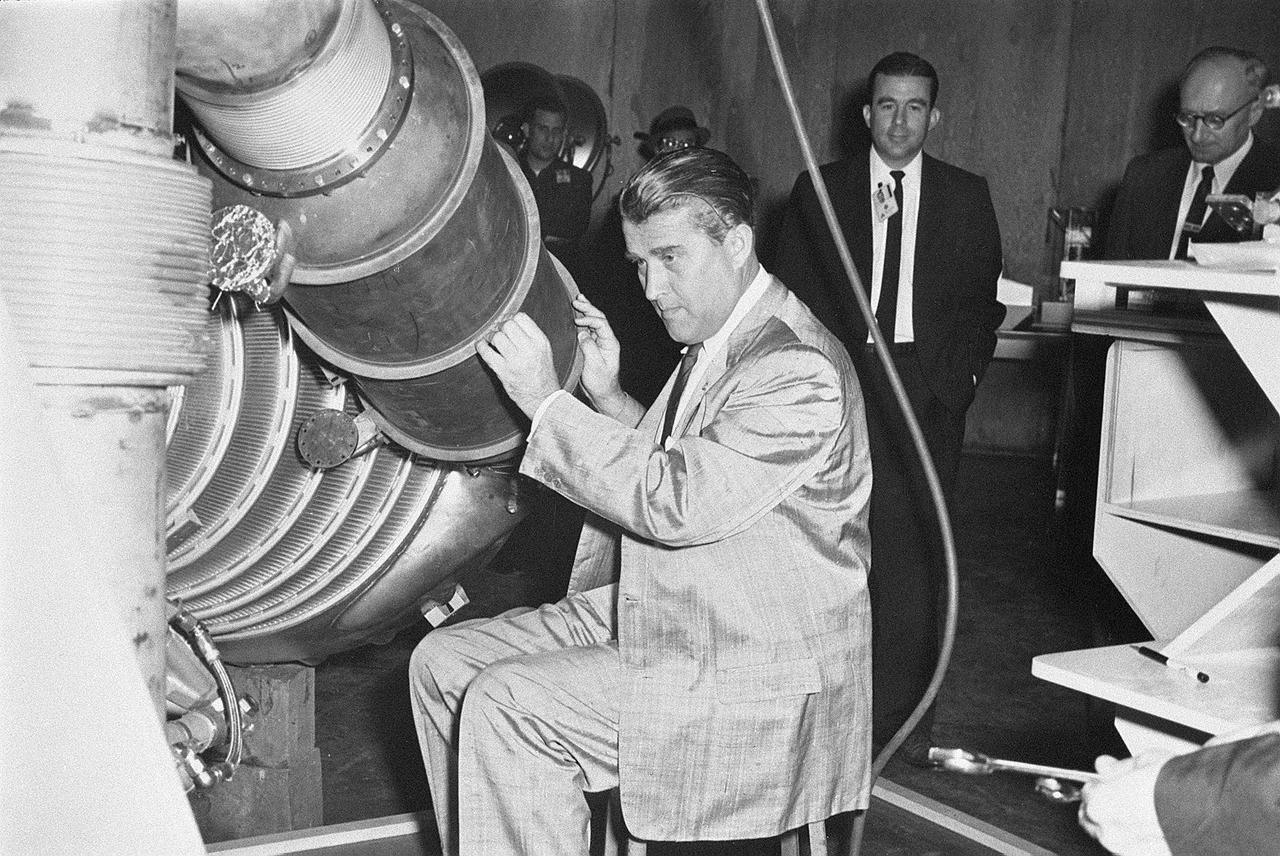
Dr. von Braun tried out a floating platform in the Marshall Space Flight Center Manufacturing Engineering Laboratory. This was a test rig to help determine how future astronauts will be able to perform maintenance tasks in the weightlessness in space. This photograph is believed to have been taken in 1961.
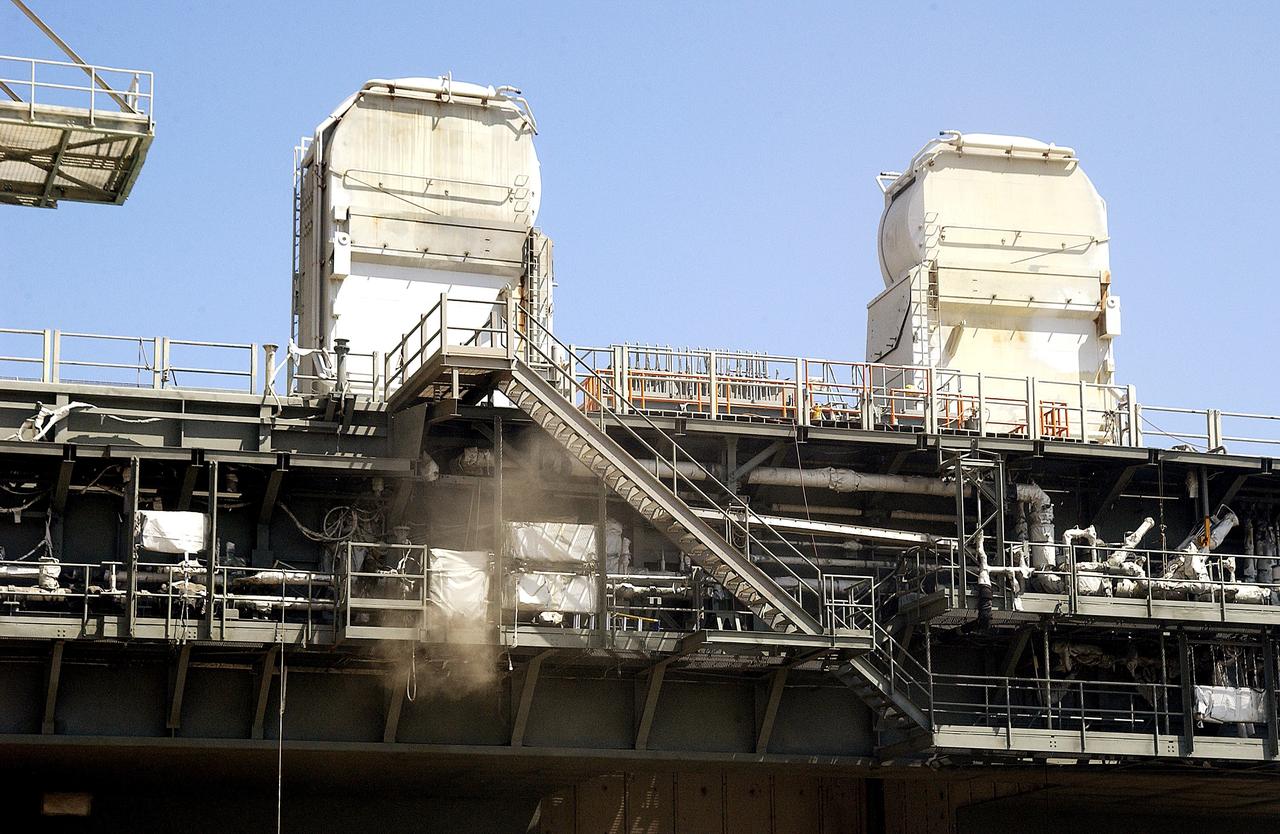
KENNEDY SPACE CENTER, FLA. - On Launch Pad 39A, clouds of dust float away from the Mobile Launcher Platform, which is undergoing sandblasting to remove corrosion before repainting. Routine maintenance includes sandblasting and repainting as preventive means to minimize corrosion.

Earth Observation taken during a day pass by the Expedition 40 crew aboard the International Space Station (ISS). Folder lists this as:Straights of Magellan - Atlantic entrance - Clearish skies. Part of the ISS JEM module External Platform is visible. Also sent down as Twitter message: Our moon is a tiny fingernail floating in space. Look close

KENNEDY SPACE CENTER, FLA. -- STS-114 Mission Specialist Wendy Lawrence examines one of the seats in the Rubber Room. Located under the launch pad, the steel dome Rubber Room floats on rubber isolators. It was the escape area used during the Apollo launches and it could not be removed when the pad was modified for the Shuttle. In case of an emergency on the pad, the astronauts would slide down the long vertical tube to the Rubber Room, strap themselves into the seats and wait for the danger to clear. The STS-114 mission is Logistics Flight 1, which is scheduled to deliver supplies and equipment plus the external stowage platform to the International Space Station.
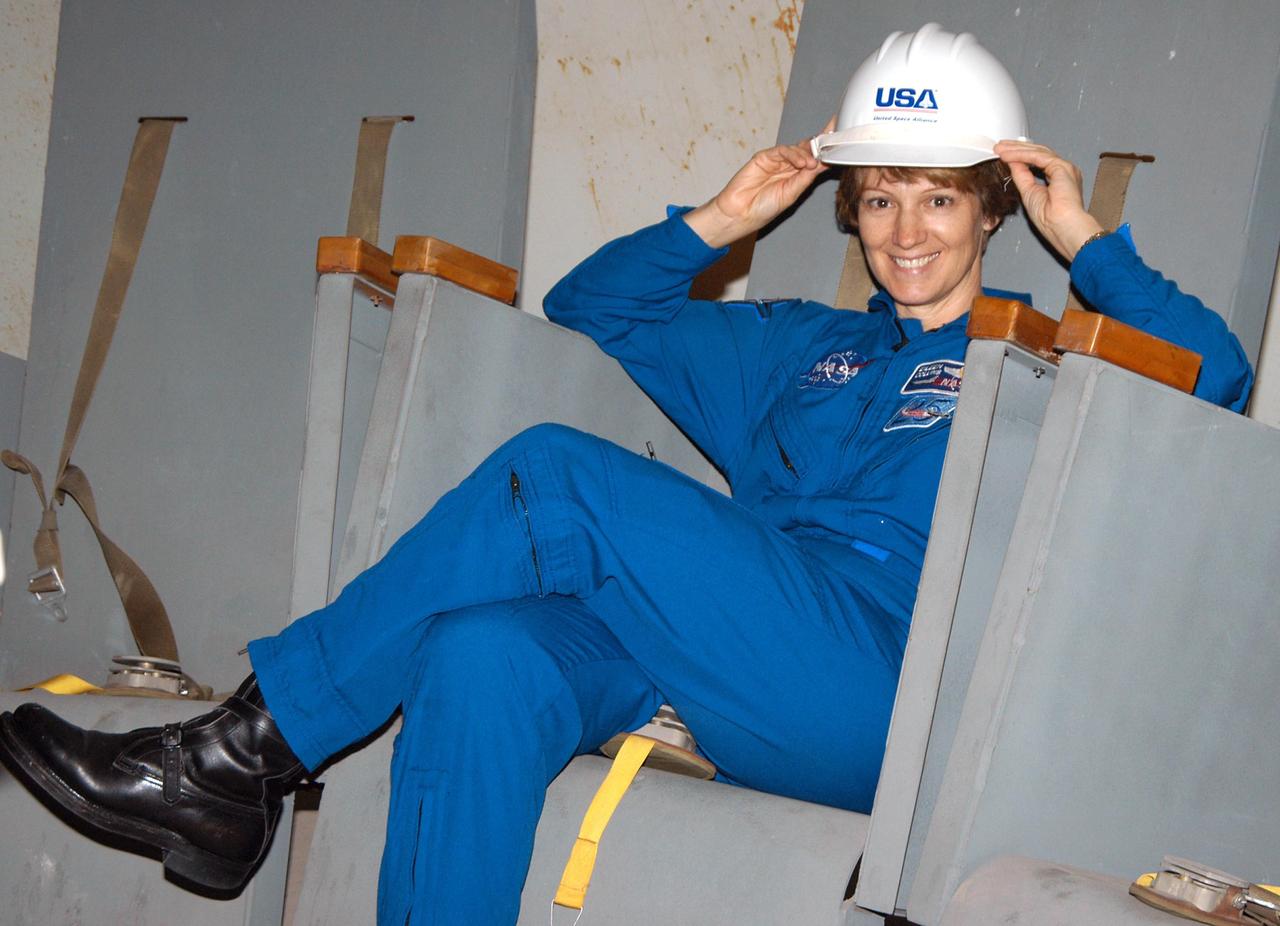
KENNEDY SPACE CENTER, FLA. -- STS-114 Mission Commander Eileen Collins tries out one of the seats in the Rubber Room. Located under the launch pad, the steel dome Rubber Room floats on rubber isolators. It was the escape area used during the Apollo launches and it could not be removed when the pad was modified for the Shuttle. In case of an emergency on the pad, the astronauts would slide down the long vertical tube to the Rubber Room, strap themselves into the seats and wait for the danger to clear. The STS-114 mission is Logistics Flight 1, which is scheduled to deliver supplies and equipment plus the external stowage platform to the International Space Station.
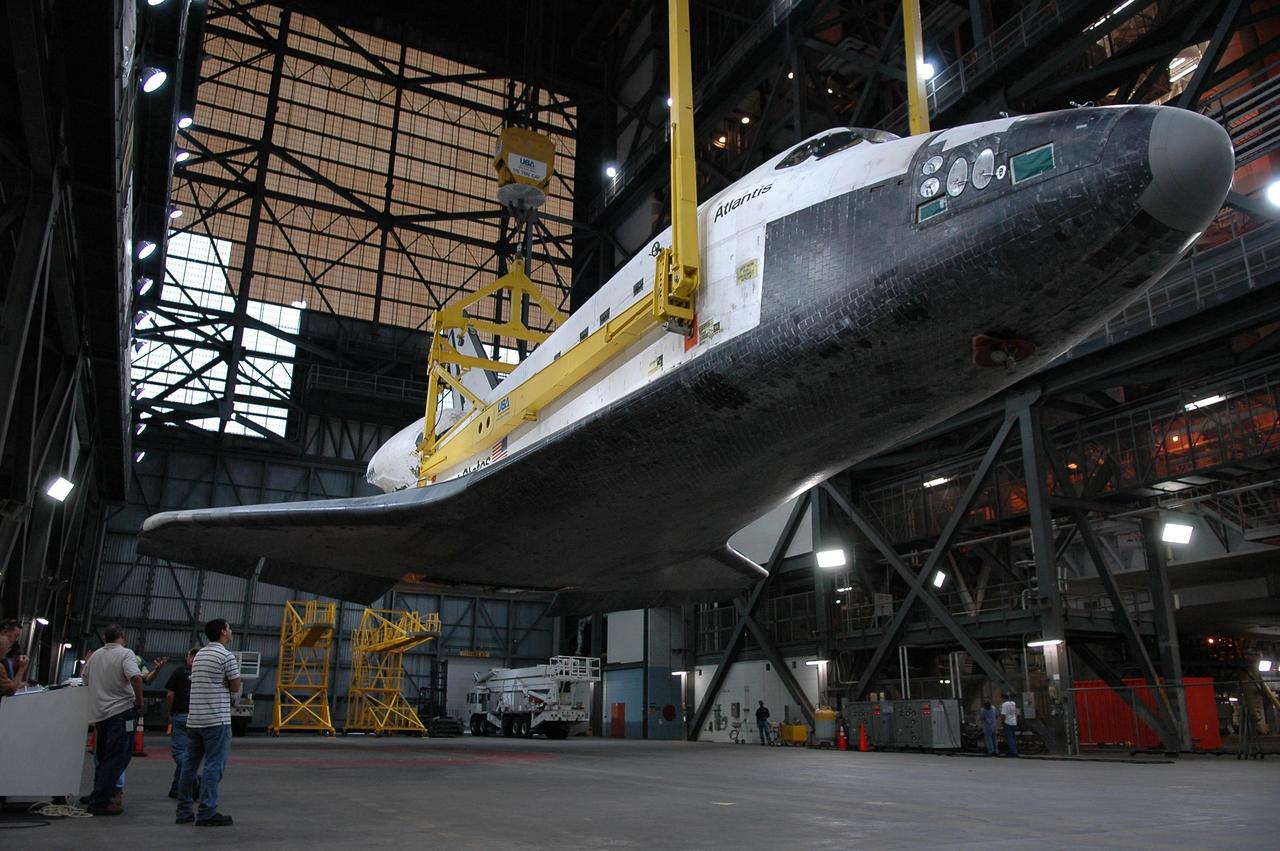
KENNEDY SPACE CENTER, FLA. - In the transfer aisle of the Vehicle Assembly Building, Atlantis seems to float above the floor as it is suspended by an overhead crane and sling. The orbiter will be raised to a vertical position and then will be lifted into high bay 3 for stacking with the external tank and solid rocket boosters already installed on the mobile launcher platform. After mating with the external tank and boosters, Atlantis will undergo a shuttle interface test and other prelaunch processing. Atlantis' launch window begins Aug. 28. During its 11-day mission to the International Space Station, the STS-115 crew of six astronauts will continue construction of the station and install their cargo, the Port 3/4 truss segment with its two large solar arrays. Photo credit: NASA/Kim Shiflett
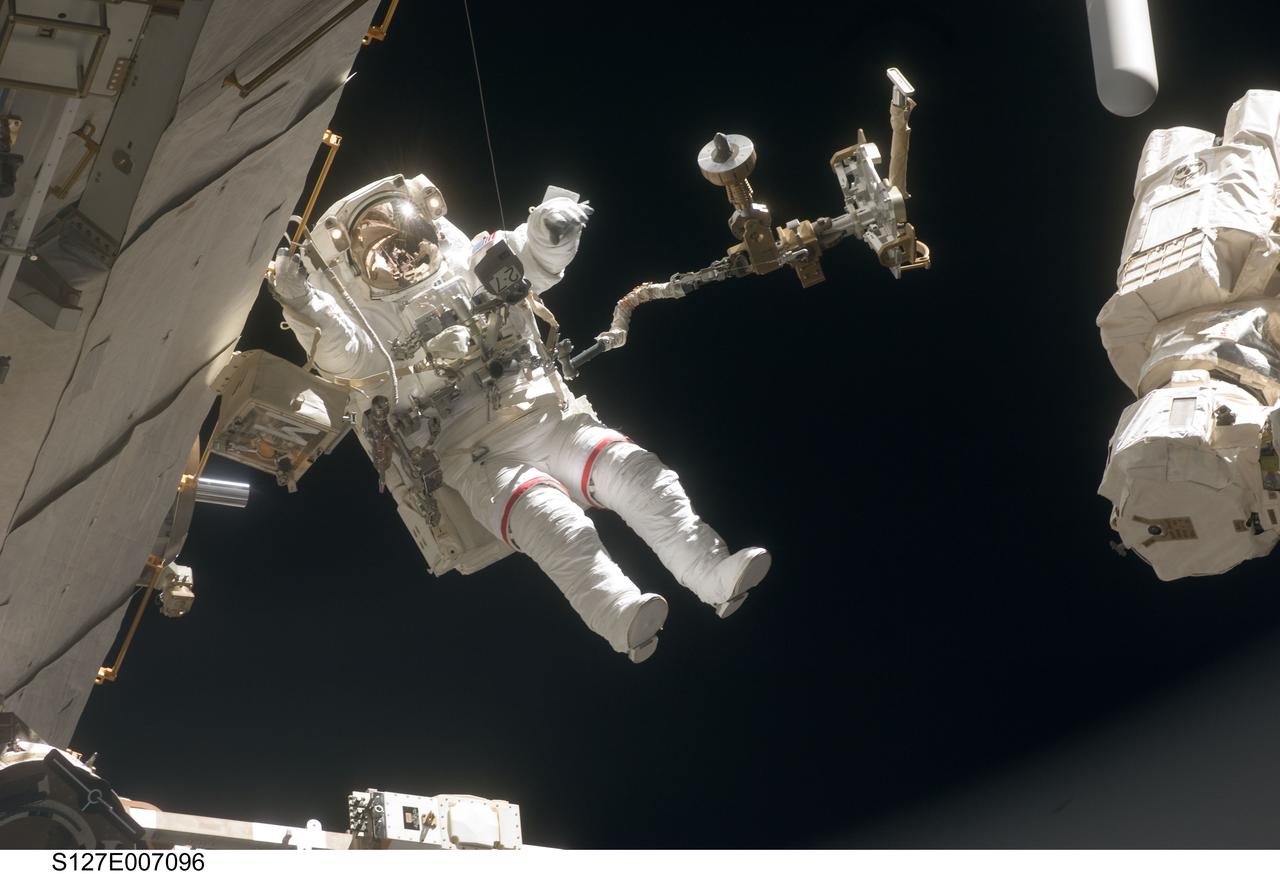
S127-E-007096 (20 July 2009) --- This is one of a series of digital still images showing astronaut Dave Wolf performing his second spacewalk and the Endeavour’s second also of the scheduled five overall in a little over a week’s time to continue work on the International Space Station. The equipment floating in front of Wolf is tethered to his spacesuit. Astronauts Wolf and Tom Marshburn (out of frame), both mission specialists, successfully transferred a spare KU-band antenna to long-term storage on the space station, along with a backup coolant system pump module and a spare drive motor for the station's robot arm transporter. Installation of a television camera on the Japanese Exposed Facility experiment platform was deferred to a later spacewalk.
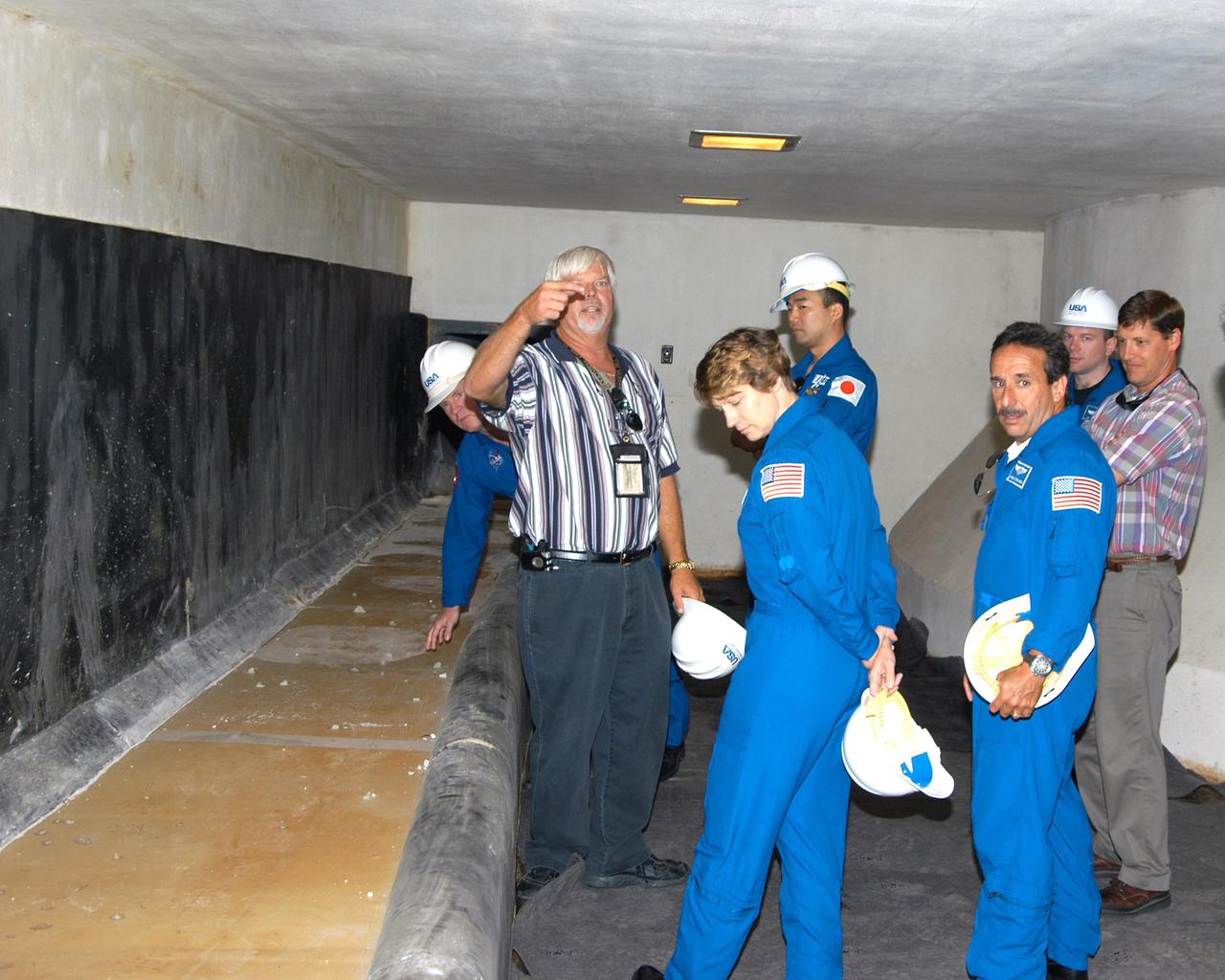
KENNEDY SPACE CENTER, FLA. -- STS-114 crew members tour the Rubber Room at Launch Pad 39A. From left to right are Mission Specialist Andrew Thomas; Steve Leonhard, chief, Pad A Operations, with United Space Alliance (USA); Mission Commander Eileen Collins; Mission Specialists Soichi Noguchi, who represents the Japanese Aerospace and Exploration Agency, and Charles Camarda; Pilot James Kelly; and David Sutherland, manager, Pad A Operations, USA. Located under the launch pad, the steel dome Rubber Room floats on rubber isolators. It was the escape area used during the Apollo launches and it could not be removed when the pad was modified for the Shuttle. In case of an emergency on the pad, the astronauts would slide down a long vertical tube (left) to the Rubber Room and wait for the danger to clear. The STS-114 mission is Logistics Flight 1, which is scheduled to deliver supplies and equipment plus the external stowage platform to the International Space Station.
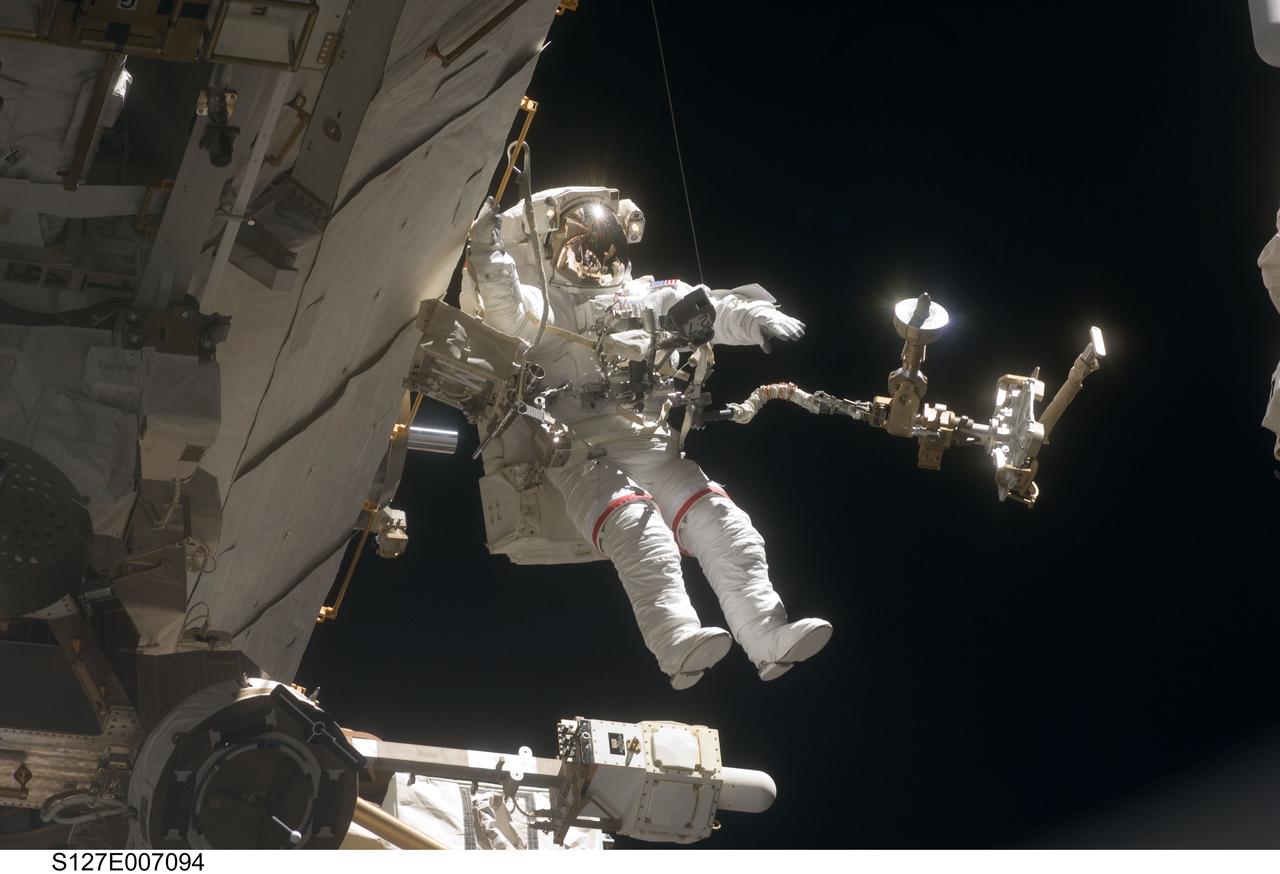
S127-E-007094 (20 July 2009) --- This is one of a series of digital still images showing astronaut Dave Wolf performing his second spacewalk and the Endeavour’s second also of the scheduled five overall in a little over a week’s time to continue work on the International Space Station. The equipment floating in front of Wolf is tethered to his spacesuit. Astronauts Wolf and Tom Marshburn (out of frame), both mission specialists, successfully transferred a spare KU-band antenna to long-term storage on the space station, along with a backup coolant system pump module and a spare drive motor for the station's robot arm transporter. Installation of a television camera on the Japanese Exposed Facility experiment platform was deferred to a later spacewalk.
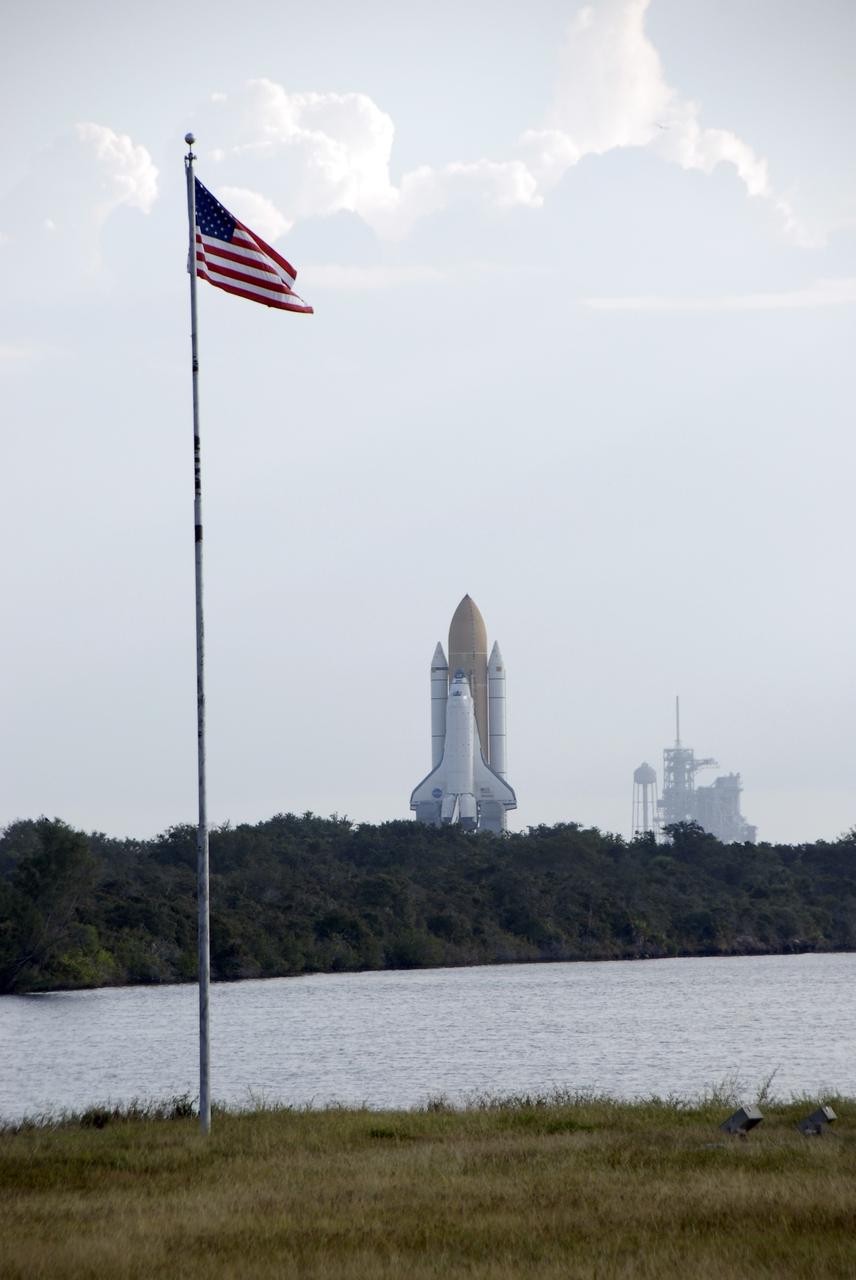
CAPE CANAVERAL, Fla. – At NASA's Kennedy Space Center in Florida, space shuttle Atlantis appears to float above the trees on its 3.4-mile trip from the Vehicle Assembly Building to Launch Pad 39A, in the background at right. In reality, the shuttle is secured to its mobile launcher platform for the move, known as rollout, and is being carried by a crawler-transporter. First motion was at 6:38 a.m. EDT Oct. 14. Rollout is expected to take about six hours. Liftoff of Atlantis on its STS-129 mission to the International Space Station is targeted for Nov. 12. For information on the STS-129 mission and crew, visit http://www.nasa.gov/mission_pages/shuttle/shuttlemissions/sts129/index.html. Photo credit: NASA/Kim Shiflett
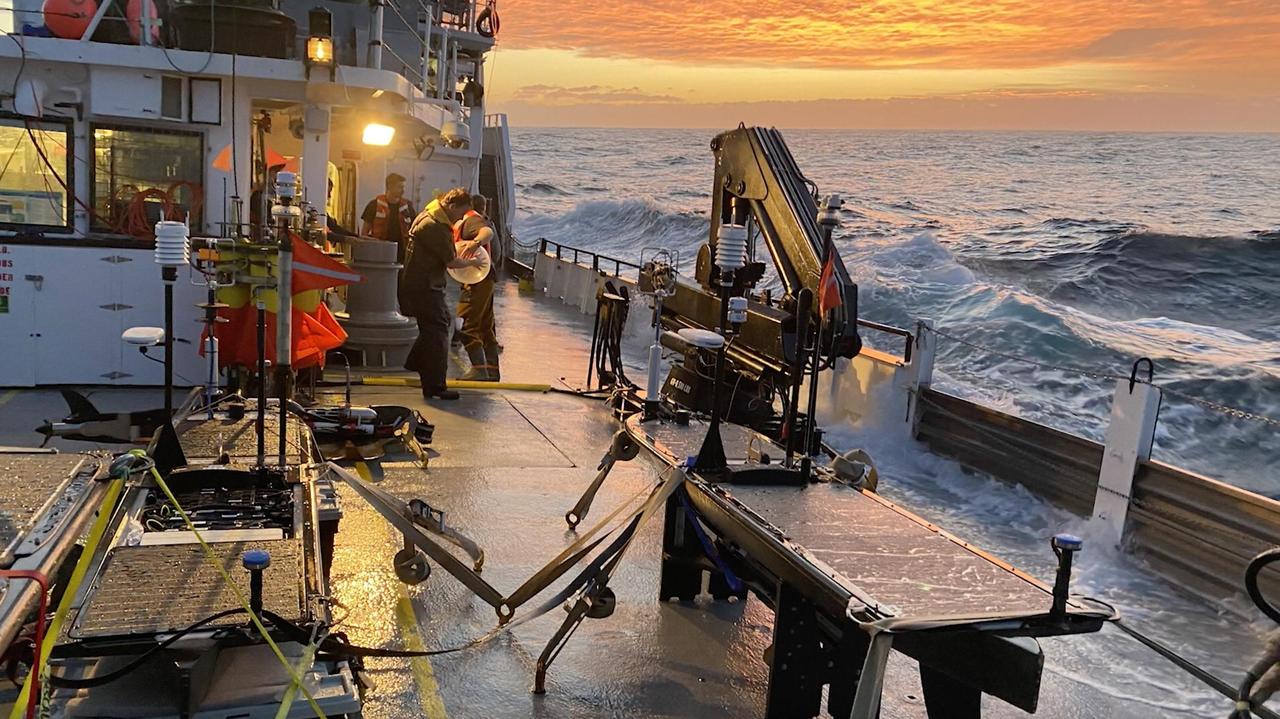
During the pilot campaign for NASA's Sub-Mesoscale Ocean Dynamics Experiment (S-MODE) in 2021, on the transit from Oregon to the experiment site off the coast of San Francisco, large waves (some reaching around 23 feet or 7 meters tall) rolled over the deck of the research vessel Oceanus, damaging several autonomous wave gliders seen here. Scientists from across the country then assembled to repair the instruments in San Francisco harbor. Wave gliders are one type of autonomous marine research platform deployed at sea during S-MODE's field campaigns in the Pacific Ocean. The uncrewed vessels feature a set of fins – on a submersible platform tethered to a surface float – which it uses to propel the craft around the upper ocean. The platforms carry a variety of sensors and instruments. Because they're autonomous, their use reduces the risk posed to human researchers who could be exposed to large storms at sea. S-MODE is a NASA Earth mission to use newly developed in-situ and remote-sensing techniques to look at small-scale ocean whirlpools, eddies, and currents. The observations could help scientists better understand how these dynamics drive the give-and-take of material and energy between the ocean and atmosphere and, ultimately, help shape Earth's climate. More information about S-MODE is at https://espo.nasa.gov/s-mode/content/S-MODE https://photojournal.jpl.nasa.gov/catalog/PIA25522
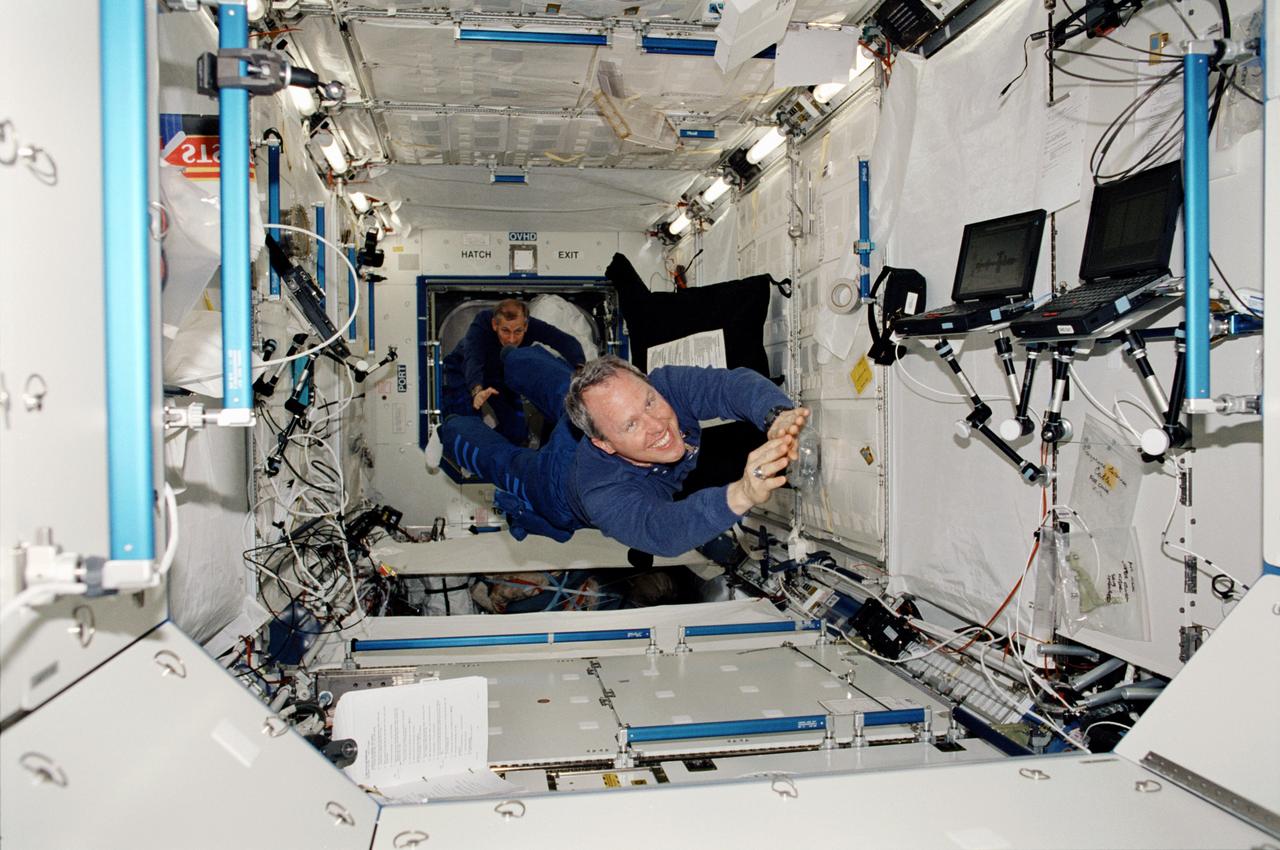
This STS-98 mission photograph shows astronauts Thomas D. Jones (foreground) and Kerneth D. Cockrell floating inside the newly installed Laboratory aboard the International Space Station (ISS). The American-made Destiny module is the cornerstone for space-based research aboard the orbiting platform and the centerpiece of the ISS, where unprecedented science experiments will be performed in the near-zero gravity of space. Destiny will also serve as the command and control center for the ISS. The aluminum module is 8.5-meters (28-feet) long and 4.3-meters (14-feet) in diameter. The laboratory consists of three cylindrical sections and two endcones with hatches that will be mated to other station components. A 50.9-centimeter (20-inch-) diameter window is located on one side of the center module segment. This pressurized module is designed to accommodate pressurized payloads. It has a capacity of 24 rack locations. Payload racks will occupy 15 locations especially designed to support experiments. The Destiny module was built by the Boeing Company under the direction of the Marshall Space Flight Center.

A crane lowers two BARREL balloon payloads onto the platform at Halley Research Station in Antarctica. Credit: NASA --- In Antarctica in January, 2013 – the summer at the South Pole – scientists launched 20 balloons up into the air to study an enduring mystery of space weather: when the giant radiation belts surrounding Earth lose material, where do the extra particles actually go? The mission is called BARREL (Balloon Array for Radiation belt Relativistic Electron Losses) and it is led by physicist Robyn Millan of Dartmouth College in Hanover, NH. Millan provided photographs from the team’s time in Antarctica. The team launched a balloon every day or two into the circumpolar winds that circulate around the pole. Each balloon floated for anywhere from 3 to 40 days, measuring X-rays produced by fast-moving electrons high up in the atmosphere. BARREL works hand in hand with another NASA mission called the Van Allen Probes, which travels through the Van Allen radiation belts surrounding Earth. The belts wax and wane over time in response to incoming energy and material from the sun, sometimes intensifying the radiation through which satellites must travel. Scientists wish to understand this process better, and even provide forecasts of this space weather, in order to protect our spacecraft. As the Van Allen Probes were observing what was happening in the belts, BARREL tracked electrons that precipitated out of the belts and hurtled down Earth’s magnetic field lines toward the poles. By comparing data, scientists will be able to track how what’s happening in the belts correlates to the loss of particles – information that can help us understand this mysterious, dynamic region that can impact spacecraft. Having launched balloons in early 2013, the team is back at home building the next set of payloads. They will launch 20 more balloons in 2014. <b><a href="http://www.nasa.gov/audience/formedia/features/MP_Photo_Guidelines.html" rel="nofollow">NASA image use policy.</a></b> <b><a href="http://www.nasa.gov/centers/goddard/home/index.html" rel="nofollow">NASA Goddard Space Flight Center</a></b> enables NASA’s mission through four scientific endeavors: Earth Science, Heliophysics, Solar System Exploration, and Astrophysics. Goddard plays a leading role in NASA’s accomplishments by contributing compelling scientific knowledge to advance the Agency’s mission. <b>Follow us on <a href="http://twitter.com/NASA_GoddardPix" rel="nofollow">Twitter</a></b> <b>Like us on <a href="http://www.facebook.com/pages/Greenbelt-MD/NASA-Goddard/395013845897?ref=tsd" rel="nofollow">Facebook</a></b> <b>Find us on <a href="http://instagram.com/nasagoddard?vm=grid" rel="nofollow">Instagram</a></b>