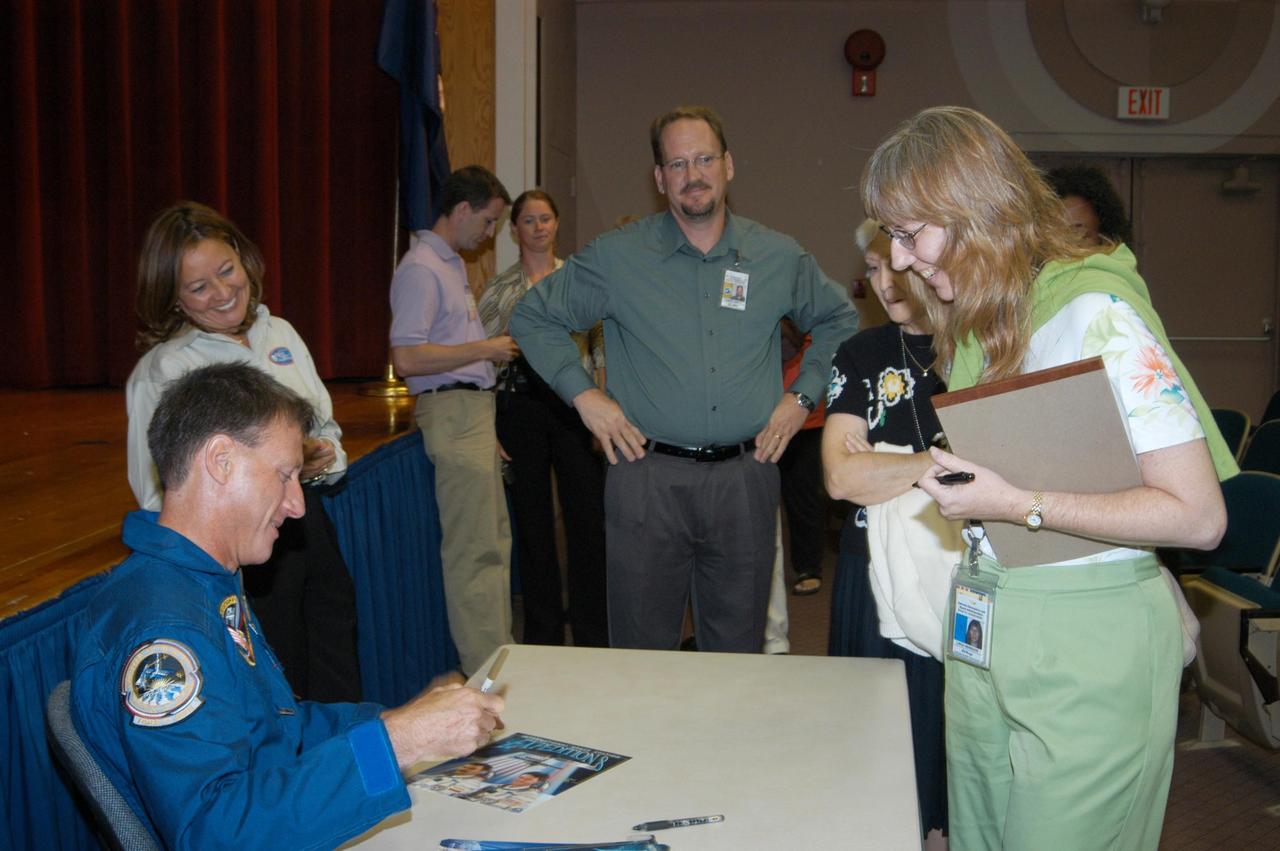
KENNEDY SPACE CENTER, FLA. - After his presentation in the Training Auditorium, astronaut Mike Foale greets employees and signs autographs. Foale shared his experiences aboard the International Space Station as commander of the Expedition 8 crew. Foale and Flight Engineer Alexander Kaleri spent 194 days, 18 hours and 35 minutes in space, the second longest expedition to be completed aboard the Station. In February Foale and Kaleri conducted the first spacewalk ever performed from the complex by a two-person crew. Foale has accumulated more time in space than any U.S. astronaut, amassing a total of 374 days, 11 hours and 19 minutes in space from his Expedition 8 mission, a 1997 flight to the Russian Mir Space Station, and four Space Shuttle missions.
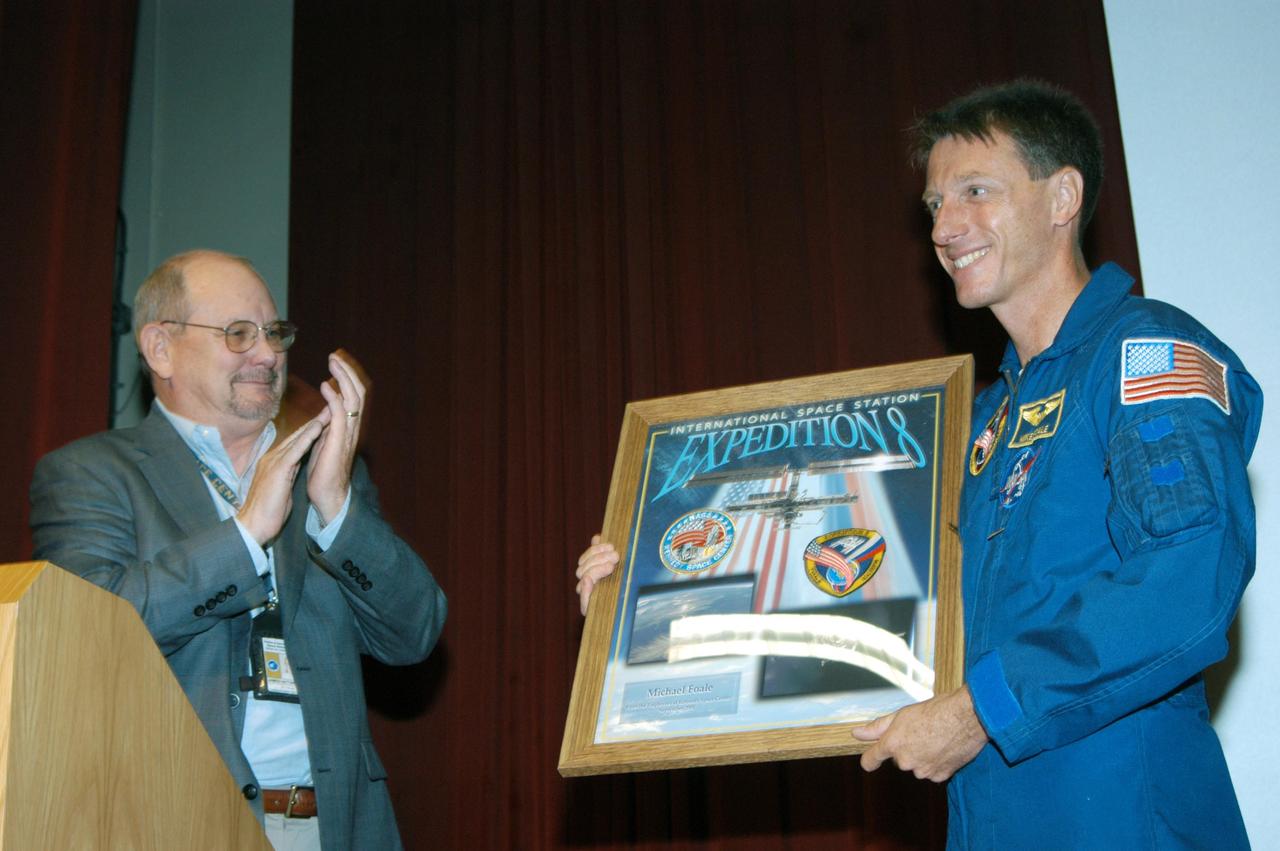
KENNEDY SPACE CENTER, FLA. - In the Training Auditorium, James Hattaway Jr., KSC associate director, presents a framed graphic to astronaut Mike Foale representing his stay aboard the International Space Station as commander of the Expedition 8 crew. .Foale spoke to the audience of employees about his experiences aboard the Space Station. Foale and Flight Engineer Alexander Kaleri spent 194 days, 18 hours and 35 minutes in space, the second longest expedition to be completed aboard the Station. In February Foale and Kaleri conducted the first spacewalk ever performed from the complex by a two-person crew. Foale has accumulated more time in space than any U.S. astronaut, amassing a total of 374 days, 11 hours and 19 minutes in space from his Expedition 8 mission, a 1997 flight to the Russian Mir Space Station, and four Space Shuttle missions.
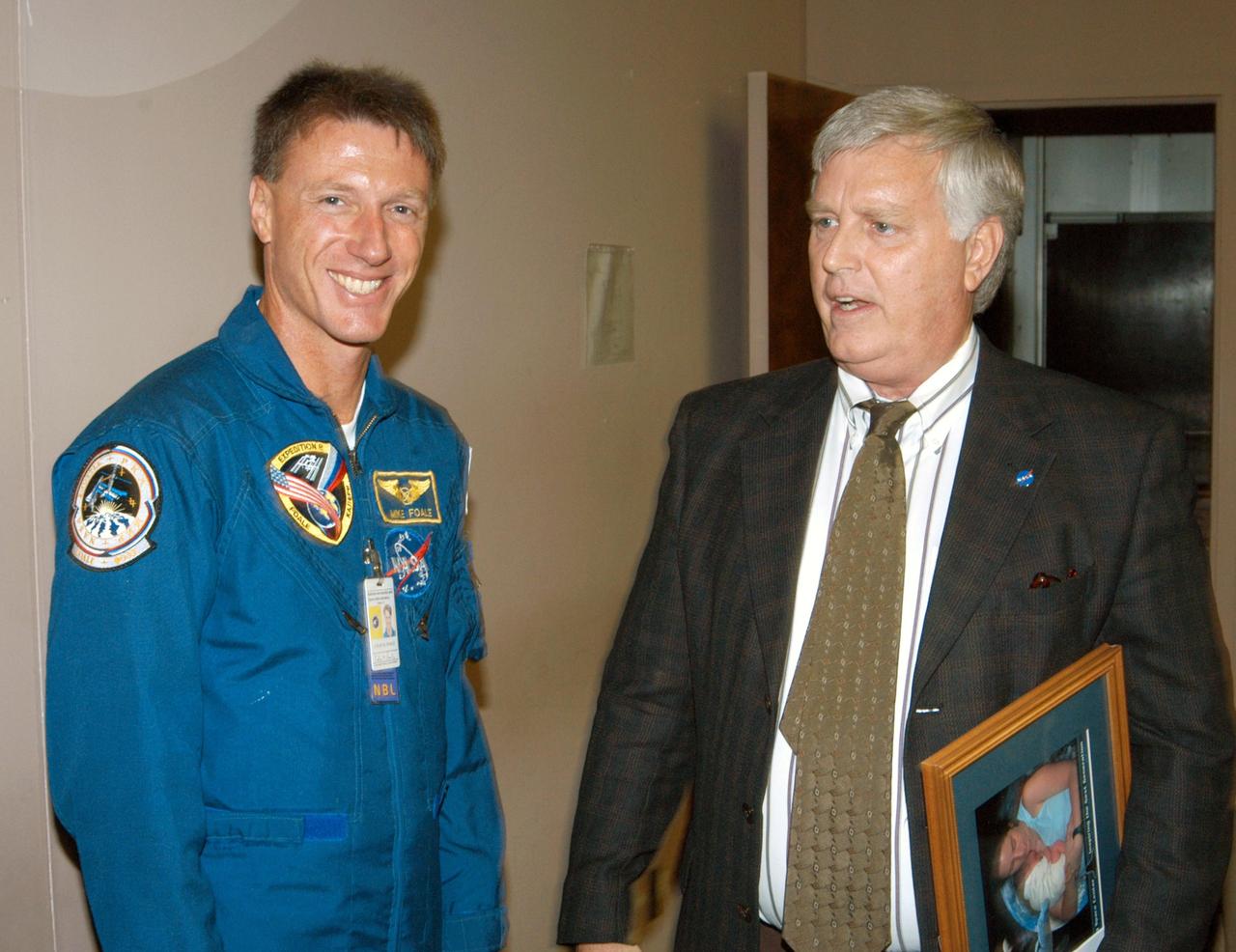
KENNEDY SPACE CENTER, FLA. - Astronaut Mike Foale, left, joins Center Director Jim Kennedy, right, in the Training Auditorium. Foale spoke to the audience about his experiences aboard the International Space Station as commander of the Expedition 8 crew. Foale and Flight Engineer Alexander Kaleri spent 194 days, 18 hours and 35 minutes in space, the second longest expedition to be completed aboard the Station. In February Foale and Kaleri conducted the first spacewalk ever performed from the complex by a two-person crew. Foale has accumulated more time in space than any U.S. astronaut, amassing a total of 374 days, 11 hours and 19 minutes in space from his Expedition 8 mission, a 1997 flight to the Russian Mir Space Station, and four Space Shuttle missions.
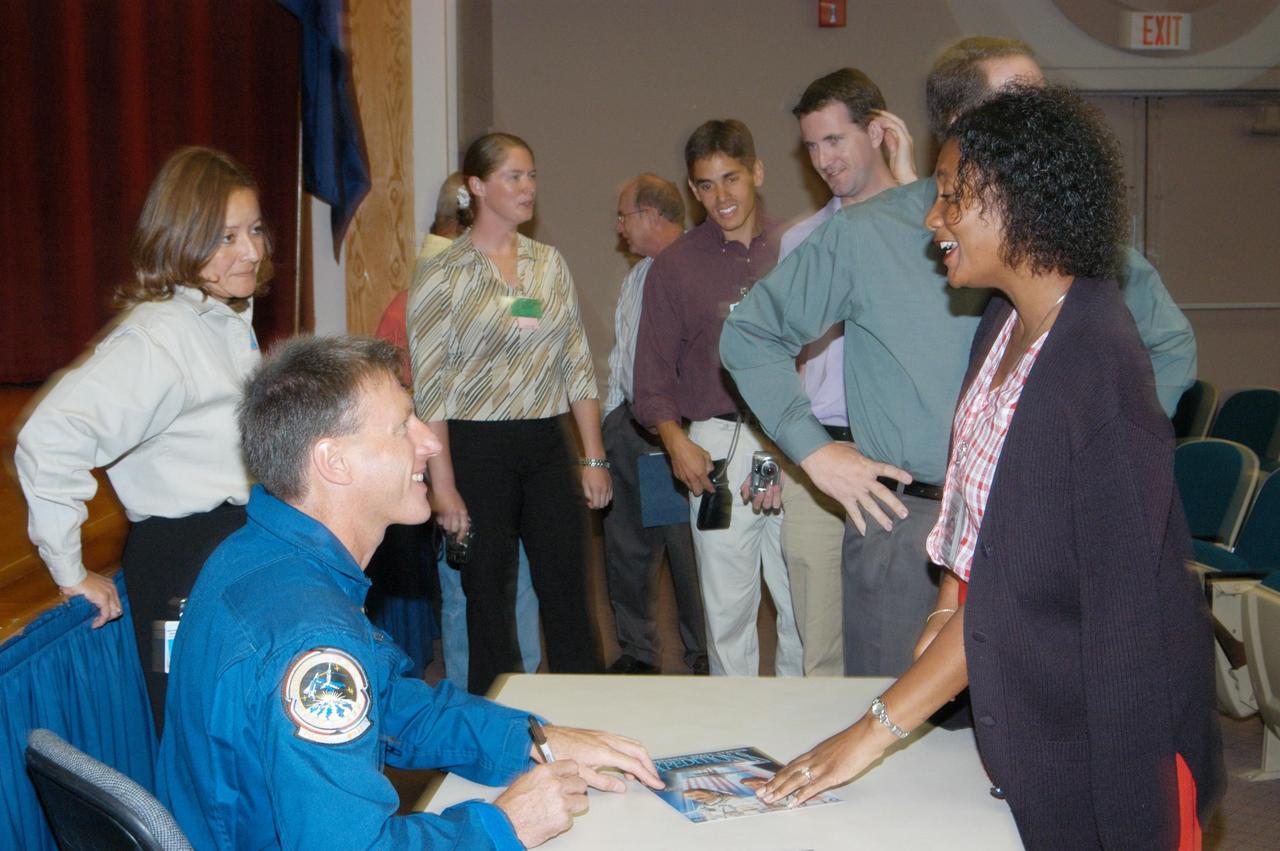
KENNEDY SPACE CENTER, FLA. - After his presentation in the Training Auditorium, astronaut Mike Foale greets employees and signs autographs. Foale shared his experiences aboard the International Space Station as commander of the Expedition 8 crew. Foale and Flight Engineer Alexander Kaleri spent 194 days, 18 hours and 35 minutes in space, the second longest expedition to be completed aboard the Station. In February Foale and Kaleri conducted the first spacewalk ever performed from the complex by a two-person crew. Foale has accumulated more time in space than any U.S. astronaut, amassing a total of 374 days, 11 hours and 19 minutes in space from his Expedition 8 mission, a 1997 flight to the Russian Mir Space Station, and four Space Shuttle missions.
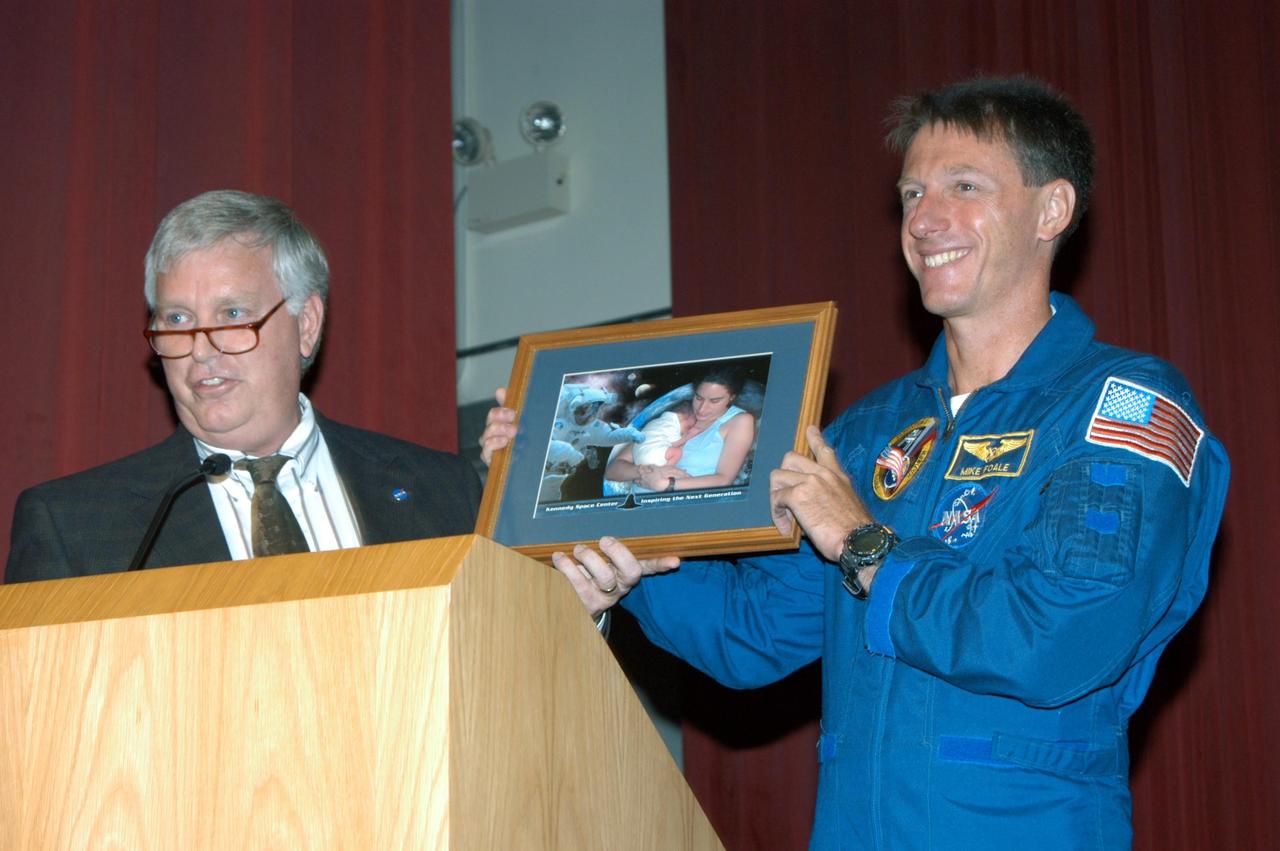
KENNEDY SPACE CENTER, FLA. - In the Training Auditorium, Center Director Jim Kennedy presents a framed photo to astronaut Mike Foale, who spoke to the audience about his experiences aboard the International Space Station as commander of the Expedition 8 crew. Foale and Flight Engineer Alexander Kaleri spent 194 days, 18 hours and 35 minutes in space, the second longest expedition to be completed aboard the Station. In February Foale and Kaleri conducted the first spacewalk ever performed from the complex by a two-person crew. Foale has accumulated more time in space than any U.S. astronaut, amassing a total of 374 days, 11 hours and 19 minutes in space from his Expedition 8 mission, a 1997 flight to the Russian Mir Space Station, and four Space Shuttle missions.
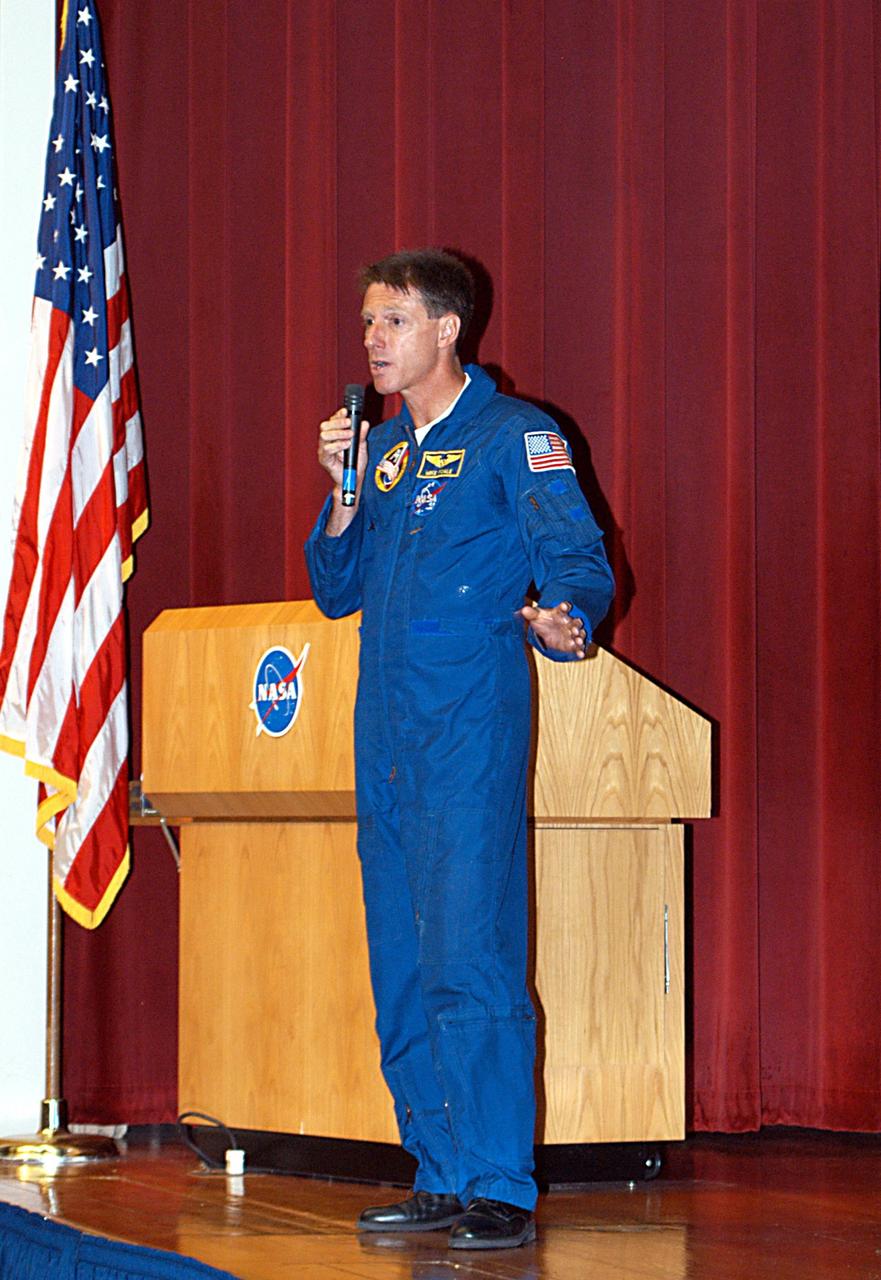
KENNEDY SPACE CENTER, FLA. - In the Training Auditorium, astronaut Mike Foale speaks to the audience about his experiences aboard the International Space Station as commander of the Expedition 8 crew. Foale and Flight Engineer Alexander Kaleri spent 194 days, 18 hours and 35 minutes in space, the second longest expedition to be completed aboard the Station. In February Foale and Kaleri conducted the first spacewalk ever performed from the complex by a two-person crew. Foale has accumulated more time in space than any U.S. astronaut, amassing a total of 374 days, 11 hours and 19 minutes in space from his Expedition 8 mission, a 1997 flight to the Russian Mir Space Station, and four Space Shuttle missions.

S103-E-5191 (21 Dec. 1999) --- Astronaut C. Michael Foale, STS-103 mission specialist, consults a reference manual on space shuttle Discovery's middeck just a few hours prior to the crew's capture of the Hubble Space Telescope (HST). Foale is part of the spacewalk team assigned to extravehicular activity (EVA) duty on the HST later in the week. The photo was recorded with an electronic still camera at 11:02:40 GMT, Dec. 21, 1999. Photo credit: NASA
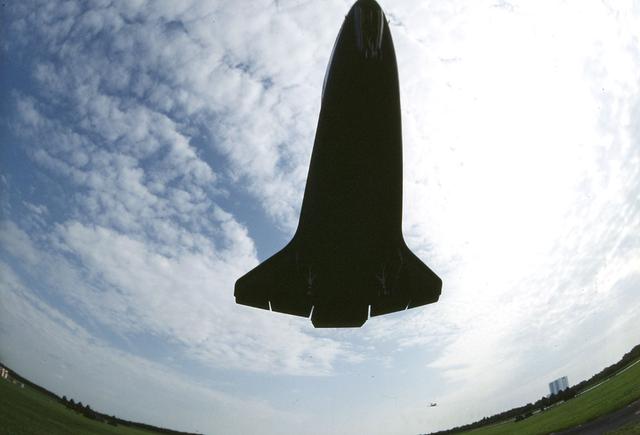
This unusual view of the underside of the Space Shuttle Orbiter Atlantis was taken by a fish-eye camera lens from Kennedy Space Center (KSC) Shuttle Landing Facility shortly before landing on May 24, 1997. Atlantis was wrapping up its nine-day mission, which was the sixth docking with the Mir space station. STS-84 Mission Specialist C. Michael Foale replaced astronaut and Mir 23 crew member Jerry M. Linenger, who had been on the Russian space station since January 15. Foale was scheduled to remain on Mir for approximately four months, until replaced by STS-86 crew member Wendy B. Lawrence in September 1997. Besides docking and crew exchange, this mission included the transfer of more than 7,300 pounds of water, logistics and science experiments, and hardware to and from Mir.
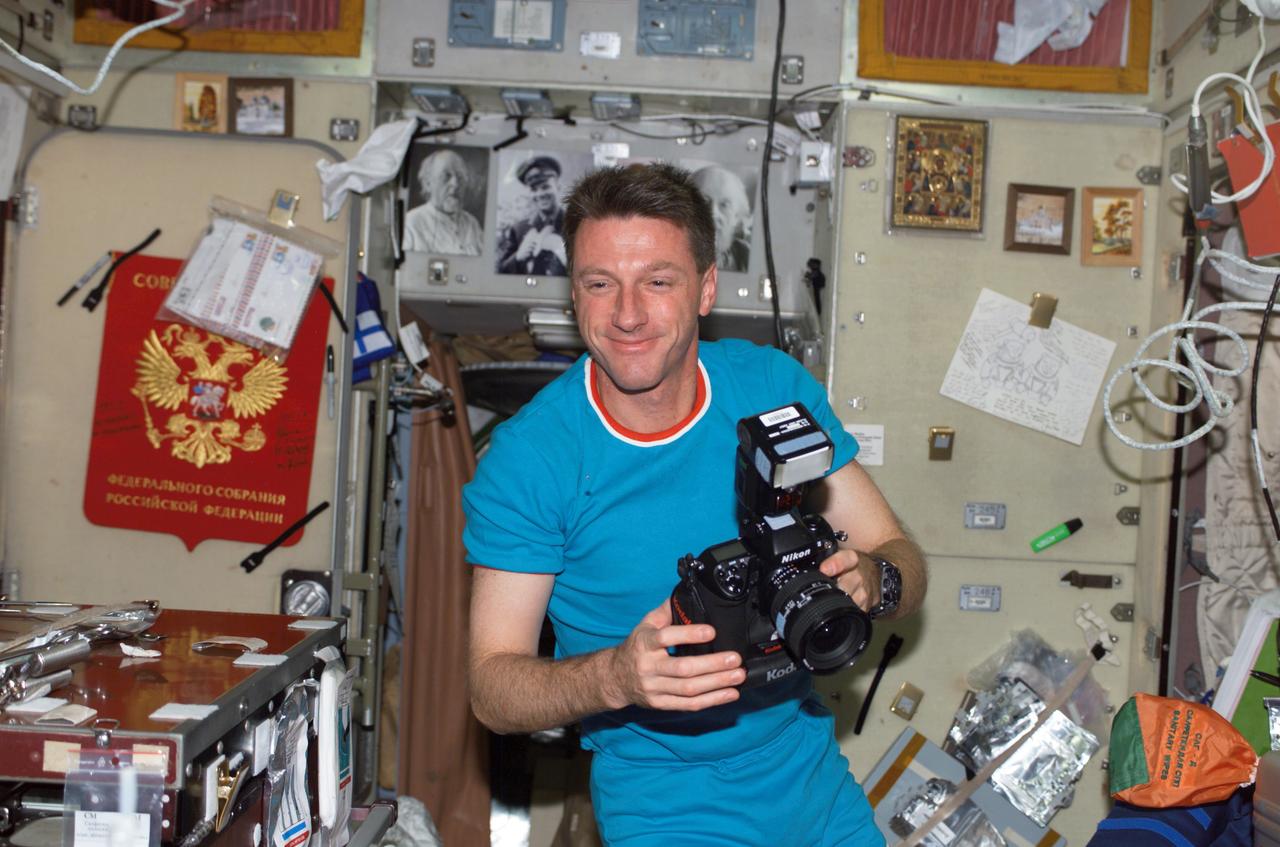
ISS007-E-17982 (25 Oct. 2003) --- Astronaut C. Michael Foale, Expedition 8 mission commander and NASA ISS science officer, holds a camera in the Zvezda Service Module on the International Space Station (ISS).
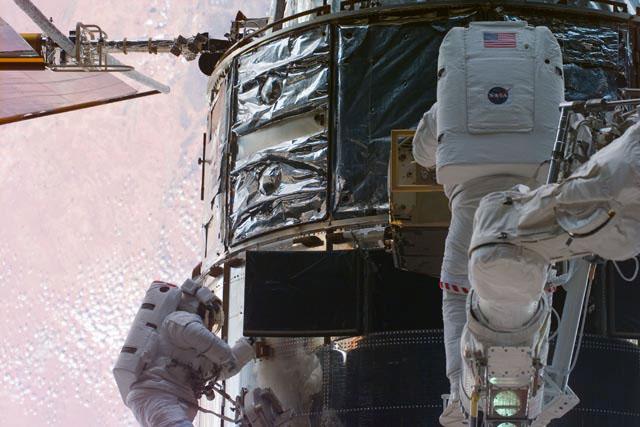
S103-E-5320 (23 December 1999) --- Astronauts C. Michael Foale (left) and Claude Nicollier work on the Hubble Space Telescope (HST)in Discovery's aft cargo bay during their shared space walk to perform servicing tasks on the Hubble Space Telescope (HST). A desert area on Earth forms the backdrop for the photo. Nicollier, part of the astronaut corps since 1980, represents the European Space Agency (ESA). Foale, one of NASA's astronauts who had spent several months aboard Russia's Mir Space Station, is an alumnus of the 1987 class of astronaut candidates. The photo was taken with an electronic still camera (ESC).
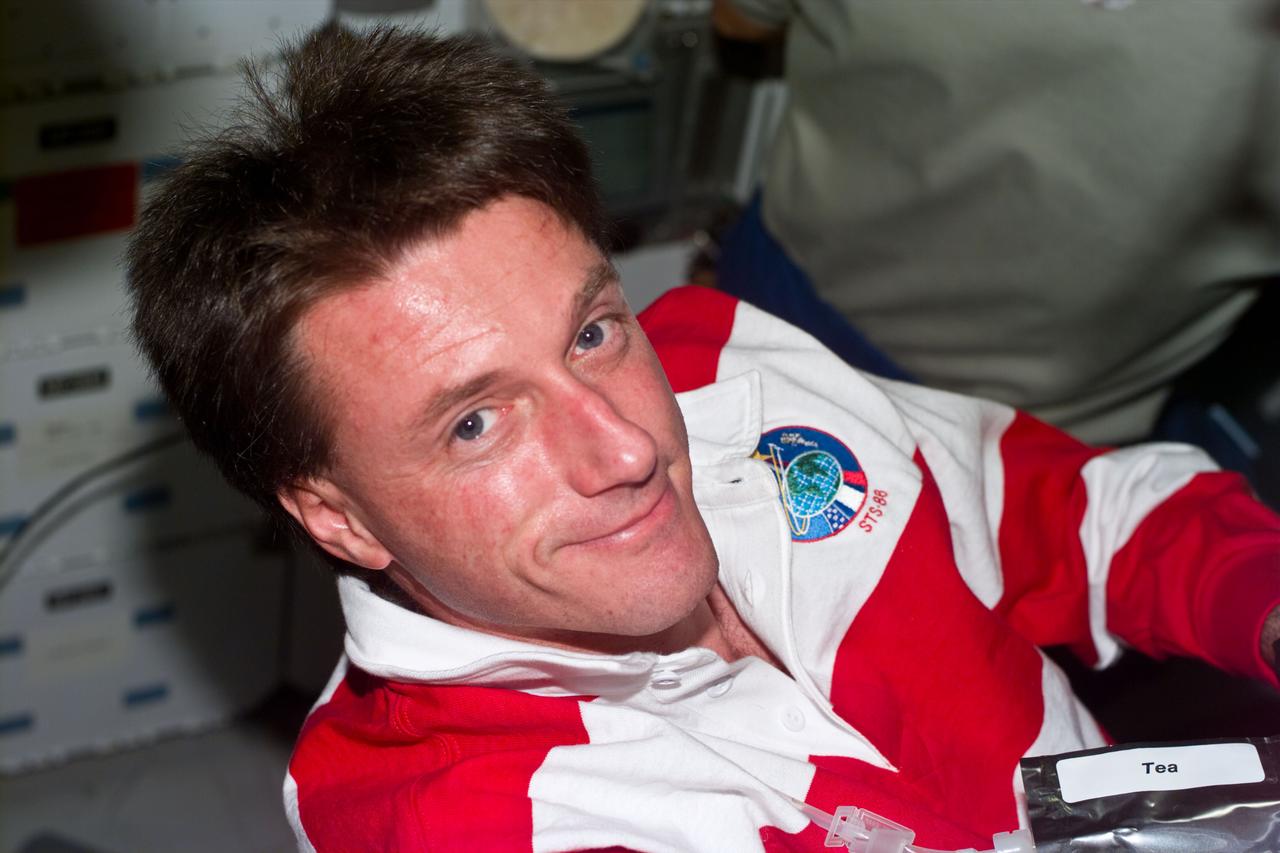
S86-E-5346 (30 September 1997) --- This Electronic Still Camera (ESC) image shows astronaut C. Michael Foale, mission specialist, hydrating tea in the middeck of the Earth-orbiting Space Shuttle Atlantis. Foale, now a STS-86 crew member, has been onboard the Russian Mir Space Station as a cosmonaut guest researcher since mid-May 1997. He was replaced by astronaut David A. Wolf during the STS-86 Atlantis/Mir docking mission. This is the seventh Atlantis/Mir docking mission. This view was taken at 00:35:35 GMT on September 30, 1997.
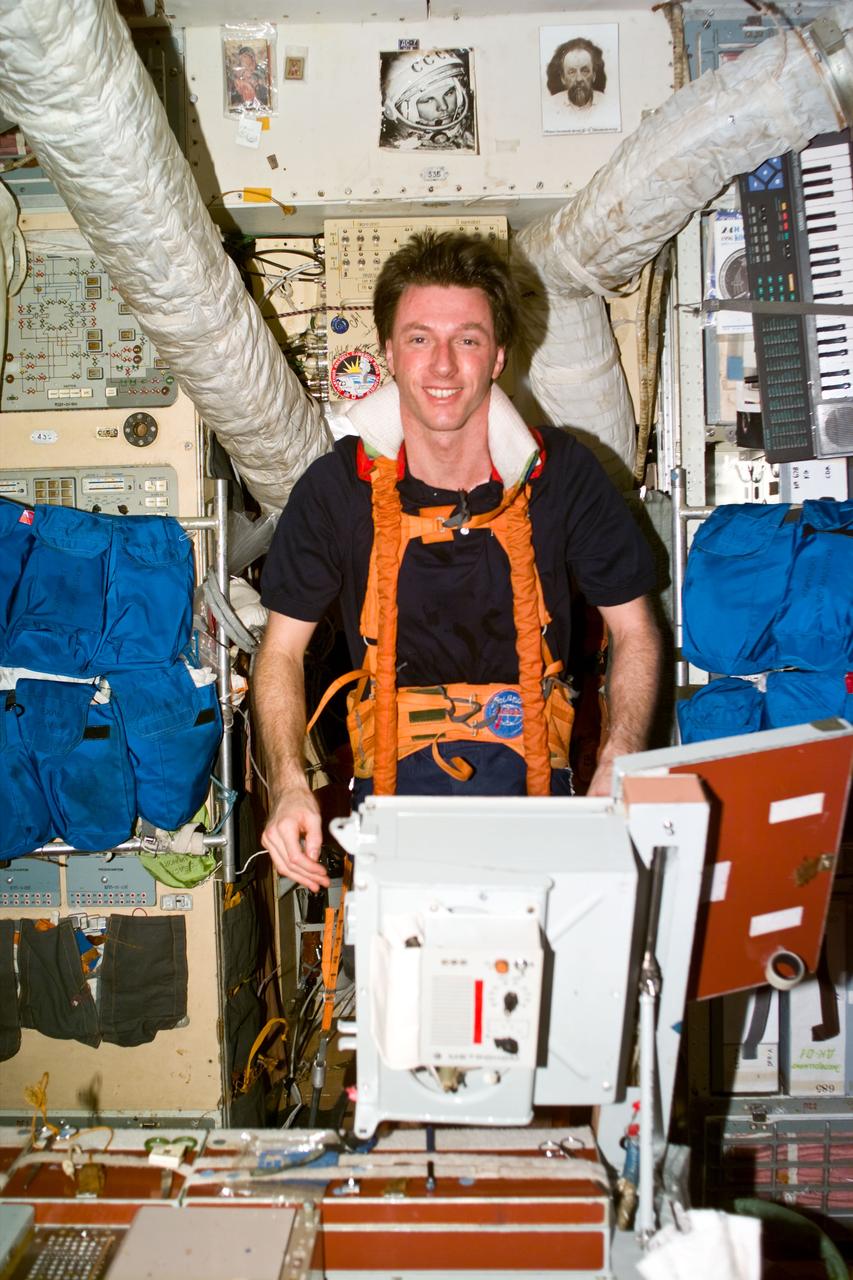
S86-E-5358 (30 Sept. 1997) --- This Electronic Still Camera (ESC) image shows astronaut C. Michael Foale, mission specialist and former cosmonaut guest researcher, exercising on the treadmill onboard the Russian Mir Space Station. Foale onboard Mir since mid-May 1997, has been replaced by astronaut David A. Wolf, during this seventh Atlantis/Mir docking mission. This view was taken at 17:30:40 GMT on Sept. 30, 1997.
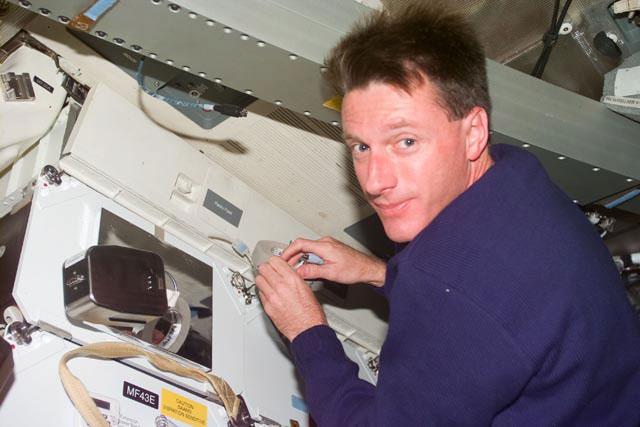
S103-E-5184 (21 December 1999) --- Astronaut C. Michael Foale, mission specialist, performs a minor maintenance task on the mid deck of the Earth-orbiting Space Shuttle Discovery. The long rectangular structure near Foale's head is the escape pole, which has been standard equipment on the shuttle fleet since 1988. The photo was recorded with an electronic still camera (ESC) at 10:39:31 GMT, Dec. 21, 1999.
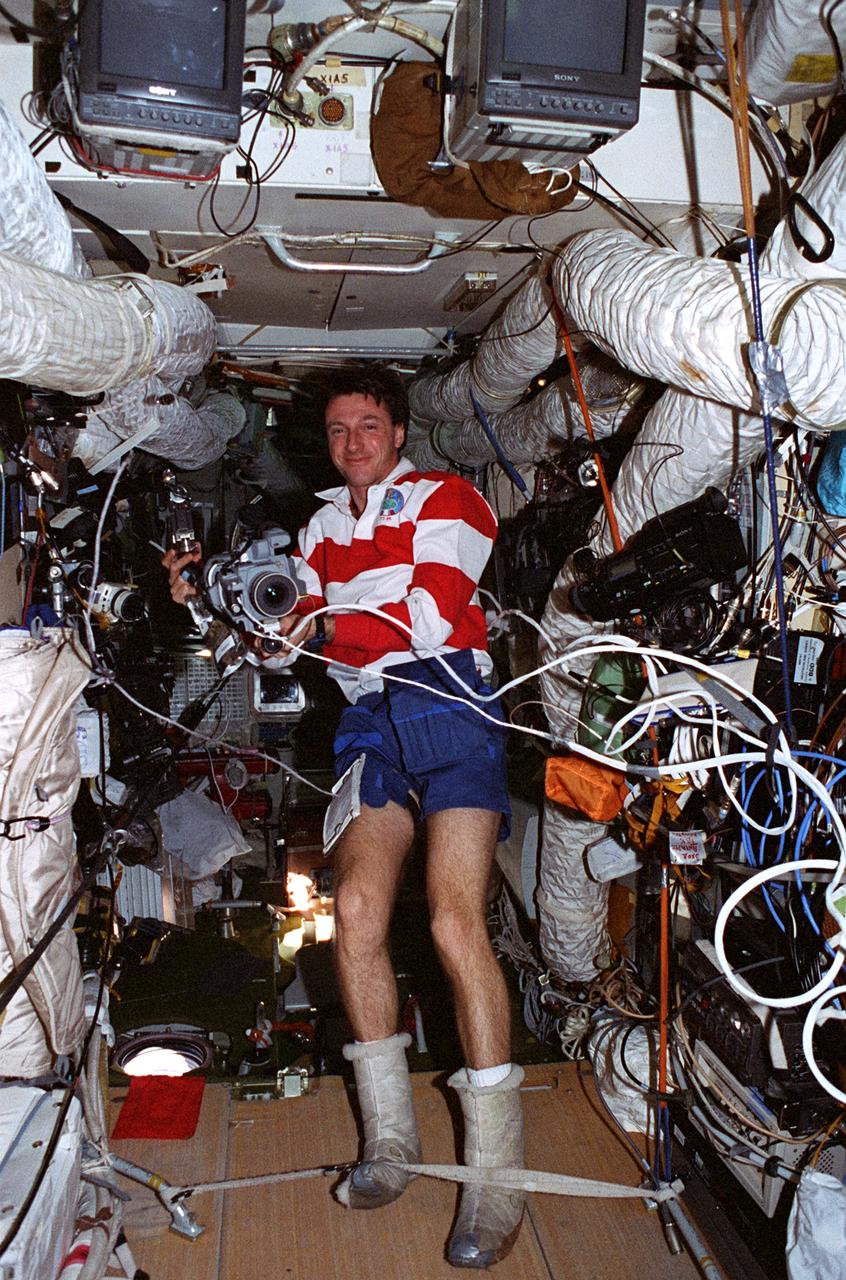
STS086-405-008 (25 Sept-6 Oct 1997) --- Astronaut C. Michael Foale, sporting attire representing the STS-86 crew after four months aboard Russia?s Mir Space Station in Russian wear, operates a video camera in Mir?s Base Block Module. Photo credit: NASA
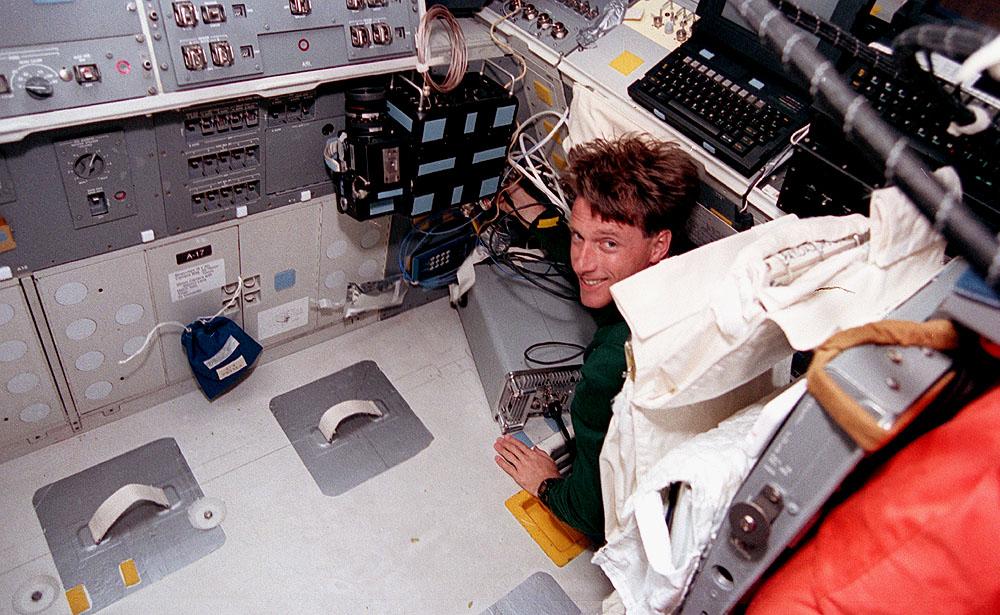
Space Shuttle Discovery (STS-56) onboard photo of Mission Specialist Michael Foale working in the Atmospheric Laboratory for Applications and Science (ATLAS-2). The ATLAS program was designed to measure the long term variability in the total energy radiated by the sun and determine the variability in the solar spectrum.
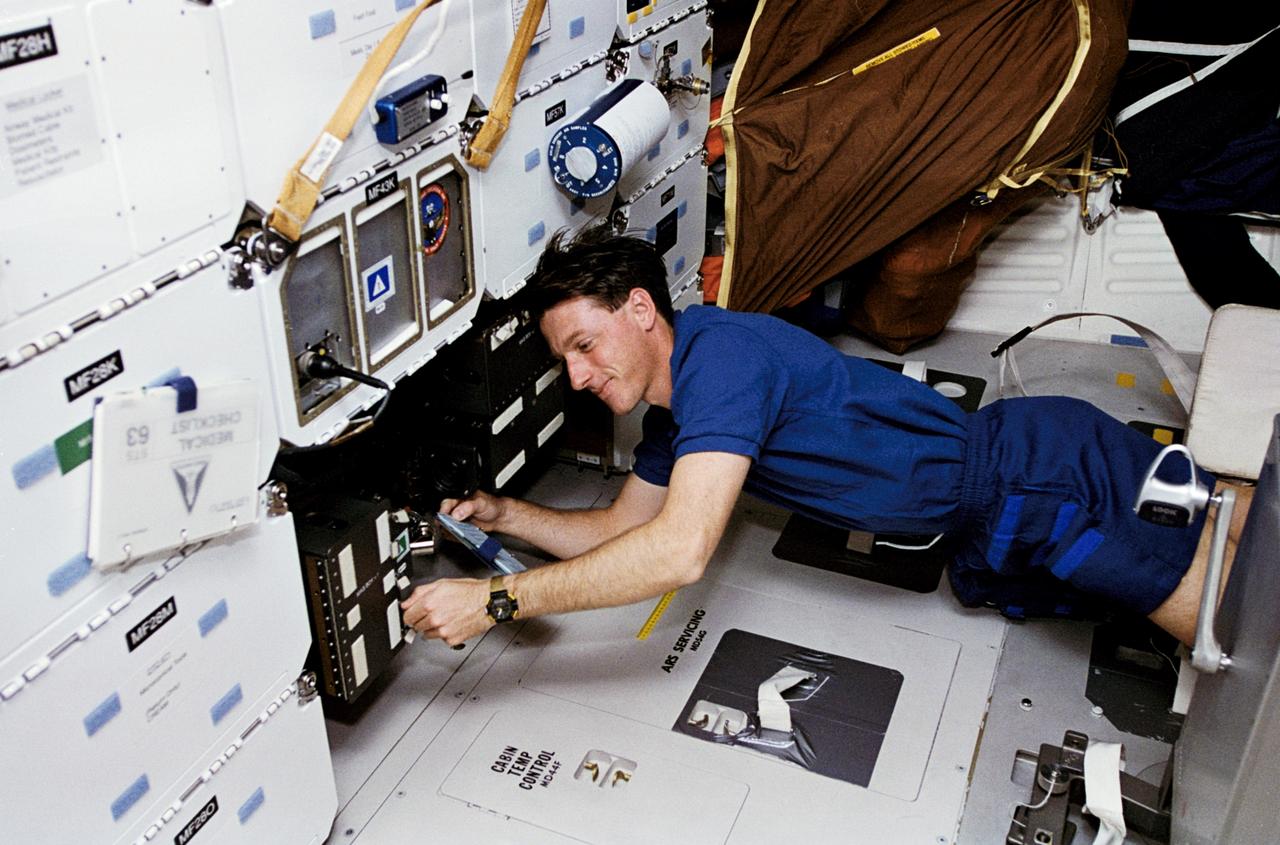
STS063-29-002 (3-11 Feb. 1995) --- On the Space Shuttle Discovery's middeck, astronaut C. Michael Foale, mission specialist, checks on the Solid Surface Combustion Experiment (SSCE). Foale was joined by four other NASA astronauts James D. Wetherbee, commander; Eileen M. Collins, pilot; Bernard A. Harris, Jr., payload commander; Janice E. Voss, mission specialist, and a Russian cosmonaut, Vladimir G. Titov; for eight days of research in Earth-orbit.
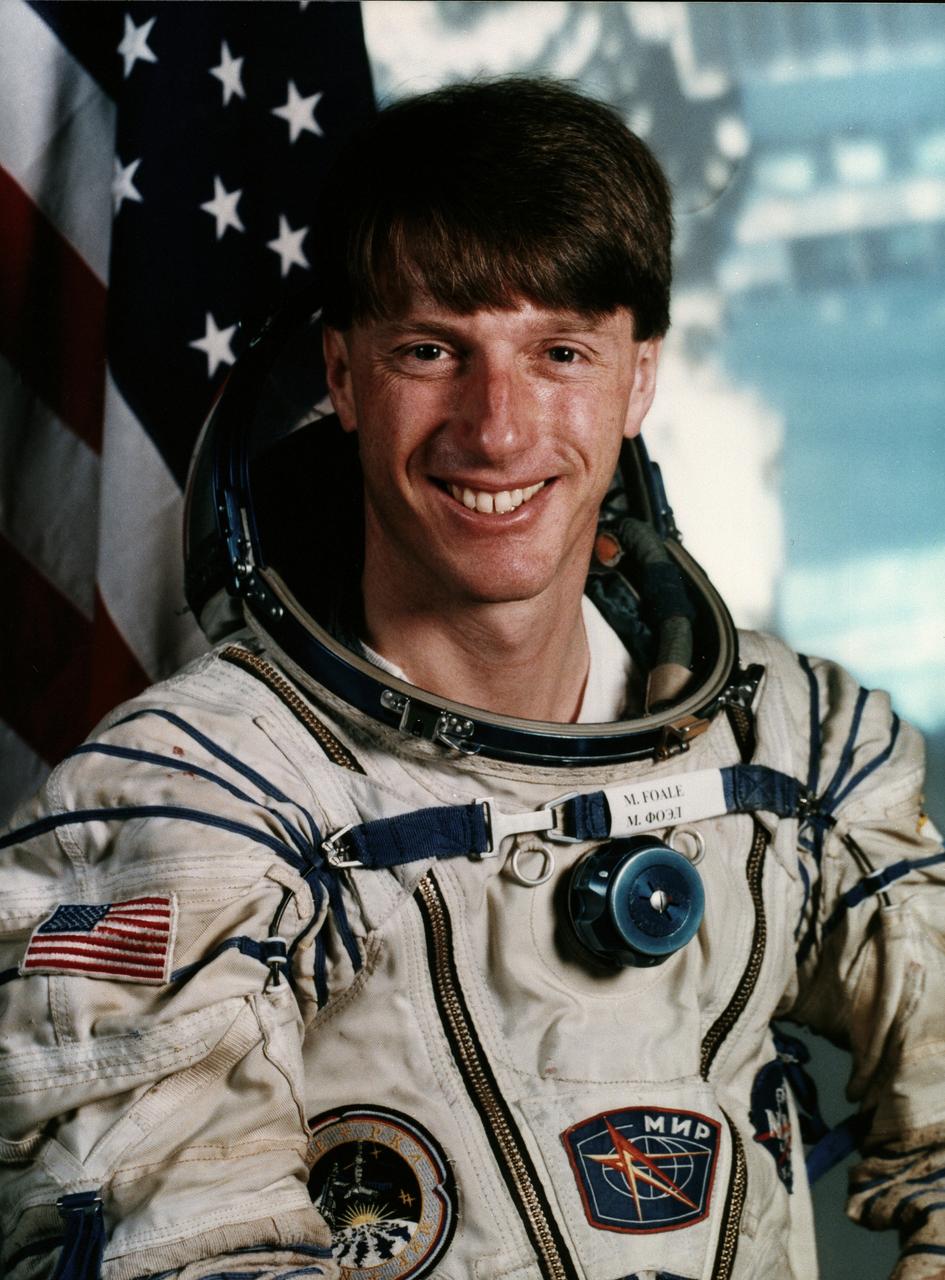
S97-06565 (1997) --- Astronaut C. Michael Foale, mission specialist/cosmonaut guest researcher Mir 23/24 flight engineer. EDITOR?S NOTE: Astronaut Foale will launch aboard the Space Shuttle Atlantis, STS-84 mission, to board the Russia?s Mir Space Station. After a long duration of cosmonaut guest researcher duties, he will return to Earth aboard the Space Shuttle Atlantis STS-86 mission.

S103-E-5308 (23 Dec. 1999) --- Astronauts C. Michael Foale (left) and Claude Nicollier hover above Discovery's aft cargo bay during their shared spacewalk to perform servicing tasks on the Hubble Space Telescope (HST). The photo was taken with an electronic still camera (ESC). Photo credit: NASA
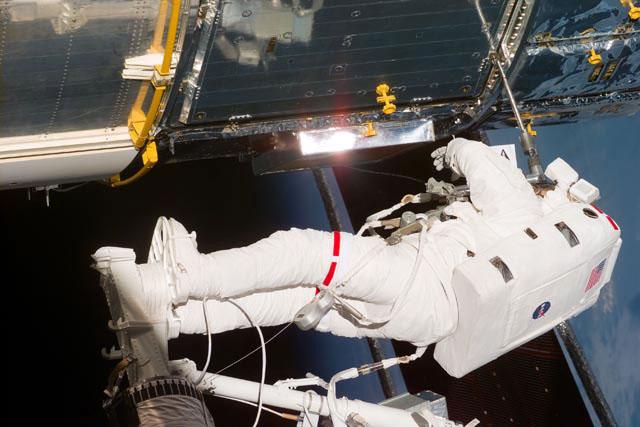
S103-E-5294 (23 Dec. 1999) --- Astronaut C. Michael Foale, standing on the end of Discovery's remote manipulator system (RMS), which had hoisted him to a task station on the Hubble Space Telescope (HST), uses a tool during the second spacewalk for the STS-103 mission. Astronauts Foale and Claude Nicollier are the second pair of STS-103 mission specialists to abandon the shirt-sleeve environment of Discovery's cabin for several hours' tasks on this the third NASA servicing mission to HST. The photo was taken with an electronic still camera (ESC). Photo credit: NASA
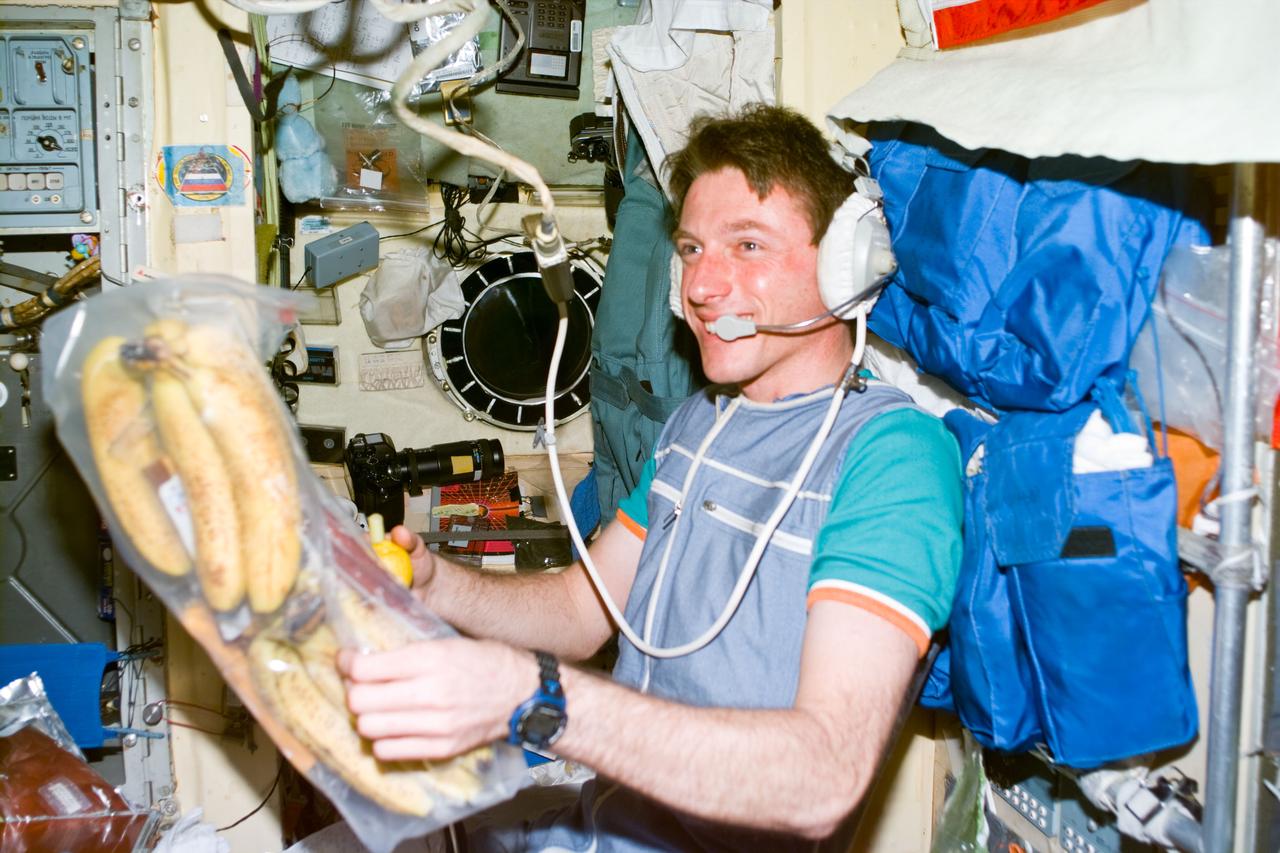
S86-E-5299 (27 Sept. 1997) --- Astronaut C. Michael Foale, cosmonaut guest researcher, shows his pleasure over a package of fresh fruit brought aboard Russia?s Mir Space Station by the STS-86 crew aboard the space shuttle Atlantis. This photograph captures Foale in his last hours as a cosmonaut guest researcher aboard Mir. Astronaut David A. Wolf, mission specialist, will replace Foale onboard the Mir, as cosmonaut guest researcher. This photograph was taken with the Electronic Still Camera (ESC) at 23:11:26 GMT on Sept. 27, 1997. Photo credit: NASA
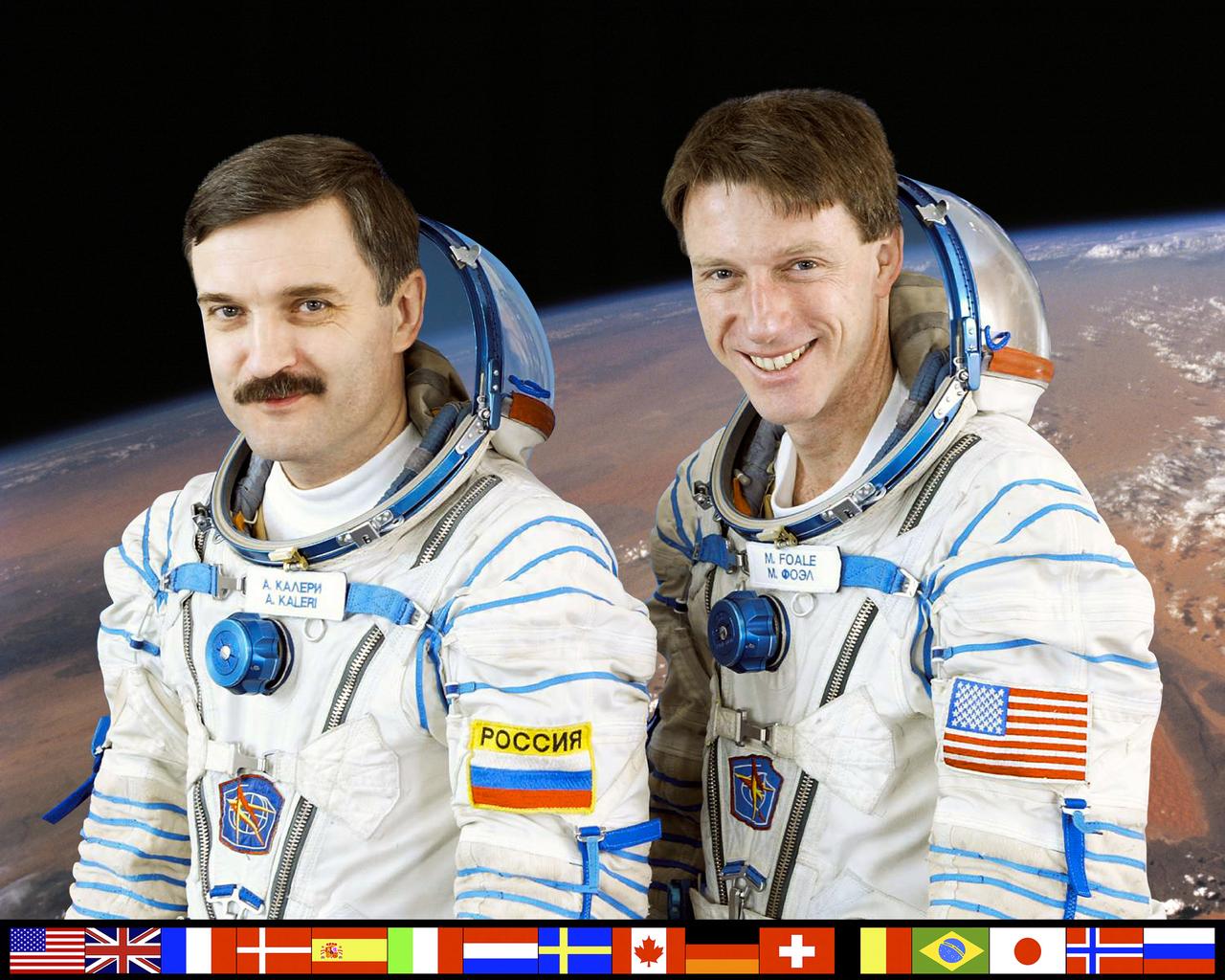
This is a portrait of the Expedition-8 two man crew. Pictured left is Cosmonaut Alexander Y, Kaleri, Soyuz Commander and flight engineer; and Michael C. Foale (right), Expedition-8 Mission Commander and NASA ISS Science Officer. The crew posed for this portrait while training at the Gagarin Cosmonaut Training Center in Star City, Russia. The two were launched for the International Space Station (ISS) aboard a Soyuz TMA-3 spacecraft from the Baikonur Cosmodrome, Kazakhstan, along with European Space Agency (ESA) Astronaut Pedro Duque of Spain, on October 18, 2003.
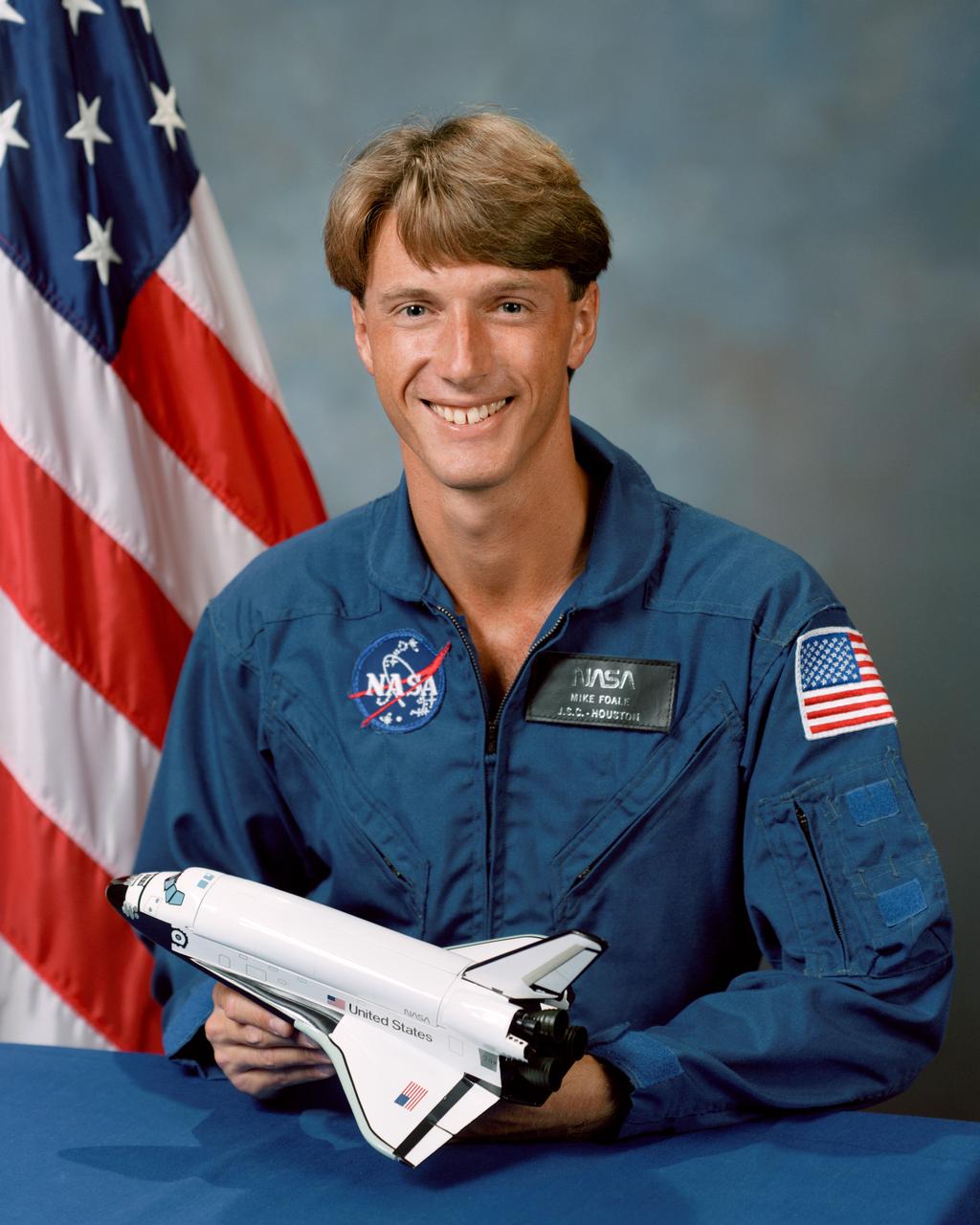
S87-45890 (9 Oct. 1987) --- Astronaut C. Michael Foale, mission specialist.
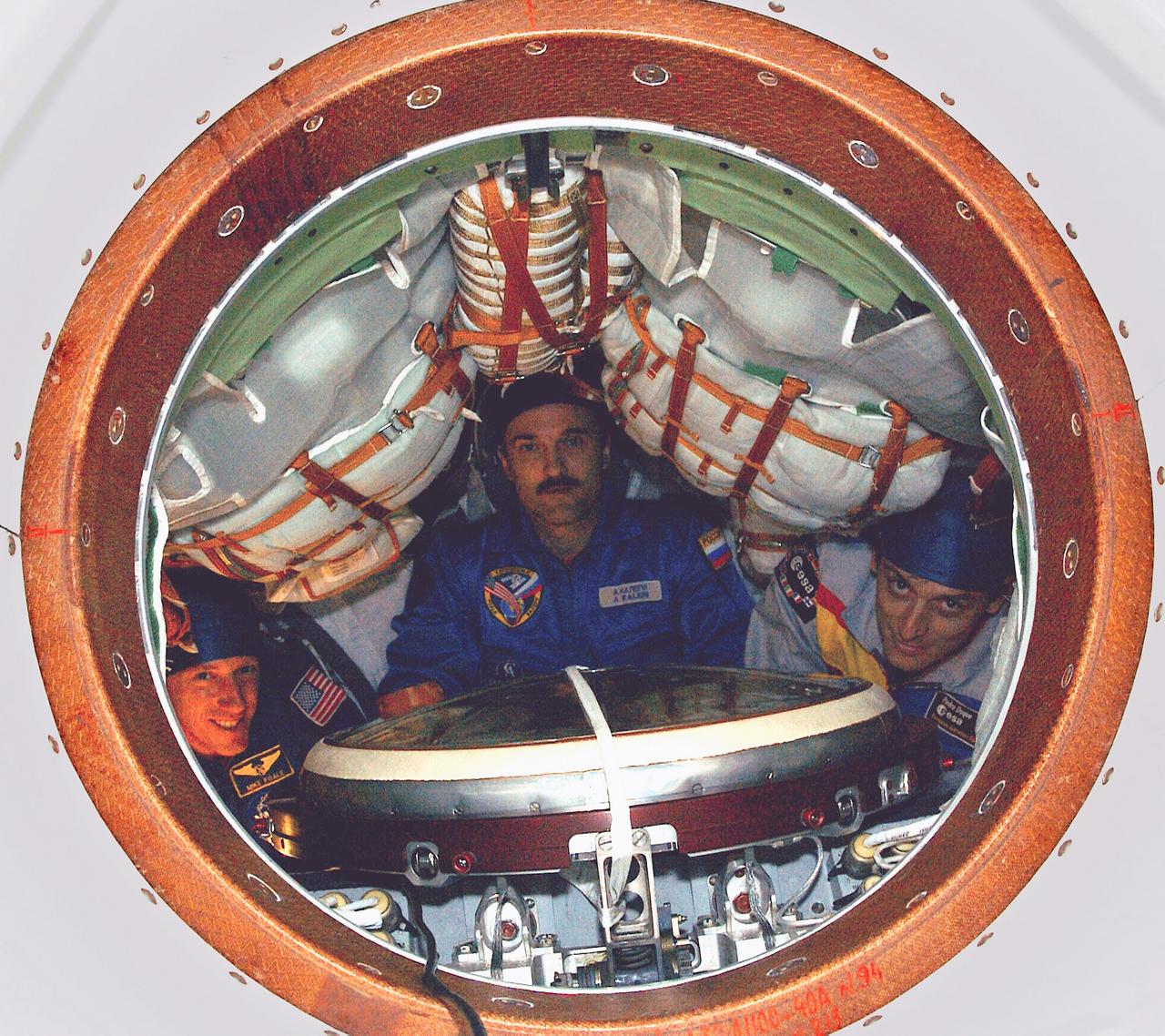
Posed inside the Soyuz TMA-3 Vehicle in a processing facility at the Baikonur Cosmodrome in Kazakhstan during a pre-launch inspection are (left to right): Expedition-8 Crew members, Michael C. Foale, Mission Commander and NASA ISS Science Officer; Cosmonaut Alexander Y. Kaleri, Soyuz Commander and flight engineer; and European Space Agency (ESA) astronaut Pedro Duque of Spain. The three launched from the Cosmodrome on October 18, 2003 onboard a Soyuz rocket destined for the International Space Station (ISS).
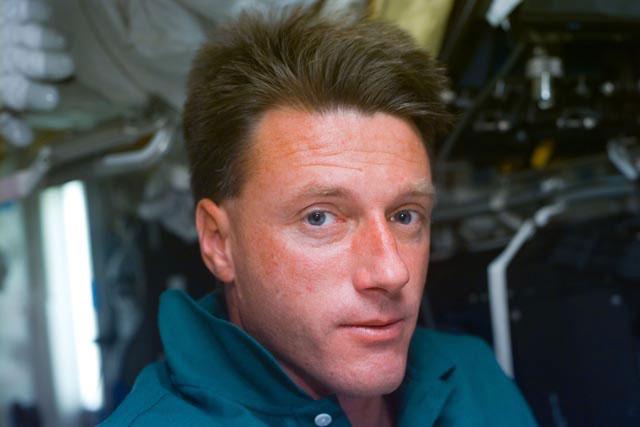
S103-E-5001 (20 December 1999) --- Astronaut C. Michael Foale, making his first mission into space since spending several months aboard the Russian Space Agency's (RSA) Mir space station, is pictured on Discovery's aft flight deck near the end of STS-103's first full day in space. The photo was taken with an electronic still camera (ESC) at 16:09:27 GMT, Dec. 20, 1999.
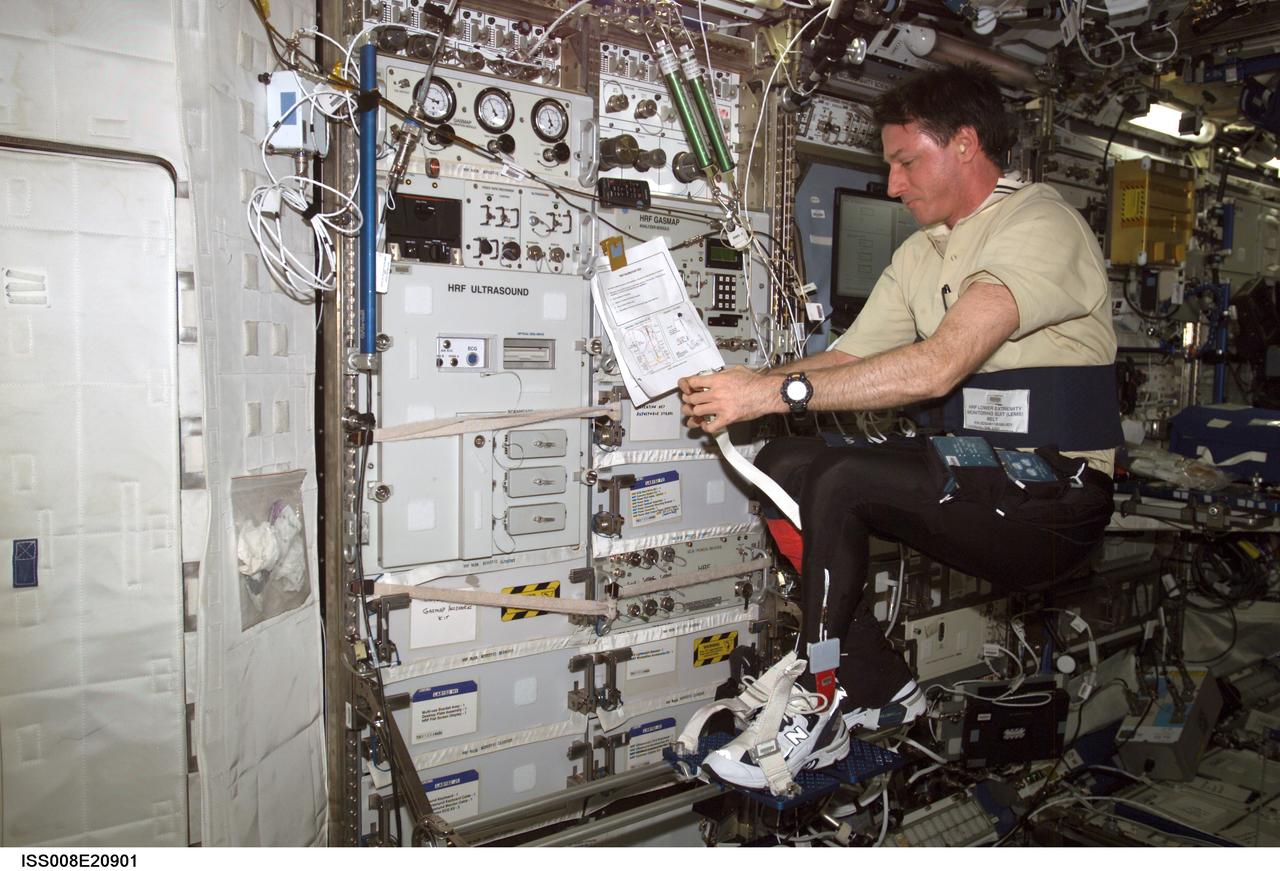
ISS008-E-20901 (7 April 2004) --- Astronaut C. Michael Foale, Expedition 8 commander and NASA ISS science officer, balances on the footplate of a special track attached to the Human Research Facility (HRF) rack in the Destiny laboratory on the International Space Station (ISS) to perform Foot/Ground Reaction Forces During Spaceflight (FOOT) / Electromyography (EMG) calibration operations. Foale is wearing the Lower Extremity Monitoring Suit (LEMS), the cycling tights outfitted with 20 sensors, which measures forces on joints and muscle activity.
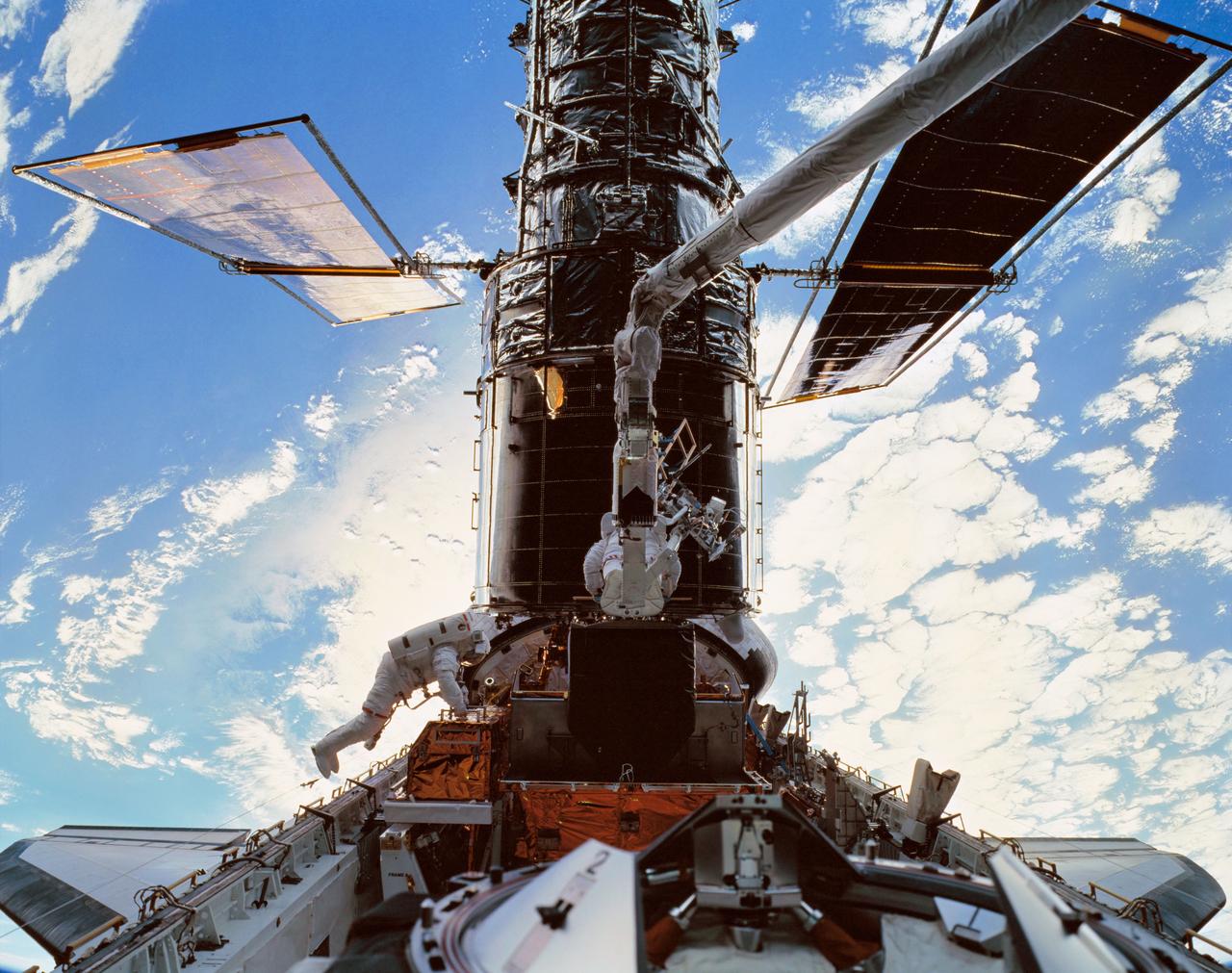
STS103-501-026 (19 - 27 December 1999) --- Astronauts C. Michael Foale, left, and Claude Nicollier (on Discovery's robotic arm) install a Fine Guidance Sensor (FGS) into a protective enclosure in the Shuttle’s payload bay. Foale and Nicollier performed the second of three space walks to service the Hubble Space Telescope (HST) on the STS-103 mission. A large format camera inside Discovery's cabin was used to record this high-resolution image, while the Shuttle was orbiting above ocean and clouds.
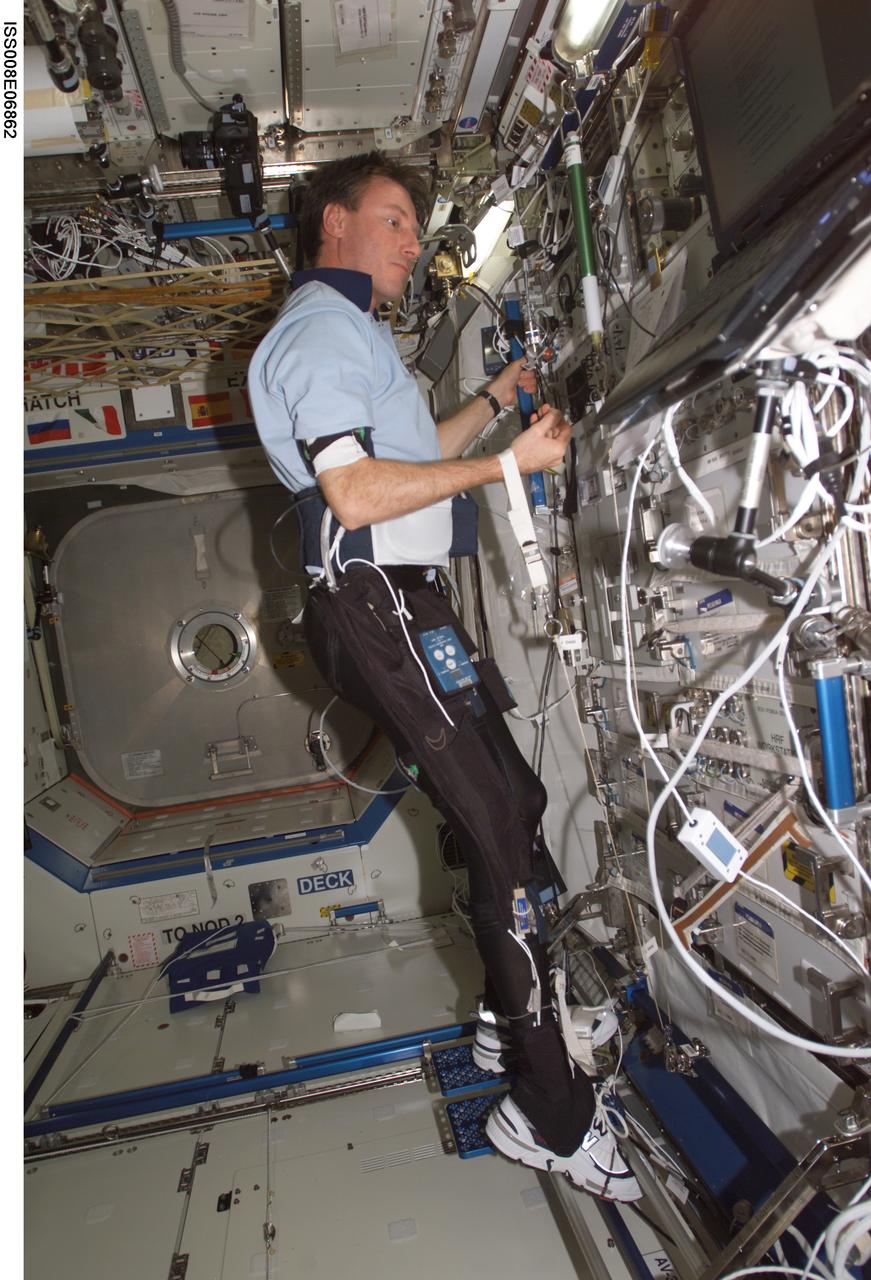
ISS008-E-06862 (3 December 2003) --- Astronaut C. Michael Foale, Expedition 8 mission commander and NASA ISS science officer, attired in instrumented biking tights, participates in the Foot/Ground Reaction Forces During Spaceflight (FOOT) experiment in the Destiny laboratory on the International Space Station (ISS). The Lower Extremity Monitoring Suit (LEMS), the cycling tights outfitted with 20 sensors, measured forces on Foale’s feet and joints and muscle activity while he went about his scheduled activities.
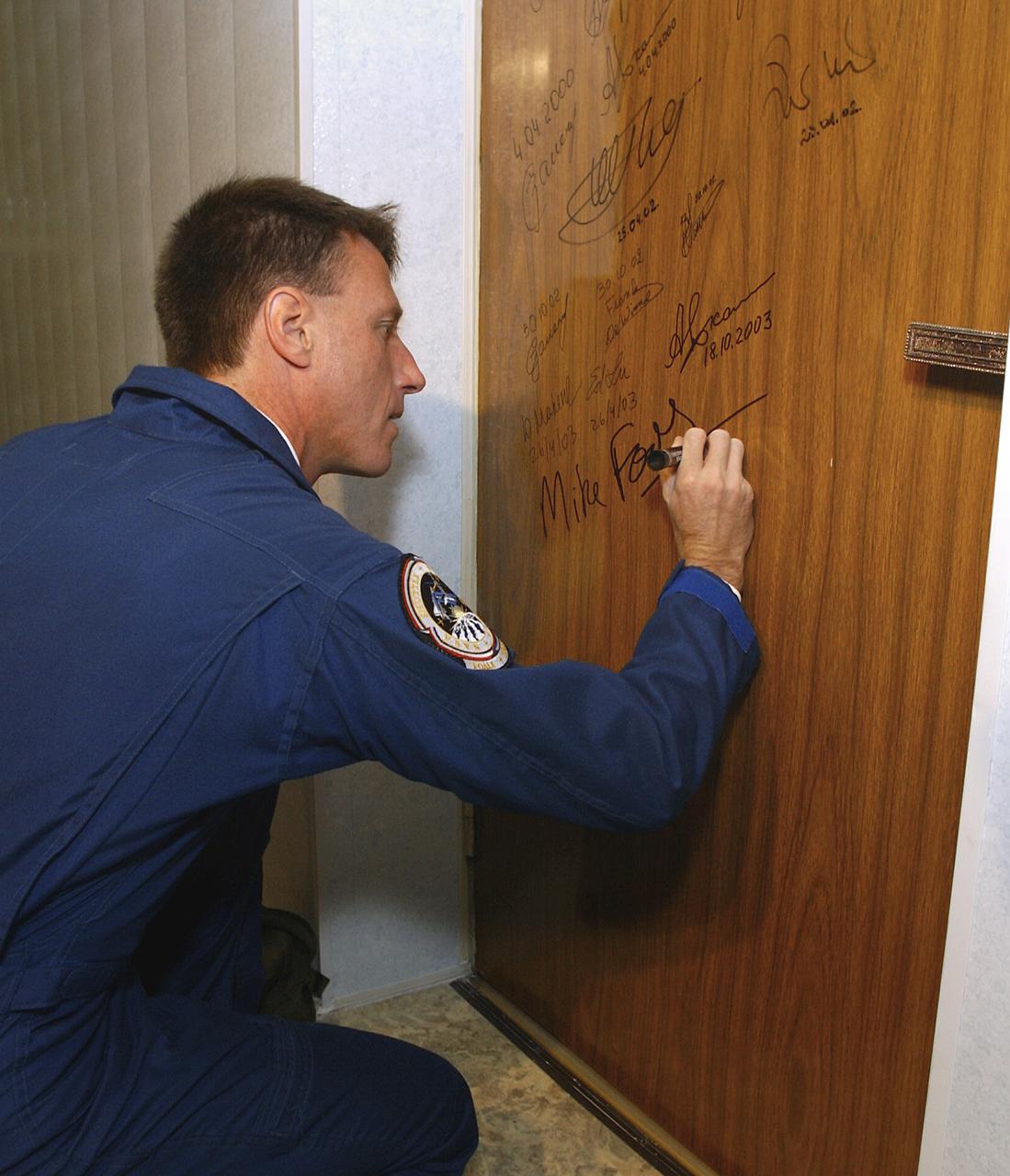
Expedition 8 Commander and NASA Science Officer Mike Foale signs his name to the door of his room at the Cosmonaut Hotel crew quarters, Saturday, Oct. 18, 2003, in Baikonur, Kazakhstan prior to departing for the launch pad. Foale, along with Expedition 8 Soyuz Commander Alexander Kaleri and European Space Agency Astronaut Pedro Duque of Spain were launched on a Soyuz TMA-3 vehicle from Baikonur to the International Space Station, arriving on Oct. 20. Photo Credit (NASA/Bill Ingalls)
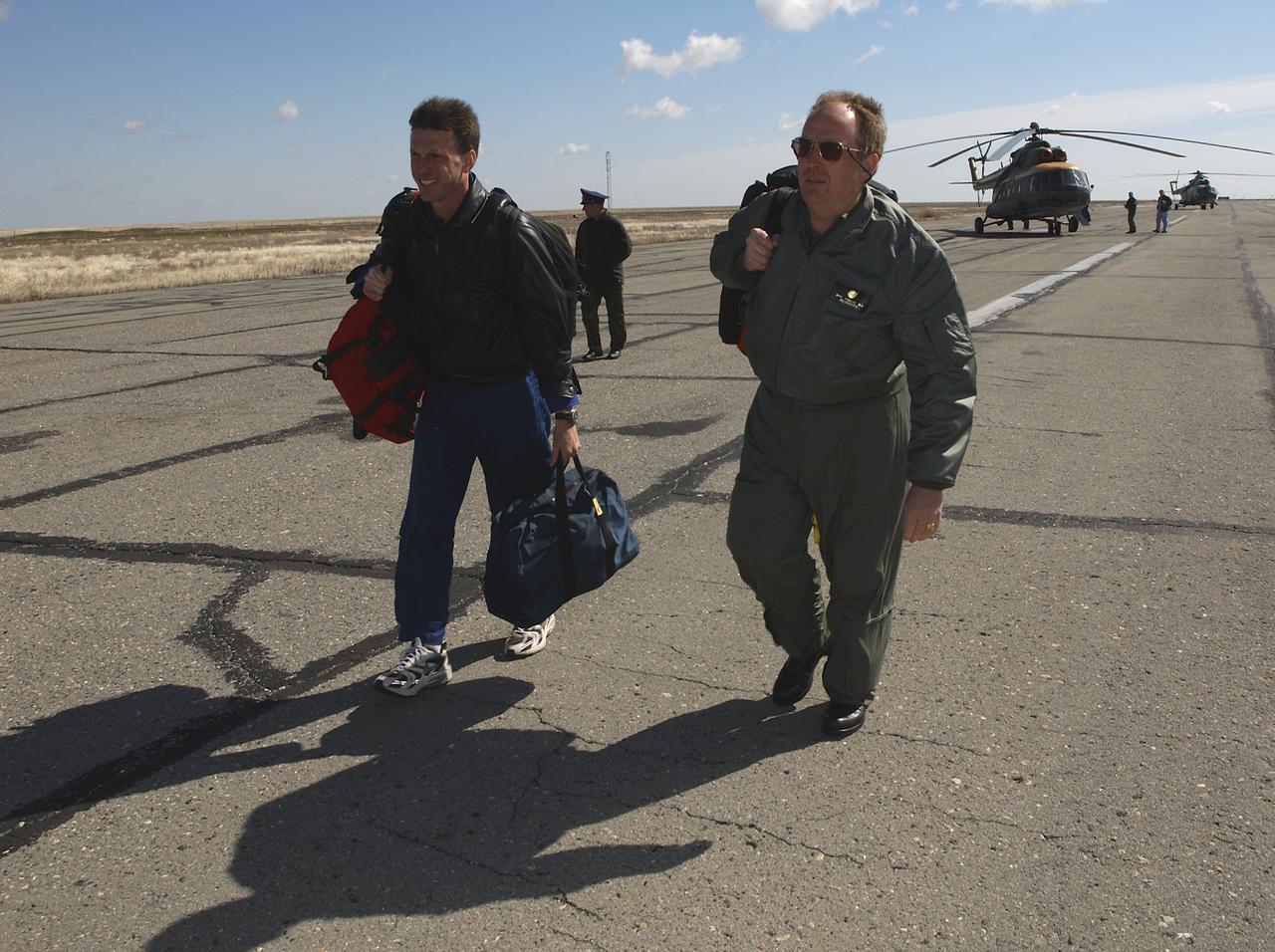
Astronaut Michael Foale, left, and Mike Duncan, Expedition 6 Lead Flight Surgeon, move to another helicopter after the landing team helicopters returned for refueling, Tuesday, May 4, 2003, in Kazakhstan. Foale and Duncan went on from the refueling to meet the crew of Expedition 6 at the landing site. Photo Credit: (NASA/Bill Ingalls)
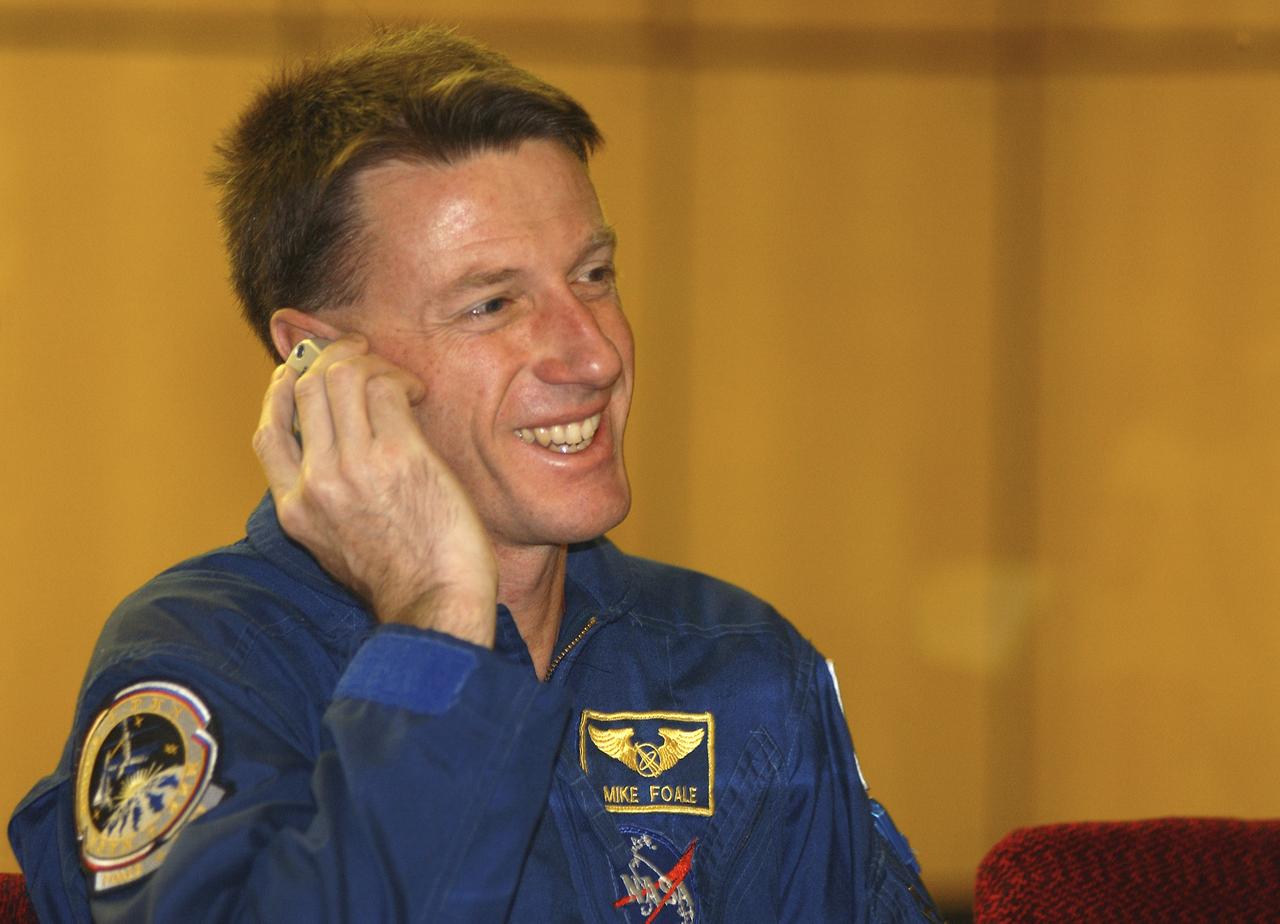
Expedition 8 Commander and NASA Science Officer Michael Foale talks to a colleague on his cell phone from his crew quarters at the Cosmonaut Hotel in Baikonur, Kazakhstan, Wednesday, Oct. 15, 2003. Foale along with Expedition 8 Soyuz Commander Alexander Kaleri and European Space Agency astronaut Pedro Duuque of Spain, launched on a Soyuz TMA-3 vehicle to the International Space Station. Photo Credit (NASA/Bill Ingalls)
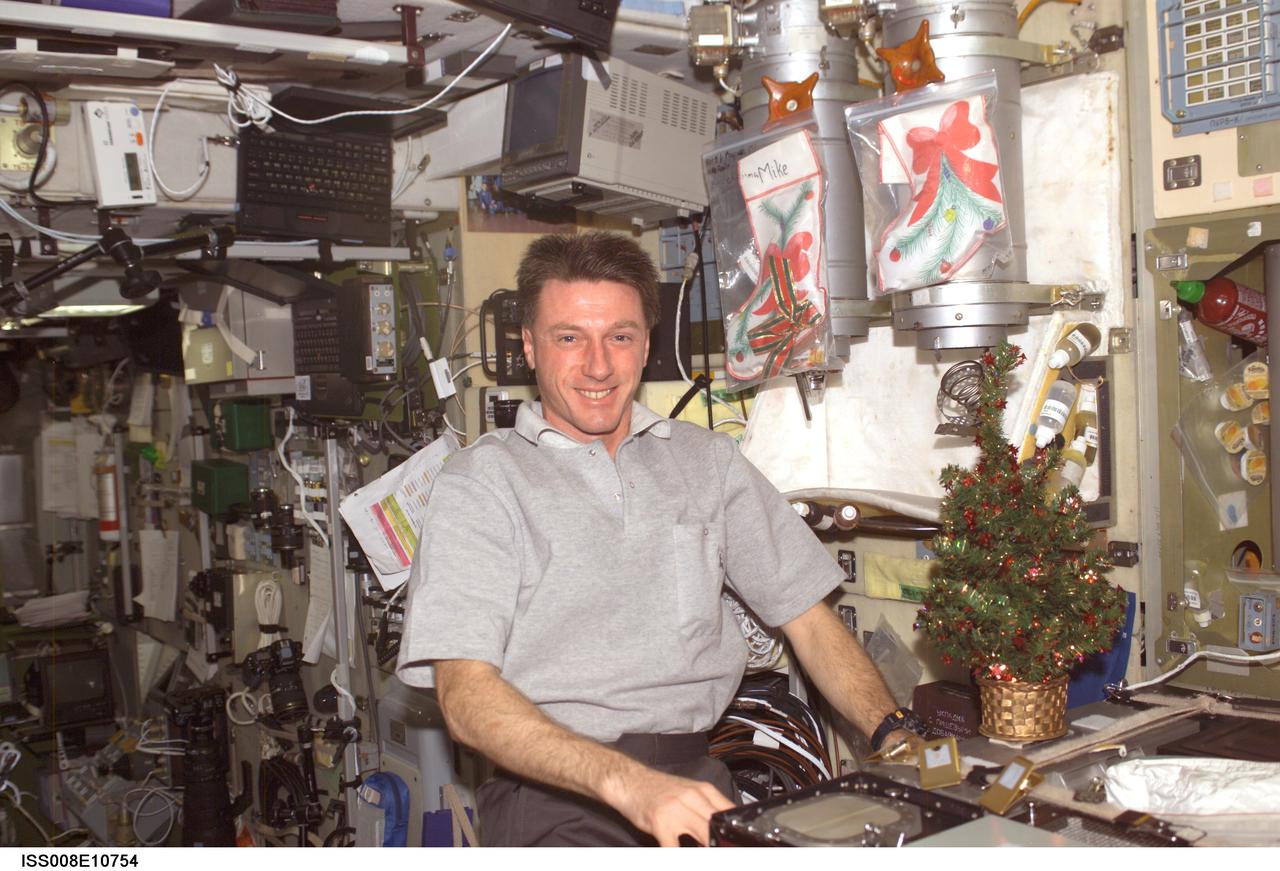
ISS008-E-10754 (28 December 2003) --- Astronaut C. Michael Foale, Expedition 8 mission commander and NASA ISS science officer, poses with holiday decorations in the Zvezda Service Module on the International Space Station (ISS).
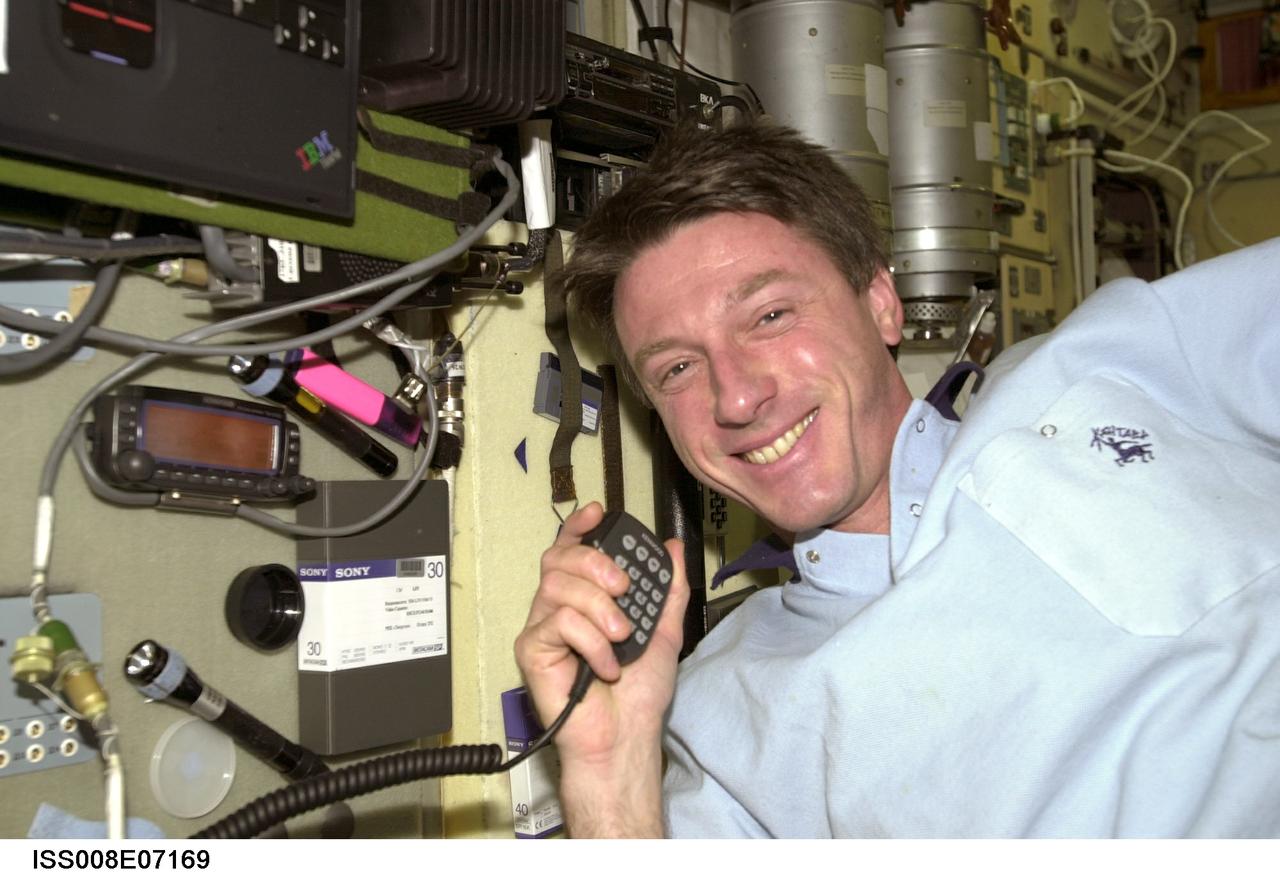
ISS008-E-07169 (December 2003) --- Astronaut C. Michael Foale, Expedition 8 mission commander and NASA ISS science officer, uses a communication system in the Zvezda Service Module on the International Space Station (ISS).
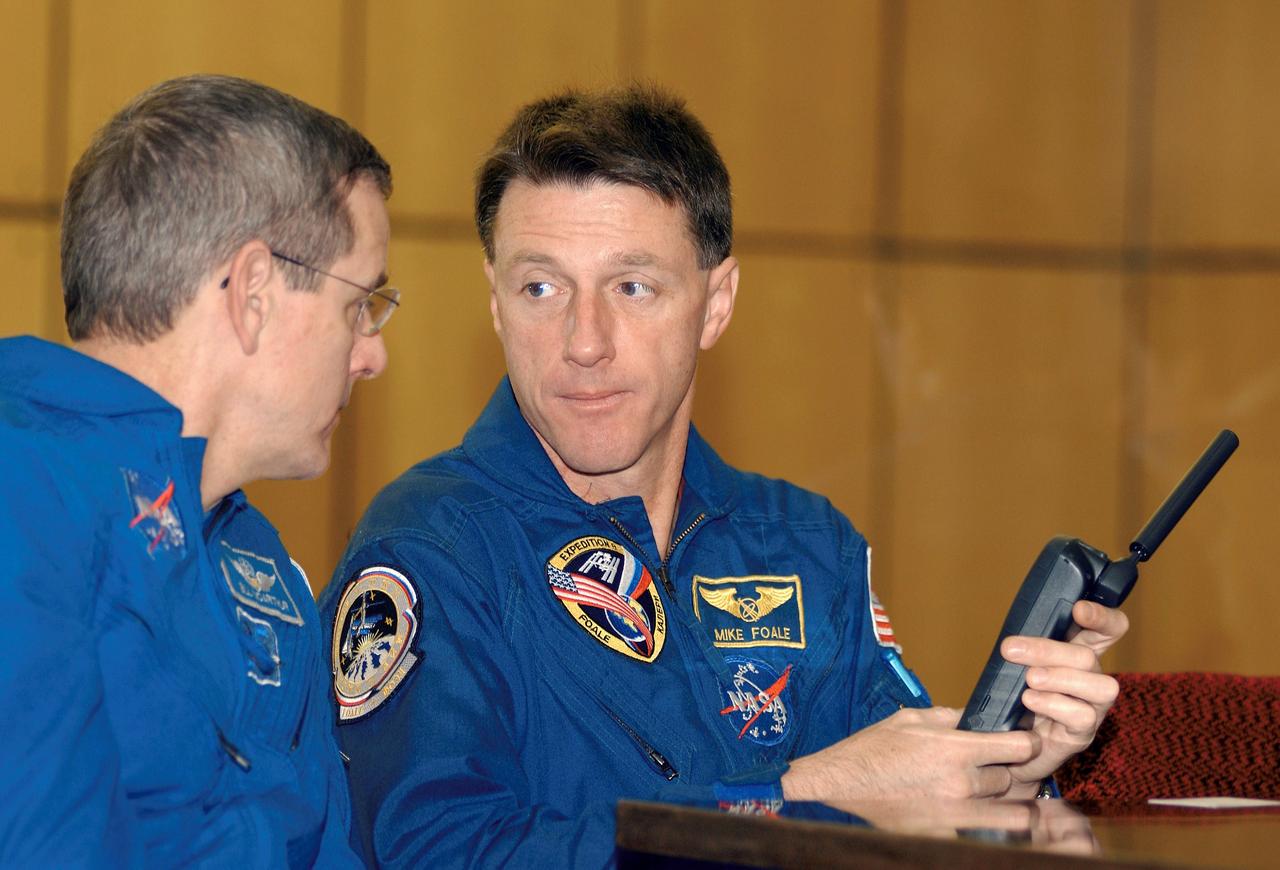
JSC2003-E-59139 (15 October 2003) --- Astronauts C. Michael Foale (right) and William S. (Bill) McArthur, Jr., prime and backup Expedition 8 mission commander and NASA ISS science officer, respectively, practice procedures with a satellite phone during final training at their crew quarters in Baikonur, Kazakhstan. Expedition 8 is scheduled to launch from the Baikonur Cosmodrome on October 18 onboard a Soyuz rocket to the International Space Station (ISS). Foale will be joined for launch by cosmonaut Alexander Y. Kaleri, Soyuz commander and flight engineer, and European Space Agency (ESA) astronaut Pedro Duque of Spain. Photo Credit: NASA/Bill Ingalls
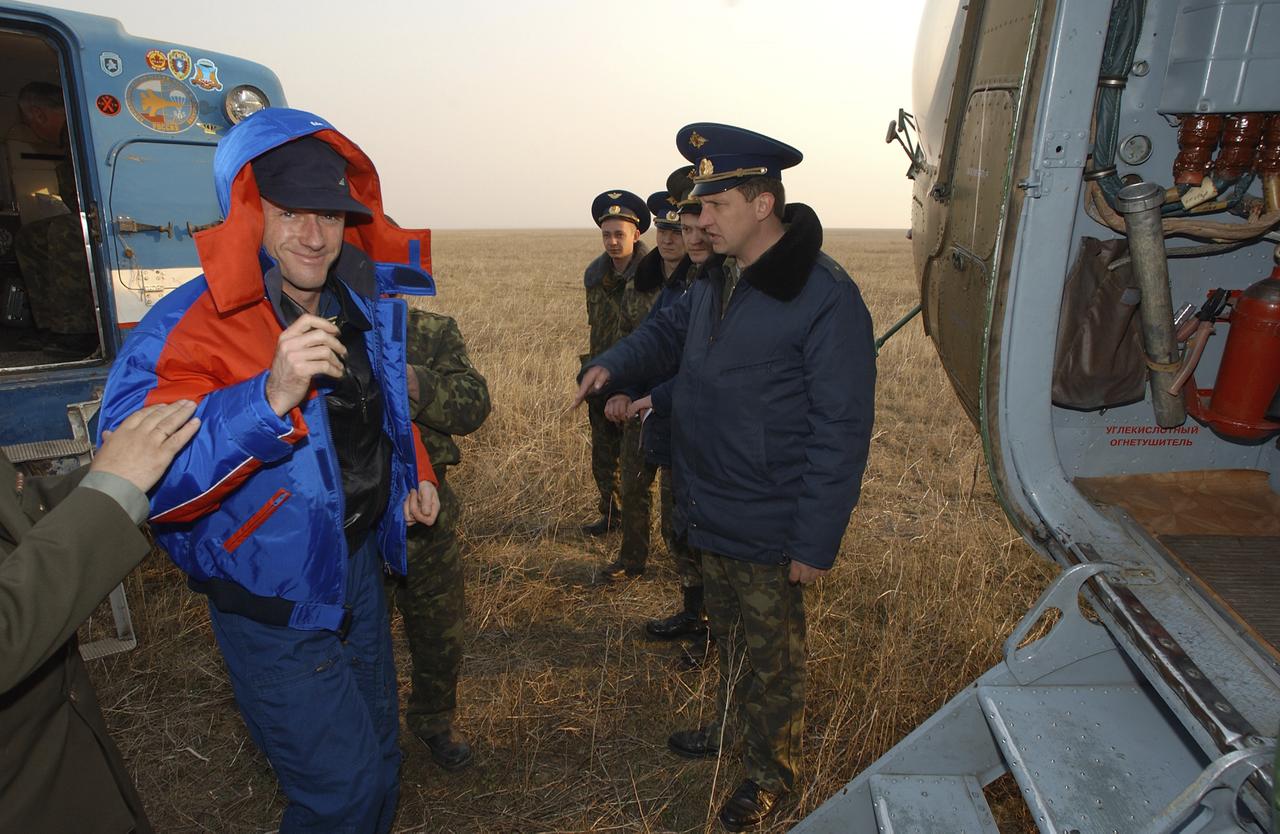
Expedition 8 Commander Mike Foale exits an all terrain vehicle and prepares to enter a Russian MI-8 helicopter for the flight to Kustanai, Kazakhstan after he, Soyuz Flight Engineer Alexander Kaleri and European Space Agency astronaut Andre Kuipers, of the Netherlands, landed in north central Kazakhstan, Friday, April 30, 2004, in a Soyuz TMA-3 capsule. Foale and Kaleri completed 195 days in space aboard the International Space Station, while Kuipers returned after an 11-day research mission as part of a commercial agreement between ESA and the Russian Federal Space Agency. Photo Credit: (NASA/Bill Ingalls)
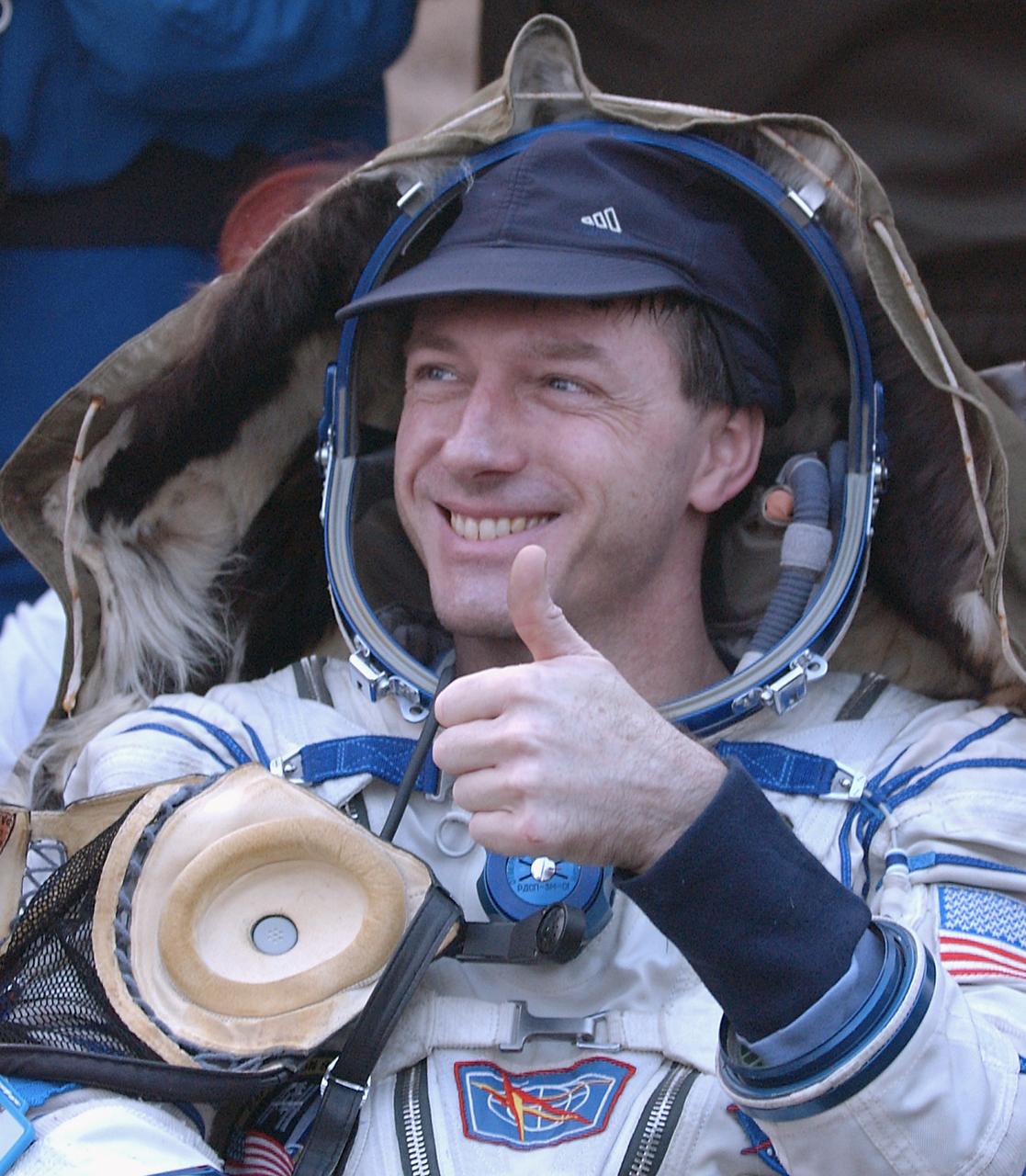
Expedition 8 Commander Michael Foale gives a thumbs up after he and his crew mates, Soyuz Flight Engineer Alexander Kaleri and European Space Agency astronaut Andre Kuipers, of the Netherlands, touched down in north central Kazakhstan, Friday, April 30, 2004, in their Soyuz TMA-3 capsule. Foale and Kaleri completed 195 days in space aboard the International Space Station, while Kuipers returned after an 11-day research mission as part of a commercial agreement between ESA and the Russian Federal Space Agency. Photo Credit (NASA/Bill Ingalls)
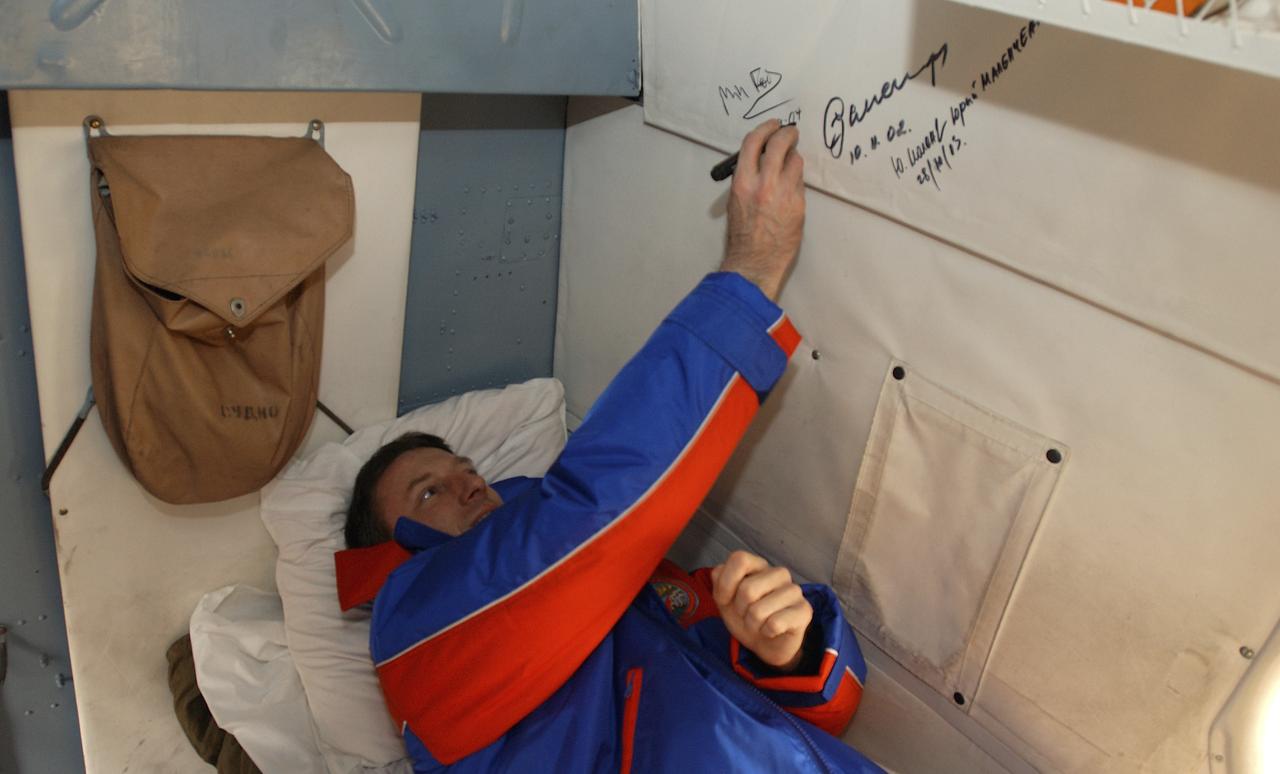
Expedition 8 Commander Michael Foale signs the inside of the Russian search and rescue helicopter as is tradition for returning cosmonauts, after he, Soyuz Flight Engineer Alexander Kaleri and European Space Agency astronaut Andre Kuipers, of the Netherlands, landed in north central Kazakhstan, Friday, April 30, 2004, in a Soyuz TMA-3 capsule. Foale and Kaleri completed 195 days in space aboard the International Space Station, while Kuipers returned after an 11-day research mission as part of a commercial agreement between ESA and the Russian Federal Space Agency. Photo Credit: (NASA/Bill Ingalls)
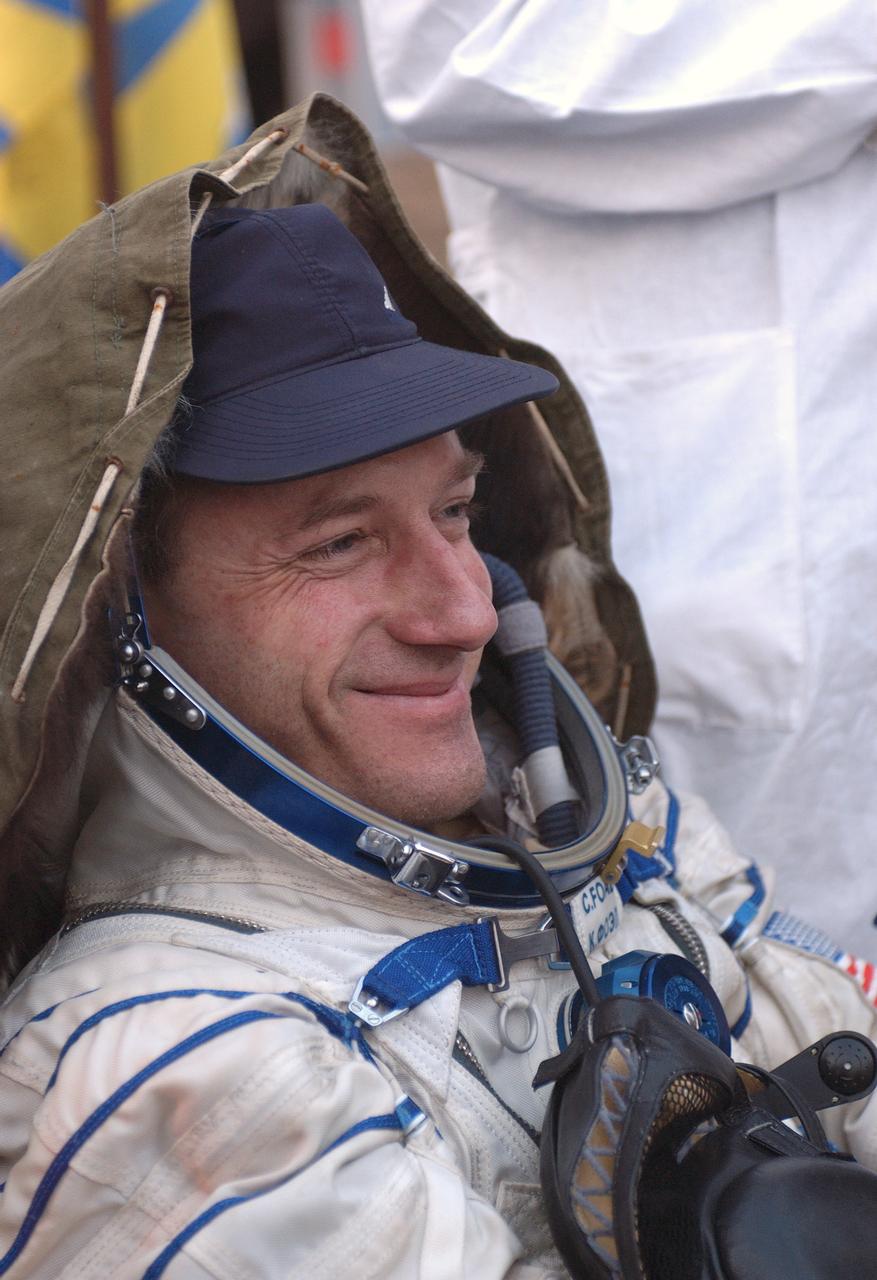
Expedition 8 Commander Mike Foale smiles shortly after he and Soyuz Flight Engineer Alexander Kaleri and European Space Agency astronaut Andre Kuipers, of the Netherlands, landed in north central Kazakhstan, Friday, April 30, 2004, in a Soyuz TMA-3 capsule. Foale and Kaleri completed 195 days in space aboard the International Space Station, while Kuipers returned after an 11-day research mission as part of a commercial agreement between ESA and the Russian Federal Space Agency. Photo Credit (NASA/Bill Ingalls)
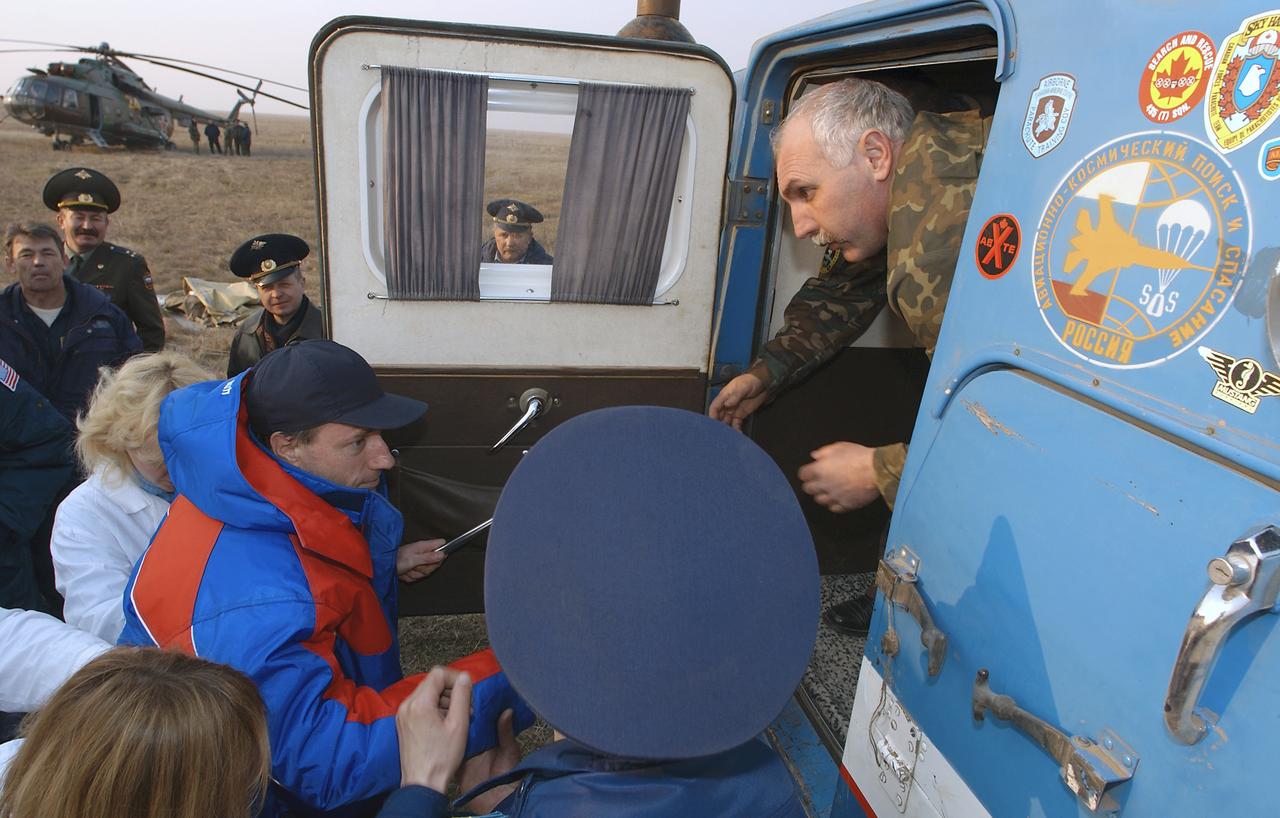
Expedition 8 Commander Michael Foale is helped from the medical tent to an all terrain vehicle for transportation to a helicopter for the flight to Kustanai, Kazakhstan after he, Soyuz Flight Engineer Alexander Kaleri and European Space Agency astronaut Andre Kuipers, of the Netherlands, landed in north central Kazakhstan, Friday, April 30, 2004, in a Soyuz TMA-3 capsule. Foale and Kaleri completed 195 days in space aboard the International Space Station, while Kuipers returned after an 11-day research mission as part of a commercial agreement between ESA and the Russian Federal Space Agency. Photo Credit: (NASA/Bill Ingalls)
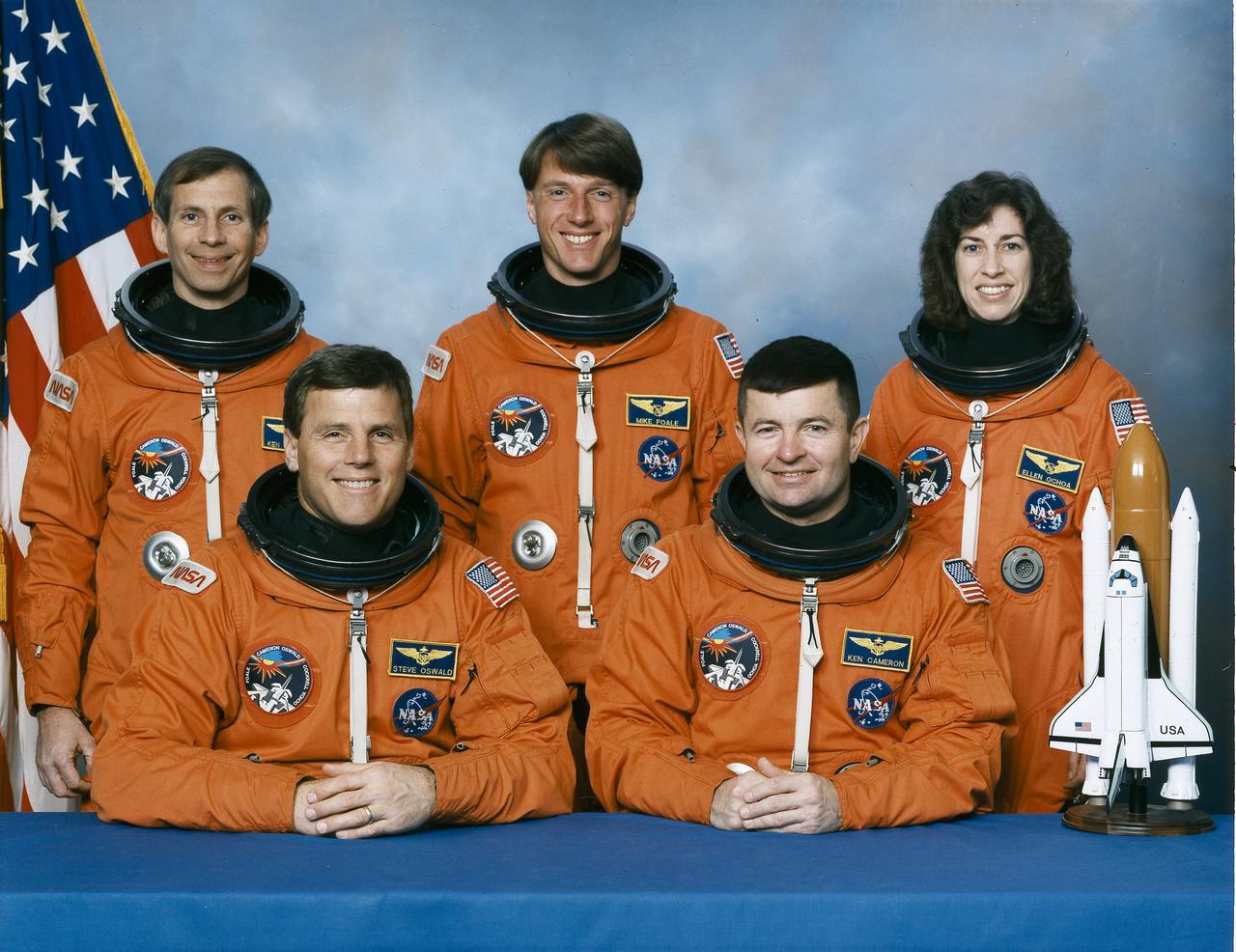
The STS-56 crew portrait includes five astronauts. Seated from the left are Stephen S. Oswald, pilot; and Kenneth D. Cameron, commander. Standing, from the left, are mission specialists Kenneth D. Cockrell, C. Michael Foal, and Ellen Ochoa. The crew launched aboard the Space Shuttle Discovery on April 8, 1993 at 1:29:00 am (EDT) with the Atmospheric Laboratory for Applications and Science-2 (ATLAS-2) as the primary payload.
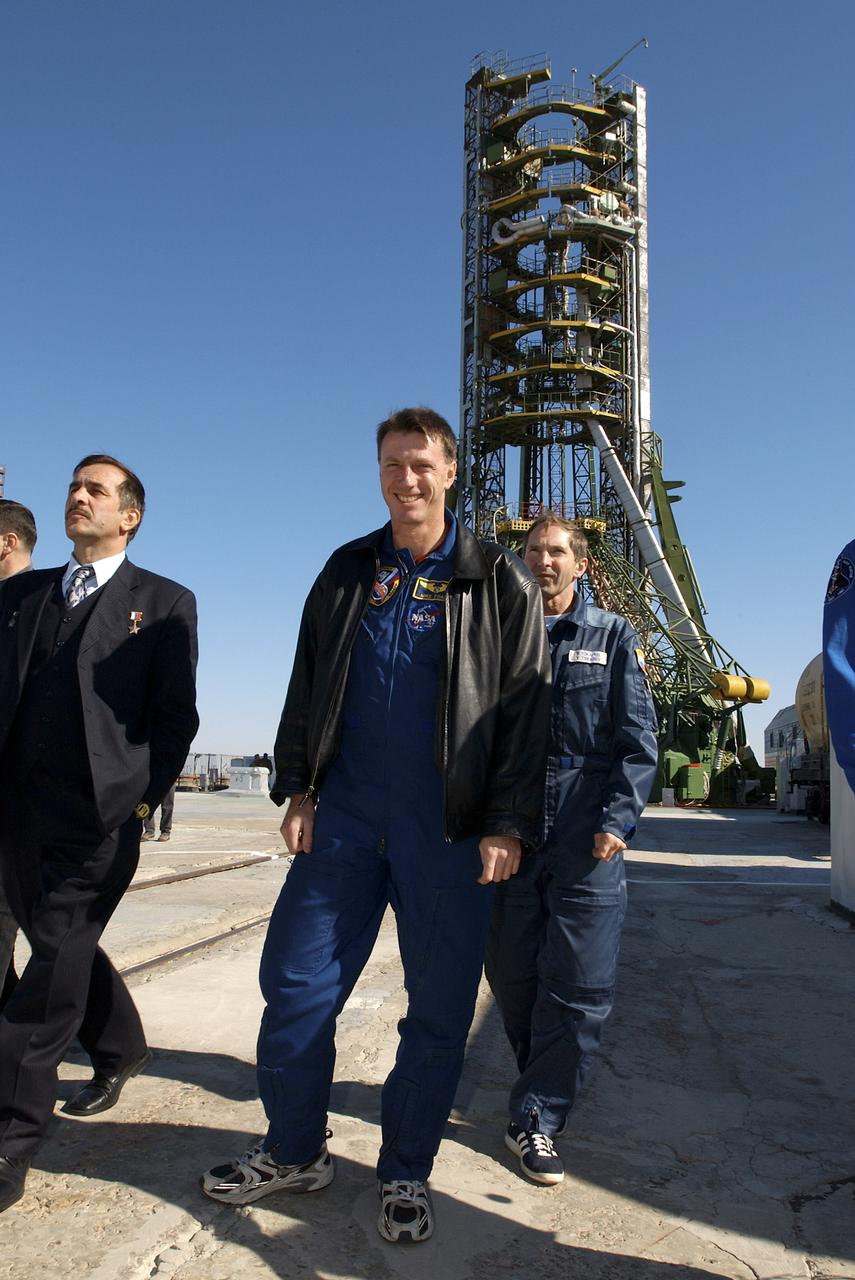
Expedition 8 Commander and NASA Science Officer Michael Foale, center, visits the launch pad at the Baikonur Cosmodrome in Kazakhstan, Monday, Oct. 13, 2003 during final prelaunch preparations. Foale, launched from this pad to the International Space Station on Oct. 18, 2003. Photo Credit (NASA/Bill Ingalls)
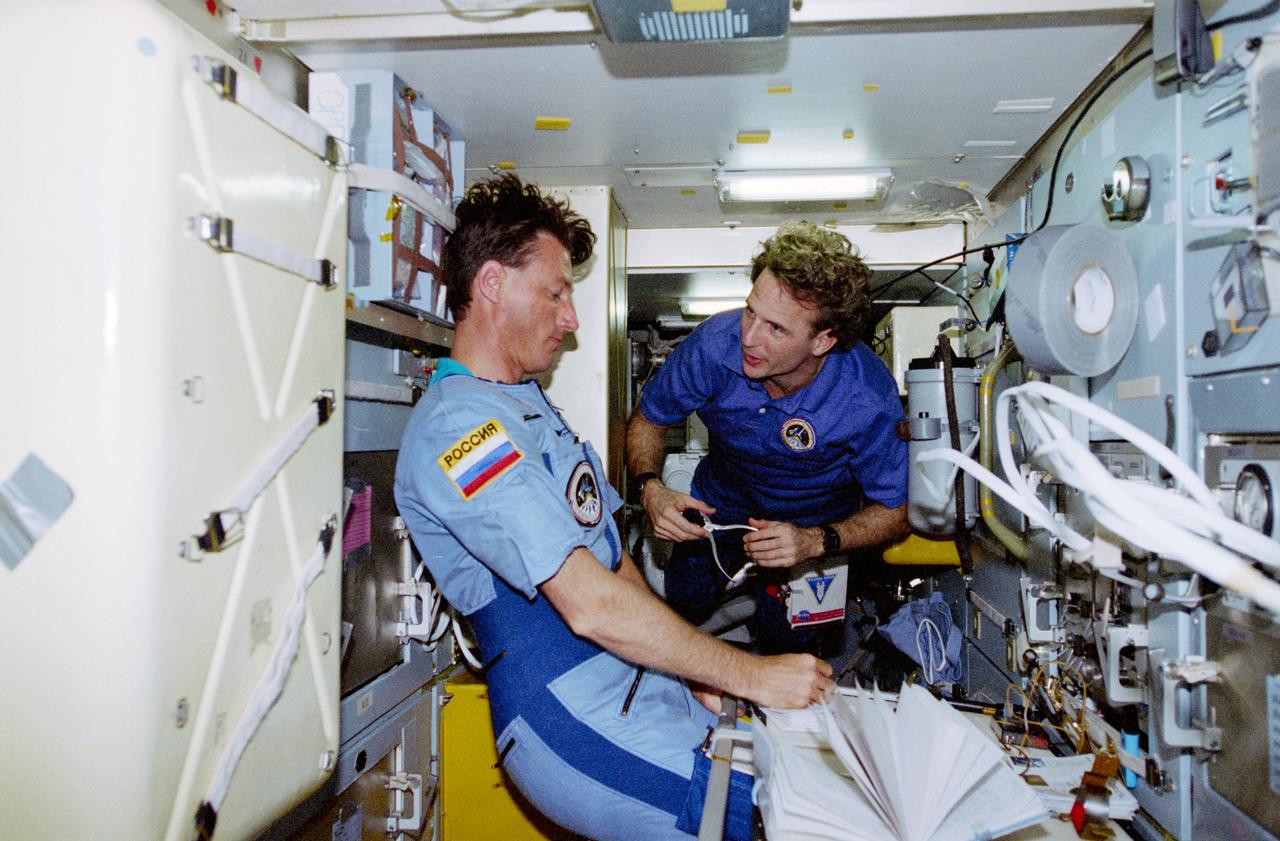
STS084-371-021 (15-21 May 1997) --- Onboard Russia's Mir Space Station's Priroda Module, NASA's most recent participant in the cosmonaut guest researcher role briefs his replacement. Jerry M. Linenger, right, has been aboard the orbiting complex since January of this year, but as evidenced by the uniforms each is wearing, he has turned over that role now to C. Michael Foale.
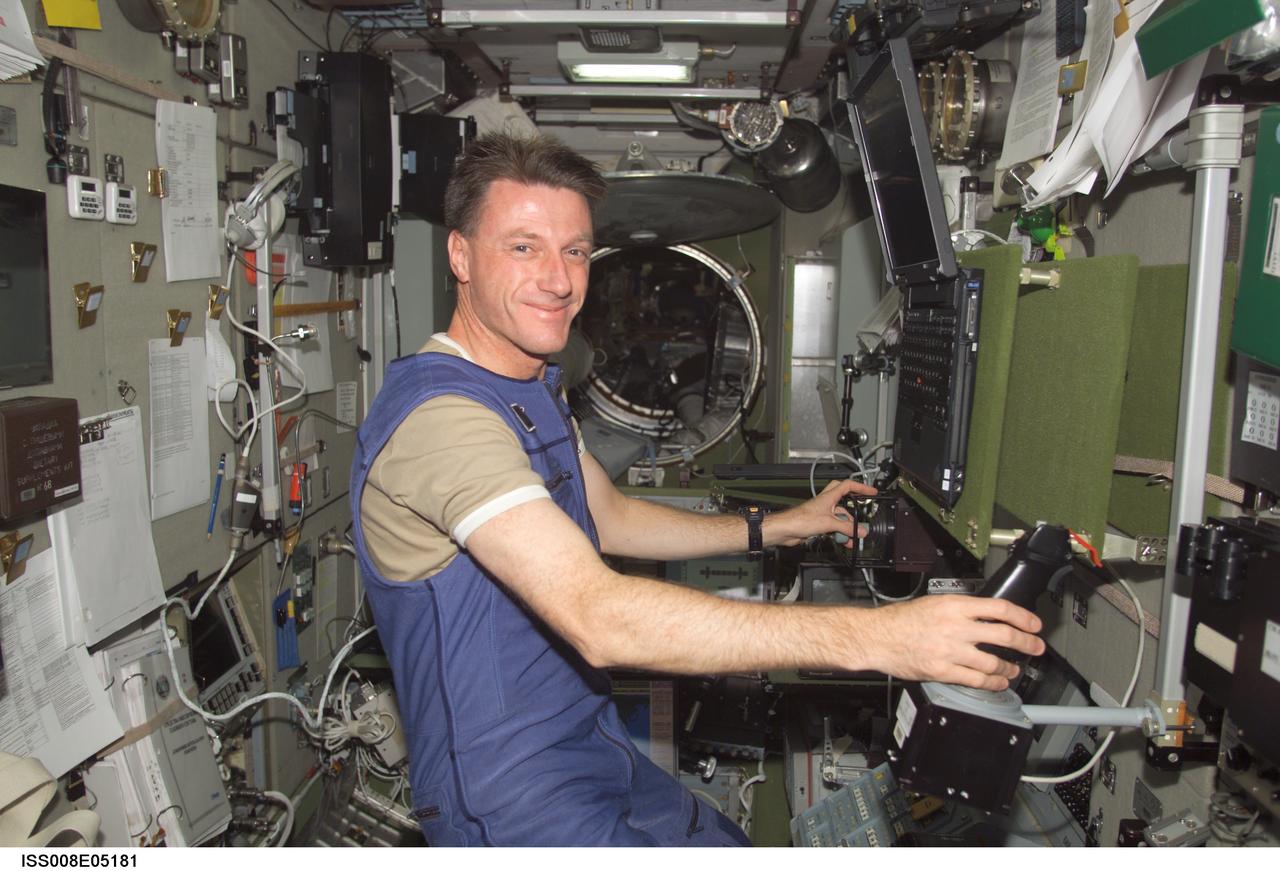
ISS008-E-05181 (31 October 2003) --- Astronaut C. Michael Foale, Expedition 8 mission commander and NASA ISS science officer, works with the Russian biomedical “Pilot” experiment (MBI-15) in the Zvezda Service Module on the International Space Station (ISS). The experiment, which looks at psychological and physiological changes in crew performance during long-duration spaceflight, requires a worktable, ankle restraint system and two control handles for testing piloting skill.
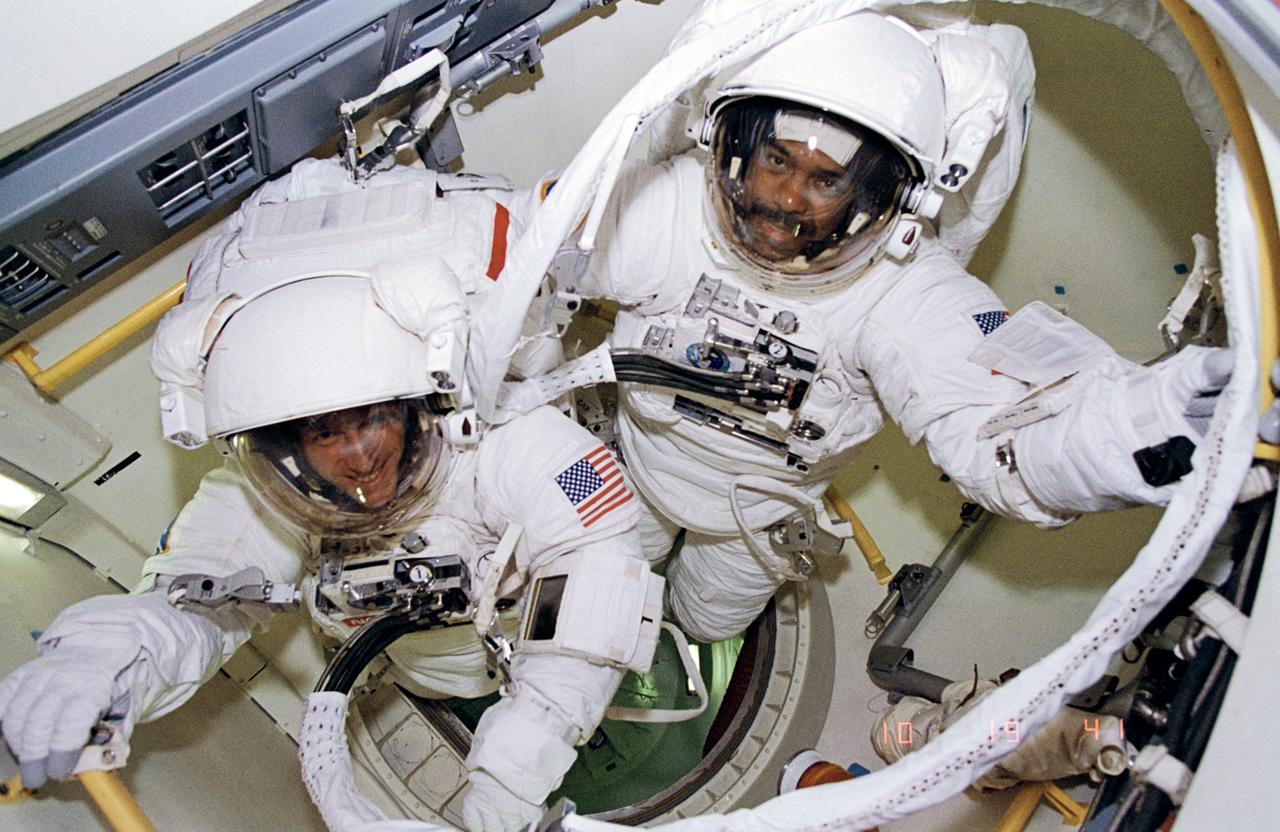
STS063-67-024 (9 Feb. 1995) --- Astronauts Bernard A. Harris Jr., STS-63 payload commander, (top right) and C. Michael Foale, mission specialist, are ready to egress airlock for an extravehicular activity (EVA). Others onboard the space shuttle Discovery were astronauts James D. Wetherbee, mission commander; Eileen M. Collins, pilot; mission specialists Janice E. Voss, and cosmonaut Vladimir G. Titov. Photo credit: NASA
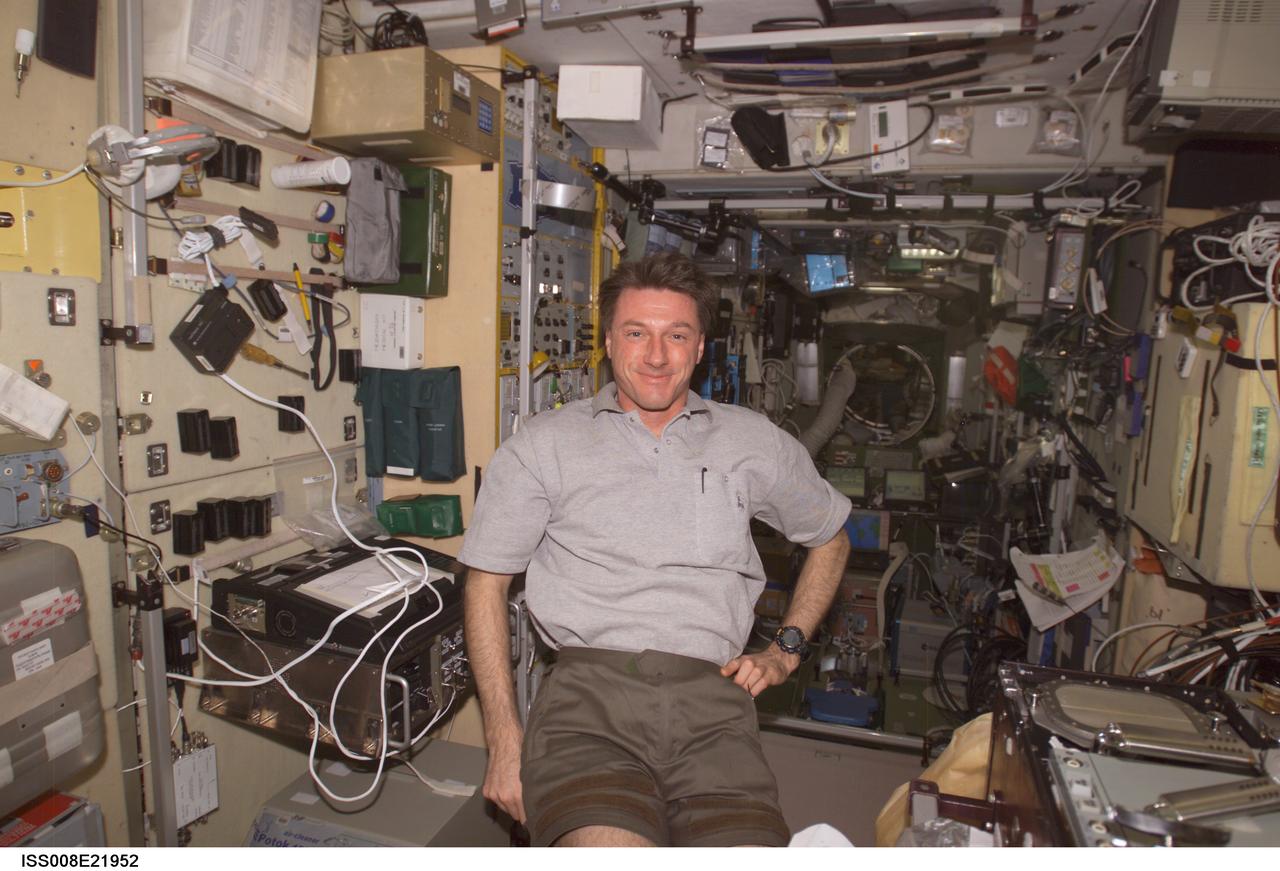
ISS008-E-21952 (21 April 2004) --- A smiling astronaut C. Michael Foale, Expedition 8 commander and NASA ISS science officer, can't hide his elation at having company aboard the International Space Station in this electronic still photo, taken in the Zvezda Service Module soon after three visitors arrived at the orbiting complex in a Russian Soyuz spacecraft.
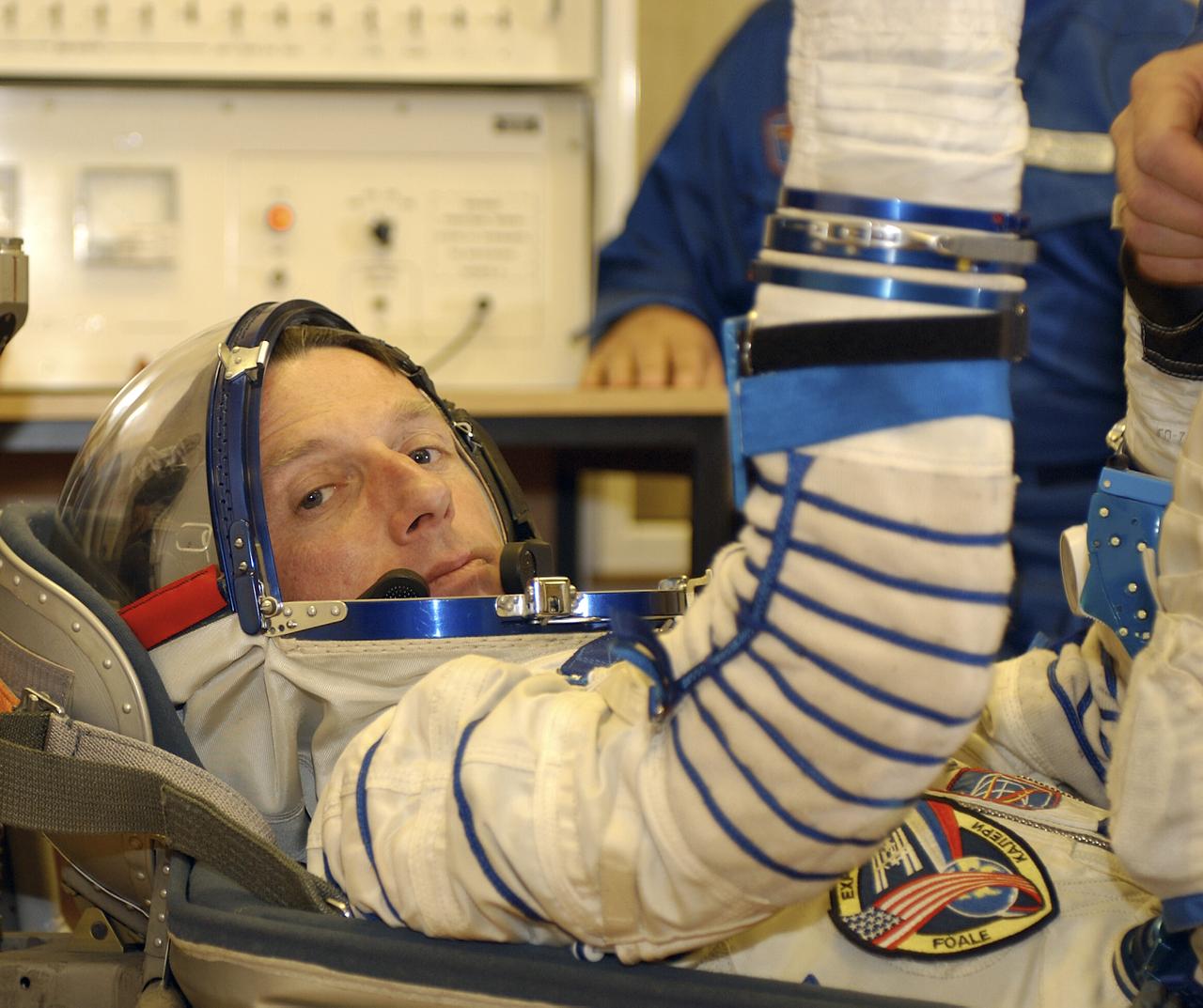
Expedition 8 Commander and NASA Science Officer Michael Foale is seen at the Baikonur Cosmodrome in Kazakhstan. Foale, Expedition 8 Soyuz Commander Alexander Kaleri and European Space Agency astronaut Pedro Duque of Spain were launched on a Soyuz TMA-3 vehicle to the International Space Station, arriving on Oct. 20. Photo Credit (NASA/Bill Ingalls)
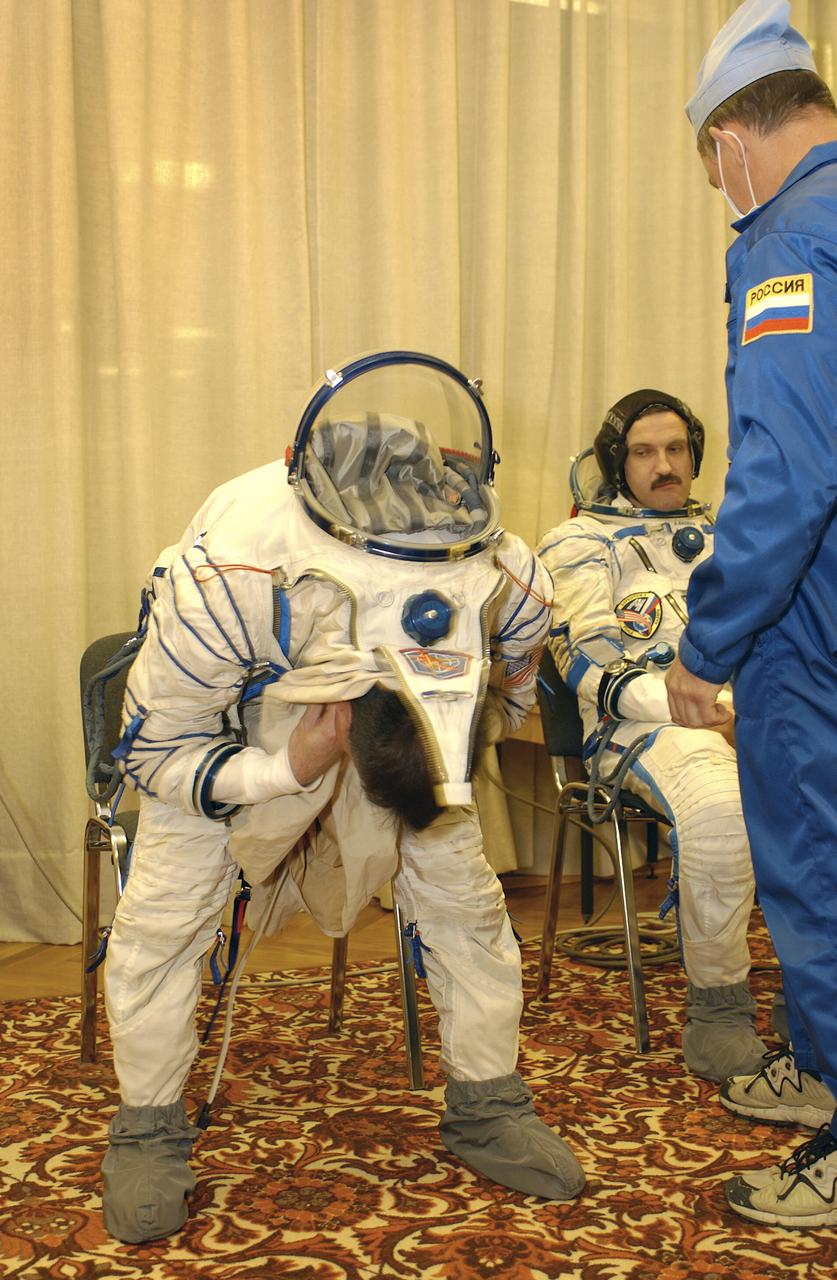
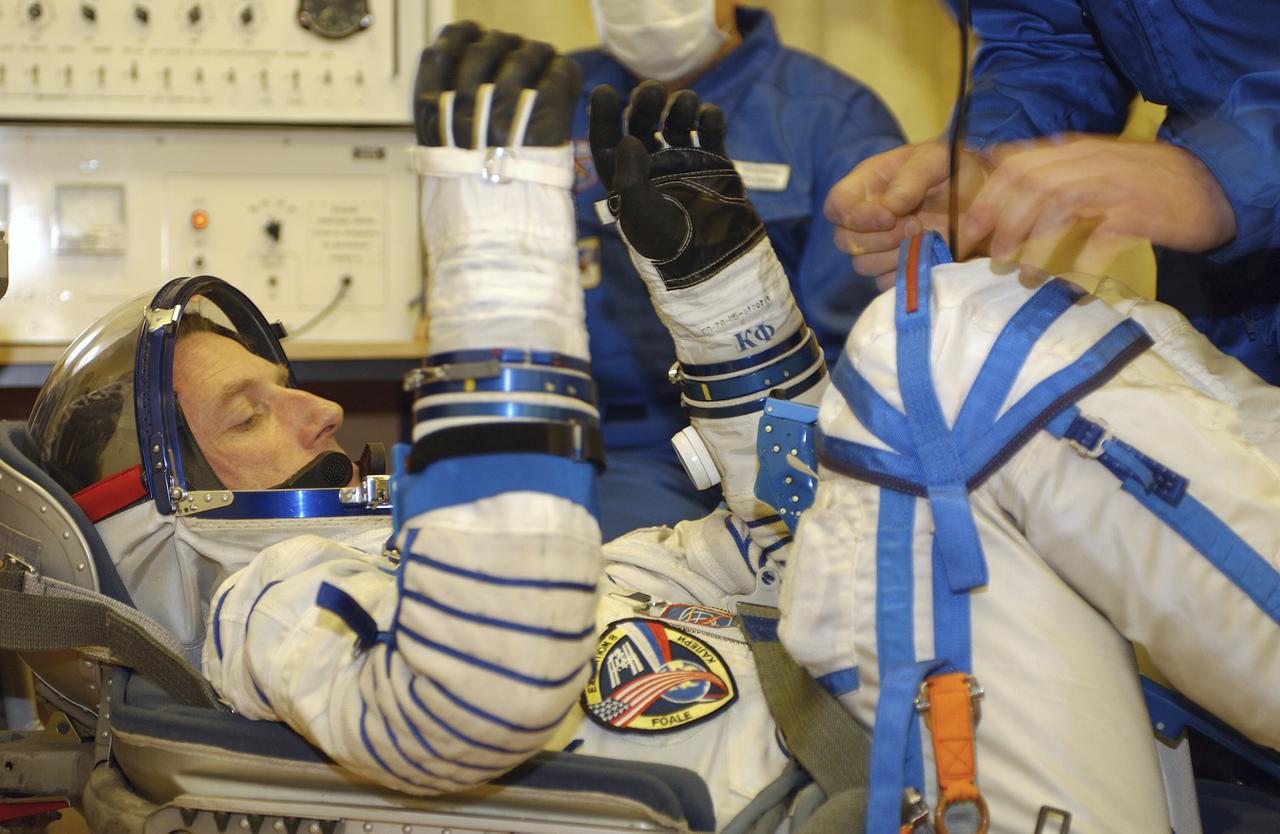
Expedition 8 Commander and NASA Scienhce Officer Michael Foale, left, works to suit up for launch as Expedition 8 Soyuz Commander Alexander Kaleri looks on, Saturday, Oct. 18, 2003, prior to departure for the launch pad at the Baikonur Cosmodrome in Kazakhstan. Foale, Kaleri and European Space Agency astronaut Pedro Duque were launched on a Soyuz TMA-3 vehicle to the International Space Station, arriving on Oct. 20. Photo Credit (NASA/Bill Ingalls)
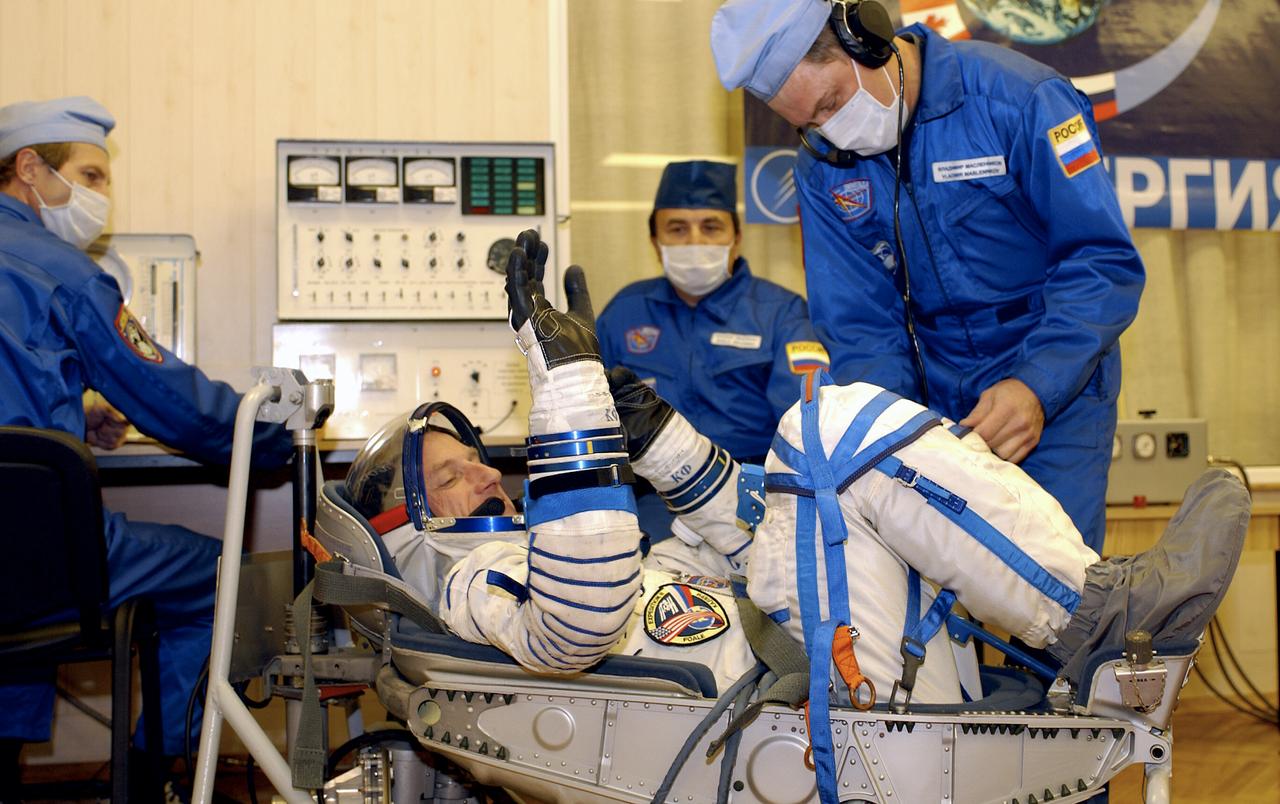
Expedition 8 Commander and NASA Science Officer Mike Foale waves to his family as technicians work on his suit, Saturday, Oct. 18, 2003, at the Baikonur Cosmodrome in Kazakhstan. Foale, Expedition 8 Soyuz Commander Alexander Kaleri and European Space Agency astronaut Pedro Duque of Spain were launched on a Soyuz TMA-3 vehicle to the International Space Station, arriving on Oct. 20. Photo Credit (NASA/Bill Ingalls)
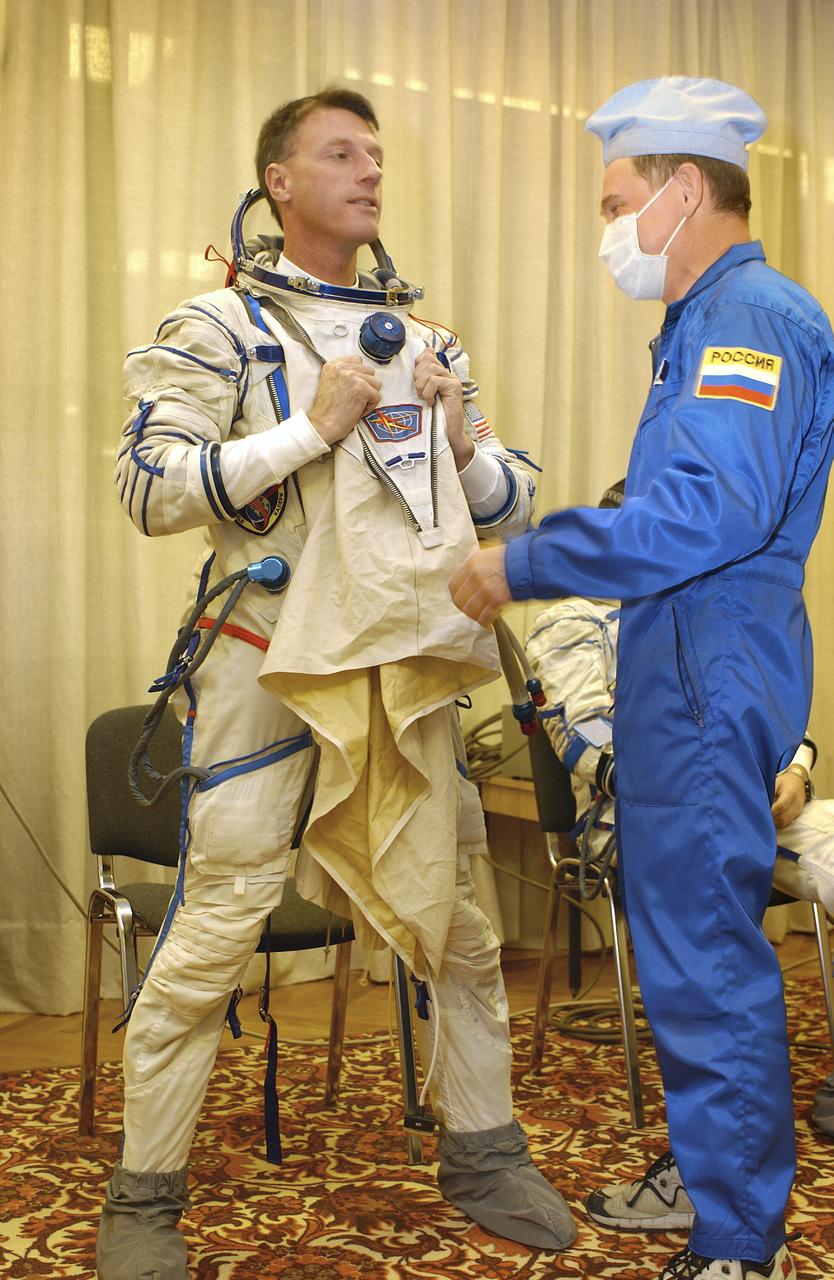
Expedition 8 Commander and NASA Scienhce Officer Michael Foale, left, suits up for launch with the assistance of a technician, Saturday, Oct. 18, 2003, prior to departure for the launch pad at the Baikonur Cosmodrome in Kazakhstan. Foale, Kaleri and European Space Agency astronaut Pedro Duque were launched on a Soyuz TMA-3 vehicle to the International Space Station, arriving on Oct. 20. Photo Credit (NASA/Bill Ingalls)
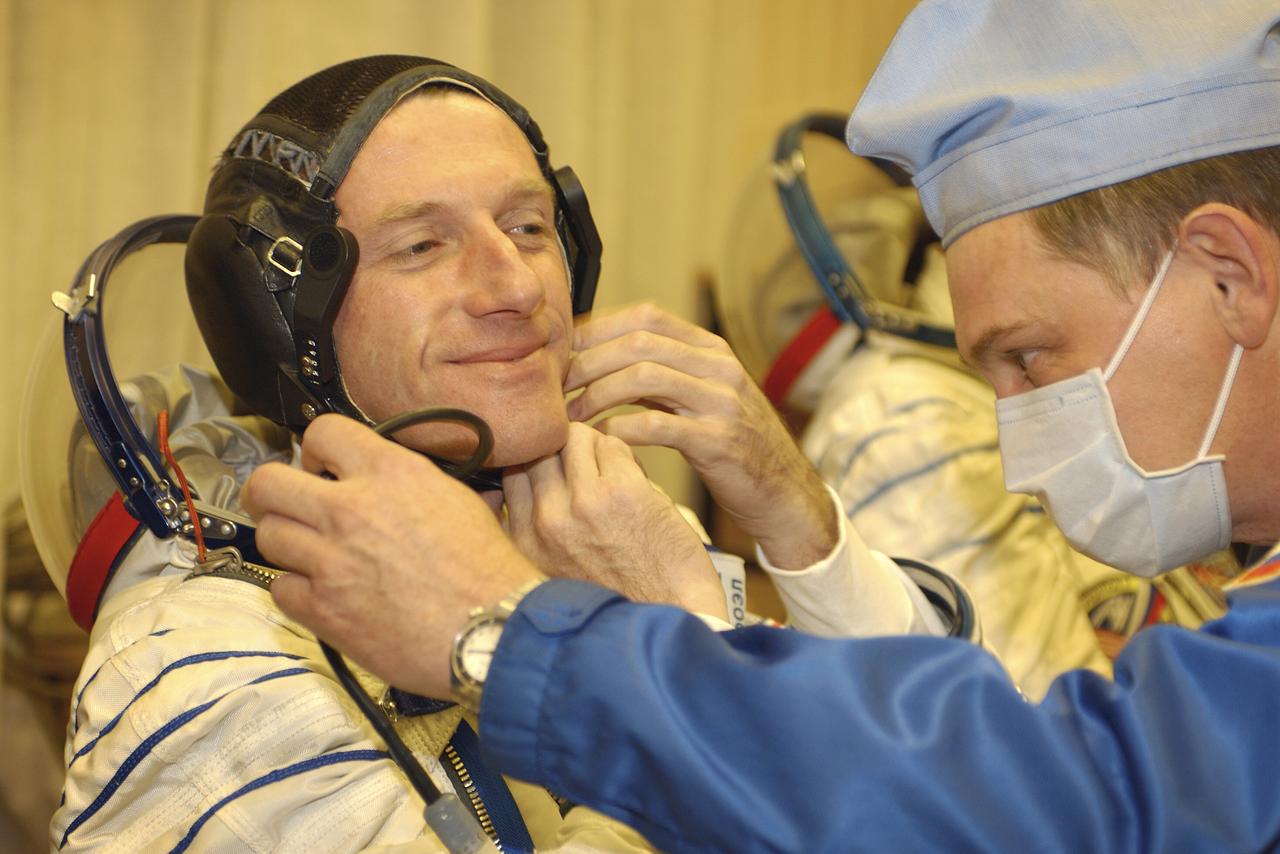
Expedition 8 Commander and NASA Scienhce Officer Michael Foale suits up with the assistance of a technician, Saturday, Oct. 18, 2003, prior to departure for the launch pad at the Baikonur Cosmodrome in Kazakhstan. Foale, Soyuz Commander Alexander Kaleri and European Space Agency astronaut Pedro Duque were launched on a Soyuz TMA-3 vehicle to the International Space Station, arriving on Oct. 20. Photo Credit (NASA/Bill Ingalls)
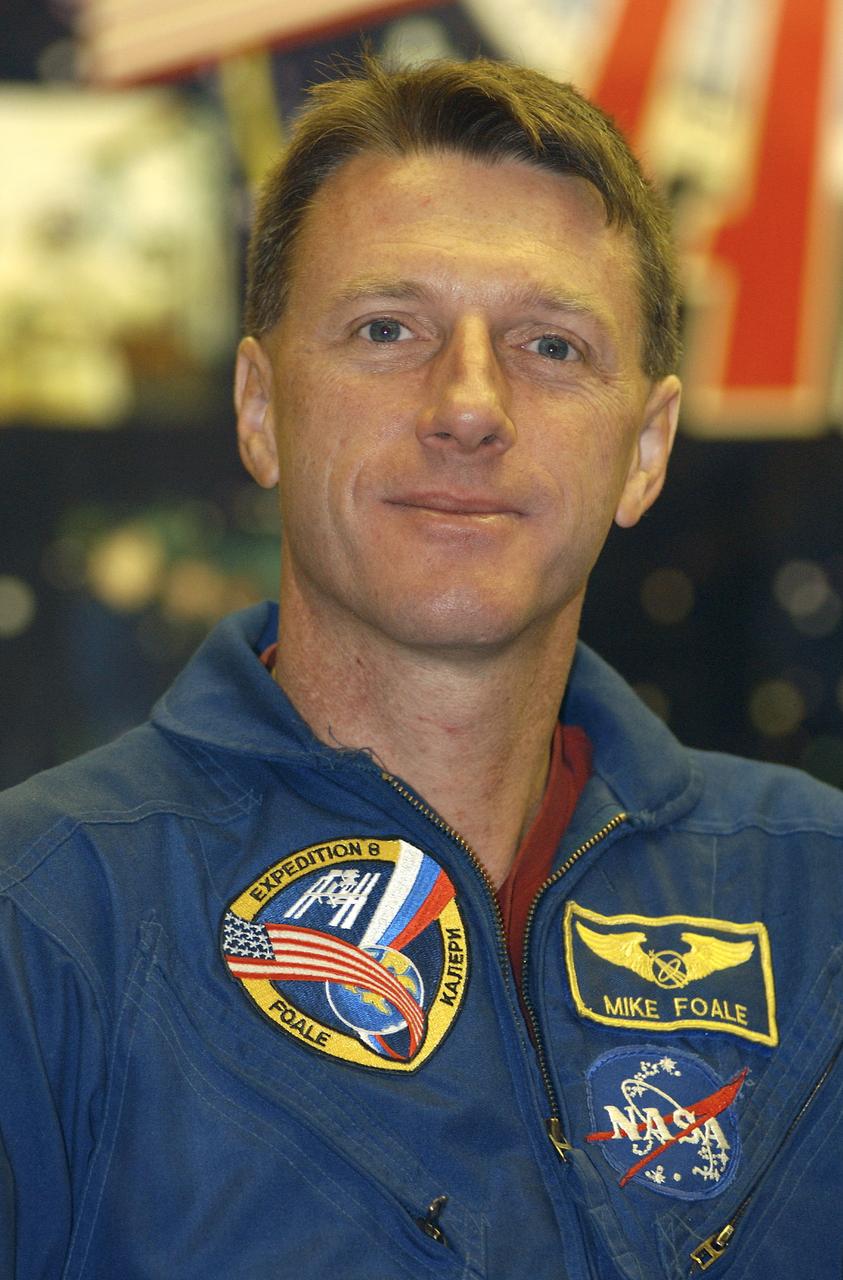
Expedition 8 Commander and NASA Science Officer Michael Foale listens to a reporter's question during a prelaunch news conference, Friday, Oct. 17, 2003, in Baikonur, Kazakhstan. Foale, Expedition 8 Soyuz Commander Alexander Kaleri and European Space Agency Astronaut Pedro Duque of Spain launched in a Soyuz TMA-3 vehicle Oct. 18 to the International Space Station. Photo Credit (NASA/Bill Ingalls)
Expedition 8 Commander and NASA Science Officer Michael Foale is seen at the Baikonur Cosmodrome in Kazakhstan. Foale, Expedition 8 Soyuz Commander Alexander Kaleri and European Space Agency astronaut Pedro Duque of Spain were launched on a Soyuz TMA-3 vehicle to the International Space Station, arriving on Oct. 20. Photo Credit (NASA/Bill Ingalls)
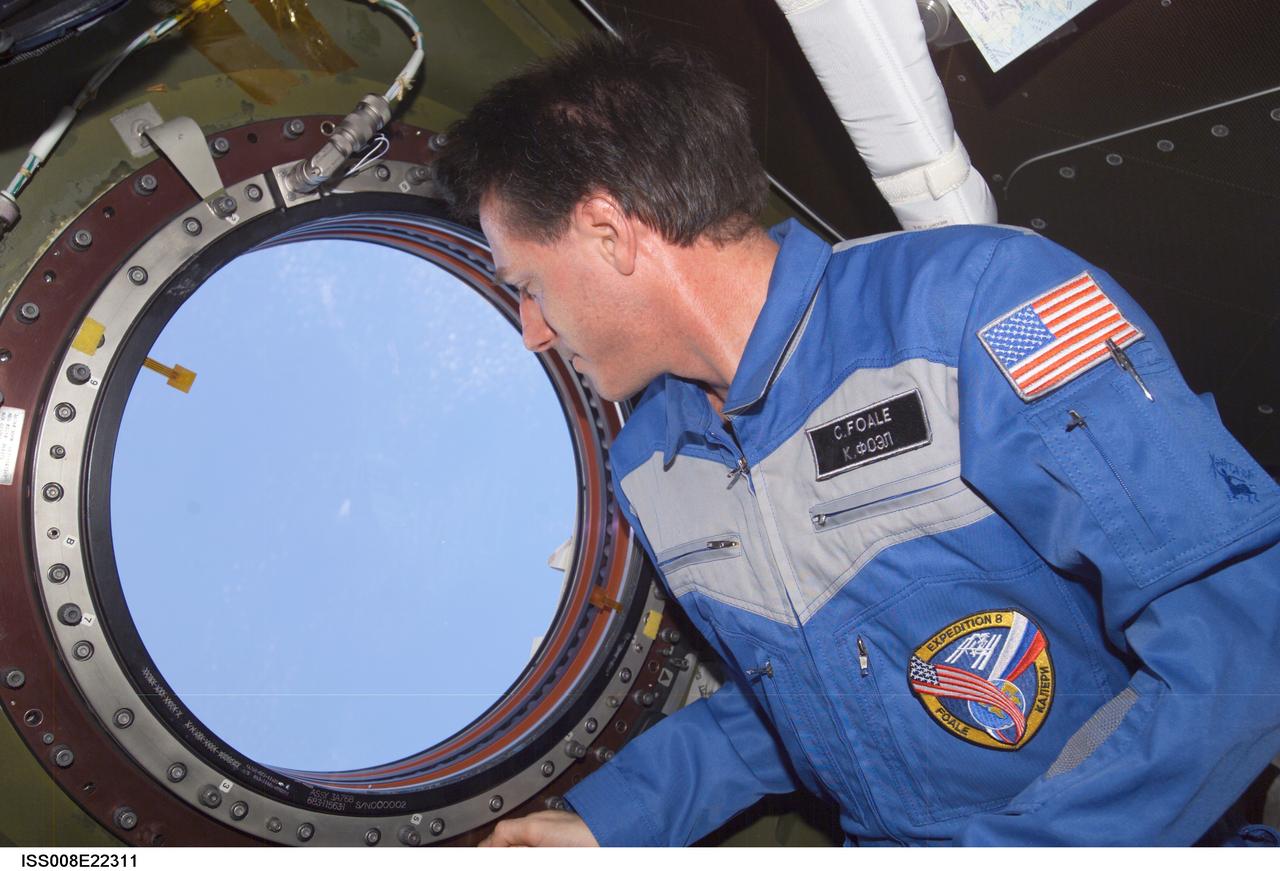
ISS008-E-22311 (26 April 2004) --- Astronaut C. Michael Foale, Expedition 8 commander and NASA ISS science officer, views the topography of a point on Earth from the nadir window in the Destiny laboratory of the International Space Station (ISS).

ISS008-E-07384 (9 Dec. 2003) --- Astronaut C. Michael Foale, Expedition 8 commander and NASA ISS science officer, holds the top end-cap for the Treadmill Vibration Isolation System (TVIS) gyroscope in the Zvezda Service Module on the International Space Station (ISS).

ISS008-E-22271 (23 April 2004) --- Astronaut C. Michael Foale, Expedition 8 commander and NASA ISS science officer, performs in-flight maintenance (IFM) on the nadir window in the Destiny laboratory of the International Space Station (ISS).
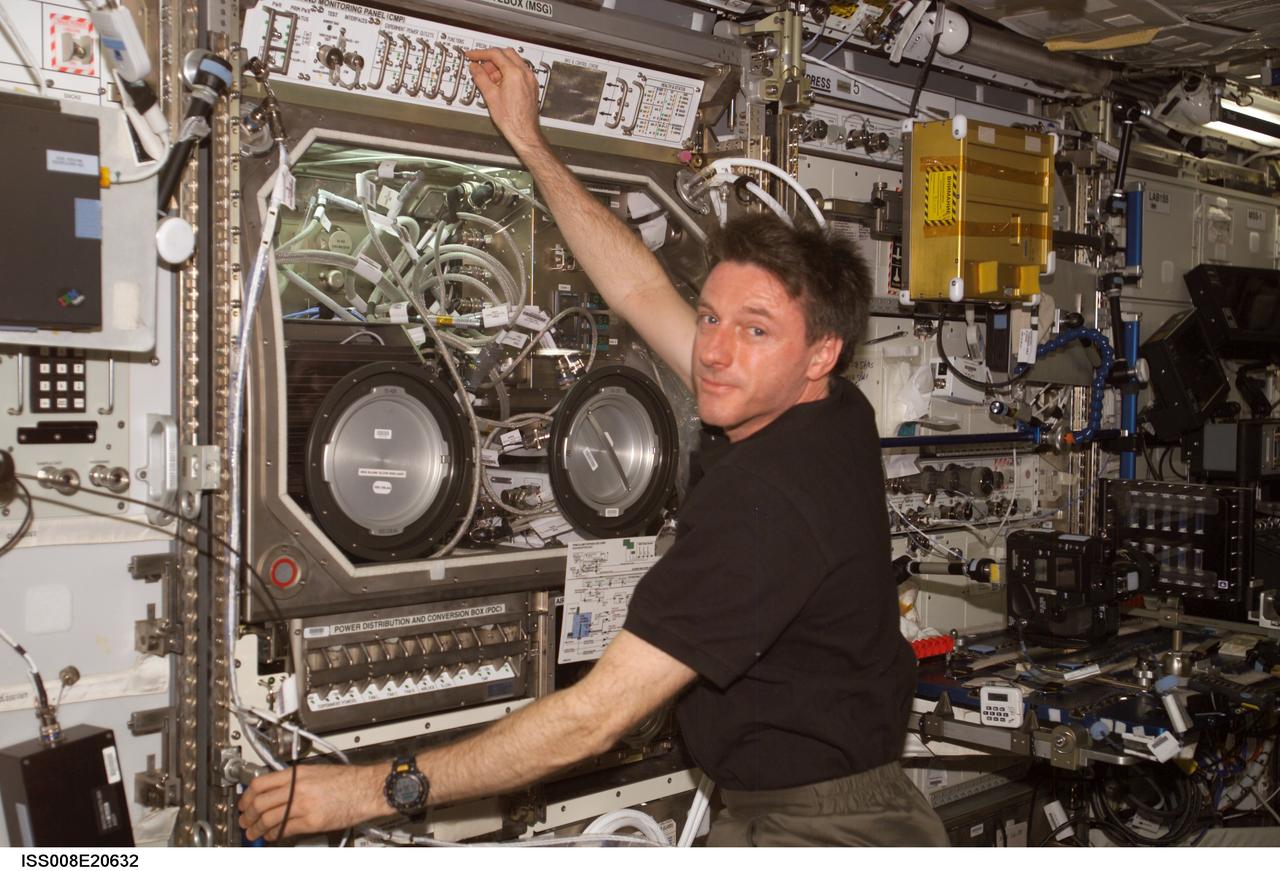
ISS008-E-20632 (5 April 2004) --- Astronaut C. Michael Foale, Expedition 8 commander and NASA ISS science officer, conducts an inspection of the Microgravity Science Glovebox (MSG) / Exchangeable Standard Electronic Module (ESEM) in the Destiny laboratory of the International Space Station (ISS).
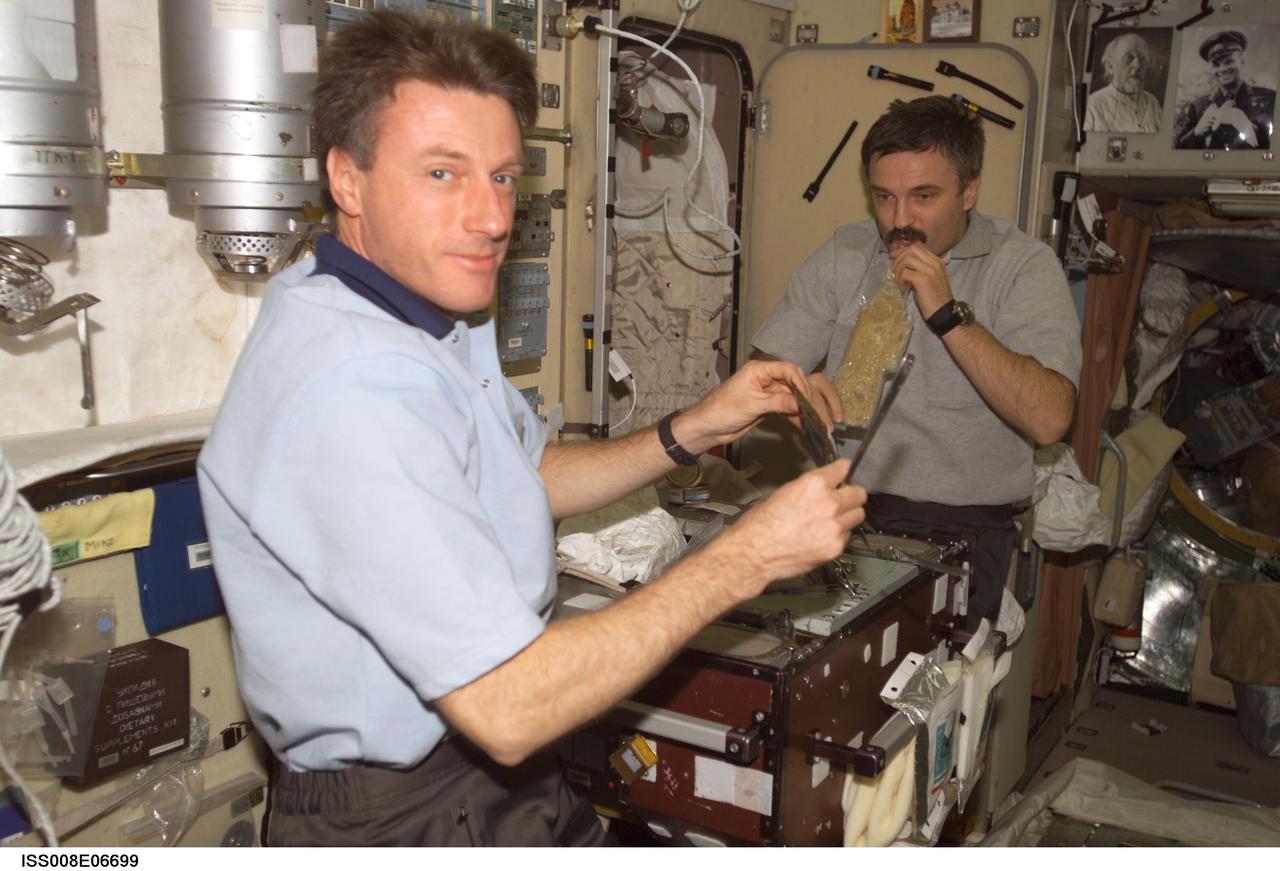
ISS008-E-06699 (1 December 2003) --- Astronaut C. Michael Foale (foreground), Expedition 8 mission commander and NASA ISS science officer, and cosmonaut Alexander Y. Kaleri, flight engineer representing Rosaviakosmos, eat a meal in the Zvezda Service Module on the International Space Station (ISS).
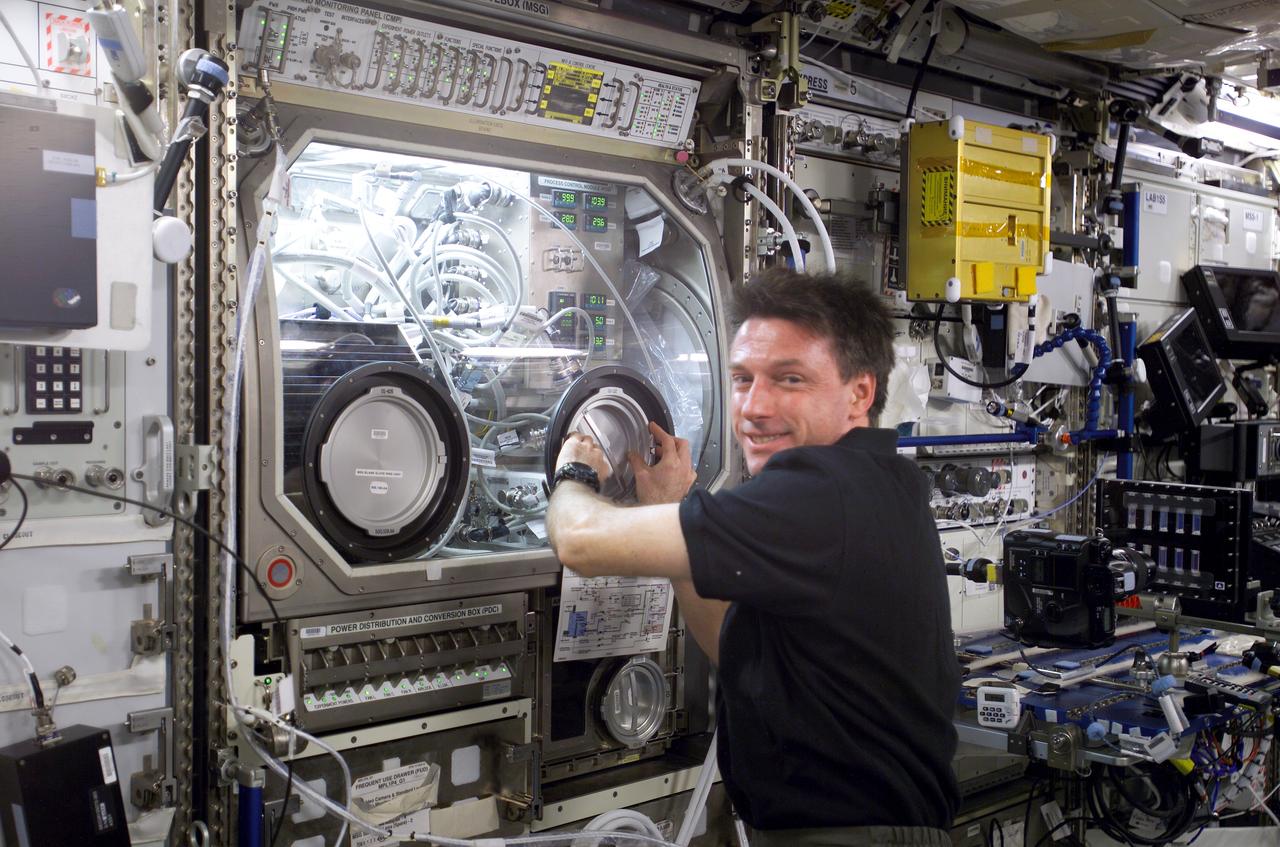
ISS008-E-20622 (5 April 2004) --- Astronaut C. Michael Foale, Expedition 8 commander and NASA ISS science officer, conducts an inspection of the Microgravity Science Glovebox (MSG) / Exchangeable Standard Electronic Module (ESEM) in the Destiny laboratory of the International Space Station (ISS).
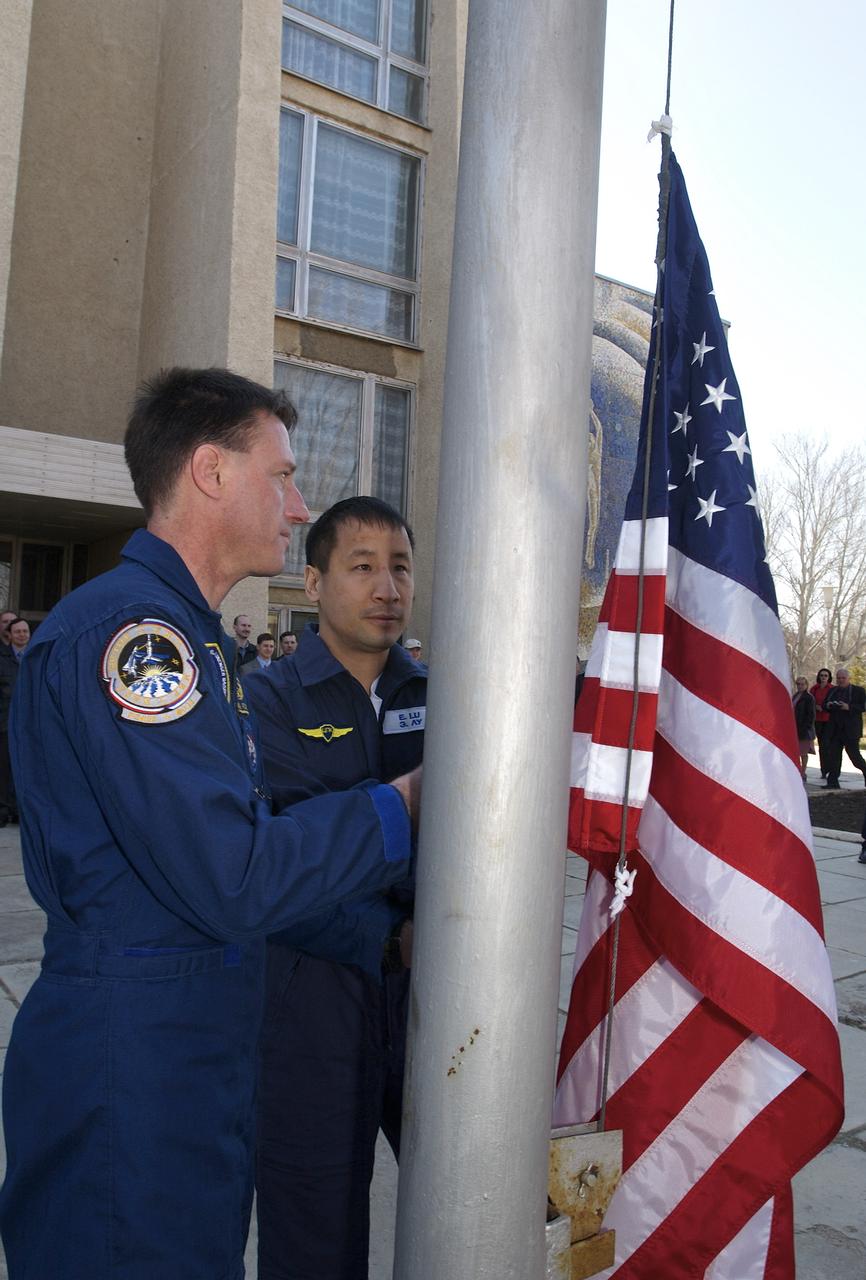
Expedition 7 backup crew member Michael Foale, left and Edward T. Lu, NASA International Space Station Science Officer and Flight Engineer, participate in the ceremonial flag raising at the Cosmonaut Hotel, Kazakhstan, Monday, April 21, 2003. Photo Credit: (NASA/Scott Andrews)
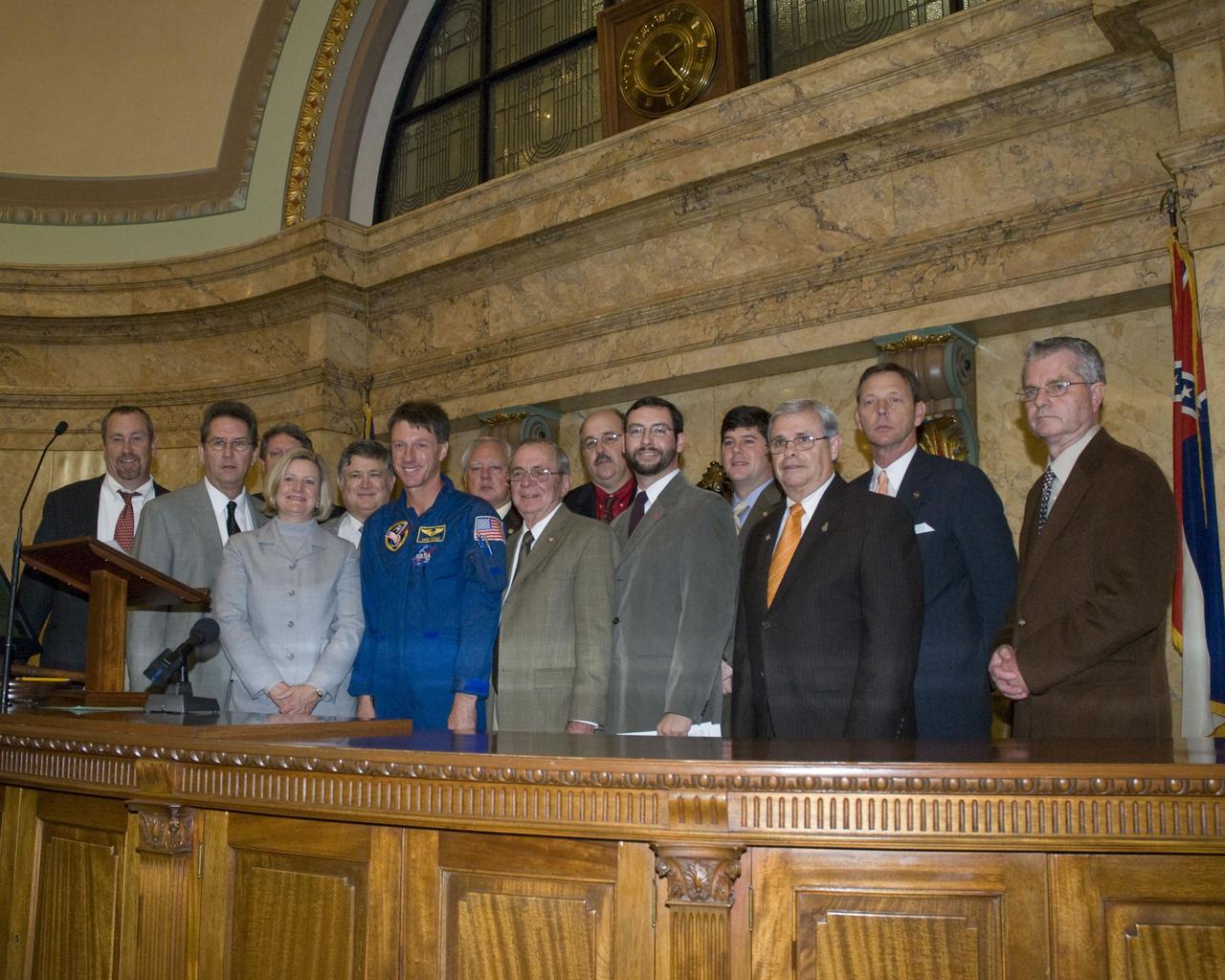
Astronaut Michael Foale (center) and Stennis Space Center officials met with Mississippi House of Representatives Gulf Coast delegation, including Speaker William 'Billy' McCoy (far right), during NASA Space Day in Mississippi on January 30.
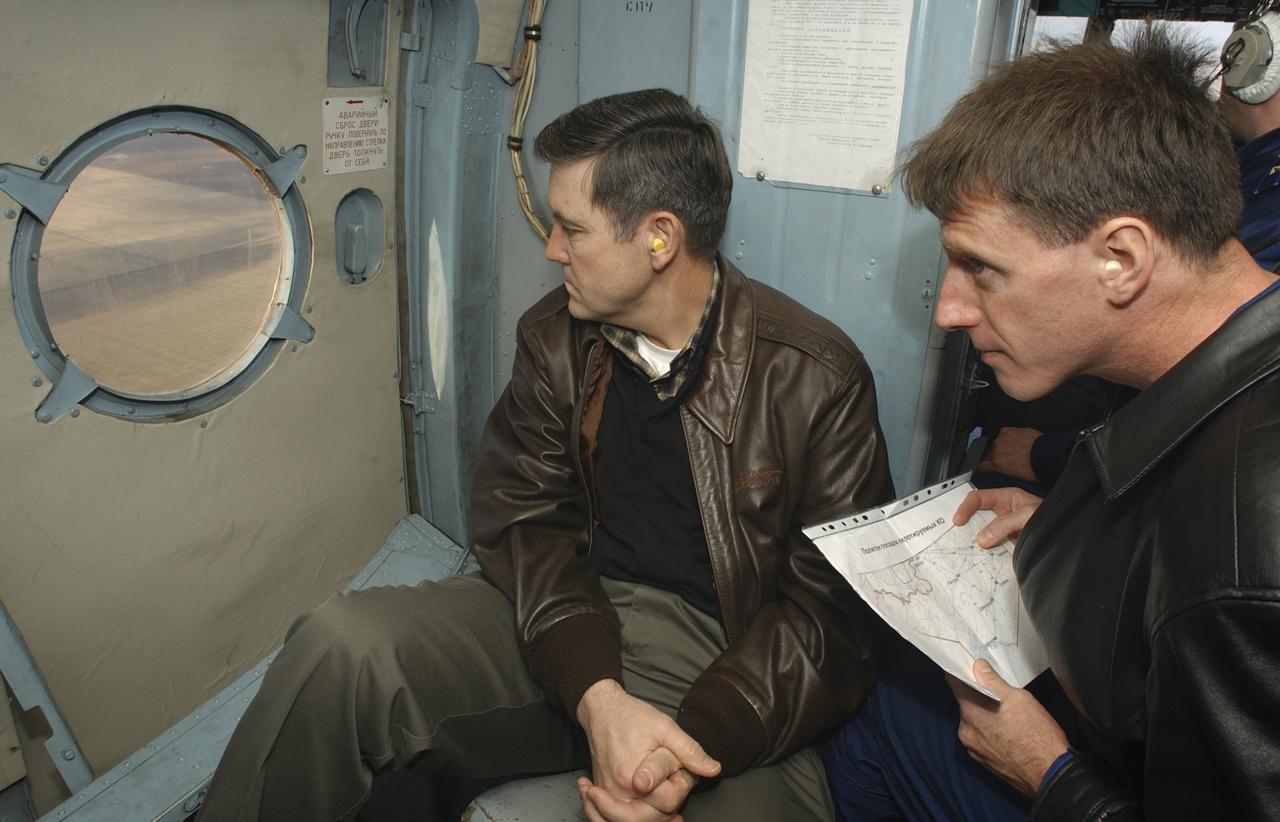
From the seat of a Russian helicopter, Bob Cabana, left, Director of Flight Crew Operations and astronaut Michael Foale look out over the Kazakh terrain for the Expedition 6 Soyuz capsule after its landing on Tuesday, May 4, 2003, in Kazakhstan. Photo Credit: (NASA/Bill Ingalls)
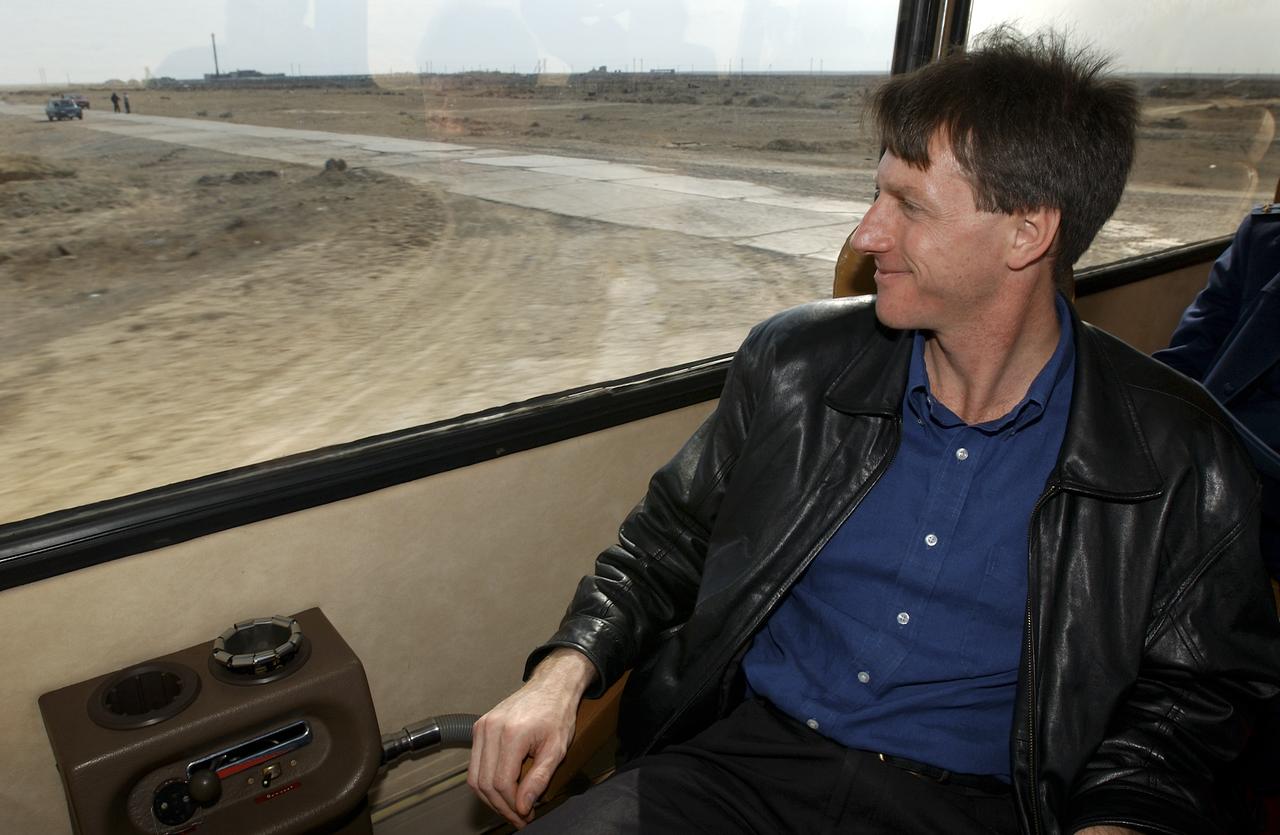
Astronaut Michael Foale, backup crew member for Expedition 7, looks out the bus window during the drive to the Cosmonaut Hotel in Baikonur, Kazakhstan on Wednesday, April 9, 2003. The crews performed fit checks on their Russian Sokol suits and performed a Soyuz inspection at the Baikonur Cosmodrome. Photo Credit: (NASA/Bill Ingalls)
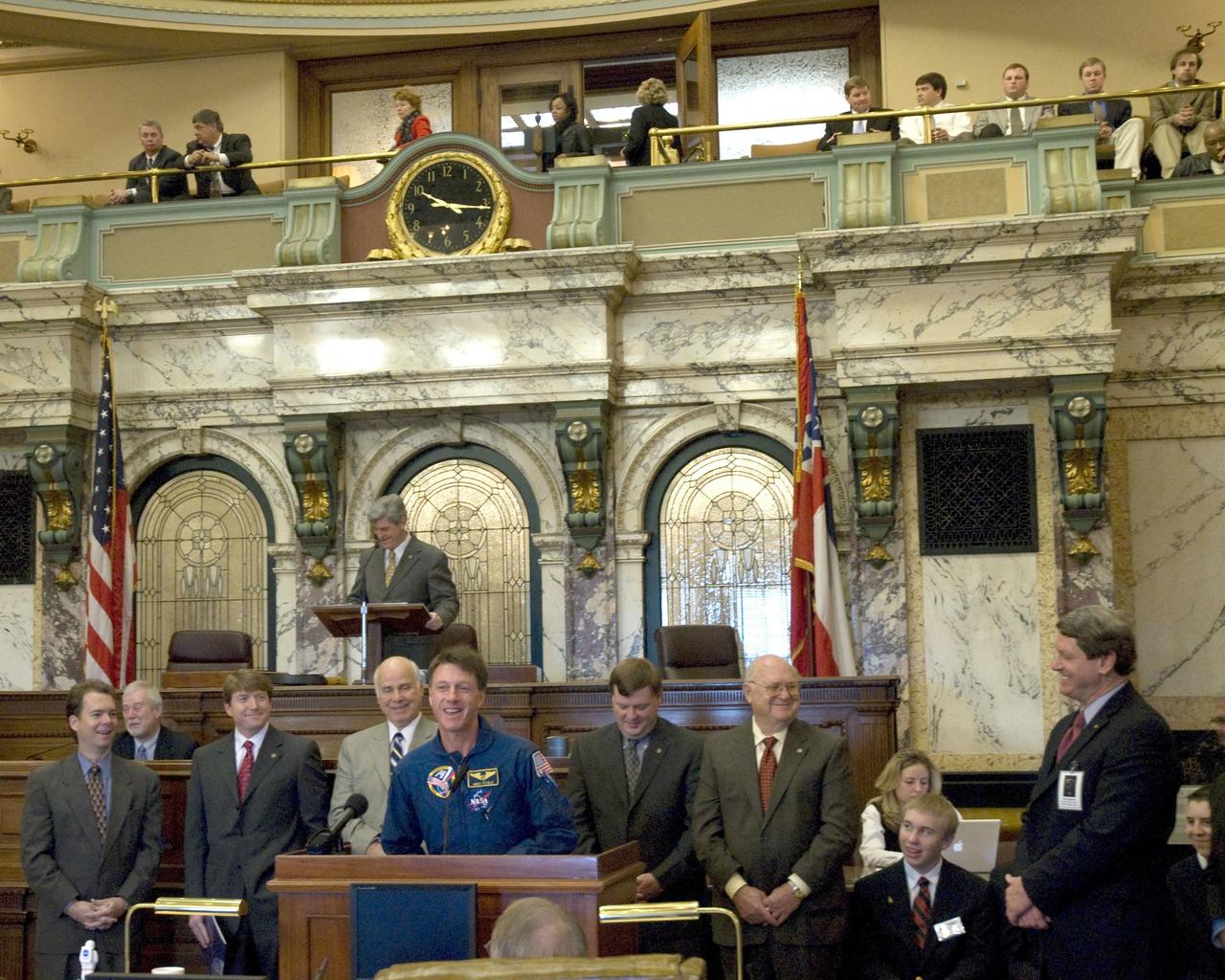
Astronaut Michael Foale (center) and Stennis Space Center officials met with Mississippi Lt. Gov. Phil Bryant (at rear podium) and Gulf Coast delegation members in Mississippi Senate chambers during NASA Space Day in Mississippi activities at the Capitol on January 30.
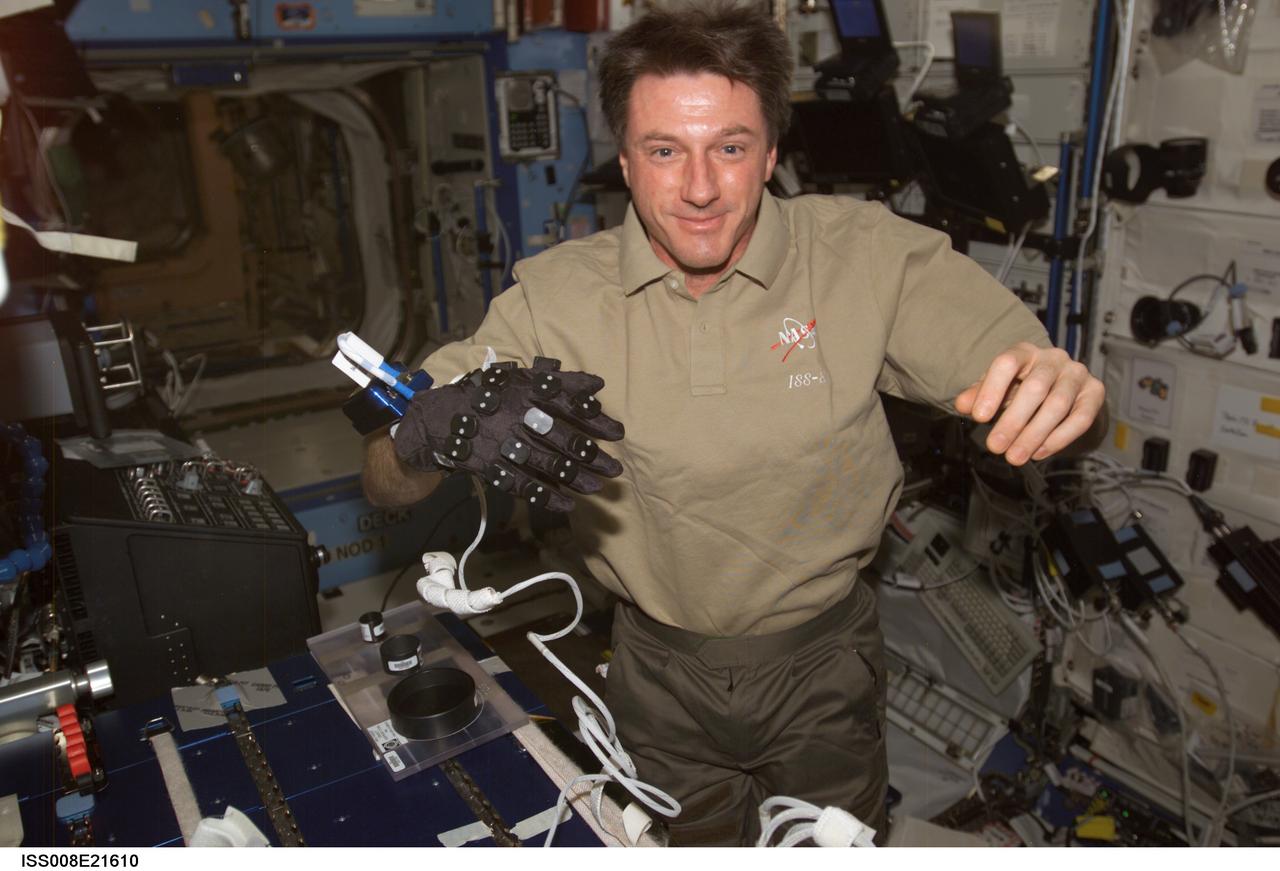
ISS008-E-21610 (15 April 2004) --- Astronaut C. Michael Foale, Expedition 8 commander and NASA ISS science officer, completes his third and final data collection with the Hand Posture Analysis (HPA) investigation in the Destiny laboratory on the International Space Station (ISS). After setting up the video tape recorder (VTR) for documenting the activities, Foale used the posture acquisition glove (PAG), which has delicate sensors attached to the tops of the fingers, to operate the handgrip dynamometer (HGD).
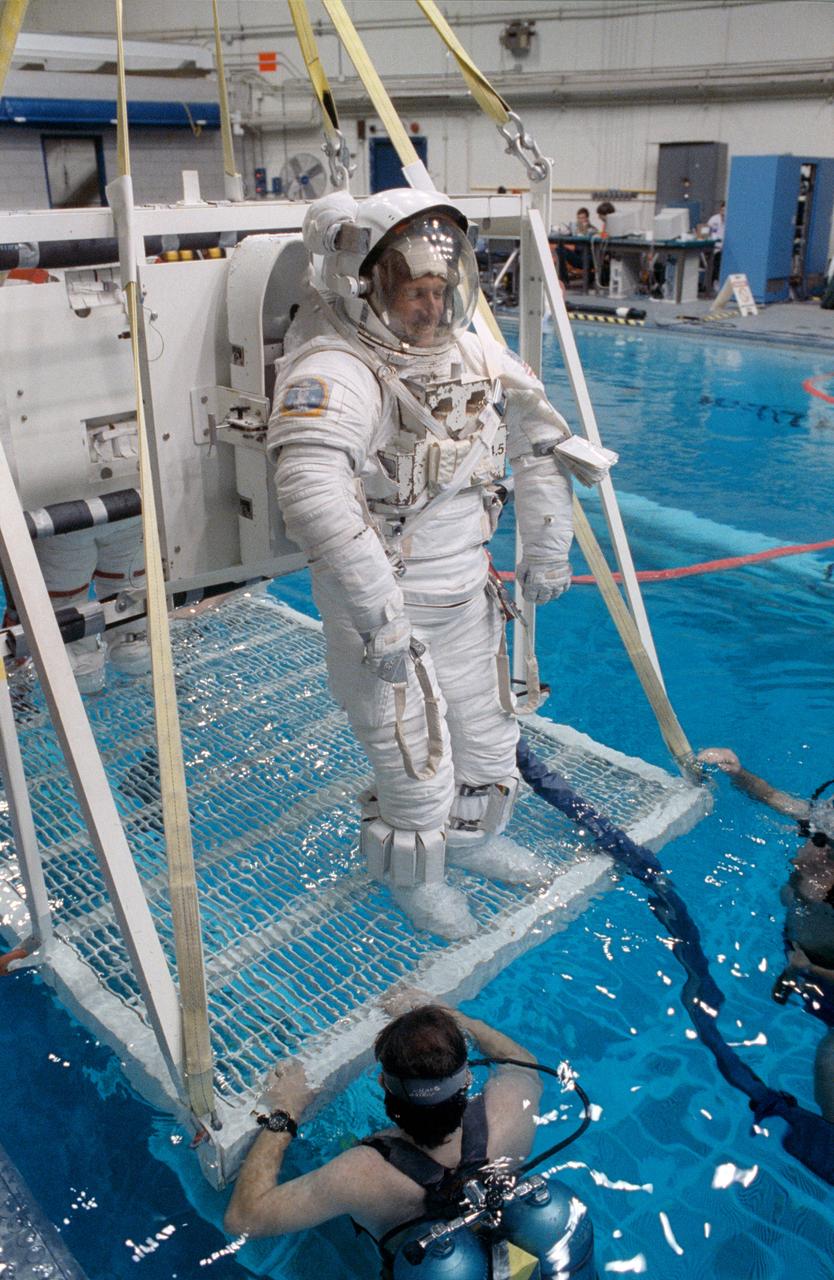
S91-30197 (1 March 1991) --- A wider shot of astronaut C. Michael Foale, mission specialist, standing on a platform which is part of a system that will lower him into a 25-ft. deep pool. Foale used the pool in the weightless environment training facility (WET-F) to rehearse a contingency extravehicular activity (EVA). Two SCUBA-equipped swimmers assist. Astronauts wear pressurized spacesuits configured for achieving a neutrally buoyant condition in the water to simulate both planned and contingency EVAs.
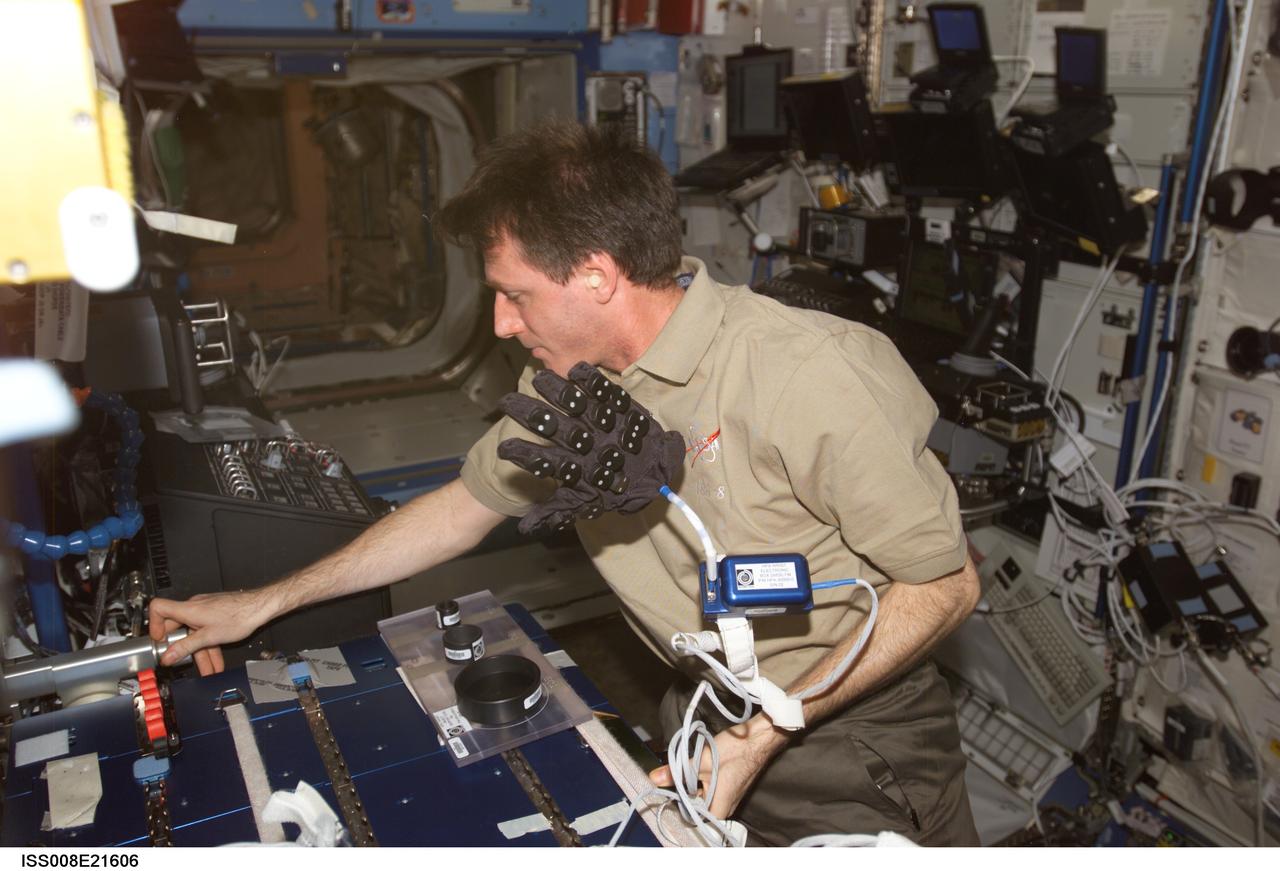
ISS008-E-21606 (15 April 2004) --- Astronaut C. Michael Foale, Expedition 8 commander and NASA ISS science officer, completes his third and final data collection with the Hand Posture Analysis (HPA) investigation in the Destiny laboratory on the International Space Station (ISS). After setting up the video tape recorder (VTR) for documenting the activities, Foale used the posture acquisition glove (PAG), which has delicate sensors attached to the tops of the fingers, to operate the handgrip dynamometer (HGD).
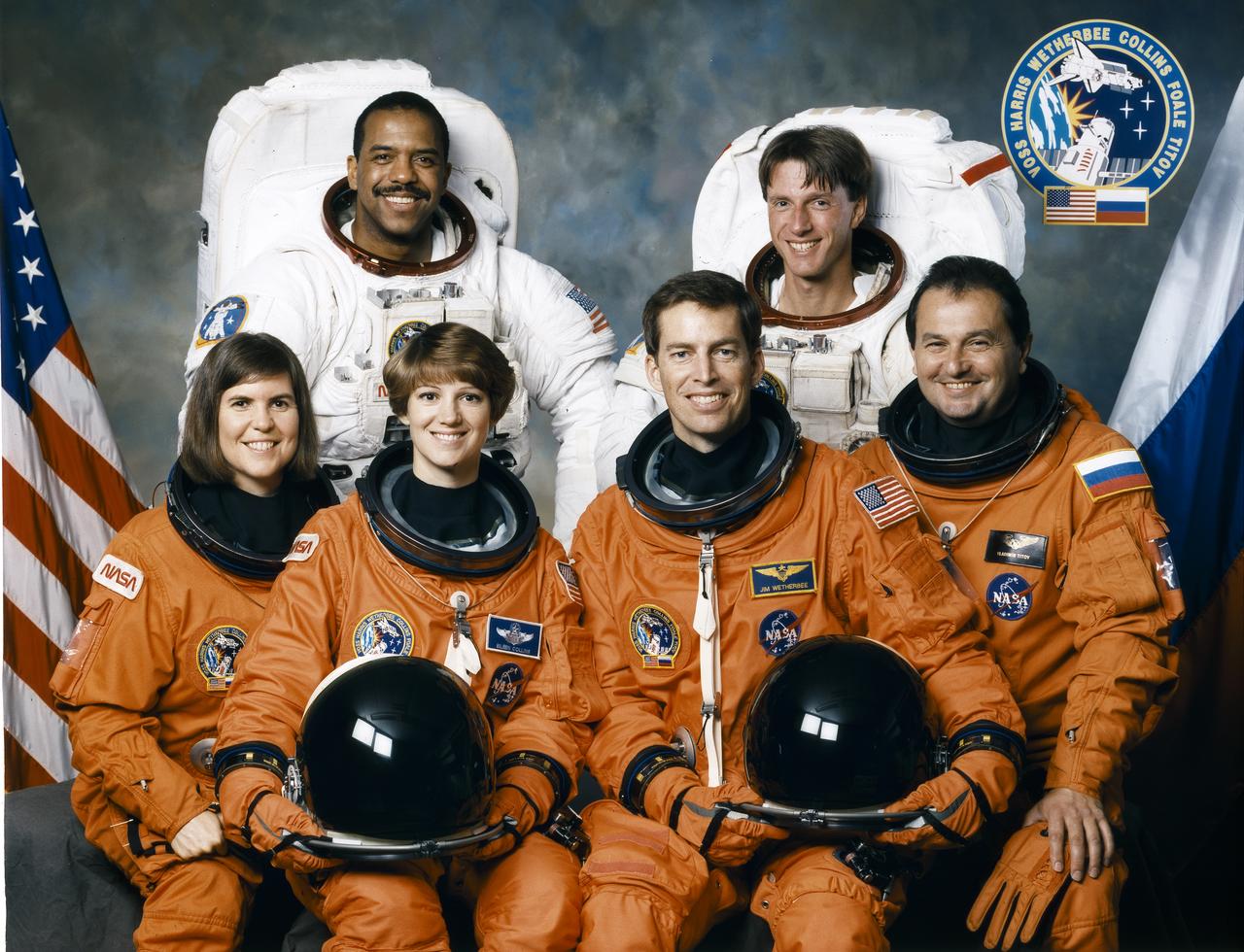
Crew members assigned to the STS-63 mission included (front left to right) Janice E. Voss, mission specialist; Eileen M. Collins, pilot; (the first woman to pilot a Space Shuttle), James D. Wetherbee, commander; and Vladmir G. Titov (Cosmonaut). Standing in the rear are mission specialists Bernard A. Harris, and C. Michael Foale. Launched aboard the Space Shuttle Discovery on February 3, 1995 at 12:22:04 am (EST), the primary payload for the mission was the SPACEHAB-3. STS-63 marked the first approach and fly around by the Shuttle with the Russian space station Mir.
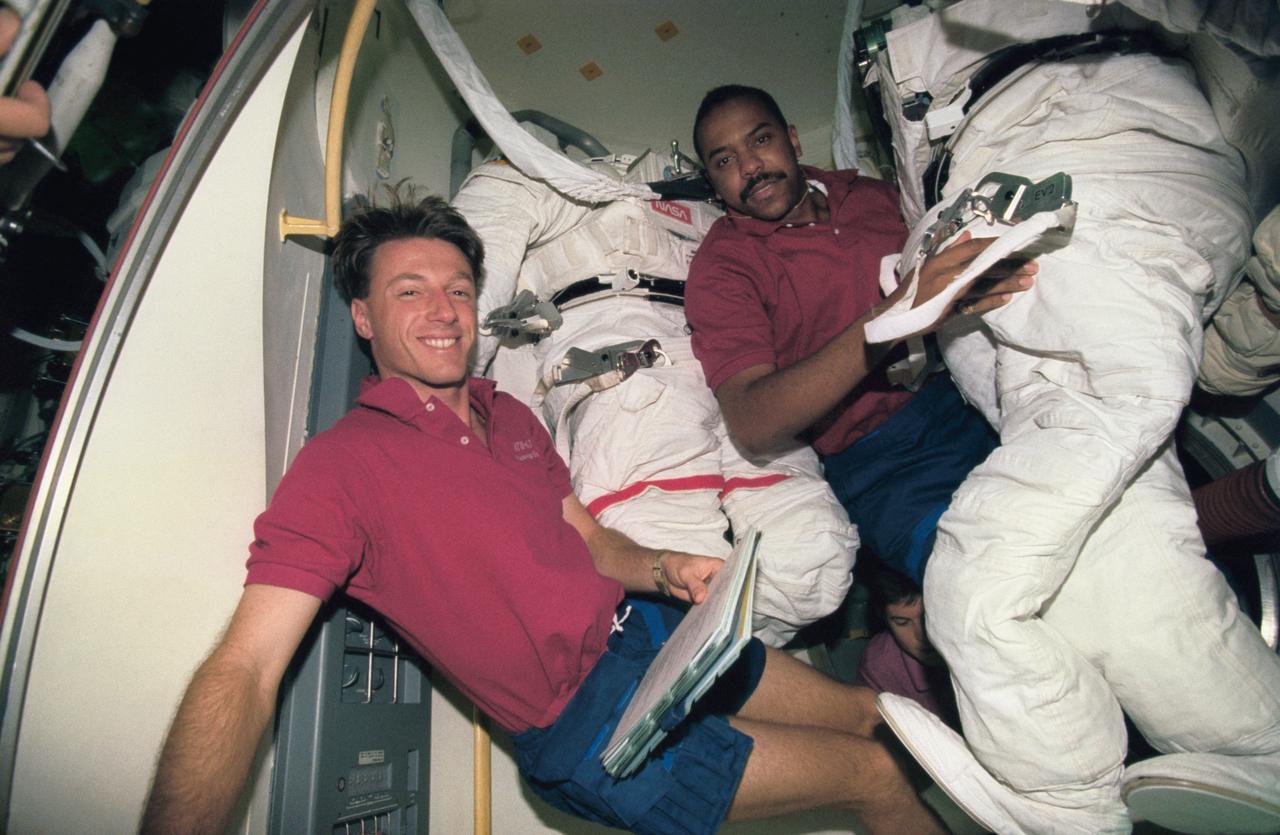
STS063-314-005 (9 Feb 1995) --- Astronaut's C. Michael Foale, mission specialist, (left) and Bernard A. Harris Jr., payload commander, prepare suits prior to their Extravehicular Activity (EVA). This is one of 16 still photographs released by the NASA Johnson Space Center (JSC) Public Affairs Office (PAO) on February 14, 1995. Others onboard the Space Shuttle Discovery were astronauts James D. Wetherbee, mission commander; Eileen M. Collins, pilot; mission specialists Janice E. Voss, and cosmonaut Vladimir G. Titov representing the Russian Space Agency (RSA).

Expedition 8 Commander Michael Foale is carried in a chair from the Soyuz landing site to an inflatable medical tent after he, Soyuz Flight Engineer Alexander Kaleri and European Space Agency astronaut Andre Kuipers of the Netherlands landed in north central Kazakhstan, Friday, April 30, 2004, in a Soyuz TMA-3 capsule. Foale and Kaleri completed 195 days in space aboard the International Space Station, while Kuipers returned after an 11-day research mission as part of a commercial agreement between ESA and the Russian Federal Space Agency. Photo Credit: (NASA/Bill Ingalls)
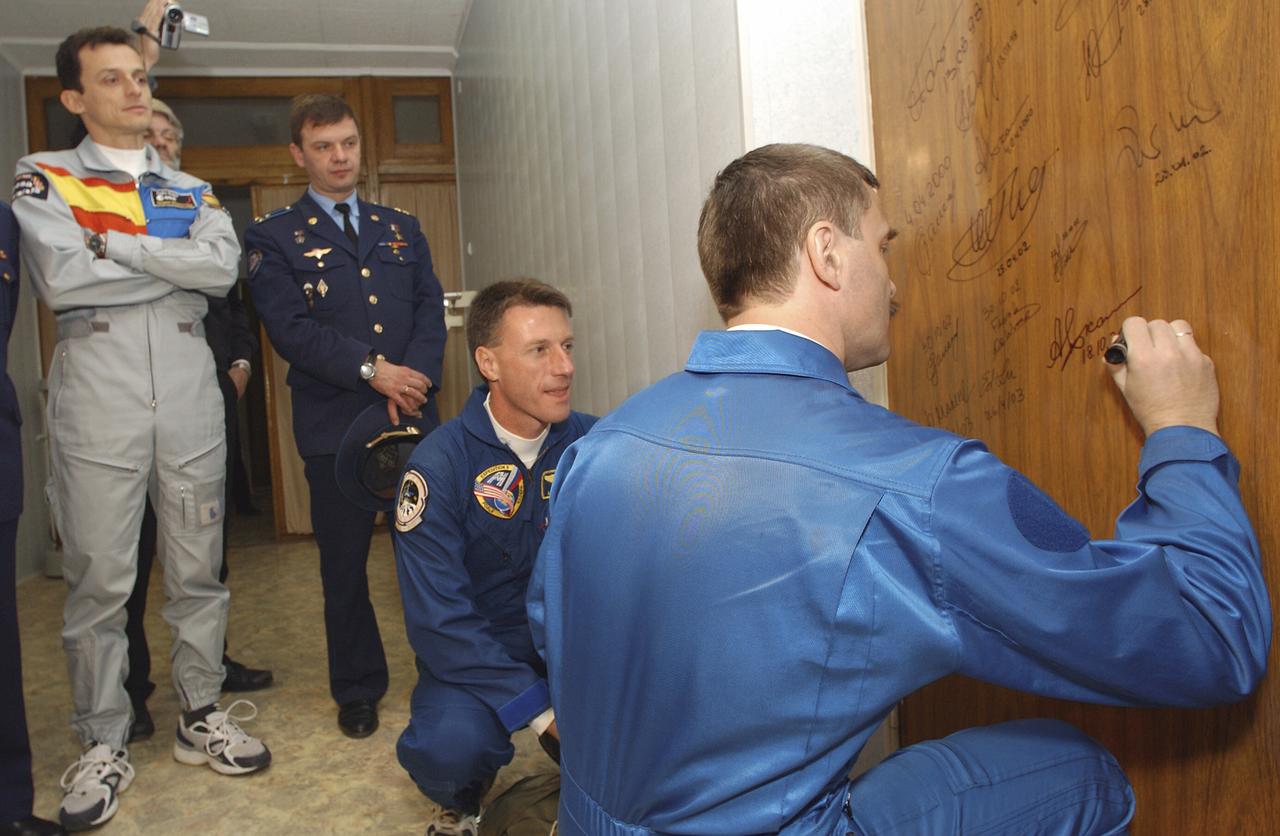
As European Space Agency astronaut Pedro Duque of Spain, left, former International Space Station crewmember Yuri Gidzenko (center) and Expedition 8 Commander and NASA Science Officer Mike Foale look on, Expedition 8 Soyuz Commander and Flight Engineer Alexander Kaleri, rear to camera, signs his name to the door of his room at the Cosmonaut Hotel crew quarters, Saturday, Oct. 18, 2003, in Baikonur, Kazakhstan prior to departing for the launch pad. Foale, Kaleri and Duque were launched on a Soyuz TMA-3 vehicle from Baikonur to the International Space Station, arriving on Oct. 20. Photo Credit (NASA/Bill Ingalls)
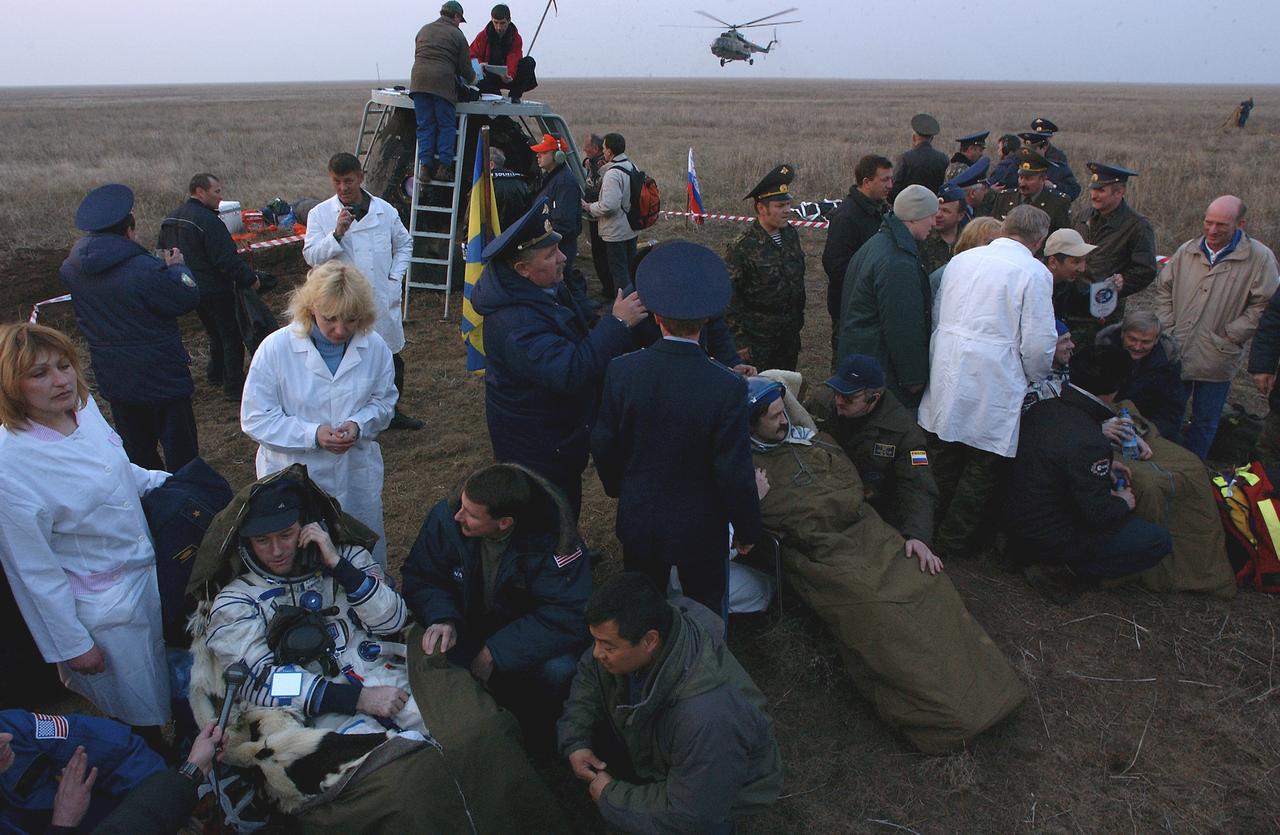
Expedition 8 Commander Mike Foale, lower left, Soyuz Flight Engineer Alexander Kaleri and European Space Agency astronaut Andre Kuipers of the Netherlands, partially hidden, are tended to after touching down in north central Kazakhstan, Friday, April 30, 2004. Foale and Kaleri completed 195 days in space aboard the International Space Station, while Kuipers returned after an 11-day research mission as part of a commercial agreement between ESA and the Russian Federal Space Agency. Photo Credit (NASA/Bill Ingalls)
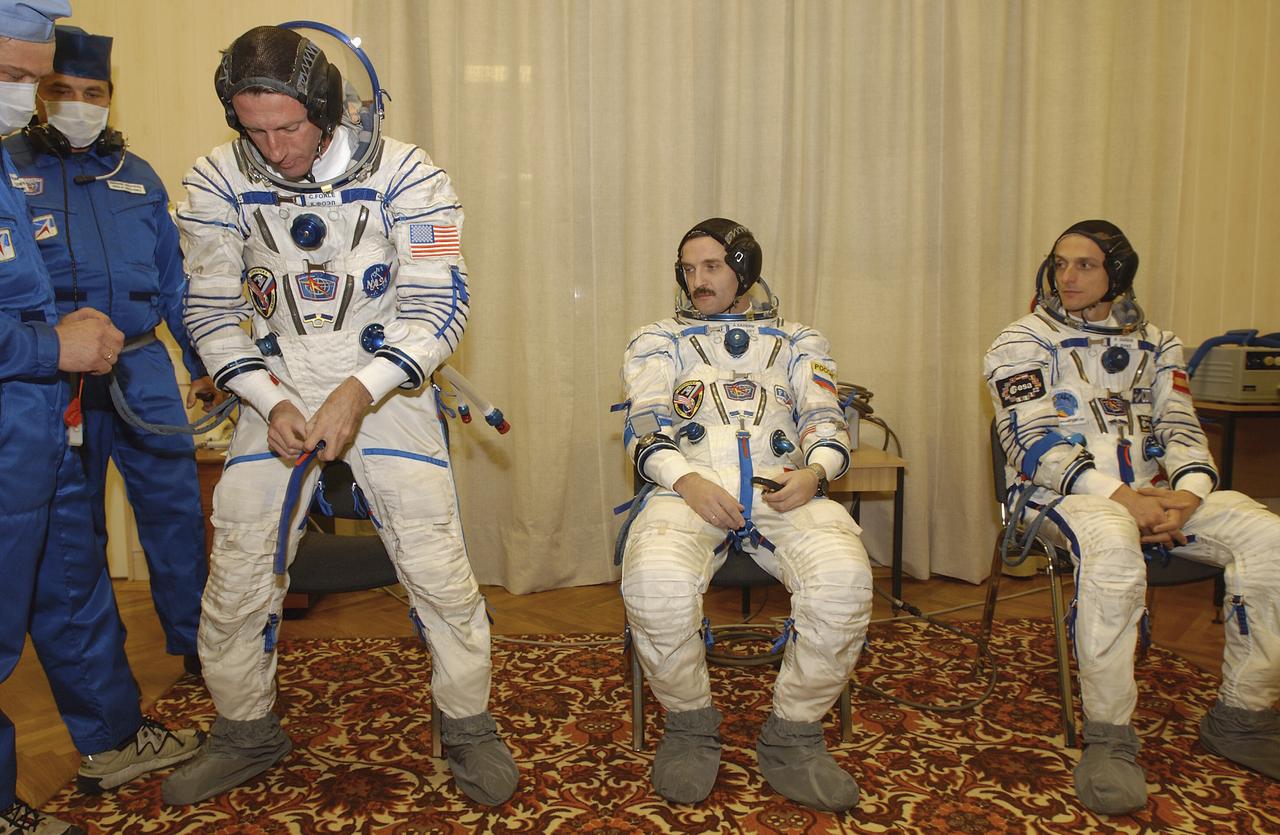
Expedition 8 Commander and NASA Science Officer Michael Foale, left, Expedition 8 Soyuz Commander Alexander Kaleri and European Space Agency astronaut Pedro Duque, right, complete suiting up, Saturday, Oct. 18, 2003, prior to departure for the launch pad at the Baikonur Cosmodrome in Kazakhstan. Foale, Kaleri and Duque were launched on a Soyuz TMA-3 vehicle to the International Space Station, arriving on Oct. 20. Photo Credit (NASA/Bill Ingalls)
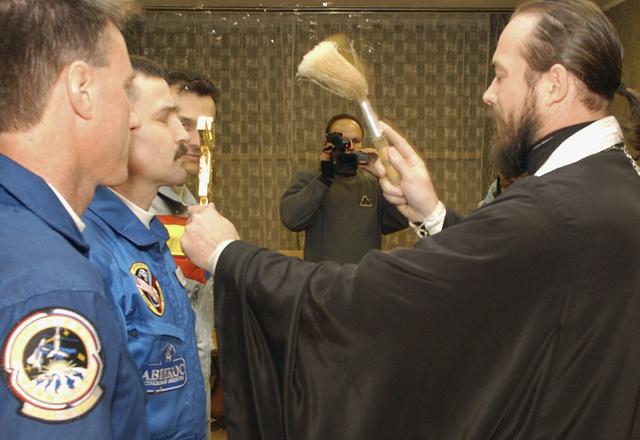
Expedition 8 Commander and NASA Science Officer Mike Foale, left, Expedition 8 Soyuz Commander Alexander Kaleri and European Space Agency astronaut Pedro Duque of Spain, receive a traditional blessing from an unidentified Russian Orthodox priest in their crew quarters at the Cosmonaut Hotel, Saturday, Oct. 18, 2003, in Baikonur, Kazakhstan prior to departing for the launch pad. Foale, Kaleri and Duque were launched on a Soyuz TMA-3 vehicle to the International Space Station, arriving on Oct. 20. Photo Credit (NASA/Bill Ingalls)
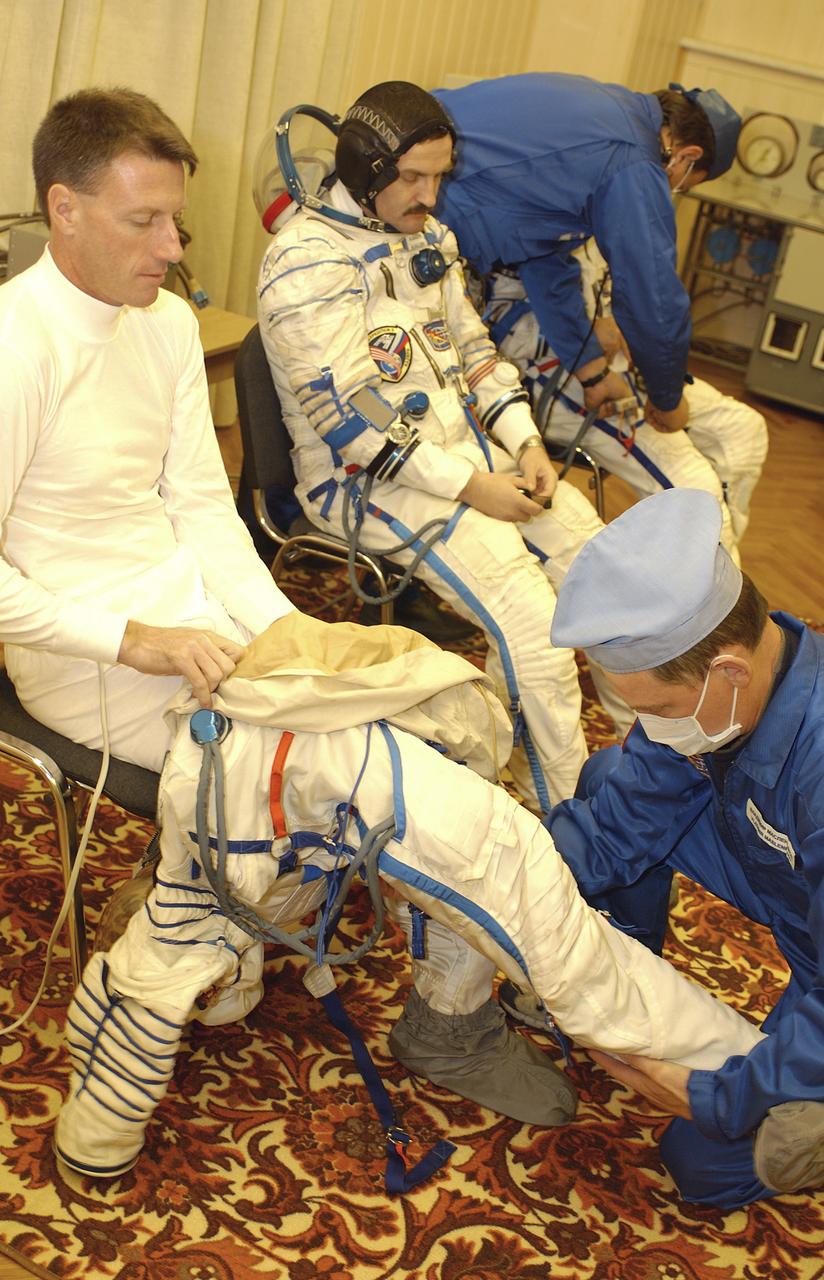
Expedition 8 Commander and NASA Scienhce Officer Michael Foale, left and Expedition 8 Soyuz Commander Alexander Kaleri suit up for launch with the assistance of technicians, Saturday, Oct. 18, 2003, prior to departure for the launch pad at the Baikonur Cosmodrome in Kazakhstan. Foale, Kaleri and European Space Agency astronaut Pedro Duque were launched on a Soyuz TMA-3 vehicle to the International Space Station, arriving on Oct. 20. Photo Credit (NASA/Bill Ingalls)
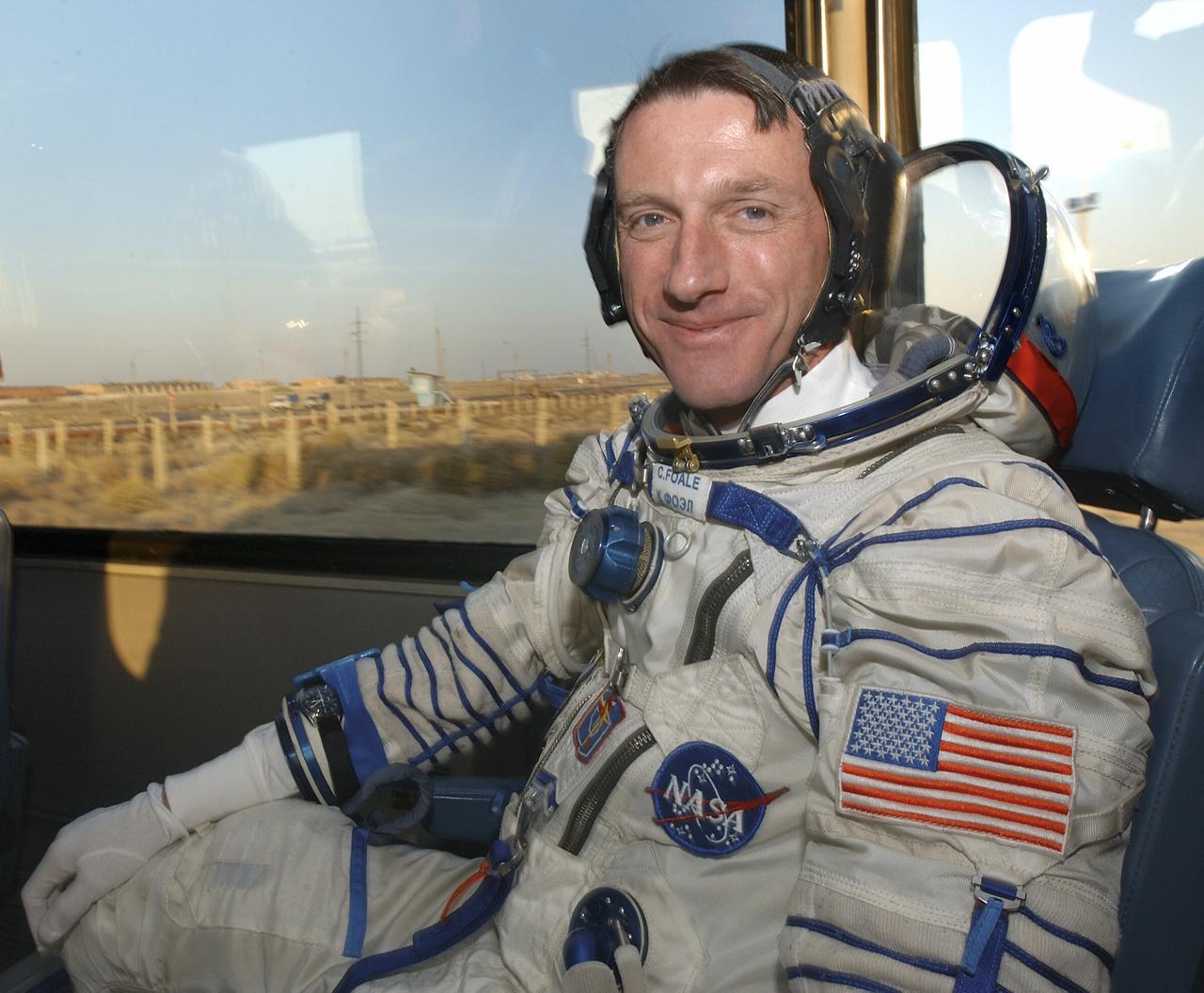
Expedition 8 Commander and NASA Science Officer Michael Foale smiles for the camera during the short bus ride to the launch pad for liftoff in a Soyuz TMA-3 vehicle to the International Space Station, Saturday, Oct. 18, 2003, at the Baikonur Cosmodrome, Kazakhstan. Photo Credit (NASA/Bill Ingalls)
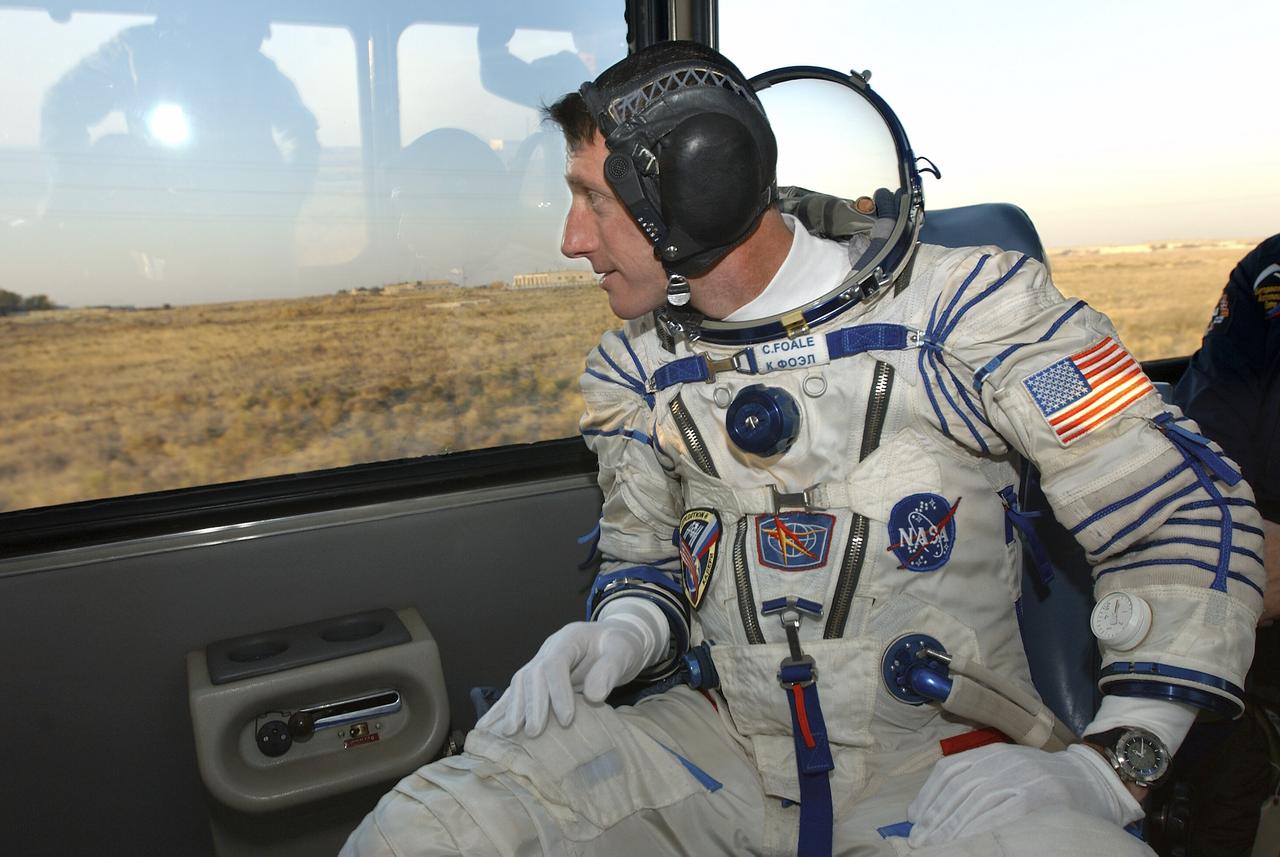
Expedition 8 Commander and NASA Science Officer Michael Foale looks out the window during the short bus ride to the launch pad for liftoff in a Soyuz TMA-3 vehicle to the International Space Station at the Baikonur Cosmodrome in Kazakhstan, Saturday, Oct. 18, 2003. Photo Credit (NASA/Bill Ingalls)
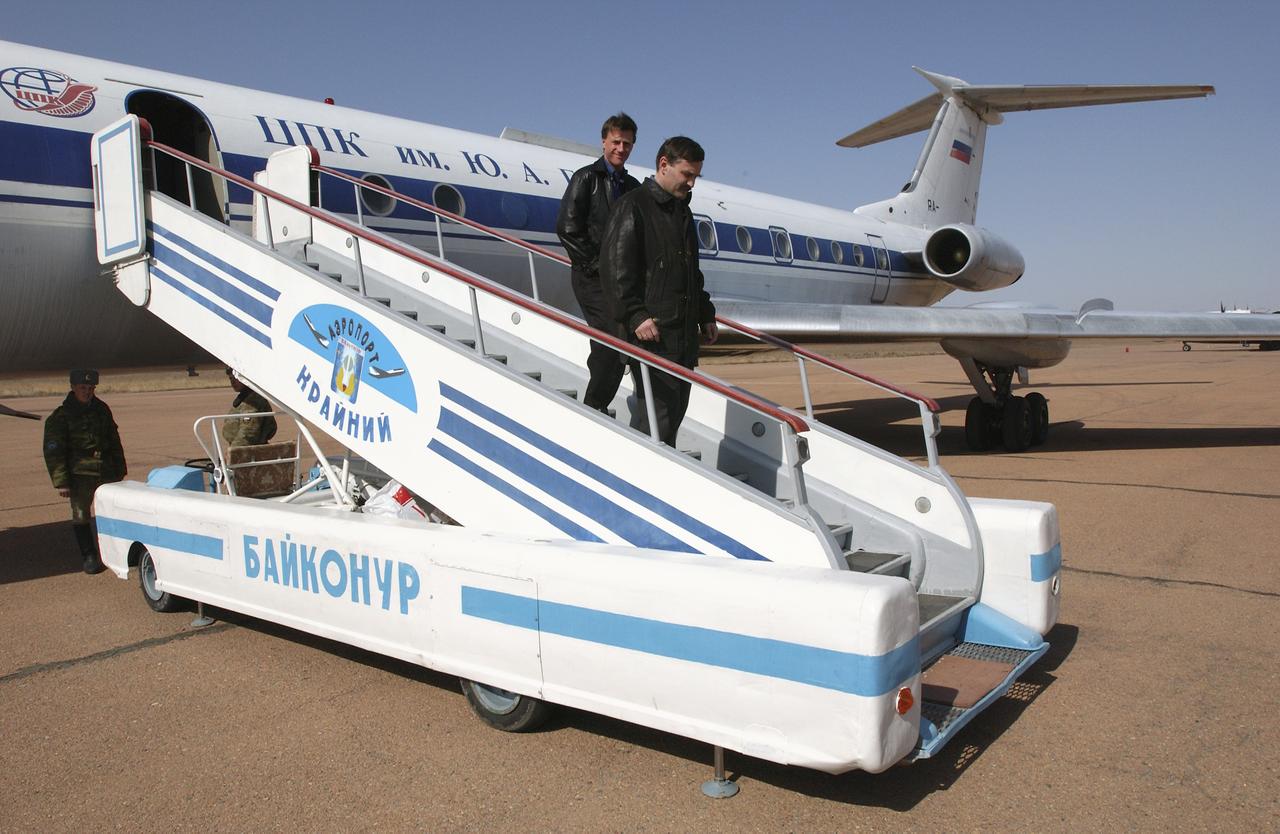
Astronaut Michael Foale, left, and Cosmonaut Alexander Kaleri, backup crew members for Expedition 7, depart the plane after their flight to Baikonur, Kazakhstan on Wednesday, April 9, 2003. The crews performed suit leak checks and Soyuz inspection, seat liner checks at the Baikonur Cosmodrome. Photo Credit: (NASA/Bill Ingalls)
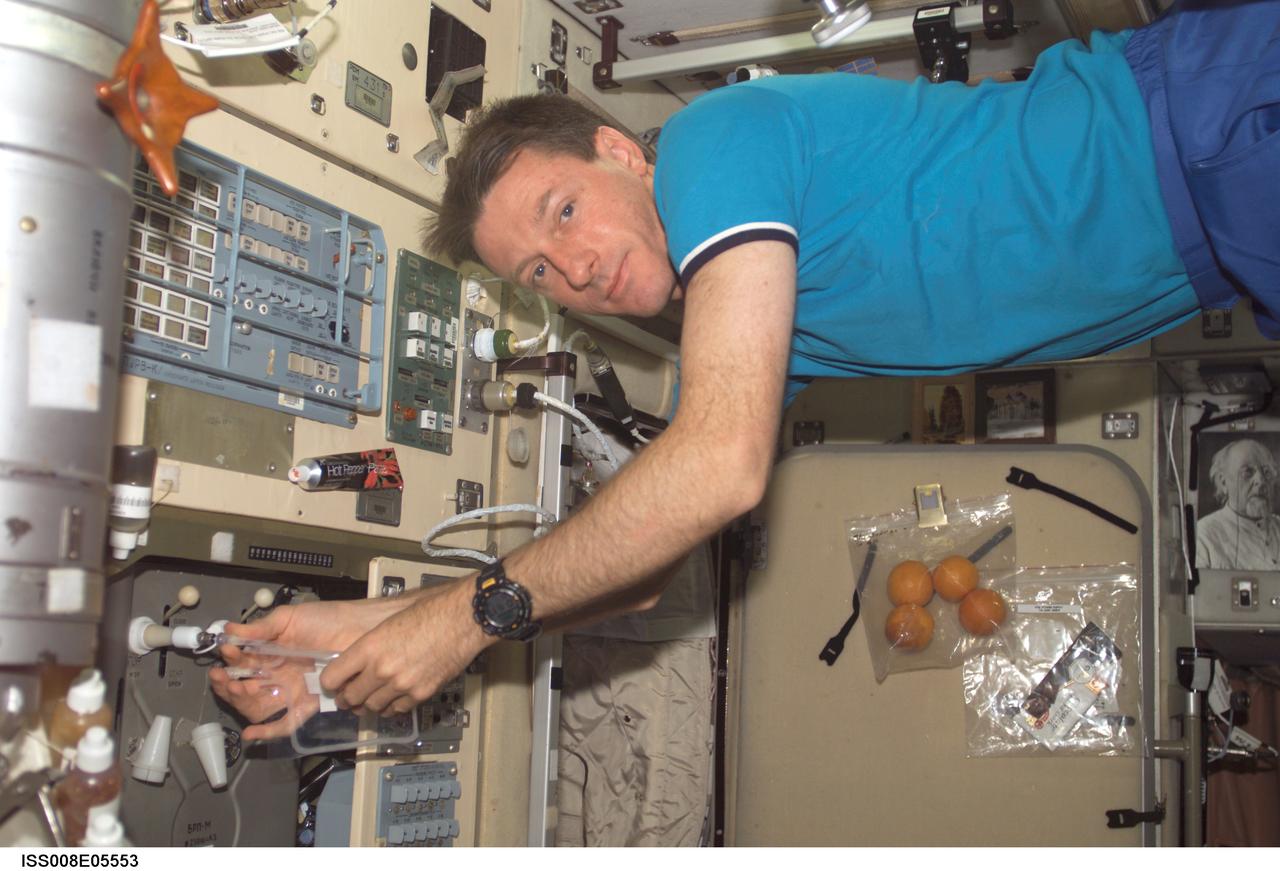
ISS008-E-05553 (7 November 2003) --- Astronaut C. Michael Foale, Expedition 8 mission commander and NASA ISS science officer, floats in front of the galley in the Zvezda Service Module on the International Space Station (ISS) as he fills a Crew Healthcare System (CheCSS) Water Microbiology (WMK) in-flight analysis bag from the potable warter dispenser.
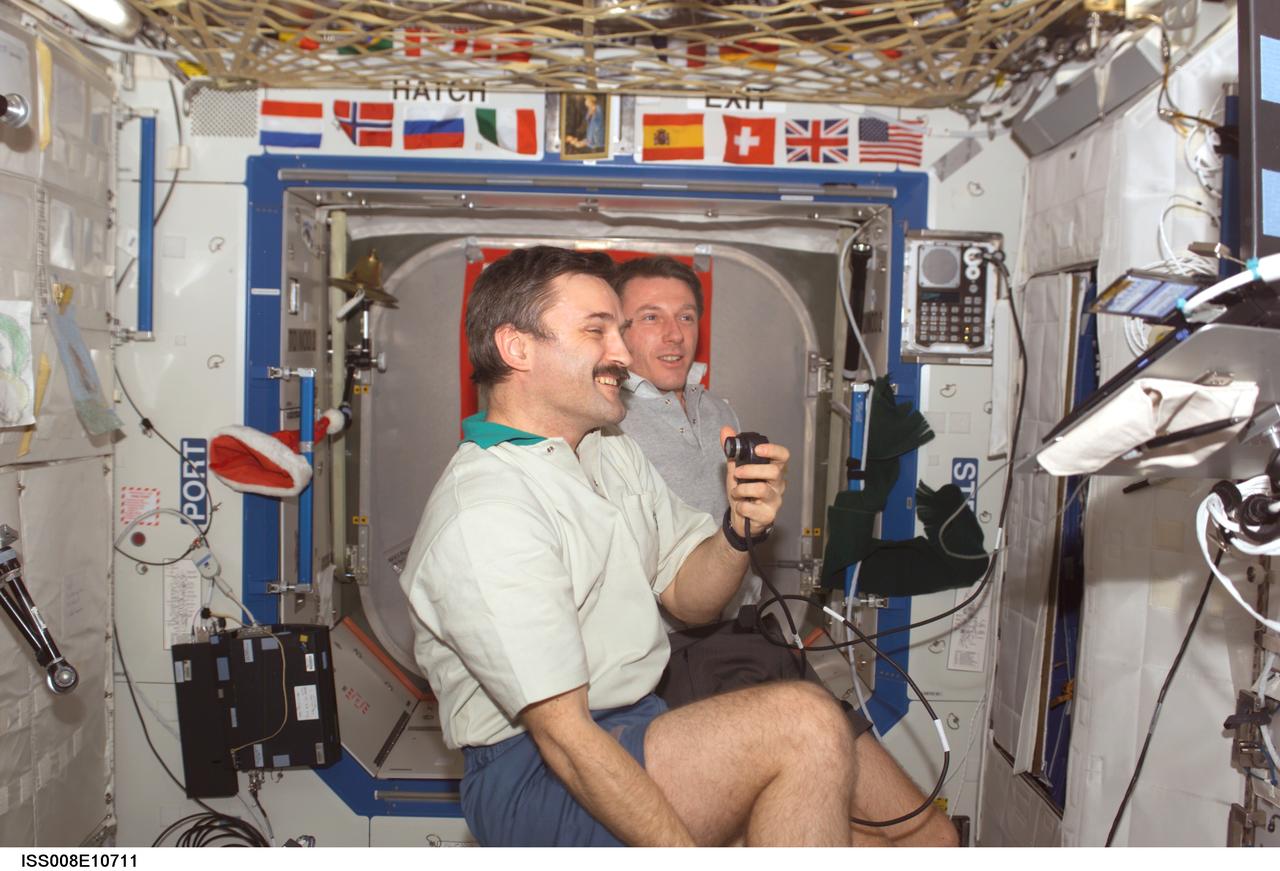
ISS008-E-10711 (28 December 2003) --- Cosmonaut Alexander Y. Kaleri (foreground), Expedition 8 flight engineer, and astronaut C. Michael Foale, mission commander and NASA ISS science officer, conduct a teleconference with the Moscow Support Group for the Russian New Year celebration, via Ku- and S-band, with audio and video relayed to the Mission Control Center (MCC) at Johnson Space Center (JSC). Kaleri represents Rosaviakosmos.

ISS008-E-22241 (22 April 2004) --- Astronaut C. Michael Foale, Expedition 8 commander and NASA ISS science officer, “juggles” fresh fruit in the Destiny laboratory of the International Space Station (ISS). The weightless environment of space proves to be an ideal location for some tasks not so easily accomplished in Earth’s gravity.
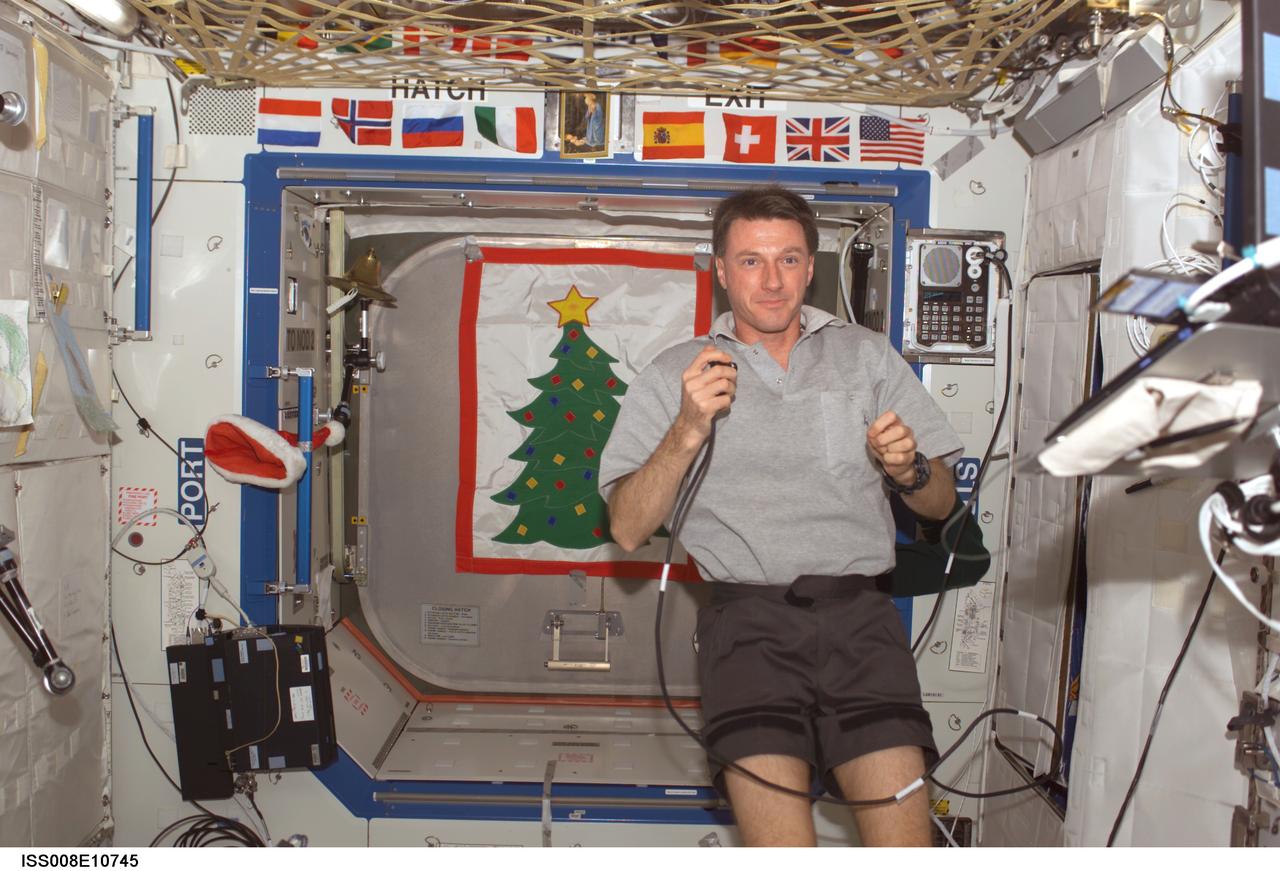
ISS008-E-10745 (28 December 2003) --- Astronaut C. Michael Foale, Expedition 8 mission commander and NASA ISS science officer, conducts a teleconference with the Moscow Support Group for the Russian New Year celebration, via Ku- and S-band, with audio and video relayed to the Mission Control Center (MCC) at Johnson Space Center (JSC). Holiday decorations are visible in the background.
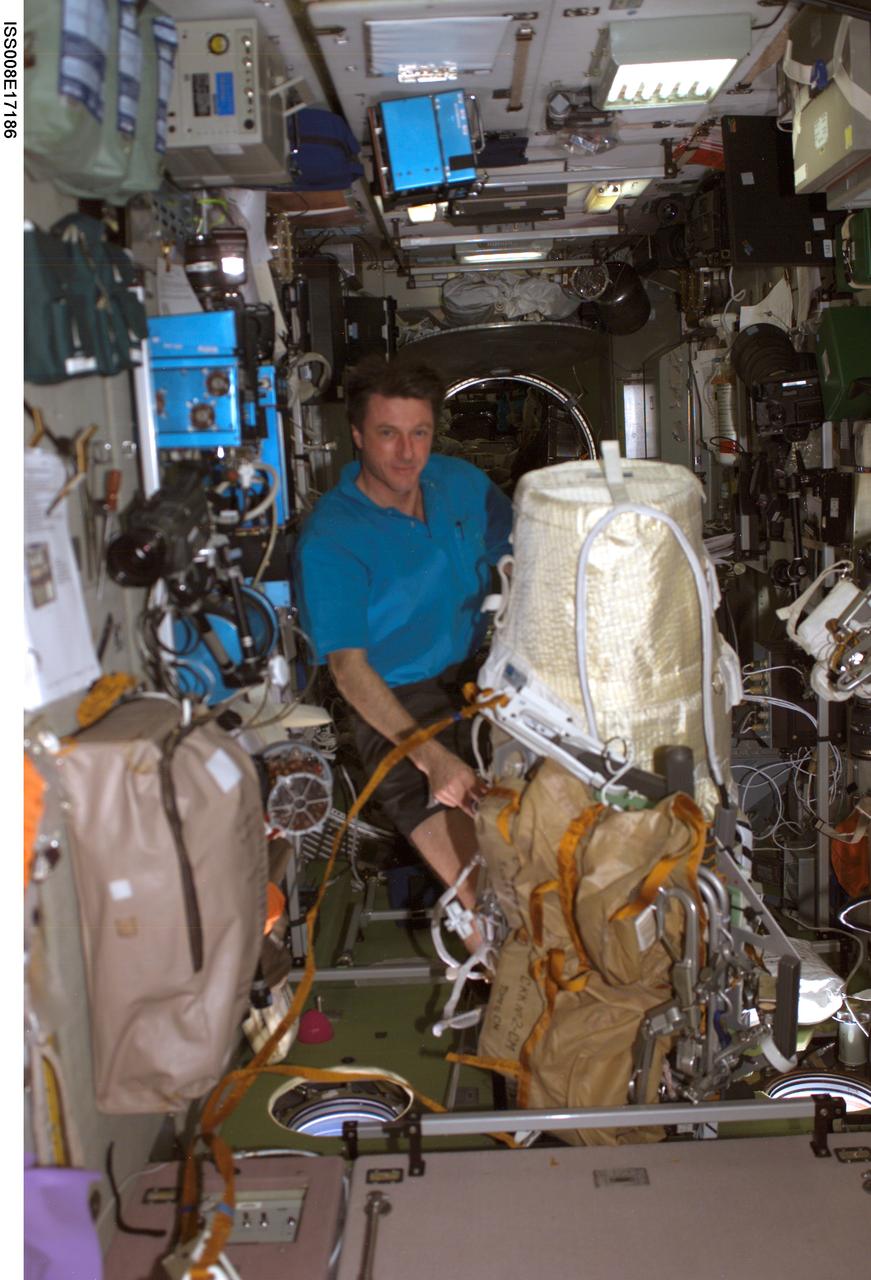
ISS008-E-17186 (24 February 2004) --- Astronaut C. Michael Foale, Expedition 8 NASA ISS science officer and commander, works with the extravehicular activity (EVA) bundle in the Zvezda Service Module on the International Space Station (ISS). The Matroshka experiment package is shrouded (aft) with the brown carry bags for the CKK hardware (fwd) along with tools and other needed items. It is all bundled to a Russian EVA integrated equipment carrier.
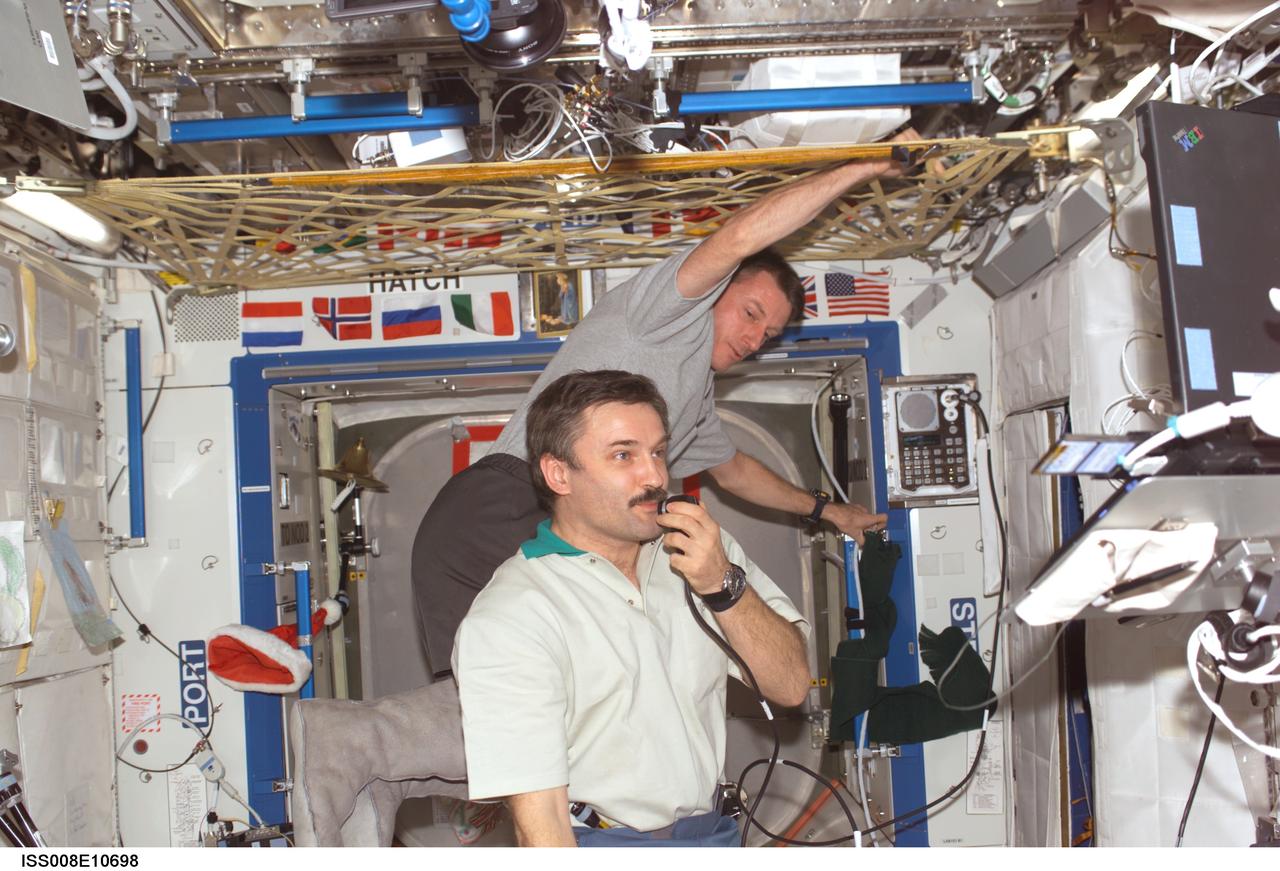
ISS008-E-10698 (28 December 2003) --- Cosmonaut Alexander Y. Kaleri (foreground), Expedition 8 flight engineer, and astronaut C. Michael Foale, mission commander and NASA ISS science officer, conduct a teleconference with the Moscow Support Group for the Russian New Year celebration, via Ku- and S-band, with audio and video relayed to the Mission Control Center (MCC) at Johnson Space Center (JSC). Kaleri represents Rosaviakosmos.
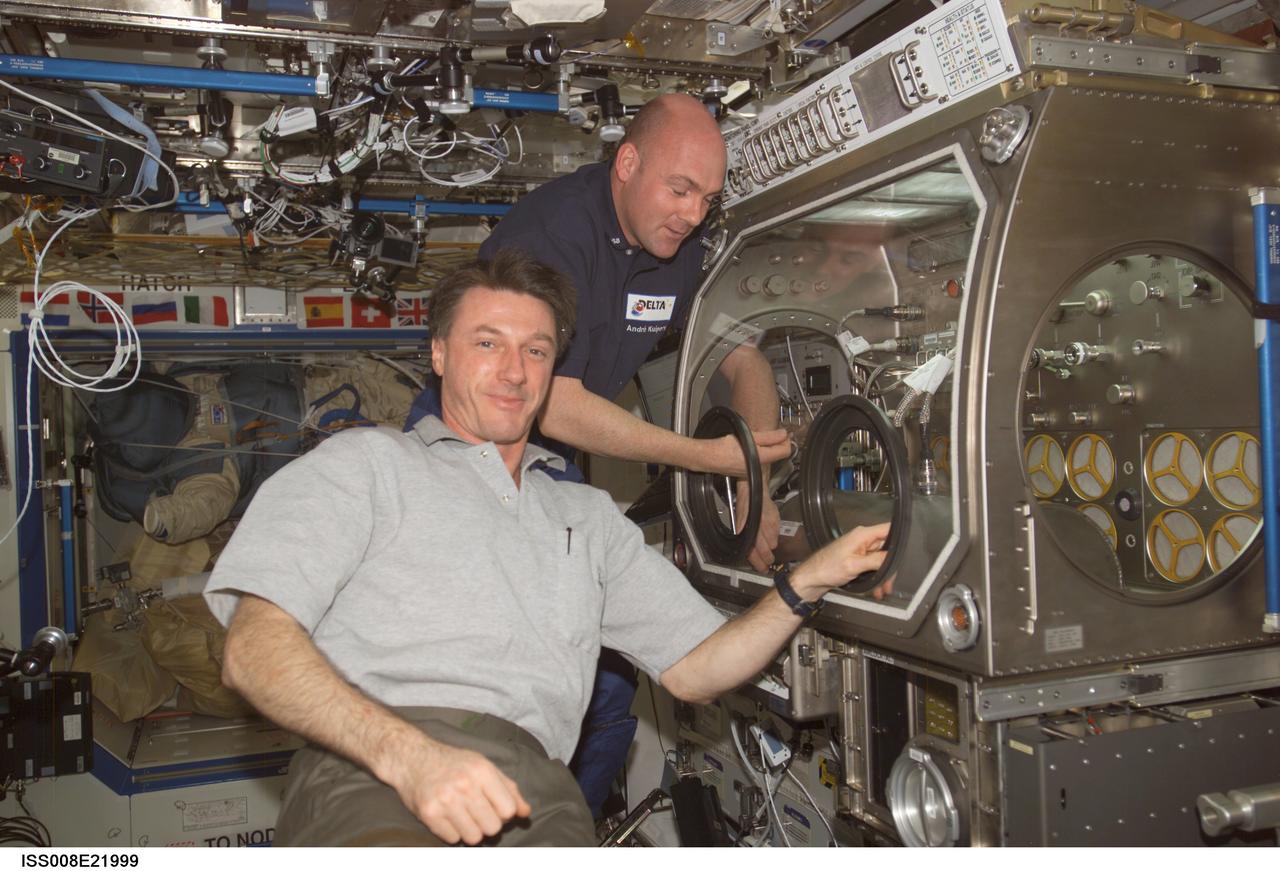
ISS008-E-21999 (22 April 2004) --- Astronaut C. Michael Foale (foreground), Expedition 8 commander and NASA ISS science officer, and European Space Agency (ESA) astronaut Andre Kuipers of the Netherlands work with the HEAT experiment in the Microgravity Science Glovebox (MSG) in the Destiny laboratory of the International Space Station (ISS). The main aim of the HEAT technology demonstration is the characterization of the heat transfer performance of a grooved heat pipe in weightlessness.
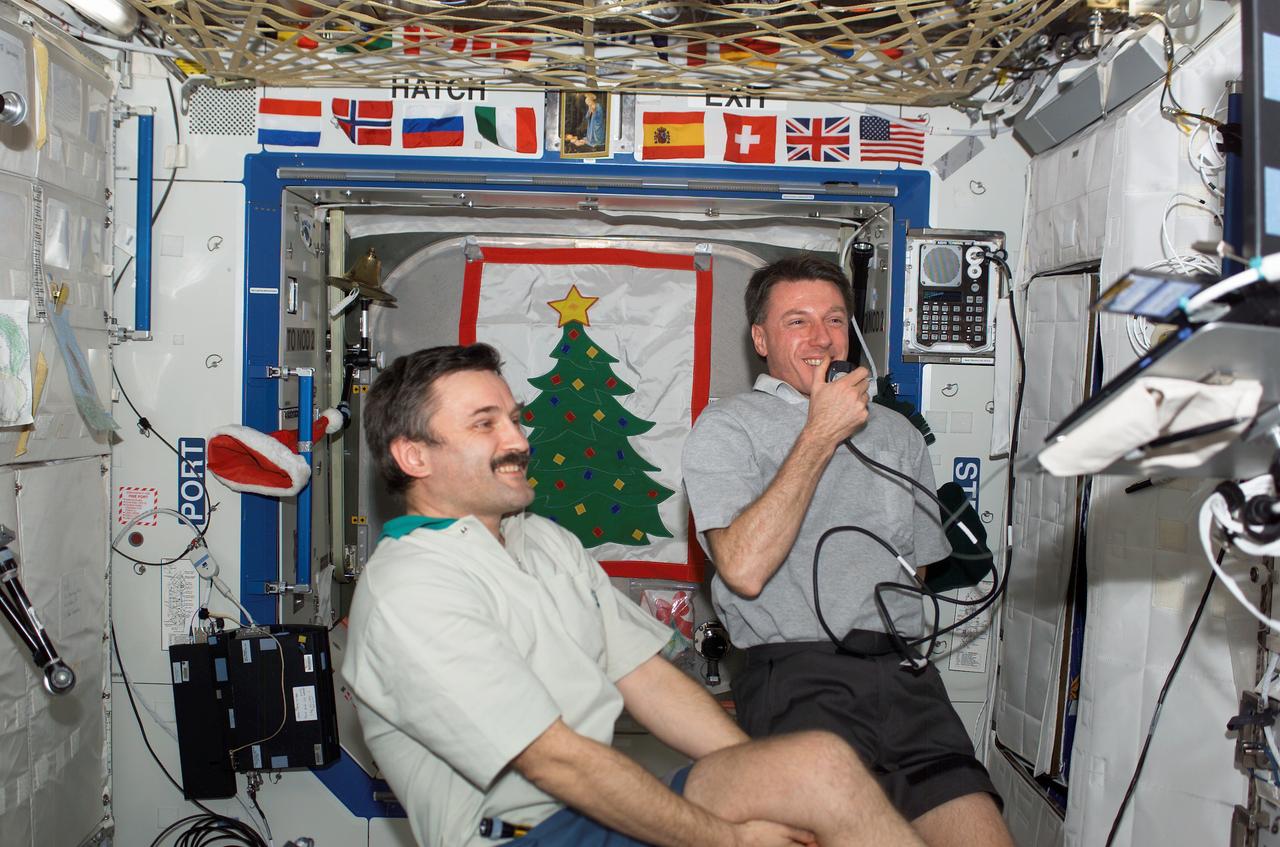
ISS008-E-10737 (28 Dec. 2003) --- Astronaut C. Michael Foale (right), Expedition 8 mission commander and NASA ISS science officer, and cosmonaut Alexander Y. Kaleri, flight engineer, conduct a teleconference with the Moscow Support Group for the Russian New Year celebration, via Ku- and S-band, with audio and video relayed to the Mission Control Center (MCC) at Johnson Space Center (JSC). Kaleri represents Rosaviakosmos.
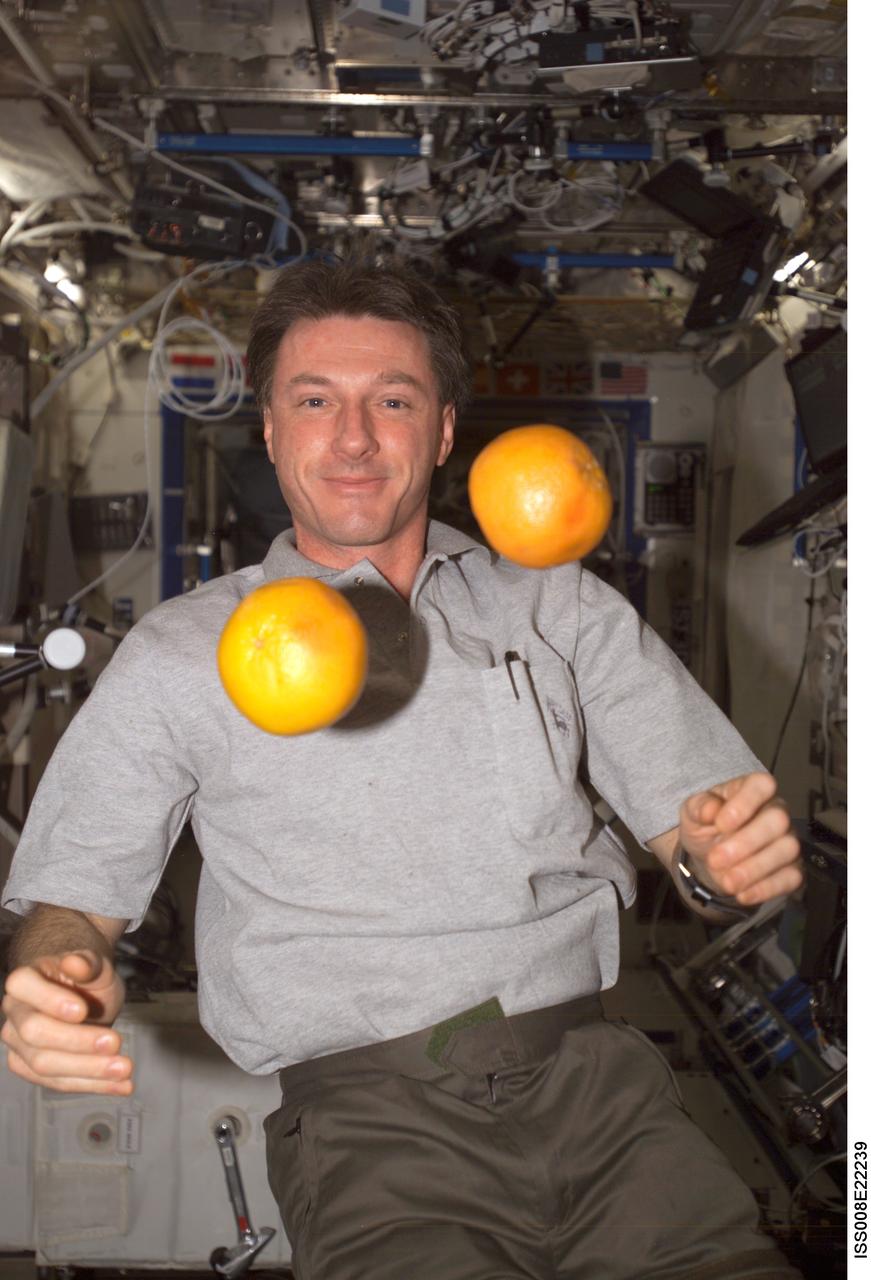
ISS008-E-22239 (22 April 2004) --- Astronaut C. Michael Foale, Expedition 8 commander and NASA ISS science officer, “juggles” fresh fruit in the Destiny laboratory of the International Space Station (ISS). The weightless environment of space proves to be an ideal location for some tasks not so easily accomplished in Earth’s gravity.
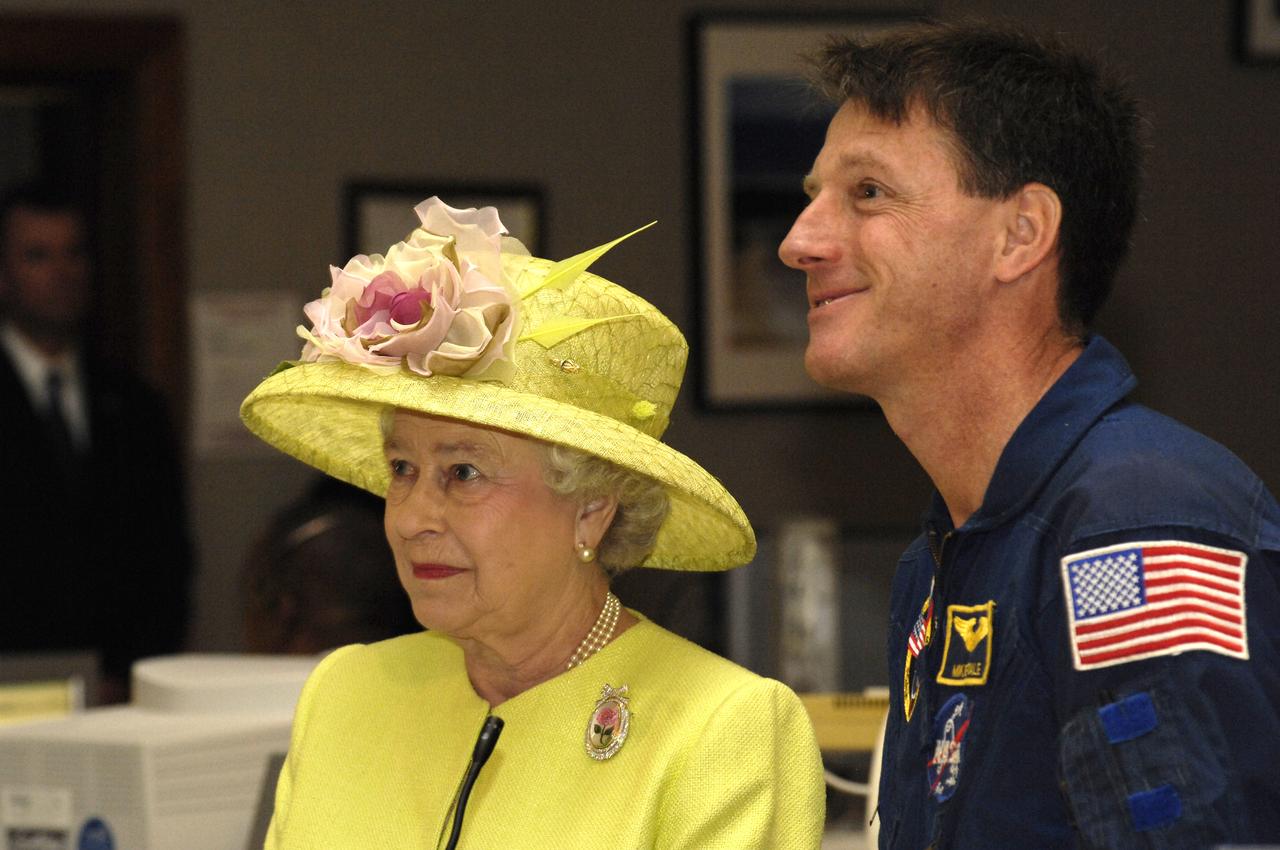
Queen Elizabeth II, left, prepares to talk with the International Space Station crew along with NASA astronaut Michael Foale, right, and NASA Administrator Michael Griffin (not pictured) from NASA’s Goddard Space Flight Center‘s Operational Control Room, Tuesday, May 8, 2007, in Greenbelt, Md. NASA Goddard was one of the last stops on the Queen's six-day visit to the United States. Photo Credit: (NASA/Bill Hrybyk)
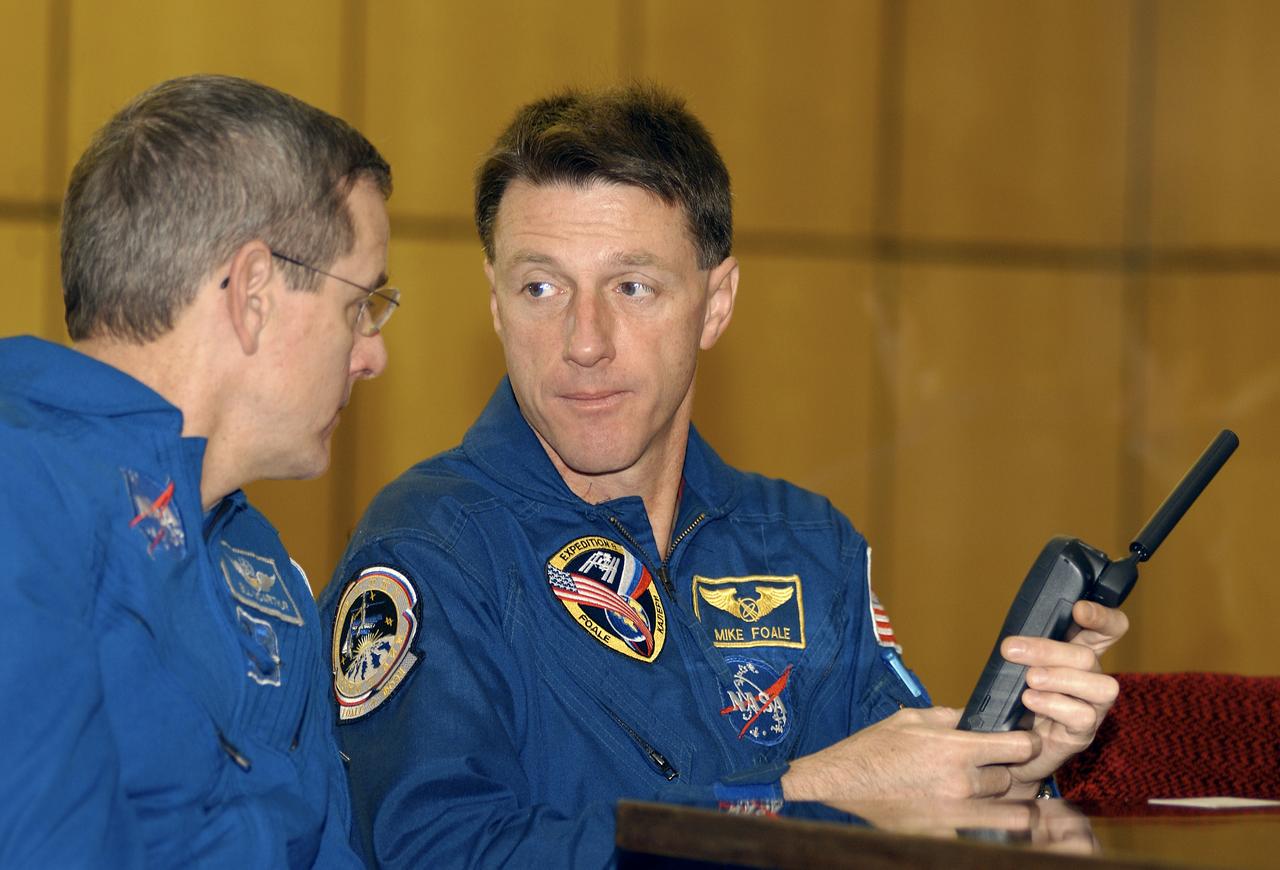
Backup Expedition 8 Commander Bill McArthur, left, and prime Expedition 8 Commander Michael Foale practice procedures with a satellite phone during final training at their crew quarters in Baikonur, Kazakhstan, Wednesday, Oct. 15, 2003, for launch on a Soyuz TMA-3 vehicle Oct. 18 to the International Space Station. Photo Credit (NASA/Bill Ingalls)
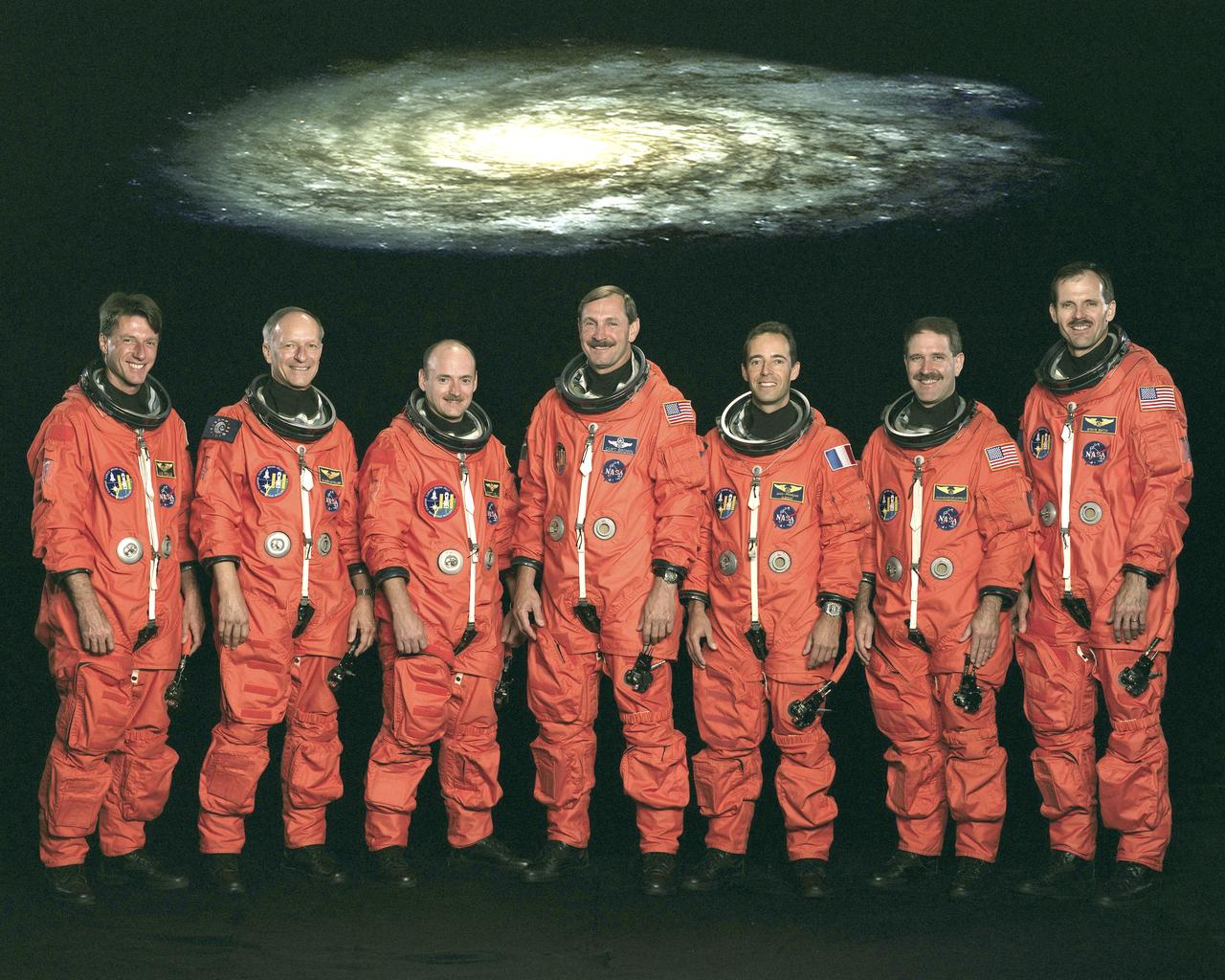
The STS-103 crew portrait includes (from left) C. Michael Foale, mission specialist; Claude Nicollier, mission specialist representing the European Space Agency (ESA) ; Scott J. Kelly, pilot; Curtis L. Brown, commander; and mission specialists Jean-Francois Clervoy (ESA), John M. Grunsfeld, and Steven L. Smith. Launched aboard the Space Shuttle Discovery on December 19, 1999 at 6:50 p.m. (CST), the STS-103 mission served as the third Hubble Space Telescope (HST) servicing mission.
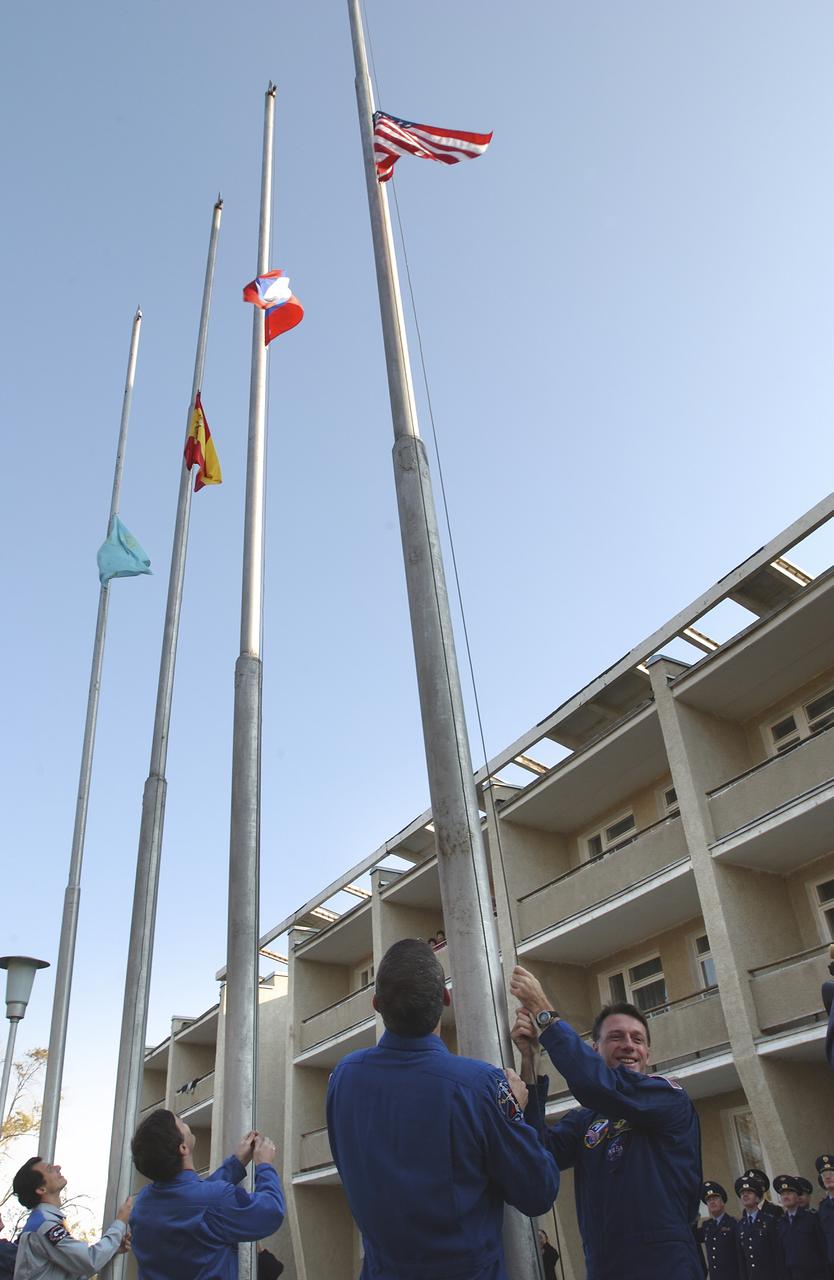
Expedition 8 Commander and NASA Science Officer Michael Foale, right, is joined by his backup, Bill McArthur outside the Cosmonaut Hotel Tuesday, Oct. 14, 2003, for the traditional raising of the flags of the crewmembers who will launch Saturday, Oct. 18 on the Soyuz TMA-3 vehicle to the International Space Station in Baikonur, Kazahstan. European Space Agency Astronaut Pedro Duque, far left, and Expedition 8 Soyuz Commander Alexander Kaleri who will launch with Foale, raise the flags of Spain and Russia outside their hotel. Photo Credit (NASA/Bill Ingalls)
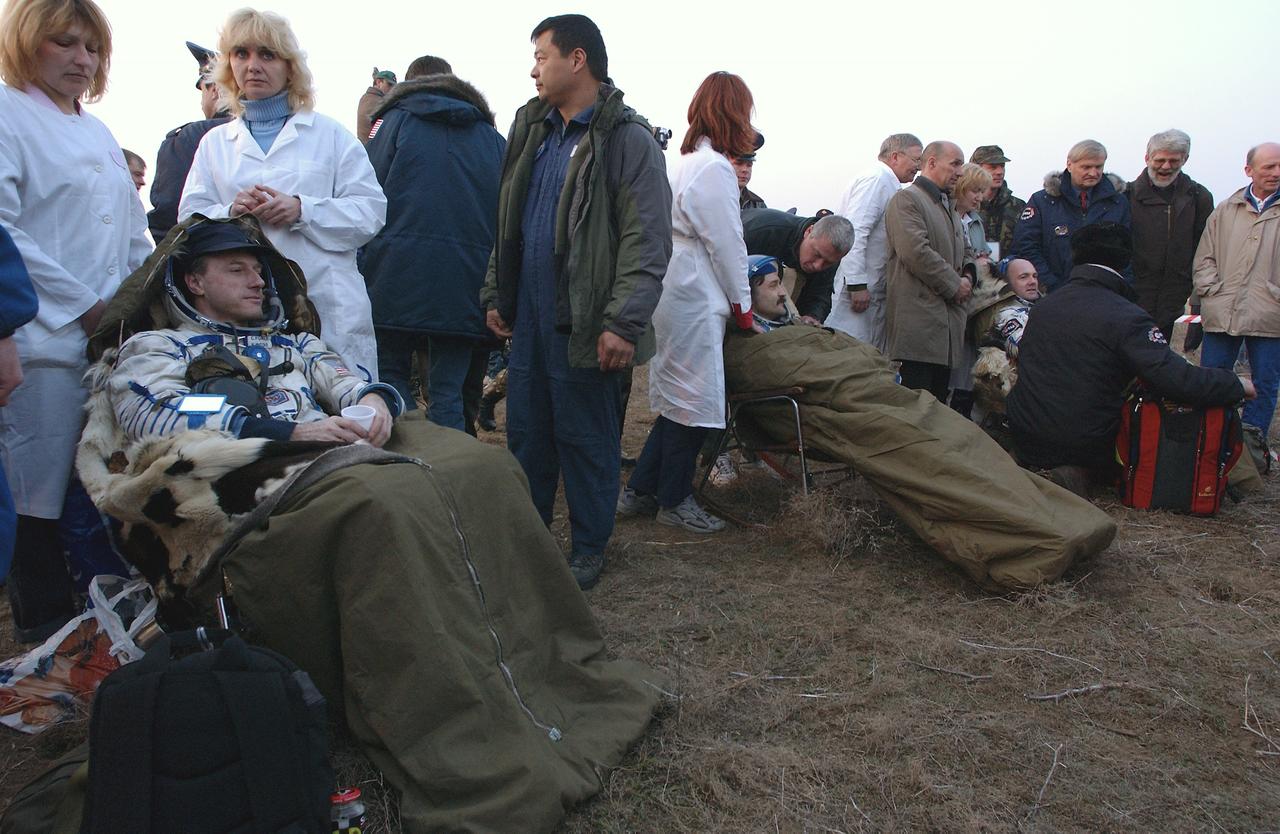
Expedition 8 Commander Michael Foale, left, Soyuz Flight Engineer Alexander Kaleri and European Space Agency astronaut Andre Kuipers, of the Netherlands, right, are seen seated after landing in north central Kazakhstan, Friday, April 30, 2004, in a Soyuz TMA-3 capsule. Foale and Kaleri completed 195 days in space aboard the International Space Station, while Kuipers returned after an 11-day research mission as part of a commercial agreement between ESA and the Russian Federal Space Agency. Photo Credit: (NASA/Bill Ingalls)
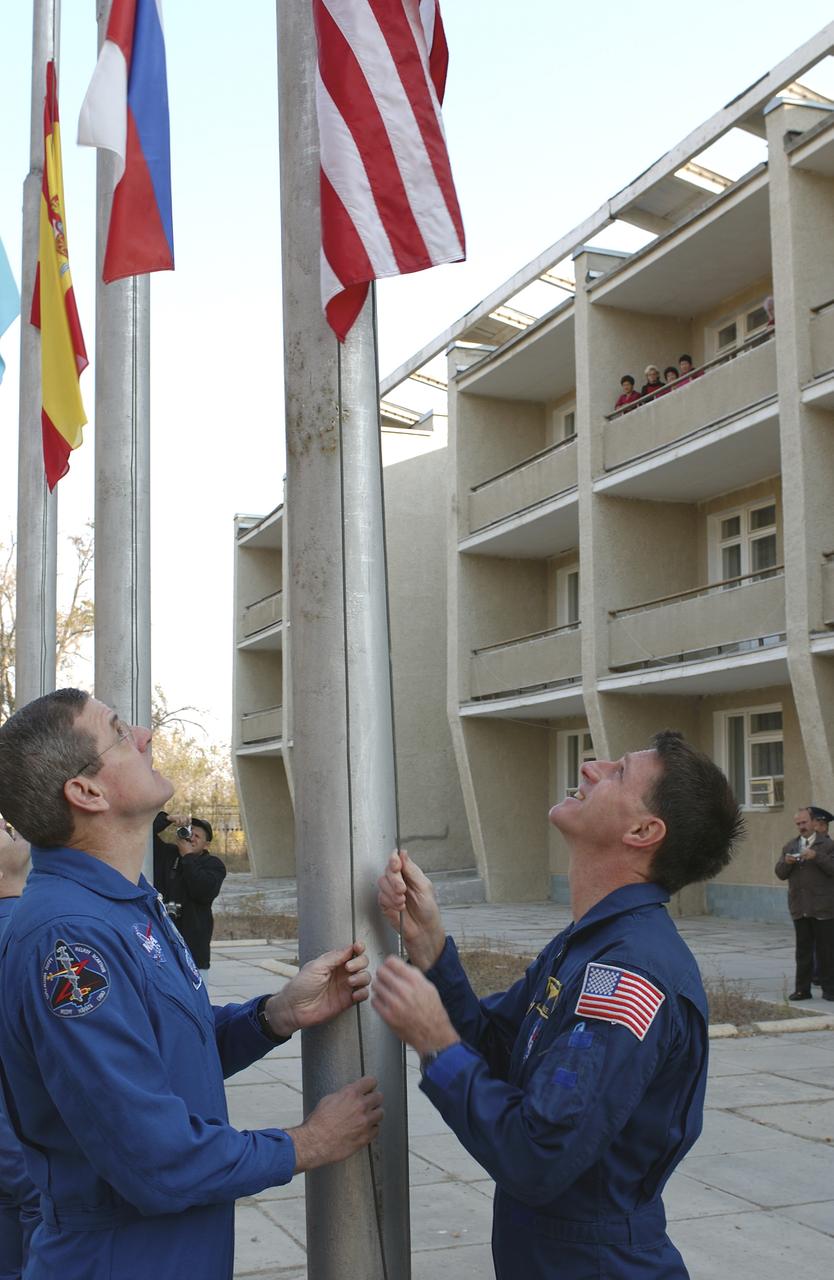
Backup Expedition 8 Commander and NASA Science Officer Bill McArthur, left, and prime Expedition 8 Commander and NASA Science Officer Michael Foale raise the American flag outside the Cosmonaut Hotel, Tuesday, Oct. 14, 2003 in a traditional ceremony as preparations continue for the Oct. 18 launch of the Soyuz TMA-3 vehicle from the Baikonur Cosmodrome to carry Foale, Expedition 8 Soyuz commander Alexander Kaleri and European Space Agency Astronaut Pedro Duque to the International Space Station. Photo Credit (NASA/Bill Ingalls)
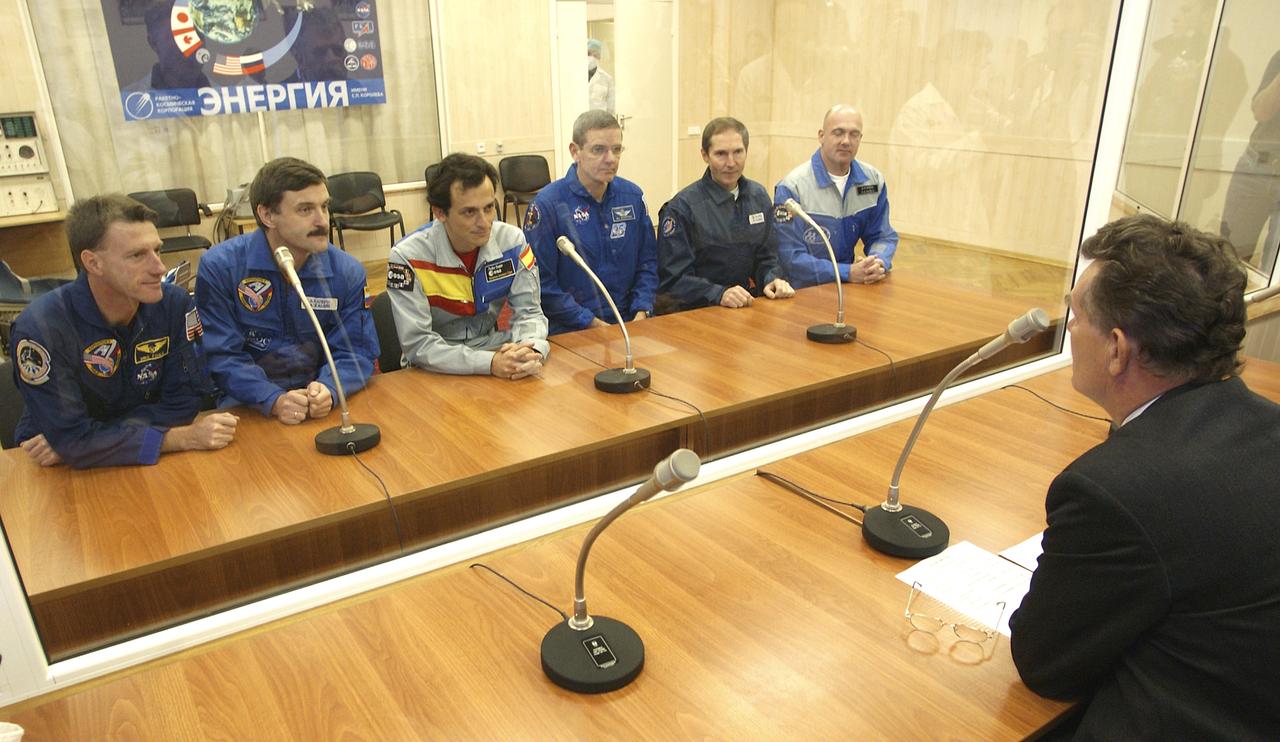
Expedition 8 ISS Commander and NASA Science Officer Michael Foale, far left, Expedition 8 Soyuz Commander and ISS Flight Engineer Alexander Kaleri and European Space Agency astronaut Pedro Duque of Spain, third from left, along with the backup crew (unidentified) are briefed by an official prior to a final inspection of the capsule in the complex' integration facility Monday, Oct. 13, 2003, at the Cosmodrome in Baikonur, Kazakhstan. Foale, Kaleri and Duque launched Oct. 18, 2003 aboard a Soyuz TMA-3 spacecraft enroute to the International Space Station. Photo Credit (NASA/Bill Ingalls)
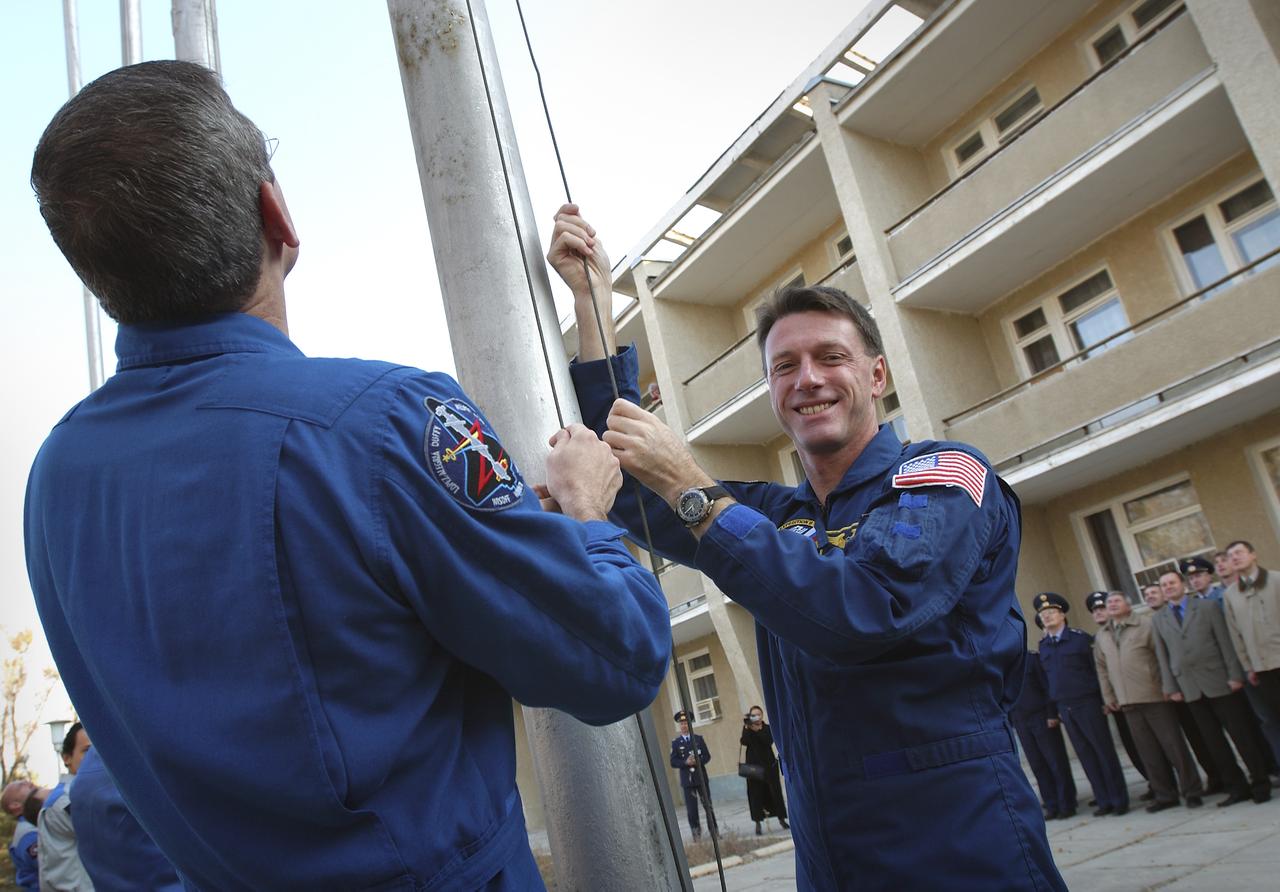
Backup Expedition 8 Commander and NASA Science Officer Bill McArthur, left, and prime Expedition 8 Commander and NASA Science Officer Michael Foale raise the American flag outside the Cosmonaut Hotel, Tuesday, Oct. 14, 2003, in a traditional ceremony in Baikonur, Kazakhstan as preparations continue for the launch Saturday, Oct. 18 of the Soyuz TMA-3 vehicle from the Baikonur Cosmodrome to carry Foale, Expedition 8 Soyuz commander Alexander Kaleri and European Space Agency astronaut Pedro Duque to the International Space Station. Photo Credit (NASA/Bill Ingalls)
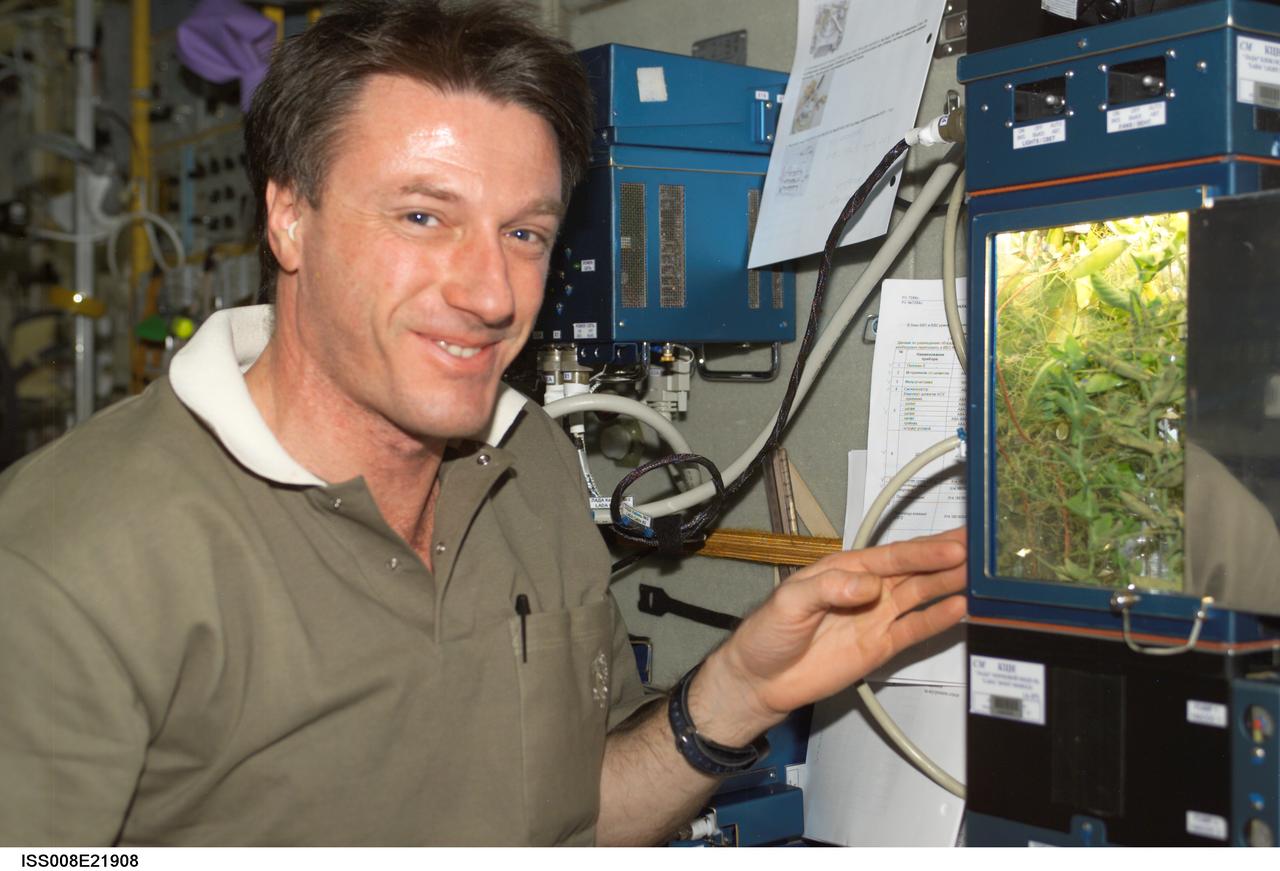
ISS008-E-21908 (12 April 2004)--- Astronaut C. Michael Foale, Expedition 8 commander and NASA ISS science officer, poses beside the pea plants growing in the Lada-4 greenhouse as part of the BIO-5 Rasteniya-2 (Plants-2) experiment located in the Zvezda Service Module of the International Space Station.
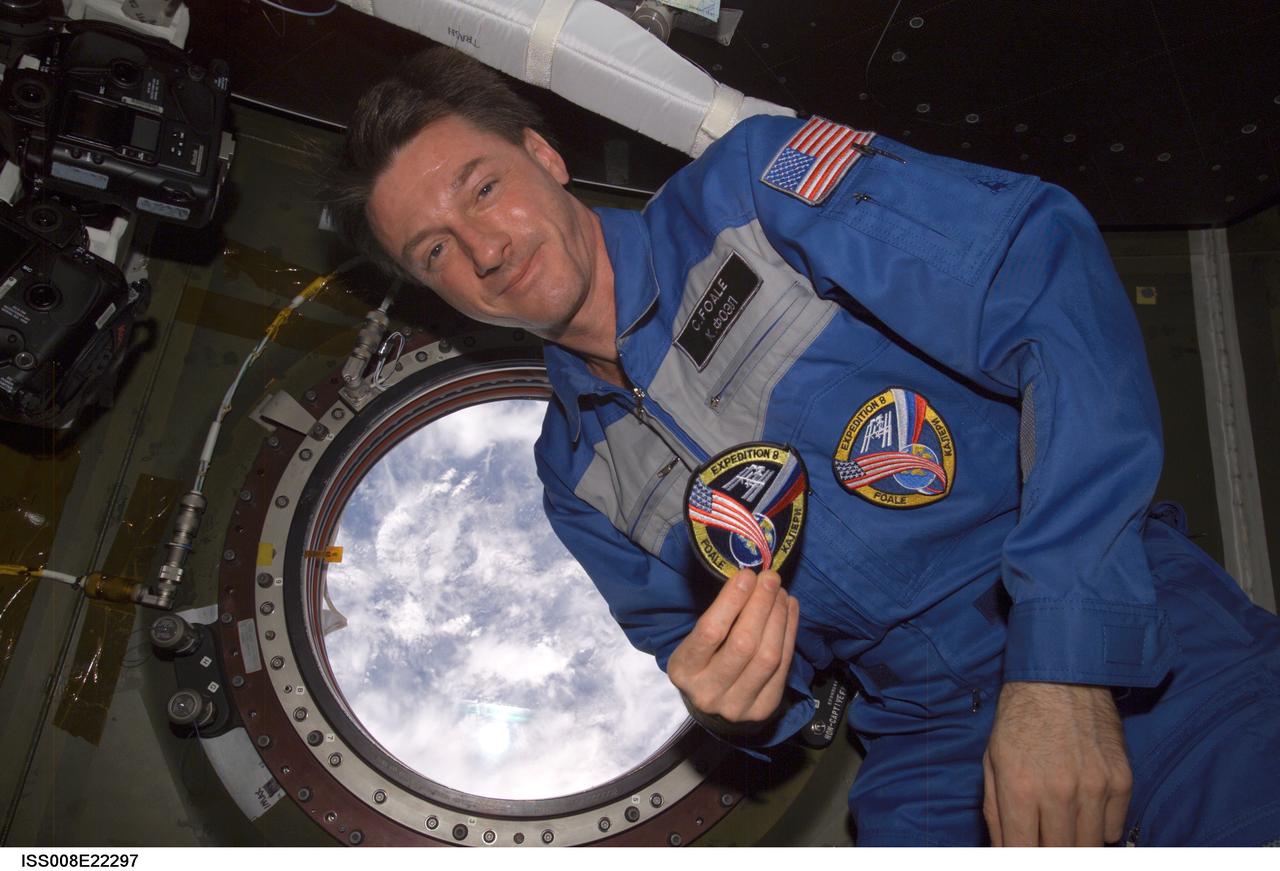
ISS008-E-22297 (26 April 2004) --- Astronaut C. Michael Foale, Expedition 8 commander and NASA ISS science officer, poses with the mission insignia near the nadir window in the Destiny laboratory of the International Space Station (ISS).
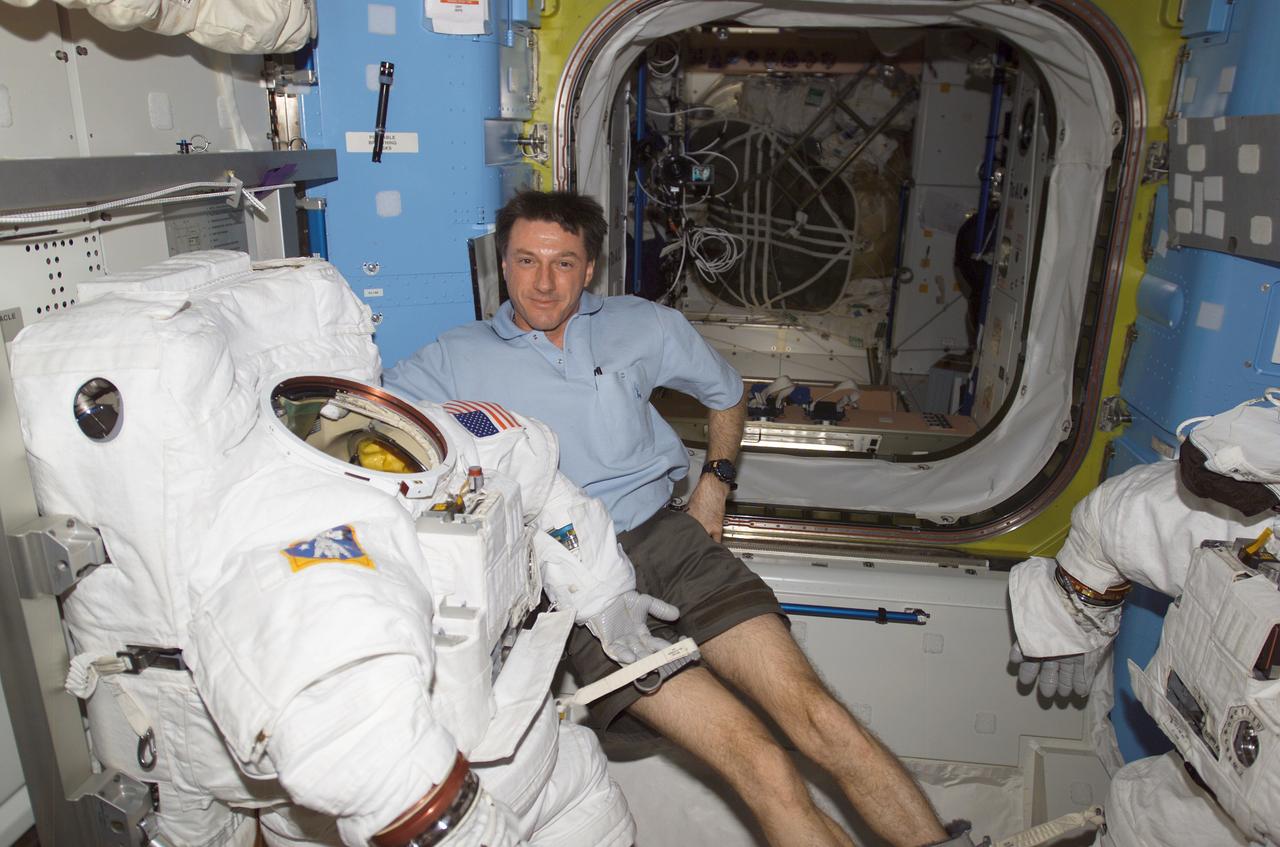
ISS008-E-22166 (25 April 2004) --- Astronaut C. Michael Foale, Expedition 8 commander and NASA ISS science officer, floats near a stowed Extravehicular Mobility Unit (EMU) spacesuit in the Equipment Lock of the Quest airlock on the International Space Station (ISS).
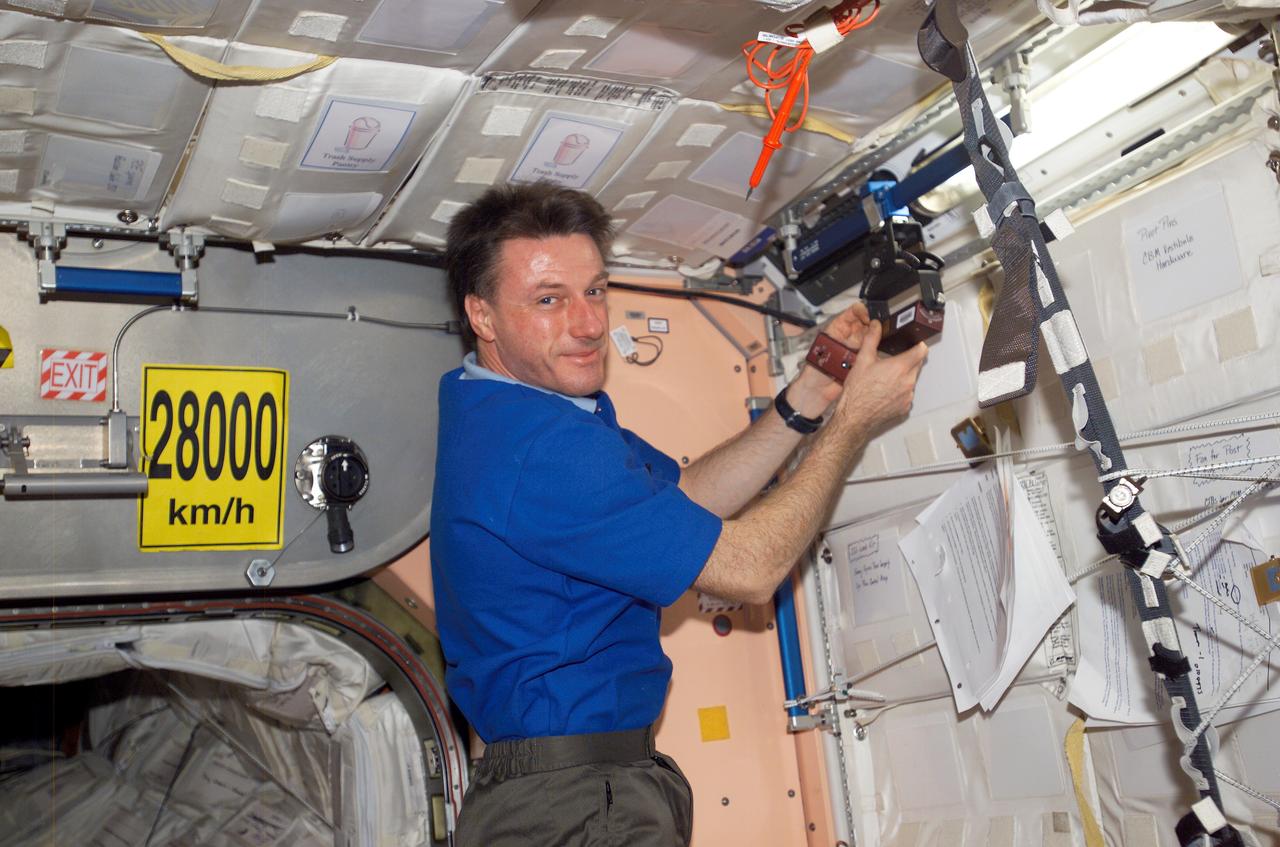
ISS008-E-19136 (24 March 2004) --- Astronaut C. Michael Foale, Expedition 8 commander and NASA ISS science officer, does a check of the Synchronized Position Hold, Engage, Reorient, Experimental Satellites (SPHERES) Beacon / Beacon Tester in the Unity node of the International Space Station.
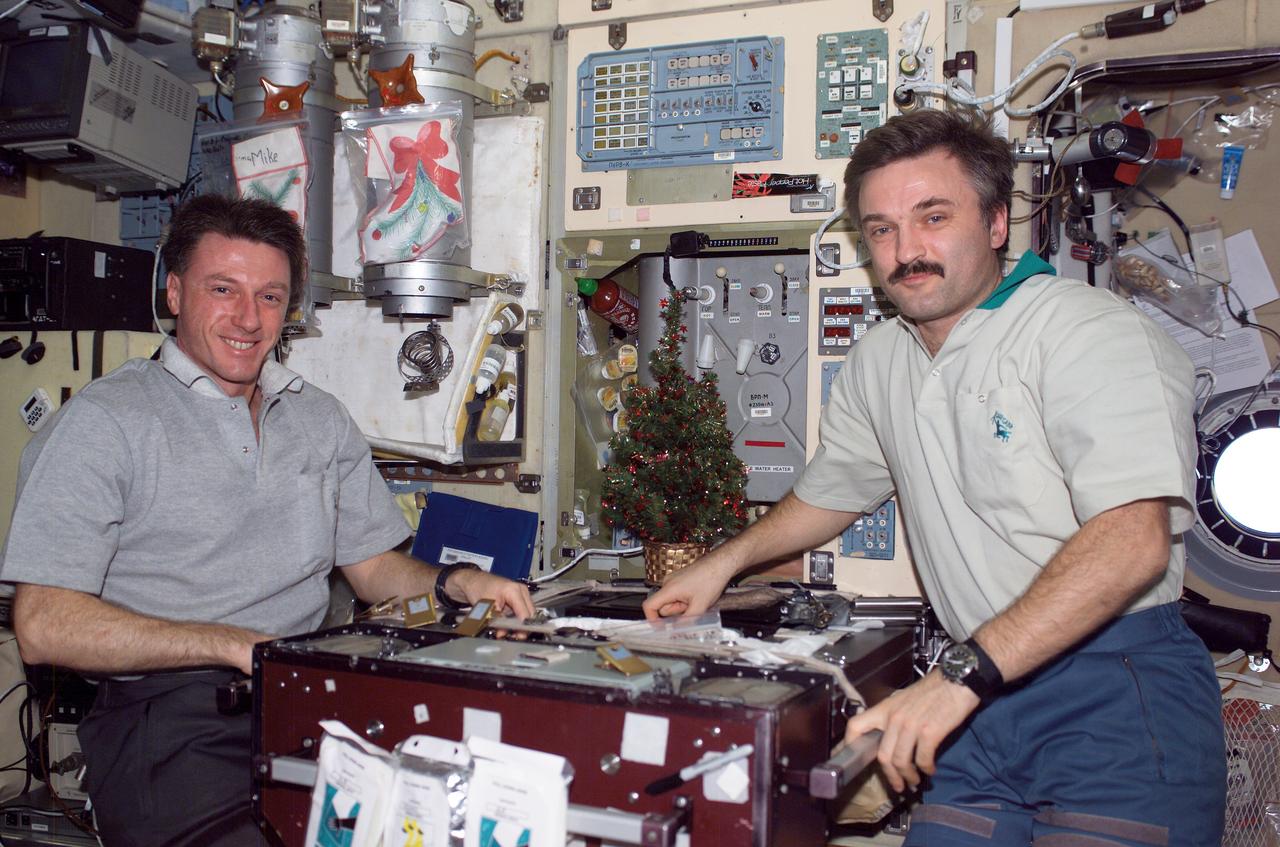
ISS008-E-10768 (28 December 2003) --- Astronaut C. Michael Foale (left), Expedition 8 mission commander and NASA ISS science officer, and cosmonaut Alexander Y. Kaleri, flight engineer, pose with holiday decorations in the Zvezda Service Module on the International Space Station (ISS). Kaleri represents Rosaviakosmos.
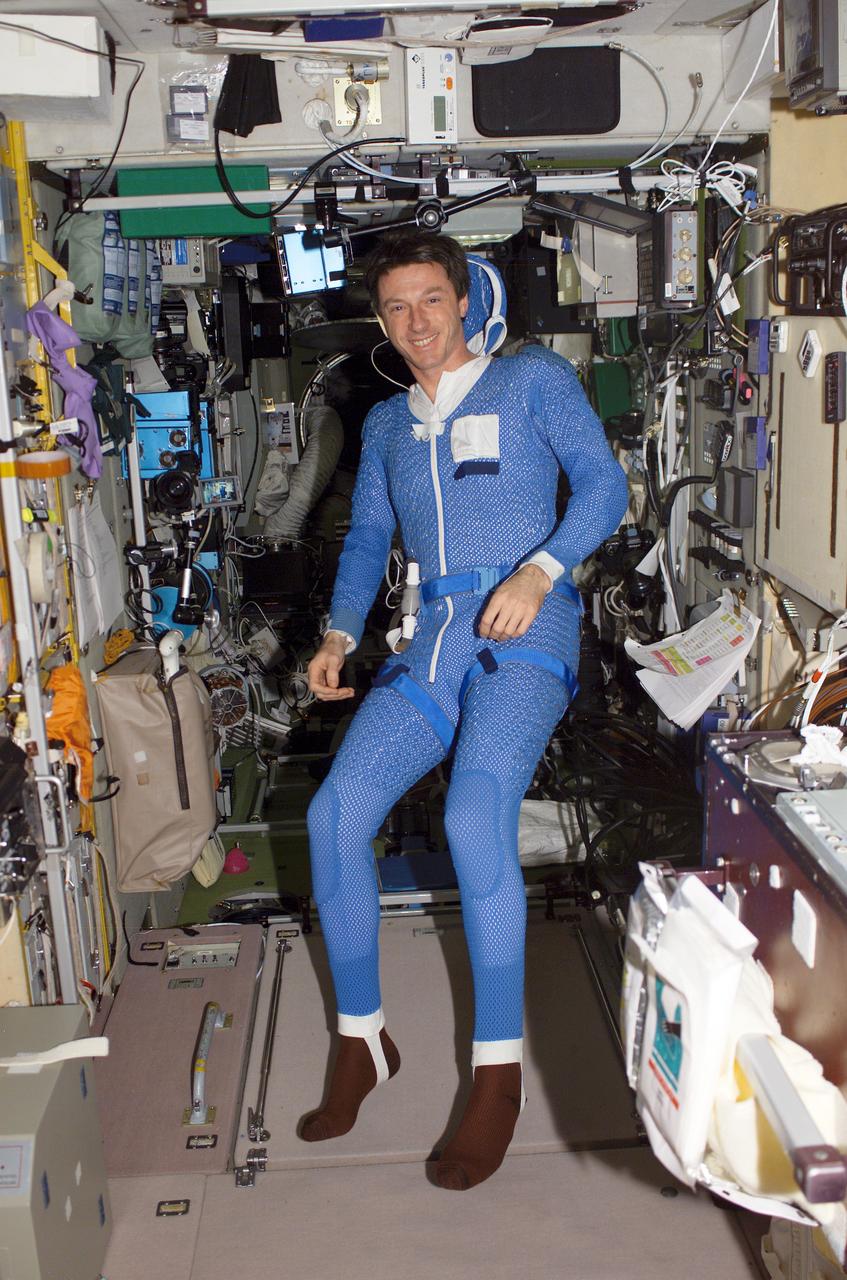
ISS008-E-17196 (26 Feb. 2004) --- Astronaut C. Michael Foale, Expedition 8 commander and NASA ISS science officer, suited in a blue thermal garment prior to donning his Russian Orlan spacesuit, smiles for the camera while floating in the Zvezda Service Module on the International Space Station (ISS).
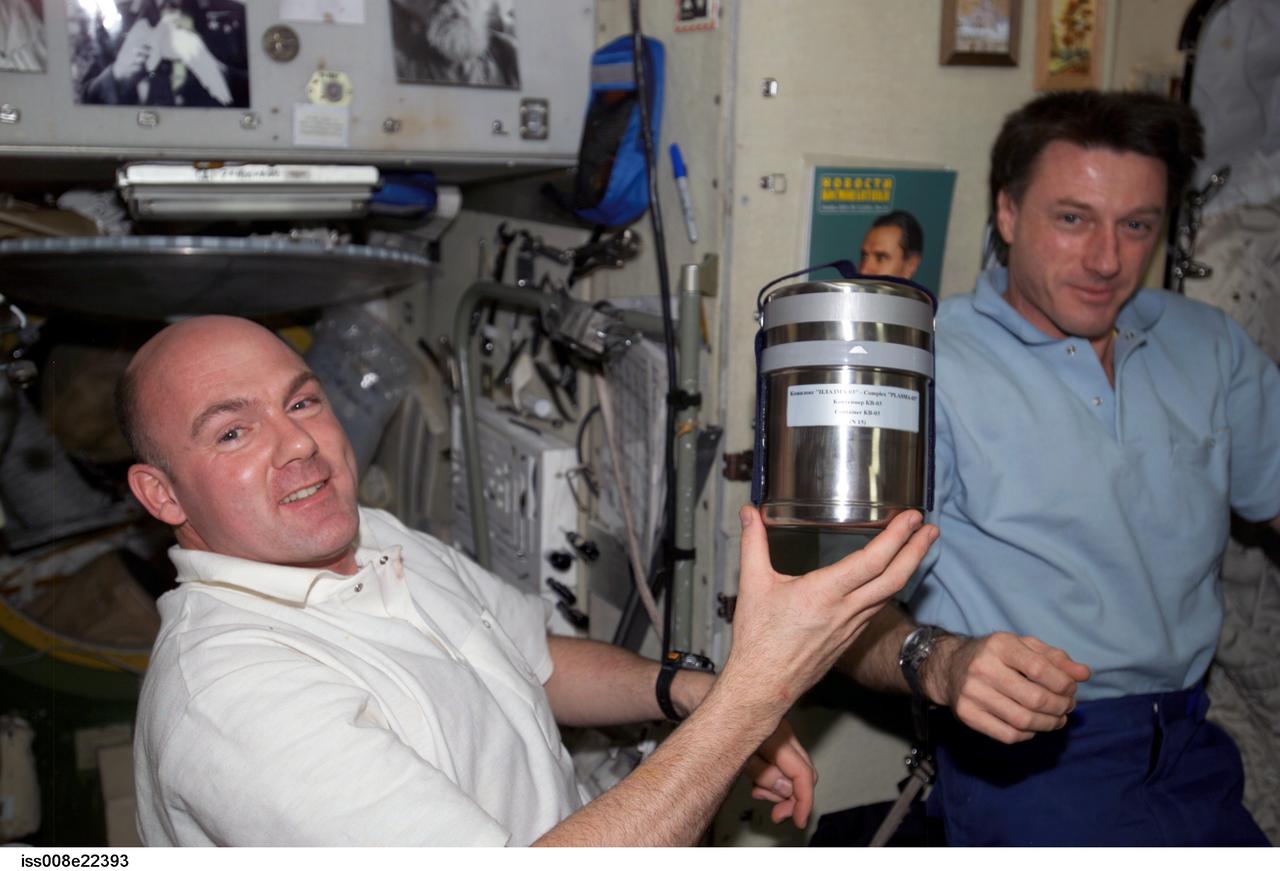
ISS008-E-22393 (29 April 2004) --- European Space Agency (ESA) astronaut Andre Kuipers of the Netherlands, holds a Complex “Plasma-03” canister in the Zvezda Service Module of the International Space Station (ISS). Astronaut C. Michael Foale, Expedition 8 commander and NASA ISS science officer, is at right.