
PTERA flies with the outer portion of its wings folded 70 degrees downward. The wings were able to fold in-flight thanks to a shape memory alloy material, which is triggered thermally and used in an actuator to move parts of the wing.
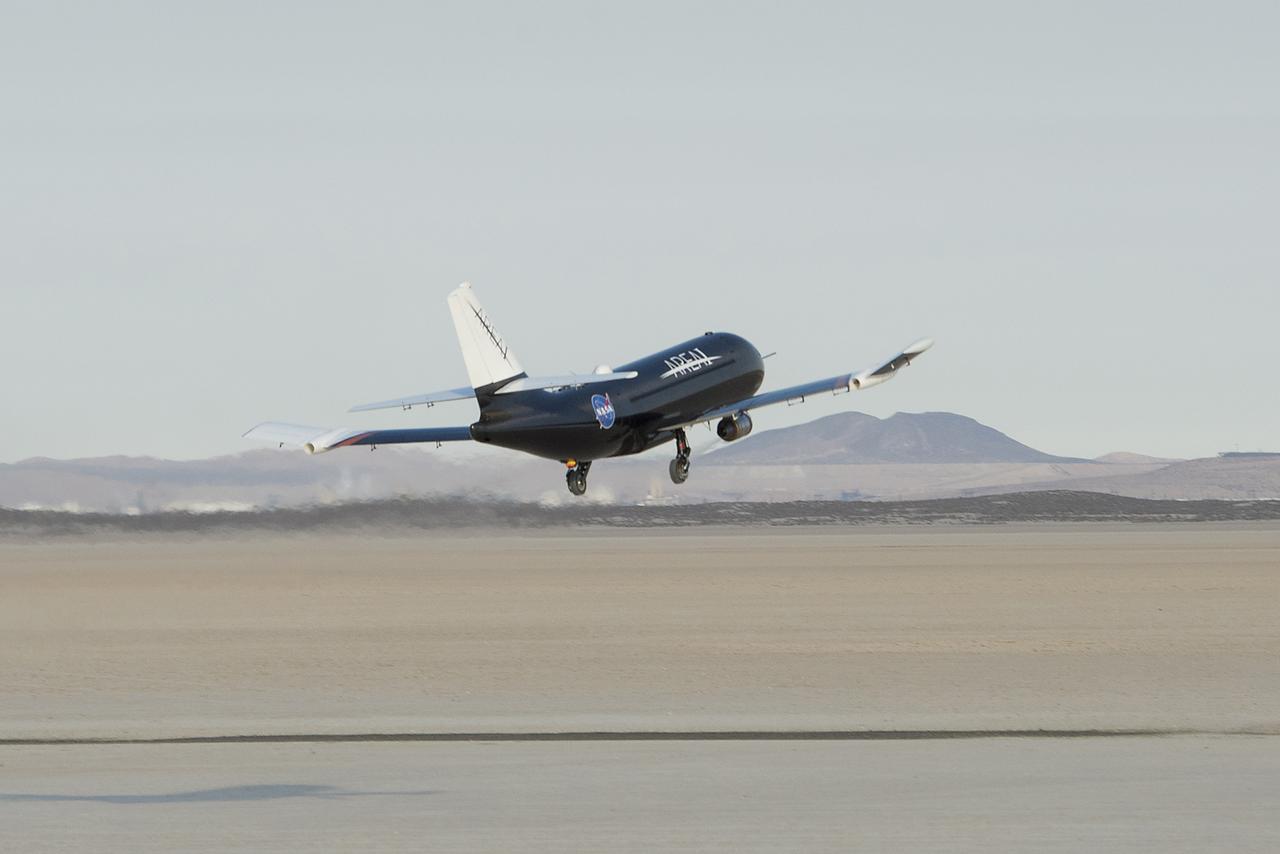
PTERA takes off on a flight to test the ability of shape memory alloy to fold wings in-flight. NASA, in this flight, observed the successful folding of PTERA’s wings 70 degrees upward.
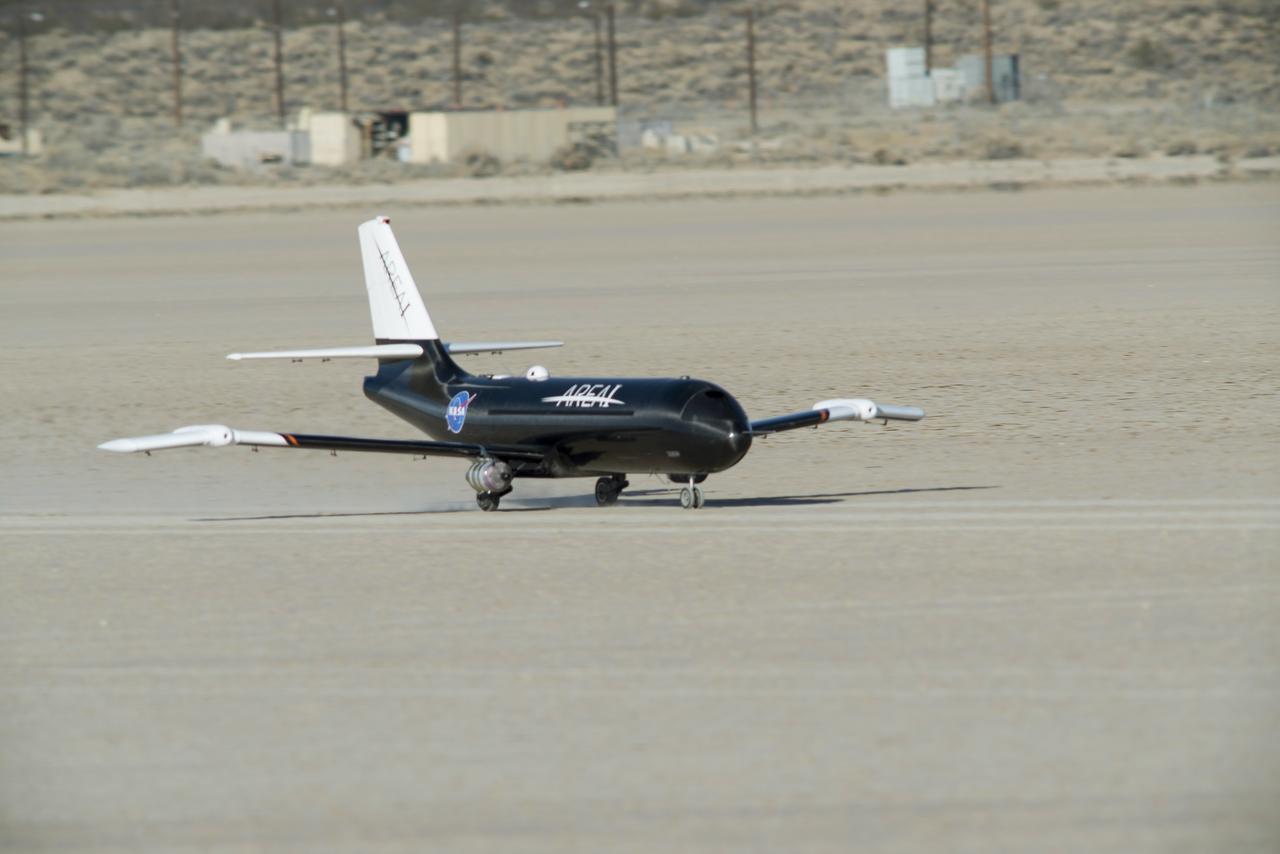
PTERA takes off from the Rogers Dry Lakebed on a flight to test the ability of an innovative, lightweight material, called shape memory alloy, to fold the outer portion of an aircraft’s wings in flight.
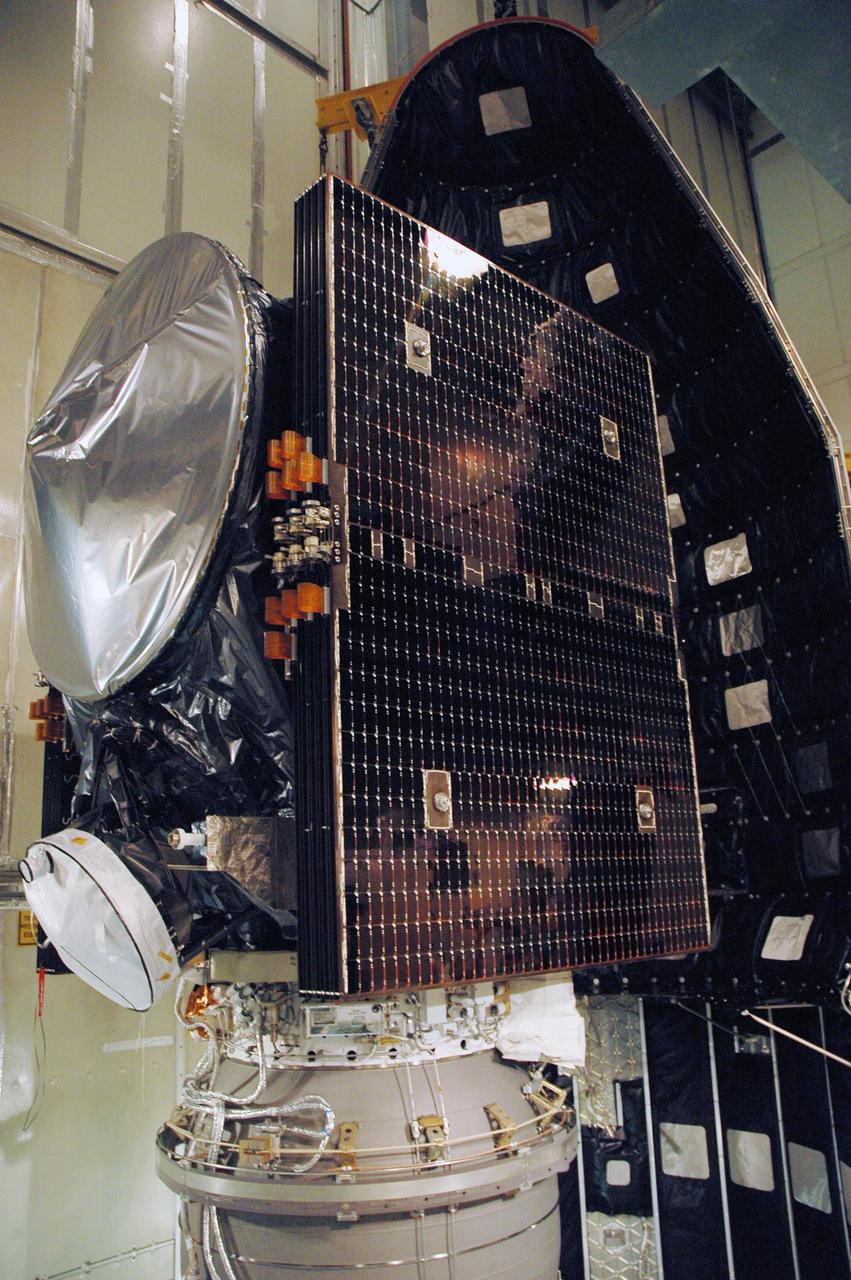
NASA Dawn spacecraft solar array wings are folded to fit inside nose section of protective fairing.
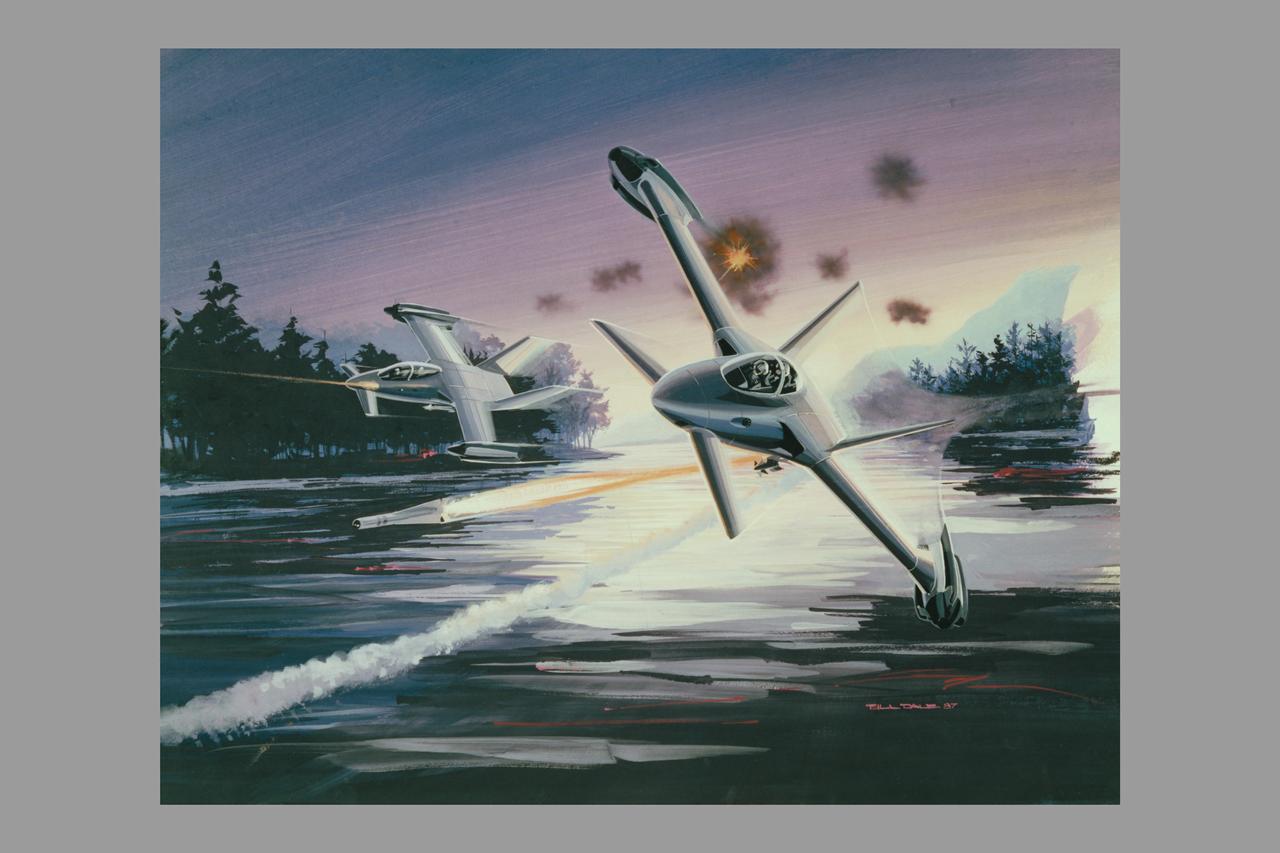
Artwork: Bell Textron Co. Bell Textron Tilt Rotor folding swept wing and Forward Swept Wing Configurations (Bell-030355 Military High Speed Tilt Rotor)
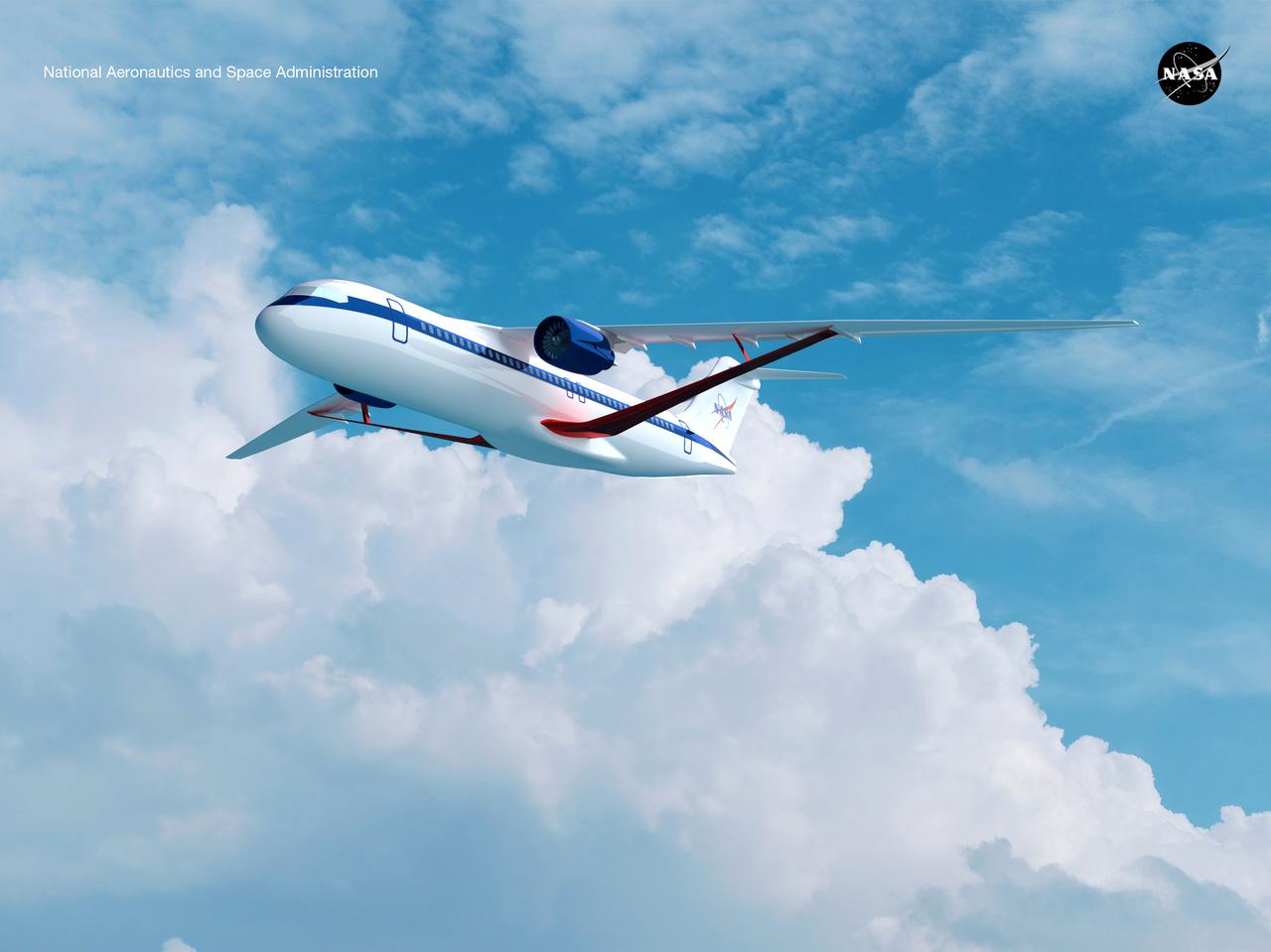
Notice anything different about the wings on this airliner? This conceptual truss-braced wing narrowbody is an aircraft with a 170ft span folding wing. By utilizing trusses, the aircraft can have longer, thinner wings with greater aspect ratios. This, in turn, translates into less drag and 5-10% less fuel burned. The Transonic Truss-Braced Wing aircraft originated from a joint effort by NASA and Boeing to develop subsonic commercial transport concepts – meeting NASA-defined metrics in terms of reduced noise, emissions, and fuel consumption. The design is currently undergoing wind tunnel testing and other studies by NASA researchers.

Notice anything different about the wings on this airliner? This conceptual truss-braced wing narrowbody is an aircraft with a 170ft span folding wing. By utilizing trusses, the aircraft can have longer, thinner wings with greater aspect ratios. This, in turn, translates into less drag and 5-10% less fuel burned. The Transonic Truss-Braced Wing aircraft originated from a joint effort by NASA and Boeing to develop subsonic commercial transport concepts – meeting NASA-defined metrics in terms of reduced noise, emissions, and fuel consumption. The design is currently undergoing wind tunnel testing and other studies by NASA researchers.
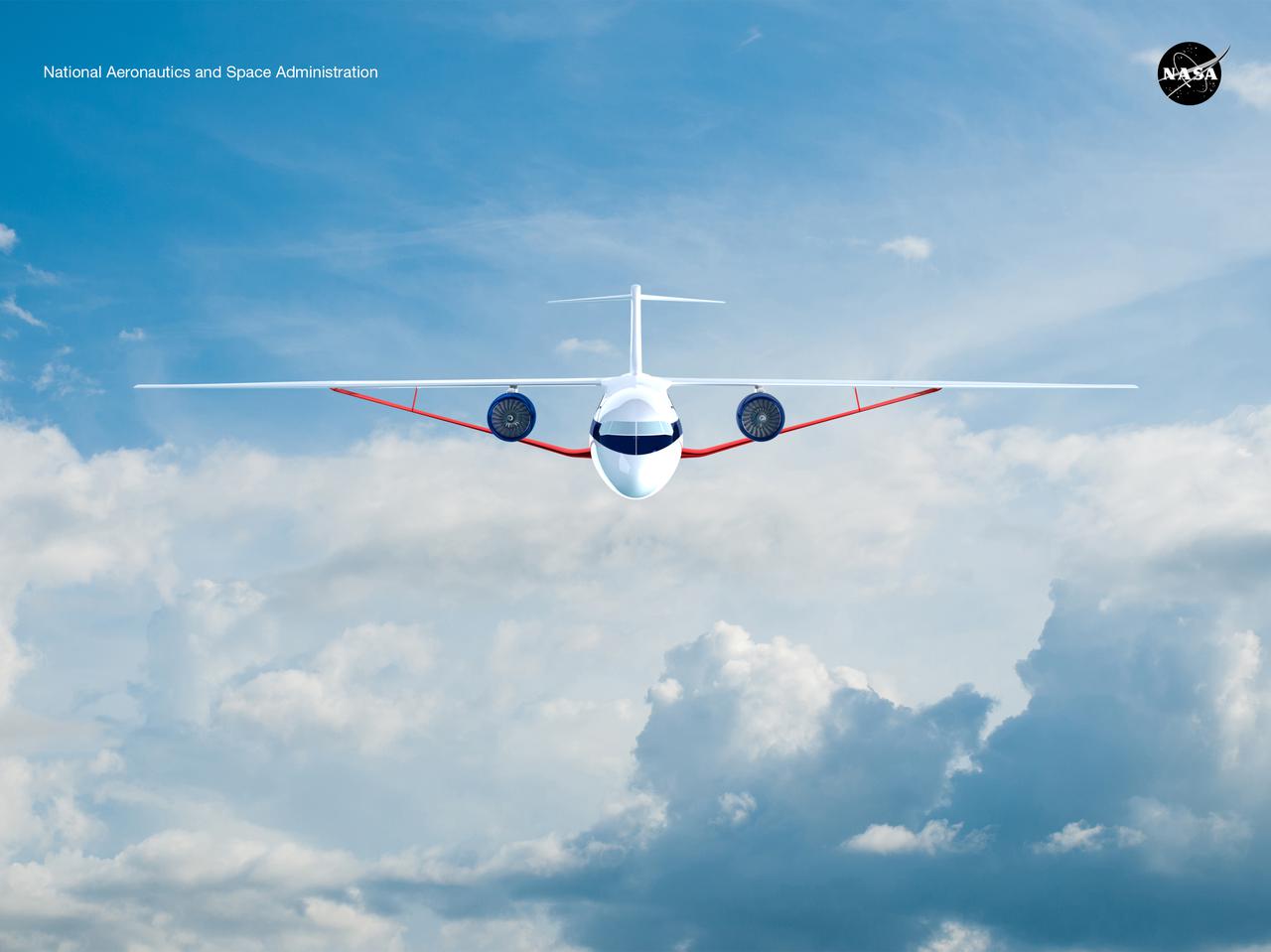
Notice anything different about the wings on this airliner? This conceptual truss-braced wing narrowbody is an aircraft with a 170ft span folding wing. By utilizing trusses, the aircraft can have longer, thinner wings with greater aspect ratios. This, in turn, translates into less drag and 5-10% less fuel burned. The Transonic Truss-Braced Wing aircraft originated from a joint effort by NASA and Boeing to develop subsonic commercial transport concepts – meeting NASA-defined metrics in terms of reduced noise, emissions, and fuel consumption. The design is currently undergoing wind tunnel testing and other studies by NASA researchers.
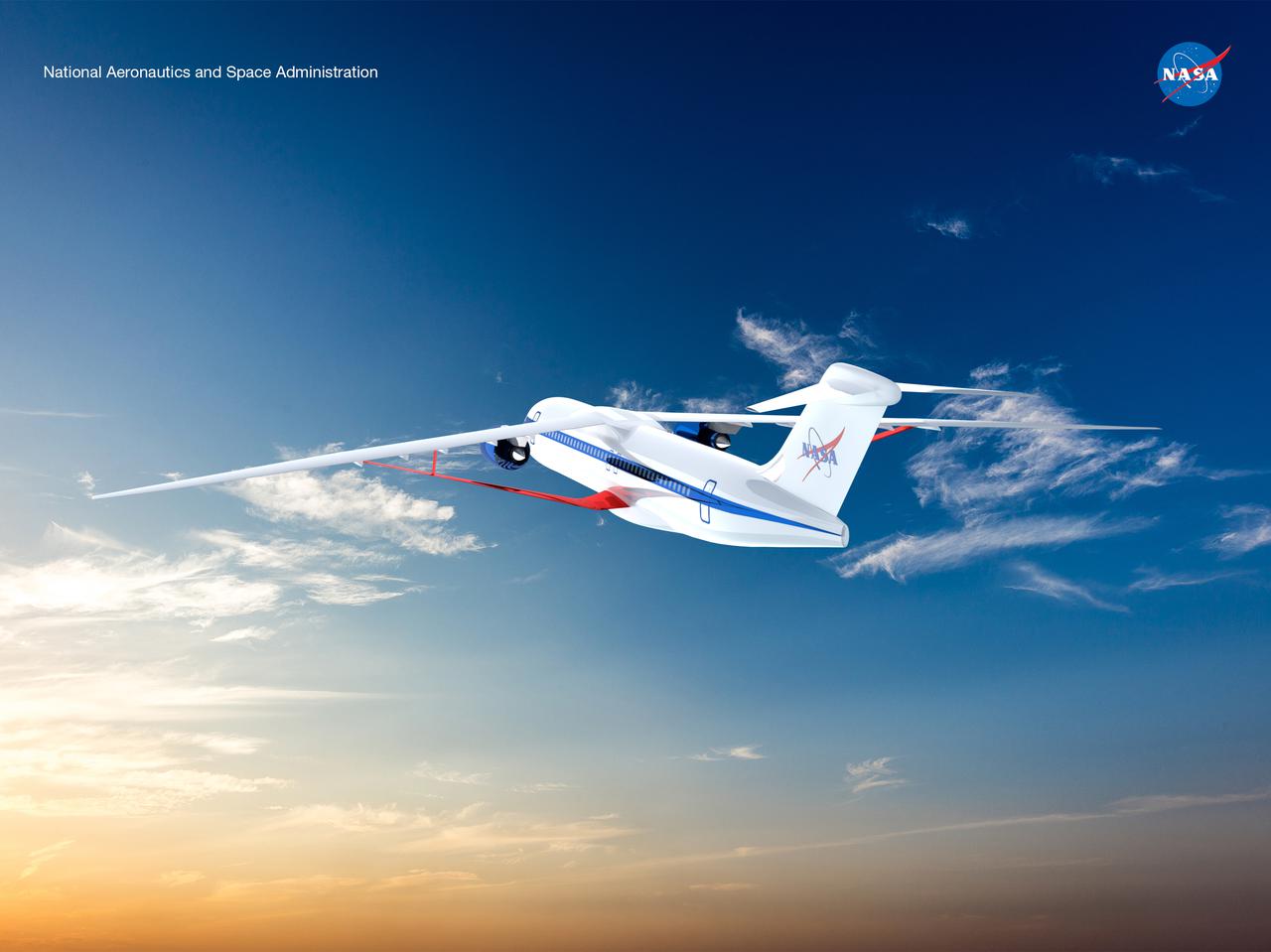
Notice anything different about the wings on this airliner? This conceptual truss-braced wing narrowbody is an aircraft with a 170ft span folding wing. By utilizing trusses, the aircraft can have longer, thinner wings with greater aspect ratios. This, in turn, translates into less drag and 5-10% less fuel burned. The Transonic Truss-Braced Wing aircraft originated from a joint effort by NASA and Boeing to develop subsonic commercial transport concepts – meeting NASA-defined metrics in terms of reduced noise, emissions, and fuel consumption. The design is currently undergoing wind tunnel testing and other studies by NASA researchers.
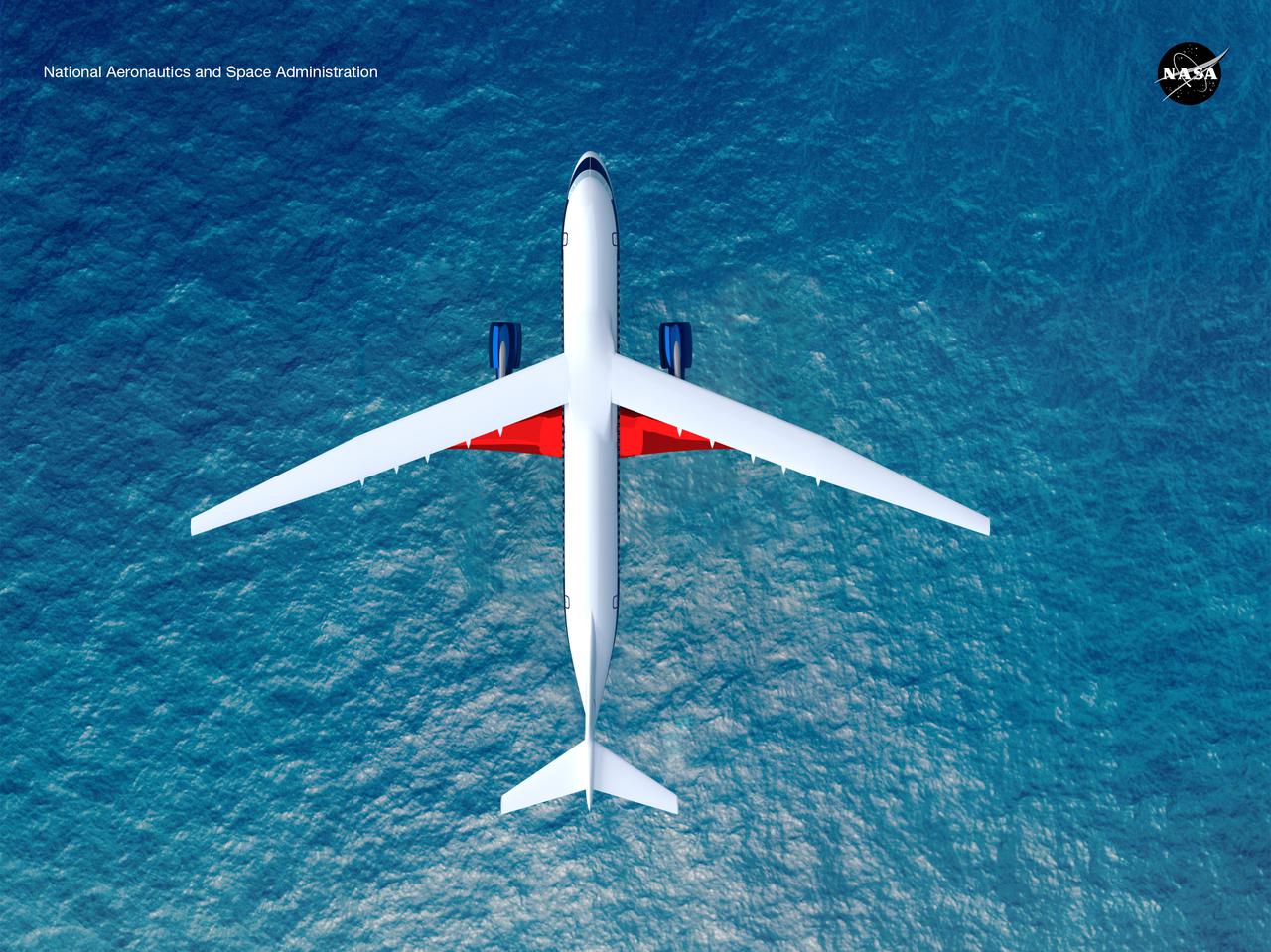
Notice anything different about the wings on this airliner? This conceptual truss-braced wing narrowbody is an aircraft with a 170ft span folding wing. By utilizing trusses, the aircraft can have longer, thinner wings with greater aspect ratios. This, in turn, translates into less drag and 5-10% less fuel burned. The Transonic Truss-Braced Wing aircraft originated from a joint effort by NASA and Boeing to develop subsonic commercial transport concepts – meeting NASA-defined metrics in terms of reduced noise, emissions, and fuel consumption. The design is currently undergoing wind tunnel testing and other studies by NASA researchers.
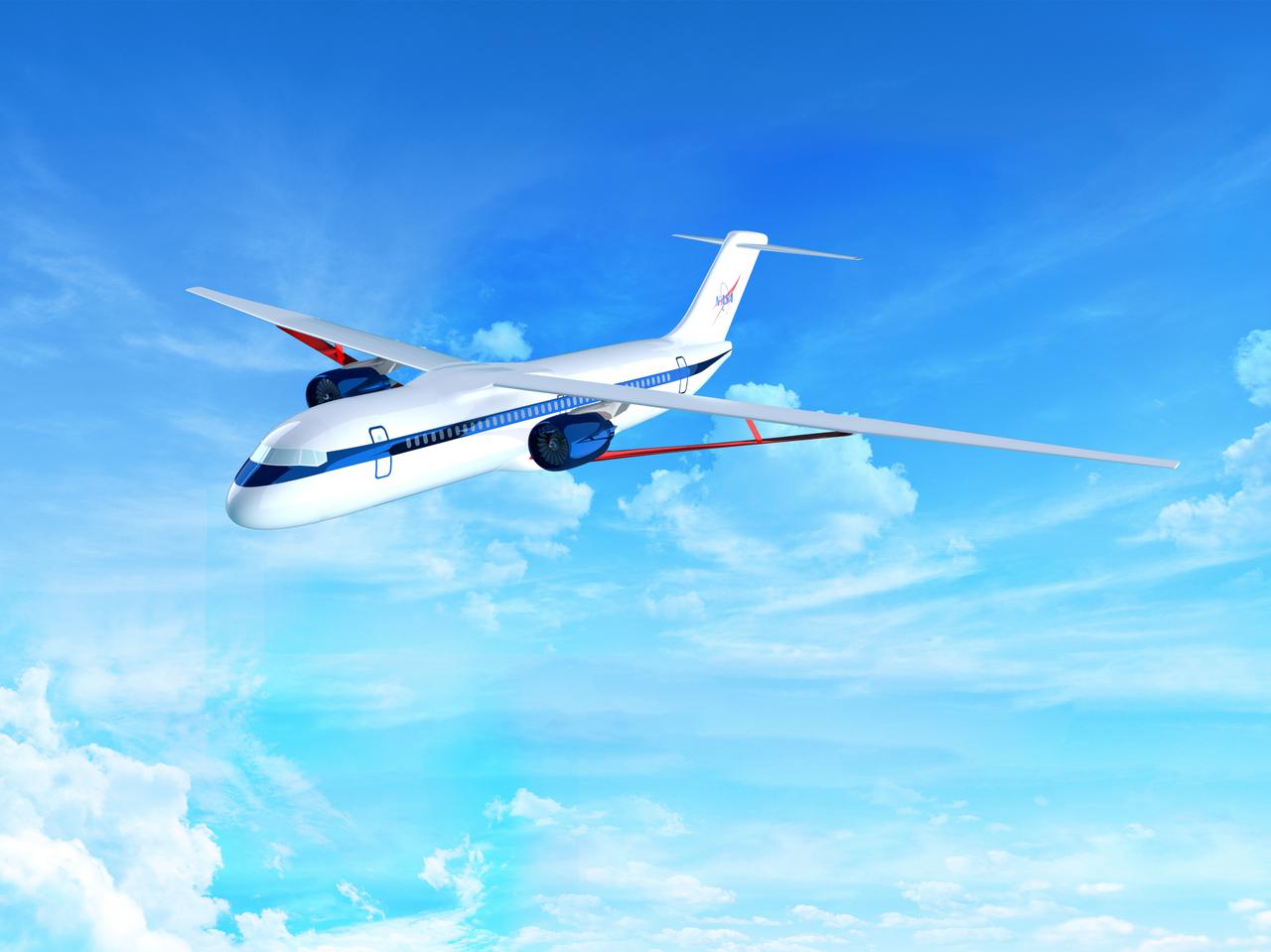
Notice anything different about the wings on this airliner? This conceptual truss-braced wing narrowbody is an aircraft with a 170ft span folding wing. By utilizing trusses, the aircraft can have longer, thinner wings with greater aspect ratios. This, in turn, translates into less drag and 5-10% less fuel burned. The Transonic Truss-Braced Wing aircraft originated from a joint effort by NASA and Boeing to develop subsonic commercial transport concepts – meeting NASA-defined metrics in terms of reduced noise, emissions, and fuel consumption. The design is currently undergoing wind tunnel testing and other studies by NASA researchers.
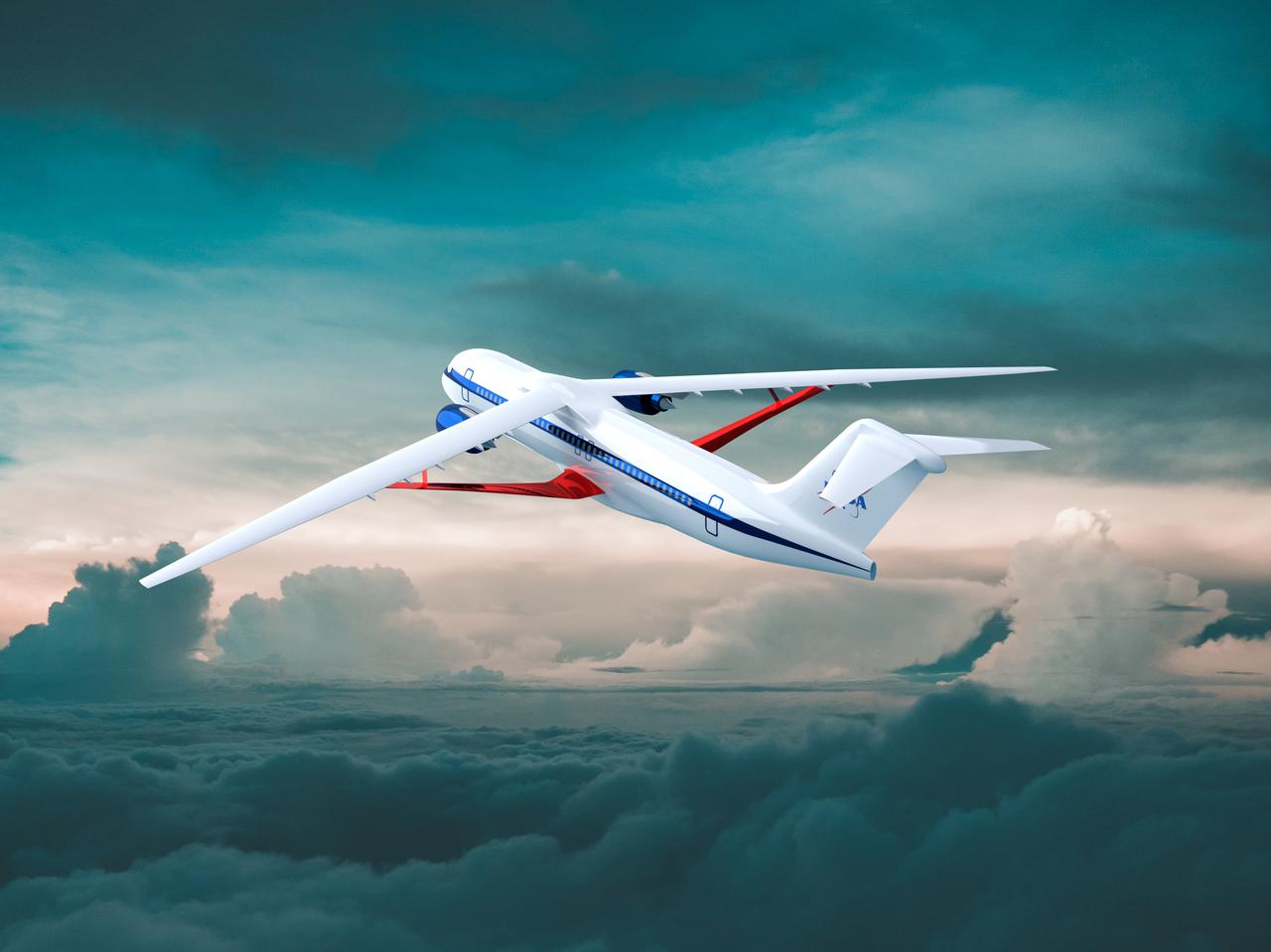
Notice anything different about the wings on this airliner? This conceptual truss-braced wing narrowbody is an aircraft with a 170ft span folding wing. By utilizing trusses, the aircraft can have longer, thinner wings with greater aspect ratios. This, in turn, translates into less drag and 5-10% less fuel burned. The Transonic Truss-Braced Wing aircraft originated from a joint effort by NASA and Boeing to develop subsonic commercial transport concepts – meeting NASA-defined metrics in terms of reduced noise, emissions, and fuel consumption. The design is currently undergoing wind tunnel testing and other studies by NASA researchers.
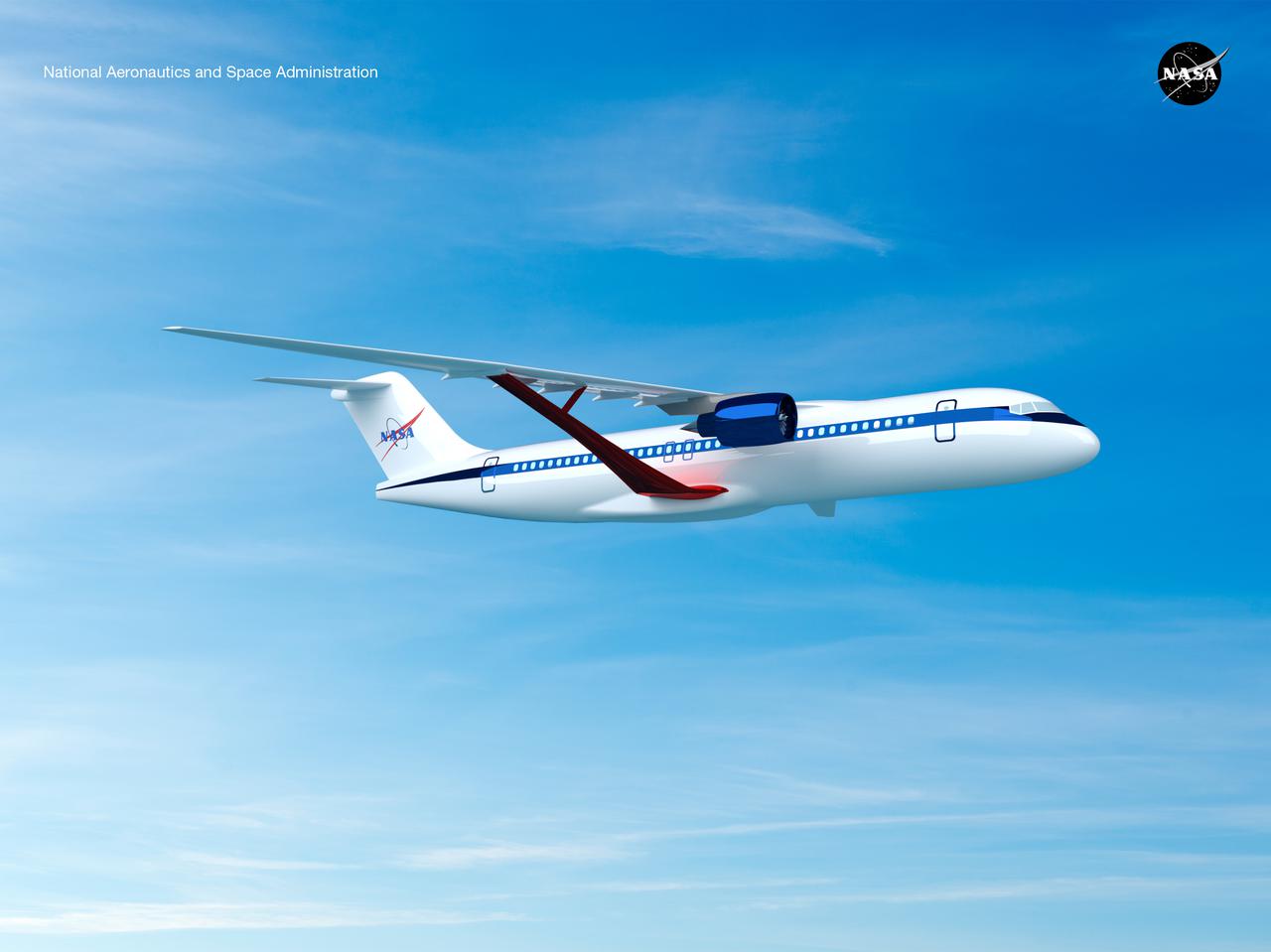
Notice anything different about the wings on this airliner? This conceptual truss-braced wing narrowbody is an aircraft with a 170ft span folding wing. By utilizing trusses, the aircraft can have longer, thinner wings with greater aspect ratios. This, in turn, translates into less drag and 5-10% less fuel burned. The Transonic Truss-Braced Wing aircraft originated from a joint effort by NASA and Boeing to develop subsonic commercial transport concepts – meeting NASA-defined metrics in terms of reduced noise, emissions, and fuel consumption. The design is currently undergoing wind tunnel testing and other studies by NASA researchers.
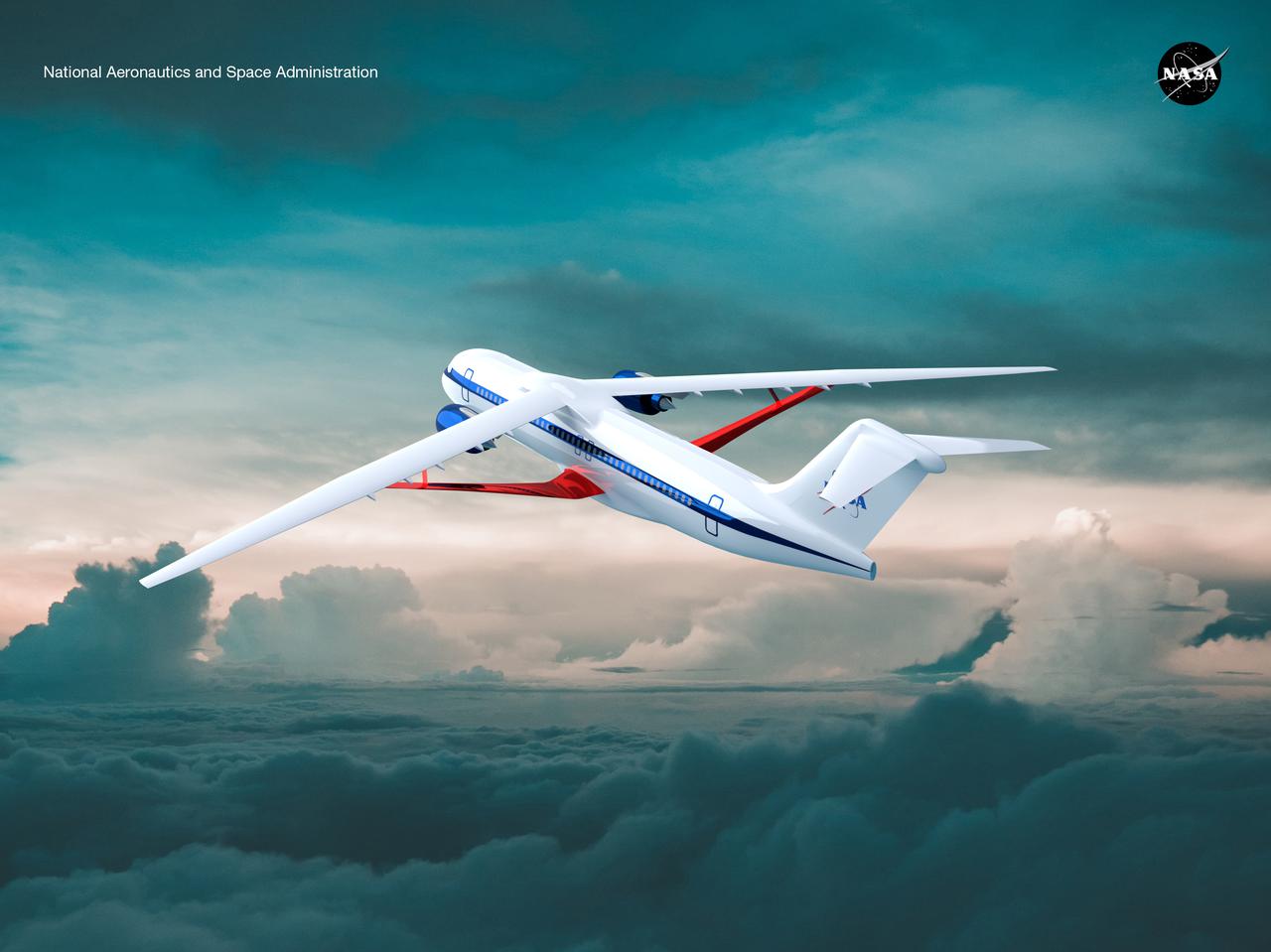
Notice anything different about the wings on this airliner? This conceptual truss-braced wing narrowbody is an aircraft with a 170ft span folding wing. By utilizing trusses, the aircraft can have longer, thinner wings with greater aspect ratios. This, in turn, translates into less drag and 5-10% less fuel burned. The Transonic Truss-Braced Wing aircraft originated from a joint effort by NASA and Boeing to develop subsonic commercial transport concepts – meeting NASA-defined metrics in terms of reduced noise, emissions, and fuel consumption. The design is currently undergoing wind tunnel testing and other studies by NASA researchers.
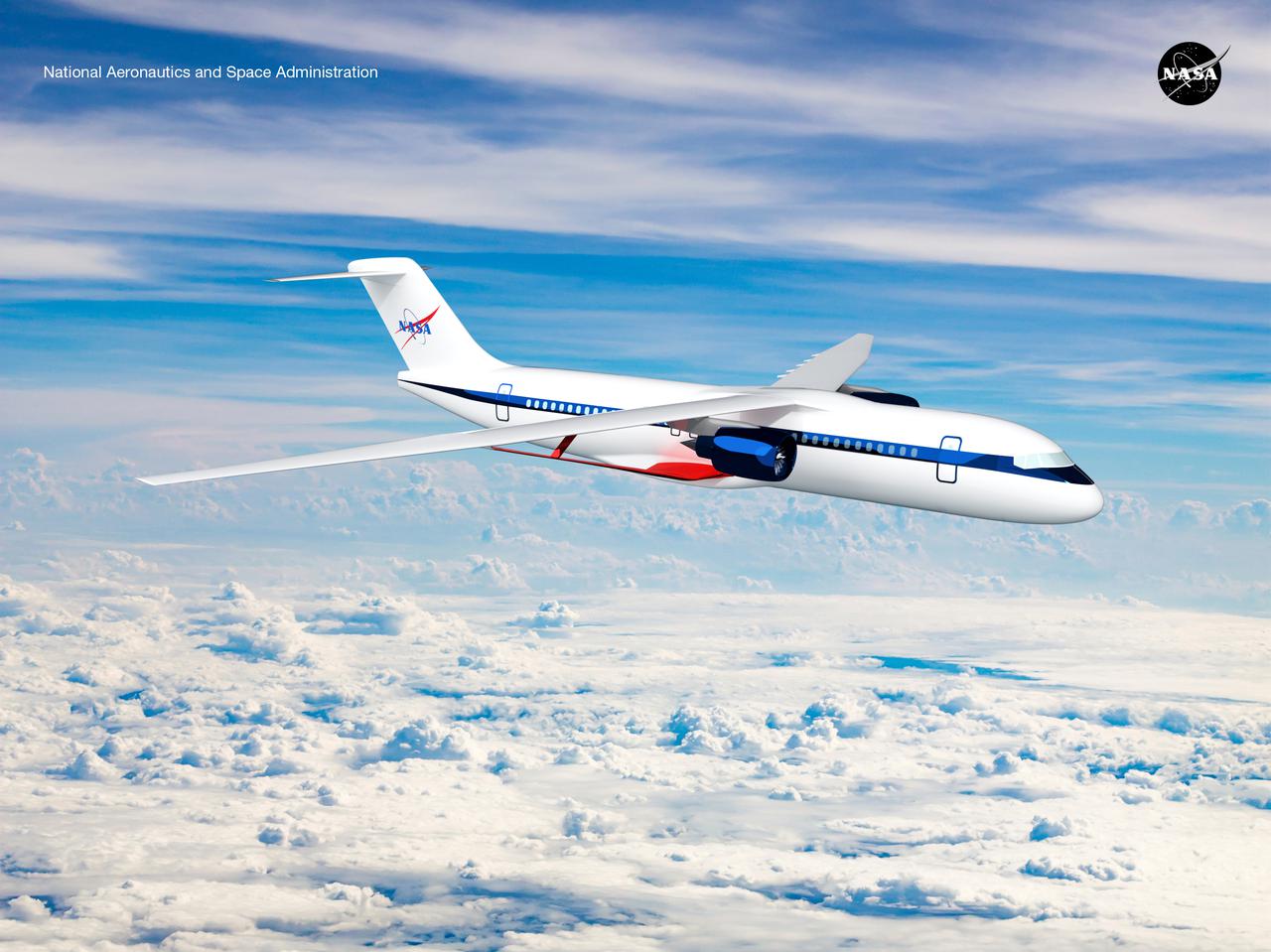
Notice anything different about the wings on this airliner? This conceptual truss-braced wing narrowbody is an aircraft with a 170ft span folding wing. By utilizing trusses, the aircraft can have longer, thinner wings with greater aspect ratios. This, in turn, translates into less drag and 5-10% less fuel burned. The Transonic Truss-Braced Wing aircraft originated from a joint effort by NASA and Boeing to develop subsonic commercial transport concepts – meeting NASA-defined metrics in terms of reduced noise, emissions, and fuel consumption. The design is currently undergoing wind tunnel testing and other studies by NASA researchers.

Notice anything different about the wings on this airliner? This conceptual truss-braced wing narrowbody is an aircraft with a 170ft span folding wing. By utilizing trusses, the aircraft can have longer, thinner wings with greater aspect ratios. This, in turn, translates into less drag and 5-10% less fuel burned. The Transonic Truss-Braced Wing aircraft originated from a joint effort by NASA and Boeing to develop subsonic commercial transport concepts – meeting NASA-defined metrics in terms of reduced noise, emissions, and fuel consumption. The design is currently undergoing wind tunnel testing and other studies by NASA researchers.
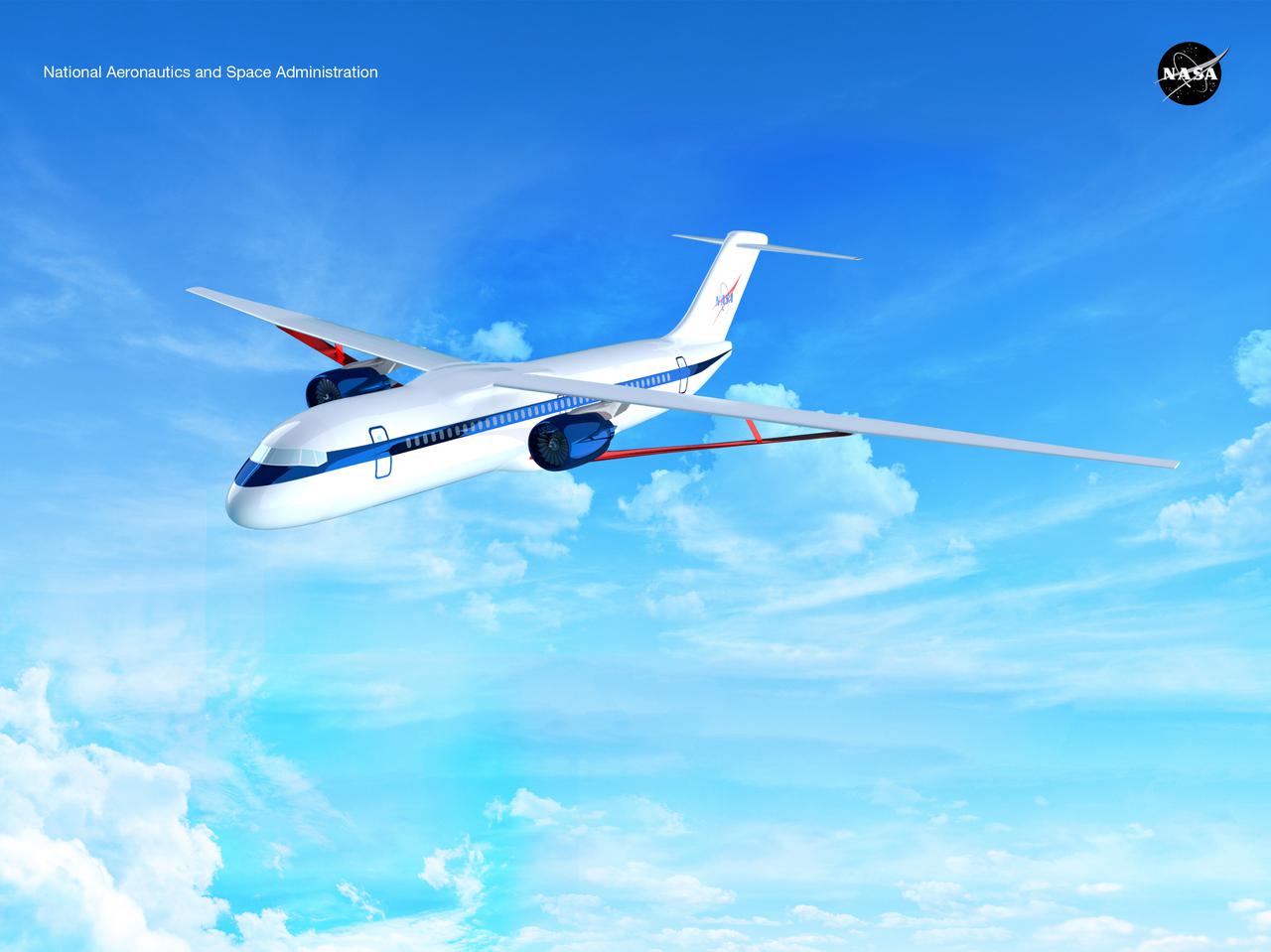
Notice anything different about the wings on this airliner? This conceptual truss-braced wing narrowbody is an aircraft with a 170ft span folding wing. By utilizing trusses, the aircraft can have longer, thinner wings with greater aspect ratios. This, in turn, translates into less drag and 5-10% less fuel burned. The Transonic Truss-Braced Wing aircraft originated from a joint effort by NASA and Boeing to develop subsonic commercial transport concepts – meeting NASA-defined metrics in terms of reduced noise, emissions, and fuel consumption. The design is currently undergoing wind tunnel testing and other studies by NASA researchers.
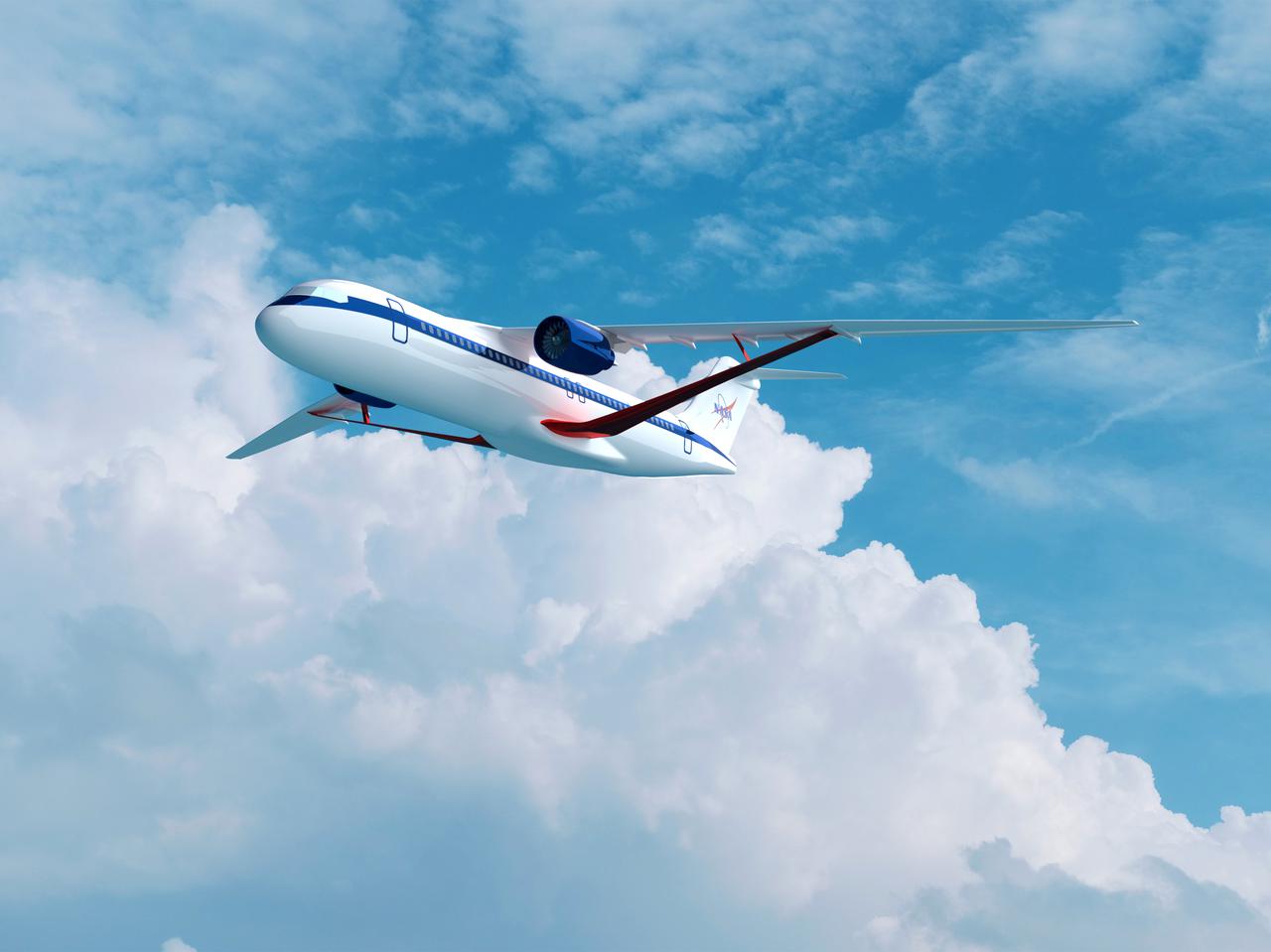
Notice anything different about the wings on this airliner? This conceptual truss-braced wing narrowbody is an aircraft with a 170ft span folding wing. By utilizing trusses, the aircraft can have longer, thinner wings with greater aspect ratios. This, in turn, translates into less drag and 5-10% less fuel burned. The Transonic Truss-Braced Wing aircraft originated from a joint effort by NASA and Boeing to develop subsonic commercial transport concepts – meeting NASA-defined metrics in terms of reduced noise, emissions, and fuel consumption. The design is currently undergoing wind tunnel testing and other studies by NASA researchers.
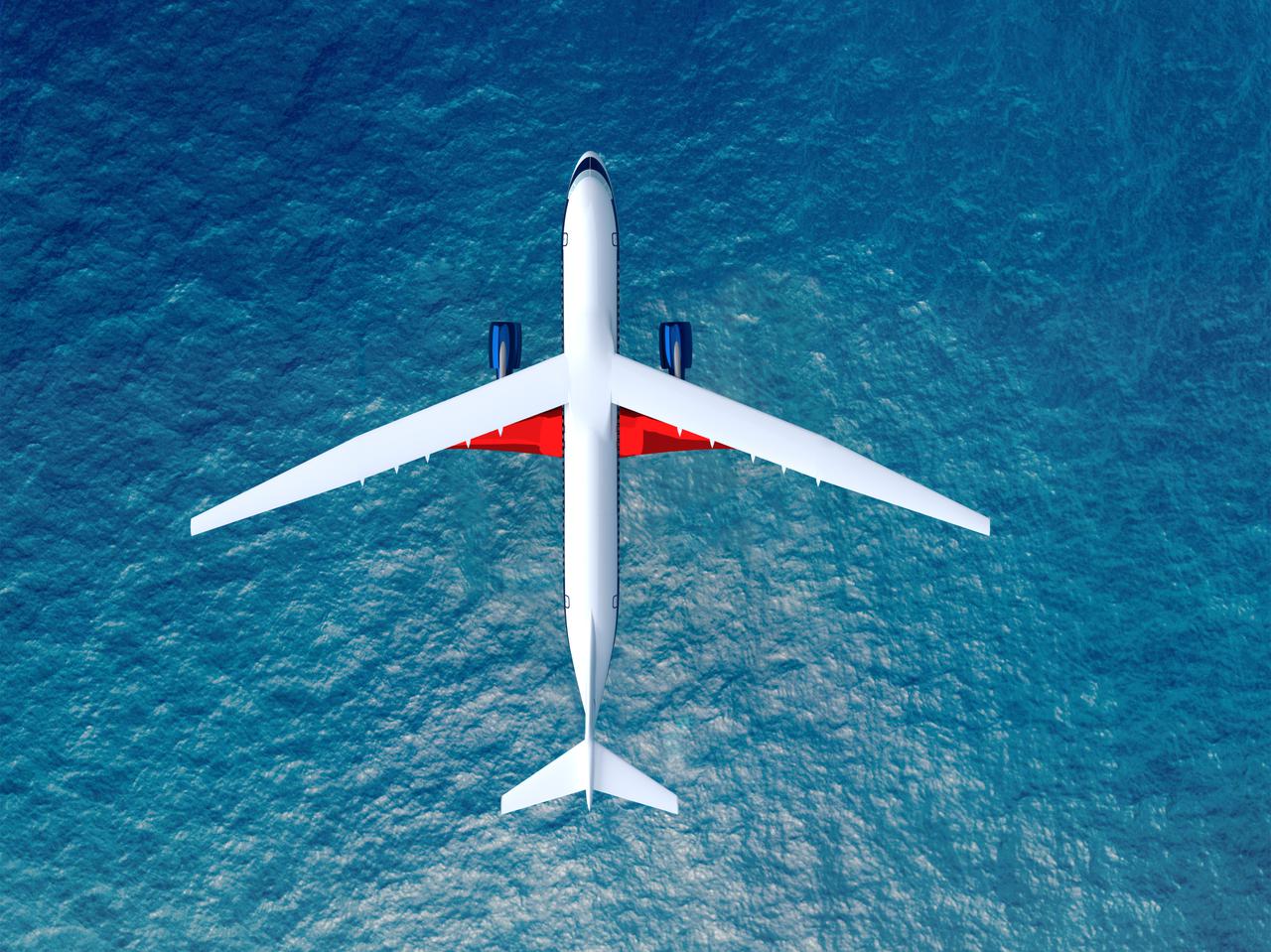
Notice anything different about the wings on this airliner? This conceptual truss-braced wing narrowbody is an aircraft with a 170ft span folding wing. By utilizing trusses, the aircraft can have longer, thinner wings with greater aspect ratios. This, in turn, translates into less drag and 5-10% less fuel burned. The Transonic Truss-Braced Wing aircraft originated from a joint effort by NASA and Boeing to develop subsonic commercial transport concepts – meeting NASA-defined metrics in terms of reduced noise, emissions, and fuel consumption. The design is currently undergoing wind tunnel testing and other studies by NASA researchers.
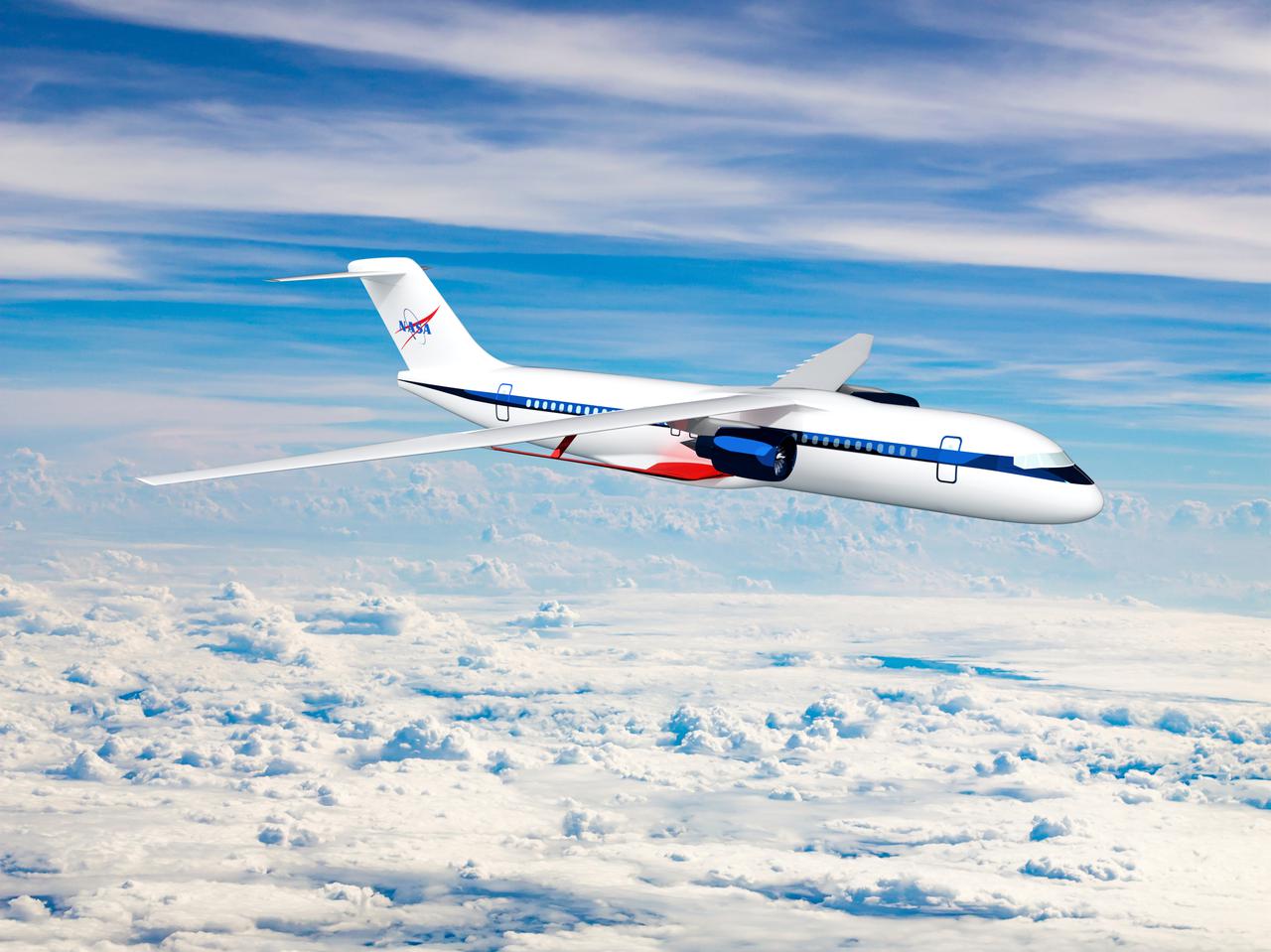
Notice anything different about the wings on this airliner? This conceptual truss-braced wing narrowbody is an aircraft with a 170ft span folding wing. By utilizing trusses, the aircraft can have longer, thinner wings with greater aspect ratios. This, in turn, translates into less drag and 5-10% less fuel burned. The Transonic Truss-Braced Wing aircraft originated from a joint effort by NASA and Boeing to develop subsonic commercial transport concepts – meeting NASA-defined metrics in terms of reduced noise, emissions, and fuel consumption. The design is currently undergoing wind tunnel testing and other studies by NASA researchers.
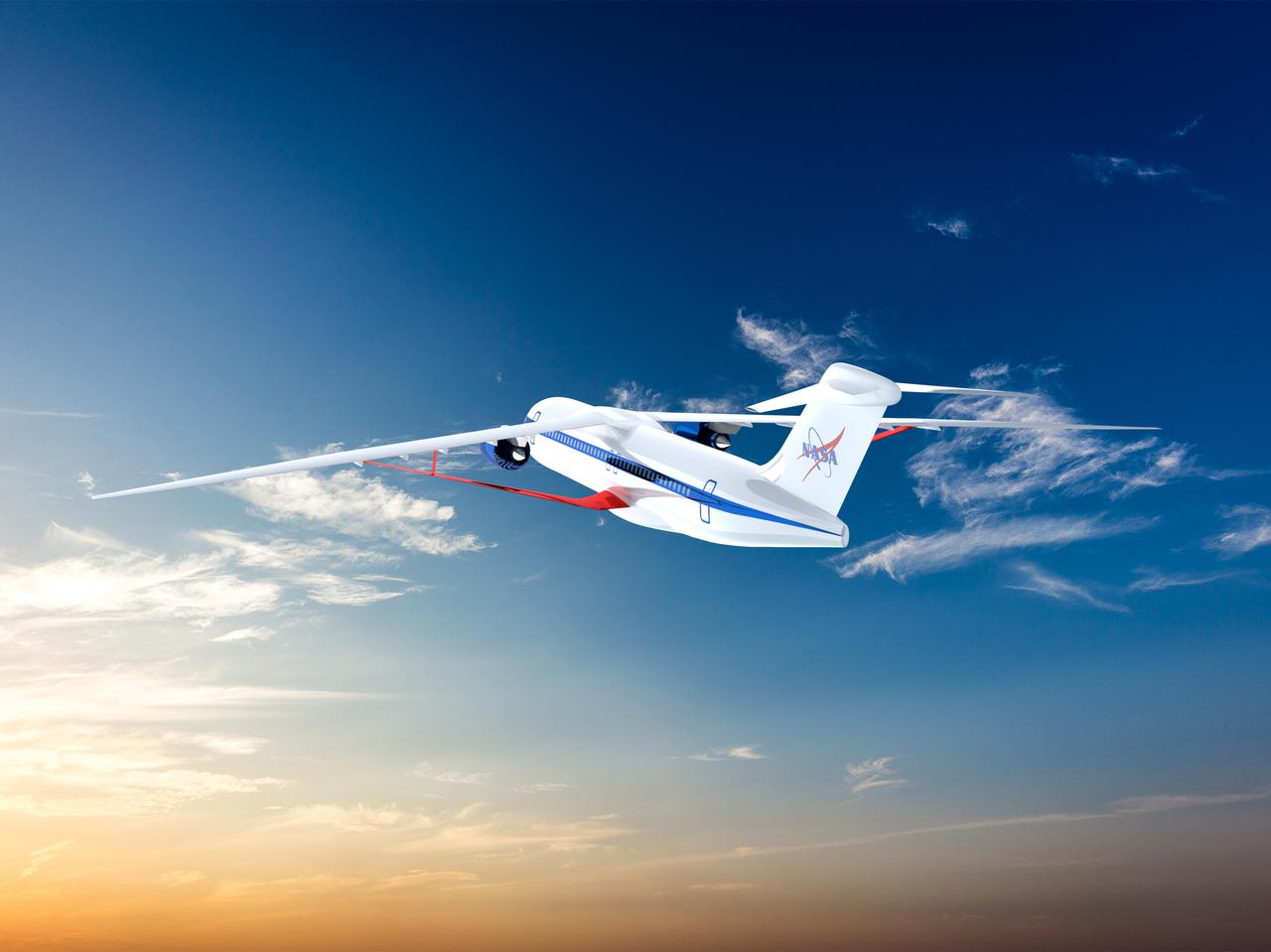
Notice anything different about the wings on this airliner? This conceptual truss-braced wing narrowbody is an aircraft with a 170ft span folding wing. By utilizing trusses, the aircraft can have longer, thinner wings with greater aspect ratios. This, in turn, translates into less drag and 5-10% less fuel burned. The Transonic Truss-Braced Wing aircraft originated from a joint effort by NASA and Boeing to develop subsonic commercial transport concepts – meeting NASA-defined metrics in terms of reduced noise, emissions, and fuel consumption. The design is currently undergoing wind tunnel testing and other studies by NASA researchers.
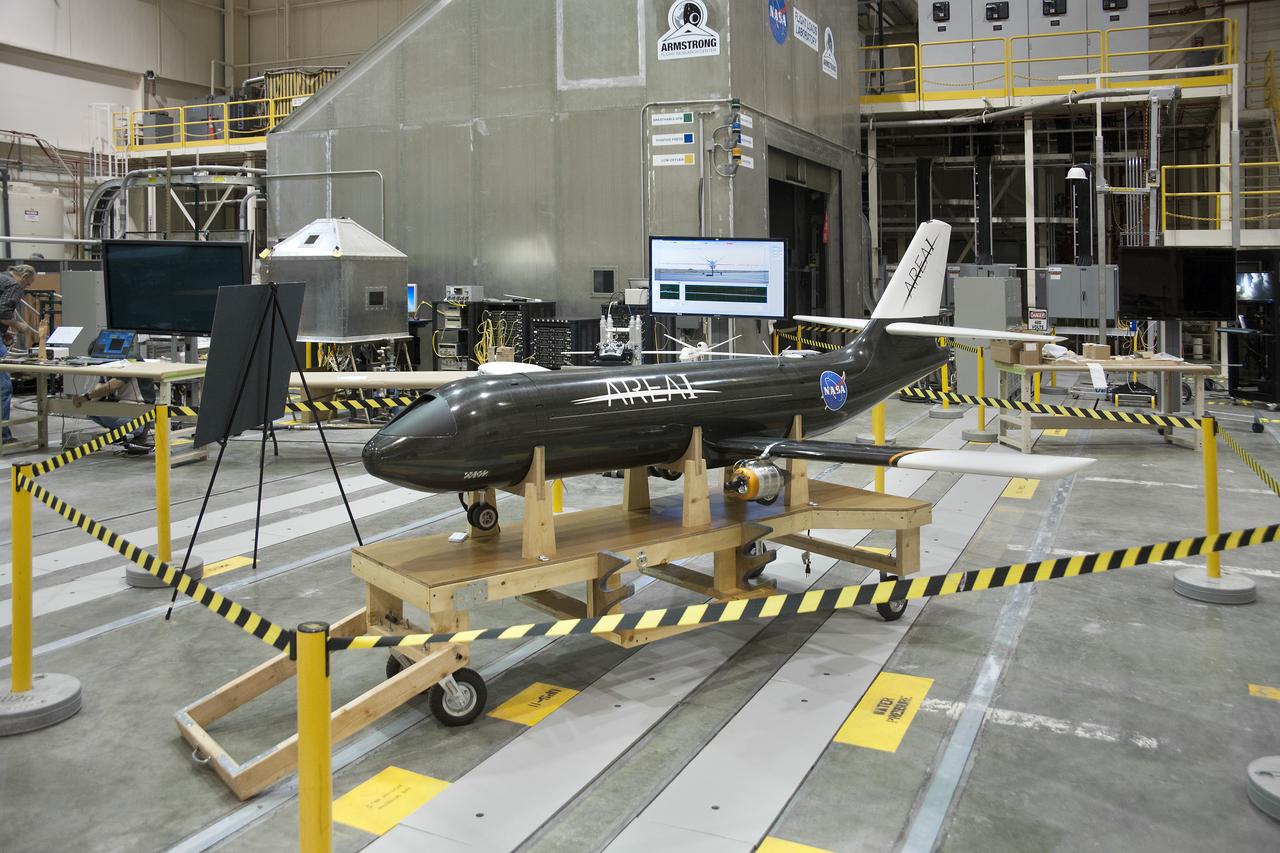
The objectives of testing on PTERA include the development of tools and vetting of system integration, evaluation of vehicle control law, and analysis of SAW airworthiness to examine benefits to in-flight efficiency.
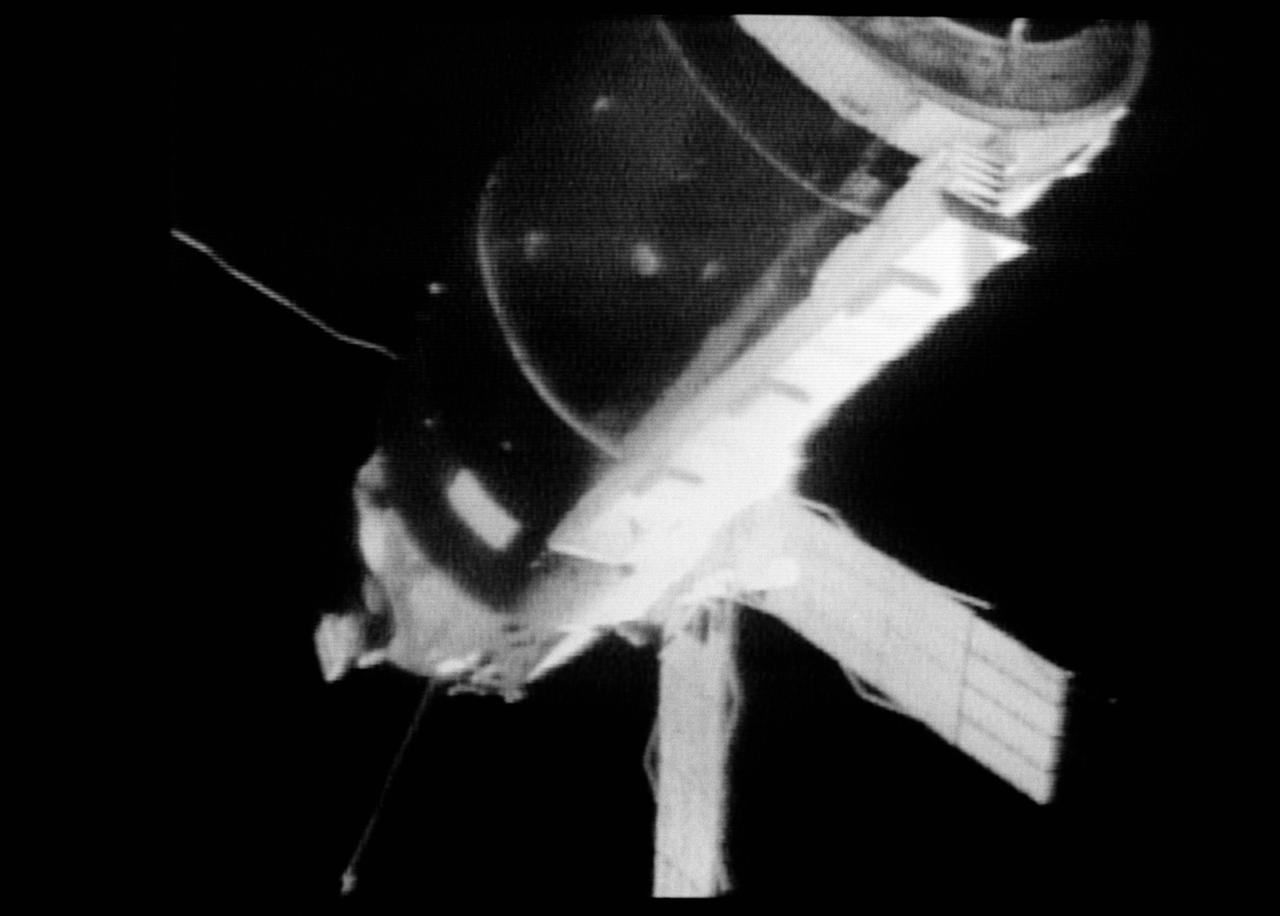
S73-27182 (25 May 1973) --- A close-up view of the Skylab 1 space station cluster can be seen in this reproduction taken from a color television transmission made by a TV camera aboard the Skylab 2 Command Module during its "fly around" inspection of the cluster. This view has been enhanced. At left center the damaged solar array system wing on the Orbital Workshop (OWS) appears to be partly folded. In their preliminary inspection the crewmen noted that portions of the micrometeoroid shield had slid back underneath the OWS solar wing. Solar panels on the Apollo Telescope Mount extend out at the top center. Photo credit: NASA
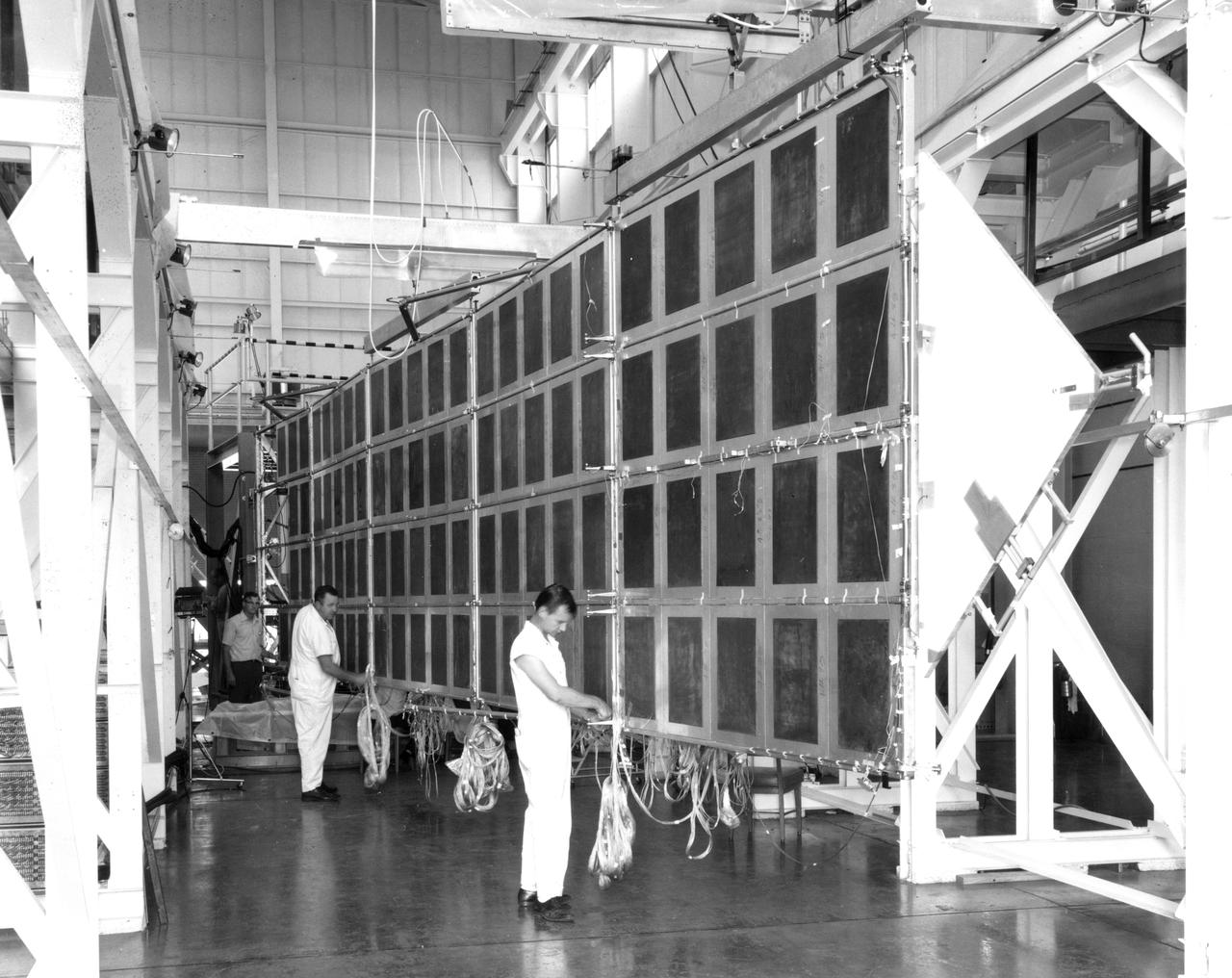
Technicians at NASA’s Marshall Space Flight Center check the wiring on a mechanical test article of the Apollo Telescope Mount (ATM) solar array. Four such arrays were joined in a cross to provide electric power for the ATM in Earth orbit. The deployment mechanism for extending the wing to the fully open position had just been tested when this photograph was taken. The array was suspended from beams riding on air bearings to closely simulate the weightless conditions under which it would be deployed in space. The wings are folded against the sides of the ATM for launch and are deployed by a scissors mechanism in Earth’s orbit.

KENNEDY SPACE CENTER, FLA. -- A white pelican stretches its eight-foot wing span as it prepares for flight. The black wing feathers, hidden when folded, appear as shadows against the dappled waters of the Merritt Island National Wildlife Refuge. The habitat of white pelicans are marshy lakes along the Pacific and Texas coasts, wintering chiefly in coastal lagoons such as this one. They often capture fish cooperatively, forming a long line, beating their wings and driving the prey into shallow water. The 92,000-acre refuge, which shares a boundary with Kennedy Space Center, is a habitat for more than 310 species of birds, 25 mammals, 117 fishes and 65 amphibians and reptiles. The marshes and open water of the refuge also provide wintering areas for 23 species of migratory waterfowl, as well as a year-round home for great blue herons, great egrets, wood storks, cormorants, brown pelicans and other species of marsh and shore birds

KENNEDY SPACE CENTER, FLA. -- White pelicans are joined by a few egrets at a feeding frenzy in the waters of the Merritt Island National Wildlife Refuge, which shares a boundary with Kennedy Space Center. Pelicans in flight display their black wing tips, which are hidden when folded. The habitat of white pelicans are marshy lakes along the Pacific and Texas coasts, wintering chiefly in coastal lagoons such as this one. They often capture fish cooperatively, forming a long line, beating their wings and driving the prey into shallow water. The 92,000-acre refuge is a habitat for more than 310 species of birds, 25 mammals, 117 fishes and 65 amphibians and reptiles. The marshes and open water of the refuge also provide wintering areas for 23 species of migratory waterfowl, as well as a year-round home for great blue herons, great egrets, wood storks, cormorants, brown pelicans and other species of marsh and shore birds

KENNEDY SPACE CENTER, FLA. -- White pelicans soaring over the waters of the Merritt Island National Wildlife Refuge reveal the black wing feathers that are hidden when folded. The habitat of white pelicans are marshy lakes along the Pacific and Texas coasts, wintering chiefly in coastal lagoons such as this one. They often capture fish cooperatively, forming a long line, beating their wings and driving the prey into shallow water. The 92,000-acre refuge, which shares a boundary with Kennedy Space Center, is a habitat for more than 310 species of birds, 25 mammals, 117 fishes and 65 amphibians and reptiles. The marshes and open water of the refuge also provide wintering areas for 23 species of migratory waterfowl, as well as a year-round home for great blue herons, great egrets, wood storks, cormorants, brown pelicans and other species of marsh and shore birds
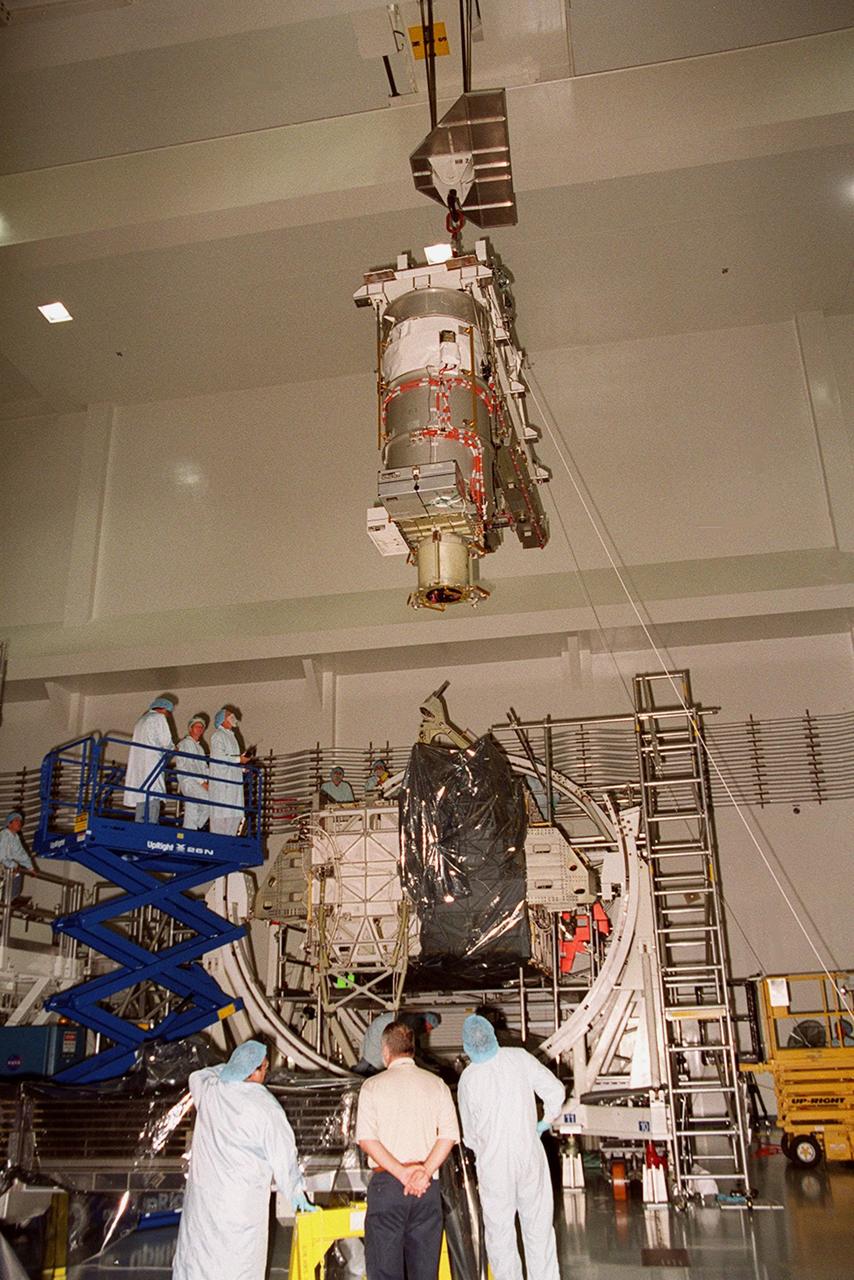
In the Space Station Processing Facility, Solar Array Wing-3 (at top), a component of the International Space Station, hovers above the Integrated Electronic Assembly where it will be installed for testing. The solar array is scheduled to be launched on STS-97 in late November along with the P6 truss. The Station’s electrical power system (EPS) will use eight photovoltaic solar arrays to convert sunlight to electricity. Each of the eight solar arrays will be 112 feet long by 39 feet wide. The solar arrays are mounted on a “blanket” that can be folded like an accordion for delivery. Once in orbit, astronauts will deploy the blankets to their full size. Gimbals will be used to rotate the arrays so that they will face the Sun to provide maximum power to the Space Station
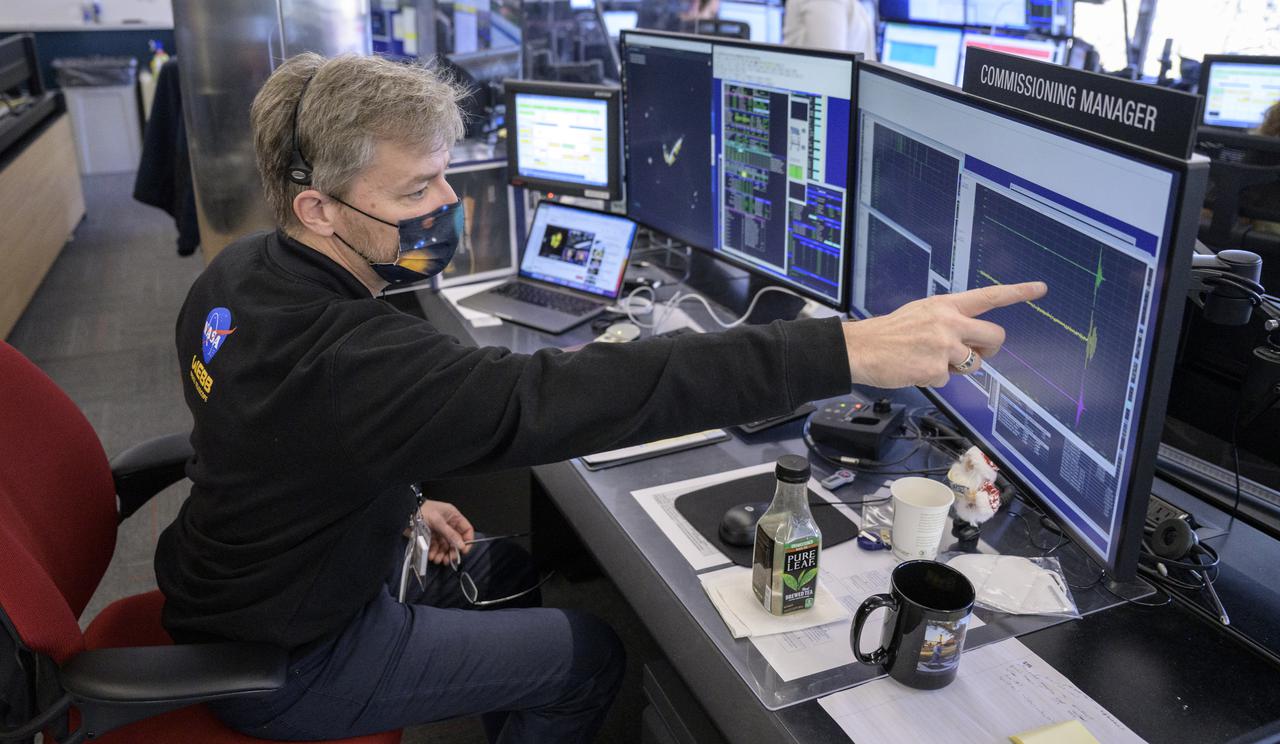
NASA James Webb Space Telescope Commissioning Manager John Durning monitors the progress of the Webb observatory as it’s second primary mirror wing is prepared to rotate into position, Saturday, Jan. 8, 2022, from NASA’s James Webb Space Telescope Mission Operations Center at the Space Telescope Science Institute in Baltimore. Webb, an infrared telescope with a 21.3-foot (6.5-meter) primary mirror, was folded up for launch and underwent an unprecedented deployment process to unfold in space. As NASA's next flagship observatory, Webb will study every phase of cosmic history—from within our solar system to the most distant observable galaxies in the early universe. Photo Credit: (NASA/Bill Ingalls)
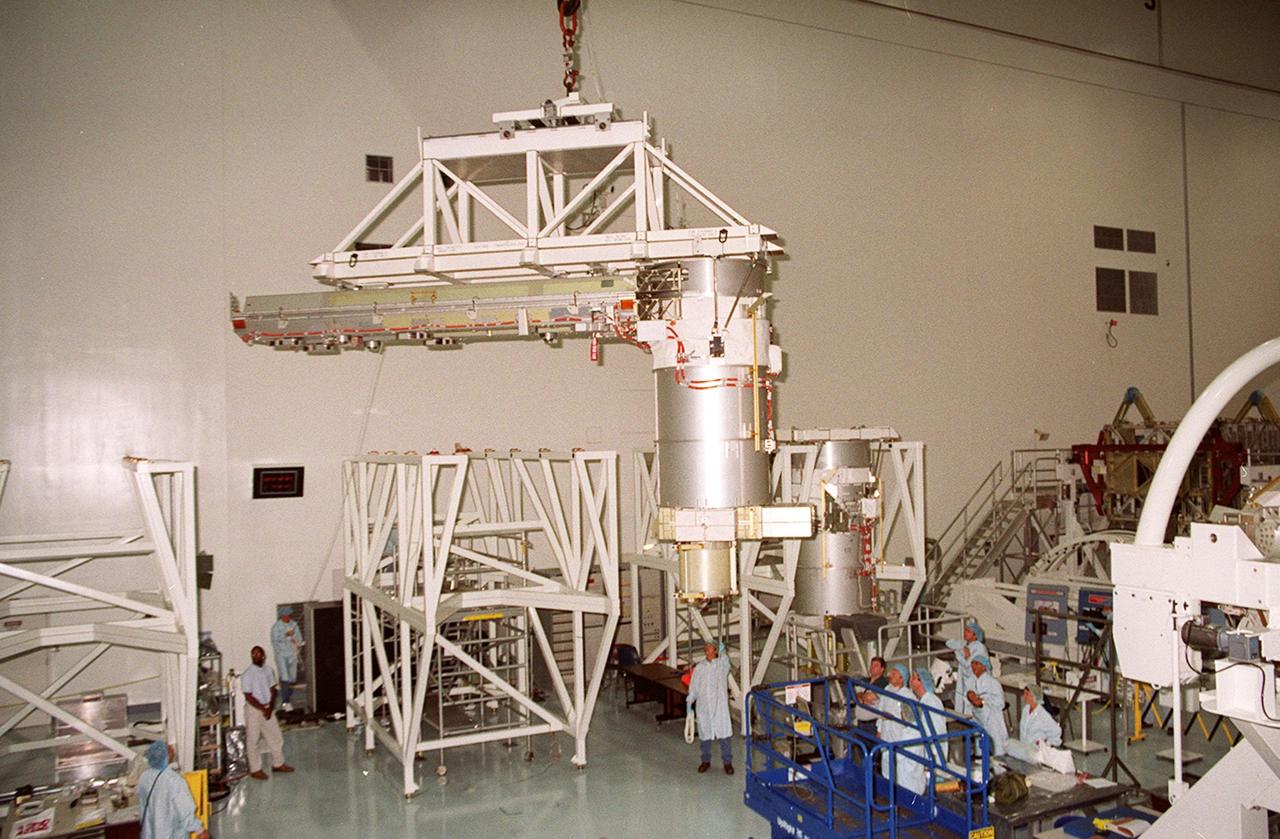
In the Space Station Processing Facility, Solar Array Wing-3, an element of the International Space Station, is lifted from a work stand to move it to the Integrated Electronic Assembly for testing. The solar array is scheduled to be launched on STS-97 in late November along with the P6 truss. The Station’s electrical power system (EPS) will use eight photovoltaic solar arrays to convert sunlight to electricity. Each of the eight solar arrays will be 112 feet long by 39 feet wide. The solar arrays are mounted on a “blanket” that can be folded like an accordion for delivery. Once in orbit, astronauts will deploy the blankets to their full size. Gimbals will be used to rotate the arrays so that they will face the Sun to provide maximum power to the Space Station
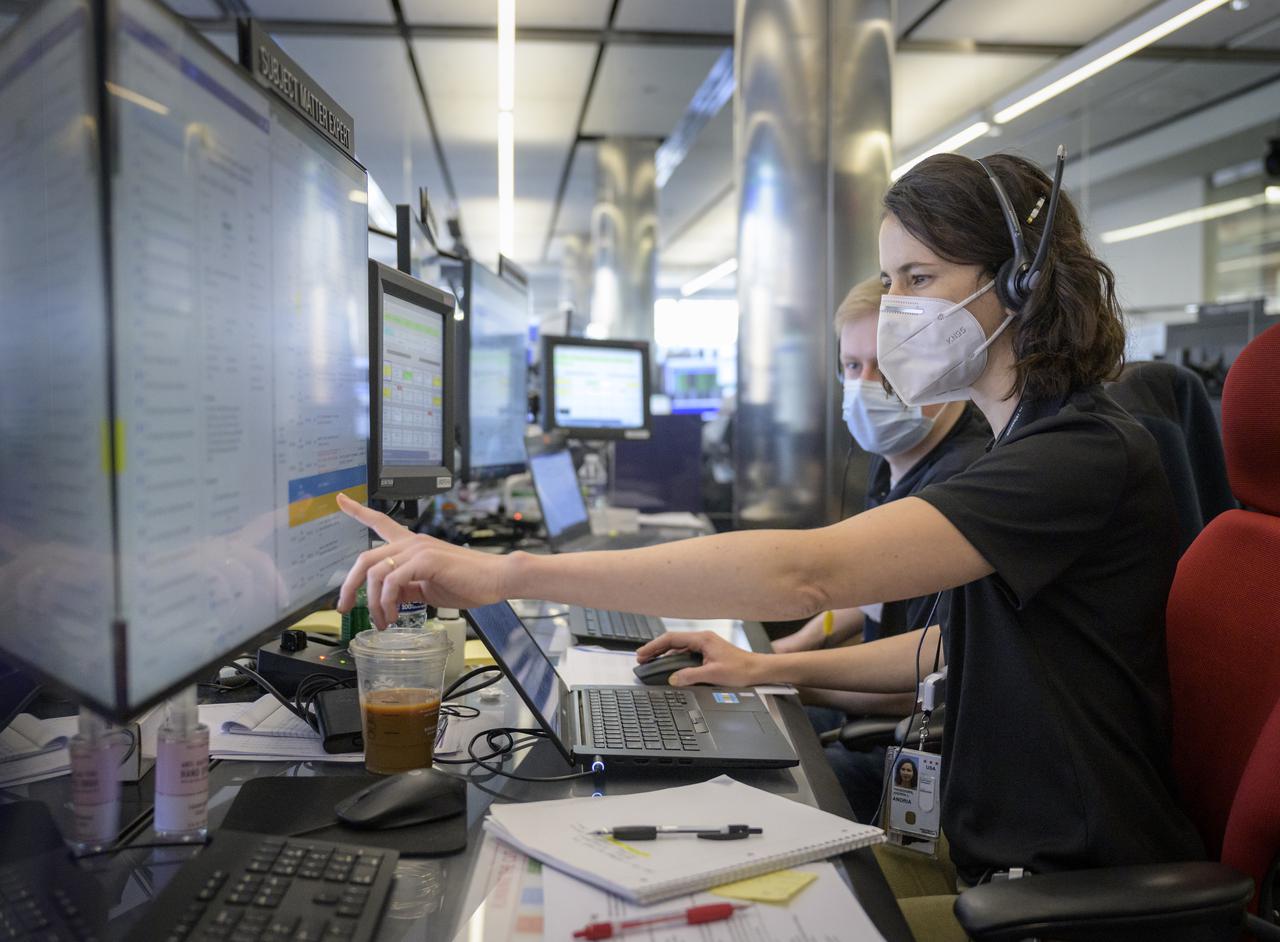
NASA James Webb Space Telescope Timeline Coordinator Andria Hagedorn monitors the progress of the Webb observatory’s second primary mirror wing as it rotates into position, Saturday, Jan. 8, 2022, from NASA’s James Webb Space Telescope Mission Operations Center at the Space Telescope Science Institute in Baltimore. Webb, an infrared telescope with a 21.3-foot (6.5-meter) primary mirror, was folded up for launch and underwent an unprecedented deployment process to unfold in space. As NASA's next flagship observatory, Webb will study every phase of cosmic history—from within our solar system to the most distant observable galaxies in the early universe. Photo Credit: (NASA/Bill Ingalls)

NASA James Webb Space Telescope Commissioning Manager John Durning monitors the progress of the Webb observatory as it’s second primary mirror wing is rotated into position, Saturday, Jan. 8, 2022, from NASA’s James Webb Space Telescope Mission Operations Center at the Space Telescope Science Institute in Baltimore. Webb, an infrared telescope with a 21.3-foot (6.5-meter) primary mirror, was folded up for launch and underwent an unprecedented deployment process to unfold in space. As NASA's next flagship observatory, Webb will study every phase of cosmic history—from within our solar system to the most distant observable galaxies in the early universe. Photo Credit: (NASA/Bill Ingalls)
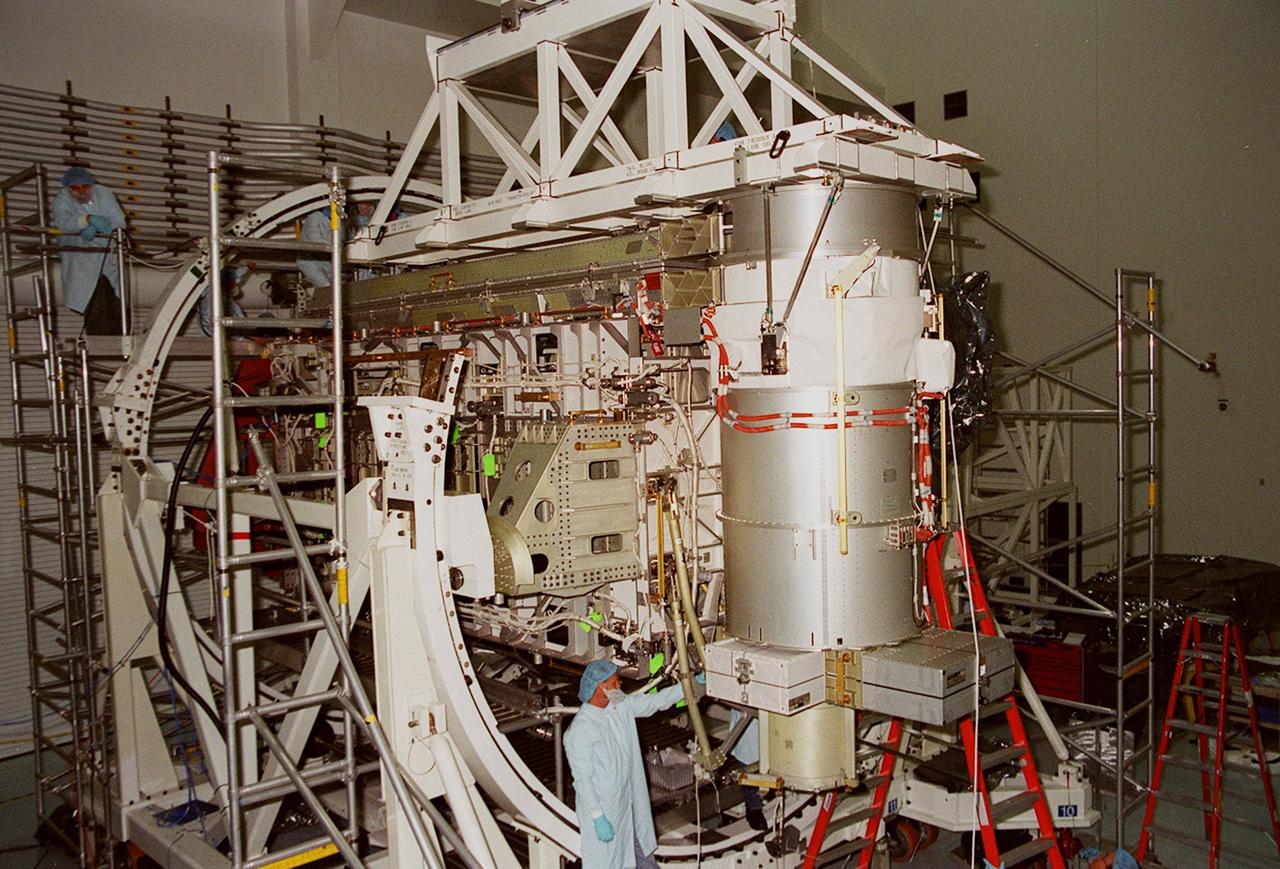
In the Space Station Processing Facility, Solar Array Wing-3, a component of the International Space Station, is installed in the Integrated Electronic Assembly where it will be tested. The solar array is scheduled to be launched on STS-97 in late November along with the P6 truss. The Station’s electrical power system (EPS) will use eight photovoltaic solar arrays to convert sunlight to electricity. Each of the eight solar arrays will be 112 feet long by 39 feet wide. The solar arrays are mounted on a “blanket” that can be folded like an accordion for delivery. Once in orbit, astronauts will deploy the blankets to their full size. Gimbals will be used to rotate the arrays so that they will face the Sun to provide maximum power to the Space Station
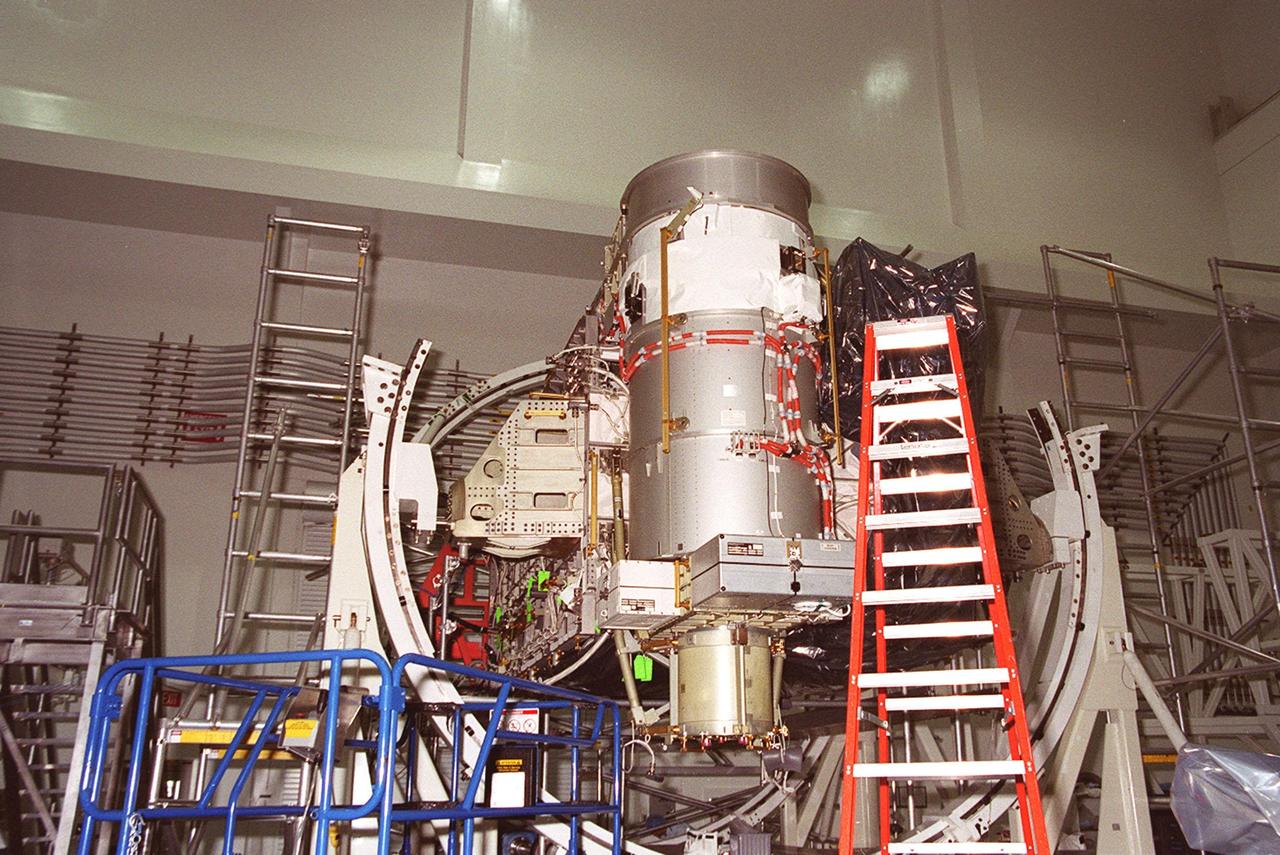
In the Space Station Processing Facility, Solar Array Wing-3, a component of the International Space Station, is installed in the Integrated Electronic Assembly where it will be tested. The solar array is scheduled to be launched on STS-97 in late November along with the P6 truss. The Station’s electrical power system (EPS) will use eight photovoltaic solar arrays to convert sunlight to electricity. Each of the eight solar arrays will be 112 feet long by 39 feet wide. The solar arrays are mounted on a “blanket” that can be folded like an accordion for delivery. Once in orbit, astronauts will deploy the blankets to their full size. Gimbals will be used to rotate the arrays so that they will face the Sun to provide maximum power to the Space Station
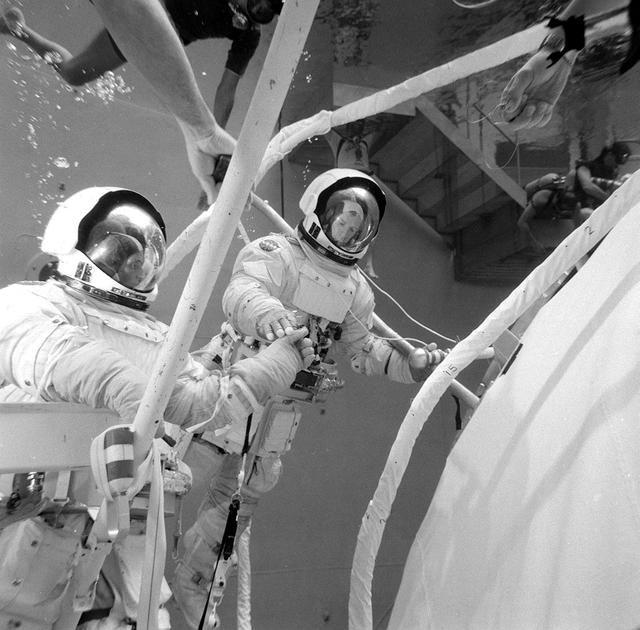
This photograph was taken during testing of an emergency procedure to free jammed solar array panels on the Skylab workshop. A metal strap became tangled over one of the folded solar array panels when Skylab lost its micrometeoroid shield during the launch. This photograph shows astronauts Schweickart and Gibson in the Marshall Space Flight Center (MSFC) Neutral Buoyancy Simulator (NBS) using various cutting tools and methods developed by the MSFC to free the jammed solar wing. Extensive testing and many hours of practice in simulators such as the NBS tank helped prepare the Skylab crewmen for extravehicular performance in the weightless environment. This huge water tank simulated the weightless environment that the astronauts would encounter in space.
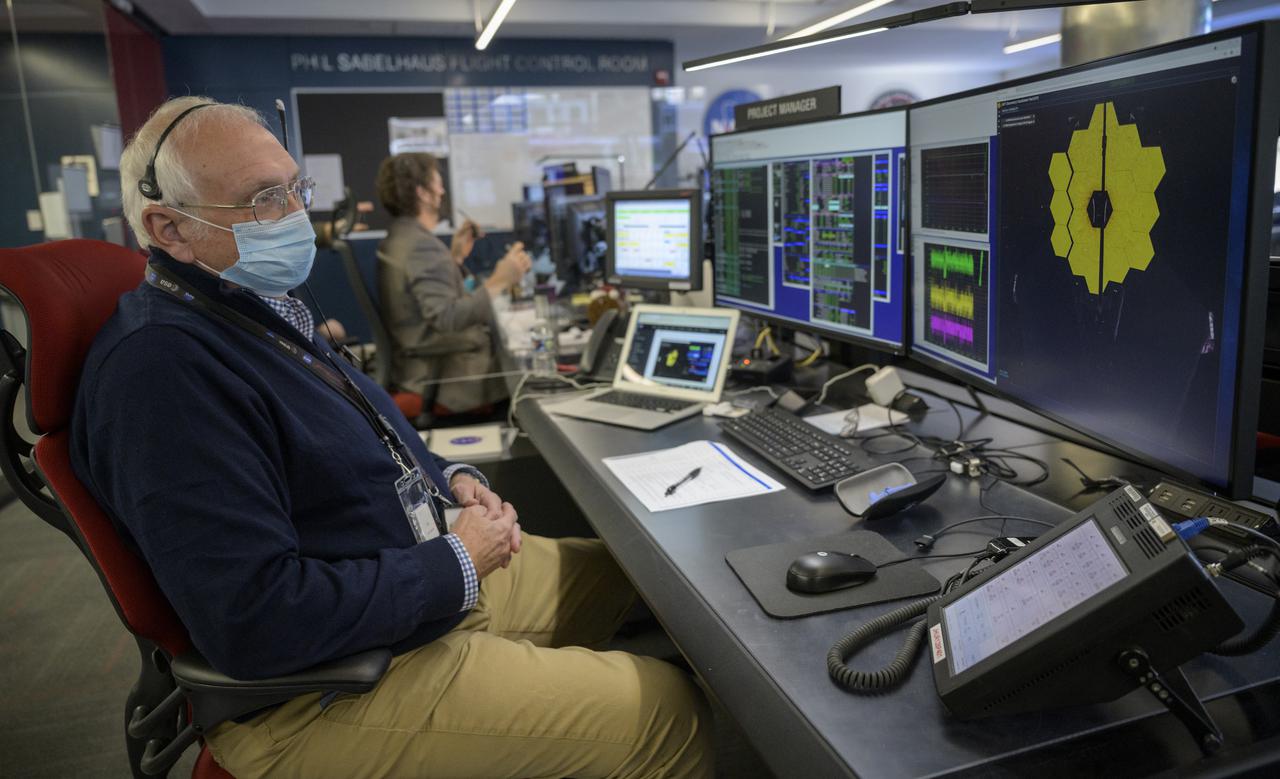
NASA James Webb Space Telescope Project Manager Bill Ochs monitors the progress of the observatory’s second primary mirror wing as it rotates into position, Saturday, Jan. 8, 2022, from NASA’s James Webb Space Telescope Mission Operations Center at the Space Telescope Science Institute in Baltimore. Webb, an infrared telescope with a 21.3-foot (6.5-meter) primary mirror, was folded up for launch and underwent an unprecedented deployment process to unfold in space. As NASA's next flagship observatory, Webb will study every phase of cosmic history—from within our solar system to the most distant observable galaxies in the early universe. Photo Credit: (NASA/Bill Ingalls)
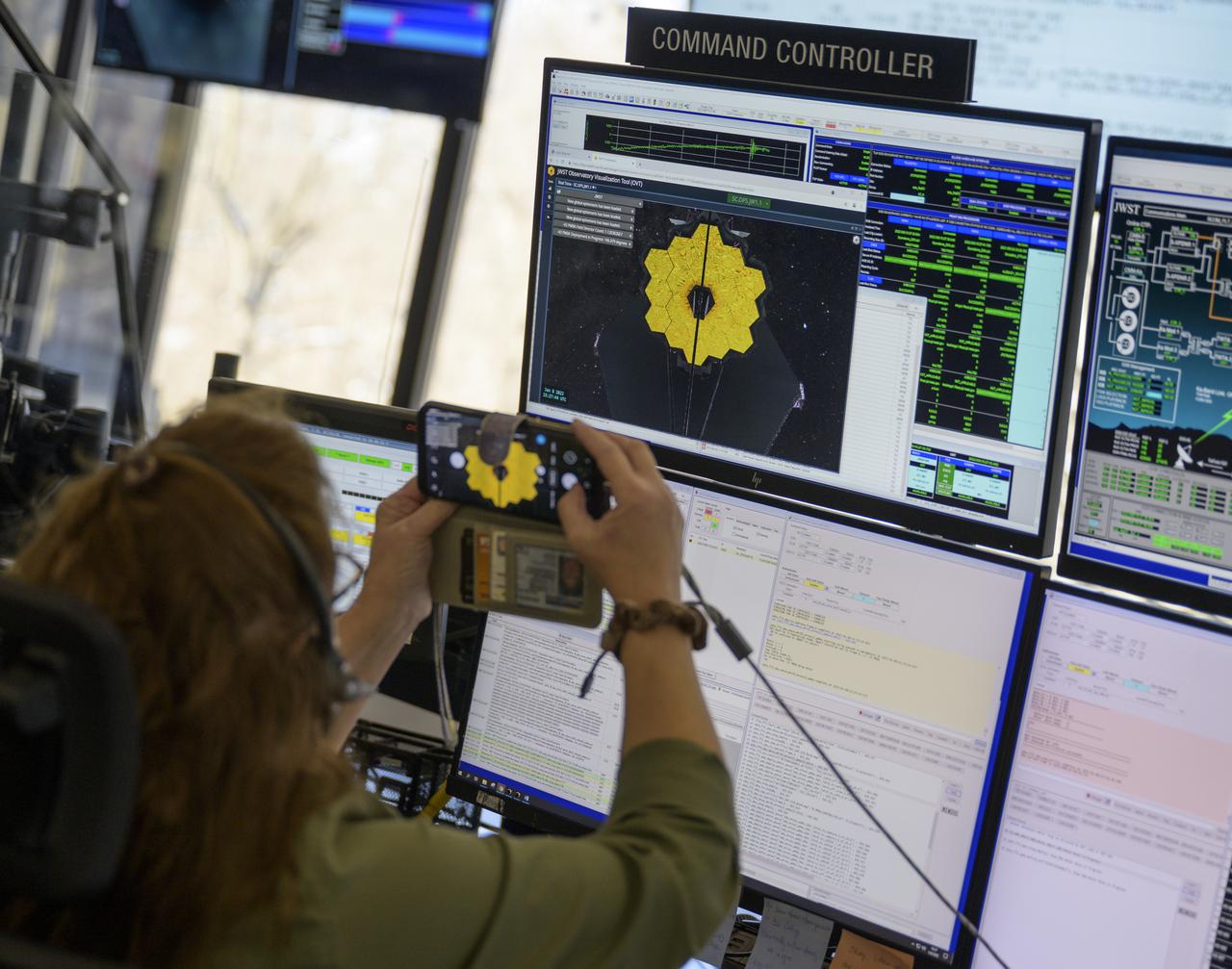
Engineering teams at NASA’s James Webb Space Telescope Mission Operations Center at the Space Telescope Science Institute in Baltimore monitor progress as the observatory’s second primary mirror wing rotates into position, Saturday, Jan. 8, 2022. Webb, an infrared telescope with a 21.3-foot (6.5-meter) primary mirror, was folded up for launch and underwent an unprecedented deployment process to unfold in space. As NASA's next flagship observatory, Webb will study every phase of cosmic history—from within our solar system to the most distant observable galaxies in the early universe. Photo Credit: (NASA/Bill Ingalls)
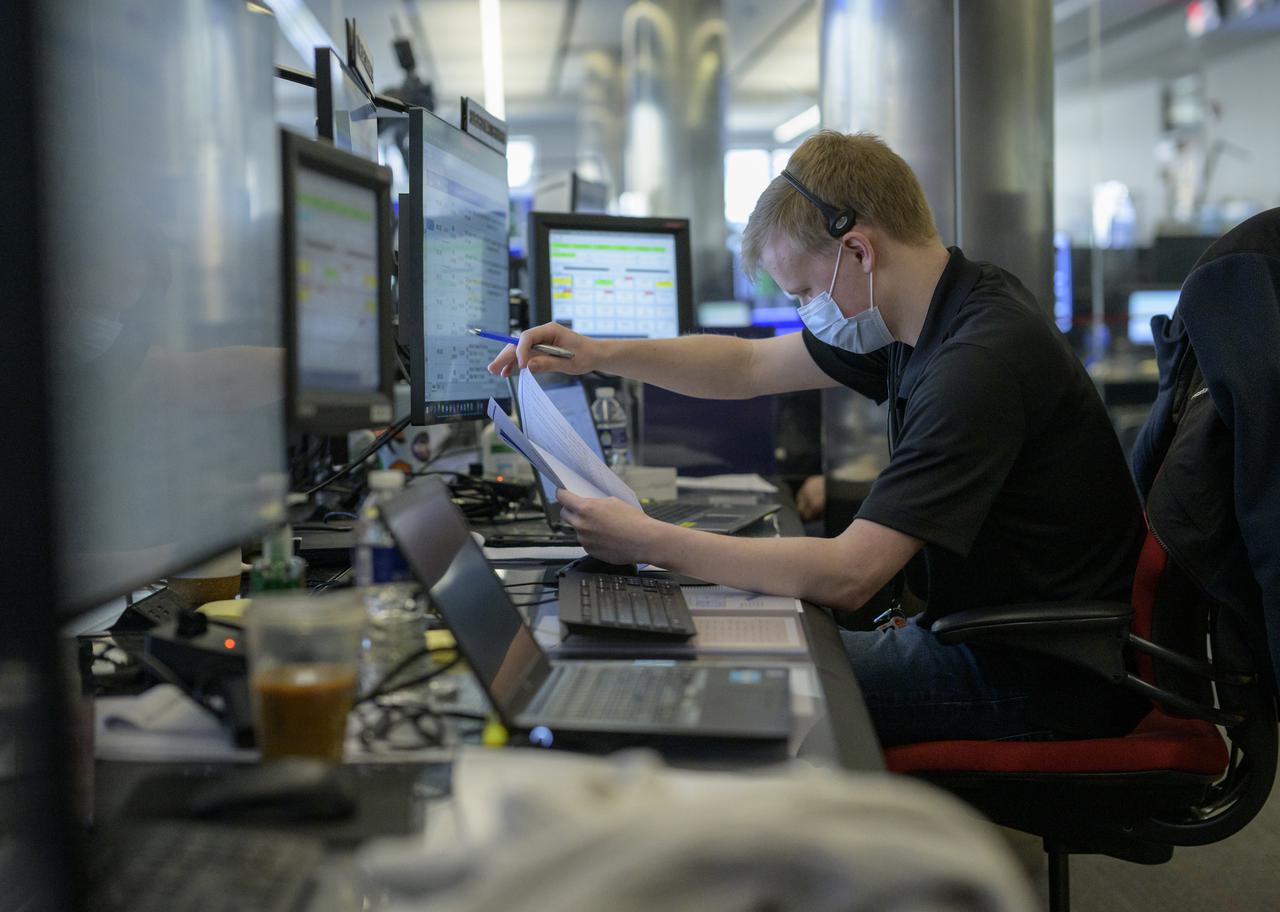
NASA James Webb Space Telescope Timeline Coordinator Matt Wasiak monitors the progress of the Webb observatory as it’s second primary mirror wing is prepared to rotate into position, Saturday, Jan. 8, 2022, from NASA’s James Webb Space Telescope Mission Operations Center at the Space Telescope Science Institute in Baltimore. Webb, an infrared telescope with a 21.3-foot (6.5-meter) primary mirror, was folded up for launch and underwent an unprecedented deployment process to unfold in space. As NASA's next flagship observatory, Webb will study every phase of cosmic history—from within our solar system to the most distant observable galaxies in the early universe. Photo Credit: (NASA/Bill Ingalls)
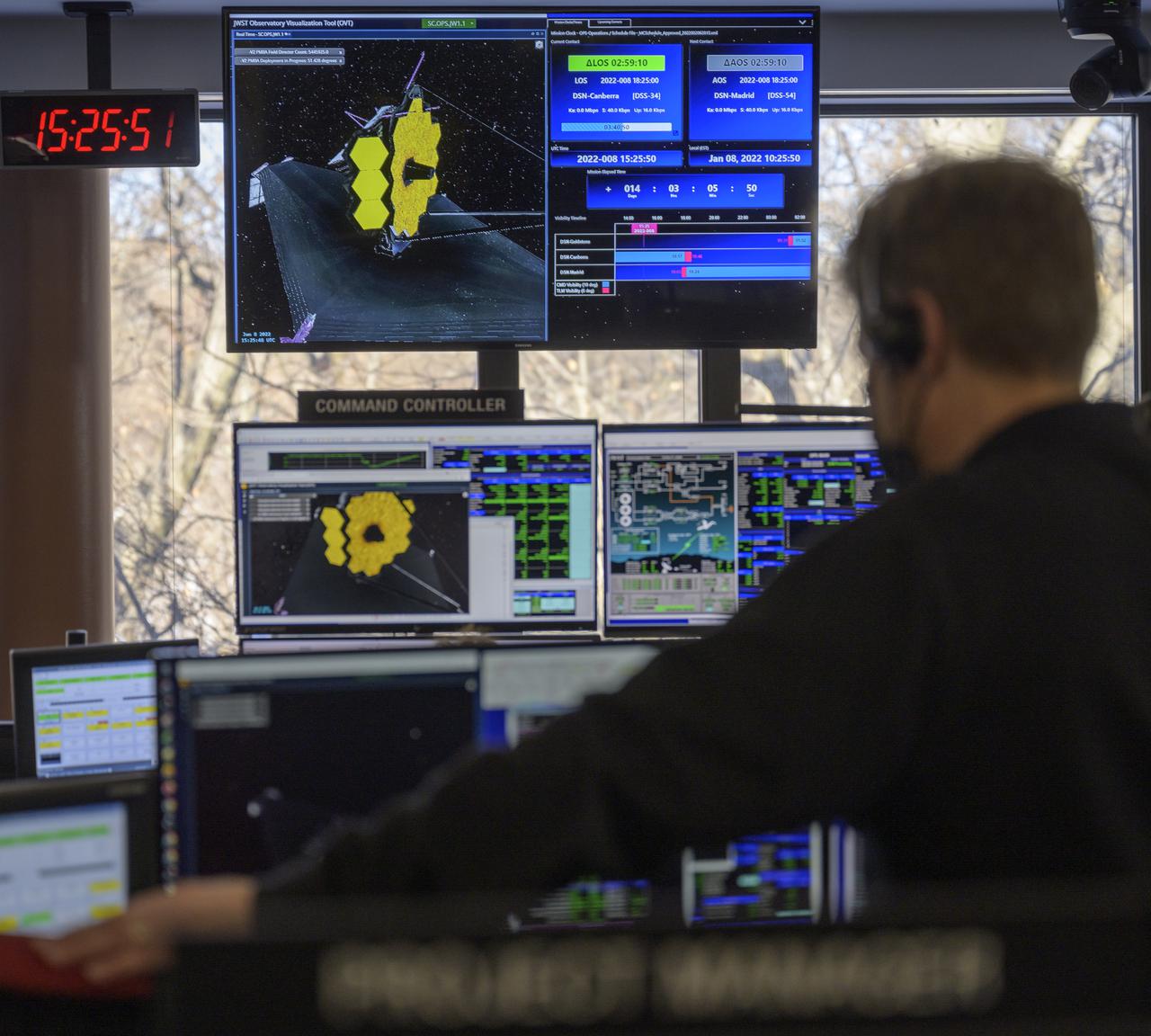
Engineering teams at NASA’s James Webb Space Telescope Mission Operations Center at the Space Telescope Science Institute in Baltimore monitor progress as the observatory’s second primary mirror wing rotates into position, Saturday, Jan. 8, 2022. Webb, an infrared telescope with a 21.3-foot (6.5-meter) primary mirror, was folded up for launch and underwent an unprecedented deployment process to unfold in space. As NASA's next flagship observatory, Webb will study every phase of cosmic history—from within our solar system to the most distant observable galaxies in the early universe. Photo Credit: (NASA/Bill Ingalls)
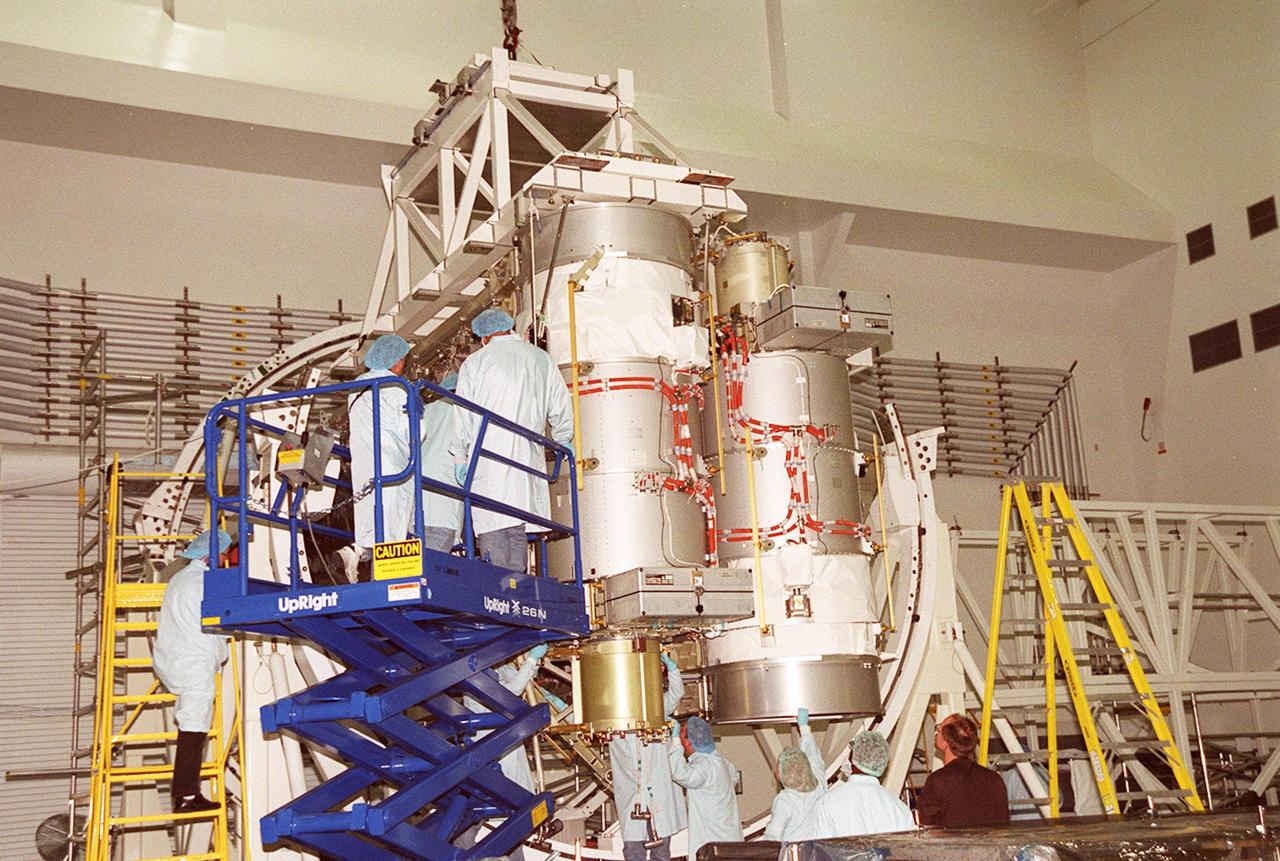
A solar array is nearly in place on the Integrated Equipment Assembly, next to Solar Array Wing-3, which is already installed. Components of the International Space Station, the arrays are scheduled to be launched on mission STS-97 in late November along with the P6 truss. The Station’s electrical power system (EPS) will use eight photovoltaic solar arrays to convert sunlight to electricity. Each of the eight solar arrays will be 112 feet long by 39 feet wide. The solar arrays are mounted on a “blanket” that can be folded like an accordion for delivery. Once in orbit, astronauts will deploy the blankets to their full size. Gimbals will be used to rotate the arrays so that they will face the Sun to provide maximum power to the Space Station
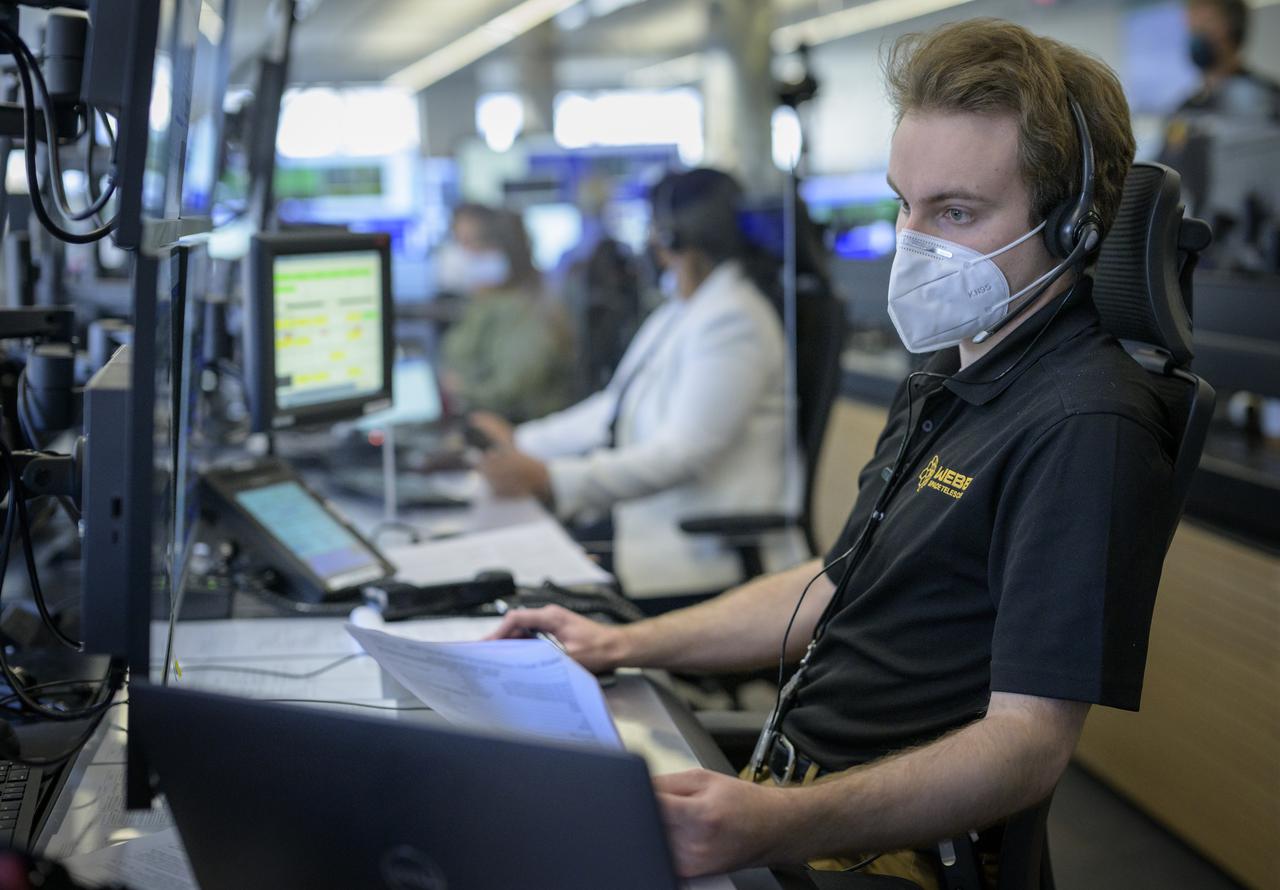
NASA James Webb Space Telescope Ground Engineer Evan Adams monitors the progress of the Webb observatory as it’s second primary mirror wing is prepared to rotate into position, Saturday, Jan. 8, 2022, from NASA’s James Webb Space Telescope Mission Operations Center at the Space Telescope Science Institute in Baltimore. Webb, an infrared telescope with a 21.3-foot (6.5-meter) primary mirror, was folded up for launch and underwent an unprecedented deployment process to unfold in space. As NASA's next flagship observatory, Webb will study every phase of cosmic history—from within our solar system to the most distant observable galaxies in the early universe. Photo Credit: (NASA/Bill Ingalls)
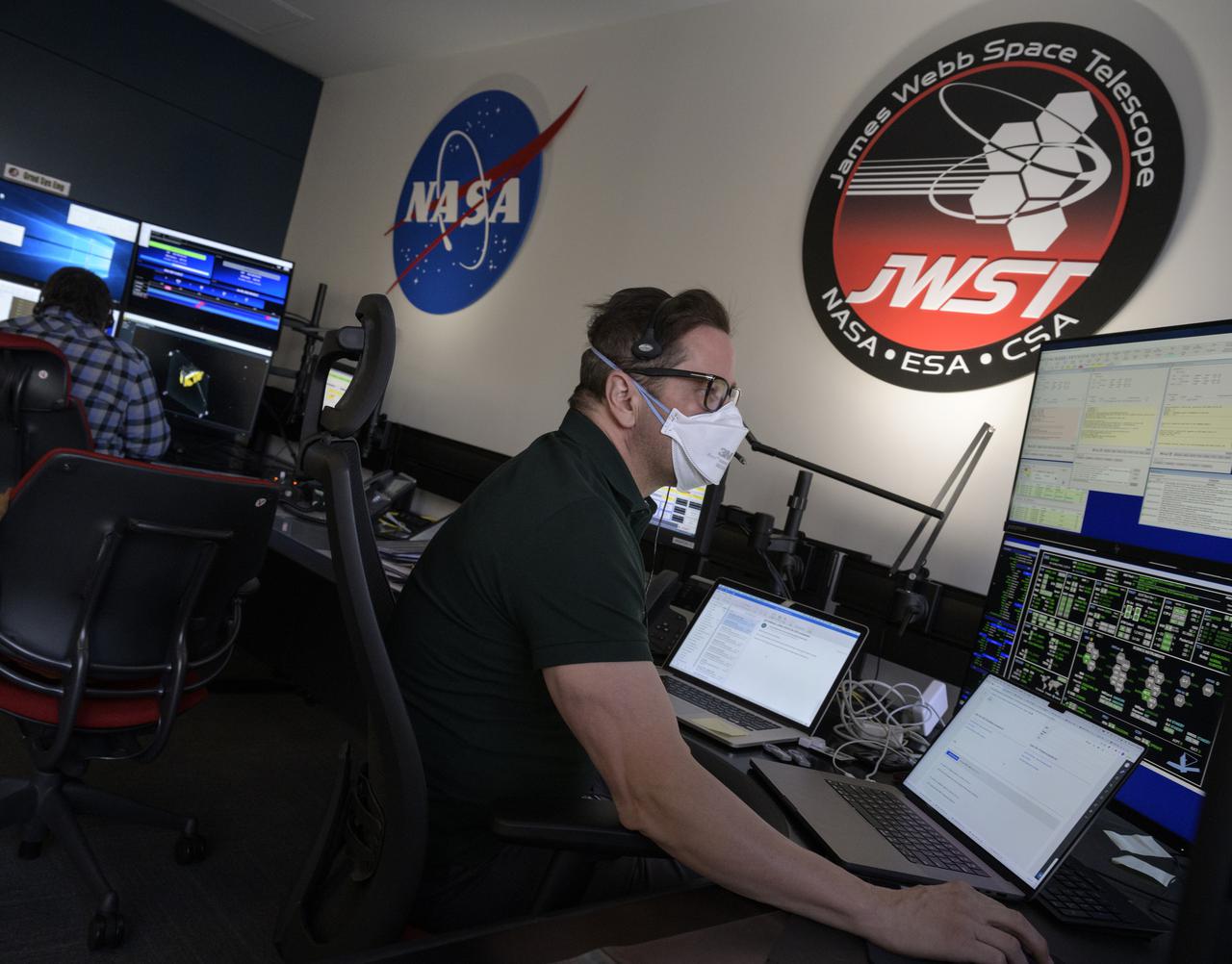
NASA James Webb Space Telescope Ground Systems Engineer Carl Reis at NASA’s James Webb Space Telescope Mission Operations Center at the Space Telescope Science Institute in Baltimore monitors the progress as the observatory’s second primary mirror wing rotates into position, Saturday, Jan. 8, 2022. Webb, an infrared telescope with a 21.3-foot (6.5-meter) primary mirror, was folded up for launch and underwent an unprecedented deployment process to unfold in space. As NASA's next flagship observatory, Webb will study every phase of cosmic history—from within our solar system to the most distant observable galaxies in the early universe. Photo Credit: (NASA/Bill Ingalls)
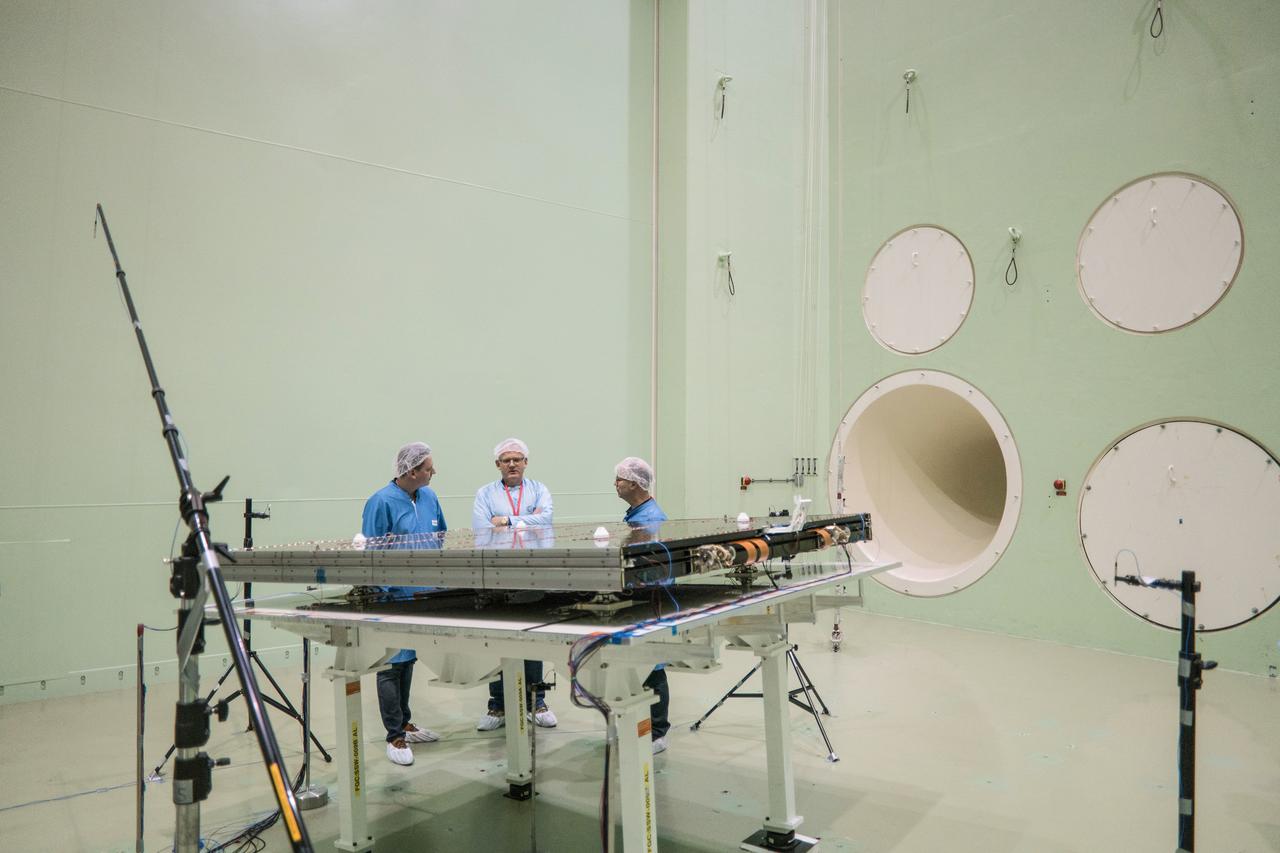
The solar arrays that will provide electricity to the Orion spacecraft were put through launch-day paces at ESA’s Test Centre in the Netherlands to verify that they can handle the rigours of the trip around the Moon... .The wings are seen here on April 11, 2018, on the shaking table that vibrates with the full force of a rumbling rocket. They were also placed in front of enormous speakers that recreate the harsh conditions they can expect on launch day. The solar arrays passed with flying colours... .The wings will be tested on how they deploy before shipping to Bremen, Germany, for integration with the European service module. ESA’s contribution to the Orion mission will provide power, propulsion, water, and air... .The first mission will take Orion around the Moon without astronauts. The solar panels will be folded inside the rocket fairing, once released from NASA’s Space Launch System rocket they will unfold and rotate towards the Sun to start delivering power... .With solar wings tested and fuel tanks installed, Orion is one step closer to its maiden voyage.
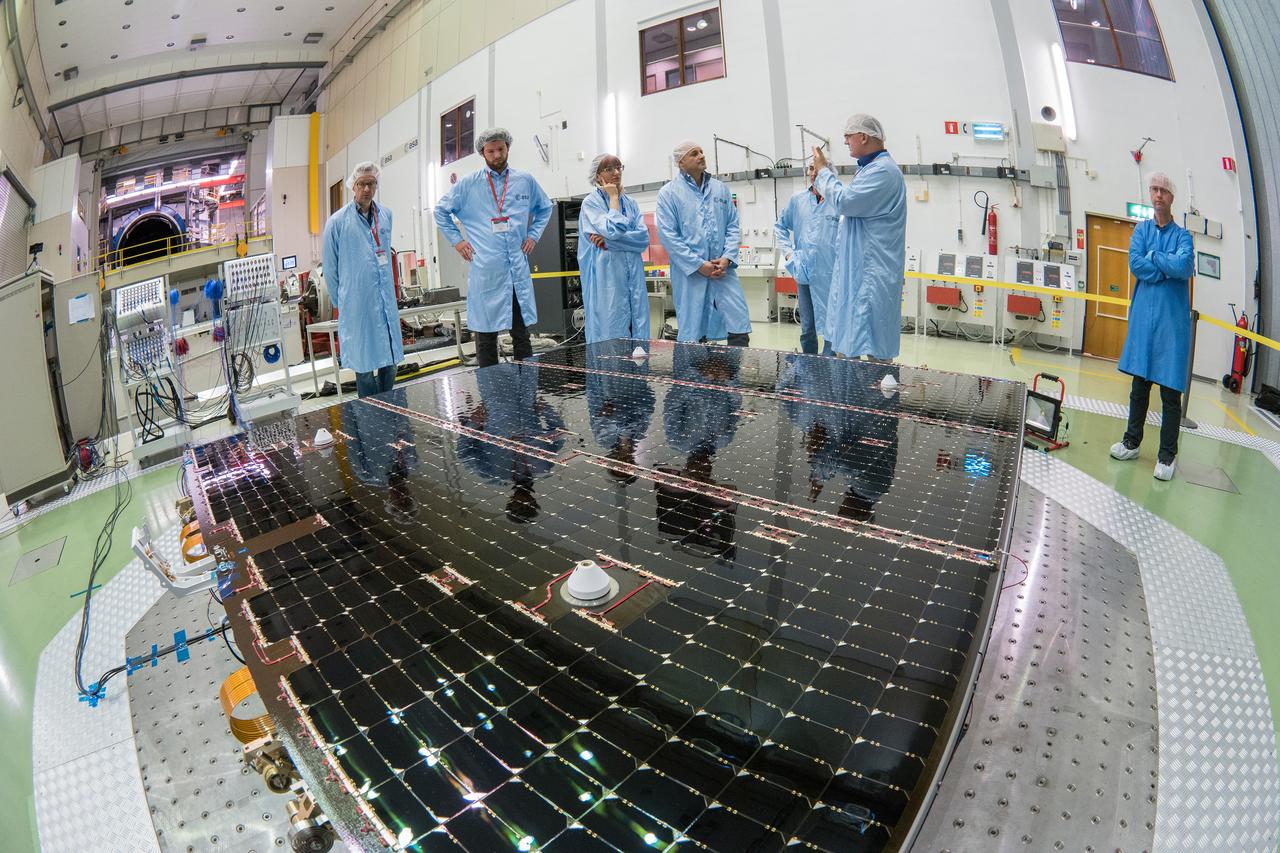
The solar arrays that will provide electricity to the Orion spacecraft were put through launch-day paces at ESA’s Test Centre in the Netherlands to verify that they can handle the rigours of the trip around the Moon... .The wings are seen here on April 11, 2018, on the shaking table that vibrates with the full force of a rumbling rocket. They were also placed in front of enormous speakers that recreate the harsh conditions they can expect on launch day. The solar arrays passed with flying colours... .The wings will be tested on how they deploy before shipping to Bremen, Germany, for integration with the European service module. ESA’s contribution to the Orion mission will provide power, propulsion, water, and air... .The first mission will take Orion around the Moon without astronauts. The solar panels will be folded inside the rocket fairing, once released from NASA’s Space Launch System rocket they will unfold and rotate towards the Sun to start delivering power... .With solar wings tested and fuel tanks installed, Orion is one step closer to its maiden voyage.
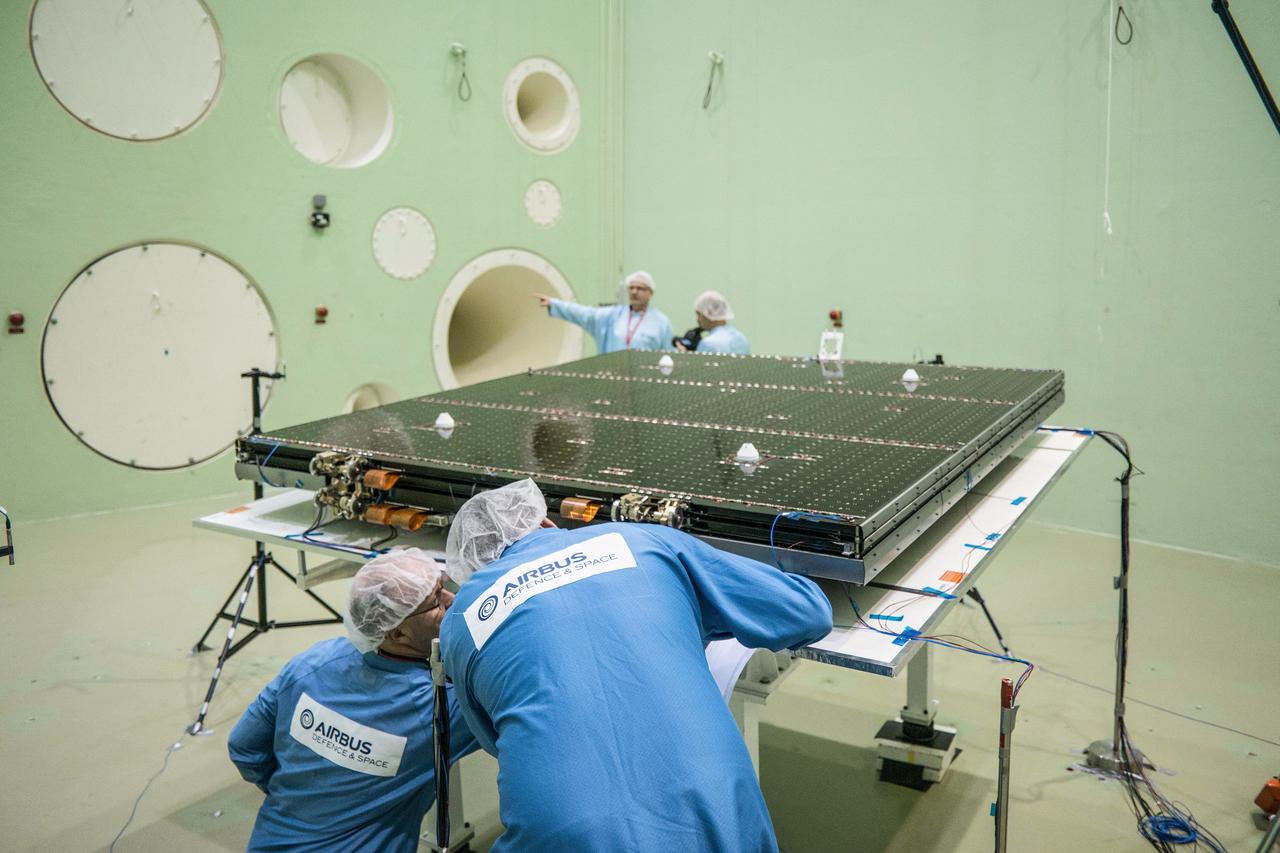
The solar arrays that will provide electricity to the Orion spacecraft were put through launch-day paces at ESA’s Test Centre in the Netherlands to verify that they can handle the rigours of the trip around the Moon... .The wings are seen here on April 11, 2018, on the shaking table that vibrates with the full force of a rumbling rocket. They were also placed in front of enormous speakers that recreate the harsh conditions they can expect on launch day. The solar arrays passed with flying colours... .The wings will be tested on how they deploy before shipping to Bremen, Germany, for integration with the European service module. ESA’s contribution to the Orion mission will provide power, propulsion, water, and air... .The first mission will take Orion around the Moon without astronauts. The solar panels will be folded inside the rocket fairing, once released from NASA’s Space Launch System rocket they will unfold and rotate towards the Sun to start delivering power... .With solar wings tested and fuel tanks installed, Orion is one step closer to its maiden voyage.
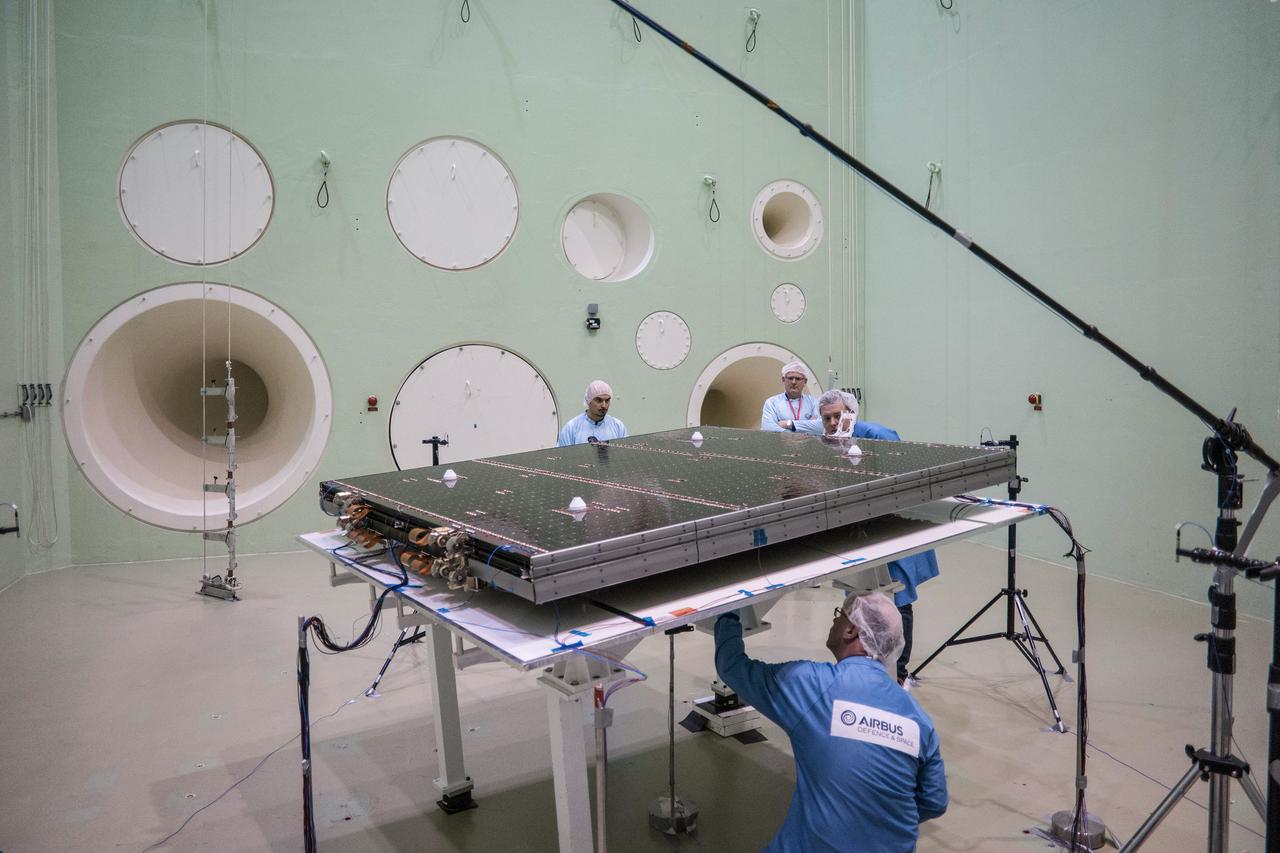
The solar arrays that will provide electricity to the Orion spacecraft were put through launch-day paces at ESA’s Test Centre in the Netherlands to verify that they can handle the rigours of the trip around the Moon... .The wings are seen here on April 11, 2018, on the shaking table that vibrates with the full force of a rumbling rocket. They were also placed in front of enormous speakers that recreate the harsh conditions they can expect on launch day. The solar arrays passed with flying colours... .The wings will be tested on how they deploy before shipping to Bremen, Germany, for integration with the European service module. ESA’s contribution to the Orion mission will provide power, propulsion, water, and air... .The first mission will take Orion around the Moon without astronauts. The solar panels will be folded inside the rocket fairing, once released from NASA’s Space Launch System rocket they will unfold and rotate towards the Sun to start delivering power... .With solar wings tested and fuel tanks installed, Orion is one step closer to its maiden voyage.
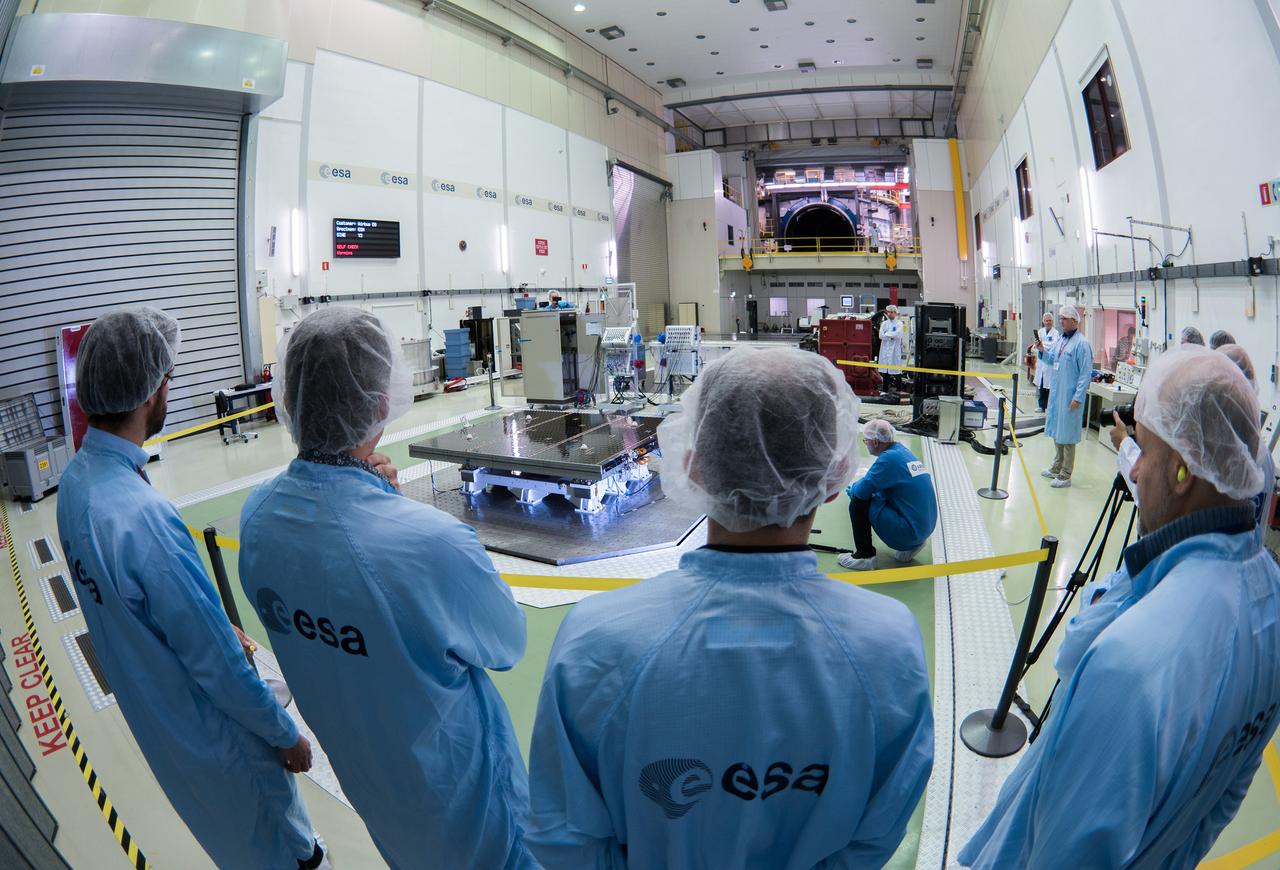
The solar arrays that will provide electricity to the Orion spacecraft were put through launch-day paces at ESA’s Test Centre in the Netherlands to verify that they can handle the rigours of the trip around the Moon... .The wings are seen here on April 11, 2018, on the shaking table that vibrates with the full force of a rumbling rocket. They were also placed in front of enormous speakers that recreate the harsh conditions they can expect on launch day. The solar arrays passed with flying colours... .The wings will be tested on how they deploy before shipping to Bremen, Germany, for integration with the European service module. ESA’s contribution to the Orion mission will provide power, propulsion, water, and air... .The first mission will take Orion around the Moon without astronauts. The solar panels will be folded inside the rocket fairing, once released from NASA’s Space Launch System rocket they will unfold and rotate towards the Sun to start delivering power... .With solar wings tested and fuel tanks installed, Orion is one step closer to its maiden voyage.
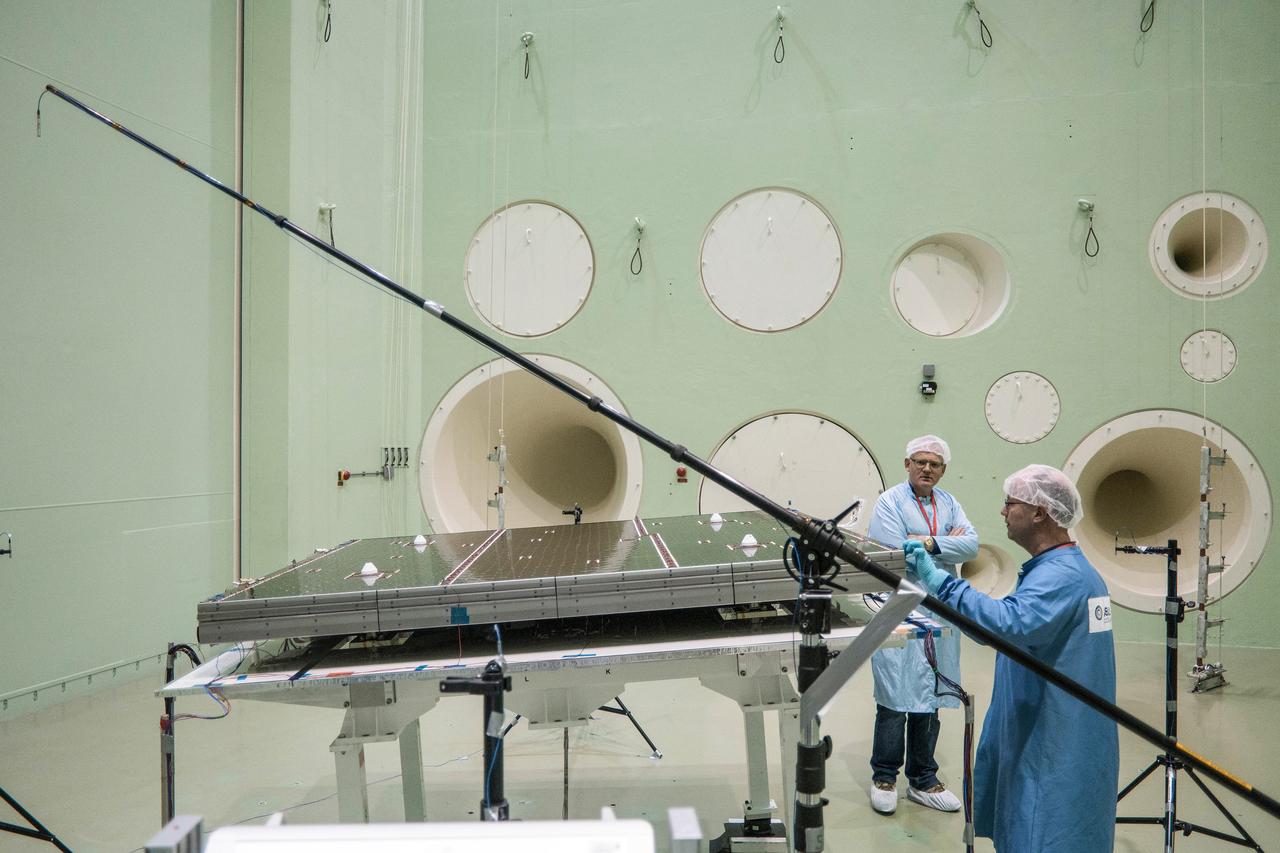
The solar arrays that will provide electricity to the Orion spacecraft were put through launch-day paces at ESA’s Test Centre in the Netherlands to verify that they can handle the rigours of the trip around the Moon... .The wings are seen here on April 11, 2018, on the shaking table that vibrates with the full force of a rumbling rocket. They were also placed in front of enormous speakers that recreate the harsh conditions they can expect on launch day. The solar arrays passed with flying colours... .The wings will be tested on how they deploy before shipping to Bremen, Germany, for integration with the European service module. ESA’s contribution to the Orion mission will provide power, propulsion, water, and air... .The first mission will take Orion around the Moon without astronauts. The solar panels will be folded inside the rocket fairing, once released from NASA’s Space Launch System rocket they will unfold and rotate towards the Sun to start delivering power... .With solar wings tested and fuel tanks installed, Orion is one step closer to its maiden voyage.
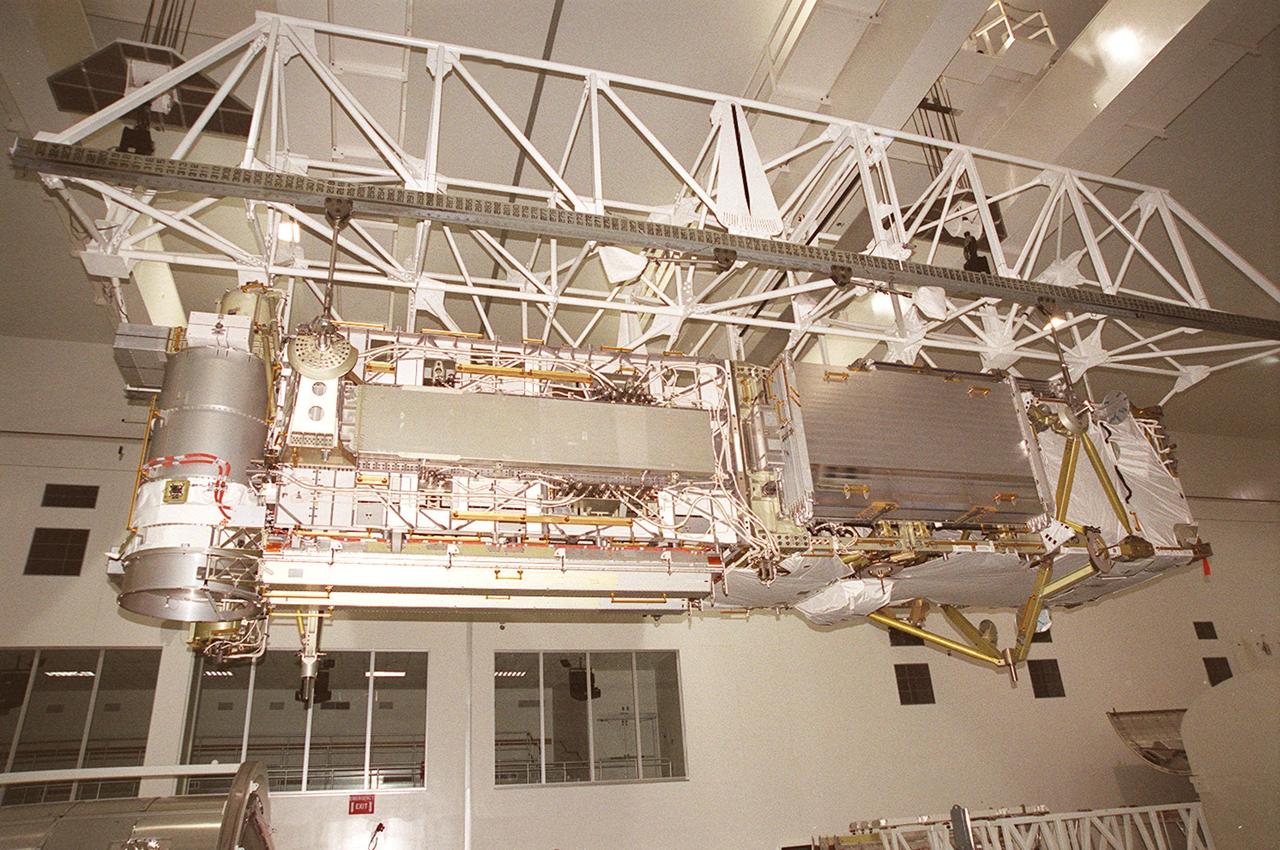
The P6 integrated truss segment hangs suspended from an overhead crane that is moving it the length of the Space Station Processing Facility toward a payload transport canister for transfer to Launch Pad 39B. At the pad, the Space Station element will be placed in Endeavour’s payload bay for launch on mission STS-97. The P6 comprises Solar Array Wing-3 and the Integrated Electronic Assembly, to be installed on the Space Station. The Station’s electrical power system will use eight photovoltaic solar arrays, each 112 feet long by 39 feet wide, to convert sunlight to electricity. The solar arrays are mounted on a “blanket” that can be folded like an accordion for delivery. Once in orbit, astronauts will deploy the blankets to their full size. Gimbals will be used to rotate the arrays so that they will face the Sun to provide maximum power to the Space Station. The STS-97 launch is scheduled Nov. 30 at 10:06 p.m. EST
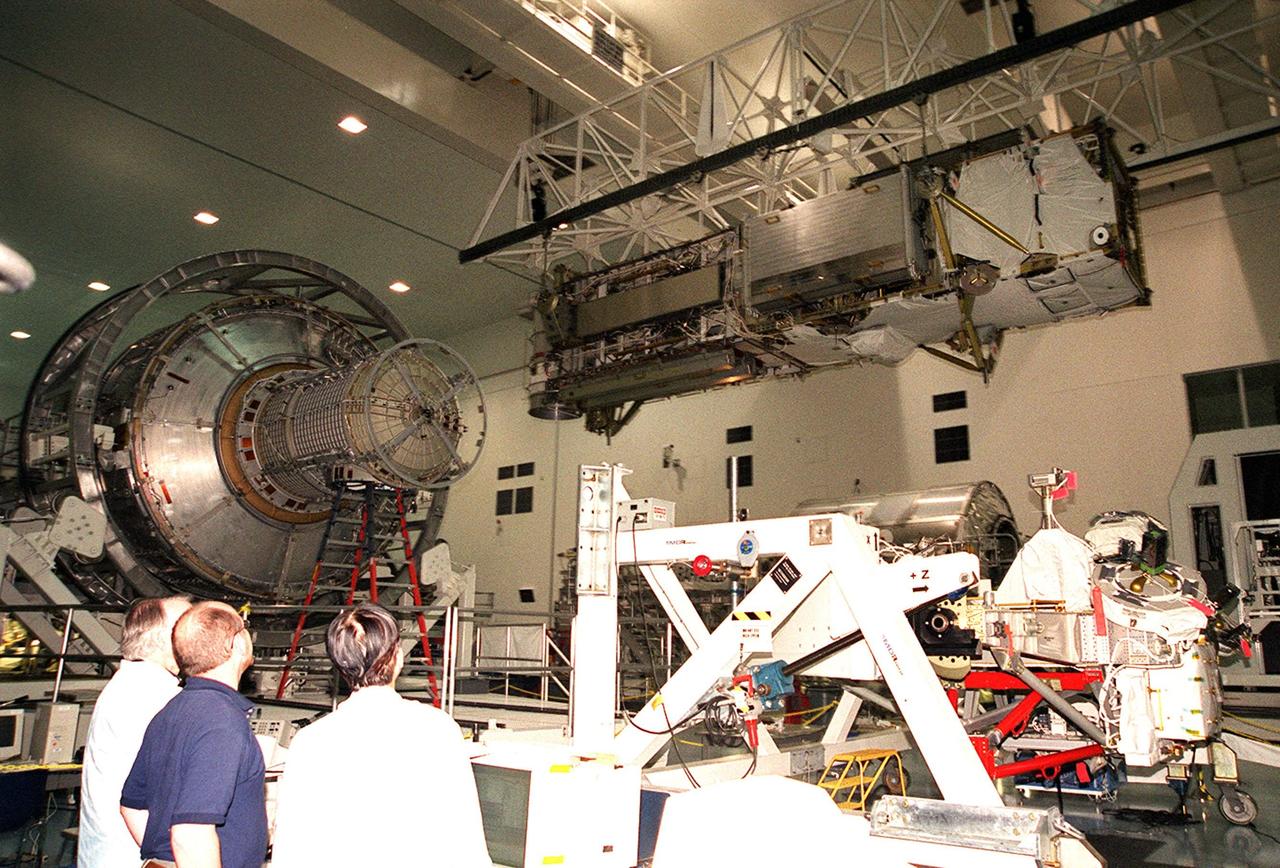
In the Space Station Processing Facility, the P6 integrated truss segment travels across the building to a payload transport canister for transfer to Launch Pad 39B. There it will be placed in Endeavour’s payload bay for launch on mission STS-97. At left is the airlock module, another component of the International Space Station. The P6 comprises Solar Array Wing-3 and the Integrated Electronic Assembly, to be installed on the Space Station. The Station’s electrical power system will use eight photovoltaic solar arrays, each 112 feet long by 39 feet wide, to convert sunlight to electricity. The solar arrays are mounted on a “blanket” that can be folded like an accordion for delivery. Once in orbit, astronauts will deploy the blankets to their full size. Gimbals will be used to rotate the arrays so that they will face the Sun to provide maximum power to the Space Station. Launch is scheduled Nov. 30 at 10:06 p.m. EST
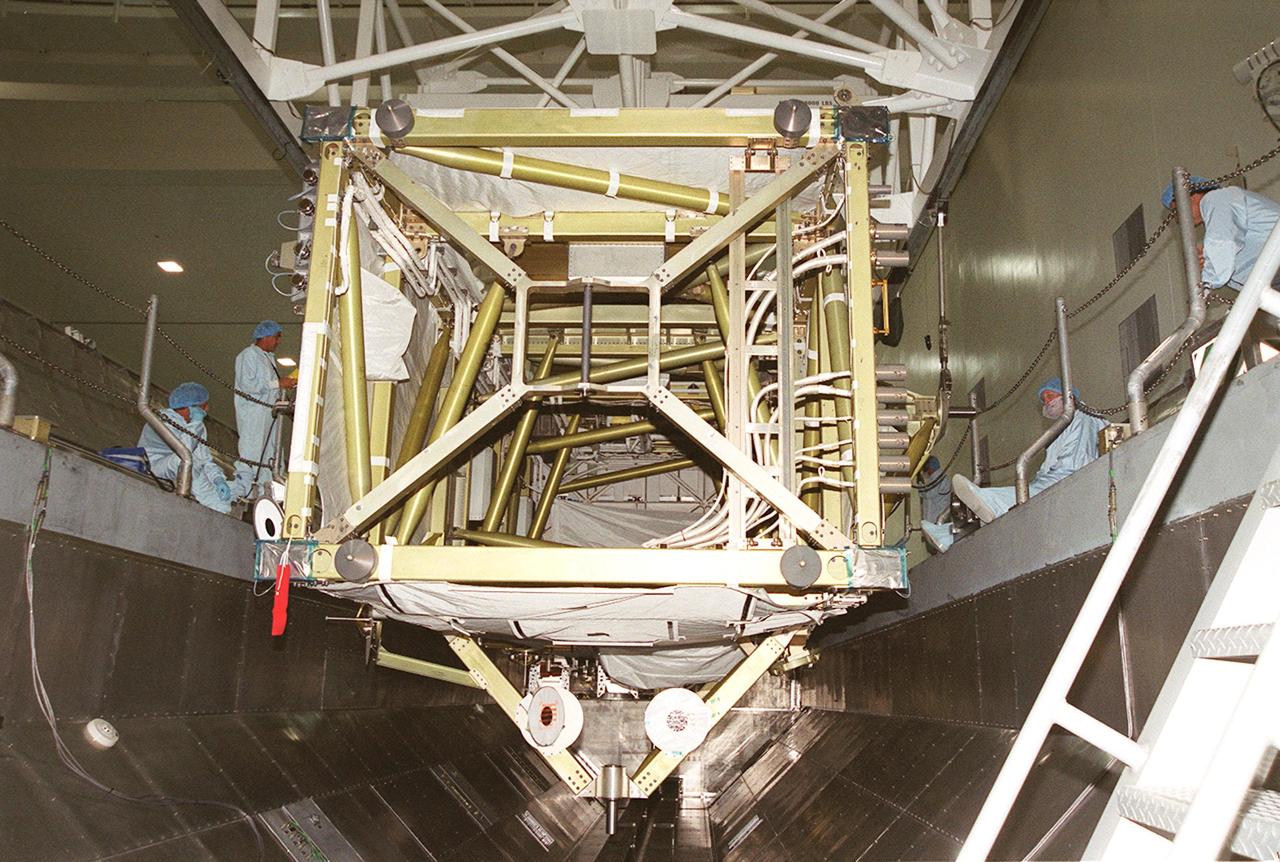
KENNEDY SPACE CENTER, FLA. -- In the Space Station Processing Facility, the P6 integrated truss segment is placed in the payload transport canister while workers watch its progress. After being secured in the canister, the truss will be transported to Launch Pad 39B and the payload changeout room. Then it will be moved into Space Shuttle Endeavour’s payload bay for mission STS-97. The P6 comprises Solar Array Wing-3 and the Integrated Electronic Assembly, to be installed on the Space Station. The Station’s electrical power system will use eight photovoltaic solar arrays, each 112 feet long by 39 feet wide, to convert sunlight to electricity. The solar arrays are mounted on a “blanket” that can be folded like an accordion for delivery. Once in orbit, astronauts will deploy the blankets to their full size. Gimbals will be used to rotate the arrays so that they will face the Sun to provide maximum power to the Space Station. The STS-97 launch is scheduled Nov. 30 at 10:06 p.m. EST
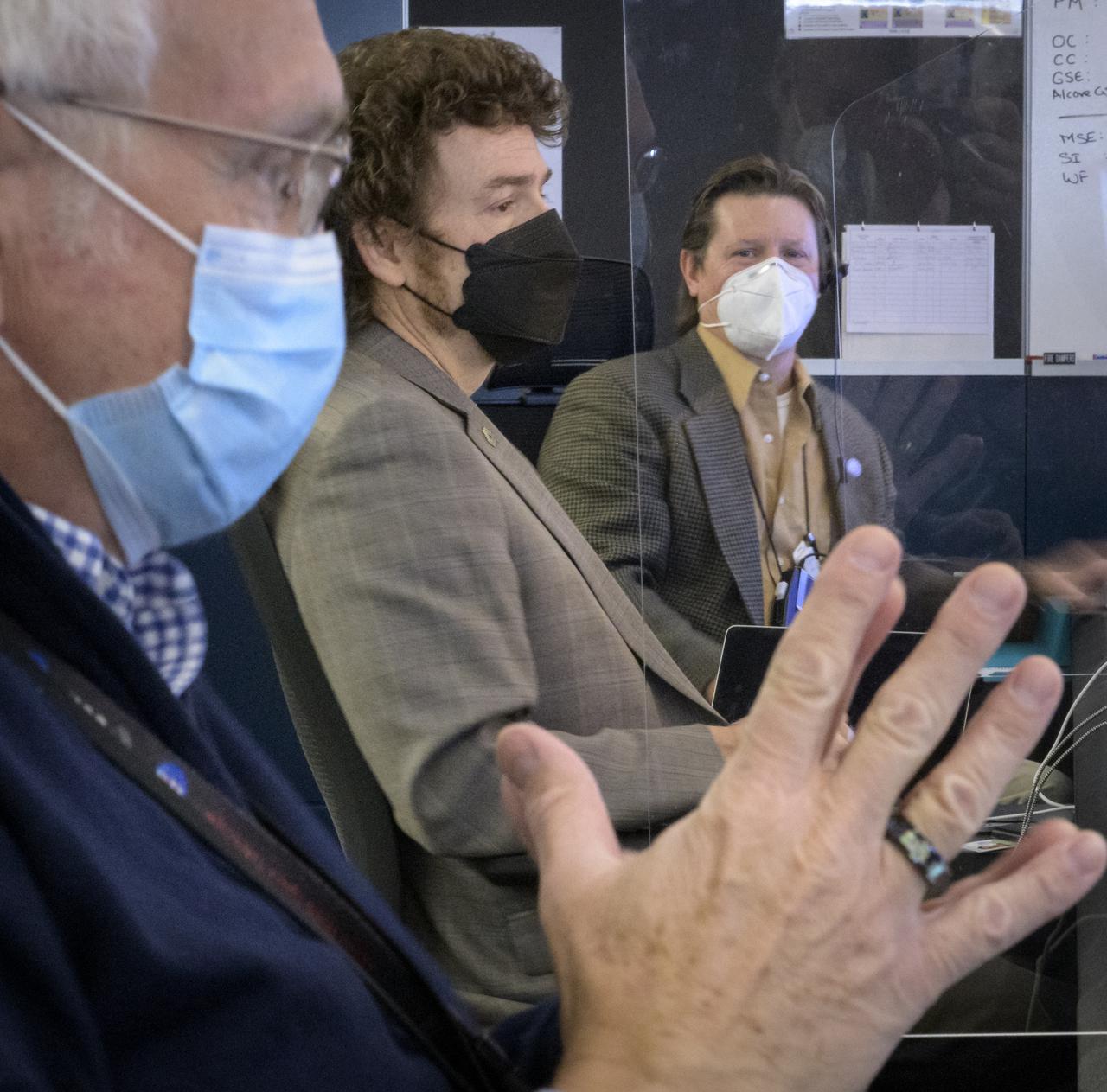
NASA James Webb Space Telescope Mission Operations Engineer Kenny McKenzie, background, NASA James Webb Space Telescope Mission Operations Manager Carl Starr, middle, and NASA James Webb Space Telescope Project Manager Bill Ochs, monitor the progress of the Webb observatory as it’s second primary mirror wing is prepared to rotate into position, Saturday, Jan. 8, 2022, from NASA’s James Webb Space Telescope Mission Operations Center at the Space Telescope Science Institute in Baltimore. Webb, an infrared telescope with a 21.3-foot (6.5-meter) primary mirror, was folded up for launch and underwent an unprecedented deployment process to unfold in space. As NASA's next flagship observatory, Webb will study every phase of cosmic history—from within our solar system to the most distant observable galaxies in the early universe. Photo Credit: (NASA/Bill Ingalls)
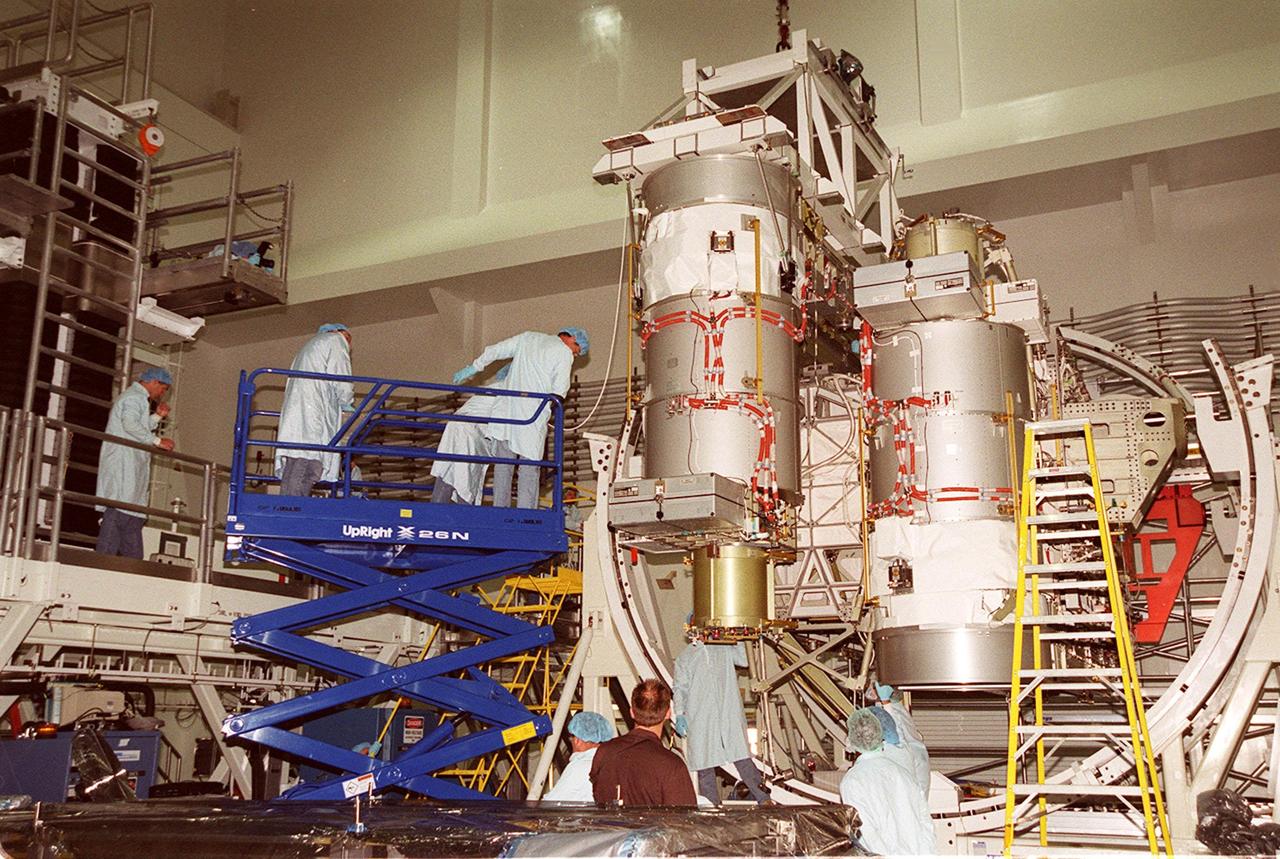
Workers in the Space Station Processing Facility give close attention to the placement of a solar array on the Integrated Equipment Assembly. Solar Array Wing-3 is already in place. Components of the International Space Station, the arrays are scheduled to be launched on mission STS-97 in late November along with the P6 truss. The Station’s electrical power system (EPS) will use eight photovoltaic solar arrays to convert sunlight to electricity. Each of the eight solar arrays will be 112 feet long by 39 feet wide. The solar arrays are mounted on a “blanket” that can be folded like an accordion for delivery. Once in orbit, astronauts will deploy the blankets to their full size. Gimbals will be used to rotate the arrays so that they will face the Sun to provide maximum power to the Space Station
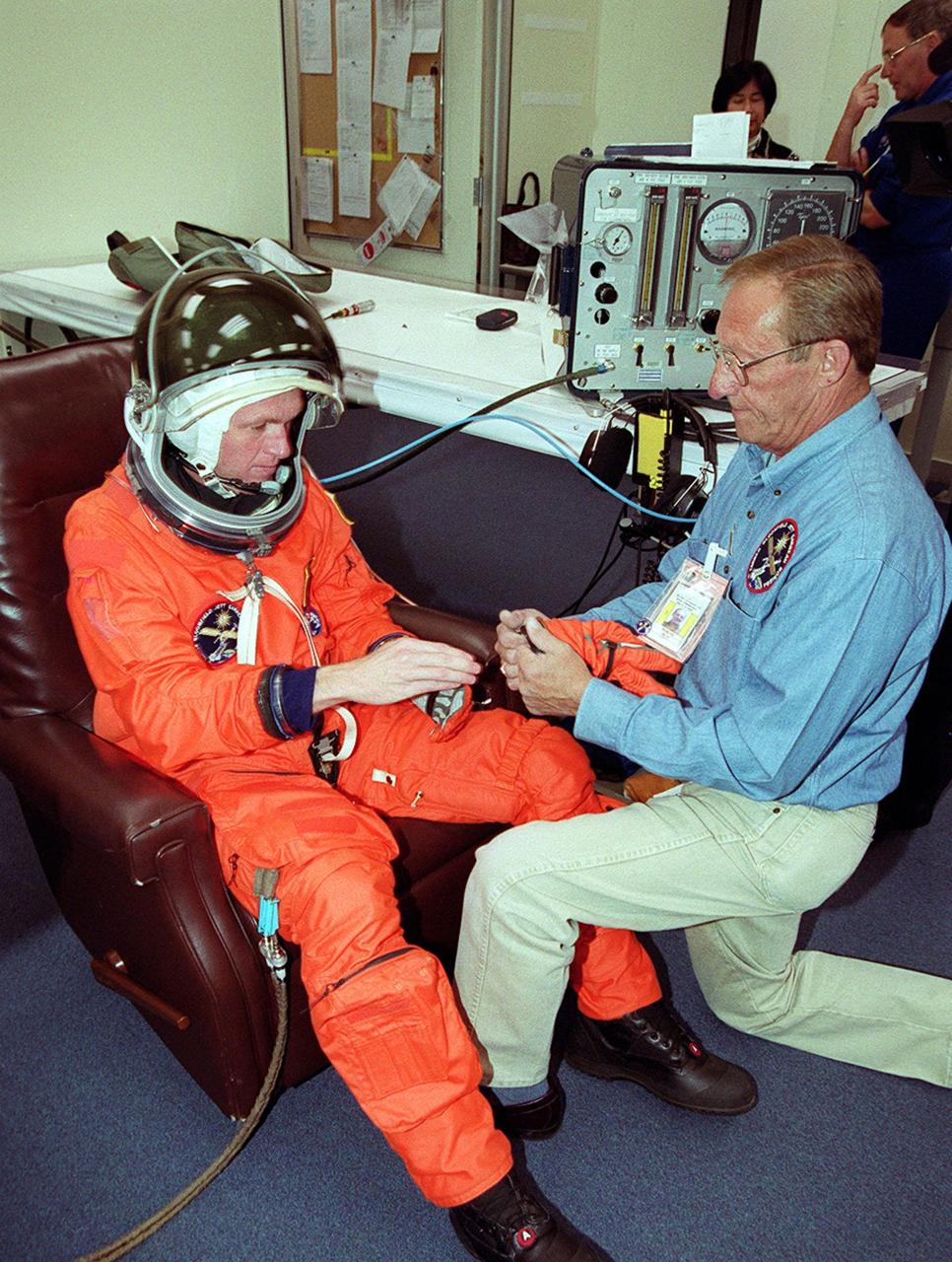
With the help of a suit technician, STS-97 Commander Brent Jett dons his launch and entry suit. This is his third Shuttle flight.; Mission STS-97 is the sixth construction flight to the International Space Station. It is transporting the P6 Integrated Truss Structure that comprises Solar Array Wing-3 and the Integrated Electronic Assembly, to be installed on the Space Station. The solar arrays are mounted on a “blanket” that can be folded like an accordion for delivery. Once in orbit, astronauts will deploy the blankets to their full size. The 11-day mission includes two spacewalks to complete the solar array connections. The Station’s electrical power system will use eight photovoltaic solar arrays, each 112 feet long by 39 feet wide, to convert sunlight to electricity. Gimbals will be used to rotate the arrays so that they will face the Sun to provide maximum power to the Space Station. Launch is scheduled for Nov. 30 at 10:06 p.m. EST
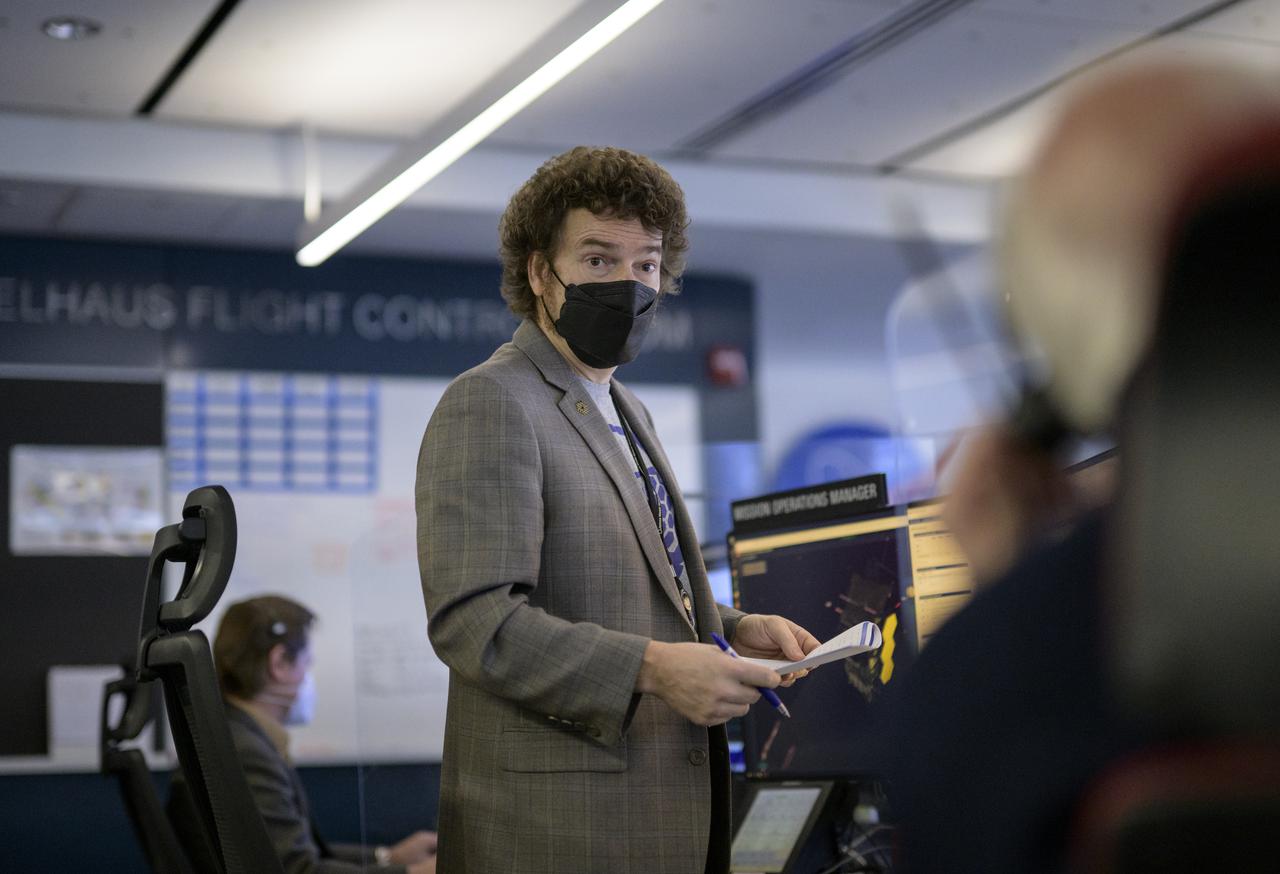
NASA James Webb Space Telescope Mission Operations Manager Carl Starr monitors the progress of the Webb observatory as it’s second primary mirror wing is prepared to rotate into position, Saturday, Jan. 8, 2022, from NASA’s James Webb Space Telescope Mission Operations Center at the Space Telescope Science Institute in Baltimore. Webb, an infrared telescope with a 21.3-foot (6.5-meter) primary mirror, was folded up for launch and underwent an unprecedented deployment process to unfold in space. As NASA's next flagship observatory, Webb will study every phase of cosmic history—from within our solar system to the most distant observable galaxies in the early universe. Photo Credit: (NASA/Bill Ingalls)
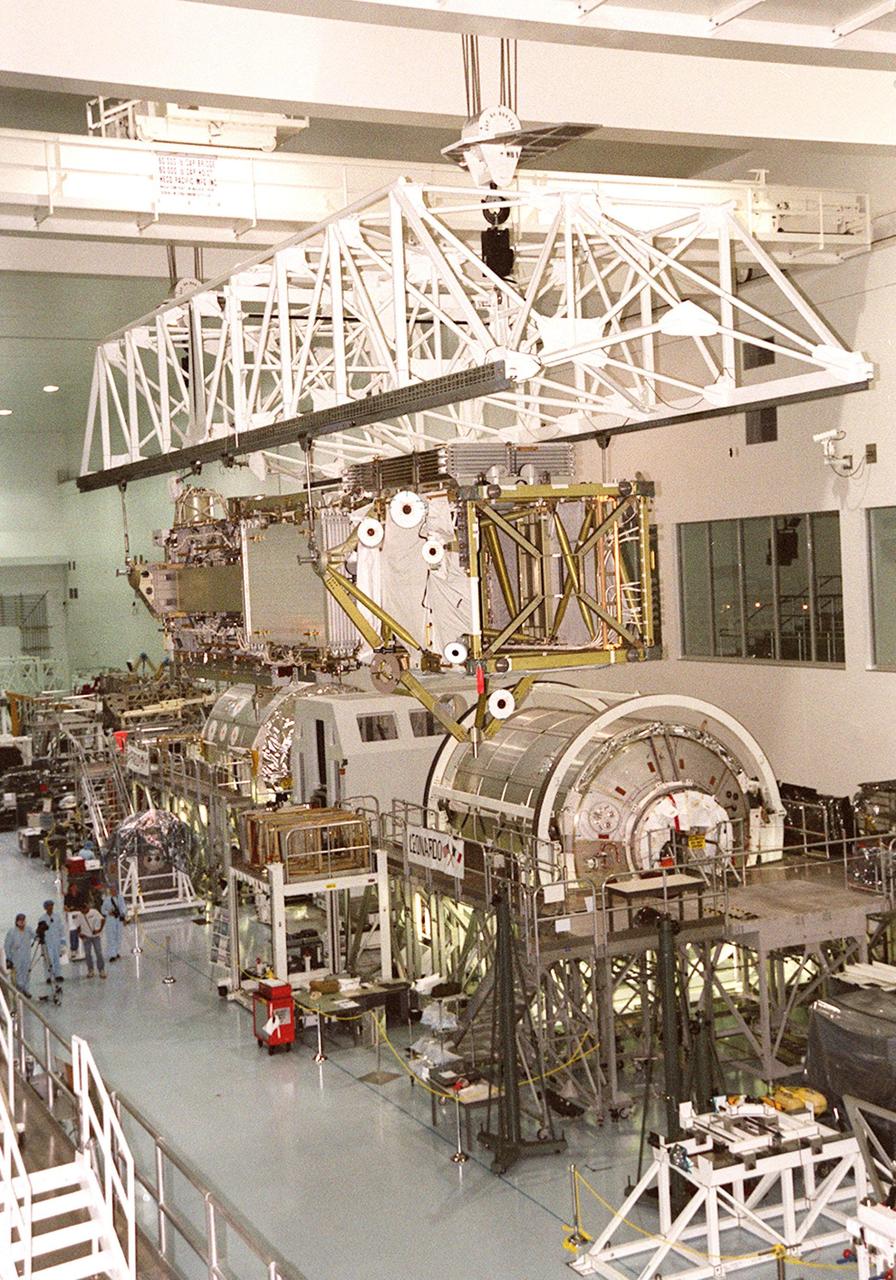
As it travels across the Space Station Processing Facility, the P6 integrated truss segment passes over the two Italian-built Multi-Purpose Logistics Modules, Leonardo (right) and Raffaello (behind Leonardo). The P6 is being moved to a payload transport canister for transfer to Launch Pad 39B. There it will be placed in Endeavour’s payload bay for launch on mission STS-97. The P6 comprises Solar Array Wing-3 and the Integrated Electronic Assembly, to be installed on the Space Station. The Station’s electrical power system will use eight photovoltaic solar arrays, each 112 feet long by 39 feet wide, to convert sunlight to electricity. The solar arrays are mounted on a “blanket” that can be folded like an accordion for delivery. Once in orbit, astronauts will deploy the blankets to their full size. Gimbals will be used to rotate the arrays so that they will face the Sun to provide maximum power to the Space Station. Launch is scheduled Nov. 30 at 10:06 p.m. EST
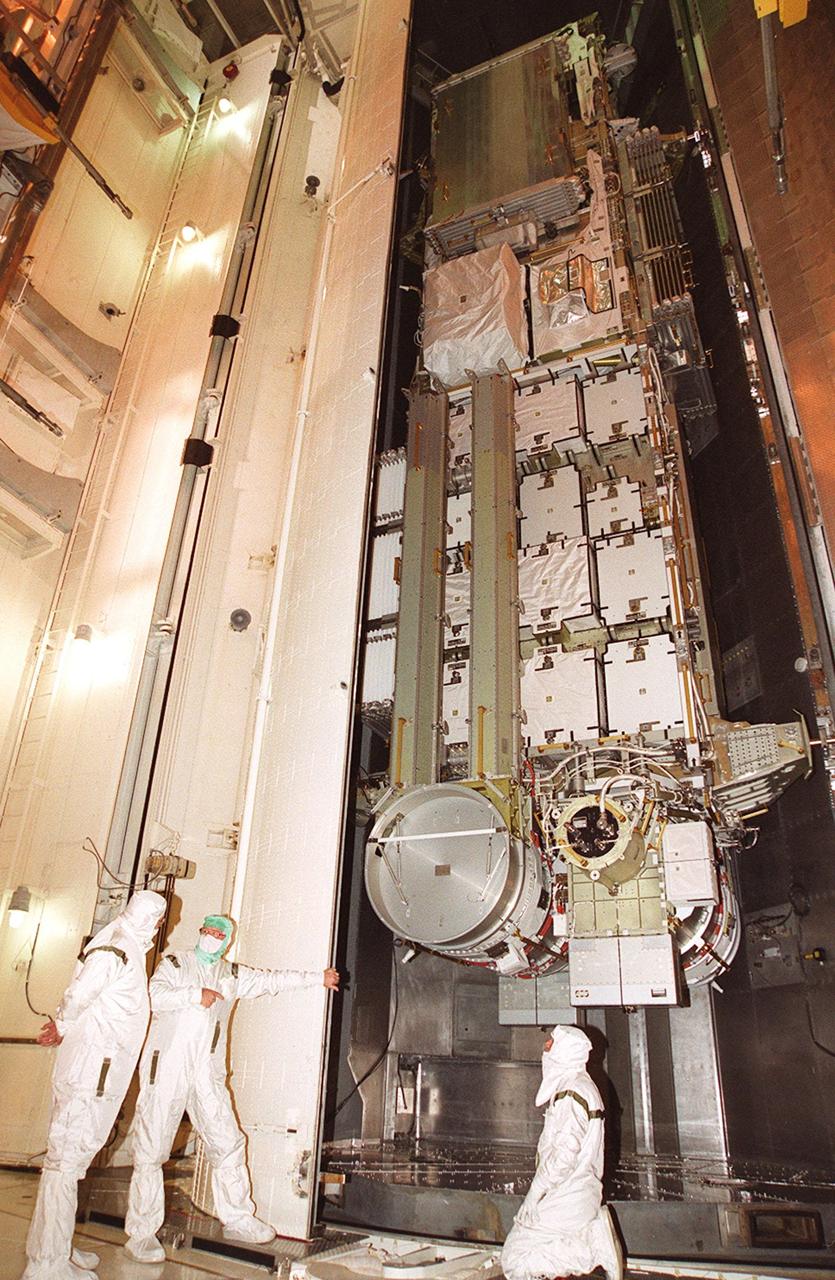
Workers in the payload changeout room stand by as the doors open on the payload transport canister. Inside is the P6 integrated truss segment, which will fly on mission STS-97. The P6 comprises Solar Array Wing-3 and the Integrated Electronic Assembly, to be installed on the International Space Station. The Station’s electrical power system will use eight photovoltaic solar arrays, each 112 feet long by 39 feet wide, to convert sunlight to electricity. The solar arrays are mounted on a “blanket” that can be folded like an accordion for delivery. Once in orbit, astronauts will deploy the blankets to their full size. Gimbals will be used to rotate the arrays so that they will face the Sun to provide maximum power to the Space Station. Launch of STS-97 is scheduled for Nov. 30 at 10:06 p.m. EST
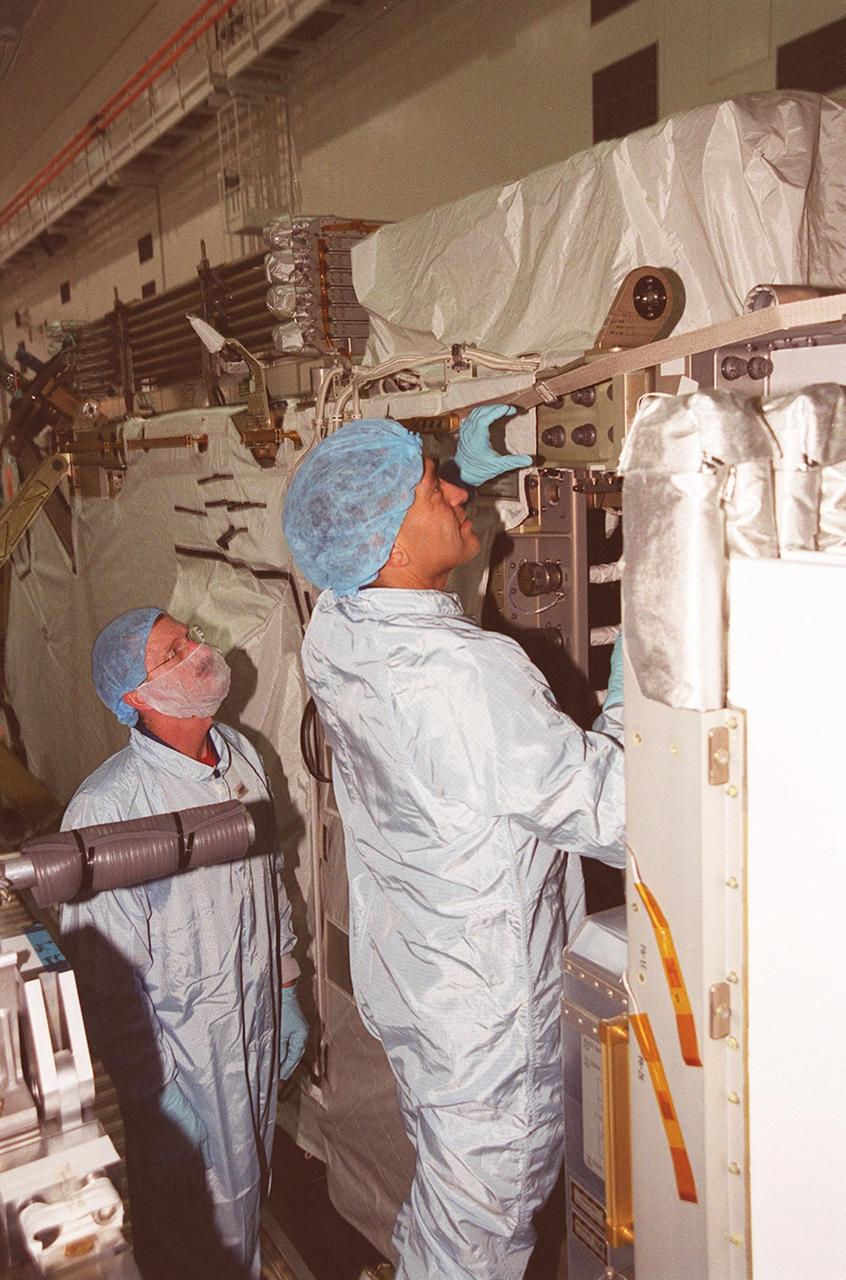
In the Space Station Processing Facility, STS-97 Mission Specialists Carlos Noriega (left) and Joe Tanner check out the mission payload, the P6 integrated truss segment. Mission STS-97 is the sixth construction flight to the International Space Station. The P6 comprises Solar Array Wing-3 and the Integrated Electronic Assembly, to be installed on the International Space Station. The Station’s electrical power system will use eight photovoltaic solar arrays, each 112 feet long by 39 feet wide, to convert sunlight to electricity. The solar arrays are mounted on a “blanket” that can be folded like an accordion for delivery. Once in orbit, astronauts will deploy the blankets to their full size. Gimbals will be used to rotate the arrays so that they will face the Sun to provide maximum power to the Space Station. The mission includes two spacewalks by Noriega and Tanner to complete the solar array connections. STS-97 is scheduled to launch Nov. 30 at about 10:06 p.m. EST
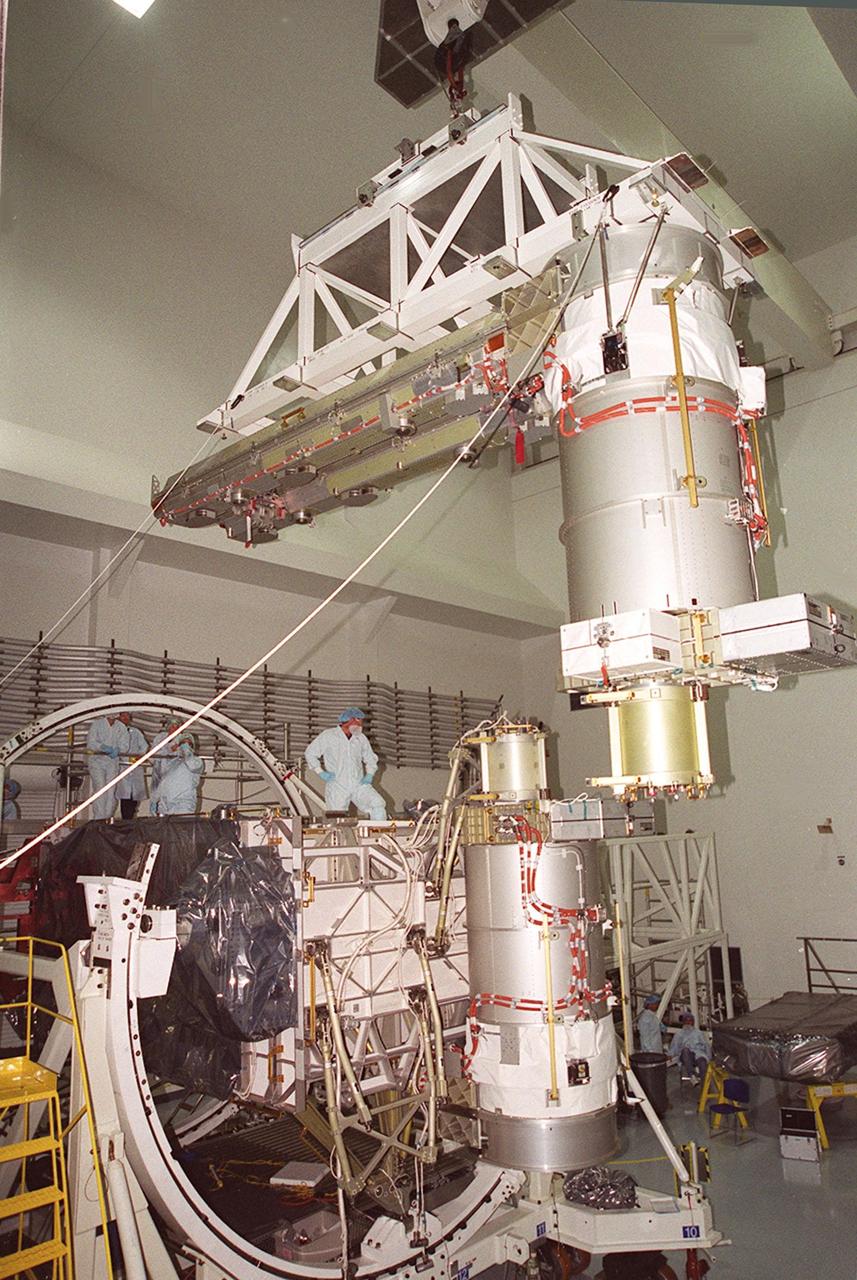
In the Space Station Processing Facility, the overhead crane carrying a solar array arrives at the Integrated Equipment Assembly (IEA) on which it will be installed. Solar Array Wing-3 is already in place. Components of the International Space Station, the arrays are scheduled to be launched on mission STS-97 in late November along with the P6 truss. The Station’s electrical power system (EPS) will use eight photovoltaic solar arrays to convert sunlight to electricity. Each of the eight solar arrays will be 112 feet long by 39 feet wide. The solar arrays are mounted on a “blanket” that can be folded like an accordion for delivery. Once in orbit, astronauts will deploy the blankets to their full size. Gimbals will be used to rotate the arrays so that they will face the Sun to provide maximum power to the Space Station
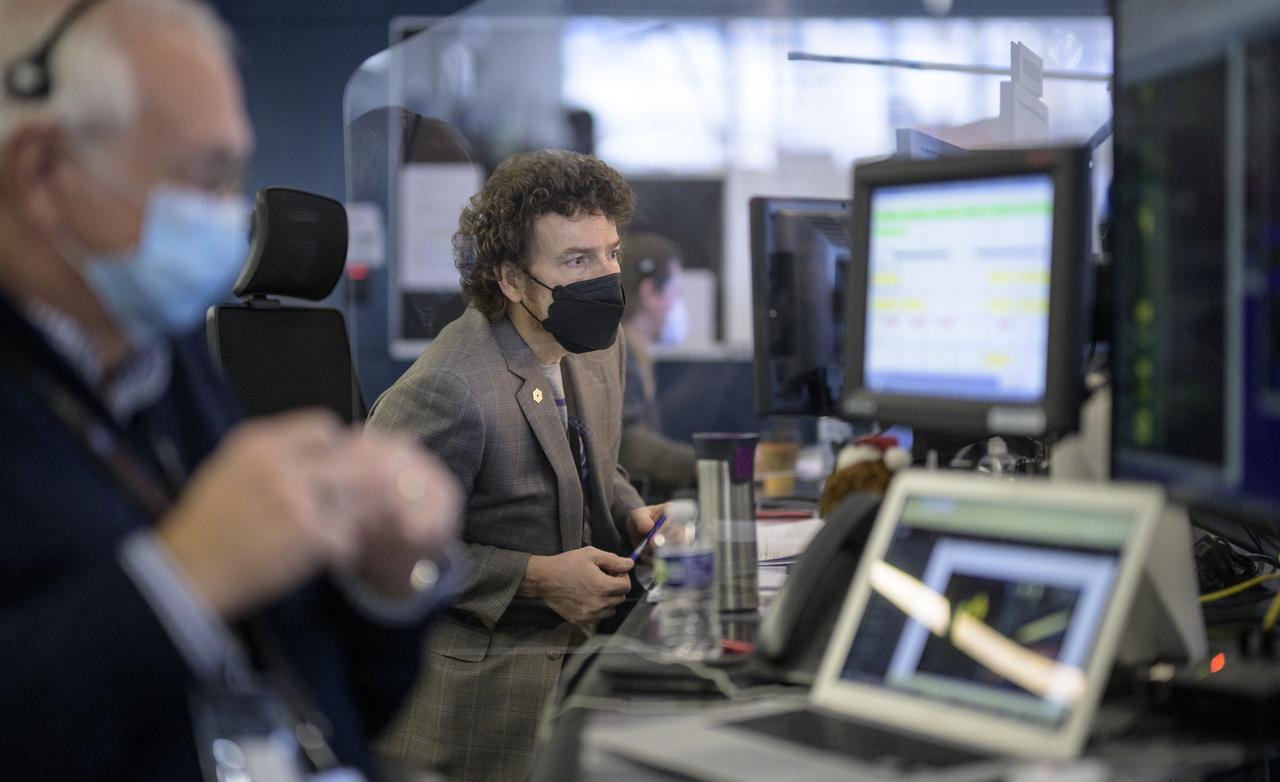
NASA James Webb Space Telescope Mission Operations Manager Carl Starr monitors the progress of the Webb observatory as it’s second primary mirror wing is prepared to rotate into position, Saturday, Jan. 8, 2022, from NASA’s James Webb Space Telescope Mission Operations Center at the Space Telescope Science Institute in Baltimore. Webb, an infrared telescope with a 21.3-foot (6.5-meter) primary mirror, was folded up for launch and underwent an unprecedented deployment process to unfold in space. As NASA's next flagship observatory, Webb will study every phase of cosmic history—from within our solar system to the most distant observable galaxies in the early universe. Photo Credit: (NASA/Bill Ingalls)
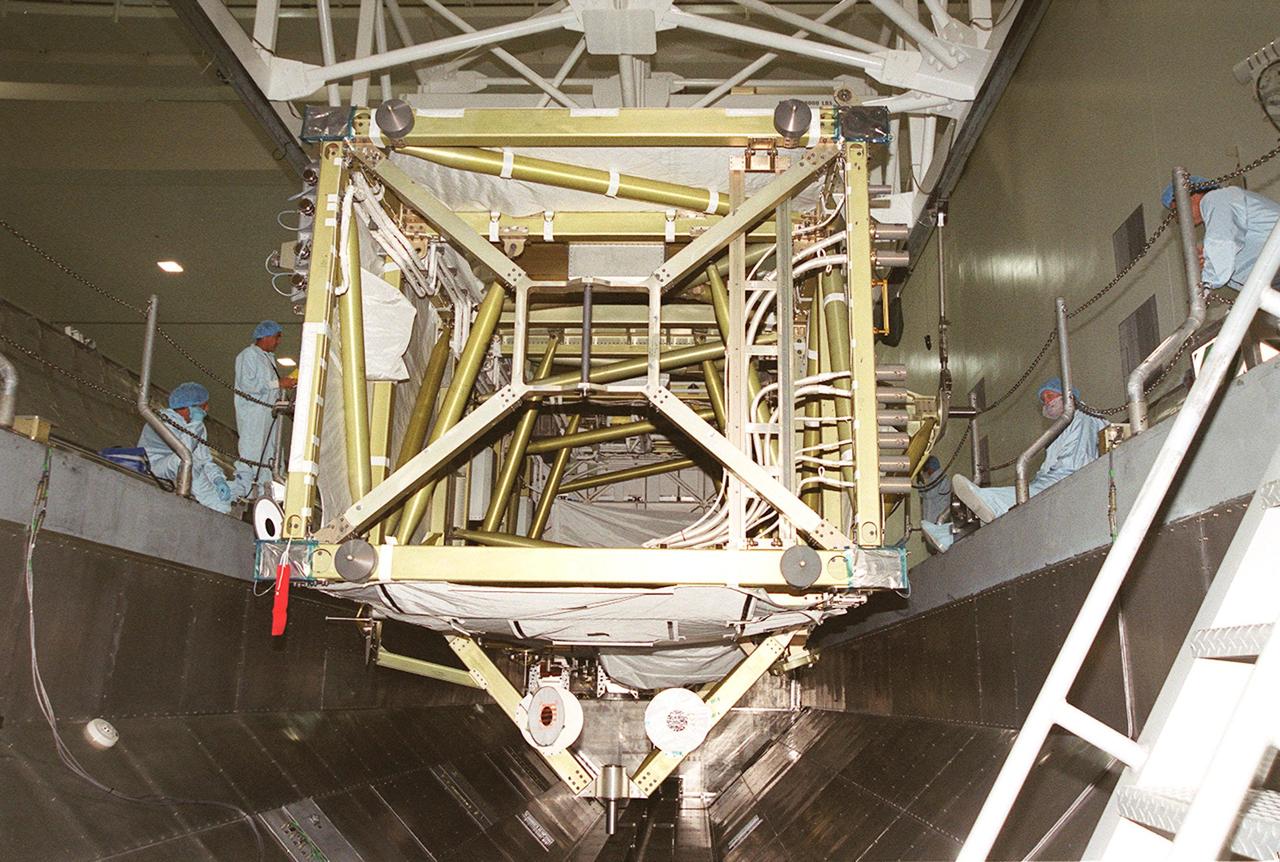
KENNEDY SPACE CENTER, FLA. -- In the Space Station Processing Facility, the P6 integrated truss segment is placed in the payload transport canister while workers watch its progress. After being secured in the canister, the truss will be transported to Launch Pad 39B and the payload changeout room. Then it will be moved into Space Shuttle Endeavour’s payload bay for mission STS-97. The P6 comprises Solar Array Wing-3 and the Integrated Electronic Assembly, to be installed on the Space Station. The Station’s electrical power system will use eight photovoltaic solar arrays, each 112 feet long by 39 feet wide, to convert sunlight to electricity. The solar arrays are mounted on a “blanket” that can be folded like an accordion for delivery. Once in orbit, astronauts will deploy the blankets to their full size. Gimbals will be used to rotate the arrays so that they will face the Sun to provide maximum power to the Space Station. The STS-97 launch is scheduled Nov. 30 at 10:06 p.m. EST
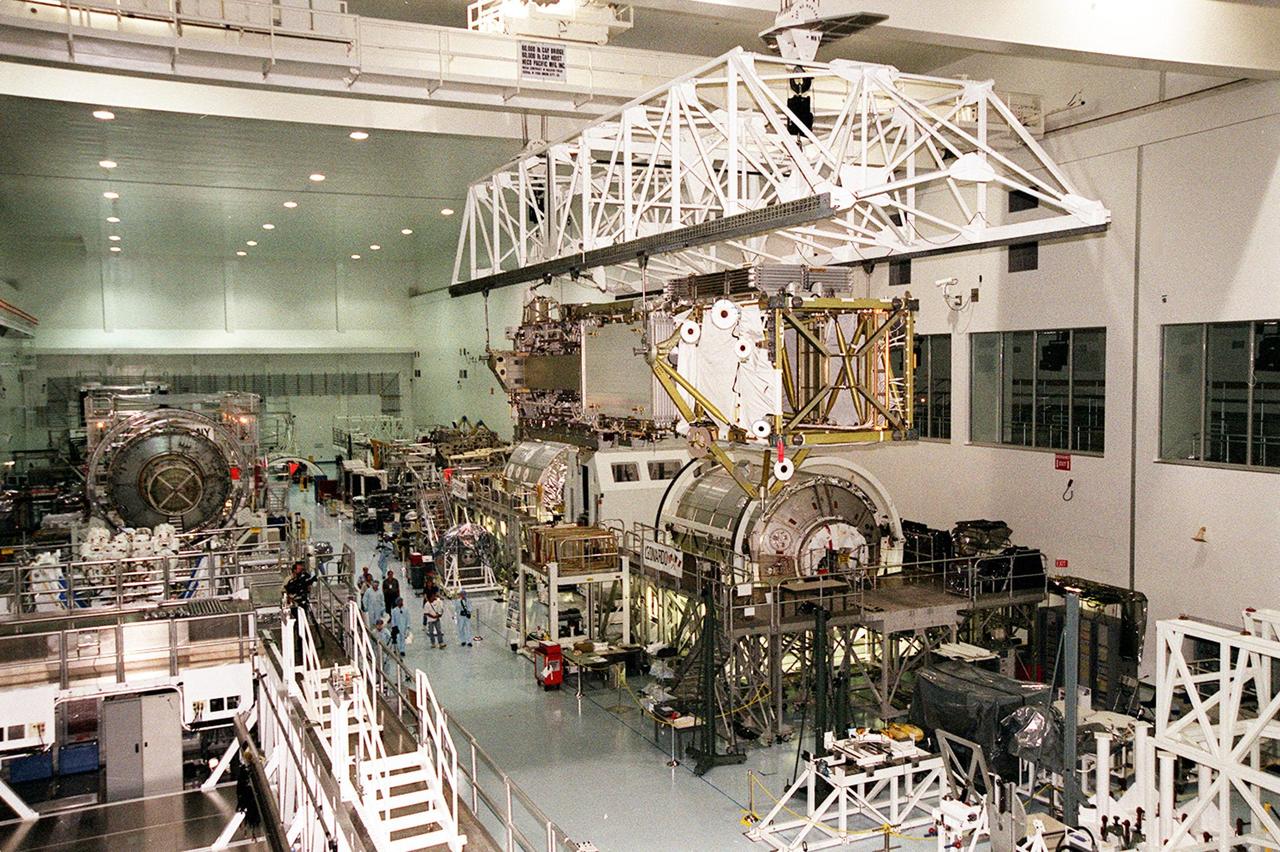
Carried by an overhead crane, the P6 integrated truss segment travels the length of the Space Station Processing Facility toward a payload transport canister that will transfer it to Launch Pad 39B. At the pad, the Space Station element will be placed in Endeavour’s payload bay for launch on mission STS-97. The P6 comprises Solar Array Wing-3 and the Integrated Electronic Assembly, to be installed on the Space Station. The Station’s electrical power system will use eight photovoltaic solar arrays, each 112 feet long by 39 feet wide, to convert sunlight to electricity. The solar arrays are mounted on a “blanket” that can be folded like an accordion for delivery. Once in orbit, astronauts will deploy the blankets to their full size. Gimbals will be used to rotate the arrays so that they will face the Sun to provide maximum power to the Space Station. The STS-97 launch is scheduled Nov. 30 at 10:06 p.m. EST
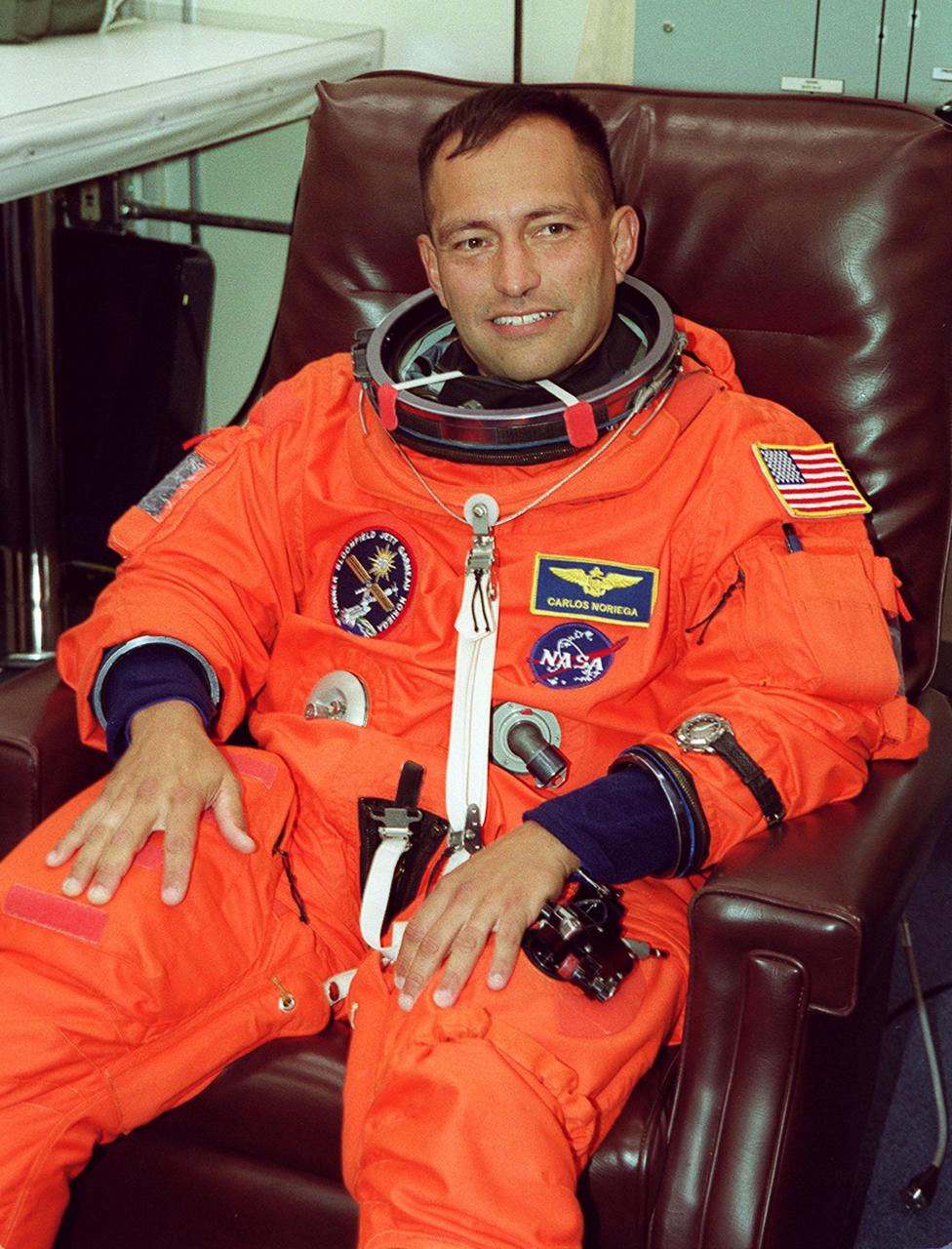
STS-97 Mission Specialist Carlos Noriega appears relaxed as he dons his launch and entry suit. This is his second Shuttle flight. Mission STS-97 is the sixth construction flight to the International Space Station. It is transporting the P6 Integrated Truss Structure that comprises Solar Array Wing-3 and the Integrated Electronic Assembly, to be installed on the Space Station. The solar arrays are mounted on a “blanket” that can be folded like an accordion for delivery. Once in orbit, astronauts will deploy the blankets to their full size. The 11-day mission includes two spacewalks to complete the solar array connections. The Station’s electrical power system will use eight photovoltaic solar arrays, each 112 feet long by 39 feet wide, to convert sunlight to electricity. Gimbals will be used to rotate the arrays so that they will face the Sun to provide maximum power to the Space Station. Launch is scheduled for Nov. 30 at 10:06 p.m. EST
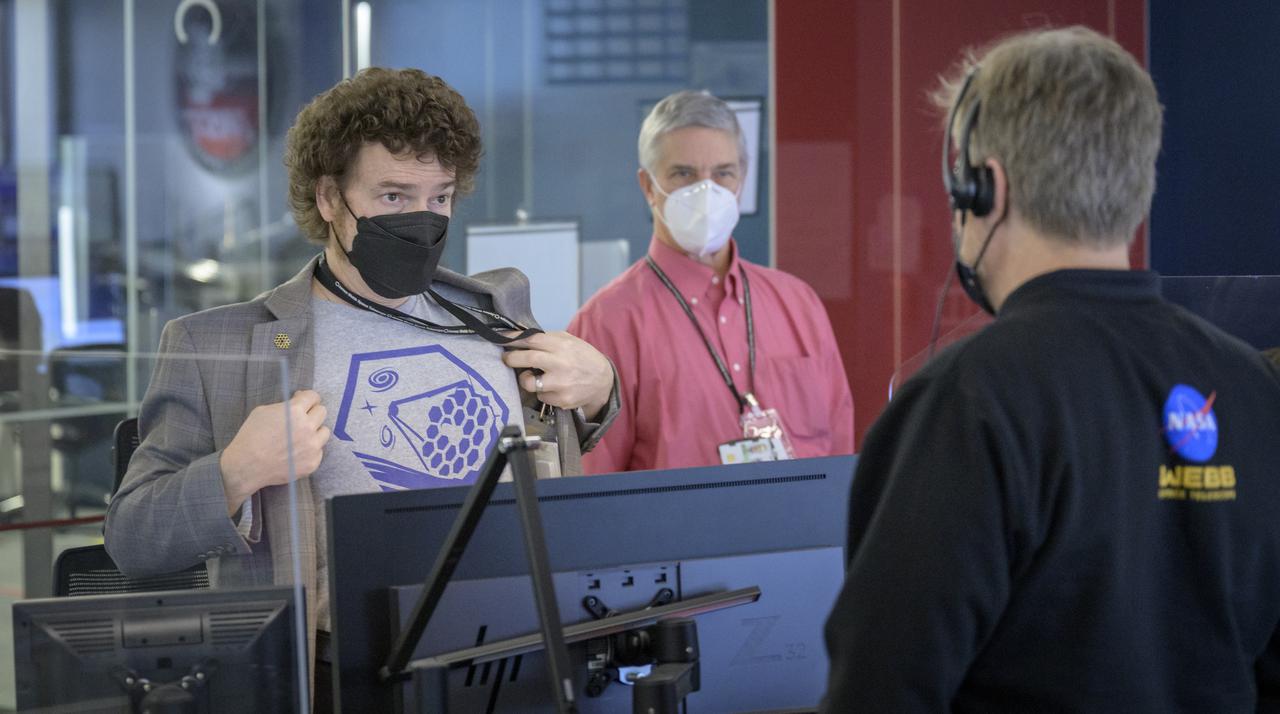
NASA James Webb Space Telescope Mission Operations Manager Carl Starr, left, shows his Webb shirt to NASA James Webb Space Telescope Commissioning Manager John Durning, right, as they prepare to monitor the progress of the observatory’s second primary mirror wing rotating into position, Saturday, Jan. 8, 2022, at NASA’s James Webb Space Telescope Mission Operations Center at the Space Telescope Science Institute in Baltimore. Webb, an infrared telescope with a 21.3-foot (6.5-meter) primary mirror, was folded up for launch and underwent an unprecedented deployment process to unfold in space. As NASA's next flagship observatory, Webb will study every phase of cosmic history—from within our solar system to the most distant observable galaxies in the early universe. Photo Credit: (NASA/Bill Ingalls)
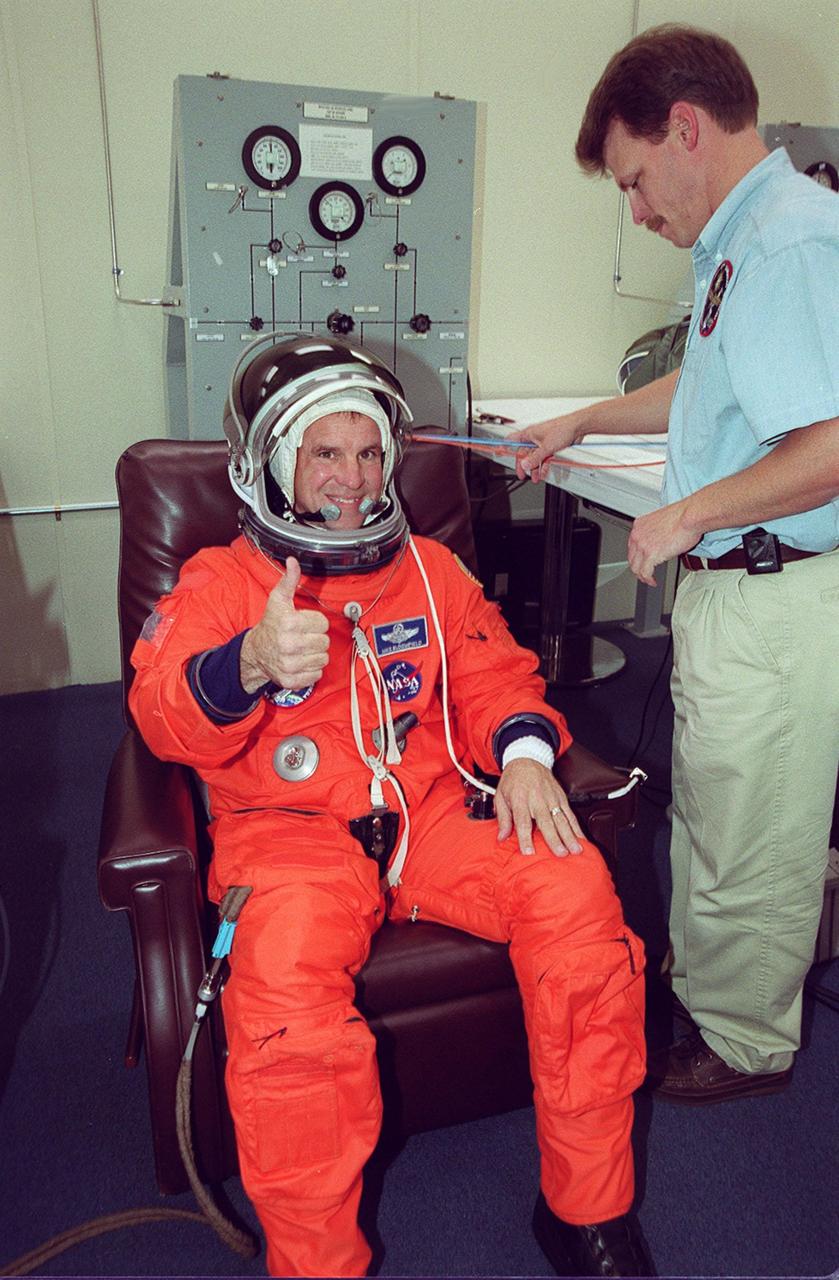
STS-97 Pilot Michael Bloomfield signals thumbs up for launch after donning his launch and entry suit. This is his second Shuttle flight. Mission STS-97 is the sixth construction flight to the International Space Station. It is transporting the P6 Integrated Truss Structure that comprises Solar Array Wing-3 and the Integrated Electronic Assembly, to be installed on the Space Station. The solar arrays are mounted on a “blanket” that can be folded like an accordion for delivery. Once in orbit, astronauts will deploy the blankets to their full size. The 11-day mission includes two spacewalks to complete the solar array connections. The Station’s electrical power system will use eight photovoltaic solar arrays, each 112 feet long by 39 feet wide, to convert sunlight to electricity. Gimbals will be used to rotate the arrays so that they will face the Sun to provide maximum power to the Space Station. Launch is scheduled for Nov. 30 at 10:06 p.m. EST
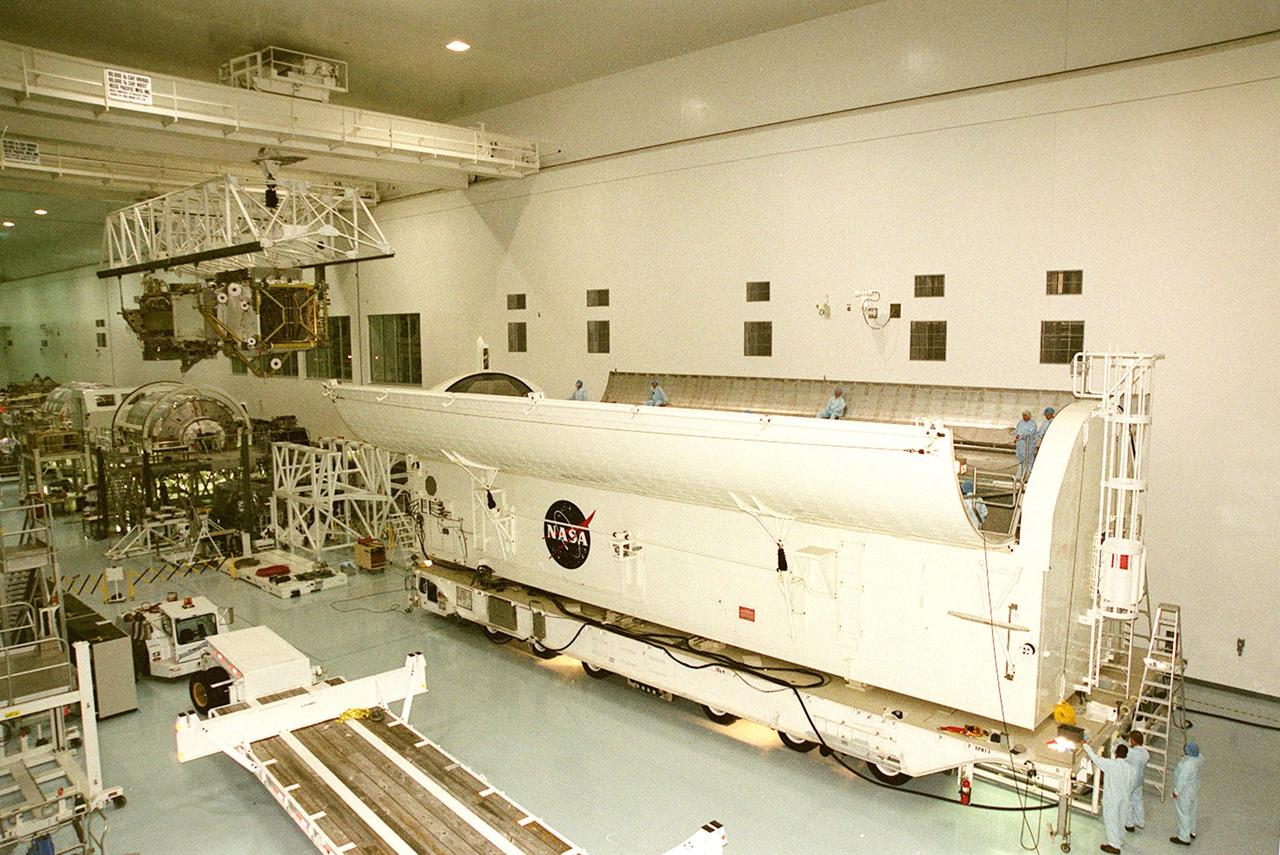
KENNEDY SPACE CENTER, FLA. -- The payload transport canister (right) and workers wait for the arrival of the P6 integrated truss segment (left) carried by the overhead crane. After being placed in the canister, the truss will be transported to Launch Pad 39B and the payload changeout room. Then it will be moved into Space Shuttle Endeavour’s payload bay for mission STS-97. The P6 comprises Solar Array Wing-3 and the Integrated Electronic Assembly, to be installed on the Space Station. The Station’s electrical power system will use eight photovoltaic solar arrays, each 112 feet long by 39 feet wide, to convert sunlight to electricity. The solar arrays are mounted on a “blanket” that can be folded like an accordion for delivery. Once in orbit, astronauts will deploy the blankets to their full size. Gimbals will be used to rotate the arrays so that they will face the Sun to provide maximum power to the Space Station. The STS-97 launch is scheduled Nov. 30 at 10:06 p.m. EST
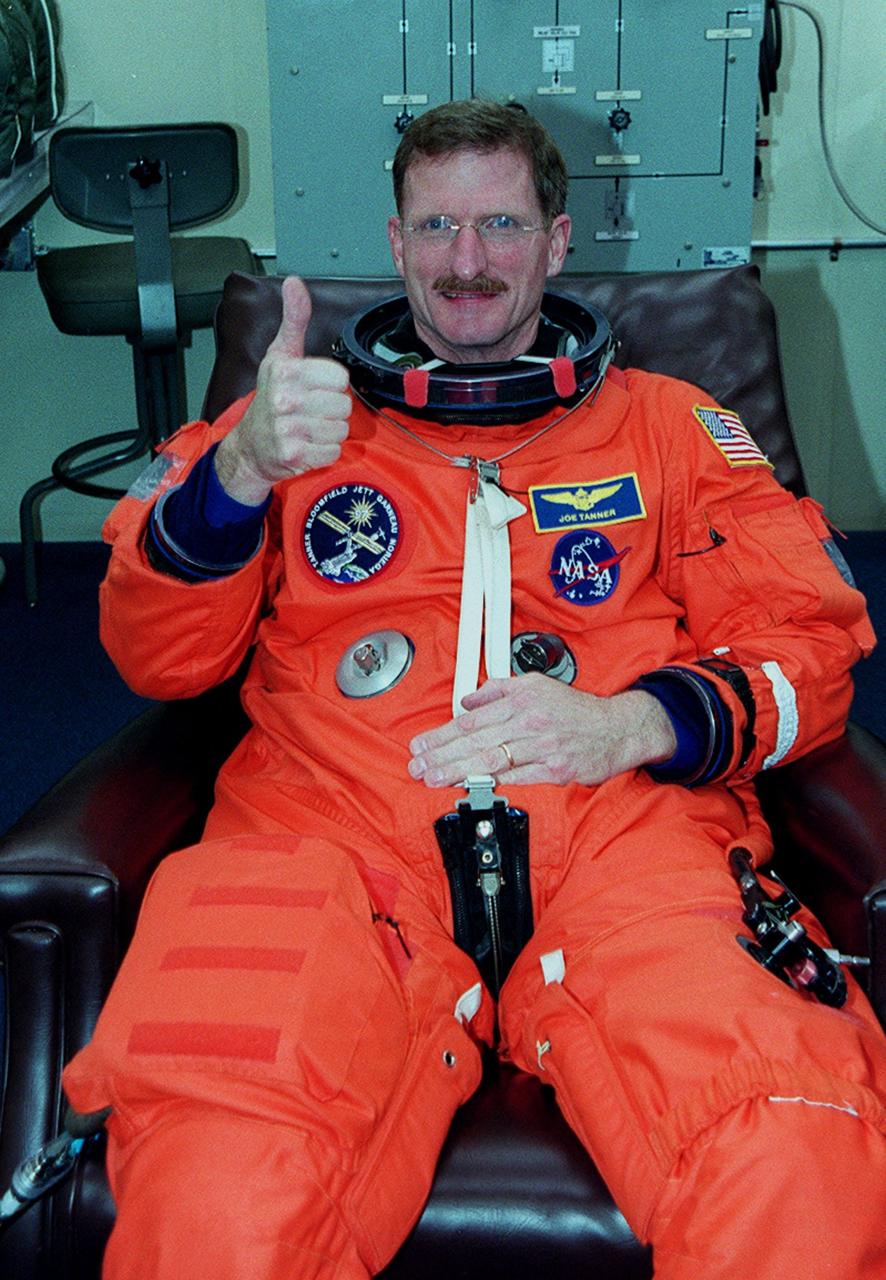
STS-97 Mission Specialist Joseph Tanner signals thumbs up for launch as he dons his launch and entry suit. this is his third Shuttle flight.; Mission STS-97 is the sixth construction flight to the International Space Station. It is transporting the P6 Integrated Truss Structure that comprises Solar Array Wing-3 and the Integrated Electronic Assembly, to be installed on the Space Station. The solar arrays are mounted on a “blanket” that can be folded like an accordion for delivery. Once in orbit, astronauts will deploy the blankets to their full size. The 11-day mission includes two spacewalks to complete the solar array connections. The Station’s electrical power system will use eight photovoltaic solar arrays, each 112 feet long by 39 feet wide, to convert sunlight to electricity.. Gimbals will be used to rotate the arrays so that they will face the Sun to provide maximum power to the Space Station. Launch is scheduled for Nov. 30 at 10:06 p.m. EST
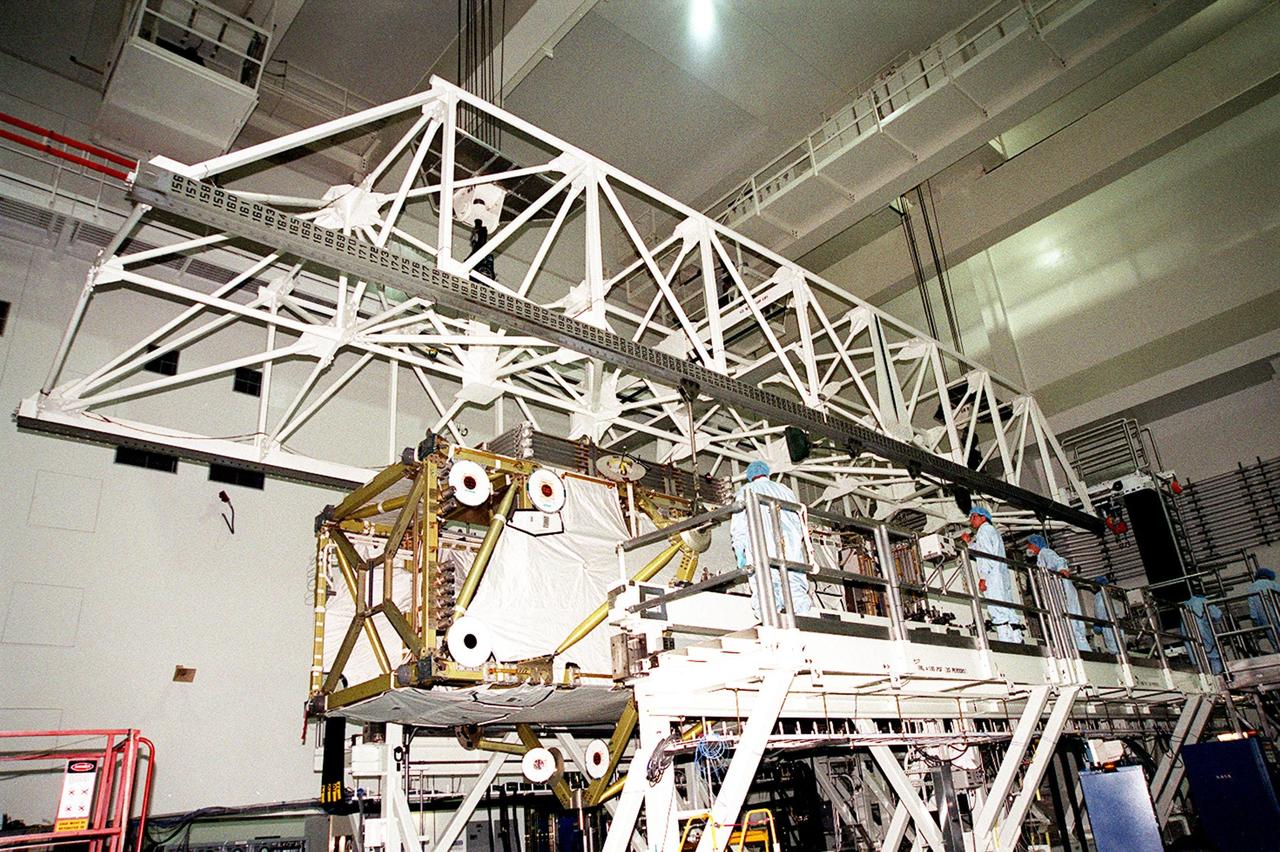
In the Space Station Processing Facility, workers attach an overhead crane to lift the P6 integrated truss segment from a workstand and move it to the payload transport canister for transfer to Launch Pad 39B. There it will be placed in Endeavour’s payload bay for launch on mission STS-97. The P6 comprises Solar Array Wing-3 and the Integrated Electronic Assembly, to be installed on the International Space Station. The Station’s electrical power system will use eight photovoltaic solar arrays, each 112 feet long by 39 feet wide, to convert sunlight to electricity. The solar arrays are mounted on a “blanket” that can be folded like an accordion for delivery. Once in orbit, astronauts will deploy the blankets to their full size. Gimbals will be used to rotate the arrays so that they will face the Sun to provide maximum power to the Space Station. Launch is scheduled for Nov. 30 at 10:06 p.m. EST
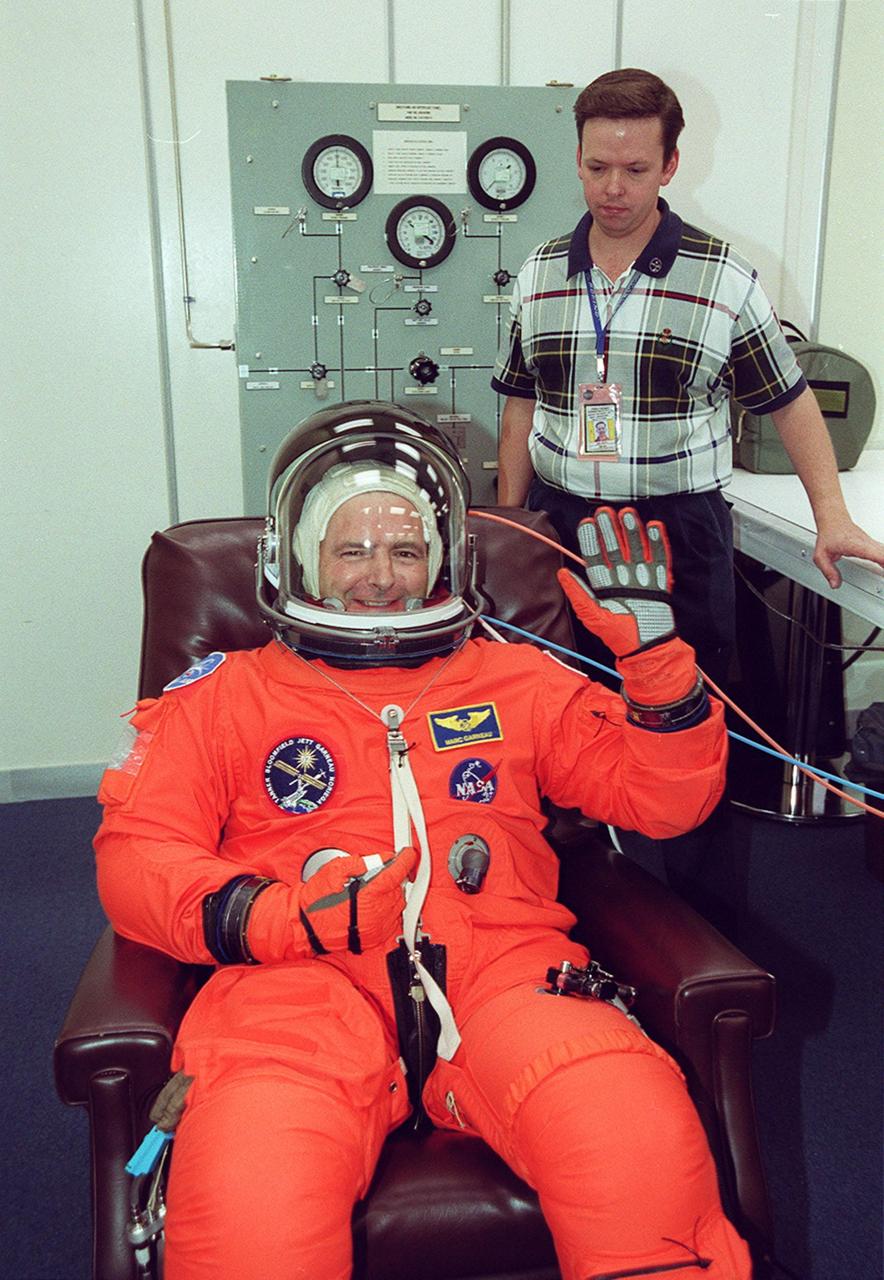
STS-97 Mission Specialist Marc Garneau, who is with the Canadian Space Agency, waves after donning his launch and entry suit. This is his third Shuttle flight.; Mission STS-97 is the sixth construction flight to the International Space Station. It is transporting the P6 Integrated Truss Structure that comprises Solar Array Wing-3 and the Integrated Electronic Assembly, to be installed on the Space Station. The solar arrays are mounted on a “blanket” that can be folded like an accordion for delivery. Once in orbit, astronauts will deploy the blankets to their full size. The 11-day mission includes two spacewalks to complete the solar array connections. The Station’s electrical power system will use eight photovoltaic solar arrays, each 112 feet long by 39 feet wide, to convert sunlight to electricity.. Gimbals will be used to rotate the arrays so that they will face the Sun to provide maximum power to the Space Station. Launch is scheduled for Nov. 30 at 10:06 p.m. EST
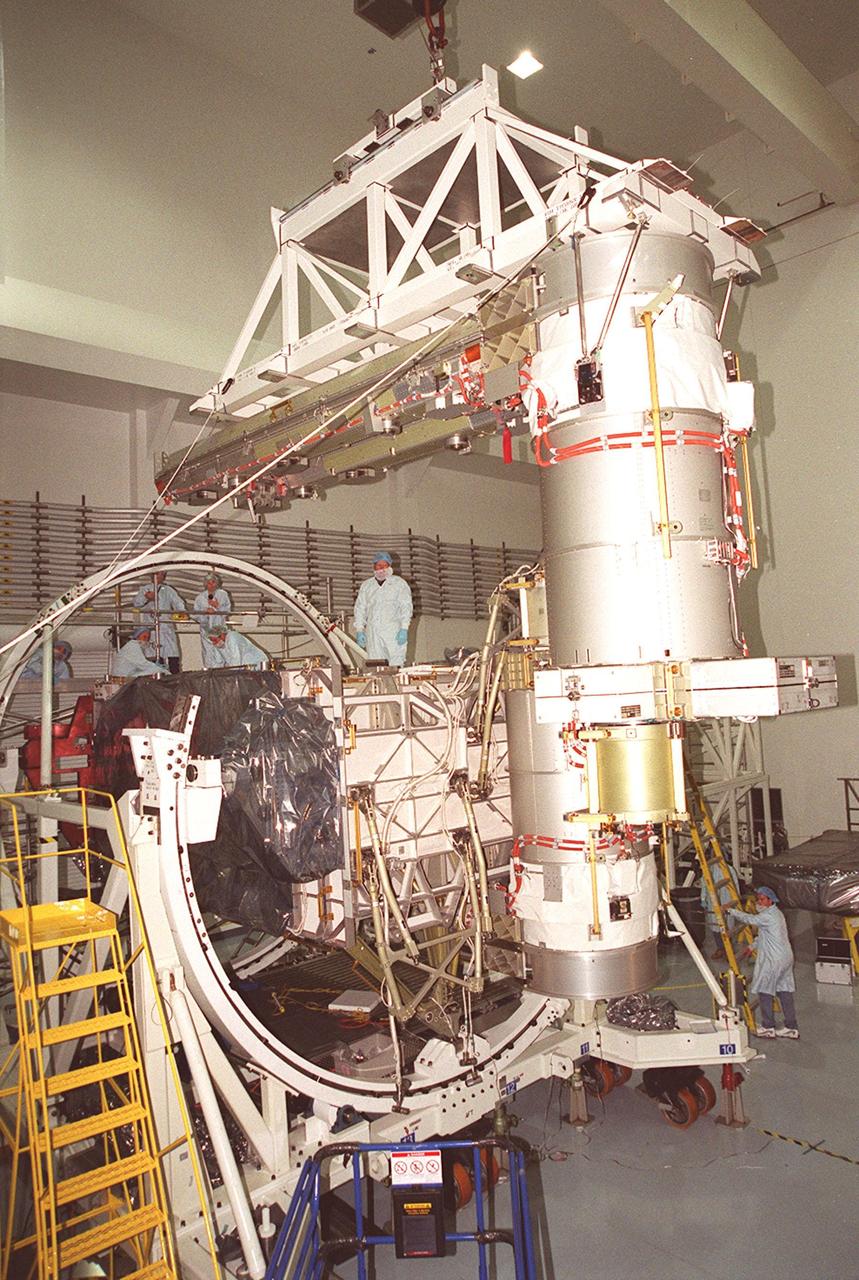
In the Space Station Processing Facility, the overhead crane carrying a solar array maneuvers its cargo into position on the Integrated Equipment Assembly on which it will be installed. Solar Array Wing-3 is already in place. Components of the International Space Station, the arrays are scheduled to be launched on mission STS-97 in late November along with the P6 truss. The Station’s electrical power system (EPS) will use eight photovoltaic solar arrays to convert sunlight to electricity. Each of the eight solar arrays will be 112 feet long by 39 feet wide. The solar arrays are mounted on a “blanket” that can be folded like an accordion for delivery. Once in orbit, astronauts will deploy the blankets to their full size. Gimbals will be used to rotate the arrays so that they will face the Sun to provide maximum power to the Space Station
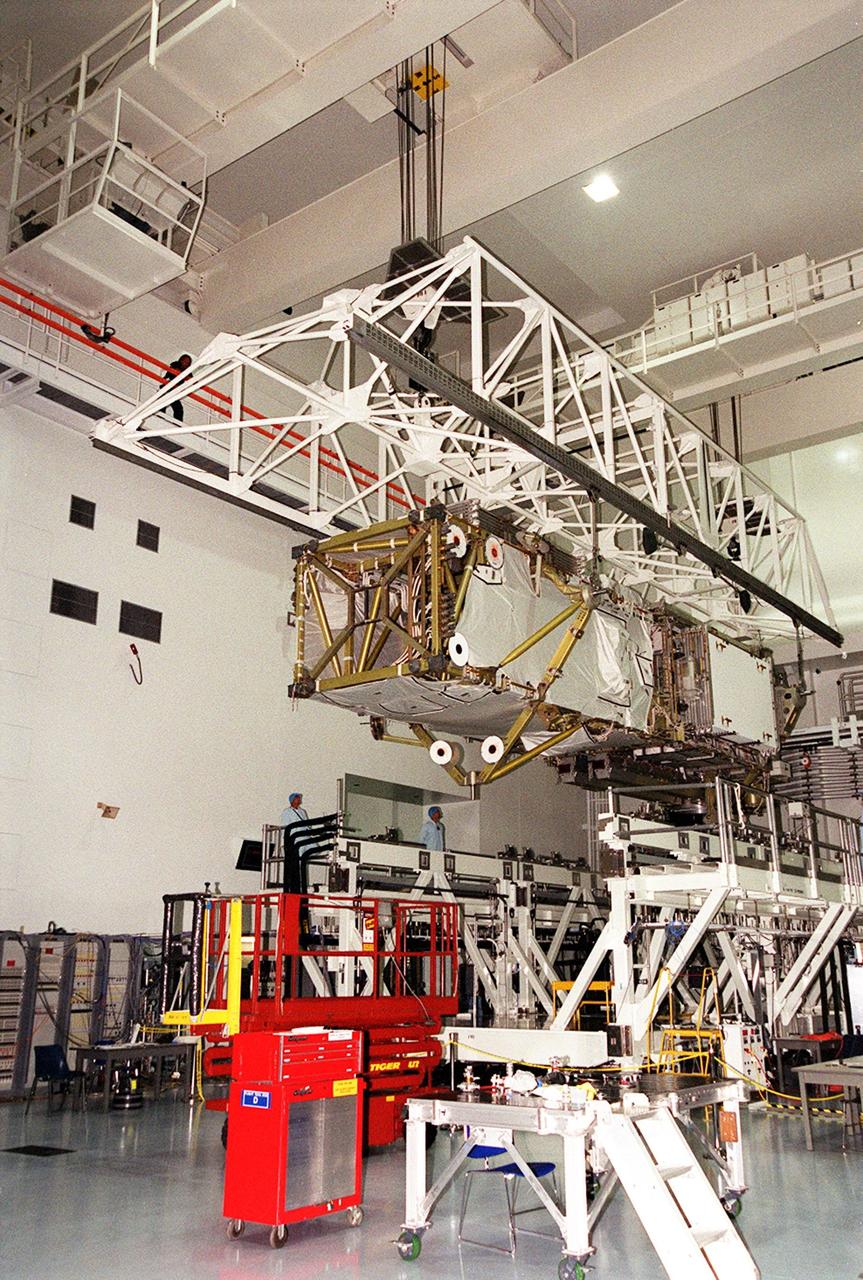
In the Space Station Processing Facility, an overhead crane lifts the P6 integrated truss segment from a workstand to place it in the payload transport canister for transfer to Launch Pad 39B. There it will be placed in Endeavour’s payload bay for launch on mission STS-97. The P6 comprises Solar Array Wing-3 and the Integrated Electronic Assembly, to be installed on the International Space Station. The Station’s electrical power system will use eight photovoltaic solar arrays, each 112 feet long by 39 feet wide, to convert sunlight to electricity. The solar arrays are mounted on a “blanket” that can be folded like an accordion for delivery. Once in orbit, astronauts will deploy the blankets to their full size. Gimbals will be used to rotate the arrays so that they will face the Sun to provide maximum power to the Space Station. Launch is scheduled Nov. 30 at 10:06 p.m. EST
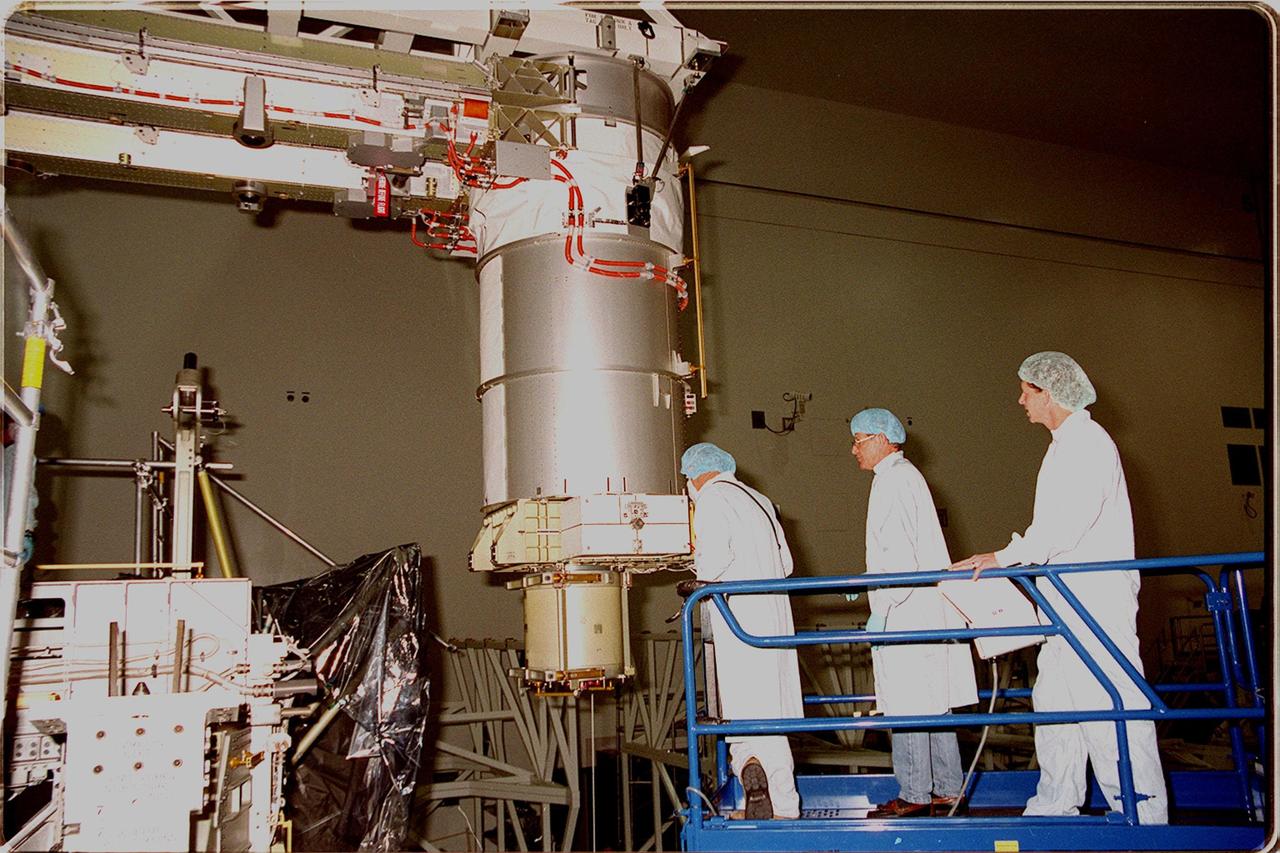
Workers in the Space Station Processing Facility watch closely as Solar Array Wing-3, a component of the International Space Station, is lowered toward the Integrated Electronic Assembly where it will be installed for testing. The solar array is scheduled to be launched on STS-97 in late November along with the P6 truss. The Station’s electrical power system (EPS) will use eight photovoltaic solar arrays to convert sunlight to electricity. Each of the eight solar arrays will be 112 feet long by 39 feet wide. The solar arrays are mounted on a “blanket” that can be folded like an accordion for delivery. Once in orbit, astronauts will deploy the blankets to their full size. Gimbals will be used to rotate the arrays so that they will face the Sun to provide maximum power to the Space Station
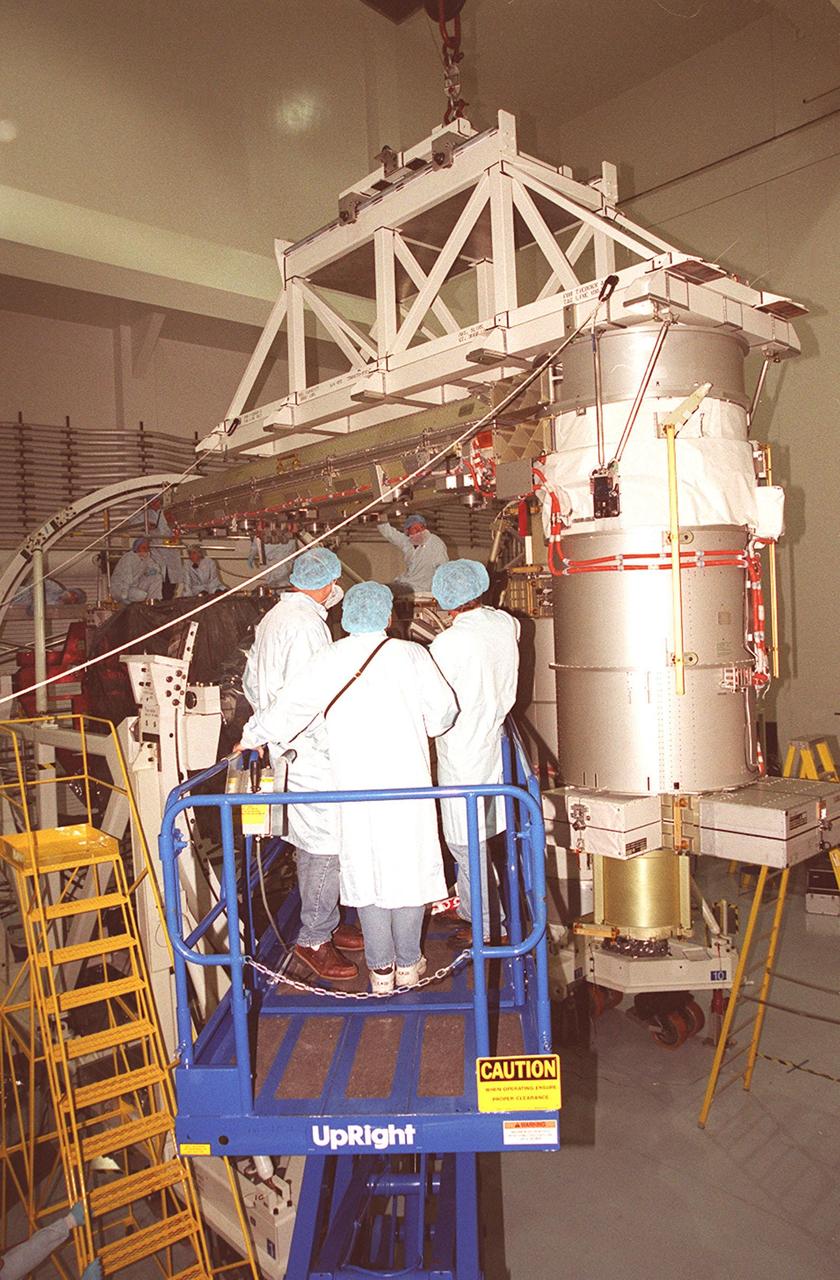
In the Space Station Processing Facility, workers help guide a solar array into position for installation on the Integrated Equipment Assembly. Solar Array Wing-3 is already in place. Components of the International Space Station, the arrays are scheduled to be launched on mission STS-97 in late November along with the P6 truss. The Station’s electrical power system (EPS) will use eight photovoltaic solar arrays to convert sunlight to electricity. Each of the eight solar arrays will be 112 feet long by 39 feet wide. The solar arrays are mounted on a “blanket” that can be folded like an accordion for delivery. Once in orbit, astronauts will deploy the blankets to their full size. Gimbals will be used to rotate the arrays so that they will face the Sun to provide maximum power to the Space Station
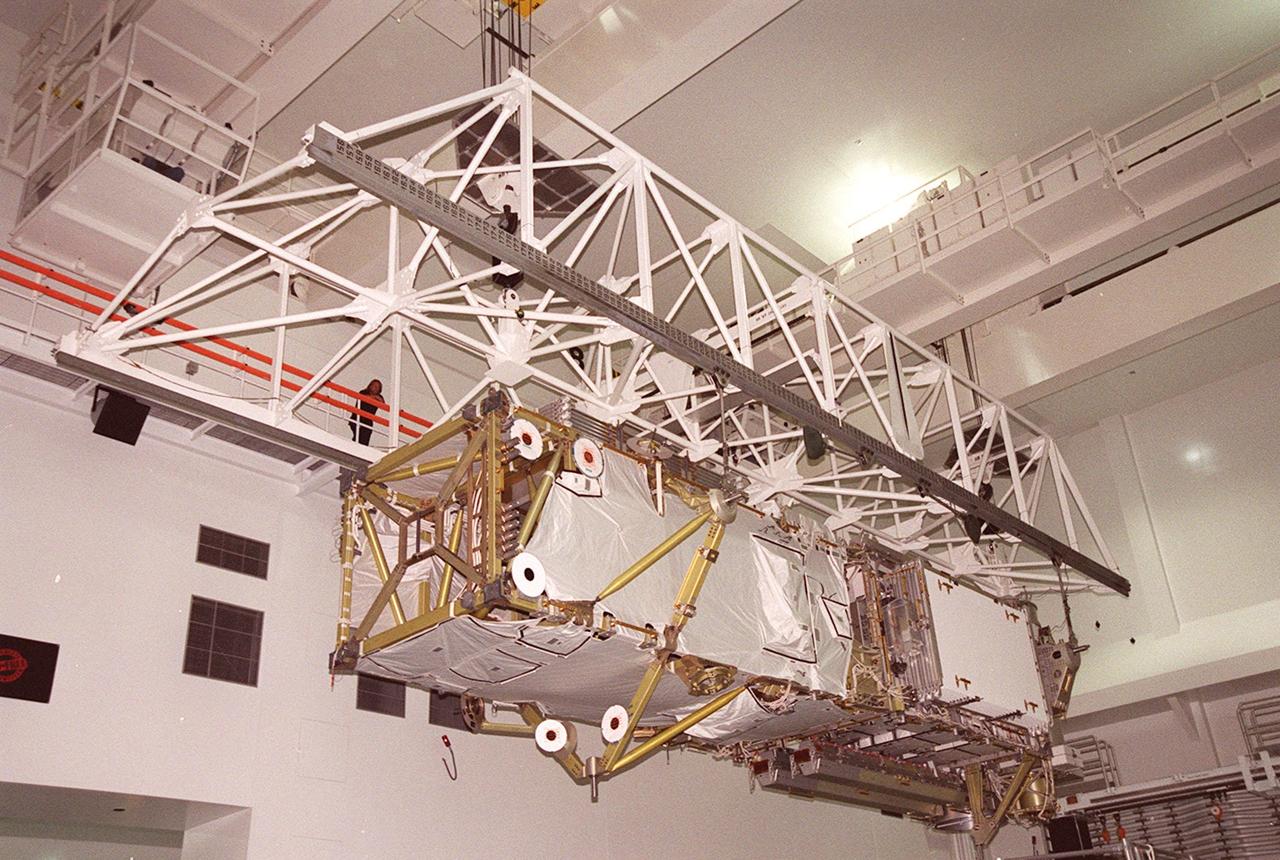
In the Space Station Processing Facility, an overhead crane moves the P6 integrated truss segment to a payload transport canister for transfer to Launch Pad 39B. There it will be placed in Endeavour’s payload bay for launch on mission STS-97. The P6 comprises Solar Array Wing-3 and the Integrated Electronic Assembly, to be installed on the International Space Station. The Station’s electrical power system will use eight photovoltaic solar arrays, each 112 feet long by 39 feet wide, to convert sunlight to electricity. The solar arrays are mounted on a “blanket” that can be folded like an accordion for delivery. Once in orbit, astronauts will deploy the blankets to their full size. Gimbals will be used to rotate the arrays so that they will face the Sun to provide maximum power to the Space Station. Launch is scheduled Nov. 30 at 10:06 p.m. EST
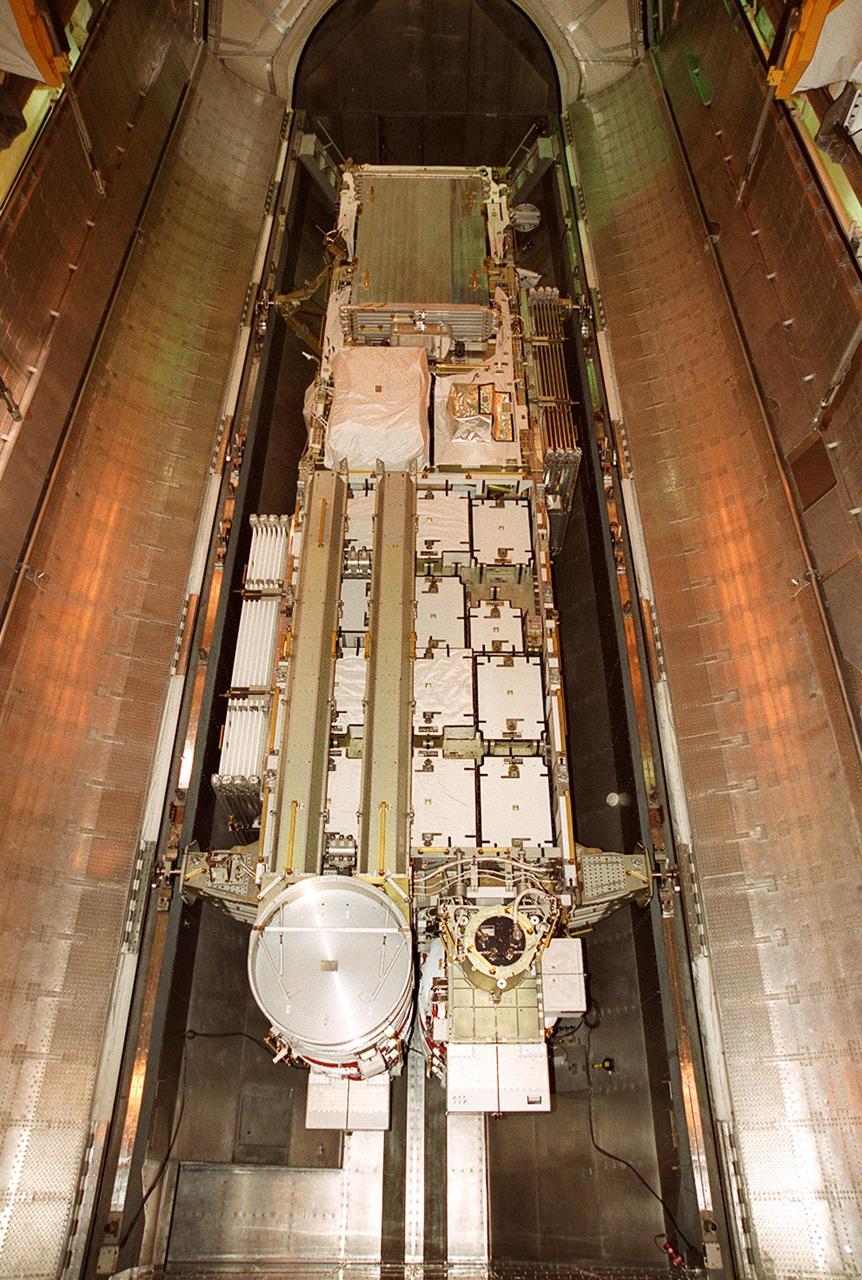
The doors of the payload transport canister are open wide in the payload changeout room on Launch Pad 39B. Revealed is the P6 integrated truss segment, which will fly on mission STS-97. The P6 comprises Solar Array Wing-3 and the Integrated Electronic Assembly, to be installed on the International Space Station. The Station’s electrical power system will use eight photovoltaic solar arrays, each 112 feet long by 39 feet wide, to convert sunlight to electricity. The solar arrays are mounted on a “blanket” that can be folded like an accordion for delivery. Once in orbit, astronauts will deploy the blankets to their full size. Gimbals will be used to rotate the arrays so that they will face the Sun to provide maximum power to the Space Station. Launch of STS-97 is scheduled for Nov. 30 at 10:06 p.m. EST
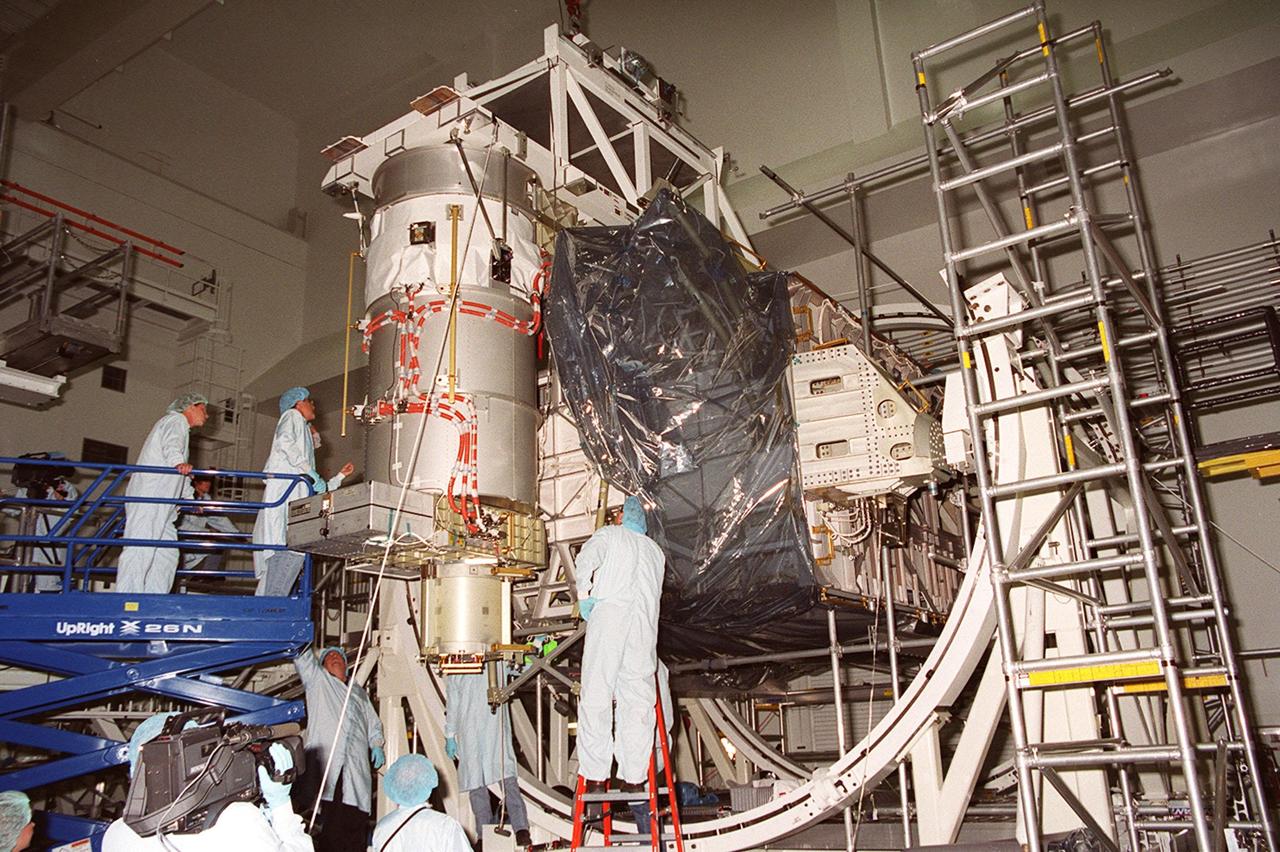
Workers in the Space Station Processing Facility watch closely as Solar Array Wing-3, a component of the International Space Station, is moved toward the Integrated Electronic Assembly where it will be installed for testing. The solar array is scheduled to be launched on STS-97 in late November along with the P6 truss. The Station’s electrical power system (EPS) will use eight photovoltaic solar arrays to convert sunlight to electricity. Each of the eight solar arrays will be 112 feet long by 39 feet wide. The solar arrays are mounted on a “blanket” that can be folded like an accordion for delivery. Once in orbit, astronauts will deploy the blankets to their full size. Gimbals will be used to rotate the arrays so that they will face the Sun to provide maximum power to the Space Station
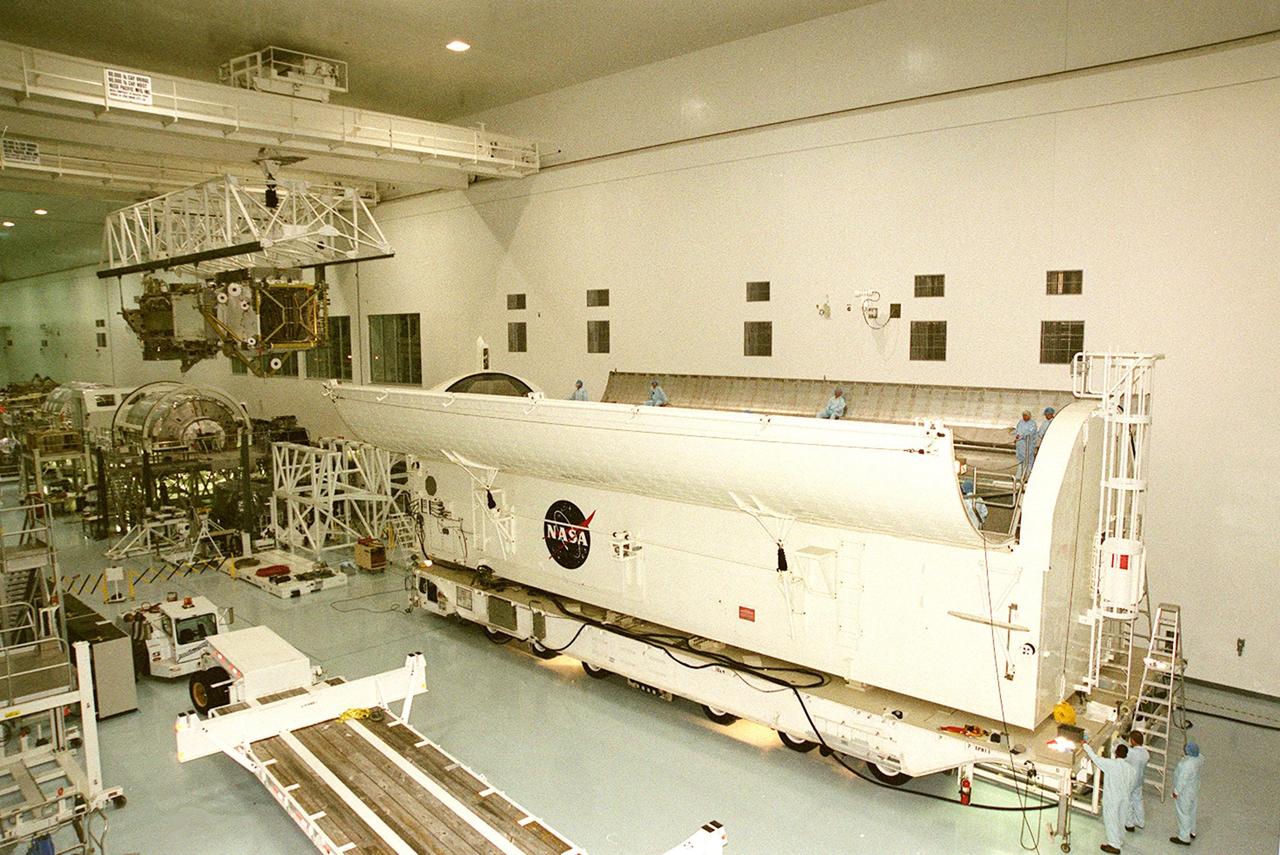
KENNEDY SPACE CENTER, FLA. -- The payload transport canister (right) and workers wait for the arrival of the P6 integrated truss segment (left) carried by the overhead crane. After being placed in the canister, the truss will be transported to Launch Pad 39B and the payload changeout room. Then it will be moved into Space Shuttle Endeavour’s payload bay for mission STS-97. The P6 comprises Solar Array Wing-3 and the Integrated Electronic Assembly, to be installed on the Space Station. The Station’s electrical power system will use eight photovoltaic solar arrays, each 112 feet long by 39 feet wide, to convert sunlight to electricity. The solar arrays are mounted on a “blanket” that can be folded like an accordion for delivery. Once in orbit, astronauts will deploy the blankets to their full size. Gimbals will be used to rotate the arrays so that they will face the Sun to provide maximum power to the Space Station. The STS-97 launch is scheduled Nov. 30 at 10:06 p.m. EST
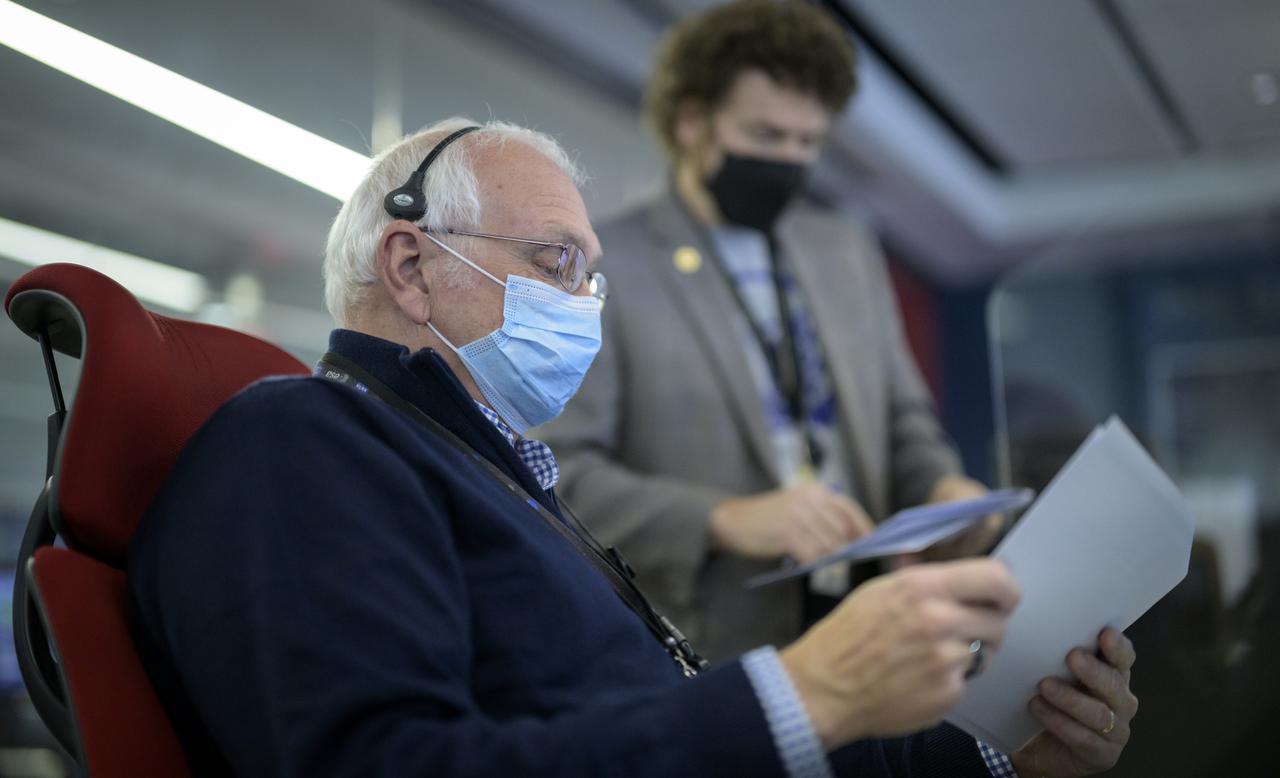
NASA James Webb Space Telescope Project Manager Bill Ochs, left, and NASA James Webb Space Telescope Mission Operations Manager Carl Starr, monitor the progress of the Webb observatory as it’s second primary mirror wing is prepared to rotate into position, Saturday, Jan. 8, 2022, from NASA’s James Webb Space Telescope Mission Operations Center at the Space Telescope Science Institute in Baltimore. Webb, an infrared telescope with a 21.3-foot (6.5-meter) primary mirror, was folded up for launch and underwent an unprecedented deployment process to unfold in space. As NASA's next flagship observatory, Webb will study every phase of cosmic history—from within our solar system to the most distant observable galaxies in the early universe. Photo Credit: (NASA/Bill Ingalls)
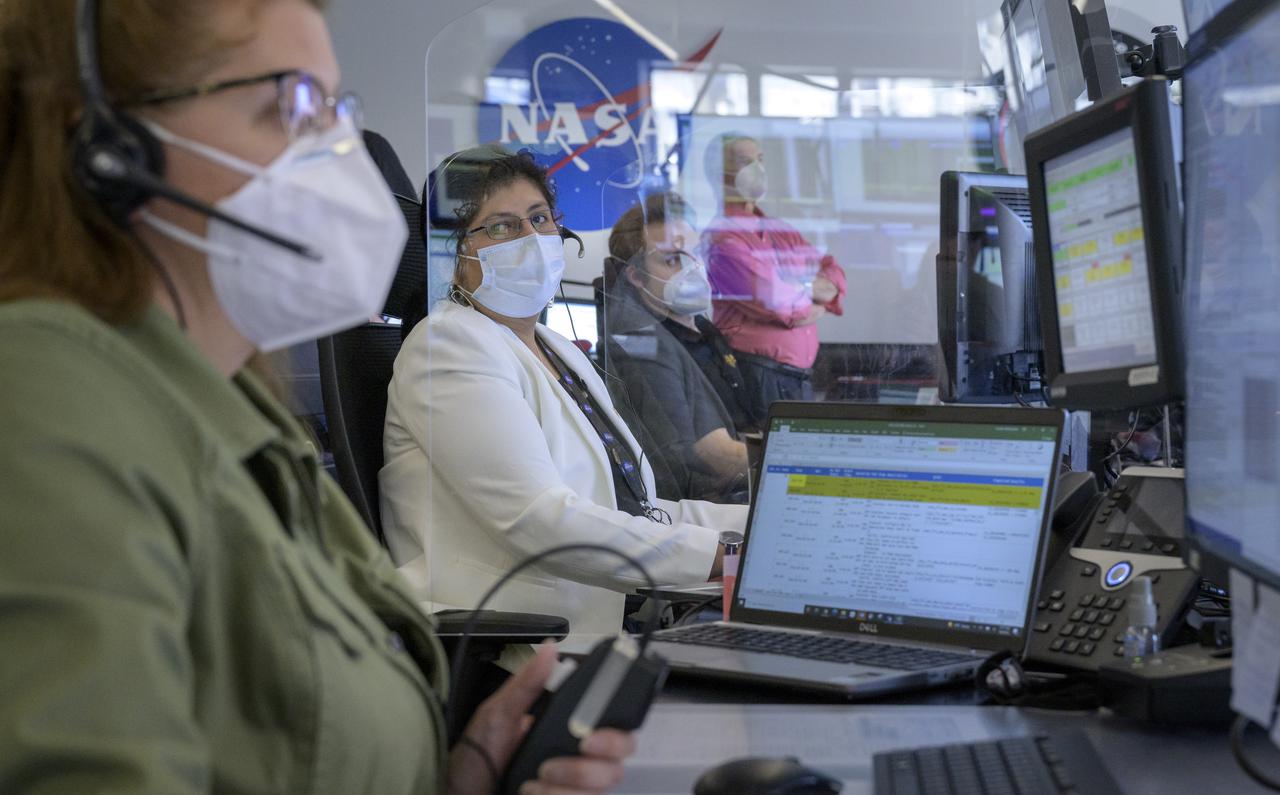
NASA James Webb Space Telescope Operations Controller Irma Quispe, 2nd from left, and other mission team members, monitor the progress of the Webb observatory as it’s second primary mirror wing is rotated into position, Saturday, Jan. 8, 2022, from NASA’s James Webb Space Telescope Mission Operations Center at the Space Telescope Science Institute in Baltimore. Webb, an infrared telescope with a 21.3-foot (6.5-meter) primary mirror, was folded up for launch and underwent an unprecedented deployment process to unfold in space. As NASA's next flagship observatory, Webb will study every phase of cosmic history—from within our solar system to the most distant observable galaxies in the early universe. Photo Credit: (NASA/Bill Ingalls)
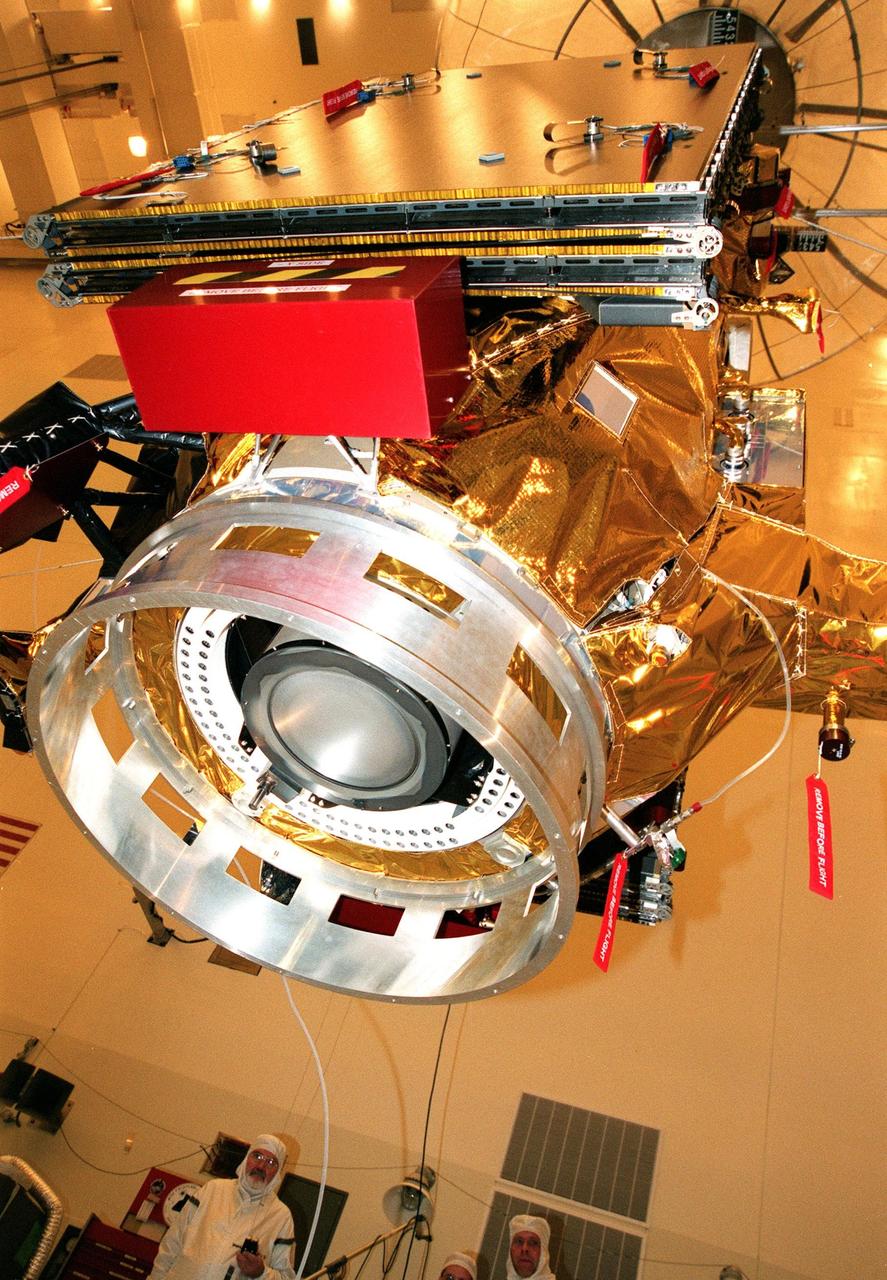
KENNEDY SPACE CENTER, FLA. -- Deep Space 1 is lifted from its work platform, giving a closer view of the experimental solar-powered ion propulsion engine. The ion propulsion engine is the first non-chemical propulsion to be used as the primary means of propelling a spacecraft. Above the engine is one of the two solar wings, folded for launch, that will provide the power for it. When fully extended, the wings measure 38.6 feet from tip to tip. The first flight in NASA's New Millennium Program, Deep Space 1 is designed to validate 12 new technologies for scientific space missions of the next century. Another onboard experiment includes software that tracks celestial bodies so the spacecraft can make its own navigation decisions without the intervention of ground controllers. Deep Space 1 will complete most of its mission objectives within the first two months, but may also do a flyby of a near-Earth asteroid, 1992 KD, in July 1999. Deep Space 1 will be launched aboard a Boeing Delta 7326 rocket from Launch Pad 17A, Cape Canaveral Air Station, in October. Delta II rockets are medium capacity expendable launch vehicles derived from the Delta family of rockets built and launched since 1960. Since then there have been more than 245 Delta launches
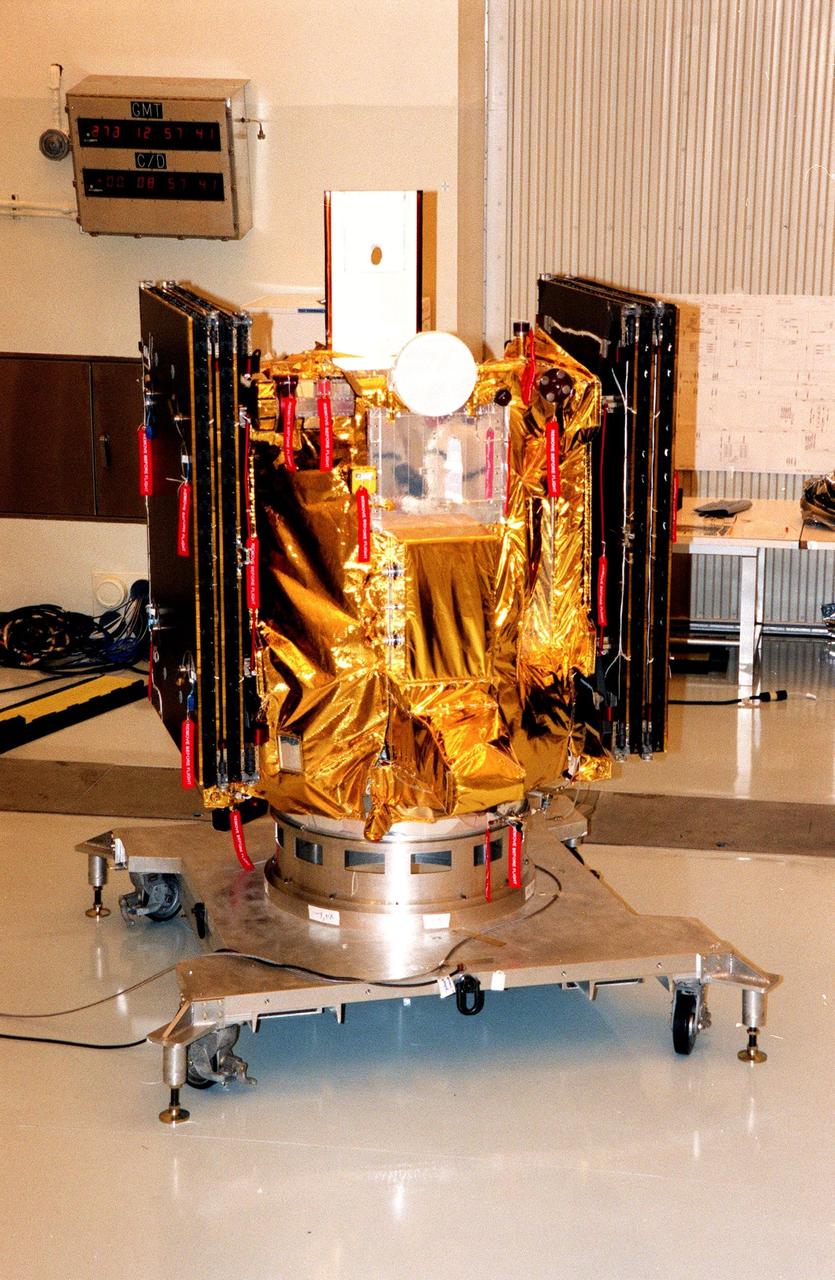
KENNEDY SPACE CENTER, FLA. -- Deep Space 1 rests on its work platform after being fitted with thermal insulation. The reflective insulation is designed to protect the spacecraft as this side faces the sun. At either side of the spacecraft are its solar wings, folded for launch. When fully extended, the wings measure 38.6 feet from tip to tip. The first flight in NASA's New Millennium Program, Deep Space 1 is designed to validate 12 new technologies for scientific space missions of the next century. Onboard experiments include a solar-powered ion propulsion engine and software that tracks celestial bodies so the spacecraft can make its own navigation decisions without the intervention of ground controllers. The ion propulsion engine is the first non-chemical propulsion to be used as the primary means of propelling a spacecraft. Deep Space 1 will complete most of its mission objectives within the first two months, but may also do a flyby of a near-Earth asteroid, 1992 KD, in July 1999. Deep Space 1 will be launched aboard a Boeing Delta 7326 rocket from Launch Pad 17A, Cape Canaveral Air Station, in October. Delta II rockets are medium capacity expendable launch vehicles derived from the Delta family of rockets built and launched since 1960. Since then there have been more than 245 Delta launches
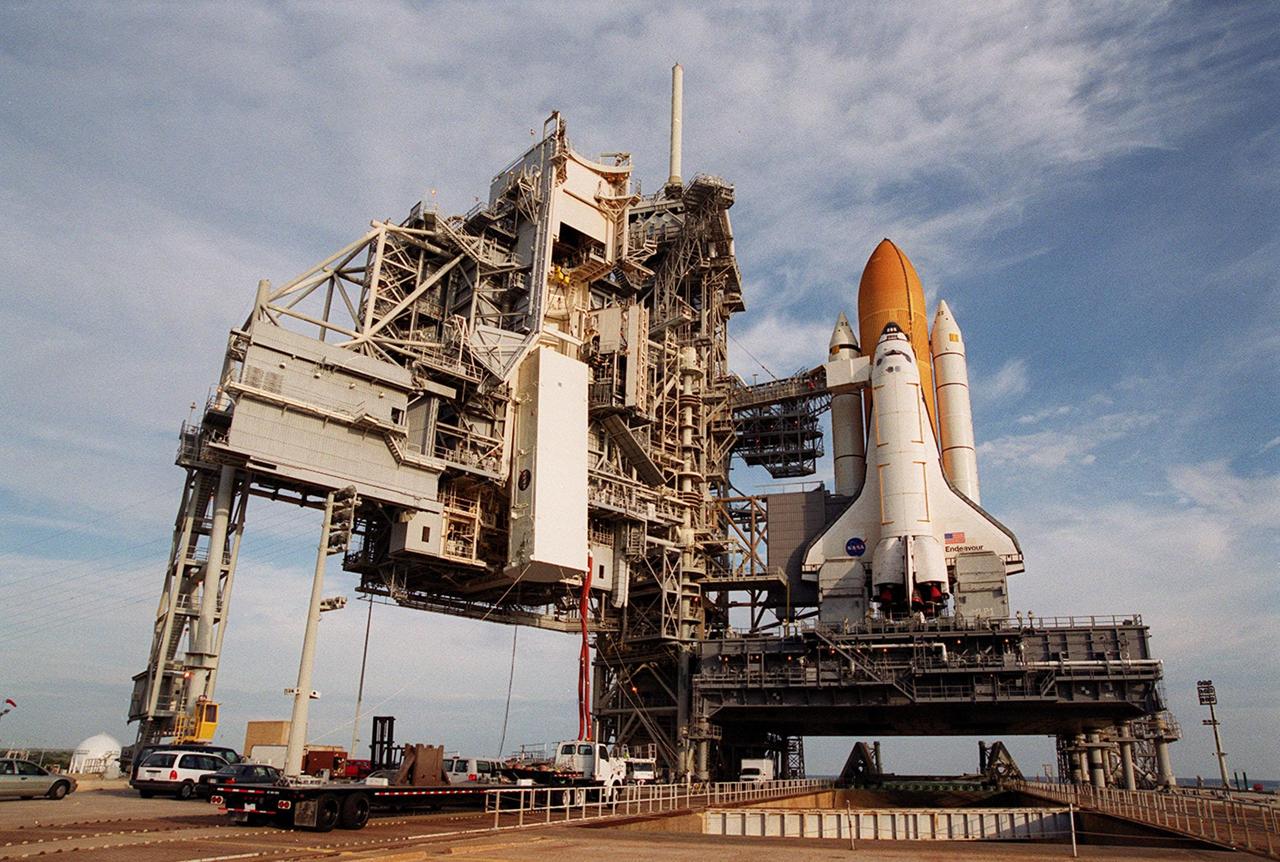
KENNEDY SPACE CENTER, FLA. -- The payload transport canister, with the P6 integrated truss segment inside, is close to the payload changeout room on the Rotating Service Structure (RSS) at left. The PCR is the enclosed, environmentally controlled portion of the RSS that supports payload delivery at the pad. At right is Space Shuttle Endeavour with its orange external tank and one solid rocket booster showing behind it. When the RSS is closed around Endeavour, the P6 truss will be moved into the orbiter’s payload bay. The P6, payload on mission STS-97, comprises Solar Array Wing-3 and the Integrated Electronic Assembly, to be installed on the International Space Station. The Station’s electrical power system will use eight photovoltaic solar arrays, each 112 feet long by 39 feet wide, to convert sunlight to electricity. The solar arrays are mounted on a “blanket” that can be folded like an accordion for delivery. Once in orbit, astronauts will deploy the blankets to their full size. Gimbals will be used to rotate the arrays so that they will face the Sun to provide maximum power to the Space Station. Launch of STS-97 is scheduled for Nov. 30 at 10:06 p.m. EST
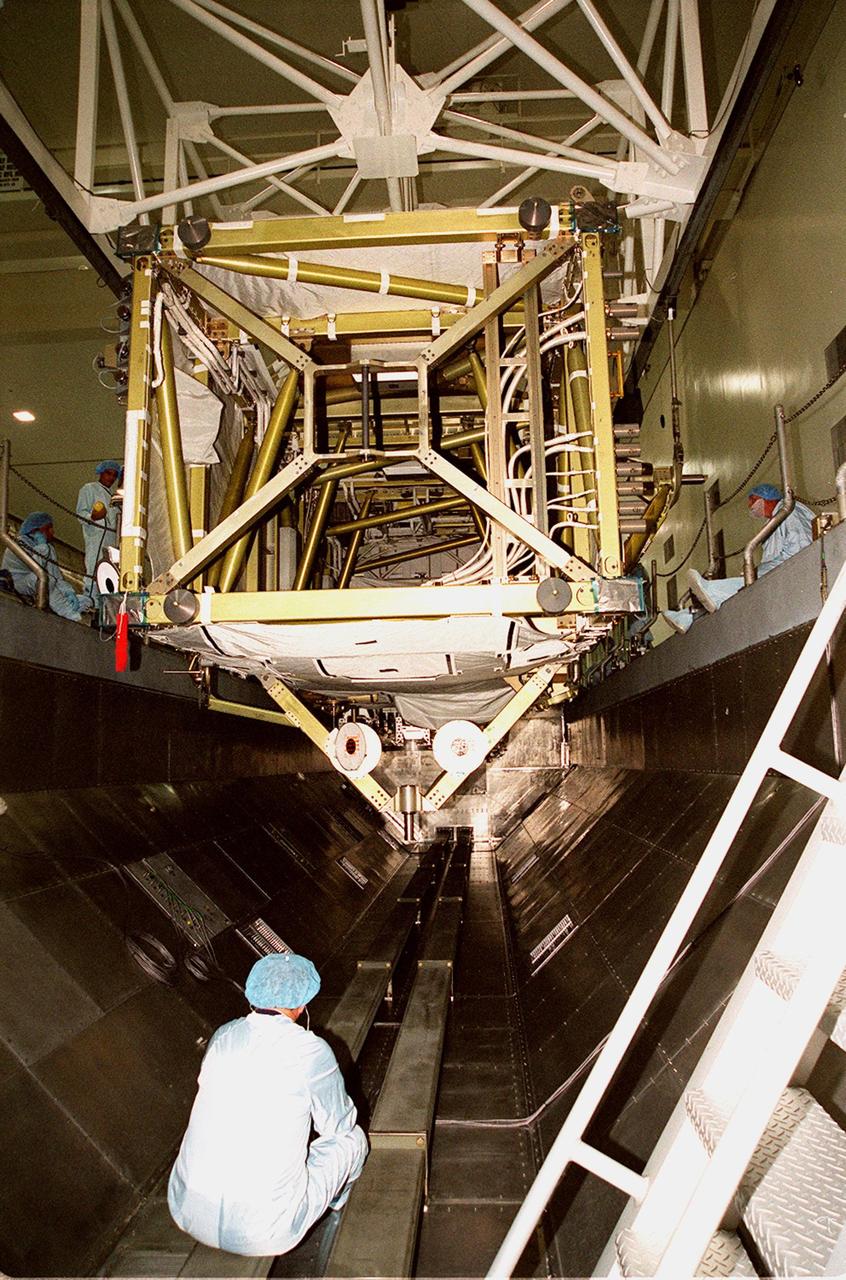
KENNEDY SPACE CENTER, FLA. -- In the Space Station Processing Facility, the P6 integrated truss segment is lowered into the payload transport canister under the watchful eyes of the worker inside the canister as well as the workers on the sides. After being secured in the canister, the truss will be transported to Launch Pad 39B and the payload changeout room. Then it will be moved into Space Shuttle Endeavour’s payload bay for mission STS-97. The P6 comprises Solar Array Wing-3 and the Integrated Electronic Assembly, to be installed on the Space Station. The Station’s electrical power system will use eight photovoltaic solar arrays, each 112 feet long by 39 feet wide, to convert sunlight to electricity. The solar arrays are mounted on a “blanket” that can be folded like an accordion for delivery. Once in orbit, astronauts will deploy the blankets to their full size. Gimbals will be used to rotate the arrays so that they will face the Sun to provide maximum power to the Space Station. The STS-97 launch is scheduled Nov. 30 at 10:06 p.m. EST
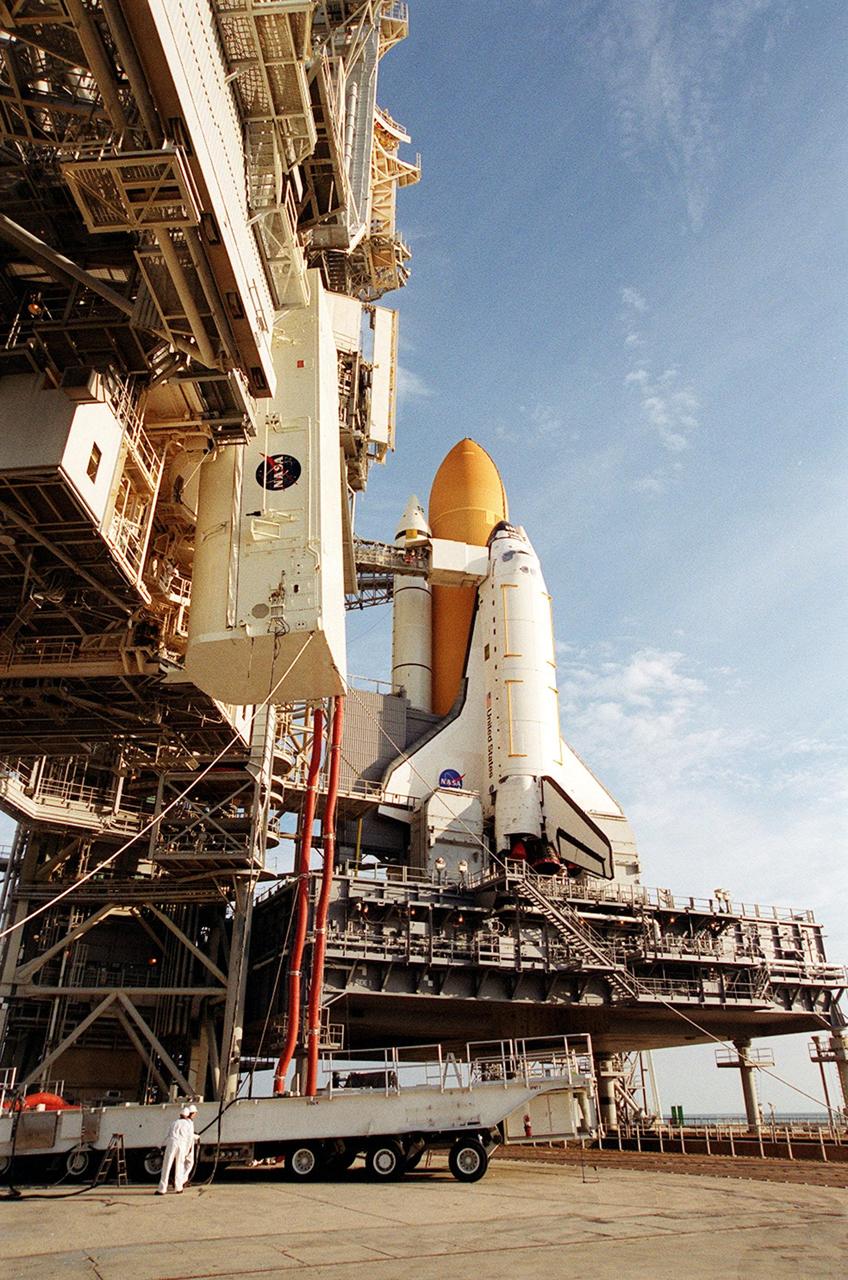
KENNEDY SPACE CENTER, FLA. -- On Launch Pad 39B, the payload transport canister, with the P6 integrated truss segment inside, is lifted higher toward the payload changeout room (PCR) above it. The PCR is the enclosed, environmentally controlled portion of the Rotating Service Structure (RSS) (at left) that supports payload delivery at the pad. At right is Space Shuttle Endeavour with its orange external tank and one solid rocket booster showing behind it. When the RSS is closed around Endeavour, the P6 truss will be moved into the orbiter’s payload bay. The P6, payload on mission STS-97, comprises Solar Array Wing-3 and the Integrated Electronic Assembly, to be installed on the International Space Station. The Station’s electrical power system will use eight photovoltaic solar arrays, each 112 feet long by 39 feet wide, to convert sunlight to electricity. The solar arrays are mounted on a “blanket” that can be folded like an accordion for delivery. Once in orbit, astronauts will deploy the blankets to their full size. Gimbals will be used to rotate the arrays so that they will face the Sun to provide maximum power to the Space Station. Launch of STS-97 is scheduled for Nov. 30 at 10:06 p.m. EST
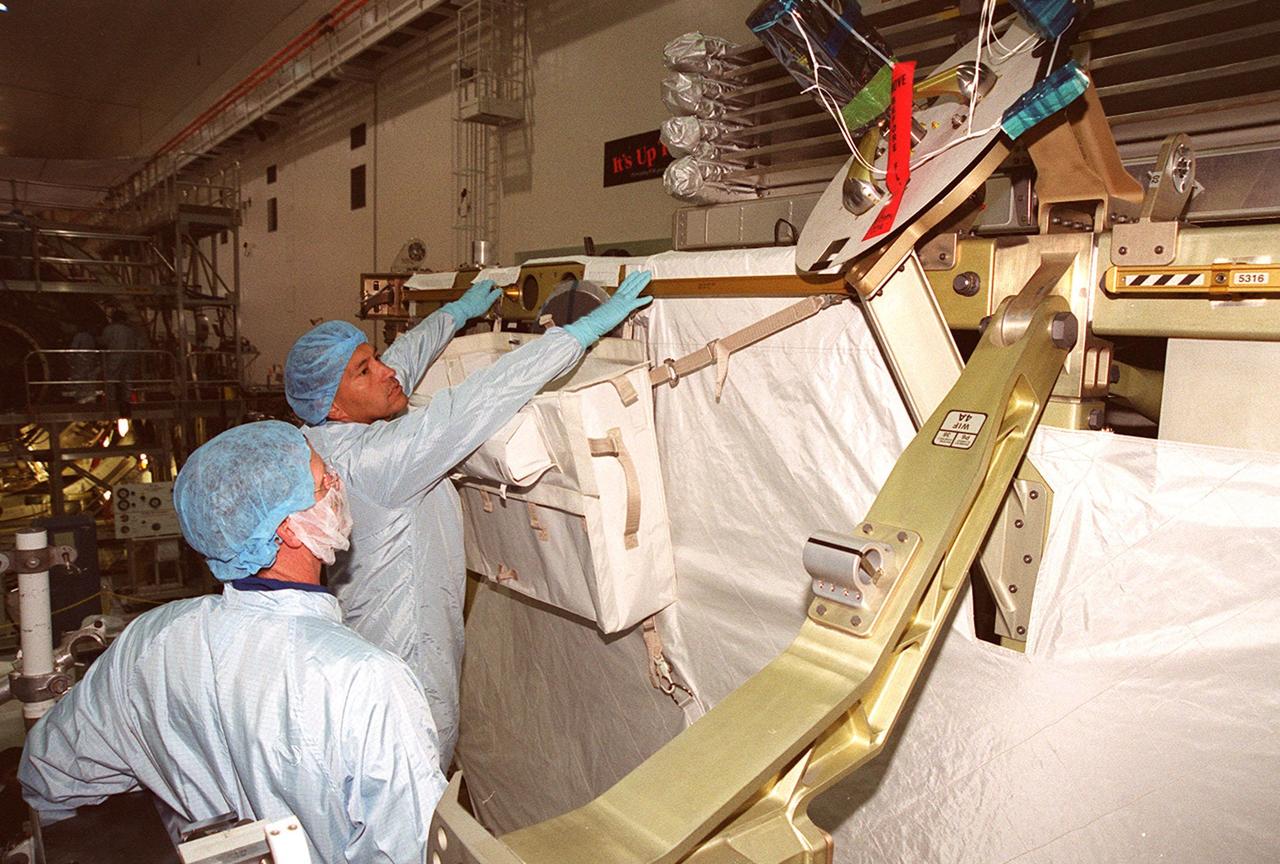
KENNEDY SPACE CENTER, FLA. -- In the Space Station Processing Facility, STS-97 Mission Specialist Carlos Noriega checks out the mission payload, the P6 integrated truss segment, while Mission Specialist Joe Tanner looks on. Mission STS-97 is the sixth construction flight to the International Space Station. The P6 comprises Solar Array Wing-3 and the Integrated Electronic Assembly, to be installed on the International Space Station. The Station’s electrical power system will use eight photovoltaic solar arrays, each 112 feet long by 39 feet wide, to convert sunlight to electricity. The solar arrays are mounted on a “blanket” that can be folded like an accordion for delivery. Once in orbit, astronauts will deploy the blankets to their full size. Gimbals will be used to rotate the arrays so that they will face the Sun to provide maximum power to the Space Station. The mission includes two spacewalks by Noriega and Tanner to complete the solar array connections. STS-97 is scheduled to launch Nov. 30 at about 10:06 p.m. EST
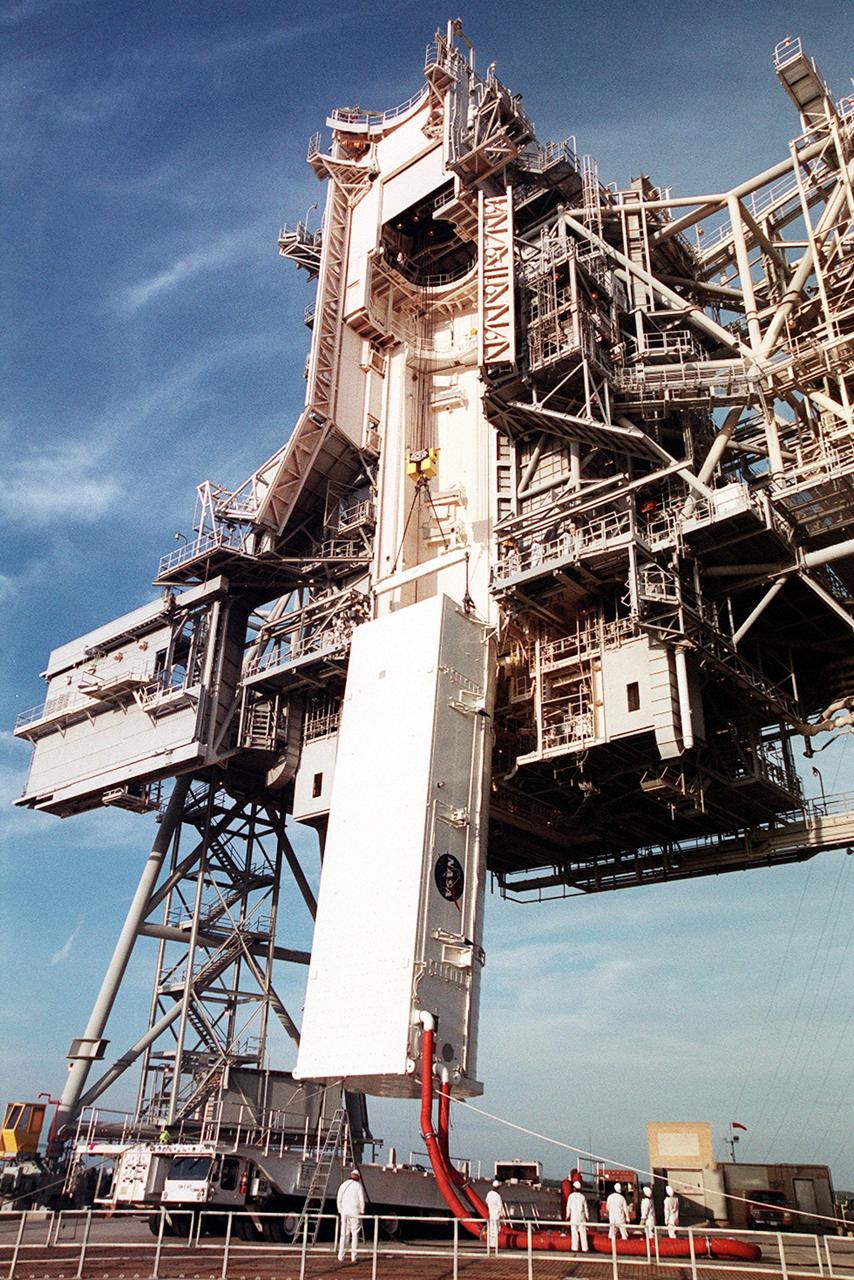
KENNEDY SPACE CENTER, FLA. -- On Launch Pad 39B, the payload transport canister, with the P6 integrated truss segment inside, is lifted toward the payload changeout room (PCR). The PCR is the enclosed, environmentally controlled portion of the Rotating Service Structure that supports payload delivery at the pad and subsequent vertical installation in the orbiter payload bay. Attached to the canister are the red umbilical lines that maintain the controlled environment inside. The P6, payload on mission STS-97, comprises Solar Array Wing-3 and the Integrated Electronic Assembly, to be installed on the International Space Station. The Station’s electrical power system will use eight photovoltaic solar arrays, each 112 feet long by 39 feet wide, to convert sunlight to electricity. The solar arrays are mounted on a “blanket” that can be folded like an accordion for delivery. Once in orbit, astronauts will deploy the blankets to their full size. Gimbals will be used to rotate the arrays so that they will face the Sun to provide maximum power to the Space Station. Launch of STS-97 is scheduled for Nov. 30 at 10:06 p.m. EST
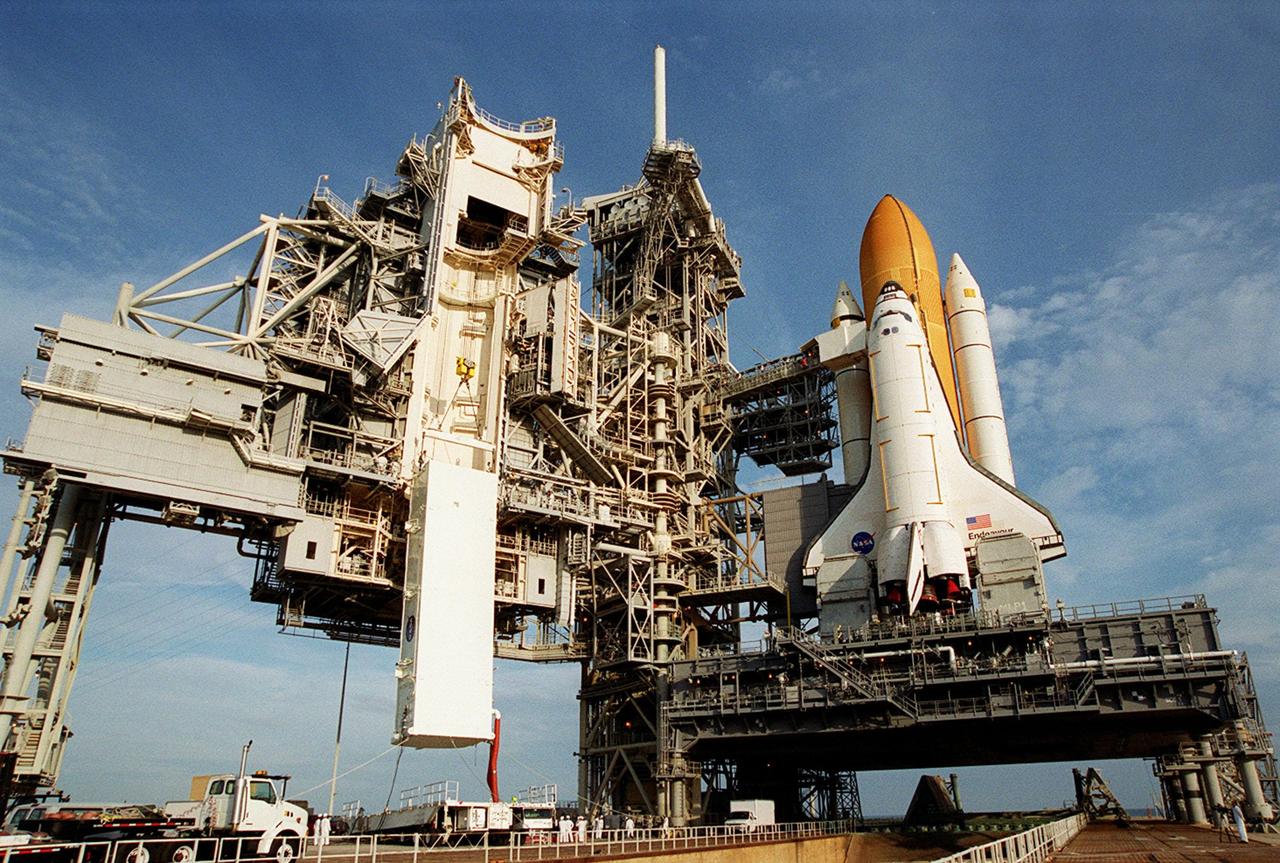
KENNEDY SPACE CENTER, FLA. -- On Launch Pad 39B, the payload transport canister, with the P6 integrated truss segment inside, moves higher toward the payload changeout room (PCR). The PCR is the enclosed, environmentally controlled portion of the Rotating Service Structure (RSS) (at left) that supports payload delivery at the pad. At right is Space Shuttle Endeavour with its orange external tank and solid rocket boosters showing behind it. When the RSS is closed around Endeavour, the P6 truss will be able to be moved into the orbiter’s payload bay. The P6, payload on mission STS-97, comprises Solar Array Wing-3 and the Integrated Electronic Assembly, to be installed on the International Space Station. The Station’s electrical power system will use eight photovoltaic solar arrays, each 112 feet long by 39 feet wide, to convert sunlight to electricity. The solar arrays are mounted on a “blanket” that can be folded like an accordion for delivery. Once in orbit, astronauts will deploy the blankets to their full size. Gimbals will be used to rotate the arrays so that they will face the Sun to provide maximum power to the Space Station. Launch of STS-97 is scheduled for Nov. 30 at 10:06 p.m. EST
![For me, I picked up an interest for engineering through drawing. When I was young, I was really big into art. Like most science-drawn younger kids, I would draw Pokémon, I would draw Dragon Ball Z, things like that. I guess my passion for art and drawing helped me to get into CAD (Computer Aided Design) modeling — things like 3D modeling and 3D printing. And with CAD modeling, you need to learn how to figure out the dimensions of things, what material they’re made out of, xyz. So that got me deeper into engineering. There’s definitely an artistic component to science. You can just look at James Webb [Space Telescope]. It looks artistic. If you look at the beveled mirrors, or how the bat wings on the side fold out, I would argue that that is artistic in a sense. But it also matches perfectly with its scientific functions. So not only does it need to fit into the rocket, but it also needs these beveled mirrors to reflect light at a specific angle. So, I think art and science blend pretty well. Kenneth Harris II, lead database engineer for the Joint Polar Satellite System (JPSS) J2 Satellite Mission at NASA’s Goddard Space Flight Center, Friday, Feb. 21, 2020, Greenbelt, Md. Photo Credit: (NASA/Joel Kowsky)](https://images-assets.nasa.gov/image/NHQ202002210002/NHQ202002210002~medium.jpg)
For me, I picked up an interest for engineering through drawing. When I was young, I was really big into art. Like most science-drawn younger kids, I would draw Pokémon, I would draw Dragon Ball Z, things like that. I guess my passion for art and drawing helped me to get into CAD (Computer Aided Design) modeling — things like 3D modeling and 3D printing. And with CAD modeling, you need to learn how to figure out the dimensions of things, what material they’re made out of, xyz. So that got me deeper into engineering. There’s definitely an artistic component to science. You can just look at James Webb [Space Telescope]. It looks artistic. If you look at the beveled mirrors, or how the bat wings on the side fold out, I would argue that that is artistic in a sense. But it also matches perfectly with its scientific functions. So not only does it need to fit into the rocket, but it also needs these beveled mirrors to reflect light at a specific angle. So, I think art and science blend pretty well. Kenneth Harris II, lead database engineer for the Joint Polar Satellite System (JPSS) J2 Satellite Mission at NASA’s Goddard Space Flight Center, Friday, Feb. 21, 2020, Greenbelt, Md. Photo Credit: (NASA/Joel Kowsky)
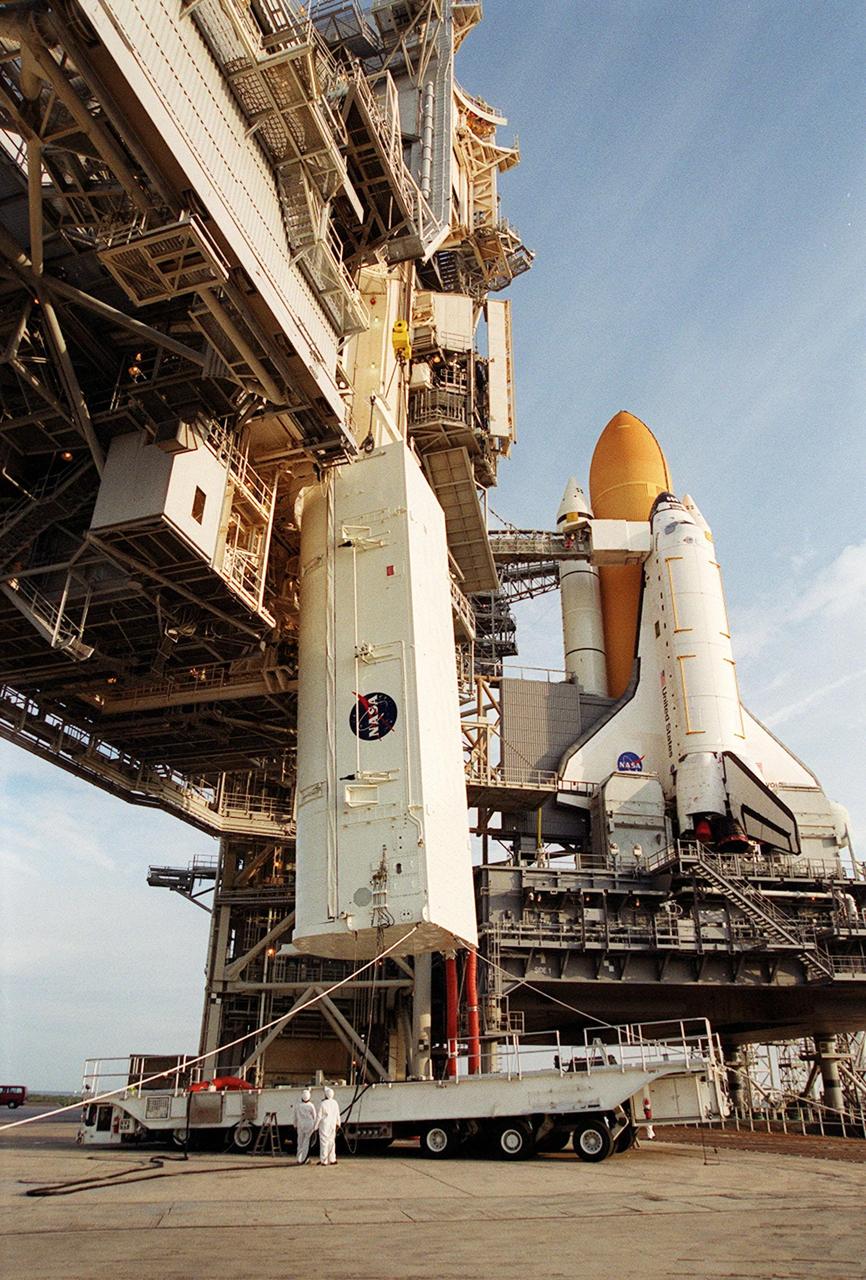
KENNEDY SPACE CENTER, FLA. -- On Launch Pad 39B, the payload transport canister, with the P6 integrated truss segment inside, is lifted toward the payload changeout room (PCR). The PCR is the enclosed, environmentally controlled portion of the Rotating Service Structure (RSS) (on the left) that supports payload delivery at the pad. At right is Space Shuttle Endeavour with its orange external tank and one solid rocket booster showing behind it. When the RSS is closed around Endeavour, the P6 truss will be able to be moved into the orbiter’s payload bay. The P6, payload on mission STS-97, comprises Solar Array Wing-3 and the Integrated Electronic Assembly, to be installed on the International Space Station. The Station’s electrical power system will use eight photovoltaic solar arrays, each 112 feet long by 39 feet wide, to convert sunlight to electricity. The solar arrays are mounted on a “blanket” that can be folded like an accordion for delivery. Once in orbit, astronauts will deploy the blankets to their full size. Gimbals will be used to rotate the arrays so that they will face the Sun to provide maximum power to the Space Station. Launch of STS-97 is scheduled for Nov. 30 at 10:06 p.m. EST
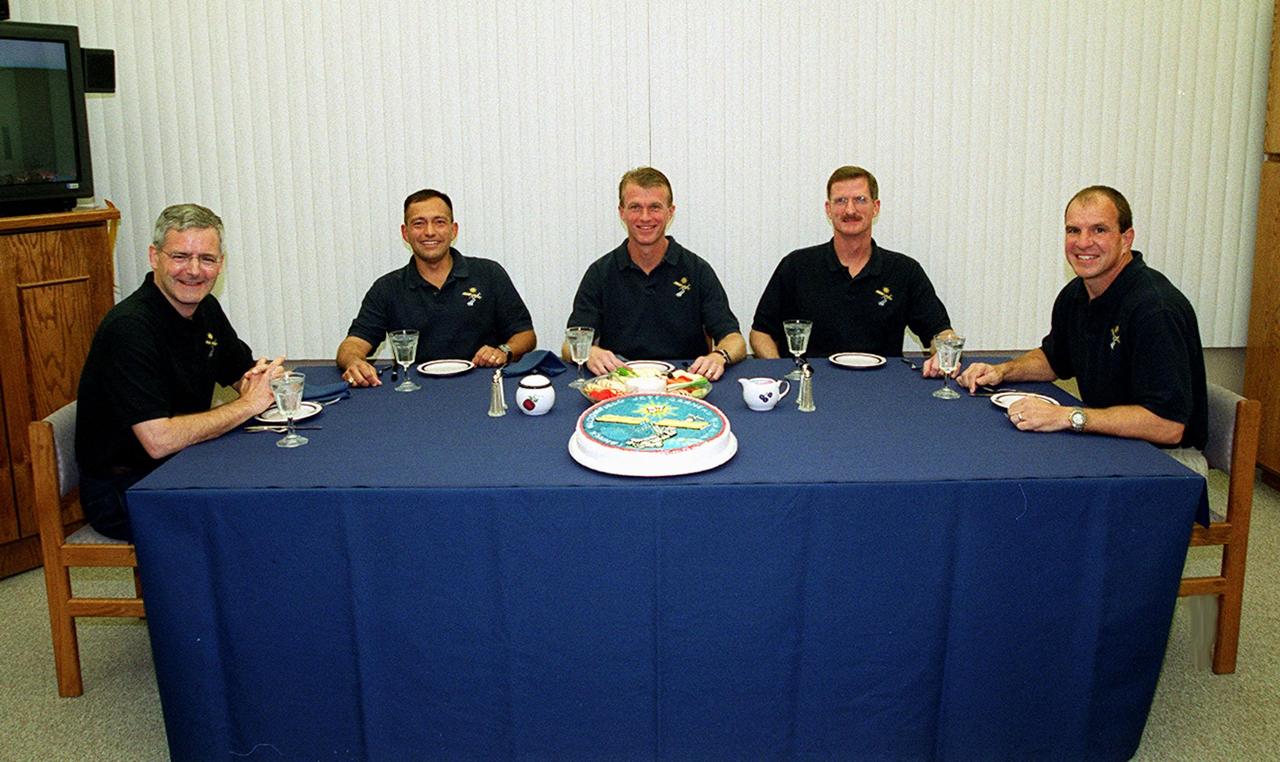
The STS-97 crew are ready to enjoy a snack in the crew quarters, Operations and Checkout Building, before beginning to suit up for launch. Seated from left are Mission Specialists Marc Garneau and Carlos Noriega, Commander Brent Jett, Mission Specialist Joseph Tanner and Pilot Michael Bloomfield. Garneau is with the Canadian Space Agency. Mission STS-97 is the sixth construction flight to the International Space Station. It is transporting the P6 Integrated Truss Structure that comprises Solar Array Wing-3 and the Integrated Electronic Assembly, to be installed on the Space Station. The solar arrays are mounted on a “blanket” that can be folded like an accordion for delivery. Once in orbit, astronauts will deploy the blankets to their full size. The 11-day mission includes two spacewalks to complete the solar array connections. The Station’s electrical power system will use eight photovoltaic solar arrays, each 112 feet long by 39 feet wide, to convert sunlight to electricity.. Gimbals will be used to rotate the arrays so that they will face the Sun to provide maximum power to the Space Station. Launch is scheduled for Nov. 30 at 10:06 p.m. EST
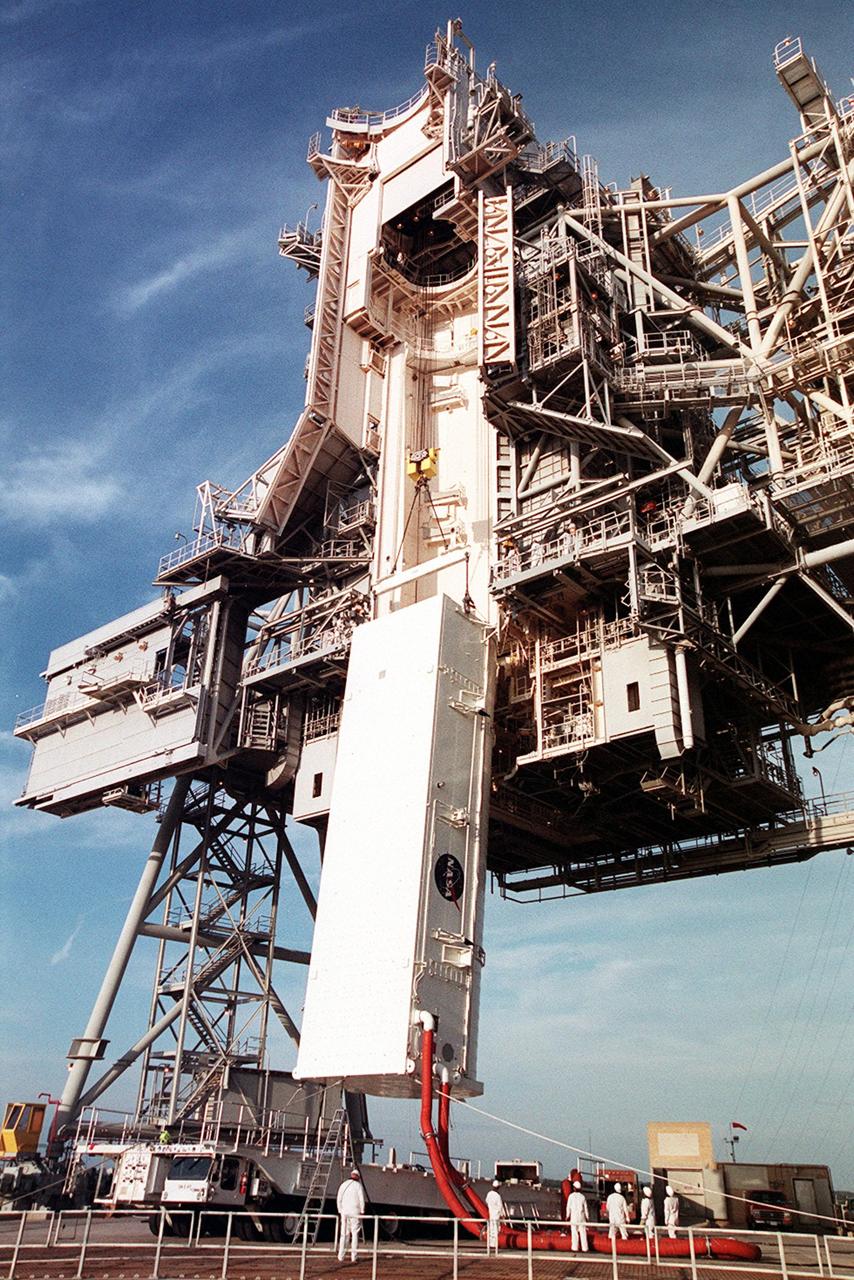
KENNEDY SPACE CENTER, FLA. -- On Launch Pad 39B, the payload transport canister, with the P6 integrated truss segment inside, is lifted toward the payload changeout room (PCR). The PCR is the enclosed, environmentally controlled portion of the Rotating Service Structure that supports payload delivery at the pad and subsequent vertical installation in the orbiter payload bay. Attached to the canister are the red umbilical lines that maintain the controlled environment inside. The P6, payload on mission STS-97, comprises Solar Array Wing-3 and the Integrated Electronic Assembly, to be installed on the International Space Station. The Station’s electrical power system will use eight photovoltaic solar arrays, each 112 feet long by 39 feet wide, to convert sunlight to electricity. The solar arrays are mounted on a “blanket” that can be folded like an accordion for delivery. Once in orbit, astronauts will deploy the blankets to their full size. Gimbals will be used to rotate the arrays so that they will face the Sun to provide maximum power to the Space Station. Launch of STS-97 is scheduled for Nov. 30 at 10:06 p.m. EST
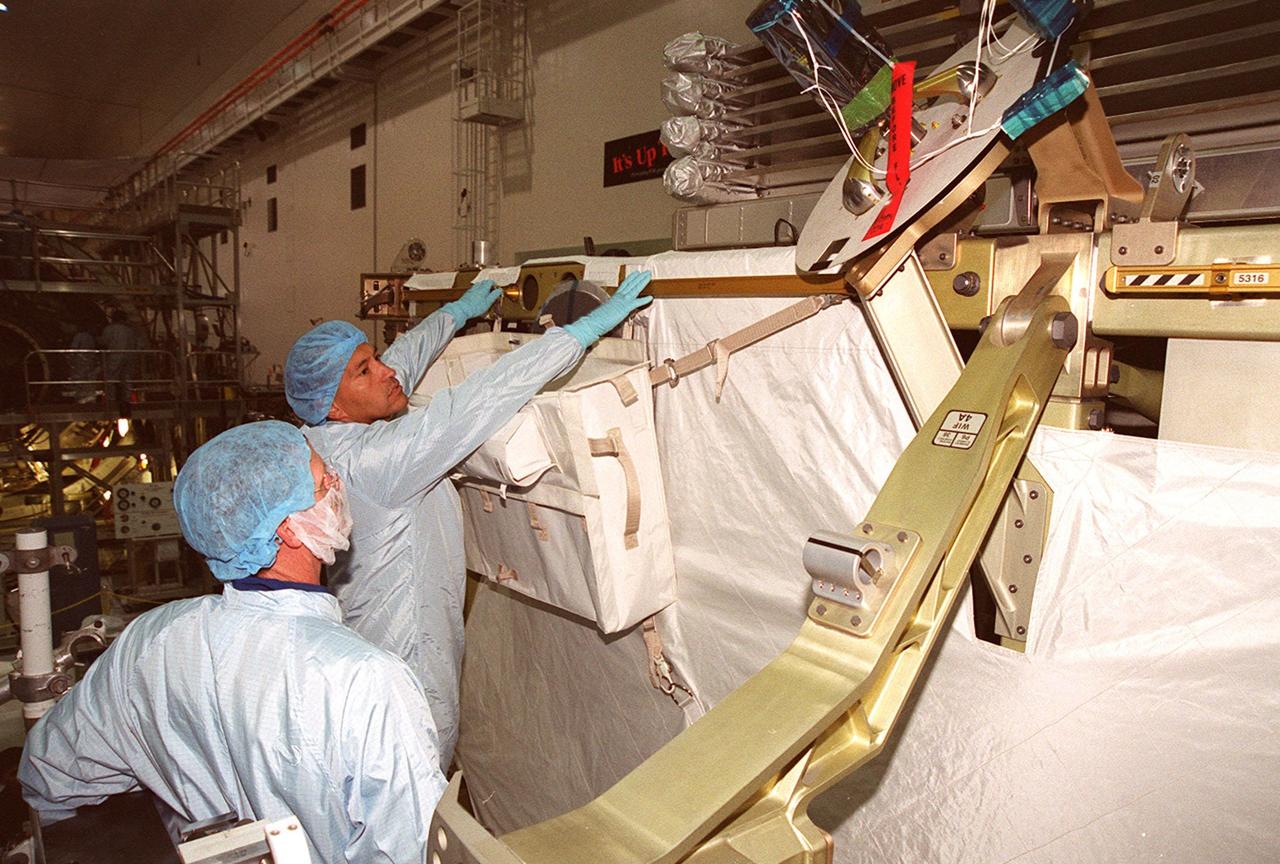
KENNEDY SPACE CENTER, FLA. -- In the Space Station Processing Facility, STS-97 Mission Specialist Carlos Noriega checks out the mission payload, the P6 integrated truss segment, while Mission Specialist Joe Tanner looks on. Mission STS-97 is the sixth construction flight to the International Space Station. The P6 comprises Solar Array Wing-3 and the Integrated Electronic Assembly, to be installed on the International Space Station. The Station’s electrical power system will use eight photovoltaic solar arrays, each 112 feet long by 39 feet wide, to convert sunlight to electricity. The solar arrays are mounted on a “blanket” that can be folded like an accordion for delivery. Once in orbit, astronauts will deploy the blankets to their full size. Gimbals will be used to rotate the arrays so that they will face the Sun to provide maximum power to the Space Station. The mission includes two spacewalks by Noriega and Tanner to complete the solar array connections. STS-97 is scheduled to launch Nov. 30 at about 10:06 p.m. EST
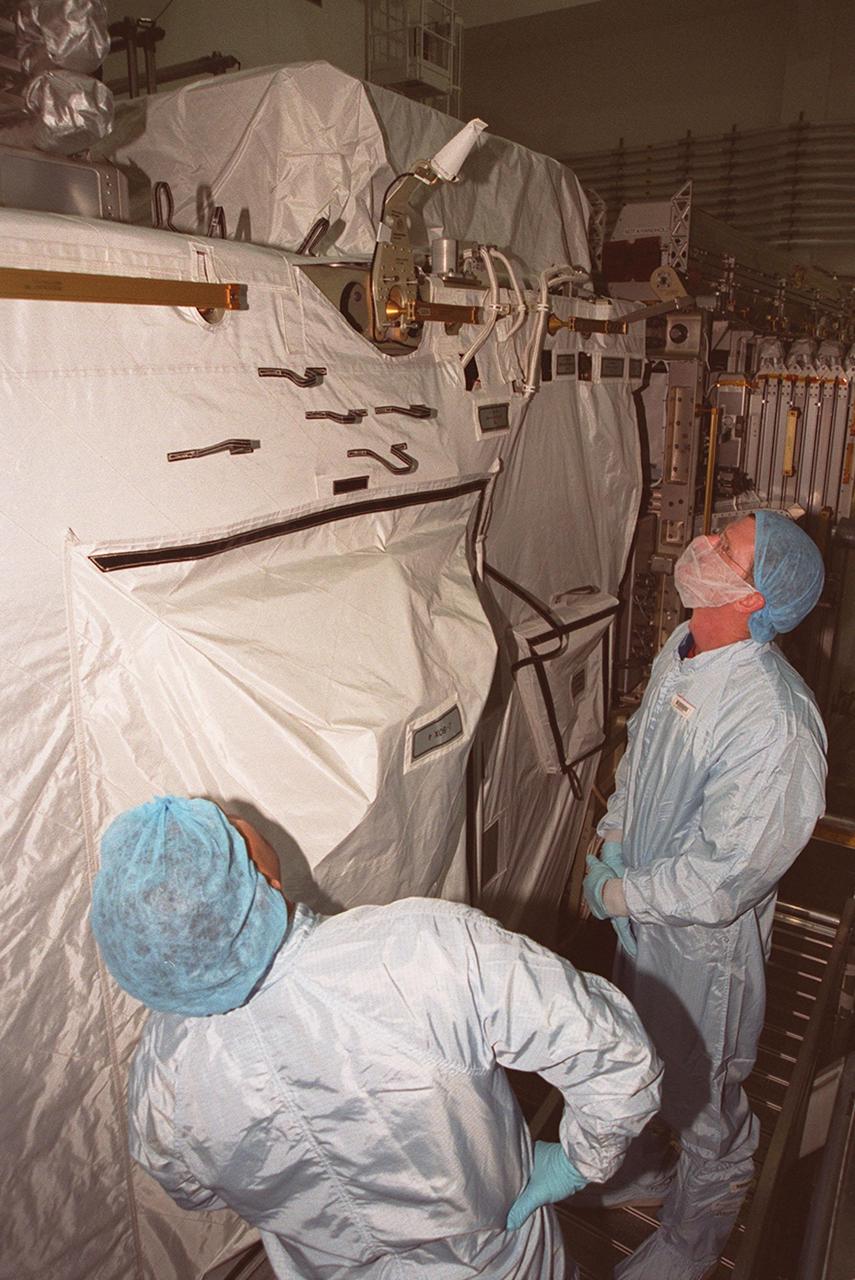
KENNEDY SPACE CENTER, FLA. -- In the Space Station Processing Facility, STS-97 Mission Specialists Carlos Noriega (left) and Joe Tanner check out the mission payload, the P6 integrated truss segment. Mission STS-97 is the sixth construction flight to the International Space Station. The P6 comprises Solar Array Wing-3 and the Integrated Electronic Assembly, to be installed on the International Space Station. The Station’s electrical power system will use eight photovoltaic solar arrays, each 112 feet long by 39 feet wide, to convert sunlight to electricity. The solar arrays are mounted on a “blanket” that can be folded like an accordion for delivery. Once in orbit, astronauts will deploy the blankets to their full size. Gimbals will be used to rotate the arrays so that they will face the Sun to provide maximum power to the Space Station. The mission includes two spacewalks by Noriega and Tanner to complete the solar array connections. STS-97 is scheduled to launch Nov. 30 at about 10:06 p.m. EST
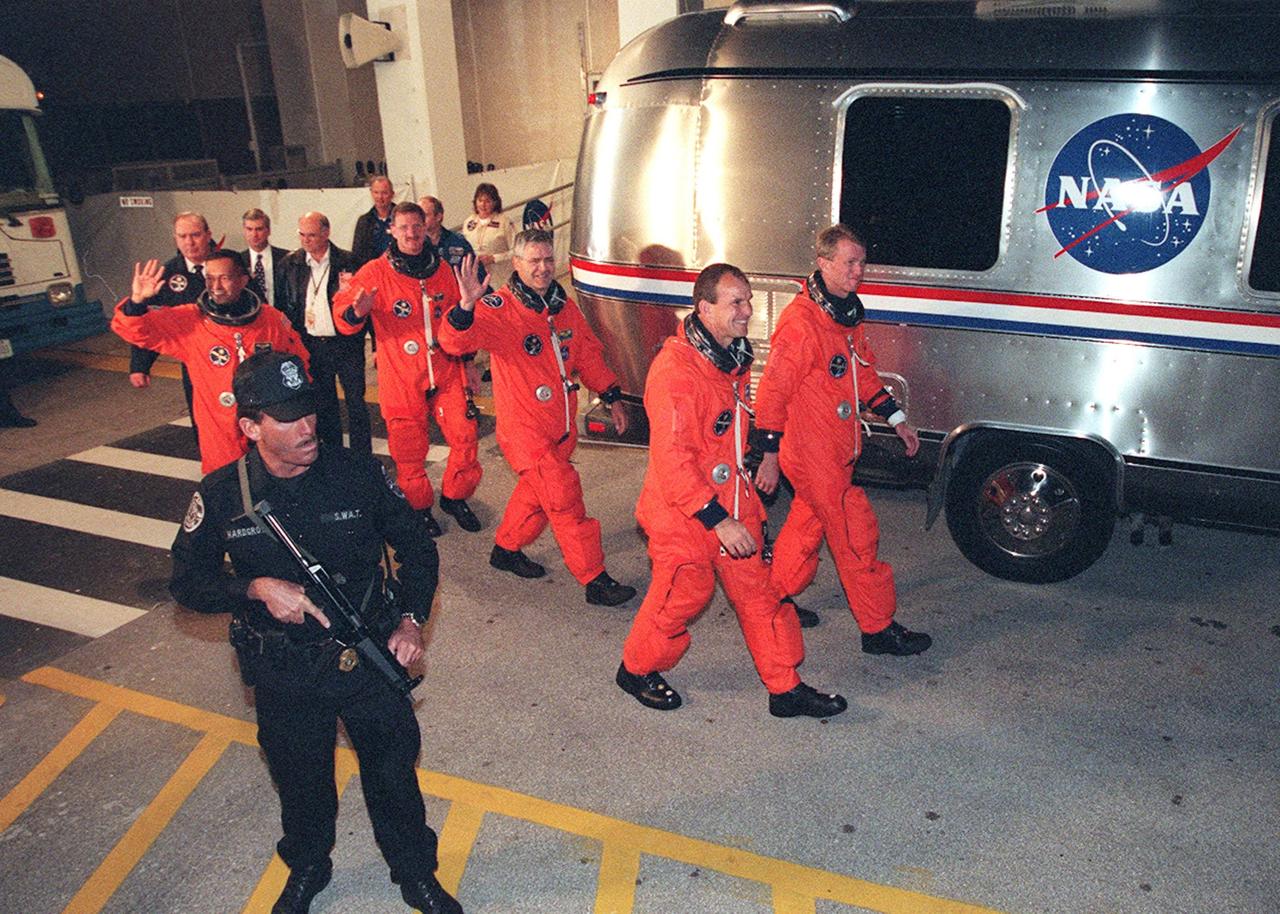
Leaving the Operations and Checkout Building, the STS-97 crew hurries toward the waiting Astrovan that will take them to Launch Pad 39B. Starting at left, they are Mission Specialists Carlos Noriega, Joseph Tanner and Marc Garneau; Pilot Michael Bloomfield; and Commander Brent Jett. Garneau is with the Canadian Space Agency. Mission STS-97 is the sixth construction flight to the International Space Station. It is transporting the P6 Integrated Truss Structure that comprises Solar Array Wing-3 and the Integrated Electronic Assembly, to be installed on the Space Station. The solar arrays are mounted on a “blanket” that can be folded like an accordion for delivery. Once in orbit, astronauts will deploy the blankets to their full size. The 11-day mission includes two spacewalks to complete the solar array connections. The Station’s electrical power system will use eight photovoltaic solar arrays, each 112 feet long by 39 feet wide, to convert sunlight to electricity. Gimbals will be used to rotate the arrays so that they will face the Sun to provide maximum power to the Space Station. Launch is scheduled for Nov. 30 at 10:06 p.m. EST
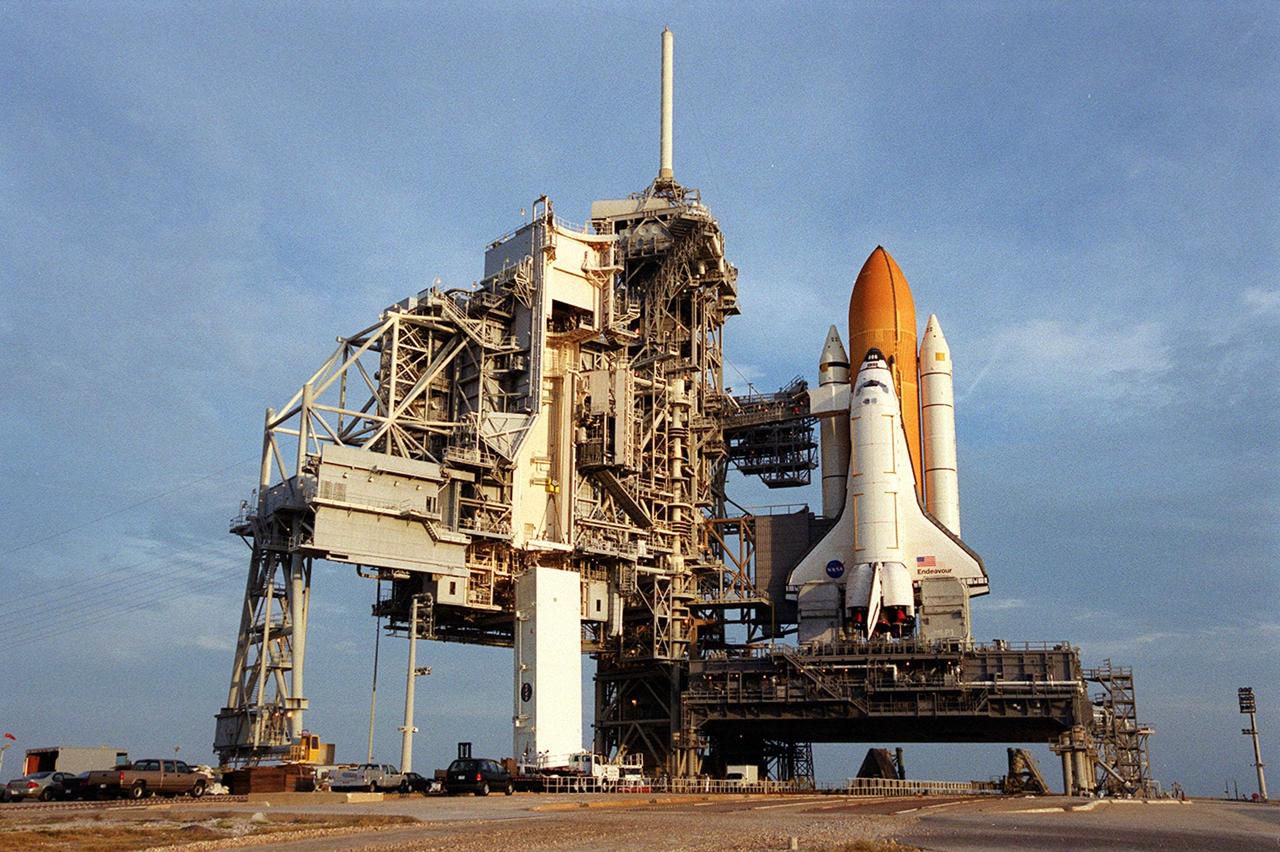
KENNEDY SPACE CENTER, FLA. -- On Launch Pad 39B, the payload transport canister waits at the base of the Rotating Service Structure (RSS) with the P6 integrated truss segment inside. The canister will be lifted up to the payload changeout room (PCR) where the P6 will be removed for transfer to Space Shuttle Endeavour’s payload bay. The PCR is the enclosed, environmentally controlled portion of the RSS that supports payload delivery at the pad and subsequent vertical installation in the orbiter payload bay. The P6, payload on mission STS-97, comprises Solar Array Wing-3 and the Integrated Electronic Assembly, to be installed on the International Space Station. The Station’s electrical power system will use eight photovoltaic solar arrays, each 112 feet long by 39 feet wide, to convert sunlight to electricity. The solar arrays are mounted on a “blanket” that can be folded like an accordion for delivery. Once in orbit, astronauts will deploy the blankets to their full size. Gimbals will be used to rotate the arrays so that they will face the Sun to provide maximum power to the Space Station. Launch of STS-97 is scheduled for Nov. 30 at 10:06 p.m. EST
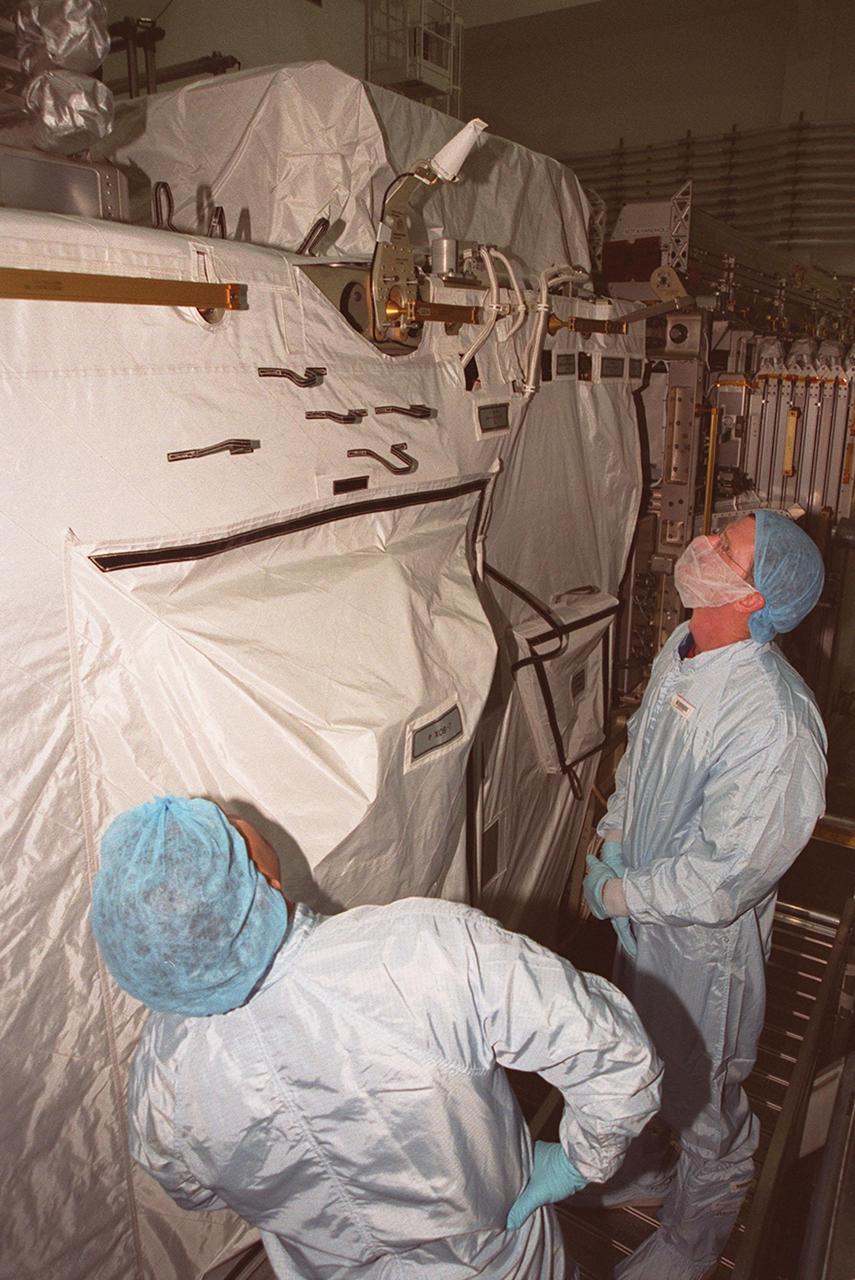
KENNEDY SPACE CENTER, FLA. -- In the Space Station Processing Facility, STS-97 Mission Specialists Carlos Noriega (left) and Joe Tanner check out the mission payload, the P6 integrated truss segment. Mission STS-97 is the sixth construction flight to the International Space Station. The P6 comprises Solar Array Wing-3 and the Integrated Electronic Assembly, to be installed on the International Space Station. The Station’s electrical power system will use eight photovoltaic solar arrays, each 112 feet long by 39 feet wide, to convert sunlight to electricity. The solar arrays are mounted on a “blanket” that can be folded like an accordion for delivery. Once in orbit, astronauts will deploy the blankets to their full size. Gimbals will be used to rotate the arrays so that they will face the Sun to provide maximum power to the Space Station. The mission includes two spacewalks by Noriega and Tanner to complete the solar array connections. STS-97 is scheduled to launch Nov. 30 at about 10:06 p.m. EST
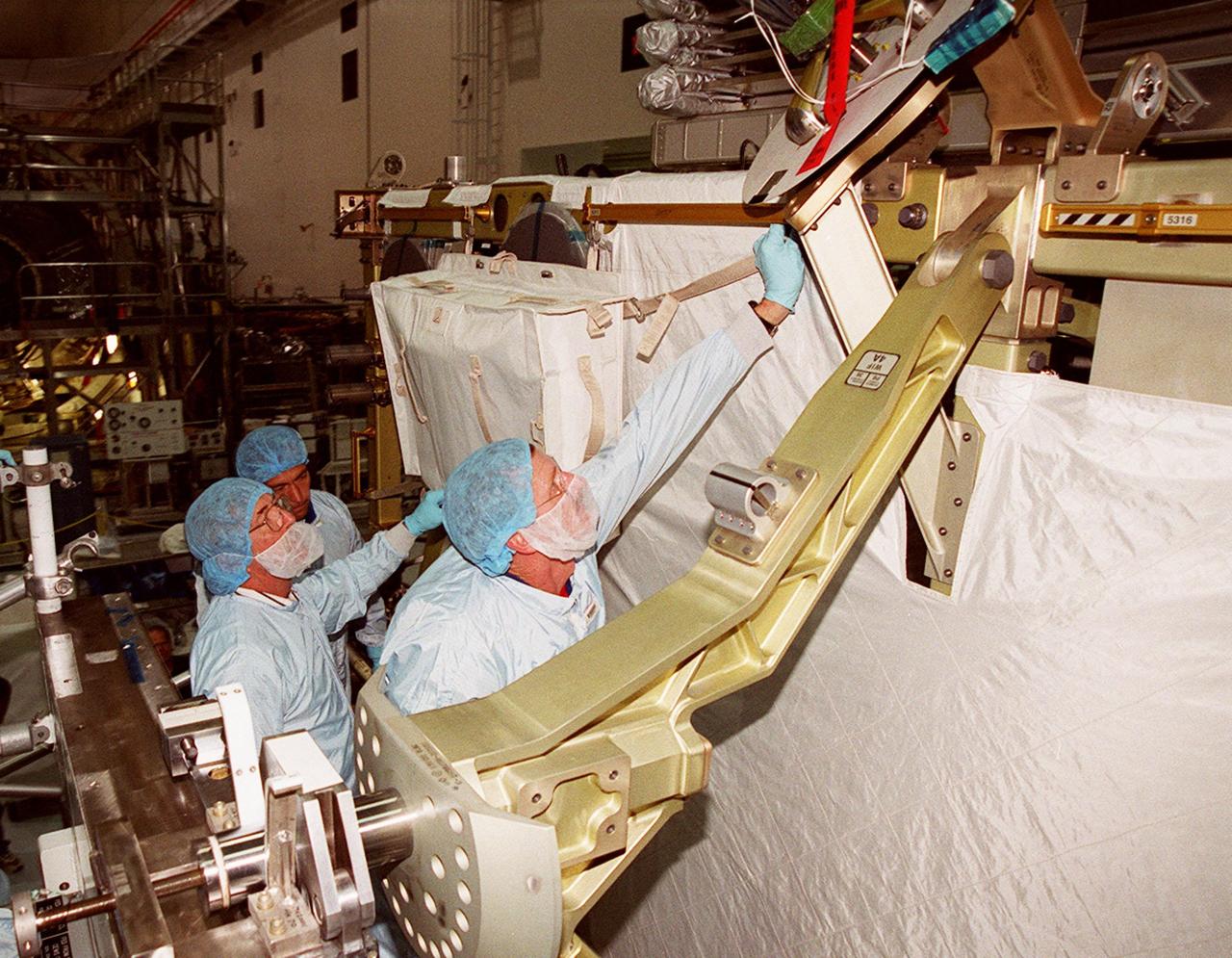
KENNEDY SPACE CENTER, FLA. -- In the Space Station Processing Facility, STS-97 Mission Specialists Carlos Noriega (far left) and Joe Tanner (right) check out the mission payload, the P6 integrated truss segment. Mission STS-97 is the sixth construction flight to the International Space Station. The P6 comprises Solar Array Wing-3 and the Integrated Electronic Assembly, to be installed on the International Space Station. The Station’s electrical power system will use eight photovoltaic solar arrays, each 112 feet long by 39 feet wide, to convert sunlight to electricity. The solar arrays are mounted on a “blanket” that can be folded like an accordion for delivery. Once in orbit, astronauts will deploy the blankets to their full size. Gimbals will be used to rotate the arrays so that they will face the Sun to provide maximum power to the Space Station. The mission includes two spacewalks by Noriega and Tanner to complete the solar array connections. STS-97 is scheduled to launch Nov. 30 at about 10:06 p.m. EST
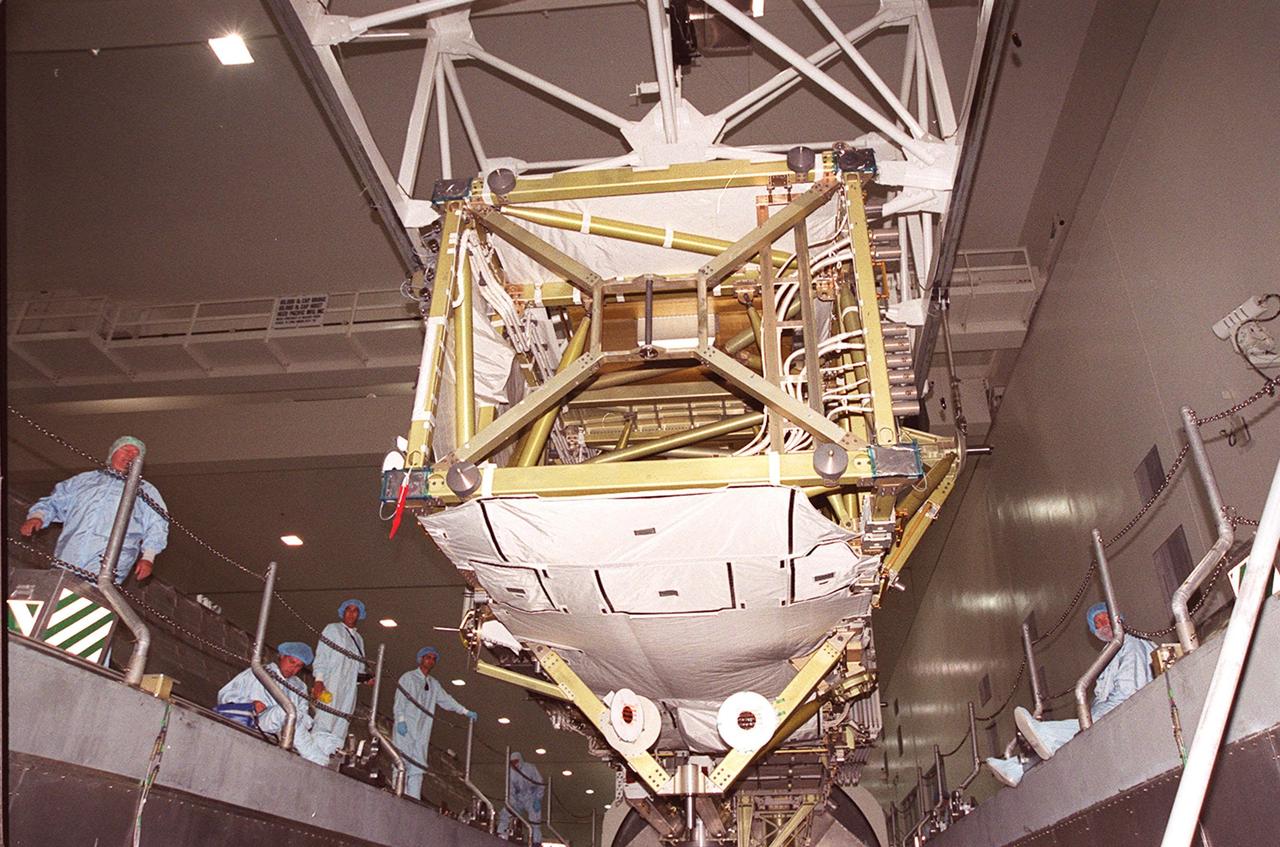
KENNEDY SPACE CENTER, FLA. -- Workers in the Space Station Processing Facility line up on the sides of the payload transport canister as an overhead crane moves the P6 integrated truss segment into position above it. After being placed in the canister, the truss will be transported to Launch Pad 39B and the payload changeout room. Then it will be moved into Space Shuttle Endeavour’s payload bay for mission STS-97. The P6 comprises Solar Array Wing-3 and the Integrated Electronic Assembly, to be installed on the Space Station. The Station’s electrical power system will use eight photovoltaic solar arrays, each 112 feet long by 39 feet wide, to convert sunlight to electricity. The solar arrays are mounted on a “blanket” that can be folded like an accordion for delivery. Once in orbit, astronauts will deploy the blankets to their full size. Gimbals will be used to rotate the arrays so that they will face the Sun to provide maximum power to the Space Station. The STS-97 launch is scheduled Nov. 30 at 10:06 p.m. EST
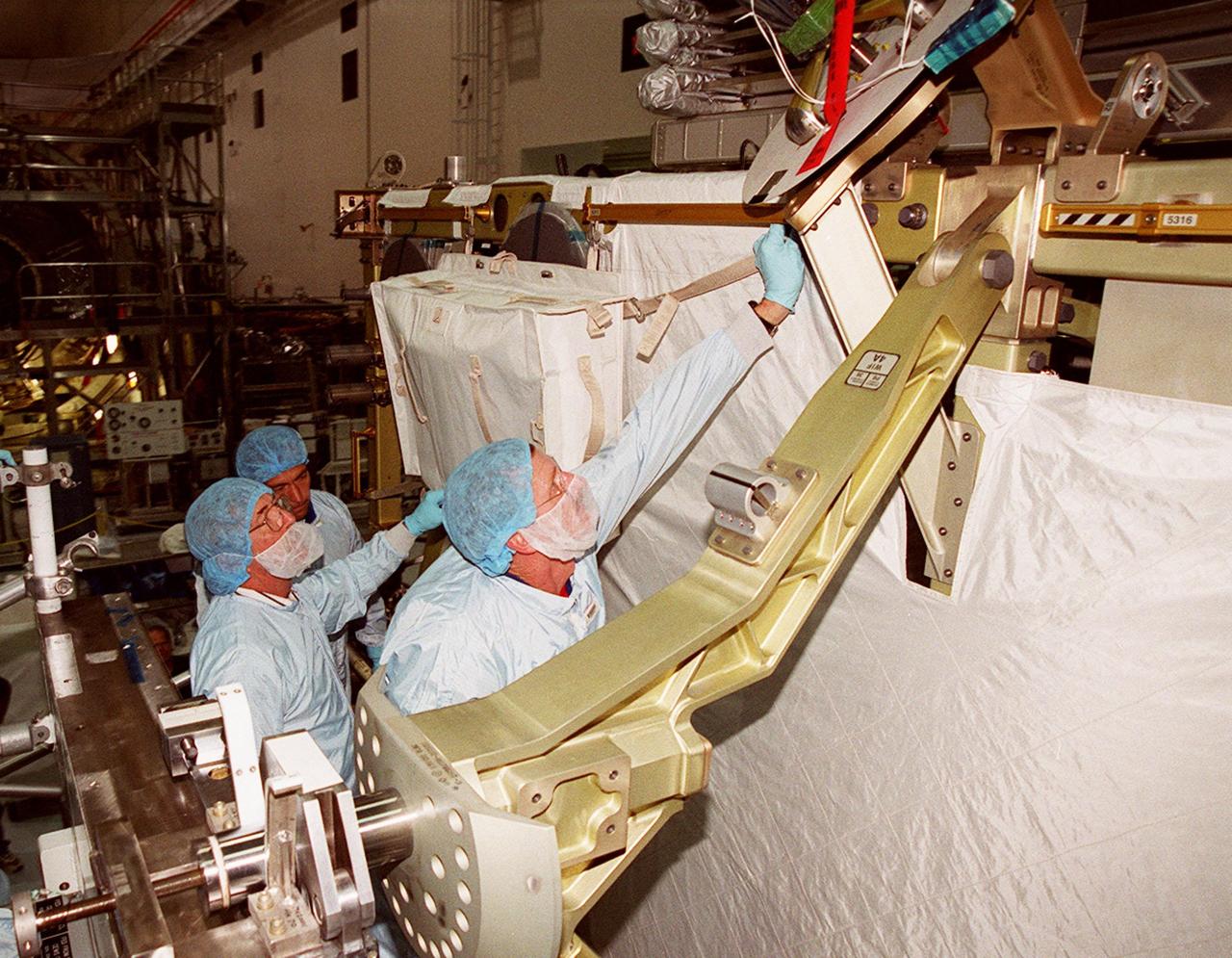
KENNEDY SPACE CENTER, FLA. -- In the Space Station Processing Facility, STS-97 Mission Specialists Carlos Noriega (far left) and Joe Tanner (right) check out the mission payload, the P6 integrated truss segment. Mission STS-97 is the sixth construction flight to the International Space Station. The P6 comprises Solar Array Wing-3 and the Integrated Electronic Assembly, to be installed on the International Space Station. The Station’s electrical power system will use eight photovoltaic solar arrays, each 112 feet long by 39 feet wide, to convert sunlight to electricity. The solar arrays are mounted on a “blanket” that can be folded like an accordion for delivery. Once in orbit, astronauts will deploy the blankets to their full size. Gimbals will be used to rotate the arrays so that they will face the Sun to provide maximum power to the Space Station. The mission includes two spacewalks by Noriega and Tanner to complete the solar array connections. STS-97 is scheduled to launch Nov. 30 at about 10:06 p.m. EST
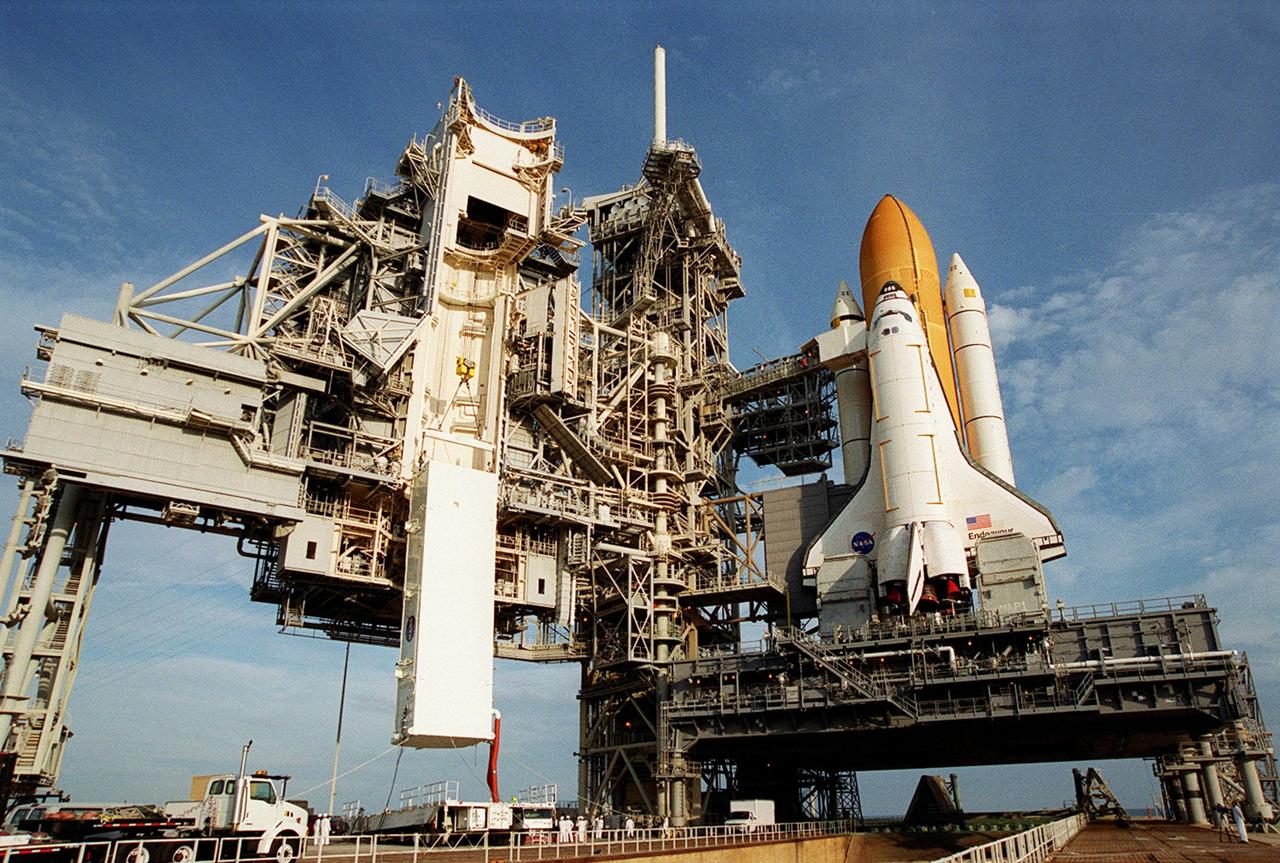
KENNEDY SPACE CENTER, FLA. -- On Launch Pad 39B, the payload transport canister, with the P6 integrated truss segment inside, moves higher toward the payload changeout room (PCR). The PCR is the enclosed, environmentally controlled portion of the Rotating Service Structure (RSS) (at left) that supports payload delivery at the pad. At right is Space Shuttle Endeavour with its orange external tank and solid rocket boosters showing behind it. When the RSS is closed around Endeavour, the P6 truss will be able to be moved into the orbiter’s payload bay. The P6, payload on mission STS-97, comprises Solar Array Wing-3 and the Integrated Electronic Assembly, to be installed on the International Space Station. The Station’s electrical power system will use eight photovoltaic solar arrays, each 112 feet long by 39 feet wide, to convert sunlight to electricity. The solar arrays are mounted on a “blanket” that can be folded like an accordion for delivery. Once in orbit, astronauts will deploy the blankets to their full size. Gimbals will be used to rotate the arrays so that they will face the Sun to provide maximum power to the Space Station. Launch of STS-97 is scheduled for Nov. 30 at 10:06 p.m. EST