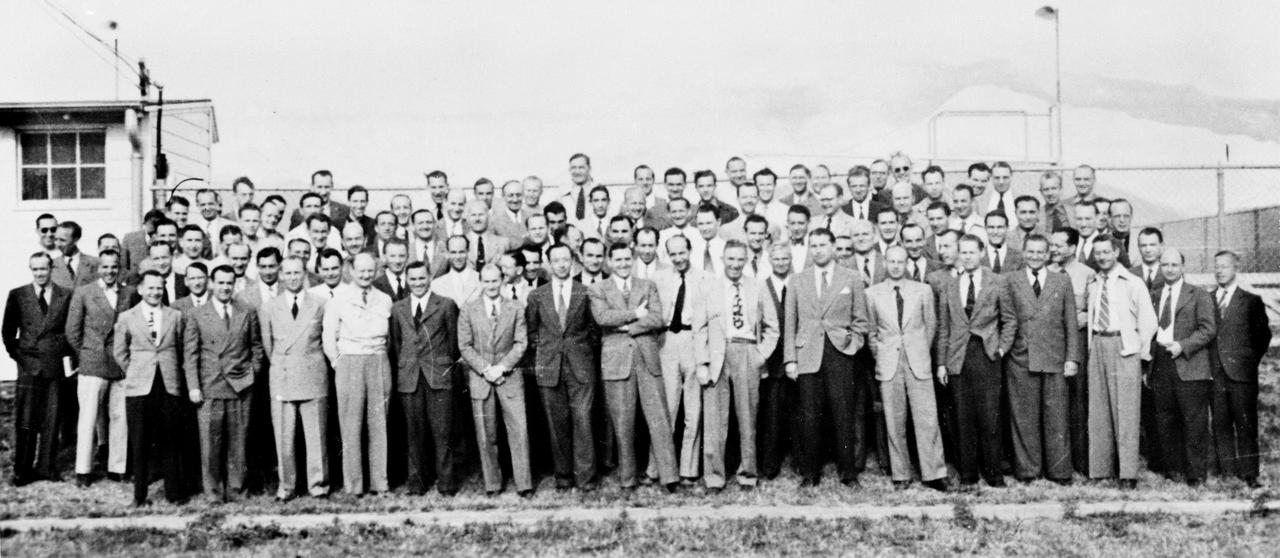
The German Rocket Team, also known as the Von Braun Rocket Team, poses for a group photograph at Fort Bliss, Texas. After World War II ended in 1945, Dr. Wernher von Braun led some 120 of his Peenemuende Colleagues, who developed the V-2 rocket for the German military during the War, to the United Sttes under a contract to the U.S. Army Corps as part of Operation Paperclip. During the following five years the team worked on high altitude firings of the captured V-2 rockets at the White Sands Missile Range in New Mexico, and a guided missile development unit at Fort Bliss, Texas. In April 1950, the group was transferred to the Army Ballistic Missile Agency (ABMA) at Redstone Arsenal in Huntsville, Alabama, and continued to work on the development of the guided missiles for the U.S. Army until transferring to a newly established field center of the National Aeronautic and Space Administration (NASA), George C. Marshall Space Flight Center (MSFC).
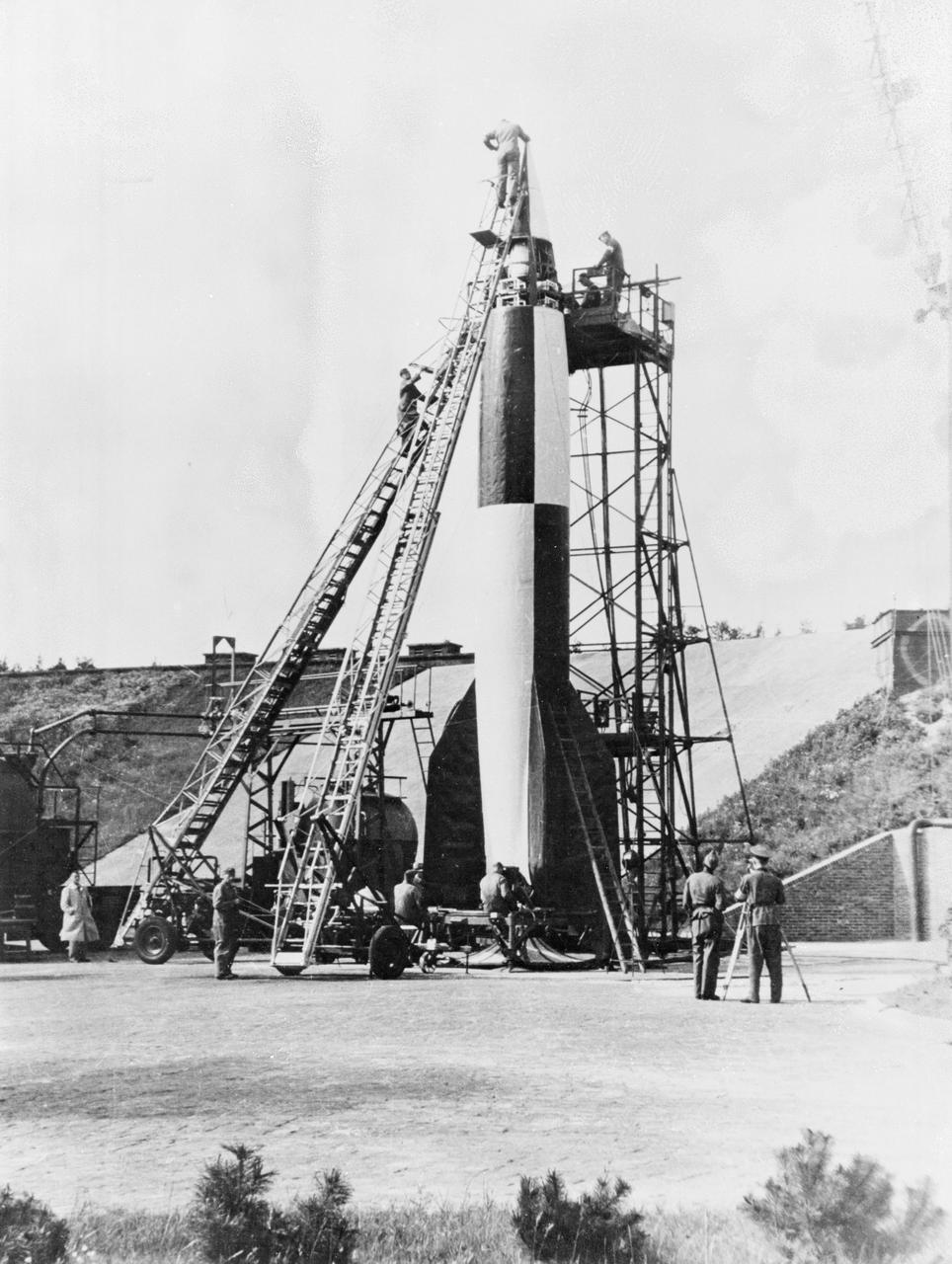
German technicians stack the various stages of the V-2 rocket in this undated photograph. The team of German engineers and scientists who developed the V-2 came to the United States at the end of World War II and worked for the U. S. Army at Fort Bliss, Texas, and Redstone Arsenal in Huntsville, Alabama.
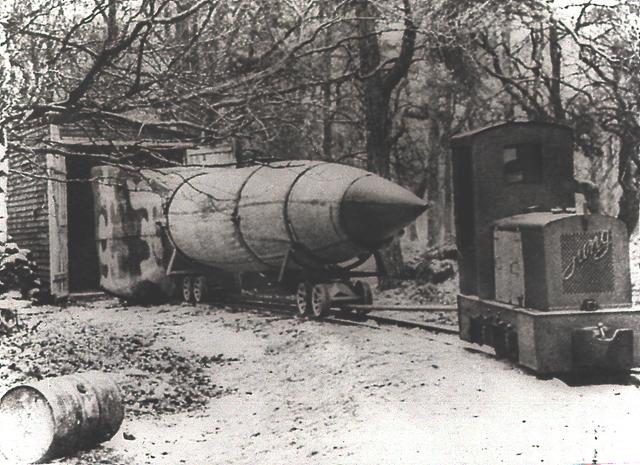
In this undated file photo, probably from World War II, a V-2 rocket emerges from its camouflaged shelter. The team of German engineers and scientists who developed the V-2 came to the United States after World War II and worked for the U. S. Army at Fort Bliss, Texas and Redstone Arsenal in Huntsville, Alabama.
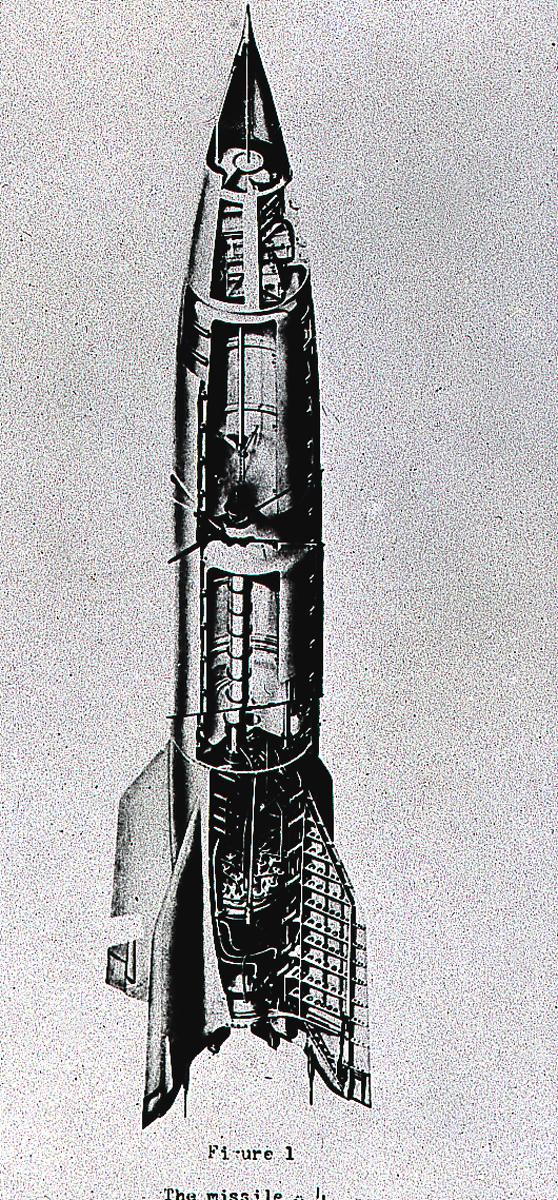
The cutaway drawing of the A-4 (Aggregate-4) rocket. Later renamed the V-2 (Vengeance Weapon-2), The rocket was developed by Dr. Wernher von Braun and the German rocket team at Peenemuende, Germany on the Baltic Sea. At the end of World War II, the team of German engineers and scientists came to the United States and continued rocket research for the Army at Fort Bliss, Texas, and Redstone Arsenal in Huntsville, Alabama.
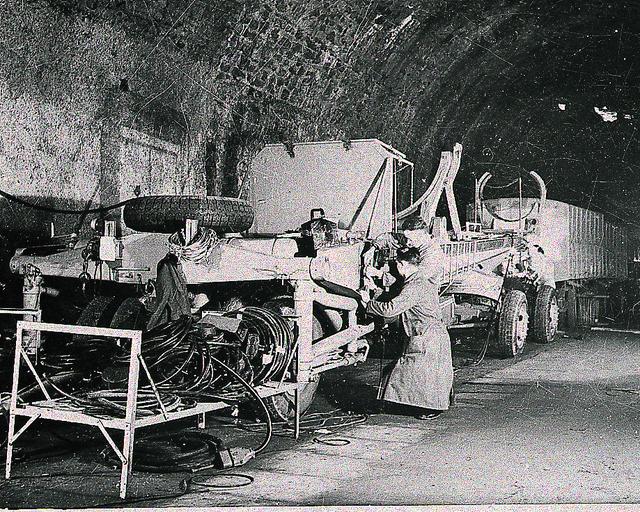
In this photograph from the fall of 1943, German technicians wire vehicles for mobile V-2 batteries in an abandoned railroad turnel in the Rhineland. The team of German engineers and scientists who developed the V-2 came to the United States at the end of World War II and worked for the U. S. Army at Fort Bliss, Texas, and Redstone Arsenal in Huntsville, Alabama.
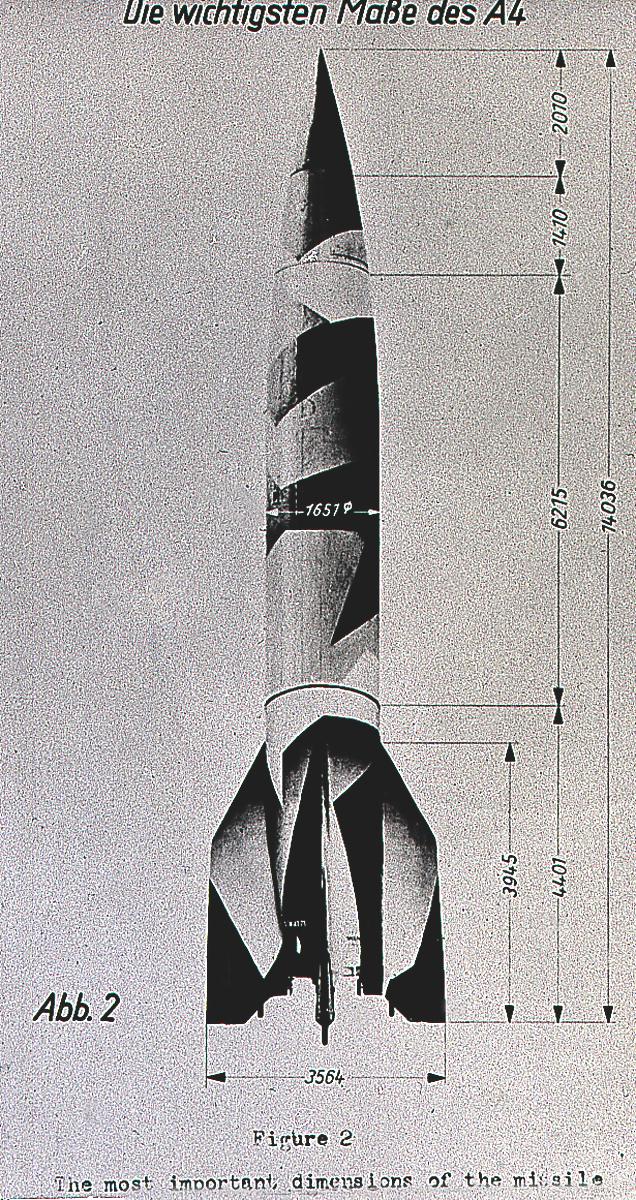
This drawing illustrates the vital dimensions of the A-4 (Aggregate-4). Later renamed the V-2 (Vengeance Weapon-2), the rocket was developed by Dr. Wernher von Braun and the German rocket team at Peenemuende, Germany on the Baltic Sea. At the end of World War II, the team of German engineers and scientists came to the United States and continued rocket research for the Army at Fort Bliss, Texas, and Redstone Arsenal in Huntsville, Alabama.
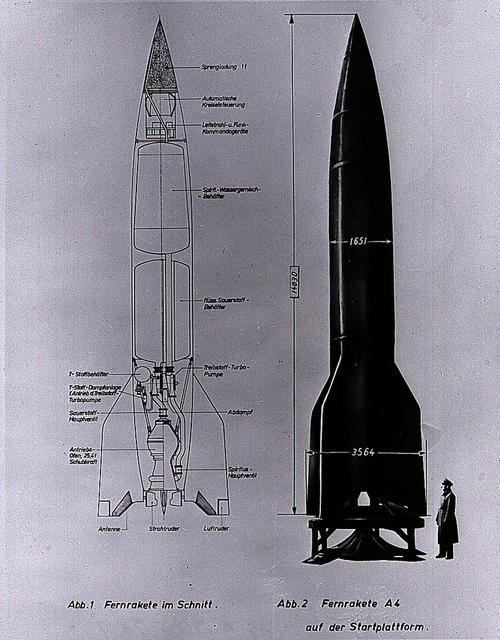
This German cutaway drawing of the Aggregate-4 (A-4) illustrates the dimensions and internal workings of the rocket. Later renamed the V-2, the rocket was developed by Dr. Wernher von Braun and the German Rocket Team at Peenemuende on the Baltic Sea. At the end of World War II, the team of German engineers and scientists came to the United States to work for the Army at Fort Bliss, Texas, and Redstone Arsenal in Huntsville, Alabama.
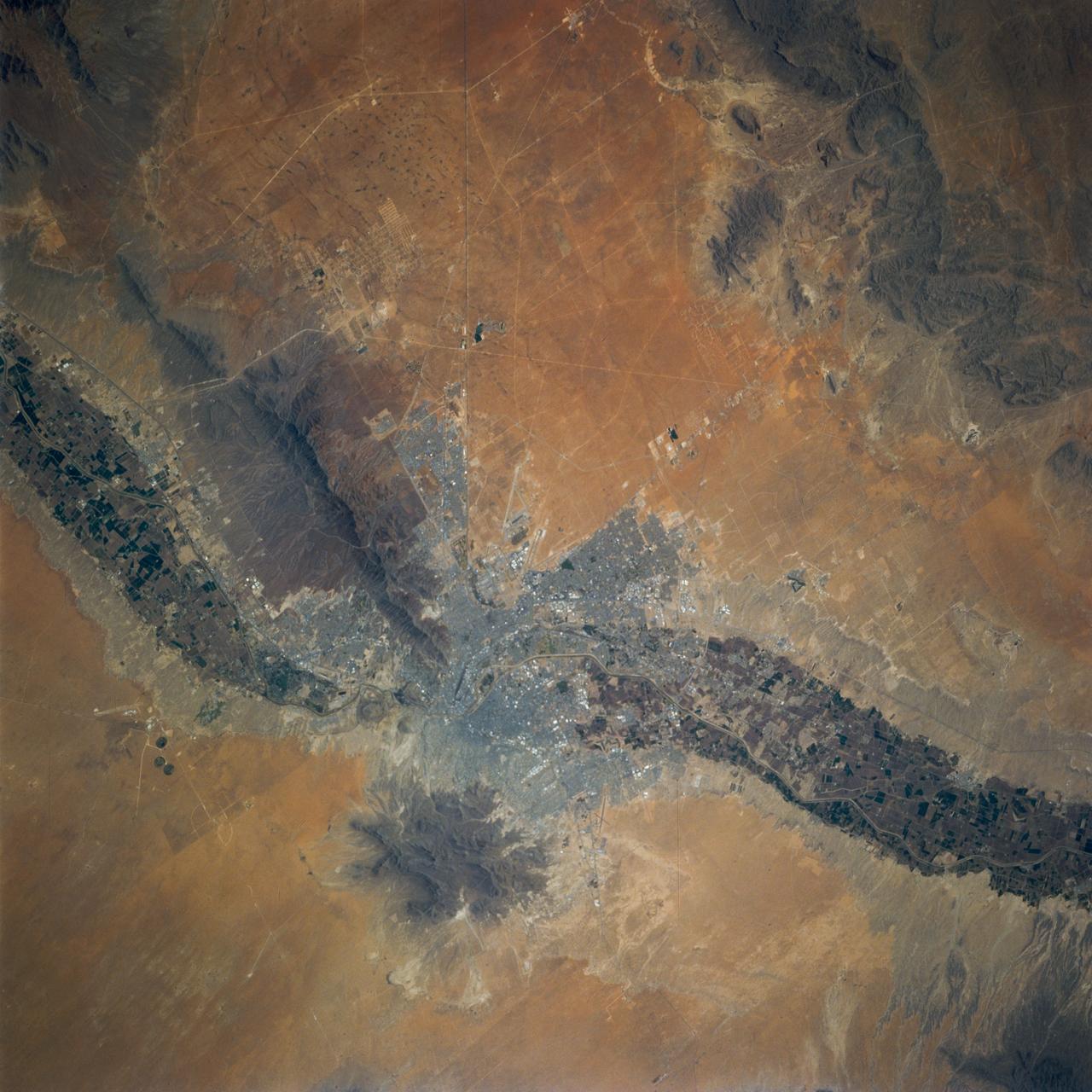
STS077-707-097 (19-29 May 1996) --- This 70mm photograph shows the contrasts between the Chihuahua Desert and the irrigated bottomlands of the Rio Grande. The twin cities of Juarez, Mexico, and El Paso, Texas, on opposite sides of the border are in the center of the frame. The area was first colonized in 1598 making it one of the oldest settlements of Europeans on the North American continent. The name of El Paso derives from the Spanish ?El Paso del Norte.? The City of El Paso became a United States city in 1873. The pass allows passage through the Rocky Mountains in this region. The extension of the Rockies to the northwest of El Paso is known as the Franklin Mountains. Juarez now has over a million people and El Paso has around 400,000. The economy is driven by the maquiladora industries. Fort Bliss on the United States side is a major employer also. Fort Bliss is the wedge shaped feature in El Paso. The post was first established in 1849 for protection from the Comanches and the last horse Calvary unit was disbanded in 1943.
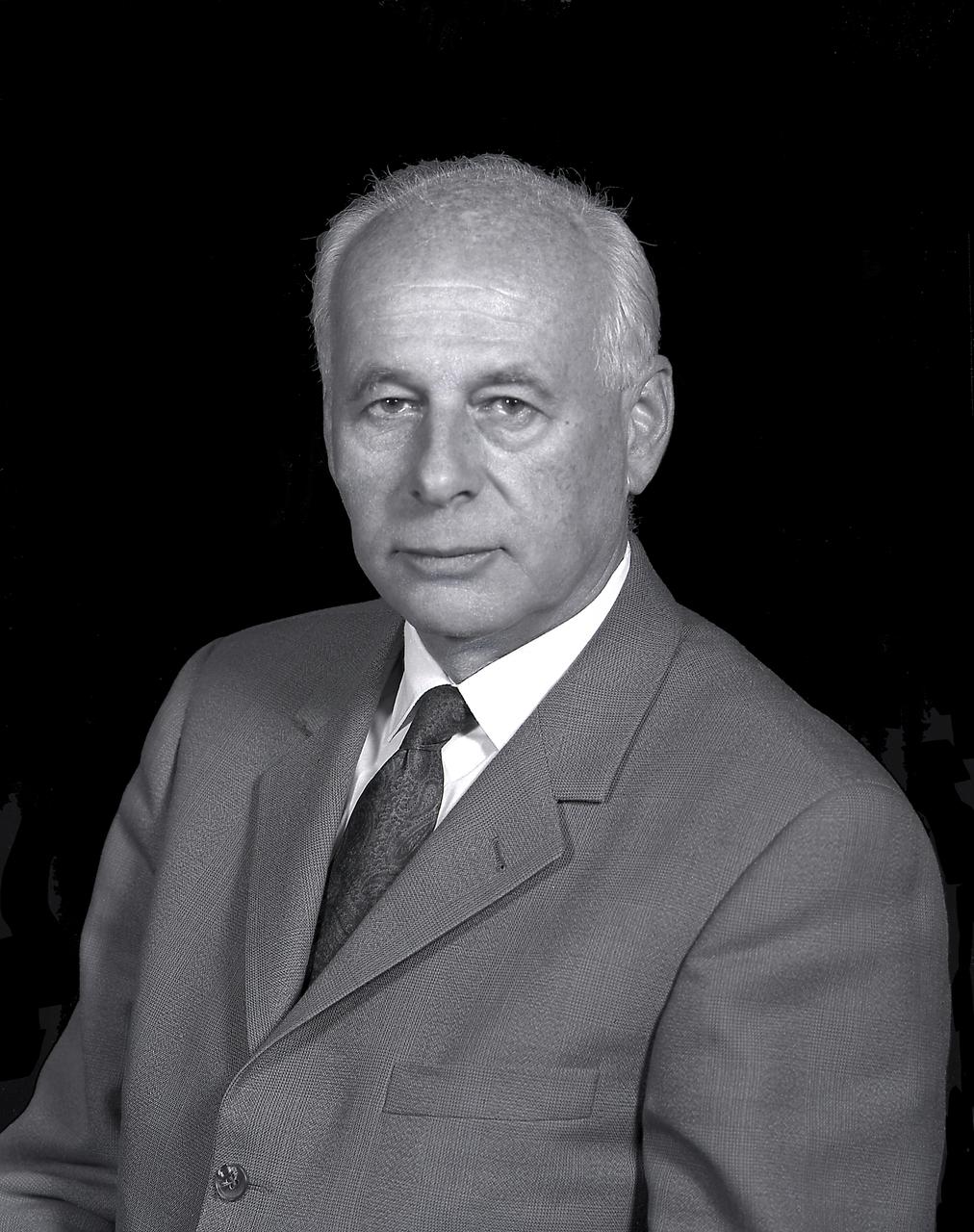
Dr. Eberhard Rees served as director of the Marshall Space Flight Center from March 1, 1970 until January 19, 1973 when he retired from NASA. Prior to his appointment as Director, Rees served as the Center's deputy director under Dr. Wernher von Braun, 1960-1970. Rees came to the United States as part of the Dr. Wernher von Braun's German Rocket team following World War II. He transferred to Huntsville, Alabama from Fort Bliss, Texas in 1950 to work for the Army's rocket program at Redstone Arsenal. From 1956 to 1960 he served as deputy director of development operations at the Army Ballistic Missile Agency under von Braun. In 1960 Rees was transferred to NASA's Marshall Center.