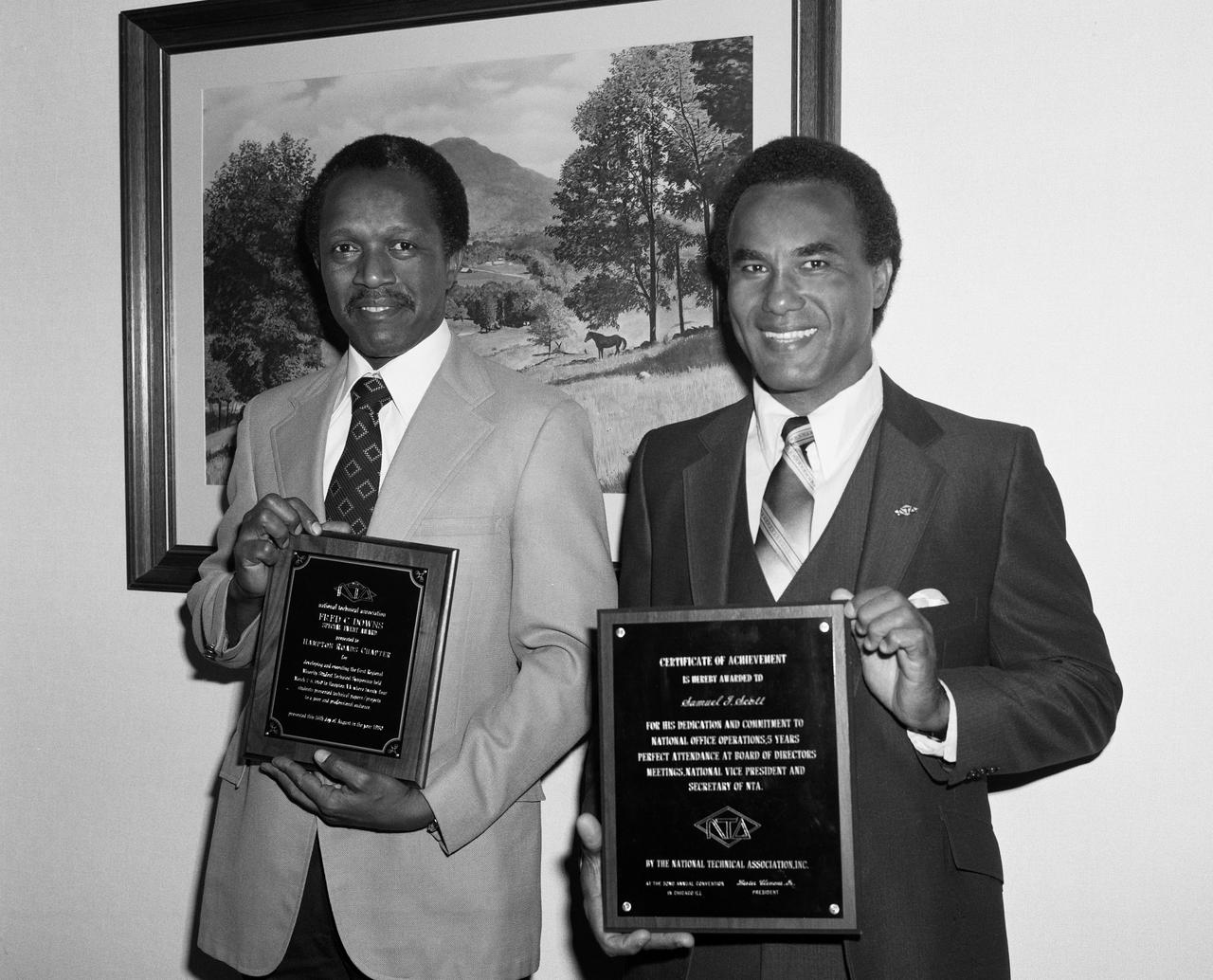
From left to right; Gilbert A. Haynes holding the NTA Fred C. Downs Special Event Award and Samuel J. Scott with award for their participation in the local Hampton Roads Chapter of the (NTA) National Technical Association. The guidance and counseling of minority youth is one of NTA's prime objectives. Formed in 1925, NTA has 15 chapters comprised of architects,engineers, scientists, and educators. NTA activities are directed toward encouraging and assisting public and private institutions in identifying potential minority technical talent.
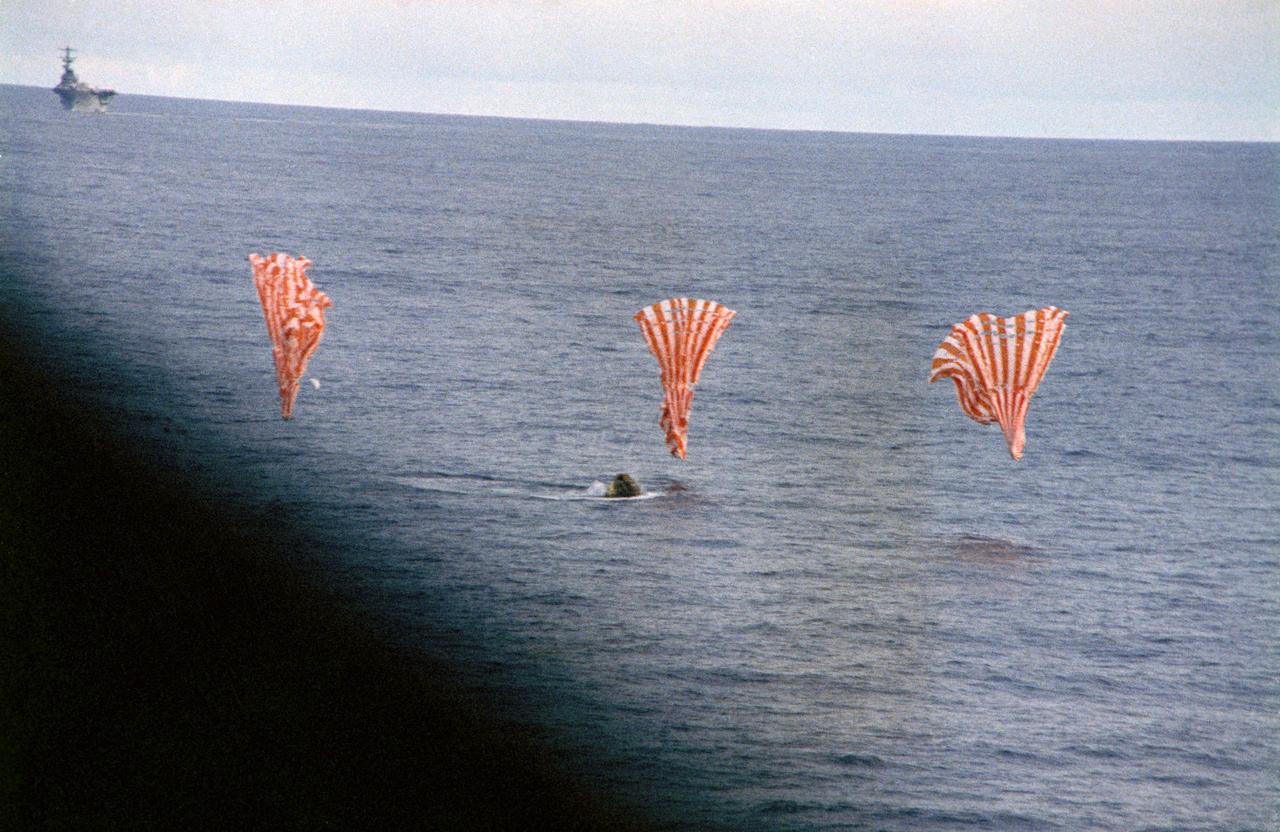
S70-35644 (17 April 1970) --- The Apollo 13 Command Module (CM) splashes down and its three main parachutes collapse, as the week-long problem-plagued Apollo 13 mission comes to a premature, but safe end. The spacecraft, with astronauts James A. Lovell Jr., commander; John L. Swigert Jr., command module pilot; and Fred W. Haise Jr., lunar module pilot, aboard splashed down at 12:07:44 p.m. (CST) April 17, 1970, in the South Pacific Ocean, only about four miles from the USS Iwo Jima, prime recovery ship.
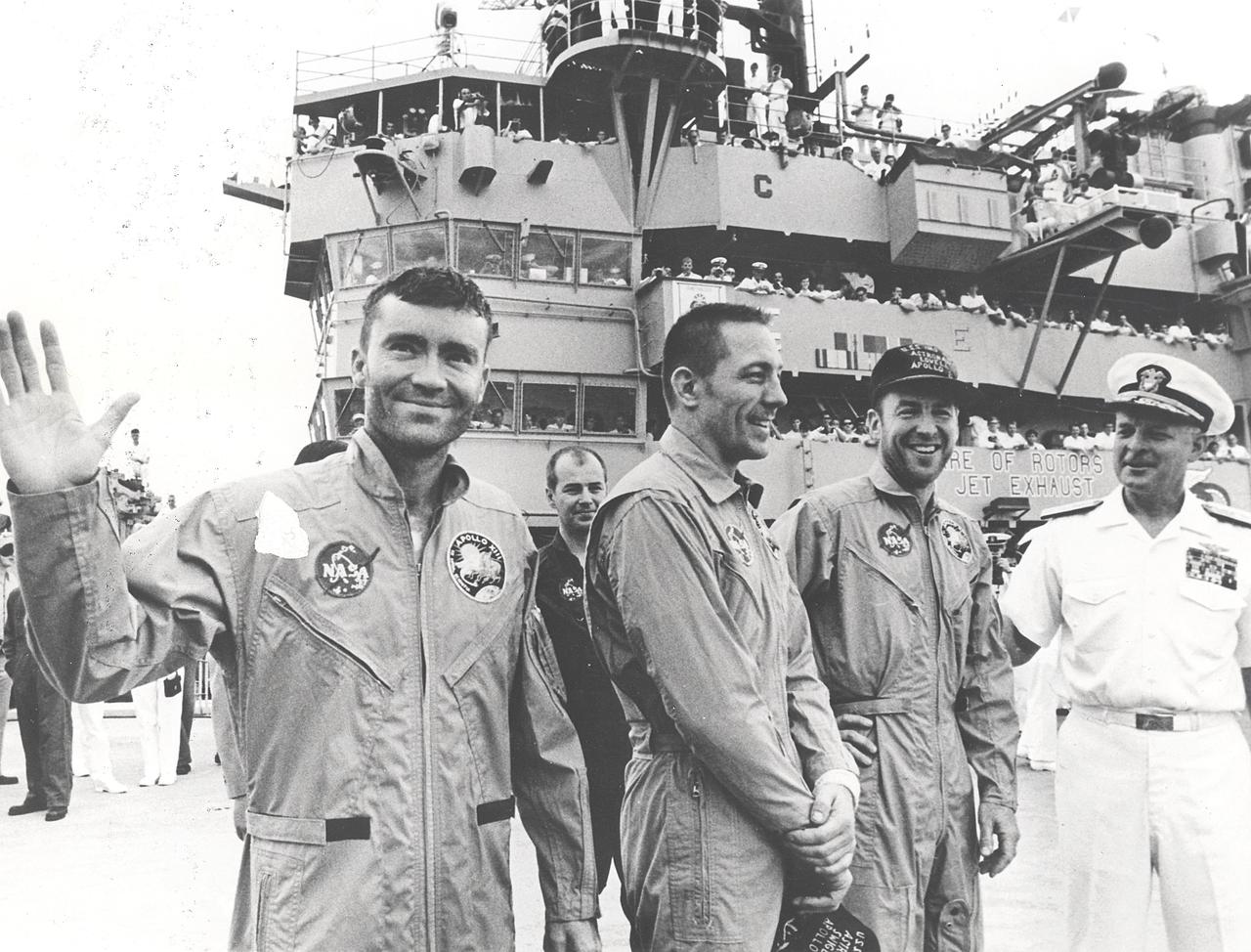
This photograph shows Apollo 13 astronauts Fred Haise, John Swigert, and James Lovell aboard the recovery ship, USS Iwo Jima after safely touching down in the Pacific Ocean at the end of their ill-fated mission. The mission was aborted after 56 hours of flight, 205,000 miles from Earth, when an oxygen tank in the service module exploded. The command module, Odyssey, brought the three astronauts back home safely.
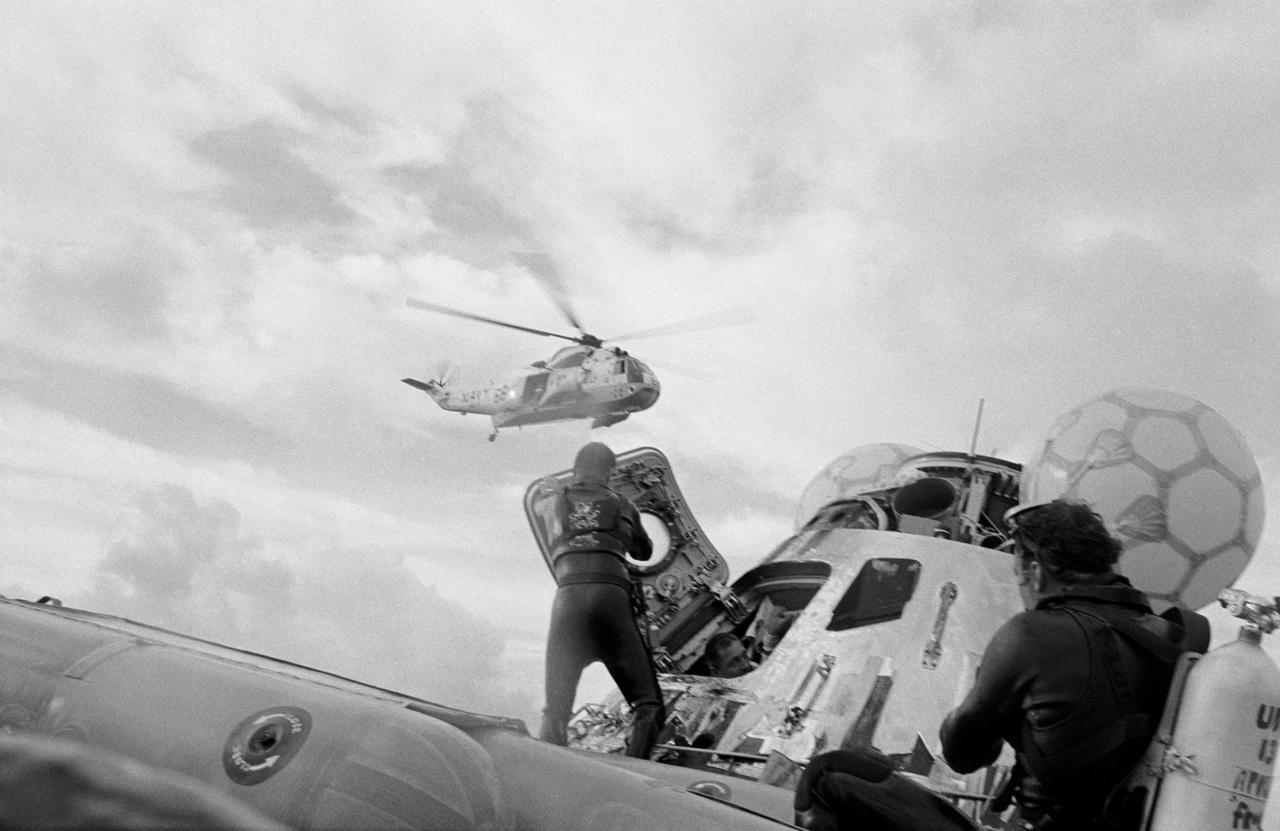
S70-35622 (17 April 1970) --- United States Navy underwater demolition team swimmers assist in the recovery operations of the Apollo 13 crewmembers, shortly after splashdown. The divers prepare to assist the astronauts out of their crippled Command Module (CM), into an awaiting life raft. Astronaut John L. Swigert Jr., command module pilot, is preparing to exit the CM. A Navy helicopter is waiting to take the astronauts to the prime recovery ship, the USS Iwo Jima. Apollo 13 splashed down at 12:07:44 p.m. (CST), April 17, 1970. Still aboard the CM are astronauts James A. Lovell Jr., commander; and Fred W. Haise Jr., lunar module pilot.
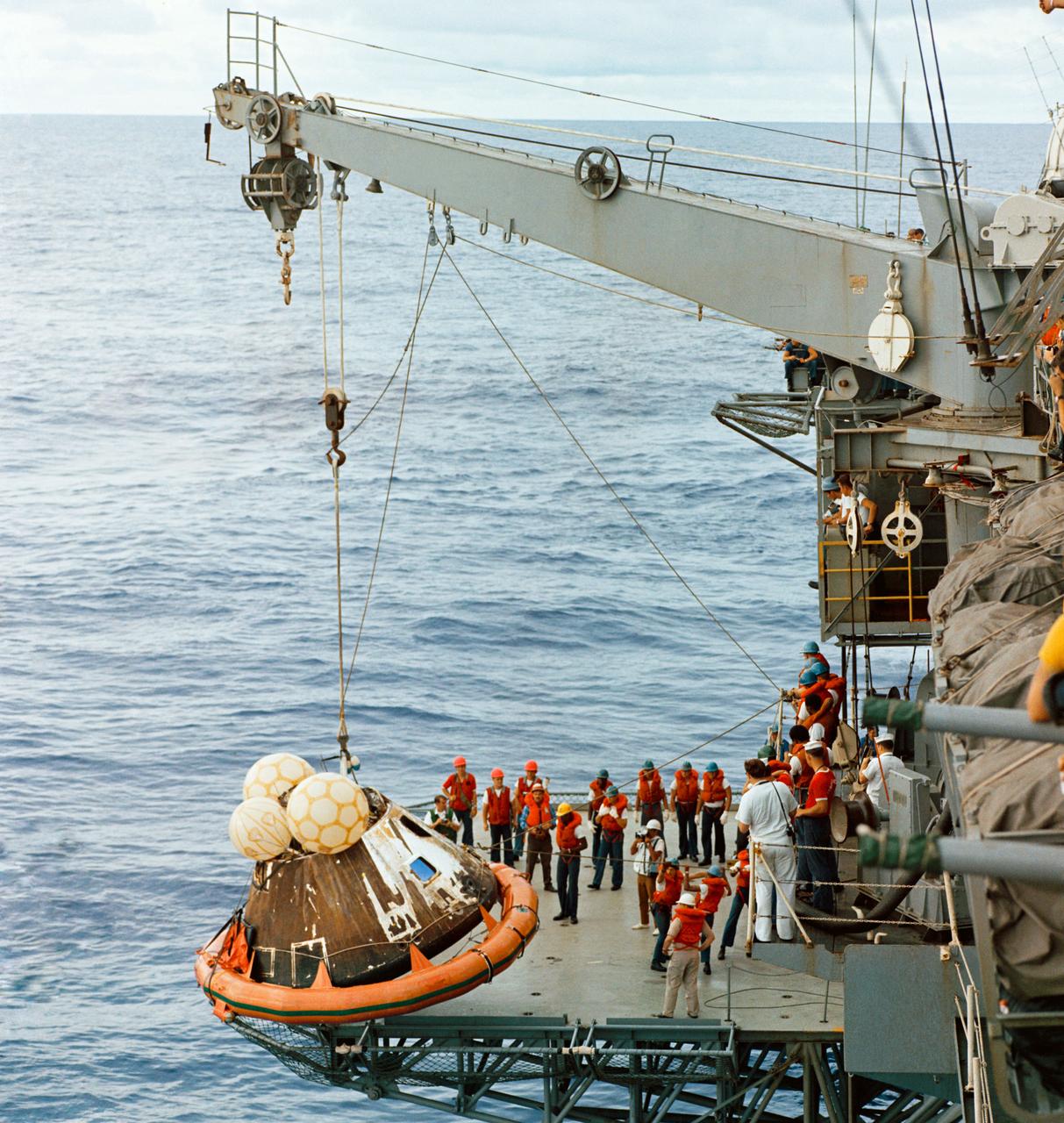
S70-15530 (17 April 1970) --- Crew men aboard the USS Iwo Jima, prime recovery ship for the Apollo 13 mission, hoist the Command Module (CM) aboard ship. The Apollo 13 crew men, astronauts James A. Lovell Jr., John L. Swigert Jr. and Fred W. Haise Jr., were already aboard the Iwo Jima when this photograph was taken. The CM, with the three tired crew men aboard, splashed down at 12:07:44 p.m. (CST), April 17, 1970, only about four miles from the recovery vessel in the South Pacific Ocean.
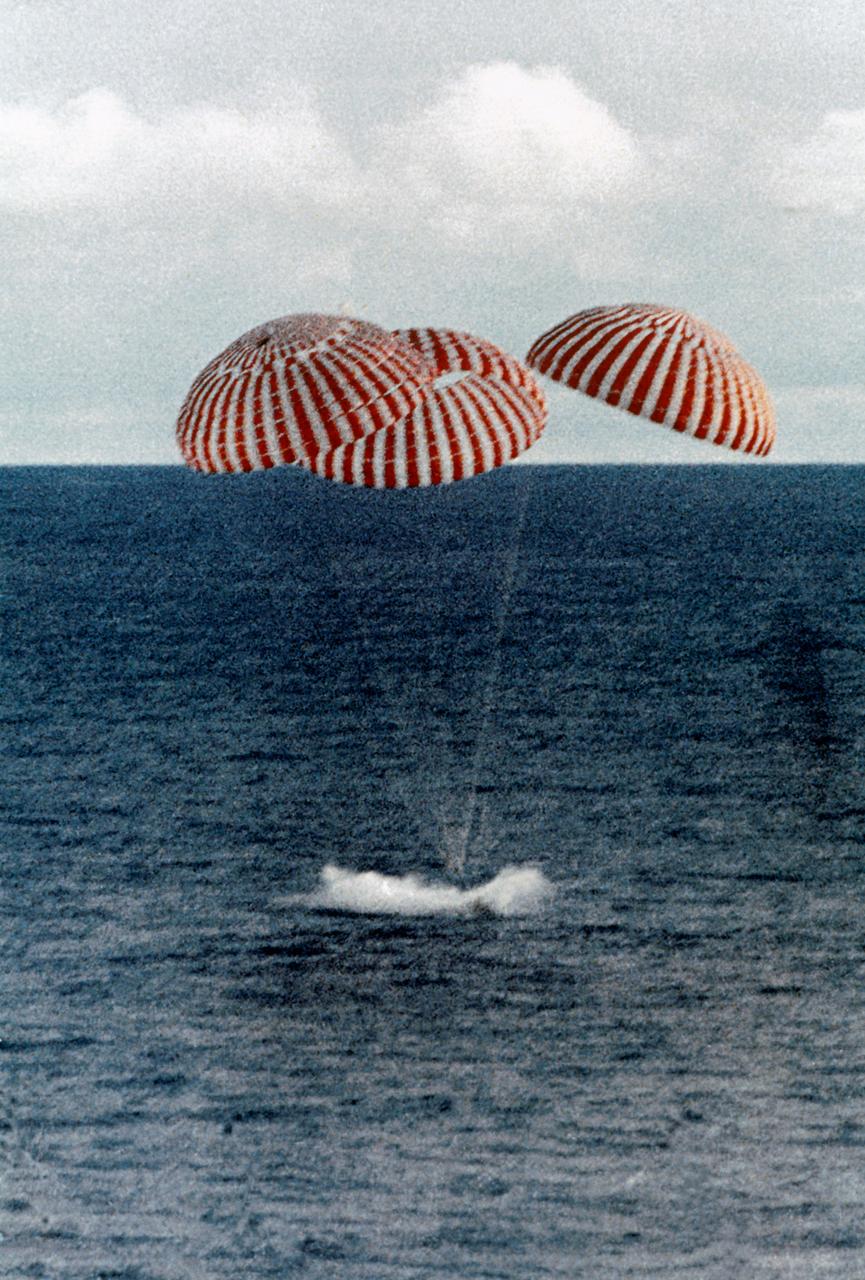
S70-35638 (17 April 1970) --- A perilous space mission comes to a smooth ending with the safe splashdown of the Apollo 13 Command Module (CM) in the South Pacific, only four miles from the prime recovery ship. The spacecraft with astronauts James A. Lovell Jr., John L. Swigert Jr., and Fred W. Haise Jr. aboard, splashed down at 12:07:44 p.m. (CST) April 17, 1970, to conclude safely the problem-plagued flight. The crewmen were transported by helicopter from the immediate recovery area to the USS Iwo Jima, prime recovery vessel.
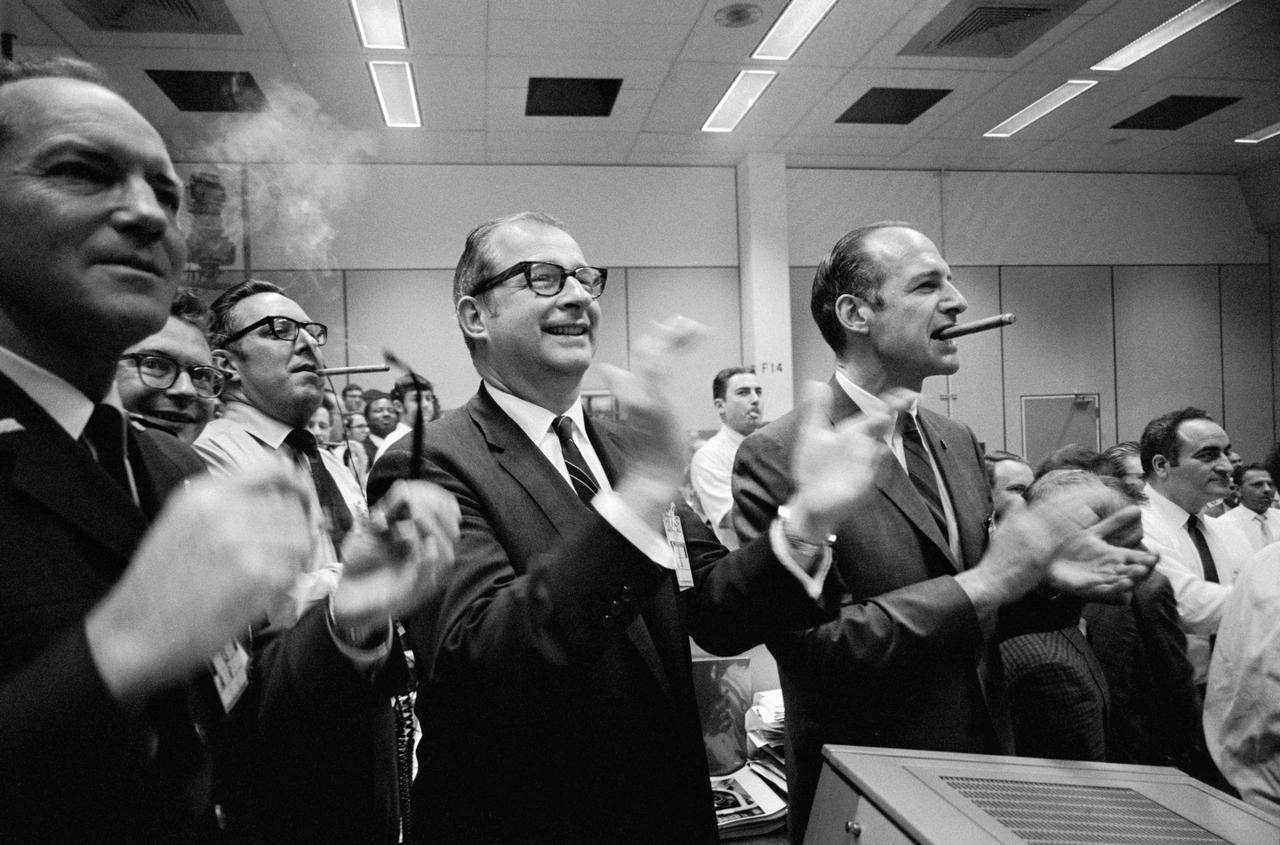
S70-35148 (17 April 1970) --- Staff members from NASA Headquarters (NASA HQ), Manned Spacecraft Center (MSC), and Dr. Thomas Paine (center of frame) applaud the successful splashdown of the Apollo 13 mission while Dr. George Low smokes a cigar (right), in the MSC Mission Control Center (MCC), located in Building 30. Apollo 13 crewmembers, astronauts James A. Lovell Jr., commander; John L. Swigert Jr., command module pilot; and Fred W. Haise Jr., lunar module pilot, splashed down at 12:07:44 p.m. (CST), April 17, 1970, in the south Pacific Ocean.
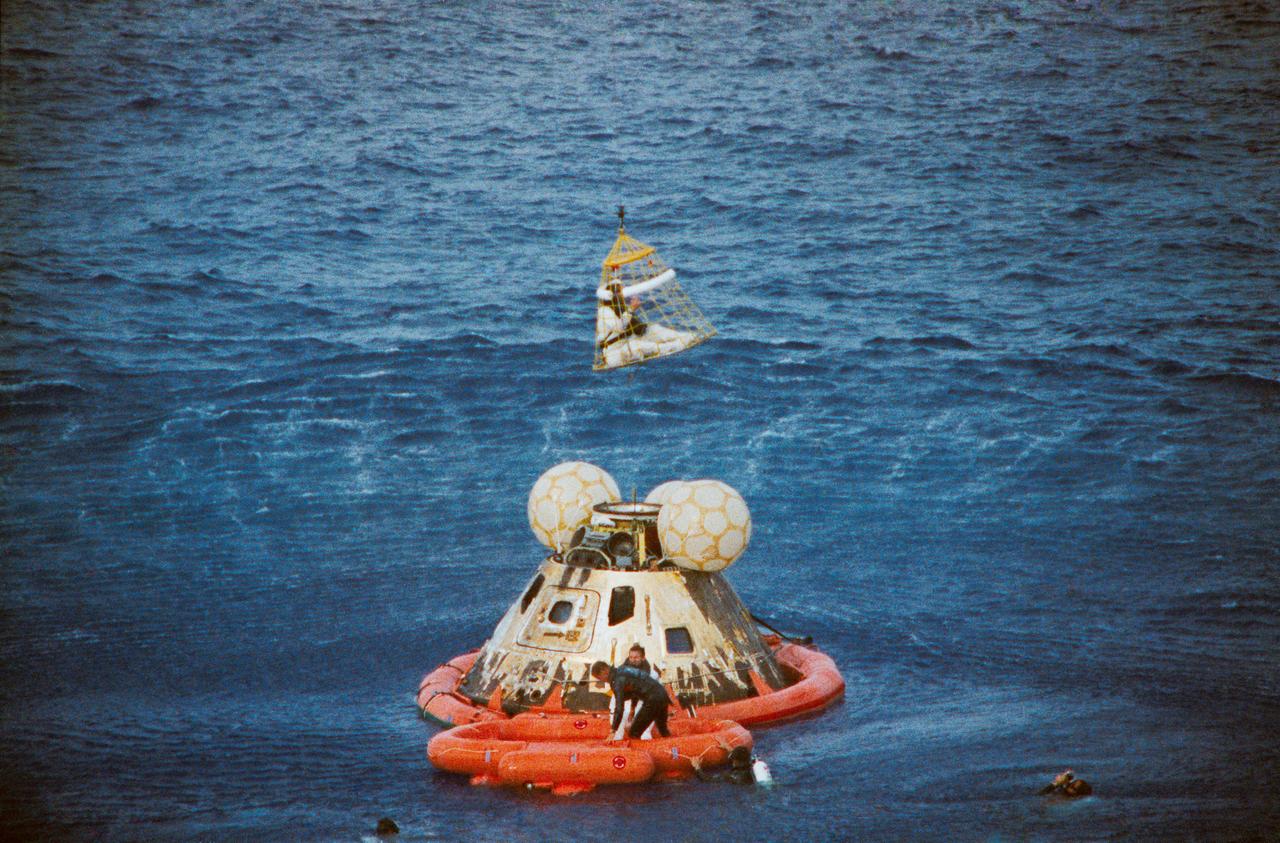
S70-35651 (17 April 1970) --- Astronaut John L. Swigert Jr., command module pilot, is lifted aboard a helicopter in a "Billy Pugh" net while astronaut James A. Lovell Jr., commander, awaits his turn. Astronaut Fred W. Haise Jr., lunar module pilot, is already aboard the helicopter. In the life raft with Lovell, and in the water are several U.S. Navy underwater demolition team swimmers, who assisted in the recovery operations. The crew was taken to the USS Iwo Jima, prime recovery ship, several minutes after the Apollo 13 spacecraft splashed down at 12:07:44 p.m. (CST), April 17, 1970.
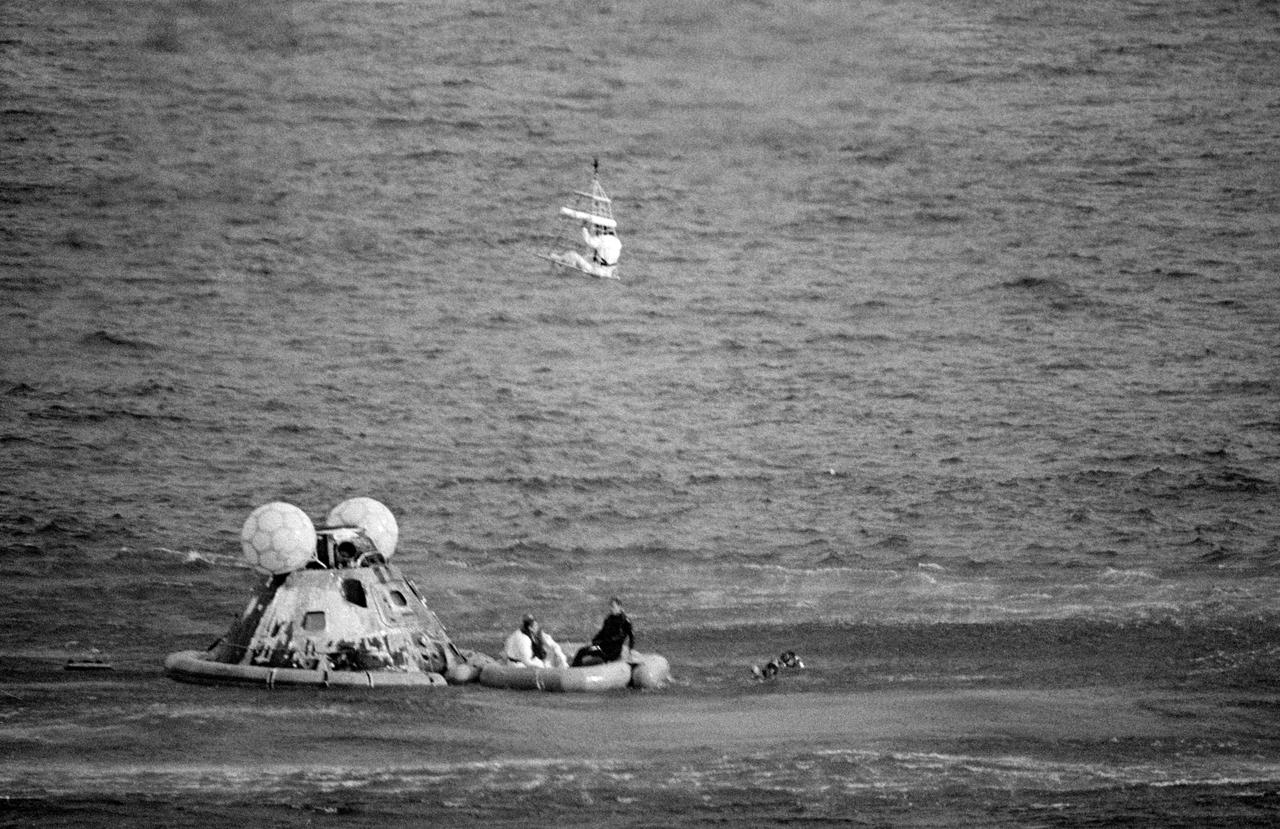
S70-35625 (17 April 1970) --- Astronaut Fred W. Haise Jr., lunar module pilot, is hoisted in a "Billy Pugh" net into a Navy helicopter, while United States Navy underwater demolition team swimmers assist in the recovery operations of the Apollo 13 crewmembers. Astronauts John L. Swigert Jr., command module pilot, and James A. Lovell Jr., commander, are waiting to get hoisted into the helicopter. The helicopter is taking the astronauts to the prime recovery ship, the USS Iwo Jima. Apollo 13 splashed down at 12:07:44 p.m. (CST), April 17, 1970.
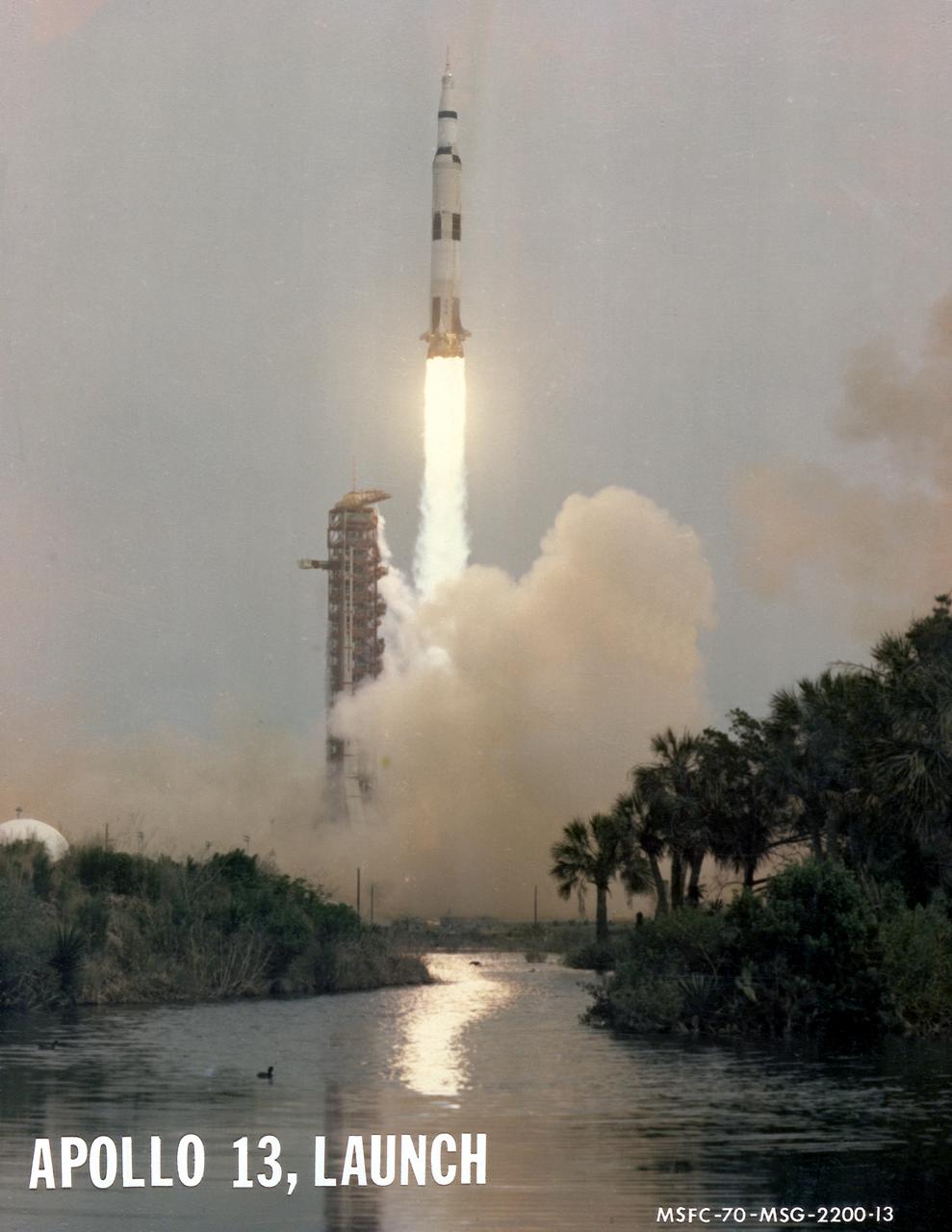
The third marned lunar landing mission, Apollo 13 (SA-508), with three astronauts: Mission commander James A. Lovell Jr., Lunar Module pilot Fred W. Haise Jr., and Command Module pilot John L. Swigert Jr., lifted off from the Kennedy Space Center launch complex 39A on April 11, 1970. The mission was aborted after 56 hours of flight, 205,000 miles from Earth, when an oxygen tank in the service module exploded. The Command Module, Odyssey, carrying the three astronauts, safely splashed down in the Pacific Ocean at 1:08 p.m. EST, April 17, 1970.

S70-35148 (17 April 1970) --- Staff members from NASA Headquarters (NASA HQ), Manned Spacecraft Center (MSC), and Dr. Thomas Paine (center of frame) applaud the successful splashdown of the Apollo 13 mission while Dr. George Low smokes a cigar (right), in the MSC Mission Control Center (MCC), located in Building 30. Apollo 13 crewmembers, astronauts James A. Lovell Jr., commander; John L. Swigert Jr., command module pilot; and Fred W. Haise Jr., lunar module pilot, splashed down at 12:07:44 p.m. (CST), April 17, 1970, in the south Pacific Ocean.
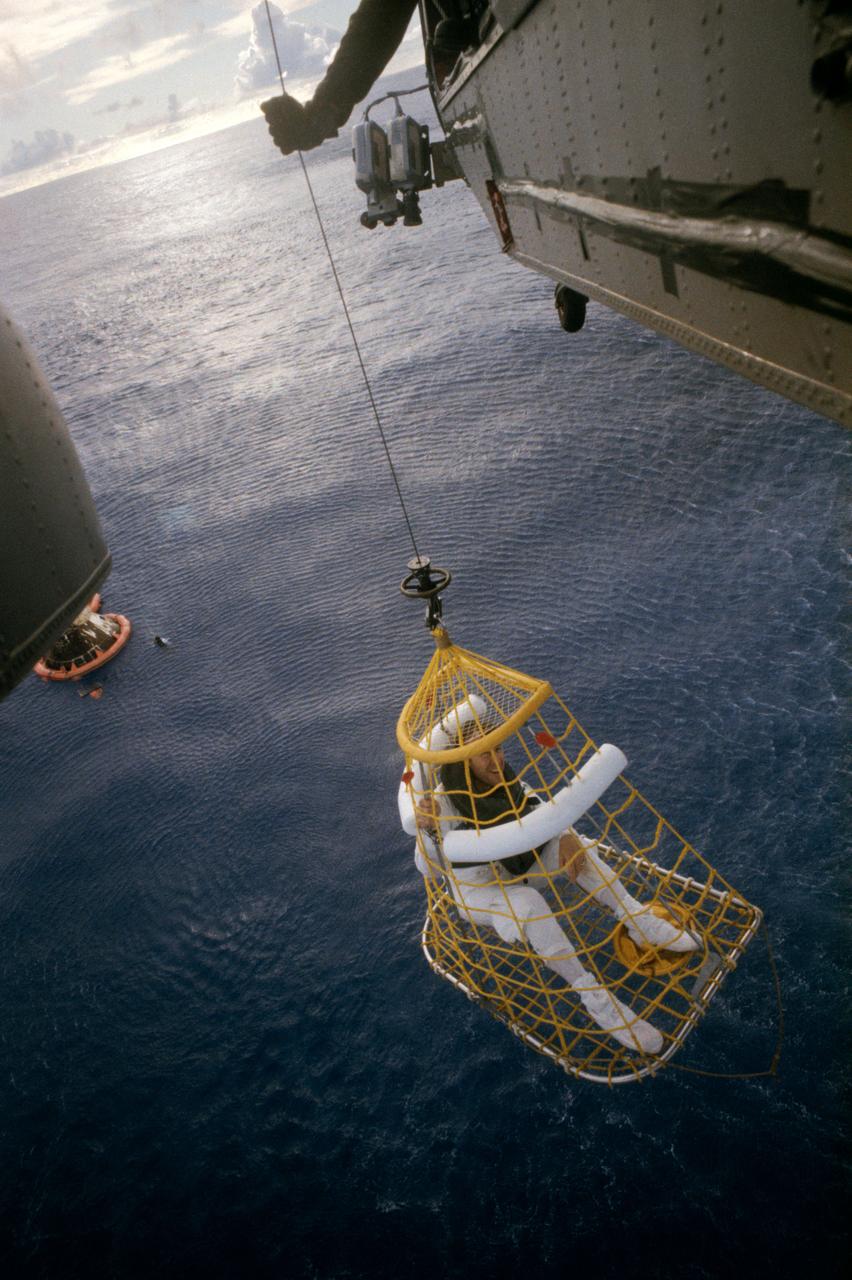
S70-35645 (17 April 1970) --- Astronaut James A. Lovell Jr., commander, is hoisted aboard a helicopter from the USS Iwo Jima, prime recovery vessel for the mission. Lovell was the last of the three Apollo 13 crewmembers to egress the Command Module (CM) and the last to be lifted aboard the helicopter. He was preceded by astronauts John L. Swigert Jr., command module pilot; and Fred W. Haise Jr., lunar module pilot. The CM and a U.S. Navy underwater demolition team swimmer can be seen in the ocean background. Apollo 13 splashed down at 12:07:44 p.m. (CST), April 17, 1970.
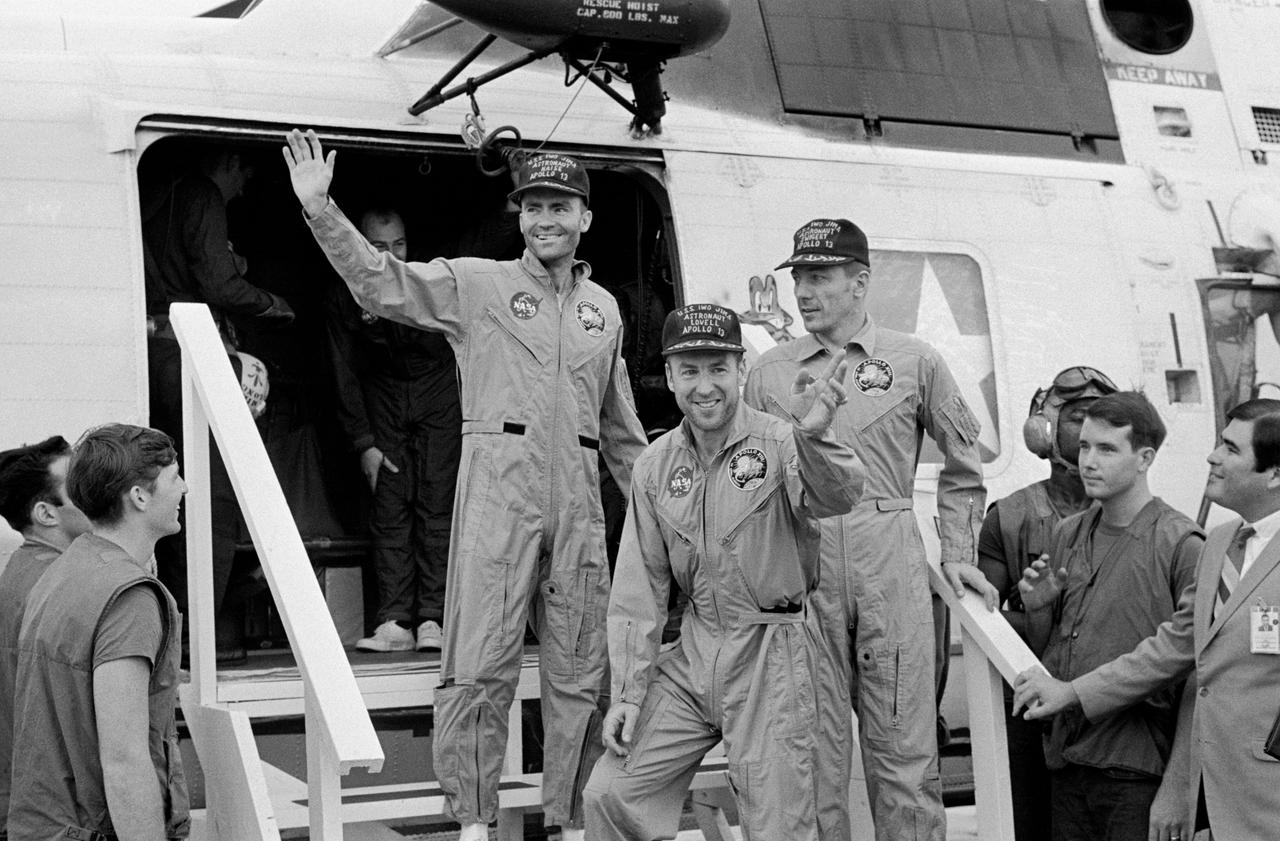
S70-35614 (17 April 1970) --- The crewmembers of the Apollo 13 mission, step aboard the USS Iwo Jima, prime recovery ship for the mission, following splashdown and recovery operations in the South Pacific Ocean. Exiting the helicopter which made the pick-up some four miles from the Iwo Jima are (from left) astronauts Fred W. Haise Jr., lunar module pilot; James A. Lovell Jr., commander; and John L. Swigert Jr., command module pilot. The crippled Apollo 13 spacecraft splashed down at 12:07:44 p.m. (CST), April 17, 1970.

S70-30534 (9 March 1970) --- A Lunar Landing Training Vehicle (LLTV), piloted by astronaut James A. Lovell Jr., sets down on the runway at the conclusion of a test flight at Ellington Air Force Base. Lovell is the commander of the Apollo 13 lunar landing mission. Lovell used the LLTV to practice lunar landing techniques in preparation for his scheduled mission. Lovell will be at the controls of the Apollo 13 Lunar Module (LM) when it lands on the moon in the highlands just north of Fra Mauro. Astronaut Thomas K. Mattingly II, command module pilot, will remain with the Apollo 13 Command and Service Modules (CSM) in lunar orbit while astronauts Lovell and Fred W. Haise Jr., lunar module pilot, descend in the LM to explore the moon. A hovering helicopter watches the LLTV landing.
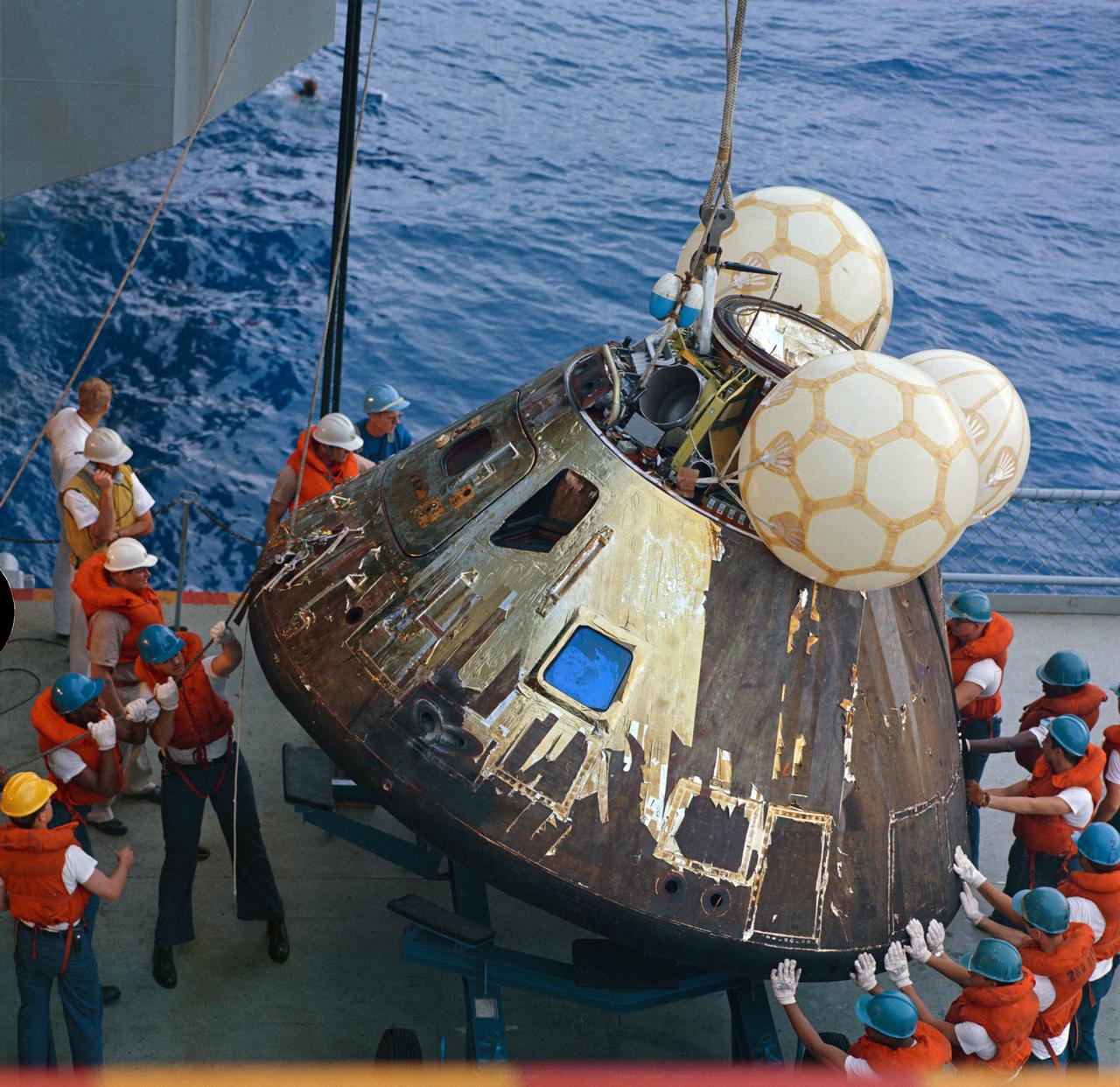
S70-35632 (17 April 1970) --- Crewmen aboard the USS Iwo Jima, prime recovery ship for the Apollo 13 mission, guide the Command Module (CM) atop a dolly onboard the ship. The CM is connected by strong cable to a hoist on the vessel. The Apollo 13 crewmembers, astronauts James A. Lovell Jr., commander; John L. Swigert Jr., command module pilot; and Fred W. Haise Jr., lunar module pilot, were already aboard the USS Iwo Jima when this photograph was made. The CM, with the three tired crewmen aboard, splashed down at 12:07:44 p.m. (CST), April 17, 1970, only about four miles from the recovery vessel in the South Pacific Ocean.
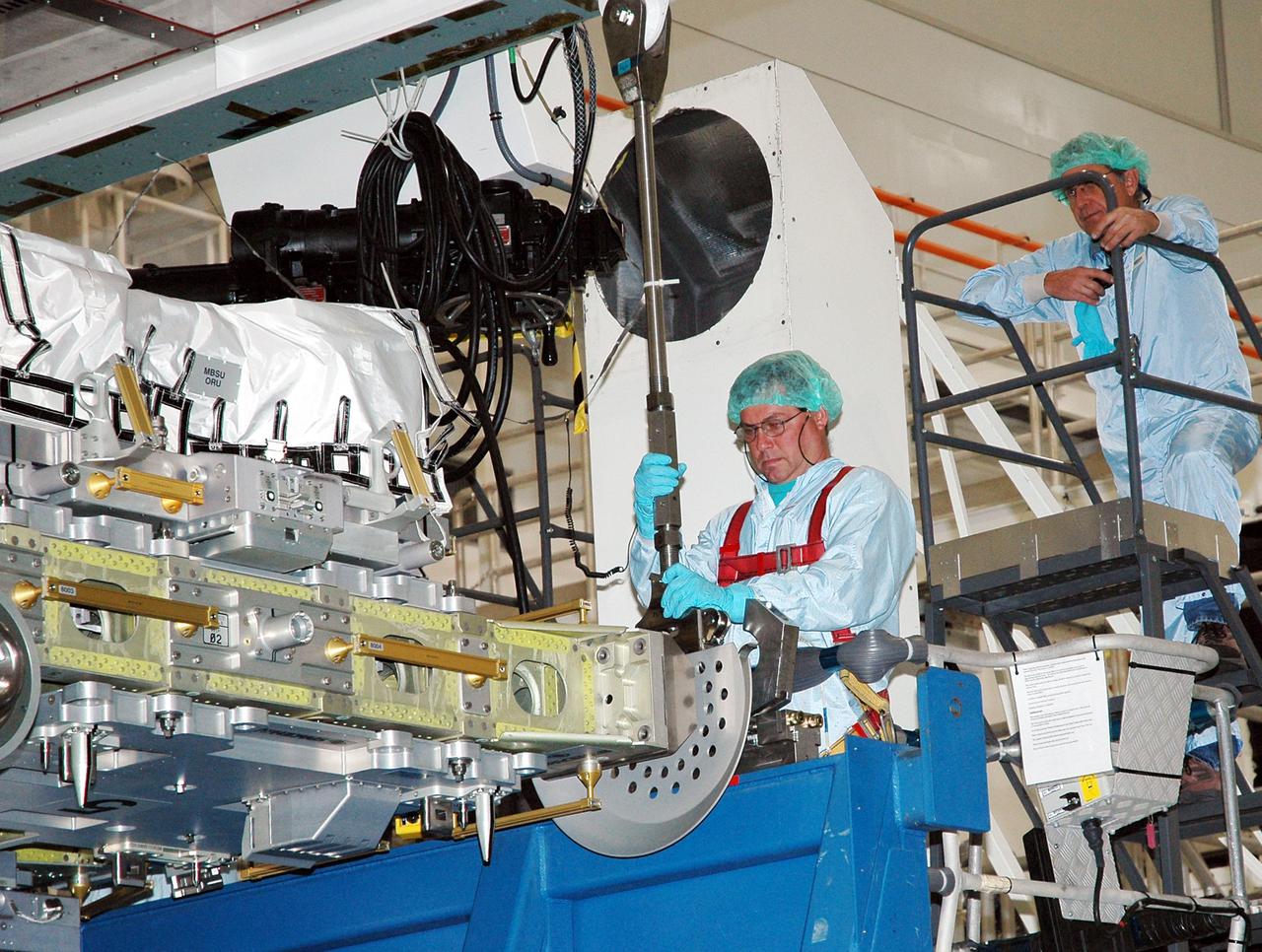
KENNEDY SPACE CENTER, FLA. - In the Space Station Processing Facility, technician Fred Parisi is attaching the CELA (Cargo Element Lifting Assembly) down rods to the External Stowage Platform -2 (ESP-2) in preparation for lifting the ESP-2 from its transportation container and installing it into the Payload Transportation Canister. At right, above, is Scott Kisner, task leader. The ESP-2 will travel to Launch Pad 39B with its fellow payload elements the Lightweight MPESS Carrier (Multi-Purpose Experiment Support Structure) and Multi-Purpose Logistics Module Raffaello in the canister. Once at the pad, the three payloads will be transferred to the payload bay of Discovery for flight. The ESP-2 is carrying replacement parts to the International Space Station. The platform will be deployed and attached to the Station’s airlock and used as a permanent spare parts facility. STS-114 is targeted for launch during a window that extends from May 15 through June 3.
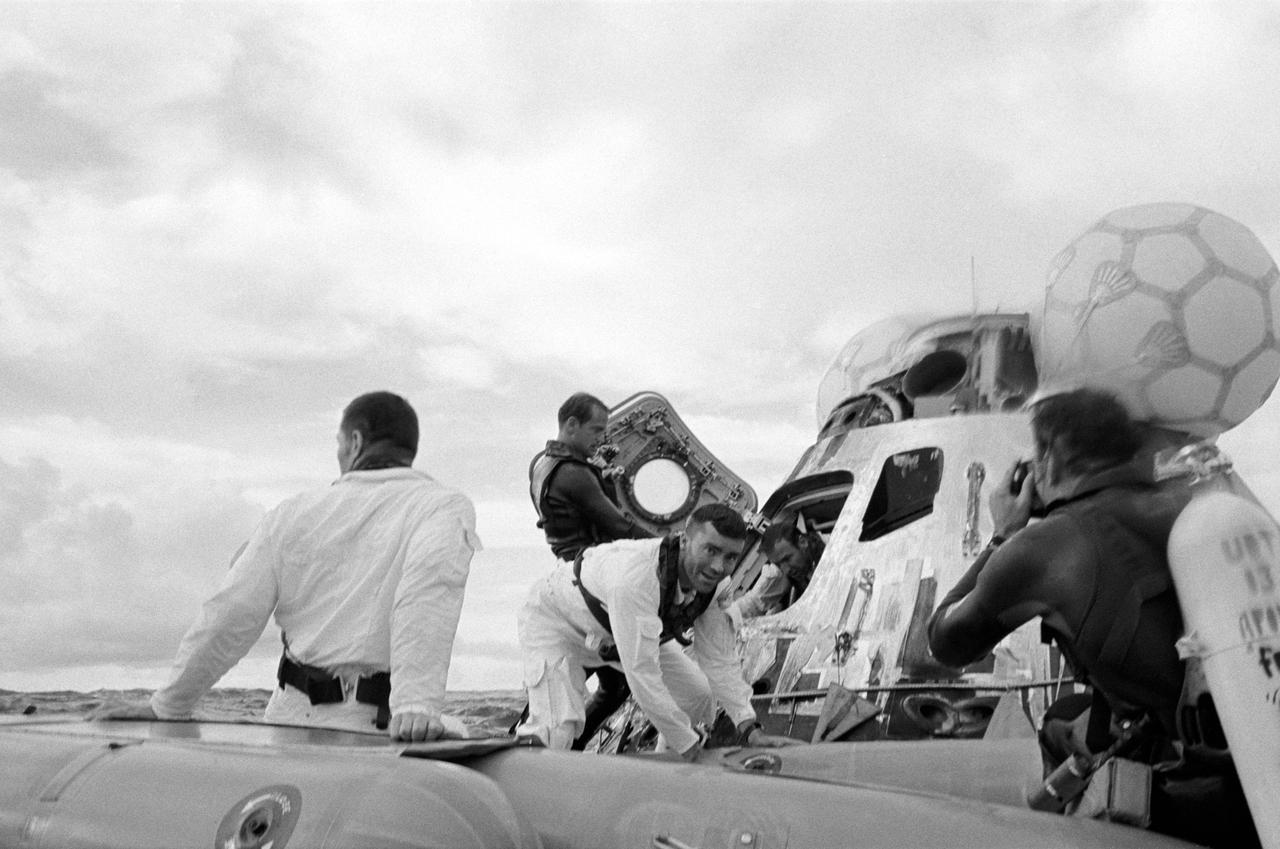
S70-35610 (17 April 1970) --- A water level view of the Apollo 13 recovery operations in the South Pacific Ocean. The three astronauts as seen egressing their spacecraft. John L. Swigert Jr. (back to camera), command module pilot, is already in the life raft. Fred W. Haise Jr., lunar module pilot, facing camera, is stepping into the life raft. James A. Lovell Jr., commander, is leaving the spacecraft in the background. A United States Navy underwater demolition team assists with the recovery operations. The three crewmembers were picked up by helicopter and flown to the prime recovery ship, USS Iwo Jima. The Apollo 13 Command Module (CM) splashed down at 12:07:44 p.m. (CST), April 17, 1970, to conclude safely a perilous space flight. Though the Apollo lunar landing mission was canceled, a disastrous loss of three astronauts was averted.
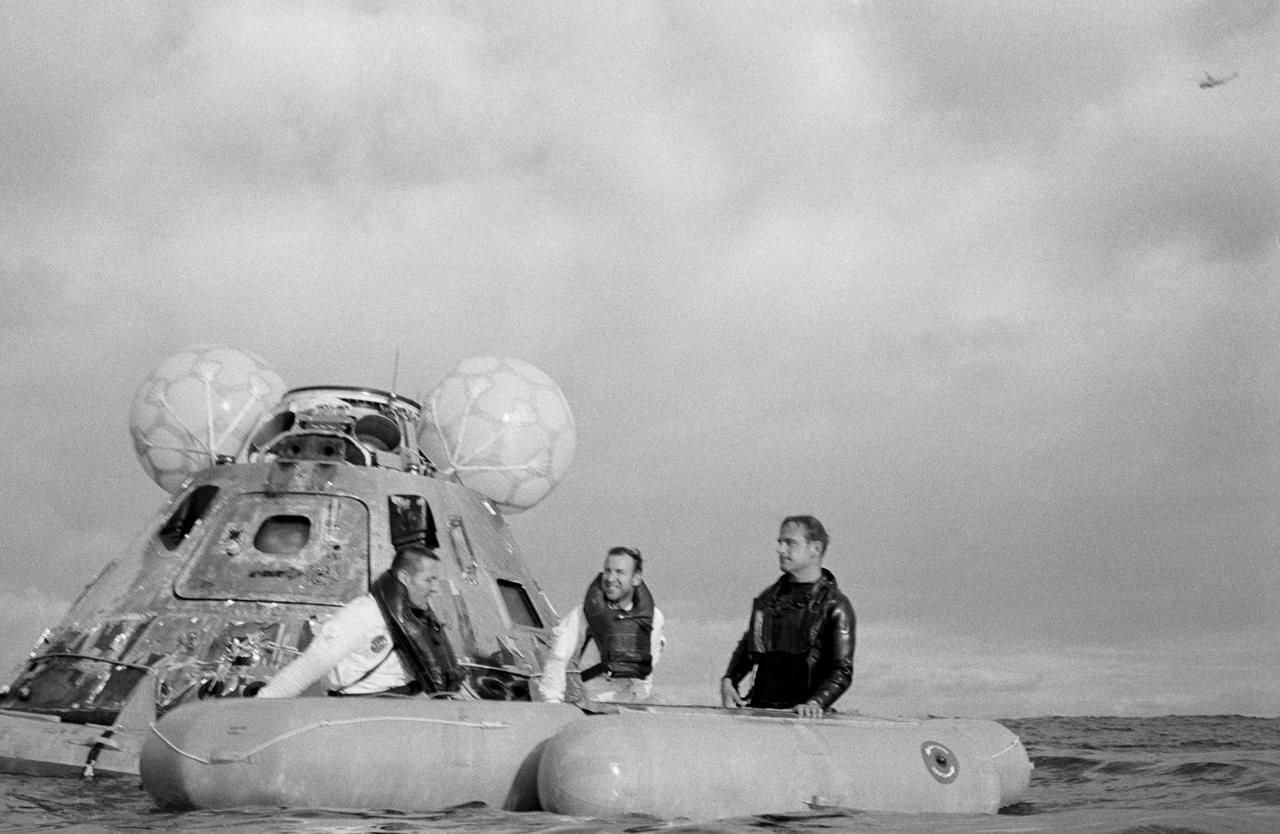
S70-35615 (17 April 1970) --- A water level view of the Apollo 13 recovery operations in the South Pacific Ocean. The three astronauts have egressed their spacecraft, and astronaut Fred W. Haise Jr., lunar module pilot, has already ascended to the helicopter. The other two crewmembers await the return of the "Billy Pugh" net. Astronaut James A. Lovell Jr. (center), commander, will remain in the life raft until astronaut John L. Swigert Jr., command module pilot, has boarded the helicopter. A United States Navy underwater demolition team swimmer assist with the recovery operations. The three Apollo 13 crewmembers were flown to the USS Iwo Jima, prime recovery ship. Apollo 13 splashed down at 12:07:44 p.m. (CST), April 17, 1970, to safely conclude a perilous space flight.
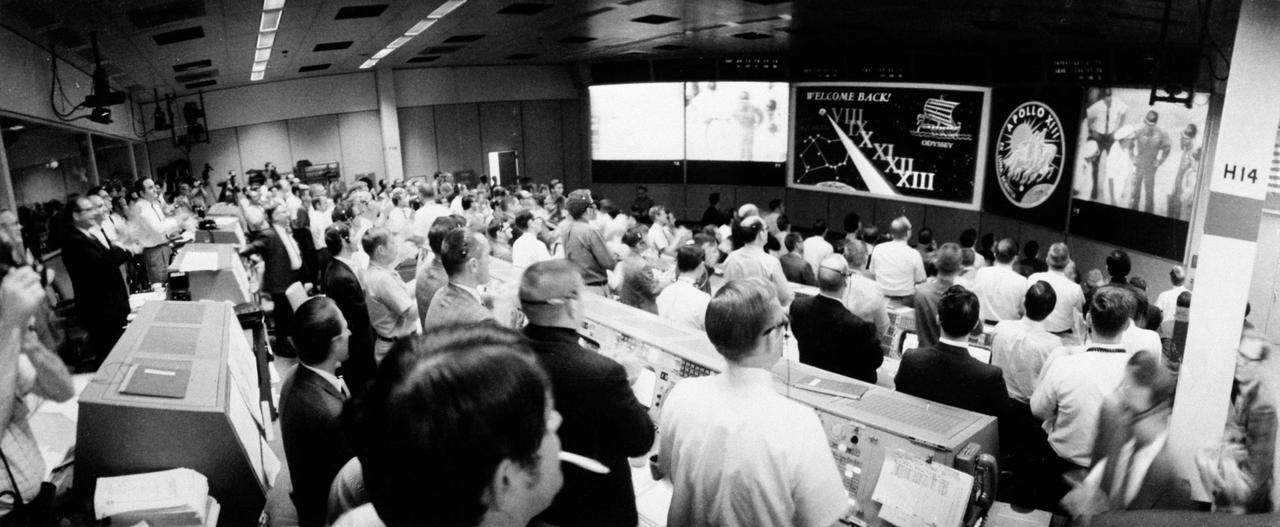
S70-35472 (17 April 1970) --- Overall view of the crowded Mission Operations Control Room (MOCR) in the Mission Control Center (MCC) at the Manned Spacecraft Center (MSC) during post-recovery ceremonies aboard the USS Iwo Jima, prime recovery ship for the Apollo 13 mission. The Apollo 13 spacecraft, with astronauts James A. Lovell Jr., commander; John L. Swigert Jr., command module pilot; and Fred W. Haise Jr., lunar module pilot, aboard, splashed down in the South Pacific at 12:07:44 p.m. (CST), April 17, 1970. The smooth splashdown and recovery operations brought an end to a perilous spaceflight for the crewmembers, and a tiring one for ground crew in MCC.