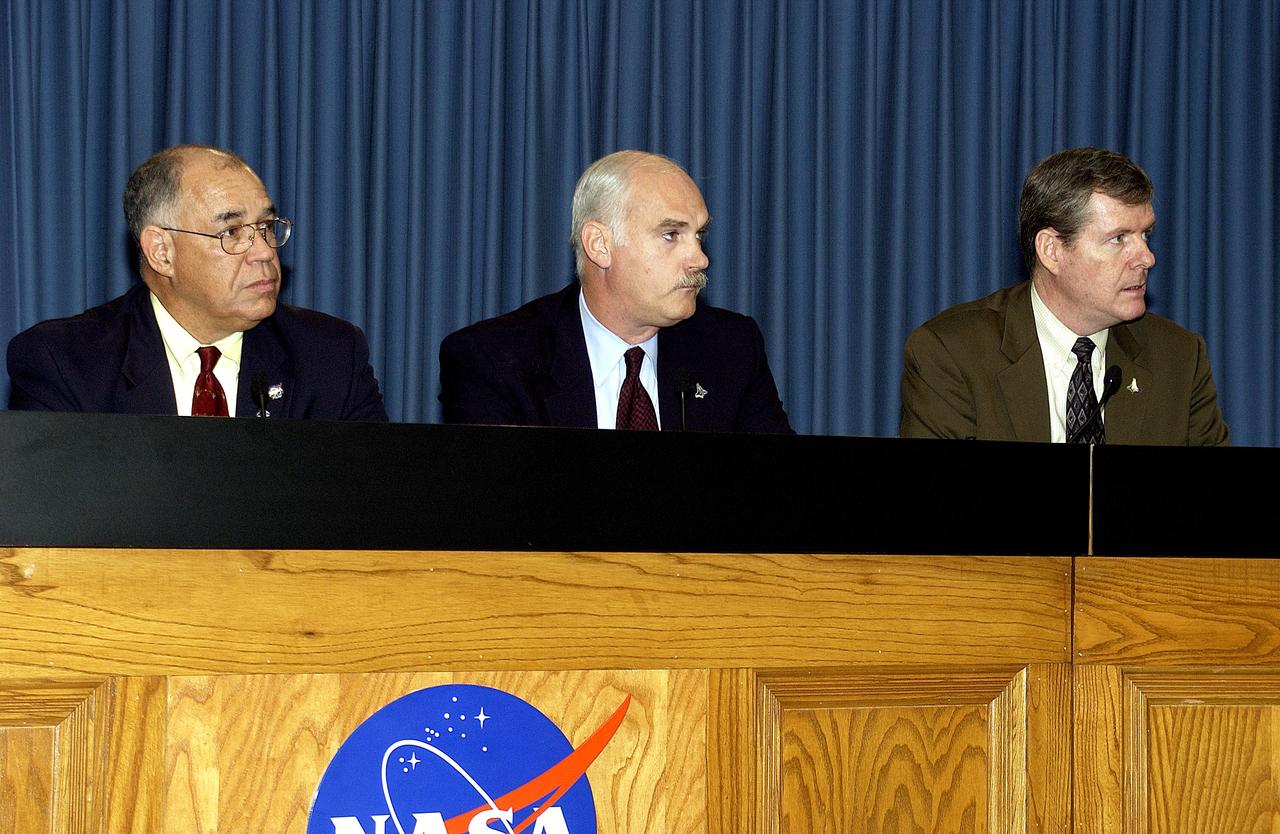
KENNEDY SPACE CENTER, FLA. - NASA officials brief the media at KSC about the agency’s human space flight program. On the panel (left to right) are NASA Deputy Administrator Fred Gregory, Associate Administrator for Space Flight Bill Readdy and Associate Administrator for Safety and Mission Assurance Bryan O’Connor.
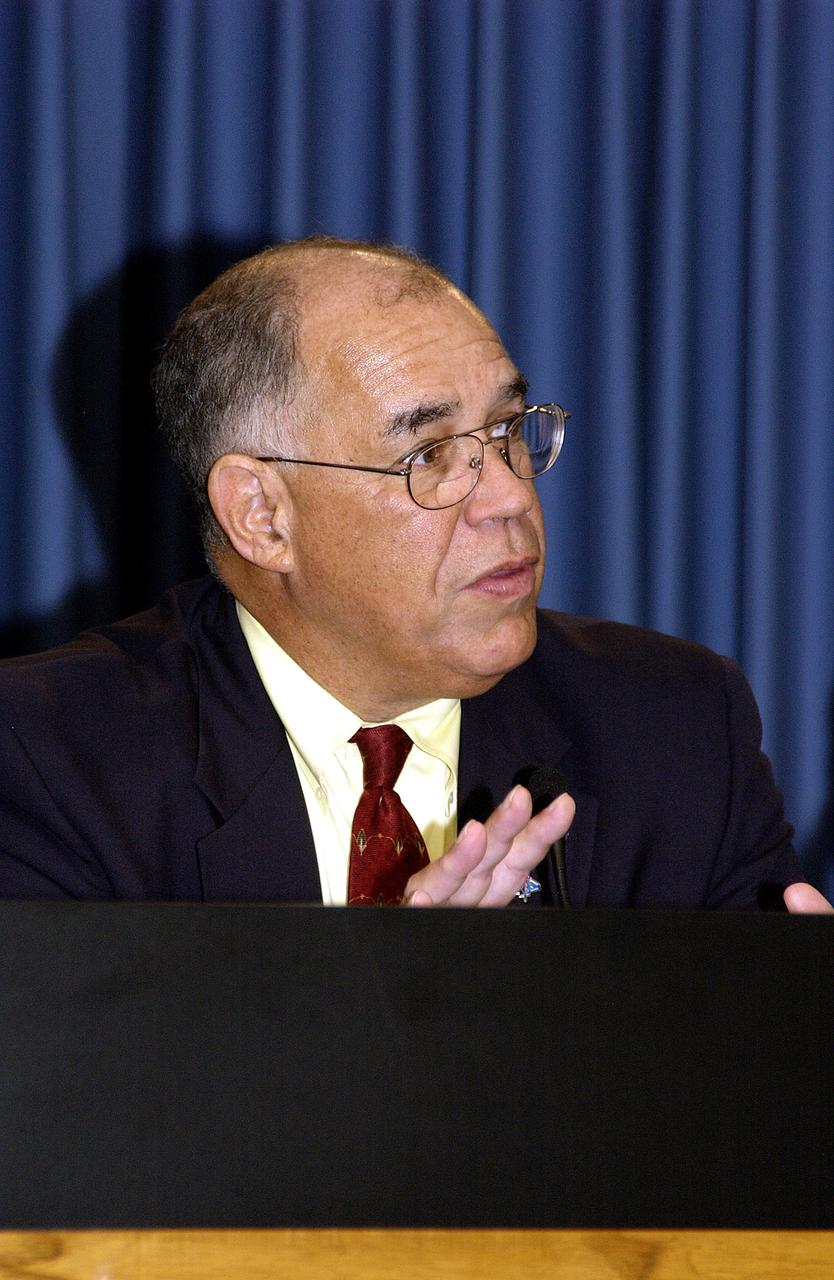
KENNEDY SPACE CENTER, FLA. - Associate Administrator for Safety and Mission Assurance Bryan O’Connor speaks at a media briefing at KSC. NASA officials discussed the agency’s human space flight program. Others on the panel were NASA Deputy Administrator Fred Gregory and Associate Administrator for Space Flight Bill Readdy
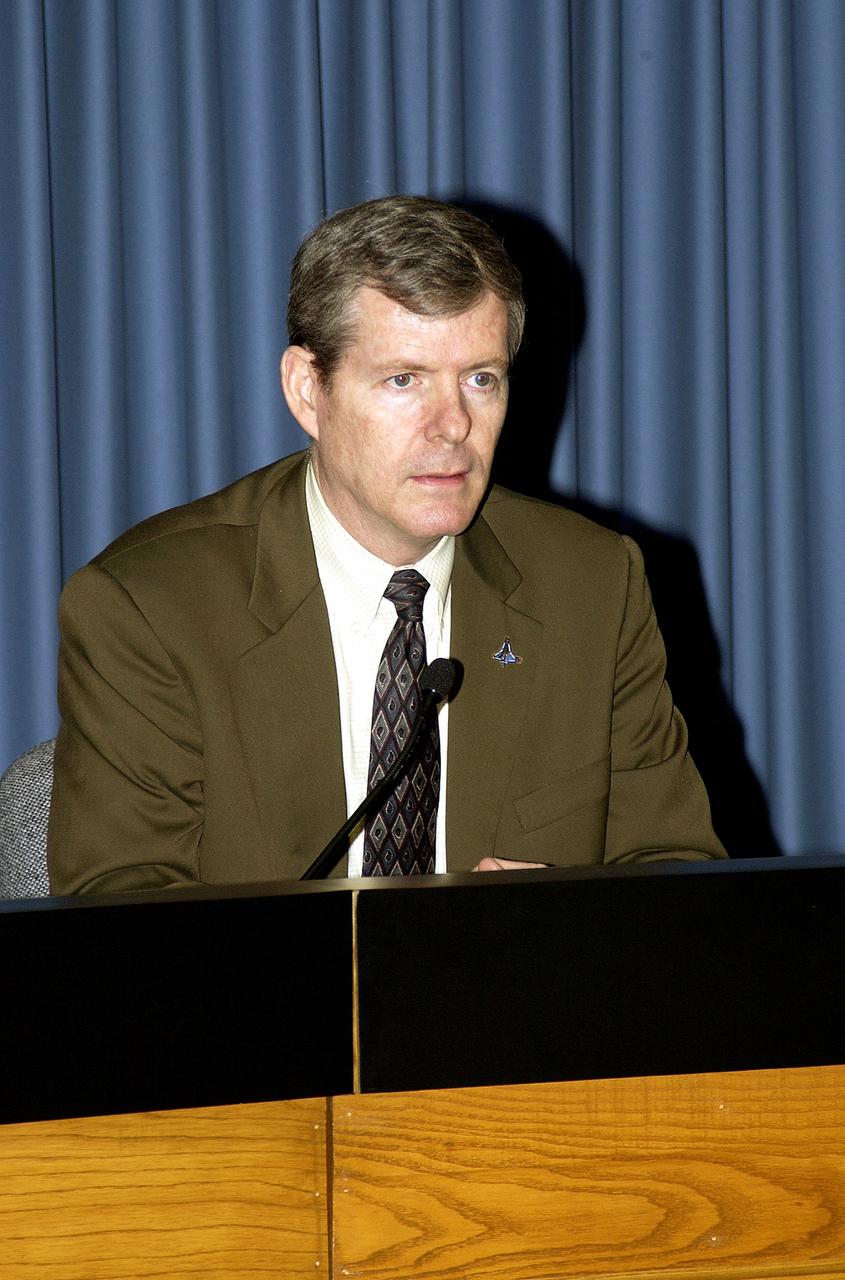
KENNEDY SPACE CENTER, FLA. - NASA Deputy Administrator Fred Gregory speaks at a media briefing at KSC. NASA officials discussed the agency’s human space flight program. Others on the panel were Associate Administrator for Space Flight Bill Readdy and Associate Administrator for Safety and Mission Assurance Bryan O’Connor.
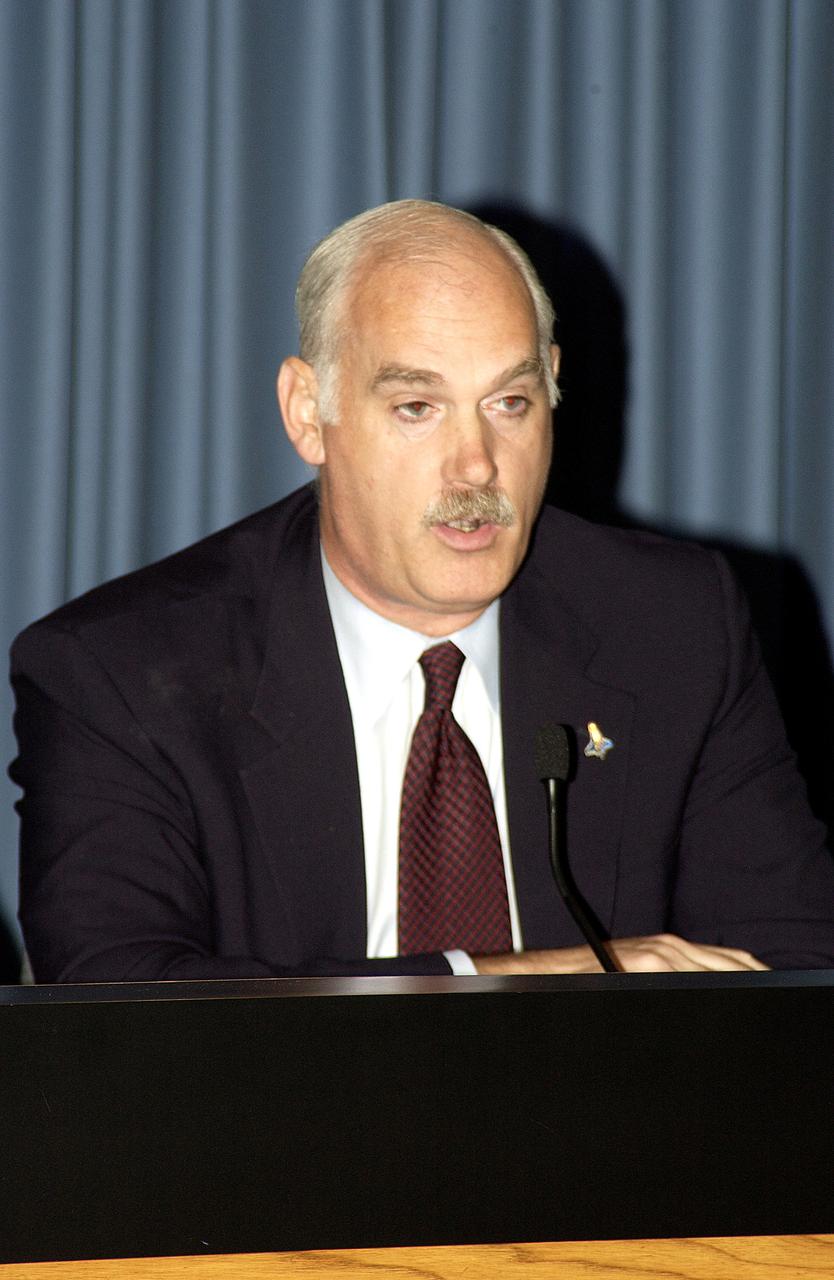
KENNEDY SPACE CENTER, FLA. - Associate Administrator for Space Flight Bill Readdy speaks at a media briefing at KSC. NASA officials discussed the agency’s human space flight program. Others on the panel were NASA Deputy Administrator Fred Gregory and Associate Administrator for Safety and Mission Assurance Bryan O’Connor.
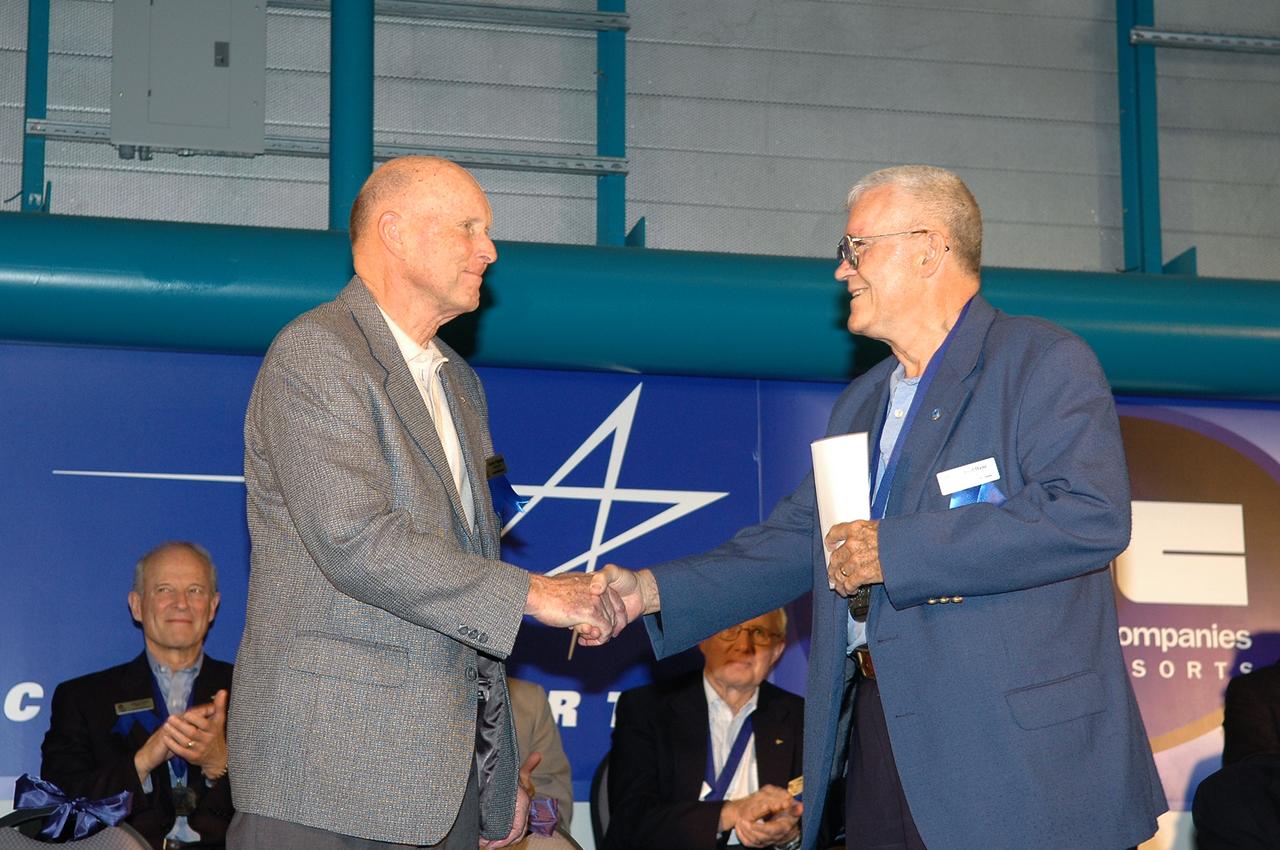
Former astronaut Gordon Fullerton (left), currently chief research pilot at NASA's Dryden Flight Research Center at Edwards Air Force Base, is congratulated by former astronaut Fred Haise (right) upon Fullerton's induction into the Astronaut Hall of Fame at the Kennedy Space Center (KSC) in Florida on April 30, 2005. Fullerton and Haise were one of two flight crews who flew the Approach and Landing Tests of the prototype Space Shuttle orbiter Enterprise at Dryden in 1977. Fullerton, who had served on the support crews for four Apollo moon landing missions in the early 1970s, went on to fly two Shuttle missions, STS-3 in 1982 and STS-51F in 1985. STS-3 became the only Shuttle mission to date to land at White Sands, N.M., and STS-51F was completed successfully despite the failure of one of the Shuttle's main engines during ascent to orbit. Haise, a member of the crew on the ill-fated Apollo 13 mission, was also a research pilot at NASA Dryden during his pre-astronaut career. Former astronauts Joseph Allen and Bruce McCandless were also inducted during the 2005 ceremonies at the KSC Visitor Center. In addition to honoring former members of NASA's astronaut corps who have made significant contributions to the advancement of space flight, the annual induction ceremonies serve as a fund-raiser for the Astronaut Scholarship Foundation. The foundation funded 17 $10,000 scholarships to college students studying science and engineering in 2004.
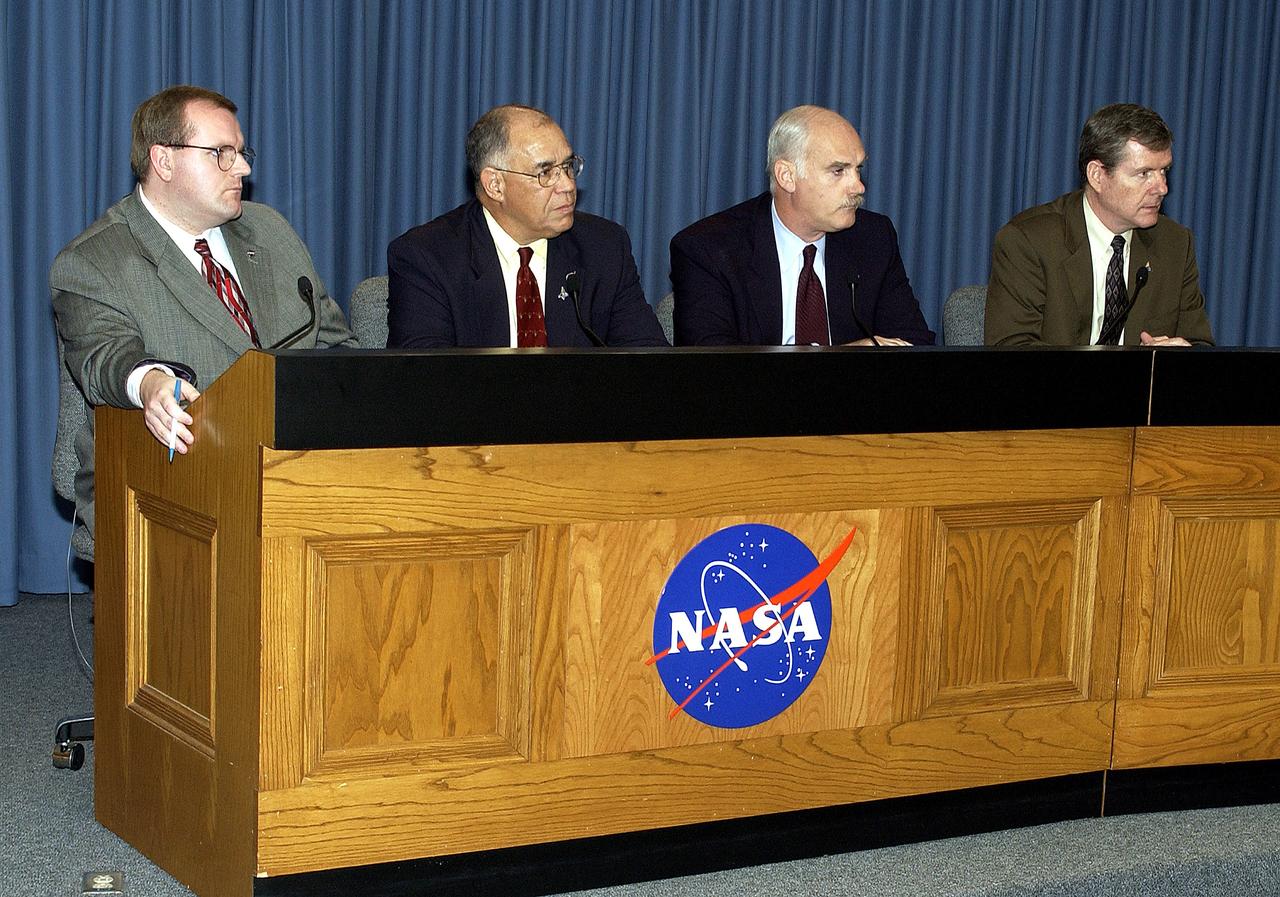
KENNEDY SPACE CENTER, FLA. - NASA officials brief the media at KSC about the agency’s human space flight program. At left is moderator Allard Beutel, with NASA Headquarters. Others on the panel (left to right) are NASA Deputy Administrator Fred Gregory, Associate Administrator for Space Flight Bill Readdy and Associate Administrator for Safety and Mission Assurance Bryan O’Connor.
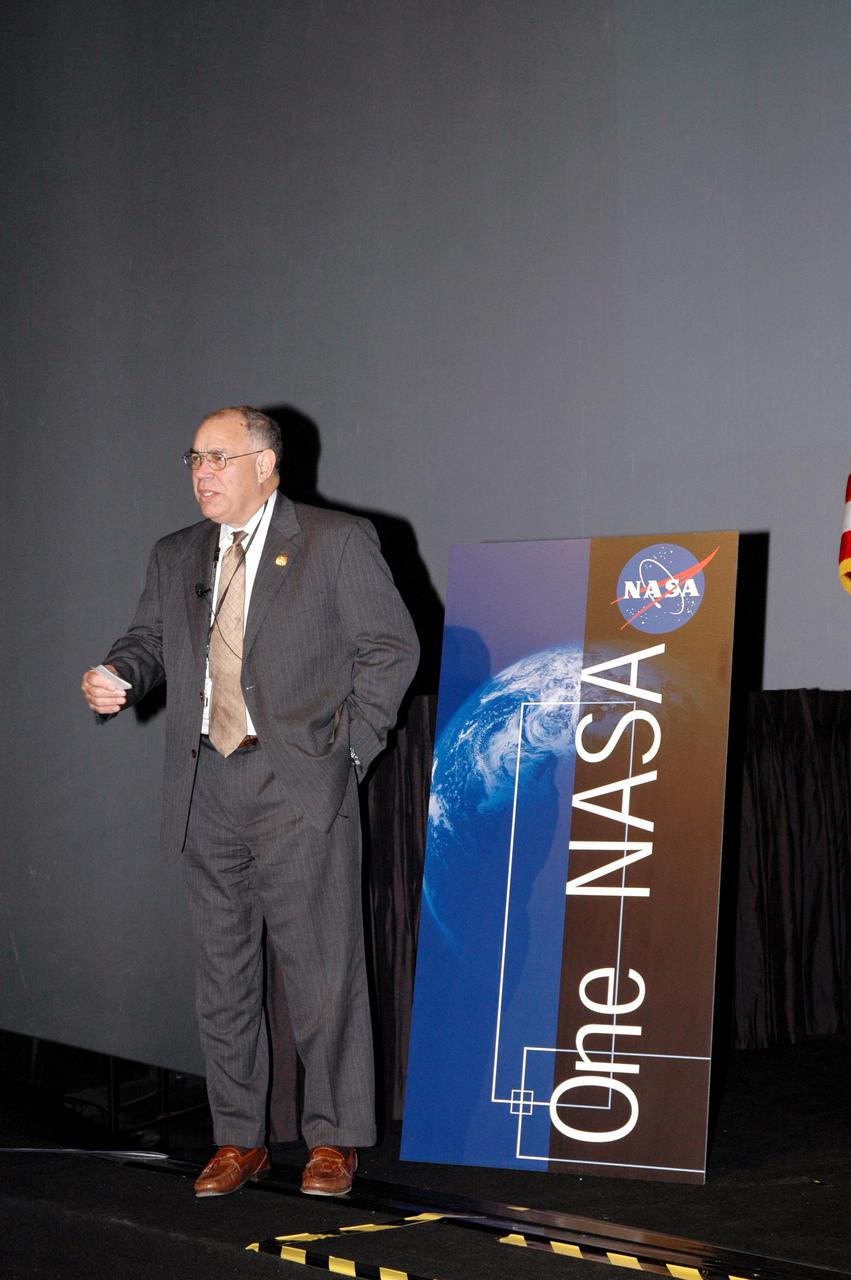
KENNEDY SPACE CENTER, FLA. - NASA Deputy Administrator Fred Gregory moderates the panel presentation during the One NASA Leader-Led Workshop about the Agency’s Transformation and implementation strategies. The workshop included senior leadership in the Agency. Other speakers explained Kennedy’s role in the Vision for Space Exploration.
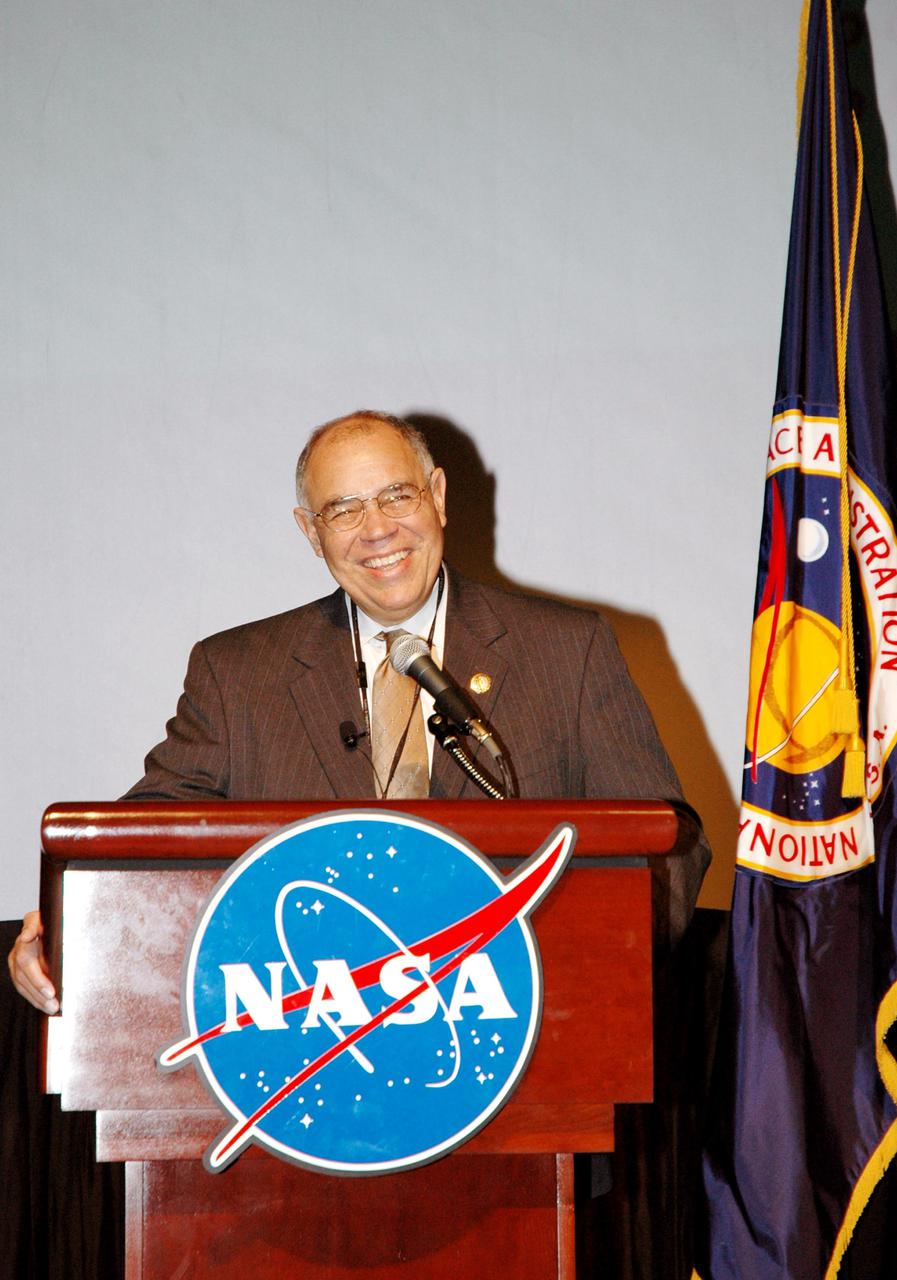
KENNEDY SPACE CENTER, FLA. - NASA Deputy Administrator Fred Gregory updates attendees of the One NASA Leader-Led Workshop about the Agency’s Transformation and implementation strategies. The workshop included senior leadership in the Agency. Other speakers explained Kennedy’s role in the Vision for Space Exploration.
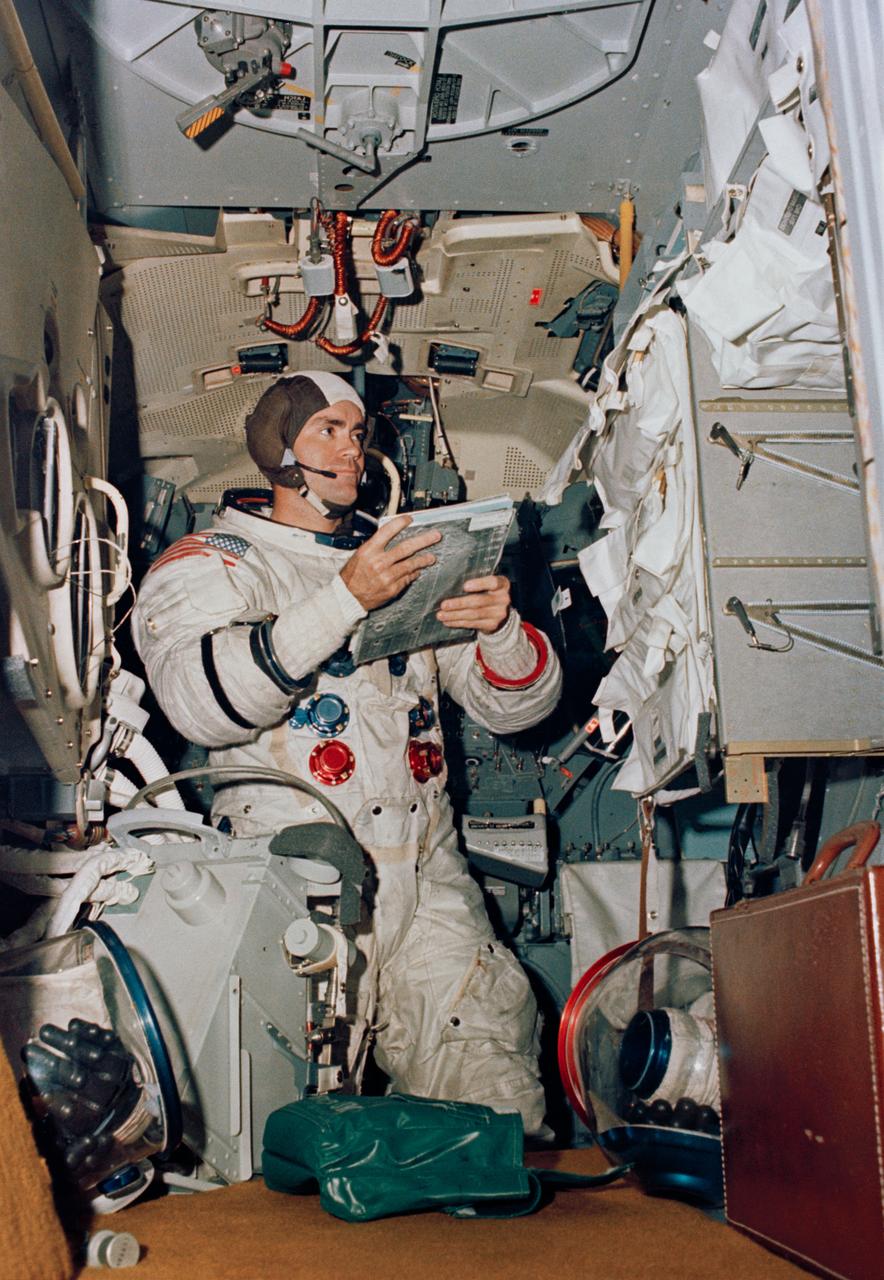
S70-34412 (4 April 1970) --- Astronaut Fred W. Haise Jr., Apollo 13 lunar module pilot, participates in simulation training in preparation for the scheduled lunar landing mission. He is in the Apollo Lunar Module Mission Simulator in the Kennedy Space Center's Flight Crew Training building.
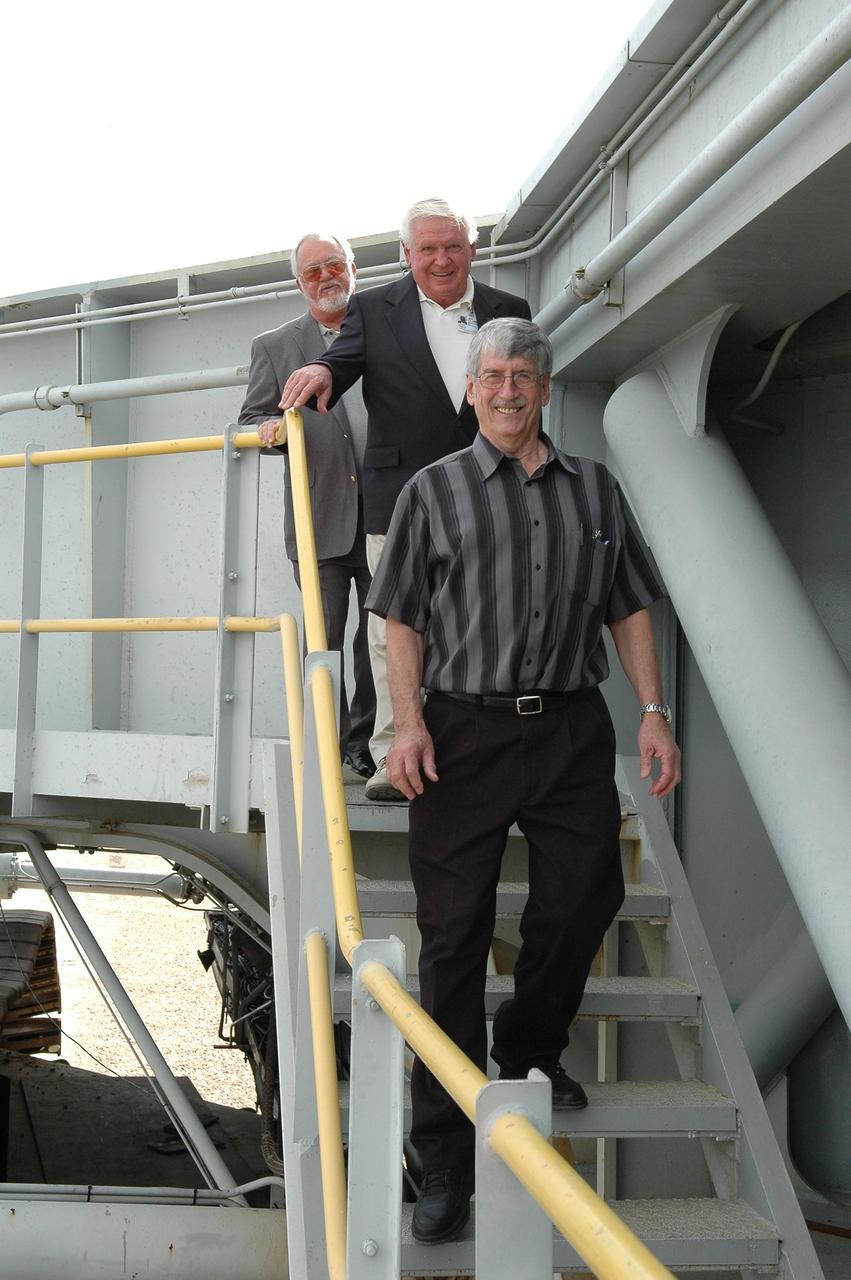
KENNEDY SPACE CENTER, FLA. - On the occasion of the 40th anniversary of the crawler transporter used for moving space shuttles to the NASA Kennedy Space Center’s launch pads, three former crawler workers tour one of the crawlers still in use. From the top are Sylvan “Skip” Montagna, Fred Renaud and Fred Wallace. Media representatives and invited guests had the opportunity to tour one of NASA's two crawlers. This included the driver cab and engine room. Guests included current drivers and operators, as well as drivers from the Apollo Program. In January 1966, the crawler completed its first successful move with a 10.6-million-pound launch umbilical tower. It moved three-quarters of a mile in about nine hours. Throughout 40 years of service, the two crawlers have moved more than 3,500 miles and carried seven vehicles.
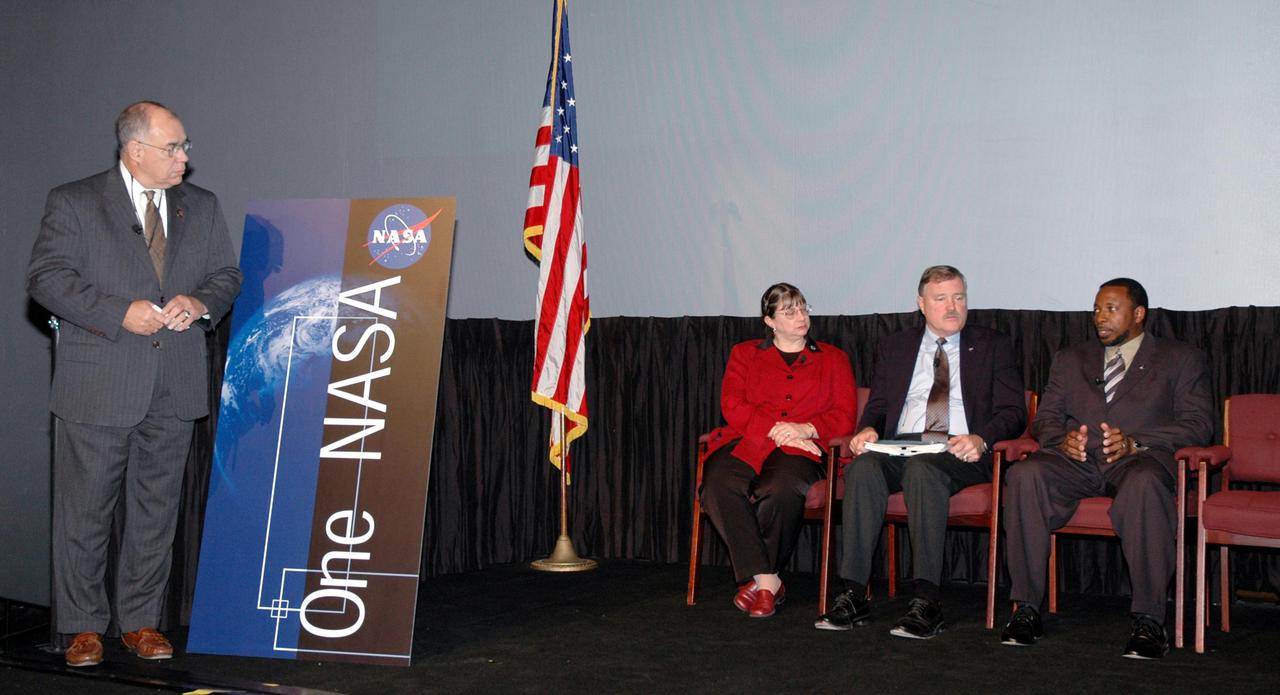
KENNEDY SPACE CENTER, FLA. - NASA Deputy Administrator Fred Gregory (left) moderates the panel presentation during the One NASA Leader-Led Workshop about the Agency’s Transformation and implementation strategies. Seated at right are panel members Lynn Cline, deputy associate administrator for Space Operations, Adm. Craig Steidle, associate administrator for Exploration Systems, and Woodrow Whitlow Jr., Kennedy deputy director. The workshop included senior leadership in the Agency who talked about ongoing Transformation activities and Kennedy’s role in the Vision for Space Exploration.
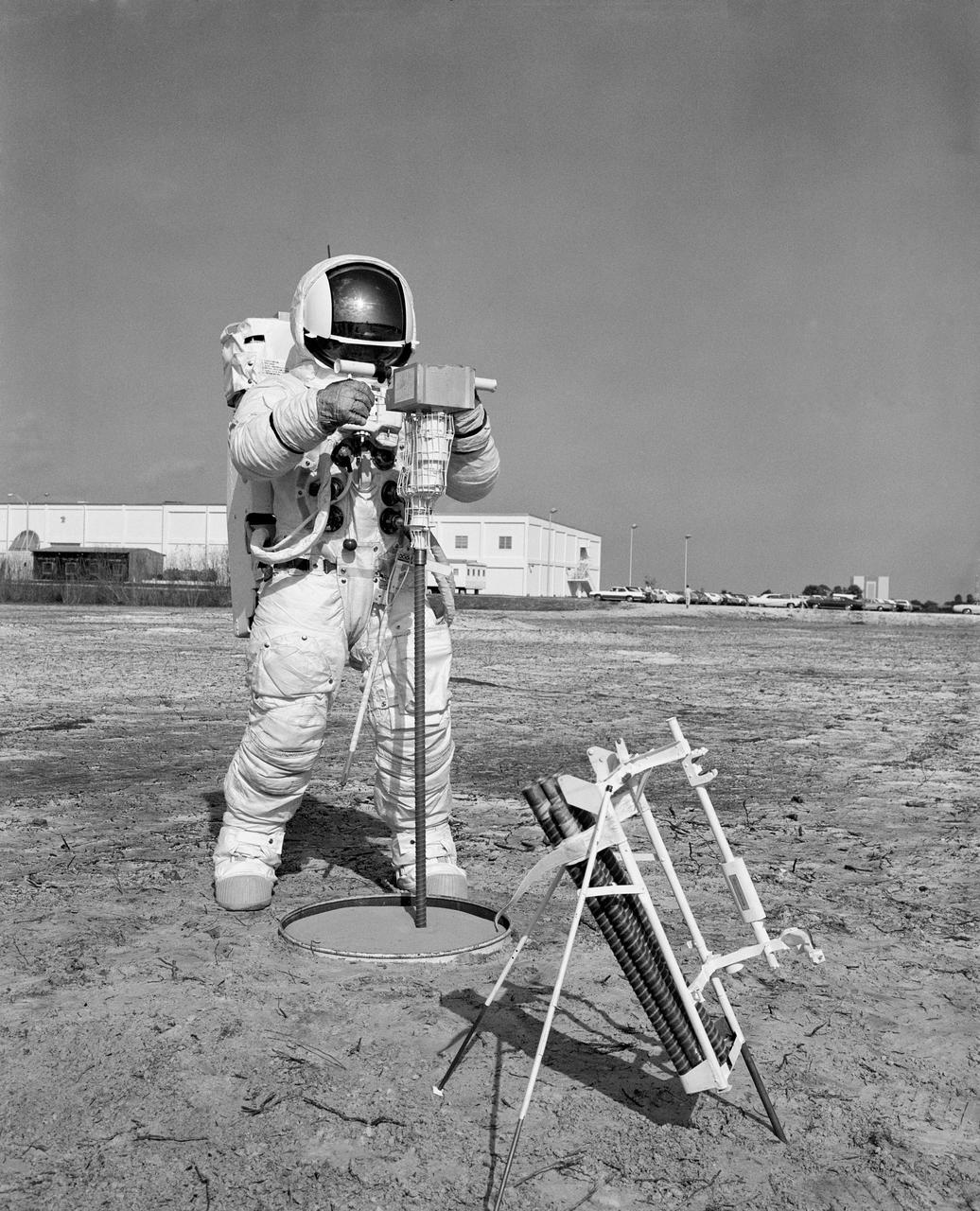
S70-29673 (28 Jan. 1970) --- Astronaut Fred W. Haise Jr., lunar module pilot of the Apollo 13 lunar landing mission, participates in a walk-through of the extravehicular activity timeline at the Kennedy Space Center. Here, Haise uses an Apollo Lunar Surface Drill to dig a three-meter heat flow probe hole. The heat flow experiment on Apollo 13 will have an electronic instrument which will measure the outward flux of heat from the moon?s interior.
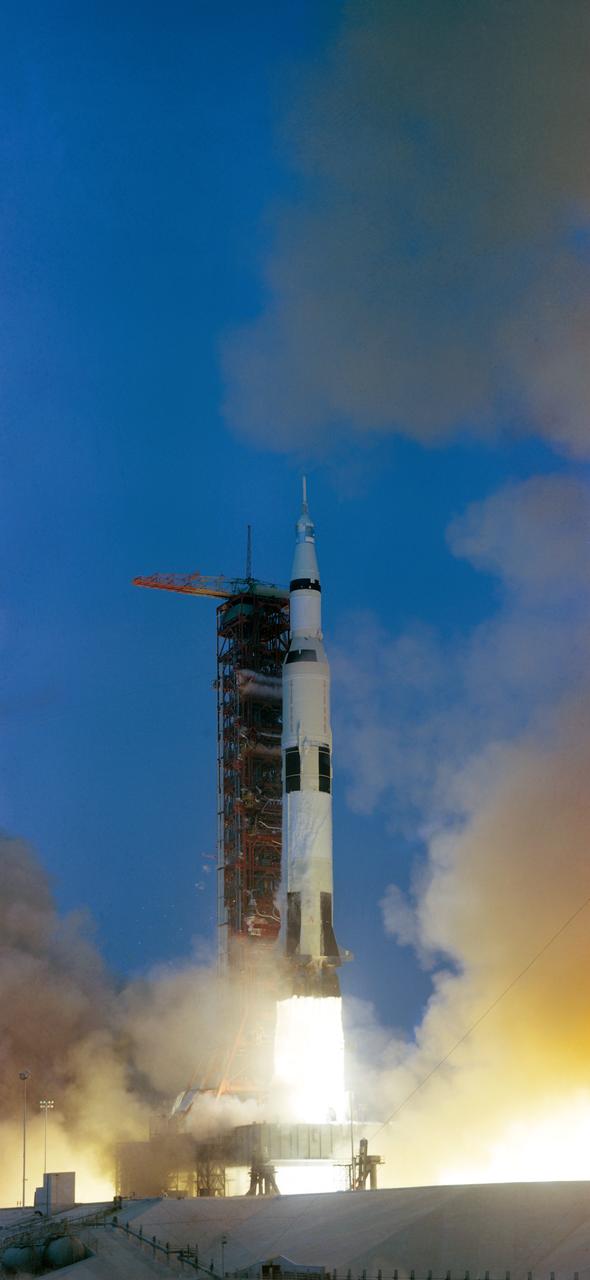
S70-34853 (11 April 1970) --- The Apollo 13 (Spacecraft 109/Lunar Module 7/Saturn 508) space vehicle is launched from Pad A, Launch Complex 39, Kennedy Space Center (KSC), at 2:13 p.m. (EST), April 11, 1970. The crew of the National Aeronautics and Space Administration's (NASA) third lunar landing mission are astronauts James A., Lovell Jr., commander; John L. Swigert Jr., command module pilot; and Fred W. Haise Jr., lunar module pilot.
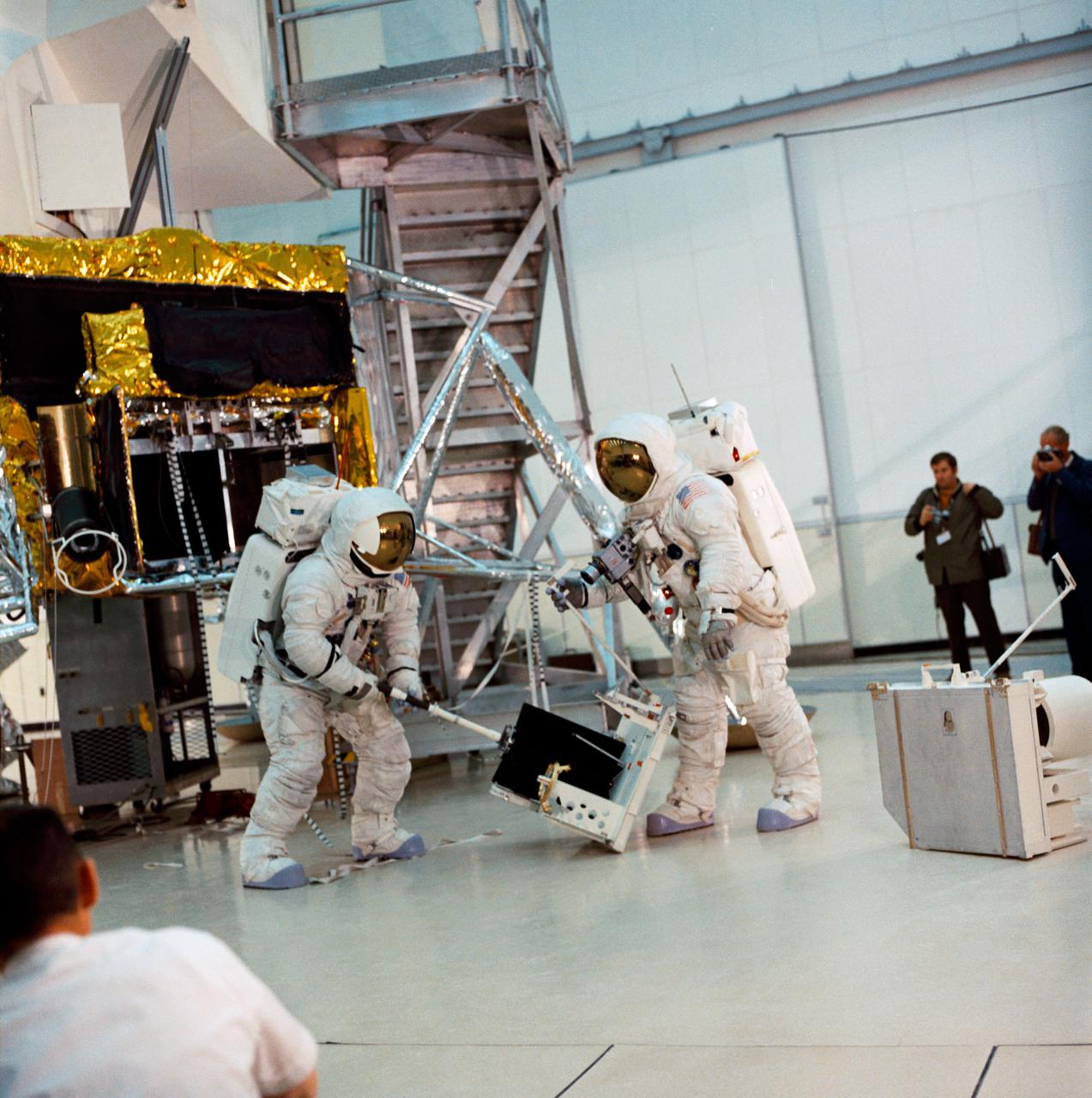
S70-27036 (4 Feb. 1970) --- Two crew men of the Apollo 13 lunar landing mission simulate lunar surface extravehicular activity (EVA) during training exercises in the Kennedy Space Center's (KSC) Flight Crew Training Building. They are astronauts James A. Lovell Jr. commander; and Fred W. Haise Jr., lunar module pilot.
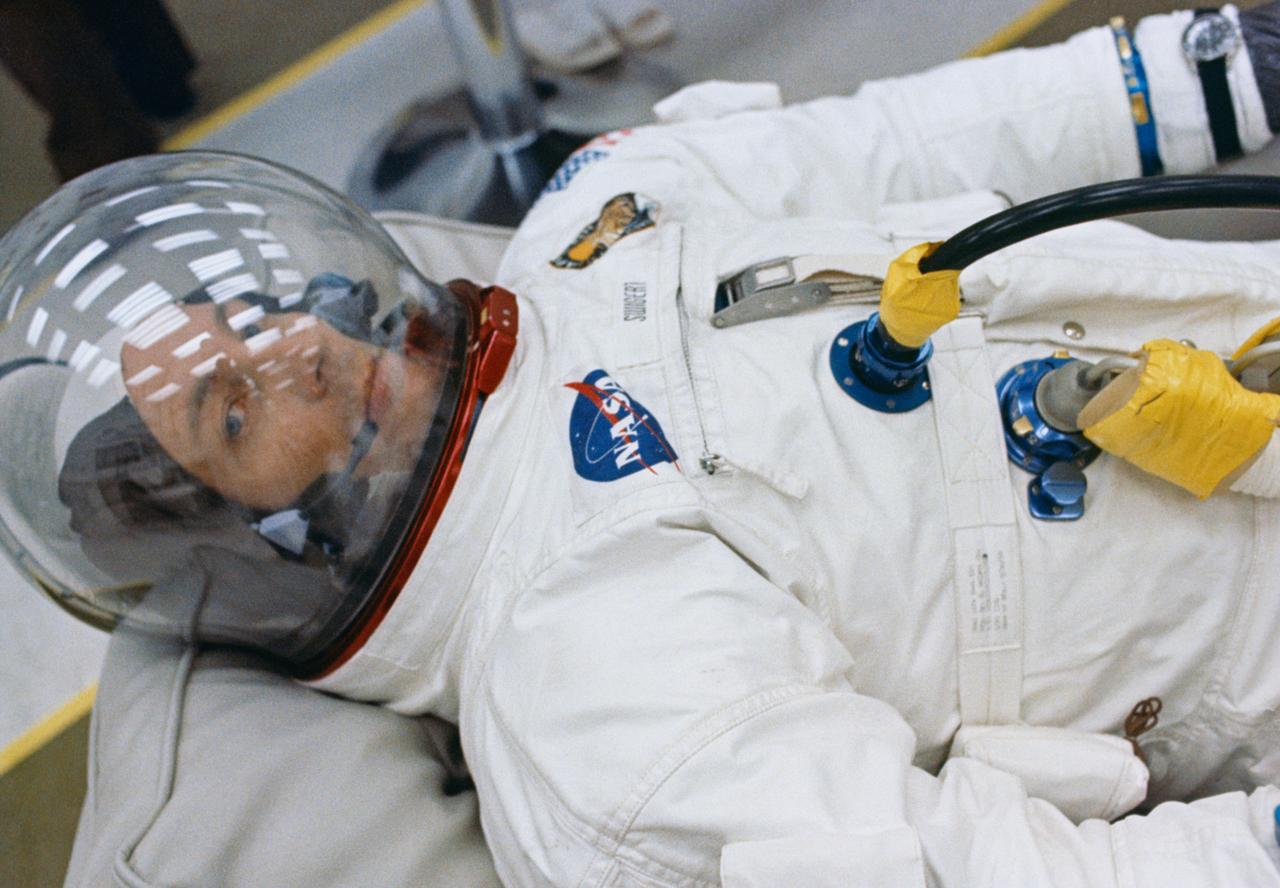
S70-34847 (11 April 1970) --- Astronaut John L. Swigert Jr., command module pilot for NASA?s third lunar landing mission, appears to be relaxing in the suiting room at Kennedy Space Center prior to launch. Other members of the Apollo 13 crew include astronauts James A. Lovell Jr., commander, and Fred W. Haise Jr., lunar module pilot. Swigert replaced astronaut Thomas K. Mattingly II when it was discovered that Mattingly had been exposed to the measles.
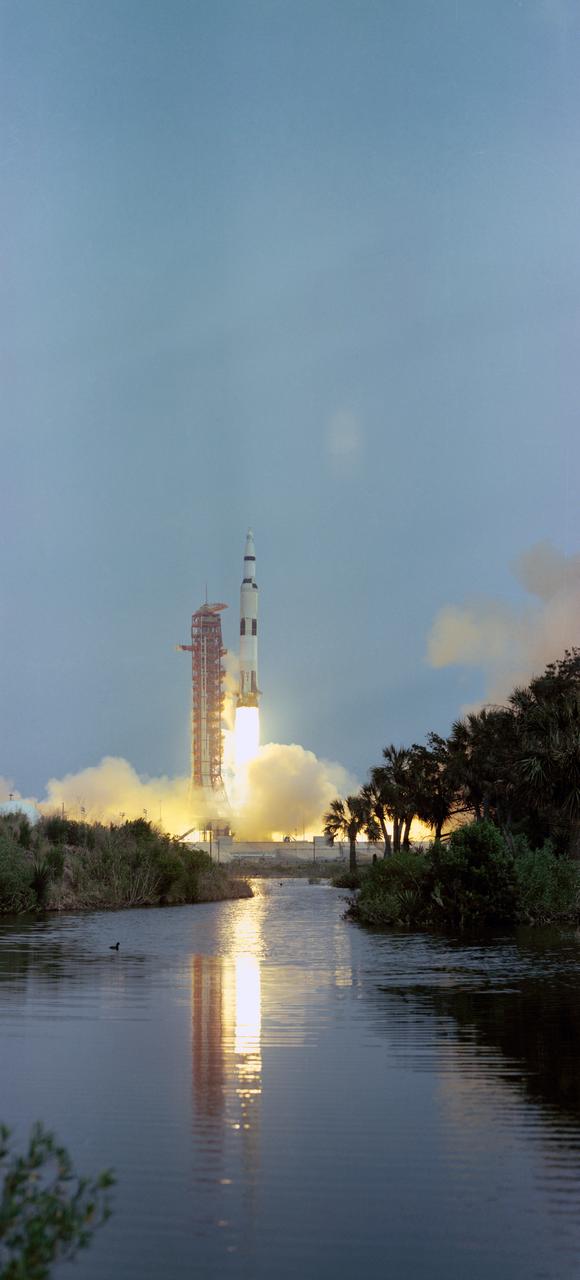
S70-38747 (11 April 1970) --The Apollo 13 (Spacecraft 109/Lunar Module 7/Saturn 508) space vehicle is launched from Pad A, Launch Complex 39, Kennedy Space Center (KSC), at 2:13 p.m. (EST), April 11, 1970. The crew of the National Aeronautics and Space Administration's (NASA) third lunar landing mission is astronauts James A. Lovell Jr., commander; John L. Swigert Jr., command module pilot; and Fred W. Haise Jr., lunar module pilot.
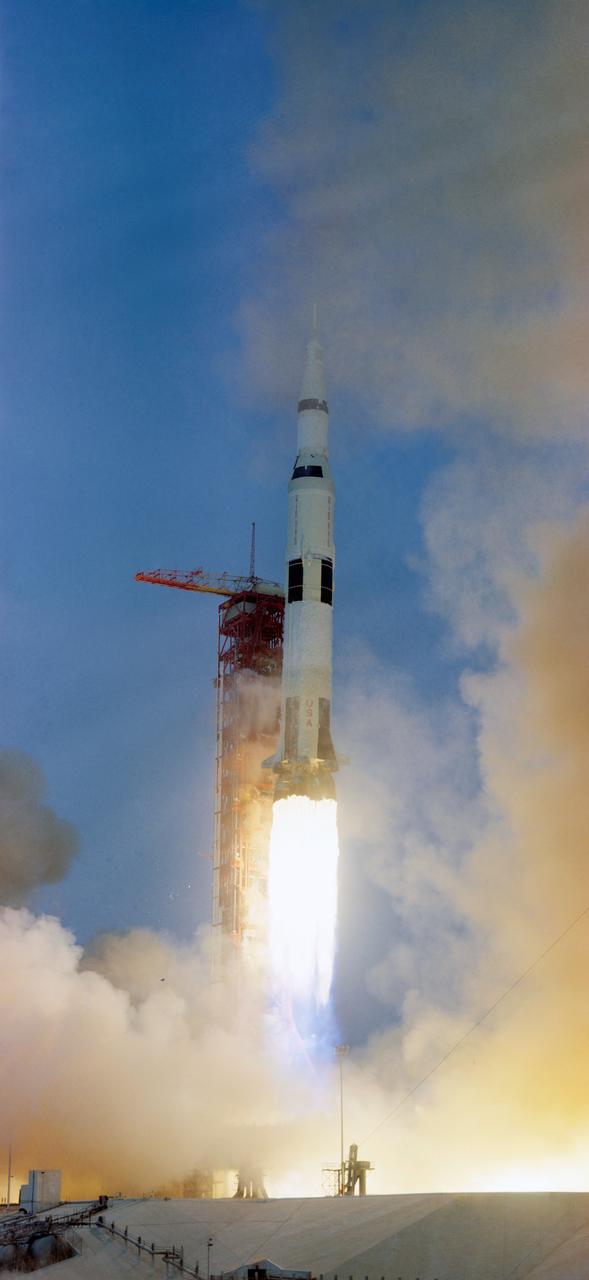
S70-34854 (11 April 1970) --- The Apollo 13 (Spacecraft 109/Lunar Module 7/Saturn 508) space vehicle is launched from Pad A, Launch Complex 39, Kennedy Space Center (KSC), at 2:13 p.m. (EST), April 11, 1970. The crew of the National Aeronautics and Space Administration's (NASA) third lunar landing mission are astronauts James A. Lovell Jr., commander; John L. Swigert Jr., command module pilot; and Fred W. Haise Jr., lunar module pilot.
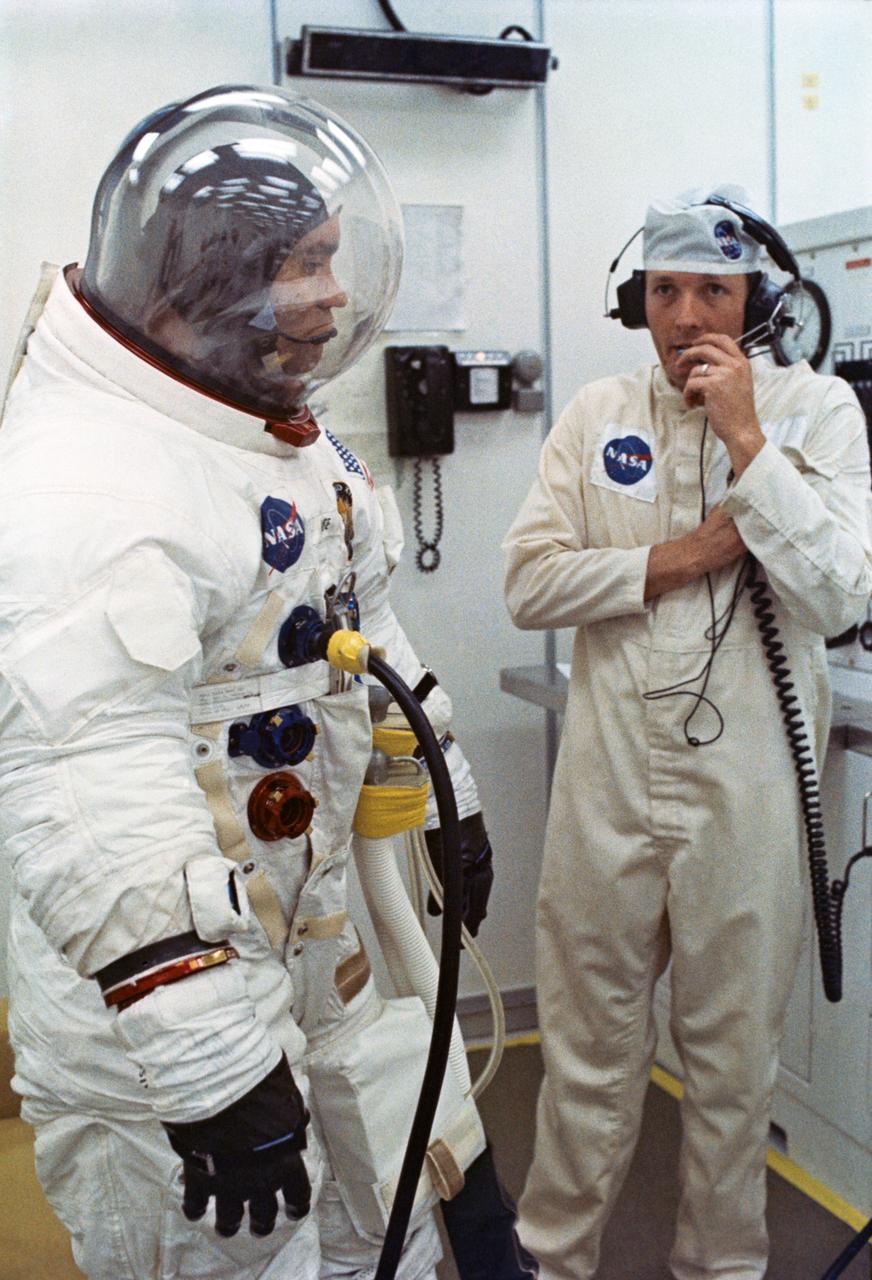
S70-34851 (11 April 1970) --- A space suit technician talks with astronaut Fred W. Haise Jr., lunar module pilot for NASA's Apollo 13 mission, during suiting up procedures at Kennedy Space Center (KSC). Other members of the crew are astronauts James A. Lovell Jr., commander, and John L. Swigert Jr., command module pilot. Swigert replaced astronaut Thomas K. Mattingly II as a member of the crew when it was learned he had been exposed to measles.

S70-34855 (11 April 1970) --- The Apollo 13 (Spacecraft 109/Lunar Module 7/Saturn 508) space vehicle is launched from Pad A, Launch Complex 39, Kennedy Space Center (KSC), at 2:13 p.m. (EST), April 11, 1970. The crew of the National Aeronautics and Space Administration's (NASA) third lunar landing mission are astronauts James A., Lovell Jr., commander; John L. Swigert Jr., command module pilot; and Fred W. Haise Jr., lunar module pilot.
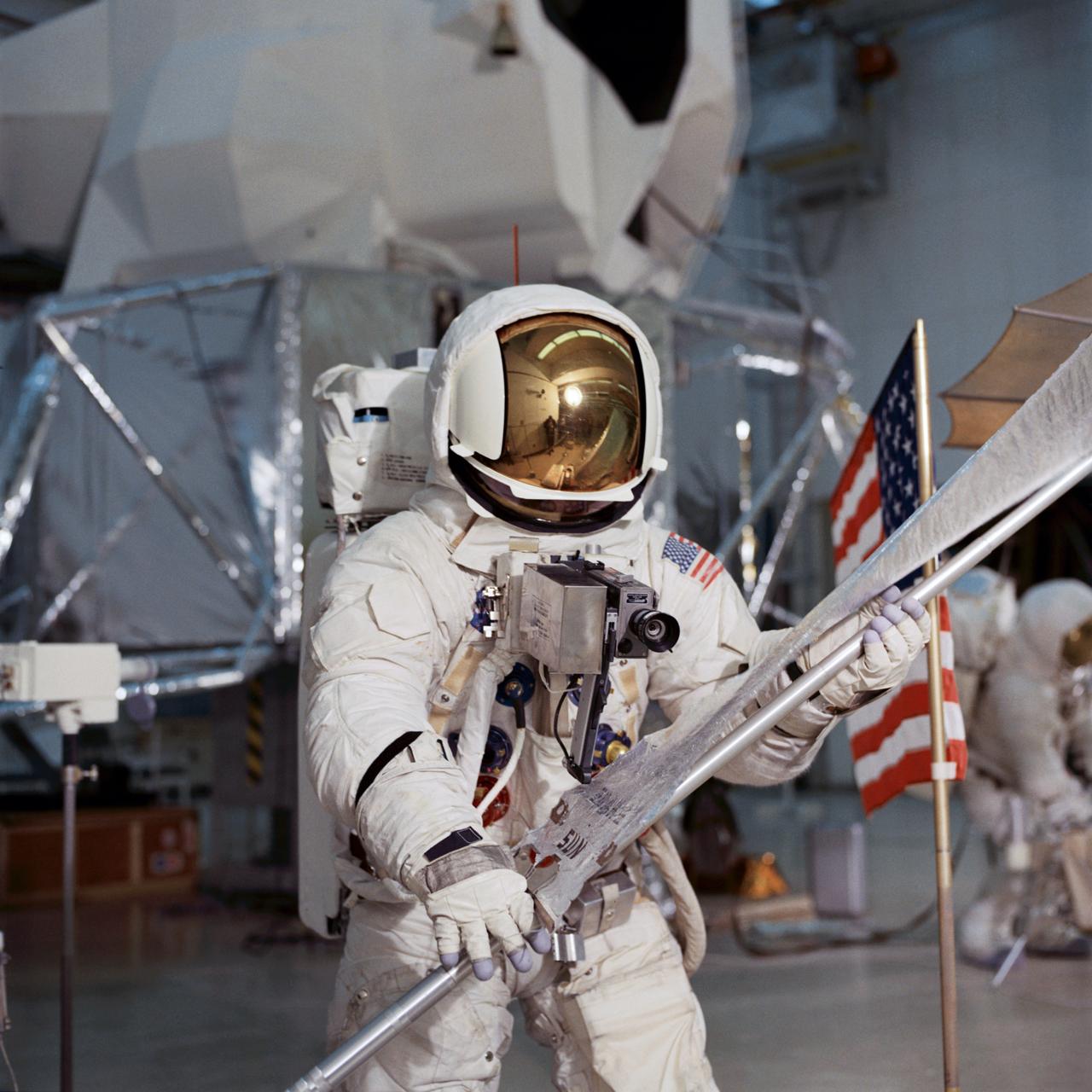
S70-27034 (4 Feb. 1970) --- Astronaut Fred W. Haise Jr., lunar module pilot of the Apollo 13 lunar landing mission, simulates lunar surface extravehicular activity (EVA) during training exercises in the Kennedy Space Center's (KSC) Flight Crew Training Building (FCTB). Haise, wearing an Extravehicular Mobility Unit (EMU), is holding a Solar Wind Composition (SWC) experiment.
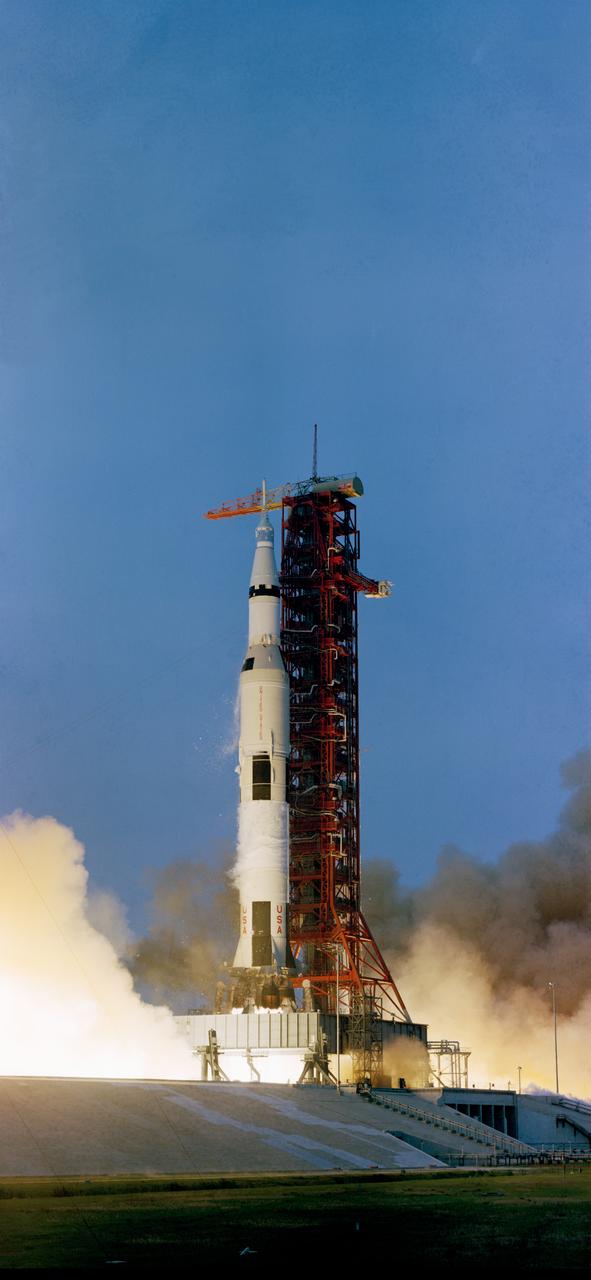
S70-34852 (11 April 1970) --- The Apollo 13 (Spacecraft 109/Lunar Module 7/Saturn 508) space vehicle is launched from Pad A Launch Complex 39, Kennedy Space Center (KSC), at 2:13 p.m. (EST), April 11, 1970. The crew of the National Aeronautics and Space Administration's (NASA) third lunar landing mission are astronauts James A. Lovell Jr., commander; John L. Swigert Jr., command module pilot; and Fred W. Haise Jr., lunar module pilot.
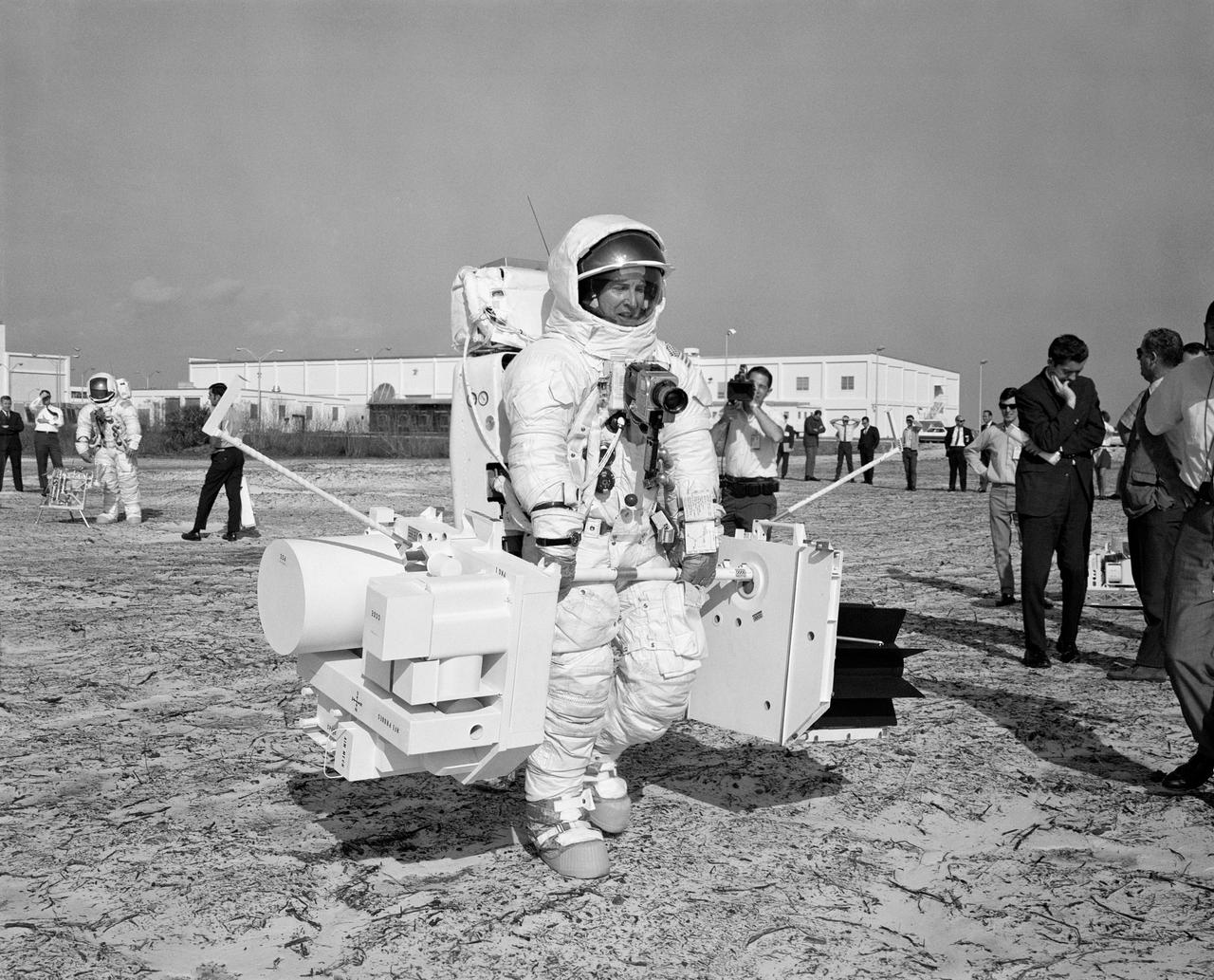
S70-29672 (28 Jan. 1970) --- Astronaut James A. Lovell Jr., commander of the Apollo 13 lunar landing mission, participates in a walk-through of the extravehicular activity timeline at the Kennedy Space Center. Here, Lovell, using mock-ups, traverses with the two subpackages of the Apollo Lunar Surface Experiments Package (ALSEP). Astronaut Fred W. Haise Jr., lunar module pilot, is standing in the left background.
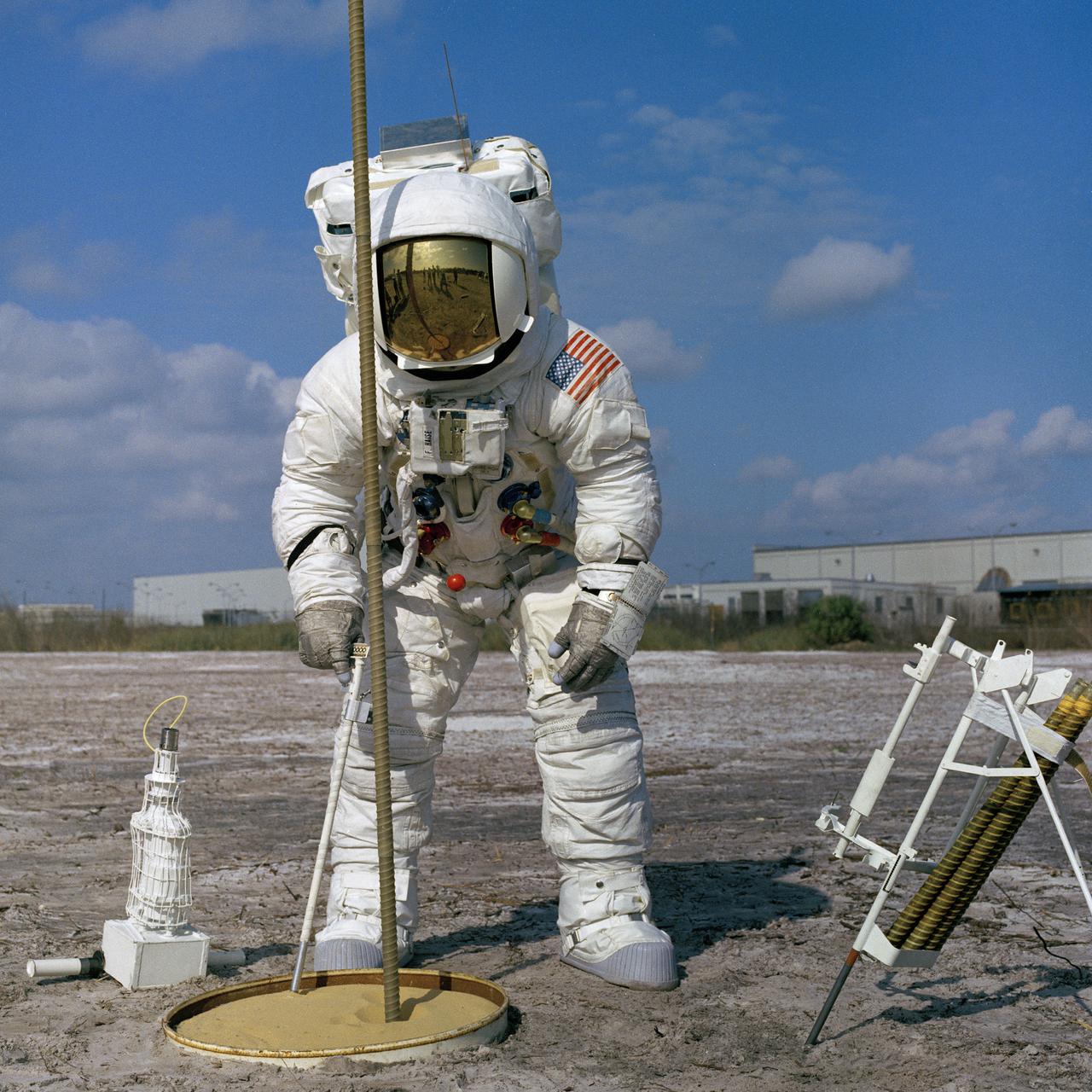
CAPE CANAVERAL, Fla. - Fred W. Haise Jr., Apollo 13 lunar module pilot, inspects the sampling tube to be used to take subsurface temperatures on the moon during the April lunar landing mission. Apollo 13 is scheduled for launch from Kennedy Space Center on April 11 and has a prime crew composed of Haise, James A. Lovell Jr., commander, and Thomas K. Mattingly II, command module pilot. Photo credit: NASA
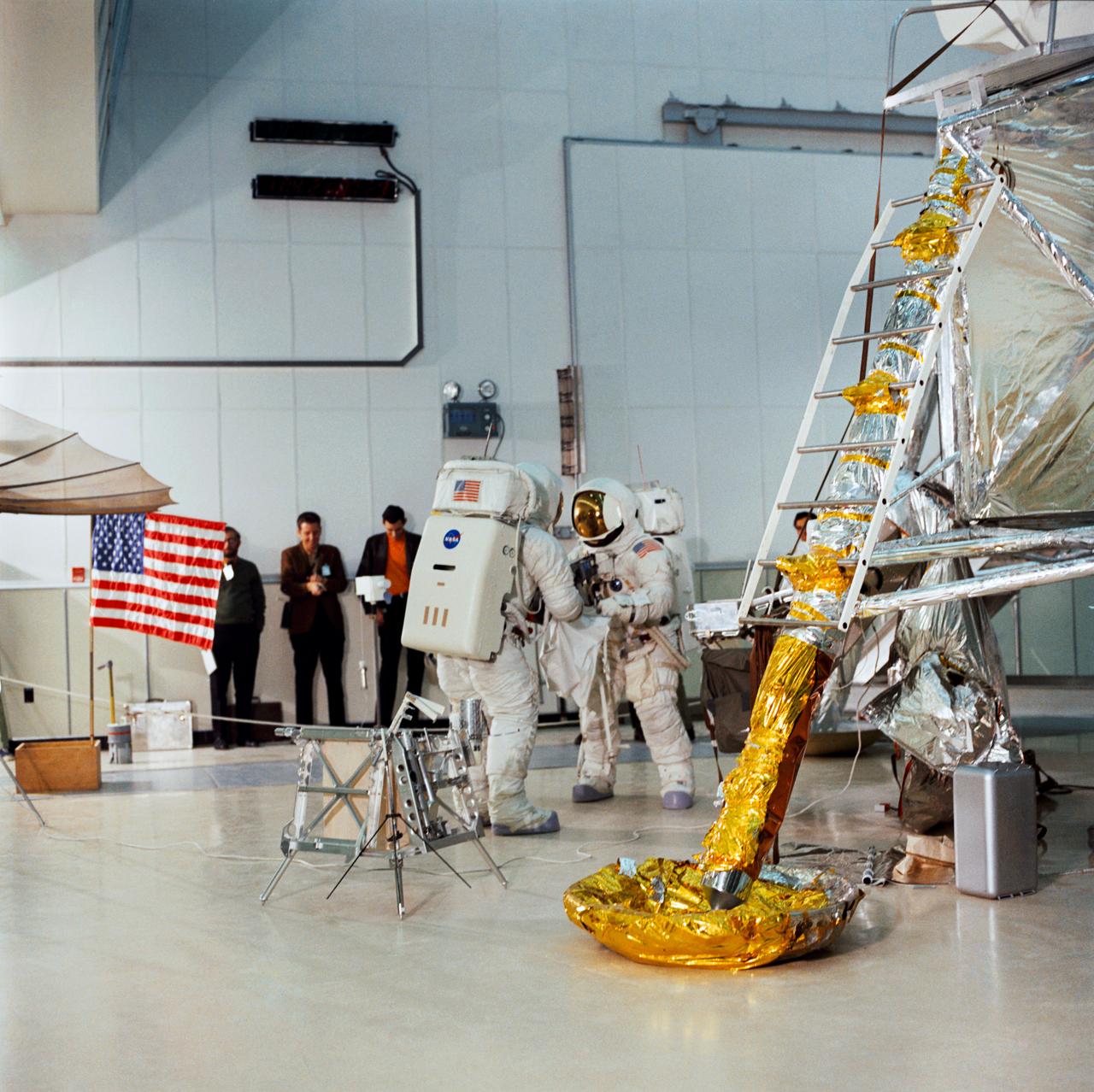
S70-27038 (4 Feb. 1970) --- Two crew men of the Apollo 13 lunar landing mission simulate lunar surface Extravehicular Activity (EVA) during training exercises in the Kennedy Space Center's (KSC) Flight Crew Training Building. They are astronauts James A. Lovell Jr. (on left, back to camera) commander; and Fred W. Haise Jr., lunar module pilot.
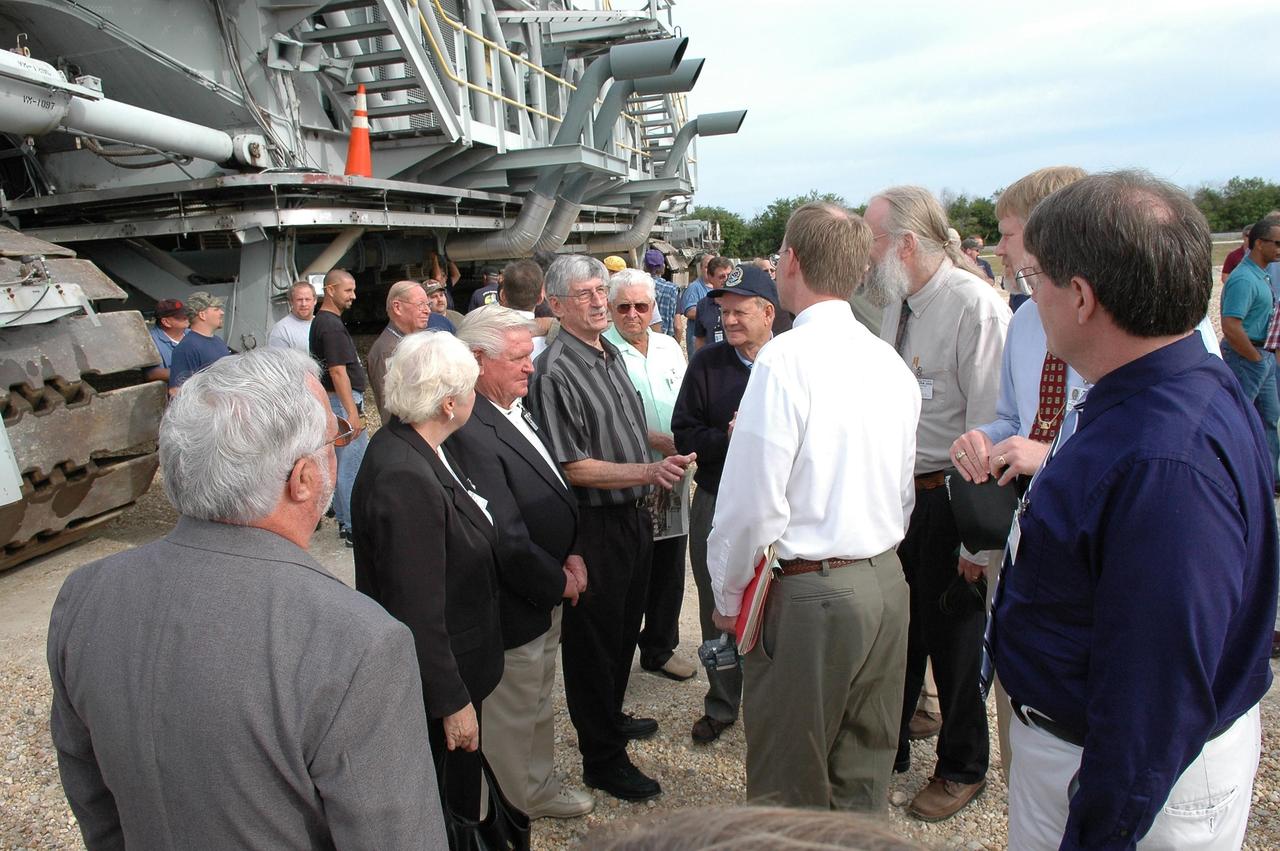
KENNEDY SPACE CENTER, FLA. - On the occasion of the 40th anniversary of the crawler transporter used for moving space shuttles to the NASA Kennedy Space Center’s launch pads, invited guests mingle in front of one of the crawlers still in use. From left are Sylvan “Skip” Montagna, Patricia and Fred Renaud, Fred Wallace and Bill Clemens. Philip Koehring and his brothers Doug(white shirt) and John (light blue shirt) and Rick Drollinger are on the right. Philip Koehring Sr. was project manager at the Marion Power Shovel Co. in Ohio where the crawlers were initially built in 1965. Drollinger’s father, Richard, was director of engineering at Marion. Media representatives and invited guests had the opportunity to tour one of NASA's two crawlers. This included the driver cab and engine room. Guests included current drivers and operators, as well as drivers from the Apollo Program. In January 1966, the crawler completed its first successful move with a 10.6-million-pound launch umbilical tower. It moved three-quarters of a mile in about nine hours. Throughout 40 years of service, the two crawlers have moved more than 3,500 miles and carried seven vehicles.
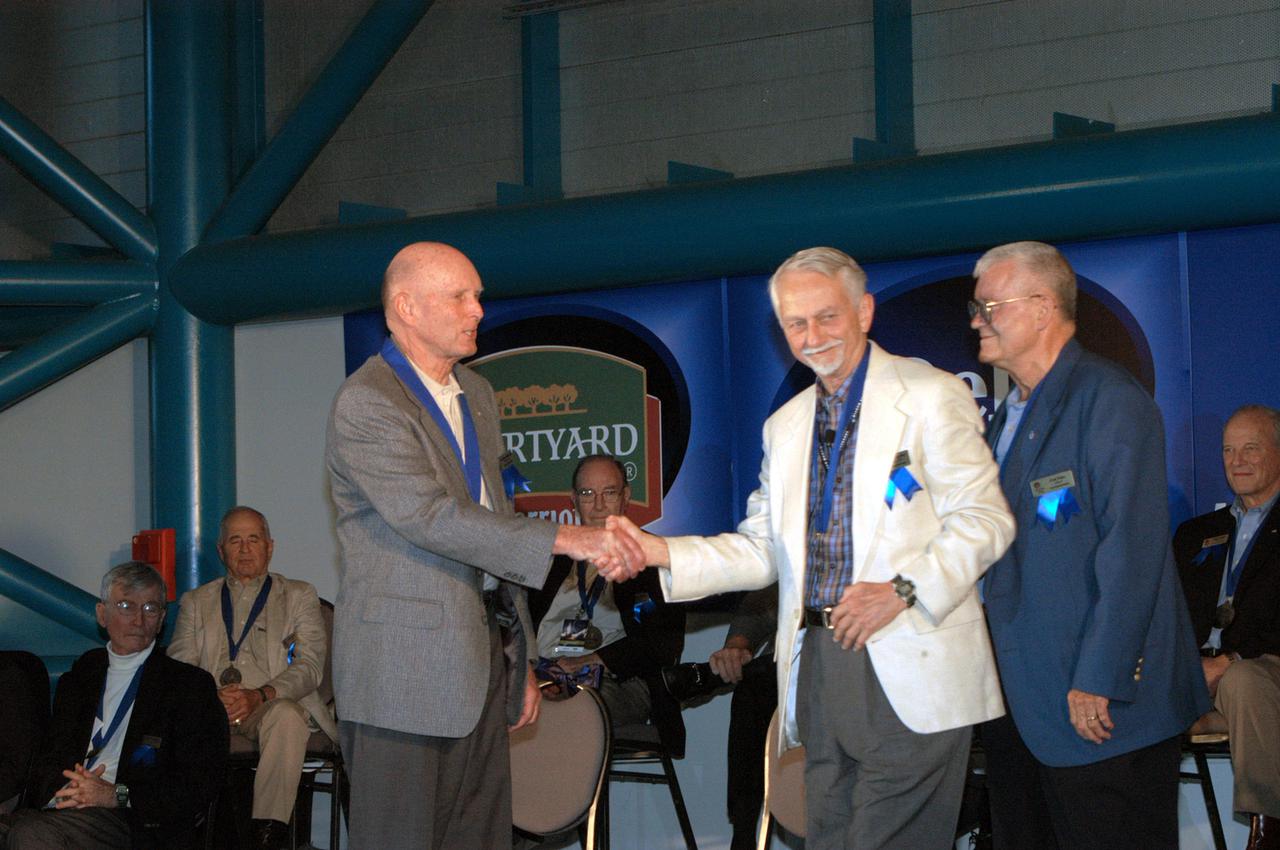
KENNEDY SPACE CENTER, FLA. - At the Astronaut Hall of Fame Induction Ceremony, new inductee Gordon Fullerton (left) is congratulated by Chairman Owen Garriott. At right is Hall of Famer Fred Haise. Other Hall of Famers are gathered on stage for the ceremony, which is being held in the Kennedy Space Center Visitor Complex’s Apollo_Saturn V Center. Recognized for their individual flight accomplishments and contributions to the success and future success of the U.S. space program, this elite group of inductees is among only 60 astronauts to be honored in the Hall of Fame and the fourth group of Space Shuttle astronauts named.
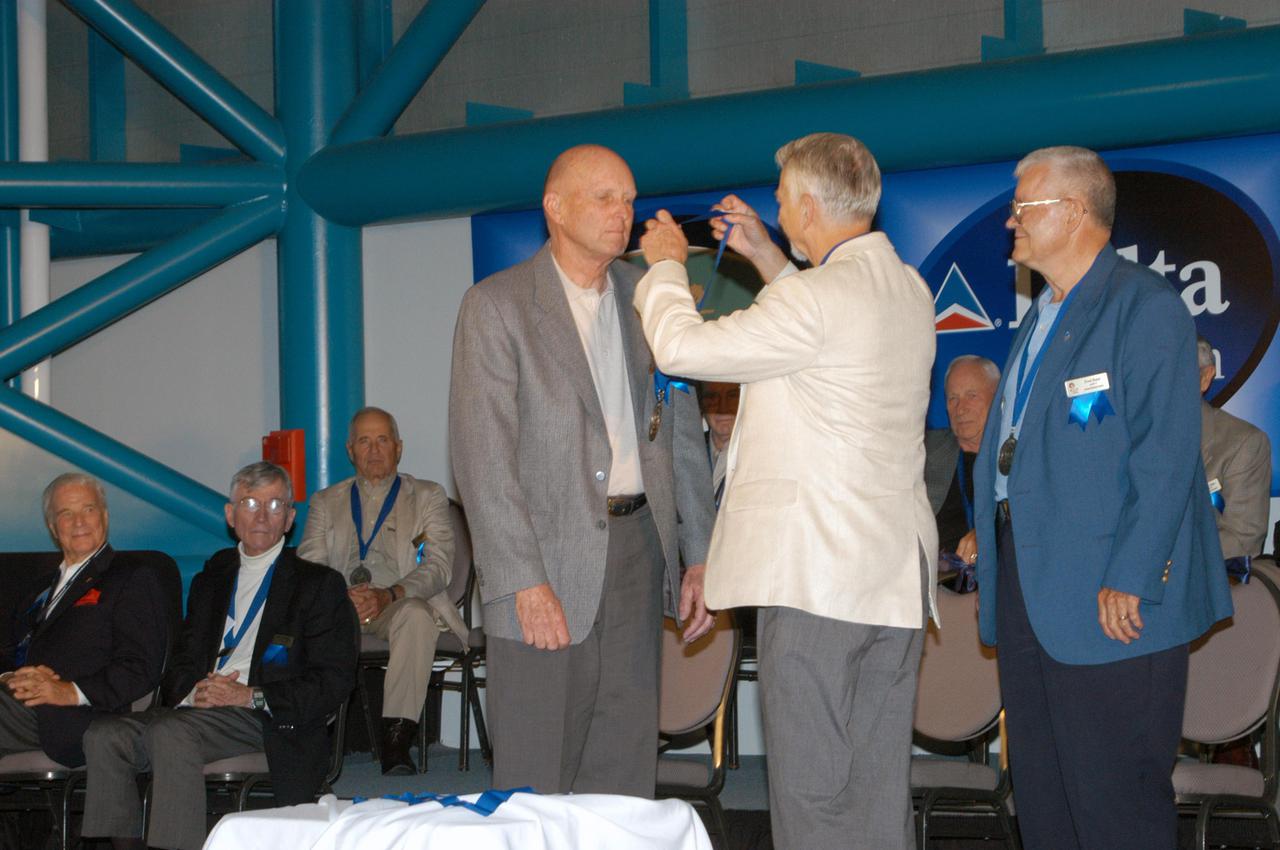
KENNEDY SPACE CENTER, FLA. - At the Astronaut Hall of Fame Induction Ceremony, Chairman Owen Garriott (center) places a medal around the neck of new inductee Gordon Fullerton. At right is Hall of Famer Fred Haise. Other Hall of Famers are gathered on stage for the ceremony, which is being held in the Kennedy Space Center Visitor Complex’s Apollo_Saturn V Center. Recognized for their individual flight accomplishments and contributions to the success and future success of the U.S. space program, this elite group of inductees is among only 60 astronauts to be honored in the Hall of Fame and the fourth group of Space Shuttle astronauts named.
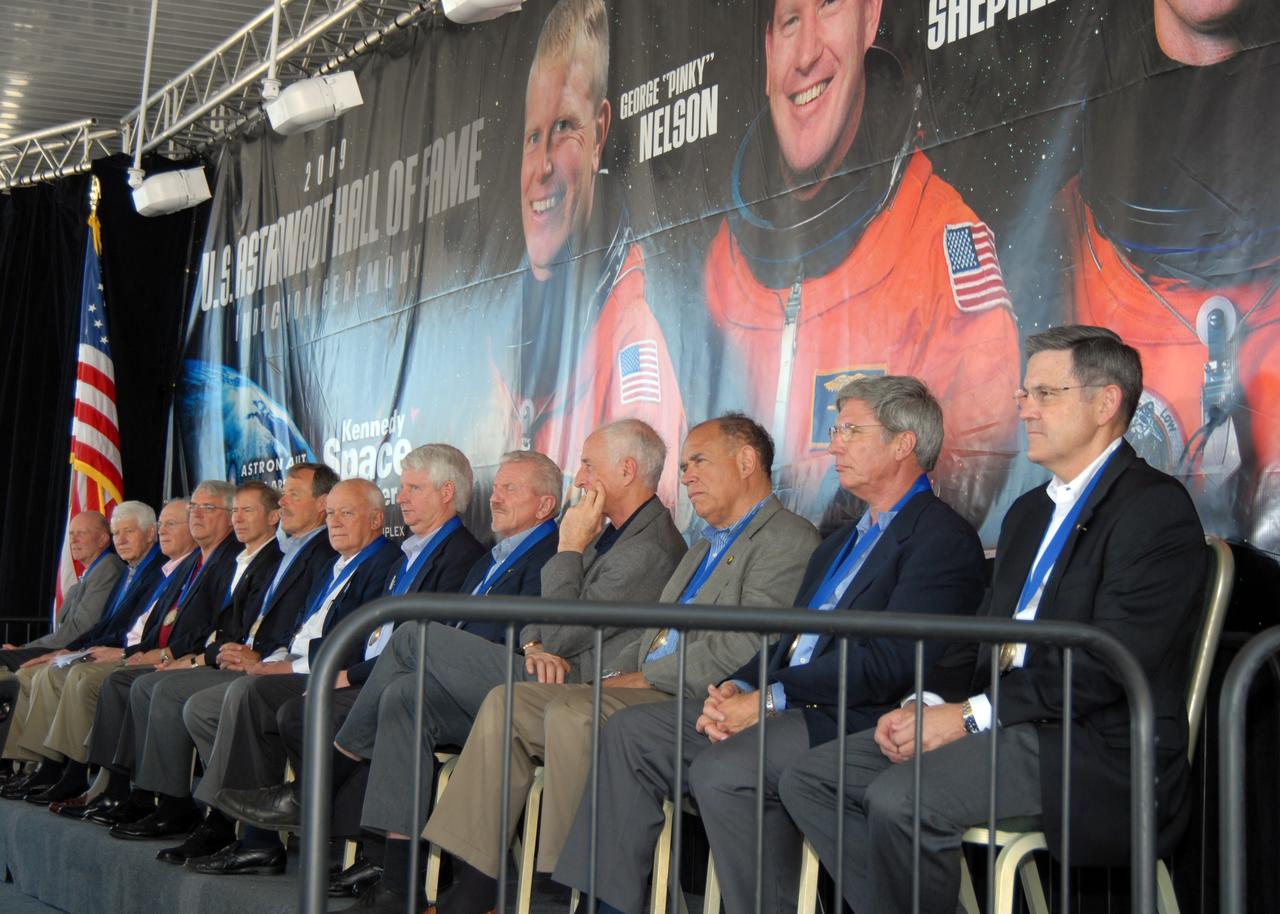
CAPE CANAVERAL, Fla. –– Hall of Fame astronauts (from left) Gordon Fullerton, Henry W. "Hank" Hartsfield Jr., Rick Hauk, Dan Brandenstein, Brewster Shaw, Robert "Hoot" Gibson, Bruce McCandless, Steven Hawley, Loren Shriver, Jeff Hoffman, Fred Gregory, John Blaha and Bob Cabana watch the U.S. Astronaut Hall of Fame induction ceremony at NASA's Kennedy Space Center Visitor Complex in Florida. Cabana is the Kennedy Space Center director. The ceremony took place May 2. More than 20 hall of fame astronauts attended, including Scott Carpenter, Walt Cunningham, Jim Lovell and Bob Crippen. Photo credit: NASA/Jim Grossmann
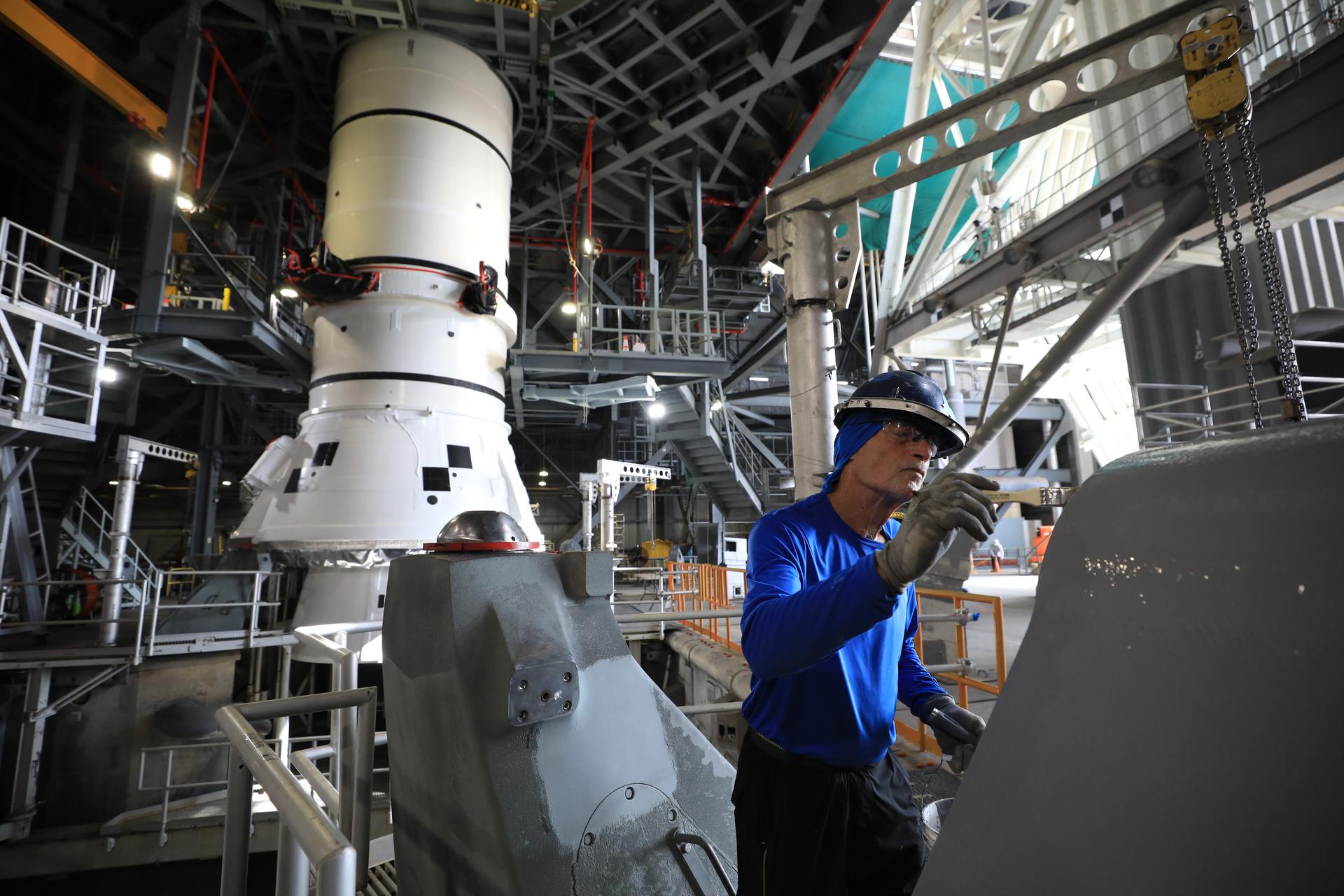
Fred Rosenwinkel, an employee at NASA’s Kennedy Space Center in Florida, paints ground equipment, as teams lowered and secured the left-hand aft assembly solid rocket booster segment for NASA’s Artemis III SLS (Space Launch System) to the mobile launcher at the agency’s Vehicle Assembly Building at NASA Kennedy on Thursday, July 9, 2026. The twin boosters, manufactured by Northrop Grumman in Utah, will provide more than 75 percent of the SLS rocket’s total thrust at launch. The Artemis III mission will launch crew in the Orion spacecraft on top of the SLS rocket to test rendezvous and docking capabilities between Orion and commercial spacecraft needed to land astronauts on the Moon.

KENNEDY SPACE CENTER, FLA. - At the KSC Visitor Complex, former astronaut Robert L. Crippen (standing right) congratulates former astronaut Sally K. Ride at her induction ceremony into the U.S. Astronaut Hall of Fame. Also standing is former astronaut James A. Lovell. Seated on the dais, from left, are former astronauts Gordon Cooper, Scott Carpenter, Buzz Aldrin, Walter Cunningham, Edgar B. Mitchell, and Fred W. Haise, all previously inducted into the Hall of Fame. Being inducted with Ride are Space Shuttle astronauts Daniel Brandenstein, Robert "Hoot" Gibson, and Story Musgrave. Conceived by six of the Mercury Program astronauts, the U.S. Astronaut Hall of Fame opened in 1990 to provide a place where space travelers could be remembered for their participation and accomplishments in the U.S. space program. The four new inductees join 48 previously honored astronauts from the ranks of the Gemini, Apollo, Skylab, Apollo-Soyuz, and Space Shuttle programs.
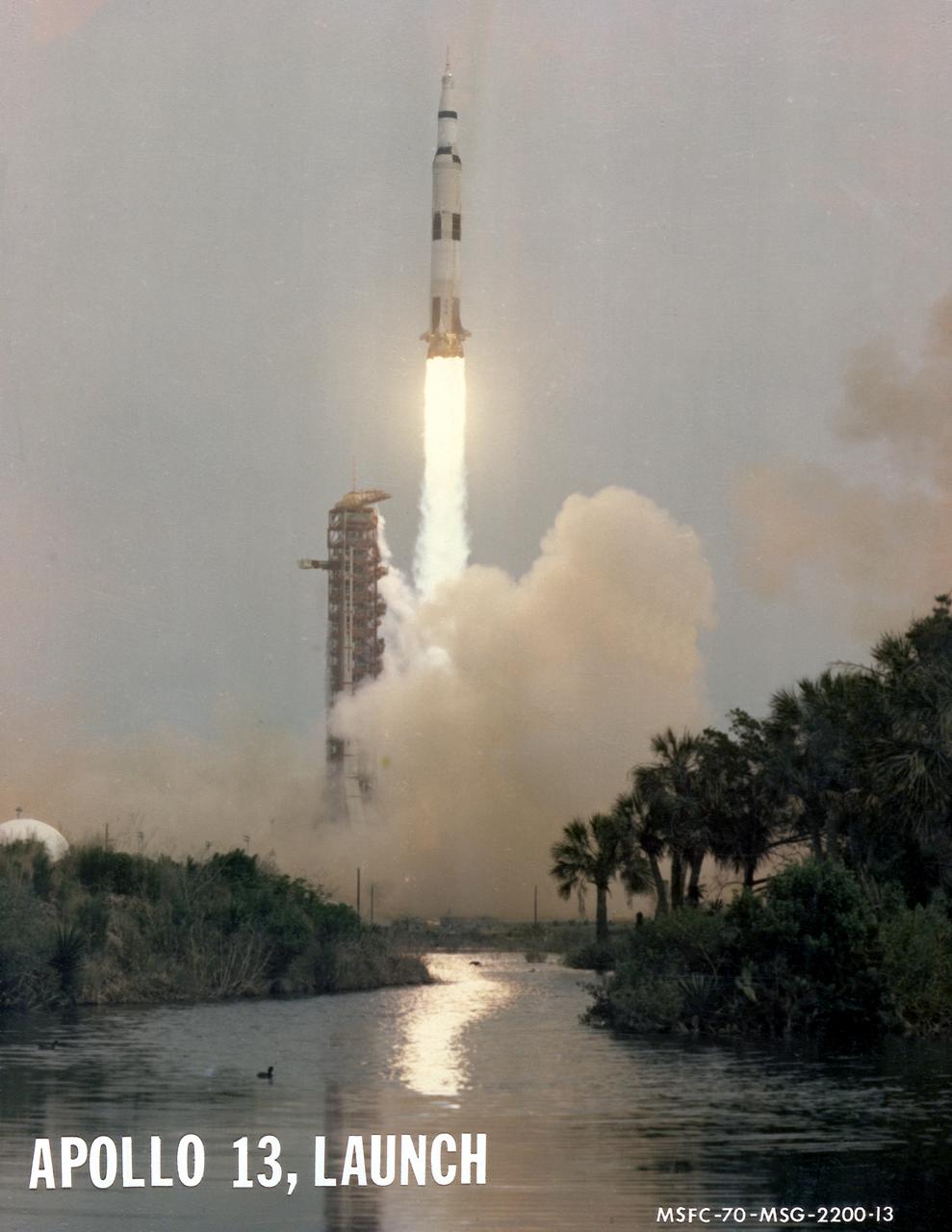
The third marned lunar landing mission, Apollo 13 (SA-508), with three astronauts: Mission commander James A. Lovell Jr., Lunar Module pilot Fred W. Haise Jr., and Command Module pilot John L. Swigert Jr., lifted off from the Kennedy Space Center launch complex 39A on April 11, 1970. The mission was aborted after 56 hours of flight, 205,000 miles from Earth, when an oxygen tank in the service module exploded. The Command Module, Odyssey, carrying the three astronauts, safely splashed down in the Pacific Ocean at 1:08 p.m. EST, April 17, 1970.
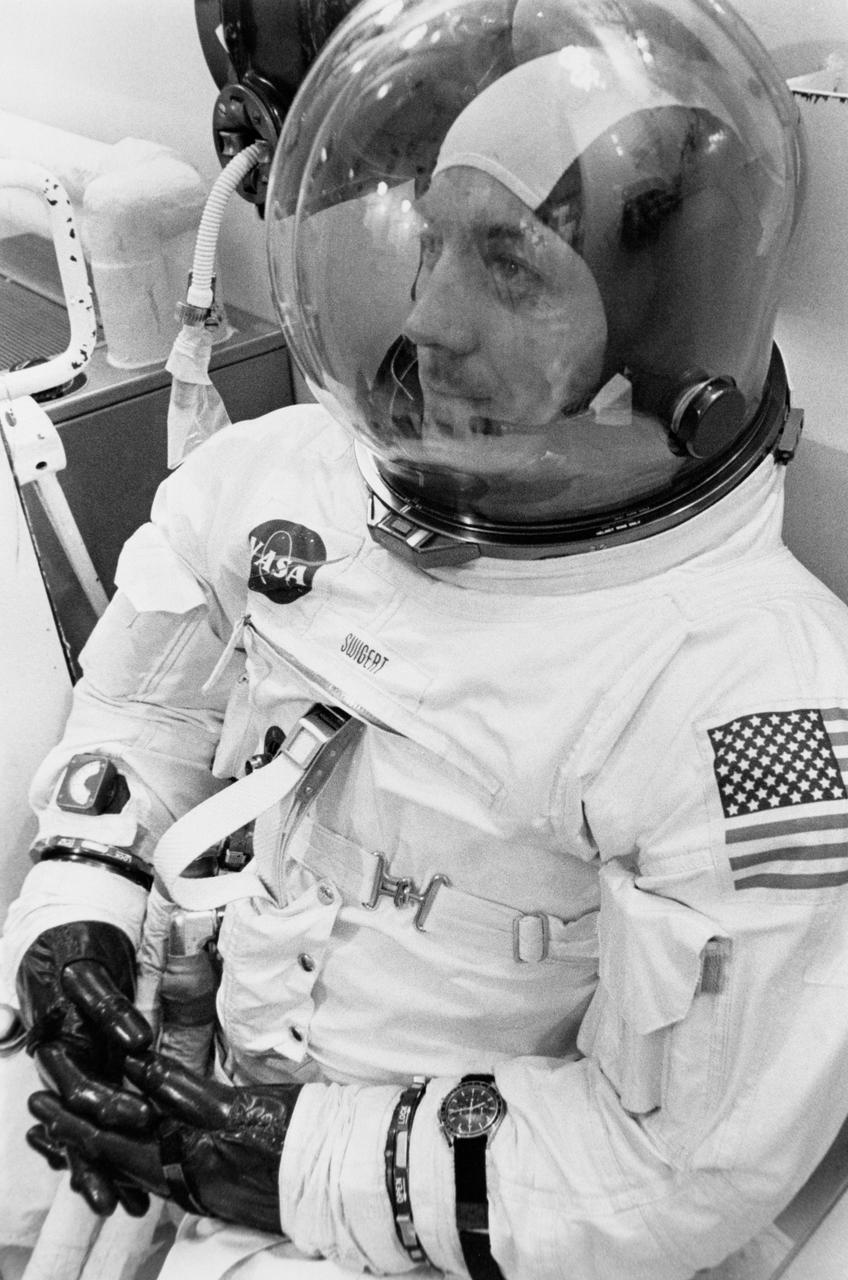
S70-34687 (11 April 1970) --- Astronaut John L. Swigert Jr., command module pilot for the Apollo 13 mission, has just suited up in the Kennedy Space Center's (KSC) Manned Spacecraft Operations Building during the Apollo 13 prelaunch countdown. Minutes later, astronauts Swigert, James A. Lovell Jr. and Fred W. Haise Jr. rode a special transport van over to Pad A, Launch Complex 39, where their spacecraft awaited liftoff. Launch occurred at 2:13 p.m. (EST), April 11, 1970.
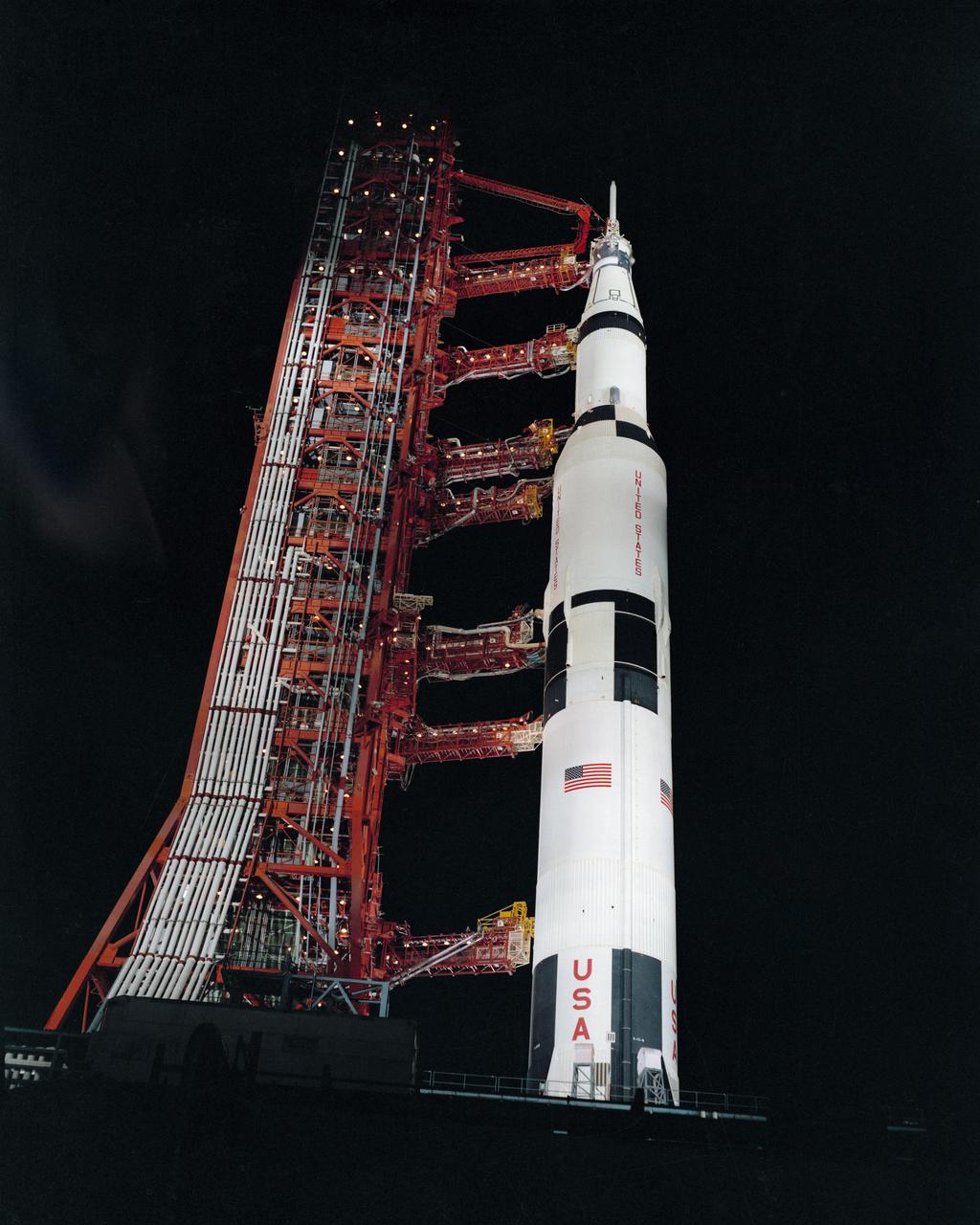
S70-32990 (24 March 1970) --- Nighttime, ground level view of Pad A, Launch Complex 39, Kennedy Space Center (KSC), showing the Apollo 13 (Spacecraft 109/Lunar Module 7/Saturn 508) space vehicle during Countdown Demonstration Test (CDDT). The crew of NASA's third lunar landing mission includes astronauts James A. Lovell Jr., commander; John L. Swigert Jr., command module pilot; and Fred W. Haise Jr., lunar module pilot. The Apollo 13 launch has been scheduled for 2:13 p.m. (EST), April 11, 1970.
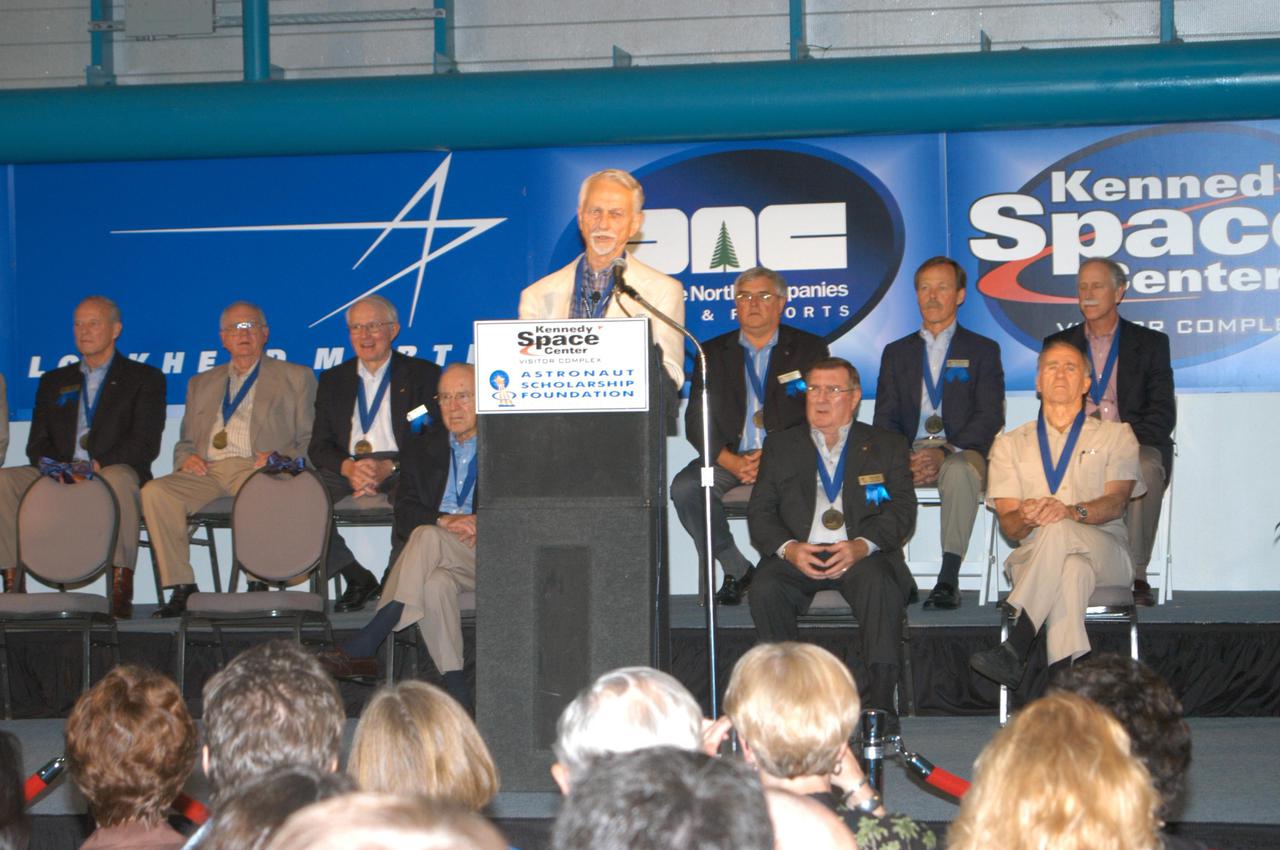
KENNEDY SPACE CENTER, FLA. - Owen Garriott, chairman of the Astronaut Hall of Fame, speaks to guests at the Induction Ceremony of three new additions to the Hall of Fame: Gordon Fullerton, Bruce McCandless and Joe Allen. Seated on stage are current Hall of Famers, from left in the back row, Charles Duke, Jack Lousma, Bill Pogue, Dan Brandenstein, Robert “Hoot” Gibson and Stephen Covey; in front row, Jim Lovell, Fred Haise and Vance Brand. Recognized for their individual flight accomplishments and contributions to the success and future success of the U.S. space program, this elite group of inductees is among only 60 astronauts to be honored in the Hall of Fame and the fourth group of Space Shuttle astronauts named.
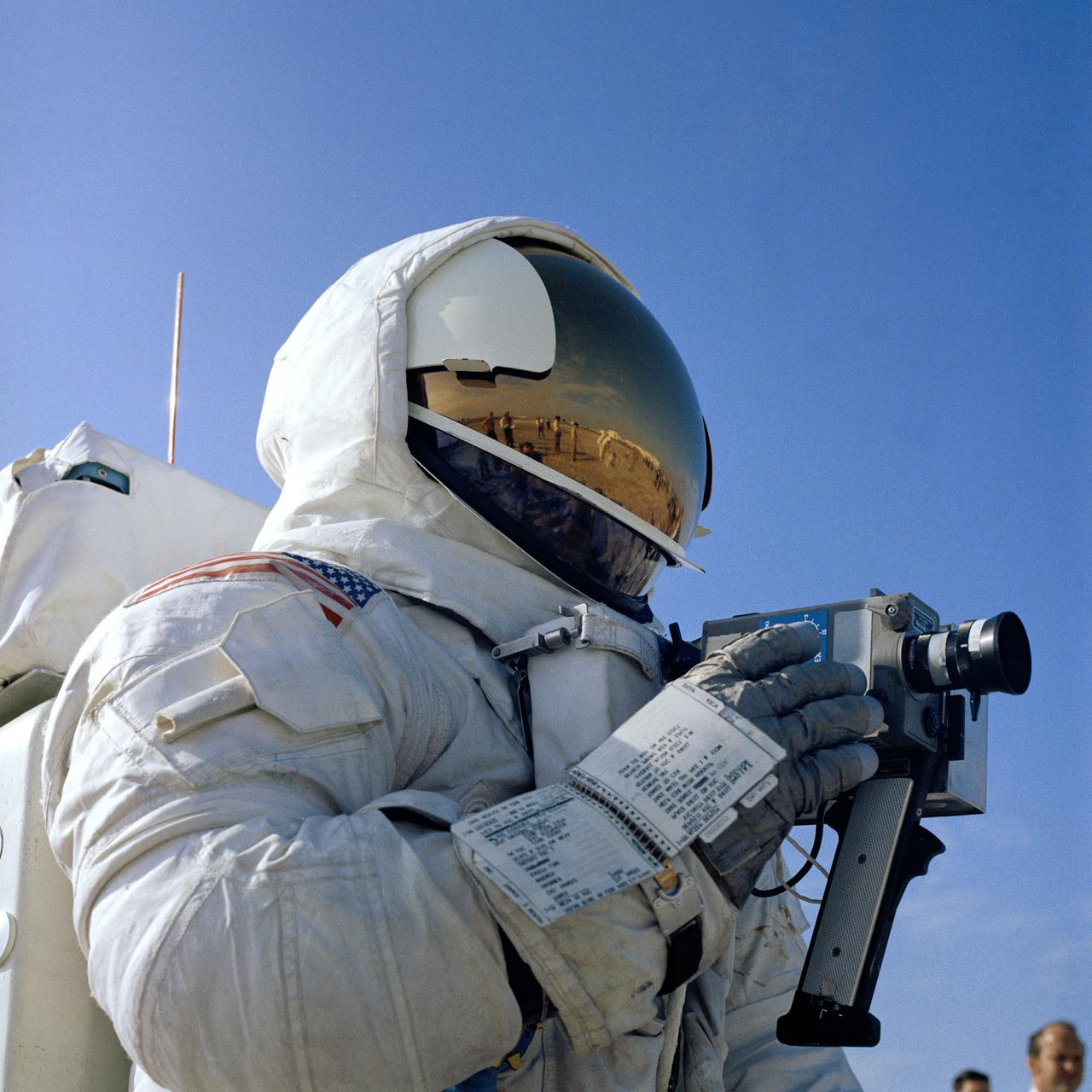
CAPE CANAVERAL, Fla. - Astronaut Fred W. Haise Jr., Apollo 13 lunar module pilot, practices operation of the 16-millimeter motion picture camera to be used on the lunar surface during the Apollo 13 mission. The Apollo 13 landing is scheduled for the Fra Mauro, a highlands area approximately 95 miles east of the Apollo 12 landing site in November 1969. Apollo 13, scheduled for launch from Kennedy Space Center on April 11, has a prime crew composed of Haise, James A. Lovell Jr., commander, and Thomas K. Mattingly II, command module pilot. Photo credit: NASA
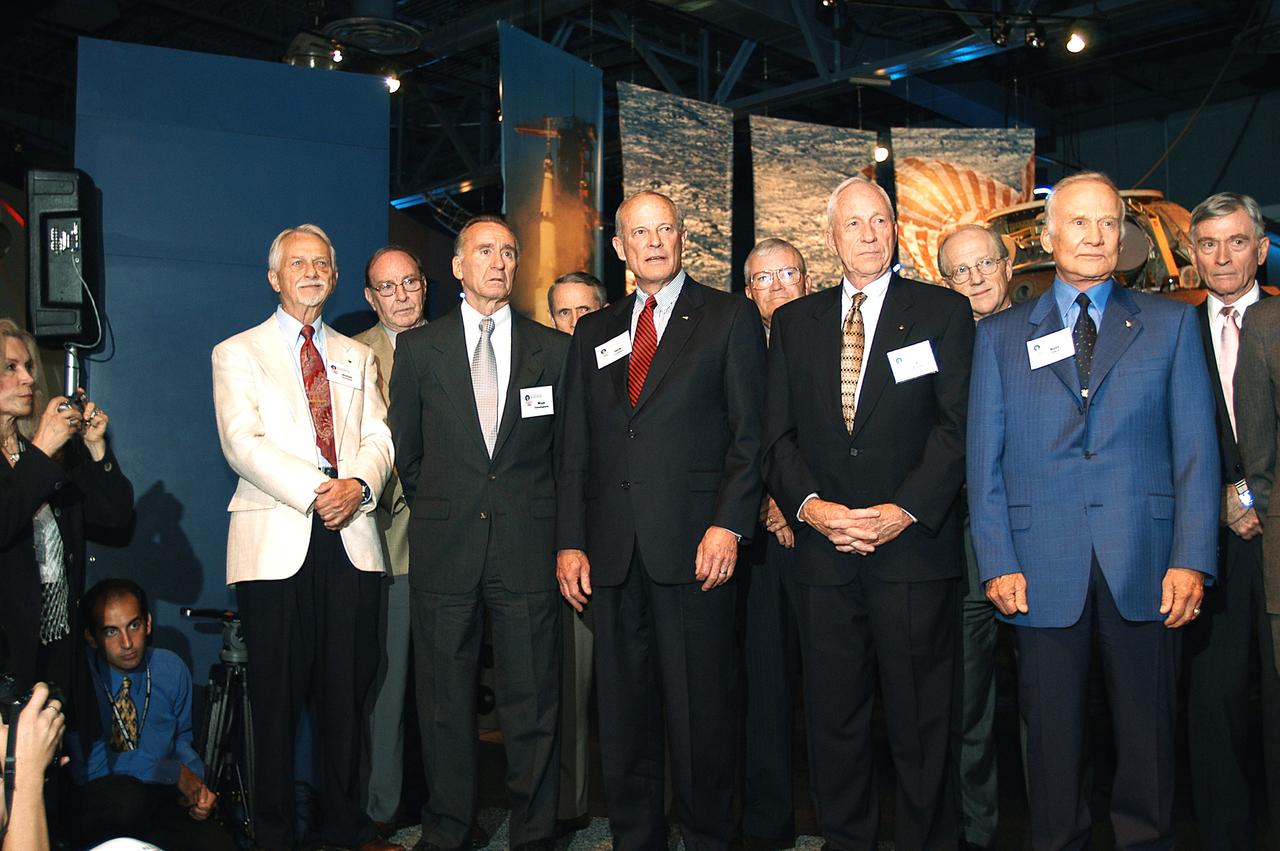
KENNEDY SPACE CENTER, FLA. - A group of current and former U.S. astronauts are introduced to the audience at a ribbon cutting ceremony officially opening the U.S. Astronaut Hall of Fame as part of the Kennedy Space Center Visitor Complex. In the front row, from left, are Owen K. Garriott, Walter Cunningham, Jack R. Lousma, Alfred M. Worden, and Buzz Aldrin. In the back row, from left, are Edgar D. Mitchell, Edward G. Gibson, Fred W. Haise, Frederick H. (Rick) Hauck, and John W. Young. The ceremony was held in conjunction with the induction of four Space Shuttle astronauts into the Hall of Fame including Daniel Brandenstein, Robert "Hoot" Gibson, Story Musgrave, and Sally Ride. Conceived by six of the Mercury Program astronauts, the U.S. Astronaut Hall of Fame opened in 1990 to provide a place where space travelers could be remembered for their participation and accomplishments in the U.S. space program. The four new inductees join 48 previously honored astronauts from the ranks of the Gemini, Apollo, Skylab, Apollo-Soyuz, and Space Shuttle programs.
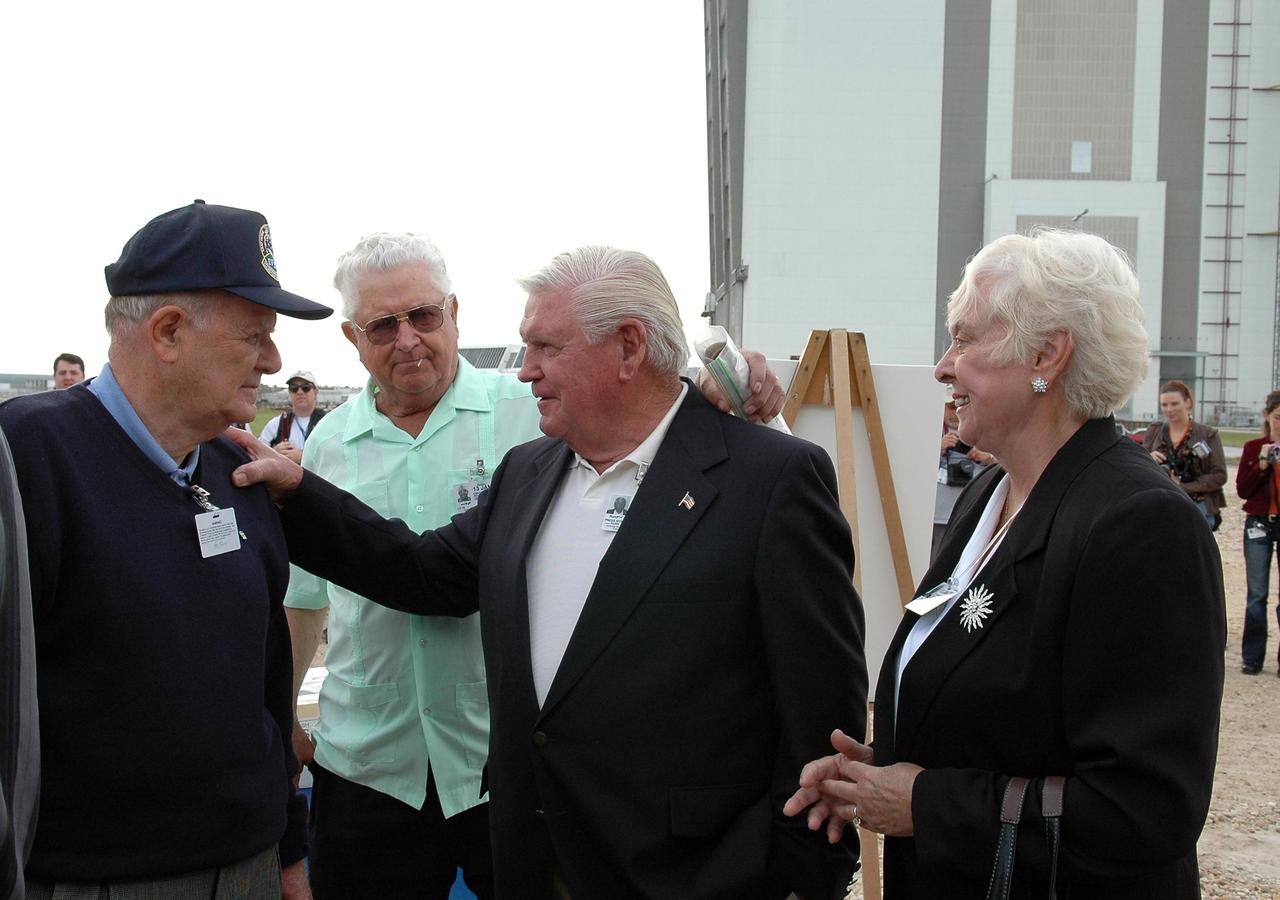
KENNEDY SPACE CENTER, FLA. - On the occasion of the 40th anniversary of the crawler transporter used for moving space shuttles to the NASA Kennedy Space Center’s launch pads, retired crawler workers meet for the celebration. At left is Bill Clemens talking with Fred Renaud and his wife, Patricia. Media representatives and invited guests had the opportunity to tour one of NASA's two crawlers. This included the driver cab and engine room. Guests included current drivers and operators, as well as drivers from the Apollo Program. In January 1966, the crawler completed its first successful move with a 10.6-million-pound launch umbilical tower. It moved three-quarters of a mile in about nine hours. Throughout 40 years of service, the two crawlers have moved more than 3,500 miles and carried seven vehicles.
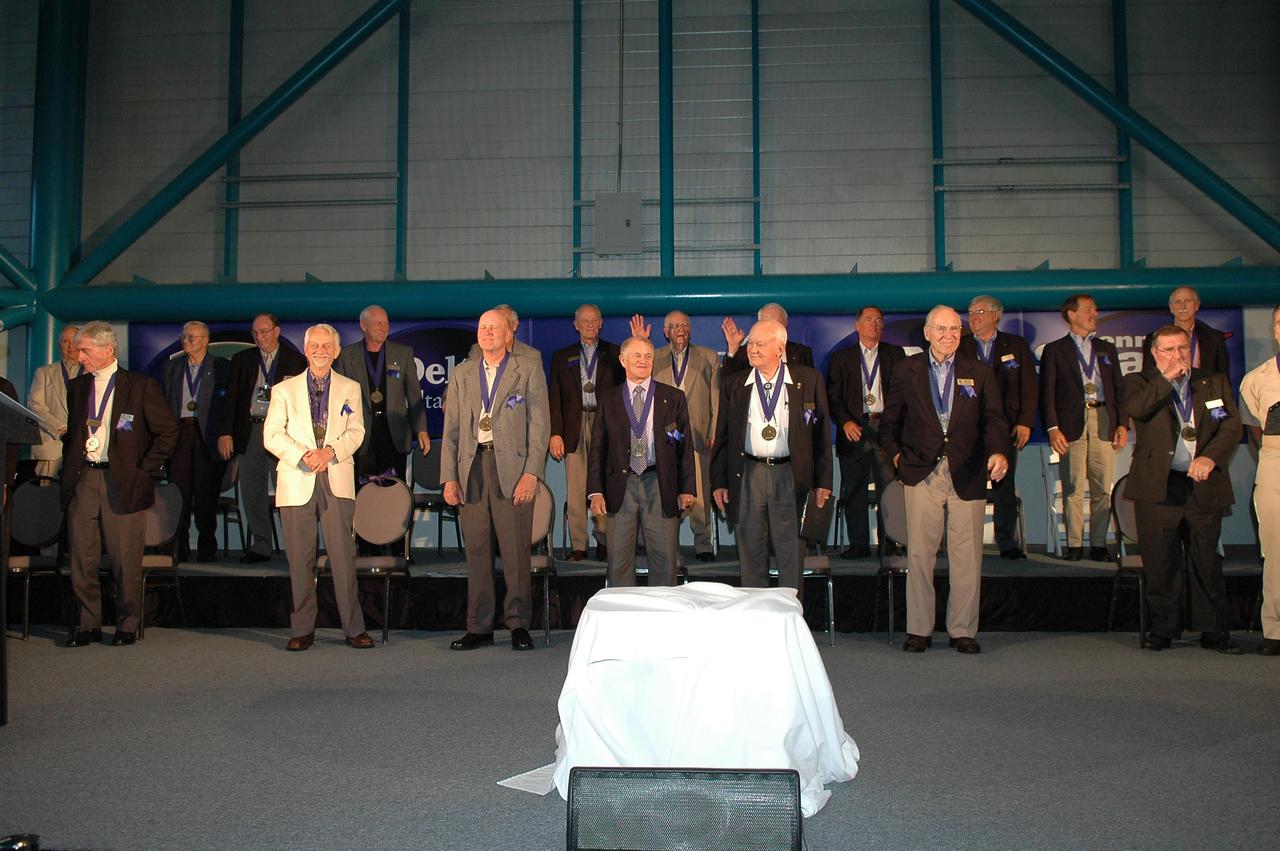
KENNEDY SPACE CENTER, FLA. - Members of the Astronaut Hall of Fame are applauded by the guests at the Astronaut Hall of Fame Induction Ceremony held at the Kennedy Space Center Visitor Complex’s Apollo_Saturn V Center. From left are Al Gordon, John Young, Walt Cunningham, Bill Anders, Owen Garriott, Ed Mitchell, Gordon Fullerton, Al Worden, Charlie Duke, Joe Allen, Jack Lousma, Bruce McCandless, Bill Pogue, Robert Crippen, Jim Lovell, Dan Brandenstein, Robert “Hoot” Gibson, Fred Haise, and Stephen Covey. Not pictured are Scott Carpenter and Vance Brand. McCandless, Allen and Fullerton are the 2005 inductees. Recognized for their individual flight accomplishments and contributions to the success and future success of the U.S. space program, this elite group of inductees is among only 60 astronauts to be honored in the Hall of Fame and the fourth group of Space Shuttle astronauts named.
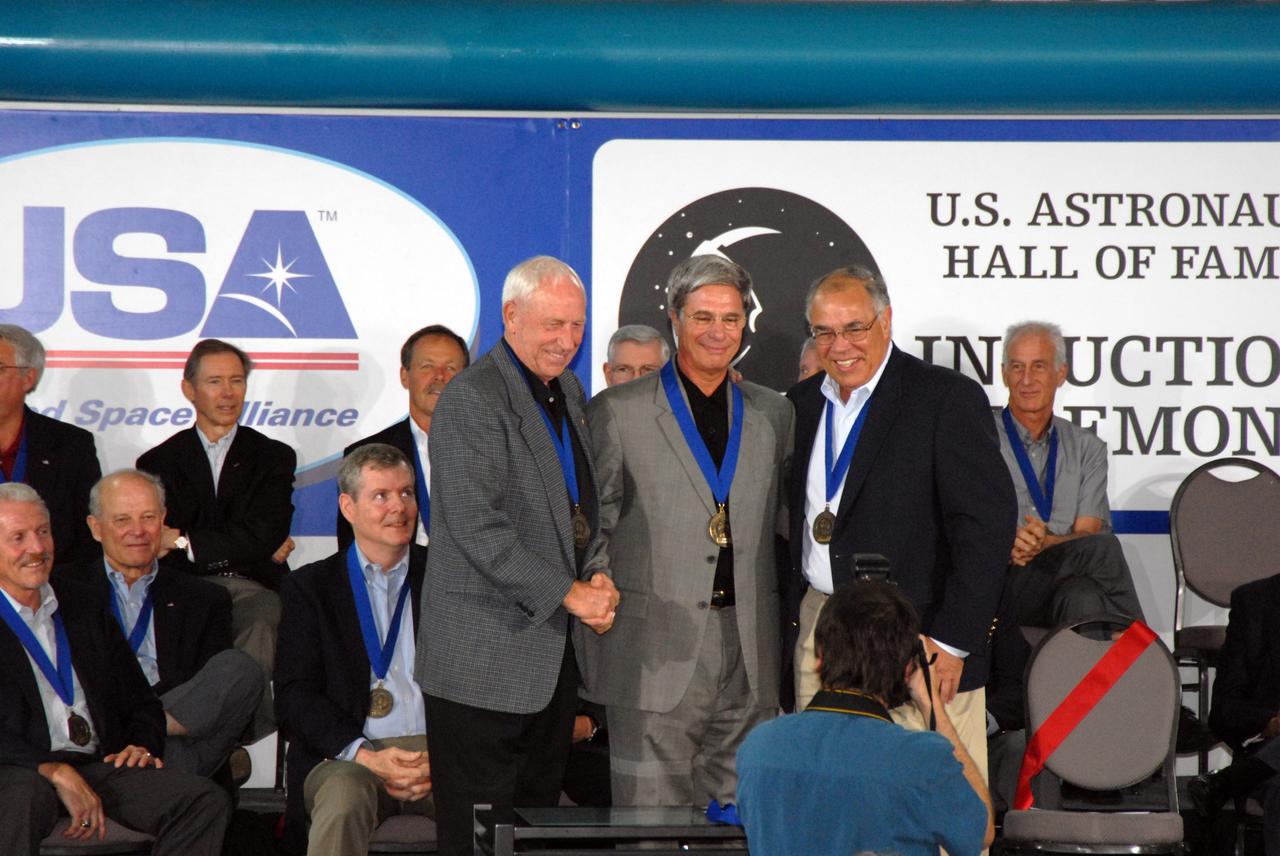
CAPE CANAVERAL, Fla. -- Former astronaut John Blaha (center) is inducted into the U.S. Astronaut Hall of Fame May 3 at NASA's Kennedy Space Center. Presenting the medal are former inductees Al Worden (left) and Fred Gregory (right). Other inductees were Loren Shriver; Bryan O'Connor, NASA's chief of Safety and Mission Assurance at NASA Headquarters in Washington; and Bob Cabana, center director of NASA's Stennis Space Center in Mississippi. Other former astronauts attending included Scott Carpenter, John Young, Bob Crippen, and Walt Cunningham. The U.S. Astronaut Hall of Fame is operated by Kennedy Space Center Visitor Complex on behalf of NASA. CNN correspondent John Zarrella hosted the event.
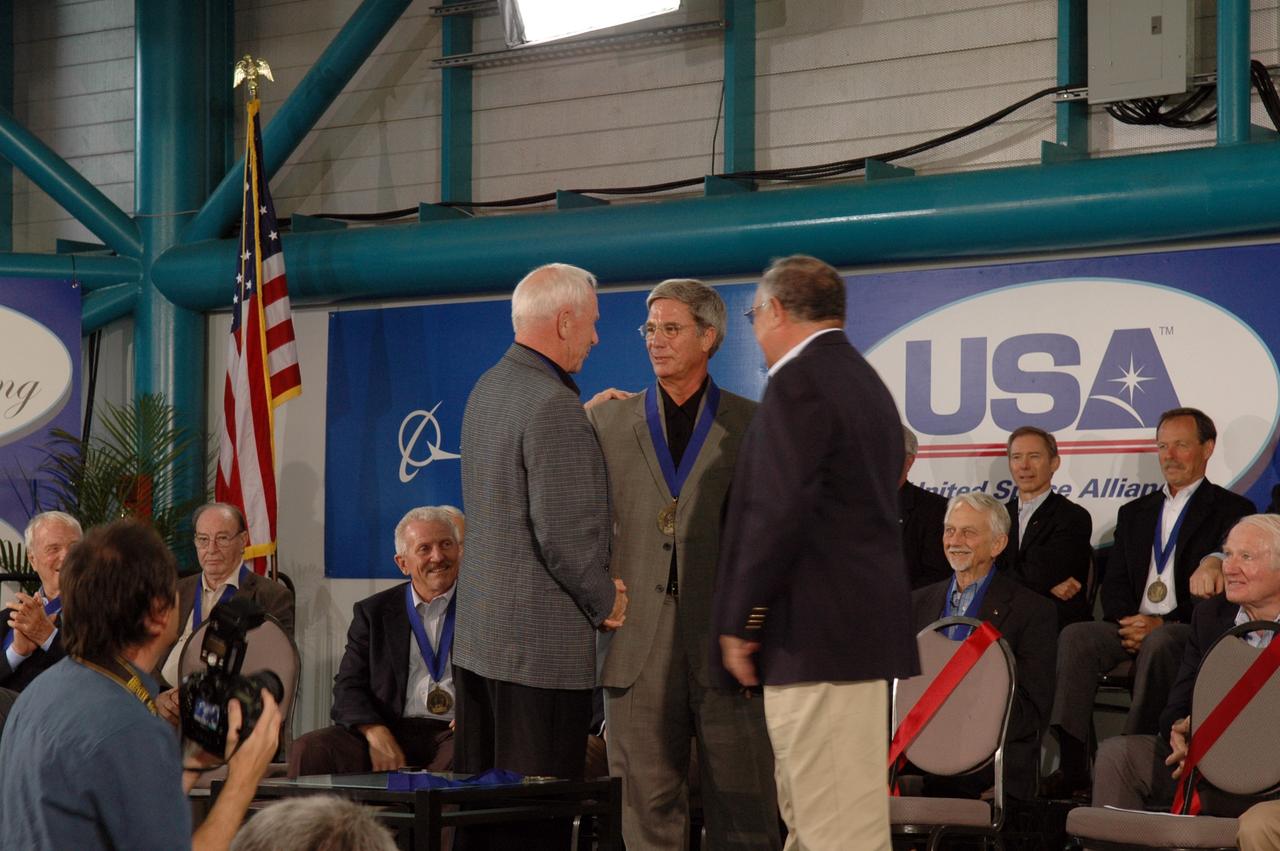
CAPE CANAVERAL, Fla. -- Former astronaut John Blaha (center) receives congratulations on his induction into the U.S. Astronaut Hall of Fame May 3 at NASA's Kennedy Space Center from former inductees Al Worden (left) and Fred Gregory (right). Other inductees were Loren Shriver; Bryan O'Connor, NASA's chief of Safety and Mission Assurance at NASA Headquarters in Washington; and Bob Cabana, center director of NASA's Stennis Space Center in Mississippi. Other former astronauts attending included Scott Carpenter, John Young, Bob Crippen, and Walt Cunningham. The U.S. Astronaut Hall of Fame is operated by Kennedy Space Center Visitor Complex on behalf of NASA. CNN correspondent John Zarrella hosted the event.
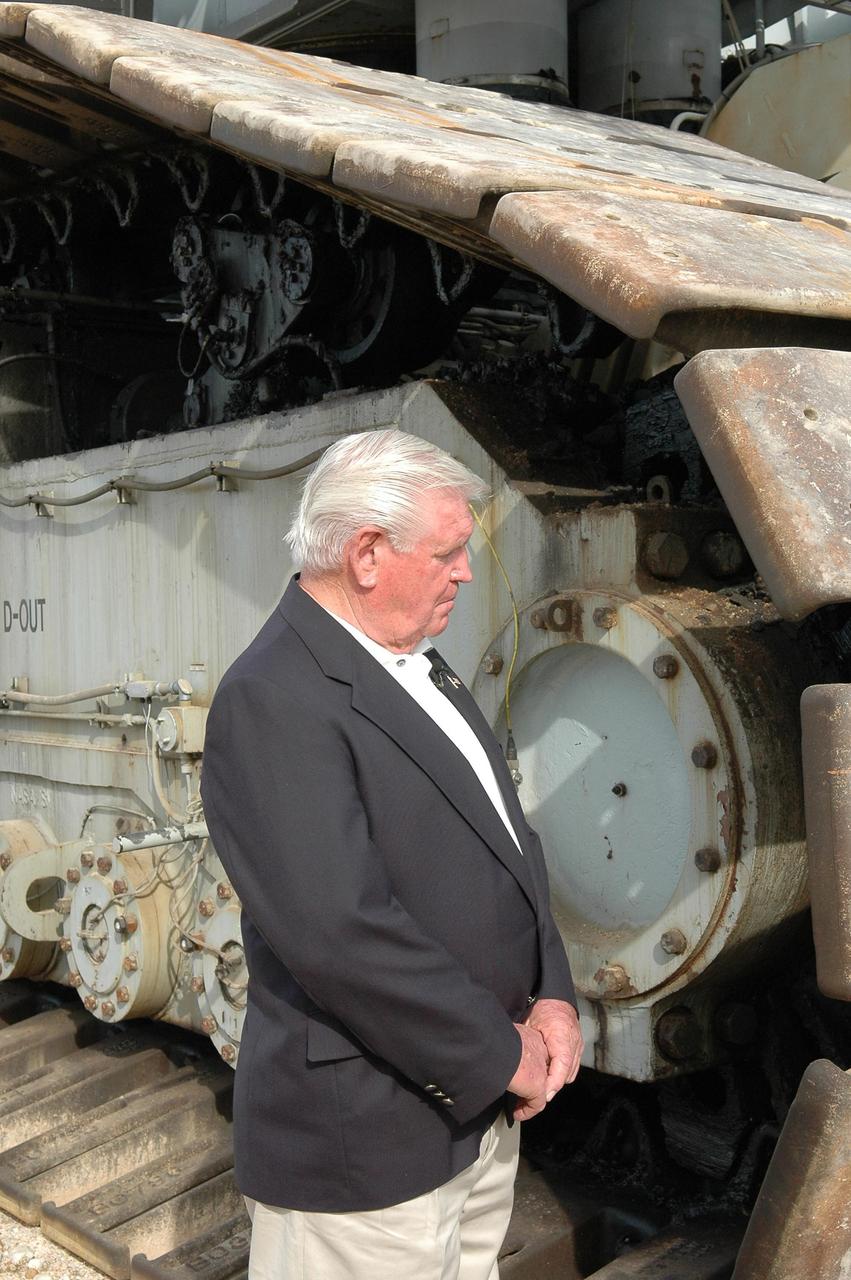
KENNEDY SPACE CENTER, FLA. - On the occasion of the 40th anniversary of the crawler transporter used for moving space shuttles to the NASA Kennedy Space Center’s launch pads, former crawler driver Fred Renaud gets a close look at one of the crawlers still in use. Media representatives and invited guests had the opportunity to tour one of NASA's two crawlers. This included the driver cab and engine room. Guests included current drivers and operators, as well as drivers from the Apollo Program. In January 1966, the crawler completed its first successful move with a 10.6-million-pound launch umbilical tower. It moved three-quarters of a mile in about nine hours. Throughout 40 years of service, the two crawlers have moved more than 3,500 miles and carried seven vehicles.
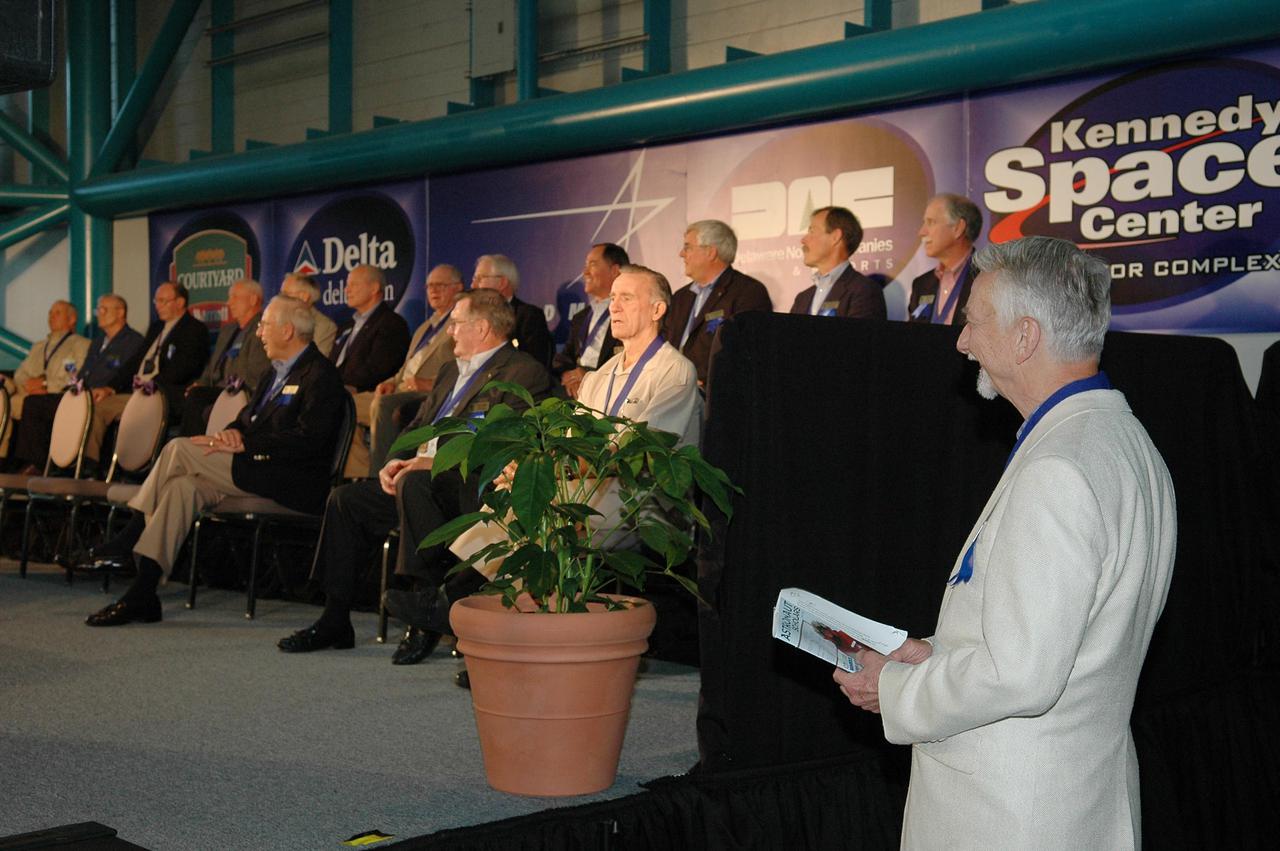
KENNEDY SPACE CENTER, FLA. - Owen Garriott, chairman of the Astronaut Hall of Fame, waits to address guests at the Astronaut Hall of Fame Induction Ceremony held at the Kennedy Space Center Visitor Complex’s Apollo_Saturn V Center. Hall of Famers seated on stage are (from left, back row), Dick Gordon, Walt Cunningham, Bill Anders, Ed Mitchell, Al Worden, Charles Duke, Jack Lousma, Bill Pogue, Robert Crippen, Dan Brandenstein, Robert “Hoot” Gibson and Stephen Covey. In front are (left to right) Jim Lovell, Fred Haise and Vance Brand. The new inductees (not pictured) are Gordon Fullerton, Bruce McCandless and Joe Allen. Recognized for their individual flight accomplishments and contributions to the success and future success of the U.S. space program, this elite group of inductees is among only 60 astronauts to be honored in the Hall of Fame and the fourth group of Space Shuttle astronauts named.
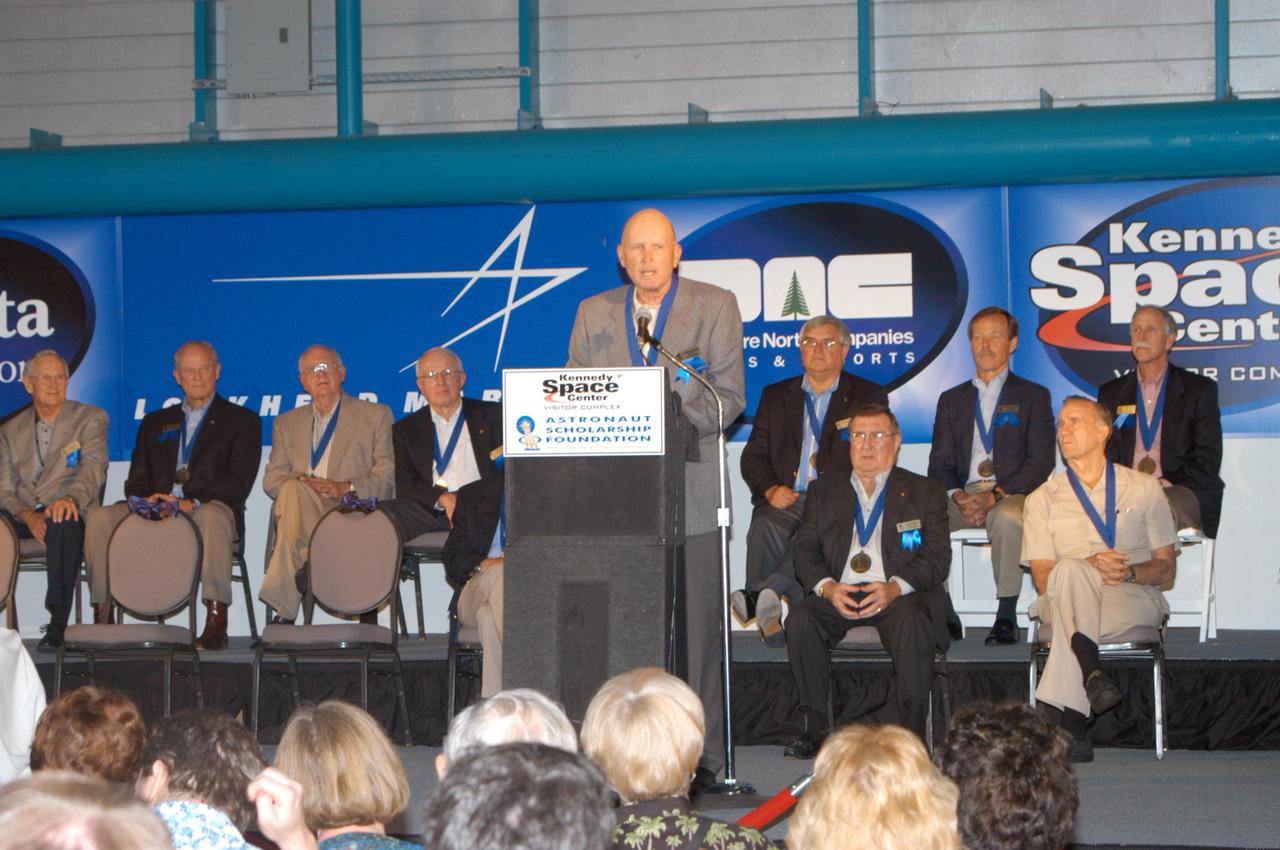
KENNEDY SPACE CENTER, FLA. - At the Astronaut Hall of Fame Induction Ceremony, new inductee Gordon Fullerton addresses guests. Behind him are current Hall of Famers (from left, back row) Al Worden, Charles Duke, Jack Lousma, Bill Pogue, Dan Brandenstein, Robert “Hoot” Gibson and Stephen Covey; (in front row) Fred Haise and Vance Brand. The other new inductees are Bruce McCandless and Joe Allen. The event is being held in the Kennedy Space Center Visitor Complex’s Apollo_Saturn V Center. Recognized for their individual flight accomplishments and contributions to the success and future success of the U.S. space program, this elite group of inductees is among only 60 astronauts to be honored in the Hall of Fame and the fourth group of Space Shuttle astronauts named.
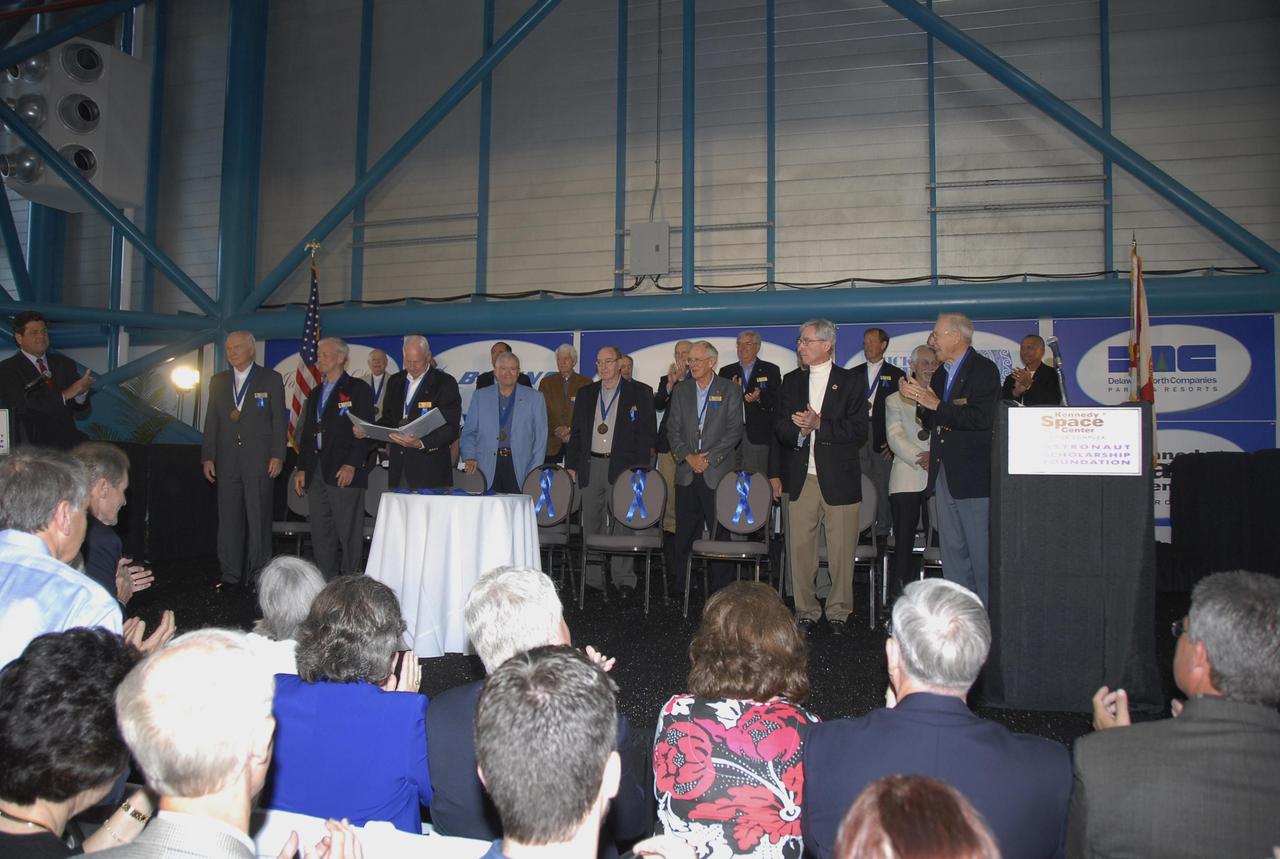
KENNEDY SPACE CENTER, FLA. -- Retired Astronaut Al Worden (third from left in front row) reads a list of the astronauts honored in past ceremonies, some of whom stand on the dais. Standing in the front row, from left, are John Glenn, Scott Carpenter, Worden, Fred Haise, Edgar Mitchell, Charlie Duke, John Young and Jim Lovell. Pictured standing in the back row, from left, are Jerry Carr, Bob Crippen, Hank Hartsfield, Joe Allen, Rick Hauck, Dan Brandenstein, Robert “Hoot” Gibson, Owen Garriott and Charlie Bolden. The May 5 induction added space shuttle commanders Michael L. Coats, Steven A. Hawley and Jeffrey A. Hoffman to the Hall of Fame. They grow the number of space explorers enshrined in the Hall of Fame to 66. The ceremony was held at the Kennedy Space Center's Apollo/Saturn V Center. Photo credit: NASA/Kim Shiflett
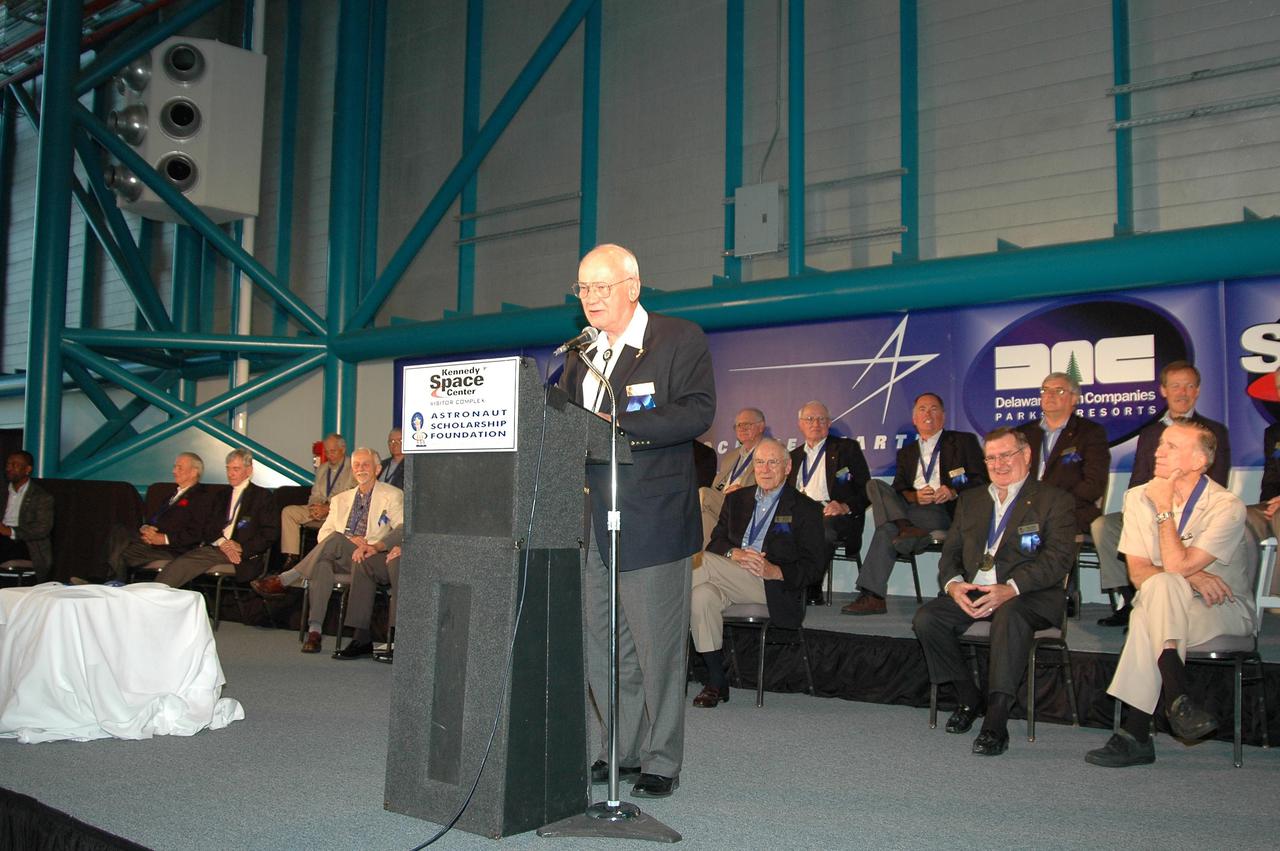
KENNEDY SPACE CENTER, FLA. - At the Astronaut Hall of Fame Induction Ceremony, new inductee Bruce McCandless speaks to the guests. Seen behind him are current Hall of Famers (back row) Al Gordon, Walt Cunningham, Jack Lousma, Bill Pogue, Robert Crippen, Dan Brandenstein and Robert “Hoot” Gibson; (front row) Scott Carpenter, John Young, Owen Garriott, Jim Lovell, Fred Haise and Vance Brand. Garriott is chairman of the Astronaut Hall of Fame. The other new inductees are Joe Allen and Gordon Fullerton. The event is being held in the Kennedy Space Center Visitor Complex’s Apollo_Saturn V Center. Recognized for their individual flight accomplishments and contributions to the success and future success of the U.S. space program, this elite group of inductees is among only 60 astronauts to be honored in the Hall of Fame and the fourth group of Space Shuttle astronauts named.
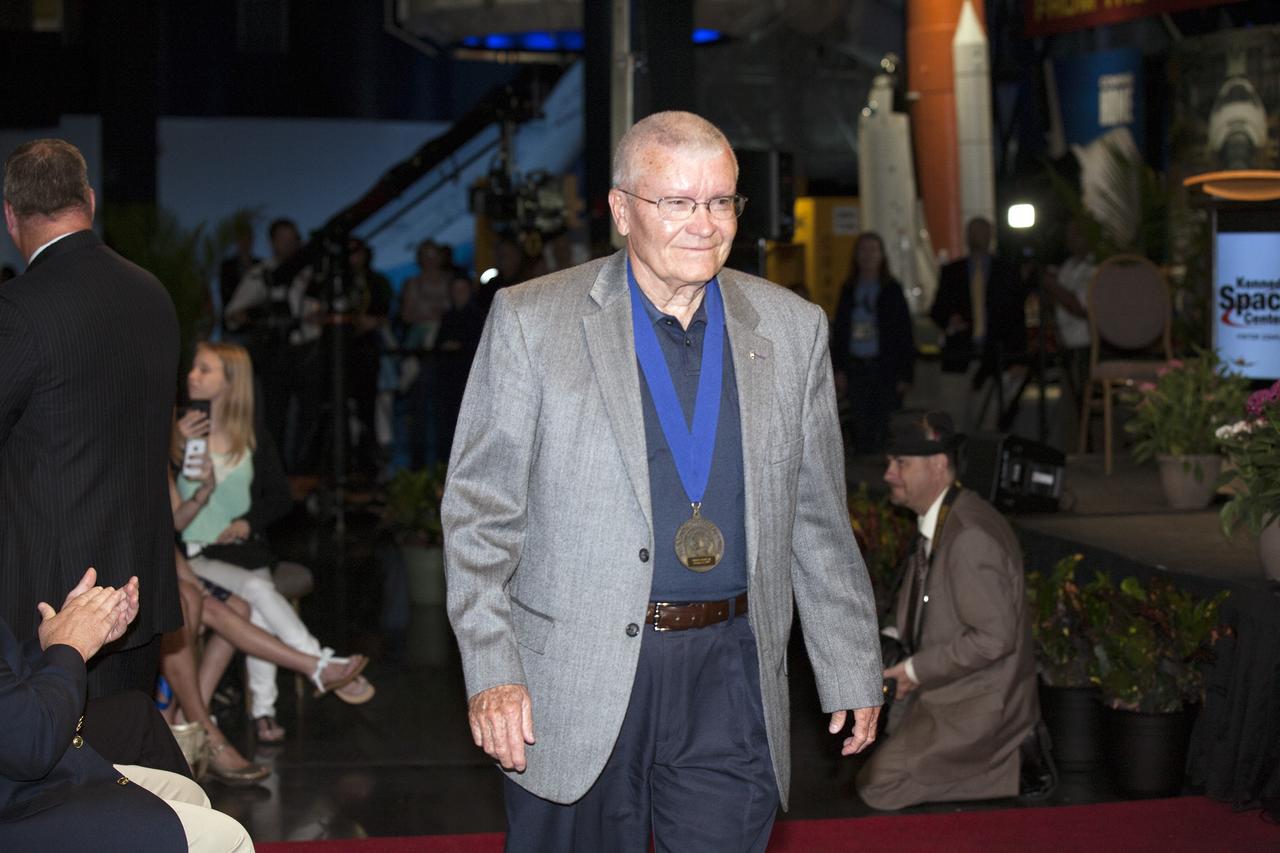
CAPE CANAVERAL, Fla. -- Inside the Space Shuttle Atlantis attraction at NASA’s Kennedy Space Center Visitor Complex in Florida, former NASA astronaut and Hall of Famer Fred Haise walks the red carpet at the 2014 U.S. Astronaut Hall of Fame Induction ceremony. Space shuttle astronauts and space explorers Shannon Lucid and Jerry Ross were inducted into the Hall of Fame Class of 2014. The 2014 inductees are selected by a committee of Hall of Fame astronauts, former NASA officials, flight directors, historians and journalists. The process is administered by the Astronaut Scholarship Foundation. To be eligible, an astronaut must have made his or her first flight at least 17 years before the induction. Candidates must be a U.S. citizen and a NASA-trained commander, pilot or mission specialist who has orbited the earth at least once. Including Lucid and Ross, 87 astronauts have been inducted into the AHOF. Photo credit: NASA/Kim Shiflett
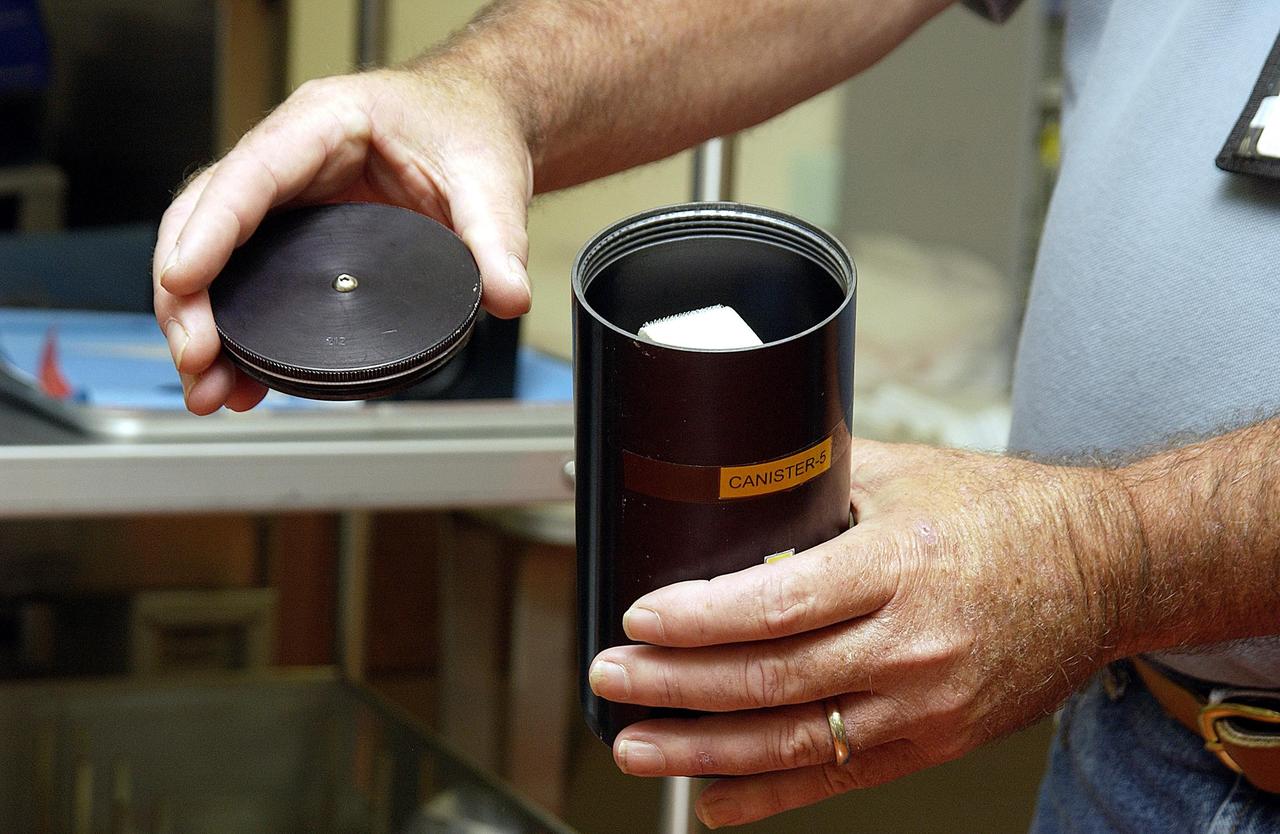
KENNEDY SPACE CENTER, FLA. - NASA Project Manager Fred Ahmay holds a Biological Research in Canisters (BRIC) container in which C. elegans nemotodes (round worms) were found. The container was part of a middeck experiment that was among the Columbia debris recovered in East Texas. The worms are descendants of those that were part of an experiment that flew on Columbia's last mission, STS-107. The experiment was designed to verify a new synthetic nutrient solution for an International Space Station (ISS) "model" specimen planned to be used extensively for ISS gene expression studies and was sponsored by the NASA Ames Research Center. Scientists are now looking over the experiment at KSC to determine if it will yield any scientific results. The investigation into the cause of the Columbia accident is ongoing.
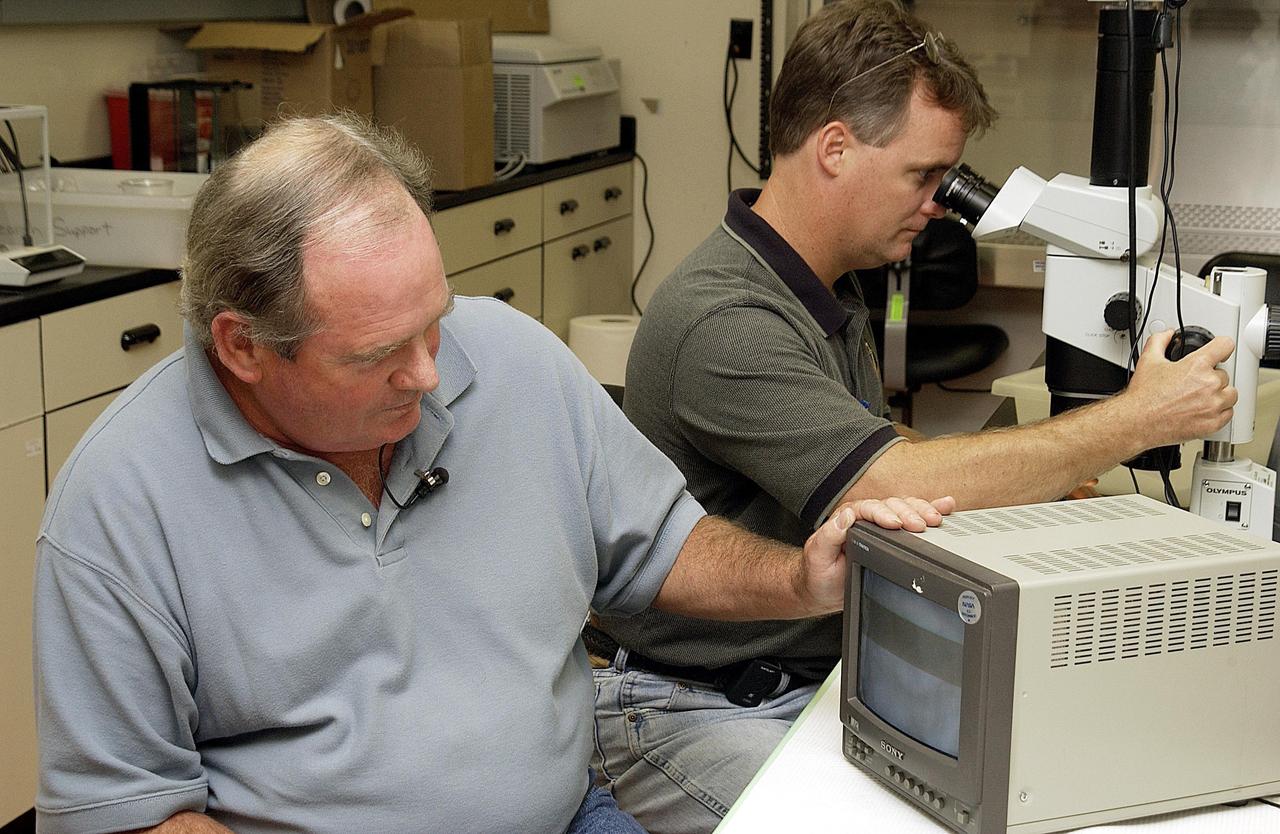
KENNEDY SPACE CENTER, FLA. - NASA Project Manager Fred Ahmay (left) and Bionetics Project Engineer William McLamb examine C. elegans nemotodes (round worms) using a microscope. These specimens were found in a Biological Research in Canisters (BRIC) container, a middeck experiment that was among the Columbia debris recovered in East Texas. The worms are descendants of those that were part of an experiment that flew on Columbia's last mission, STS-107. The experiment was designed to verify a new synthetic nutrient solution for an International Space Station (ISS) "model" specimen planned to be used extensively for ISS gene expression studies and was sponsored by the NASA Ames Research Center. Scientists are now looking over the experiment at KSC to determine if it will yield any scientific results. The investigation into the cause of the Columbia accident is ongoing.
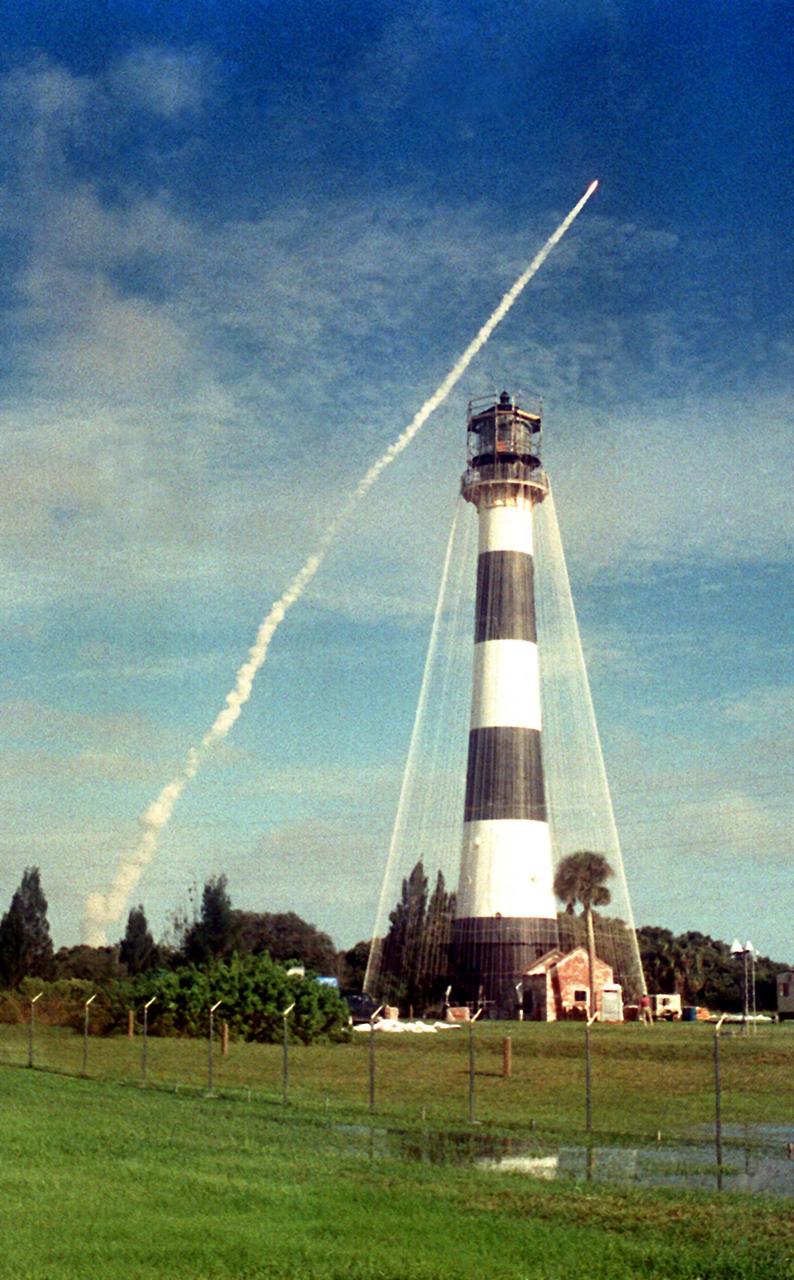
KENNEDY SPACE CENTER, FLA. -- Space Shuttle Columbia soars into the cloud-washed sky above Cape Canaveral Lighthouse. After six scrubs from the original Sept. 25 launch date, liftoff occurred Oct. 20 at 9:53 a.m. EDT. The crew of seven comprises Commander Ken Bowersox, Pilot Kent Rominger, Mission Specialists Kathy Thornton (Payload Commander), Catherine Coleman and Michael Lopez-Alegria, plus Payload Specialists Fred Leslie and Albert Sacco. The 72nd Shuttle mission, STS-73 marks the second flight of the U.S. Microgravity Laboratory. Research is being conducted in five areas: fluid physics, materials science, biotechnology, combustion science, and commercial space processing. The lighthouse, undergoing refurbishment and upgrade, is shown with a network of nylon lines ready for canvas panels to be attached. The canvas shroud will protect the surrounding area during sand-blasting of the lead-based paint.
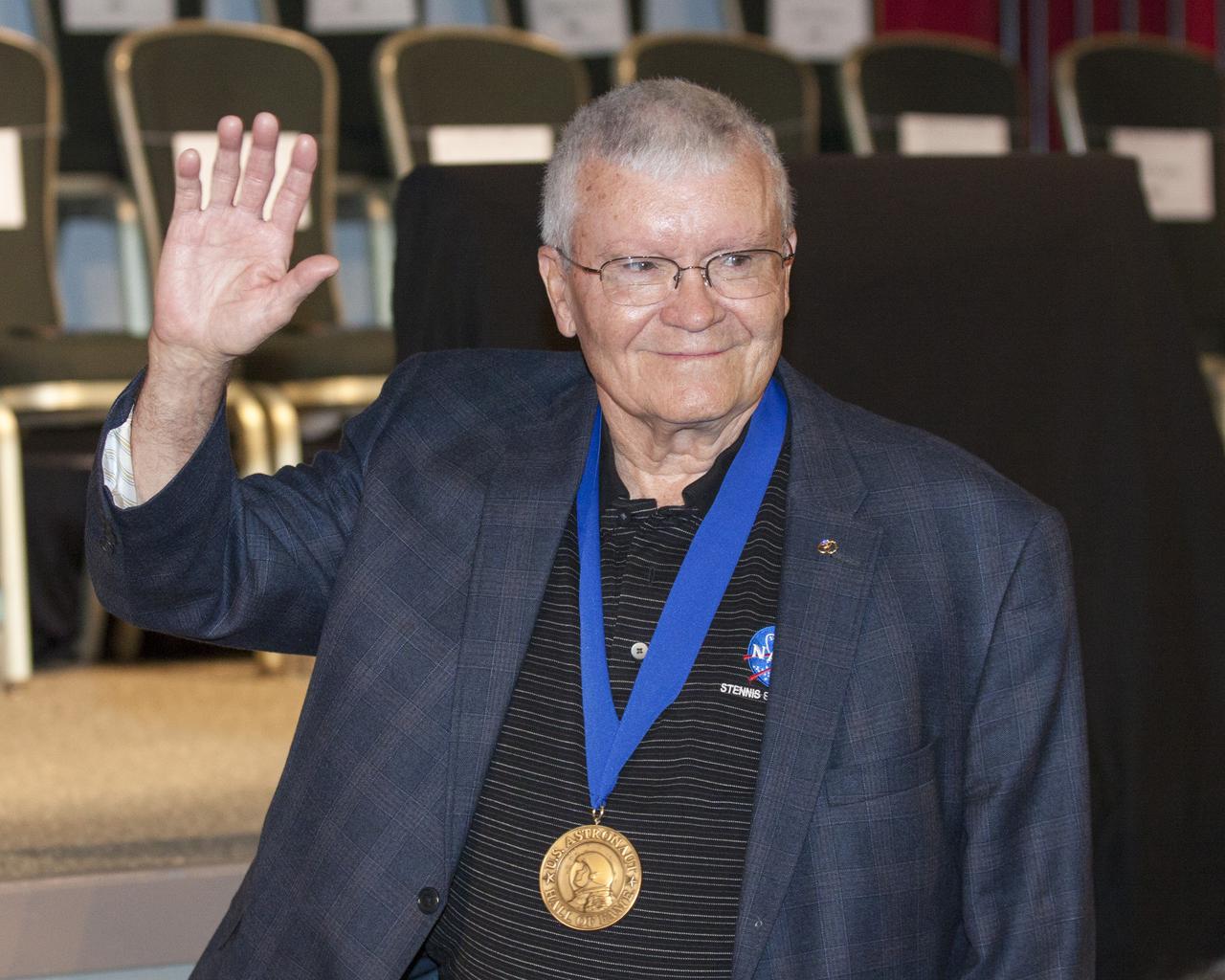
CAPE CANAVERAL, Fla. – U.S. Astronaut Hall of Fame member Fred Haise is introduced at NASA’s Kennedy Space Center Visitor Complex in Florida, prior to the ceremony in which Bonnie Dunbar, Curt Brown and Eileen Collins will be inducted into the group of space pioneers. This induction is the twelfth group of space shuttle astronauts named to the AHOF, and the first time two women are inducted at the same time. The year’s inductees were selected by a committee of current Hall of Fame astronauts, former NASA officials, historians and journalists. The selection process is administered by the Astronaut Scholarship Foundation. For more on the U.S. Astronaut Hall of Fame, go to http:__www.kennedyspacecenter.com_astronaut-hall-of-fame.aspx For more on the Astronaut Scholarship Foundation, go to http:__astronautscholarship.org_ Photo credit: NASA_ Kim Shiflett
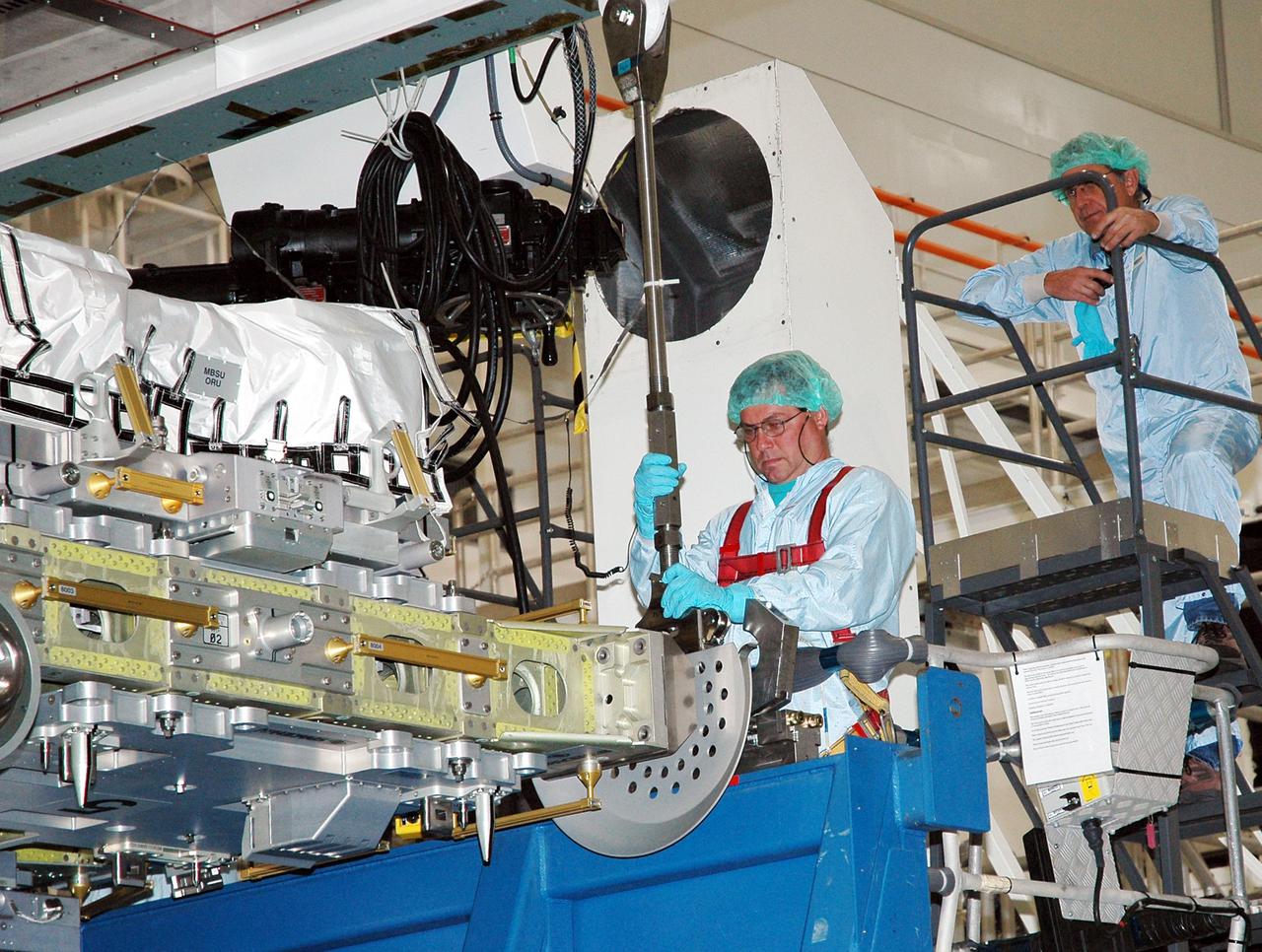
KENNEDY SPACE CENTER, FLA. - In the Space Station Processing Facility, technician Fred Parisi is attaching the CELA (Cargo Element Lifting Assembly) down rods to the External Stowage Platform -2 (ESP-2) in preparation for lifting the ESP-2 from its transportation container and installing it into the Payload Transportation Canister. At right, above, is Scott Kisner, task leader. The ESP-2 will travel to Launch Pad 39B with its fellow payload elements the Lightweight MPESS Carrier (Multi-Purpose Experiment Support Structure) and Multi-Purpose Logistics Module Raffaello in the canister. Once at the pad, the three payloads will be transferred to the payload bay of Discovery for flight. The ESP-2 is carrying replacement parts to the International Space Station. The platform will be deployed and attached to the Station’s airlock and used as a permanent spare parts facility. STS-114 is targeted for launch during a window that extends from May 15 through June 3.

CAPE CANAVERAL, Fla. -- Inside the Space Shuttle Atlantis attraction at NASA’s Kennedy Space Center Visitor Complex in Florida, former NASA astronaut and Hall of Famer Fred Gregory walks the red carpet at the 2014 U.S. Astronaut Hall of Fame Induction ceremony. Space shuttle astronauts and space explorers Shannon Lucid and Jerry Ross were inducted into the Hall of Fame Class of 2014. The 2014 inductees are selected by a committee of Hall of Fame astronauts, former NASA officials, flight directors, historians and journalists. The process is administered by the Astronaut Scholarship Foundation. To be eligible, an astronaut must have made his or her first flight at least 17 years before the induction. Candidates must be a U.S. citizen and a NASA-trained commander, pilot or mission specialist who has orbited the earth at least once. Including Lucid and Ross, 87 astronauts have been inducted into the AHOF. Photo credit: NASA/Kim Shiflett

The inaugural Glenn Symposium focused on advancements in aerospace technology including power and propulsion, autonomy and communications, low boom supersonics, hypersonics, and more. Discussion also encompassed humans returning to the moon, including challenges associated with the 2024 mission.
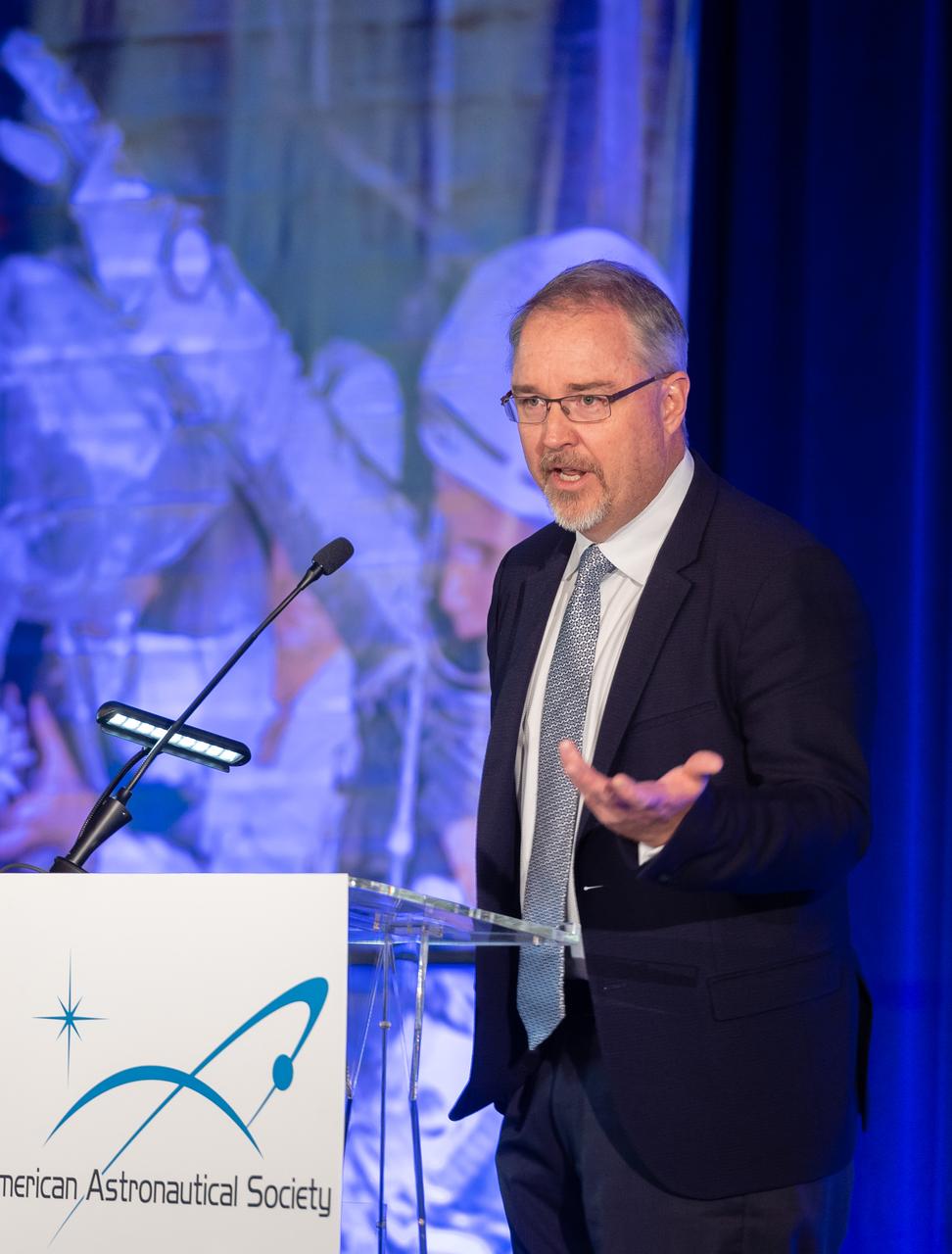
The inaugural Glenn Symposium focused on advancements in aerospace technology including power and propulsion, autonomy and communications, low boom supersonics, hypersonics, and more. Discussion also encompassed humans returning to the moon, including challenges associated with the 2024 mission.

KENNEDY SPACE CENTER, FLA. - Owen Garriott, chairman of the Astronaut Hall of Fame, speaks to guests at the Induction Ceremony of three new additions to the Hall of Fame: Gordon Fullerton, Bruce McCandless and Joe Allen. Seated on stage are current Hall of Famers, from left in the back row, Dick Gordon, Walt Cunningham, Bill Anders, Ed Mitchell, Al Worden, Charles Duke, Jack Lousma, Bill Pogue, Robert Crippen, Dan Brandenstein, Robert “Hoot” Gibson and Stephen Covey. In front, from left, are Master of Ceremonies LeVar Burton, who starred in the television series “Star Trek: The Next Generation,” and Hall of Famers Scott Carpenter and John Young, and at right, Jim Lovell and Fred Haise. The ceremony is being held in the Kennedy Space Center Visitor Complex’s Apollo_Saturn V Center. Recognized for their individual flight accomplishments and contributions to the success and future success of the U.S. space program, this elite group of inductees is among only 60 astronauts to be honored in the Hall of Fame and the fourth group of Space Shuttle astronauts named.
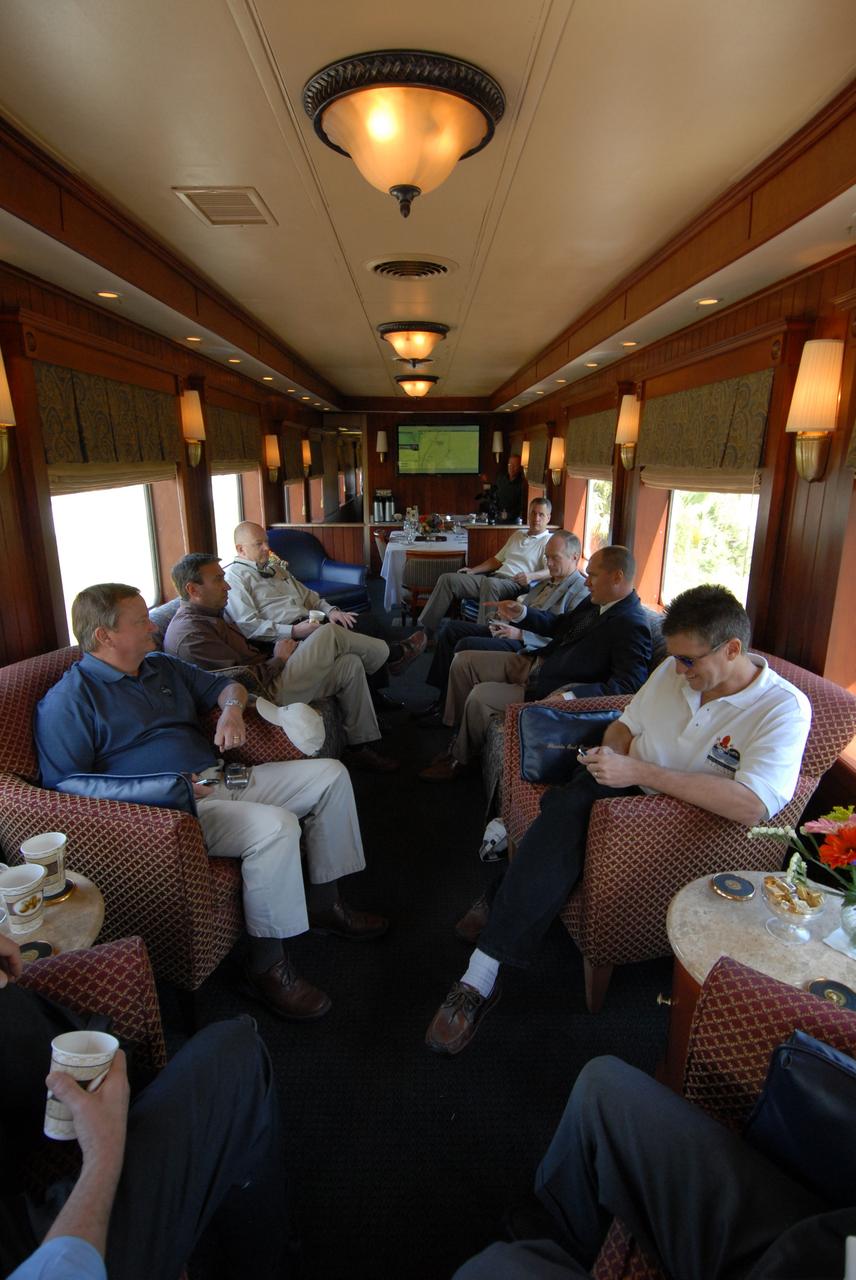
CAPE CANAVERAL, Fla. – ATK and NASA officials accompanied the Florida East Coast Railroad train carrying the booster segments for the Ares I-X test rocket on its route to NASA's Kennedy Space Center in Florida from Jacksonville, Fla. Seen here in the passenger car are, from left NASA KSC Shuttle Launch Director Mike Leinbach, a Florida East Coast Railroad representative, ATK Ares I First Stage program Director Fred Brasfield, a Florida East Coast Railroad representative, ATK Vice President Space Launch Systems Charlie Precourt, a Florida East Coast Railroad representative, and NASA Marshall Space Flight Center Reusable Solid Rocket Booster Integration Lead Roy Worthy. The four reusable motor segments and the nozzle exit cone, manufactured by the Ares I first-stage prime contractor Alliant Techsystems Inc., or ATK, departed Utah March 12 on the seven-day, cross-country trip to Florida. The segments will be delivered to the Rotation, Processing and Surge Facility for final processing and integration. The booster used for the Ares I-X launch is being modified by adding new forward structures and a fifth segment simulator. The motor is the final hardware needed for the rocket's upcoming test flight this summer. The stacking operations are scheduled to begin in the Vehicle Assembly Building in April. Photo credit: NASA/Kim Shiflett
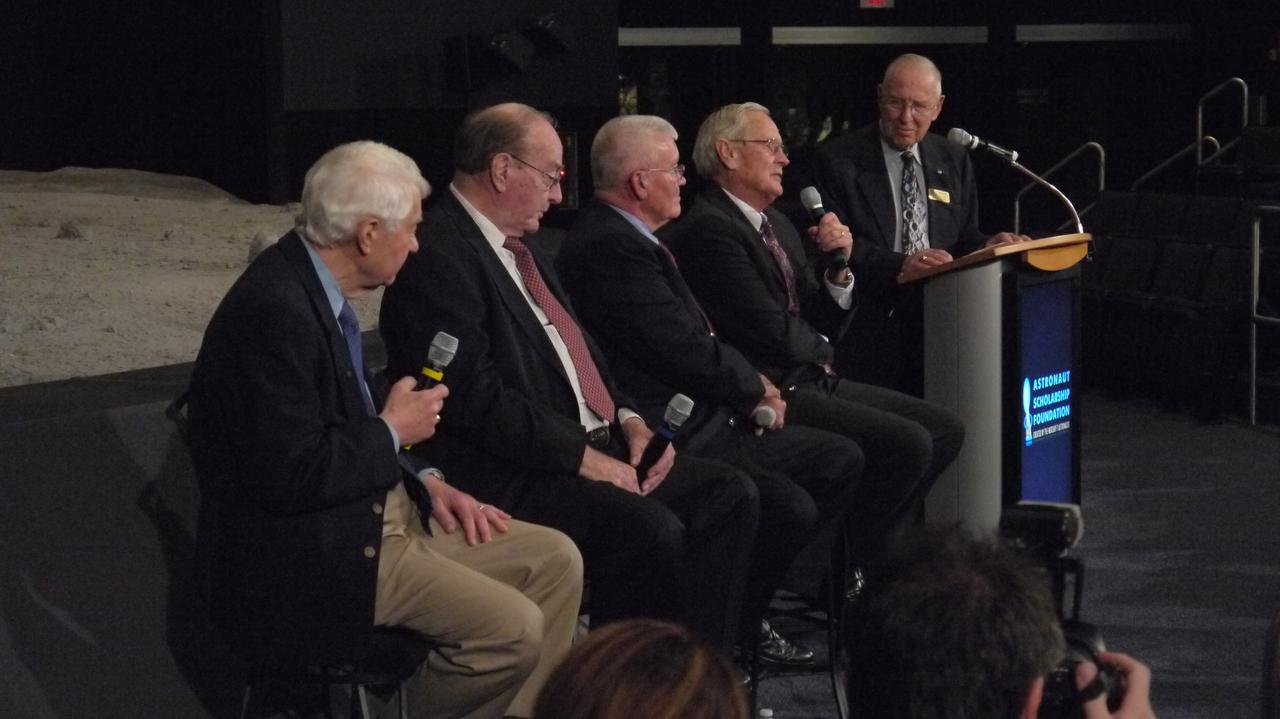
CAPE CANAVERAL, Fla. -- The Astronaut Scholarship Foundation helps celebrate the 40th anniversary of Apollo 16's lunar landing, which occurred April 20, 1972, with a soiree at the Kennedy Space Center Visitor Complex's Saturn V Center. Panel members who addressed the audience are, from left, astronaut support crew member for Apollo 16 Hank Hartsfield, Apollo 14 Lunar Module Pilot and Apollo 16 back-up crew member Edgar Mitchell, Apollo 13 Lunar Module Pilot and Apollo 16 back-up crew member Fred Haise, Apollo 16 Lunar Module Pilot Charlie Duke, and Apollo 8 Command Module Pilot and Apollo 13 Commander Jim Lovell. The 11-day Apollo 16 mission featured three moonwalks, including a nearly 17-mile lunar rover road trip to collect more than 200 pounds of moon rocks to return to Earth. Photo credit: NASA/Chris Chamberland
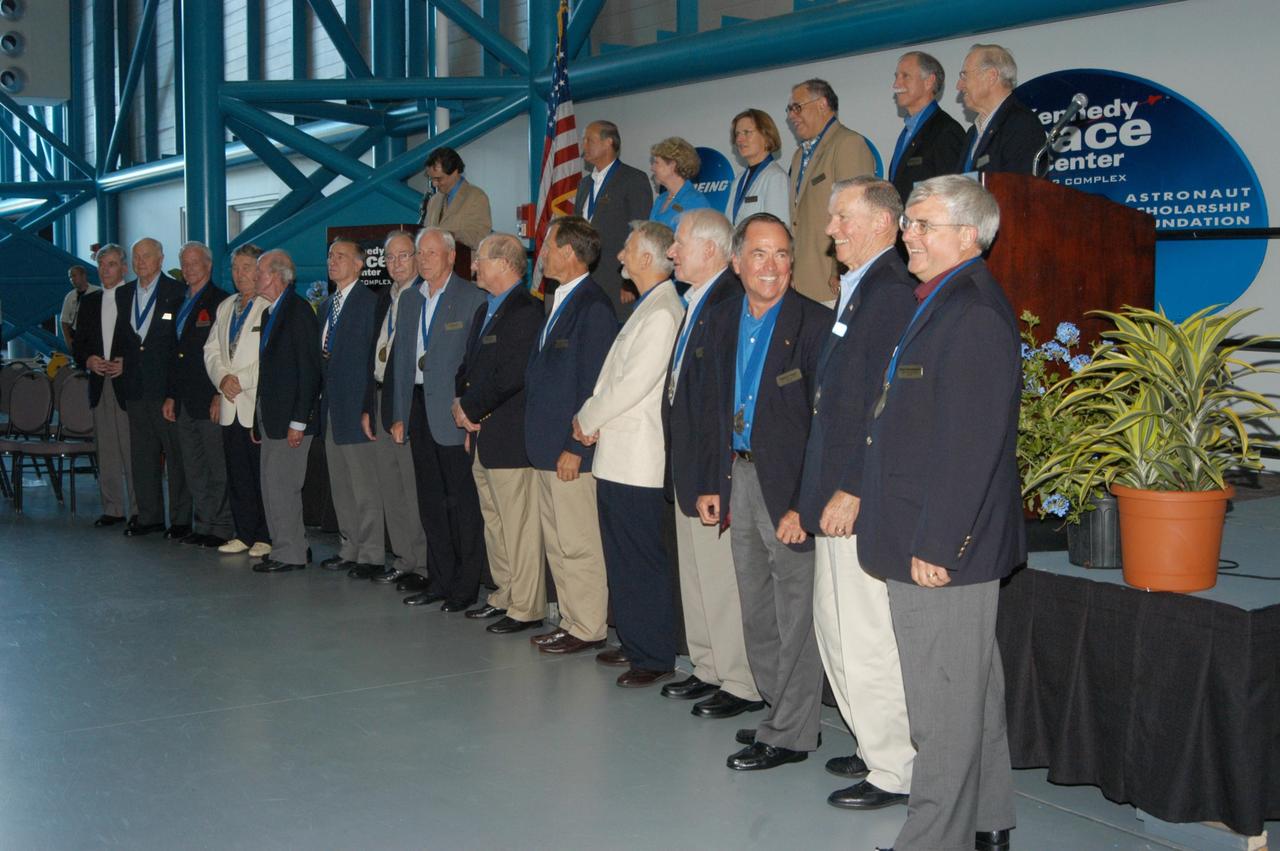
KENNEDY SPACE CENTER, FLA. -- Following the induction ceremony welcoming five new space program heroes in the U.S. Astronaut Hall of Fame, the members line up for a commemorative photo. From left, in front, are John Young, John Glenn Jr., Scott Carpenter, Wally Schirra, Gordon Cooper, Walt Cunningham, Ed Mitchell, Al Worden, Rick Hauck, Ed Gibson, Owen Garriott, Vance Brand, Robert Crippen, Joe Engle, Dan Brandenstein. In back are space author Andrew Chaikin, at the podium; and Norm Thagard, June Scobee representing her late husband Dick Scobee, Kathryn Sullivan, Fred Gregory, Richard Covey and Jim Lovell. The induction ceremony was held at the Apollo/Saturn V Center at KSC. The U.S. Astronaut Hall of Fame opened in 1990 to provide a place where space travelers could be remembered for their participation and accomplishments in the U.S. space program. The five inductees join 52 previously honored astronauts from the ranks of the Gemini, Apollo, Skylab, Apollo-Soyuz, and Space Shuttle programs.
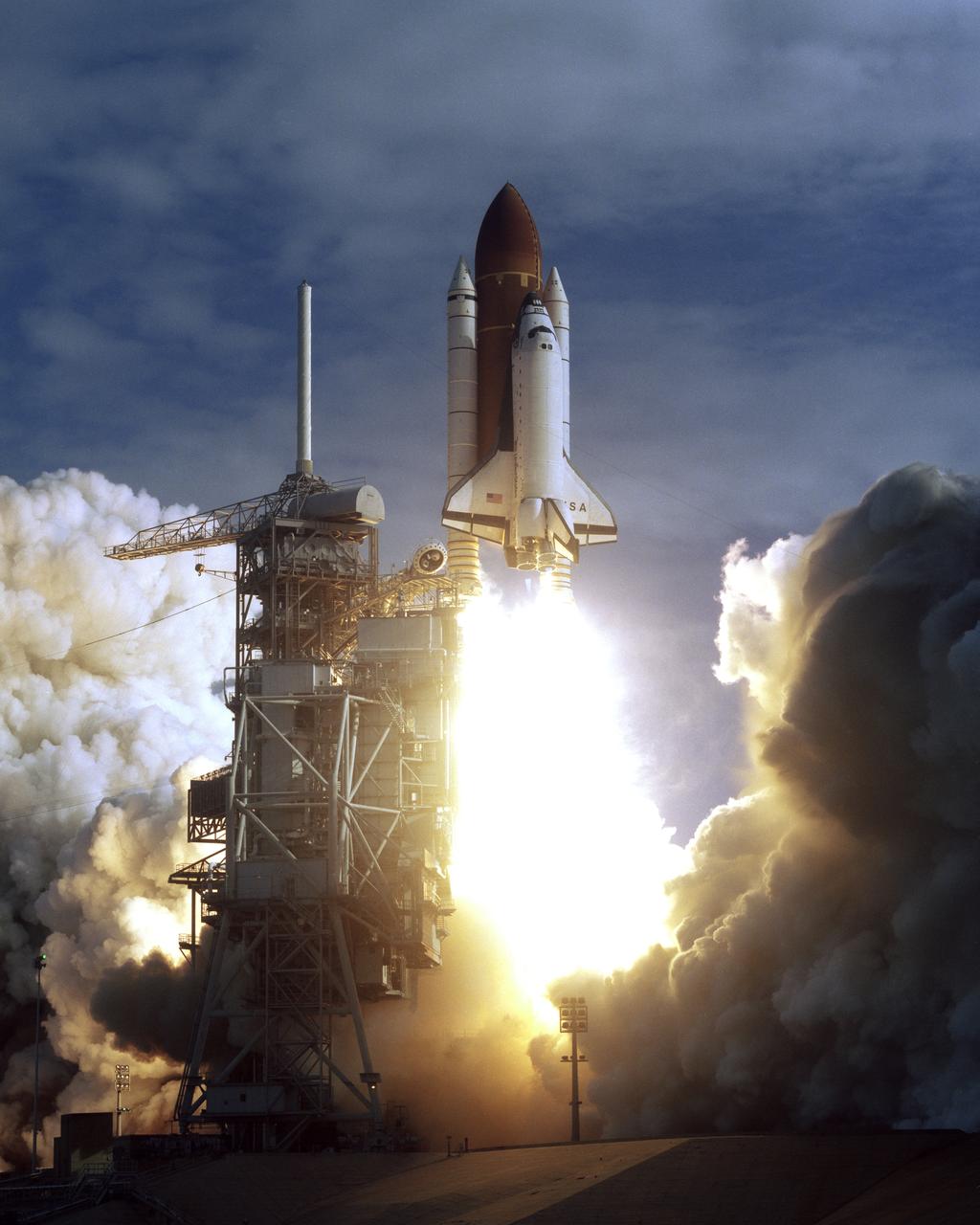
STS073-S-030 (20 Oct. 1995) --- The space shuttle Columbia lifts off from Launch Pad 39B, at the Kennedy Space Center (KSC), to begin a scheduled 16-day mission in Earth orbit in support of the United States Microgravity Laboratory (USML-2). Five NASA astronauts and two scientists from the private sector were onboard. Liftoff occurred at 9:53:00 a.m. (EDT) on Oct. 20, 1995. The mission represents the 72nd space shuttle flight for NASA. The crew will be working around the clock on a diverse assortment of USML-2 experiments located in a science module in Columbia's cargo bay. Fields of study include fluid physics, materials science, biotechnology, combustion science and commercial space processing technologies. The crew is made up of astronauts Kenneth D. Bowersox, commander; Kent V. Rominger, pilot; Kathryn C. Thornton, payload commander; Michael E. Lopez-Alegria and Catherine G. Coleman, both mission specialists; along with Fred W. Leslie and Albert Sacco Jr., payload specialists. Photo credit: NASA
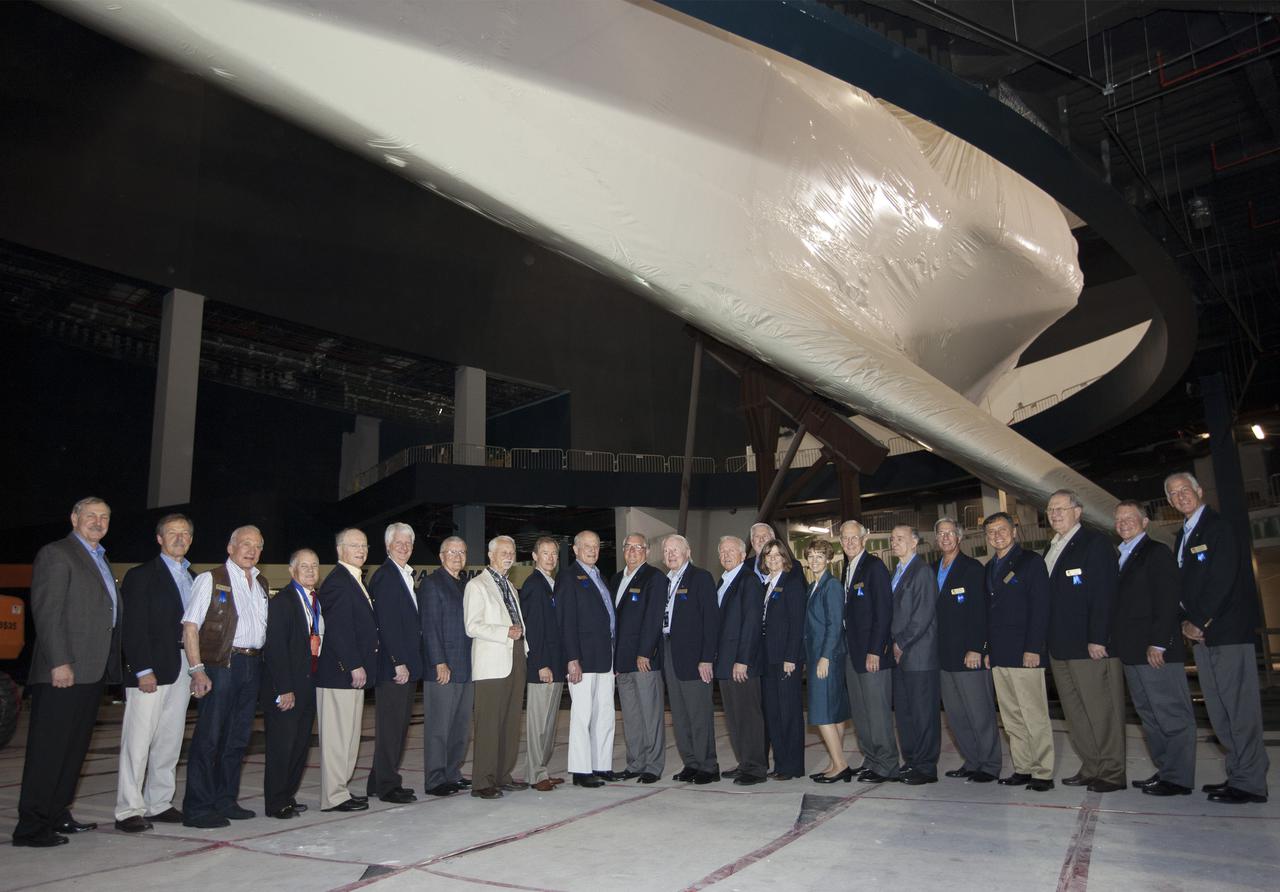
CAPE CANAVERAL, Fla. – At NASA’s Kennedy Space Center Visitor Complex in Florida, members of the U.S. Astronaut Hall of Fame are joined by Bill Moore, chief operating officer of the visitor complex pose under the space shuttle Atlantis in the facility where it will be displayed beginning June 29. The shuttle is currently protected by plastic wrap as constitution contuse. Pictured, left to right are, Curt Brown, Robert, 'Hoot' Gibson, Buzz Aldrin, Joe Allen, Rick Hauck, Steven Hawley, Fred Haise, Owen Garriott, Brewster Shaw. Jack Lousma, Dan Brandenstein, Vance Brand, Loren Shriver, Moore, Bonnie Dunbar, Eileen Collins, Charlie Duke, Walt Cunningham, John Blaha, Franklin Chang-Diaz, Karol Bobko, George 'Pinky' Nelson and Jeff Hoffmann. This induction is the twelfth group of space shuttle astronauts named to the AHOF, and the first time two women are inducted at the same time. The year’s inductees were selected by a committee of current Hall of Fame astronauts, former NASA officials, historians and journalists. The selection process is administered by the Astronaut Scholarship Foundation. For more on the U.S. Astronaut Hall of Fame, go to http:__www.kennedyspacecenter.com_astronaut-hall-of-fame.aspx For more on the Astronaut Scholarship Foundation, go to http:__astronautscholarship.org_ Photo credit: NASA_ Kim Shiflett
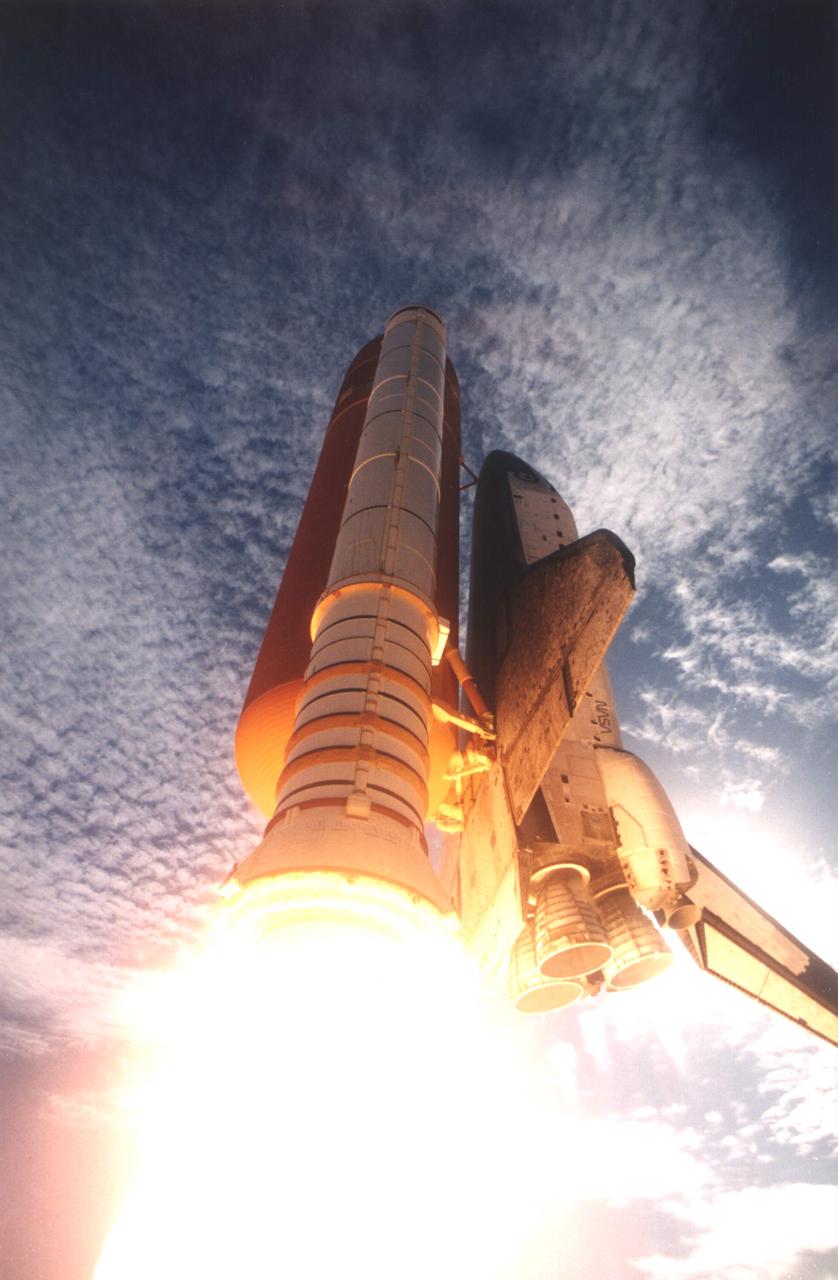
STS073-S-027 (20 October 1995) --- A 35mm camera captured this low-angle view of the Space Shuttle Columbia as it lifted off from Launch Pad 39B, at the Kennedy Space Center (KSC), to begin a scheduled 16-day mission in Earth-orbit in support of the United States Microgravity Laboratory (USML-2). Five NASA astronauts and two scientists from the private sector were onboard. Liftoff occurred at 9:53:00 a.m. (EDT) on October 20, 1995. The mission represents the 72nd Space Shuttle flight for NASA. The crew will be working around the clock on a diverse assortment of USML-2 experiments located in a science module in Columbia's cargo bay. Fields of study include fluid physics, materials science, biotechnology, combustion science and commercial space processing technologies. The crew is made up of astronauts Kenneth D. Bowersox, commander; Kent V. Rominger, pilot; Kathryn C. Thornton, payload commander; Michael E. Lopez-Alegria and Catherine G. Coleman, mission specialists; along with Fred W. Leslie and Albert Sacco Jr., payload specialists.

CAPE CANAVERAL, Fla. -- The Astronaut Scholarship Foundation helps celebrate the 40th anniversary of Apollo 16's lunar landing, which occurred April 20, 1972, with a soiree at the Kennedy Space Center Visitor Complex's Saturn V Center. Panel members who addressed the audience are, from left, astronaut support crew member for Apollo 16 Hank Hartsfield, Apollo 14 Lunar Module Pilot and Apollo 16 back-up crew member Edgar Mitchell, Apollo 13 Lunar Module Pilot and Apollo 16 back-up crew member Fred Haise, Apollo 16 Lunar Module Pilot Charlie Duke, and Apollo 8 Command Module Pilot and Apollo 13 Commander Jim Lovell. The 11-day Apollo 16 mission featured three moonwalks, including a nearly 17-mile lunar rover road trip to collect more than 200 pounds of moon rocks to return to Earth. Photo credit: NASA/Chris Chamberland
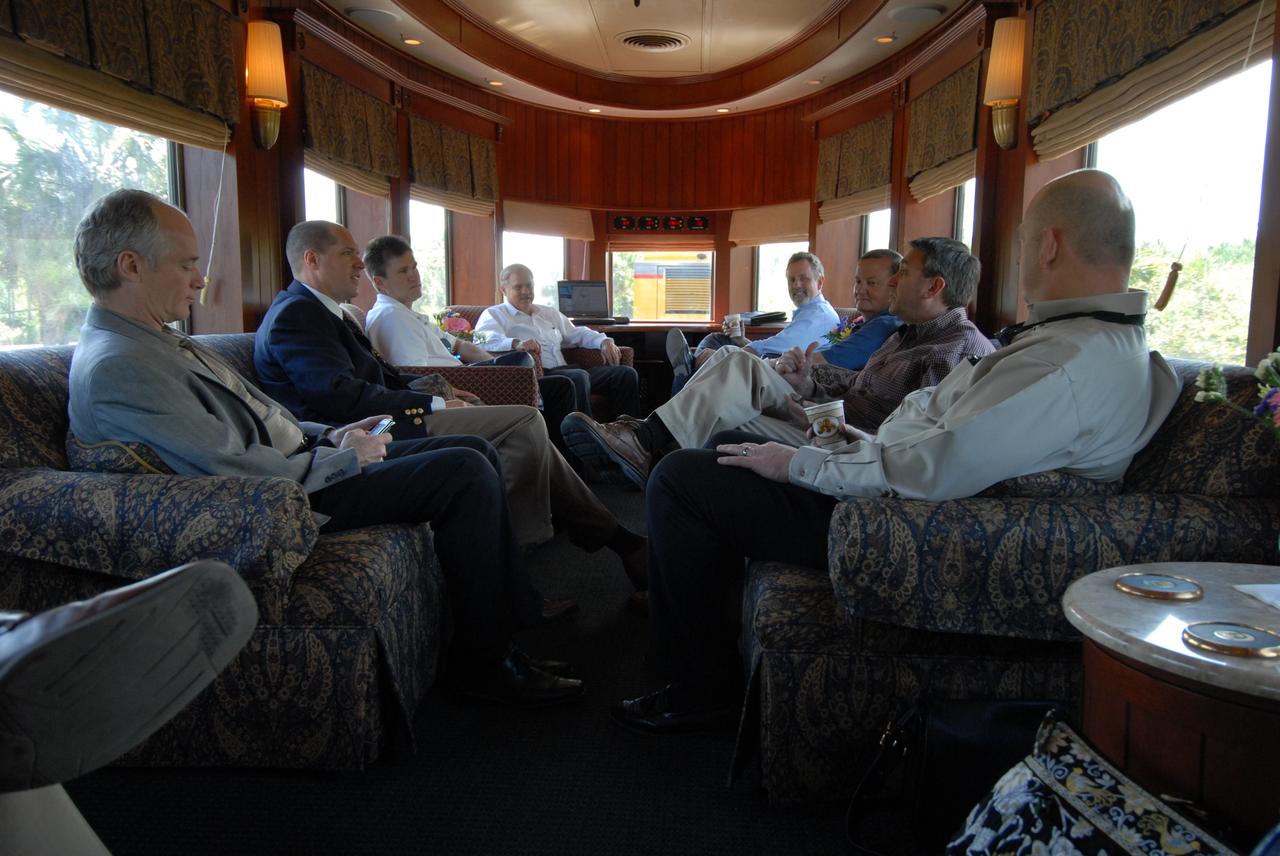
CAPE CANAVERAL, Fla. – ATK and NASA officials accompanied the Florida East Coast Railroad train carrying the booster segments for the Ares I-X test rocket on its route to NASA's Kennedy Space Center in Florida from Jacksonville, Fla. Seen here in the passenger car are, from left, ATK Vice President Space Launch Systems Charlie Precourt, a Florida East Coast Railroad representative, ATK Deputy Site Director in Florida Ted Shaffner, ATK Vice President Of Space Launch Propulsion Cary Ralston, NASA KSC Shuttle Launch Director Mike Leinbach, a Florida East Coast Railroad representative and ATK Ares I First Stage program Director Fred Brasfield. The four reusable motor segments and the nozzle exit cone, manufactured by the Ares I first-stage prime contractor Alliant Techsystems Inc., or ATK, departed Utah March 12 on the seven-day, cross-country trip to Florida. The segments will be delivered to the Rotation, Processing and Surge Facility for final processing and integration. The booster used for the Ares I-X launch is being modified by adding new forward structures and a fifth segment simulator. The motor is the final hardware needed for the rocket's upcoming test flight this summer. The stacking operations are scheduled to begin in the Vehicle Assembly Building in April. Photo credit: NASA/Kim Shiflett
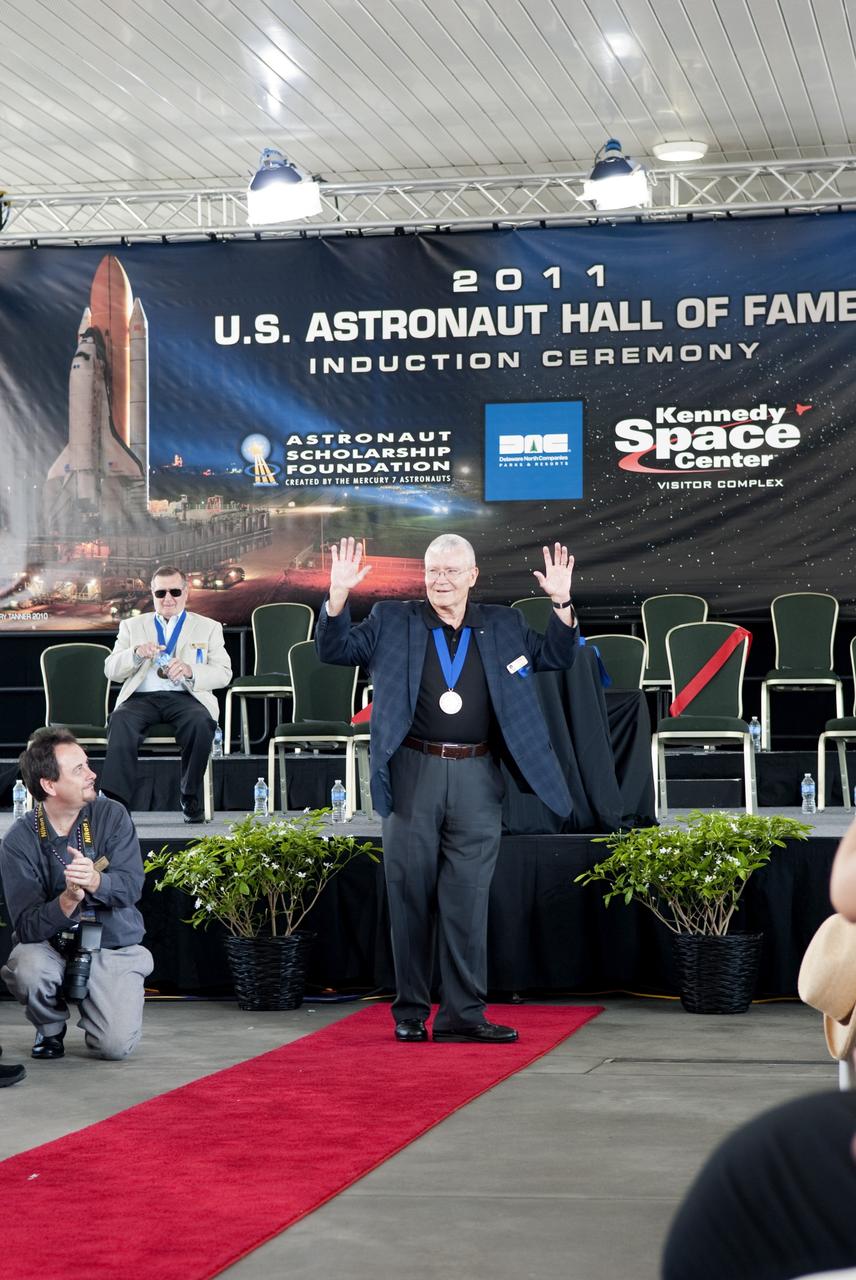
Cape Canaveral, Fla. -- Hall of Fame astronaut Fred Haise thanks the audience for their applause at the 2011 U.S. Astronaut Hall of Fame induction ceremony at NASA's Kennedy Space Center Visitor Complex in Florida. Hall of Fame astronauts and visitors gathered to honor 2011 inductees Karol "Bo" Bobko and Susan Helms. During his 19 years in the astronaut program, Bobko flew on three space shuttle missions and logged more than 386 hours in space. He served as pilot during the first voyage of space shuttle Challenger aboard STS-6 in April 1983 and as commander during the maiden flight of space shuttle Atlantis aboard STS-51J in October 1985. Helms, a five-time space shuttle astronaut, has logged 5,064 hours in space. During her stay onboard the International Space Station as a member of the Expedition-2 crew in 2001, Helms performed a world record 8 hour and 56 minute spacewalk. Bobko and Helms join the ranks of the U.S. Astronaut Hall of Fame bringing the number of space explorers enshrined in the Hall of Fame to 79. Photo Credit: NASA/Jim Grossmann

STS073-S-029 (20 October 1995) --- A stationary 70mm camera captured this wide view of the Space Shuttle Columbia as it lifted off from Launch Pad 39B, at the Kennedy Space Center (KSC), to begin a scheduled 16-day mission in Earth-orbit in support of the United States Microgravity Laboratory (USML-2). Five NASA astronauts and two scientists from the private sector were onboard. Liftoff occurred at 9:53:00 a.m. (EDT) on October 20, 1995. The mission represents the 72nd Space Shuttle flight for NASA. The crew will be working around the clock on a diverse assortment of USML-2 experiments located in a science module in Columbia's cargo bay. Fields of study include fluid physics, materials science, biotechnology, combustion science and commercial space processing technologies. The crew is made up of astronauts Kenneth D. Bowersox, commander; Kent V. Rominger, pilot; Kathryn C. Thornton, payload commander; Michael E. Lopez-Alegria and Catherine G. Coleman, mission specialists; along with Fred W. Leslie and Albert Sacco Jr., payload specialists.
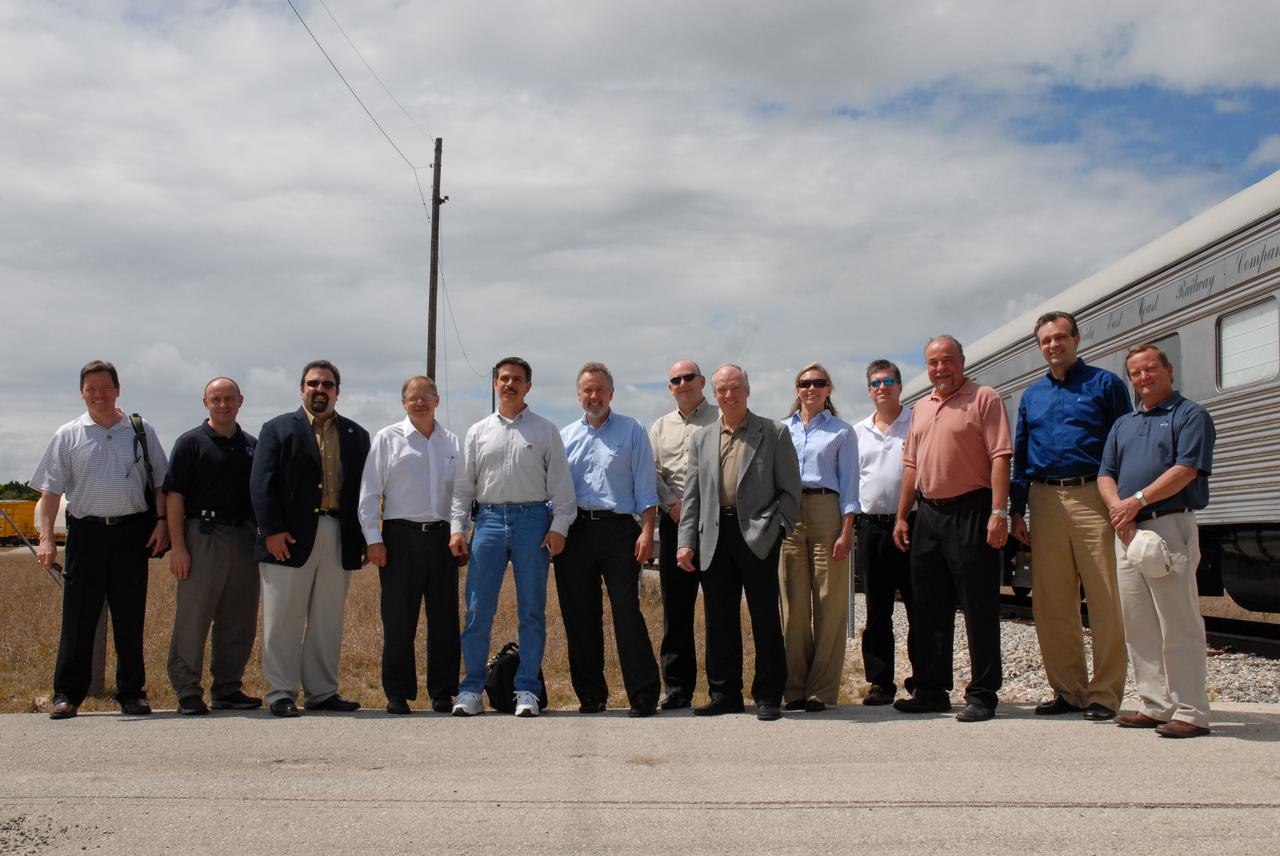
CAPE CANAVERAL, Fla. – The booster segments for the Ares I-X test rocket were delivered to NASA's Kennedy Space Center in Florida by the Florida East Coast Railroad and the NASA Railroad. Accompanying the train on its route from Jacksonville, Fla., were NASA and ATK officials. Standing here, from left, are ATK Ares I Flight Tests Program Director Joe Oliva, ATK Ares I-X Florida Program Manager Russ Page, NASA Ares Program Manager Steve Cook, ATK Deputy Site Director in Florida Ted Shaffner, NASA KSC Ares I-X Deputy Mission Manager Jon Cowart, ATK Vice President of Space Launch Propulson Cary Ralston, ATK Ares I First Stage program Director Fred Brasfield, ATK Vice President Space Launch Systems Charlie Precourt, ATK Ares I Flight Tests Deputy Program Director Kathy Philpot, NASA Marshall Space Flight Center Reusable Solid Rocket Booster Integration Lead Roy Worthy, ATK Florida Site Director Bob Herman, NASA Res First Stage Project Manager Alex Priskos and NASA KSC Shuttle Launch Director Mike Leinbach. The four reusable motor segments and the nozzle exit cone, manufactured by the Ares I first-stage prime contractor Alliant Techsystems Inc., or ATK, departed Utah March 12 on the seven-day, cross-country trip to Florida. The segments will be delivered to the Rotation, Processing and Surge Facility for final processing and integration. The booster used for the Ares I-X launch is being modified by adding new forward structures and a fifth segment simulator. The motor is the final hardware needed for the rocket's upcoming test flight this summer. The stacking operations are scheduled to begin in the Vehicle Assembly Building in April. Photo credit: NASA/Kim Shiflett