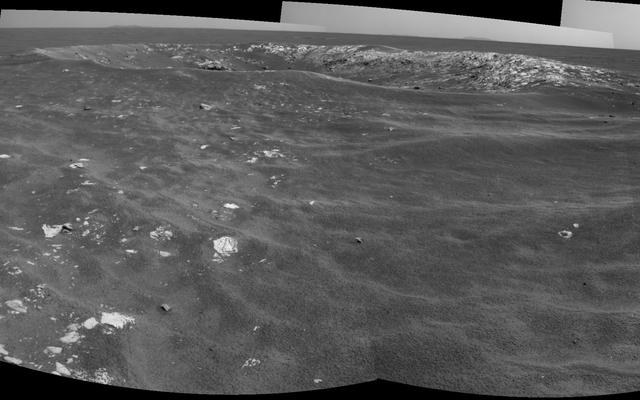
NASA Mars Exploration Rover Opportunity recorded this view of a crater informally named Freedom 7 shortly before the 50th anniversary of the first American in space: astronaut Alan Shepard flight in the Freedom 7 spacecraft.

Freedom crater, located in Acidalia Planitia, exhibits a concentric ring pattern in its interior as seen in this image from NASA Mars Odyssey spacecraft, suggesting that there has been some movement of these materials towards the center of the crater.
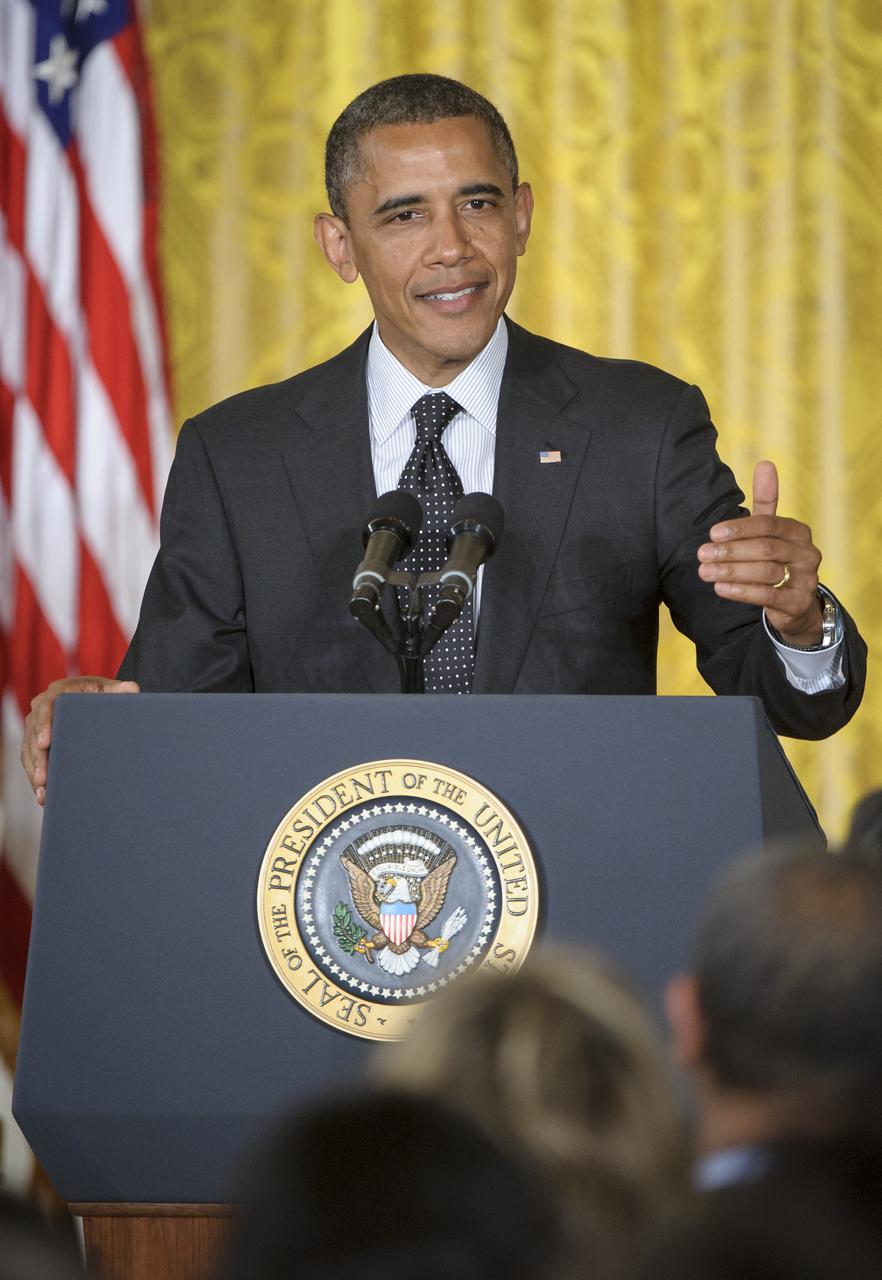
President Barack Obama talks to attendees during the Presidential Medal of Freedom ceremony, held on Tuesday, May 29, 2012, at the White House in Washington. One of the awardees was former United States Marine Corps pilot, astronaut, and United States Senator John Glenn. Photo Credit: (NASA/Bill Ingalls)
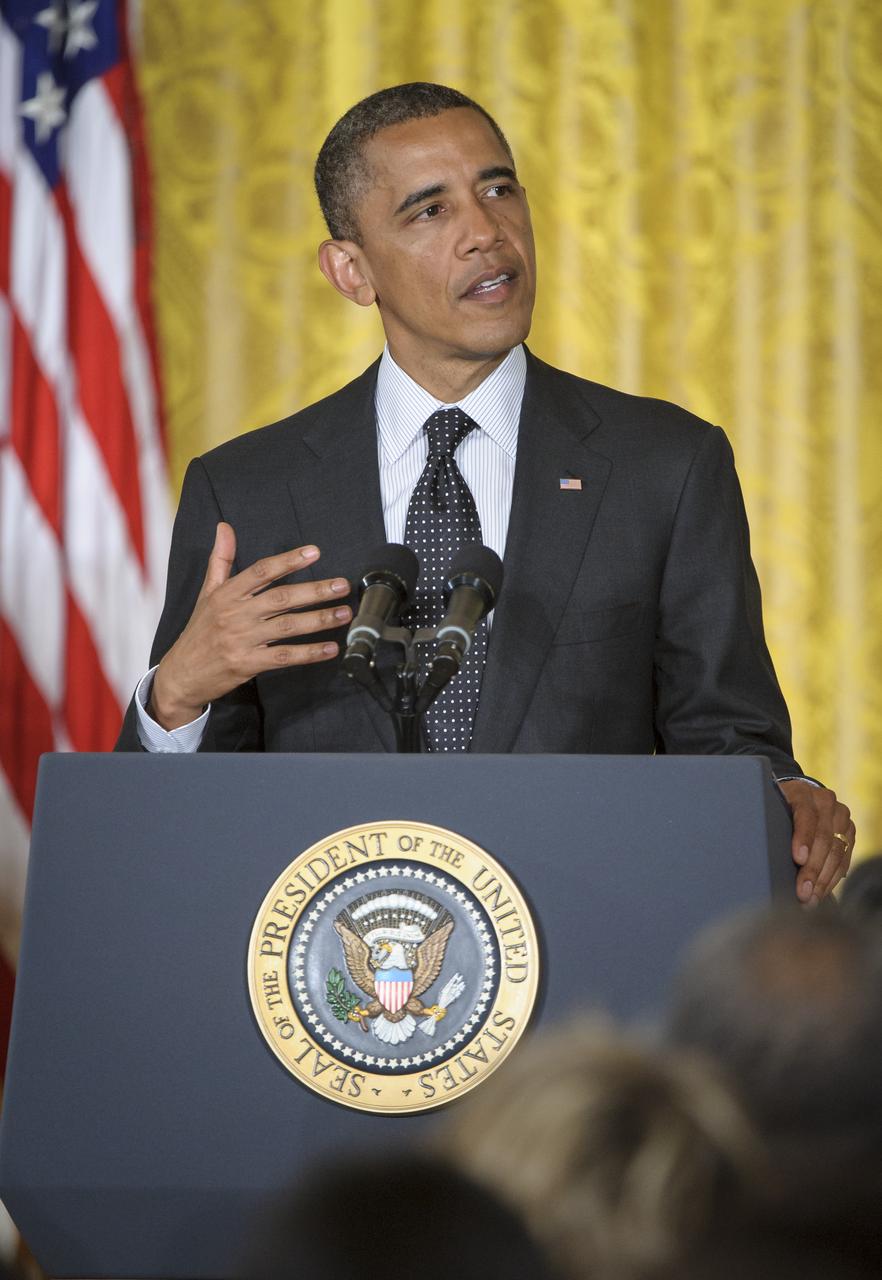
President Barack Obama talks to attendees during the Presidential Medal of Freedom ceremony, held on Tuesday, May 29, 2012, at the White House in Washington. One of the awardees was former United States Marine Corps pilot, astronaut, and United States Senator John Glenn. Photo Credit: (NASA/Bill Ingalls)
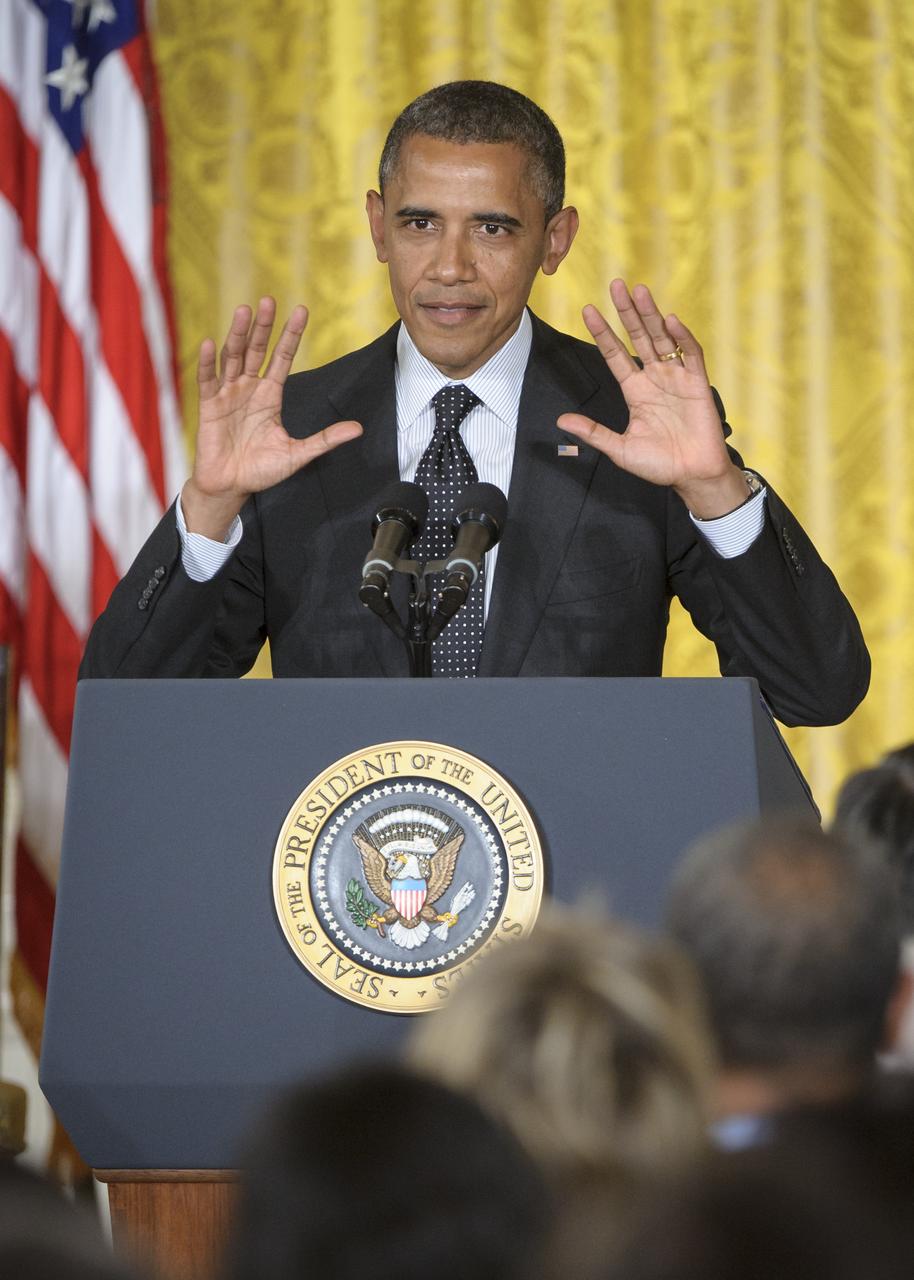
President Barack Obama talks to attendees during the Presidential Medal of Freedom ceremony, held on Tuesday, May 29, 2012, at the White House in Washington. One of the awardees was former United States Marine Corps pilot, astronaut, and United States Senator John Glenn. Photo Credit: (NASA/Bill Ingalls)
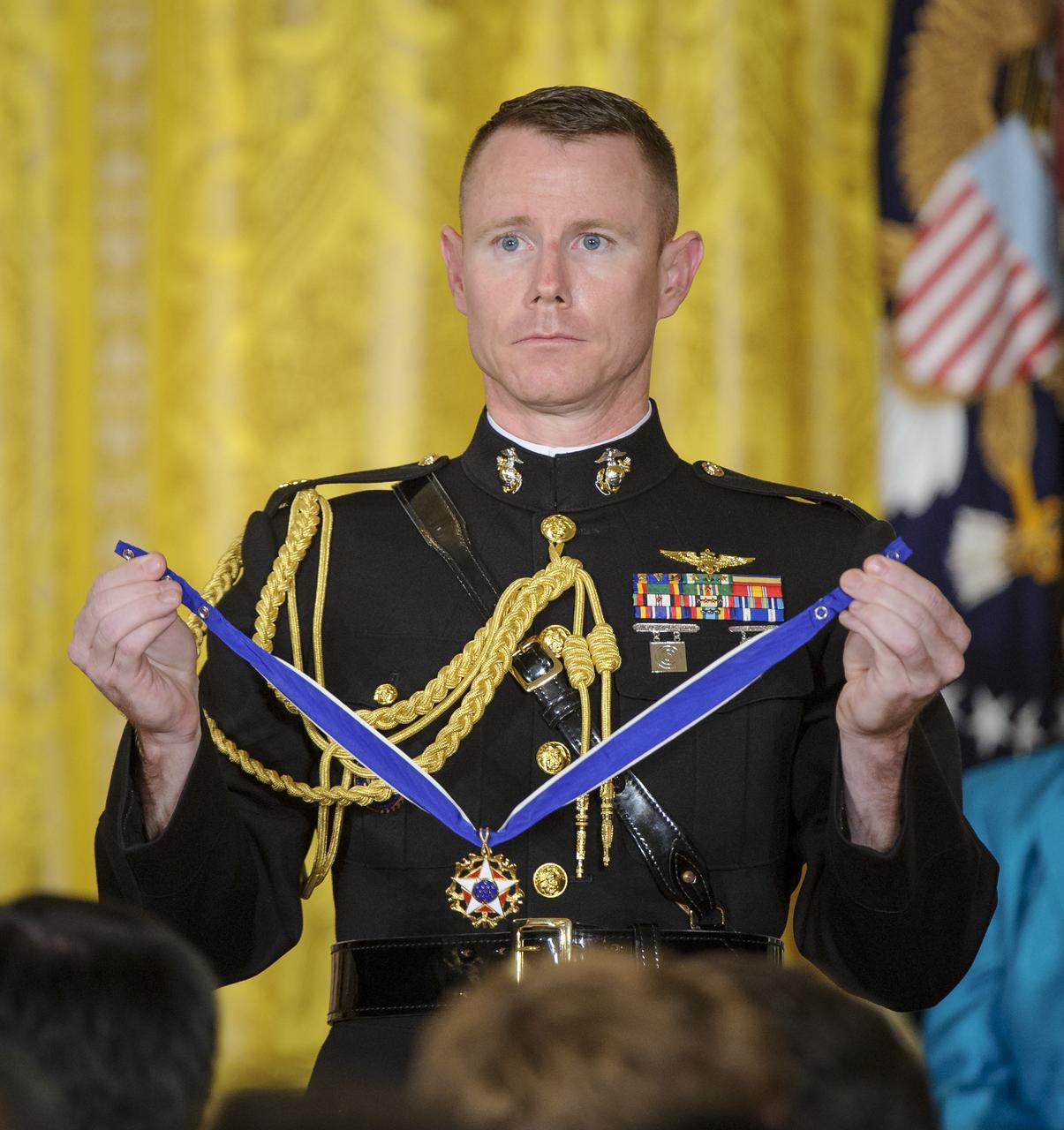
Major S. Lee Meyer, USMC, Military Aide to the President, holds the Presidential Medal of Freedom that is to be presented by President Barack Obama to former United States Marine Corps pilot, astronaut, and United States Senator John Glenn, Tuesday, May 29, 2012, during a ceremony at the White House in Washington. Photo Credit: (NASA/Bill Ingalls)
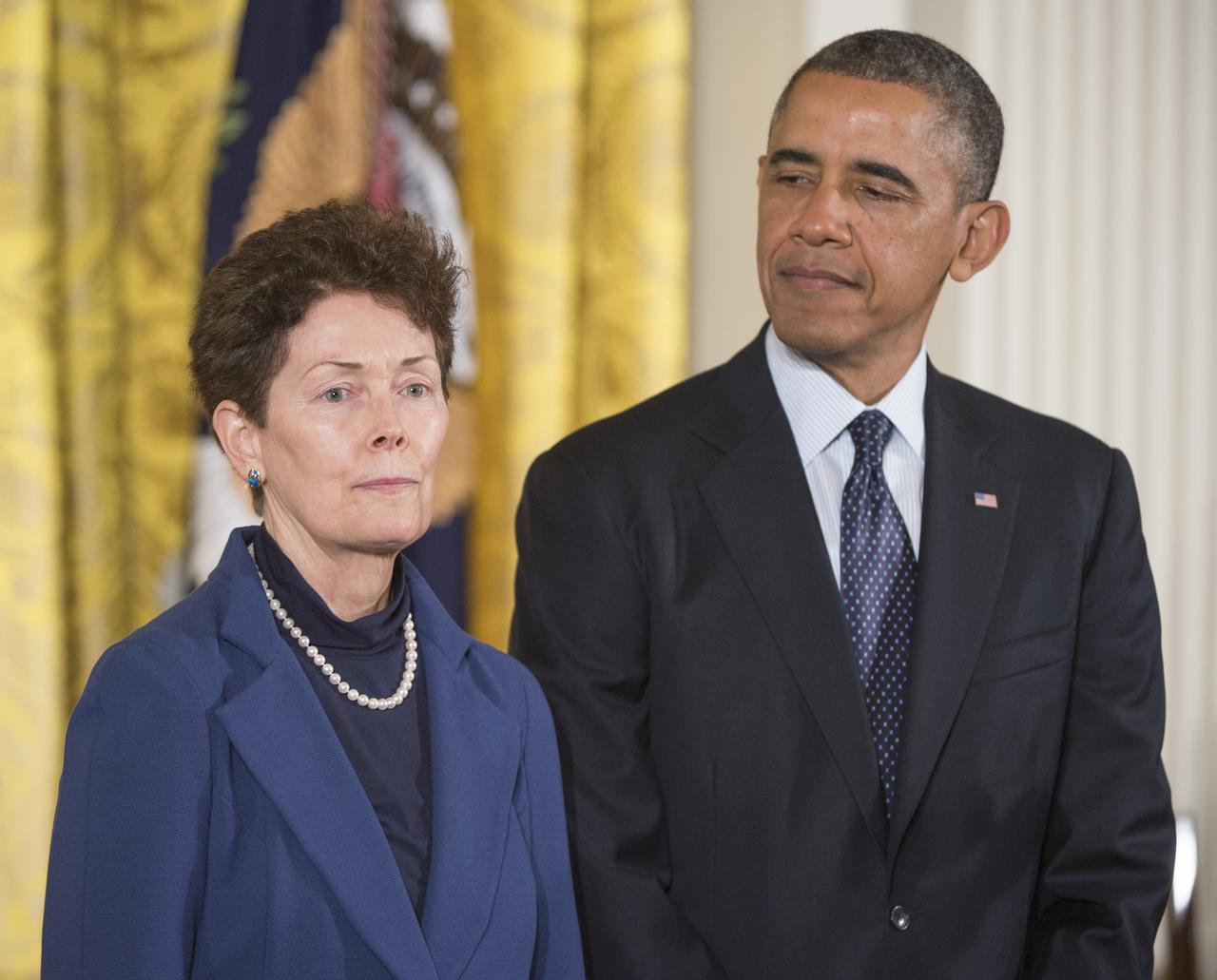
Tam O'Shaughnessy, Sally Ride's life partner and chair, board of directors of Sally Ride Science, is seen with President Barack Obama as she prepares to accept the Presidential Medal of Freedom on behalf of Dr. Ride, Wednesday, Nov. 20, 2013 at the White House in Washington. Sally Ride, who was awarded the Medal of Freedom posthumously, was the first American female astronaut to travel to space. As a role model to generations of young women, she advocated passionately for science education, stood up for racial and gender equality in the classroom, and taught students from every background that there are no limits to what they can accomplish. The Medal of Freedom is our Nation’s highest civilian honor, presented to individuals who have made especially meritorious contributions to the security or national interests of the United States, to world peace, or to cultural or other significant public or private endeavors. Photo Credit: (NASA/Carla Cioffi)
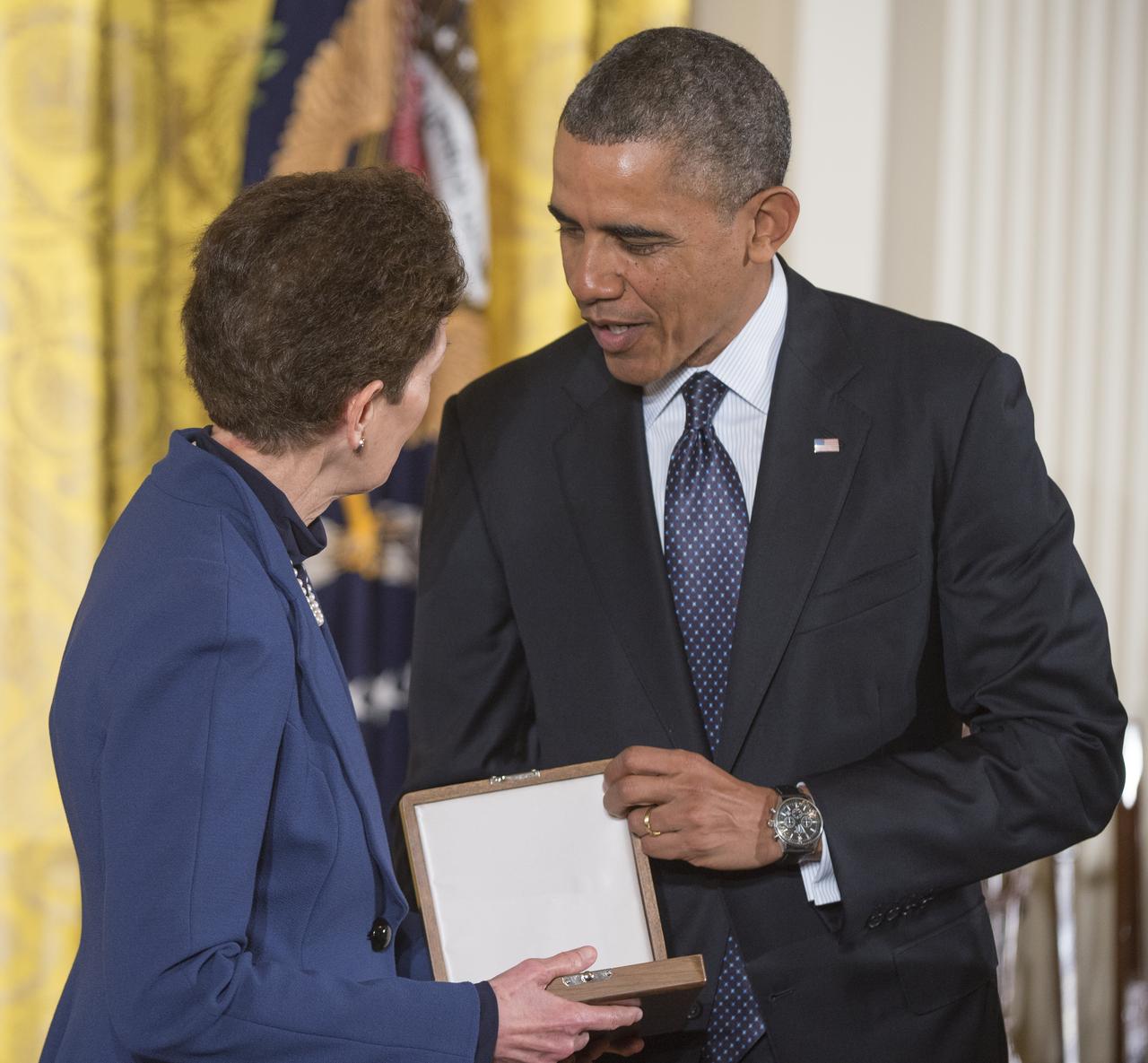
Tam O'Shaughnessy, Sally Ride's life partner and chair, board of directors of Sally Ride Science, is seen with President Barack Obama as she accepts the Presidential Medal of Freedom on behalf of Dr. Ride, Wednesday, Nov. 20, 2013 at the White House in Washington. Sally Ride, who was awarded the Medal of Freedom posthumously, was the first American female astronaut to travel to space. As a role model to generations of young women, she advocated passionately for science education, stood up for racial and gender equality in the classroom, and taught students from every background that there are no limits to what they can accomplish. The Medal of Freedom is our Nation’s highest civilian honor, presented to individuals who have made especially meritorious contributions to the security or national interests of the United States, to world peace, or to cultural or other significant public or private endeavors. Photo Credit: (NASA/Carla Cioffi)
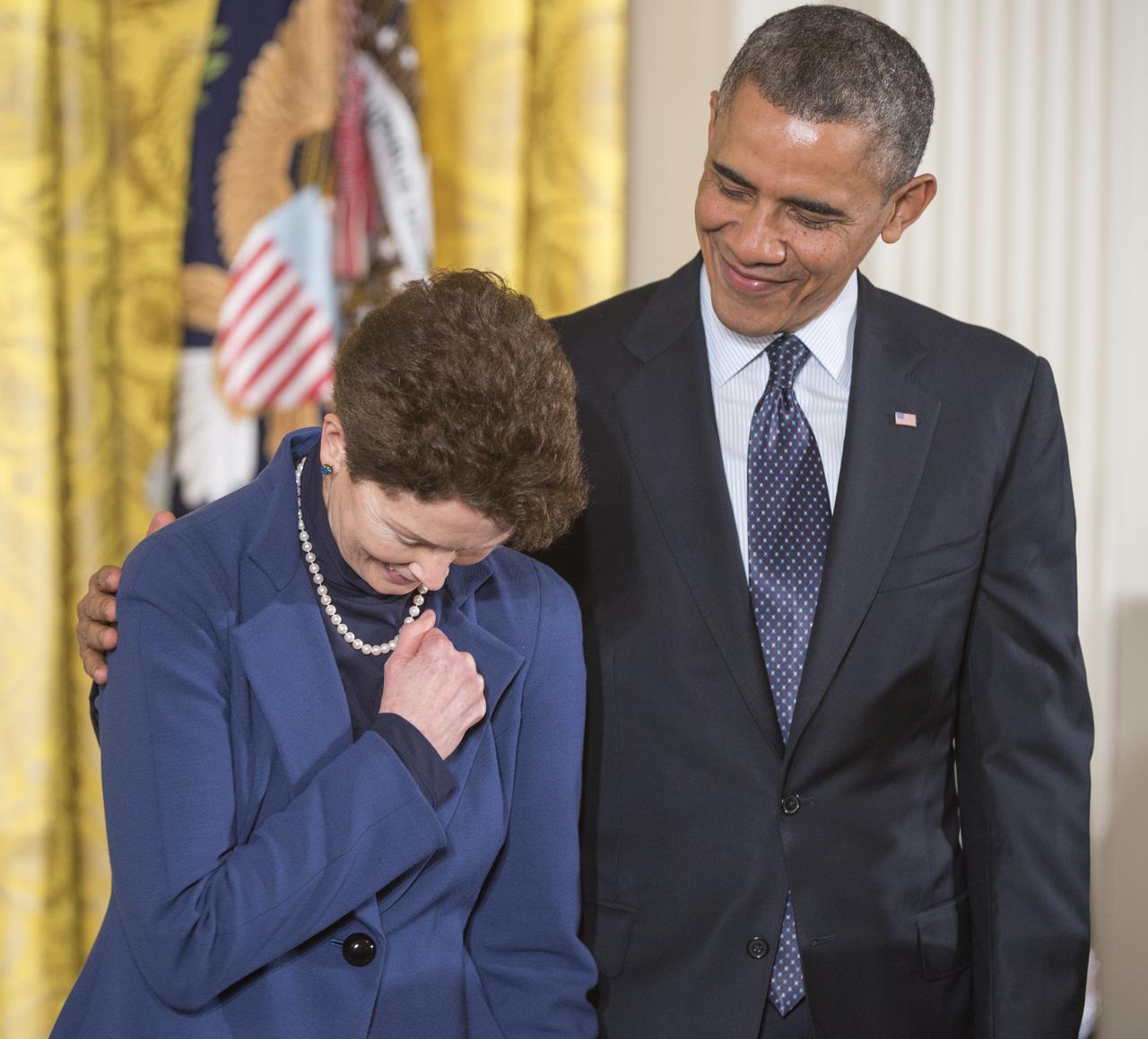
Tam O'Shaughnessy, Sally Ride's life partner and chair, board of directors of Sally Ride Science, is seen with President Barack Obama as she prepares to accept the Presidential Medal of Freedom on behalf of Dr. Ride, Wednesday, Nov. 20, 2013 at the White House in Washington. Sally Ride, who was awarded the Medal of Freedom posthumously, was the first American female astronaut to travel to space. As a role model to generations of young women, she advocated passionately for science education, stood up for racial and gender equality in the classroom, and taught students from every background that there are no limits to what they can accomplish. The Medal of Freedom is our Nation’s highest civilian honor, presented to individuals who have made especially meritorious contributions to the security or national interests of the United States, to world peace, or to cultural or other significant public or private endeavors. Photo Credit: (NASA/Carla Cioffi)
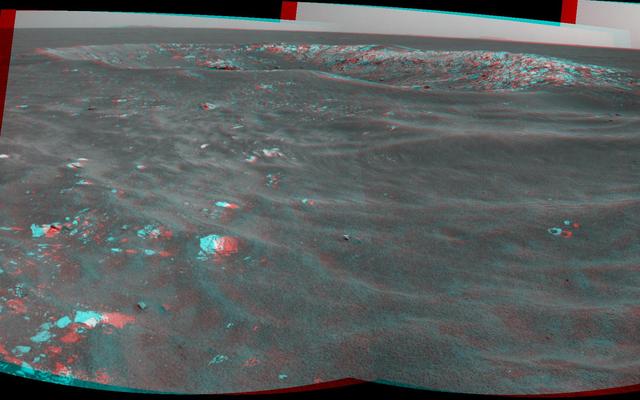
NASA Mars Exploration Rover Opportunity took this stereo view of a crater informally named Freedom 7 shortly before the 50th anniversary of the first American in space: astronaut Alan Shepard flight in the Freedom 7 spacecraft. You need 3D glasses.
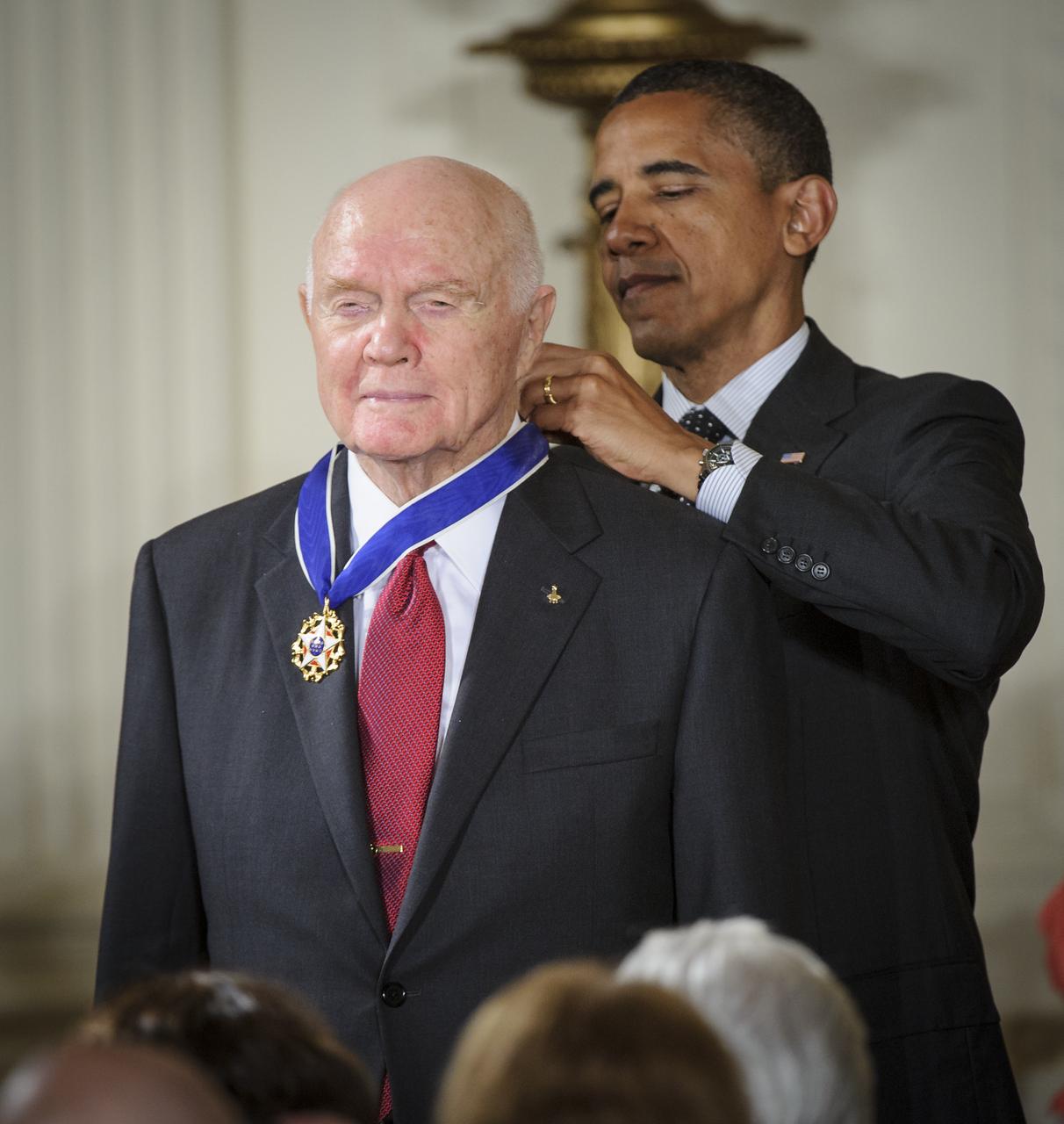
President Barack Obama presents former United States Marine Corps pilot, astronaut, and United States Senator John Glenn with a Medal of Freedom, Tuesday, May 29, 2012, during a ceremony at the White House in Washington. Photo Credit: (NASA/Bill Ingalls)
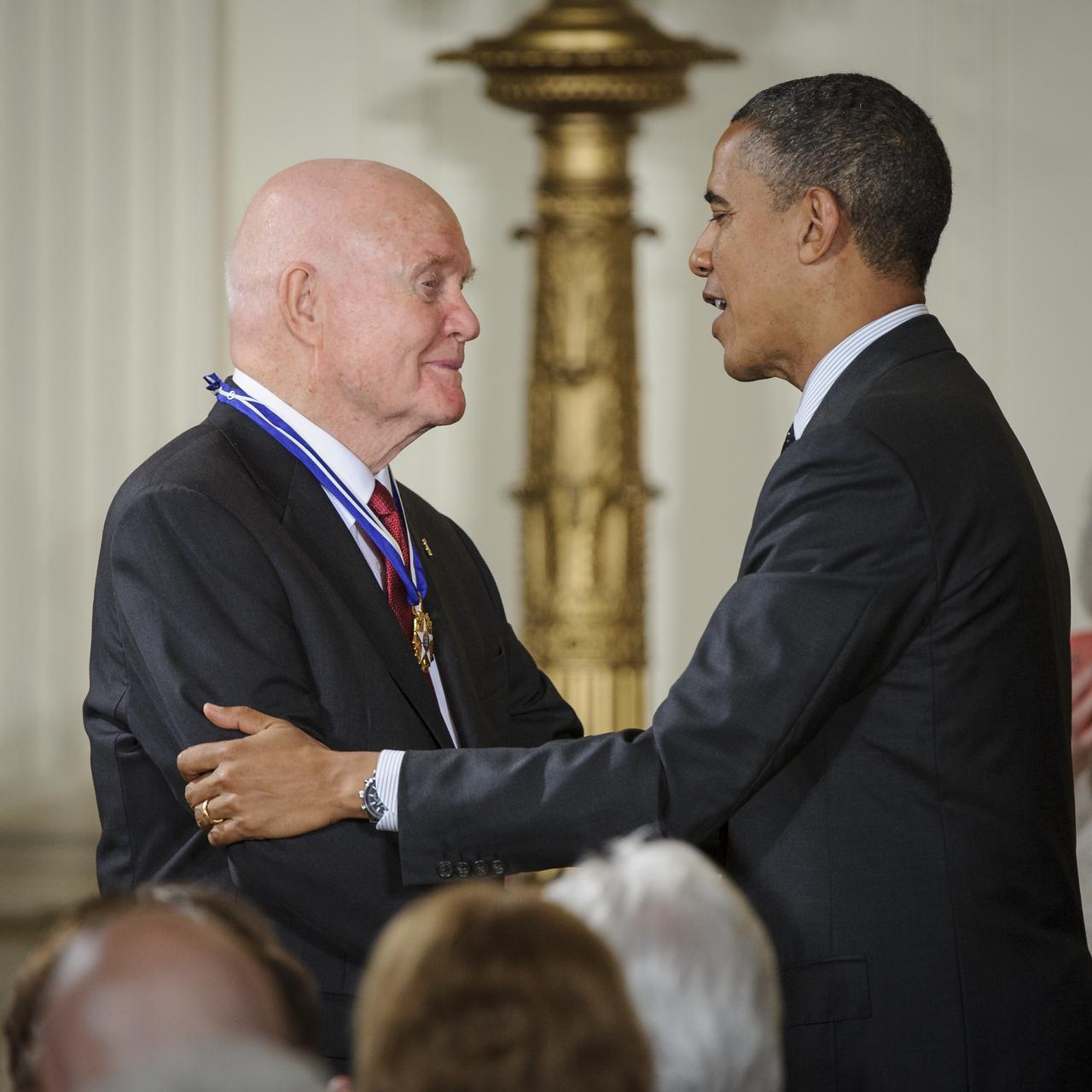
President Barack Obama congratulates former United States Marine Corps pilot, astronaut, and United States Senator John Glenn after presenting him with a Medal of Freedom, Tuesday, May 29, 2012, during a ceremony at the White House in Washington. Photo Credit: (NASA/Bill Ingalls)
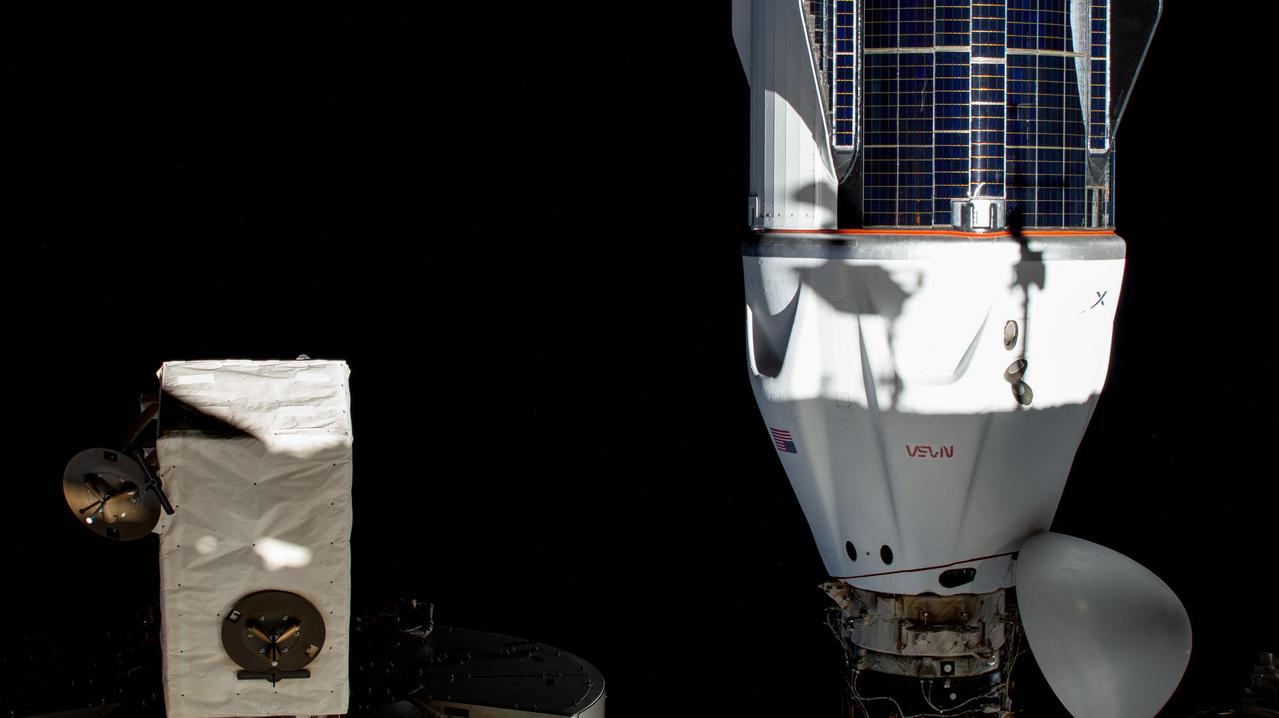
iss072e144451 (Nov. 4, 2024) --- The SpaceX Dragon Freedom spacecraft is pictured docked to the space-facing port on the International Space Station's Harmony module.
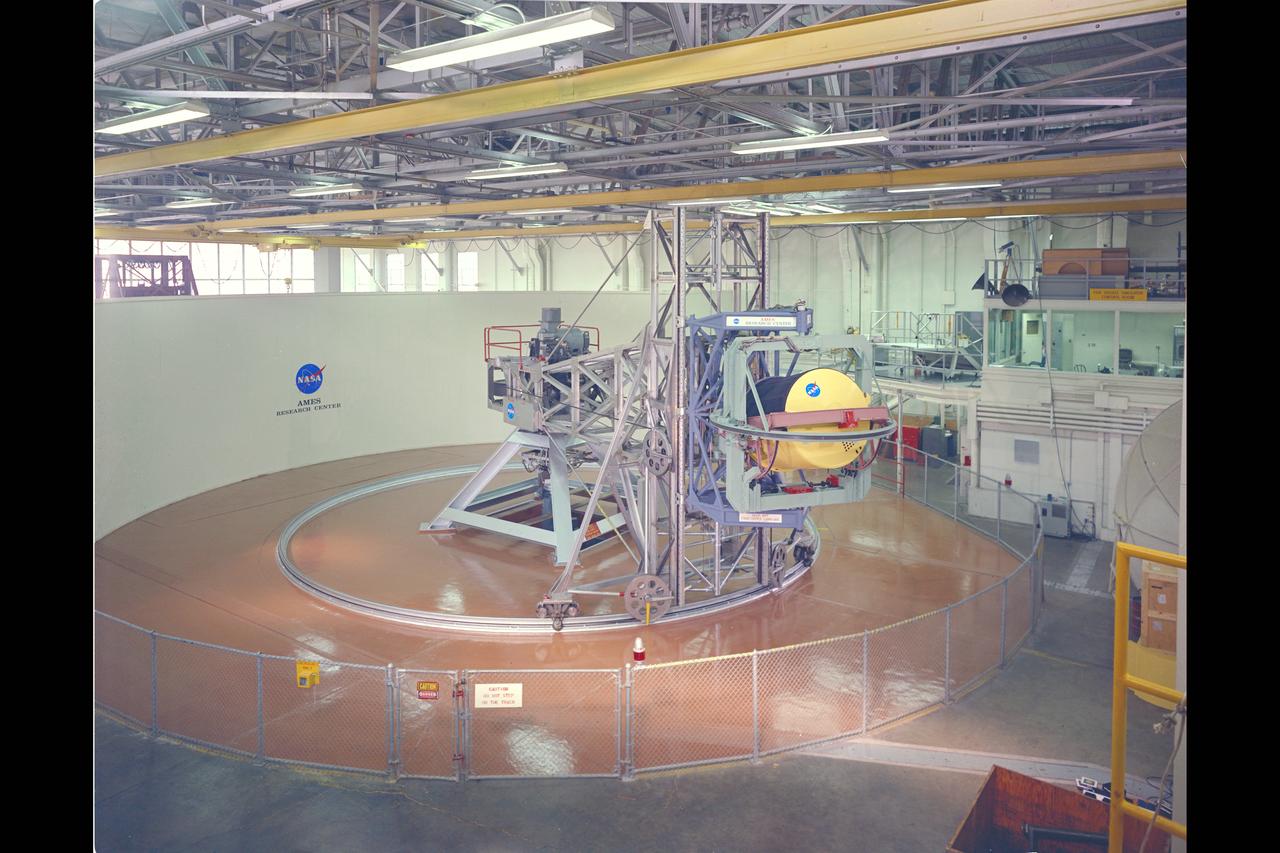
5 Degree of Freedom - Manned Flight Simulator
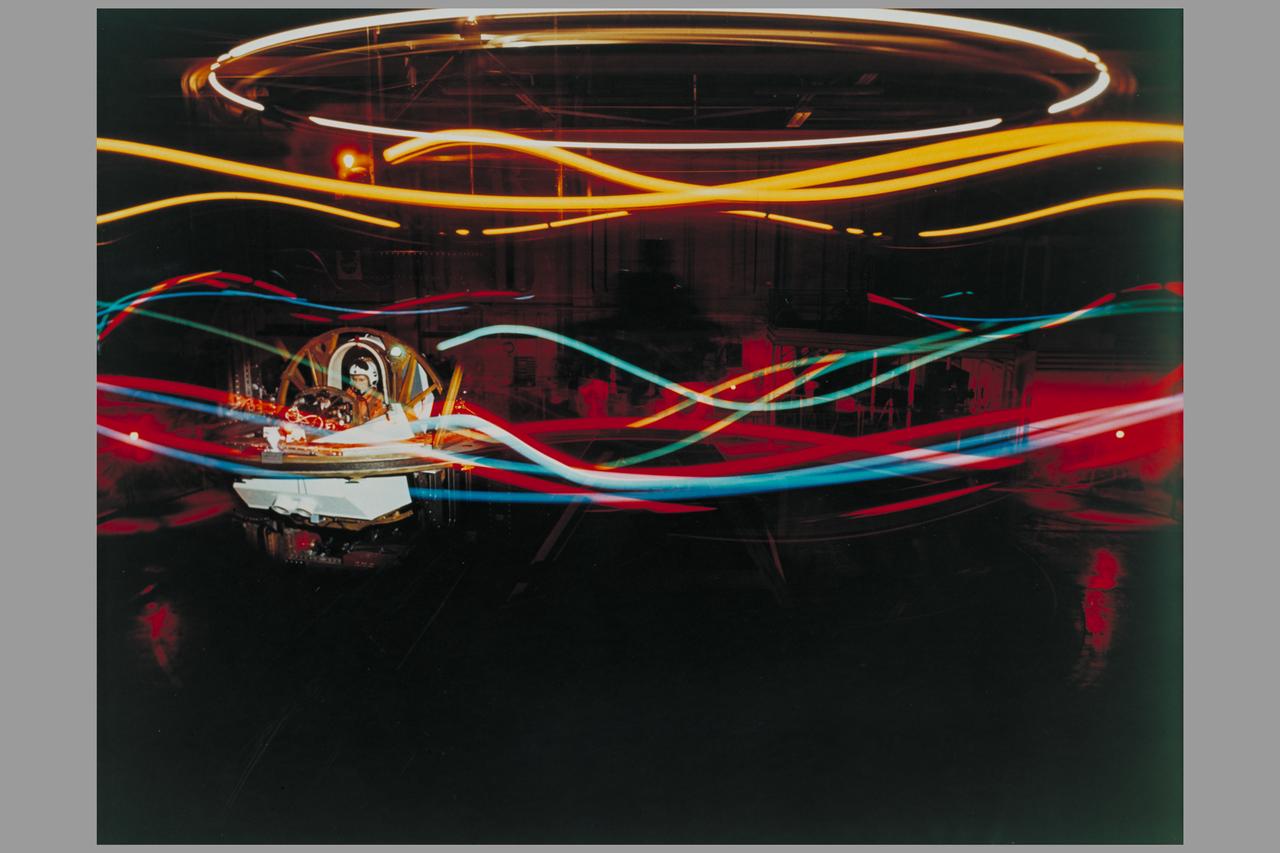
5 Degree Freedom of Motion Simulator with R. Gerdes (delayed exposure using lights to show motion)

This artist's concept depicts the Space Station Freedom as it would look orbiting the Earth; illustrated by Marshall Space Flight Center artist, Tom Buzbee. Scheduled to be completed in late 1999, this smaller configuration of the Space Station features a horizontal truss structure that supported U.S., European, and Japanese Laboratory Modules; the U.S. Habitation Module; and three sets of solar arrays. The Space Station Freedom was an international, permanently marned, orbiting base to be assembled in orbit by a series of Space Shuttle missions that were to begin in the mid-1990's.
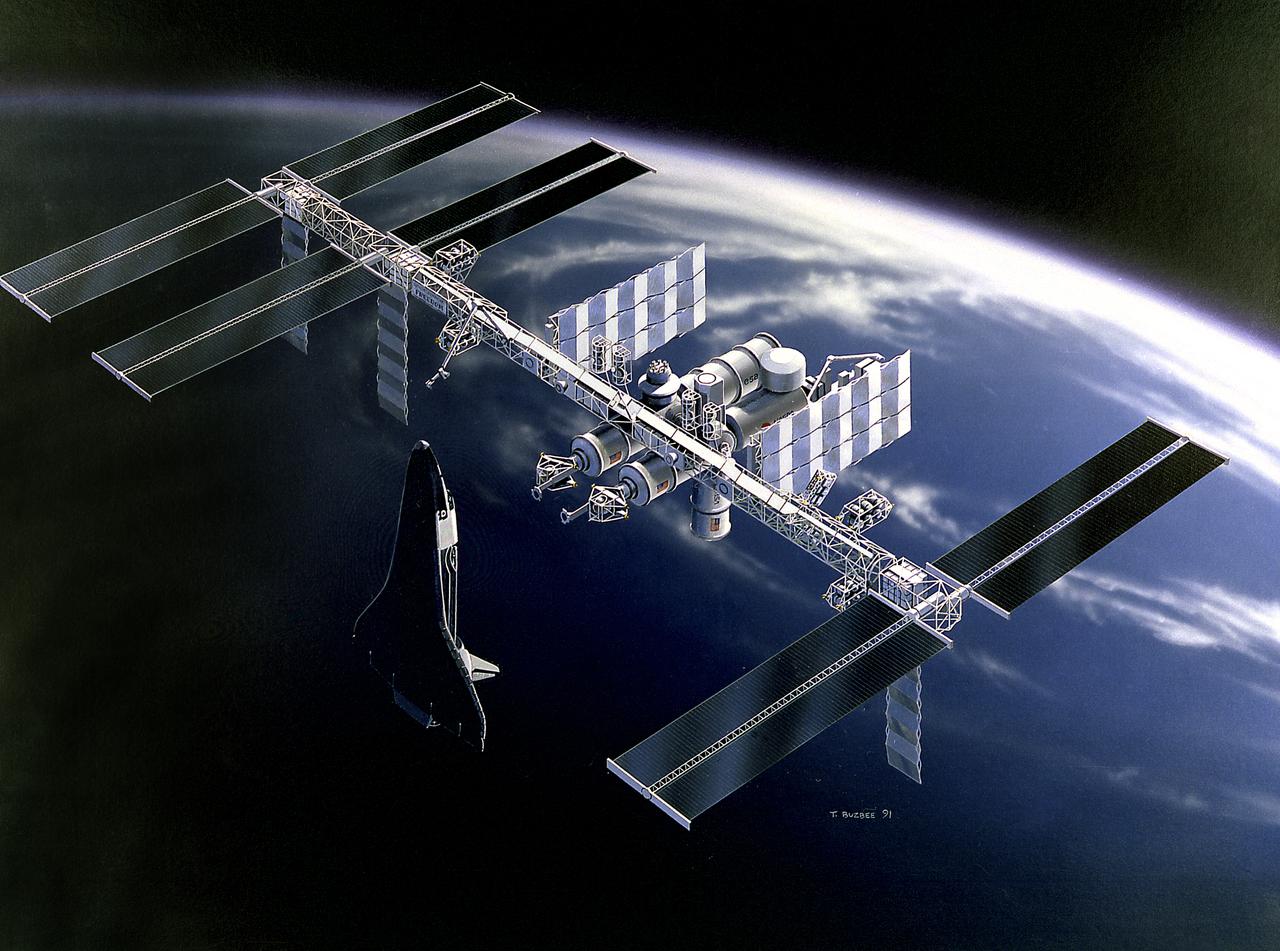
This artist's concept depicts the Space Station Freedom as it would look orbiting the Earth, illustrated by Marshall Space Flight Center artist, Tom Buzbee. Scheduled to be completed in late 1999, this smaller configuration of the Space Station featured a horizontal truss structure that supported U.S., European, and Japanese Laboratory Modules; the U.S. Habitation Module; and three sets of solar arrays. The Space Station Freedom was an international, permanently marned, orbiting base to be assembled in orbit by a series of Space Shuttle missions that were to begin in the mid-1990's.
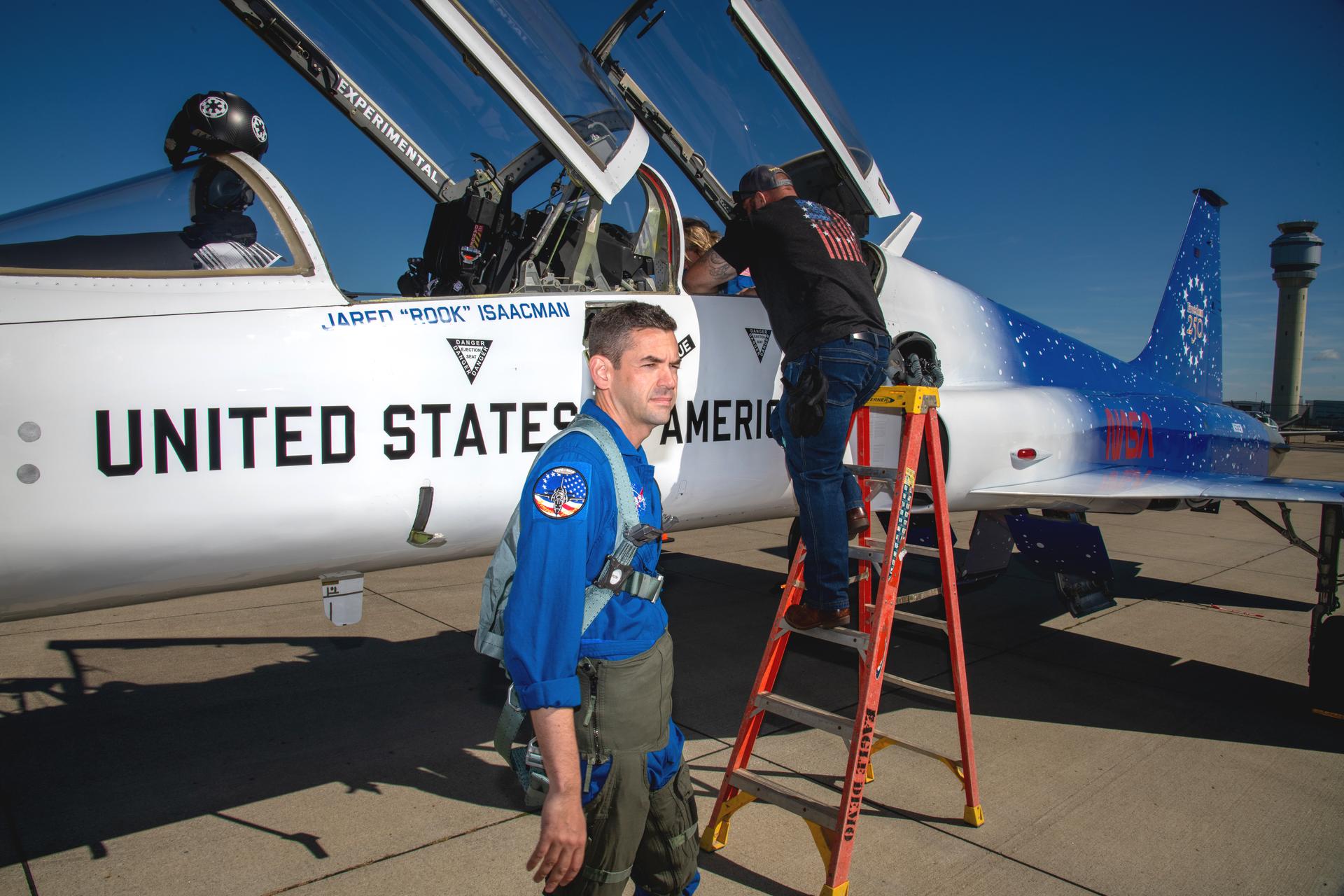
NASA Administrator Jared Isaacman stands next to his jet after his walk around flight check. He pauses before loading the F5 for the Freedom 250 flyover of the NFL game between the Cleveland Browns and the Carolina Panthers at Huntington Bank Field, Sunday, September 27th, 2026, in Cleveland, Ohio. NASA’s engagement at NFL games is part of the agency’s Inspiration Tour, aimed at strengthening connections between NASA and its partners and showcasing innovation in air and space in the lead up to the MAX POWER aerospace technology expo and airshow at the agency’s Kennedy Space Center in early November
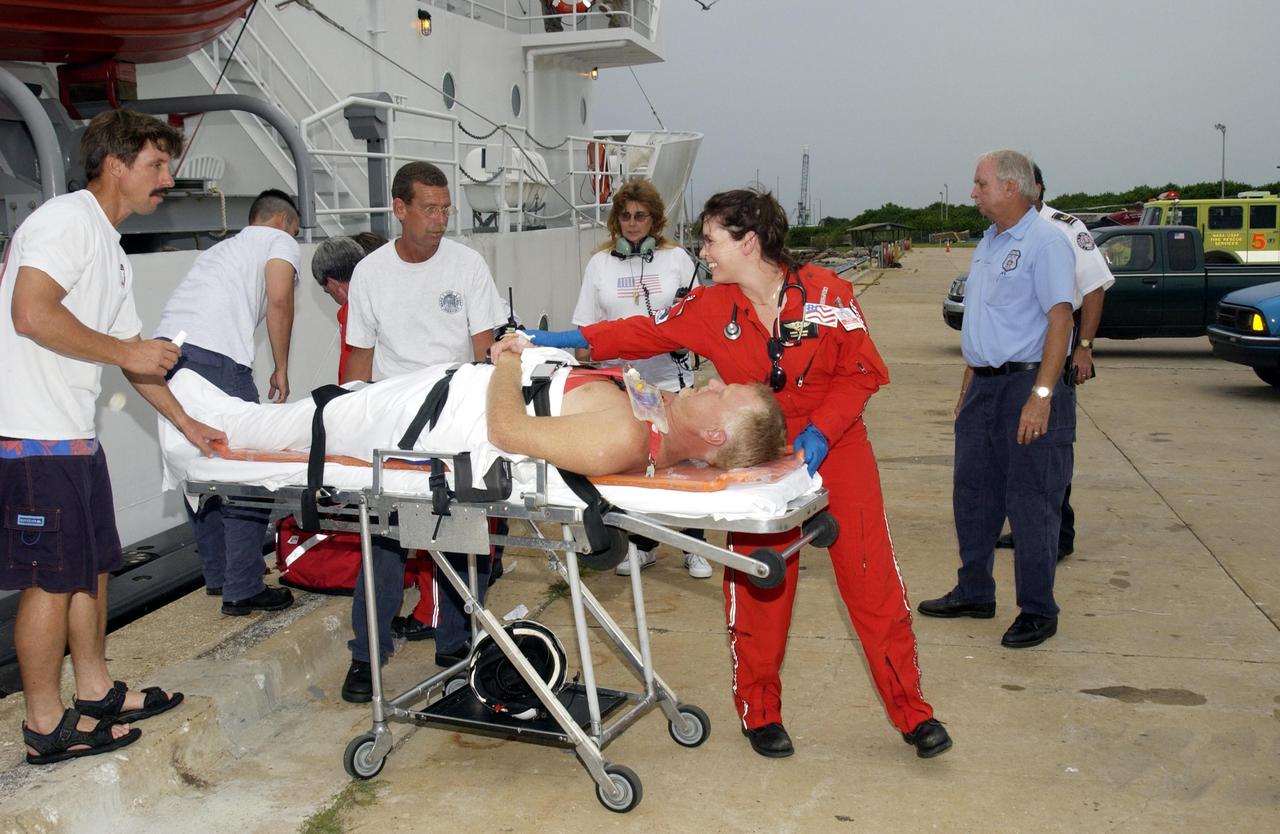
KENNEDY SPACE CENTER, FLA. - United Space Alliance workers on board the Freedom Star, one of the Shuttle Rocket Booster retrieval ships, release a distressed lobster diver to an Air Care Team from Orlando for transfer to a hospital. The ship and its dive team, including a diver medical technician, Andy Fish, were instrumental in rescuing the diver off Cape Canaveral Sept. 11. The ship was on a certification exercise and near the location of a lobster diving boat that radioed the U.S. Coast Guard for help when one of the divers experienced difficulty breathing on his return to the surface. Hearing the call for help, the captain of the Freedom Star offered to help. Fish stayed with the diver in the recompression chamber aboard the Freedom Star until the ship reached Port Canaveral where a KSC Occupational Health doctor waited. The diver was stabilized and then taken to Florida Hospital.

KENNEDY SPACE CENTER, FLA. -- United Space Alliance workers on board the Freedom Star, one of the Shuttle Rocket Booster retrieval ships, check the controls on the recompression chamber at right. The ship and its dive team, including a diver medical technician, Andy Fish, were instrumental in rescuing a lobster diver in distress off Cape Canaveral Sept. 11. The ship was on a certification exercise and near the location of a lobster diving boat that radioed the U.S. Coast Guard for help when one of the divers experienced difficulty breathing on his return to the surface. Hearing the call for help, the captain of the Freedom Star offered to help. Fish stayed with the diver in the recompression chamber aboard the Freedom Star until the ship reached Port Canaveral where a KSC Occupational Health doctor waited. The diver was stabilized and taken to Florida Hospital.
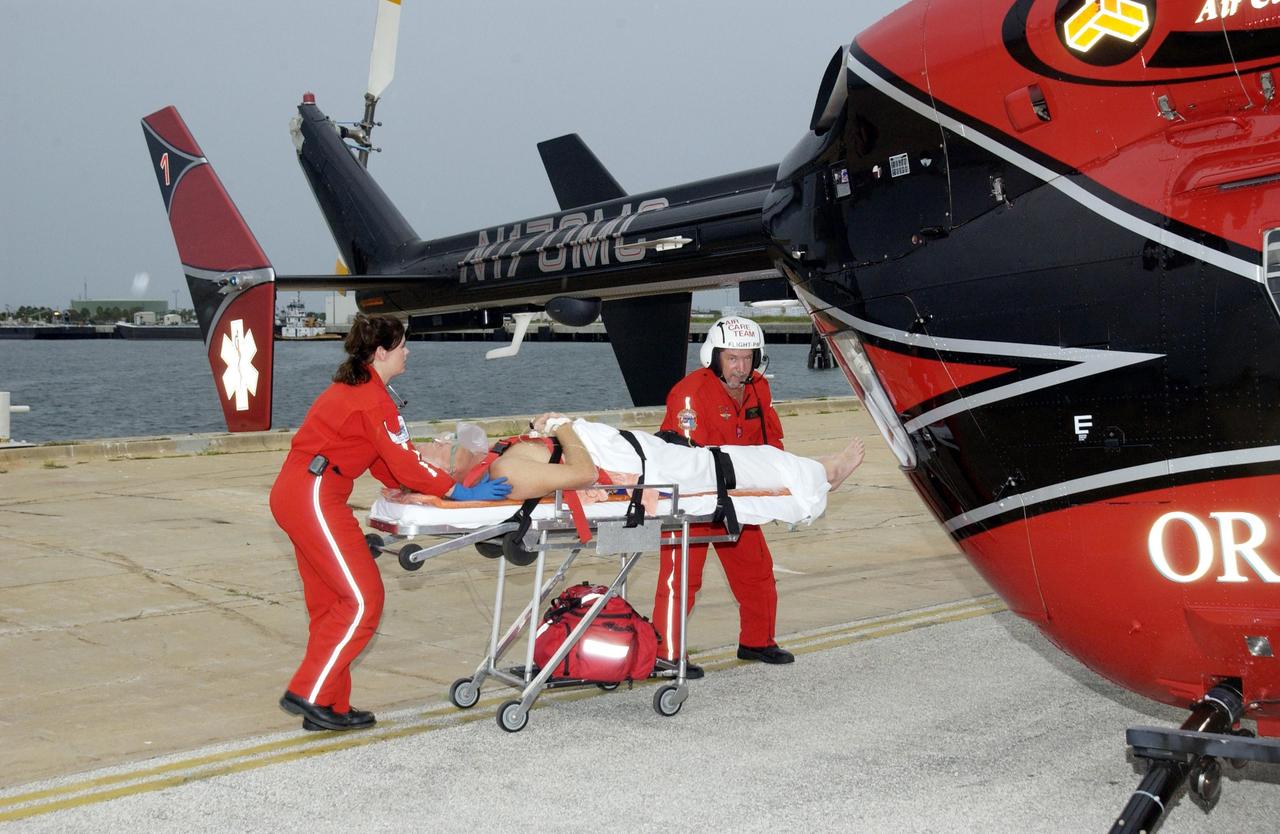
KENNEDY SPACE CENTER, FLA. -- An Air Care team from Orlando take a distressed lobster diver to the helicopter to take him to Florida Hospital. The diver was picked up by the Freedom Star, one of the Shuttle Rocket Booster retrieval ships, on a certification exercise and near the location of a lobster diving boat that radioed the U.S. Coast Guard for help when one of the divers experienced difficulty breathing on his return to the surface. Hearing the call for help, the captain of the Freedom Star offered to help. The ship had a dive team on board, including a diver medical technician, Andy Fish, as well as a hyperbaric chamber. Fish stayed with the diver in the recompression chamber aboard the Freedom Star until the ship reached Port Canaveral where a KSC Occupational Health doctor waited. The diver was stabilized and then taken to Florida Hospital.
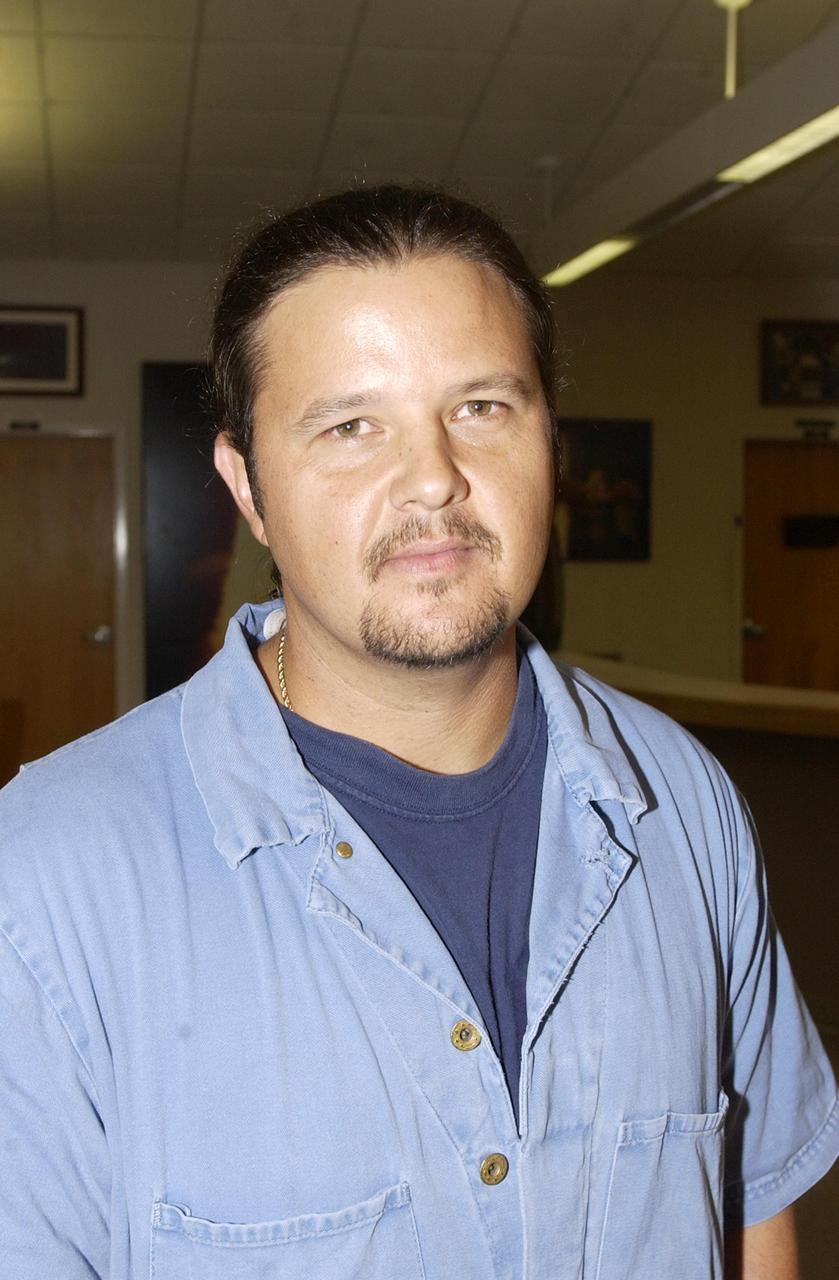
KENNEDY SPACE CENTER, FLA. -- Andy Fish, an SRB retrieval diver and diver medical technician with United Space Alliance, is in the spotlight for helping rescue a diver in distress off Cape Canaveral Sept. 11. Fish and others were on a certification exercise on board Freedom Star, one of the Shuttle Rocket Booster retrieval ships, manned by USA workers. The ship was near the location of a lobster diving boat that radioed the U.S. Coast Guard for help when one of the divers experienced difficulty breathing on his return to the surface. Hearing the call for help, the captain of the Freedom Star offered to help. Fish had experience with distressed divers. He stayed with the diver in the recompression chamber aboard the Freedom Star until the ship reached Port Canaveral where a KSC Occupational Health doctor waited. The diver was stabilized and taken to Florida Hospital. .
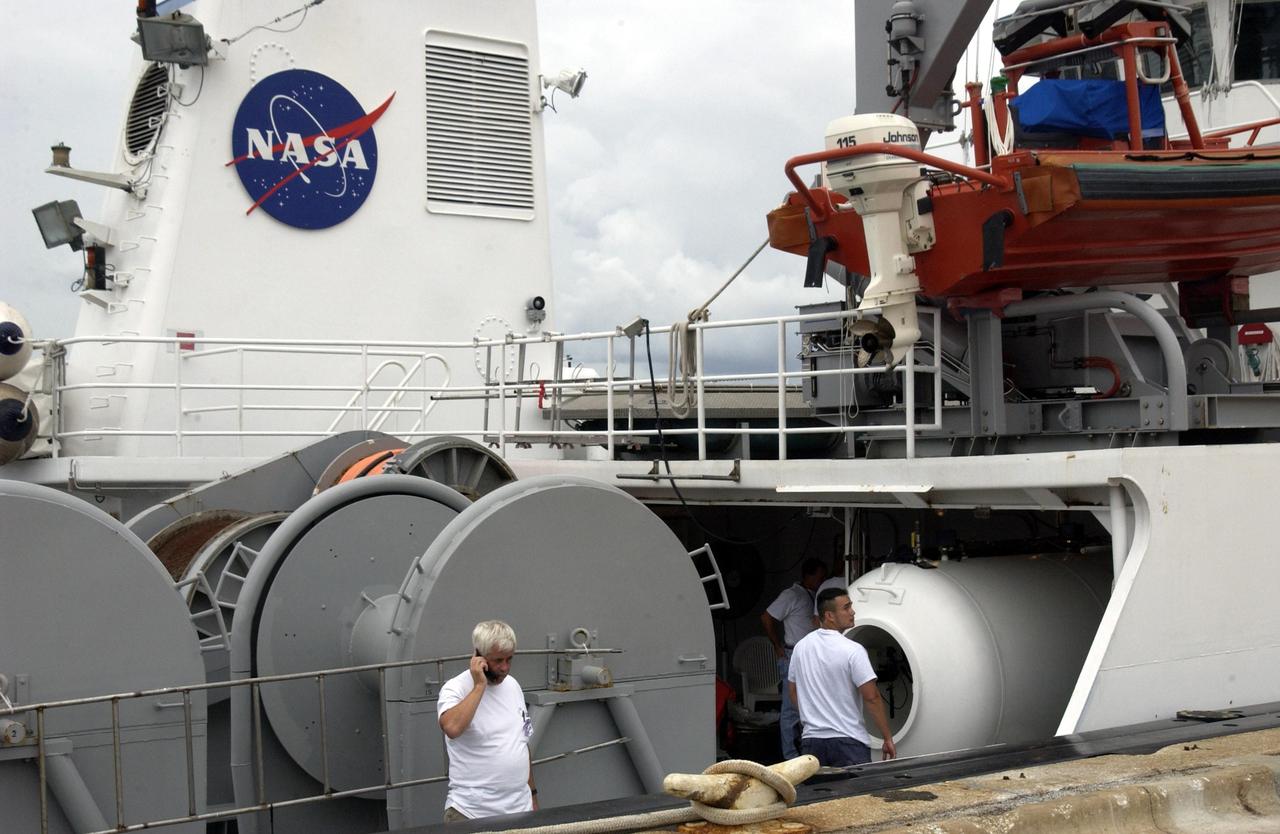
KENNEDY SPACE CENTER, FLA. - On board the Freedom Star, one of the Shuttle Rocket Booster retrieval ships, workers with United Space Alliance help finalize the rescue of a lobster diver in distress after their return to port Sept. 11. The ship was on a certification exercise and near the location of a lobster diving boat that radioed the U.S. Coast Guard for help when one of the divers experienced difficulty breathing on his return to the surface. Hearing the call for help, the captain of the Freedom Star offered to help. On board the ship was a dive team, including a diver medical technician, Andy Fish, who are trained to assist in case of a dive accident during a retrieval mission. Fish stayed with the diver in the recompression chamber aboard the Freedom Star until the ship reached Port Canaveral where a KSC Occupational Health doctor waited. The diver was stabilized and taken to Florida Hospital.
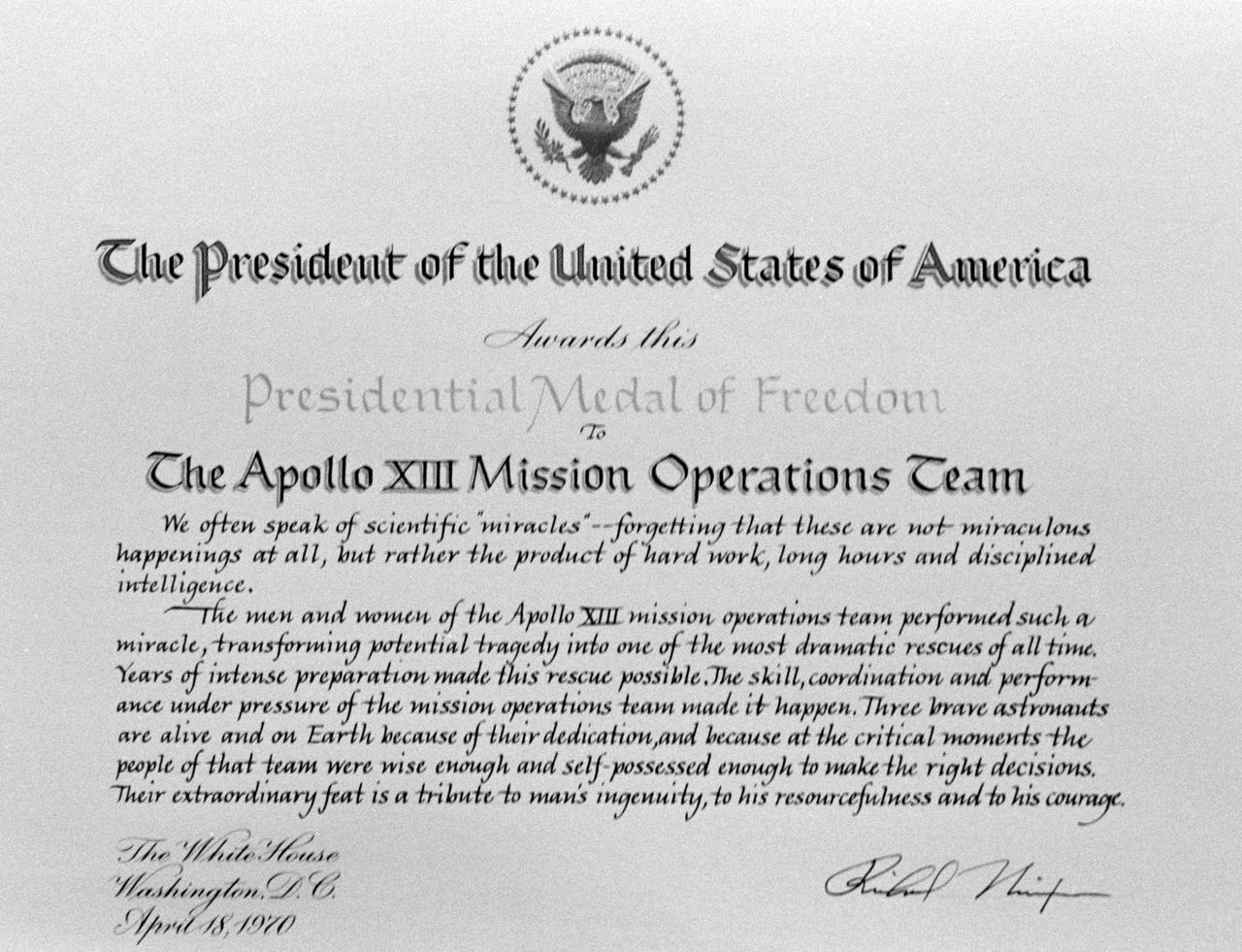
S70-35562 (April 1970) --- A photographic replica of the Presidential Medal of Freedom Award which President Richard M. Nixon presented to the Apollo 13 Missions Operations Team (MOT). The presentation was made by the Chief Executive during a visit to the Manned Spacecraft Center (MSC) in April 1970.

iss072e747210(March 18, 2025) --- The SpaceX Dragon Freedom spacecraft, with its nose cone open, is pictured shortly after undocking from the International Space Station's space-facing port on the Harmony module. Inside Dragon, were SpaceX Crew-9 Commander Nick Hague with Misssion Specialists Butch Wilmore and Suni Williams, all three from NASA, and Mission Specialist Aleksander Gorbunov from Roscosmos.
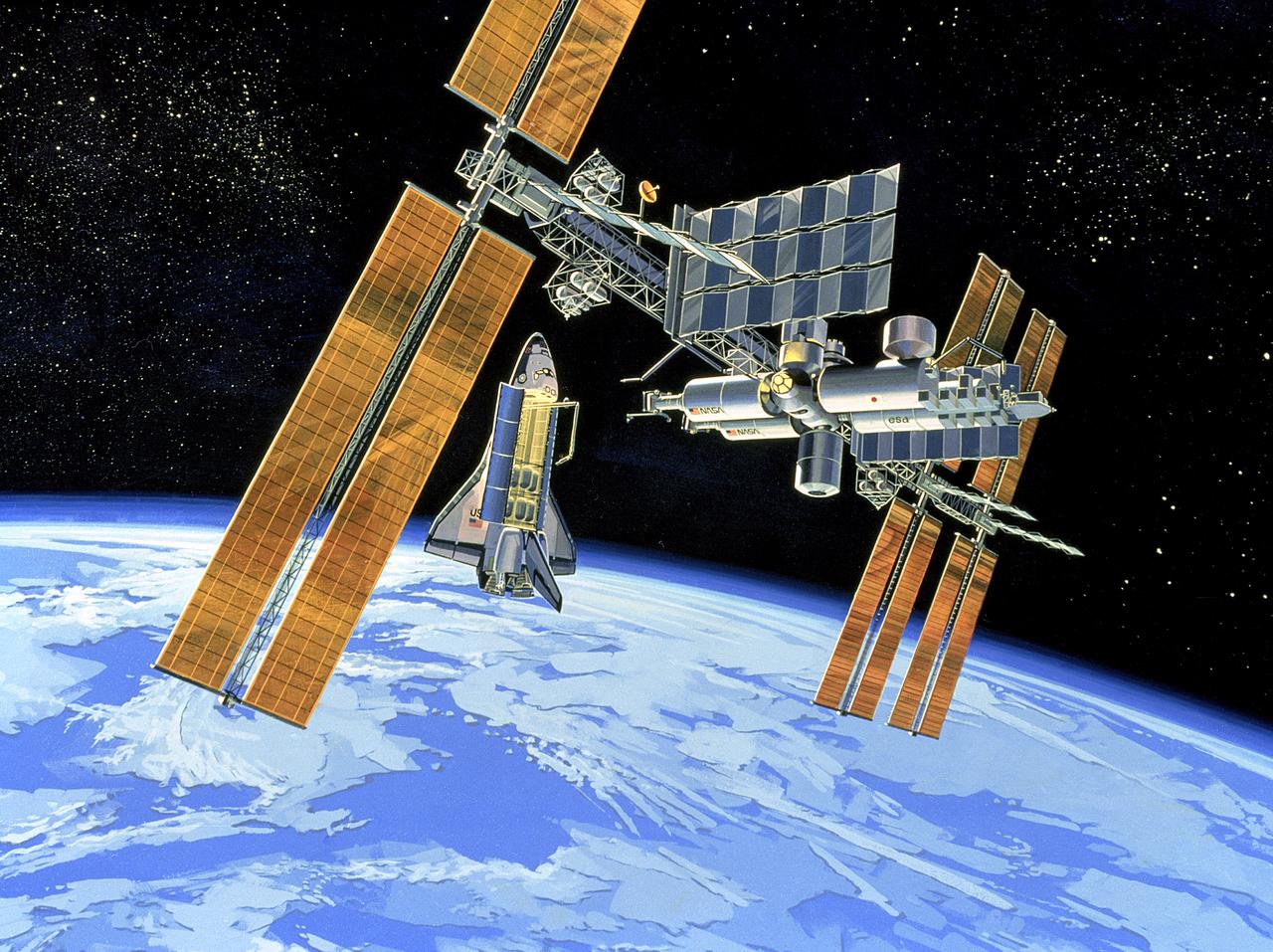
In 1982, the Space Station Task Force was formed, signaling the initiation of the Space Station Freedom Program, and eventually resulting in the Marshall Space Flight Center's responsibilities for Space Station Work Package 1.
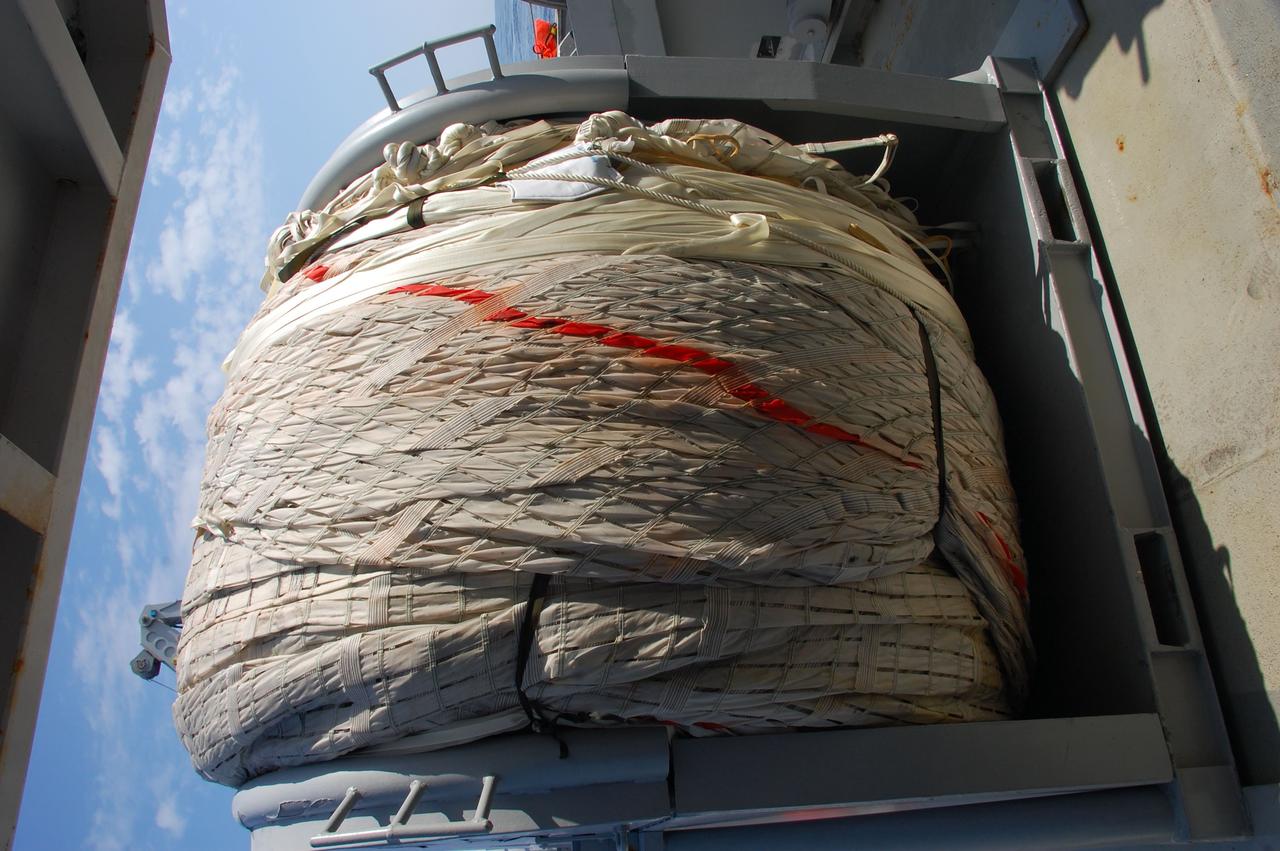
CAPE CANAVERAL, Fla. -- The massive parachute from the left spent booster is rolled up on the deck of Freedom Star, one of NASA's solid rocket booster retrieval ships, after recovery from the Atlantic Ocean and will be returned to Port Canaveral in Florida. The shuttle’s two solid rocket booster casings and associated flight hardware are recovered in the Atlantic Ocean after every launch by Liberty Star and Freedom Star. The boosters impact the Atlantic about seven minutes after liftoff and the retrieval ships are stationed about 10 miles from the impact area at the time of splashdown. After the spent segments are processed, they will be transported to Utah, where they will be refurbished and stored, if needed. Photo credit: NASA/Ben Smegelsky
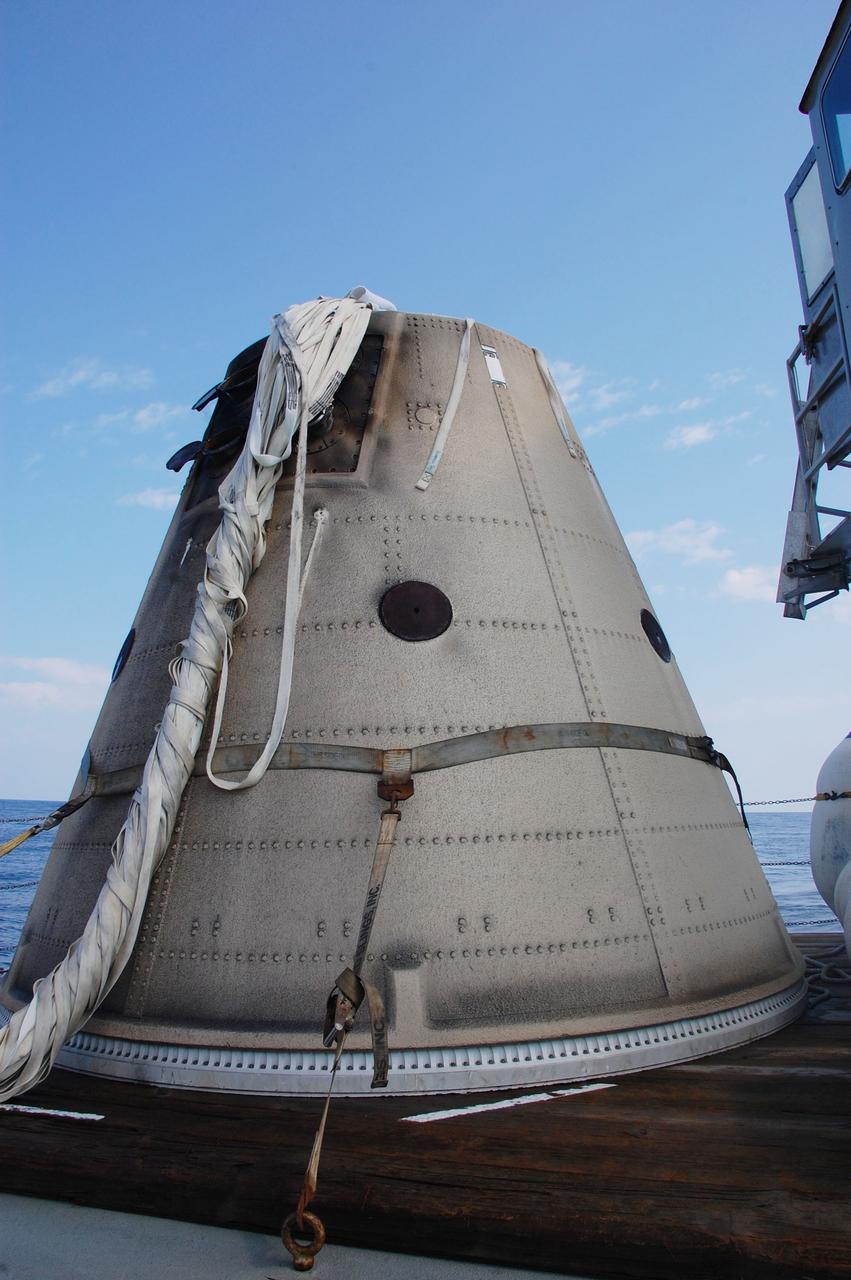
CAPE CANAVERAL, Fla. -- The left spent booster nose cap from space shuttle Discovery's final launch is secured to a pallet on Freedom Star, one of NASA's solid rocket booster retrieval ships and will be returned to Port Canaveral in Florida. The shuttle’s two solid rocket booster casings and associated flight hardware are recovered in the Atlantic Ocean after every launch by Liberty Star and Freedom Star. The boosters impact the Atlantic about seven minutes after liftoff and the retrieval ships are stationed about 10 miles from the impact area at the time of splashdown. After the spent segments are processed, they will be transported to Utah, where they will be refurbished and stored, if needed. Photo credit: NASA/Ben Smegelsky
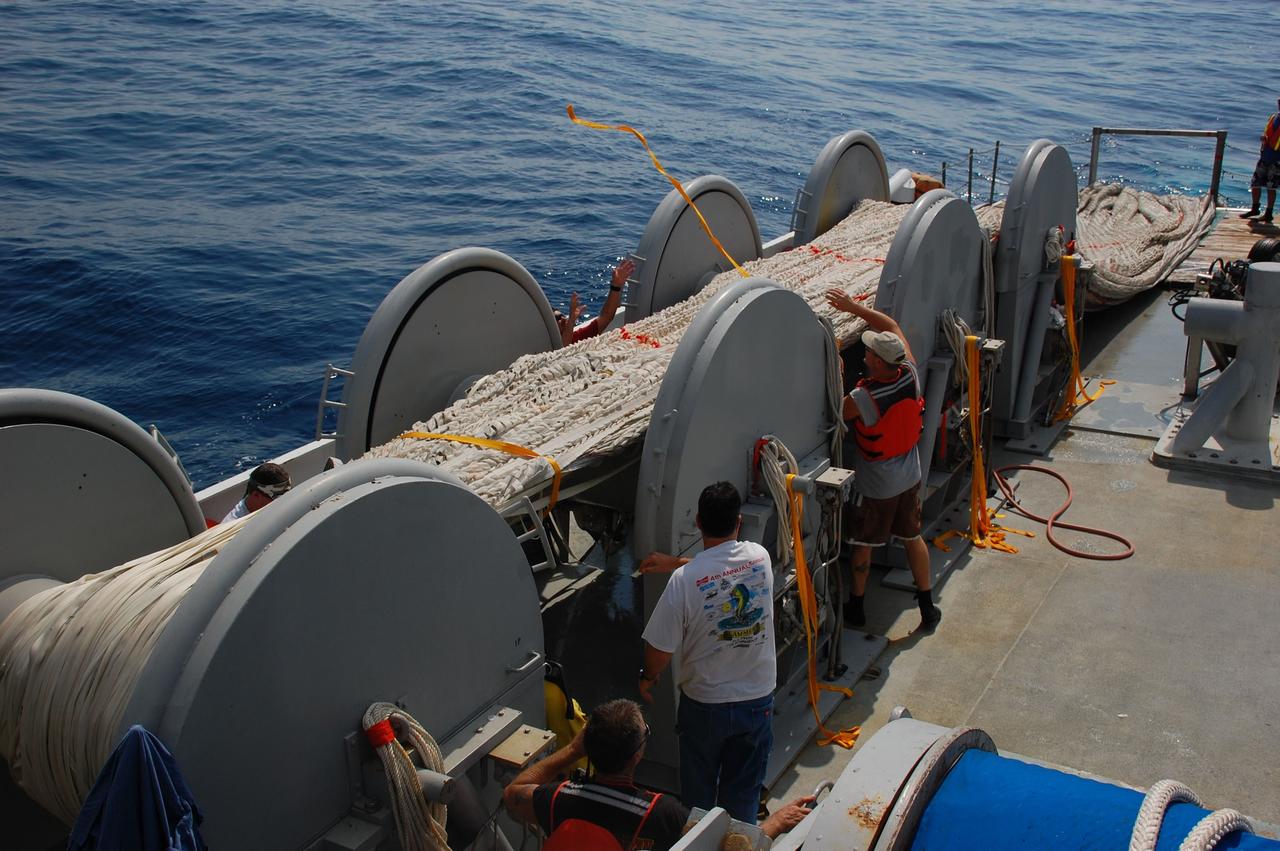
CAPE CANAVERAL, Fla. -- Crew members from Freedom Star, one of NASA's solid rocket booster retrieval ships, are pulling the parachute from the left spent booster out of the Atlantic Ocean. The shuttle’s two solid rocket booster casings and associated flight hardware are recovered in the Atlantic Ocean after every launch by Liberty Star and Freedom Star. The boosters impact the Atlantic about seven minutes after liftoff and the retrieval ships are stationed about 10 miles from the impact area at the time of splashdown. After the spent segments are processed, they will be transported to Utah, where they will be refurbished and stored, if needed. Photo credit: NASA/Ben Smegelsky
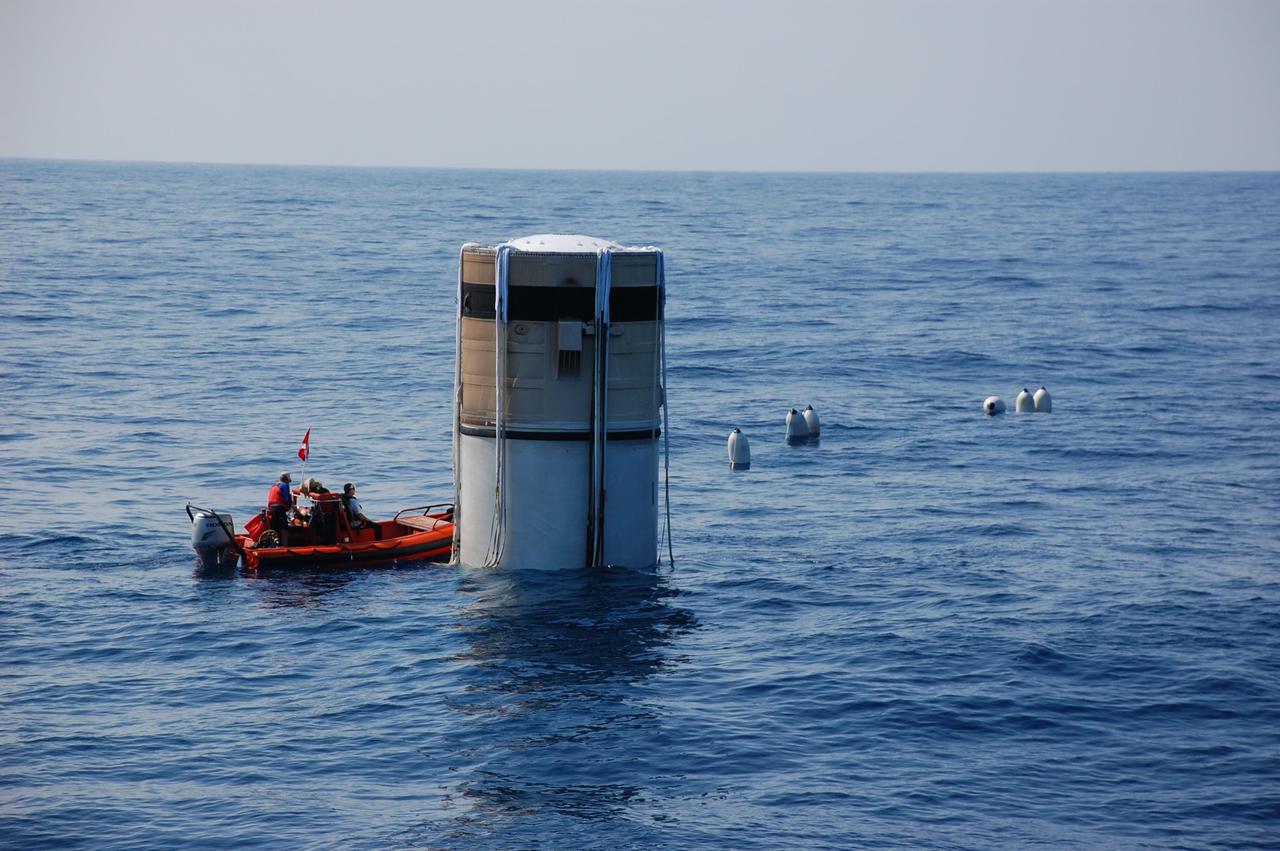
CAPE CANAVERAL, Fla. -- Crew members from Freedom Star, one of NASA's solid rocket booster retrieval ships, have attached a line, held up by flotation devices, between the left spent booster parachute and the ship. The shuttle’s two solid rocket booster casings and associated flight hardware are recovered in the Atlantic Ocean after every launch by Liberty Star and Freedom Star. The boosters impact the Atlantic about seven minutes after liftoff and the retrieval ships are stationed about 10 miles from the impact area at the time of splashdown. After the spent segments are processed, they will be transported to Utah, where they will be refurbished and stored, if needed. Photo credit: NASA/Ben Smegelsky
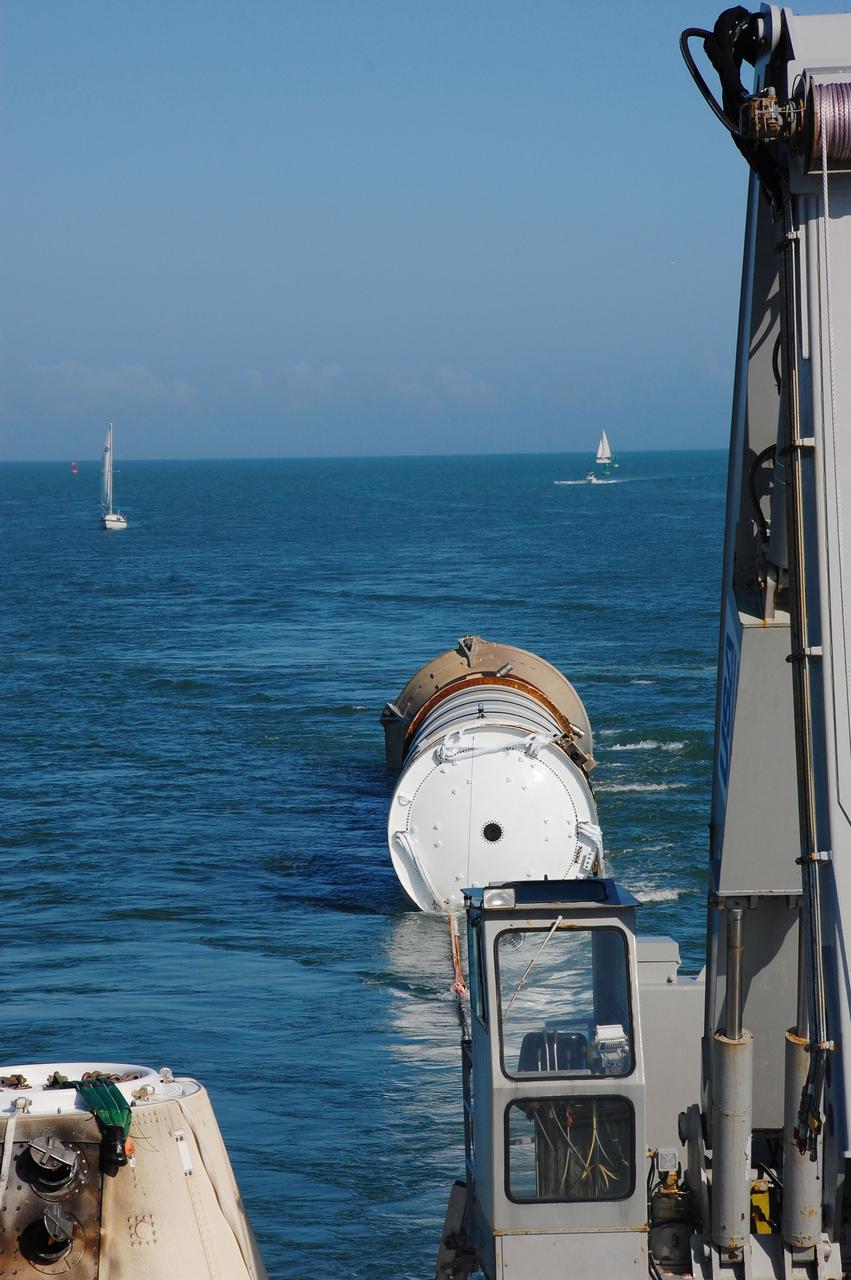
CAPE CANAVERAL, Fla. -- Freedom Star, one of NASA's solid rocket booster retrieval ships, tows the left spent booster from space shuttle Discovery's final launch, to Port Canaveral in Florida. The shuttle’s two solid rocket booster casings and associated flight hardware are recovered in the Atlantic Ocean after every launch by Liberty Star and Freedom Star. The boosters impact the Atlantic about seven minutes after liftoff and the retrieval ships are stationed about 10 miles from the impact area at the time of splashdown. After the spent segments are processed, they will be transported to Utah, where they will be refurbished and stored, if needed. Photo credit: NASA/Ben Smegelsky
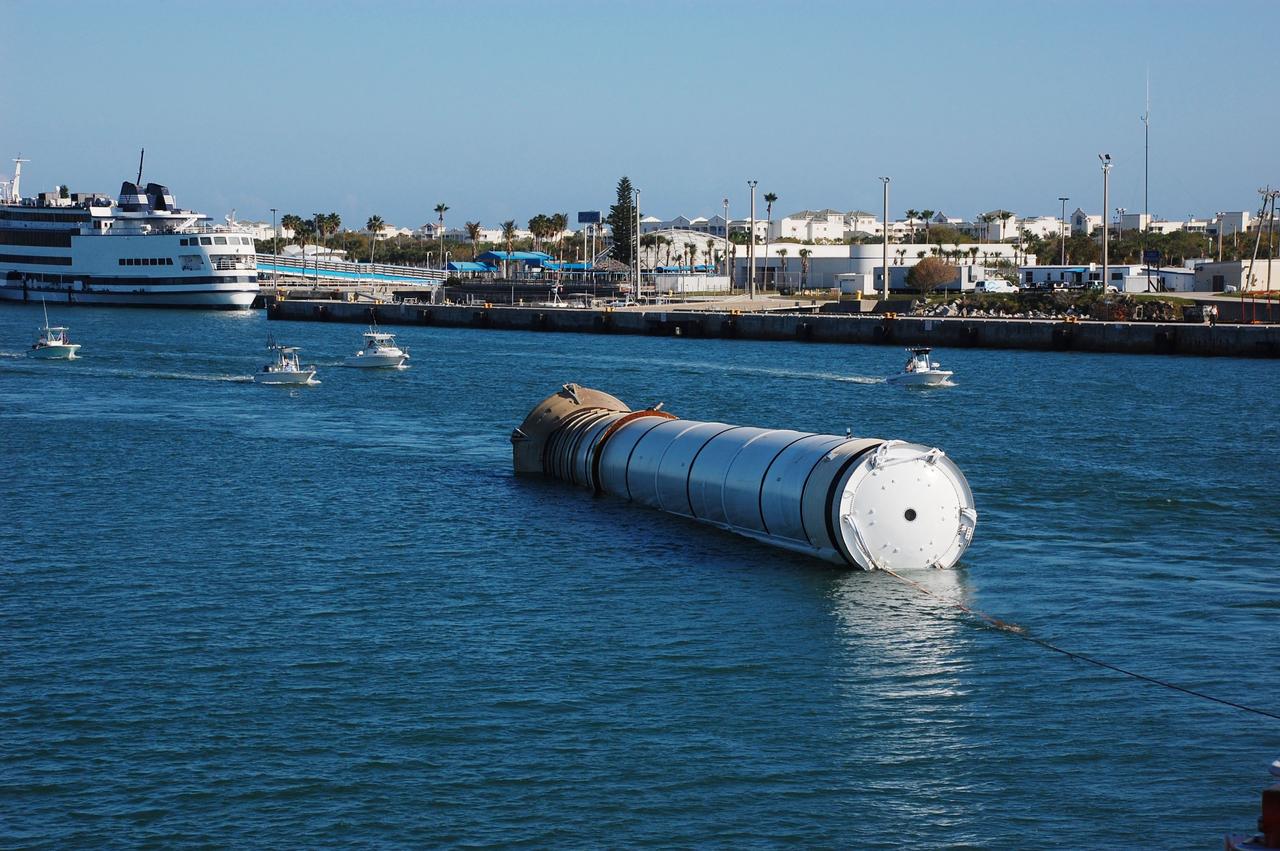
CAPE CANAVERAL, Fla. -- Freedom Star, one of NASA's solid rocket booster retrieval ships, reaches Port Canaveral, Florida with the left spent booster from space shuttle Discovery's final launch, in tow. The shuttle’s two solid rocket booster casings and associated flight hardware are recovered in the Atlantic Ocean after every launch by Liberty Star and Freedom Star. The boosters impact the Atlantic about seven minutes after liftoff and the retrieval ships are stationed about 10 miles from the impact area at the time of splashdown. After the spent segments are processed, they will be transported to Utah, where they will be refurbished and stored, if needed. Photo credit: NASA/Ben Smegelsky
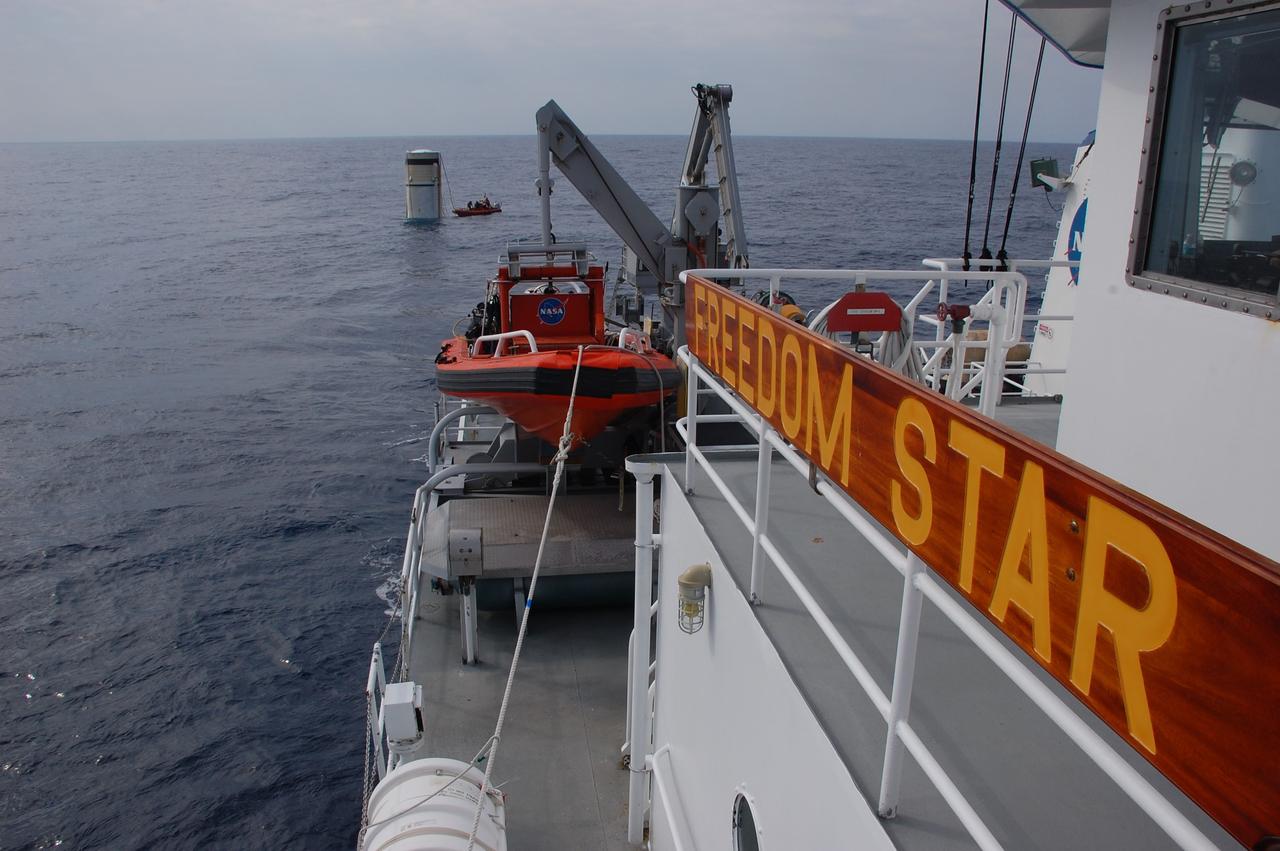
CAPE CANAVERAL, Fla. -- Crew members in a skiff from Freedom Star, one of NASA's solid rocket booster retrieval ships, inspect the left spent booster bobbing in the Atlantic Ocean after space shuttle Discovery's STS-133 launch. The shuttle’s two solid rocket booster casings and associated flight hardware are recovered in the Atlantic Ocean after every launch by Liberty Star and Freedom Star. The boosters impact the Atlantic about seven minutes after liftoff and the retrieval ships are stationed about 10 miles from the impact area at the time of splashdown. After the spent segments are processed, they will be transported to Utah, where they will be refurbished and stored, if needed. Photo credit: NASA/Ben Smegelsky
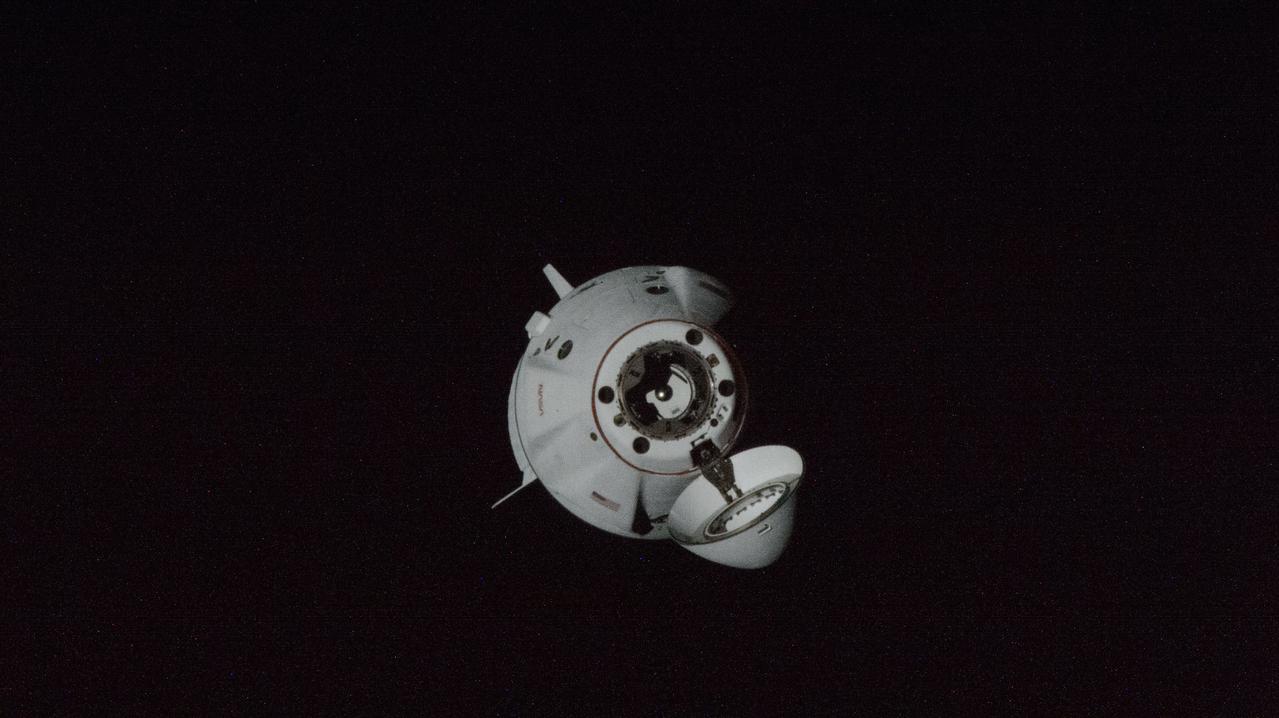
iss072e004110 (Sept. 29, 2024) --- The SpaceX Dragon Freedom spacecraft carrying NASA astronaut Nick Hague and Roscosmos cosmonaut Aleksandr Gorbunov approaches the International Space Station.
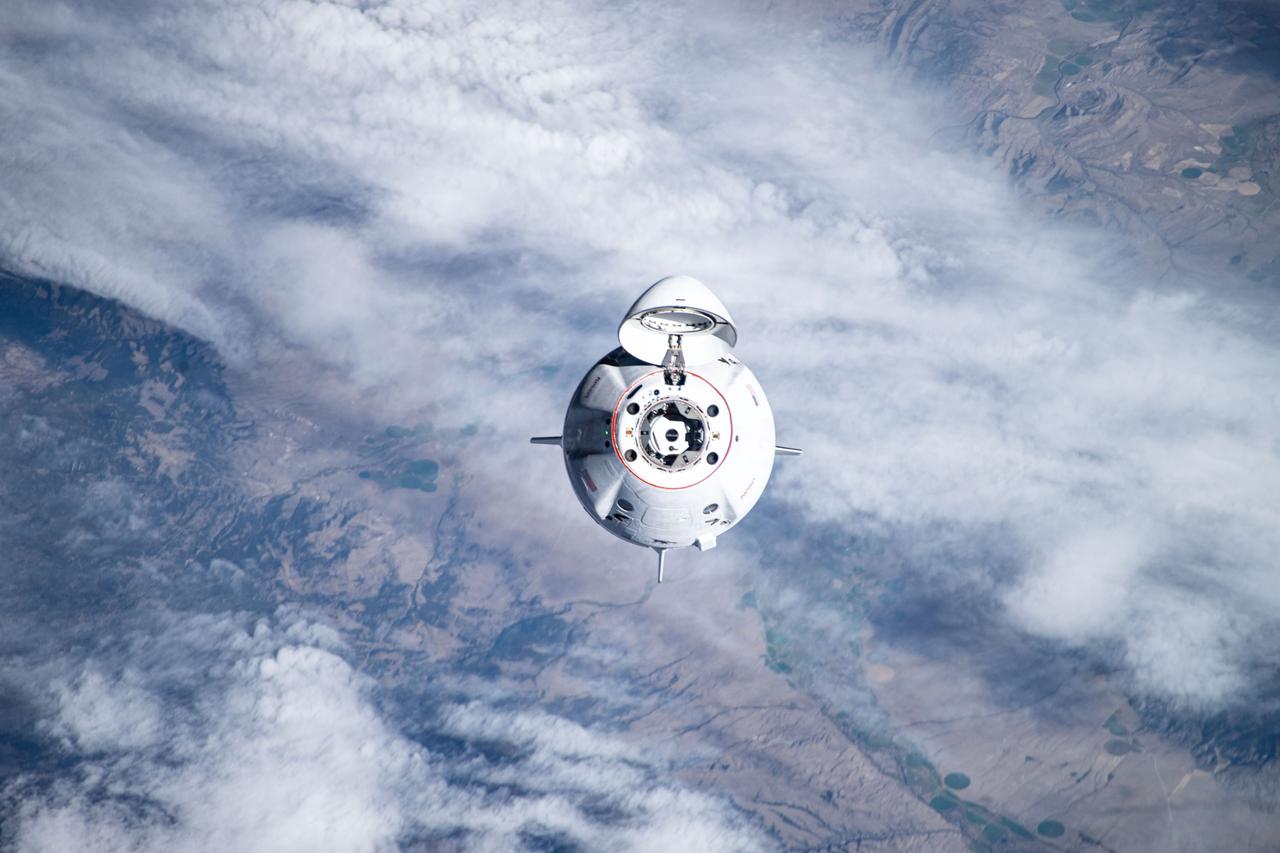
iss072e005655 (Sept. 29, 2024) --- The SpaceX Dragon Freedom spacecraft carrying NASA astronaut Nick Hague and Roscosmos cosmonaut Aleksandr Gorbunov approaches the International Space Station as it orbited 259 miles above Oregon.
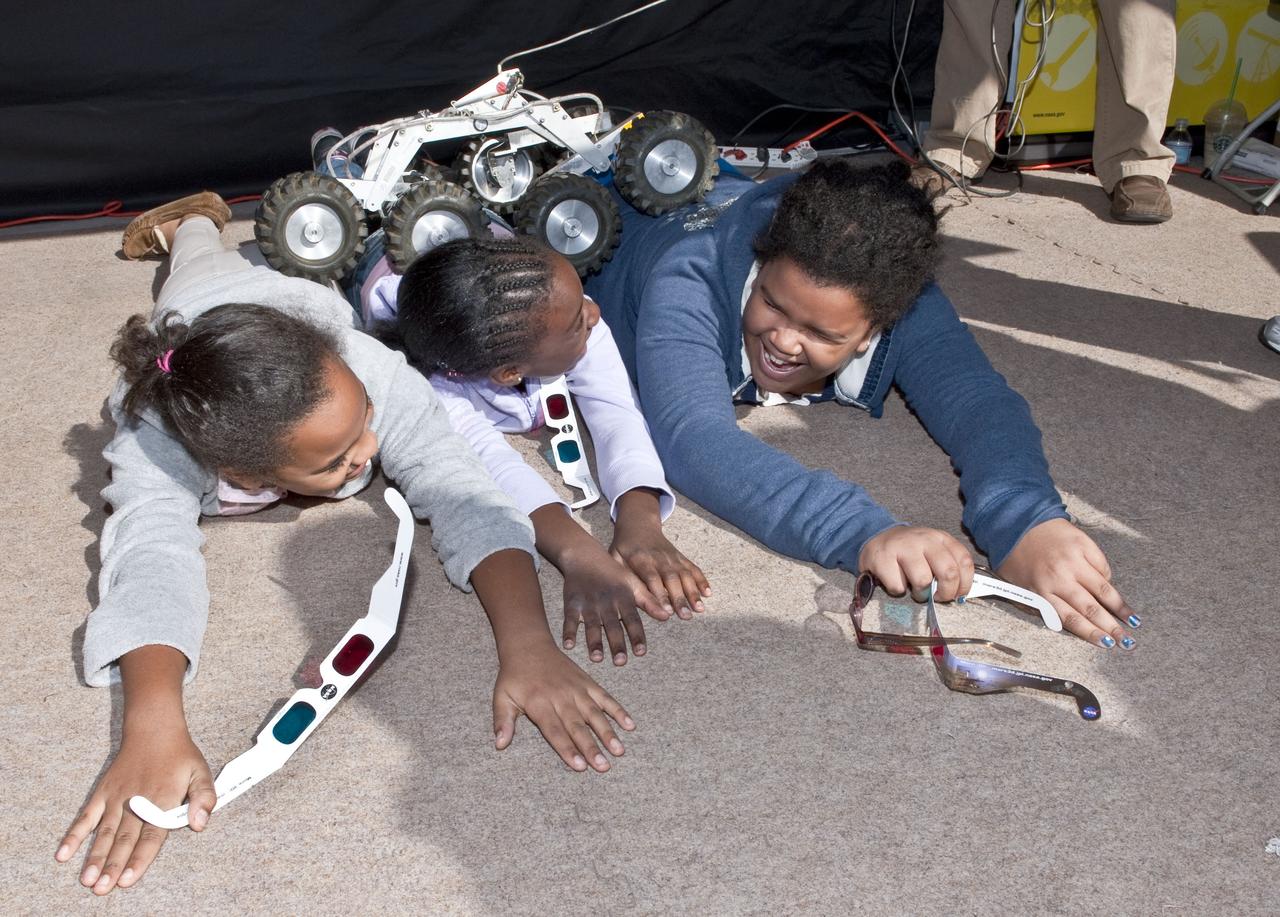
Children react as a tiny Mars Rover rolls over their backs at the USA Science and Engineering Festival, Saturday, Oct. 23, 2010, at Freedom Plaza in Washington. NASA, joined with more than 500 science organizations this weekend to inspire the next generation of scientists and engineers during the first national science and engineering festival held in the nation's capital. Photo Credit: (NASA/Paul E. Alers)
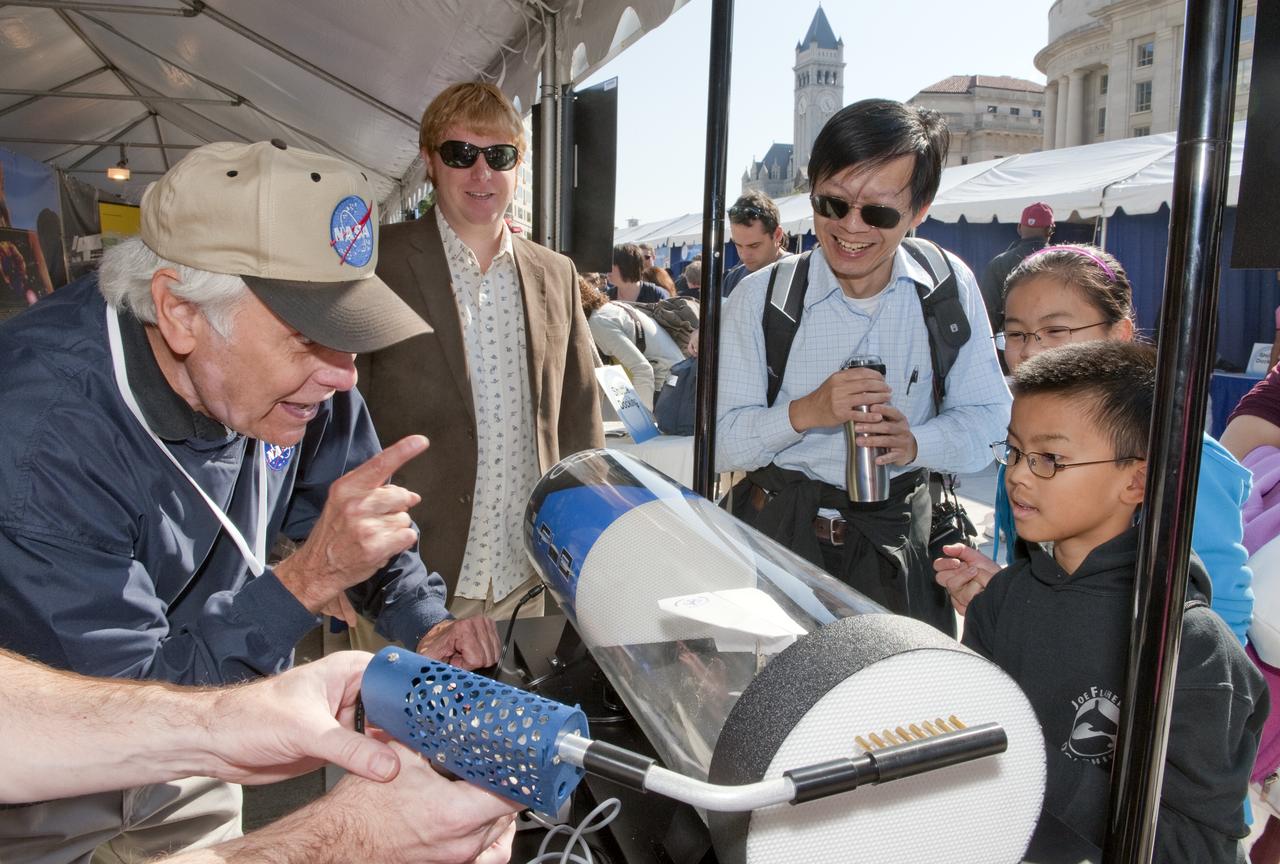
Priniciples of air flow are explained to visitors to the wind tunnel exhibit at the USA Science and Engineering Festival, Saturday, Oct. 23, 2010, at Freedom Plaza in Washington. NASA, joined with more than 500 science organizations this weekend to inspire the next generation of scientists and engineers during the first national science and engineering festival held in the nation's capital. Photo Credit: (NASA/Paul E. Alers)
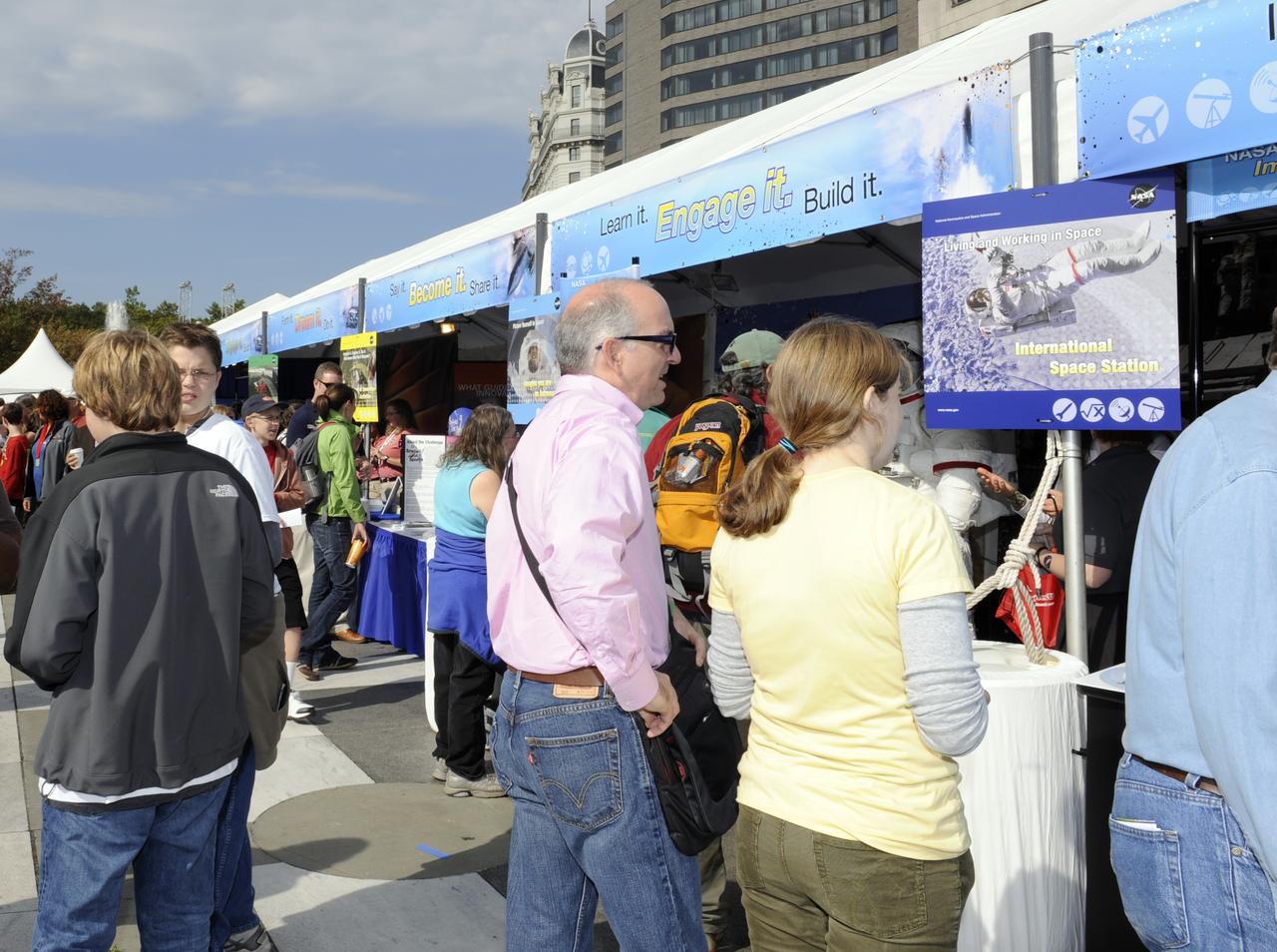
Visitors to the USA Science and Engineering Festival look over the many exhibits, Saturday, Oct. 23, 2010, at Freedom Plaza in Washington. NASA, joined with more than 500 science organizations this weekend to inspire the next generation of scientists and engineers during the first national science and engineering festival held in the nation's capital. Photo Credit: (NASA/Paul E. Alers)
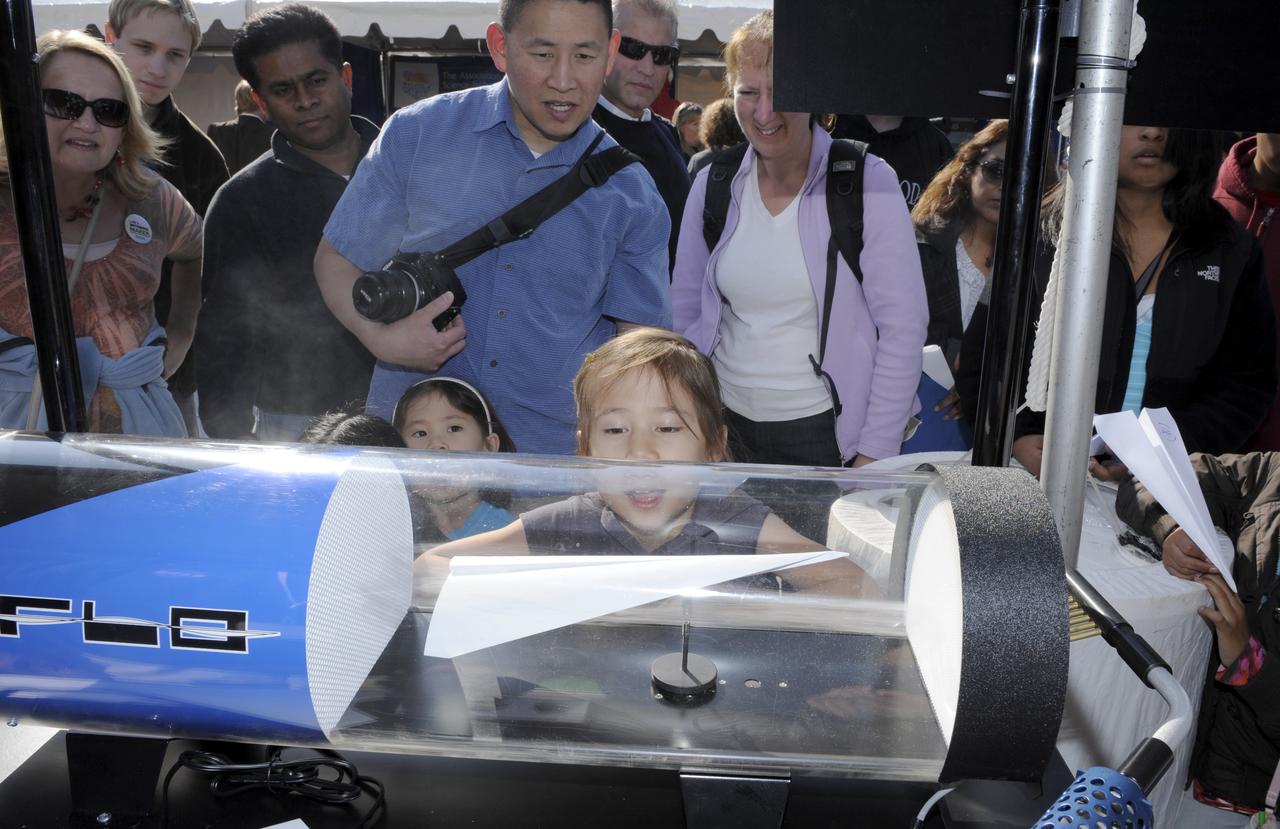
A young girl watches as her paper airplane is flown in a small wind tunnel during the USA Science and Engineering Festival, Saturday, Oct. 23, 2010, at Freedom Plaza in Washington. NASA, joined with more than 500 science organizations this weekend to inspire the next generation of scientists and engineers during the first national science and engineering festival held in the nation's capital. Photo Credit: (NASA/Paul E. Alers)

Participants look through telescopes to observe the Sun during the USA Science and Engineering Festival, Saturday, Oct. 23, 2010, at Freedom Plaza in Washington. NASA, joined with more than 500 science organizations this weekend to inspire the next generation of scientists and engineers during the first national science and engineering festival held in the nation's capital. Photo Credit: (NASA/Paul E. Alers)
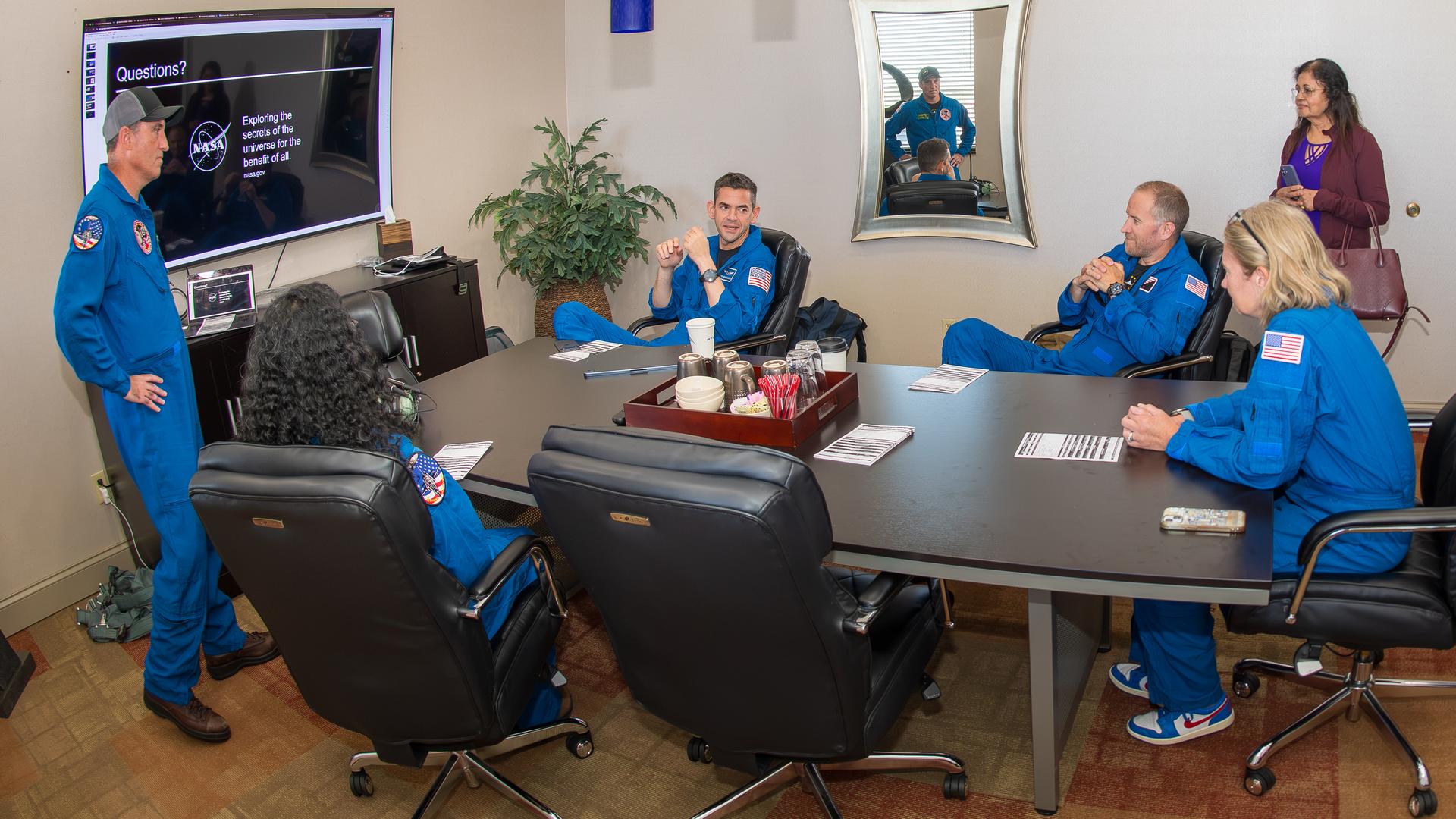
Pilots Brian HANDY Lauber, NASA Administrator Jared Isaacman, and Doug TUT Demko along with riders Greeta Thaikattil and Heather Brown sit for the flight briefing at Atlantic Aviation in Cleveland, Ohio for their Freedom 250 flight. Their flyover flight was for an NFL game between the Cleveland Browns and the Carolina Panthers at Huntington Bank Field, Sunday, September 27th, 2026, in Cleveland, Ohio. NASA’s engagement at NFL games is part of the agency’s Inspiration Tour, aimed at strengthening connections between NASA and its partners and showcasing innovation in air and space in the lead up to the MAX POWER aerospace technology expo and airshow at the agency’s Kennedy Space Center in early November.
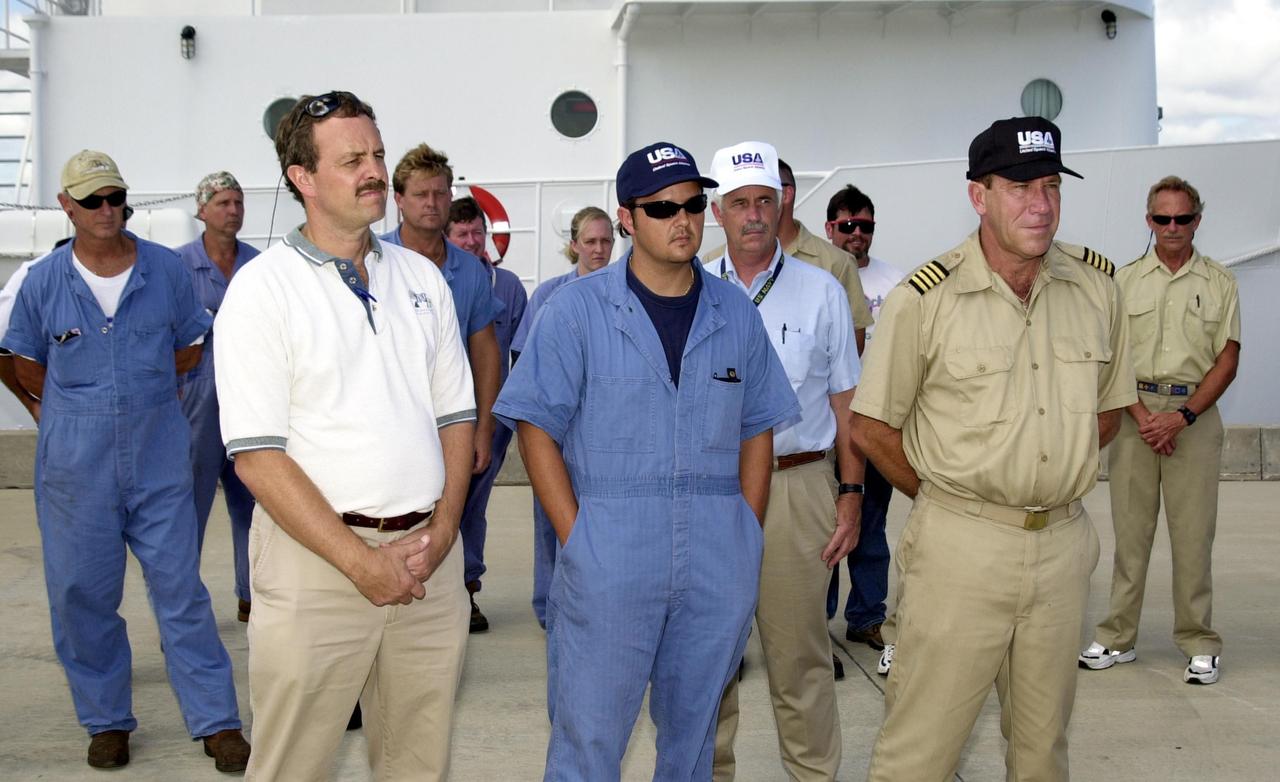
KENNEDY SPACE CENTER, FLA. - A reunion at the Hangar AF docks, Cape Canaveral Air Force Station, brought together a diver and his rescuers, the crew of KSC's Freedom Star SRB retrieval ship and a medical team. In the photo are (foreground, left to right) KSC Occupational Health physician Skip Beeler, retrieval diver and diver medical technician Andy Fish, and Freedom Star's Captain, Dave Fraine. The diver, Jack Wilcox, suffered decompression sickness on a diving expedition 20 miles off shore in the Atlantic Ocean. When the Freedom Star team heard the call for help, they asked the Coast Guard if they could assist. The ship was out on a crane certification exercise and coincidentally had a diver medical technician and other divers training on the crane. The ship's divers were trained for the hyperbaric chamber on board. Upon reaching the Army dock, KSC Occupational Health physician Skip Beeler entered the chamber and continued the process of helping to stabilize Wilcox. After several hours in the chamber, Wilcox, who lives in Orlando, was airlifted to Florida Hospital Orlando

Space Station Freedom option A showing two Soyuz Assured Crew Return Vehicle (ACRV) capsules docked at berthing ports.
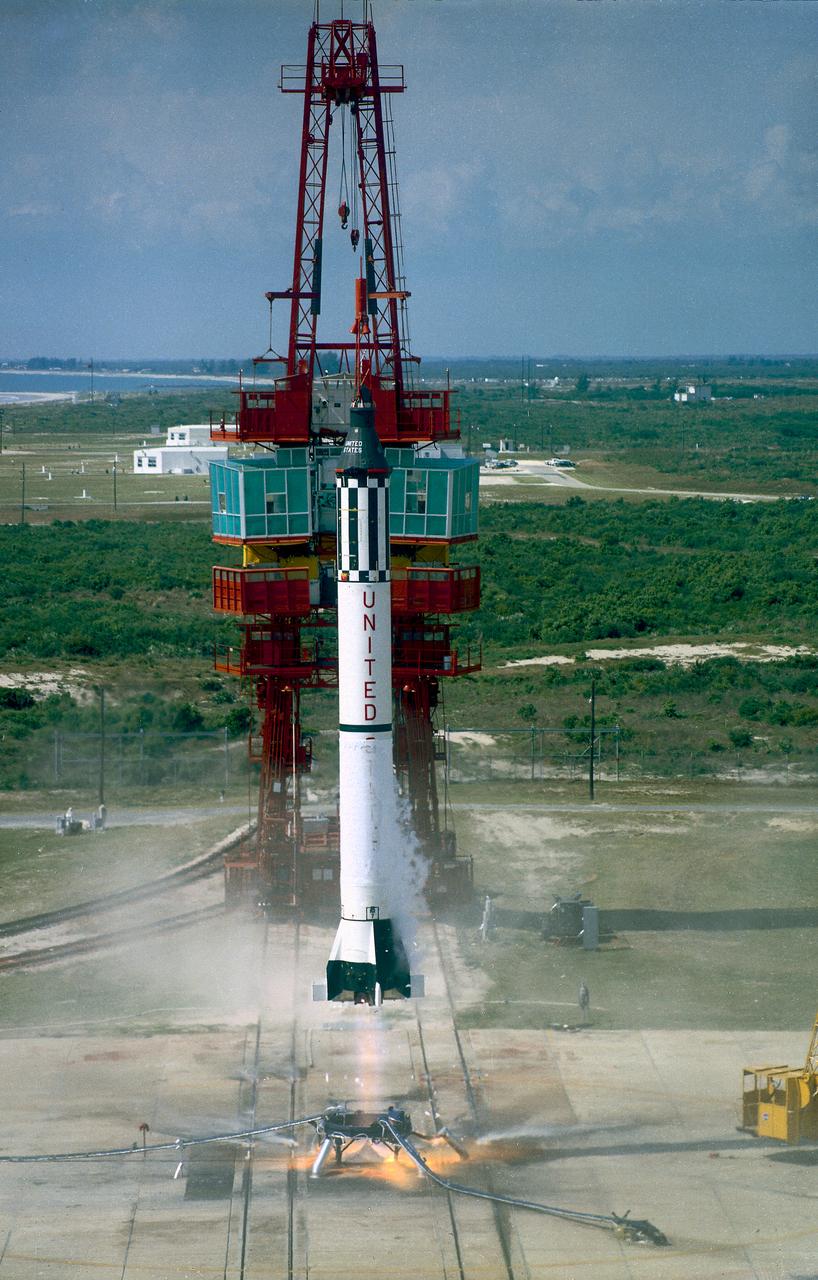
The launch of the Mercury-Redstone (MR-3), Freedom 7. MR-3 placed the first American astronaut, Alan Shepard, in suborbit on May 5, 1961.
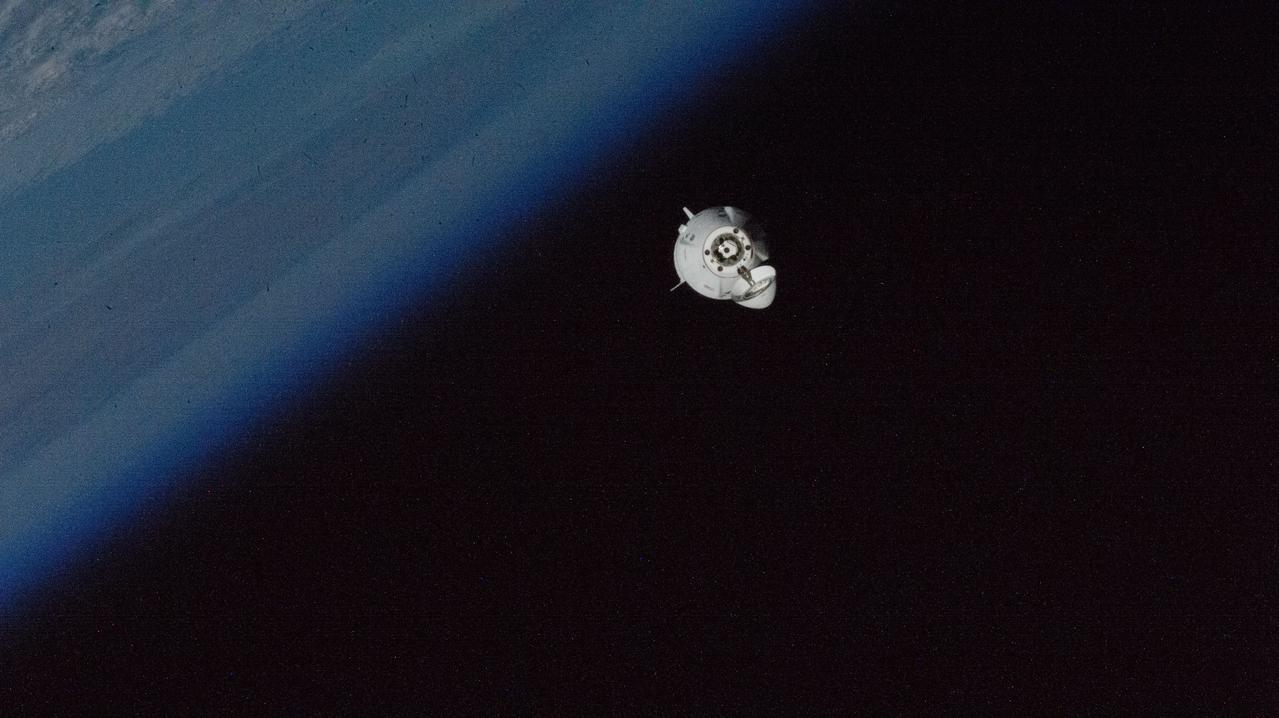
iss072e004109 (Sept. 29, 2024) --- The SpaceX Dragon Freedom spacecraft carrying NASA astronaut Nick Hague and Roscosmos cosmonaut Aleksandr Gorbunov approaches the International Space Station 261 miles above Ontario, Canada, near the coast of James Bay.
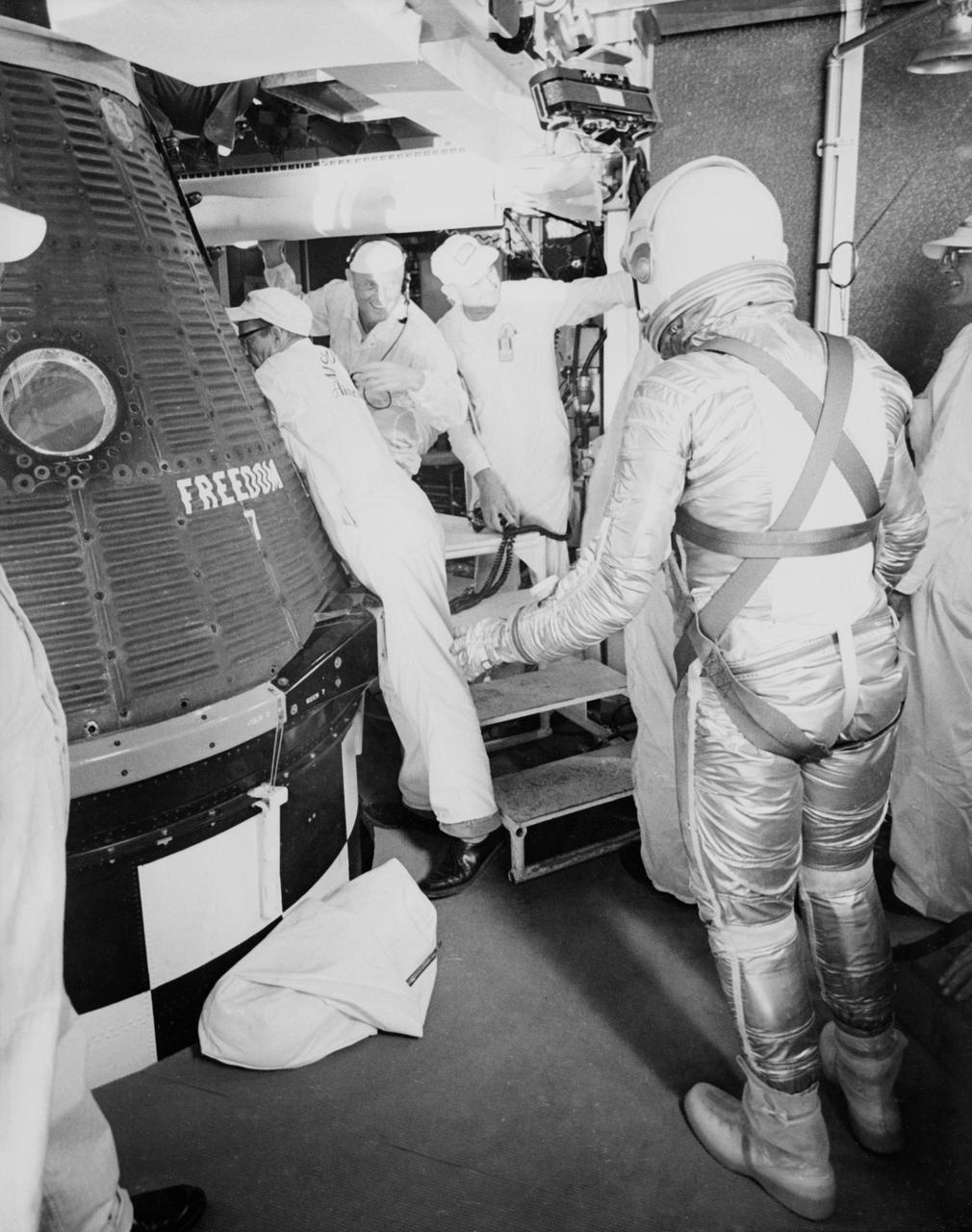
S61-02792 (5 May 1961) --- Astronaut Alan B. Shepard Jr., in his pressure suit and helmet, approaches the Freedom 7 capsule in preparation for insertion before the Mercury-Redstone 3 (MR-3) mission. Photo credit: NASA or National Aeronautics and Space Administration
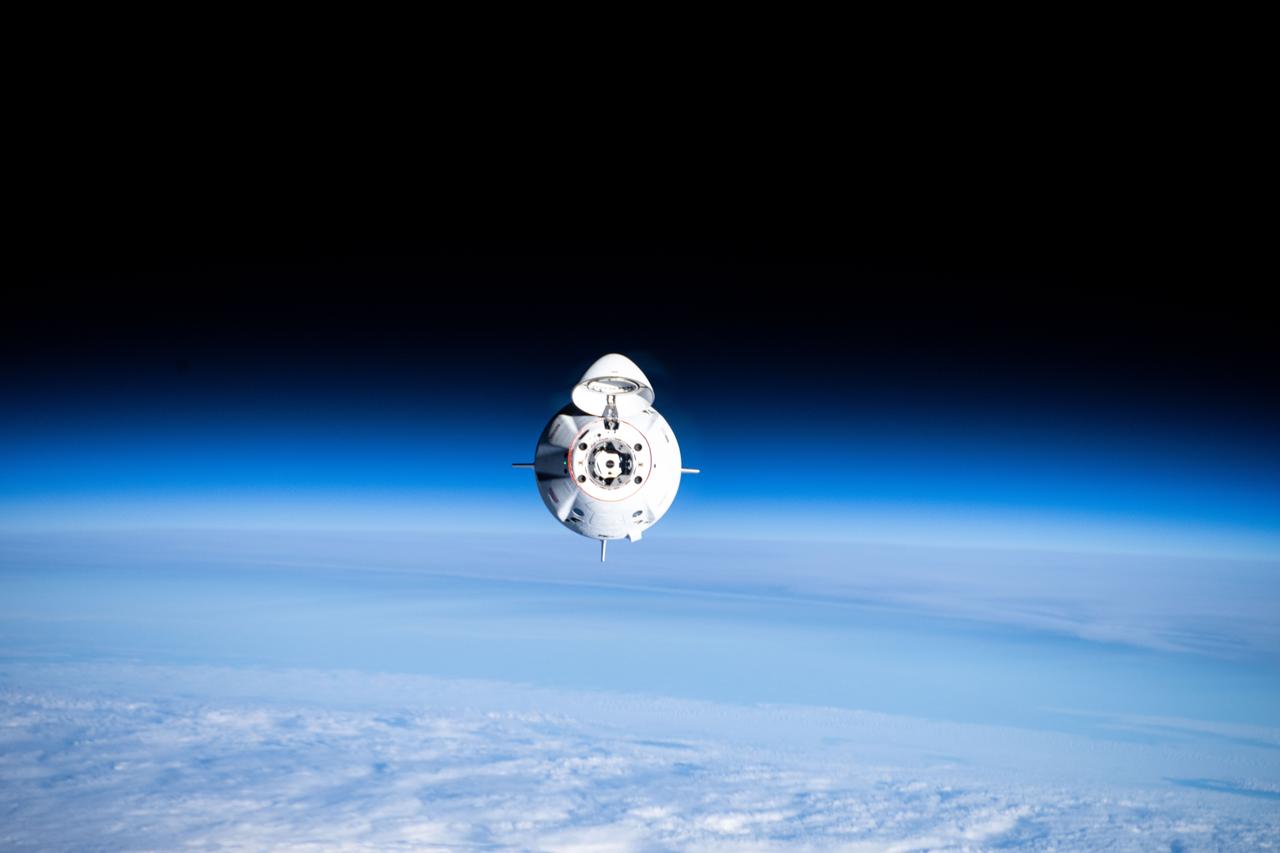
iss072e005702 (Sept. 29, 2024) --- The SpaceX Dragon Freedom spacecraft carrying NASA astronaut Nick Hague and Roscosmos cosmonaut Aleksandr Gorbunov approaches the International Space Station as it orbited 261 miles above Ontario, Canada, near James Bay.
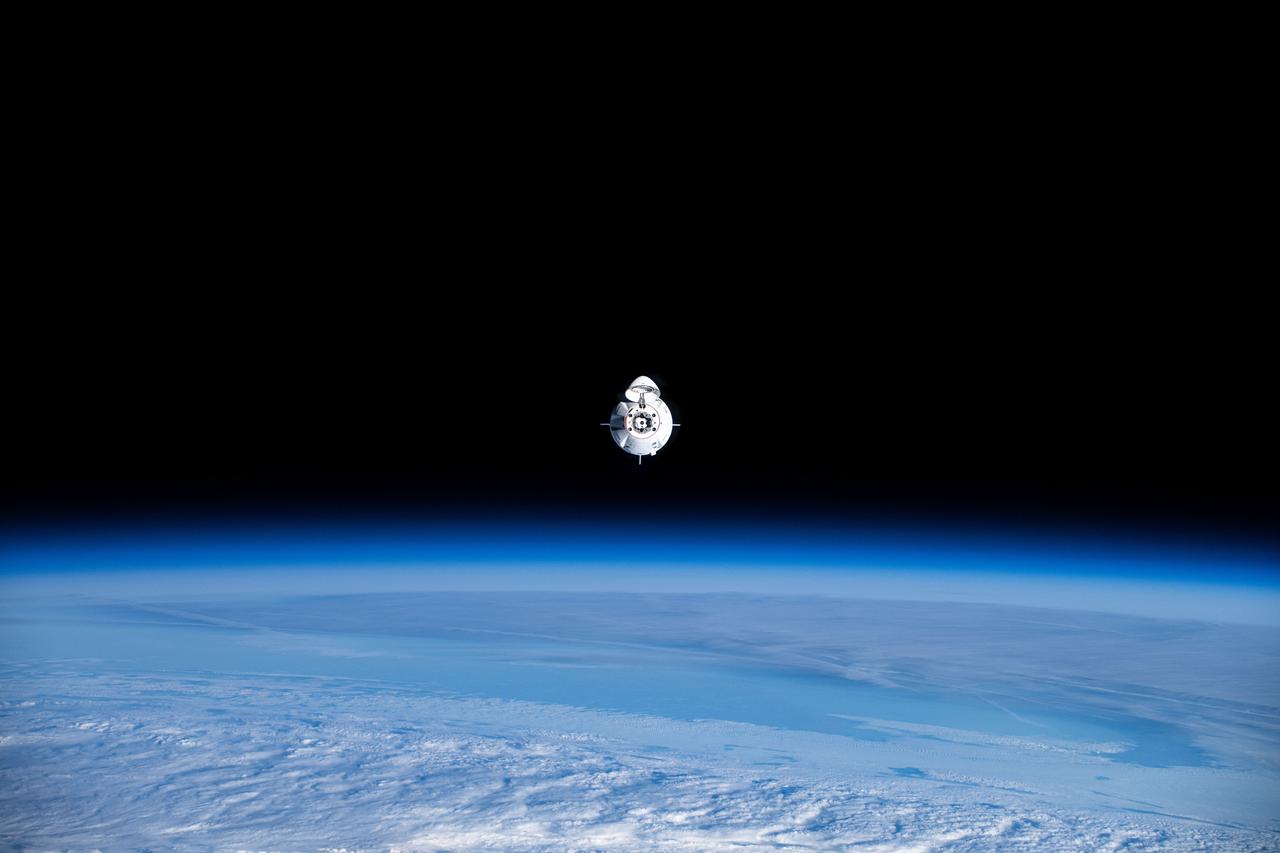
iss072e005747 (Sept. 29, 2024) --- The SpaceX Dragon Freedom spacecraft carrying NASA astronaut Nick Hague and Roscosmos cosmonaut Aleksandr Gorbunov approaches the International Space Station as it orbited 261 miles above Ontario, Canada, near James Bay.
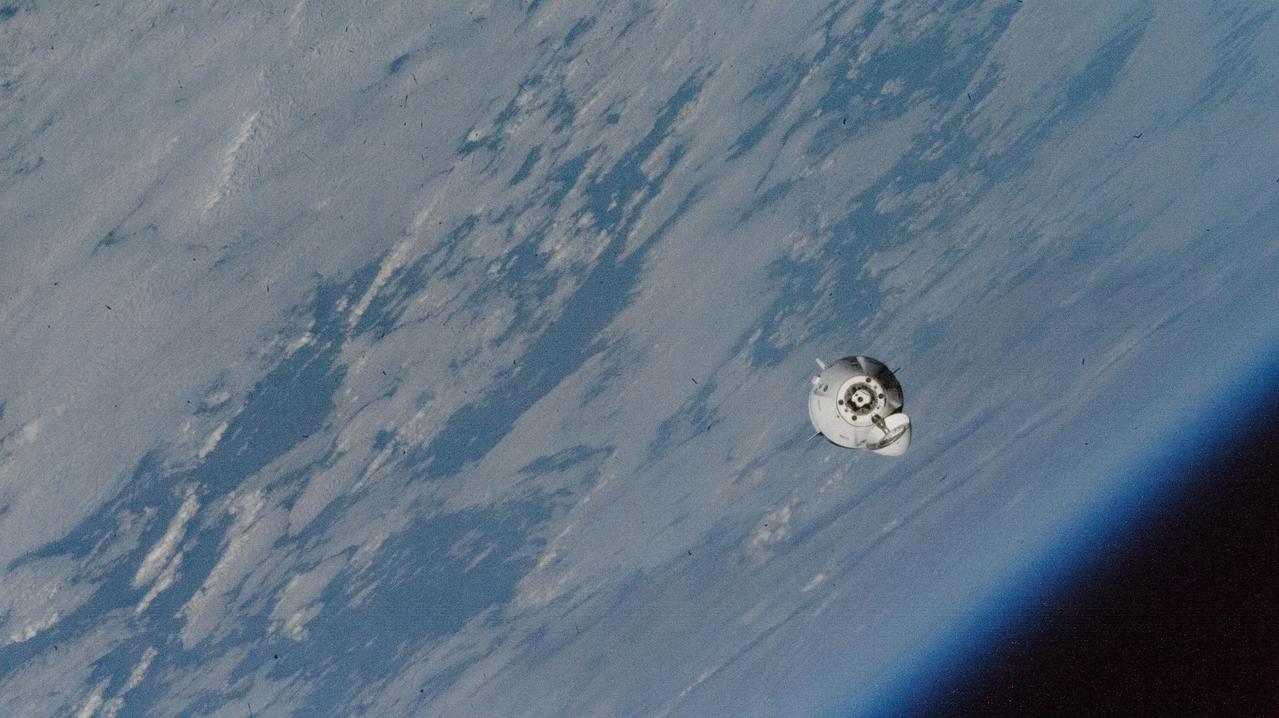
iss072e004108 (Sept. 29, 2024) --- The SpaceX Dragon Freedom spacecraft carrying NASA astronaut Nick Hague and Roscosmos cosmonaut Aleksandr Gorbunov approaches the International Space Station 260 miles above Wabakimi Provincial Park in Ontario, Canada.

CAPE CANAVERAL, Fla. -- Crew members in a skiff from Freedom Star, one of NASA's solid rocket booster retrieval ships, attach flotation devices, or buoys, to the parachute lines from the left spent booster from space shuttle Discovery's STS-133 launch. The shuttle’s two solid rocket booster casings and associated flight hardware are recovered in the Atlantic Ocean after every launch by Liberty Star and Freedom Star. The boosters impact the Atlantic about seven minutes after liftoff and the retrieval ships are stationed about 10 miles from the impact area at the time of splashdown. After the spent segments are processed, they will be transported to Utah, where they will be refurbished and stored, if needed. Photo credit: NASA/Ben Smegelsky
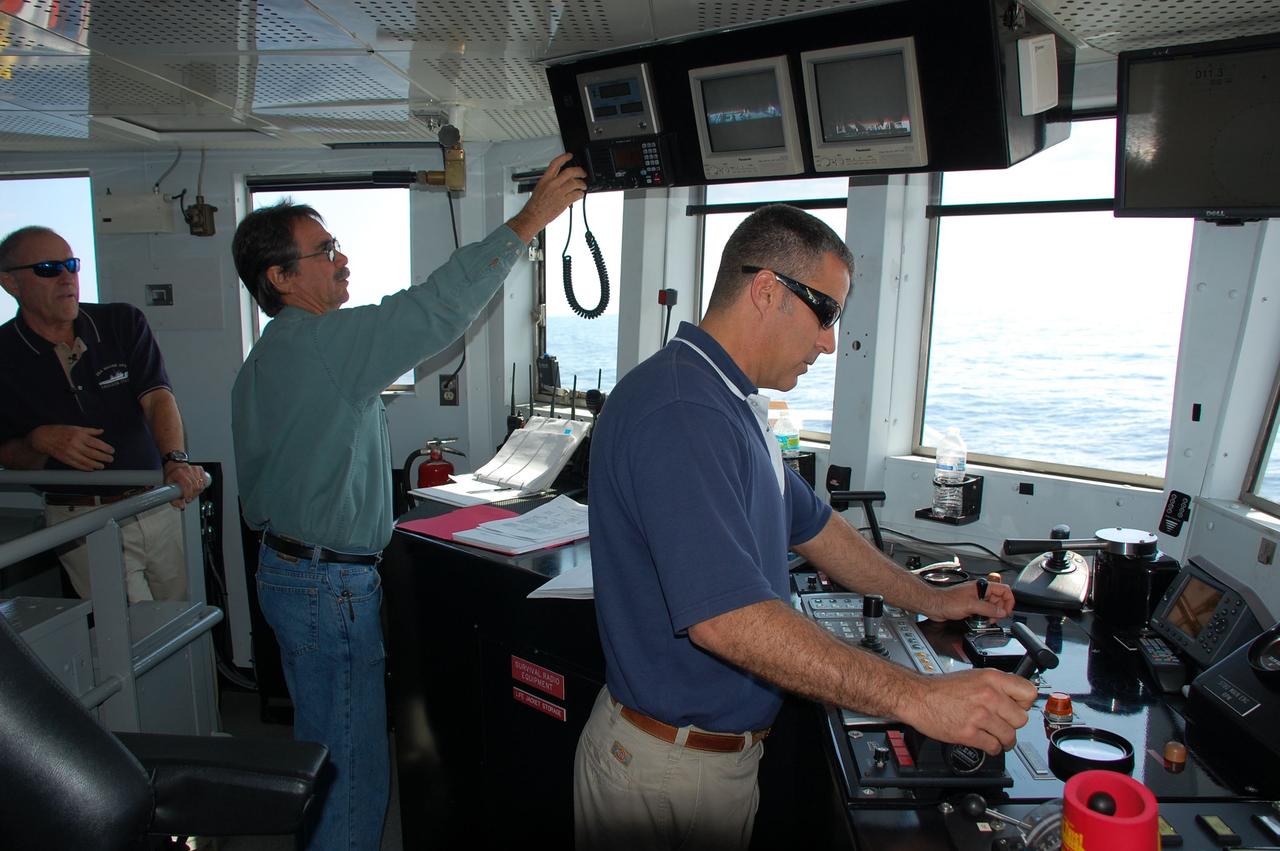
CAPE CANAVERAL, Fla. -- Captain Michael Nicholas mans the helm of Freedom Star, one of NASA's solid rocket booster retrieval ships, while John Fischbeck, Manager of Vessel Operations and Senior SRB Retrieval Supervisor, and Walt Adams, SRB Retrieval and Dive Supervisor, assist. The ship's crew members are recovering the left spent booster bobbing in the Atlantic Ocean from space shuttle Discovery's STS-133 launch. The shuttle’s two solid rocket booster casings and associated flight hardware are recovered in the Atlantic Ocean after every launch by Liberty Star and Freedom Star. The boosters impact the Atlantic about seven minutes after liftoff and the retrieval ships are stationed about 10 miles from the impact area at the time of splashdown. After the spent segments are processed, they will be transported to Utah, where they will be refurbished and stored, if needed. Photo credit: NASA/Ben Smegelsky
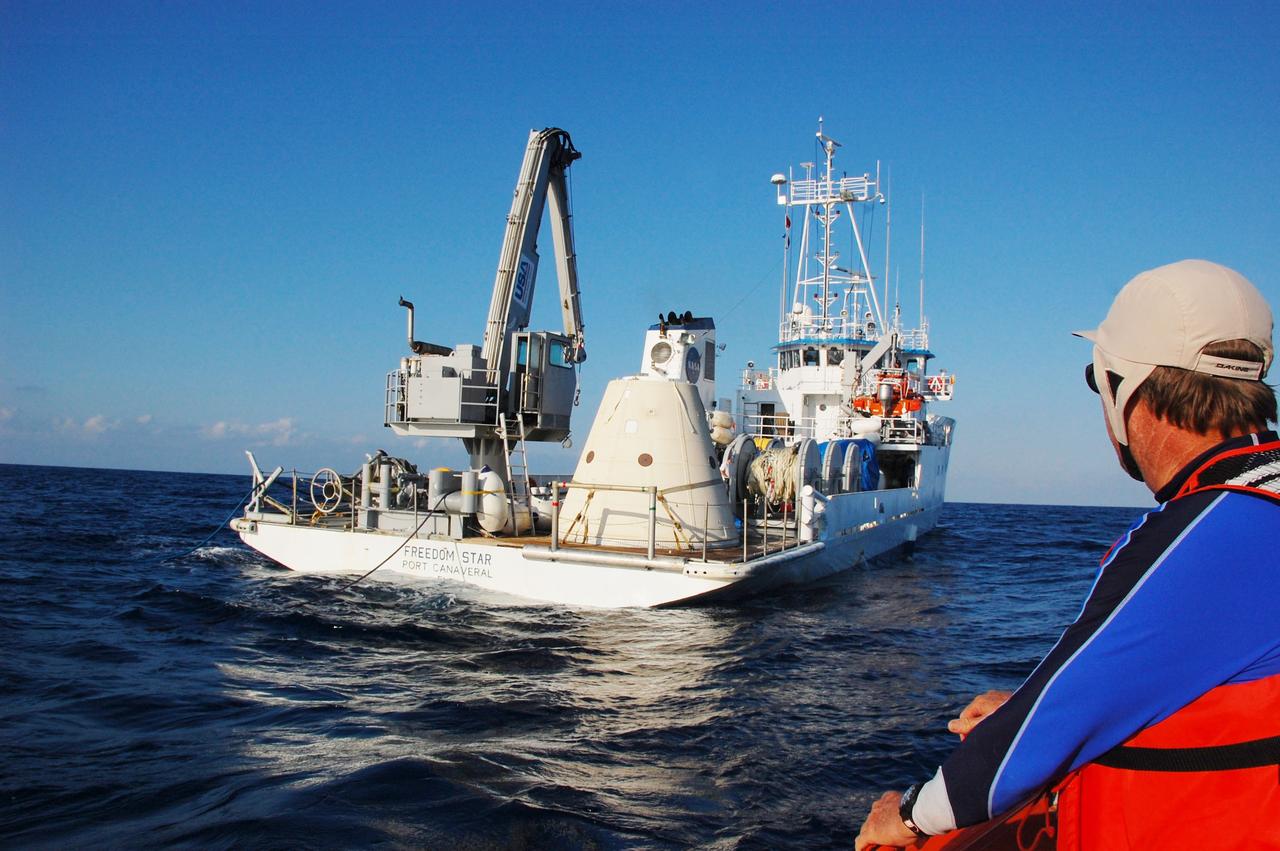
CAPE CANAVERAL, Fla. -- Crew members in a skiff from Freedom Star, one of NASA's solid rocket booster retrieval ships, look back at the vessel toward the left spent booster nose cap, which was recovered from the Atlantic Ocean and now secured on the deck for delivery back to Port Canaveral in Florida. The shuttle’s two solid rocket booster casings and associated flight hardware are recovered in the Atlantic Ocean after every launch by Liberty Star and Freedom Star. The boosters impact the Atlantic about seven minutes after liftoff and the retrieval ships are stationed about 10 miles from the impact area at the time of splashdown. After the spent segments are processed, they will be transported to Utah, where they will be refurbished and stored, if needed. Photo credit: NASA/Ben Smegelsky
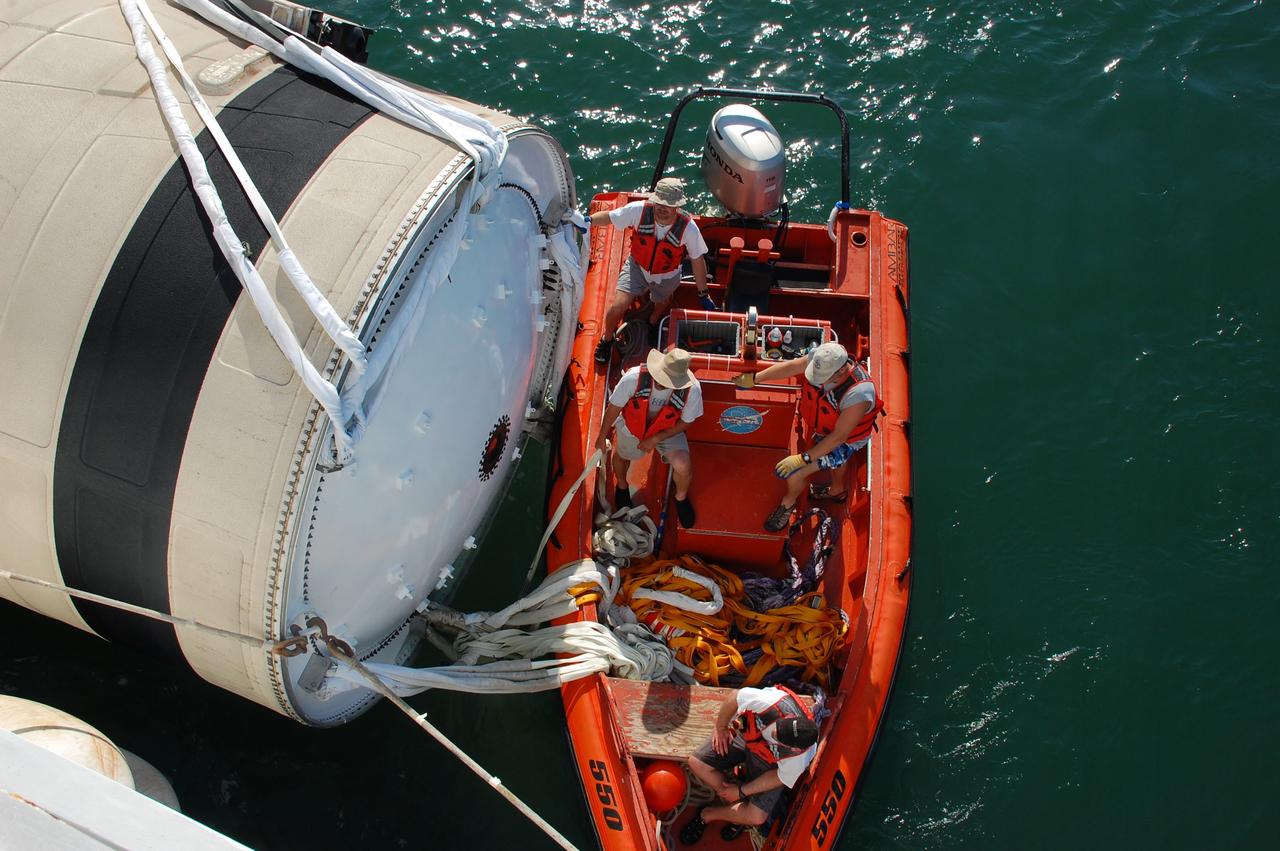
CAPE CANAVERAL, Fla. -- Crew members from Freedom Star, one of NASA's solid rocket booster retrieval ships, check the securing of the left spent booster from space shuttle Discovery's final launch, to the vessel, before continuing on the Hangar AF at Cape Canaveral Air Force Station. The shuttle’s two solid rocket booster casings and associated flight hardware are recovered in the Atlantic Ocean after every launch by Liberty Star and Freedom Star. The boosters impact the Atlantic about seven minutes after liftoff and the retrieval ships are stationed about 10 miles from the impact area at the time of splashdown. After the spent segments are processed, they will be transported to Utah, where they will be refurbished and stored, if needed. Photo credit: NASA/Ben Smegelsky
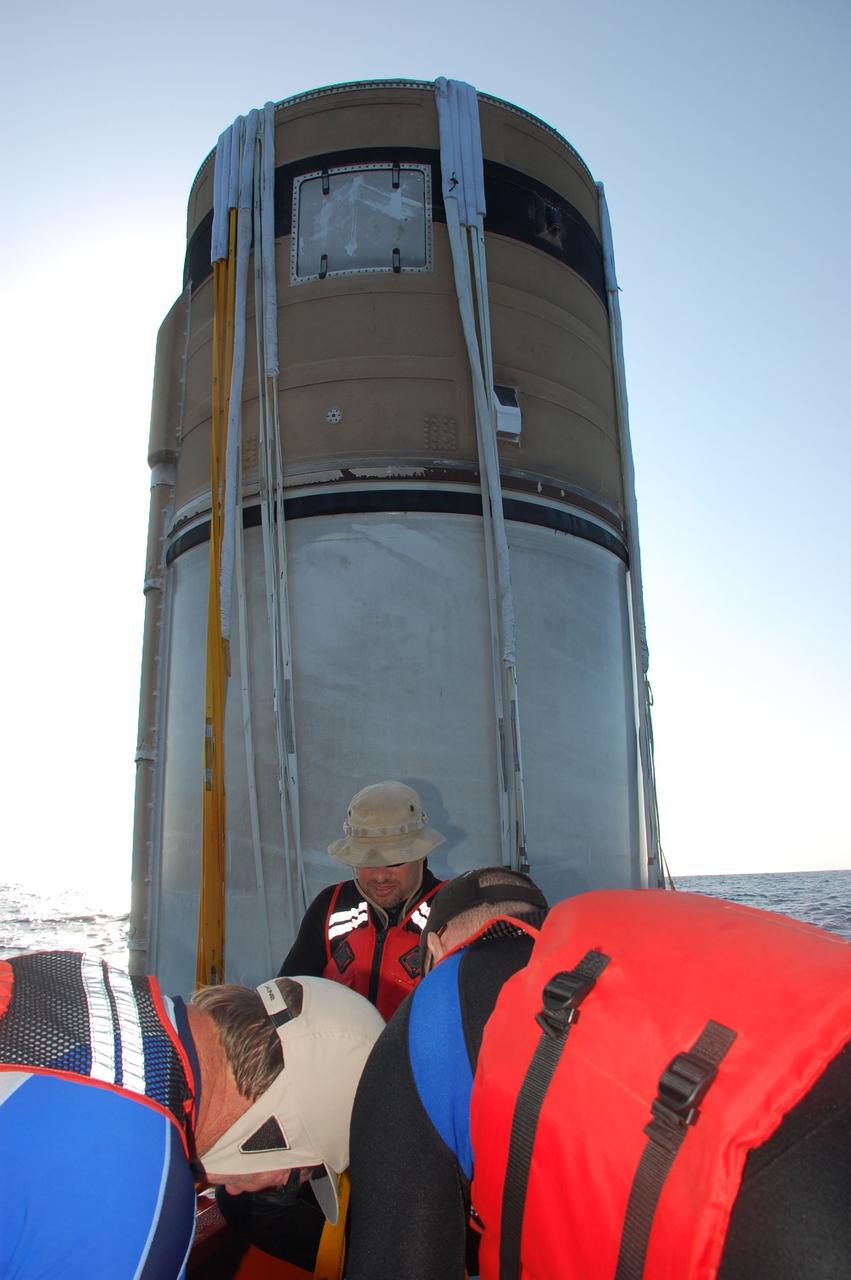
CAPE CANAVERAL, Fla. -- Crew members in a skiff from Freedom Star, one of NASA's solid rocket booster retrieval ships, attach a hose between the left spent booster and the vessel that will facilitate debris and water clearing and the pumping in of air in so the booster can float horizontally on the water's surface for towing back to Port Canaveral in Florida. The shuttle’s two solid rocket booster casings and associated flight hardware are recovered in the Atlantic Ocean after every launch by Liberty Star and Freedom Star. The boosters impact the Atlantic about seven minutes after liftoff and the retrieval ships are stationed about 10 miles from the impact area at the time of splashdown. After the spent segments are processed, they will be transported to Utah, where they will be refurbished and stored, if needed. Photo credit: NASA/Ben Smegelsky
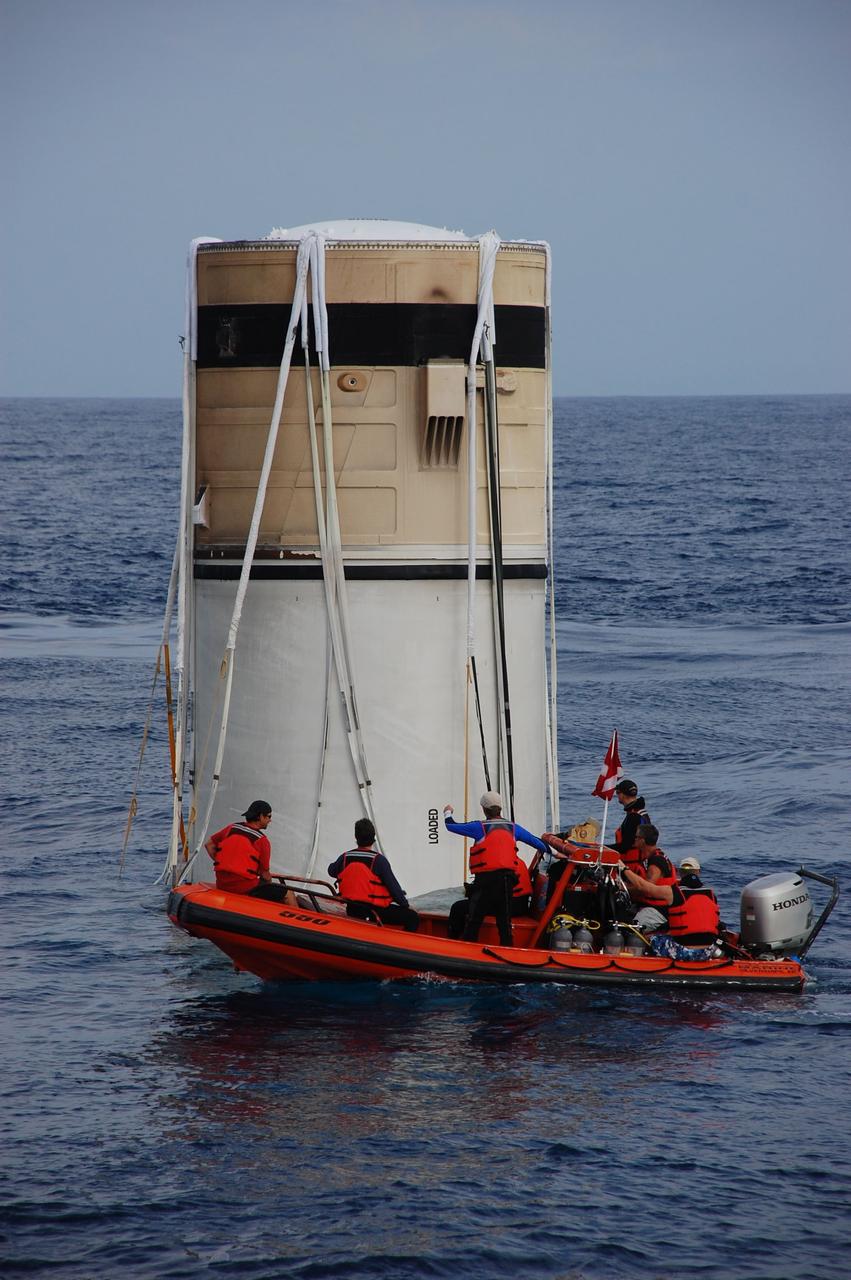
CAPE CANAVERAL, Fla. -- Crew members from Freedom Star, one of NASA's solid rocket booster retrieval ships, use a skiff to approach the left spent booster bobbing in the Atlantic Ocean after space shuttle Discovery's STS-133 launch. The shuttle’s two solid rocket booster casings and associated flight hardware are recovered in the Atlantic Ocean after every launch by Liberty Star and Freedom Star. The boosters impact the Atlantic about seven minutes after liftoff and the retrieval ships are stationed about 10 miles from the impact area at the time of splashdown. After the spent segments are processed, they will be transported to Utah, where they will be refurbished and stored, if needed. Photo credit: NASA/Ben Smegelsky
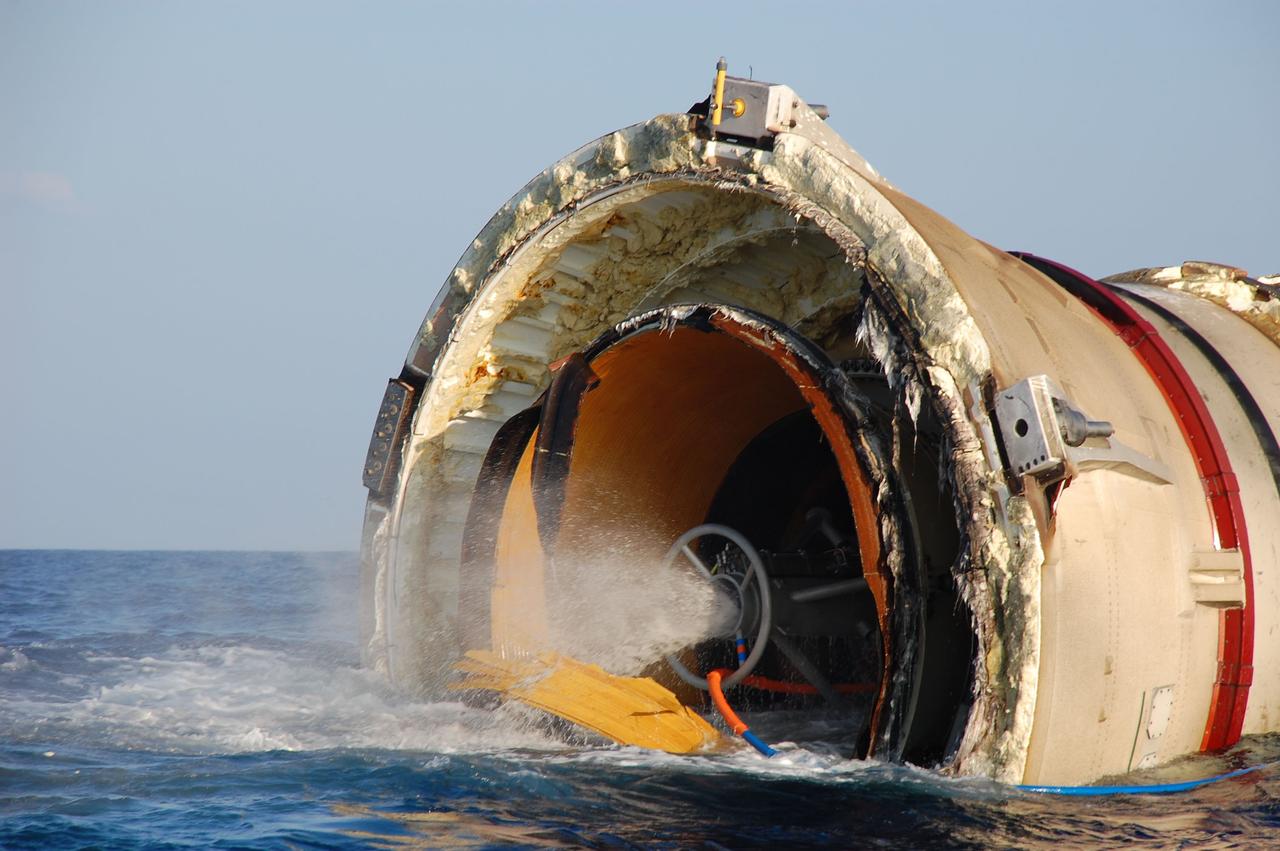
CAPE CANAVERAL, Fla. -- The left spent booster from space shuttle Discovery's final launch is seen floating on the water's surface while pumps on Freedom Star, one of NASA's solid rocket booster retrieval ships, push debris and water out of the booster, replacing with air to facilitate floating for its return to Port Canaveral in Florida. The shuttle’s two solid rocket booster casings and associated flight hardware are recovered in the Atlantic Ocean after every launch by Liberty Star and Freedom Star. The boosters impact the Atlantic about seven minutes after liftoff and the retrieval ships are stationed about 10 miles from the impact area at the time of splashdown. After the spent segments are processed, they will be transported to Utah, where they will be refurbished and stored, if needed. Photo credit: NASA/Ben Smegelsky
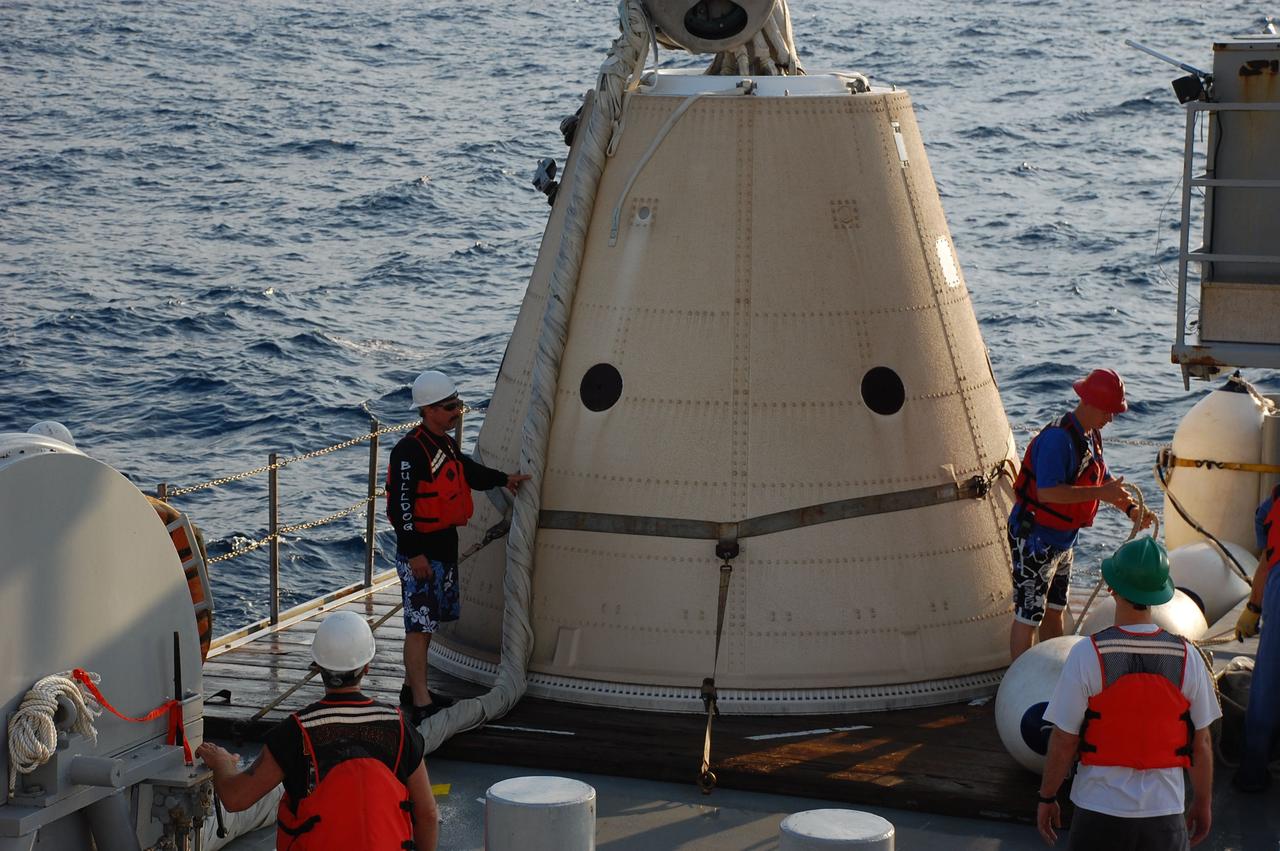
CAPE CANAVERAL, Fla. -- Crew members from Freedom Star, one of NASA's solid rocket booster retrieval ships, have recovered and secured the left spent booster nose cap to a pallet on the ship's deck after space shuttle Discovery's STS-133 launch. The shuttle’s two solid rocket booster casings and associated flight hardware are recovered in the Atlantic Ocean after every launch by Liberty Star and Freedom Star. The boosters impact the Atlantic about seven minutes after liftoff and the retrieval ships are stationed about 10 miles from the impact area at the time of splashdown. After the spent segments are processed, they will be transported to Utah, where they will be refurbished and stored, if needed. Photo credit: NASA/Ben Smegelsky
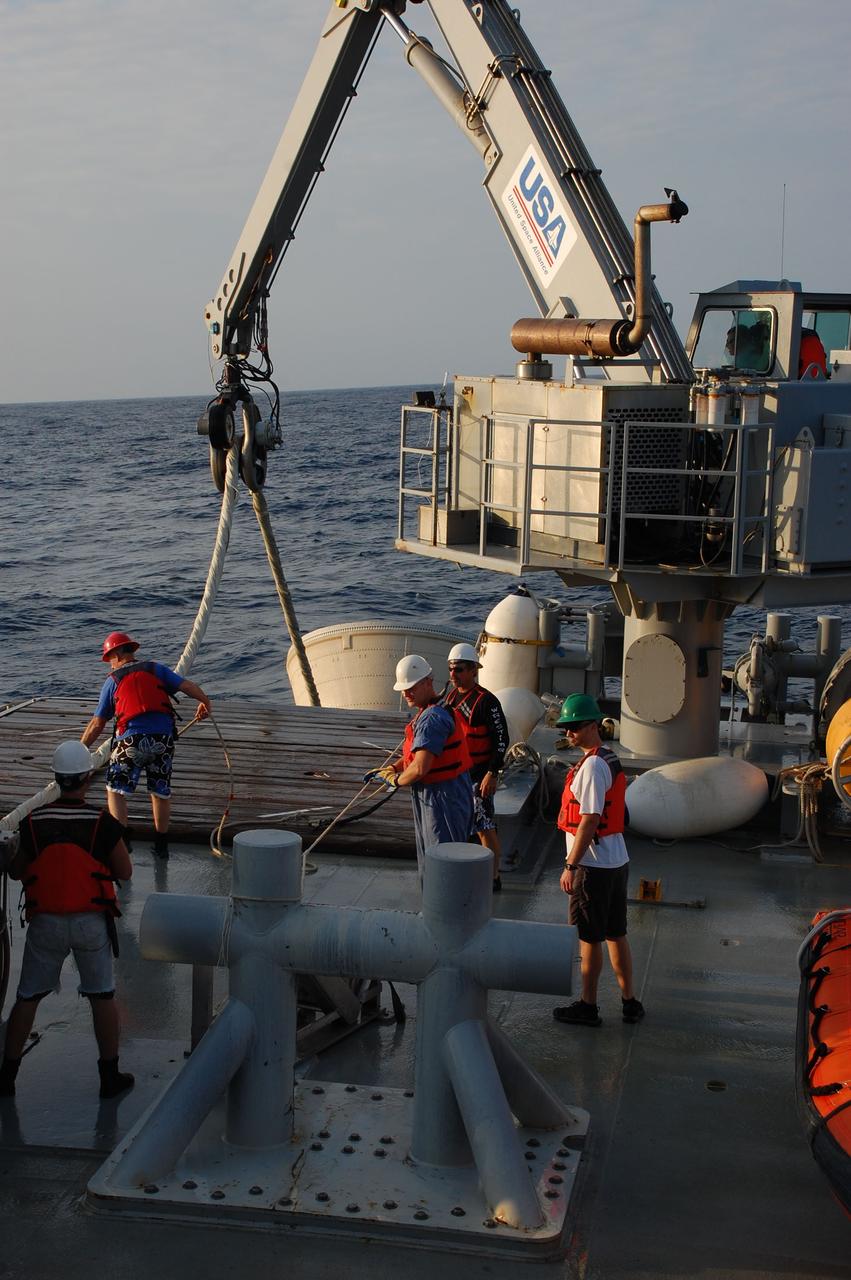
CAPE CANAVERAL, Fla. -- Crew members from Freedom Star, one of NASA's solid rocket booster retrieval ships, use a crane to pull the left spent booster nose cap out of the Atlantic Ocean after space shuttle Discovery's STS-133 launch. The shuttle’s two solid rocket booster casings and associated flight hardware are recovered in the Atlantic Ocean after every launch by Liberty Star and Freedom Star. The boosters impact the Atlantic about seven minutes after liftoff and the retrieval ships are stationed about 10 miles from the impact area at the time of splashdown. After the spent segments are processed, they will be transported to Utah, where they will be refurbished and stored, if needed. Photo credit: NASA/Ben Smegelsky
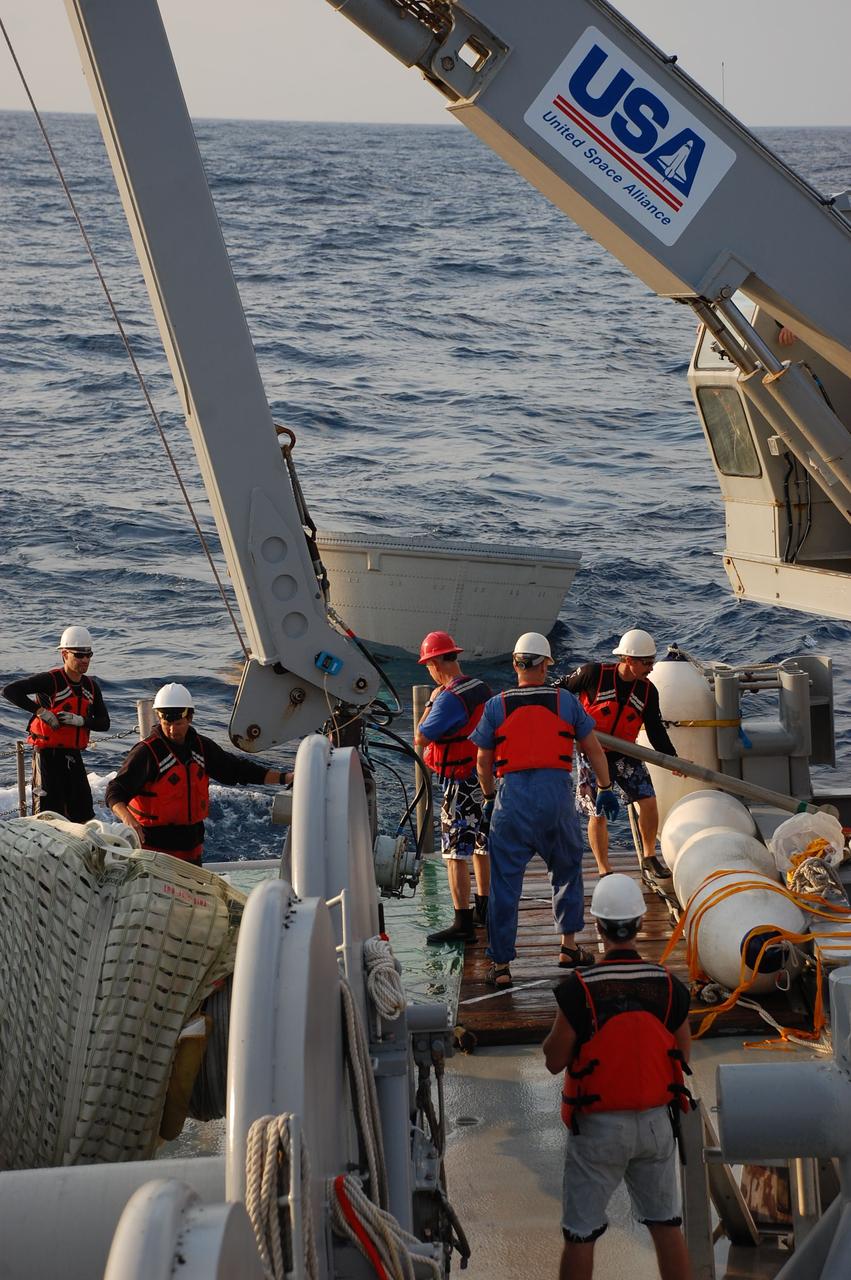
CAPE CANAVERAL, Fla. -- Crew members from Freedom Star, one of NASA's solid rocket booster retrieval ships, recover the left spent booster nose cap from the Atlantic Ocean after space shuttle Discovery's STS-133 launch. The shuttle’s two solid rocket booster casings and associated flight hardware are recovered in the Atlantic Ocean after every launch by Liberty Star and Freedom Star. The boosters impact the Atlantic about seven minutes after liftoff and the retrieval ships are stationed about 10 miles from the impact area at the time of splashdown. After the spent segments are processed, they will be transported to Utah, where they will be refurbished and stored, if needed. Photo credit: NASA/Ben Smegelsky
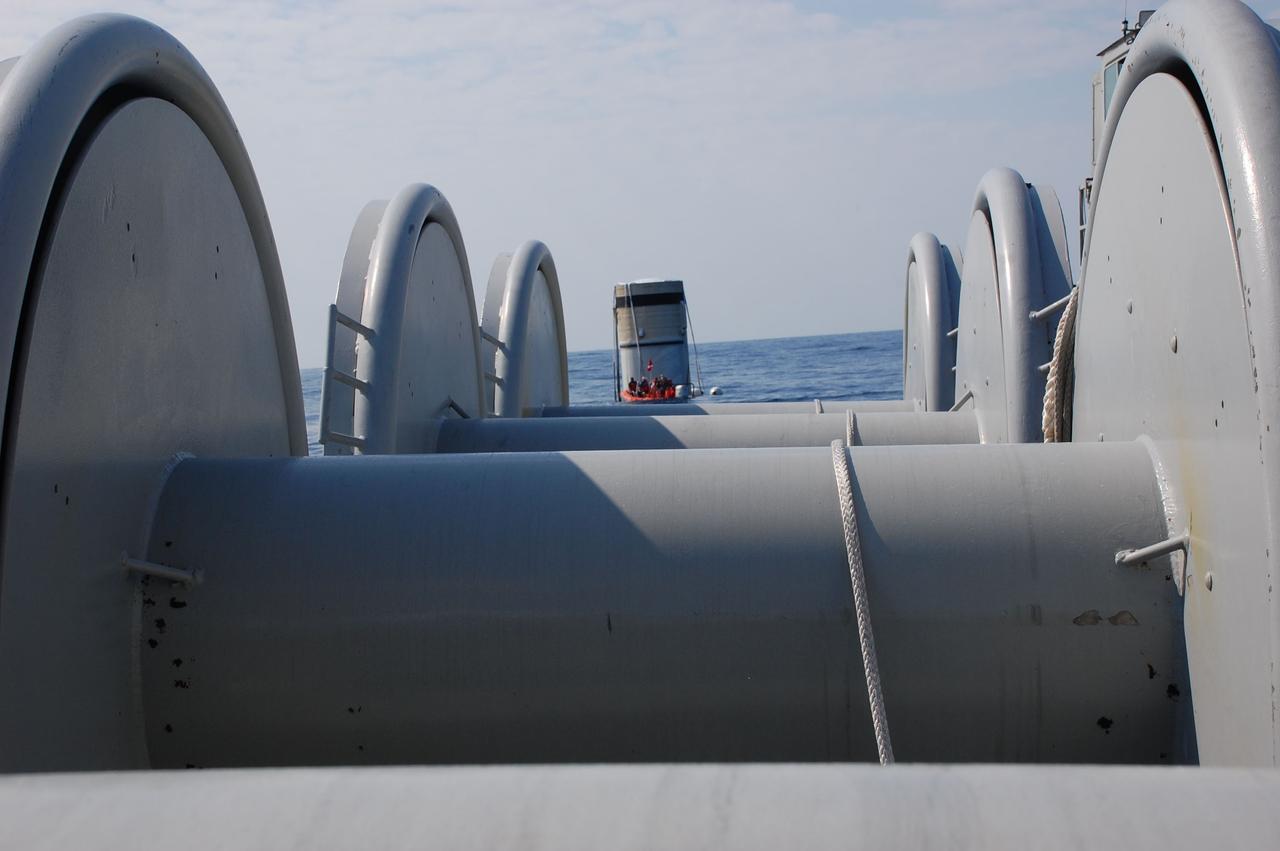
CAPE CANAVERAL, Fla. -- This image taken through a winding and storage device on Freedom Star, one of NASA's solid rocket booster retrieval ships, shows crew members in a skiff attaching flotation devices, or buoys to the parachute lines from the left spent booster after space shuttle Discovery's STS-133 launch. The shuttle’s two solid rocket booster casings and associated flight hardware are recovered in the Atlantic Ocean after every launch by Liberty Star and Freedom Star. The boosters impact the Atlantic about seven minutes after liftoff and the retrieval ships are stationed about 10 miles from the impact area at the time of splashdown. After the spent segments are processed, they will be transported to Utah, where they will be refurbished and stored, if needed. Photo credit: NASA/Ben Smegelsky
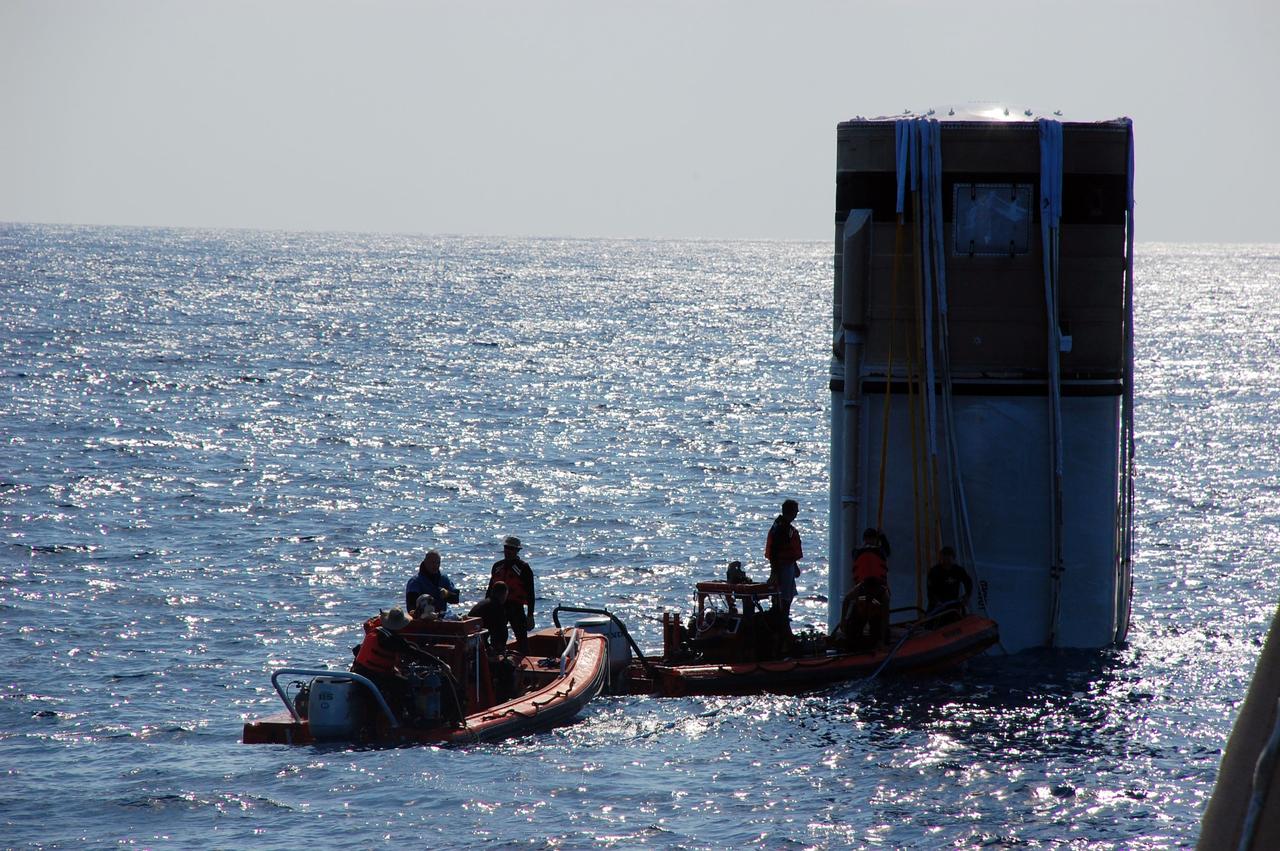
CAPE CANAVERAL, Fla. -- Crew members from Freedom Star, one of NASA's solid rocket booster retrieval ships, approach the left spent booster bobbing in the Atlantic Ocean to attach a hose that will facilitate debris and water clearing and the pumping in of air so the booster can float horizontally on the water's surface for towing back to Port Canaveral in Florida. The shuttle’s two solid rocket booster casings and associated flight hardware are recovered in the Atlantic Ocean after every launch by Liberty Star and Freedom Star. The boosters impact the Atlantic about seven minutes after liftoff and the retrieval ships are stationed about 10 miles from the impact area at the time of splashdown. After the spent segments are processed, they will be transported to Utah, where they will be refurbished and stored, if needed. Photo credit: NASA/Ben Smegelsky
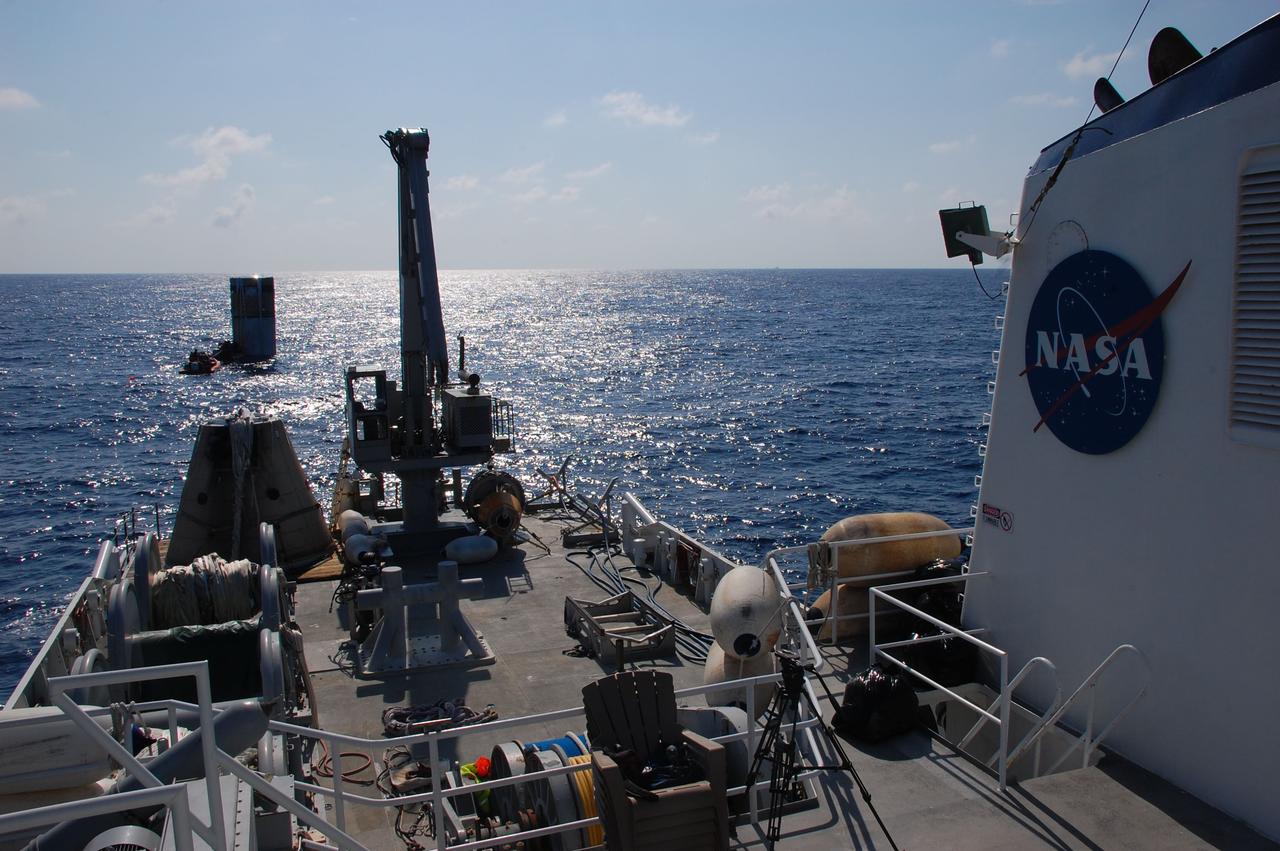
CAPE CANAVERAL, Fla. -- Freedom Star, one of NASA's solid rocket booster retrieval ships, waits for crew members near the left spent booster bobbing in the Atlantic Ocean to attach a hose between it and the vessel that will facilitate debris and water clearing and the pumping in of air so the booster can float horizontally on the water's surface for towing back to Port Canaveral in Florida. The shuttle’s two solid rocket booster casings and associated flight hardware are recovered in the Atlantic Ocean after every launch by Liberty Star and Freedom Star. The boosters impact the Atlantic about seven minutes after liftoff and the retrieval ships are stationed about 10 miles from the impact area at the time of splashdown. After the spent segments are processed, they will be transported to Utah, where they will be refurbished and stored, if needed. Photo credit: NASA/Ben Smegelsky
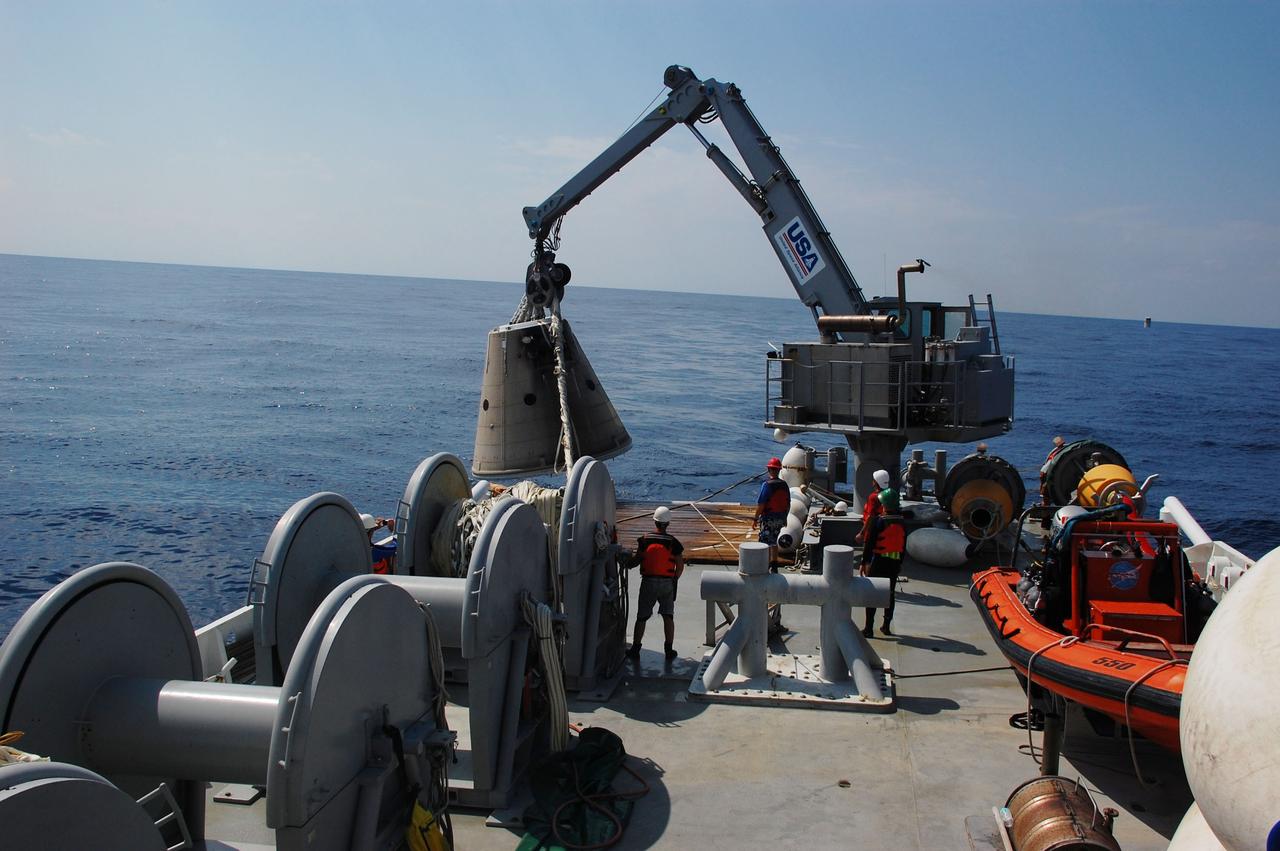
CAPE CANAVERAL, Fla. -- A crane on Freedom Star, one of NASA's solid rocket booster retrieval ships, heaves a spent booster nose cap from the from out of the Atlantic Ocean and onto the deck after space shuttle Discovery's final launch. The shuttle’s two solid rocket booster casings and associated flight hardware are recovered in the Atlantic Ocean after every launch by Liberty Star and Freedom Star. The boosters impact the Atlantic about seven minutes after liftoff and the retrieval ships are stationed about 10 miles from the impact area at the time of splashdown. After the spent segments are processed, they will be transported to Utah, where they will be refurbished and stored, if needed. Photo credit: NASA/Ben Smegelsky
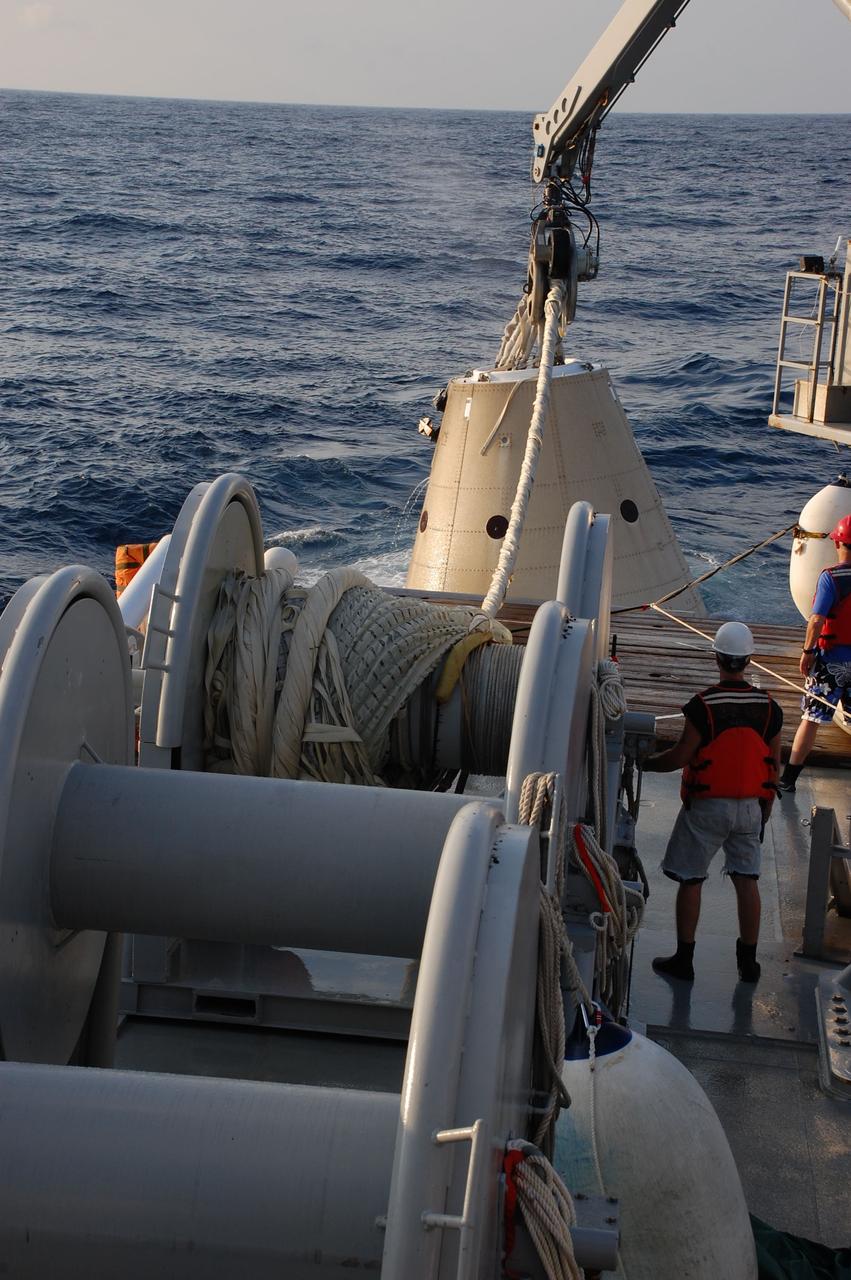
CAPE CANAVERAL, Fla. -- Crew members from Freedom Star, one of NASA's solid rocket booster retrieval ships, use a crane to pull the left spent booster nose cap out of the Atlantic Ocean after space shuttle Discovery's STS-133 launch. The shuttle’s two solid rocket booster casings and associated flight hardware are recovered in the Atlantic Ocean after every launch by Liberty Star and Freedom Star. The boosters impact the Atlantic about seven minutes after liftoff and the retrieval ships are stationed about 10 miles from the impact area at the time of splashdown. After the spent segments are processed, they will be transported to Utah, where they will be refurbished and stored, if needed. Photo credit: NASA/Ben Smegelsky
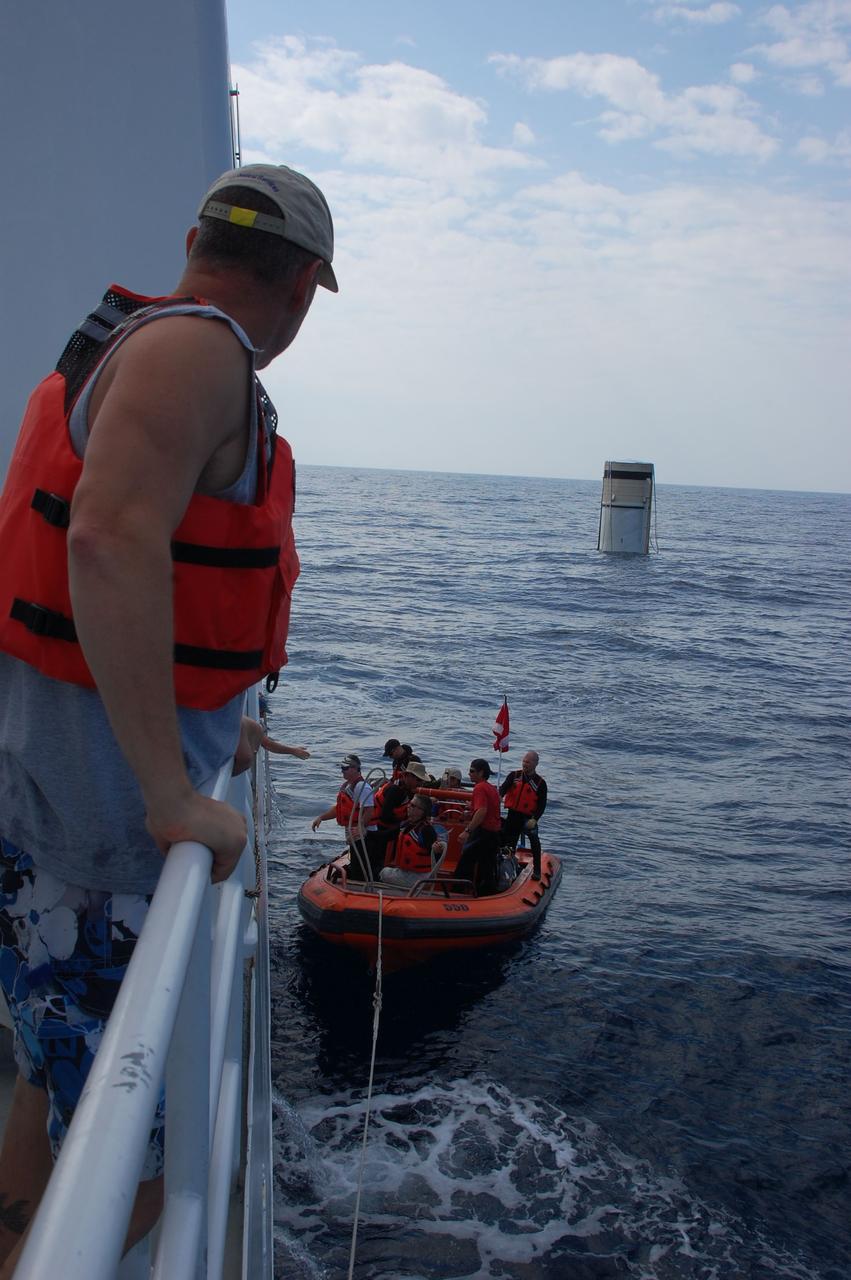
CAPE CANAVERAL, Fla. -- Crew members in a skiff from Freedom Star, one of NASA's solid rocket booster retrieval ships, make their way back to the vessel after inspecting the left spent booster bobbing in the Atlantic Ocean from space shuttle Discovery's STS-133 launch. The shuttle’s two solid rocket booster casings and associated flight hardware are recovered in the Atlantic Ocean after every launch by Liberty Star and Freedom Star. The boosters impact the Atlantic about seven minutes after liftoff and the retrieval ships are stationed about 10 miles from the impact area at the time of splashdown. After the spent segments are processed, they will be transported to Utah, where they will be refurbished and stored, if needed. Photo credit: NASA/Ben Smegelsky
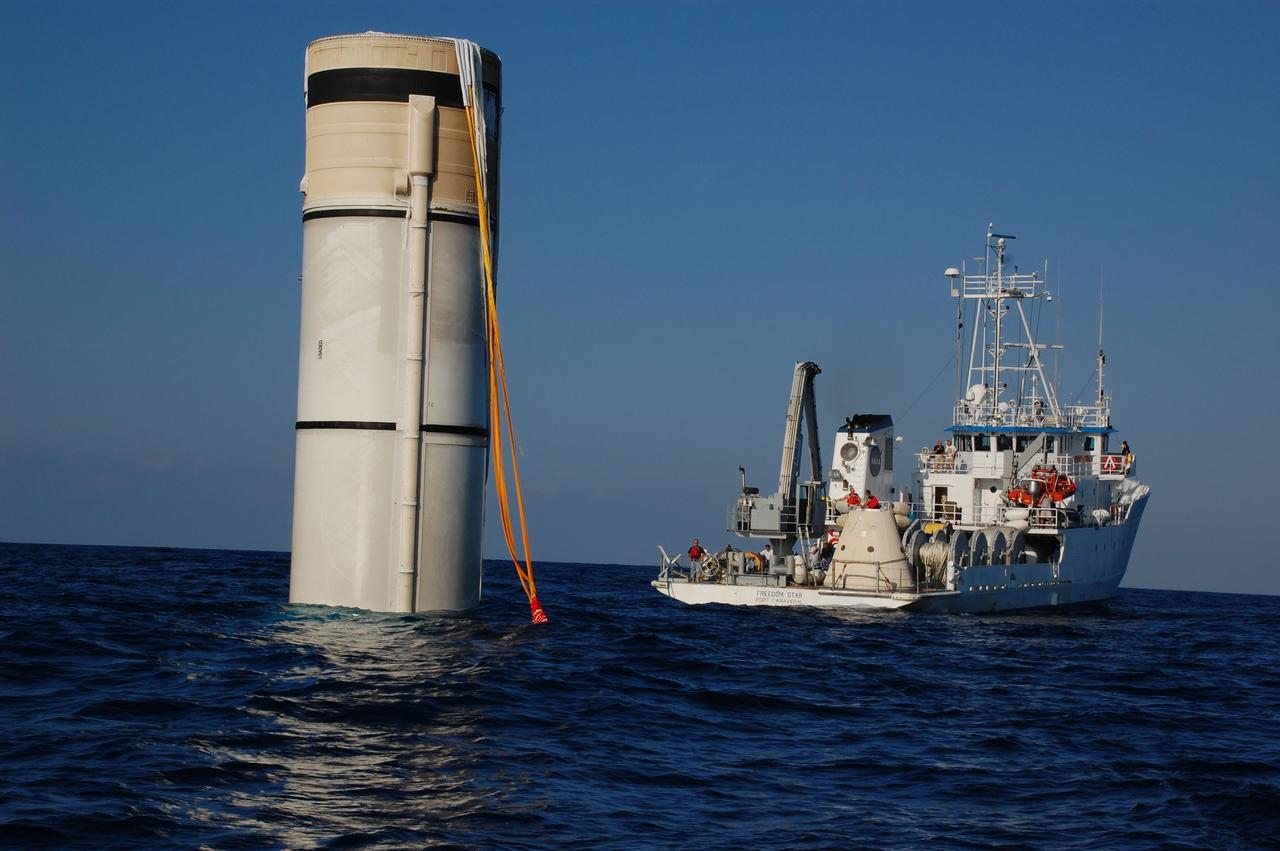
CAPE CANAVERAL, Fla. -- The left spent booster from space shuttle Discovery's final launch is seen bobbing in the Atlantic Ocean as air is pumped into it to lift it out of the water so it can float horizontally for towing back to Port Canaveral, Florida by Freedom Star, one of NASA's solid rocket booster retrieval ships. The shuttle’s two solid rocket booster casings and associated flight hardware are recovered in the Atlantic Ocean after every launch by Liberty Star and Freedom Star. The boosters impact the Atlantic about seven minutes after liftoff and the retrieval ships are stationed about 10 miles from the impact area at the time of splashdown. After the spent segments are processed, they will be transported to Utah, where they will be refurbished and stored, if needed. Photo credit: NASA/Ben Smegelsky
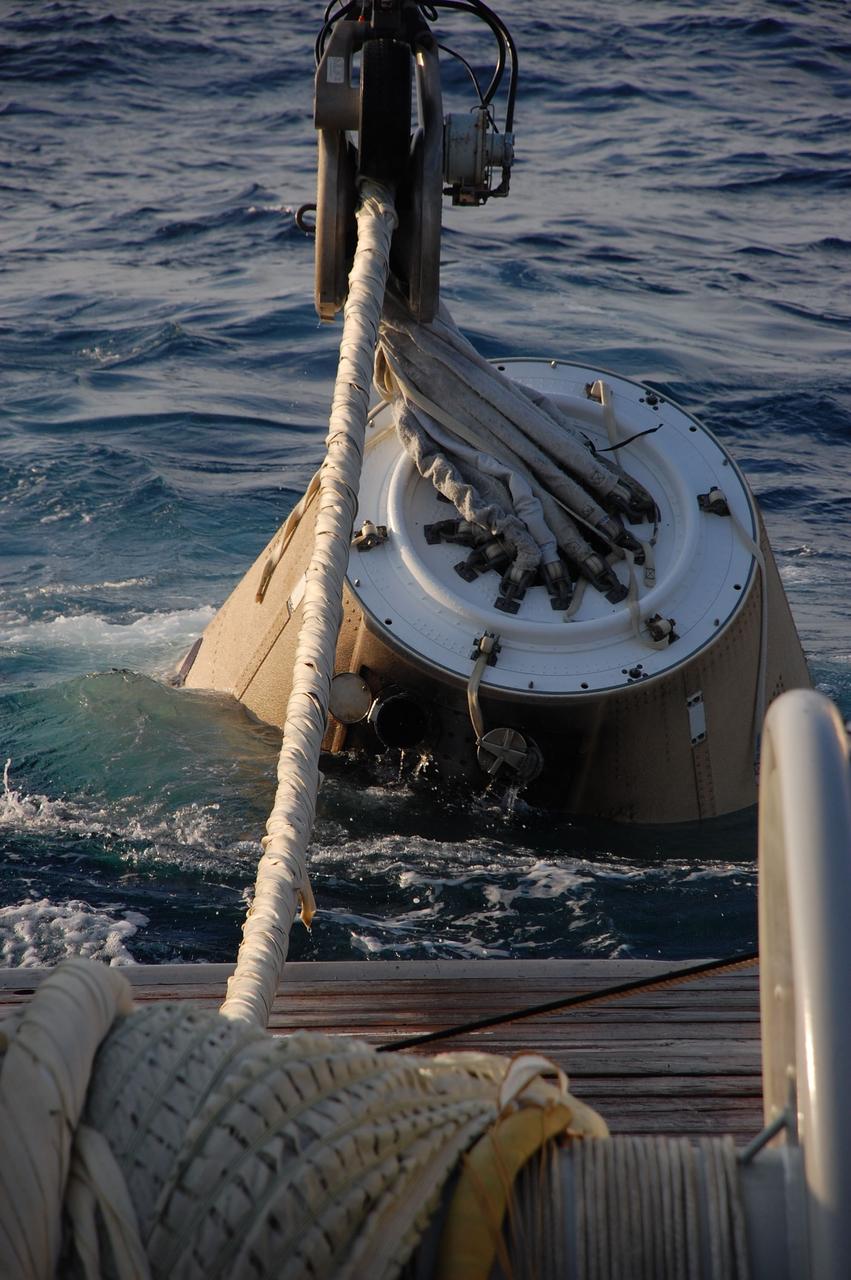
CAPE CANAVERAL, Fla. -- A crane on Freedom Star, one of NASA's solid rocket booster retrieval ships, heaves the left spent booster nose cap from the Atlantic Ocean and onto the deck after space shuttle Discovery's STS-133 launch. The shuttle’s two solid rocket booster casings and associated flight hardware are recovered in the Atlantic Ocean after every launch by Liberty Star and Freedom Star. The boosters impact the Atlantic about seven minutes after liftoff and the retrieval ships are stationed about 10 miles from the impact area at the time of splashdown. After the spent segments are processed, they will be transported to Utah, where they will be refurbished and stored, if needed. Photo credit: NASA/Ben Smegelsky

CAPE CANAVERAL, Fla. -- Crew members from Freedom Star, one of NASA's solid rocket booster retrieval ships, check the securing of the left spent booster from space shuttle Discovery's final launch, to the vessel, before continuing on the Hangar AF at Cape Canaveral Air Force Station. The shuttle’s two solid rocket booster casings and associated flight hardware are recovered in the Atlantic Ocean after every launch by Liberty Star and Freedom Star. The boosters impact the Atlantic about seven minutes after liftoff and the retrieval ships are stationed about 10 miles from the impact area at the time of splashdown. After the spent segments are processed, they will be transported to Utah, where they will be refurbished and stored, if needed. Photo credit: NASA/Ben Smegelsky
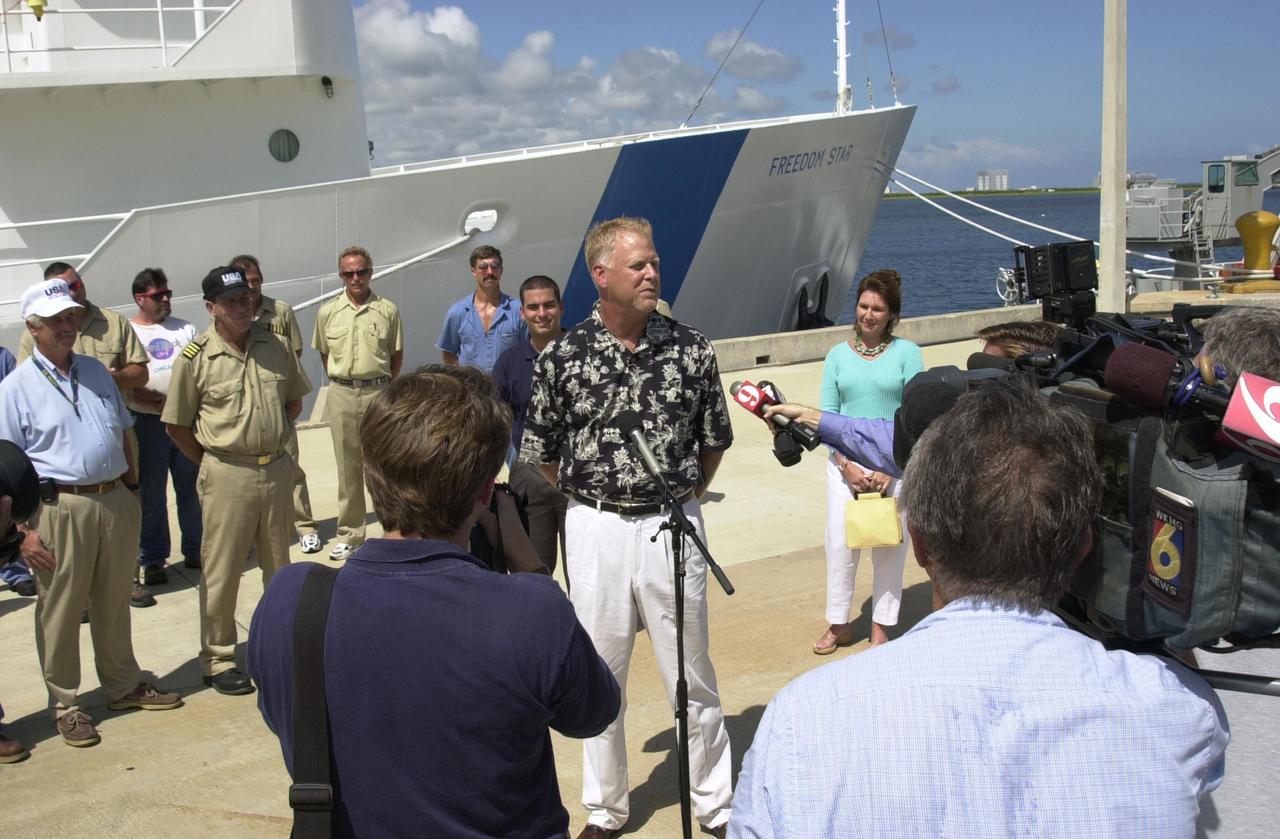
KENNEDY SPACE CENTER, FLA. - Jack Wilcox (at the microphone) answers questions from the media during a reunion with his rescuers at the Hangar AF docks, Cape Canaveral Air Force Station. At right is his wife, Patty. Wilcox reunited with the men aboard KSC's Freedom Star SRB retrieval ship that was in the vicinity when Wilcox suffered decompression sickness on a diving expedition 20 miles off shore in the Atlantic Ocean. When the Freedom Star team heard the call for help, they asked the Coast Guard if they could assist. The ship was out on a crane certification exercise and coincidentally had a diver medical technician and other divers training on the crane. The ship's divers were trained for the hyperbaric chamber on board. Upon reaching the Army dock, KSC Occupational Health physician Skip Beeler entered the chamber and continued the process of helping to stabilize Wilcox. After several hours in the chamber, Wilcox, who lives in Orlando, was airlifted to Florida Hospital Orlando.
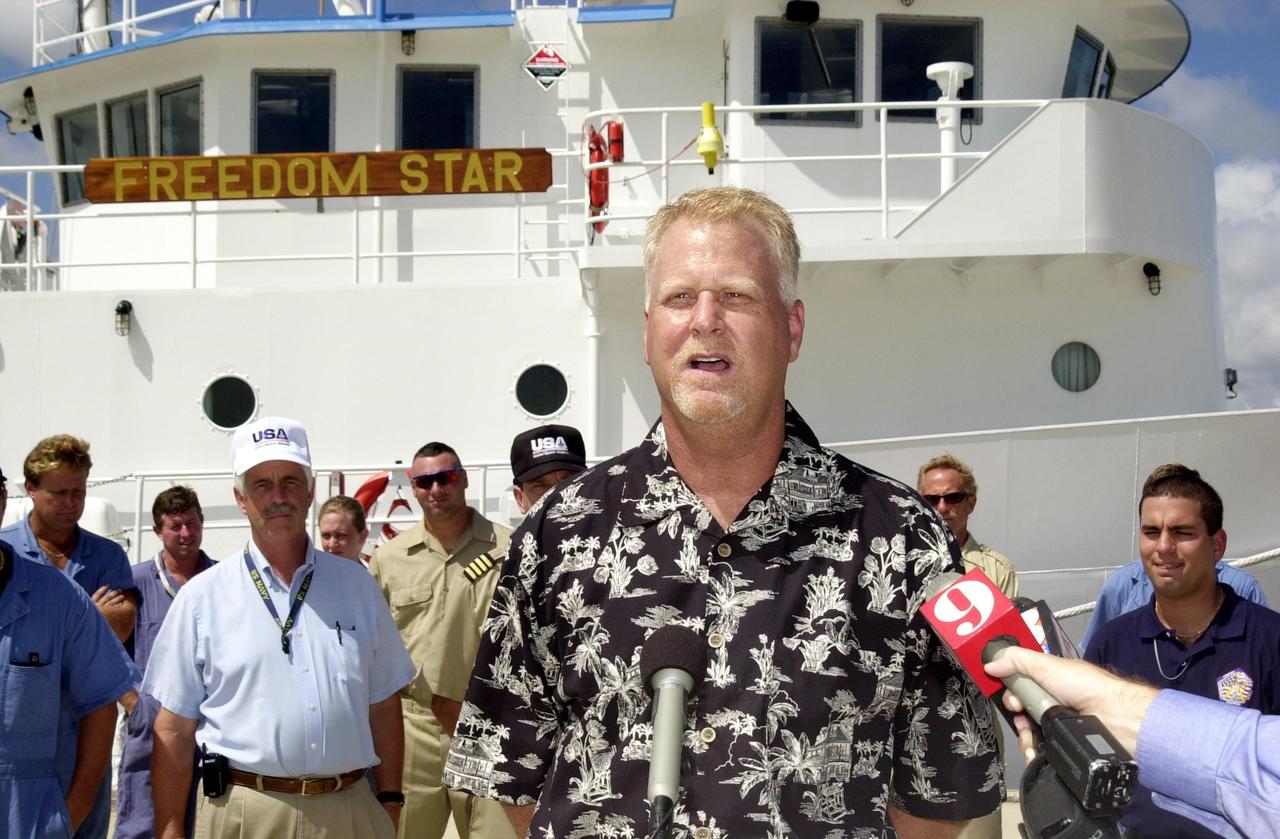
KENNEDY SPACE CENTER, FLA. - Jack Wilcox answers questions from the media during a reunion at the Hangar AF docks, Cape Canaveral Air Force Station, with his rescuers. Wilcox reunited with the men aboard KSC's Freedom Star SRB retrieval ship that was in the vicinity when Wilcox suffered decompression sickness on a diving expedition 20 miles off shore in the Atlantic Ocean. When the Freedom Star team heard the call for help, they asked the Coast Guard if they could assist. The ship was out on a crane certification exercise and coincidentally had a diver medical technician and other divers training on the crane. The ship's divers were trained for the hyperbaric chamber on board. Upon reaching the Army dock, KSC Occupational Health physician Skip Beeler entered the chamber and continued the process of helping to stabilize Wilcox. After several hours in the chamber, Wilcox, who lives in Orlando, was airlifted to Florida Hospital Orlando.
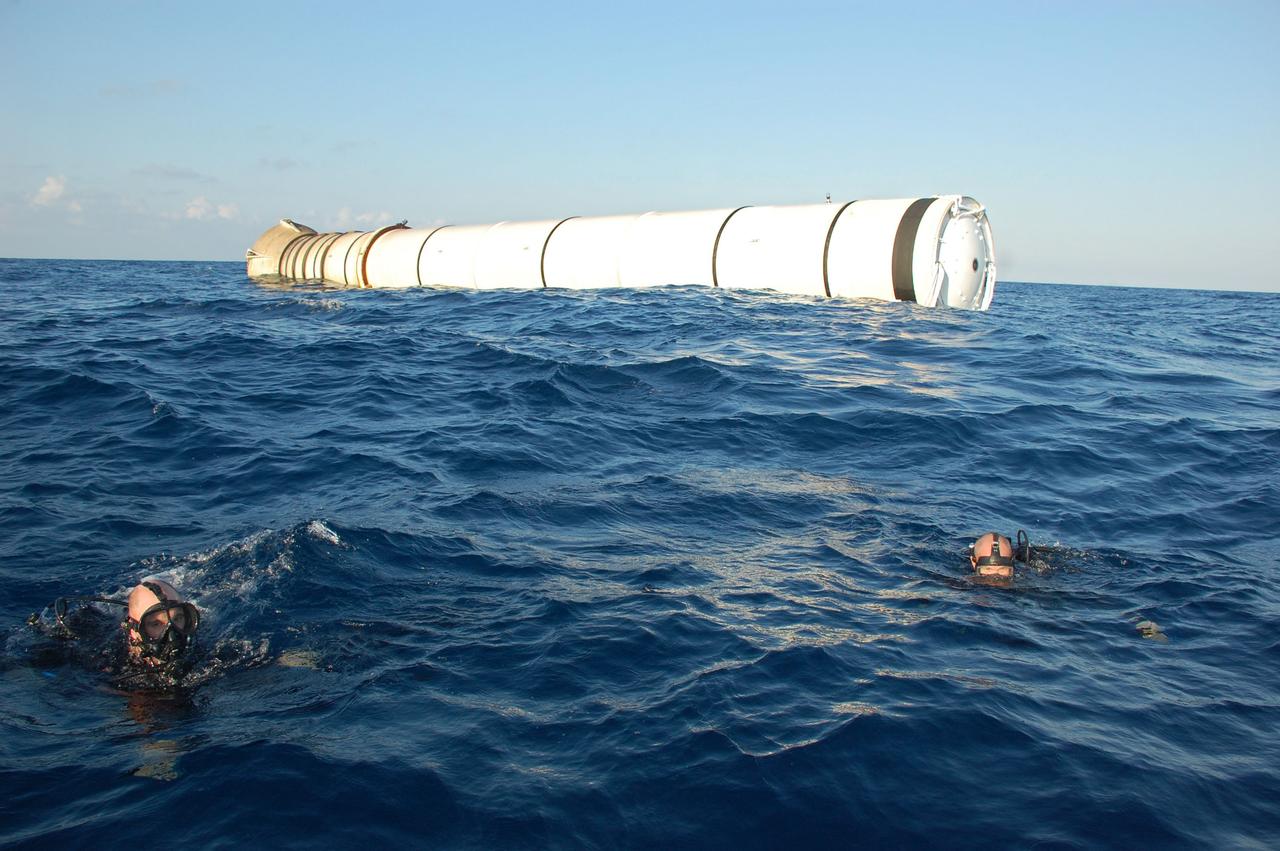
CAPE CANAVERAL, Fla. -- Divers from Freedom Star, one of NASA's solid rocket booster retrieval ships, help with the recovery of the left spent booster from space shuttle Discovery's final launch, which will be hauled alongside the vessel and towed back to Port Canaveral in Florida. The shuttle’s two solid rocket booster casings and associated flight hardware are recovered in the Atlantic Ocean after every launch by Liberty Star and Freedom Star. The boosters impact the Atlantic about seven minutes after liftoff and the retrieval ships are stationed about 10 miles from the impact area at the time of splashdown. After the spent segments are processed, they will be transported to Utah, where they will be refurbished and stored, if needed. Photo credit: NASA/Ben Smegelsky
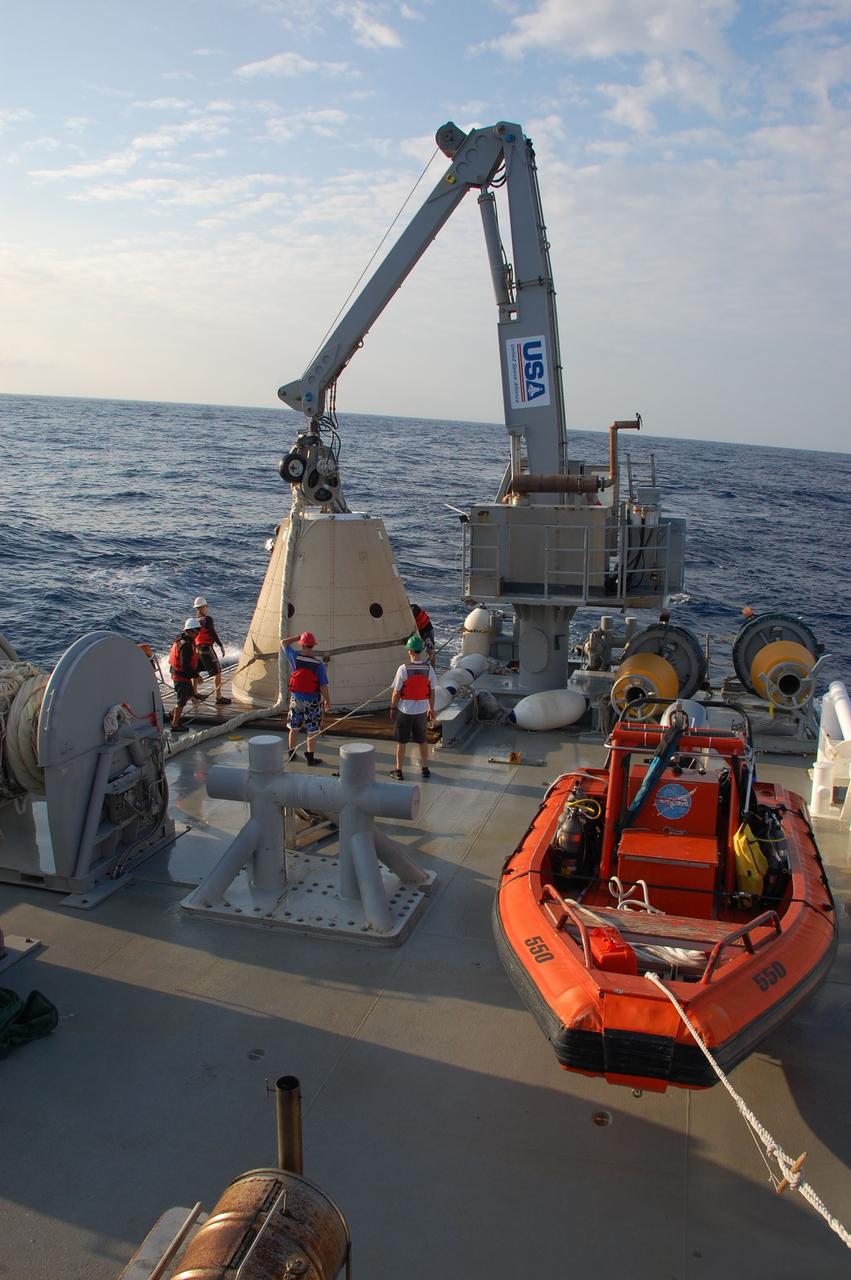
CAPE CANAVERAL, Fla. -- Crew members on Freedom Star, one of NASA's solid rocket booster retrieval ships, use a crane to pull the left spent booster nose cap out of the Atlantic Ocean after space shuttle Discovery's STS-133 launch. The shuttle’s two solid rocket booster casings and associated flight hardware are recovered in the Atlantic Ocean after every launch by Liberty Star and Freedom Star. The boosters impact the Atlantic about seven minutes after liftoff and the retrieval ships are stationed about 10 miles from the impact area at the time of splashdown. After the spent segments are processed, they will be transported to Utah, where they will be refurbished and stored, if needed. Photo credit: NASA/Ben Smegelsky
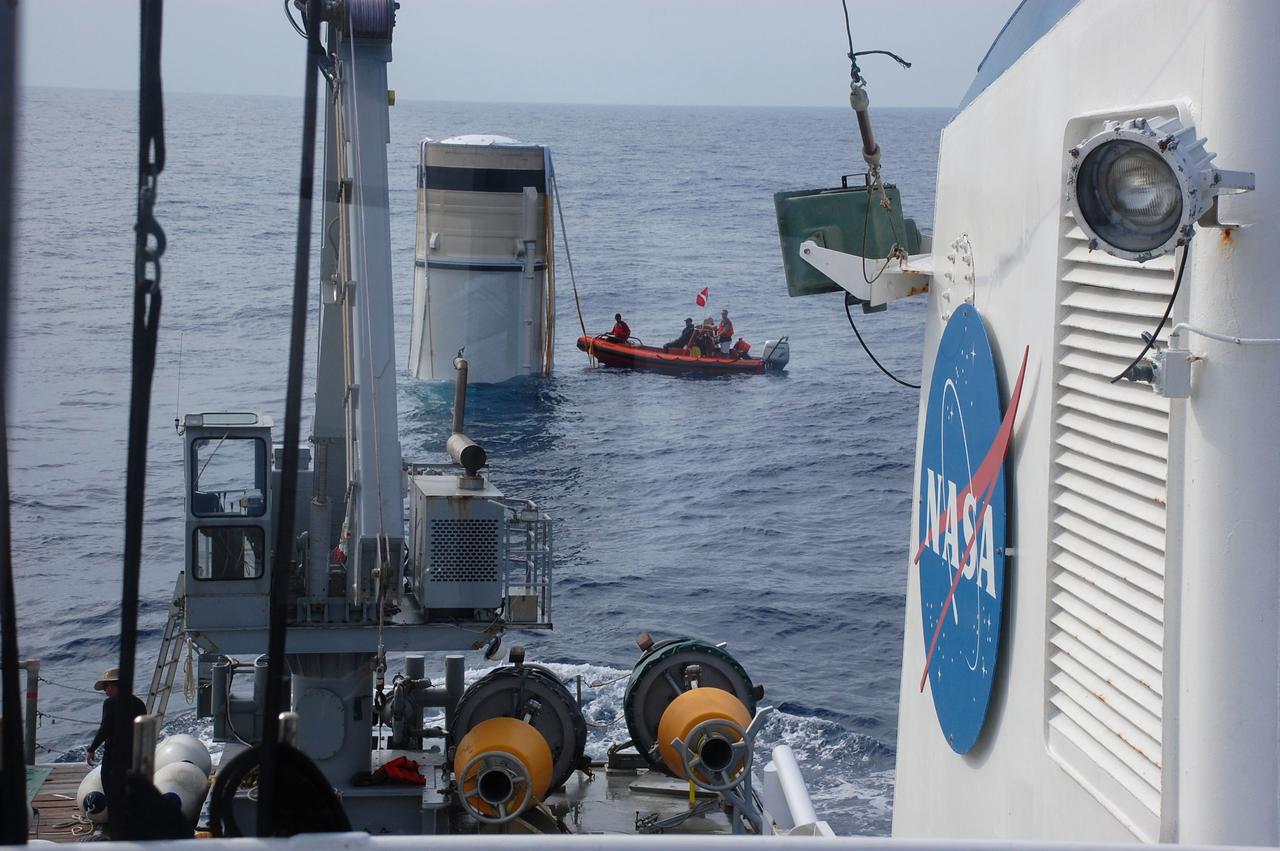
CAPE CANAVERAL, Fla. -- Crew members in a skiff from Freedom Star, one of NASA's solid rocket booster retrieval ships, approach and inspect the left spent booster bobbing in the Atlantic Ocean after space shuttle Discovery's STS-133 launch. The shuttle’s two solid rocket booster casings and associated flight hardware are recovered in the Atlantic Ocean after every launch by Liberty Star and Freedom Star. The boosters impact the Atlantic about seven minutes after liftoff and the retrieval ships are stationed about 10 miles from the impact area at the time of splashdown. After the spent segments are processed, they will be transported to Utah, where they will be refurbished and stored, if needed. Photo credit: NASA/Ben Smegelsky
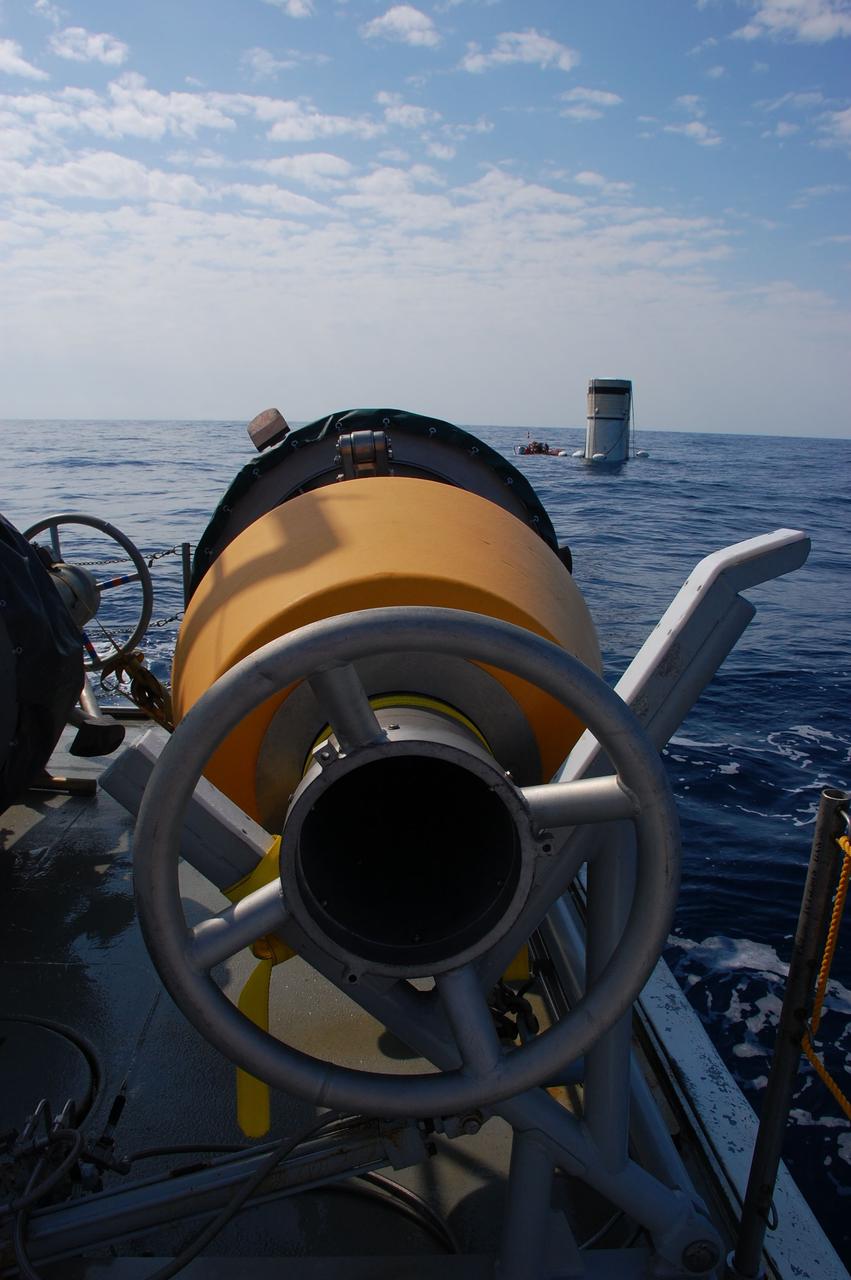
CAPE CANAVERAL, Fla. -- This image taken from the bow of Freedom Star, one of NASA's solid rocket booster retrieval ships, shows crew members in a skiff attaching flotation devices, or buoys, to the parachute lines from the left spent booster from space shuttle Discovery's STS-133 launch. The shuttle’s two solid rocket booster casings and associated flight hardware are recovered in the Atlantic Ocean after every launch by Liberty Star and Freedom Star. The boosters impact the Atlantic about seven minutes after liftoff and the retrieval ships are stationed about 10 miles from the impact area at the time of splashdown. After the spent segments are processed, they will be transported to Utah, where they will be refurbished and stored, if needed. Photo credit: NASA/Ben Smegelsky
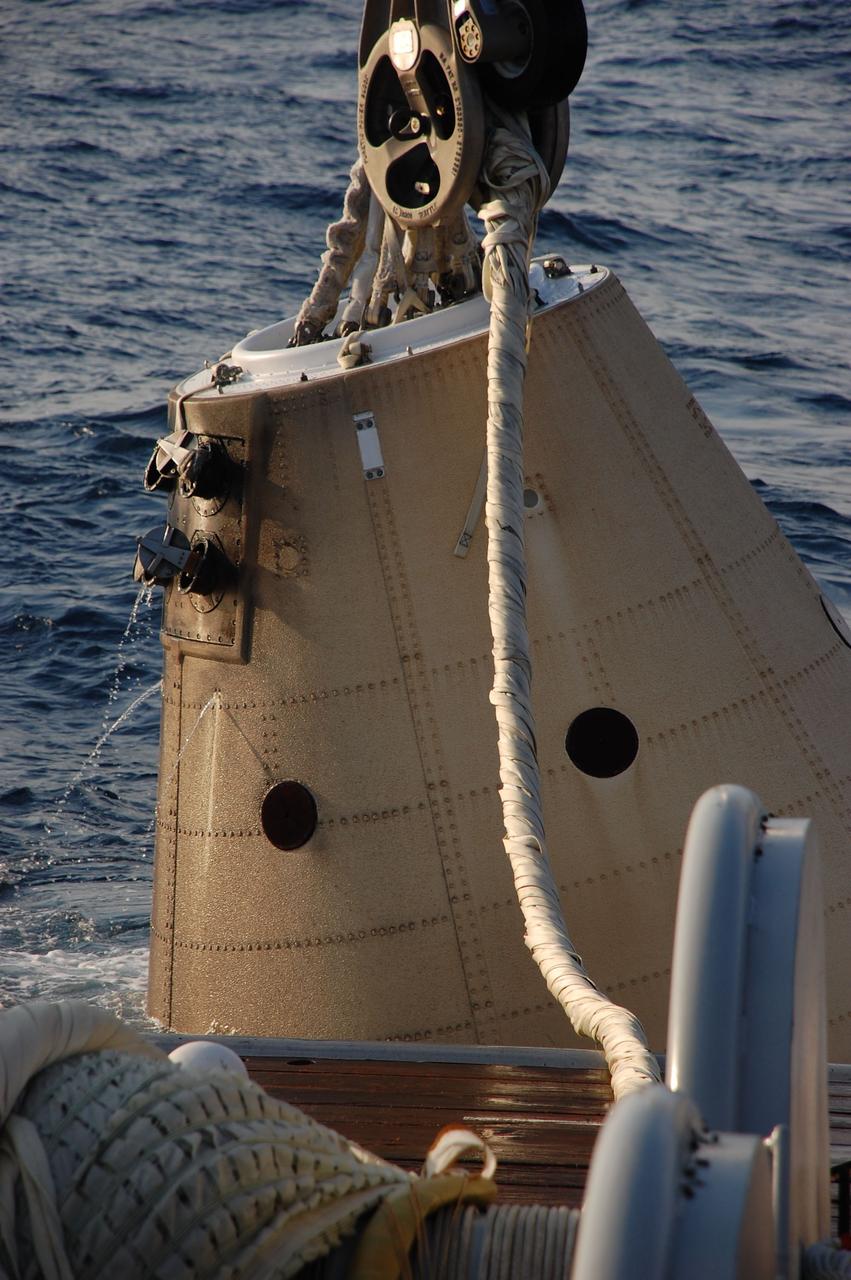
CAPE CANAVERAL, Fla. -- A crane on Freedom Star, one of NASA's solid rocket booster retrieval ships, heaves the left spent booster nose cap from the Atlantic Ocean and onto the deck after space shuttle Discovery's STS-133 launch. The shuttle’s two solid rocket booster casings and associated flight hardware are recovered in the Atlantic Ocean after every launch by Liberty Star and Freedom Star. The boosters impact the Atlantic about seven minutes after liftoff and the retrieval ships are stationed about 10 miles from the impact area at the time of splashdown. After the spent segments are processed, they will be transported to Utah, where they will be refurbished and stored, if needed. Photo credit: NASA/Ben Smegelsky
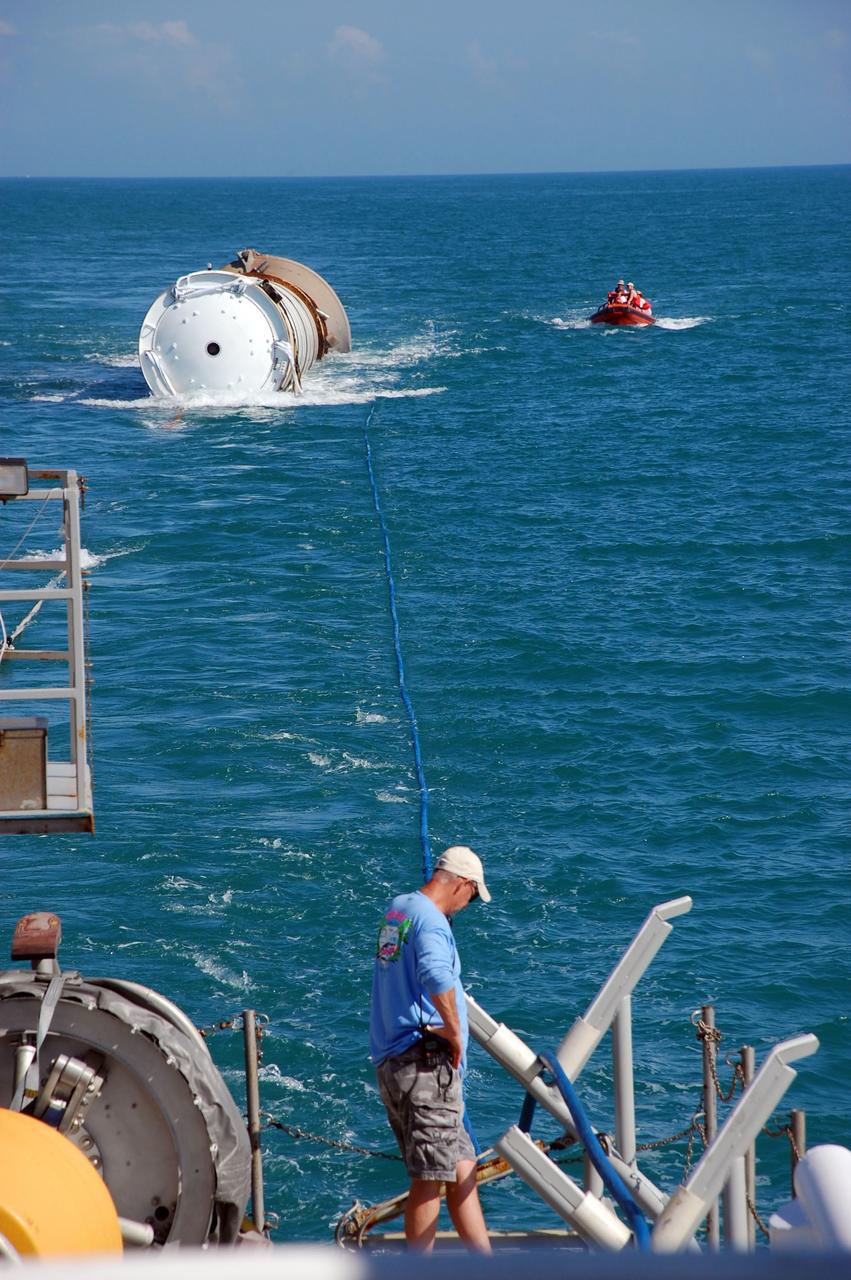
CAPE CANAVERAL, Fla. -- Crew members from Freedom Star, one of NASA's solid rocket booster retrieval ships, monitor the progress of the left spent booster from space shuttle Discovery's final launch, as it is towed toward the vessel for its return trip to Port Canaveral in Florida. The shuttle’s two solid rocket booster casings and associated flight hardware are recovered in the Atlantic Ocean after every launch by Liberty Star and Freedom Star. The boosters impact the Atlantic about seven minutes after liftoff and the retrieval ships are stationed about 10 miles from the impact area at the time of splashdown. After the spent segments are processed, they will be transported to Utah, where they will be refurbished and stored, if needed. Photo credit: NASA/Ben Smegelsky
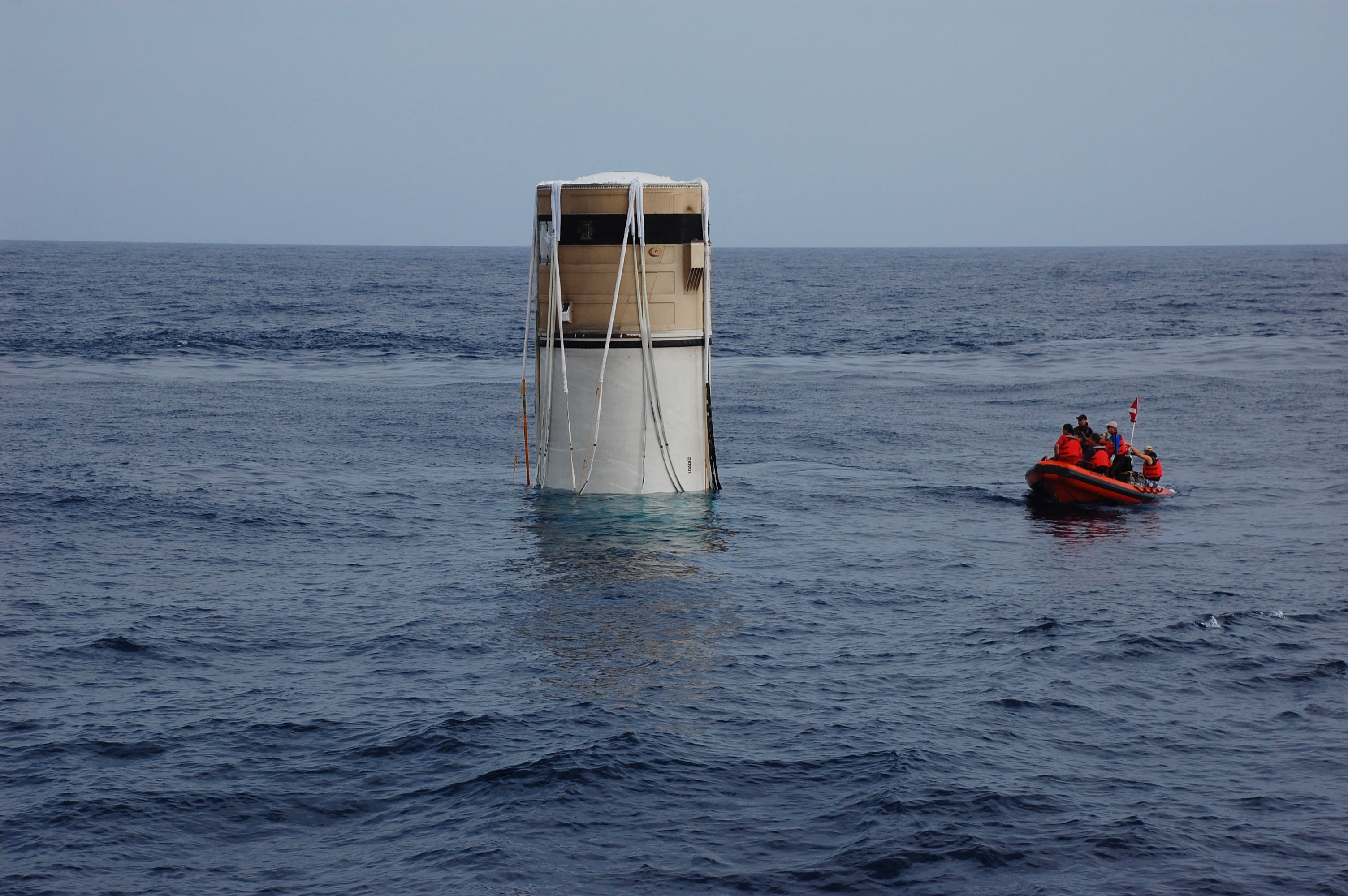
CAPE CANAVERAL, Fla. -- Crew members from Freedom Star, one of NASA's solid rocket booster retrieval ships, use a skiff to approach the left spent booster bobbing in the Atlantic Ocean after space shuttle Discovery's STS-133 launch. The shuttle’s two solid rocket booster casings and associated flight hardware are recovered in the Atlantic Ocean after every launch by Liberty Star and Freedom Star. The boosters impact the Atlantic about seven minutes after liftoff and the retrieval ships are stationed about 10 miles from the impact area at the time of splashdown. After the spent segments are processed, they will be transported to Utah, where they will be refurbished and stored, if needed. Photo credit: NASA/Ben Smegelsky
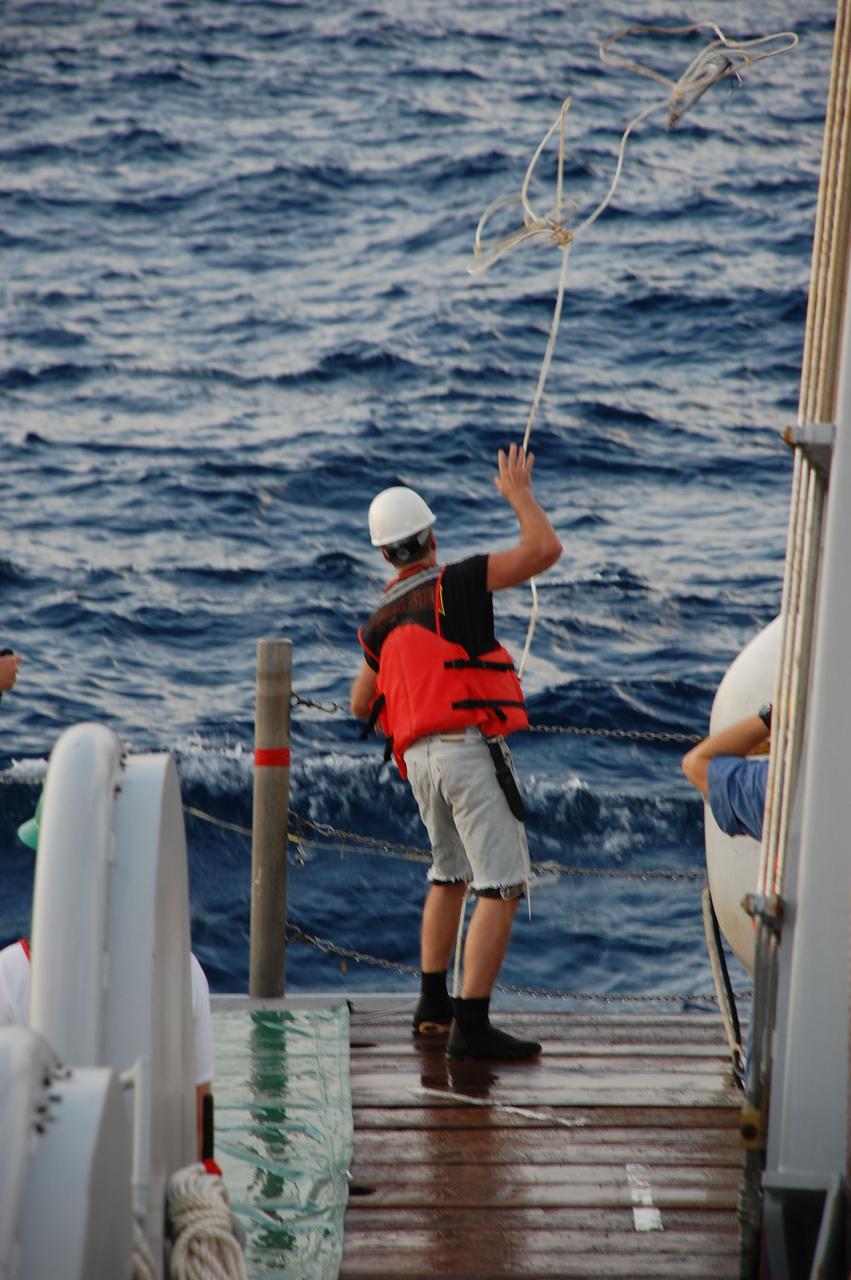
CAPE CANAVERAL, Fla. -- A crew member from Freedom Star, one of NASA's solid rocket booster retrieval ships, throws a tow line into the Atlantic Ocean in order to capture the left spent booster nose cap after space shuttle Discovery's STS-133 launch. The shuttle’s two solid rocket booster casings and associated flight hardware are recovered in the Atlantic Ocean after every launch by Liberty Star and Freedom Star. The boosters impact the Atlantic about seven minutes after liftoff and the retrieval ships are stationed about 10 miles from the impact area at the time of splashdown. After the spent segments are processed, they will be transported to Utah, where they will be refurbished and stored, if needed. Photo credit: NASA/Ben Smegelsky
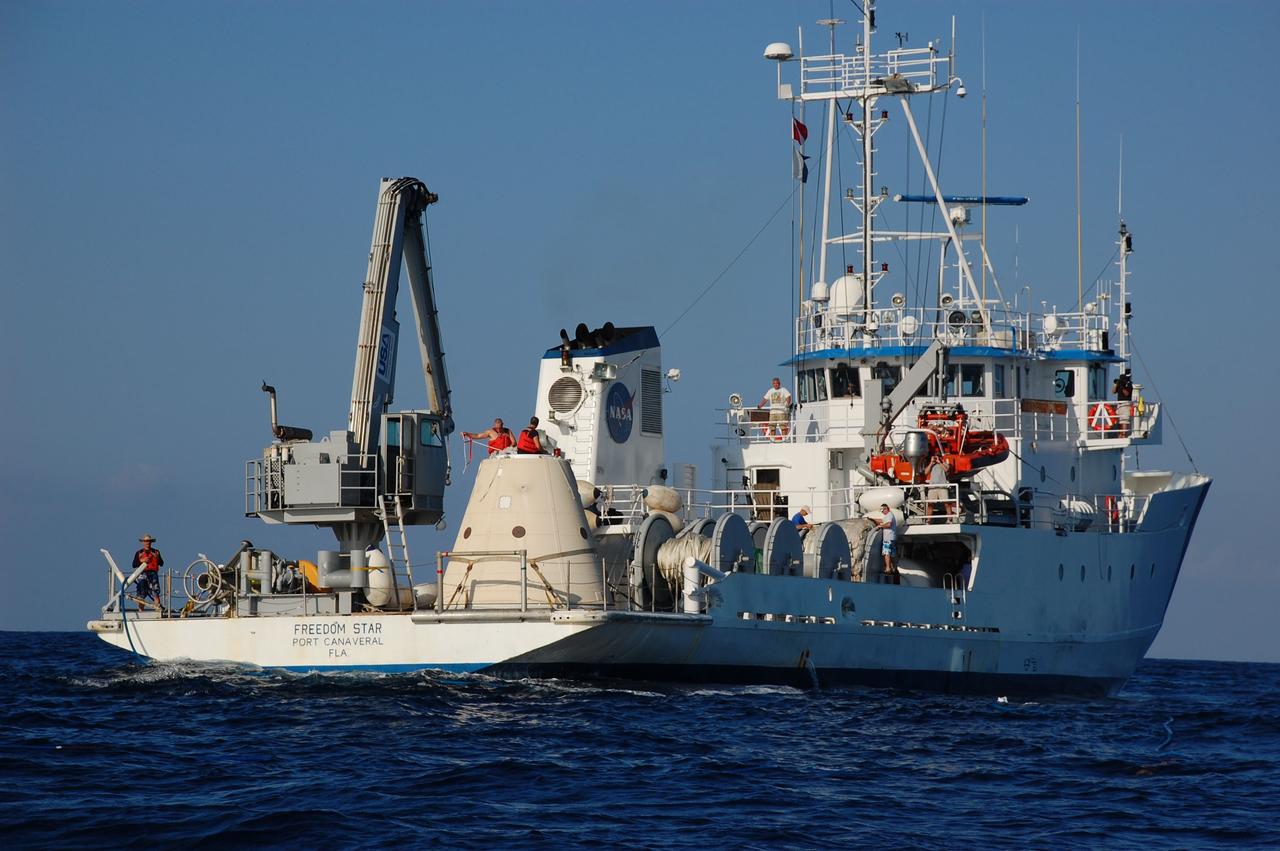
CAPE CANAVERAL, Fla. -- Crew members on Freedom Star, one of NASA's solid rocket booster retrieval ships, monitor the progress of the left spent booster from space shuttle Discovery's final launch, as it is elevated out of the water so it can float horizontally for towing back to Port Canaveral in Florida. The shuttle’s two solid rocket booster casings and associated flight hardware are recovered in the Atlantic Ocean after every launch by Liberty Star and Freedom Star. The boosters impact the Atlantic about seven minutes after liftoff and the retrieval ships are stationed about 10 miles from the impact area at the time of splashdown. After the spent segments are processed, they will be transported to Utah, where they will be refurbished and stored, if needed. Photo credit: NASA/Ben Smegelsky
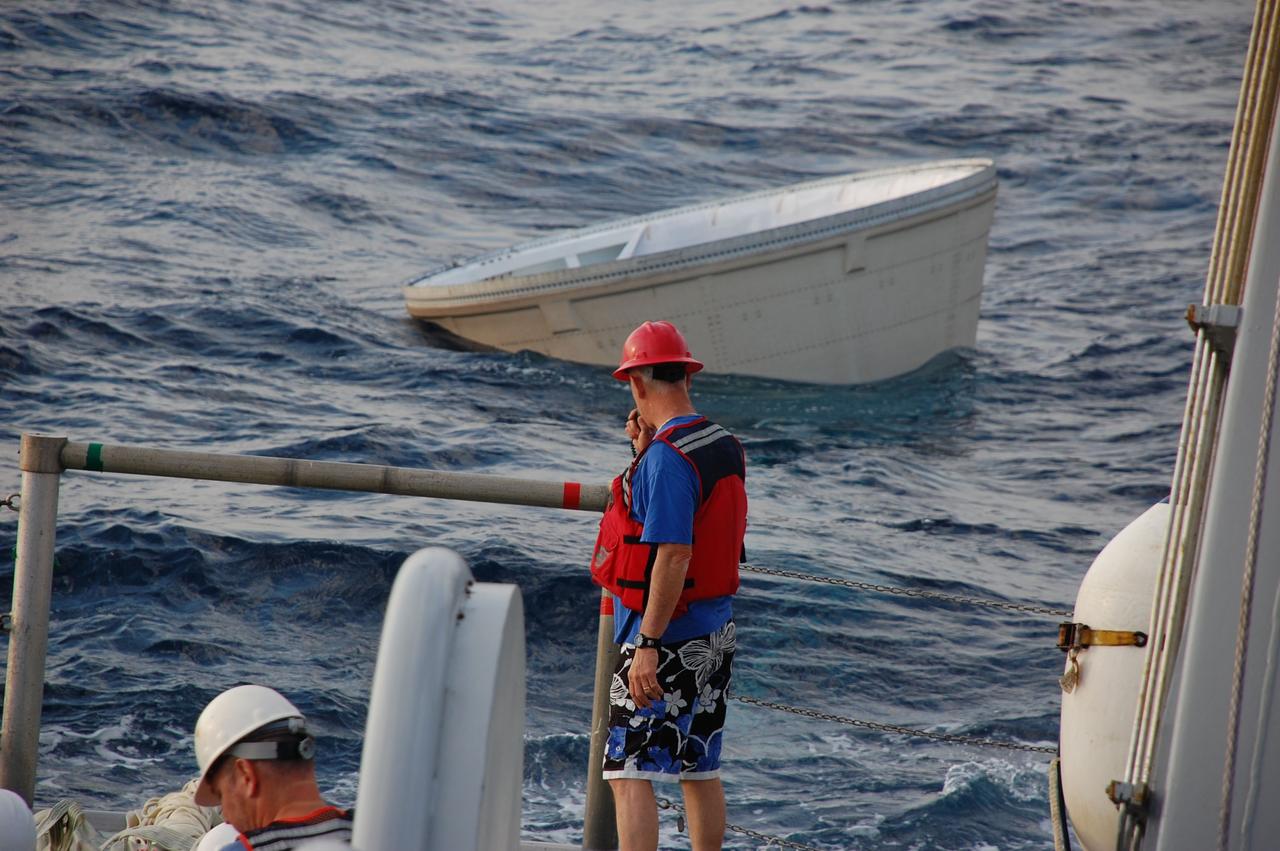
CAPE CANAVERAL, Fla. -- Crew members from Freedom Star, one of NASA's solid rocket booster retrieval ships, prepare to recover the left spent booster nose cap from the Atlantic Ocean after space shuttle Discovery's STS-133 launch. The shuttle’s two solid rocket booster casings and associated flight hardware are recovered in the Atlantic Ocean after every launch by Liberty Star and Freedom Star. The boosters impact the Atlantic about seven minutes after liftoff and the retrieval ships are stationed about 10 miles from the impact area at the time of splashdown. After the spent segments are processed, they will be transported to Utah, where they will be refurbished and stored, if needed. Photo credit: NASA/Ben Smegelsky
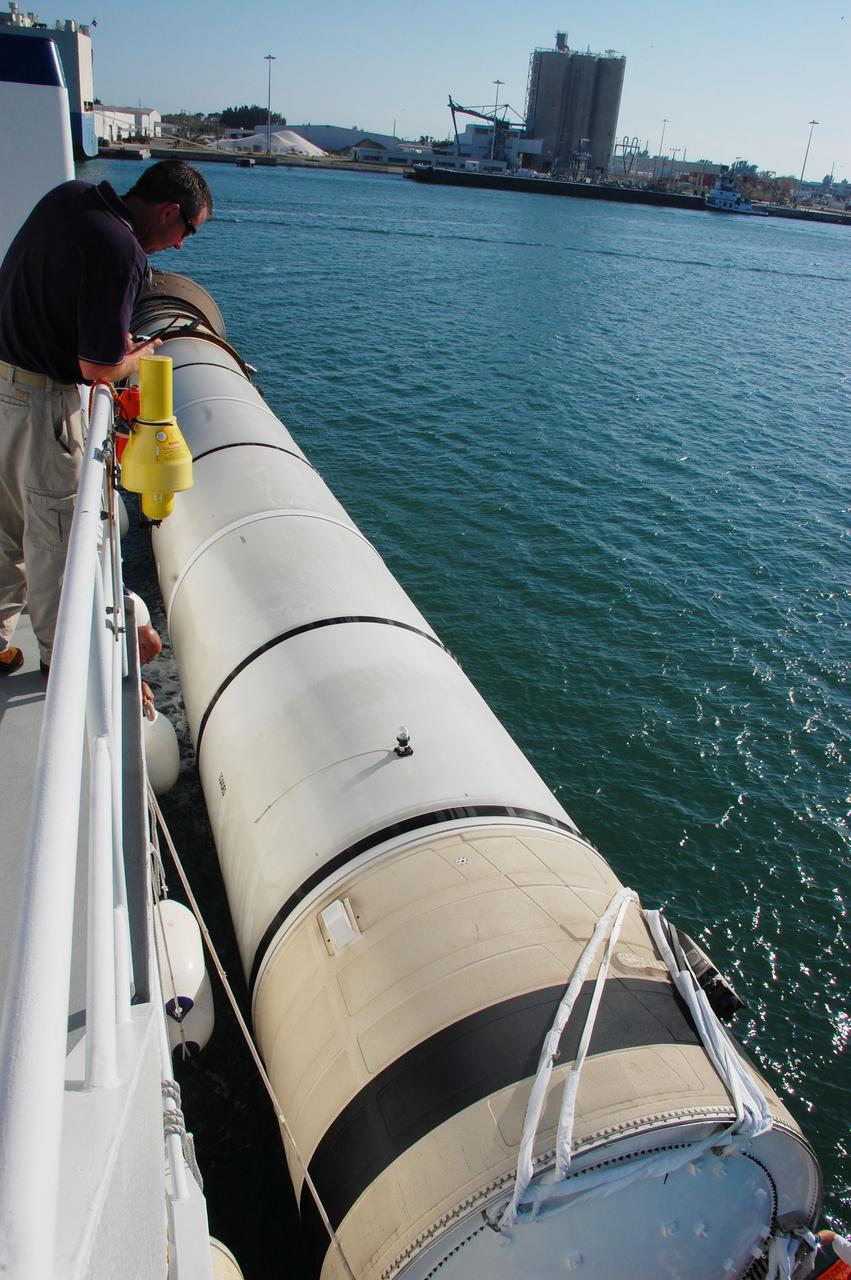
CAPE CANAVERAL, Fla. -- Jamie Harris Chief Mate for Freedom Star, one of NASA's solid rocket booster retrieval ships, checks the securing of the left spent booster from space shuttle Discovery's final launch, to the vessel, before continuing on the Hangar AF at Cape Canaveral Air Force Station. The shuttle’s two solid rocket booster casings and associated flight hardware are recovered in the Atlantic Ocean after every launch by Liberty Star and Freedom Star. The boosters impact the Atlantic about seven minutes after liftoff and the retrieval ships are stationed about 10 miles from the impact area at the time of splashdown. After the spent segments are processed, they will be transported to Utah, where they will be refurbished and stored, if needed. Photo credit: NASA/Ben Smegelsky
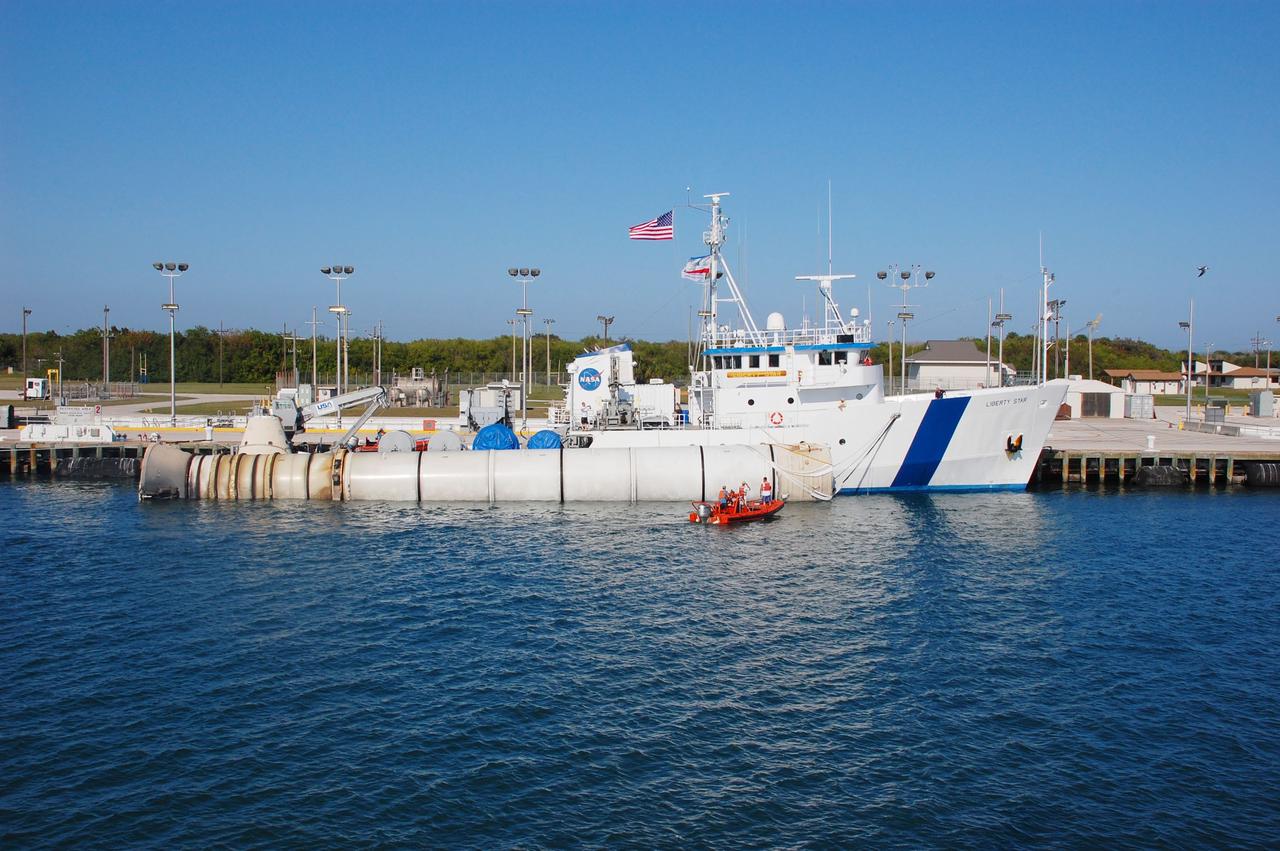
CAPE CANAVERAL, Fla. -- Freedom Star, one of NASA's solid rocket booster retrieval ships, is docked at Port Canaveral, Florida. The left spent booster from space shuttle Discovery's final launch is being positioned along side the vessel before continuing on to Hangar AF at Cape Canaveral Air Force Station. The shuttle’s two solid rocket booster casings and associated flight hardware are recovered in the Atlantic Ocean after every launch by Liberty Star and Freedom Star. The boosters impact the Atlantic about seven minutes after liftoff and the retrieval ships are stationed about 10 miles from the impact area at the time of splashdown. After the spent segments are processed, they will be transported to Utah, where they will be refurbished and stored, if needed. Photo credit: NASA/Ben Smegelsky
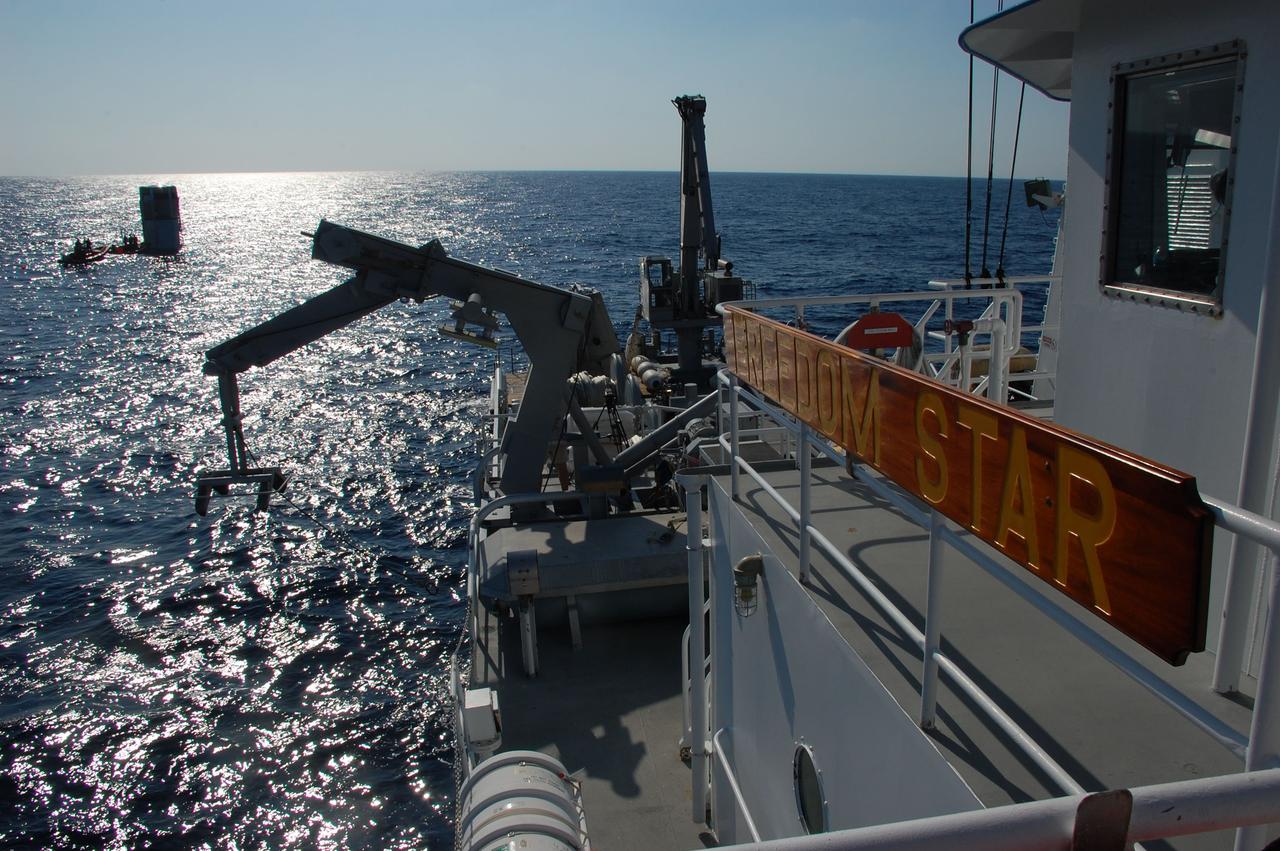
CAPE CANAVERAL, Fla. -- A crane is prepared to pluck the returning skiffs out of the water after crew members from Freedom Star, one of NASA's solid rocket booster retrieval ships, attached a hose between the left spent booster and the vessel that will facilitate debris and water clearing and the pumping in of air into the booster so it can float horizontally on the water's surface for towing back to Port Canaveral in Florida. The shuttle’s two solid rocket booster casings and associated flight hardware are recovered in the Atlantic Ocean after every launch by Liberty Star and Freedom Star. The boosters impact the Atlantic about seven minutes after liftoff and the retrieval ships are stationed about 10 miles from the impact area at the time of splashdown. After the spent segments are processed, they will be transported to Utah, where they will be refurbished and stored, if needed. Photo credit: NASA/Ben Smegelsky
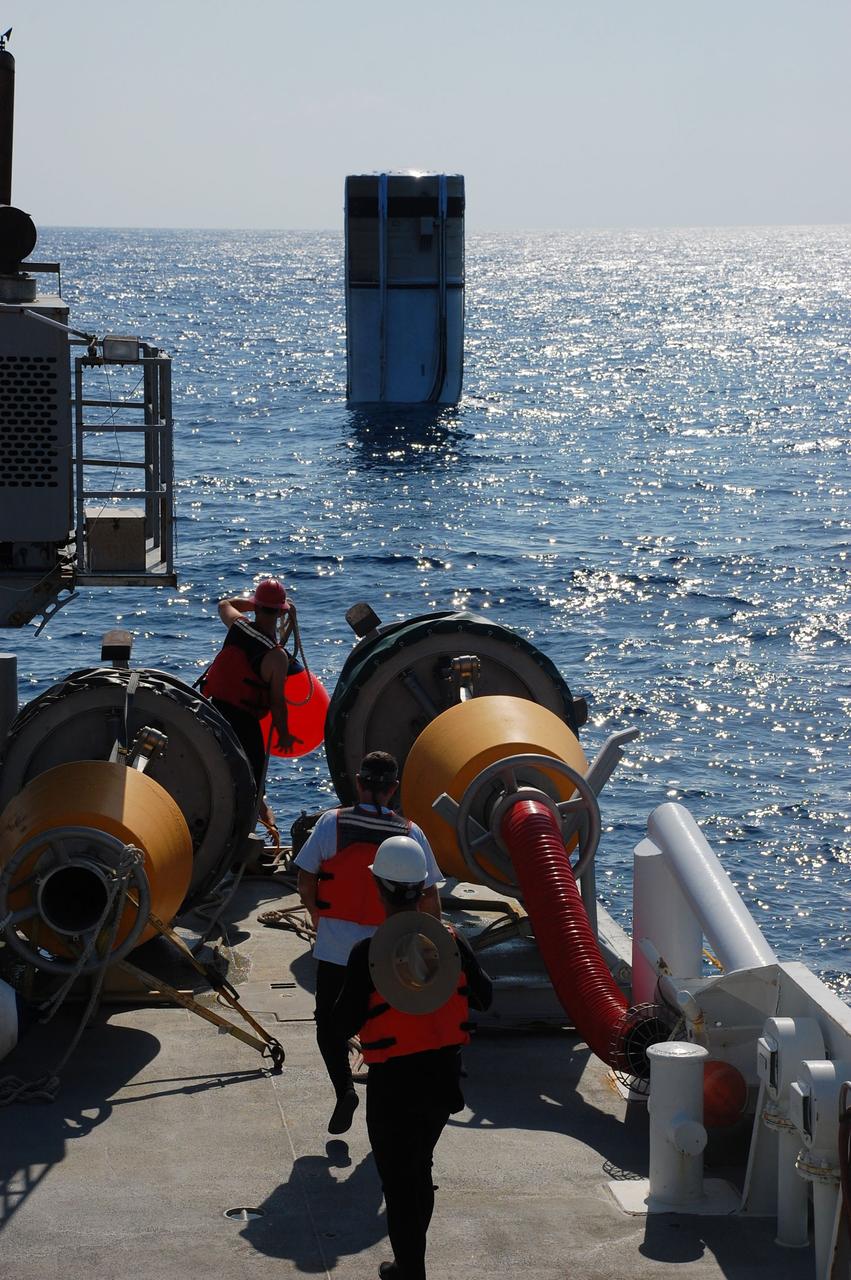
CAPE CANAVERAL, Fla. -- Freedom Star, one of NASA's solid rocket booster retrieval ships, and its crew are preparing to recover the left spent booster from the Atlantic Ocean. The round objects on deck are large pumping machines that will be attached to the booster by a hose that will blow out debris and water and then pump in air so the booster can float horizontally on the water's surface for towing back to Port Canaveral in Florida. The shuttle’s two solid rocket booster casings and associated flight hardware are recovered in the Atlantic Ocean after every launch by Liberty Star and Freedom Star. The boosters impact the Atlantic about seven minutes after liftoff and the retrieval ships are stationed about 10 miles from the impact area at the time of splashdown. After the spent segments are processed, they will be transported to Utah, where they will be refurbished and stored, if needed. Photo credit: NASA/Ben Smegelsky
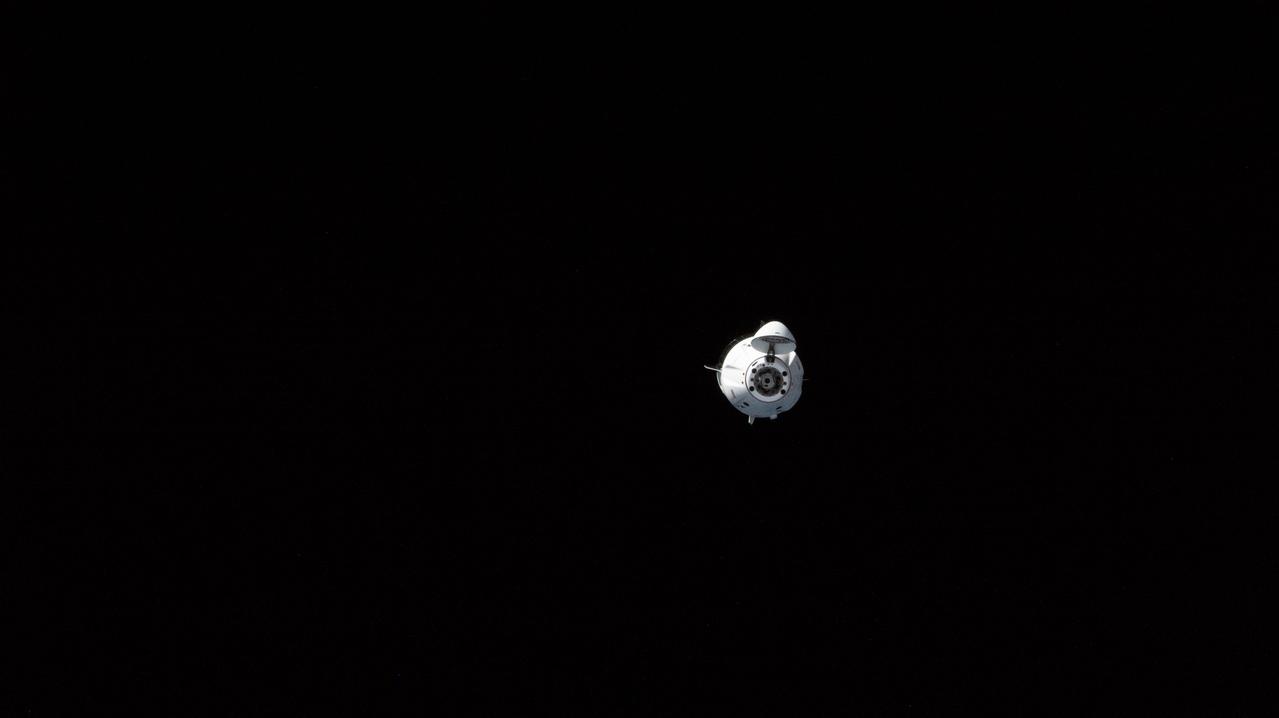
iss069e011319 (May 22, 2023) --- The SpaceX Freedom Dragon crew ship with four Axiom Mission-2 private astronauts aboard is pictured approaching the International Space Station. Freedom, commanded by former NASA astronaut Peggy Whitson, with Pilot John Shoffner and Mission Specialists Ala Alqarni and Rayyanah Barnawi, docked to the Harmony module's space-facing port at 9:12 a.m. EDT on Monday beginning eight days of docked operations with the seven-member Expedition 69 crew.
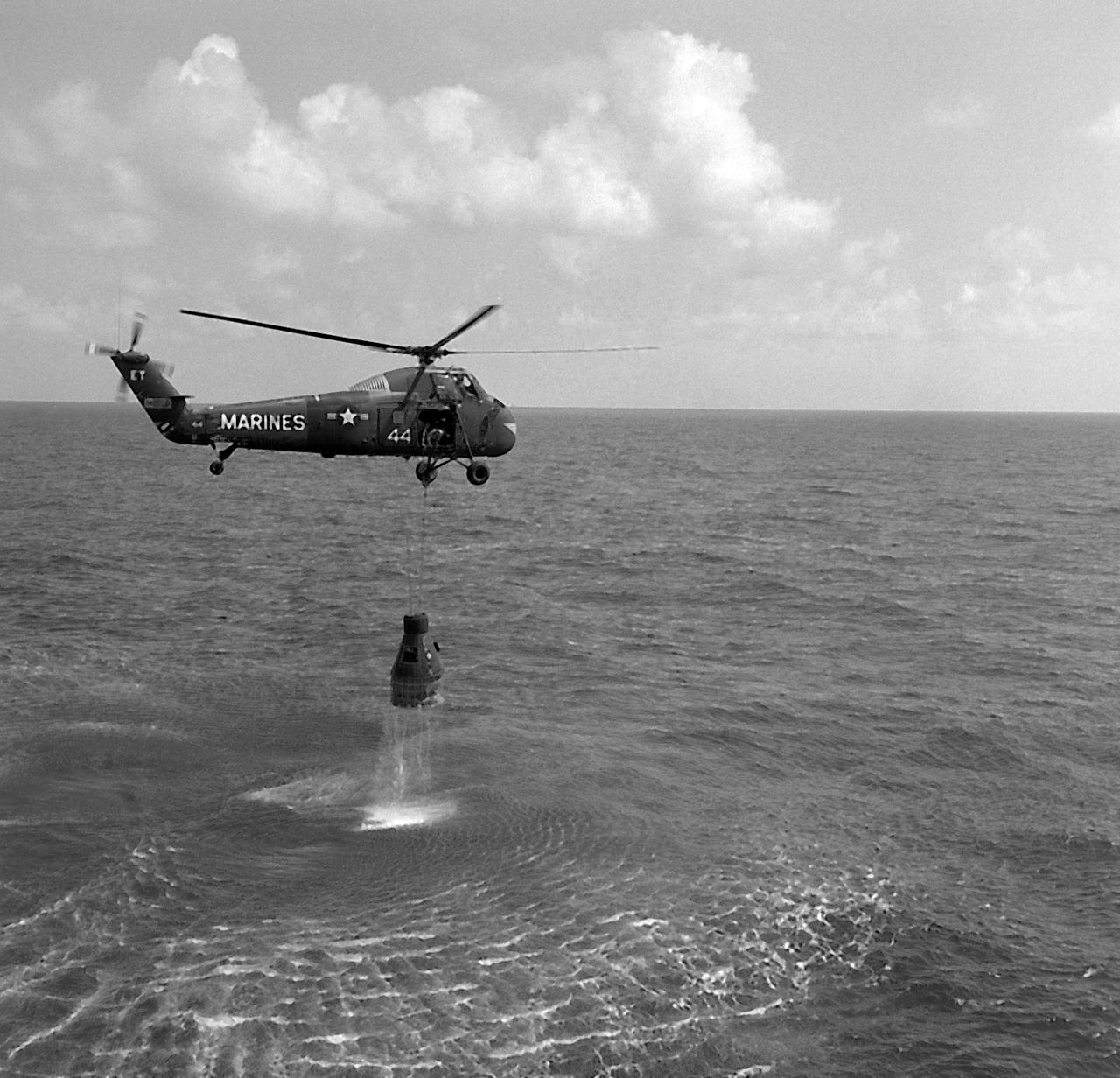
This photo depicts the recovery of the Freedom 7 (MR-3) capsule by a U.S. Marine helicopter. The MR-3 mission successfully placed the first American astronaut, Alan Shepard, in space for 15-1/2 minutes and returned safely to Earth on May 5, 1961.
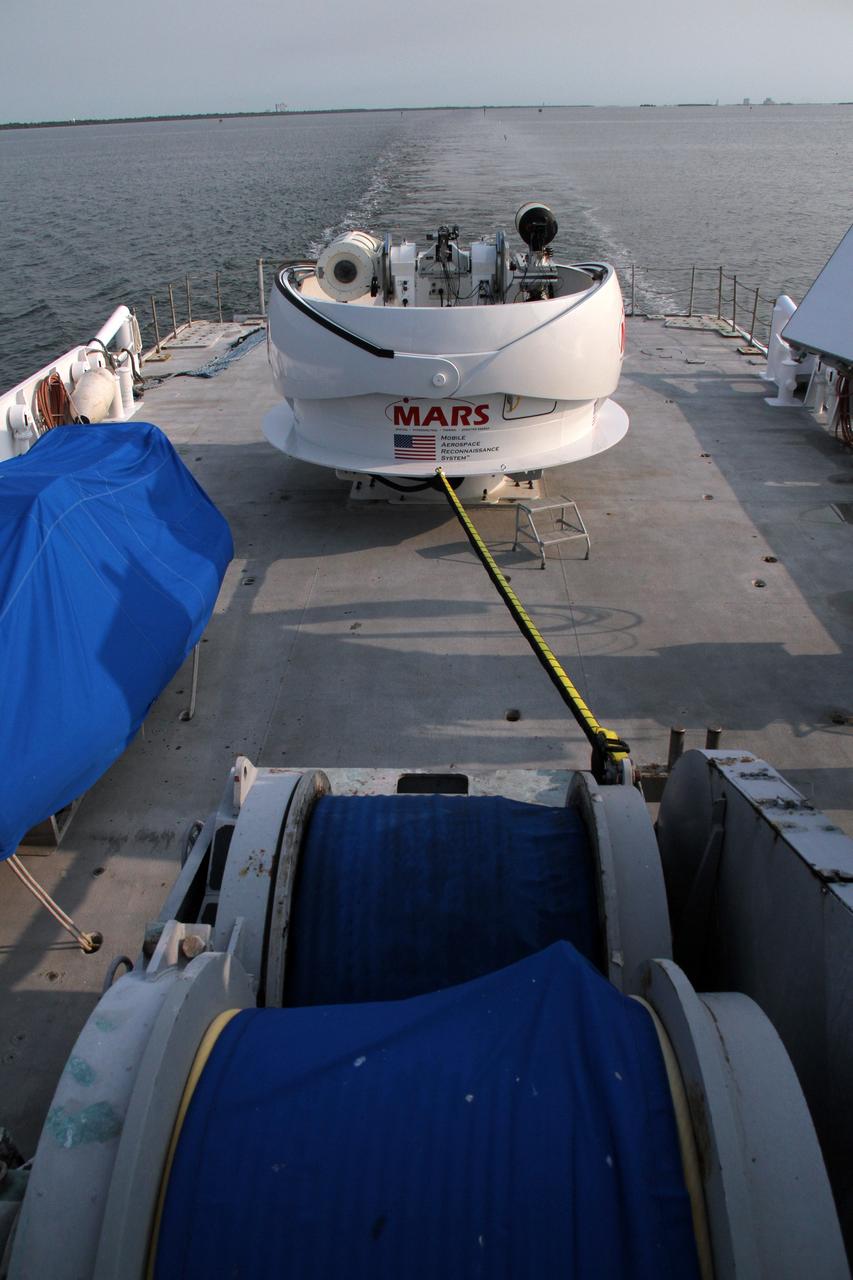
CAPE CANAVERAL, Fla. – NASA’s Freedom Star boat heads for the open waters of the Atlantic Ocean after departing from Port Canaveral in Florida. NASA’s Mobile Aerospace Reconnaissance System, or MARS, is secured aboard Freedom Star for a day of testing. MARS, run by NASA’s Langley Research Center in Hampton, Va., with its spatial, hyperspectral, thermal, and directed energy capabilities will be used for thermal imaging testing for the upcoming SpaceX Falcon 9 and Dragon capsule test flight to the International Space Station. During today’s test, the MARS X-band radar and kineto tracking mount KTM were tested to ensure that they were synchronized to receive a rocket launch feed. The radar was used to identify an object to see if the KTM could lock on to and track it. The MARS team performed maintenance on the system, confirmed communications links, and tested the design of the mounting system and environmental enclosure. Photo credit: NASA/Cory Huston
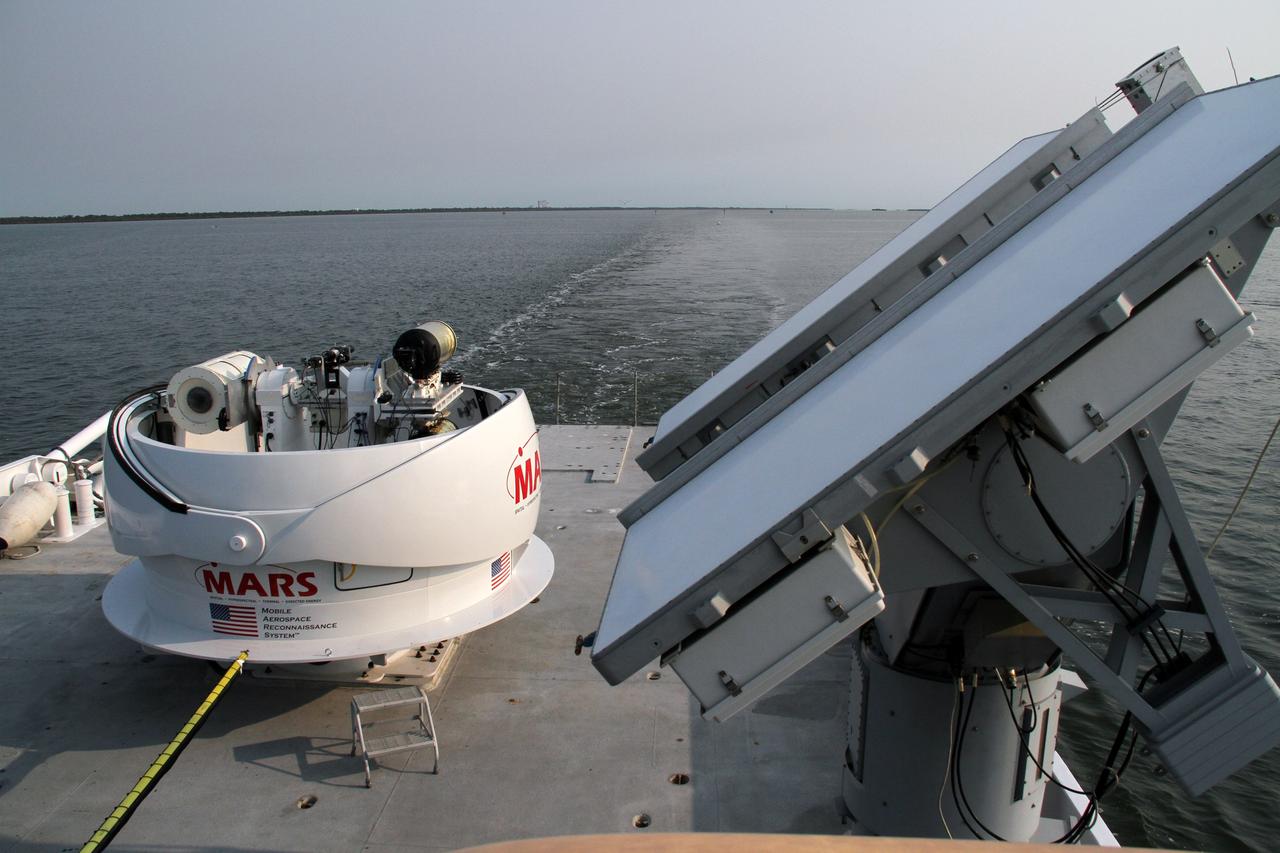
CAPE CANAVERAL, Fla. – NASA’s Freedom Star boat heads for the open waters of the Atlantic Ocean after departing from Port Canaveral in Florida. NASA’s Mobile Aerospace Reconnaissance System, or MARS, is secured aboard Freedom Star for a day of testing. MARS, run by NASA’s Langley Research Center in Hampton, Va., with its spatial, hyperspectral, thermal, and directed energy capabilities will be used for thermal imaging testing for the upcoming SpaceX Falcon 9 and Dragon capsule test flight to the International Space Station. During today’s test, the MARS X-band radar and kineto tracking mount KTM were tested to ensure that they were synchronized to receive a rocket launch feed. The radar was used to identify an object to see if the KTM could lock on to and track it. The MARS team performed maintenance on the system, confirmed communications links, and tested the design of the mounting system and environmental enclosure. Photo credit: NASA/Cory Huston
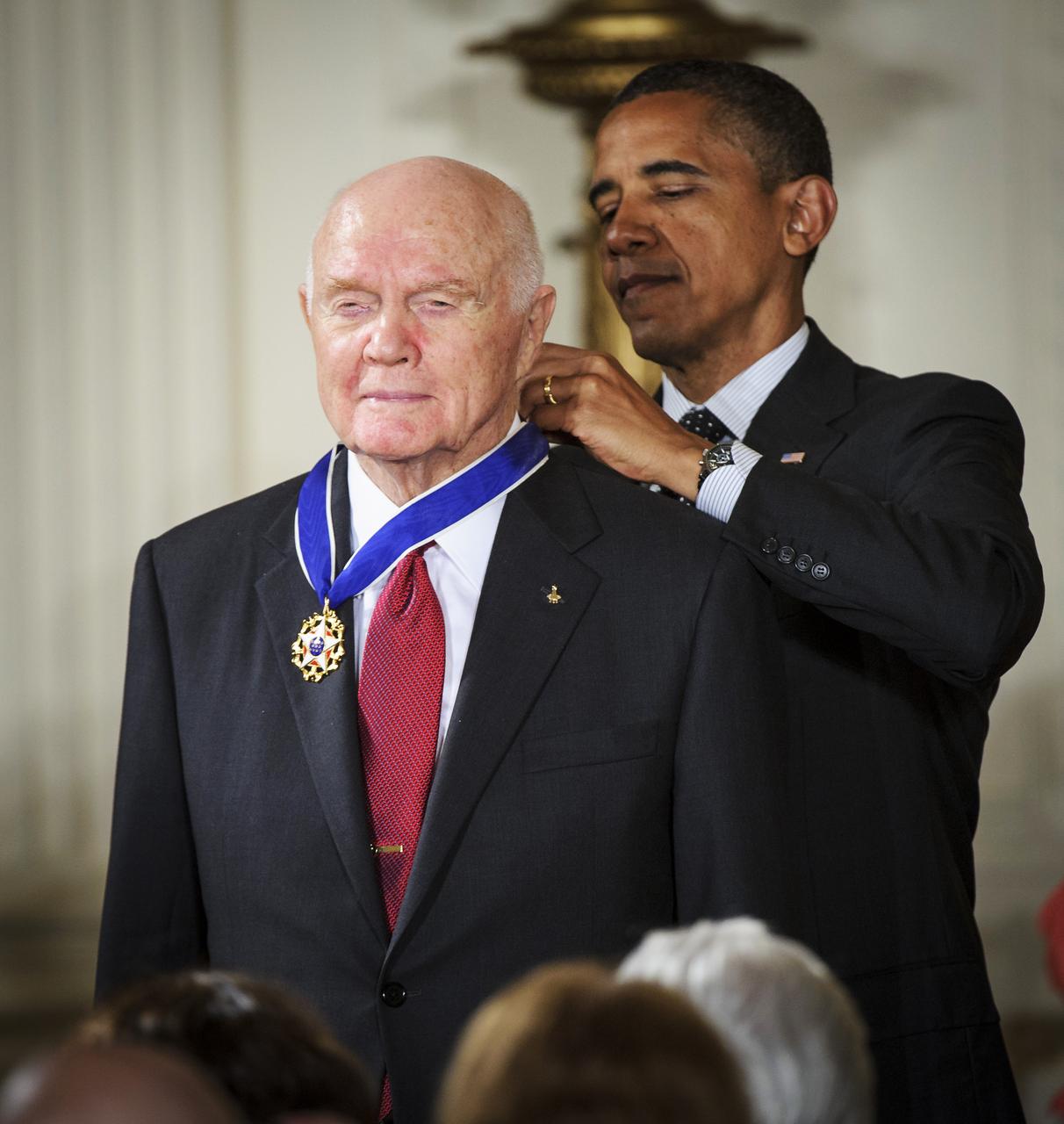
President Barack Obama presents former United States Marine Corps pilot, astronaut and United States Senator John Glenn with a Medal of Freedom, Tuesday, May 29, 2012, during a ceremony at the White House in Washington.
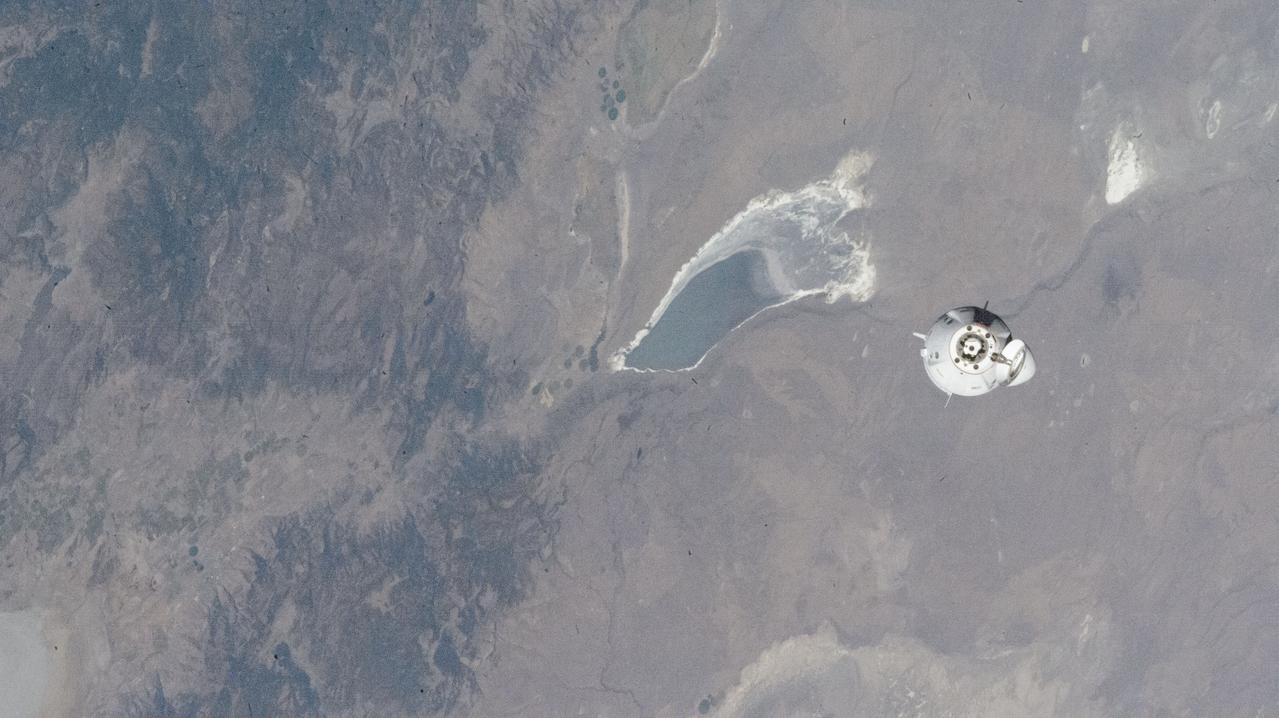
iss072e004107 (Sept. 29, 2024) --- The SpaceX Dragon Freedom spacecraft carrying NASA astronaut Nick Hague and Roscosmos cosmonaut Aleksandr Gorbunov approaches the International Space Station 258 miles above Lake Abert in Oregon.
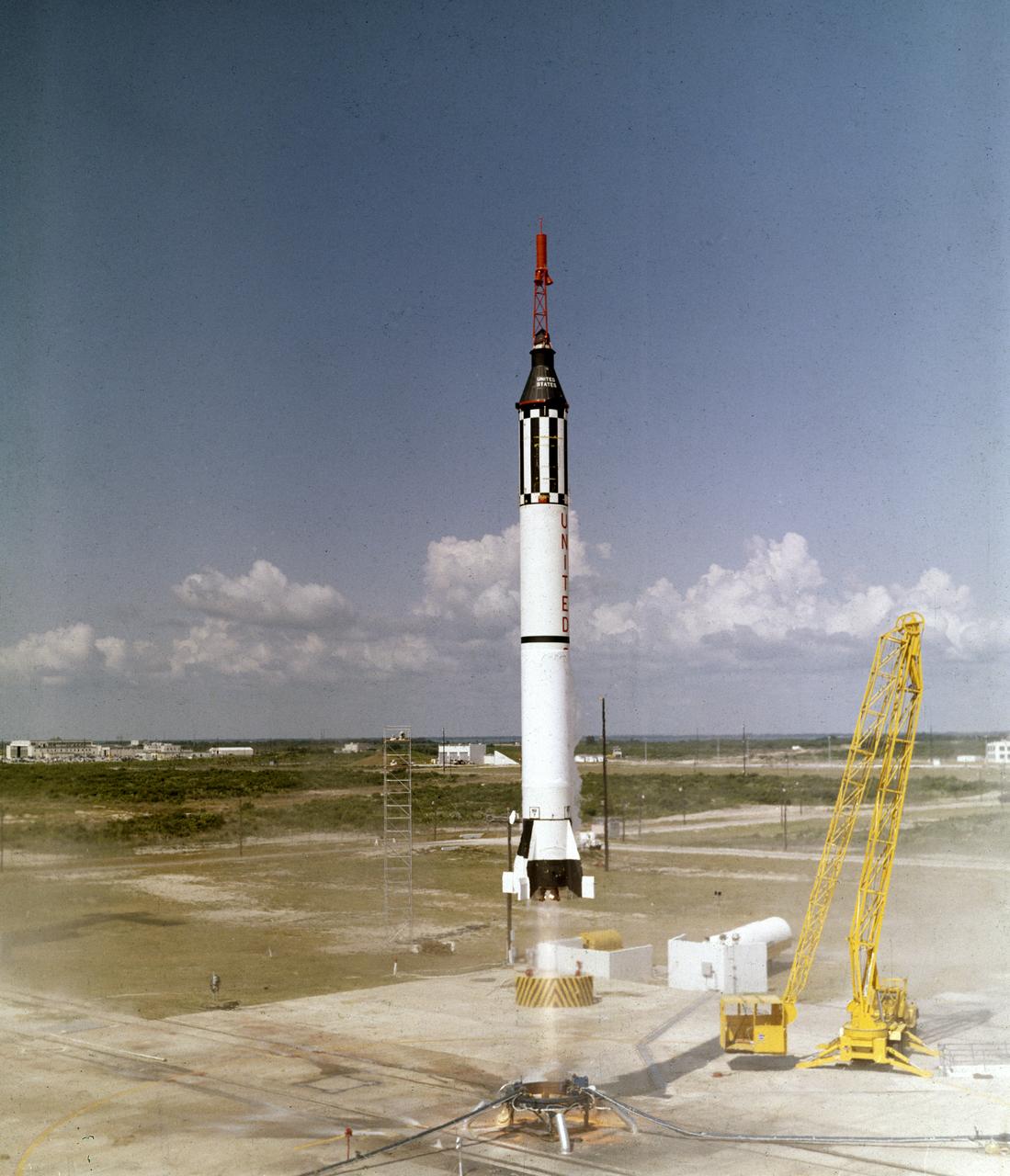
Astronaut Alan B. Shepard, Jr. lifts off in the Freedom 7 Mercury spacecraft on May 5, 1961. This third flight of the Mercury-Redstone (MR-3) vehicle, developed by Dr. Wernher von Braun and the rocket team in Huntsille, Alabama, was the first marned space mission for the United States. During the 15-minute suborbital flight, Shepard reached an altitude of 115 miles and traveled 302 miles downrange.
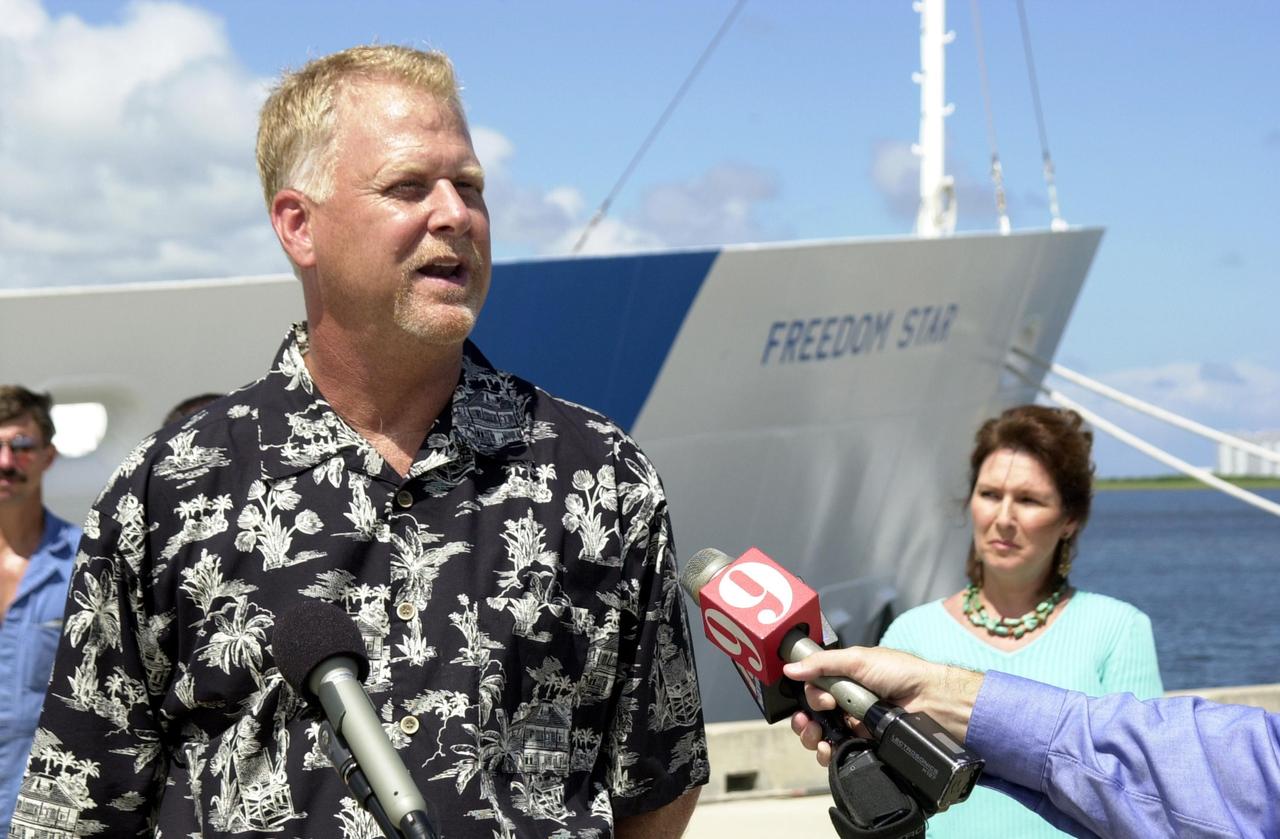
KENNEDY SPACE CENTER, FLA. - KENNEDY SPACE CENTER, FLA. - Jack Wilcox answers questions from the media during a reunion at the Hangar AF docks, Cape Canaveral Air Force Station, with his rescuers. At right is his wife, Patty. Wilcox reunited with the men aboard KSC's Freedom Star SRB retrieval ship that was in the vicinity when Wilcox suffered decompression sickness on a diving expedition 20 miles off shore in the Atlantic Ocean. When the Freedom Star team heard the call for help, they asked the Coast Guard if they could assist. The ship was out on a crane certification exercise and coincidentally had a diver medical technician and other divers training on the crane. The ship's divers were trained for the hyperbaric chamber on board. Upon reaching the Army dock, KSC Occupational Health physician Skip Beeler entered the chamber and continued the process of helping to stabilize Wilcox. After several hours in the chamber, Wilcox, who lives in Orlando, was airlifted to Florida Hospital Orlando.
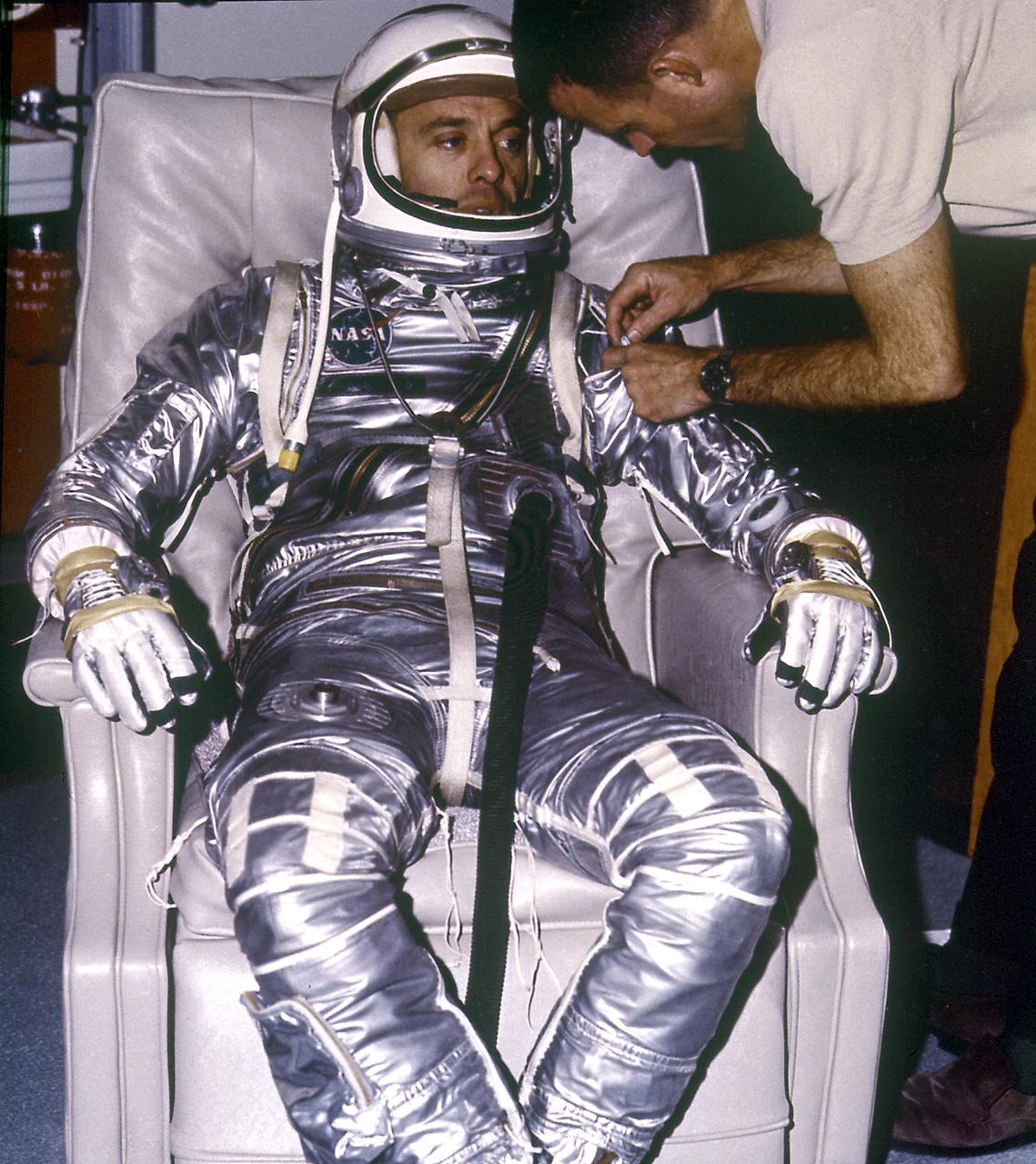
Astronaut Alan B. Shepard, Jr. during suiting for the first manned suborbital flight, MR-3 mission. The Freedom 7 spacecraft, carrying the first American, Astronaut Shepard and boosted by the Mercury-Redstone launch vehicle, lifted off on May 5, 1961.
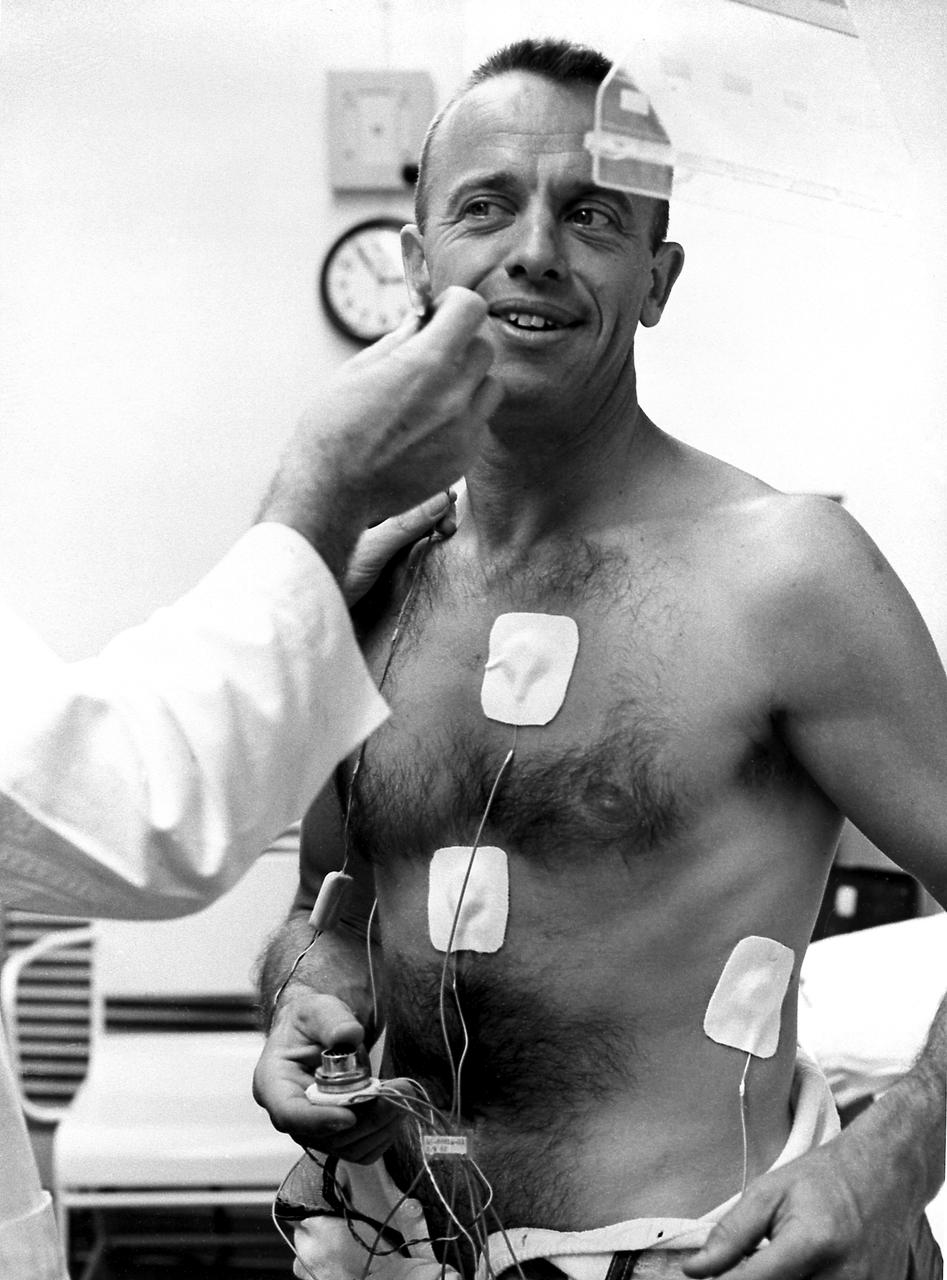
Astronaut Alan Shepard underwent a physical examination prior to the first marned suborbital flight. Freedom 7 carrying Astronaut Alan Shepard, boosted by the Mercury-Redstone launch vehicle, lifted off on May 5, 1961. Astronaut Shepard became the first American in space.
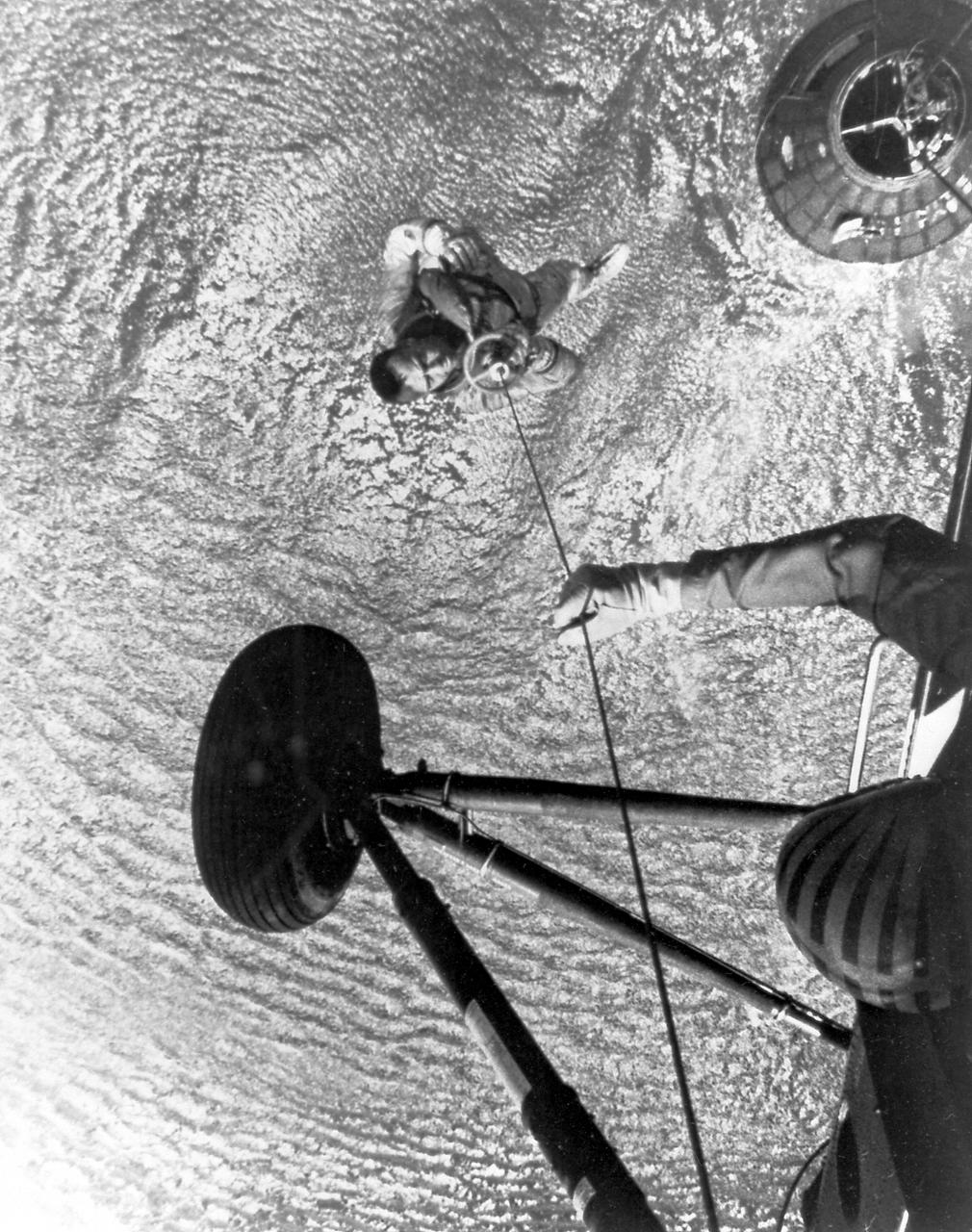
This photo depicts the recovery operations of the MR-3 mission. Astronaut Alan Shepard was picked up by a U.S. Marine helicopter after the completion of the first marned suborbital flight by MR-3 (Mercury-Redstone) with the Freedom 7 capsule.
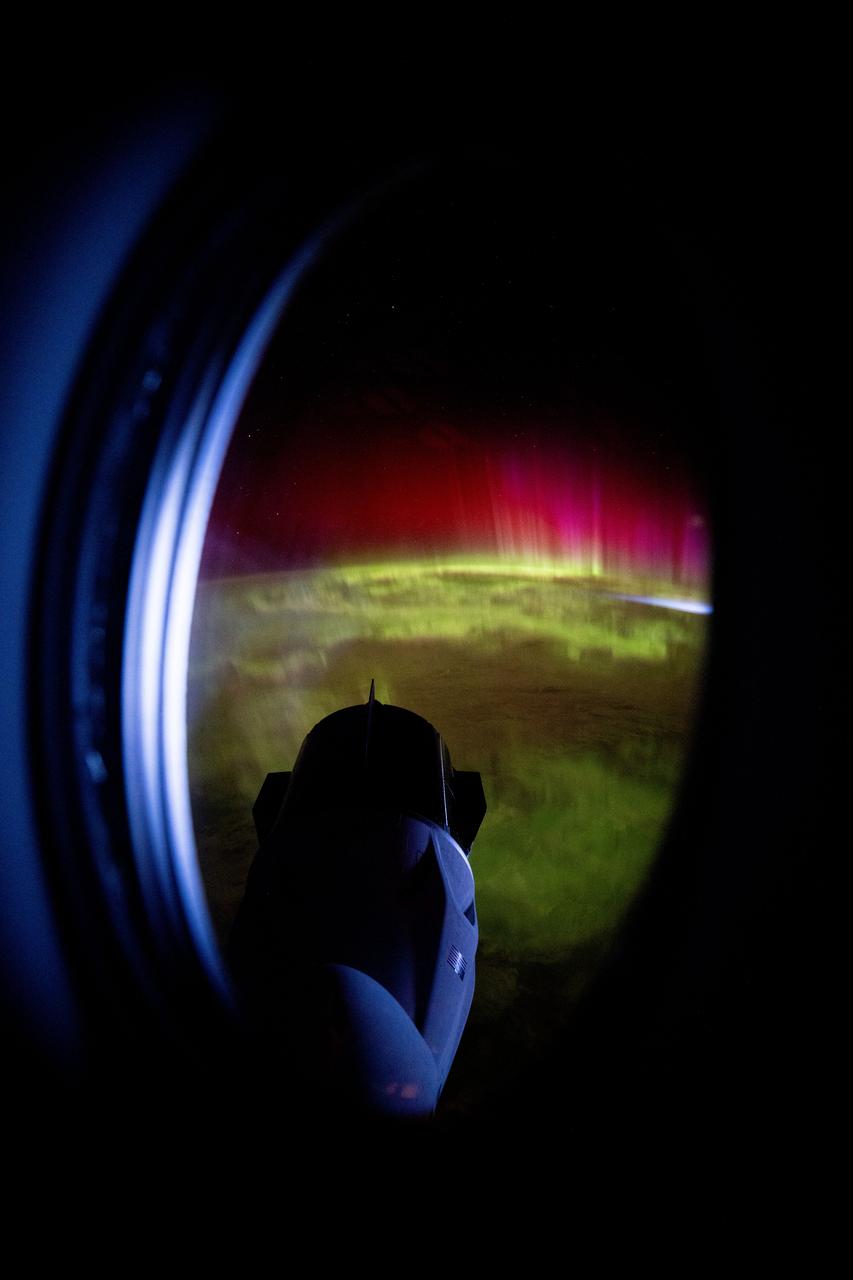
iss072e031823 (Oct. 7, 2024) -- Peering through the window of the SpaceX Dragon Endeavour spacecraft, NASA astronaut Matthew Dominick captured this image of the SpaceX Dragon Freedom spacecraft as vivid green and pink aurora swirled through Earth's atmosphere while the International Space Station soared 273 miles above the Indian Ocean.
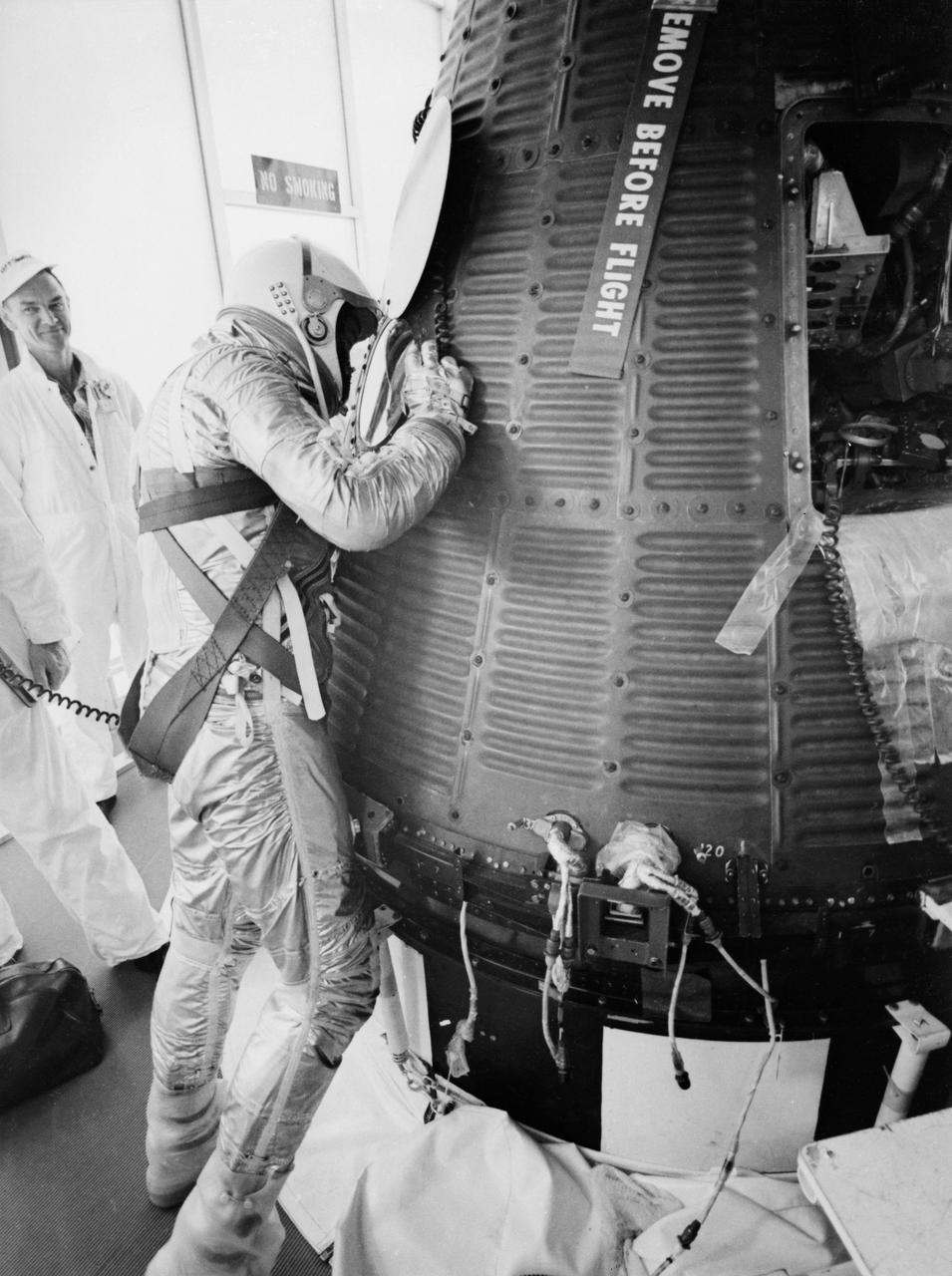
S61-02547 (5 May 1961) --- Astronaut Alan B. Shepard Jr., in his pressure suit and helmet, looks into the Freedom 7 capsule in preparation for ingress before the Mercury-Redstone 3 (MR-3) mission. Photo credit: NASA or National Aeronautics and Space Administration
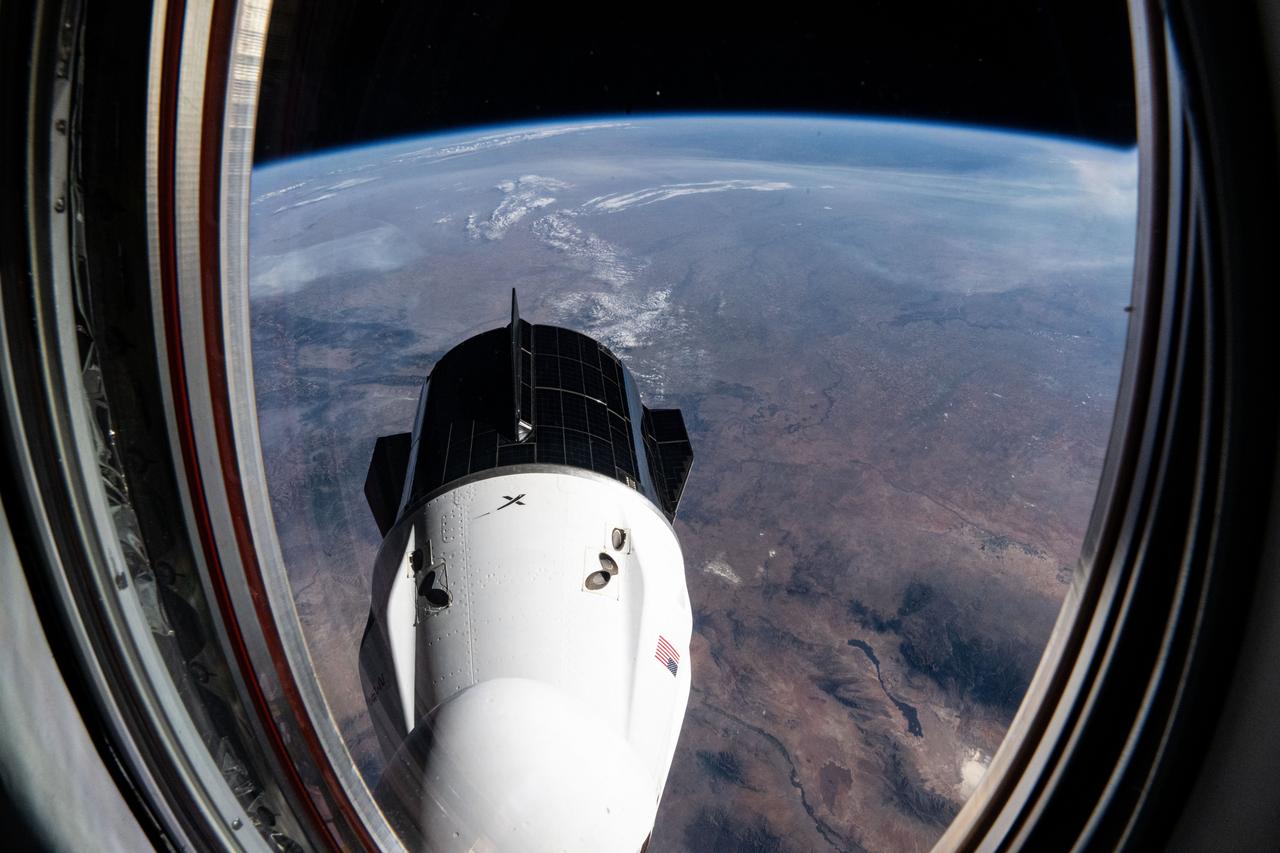
iss072e031305 (Oct. 7, 2024) --- The SpaceX Dragon Freedom spacecraft is pictured from a window on the Dragon Endeavour spacecraft in a photograph taken by NASA astronaut and Expedition 72 Flght Engineer Nick Hague. 258 miles below the International Space Station is the Sunflower State of Kansas.
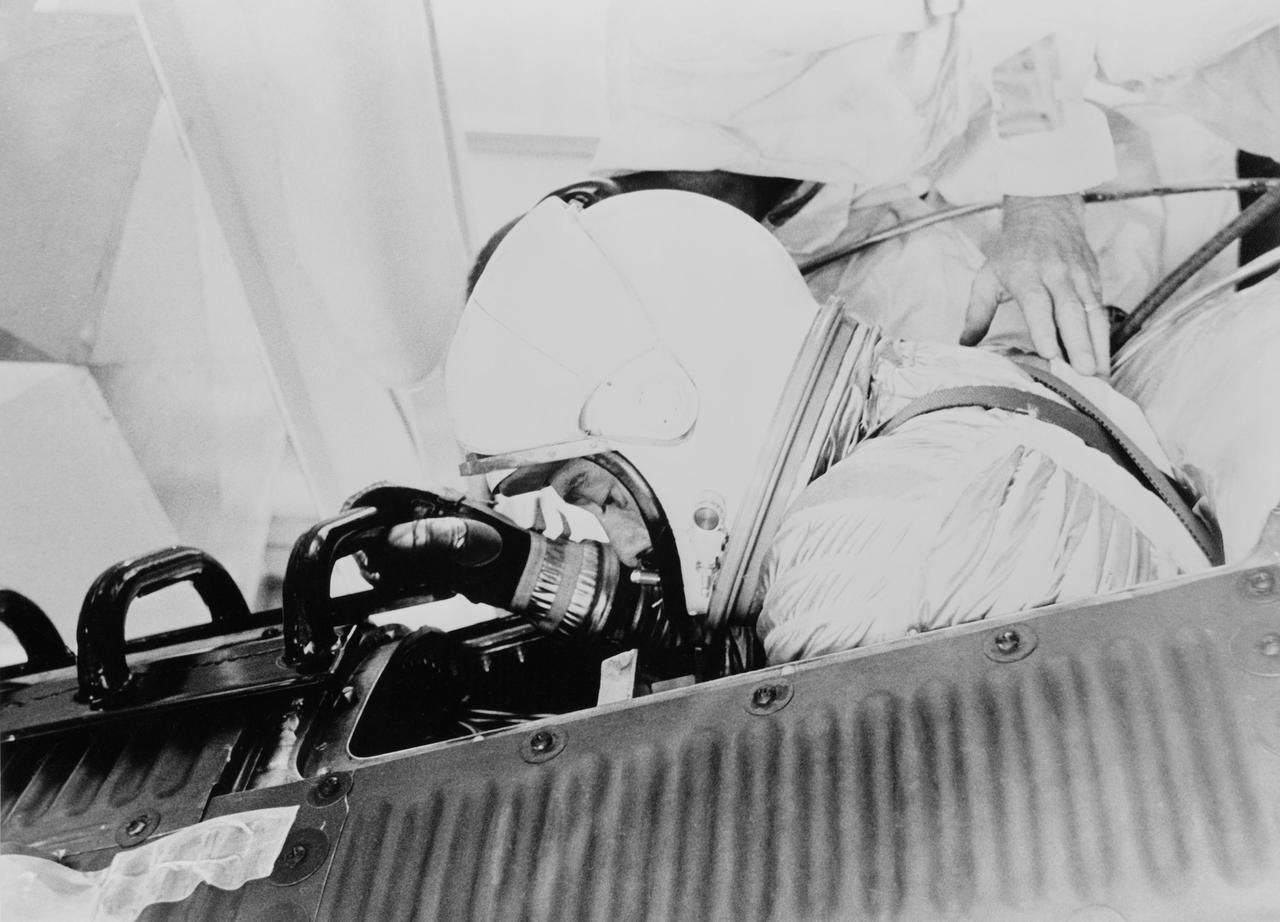
S61-03645 (5 May 1961) --- Close-up of astronaut Alan B. Shepard Jr., in his pressure suit and helmet, ingressing into the Freedom 7 capsule in preparation for the Mercury-Redstone 3 (MR-3) mission. Photo credit: NASA or National Aeronautics and Space Administration

NASA's Kennedy Space Center in Florida observes U.S. Constitution Day, the official birthday of our U.S. government, with the theme "Freedom Needs Space." A remembrance poster made appearances in various locations around the multi-user spaceport, including at the new Headquarters Campus Building. Constitution Day is an American federal observance. It recognizes the adoption of the U.S. Constitution and those who have become U.S. citizens. Constitution Day is observed on Sept. 17, the day in 1787 that delegates to the Constitutional Convention signed the document in Philadelphia.