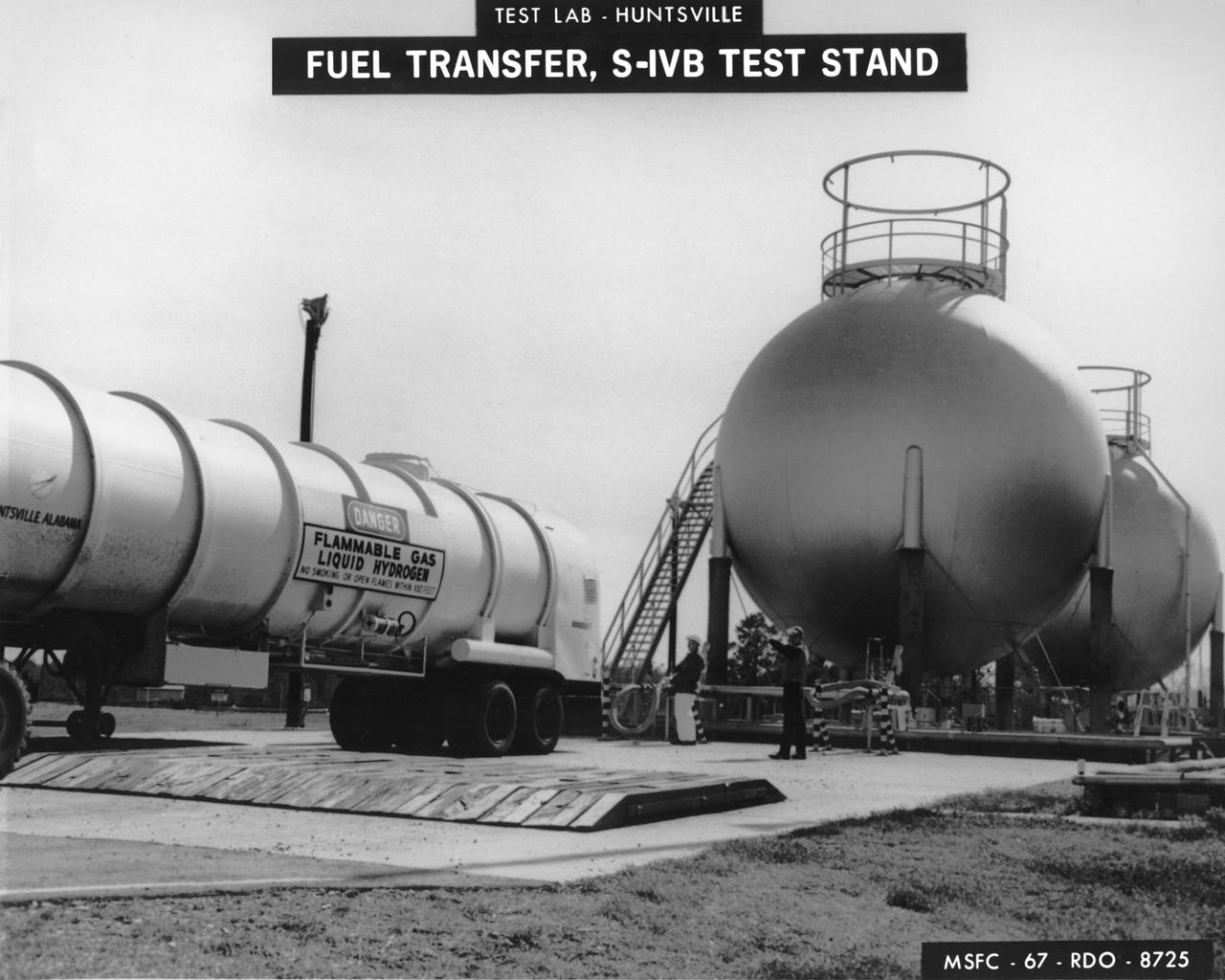
Marshall Space Flight Center (MSFC) workers fill fuel tanks with liquid hydrogen used for test firing at the S-IVB (Dynamic) Test Stand.
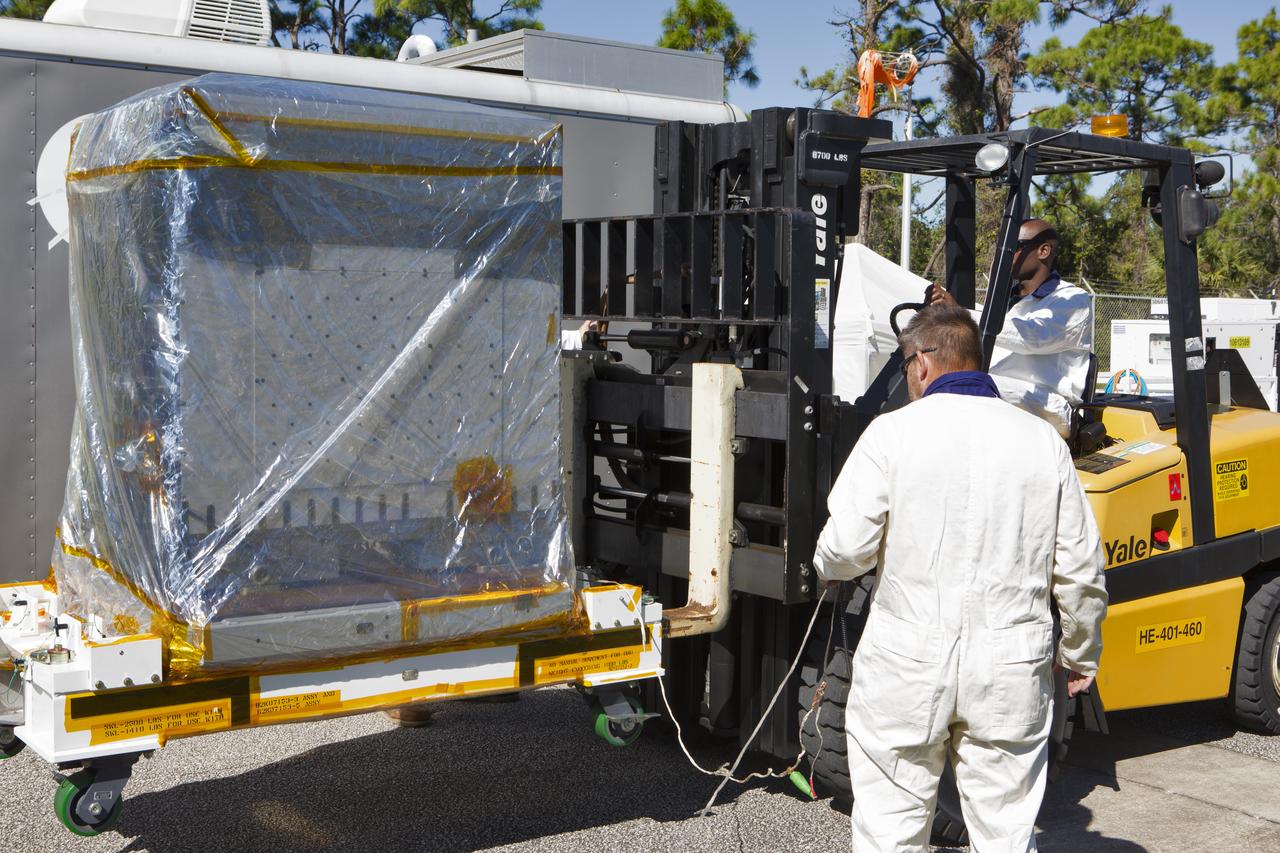
Workers prepare the Robotic Refueling Mission-3 (RRM3) payload for transport from the Fuel Transfer Building to the SpaceX facility on Oct. 30, 2018, at NASA's Kennedy Space Center in Florida. The payload will be carried to the International Space Station on SpaceX's 16th Commercial Resupply Services mission. RRM3 demonstrates the transfer of xenon gas and liquid methane in microgravity, and advances technologies for storing and manipulating these cryogenic fuels robotically. RRM3 also supports development of technology for the Restore-L mission, a robotic spacecraft equipped to service satellites in-orbit.
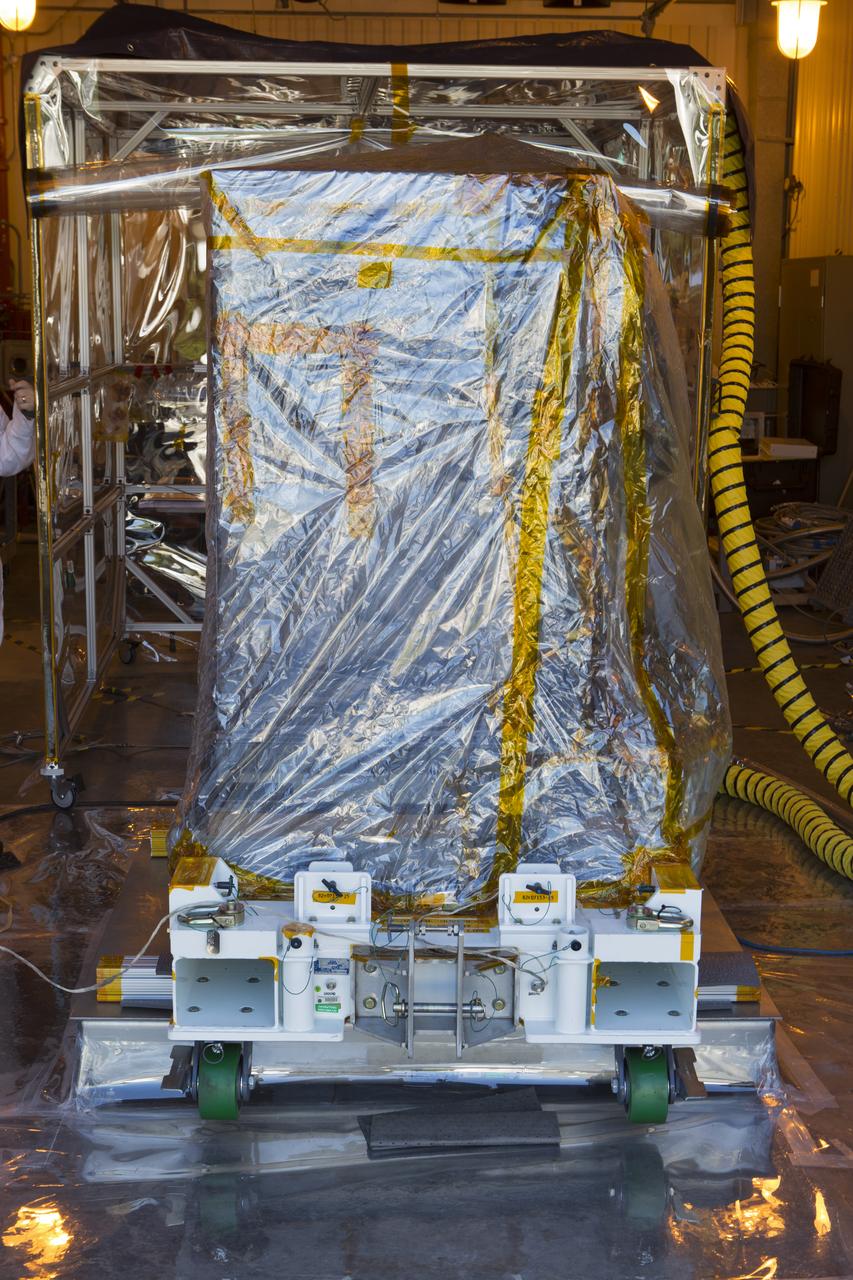
The Robotic Refueling Mission-3 (RRM3) payload is being prepared to be moved from the Fuel Transfer Building to the SpaceX facility on Oct. 30, 2018, at NASA's Kennedy Space Center in Florida. The payload will be carried to the International Space Station on SpaceX's 16th Commercial Resupply Services mission. RRM3 demonstrates the transfer of xenon gas and liquid methane in microgravity, and advances technologies for storing and manipulating these cryogenic fuels robotically. RRM3 also supports development of technology for the Restore-L mission, a robotic spacecraft equipped to service satellites in-orbit.
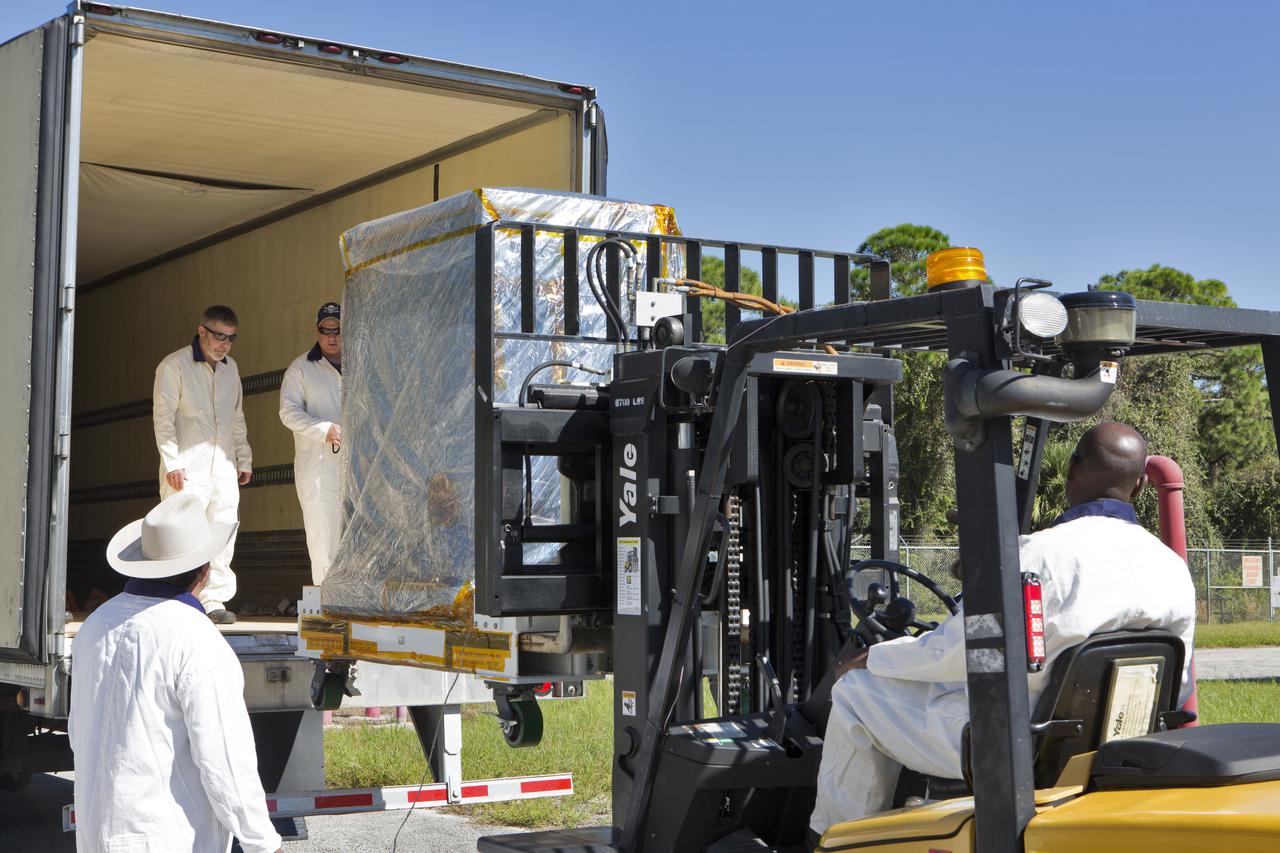
A forklift is used to load the Robotic Refueling Mission-3 (RRM3) payload onto a truck at the Fuel Transfer Building for transport to the SpaceX facility on Oct. 30, 2018, at NASA's Kennedy Space Center in Florida. The payload will be carried to the International Space Station on SpaceX's 16th Commercial Resupply Services mission. RRM3 demonstrates the transfer of xenon gas and liquid methane in microgravity, and advances technologies for storing and manipulating these cryogenic fuels robotically. RRM3 also supports development of technology for the Restore-L mission, a robotic spacecraft equipped to service satellites in-orbit.
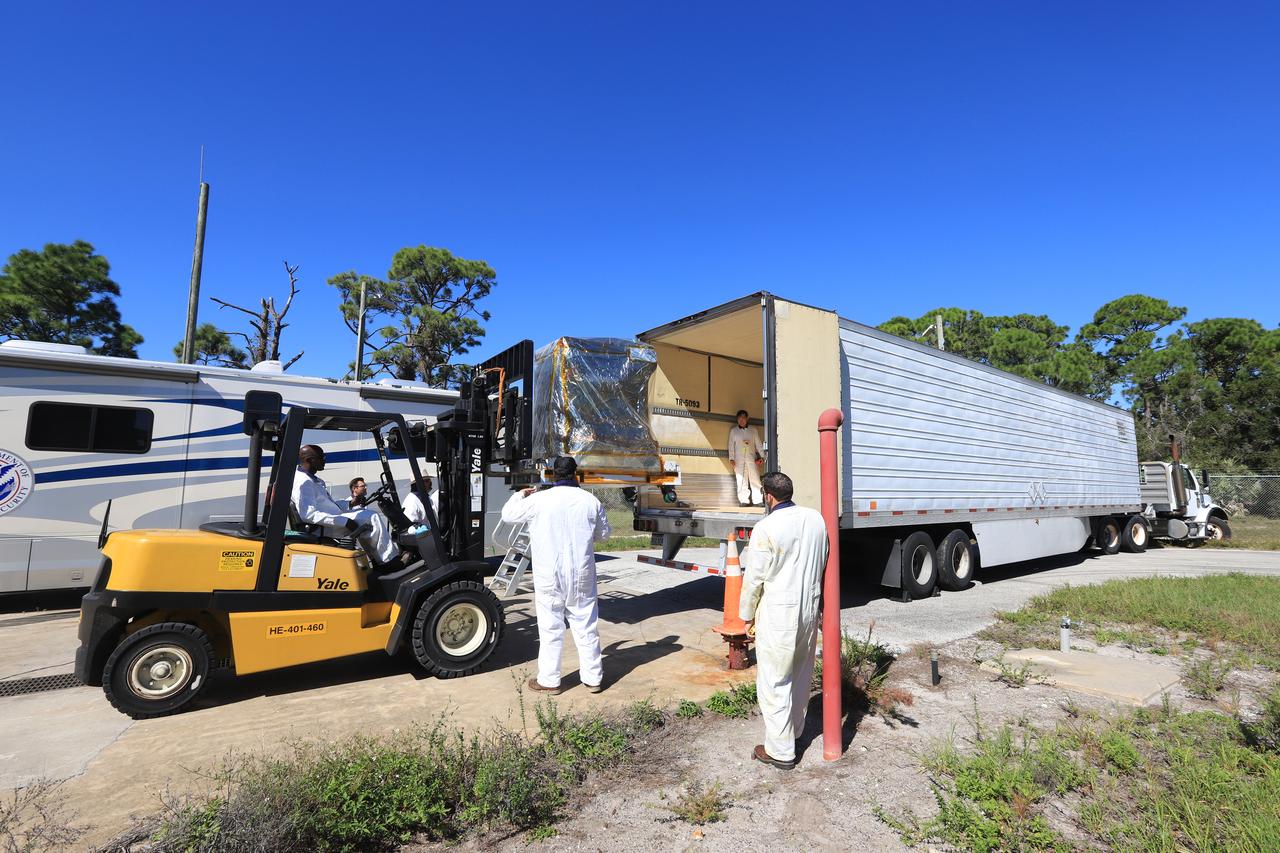
A forklift is used to load the Robotic Refueling Mission-3 (RRM3) payload onto a truck at the Fuel Transfer Building for transport to the SpaceX facility on Oct. 30, 2018, at NASA's Kennedy Space Center in Florida. The payload will be carried to the International Space Station on SpaceX's 16th Commercial Resupply Services mission. RRM3 demonstrates the transfer of xenon gas and liquid methane in microgravity, and advances technologies for storing and manipulating these cryogenic fuels robotically. RRM3 also supports development of technology for the Restore-L mission, a robotic spacecraft equipped to service satellites in-orbit.
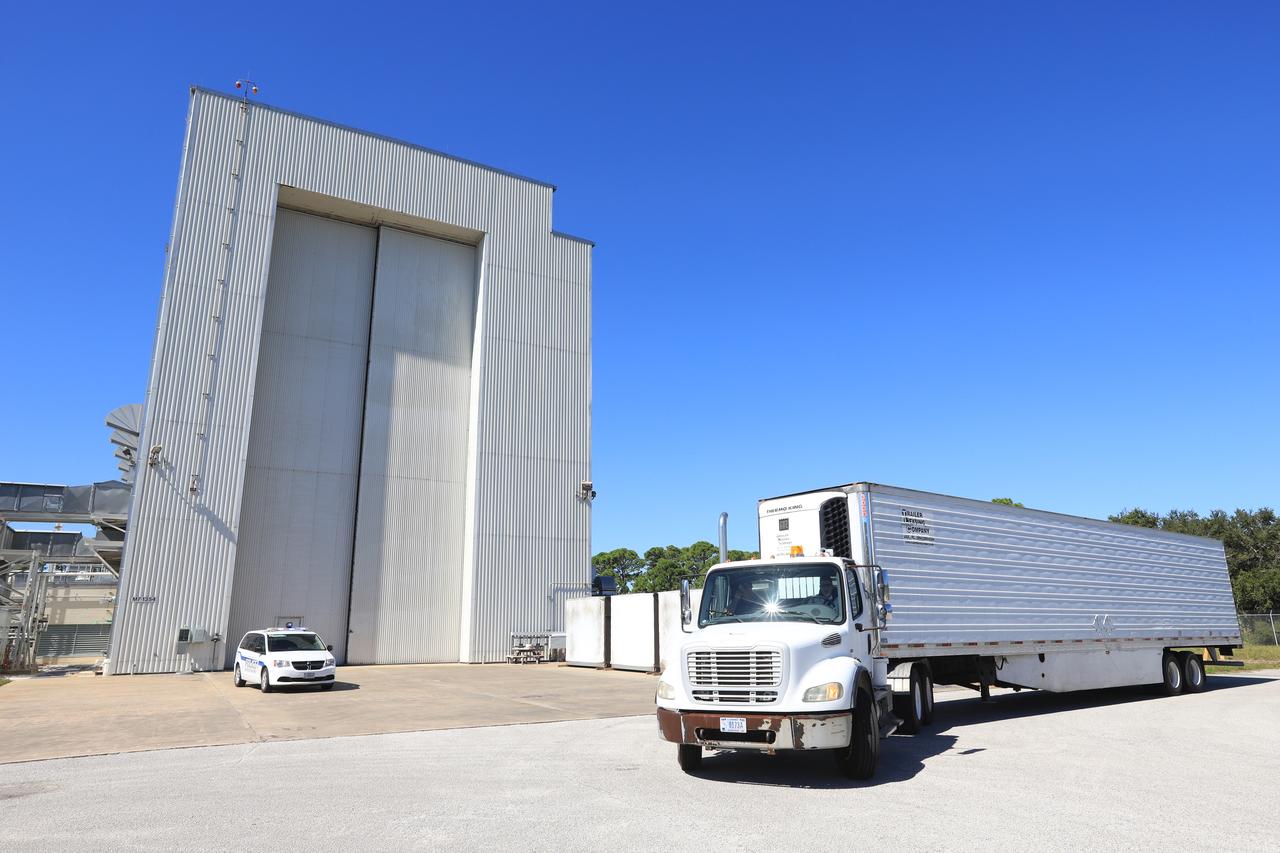
A truck containing the Robotic Refueling Mission-3 (RRM3) payload departs the Fuel Transfer Building near the Payload Hazardous Servicing Facility for transport to the SpaceX facility on Oct. 30, 2018, at NASA's Kennedy Space Center in Florida. The payload will be carried to the International Space Station on SpaceX's 16th Commercial Resupply Services mission. RRM3 demonstrates the transfer of xenon gas and liquid methane in microgravity, and advances technologies for storing and manipulating these cryogenic fuels robotically. RRM3 also supports development of technology for the Restore-L mission, a robotic spacecraft equipped to service satellites in-orbit.
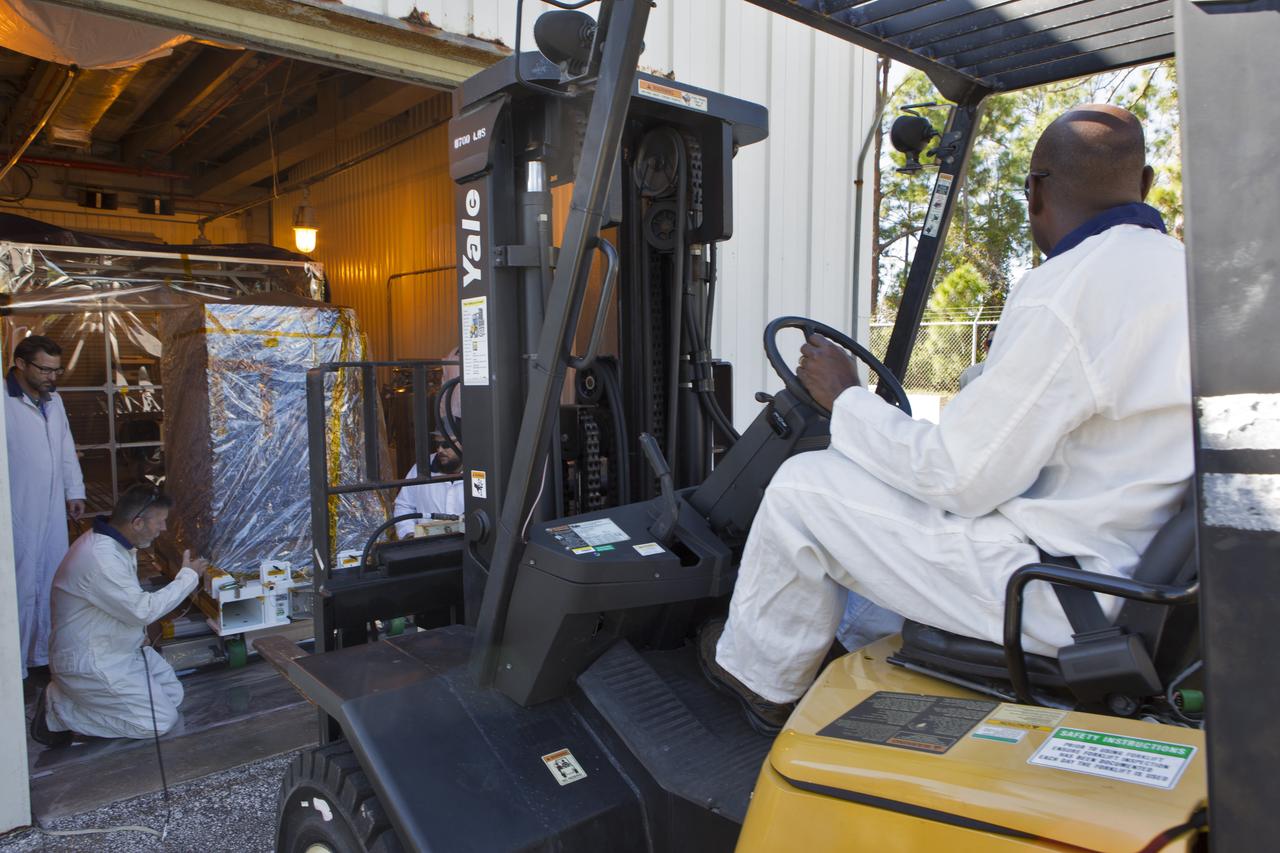
A forklift is being used to lift the Robotic Refueling Mission-3 (RRM3) payload out of the Fuel Transfer Building on Oct. 30, 2018, to be transported to the SpaceX facility at NASA's Kennedy Space Center in Florida. The payload will be carried to the International Space Station on SpaceX's 16th Commercial Resupply Services mission. RRM3 demonstrates the transfer of xenon gas and liquid methane in microgravity, and advances technologies for storing and manipulating these cryogenic fuels robotically. RRM3 also supports development of technology for the Restore-L mission, a robotic spacecraft equipped to service satellites in-orbit.

CAPE CANAVERAL, Fla. -- In the transfer aisle of the Vehicle Assembly Building at NASA's Kennedy Space Center in Florida, external fuel tank 130 is fitted with a crane to lift it off the transporter. The tank will be raised to vertical and lifted into high bay 2 for checkout before stacking with the solid rocket boosters and space shuttle Endeavour for the STS-125 mission. The fuel tank was previously designated for the STS-127 mission. The STS-125 Hubble servicing mission is targeted to launch May 12. Photo credit: NASA/Tim Jacobs
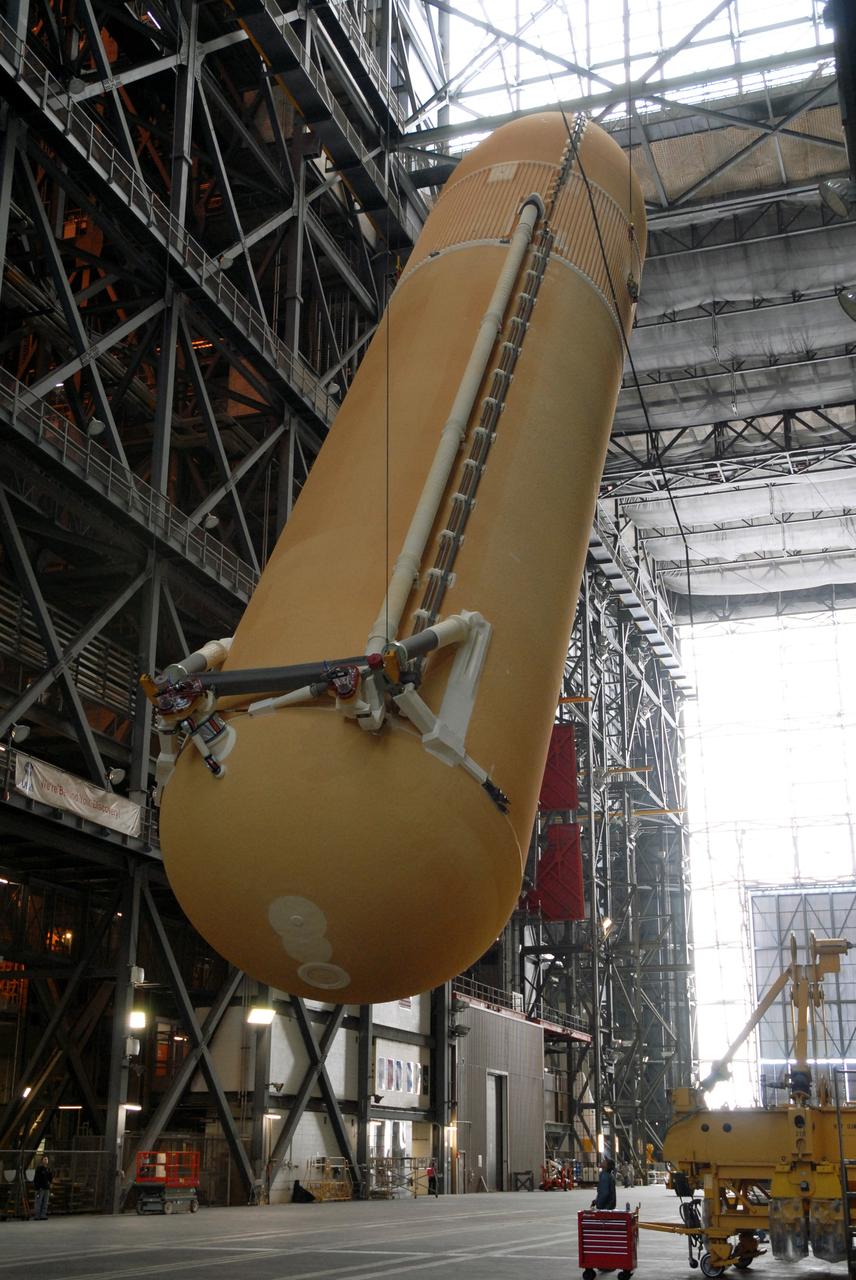
CAPE CANAVERAL, Fla. -- In the transfer aisle of the Vehicle Assembly Building at NASA's Kennedy Space Center in Florida, external fuel tank 130 is raised to a vertical position. The tank will be lifted into high bay 2 for checkout before stacking with the solid rocket boosters and space shuttle Atlantis for the STS-125 mission. The fuel tank was previously designated for the STS-127 mission. The STS-125 Hubble servicing mission is targeted to launch May 12. Photo credit: NASA/Tim Jacobs
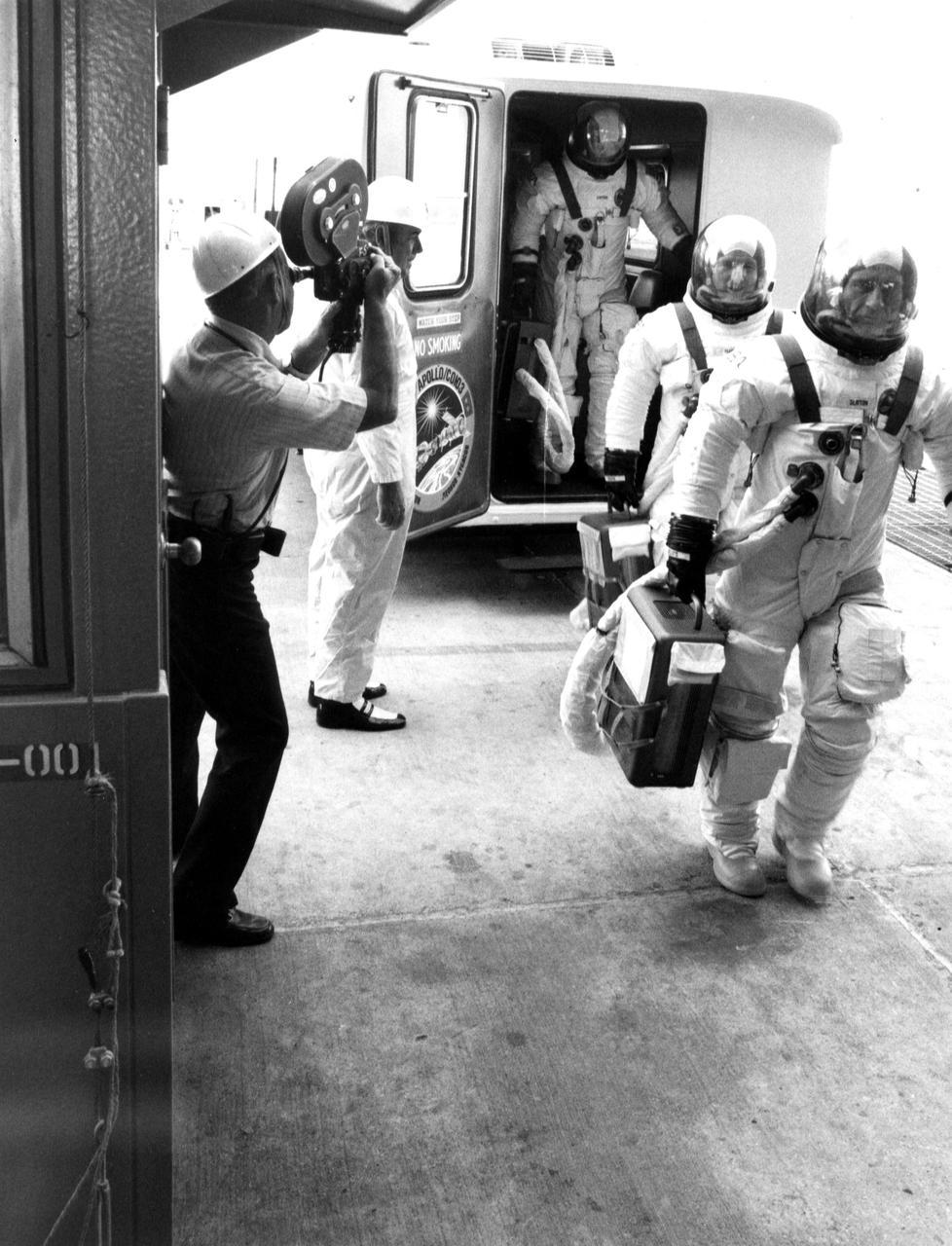
KENNEDY SPACE CENTER, FLA. -- ASTP asstronauts Donald slayton, Vance Brand and Thomas Stafford leave the transfer van at Complex 39's Pad B and enter the pad elevator during the Countdown Demonstration Test. The test, a step-by-step dress rehearsal for the July 15 launch, simulates the actual countdown but without the propellants in the Saturn IB launch vehicle's fuel tanks. The fueled portion of the test was conducted yesterday.

CAPE CANAVERAL, Fla. -- In the Vehicle Assembly Building at NASA's Kennedy Space Center in Florida, the vertical external fuel tank 130 is suspended by a crane over the transfer aisle. The tank will be lifted into high bay 2 for checkout before stacking with the solid rocket boosters and space shuttle Atlantis for the STS-125 mission. The fuel tank was previously designated for the STS-127 mission. The STS-125 Hubble servicing mission is targeted to launch May 12. Photo credit: NASA/Tim Jacobs
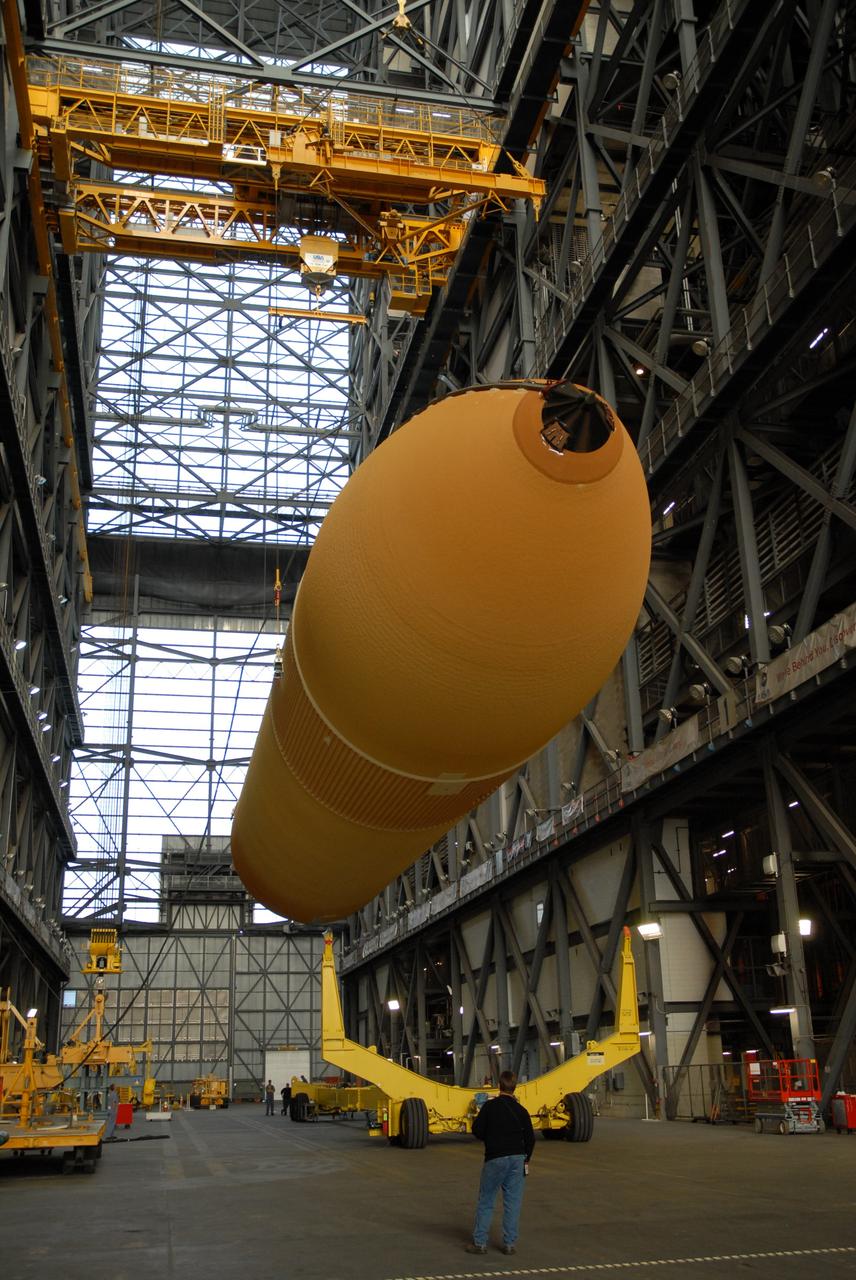
CAPE CANAVERAL, Fla. -- In the transfer aisle of the Vehicle Assembly Building at NASA's Kennedy Space Center in Florida, external fuel tank 130 is lifted off its transporter. The tank will be raised to vertical and lifted into high bay 2 for checkout before stacking with the solid rocket boosters and space shuttle Atlantis for the STS-125 mission. The fuel tank was previously designated for the STS-127 mission. The STS-125 Hubble servicing mission is targeted to launch May 12. Photo credit: NASA/Tim Jacobs
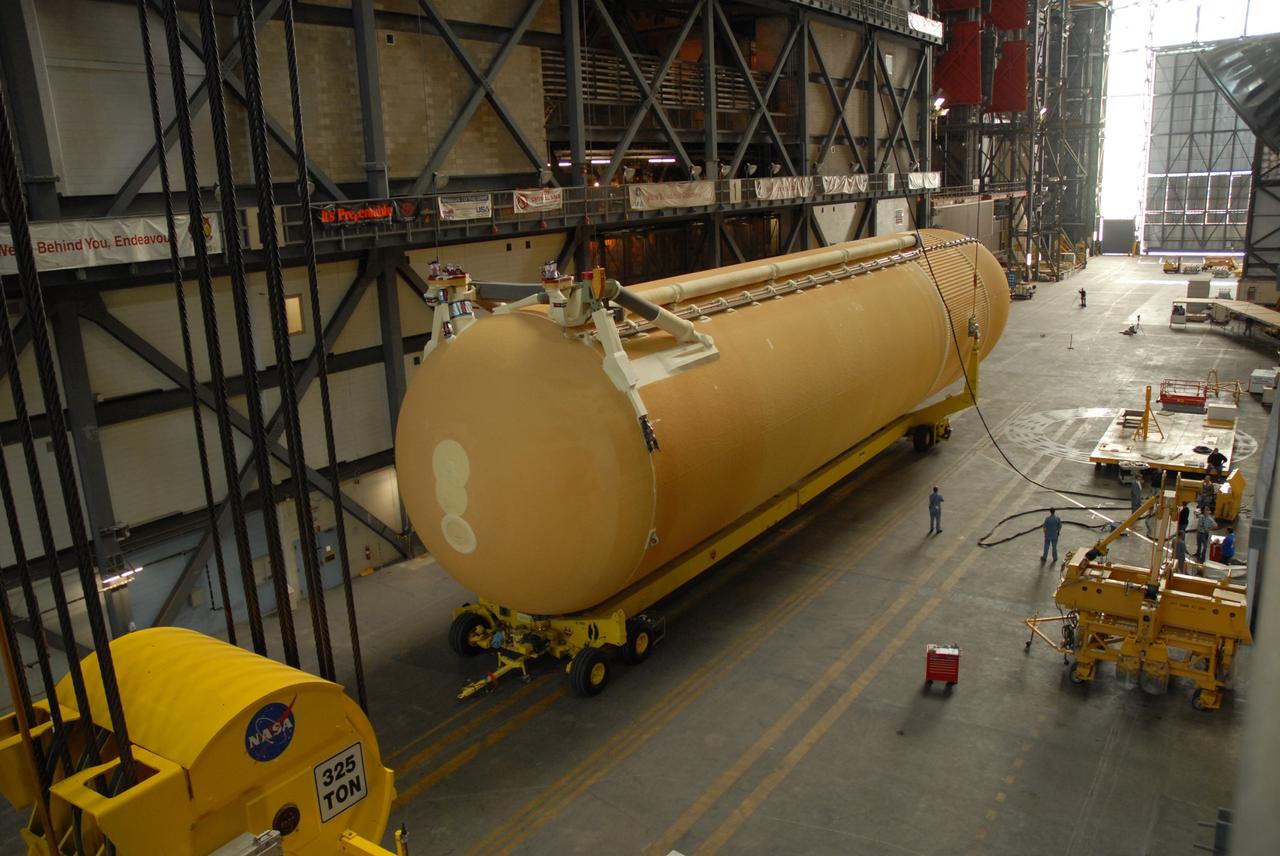
CAPE CANAVERAL, Fla. -- In the transfer aisle of the Vehicle Assembly Building at NASA's Kennedy Space Center in Florida, external fuel tank 130 is fitted with a crane to lift it off the transporter. The tank will be raised to vertical and lifted into high bay 2 for checkout before stacking with the solid rocket boosters and space shuttle Endeavour for the STS-125 mission. The fuel tank was previously designated for the STS-127 mission. The STS-125 Hubble servicing mission is targeted to launch May 12. Photo credit: NASA/Tim Jacobs
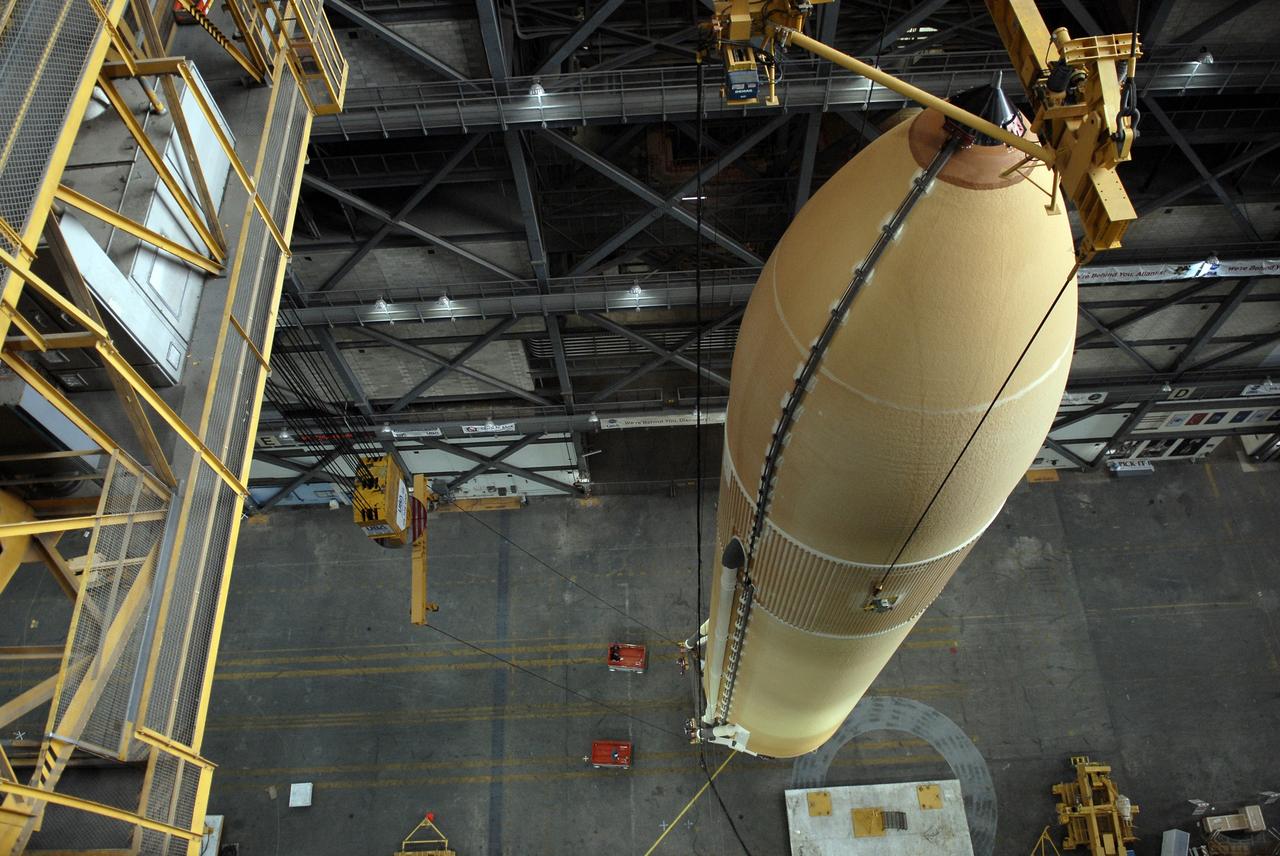
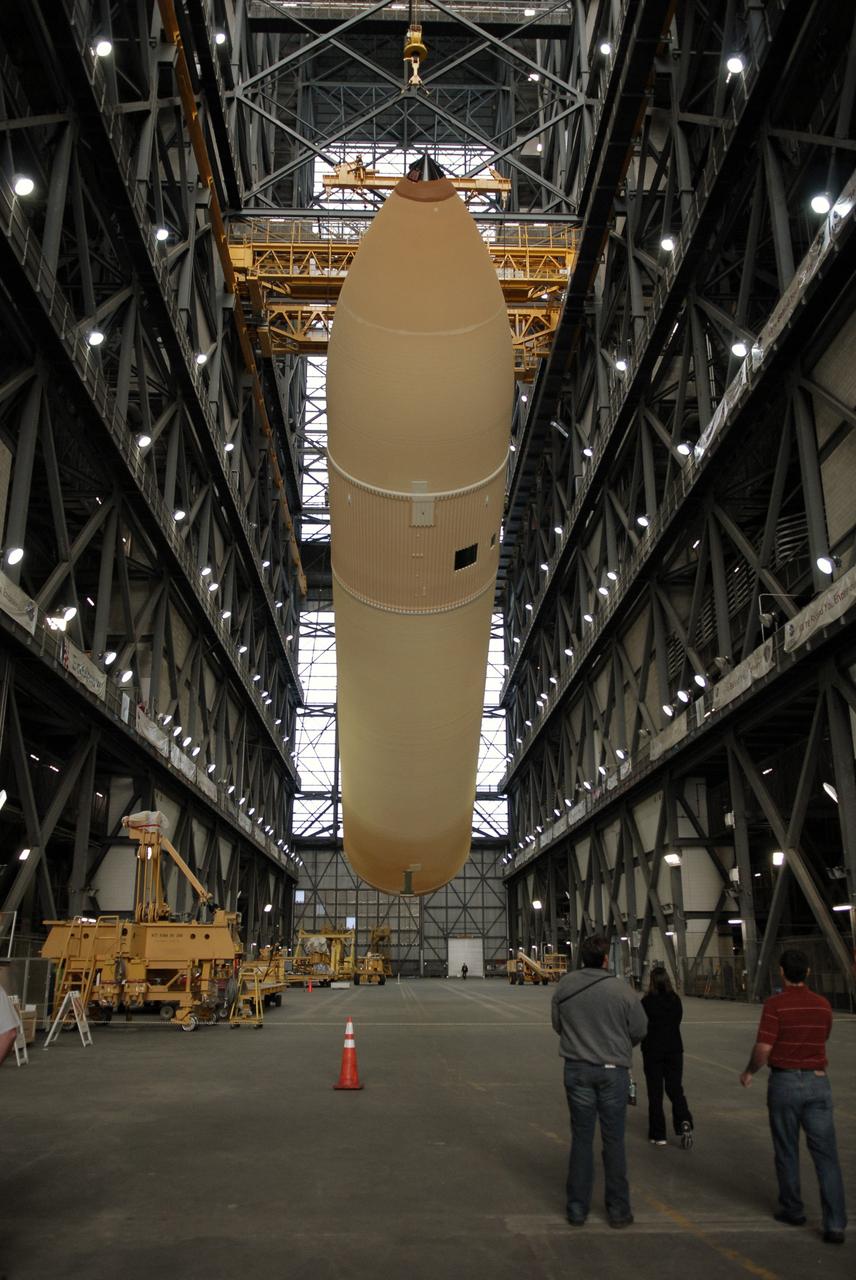
CAPE CANAVERAL, Fla. – The suspension of external fuel tank ET-131 over the transfer aisle of the Vehicle Assembly Building at NASA's Kennedy Space Center in Florida is viewed from an upper level. The fuel tank will be lifted into the upper levels and lowered into a high bay for checkout. ET-131 will be used on space shuttle Endeavour's STS-127 mission. Payload for the mission is the Japanese Experiment Module's Experiment Logistics Module-Exposed Section, or ELM-ES. Launch is targeted for June. Photo credit: NASA/Kim Shiflett
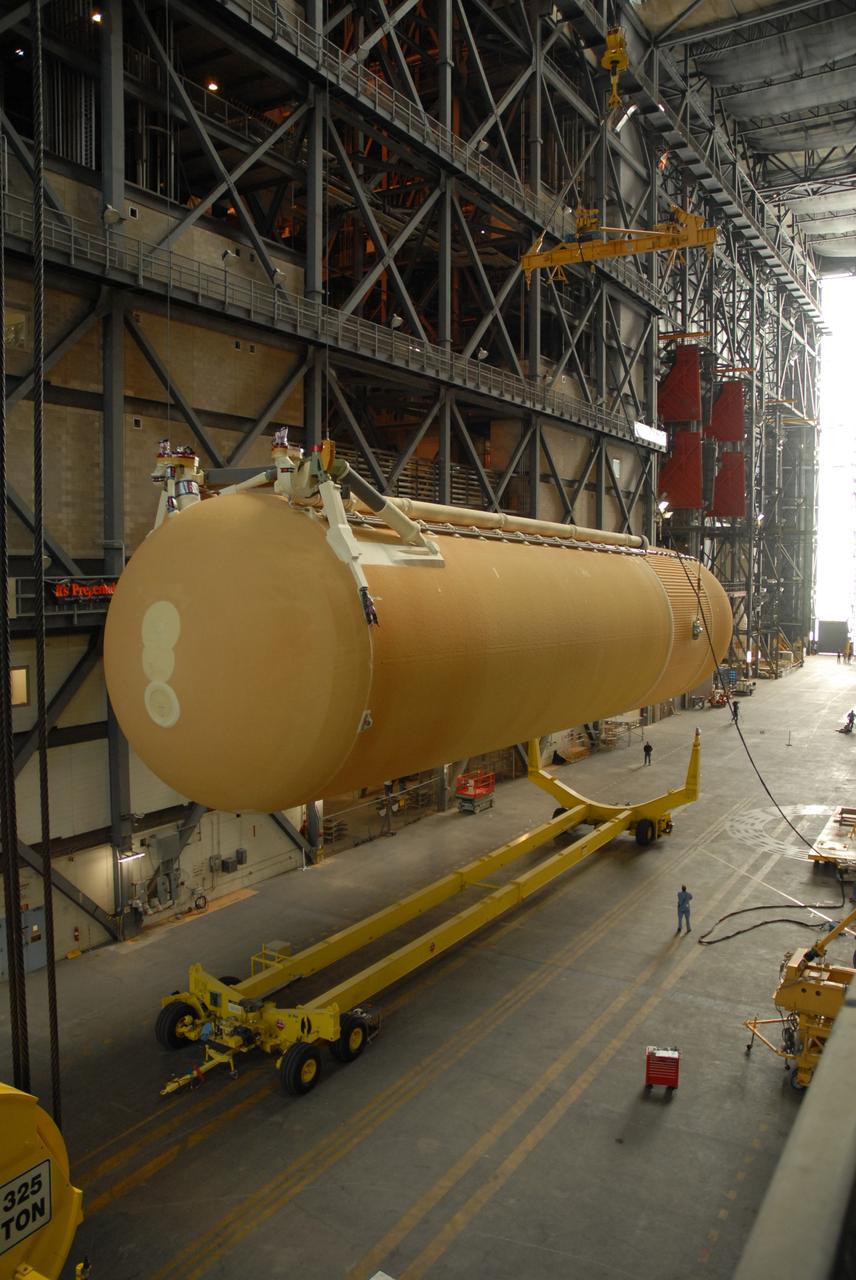
CAPE CANAVERAL, Fla. -- In the transfer aisle of the Vehicle Assembly Building at NASA's Kennedy Space Center in Florida, external fuel tank 130 is lifted off its transporter. The tank will be raised to vertical and lifted into high bay 2 for checkout. The fuel tank was previously designated for the STS-127 mission. The STS-125 Hubble servicing mission is targeted to launch May 12. Photo credit: NASA/Tim Jacobs
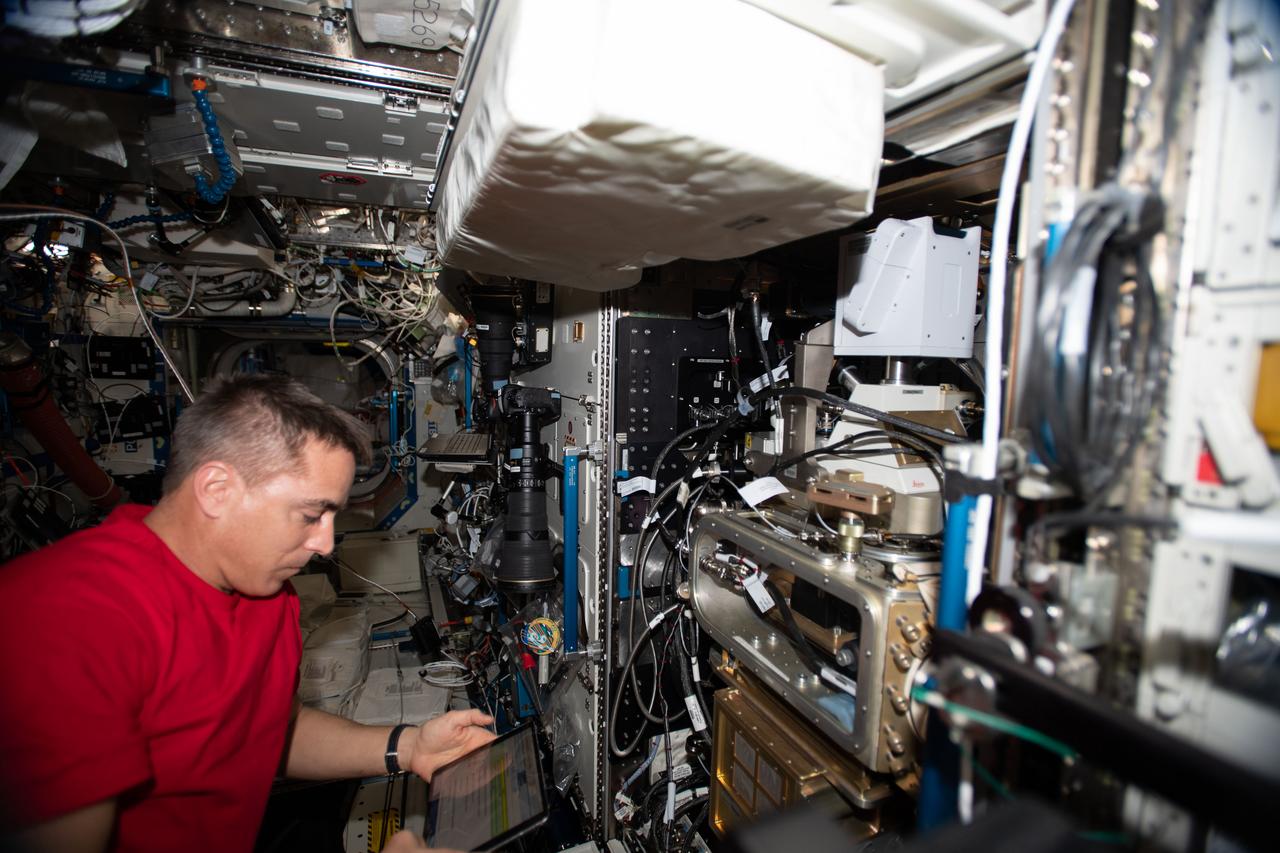
iss063e001782 (April 21, 2020) --- NASA astronaut and Expedition 63 Commander Chris Cassidy works on the Fluids Integrated Rack (FIR) replacing components in the research device that studies the behavior of fluids in microgravity. The FIR will help promote the design of advanced space-based fuel tanks and other complex fluid transfer systems.
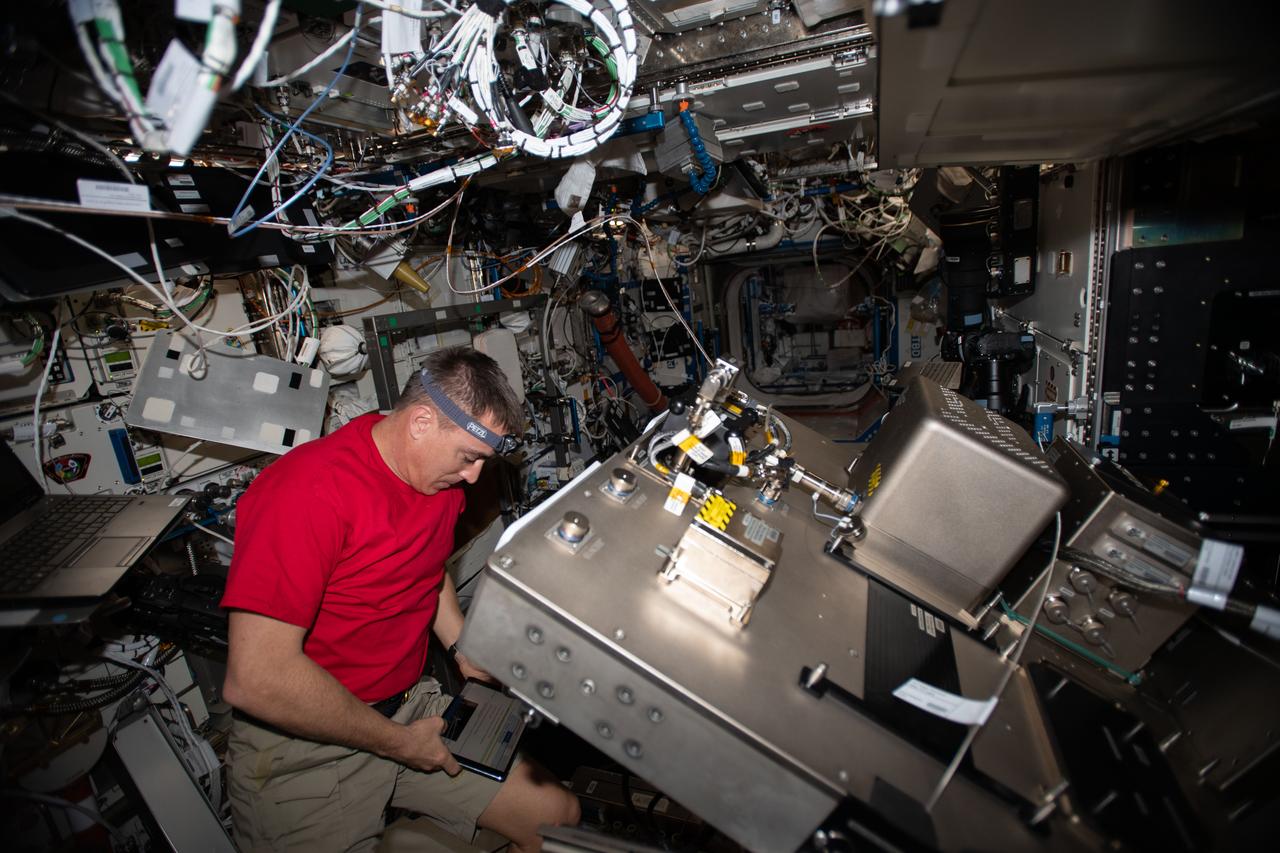
iss063e001804 (April 21, 2020) --- NASA astronaut and Expedition 63 Commander Chris Cassidy works on the Fluids Integrated Rack (FIR) replacing components in the research device that studies the behavior of fluids in microgravity. The FIR will help promote the design of advanced space-based fuel tanks and other complex fluid transfer systems.
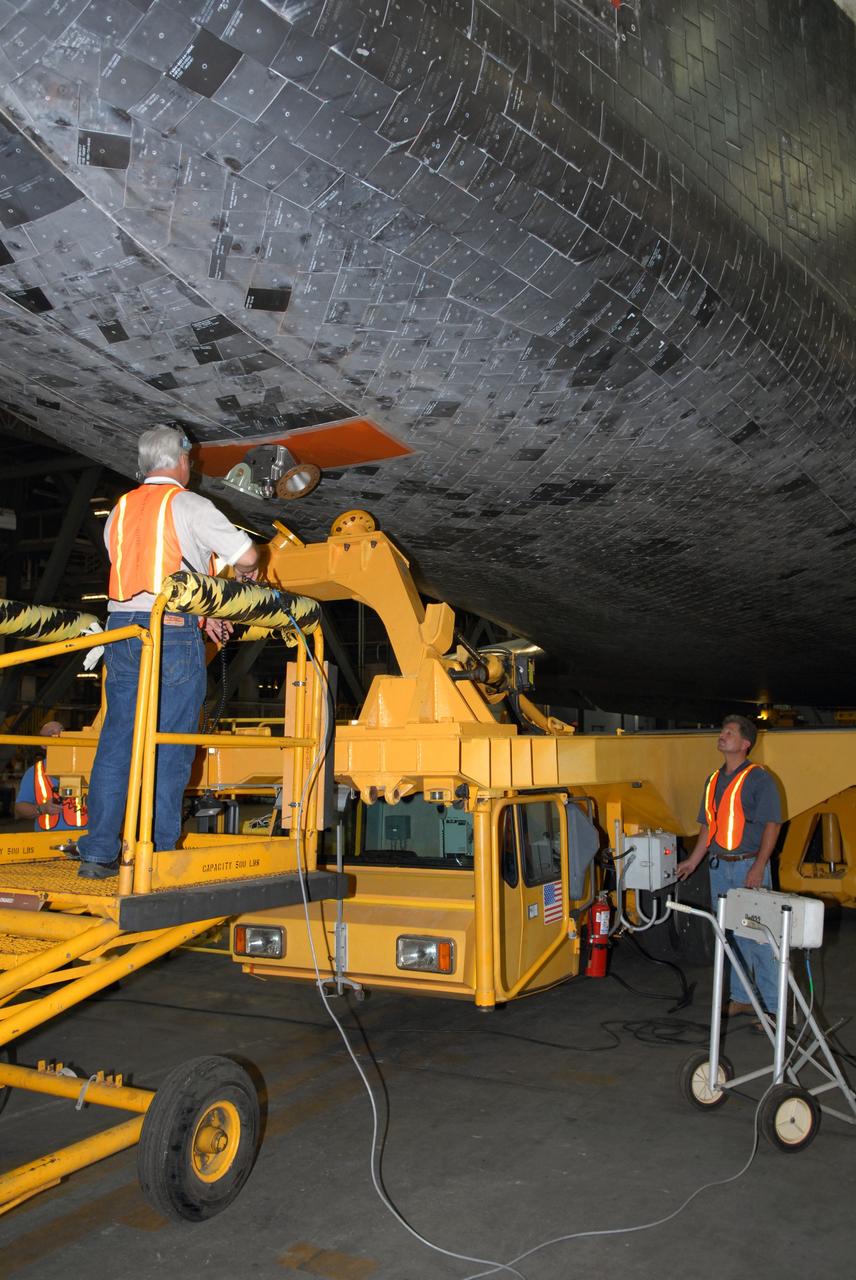
CAPE CANAVERAL, Fla. – In the Vehicle Assembly Building transfer aisle at NASA's Kennedy Space Center, workers have detached space shuttle Atlantis from its transporter. An overhead crane will lift Atlantis to vertical for transfer to high bay 3 to be stacked with its external fuel tank and twin solid rocket boosters. After additional preparations are made, the shuttle will be rolled out to Launch Pad 39A to prepare for launch on the STS-125 mission targeted for Oct. 8. Photo credit: NASA/Jack Pfaller
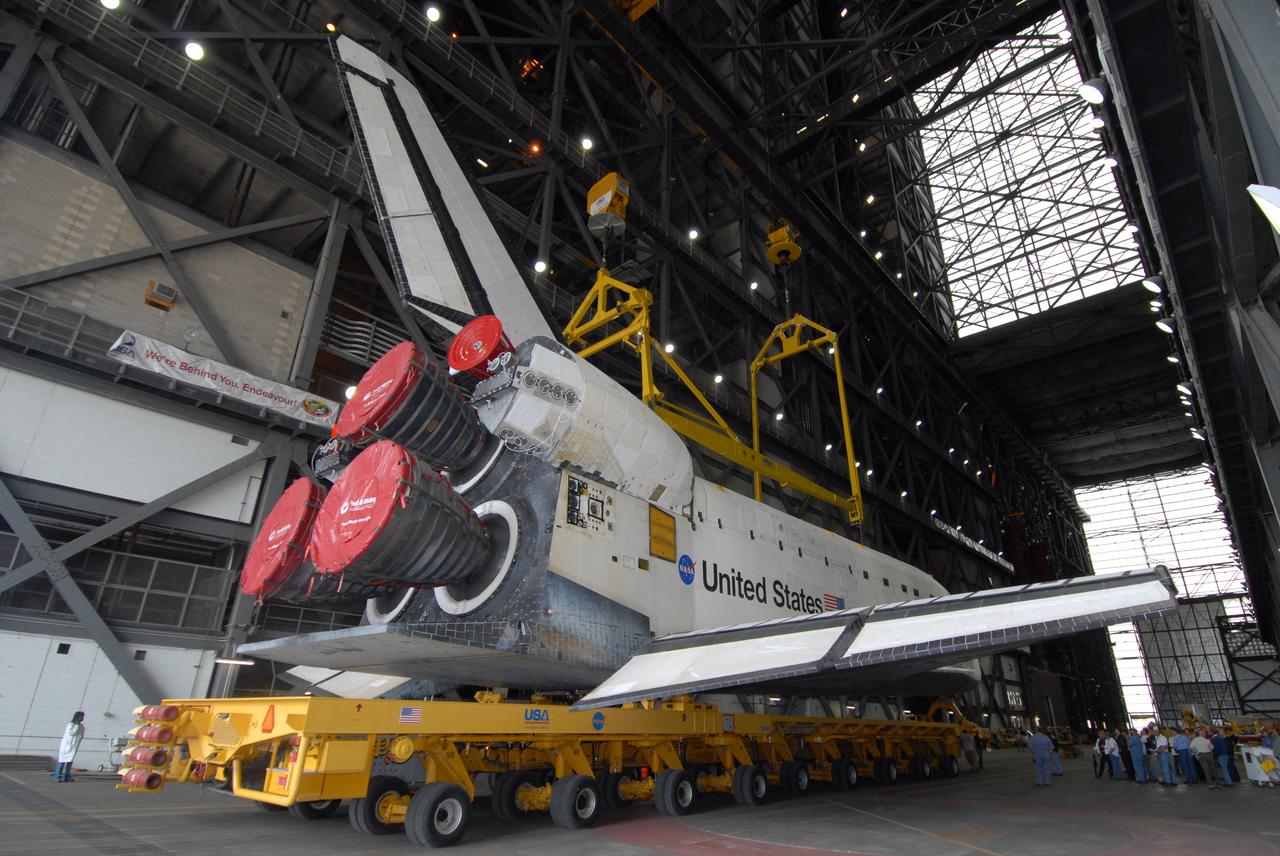
CAPE CANAVERAL, Fla. – Space shuttle Atlantis rolls into the transfer aisle of the Vehicle Assembly Building at NASA's Kennedy Space Center in Florida. First motion was at 11:30 a.m. EDT. From the transfer aisle, Atlantis will be lifted into High Bay 3 and mated to the solid rocket booster-external fuel tank already installed on the mobile launcher platform. Atlantis is targeted to launch May 12 for the STS-125 Hubble servicing mission. Photo credit: NASA/Jack Pfaller
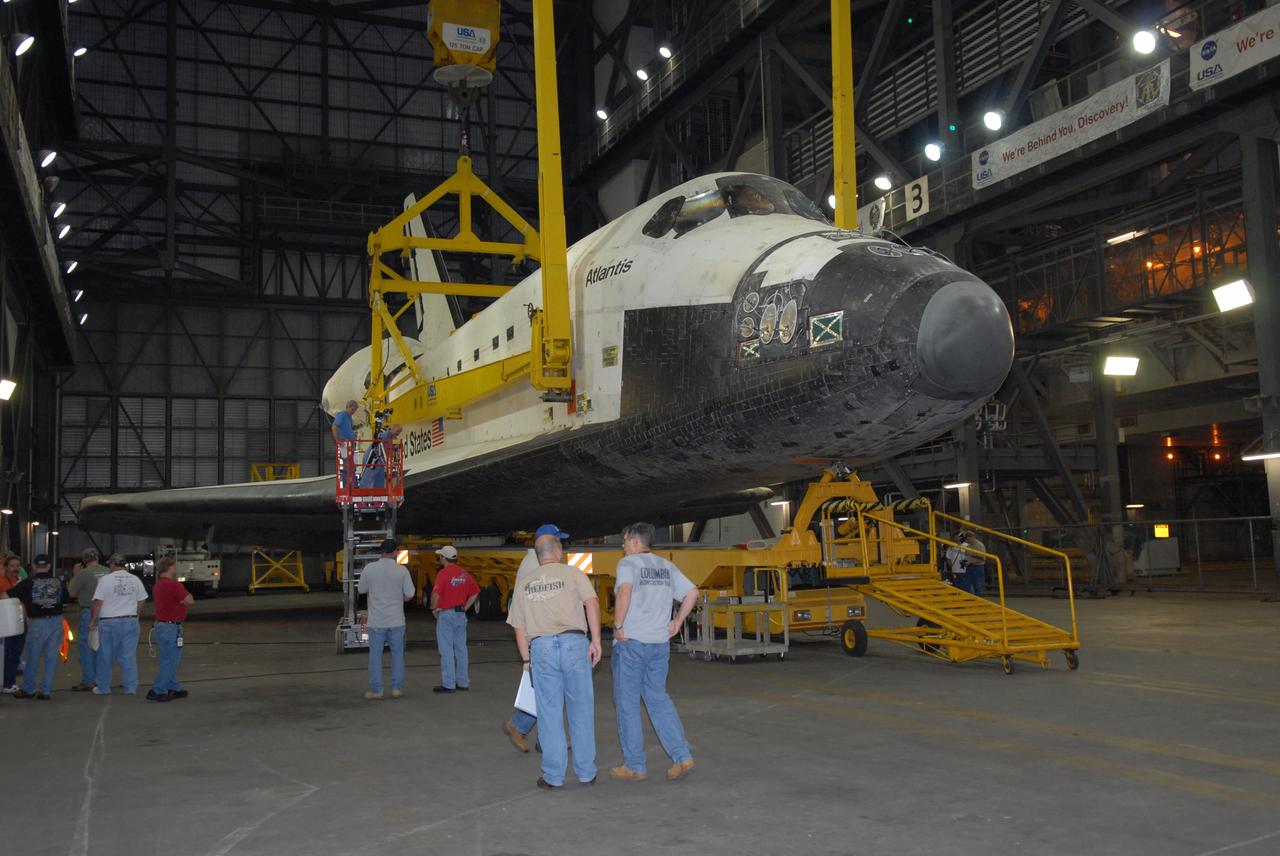
CAPE CANAVERAL, Fla. – In the Vehicle Assembly Building transfer aisle at NASA's Kennedy Space Center, the overhead crane is being attached to space shuttle Atlantis. The crane will lift Atlantis to vertical for transfer to high bay 3 to be stacked with its external fuel tank and twin solid rocket boosters. After additional preparations are made, the shuttle will be rolled out to Launch Pad 39A to prepare for launch on the STS-125 mission targeted for Oct. 8. Photo credit: NASA/Jack Pfaller
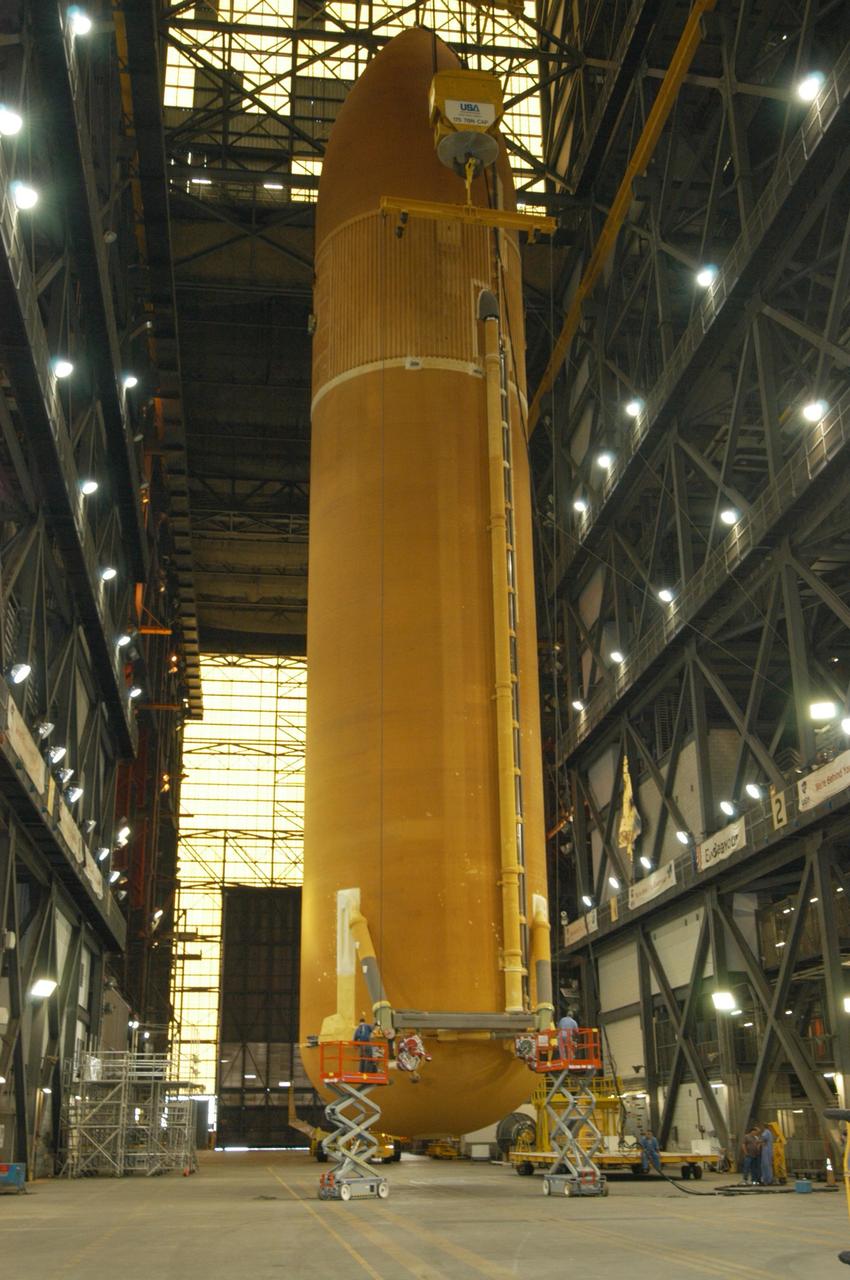
KENNEDY SPACE CENTER, FLA. - In the transfer aisle of NASA's Vehicle Assembly Building, the redesigned external fuel tank that will launch Space Shuttle Atlantis on the next shuttle mission, STS-115, is ready to be lifted into the upper levels for transfer into a checkout cell for further work. Designated ET-118, the tank will fly with many major safety changes, including the removal of the protuberance air load ramps. Photo credit: NASA/George Shelton
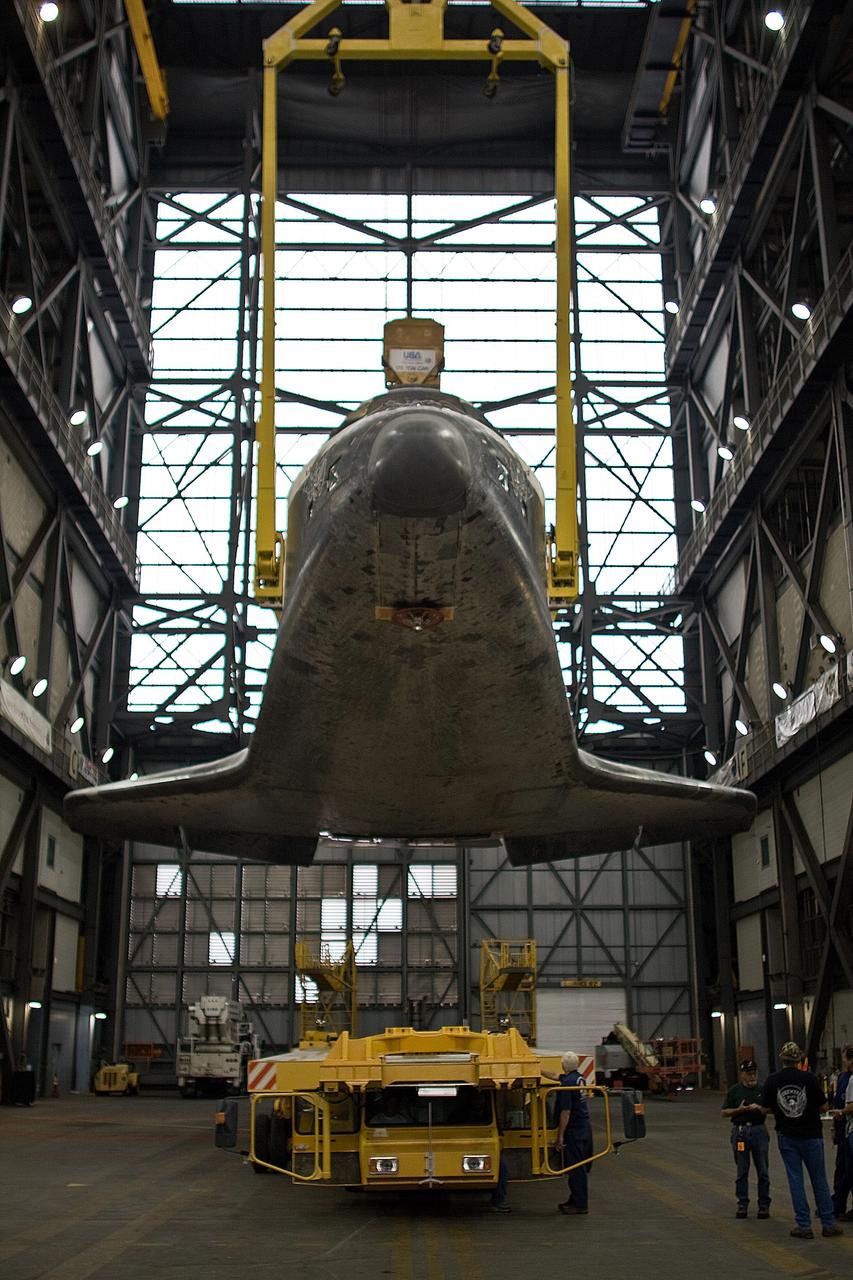
CAPE CANAVERAL, Fla. – In the Vehicle Assembly Building transfer aisle at NASA's Kennedy Space Center, the overhead crane lifts space shuttle Atlantis from its transporter. Atlantis will be raised to vertical for transfer to high bay 3. There it will be stacked with its external fuel tank and twin solid rocket boosters. After additional preparations are made, the shuttle will be rolled out to Launch Pad 39A to prepare for launch on the STS-125 mission targeted for 1:34 a.m. EDT Oct. 8. Photo credit: NASA/Dimitri Gerondidakis
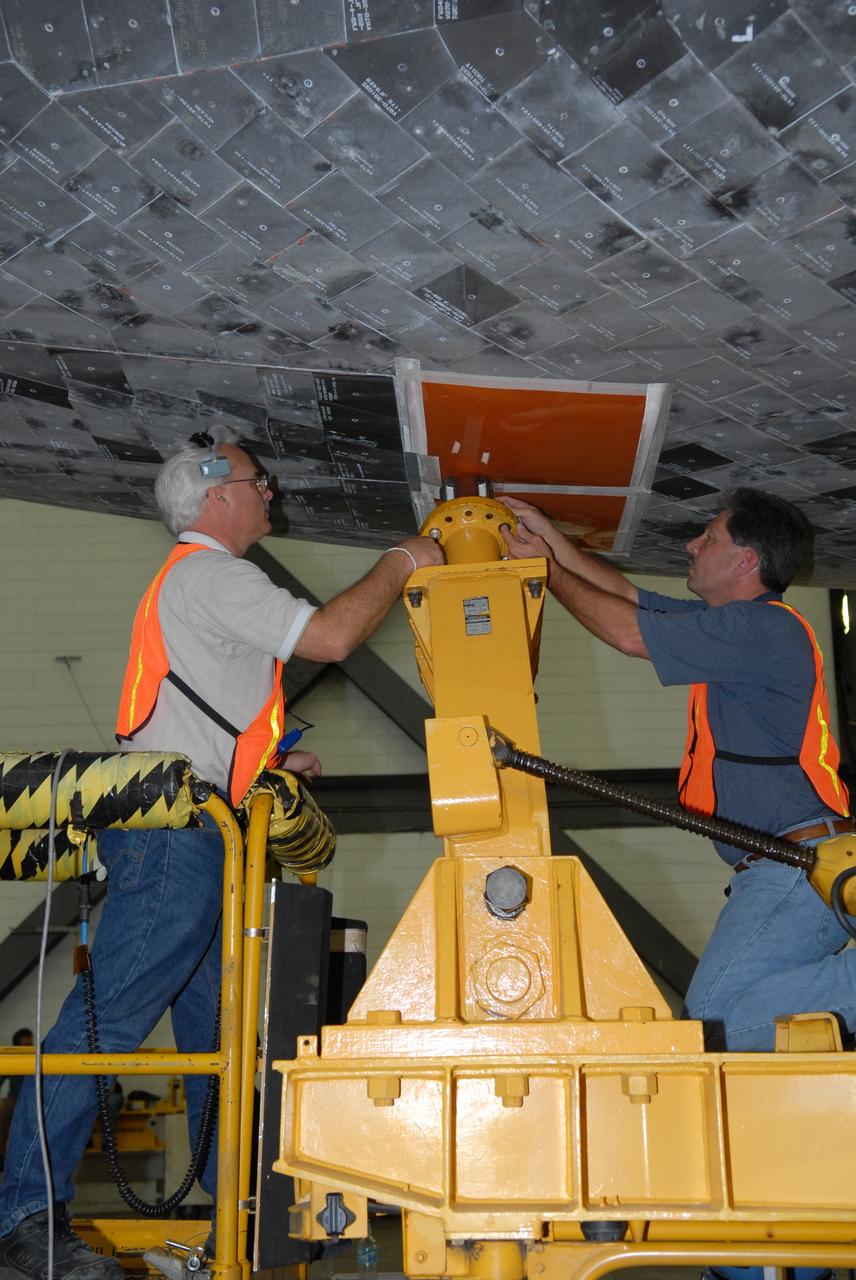
CAPE CANAVERAL, Fla. – In the Vehicle Assembly Building transfer aisle at NASA's Kennedy Space Center, workers detach space shuttle Atlantis from its transporter. An overhead crane will lift Atlantis to vertical for transfer to high bay 3 to be stacked with its external fuel tank and twin solid rocket boosters. After additional preparations are made, the shuttle will be rolled out to Launch Pad 39A to prepare for launch on the STS-125 mission targeted for Oct. 8. Photo credit: NASA/Jack Pfaller
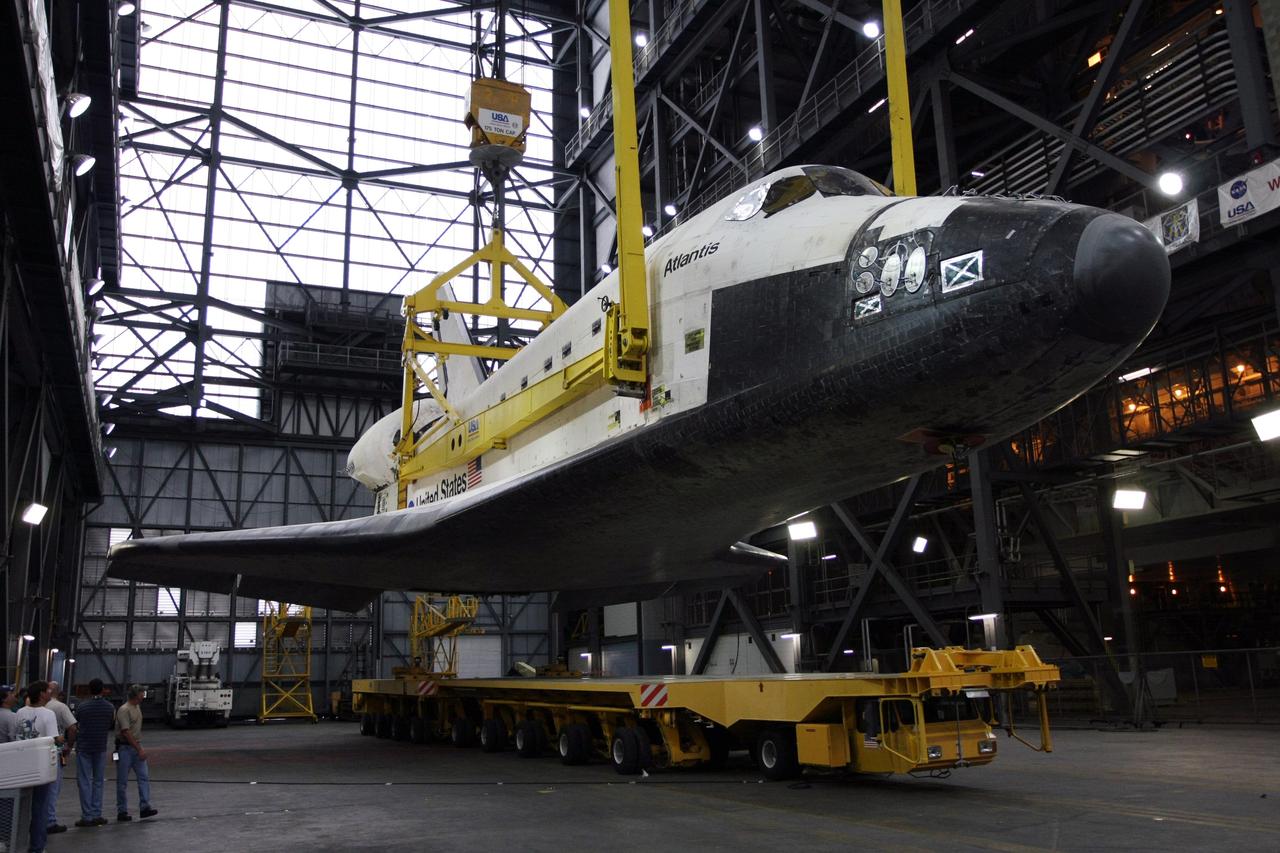
CAPE CANAVERAL, Fla. – In the Vehicle Assembly Building transfer aisle at NASA's Kennedy Space Center, the overhead crane lifts space shuttle Atlantis from its transporter. Atlantis will be raised to vertical for transfer to high bay 3. There it will be stacked with its external fuel tank and twin solid rocket boosters. After additional preparations are made, the shuttle will be rolled out to Launch Pad 39A to prepare for launch on the STS-125 mission targeted for 1:34 a.m. EDT Oct. 8. Photo credit: NASA/Dimitri Gerondidakis
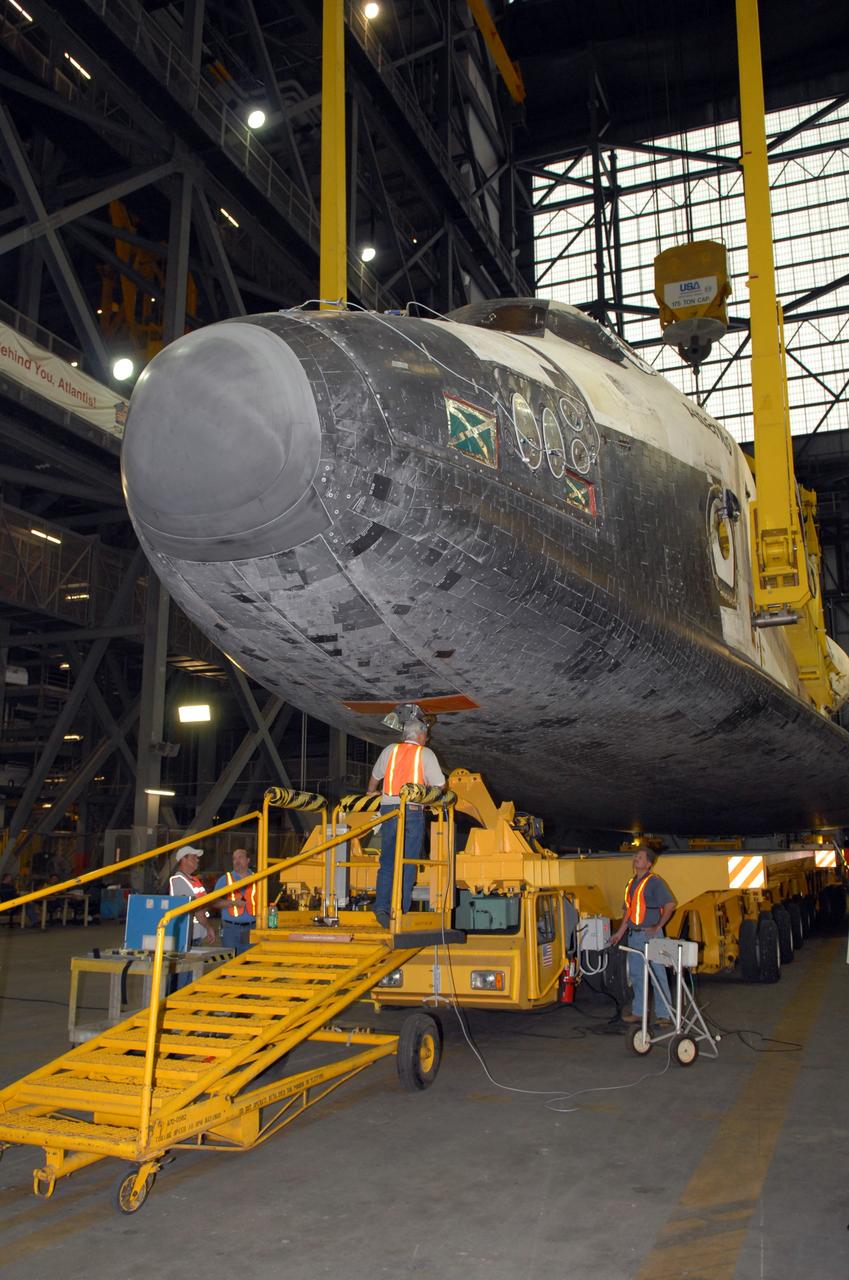
CAPE CANAVERAL, Fla. – In the Vehicle Assembly Building transfer aisle at NASA's Kennedy Space Center, an overhead crane attached to space shuttle Atlantis lifts the shuttle from its transporter. Atlantis will be lifted to vertical for transfer to high bay 3 to be stacked with its external fuel tank and twin solid rocket boosters. After additional preparations are made, the shuttle will be rolled out to Launch Pad 39A to prepare for launch on the STS-125 mission targeted for Oct. 8. Photo credit: NASA/Jack Pfaller

AS12-46-6790 (19 Nov. 1969) --- Astronaut Alan L. Bean, lunar module pilot, is photographed at quadrant II of the Lunar Module (LM) during the first Apollo 12 extravehicular activity (EVA) on the moon. This picture was taken by astronaut Charles Conrad Jr., commander. Here, Bean is using a fuel transfer tool to remove the fuel element from the fuel cask mounted on the LM's descent stage. The fuel element was then placed in the Radioisotope Thermoelectric Generator (RTG), the power source for the Apollo Lunar Surface Experiments Package (ALSEP) which was deployed on the moon by the two astronauts. The RTG is next to Bean's right leg. While astronauts Conrad and Bean descended in the LM "Intrepid" to explore the Ocean of Storms region of the moon, astronaut Richard F. Gordon Jr., command module pilot, remained with the Command and Service Modules (CSM) "Yankee Clipper" in lunar orbit.
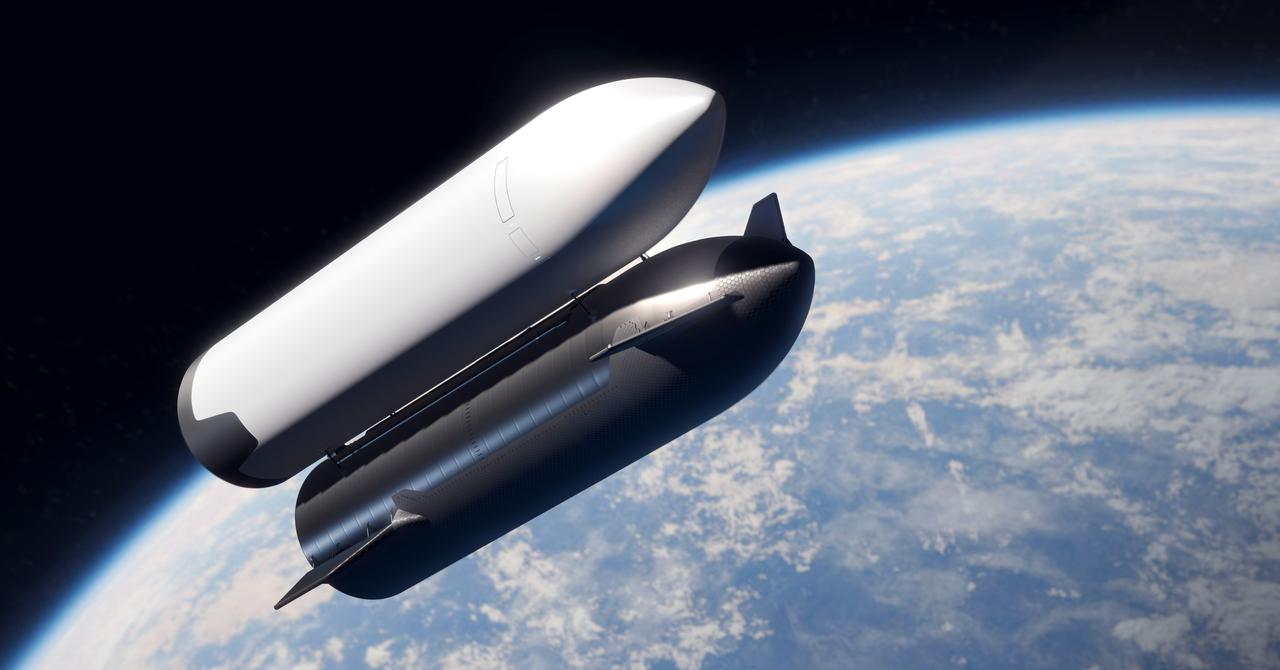
These artist’s concepts show SpaceX’s Starship Human Landing System (HLS) in operation on its journey to the Moon. Before astronauts launch in NASA’s Orion spacecraft atop the agency’s SLS (Space Launch System) rocket, SpaceX will launch a storage depot to Earth orbit. For Artemis III and Artemis IV, SpaceX plans to complete propellant loading operations in Earth orbit to send a fully fueled Starship HLS to the Moon. Starship HLS will then dock directly to Orion so that two astronauts can transfer from the spacecraft to the lander to descend to the Moon’s surface, while two others remain in Orion. Beginning with Artemis IV, NASA’s Gateway lunar space station will serve as the crew transfer point. NASA is working with SpaceX to develop Starship HLS to carry astronauts from lunar orbit to the Moon’s surface and back for Artemis III and Artemis IV as part of the agency’s Artemis campaign.

These artist’s concepts show SpaceX’s Starship Human Landing System (HLS) in operation on its journey to the Moon. Before astronauts launch in NASA’s Orion spacecraft atop the agency’s SLS (Space Launch System) rocket, SpaceX will launch a storage depot to Earth orbit. For Artemis III and Artemis IV, SpaceX plans to complete propellant loading operations in Earth orbit to send a fully fueled Starship HLS to the Moon. Starship HLS will then dock directly to Orion so that two astronauts can transfer from the spacecraft to the lander to descend to the Moon’s surface, while two others remain in Orion. Beginning with Artemis IV, NASA’s Gateway lunar space station will serve as the crew transfer point. NASA is working with SpaceX to develop Starship HLS to carry astronauts from lunar orbit to the Moon’s surface and back for Artemis III and Artemis IV as part of the agency’s Artemis campaign.
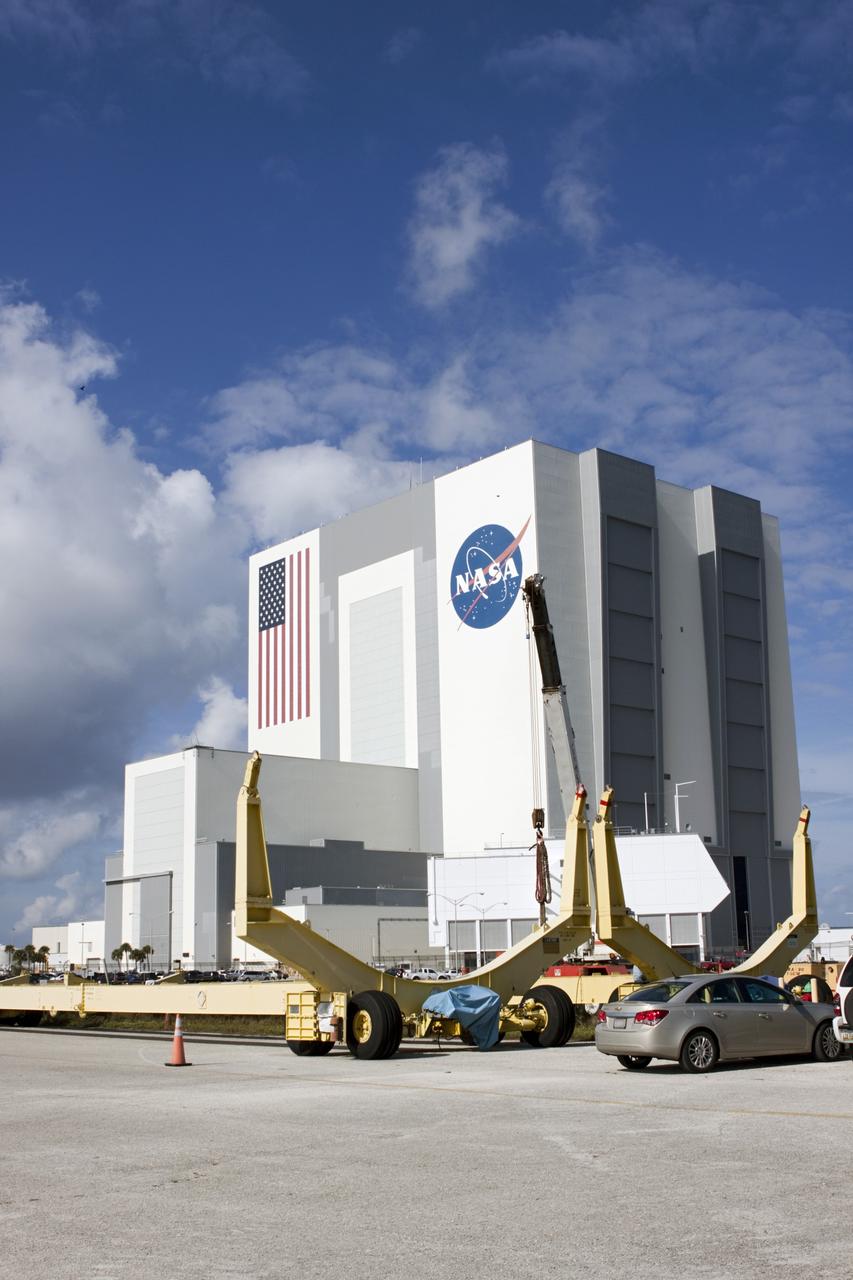
CAPE CANAVERAL, Fla. – At NASA’s Kennedy Space Center in Florida, two space shuttle external fuel tank transporters are being prepared for transfer to the Wings of Dreams Aviation Museum at Keystone Heights Airport between Gainesville and Jacksonville, Fla. At the Wings of Dreams Aviation Museum a mock-up shuttle external fuel tank will be displayed. During space shuttle launches, the external tanks contained over 500,000 gallons of liquid hydrogen and liquid oxygen propellant for the shuttle orbiters' three main engines. The effort is part of Transition and Retirement of the space shuttle. For more information, visit http://www.nasa.gov/transition Photo credit: NASA/ Jim Grossmann

CAPE CANAVERAL, Fla. -- In the Vehicle Assembly Building at NASA's Kennedy Space Center in Florida, External Fuel Tank-122 sits on its transporter in the transfer aisle waiting to be lifted into a test cell. ET-122, the Space Shuttle Program's last external fuel tank was delivered to Kennedy's Turn Basin from NASA’s Michoud Assembly Facility in New Orleans aboard the Pegasus Barge. After testing, ET-122 eventually will be attached to space shuttle Endeavour for the STS-134 mission to the International Space Station targeted to launch February, 2011. For more information visit: http://www.nasa.gov/mission_pages/shuttle/shuttlemissions/sts134/index.html. Photo credit: NASA/Dimitri Gerondidakis
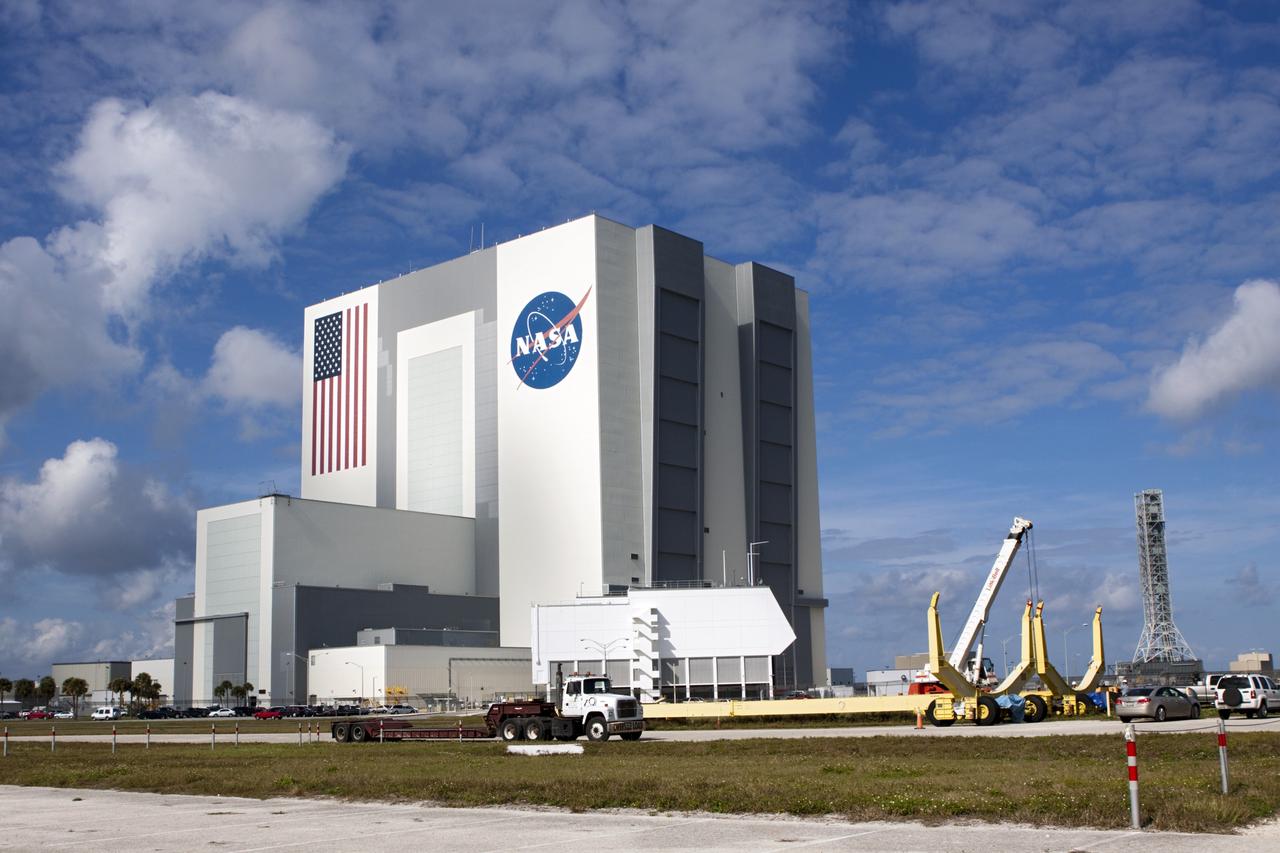
CAPE CANAVERAL, Fla. – At NASA’s Kennedy Space Center in Florida, two space shuttle external fuel tank transporters are being prepared for transfer to the Wings of Dreams Aviation Museum at Keystone Heights Airport between Gainesville and Jacksonville, Fla. At the Wings of Dreams Aviation Museum a mock-up shuttle external fuel tank will be displayed. During space shuttle launches, the external tanks contained over 500,000 gallons of liquid hydrogen and liquid oxygen propellant for the shuttle orbiters' three main engines. The effort is part of Transition and Retirement of the space shuttle. For more information, visit http://www.nasa.gov/transition Photo credit: NASA/ Jim Grossmann
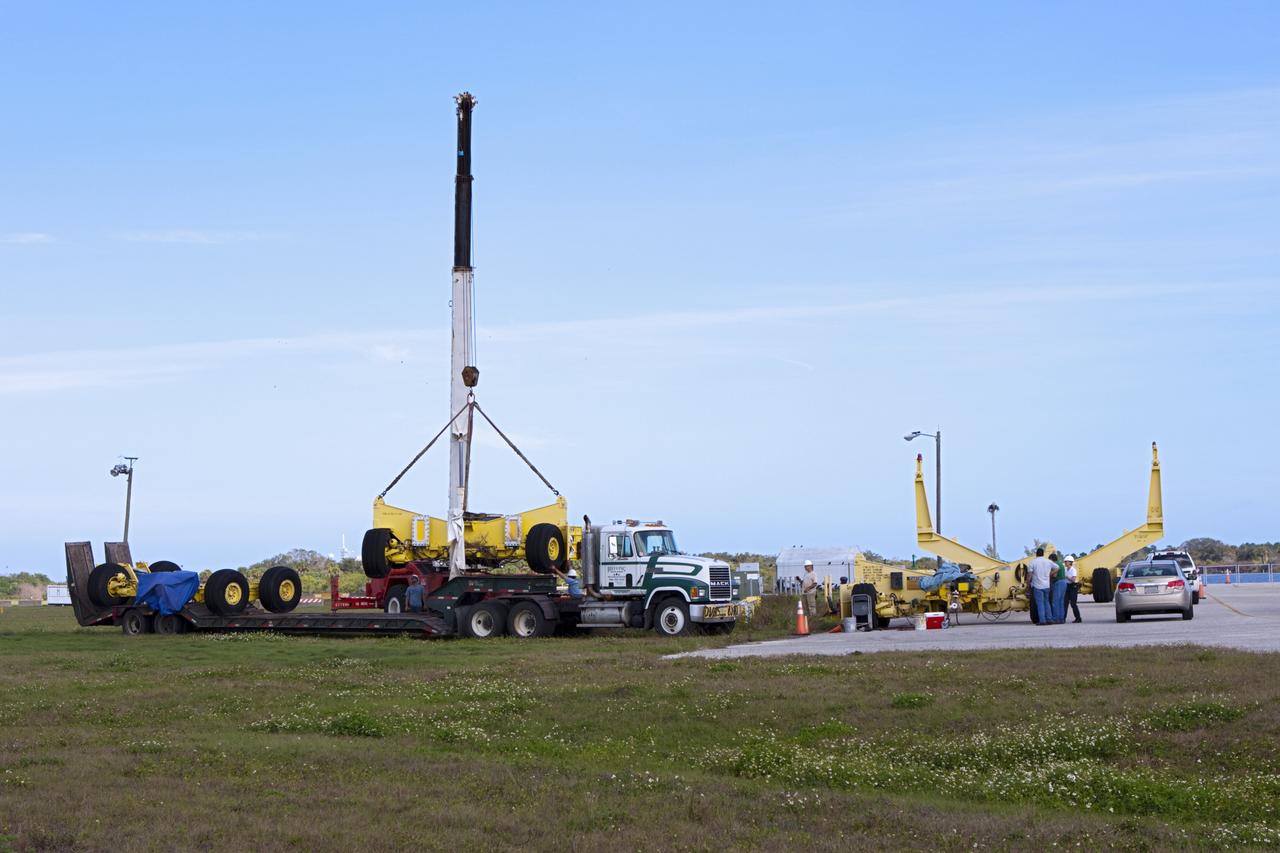
CAPE CANAVERAL, Fla. – At NASA’s Kennedy Space Center in Florida, two space shuttle external fuel tank transporters are being prepared for transfer to the Wings of Dreams Aviation Museum at Keystone Heights Airport between Gainesville and Jacksonville, Fla. At the Wings of Dreams Aviation Museum a mock-up shuttle external fuel tank will be displayed. During space shuttle launches, the external tanks contained over 500,000 gallons of liquid hydrogen and liquid oxygen propellant for the shuttle orbiters' three main engines. The effort is part of Transition and Retirement of the space shuttle. For more information, visit http://www.nasa.gov/transition Photo credit: NASA/ Jim Grossmann
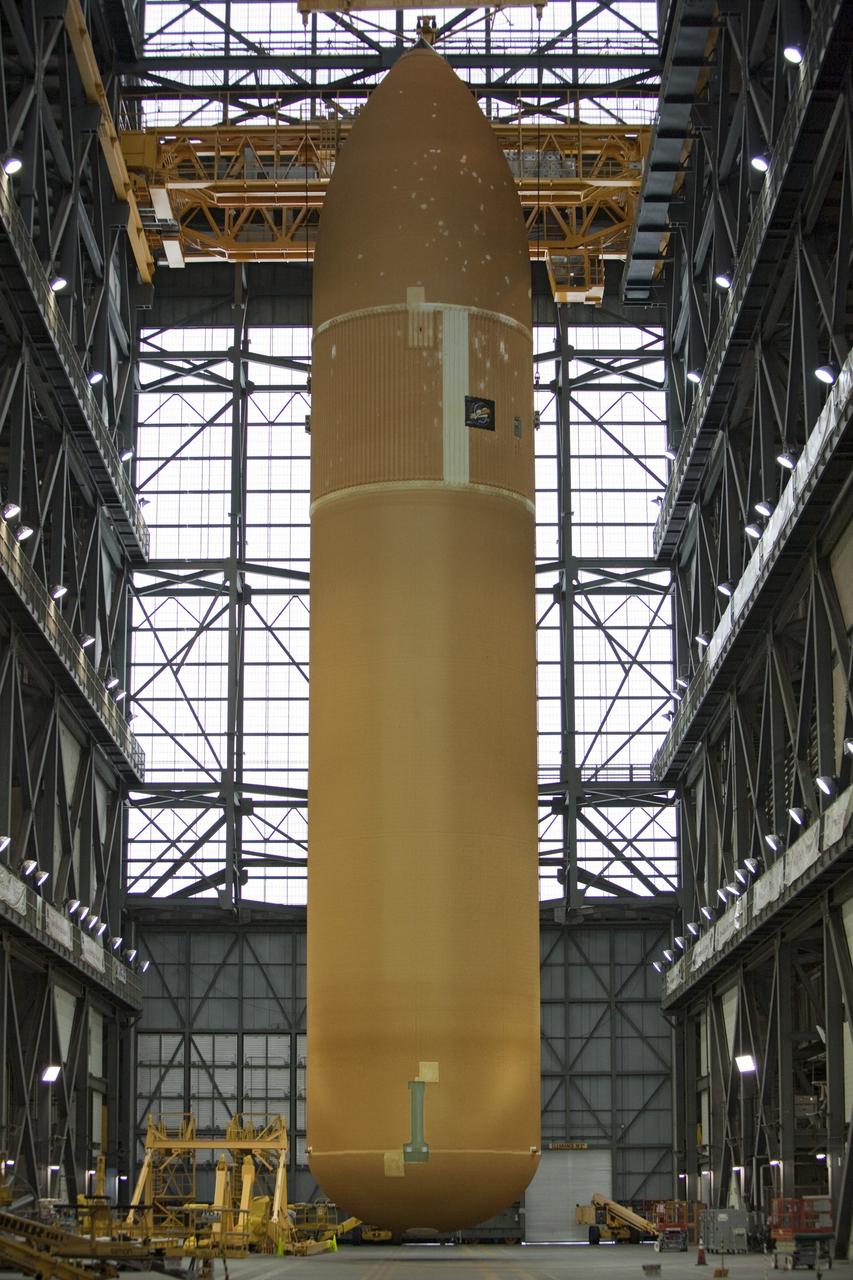
CAPE CANAVERAL, Fla. -- At NASA’s Kennedy Space Center in Florida, External Fuel Tank-122 is suspended vertically over the transfer aisle of the Vehicle Assembly Building as it is lifted toward a test cell. ET-122, the Space Shuttle Program's last external fuel tank was delivered to Kennedy's Turn Basin from NASA’s Michoud Assembly Facility in New Orleans aboard the Pegasus Barge. After testing, ET-122 eventually will be attached to space shuttle Endeavour for the STS-134 mission to the International Space Station targeted to launch February, 2011. For more information visit: http://www.nasa.gov/mission_pages/shuttle/shuttlemissions/sts134/index.html. Photo credit: NASA/Dimitri Gerondidakis
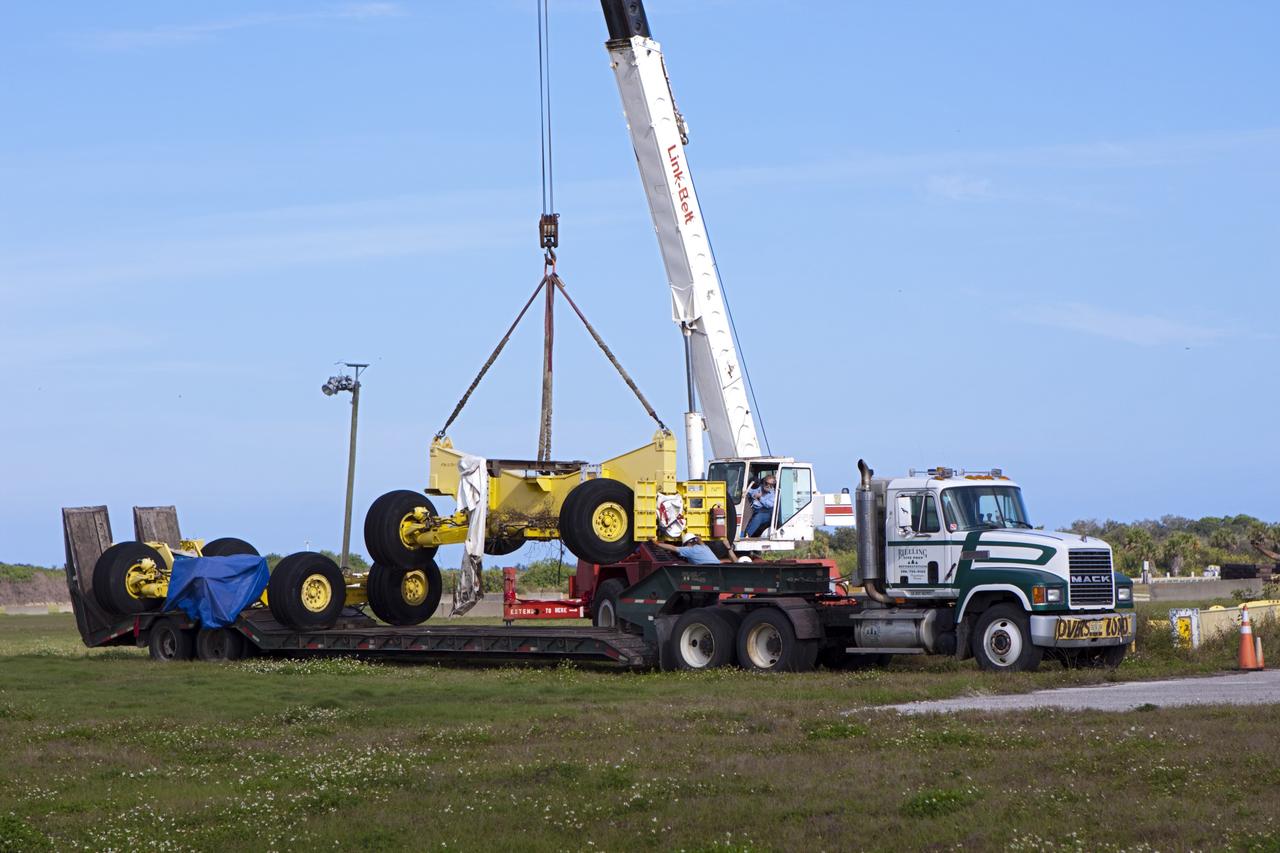
CAPE CANAVERAL, Fla. – At NASA’s Kennedy Space Center in Florida, two space shuttle external fuel tank transporters are being prepared for transfer to the Wings of Dreams Aviation Museum at Keystone Heights Airport between Gainesville and Jacksonville, Fla. At the Wings of Dreams Aviation Museum a mock-up shuttle external fuel tank will be displayed. During space shuttle launches, the external tanks contained over 500,000 gallons of liquid hydrogen and liquid oxygen propellant for the shuttle orbiters' three main engines. The effort is part of Transition and Retirement of the space shuttle. For more information, visit http://www.nasa.gov/transition Photo credit: NASA/ Jim Grossmann
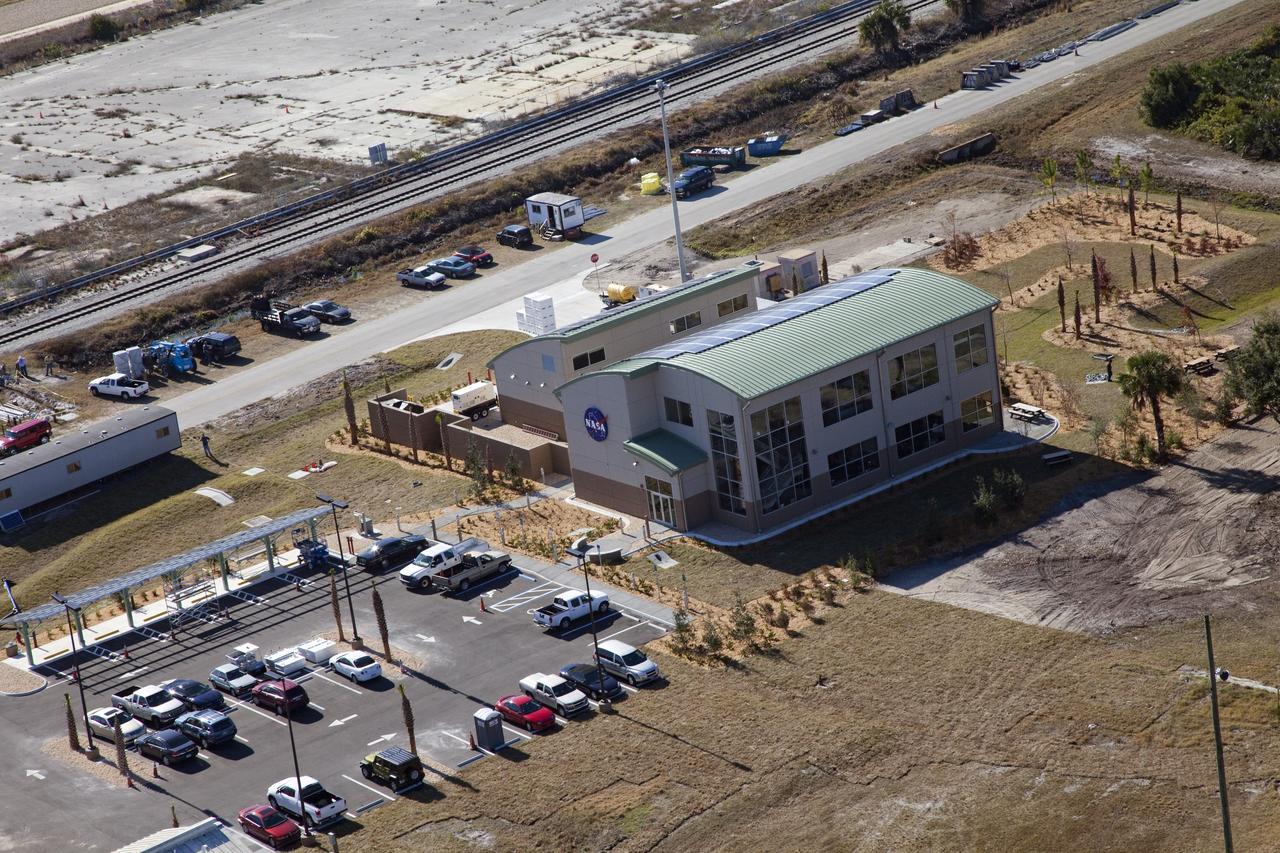
CAPE CANAVERAL, Fla. -- The Propellants North Administrative and Maintenance Facility in the Launch Complex 39 area of NASA's Kennedy Space Center in Florida is ready for business. The environmentally friendly facility is slated to be NASA's second Platinum-rated by the U.S. Green Building Council's (USGBC) Leadership in Environmental and Energy Design (LEED) certification system. It will be the space agency's first carbon-neutral facility, which means it will produce enough energy onsite from renewable sources to offset what it requires to operate. On the right is the facility's two-story administrative building, which will house managers, mechanics and technicians who fuel spacecraft at Kennedy. On the left is a single-story shop that will be used to store cryogenic fuel transfer equipment. In the parking lot is a solar-powered parking station for alternative fuel vehicles. Photo credit: NASA/Frank Michaux
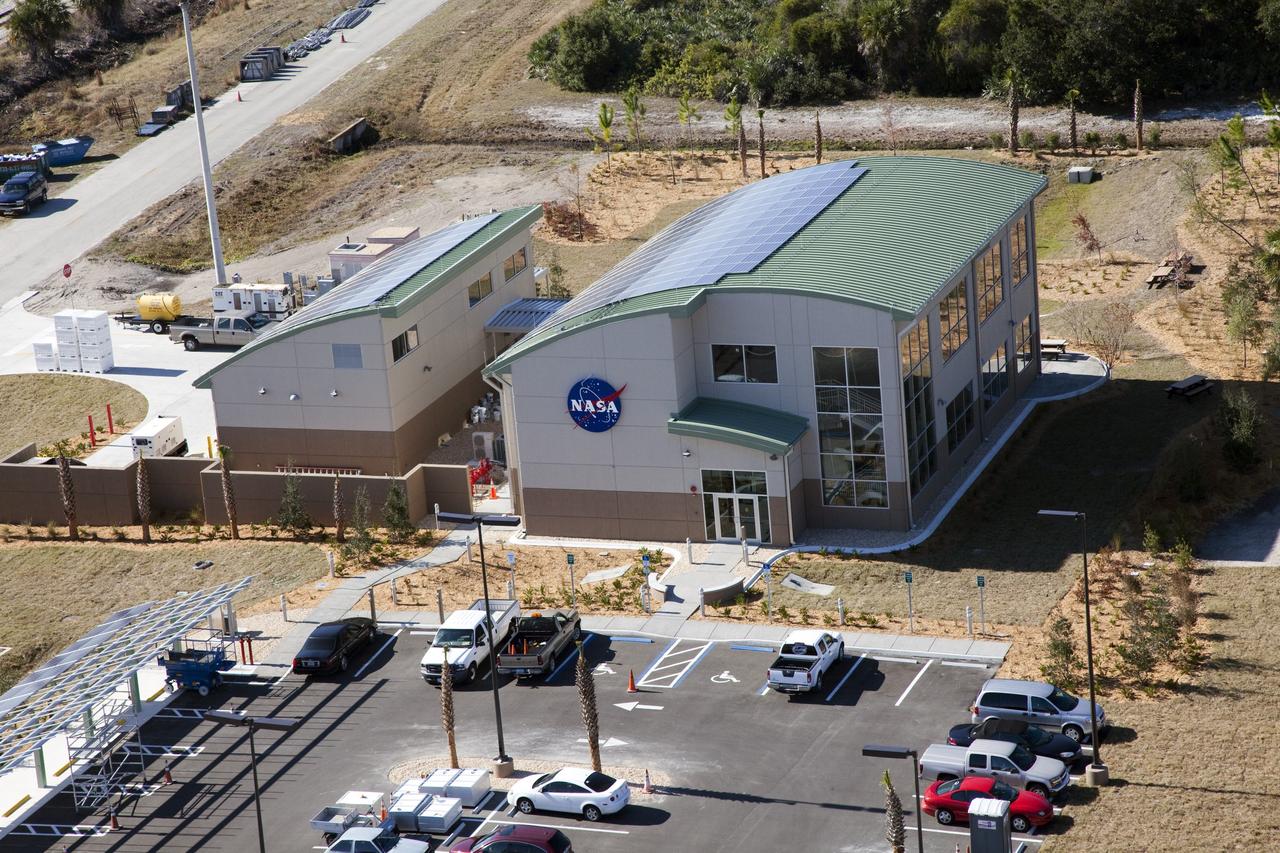
CAPE CANAVERAL, Fla. -- The Propellants North Administrative and Maintenance Facility in the Launch Complex 39 area of NASA's Kennedy Space Center in Florida is ready for business. The environmentally friendly facility is slated to be NASA's second Platinum-rated by the U.S. Green Building Council's (USGBC) Leadership in Environmental and Energy Design (LEED) certification system. It will be the space agency's first carbon-neutral facility, which means it will produce enough energy onsite from renewable sources to offset what it requires to operate. On the right is the facility's two-story administrative building, which will house managers, mechanics and technicians who fuel spacecraft at Kennedy. On the left is a single-story shop that will be used to store cryogenic fuel transfer equipment. In the parking lot is a solar-powered parking station for alternative fuel vehicles. Photo credit: NASA/Frank Michaux

CAPE CANAVERAL, Fla. -- The Vehicle Assembly Building towers over the new Propellants North Administrative and Maintenance Facility in the Launch Complex 39 area of NASA's Kennedy Space Center in Florida. The environmentally friendly facility is slated to be NASA's second Platinum-rated by the U.S. Green Building Council's (USGBC) Leadership in Environmental and Energy Design (LEED) certification system. It will be the space agency's first carbon-neutral facility, which means it will produce enough energy onsite from renewable sources to offset what it requires to operate. On the right is the facility's two-story administrative building, which will house managers, mechanics and technicians who fuel spacecraft at Kennedy. On the left is a single-story shop that will be used to store cryogenic fuel transfer equipment. In the parking lot is a solar-powered parking station for alternative fuel vehicles. Photo credit: NASA/Frank Michaux
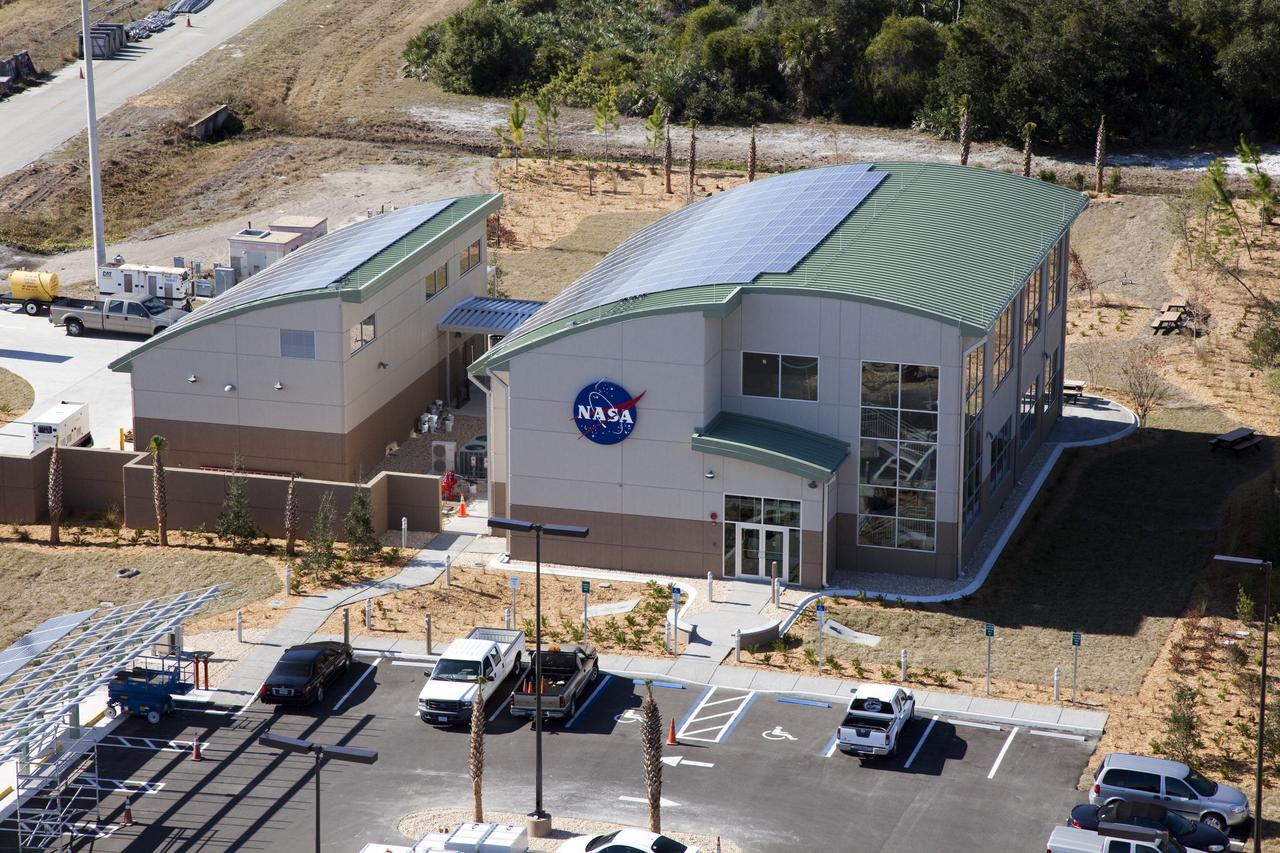
CAPE CANAVERAL, Fla. -- The Propellants North Administrative and Maintenance Facility in the Launch Complex 39 area of NASA's Kennedy Space Center in Florida is ready for business. The environmentally friendly facility is slated to be NASA's second Platinum-rated by the U.S. Green Building Council's (USGBC) Leadership in Environmental and Energy Design (LEED) certification system. It will be the space agency's first carbon-neutral facility, which means it will produce enough energy onsite from renewable sources to offset what it requires to operate. On the right is the facility's two-story administrative building, which will house managers, mechanics and technicians who fuel spacecraft at Kennedy. On the left is a single-story shop that will be used to store cryogenic fuel transfer equipment. In the parking lot is a solar-powered parking station for alternative fuel vehicles. Photo credit: NASA/Frank Michaux
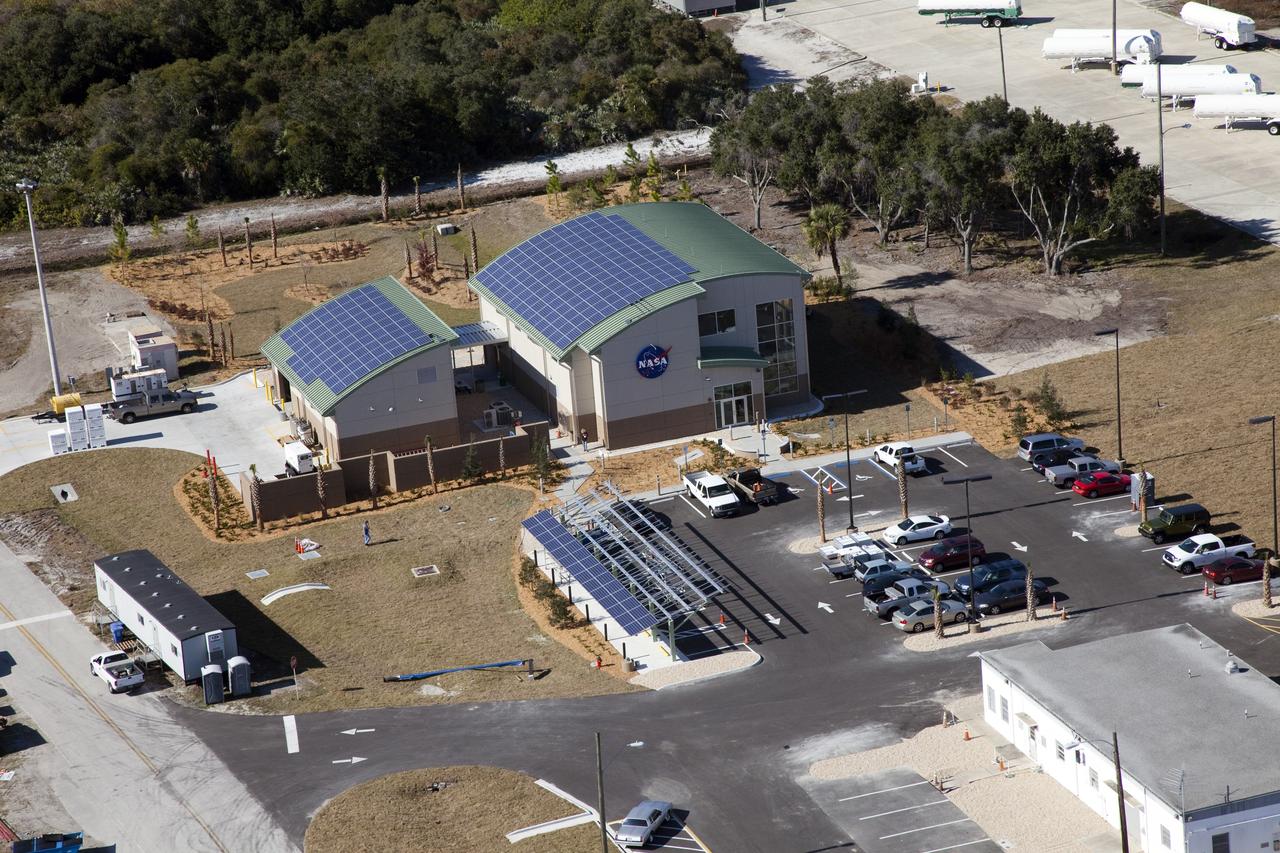
CAPE CANAVERAL, Fla. -- The Propellants North Administrative and Maintenance Facility in the Launch Complex 39 area of NASA's Kennedy Space Center in Florida is ready for business. The environmentally friendly facility is slated to be NASA's second Platinum-rated by the U.S. Green Building Council's (USGBC) Leadership in Environmental and Energy Design (LEED) certification system. It will be the space agency's first carbon-neutral facility, which means it will produce enough energy onsite from renewable sources to offset what it requires to operate. On the right is the facility's two-story administrative building, which will house managers, mechanics and technicians who fuel spacecraft at Kennedy. On the left is a single-story shop that will be used to store cryogenic fuel transfer equipment. In the parking lot is a solar-powered parking station for alternative fuel vehicles. Photo credit: NASA/Frank Michaux

CAPE CANAVERAL, Fla. -- This is the back view of the new Propellants North Administrative and Maintenance Facility in the Launch Complex 39 area of NASA's Kennedy Space Center in Florida. The environmentally friendly facility is slated to be NASA's second Platinum-rated by the U.S. Green Building Council's (USGBC) Leadership in Environmental and Energy Design (LEED) certification system. It will be the space agency's first carbon-neutral facility, which means it will produce enough energy onsite from renewable sources to offset what it requires to operate. On the right is the facility's single-story shop that will be used to store cryogenic fuel transfer equipment. On the left is a two-story administrative building, which will house managers, mechanics and technicians who fuel spacecraft at Kennedy. In the parking lot is a solar-powered parking station for alternative fuel vehicles. Photo credit: NASA/Frank Michaux
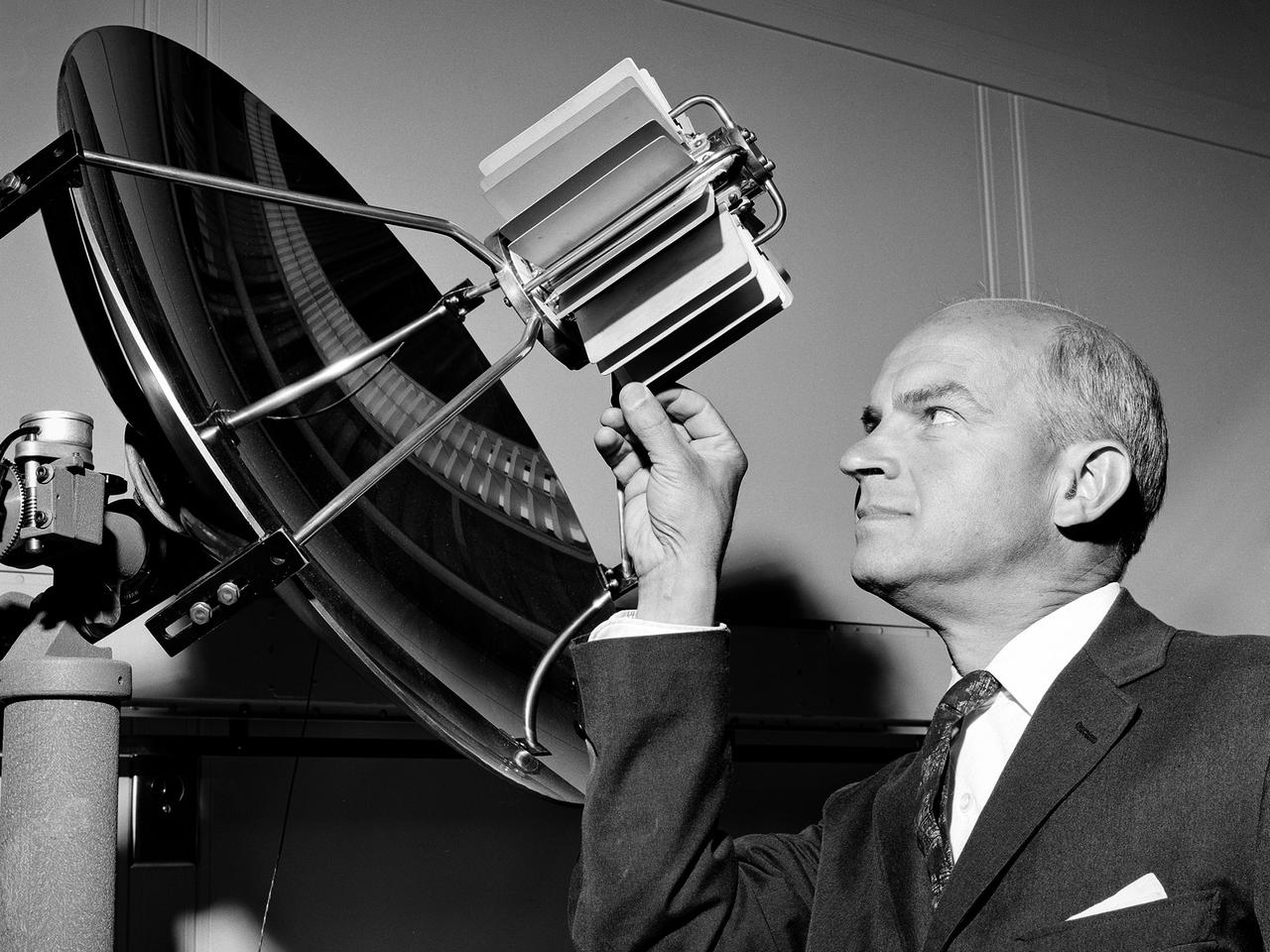
Walter Olson, Chief of the Chemistry and Energy Conversion Division, examines equipment in the new Energy Conversion Laboratory at the National Aeronautics and Space Administration (NASA) Lewis Research Center. The Energy Conversion Laboratory, built in 1961 and 1962, was a modest one-story brick structure with 30,000 square feet of working space. It was used to study fundamental elements pertaining to the conversion of energy into electrical power. The main application for this was space power, but in the 1970s it would also be applied for terrestrial applications. Olson joined the Lewis staff as a fuels and combustion researcher in 1942 and was among a handful or researchers who authored the new laboratory’s first technical report. The laboratory reorganized after the war and Olson was placed in charge of three sections of researchers in the Combustion Branch. They studied combustion and fuels for turbojets, ramjets, and small rockets. In 1950, Olson was named Chief of the entire Fuels and Combustion Research Division. In 1960 Olson was named Chief of the new Chemistry and Energy Conversion Division. It was in this role that Olson advocated for the construction of the Energy Conversion Laboratory. The new division expanded its focus from just fuels and combustion to new sources of energy and power such as solar cells, fuels cells, heat transfer, and thermionics.
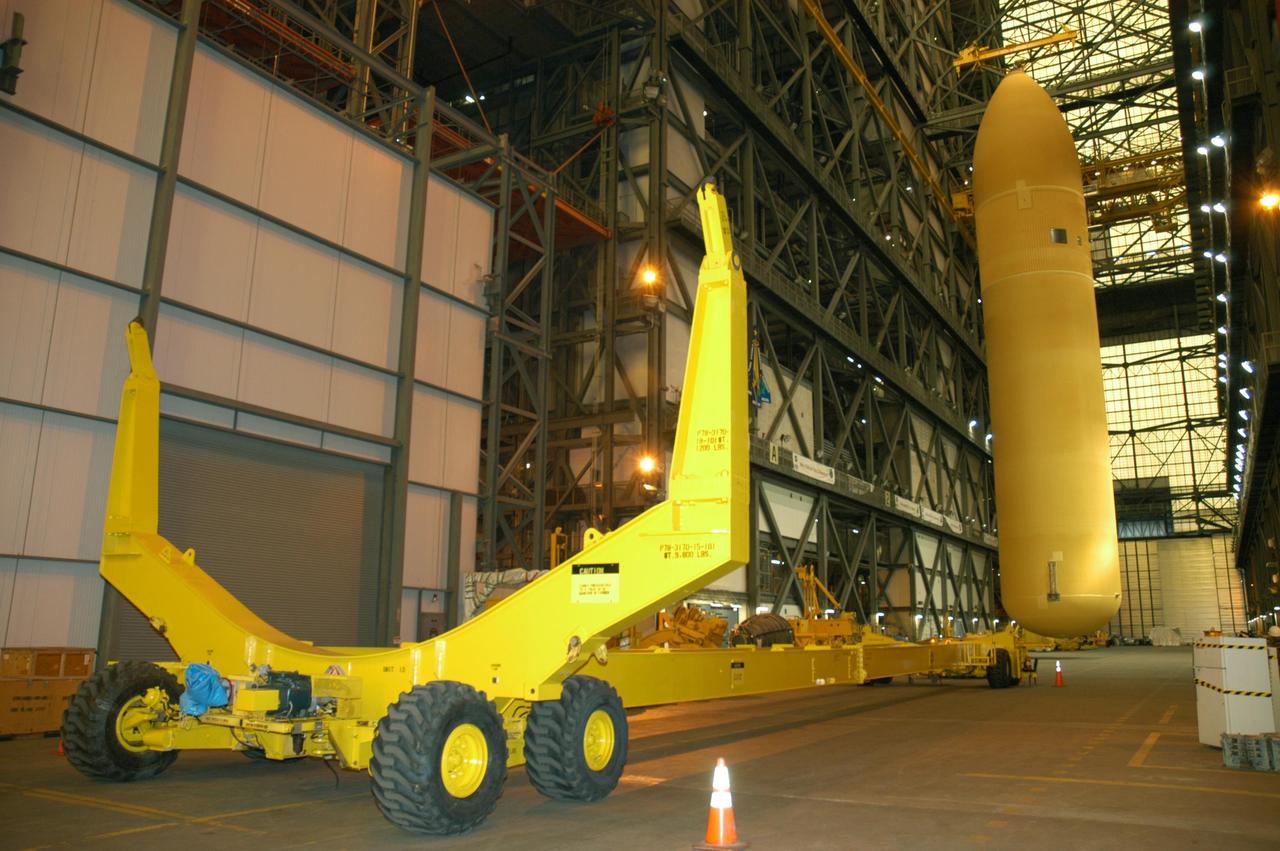
KENNEDY SPACE CENTER, FLA. - After being lowered from its cell in the Vehicle Assembly Building, External Tank 118 (ET-118) is suspended above the transfer aisle before being placed on the transporter at left. The tank will be transferred to NASA’s Michoud Assembly Facility in New Orleans. The tank is being installed with an improved bipod fitting, which connects the external fuel tank to the Shuttle during launch. The new design, a significant milestone in the effort to return the Shuttle to safe flight, replaces the foam that was used to prevent ice buildup on the tank’s bipod fittings with four rod-shaped heaters. The heaters are being retrofitted on the 11 existing tanks and incorporated into the manufacture of all new tanks.
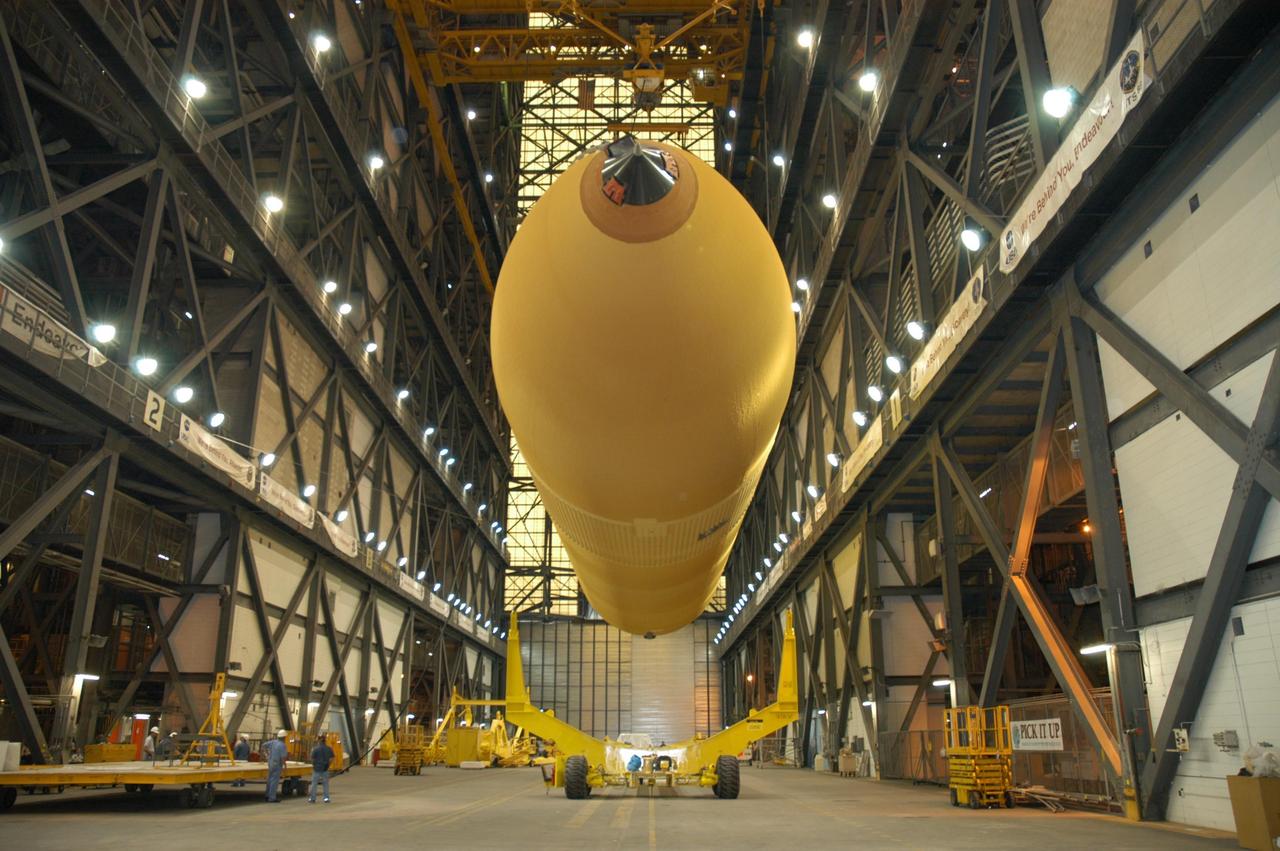
KENNEDY SPACE CENTER, FLA. - External Tank 118 (ET-118) is slowly moved above the transporter in the transfer aisle of the Vehicle Assembly Building before being lowered. The tank will be transferred to NASA’s Michoud Assembly Facility in New Orleans. The tank is being installed with an improved bipod fitting, which connects the external fuel tank to the Shuttle during launch. The new design, a significant milestone in the effort to return the Shuttle to safe flight, replaces the foam that was used to prevent ice buildup on the tank’s bipod fittings with four rod-shaped heaters. The heaters are being retrofitted on the 11 existing tanks and incorporated into the manufacture of all new tanks.
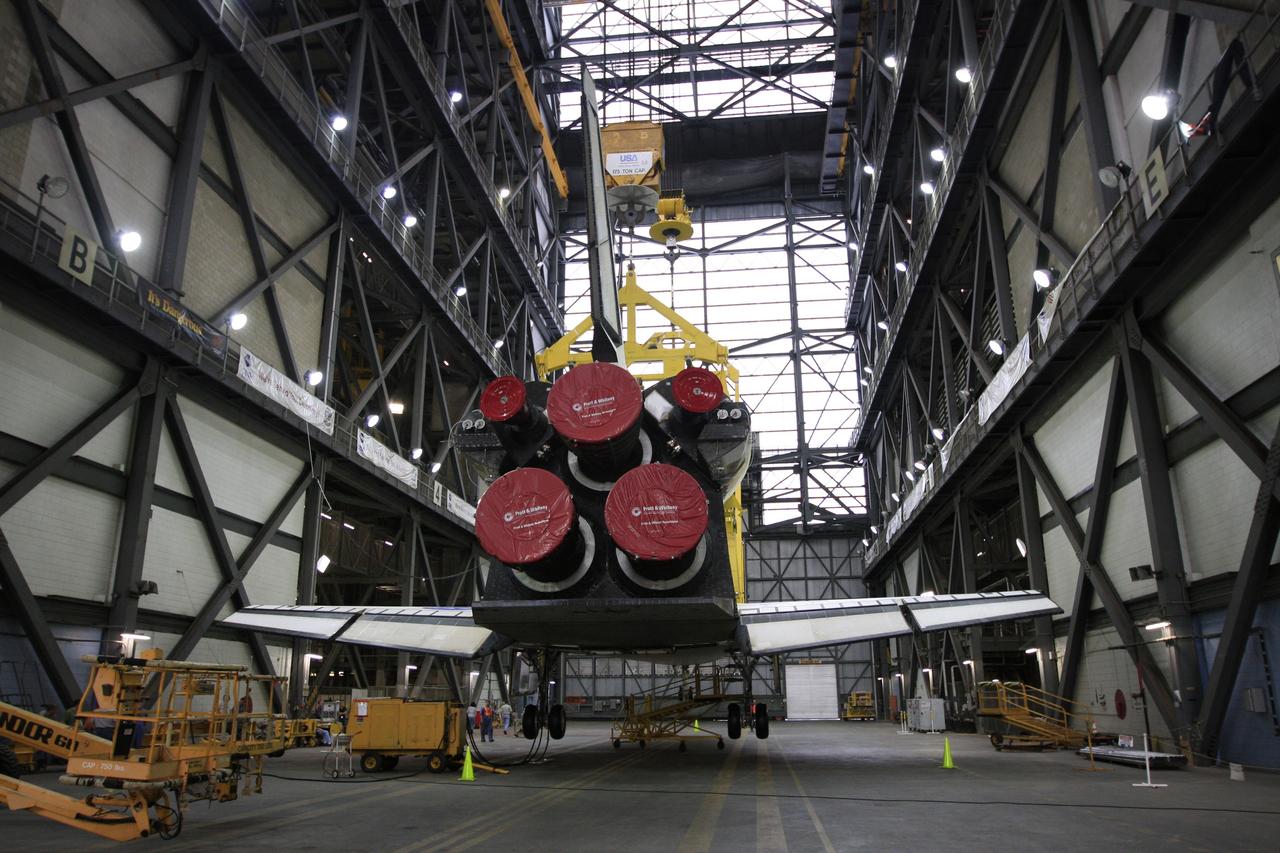
CAPE CANAVERAL, Fla. – In the transfer aisle of the Vehicle Assembly Building at NASA's Kennedy Space Center in Florida, space shuttle Atlantis has been lowered to a horizontal position and its wheels lowered. Atlantis has been removed from its external fuel tank and solid rocket boosters stack after the delay of its STS-125 mission to NASA's Hubble Space Telescope. Atlantis will be returned to the Orbiter Processing Facility. Atlantis' targeted launch on Oct. 14 was delayed when a system that transfers science data from the orbiting observatory to Earth malfunctioned on Sept. 27. The new target launch date is under review. Photo credit: NASA/Troy Cryder

KENNEDY SPACE CENTER, FLA. - Workers in the transfer aisle of the Vehicle Assembly Building prepare to lower the External Tank 118 (ET-118) to a horizontal position before being placed on a transporter. The tank will be transferred to NASA’s Michoud Assembly Facility in New Orleans. The tank is being installed with an improved bipod fitting, which connects the external fuel tank to the Shuttle during launch. The new design, a significant milestone in the effort to return the Shuttle to safe flight, replaces the foam that was used to prevent ice buildup on the tank’s bipod fittings with four rod-shaped heaters. The heaters are being retrofitted on the 11 existing tanks and incorporated into the manufacture of all new tanks.
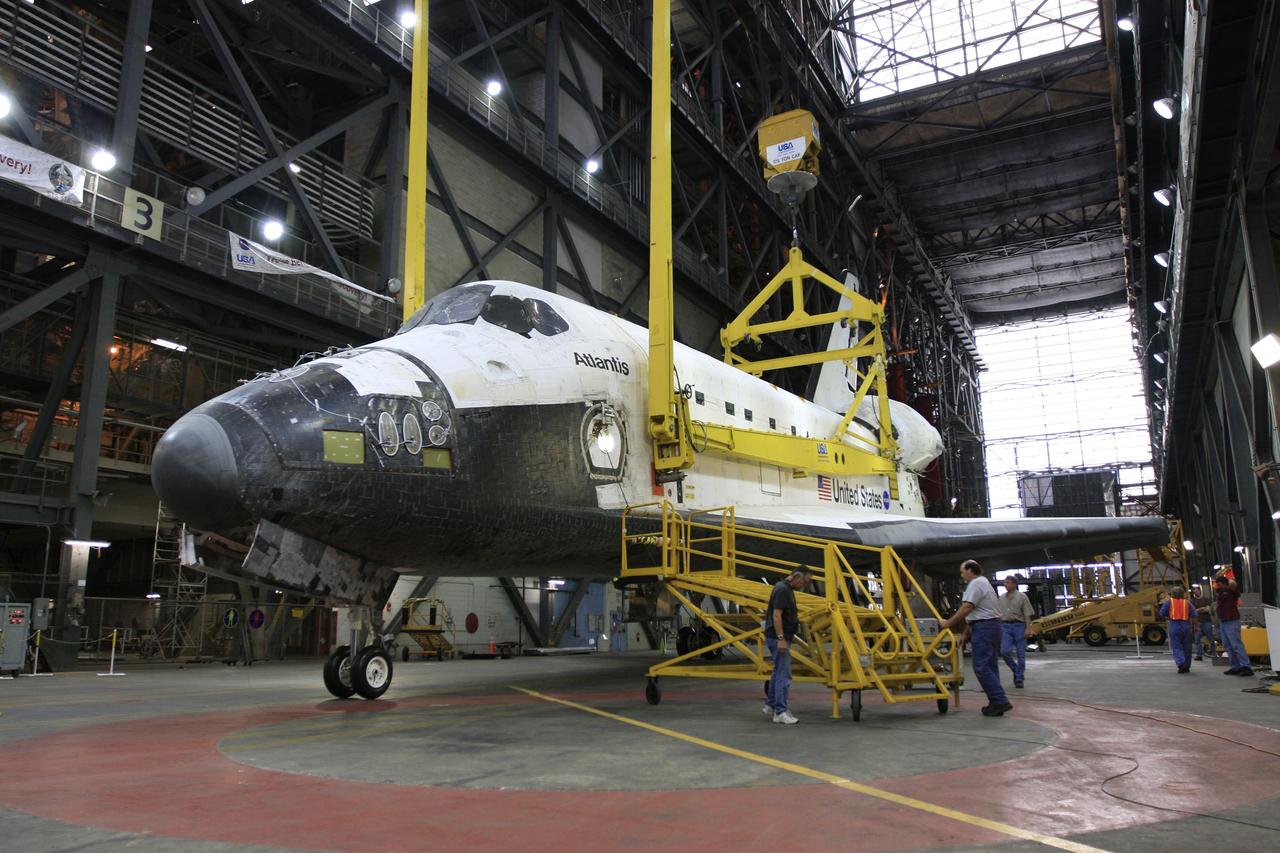
CAPE CANAVERAL, Fla. – Space shuttle Atlantis is lowered onto its wheels in the transfer aisle of the Vehicle Assembly Building at NASA's Kennedy Space Center in Florida. Atlantis has been removed from its external fuel tank and solid rocket boosters stack after the delay of its STS-125 mission to NASA's Hubble Space Telescope. Atlantis will be returned to the Orbiter Processing Facility. Atlantis' targeted launch on Oct. 14 was delayed when a system that transfers science data from the orbiting observatory to Earth malfunctioned on Sept. 27. The new target launch date is under review. Photo credit: NASA/Troy Cryder
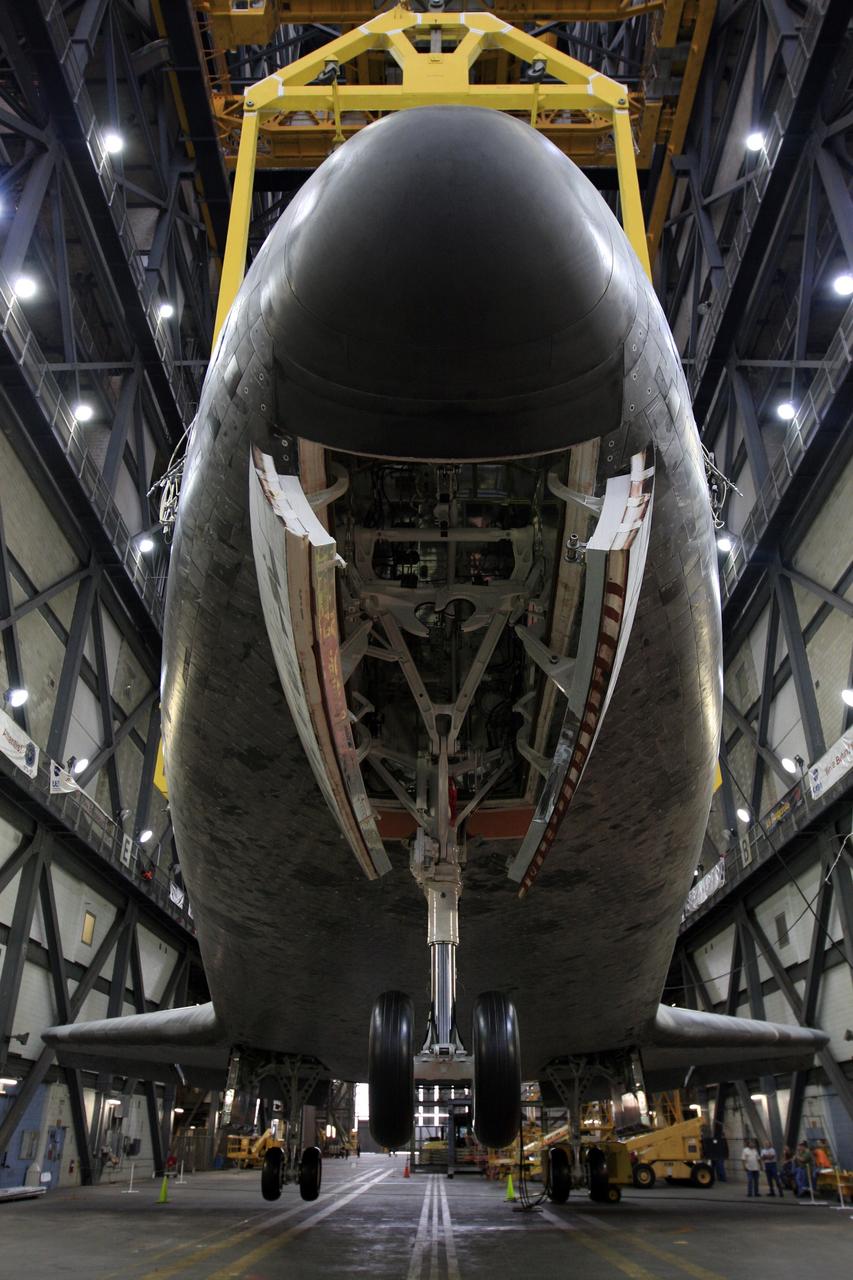
CAPE CANAVERAL, Fla. – This close-up shows space shuttle Atlantis being lowered onto its wheels in the transfer aisle of the Vehicle Assembly Building at NASA's Kennedy Space Center in Florida. Atlantis has been removed from its external fuel tank and solid rocket boosters stack after the delay of its STS-125 mission to NASA's Hubble Space Telescope. Atlantis will be returned to the Orbiter Processing Facility. Atlantis' targeted launch on Oct. 14 was delayed when a system that transfers science data from the orbiting observatory to Earth malfunctioned on Sept. 27. The new target launch date is under review. Photo credit: NASA/Troy Cryder
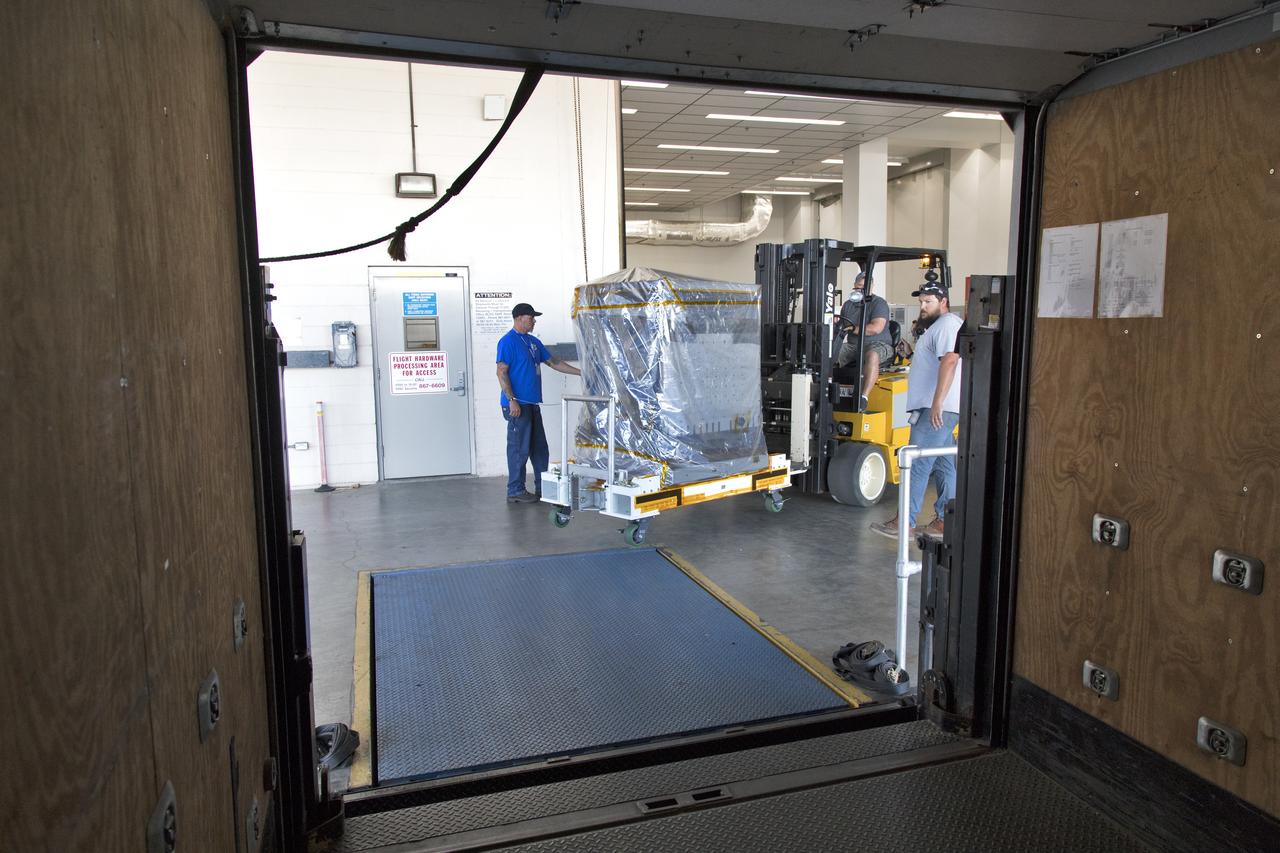
Workers prepare to transfer the Robotic Refueling Mission-3 (RRM3) payload from the Space Station Processing Facility high bay to the Payload Hazardous Servicing Facility on Oct. 3, 2018, at NASA's Kennedy Space Center in Florida. The payload will be carried to the International Space Station on SpaceX's 16th Commercial Resupply Services mission. RRM3 demonstrates the transfer of xenon gas and liquid methane in microgravity, and advances technologies for storing and manipulating these cryogenic fuels robotically. RRM3 also supports development of technology for the Restore-L mission, a robotic spacecraft equipped to service satellites in-orbit.
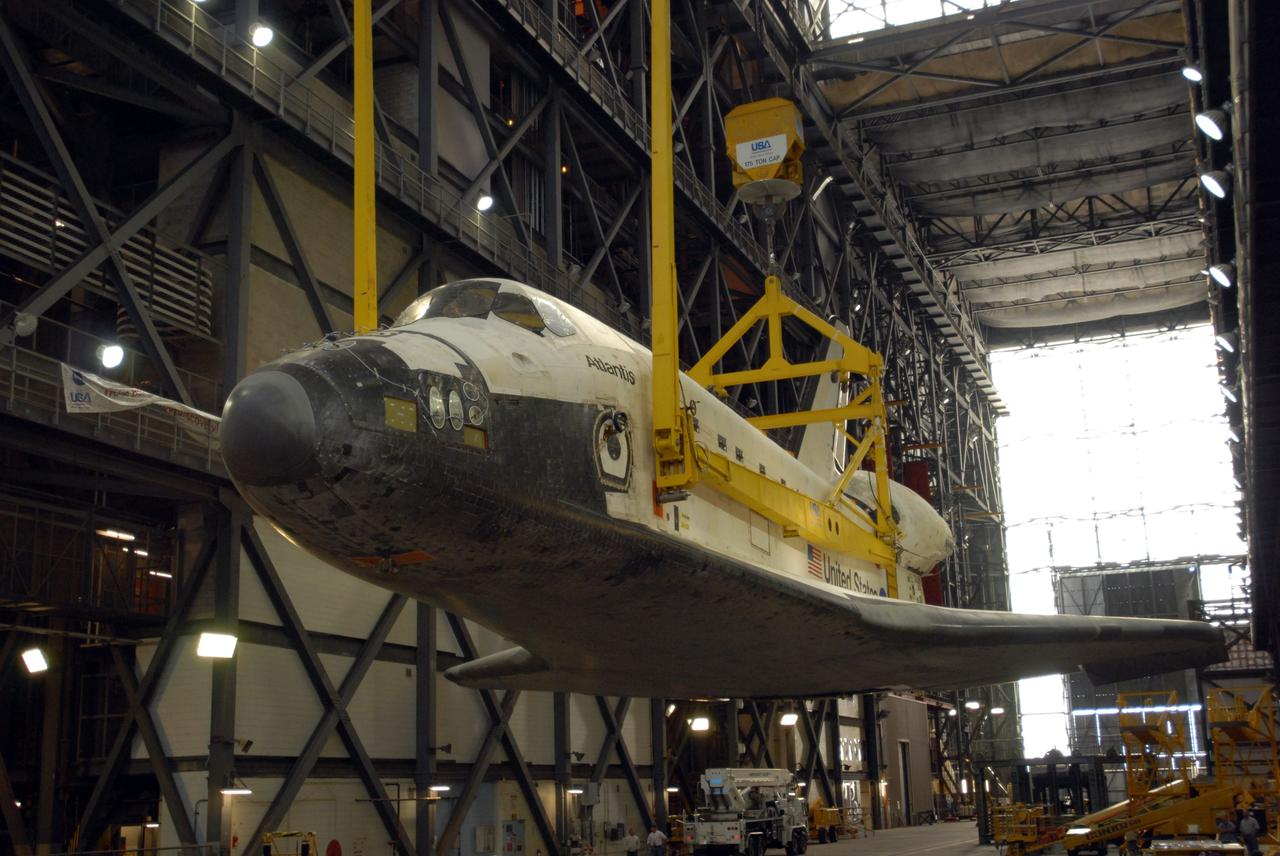
CAPE CANAVERAL, Fla. – In the transfer aisle of the Vehicle Assembly Building at NASA's Kennedy Space Center in Florida, space shuttle Atlantis has been lowered to a horizontal position. Atlantis has been taken off its external fuel tank and solid rocket boosters stack after of the delay of its STS-125 mission to NASA's Hubble Space Telescope. Atlantis will be returned to the Orbiter Processing Facility. Atlantis' targeted launch on Oct. 14 was delayed when a system that transfers science data from the orbiting observatory to Earth malfunctioned on Sept. 27. The new target launch date is under review. Photo credit: NASA/Jim Grossmann
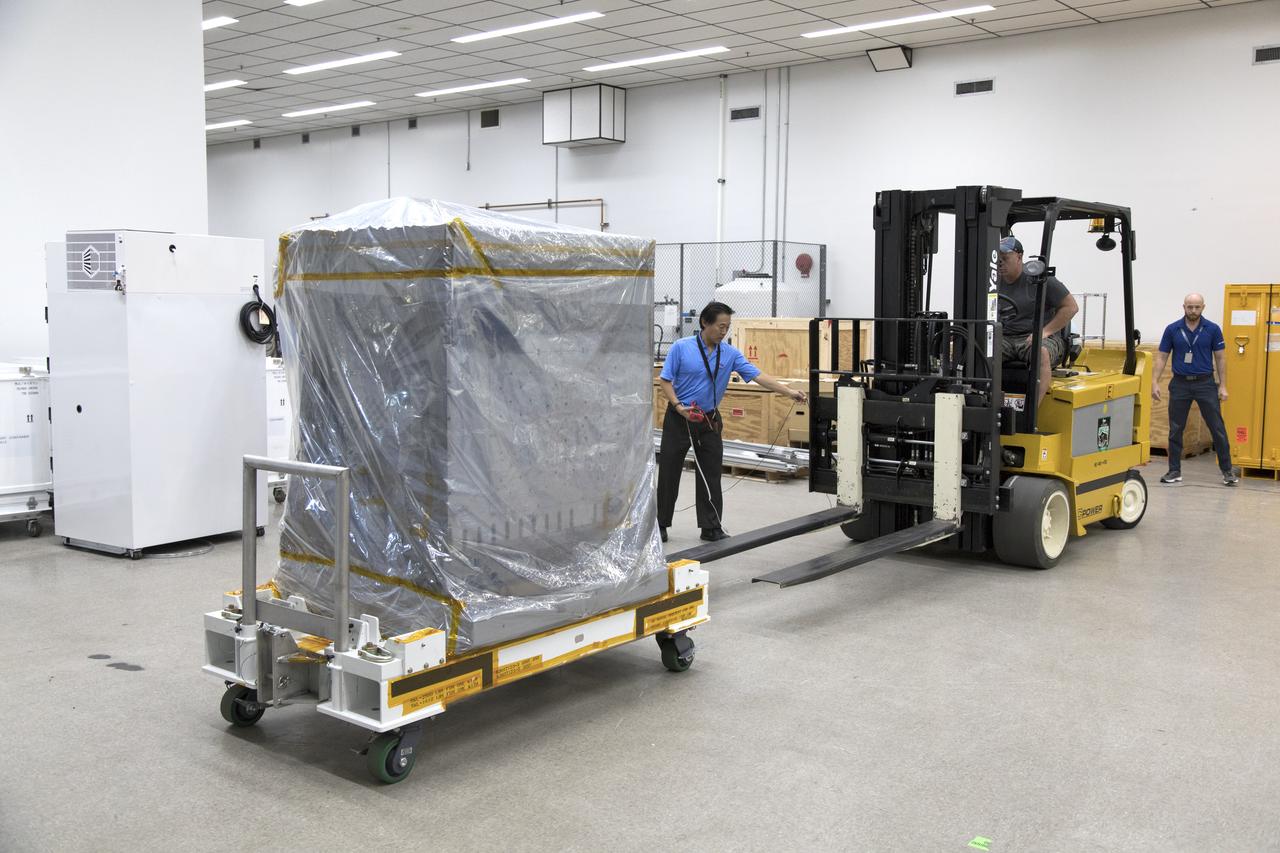
Workers prepare the Robotic Refueling Mission-3 (RRM3) payload to be transferred from the Space Station Processing Facility high bay to the Payload Hazardous Servicing Facility on Oct. 3, 2018, at NASA's Kennedy Space Center in Florida. The payload will be carried to the International Space Station on SpaceX's 16th Commercial Resupply Services mission. RRM3 demonstrates the transfer of xenon gas and liquid methane in microgravity, and advances technologies for storing and manipulating these cryogenic fuels robotically. RRM3 also supports development of technology for the Restore-L mission, a robotic spacecraft equipped to service satellites in-orbit.
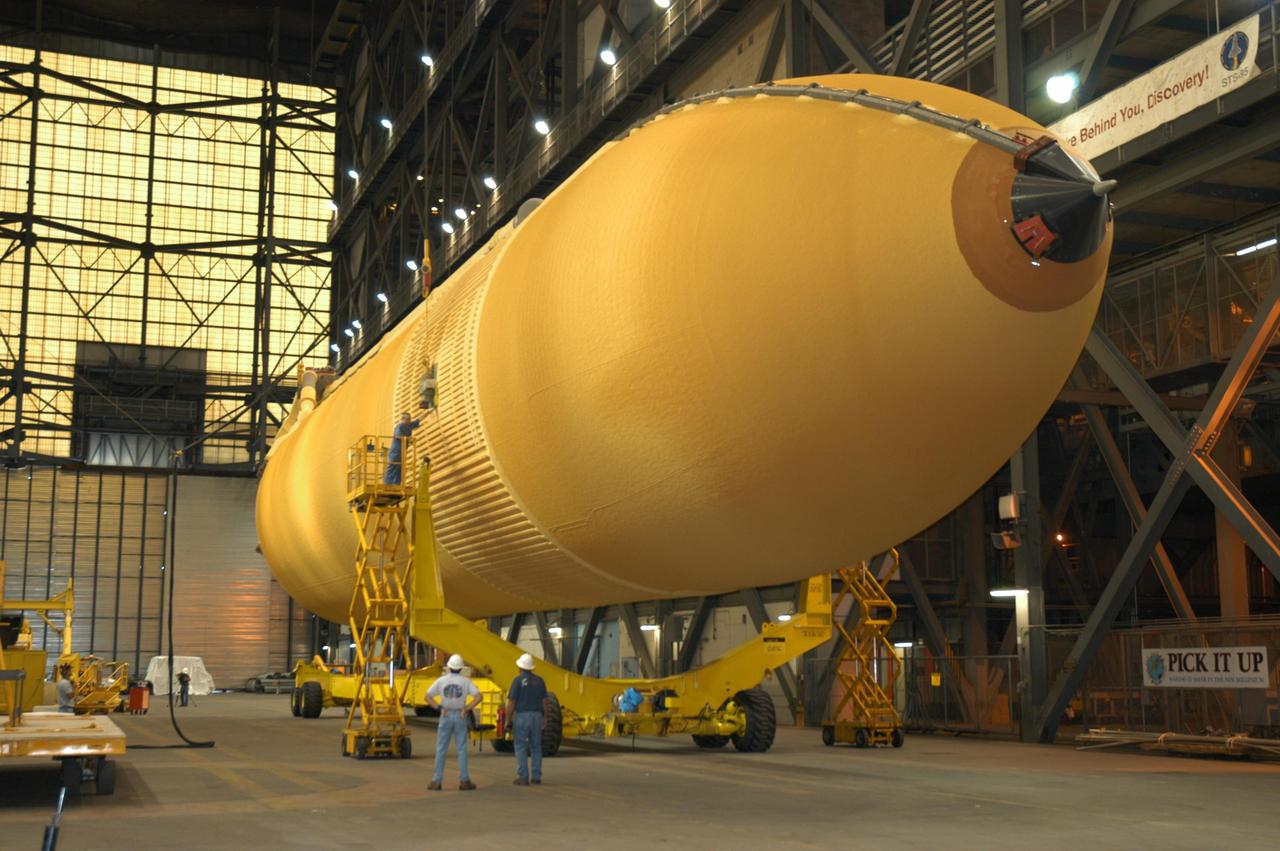
KENNEDY SPACE CENTER, FLA. - Workers in the transfer aisle of the Vehicle Assembly Building check the progress of External Tank 118 (ET-118) as it is lowered onto the transporter below it. The tank will be transferred to NASA’s Michoud Assembly Facility in New Orleans. The tank is being installed with an improved bipod fitting, which connects the external fuel tank to the Shuttle during launch. The new design, a significant milestone in the effort to return the Shuttle to safe flight, replaces the foam that was used to prevent ice buildup on the tank’s bipod fittings with four rod-shaped heaters. The heaters are being retrofitted on the 11 existing tanks and incorporated into the manufacture of all new tanks.
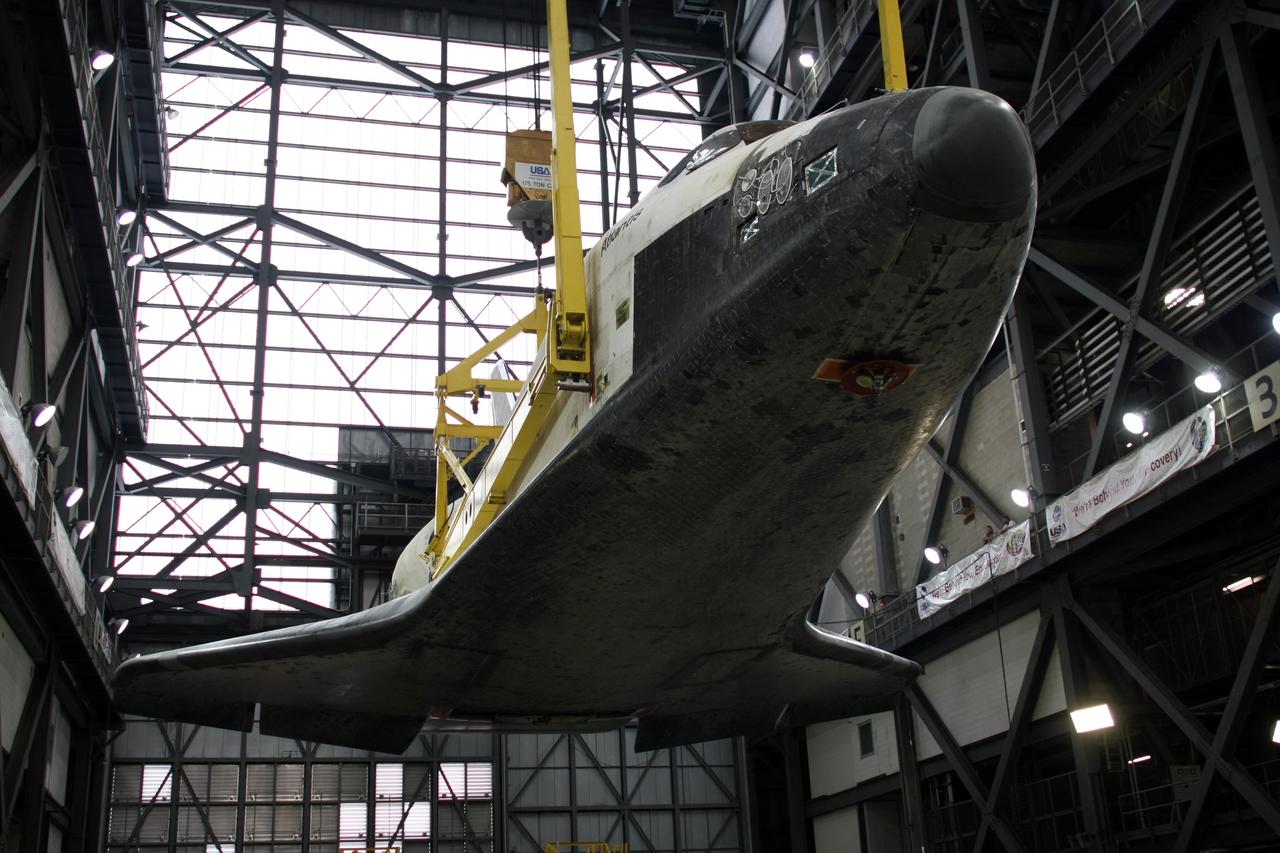
CAPE CANAVERAL, Fla. – In the Vehicle Assembly Building transfer aisle at NASA's Kennedy Space Center, the overhead crane lifts space shuttle Atlantis high above its transporter. Atlantis will be raised to vertical for transfer to high bay 3. There it will be stacked with its external fuel tank and twin solid rocket boosters. After additional preparations are made, the shuttle will be rolled out to Launch Pad 39A to prepare for launch on the STS-125 mission targeted for 1:34 a.m. EDT Oct. 8. Photo credit: NASA/Dimitri Gerondidakis
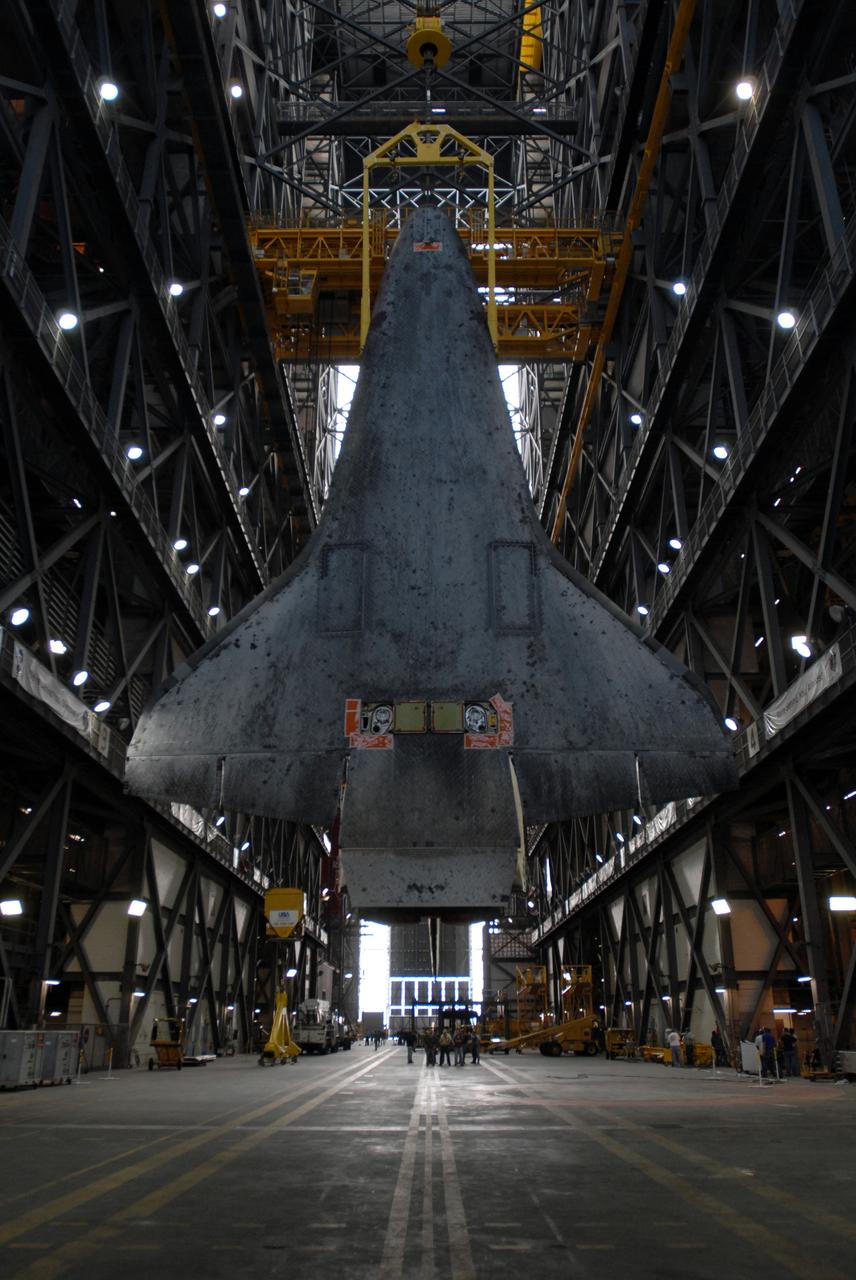
CAPE CANAVERAL, Fla. – In the Vehicle Assembly Building at NASA's Kennedy Space Center in Florida, space shuttle Atlantis hangs suspended above the transfer aisle floor. Atlantis has been taken off its external fuel tank and solid rocket boosters stack after of the delay of its STS-125 mission to NASA's Hubble Space Telescope. Atlantis will be returned to the Orbiter Processing Facility. Atlantis' targeted launch on Oct. 14 was delayed when a system that transfers science data from the orbiting observatory to Earth malfunctioned on Sept. 27. The new target launch date is under review. Photo credit: NASA/Jim Grossmann
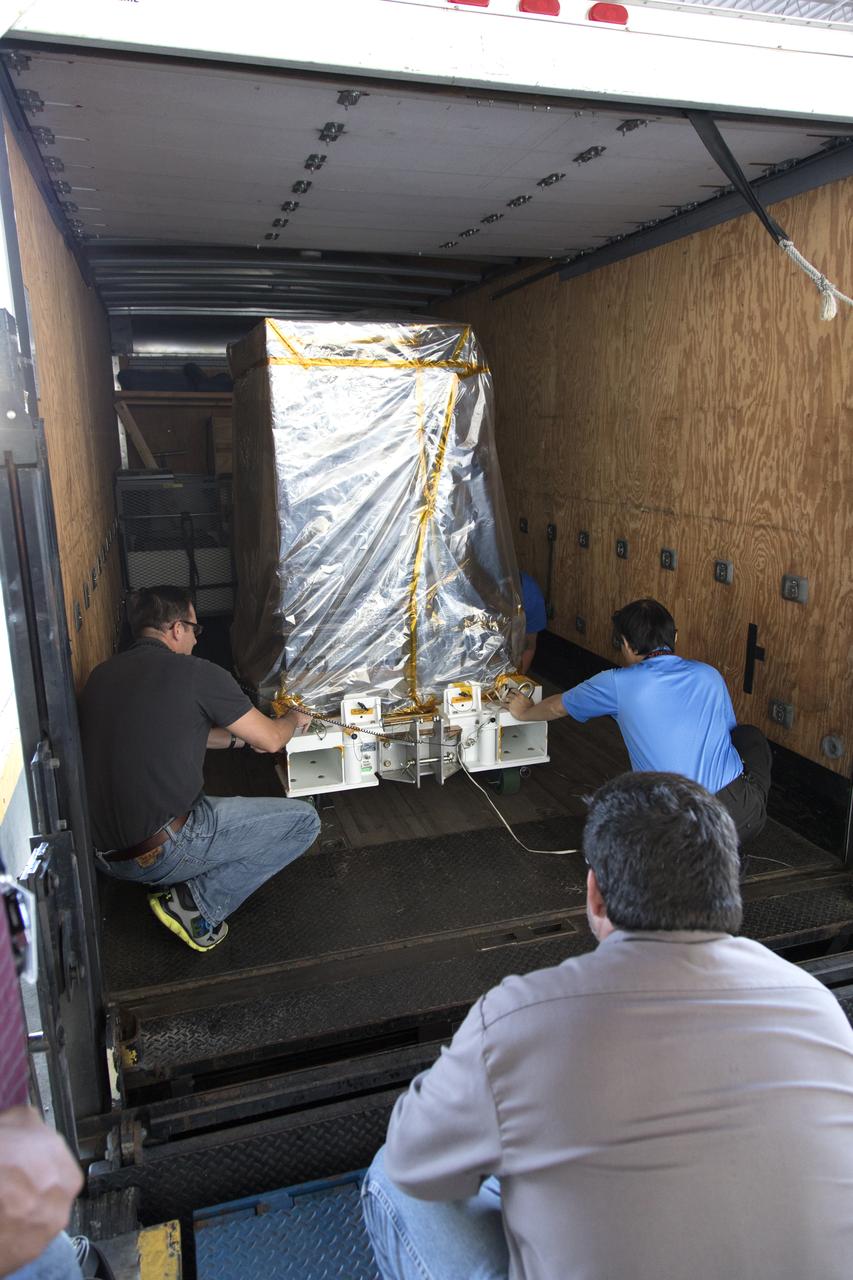
Workers load the Robotic Refueling Mission-3 (RRM3) payload onto a truck at the Space Station Processing Facility for transfer to the Payload Hazardous Servicing Facility on Oct. 3, 2018, at NASA's Kennedy Space Center in Florida. The payload will be carried to the International Space Station on SpaceX's 16th Commercial Resupply Services mission. RRM3 demonstrates the transfer of xenon gas and liquid methane in microgravity, and advances technologies for storing and manipulating these cryogenic fuels robotically. RRM3 also supports development of technology for the Restore-L mission, a robotic spacecraft equipped to service satellites in-orbit.

CAPE CANAVERAL, Fla. – In In the Vehicle Assembly Building at NASA's Kennedy Space Center in Florida, space shuttle Atlantis is lowered by a sling toward the transfer aisle floor. Atlantis has been taken off its external fuel tank and solid rocket boosters stack after of the delay of its STS-125 mission to NASA's Hubble Space Telescope. Atlantis will be returned to the Orbiter Processing Facility. Atlantis' targeted launch on Oct. 14 was delayed when a system that transfers science data from the orbiting observatory to Earth malfunctioned on Sept. 27. The new target launch date is under review. Photo credit: NASA/Jim Grossmann
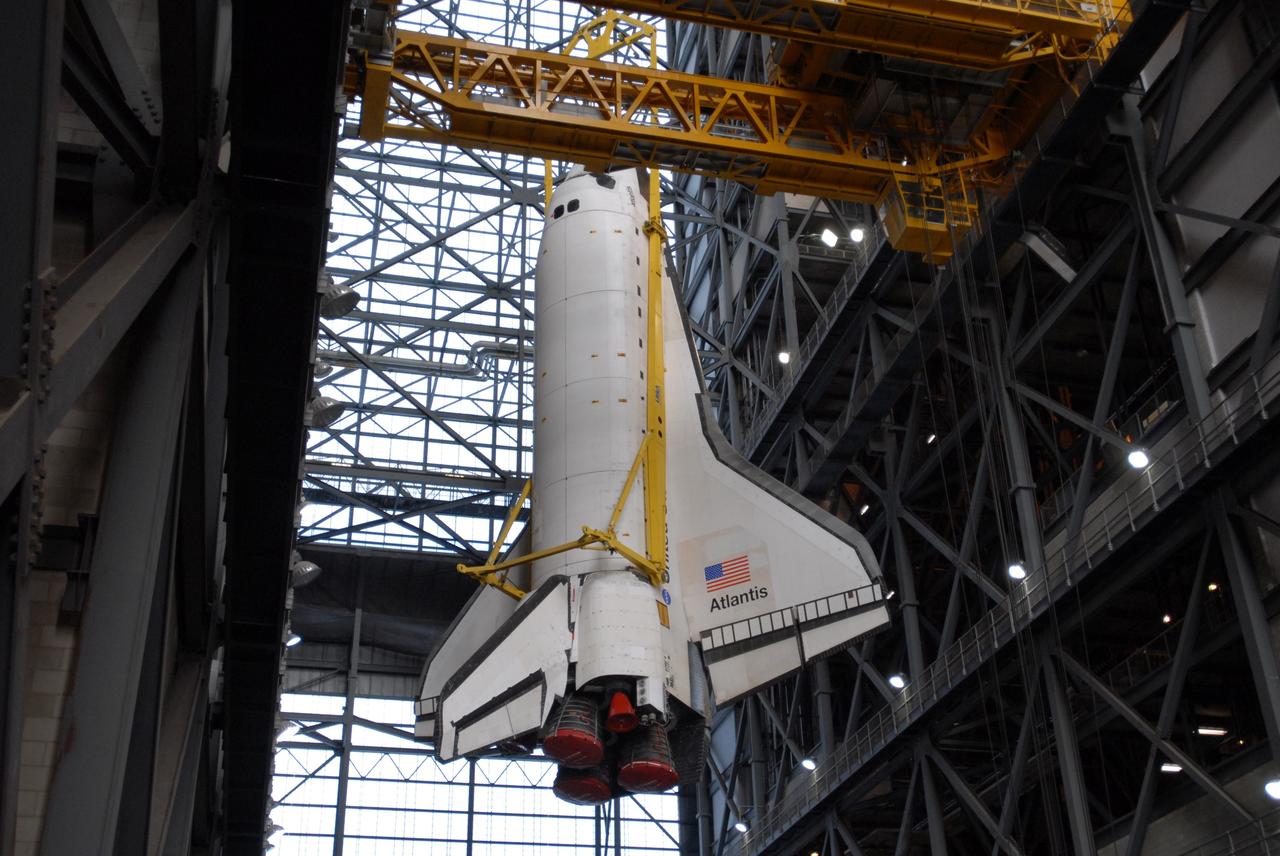
CAPE CANAVERAL, Fla. – In the Vehicle Assembly Building at NASA's Kennedy Space Center in Florida, space shuttle Atlantis is lowered by a sling toward the transfer aisle floor. Atlantis has been taken off its external fuel tank and solid rocket boosters stack after of the delay of its STS-125 mission to NASA's Hubble Space Telescope. Atlantis will be returned to the Orbiter Processing Facility. Atlantis' targeted launch on Oct. 14 was delayed when a system that transfers science data from the orbiting observatory to Earth malfunctioned on Sept. 27. The new target launch date is under review. Photo credit: NASA/Jim Grossmann
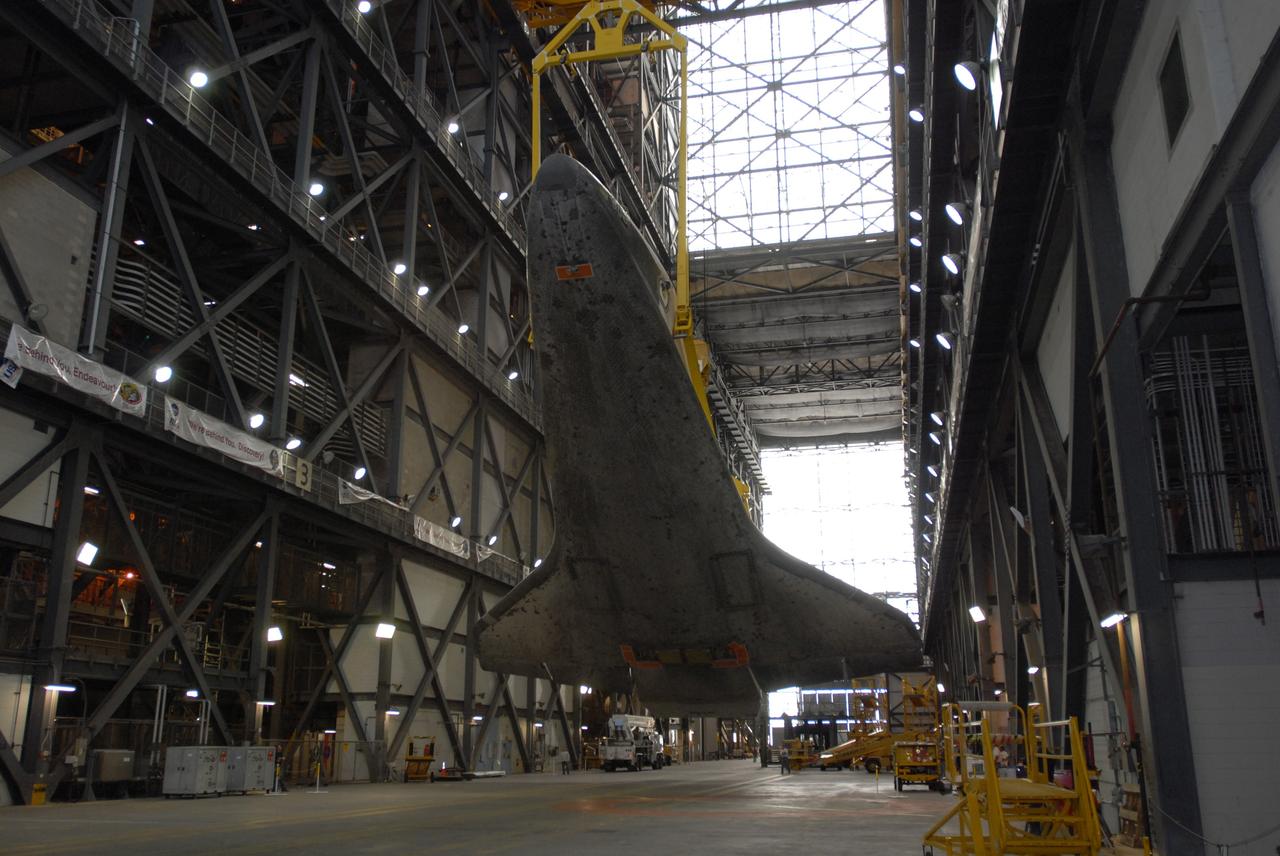
CAPE CANAVERAL, Fla. – In the transfer aisle of the Vehicle Assembly Building at NASA's Kennedy Space Center in Florida, space shuttle Atlantis is lowered to a horizontal position. Atlantis has been taken off its external fuel tank and solid rocket boosters stack after of the delay of its STS-125 mission to NASA's Hubble Space Telescope. Atlantis will be returned to the Orbiter Processing Facility. Atlantis' targeted launch on Oct. 14 was delayed when a system that transfers science data from the orbiting observatory to Earth malfunctioned on Sept. 27. The new target launch date is under review. Photo credit: NASA/Jim Grossmann
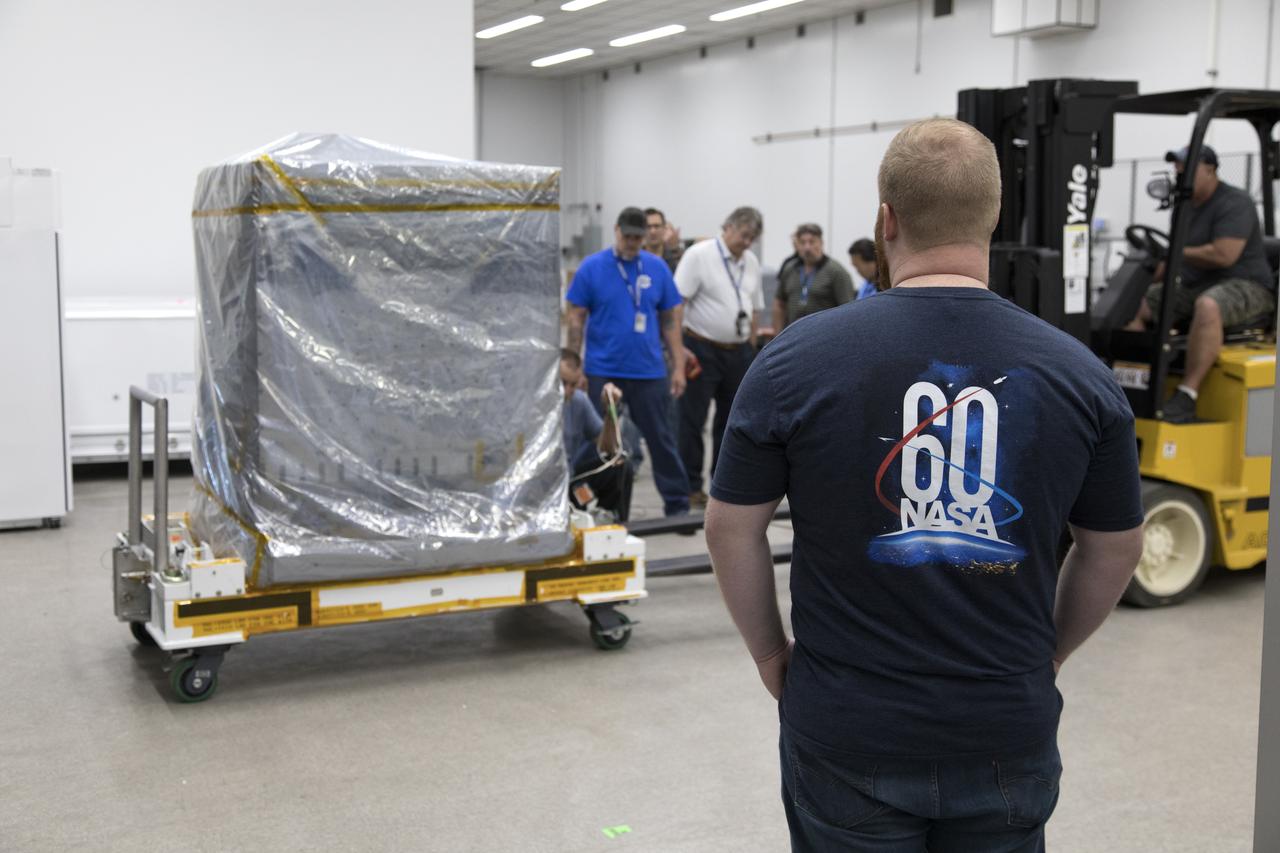
Workers prepare the Robotic Refueling Mission-3 (RRM3) payload to be transferred from the Space Station Processing Facility high bay to the Payload Hazardous Servicing Facility on Oct. 3, 2018, at NASA's Kennedy Space Center in Florida. The payload will be carried to the International Space Station on SpaceX's 16th Commercial Resupply Services mission. RRM3 demonstrates the transfer of xenon gas and liquid methane in microgravity, and advances technologies for storing and manipulating these cryogenic fuels robotically. RRM3 also supports development of technology for the Restore-L mission, a robotic spacecraft equipped to service satellites in-orbit.
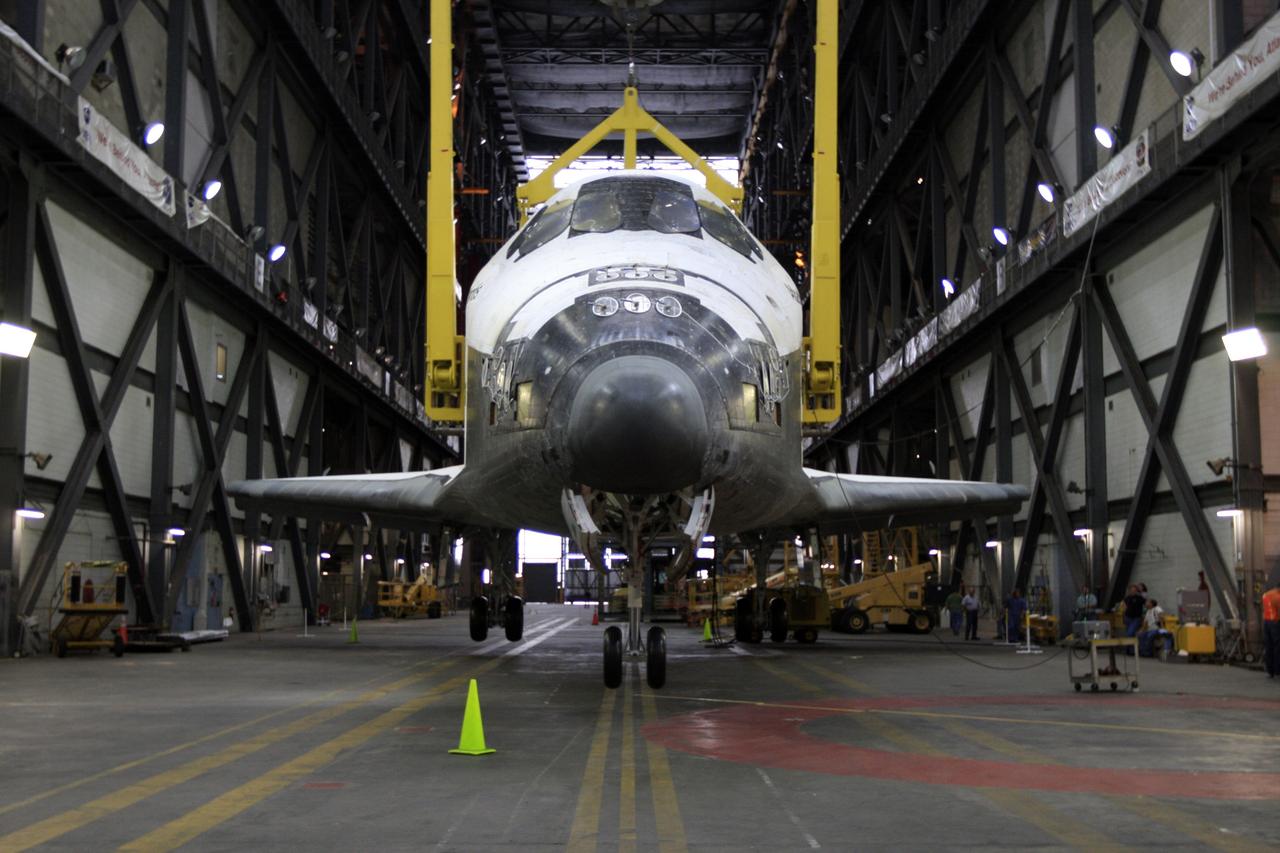
CAPE CANAVERAL, Fla. – This close-up shows space shuttle Atlantis being lowered onto its wheels in the transfer aisle of the Vehicle Assembly Building at NASA's Kennedy Space Center in Florida. Atlantis has been removed from its external fuel tank and solid rocket boosters stack after the delay of its STS-125 mission to NASA's Hubble Space Telescope. Atlantis will be returned to the Orbiter Processing Facility. Atlantis' targeted launch on Oct. 14 was delayed when a system that transfers science data from the orbiting observatory to Earth malfunctioned on Sept. 27. The new target launch date is under review. Photo credit: NASA/Troy Cryder
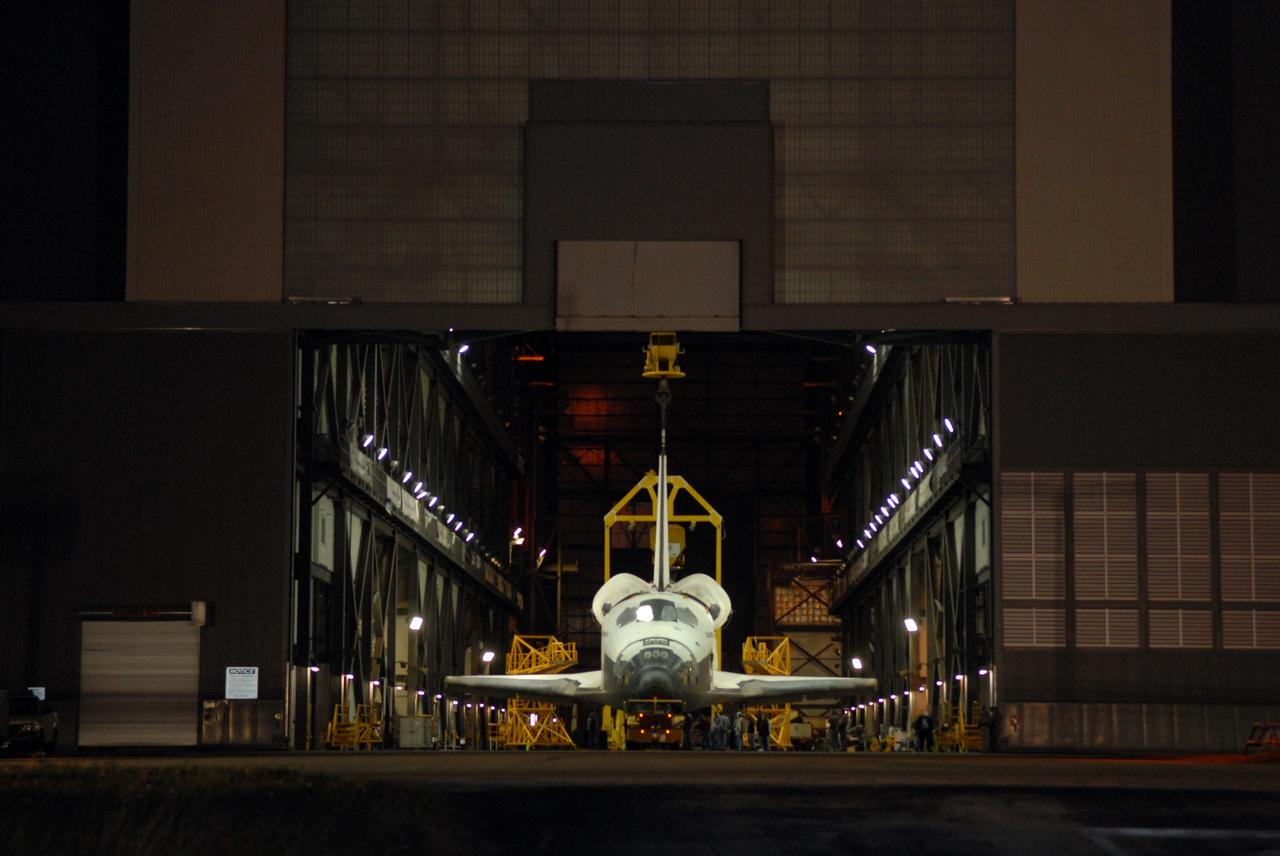
CAPE CANAVERAL, Fla. – In the transfer aisle of the Vehicle Assembly Building at NASA's Kennedy Space Center in Florida, the sling is removed from space shuttle Atlantis before its return to the Orbiter Processing Facility. Atlantis was removed from its external fuel tank and solid rocket boosters stack after the delay of its STS-125 mission to NASA's Hubble Space Telescope. Atlantis' targeted launch on Oct. 14 was delayed when a system that transfers science data from the orbiting observatory to Earth malfunctioned on Sept. 27. The new target launch date is under review. Photo credit: NASA/Tim Jacobs
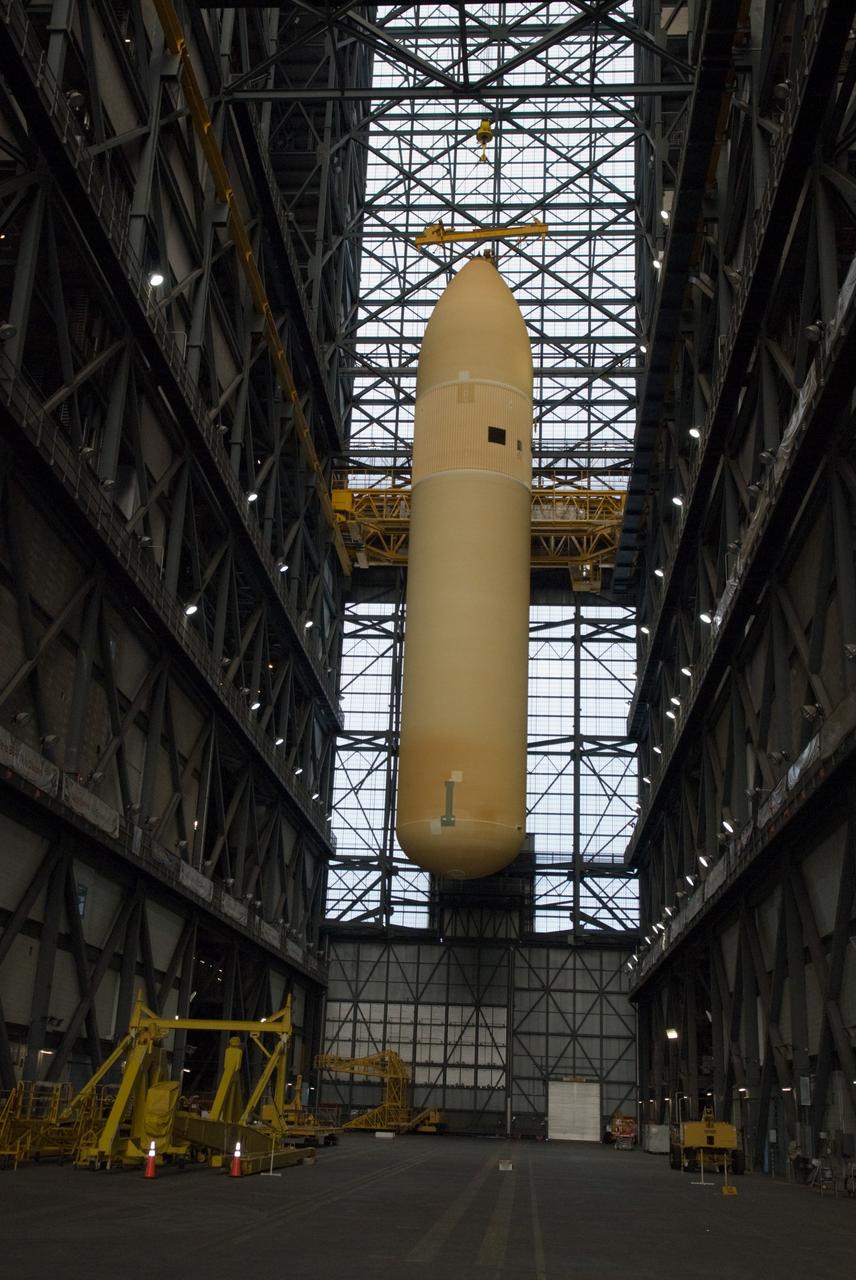
CAPE CANAVERAL, Fla. – In the Vehicle Assembly Building at NASA's Kennedy Space Center in Florida, the external fuel tank for space shuttle Discovery's STS-131 mission, ET-135, is lifted above the transfer aisle for transfer into a test cell. The tank was delivered to Kennedy aboard the Pegasus barge from NASA's Michoud Assembly Facility on Dec. 26. The tank will remain in the test cell until it is transferred into a high bay for mating with the twin solid rocket boosters that will be used on the mission. Launch of the STS-131 mission to the International Space Station is targeted for March 18. For information on the STS-131 mission and crew, visit http://www.nasa.gov/mission_pages/shuttle/shuttlemissions/sts131/index.html. Photo credit: NASA/Glenn Benson
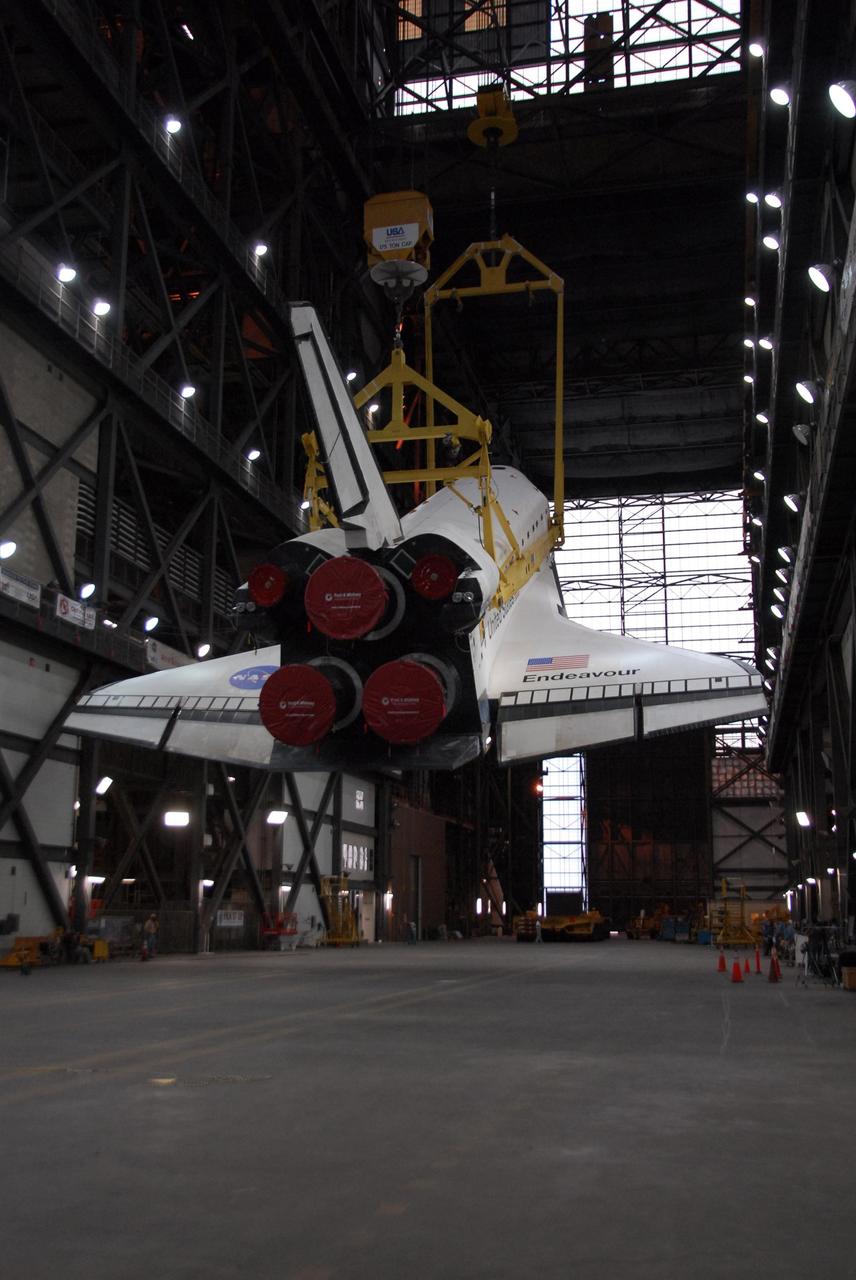
KENNEDY SPACE CENTER, FLA. -- In the transfer aisle of the Vehicle Assembly Building, the suspended space shuttle Endeavour is slowly being raised to a vertical position. It will then be lifted up into high bay 1 to be attached to its external fuel tank and solid rocket boosters in preparation for launch on the STS-123 mission, targeted for March 11. The mission will deliver the first section of the Japan Aerospace Exploration Agency's Kibo laboratory and the Canadian Space Agency's two-armed robotic system, Dextre. Photo credit: NASA/Dimitri Gerondidakis
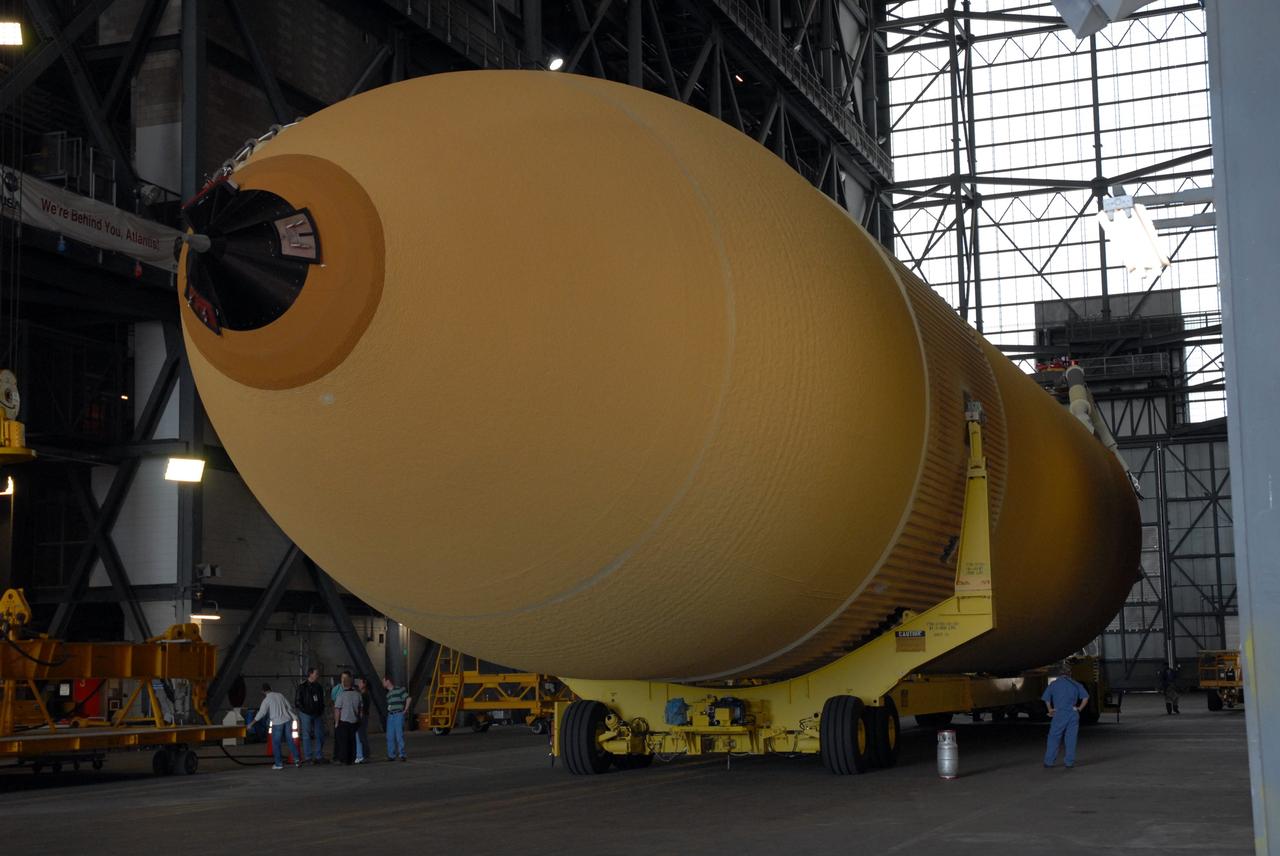
CAPE CANAVERAL, Fla. – At NASA's Kennedy Space Center in Florida, external fuel tank ET-131 moves into the transfer aisle of the Vehicle Assembly Building. The tank, which will be used on the STS-127 mission, will be lifted into a high bay for checkout. The Japanese Experiment Module's Experiment Logistics Module-Exposed Section, or ELM-ES, is part of the payload on the STS-127 mission, targeted for launch in June. Photo credit: NASA/Tim Jacobs
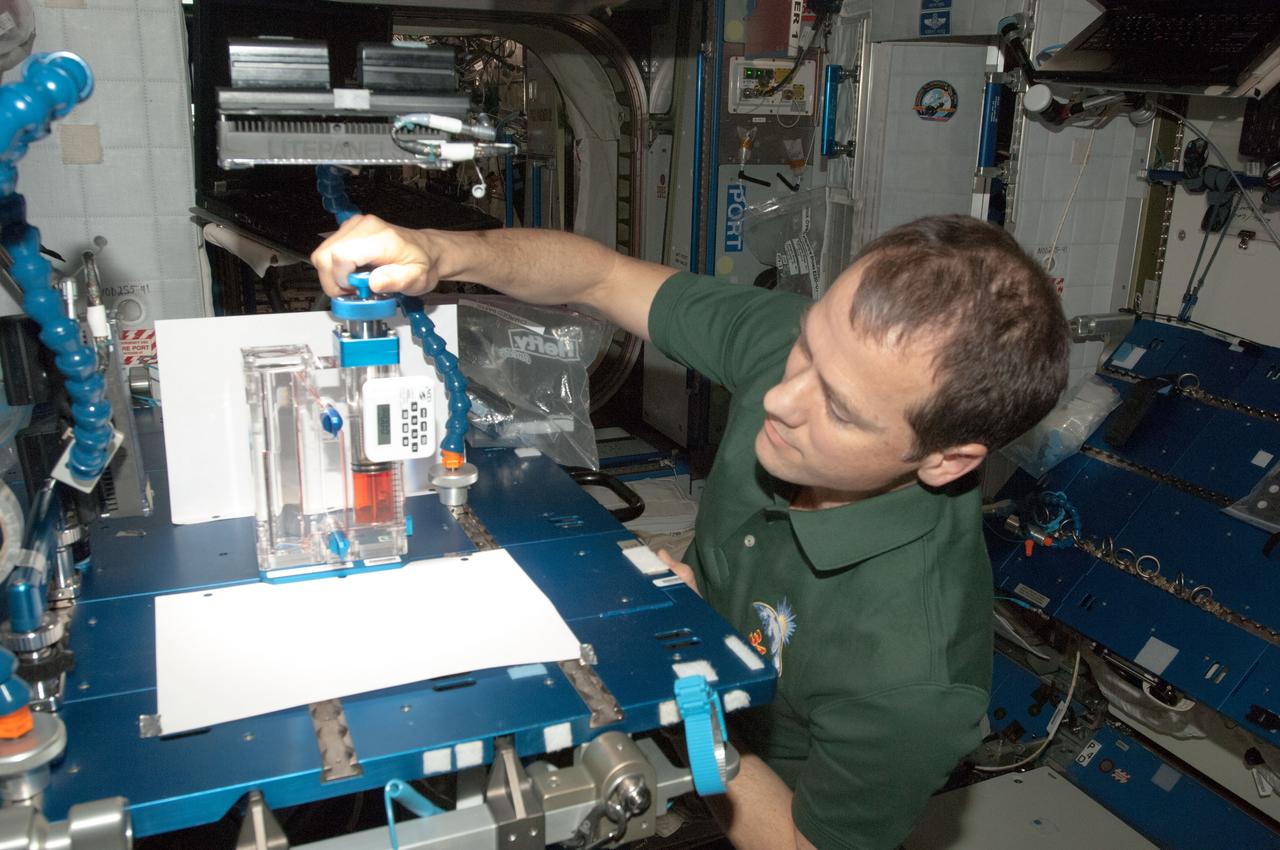
ISS034-E-036844 (29 Jan. 2013) --- In the International Space Station’s Harmony node, NASA astronaut Tom Marshburn, Expedition 34 flight engineer, works with the Capillary Flow Experiment-3, which investigates how fluids flow across surfaces in a weightless environment. Results from this experiment will improve computer models used to design fluid transfer systems and fuel tanks on future spacecraft.

KENNEDY SPACE CENTER, FLA. - In the transfer aisle of NASA's Vehicle Assembly Building, the redesigned external fuel tank that will launch Space Shuttle Atlantis on the next shuttle mission, STS-115, is raised to a vertical position. The tank will next be moved into a checkout cell for further work. Designated ET-118, the tank will fly with many major safety changes, including the removal of the protuberance air load ramps. Photo credit: NASA/George Shelton
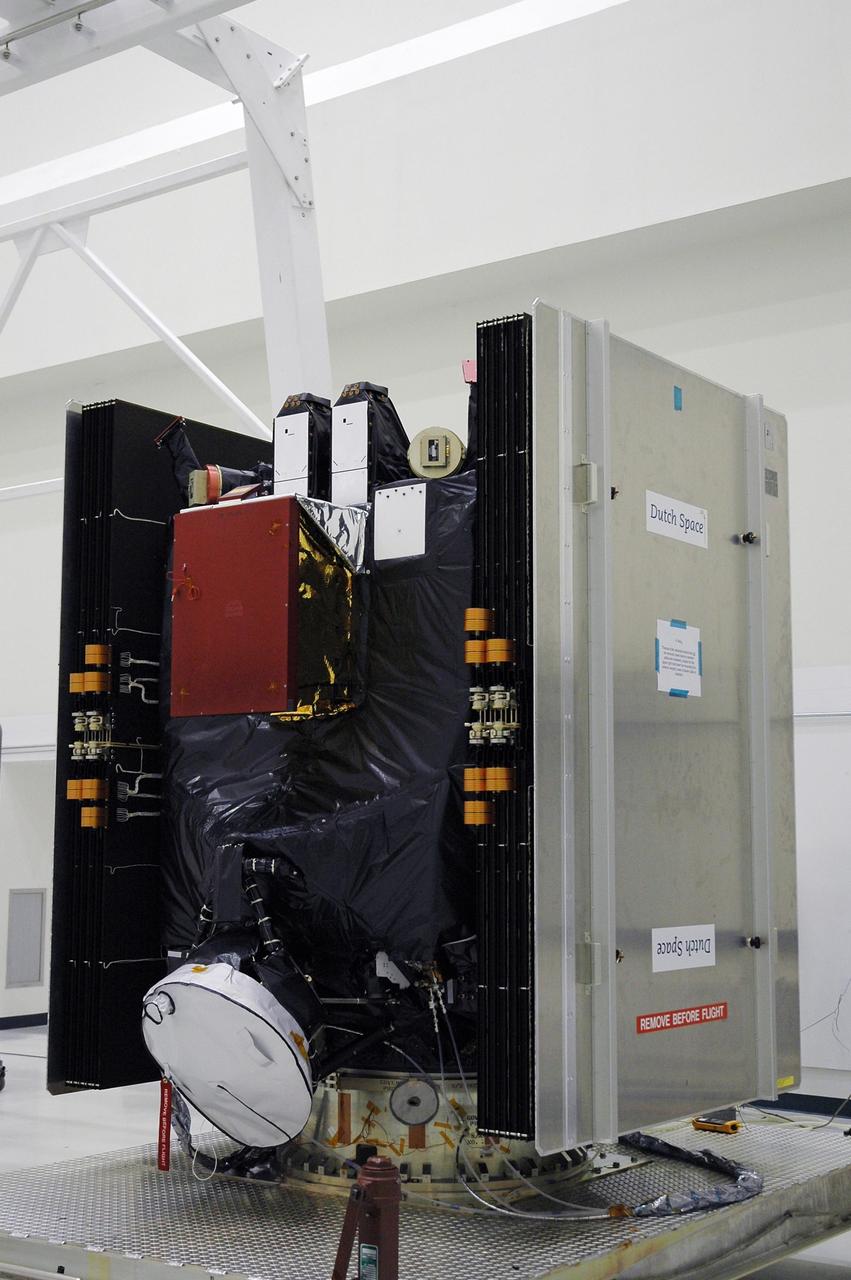
KENNEDY SPACE CENTER, FLA. -- At Astrotech's Payload Processing Facility, the solar panels on the Dawn spacecraft are stowed in preparation for Dawn's transfer to a transporter and move to the Hazardous Processing Facility for fueling. Dawn is scheduled to launch June 30 aboard a Delta II rocket from Launch Complex 17-B at Cape Canaveral Air Force Station. Dawn's mission is to explore two of the asteroid belt's most intriguing and dissimilar occupants: asteroid Vesta and the dwarf planet Ceres. Photo credit: NASA/Charisse Nahser
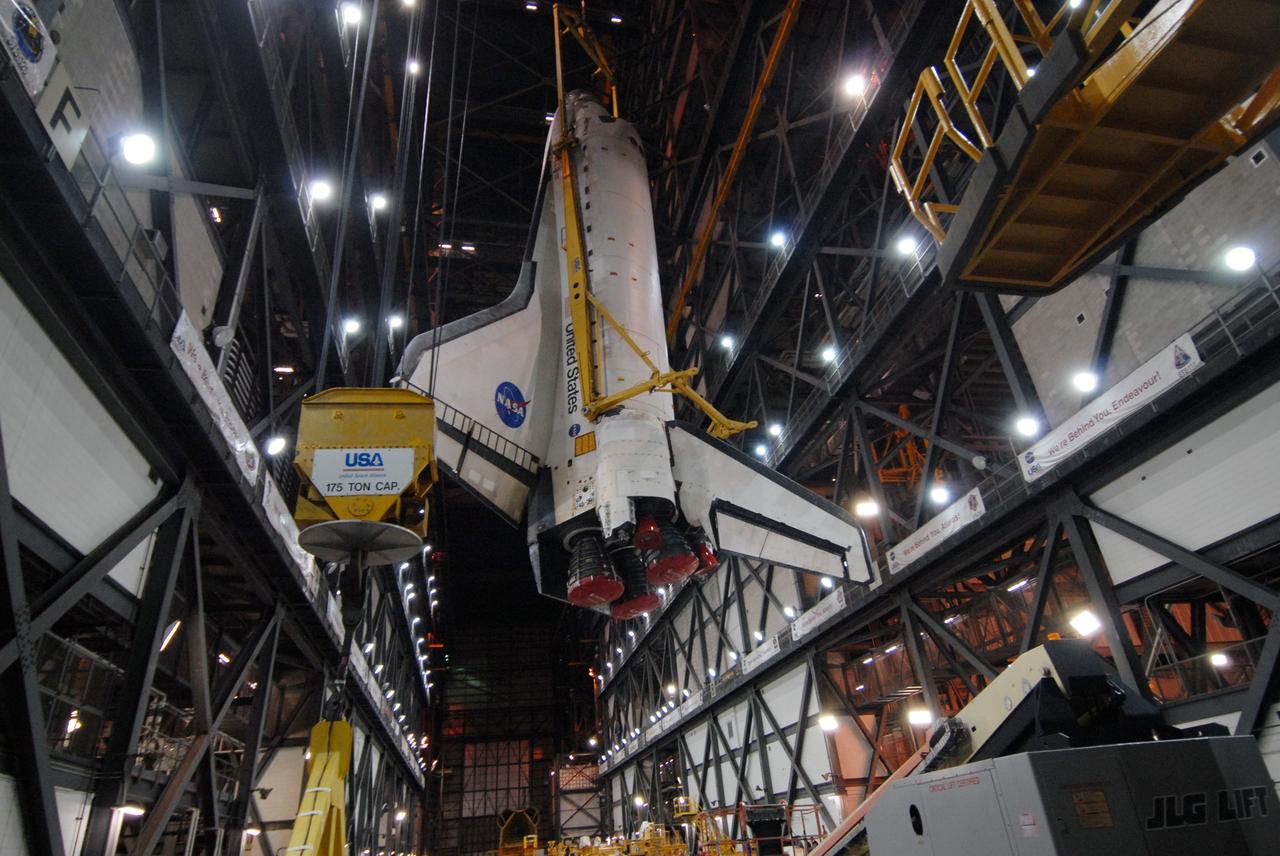
CAPE CANAVERAL, Fla. -- In the Vehicle Assembly Building at NASA's Kennedy Space Center in Florida, space shuttle Discovery is lifted into the upper levels for transfer to high bay 3. The shuttle will then be lowered onto the mobile launcher platform for mating with its external fuel tank and solid rocket boosters. After additional preparations are made, the shuttle will be rolled out to Launch Pad 39A for a targeted launch on Feb. 12. Discovery will carry the final starboard truss (S6) in the assembly of the International Space Station. Photo credit: NASA/Jack Pfaller
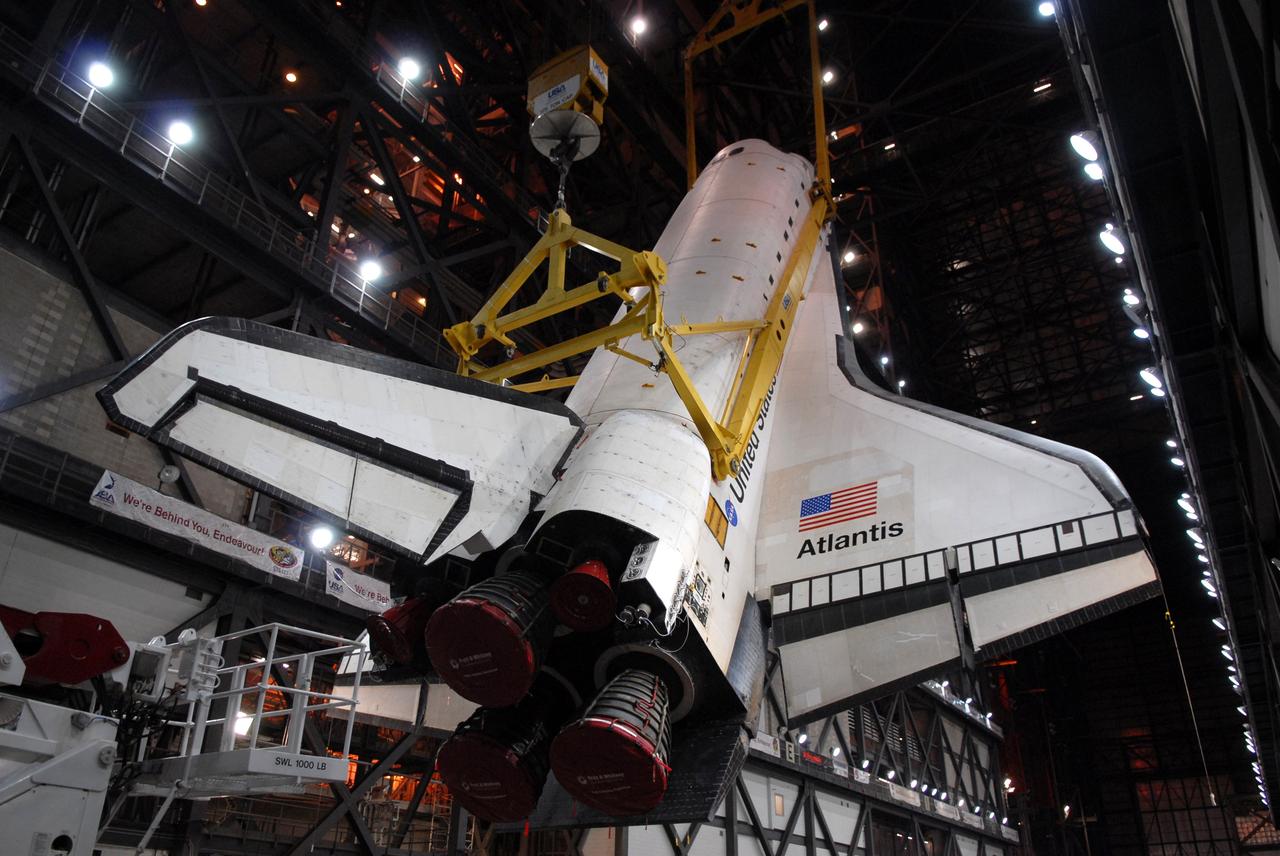
CAPE CANAVERAL, Fla. – In the Vehicle Assembly Building at NASA's Kennedy Space Center in Florida, the crane holding space shuttle Atlantis rotates it toward a vertical position above the transfer aisle. The shuttle will be lifted into High Bay 3 where it will be attached to its external fuel tank and solid rocket boosters on the mobile launcher platform. After additional preparations are made, the shuttle will be rolled out to Launch Pad 39A for a targeted launch on May 12 on the STS-125 Hubble servicing mission. Photo credit: NASA/Cory Huston
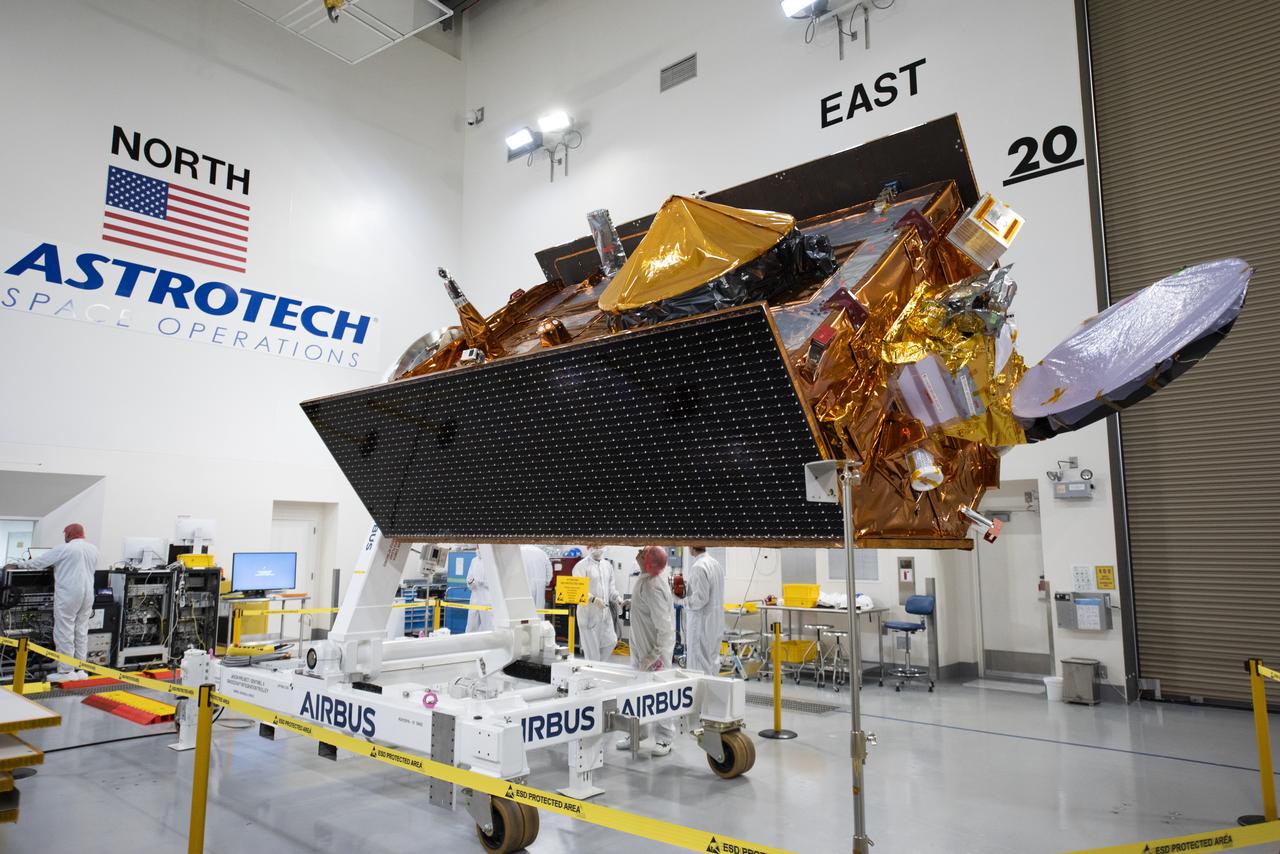
Technicians transfer the Sentinel-6B spacecraft from the NASA hangar to the Astrotech Space Operations payload processing facility at Vandenberg Space Force Base in California on Thursday, Sept. 25, 2025. Sentinel-6B will undergo detailed inspections, tests, and fueling in a cleanroom as it prepares for a November launch on a SpaceX Falcon 9 rocket. The spacecraft is designed to measure sea levels down to roughly an inch for about 90% of the world’s oceans. Sentinel-6B also will extend the record of atmospheric temperatures, begun by Sentinel-6 Michael Freilich, out to a decade.
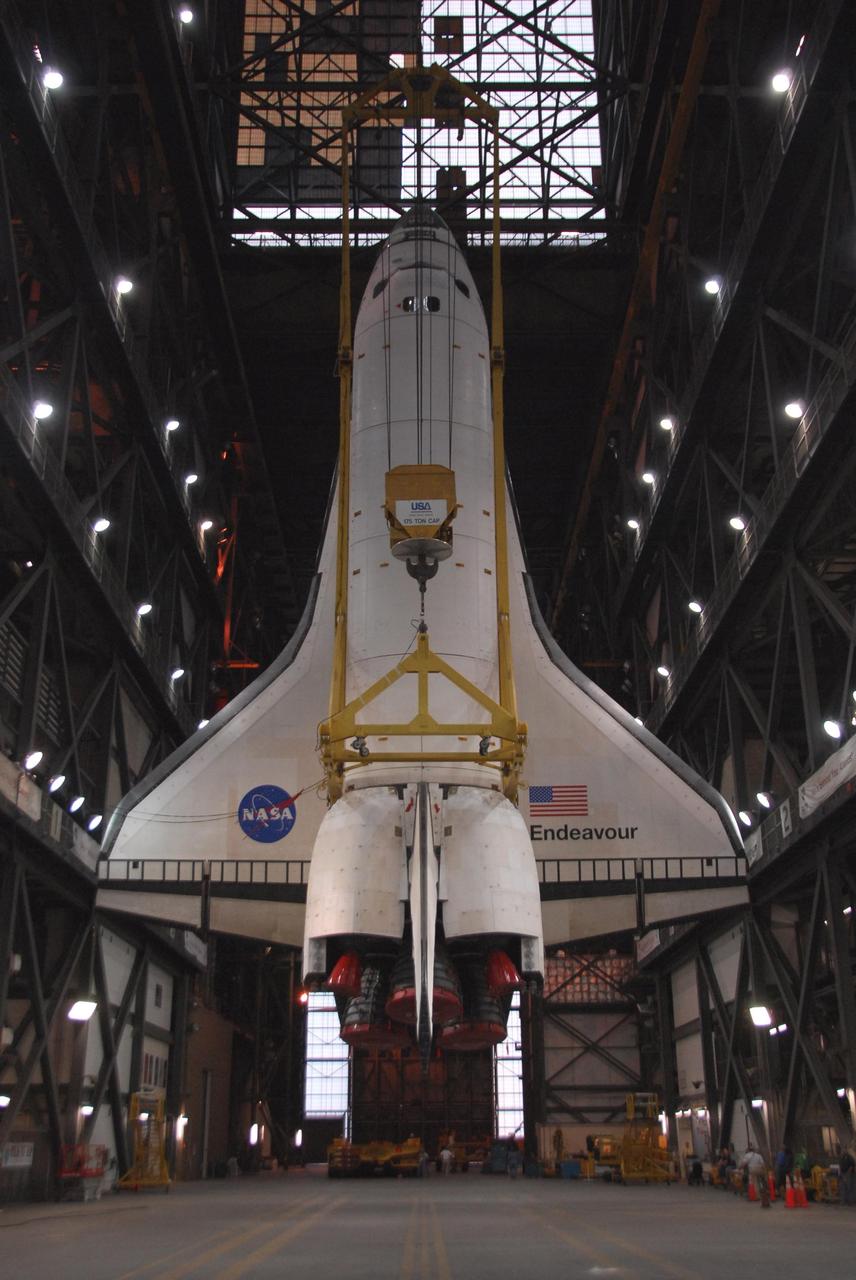
KENNEDY SPACE CENTER, FLA. -- In the Vehicle Assembly Building, space shuttle Endeavour hangs vertically suspended above the transfer aisle. Endeavour will be lifted up into high bay 1 to be lowered and attached to its external fuel tank and solid rocket boosters in preparation for launch on the STS-123 mission, targeted for March 11. The mission will deliver the first section of the Japan Aerospace Exploration Agency's Kibo laboratory and the Canadian Space Agency's two-armed robotic system, Dextre. Photo credit: NASA/Dimitri Gerondidakis
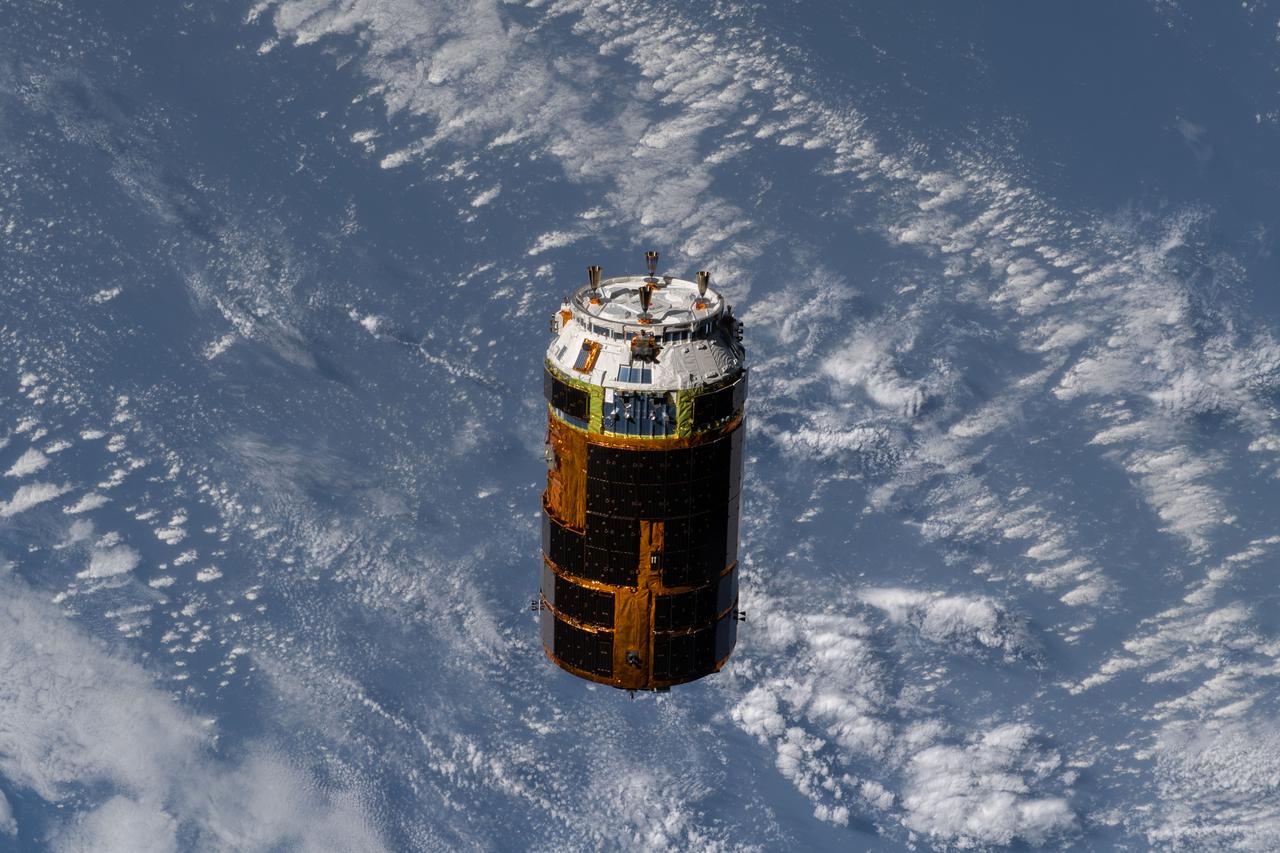
iss063e074252 (Aug. 18, 2020) --- The H-II Transfer Vehicle-9 (HTV-9) resupply ship from JAXA (Japan Aerospace Exploration Agency) moves away from the International Space Station after being released it into Earth orbit by the Canadarm2 robotic arm. The HTV-9 arrived at the orbiting lab on May 25 delivering four tons of food, fuel, crew supplies and station experiments to the Expedition 63 crew.
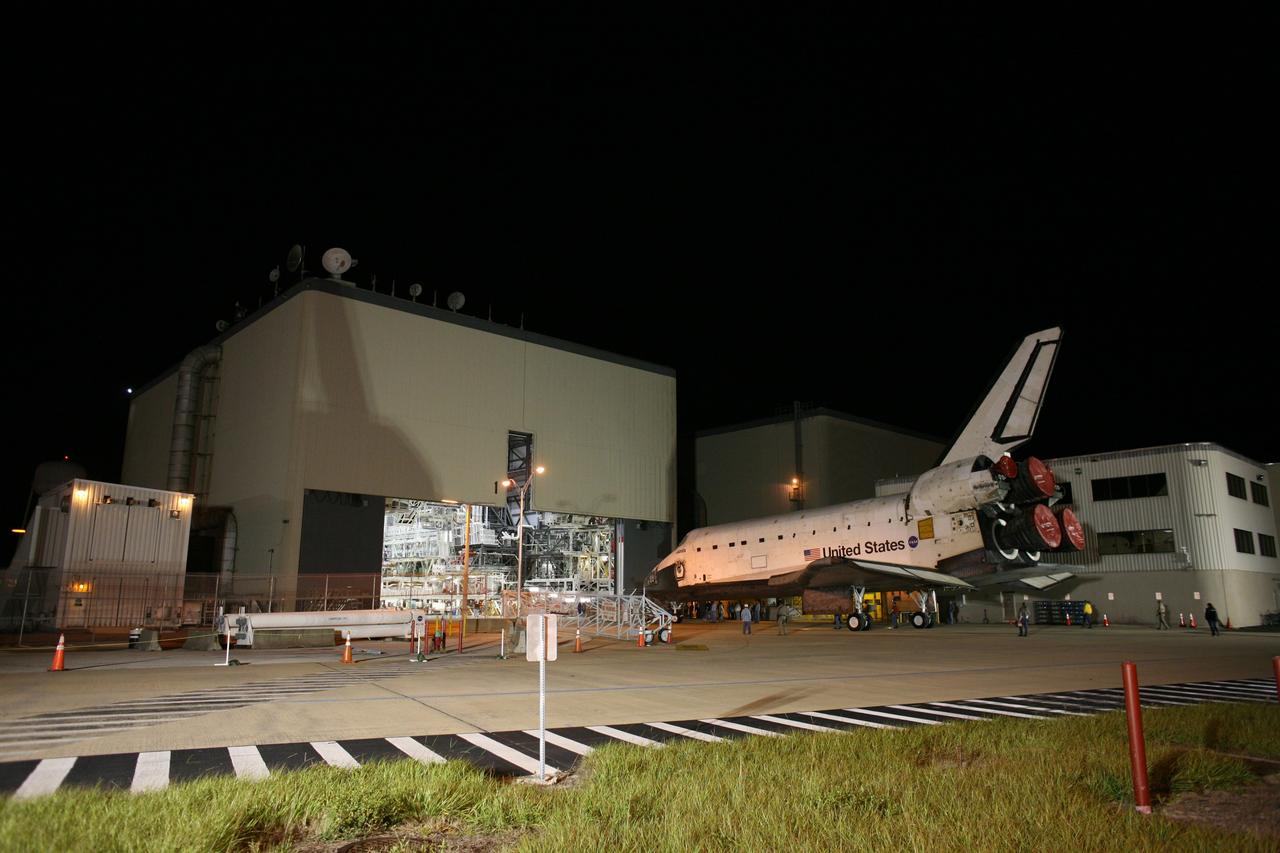
CAPE CANAVERAL, Fla. – Space shuttle Atlantis is towed into the Orbiter Processing Facility. Atlantis was removed from its external fuel tank and solid rocket boosters stack in the Vehicle Assembly Building after the delay of its STS-125 mission to NASA's Hubble Space Telescope. Atlantis' targeted launch on Oct. 14 was delayed when a system that transfers science data from the orbiting observatory to Earth malfunctioned on Sept. 27. The new target launch date is under review. Photo credit: NASA/Dimitri Gerondidakis

KENNEDY SPACE CENTER, FLA. -- In the Vehicle Assembly Building, space shuttle Endeavour hangs vertically suspended above the transfer aisle. Endeavour will be lifted up into high bay 1 to be attached to its external fuel tank and solid rocket boosters in preparation for launch on the STS-123 mission, targeted for March 11. The mission will deliver the first section of the Japan Aerospace Exploration Agency's Kibo laboratory and the Canadian Space Agency's two-armed robotic system, Dextre. Photo credit: NASA/Dimitri Gerondidakis
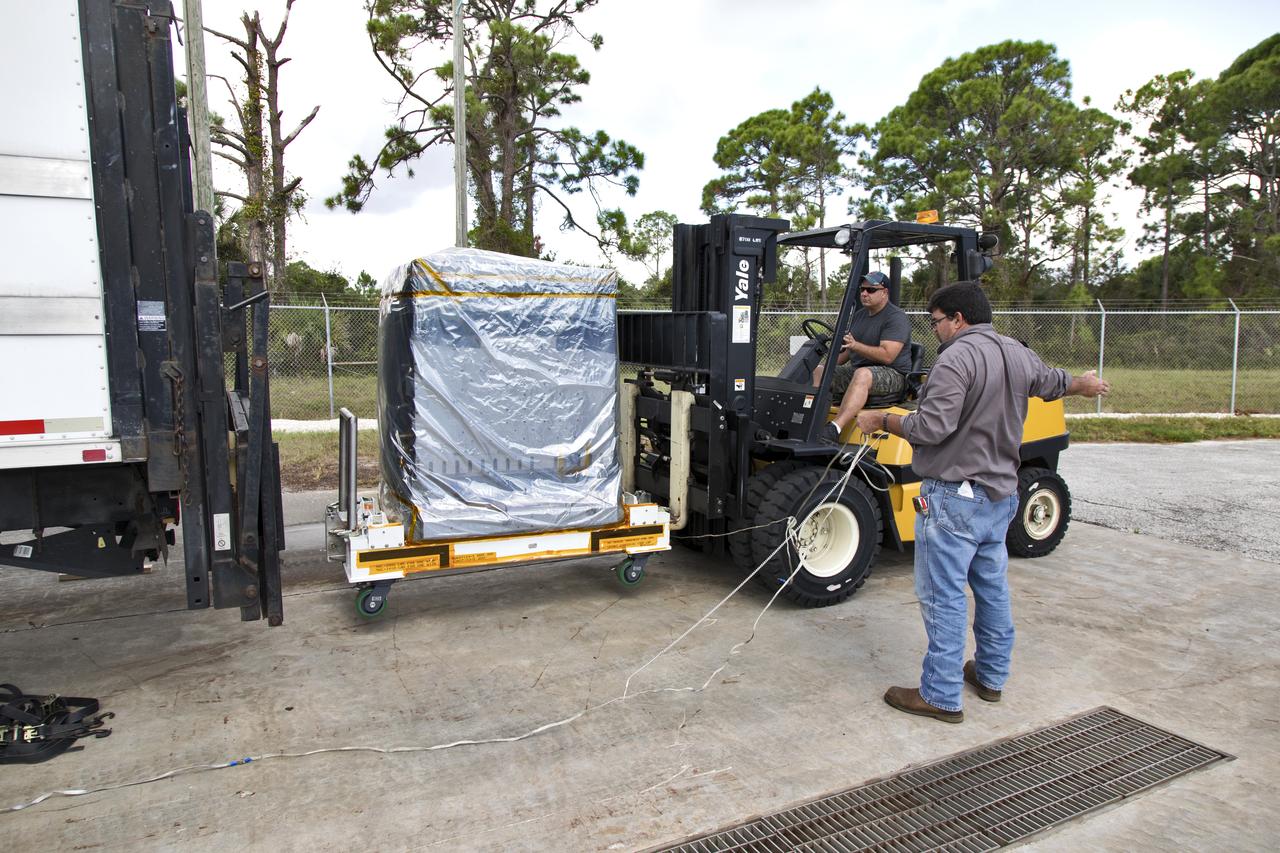
A worker uses a forklift to unload the Robotic Refueling Mission-3 (RRM3) payload from a truck at the Payload Hazardous Servicing Facility on Oct. 3, 2018, at NASA's Kennedy Space Center in Florida. The payload will be carried to the International Space Station on SpaceX's 16th Commercial Resupply Services mission. RRM3 demonstrates the transfer of xenon gas and liquid methane in microgravity, and advances technologies for storing and manipulating these cryogenic fuels robotically. RRM3 also supports development of technology for the Restore-L mission, a robotic spacecraft equipped to service satellites in-orbit.
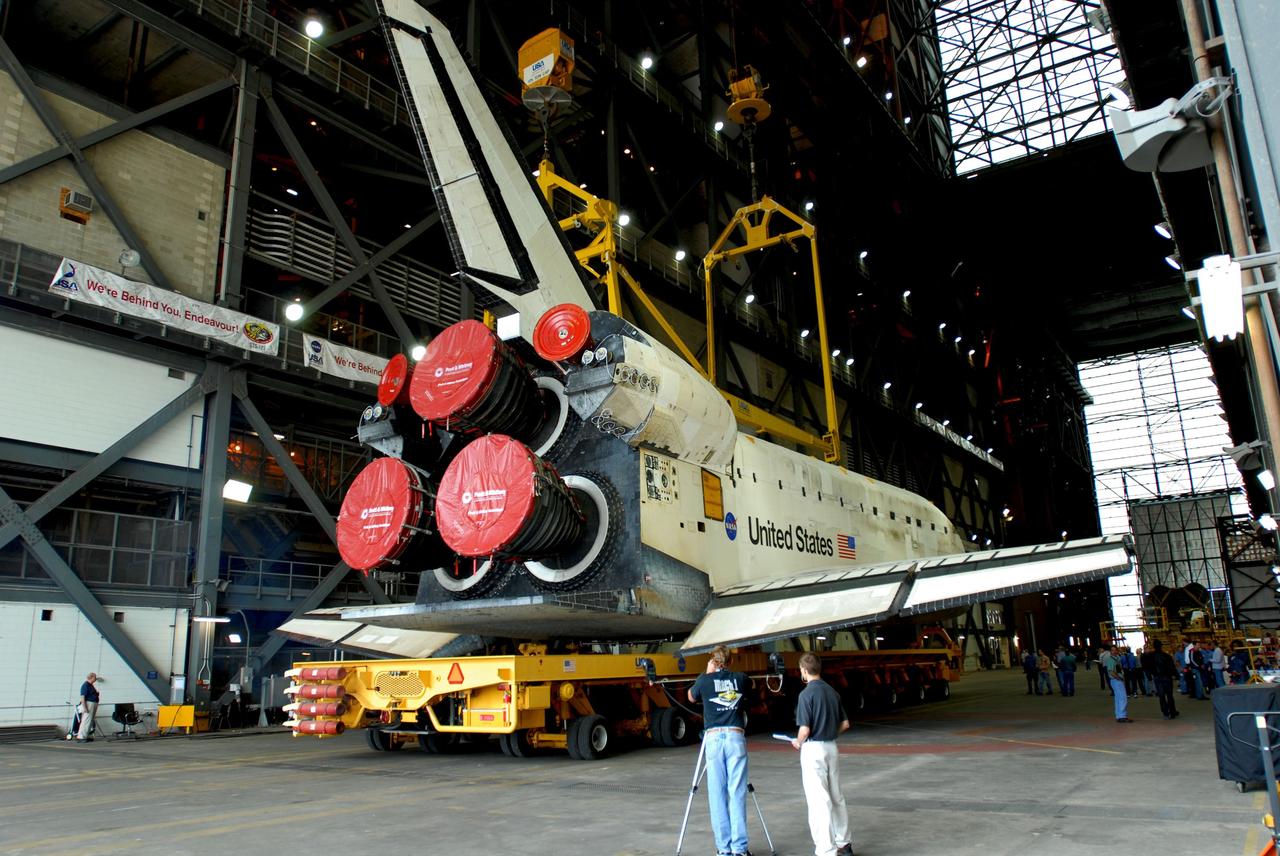
CAPE CANAVERAL, Fla. -- Aboard its transporter, space shuttle Discovery rolls into the transfer aisle of the Vehicle Assembly Building at NASA's Kennedy Space Center in Florida. Discovery left Orbiter Processing Facility 3 at 2:30 p.m. EST. In the VAB, Discovery will be attached to its external fuel tank and twin solid rocket boosters. After additional preparations are made, the shuttle will be rolled out to Launch Pad 39A for a targeted launch to the International Space Station on Feb. 12. Photo credit: NASA/Jim Grossmann
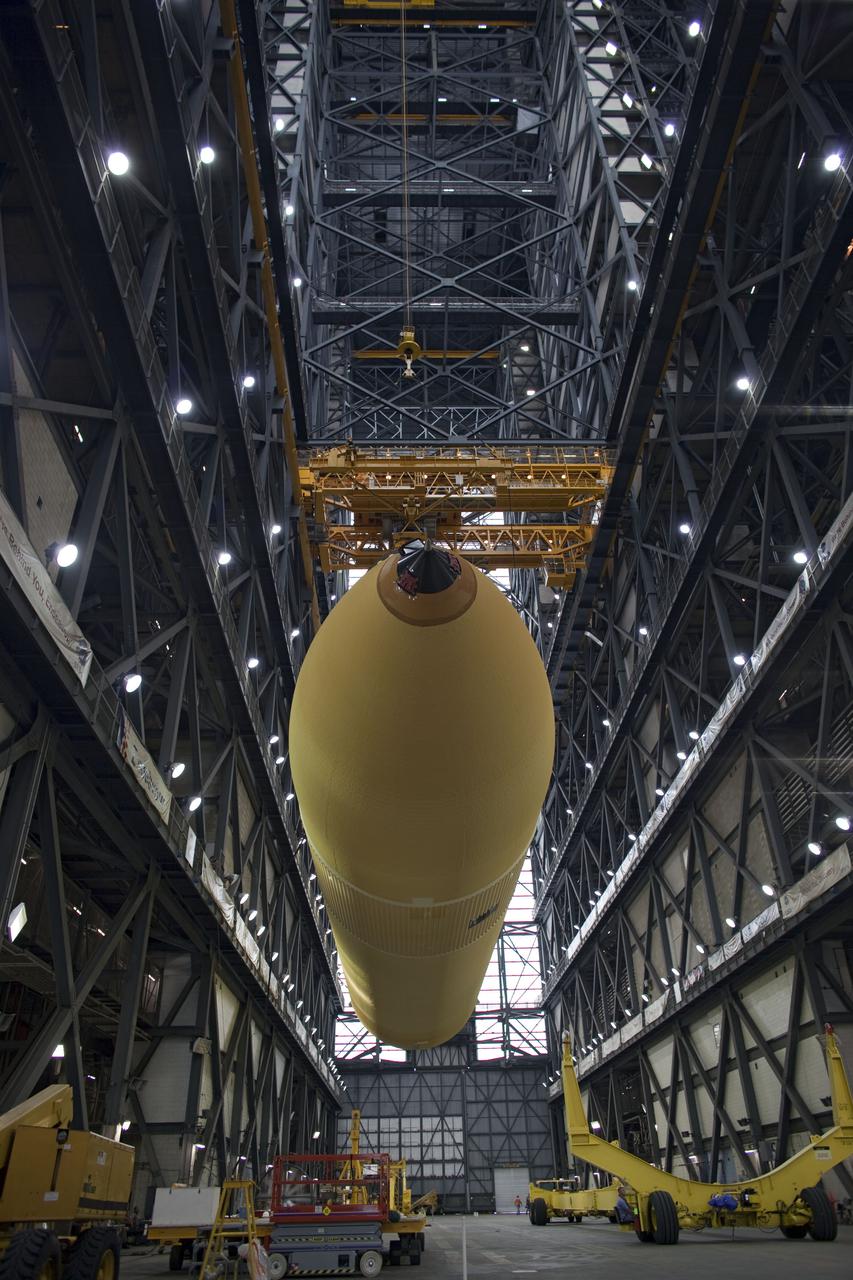
CAPE CANAVERAL, Fla. -- In the Vehicle Assembly Building at NASA's Kennedy Space Center in Florida, External Tank-138 is lifted above the transfer aisle. The external fuel tank is being moved into a test cell where it will be checked out before launch. ET-138, the last newly manufactured tank, was originally designated to fly on Endeavour's STS-134 mission to the International Space Station, but later reassigned to fly on space shuttle Atlantis' final mission, STS-135. For information, visit www.nasa.gov_shuttle. Photo credit: NASA_Dimitri Gerondidakis
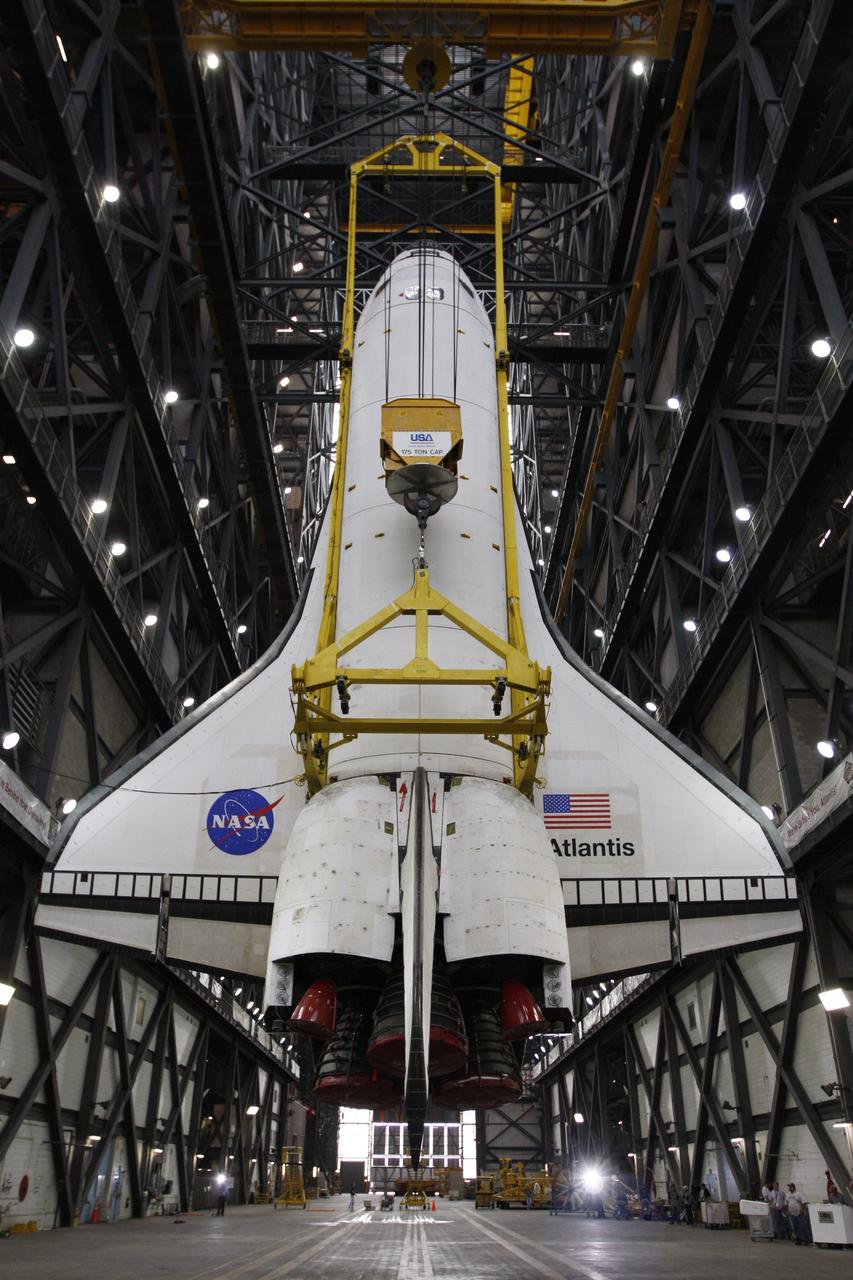
CAPE CANAVERAL, Fla. – Suspended above the transfer aisle in the Vehicle Assembly Building at NASA's Kennedy Space Center, space shuttle Atlantis is ready to be lifted into high bay 3 and stacked with its external fuel tank and twin solid rocket boosters. After additional preparations are made, the shuttle will be rolled out to Launch Pad 39A to prepare for launch on the STS-125 mission targeted for 1:34 a.m. EDT Oct. 8. Photo credit: NASA/Dimitri Gerondidakis
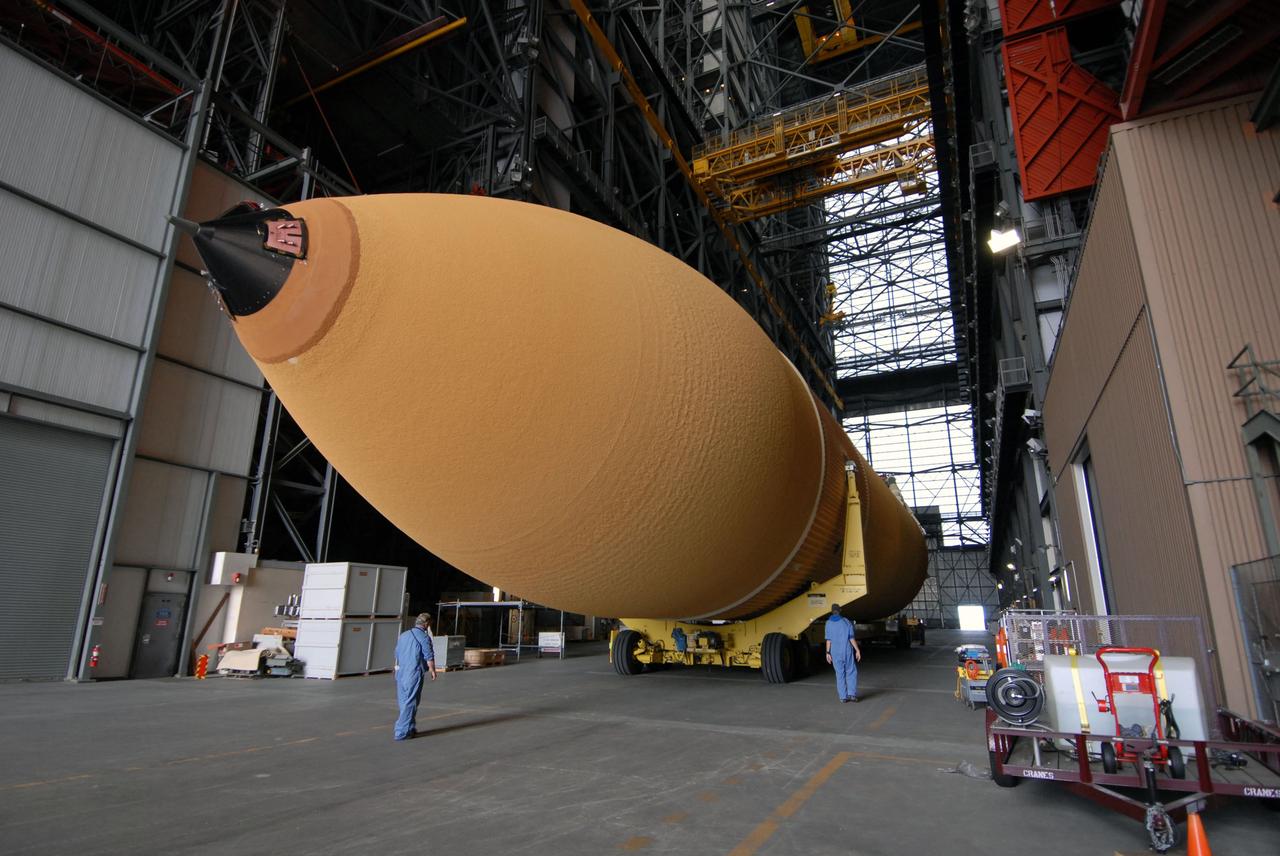
CAPE CANAVERAL, Fla. -- External Tank 130 arrives in the transfer aisle of the Vehicle Assembly Building at NASA's Kennedy Space Center in Florida. ET 130, which will be used on the Hubble servicing mission, STS-125, will be moved into a high bay for checkout. The fuel tank was previously designated for the STS-127 mission. Photo credit: NASA/Jack Pfaller
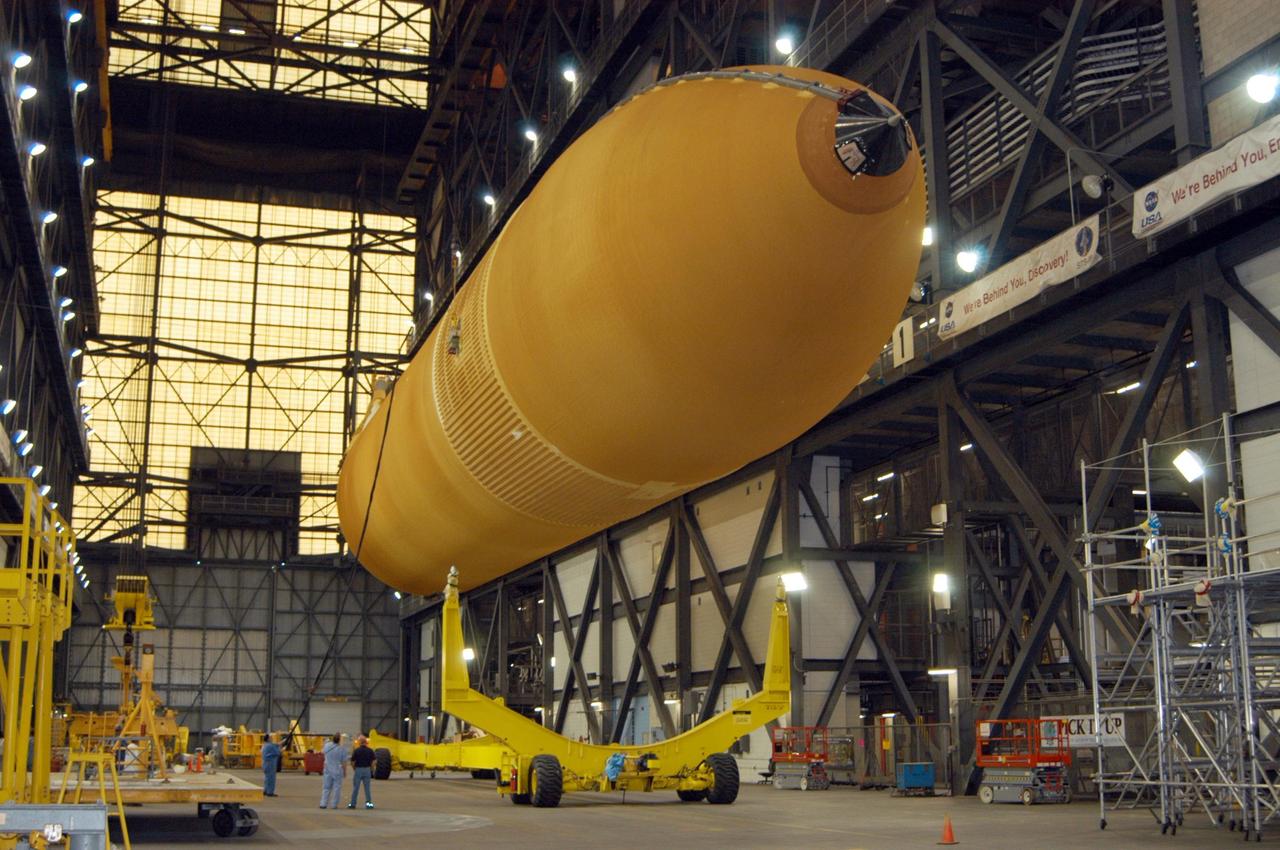
KENNEDY SPACE CENTER, FLA. - In the transfer aisle of NASA's Vehicle Assembly Building, the redesigned external fuel tank that will launch Space Shuttle Atlantis on the next shuttle mission, STS-115, is lifted off its transporter and will be raised to a vertical position. Once it is raised, the tank will be moved into a checkout cell for further work. The tank, designated ET-118, will fly with many major safety changes, including the removal of the protuberance air load ramps. Photo credit: NASA/George Shelton
CAPE CANAVERAL, Fla. – In the transfer aisle of the Vehicle Assembly Building at NASA's Kennedy Space Center in Florida, external fuel tank ET-131 is being raised to a vertical position. It will be lifted into the upper levels and lowered into a checkout bay. ET-131 will be used on space shuttle Endeavour's STS-127 mission. Payload for the mission is the Japanese Experiment Module's Experiment Logistics Module-Exposed Section, or ELM-ES. Launch is targeted for June. Photo credit: NASA/Kim Shiflett

CAPE CANAVERAL, Fla. – Space shuttle Atlantis rolls out of the Orbiter Processing Facility bay 1 at NASA's Kennedy Space Center for transfer to the Vehicle Assembly Building. In the VAB, Atlantis will be attached to its external fuel tank and twin solid rocket boosters. After additional preparations are made, the shuttle will be rolled out to Launch Pad 39A to prepare for launch on the STS-125 mission targeted for Oct. 8. Photo credit: NASA/Jack Pfaller
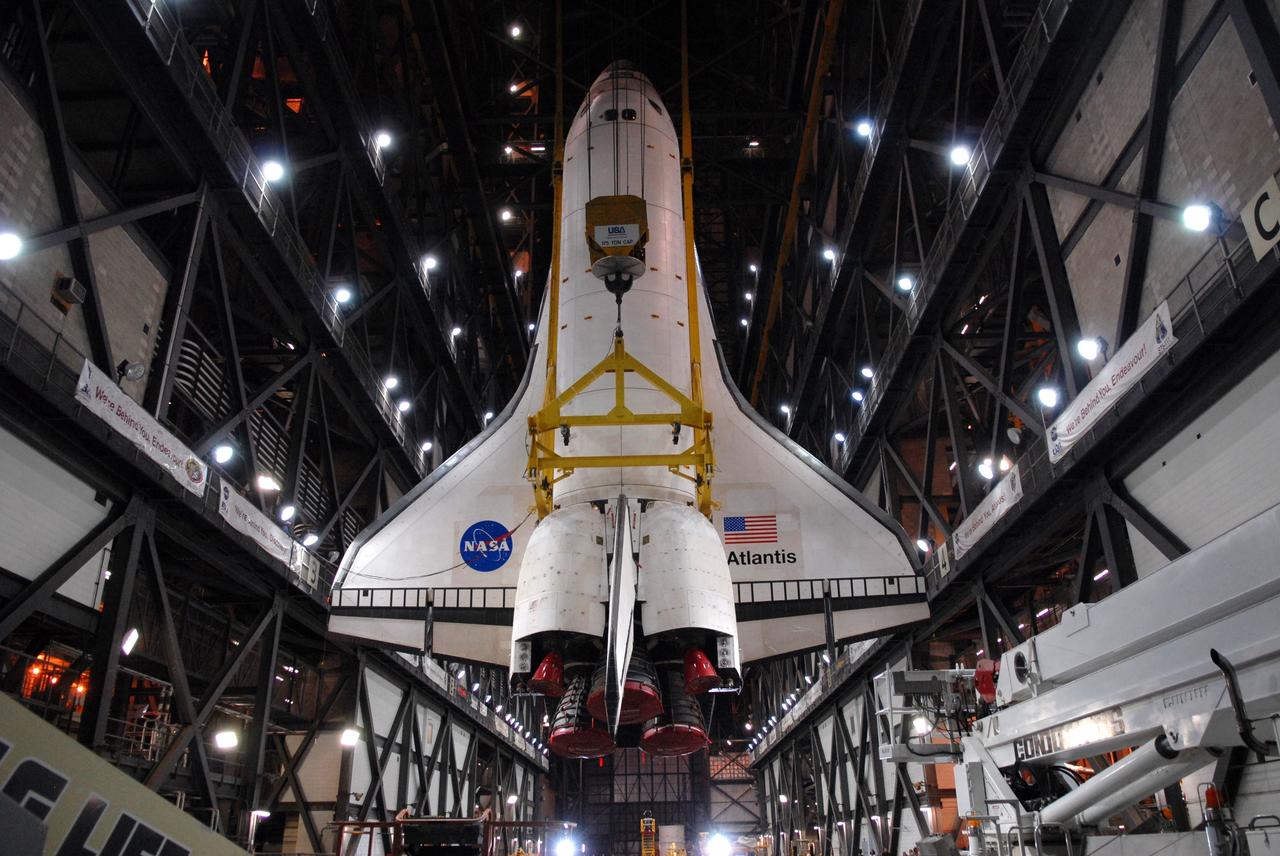
CAPE CANAVERAL, Fla. – After rotation in the Vehicle Assembly Building at NASA's Kennedy Space Center in Florida, space shuttle Atlantis is suspended vertically above the transfer aisle. The shuttle will be lifted into High Bay 3 where it will be attached to its external fuel tank and solid rocket boosters on the mobile launcher platform. After additional preparations are made, the shuttle will be rolled out to Launch Pad 39A for a targeted launch on May 12 on the STS-125 Hubble servicing mission. Photo credit: NASA/Cory Huston
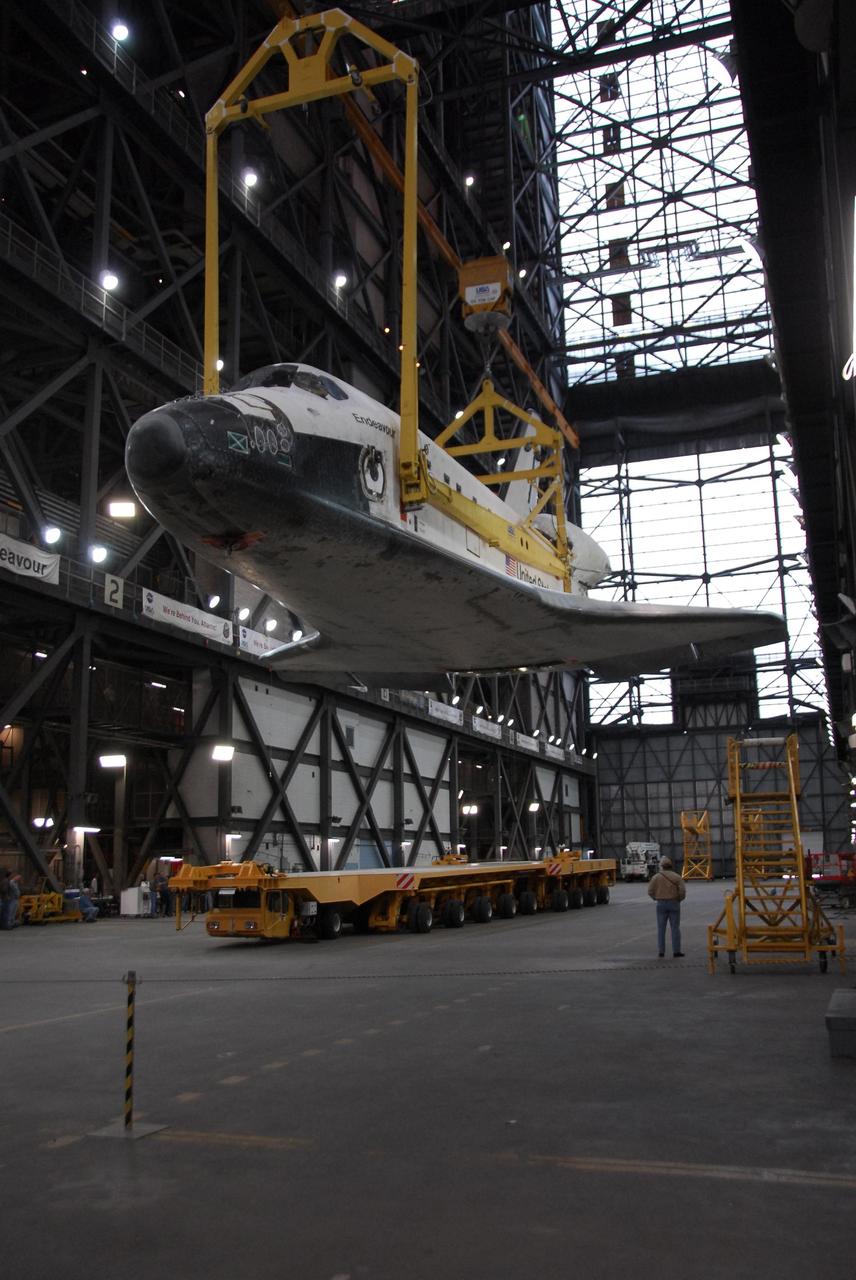
KENNEDY SPACE CENTER, FLA. -- In the transfer aisle of the Vehicle Assembly Building, space shuttle Endeavour is lifted off its transporter. The shuttle will be raised to a vertical position and lifted up into high bay 1 to be attached to its external fuel tank and solid rocket boosters in preparation for launch on the STS-123 mission, targeted for March 11. The mission will deliver the first section of the Japan Aerospace Exploration Agency's Kibo laboratory and the Canadian Space Agency's two-armed robotic system, Dextre. Photo credit: NASA/Dimitri Gerondidakis

CAPE CANAVERAL, Fla. – After rolling out of the Orbiter Processing Facility bay 1 at NASA's Kennedy Space Center, space shuttle Atlantis begins the short transfer to the Vehicle Assembly Building. In the VAB, Atlantis will be attached to its external fuel tank and twin solid rocket boosters. After additional preparations are made, the shuttle will be rolled out to Launch Pad 39A to prepare for launch on the STS-125 mission targeted for Oct. 8. Photo credit: NASA/Jack Pfaller
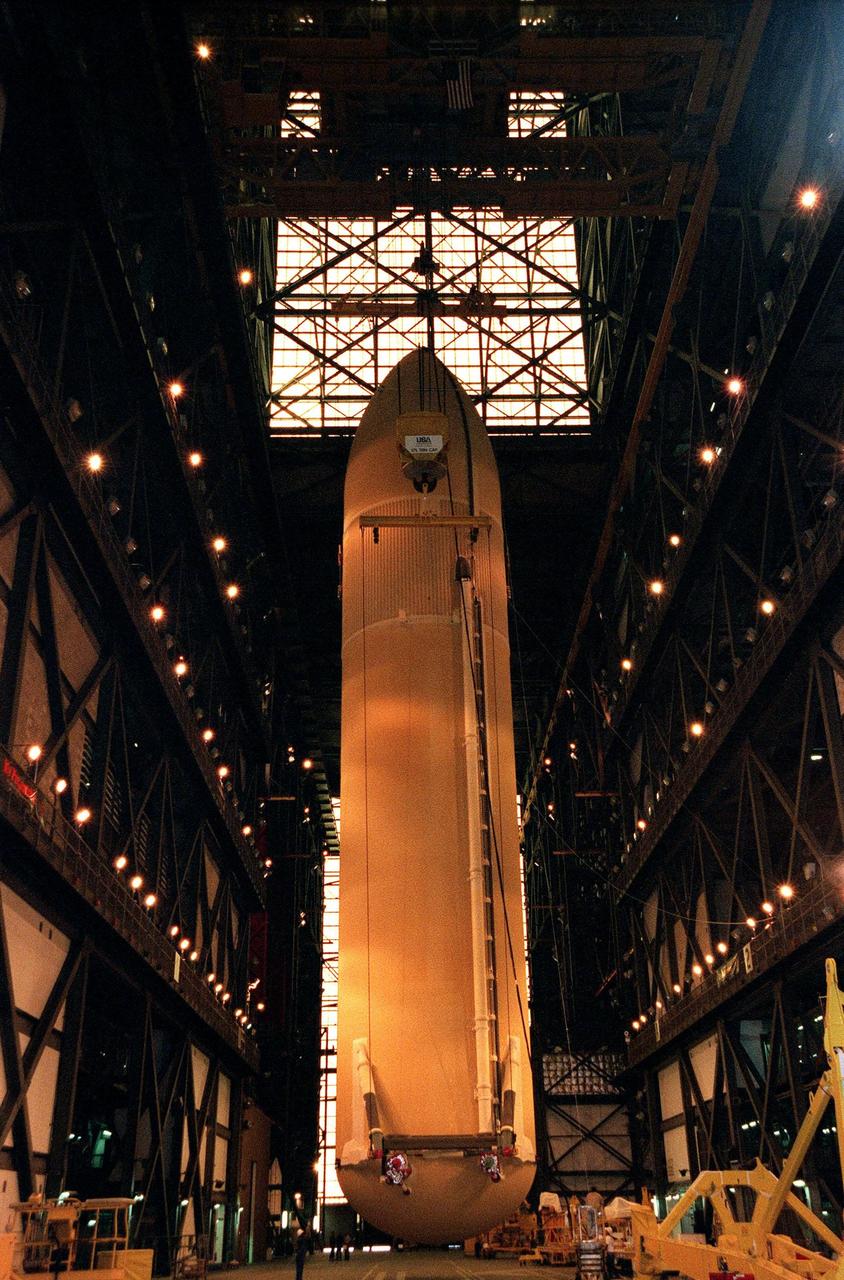
KENNEDY SPACE CENTER, FLA. -- An external tank is suspended in the transfer aisle of the Vehicle Assembly Building before being placed into its storage compartment. The largest and heaviest element of the Space Shuttle, an external tank contains the liquid hydrogen fuel and liquid oxygen oxidizer for the three Space Shuttle main engines (SSMEs) in the orbiter during liftoff and ascent. When the SSMEs are shut down, the external tank is jettisoned, breaking up as it enters the Earth's atmopshere and impacting in a remote ocean area. It is not recovered
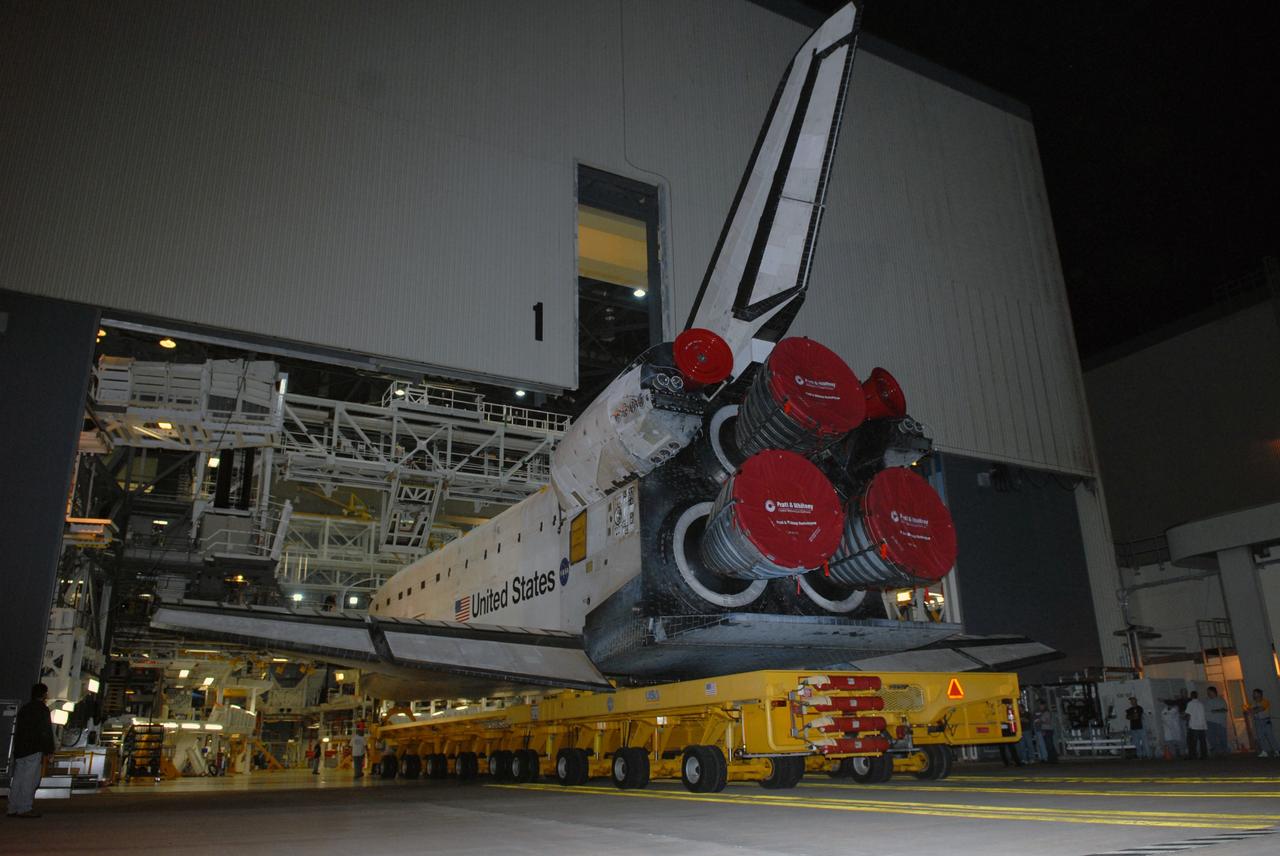
CAPE CANAVERAL, Fla. – Space shuttle Atlantis rolls out of the Orbiter Processing Facility bay 1 at NASA's Kennedy Space Center for transfer to the Vehicle Assembly Building. In the VAB, Atlantis will be attached to its external fuel tank and twin solid rocket boosters. After additional preparations are made, the shuttle will be rolled out to Launch Pad 39A to prepare for launch on the STS-125 mission targeted for Oct. 8. Photo credit: NASA/Jack Pfaller
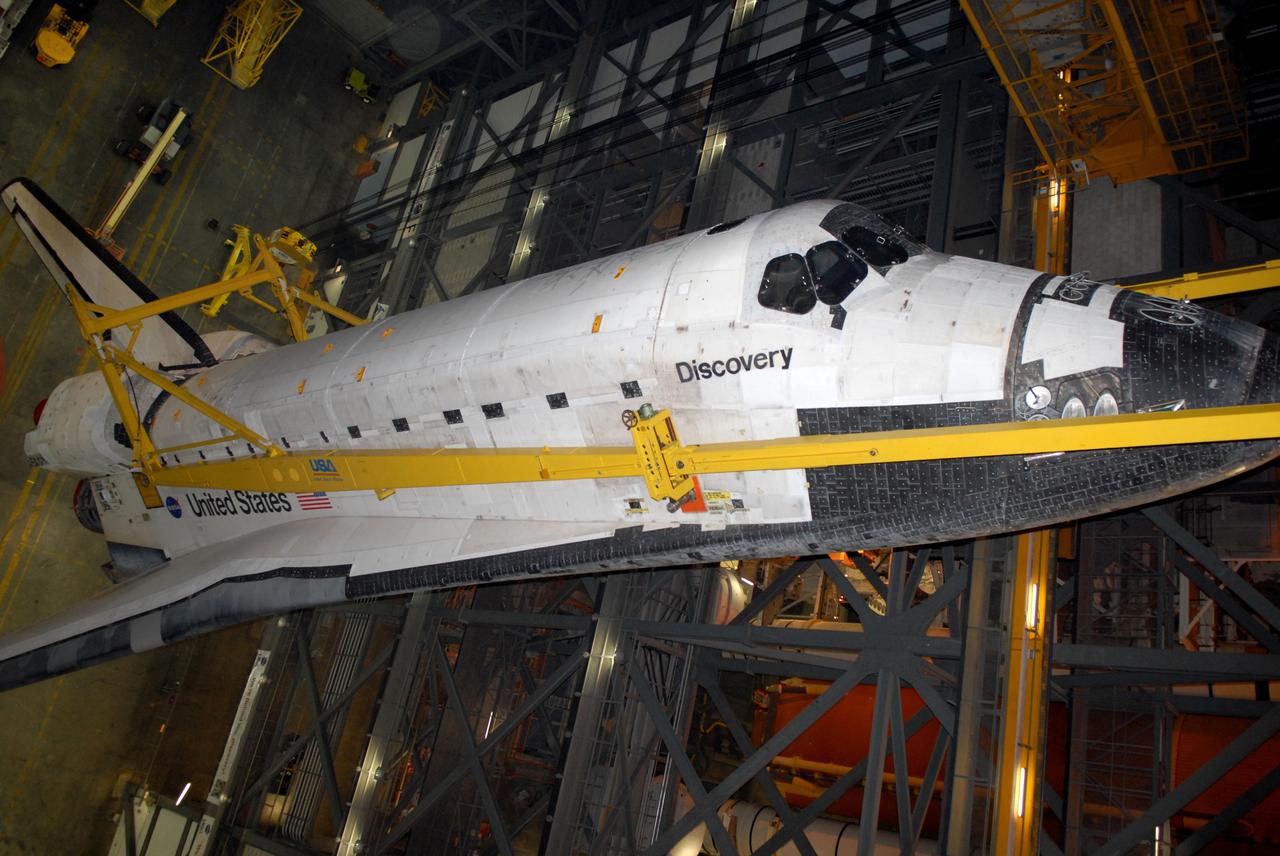
CAPE CANAVERAL, Fla. -- In the Vehicle Assembly Building at NASA's Kennedy Space Center in Florida, space shuttle Discovery is lifted into the upper levels for transfer to high bay 3. The shuttle will then be lowered onto the mobile launcher platform for mating with its external fuel tank and solid rocket boosters. After additional preparations are made, the shuttle will be rolled out to Launch Pad 39A for a targeted launch on Feb. 12. Discovery will carry the final starboard truss (S6) in the assembly of the International Space Station. Photo credit: NASA/Jack Pfaller
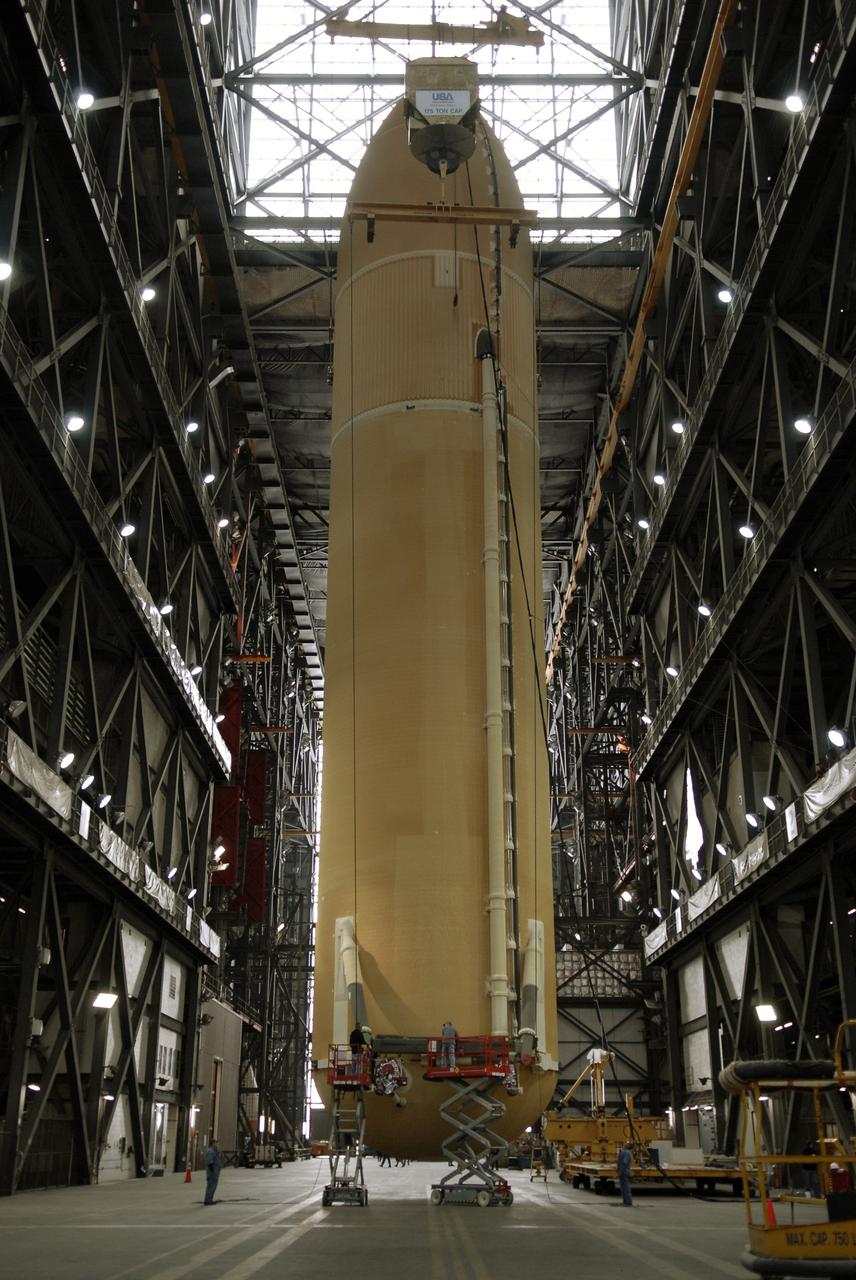
CAPE CANAVERAL, Fla. – In the Vehicle Assembly Building at NASA's Kennedy Space Center in Florida, external fuel tank ET-131 is suspended by a crane over the transfer aisle. It will be lifted into the upper levels and lowered into a checkout bay. ET-131 will be used on space shuttle Endeavour's STS-127 mission. Payload for the mission is the Japanese Experiment Module's Experiment Logistics Module-Exposed Section, or ELM-ES. Launch is targeted for June. Photo credit: NASA/Kim Shiflett
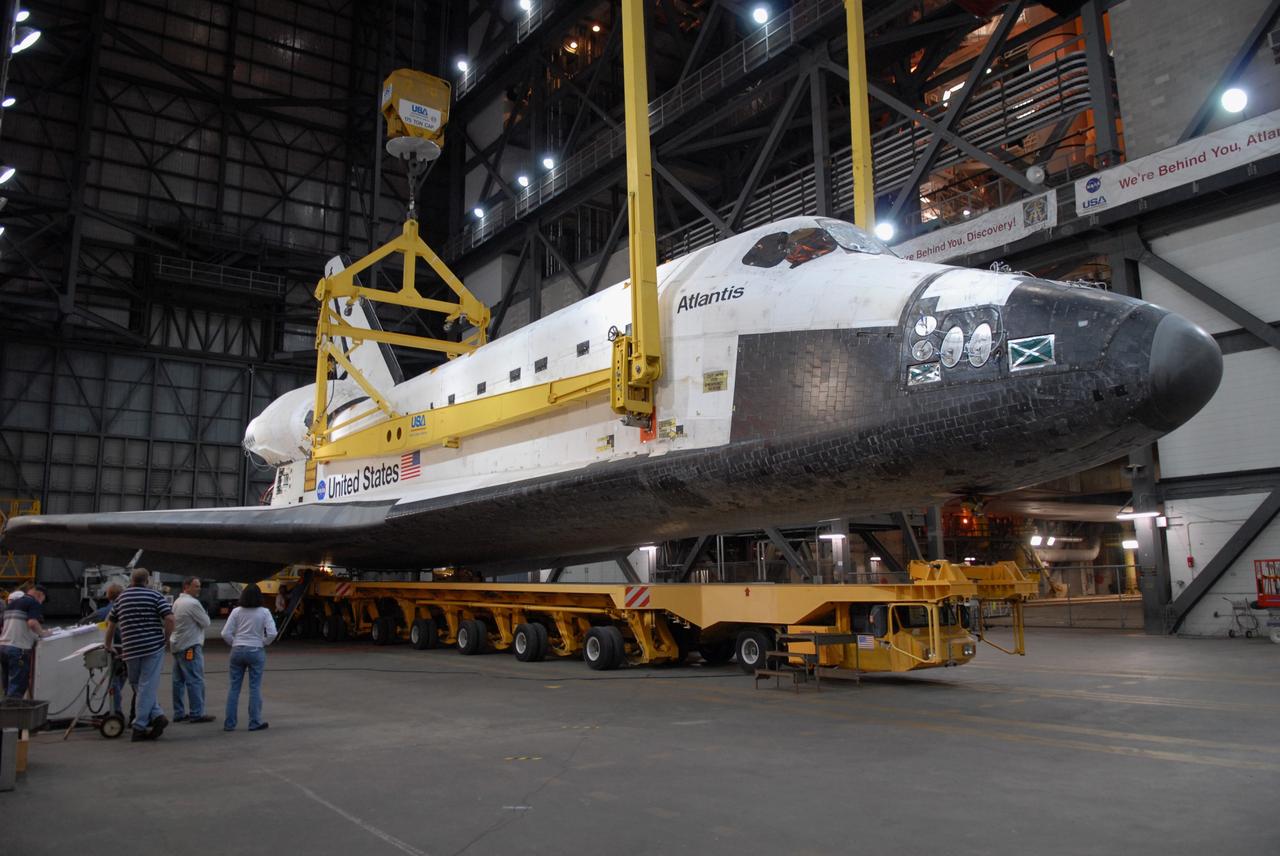
CAPE CANAVERAL, Fla. – In the Vehicle Assembly Building at NASA's Kennedy Space Center in Florida, space shuttle Atlantis is lifted off its transporter in the transfer aisle. The shuttle will be raised to a vertical position and lifted into High Bay 3 where it will be attached to its external fuel tank and solid rocket boosters on the mobile launcher platform. After additional preparations are made, the shuttle will be rolled out to Launch Pad 39A for a targeted launch on May 12 on the STS-125 Hubble servicing mission. Photo credit: NASA/Cory Huston
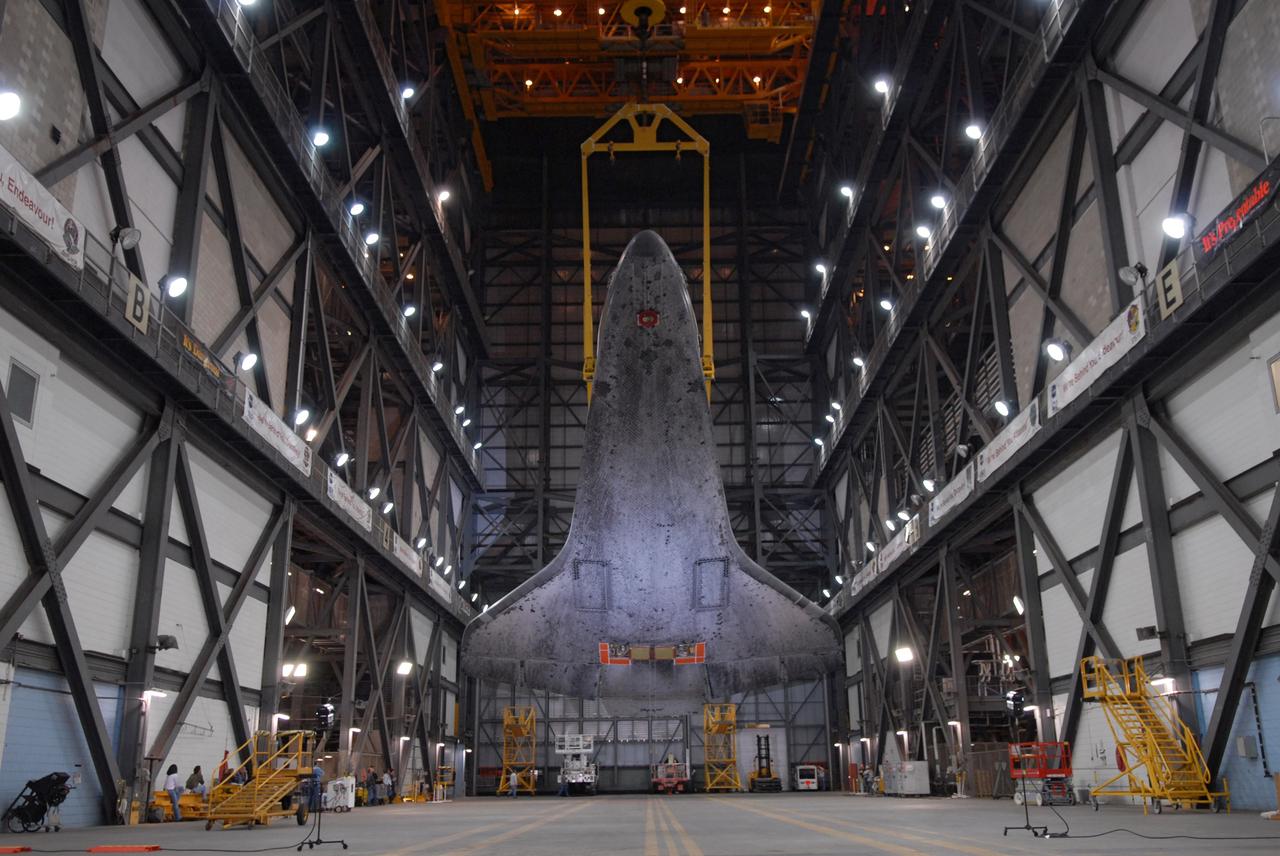
CAPE CANAVERAL, Fla. – In the Vehicle Assembly Building at NASA's Kennedy Space Center in Florida, space shuttle Atlantis is rotated by the crane toward a vertical position above the transfer aisle. The shuttle will be lifted into High Bay 3 where it will be attached to its external fuel tank and solid rocket boosters on the mobile launcher platform. After additional preparations are made, the shuttle will be rolled out to Launch Pad 39A for a targeted launch on May 12 on the STS-125 Hubble servicing mission. Photo credit: NASA/Cory Huston
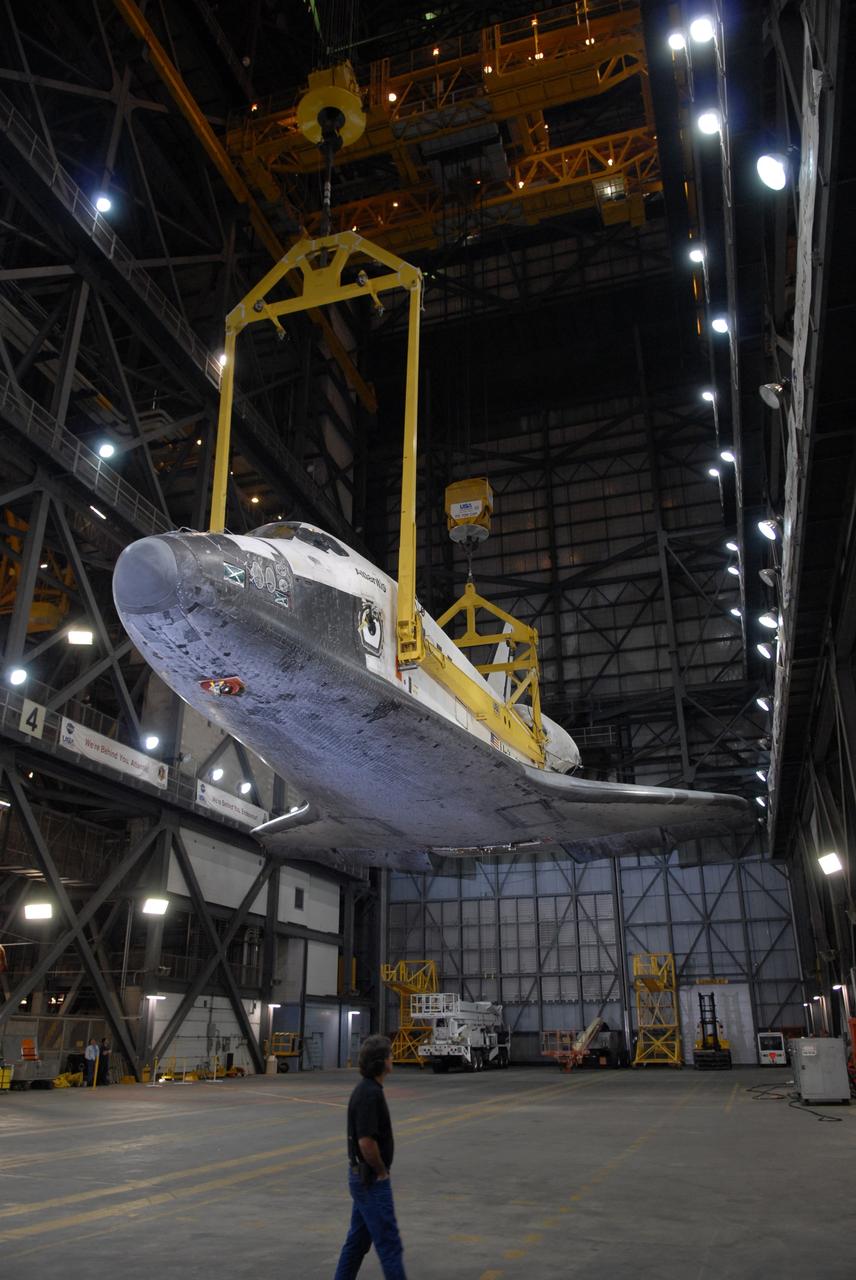
CAPE CANAVERAL, Fla. – In the Vehicle Assembly Building at NASA's Kennedy Space Center in Florida, space shuttle Atlantis is lifted higher above the transfer aisle. The shuttle will be rotated to a vertical position and lifted into High Bay 3 where it will be attached to its external fuel tank and solid rocket boosters on the mobile launcher platform. After additional preparations are made, the shuttle will be rolled out to Launch Pad 39A for a targeted launch on May 12 on the STS-125 Hubble servicing mission. Photo credit: NASA/Cory Huston
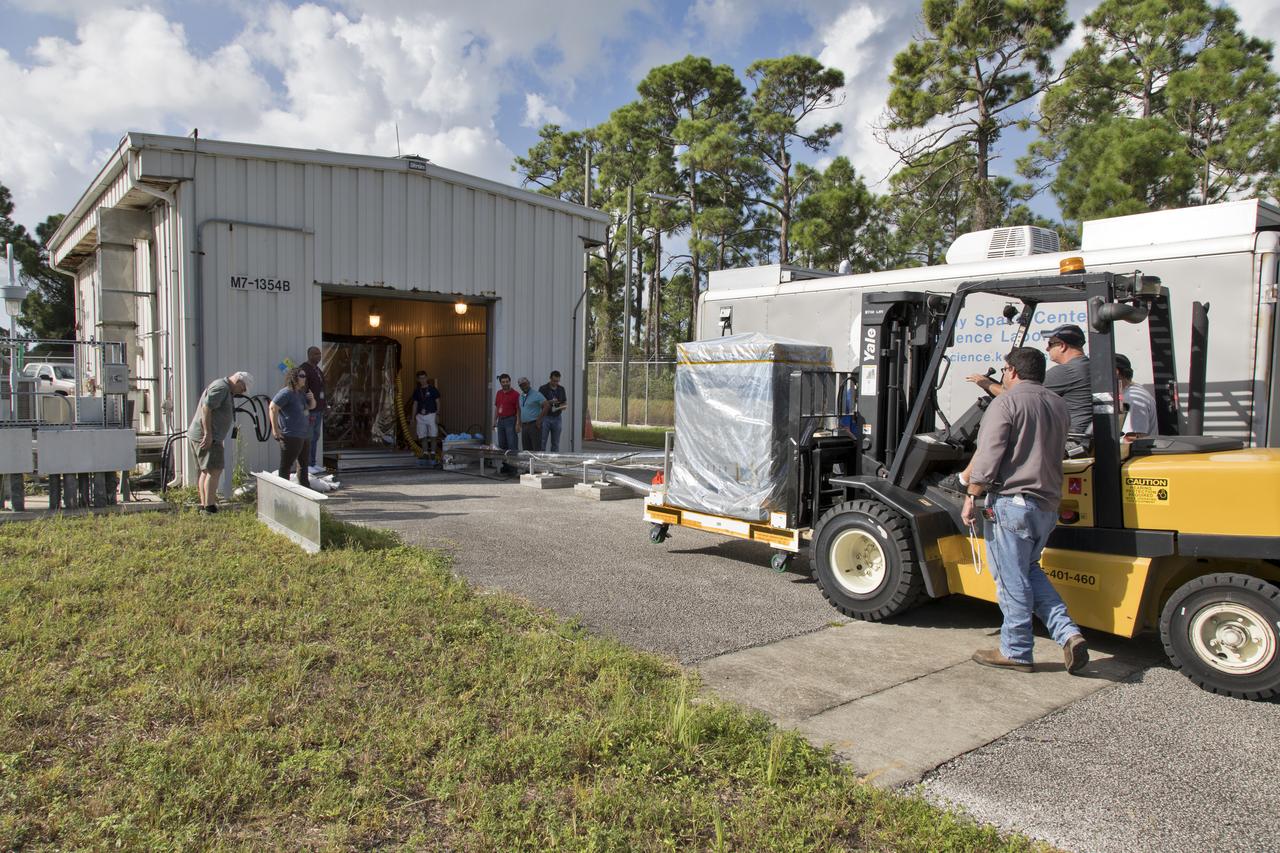
A worker uses a forklift to carry the Robotic Refueling Mission-3 (RRM3) payload to the entrance of the Payload Hazardous Servicing Facility on Oct. 3, 2018, at NASA's Kennedy Space Center in Florida. The payload will be carried to the International Space Station on SpaceX's 16th Commercial Resupply Services mission. RRM3 demonstrates the transfer of xenon gas and liquid methane in microgravity, and advances technologies for storing and manipulating these cryogenic fuels robotically. RRM3 also supports development of technology for the Restore-L mission, a robotic spacecraft equipped to service satellites in-orbit.
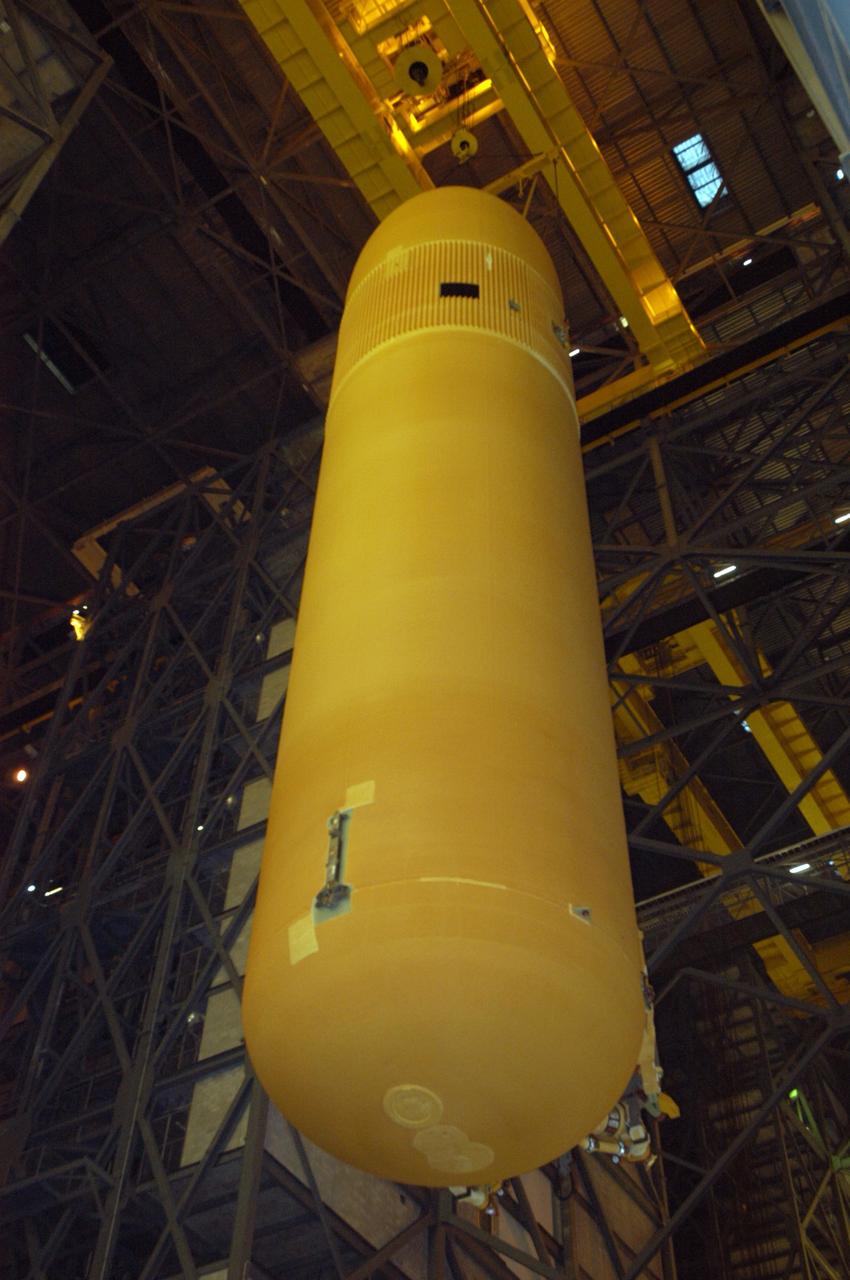
KENNEDY SPACE CENTER, FLA. - In NASA's Vehicle Assembly Building, the redesigned external fuel tank that will launch Space Shuttle Atlantis on the next shuttle mission, STS-115, is lifted toward the upper levels for transfer into a checkout cell for further work. Designated ET-118, the tank will fly with many major safety changes, including the removal of the protuberance air load ramps. Photo credit: NASA/George Shelton
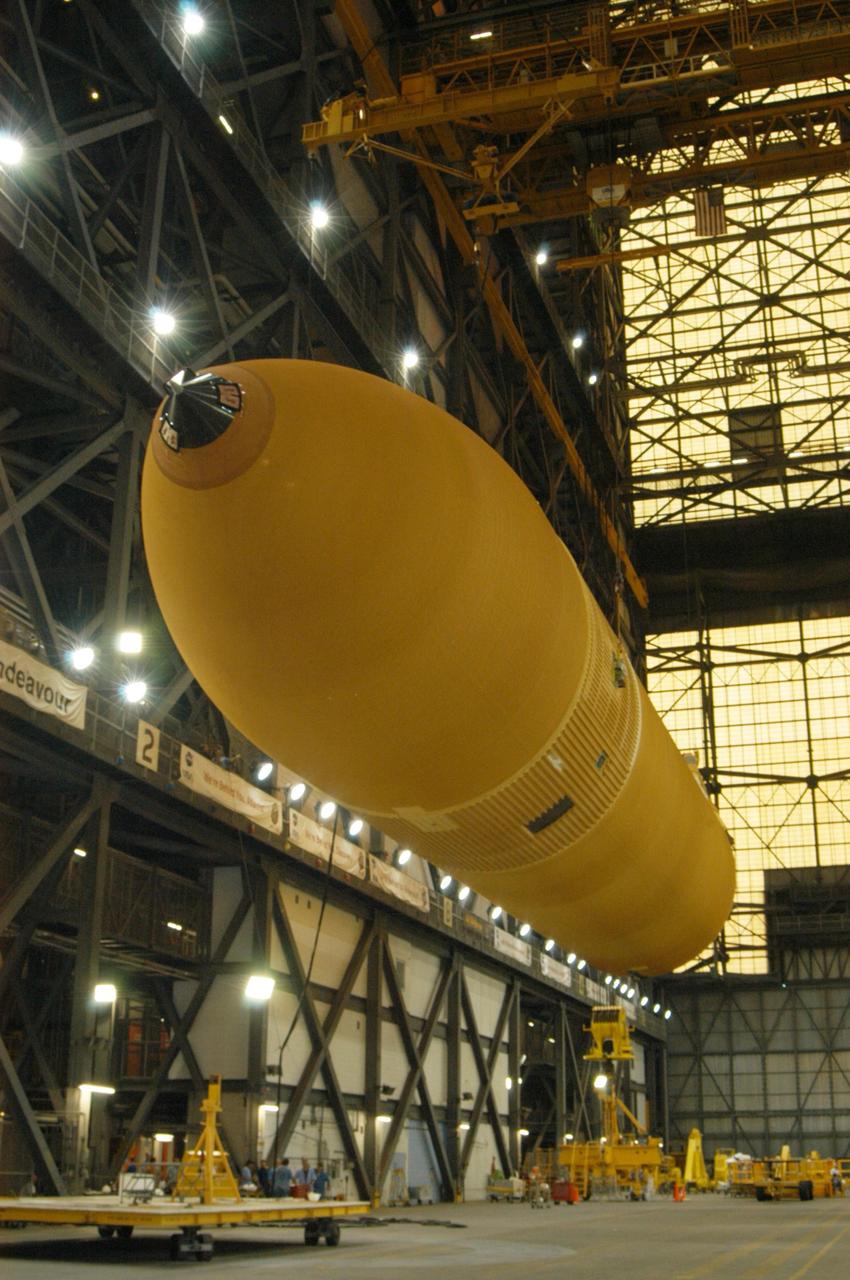
KENNEDY SPACE CENTER, FLA. - In NASA's Vehicle Assembly Building, the redesigned external fuel tank that will launch Space Shuttle Atlantis on the next shuttle mission, STS-115, is suspended above the transfer aisle where it will be raised to a vertical position. Once it is raised, the tank will be moved into a checkout cell for further work. The tank, designated ET-118, will fly with many major safety changes, including the removal of the protuberance air load ramps. Photo credit: NASA/George Shelton
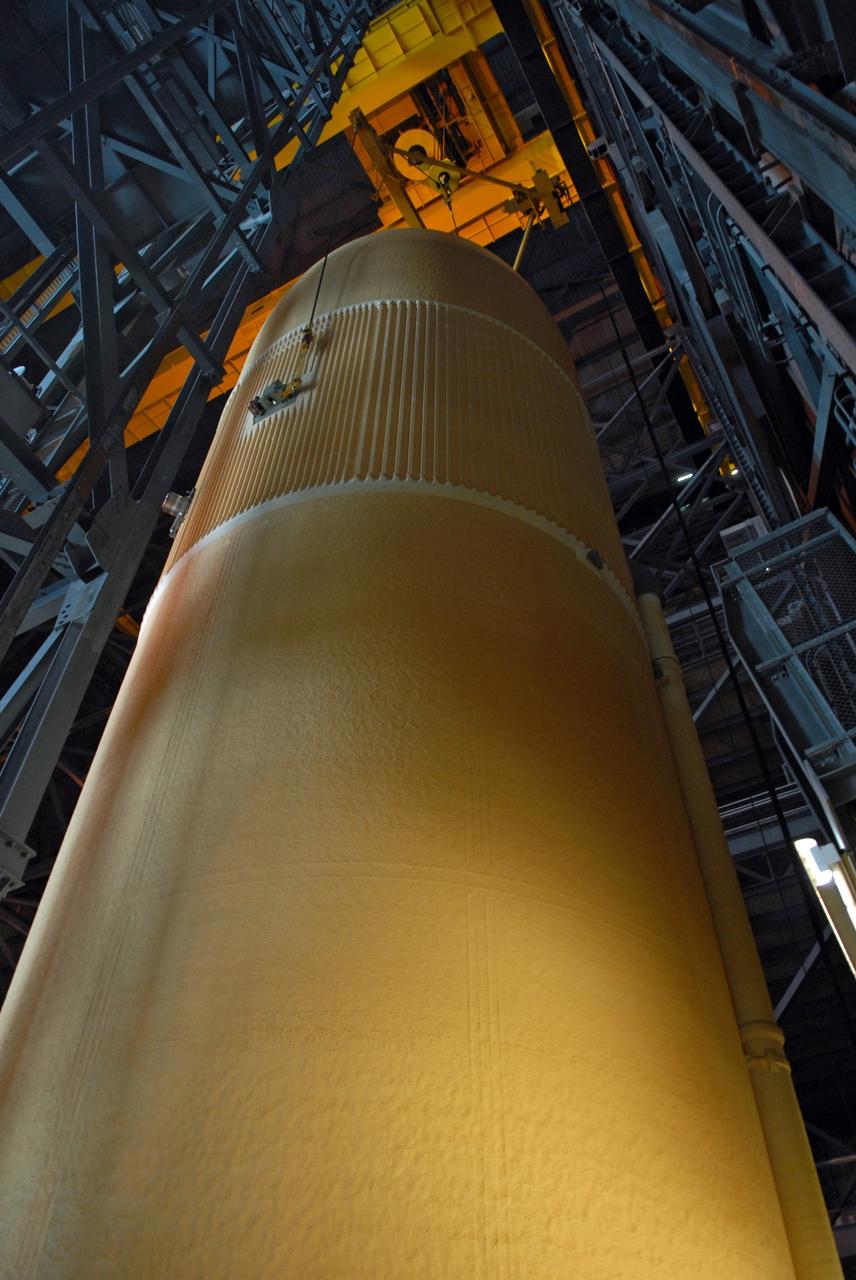
CAPE CANAVERAL, Fla. – The external fuel tank for space shuttle Atlantis' STS-129 mission is being lifted from the checkout cell of NASA Kennedy Space Center's Vehicle Assembly Building for transfer into high bay 2 and assembly with the solid rocket boosters already stacked on the mobile launch platform. The STS-129 mission is targeted to launch Nov. 12 on an 11-day supply mission to the International Space Station. Photo credit: NASA/Jim Grossmann
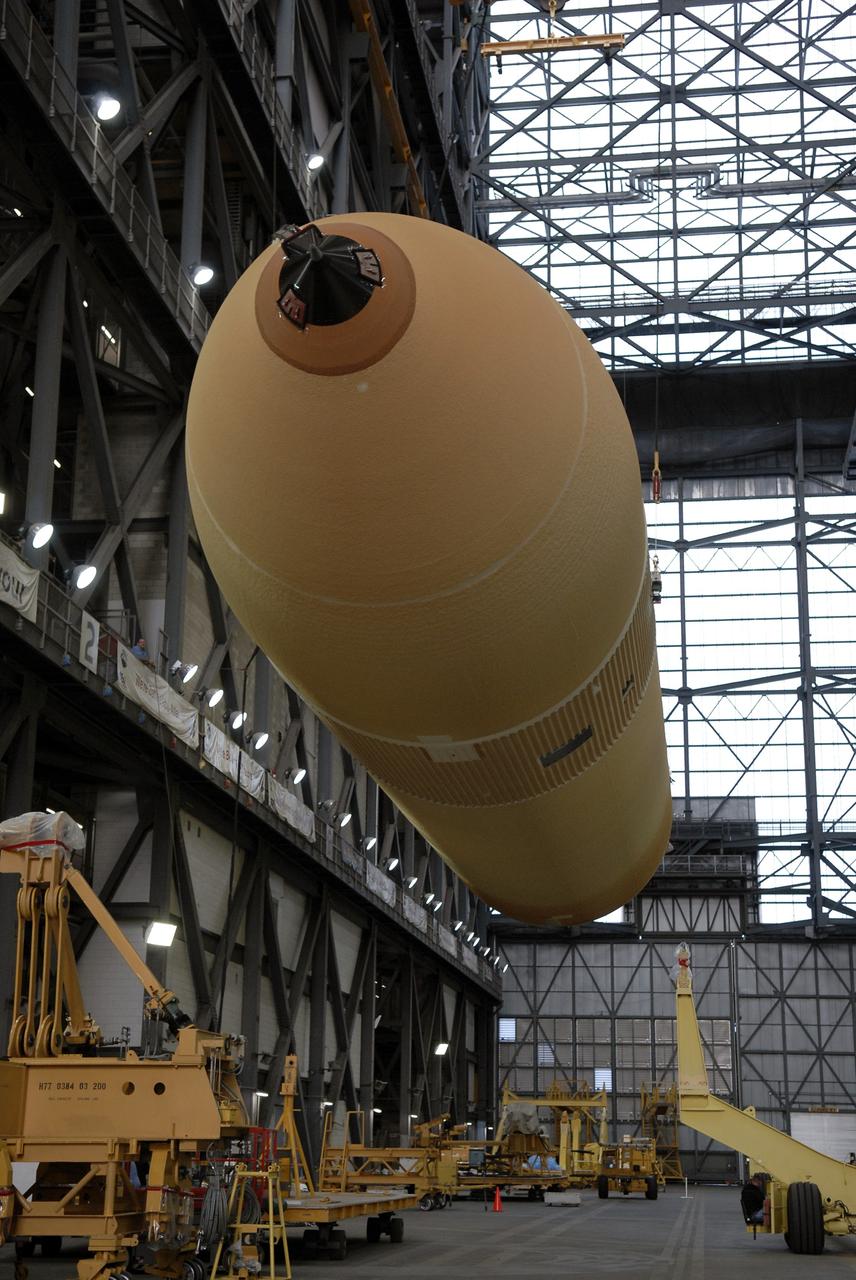
CAPE CANAVERAL, Fla. – In the transfer aisle of the Vehicle Assembly Building at NASA's Kennedy Space Center in Florida, external fuel tank ET-131 is lifted from its transporter. It will be raised to vertical and then lifted into the upper levels and lowered into a checkout bay. ET-131 will be used on space shuttle Endeavour's STS-127 mission. Payload for the mission is the Japanese Experiment Module's Experiment Logistics Module-Exposed Section, or ELM-ES. Launch is targeted for June. Photo credit: NASA/Kim Shiflett
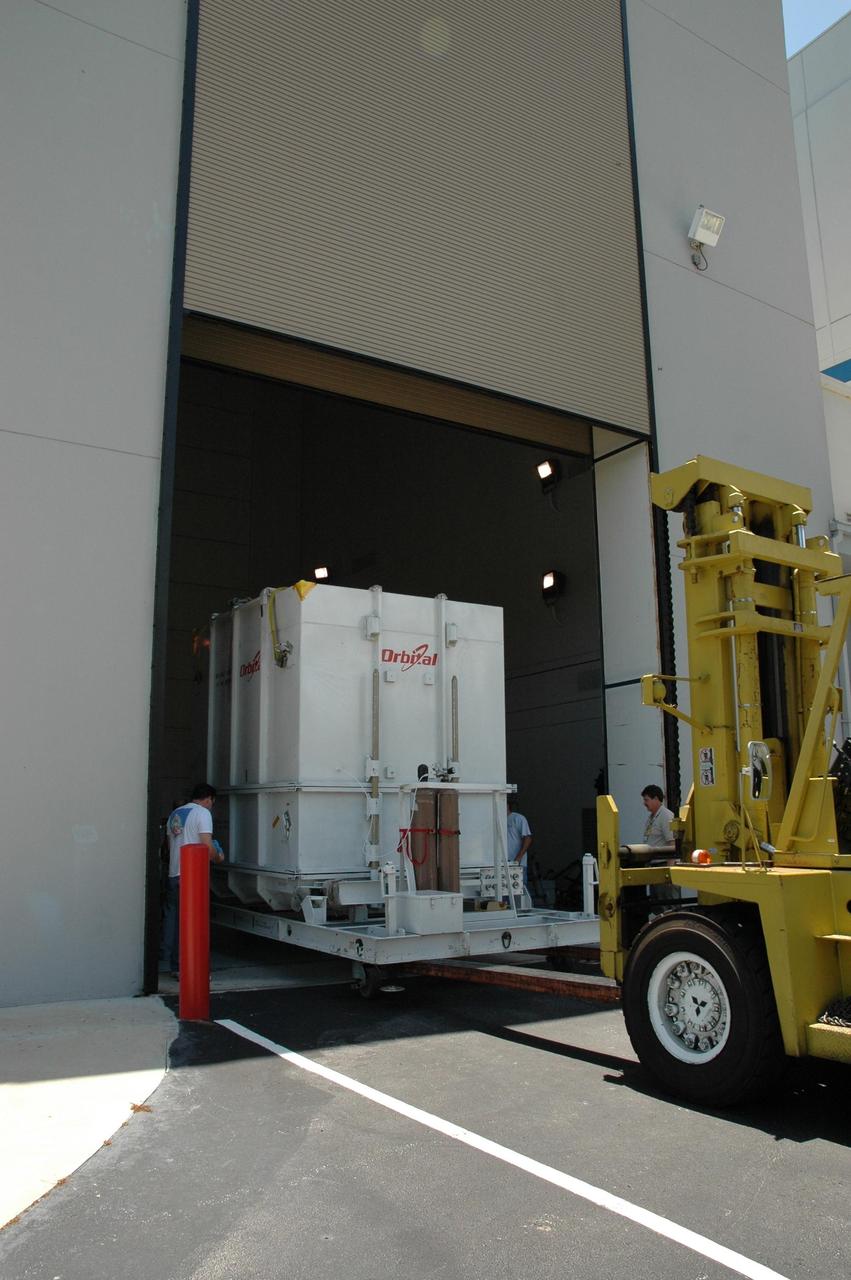
KENNEDY SPACE CENTER, FLA. -- The Dawn spacecraft, inside its shipping container, is moved out of the Astrotech's Payload Processing Facility for transfer to the Hazardous Processing Facility for fueling. Dawn is scheduled to launch June 30 aboard a Delta II rocket from Launch Complex 17-B at Cape Canaveral Air Force Station. Dawn's mission is to explore two of the asteroid belt's most intriguing and dissimilar occupants: asteroid Vesta and the dwarf planet Ceres. Photo credit: NASA/Charisse Nahser
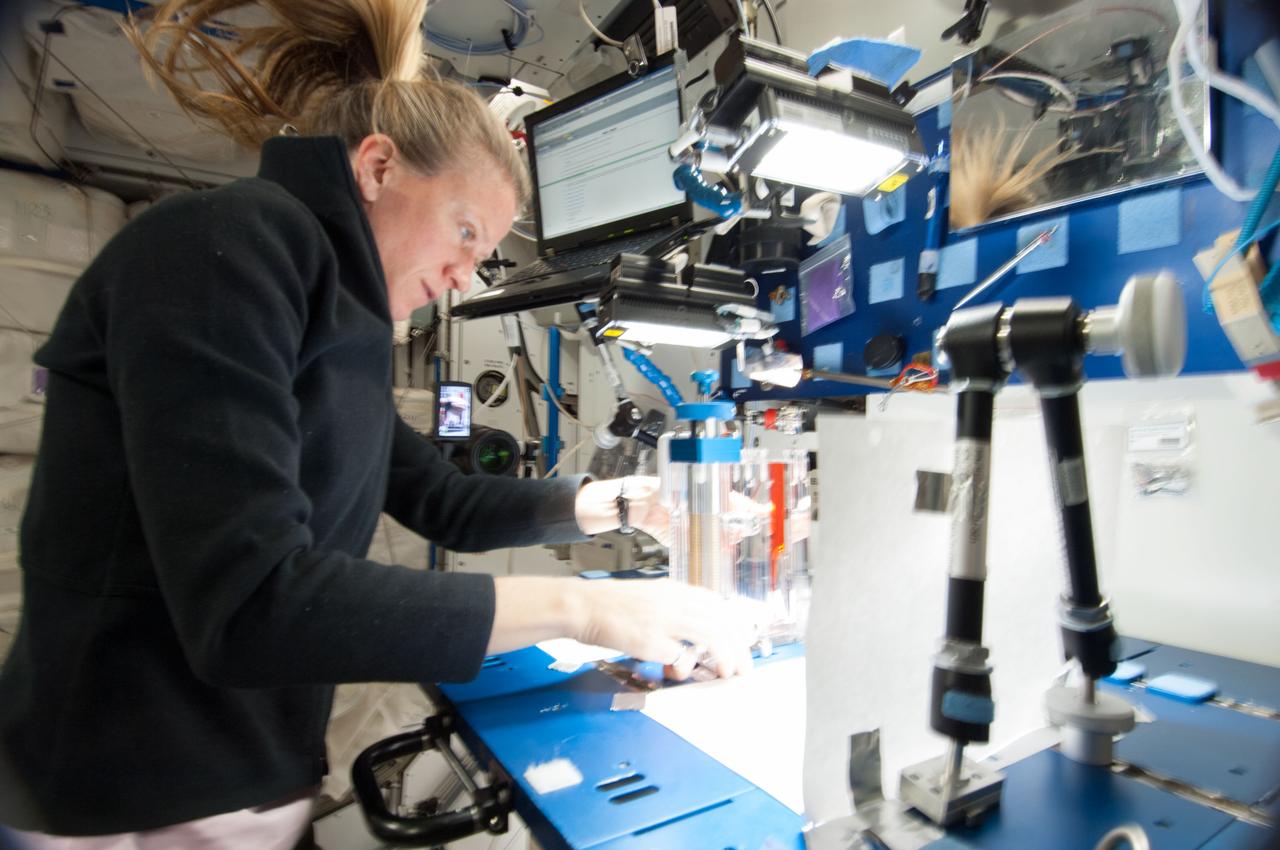
ISS036-E-029767 (8 Aug. 2013) --- NASA astronaut Karen Nyberg, Expedition 36 flight engineer, conducts a session with the Capillary Flow Experiment (CFE) in the Harmony node of the International Space Station. CFE observes the flow of fluid, in particular capillary phenomena, in microgravity. The data from this experiment will improve computer models used to design fluid transfer systems and fuel tanks on future spacecraft.
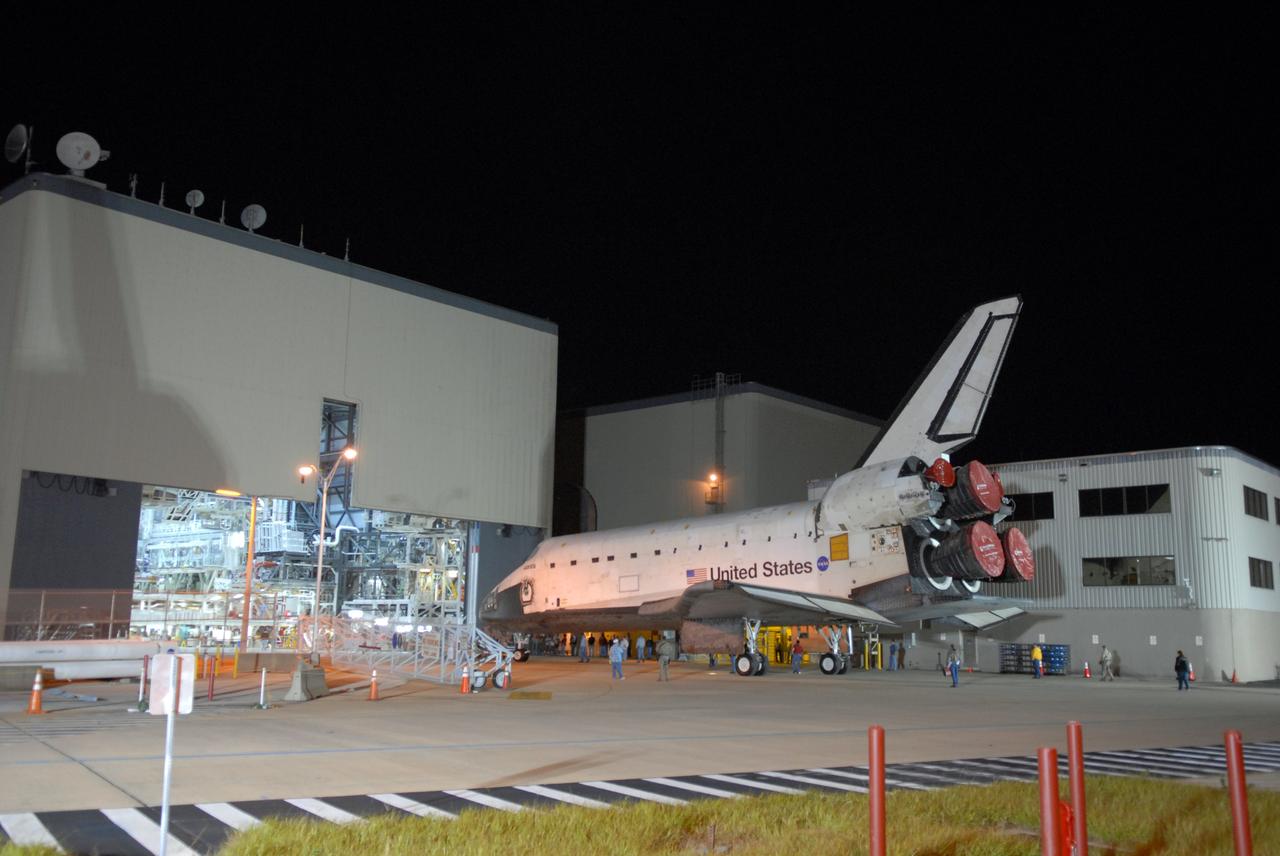
CAPE CANAVERAL, Fla. – Space shuttle Atlantis is towed into the Orbiter Processing Facility. Atlantis was removed from its external fuel tank and solid rocket boosters stack in the Vehicle Assembly Building after the delay of its STS-125 mission to NASA's Hubble Space Telescope. Atlantis' targeted launch on Oct. 14 was delayed when a system that transfers science data from the orbiting observatory to Earth malfunctioned on Sept. 27. The new target launch date is under review. Photo credit: NASA/Tim Jacobs
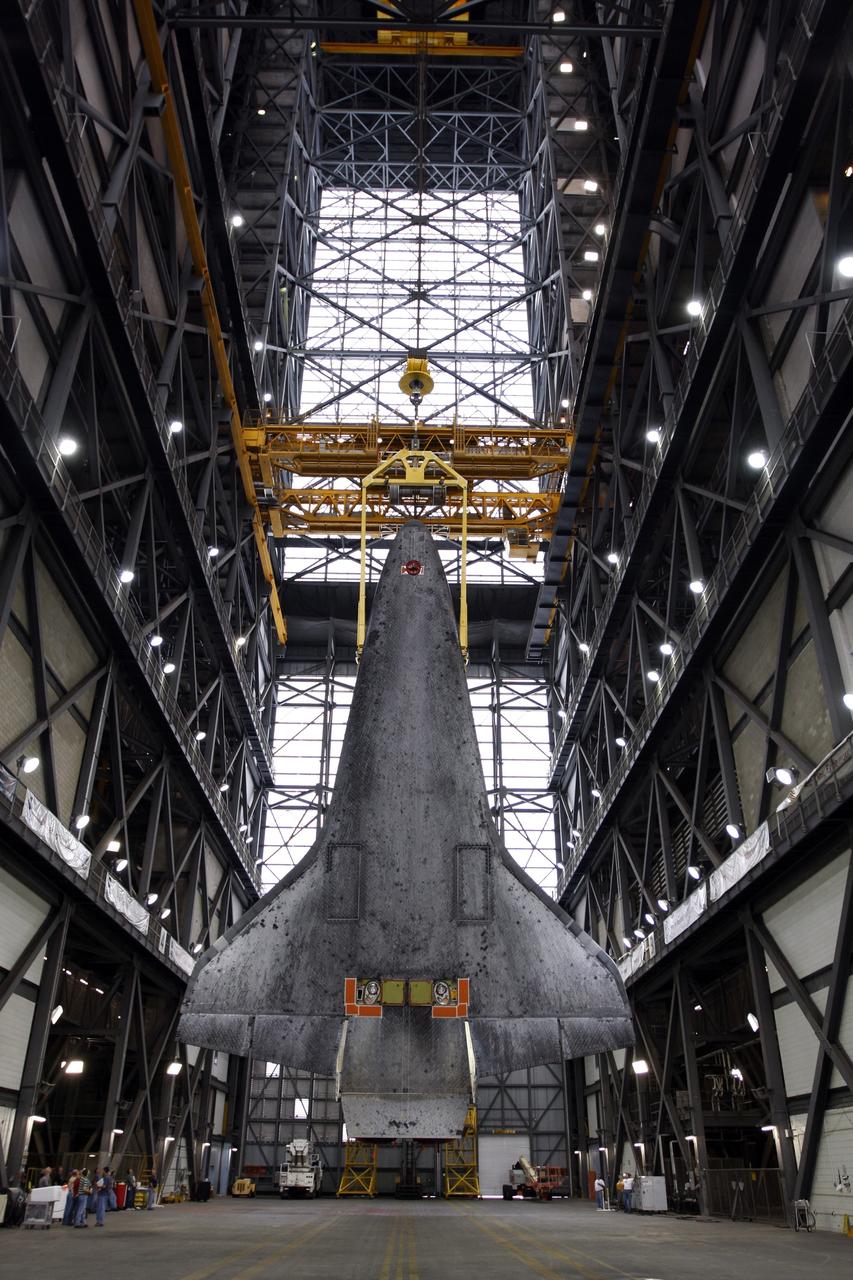
CAPE CANAVERAL, Fla. – In the Vehicle Assembly Building at NASA's Kennedy Space Center, space shuttle Atlantis is suspended vertically above the transfer aisle. The view shows the underbelly of the shuttle. Atlantis will be lifted into high bay 3 and stacked with its external fuel tank and twin solid rocket boosters. After additional preparations are made, the shuttle will be rolled out to Launch Pad 39A to prepare for launch on the STS-125 mission targeted for 1:34 a.m. EDT Oct. 8. Photo credit: NASA/Dimitri Gerondidakis