
At the Kennedy Space Center's (KSC's) Spacecraft and Assembly Encapsulation Facility 2 (SAEF-2), the planetary spacecraft checkout facility, clean-suited technicians work on the Galileo spacecraft prior to moving it to the Vehicle Processing Facility (VPF) for mating with the inertial upper stage (IUS). Galileo is scheduled for launch aboard Atlantis, Orbiter Vehicle (OV) 104, on Space Shuttle Mission STS-34 in October 1989. It will be sent to the planet Jupiter, a journey which will taken more than six years to complete. In December 1995 as the two and one half ton spacecraft orbits Jupiter with its ten scientific instruments, a probe will be released to parachute into the Jovian atmosphere. NASA's Jet Propulsion Laboratory (JPL) manages the Galileo project. View provided by KSC.

Galileo spacecraft image of the Moon recorded at 9:35 am Pacific Standard Time (PST), 12-09-90, after completing its first Earth Gravity Assist. Western hemisphere of the Moon was taken through a green filter at a range of about 350,000 miles. In the center is Orientale Basin, 600 miles in diameter, formed about 3.8 billion years ago by the impact of an asteroid-size body. Orientale's dark center is a small mare. To the right is the lunar near side with the great, dark Oceanus Procellarum above the small, circular, dark Mare Humorum below. Maria are broad plains formed mostly over 3 billion years ago as vast basaltic lava flows. To the left is the lunar far side with fewer maria, but, at lower left South-Pole-Aitken basin, about 1200 miles in diameter, which resembles Orientale but is much older and more weathered and battered by cratering. The intervening cratered highlands of both sides, as well as the maria, are dotted with bright young craters. This image was "reprojected" so as to center the Orientale Basin, and was filtered to enhance the visibility of small features. The digital image processing was done by DLR, the German Aerospace Research Establishment near Munich, an international collaborator in the Galileo mission. Photo was provided by Jet Propulsion Laboratory (JPL) with alternate number P-37327, 12-19-90.
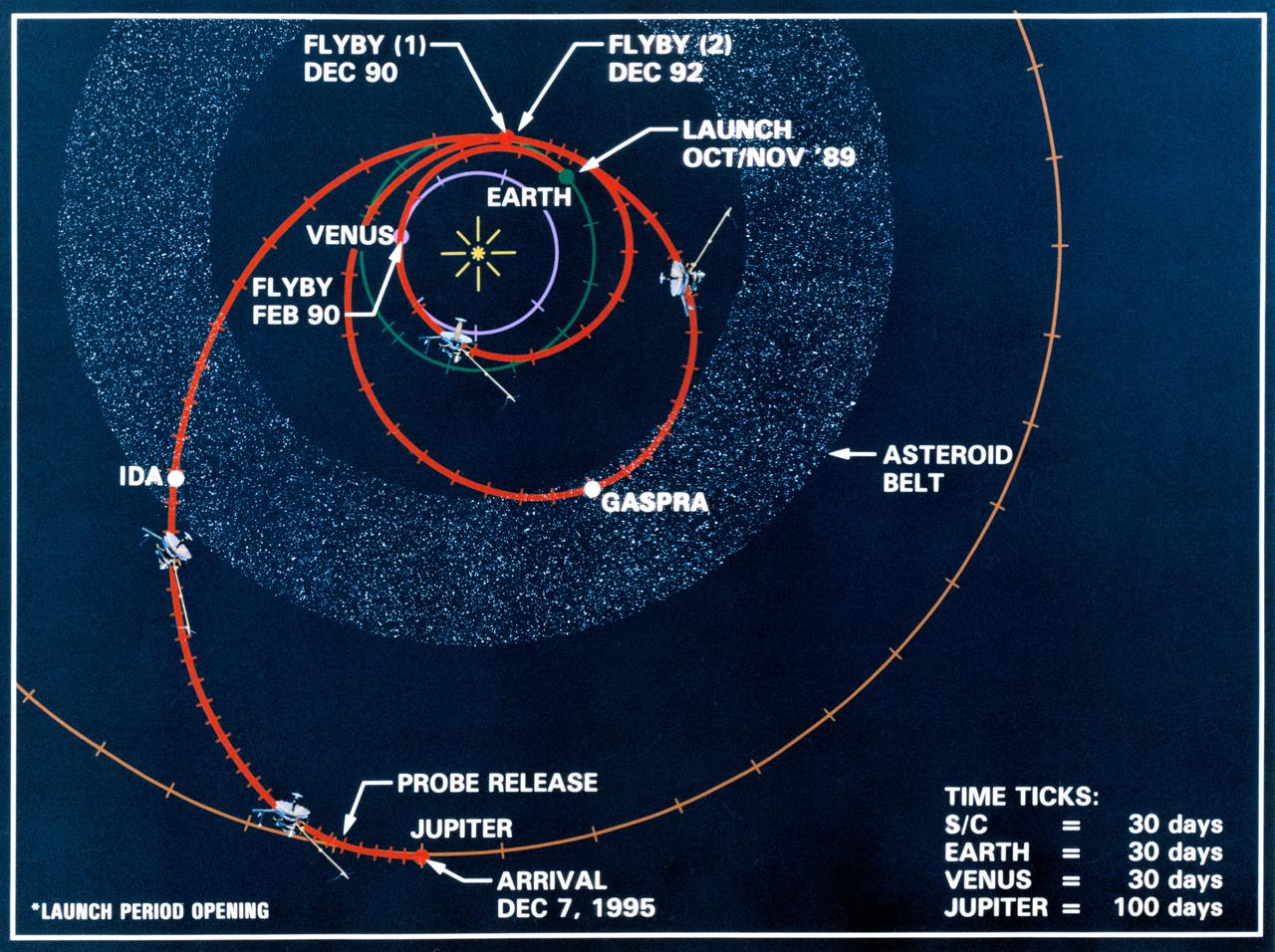
Line drawing charts the Galileo spacecraft's launch from low Earth orbit and its three planetary and two asteroid encounters in the course of its gravity-assisted flight to Jupiter. These encounters include Venus (February 1990), two Earth passes (December 1990 and December 1992), and the asteroids Gaspra and Ida in the asteroid belt. Galileo will release a probe and will arrive at Jupiter, 12-07-95.
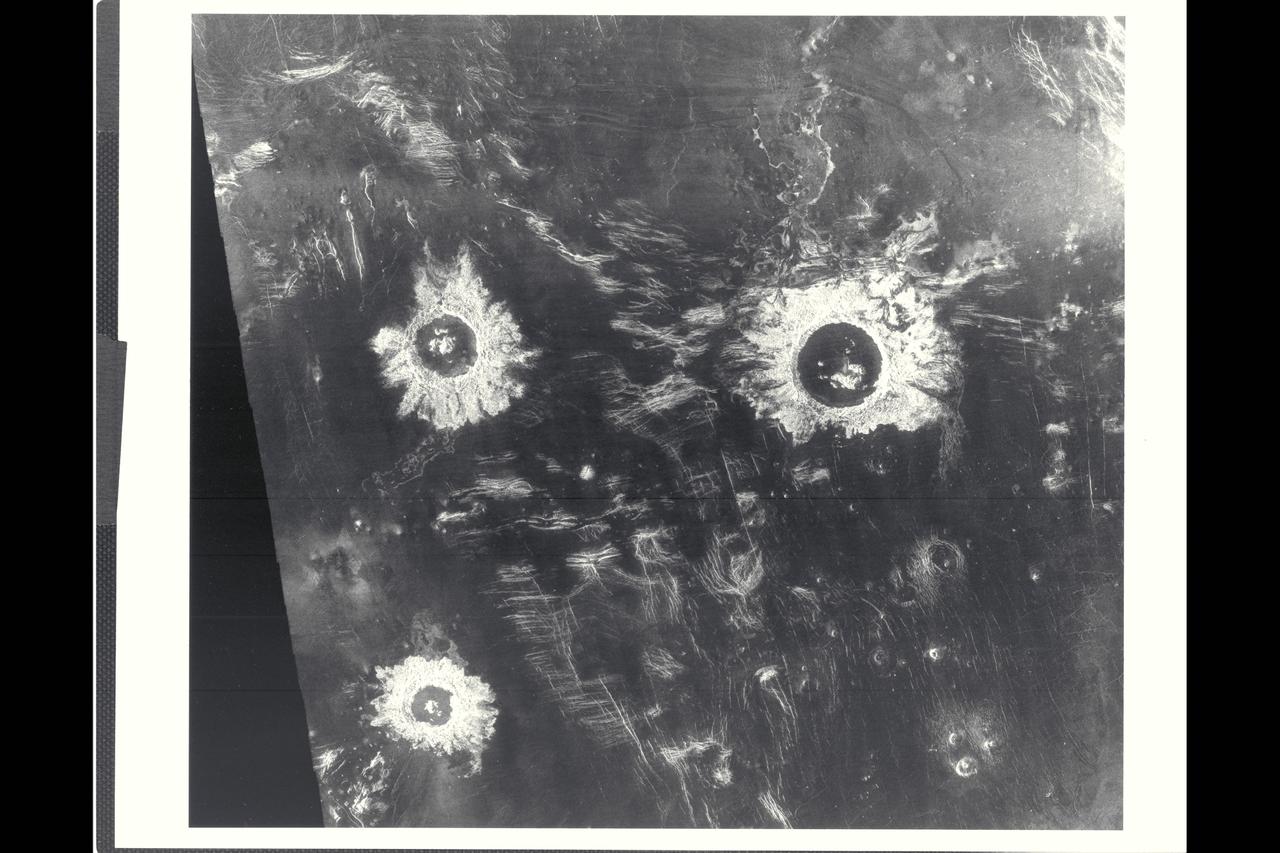
(P-37375) Moon craters as seen by Galileo spacecraft
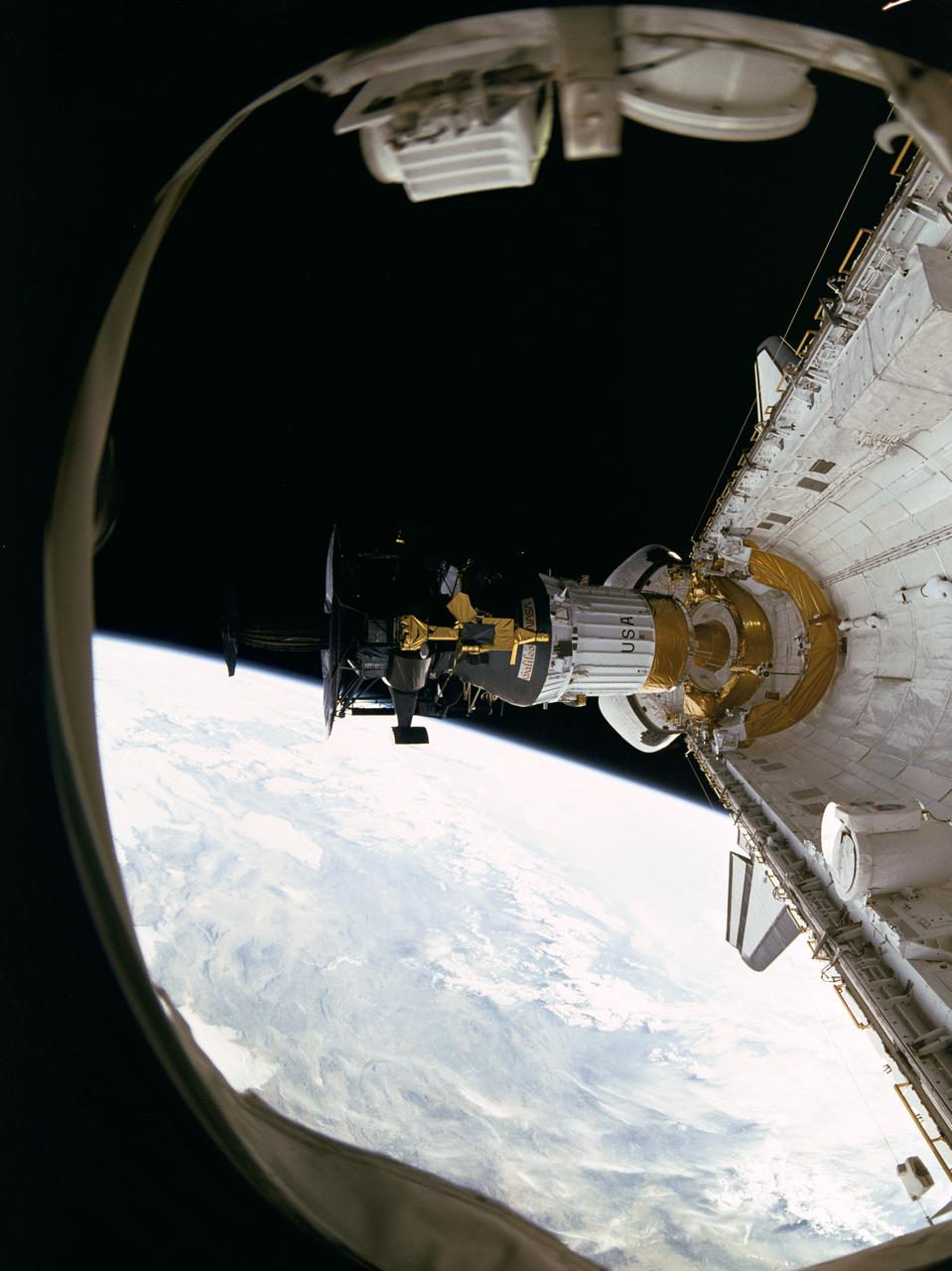
S89-48714 (18 Oct 1989) --- This photograph was taken by the STS-34 crew aboard the Space Shuttle Atlantis and shows the Galileo spacecraft being deployed on Oct. 18, 1989 from the payload bay. Galileo is a scientific craft that will go into orbit around the planet Jupiter and drop a probe into its atmosphere in search of primordial solar system material believed to be present there. The 70mm motion picture film will be used in the forthcoming "Blue Planet," which will address Earth's environmental problems from the perspective of space-based observation and solar system exploration. The film is being produced by IMAX Space Technology Inc. for the sponsor, the Smithsonian Institution, with funding provided by the Lockheed Corporation. PHOTO CREDIT: NASA/Smithsonian Institution
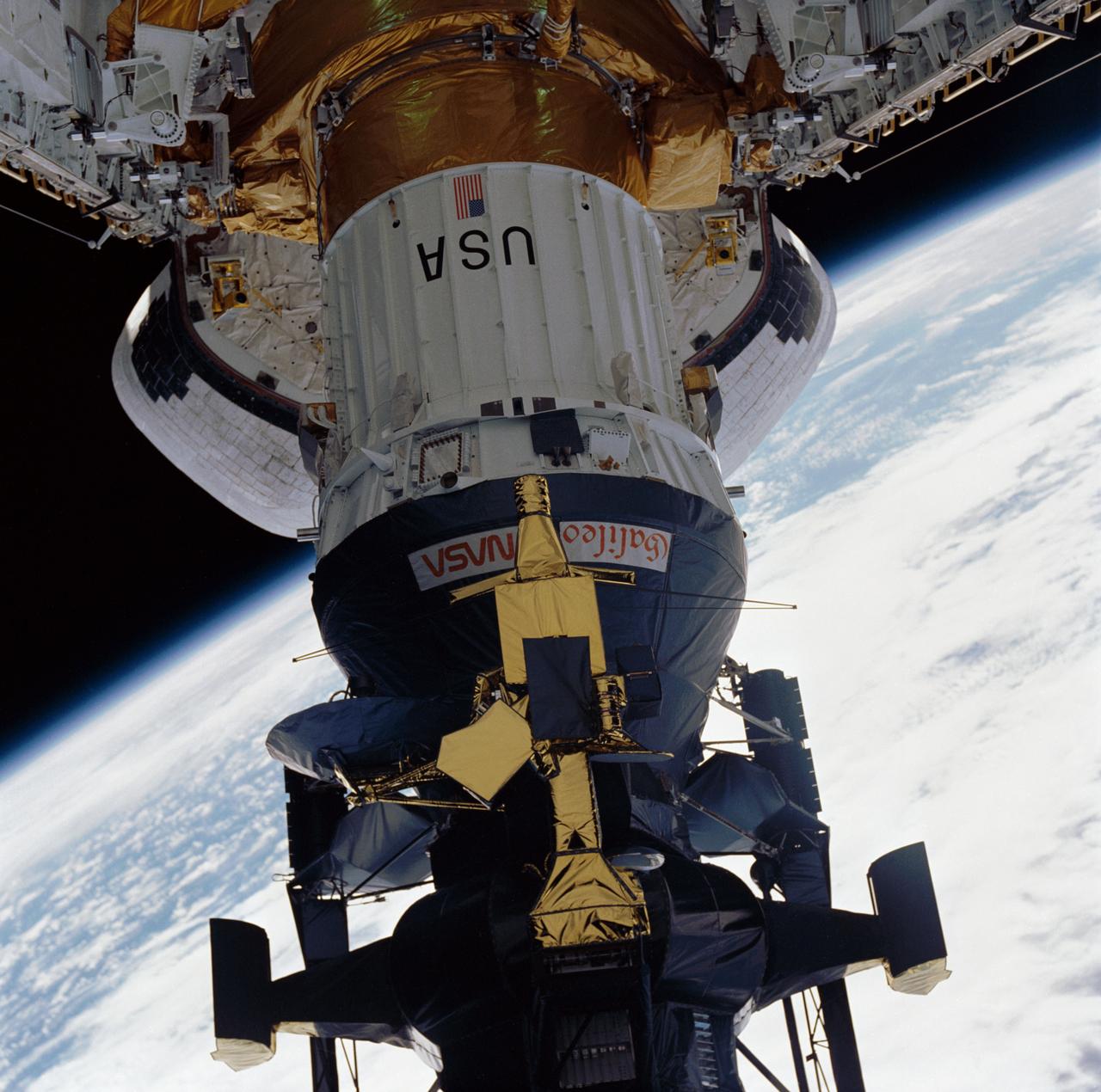
During STS-34 mission, the Galileo spacecraft mounted atop the inertial upper stage (IUS) is tilted to a 58-degree deployment position by the airborne support equipment (ASE) aft frame tilt actuator (AFTA) table in Atlantis', Orbiter Vehicle (OV) 104's, payload bay (PLB). Visible in the foreground is the ASE forward cradle and the umbilical boom which has fallen away from the IUS. OV-104's orbital maneuvering system (OMS) pods and the Earth's limb appear in the background.

Artist concept shows Galileo spacecraft while still approaching Jupiter having a satellite encounter. Galileo is flying about 600 miles above Io's volcano-torn surface, twenty times closer than the closest flyby altitude of Voyager in 1979.

Labeled line drawing entitled GALILEO PROBE identifies the deceleration module aft cover, descent module, and deceleration module aeroshell configurations and dimensions prior to and during entry into Jupiter's atmosphere.
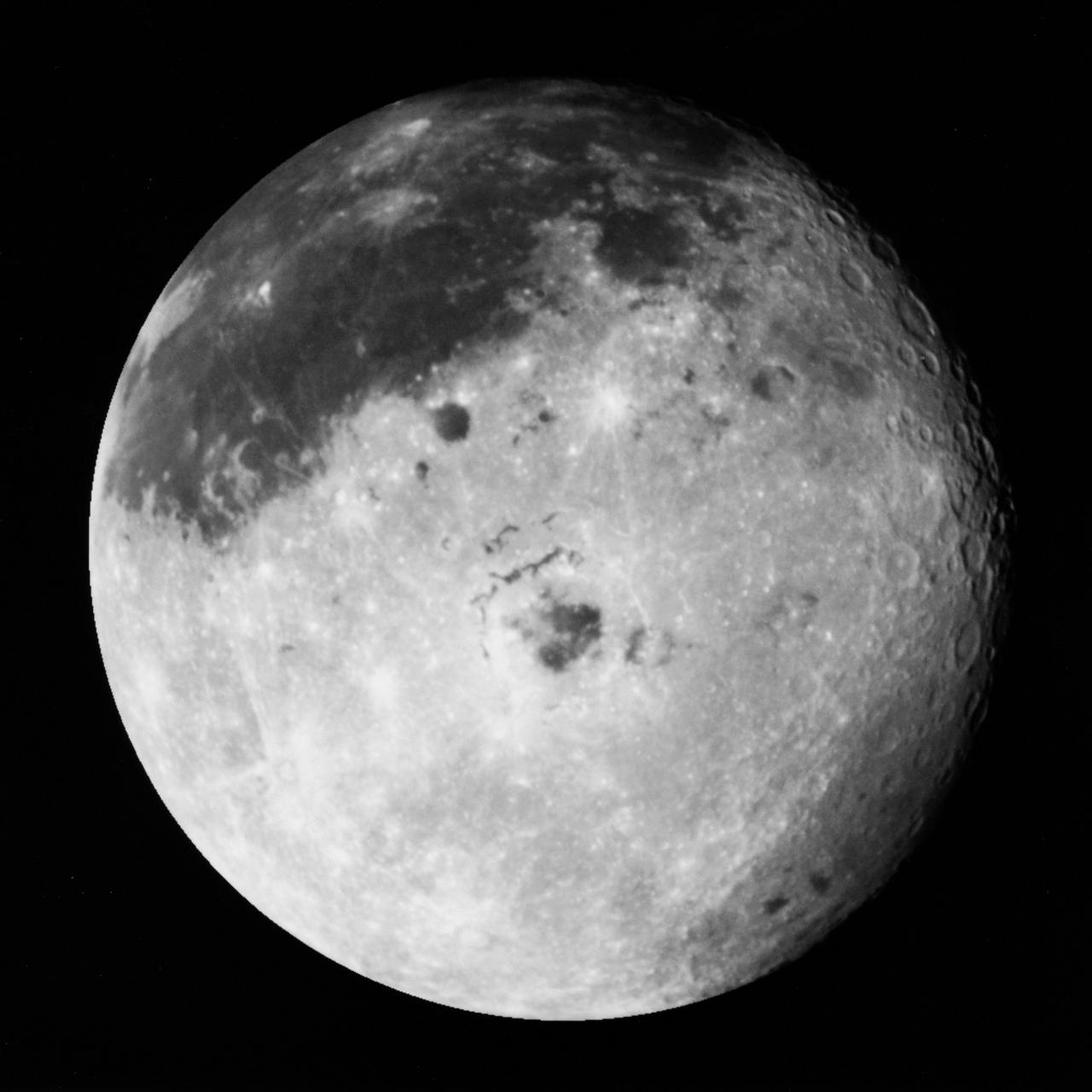
S90-55753 (9 Dec. 1990) --- This color image of the Moon was taken by the Galileo spacecraft at 9:25 a.m. (PST) December 9, 1990, at a range of about 350,000 miles. The color composite uses monochrome images taken through violet, red, and near infrared filters. The concentric, circular Orientale Basin, 600 miles across, is near the center; the near side is to the right, the far side to the left. At the upper right is the large, dark Oceanus Procellarum; below it is the smaller Mare Humorum. These, like the small dark Mare Orientale in the center of the basin, formed over 3 billion years ago as basaltic lava flows. At the lower left, among the southern cratered highlands of the far side, is the South-Pole-Aitken Basin, similar to Orientale but twice as great in diameter and much older and more degraded by crating and weathering. The cratered highlights of the near and far sides and the Maria are covered with scattered bright, young ray-craters.

These four images of the Moon are from data acquired by NASA Galileo spacecraft Near-Earth Mapping Spectrometer during Galileo December 1992 Earth/Moon flyby. http://photojournal.jpl.nasa.gov/catalog/PIA00231

This image of the crescent moon was obtained by the Galileo Solid State imaging system on December 8 at 5 a.m. PST as NASA Galileo spacecraft neared the Earth. http://photojournal.jpl.nasa.gov/catalog/PIA00224
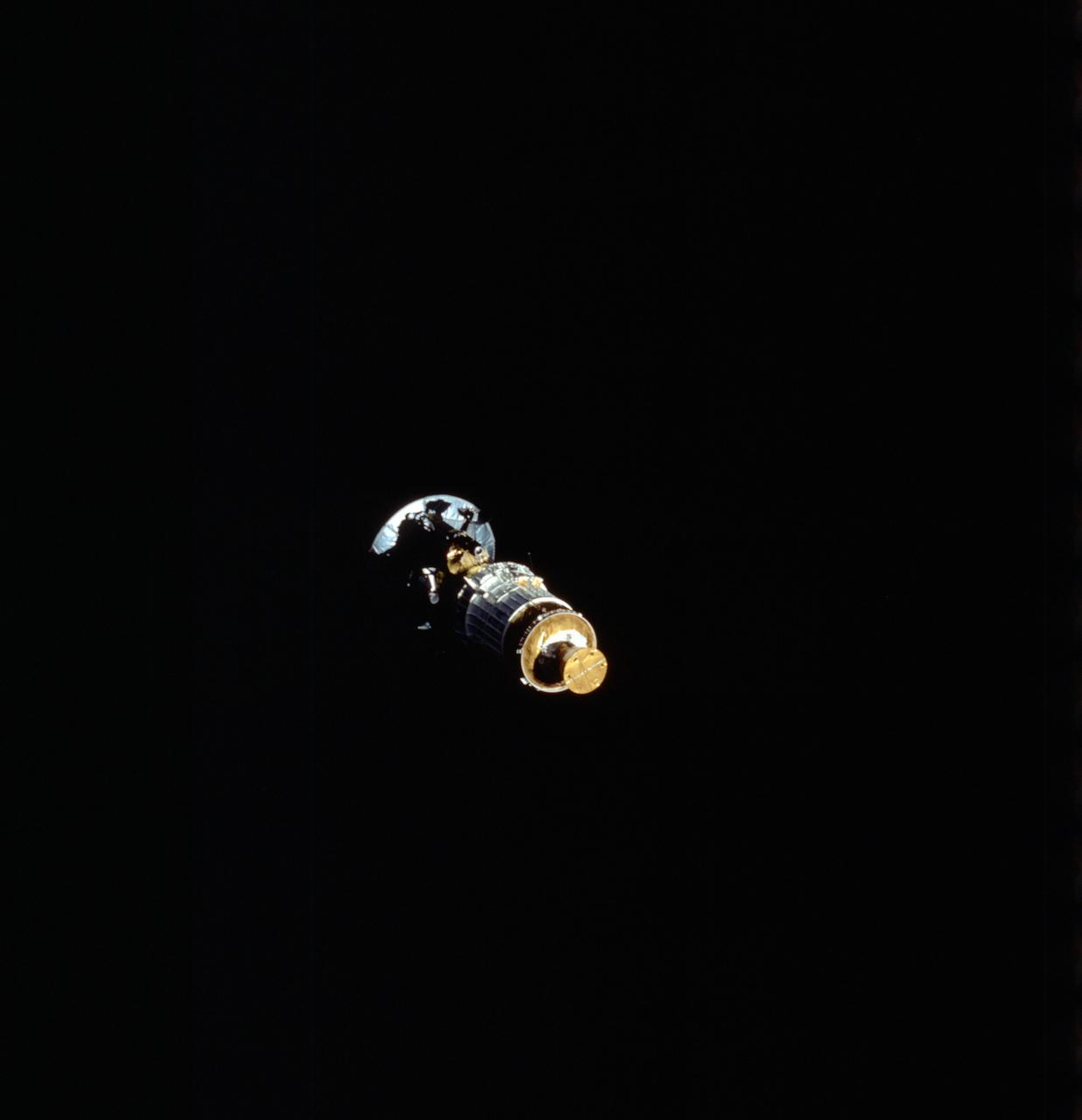
STS034-72-070 (18 Oct 1989) --- Backdropped against the blackness of space, the Galileo spacecraft and its inertial upper stage (IUS) begin relative separation from the Earth-orbiting Space Shuttle Atlantis. The five-member STS-34 crew deployed the Jupiter-bound satellite within six hours of achieving Earth orbit on Oct. 18, 1989. The scene was exposed with a 70mm handheld Hasselblad camera.
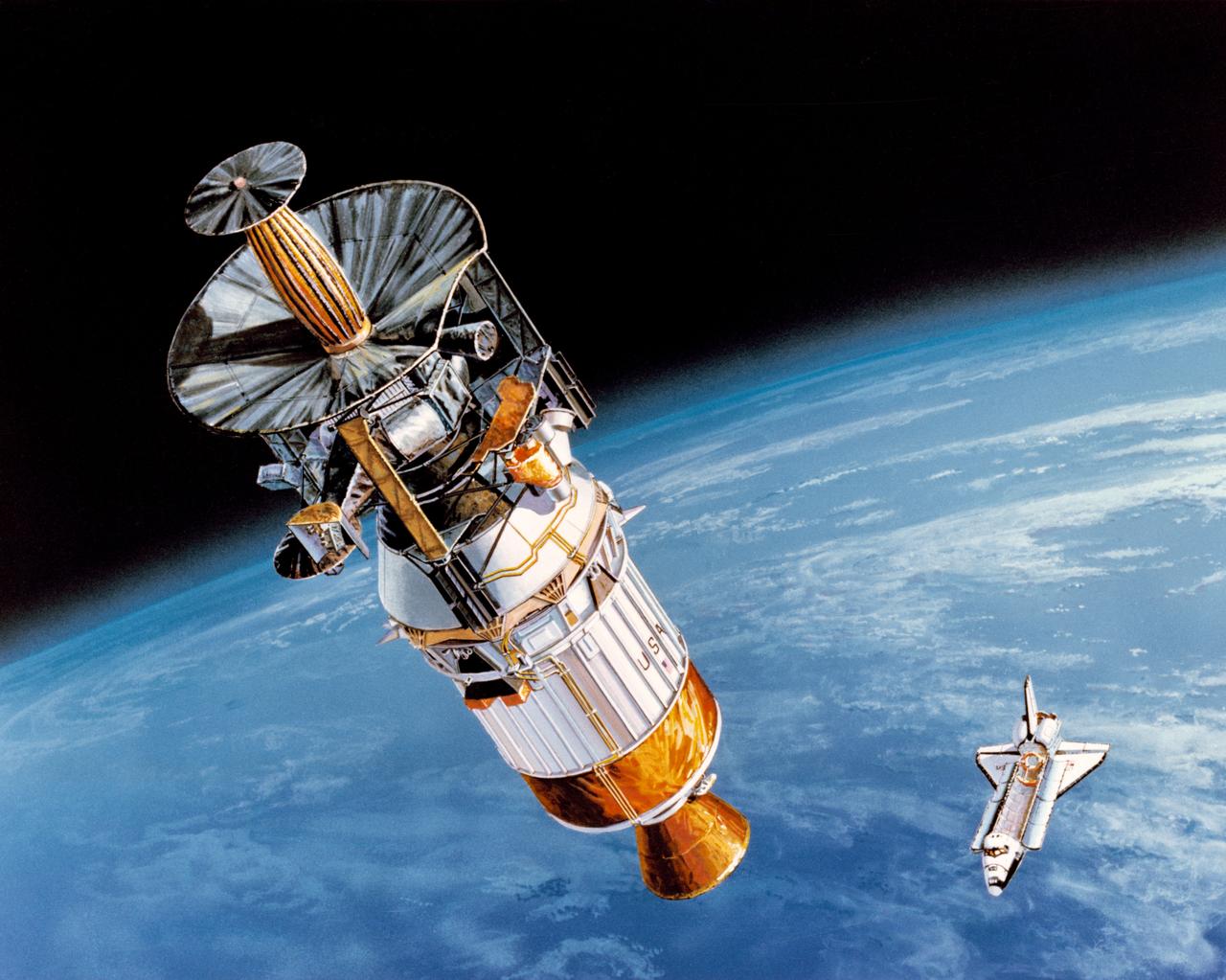
S89-42940 (April 1989) --- In this artist's rendition, the Galileo spacecraft is being boosted into its inter-planetary trajectory by the Inertial Upper Stage (IUS) rocket. The Space Shuttle Atlantis, which is scheduled to take Galileo and the IUS from Earth's surface into space, is depicted against the curve of Earth. Galileo will be placed on a trajectory to Venus, from which it will return to Earth at higher velocity and then gain still more energy in two gravity-assist passes, until it has enough velocity to reach Jupiter. Passing Venus, it will take scientific data using instruments designed for observing Jupiter; later, it will make measurements at Earth and the moon, crossing above the moon's north pole in the second pass. Between the two Earth passes, it will edge into the asteroid belt, beyond Mars' orbit; there, the first close-up observation of an asteroid is planned. Crossing the belt later, another asteroid flyby is possible.

This montage of 11 images taken by NASA Galileo spacecraft as it flew by the asteroid Gaspra on Oct. 1991, shows Gaspra growing progressively larger in the field of view of Galileo solid-state imaging camera as the spacecraft approached the asteroid. http://photojournal.jpl.nasa.gov/catalog/PIA00079

Artist rendering of NASA Galileo spacecraft flying past Jupiter moon Io. Galileo made multiple close approaches to the volcanically active moon during its time at Jupiter. http://photojournal.jpl.nasa.gov/catalog/PIA18176

During the G7 encounter, NASA Galileo spacecraft observed the shadow of Europa on the clouds of Jupiter during Galileo fourth orbit. The bright spot in the clouds is an atmospheric hot spot.

NASA Galileo spacecraft acquired this global mosaic right during Galileo third orbit on Nov. 4, 1996. The lighter bluish area in the upper latitudes is the Asgard multi-ring structure with crater Burr to the north and Tornasuk to the east.

This image of the moon was obtained by the Galileo Solid State imaging system on Dec. 8 at 7 p.m. PST as NASA Galileo spacecraft passed the Earth and was able to view the lunar surface from a vantage point not possible from the Earth. http://photojournal.jpl.nasa.gov/catalog/PIA00225

On June 27, 1996, during Galileo first orbit around Jupiter, a newly discovered impact crater could be seen just right of the center of this image of Jupiter moon Europa returned by NASA Galileo spacecraft camera. http://photojournal.jpl.nasa.gov/catalog/PIA00294

The three LEGO figurines flying aboard the Juno spacecraft are the Roman god Jupiter, his wife Juno and Galileo Galilei.

Roughly true color image of the Great Red Spot of Jupiter as taken by NASA Galileo spacecraft on June 26, 1996.

A very active volcano on Jupiter moon Io, probably composed of erupting lava fountains, was seen by NASA Galileo spacecraft.

This picture contains two images of Jupiter moon Io and its surrounding sky. This image was taken by NASA Galileo spacecraft in 1996.

NASA Galileo spacecraft imaged Io at high spectral resolution during the G2 encounter on Sept. 6, 1996.

The mottled face of Jupiter volcanically active moon Io as viewed by NASA Galileo spacecraft. http://photojournal.jpl.nasa.gov/catalog/PIA00282

This observation of a small section of the Asgard terrain reveals compositional variations over the surface of Callisto was captured by NASA Galileo spacecraft in 1996.
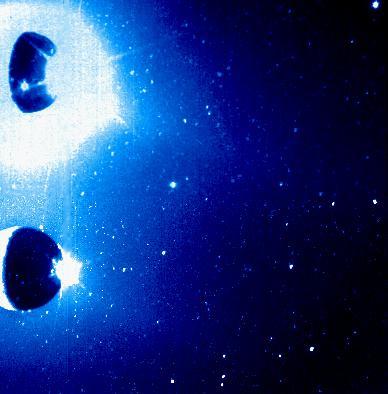
This image from NASA Galileo spacecraft is of Prometheus sunlit plume and Io illuminated crescent.

This image from NASA Galileo spacecraft is of Jupiter moon Io and its surrounding sky is shown in false color.
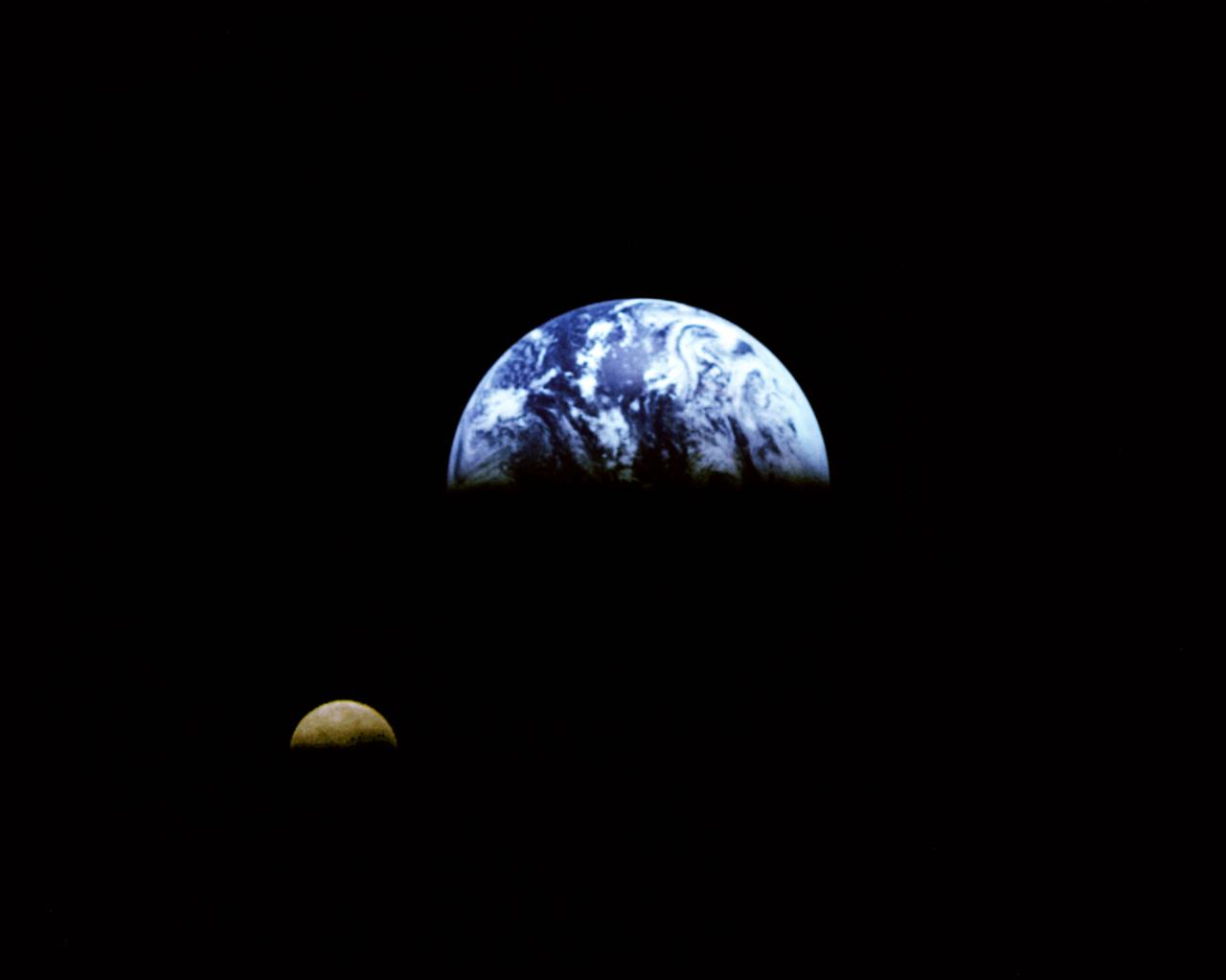
Eight days after its encounter with the Earth, the Galileo spacecraft was able to look back and capture this remarkable view of the Moon in orbit about the Earth, taken from a distance of about 6.2 million kilometers (3.9 million miles). The picture was constructed from images taken through the violet, red, and 1.0-micron infrared filters. The Moon is in the foreground, moving from left to right. The brightly-colored Earth contrasts strongly with the Moon, which reflects only about one-third as much sunlight as the Earth. Contrast and color have been computer-enhanced for both objects to improve visibility. Antarctica is visible through clouds (bottom). The Moon's far side is seen; the shadowy indentation in the dawn terminator is the south-Pole/Aitken Basin, one of the largest and oldest lunar impact features. Alternate Jet Propulsion Laboratory (JPL) number is P-41508. View appears in the Space News Roundup v32 n1 p1, 01-11-93.

These images demonstrate the dramatic improvement in the resolution of pictures that NASA Galileo spacecraft returned compared to previous images of the Jupiter system. http://photojournal.jpl.nasa.gov/catalog/PIA00277

This color image of the Earth was obtained by NASA’s Galileo spacecraft on Dec. 11, 1990, when the spacecraft was about 1.5 million miles from the Earth. http://photojournal.jpl.nasa.gov/catalog/PIA00122

This color image of the Earth was obtained by NASA’s Galileo spacecraft early Dec. 12, 1990, when the spacecraft was about 1.6 million miles from the Earth. http://photojournal.jpl.nasa.gov/catalog/PIA00123

Jupiter atmospheric circulation is dominated by alternating eastward and westward jets from equatorial to polar latitudes. This image was taken on April 3, 1997, by NASA Galileo spacecraft.

Jupiter atmospheric circulation is dominated by alternating eastward and westward jets from equatorial to polar latitudes. This image was taken on April 3, 1997, by NASA Galileo spacecraft.

This mosaic of Jupiter’s moon Ganymede consists of more than 100 images acquired with NASA’s Voyager and Galileo spacecrafts, showing irregular lumps beneath the icy surface.
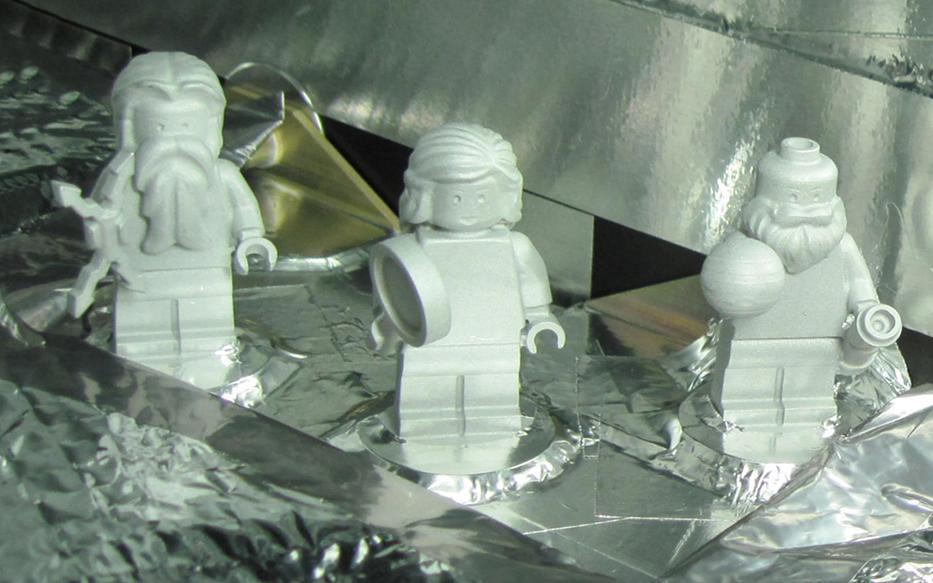
Three LEGO figurines representing the Roman god Jupiter, his wife Juno and Galileo Galilei are shown here aboard the Juno spacecraft.

Jupiter atmospheric circulation is dominated by alternating eastward and westward jets from equatorial to polar latitudes. This image was taken on April 3, 1997, by NASA Galileo spacecraft.

Jupiter atmospheric circulation is dominated by alternating eastward and westward jets from equatorial to polar latitudes. This image was taken on April 3, 1997, by NASA Galileo spacecraft.

Jupiter atmospheric circulation is dominated by alternating eastward and westward jets from equatorial to polar latitudes. This image was taken on April 3, 1997, by NASA Galileo spacecraft.

Topographic detail is seen in a stereoscopic view of this part of Jupiter moon Ganymede. This image is a computer reconstruction from two images taken by NASA Galileo spacecraft in 1996.

Bright scars on a darker surface testify to a long history of impacts on Jupiter moon Callisto in this image of Callisto from NASA Galileo spacecraft.

Jupiter atmospheric circulation is dominated by alternating eastward and westward jets from equatorial to polar latitudes. This image was taken on April 3, 1997, by NASA Galileo spacecraft.

This mosaic shows the features of Jupiter main visible cloud deck and the hazy cloud layer above it as seen by NASA Galileo spacecraft on April 3, 1997.

This enhanced color image shows cracks and ridges on Europa surface that reveal a detailed geologic history. The view was captured by NASA Galileo spacecraft on February 2, 1999.

NASA Galileo spacecraft imaged most of Europa, including the north polar regions, at high spectral resolution during the G1 encounter on June 28, 1996.

This image was acquired on May 6, 1997 while Io was in eclipse in Jupiter shadow during NASA Galileo spacecraft eighth orbit, and reveals several dynamic processes.

Jupiter atmospheric circulation is dominated by alternating eastward and westward jets from equatorial to polar latitudes. This image was taken on April 3, 1997, by NASA Galileo spacecraft.

Jupiter atmospheric circulation is dominated by alternating eastward and westward jets from equatorial to polar latitudes. This image was taken on April 3, 1997, by NASA Galileo spacecraft.

Jupiter atmospheric circulation is dominated by alternating eastward and westward jets from equatorial to polar latitudes. This image was taken on April 3, 1997, by NASA Galileo spacecraft.

Volcanic hot spots are seen in this color temperature map of the Prometheus volcano on Jupiter moon Io created with data obtained by NASA Galileo and Voyager spacecraft.

New and older lava flows clustered in the Tvashtar region of Jupiter moon Io appeared as hot spots in a temperature map from NASA Galileo spacecraft in 1999.

Jupiter atmospheric circulation is dominated by alternating eastward and westward jets from equatorial to polar latitudes. This image was taken on April 3, 1997, by NASA Galileo spacecraft.

Jupiter atmospheric circulation is dominated by alternating eastward and westward jets from equatorial to polar latitudes. This image was taken on April 3, 1997, by NASA Galileo spacecraft.

Pele, one of Io best-known volcanoes, was observed by NASA Galileo spacecraft, during the flyby of Jupiter moon Io on February 22, 2000.

This image shows the region around the Prometheus volcano on Jupiter moon Io. It was observed by NASA Galileo spacecraft in 1996 as it was flying away from a close approach to Io.
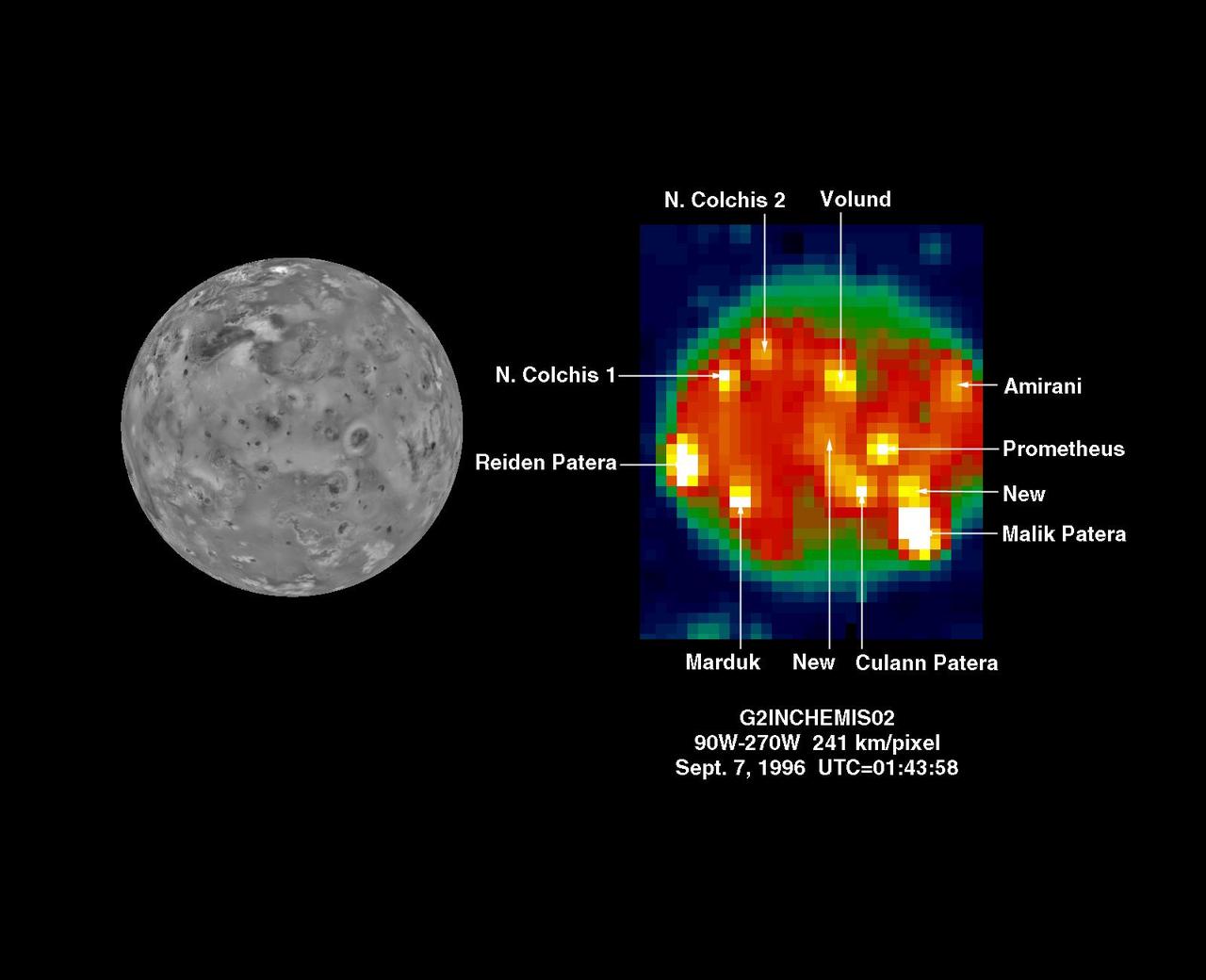
This is an image of Io, taken by NASA Galileo spacecraft during the G2 encounter in September 1996. This is a dayside image of Io on the right against the clouds of Jupiter the blue background.

Repeated flybys of Io by NASA Galileo spacecraft have allowed scientists to develop an understanding of Io Tohil-Culann region of interconnected volcanoes and mountains.
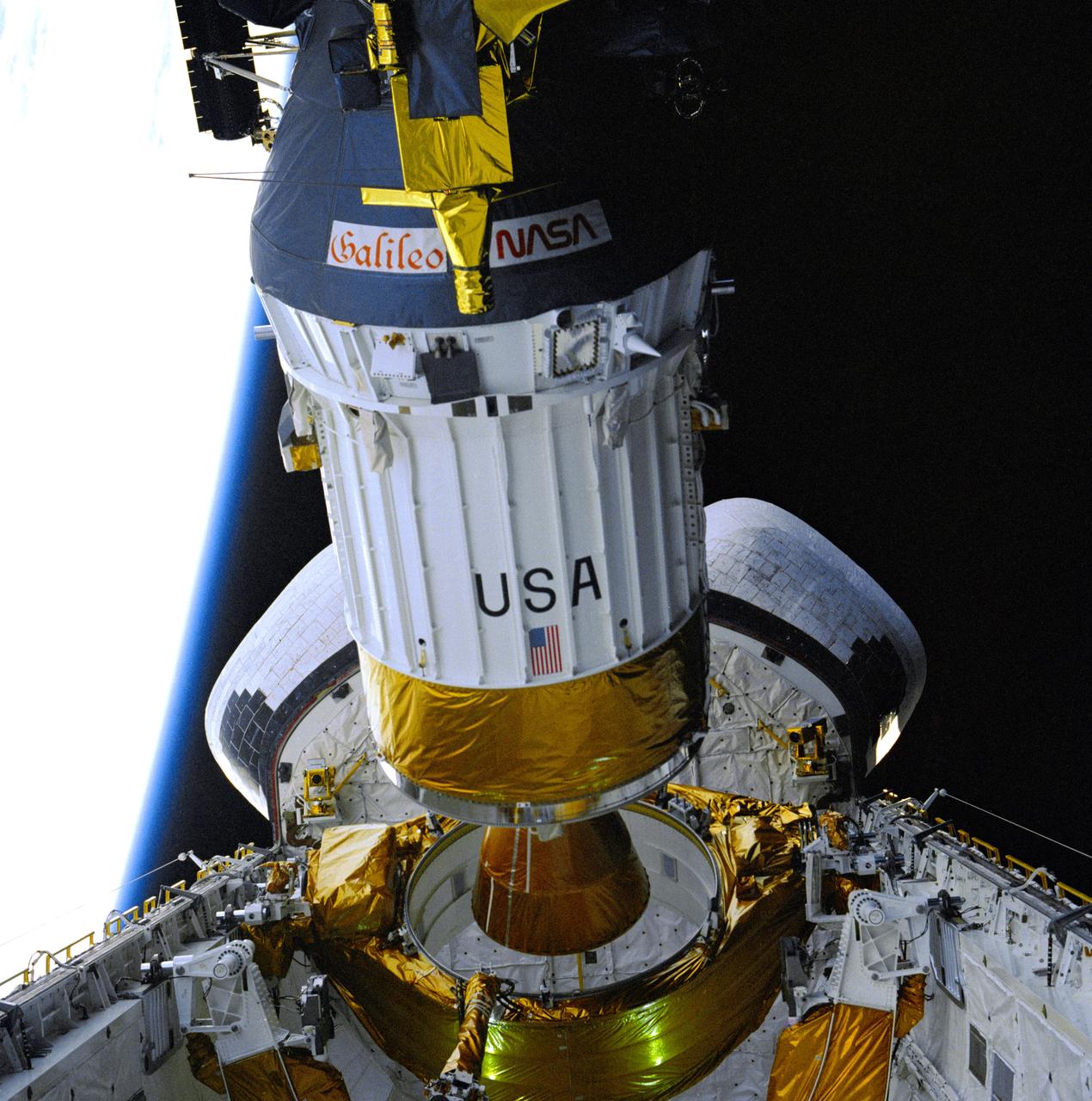
STS034-71-000AK (18 Oct 1989) --- Backdropped against the blackness of space, the Galileo spacecraft and its inertial upper stage (IUS) have just detached from a cradle-like device aboard the Earth-orbiting Space Shuttle Atlantis to begin a six-year journey to Jupiter. The five-member STS-34 crew deployed the satellite within six hours of achieving Earth orbit on Oct. 18, 1989. The scene was exposed with a 70mm handheld Hasselblad camera. Earth's horizon and a thin line representing its airglow and atmosphere are visible on the left side of the frame.

This global view of Europa shows the location of a four-frame mosaic of images taken by NASA Galileo spacecraft in 1996, set into low-resolution data obtained by NASA Voyager spacecraft in 1979.
This is a frame from an animation of a rotating globe of Jupiter moon Ganymede, with a geologic map superimposed over a global color mosaic, incorporating the best available imagery from NASA Voyager 1 and 2 spacecraft, and Galileo spacecraft.
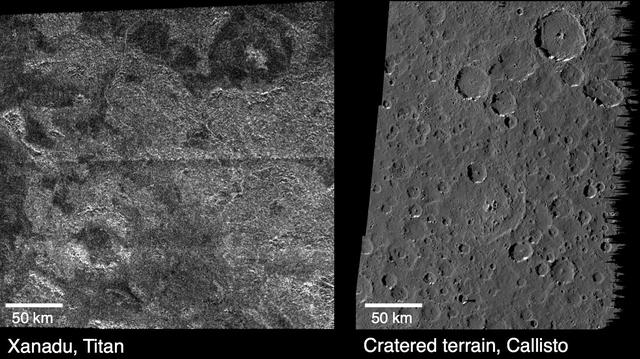
These images compare surface features observed by NASA Cassini spacecraft at the Xanadu region on Saturn moon Titan left, and features observed by NASA Galileo spacecraft on Jupiter cratered moon Callisto right.
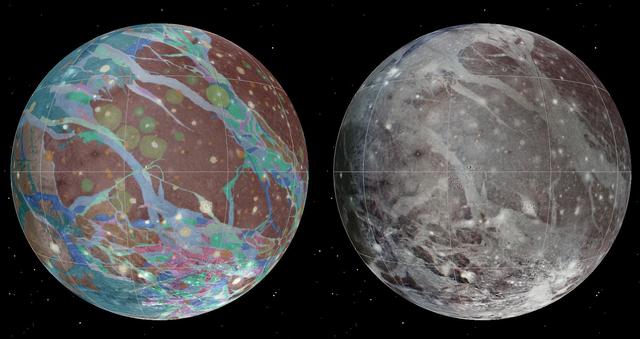
To present the best information in a single view of Jupiter moon Ganymede, a global image mosaic was assembled, incorporating the best available imagery from NASA Voyager 1 and 2 spacecraft and NASA Galileo spacecraft.

During its flight, NASA’s Galileo spacecraft returned images of the Earth and Moon. Separate images of the Earth and Moon were combined to generate this view. http://photojournal.jpl.nasa.gov/catalog/PIA00342
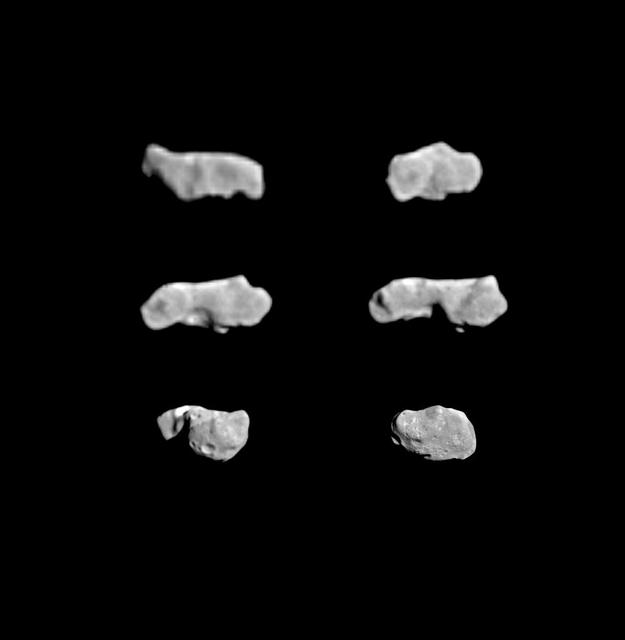
This composite image shows the asteroid 243 Ida as seen from NASA's Galileo spacecraft during its approach on August 28, 1993. http://photojournal.jpl.nasa.gov/catalog/PIA00137
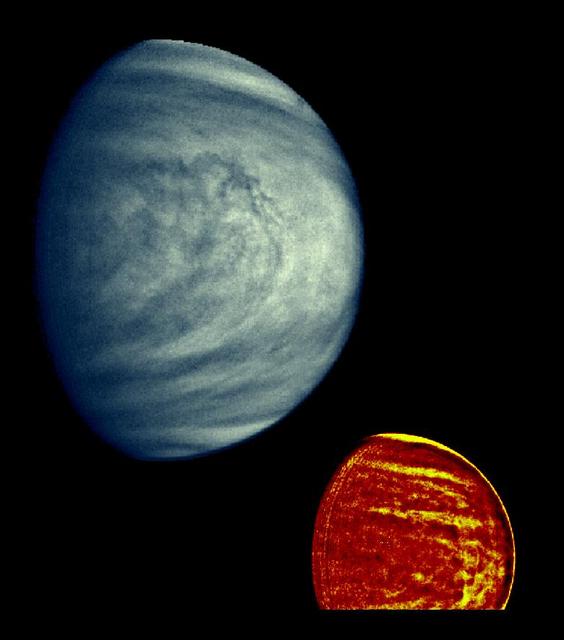
These two images of Venus from NASA Galileo spacecraft show the global structure of cloud patterns at two different depths in the upper cloud layers. http://photojournal.jpl.nasa.gov/catalog/PIA00073
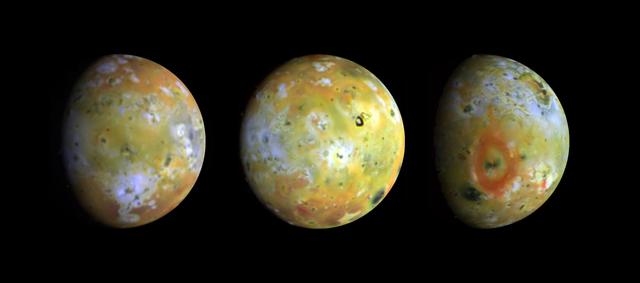
Three full-disk color views of Jupiter volcanic moon Io as seen by NASA Galileo spacecraft are shown in enhanced color to highlight details of the surface. http://photojournal.jpl.nasa.gov/catalog/PIA00292

This view of the north polar region of the Moon was obtained by NASA's Galileo camera during the spacecraft flyby of the Earth-Moon system on December 7 and 8, 1992. http://photojournal.jpl.nasa.gov/catalog/PIA00126

This picture of Venus was taken by the NASA Galileo spacecraft Solid State Imaging System on February 14, 1990, at a range of almost 1.7 million miles from the planet. http://photojournal.jpl.nasa.gov/catalog/PIA00072

Two sets of laser pulses transmitted from Earth to a spacecraft over a distance of 1.4 million kilometers 870,000 miles in a communications experiment are shown in this long-exposure image made by NASA’s Galileo spacecraft imaging system. http://photojournal.jpl.nasa.gov/catalog/PIA00230
NASA Galileo spacecraft, now in orbit around Jupiter, returned this optical navigation image June 3, 1996, showing that the spacecraft is accurately targeted for its first flyby of the giant moon Ganymede on June 27. http://photojournal.jpl.nasa.gov/catalog/PIA00273

This color image of the Earth was obtained by NASA Galileo spacecraft in Dec. 1990, when the spacecraft was about 1.5 million miles from the Earth. Africa stretches from the center to the top of the picture with the Arabian Peninsula off to its right. http://photojournal.jpl.nasa.gov/catalog/PIA00076
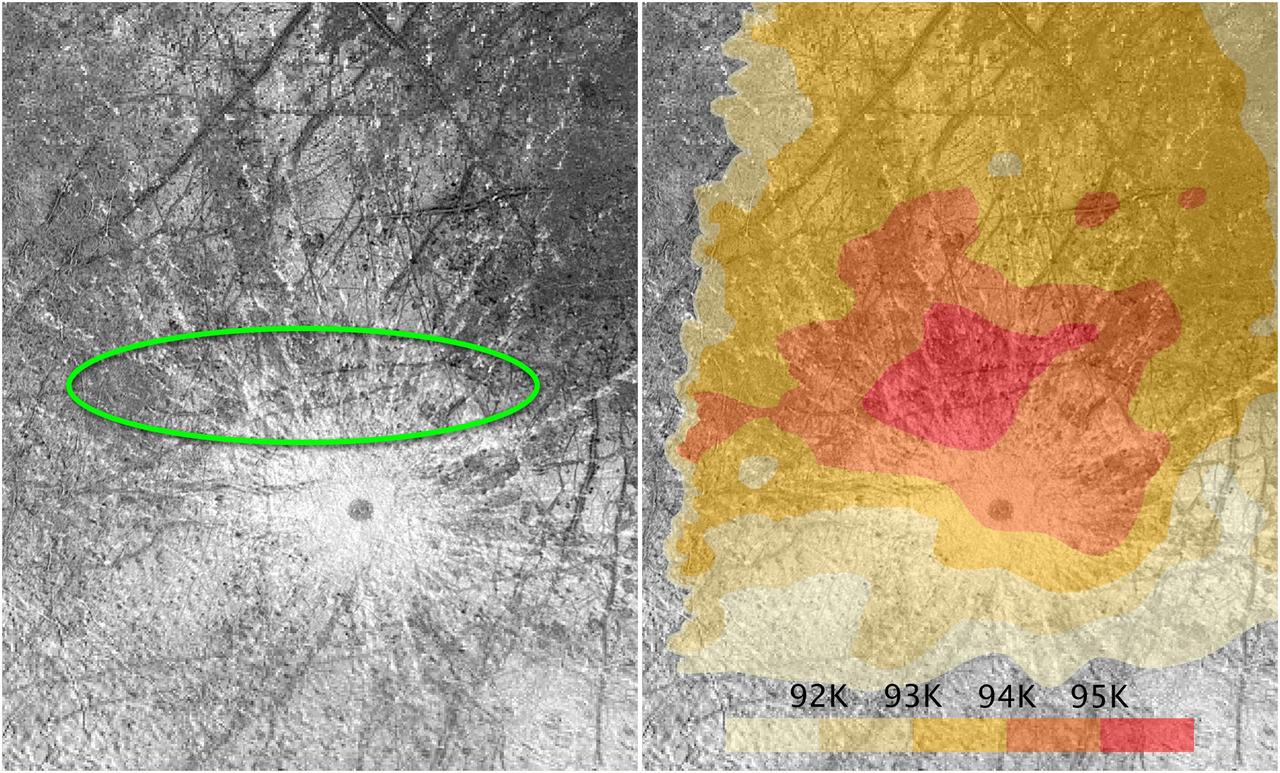
These images of the surface of the Jovian moon Europa, taken by NASA's Galileo spacecraft, focus on a "region of interest" on the icy moon. The image at left traces the location of the erupting plumes of material, observed by NASA's Hubble Space Telescope in 2014 and again in 2016. The plumes are located inside the area surrounded by the green oval. The green oval also corresponds to a warm region on Europa's surface, as identified by the temperature map at right. The map is based on observations by the Galileo spacecraft. The warmest area is colored bright red. Researchers speculate these data offer circumstantial evidence for unusual activity that may be related to a subsurface ocean on Europa. The dark circle just below center in both images is a crater and is not thought to be related to the warm spot or the plume activity. https://photojournal.jpl.nasa.gov/catalog/PIA21444

The Culann Patera volcano on Jupiter moon Io was observed by the near-infrared mapping spectrometer instrument onboard NASA Galileo spacecraft during its Io flyby on Nov. 25, 1999.
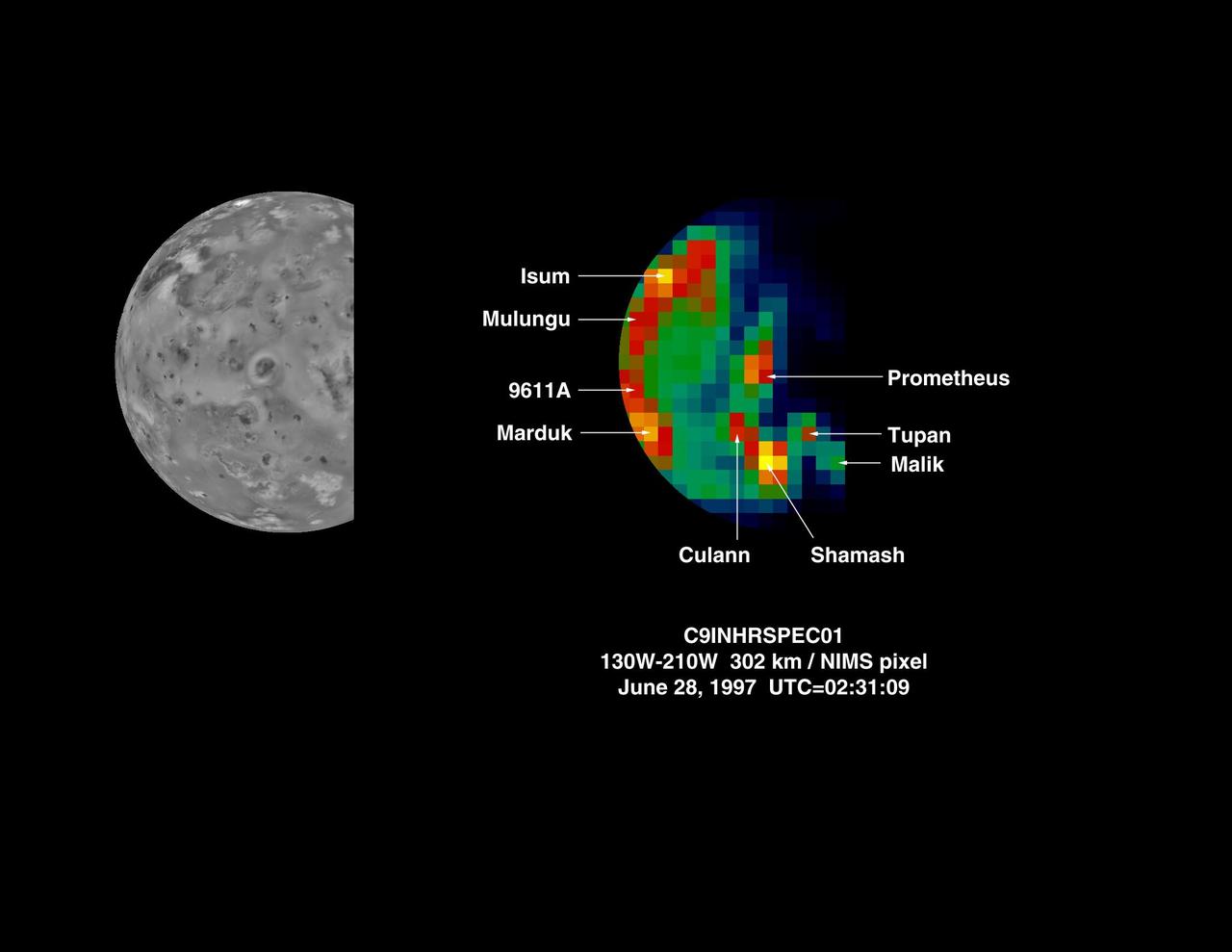
NASA Galileo spacecraft observed Io on nearly every orbit as part of a program monitoring the level of volcanic activity on this moon. Io is the most volcanically active body in the Solar System.
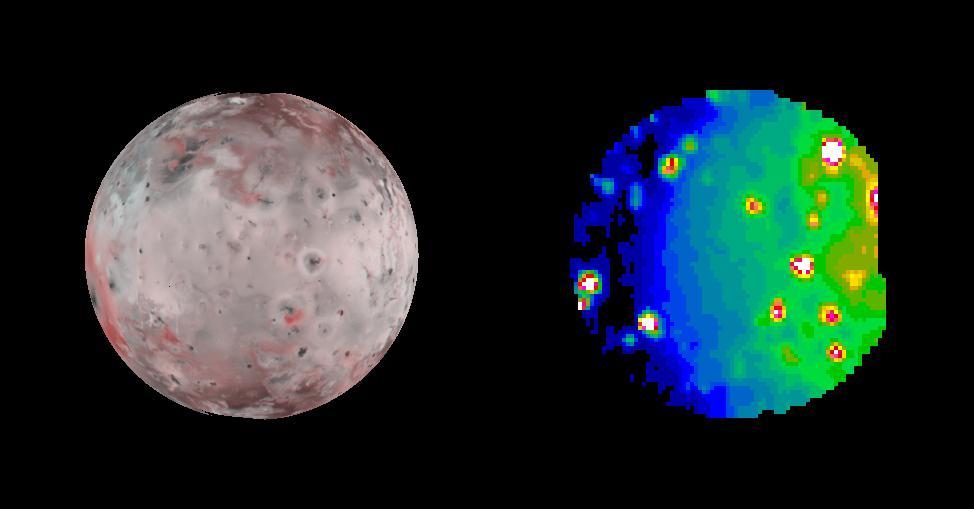
Hot eruption sites scattered across Jupiter moon Io stand out dramatically in an infrared image taken Oct. 13, 2001, by NASA Galileo spacecraft as it sped past this most volcanically active of all known worlds.
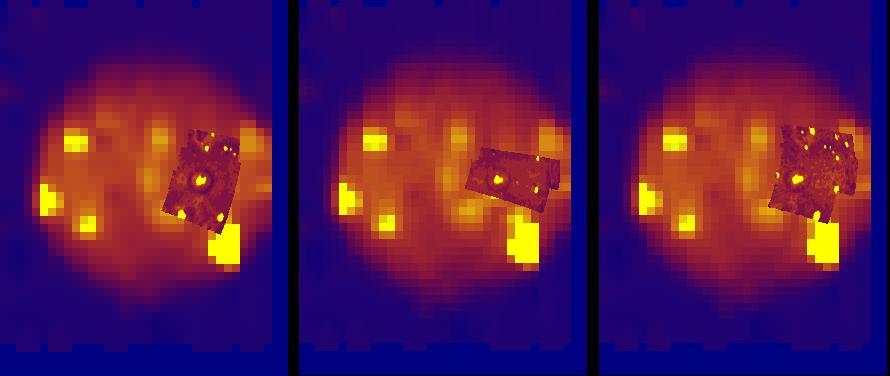
Changes in the volcanoes on Jupiter moon Io can be seen in these three views, taken by NASA Galileo spacecraft during its three flybys of Io in October 1999, November 1999 and February 2000.
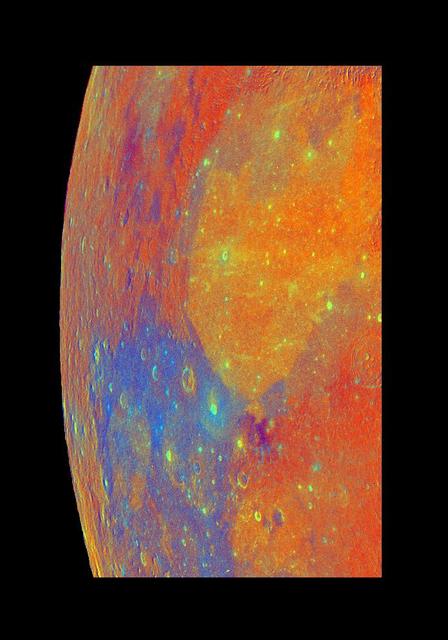
This false-color mosaic of part of the Moon was constructed from 54 images taken by the imaging system aboard NASA's Galileo as the spacecraft flew past the Moon on December 7, 1992. http://photojournal.jpl.nasa.gov/catalog/PIA00129
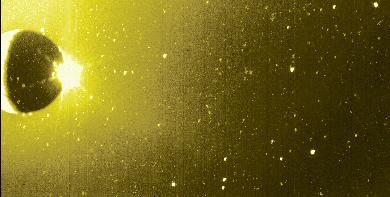
This image of Jupiter moon Io and its surrounding sky is shown in false color. This image was taken on Nov. 9, 1996 through the green-yellow filter of the solid state imaging CCD system aboard NASA Galileo spacecraft.
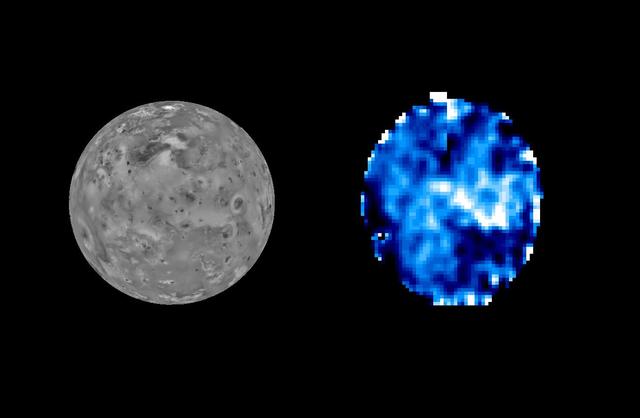
Sulfur dioxide, normally a gas at room temperatures, is known to exist on Io surface as a frost, condensing there from the hot gases emanating from the Io volcanoes. This image was taken in 1996 by NASA Galileo spacecraft.
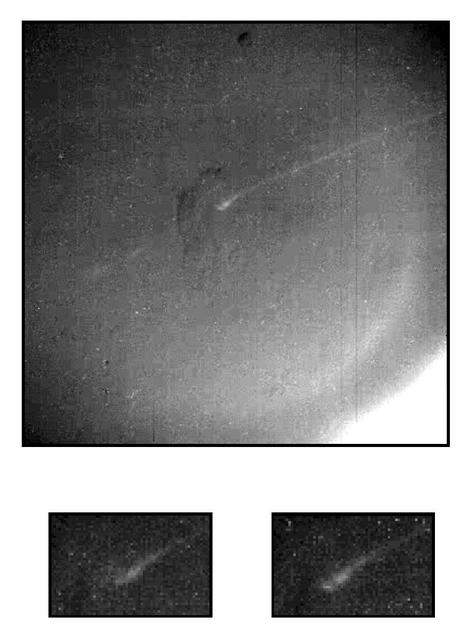
This image, taken by NASA Galileo spacecraft, shows the darkside of Jupiter, the part not illuminated by sunlight. The curved line crossing from the lower left to the upper right is the auroral arc on the horizon.
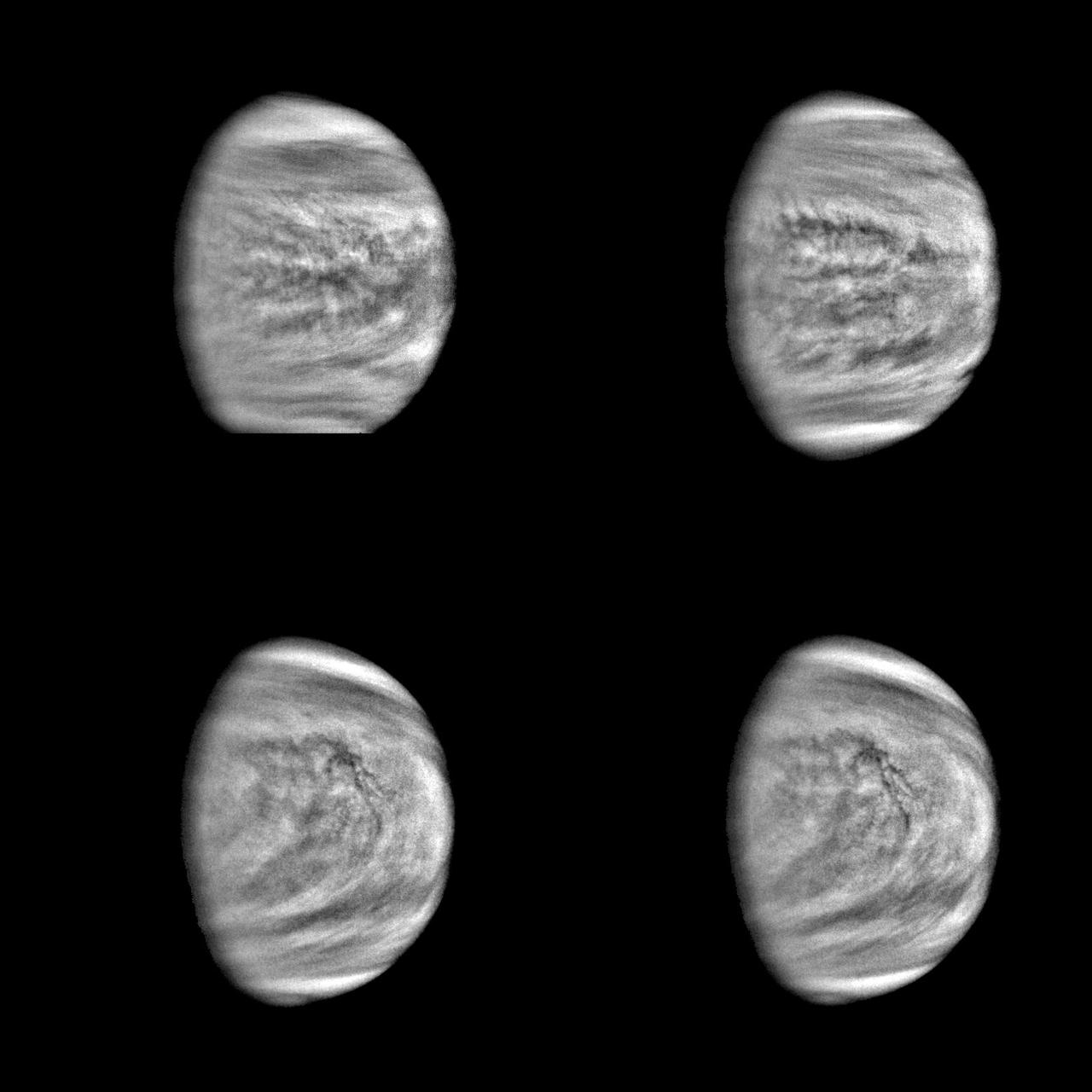
These are enhanced versions of four views of the planet Venus taken by NASA's Galileo Solid State Imaging System at distances ranging from 1.4 to 2 million miles as the spacecraft receded from Venus. http://photojournal.jpl.nasa.gov/catalog/PIA00110
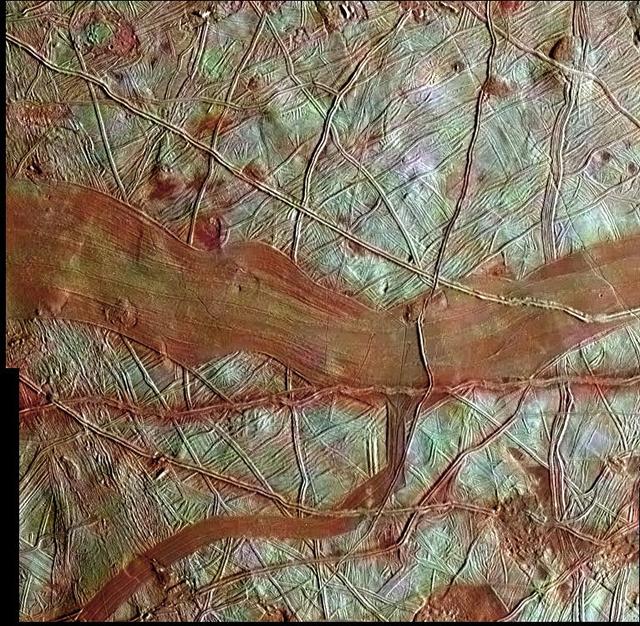
This colorized image of Europa is a product of clear-filter grayscale data from one orbit of NASA Galileo spacecraft, combined with lower-resolution color data taken on a different orbit.
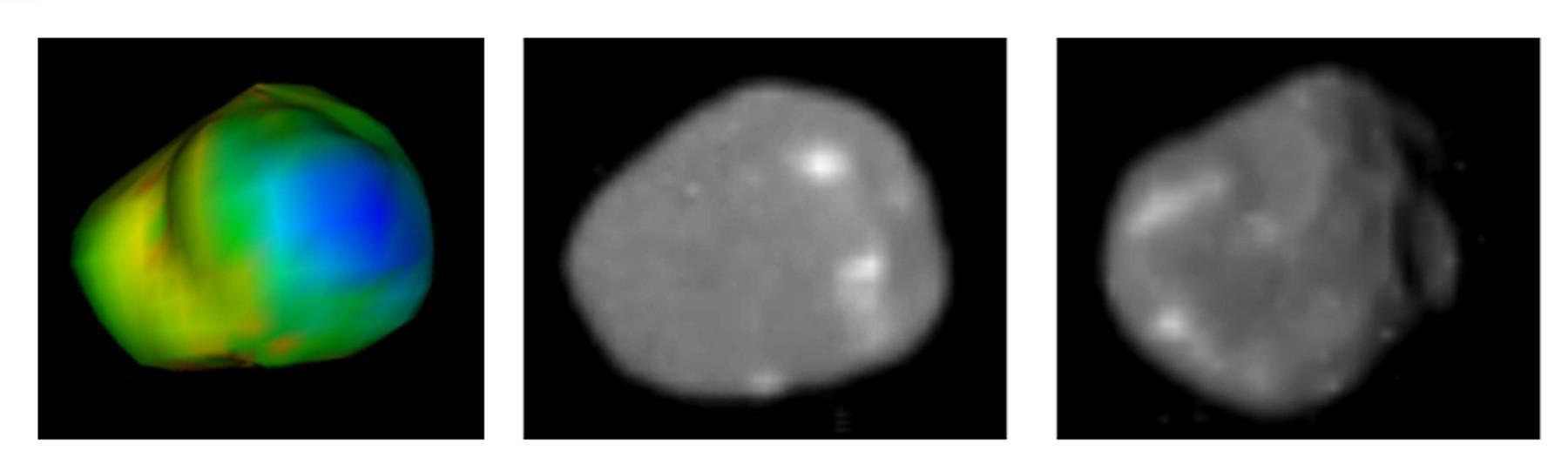
These images of Jupiter moon Amalthea were taken with NASA Galileo and Voyager spacecraft. Amalthea is almost pure water ice, hinting that it may not have formed where it now orbits.
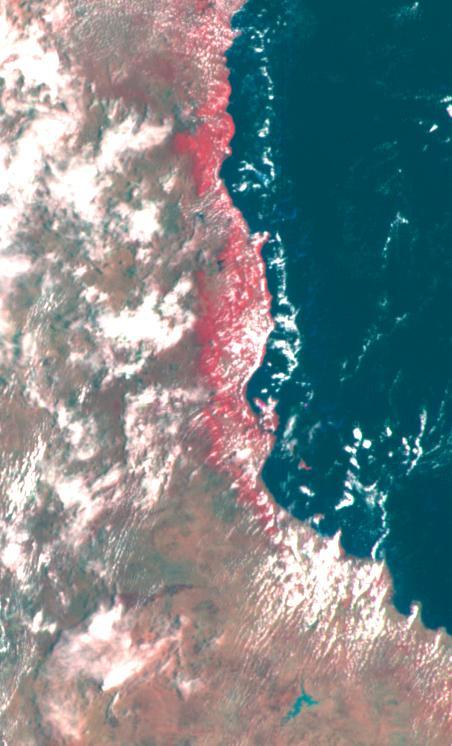
This false color image of the Eastern Coast of Australia was obtained by NASA’s Galileo spacecraft at about 3:00 p.m. PST, Dec. 8, 1990, at a range of more than 35,000 miles. http://photojournal.jpl.nasa.gov/catalog/PIA00121
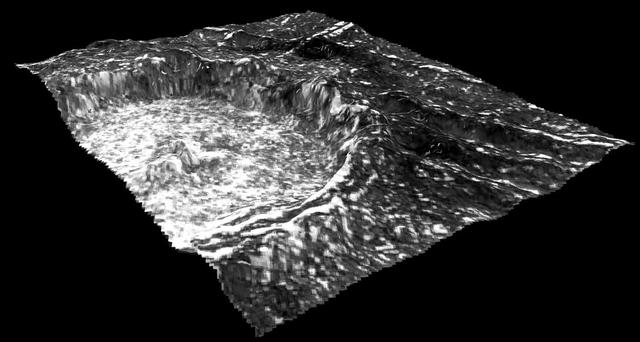
This view of Cilix impact crater on Europa was created in 2013 using 3-D stereo images taken by NASA Galileo spacecraft, combined with advanced image processing techniques.

This false-color image reveals the scar of a past major impact of a comet or small asteroid on Europa surface. A city-sized impact crater was viewed by NASA Galileo spacecraft.
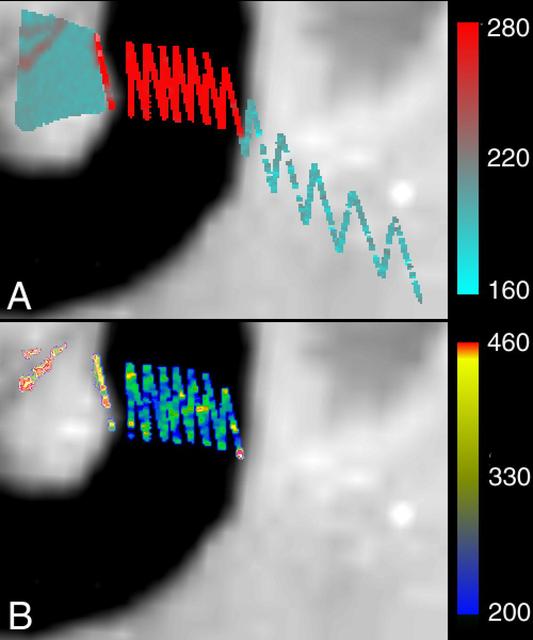
This image of Loki Patera on Jupiter volcanic moon Io shows data taken by the near-infrared mapping spectrometer onboard NASA Galileo spacecraft during its Io flyby on Oct. 10, 1999.
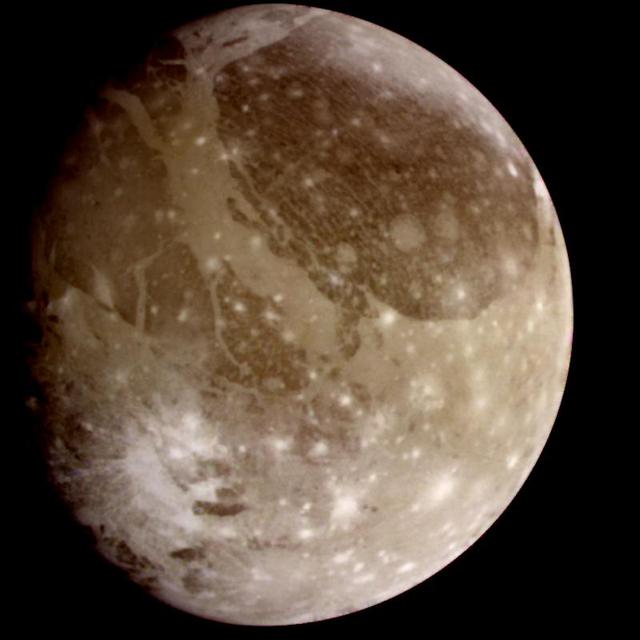
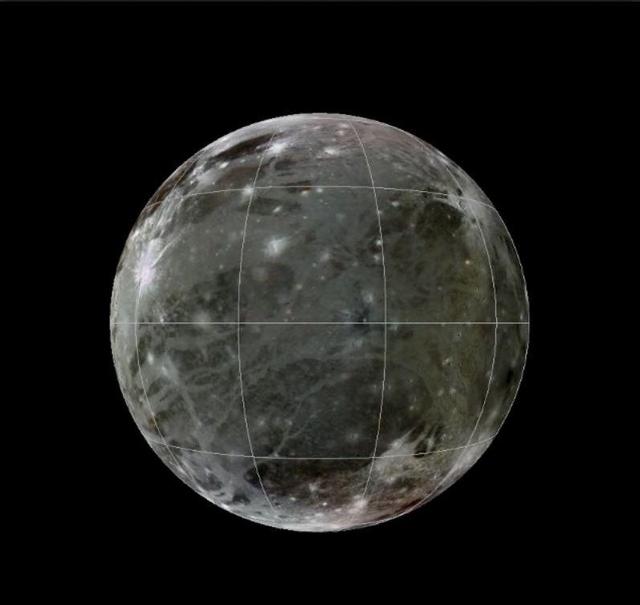
Natural color view of Ganymede from NASA Galileo spacecraft during its first encounter with the satellite. The dark areas are the older, more heavily cratered regions and the light areas are younger, tectonically deformed regions.
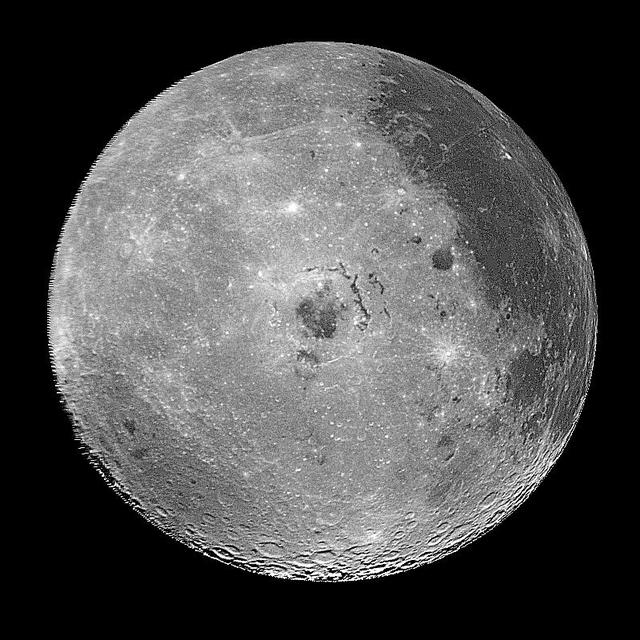
This image of the western hemisphere of the Moon was taken through a green filter by NASA's Galileo spacecraft at 9:35 a.m. PST Dec. 9 at a range of about 350,000 miles. In the center is the Orientale Basin. http://photojournal.jpl.nasa.gov/catalog/PIA00120
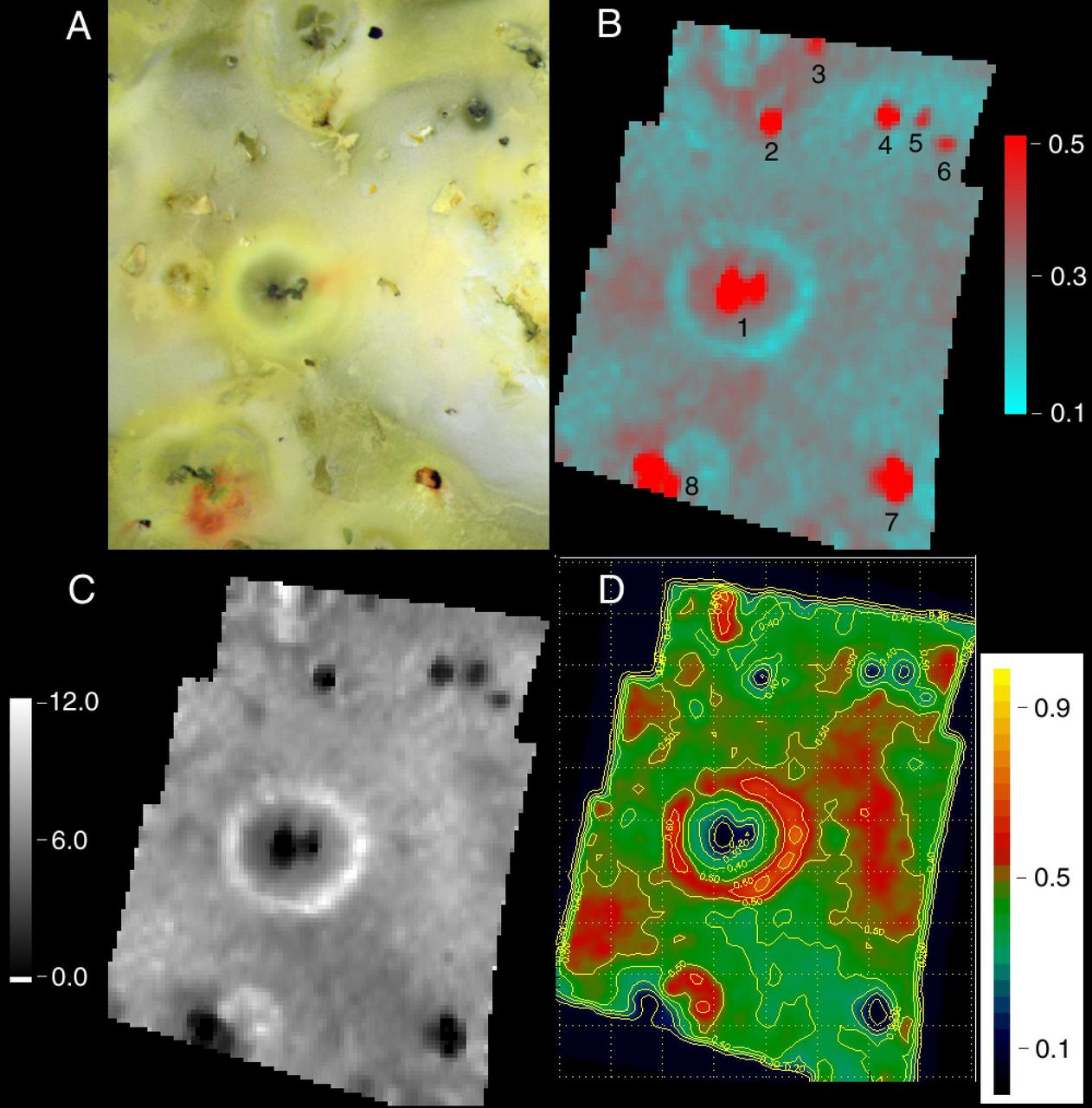
The Prometheus region of Jupiter moon Io was imaged by NASA Galileo spacecraft in 1999. The maps made from spectrometer data show the interplay between hot silicates on the surface and sulfur dioxide frost.
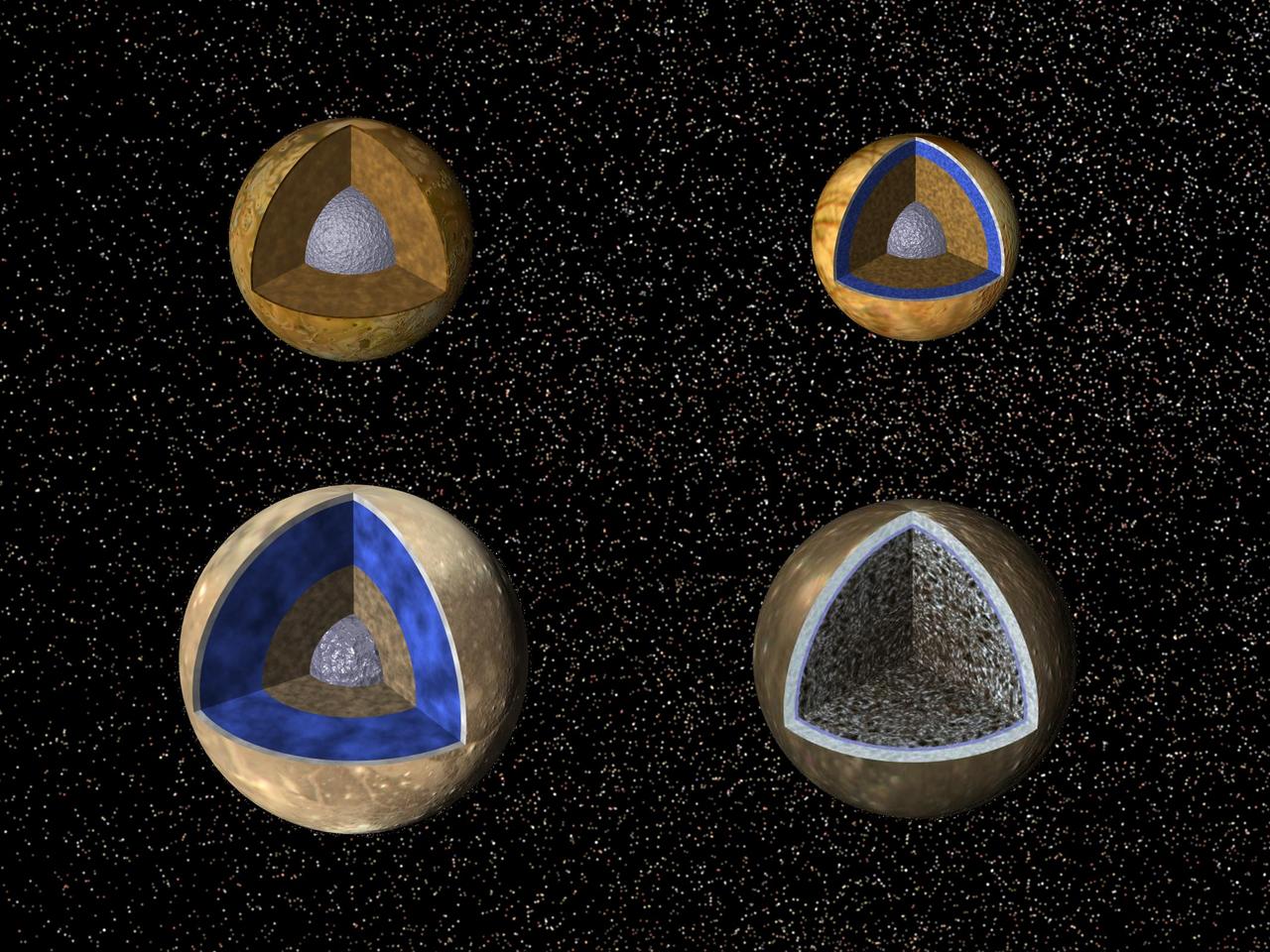
Cutaway views of the possible internal structures of the Galilean satellites. Ganymede at lower left, Callisto at lower right, Io on upper left, and Europa on upper right in a combined biew from NASA Galileo and Voyager spacecraft.
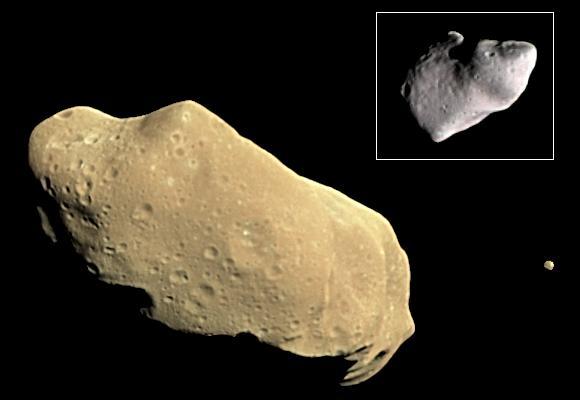
During its examination of the asteroid Ida, NASA Galileo spacecraft returned images of a second object, Dactyl--the first confirmed satellite or moon of an asteroid; the much smaller moon is visible to the right of Ida. http://photojournal.jpl.nasa.gov/catalog/PIA00333
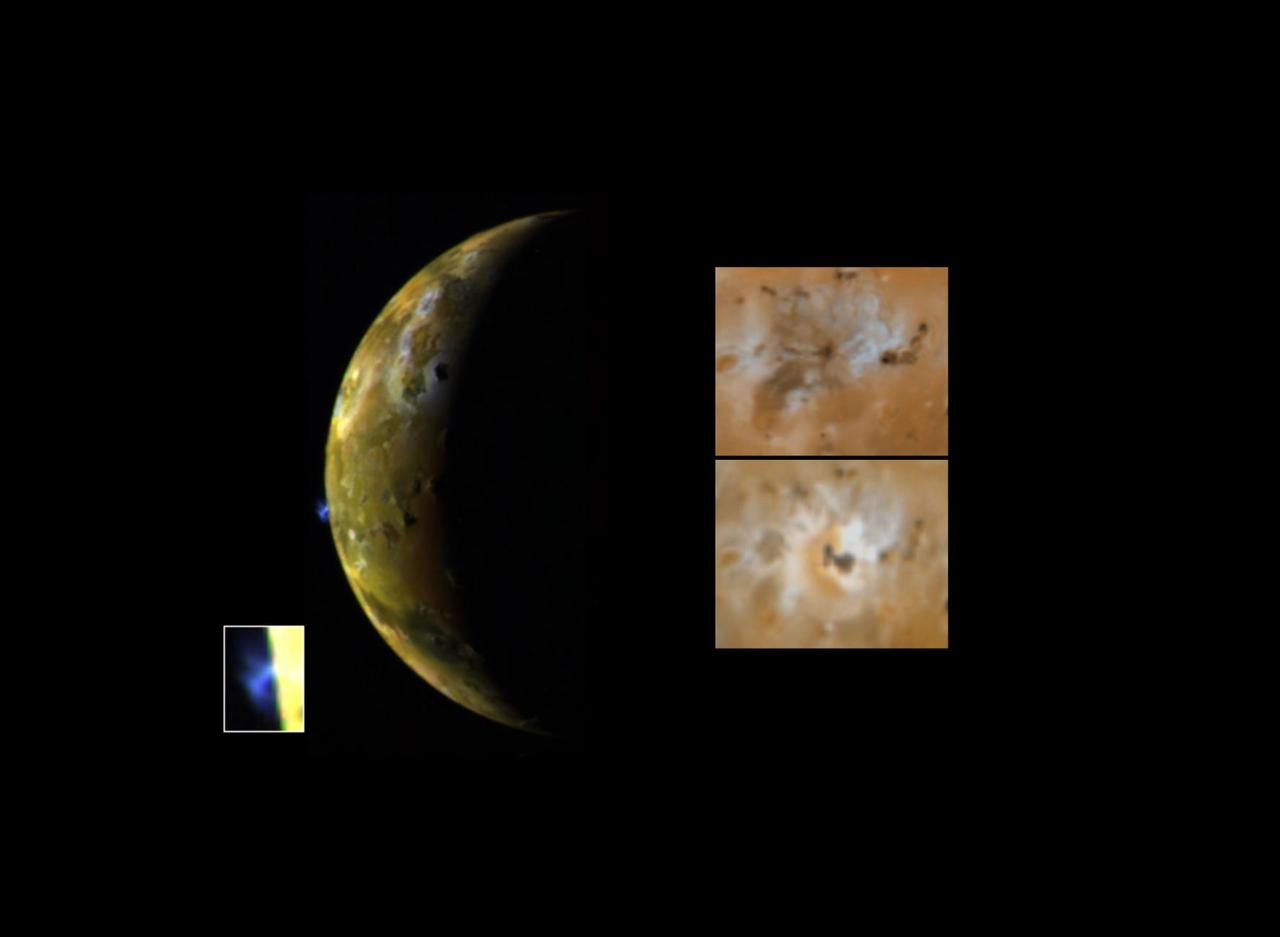
This image, taken by NASA Galileo spacecraft, shows a blue-colored volcanic plume consistent with the presence of sulfur dioxide gas and now condensing from the gas as the plume expands and cools. http://photojournal.jpl.nasa.gov/catalog/PIA00293
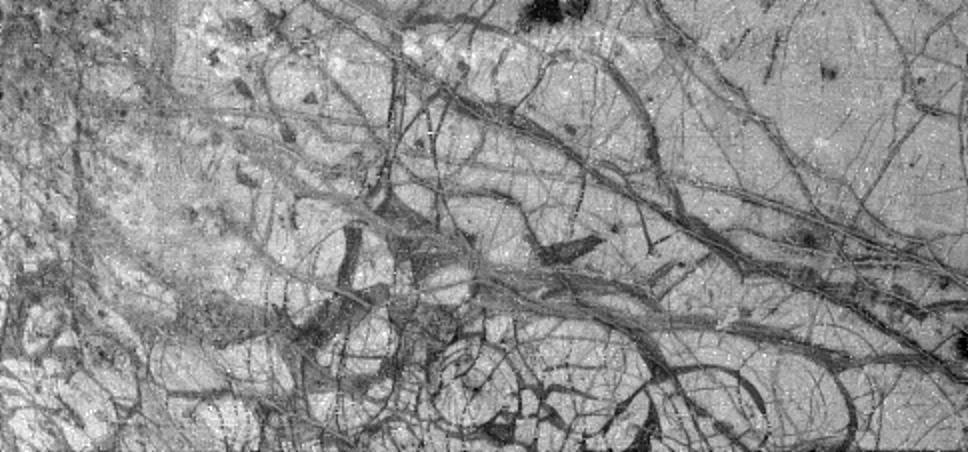
Jupiter moon Europa, as seen in this image taken June 27, 1996 by NASA Galileo spacecraft, displays features in some areas resembling ice floes seen in Earth polar seas. http://photojournal.jpl.nasa.gov/catalog/PIA00291
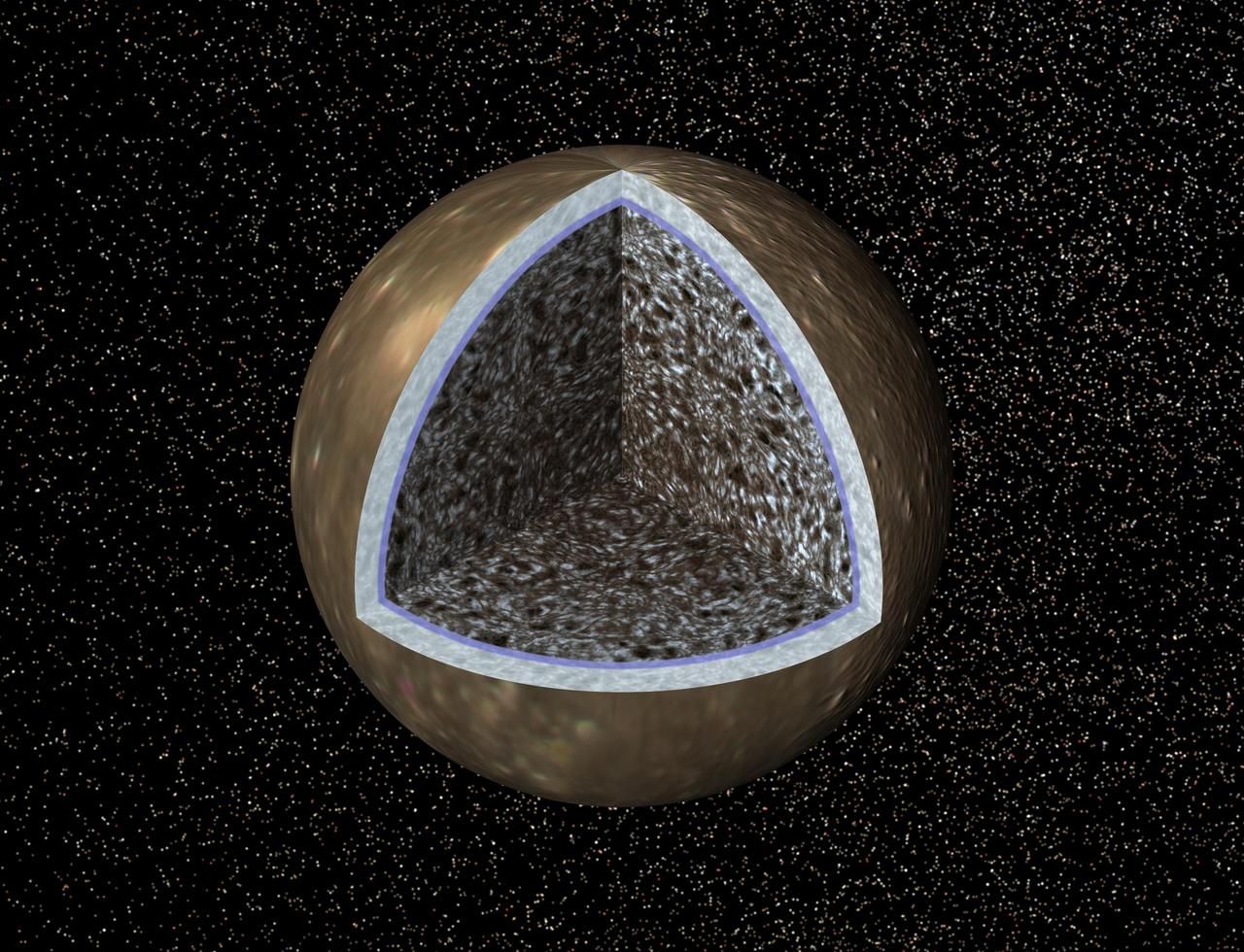
This artist concept, a cutaway view of Jupiter moon Callisto, is based on recent data from NASA Galileo spacecraft which indicates a salty ocean may lie beneath Callisto icy crust.
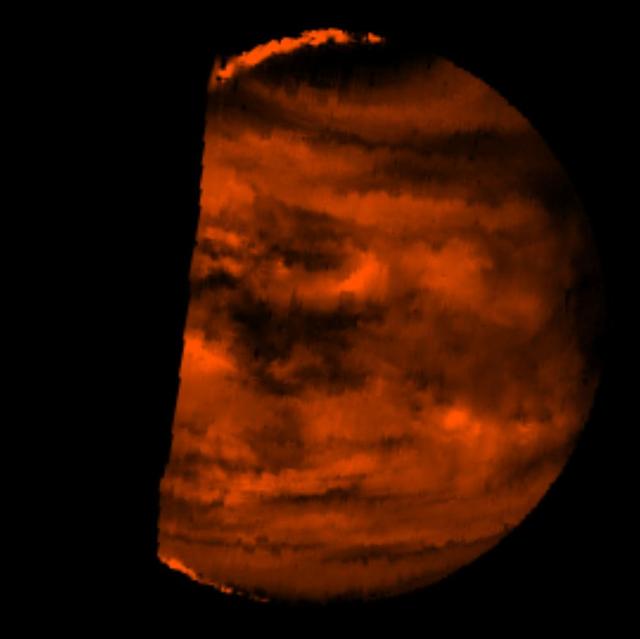
This false-color image is a near-infrared map of lower-level clouds on the night side of Venus, obtained by NASA Galileo spacecraft as it approached the planet night side on Feb. 10, 1990. http://photojournal.jpl.nasa.gov/catalog/PIA00124
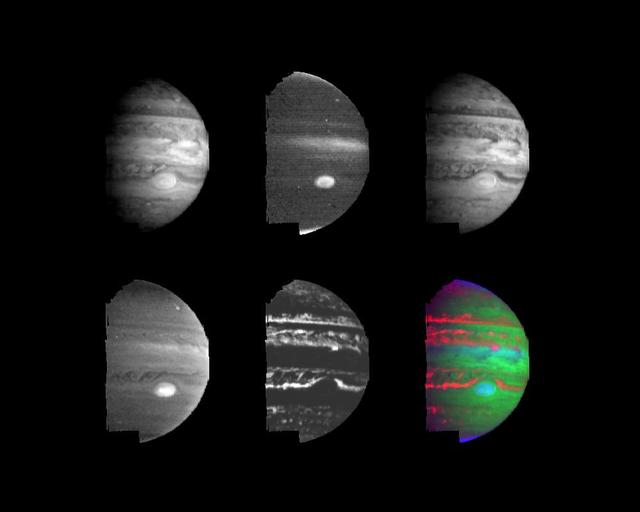
Clouds and hazes at various altitudes within the dynamic Jovian atmosphere are revealed by multi-color imaging taken during the second orbit G2 on September 5, 1996 by Galileo spacecraft.
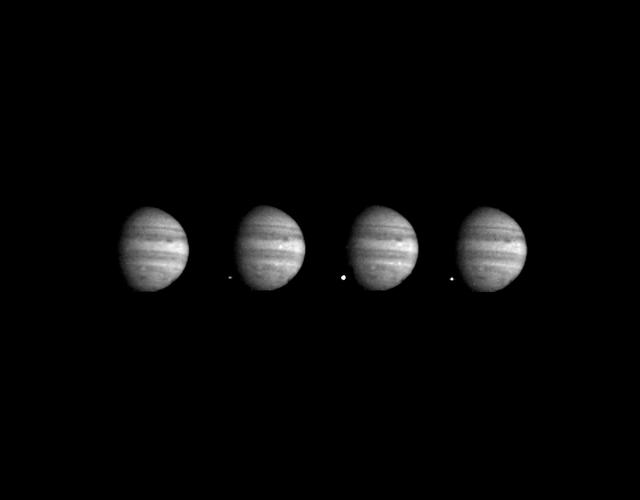
These four images of Jupiter and the luminous night-side impact of fragment W of Comet Shoemaker-Levy 9 were taken NASA's Galileo spacecraft on July 22, 1994. http://photojournal.jpl.nasa.gov/catalog/PIA00139
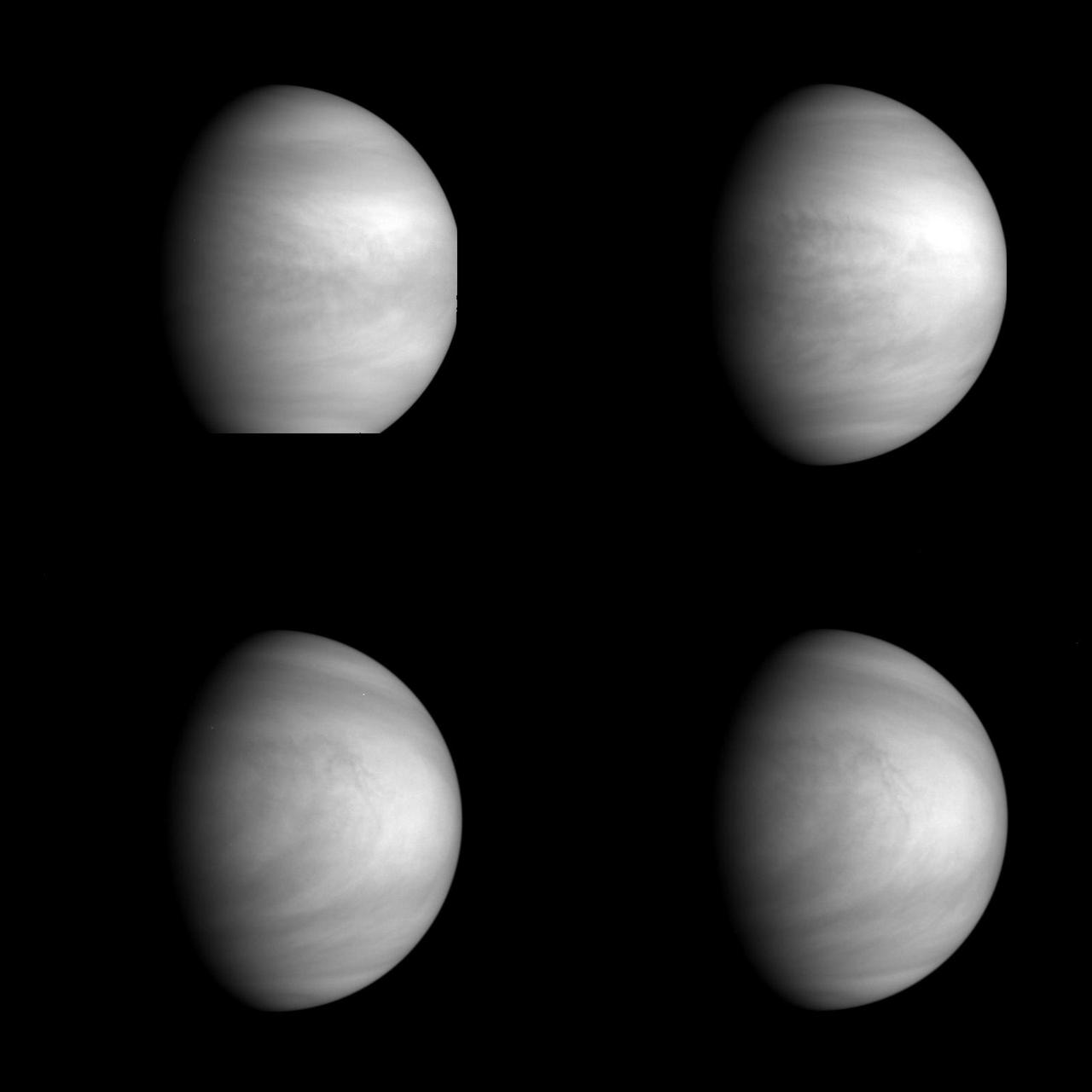
This series of pictures shows four views of the planet Venus obtained by NASA Galileo Solid State Imaging System at ranges of 1.4 to 2 million miles as the spacecraft receded from Venus. http://photojournal.jpl.nasa.gov/catalog/PIA00223
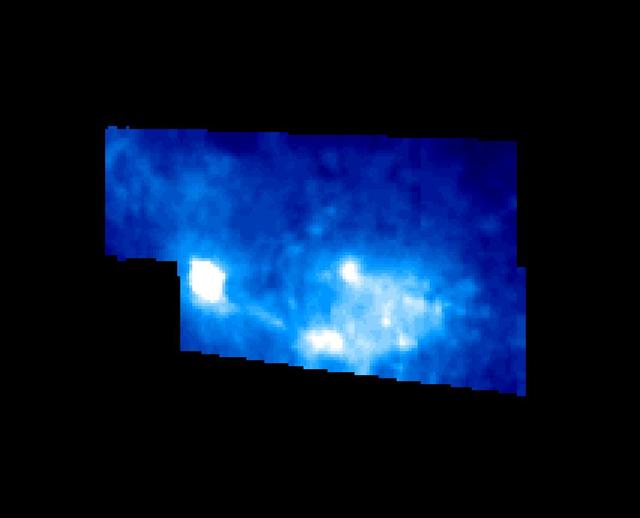
This view of Callisto Asgard multi-ring structure was taken by NASA Galileo spacecraft. The large bright/white area is the palimpsest or center of Asgard. The smaller bright area is the crater Tornasuk.