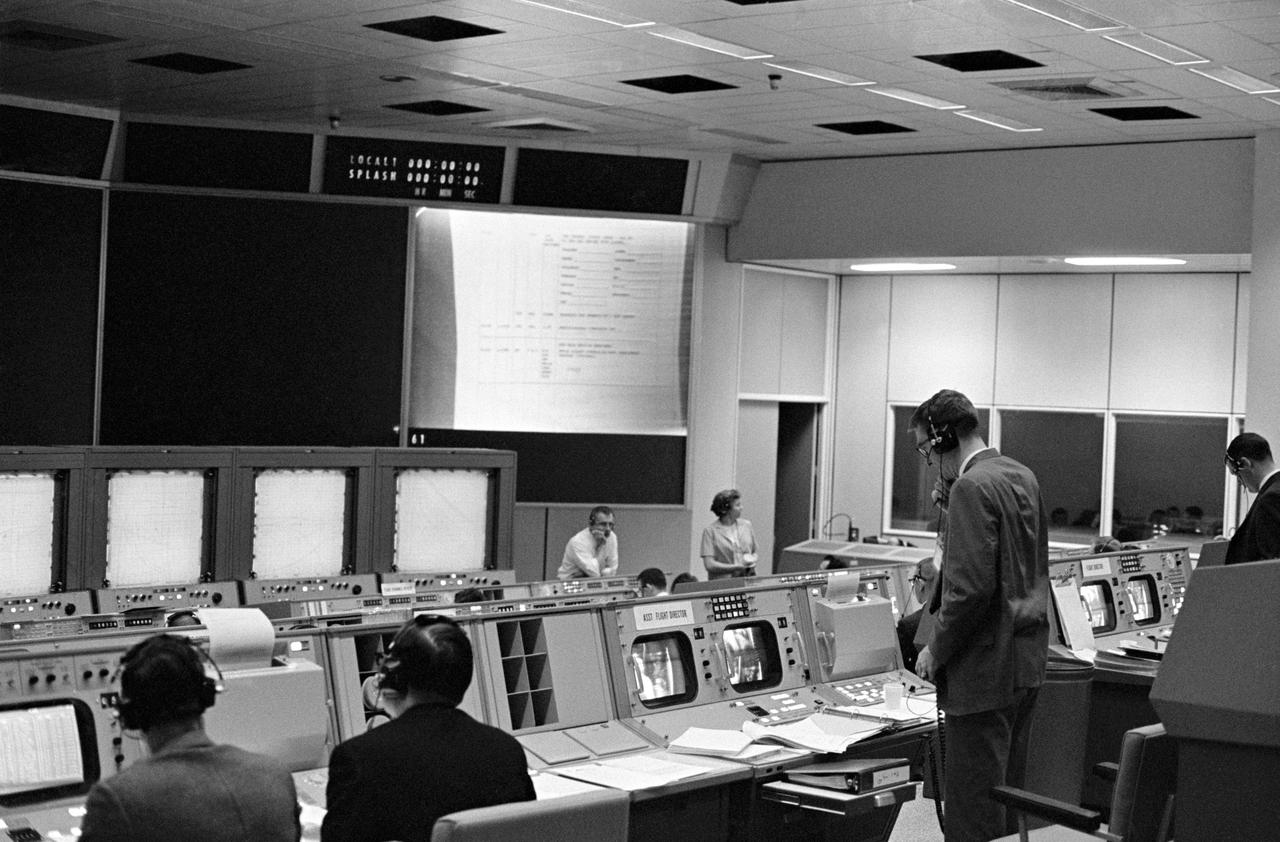
S65-18200 (23 March 1965) --- Overall view of the Mission Control Center at the Manned Spacecraft Center in Houston, Texas during the Gemini-Titan 3 flight.
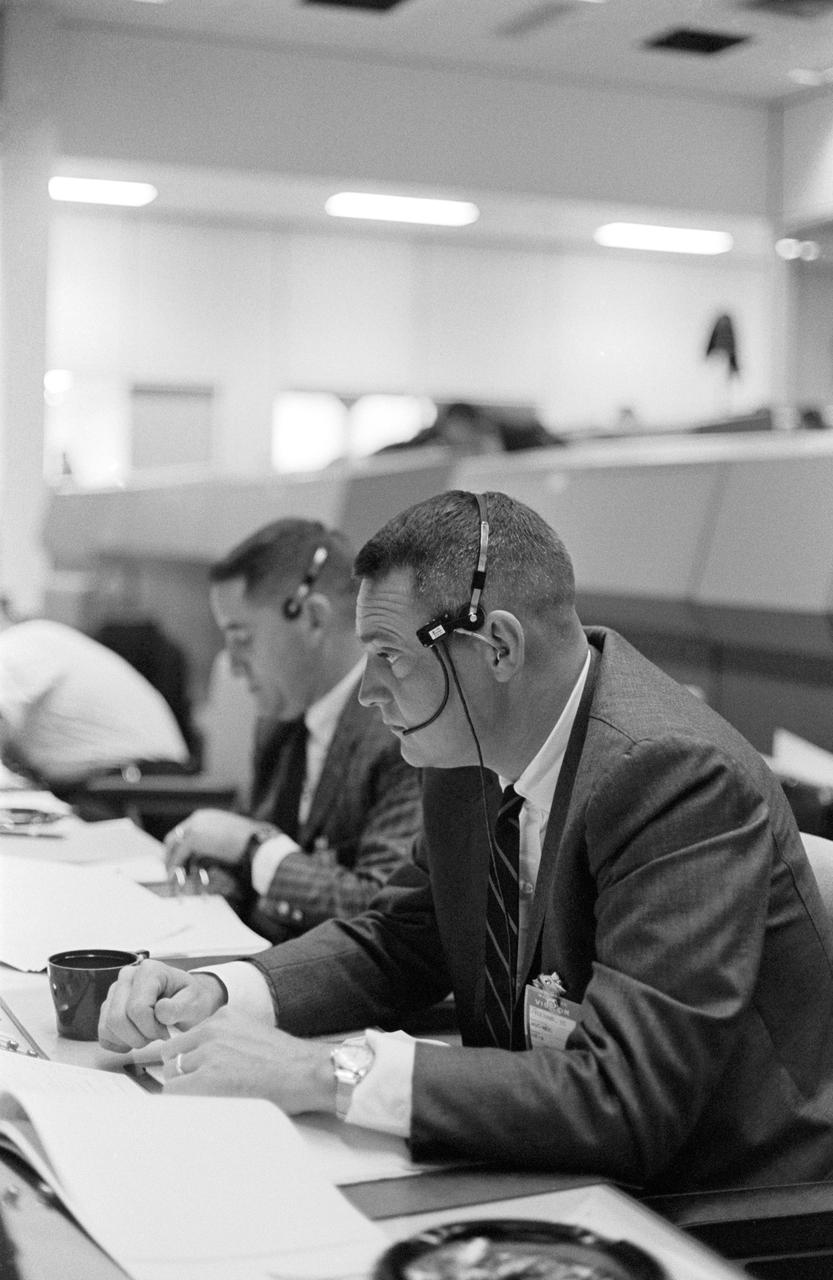
S65-18063 (23 March 1965) --- Astronaut Clifton C. Williams is shown at console in the Mission Control Center (MCC) in Houston, Texas during the Gemini-Titan 3 flight. The GT-3 flight was monitored by the MCC in Houston, but was controlled by the MCC at Cape Kennedy.
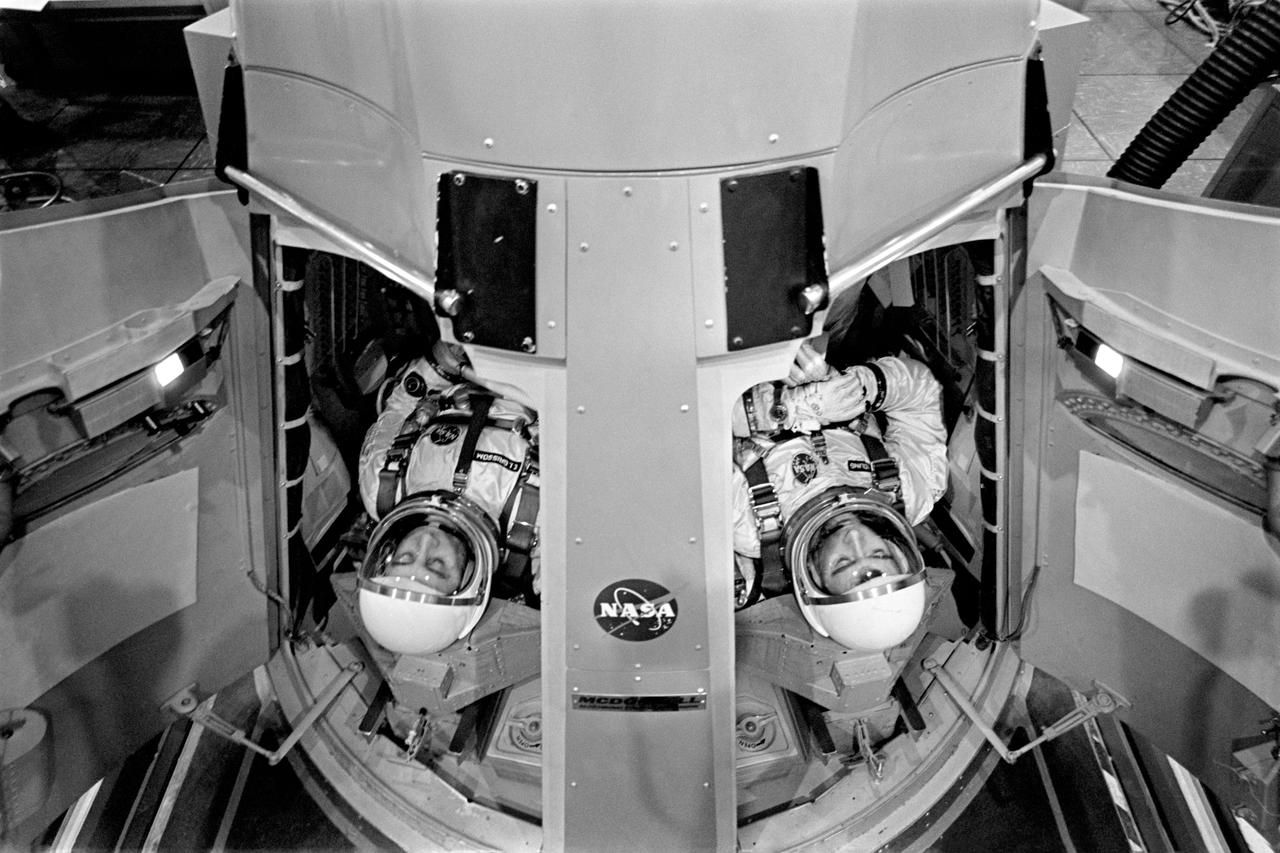
S65-21864 (19 March 1965) --- Astronauts Virgil I. Grissom (left), command pilot; and John W. Young, pilot, prepare to run Gemini-Titan 3 simulations in the Gemini mission simulator at Cape Kennedy, Florida. The NASA GT-3 flight was scheduled for March 23, 1965.

S65-18733 (23 March 1965) --- Astronauts Virgil I. Grissom (left) and John W. Young are shown aboard a helicopter after being retrieved from their spacecraft following the Gemini-Titan 3 flight.
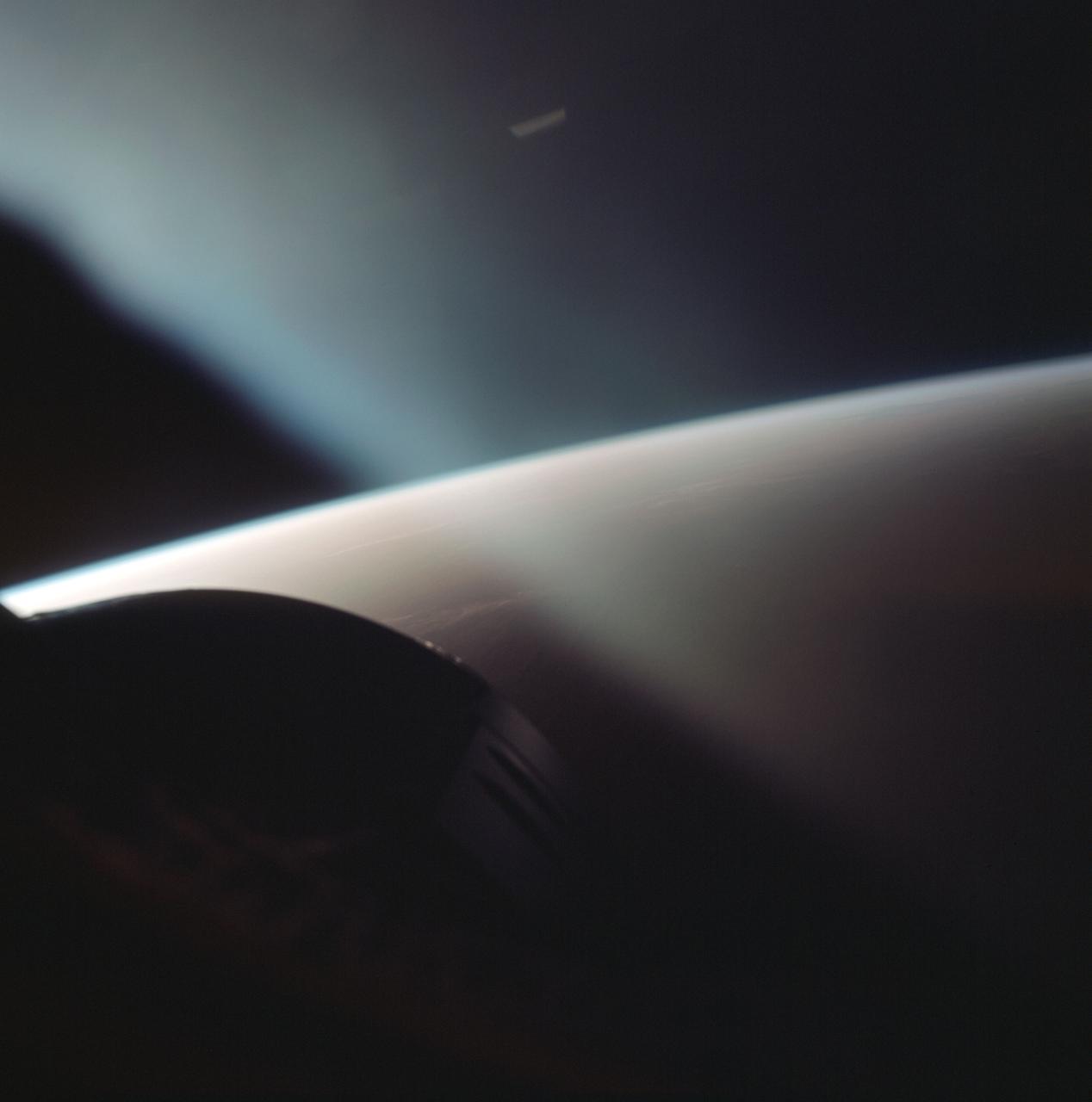
S65-18759 (23 March 1965) --- Astronaut John W. Young took this picture of clouds over the Indian Ocean during the Gemini-Titan 3 three-orbit mission on March 23, 1965. Young used a hand-held modified 70mm Hasselblad camera with color film. The lens setting was 250th of a second at f/11.
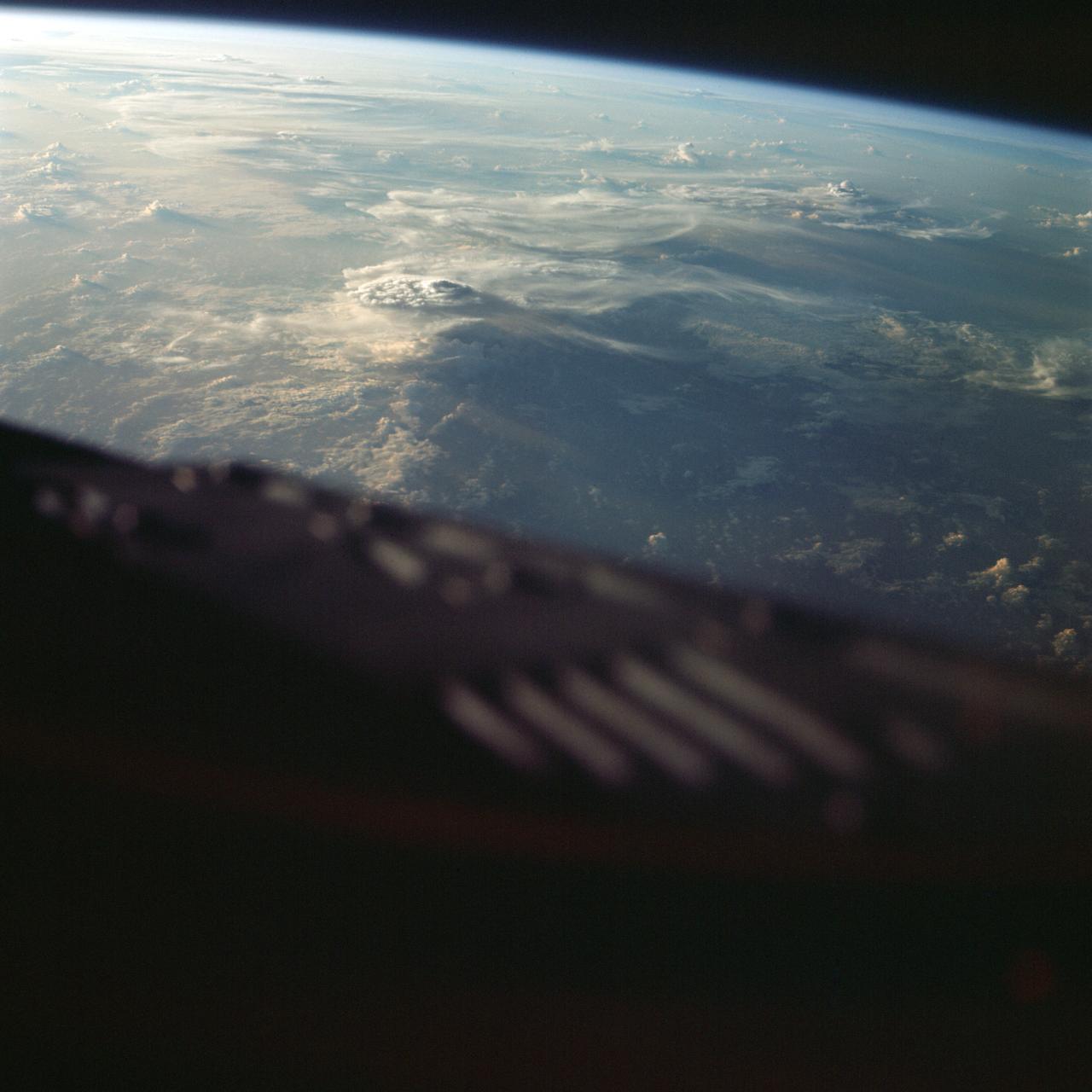
S65-18752 (23 March 1965) --- View of a cloudy part of Earth as seen from the Gemini-3 spacecraft while in orbit.
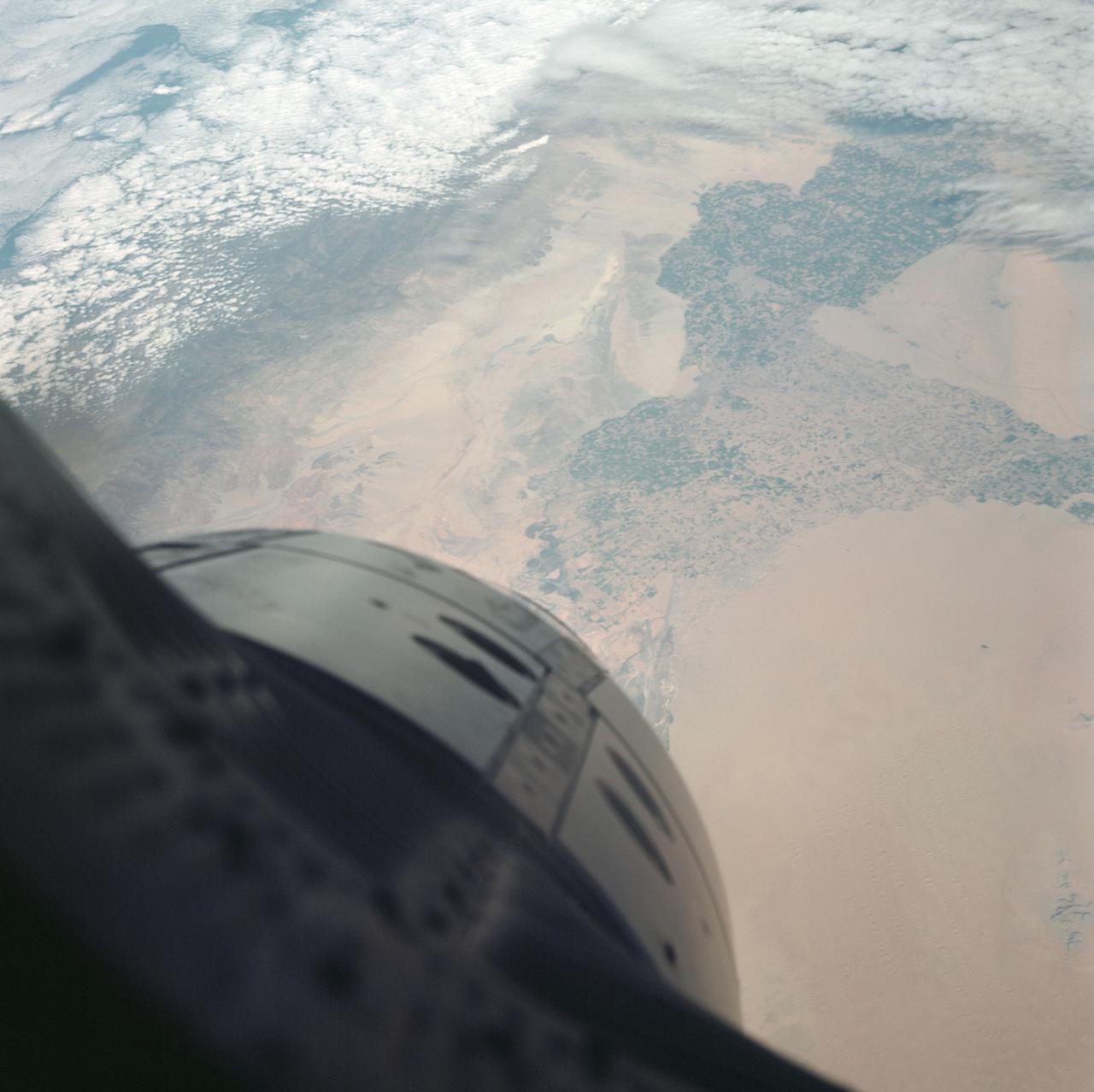
S65-18740 (23 March 1965) --- Astronaut John W. Young took this picture during the second orbit of the Gemini-Titan 3 three-orbit mission as the spacecraft "Molly Brown" passed over Northern Mexico at an altitude of 90 miles. The light-brown circular area at the lower right is the Sonoran Desert. The lower portion of the picture is Mexico, and the upper part is California. Young used a hand-held modified 70mm Hasselblad camera with color film. The lens setting was 250th of a second at f/11.
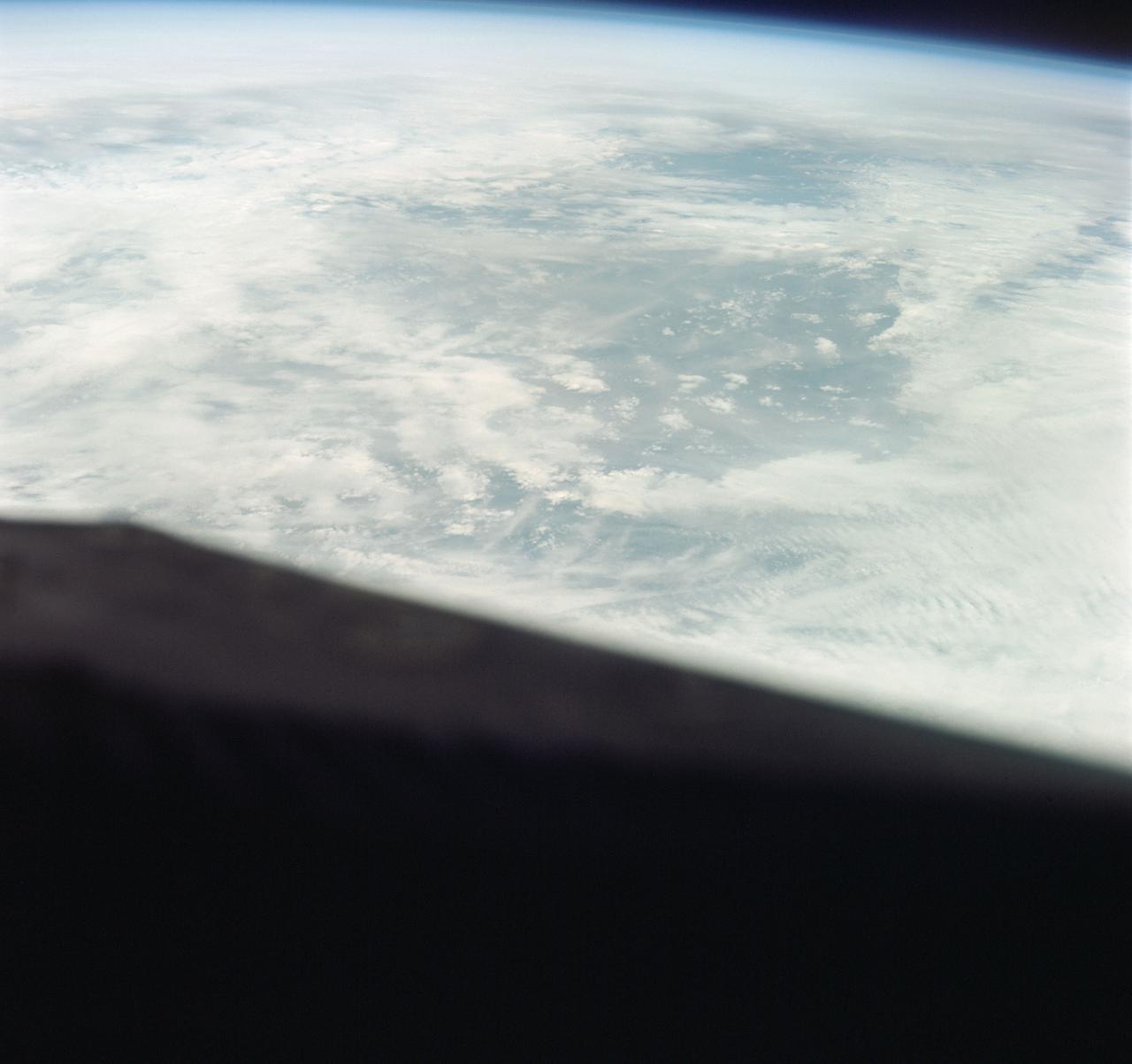
S65-18750 (23 March 1965) --- Astronaut John W. Young took this picture over eastern Africa during the Gemini-Titan 3 three-orbit mission on March 23, 1965. The altitude of the Gemini spacecraft "Molly Brown" was 90 miles. Young used a hand-held modified 70mm Hasselblad camera with color film. The lens setting was 250th of a second at f/11.
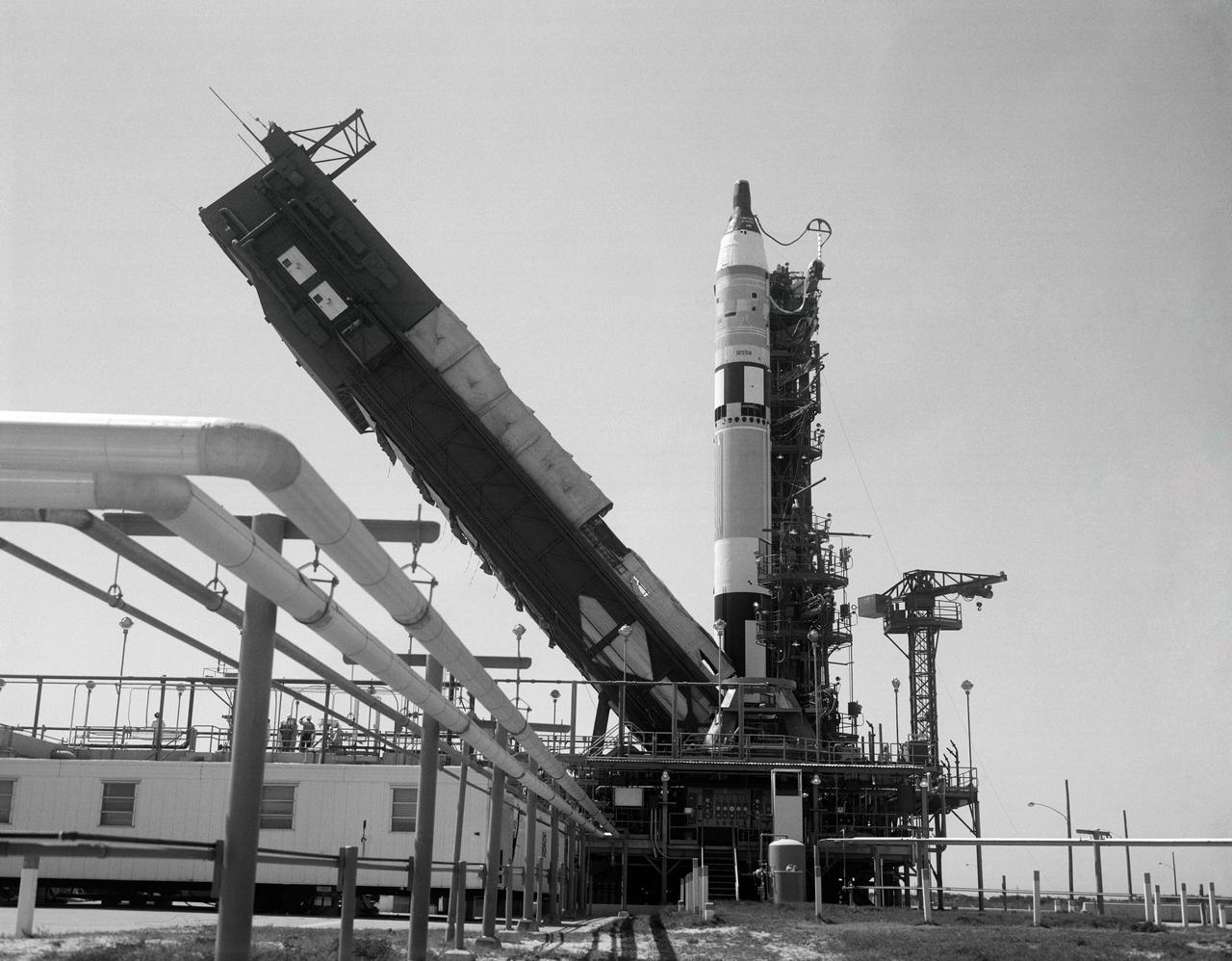
S65-20638 (1965) --- Gemini erector is lowered for test simulations for the Gemini-Titan 3 flight.
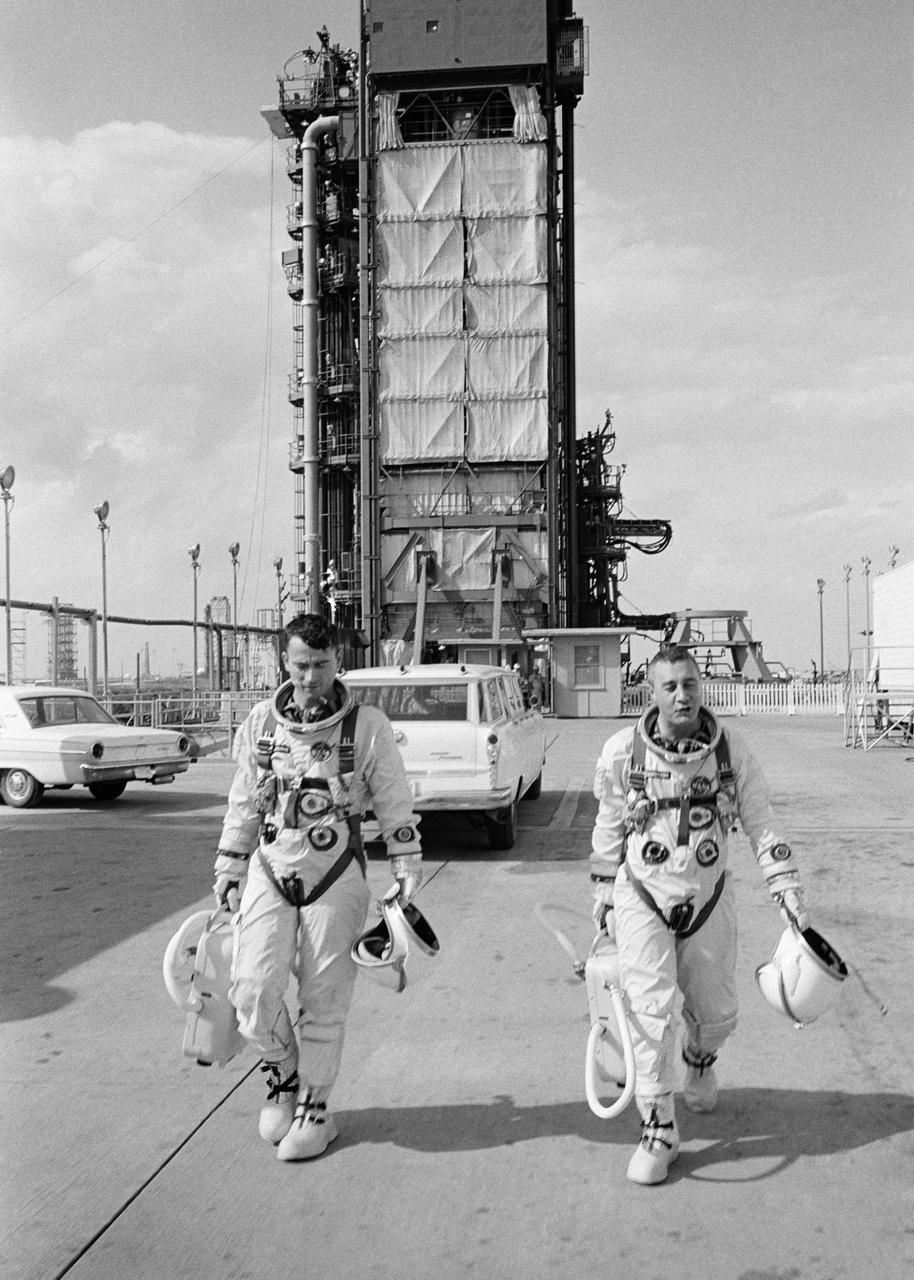
S65-20641 (1965) --- Astronauts John W. Young (left), pilot, and Virgil I. Grissom, command pilot, for the Gemini-Titan 3 flight, are shown leaving the launch pad after simulations in the Gemini-3 spacecraft.
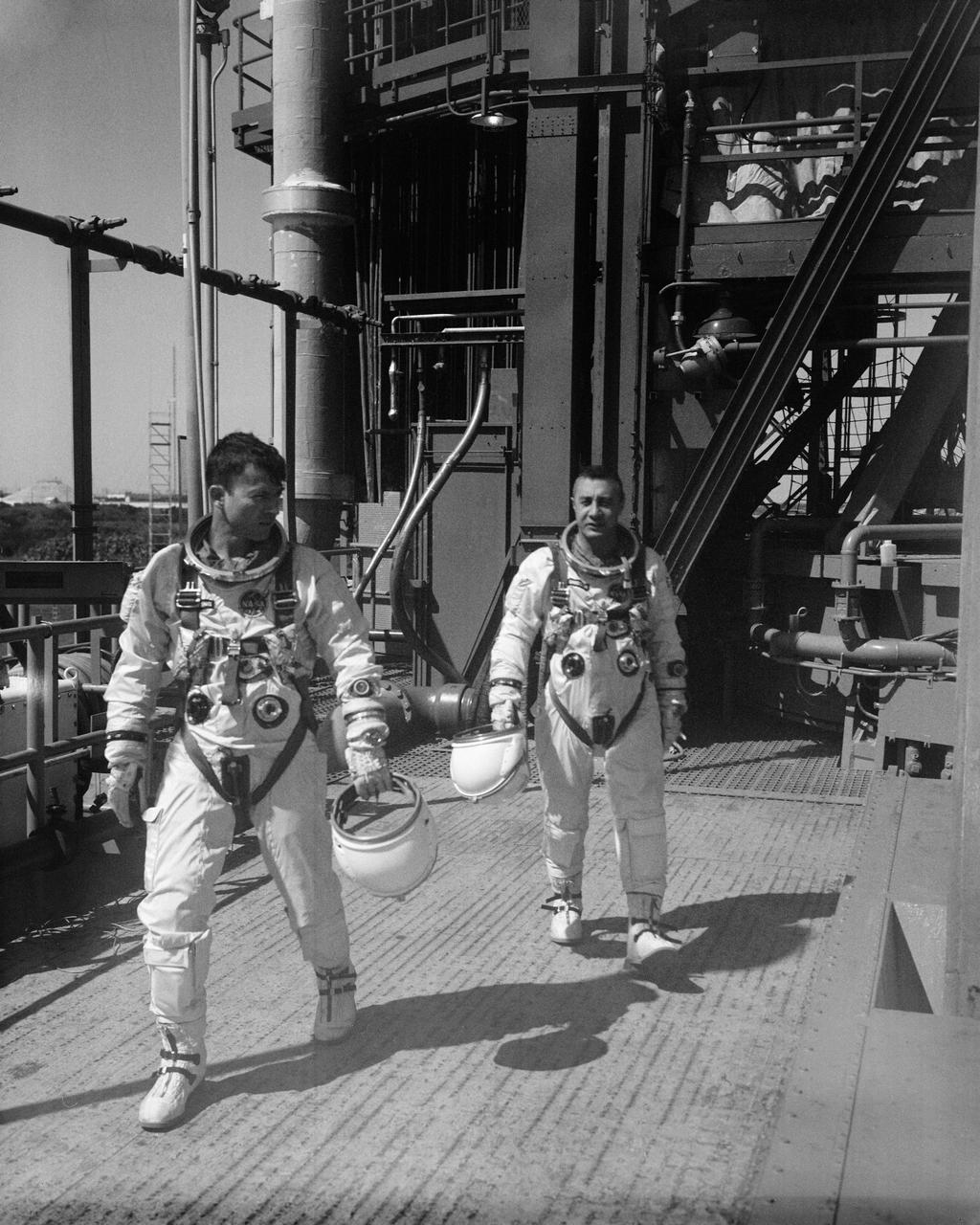
S65-20636 (1965) --- Astronauts John W. Young (left), pilot, and Virgil I. Grissom, command pilot, for the Gemini-Titan 3 flight, are shown leaving the launch pad after simulations in the Gemini-3 spacecraft.
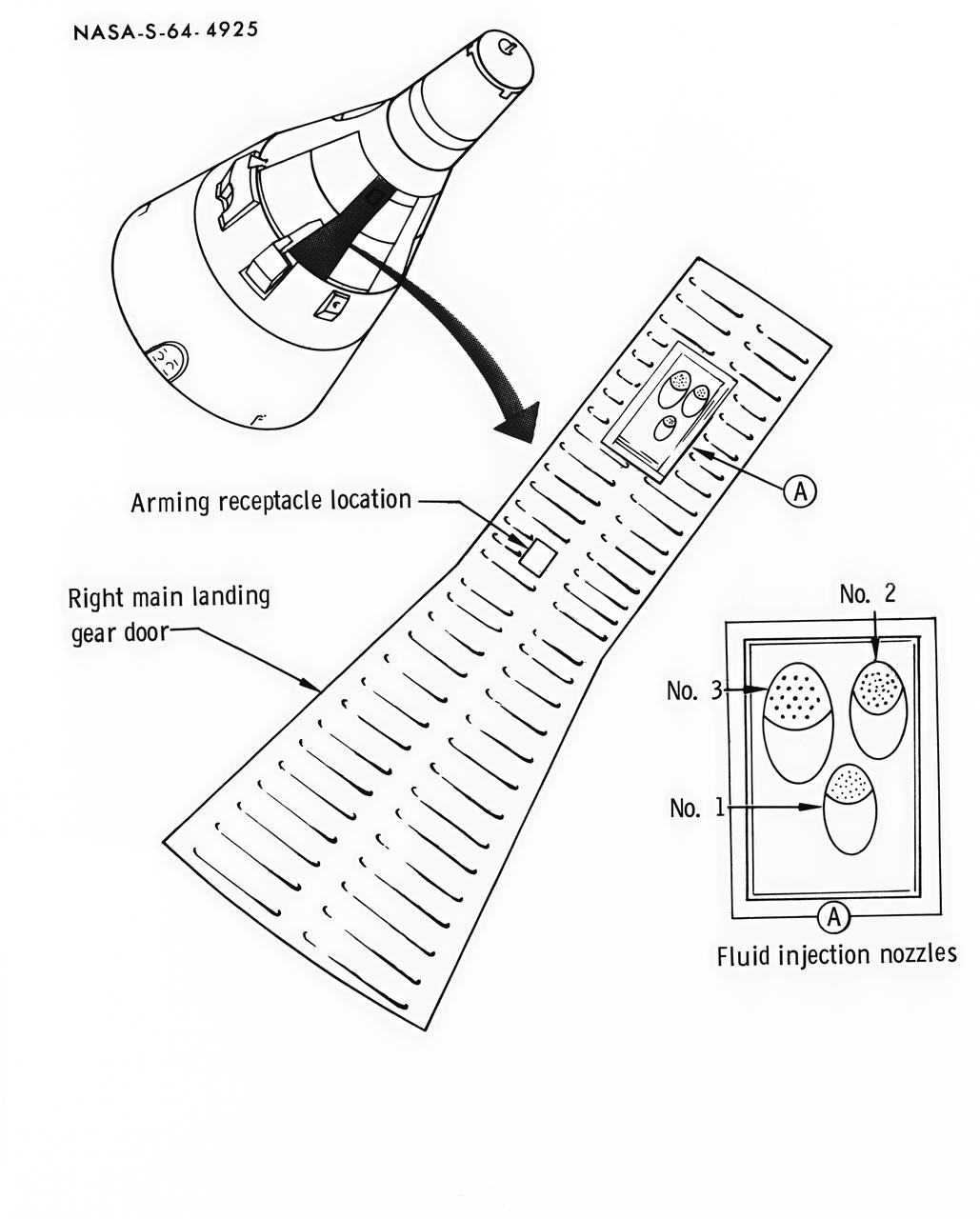
S64-04925 (September 1964) --- Diagram of Gemini spacecraft location of re-entry communications experiment planned for the Gemini-Titan 3 orbital flight.

View of Astronaut Virgil I. Grissom through spacecraft window prior to launch of Gemini-Titan 3 mission.
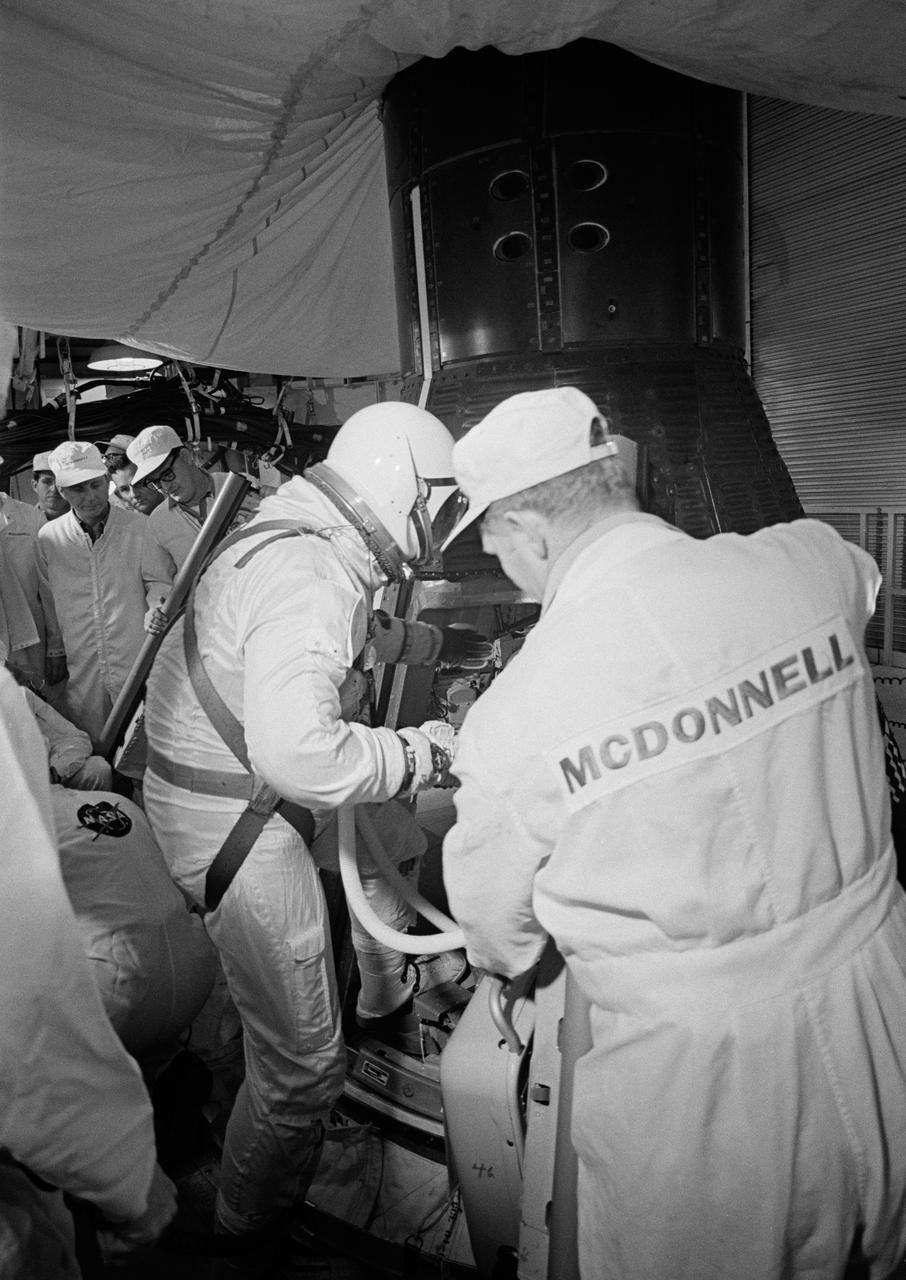
S65-20604 (23 March 1965) --- Astronaut John W. Young, the pilot of the Gemini-Titan 3 three-orbit mission, is assisted by a McDonnell Aircraft Corp. engineer as he enters the Gemini spacecraft in the white room atop the Gemini launch vehicle.
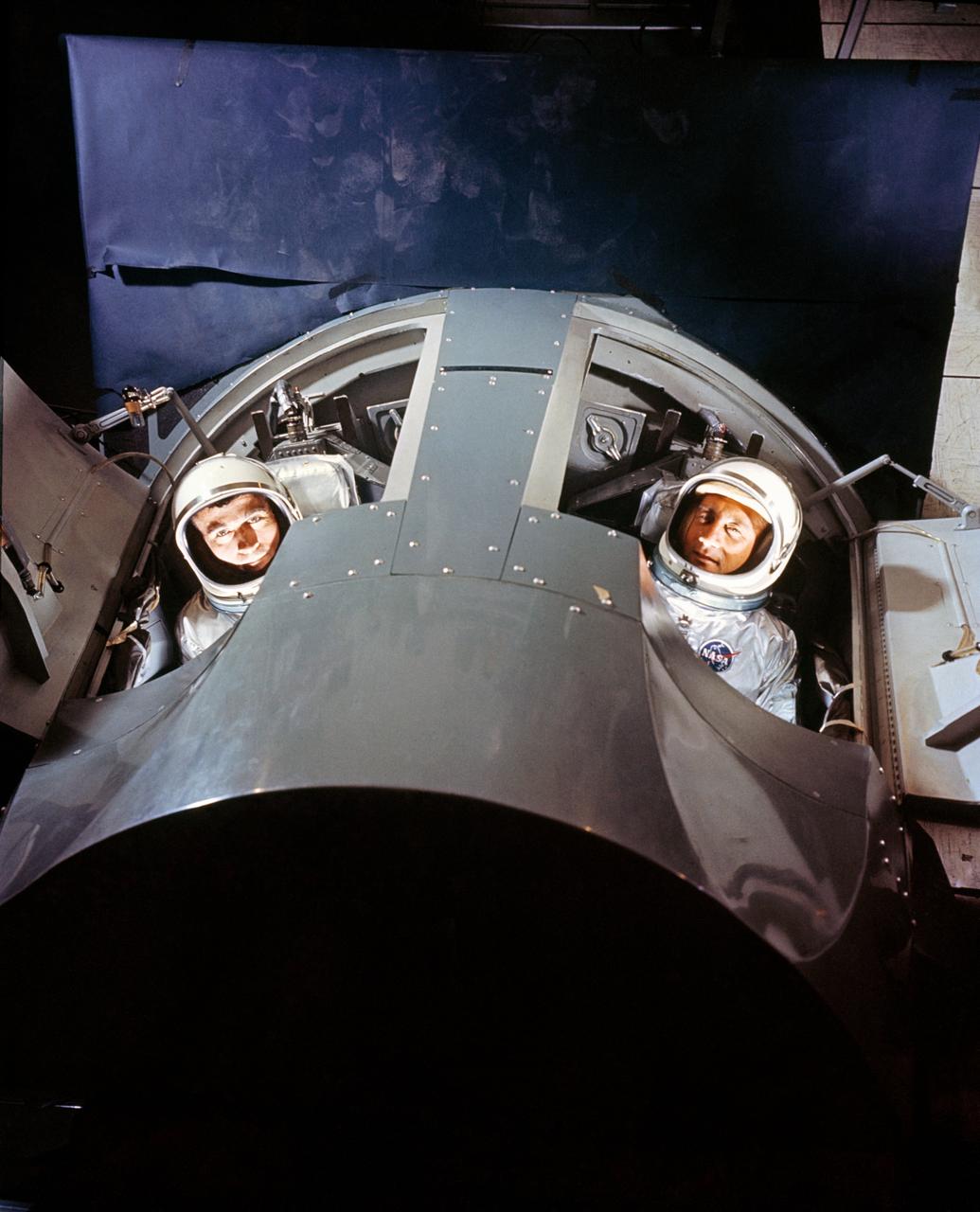
S64-25295 (March 1964) --- Astronauts Virgil I. (Gus) Grissom (right) and John W. Young, prime crew for the first manned Gemini mission (GT-3), are shown inside a Gemini mission simulator at McDonnell Aircraft Corp., St. Louis, MO. The simulator will provide Gemini astronauts and ground crews with realistic mission simulation during intensive training prior to actual launch.
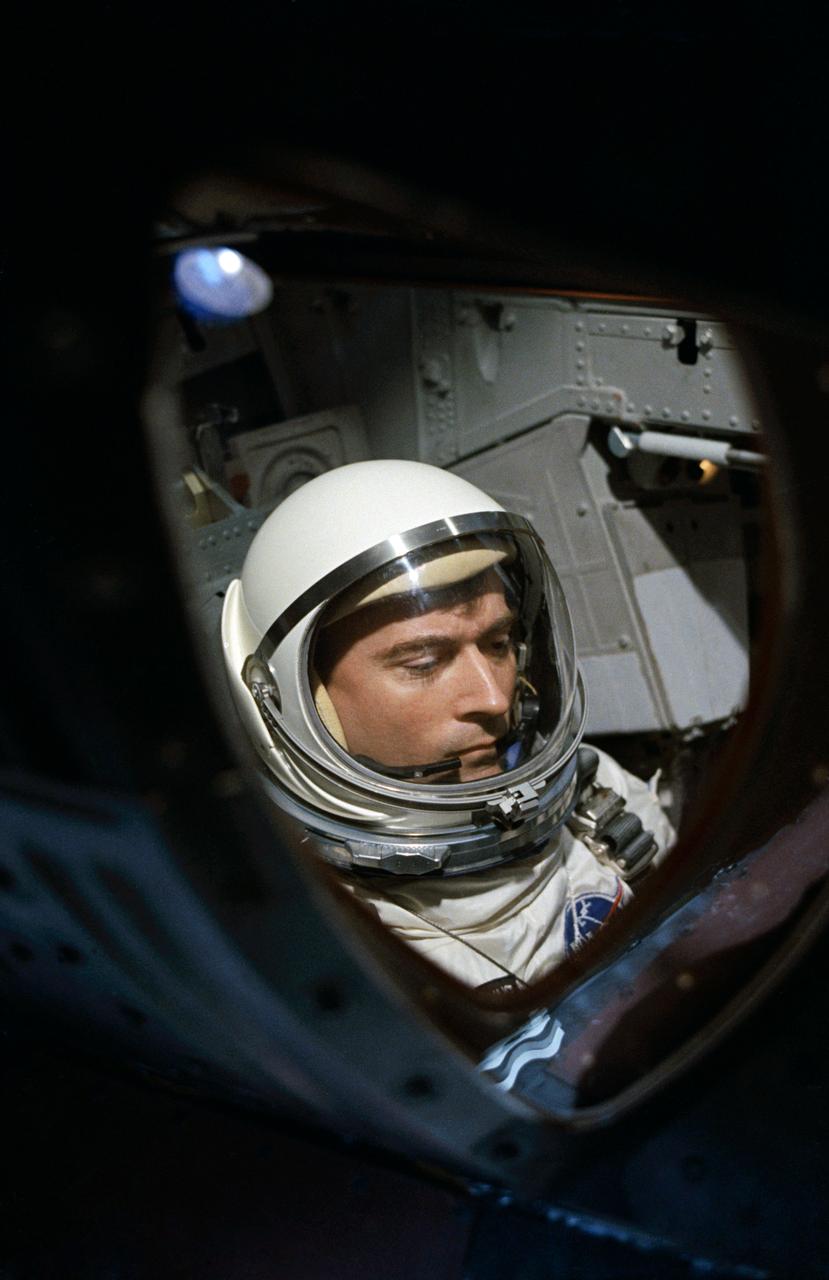
View of Astronaut John W. Young through spacecraft window prior to launch of Gemini-Titan 3 mission.
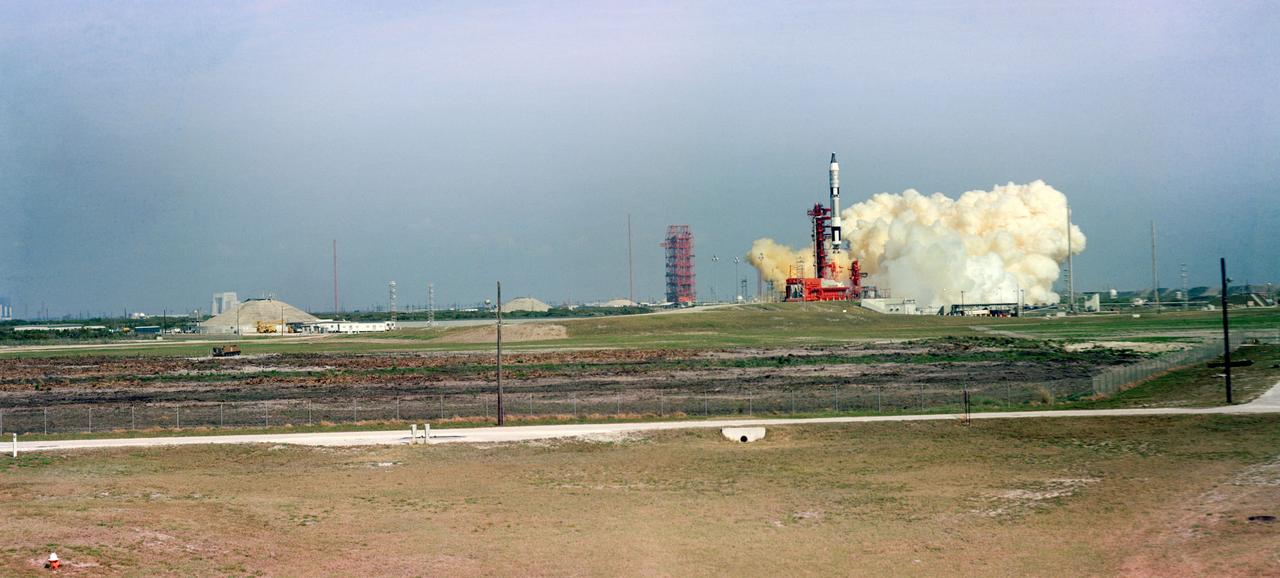
S65-21520 (23 March 1965) --- Distant view showing the successful launching of the first manned Gemini flight. The Gemini-Titan 3 (GT-3) lifted off Pad 19, at the Kennedy Space Center (KSC) at 9:24 a.m. (EST), March 23, 1965. The Gemini-3 spacecraft "Molly Brown" carried astronauts Virgil I. Grissom, command pilot, and John W. Young, pilot, on three successful orbits of Earth.
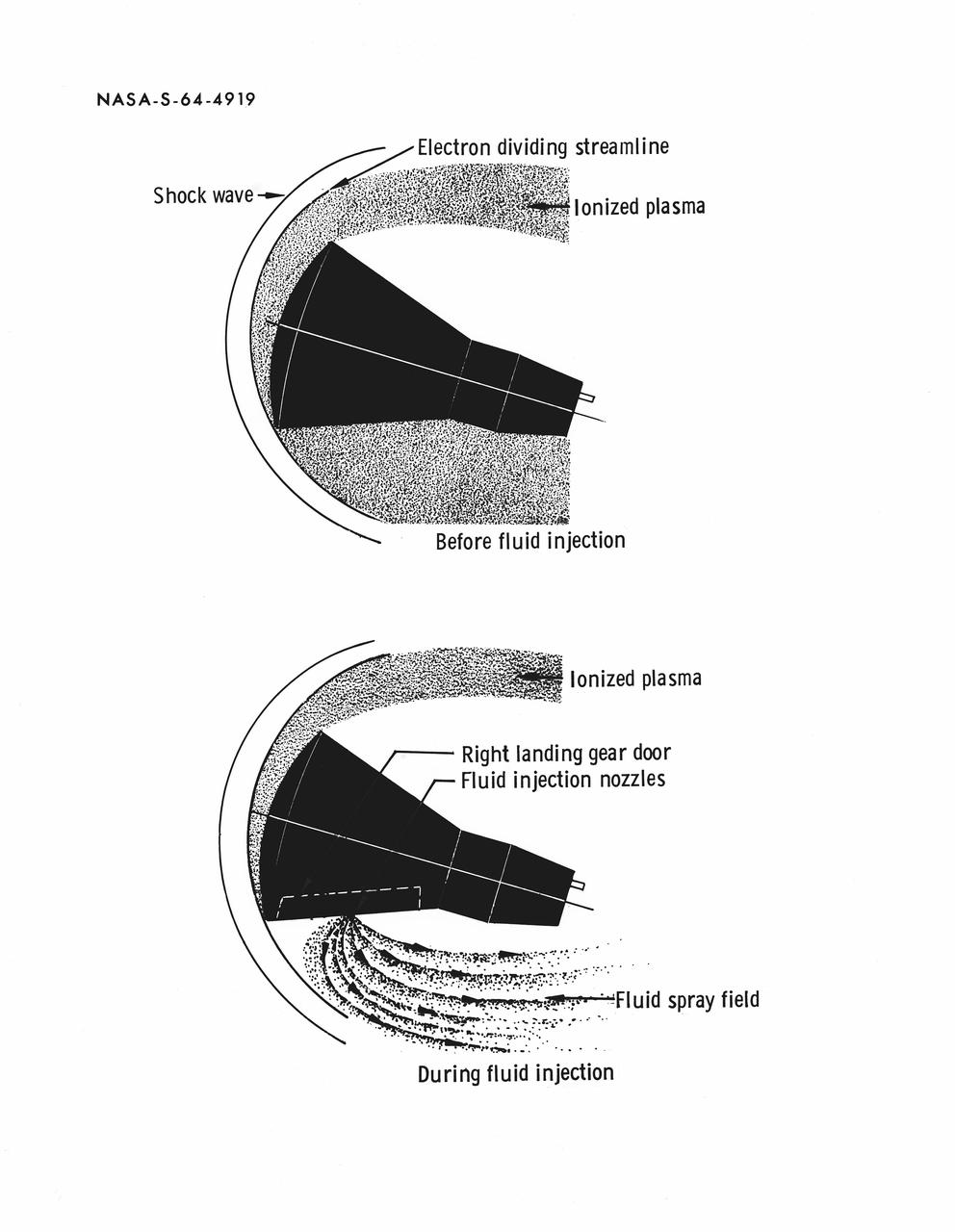
S64-04919 (September 1964) --- Diagram of reduction of the re-entry ionized plasma about a Gemini spacecraft by fluid injection, an experiment planned for the Gemini-Titan 3 orbital flight.
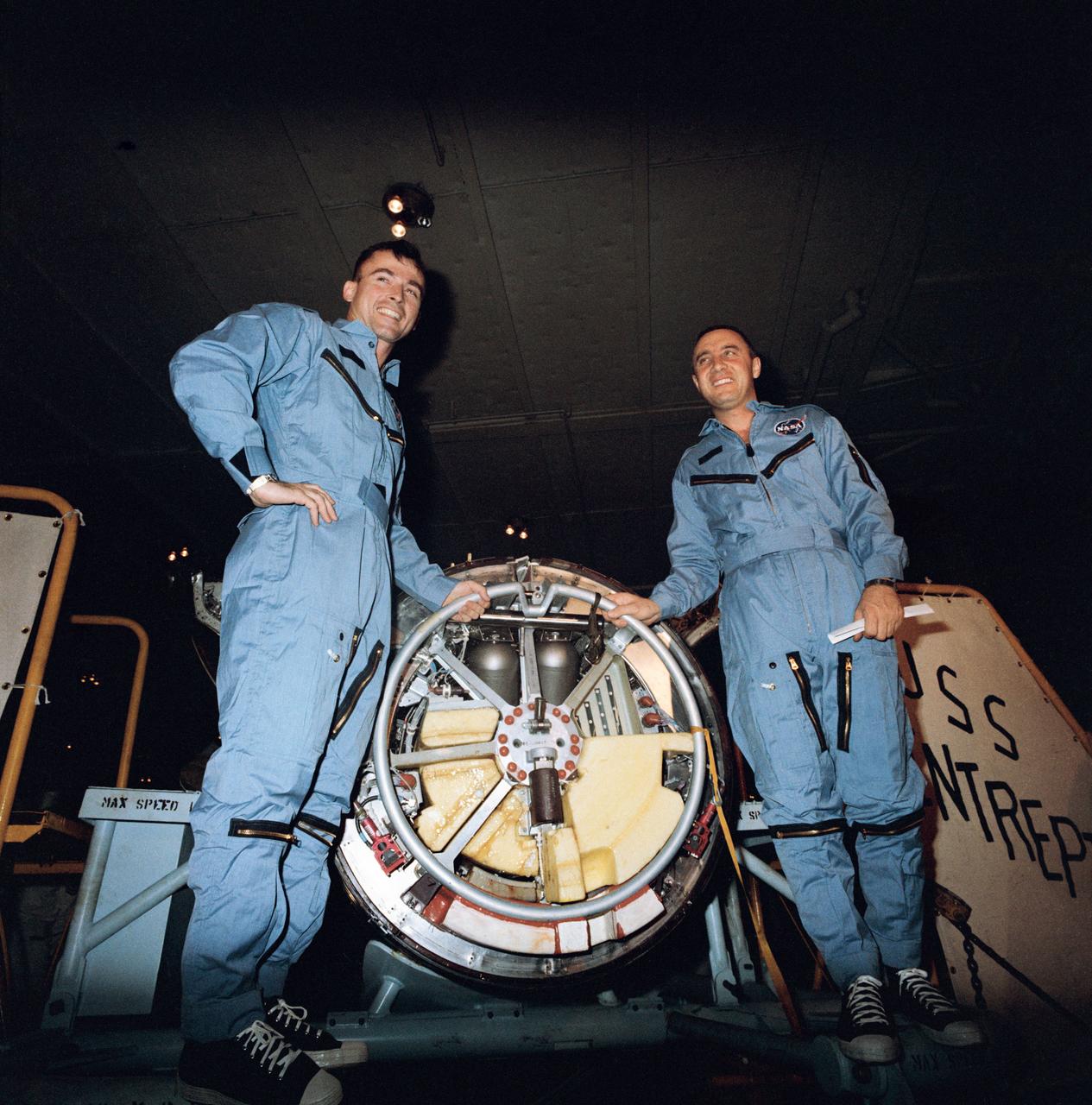
S65-18713 (23 March 1965) --- Astronauts John W. Young (left) and Virgil I. Grissom are shown during their first inspection of the Gemini 3 spacecraft aboard the USS Intrepid following their successful Gemini-Titan 3 flight. Photo credit: NASA or National Aeronautics and Space Administration
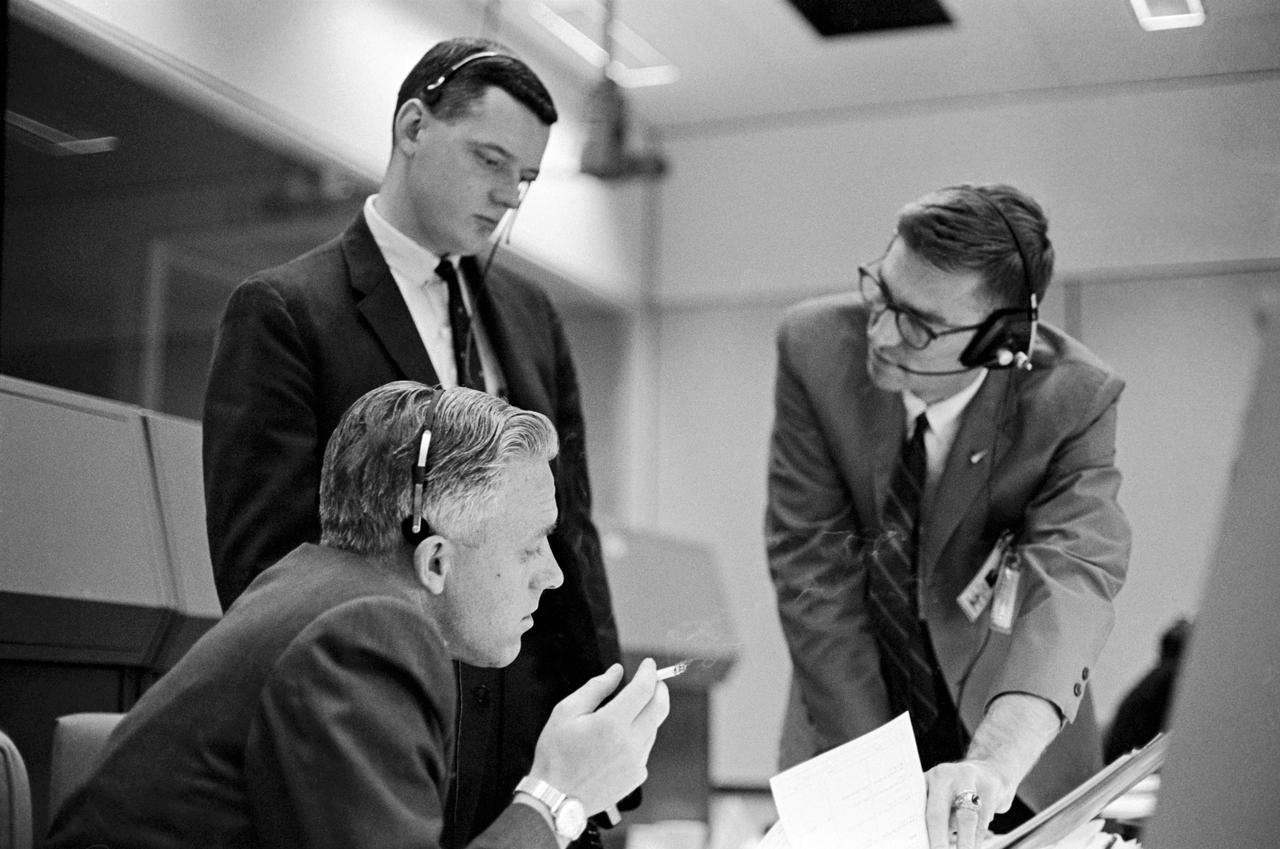
S65-18055 (23 March 1965) --- Flight director John D. Hedge (left), chief, Flight Control Division; Glynn S. Lunney (standing left), chief, Flight Dynamics Branch, Flight Control Division; and James W. Beach, assistant flight director for Gemini-Titan 3, are shown in the Mission Control Center, Houston, Texas during the Gemini-Titan 3 flight.
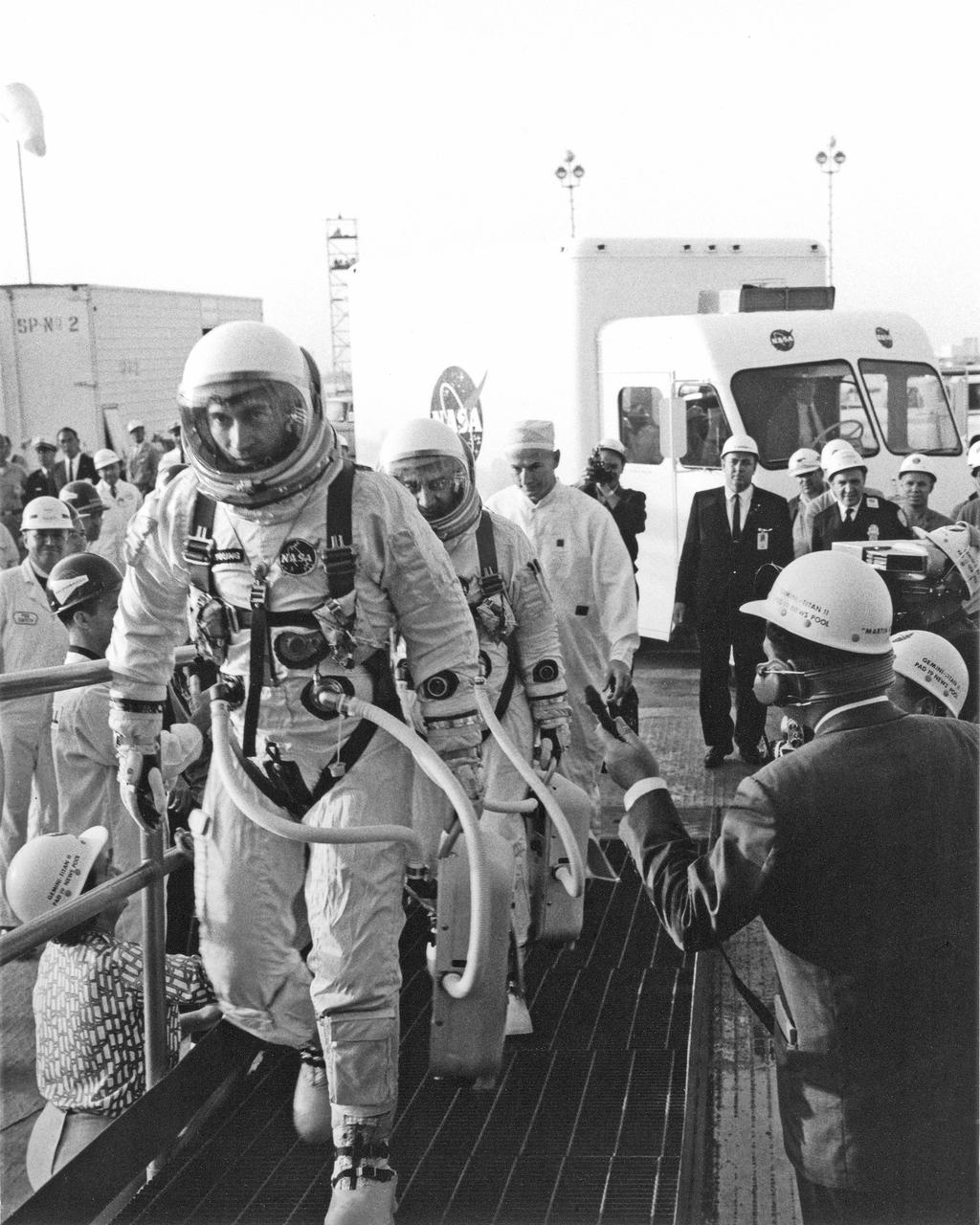
CAPE KENNEDY, Fla. -- At Cape Kennedy Air Force Station in Florida, Gemini 3 pilot John W. Young is followed by command pilot Virgil I. Grissom as they walk to elevator at Launch Complex 19 for their three orbit flight, the first mission of the Gemini spacecraft. Photo Credit: NASA

S65-20593 (1965) --- Riding the elevator to the white room atop the Gemini Launch Vehicle on Pad 19 are astronauts Alan B. Shepard Jr. (left) and John W. Young. The Gemini-Titan 3 flight is scheduled to launch on March 23, 1965. Young is the pilot of the GT-3 mission. Shepard was the Mercury Redstone 3 pilot.
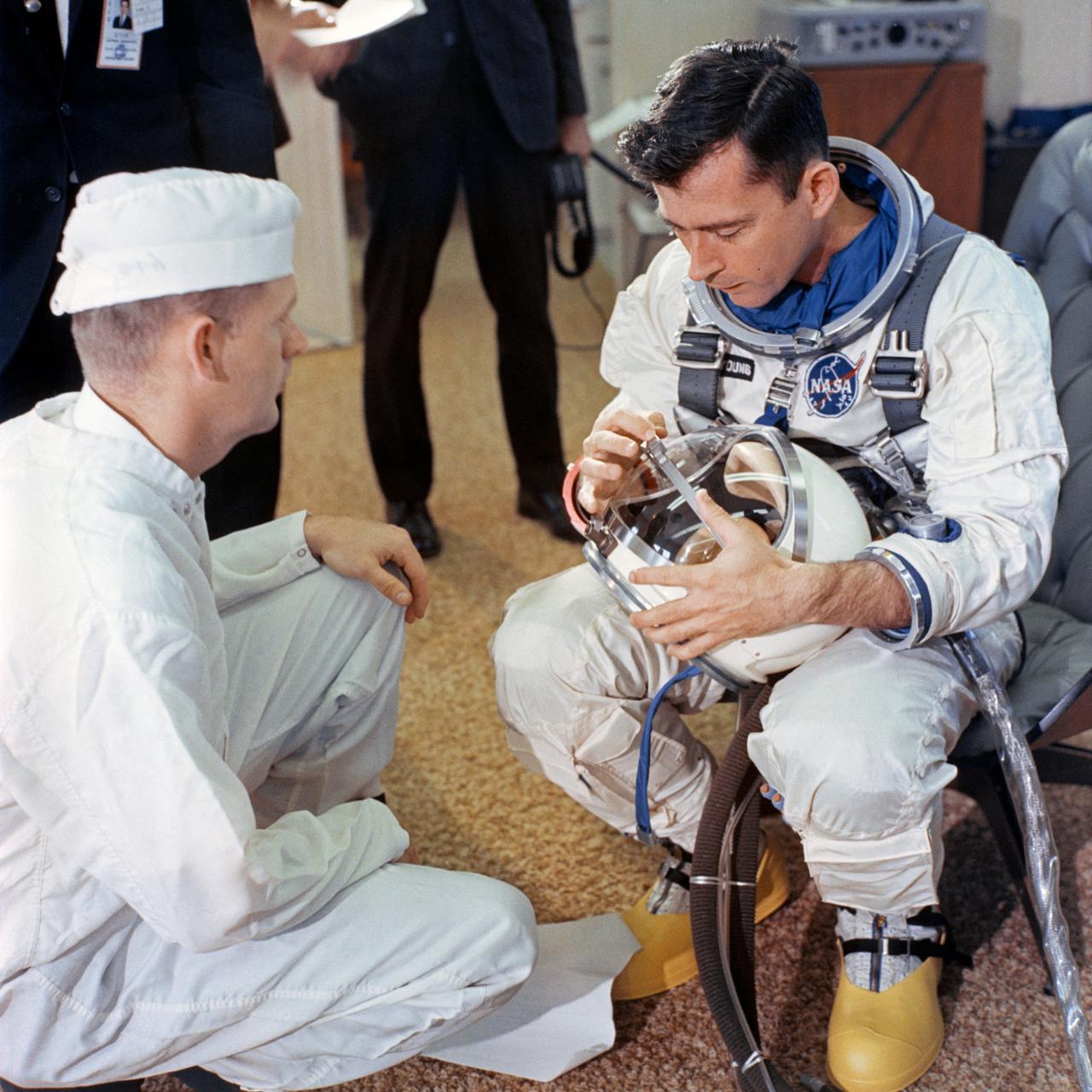
S65-23488 (23 March 1965) --- Astronaut John W. Young, pilot of the Gemini-Titan 3 space flight, checks over his helmet during suiting operations in the suiting trailer at Pad 16 prior to flight.
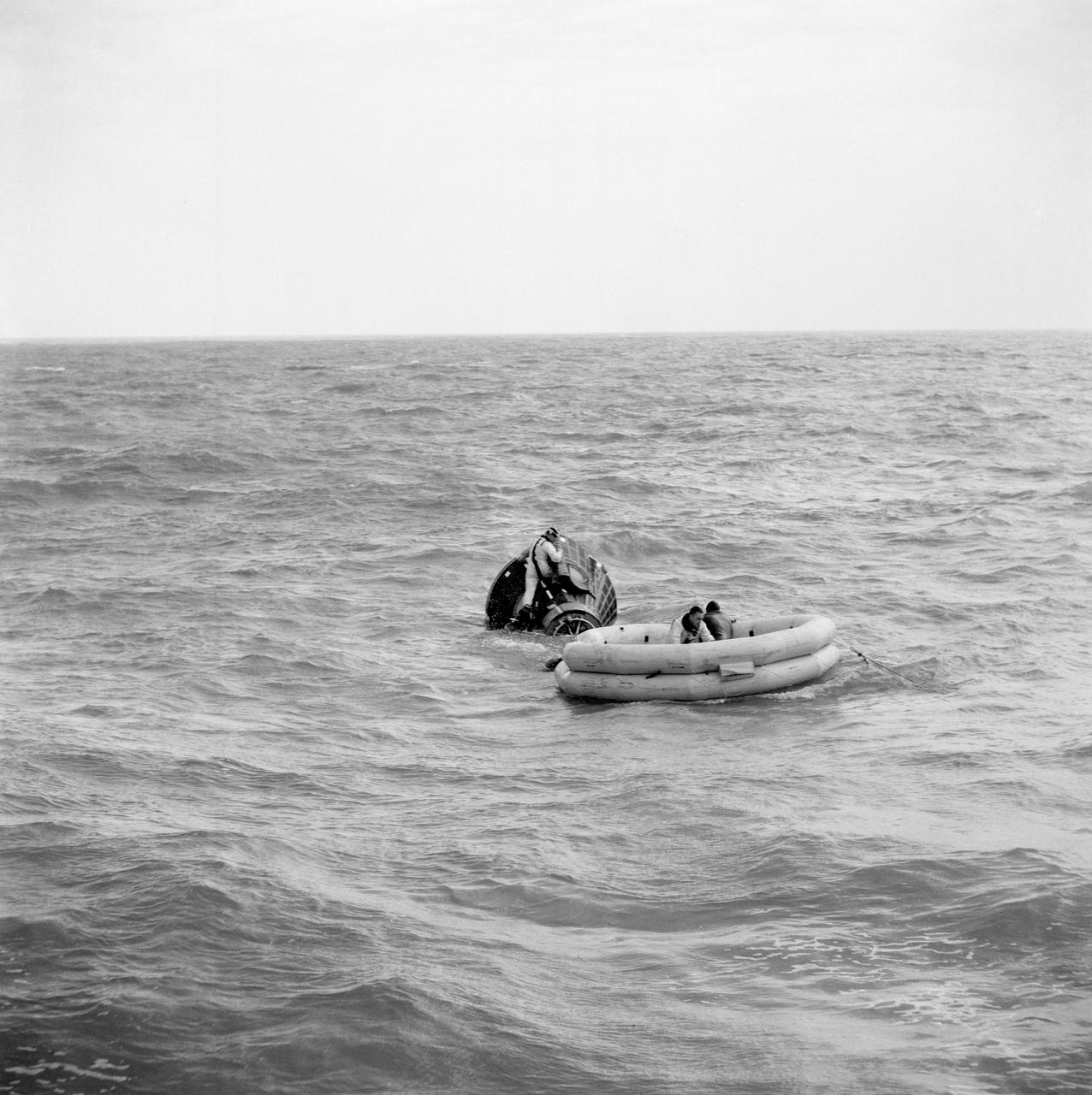
S65-14457 (23 Feb. 1965) --- Both members of the Gemini-Titan 3 prime crew egress through the left, or command pilot's, hatch into the Gulf of Mexico during specialized training in egress from the Gemini spacecraft. Astronaut Virgil I. Grissom, the command pilot, has already climbed into a raft, as astronaut John W. Young, pilot, egresses from the spacecraft.
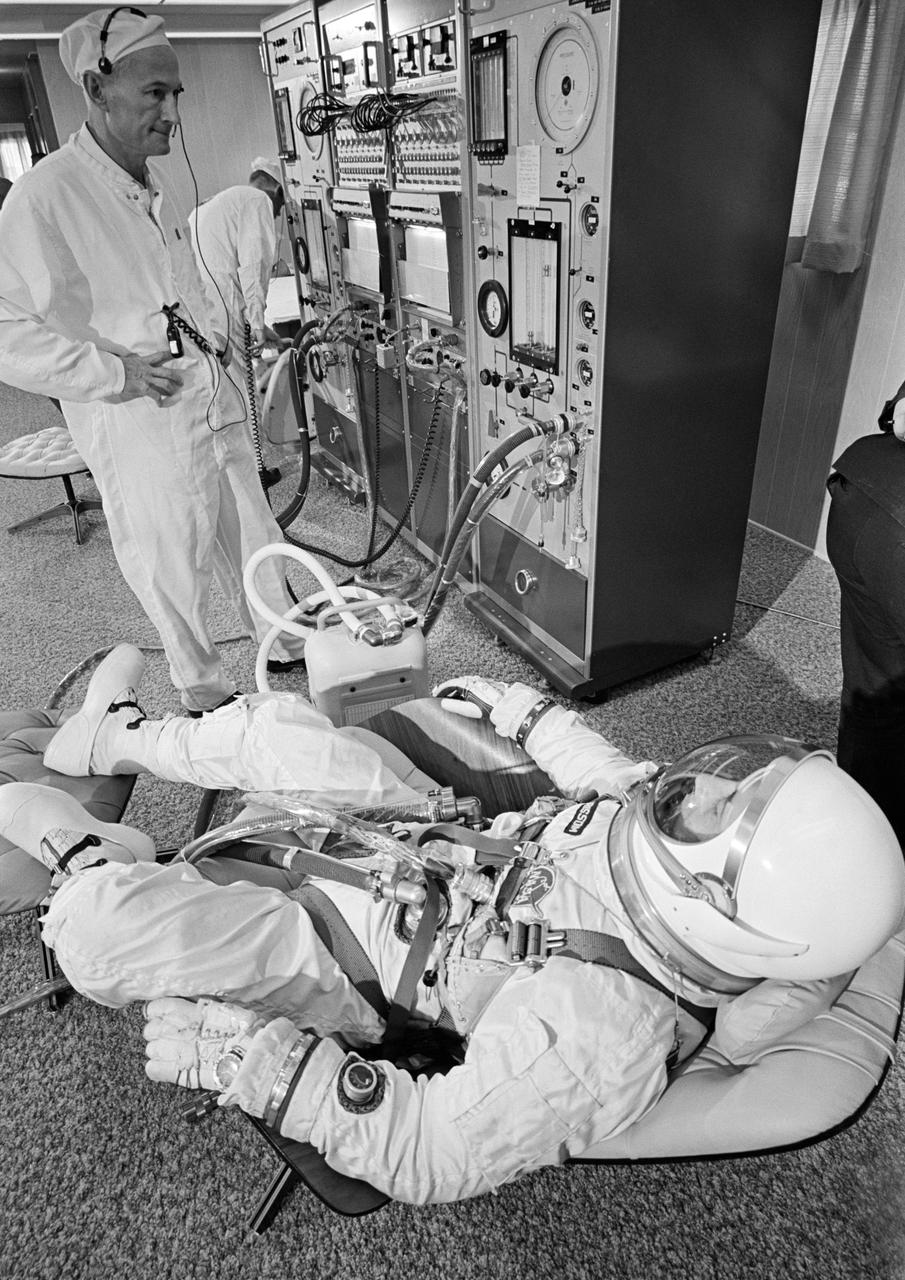
S65-20639 (18 March 1965) --- Astronaut Virgil I. Grissom, Gemini-Titan 3 command pilot, reclines on a couch in the Pad 16 ready room during preflight checks prior to going to Pad 19 for flight simulations in the Gemini-3 spacecraft. Joe Schmitt, suit technician from NASA?s Manned Spacecraft Center Crew Systems Division, stands by to assist Grissom.
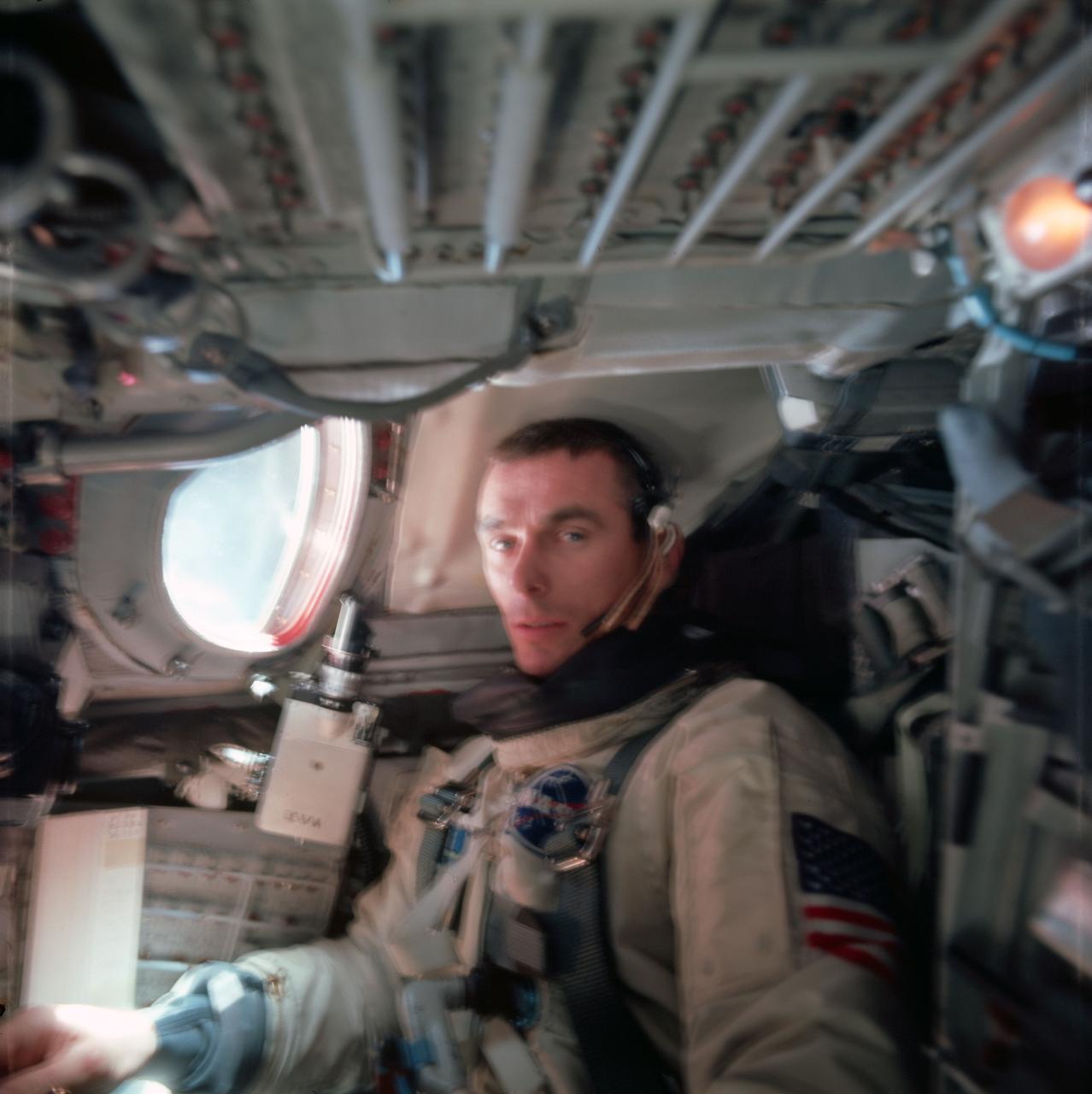
S66-38082 (3 June 1966) --- Astronaut Eugene A. Cernan, pilot of the Gemini-9A spaceflight, is photographed inside the spacecraft by the command pilot, astronaut Thomas P. Stafford during the flight. Photo credit: NASA
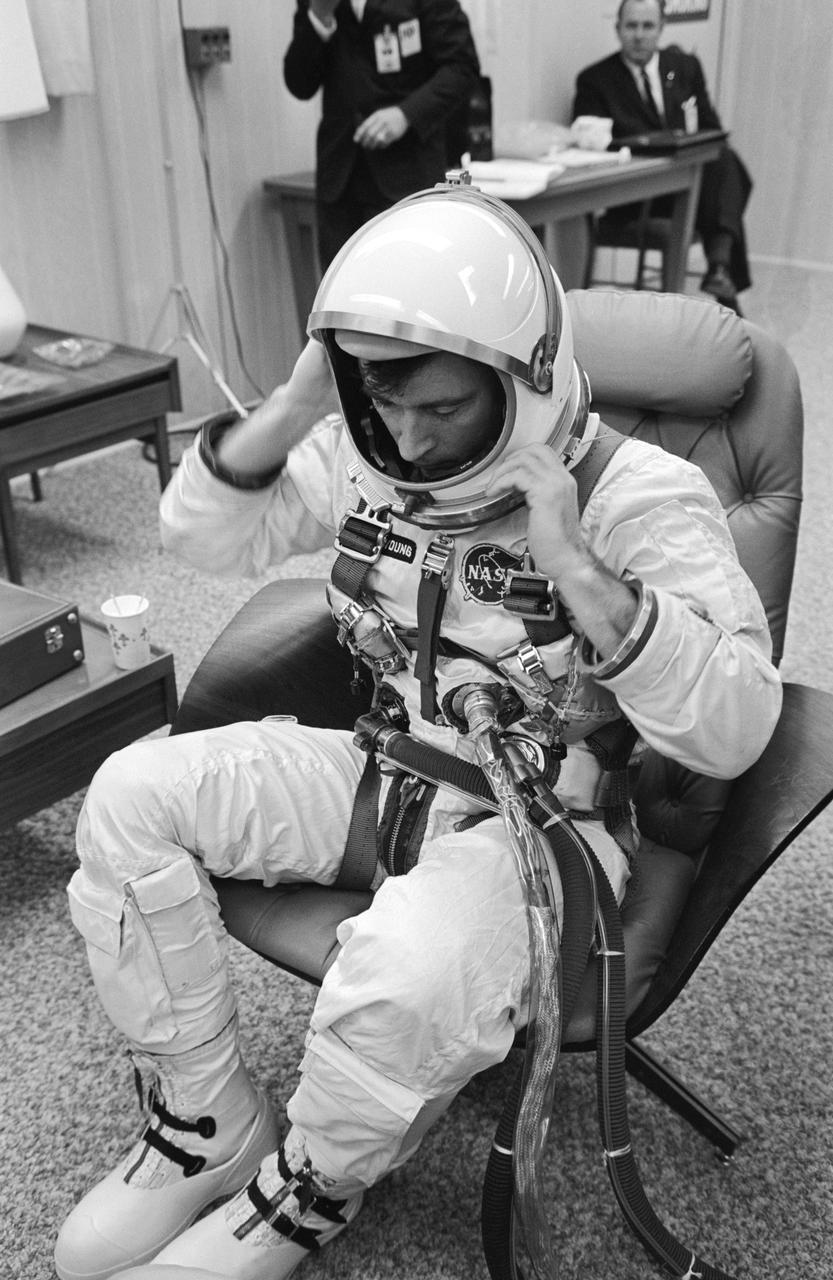
S65-20602 (23 March 1965) --- Astronaut John W. Young, the pilot of the GT-3 three-orbit mission, adjusts his helmet in the Gemini ready room at Pad 16 during the suiting for the flight.
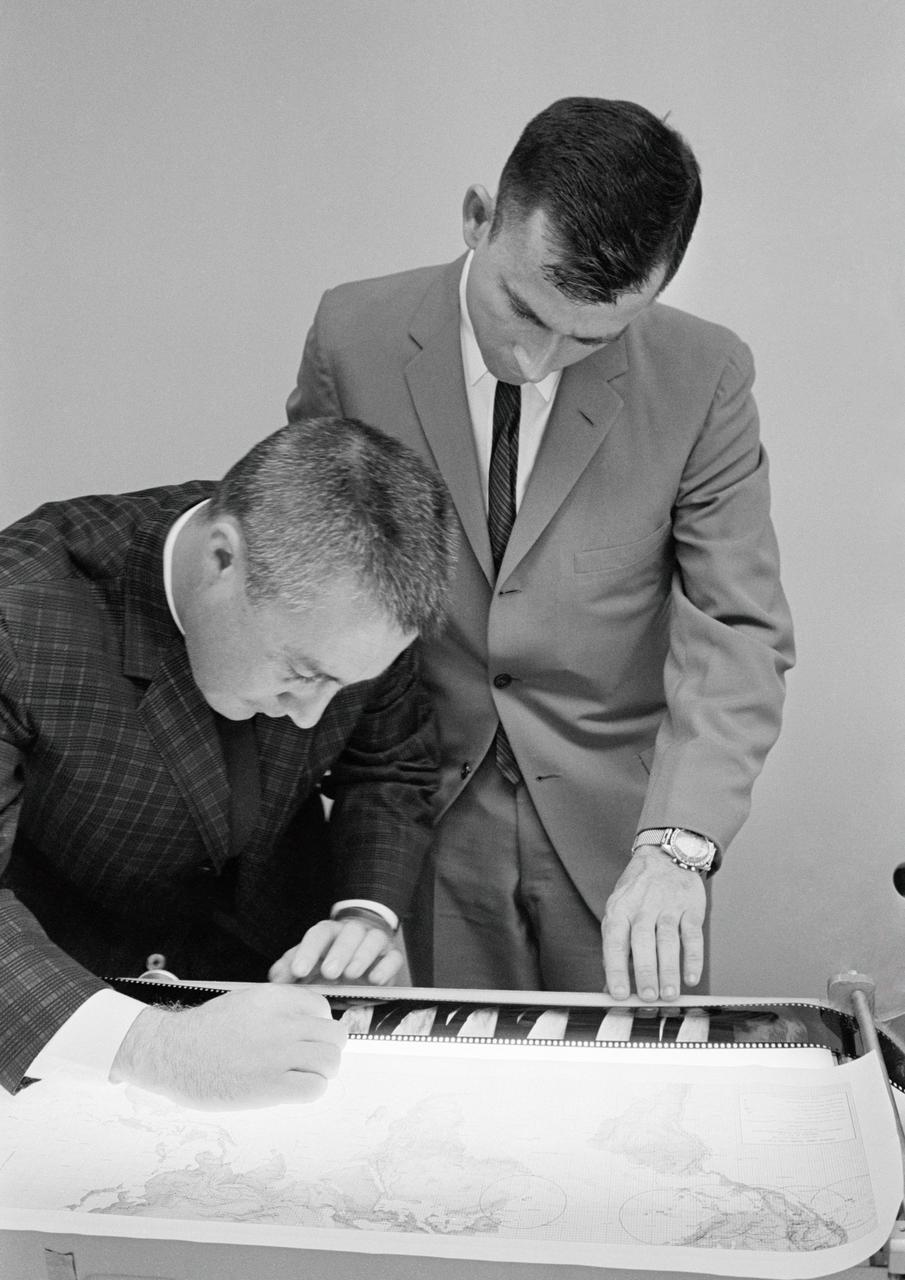
S65-20624 (25 March 1965) --- Gemini-Titan 3 astronauts Virgil I. Grissom (left) and John W. Young examine some of the negatives of photographs taken on their three-orbit flight on March 23, 1965.
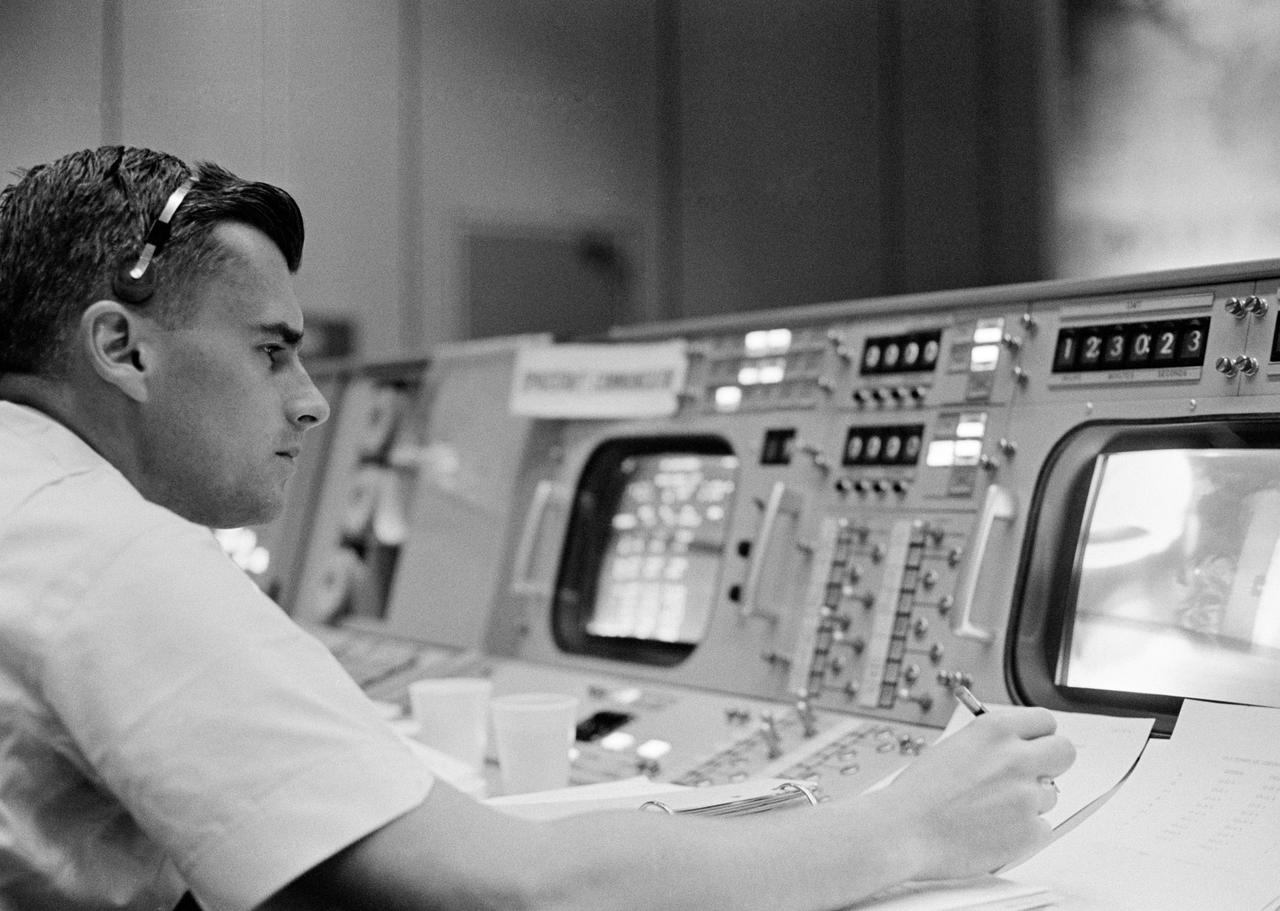
S65-18058 (23 March 1965) --- Astronaut Roger B. Chaffee is shown at console in the Mission Control Center, Houston, Texas during the Gemini-Titan 3 flight.
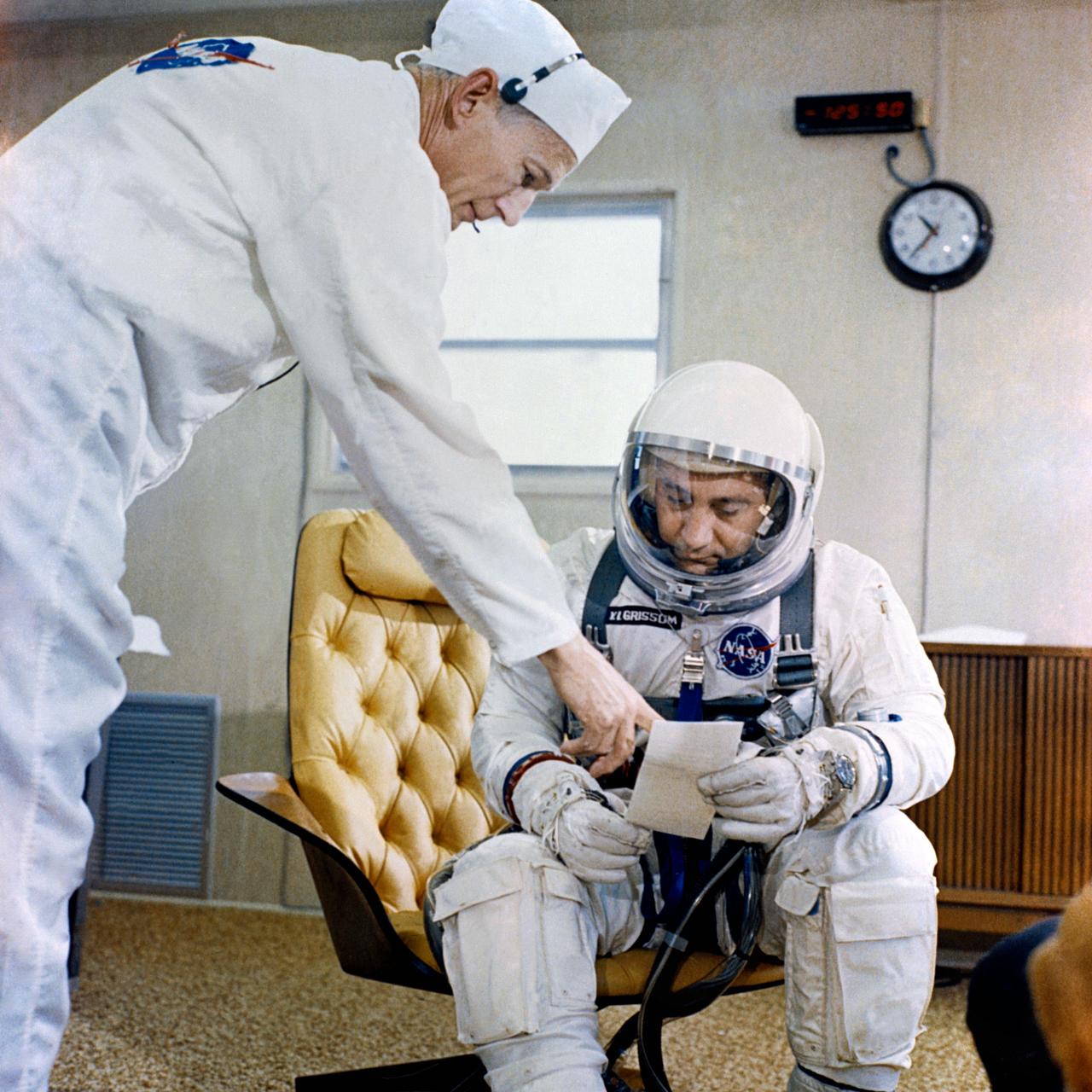
S65-23486 (23 March 1965) --- Astronaut Virgil I. Grissom, command pilot of the Gemini-Titan 3 space flight, is shown in the suiting trailer at Pad 16 going over a checklist with suit technician Joe Schmitt.
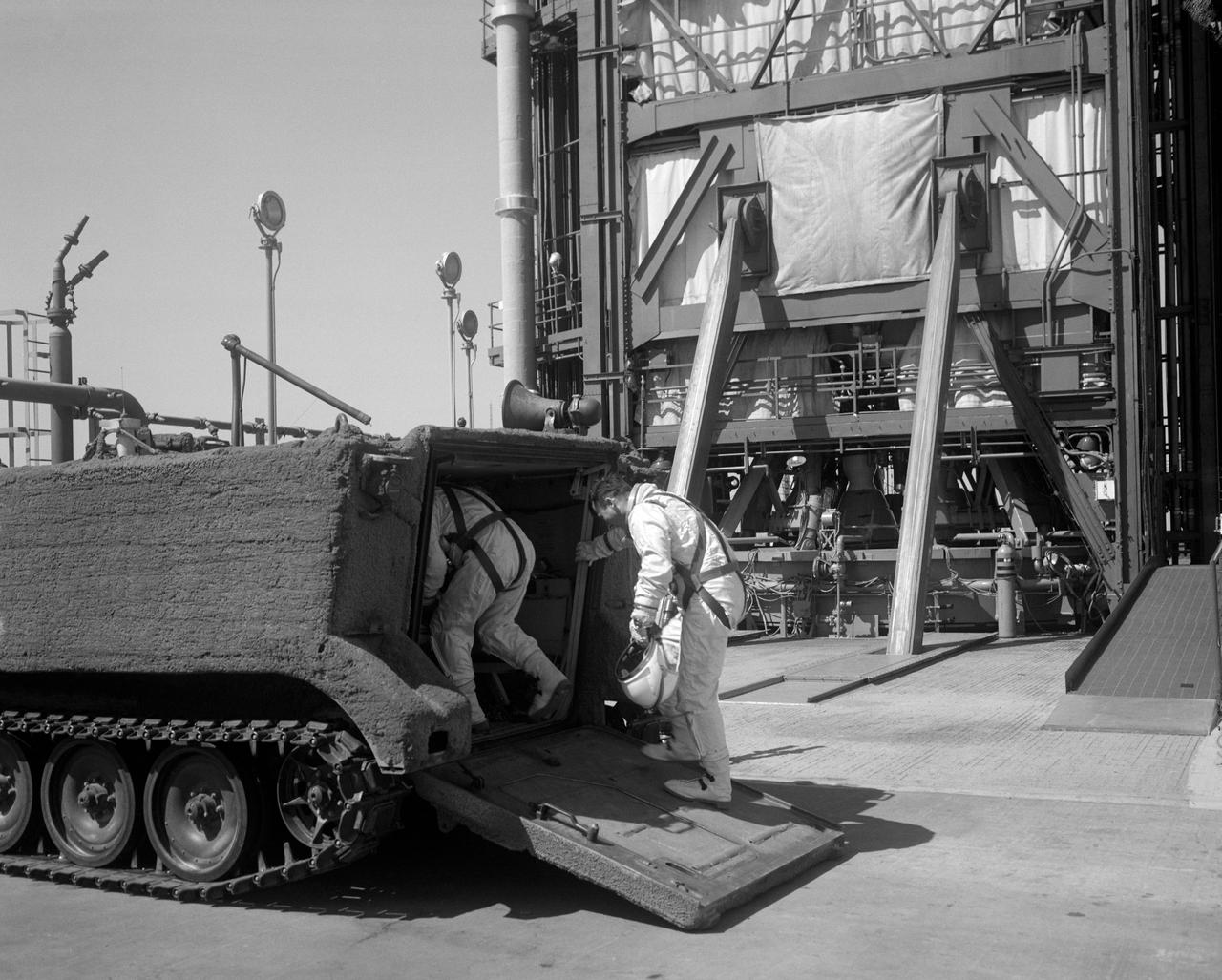
S65-20637 (1965) --- Astronauts John W. Young, pilot, and Virgil I. Grissom, command pilot, for the Gemini-Titan 3 flight, are shown entering launch pad abort rescue vehicle during training exercise.
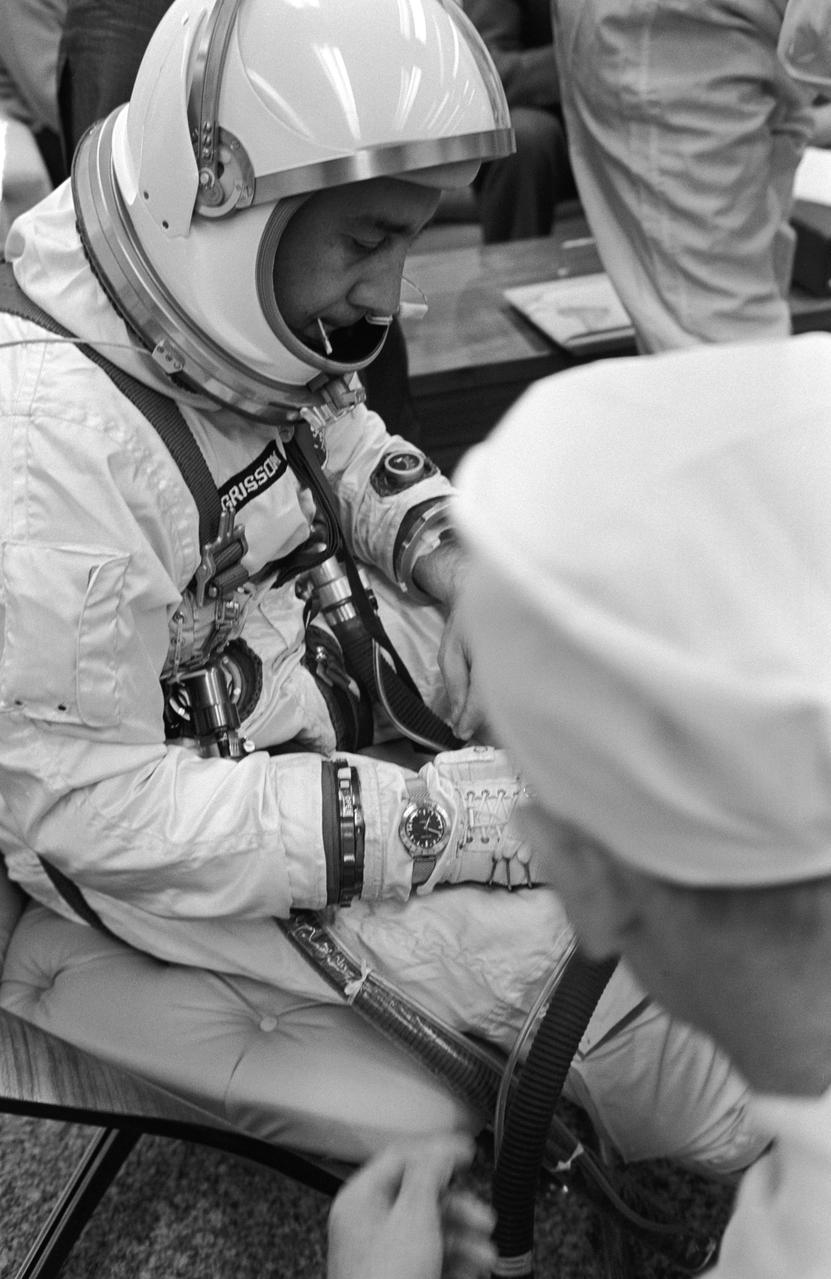
S65-20601 (23 March 1965) --- Astronaut Virgil Grissom, command pilot of the Gemini-Titan 3 flight, is photographed suiting up for his mission. Technicians help him adjust his suit's gloves.
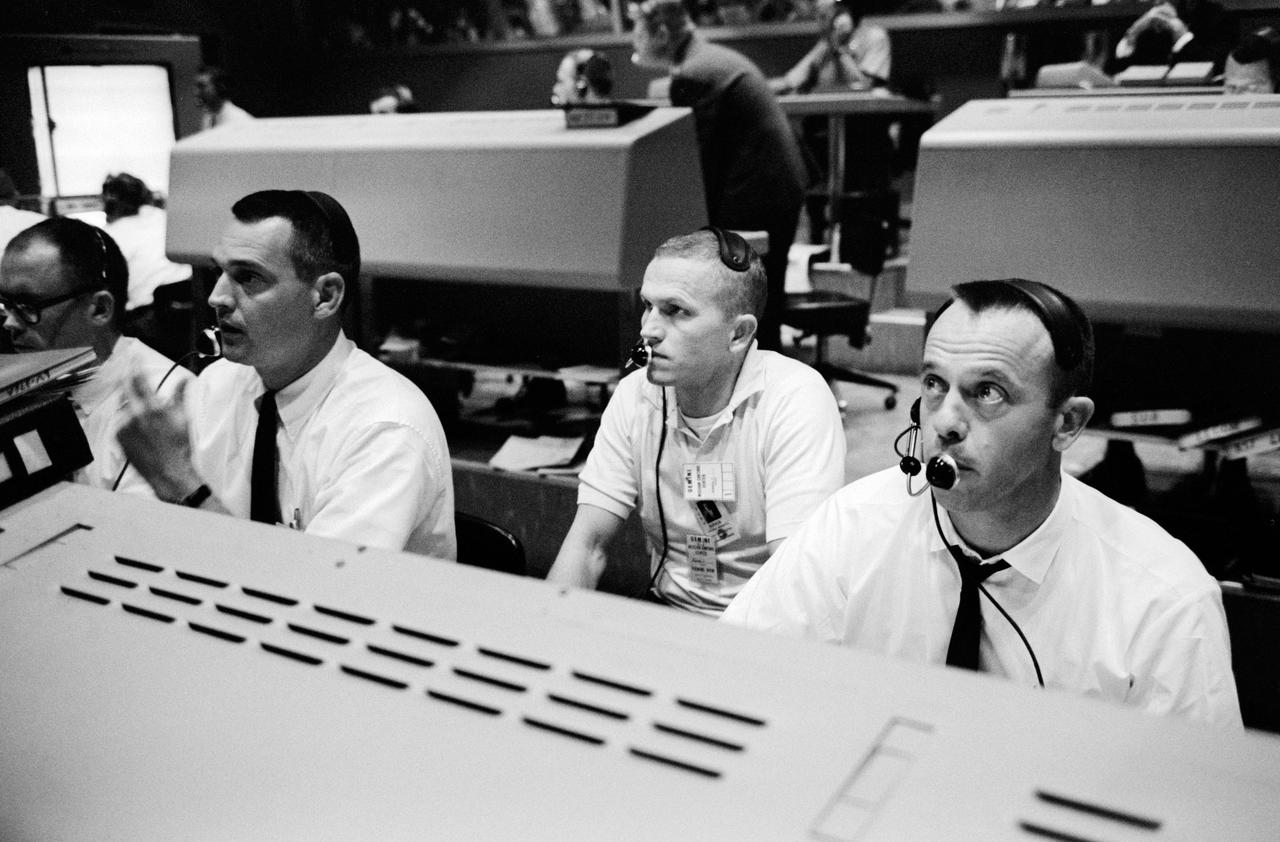
S65-30263 (3 June 1965) --- Shown at their consoles during the liftoff of Gemini-4 (from left) are astronauts Clifford C. Williams Jr., Frank Borman and Alan B. Shepard Jr. Borman was command pilot of the backup crew for the Gemini-4 flight. The three astronauts monitored the flight from the Mission Control Center at Cape Kennedy.
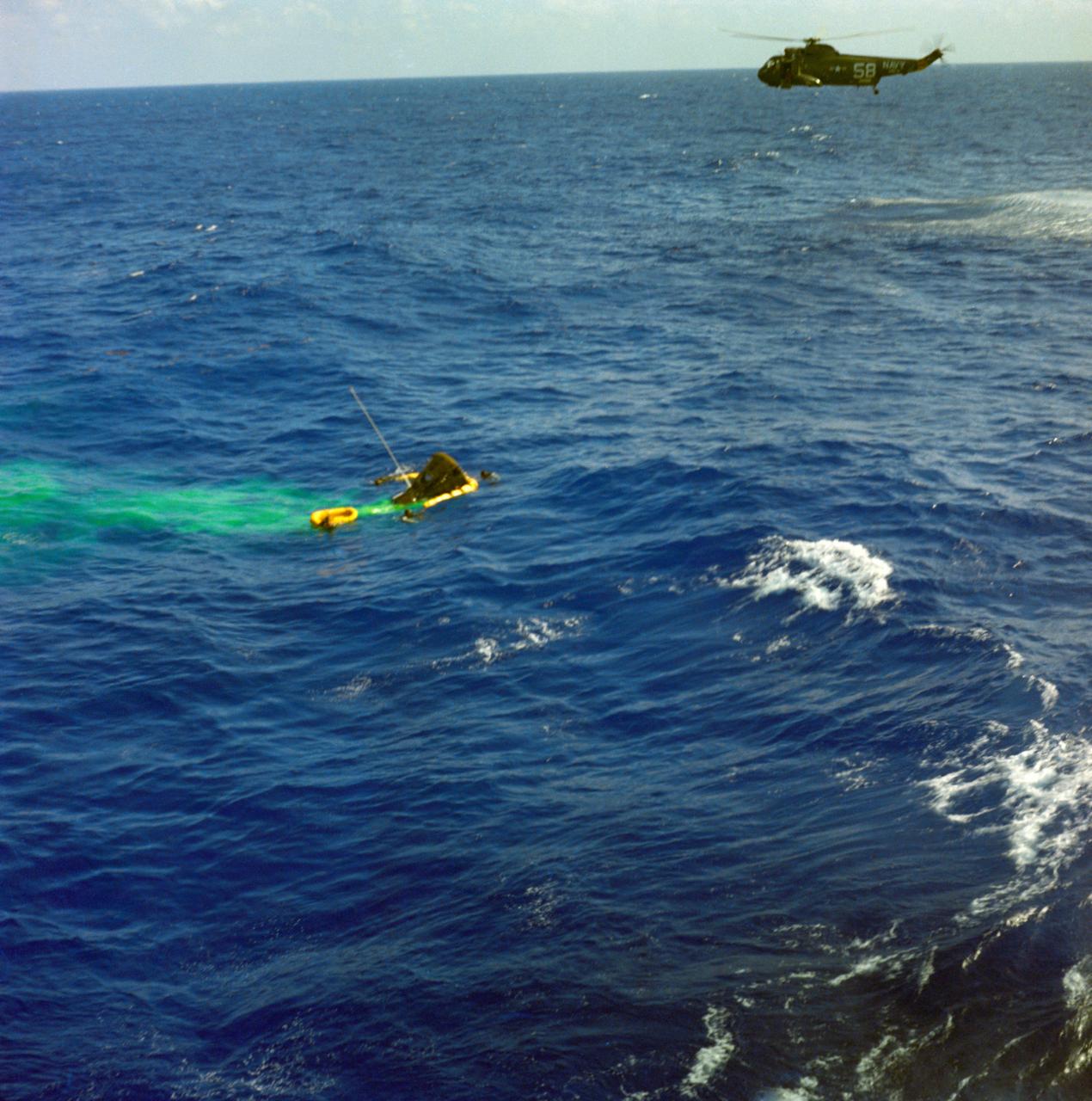
S65-18645 (23 March 1965) --- Navy swimmers are shown attaching a flotation collar to the Gemini-Titan 3 (GT-3) spacecraft during recovery operations following the successful flight. A helicopter hovers in the background. Astronauts Virgil I. Grissom and John W. Young are still in the spacecraft.
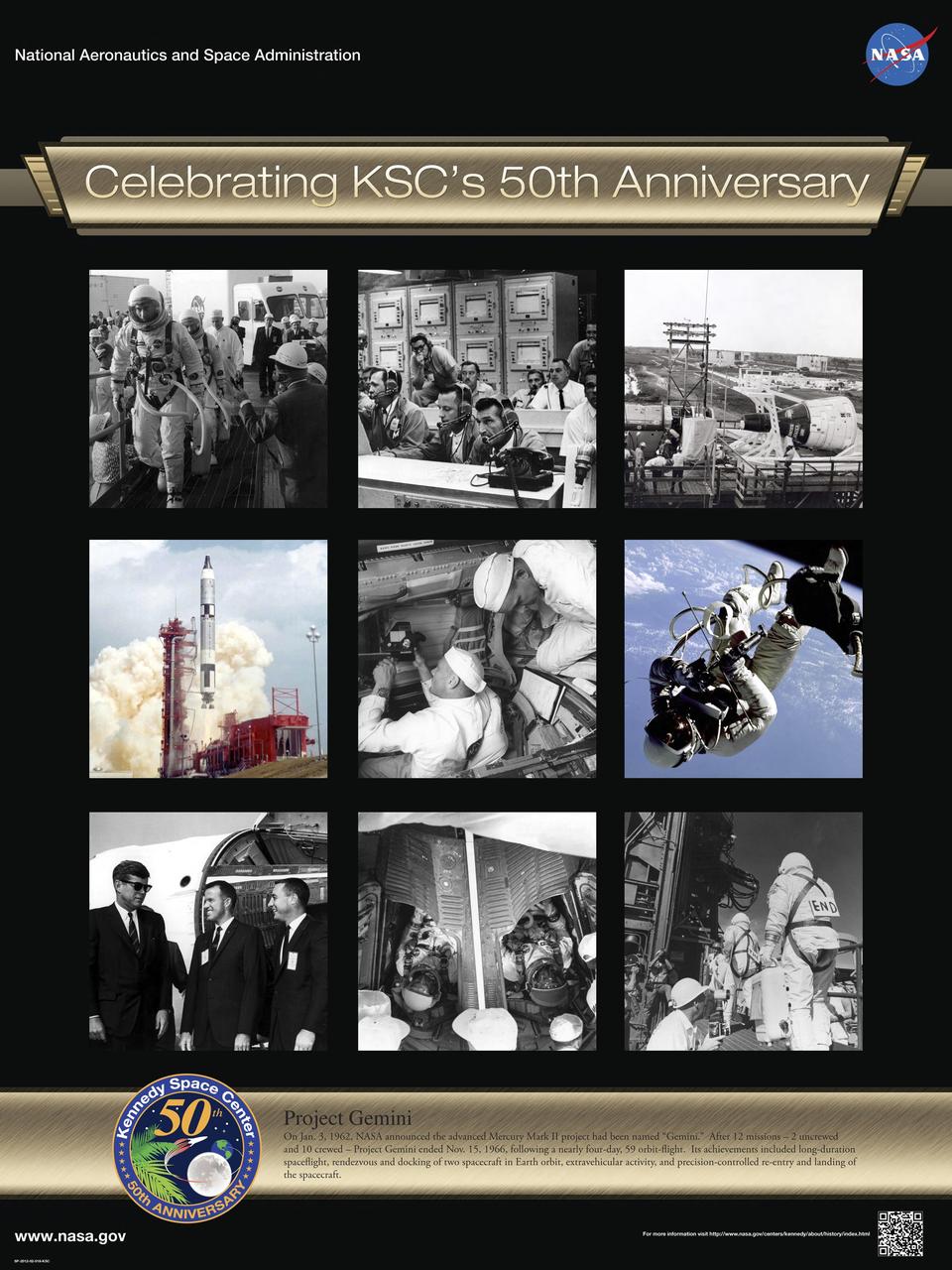
Project Gemini: On Jan. 3, 1962, NASA announced the advanced Mercury Mark II project had been named "Gemini." After 12 missions – 2 uncrewed and 10 crewed – Project Gemini ended Nov. 15, 1966, following a nearly four-day, 59 orbit-flight. Its achievements included long-duration spaceflight, rendezvous and docking of two spacecraft in Earth orbit, extravehicular activity, and precision-controlled re-entry and landing of the spacecraft. Poster designed by Kennedy Space Center Graphics Department/Greg Lee. Credit: NASA
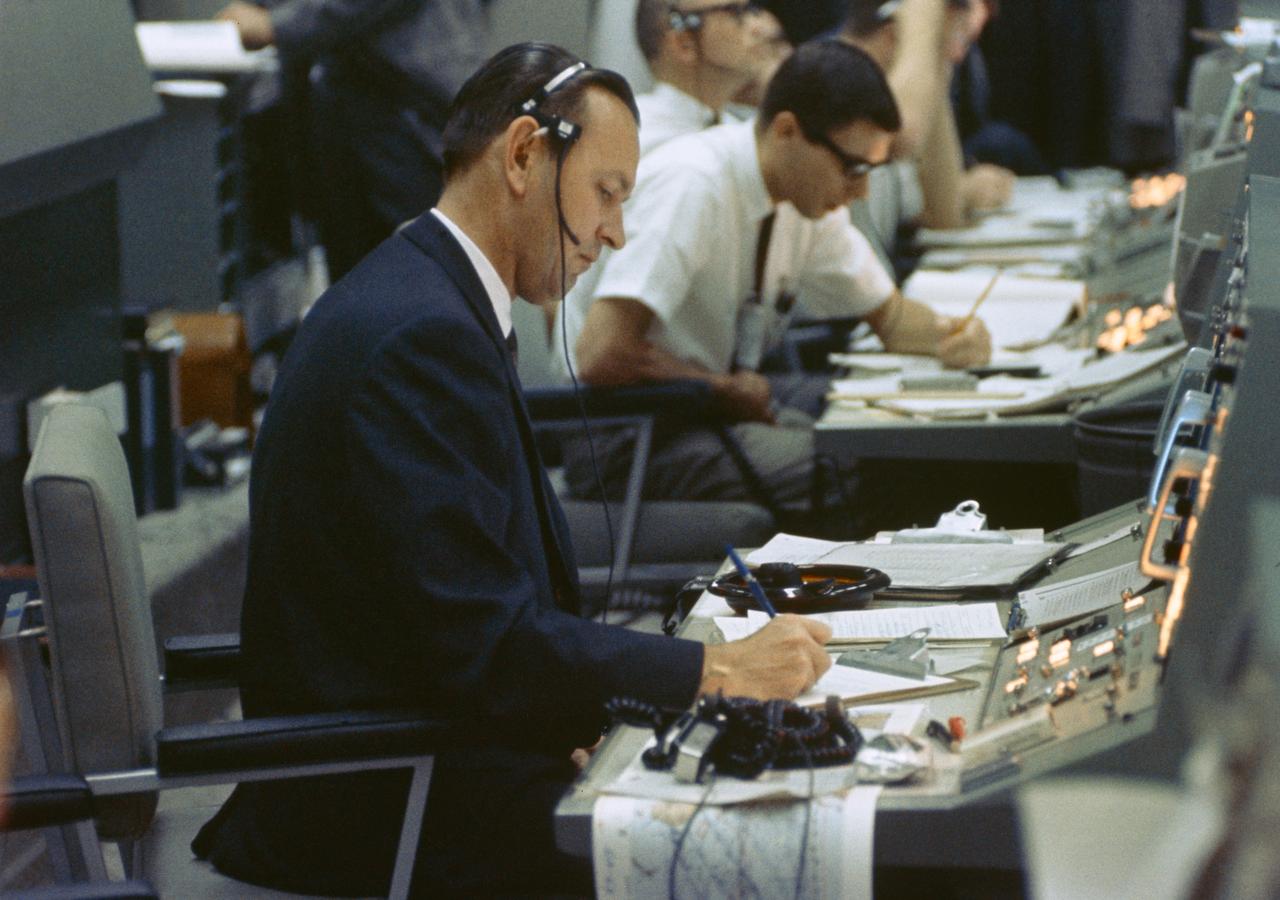
S65-28462 (3-7 June 1965) --- Christopher C. Kraft Jr., assistant director for Flight Operations, at his console in the Mission Control Center during Gemini-4 spaceflight. He served as mission director and as a flight director.
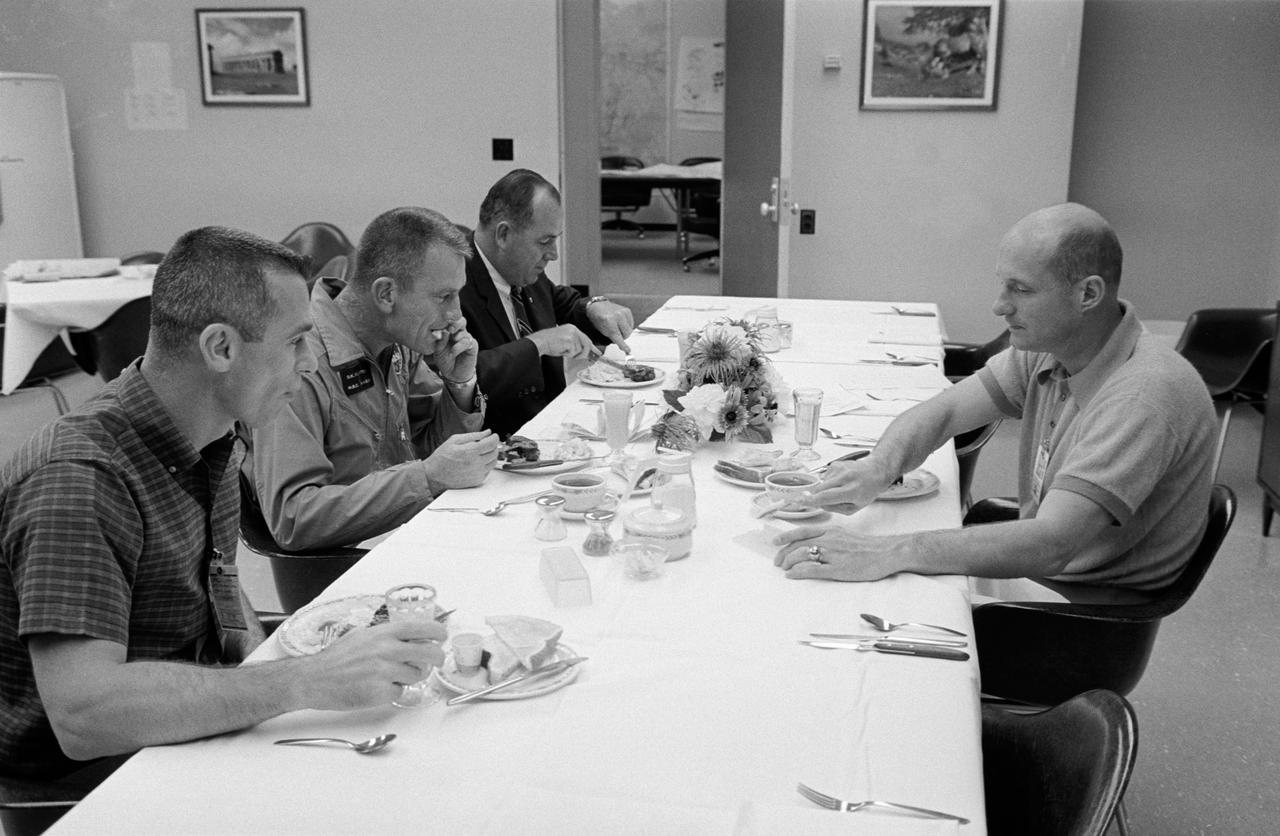
S66-34069 (3 June 1966) --- Gemini-9A prime crew enjoy a breakfast of steak and eggs on the morning of the Gemini-9A launch. Left to right, are astronaut Eugene A. Cernan, pilot; Donald K. Slayton, MSC Director of Flight Crew Operations; Charles Buckley, KSC Security; and astronaut Thomas P. Stafford, command pilot. Photo credit: NASA
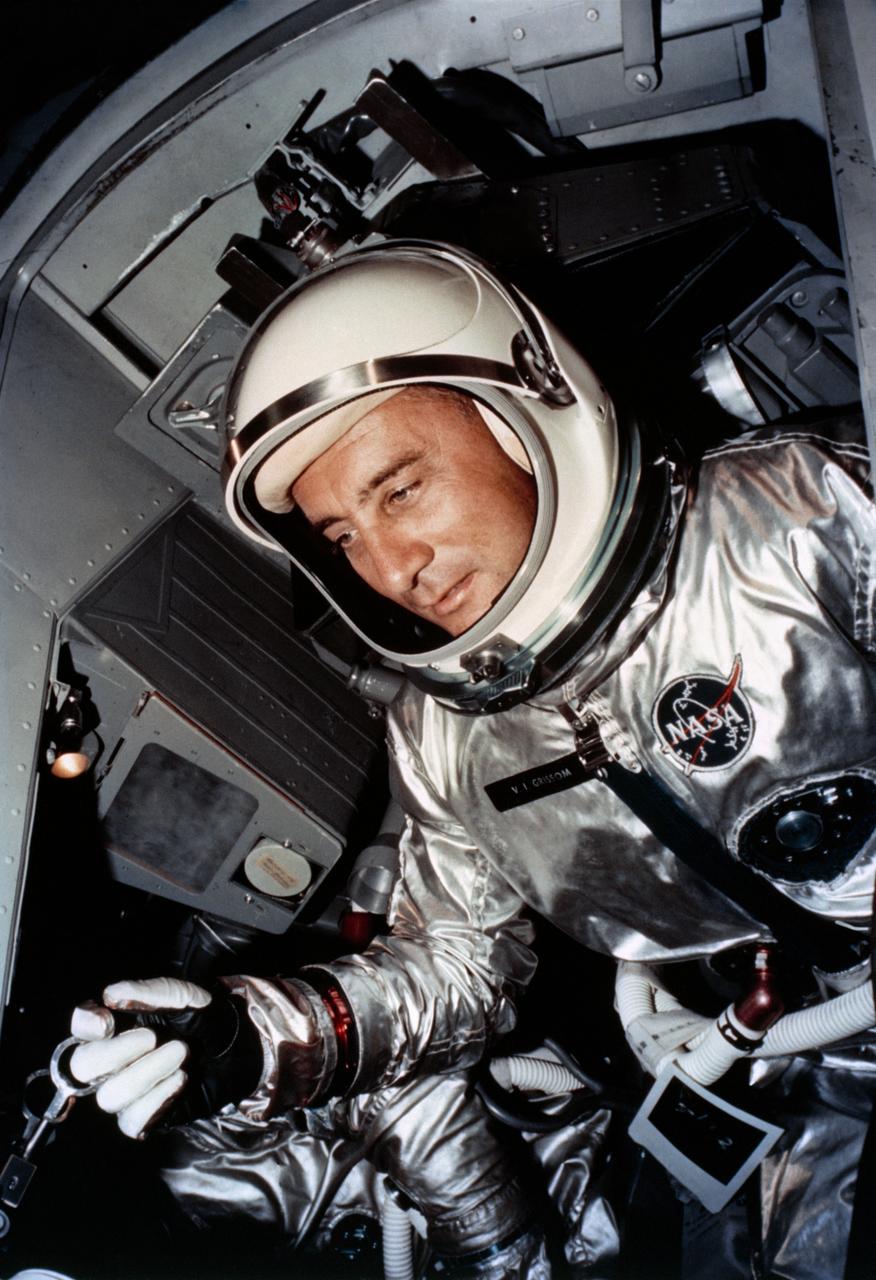
S65-23489 (23 March 1965) --- Astronaut Virgil I. Grissom, the command pilot of the Gemini-Titan 3 (GT-3) space flight, is shown in the GT-3 spacecraft just before the hatches are secured prior to launch. Grissom and his pilot, astronaut John W. Young, made three orbits of Earth during the GT-3 mission, in four hours and 53 minutes.
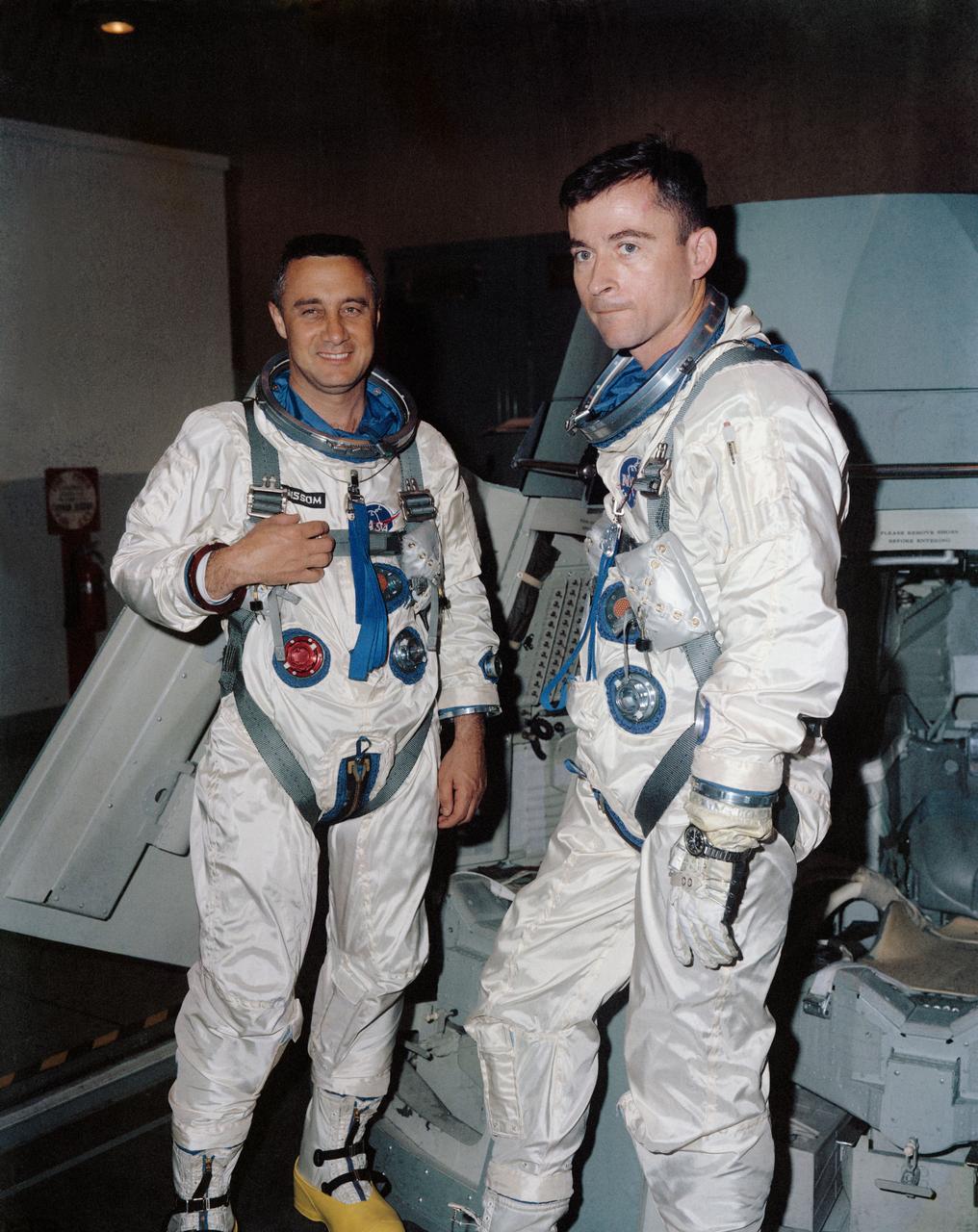
S65-14547 (26 Feb. 1965) --- The Gemini-Titan 3 prime crew, astronauts Virgil I. Grissom (left), command pilot, and John W. Young, pilot, are shown during flight simulation test activity at the Mission Control Center.
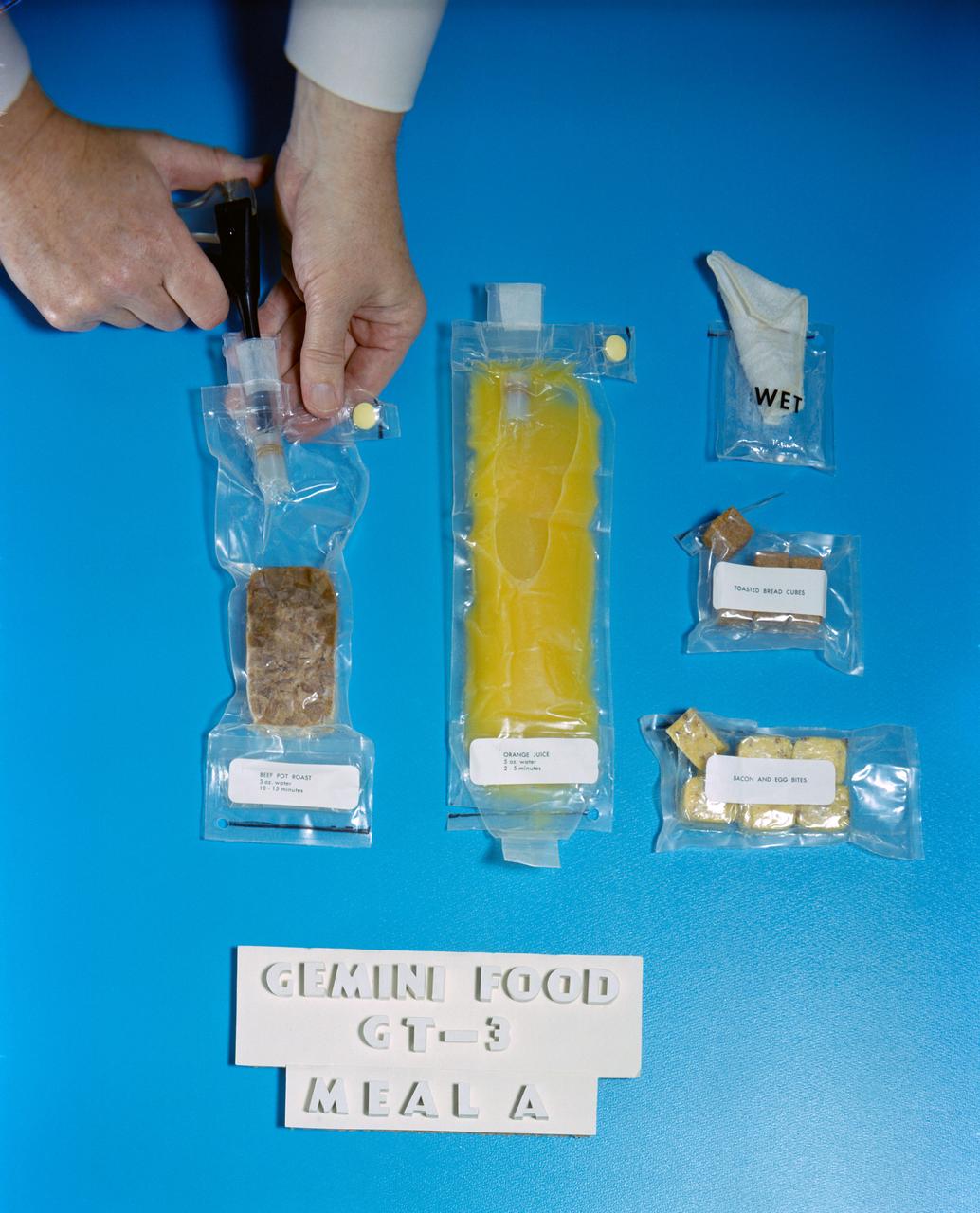
S65-10971 (March 1965 ) --- Food packets for use on the Gemini-3 flight including dehydrated beef pot roast, bacon and egg bites, toasted bread cubes, orange juice and a wet wipe. Water is being inserted into the pouch of dehydrated food.
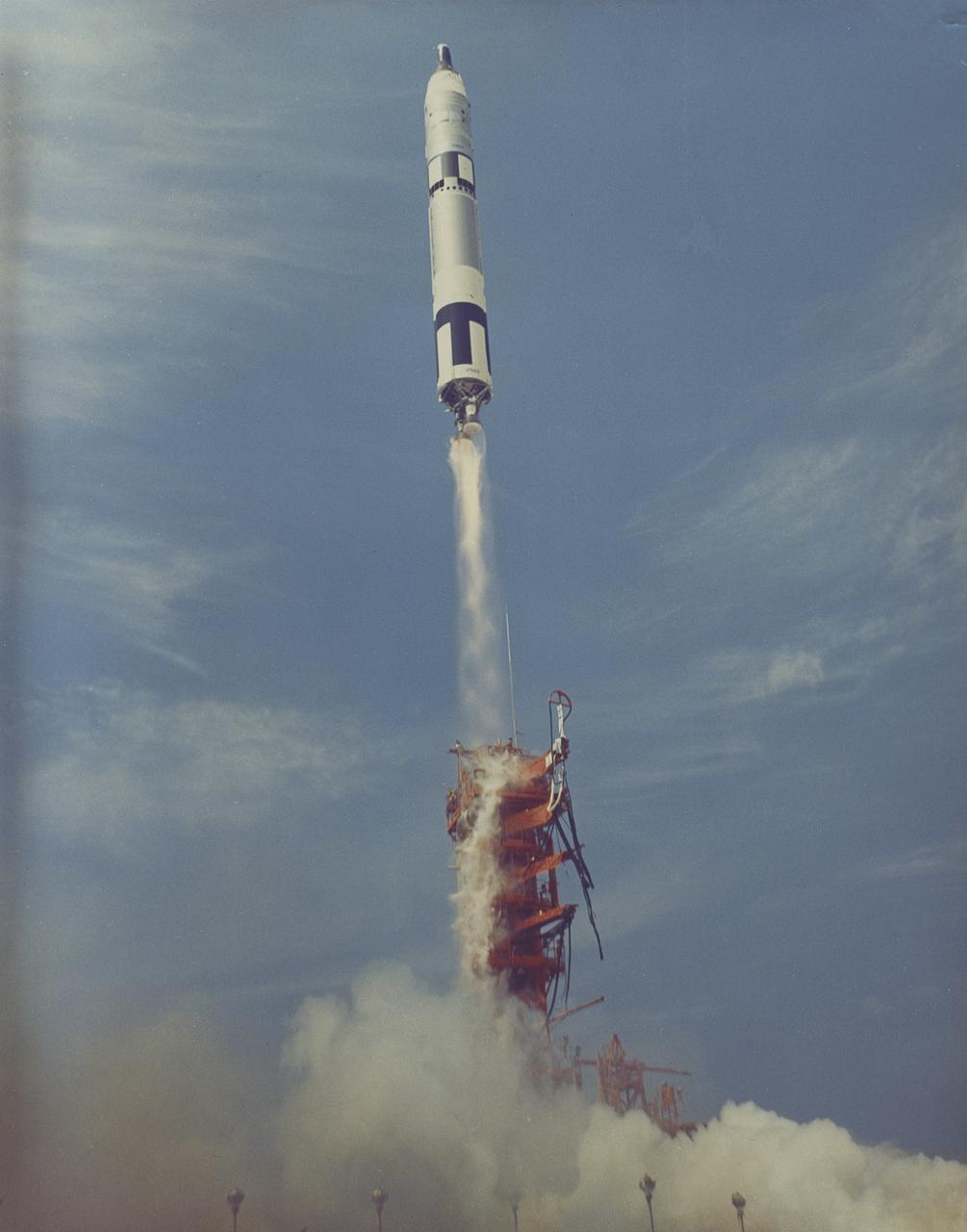
A Titan booster launched the Gemini 8 spacecraft on March 16, 1966 from launch complex 19 Cape Kennedy, Florida. The flight crew for the 3 day mission, astronauts Neil A. Armstrong and David R. Scott, achieved the first rendezvous and docking to Atlas/Agena in Earth orbit.
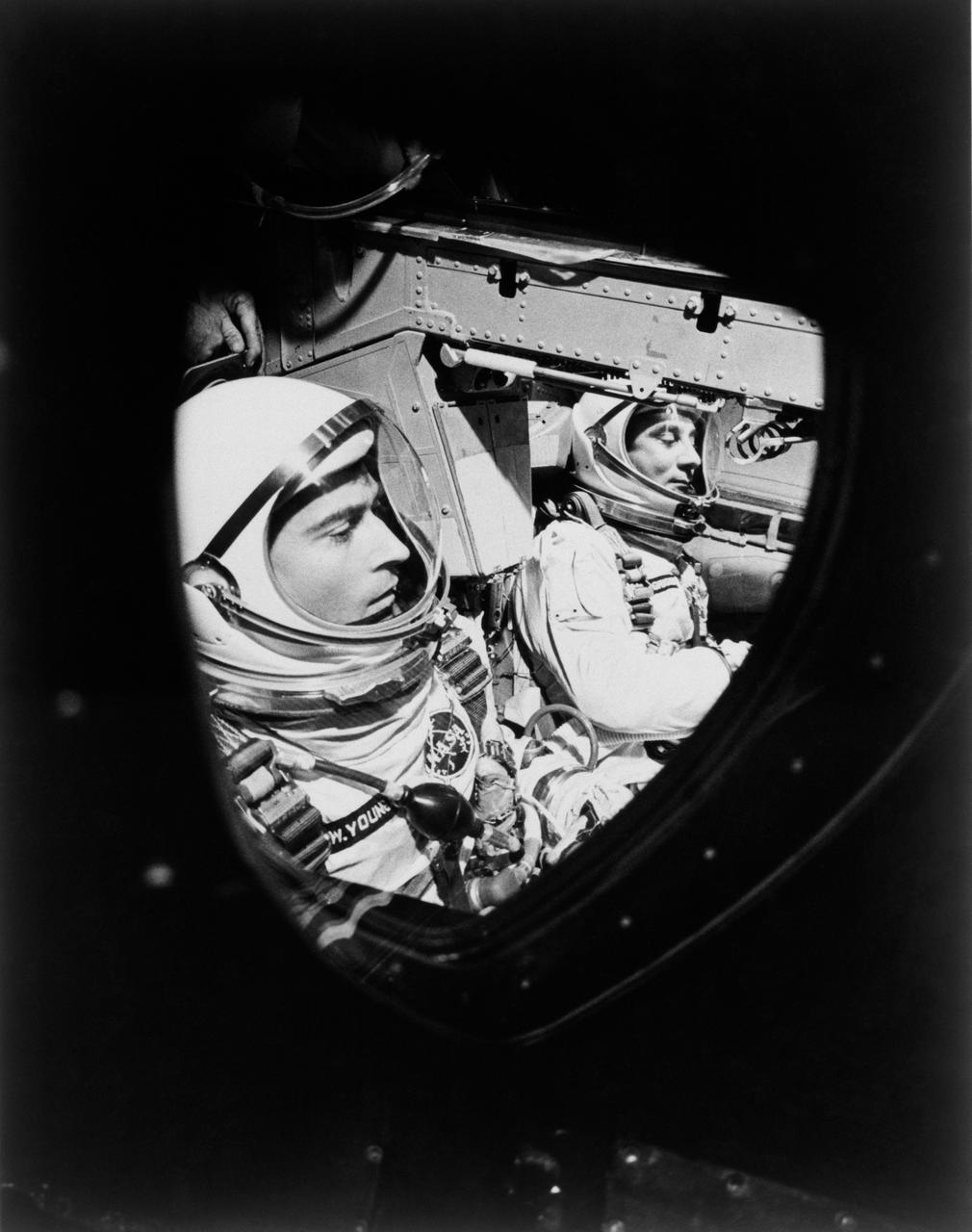
S65-19225 (23 March 1965) --- This view of astronauts John W. Young (left), pilot, and Virgil I. Grissom, command pilot, was taken through the window of the open hatch on Young's side of the Gemini-Titan 3 spacecraft just before the hatches were closed in readiness for their three-orbit flight.
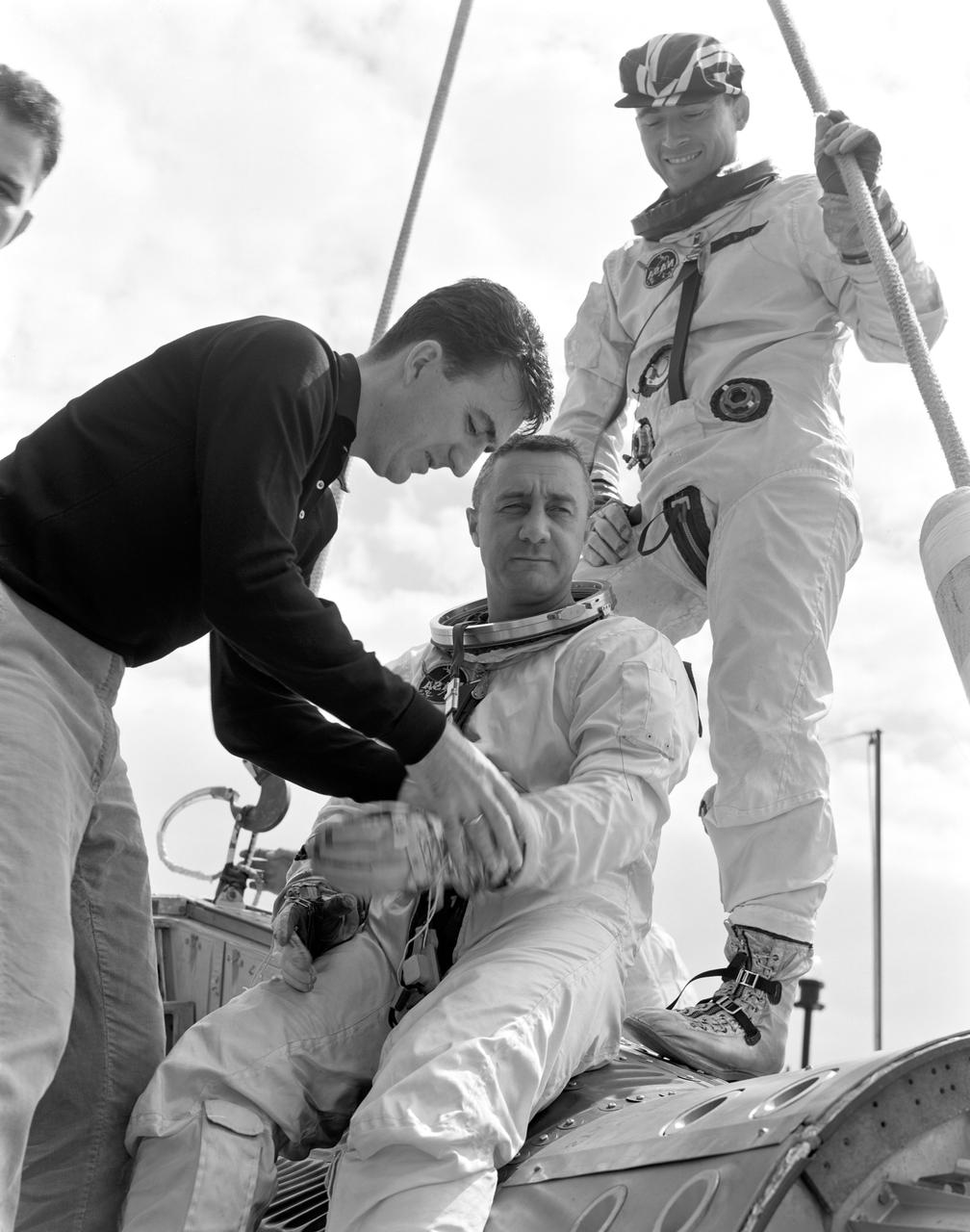
S65-14454 (23 Feb. 1965) --- A technician adjusts the suit of astronaut Virgil I. Grissom during water egress training operations in the Gulf of Mexico. Astronaut John W. Young (standing) observes. Grissom and Young are the prime crew for the Gemini-Titan 3 flight scheduled this spring.
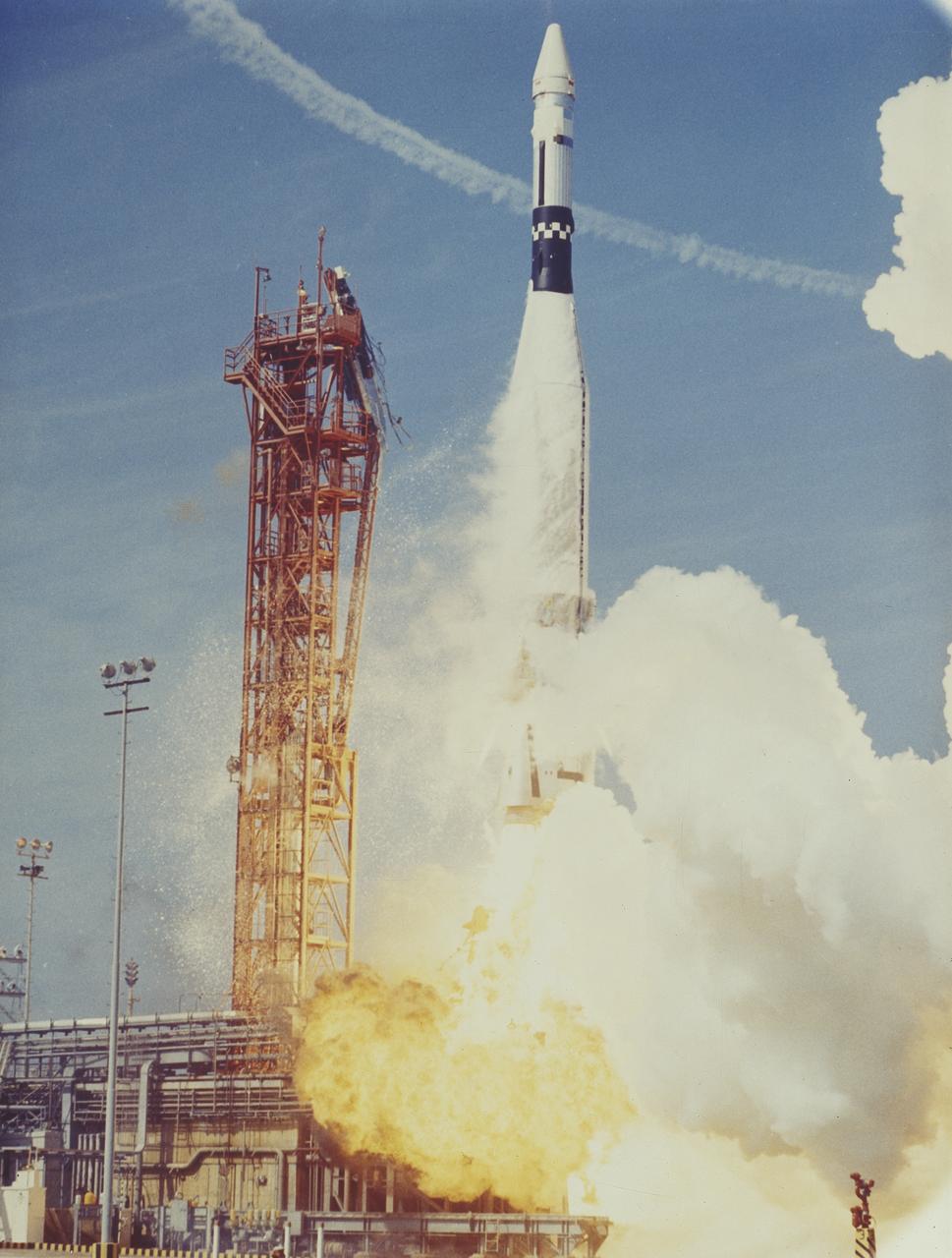
On March 16, 1966, an Atlas booster launched an Agena Target Vehicle for the Gemini 8 mission. The flight crew for the 3 day mission, astronauts Neil A. Armstrong and David R. Scott, achieved the first rendezvous and docking to Atlas/Agena in Earth orbit.
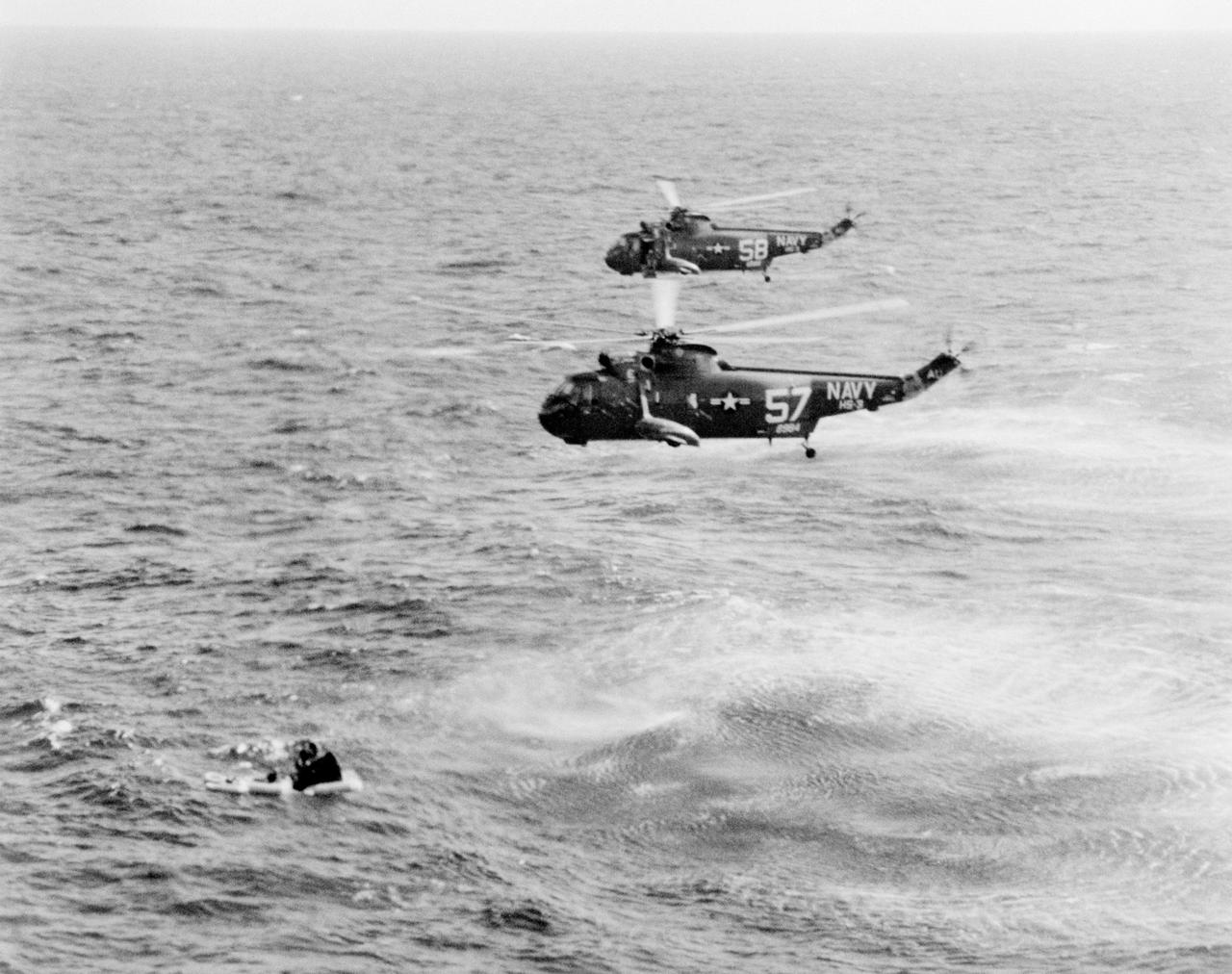
S65-19229 (23 March 1965) --- The Gemini-Titan 3 spacecraft is shown in the water after the March 23rd four-hour and 53-minute flight. Two helicopters from the recovery ship, the USS Intrepid, hover over the scene for the pickup of the astronauts.
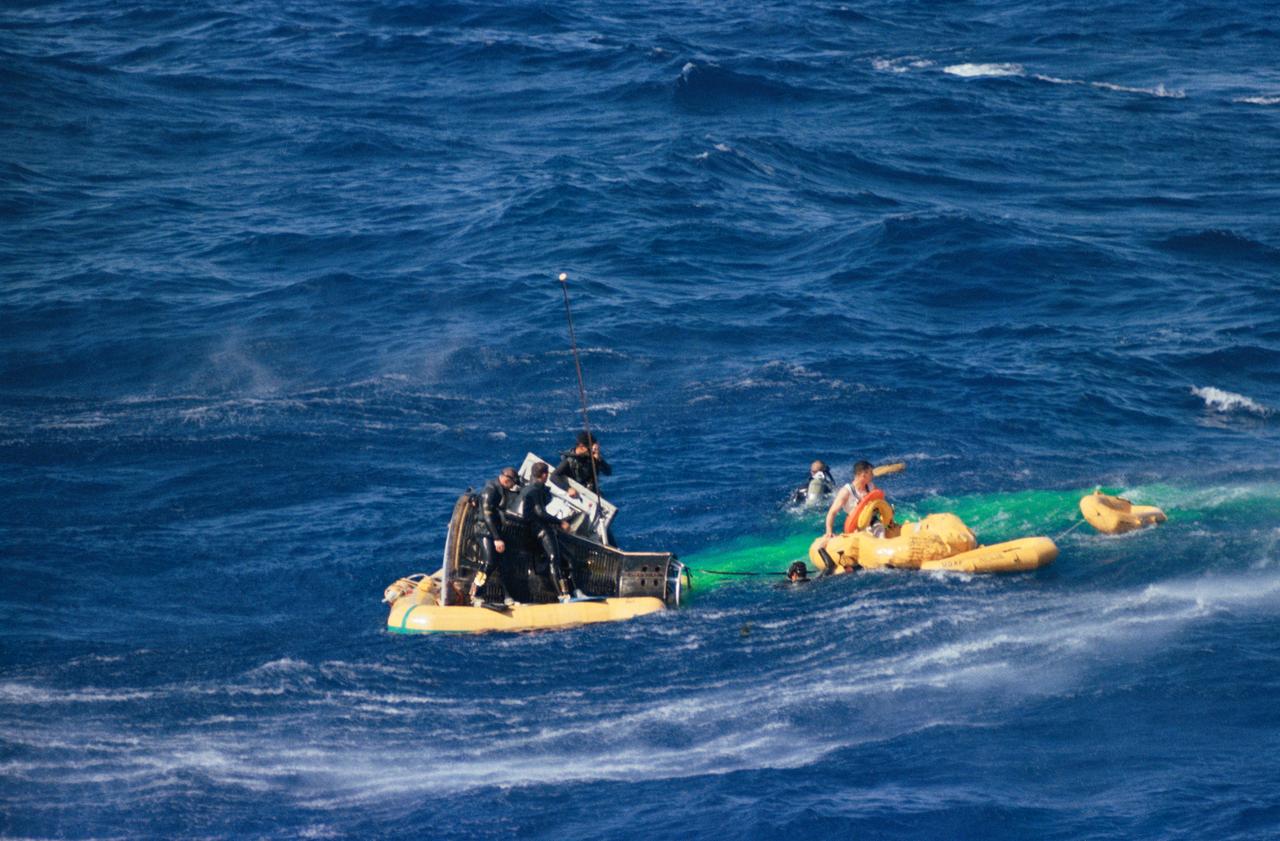
S65-22893 (23 March 1965) --- Astronaut John W. Young, the pilot of the Gemini-Titan III (GT-3) flight, waits in a life raft to be picked up by a helicopter during recovery operations following the successful three-orbit mission. Young and astronaut Virgil I. Grissom, command pilot, were flown by helicopter to the nearby recovery vessel, the USS Intrepid. The recovery ship later came alongside and retrieved the GT-3 spacecraft. United States Navy swimmers assisted in the GT-3 recovery operations.
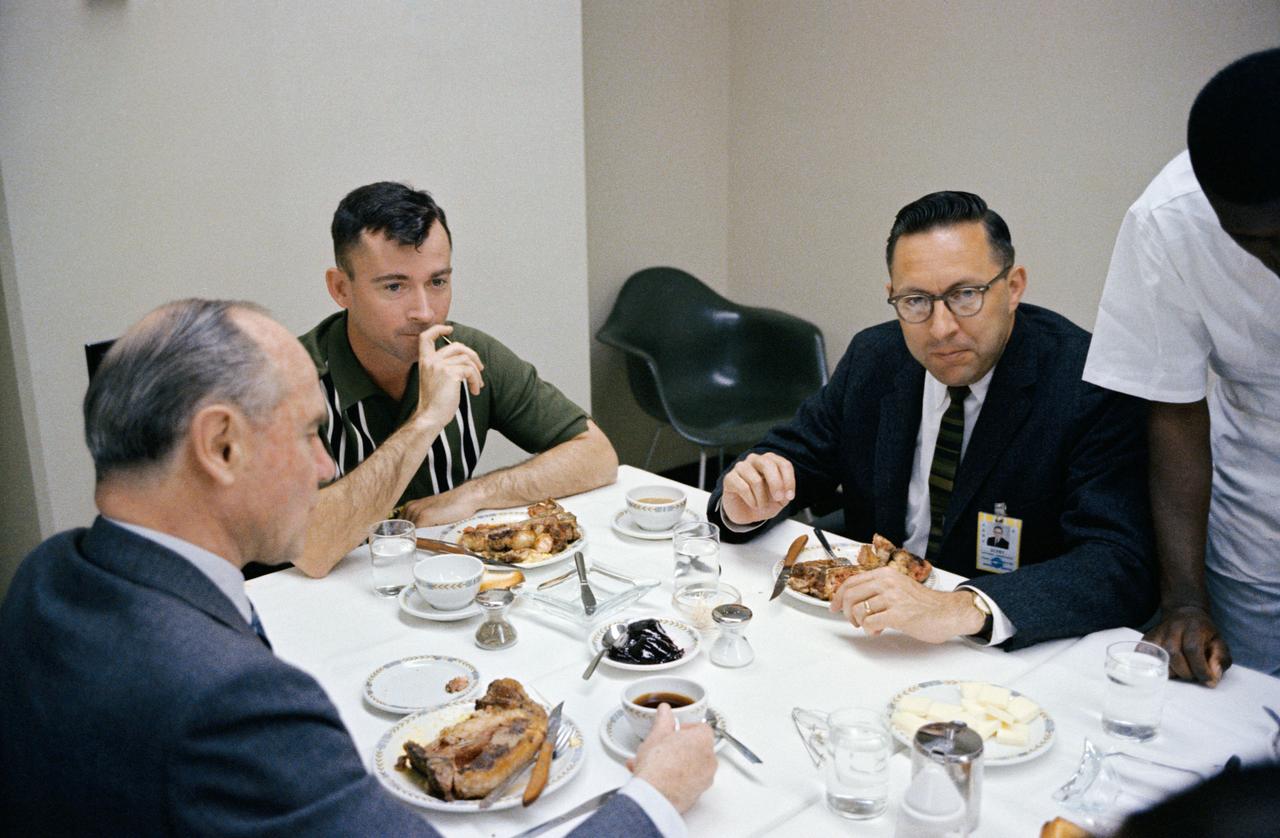
S65-20428 (23 March 1965) --- Astronaut John W. Young (center), pilot of the Gemini-Titan 3 flight, is shown during a steak breakfast which he was served about two hours prior to the 9:24 a.m. (EST) GT-3 launch. At left is J.S. McDonnell, board chairman and Chief Executive Officer of the McDonnell Aircraft Corporation. Dr. Charles A. Berry, chief of Center Medical Programs, is at right.
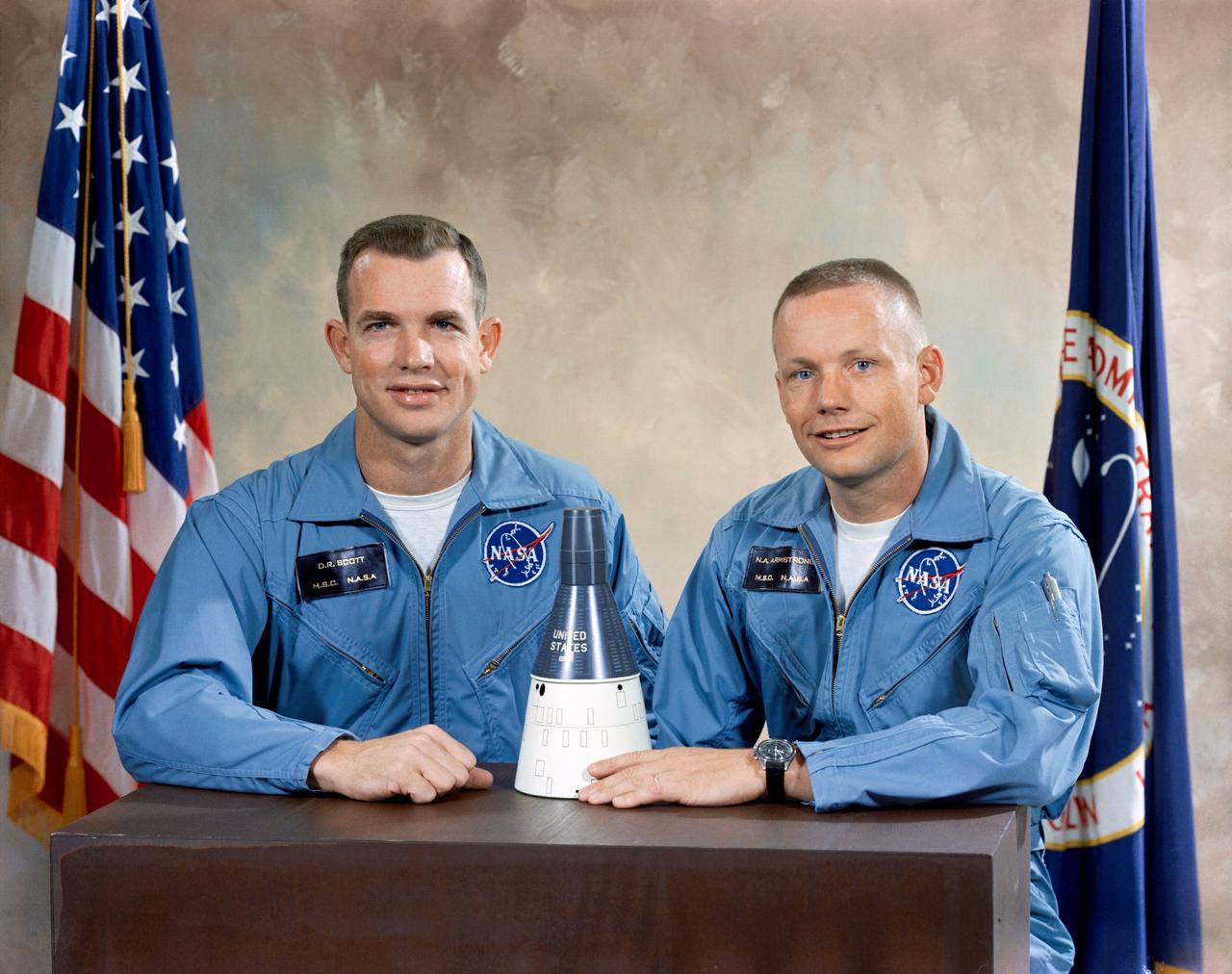
S65-58499 (4 Nov. 1965) --- Astronauts Neil A. Armstrong (right), command pilot; and David R. Scott, pilot, are the prime crewmen of the Gemini-8 space mission. Photo credit: NASA
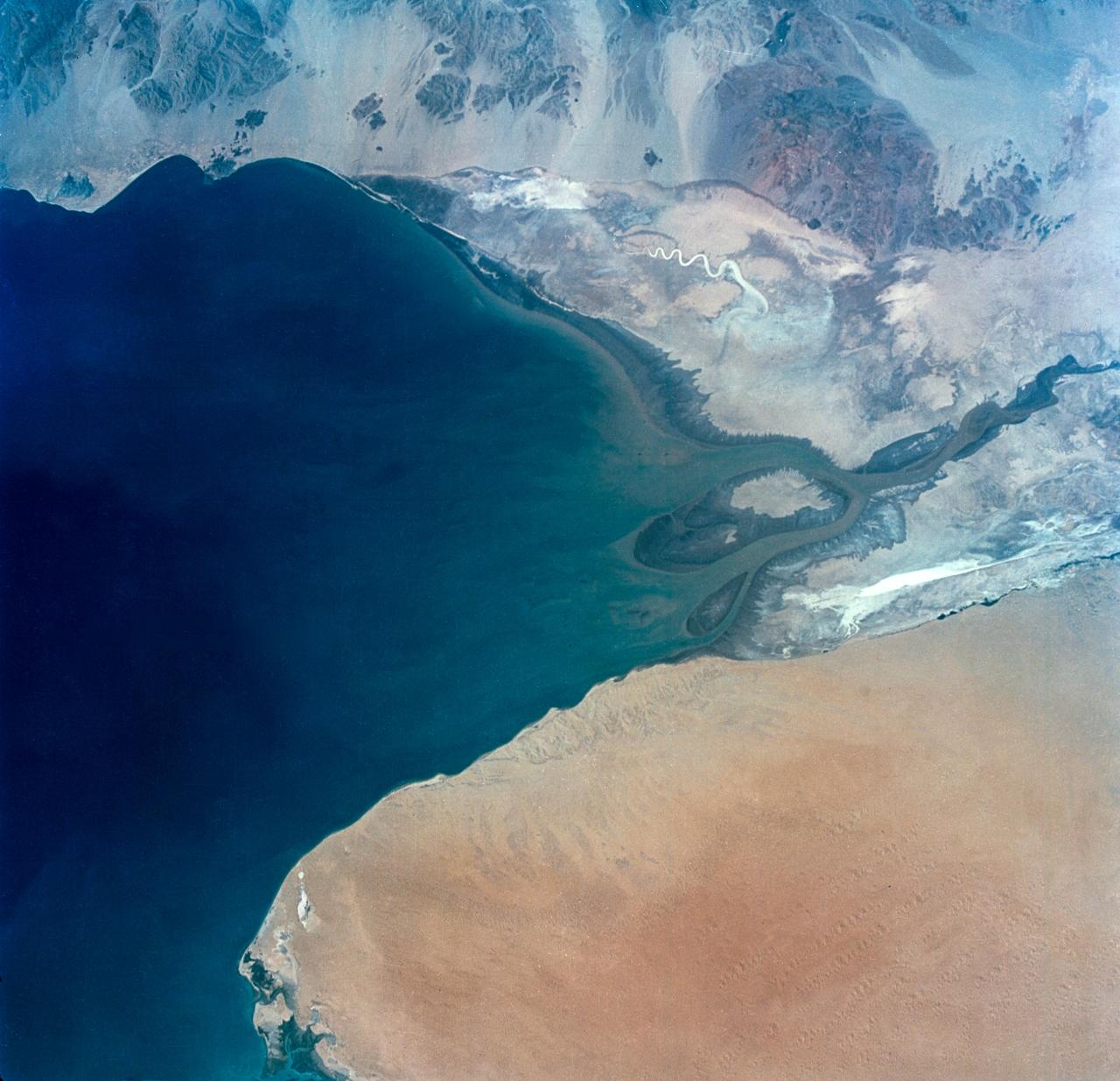
S65-34673 (3-7 June 1965) --- This photograph shows the north end of the Gulf of California at the mouth of the Colorado River as it was seen from the Gemini-4 spacecraft during orbital flight June 3-7, 1965. This picture was part of the Synoptic Terrain Photography experiments conducted during the flight to obtain high quality photographs of large land areas already mapped by aerial photography. In charge of these experiments was Dr. Paul D. Lowman Jr., NASA geologist from Goddard Space Flight Center, Greenbelt, Md. This picture was taken with a modified 70mm Hasselblad camera using Eastman color film, ASA 64 at a lens setting of 250th of a second at f/11.
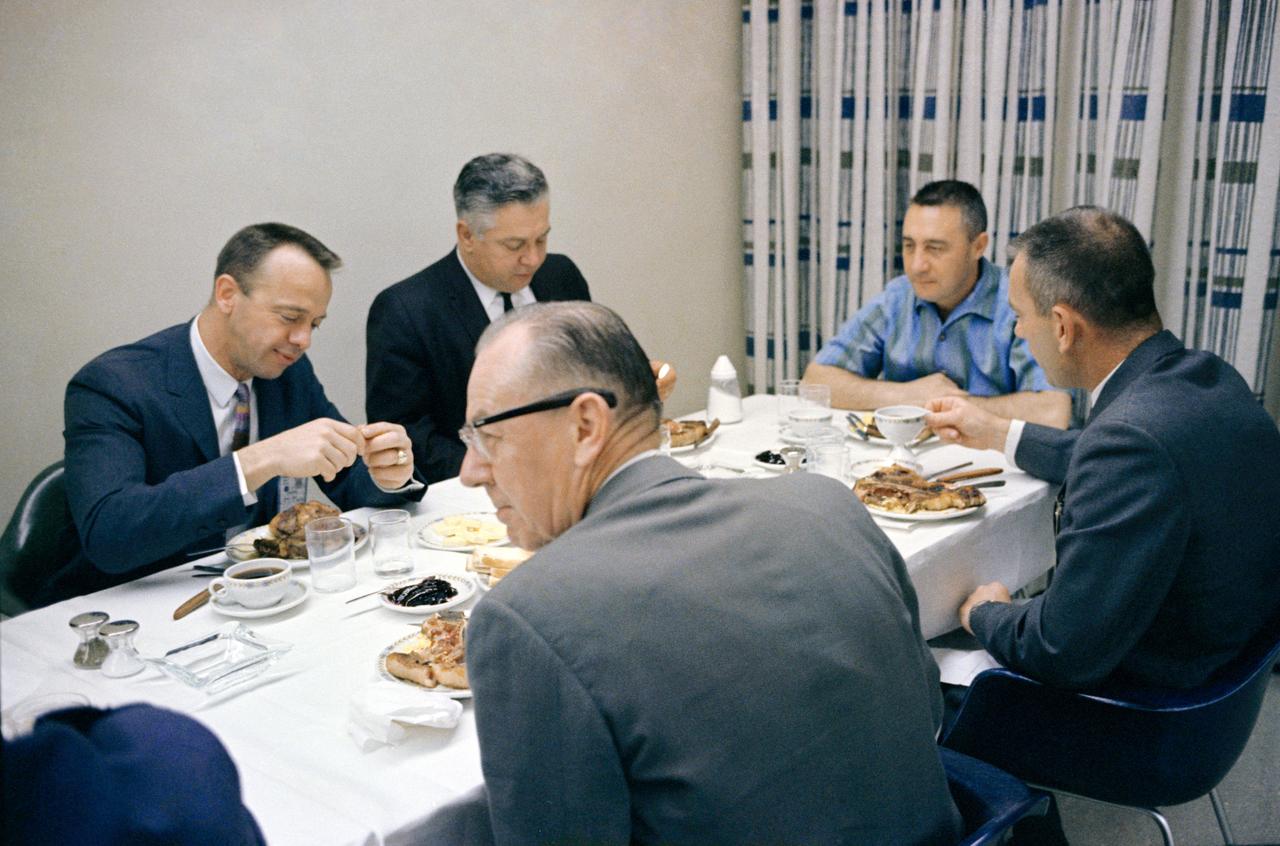
S65-21093 (23 March 1965) --- Astronaut Virgil I. Grissom (facing camera at right), command pilot of the Gemini-Titan 3 flight, is shown during a steak breakfast which he was served about two hours prior to the 9:24 a.m. (EST) GT-3 launch on March 23, 1965. Pictured in the foreground are Donald K. Slayton (right), assistant director for Flight Crew Operations; and Walter Burke, general manager of McDonnell Aircraft Corporation Spacecraft and Missiles. Pictured in the background are astronaut Alan B. Shepard Jr. (left) and Walter C. Williams, former deputy director of the Manned Spacecraft Center, now with a private aerospace firm.
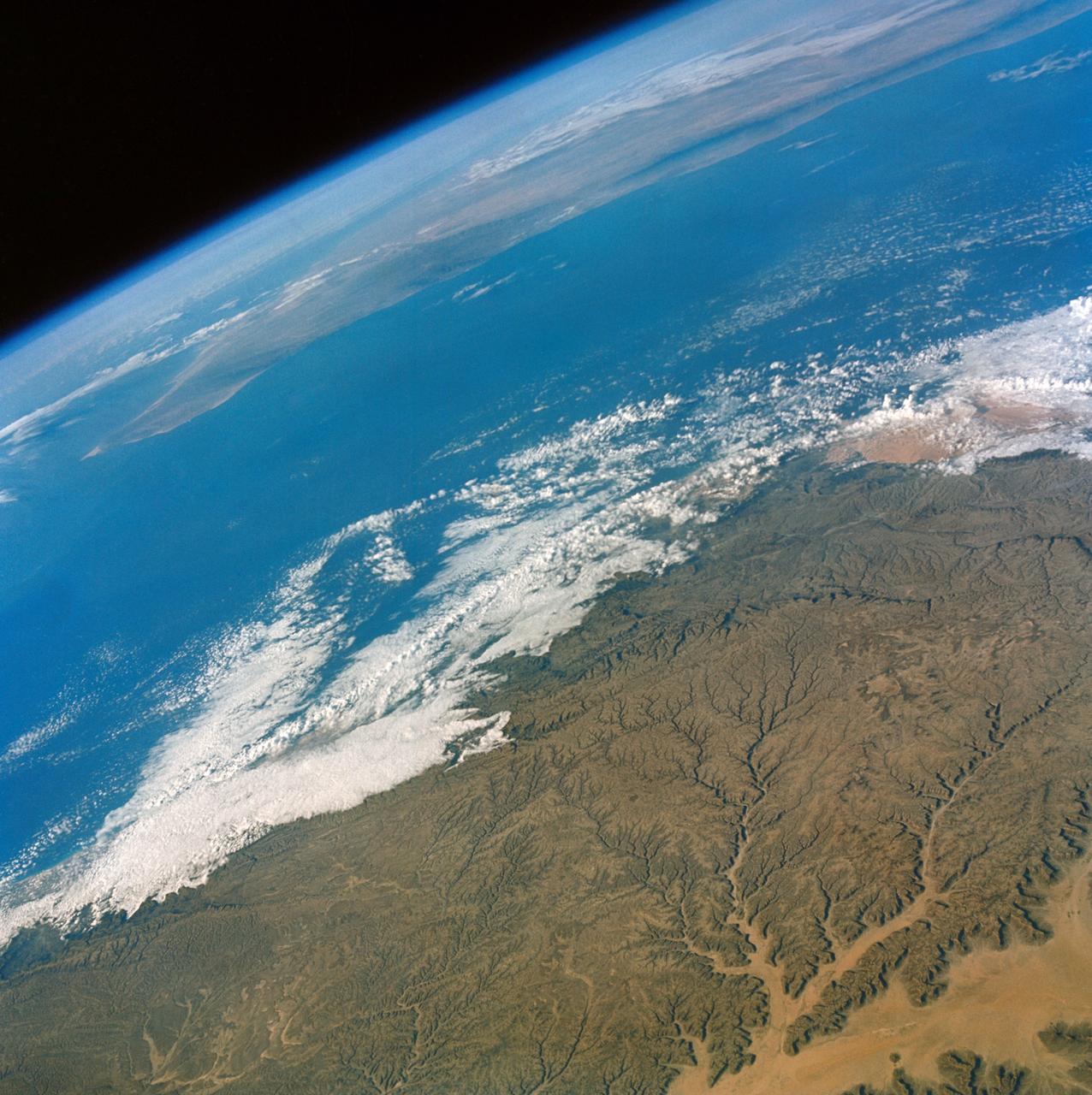
S65-34659 (3-7 June 1965) --- Among the many photographs taken from the Gemini-4 spacecraft during its orbital flight around Earth was this view of the Hahramaut Plateau on the southern portion of the Arabian Peninsula. The Wadi Hahramaut is in the foreground; with the Gulf of Aden (dark blue). This photograph was made with a modified 70mm Hasselblad camera, using Eastman color film, ASA 64, at a lens setting of 250th of a second at f/11.
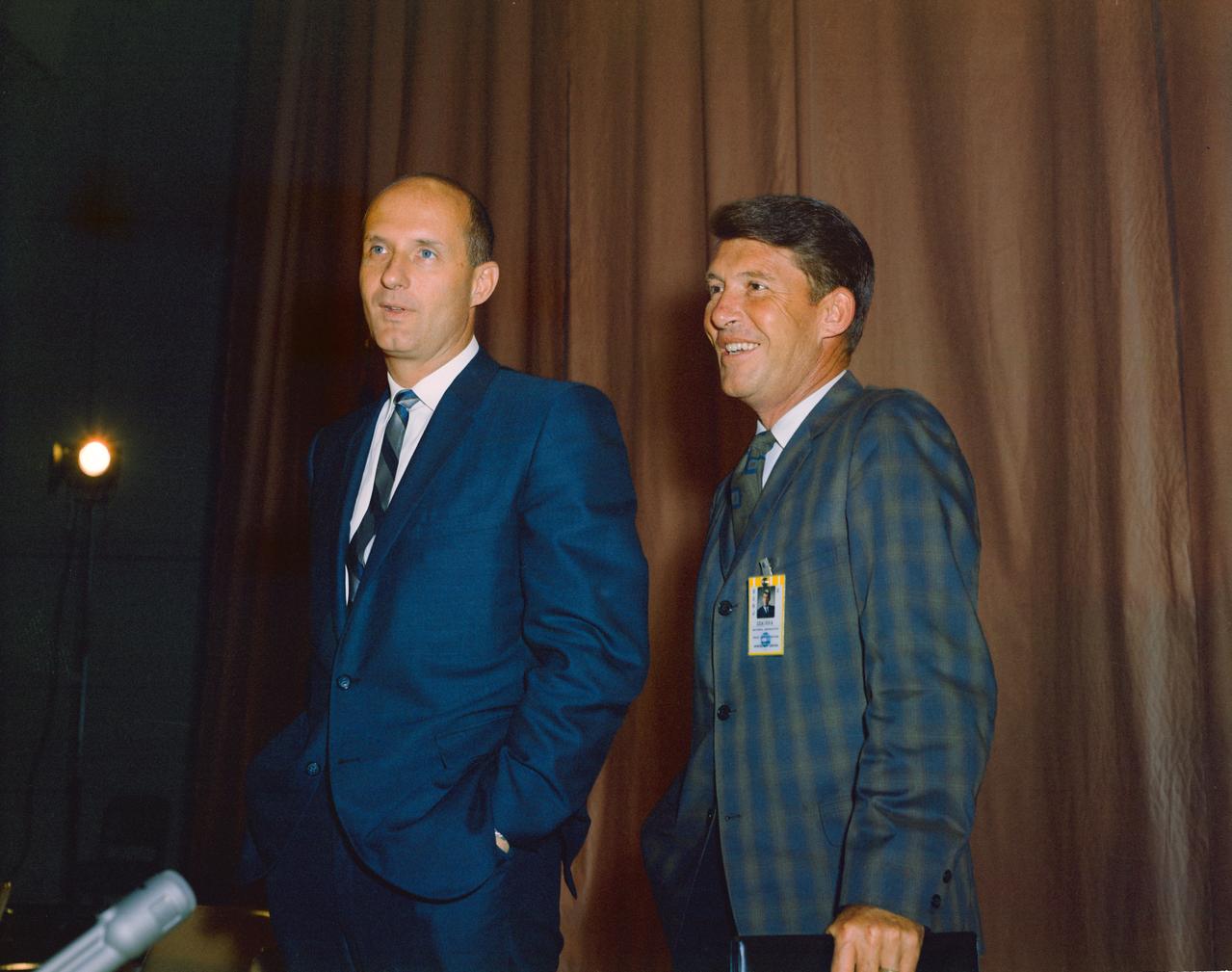
S65-19406 (6 April 1965) --- Astronauts Thomas P. Stafford (left), pilot; and Walter M. Schirra Jr., command pilot, have been named as the prime crew for the Gemini-Titan 6 spaceflight. Schirra and Stafford served as the GT-3 backup crew. Their selection for the GT-6 flight was announced at an MSC news conference on April 6, 1965.
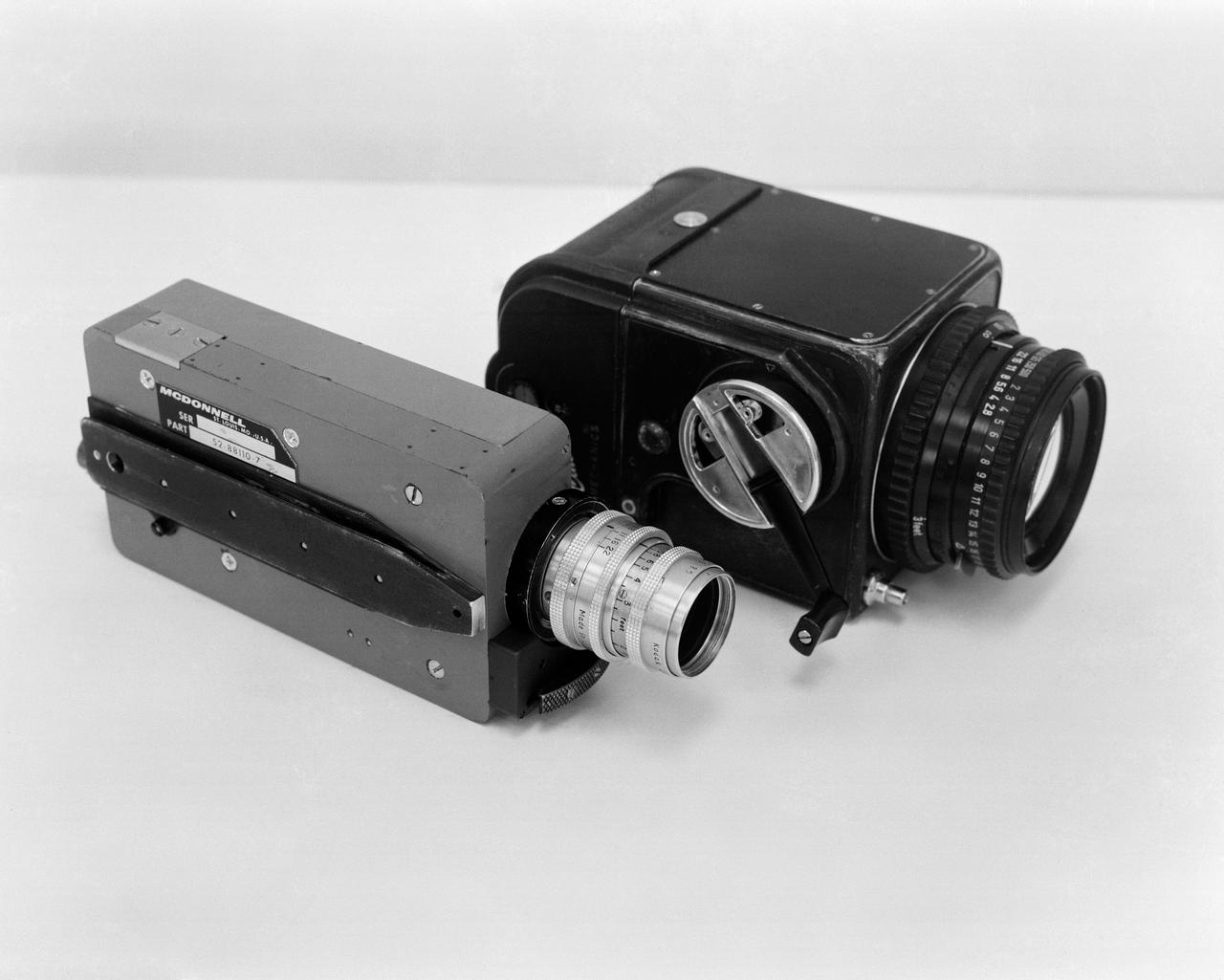
S65-17399 (March 1965) --- Two cameras which will be used on the Gemini-Titan 3 orbital flight. The lighter colored one is a McDonnell 16mm sequential camera, having a 120-feet film capacity, and a 25mm f/1.9 lens. The black camera is a modified Hasselblad, hand-held, with a 70mm flimback, using an 80mm f/2.8 lens.
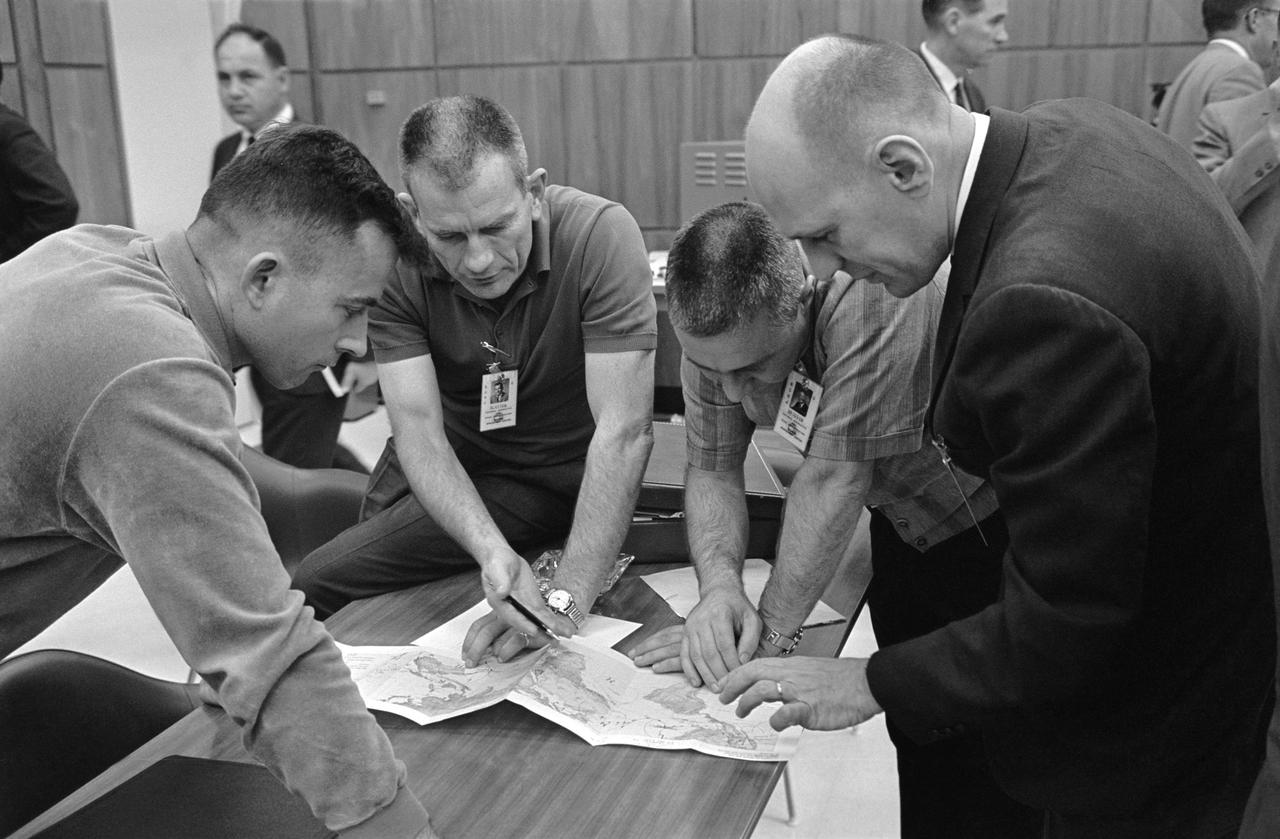
S65-20627 (20 March 1965) --- Crew members for the NASA Gemini-Titan 3 mission go over the map of the orbital track with Donald K. Slayton, assistant director for Flight Crew Operations, Manned Spacecraft Center. Shown (left to right) are astronauts John W. Young, pilot; Slayton; Virgil I. Grissom, command pilot; and Ken Nagler, U.S. Weather Bureau. The group got together at the GT-3 mission review meeting on March 20, 1965, in the Manned Spacecraft Operations Building on Merritt Island, Florida. Items covered at the review included mission description, spacecraft, launch vehicle, experiments, world-wide tracking network, recovery and weather.
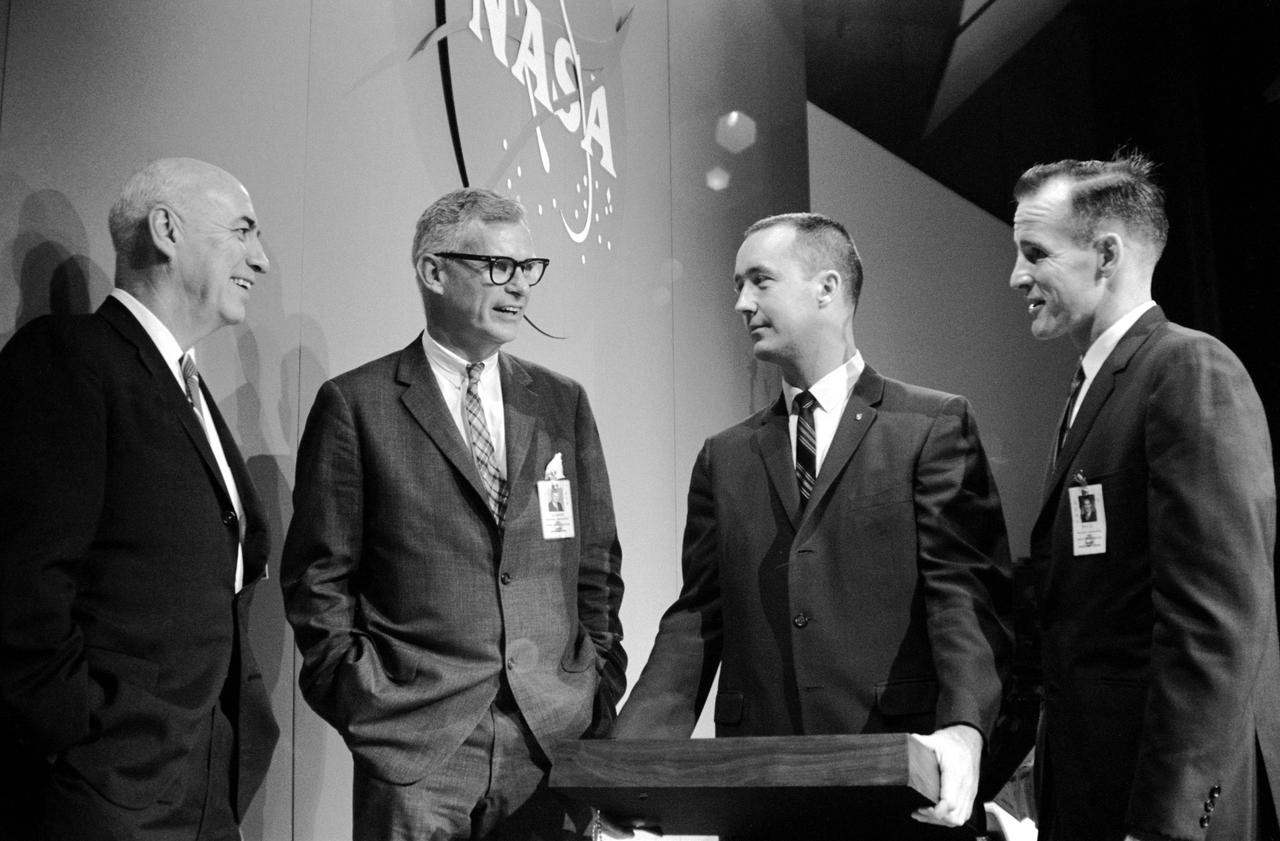
S65-33352 (11 June 1965) --- The Gemini-4 prime crew pose with two NASA officials after a press conference in the MSC auditorium. Left to right, are Dr. Robert R. Gilruth, MSC director; Dr. Robert C. Seamans Jr., associate administrator, National Aeronautics and Space Administration; astronaut James A. McDivitt, command pilot of the Gemini-4 flight; and astronaut Edward H. White II, pilot of the mission. The two astronauts had just returned to Houston following their debriefings at Cape Kennedy. The Gt-4 liftoff was at 10:16 a.m. (EST) on June 3, 1965. Time of splashdown ending the four-day, 62-revolution mission was at 12:12 p.m. on June 7, 1965.
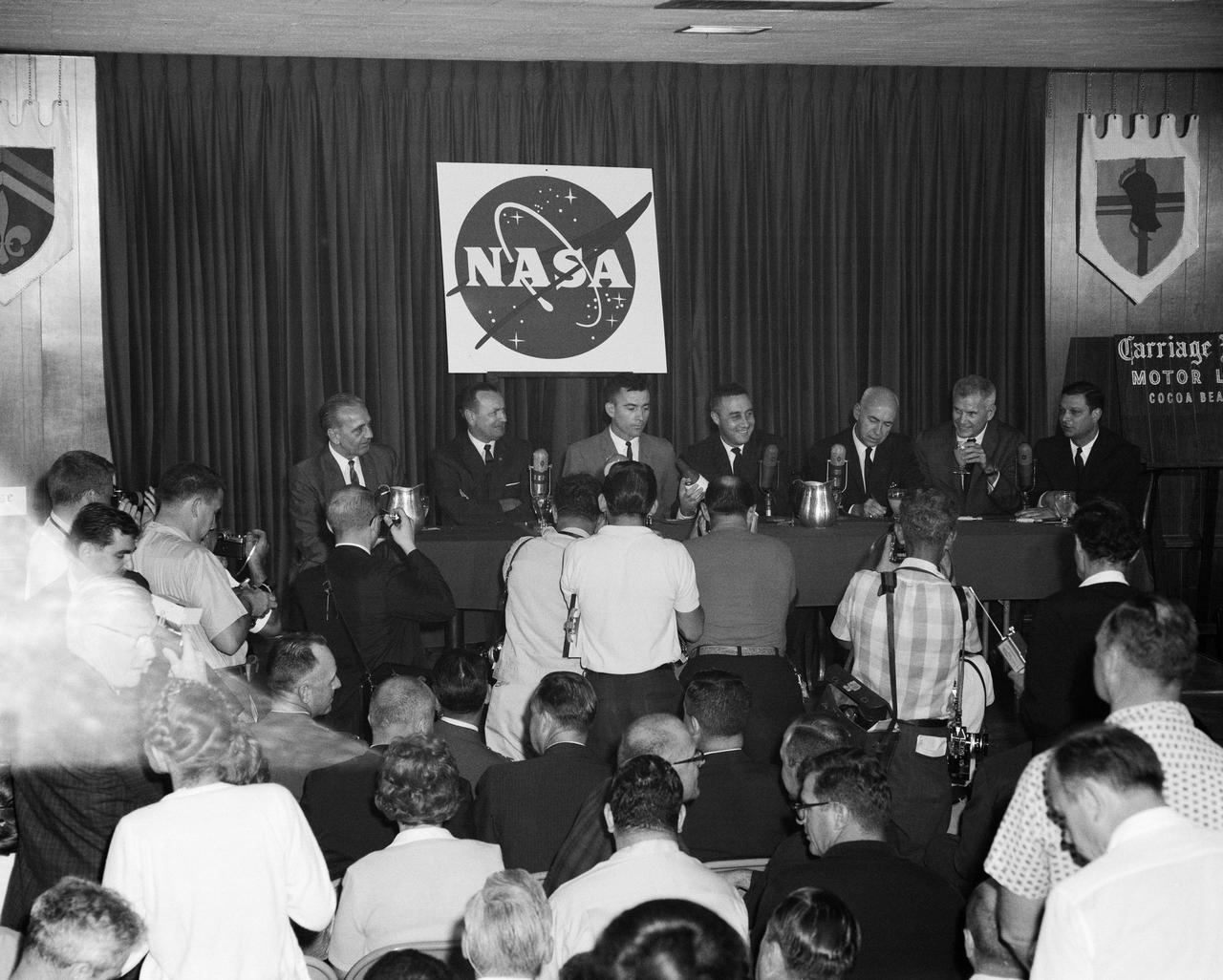
S65-20864 (25 March 1965) --- News conference held at the Carriage House press site the day after the successful Gemini-Titan 3 three-orbit mission. Being interviewed at the press table by news media are (left to right) Dr. Kurt H. Debus, director of Kennedy Space Center; Christopher C. Kraft Jr., MSC assistant director for Flight Operations; astronaut John W. Young, pilot of the GT-3 flight; astronaut Virgil I. Grissom, command pilot of the GT-3 mission; Dr. Robert R. Gilruth, MSC director; Dr. Robert C. Seamans, NASA associate administrator; and Julian Scheer, assistant administrator, Office Of Public Affairs, NASA.
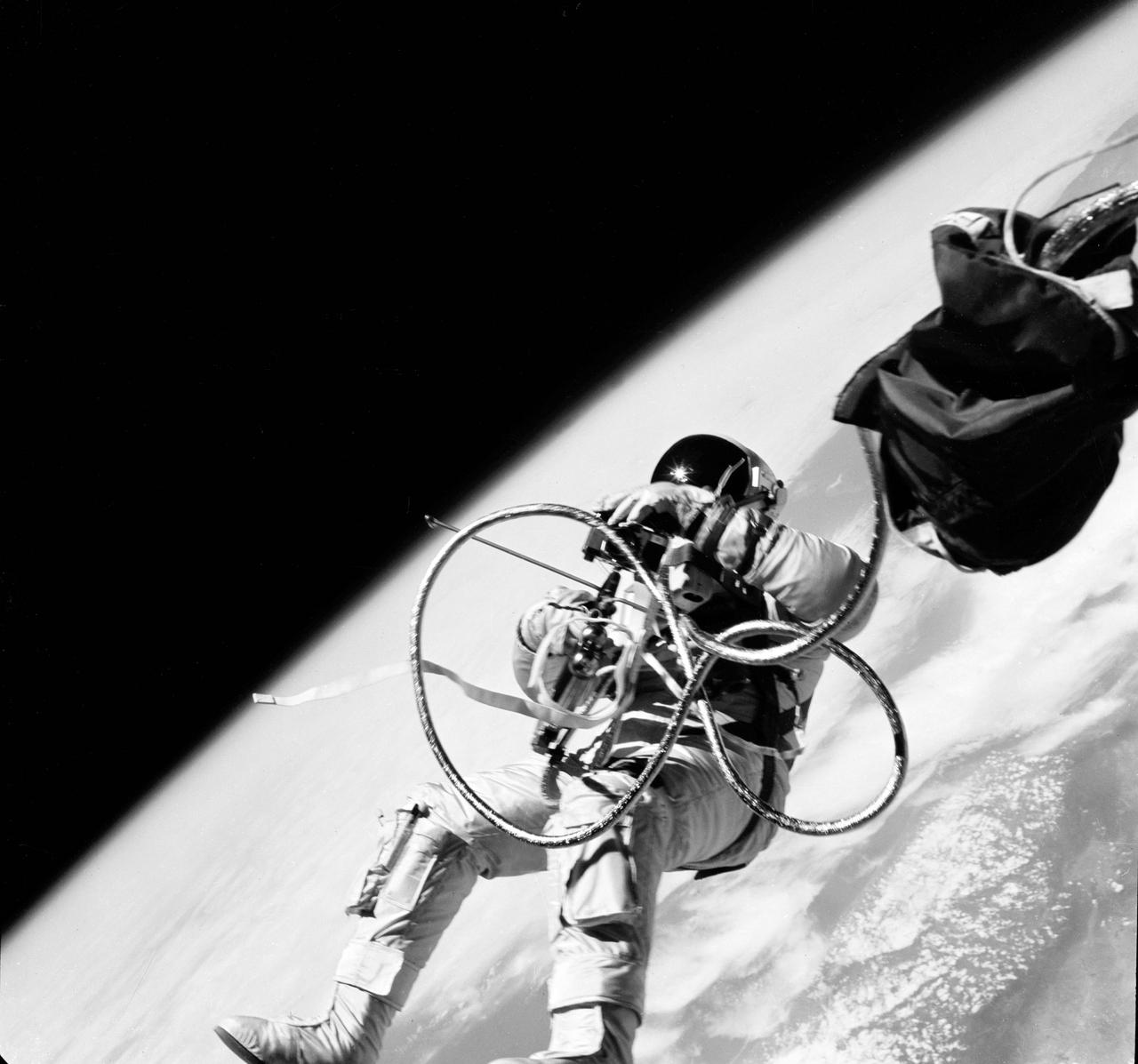
S65-30273 (3 June 1965) --- Astronaut Edward H. White II, pilot on the Gemini-Titan IV (GT-4) spaceflight, floats in the zero gravity of space outside the Gemini IV spacecraft. His face is covered by a shaded visor to protect him from the unfiltered rays of the sun. White became the first American astronaut to walk in space. He remained outside the spacecraft for 21 minutes during the third revolution of the Gemini IV mission. He wears a specially designed spacesuit for the EVA. His right hand is holding the Hand-Held Self-Maneuvering Unit (HHSMU), with which he controlled his movements while in space, and a camera is attached to the HHSMU. He was attached to the spacecraft by a 25-feet umbilical line and a 23-feet tether line, both wrapped together with gold tape to form one cord. He wears an emergency oxygen supply check pack. Astronaut James A. McDivitt is command pilot for the GT-4 mission. The mission was a four-day, 62-revolution flight, during which McDivitt and White performed a series of scientific and engineering experiments. (This image is black and white) Photo credit: NASA EDITOR?S NOTE: Astronaut Edward H. White II died in the Apollo/Saturn 204 fire at Cape Kennedy, Florida, on Jan. 27, 1967.
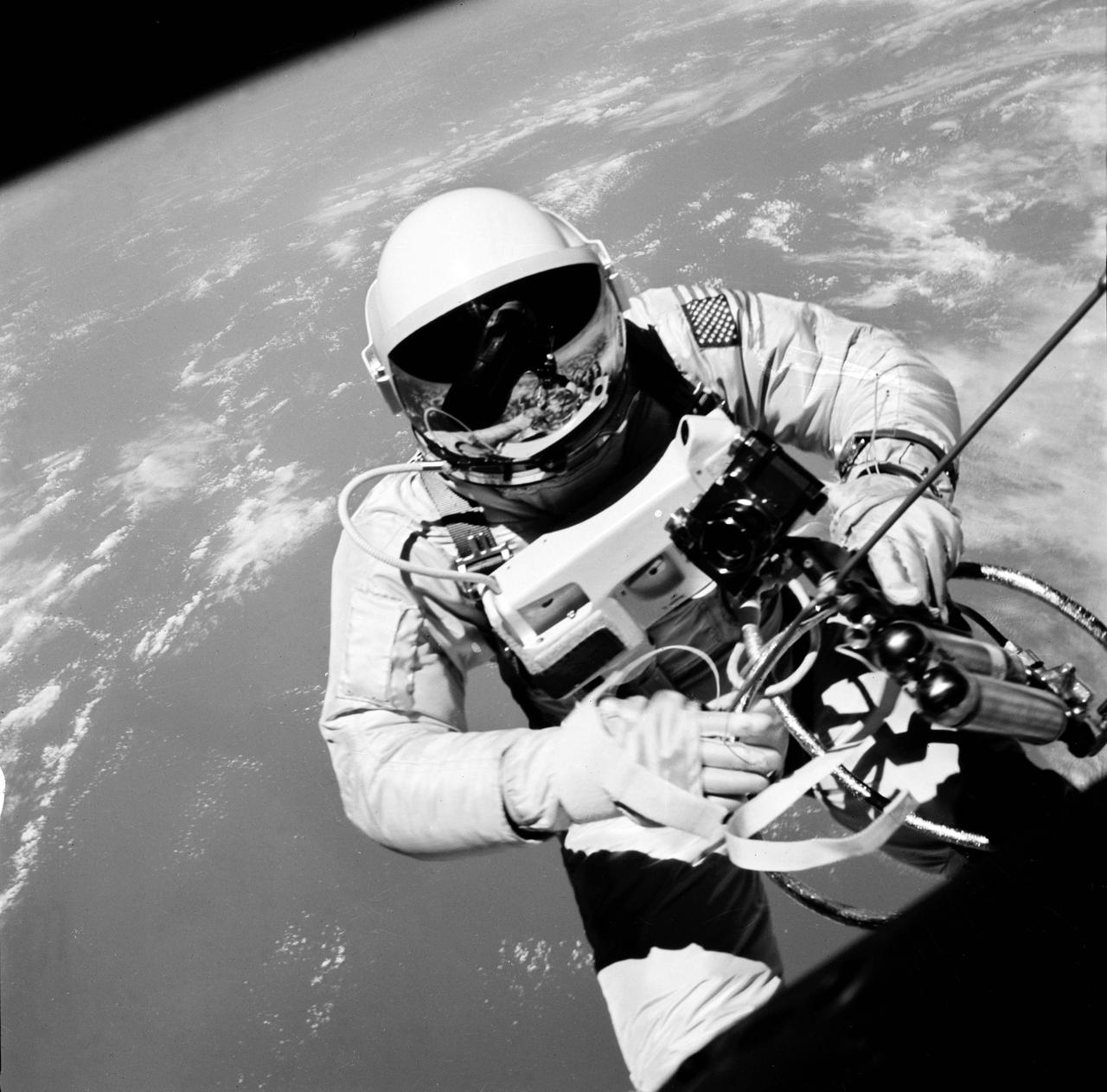
S65-30202 (3 June 1965) --- Astronaut Edward H. White II, pilot on the Gemini-Titan IV (GT-4) spaceflight, floats in the zero gravity of space outside the Gemini IV spacecraft. His face is covered by a shaded visor to protect him from the unfiltered rays of the sun. White became the first American astronaut to walk in space. He remained outside the spacecraft for 21 minutes during the third revolution of the Gemini IV mission. He wears a specially designed spacesuit for the EVA. He?s holding the Hand-Held Self-Maneuvering Unit (HHSMU), with which he controlled his movements while in space, and a camera is attached to the HHSMU. He was attached to the spacecraft by a 25-feet umbilical line and a 23-feet tether line, both wrapped together with gold tape to form one cord. He wears an emergency oxygen supply check pack. Astronaut James A. McDivitt is command pilot for the GT-4 mission. The mission was a four-day, 62-revolution flight, during which McDivitt and White performed a series of scientific and engineering experiments. (This image is black and white) Photo credit: NASA EDITOR?S NOTE: Astronaut Edward H. White II died in the Apollo/Saturn 204 fire at Cape Kennedy, Florida, on Jan. 27, 1967.
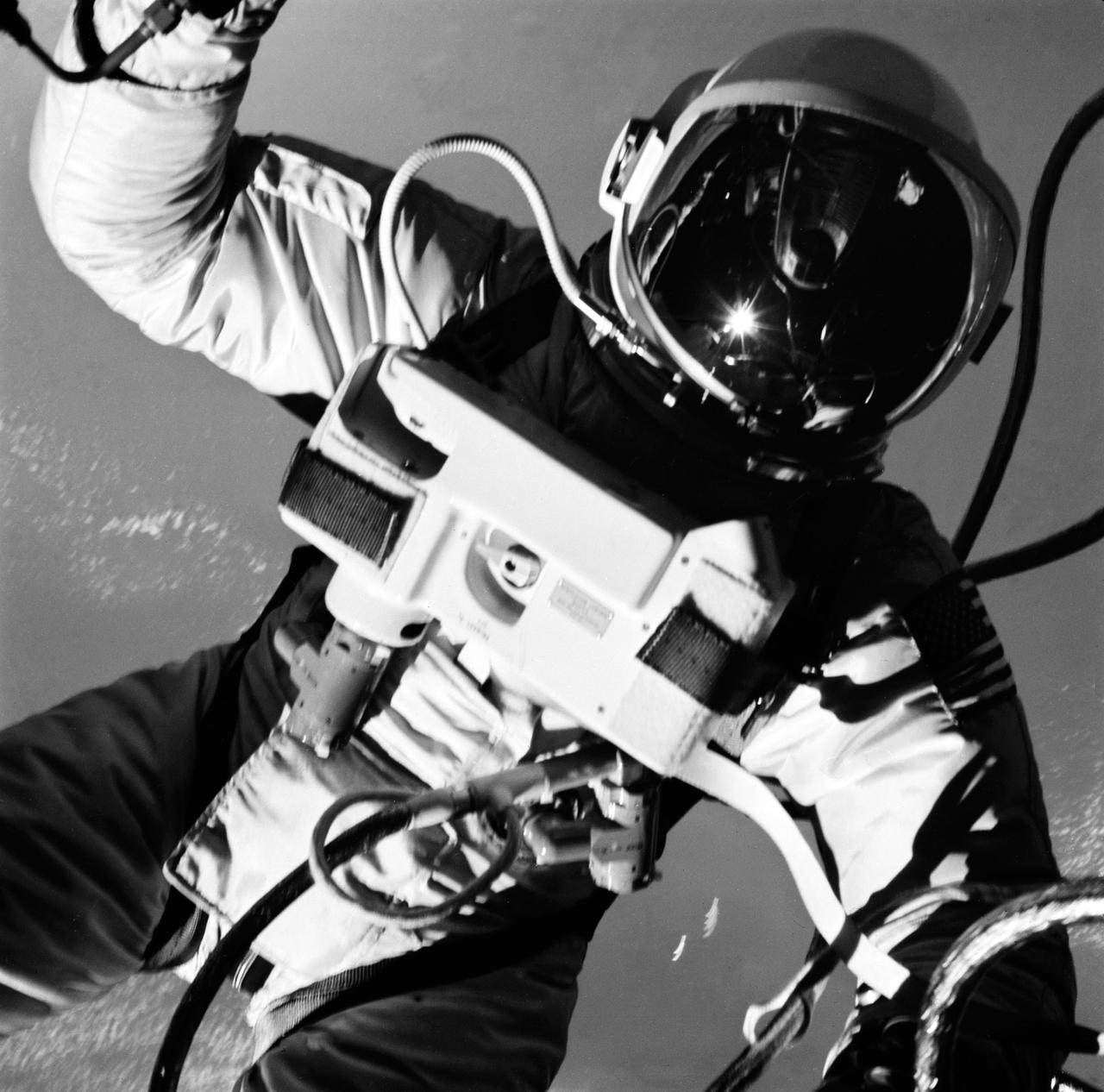
S65-30271 (3 June 1965) --- Astronaut Edward H. White II, pilot on the Gemini-Titan IV (GT-4) spaceflight, floats in the zero gravity of space outside the Gemini IV spacecraft. His face is covered by a shaded visor to protect him from the unfiltered rays of the sun. White became the first American astronaut to walk in space. He remained outside the spacecraft for 21 minutes during the third revolution of the Gemini IV mission. He wears a specially designed spacesuit for the EVA. His right hand (out of frame) is holding the Hand-Held Self-Maneuvering Unit (HHSMU), with which he controlled his movements while in space, and a camera is attached to the HHSMU. He was attached to the spacecraft by a 25-feet umbilical line and a 23-feet tether line, both wrapped together with gold tape to form one cord. He wears an emergency oxygen supply check pack. Astronaut James A. McDivitt is command pilot for the GT-4 mission. The mission was a four-day, 62-revolution flight, during which McDivitt and White performed a series of scientific and engineering experiments. (This image is black and white) Photo credit: NASA EDITOR?S NOTE: Astronaut Edward H. White II died in the Apollo/Saturn 204 fire at Cape Kennedy, Florida, on Jan. 27, 1967.
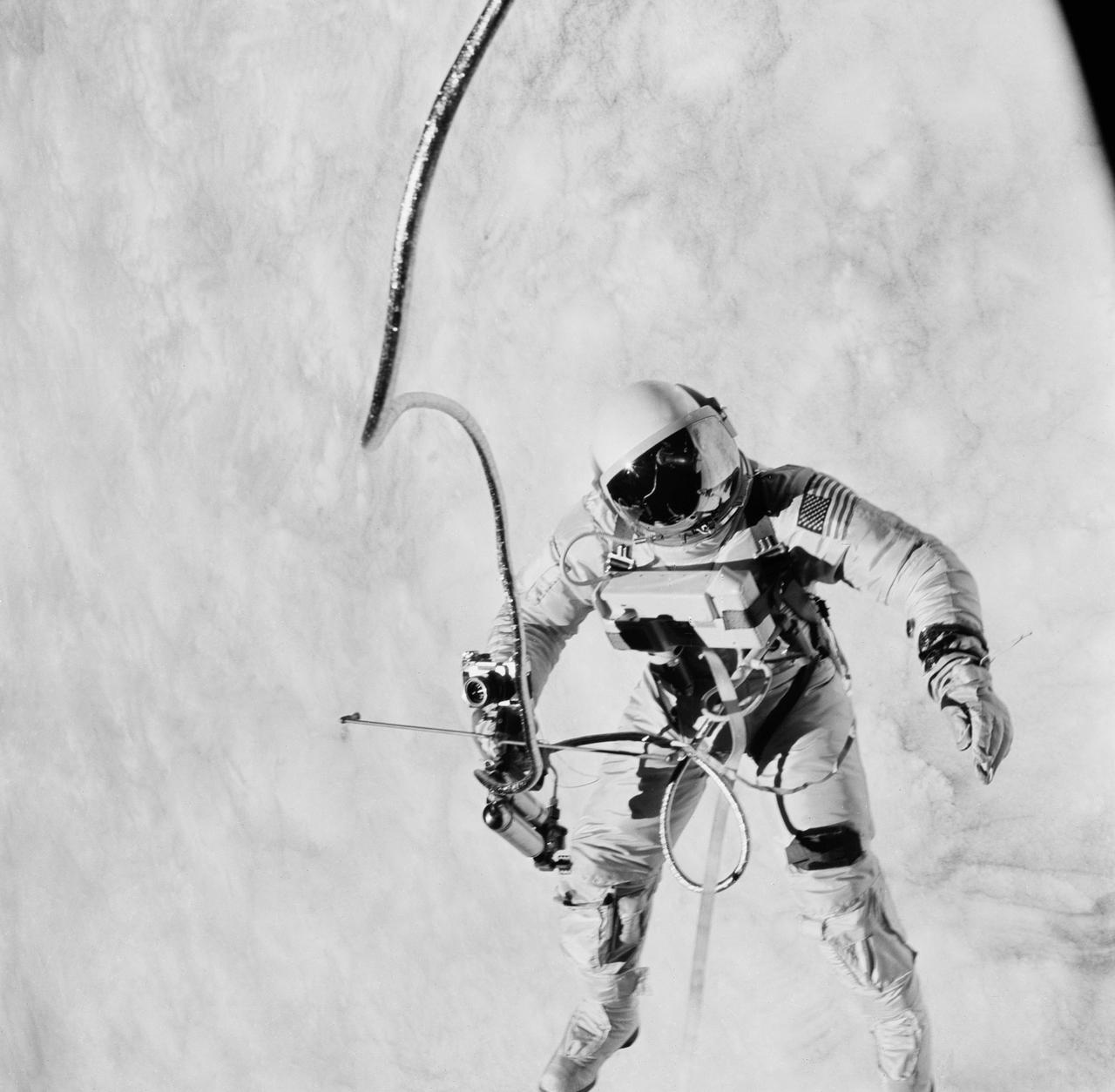
S65-30272 (3 June 1965) --- Astronaut Edward H. White II, pilot on the Gemini-Titan IV (GT-4) spaceflight, floats in the zero gravity of space outside the Gemini IV spacecraft. His face is covered by a shaded visor to protect him from the unfiltered rays of the sun. White became the first American astronaut to walk in space. He remained outside the spacecraft for 21 minutes during the third revolution of the Gemini IV mission. He wears a specially designed spacesuit for the EVA. His right hand is holding the Hand-Held Self-Maneuvering Unit (HHSMU), with which he controlled his movements while in space, and a camera is attached to the HHSMU. He was attached to the spacecraft by a 25-feet umbilical line and a 23-feet tether line, both wrapped together with gold tape to form one cord. He wears an emergency oxygen supply check pack. Astronaut James A. McDivitt is command pilot for the GT-4 mission. The mission was a four-day, 62-revolution flight, during which McDivitt and White performed a series of scientific and engineering experiments. (This image is black and white) Photo credit: NASA EDITOR?S NOTE: Astronaut Edward H. White II died in the Apollo/Saturn 204 fire at Cape Kennedy, Florida, on Jan. 27, 1967.
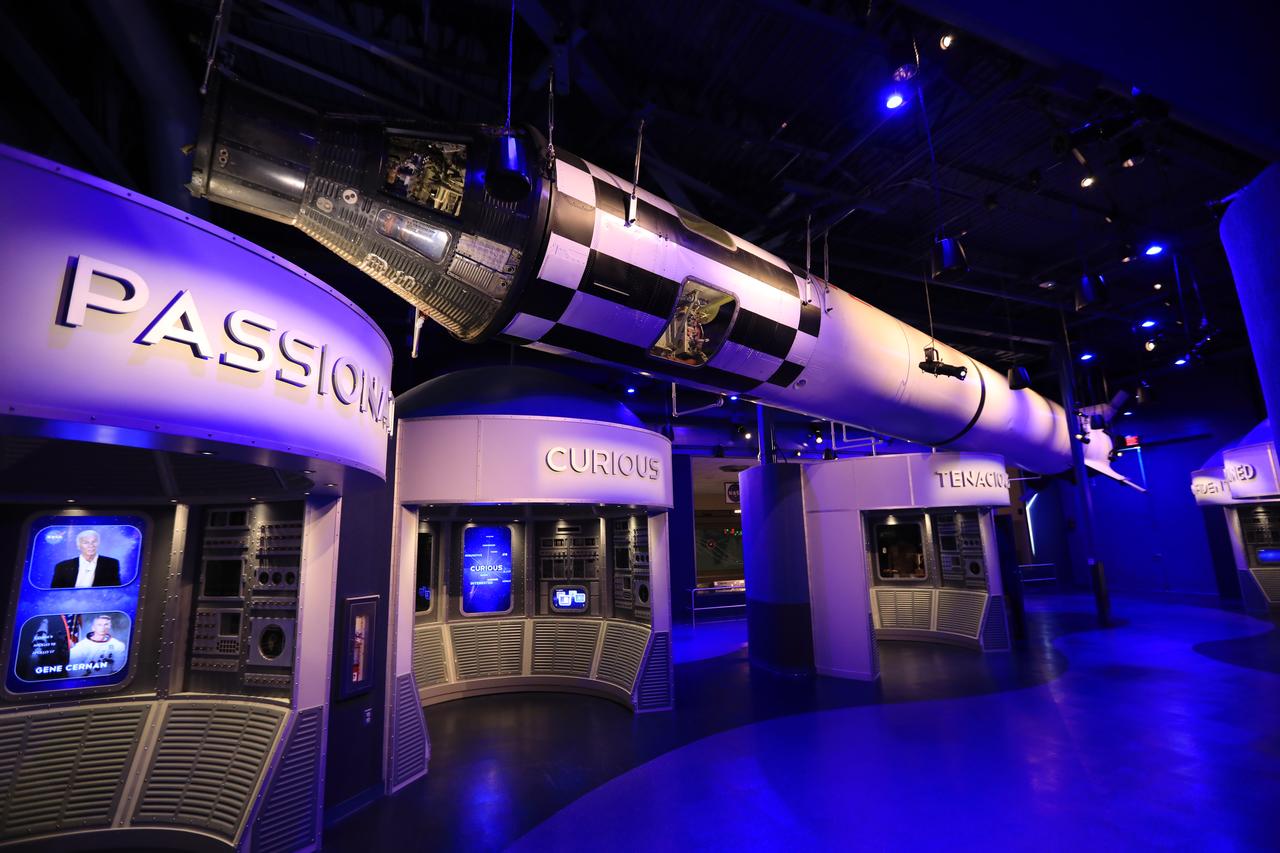
Inside the Heroes and Legends attraction at the Kennedy Space Center Visitor Complex, the Sigma 7 Mercury spacecraft in this exhibit was piloted by astronaut Wally Schirra during his six-orbit mission on Oct. 3, 1962. For display purposes, it is shown here attached to a Redstone launch vehicle like the one that boosted astronauts Alan Shepard and Gus Grissom on sub-orbital flights in 1961. Schirra's capsule was actually launched by the more powerful Atlas rocket in order to reach orbit. The new facility looks back to the pioneering efforts of Mercury, Gemini and Apollo. It sets the stage by providing the background and context for space exploration and the legendary men and women who pioneered the nation's journey into space.
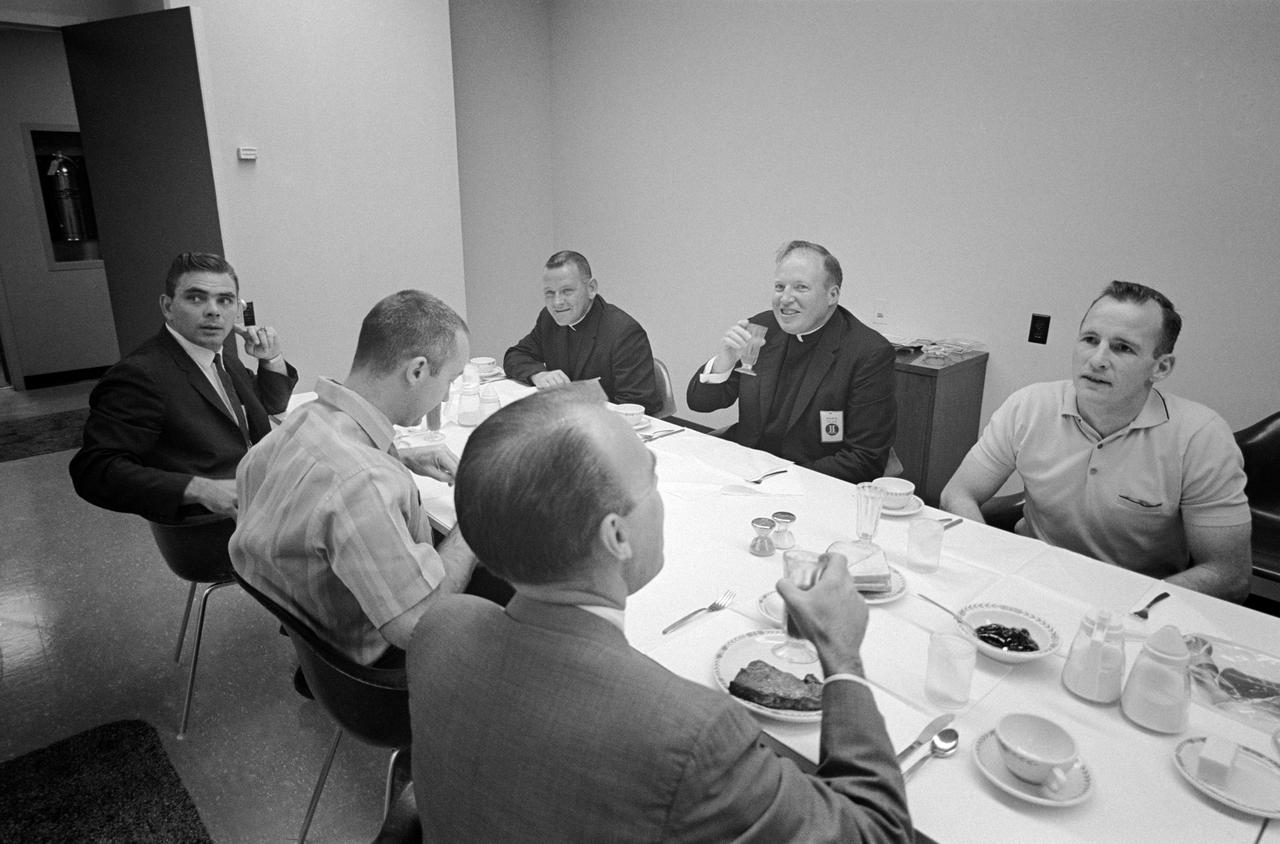
S65-19600 (3 June 1965) --- The prime crew for the Gemini-Titan 4 mission have an early morning breakfast prior to their historic flight which was launched at 10:16 a.m. (EST) on June 3, 1965. Shown here seated around the table (clockwise starting front center) are Dr. D. Owens Coons, chief, MSC Center Medical Office; astronaut James A. McDivitt, GT-4 command pilot; Dr. Eugene F. Tubbs, Kennedy Space Center; Rt. Rev. James Heiliky, McDivitt's priest at Cocoa Beach, Florida; Msgr. Irvine J. Nugent and astronaut Edward H. White II, GT-4 pilot. The group had a breakfast of tomato juice, broiled sirloin steak, poached eggs, toast, strawberry gelatin and coffee.
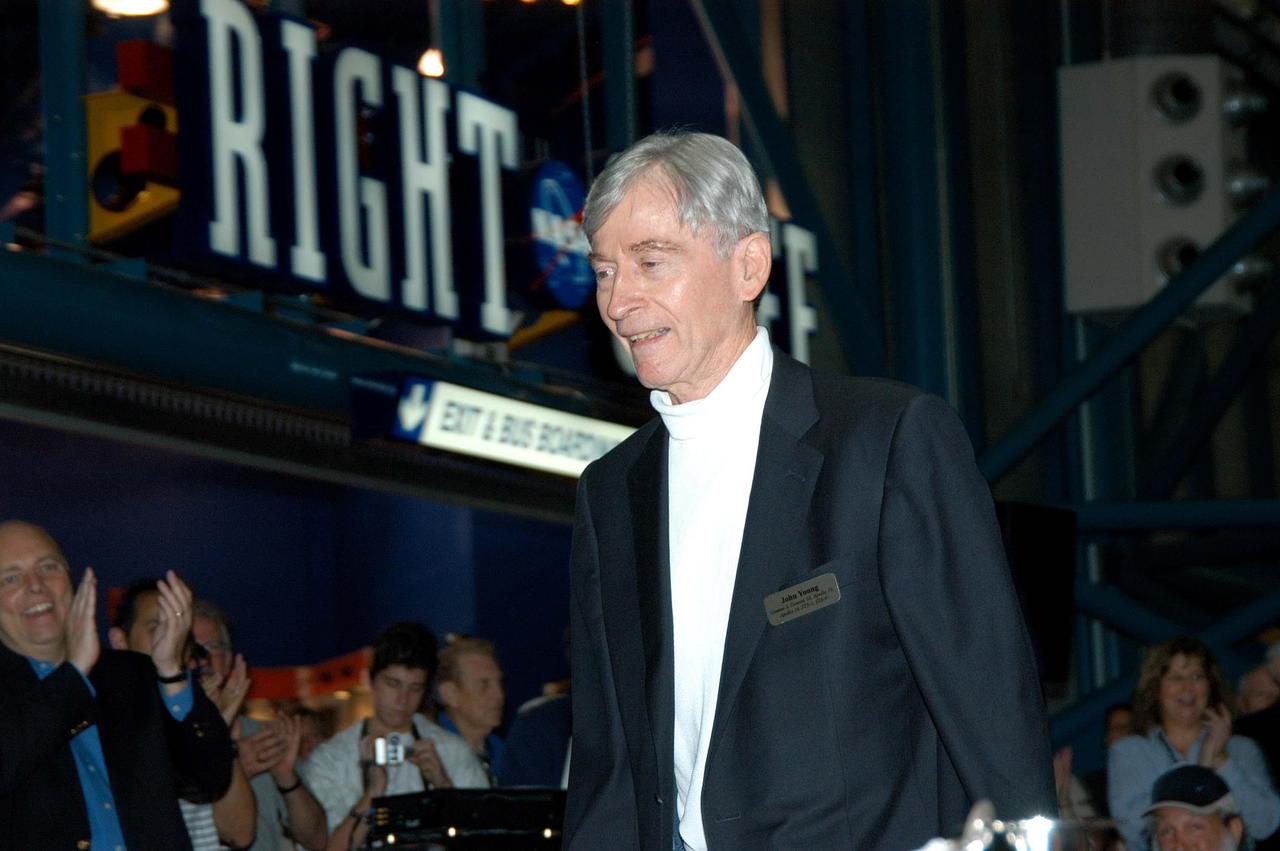
KENNEDY SPACE CENTER, FLA. -- Before the induction ceremony of five space program heroes into the U.S. Astronaut Hall of Fame, astronaut John Young is warmly greeted as he is introduced as a previous inductee. Co-holder of a record for the most space flights, six, he flew on Gemini 3 and 10, orbited the Moon on Apollo 10, walked on the Moon on Apollo 16, and commanded two space shuttle missions, STS-1 and STS-9. Young currently serves as associate director, technical, at Johnson Space Center. The induction ceremony was held at the Apollo/Saturn V Center at KSC. New inductees are Richard O. Covey, commander of the Hubble Space Telescope repair mission; Norman E. Thagard, the first American to occupy Russia’s Mir space station; the late Francis R. "Dick" Scobee, commander of the ill-fated 1986 Challenger mission; Kathryn D. Sullivan, the first American woman to walk in space; and Frederick D. Gregory, the first African-American to command a space mission and the current NASA deputy administrator. The U.S. Astronaut Hall of Fame opened in 1990 to provide a place where space travelers could be remembered for their participation and accomplishments in the U.S. space program. The five inductees join 52 previously honored astronauts from the ranks of the Gemini, Apollo, Skylab, Apollo-Soyuz, and Space Shuttle programs.
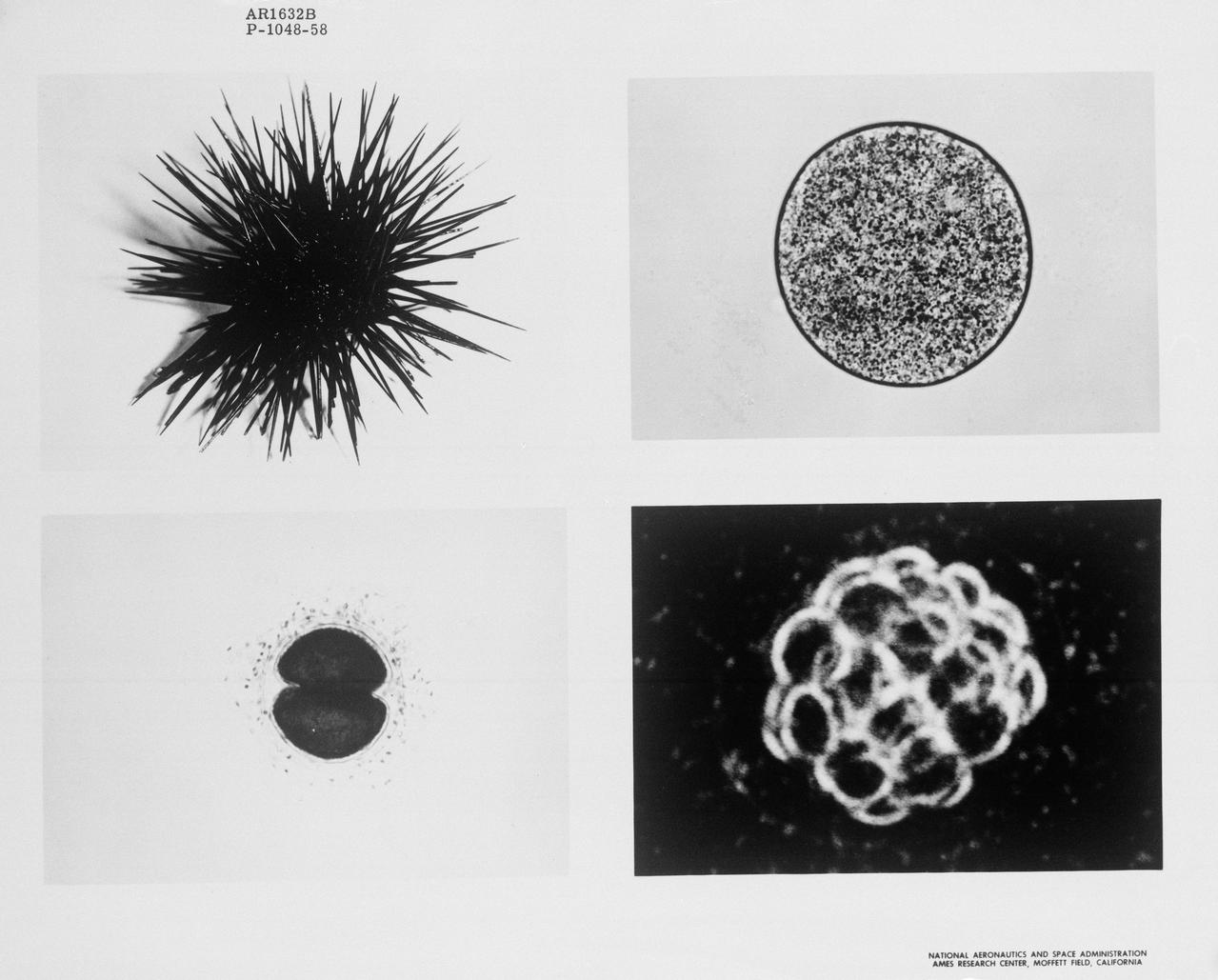
S65-18762 (March 1965) --- Effects of the weightless environment on cell division, the basic growth process for living tissue, will be studied during the Gemini-Titan 3 flight scheduled for March 23, 1965. A spiny black sea urchin (upper left) is stimulated by mild electric shock or potassium chloride. As a result it sheds many thousands of eggs. When fertilized, these eggs become actively dividing cells very similar in basic processes to cells of other animals, including humans. These pictures show stages of cell division. At upper right is a single cell; at lower right cell divisions have produced many cells. Cell photos are magnified about 700 times, and all cells shown are too small to be seen by the naked eye. (Photos at upper right and lower left are of sea urchin eggs. Group of cells at lower right are from a sand dollar, which like the sea urchin, is an Echinoderm. Its eggs are virtually identical and are used interchangeably with those of the sea urchin in NASA Ames Center weightlessness experiments.) The Gemini experiment will involve cell division like that shown here. This will take place during several hours of weightlessness aboard the Gemini spacecraft. The experiment will be flown back to laboratories at Cape Kennedy after spacecraft recovery. It has been designed so that any abnormal cell division found by postflight analysis should suggest that the weightless environment has effects on individual cells. This might mean hazards for prolonged periods of manned spaceflight.
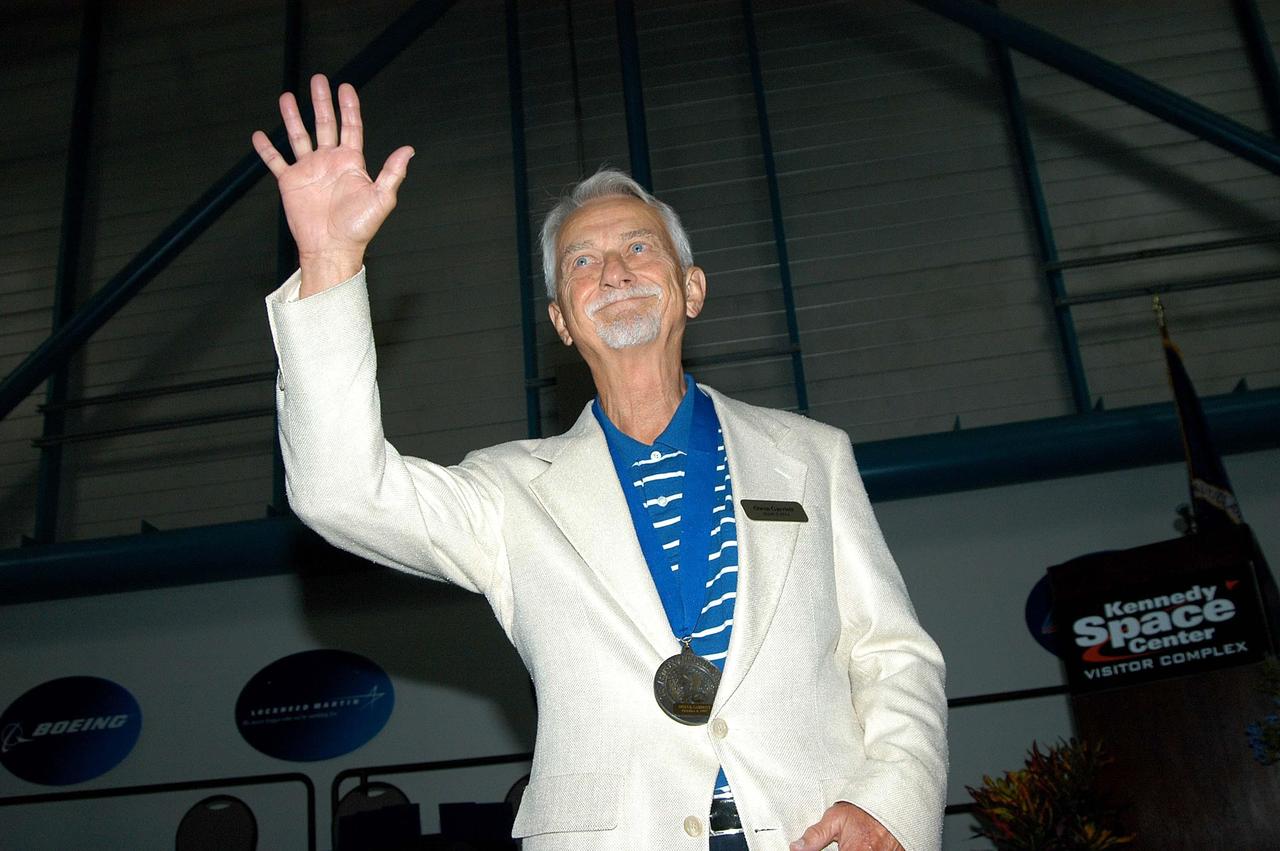
KENNEDY SPACE CENTER, FLA. -- Former astronaut Owen Garriott acknowledges the applause as he is introduced as a previous inductee into the U.S. Astronaut Hall of Fame. He and other Hall of Fame members were present for the induction of five new space program heroes into the U.S. Astronaut Hall of Fame: Richard O. Covey, commander of the Hubble Space Telescope repair mission; Norman E. Thagard, the first American to occupy Russia’s Mir space station; the late Francis R. "Dick" Scobee, commander of the ill-fated 1986 Challenger mission; Kathryn D. Sullivan, the first American woman to walk in space; and Frederick D. Gregory, the first African-American to command a space mission and the current NASA deputy administrator. Garriott exercised his expertise as a solar physicist on two space missions, the 59-day Skylab 3 flight in 1973, and an 11-day trip aboard the Space Shuttle Columbia a decade later. The induction ceremony was held at the Apollo/Saturn V Center at KSC. The U.S. Astronaut Hall of Fame opened in 1990 to provide a place where space travelers could be remembered for their participation and accomplishments in the U.S. space program. The five inductees join 52 previously honored astronauts from the ranks of the Gemini, Apollo, Skylab, Apollo-Soyuz, and Space Shuttle programs.
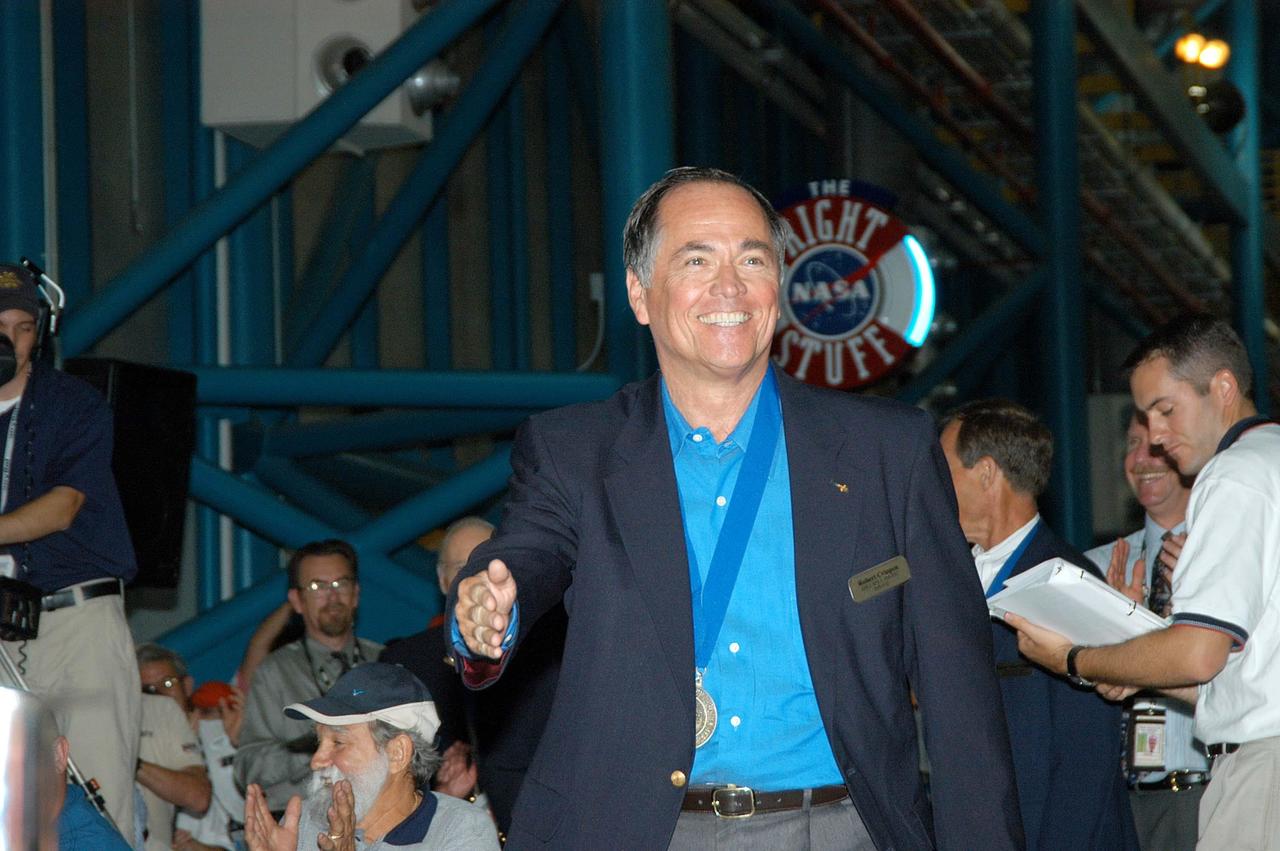
KENNEDY SPACE CENTER, FLA. -- Former astronaut Robert Crippen smiles at the warm greeting he is receiving when introduced as a previous inductee into the U.S. Astronaut Hall of Fame. He and other Hall of Fame members were present for the induction of five new space program heroes into the U.S. Astronaut Hall of Fame: Richard O. Covey, commander of the Hubble Space Telescope repair mission; Norman E. Thagard, the first American to occupy Russia’s Mir space station; the late Francis R. "Dick" Scobee, commander of the ill-fated 1986 Challenger mission; Kathryn D. Sullivan, the first American woman to walk in space; and Frederick D. Gregory, the first African-American to command a space mission and the current NASA deputy administrator. Crippen piloted the first Space Shuttle flight in 1981 and commanded three other Shuttle missions in the next 3-1/2 years. In the early 1990s he served as director of NASA’s Kennedy Space Center. The induction ceremony was held at the Apollo/Saturn V Center at KSC. The U.S. Astronaut Hall of Fame opened in 1990 to provide a place where space travelers could be remembered for their participation and accomplishments in the U.S. space program. The five inductees join 52 previously honored astronauts from the ranks of the Gemini, Apollo, Skylab, Apollo-Soyuz, and Space Shuttle programs.
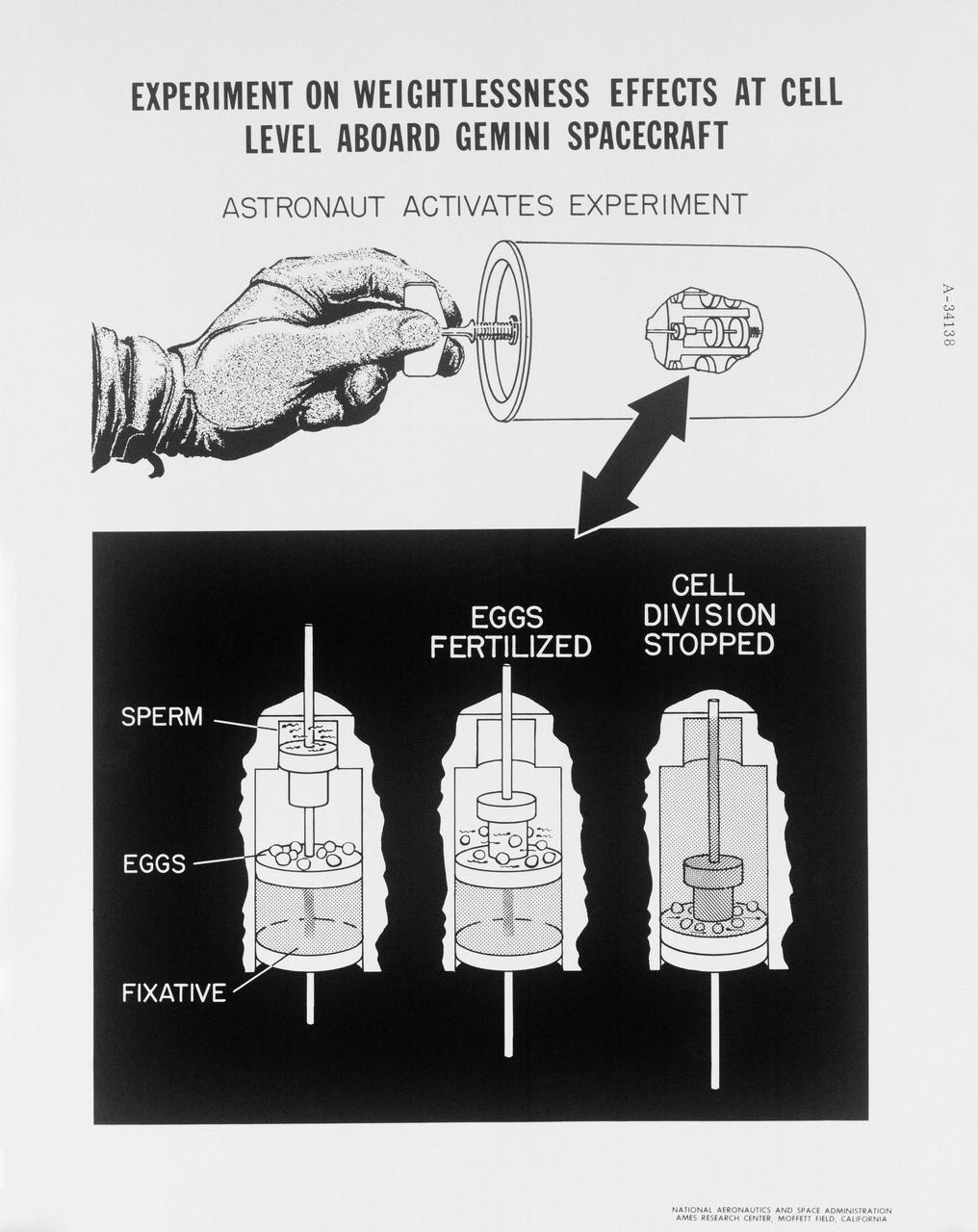
S65-18766 (March 1965) --- Diagram of experiment planned for the Gemini-Titan 3 mission scheduled on March 23, 1965, to find out if there are effects of weightlessness on individual living cells. The round canister (top) shows the experiment package. It will contain eight identical chambers, each with sections of sperm, eggs and fixative. Cells are eggs of the spiny, black sea animal, the sea urchin. Bottom panel shows the three stages of each chamber. From left in the first stage, sperm, eggs and fixative are separated. By turning the handle, astronauts will fertilize a certain portion of the eggs, which will begin to divide. At 20 minutes after launch, further turns of the handle will force fixative into two chambers and stop cell division. At 70 minutes after launch, cell division in four more chambers will be stopped, and just prior to re-entry, growth of the remaining two chambers will be terminated by a turn of the handle. This system will allow study after the flight of how cells divided after various time periods in weightlessness. Abnormalities would suggest weightlessness effects on living tissue and possible hazard to prolonged manned spaceflight.
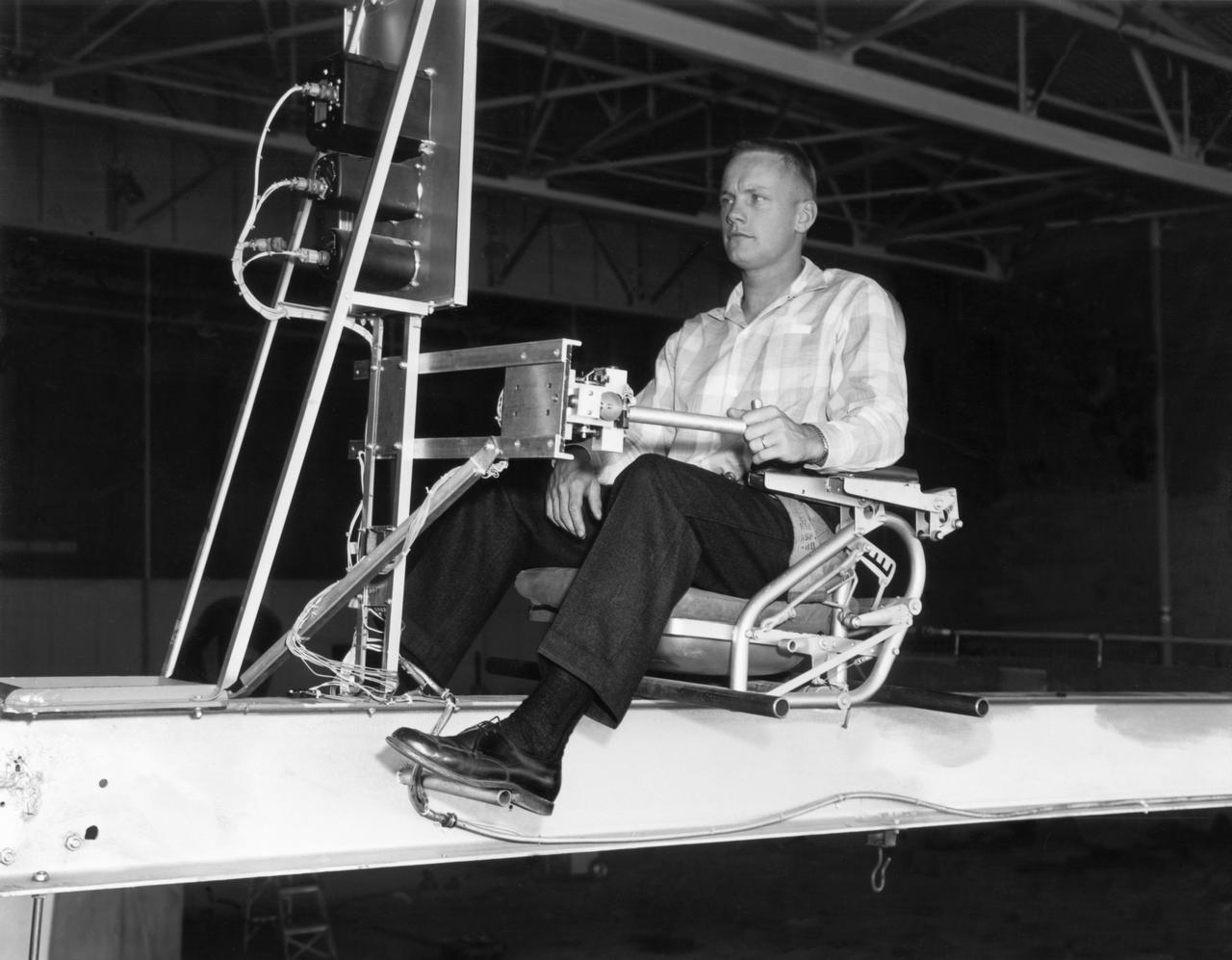
Famed astronaut Neil A. Armstrong, the first man to set foot on the moon during the historic Apollo 11 space mission in July 1969, served for seven years as a research pilot at the NACA-NASA High-Speed Flight Station, now the Dryden Flight Research Center, at Edwards, California, before he entered the space program. Armstrong joined the National Advisory Committee for Aeronautics (NACA) at the Lewis Flight Propulsion Laboratory (later NASA's Lewis Research Center, Cleveland, Ohio, and today the Glenn Research Center) in 1955. Later that year, he transferred to the High-Speed Flight Station at Edwards as an aeronautical research scientist and then as a pilot, a position he held until becoming an astronaut in 1962. He was one of nine NASA astronauts in the second class to be chosen. As a research pilot Armstrong served as project pilot on the F-100A and F-100C aircraft, F-101, and the F-104A. He also flew the X-1B, X-5, F-105, F-106, B-47, KC-135, and Paresev. He left Dryden with a total of over 2450 flying hours. He was a member of the USAF-NASA Dyna-Soar Pilot Consultant Group before the Dyna-Soar project was cancelled, and studied X-20 Dyna-Soar approaches and abort maneuvers through use of the F-102A and F5D jet aircraft. Armstrong was actively engaged in both piloting and engineering aspects of the X-15 program from its inception. He completed the first flight in the aircraft equipped with a new flow-direction sensor (ball nose) and the initial flight in an X-15 equipped with a self-adaptive flight control system. He worked closely with designers and engineers in development of the adaptive system, and made seven flights in the rocket plane from December 1960 until July 1962. During those fights he reached a peak altitude of 207,500 feet in the X-15-3, and a speed of 3,989 mph (Mach 5.74) in the X-15-1. Armstrong has a total of 8 days and 14 hours in space, including 2 hours and 48 minutes walking on the Moon. In March 1966 he was commander of the Gemini 8 or