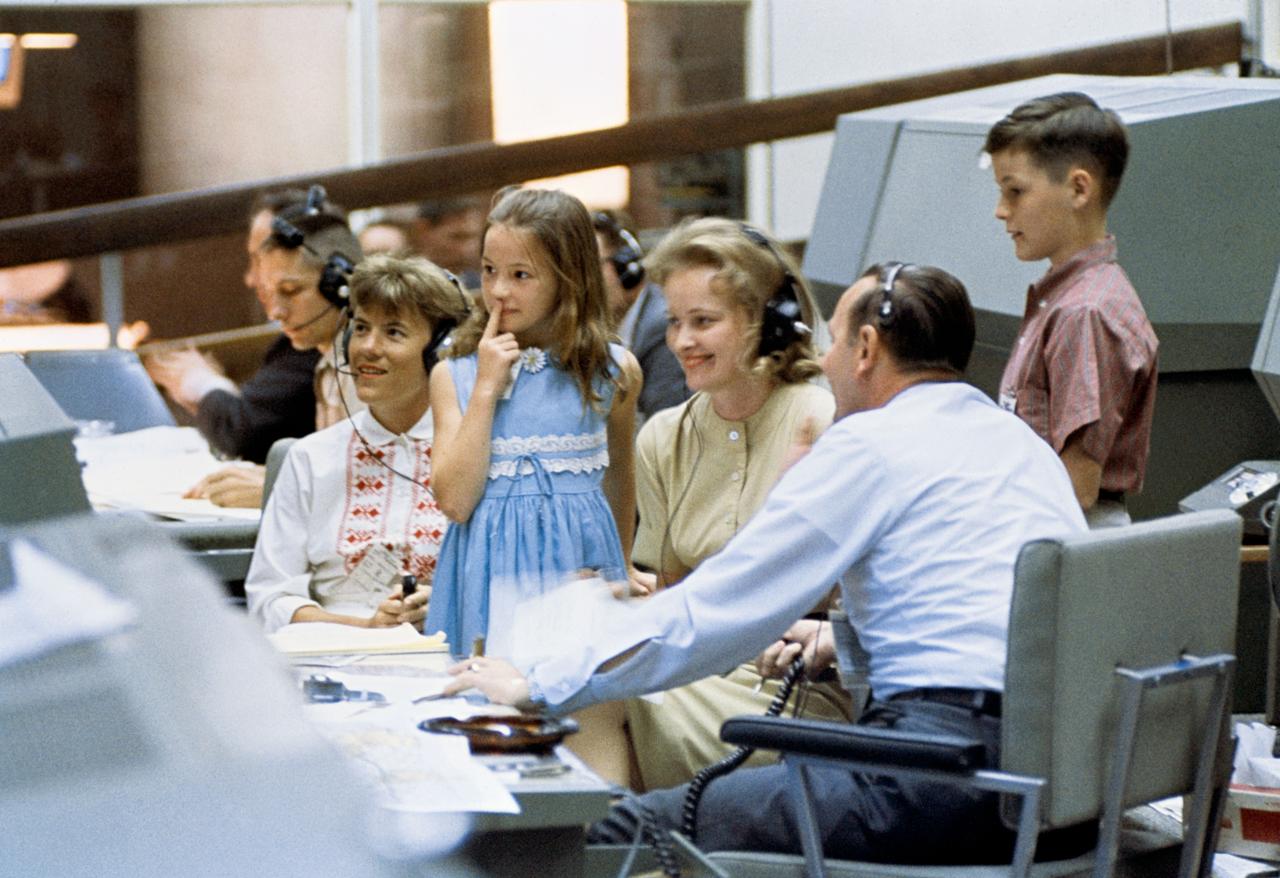
S65-30411 (9 June 1965) --- The families of Gemini 4 astronauts James A. McDivitt and Edward H. White II visited the Mission Control Center in Houston. In the foreground, left to right, are Mrs. Patricia McDivitt, daughter Bonnie White, Mrs. Patricia White, flight director Christopher C. Kraft Jr., and Edward White III. Each of the family members talked with the astronauts as they passed over the United States. Photo credit: NASA
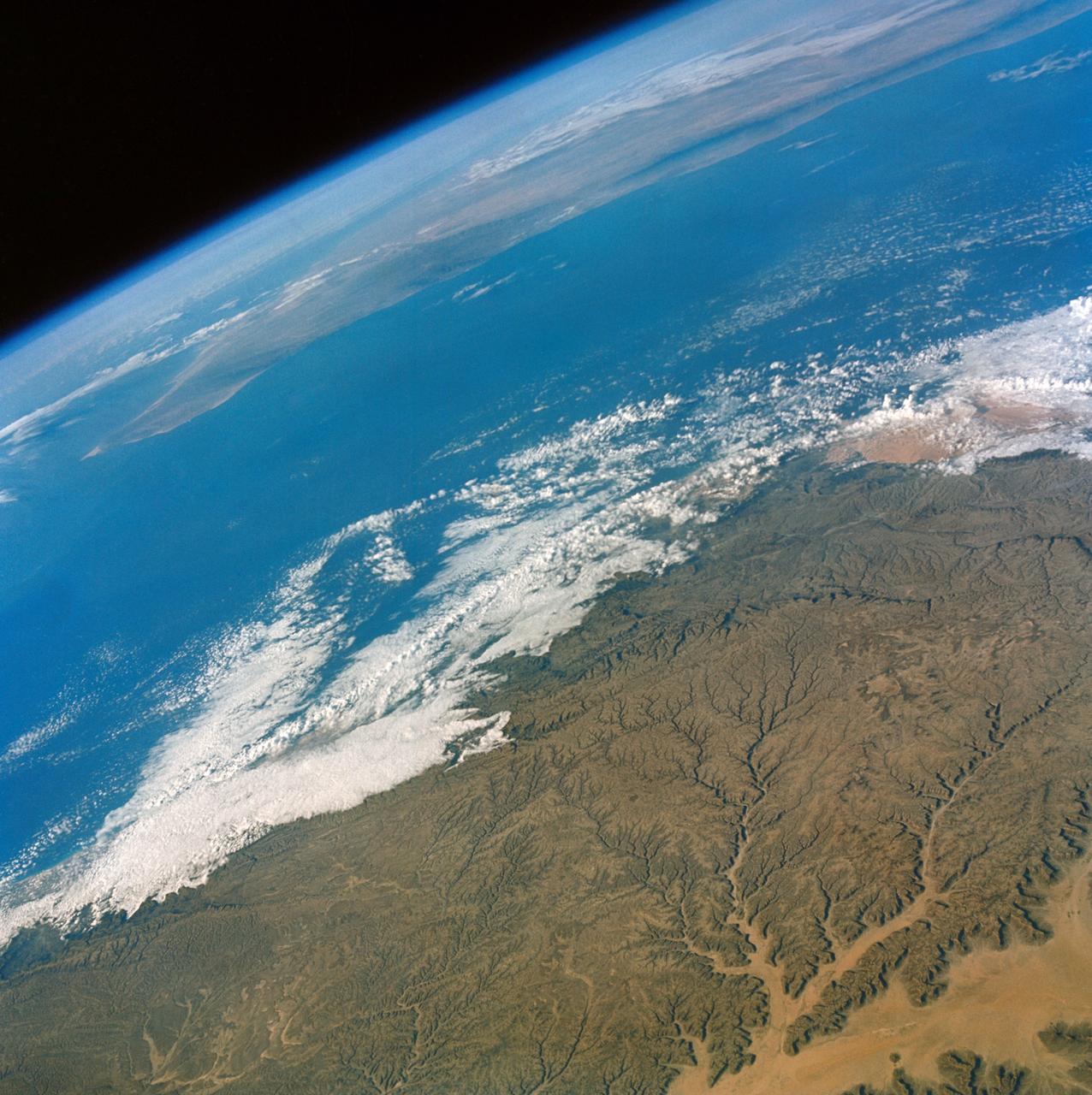
S65-34659 (3-7 June 1965) --- Among the many photographs taken from the Gemini-4 spacecraft during its orbital flight around Earth was this view of the Hahramaut Plateau on the southern portion of the Arabian Peninsula. The Wadi Hahramaut is in the foreground; with the Gulf of Aden (dark blue). This photograph was made with a modified 70mm Hasselblad camera, using Eastman color film, ASA 64, at a lens setting of 250th of a second at f/11.

S65-34673 (3-7 June 1965) --- This photograph shows the north end of the Gulf of California at the mouth of the Colorado River as it was seen from the Gemini-4 spacecraft during orbital flight June 3-7, 1965. This picture was part of the Synoptic Terrain Photography experiments conducted during the flight to obtain high quality photographs of large land areas already mapped by aerial photography. In charge of these experiments was Dr. Paul D. Lowman Jr., NASA geologist from Goddard Space Flight Center, Greenbelt, Md. This picture was taken with a modified 70mm Hasselblad camera using Eastman color film, ASA 64 at a lens setting of 250th of a second at f/11.
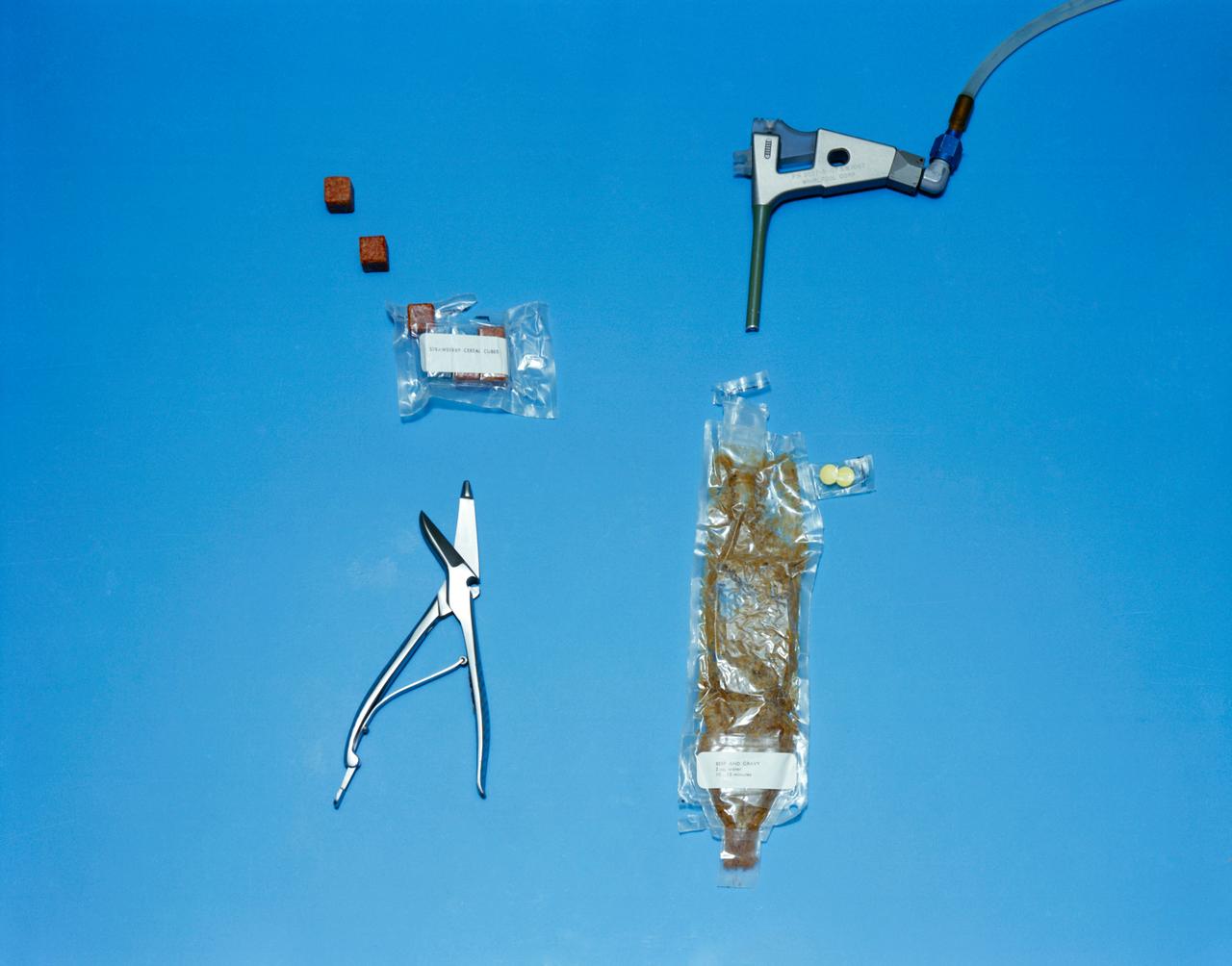
Food packages of beef and gravy fully reconstituted and ready to eat. An astronaut would squeeze food through opening at right side of package. Water gun is used to reconstitute dehydrated food. Scissors are used to open packages. This is the type of space food which will be used on the Gemini-Titan 4 spaceflight. MSC, Houston, TX *S65-24895 thru S65-24899
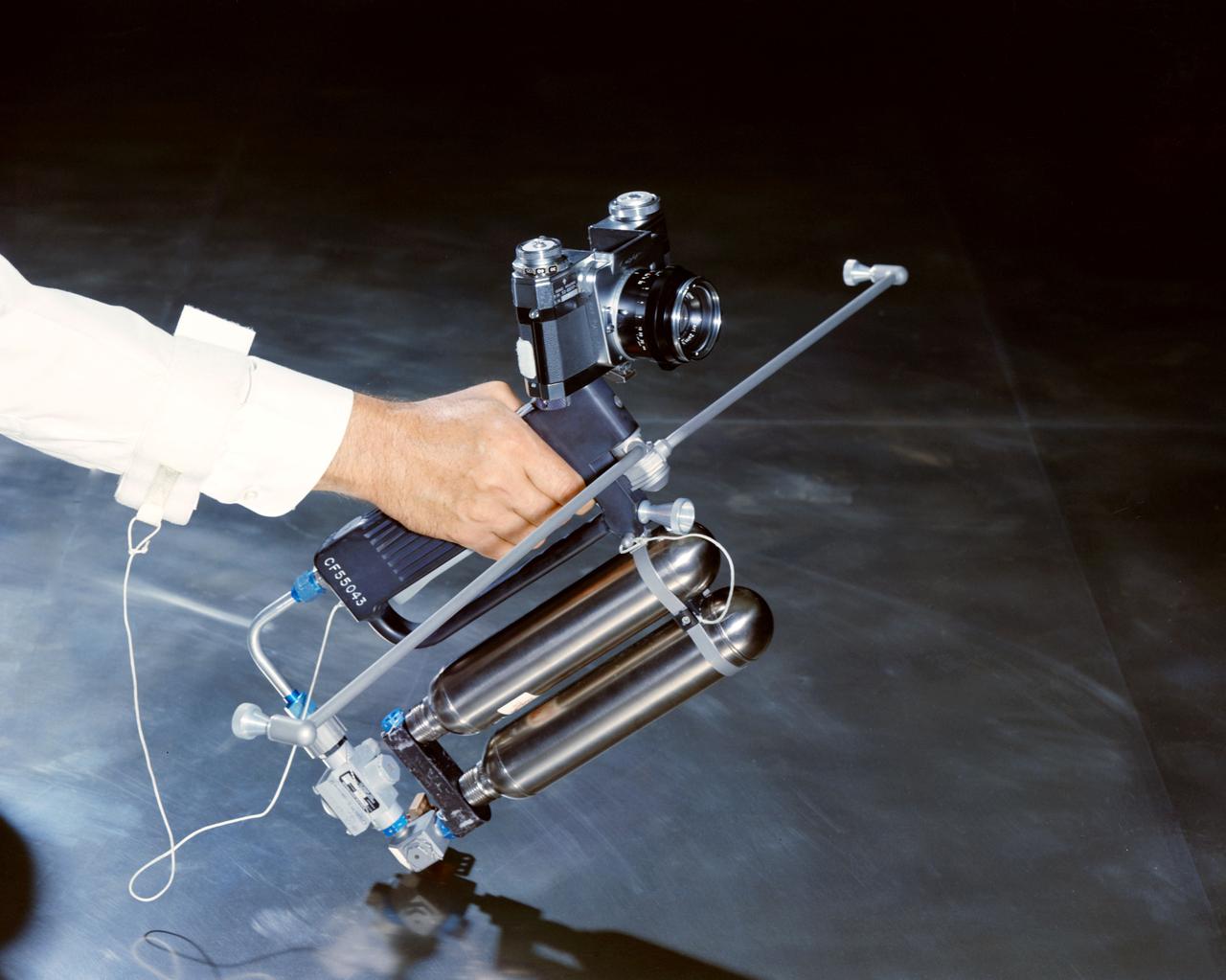
Hand-Held Self-Maneuvering Unit to be used during extravehicular activity (EVA) on Gemini 4 flight. It is an integral unit that contains its own high pressure metering valves and nozzles required to produce controlled thrust. A camera is mounted on the front of the unit.

S65-34635 (3 June 1965) --- Astronaut Edward H. White II, pilot on the Gemini-Titan 4 spaceflight, is shown during his egress from the spacecraft. His face is covered by a shaded visor to protect him from the unfiltered rays of the sun. White became the first American astronaut to walk in space. He remained outside the spacecraft for 21 minutes during the third revolution of the Gemini-4 mission. He wears a specially designed spacesuit for the extravehicular activity (EVA). In his right hand, he carries a Hand-Held Self-Maneuvering Unit (HHSMU) with which he controlled his movements while in space. He was attached to the spacecraft by a 25-feet umbilical line and a 23-feet tether line, both wrapped together with gold tape to form one cord. He wears an emergency oxygen supply chest pack. Astronaut James A. McDivitt is command pilot for the Gemini-4 mission. EDITOR'S NOTE: Astronaut Edward H. White II died in the Apollo/Saturn 204 fire at Cape Kennedy on Jan. 27, 1967.
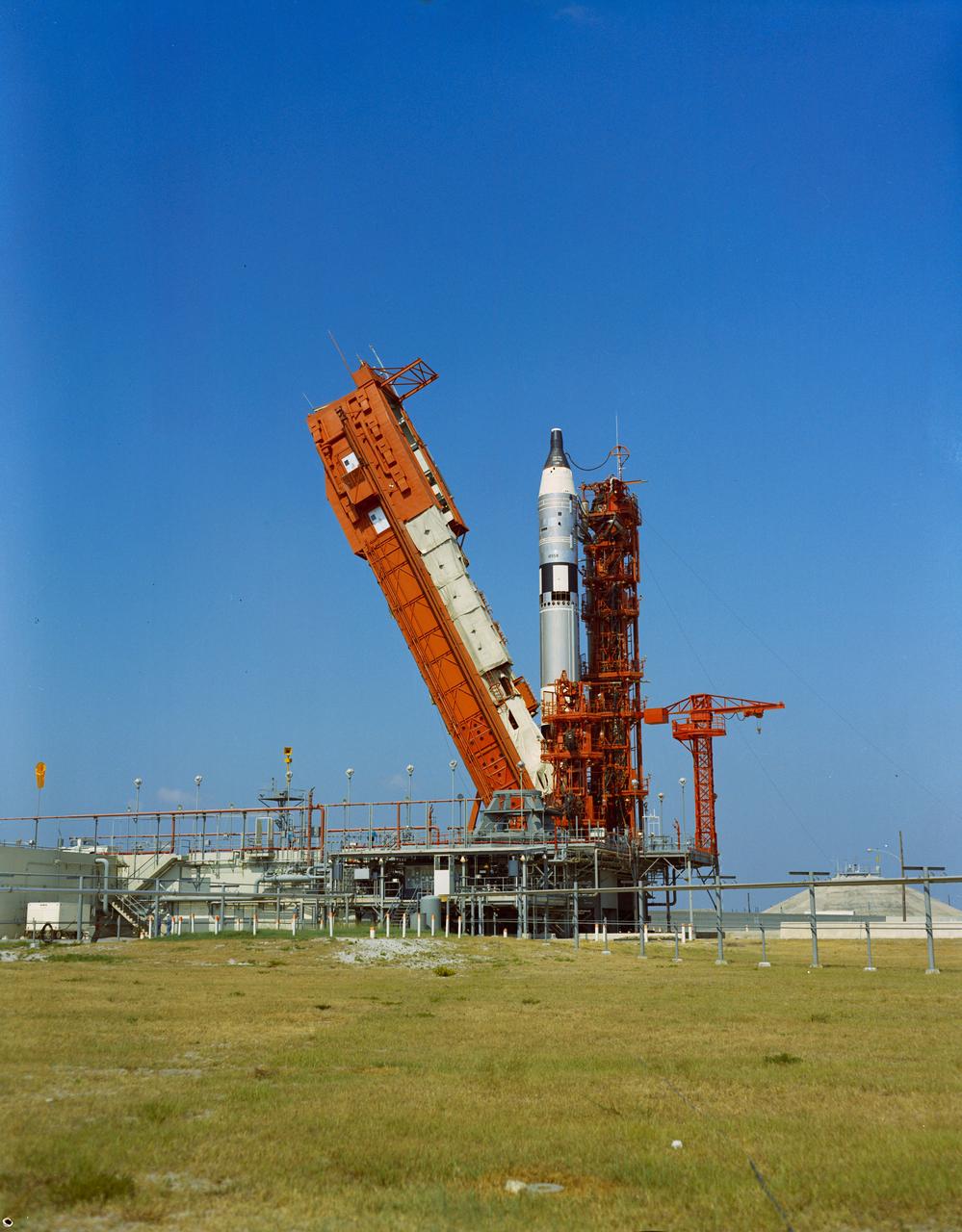
S65-29648 (3 June 1965) --- View of the Gemini-Titan 4 spacecraft on Pad 19 on day of launch with erector being removed.

S65-34661 (3-7 June 1965) --- Among the photographs of Earth's terrain taken from the Gemini-4 spacecraft during its orbital mission was this view of the southeastern tip of the Arabian Peninsula with the Gulf of Oman at upper right. Seif dunes (sand) at lower left. This picture was taken with a modified 70mm Hasselblad camera, using Eastman color film, ASA 64 at a setting of 250th of a second at f/11. Dr. Paul Lowman Jr., NASA geologist, was in charge of the Synoptic Terrain Photography.
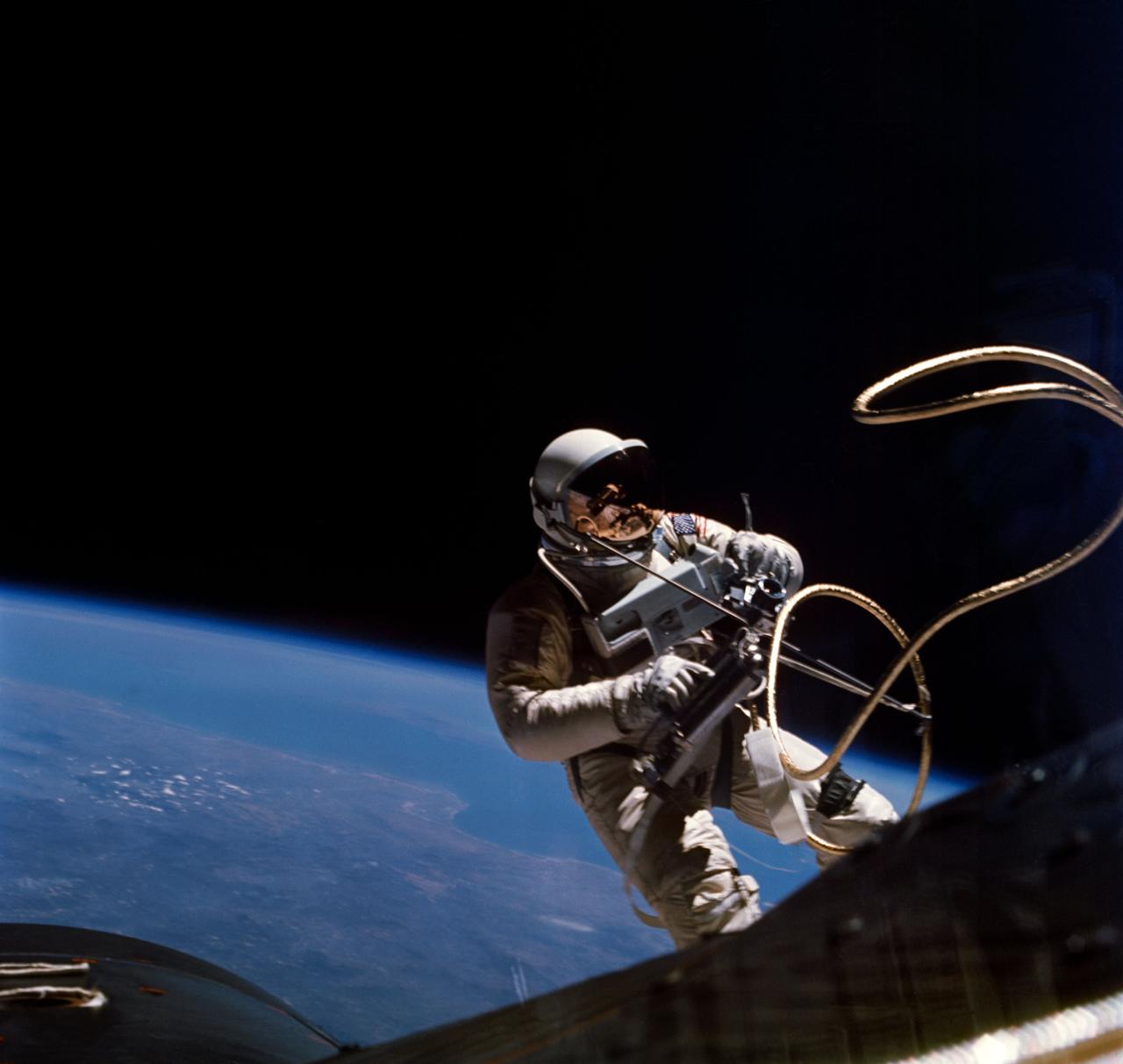
S65-30428 (3 June 1965) --- Astronaut Edward H. White II, pilot on the Gemini-Titan 4 spaceflight, is shown during his egress from the spacecraft. His face is covered by a shaded visor to protect him from the unfiltered rays of the sun. White became the first American astronaut to walk in space. He remained outside the spacecraft for 21 minutes during the third revolution of the Gemini-4 mission. He wears a specially designed spacesuit for the extravehicular activity (EVA). In his right hand, he carries a Hand-Held Self-Maneuvering Unit (HHSMU) with which he controlled his movements while in space. He was attached to the spacecraft by a 25-feet umbilical line and a 23-feet tether line, both wrapped together with gold tape to form one cord. He wears an emergency oxygen supply chest pack. Astronaut James A. McDivitt is command pilot for the Gemini-4 mission. EDITOR'S NOTE: Astronaut Edward H. White II died in the Apollo/Saturn 204 fire at Cape Kennedy on Jan. 27, 1967.
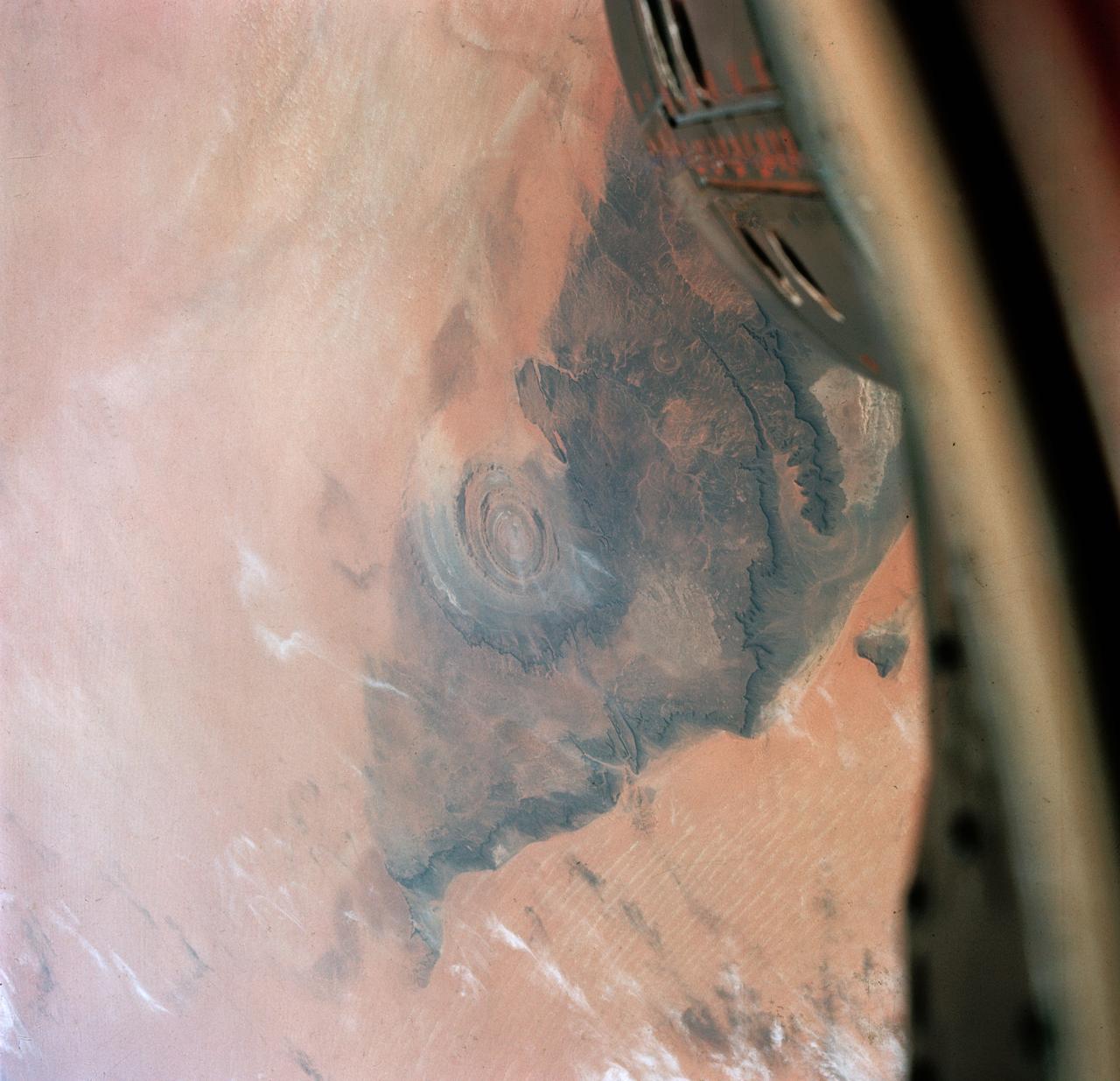
S65-34670 (3-7 June 1965) --- Richat crater in northwest Africa taken from the Gemini-4 spacecraft. Photograph was taken with a modified 70mm Hasselblad camera, using Eastman color film, ASA 64, at a lens setting of 250th of a second at f/11.
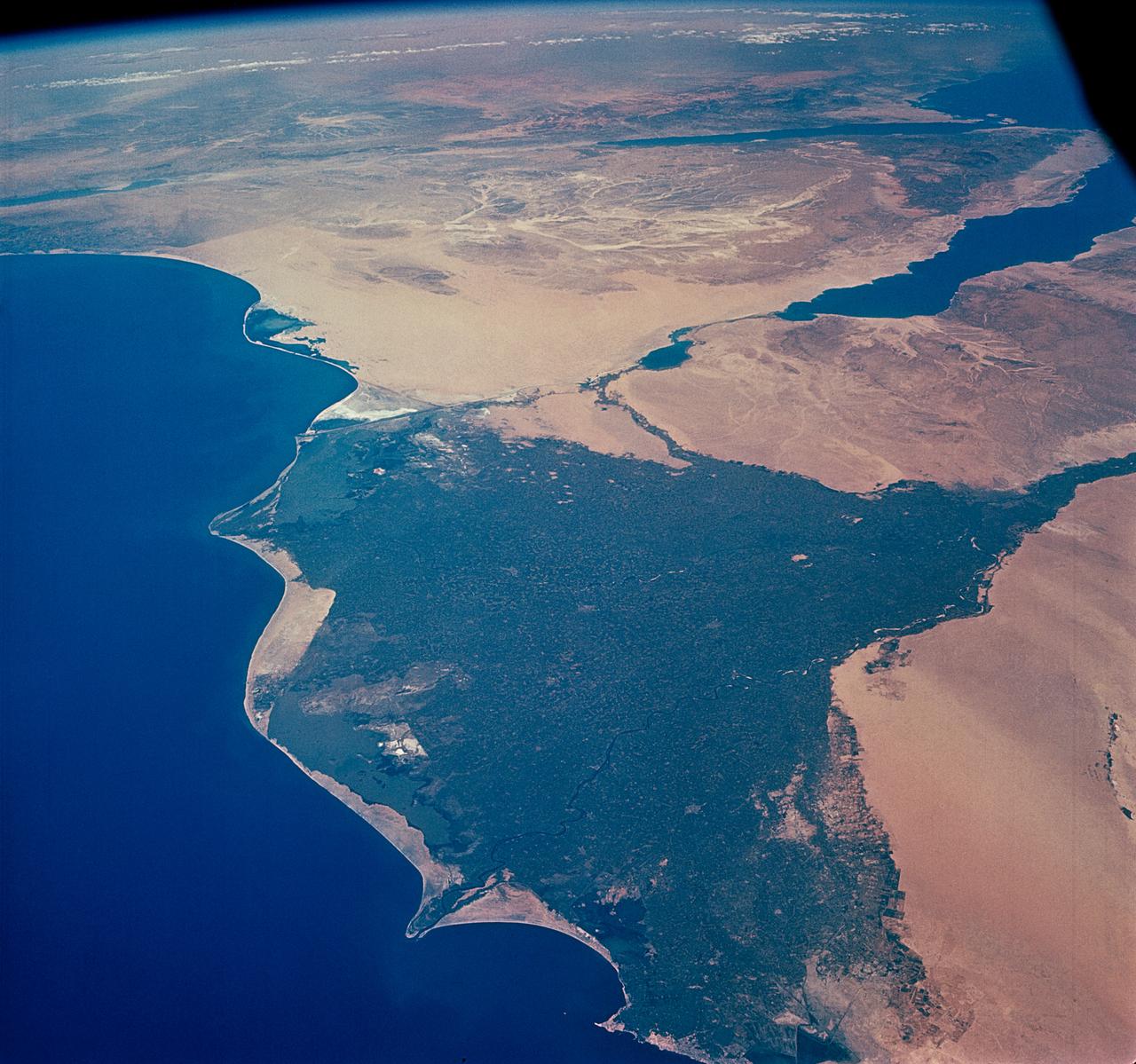
S65-34776 (3-7 June 1965) --- This photograph shows the Nile Delta, Egypt, the Suez Canal, Israel, Jordan, Syria, Saudi Arabia, and Iraq as seen from the Gemini-Titan 4 (GT-4) spacecraft during its 12th revolution of Earth.
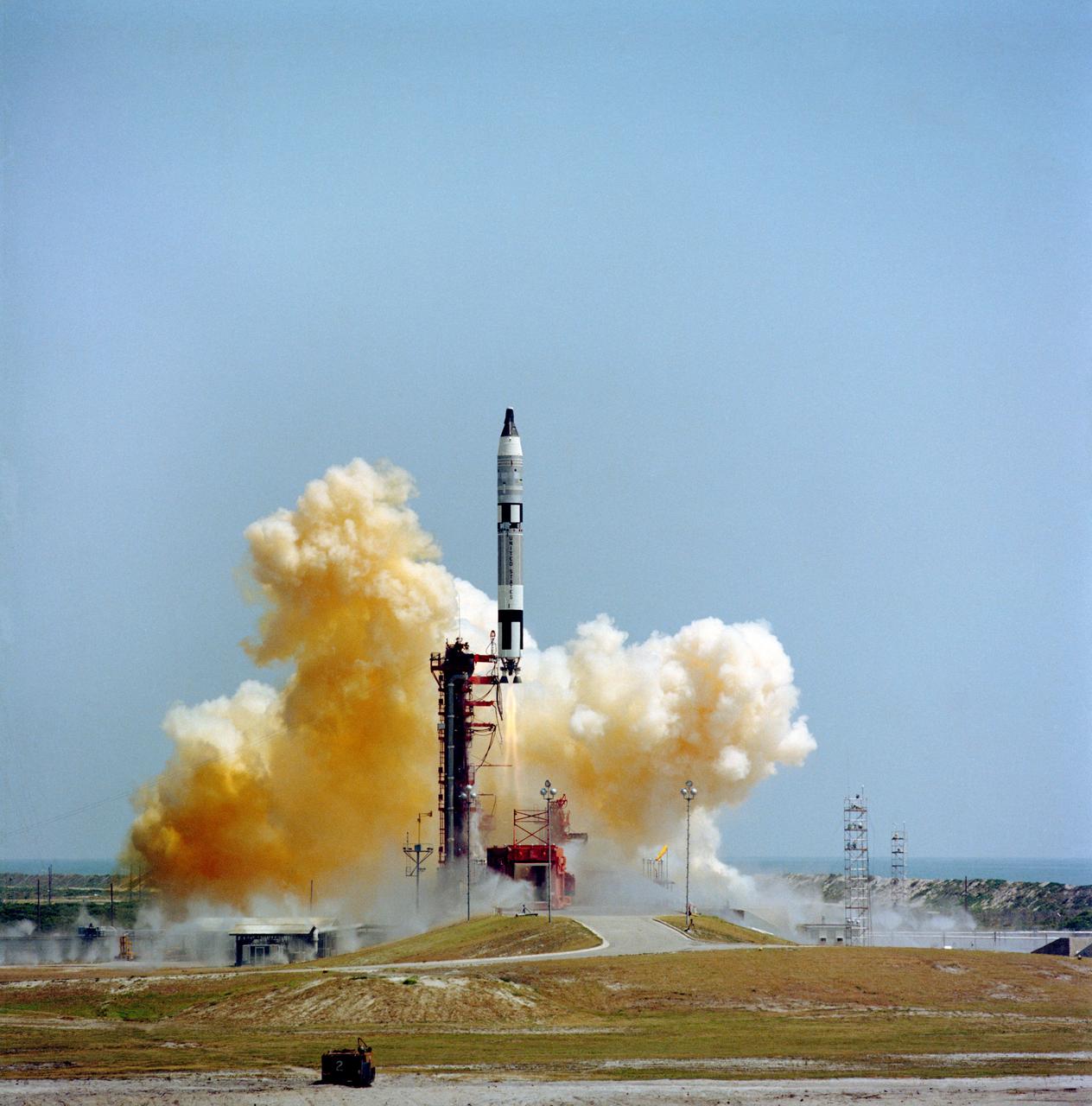
S65-29639 (3 June 1965) --- The Gemini-Titan 4 (GT-4) spaceflight launches from Cape Kennedy's Pad 19 at 10:16 a.m. (EST) on June 3, 1965. The GT-4 spacecraft carried astronauts James A. McDivitt, command pilot, and Edward H. White II, pilot, on a four-day, 62-revolution mission.
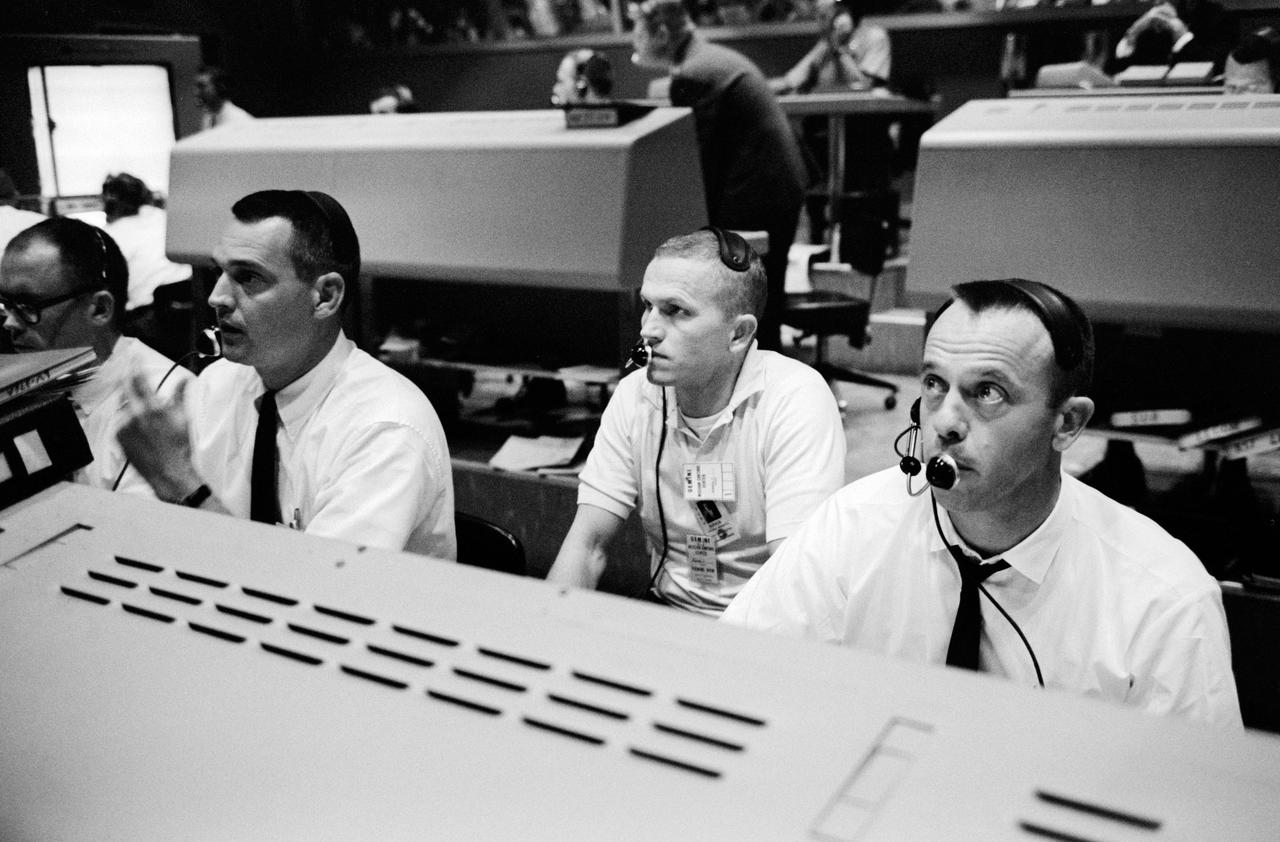
S65-30263 (3 June 1965) --- Shown at their consoles during the liftoff of Gemini-4 (from left) are astronauts Clifford C. Williams Jr., Frank Borman and Alan B. Shepard Jr. Borman was command pilot of the backup crew for the Gemini-4 flight. The three astronauts monitored the flight from the Mission Control Center at Cape Kennedy.
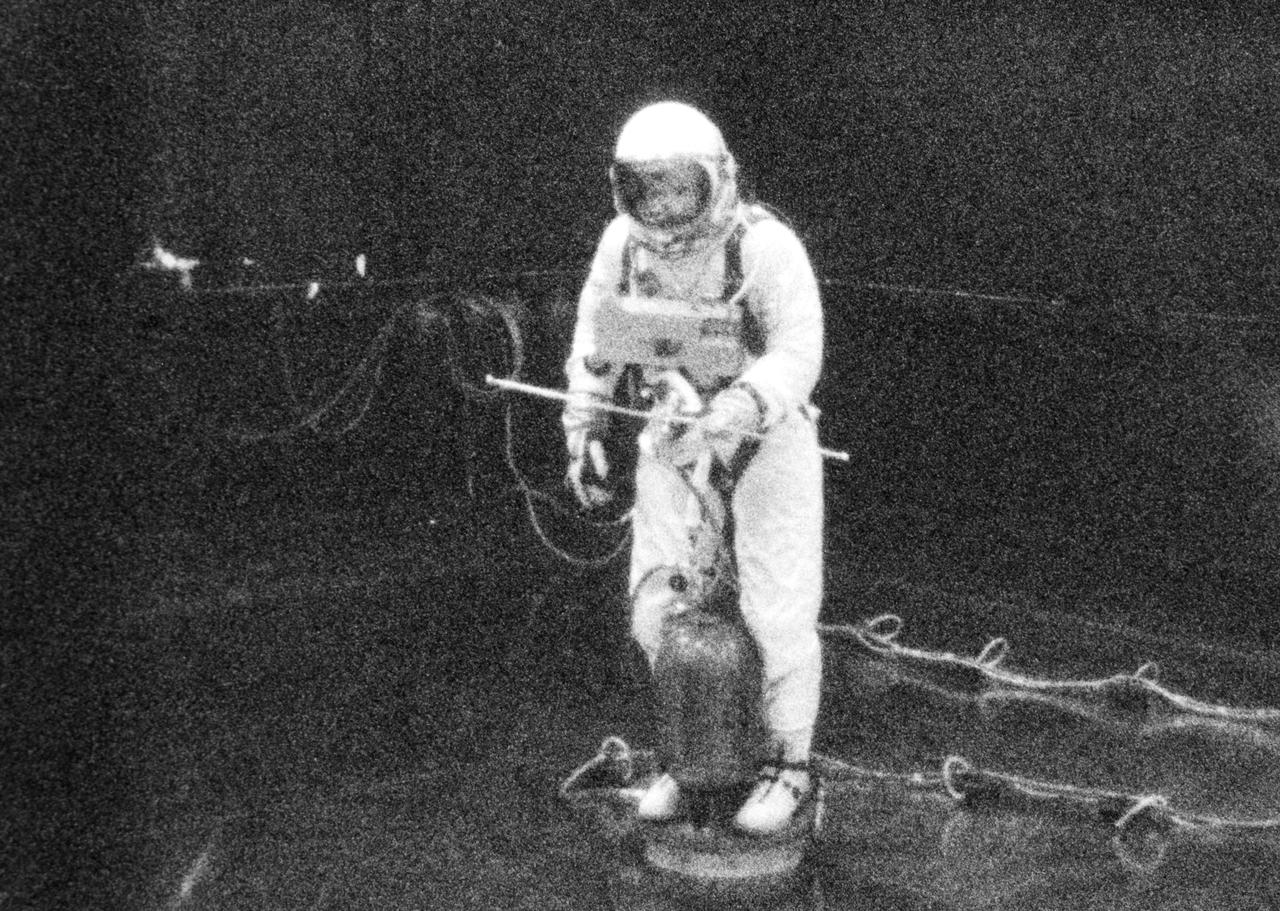
S65-19504 (28 May 1965) --- Astronaut Edward H. White II, pilot for the Gemini-Titan 4 prime crew, is pictured during an extravehicular exercise in the Building 4 laboratory at the Manned Spacecraft Center in Houston, Texas. White is controlling about the yaw (vertical) axis while translating. He stands on a Balance Extravehicular Training Aircraft which is separated from the level steel floor by a .001th-inch cushion of air. In his right hand White holds a zero-gravity integral propulsion unit which is a self-maneuvering device used by an astronaut in a zero-gravity environment. This condition is simulated in this training exercise. White's spacesuit is pressurized to create a realistic training condition. The simulated umbilical line is floated on air with the aid of eleven small air pads.
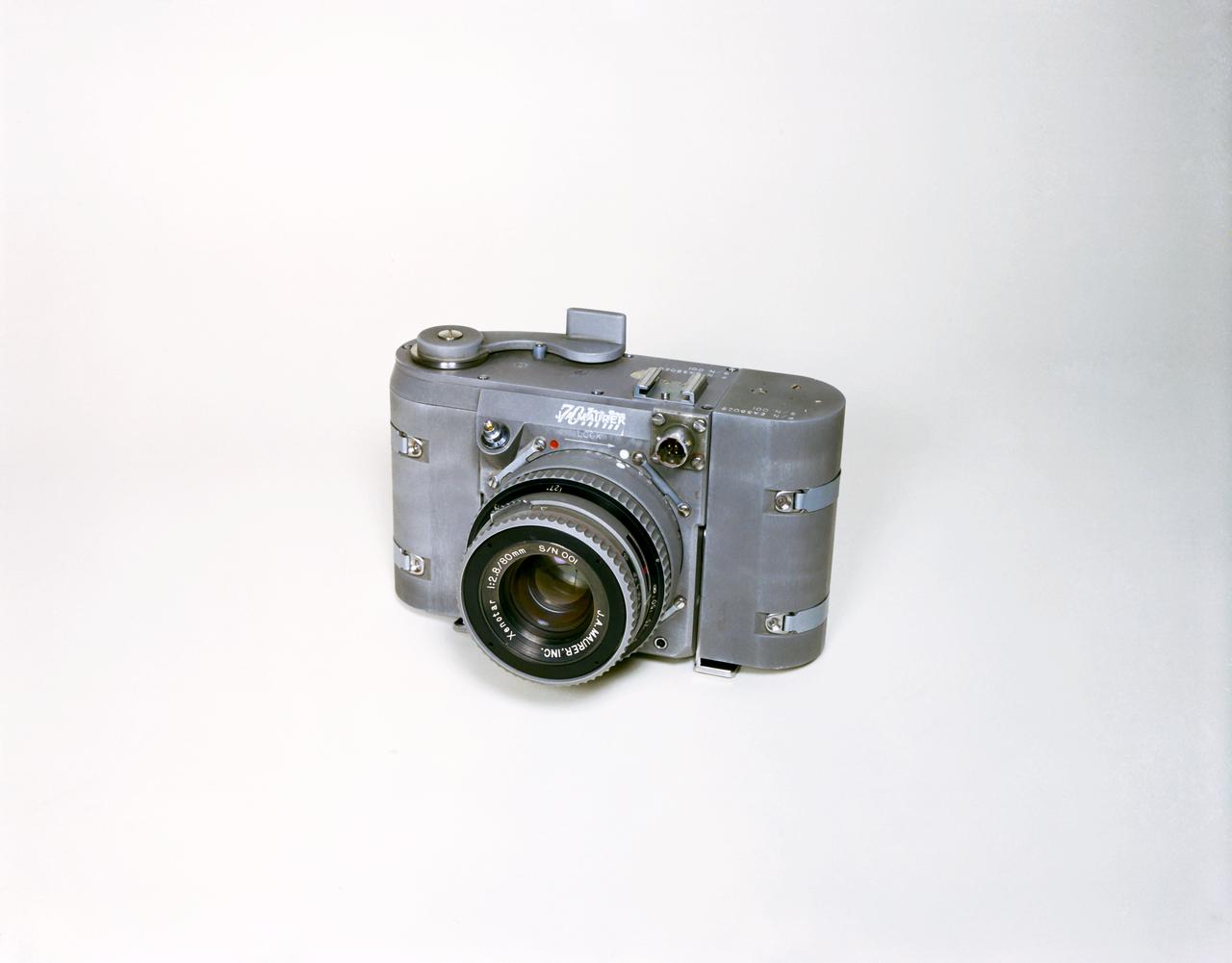
S65-23639 (28 April 1965) --- A bench view of a 70mm camera expected to be used by the Gemini-4 astronauts.
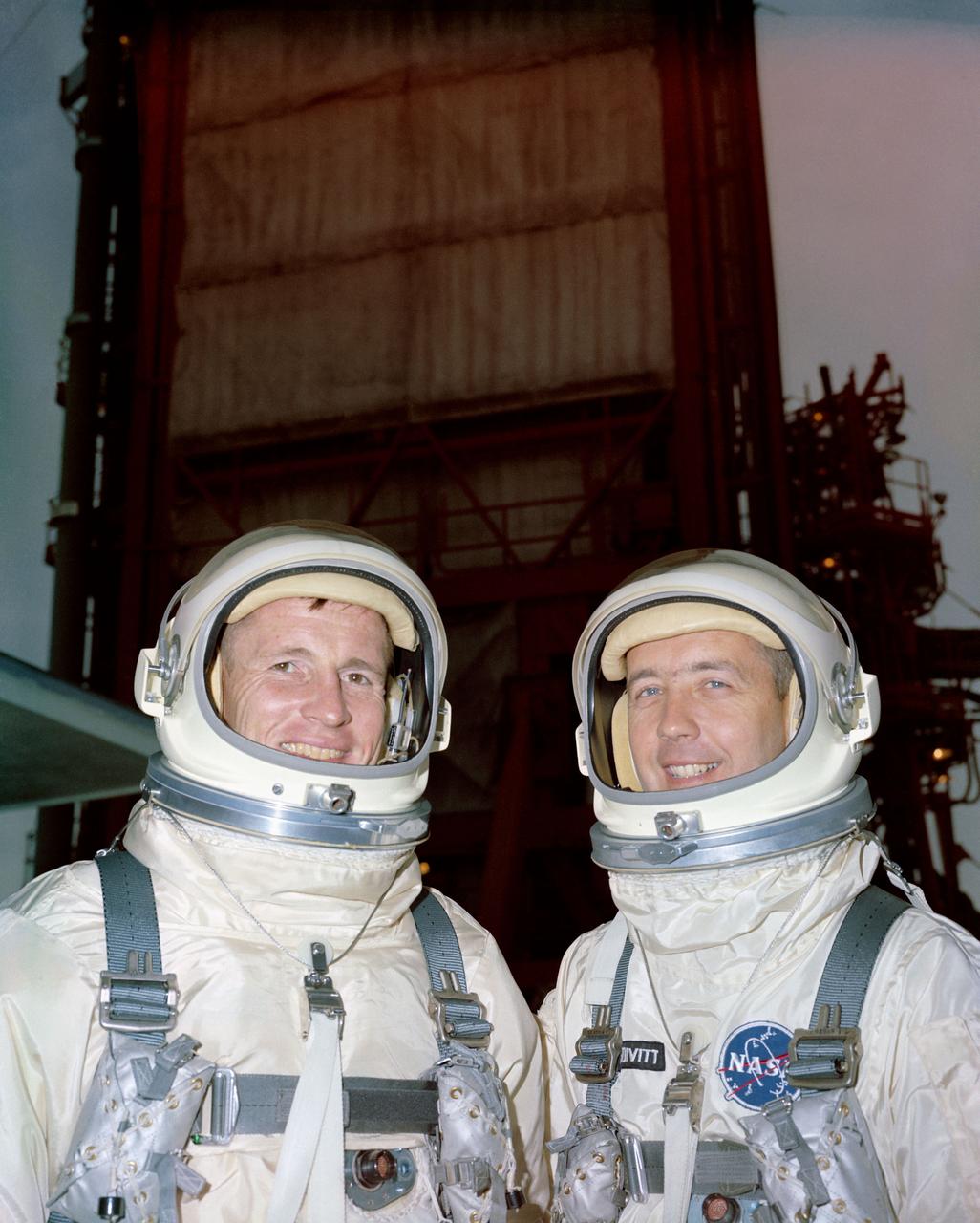
S65-19528 (1 June 1965) --- Astronauts Edward H. White II (left), Gemini-Titan 4 pilot; and James A. McDivitt, command pilot. EDITOR?S NOTE: Astronaut White died in the Apollo 1/Saturn 204 fire at Cape Kennedy on Jan. 27, 1967.
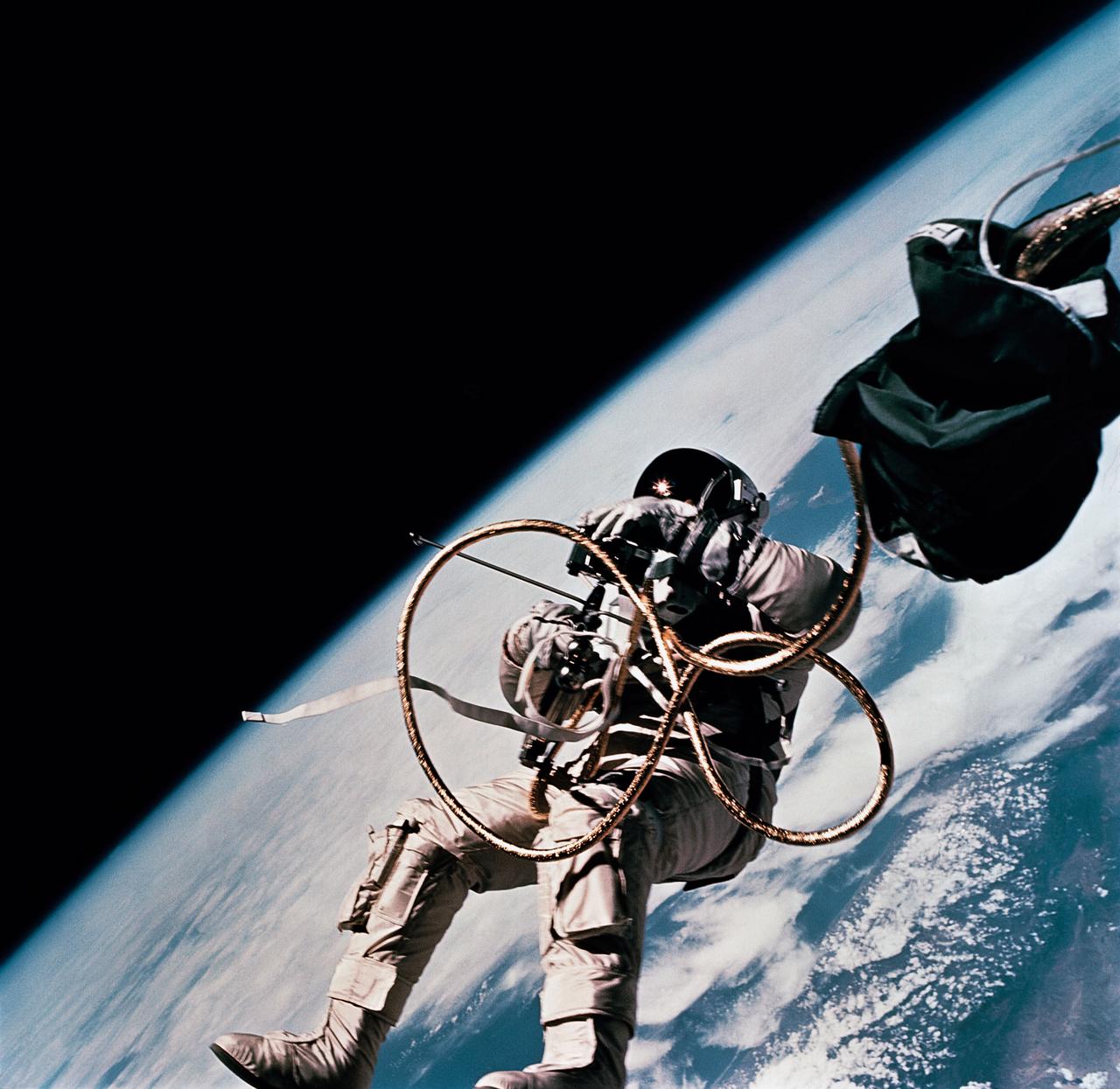
S65-30430 (3 June 1965) --- Astronaut Edward H. White II, pilot on the Gemini-Titan 4 spaceflight, is shown during his egress from the spacecraft. His face is covered by a shaded visor to protect him from the unfiltered rays of the sun. White became the first American astronaut to walk in space. He remained outside the spacecraft for 21 minutes during the third revolution of the Gemini-4 mission. He wears a specially designed spacesuit for the extravehicular activity (EVA). In his right hand, he carries a Hand-Held Self-Maneuvering Unit (HHSMU) with which he controlled his movements while in space. He was attached to the spacecraft by a 25-feet umbilical line and a 23-feet tether line, both wrapped together with gold tape to form one cord. He wears an emergency oxygen supply chest pack. Astronaut James A. McDivitt is command pilot for the Gemini-4 mission. Photo credit: NASA EDITOR'S NOTE: Astronaut Edward H. White II died in the Apollo/Saturn 204 fire at Cape Kennedy on Jan. 27, 1967.
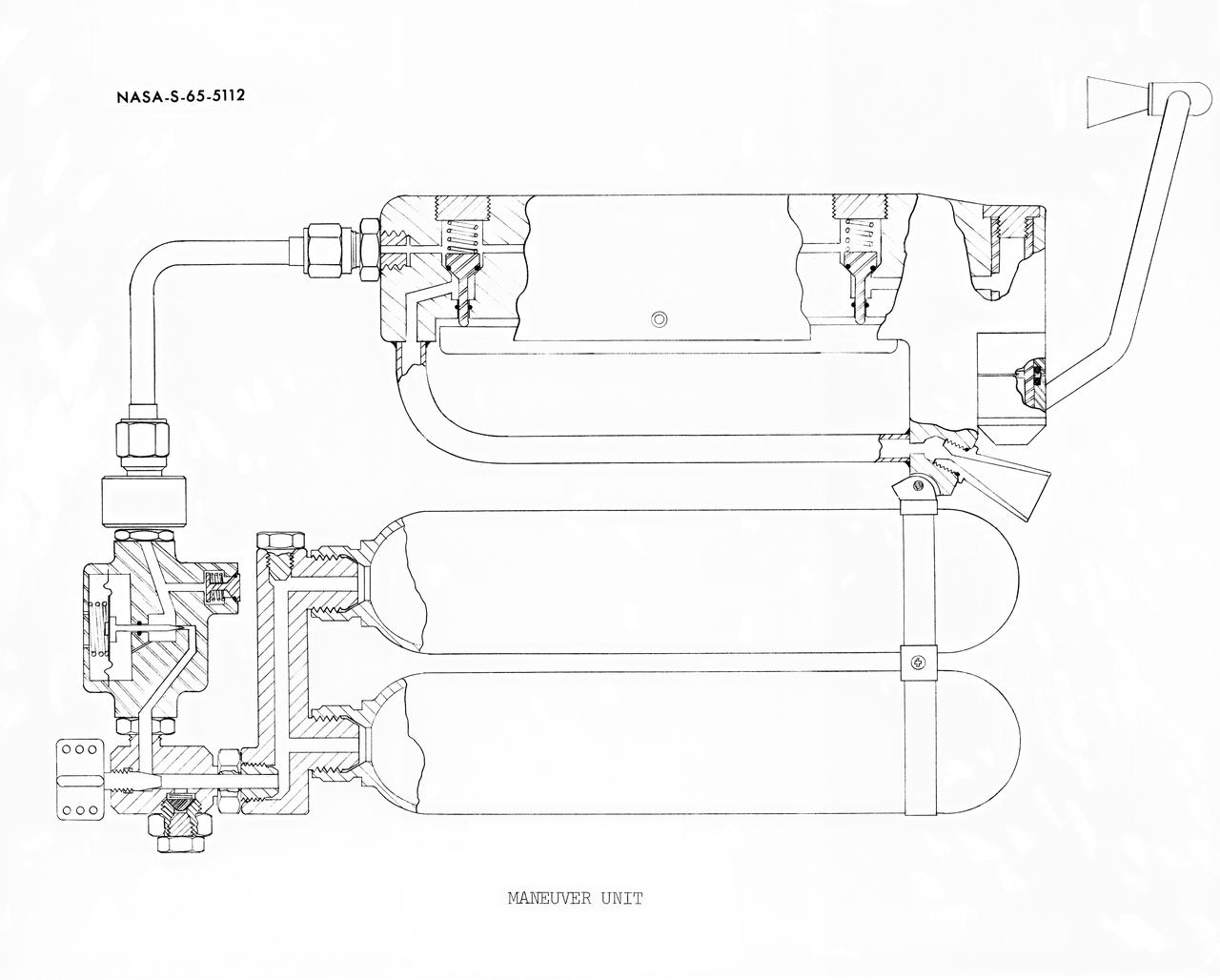
S65-05112 (30 May 1965) --- Cutaway engineering drawing showing some of the features of the zero-gravity integral propulsion unit.
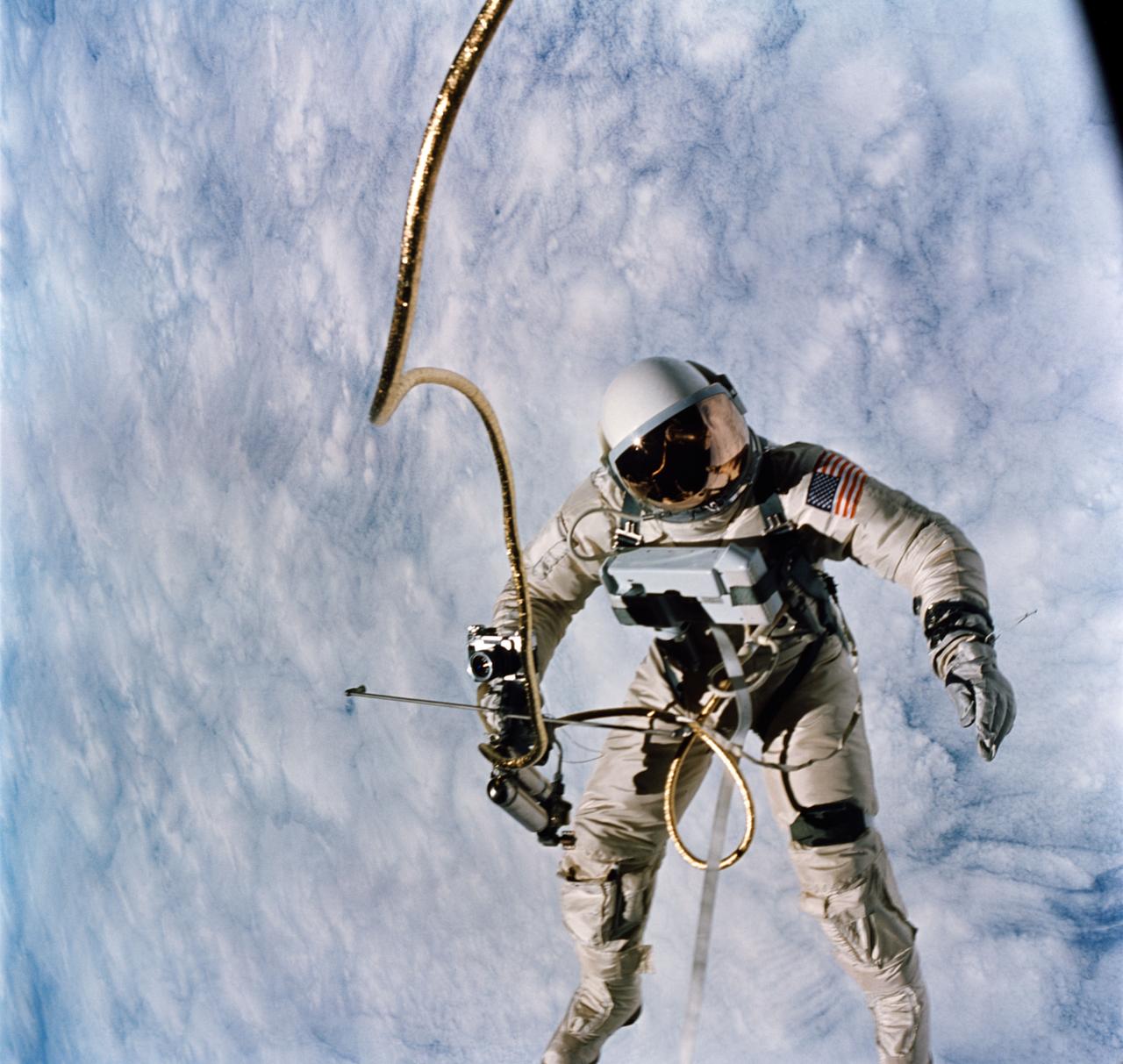
S65-30427 (3 June 1965) --- Astronaut Edward H. White II, pilot for the Gemini-Titan 4 (GT-4) spaceflight, floats in the zero-gravity of space during the third revolution of the GT-4 spacecraft. White wears a specially designed spacesuit. His face is shaded by a gold-plated visor to protect him from unfiltered rays of the sun. In his right hand he carries a Hand-Held Self-Maneuvering Unit (HHSMU) that gives him control over his movements in space. White also wears an emergency oxygen chest pack; and he carries a camera mounted on the HHSMU for taking pictures of the sky, Earth and the GT-4 spacecraft. He is secured to the spacecraft by a 25-feet umbilical line and a 23-feet tether line. Both lines are wrapped together in gold tape to form one cord. Astronaut James A. McDivitt, command pilot, remained inside the spacecraft during the extravehicular activity (EVA). Photo credit: NASA EDITOR'S NOTE: Astronaut Edward H. White II died in the Apollo/Saturn 204 fire at Cape Kennedy on Jan. 27, 1967.
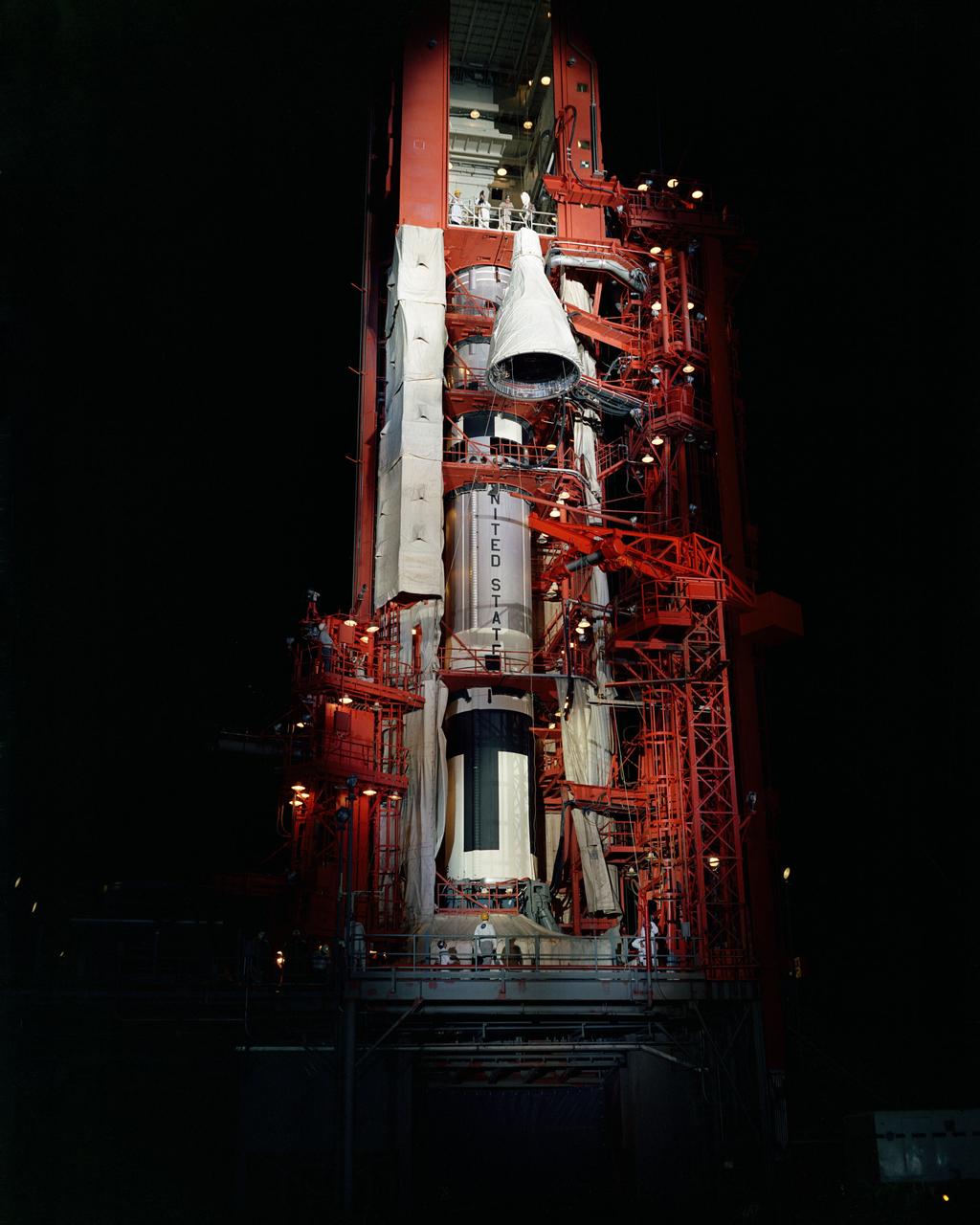
S65-23710 (14 April 1965) --- Nighttime scene showing the Gemini-4 spacecraft being hoisted to the white room at the top of the gantry at Pad 19 for soft mating with the Titan launch vehicle.
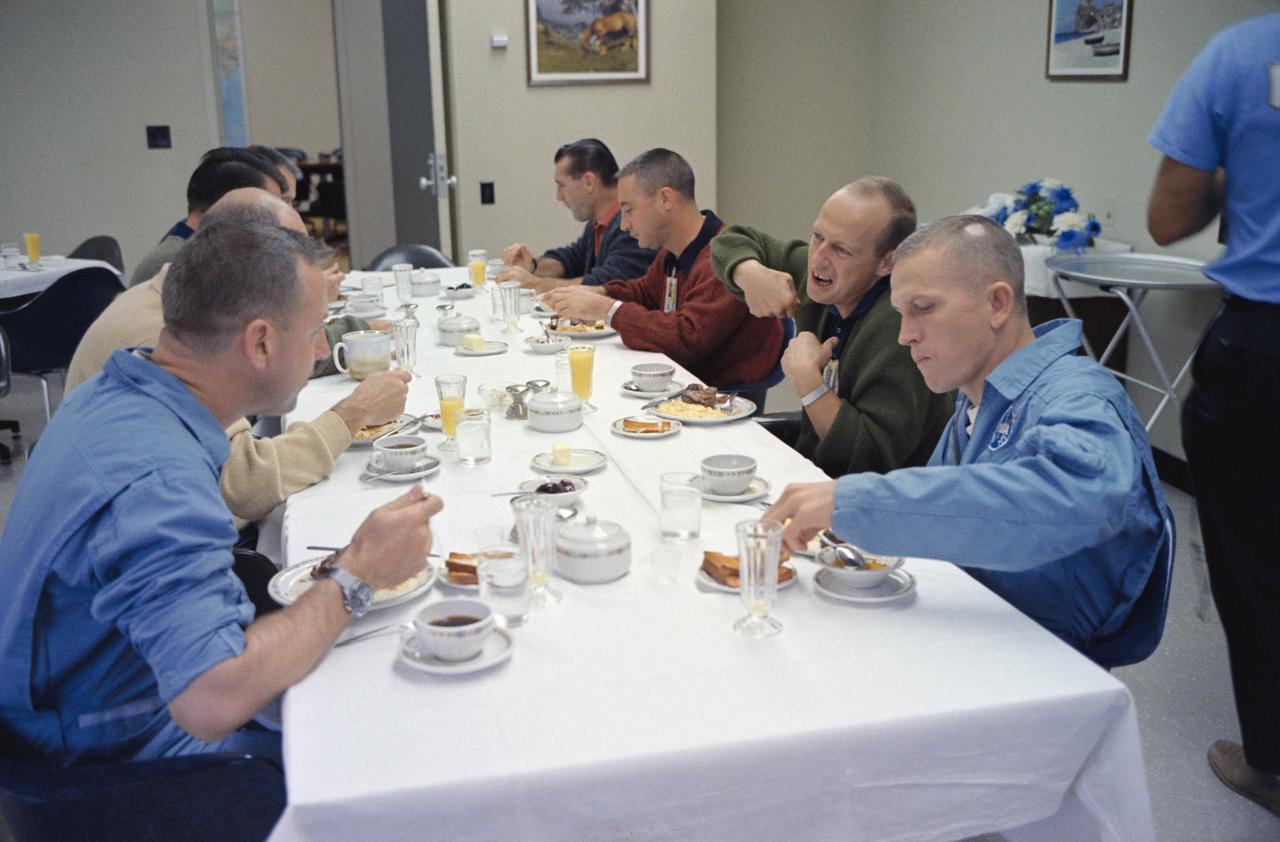
S65-59927 (4 Dec. 1965) --- Fellow astronauts join the Gemini-7 prime crew for breakfast in the Manned Spacecraft Operations Building, Merritt Island, on the day of the Gemini-7 launch. Clockwise around the table, starting lower left, are astronauts James A. Lovell Jr., Gemini-7 prime crew pilot; Walter M. Schirra Jr., Gemini-6 prime crew command pilot; Donald K. Slayton, MSC assistant director for Flight Crew Operations; Virgil I. Grissom, Gemini-6 backup crew command pilot; Charles Conrad Jr., Gemini-5 prime crew pilot; and Frank Borman, Gemini-7 prime crew command pilot. Photo credit: NASA
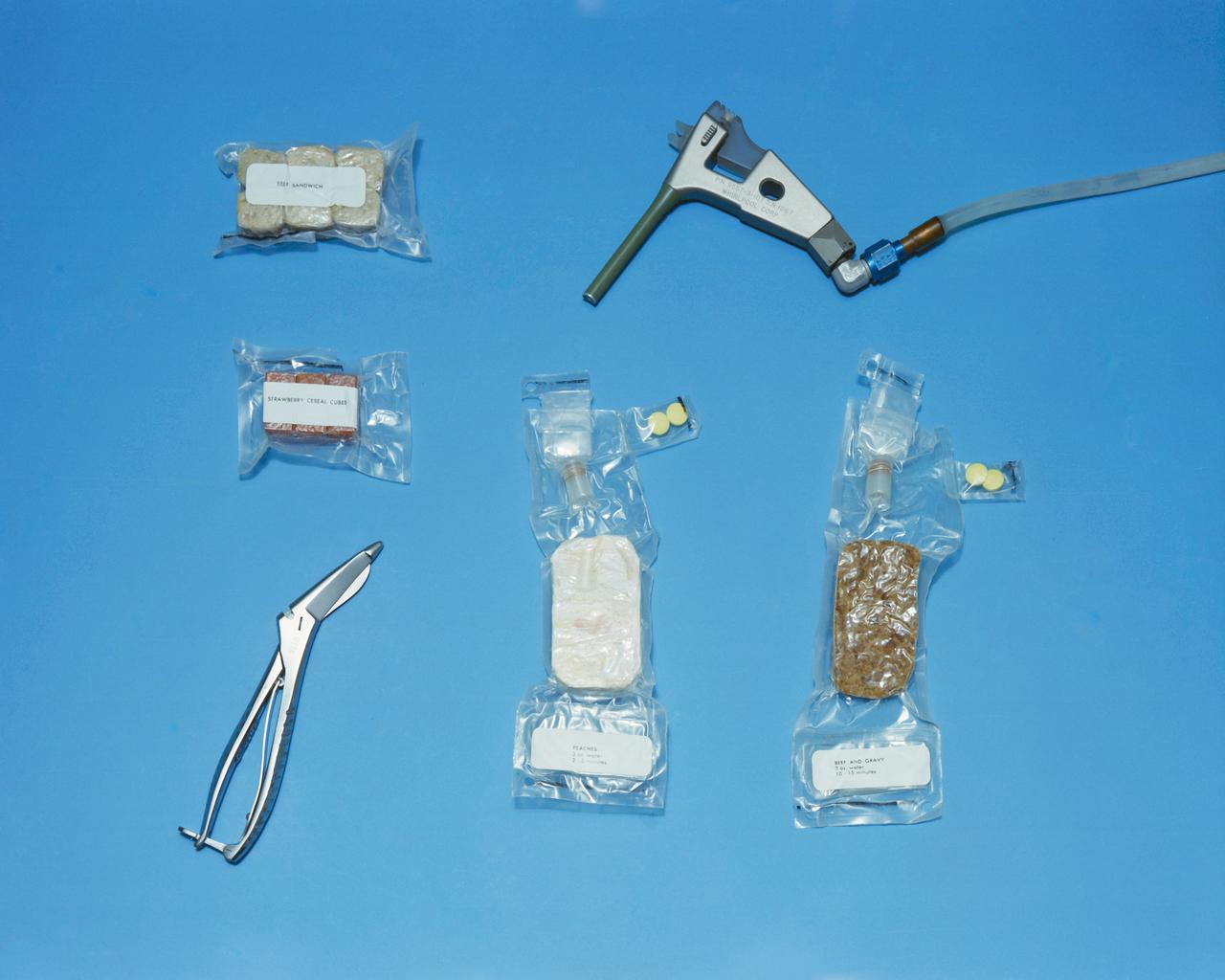
Food packages for use on the Gemini-Titan 4 (GT-4) flight. Packages include beef and gravy, peaches, strawberry cereal cubes and beef sandwiches. A water gun is used to reconstitute the dehydrated food. MSC, HOUSTON, TX CN
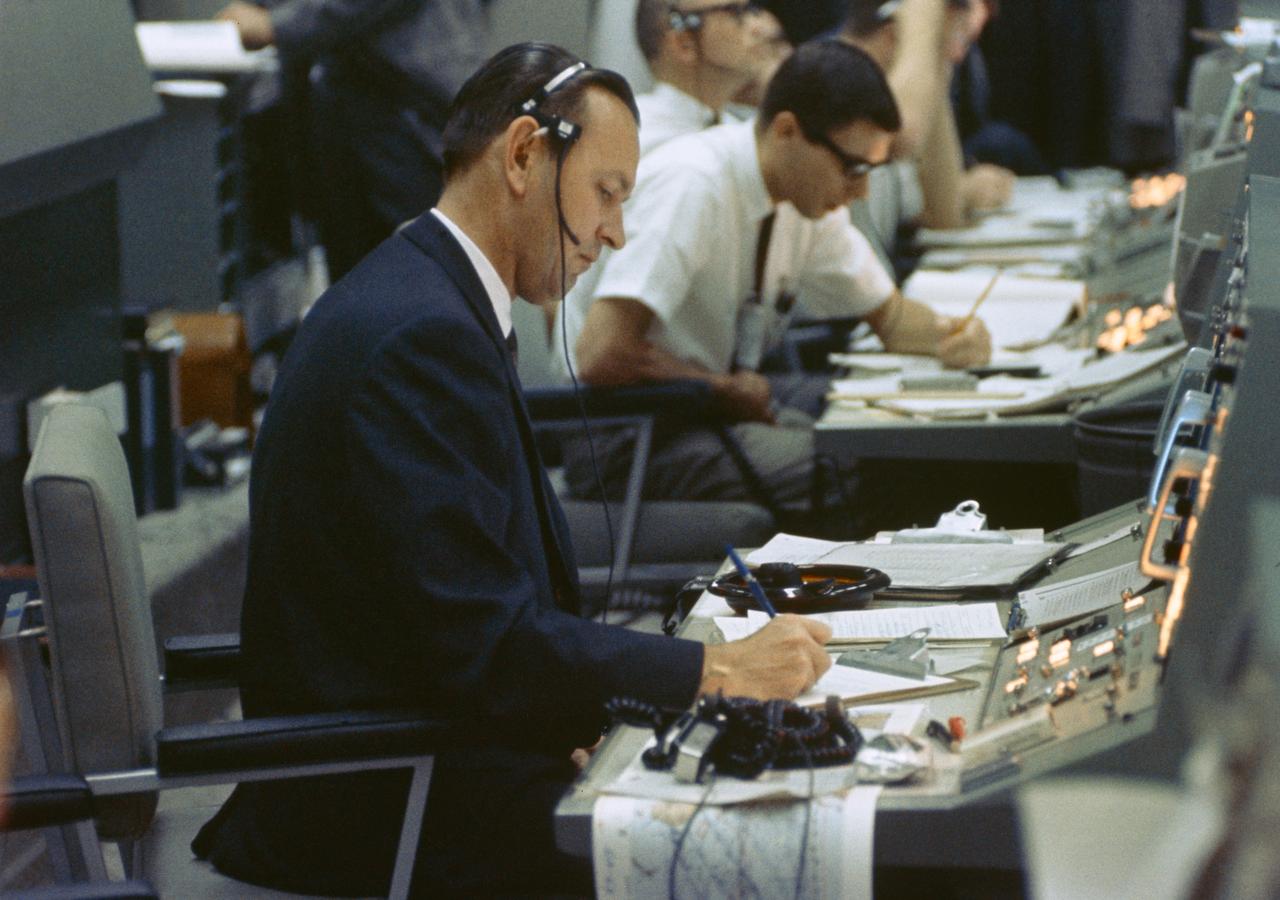
S65-28462 (3-7 June 1965) --- Christopher C. Kraft Jr., assistant director for Flight Operations, at his console in the Mission Control Center during Gemini-4 spaceflight. He served as mission director and as a flight director.
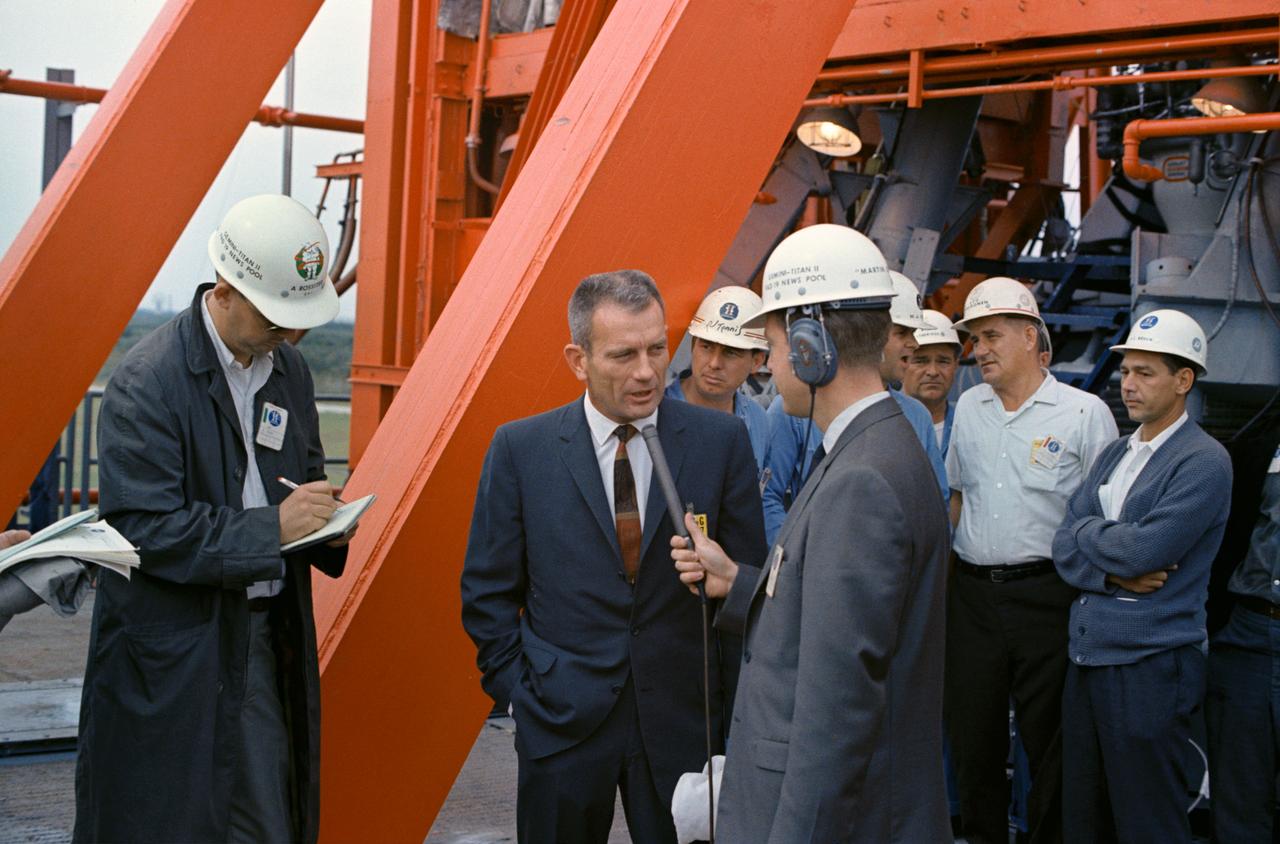
S65-61846 (5 Dec. 1965) --- Donald K. Slayton, assistant director for Flight Crew Operations, talks with newsmen after examining damage to Pad 19 at Kennedy Space Center, following liftoff of the Gemini-7 spacecraft on Dec. 4, 1965. Damage was slight and will be repaired quickly for the planned launch of Gemini-6. Photo credit: NASA
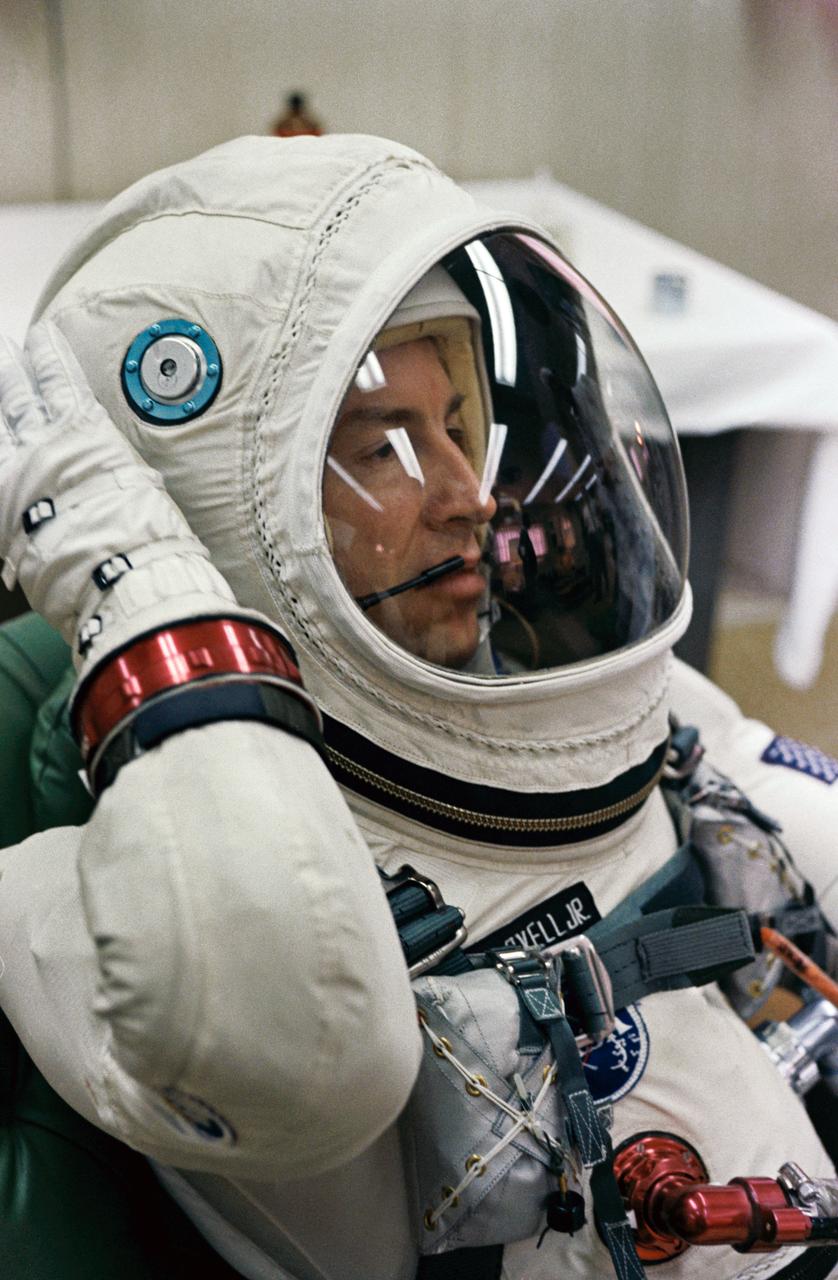
S65-61849 (4 Dec. 1965) --- Astronaut James A. Lovell Jr., pilot of the Gemini-7 spaceflight, relaxes in the suiting up trailer at Launch Complex 16, during the Gemini-7 prelaunch countdown at Cape Kennedy, Florida. Lovell wears the new lightweight spacesuit specially designed for long-duration flights. Photo credit: NASA
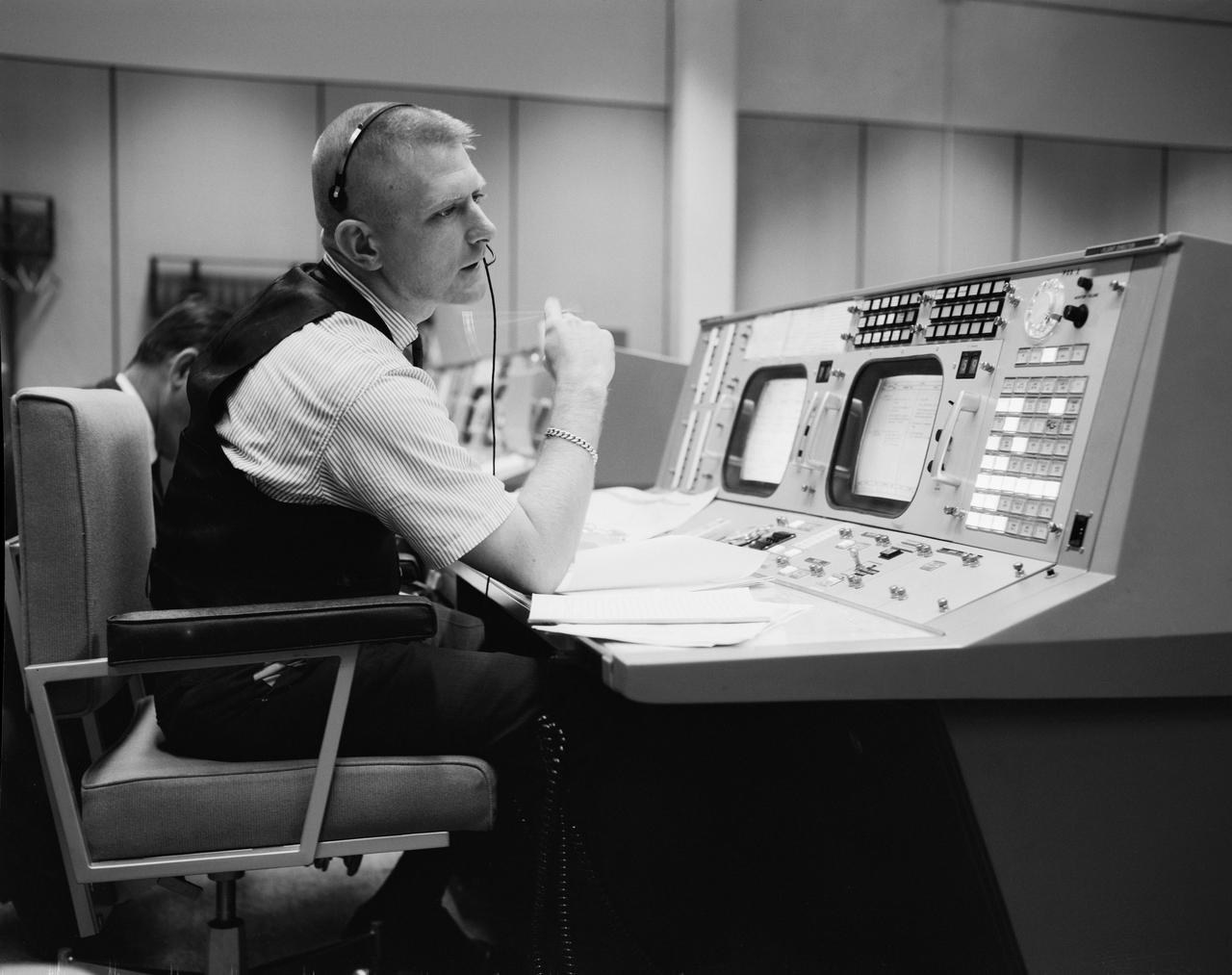
S65-22203 (April 1965) --- Prior to the Gemini-Titan 4 mission, flight director Eugene F. Kranz is pictured during a simulation at the Flight Director console in Houston's Mission Control Center on the Manned Spacecraft Center site. GT-4 was the first mission to be at least partially controlled from the Houston site. Photo credit: NASA
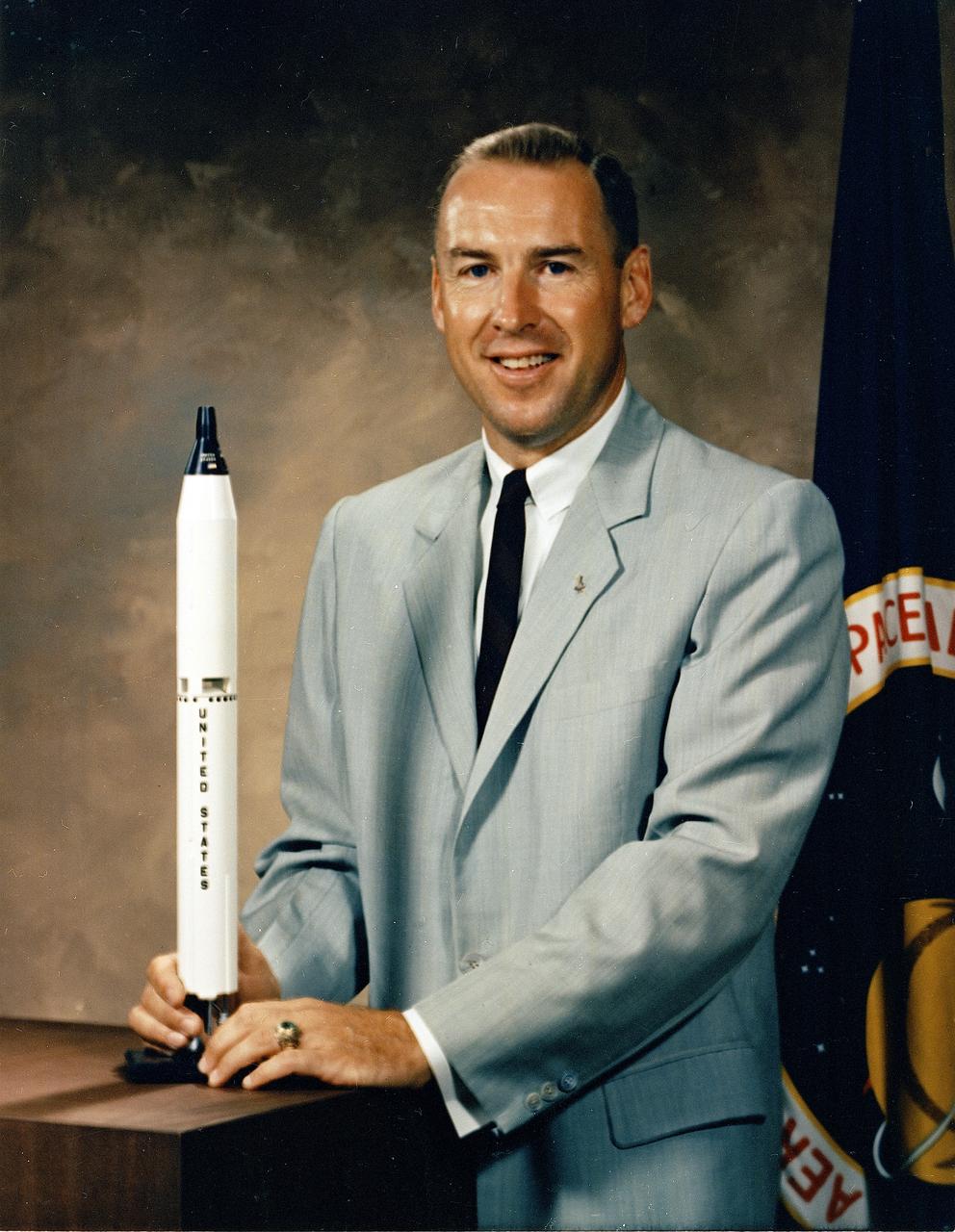
This is the official NASA portrait of astronaut James Lovell. Captain Lovell was selected as an Astronaut by NASA in September 1962. He has since served as backup pilot for the Gemini 4 flight and backup Commander for the Gemini 9 flight, as well as backup Commander to Neil Armstrong for the Apollo 11 lunar landing mission. On December 4, 1965, he and Frank Borman were launched into space on the history making Gemini 7 mission. The flight lasted 330 hours and 35 minutes and included the first rendezvous of two manned maneuverable spacecraft. The Gemini 12 mission, commanded by Lovell with Pilot Edwin Aldrin, began on November 11, 1966 for a 4-day, 59-revolution flight that brought the Gemini program to a successful close. Lovell served as Command Module Pilot and Navigator on the epic six-day journey of Apollo 8, the first manned Saturn V liftoff responsible for allowing the first humans to leave the gravitational influence of Earth. He completed his fourth mission as Spacecraft Commander of the Apollo 13 flight, April 11-17, 1970, and became the first man to journey twice to the moon. The Apollo 13 mission was cut short due to a failure of the Service Module cryogenic oxygen system. Aborting the lunar course, Lovell and fellow crewmen, John L. Swigert and Fred W. Haise, working closely with Houston ground controllers, converted their lunar module, Aquarius, into an effective lifeboat that got them safely back to Earth. Captain Lovell held the record for time in space with a total of 715 hours and 5 minutes until surpassed by the Skylab flights. On March 1, 1973, Captain Lovell retired from the Navy and the Space Program.
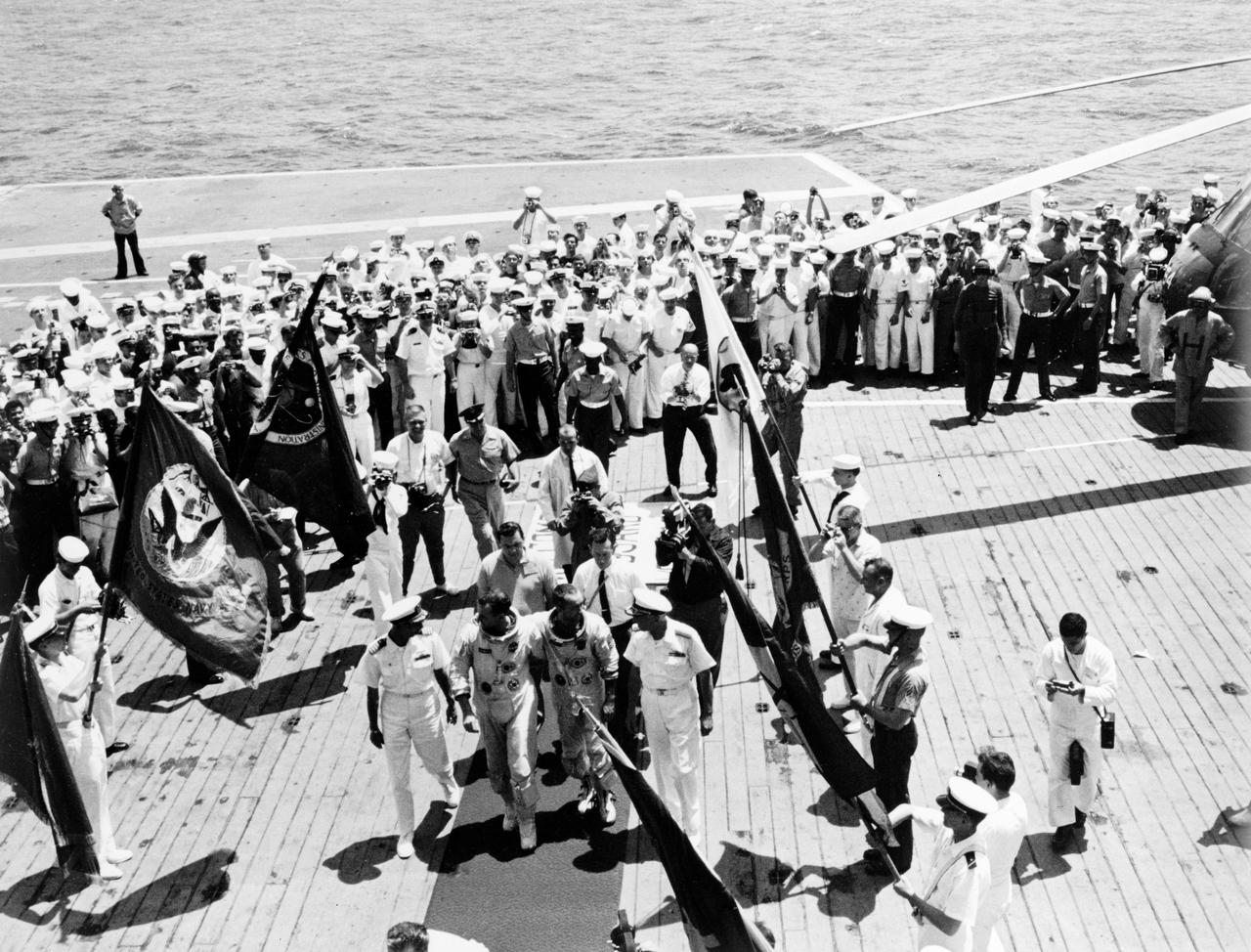
S65-19530 (7 June 1965) --- The red carpet treatment is given to the Gemini-Titan 4 astronauts Edward H. White II and James A. McDivitt as they arrive on the flight deck of the aircraft carrier USS Wasp after their record breaking 62-revolution, 97-hour and 56-minute flight which ended in the Atlantic Ocean about 400 miles east of Cape Kennedy at 12:12 p.m. (EST) on June 7, 1965. Here they are shown being welcomed by members of the crew and NASA people. White and McDivitt (center) walk on the red carpet flanked by Capt. J.W. Conger (left), commander of the ship; and Rear Adm. W.M. McCormick, commander, Carrier Division 14, Atlantic Fleet. NASA's Gemini-4 flight landed about 48 miles short of the aircraft carrier.
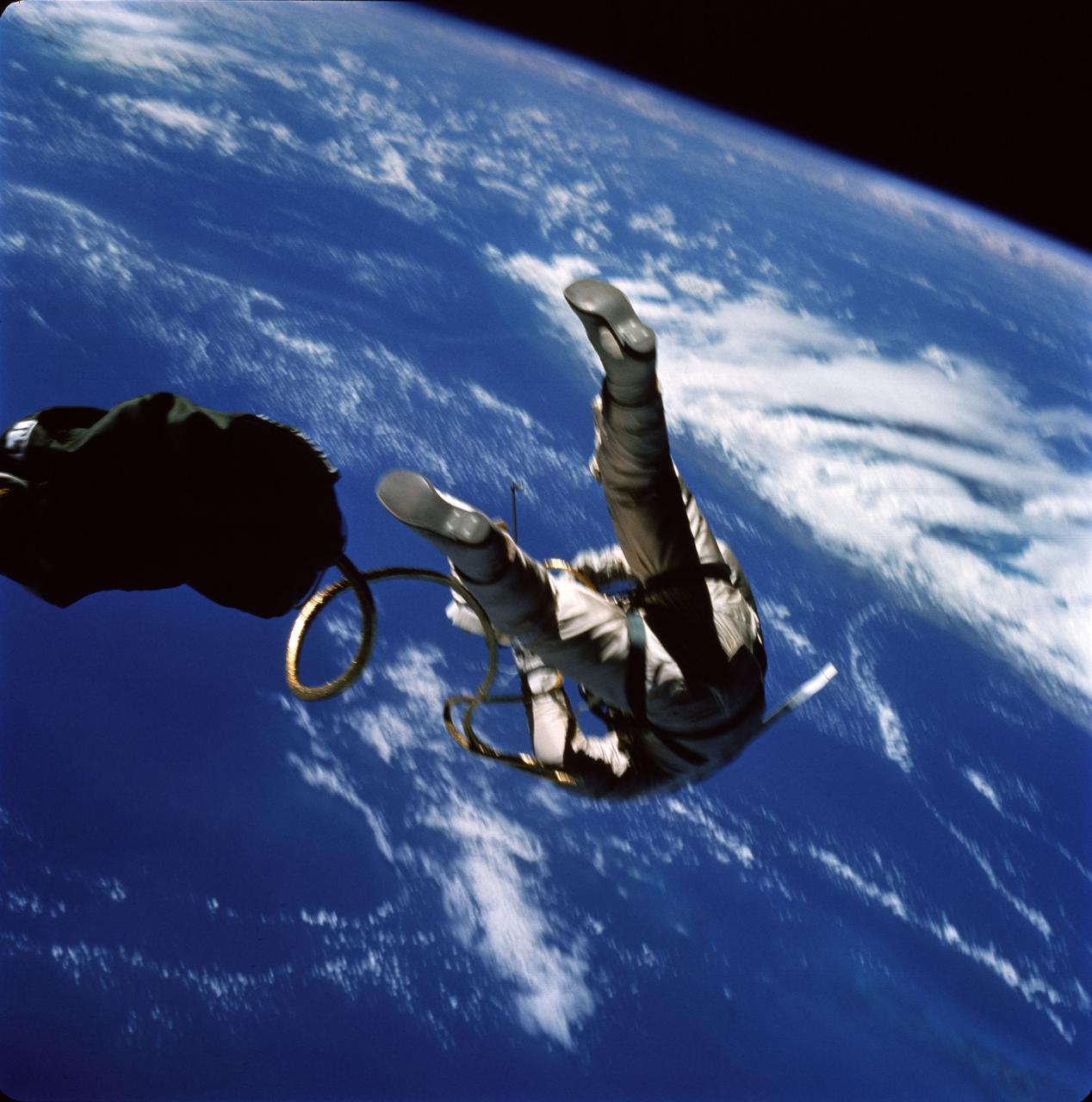
View of Astronaut Edward H. White II, pilot for the Gemini-Titan 4 space flight, as he floats in zero gravity of space. The extravehicular activity was performed during the third revolution of the Gemini 4 spacecraft. White is attached to the spacecraft by a 25-ft. umbilical line and a 23-ft. tether line,both wrapped in gold tape to form one cord. In his right hand White carries a Hand-Held Self-Maneuvering Unit (HHSMU). The visor of his helmet is gold plated to protect him from the unfiltered rays of the sun. Photo was taken on June 3,1965. G.E.T. time was 4:45 / GMT time was 20:00. Original magazine number was GEM04-16-34642, taken with a Hasselblad camera and a 70mm lens. Film type was Kodak Ektachrome MS (S.O. -217). The original photo was a color negative. It's image number is S65-34642.
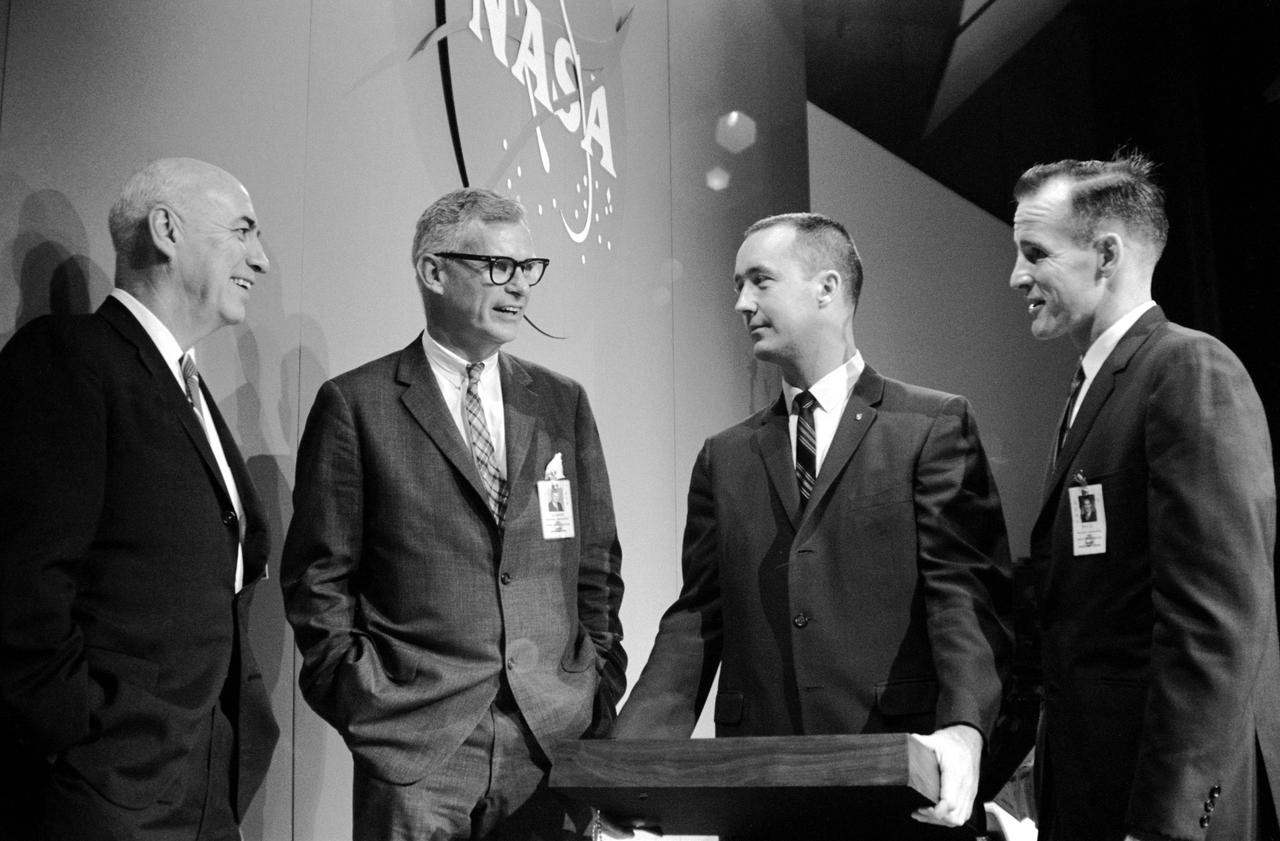
S65-33352 (11 June 1965) --- The Gemini-4 prime crew pose with two NASA officials after a press conference in the MSC auditorium. Left to right, are Dr. Robert R. Gilruth, MSC director; Dr. Robert C. Seamans Jr., associate administrator, National Aeronautics and Space Administration; astronaut James A. McDivitt, command pilot of the Gemini-4 flight; and astronaut Edward H. White II, pilot of the mission. The two astronauts had just returned to Houston following their debriefings at Cape Kennedy. The Gt-4 liftoff was at 10:16 a.m. (EST) on June 3, 1965. Time of splashdown ending the four-day, 62-revolution mission was at 12:12 p.m. on June 7, 1965.
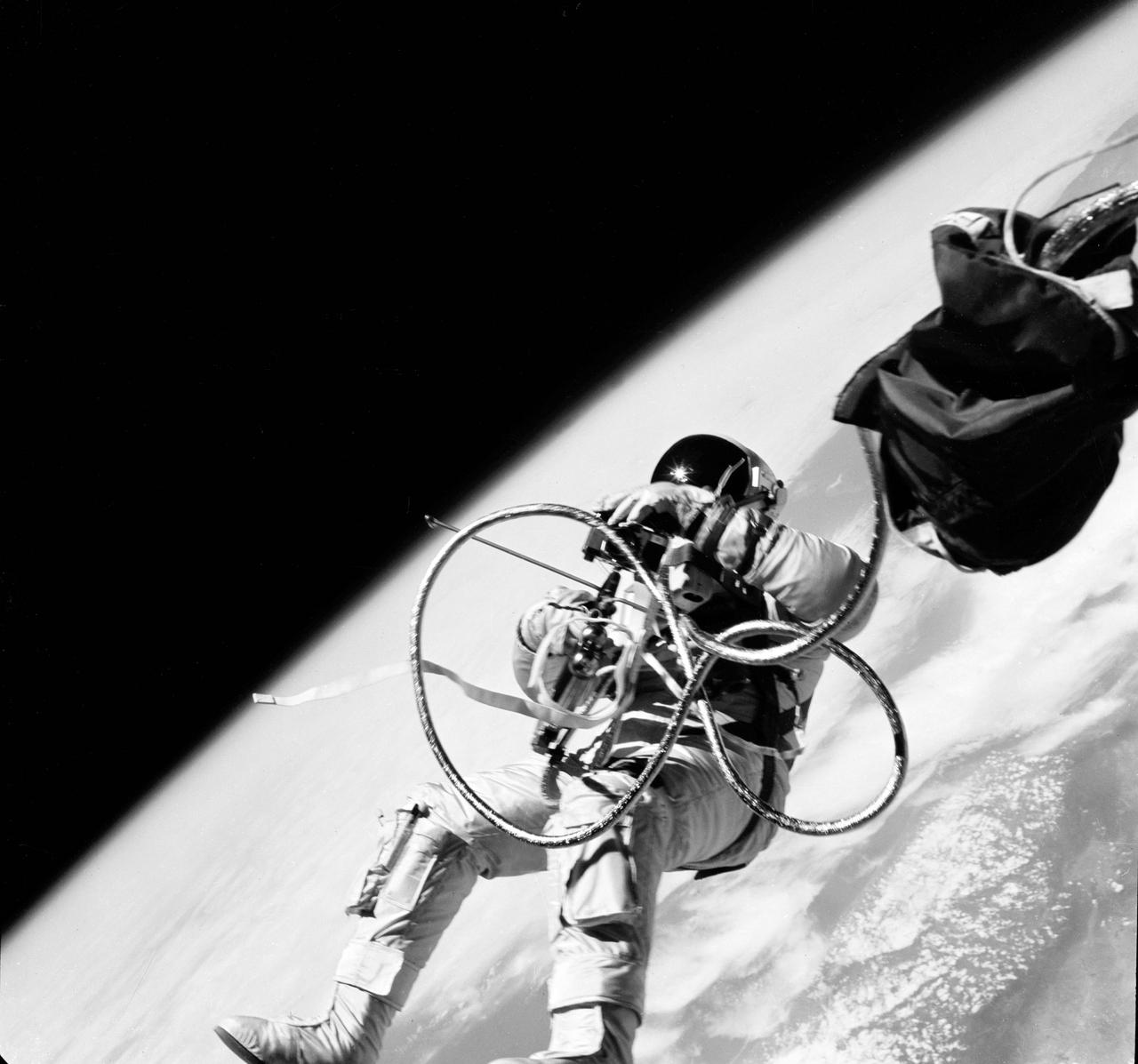
S65-30273 (3 June 1965) --- Astronaut Edward H. White II, pilot on the Gemini-Titan IV (GT-4) spaceflight, floats in the zero gravity of space outside the Gemini IV spacecraft. His face is covered by a shaded visor to protect him from the unfiltered rays of the sun. White became the first American astronaut to walk in space. He remained outside the spacecraft for 21 minutes during the third revolution of the Gemini IV mission. He wears a specially designed spacesuit for the EVA. His right hand is holding the Hand-Held Self-Maneuvering Unit (HHSMU), with which he controlled his movements while in space, and a camera is attached to the HHSMU. He was attached to the spacecraft by a 25-feet umbilical line and a 23-feet tether line, both wrapped together with gold tape to form one cord. He wears an emergency oxygen supply check pack. Astronaut James A. McDivitt is command pilot for the GT-4 mission. The mission was a four-day, 62-revolution flight, during which McDivitt and White performed a series of scientific and engineering experiments. (This image is black and white) Photo credit: NASA EDITOR?S NOTE: Astronaut Edward H. White II died in the Apollo/Saturn 204 fire at Cape Kennedy, Florida, on Jan. 27, 1967.
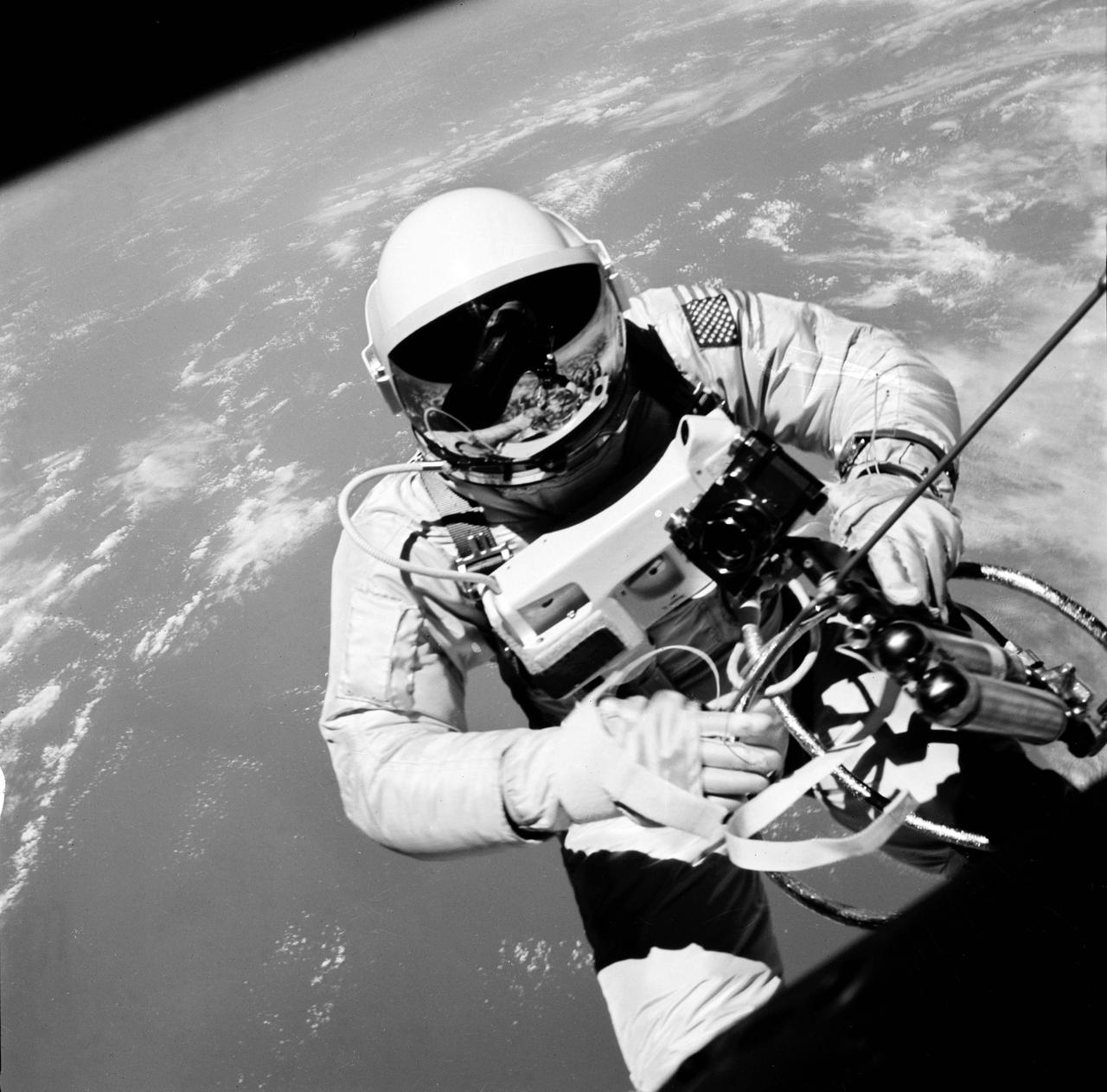
S65-30202 (3 June 1965) --- Astronaut Edward H. White II, pilot on the Gemini-Titan IV (GT-4) spaceflight, floats in the zero gravity of space outside the Gemini IV spacecraft. His face is covered by a shaded visor to protect him from the unfiltered rays of the sun. White became the first American astronaut to walk in space. He remained outside the spacecraft for 21 minutes during the third revolution of the Gemini IV mission. He wears a specially designed spacesuit for the EVA. He?s holding the Hand-Held Self-Maneuvering Unit (HHSMU), with which he controlled his movements while in space, and a camera is attached to the HHSMU. He was attached to the spacecraft by a 25-feet umbilical line and a 23-feet tether line, both wrapped together with gold tape to form one cord. He wears an emergency oxygen supply check pack. Astronaut James A. McDivitt is command pilot for the GT-4 mission. The mission was a four-day, 62-revolution flight, during which McDivitt and White performed a series of scientific and engineering experiments. (This image is black and white) Photo credit: NASA EDITOR?S NOTE: Astronaut Edward H. White II died in the Apollo/Saturn 204 fire at Cape Kennedy, Florida, on Jan. 27, 1967.
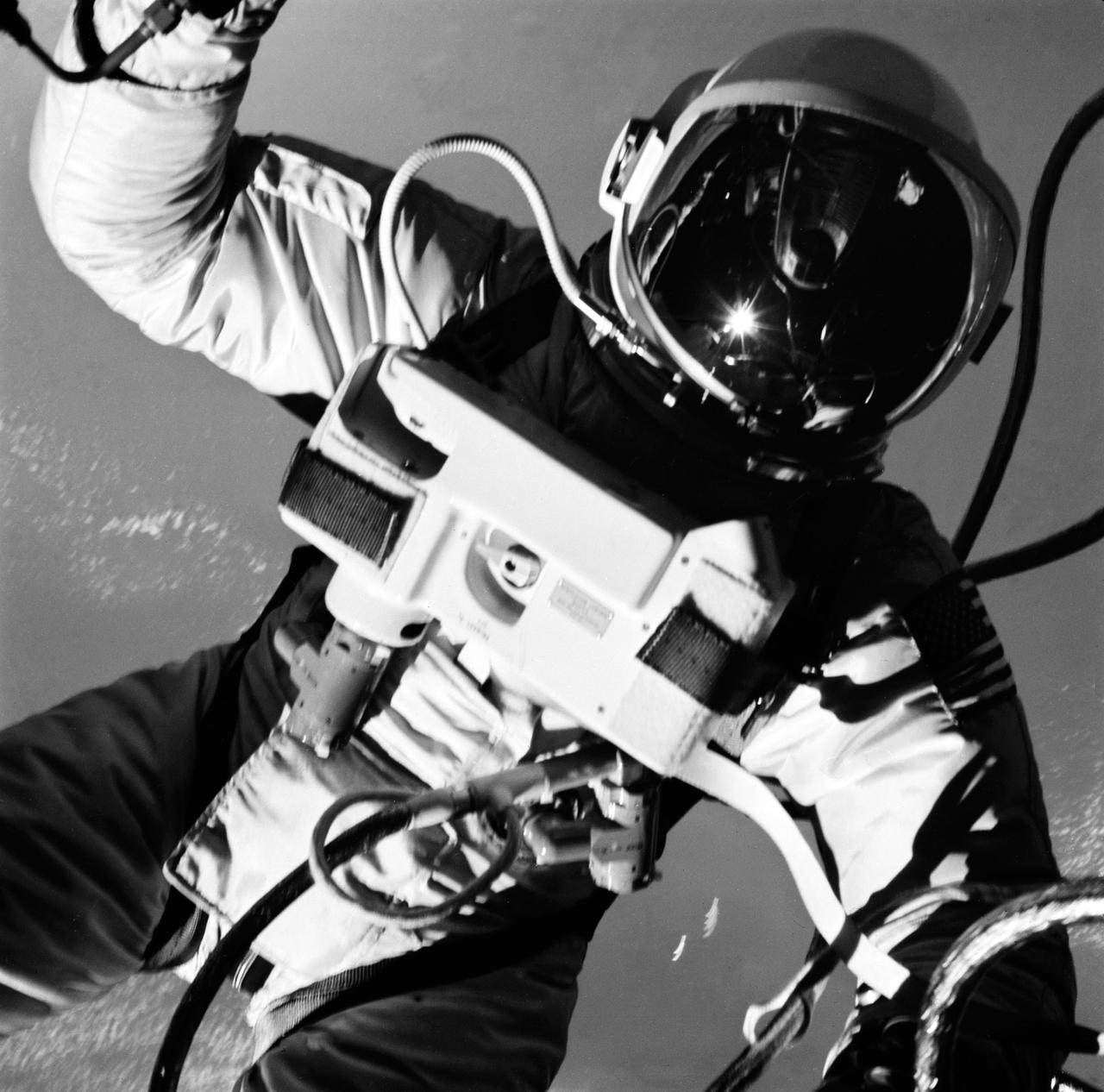
S65-30271 (3 June 1965) --- Astronaut Edward H. White II, pilot on the Gemini-Titan IV (GT-4) spaceflight, floats in the zero gravity of space outside the Gemini IV spacecraft. His face is covered by a shaded visor to protect him from the unfiltered rays of the sun. White became the first American astronaut to walk in space. He remained outside the spacecraft for 21 minutes during the third revolution of the Gemini IV mission. He wears a specially designed spacesuit for the EVA. His right hand (out of frame) is holding the Hand-Held Self-Maneuvering Unit (HHSMU), with which he controlled his movements while in space, and a camera is attached to the HHSMU. He was attached to the spacecraft by a 25-feet umbilical line and a 23-feet tether line, both wrapped together with gold tape to form one cord. He wears an emergency oxygen supply check pack. Astronaut James A. McDivitt is command pilot for the GT-4 mission. The mission was a four-day, 62-revolution flight, during which McDivitt and White performed a series of scientific and engineering experiments. (This image is black and white) Photo credit: NASA EDITOR?S NOTE: Astronaut Edward H. White II died in the Apollo/Saturn 204 fire at Cape Kennedy, Florida, on Jan. 27, 1967.
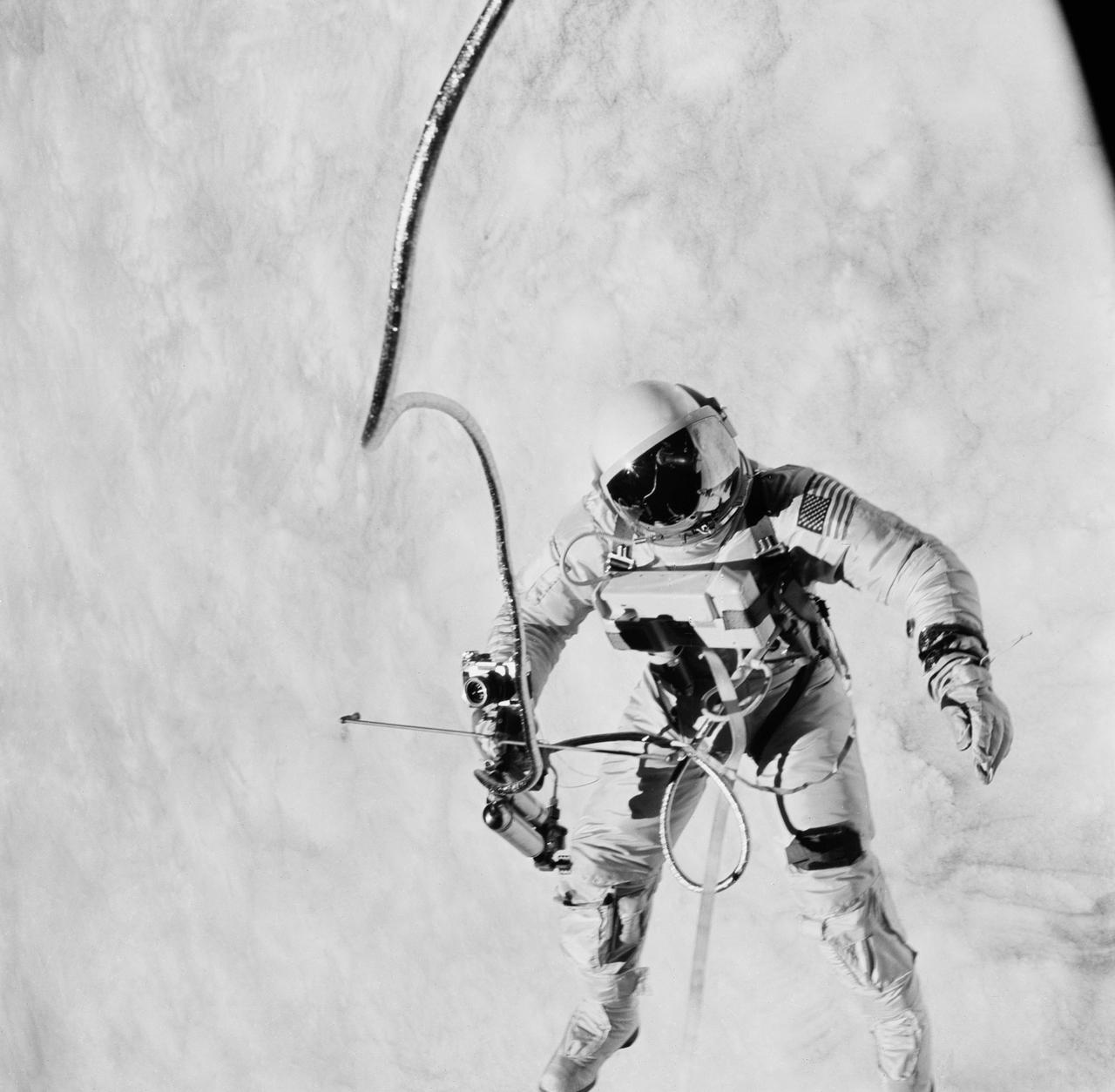
S65-30272 (3 June 1965) --- Astronaut Edward H. White II, pilot on the Gemini-Titan IV (GT-4) spaceflight, floats in the zero gravity of space outside the Gemini IV spacecraft. His face is covered by a shaded visor to protect him from the unfiltered rays of the sun. White became the first American astronaut to walk in space. He remained outside the spacecraft for 21 minutes during the third revolution of the Gemini IV mission. He wears a specially designed spacesuit for the EVA. His right hand is holding the Hand-Held Self-Maneuvering Unit (HHSMU), with which he controlled his movements while in space, and a camera is attached to the HHSMU. He was attached to the spacecraft by a 25-feet umbilical line and a 23-feet tether line, both wrapped together with gold tape to form one cord. He wears an emergency oxygen supply check pack. Astronaut James A. McDivitt is command pilot for the GT-4 mission. The mission was a four-day, 62-revolution flight, during which McDivitt and White performed a series of scientific and engineering experiments. (This image is black and white) Photo credit: NASA EDITOR?S NOTE: Astronaut Edward H. White II died in the Apollo/Saturn 204 fire at Cape Kennedy, Florida, on Jan. 27, 1967.
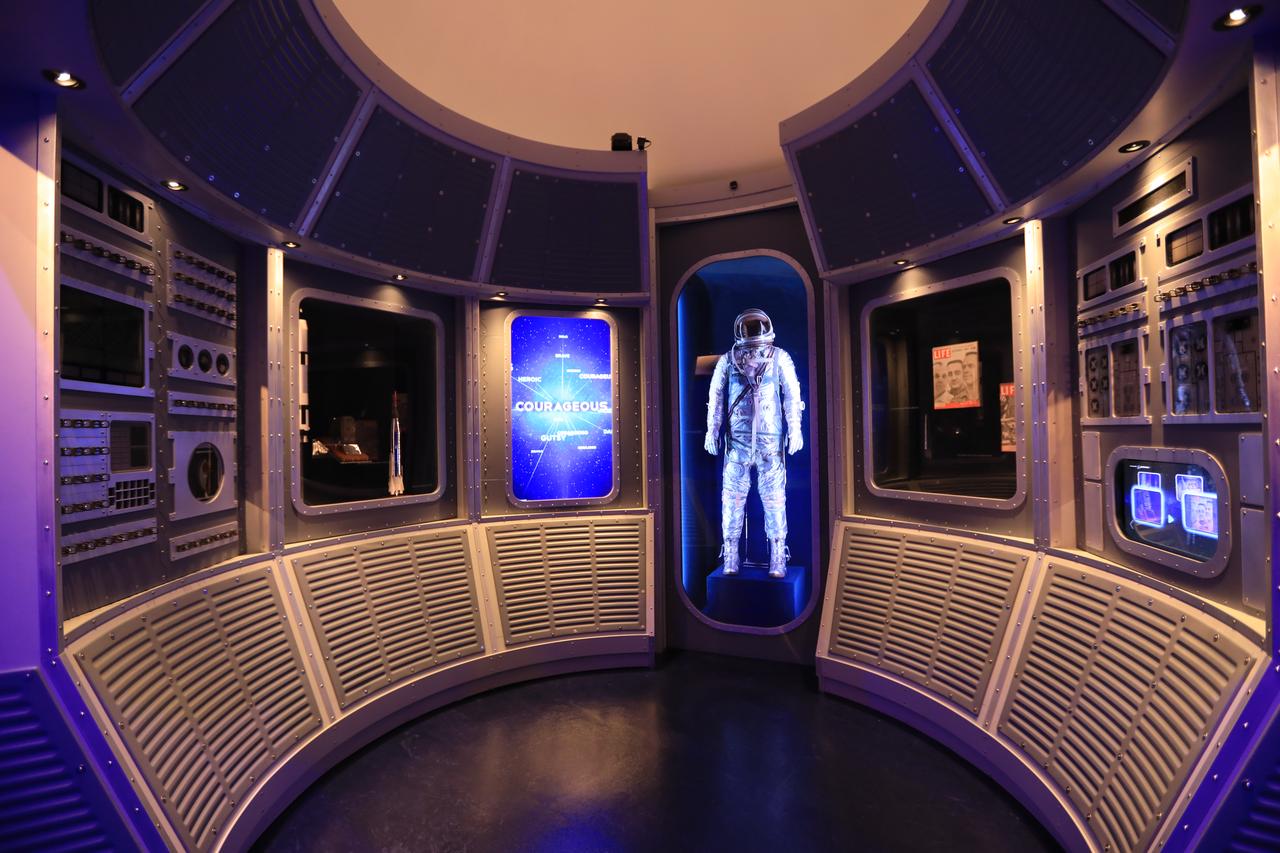
Inside the Heroes and Legends attraction at the Kennedy Space Center Visitor Complex, this display includes the spacesuit worn by astronaut Gus Grissom during his Mercury 4 suborbital flight of July 21, 1961. The new facility looks back to the pioneering efforts of Mercury, Gemini and Apollo. It sets the stage by providing the background and context for space exploration and the legendary men and women who pioneered the nation's journey into space.
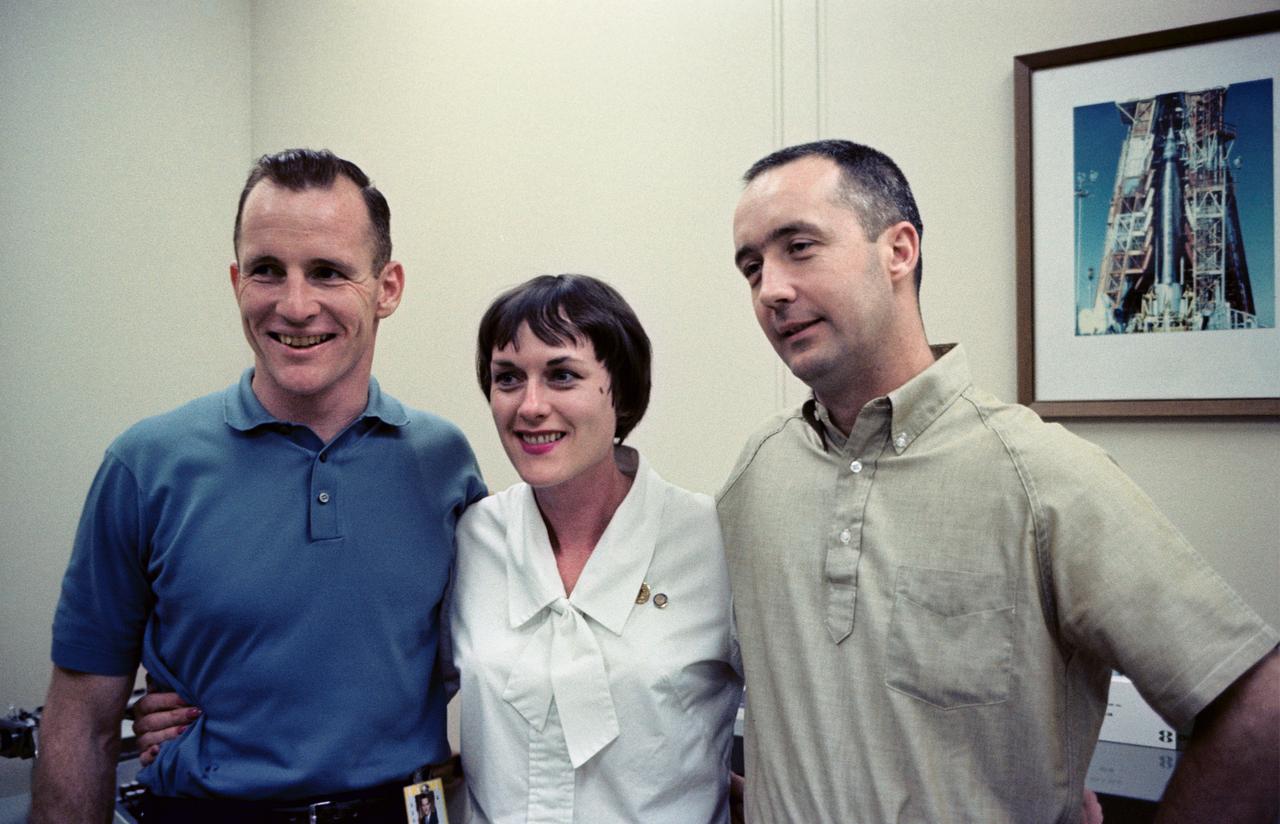
S65-29657 (June 1965) --- Gemini-4 prime crew, astronauts Edward H. White II (left), and James A. McDivitt are shown with Lt. Dolores (Dee) O'Hare, US Air Force, Center Medical Office, Flight Medicine Branch, Manned Spacecraft Center (MSC). Lieutenant O'Hare has served during several spaceflights as official medical nurse for the astronaut crew members on the missions.
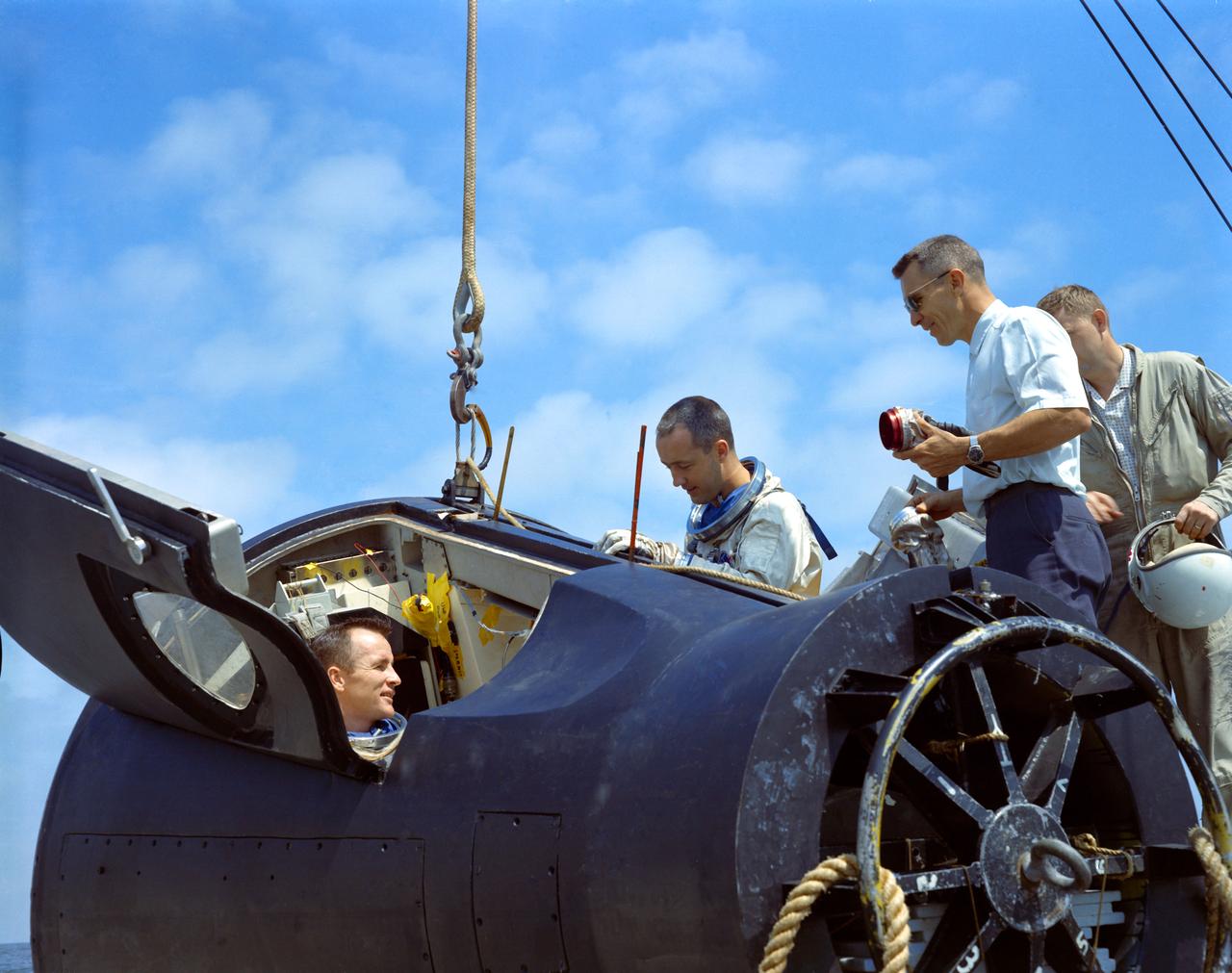
S65-22639 (14 April 1965) --- The Gemini-Titan 4 prime crew, astronauts Edward H. White II (left), pilot; and James A. McDivitt (getting in the spacecraft), command pilot, received instructions from Gordon Harvey, Flight Crew Support Division; and Alan M. Rochford, suit technician, Crew Systems Division, before closing of hatches prior to undergoing water egress training in the Gulf of Mexico.
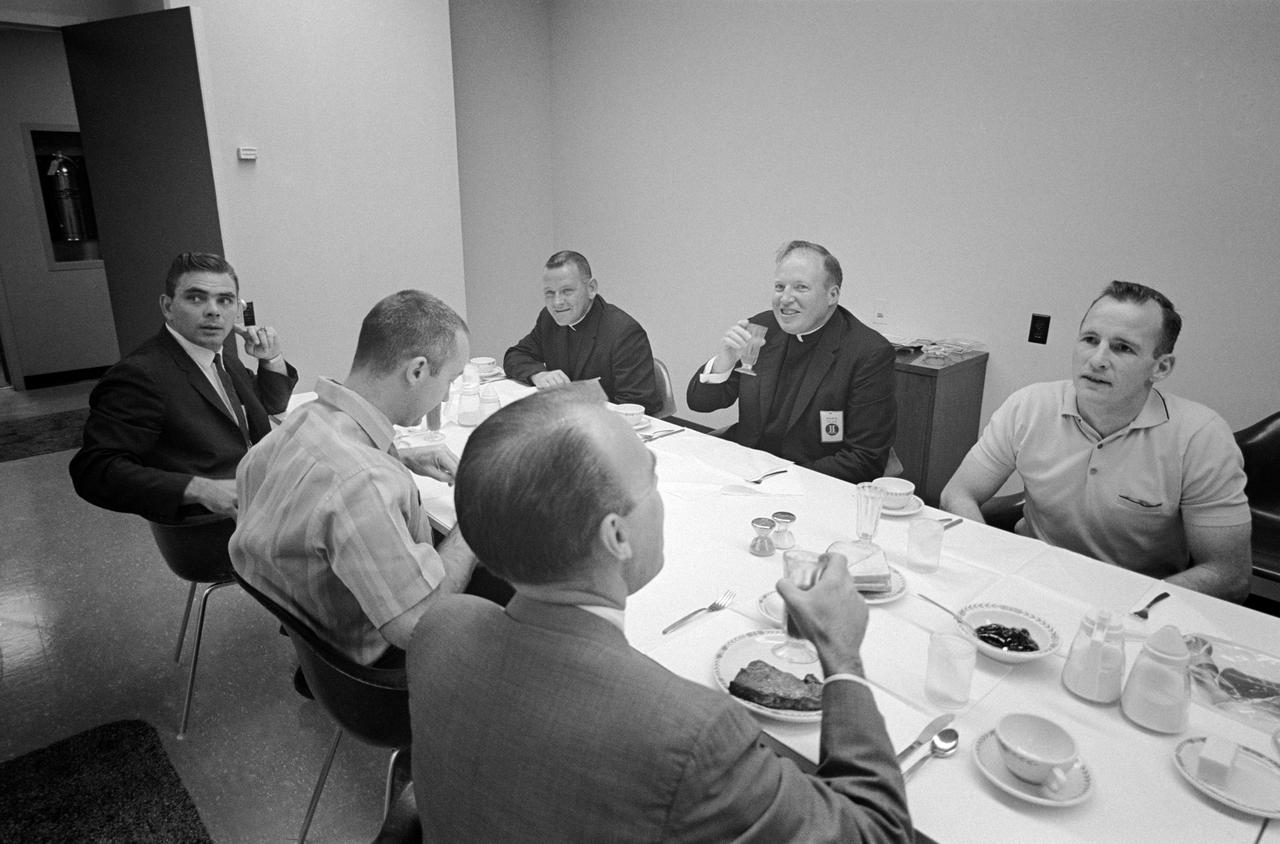
S65-19600 (3 June 1965) --- The prime crew for the Gemini-Titan 4 mission have an early morning breakfast prior to their historic flight which was launched at 10:16 a.m. (EST) on June 3, 1965. Shown here seated around the table (clockwise starting front center) are Dr. D. Owens Coons, chief, MSC Center Medical Office; astronaut James A. McDivitt, GT-4 command pilot; Dr. Eugene F. Tubbs, Kennedy Space Center; Rt. Rev. James Heiliky, McDivitt's priest at Cocoa Beach, Florida; Msgr. Irvine J. Nugent and astronaut Edward H. White II, GT-4 pilot. The group had a breakfast of tomato juice, broiled sirloin steak, poached eggs, toast, strawberry gelatin and coffee.
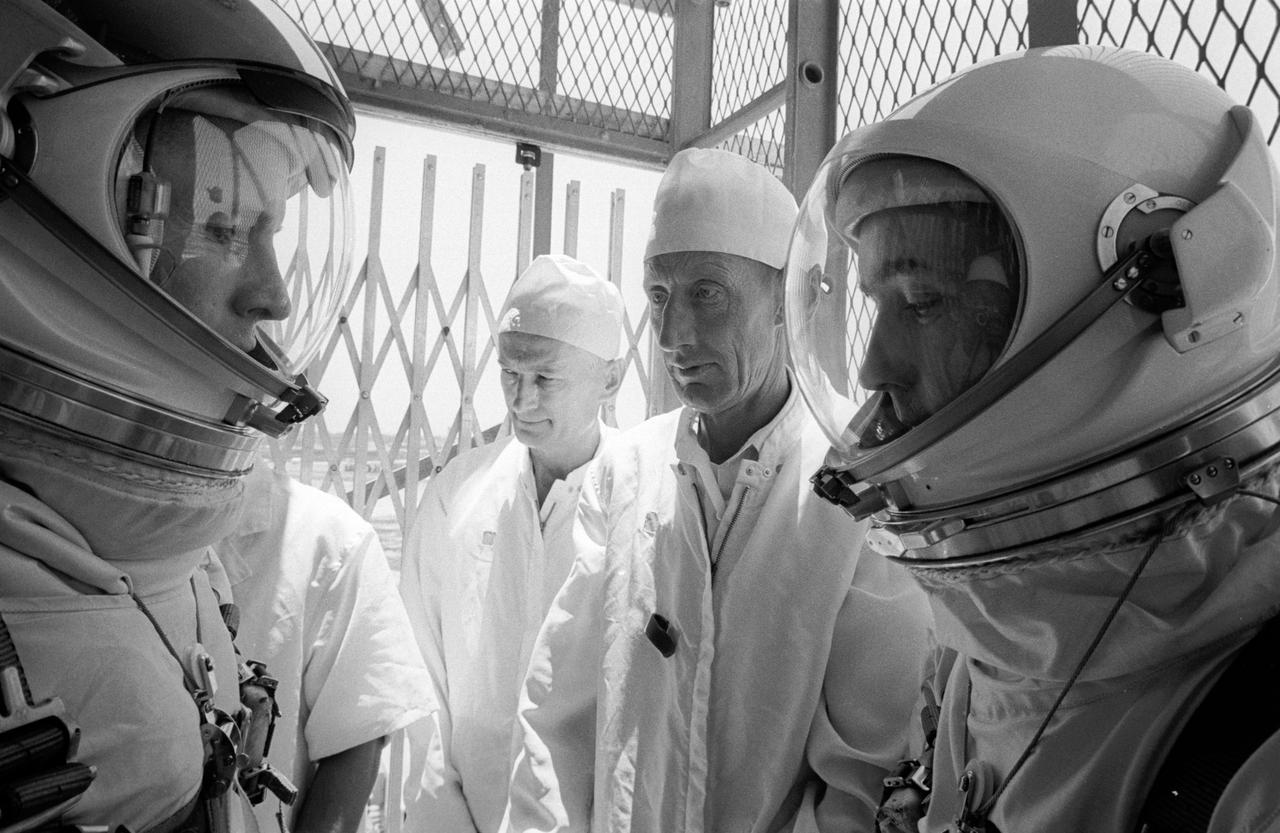
S65-30266 (29 May 1965) --- In the elevator on the way to the White Room at Pad 19 for simulations on May 29, 1965, astronauts James A. McDivitt (right), command pilot, and Edward H. White II, pilot, are shown with suit technicians Clyde Teague (right center) and Joe Schmitt. The National Aeronautics and Space Administration's two-man Gemini-4 mission is scheduled for 62 revolutions in four days. The backup crew, astronauts Frank Borman and James A. Lovell Jr. (both out of frame), will replace the prime crew if either crewman should become ineligible for the flight.
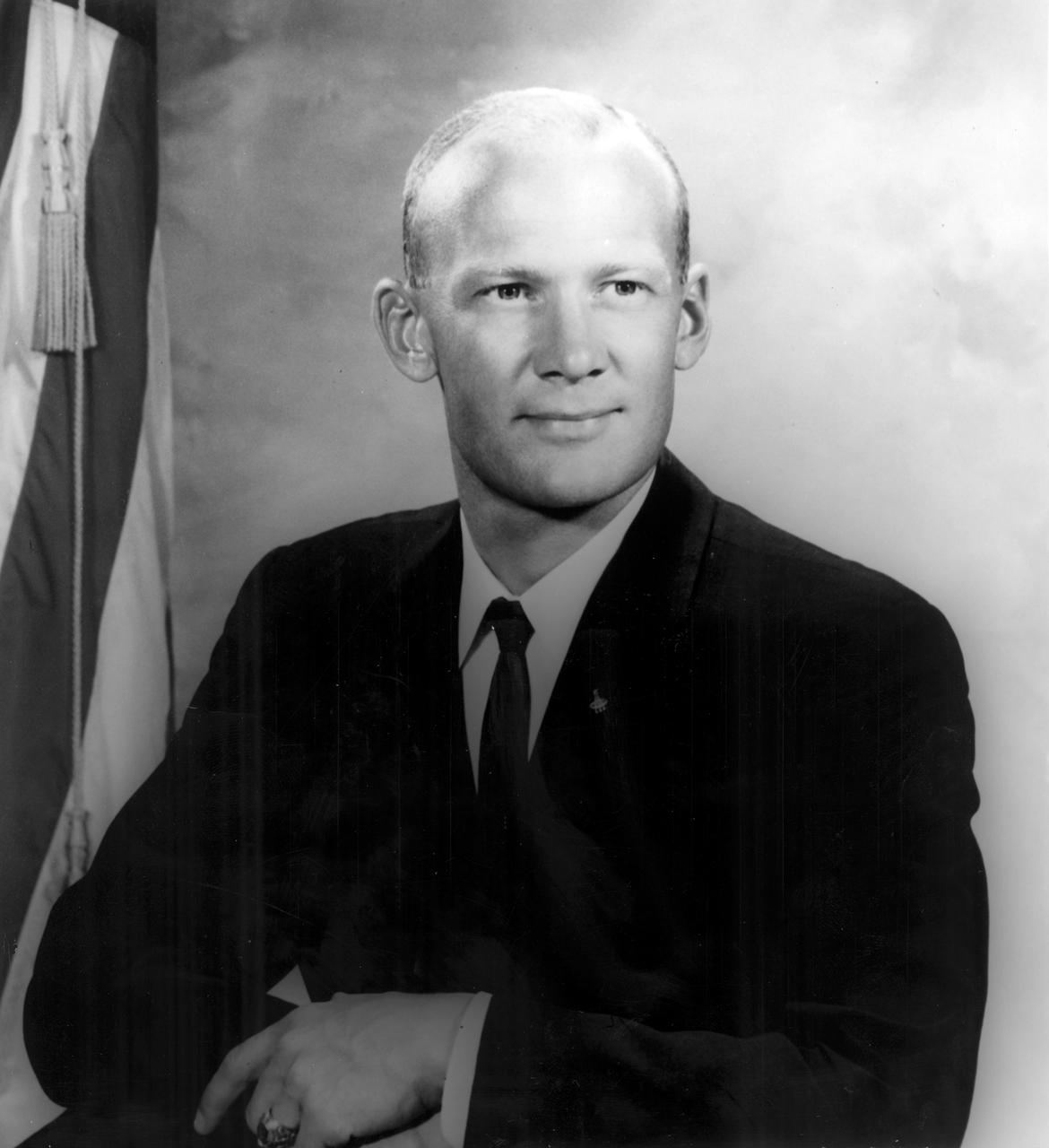
This is the official NASA portrait of astronaut Edwin E. (Buzz) Aldrin. Prior to joining NASA, Aldrin flew 66 combat missions in F-86s while on duty in Korea. At Nellis Air Force Base, Nevada, he served as an aerial gunnery instructor. Following his assignment as aide to the dean of faculty at the Air Force Academy, Aldrin flew F-100s as a flight commander at Bitburg, Germany. Aldrin was one of the third group of astronauts named by NASA in October 1963 and has logged 289 hours and 53 minutes in space, of which, 7 hours and 52 minutes were spent in Extra Vehicular Activity (EVA). On November 11, 1966, he launched into space aboard the Gemini 12 spacecraft on a 4-day flight, which brought the Gemini program to a successful close. During that mission, Aldrin established a new record for EVA, spending 5-1/2 hours outside the spacecraft. July 16-24, 1969, Aldrin served as lunar module pilot for Apollo 11, the first manned lunar landing mission. Aldrin followed Neil Armstrong onto the lunar surface on July 20, 1969, completing a 2-hour and 15 minute lunar EVA. Aldrin resigned from NASA in July 1971.
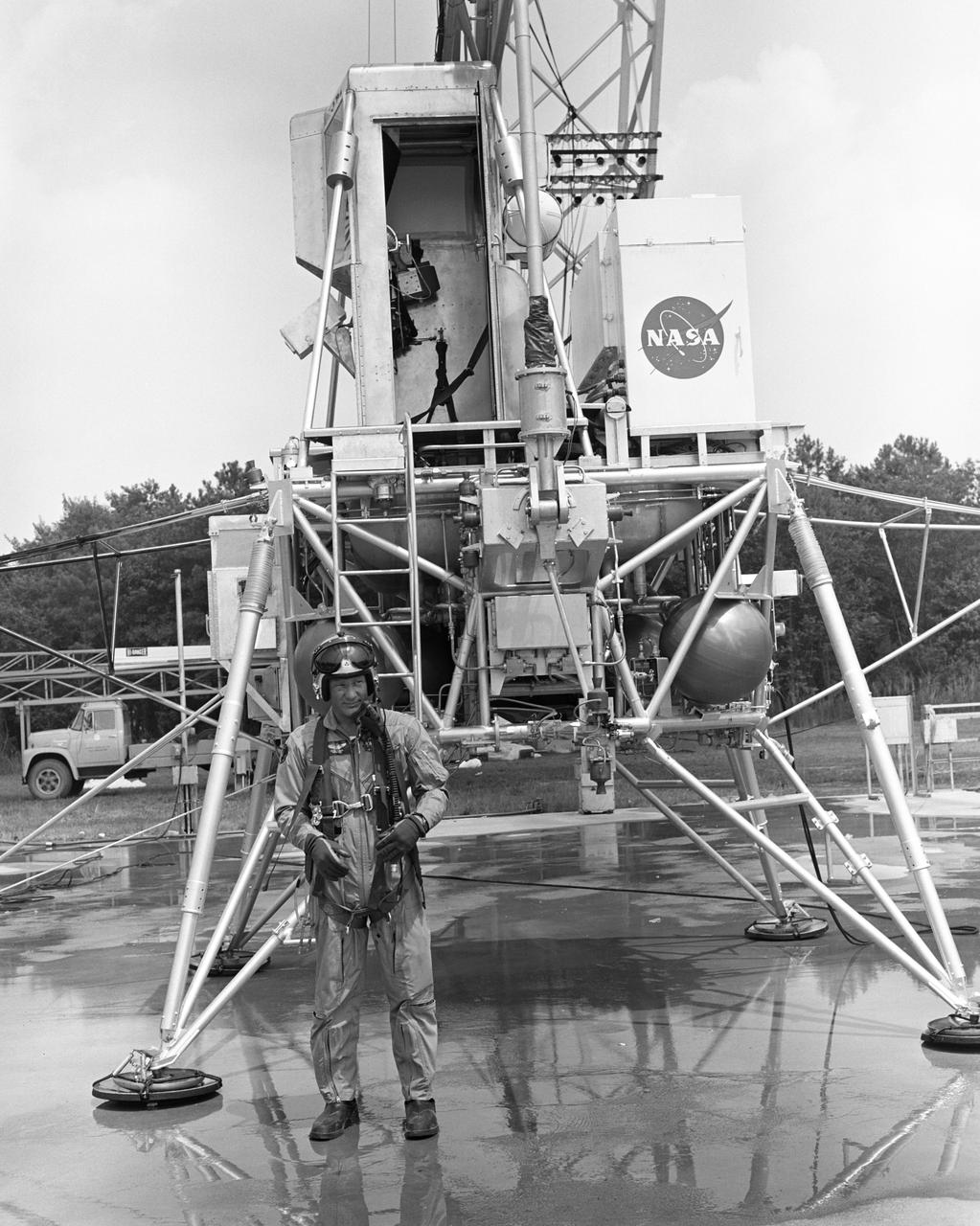
Astronaut Edwin Buzz Aldrin Lunar Module Pilot at the (LLRF) Lunar Landing Research Facility. Aldrin was one of the third group of astronauts named by NASA in October 1963. On November 11, 1966, he and command pilot James Lovell were launched into space in the Gemini 12 spacecraft on a 4-day flight, which brought the Gemini program to a successful close. Aldrin established a new record for extravehicular activity (EVA), spending 5-1/2 hours outside the spacecraft. He served as lunar module pilot for Apollo 11, July 16-24, 1969, the first manned lunar landing mission. Aldrin followed Neil Armstrong onto the lunar surface on July 20, 1969, completing a 2-hour and 15 minute lunar EVA. In July 1971, Aldrin resigned from NASA. Aldrin has logged 289 hours and 53 minutes in space, of which, 7 hours and 52 minutes were spent in EVA. https://www.nasa.gov/astronauts/biographies/former
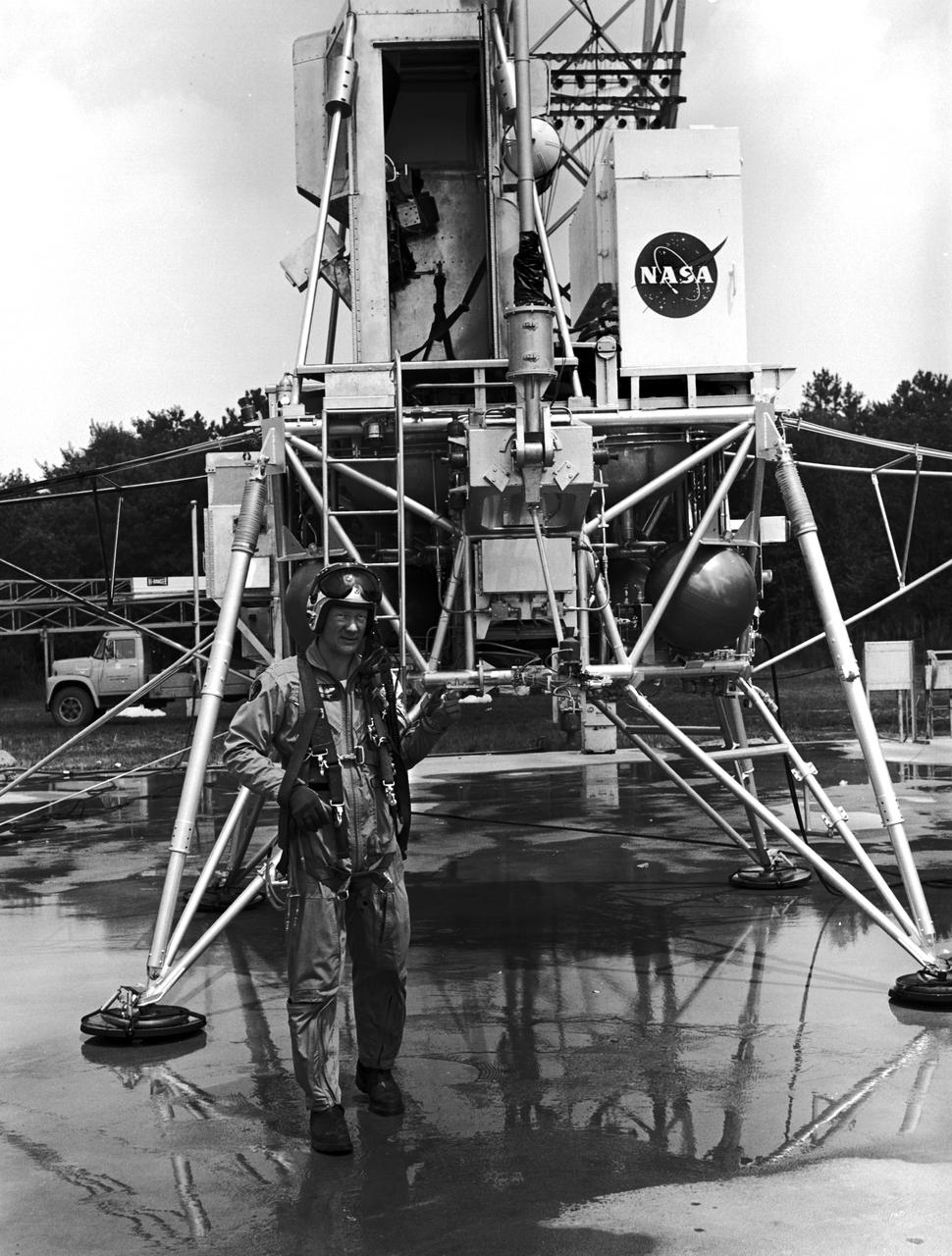
Astronaut Edwin Buzz Aldrin Lunar Module Pilot at the (LLRF) Lunar Landing Research Facility. Aldrin was one of the third group of astronauts named by NASA in October 1963. On November 11, 1966, he and command pilot James Lovell were launched into space in the Gemini 12 spacecraft on a 4-day flight, which brought the Gemini program to a successful close. Aldrin established a new record for extravehicular activity (EVA), spending 5-1/2 hours outside the spacecraft. He served as lunar module pilot for Apollo 11, July 16-24, 1969, the first manned lunar landing mission. Aldrin followed Neil Armstrong onto the lunar surface on July 20, 1969, completing a 2-hour and 15 minute lunar EVA. In July 1971, Aldrin resigned from NASA. Aldrin has logged 289 hours and 53 minutes in space, of which, 7 hours and 52 minutes were spent in EVA. https://www.nasa.gov/astronauts/biographies/former

On June 4, 1974, 5 years after the successful Apollo 11 lunar landing mission, commander Neil Armstrong (right) presented a plaque to U.S. President Richard Milhous Nixon (left) on behalf of all people who had taken part in the space program. In making the presentation, Armstrong said “Mr. President, you have proclaimed this week to be United States Space week in conjunction with the fifth anniversary of our first successful landing on the Moon. It is my privilege to represent my colleagues, the crewmen of projects Mercury, Gemini, Apollo, and Skylab, and the men and women of NASA, and the hundreds of thousands of Americans from across the land who contributed so mightily to the success of our efforts in space in presenting this plaque which bears the names of each individual who has had the privilege of representing this country” in a space flight. The presentation was made at the California white house in San Clemente.
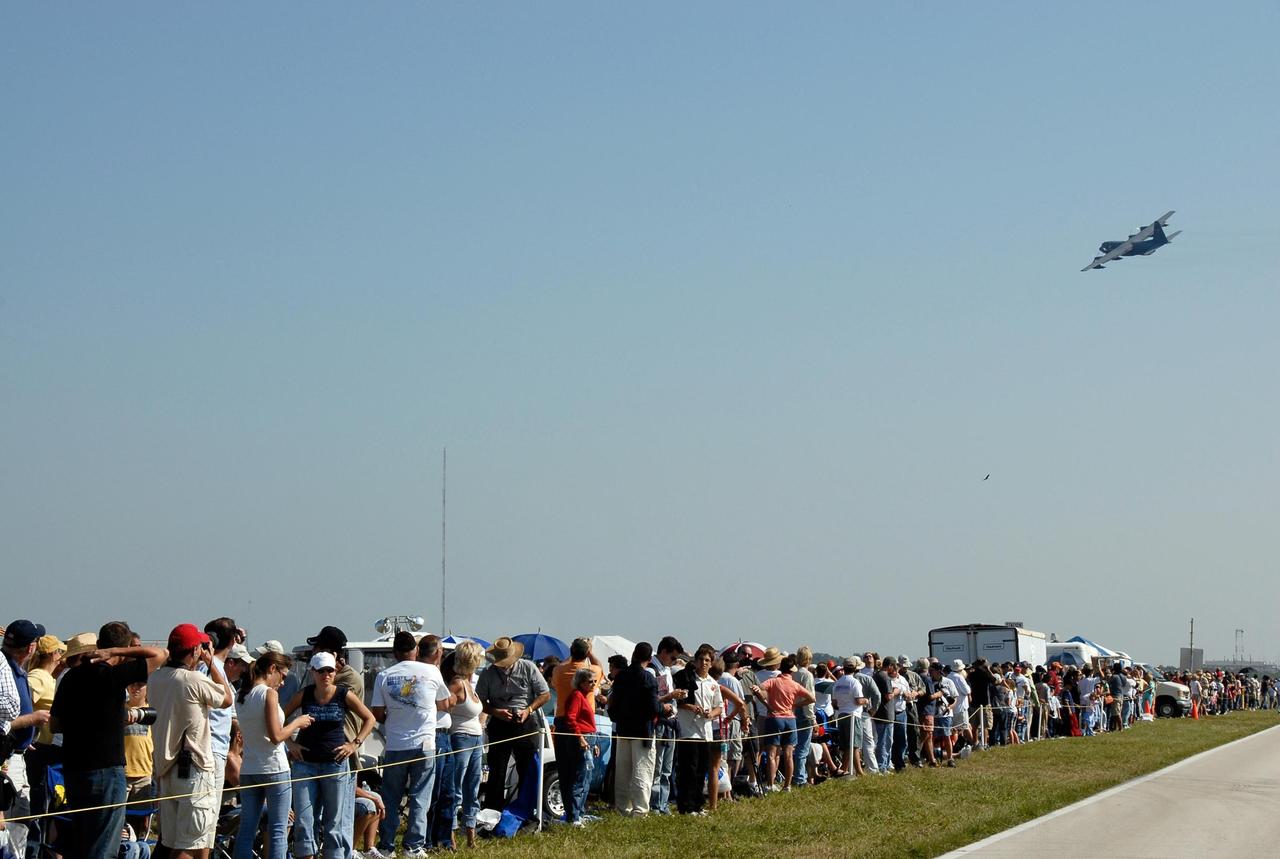
KENNEDY SPACE CENTER, FLA. -- Crowds fill the areas along NASA Causeway at NASA's Kennedy Space Center to watch the World Space Expo aerial salute. Seen in flight is the plane used to refuel rescue helicopters in mid-air. Aircraft joining in the expo salute include the U.S. Air Force Thunderbirds Demonstration Squadron, the U.S. Navy F-18 Super Hornets, U.S. Air Force F-22 Raptor, U.S. Air Force F-15 Eagle, P-51 Mustang Heritage Flight, the U.S. Air Force 920th Rescue Wing, which was responsible for Mercury and Gemini capsule recovery, and the U.S. Army Golden Knights precision skydivers. The World Space Expo held Nov. 1-4 was an event commemorating humanity's first 50 years in space while looking forward to returning people to the moon and exploring beyond. The expo showcased various panels, presentations and educational programs. It also was a part of NASA's 50th anniversary celebrations, highlighting the 45th Anniversary of the Mercury Program celebration featuring original NASA astronauts John Glenn and Scott Carpenter and the Pioneering Women of Aerospace forum featuring Eileen Collins and other prominent female space veterans. The agency was founded Oct. 1, 1958. Photo credit: NASA/Kim Shiflett
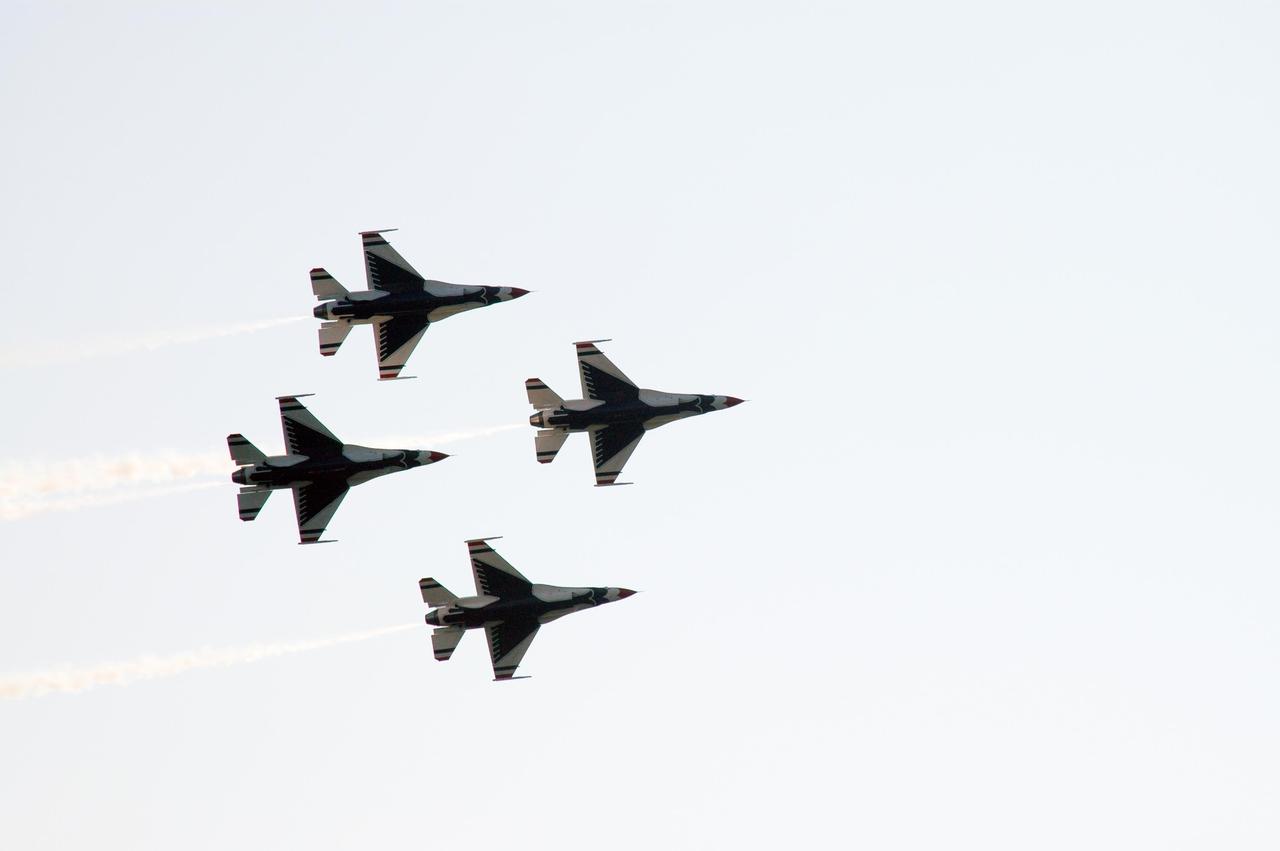
KENNEDY SPACE CENTER, FLA. -- At NASA's Kennedy Space Center, the U.S. Air Force Thunderbirds Demonstration Squadron performs during the World Space Expo aerial salute. Other aircraft joining in the expo salute include the U.S. Navy F-18 Super Hornets, U.S. Air Force F-22 Raptor, U.S. Air Force F-15 Eagle, P-51 Mustang Heritage Flight, U.S. Air Force 920th Rescue wing, which was responsible for Mercury and Gemini capsule recovery, and the U.S. Army Golden Knights demonstrating precision skydiving. The World Space Expo held Nov. 1-4 was an event commemorating humanity's first 50 years in space while looking forward to returning people to the moon and exploring beyond. The expo showcased various panels, presentations and educational programs. It also was a part of NASA's 50th anniversary celebrations, highlighting the 45th Anniversary of the Mercury Program celebration featuring original NASA astronauts John Glenn and Scott Carpenter and the Pioneering Women of Aerospace forum featuring Eileen Collins and other prominent female space veterans. The agency was founded Oct. 1, 1958. Photo credit: NASA/Chris Chamberland

KENNEDY SPACE CENTER, FLA. -- Crowds fill the areas along NASA Causeway at NASA's Kennedy Space Center to watch the World Space Expo aerial salute. Aircraft joining in the expo salute include the U.S. Air Force Thunderbirds Demonstration Squadron, the U.S. Navy F-18 Super Hornets, U.S. Air Force F-22 Raptor, U.S. Air Force F-15 Eagle, P-51 Mustang Heritage Flight, the U.S. Air Force 920th Rescue Wing, which was responsible for Mercury and Gemini capsule recovery, and the U.S. Army Golden Knights precision skydivers. The World Space Expo held Nov. 1-4 was an event commemorating humanity's first 50 years in space while looking forward to returning people to the moon and exploring beyond. The expo showcased various panels, presentations and educational programs. It also was a part of NASA's 50th anniversary celebrations, highlighting the 45th Anniversary of the Mercury Program celebration featuring original NASA astronauts John Glenn and Scott Carpenter and the Pioneering Women of Aerospace forum featuring Eileen Collins and other prominent female space veterans. The agency was founded Oct. 1, 1958. Photo credit: NASA/Kim Shiflett
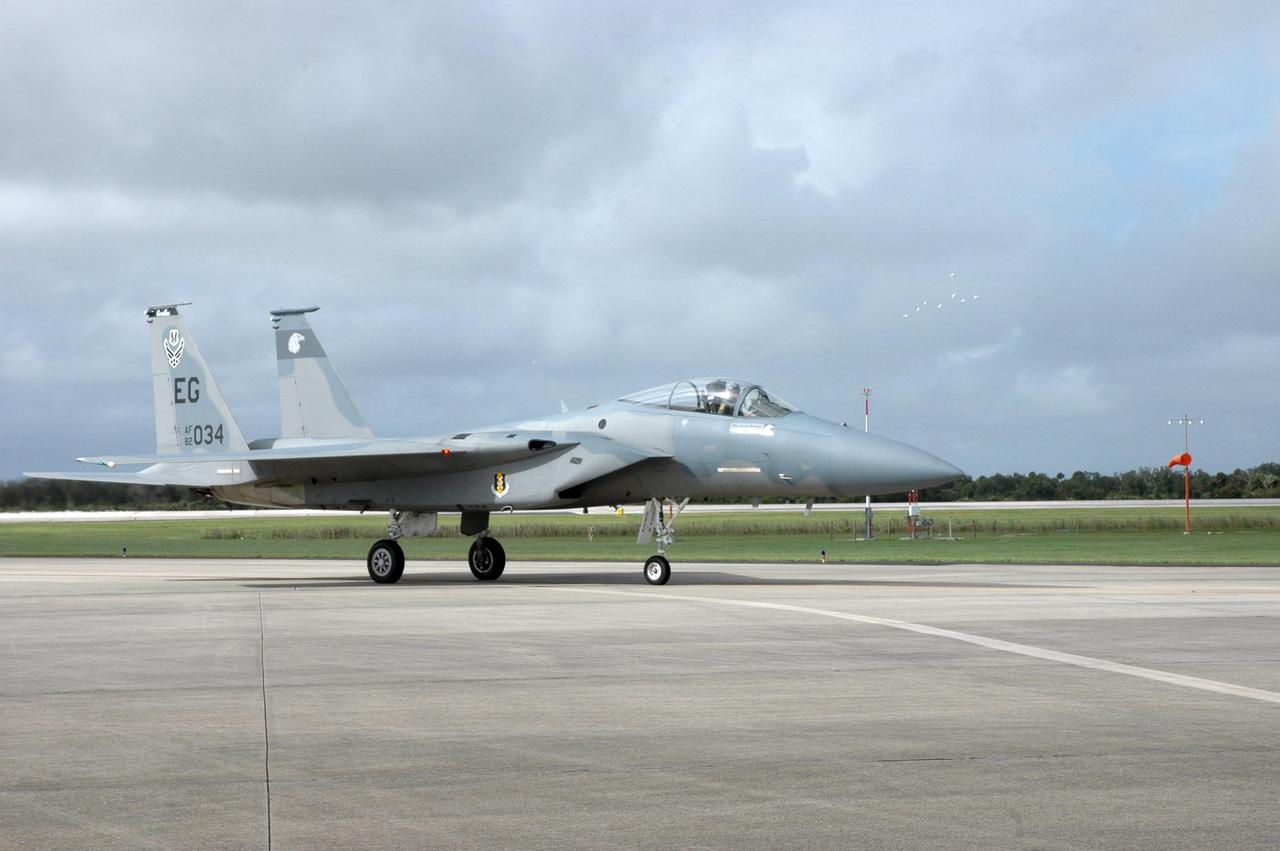
KENNEDY SPACE CENTER, FLA. -- A U.S. Air Force F-15 Eagle arrives at the Shuttle Landing Facility at NASA's Kennedy Space Center. Several of the planes are participating in the World Space Expo being held from Nov. 1 to Nov. 4 at the NASA Kennedy Space Center Visitor Complex. Other aircraft joining in the salute include U.S. Air Force Thunderbirds Aerial Demonstration Squadron, U.S. Navy F-18 Super Hornets, U.S. Air Force F-22 Raptor, the P-51 Mustang Heritage Flight and the U.S. Air Force 920th Rescue Wing, which was responsible for Mercury and Gemini capsule recovery. The U.S. Army Golden Knights also will demonstrate precision skydiving. The World Space Expo is an event to commemorate humanity's first 50 years in space while looking forward to returning people to the moon and exploring beyond. The expo will showcase various panels, presentations and educational programs. It also is a part of NASA's 50th anniversary celebrations, highlighting the 45th Anniversary of the Mercury Program celebration featuring original NASA astronauts John Glenn and Scott Carpenter and the Pioneering Women of Aerospace forum featuring Eileen Collins and other prominent female space veterans. The agency was founded Oct. 1, 1958. Photo credit: NASA/Jack Pfaller
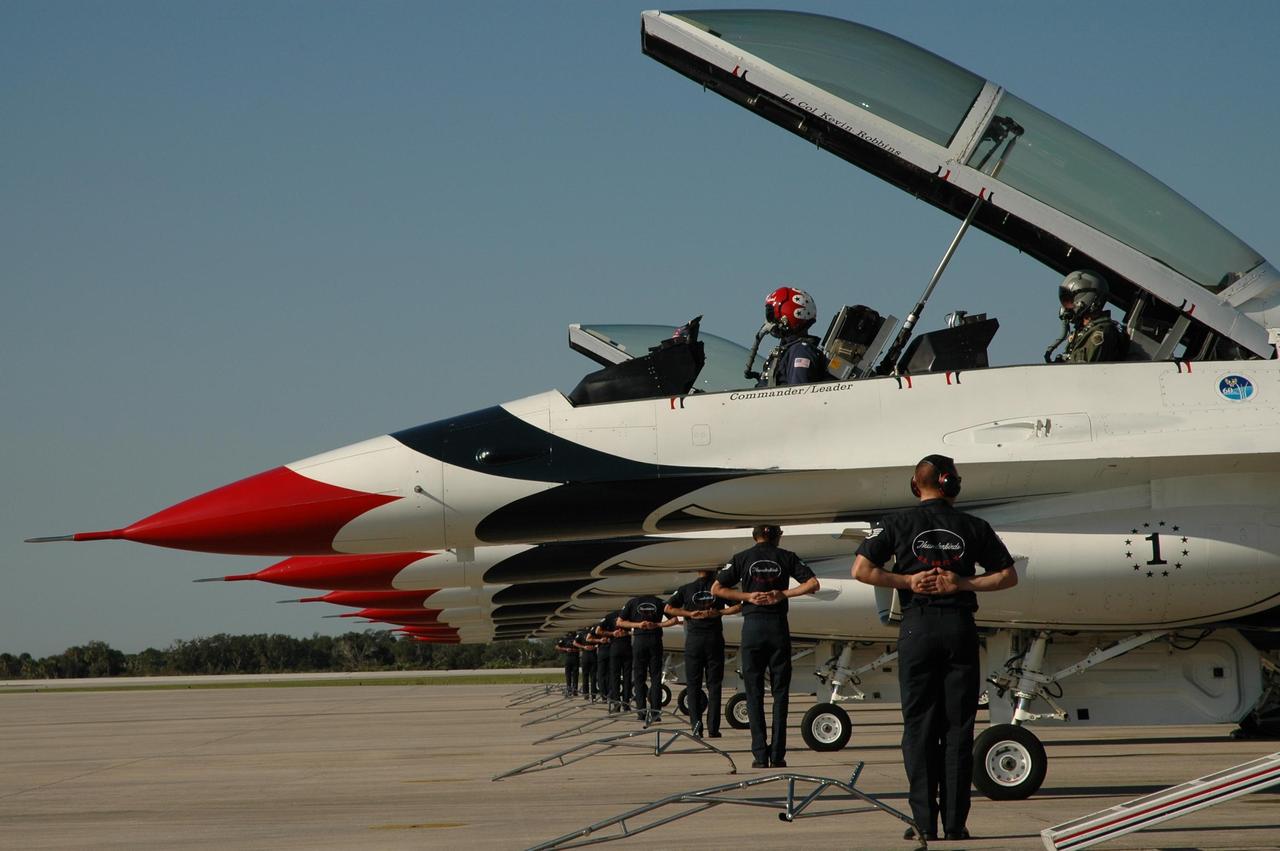
KENNEDY SPACE CENTER, FLA. -- The air crew for the U.S. Air Force Thunderbirds Demonstration Squadron show their precision formation as the pilots get ready to take off from NASA's Kennedy Space Center. The squadron performed for the World Space Expos' aerial salute along with other aircraft that included the U.S. Navy F-18 Super Hornets, U.S. Air Force F-22 Raptor, U.S. Air Force F-15 Eagle, P-51 Mustang Heritage Flight, the U.S. Air Force 920th Rescue Wing, which was responsible for Mercury and Gemini capsule recovery, and the U.S. Army Golden Knights precision skydiving team. The World Space Expo held Nov. 1-4 was an event commemorating humanity's first 50 years in space while looking forward to returning people to the moon and exploring beyond. The expo showcased various panels, presentations and educational programs. It also was a part of NASA's 50th anniversary celebrations, highlighting the 45th Anniversary of the Mercury Program celebration featuring original NASA astronauts John Glenn and Scott Carpenter and the Pioneering Women of Aerospace forum featuring Eileen Collins and other prominent female space veterans. The agency was founded Oct. 1, 1958. Photo credit: NASA/Jim Grossmann
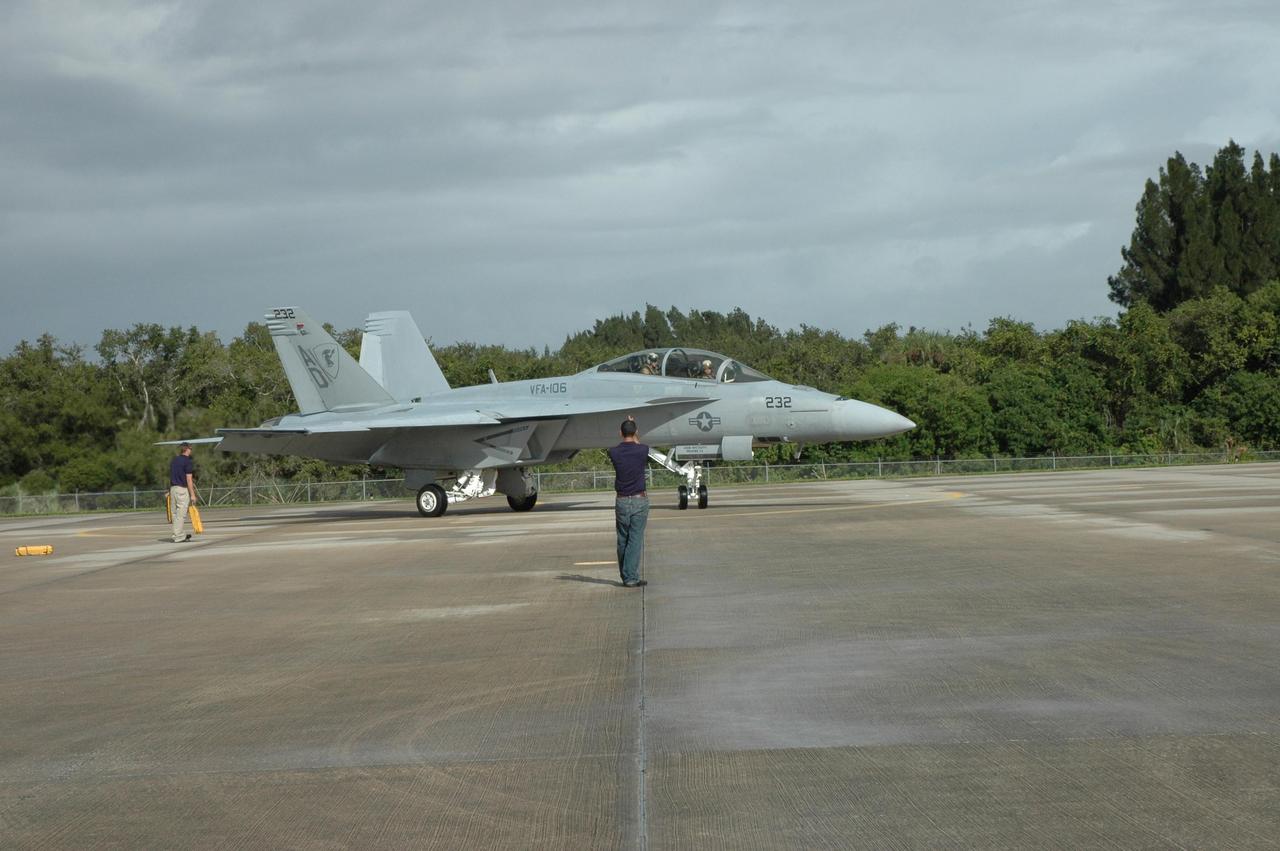
KENNEDY SPACE CENTER, FLA. -- A U.S. Navy F-18 Super Hornet arrives at the Shuttle Landing Facility at NASA's Kennedy Space Center. Several of the planes are participating in the World Space Expo being held from Nov. 1 to Nov. 4 at the NASA Kennedy Space Center Visitor Complex. Other aircraft joining in the salute include U.S. Air Force Thunderbirds Aerial Demonstration Squadron , U.S. Air Force F-22 Raptor, U.S. Air Force F-15 Eagle, the P-51 Mustang Heritage Flight and the U.S. Air Force 920th Rescue Wing, which was responsible for Mercury and Gemini capsule recovery. The U.S. Army Golden Knights also will demonstrate precision skydiving. The World Space Expo is an event to commemorate humanity's first 50 years in space while looking forward to returning people to the moon and exploring beyond. The expo will showcase various panels, presentations and educational programs. It also is a part of NASA's 50th anniversary celebrations, highlighting the 45th Anniversary of the Mercury Program celebration featuring original NASA astronauts John Glenn and Scott Carpenter and the Pioneering Women of Aerospace forum featuring Eileen Collins and other prominent female space veterans. The agency was founded Oct. 1, 1958. Photo credit: NASA/Jack Pfaller
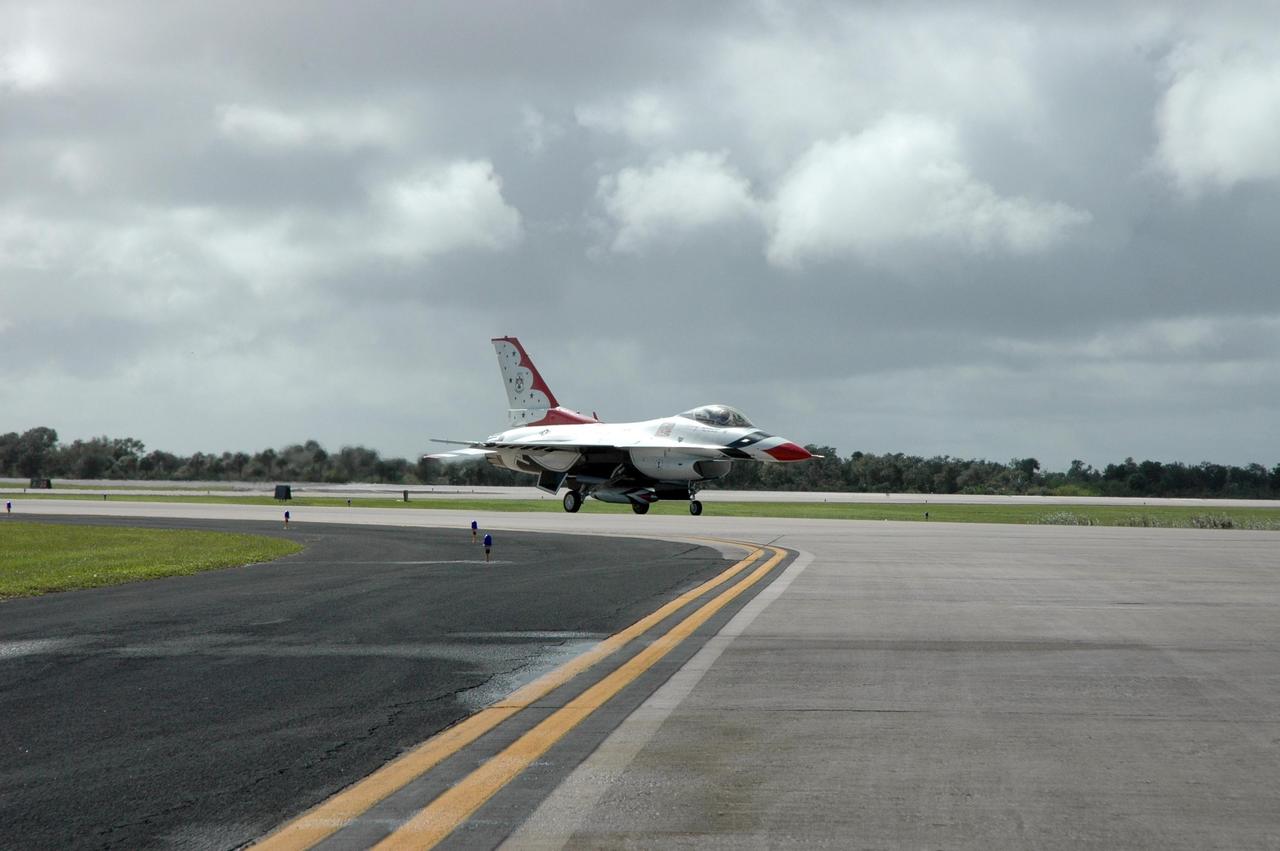
KENNEDY SPACE CENTER, FLA. -- Another of the U.S. Air Force Thunderbirds lands at the Shuttle Landing Facility at NASA's Kennedy Space Center. The aerial demonstration squadron is performing for the World Space Expo being held from Nov. 1 to Nov. 4 at the NASA Kennedy Space Center Visitor Complex. Other aircraft participating in the salute include U.S. Air Force F-22 Raptor, U.S. Navy F-18 Super Hornet, U.S. Air Force F-15 Eagle, the P-51 Mustang Heritage Flight and the U.S. Air Force 920th Rescue Wing, which was responsible for Mercury and Gemini capsule recovery. The U.S. Army Golden Knights also will demonstrate precision skydiving. The World Space Expo is an event to commemorate humanity's first 50 years in space while looking forward to returning people to the moon and exploring beyond. The expo will showcase various panels, presentations and educational programs. It also is a part of NASA's 50th anniversary celebrations, highlighting the 45th Anniversary of the Mercury Program celebration featuring original NASA astronauts John Glenn and Scott Carpenter and the Pioneering Women of Aerospace forum featuring Eileen Collins and other prominent female space veterans. The agency was founded Oct. 1, 1958. Photo credit: NASA/Jack Pfaller
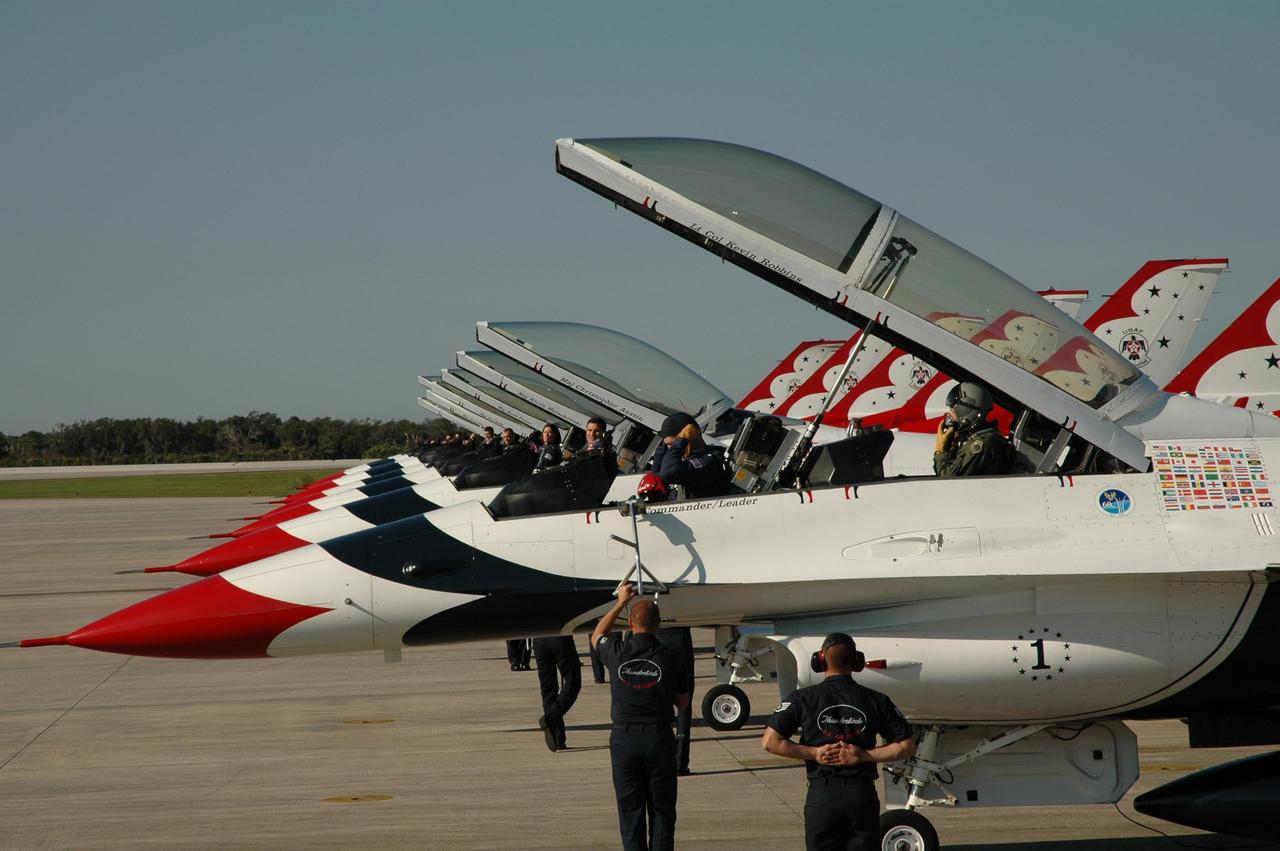
KENNEDY SPACE CENTER, FLA. -- KENNEDY SPACE CENTER, FLA. — Pilots of the U.S. Air Force Thunderbirds Demonstration Squadron get ready to leave NASA's Kennedy Space Center. The squadron performed for the World Space Expos' aerial salute along with other aircraft that included the U.S. Navy F-18 Super Hornets, U.S. Air Force F-22 Raptor, U.S. Air Force F-15 Eagle, P-51 Mustang Heritage Flight, the U.S. Air Force 920th Rescue Wing, which was responsible for Mercury and Gemini capsule recovery, and the U.S. Army Golden Knights precision skydiving team. The World Space Expo held Nov. 1-4 was an event commemorating humanity's first 50 years in space while looking forward to returning people to the moon and exploring beyond. The expo showcased various panels, presentations and educational programs. It also was a part of NASA's 50th anniversary celebrations, highlighting the 45th Anniversary of the Mercury Program celebration featuring original NASA astronauts John Glenn and Scott Carpenter and the Pioneering Women of Aerospace forum featuring Eileen Collins and other prominent female space veterans. The agency was founded Oct. 1, 1958. Photo credit: NASA/Jim Grossmann
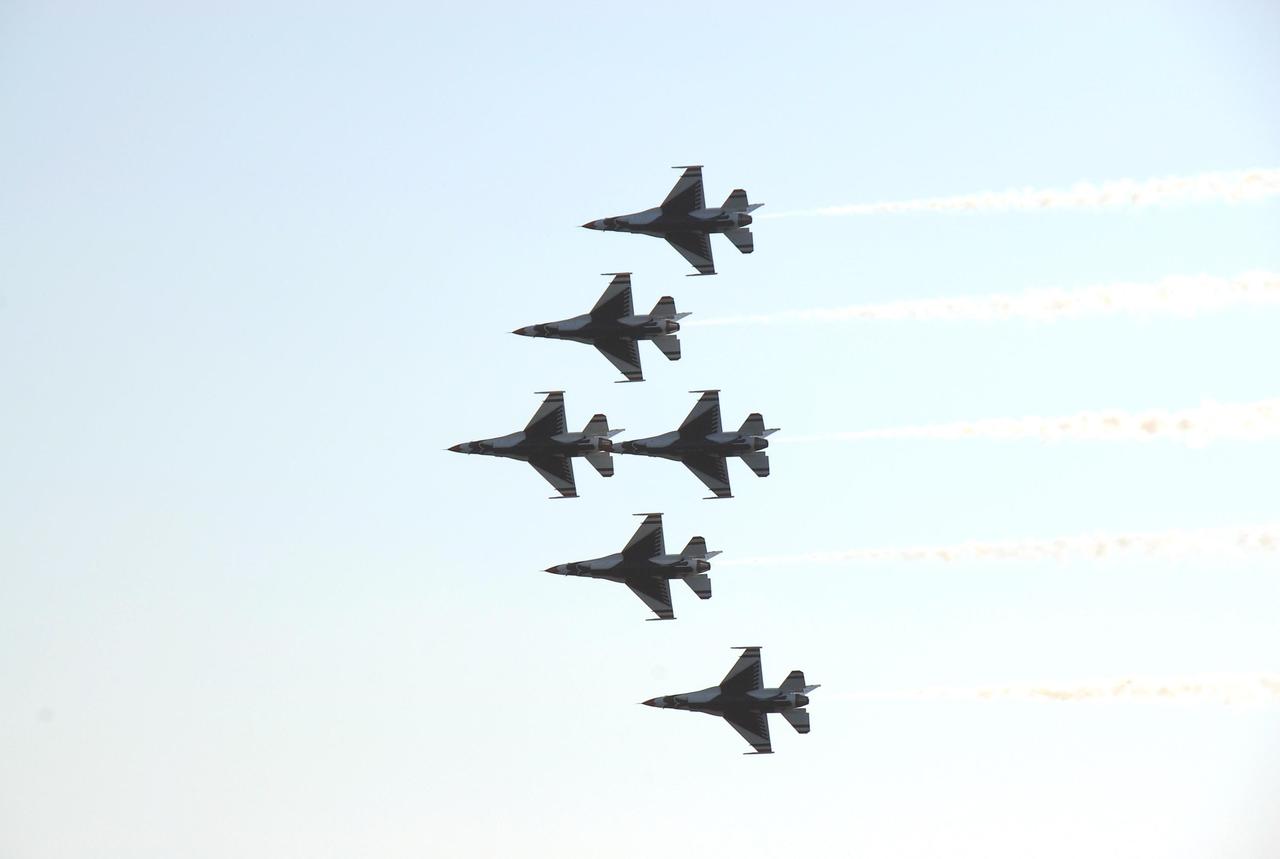
KENNEDY SPACE CENTER, FLA. -- The U.S. Air Force Thunderbirds Demonstration Squadron fly in close formation during the World Space Expo aerial salute. Other aircraft joining in the expo salute include the U.S. Navy F-18 Super Hornets, U.S. Air Force F-22 Raptor, U.S. Air Force F-15 Eagle, P-51 Mustang Heritage Flight, the U.S. Air Force 920th Rescue Wing, which was responsible for Mercury and Gemini capsule recovery, and the U.S. Army Golden Knights precision skydivers. The World Space Expo held Nov. 1-4 was an event commemorating humanity's first 50 years in space while looking forward to returning people to the moon and exploring beyond. The expo showcased various panels, presentations and educational programs. It also was a part of NASA's 50th anniversary celebrations, highlighting the 45th Anniversary of the Mercury Program celebration featuring original NASA astronauts John Glenn and Scott Carpenter and the Pioneering Women of Aerospace forum featuring Eileen Collins and other prominent female space veterans. The agency was founded Oct. 1, 1958. Photo credit: NASA/Kim Shiflett
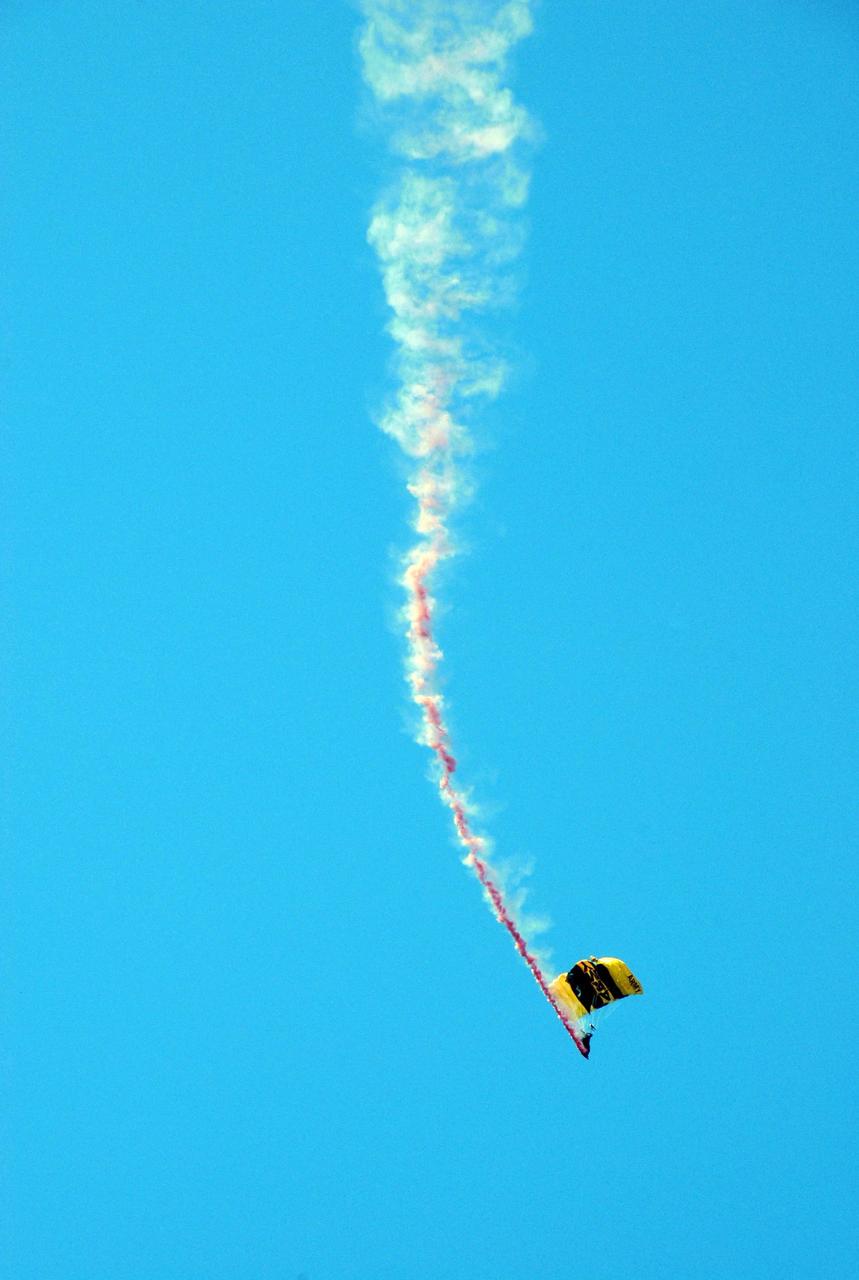
KENNEDY SPACE CENTER, FLA. -- A member of the U.S. Army Golden Knights demonstrates precision skydiving as part of the World Space Expo aerial salute at NASA's Kennedy Space Center. Other aircraft joining in the expo salute include the U.S. Air Force Thunderbirds Demonstration Squadron, the U.S. Navy F-18 Super Hornets, U.S. Air Force F-22 Raptor, U.S. Air Force F-15 Eagle, P-51 Mustang Heritage Flight, and the U.S. Air Force 920th Rescue Wing, which was responsible for Mercury and Gemini capsule recovery. The World Space Expo held Nov. 1-4 was an event commemorating humanity's first 50 years in space while looking forward to returning people to the moon and exploring beyond. The expo showcased various panels, presentations and educational programs. It also was a part of NASA's 50th anniversary celebrations, highlighting the 45th Anniversary of the Mercury Program celebration featuring original NASA astronauts John Glenn and Scott Carpenter and the Pioneering Women of Aerospace forum featuring Eileen Collins and other prominent female space veterans. The agency was founded Oct. 1, 1958. Photo credit: NASA/Kim Shiflett
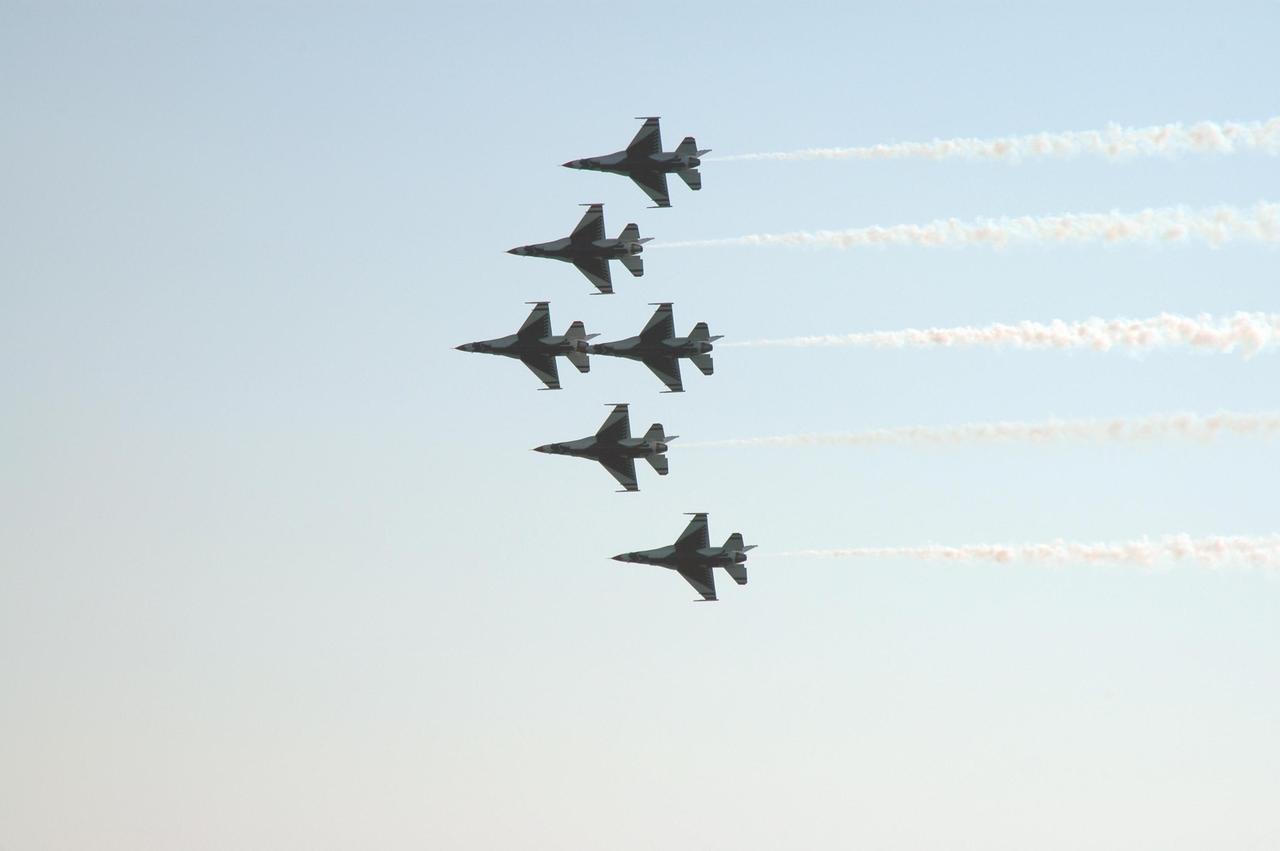
KENNEDY SPACE CENTER, FLA. -- At NASA's Kennedy Space Center, the U.S. Air Force Thunderbirds Demonstration Squadron performs during the World Space Expo aerial salute. Other aircraft joining in the expo salute include the U.S. Navy F-18 Super Hornets, U.S. Air Force F-22 Raptor, U.S. Air Force F-15 Eagle, P-51 Mustang Heritage Flight, U.S. Air Force 920th Rescue wing, which was responsible for Mercury and Gemini capsule recovery, and the U.S. Army Golden Knights demonstrating precision skydiving. The World Space Expo held Nov. 1-4 was an event commemorating humanity's first 50 years in space while looking forward to returning people to the moon and exploring beyond. The expo showcased various panels, presentations and educational programs. It also was a part of NASA's 50th anniversary celebrations, highlighting the 45th Anniversary of the Mercury Program celebration featuring original NASA astronauts John Glenn and Scott Carpenter and the Pioneering Women of Aerospace forum featuring Eileen Collins and other prominent female space veterans. The agency was founded Oct. 1, 1958. Photo credit: NASA/Chris Chamberland
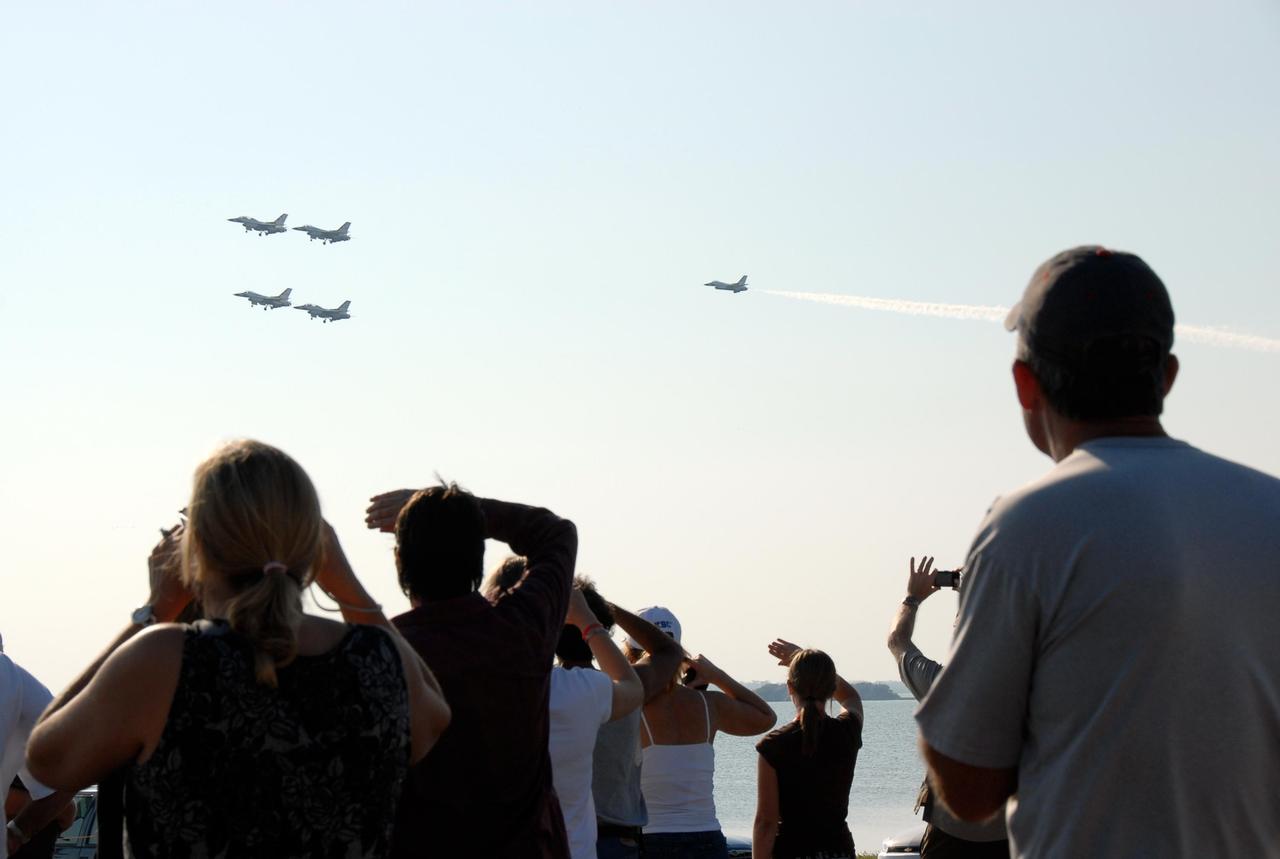
KENNEDY SPACE CENTER, FLA. -- Crowds at NASA's Kennedy Space Center watch the U.S. Air Force Thunderbirds Demonstration Squadron perform during the World Space Expo aerial salute. Other aircraft joining in the expo salute include the U.S. Navy F-18 Super Hornets, U.S. Air Force F-22 Raptor, U.S. Air Force F-15 Eagle, P-51 Mustang Heritage Flight, the U.S. Air Force 920th Rescue Wing, which was responsible for Mercury and Gemini capsule recovery, and the U.S. Army Golden Knights precision skydivers. The World Space Expo held Nov. 1-4 was an event commemorating humanity's first 50 years in space while looking forward to returning people to the moon and exploring beyond. The expo showcased various panels, presentations and educational programs. It also was a part of NASA's 50th anniversary celebrations, highlighting the 45th Anniversary of the Mercury Program celebration featuring original NASA astronauts John Glenn and Scott Carpenter and the Pioneering Women of Aerospace forum featuring Eileen Collins and other prominent female space veterans. The agency was founded Oct. 1, 1958. Photo credit: NASA/Kim Shiflett
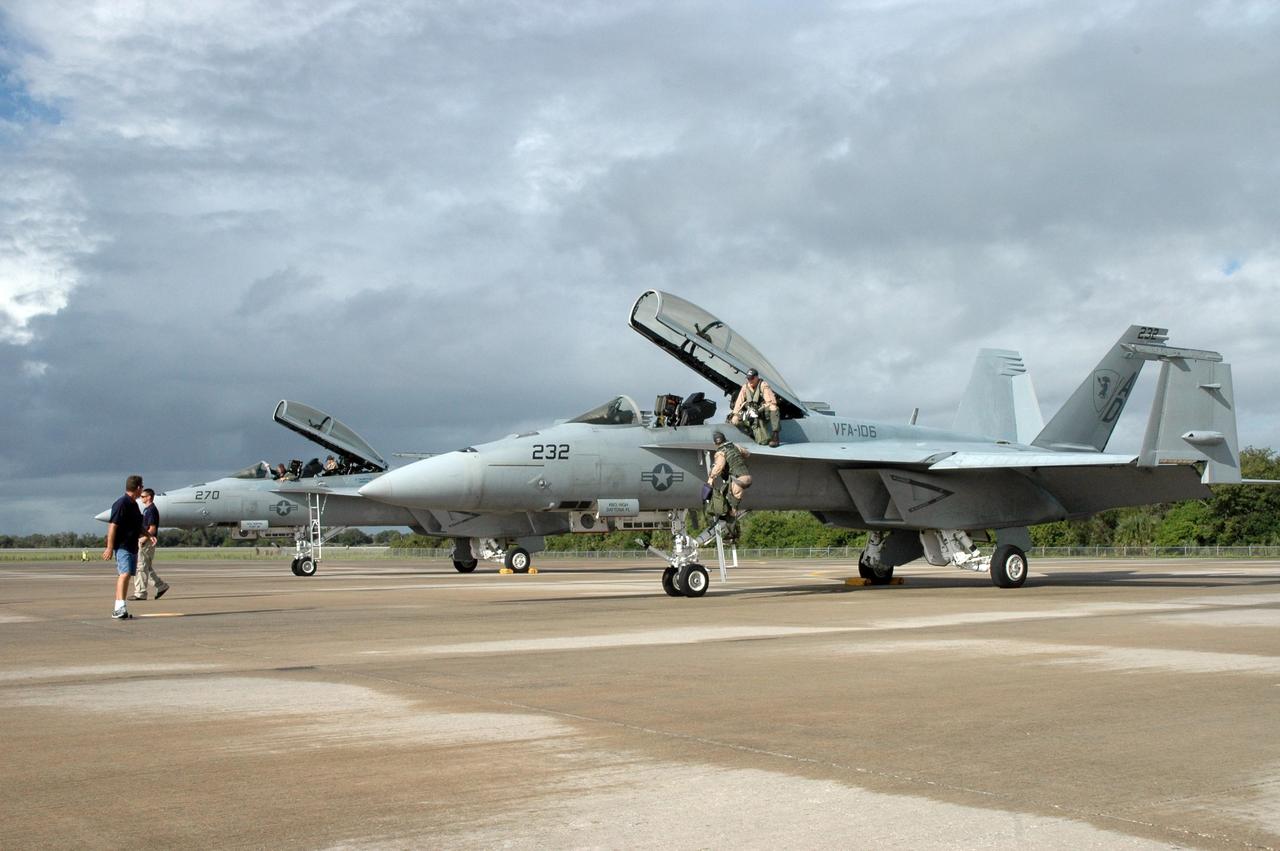
KENNEDY SPACE CENTER, FLA. -- Pilots of several U.S. Navy F-18 Super Hornet jets climb out of the cockpits on the Shuttle Landing Facility at NASA's Kennedy Space Center. Several of the planes are participating in the World Space Expo being held from Nov. 1 to Nov. 4 at the NASA Kennedy Space Center Visitor Complex. Other aircraft joining in the salute include U.S. Air Force Thunderbirds Aerial Demonstration Squadron , U.S. Air Force F-22 Raptor, U.S. Air Force F-15 Eagle, the P-51 Mustang Heritage Flight and the U.S. Air Force 920th Rescue Wing, which was responsible for Mercury and Gemini capsule recovery. The U.S. Army Golden Knights also will demonstrate precision skydiving. The World Space Expo is an event to commemorate humanity's first 50 years in space while looking forward to returning people to the moon and exploring beyond. The expo will showcase various panels, presentations and educational programs. It also is a part of NASA's 50th anniversary celebrations, highlighting the 45th Anniversary of the Mercury Program celebration featuring original NASA astronauts John Glenn and Scott Carpenter and the Pioneering Women of Aerospace forum featuring Eileen Collins and other prominent female space veterans. The agency was founded Oct. 1, 1958. Photo credit: NASA/Jack Pfaller
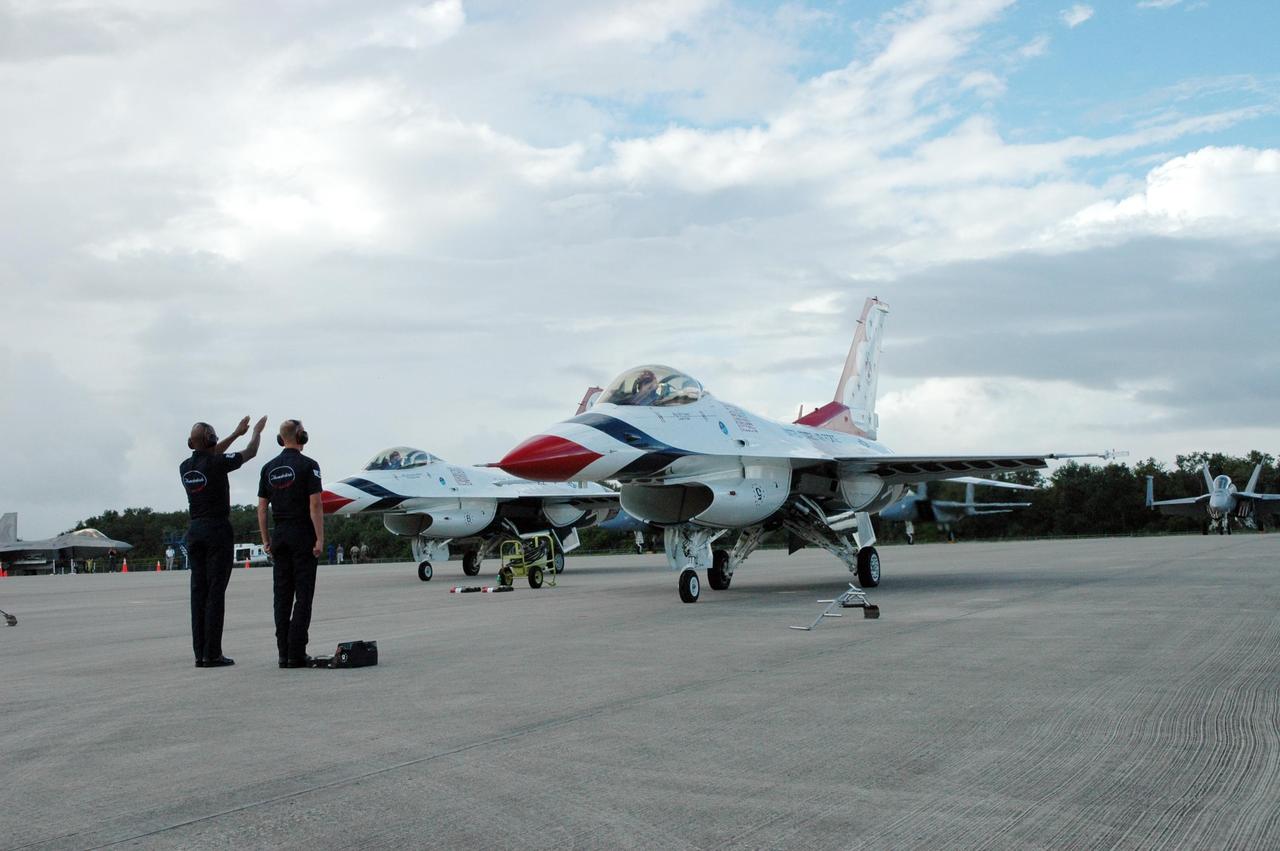
KENNEDY SPACE CENTER, FLA. -- U.S. Air Force Thunderbirds line up on the Shuttle Landing Facility at NASA's Kennedy Space Center. The aerial demonstration squadron is performing for the World Space Expo being held from Nov. 1 to Nov. 4 at the NASA Kennedy Space Center Visitor Complex. Other aircraft participating in the salute include U.S. Air Force F-22 Raptor, U.S. Navy F-18 Super Hornet, U.S. Air Force F-15 Eagle, the P-51 Mustang Heritage Flight and the U.S. Air Force 920th Rescue Wing, which was responsible for Mercury and Gemini capsule recovery. The U.S. Army Golden Knights also will demonstrate precision skydiving. The World Space Expo is an event to commemorate humanity's first 50 years in space while looking forward to returning people to the moon and exploring beyond. The expo will showcase various panels, presentations and educational programs. It also is a part of NASA's 50th anniversary celebrations, highlighting the 45th Anniversary of the Mercury Program celebration featuring original NASA astronauts John Glenn and Scott Carpenter and the Pioneering Women of Aerospace forum featuring Eileen Collins and other prominent female space veterans. The agency was founded Oct. 1, 1958. Photo credit: NASA/Jack Pfaller
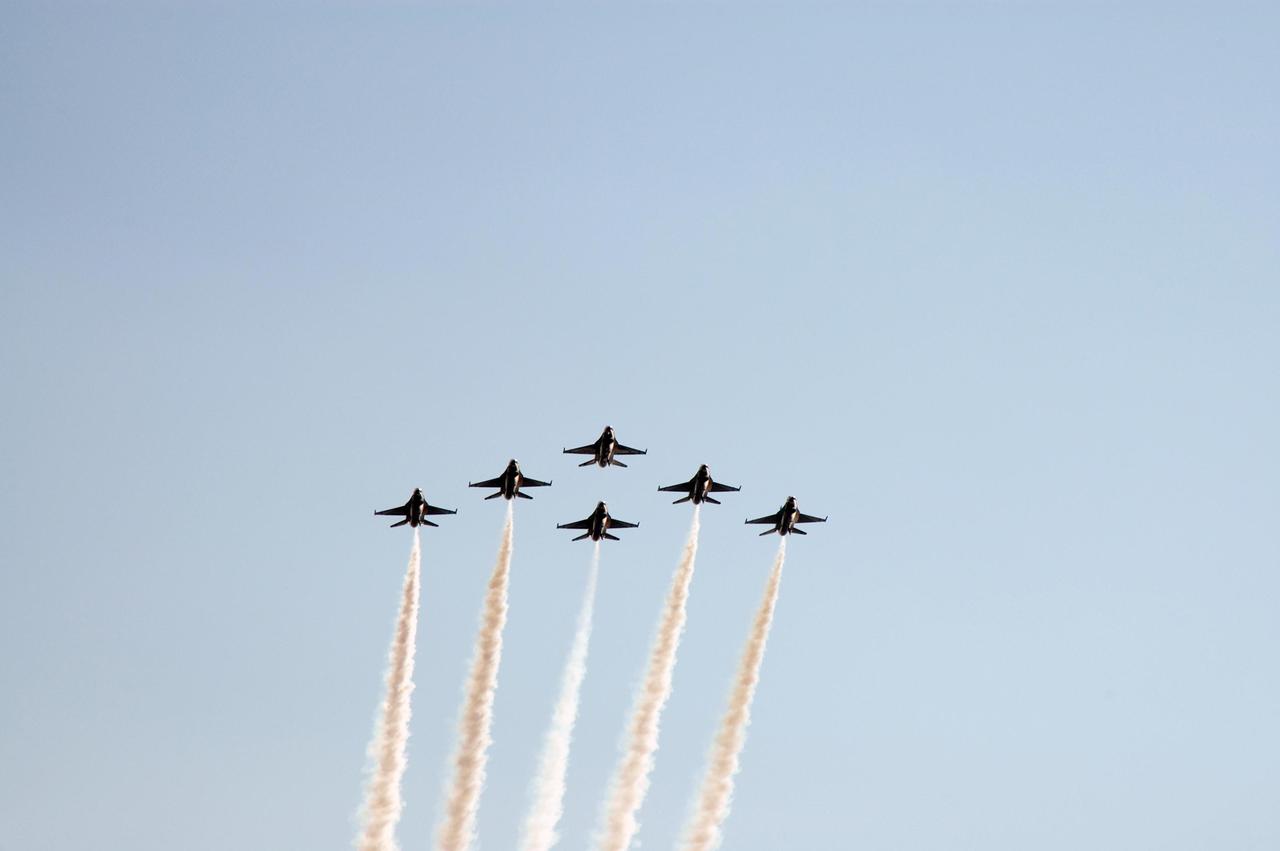
KENNEDY SPACE CENTER, FLA. -- At NASA's Kennedy Space Center, the U.S. Navy F-18 Super Hornets demonstrate their formation flying during the World Space Expo aerial salute. Other aircraft joining in the expo salute include the U.S. Air Force Thunderbirds Demonstration Squadron, U.S. Air Force F-22 Raptor, U.S. Air Force F-15 Eagle, P-51 Mustang Heritage Flight, U.S. Air Force 920th Rescue wing, which was responsible for Mercury and Gemini capsule recovery, and the U.S. Army Golden Knights demonstrating precision skydiving. The World Space Expo held Nov. 1-4 was an event commemorating humanity's first 50 years in space while looking forward to returning people to the moon and exploring beyond. The expo showcased various panels, presentations and educational programs. It also was a part of NASA's 50th anniversary celebrations, highlighting the 45th Anniversary of the Mercury Program celebration featuring original NASA astronauts John Glenn and Scott Carpenter and the Pioneering Women of Aerospace forum featuring Eileen Collins and other prominent female space veterans. The agency was founded Oct. 1, 1958. Photo credit: NASA/Chris Chamberland
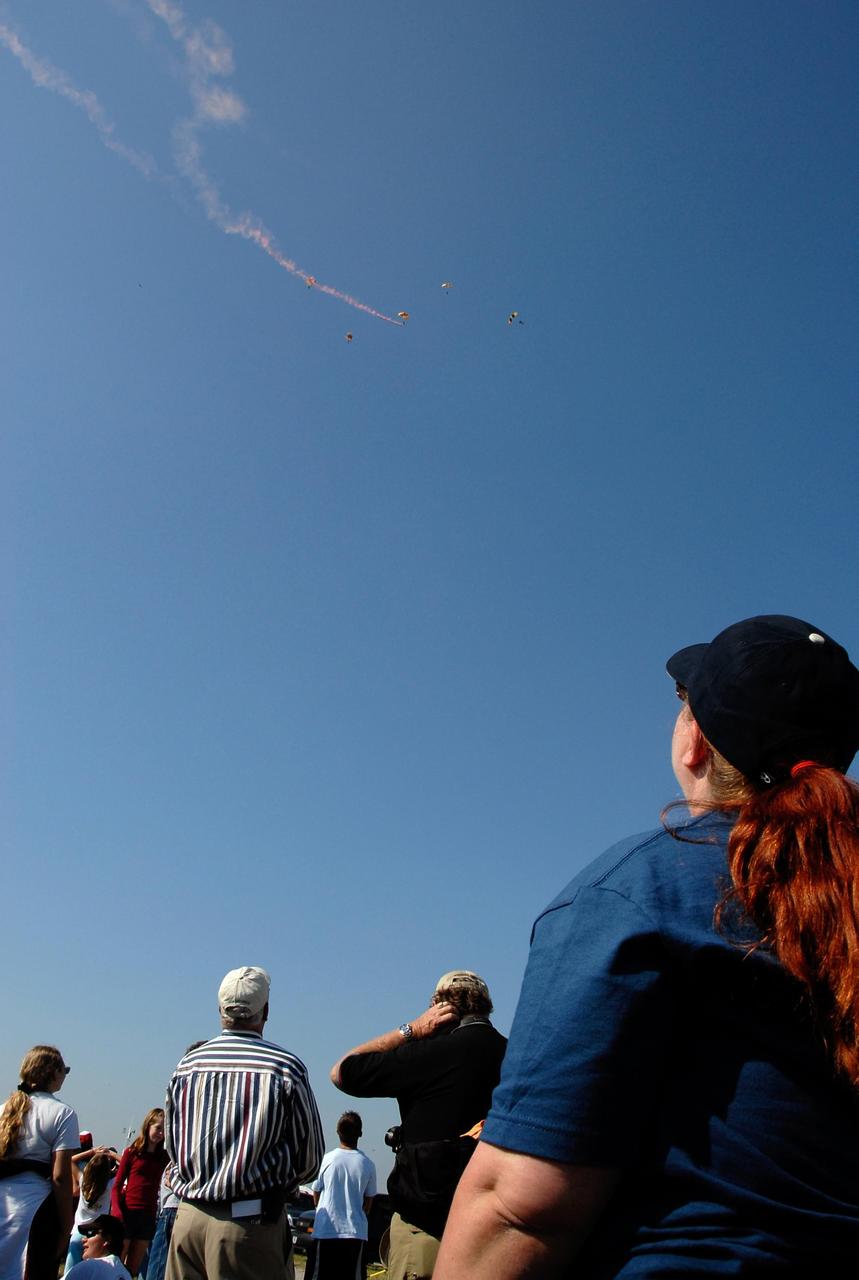
KENNEDY SPACE CENTER, FLA. -- Crowds at NASA's Kennedy Space Center watch the U.S. Army Golden Knights demonstrate precision skydiving as part of the World Space Expo aerial salute. Other aircraft joining in the expo salute include the U.S. Air Force Thunderbirds Demonstration Squadron, the U.S. Navy F-18 Super Hornets, U.S. Air Force F-22 Raptor, U.S. Air Force F-15 Eagle, P-51 Mustang Heritage Flight, and the U.S. Air Force 920th Rescue Wing, which was responsible for Mercury and Gemini capsule recovery. The World Space Expo held Nov. 1-4 was an event commemorating humanity's first 50 years in space while looking forward to returning people to the moon and exploring beyond. The expo showcased various panels, presentations and educational programs. It also was a part of NASA's 50th anniversary celebrations, highlighting the 45th Anniversary of the Mercury Program celebration featuring original NASA astronauts John Glenn and Scott Carpenter and the Pioneering Women of Aerospace forum featuring Eileen Collins and other prominent female space veterans. The agency was founded Oct. 1, 1958. Photo credit: NASA/Kim Shiflett
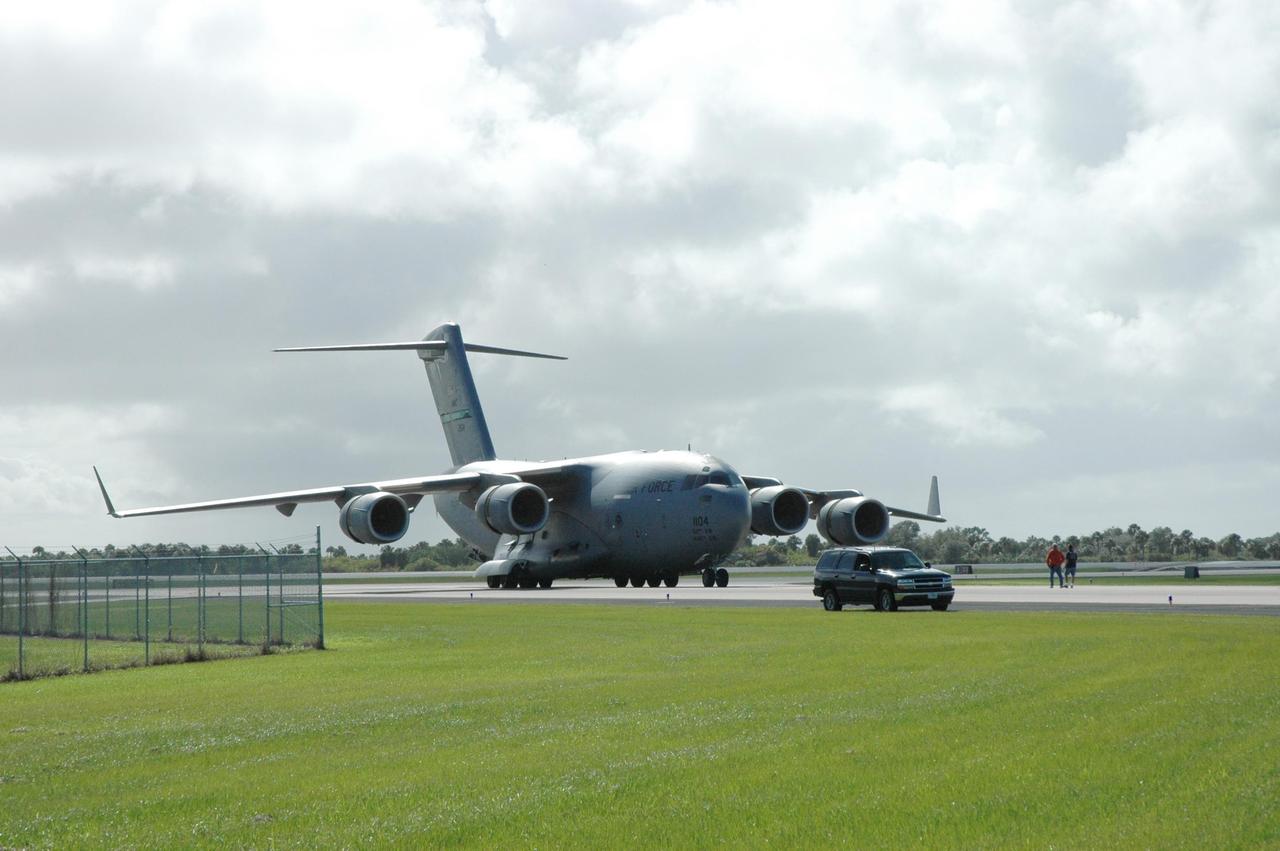
KENNEDY SPACE CENTER, FLA. -- A C-17 lands on the Shuttle Landing Facility at NASA's Kennedy Space Center. The plane is providing support for the aerial show being performed for the World Space Expo being held from Nov. 1 to Nov. 4 at the NASA Kennedy Space Center Visitor Complex. Aircraft participating are the U.S. Air Force Thunderbirds, U.S. Air Force F-22 Raptor, U.S. Navy F-18 Super Hornet, U.S. Air Force F-15 Eagle, the P-51 Mustang Heritage Flight and the U.S. Air Force 920th Rescue Wing, which was responsible for Mercury and Gemini capsule recovery. The U.S. Army Golden Knights also will demonstrate precision skydiving. The World Space Expo is an event to commemorate humanity's first 50 years in space while looking forward to returning people to the moon and exploring beyond. The expo will showcase various panels, presentations and educational programs. It also is a part of NASA's 50th anniversary celebrations, highlighting the 45th Anniversary of the Mercury Program celebration featuring original NASA astronauts John Glenn and Scott Carpenter and the Pioneering Women of Aerospace forum featuring Eileen Collins and other prominent female space veterans. The agency was founded Oct. 1, 1958. Photo credit: NASA/Jack Pfaller
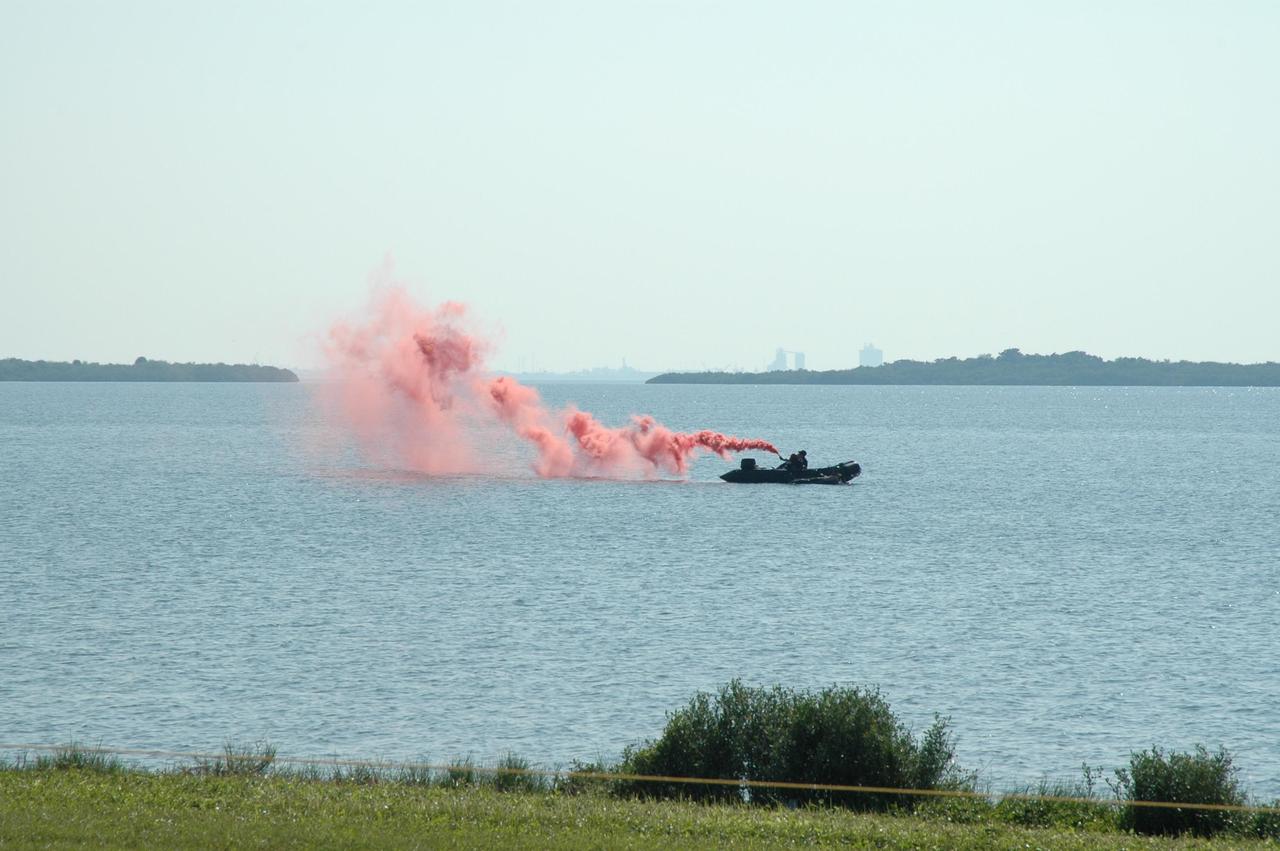
KENNEDY SPACE CENTER, FLA. -- In the water next to the NASA Causeway at NASA's Kennedy Space Center, part of the U.S. Air Force 920th Rescue Wing puts on a demonstration during the World Space Expo aerial salute. This unit was responsible for Mercury and Gemini capsule recovery. Other aircraft joining in the expo salute include the U.S. Air Force Thunderbirds Demonstration Squadron, the U.S. Navy F-18 Super Hornets, U.S. Air Force F-22 Raptor, U.S. Air Force F-15 Eagle, P-51 Mustang Heritage Flight, and the U.S. Army Golden Knights demonstrating precision skydiving. The World Space Expo held Nov. 1-4 was an event commemorating humanity's first 50 years in space while looking forward to returning people to the moon and exploring beyond. The expo showcased various panels, presentations and educational programs. It also was a part of NASA's 50th anniversary celebrations, highlighting the 45th Anniversary of the Mercury Program celebration featuring original NASA astronauts John Glenn and Scott Carpenter and the Pioneering Women of Aerospace forum featuring Eileen Collins and other prominent female space veterans. The agency was founded Oct. 1, 1958. Photo credit: NASA/Chris Chamberland
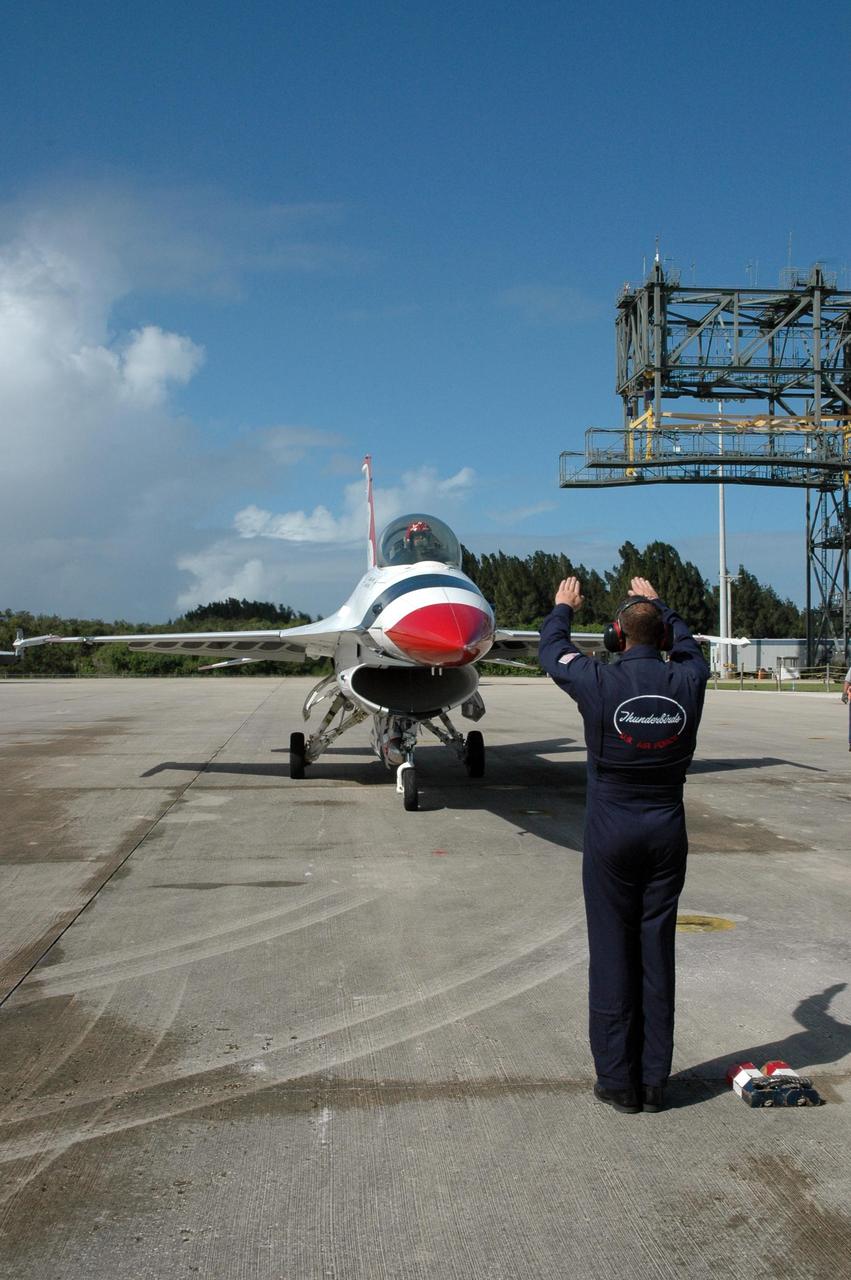
KENNEDY SPACE CENTER, FLA. -- Another of the U.S. Air Force Thunderbirds lands at the Shuttle Landing Facility at NASA's Kennedy Space Center. The aerial demonstration squadron is performing for the World Space Expo being held from Nov. 1 to Nov. 4 at the NASA Kennedy Space Center Visitor Complex. Other aircraft participating in the salute include U.S. Air Force F-22 Raptor, U.S. Navy F-18 Super Hornet, U.S. Air Force F-15 Eagle, the P-51 Mustang Heritage Flight and the U.S. Air Force 920th Rescue Wing, which was responsible for Mercury and Gemini capsule recovery. The U.S. Army Golden Knights also will demonstrate precision skydiving. The World Space Expo is an event to commemorate humanity's first 50 years in space while looking forward to returning people to the moon and exploring beyond. The expo will showcase various panels, presentations and educational programs. It also is a part of NASA's 50th anniversary celebrations, highlighting the 45th Anniversary of the Mercury Program celebration featuring original NASA astronauts John Glenn and Scott Carpenter and the Pioneering Women of Aerospace forum featuring Eileen Collins and other prominent female space veterans. The agency was founded Oct. 1, 1958. Photo credit: NASA/Jack Pfaller
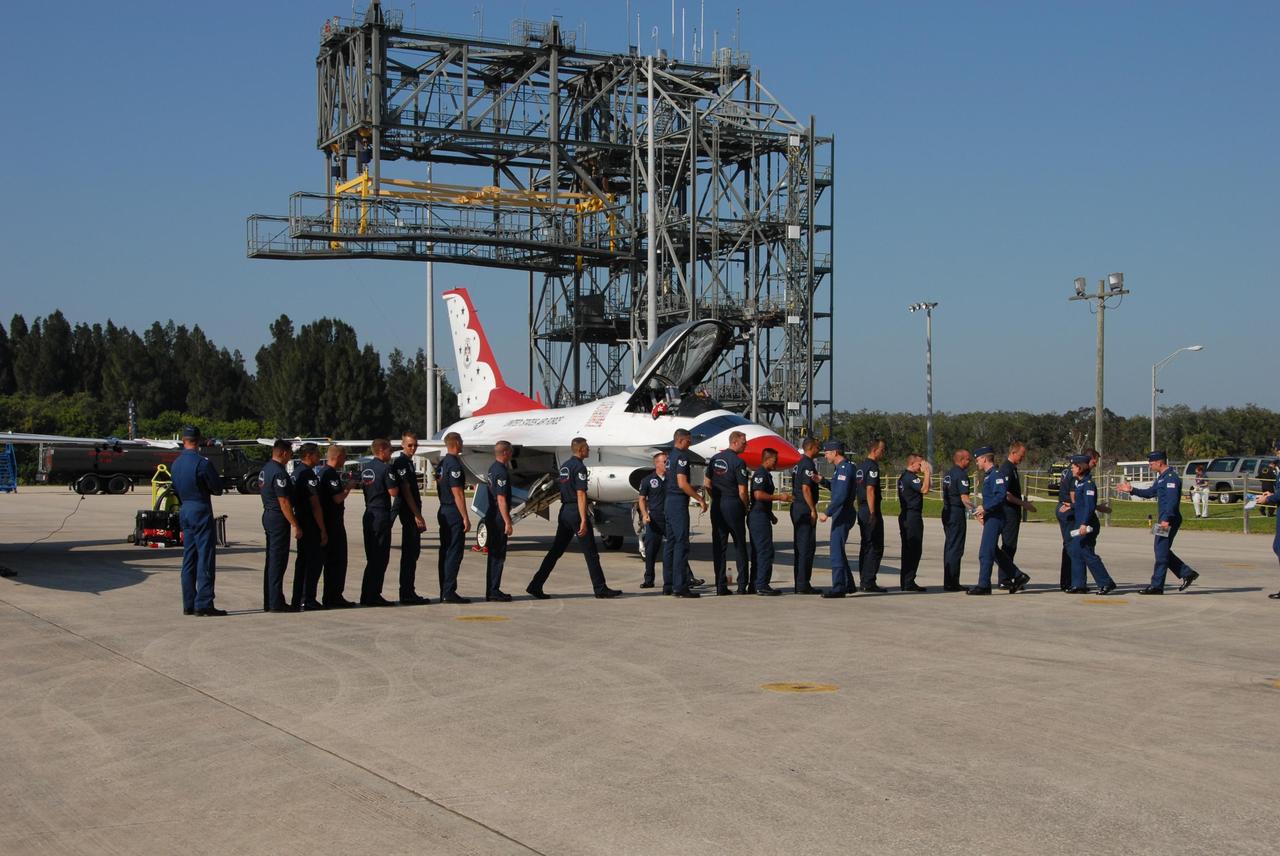
KENNEDY SPACE CENTER, FLA. — At NASA's Kennedy Space Center Shuttle Landing Facility, the air crew for the U.S. Air Force Thunderbirds Demonstration Squadron line up at left for a walkdown with the pilots, at right. The squadron is part of an aerial salute for the World Space Expo held at the center's Visitor Complex. Other aircraft joining in the expo salute include the U.S. Navy F-18 Super Hornets, U.S. Air Force F-22 Raptor, U.S. Air Force F-15 Eagle, P-51 Mustang Heritage Flight, the U.S. Air Force 920th Rescue Wing, which was responsible for Mercury and Gemini capsule recovery, and the U.S. Army Golden Knights demonstrating precision skydiving. The World Space Expo Nov. 1-4 was an event commemorating humanity's first 50 years in space while looking forward to returning people to the moon and exploring beyond. The expo showcased various panels, presentations and educational programs. It also was a part of NASA's 50th anniversary celebrations, highlighting the 45th Anniversary of the Mercury Program celebration featuring original NASA astronauts John Glenn and Scott Carpenter and the Pioneering Women of Aerospace forum featuring Eileen Collins and other prominent female space veterans. The agency was founded Oct. 1, 1958. Photo credit: NASA/George Shelton

KENNEDY SPACE CENTER, FLA. -- A U.S. Air Force F-22 Raptor is parked on the Shuttle Landing Facility at NASA's Kennedy Space Center. The plane is participating in the World Space Expo being held from Nov. 1 to Nov. 4 at the NASA Kennedy Space Center Visitor Complex. Other aircraft joining in the salute include U.S. Air Force Thunderbirds Aerial Demonstration Squadron, U.S. Navy F-18 Super Hornets, the P-51 Mustang Heritage Flight and the U.S. Air Force 920th Rescue Wing, which was responsible for Mercury and Gemini capsule recovery. The U.S. Army Golden Knights also will demonstrate precision skydiving. The World Space Expo is an event to commemorate humanity's first 50 years in space while looking forward to returning people to the moon and exploring beyond. The expo will showcase various panels, presentations and educational programs. It also is a part of NASA's 50th anniversary celebrations, highlighting the 45th Anniversary of the Mercury Program celebration featuring original NASA astronauts John Glenn and Scott Carpenter and the Pioneering Women of Aerospace forum featuring Eileen Collins and other prominent female space veterans. The agency was founded Oct. 1, 1958. Photo credit: NASA/Jack Pfaller
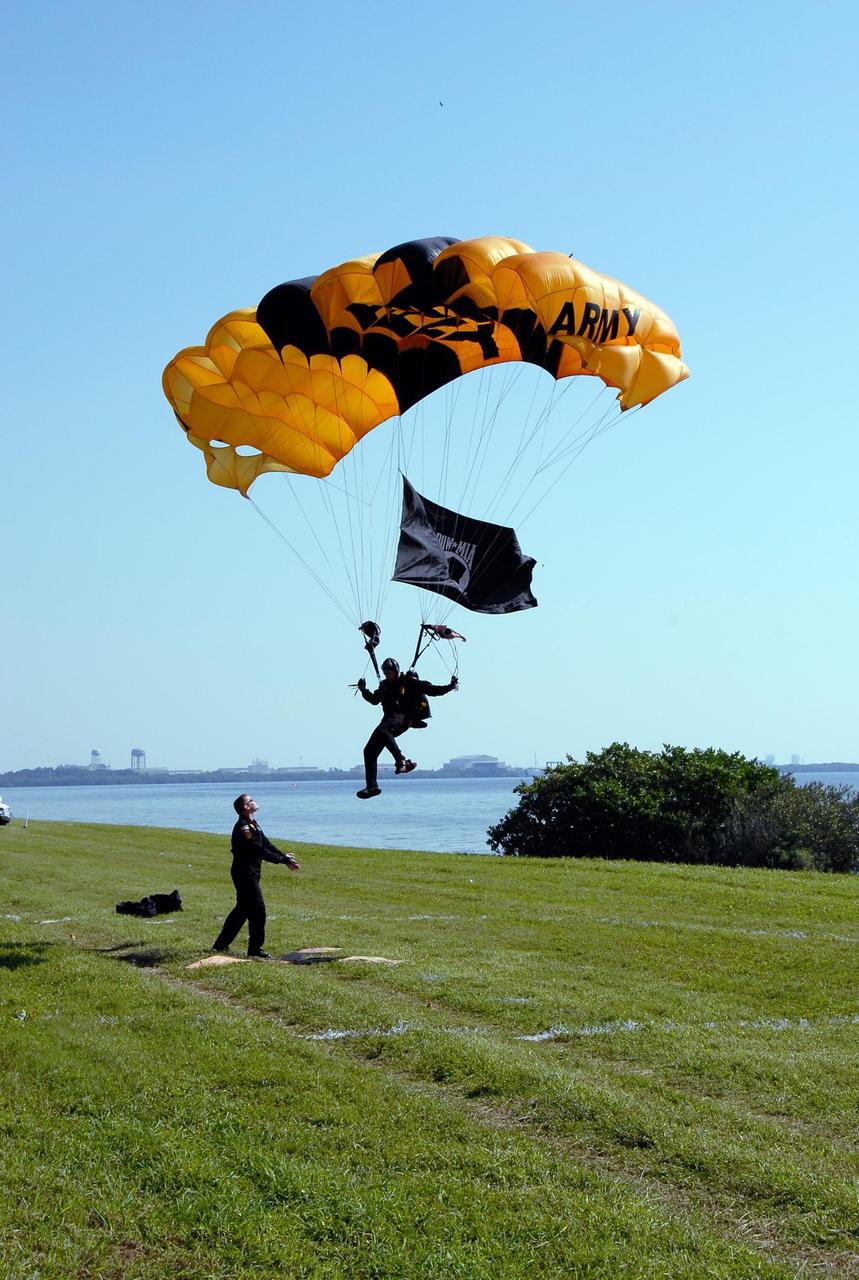
KENNEDY SPACE CENTER, FLA. -- Members of the U.S. Army Golden Knights demonstrate precision skydiving as part of the World Space Expo aerial salute at NASA's Kennedy Space Center. Other aircraft joining in the expo salute include the U.S. Air Force Thunderbirds Demonstration Squadron, the U.S. Navy F-18 Super Hornets, U.S. Air Force F-22 Raptor, U.S. Air Force F-15 Eagle, P-51 Mustang Heritage Flight, and the U.S. Air Force 920th Rescue Wing, which was responsible for Mercury and Gemini capsule recovery. The World Space Expo held Nov. 1-4 was an event commemorating humanity's first 50 years in space while looking forward to returning people to the moon and exploring beyond. The expo showcased various panels, presentations and educational programs. It also was a part of NASA's 50th anniversary celebrations, highlighting the 45th Anniversary of the Mercury Program celebration featuring original NASA astronauts John Glenn and Scott Carpenter and the Pioneering Women of Aerospace forum featuring Eileen Collins and other prominent female space veterans. The agency was founded Oct. 1, 1958. Photo credit: NASA/Kim Shiflett

KENNEDY SPACE CENTER, FLA. -- U.S. Air Force Thunderbirds line up on the Shuttle Landing Facility at NASA's Kennedy Space Center. The aerial demonstration squadron is performing for the World Space Expo being held from Nov. 1 to Nov. 4 at the NASA Kennedy Space Center Visitor Complex. Other aircraft participating in the salute include U.S. Air Force F-22 Raptor, U.S. Navy F-18 Super Hornet, U.S. Air Force F-15 Eagle, the P-51 Mustang Heritage Flight and the U.S. Air Force 920th Rescue Wing, which was responsible for Mercury and Gemini capsule recovery. The U.S. Army Golden Knights also will demonstrate precision skydiving. The World Space Expo is an event to commemorate humanity's first 50 years in space while looking forward to returning people to the moon and exploring beyond. The expo will showcase various panels, presentations and educational programs. It also is a part of NASA's 50th anniversary celebrations, highlighting the 45th Anniversary of the Mercury Program celebration featuring original NASA astronauts John Glenn and Scott Carpenter and the Pioneering Women of Aerospace forum featuring Eileen Collins and other prominent female space veterans. The agency was founded Oct. 1, 1958. Photo credit: NASA/Jack Pfaller
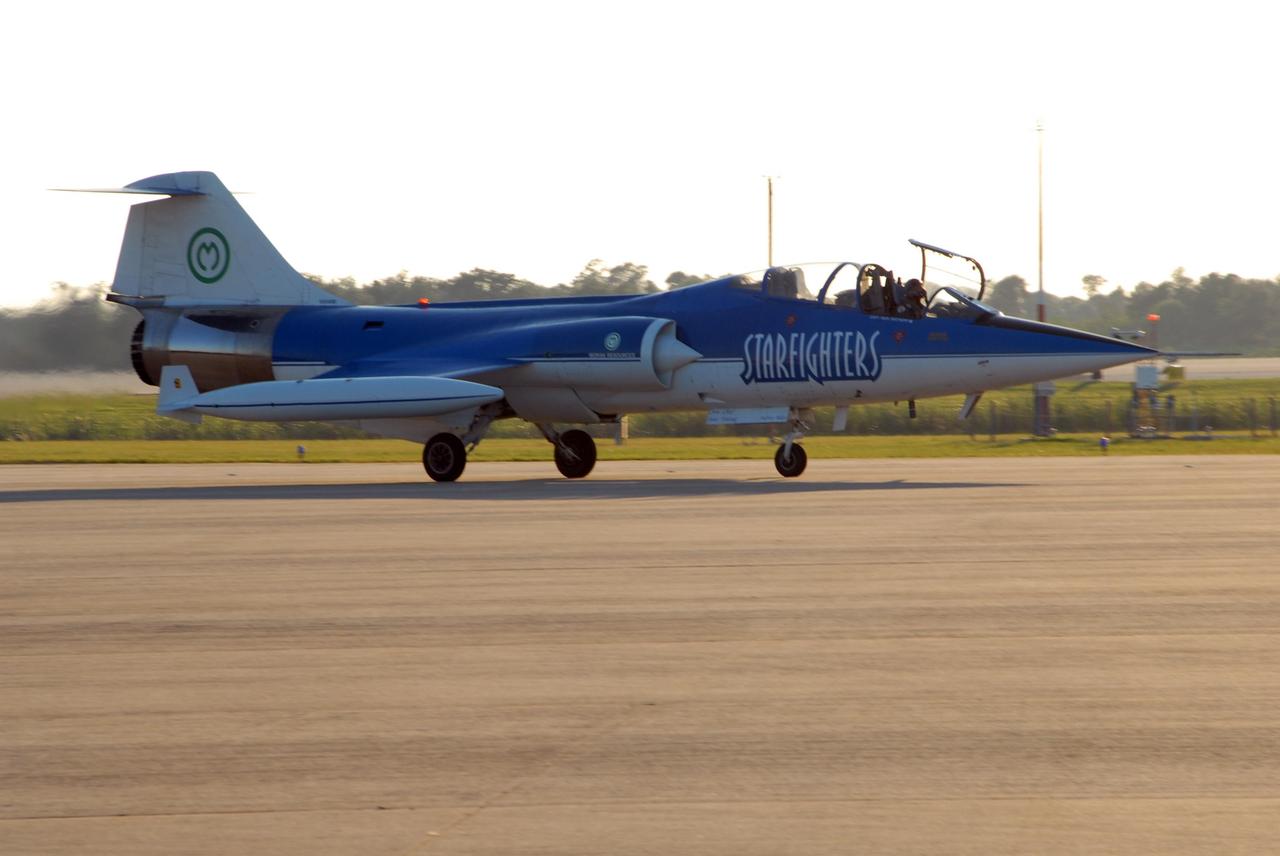
KENNEDY SPACE CENTER, FLA. — One of the Starfighters F-104 Demo Team pays a visit to NASA's Kennedy Space Center. The Starfighters are taking part in an air show in Jacksonville, Fla., and took the time to pay tribute to the World Space Expo at the center. The expo included an aerial salute featuring the U.S. Air Force Thunderbirds Demonstration Squadron, the U.S. Navy F-18 Super Hornets, U.S. Air Force F-22 Raptor, U.S. Air Force F-15 Eagle, P-51 Mustang Heritage Flight, the U.S. Air Force 920th Rescue Wing, which was responsible for Mercury and Gemini capsule recovery, and the U.S. Army Golden Knights demonstrating precision skydiving. The World Space Expo Nov. 1-4 was an event commemorating humanity's first 50 years in space while looking forward to returning people to the moon and exploring beyond. The expo showcased various panels, presentations and educational programs. It also was a part of NASA's 50th anniversary celebrations, highlighting the 45th Anniversary of the Mercury Program celebration featuring original NASA astronauts John Glenn and Scott Carpenter and the Pioneering Women of Aerospace forum featuring Eileen Collins and other prominent female space veterans. The agency was founded Oct. 1, 1958. Photo credit: NASA/George Shelton
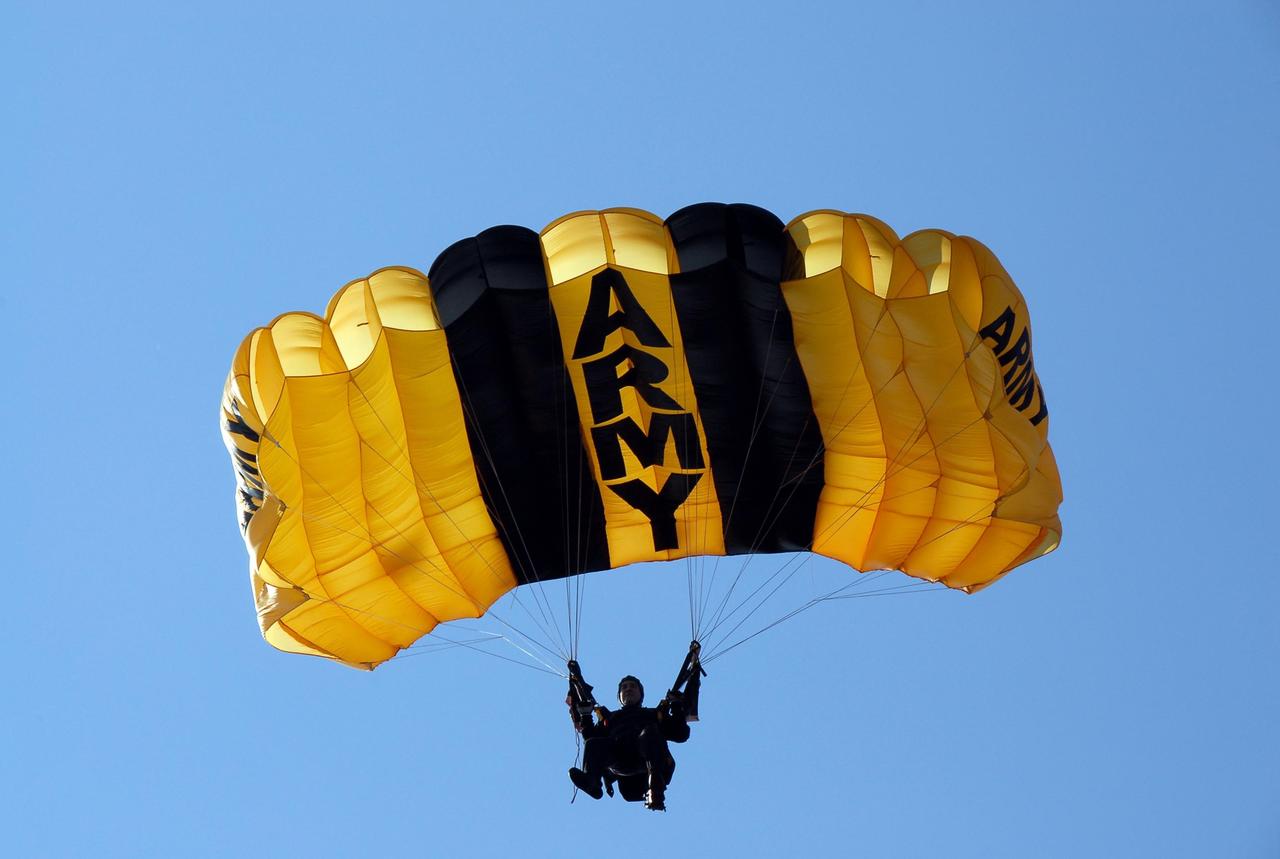
KENNEDY SPACE CENTER, FLA. -- A member of the U.S. Army Golden Knights demonstrates precision landing as part of the World Space Expo aerial salute at NASA's Kennedy Space Center. Other aircraft joining in the expo salute include the U.S. Air Force Thunderbirds Demonstration Squadron, the U.S. Navy F-18 Super Hornets, U.S. Air Force F-22 Raptor, U.S. Air Force F-15 Eagle, P-51 Mustang Heritage Flight, and the U.S. Air Force 920th Rescue Wing, which was responsible for Mercury and Gemini capsule recovery. The World Space Expo held Nov. 1-4 was an event commemorating humanity's first 50 years in space while looking forward to returning people to the moon and exploring beyond. The expo showcased various panels, presentations and educational programs. It also was a part of NASA's 50th anniversary celebrations, highlighting the 45th Anniversary of the Mercury Program celebration featuring original NASA astronauts John Glenn and Scott Carpenter and the Pioneering Women of Aerospace forum featuring Eileen Collins and other prominent female space veterans. The agency was founded Oct. 1, 1958. Photo credit: NASA/Kim Shiflett
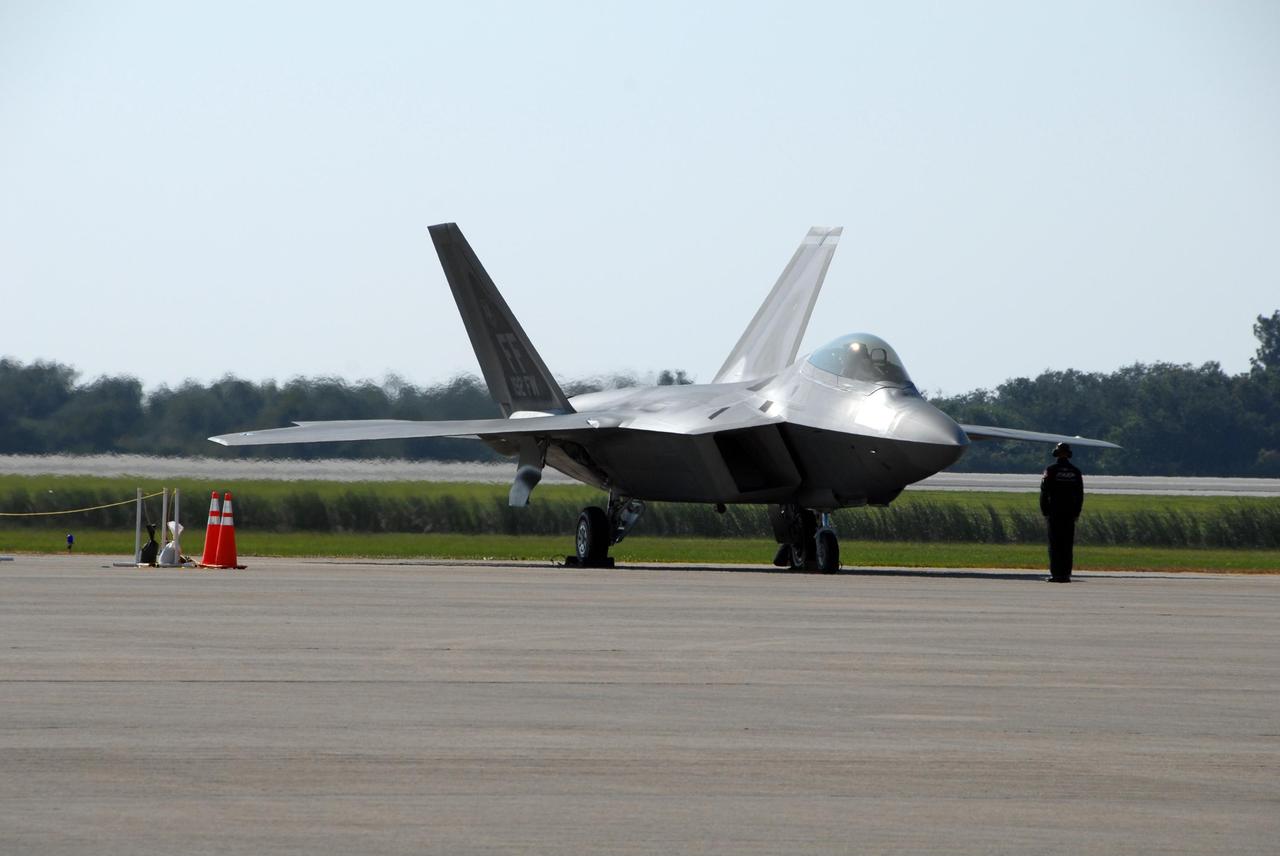
KENNEDY SPACE CENTER, FLA. — This U.S. Air Force F-22 Raptor is part of an aerial salute for the World Space Expo at NASA's Kennedy Space Center Visitor Complex. Other aircraft joining in the expo salute include the U.S. Air Force Thunderbirds Demonstration Squadron, the U.S. Navy F-18 Super Hornets, the U.S. Air Force F-15 Eagle, P-51 Mustang Heritage Flight, the U.S. Air Force 920th Rescue Wing, which was responsible for Mercury and Gemini capsule recovery, and the U.S. Army Golden Knights demonstrating precision skydiving. The World Space Expo Nov. 1-4 was an event commemorating humanity's first 50 years in space while looking forward to returning people to the moon and exploring beyond. The expo showcased various panels, presentations and educational programs. It also was a part of NASA's 50th anniversary celebrations, highlighting the 45th Anniversary of the Mercury Program celebration featuring original NASA astronauts John Glenn and Scott Carpenter and the Pioneering Women of Aerospace forum featuring Eileen Collins and other prominent female space veterans. The agency was founded Oct. 1, 1958. Photo credit: NASA/George Shelton
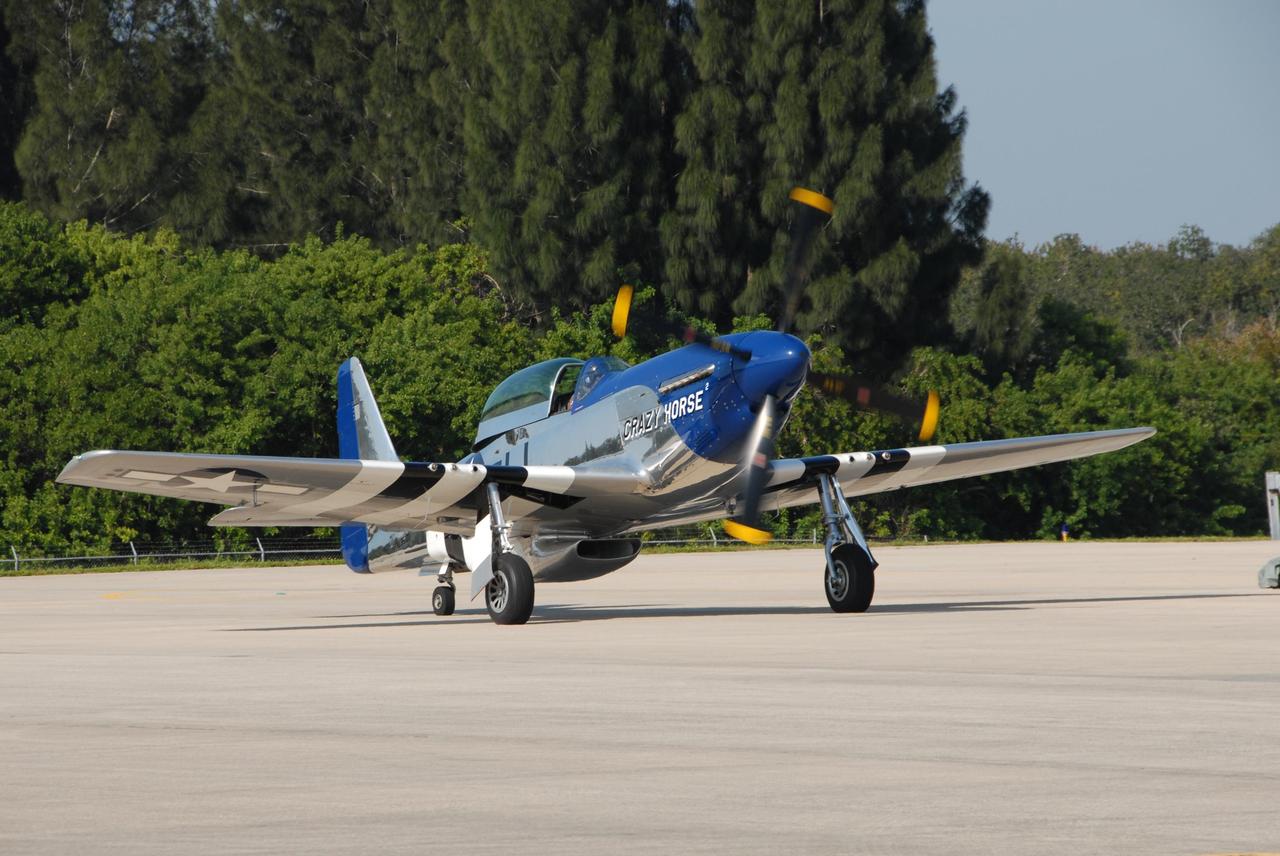
KENNEDY SPACE CENTER, FLA. — A P-51 Mustang, seen here on the Shuttle Landing Facility at NASA's Kennedy Space Center, is part of the World Space Expo aerial salute held at the Center's Visitor Complex. Other aircraft joining in the expo salute include the U.S. Air Force Thunderbirds Demonstration Squadron, the U.S. Navy F-18 Super Hornets, U.S. Air Force F-22 Raptor, U.S. Air Force F-15 Eagle, P-51 Mustang Heritage Flight, the U.S. Air Force 920th Rescue Wing, which was responsible for Mercury and Gemini capsule recovery, and the U.S. Army Golden Knights demonstrating precision skydiving. The World Space Expo Nov. 1-4 was an event commemorating humanity's first 50 years in space while looking forward to returning people to the moon and exploring beyond. The expo showcased various panels, presentations and educational programs. It also was a part of NASA's 50th anniversary celebrations, highlighting the 45th Anniversary of the Mercury Program celebration featuring original NASA astronauts John Glenn and Scott Carpenter and the Pioneering Women of Aerospace forum featuring Eileen Collins and other prominent female space veterans. The agency was founded Oct. 1, 1958. Photo credit: NASA/George Shelton
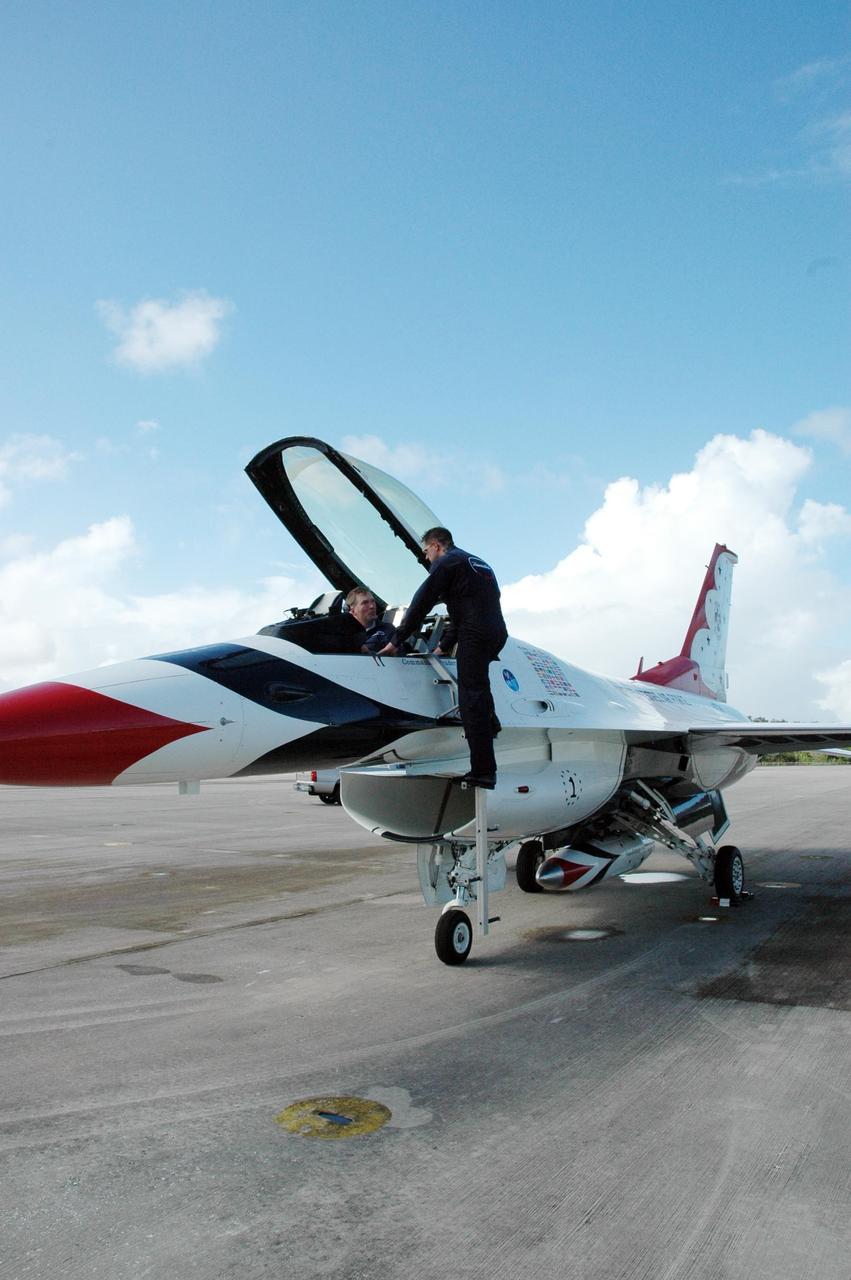
KENNEDY SPACE CENTER, FLA. -- Another of the U.S. Air Force Thunderbirds is parked on the Shuttle Landing Facility at NASA's Kennedy Space Center. The aerial demonstration squadron is performing for the World Space Expo being held from Nov. 1 to Nov. 4 at the NASA Kennedy Space Center Visitor Complex. Other aircraft participating in the salute include U.S. Air Force F-22 Raptor, U.S. Navy F-18 Super Hornet, U.S. Air Force F-15 Eagle, the P-51 Mustang Heritage Flight and the U.S. Air Force 920th Rescue Wing, which was responsible for Mercury and Gemini capsule recovery. The U.S. Army Golden Knights also will demonstrate precision skydiving. The World Space Expo is an event to commemorate humanity's first 50 years in space while looking forward to returning people to the moon and exploring beyond. The expo will showcase various panels, presentations and educational programs. It also is a part of NASA's 50th anniversary celebrations, highlighting the 45th Anniversary of the Mercury Program celebration featuring original NASA astronauts John Glenn and Scott Carpenter and the Pioneering Women of Aerospace forum featuring Eileen Collins and other prominent female space veterans. The agency was founded Oct. 1, 1958. Photo credit: NASA/Jack Pfaller
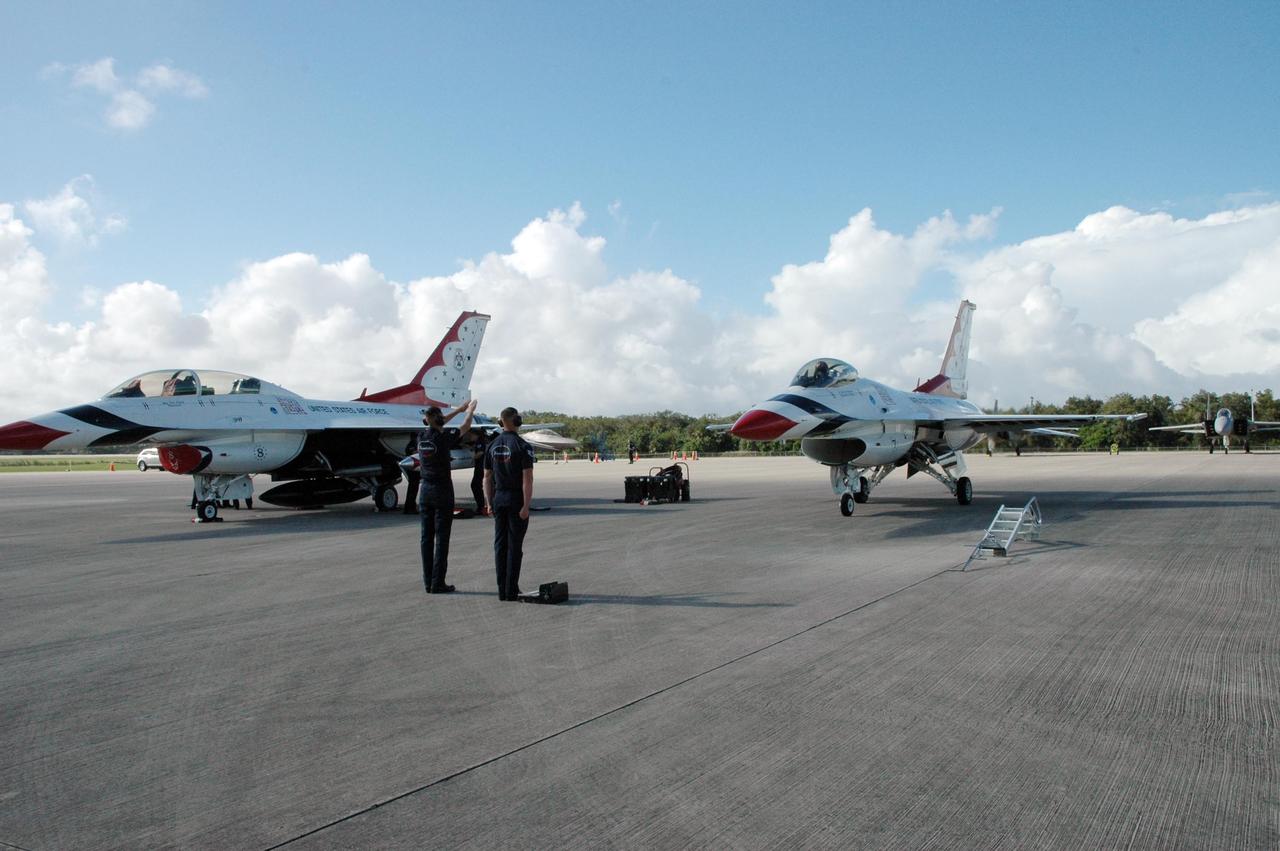
KENNEDY SPACE CENTER, FLA. -- Another of the U.S. Air Force Thunderbirds is parked on the Shuttle Landing Facility at NASA's Kennedy Space Center. The aerial demonstration squadron is performing for the World Space Expo being held from Nov. 1 to Nov. 4 at the NASA Kennedy Space Center Visitor Complex. Other aircraft participating in the salute include U.S. Air Force F-22 Raptor, U.S. Navy F-18 Super Hornet, U.S. Air Force F-15 Eagle, the P-51 Mustang Heritage Flight and the U.S. Air Force 920th Rescue Wing, which was responsible for Mercury and Gemini capsule recovery. The U.S. Army Golden Knights also will demonstrate precision skydiving. The World Space Expo is an event to commemorate humanity's first 50 years in space while looking forward to returning people to the moon and exploring beyond. The expo will showcase various panels, presentations and educational programs. It also is a part of NASA's 50th anniversary celebrations, highlighting the 45th Anniversary of the Mercury Program celebration featuring original NASA astronauts John Glenn and Scott Carpenter and the Pioneering Women of Aerospace forum featuring Eileen Collins and other prominent female space veterans. The agency was founded Oct. 1, 1958. Photo credit: NASA/Jack Pfaller
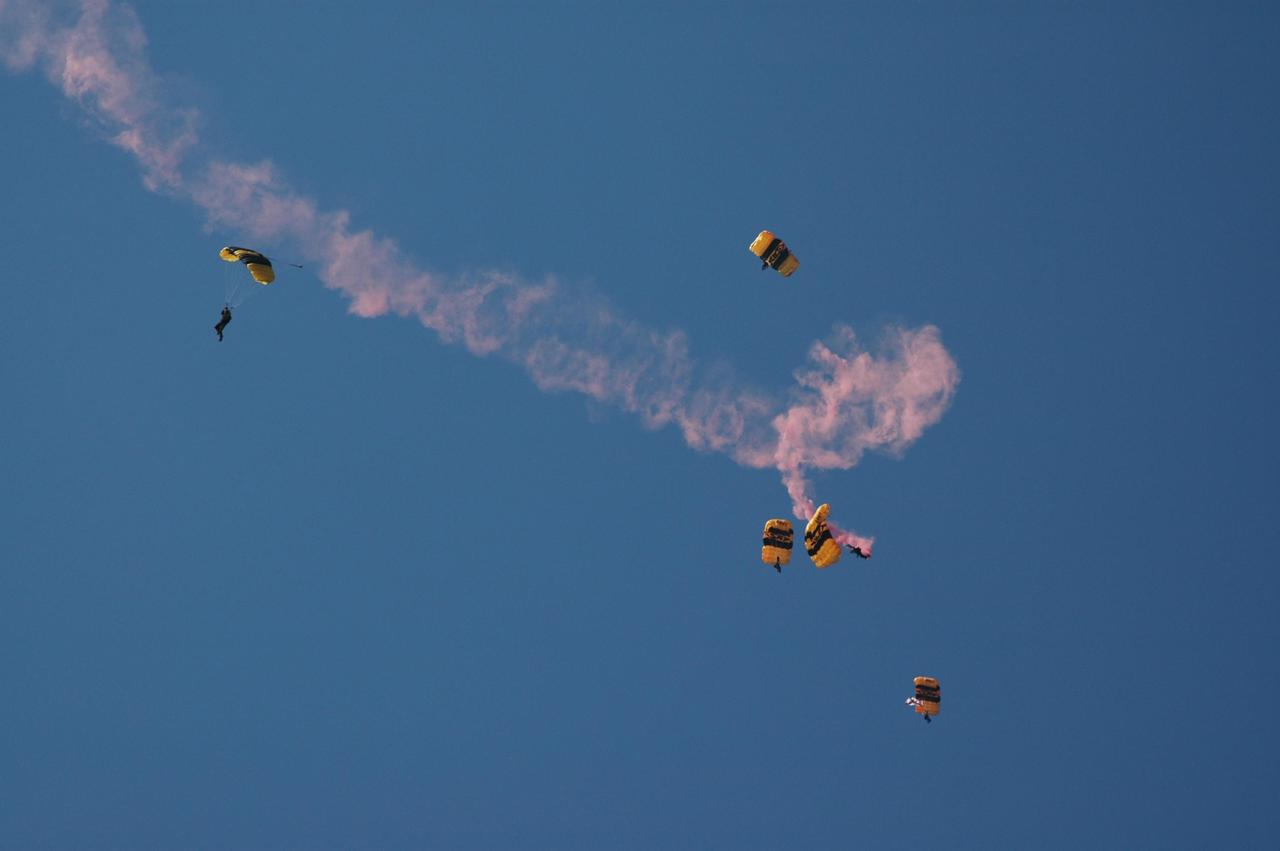
KENNEDY SPACE CENTER, FLA. -- The U.S. Army Golden Knights demonstrate precision skydiving as part of the World Space Expo aerial salute at NASA's Kennedy Space Center. Other aircraft joining in the expo salute include the U.S. Air Force Thunderbirds Demonstration Squadron, the U.S. Navy F-18 Super Hornets, U.S. Air Force F-22 Raptor, U.S. Air Force F-15 Eagle, P-51 Mustang Heritage Flight, and the U.S. Air Force 920th Rescue wing, which was responsible for Mercury and Gemini capsule recovery. The World Space Expo held Nov. 1-4 was an event commemorating humanity's first 50 years in space while looking forward to returning people to the moon and exploring beyond. The expo showcased various panels, presentations and educational programs. It also was a part of NASA's 50th anniversary celebrations, highlighting the 45th Anniversary of the Mercury Program celebration featuring original NASA astronauts John Glenn and Scott Carpenter and the Pioneering Women of Aerospace forum featuring Eileen Collins and other prominent female space veterans. The agency was founded Oct. 1, 1958. Photo credit: NASA/Chris Chamberland
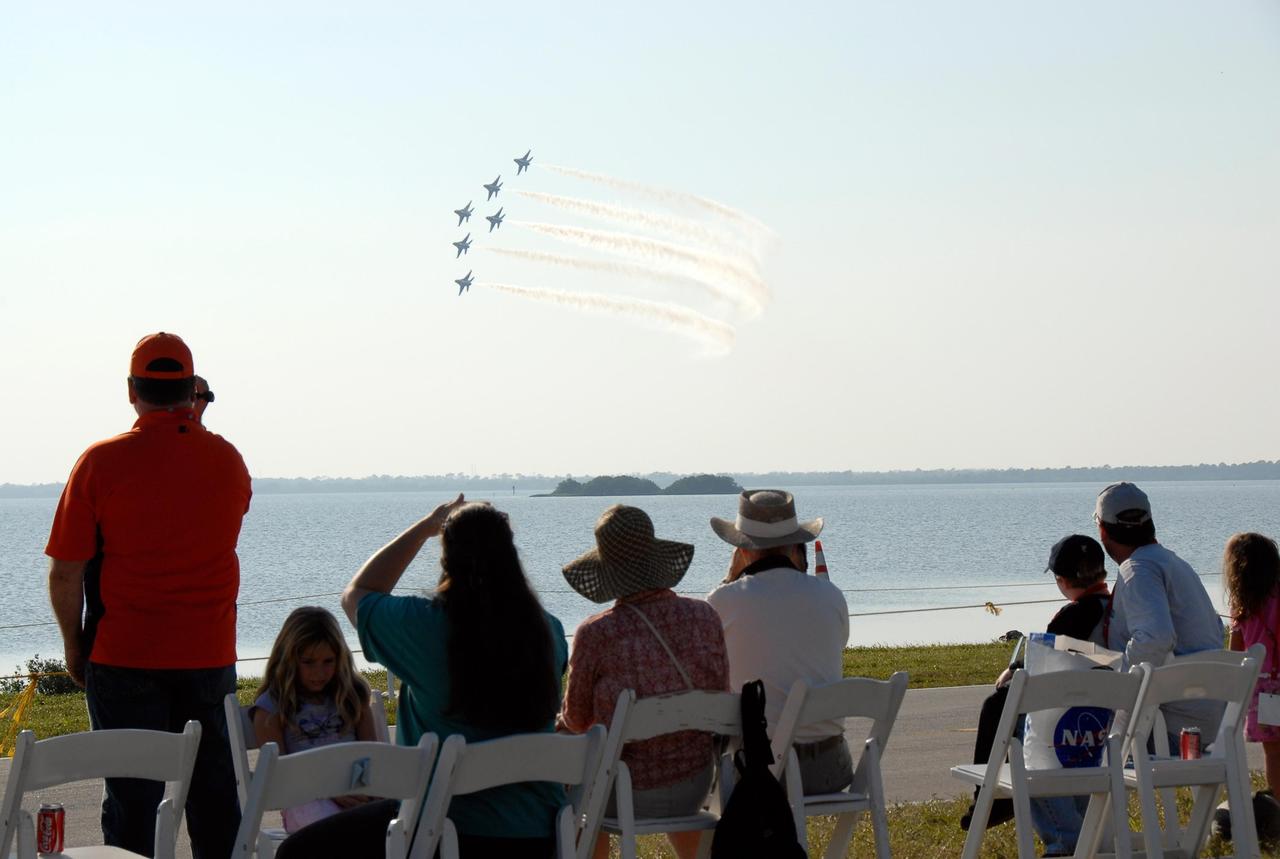
KENNEDY SPACE CENTER, FLA. -- Crowds at NASA's Kennedy Space Center watch the U.S. Air Force Thunderbirds Demonstration Squadron perform during the World Space Expo aerial salute. Other aircraft joining in the expo salute include the U.S. Navy F-18 Super Hornets, U.S. Air Force F-22 Raptor, U.S. Air Force F-15 Eagle, P-51 Mustang Heritage Flight, the U.S. Air Force 920th Rescue Wing, which was responsible for Mercury and Gemini capsule recovery, and the U.S. Army Golden Knights precision skydivers. The World Space Expo held Nov. 1-4 was an event commemorating humanity's first 50 years in space while looking forward to returning people to the moon and exploring beyond. The expo showcased various panels, presentations and educational programs. It also was a part of NASA's 50th anniversary celebrations, highlighting the 45th Anniversary of the Mercury Program celebration featuring original NASA astronauts John Glenn and Scott Carpenter and the Pioneering Women of Aerospace forum featuring Eileen Collins and other prominent female space veterans. The agency was founded Oct. 1, 1958. Photo credit: NASA/Kim Shiflett
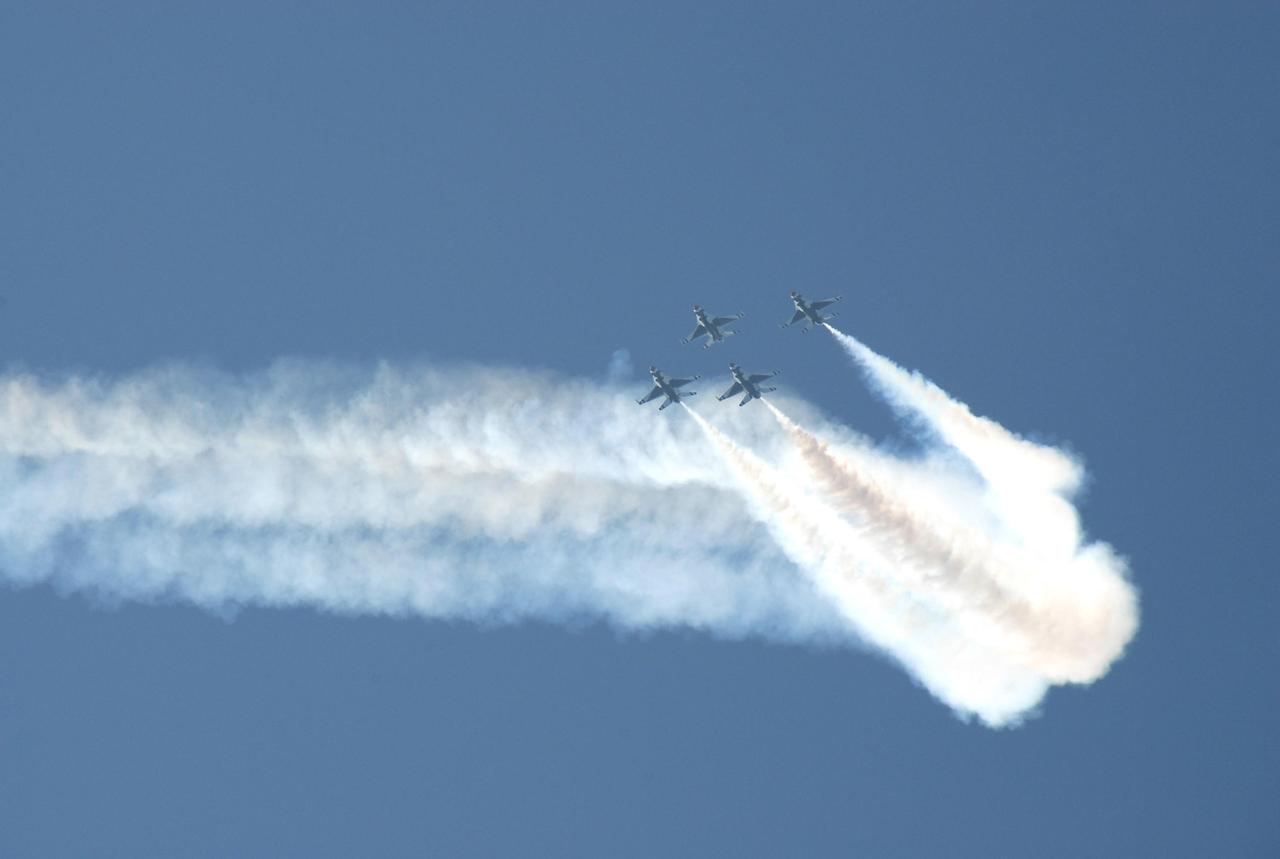
KENNEDY SPACE CENTER, FLA. -- The U.S. Air Force Thunderbirds Demonstration Squadron flies in formation over NASA's Kennedy Space Center as part of the World Space Expo aerial salute. Other aircraft joining in the expo salute include the U.S. Navy F-18 Super Hornets, U.S. Air Force F-22 Raptor, U.S. Air Force F-15 Eagle, P-51 Mustang Heritage Flight, and the U.S. Air Force 920th Rescue Wing, which was responsible for Mercury and Gemini capsule recovery, and the U.S. Army Golden Knights precision skydiving team. The World Space Expo held Nov. 1-4 was an event commemorating humanity's first 50 years in space while looking forward to returning people to the moon and exploring beyond. The expo showcased various panels, presentations and educational programs. It also was a part of NASA's 50th anniversary celebrations, highlighting the 45th Anniversary of the Mercury Program celebration featuring original NASA astronauts John Glenn and Scott Carpenter and the Pioneering Women of Aerospace forum featuring Eileen Collins and other prominent female space veterans. The agency was founded Oct. 1, 1958. Photo credit: NASA/Kim Shiflett
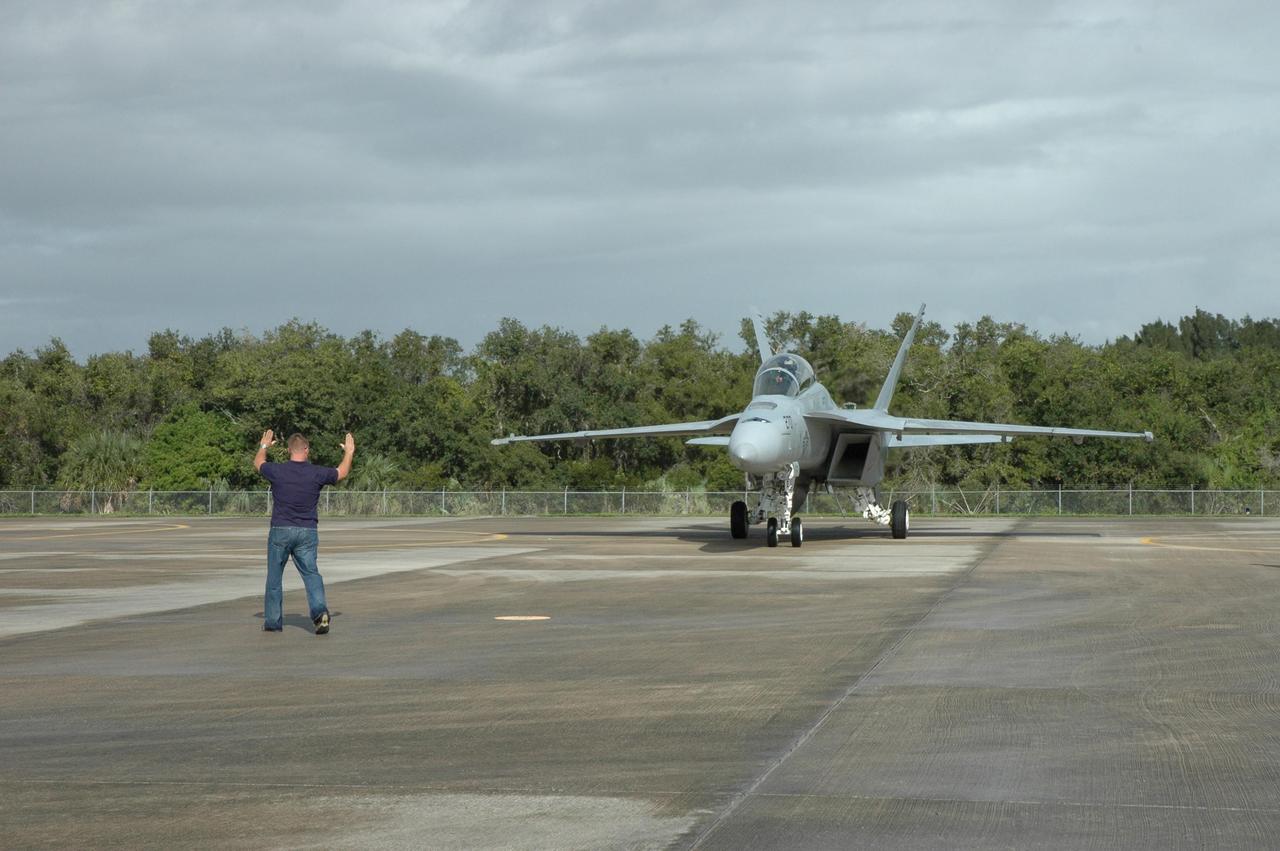
KENNEDY SPACE CENTER, FLA. -- A U.S. Navy F-18 Super Hornet is parked on the Shuttle Landing Facility at NASA's Kennedy Space Center. Several of the planes are participating in the World Space Expo being held from Nov. 1 to Nov. 4 at the NASA Kennedy Space Center Visitor Complex. Other aircraft joining in the salute include U.S. Air Force Thunderbirds Aerial Demonstration Squadron , U.S. Air Force F-22 Raptor, U.S. Air Force F-15 Eagle, the P-51 Mustang Heritage Flight and the U.S. Air Force 920th Rescue Wing, which was responsible for Mercury and Gemini capsule recovery. The U.S. Army Golden Knights also will demonstrate precision skydiving. The World Space Expo is an event to commemorate humanity's first 50 years in space while looking forward to returning people to the moon and exploring beyond. The expo will showcase various panels, presentations and educational programs. It also is a part of NASA's 50th anniversary celebrations, highlighting the 45th Anniversary of the Mercury Program celebration featuring original NASA astronauts John Glenn and Scott Carpenter and the Pioneering Women of Aerospace forum featuring Eileen Collins and other prominent female space veterans. The agency was founded Oct. 1, 1958. Photo credit: NASA/Jack Pfaller
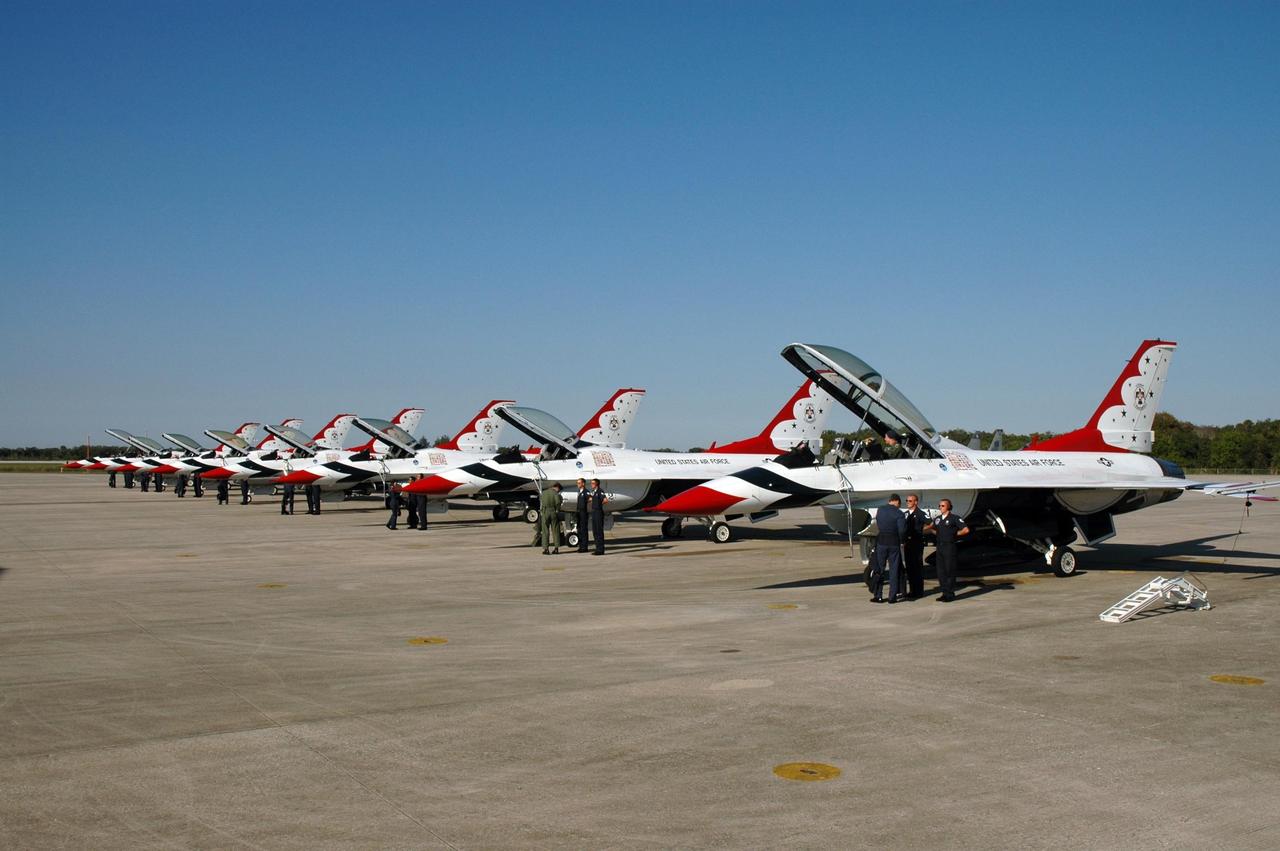
KENNEDY SPACE CENTER, FLA. -- The U.S. Air Force Thunderbirds Demonstration Squadron is lined up on NASA's Kennedy Space Center Shuttle Landing Facility before leaving. The squadron performed for the World Space Expos' aerial salute along with other aircraft that included the U.S. Navy F-18 Super Hornets, U.S. Air Force F-22 Raptor, U.S. Air Force F-15 Eagle, P-51 Mustang Heritage Flight, the U.S. Air Force 920th Rescue Wing, which was responsible for Mercury and Gemini capsule recovery, and the U.S. Army Golden Knights precision skydiving team. The World Space Expo held Nov. 1-4 was an event commemorating humanity's first 50 years in space while looking forward to returning people to the moon and exploring beyond. The expo showcased various panels, presentations and educational programs. It also was a part of NASA's 50th anniversary celebrations, highlighting the 45th Anniversary of the Mercury Program celebration featuring original NASA astronauts John Glenn and Scott Carpenter and the Pioneering Women of Aerospace forum featuring Eileen Collins and other prominent female space veterans. The agency was founded Oct. 1, 1958. Photo credit: NASA/Jim Grossmann
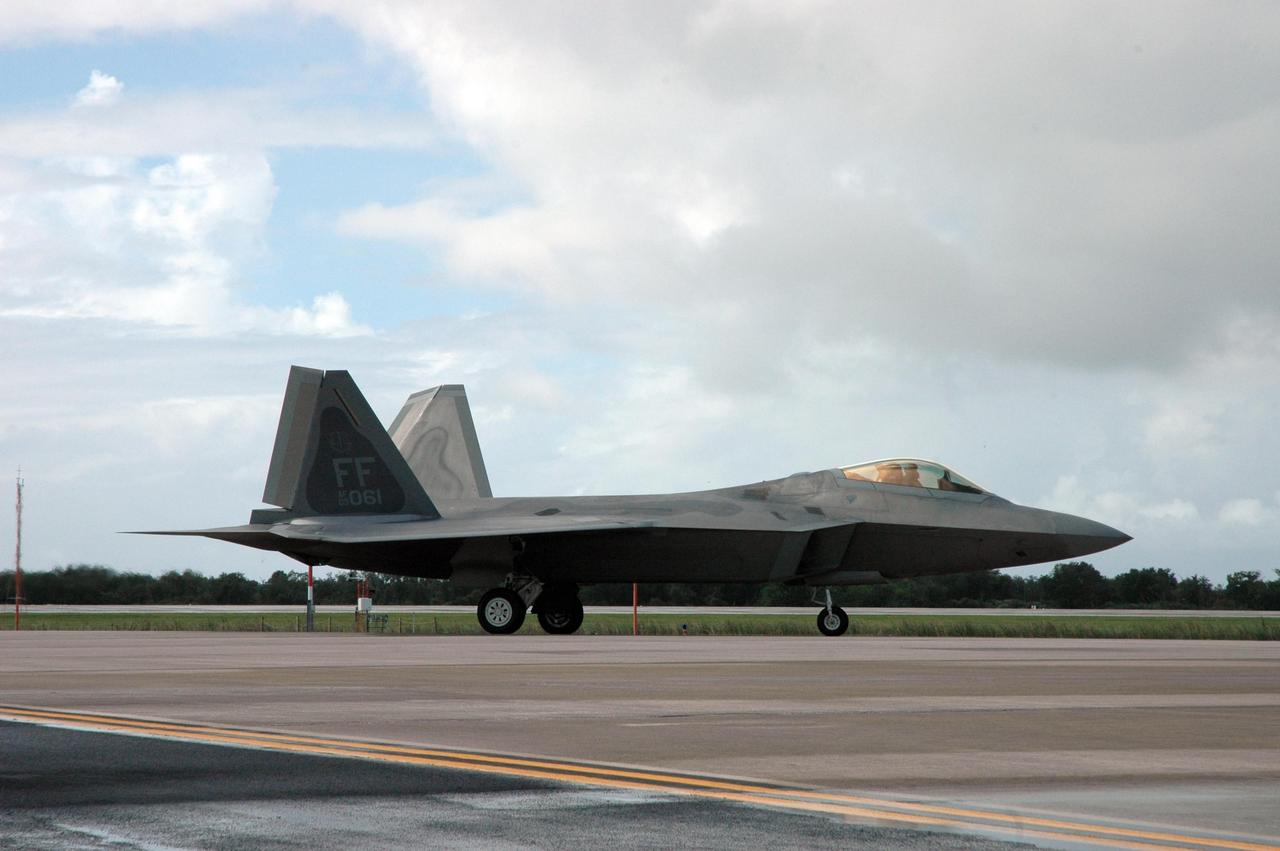
KENNEDY SPACE CENTER, FLA. -- A U.S. Air Force F-22 Raptor arrives at the Shuttle Landing Facility at NASA's Kennedy Space Center. The plane is participating in the World Space Expo being held from Nov. 1 to Nov. 4 at the NASA Kennedy Space Center Visitor Complex. Other aircraft joining in the salute include U.S. Air Force Thunderbirds Aerial Demonstration Squadron, U.S. Navy F-18 Super Hornets, the P-51 Mustang Heritage Flight and the U.S. Air Force 920th Rescue Wing, which was responsible for Mercury and Gemini capsule recovery. The U.S. Army Golden Knights also will demonstrate precision skydiving. The World Space Expo is an event to commemorate humanity's first 50 years in space while looking forward to returning people to the moon and exploring beyond. The expo will showcase various panels, presentations and educational programs. It also is a part of NASA's 50th anniversary celebrations, highlighting the 45th Anniversary of the Mercury Program celebration featuring original NASA astronauts John Glenn and Scott Carpenter and the Pioneering Women of Aerospace forum featuring Eileen Collins and other prominent female space veterans. The agency was founded Oct. 1, 1958. Photo credit: NASA/Jack Pfaller
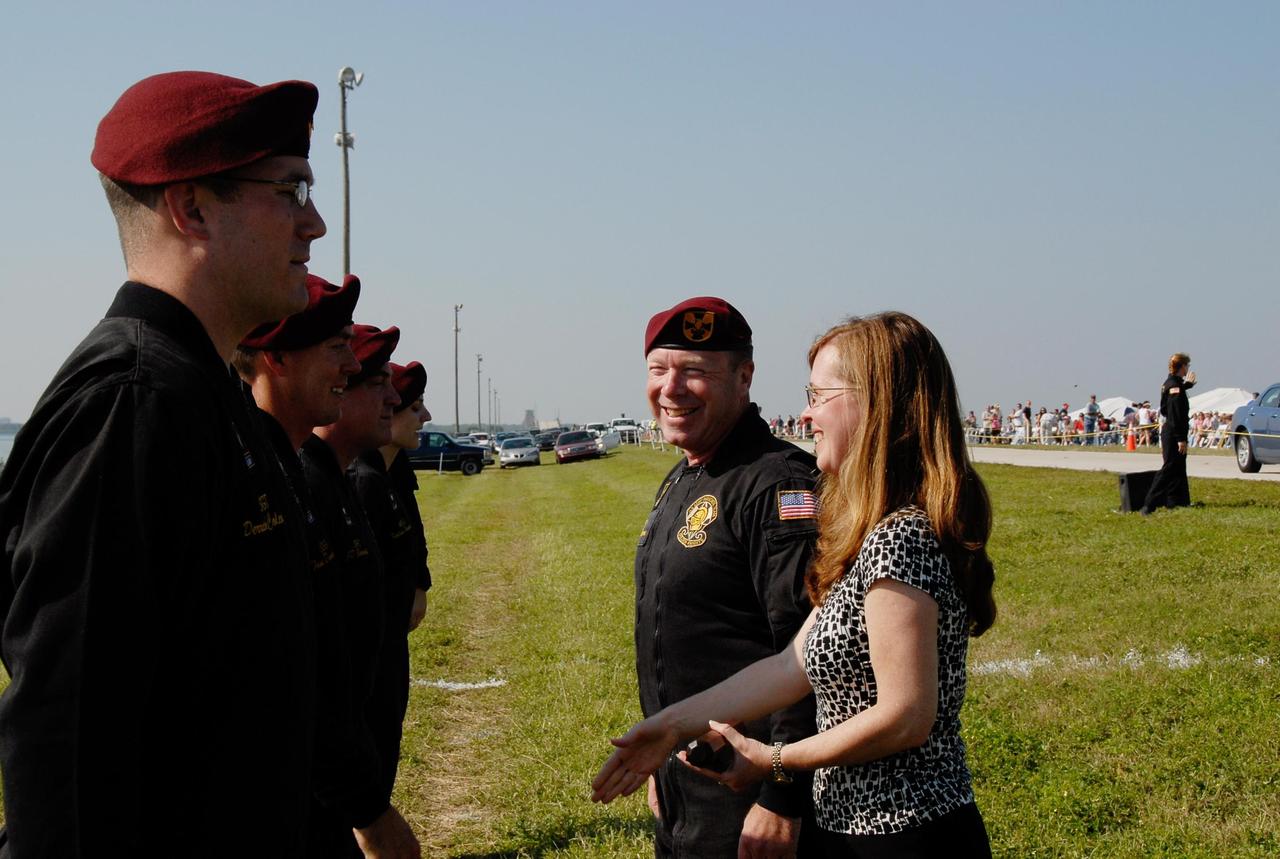
KENNEDY SPACE CENTER, FLA. -- At NASA's Kennedy Space Center, External Relations Director Lisa Malone greets members of the U.S. Army Golden Knights, a precision skydiving team who were part of the World Space Expo aerial salute. Other aircraft joining in the expo salute include the U.S. Air Force Thunderbirds Demonstration Squadron, the U.S. Navy F-18 Super Hornets, U.S. Air Force F-22 Raptor, U.S. Air Force F-15 Eagle, P-51 Mustang Heritage Flight, and the U.S. Air Force 920th Rescue Wing, which was responsible for Mercury and Gemini capsule recovery. The World Space Expo held Nov. 1-4 was an event commemorating humanity's first 50 years in space while looking forward to returning people to the moon and exploring beyond. The expo showcased various panels, presentations and educational programs. It also was a part of NASA's 50th anniversary celebrations, highlighting the 45th Anniversary of the Mercury Program celebration featuring original NASA astronauts John Glenn and Scott Carpenter and the Pioneering Women of Aerospace forum featuring Eileen Collins and other prominent female space veterans. The agency was founded Oct. 1, 1958. Photo credit: NASA/Kim Shiflett
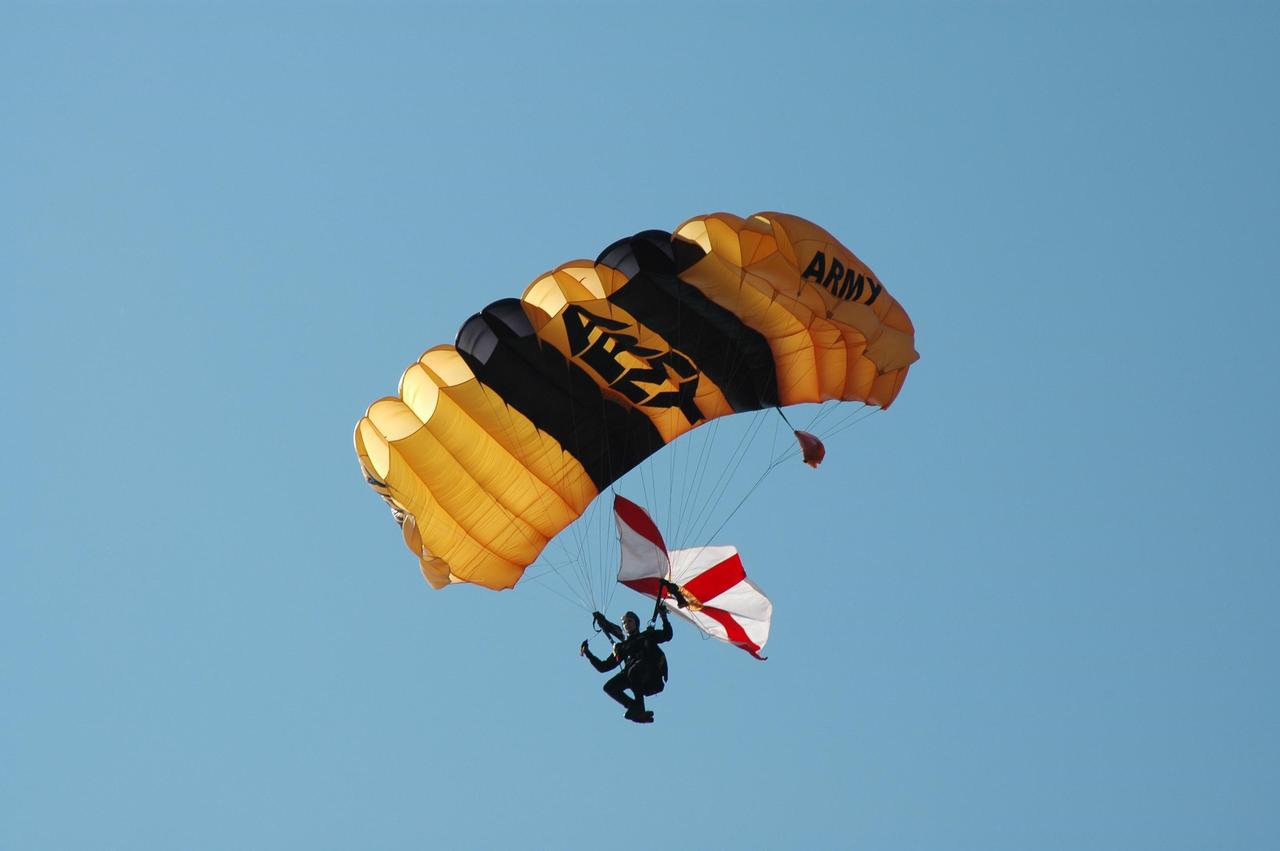
KENNEDY SPACE CENTER, FLA. -- The U.S. Army Golden Knights demonstrate precision skydiving as part of the World Space Expo aerial salute at NASA's Kennedy Space Center. Other aircraft joining in the expo salute include the U.S. Air Force Thunderbirds Demonstration Squadron, the U.S. Navy F-18 Super Hornets, U.S. Air Force F-22 Raptor, U.S. Air Force F-15 Eagle, P-51 Mustang Heritage Flight, and the U.S. Air Force 920th Rescue wing, which was responsible for Mercury and Gemini capsule recovery. The World Space Expo held Nov. 1-4 was an event commemorating humanity's first 50 years in space while looking forward to returning people to the moon and exploring beyond. The expo showcased various panels, presentations and educational programs. It also was a part of NASA's 50th anniversary celebrations, highlighting the 45th Anniversary of the Mercury Program celebration featuring original NASA astronauts John Glenn and Scott Carpenter and the Pioneering Women of Aerospace forum featuring Eileen Collins and other prominent female space veterans. The agency was founded Oct. 1, 1958. Photo credit: NASA/Chris Chamberland
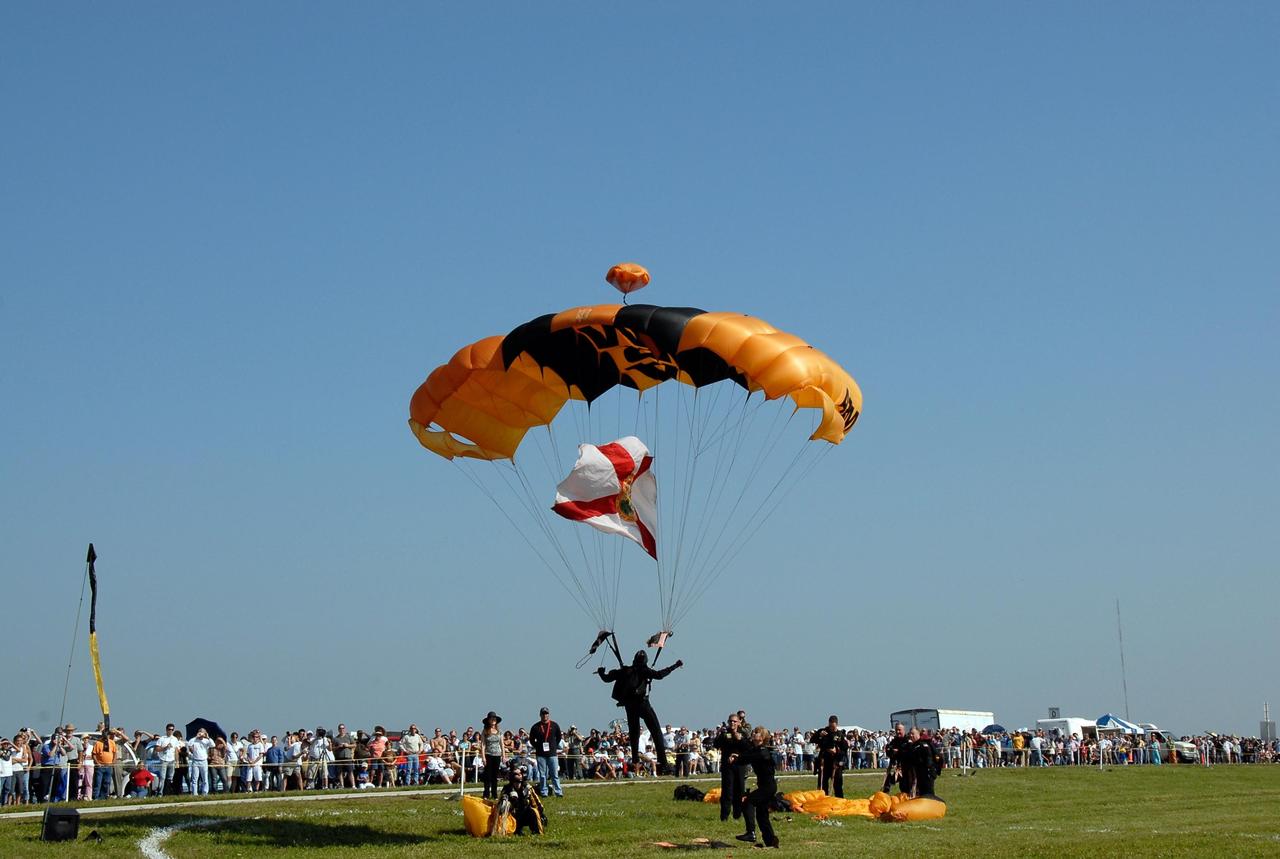
KENNEDY SPACE CENTER, FLA. -- Members of the U.S. Army Golden Knights demonstrate precision landing as part of the World Space Expo aerial salute at NASA's Kennedy Space Center. Other aircraft joining in the expo salute include the U.S. Air Force Thunderbirds Demonstration Squadron, the U.S. Navy F-18 Super Hornets, U.S. Air Force F-22 Raptor, U.S. Air Force F-15 Eagle, P-51 Mustang Heritage Flight, and the U.S. Air Force 920th Rescue Wing, which was responsible for Mercury and Gemini capsule recovery. The World Space Expo held Nov. 1-4 was an event commemorating humanity's first 50 years in space while looking forward to returning people to the moon and exploring beyond. The expo showcased various panels, presentations and educational programs. It also was a part of NASA's 50th anniversary celebrations, highlighting the 45th Anniversary of the Mercury Program celebration featuring original NASA astronauts John Glenn and Scott Carpenter and the Pioneering Women of Aerospace forum featuring Eileen Collins and other prominent female space veterans. The agency was founded Oct. 1, 1958. Photo credit: NASA/Kim Shiflett
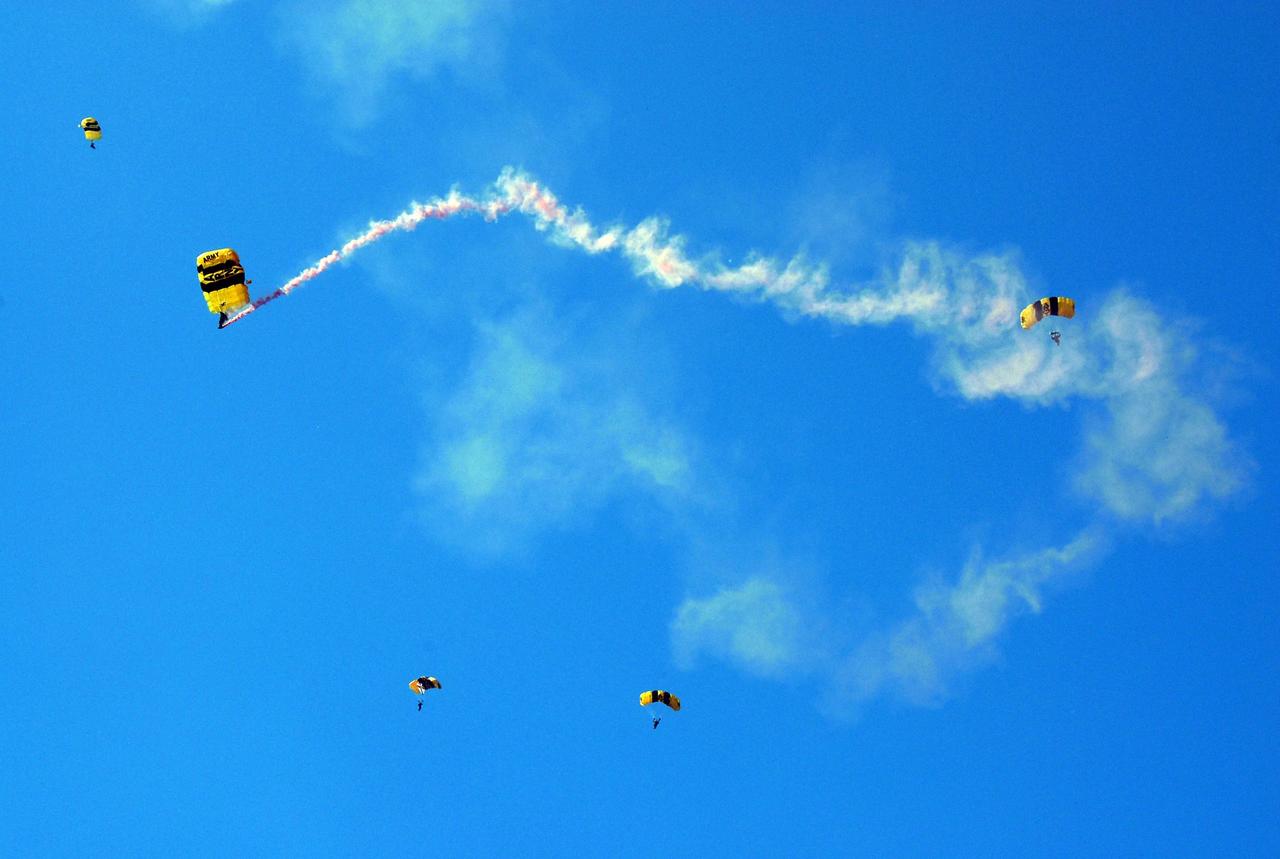
KENNEDY SPACE CENTER, FLA. -- The U.S. Army Golden Knights demonstrate precision skydiving as part of the World Space Expo aerial salute at NASA's Kennedy Space Center. Other aircraft joining in the expo salute include the U.S. Air Force Thunderbirds Demonstration Squadron, the U.S. Navy F-18 Super Hornets, U.S. Air Force F-22 Raptor, U.S. Air Force F-15 Eagle, P-51 Mustang Heritage Flight, and the U.S. Air Force 920th Rescue Wing, which was responsible for Mercury and Gemini capsule recovery. The World Space Expo held Nov. 1-4 was an event commemorating humanity's first 50 years in space while looking forward to returning people to the moon and exploring beyond. The expo showcased various panels, presentations and educational programs. It also was a part of NASA's 50th anniversary celebrations, highlighting the 45th Anniversary of the Mercury Program celebration featuring original NASA astronauts John Glenn and Scott Carpenter and the Pioneering Women of Aerospace forum featuring Eileen Collins and other prominent female space veterans. The agency was founded Oct. 1, 1958. Photo credit: NASA/Kim Shiflett
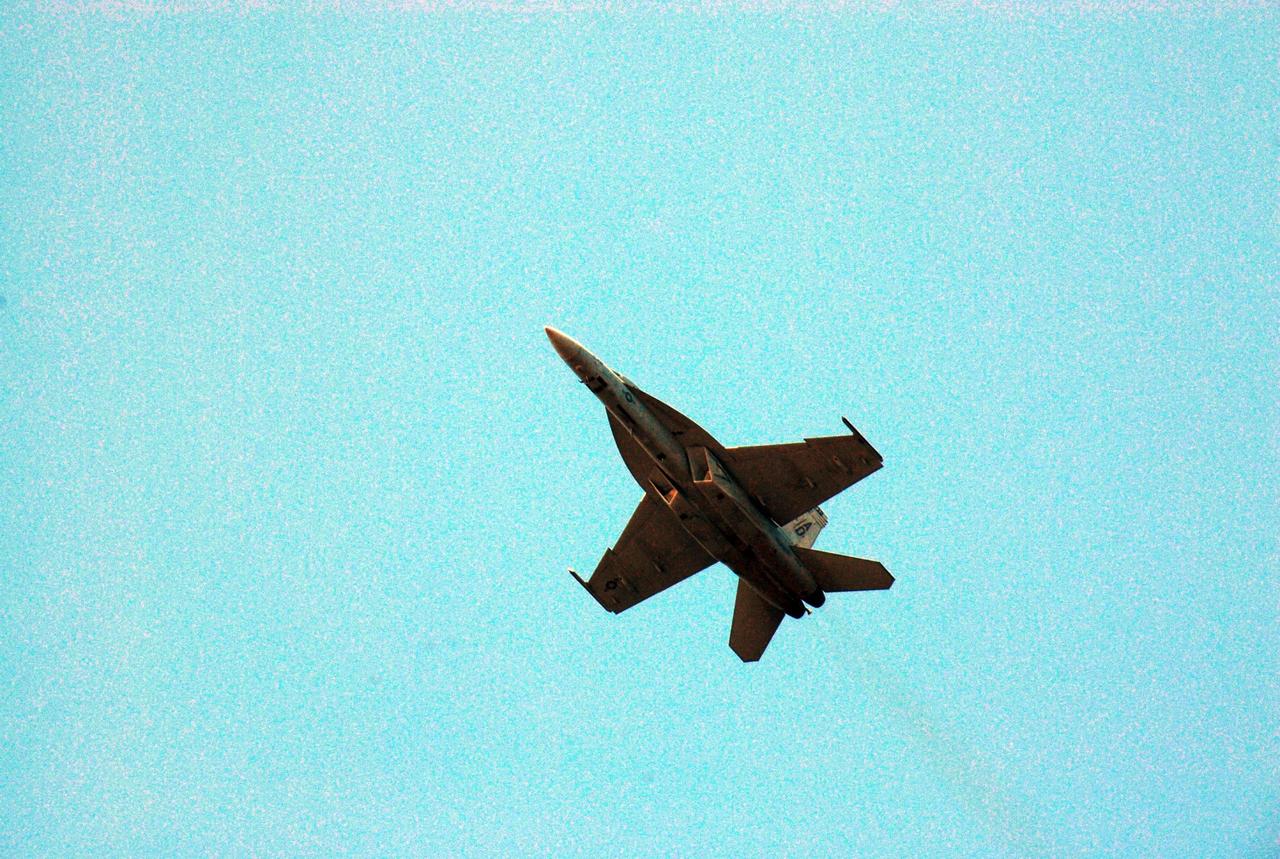
KENNEDY SPACE CENTER, FLA. -- One of the U.S. Navy F-18 Super Hornets flies over NASA's Kennedy Space Center as part of the World Space Expo aerial salute. Other aircraft joining in the expo salute include the U.S. Air Force Thunderbirds Demonstration Squadron, U.S. Air Force F-22 Raptor, U.S. Air Force F-15 Eagle, P-51 Mustang Heritage Flight, and the U.S. Air Force 920th Rescue Wing, which was responsible for Mercury and Gemini capsule recovery, and the U.S. Army Golden Knights precision skydiving team. The World Space Expo held Nov. 1-4 was an event commemorating humanity's first 50 years in space while looking forward to returning people to the moon and exploring beyond. The expo showcased various panels, presentations and educational programs. It also was a part of NASA's 50th anniversary celebrations, highlighting the 45th Anniversary of the Mercury Program celebration featuring original NASA astronauts John Glenn and Scott Carpenter and the Pioneering Women of Aerospace forum featuring Eileen Collins and other prominent female space veterans. The agency was founded Oct. 1, 1958. Photo credit: NASA/Kim Shiflett
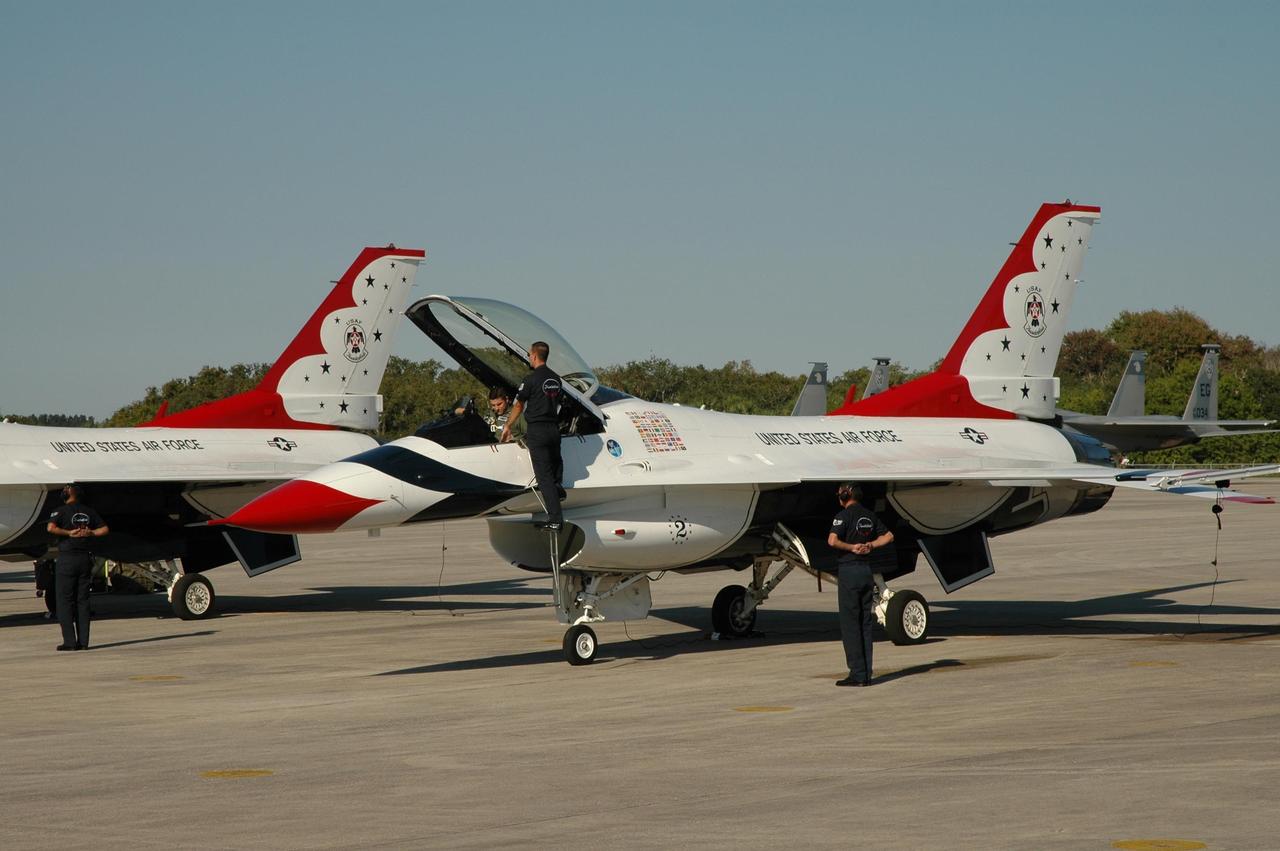
KENNEDY SPACE CENTER, FLA. -- Pilots of the U.S. Air Force Thunderbirds Demonstration Squadron get ready to leave NASA's Kennedy Space Center. The squadron performed for the World Space Expos' aerial salute along with other aircraft that included the U.S. Navy F-18 Super Hornets, U.S. Air Force F-22 Raptor, U.S. Air Force F-15 Eagle, P-51 Mustang Heritage Flight, the U.S. Air Force 920th Rescue Wing, which was responsible for Mercury and Gemini capsule recovery, and the U.S. Army Golden Knights precision skydiving team. The World Space Expo held Nov. 1-4 was an event commemorating humanity's first 50 years in space while looking forward to returning people to the moon and exploring beyond. The expo showcased various panels, presentations and educational programs. It also was a part of NASA's 50th anniversary celebrations, highlighting the 45th Anniversary of the Mercury Program celebration featuring original NASA astronauts John Glenn and Scott Carpenter and the Pioneering Women of Aerospace forum featuring Eileen Collins and other prominent female space veterans. The agency was founded Oct. 1, 1958. Photo credit: NASA/Jim Grossmann
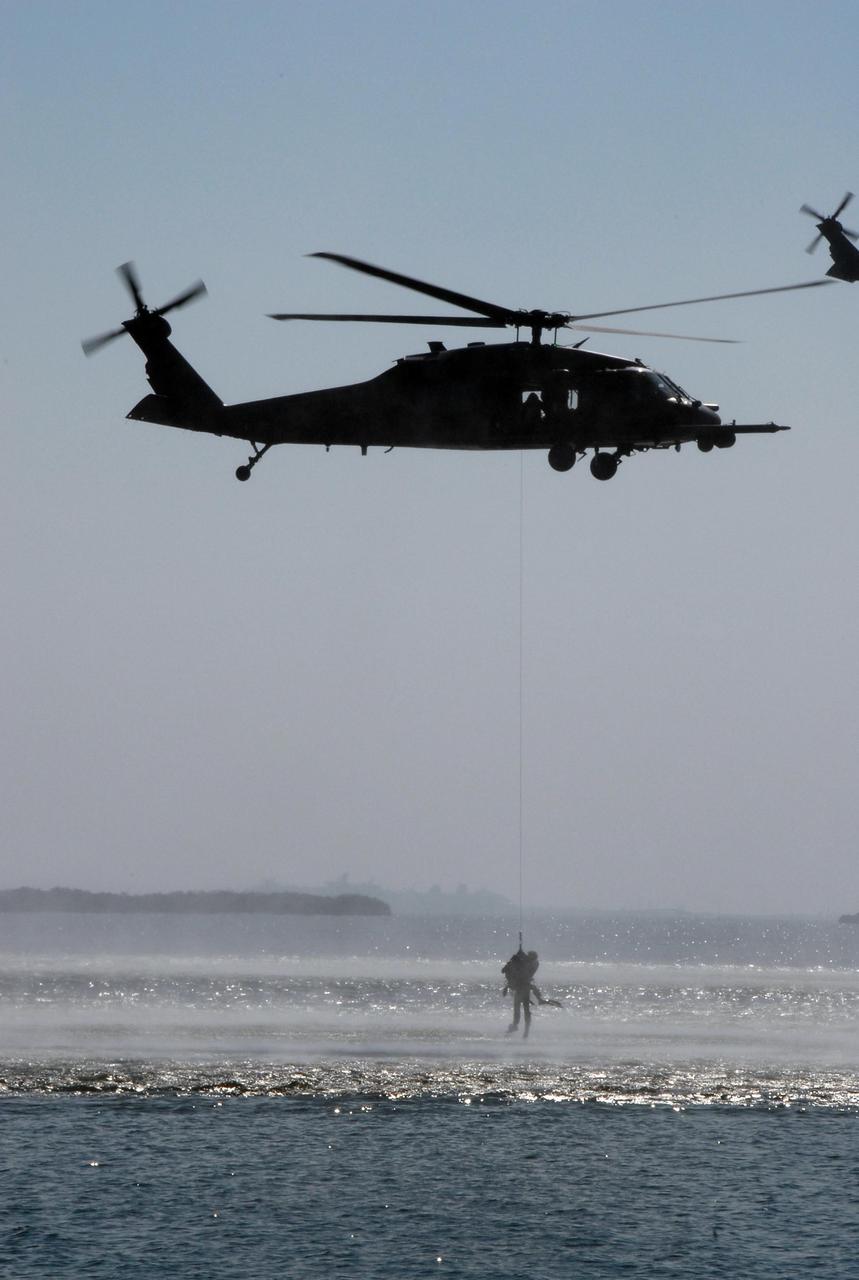
KENNEDY SPACE CENTER, FLA. -- Near the NASA Causeway at NASA's Kennedy Space Center, part of the U.S. Air Force 920th Rescue Wing puts on a rescue demonstration during the World Space Expo aerial salute. This unit was responsible for Mercury and Gemini capsule recovery. Other aircraft joining in the expo salute include the U.S. Air Force Thunderbirds Demonstration Squadron, the U.S. Navy F-18 Super Hornets, U.S. Air Force F-22 Raptor, U.S. Air Force F-15 Eagle, P-51 Mustang Heritage Flight, and the U.S. Army Golden Knights demonstrating precision skydiving. The World Space Expo held Nov. 1-4 was an event commemorating humanity's first 50 years in space while looking forward to returning people to the moon and exploring beyond. The expo showcased various panels, presentations and educational programs. It also was a part of NASA's 50th anniversary celebrations, highlighting the 45th Anniversary of the Mercury Program celebration featuring original NASA astronauts John Glenn and Scott Carpenter and the Pioneering Women of Aerospace forum featuring Eileen Collins and other prominent female space veterans. The agency was founded Oct. 1, 1958. Photo credit: NASA/Kim Shiflett
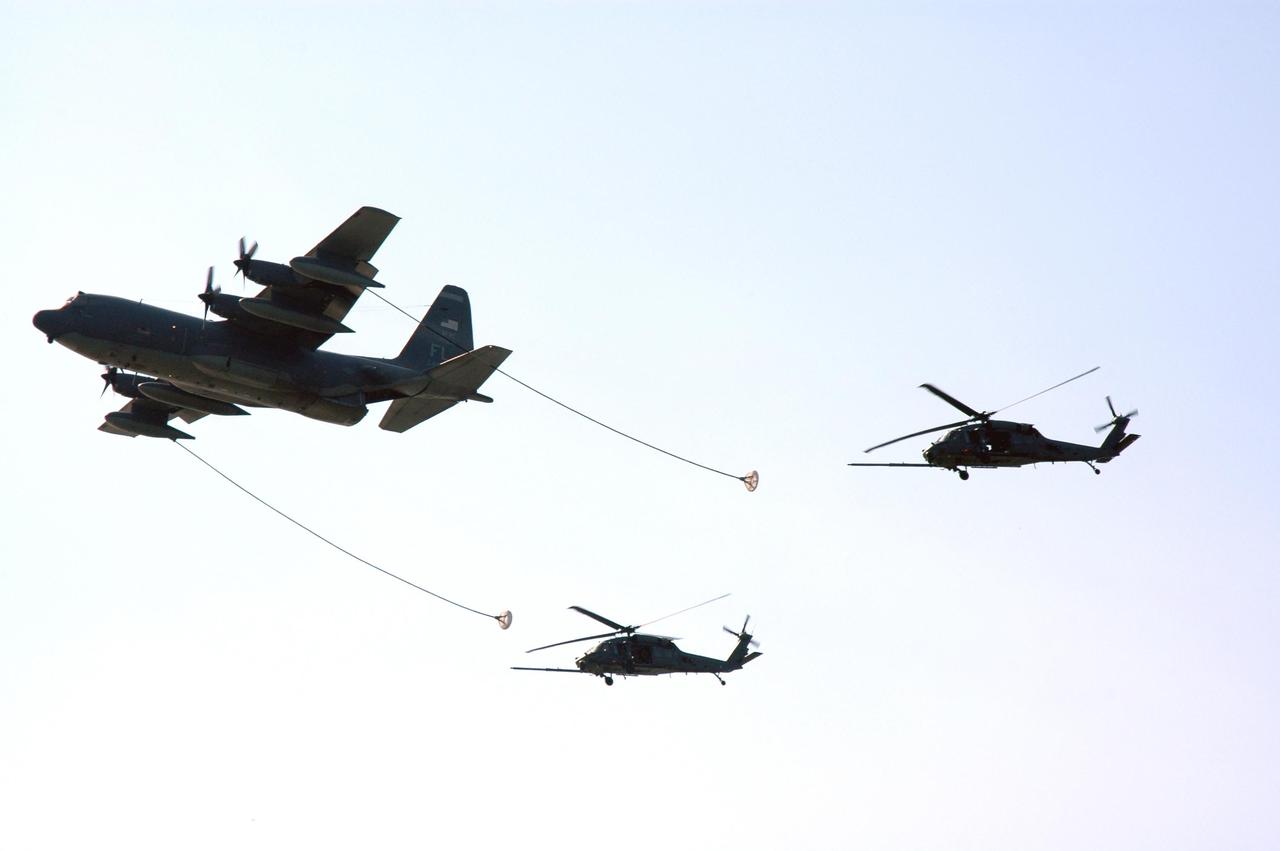
KENNEDY SPACE CENTER, FLA. -- Near the NASA Causeway at NASA's Kennedy Space Center, part of the U.S. Air Force 920th Rescue Wing puts on a demonstration of in-air refueling during the World Space Expo aerial salute. This unit was responsible for Mercury and Gemini capsule recovery. Other aircraft joining in the expo salute include the U.S. Air Force Thunderbirds Demonstration Squadron, the U.S. Navy F-18 Super Hornets, U.S. Air Force F-22 Raptor, U.S. Air Force F-15 Eagle, P-51 Mustang Heritage Flight, and the U.S. Army Golden Knights demonstrating precision skydiving. The World Space Expo held Nov. 1-4 was an event commemorating humanity's first 50 years in space while looking forward to returning people to the moon and exploring beyond. The expo showcased various panels, presentations and educational programs. It also was a part of NASA's 50th anniversary celebrations, highlighting the 45th Anniversary of the Mercury Program celebration featuring original NASA astronauts John Glenn and Scott Carpenter and the Pioneering Women of Aerospace forum featuring Eileen Collins and other prominent female space veterans. The agency was founded Oct. 1, 1958. Photo credit: NASA/Chris Chamberland
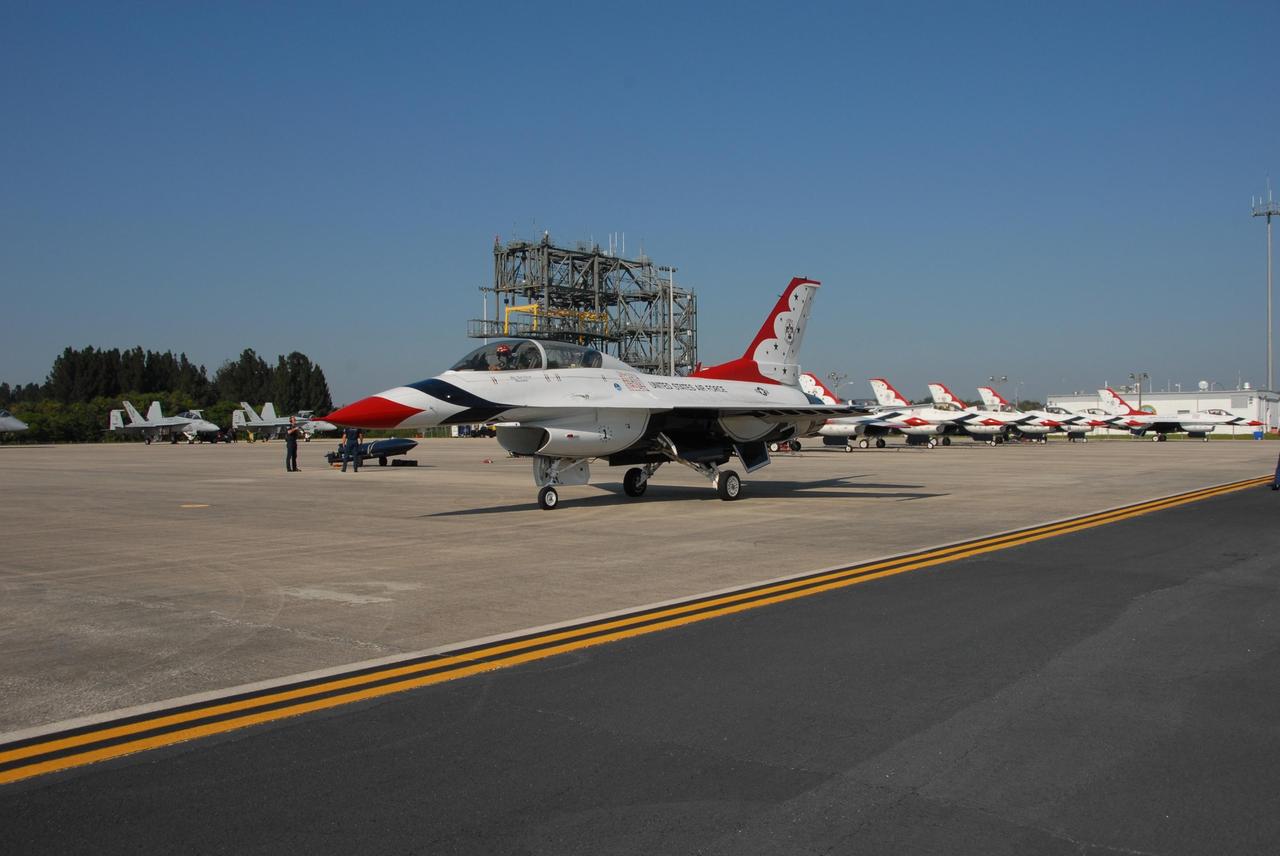
KENNEDY SPACE CENTER, FLA. — At the Shuttle Landing Facility at NASA's Kennedy Space Center, the U.S. Air Force Thunderbirds are ready to take off to participate in an aerial salute for the World Space Expo. Other aircraft joining in the expo salute include the U.S. Navy F-18 Super Hornets, U.S. Air Force F-22 Raptor, U.S. Air Force F-15 Eagle, P-51 Mustang Heritage Flight, the U.S. Air Force 920th Rescue Wing, which was responsible for Mercury and Gemini capsule recovery, and the U.S. Army Golden Knights demonstrating precision skydiving. The World Space Expo Nov. 1-4 was an event commemorating humanity's first 50 years in space while looking forward to returning people to the moon and exploring beyond. The expo showcased various panels, presentations and educational programs. It also was a part of NASA's 50th anniversary celebrations, highlighting the 45th Anniversary of the Mercury Program celebration featuring original NASA astronauts John Glenn and Scott Carpenter and the Pioneering Women of Aerospace forum featuring Eileen Collins and other prominent female space veterans. The agency was founded Oct. 1, 1958. Photo credit: NASA/George Shelton
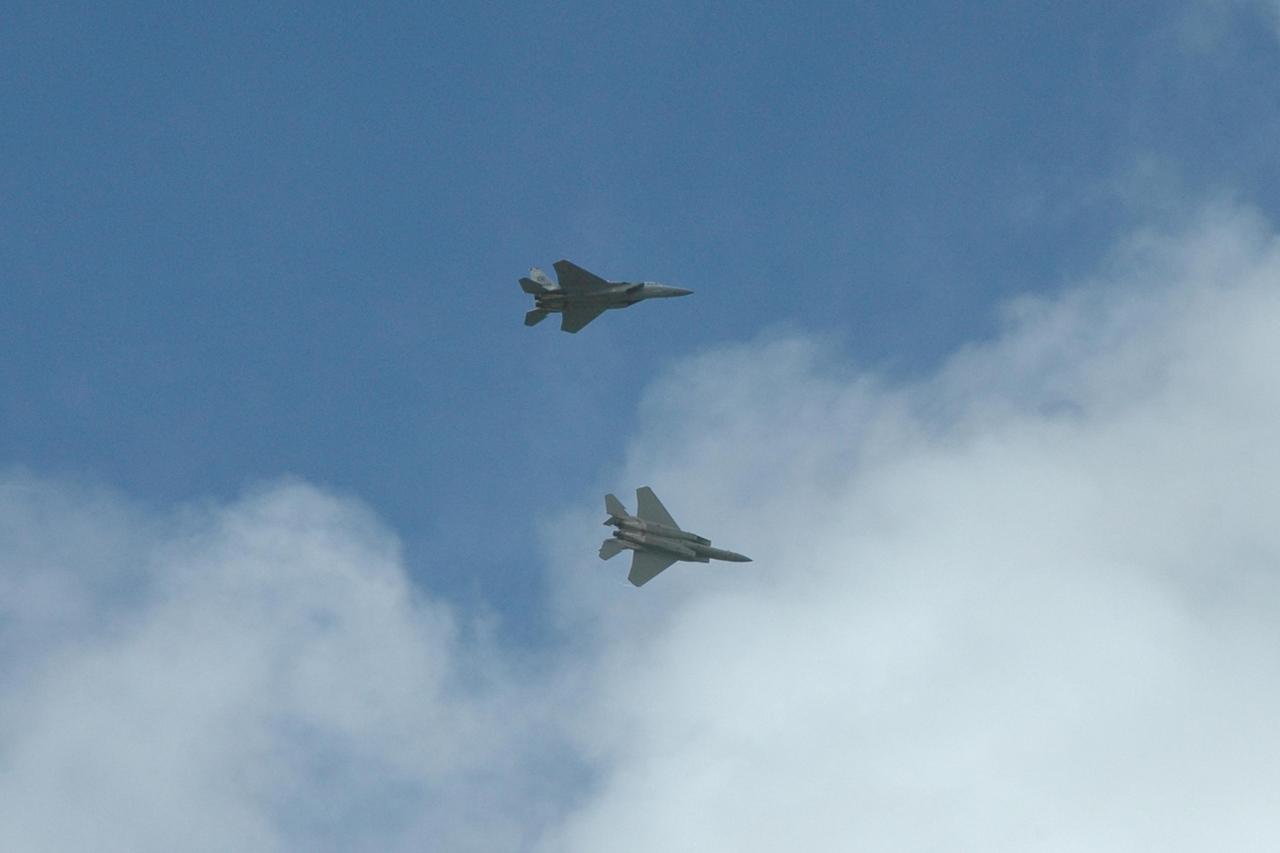
KENNEDY SPACE CENTER, FLA. -- Two of the U.S. Navy F-18 Super Hornets practice their maneuvers over NASA's Kennedy Space Center. The jets are participating in the World Space Expo being held from Nov. 1 to Nov. 4 at the NASA Kennedy Space Center Visitor Complex. Other aircraft joining in the salute include U.S. Air Force Thunderbirds Aerial Demonstration Squadron , U.S. Air Force F-22 Raptor, U.S. Air Force F-15 Eagle, the P-51 Mustang Heritage Flight and the U.S. Air Force 920th Rescue Wing, which was responsible for Mercury and Gemini capsule recovery. The U.S. Army Golden Knights also will demonstrate precision skydiving. The World Space Expo is an event to commemorate humanity's first 50 years in space while looking forward to returning people to the moon and exploring beyond. The expo will showcase various panels, presentations and educational programs. It also is a part of NASA's 50th anniversary celebrations, highlighting the 45th Anniversary of the Mercury Program celebration featuring original NASA astronauts John Glenn and Scott Carpenter and the Pioneering Women of Aerospace forum featuring Eileen Collins and other prominent female space veterans. The agency was founded Oct. 1, 1958. Photo credit: NASA/Jack Pfaller
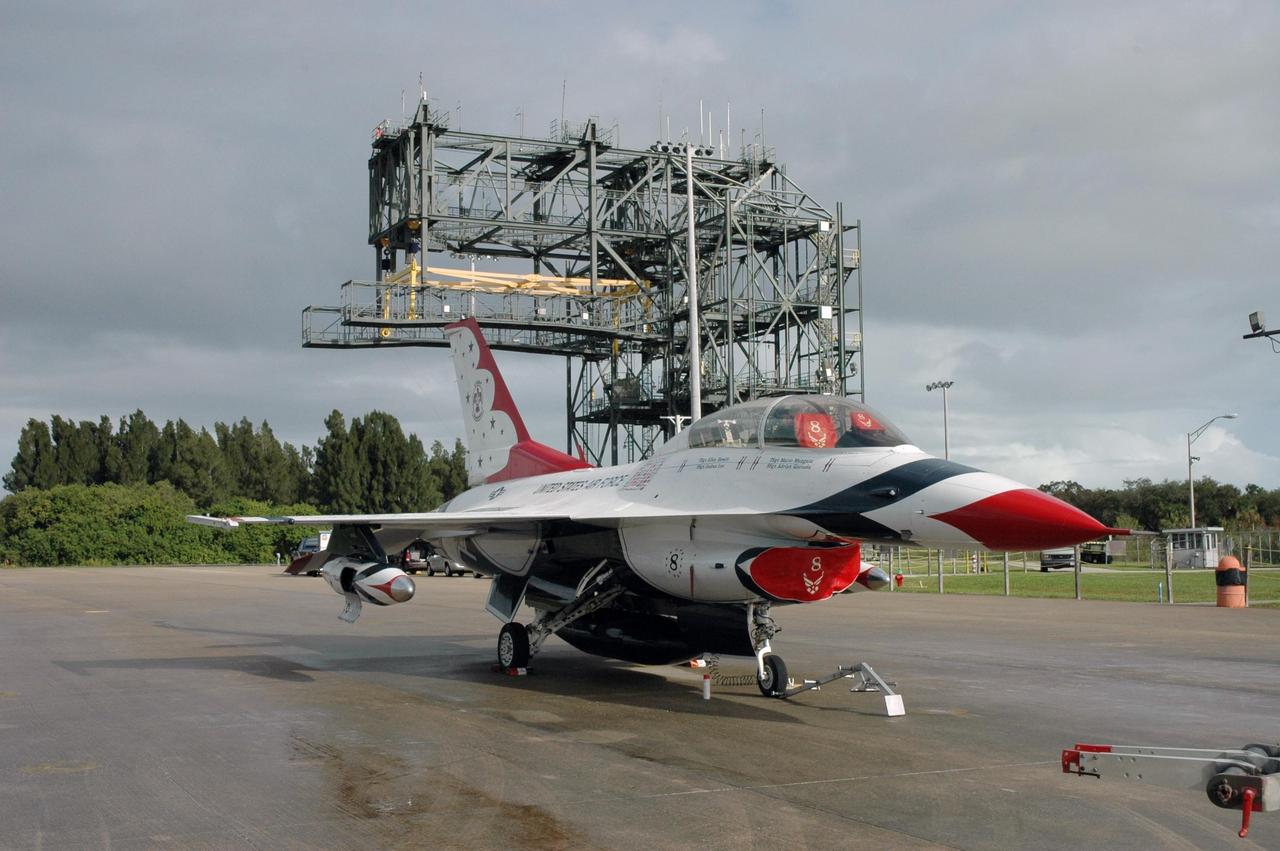
KENNEDY SPACE CENTER, FLA. -- The first of the U.S. Air Force Thunderbirds is parked on the Shuttle Landing Facility at NASA's Kennedy Space Center. The aerial demonstration squadron is performing for the World Space Expo being held from Nov. 1 to Nov. 4 at the NASA Kennedy Space Center Visitor Complex. Other aircraft participating in the salute include U.S. Air Force F-22 Raptor, U.S. Navy F-18 Super Hornet, U.S. Air Force F-15 Eagle, the P-51 Mustang Heritage Flight and the U.S. Air Force 920th Rescue Wing, which was responsible for Mercury and Gemini capsule recovery. The U.S. Army Golden Knights also will demonstrate precision skydiving. The World Space Expo is an event to commemorate humanity's first 50 years in space while looking forward to returning people to the moon and exploring beyond. The expo will showcase various panels, presentations and educational programs. It also is a part of NASA's 50th anniversary celebrations, highlighting the 45th Anniversary of the Mercury Program celebration featuring original NASA astronauts John Glenn and Scott Carpenter and the Pioneering Women of Aerospace forum featuring Eileen Collins and other prominent female space veterans. The agency was founded Oct. 1, 1958. Photo credit: NASA/Jack Pfaller
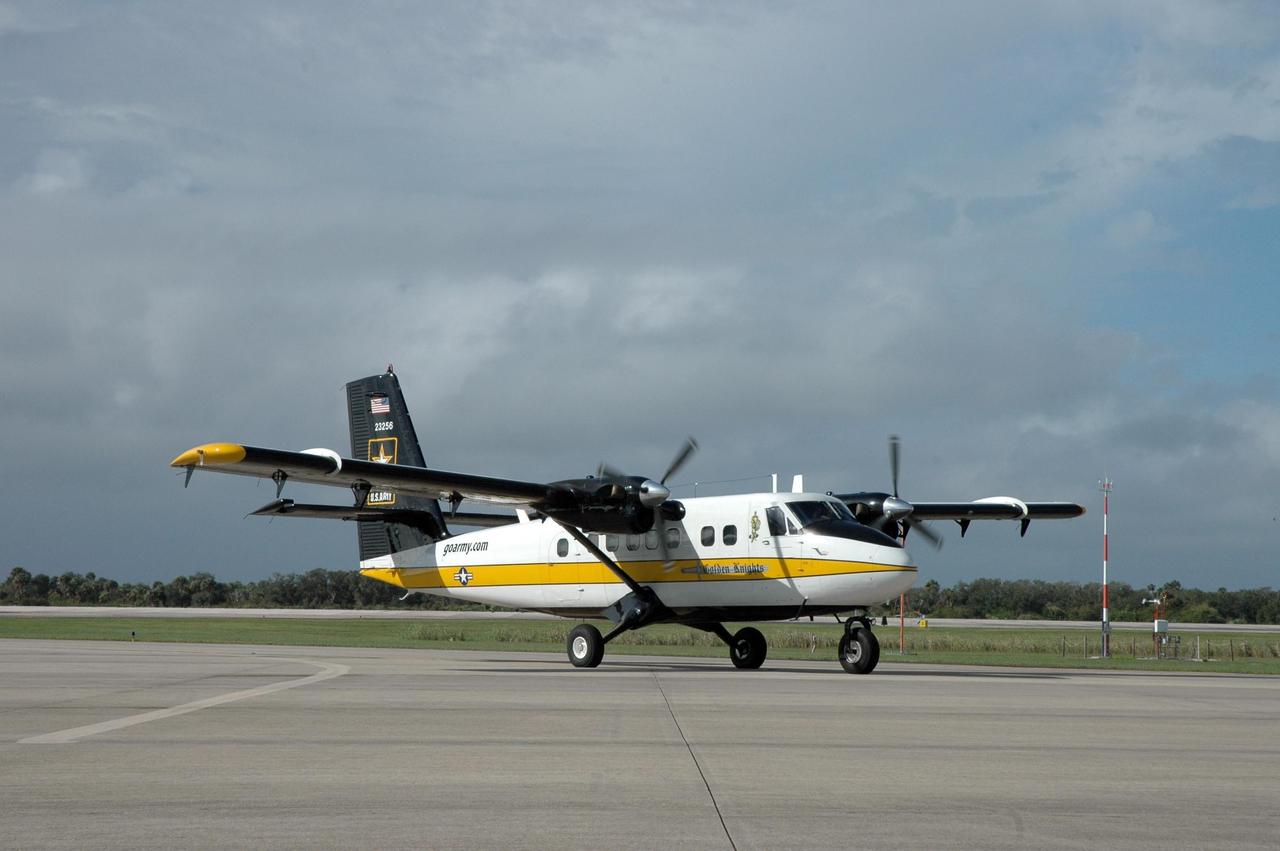
KENNEDY SPACE CENTER, FLA. -- The airplane used by the U.S. Army Golden Knights arrives at the Shuttle Landing Facility at NASA's Kennedy Space Center. The Golden Knights will demonstrate precision skydiving as part of the World Space Expo being held from Nov. 1 to Nov. 4 at the NASA Kennedy Space Center Visitor Complex. Other air demonstrations are planned by the U.S. Air Force Thunderbirds Aerial Demonstration Squadron, the U.S. Navy F-18 Super Hornets, U.S. Air Force F-22 Raptor, U.S. Air Force F-15 Eagle, the P-51 Mustang Heritage Flight and the U.S. Air Force 920th Rescue Wing, which was responsible for Mercury and Gemini capsule recovery. The World Space Expo is an event to commemorate humanity's first 50 years in space while looking forward to returning people to the moon and exploring beyond. The expo will showcase various panels, presentations and educational programs. It also is a part of NASA's 50th anniversary celebrations, highlighting the 45th Anniversary of the Mercury Program celebration featuring original NASA astronauts John Glenn and Scott Carpenter and the Pioneering Women of Aerospace forum featuring Eileen Collins and other prominent female space veterans. The agency was founded Oct. 1, 1958. Photo credit: NASA/Jack Pfaller
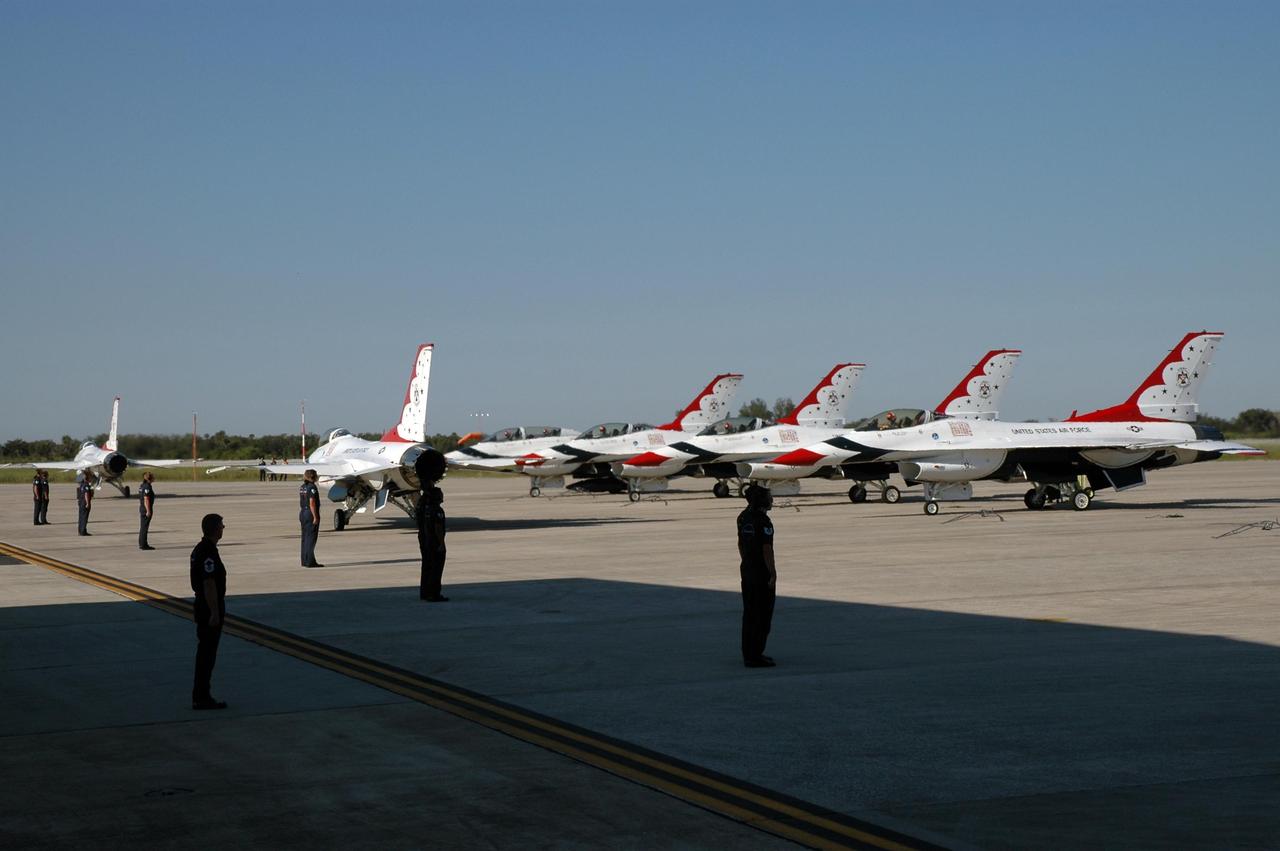
KENNEDY SPACE CENTER, FLA. -- The air crew for the U.S. Air Force Thunderbirds Demonstration Squadron show their precision formation as the planes prepare to take off from NASA's Kennedy Space Center. The squadron performed for the World Space Expos' aerial salute along with other aircraft that included the U.S. Navy F-18 Super Hornets, U.S. Air Force F-22 Raptor, U.S. Air Force F-15 Eagle, P-51 Mustang Heritage Flight, the U.S. Air Force 920th Rescue wing, which was responsible for Mercury and Gemini capsule recovery, and the U.S. Army Golden Knights precision skydiving team. The World Space Expo held Nov. 1-4 was an event commemorating humanity's first 50 years in space while looking forward to returning people to the moon and exploring beyond. The expo showcased various panels, presentations and educational programs. It also was a part of NASA's 50th anniversary celebrations, highlighting the 45th Anniversary of the Mercury Program celebration featuring original NASA astronauts John Glenn and Scott Carpenter and the Pioneering Women of Aerospace forum featuring Eileen Collins and other prominent female space veterans. The agency was founded Oct. 1, 1958. Photo credit: NASA/Jim Grossmann

KENNEDY SPACE CENTER, FLA. -- The air crew for the U.S. Air Force Thunderbirds Demonstration Squadron show their precision formation as the planes prepare to take off from NASA's Kennedy Space Center. The squadron performed for the World Space Expos' aerial salute along with other aircraft that included the U.S. Navy F-18 Super Hornets, U.S. Air Force F-22 Raptor, U.S. Air Force F-15 Eagle, P-51 Mustang Heritage Flight, the U.S. Air Force 920th Rescue wing, which was responsible for Mercury and Gemini capsule recovery, and the U.S. Army Golden Knights precision skydiving team. The World Space Expo held Nov. 1-4 was an event commemorating humanity's first 50 years in space while looking forward to returning people to the moon and exploring beyond. The expo showcased various panels, presentations and educational programs. It also was a part of NASA's 50th anniversary celebrations, highlighting the 45th Anniversary of the Mercury Program celebration featuring original NASA astronauts John Glenn and Scott Carpenter and the Pioneering Women of Aerospace forum featuring Eileen Collins and other prominent female space veterans. The agency was founded Oct. 1, 1958. Photo credit: NASA/Jim Grossmann
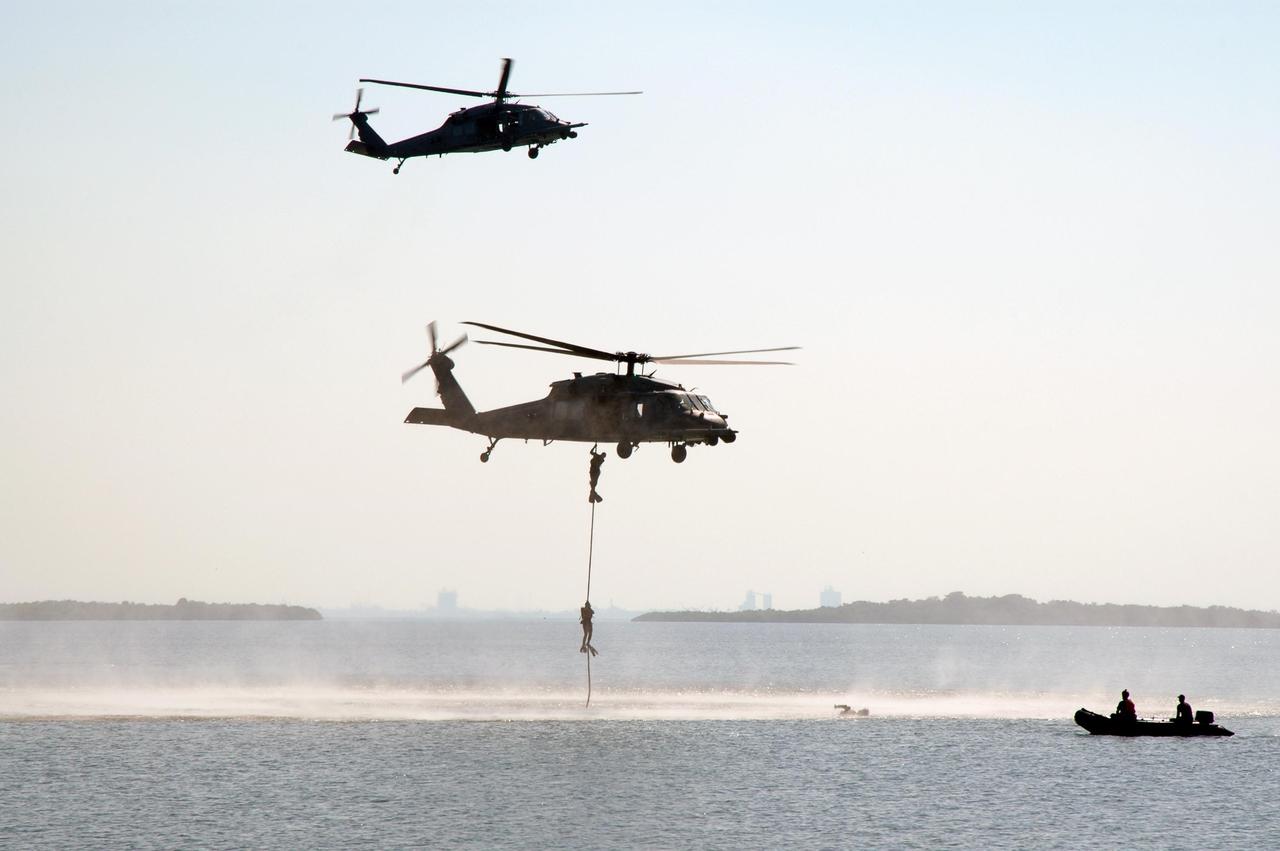
KENNEDY SPACE CENTER, FLA. -- In the water next to the NASA Causeway at NASA's Kennedy Space Center, part of the U.S. Air Force 920th Rescue Wing puts on a demonstration during the World Space Expo aerial salute. This unit was responsible for Mercury and Gemini capsule recovery. Other aircraft joining in the expo salute include the U.S. Air Force Thunderbirds Demonstration Squadron, the U.S. Navy F-18 Super Hornets, U.S. Air Force F-22 Raptor, U.S. Air Force F-15 Eagle, P-51 Mustang Heritage Flight, and the U.S. Army Golden Knights demonstrating precision skydiving. The World Space Expo held Nov. 1-4 was an event commemorating humanity's first 50 years in space while looking forward to returning people to the moon and exploring beyond. The expo showcased various panels, presentations and educational programs. It also was a part of NASA's 50th anniversary celebrations, highlighting the 45th Anniversary of the Mercury Program celebration featuring original NASA astronauts John Glenn and Scott Carpenter and the Pioneering Women of Aerospace forum featuring Eileen Collins and other prominent female space veterans. The agency was founded Oct. 1, 1958. Photo credit: NASA/Chris Chamberland
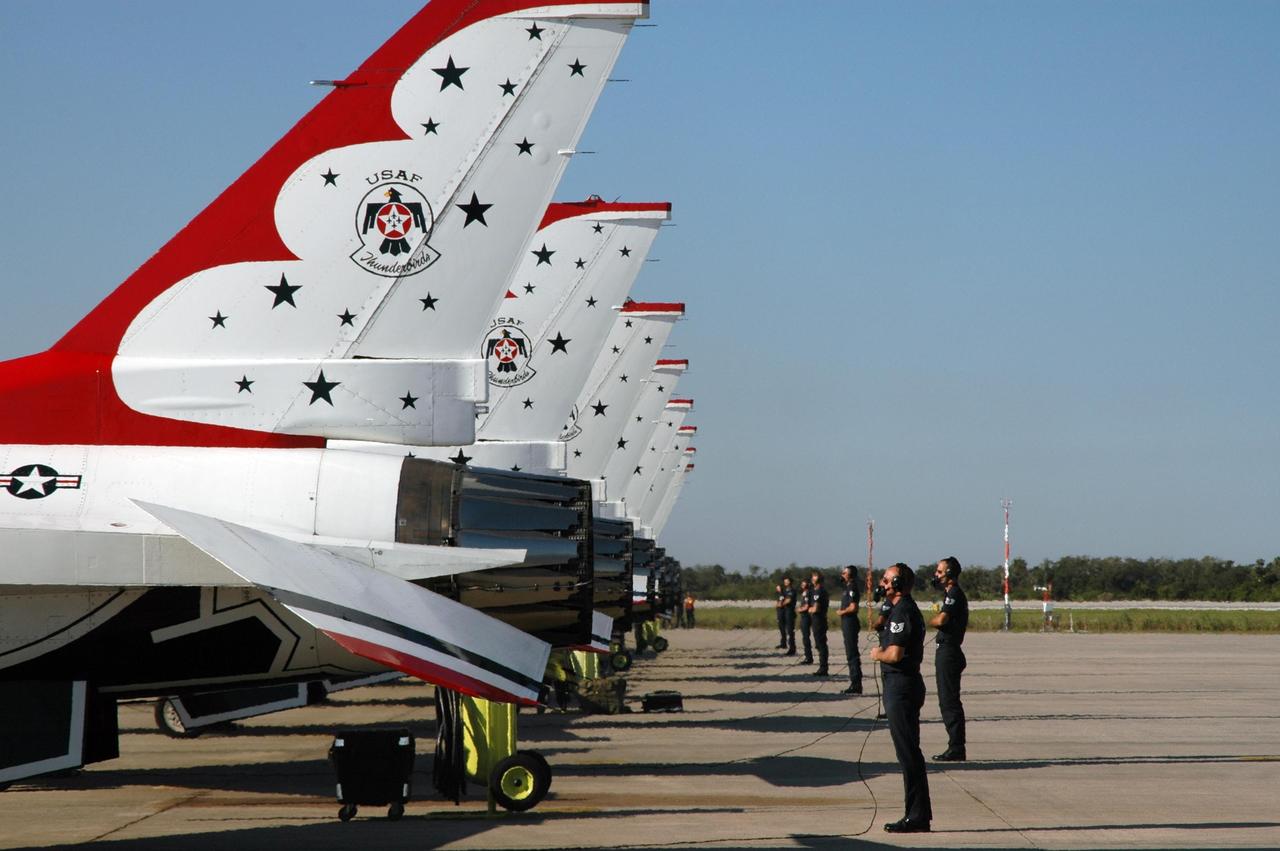
KENNEDY SPACE CENTER, FLA. -- The air crew for the U.S. Air Force Thunderbirds Demonstration Squadron show their precision formation as the planes prepare to take off from NASA's Kennedy Space Center. The squadron performed for the World Space Expos' aerial salute along with other aircraft that included the U.S. Navy F-18 Super Hornets, U.S. Air Force F-22 Raptor, U.S. Air Force F-15 Eagle, P-51 Mustang Heritage Flight, the U.S. Air Force 920th Rescue Wing, which was responsible for Mercury and Gemini capsule recovery, and the U.S. Army Golden Knights precision skydiving team. The World Space Expo held Nov. 1-4 was an event commemorating humanity's first 50 years in space while looking forward to returning people to the moon and exploring beyond. The expo showcased various panels, presentations and educational programs. It also was a part of NASA's 50th anniversary celebrations, highlighting the 45th Anniversary of the Mercury Program celebration featuring original NASA astronauts John Glenn and Scott Carpenter and the Pioneering Women of Aerospace forum featuring Eileen Collins and other prominent female space veterans. The agency was founded Oct. 1, 1958. Photo credit: NASA/Jim Grossmann
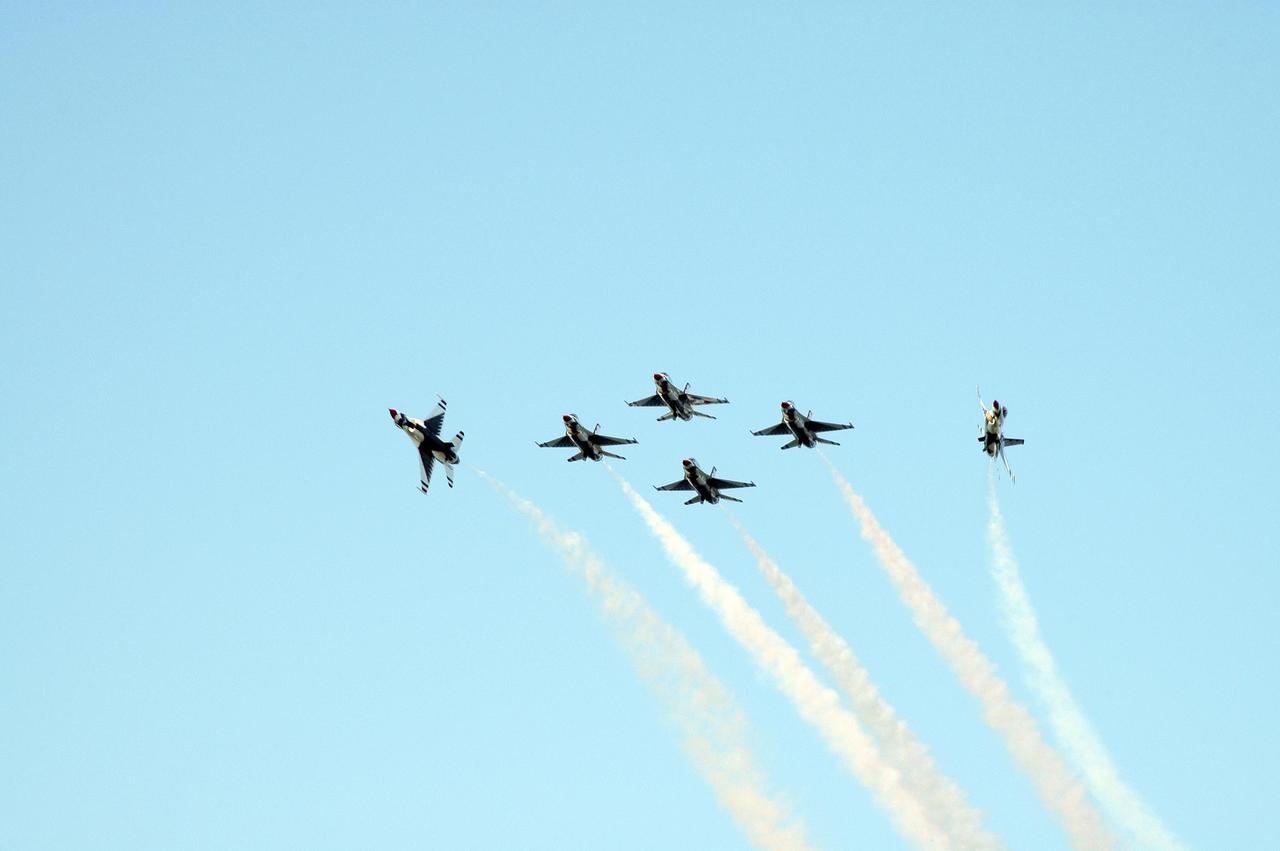
KENNEDY SPACE CENTER, FLA. -- At NASA's Kennedy Space Center, the U.S. Air Force Thunderbirds Demonstration Squadron performs during the World Space Expo aerial salute. Other aircraft joining in the expo salute include the U.S. Navy F-18 Super Hornets, U.S. Air Force F-22 Raptor, U.S. Air Force F-15 Eagle, P-51 Mustang Heritage Flight, U.S. Air Force 920th Rescue wing, which was responsible for Mercury and Gemini capsule recovery, and the U.S. Army Golden Knights demonstrating precision skydiving. The World Space Expo held Nov. 1-4 was an event commemorating humanity's first 50 years in space while looking forward to returning people to the moon and exploring beyond. The expo showcased various panels, presentations and educational programs. It also was a part of NASA's 50th anniversary celebrations, highlighting the 45th Anniversary of the Mercury Program celebration featuring original NASA astronauts John Glenn and Scott Carpenter and the Pioneering Women of Aerospace forum featuring Eileen Collins and other prominent female space veterans. The agency was founded Oct. 1, 1958. Photo credit: NASA/Chris Chamberland
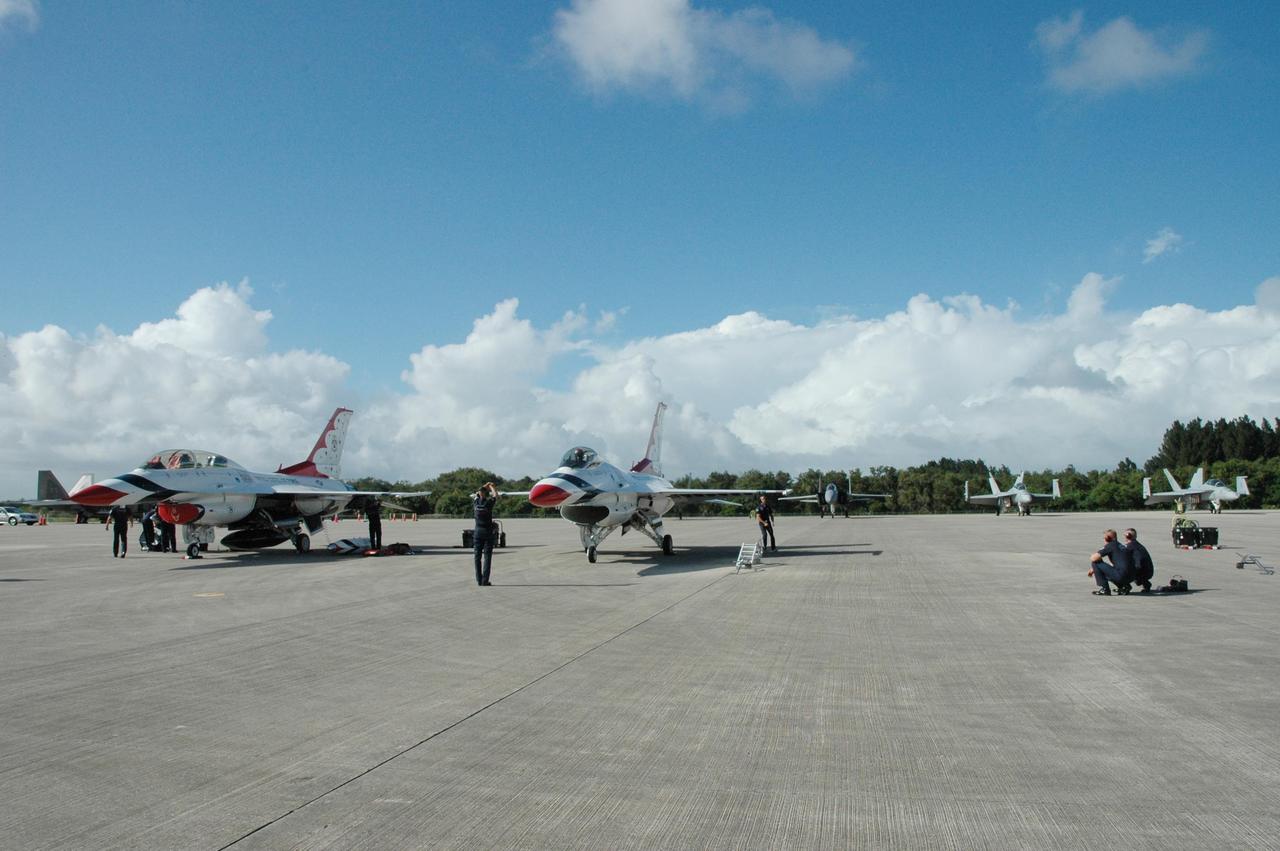
KENNEDY SPACE CENTER, FLA. -- Another of the U.S. Air Force Thunderbirds is parked on the Shuttle Landing Facility at NASA's Kennedy Space Center. The aerial demonstration squadron is performing for the World Space Expo being held from Nov. 1 to Nov. 4 at the NASA Kennedy Space Center Visitor Complex. Other aircraft participating in the salute include U.S. Air Force F-22 Raptor, U.S. Navy F-18 Super Hornet, U.S. Air Force F-15 Eagle, the P-51 Mustang Heritage Flight and the U.S. Air Force 920th Rescue Wing, which was responsible for Mercury and Gemini capsule recovery. The U.S. Army Golden Knights also will demonstrate precision skydiving. The World Space Expo is an event to commemorate humanity's first 50 years in space while looking forward to returning people to the moon and exploring beyond. The expo will showcase various panels, presentations and educational programs. It also is a part of NASA's 50th anniversary celebrations, highlighting the 45th Anniversary of the Mercury Program celebration featuring original NASA astronauts John Glenn and Scott Carpenter and the Pioneering Women of Aerospace forum featuring Eileen Collins and other prominent female space veterans. The agency was founded Oct. 1, 1958. Photo credit: NASA/Jack Pfaller
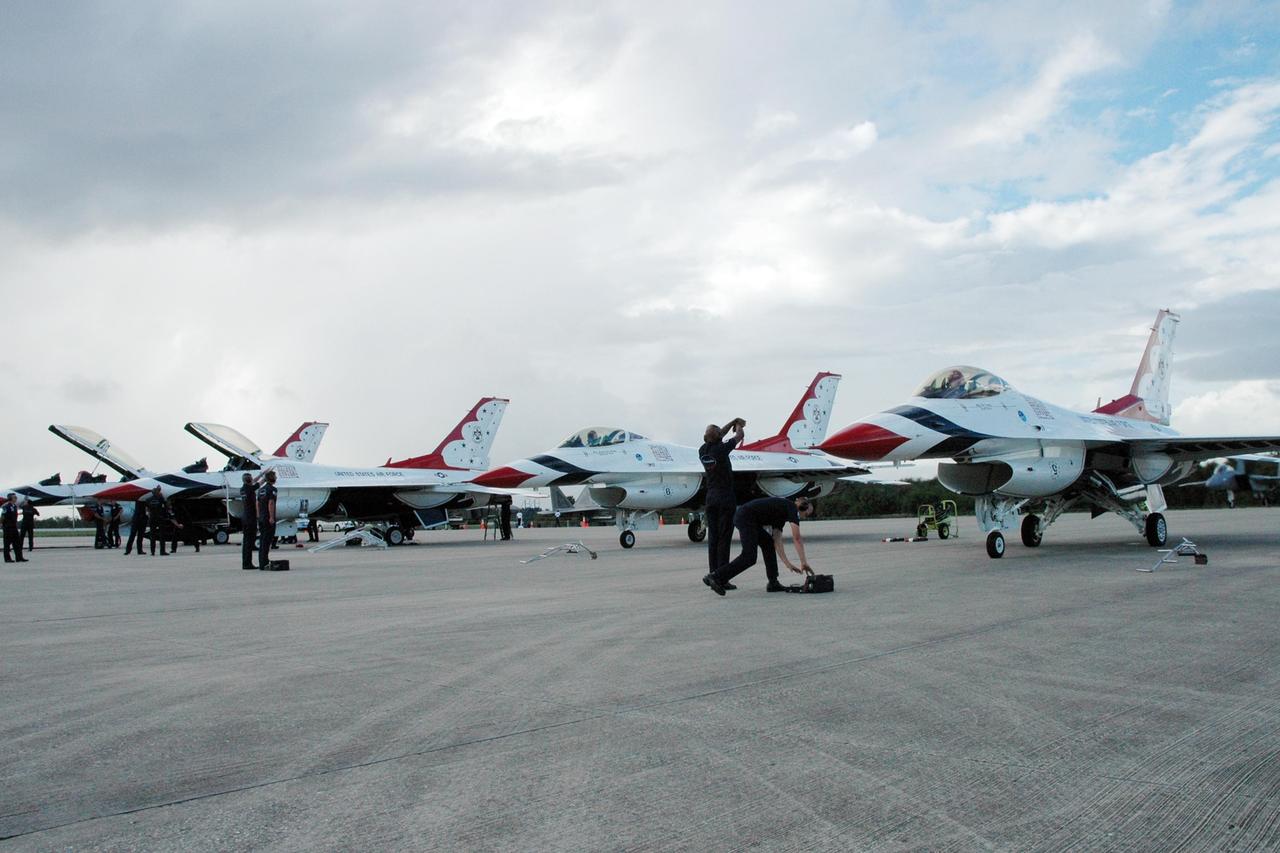
KENNEDY SPACE CENTER, FLA. -- U.S. Air Force Thunderbirds line up on the Shuttle Landing Facility at NASA's Kennedy Space Center. The aerial demonstration squadron is performing for the World Space Expo being held from Nov. 1 to Nov. 4 at the NASA Kennedy Space Center Visitor Complex. Other aircraft participating in the salute include U.S. Air Force F-22 Raptor, U.S. Navy F-18 Super Hornet, U.S. Air Force F-15 Eagle, the P-51 Mustang Heritage Flight and the U.S. Air Force 920th Rescue Wing, which was responsible for Mercury and Gemini capsule recovery. The U.S. Army Golden Knights also will demonstrate precision skydiving. The World Space Expo is an event to commemorate humanity's first 50 years in space while looking forward to returning people to the moon and exploring beyond. The expo will showcase various panels, presentations and educational programs. It also is a part of NASA's 50th anniversary celebrations, highlighting the 45th Anniversary of the Mercury Program celebration featuring original NASA astronauts John Glenn and Scott Carpenter and the Pioneering Women of Aerospace forum featuring Eileen Collins and other prominent female space veterans. The agency was founded Oct. 1, 1958. Photo credit: NASA/Jack Pfaller
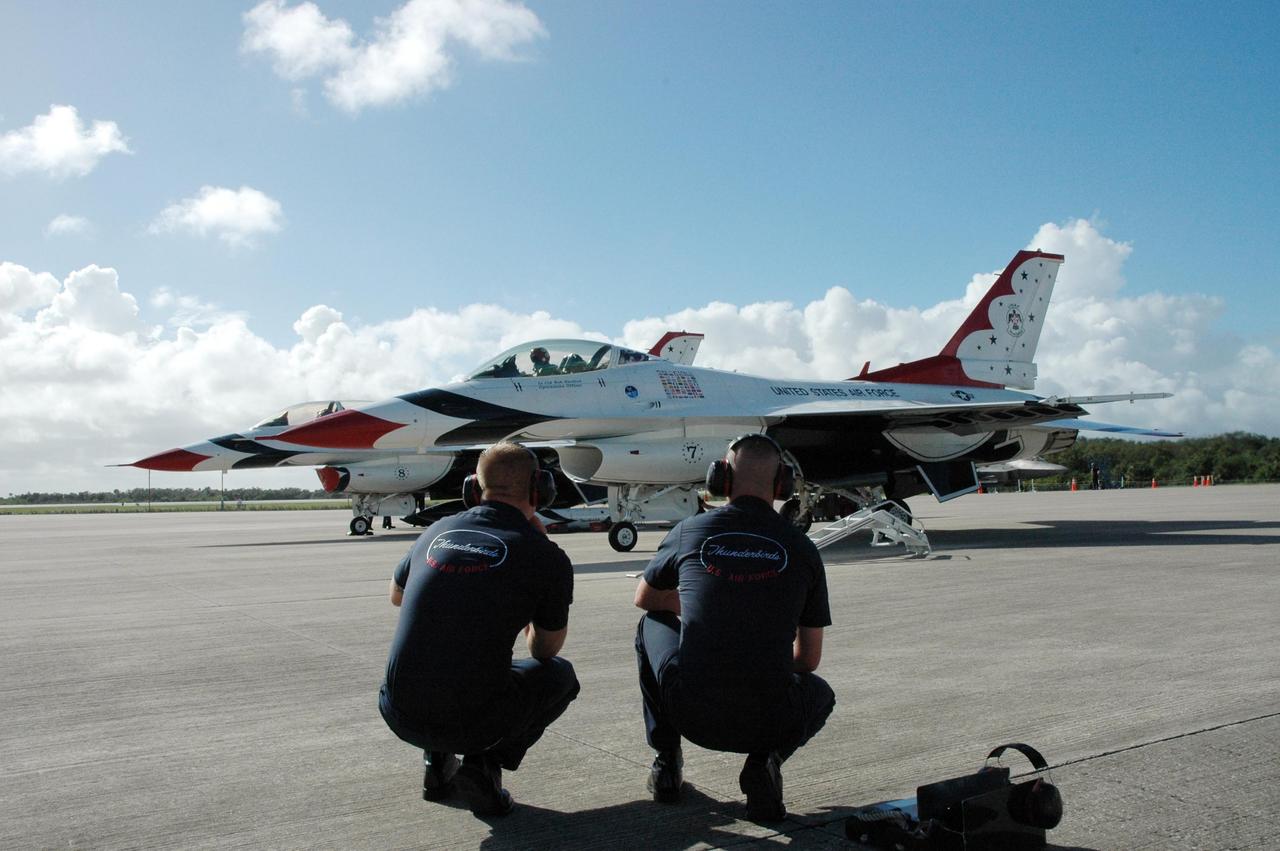
KENNEDY SPACE CENTER, FLA. -- U.S. Air Force Thunderbirds line up on the Shuttle Landing Facility at NASA's Kennedy Space Center. The aerial demonstration squadron is performing for the World Space Expo being held from Nov. 1 to Nov. 4 at the NASA Kennedy Space Center Visitor Complex. Other aircraft participating in the salute include U.S. Air Force F-22 Raptor, U.S. Navy F-18 Super Hornet, U.S. Air Force F-15 Eagle, the P-51 Mustang Heritage Flight and the U.S. Air Force 920th Rescue Wing, which was responsible for Mercury and Gemini capsule recovery. The U.S. Army Golden Knights also will demonstrate precision skydiving. The World Space Expo is an event to commemorate humanity's first 50 years in space while looking forward to returning people to the moon and exploring beyond. The expo will showcase various panels, presentations and educational programs. It also is a part of NASA's 50th anniversary celebrations, highlighting the 45th Anniversary of the Mercury Program celebration featuring original NASA astronauts John Glenn and Scott Carpenter and the Pioneering Women of Aerospace forum featuring Eileen Collins and other prominent female space veterans. The agency was founded Oct. 1, 1958. Photo credit: NASA/Jack Pfaller
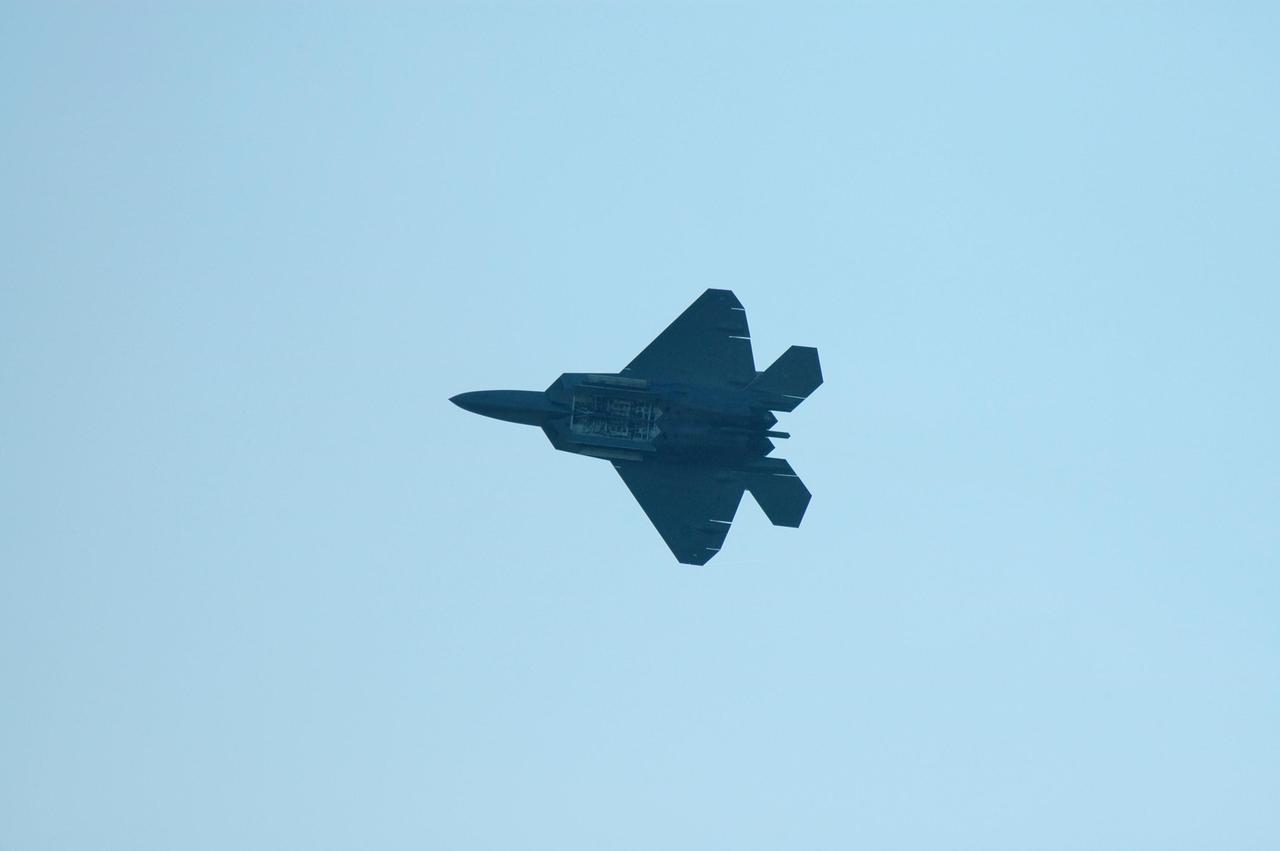
KENNEDY SPACE CENTER, FLA. -- At NASA's Kennedy Space Center, a U.S. Air Force F-22 Raptor flies overhead as part of the World Space Expo aerial salute. Other aircraft joining in the expo salute include the U.S. Air Force Thunderbirds Demonstration Squadron, the U.S. Navy F-18 Super Hornets, U.S. Air Force F-15 Eagle, P-51 Mustang Heritage Flight, the U.S. Air Force 920th Rescue wing, which was responsible for Mercury and Gemini capsule recovery, and the U.S. Army Golden Knights demonstrating precision skydiving. The World Space Expo held Nov. 1-4 was an event commemorating humanity's first 50 years in space while looking forward to returning people to the moon and exploring beyond. The expo showcased various panels, presentations and educational programs. It also was a part of NASA's 50th anniversary celebrations, highlighting the 45th Anniversary of the Mercury Program celebration featuring original NASA astronauts John Glenn and Scott Carpenter and the Pioneering Women of Aerospace forum featuring Eileen Collins and other prominent female space veterans. The agency was founded Oct. 1, 1958. Photo credit: NASA/Chris Chamberland