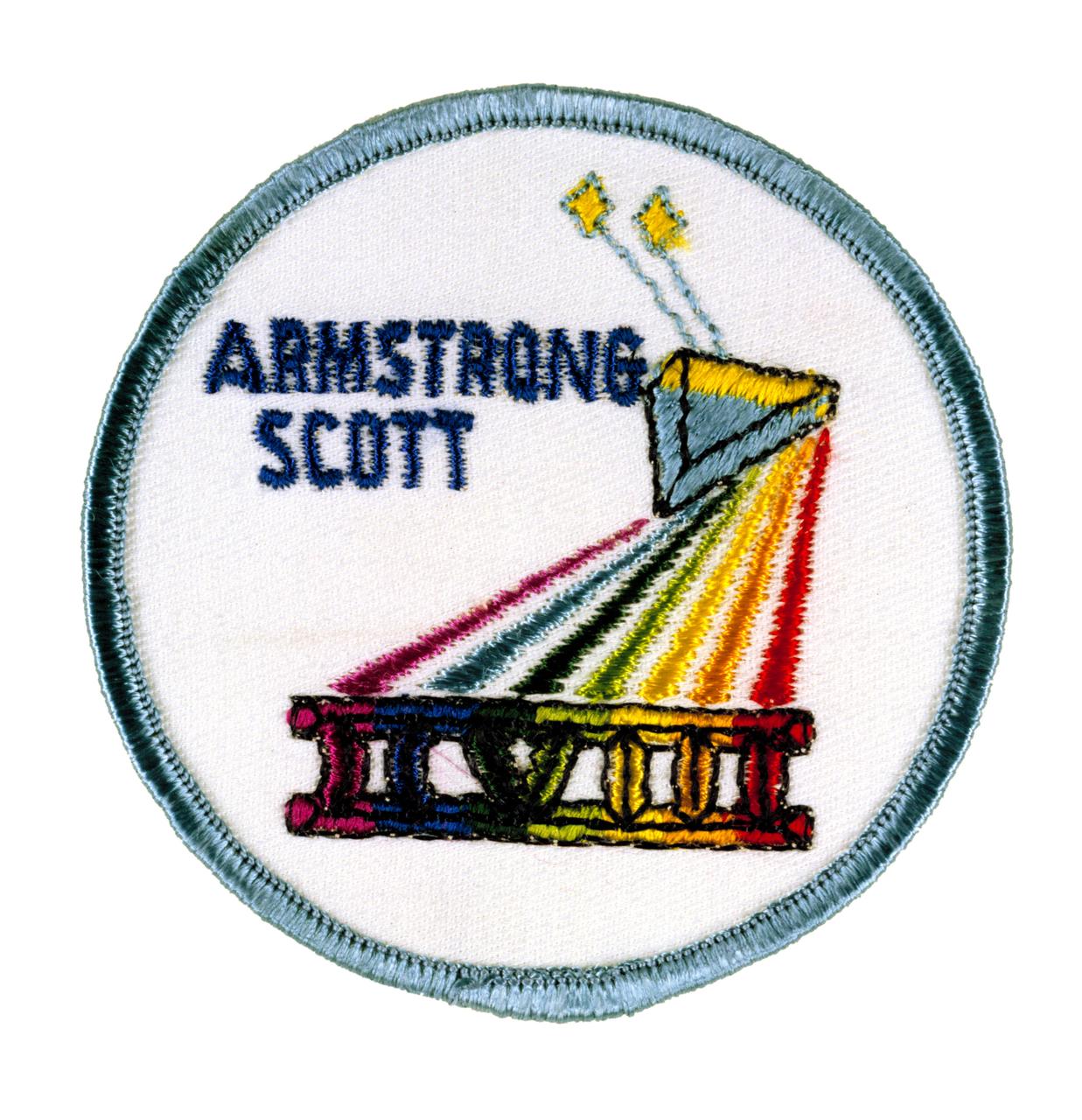
S66-23978 (March 1966) --- Color design for the emblem of the Gemini-8 spaceflight. Roman numeral indicates the eighth flight in the Gemini series. Prime crewmen for the mission are astronauts Neil A. Armstrong, command pilot; and David R. Scott, pilot. The NASA insignia design for Gemini flights is reserved for use by the astronauts and for other official use as the NASA Administrator may authorize. Public availability has been approved only in the form of illustrations by the various news media. When and if there is any change in this policy, which we do not anticipate, it will be publicly announced. Photo credit: NASA
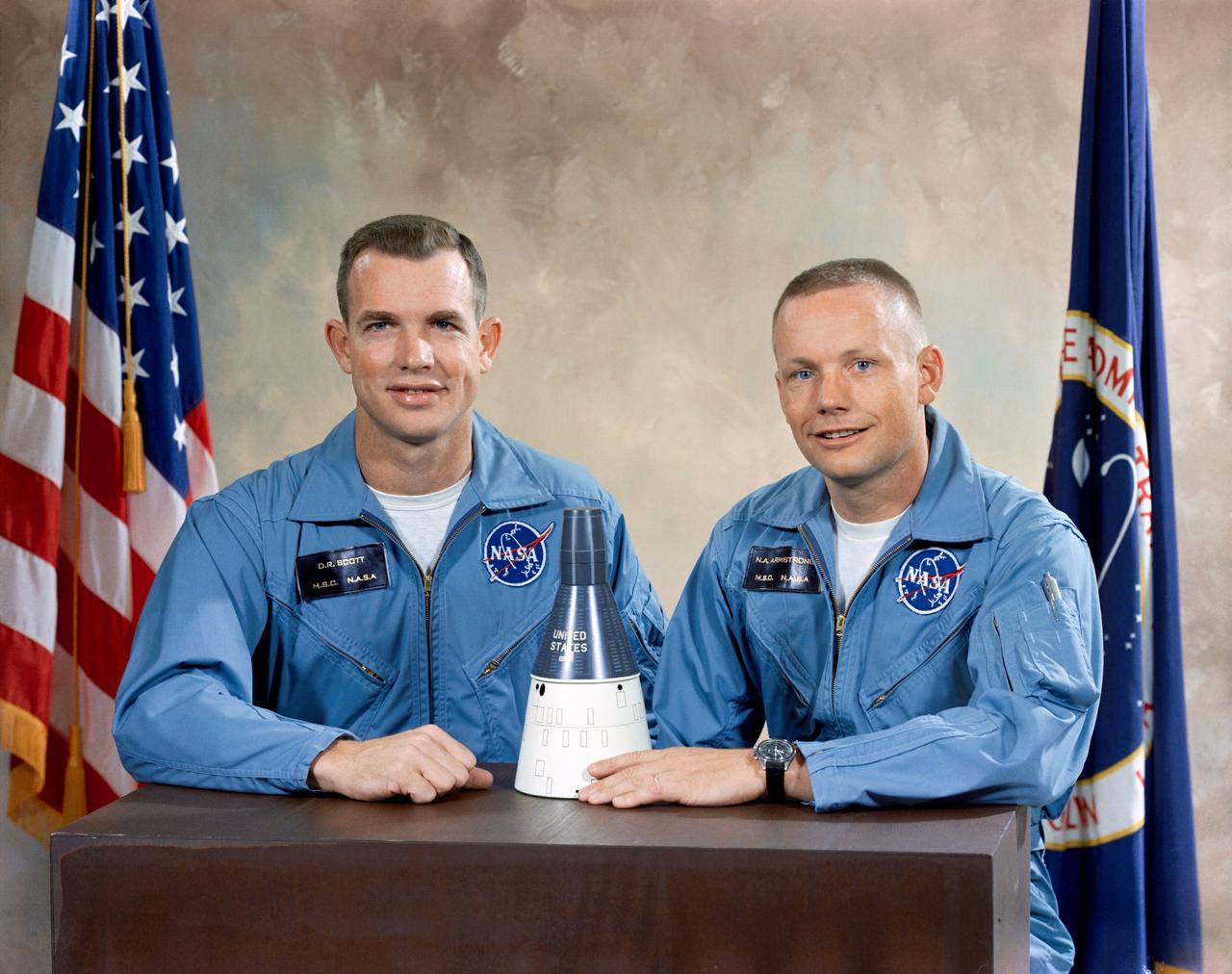
S65-58499 (4 Nov. 1965) --- Astronauts Neil A. Armstrong (right), command pilot; and David R. Scott, pilot, are the prime crewmen of the Gemini-8 space mission. Photo credit: NASA
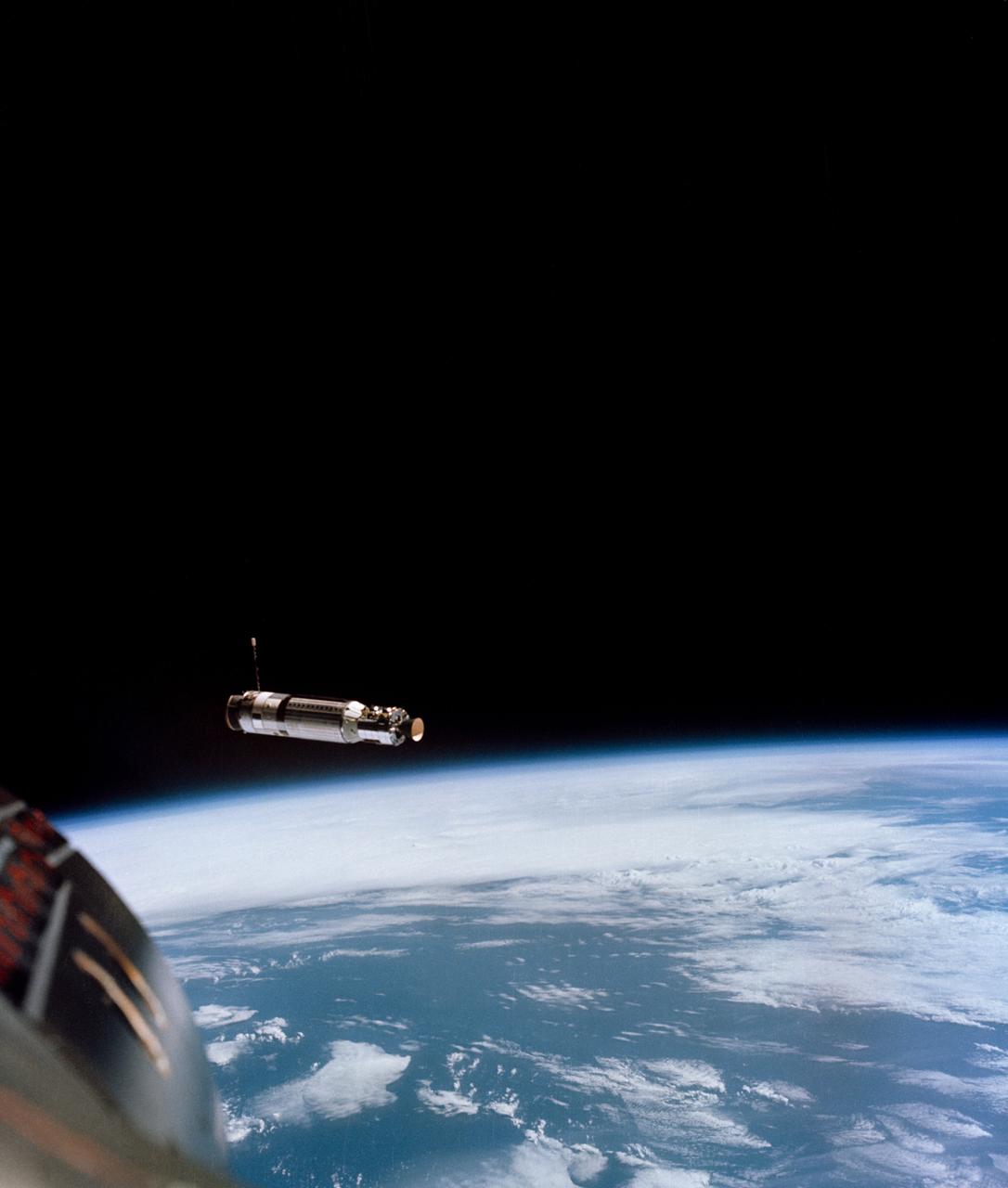
S66-25779 (16 March 1966) --? The Agena Target Docking Vehicle seen from the National Aeronautics and Space Administration?s Gemini-8 spacecraft during rendezvous in space. The Agena is approximately 210 feet away from the nose of the spacecraft (lower left). Crewmen for the Gemini-8 mission were astronauts Neil A. Armstrong, command pilot, and David R. Scott, pilot. Photo credit: NASA

S66-25781 (16-17 March 1966) --- Closer view of the Agena Target Docking vehicle seen from the Gemini-8 spacecraft during rendezvous in space. Photo credit: NASA
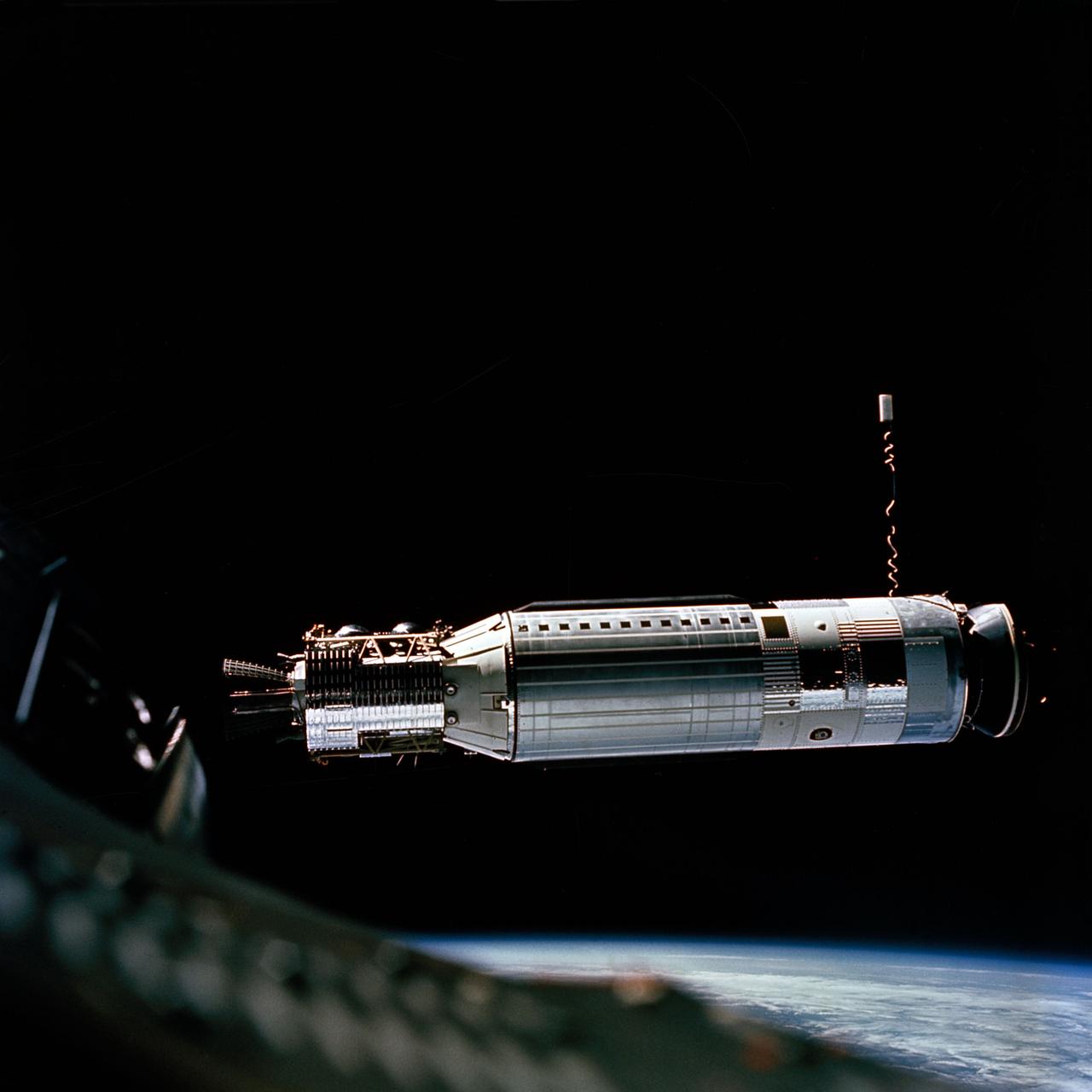
S66-25782 (16 March 1966) --- Closer view of the Agena Target Docking vehicle seen from the Gemini-8 spacecraft during rendezvous in space. Photo credit: NASA
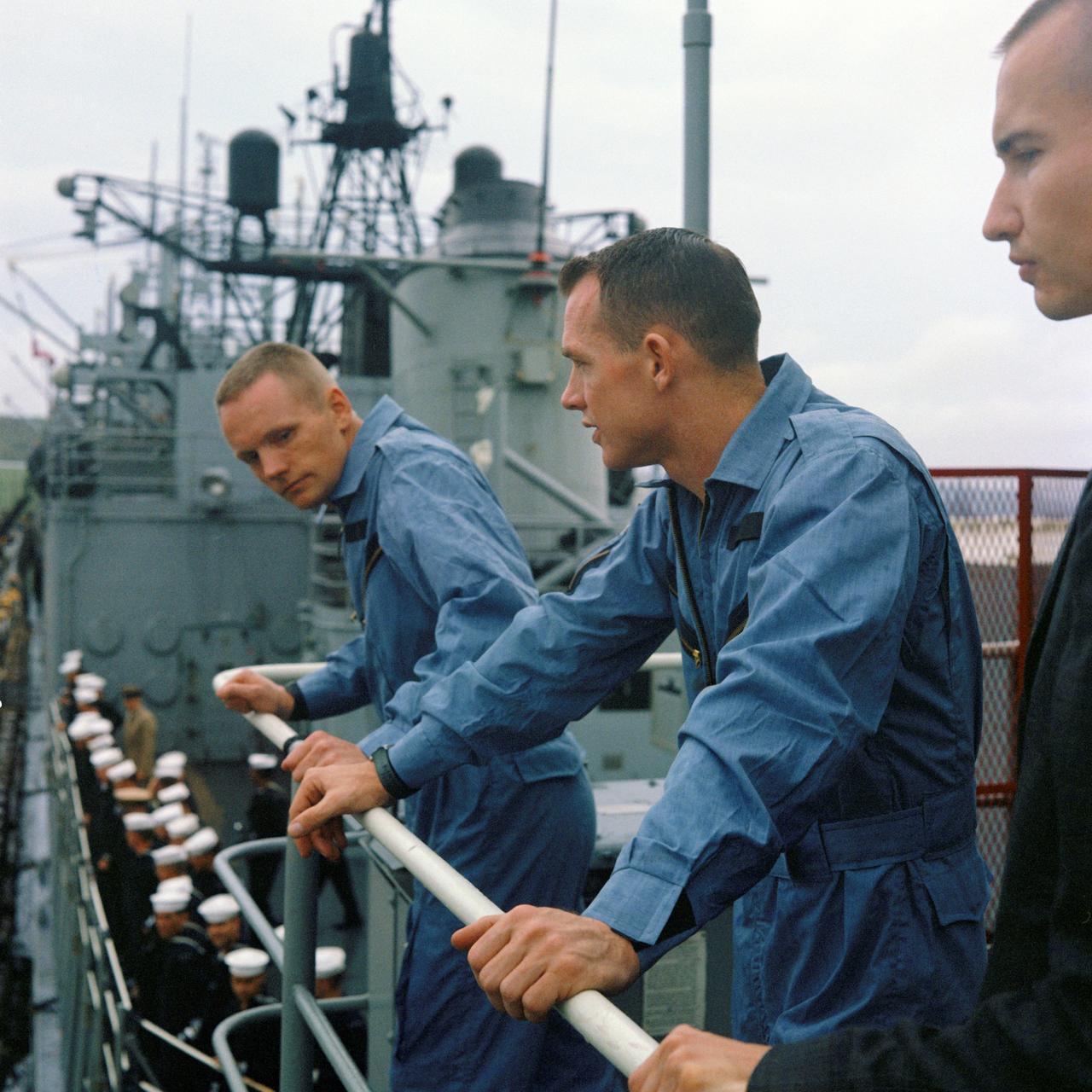
S66-18609 (17 March 1966) --- Astronauts David R. Scott (left), Gemini-8 pilot, and Neil A. Armstrong, command pilot, stand on the deck of the destroyer USS Leonard F. Mason upon its arrival at Nahs, Okinawa. Photo credit: NASA
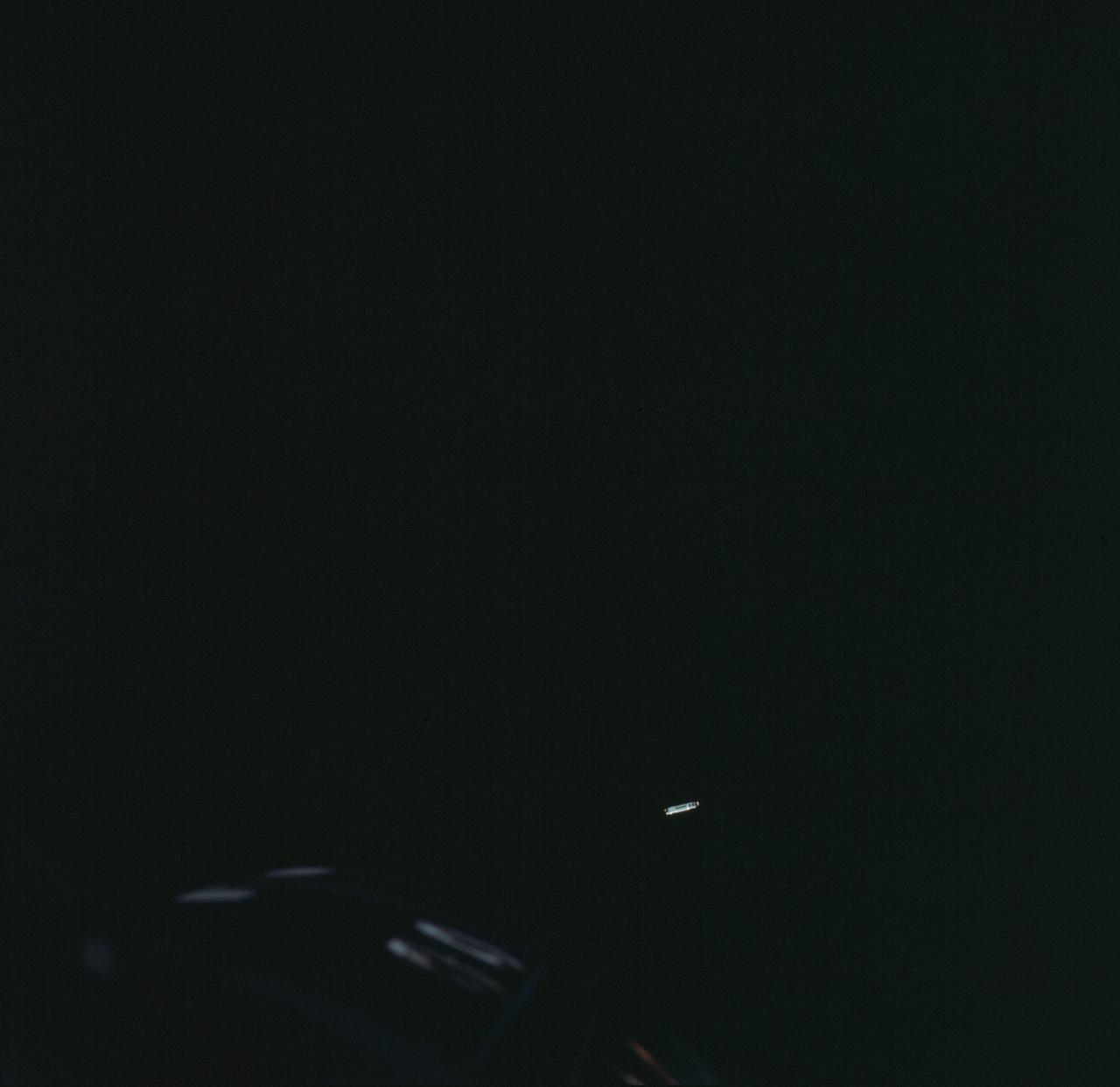
S66-25774 (16 March 1966) --- The Agena Target Docking vehicle seen from the Gemini-8 spacecraft during rendezvous in space. The Agena is approximately 1,000 feet away from the nose of the spacecraft (lower left). Photo credit: NASA
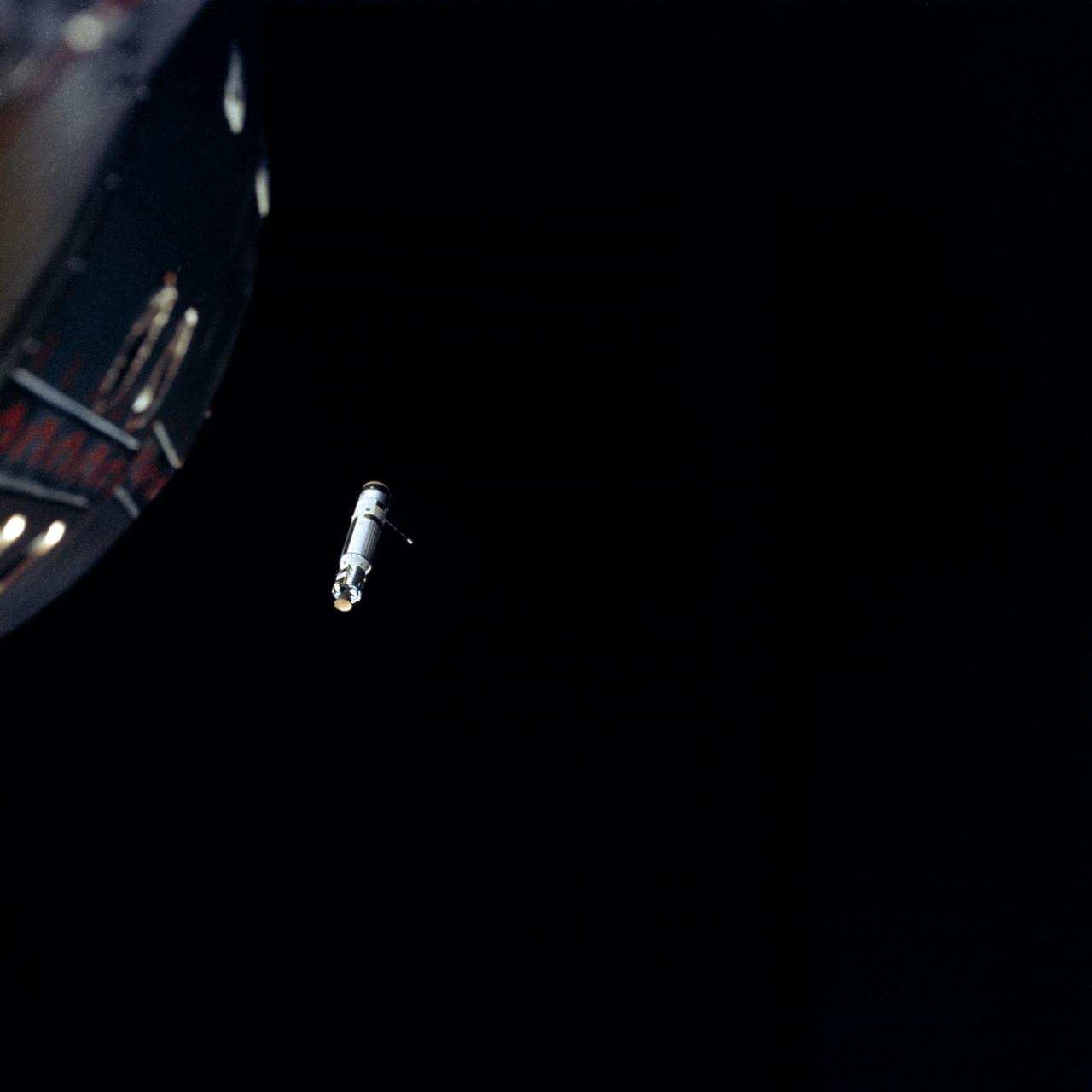
S66-25778 (16 March 1966) --? The Agena Target Docking Vehicle seen from the National Aeronautics and Space Administration?s Gemini-8 spacecraft during rendezvous in space. The Agena is approximately 260 feet away from the nose of the spacecraft (lower left). Crewmen for the Gemini-8 mission are astronauts Neil A. Armstrong, command pilot, and David R. Scott, pilot. Photo credit: NASA
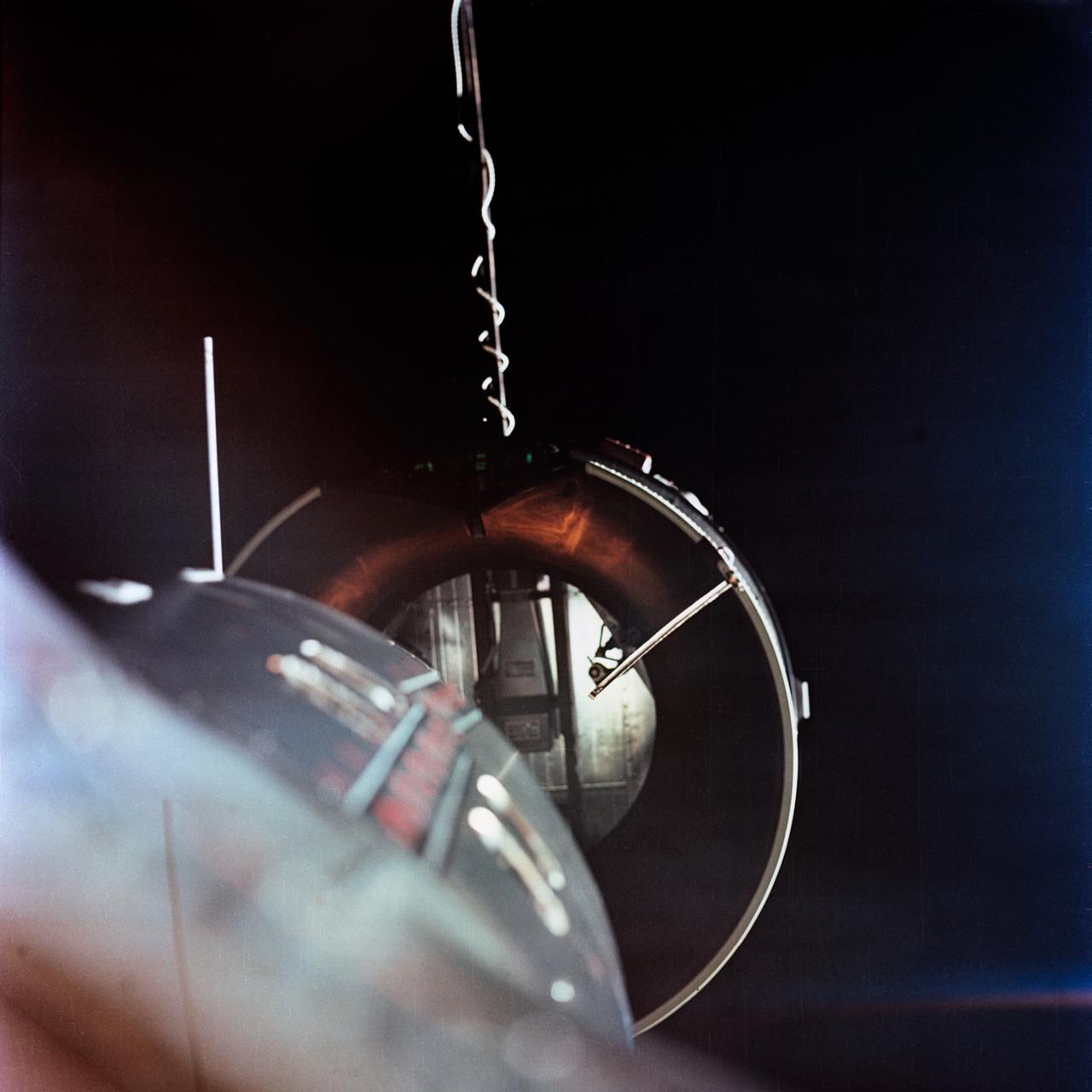
S66-25784 (16 March 1966) --? The Agena Target Docking Vehicle seen from the National Aeronautics and Space Administration?s Gemini adapter of the Agena is approximately two feet from the nose of the spacecraft (lower left). Crewmen for the Gemini-8 mission were astronauts Neil A. Armstrong, command pilot, and David R. Scott, pilot. Photo credit: NASA
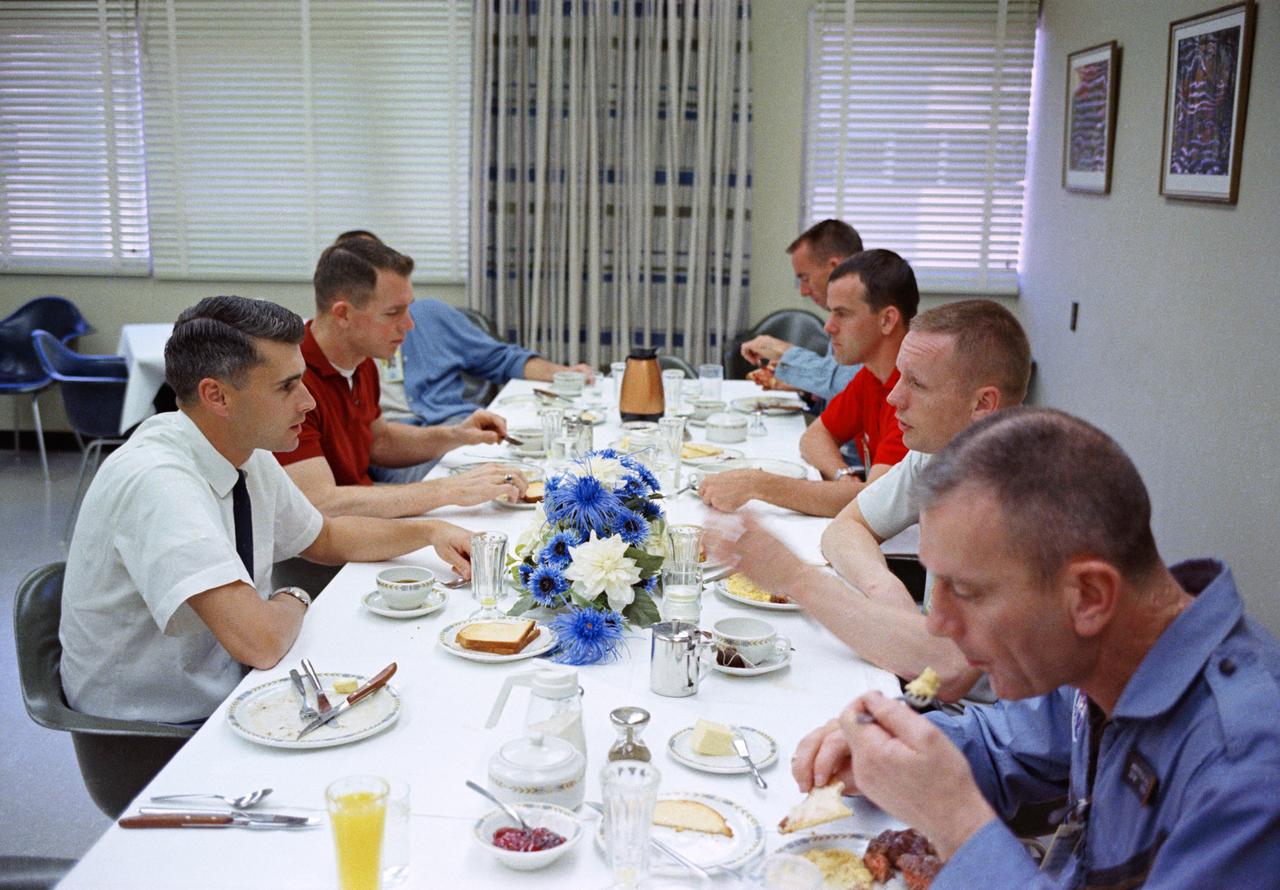
S66-24439 (16 March 1966) --- The Gemini-8 prime crew, along with several fellow astronauts, have a hearty breakfast of steak and eggs on the morning of the Gemini-8 launch. Seated clockwise around the table, starting at lower left, are Donald K. Slayton, Manned Spaceflight Center (MSC) Assistant Director for Flight Crew Operations; astronaut Neil A. Armstrong, Gemini-8 command pilot; scientist-astronaut F. Curtis Michel; astronaut R. Walter Cunningham; astronaut Alan B. Shepard Jr. (face obscured), Chief, MSC Astronaut Office; astronaut David R. Scott, Gemini-8 pilot; and astronaut Roger B. Chaffee. Photo credit: NASA
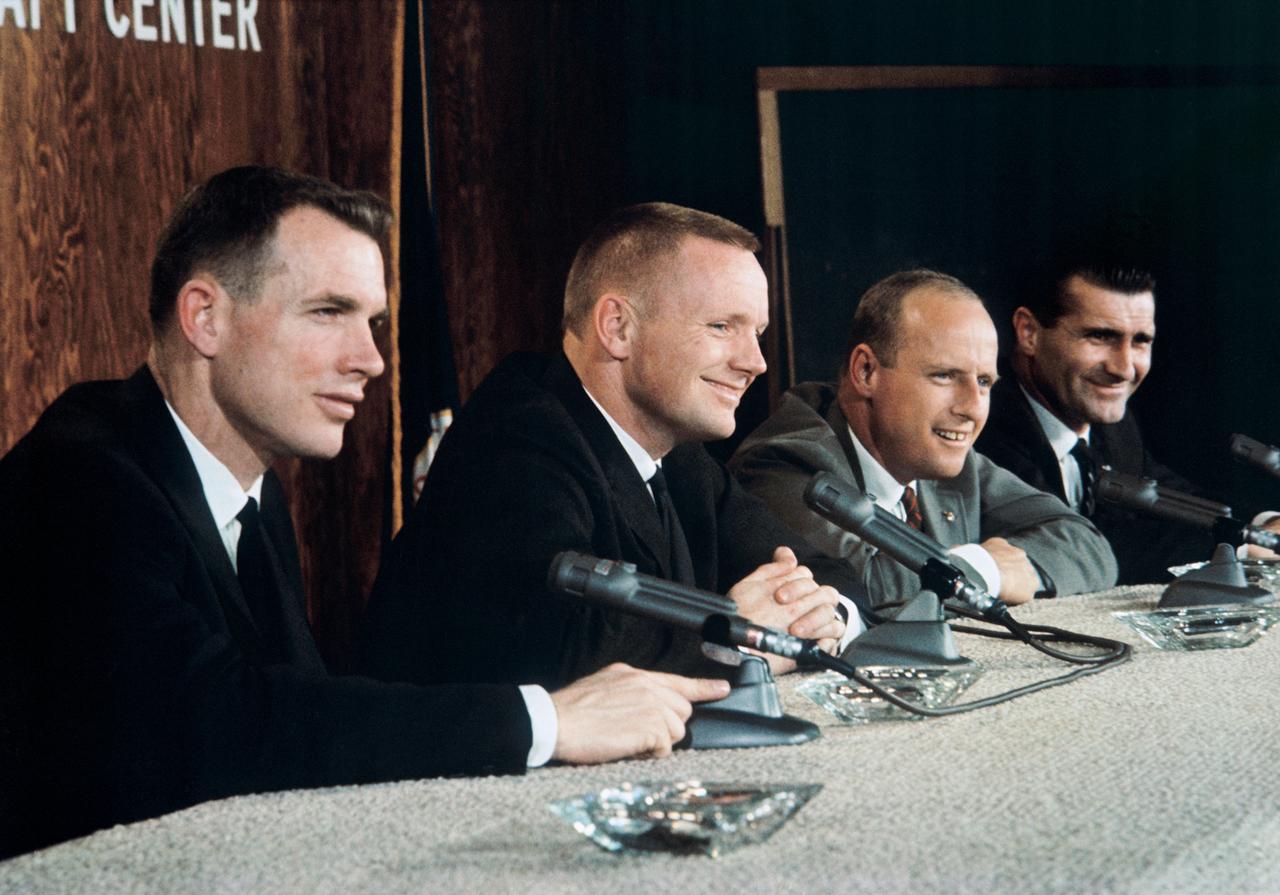
S66-24380 (26 Feb. 1966) --- Gemini-8 prime and backup crews during press conference. Left to right are astronauts David R. Scott, prime crew pilot; Neil A. Armstrong, prime crew command pilot; Charles Conrad Jr., backup crew command pilot; and Richard F. Gordon Jr., backup crew pilot. Photo credit: NASA
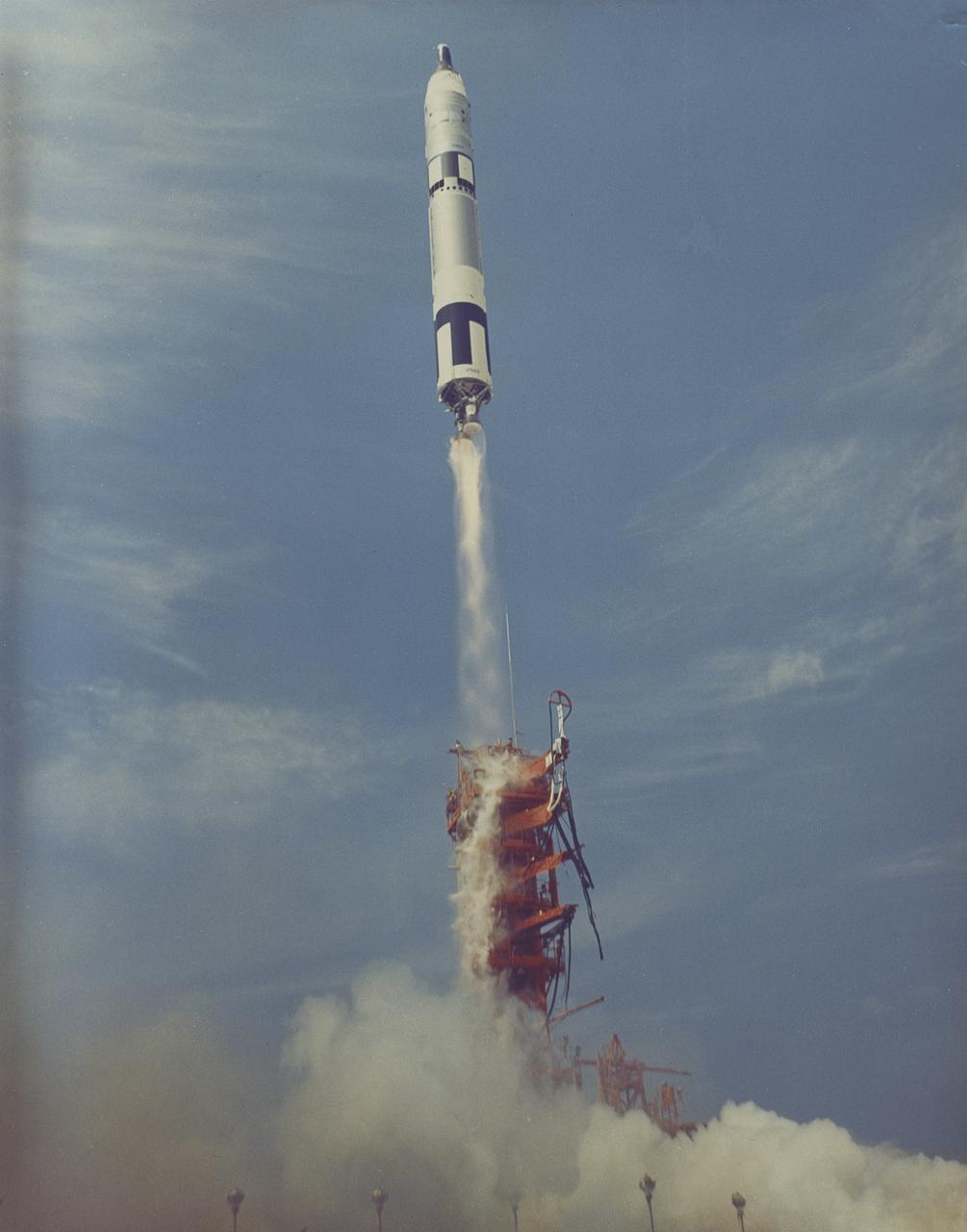
A Titan booster launched the Gemini 8 spacecraft on March 16, 1966 from launch complex 19 Cape Kennedy, Florida. The flight crew for the 3 day mission, astronauts Neil A. Armstrong and David R. Scott, achieved the first rendezvous and docking to Atlas/Agena in Earth orbit.
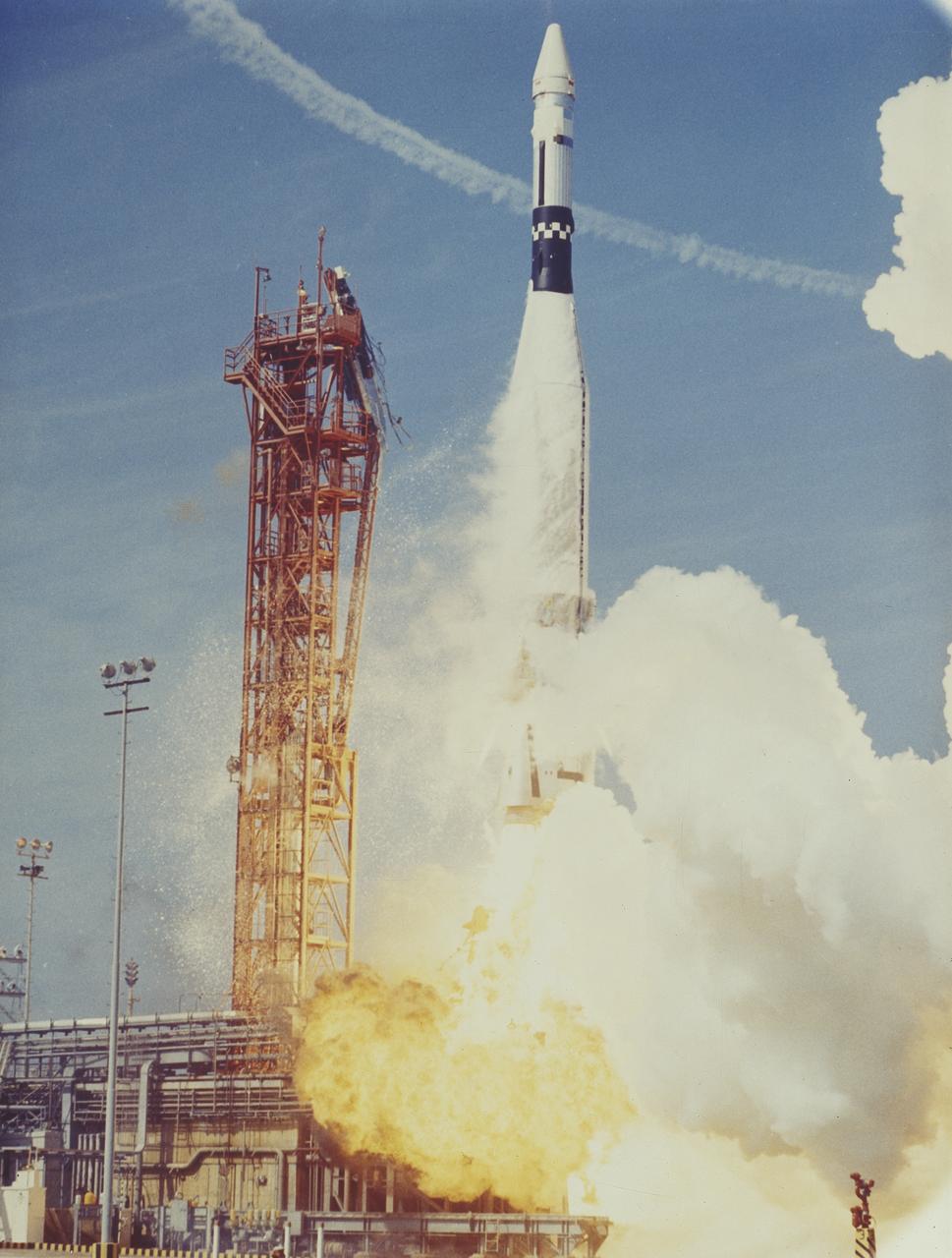
On March 16, 1966, an Atlas booster launched an Agena Target Vehicle for the Gemini 8 mission. The flight crew for the 3 day mission, astronauts Neil A. Armstrong and David R. Scott, achieved the first rendezvous and docking to Atlas/Agena in Earth orbit.
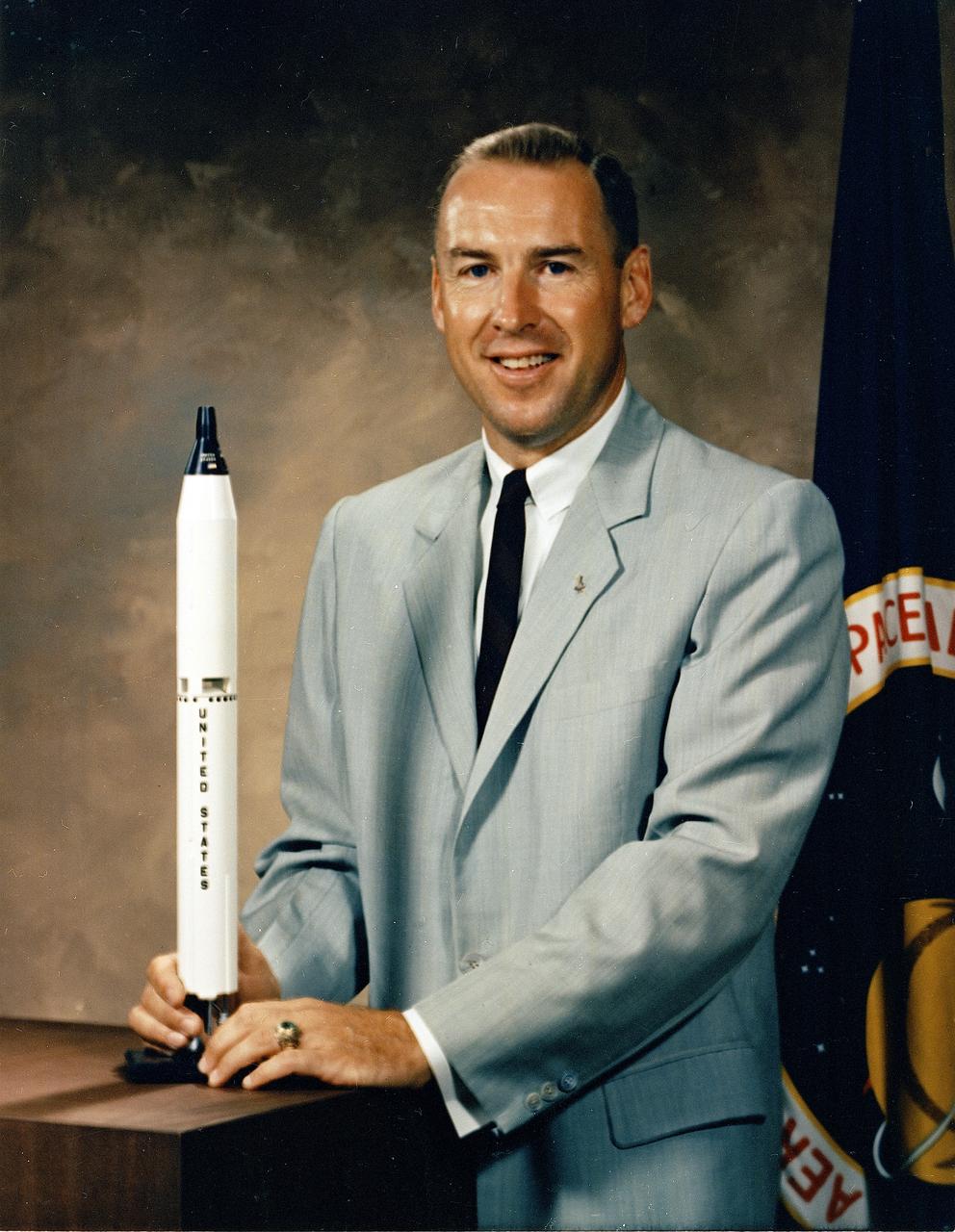
This is the official NASA portrait of astronaut James Lovell. Captain Lovell was selected as an Astronaut by NASA in September 1962. He has since served as backup pilot for the Gemini 4 flight and backup Commander for the Gemini 9 flight, as well as backup Commander to Neil Armstrong for the Apollo 11 lunar landing mission. On December 4, 1965, he and Frank Borman were launched into space on the history making Gemini 7 mission. The flight lasted 330 hours and 35 minutes and included the first rendezvous of two manned maneuverable spacecraft. The Gemini 12 mission, commanded by Lovell with Pilot Edwin Aldrin, began on November 11, 1966 for a 4-day, 59-revolution flight that brought the Gemini program to a successful close. Lovell served as Command Module Pilot and Navigator on the epic six-day journey of Apollo 8, the first manned Saturn V liftoff responsible for allowing the first humans to leave the gravitational influence of Earth. He completed his fourth mission as Spacecraft Commander of the Apollo 13 flight, April 11-17, 1970, and became the first man to journey twice to the moon. The Apollo 13 mission was cut short due to a failure of the Service Module cryogenic oxygen system. Aborting the lunar course, Lovell and fellow crewmen, John L. Swigert and Fred W. Haise, working closely with Houston ground controllers, converted their lunar module, Aquarius, into an effective lifeboat that got them safely back to Earth. Captain Lovell held the record for time in space with a total of 715 hours and 5 minutes until surpassed by the Skylab flights. On March 1, 1973, Captain Lovell retired from the Navy and the Space Program.
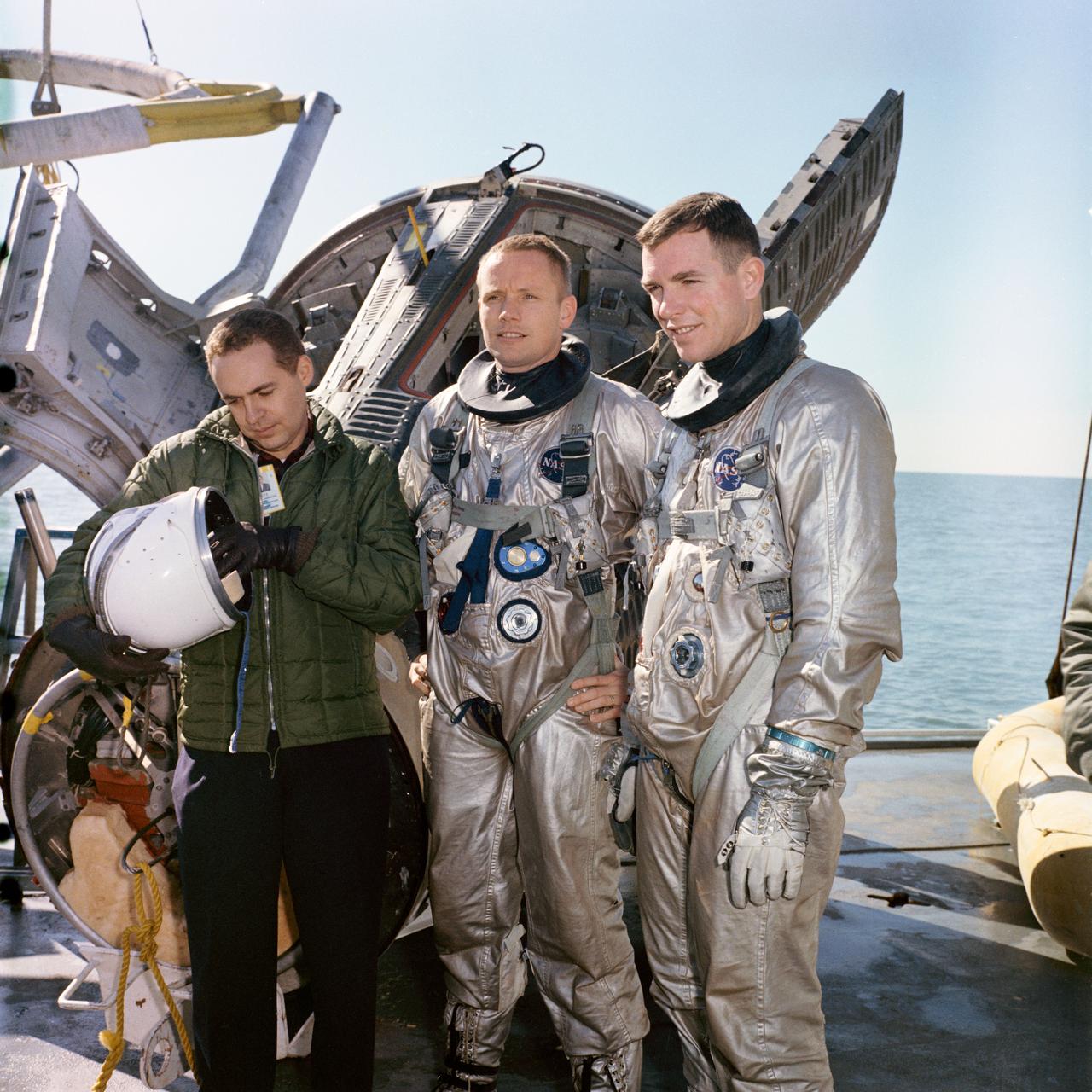
S66-17253 (15 Jan. 1966) --- Astronauts Neil A. Armstrong (center), command pilot, and David R. Scott (right), pilot of the Gemini-8 prime crew, are suited up for water egress training aboard the NASA Motor Vessel Retriever in the Gulf of Mexico. At left is Dr. Kenneth N. Beers, M.D., Flight Medicine Branch, Center Medical Office. Photo credit: NASA
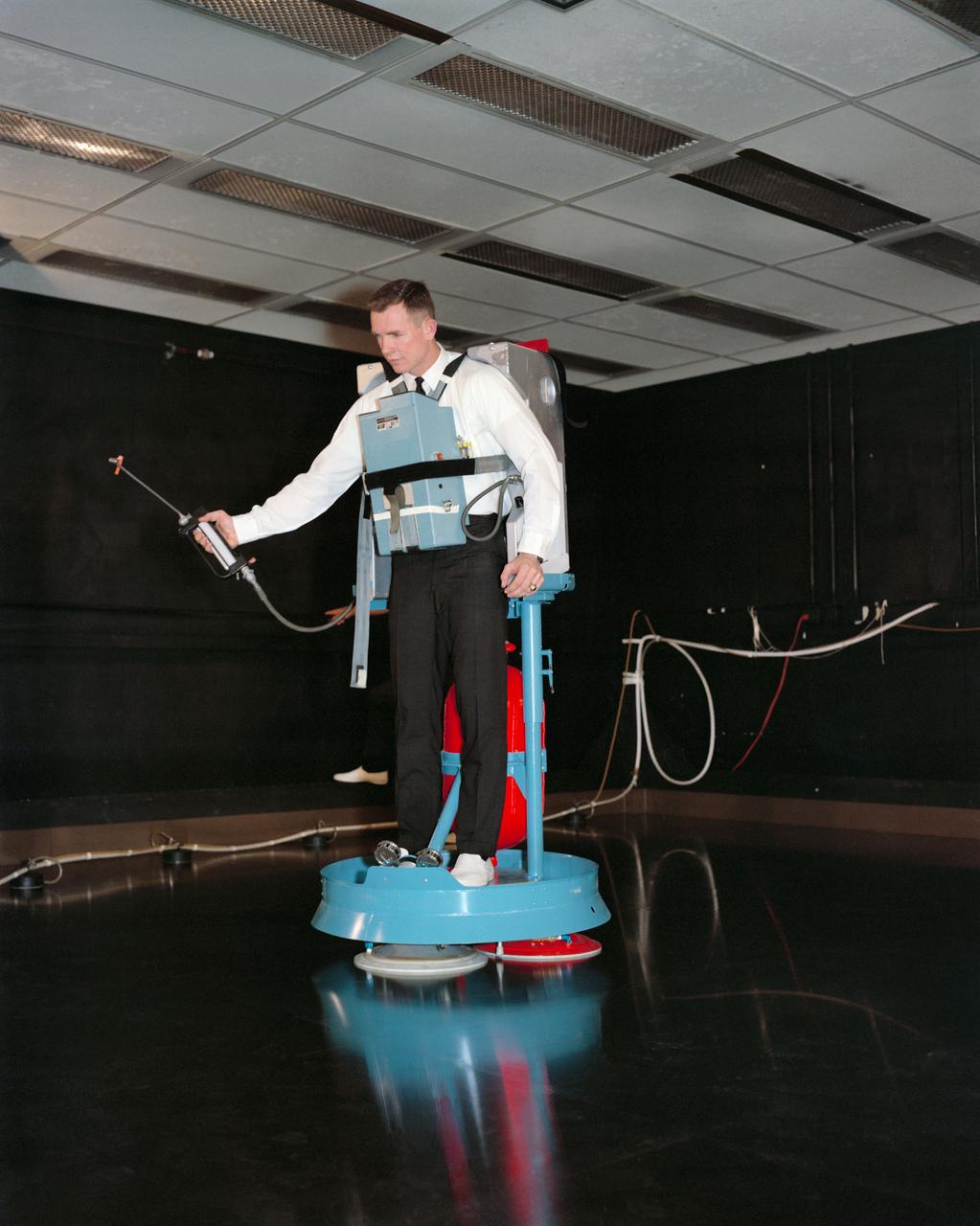
S66-19284 (1 Feb. 1966) --- Astronaut David R. Scott practicing for Gemini-8 extravehicular activity (EVA) in building 4 of the Manned Spacecraft Center on the air bearing floor. He is wearing the Hand-Held Maneuvering Unit which he will use during the EVA. Photo credit: NASA

STS008-16-454 (30 Aug-5 Sept 1983) --- Following a precedent set early two decades ago during the Gemini program, three members of the STS-8 astronaut crew aboard the Earth-orbiting Space Shuttle Challenger reveal their military backgrounds and loyalties. Astronauts (left to right) Dale A. Gardner, Richard H. Truly and Daniel C. Brandenstein leave no mystery as to their alma mater and gridiron sentimentalities as they display U.S. Navy stickers. The trio was photographed by Astronaut Guion S. Bluford on the flight deck. Truly is crew commander; Brandenstein, pilot; and Gardner and Bluford, along with Dr. William E. Thornton are all mission specialists for this six-day flight.
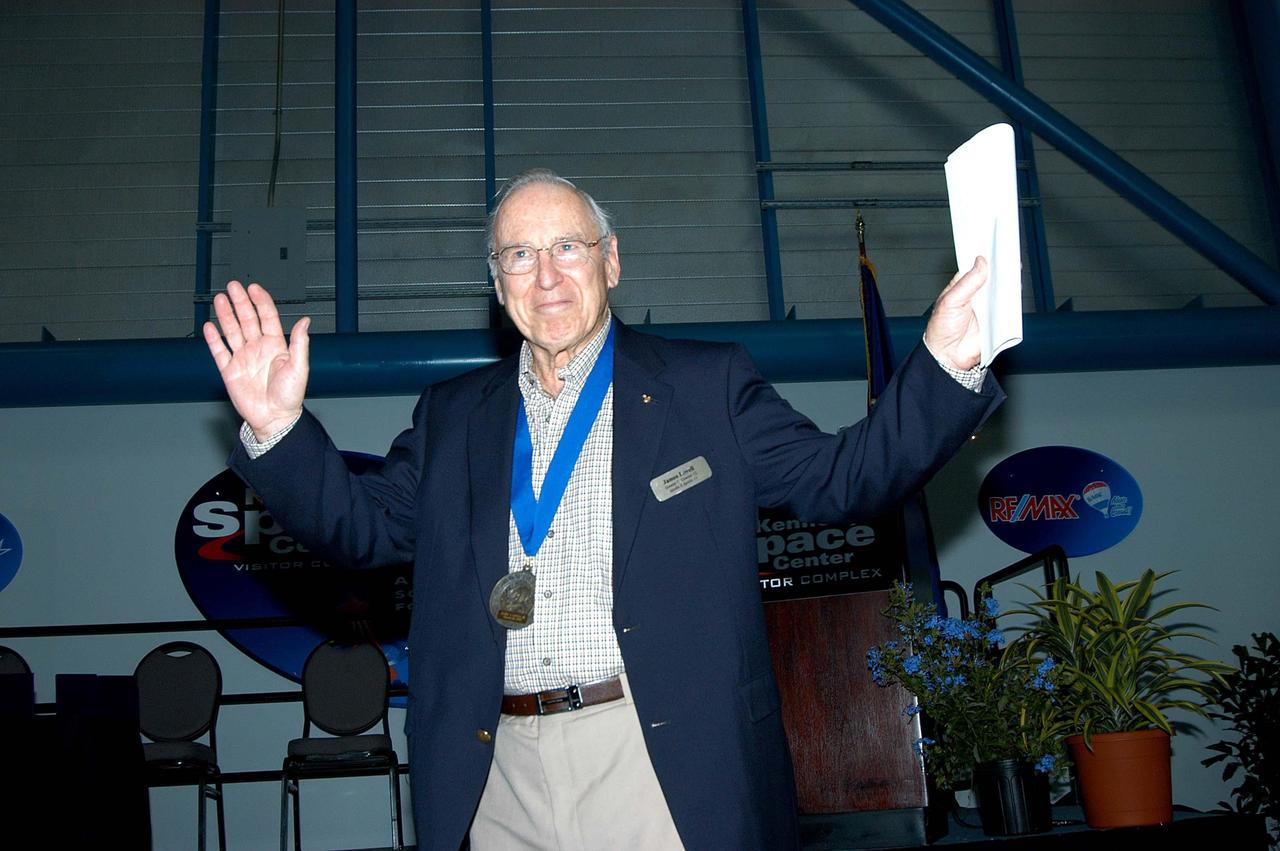
KENNEDY SPACE CENTER, FLA. -- Former astronaut Jim Lovell acknowledges the applause as he is introduced as a previous inductee into the U.S. Astronaut Hall of Fame. He and other Hall of Fame members were present for the induction of five new space program heroes into the U.S. Astronaut Hall of Fame: Richard O. Covey, commander of the Hubble Space Telescope repair mission; Norman E. Thagard, the first American to occupy Russia’s Mir space station; the late Francis R. "Dick" Scobee, commander of the ill-fated 1986 Challenger mission; Kathryn D. Sullivan, the first American woman to walk in space; and Frederick D. Gregory, the first African-American to command a space mission and the current NASA deputy administrator. Lovell piloted Gemini 7, commanded Gemini 12, orbited the Moon on Apollo 8 and commanded the aborted Apollo 13 moon flight. The induction ceremony was held at the Apollo/Saturn V Center at KSC. The U.S. Astronaut Hall of Fame opened in 1990 to provide a place where space travelers could be remembered for their participation and accomplishments in the U.S. space program. The five inductees join 52 previously honored astronauts from the ranks of the Gemini, Apollo, Skylab, Apollo-Soyuz, and Space Shuttle programs.
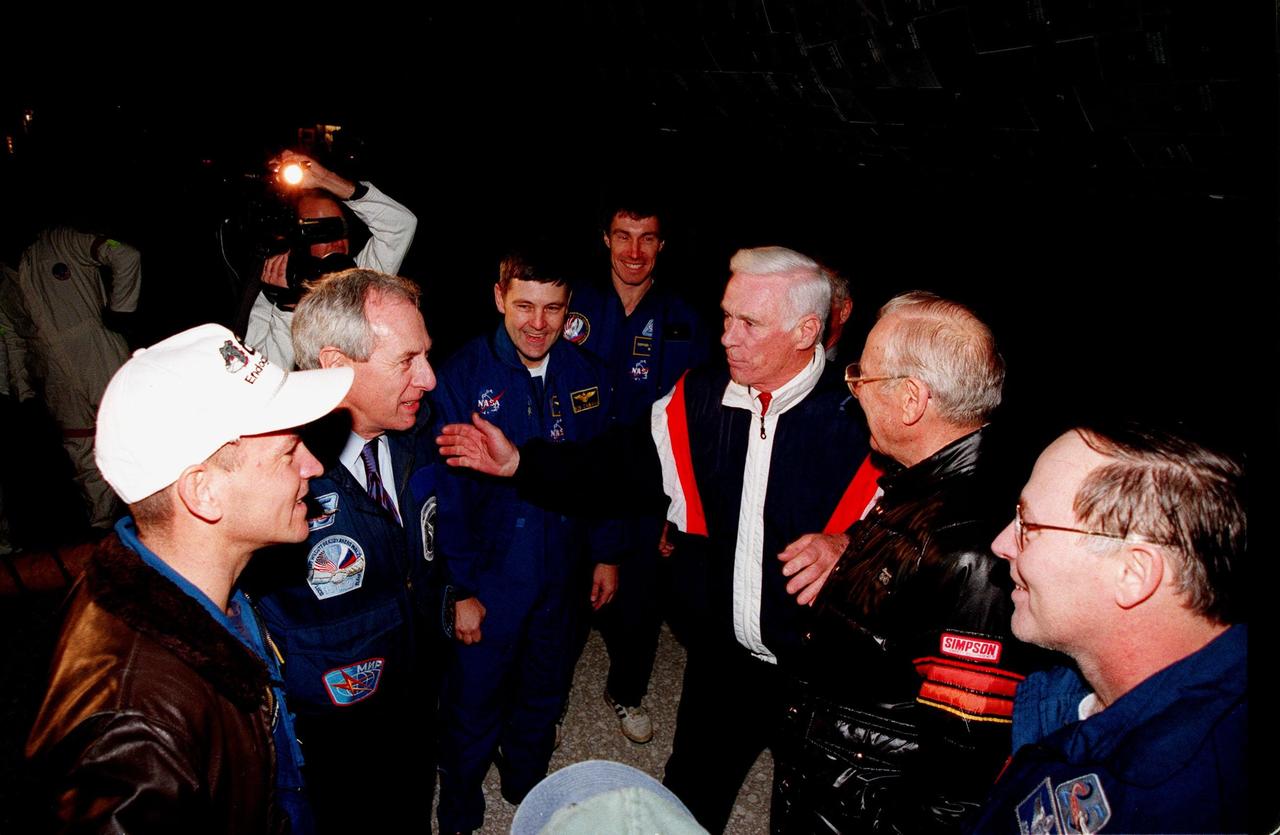
Following their touchdown on Runway 15 at 10:53:29 p.m. EST, STS-88 crew members are greeted by NASA Administrator Daniel Goldin and former astronauts Eugene A. Cernan and James A. Lovell Jr. From left are Pilot Frederick W. "Rick" Sturckow, Goldin , Commander Robert D. Cabana, Mission Specialist Sergei Konstantinovich Krikalev, Cernan, Lovell and Mission Specialist Jerry L. Ross. Cernan flew on Gemini 9, Apollo 10 and 17 and has more than 566 cumulative hours of space flight. Lovell flew on Gemini 7 and 12, Apollo 8 and 13. His cumulative hours of space flight are more than 715. On the 4.6-million-mile, nearly 12-day STS-88 mission, Endeavour carried the U.S.-built Unity connecting module to begin construction of the International Space Station. The crew successfully mated Unity with the Russian-built Zarya control module during three space walks. With this mission, Ross completed seven space walks totaling 44 hours and 9 minutes, more than any other American space walker. Newman moved into third place for U.S. space walks with a total of 28 hours and 27 minutes on four excursions
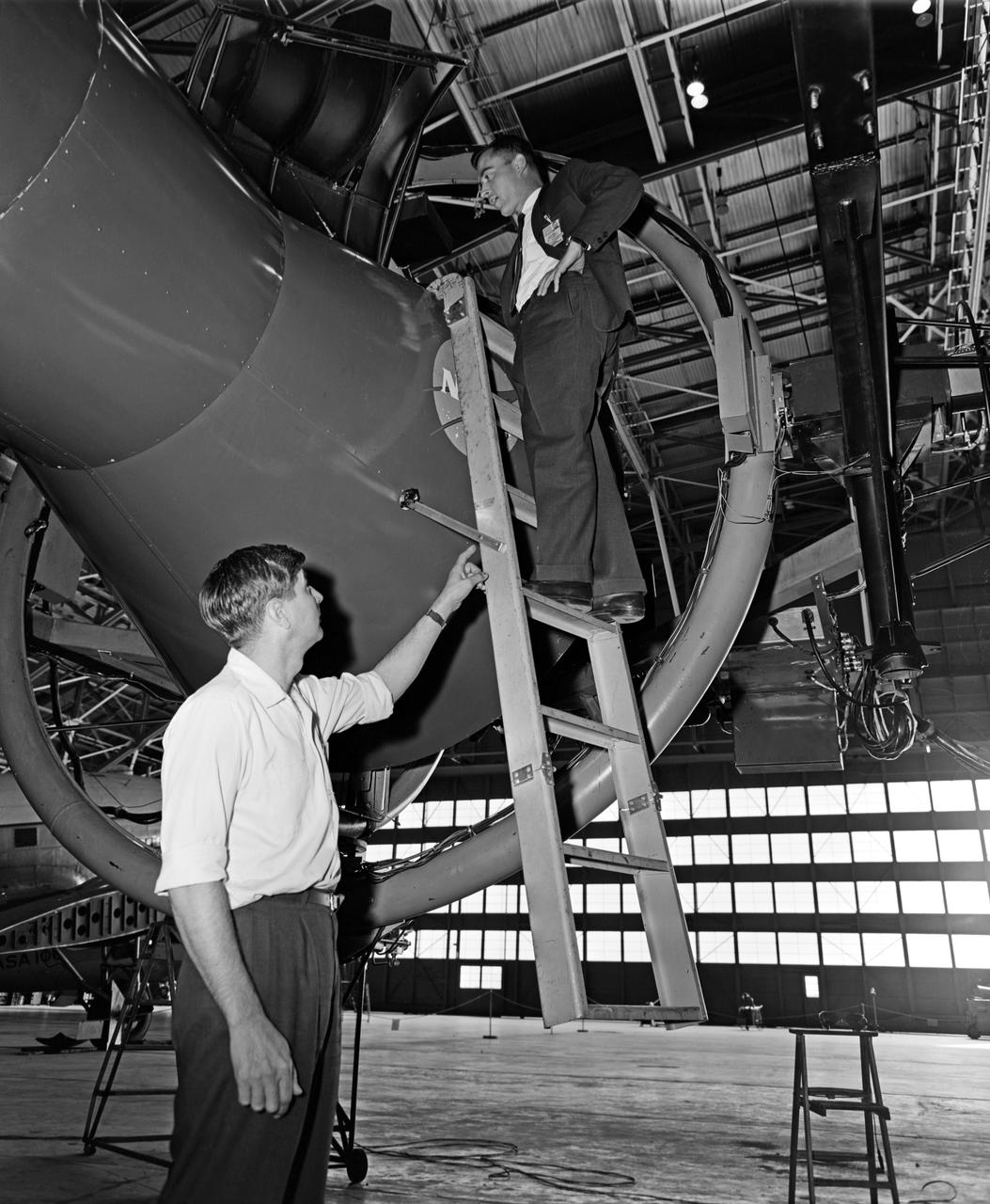
Astronaut John Young (above) was one of 14 astronauts, 8 NASA test pilots, and 2 McDonnell test pilots who took part in simulator studies. Young piloted the simulator on November 12, 1963 Arthur Vogeley wrote: "Many of the astronauts have flown this simulator in support of the Gemini studies and they, without exception, appreciated the realism of the visual scene. The simulator has also been used in the development of pilot techniques to handle certain jet malfunctions in order that aborts could be avoided. In these situations large attitude changes are sometimes necessary and the false motion cues that were generated due to earth gravity were somewhat objectionable; however, the pilots were readily able to overlook these false motion cues in favor of the visual realism." Roy F. Brissenden wrote: "The basic Gemini control studies developed the necessary techniques and demonstrated the ability of human pilots to perform final space docking with the specified Gemini-Agena systems using only visual references. ... Results... showed that trained astronauts can effect the docking with direct acceleration control and even with jet malfunctions as long as good visual conditions exist.... Probably more important than data results was the early confidence that the astronauts themselves gained in their ability to perform the maneuver in the ultimate flight mission." -- Published in Barton C. Hacker and James M. Grimwood, On the Shoulders of Titans: A History of Project Gemini, NASA SP-4203; A.W. Vogeley, "Discussion of Existing and Planned Simulators For Space Research," Paper presented at the Conference on the Role of Simulation in Space Technology, August 17-21, 1964; Roy F. Brissenden, "Initial Operations with Langley's Rendezvous Docking Facility," Langley Working Paper, LWP-21, 1964.
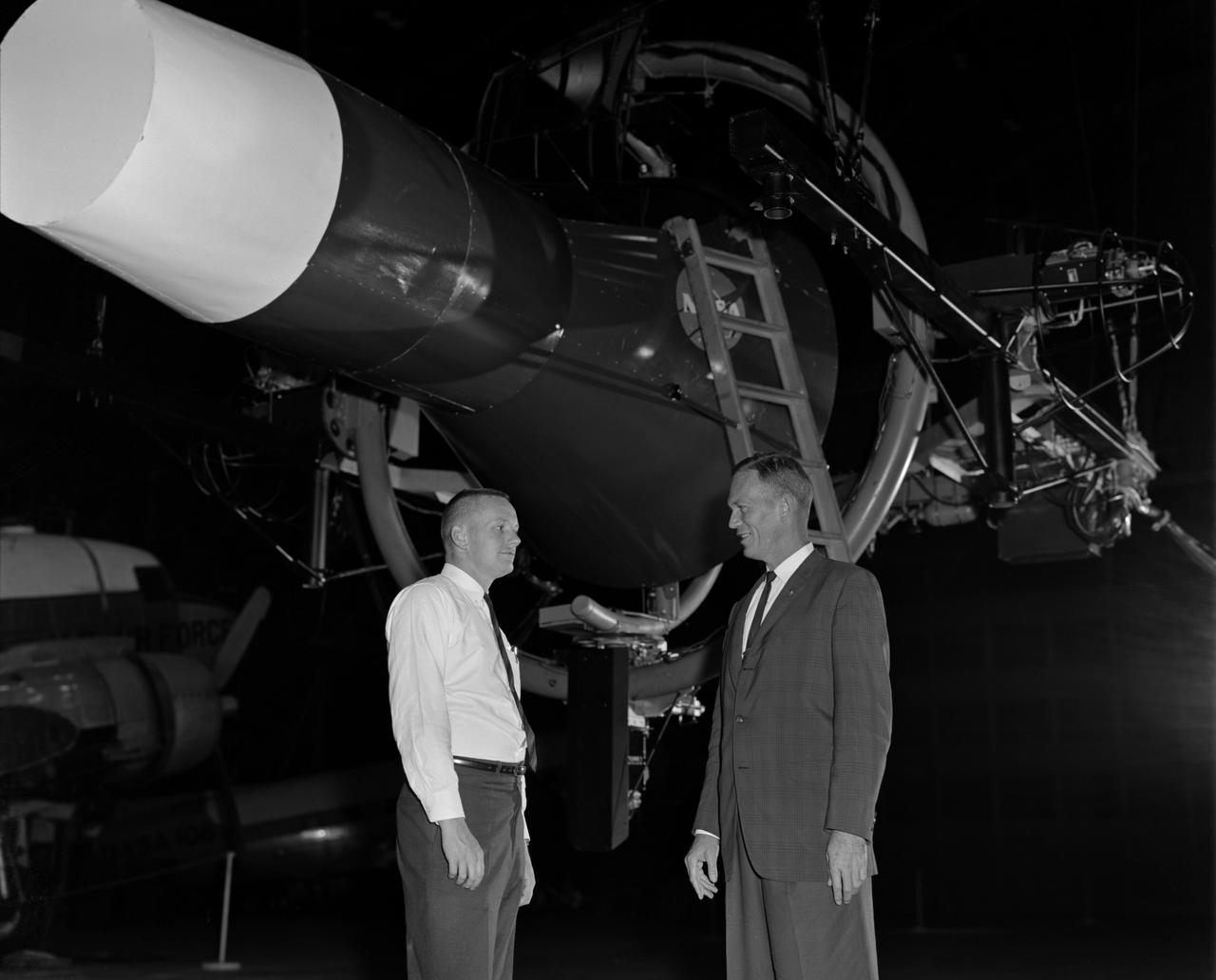
Astronaut Neil Armstrong (left) was one of 14 astronauts, 8 NASA test pilots, and 2 McDonnell test pilots who took part in simulator studies. Armstrong was the first astronaut to participate (November 6, 1963). A.W. Vogeley described the simulator in his paper "Discussion of Existing and Planned Simulators For Space Research," "Many of the astronauts have flown this simulator in support of the Gemini studies and they, without exception, appreciated the realism of the visual scene. The simulator has also been used in the development of pilot techniques to handle certain jet malfunctions in order that aborts could be avoided. In these situations large attitude changes are sometimes necessary and the false motion cues that were generated due to earth gravity were somewhat objectionable; however, the pilots were readily able to overlook these false motion cues in favor of the visual realism." Roy F. Brissenden, noted in his paper "Initial Operations with Langley's Rendezvous Docking Facility," "The basic Gemini control studies developed the necessary techniques and demonstrated the ability of human pilots to perform final space docking with the specified Gemini-Agena systems using only visual references. ... Results... showed that trained astronauts can effect the docking with direct acceleration control and even with jet malfunctions as long as good visual conditions exist.... Probably more important than data results was the early confidence that the astronauts themselves gained in their ability to perform the maneuver in the ultimate flight mission." Francis B. Smith, noted in his paper "Simulators for Manned Space Research," "Some major areas of interest in these flights were fuel requirements, docking accuracies, the development of visual aids to assist alignment of the vehicles, and investigation of alternate control techniques with partial failure modes. However, the familiarization and confidence developed by the astronaut through flying and safely docking the simulator during these tests was one of the major contributions. For example, it was found that fuel used in docking from 200 feet typically dropped from about 20 pounds to 7 pounds after an astronaut had made a few training flights." -- Published in Barton C. Hacker and James M. Grimwood, On the Shoulders of Titans: A History of Project Gemini, NASA SP-4203; A.W. Vogeley, "Discussion of Existing and Planned Simulators For Space Research," Paper presented at the Conference on the Role of Simulation in Space Technology, August 17-21, 1964; Roy F. Brissenden, "Initial Operations with Langley's Rendezvous Docking Facility," Langley Working Paper, LWP-21, 1964; Francis B. Smith, "Simulators for Manned Space Research," Paper presented at the 1966 IEEE International convention, March 21-25, 1966.
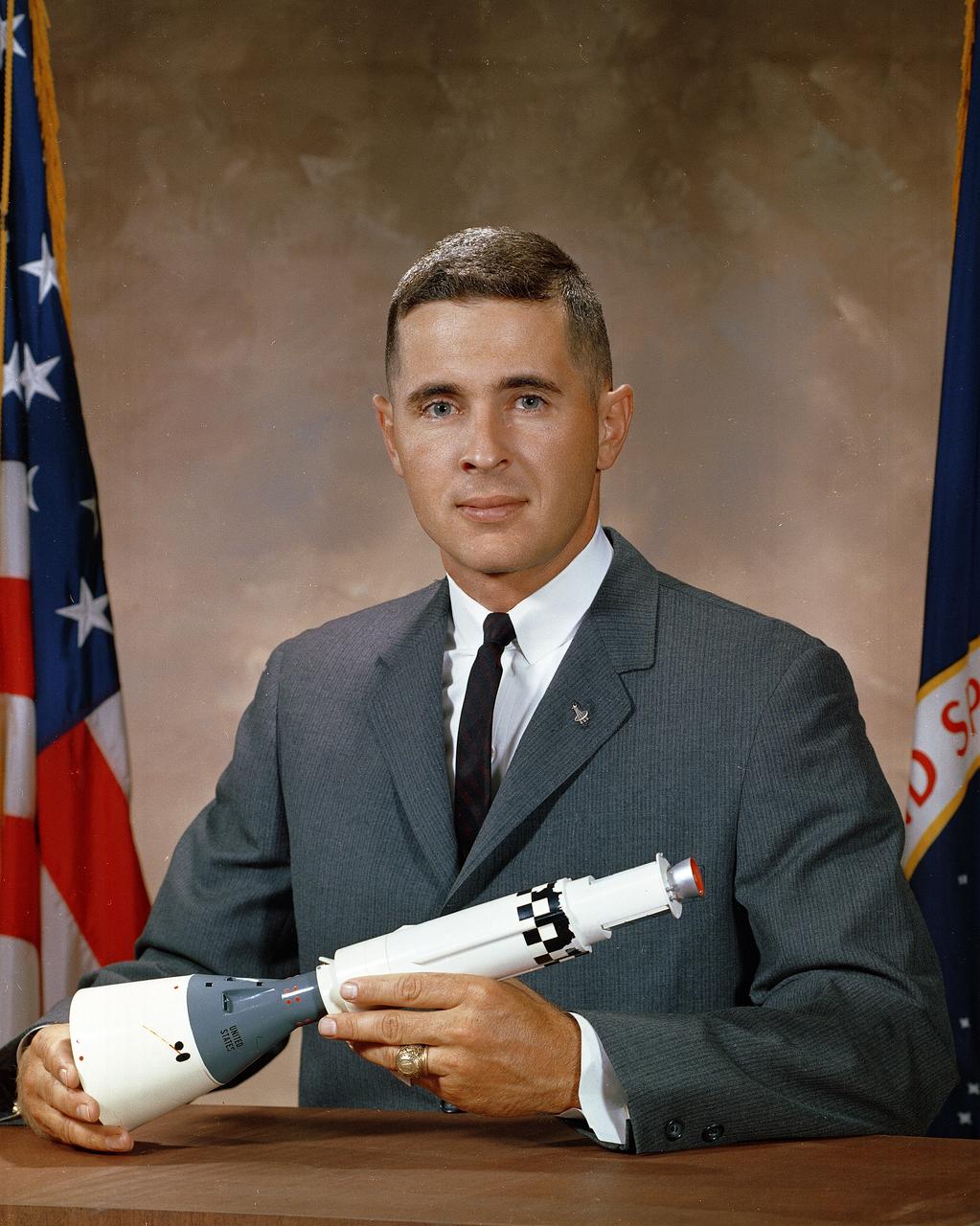
This is the official NASA portrait of astronaut William Anders. Anders was commissioned in the air Force after graduation from the Naval Academy and served as a fighter pilot in all-weather interception squadrons of the Air Defense Command. Later he was responsible for technical management of nuclear power reactor shielding and radiation effects programs while at the Air Force Weapons Laboratory in New Mexico. In 1964, Anders was selected by the National Aeronautics and Space Administration (NASA) as an astronaut with responsibilities for dosimetry, radiation effects and environmental controls. He was backup pilot for the Gemini XI, Apollo 11 flights, and served as lunar module (LM) pilot for Apollo 8, the first lunar orbit mission in December 1968. He has logged more than 6,000 hours flying time.
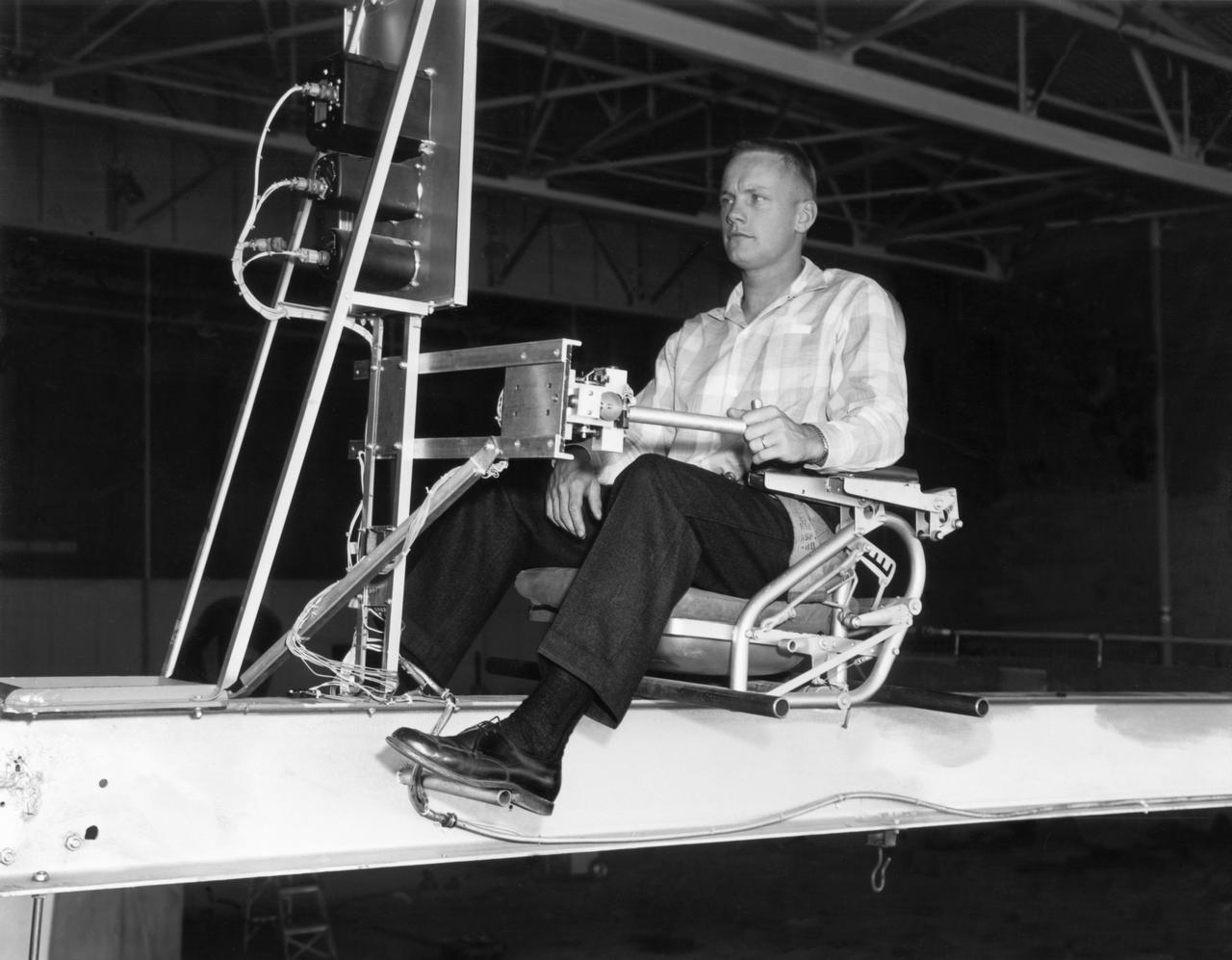
Famed astronaut Neil A. Armstrong, the first man to set foot on the moon during the historic Apollo 11 space mission in July 1969, served for seven years as a research pilot at the NACA-NASA High-Speed Flight Station, now the Dryden Flight Research Center, at Edwards, California, before he entered the space program. Armstrong joined the National Advisory Committee for Aeronautics (NACA) at the Lewis Flight Propulsion Laboratory (later NASA's Lewis Research Center, Cleveland, Ohio, and today the Glenn Research Center) in 1955. Later that year, he transferred to the High-Speed Flight Station at Edwards as an aeronautical research scientist and then as a pilot, a position he held until becoming an astronaut in 1962. He was one of nine NASA astronauts in the second class to be chosen. As a research pilot Armstrong served as project pilot on the F-100A and F-100C aircraft, F-101, and the F-104A. He also flew the X-1B, X-5, F-105, F-106, B-47, KC-135, and Paresev. He left Dryden with a total of over 2450 flying hours. He was a member of the USAF-NASA Dyna-Soar Pilot Consultant Group before the Dyna-Soar project was cancelled, and studied X-20 Dyna-Soar approaches and abort maneuvers through use of the F-102A and F5D jet aircraft. Armstrong was actively engaged in both piloting and engineering aspects of the X-15 program from its inception. He completed the first flight in the aircraft equipped with a new flow-direction sensor (ball nose) and the initial flight in an X-15 equipped with a self-adaptive flight control system. He worked closely with designers and engineers in development of the adaptive system, and made seven flights in the rocket plane from December 1960 until July 1962. During those fights he reached a peak altitude of 207,500 feet in the X-15-3, and a speed of 3,989 mph (Mach 5.74) in the X-15-1. Armstrong has a total of 8 days and 14 hours in space, including 2 hours and 48 minutes walking on the Moon. In March 1966 he was commander of the Gemini 8 or
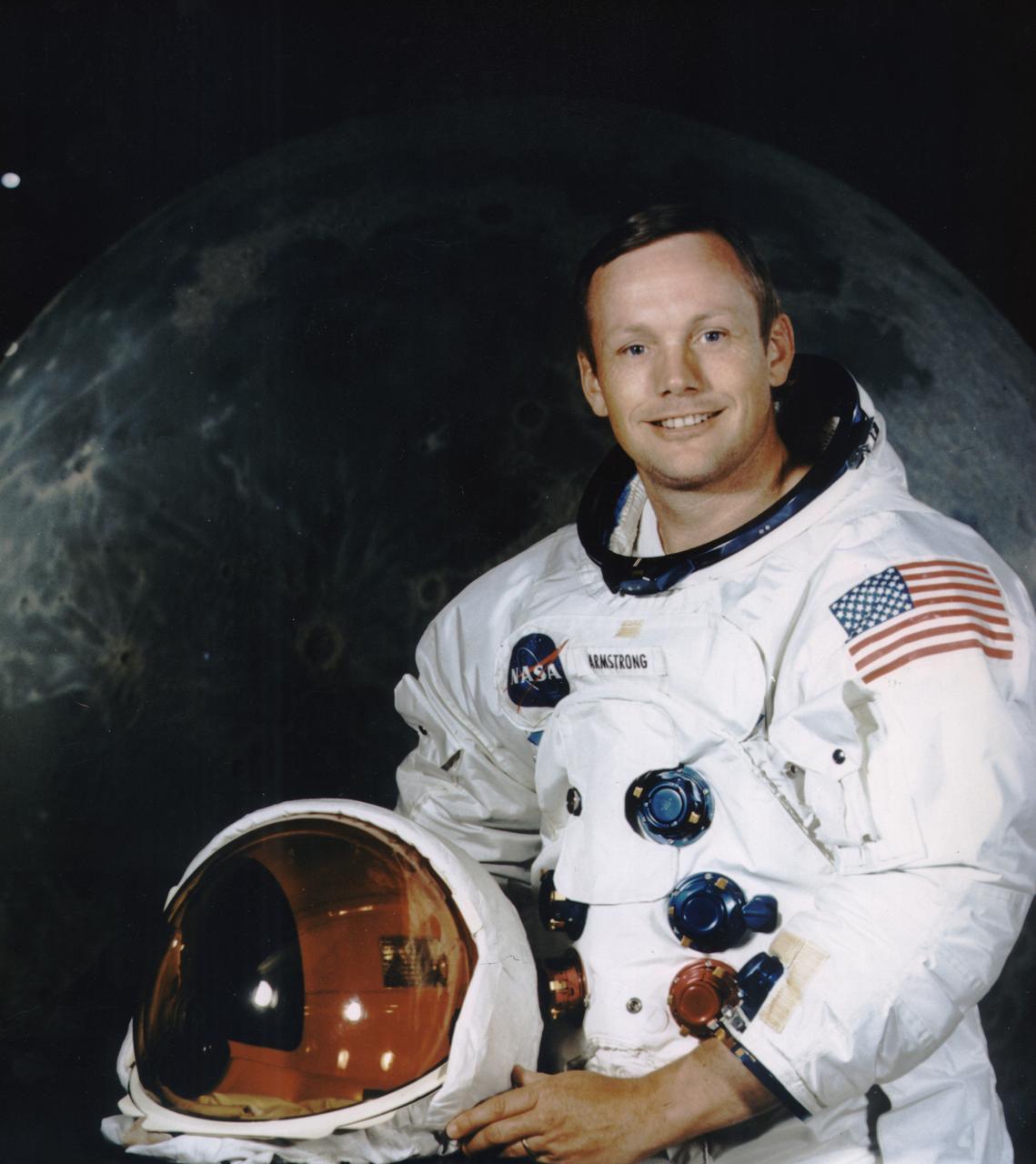
Neil Armstrong, donned in his space suit, poses for his official Apollo 11 portrait. Armstrong began his flight career as a naval aviator. He flew 78 combat missions during the Korean War. Armstrong joined the NASA predecessor, NACA (National Advisory Committee for Aeronautics), as a research pilot at the Lewis Laboratory in Cleveland and later transferred to the NACA High Speed Flight Station at Edwards AFB, California. He was a project pilot on many pioneering high speed aircraft, including the 4,000 mph X-15. He has flown over 200 different models of aircraft, including jets, rockets, helicopters, and gliders. In 1962, Armstrong was transferred to astronaut status. He served as command pilot for the Gemini 8 mission, launched March 16, 1966, and performed the first successful docking of two vehicles in space. In 1969, Armstrong was commander of Apollo 11, the first manned lunar landing mission, and gained the distinction of being the first man to land a craft on the Moon and the first man to step on its surface. Armstrong subsequently held the position of Deputy Associate Administrator for Aeronautics, NASA Headquarters Office of Advanced Research and Technology, from 1970 to 1971. He resigned from NASA in 1971.
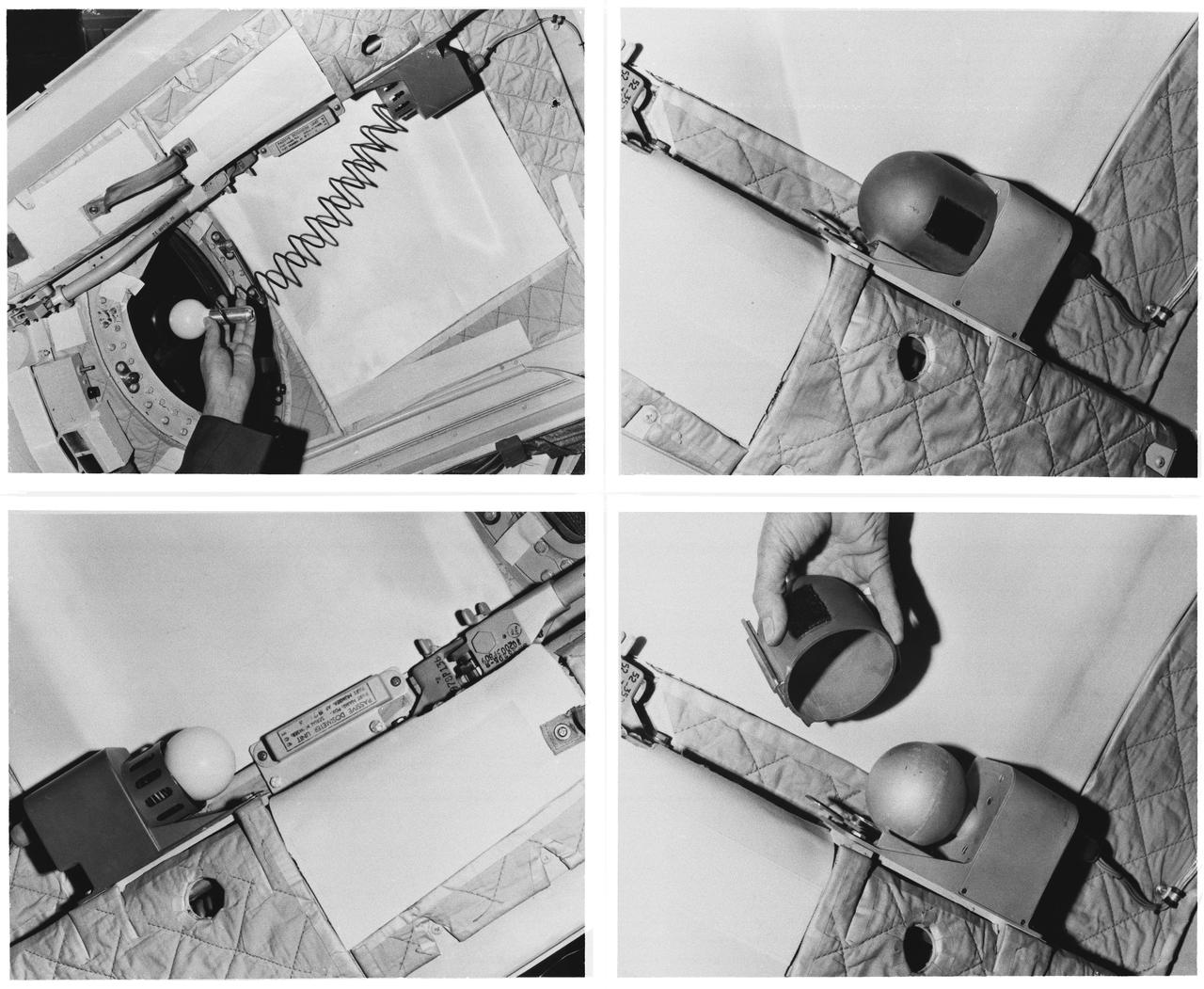
S65-61788 (For release: 11 Dec. 1965) --- Close-up view of equipment which will be used in the D-8 (Radiation in Spacecraft) experiment on the National Aeronautics and Space Administration's Gemini-6 spaceflight. This experiment is designed to make highly accurate measurements of the absorbed dose rate of radiation which penetrates the Gemini spacecraft, and determine the spatial distribution of dose levels inside the spacecraft particularly in the crew area. This is experimentation of the U.S. Air Force Weapons Laboratory, Kirtland AFB, N.M. LOWER LEFT: The second ionization chamber, this one is unshielded. This chamber can be removed from its bracket by the astronaut who will periodically take measurements at various locations in the spacecraft. Nearby is Passive Dosimeter Unit which is one of five small packets each containing a standard pocket ionization chamber, gamma electron sensitive film, glass needles and thermo luminescent dosimeters which are mounted at various locations in the cabin. UPPER LEFT: Photo illustrates how ionization chamber can be removed from bracket for measurements. LOWER RIGHT: Shield of bulb-shaped chamber will be removed (shown in photo) as the spacecraft passes through the South Atlantic anomaly, the area where the radiation belt dips closest to Earth's surface. UPPER RIGHT: Dome-shaped object is shield covering one of two Tissue Equivalent Ionization Chambers (sensors) which will read out continuously the instantaneous rate at which dose is delivered during the flight. This chamber is mounted permanently. The information will be recorded aboard the spacecraft, and will also be received directly by ground stations. This chamber is shielded to simulate the amount of radiation the crew members are receiving beneath their skin. Photo credit: NASA or National Aeronautics and Space Administration
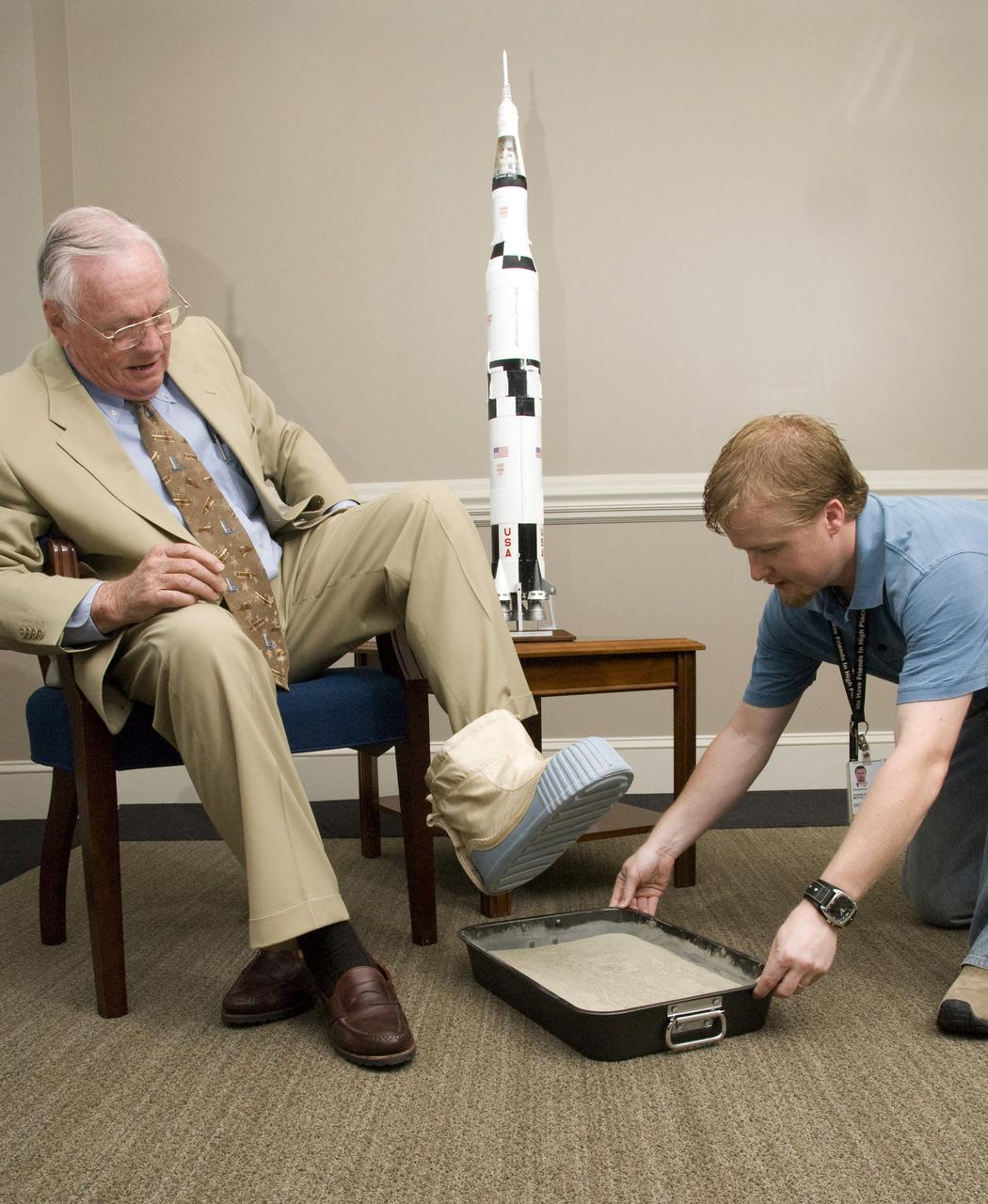
Among several other NASA dignitaries, former astronaut Neil A. Armstrong visited the Marshall Space Flight Center (MSFC) in attendance of the annual NASA Advisory Council Meeting. While here, Mr. Armstrong was gracious enough to allow the casting of his footprint. This casting will join those of other astronauts on display at the center. Armstrong was first assigned to astronaut status in 1962. He served as command pilot for the Gemini 8 mission, launched March 16, 1966, and performed the first successful docking of two vehicles in space. In 1969, Armstrong was commander of Apollo 11, the first manned lunar landing mission, and gained the distinction of being the first man to land a craft on the Moon and the first man to step on its surface. Armstrong subsequently held the position of Deputy Associate Administrator for Aeronautics, NASA Headquarters Office of Advanced Research and Technology, from 1970 to 1971. He resigned from NASA in 1971. Pictured with Armstrong is MSFC employee Daniel McFall, who assisted with the casting procedure.
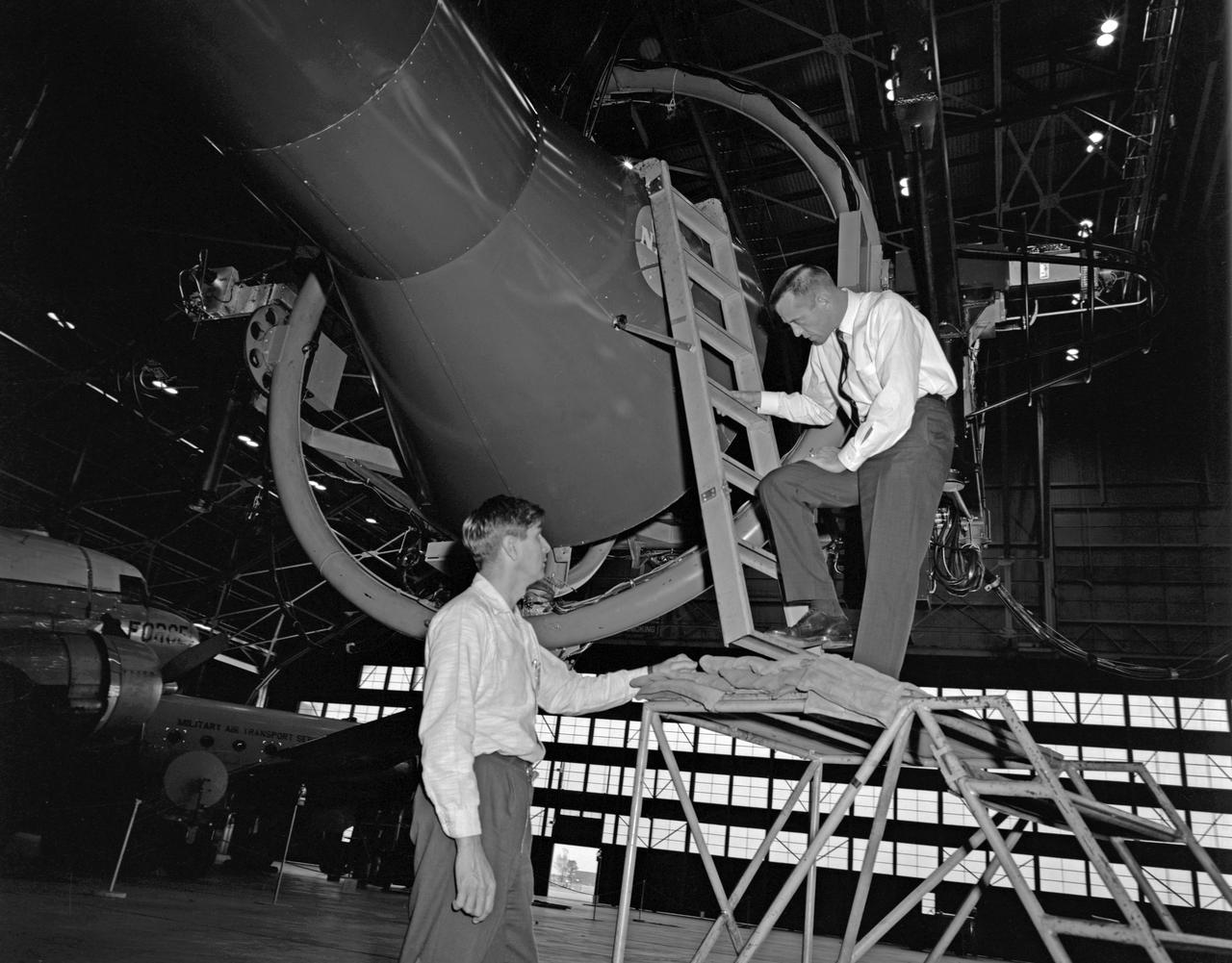
Astronaut Alan Shepard (right) was one of 14 astronauts, 8 NASA test pilots, and 2 McDonnell test pilots who took part in simulator studies. Shepard flew the simulator on November 14, 1963. A.W. Vogeley wrote: "Many of the astronauts have flown this simulator in support of the Gemini studies and they, without exception, appreciated the realism of the visual scene. The simulator has also been used in the development of pilot techniques to handle certain jet malfunctions in order that aborts could be avoided. In these situations large attitude changes are sometimes necessary and the false motion cues that were generated due to earth gravity were somewhat objectionable; however, the pilots were readily able to overlook these false motion cues in favor of the visual realism." Roy F. Brissenden noted that: "The basic Gemini control studies developed the necessary techniques and demonstrated the ability of human pilots to perform final space docking with the specified Gemini-Agena systems using only visual references. ... Results... showed that trained astronauts can effect the docking with direct acceleration control and even with jet malfunctions as long as good visual conditions exist.... Probably more important than data results was the early confidence that the astronauts themselves gained in their ability to perform the maneuver in the ultimate flight mission." Shepard commented: "I had the feeling tonight - a couple of times - that I was actually doing the space mission instead of the simulation. As I said before, I think it is a very good simulation." Shepard also commented on piloting techniques. Most astronauts arrived at this same preferred technique: Shepard: "I believe I have developed the preferred technique for these conditions and the technique appeared to me to be best was to come in slightly above the target so that I was able to use the longitudinal marks on the body of the target as a reference, particularly for a lateral translation and, of course, I used the foreshortening effect for a vertical translation, and this appeared to give me the best results. By that I mean the least number of control motions and the lowest fuel usage and the best end techniques, or the best end conditions, I should say." Engineer: "When you started to run you didn't start thrusting immediately I don't believe. It looked like you started working on your attitudes, then started closing in." Shepard: "That is correct. I did that because I felt that I wanted to get the X-axis translation in the most effective vector and for minimum fuel usage that wouldn't introduce any other lateral or vertical offsets that did not already exist." -- Published in Barton C. Hacker and James M. Grimwood, On the Shoulders of Titans: A History of Project Gemini, NASA SP-4203; A.W. Vogeley, "Discussion of Existing and Planned Simulators For Space Research," Paper presented at the Conference on the Role of Simulation in Space Technology, August 17-21, 1964; Roy F. Brissenden, "Initial Operations with Langley's Rendezvous Docking Facility," Langley Working Paper, LWP-21, 1964.
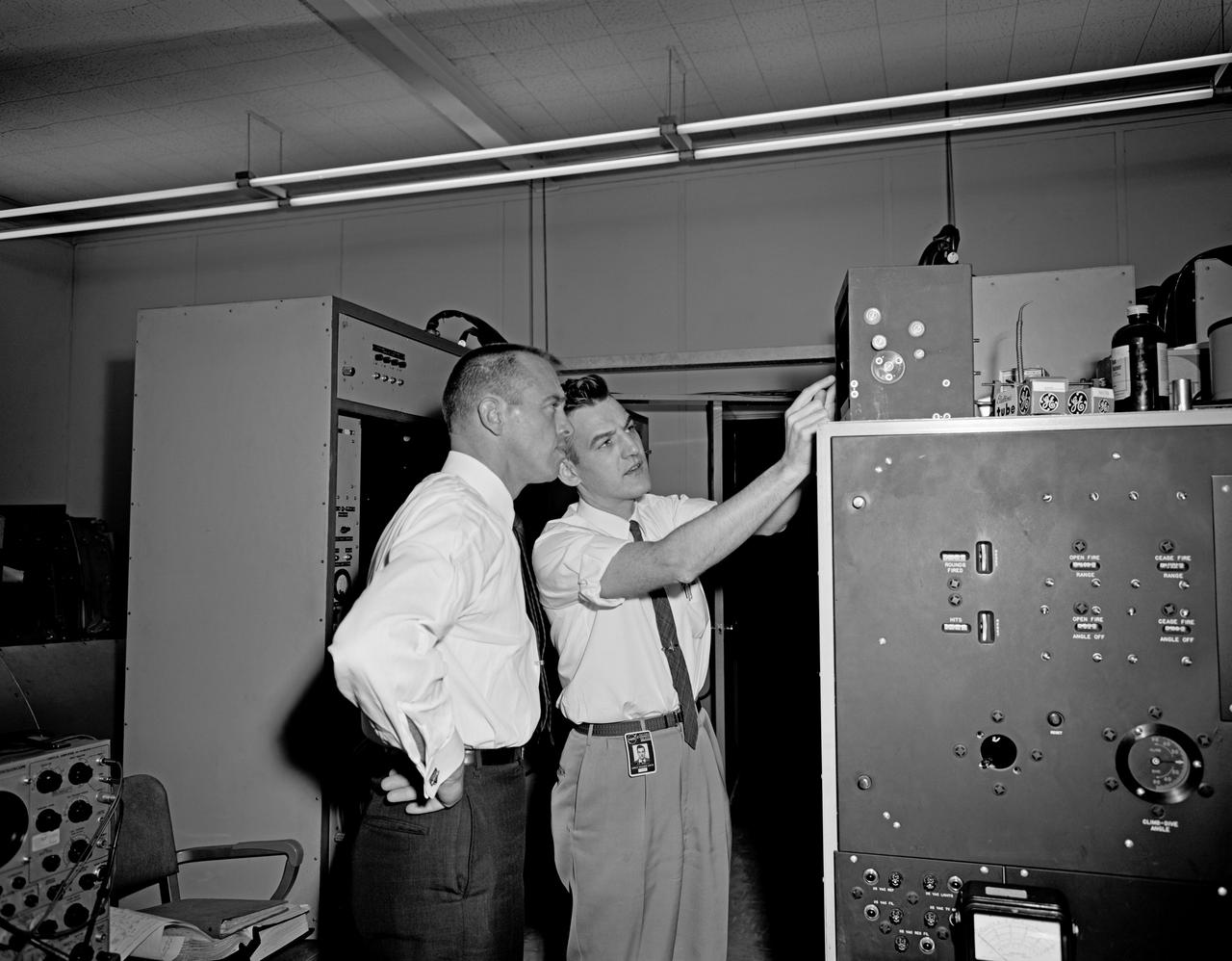
Astronaut Alan Shepard (right) was one of 14 astronauts, 8 NASA test pilots, and 2 McDonnell test pilots who took part in simulator studies. Shepard flew the simulator on November 14, 1963. A.W. Vogeley wrote: "Many of the astronauts have flown this simulator in support of the Gemini studies and they, without exception, appreciated the realism of the visual scene. The simulator has also been used in the development of pilot techniques to handle certain jet malfunctions in order that aborts could be avoided. In these situations large attitude changes are sometimes necessary and the false motion cues that were generated due to earth gravity were somewhat objectionable; however, the pilots were readily able to overlook these false motion cues in favor of the visual realism." Roy F. Brissenden noted that: "The basic Gemini control studies developed the necessary techniques and demonstrated the ability of human pilots to perform final space docking with the specified Gemini-Agena systems using only visual references. ... Results... showed that trained astronauts can effect the docking with direct acceleration control and even with jet malfunctions as long as good visual conditions exist.... Probably more important than data results was the early confidence that the astronauts themselves gained in their ability to perform the maneuver in the ultimate flight mission." Shepard commented: "I had the feeling tonight - a couple of times - that I was actually doing the space mission instead of the simulation. As I said before, I think it is a very good simulation." Shepard also commented on piloting techniques. Most astronauts arrived at this same preferred technique: Shepard: "I believe I have developed the preferred technique for these conditions and the technique appeared to me to be best was to come in slightly above the target so that I was able to use the longitudinal marks on the body of the target as a reference, particularly for a lateral translation and, of course, I used the foreshortening effect for a vertical translation, and this appeared to give me the best results. By that I mean the least number of control motions and the lowest fuel usage and the best end techniques, or the best end conditions, I should say." Engineer: "When you started to run you didn't start thrusting immediately I don't believe. It looked like you started working on your attitudes, then started closing in." Shepard: "That is correct. I did that because I felt that I wanted to get the X-axis translation in the most effective vector and for minimum fuel usage that wouldn't introduce any other lateral or vertical offsets that did not already exist." -- Published in Barton C. Hacker and James M. Grimwood, On the Shoulders of Titans: A History of Project Gemini, NASA SP-4203; A.W. Vogeley, "Discussion of Existing and Planned Simulators For Space Research," Paper presented at the Conference on the Role of Simulation in Space Technology, August 17-21, 1964; Roy F. Brissenden, "Initial Operations with Langley's Rendezvous Docking Facility," Langley Working Paper, LWP-21, 1964.

This is an illustration of a supermassive black hole, weighing as much as 21 million suns, located in the middle of the ultradense galaxy M60-UCD1. The dwarf galaxy is so dense that millions of stars fill the sky as seen by an imaginary visitor. Because no light can escape from the black hole, it appears simply in silhouette against the starry background. The black hole's intense gravitational field warps the light of the background stars to form ring-like images just outside the dark edges of the black hole's event horizon. Combined observations by the Hubble Space Telescope and Gemini North telescope determined the presence of the black hole inside such a small and dense galaxy. More info: Astronomers using data from NASA’s Hubble Space Telescope and ground observation have found an unlikely object in an improbable place -- a monster black hole lurking inside one of the tiniest galaxies ever known. The black hole is five times the mass of the one at the center of our Milky Way galaxy. It is inside one of the densest galaxies known to date -- the M60-UCD1 dwarf galaxy that crams 140 million stars within a diameter of about 300 light-years, which is only 1/500th of our galaxy’s diameter. If you lived inside this dwarf galaxy, the night sky would dazzle with at least 1 million stars visible to the naked eye. Our nighttime sky as seen from Earth’s surface shows 4,000 stars. The finding implies there are many other compact galaxies in the universe that contain supermassive black holes. The observation also suggests dwarf galaxies may actually be the stripped remnants of larger galaxies that were torn apart during collisions with other galaxies rather than small islands of stars born in isolation. “We don’t know of any other way you could make a black hole so big in an object this small,” said University of Utah astronomer Anil Seth, lead author of an international study of the dwarf galaxy published in Thursday’s issue of the journal Nature. Seth’s team of astronomers used the Hubble Space Telescope and the Gemini North 8-meter optical and infrared telescope on Hawaii’s Mauna Kea to observe M60-UCD1 and measure the black hole’s mass. The sharp Hubble images provide information about the galaxy’s diameter and stellar density. Gemini measures the stellar motions as affected by the black hole’s pull. These data are used to calculate the mass of the black hole. Black holes are gravitationally collapsed, ultra-compact objects that have a gravitational pull so strong that even light cannot escape. Supermassive black holes -- those with the mass of at least one million stars like our sun -- are thought to be at the centers of many galaxies. The black hole at the center of our Milky Way galaxy has the mass of four million suns. As heavy as that is, it is less than 0.01 percent of the Milky Way’s total mass. By comparison, the supermassive black hole at the center of M60-UCD1, which has the mass of 21 million suns, is a stunning 15 percent of the small galaxy’s total mass. “That is pretty amazing, given that the Milky Way is 500 times larger and more than 1,000 times heavier than the dwarf galaxy M60-UCD1,” Seth said. One explanation is that M60-UCD1 was once a large galaxy containing 10 billion stars, but then it passed very close to the center of an even larger galaxy, M60, and in that process all the stars and dark matter in the outer part of the galaxy were torn away and became part of M60. The team believes that M60-UCD1 may eventually be pulled to fully merge with M60, which has its own monster black hole that weighs a whopping 4.5 billion solar masses, or more than 1,000 times bigger than the black hole in our galaxy. When that happens, the black holes in both galaxies also likely will merge. Both galaxies are 50 million light-years away. The Hubble Space Telescope is a project of international cooperation between NASA and the European Space Agency. NASA's Goddard Space Flight Center in Greenbelt, Maryland, manages the telescope. The Space Telescope Science Institute (STScI) in Baltimore conducts Hubble science operations. STScI is operated for NASA by the Association of Universities for Research in Astronomy, Inc., in Washington. For images and more information about Hubble, visit: <a href="http://www.nasa.gov/hubble" rel="nofollow">www.nasa.gov/hubble</a> <b><a href="http://www.nasa.gov/audience/formedia/features/MP_Photo_Guidelines.html" rel="nofollow">NASA image use policy.</a></b> <b><a href="http://www.nasa.gov/centers/goddard/home/index.html" rel="nofollow">NASA Goddard Space Flight Center</a></b> enables NASA’s mission through four scientific endeavors: Earth Science, Heliophysics, Solar System Exploration, and Astrophysics. Goddard plays a leading role in NASA’s accomplishments by contributing compelling scientific knowledge to advance the Agency’s mission. <b>Follow us on <a href="http://twitter.com/NASAGoddardPix" rel="nofollow">Twitter</a></b> <b>Like us on <a href="http://www.facebook.com/pages/Greenbelt-MD/NASA-Goddard/395013845897?ref=tsd" rel="nofollow">Facebook</a></b> <b>Find us on <a href="http://instagram.com/nasagoddard?vm=grid" rel="nofollow">Instagram</a></b>