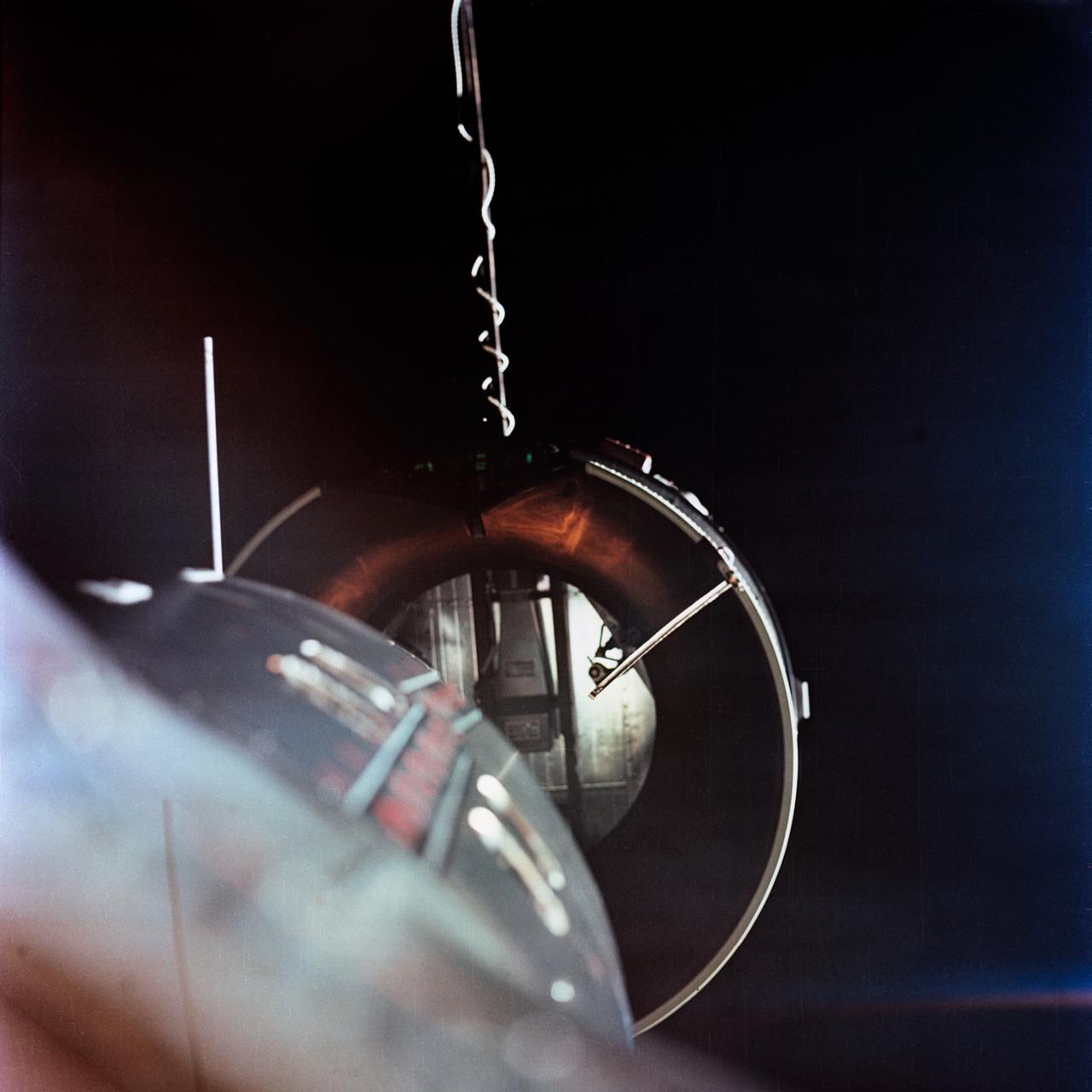
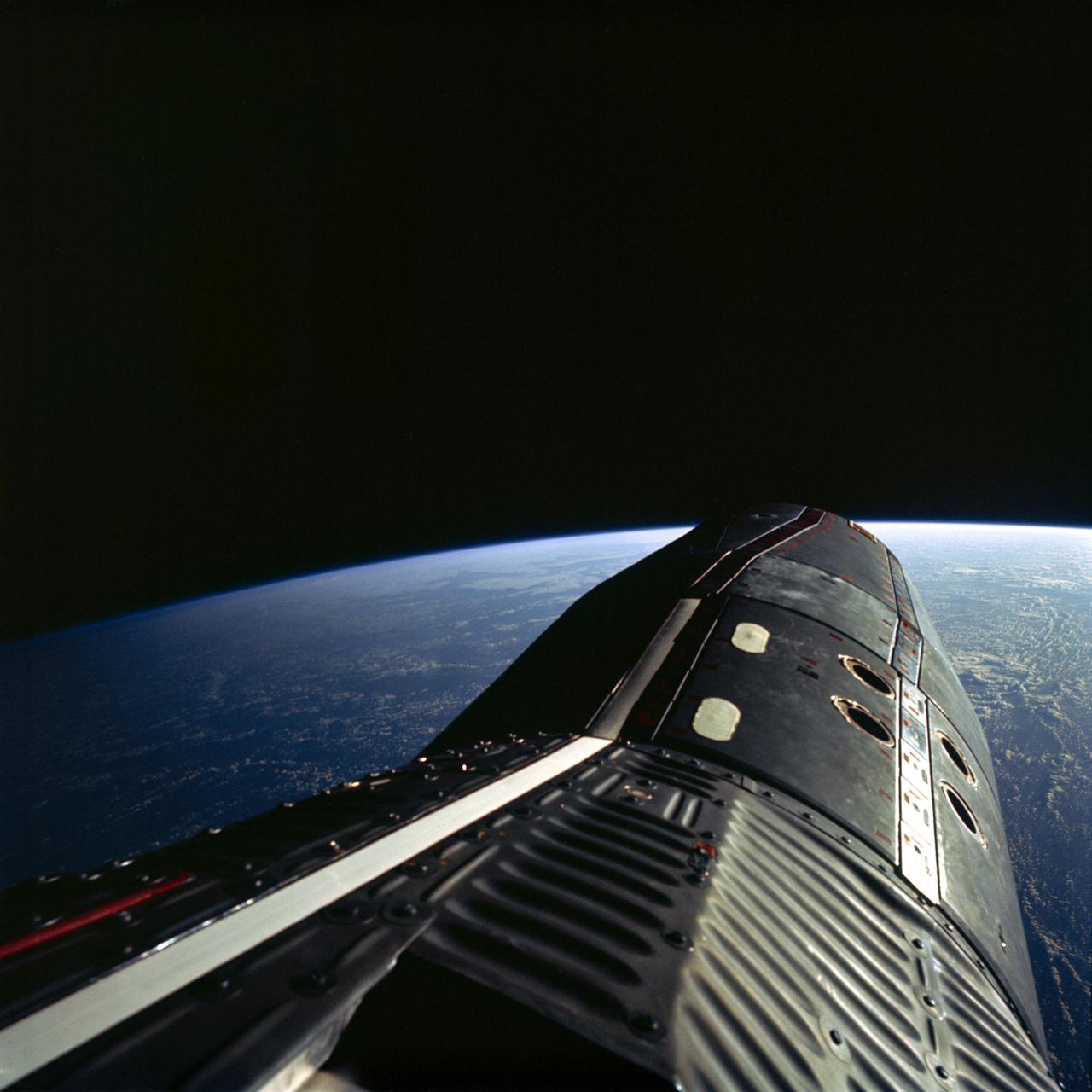
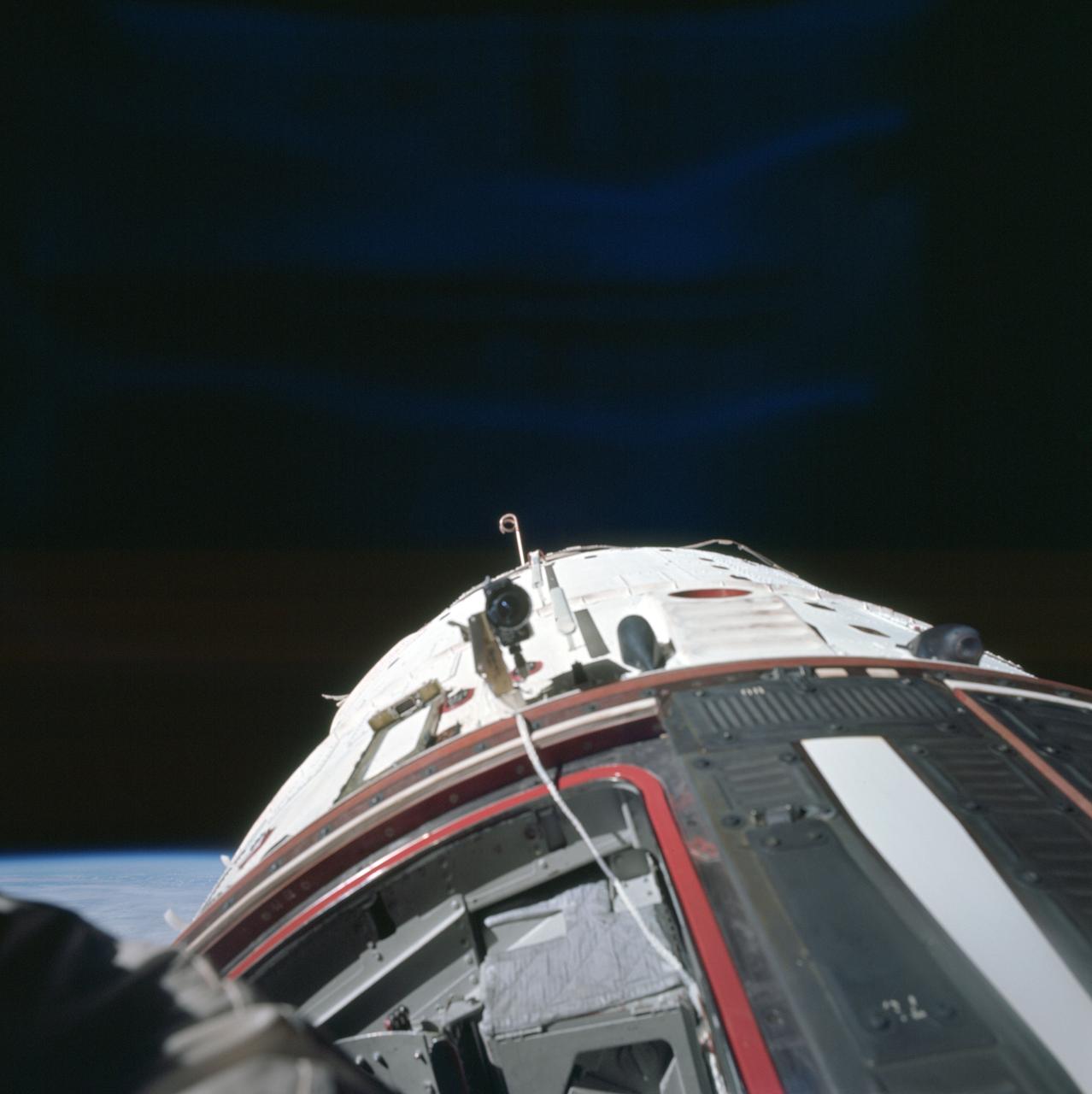
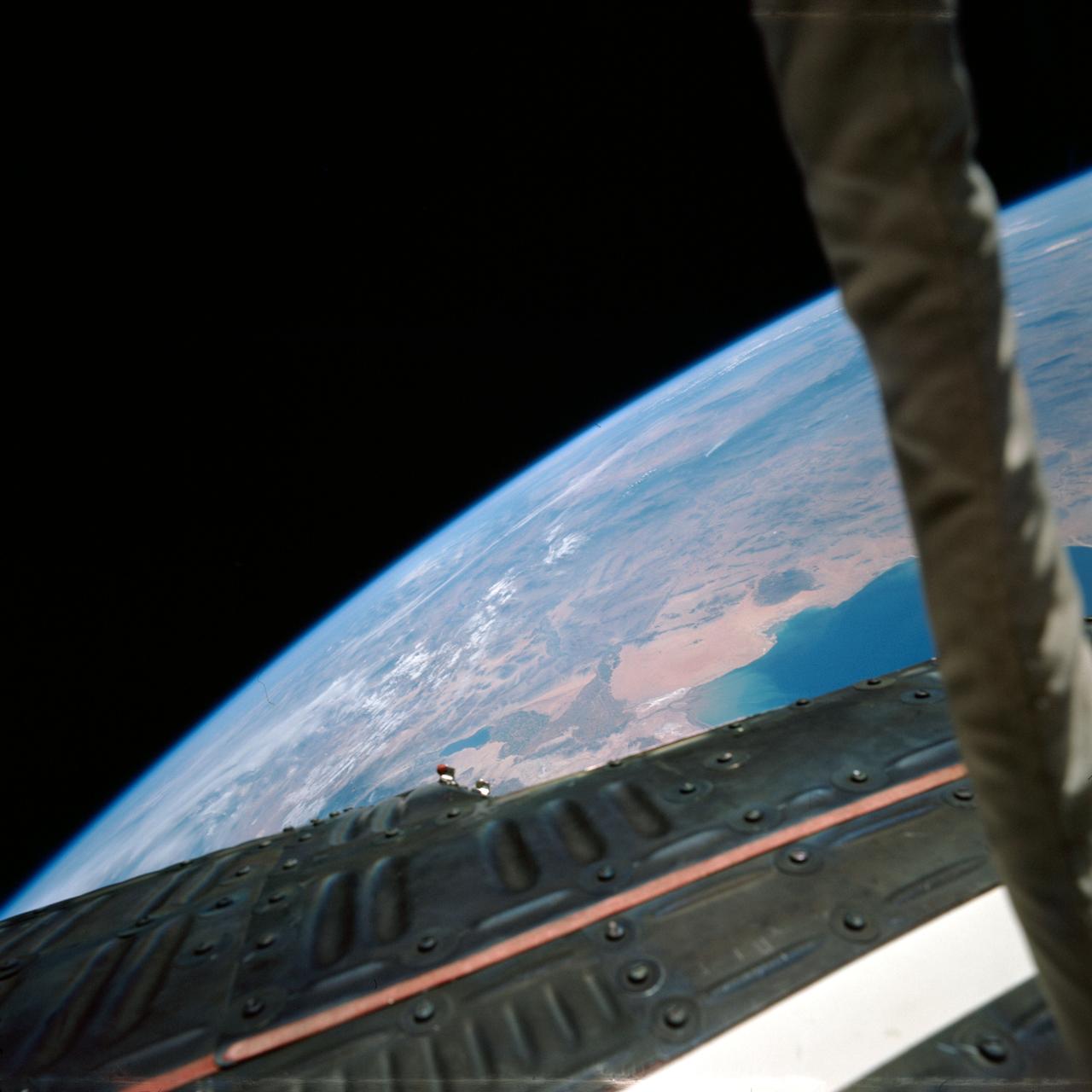
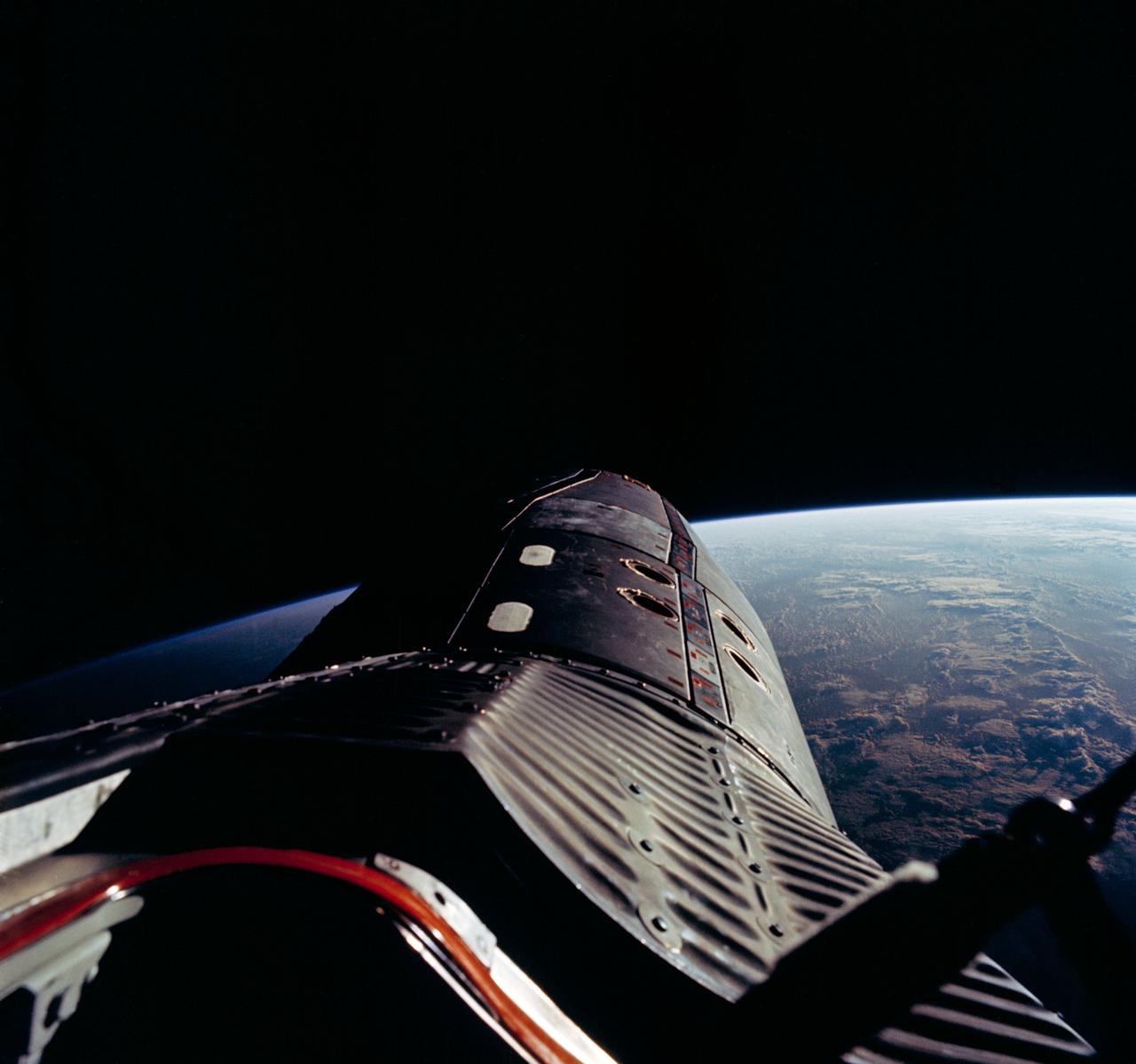
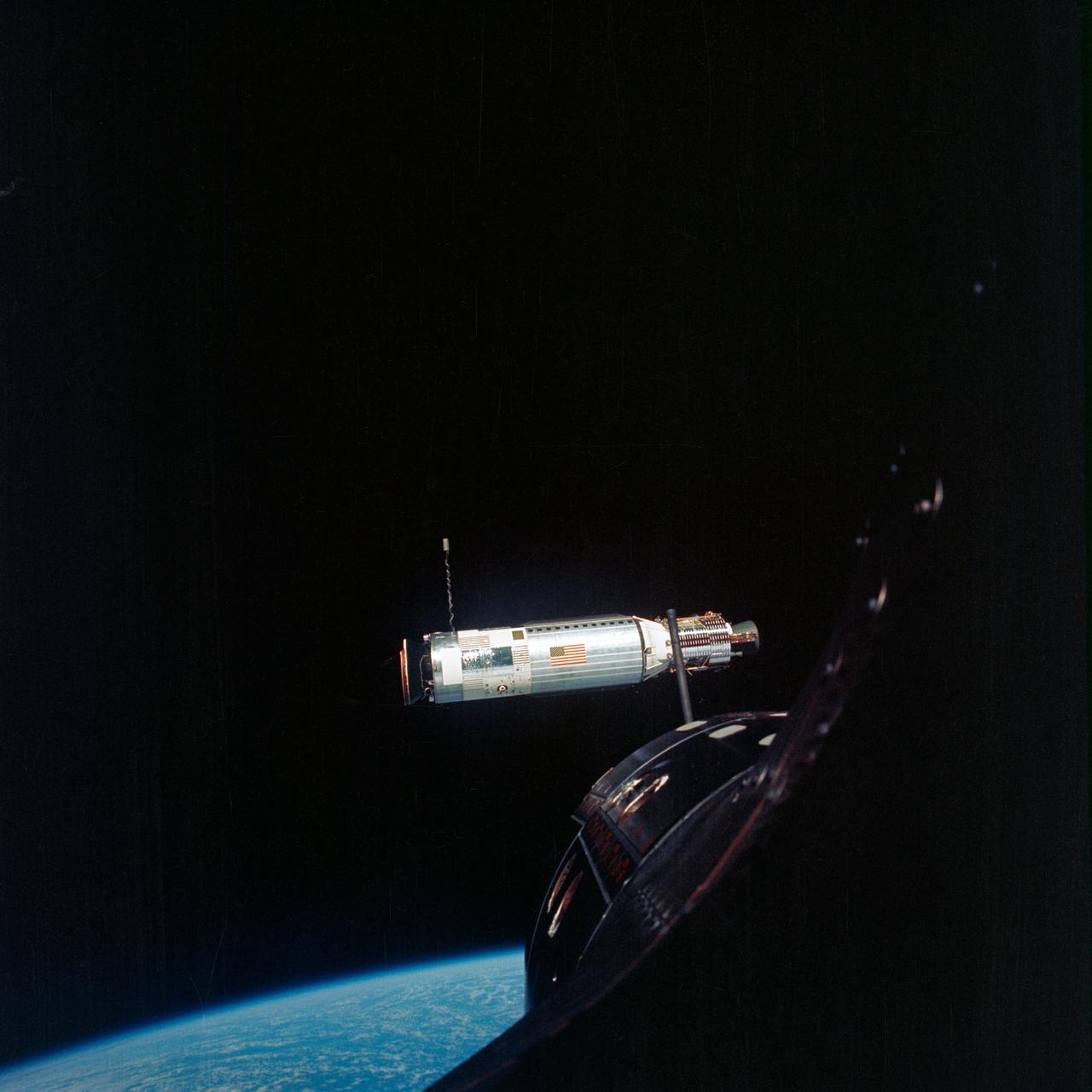
S66-54656 (13 Sept. 1966) --- Nose of Gemini-11 spacecraft and Agena Target Vehicle while docked as photographed by astronaut Richard F. Gordon Jr., pilot, during his stand-up extravehicular activity (EVA). Taken with a modified 70mm Hasselblad camera, using Eastman Kodak, Ektachrome, MS (S.O. 368) color film. Photo credit: NASA
Nose of Gemini 11 spacecraft and Agena Target Vehicle as seen during EVA
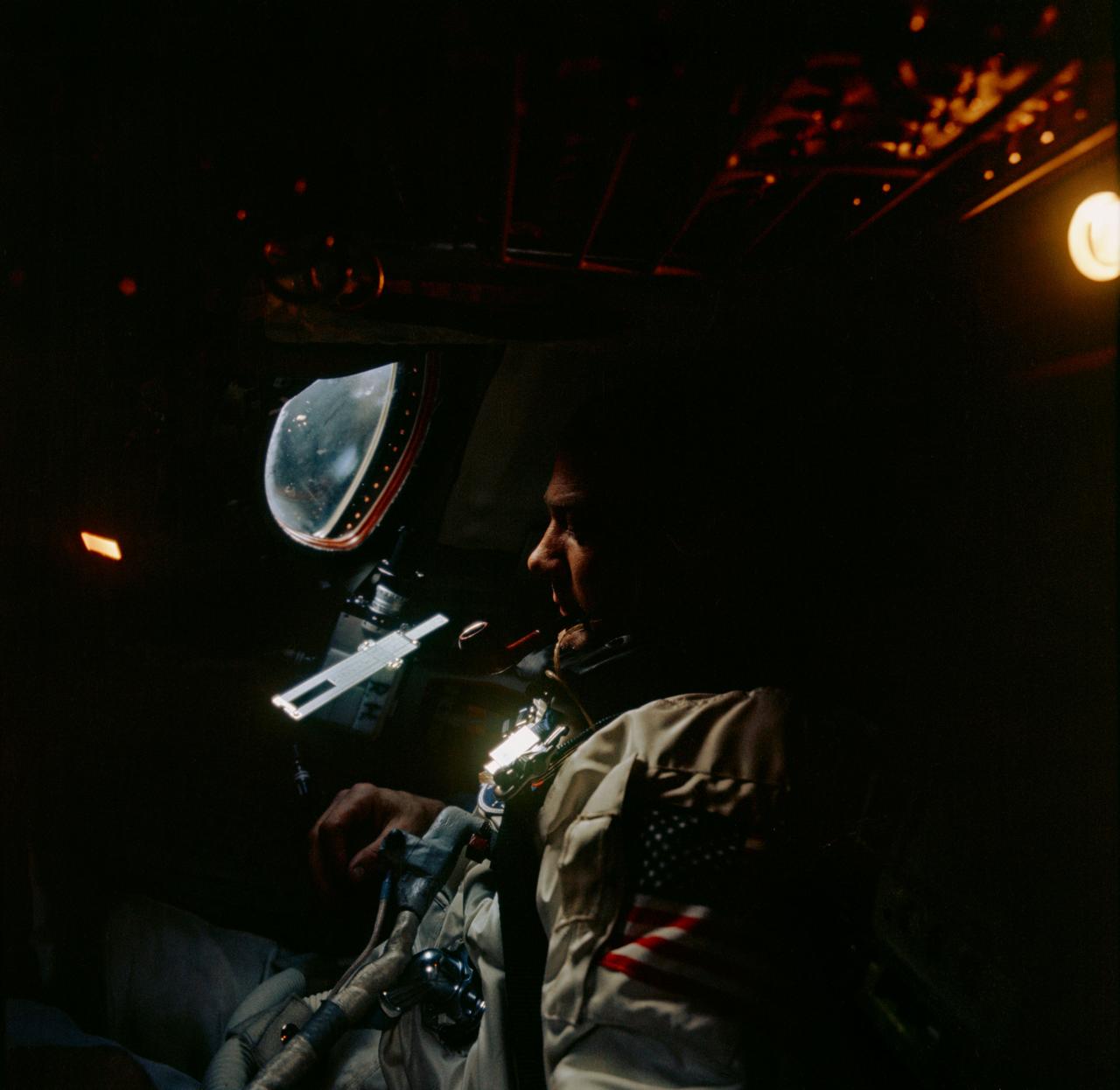
S66-62984 (13 Nov. 1966) --- Astronaut Edwin Aldrin Jr. photographed inside the Gemini-12 spacecraft cabin during the spaceflight. Photo credit: NASA
Astronaut Edwin Aldrin inside Gemini spacecraft cabin during flight
S66-25778 (16 March 1966) --? The Agena Target Docking Vehicle seen from the National Aeronautics and Space Administration?s Gemini-8 spacecraft during rendezvous in space. The Agena is approximately 260 feet away from the nose of the spacecraft (lower left). Crewmen for the Gemini-8 mission are astronauts Neil A. Armstrong, command pilot, and David R. Scott, pilot. Photo credit: NASA
Agena Target Docking vehicle seen from Gemini 8 spacecraft
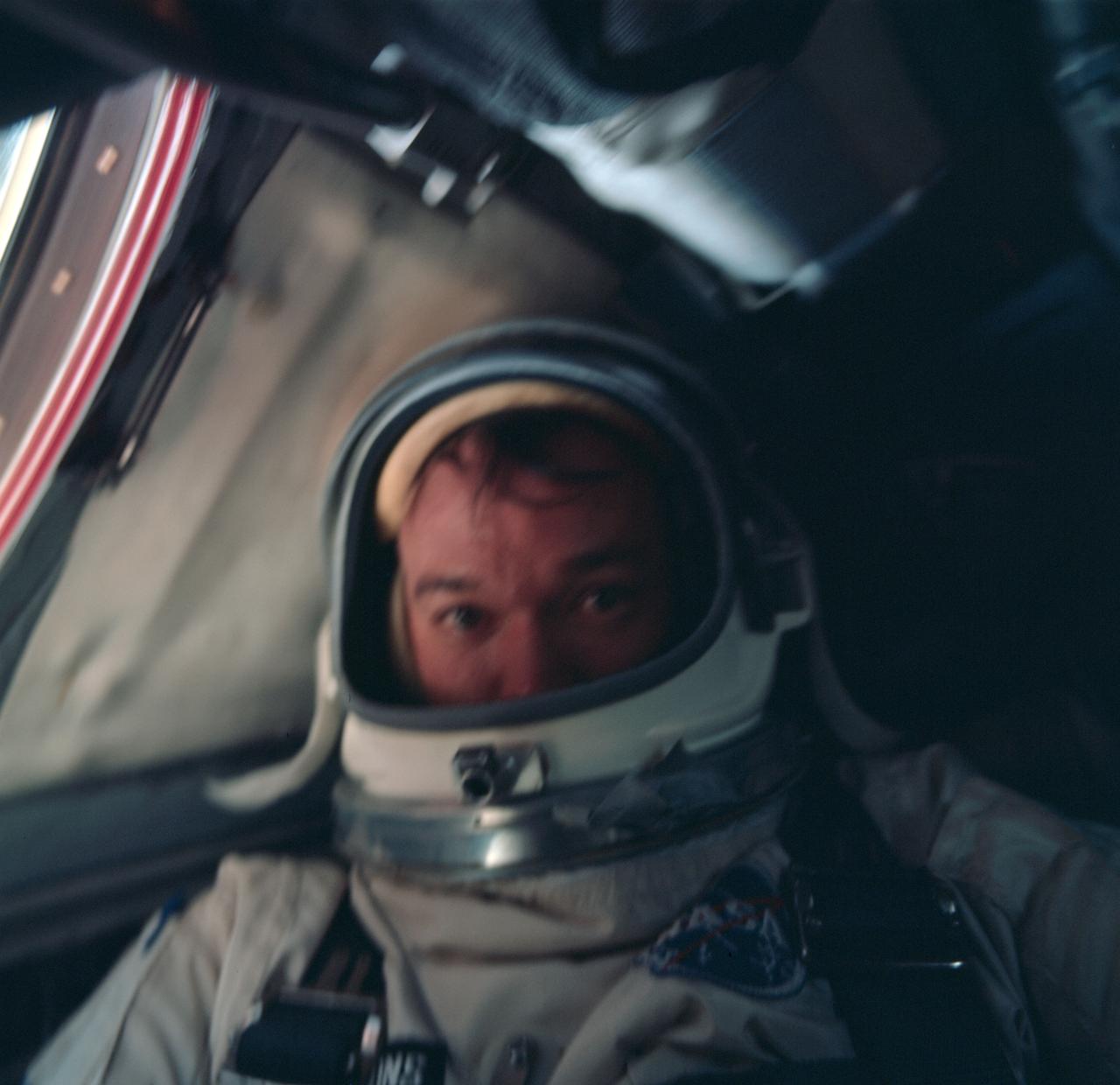
S66-46270 (18 July 1966) --- Astronaut Michael Collins is photographed inside the spacecraft during the Gemini-10 mission. Photo credit: NASA
Astronaut Michael Collins photographed inside spacecraft during mission
S66-25784 (16 March 1966) --? The Agena Target Docking Vehicle seen from the National Aeronautics and Space Administration?s Gemini adapter of the Agena is approximately two feet from the nose of the spacecraft (lower left).  Crewmen for the Gemini-8 mission were astronauts Neil A. Armstrong, command pilot, and David R. Scott, pilot. Photo credit: NASA
Agena Target Docking vehicle seen from Gemini 8 spacecraft
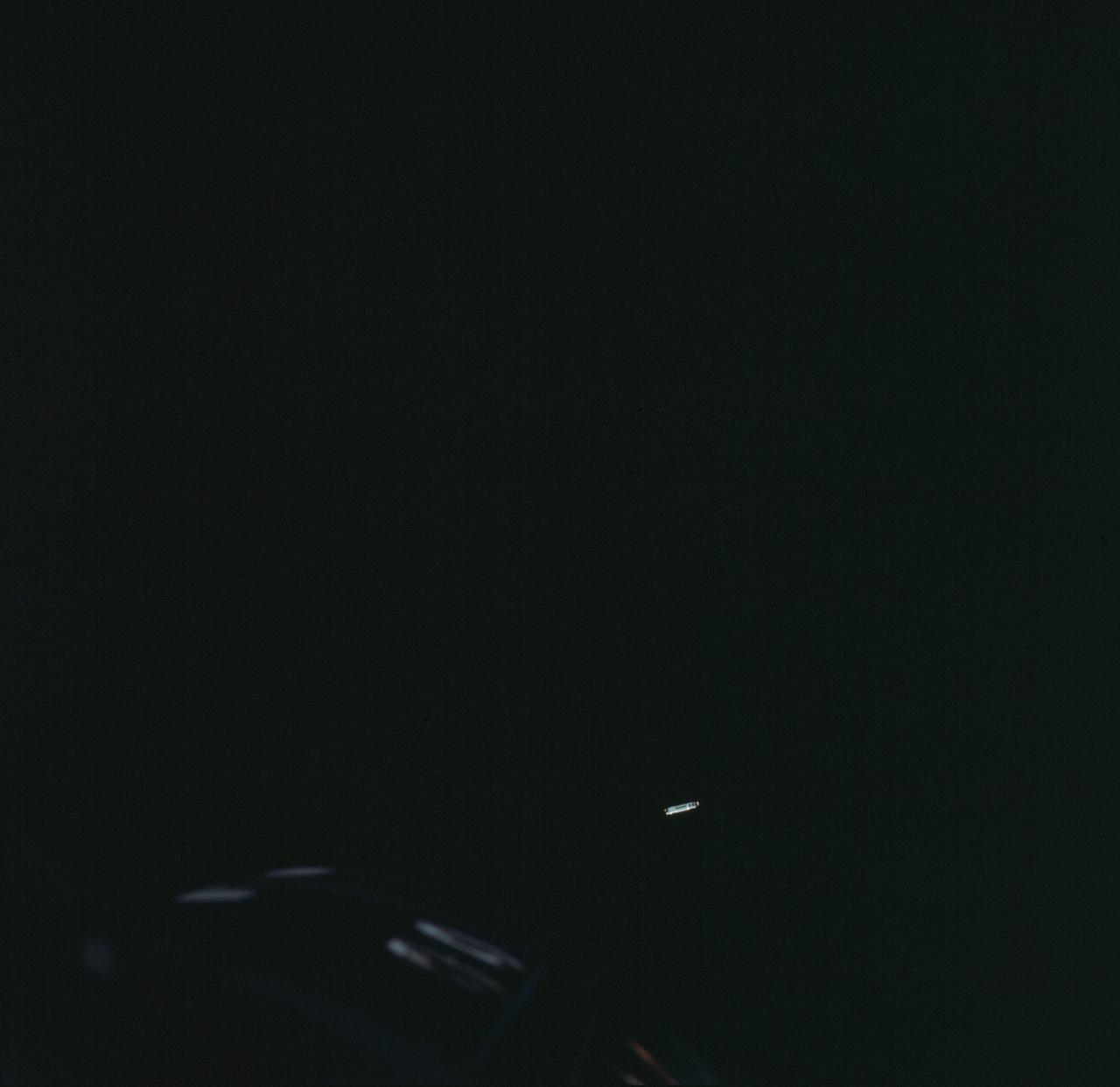
S66-25774 (16 March 1966) --- The Agena Target Docking vehicle seen from the Gemini-8 spacecraft during rendezvous in space. The Agena is approximately 1,000 feet away from the nose of the spacecraft (lower left). Photo credit: NASA
Agena Target Docking vehicle seen from Gemini 8 spacecraft
S65-63171 (15 Dec. 1965) --- The Gemini-7 spacecraft as seen from the Gemini-6 spacecraft during their rendezvous mission in space. Photo credit: NASA or National Aeronautics and Space Administration
View of the Gemini 6 and Gemini 7 rendezvous
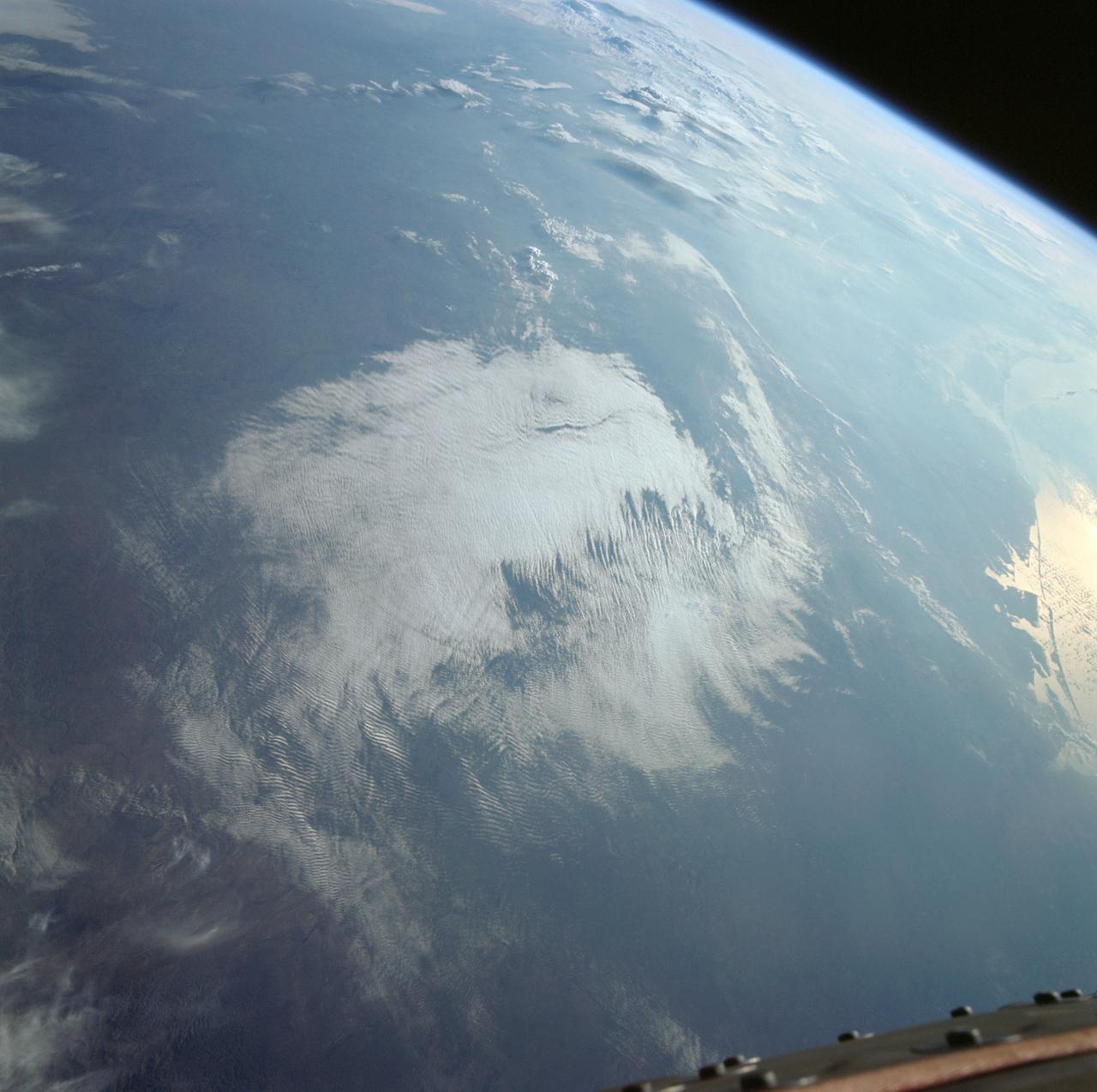
S66-54558 (14 Sept. 1966) --- Del Rio and Eagle Pass area of the Rio Grande Valley of Texas and Mexico as seen from the Gemini-11 spacecraft during its 29th revolution of Earth. Photo credit: NASA
Rio Grande Valley of Texas as seen from Gemini 11 spacecraft
S66-54692 (14 Sept. 1966) --- Indonesian Islands (partial cloud cover): Sumatra, Java, Bali, Borneo, and Sumbawa, as photographed from the Gemini-11 spacecraft during its 26th revolution of Earth, at an altitude of 570 nautical miles.  Photo credit: NASA
Indonesian Islands as seen from Gemini 11 spacecraft
S66-54563 (14 Sept. 1966) --- View of the Gulf Coast area from Atchafalaya Bay to Apalachicola, including the mouth of the Mississippi River, Mobile Bay, New Orleans, Louisiana, and Pensacola, Florida, as seen from the Gemini-11 spacecraft during its 29th revolution of Earth. This photo was taken near sunrise. Photo credit: NASA
Gulf Coast from from Atchafalaya Bay to Apalachicola seen from Gemini 11
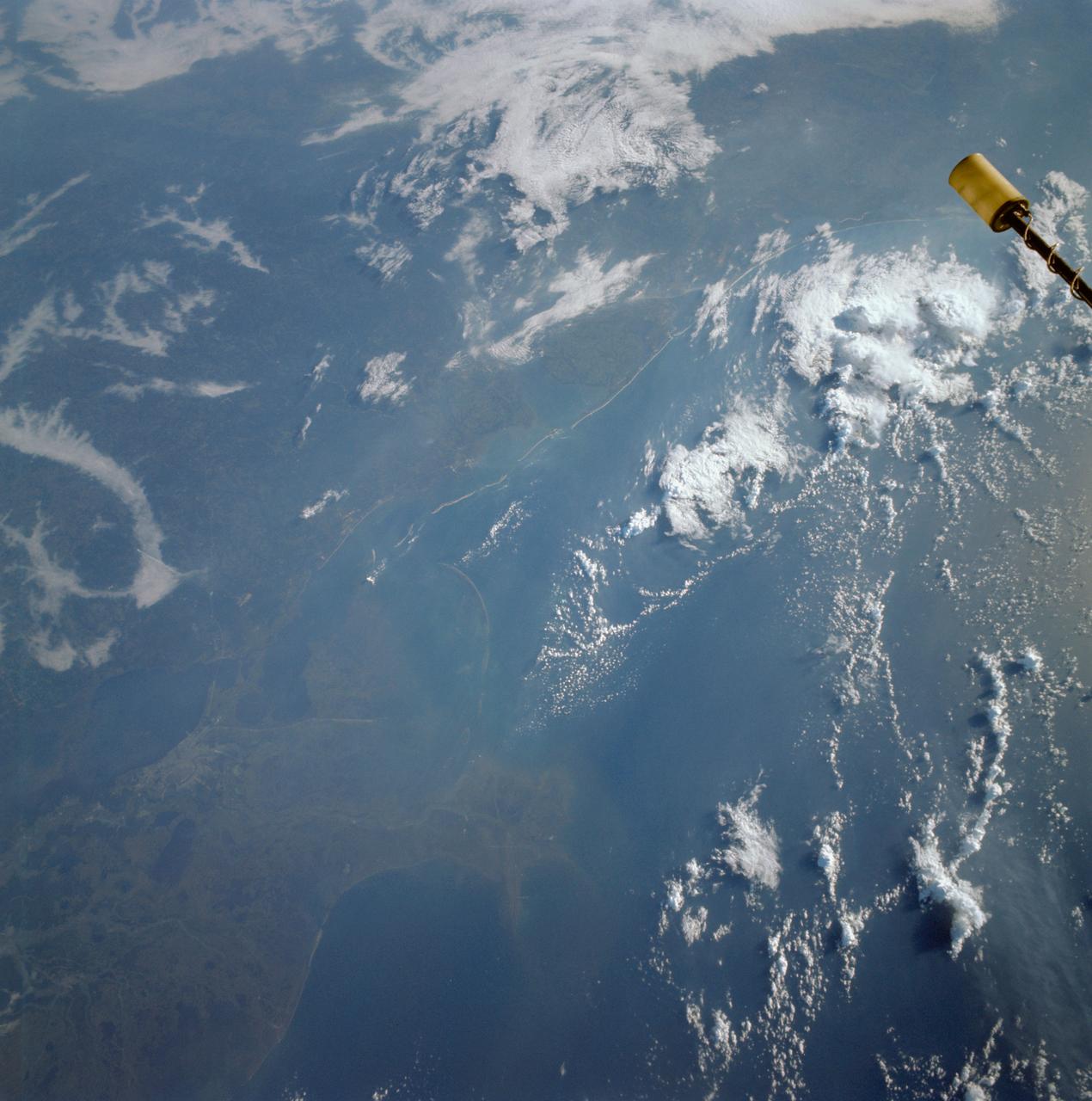
S66-54559 (14 Sept. 1966) --- Gulf Coast from Corpus Christi, Texas, to mouth of Mississippi River, as seen from the Gemini-11 spacecraft during its 29th revolution of Earth. This photo was taken near sunrise. Photo credit: NASA
Gulf Coast from Corpus Christi to mouth of Mississippi river from Gemini 11
S66-54590 (13 Sept. 1966) --- Astronaut Richard F. Gordon Jr., Gemini-11 pilot, prepares to open spacecraft hatch to jettison used equipment. Photo credit: NASA
Astronaut Richard Gordon prepares to open hatch to jettison equipment
S66-62920 (13 Nov. 1966) --- Astronaut Edwin E. Aldrin Jr., pilot of the Gemini-12 spaceflight, took this picture of the Gemini-12 spacecraft during standup extravehicular activity (EVA) with the hatch open. This is a view to the rear showing the adapter section. Photo credit: NASA
Gemini 12 spacecraft seen during EVA
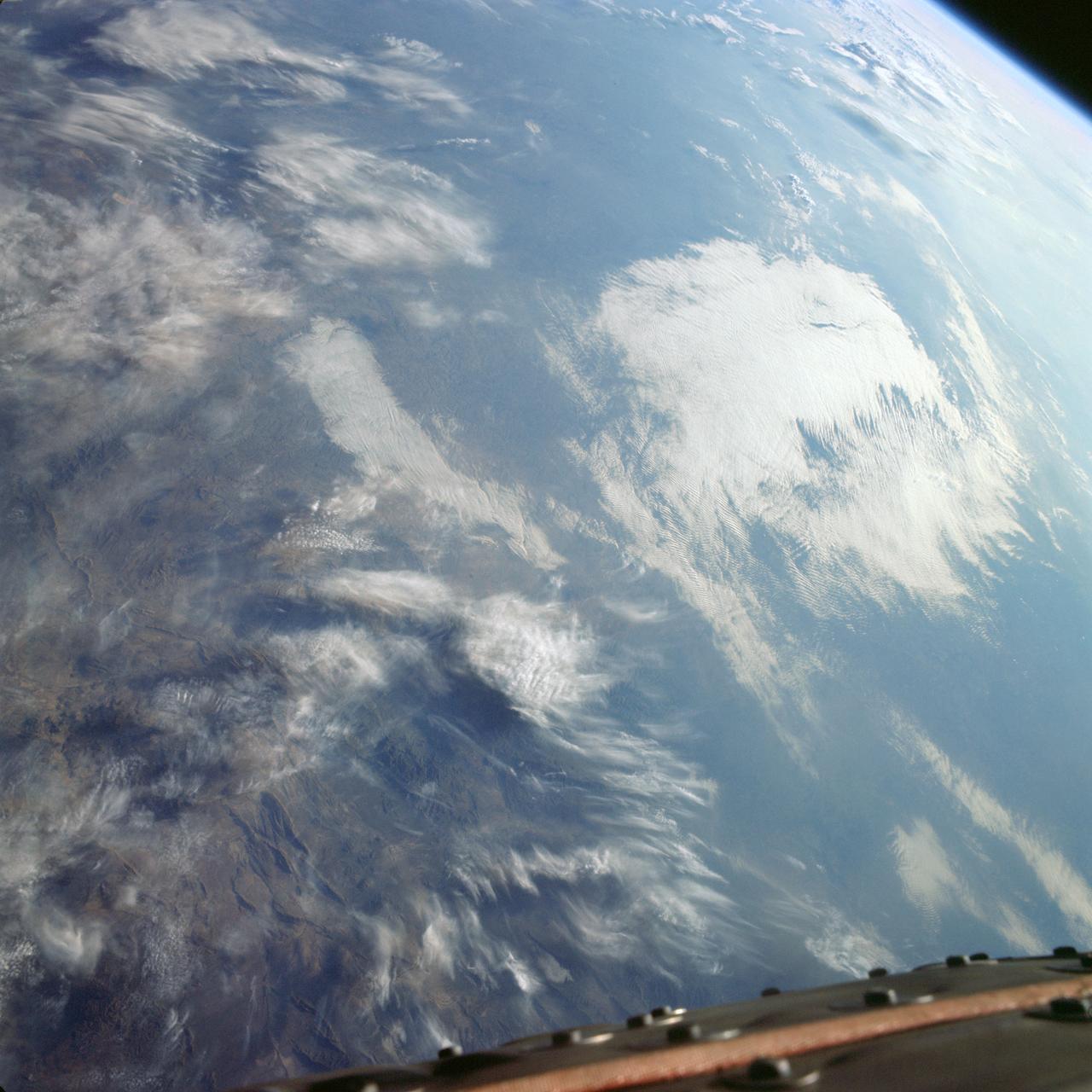
S66-38068 (5 June 1966) --- Astronaut Eugene A. Cernan took this view of the Gemini-9A spacecraft and his umbilical cord (right) over California, Arizona, and Sonora, Mexico, during his extravehicular activity (EVA) on the Gemini-9A mission. Taken during the 32nd revolution of the flight. Photo credit: NASA
Gemini 9 spacecraft during EVA as seen Astronaut Eugene Cernan
S66-63011 (13 Nov. 1966) --- Astronaut Edwin E. Aldrin Jr., pilot of the Gemini-12 spaceflight, took this picture of the Gemini-12 spacecraft during standup extravehicular activity (EVA) with the hatch open. Photo credit: NASA
Gemini 12 spacecraft seen during EVA
S66-63007 (12 Nov. 1966) --- Astronaut Edwin E. Aldrin Jr., pilot of the Gemini-12 spaceflight, took this picture of the Gemini-12 spacecraft during standup extravehicular activity (EVA) with the hatch open. This is a view looking forward showing the adapter section. Photo credit: NASA
Gemini 12 spacecraft seen during EVA
S66-46124 (18 July 1966) --- Agena Target Docking Vehicle 5005 is photographed from the Gemini-10 spacecraft during rendezvous in space. The two spacecraft are about 41 feet apart. After docking with the Agena, astronauts John W. Young, command pilot, and Michael Collins, pilot, fired the 16,000-pound thrust engine of Agena-10's primary propulsion system to boost the combined vehicles into an orbit with an apogee of 413 nautical miles to set a new altitude record for manned spaceflight. Photo credit: NASA
Agena Target Docking Vehicle photographed from Gemini 10 spacecraft
S65-63198 (15 Dec. 1965) --- The Gemini-7 spacecraft as seen from the Gemini-6 spacecraft during their rendezvous mission in space. They are approximately 39 feet apart. Photo credit: NASA or National Aeronautics and Space Administration
View of the Gemini 6 and Gemini 7 rendezvous
S65-63220 (15 Dec. 1965) --- This photograph of the Gemini-Titan 7 (GT-7) spacecraft was taken from the Gemini-Titan 6 (GT-6) spacecraft during the historic rendezvous of the two spacecraft on Dec. 15, 1965. The two spacecraft are some 37 feet apart here. Earth can be seen below. Astronauts Walter M. Schirra Jr., command pilot; and Thomas P. Stafford, pilot, were inside the GT-6 spacecraft, while crewmen for the GT-7 mission were astronauts Frank Borman, command pilot, and James A. Lovell Jr., pilot. Photo credit: NASA or National Aeronautics and Space Administration
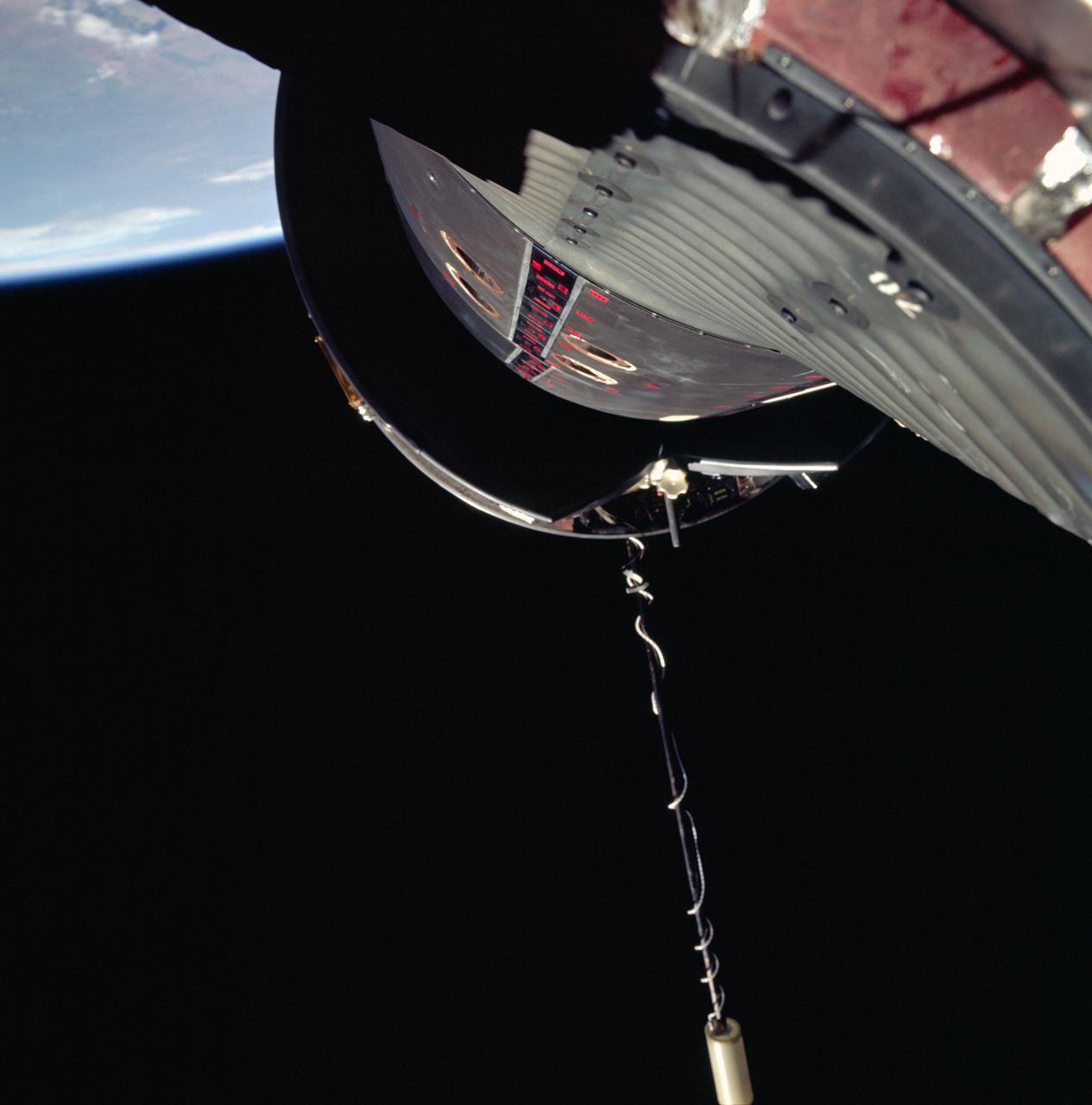
View of the Gemini 6 and Gemini 7 rendezvous
S65-63113 (15 Dec. 1965) --- This photograph of the Gemini-7 spacecraft was taken from the hatch window of the Gemini-6 spacecraft during rendezvous and station keeping maneuvers at an altitude of approximately 160 miles on Dec. 15, 1965. Photo credit: NASA or National Aeronautics and Space Administration
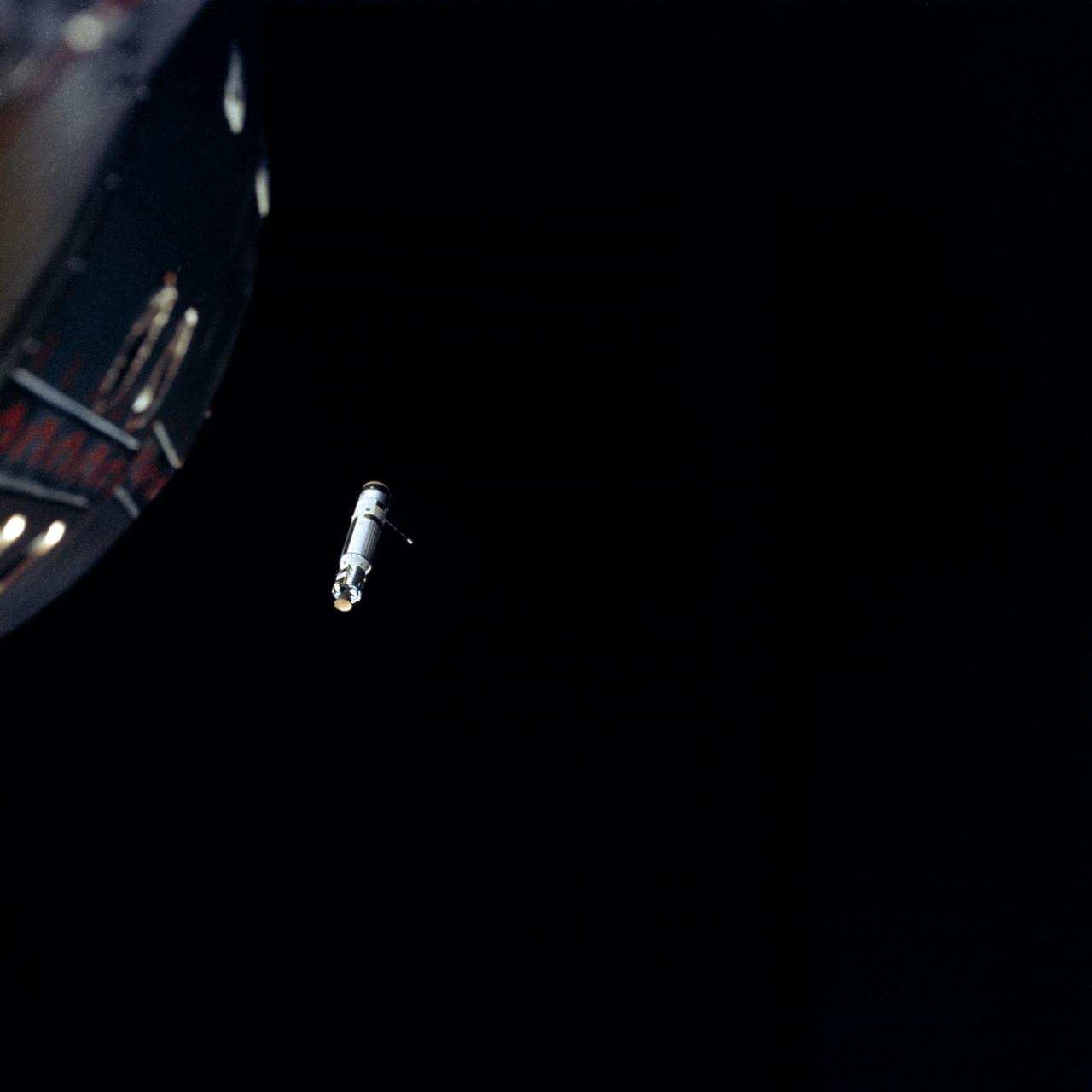
View of the Gemini 6 and Gemini 7 rendezvous
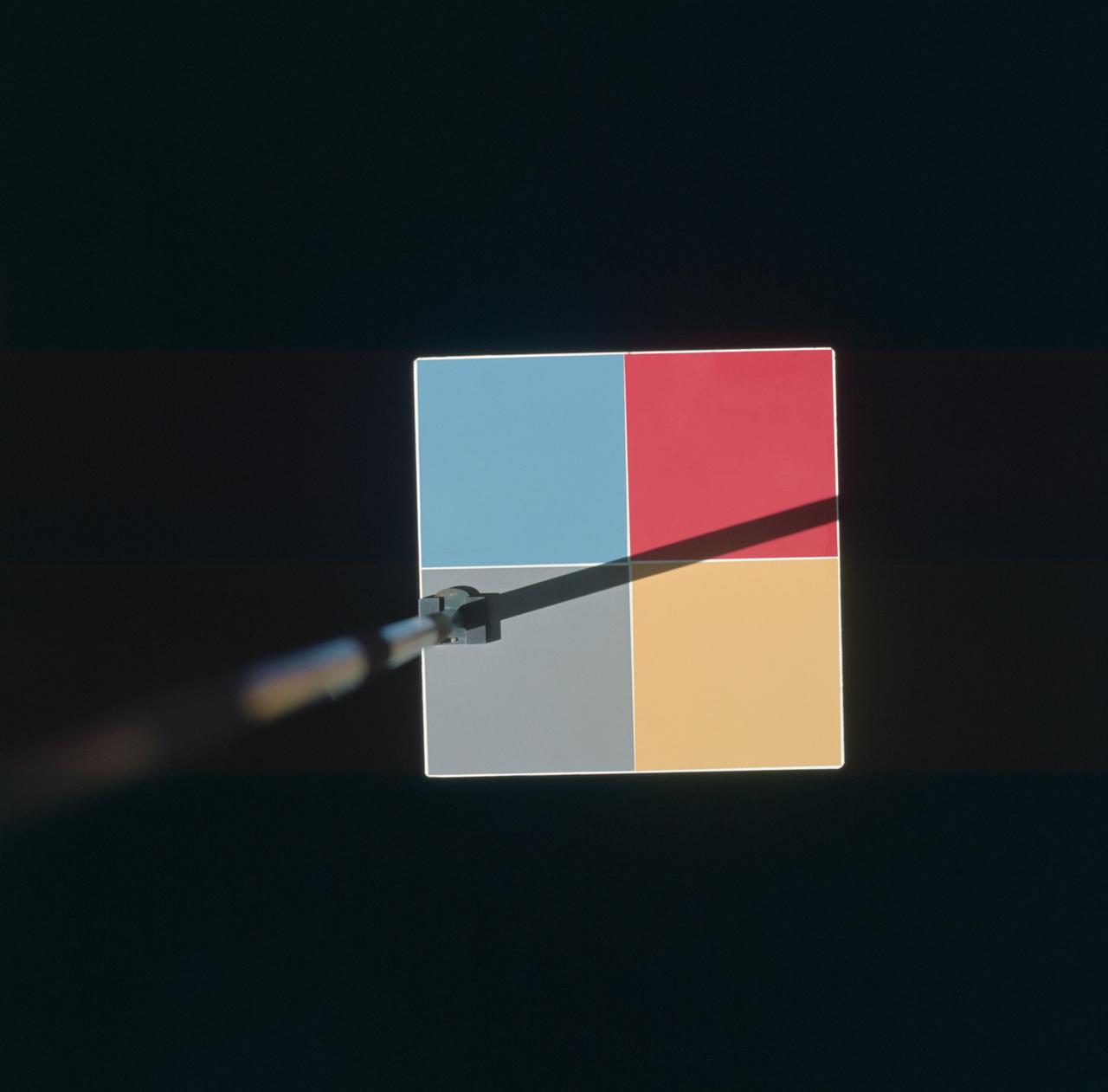
S66-46025 (18 July 1966) --- Astronaut Michael Collins, Gemini-10 pilot, photographed this MSC-8 color patch outside the spacecraft during the Gemini-10/Agena docking mission. The experiment was for the purpose of showing what effect the environment of space will have upon the color photography taken in cislunar space and on the lunar surface during an Apollo mission. Photo credit: NASA
Photograph of MSC-8 color patch outside spacecraft during docking
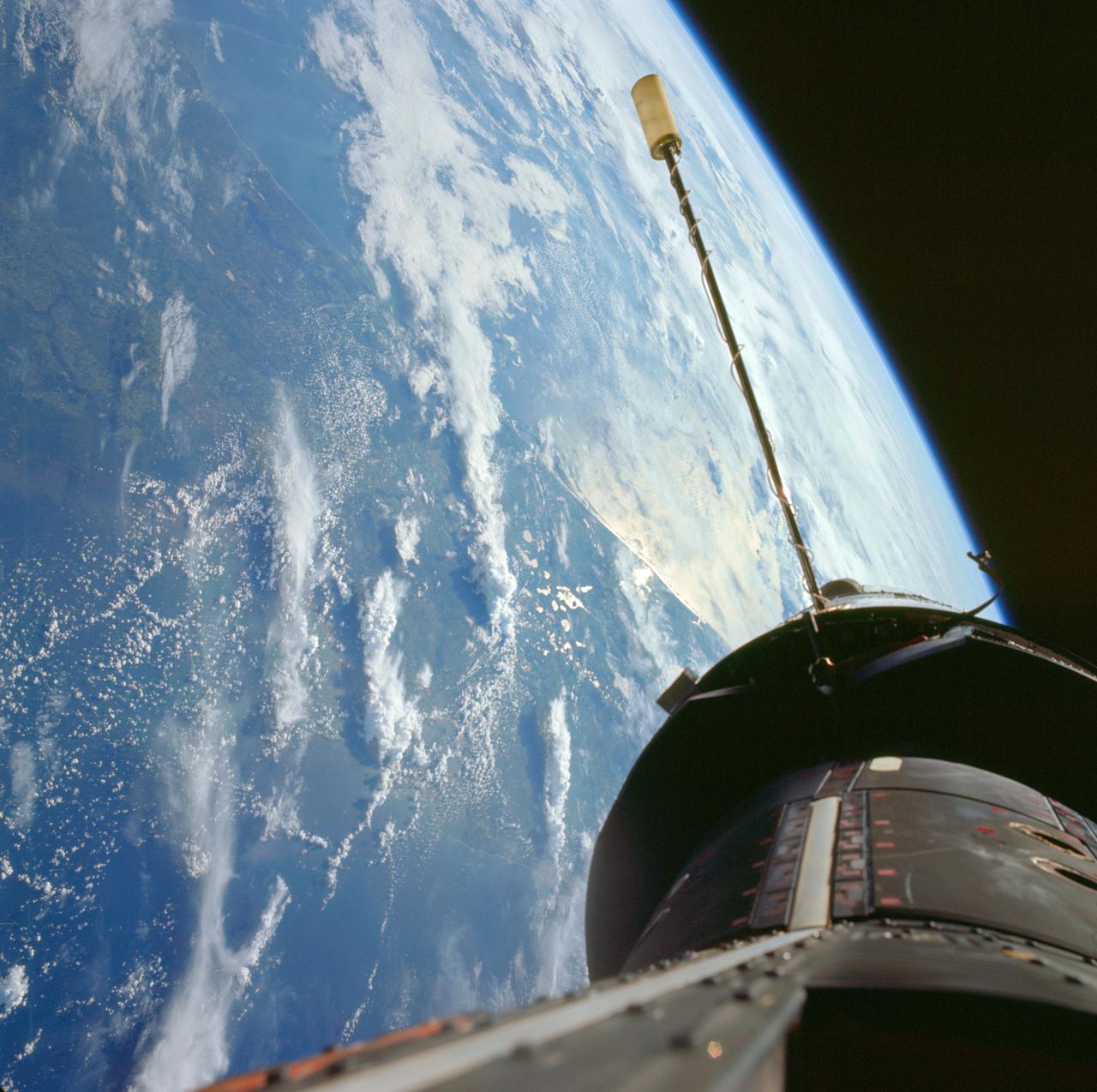
S66-54565 (14 Sept. 1966) --- Central portion of Florida, Gulf of Mexico to Atlantic Ocean, Cape Kennedy is at left center of photo, as seen from the Gemini-11 spacecraft during its 29th revolution of Earth. Photo lacks detail due to low sun angle. Sunglint on lakes is visible. Photo credit: NASA
Central portion of Florida, Gulf of Mexico seen from Gemini 11
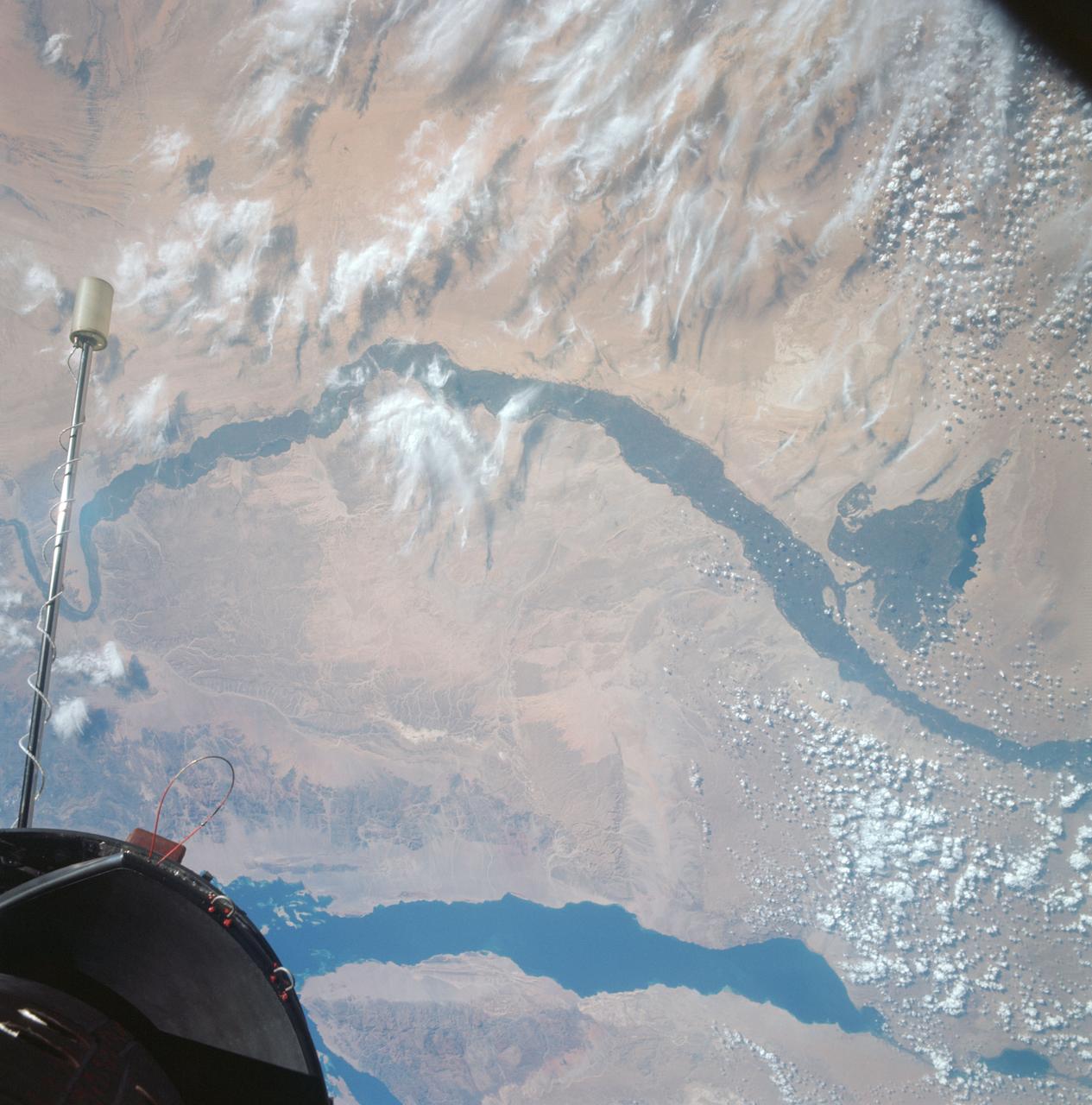
S66-63477 (13 Nov. 1966) --- United Arab Republic (Egypt), the Nile Valley from Luxor to Cairo, El Payium, Gulf of Suez, Sinai as seen from Gemini-12 spacecraft on its 25th revolution of Earth.  Photo credit: NASA
Egypt, Nile Valley, Gulf of Suez, Sinai as seen from Gemini 12 spacecraft
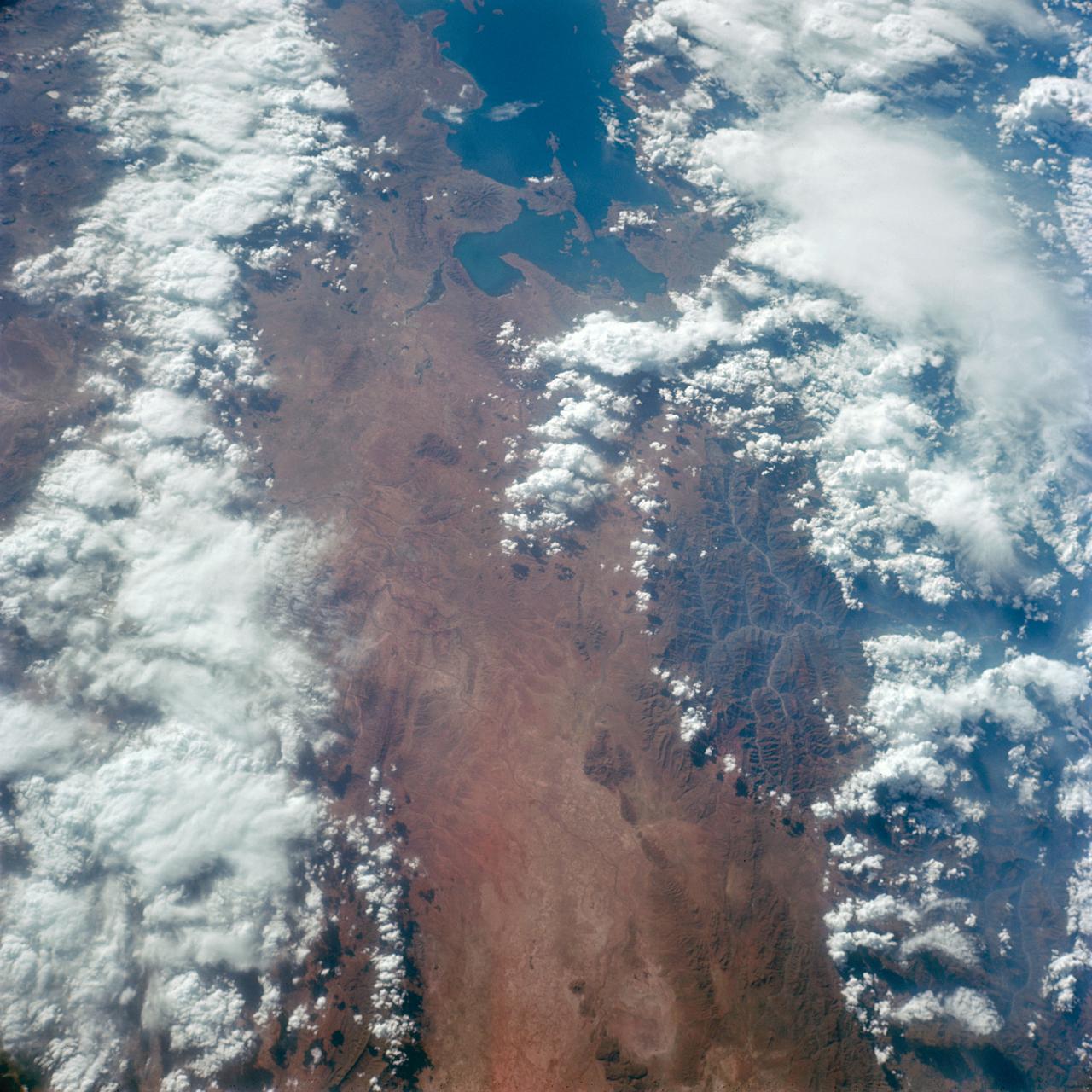
S66-54834 (14 Sept. 1966) --- Peru, Bolivia, Chile, Lake Titicaca and La Paz, as seen from the Gemini-11 spacecraft during its 34th revolution of Earth. Photo credit: NASA
Peru, Bolivia, Chile as seen from Gemini 11
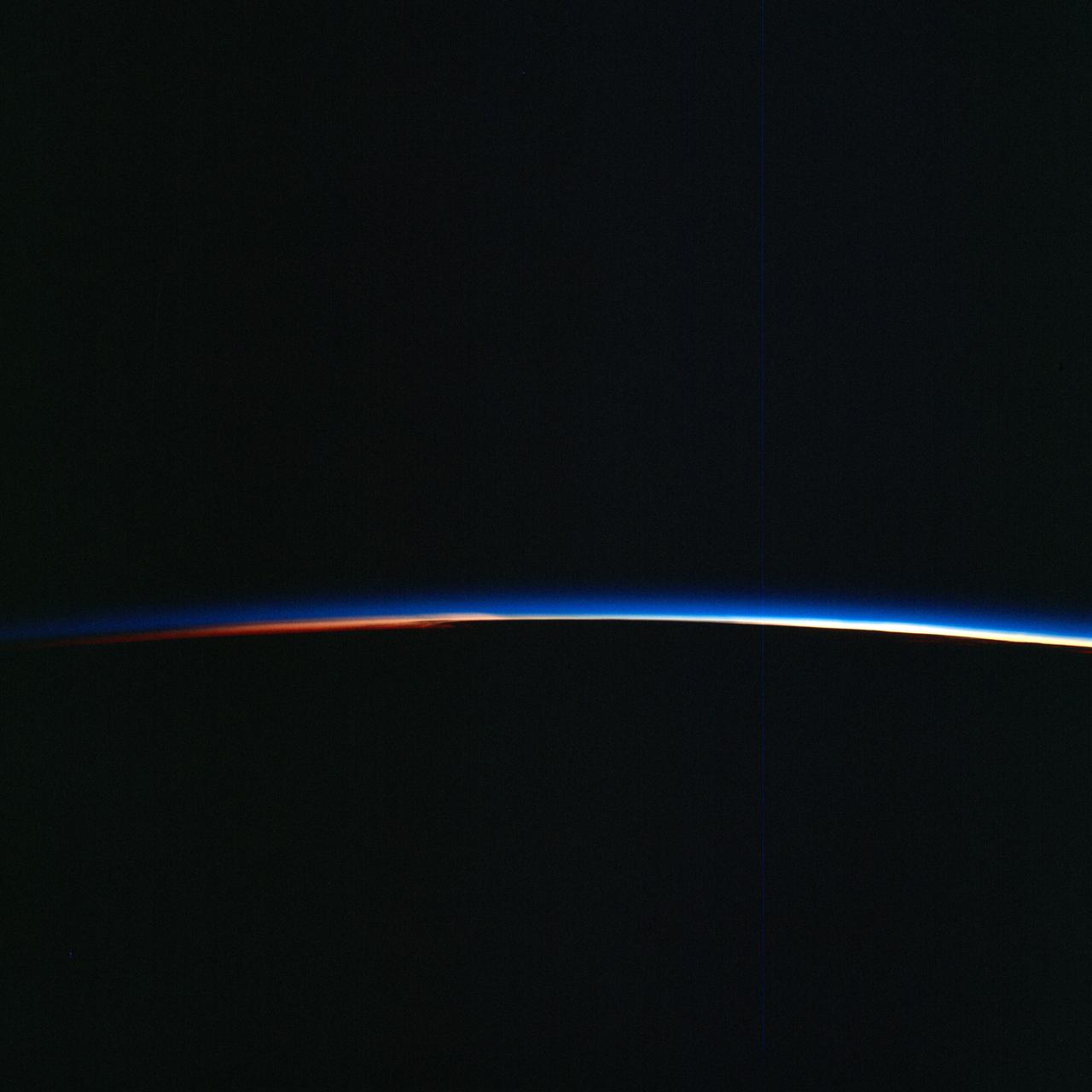
S66-38275 (3-6 June 1966) --- Earth's limb at sunrise as seen from the orbiting Gemini-9 spacecraft during its three-day mission in space. Taken with a modified 70mm Hasselblad camera, using Eastman Kodak, Ektachrome MS (S.O. 217) color film. Photo credit: NASA
Earth's limb at sunrise as seen from the Gemini 9-A spacecraft
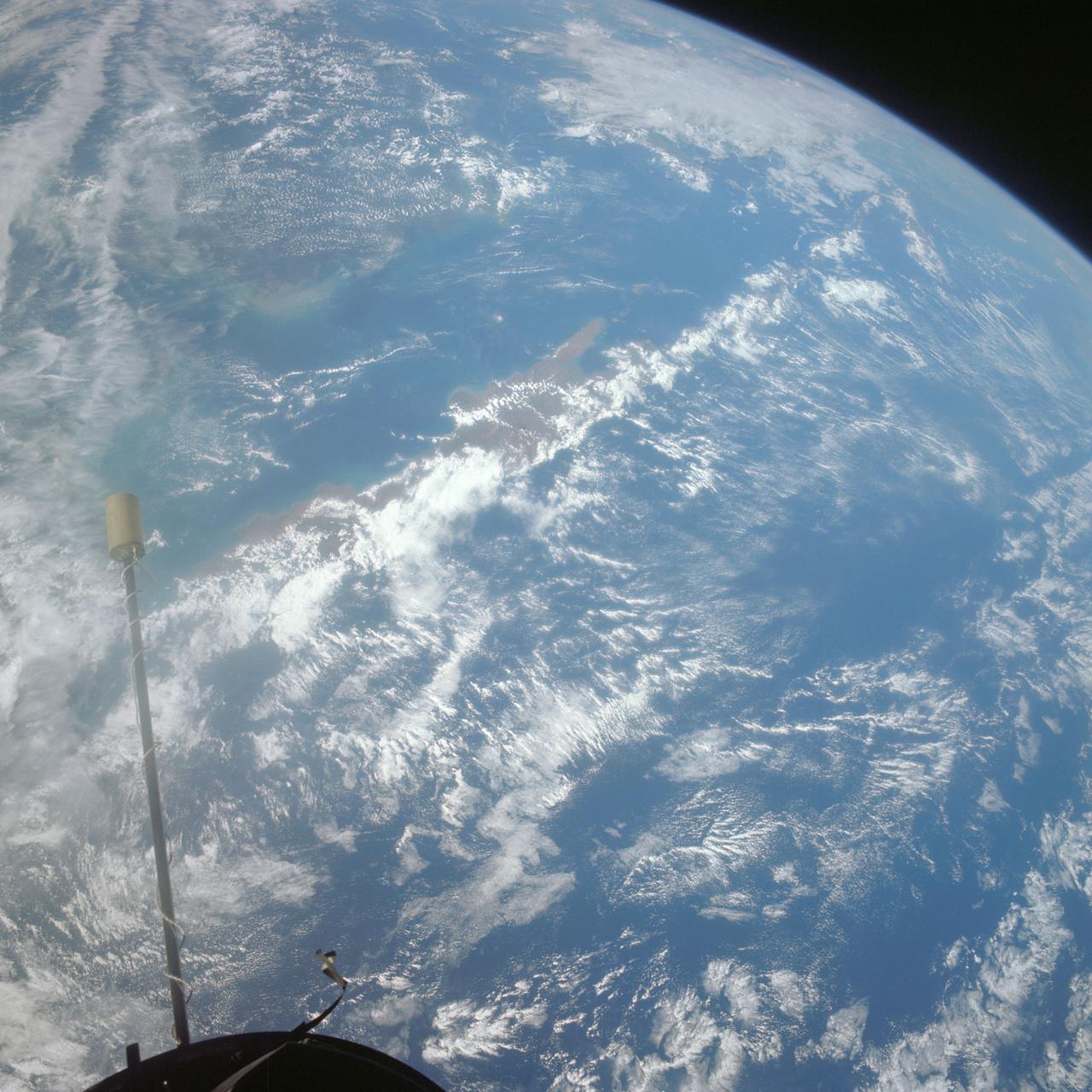
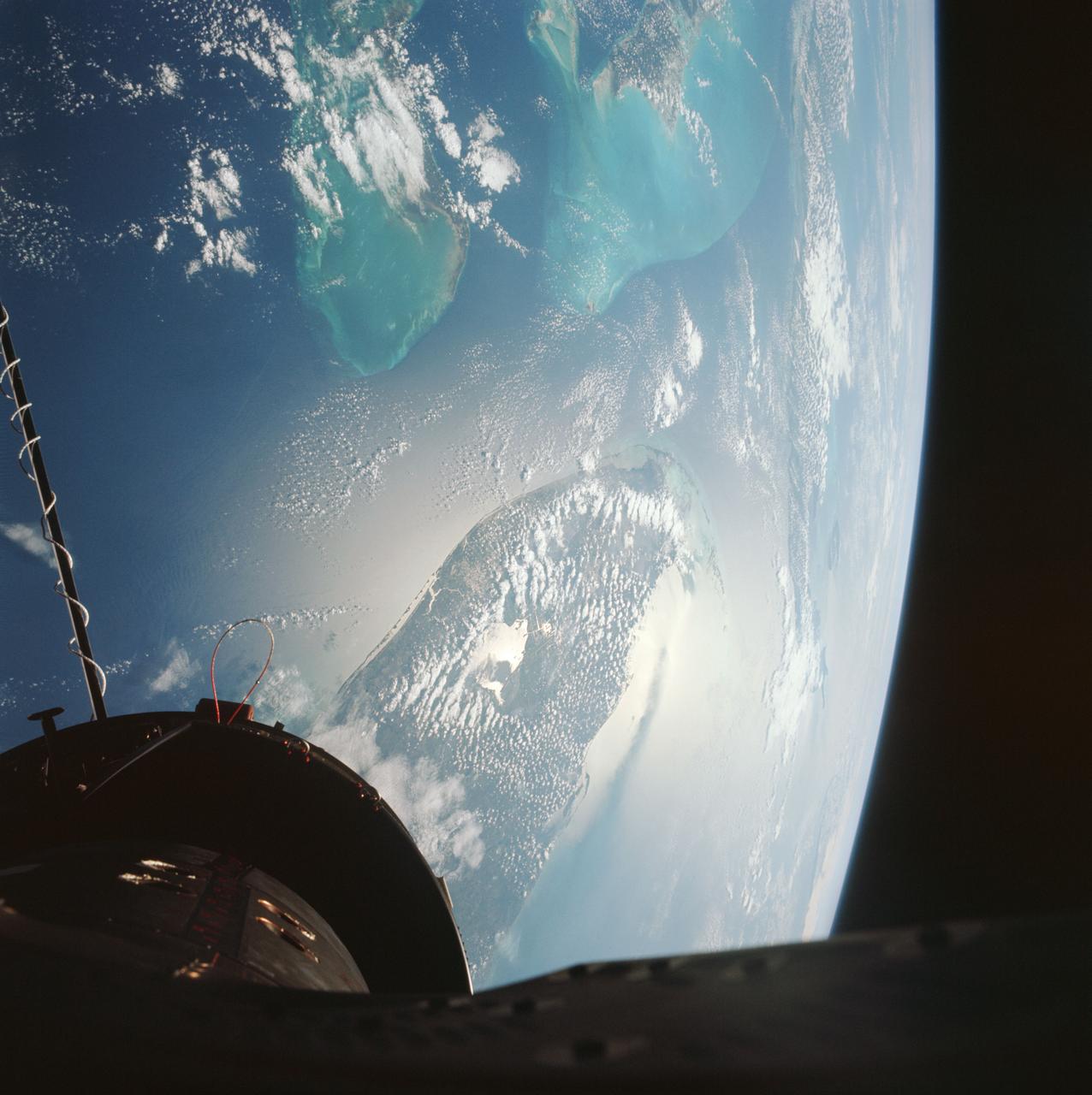
S66-63418 (13 Nov. 1966) --- Florida (south half), Bahamas Islands (Andros-Grand Bahamas-Bimini), and Cuba, looking south as seen from Gemini-12 spacecraft on its 15th revolution of Earth. Photo credit: NASA
Florida, Bahama Islands, Cuba as seen from Gemini 12 spacecraft
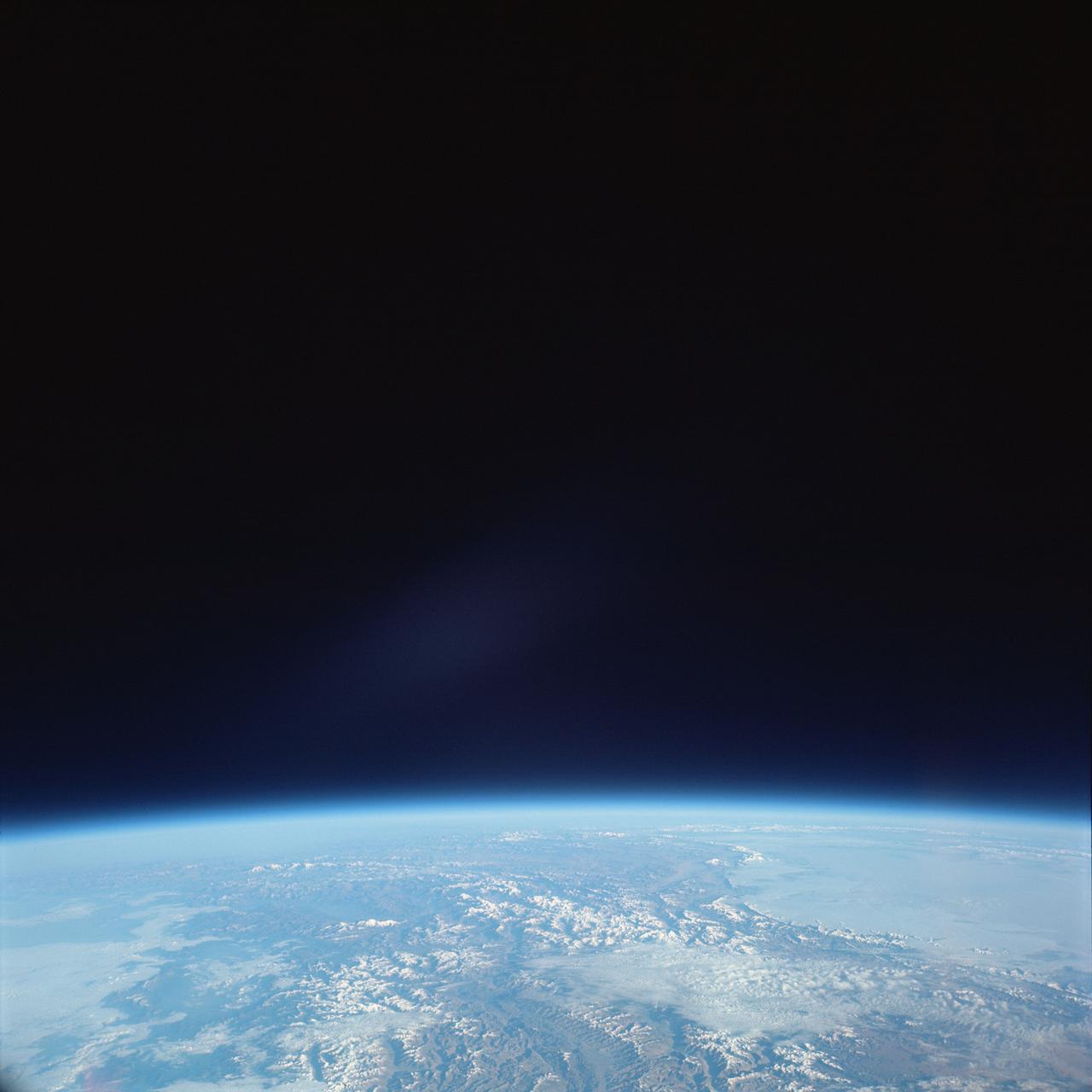
S66-54839 (14 Sept. 1966) --- China, India, and Nepal, looking east, as seen from the Gemini-11 spacecraft during its 37th revolution of Earth. The Great Himalaya Mountain Range is clearly visible. Photo credit: NASA
China, India, and Nepal as seen from Gemini 11
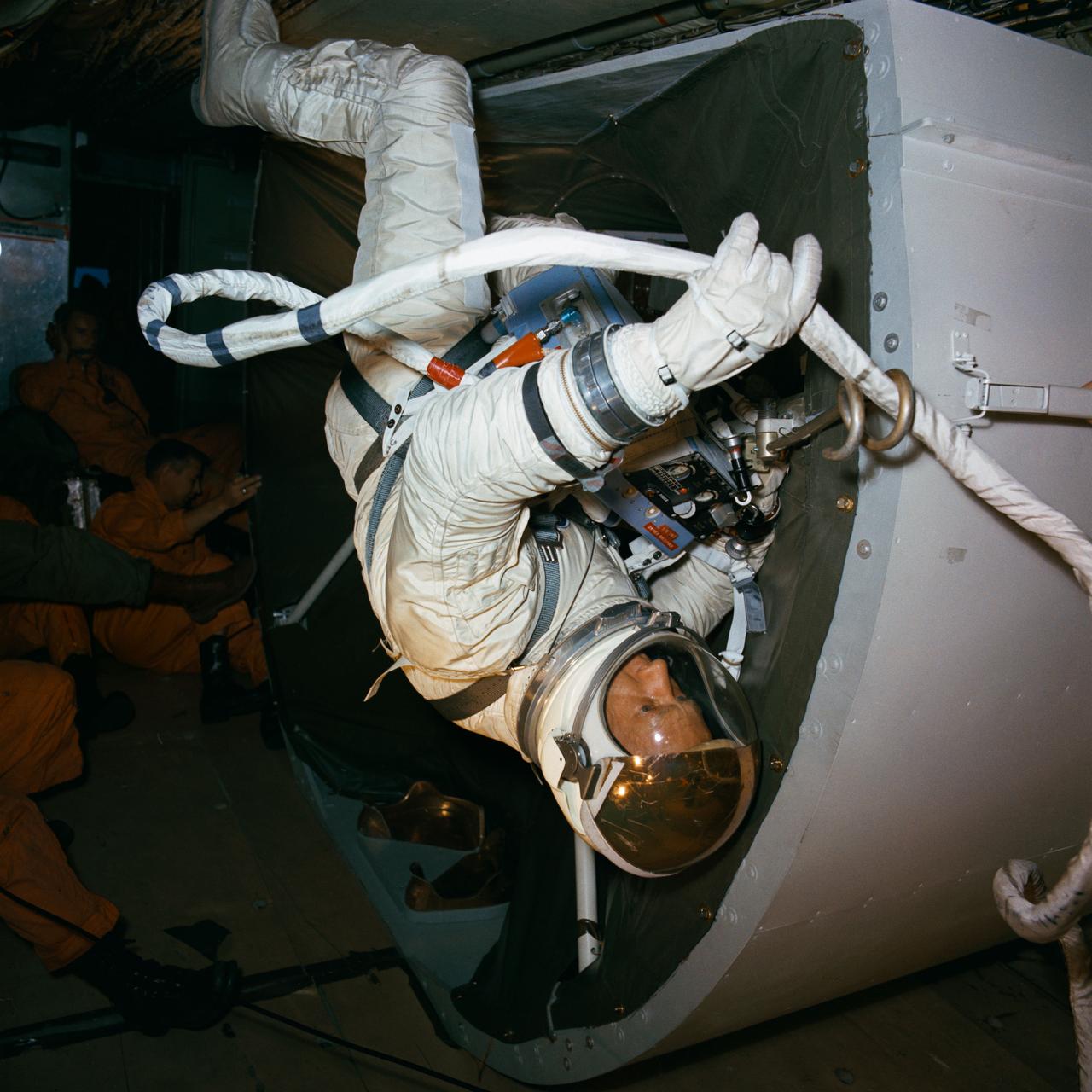
S66-57326 (13 Oct. 1966) --- Astronaut Edwin E. Aldrin Jr., pilot for the Gemini-12 spaceflight, attaches tether to hooks on mock-up of the adapter section of a Gemini spacecraft. He is taking part in zero-gravity training onboard an Air Force KC-135 jet aircraft in preparation for his extravehicular activity (EVA) during the actual mission. Photo credit: NASA
Astronaut Edwin Aldrin practices tether attachment aboard KC-135
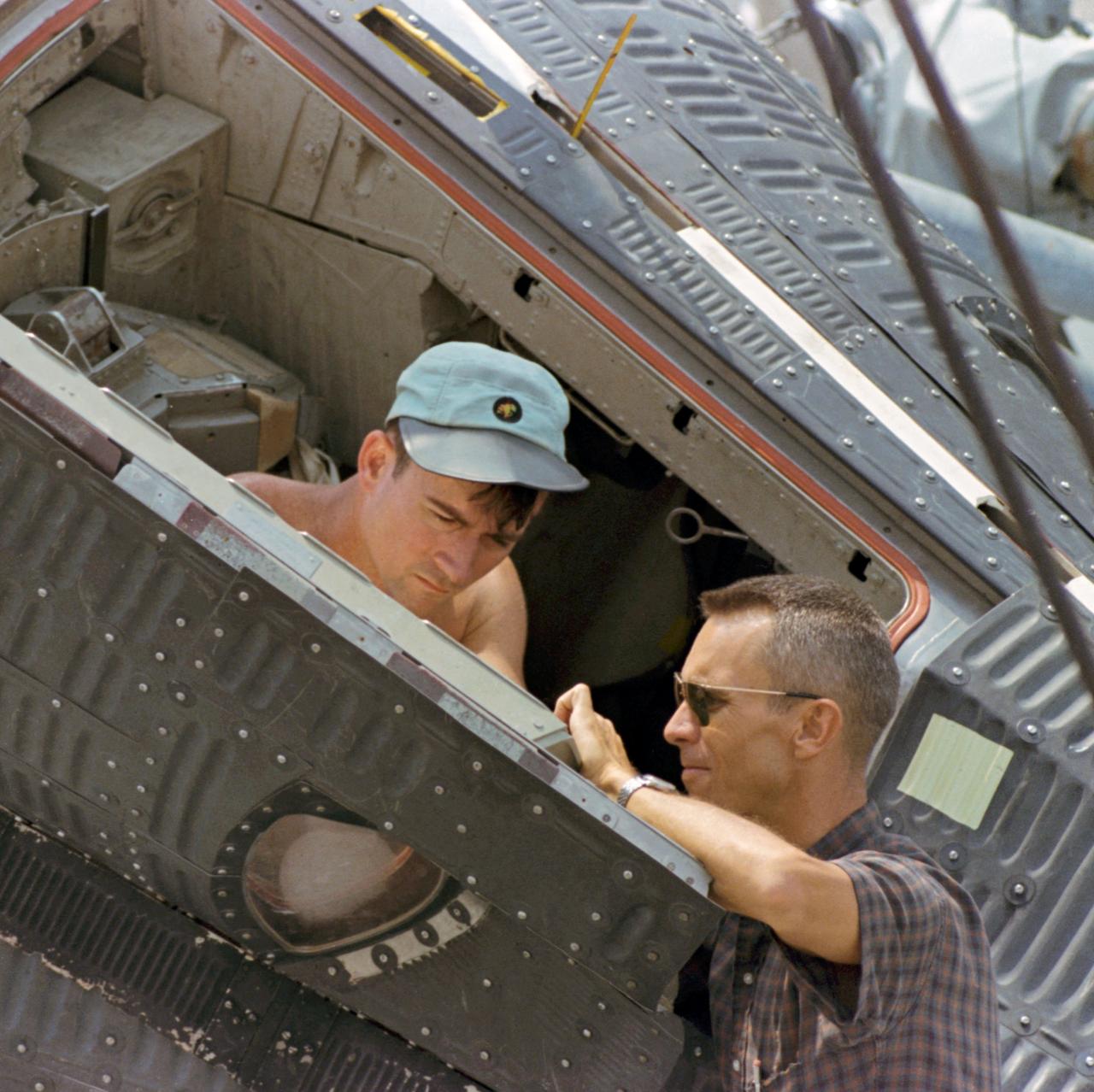
S66-39691 (18 June 1966) --- Astronaut John W. Young, prime crew command pilot for the Gemini-10 spaceflight, sits in Static Article 5 during water egress training activity onboard the NASA Motor Vessel Retriever. The SA-5 will be placed in the water and he and astronaut Michael Collins will then practice egress and water survival techniques. At right is Gordon Harvey, Spacecraft Operations Branch, Flight Crew Support Division. Photo credit: NASA
Astronaut John W. Young during water egress training