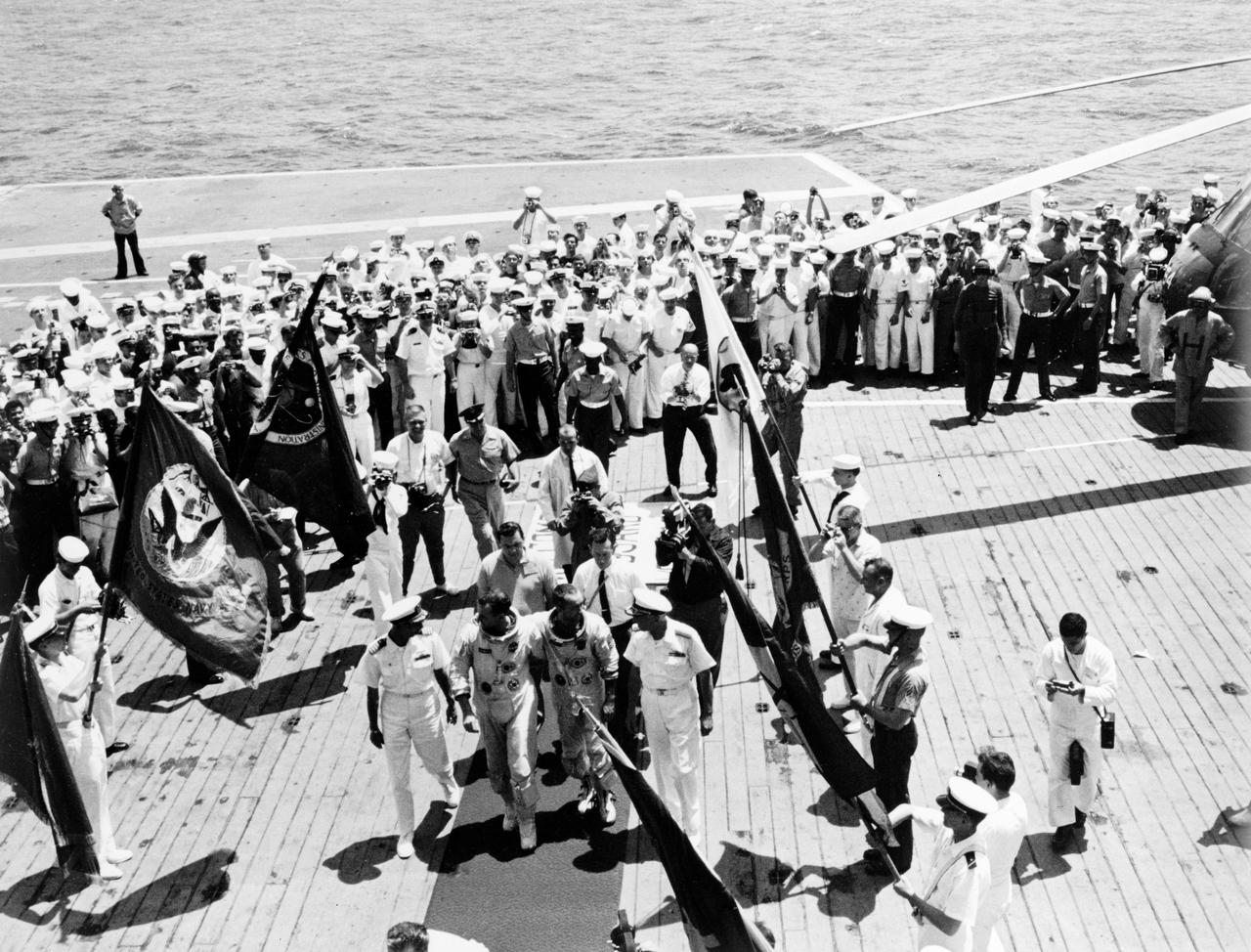
S65-19530 (7 June 1965) --- The red carpet treatment is given to the Gemini-Titan 4 astronauts Edward H. White II and James A. McDivitt as they arrive on the flight deck of the aircraft carrier USS Wasp after their record breaking 62-revolution, 97-hour and 56-minute flight which ended in the Atlantic Ocean about 400 miles east of Cape Kennedy at 12:12 p.m. (EST) on June 7, 1965. Here they are shown being welcomed by members of the crew and NASA people. White and McDivitt (center) walk on the red carpet flanked by Capt. J.W. Conger (left), commander of the ship; and Rear Adm. W.M. McCormick, commander, Carrier Division 14, Atlantic Fleet. NASA's Gemini-4 flight landed about 48 miles short of the aircraft carrier.
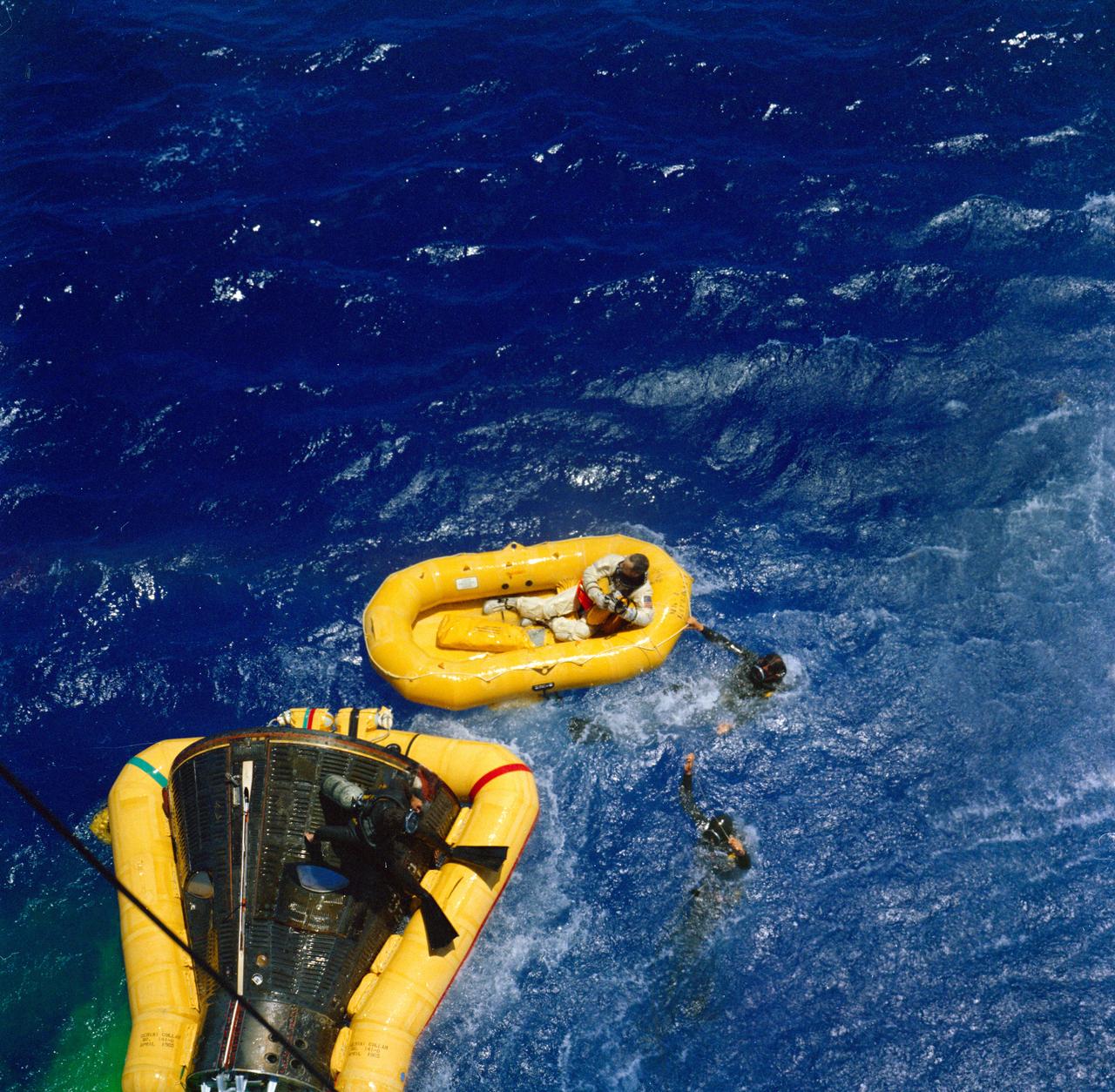
S65-33490 (7 June 1965) --- A United States Navy frogman team participates in the recovery of the Gemini-Titan 4 (GT-4) spacecraft. The USS Wasp was the prime recovery ship for the Gemini-4 mission. The crew of the Gemini-4 spaceflight was astronauts James A. McDivitt, command pilot, and Edward H. White II, pilot.
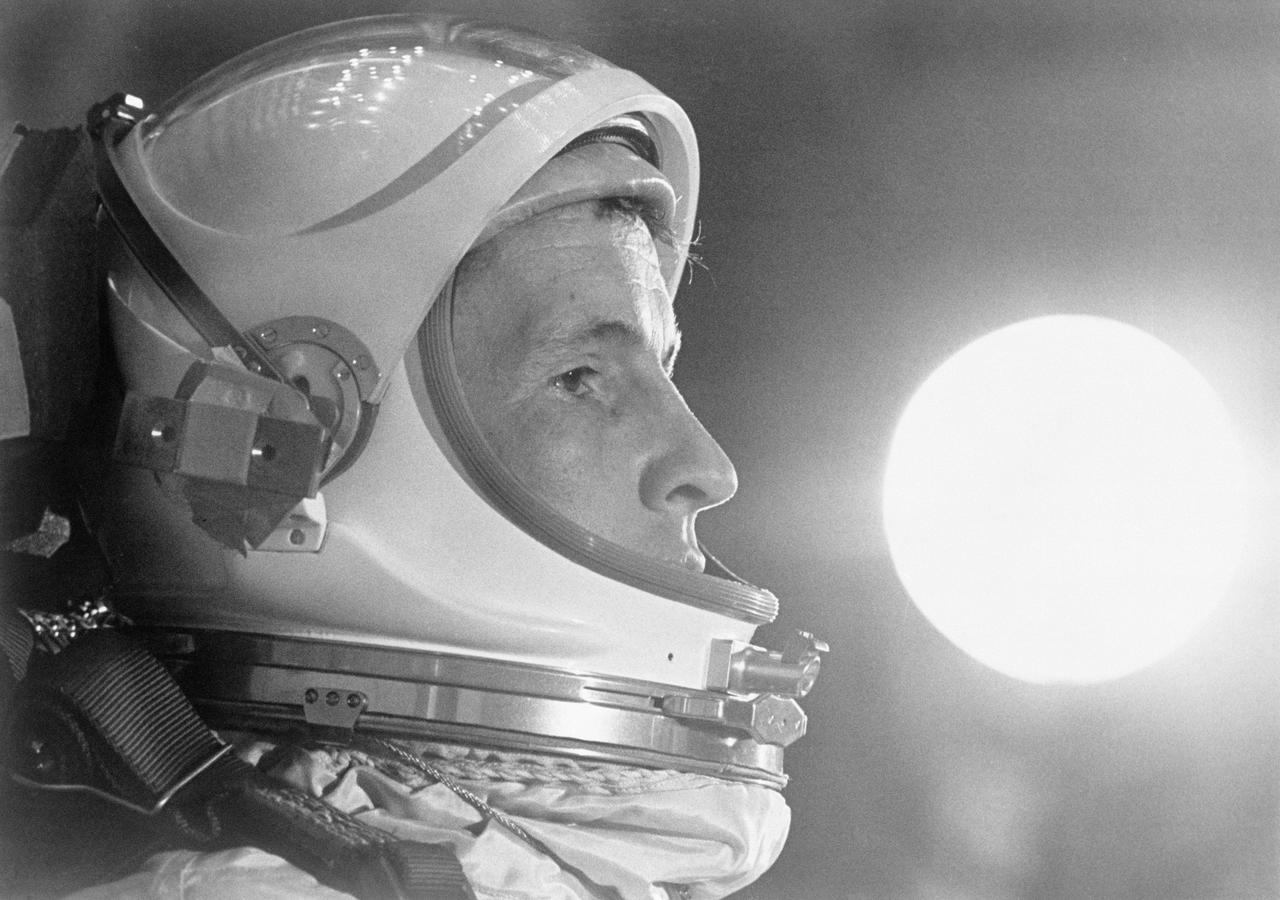
S65-19576 (21 May 1965) --- Astronaut Edward H. White II, pilot of the Gemini-Titan 4 prime crew, goes through a wet mock simulation exercise as part of the checkout procedure for the Gemini-4 spaceflight. The two-man Gemini-4 mission, scheduled no earlier than June 3, 1965, will orbit Earth 62 times in four days. Astronaut James A. McDivitt (out of frame) is the GT-4 prime crew command pilot.
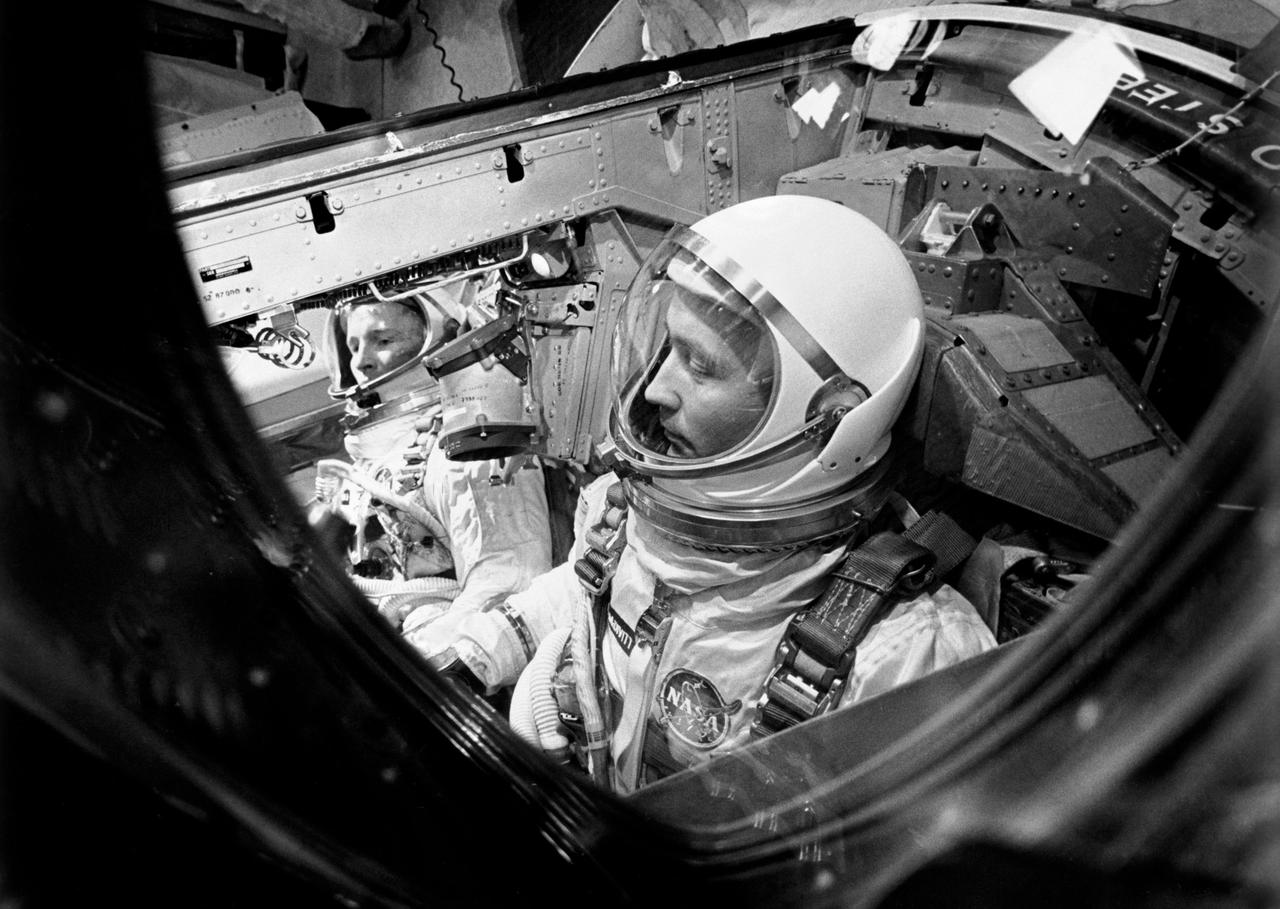
S65-19578 (21 May 1965) --- The Gemini-Titan 4 prime crew, astronauts Edward H. White II (left), pilot, and James A. McDivitt, command pilot, check out the Gemini-4 spacecraft during a wet mock simulation test at Cape Kennedy. The Gemini-4 mission, scheduled no earlier than June 3, 1965, will circle Earth 62 times in four days.
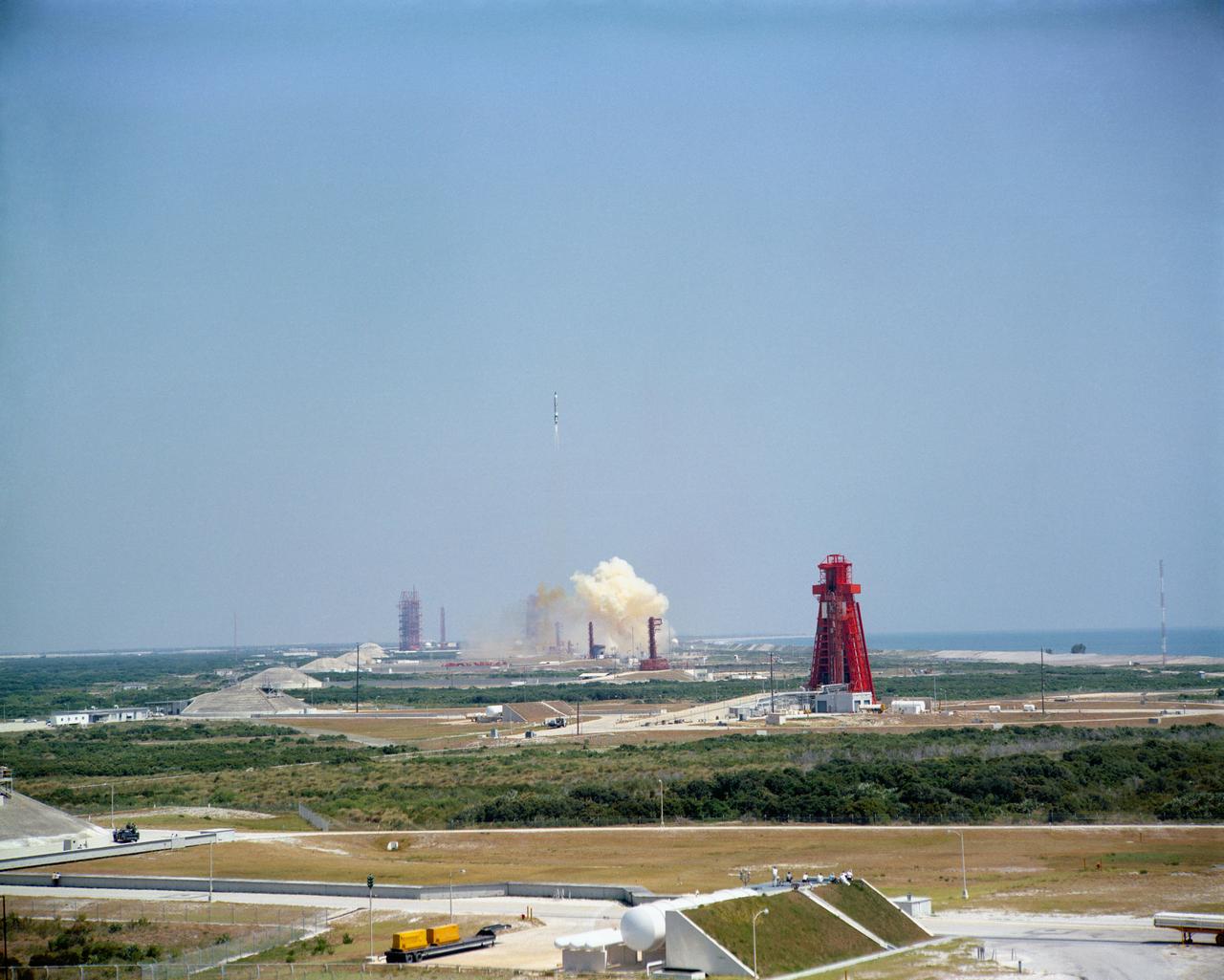
S65-29601 (3 June 1965) --- Distant view of the launch of the Gemini-Titan 4 (GT-4) spacecraft from Pad 19 at 10:16 a.m. (EST) on June 3, 1965. The Gemini IV spacecraft carried astronauts James A. McDivitt, command pilot; and Edward H. White II, pilot, on a four-day, 62-revolution mission that lasted 97 hours and 56 minutes.
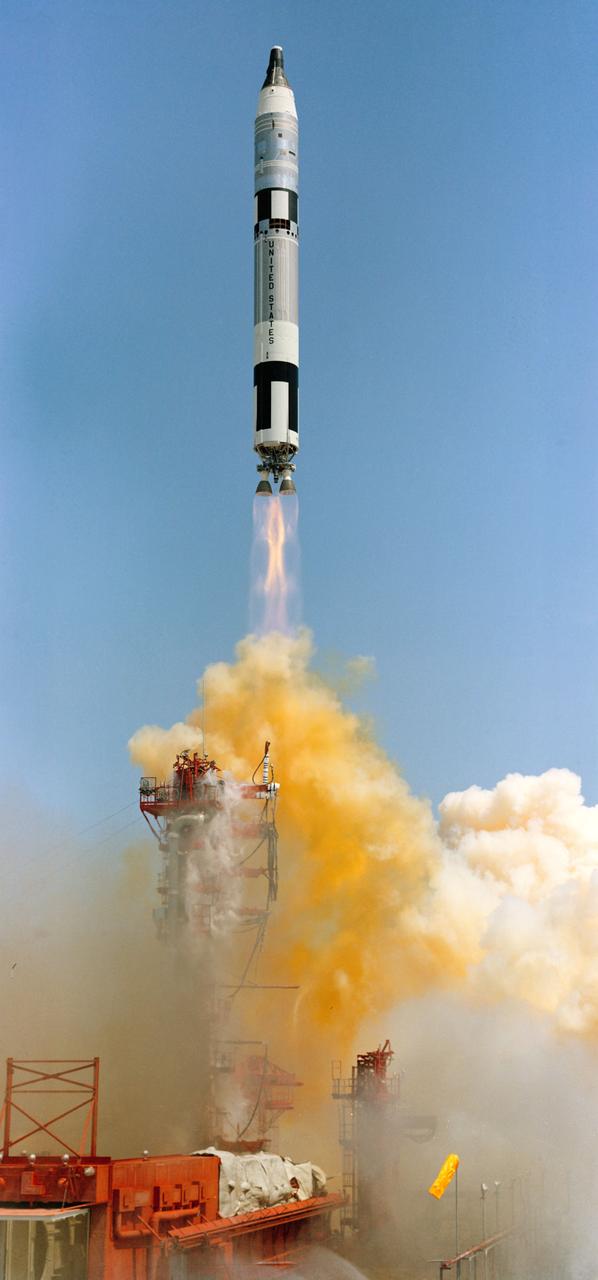
S65-29636 (3 June 1965) --- The Gemini-Titan 4 (GT-4) spaceflight launches from Cape Kennedy's Pad 19 at 10:16 a.m. (EST) on June 3, 1965. The GT-4 spacecraft carried astronauts James A. McDivitt, command pilot, and Edward H. White II, pilot, on a four-day, 62-revolution mission. Photo credit: NASA
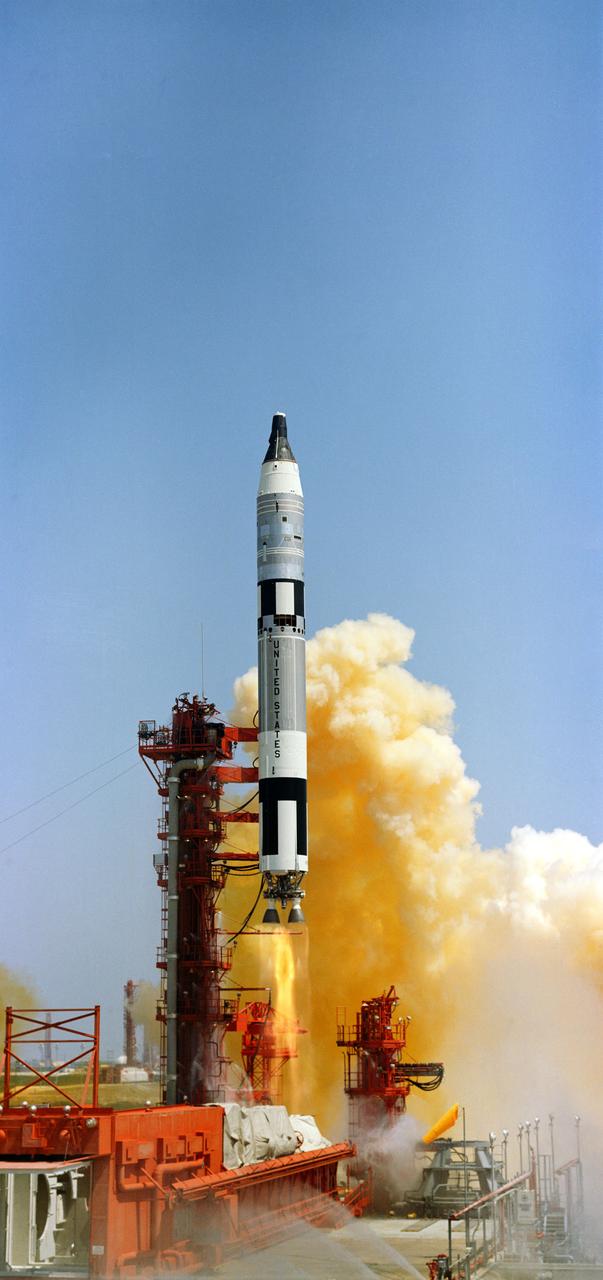
S65-29635 (3 June 1965) --- The Gemini-Titan 4 (GT-4) spaceflight launches from Cape Kennedy's Pad 19 at 10:16 a.m. (EST) on June 3, 1965. The GT-4 spacecraft carried astronauts James A. McDivitt, command pilot, and Edward H. White II, pilot, on a four-day, 62-revolution mission. Photo credit: NASA
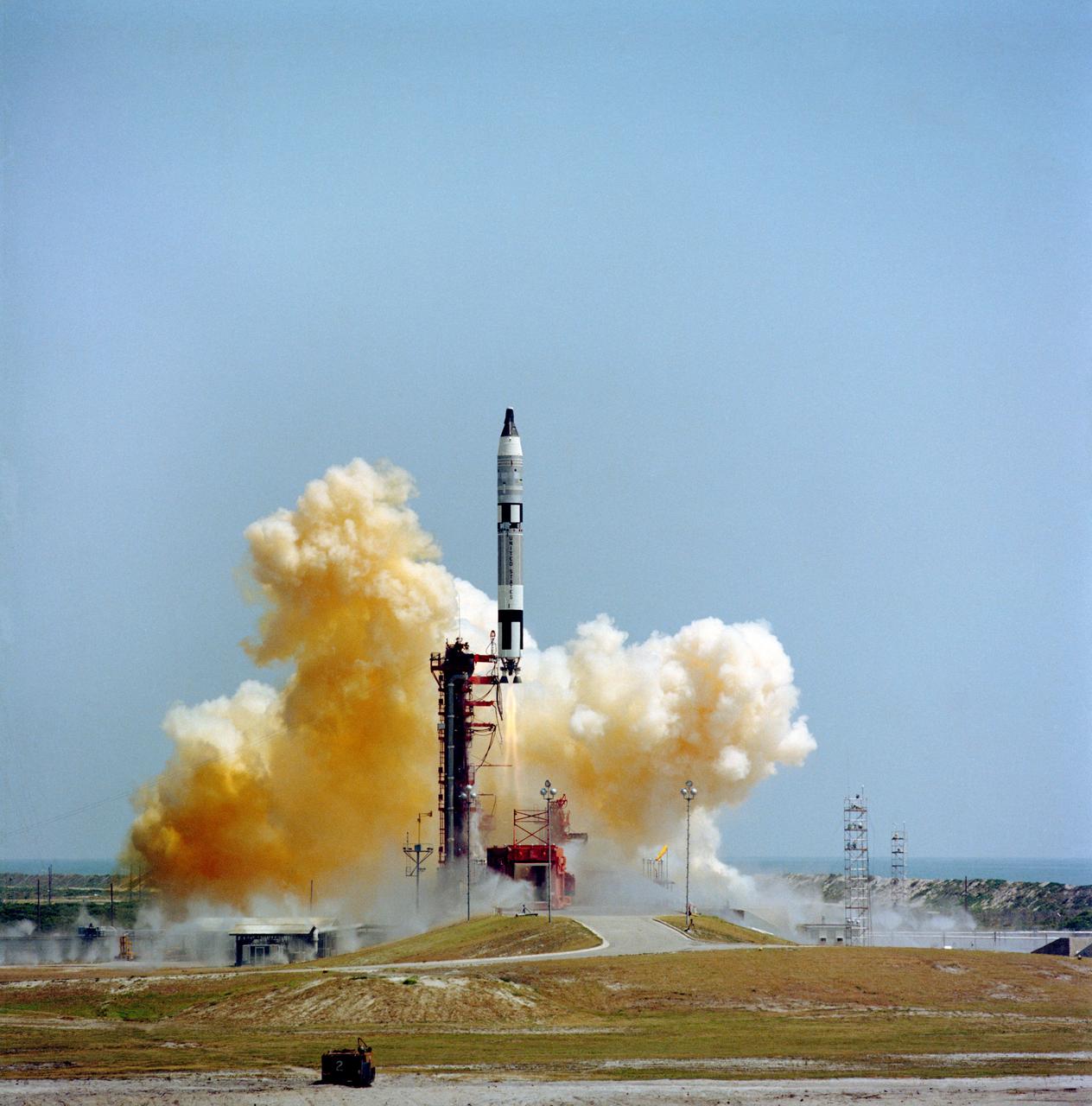
S65-29639 (3 June 1965) --- The Gemini-Titan 4 (GT-4) spaceflight launches from Cape Kennedy's Pad 19 at 10:16 a.m. (EST) on June 3, 1965. The GT-4 spacecraft carried astronauts James A. McDivitt, command pilot, and Edward H. White II, pilot, on a four-day, 62-revolution mission.
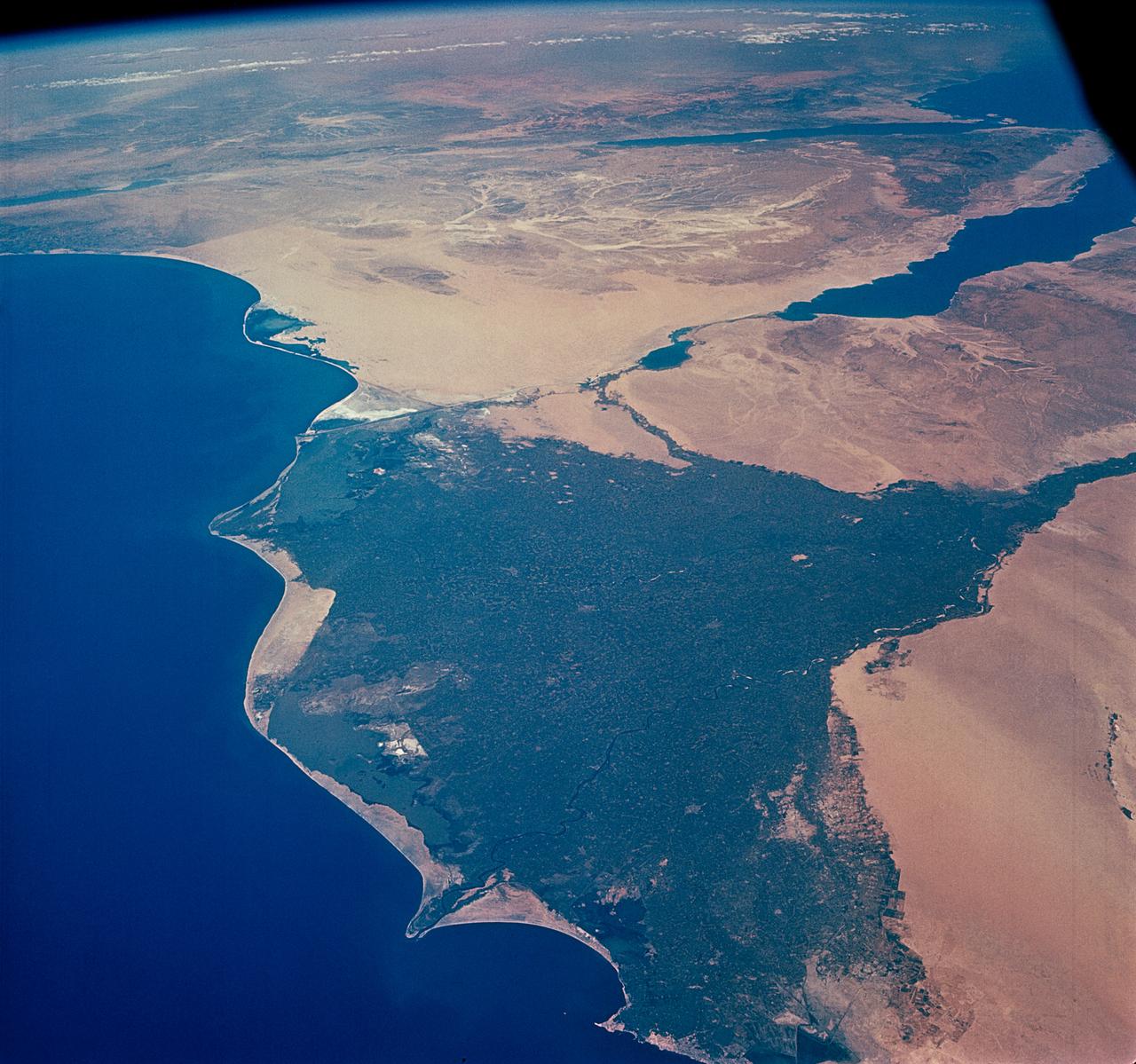
S65-34776 (3-7 June 1965) --- This photograph shows the Nile Delta, Egypt, the Suez Canal, Israel, Jordan, Syria, Saudi Arabia, and Iraq as seen from the Gemini-Titan 4 (GT-4) spacecraft during its 12th revolution of Earth.
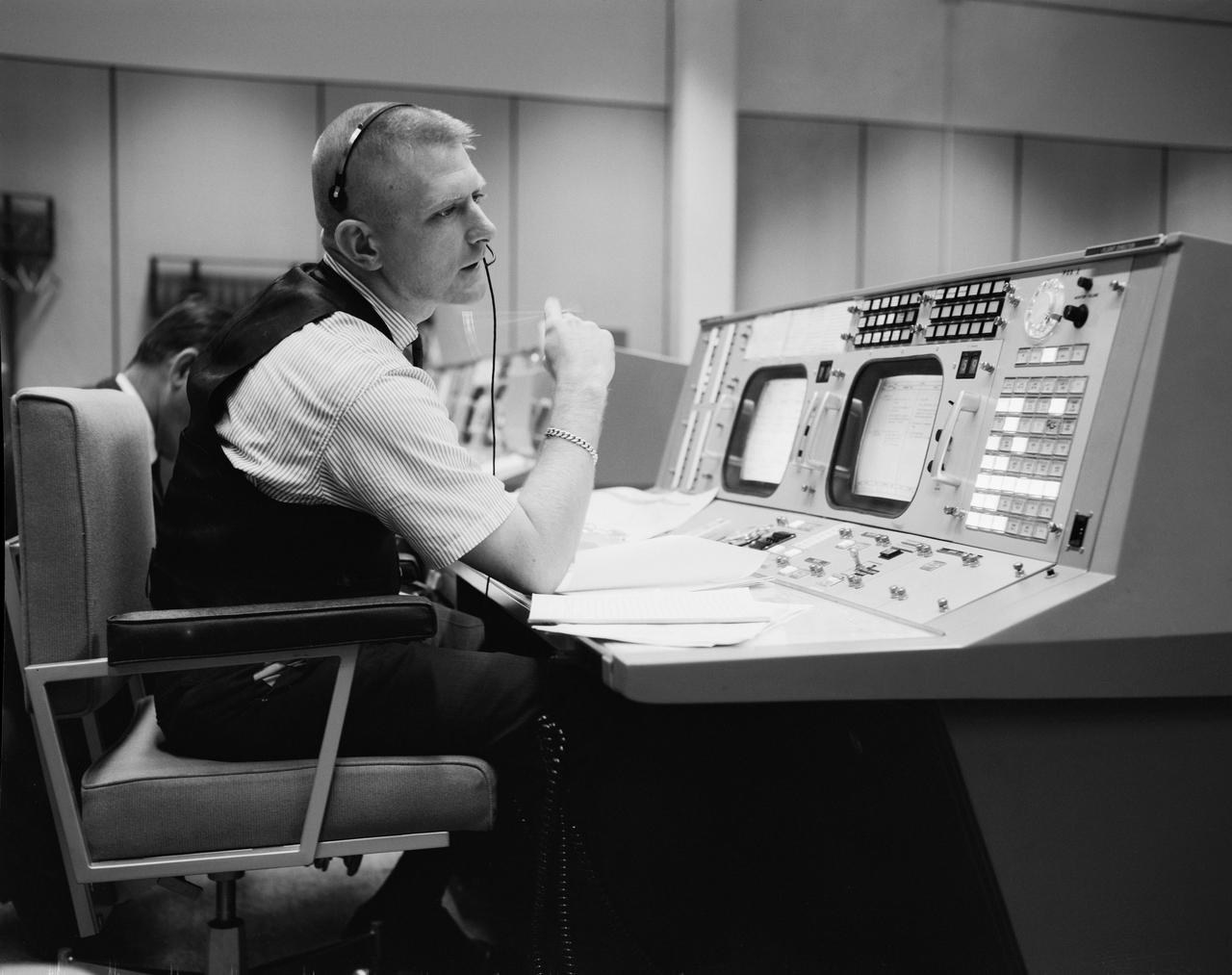
S65-22203 (April 1965) --- Prior to the Gemini-Titan 4 mission, flight director Eugene F. Kranz is pictured during a simulation at the Flight Director console in Houston's Mission Control Center on the Manned Spacecraft Center site. GT-4 was the first mission to be at least partially controlled from the Houston site. Photo credit: NASA
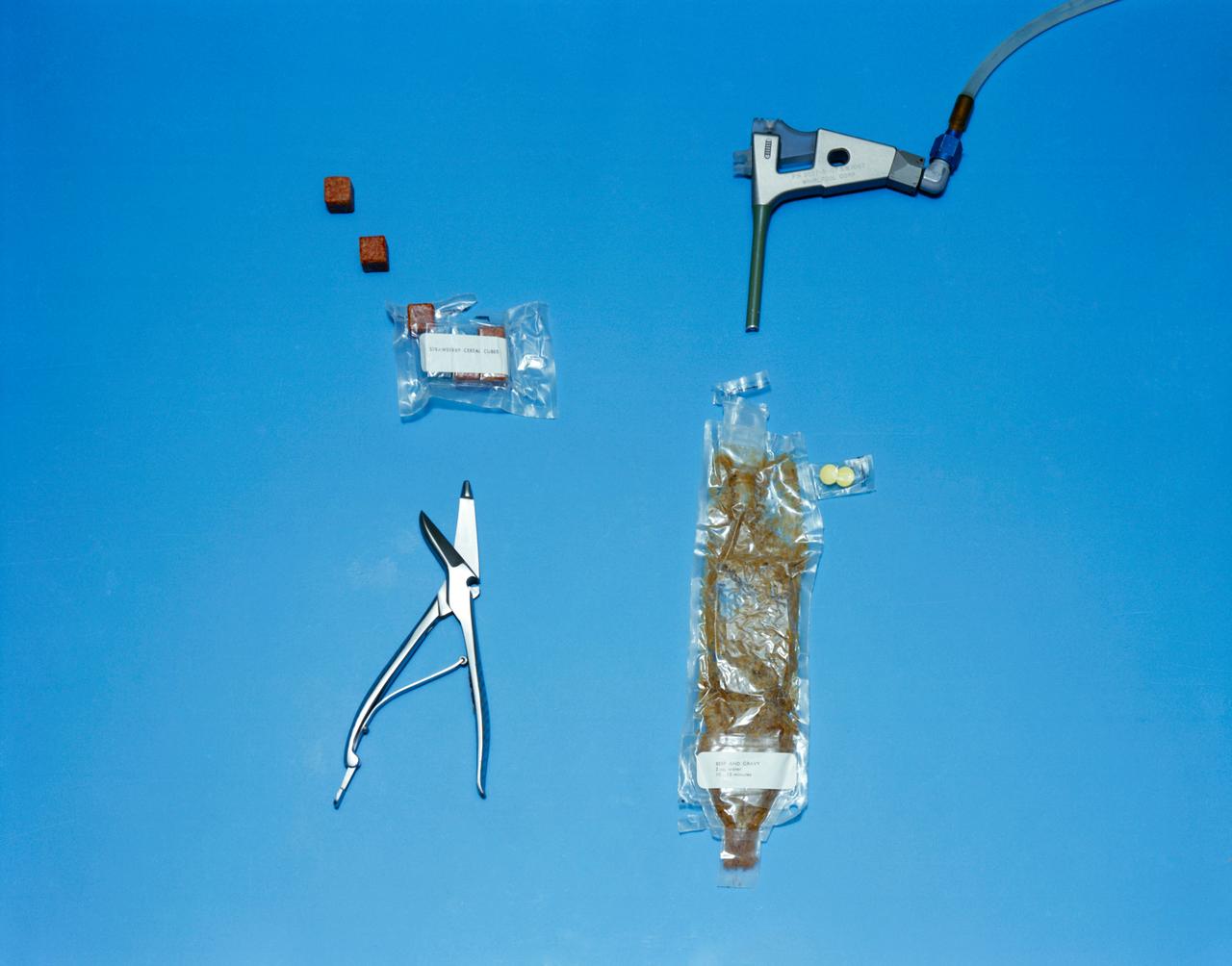
Food packages of beef and gravy fully reconstituted and ready to eat. An astronaut would squeeze food through opening at right side of package. Water gun is used to reconstitute dehydrated food. Scissors are used to open packages. This is the type of space food which will be used on the Gemini-Titan 4 spaceflight. MSC, Houston, TX *S65-24895 thru S65-24899
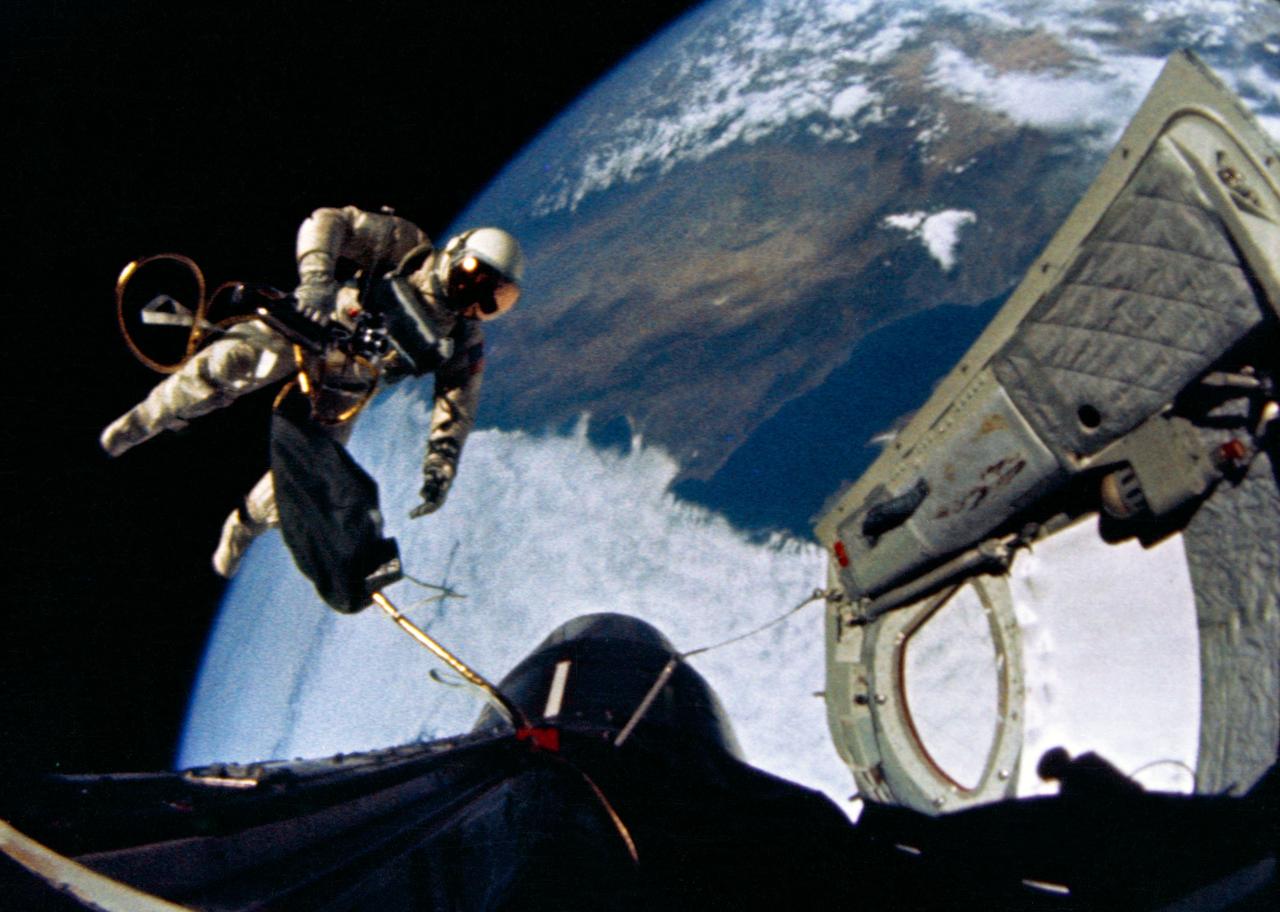
S65-29766 (3 June 1965) --- Astronaut Edward H. White II, pilot for the Gemini-Titan 4 (GT-4) spaceflight, floats in the zero-gravity of space during the third revolution of the GT-4 spacecraft. White wears a specially designed spacesuit. His face is shaded by a gold-plated visor to protect him from unfiltered rays of the sun. In his right hand he carries a Hand-Held Self-Maneuvering Unit (HHSMU) that gives him control over his movements in space. White also wears an emergency oxygen chest pack; and he carries a camera mounted on the HHSMU for taking pictures of the sky, Earth and the GT-4 spacecraft. He is secured to the spacecraft by a 25-feet umbilical line and a 23-feet tether line. Both lines are wrapped together in gold tape to form one cord. Astronaut James A. McDivitt, command pilot, remained inside the spacecraft during the extravehicular activity (EVA). Photo credit: NASA EDITOR'S NOTE: Astronaut Edward H. White II died in the Apollo/Saturn 204 fire at Cape Kennedy on Jan. 27, 1967.
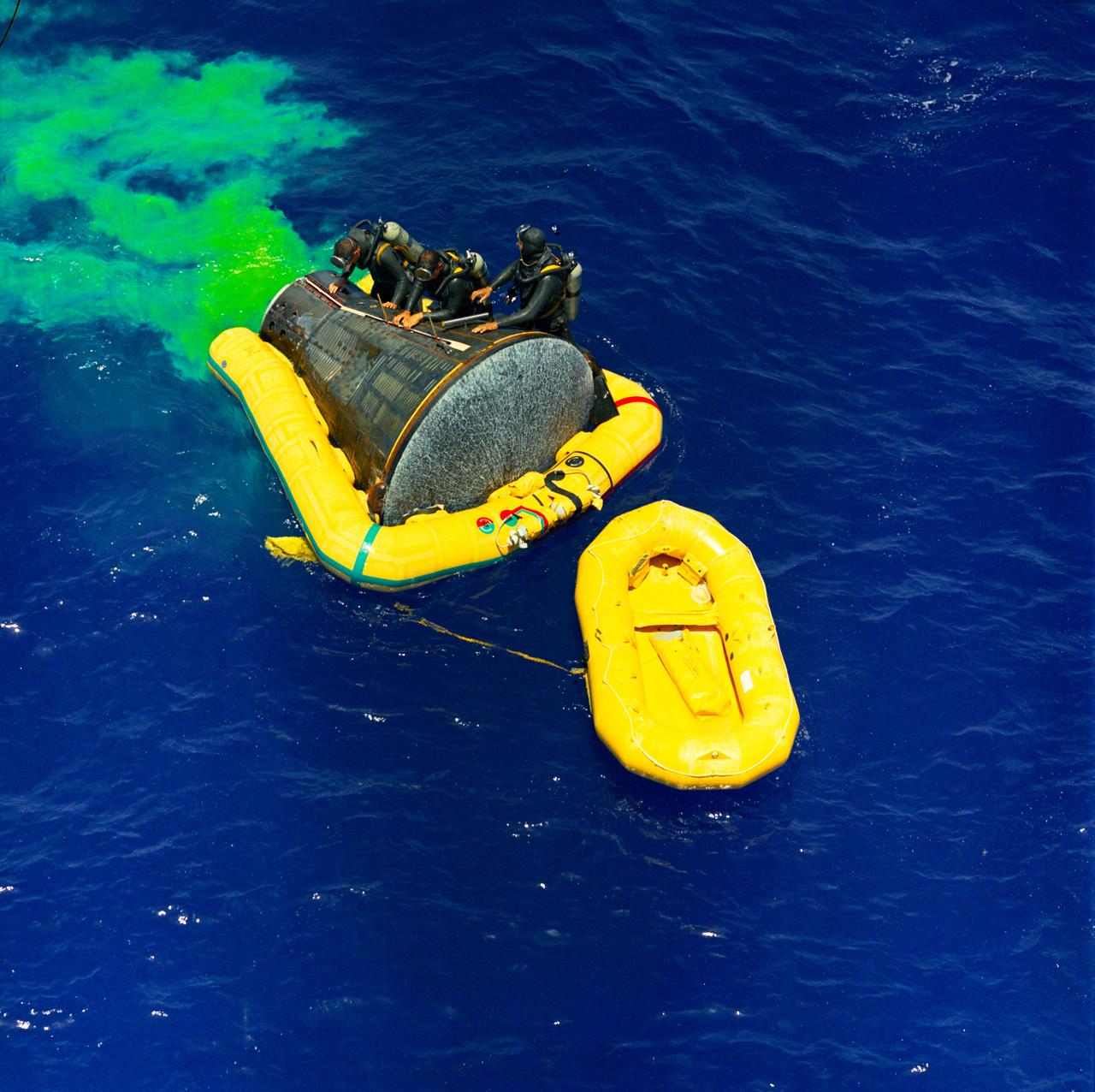
S65-33491 (7 June 1965) --- A United States Navy frogman team participates in the recovery of the Gemini-Titan 4 (GT-4) spacecraft. The USS Wasp was the prime recovery ship for the Gemini-4 mission. The crew of the Gemini-4 spaceflight was astronauts James A. McDivitt, command pilot, and Edward H. White II, pilot.
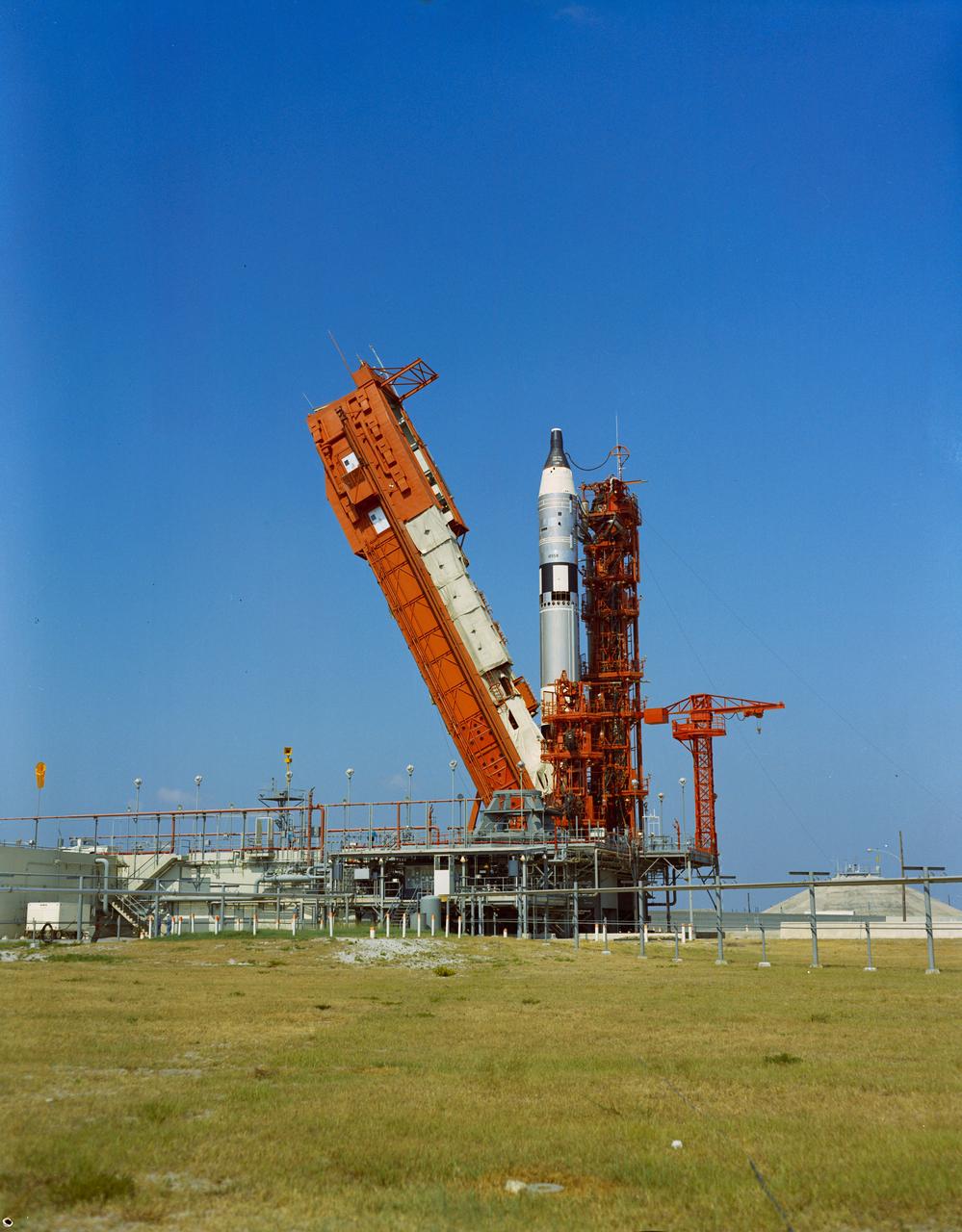
S65-29648 (3 June 1965) --- View of the Gemini-Titan 4 spacecraft on Pad 19 on day of launch with erector being removed.
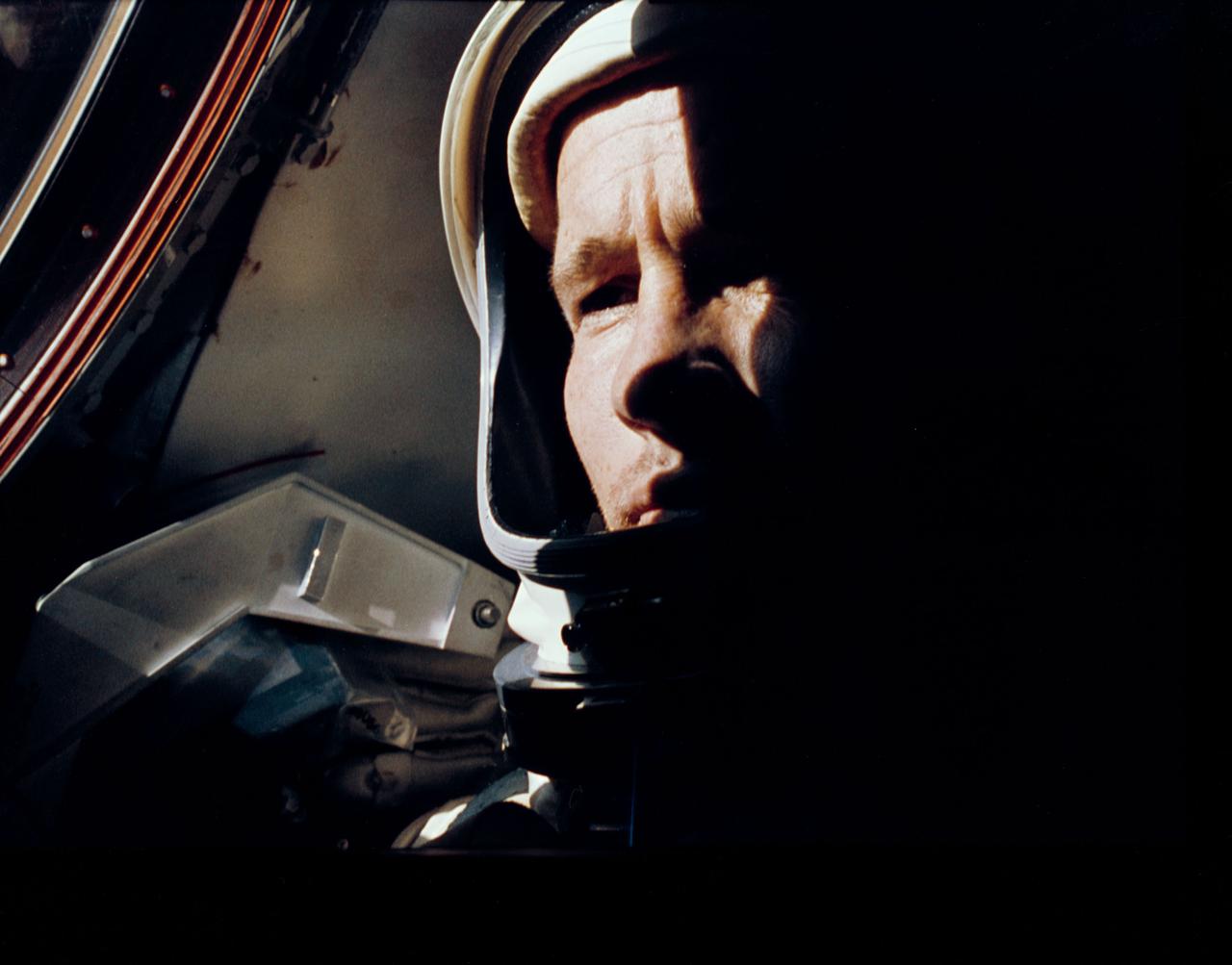
S65-30548 (3-7 June 1965) --- Astronaut Edward H. White II, Gemini IV pilot, is photographed onboard the Gemini-Titan 4 spacecraft during the four-day Earth-orbital mission. Photo credit: NASA
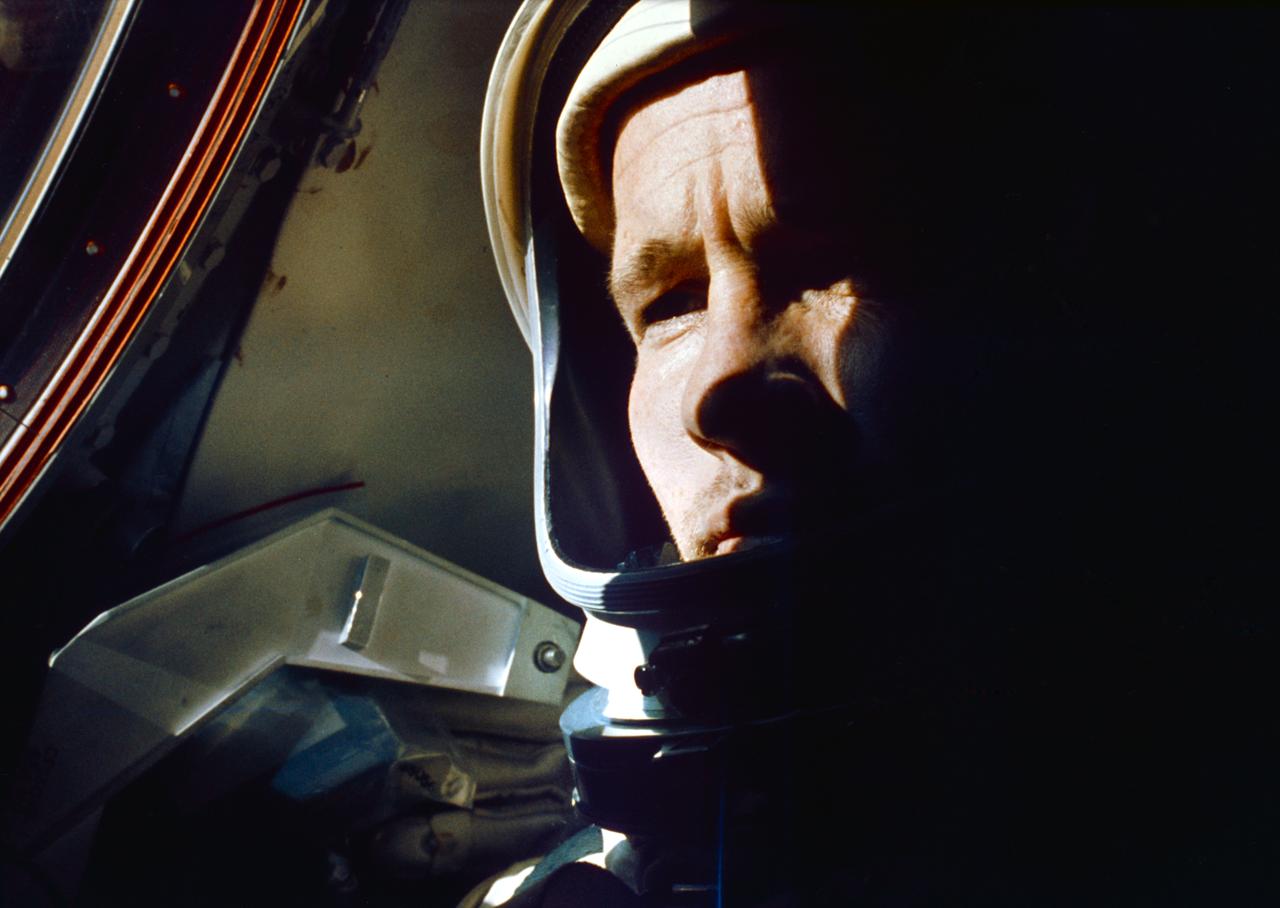
S65-30549 (3-7 June 1965) --- Astronaut Edward H. White II, Gemini IV pilot, is photographed onboard the Gemini-Titan 4 spacecraft during the four-day Earth-orbital mission. Photo credit: NASA
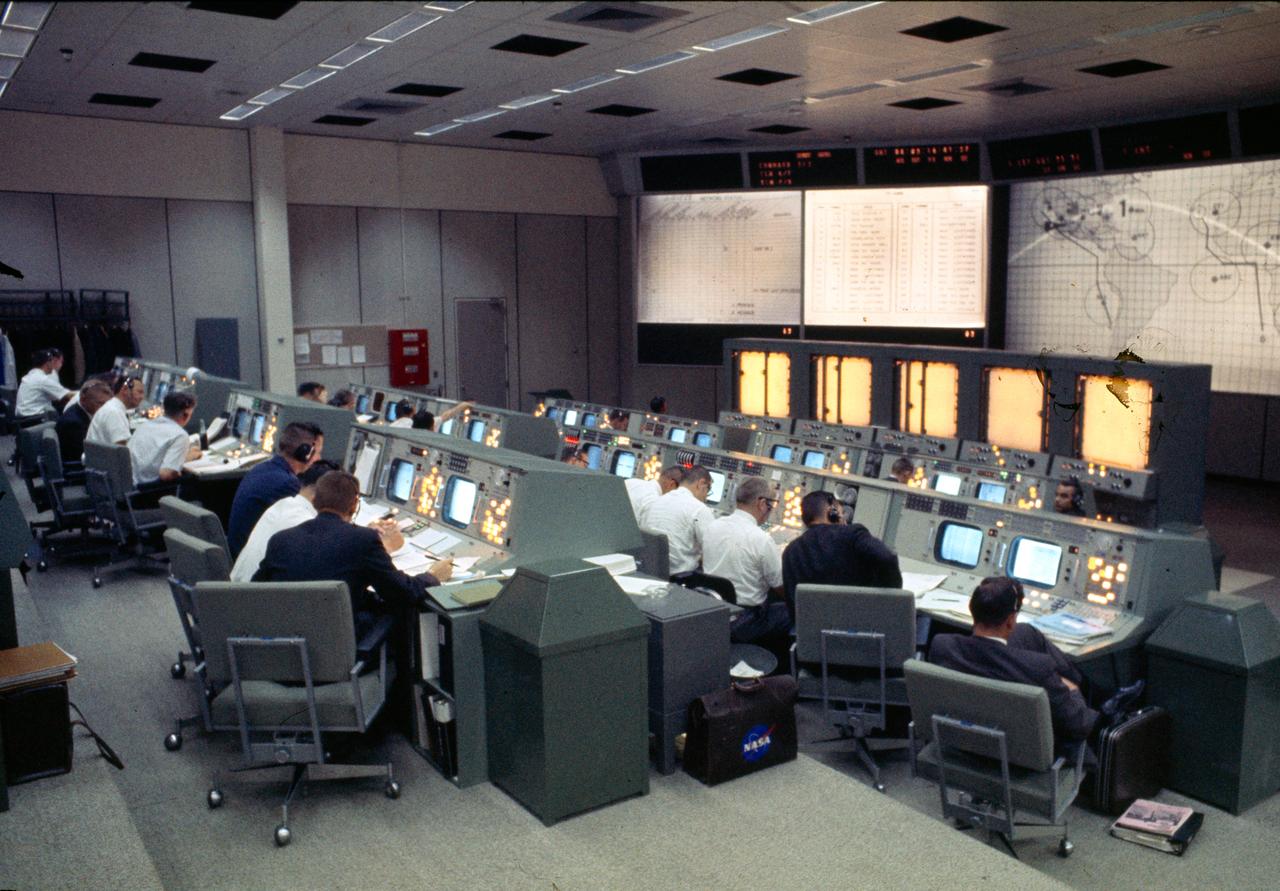
S65-30410 (3 June 1965) --- Overall view of the Mission Control Center in Houston, Texas, during the early hours of the Gemini-Titan 4 spaceflight. Photo credit: NASA
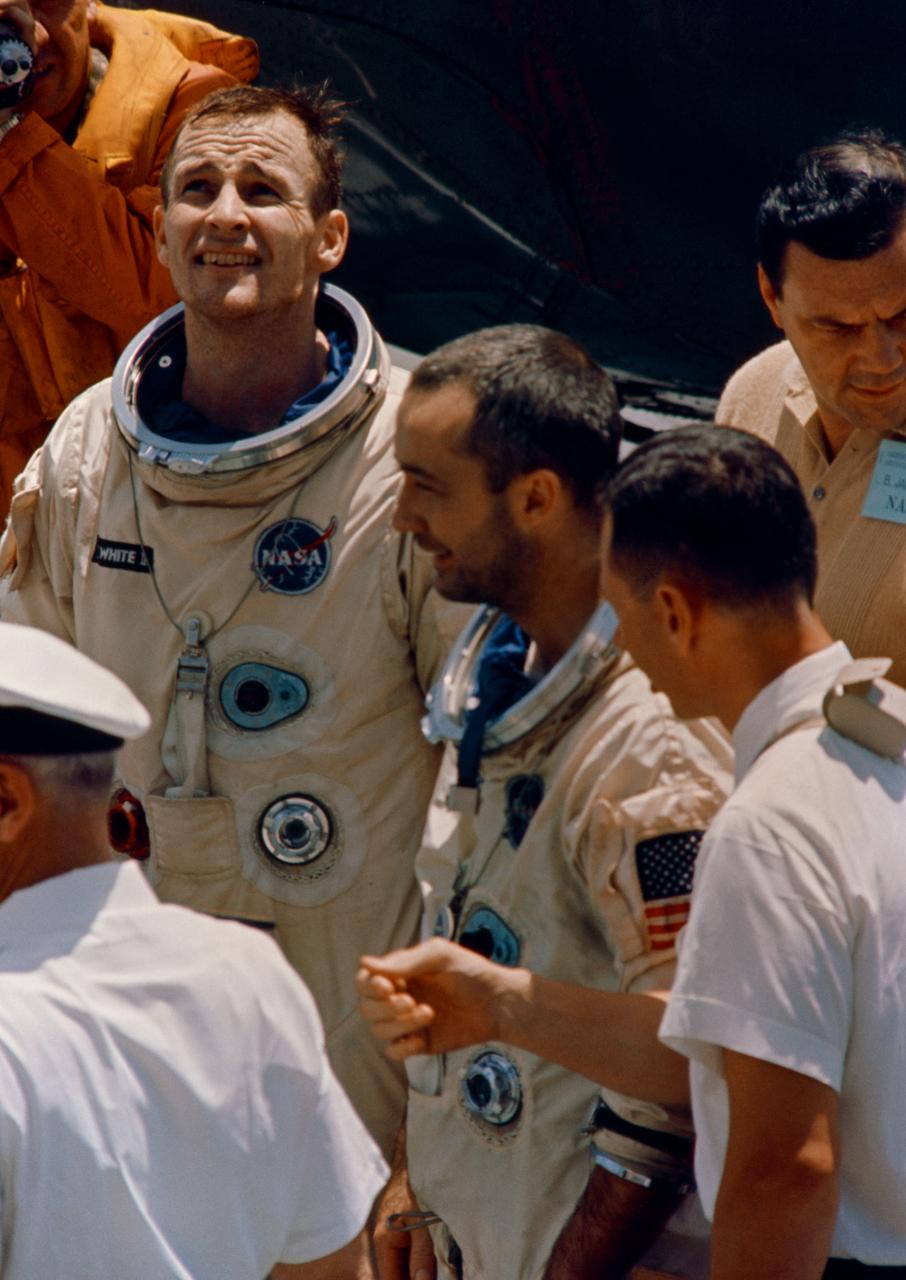
S65-32993 (7 June 1965) --- Astronauts James A. McDivitt (left), Gemini-Titan 4 command pilot; and Edward H. White II, pilot, are seen talking to personnel on the recovery ship USS Wasp.
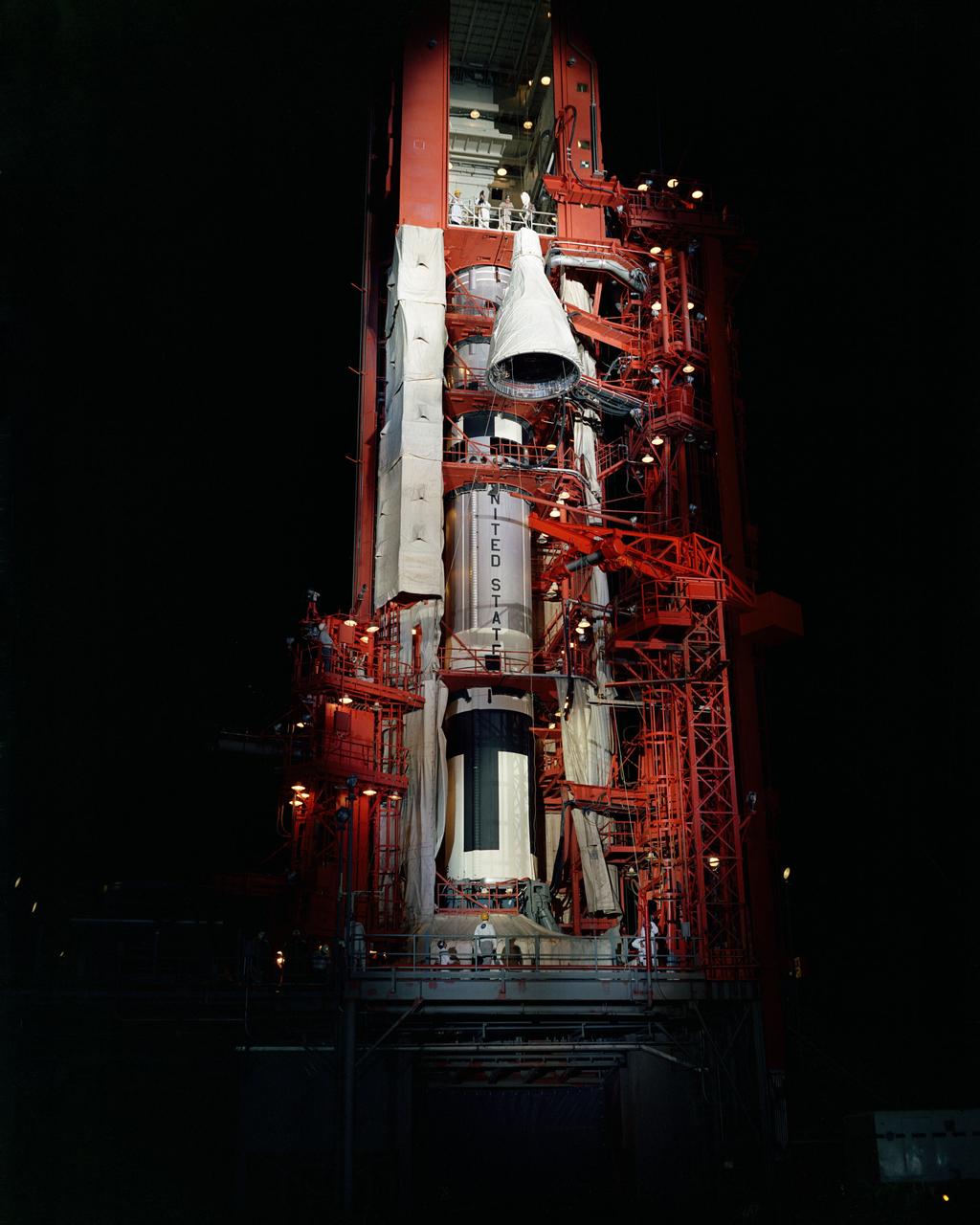
S65-23710 (14 April 1965) --- Nighttime scene showing the Gemini-4 spacecraft being hoisted to the white room at the top of the gantry at Pad 19 for soft mating with the Titan launch vehicle.
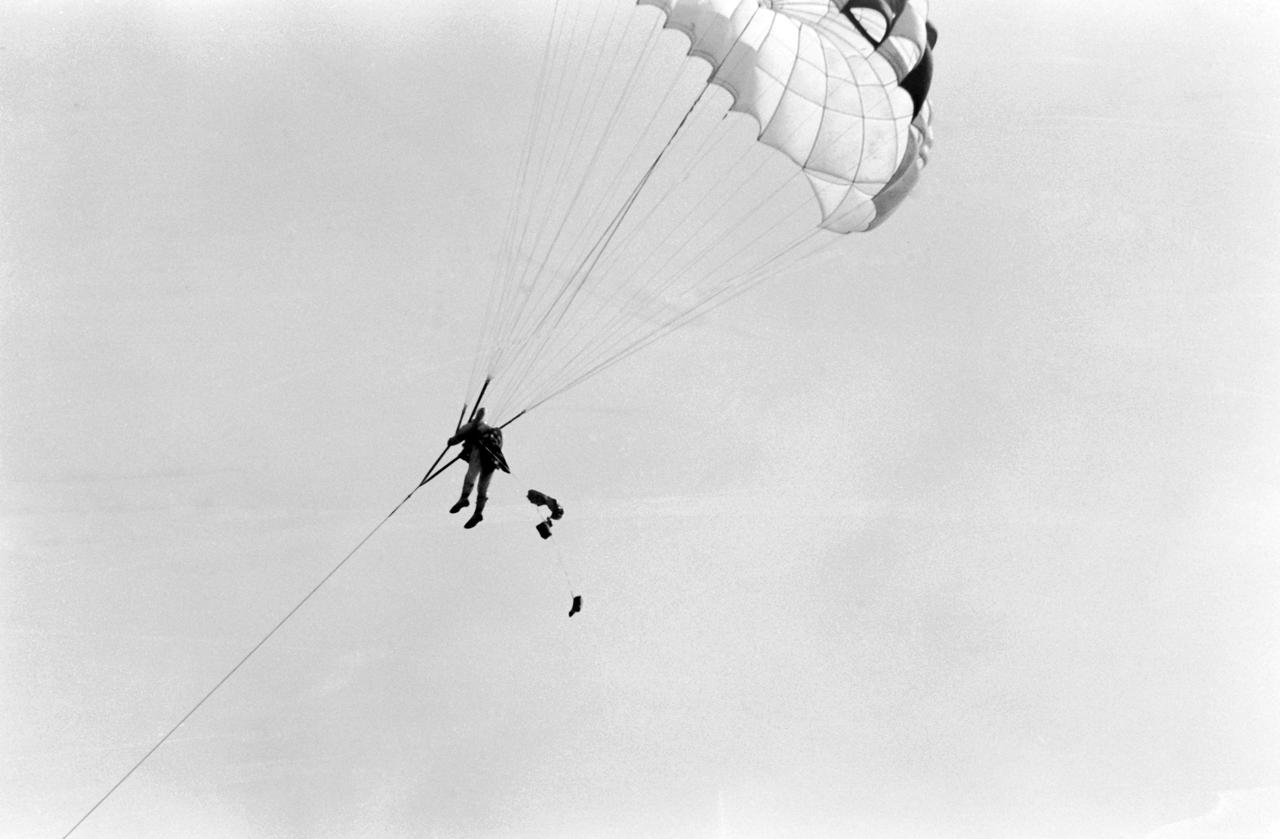
S65-10175 (2 Feb. 1965) --- Astronaut Edward H. White II, Gemini-Titan 4 prime crew pilot, is pictured during water egress para-drop training activity in nearby Galveston Bay.
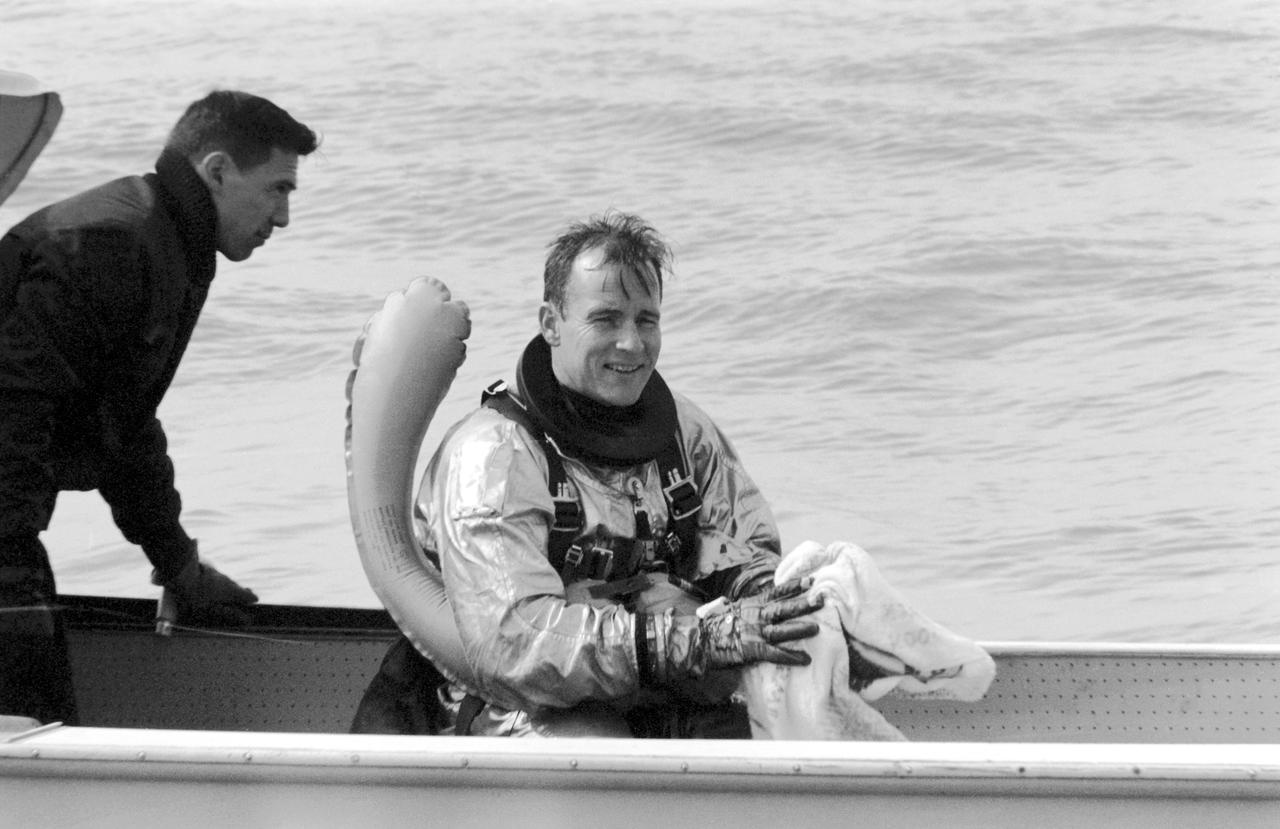
S65-10174 (2 Feb. 1965) --- Astronaut Edward H. White II, Gemini-Titan 4 prime crew pilot, is pictured during water egress para-drop training activity in nearby Galveston Bay.
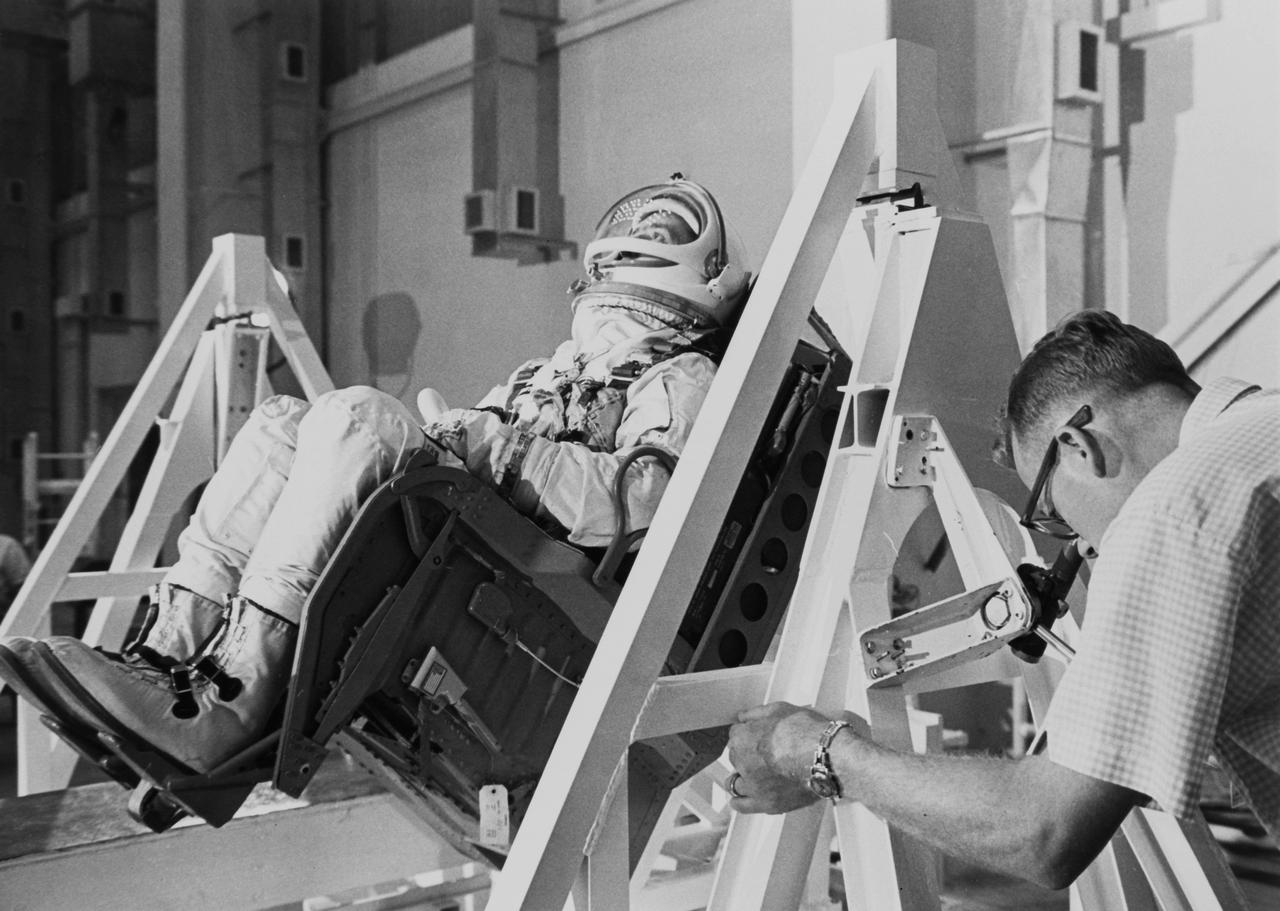
S65-19585 (21 May 1965) --- Astronaut James A. McDivitt, command pilot for the Gemini-Titan 4 prime crew, participates in a weight and balance test during a wet mock simulation exercise at Cape Kennedy, Florida. The two-man Gemini-4 mission, scheduled no earlier than June 3, 1965, will orbit Earth 62 times in four days. Astronaut Edward H. White II (out of frame) is the GT-4 prime crew pilot.
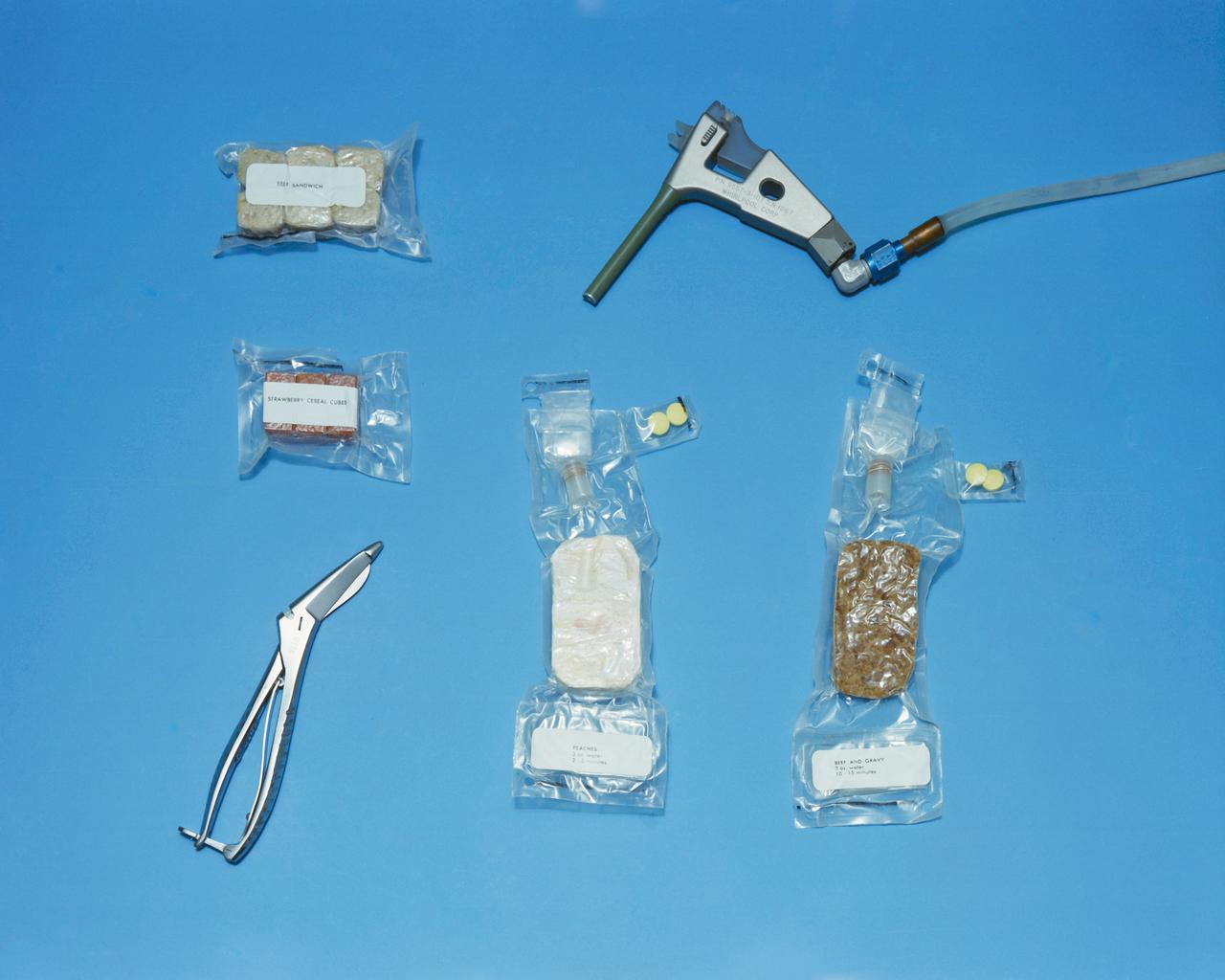
Food packages for use on the Gemini-Titan 4 (GT-4) flight. Packages include beef and gravy, peaches, strawberry cereal cubes and beef sandwiches. A water gun is used to reconstitute the dehydrated food. MSC, HOUSTON, TX CN
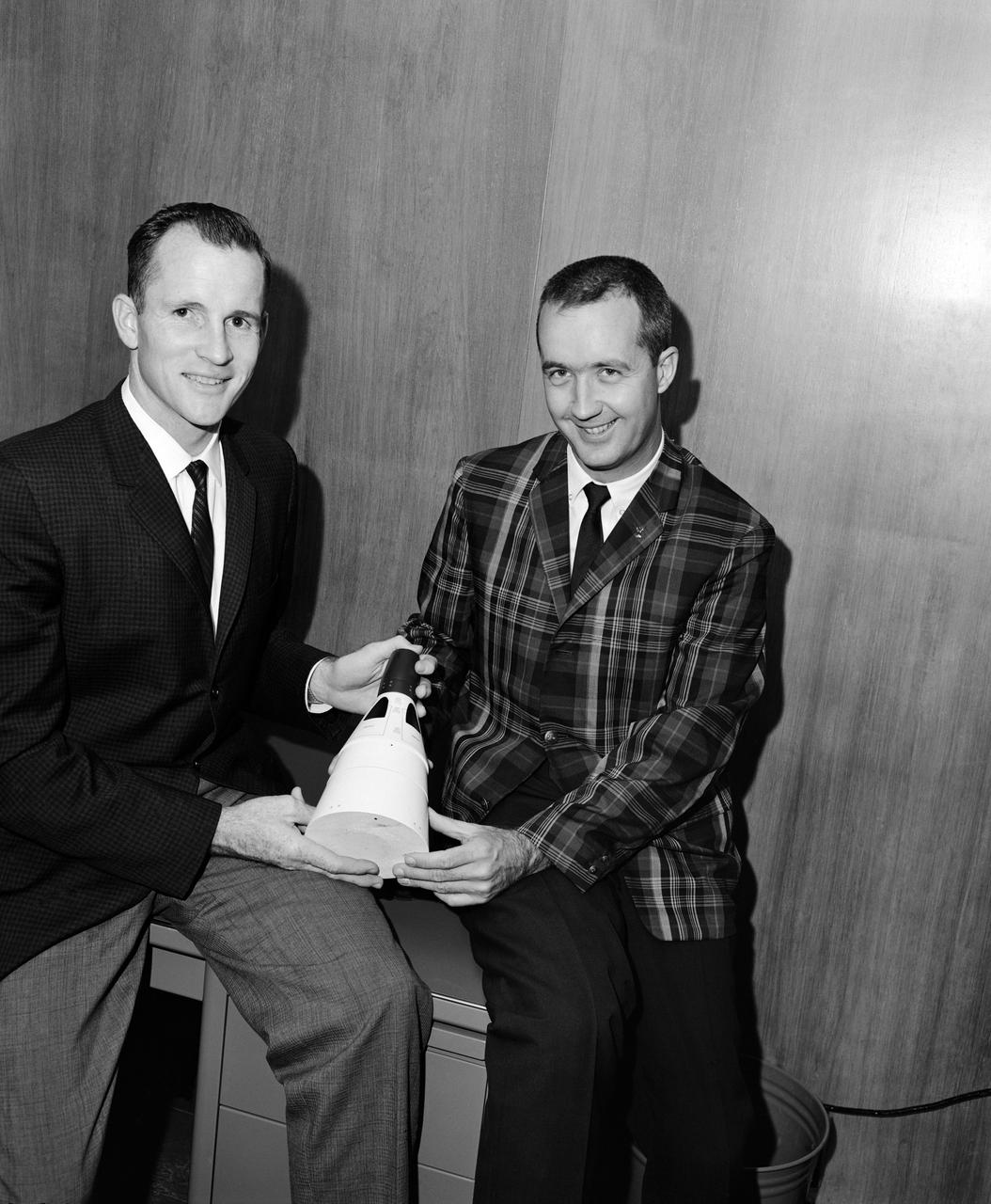
S62-04515 (1962) --- Astronauts Edward H. White II (left), Gemini-Titan 4 (GT-4) pilot, and James A. McDivitt, command pilot, pose for a photo holding a Gemini model. EDITOR?S NOTE: Jan. 27, 1967, astronaut White lost his life in the Apollo/Saturn 204 accident at Cape Canaveral, Florida.
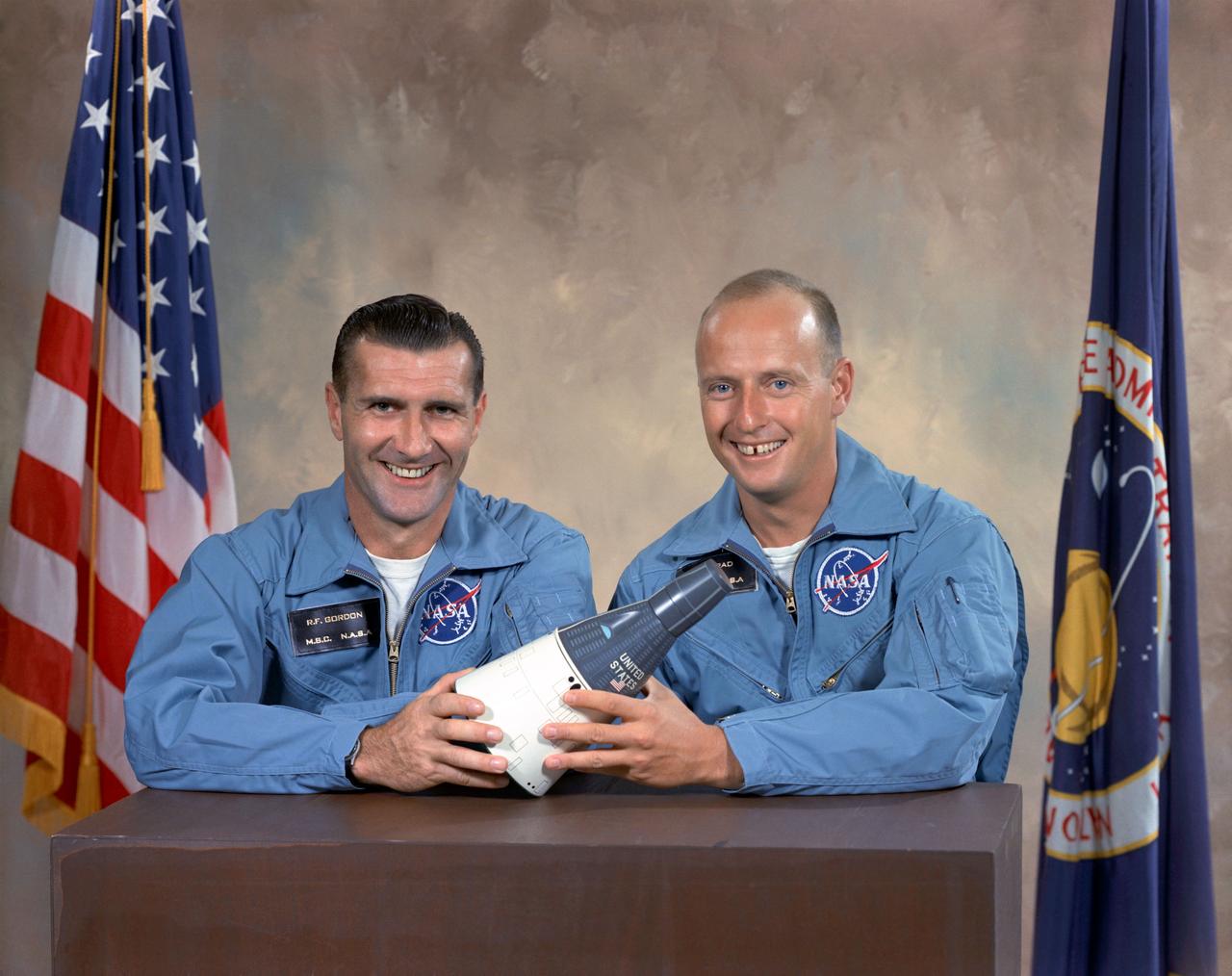
S65-58504 (4 Nov. 1965) --- Astronauts Charles Conrad Jr., (right) prime crew command pilot, and Richard F. Gordon Jr., prime crew pilot, for the Gemini-Titan XI (GT-11) Earth-orbital mission. Photo credit: NASA
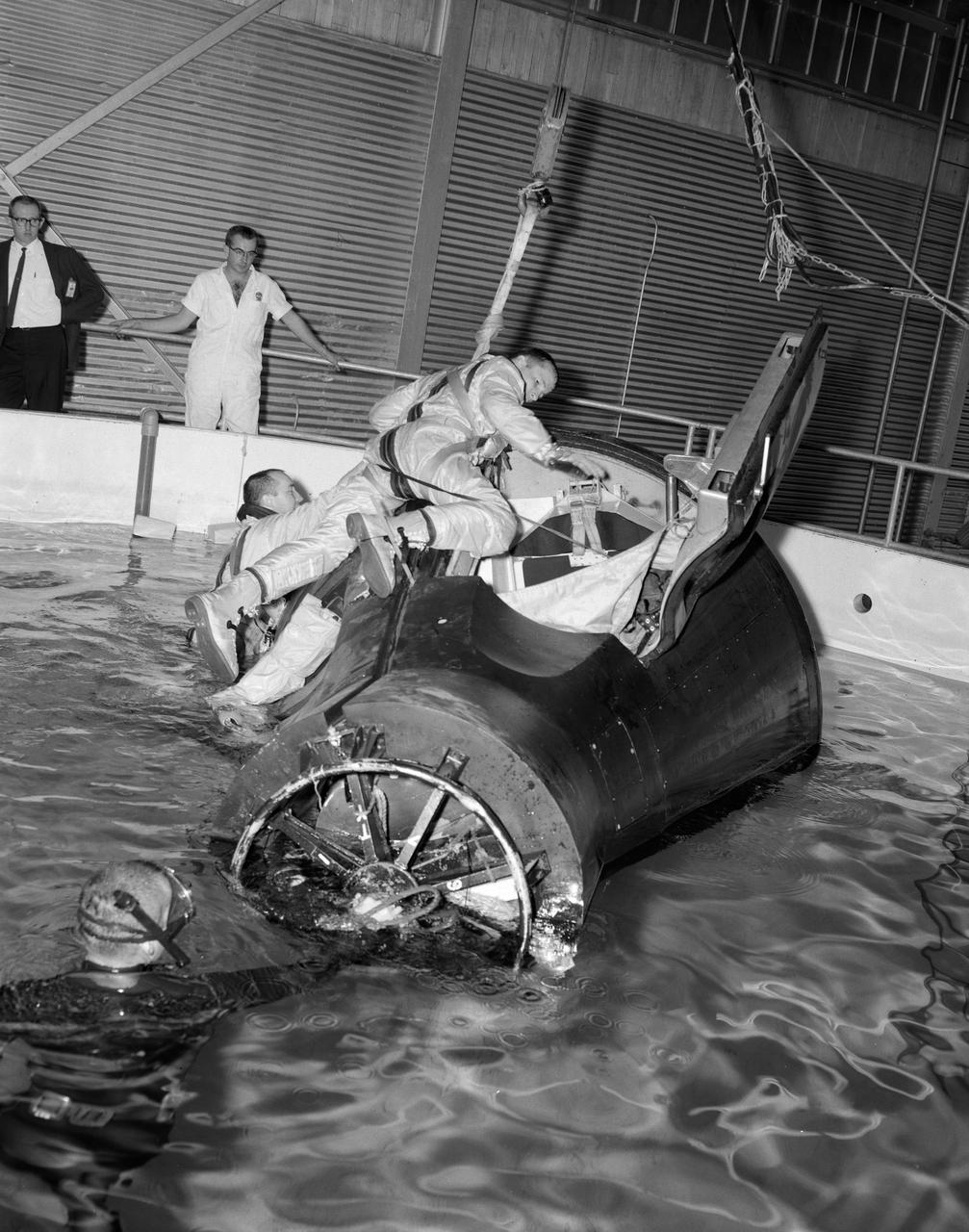
S65-19282 (29 March 1965) --- The Gemini-Titan 4 prime crew, astronauts James A. McDivitt (left), command pilot; and Edward H. White II, pilot, are pictured during water egress training at Ellington Air Force Base, Texas.
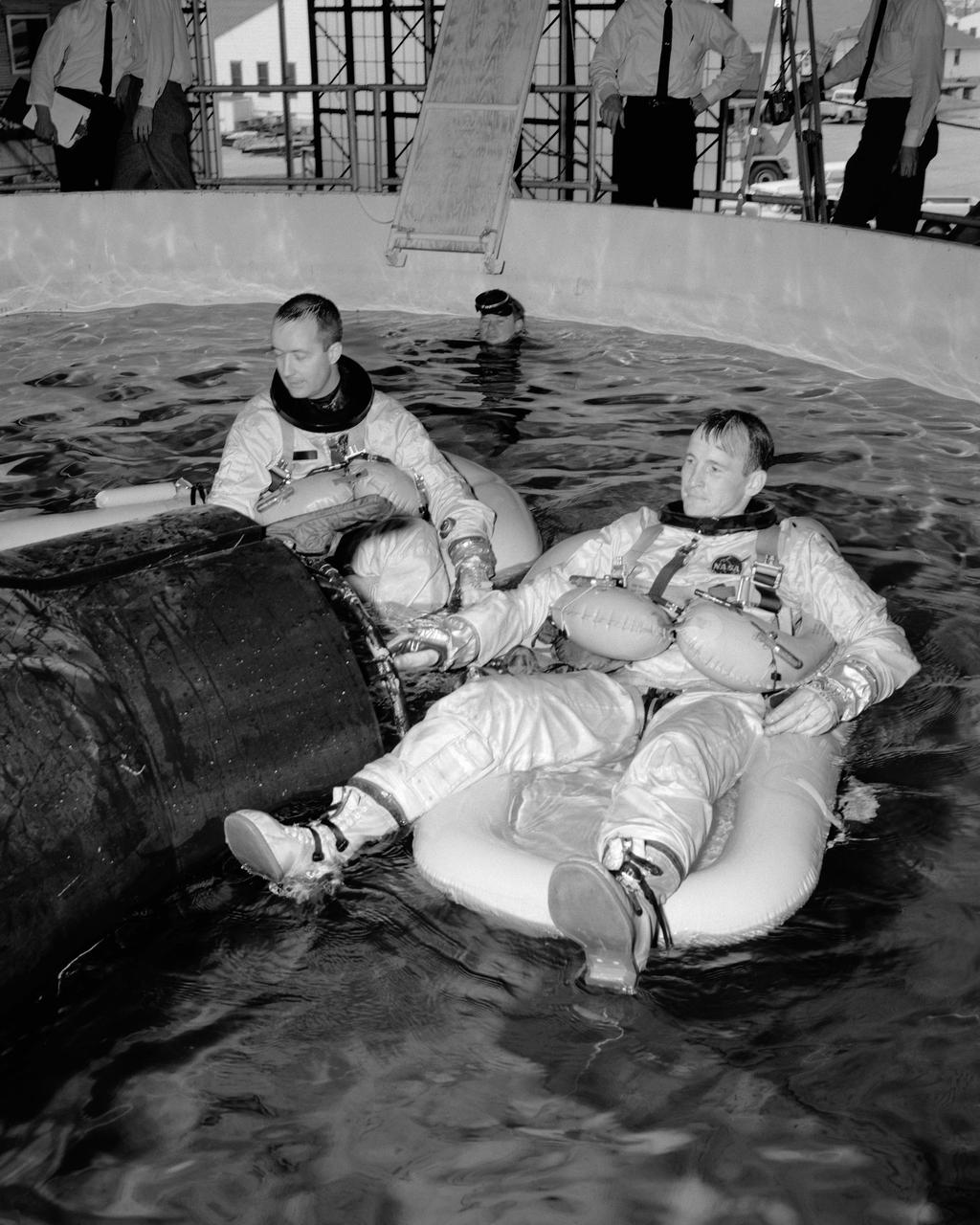
S65-19283 (29 March 1965) --- The Gemini-Titan 4 prime crew, astronauts James A. McDivitt (left), command pilot; and Edward H. White II, pilot, are pictured during water egress training at Ellington Air Force Base, Texas.
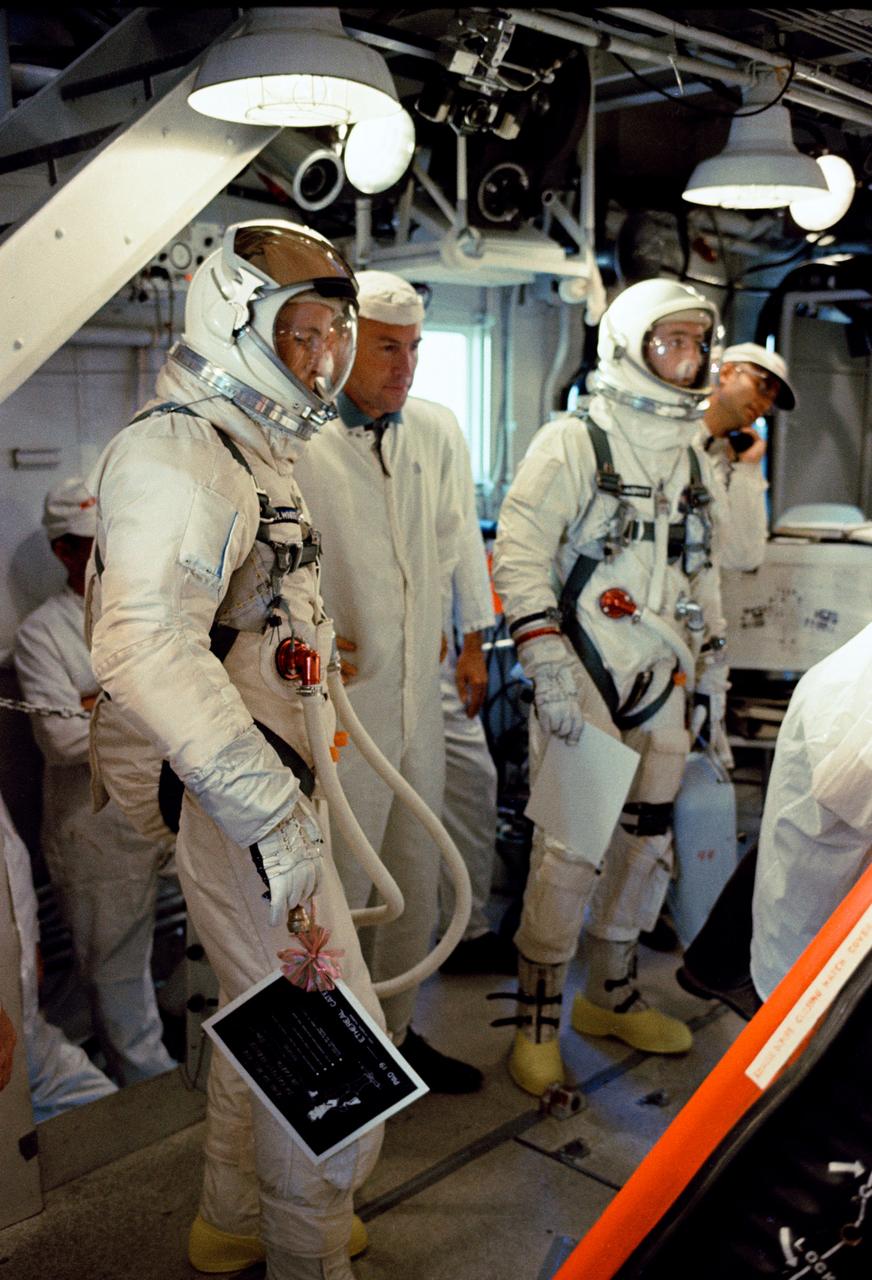
S65-29647 (3 June 1965) --- Astronauts Edward H. White II and James A. McDivitt are shown in the white room as they prepare to enter the Gemini-4 spacecraft atop the Titan launch vehicle at Cape Kennedy, Florida. The NASA Headquarters alternative photo number is 65-H-296.
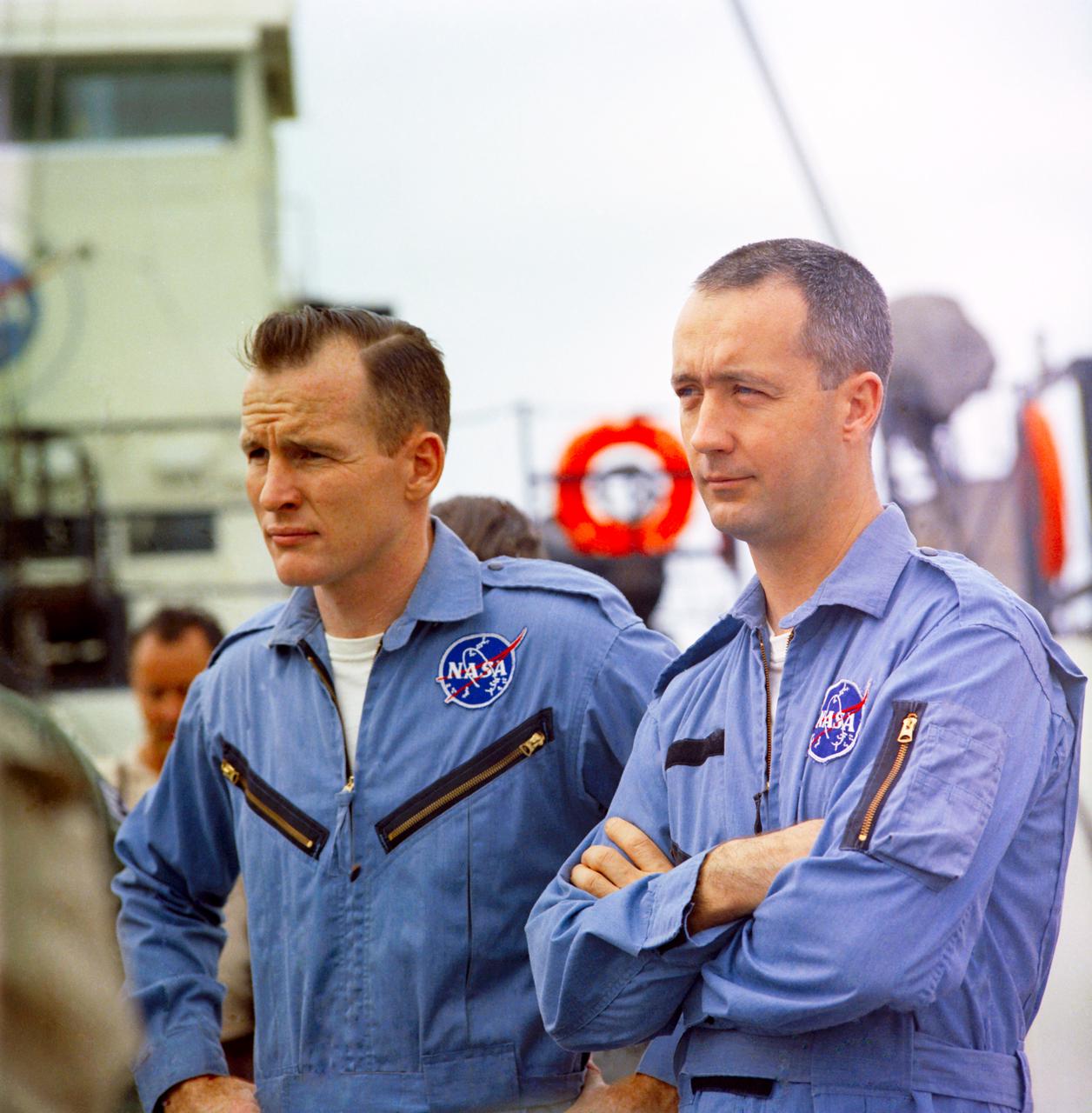
S65-22656 (14 April 1965) --- The Gemini-Titan 4 prime crew, astronauts Edward H. White II (left), pilot, and James A. McDivitt, command pilot, pictured aboard the NASA Motor Vessel Retriever in the Gulf of Mexico.
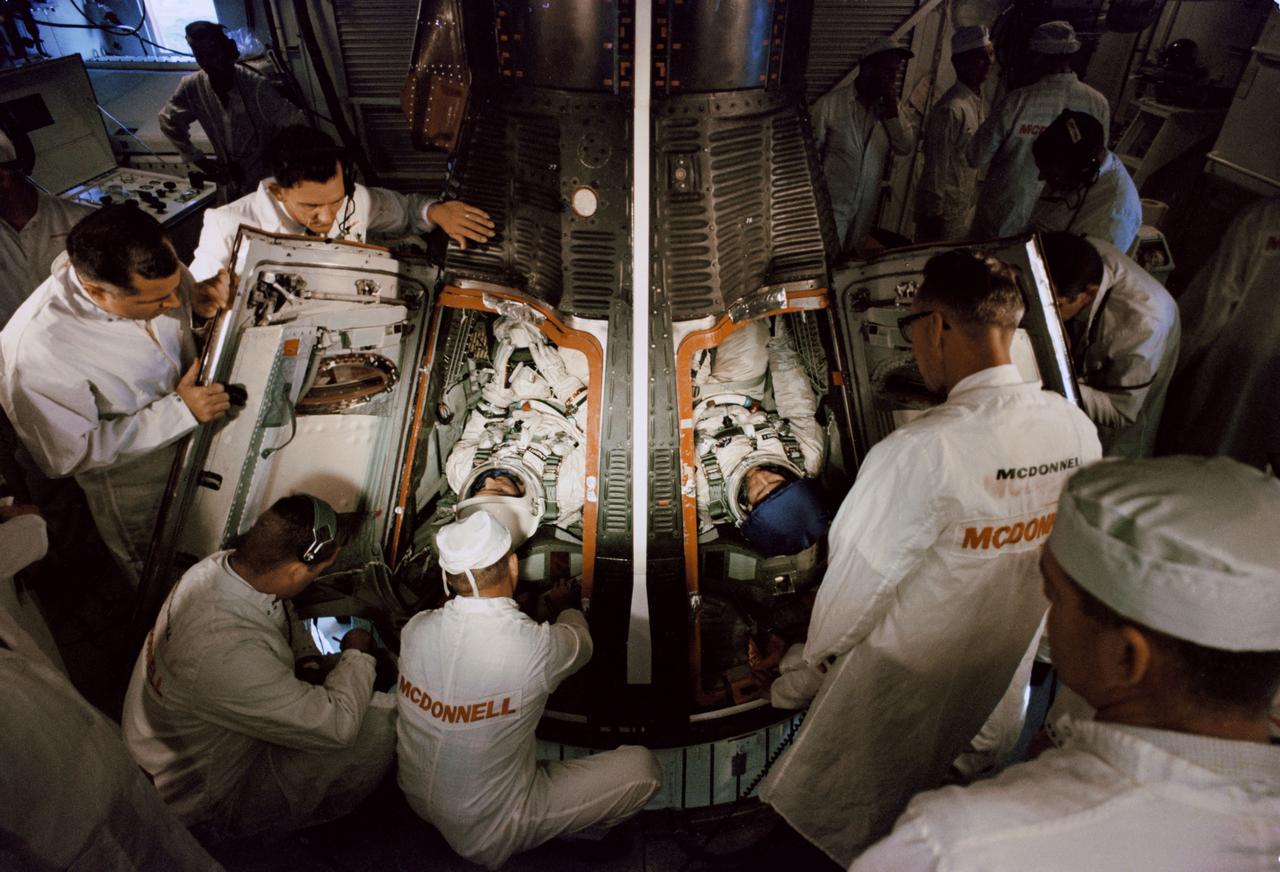
S65-29641 (3 June 1965) -- Astronauts Edward H. White II and James A. McDivitt are shown in the white room as they enter the Gemini-4 spacecraft atop the Titan launch vehicle at Cape Kennedy, Florida. The NASA Headquarters alternative photo number is 65-H-291.
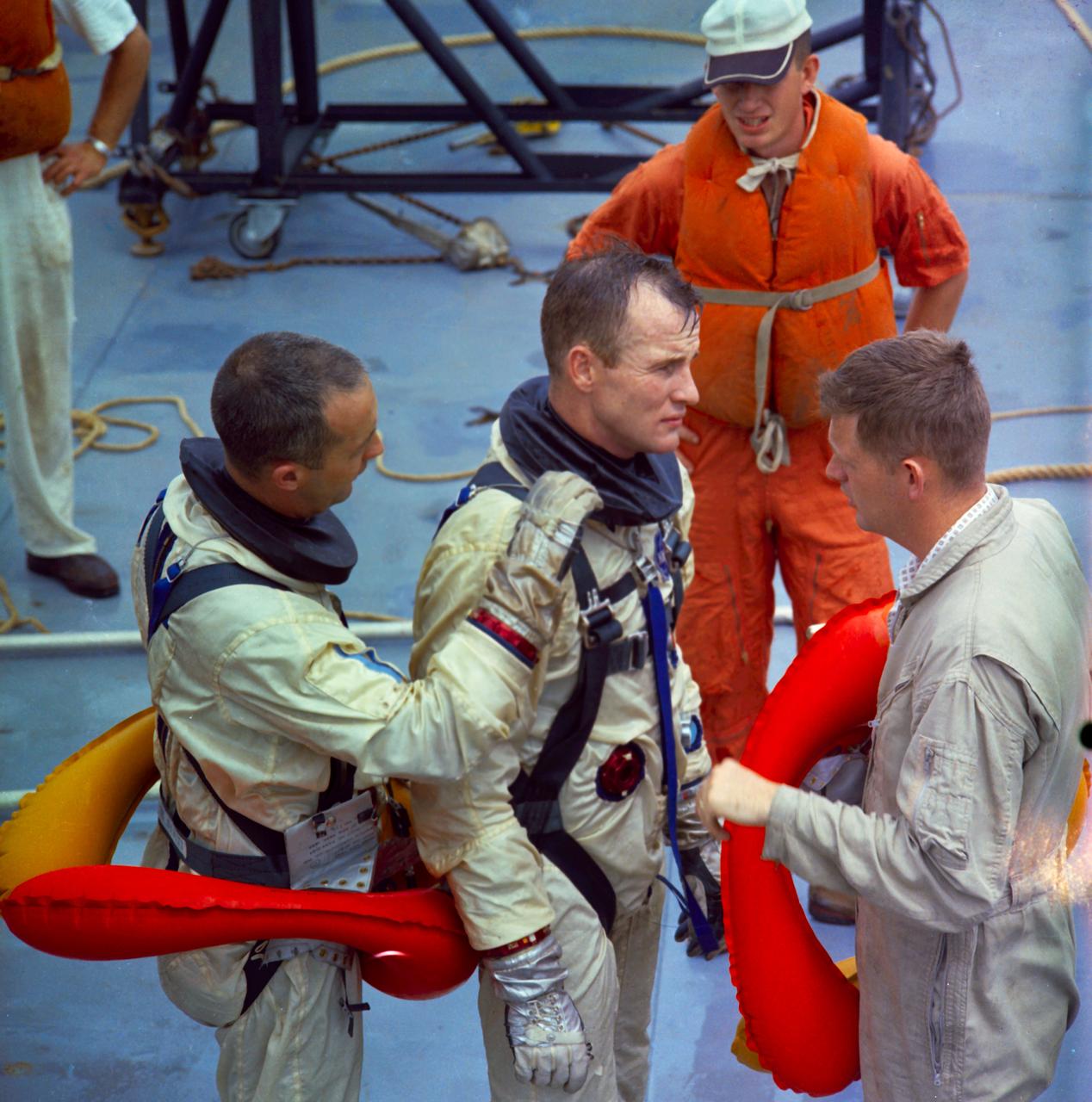
S65-22655 (14 April 1965) --- The Gemini-Titan 4 prime crew is shown aboard the NASA Motor Vessel Retriever in the Gulf of Mexico suiting up for water egress training. Astronaut James A. McDivitt (left) is the command pilot, and astronaut Edward H. White II is the pilot.
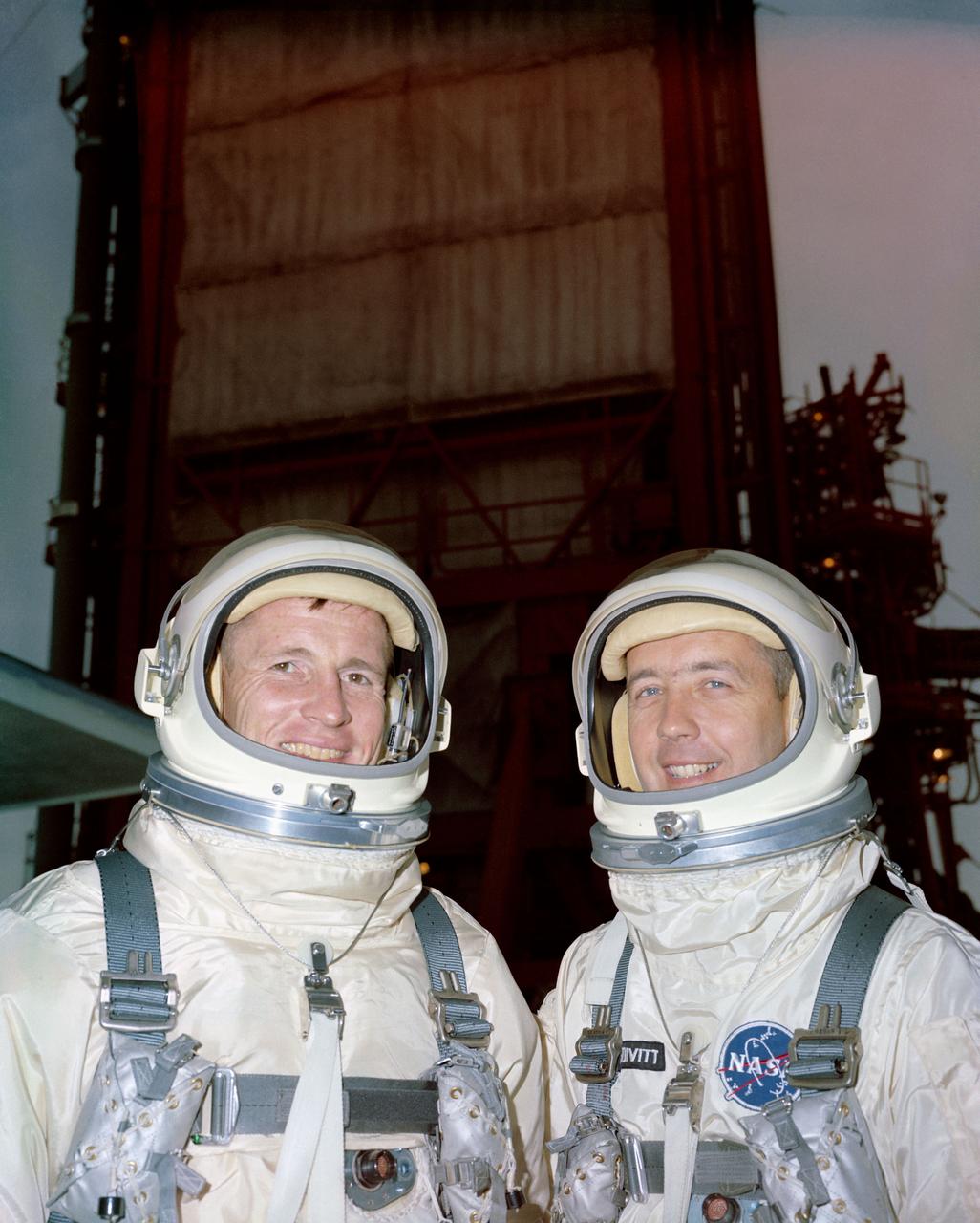
S65-19528 (1 June 1965) --- Astronauts Edward H. White II (left), Gemini-Titan 4 pilot; and James A. McDivitt, command pilot. EDITOR?S NOTE: Astronaut White died in the Apollo 1/Saturn 204 fire at Cape Kennedy on Jan. 27, 1967.
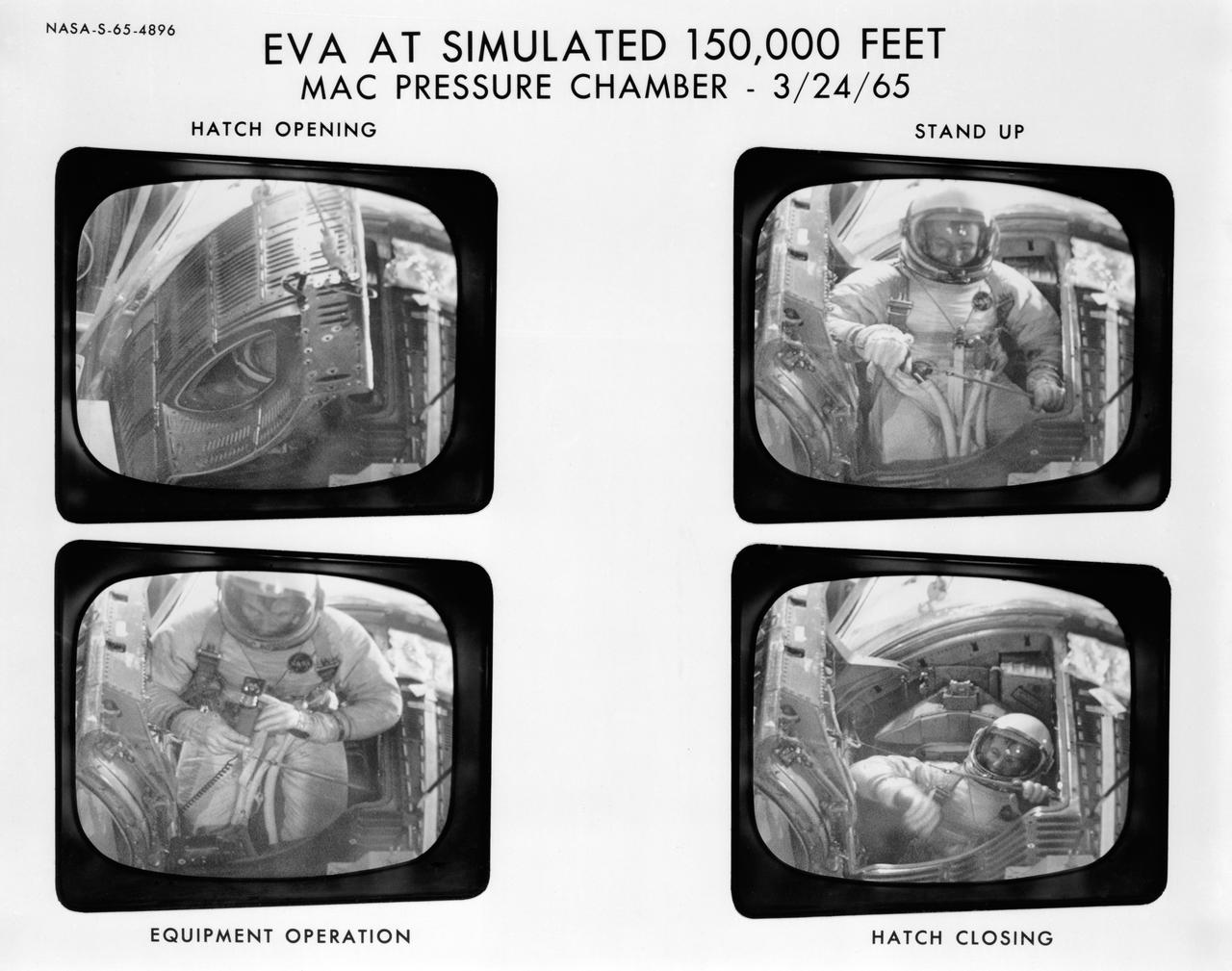
S65-04896 (24 March 1965) --- Astronaut Edward H. White II, pilot of the Gemini-Titan 4 prime crew, is shown in the pressure chamber at McDonnell Aircraft Corp, St. Louis, Mo. during the simulation of extravehicular activity (EVA) at an altitude of 150,000 feet.
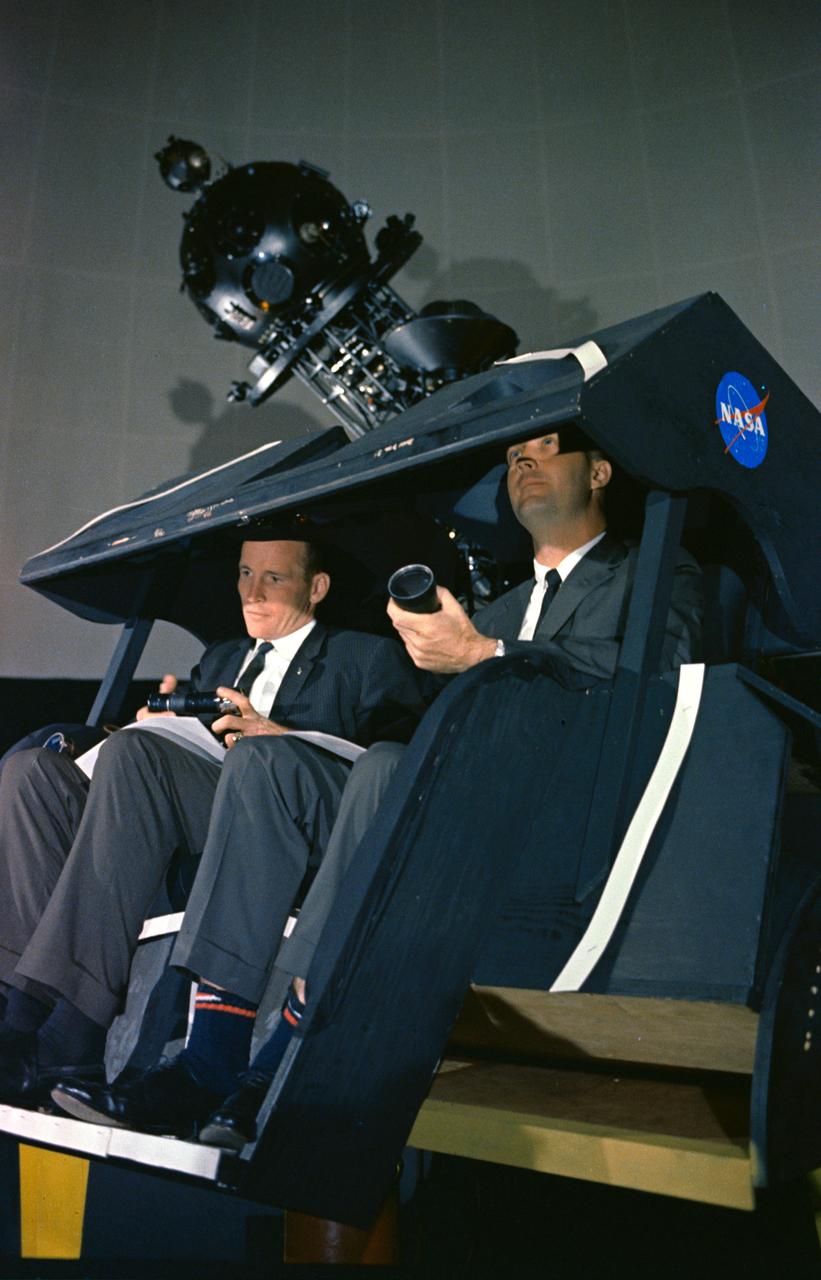
S65-29652 (7 May 1965) --- Astronauts James A. McDivitt (right) and Edward H. White II are shown at the Morehead Planetarium in North Carolina, checking out celestial navigation equipment as part of their training for the Gemini-Titan 4 mission. The NASA Headquarters alternative photo number is 65-H-277.
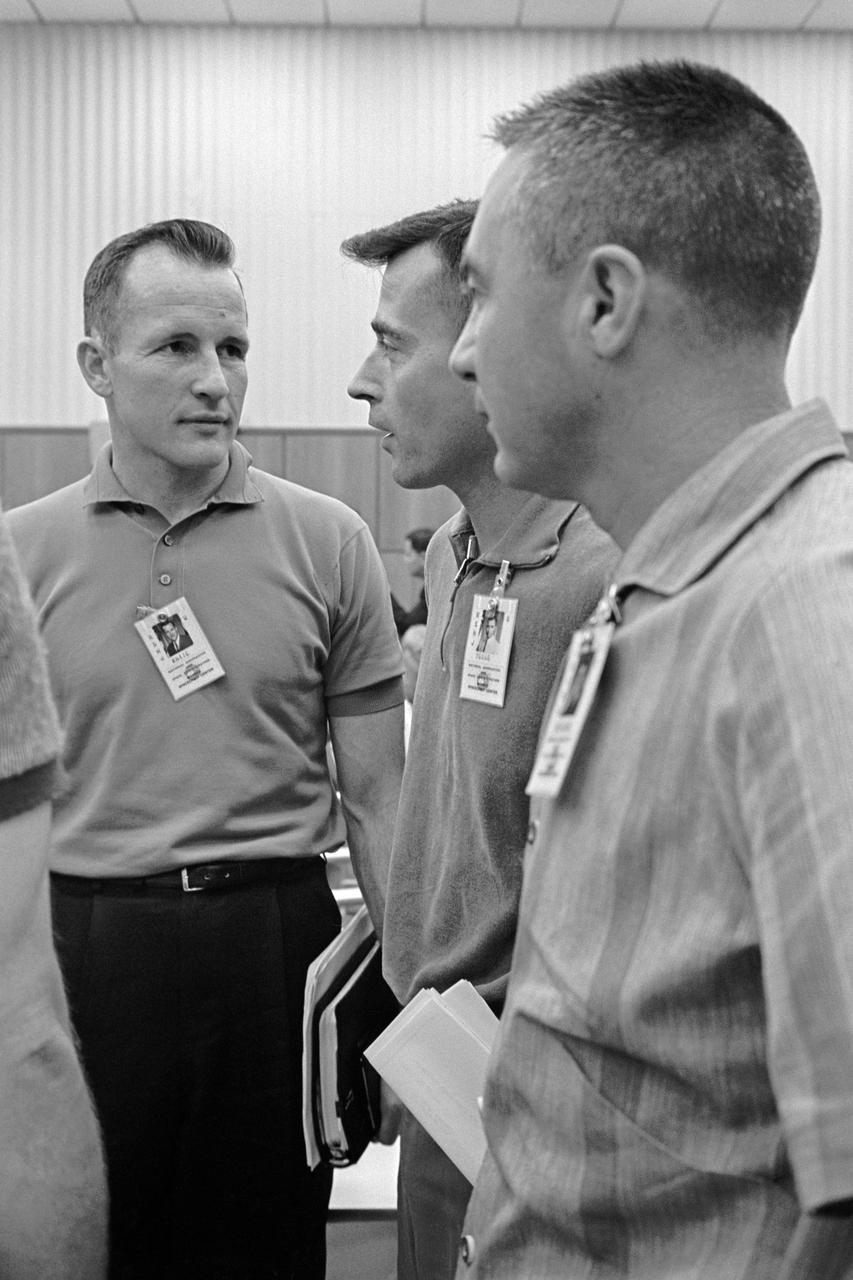
S65-20632 (20 March 1965) --- The prime crew of the NASA Gemini-Titan 3 mission, astronauts John W. Young (center), pilot; and Virgil I. Grissom (foreground), command pilot, hold a discussion at the Gemini launch vehicle review meeting on March 20, 1965, with astronaut Edward H. White II, pilot for the GT-4 mission. The meeting was held in the Manned Spacecraft Operations Building on Merritt Island, Florida.
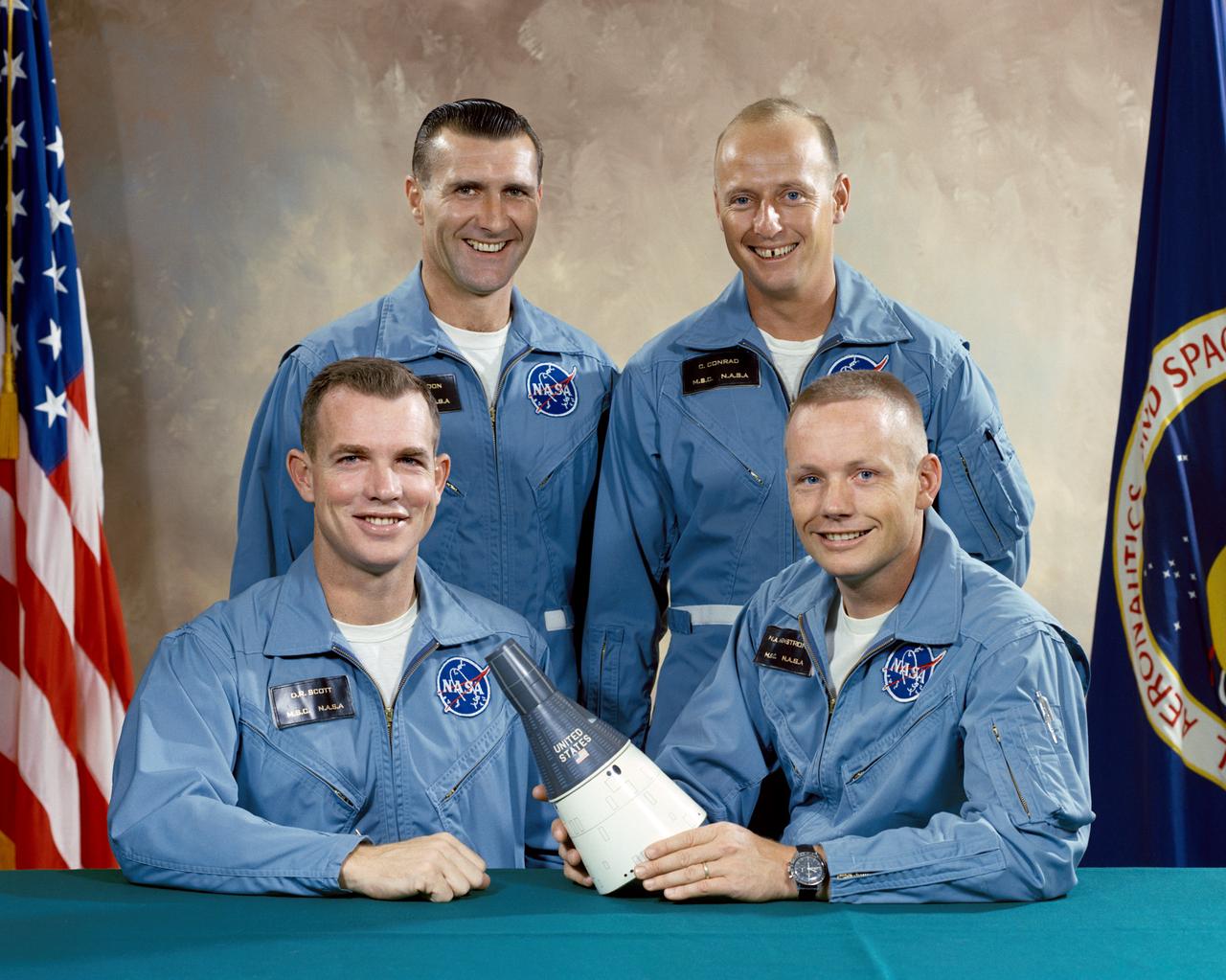
S65-58502 (4 Nov. 1965) --- This is the portrait of the prime and backup crew members of the Gemini-Titan 8 (GT-8) mission. Astronauts David R. Scott (left), pilot; and astronaut Neil A. Armstrong, command pilot, are the prime crew of the Gemini-8 mission. Backup crew (left to right, standing) are astronauts Richard F. Gordon Jr., pilot; and Charles Conrad Jr., command pilot. Photo credit: NASA
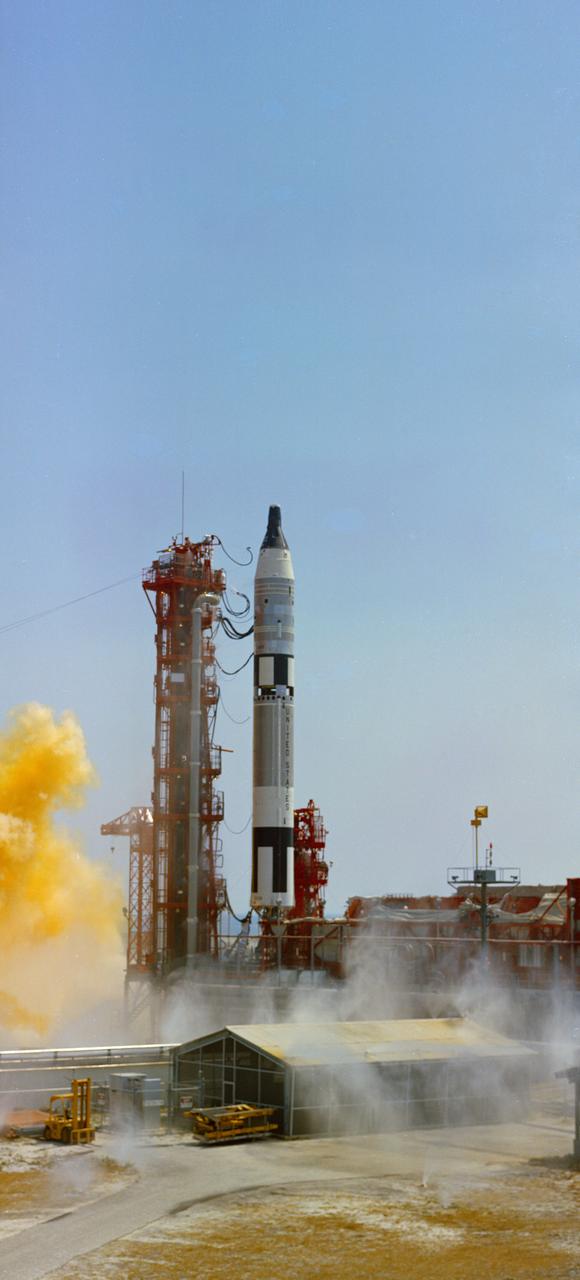
S65-30412 (3 June 1965) --- The Gemini-Titan 4 (GT-4) spaceflight launches from Cape Kennedy's Pad 19 at 10:16 a.m. (EST) on June 3, 1965. The GT-4 spacecraft carried astronauts James A. McDivitt, command pilot, and Edward H. White II, pilot, on a four-day, 62-revolution mission. Photo credit: NASA
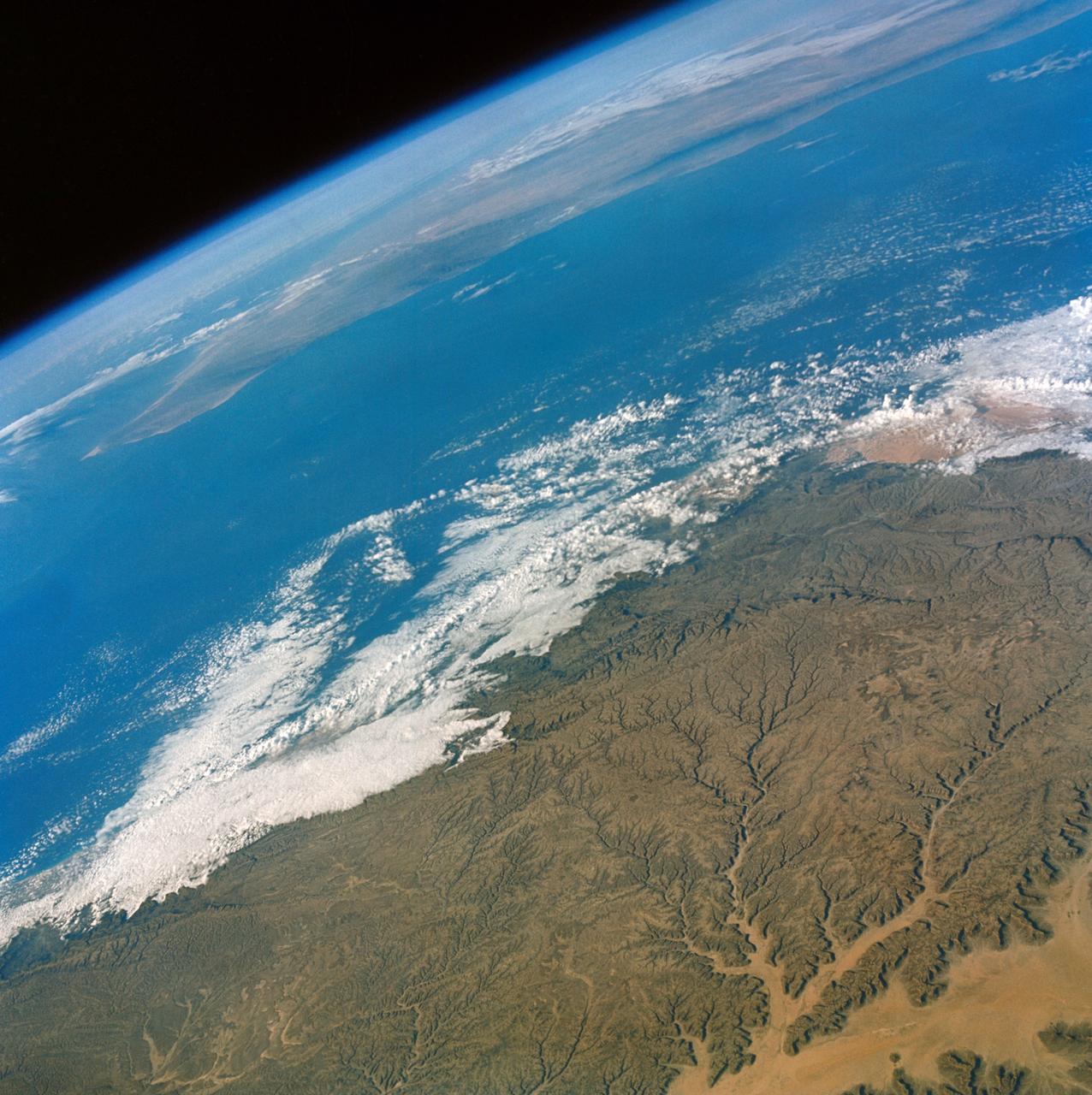
S65-34659 (3-7 June 1965) --- Among the many photographs taken from the Gemini-4 spacecraft during its orbital flight around Earth was this view of the Hahramaut Plateau on the southern portion of the Arabian Peninsula. The Wadi Hahramaut is in the foreground; with the Gulf of Aden (dark blue). This photograph was made with a modified 70mm Hasselblad camera, using Eastman color film, ASA 64, at a lens setting of 250th of a second at f/11.
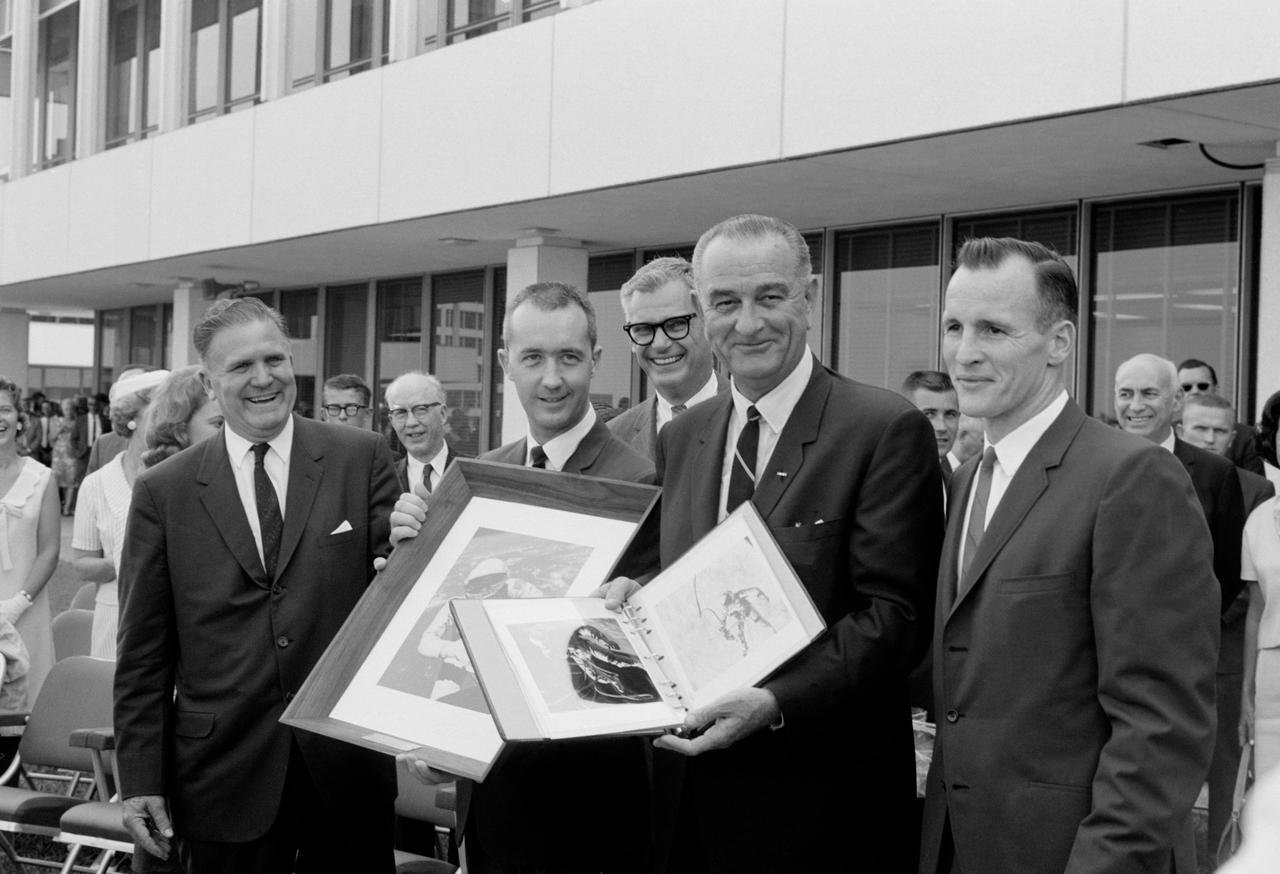
S65-33250 (11 June 1965) --- President Lyndon B. Johnson holds a Gemini-4 souvenir photo album which he was presented during his visit to the space center. Left to right, are James E. Webb, NASA administrator, Washington, D.C.; astronaut James A. McDivitt, command pilot of the Gemini-4 spaceflight; Dr. Robert C. Seamans Jr., NASA associate adminitrator; the President; and astronaut Edward H. White II, pilot of the Gemini-4 mission. McDivitt holds a framed picture of White's "spacewalk" which was also given the President.
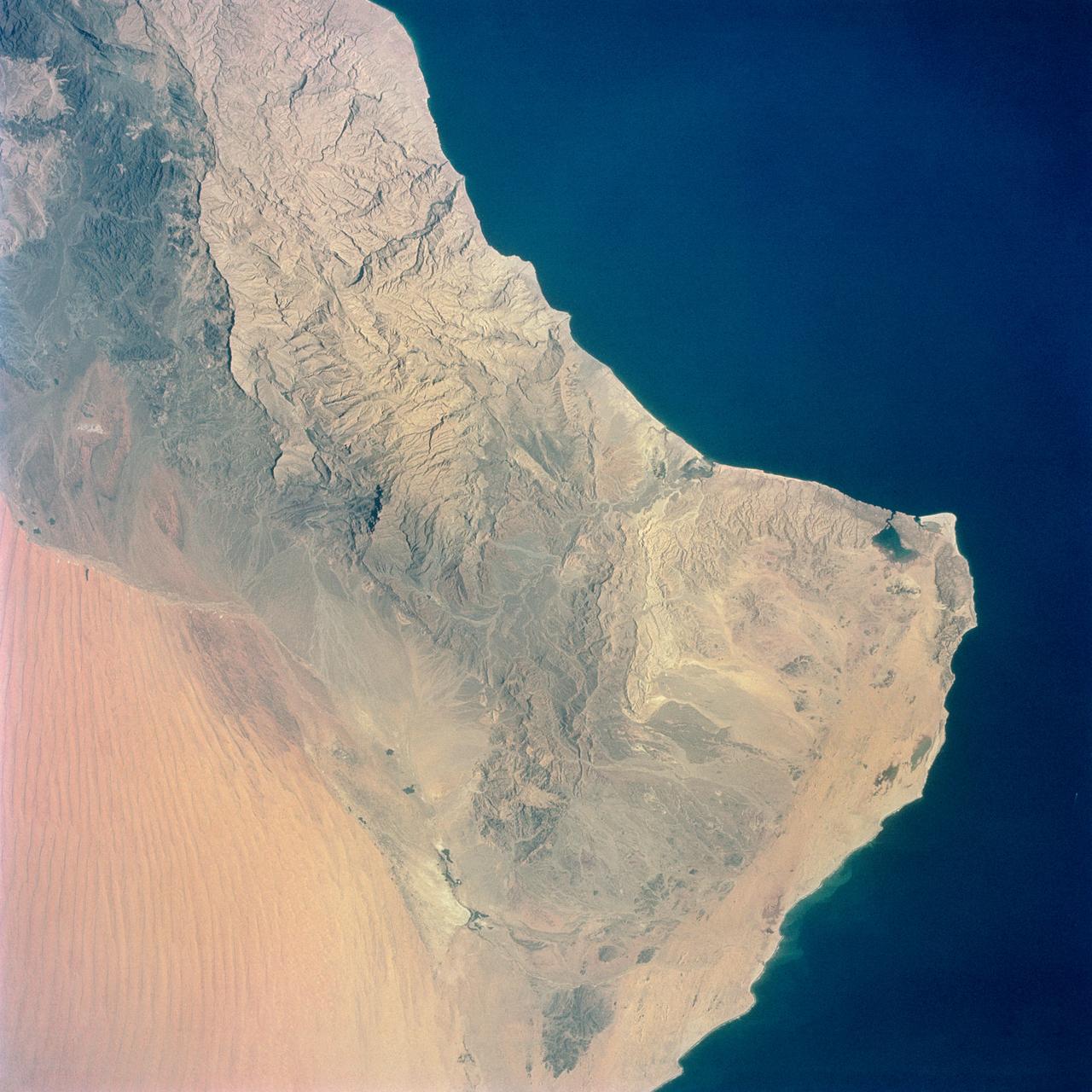
S65-34661 (3-7 June 1965) --- Among the photographs of Earth's terrain taken from the Gemini-4 spacecraft during its orbital mission was this view of the southeastern tip of the Arabian Peninsula with the Gulf of Oman at upper right. Seif dunes (sand) at lower left. This picture was taken with a modified 70mm Hasselblad camera, using Eastman color film, ASA 64 at a setting of 250th of a second at f/11. Dr. Paul Lowman Jr., NASA geologist, was in charge of the Synoptic Terrain Photography.
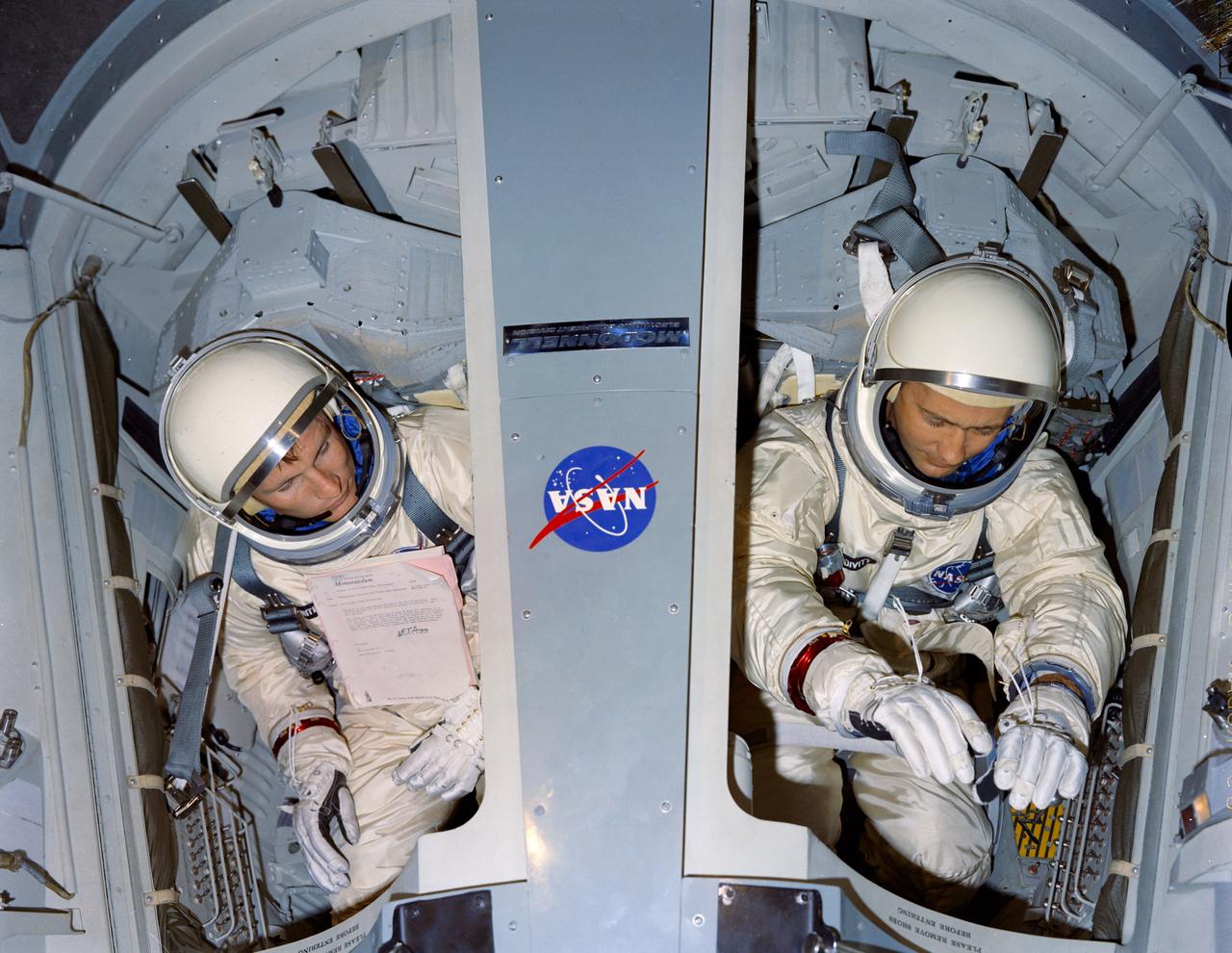
Astronauts Edward H. White II and James A. McDivitt are shown going through tests in a Gemini Crew Simulator at the Cape. CAPE KENNEDY, FL CN
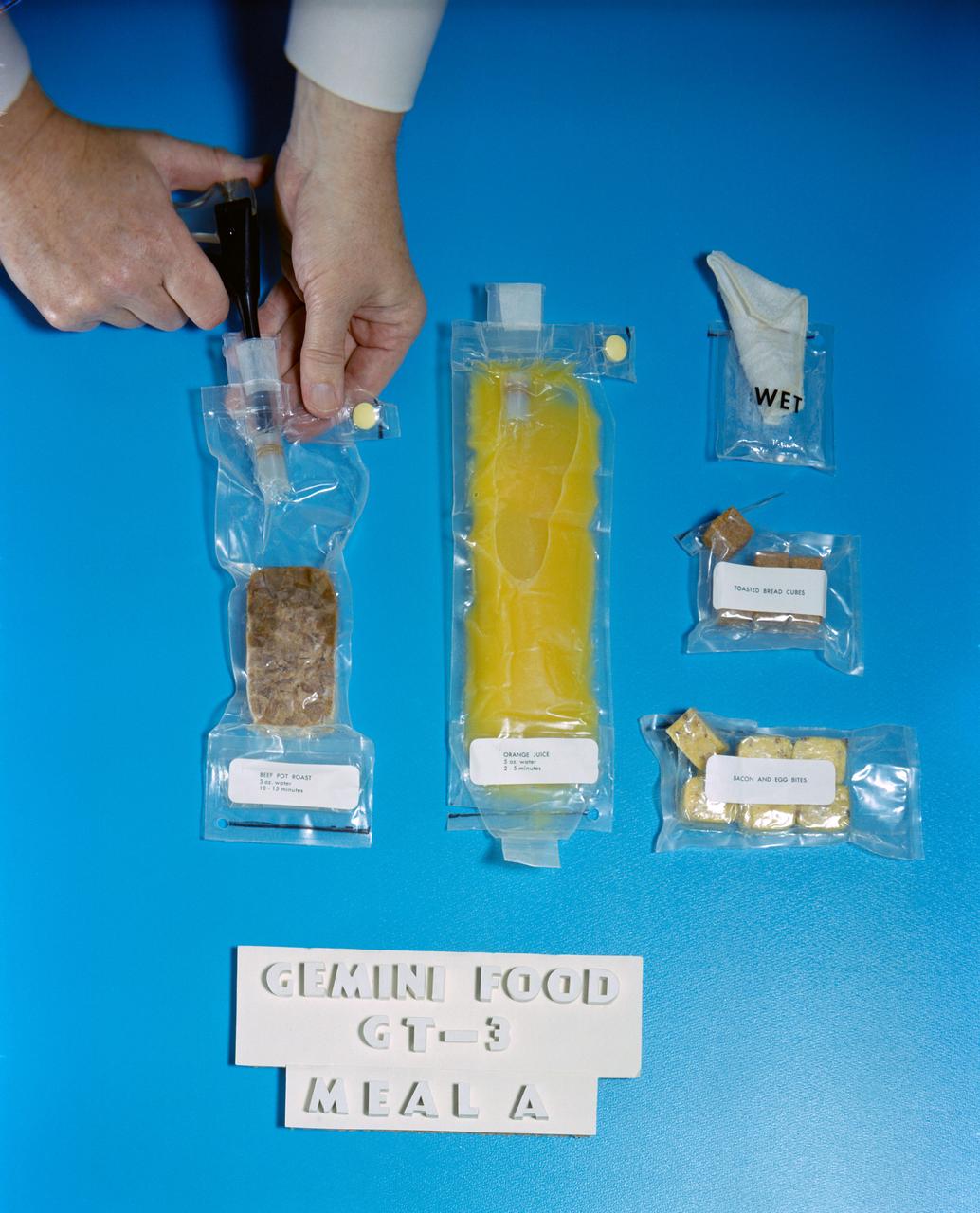
S65-10971 (March 1965 ) --- Food packets for use on the Gemini-3 flight including dehydrated beef pot roast, bacon and egg bites, toasted bread cubes, orange juice and a wet wipe. Water is being inserted into the pouch of dehydrated food.
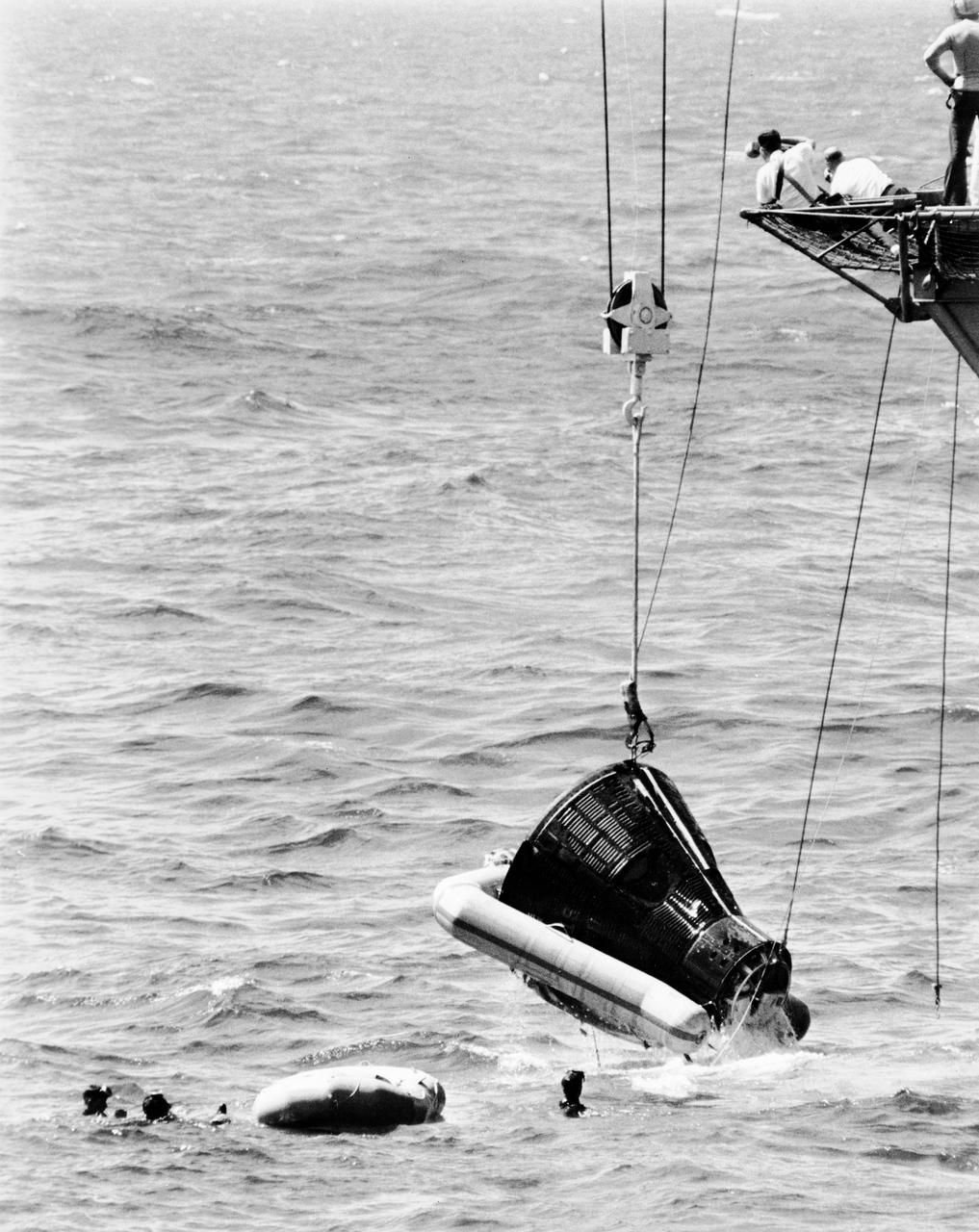
The Gemini-4 Astronauts is shown being hoisted aboard the Aircraft Carrier USS Wasp. The flotation collar is still attached to the spacecraft. DOWNRANGE RECOVERY AREA, ATLANTIC OCEAN B&W
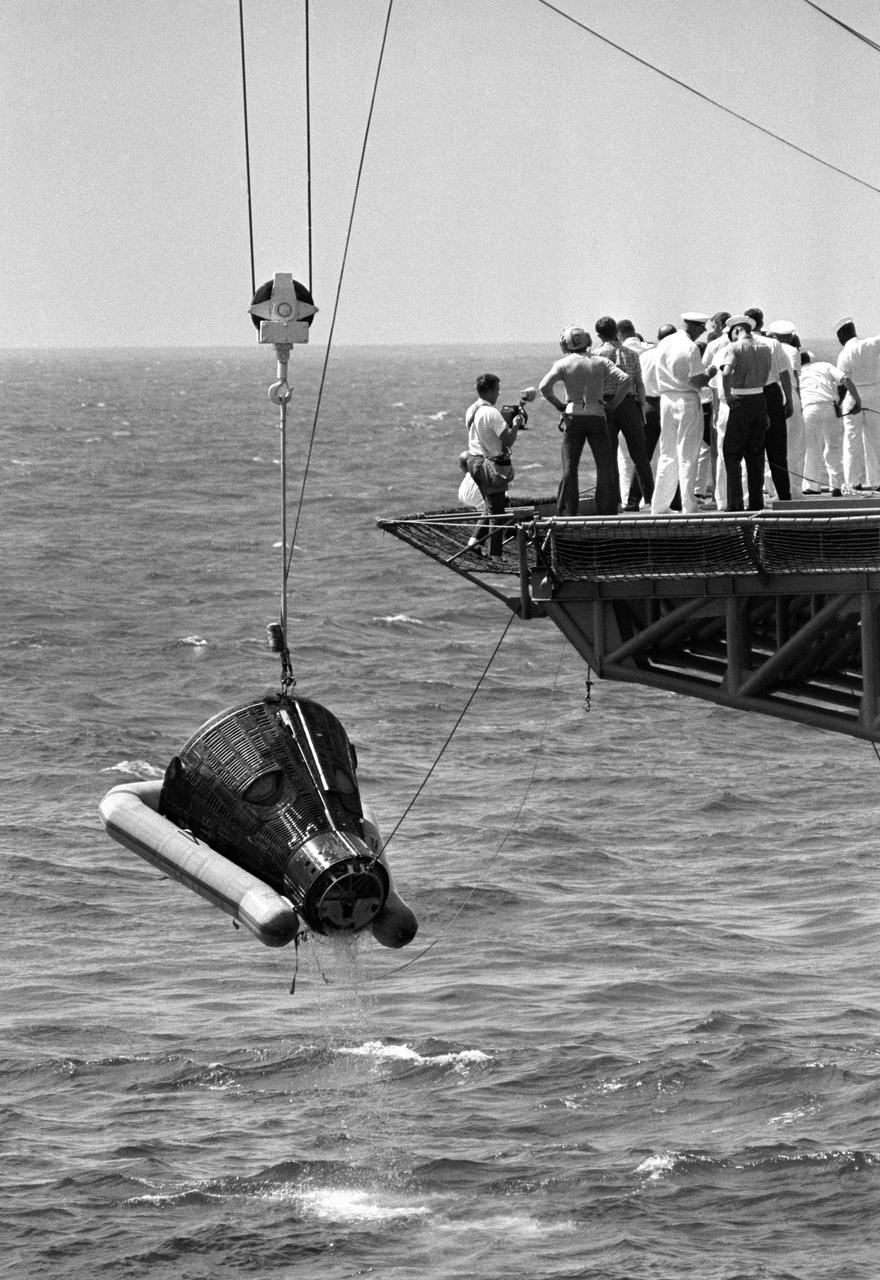
The Gemini-4 Astronauts is shown being hoisted aboard the aircraft carrier USS Wasp. The flotation collar is still attached to the spacecraft. DOWNRANGE RECOVERY AREA, ATLANTIC OCEAN B&W
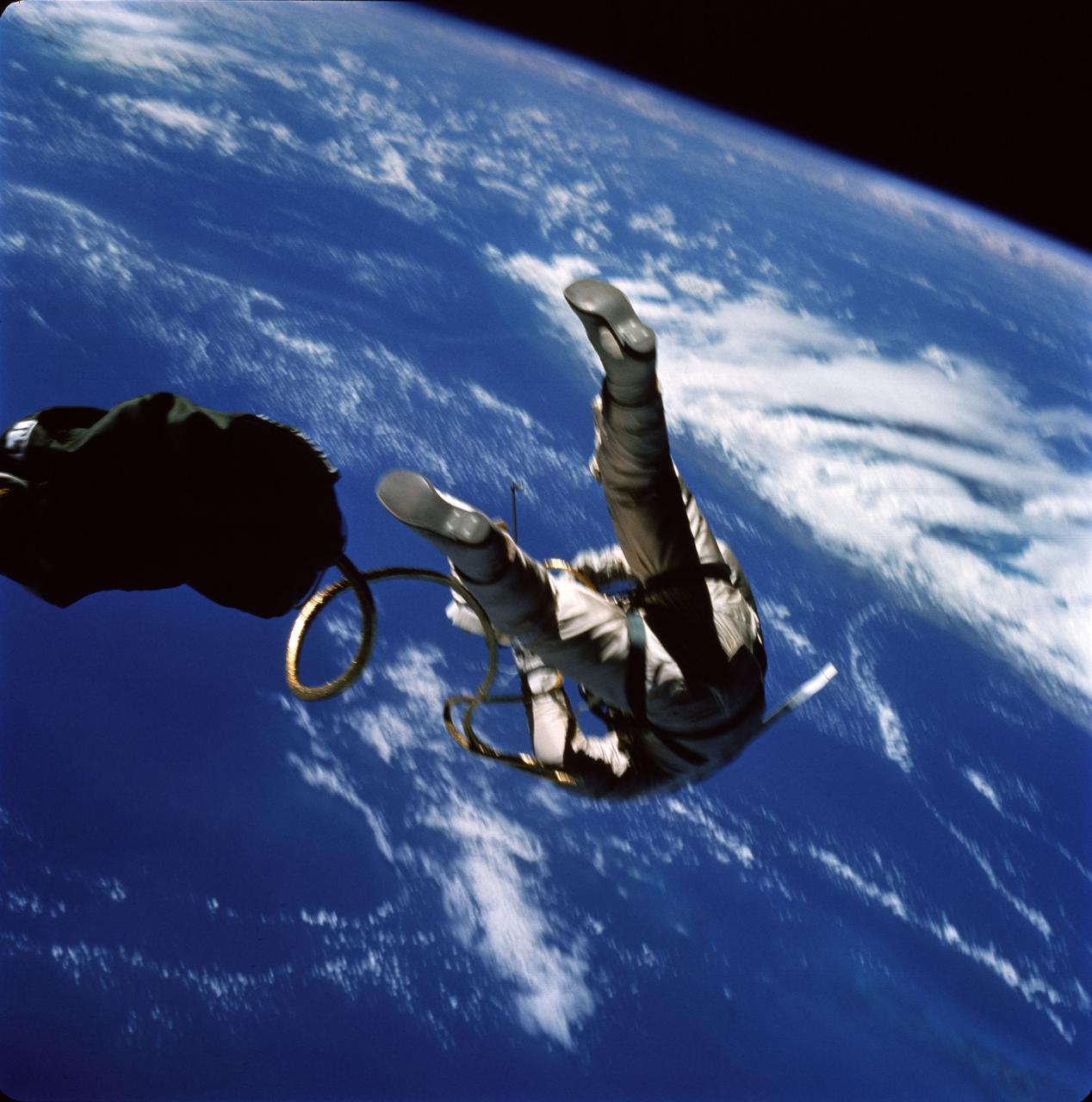
View of Astronaut Edward H. White II, pilot for the Gemini-Titan 4 space flight, as he floats in zero gravity of space. The extravehicular activity was performed during the third revolution of the Gemini 4 spacecraft. White is attached to the spacecraft by a 25-ft. umbilical line and a 23-ft. tether line,both wrapped in gold tape to form one cord. In his right hand White carries a Hand-Held Self-Maneuvering Unit (HHSMU). The visor of his helmet is gold plated to protect him from the unfiltered rays of the sun. Photo was taken on June 3,1965. G.E.T. time was 4:45 / GMT time was 20:00. Original magazine number was GEM04-16-34642, taken with a Hasselblad camera and a 70mm lens. Film type was Kodak Ektachrome MS (S.O. -217). The original photo was a color negative. It's image number is S65-34642.
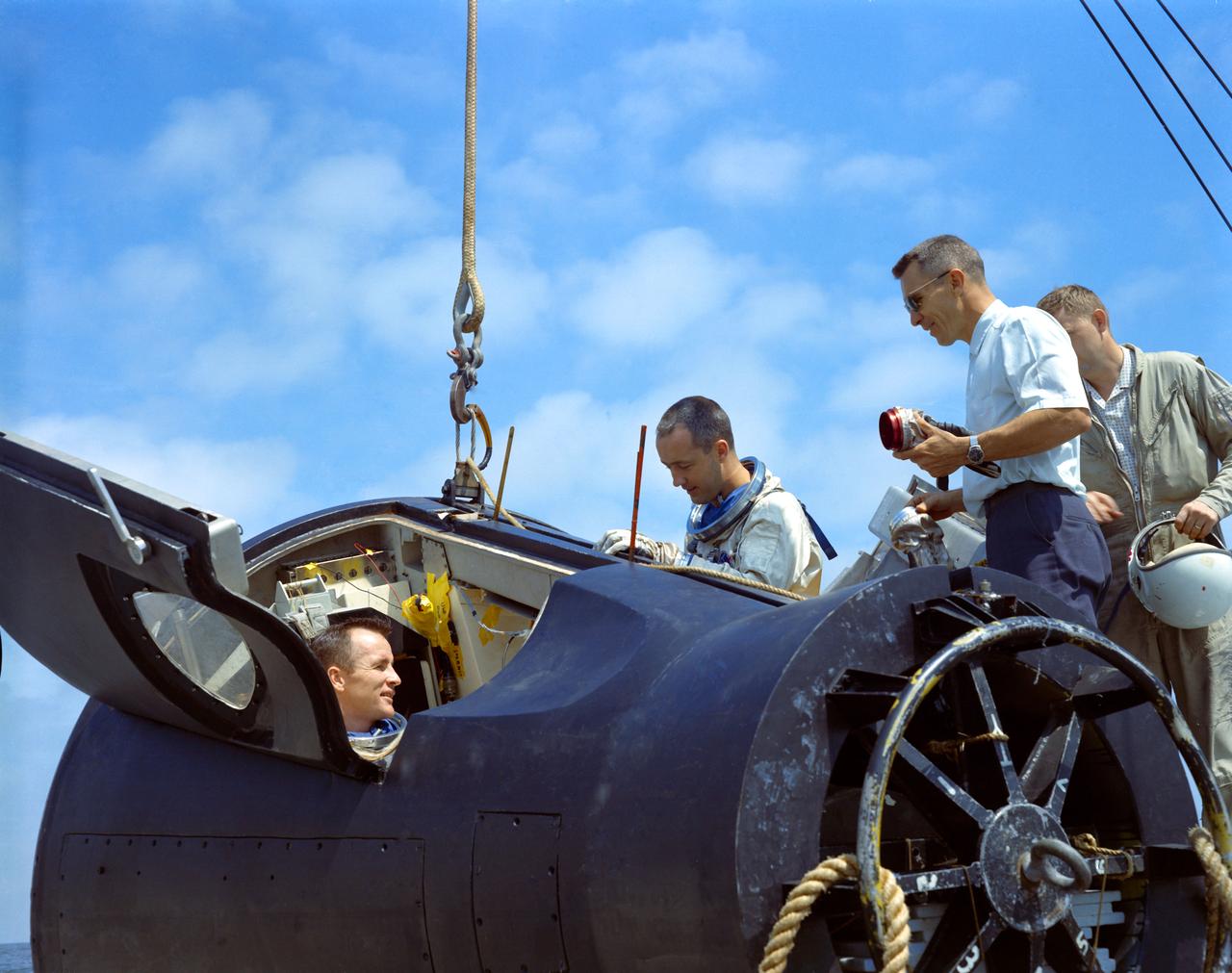
S65-22639 (14 April 1965) --- The Gemini-Titan 4 prime crew, astronauts Edward H. White II (left), pilot; and James A. McDivitt (getting in the spacecraft), command pilot, received instructions from Gordon Harvey, Flight Crew Support Division; and Alan M. Rochford, suit technician, Crew Systems Division, before closing of hatches prior to undergoing water egress training in the Gulf of Mexico.
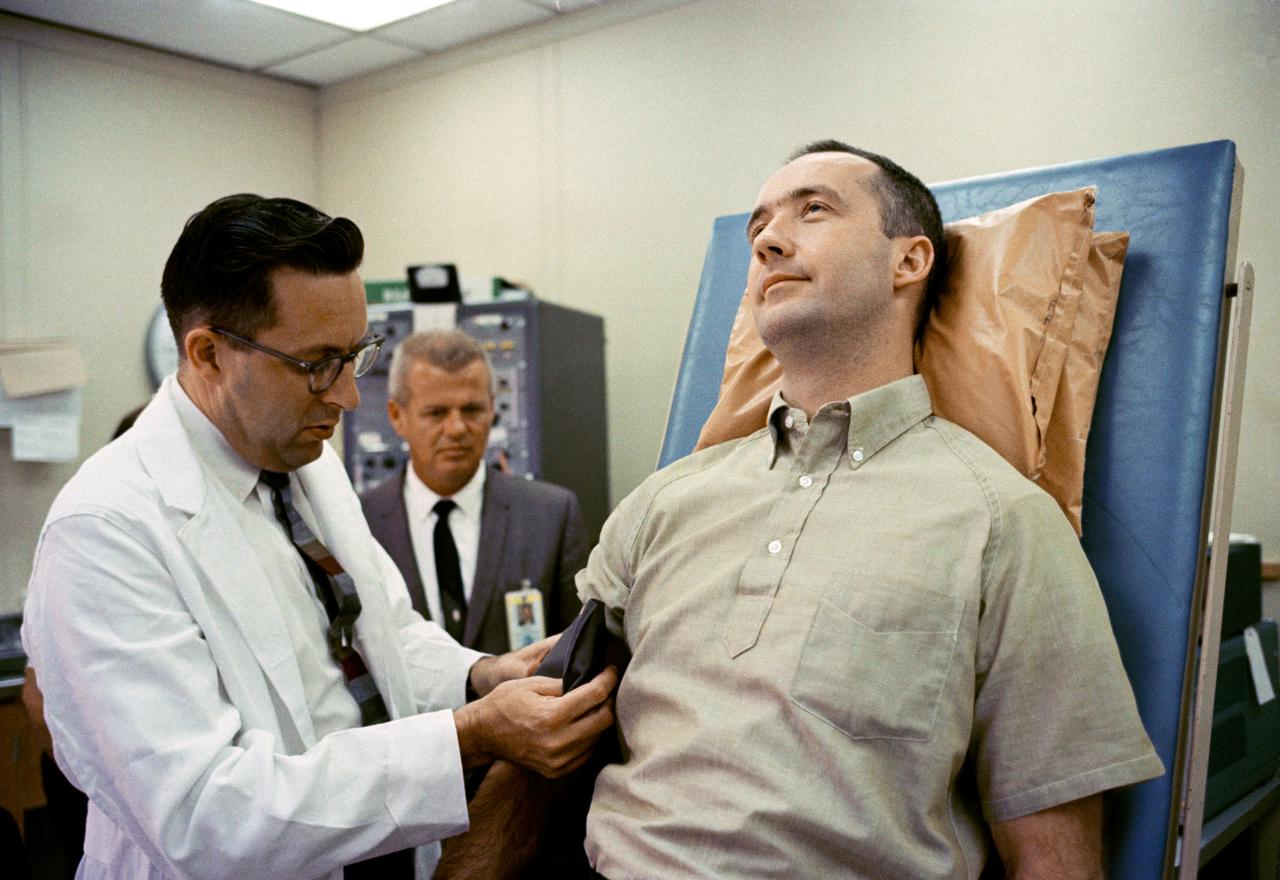
S65-19524 (1 June 1965) --- Dr. Charles A. Berry, chief of Center Medical Programs, MSC, Houston, Texas, prepares to check the blood pressure of astronaut James A. McDivitt, command pilot for the Gemini-Titan 4 spaceflight. McDivitt is on the tilt table at the Aero Medical Area, MSC, Merritt Island, where he and astronaut Edward H. White II (out of frame), GT-4 pilot, underwent preflight physicals in preparation for the four-day, 62-revolution spaceflight. The two astronauts were declared in top physical condition. In the background is Dr. Gordon Benson, NASA physician at Cape Kennedy.

S65-34635 (3 June 1965) --- Astronaut Edward H. White II, pilot on the Gemini-Titan 4 spaceflight, is shown during his egress from the spacecraft. His face is covered by a shaded visor to protect him from the unfiltered rays of the sun. White became the first American astronaut to walk in space. He remained outside the spacecraft for 21 minutes during the third revolution of the Gemini-4 mission. He wears a specially designed spacesuit for the extravehicular activity (EVA). In his right hand, he carries a Hand-Held Self-Maneuvering Unit (HHSMU) with which he controlled his movements while in space. He was attached to the spacecraft by a 25-feet umbilical line and a 23-feet tether line, both wrapped together with gold tape to form one cord. He wears an emergency oxygen supply chest pack. Astronaut James A. McDivitt is command pilot for the Gemini-4 mission. EDITOR'S NOTE: Astronaut Edward H. White II died in the Apollo/Saturn 204 fire at Cape Kennedy on Jan. 27, 1967.
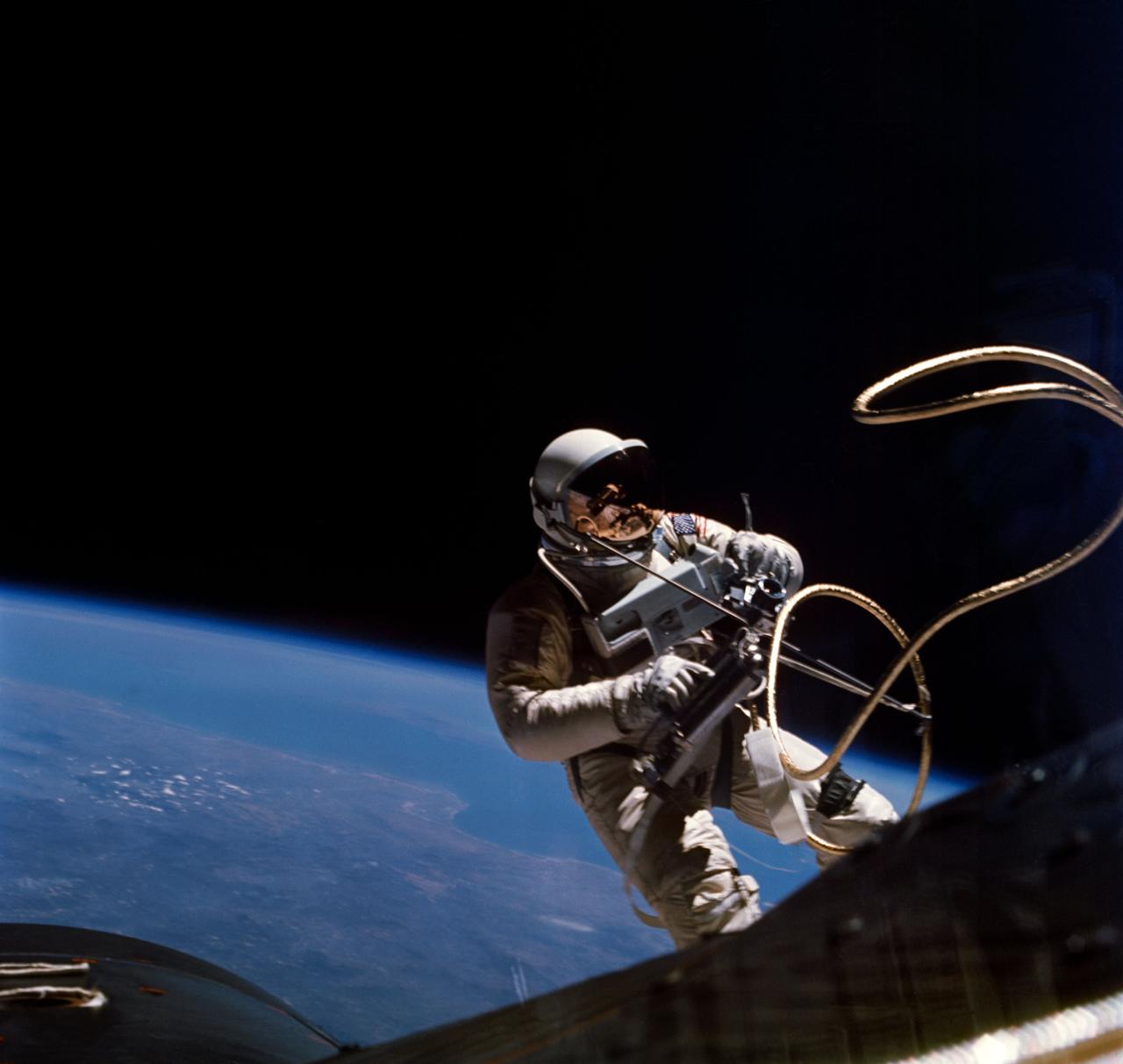
S65-30428 (3 June 1965) --- Astronaut Edward H. White II, pilot on the Gemini-Titan 4 spaceflight, is shown during his egress from the spacecraft. His face is covered by a shaded visor to protect him from the unfiltered rays of the sun. White became the first American astronaut to walk in space. He remained outside the spacecraft for 21 minutes during the third revolution of the Gemini-4 mission. He wears a specially designed spacesuit for the extravehicular activity (EVA). In his right hand, he carries a Hand-Held Self-Maneuvering Unit (HHSMU) with which he controlled his movements while in space. He was attached to the spacecraft by a 25-feet umbilical line and a 23-feet tether line, both wrapped together with gold tape to form one cord. He wears an emergency oxygen supply chest pack. Astronaut James A. McDivitt is command pilot for the Gemini-4 mission. EDITOR'S NOTE: Astronaut Edward H. White II died in the Apollo/Saturn 204 fire at Cape Kennedy on Jan. 27, 1967.
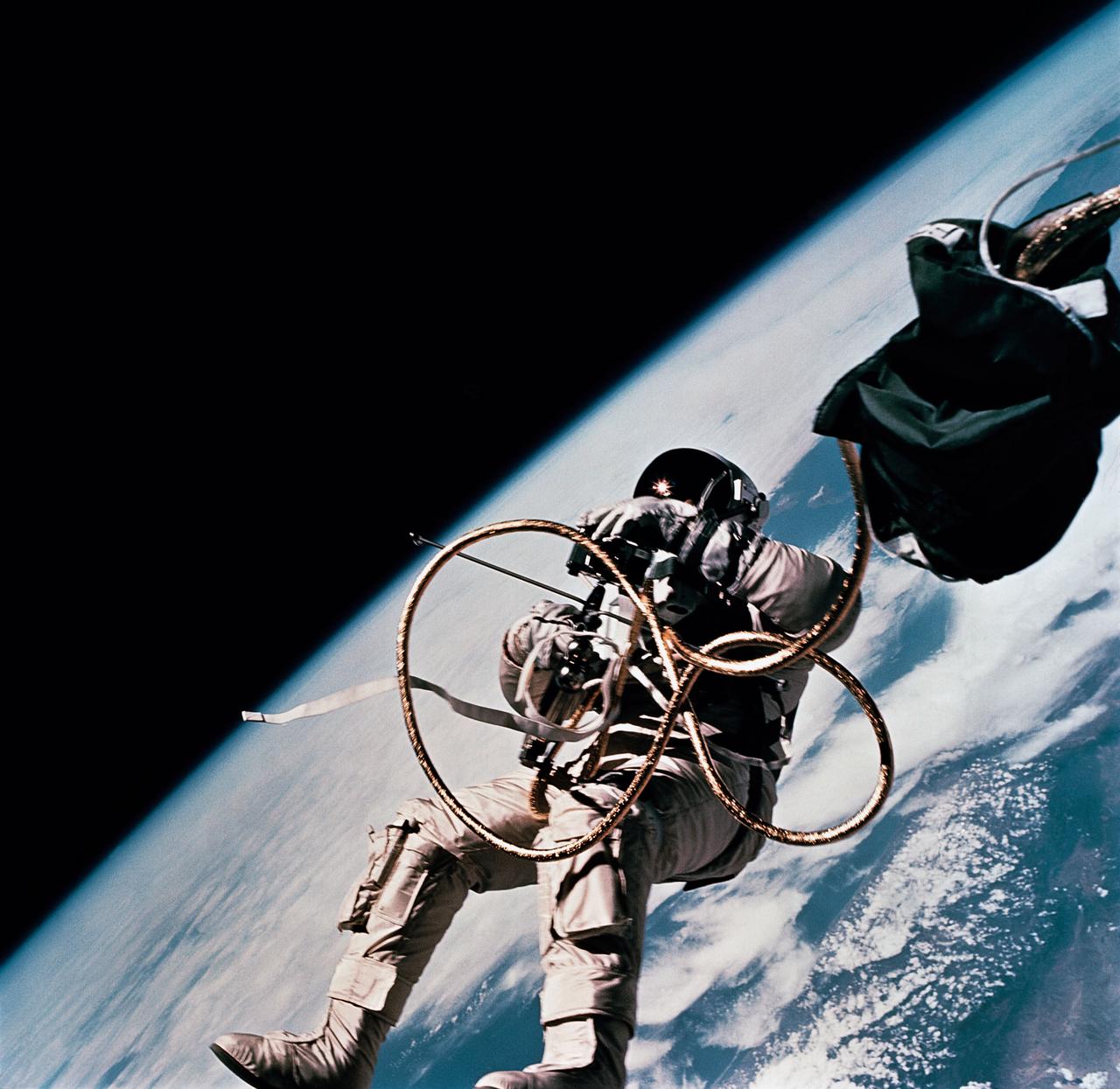
S65-30430 (3 June 1965) --- Astronaut Edward H. White II, pilot on the Gemini-Titan 4 spaceflight, is shown during his egress from the spacecraft. His face is covered by a shaded visor to protect him from the unfiltered rays of the sun. White became the first American astronaut to walk in space. He remained outside the spacecraft for 21 minutes during the third revolution of the Gemini-4 mission. He wears a specially designed spacesuit for the extravehicular activity (EVA). In his right hand, he carries a Hand-Held Self-Maneuvering Unit (HHSMU) with which he controlled his movements while in space. He was attached to the spacecraft by a 25-feet umbilical line and a 23-feet tether line, both wrapped together with gold tape to form one cord. He wears an emergency oxygen supply chest pack. Astronaut James A. McDivitt is command pilot for the Gemini-4 mission. Photo credit: NASA EDITOR'S NOTE: Astronaut Edward H. White II died in the Apollo/Saturn 204 fire at Cape Kennedy on Jan. 27, 1967.
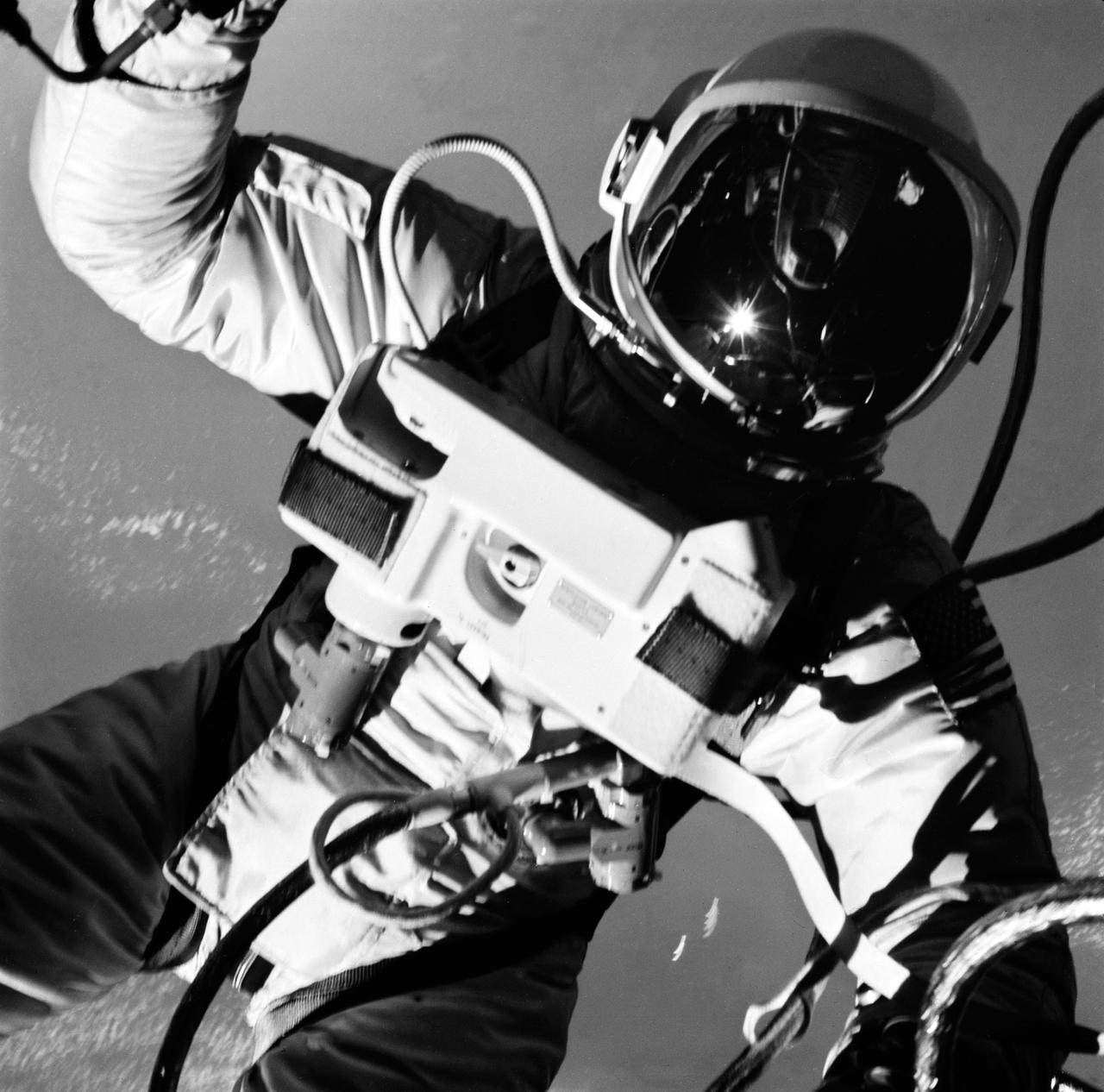
S65-30271 (3 June 1965) --- Astronaut Edward H. White II, pilot on the Gemini-Titan IV (GT-4) spaceflight, floats in the zero gravity of space outside the Gemini IV spacecraft. His face is covered by a shaded visor to protect him from the unfiltered rays of the sun. White became the first American astronaut to walk in space. He remained outside the spacecraft for 21 minutes during the third revolution of the Gemini IV mission. He wears a specially designed spacesuit for the EVA. His right hand (out of frame) is holding the Hand-Held Self-Maneuvering Unit (HHSMU), with which he controlled his movements while in space, and a camera is attached to the HHSMU. He was attached to the spacecraft by a 25-feet umbilical line and a 23-feet tether line, both wrapped together with gold tape to form one cord. He wears an emergency oxygen supply check pack. Astronaut James A. McDivitt is command pilot for the GT-4 mission. The mission was a four-day, 62-revolution flight, during which McDivitt and White performed a series of scientific and engineering experiments. (This image is black and white) Photo credit: NASA EDITOR?S NOTE: Astronaut Edward H. White II died in the Apollo/Saturn 204 fire at Cape Kennedy, Florida, on Jan. 27, 1967.
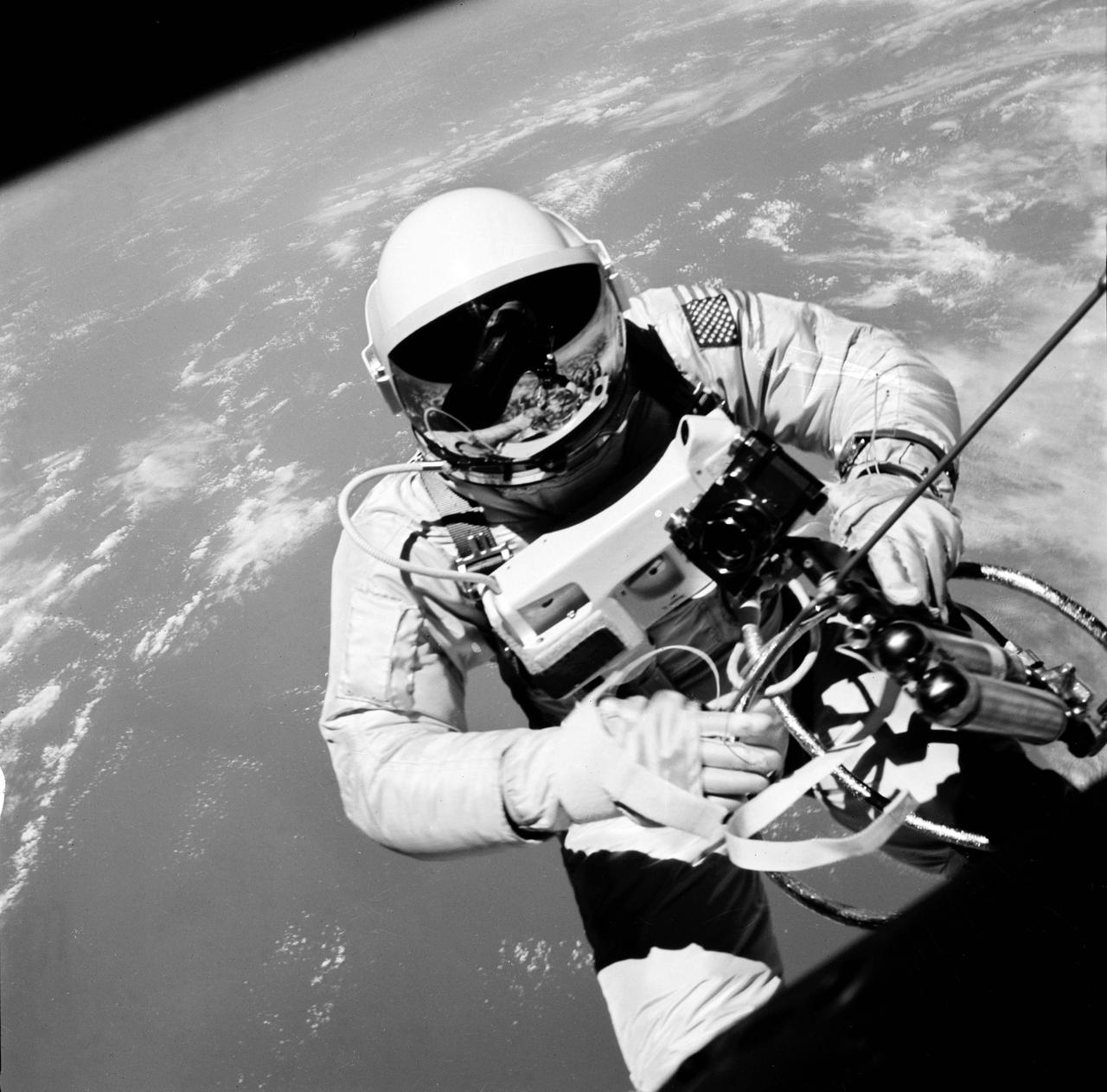
S65-30202 (3 June 1965) --- Astronaut Edward H. White II, pilot on the Gemini-Titan IV (GT-4) spaceflight, floats in the zero gravity of space outside the Gemini IV spacecraft. His face is covered by a shaded visor to protect him from the unfiltered rays of the sun. White became the first American astronaut to walk in space. He remained outside the spacecraft for 21 minutes during the third revolution of the Gemini IV mission. He wears a specially designed spacesuit for the EVA. He?s holding the Hand-Held Self-Maneuvering Unit (HHSMU), with which he controlled his movements while in space, and a camera is attached to the HHSMU. He was attached to the spacecraft by a 25-feet umbilical line and a 23-feet tether line, both wrapped together with gold tape to form one cord. He wears an emergency oxygen supply check pack. Astronaut James A. McDivitt is command pilot for the GT-4 mission. The mission was a four-day, 62-revolution flight, during which McDivitt and White performed a series of scientific and engineering experiments. (This image is black and white) Photo credit: NASA EDITOR?S NOTE: Astronaut Edward H. White II died in the Apollo/Saturn 204 fire at Cape Kennedy, Florida, on Jan. 27, 1967.
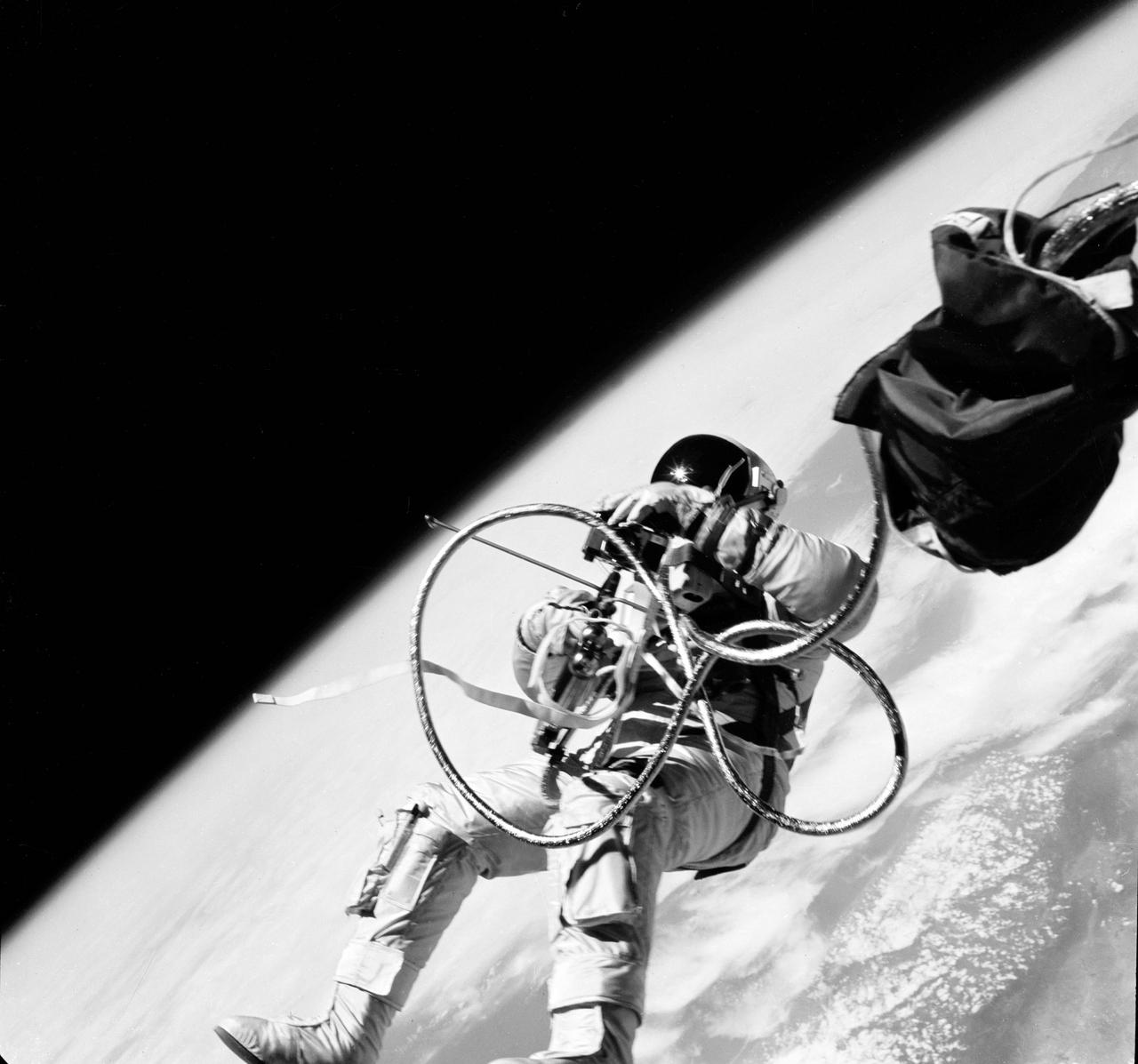
S65-30273 (3 June 1965) --- Astronaut Edward H. White II, pilot on the Gemini-Titan IV (GT-4) spaceflight, floats in the zero gravity of space outside the Gemini IV spacecraft. His face is covered by a shaded visor to protect him from the unfiltered rays of the sun. White became the first American astronaut to walk in space. He remained outside the spacecraft for 21 minutes during the third revolution of the Gemini IV mission. He wears a specially designed spacesuit for the EVA. His right hand is holding the Hand-Held Self-Maneuvering Unit (HHSMU), with which he controlled his movements while in space, and a camera is attached to the HHSMU. He was attached to the spacecraft by a 25-feet umbilical line and a 23-feet tether line, both wrapped together with gold tape to form one cord. He wears an emergency oxygen supply check pack. Astronaut James A. McDivitt is command pilot for the GT-4 mission. The mission was a four-day, 62-revolution flight, during which McDivitt and White performed a series of scientific and engineering experiments. (This image is black and white) Photo credit: NASA EDITOR?S NOTE: Astronaut Edward H. White II died in the Apollo/Saturn 204 fire at Cape Kennedy, Florida, on Jan. 27, 1967.
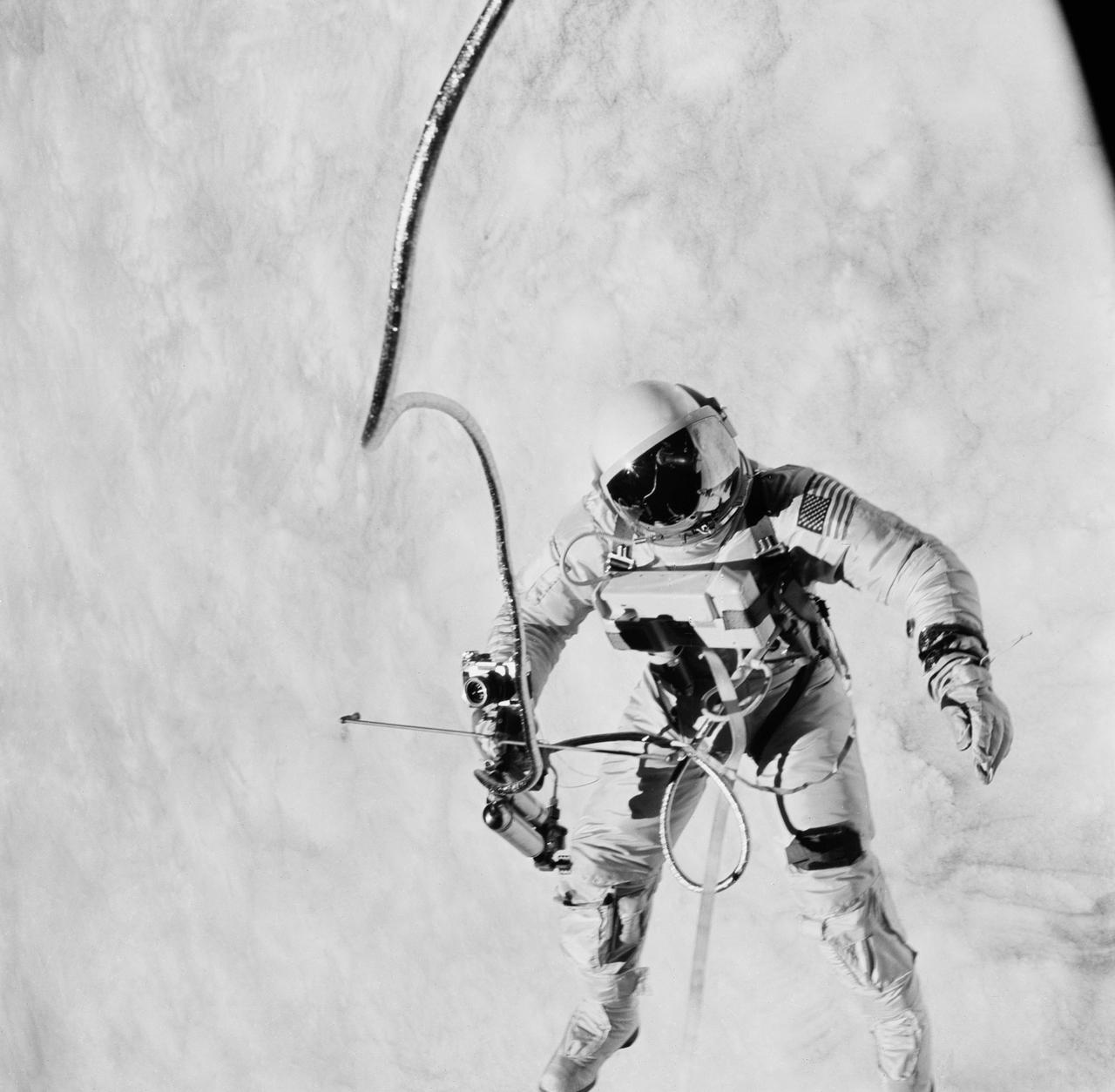
S65-30272 (3 June 1965) --- Astronaut Edward H. White II, pilot on the Gemini-Titan IV (GT-4) spaceflight, floats in the zero gravity of space outside the Gemini IV spacecraft. His face is covered by a shaded visor to protect him from the unfiltered rays of the sun. White became the first American astronaut to walk in space. He remained outside the spacecraft for 21 minutes during the third revolution of the Gemini IV mission. He wears a specially designed spacesuit for the EVA. His right hand is holding the Hand-Held Self-Maneuvering Unit (HHSMU), with which he controlled his movements while in space, and a camera is attached to the HHSMU. He was attached to the spacecraft by a 25-feet umbilical line and a 23-feet tether line, both wrapped together with gold tape to form one cord. He wears an emergency oxygen supply check pack. Astronaut James A. McDivitt is command pilot for the GT-4 mission. The mission was a four-day, 62-revolution flight, during which McDivitt and White performed a series of scientific and engineering experiments. (This image is black and white) Photo credit: NASA EDITOR?S NOTE: Astronaut Edward H. White II died in the Apollo/Saturn 204 fire at Cape Kennedy, Florida, on Jan. 27, 1967.
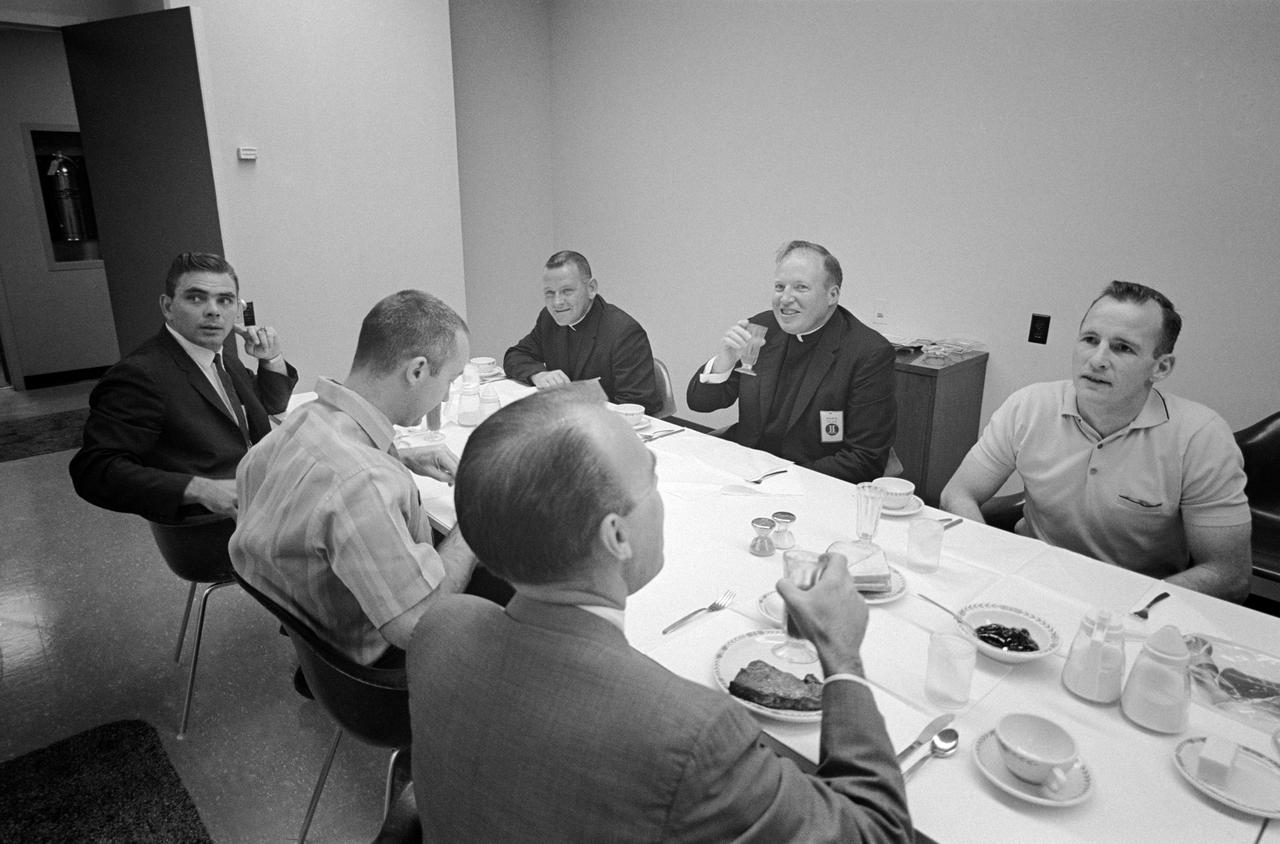
S65-19600 (3 June 1965) --- The prime crew for the Gemini-Titan 4 mission have an early morning breakfast prior to their historic flight which was launched at 10:16 a.m. (EST) on June 3, 1965. Shown here seated around the table (clockwise starting front center) are Dr. D. Owens Coons, chief, MSC Center Medical Office; astronaut James A. McDivitt, GT-4 command pilot; Dr. Eugene F. Tubbs, Kennedy Space Center; Rt. Rev. James Heiliky, McDivitt's priest at Cocoa Beach, Florida; Msgr. Irvine J. Nugent and astronaut Edward H. White II, GT-4 pilot. The group had a breakfast of tomato juice, broiled sirloin steak, poached eggs, toast, strawberry gelatin and coffee.
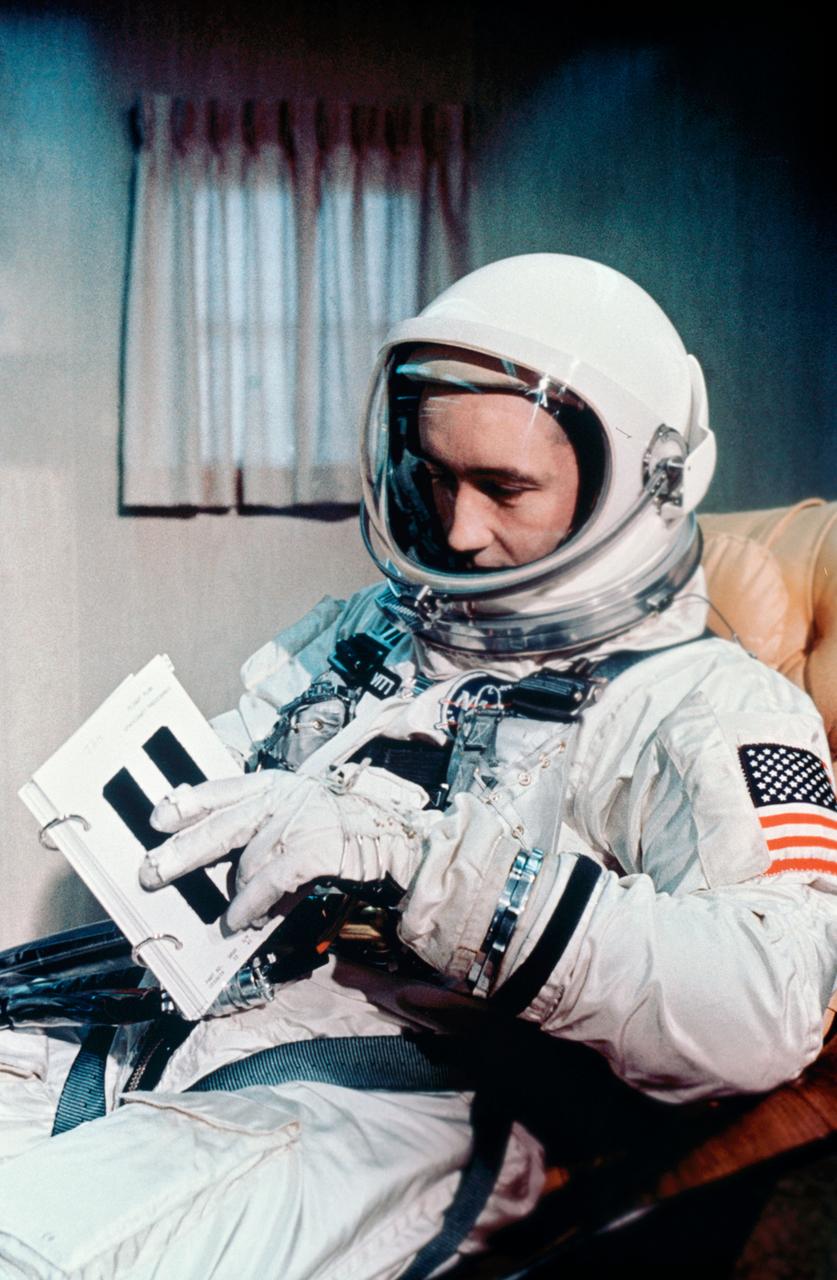
S65-29643 (3 June 1965) --- Astronaut James A. McDivitt, Gemini-4 command pilot, is shown in full spacesuit in the suit trailer prior to launch. He is reviewing a crew procedures flip book.
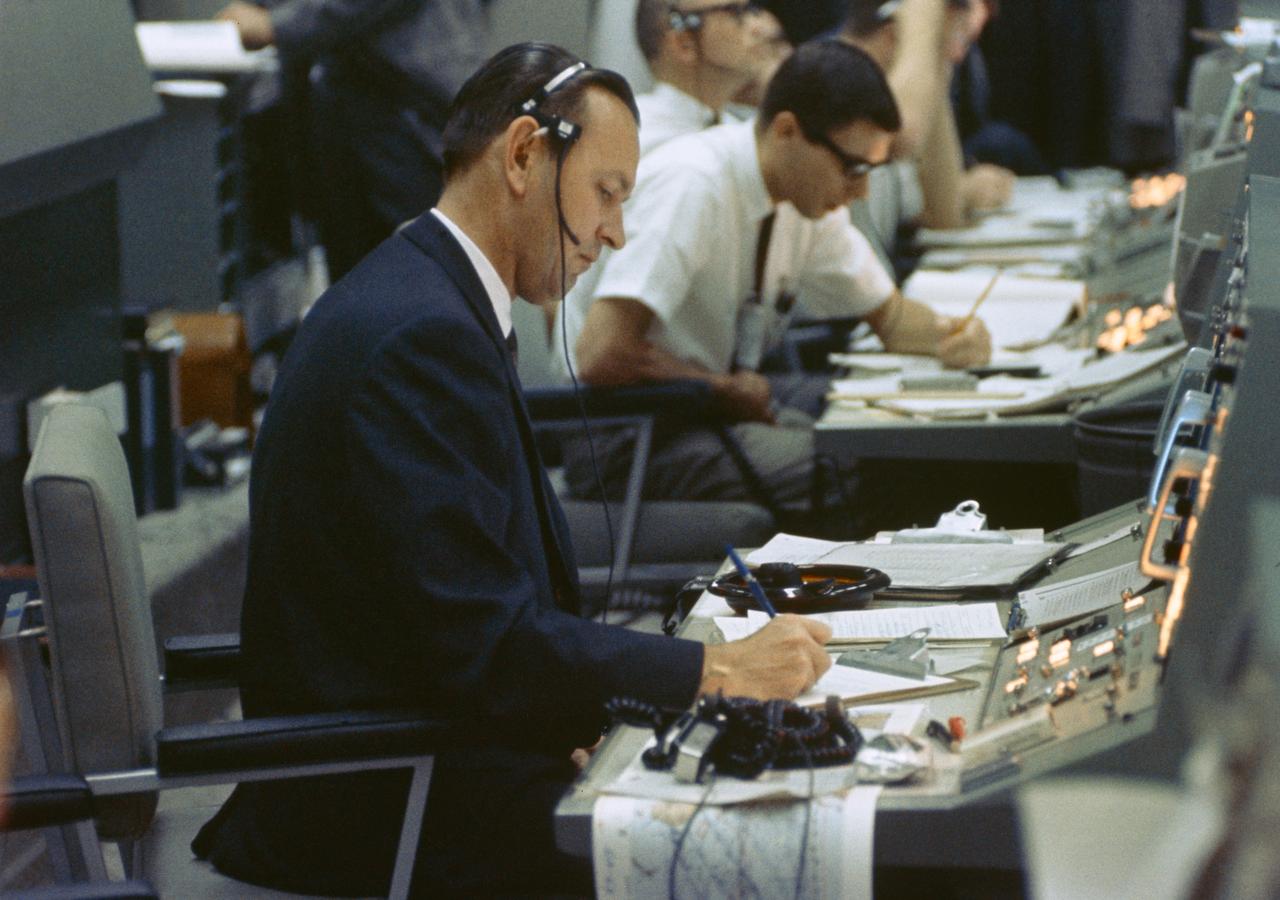
S65-28462 (3-7 June 1965) --- Christopher C. Kraft Jr., assistant director for Flight Operations, at his console in the Mission Control Center during Gemini-4 spaceflight. He served as mission director and as a flight director.
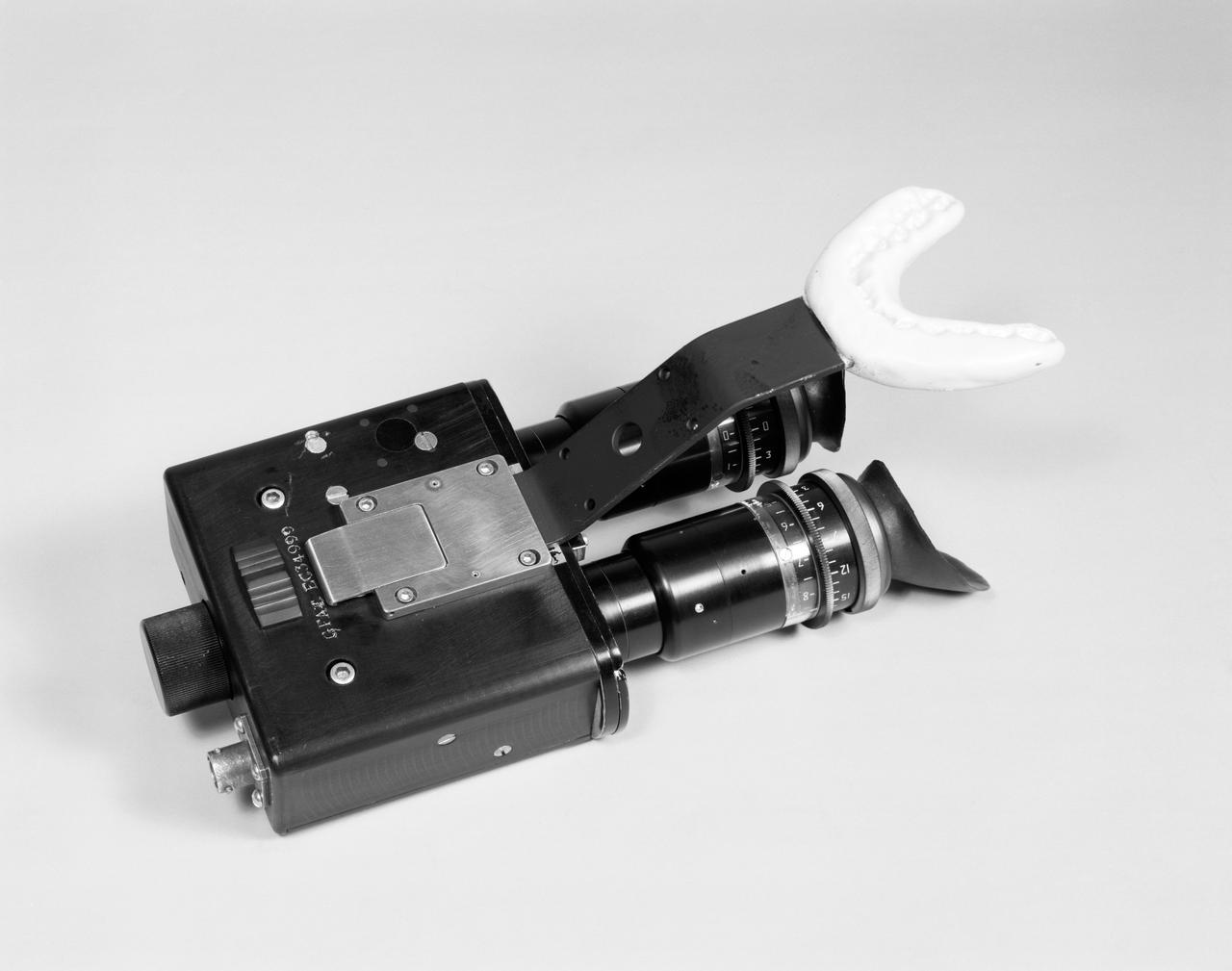
GT-4 Experimental Vision Tester. MSC, HOUSTON, TX
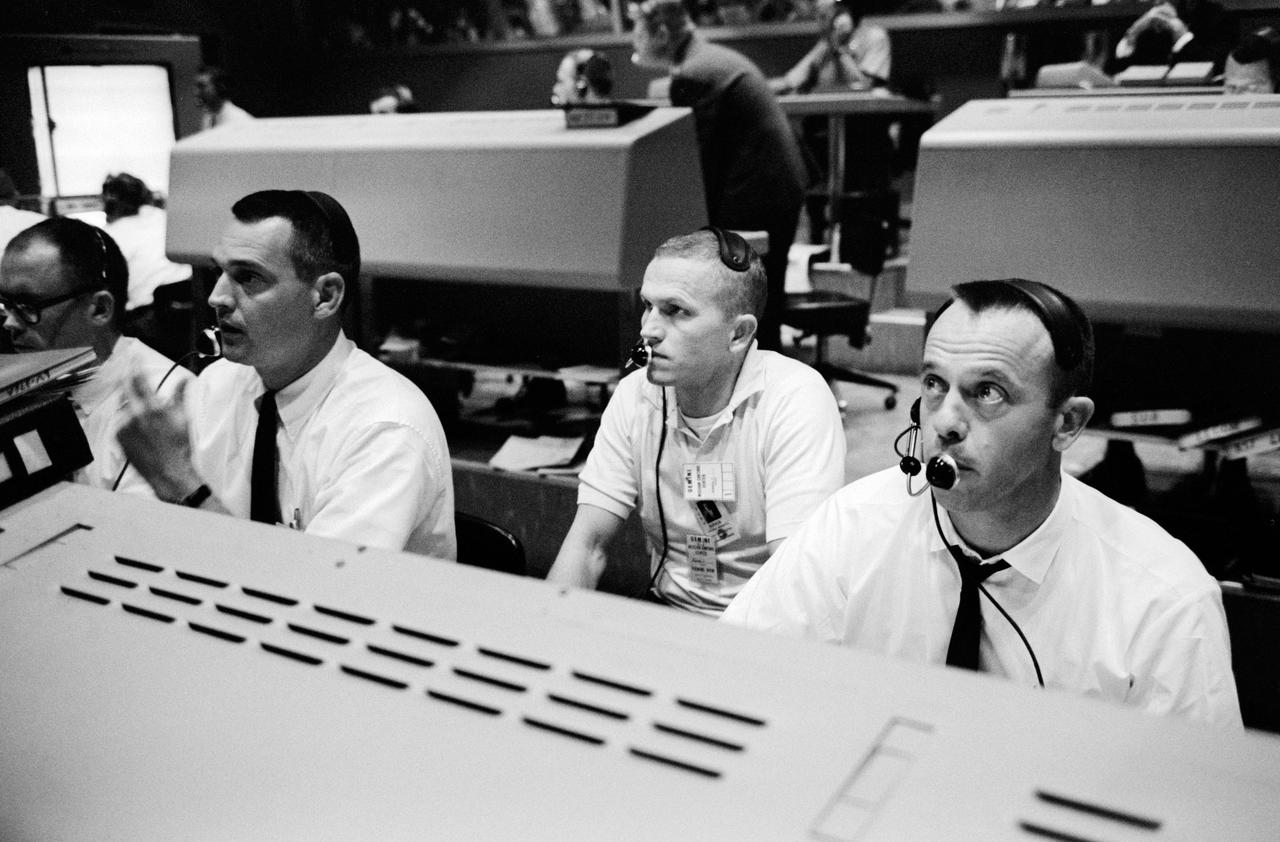
S65-30263 (3 June 1965) --- Shown at their consoles during the liftoff of Gemini-4 (from left) are astronauts Clifford C. Williams Jr., Frank Borman and Alan B. Shepard Jr. Borman was command pilot of the backup crew for the Gemini-4 flight. The three astronauts monitored the flight from the Mission Control Center at Cape Kennedy.

S65-30433 (3 June 1965) --- Astronaut Edward H. White II, pilot of the Gemini IV four-day Earth-orbital mission, floats in the zero gravity of space outside the Gemini IV spacecraft. White wears a specially designed spacesuit; and the visor of the helmet is gold plated to protect him against the unfiltered rays of the sun. He wears an emergency oxygen pack, also. He is secured to the spacecraft by a 25-feet umbilical line and a 23-feet tether line, both wrapped in gold tape to form one cord. In his right hand is a Hand-Held Self-Maneuvering Unit (HHSMU) with which he controls his movements in space. Astronaut James A. McDivitt, command pilot of the mission, remained inside the spacecraft. Photo credit: NASA EDITOR'S NOTE: Astronaut White died in the Apollo/Saturn 204 fire at Cape Kennedy on Jan. 27, 1967.
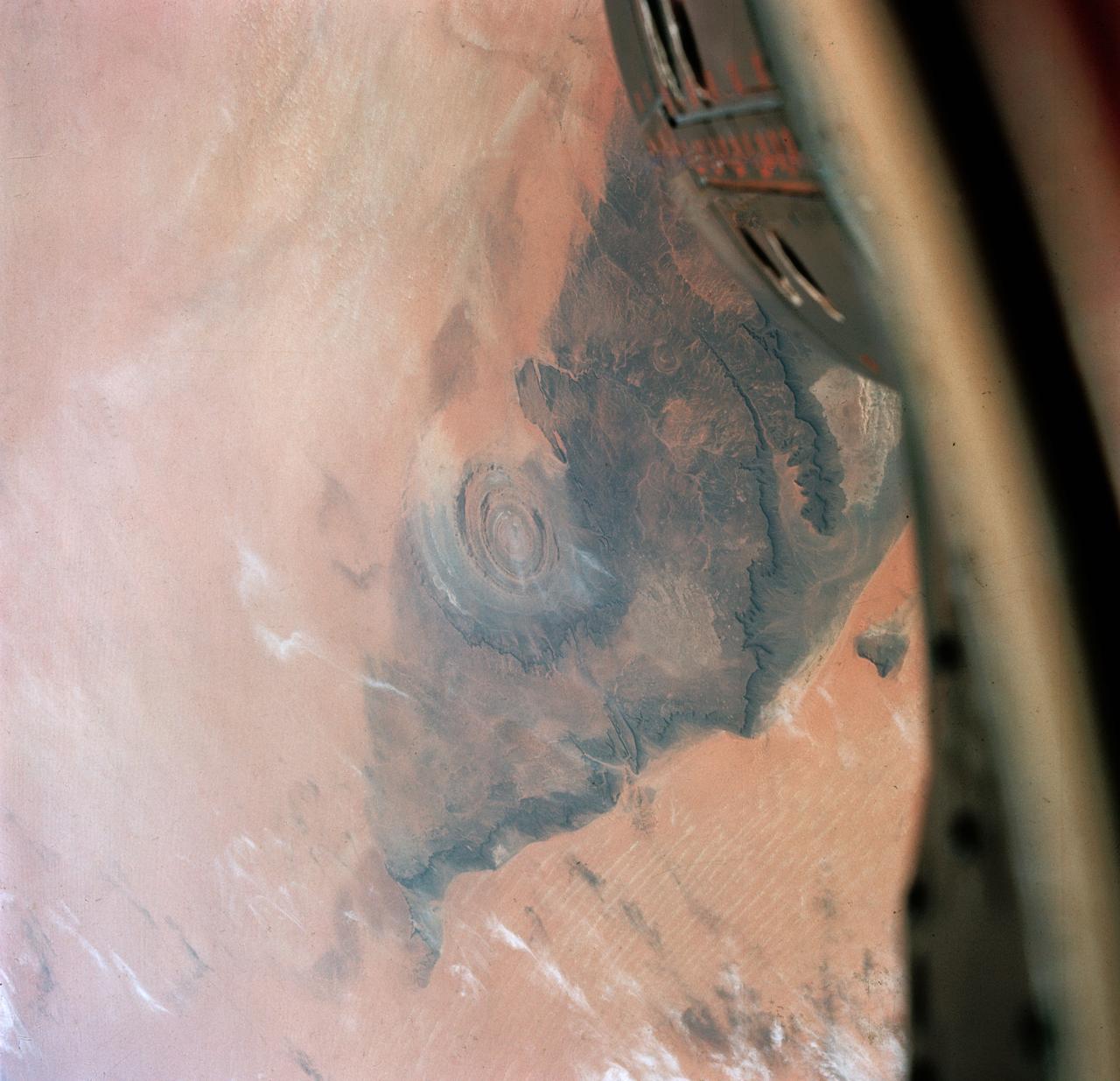
S65-34670 (3-7 June 1965) --- Richat crater in northwest Africa taken from the Gemini-4 spacecraft. Photograph was taken with a modified 70mm Hasselblad camera, using Eastman color film, ASA 64, at a lens setting of 250th of a second at f/11.
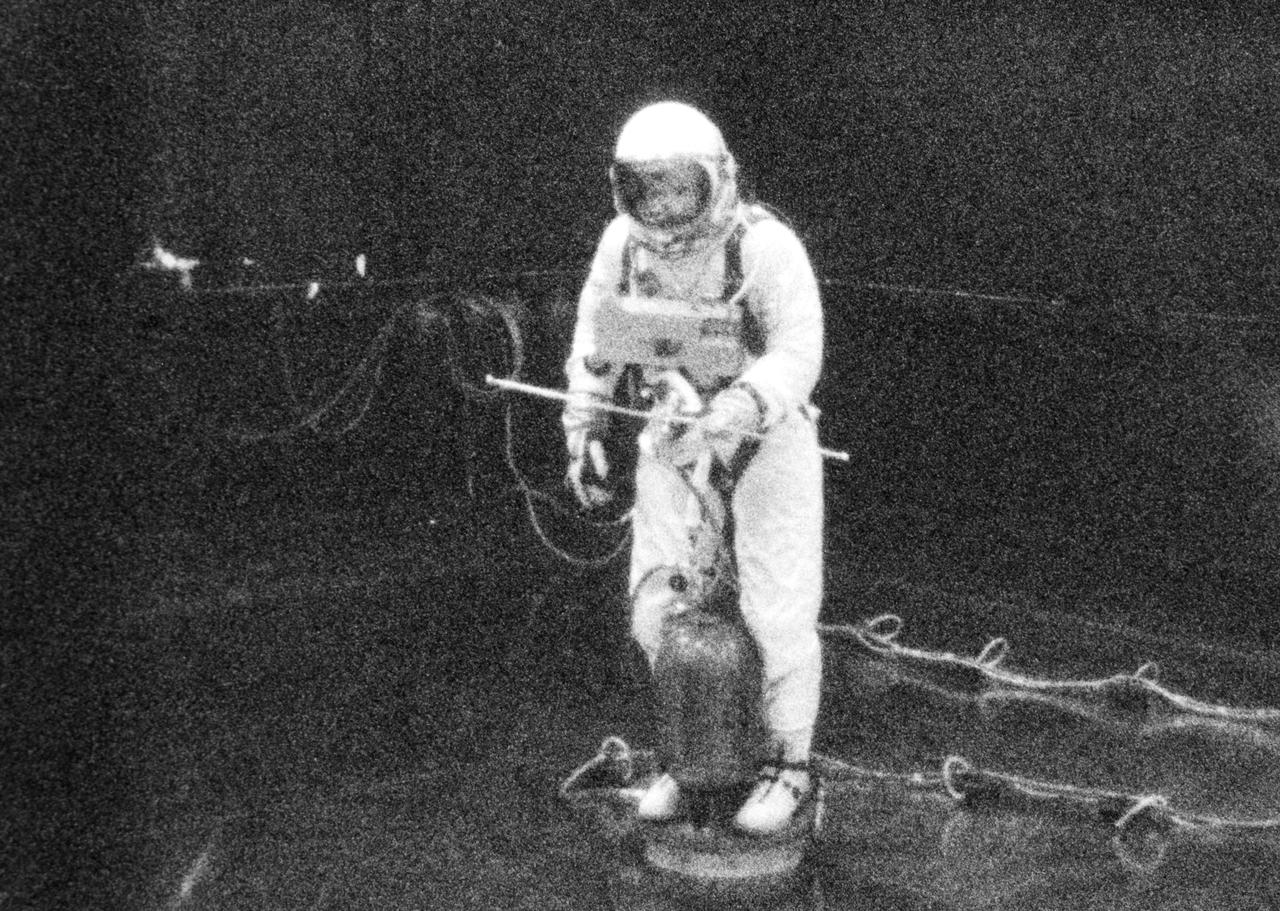
S65-19504 (28 May 1965) --- Astronaut Edward H. White II, pilot for the Gemini-Titan 4 prime crew, is pictured during an extravehicular exercise in the Building 4 laboratory at the Manned Spacecraft Center in Houston, Texas. White is controlling about the yaw (vertical) axis while translating. He stands on a Balance Extravehicular Training Aircraft which is separated from the level steel floor by a .001th-inch cushion of air. In his right hand White holds a zero-gravity integral propulsion unit which is a self-maneuvering device used by an astronaut in a zero-gravity environment. This condition is simulated in this training exercise. White's spacesuit is pressurized to create a realistic training condition. The simulated umbilical line is floated on air with the aid of eleven small air pads.
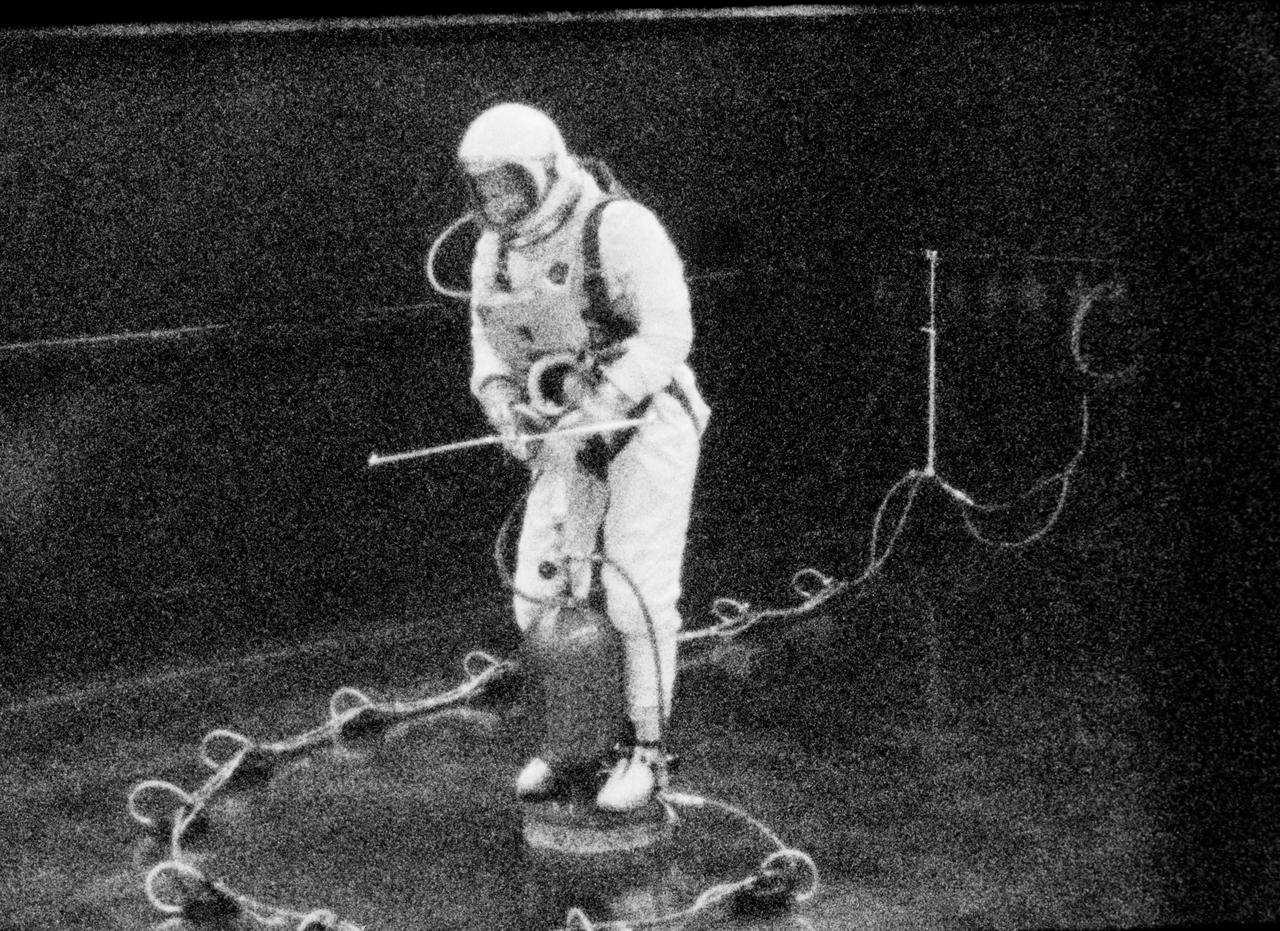
S65-19505 (28 May 1965) --- Astronaut Edward H. White II, pilot for the Gemini-Titan 4 prime crew, is pictured during an extravehicular exercise in the Building 4 laboratory at the Manned Spacecraft Center in Houston, Texas. White is controlling about the yaw (vertical) axis while translating. He stands on a Balance Extravehicular Training Aircraft which is separated from the level steel floor by a .001th-inch cushion of air. In his right hand White holds a zero-gravity integral propulsion unit which is a self-maneuvering device used by an astronaut in a zero-gravity environment. This condition is simulated in this training exercise. White's spacesuit is pressurized to create a realistic training condition. The simulated umbilical line is floated on air with the aid of eleven small air pads.
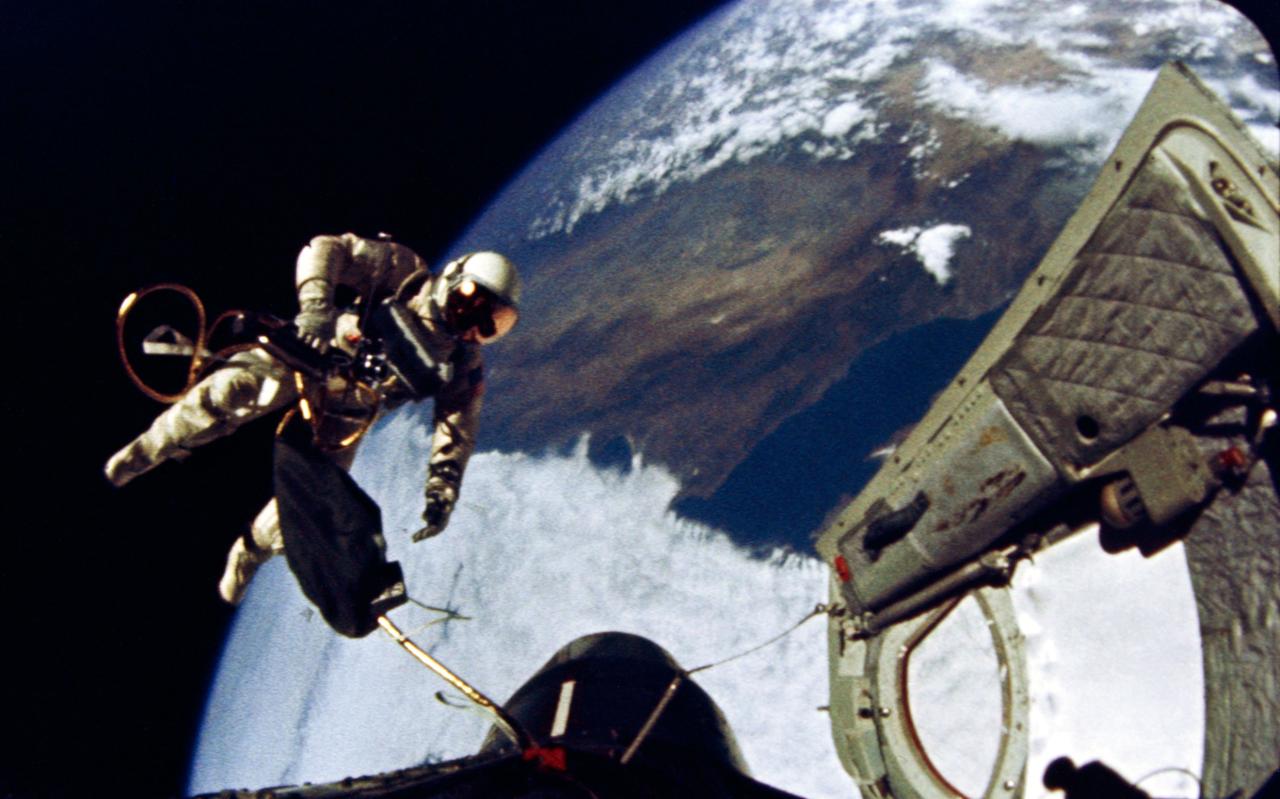
S65-29730 (3 June 1965) --- Astronaut Edward H. White II, pilot for the Gemini-Titan 4 (GT-4) spaceflight, floats in the zero-gravity of space during the third revolution of the GT-4 spacecraft. White wears a specially designed spacesuit. His face is shaded by a gold-plated visor to protect him from unfiltered rays of the sun. In his right hand he carries a Hand-Held Self-Maneuvering Unit (HHSMU) that gives him control over his movements in space. White also wears an emergency oxygen chest pack; and he carries a camera mounted on the HHSMU for taking pictures of the sky, Earth and the GT-4 spacecraft. He is secured to the spacecraft by a 25-feet umbilical line and a 23-feet tether line. Both lines are wrapped together in gold tape to form one cord. Astronaut James A. McDivitt, command pilot, remained inside the spacecraft during the extravehicular activity (EVA). Photo credit: NASA EDITOR'S NOTE: Astronaut Edward H. White II died in the Apollo/Saturn 204 fire at Cape Kennedy on Jan. 27, 1967.
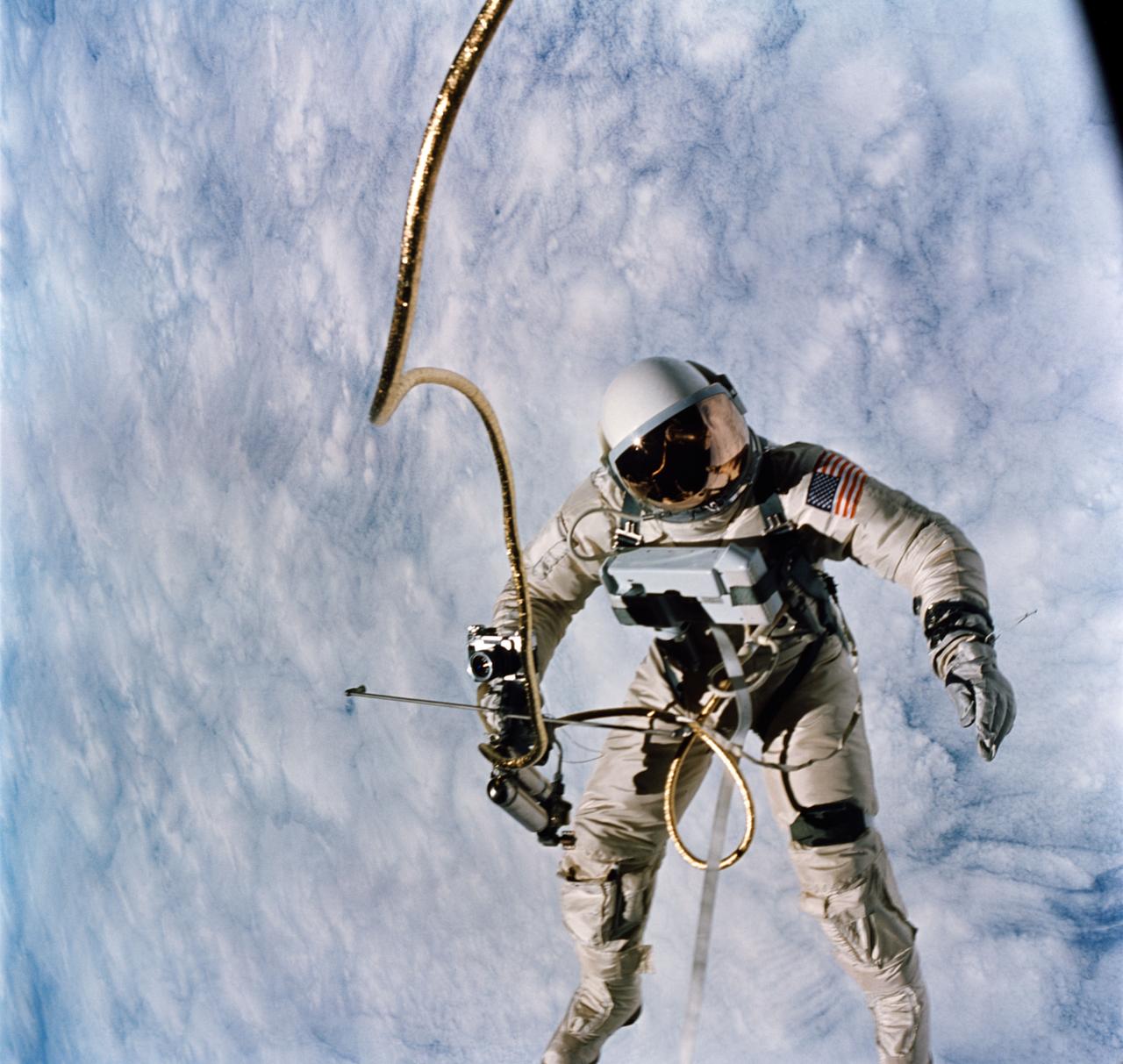
S65-30427 (3 June 1965) --- Astronaut Edward H. White II, pilot for the Gemini-Titan 4 (GT-4) spaceflight, floats in the zero-gravity of space during the third revolution of the GT-4 spacecraft. White wears a specially designed spacesuit. His face is shaded by a gold-plated visor to protect him from unfiltered rays of the sun. In his right hand he carries a Hand-Held Self-Maneuvering Unit (HHSMU) that gives him control over his movements in space. White also wears an emergency oxygen chest pack; and he carries a camera mounted on the HHSMU for taking pictures of the sky, Earth and the GT-4 spacecraft. He is secured to the spacecraft by a 25-feet umbilical line and a 23-feet tether line. Both lines are wrapped together in gold tape to form one cord. Astronaut James A. McDivitt, command pilot, remained inside the spacecraft during the extravehicular activity (EVA). Photo credit: NASA EDITOR'S NOTE: Astronaut Edward H. White II died in the Apollo/Saturn 204 fire at Cape Kennedy on Jan. 27, 1967.
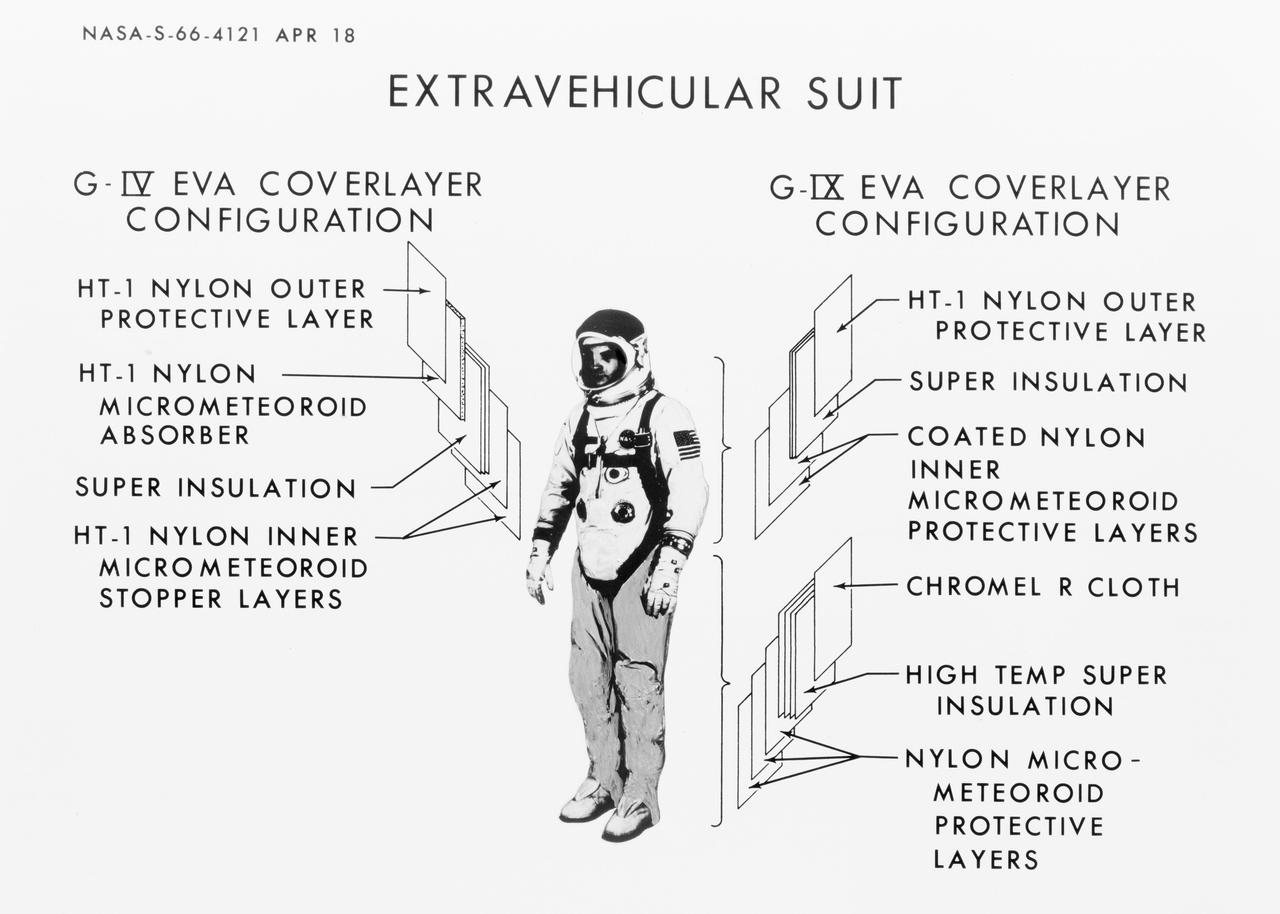
S66-04121 (18 April 1966) --- Drawing of the Gemini-9 extravehicular spacesuit, with a comparison of the breakdown between the Gemini-4 suit layers and the Gemini-9 suit layers. Photo credit: NASA
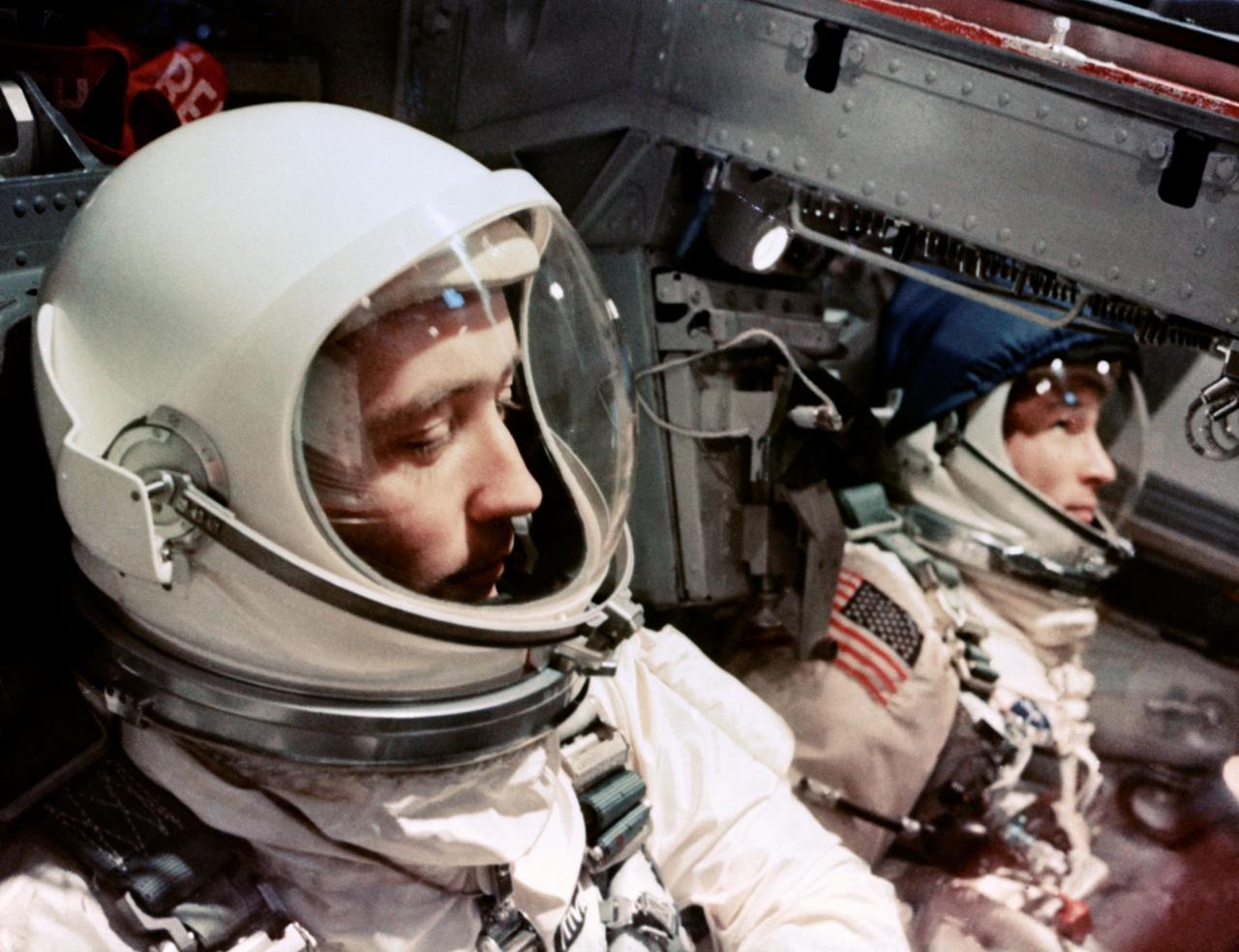
S65-29642 (3 June 1965) --- Close-up view of astronauts James A. McDivitt (foreground) and Edward H. White II inside their Gemini-4 spacecraft. NASA Headquarters alternative photo number is 65-H-294.