
A Delta II rocket carrying the Geomagnetic Tail Lab (GEOTAIL) spacecraft lifts off at Launch Complex 17, Kennedy Space Center (KSC) into a cloud-dappled sky. This liftoff marks the first Delta launch under the medium expendable launch vehicle services contract between NASA and McDonnell Douglas Space Systems Co. The GEOTAIL mission, a joint US/Japanese project, is the first in a series of five satellites to study the interactions between the Sun, the Earth's magnetic field, and the Van Allen radiation belts.

Workers at Launch Complex 17 Pad A, Kennedy Space Center (KSC) encapsulate the Geomagnetic Tail (GEOTAIL) spacecraft (upper) and attached payload Assist Module-D upper stage (lower) in the protective payload fairing. GEOTAIL project was designed to study the effects of Earth's magnetic field. The solar wind draws the Earth's magnetic field into a long tail on the night side of the Earth and stores energy in the stretched field lines of the magnetotail. During active periods, the tail couples with the near-Earth magnetosphere, sometimes releasing energy stored in the tail and activating auroras in the polar ionosphere. GEOTAIL measures the flow of energy and its transformation in the magnetotail and will help clarify the mechanisms that control the imput, transport, storage, release, and conversion of mass, momentum, and energy in the magnetotail.
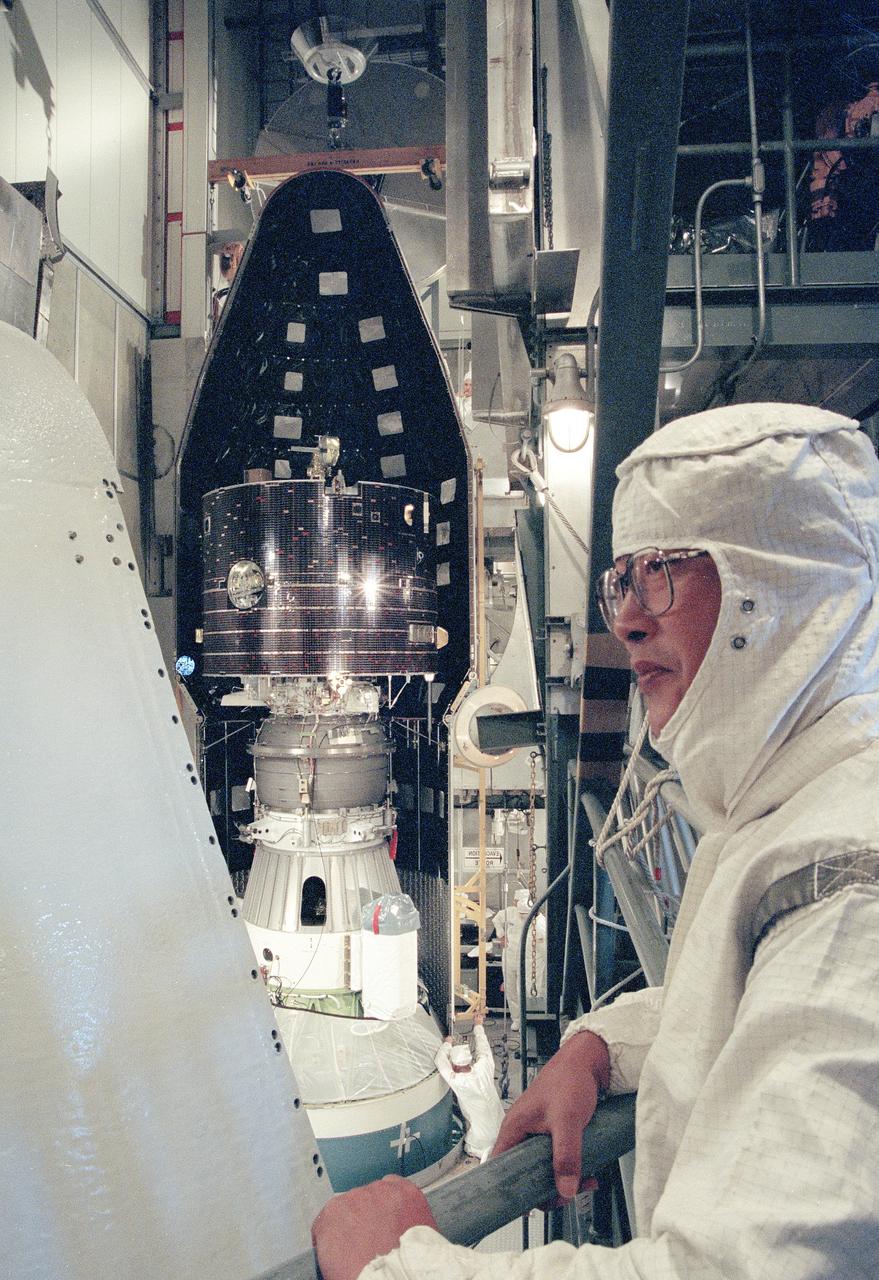
CAPE CANAVERAL, Fla. -- At Cape Canaveral Air Force Station's Launch Complex 17, Pad A, technicians encapsulate the Geotail spacecraft upper and attached Payload Assist Module-D upper stage lower in the protective payload fairing. Geotail and secondary payload Diffuse Ultraviolet Experiment DUVE are scheduled for launch about the Delta II rocket on July 24. The GEOTAIL mission is a collaborative project undertaken by the Institute of Space and Astronautical Science ISAS, Japan Aerospace Exploration Agency JAXA and NASA. Photo Credit: NASA