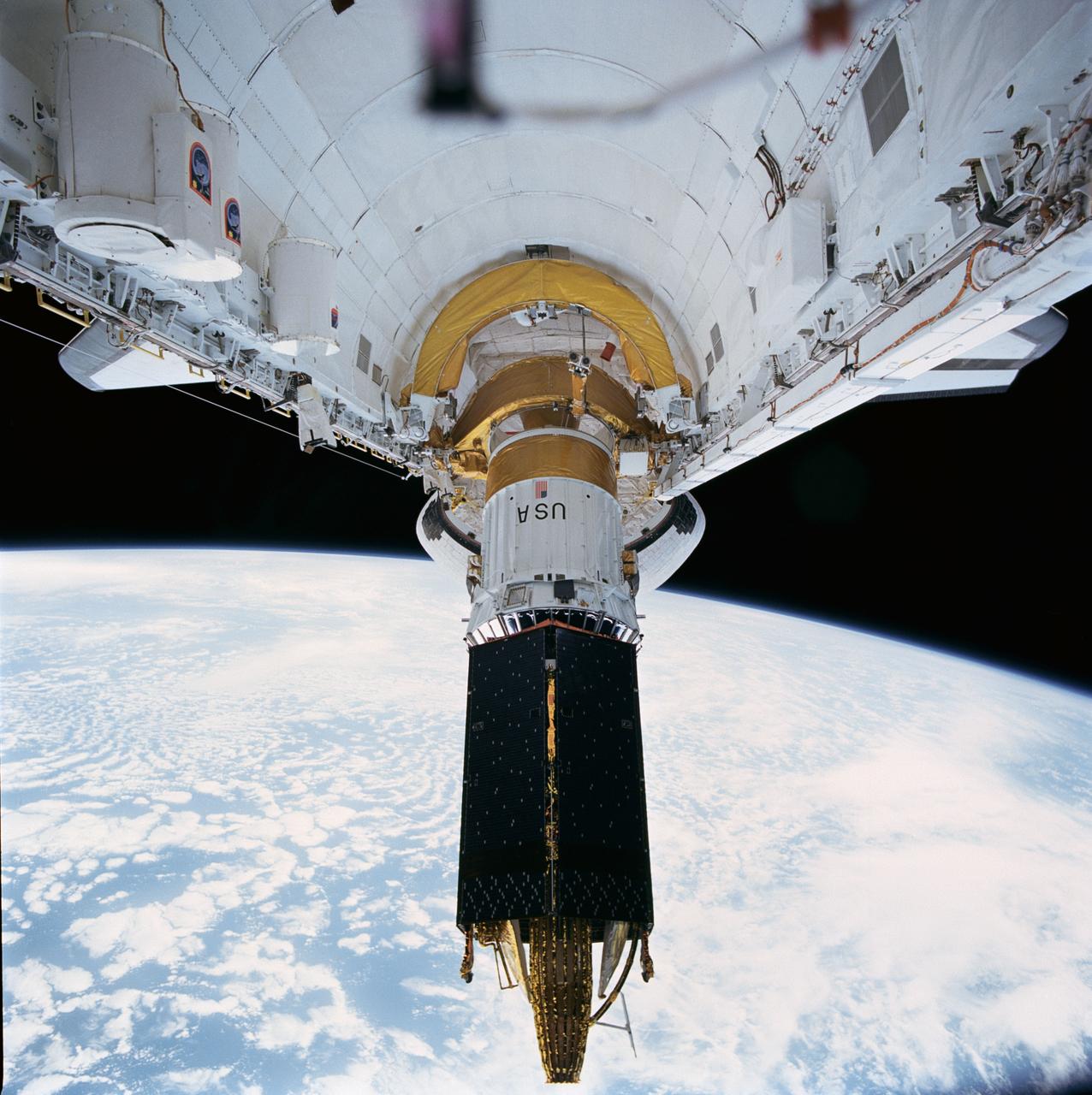
STS043-72-020 (2 Aug 1991) --- The Tracking and Data Relay Satellite (TDRS-E), is loosened from its restraint device and begins to leave the payload bay of the earth-orbiting Atlantis. The deployment came a mere six hours after the Space Shuttle was launched from Pad 39A at Kennedy Space Center, Florida. TDRS, built by TRW, will be placed in a geosynchronous orbit and after on-orbit testing, which requires several weeks, will be designated TDRS-5. The communications satellite will replace TDRS-3 at 174 degrees West longitude. The backbone of NASA's space-to-ground communications, the Tracking and Data Relay satellites have increased NASA's ability to send and receive data to spacecraft in low-earth orbit to more than 85 percent of the time. The five astronauts of the STS 43 mission are John E. Blaha, mission commander, Michael A. Baker, pilot, and Shannon W. Lucid, G. David Low, and James C. Adamson, all mission specialists.
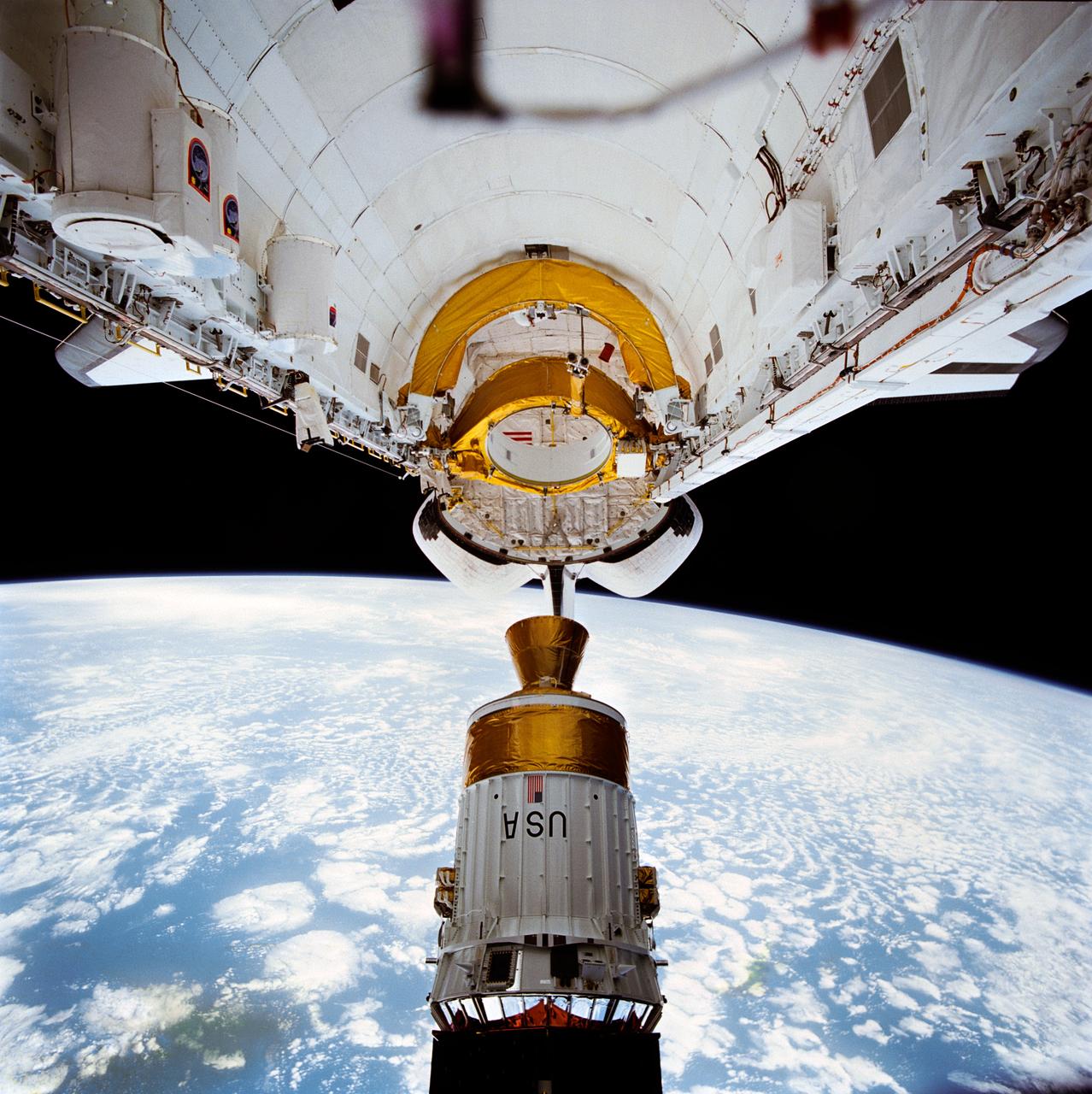
STS043-72-059 (2 Aug 1991) --- The Tracking and Data Relay Satellite (TDRS-E), leaves the payload bay of the earth-orbiting Atlantis a mere six hours after the Space Shuttle was launched from Pad 39A at Kennedy Space Center, Florida. TDRS, built by TRW, will be placed in a geosynchronous orbit and after on-orbit testing, which requires several weeks, will be designated TDRS-5. The communications satellite will replace TDRS-3 at 174 degrees West longitude. The backbone of NASA's space-to-ground communications, the Tracking and Data Relay satellites have increased NASA's ability to send and receive data to spacecraft in low-earth orbit to more than 85 percent of the time. The five astronauts of the STS 43 mission are John E. Blaha, mission commander, Michael A. Baker, pilot, and Shannon W. Lucid, G. David Low, and James C. Adamson, all mission specialists.
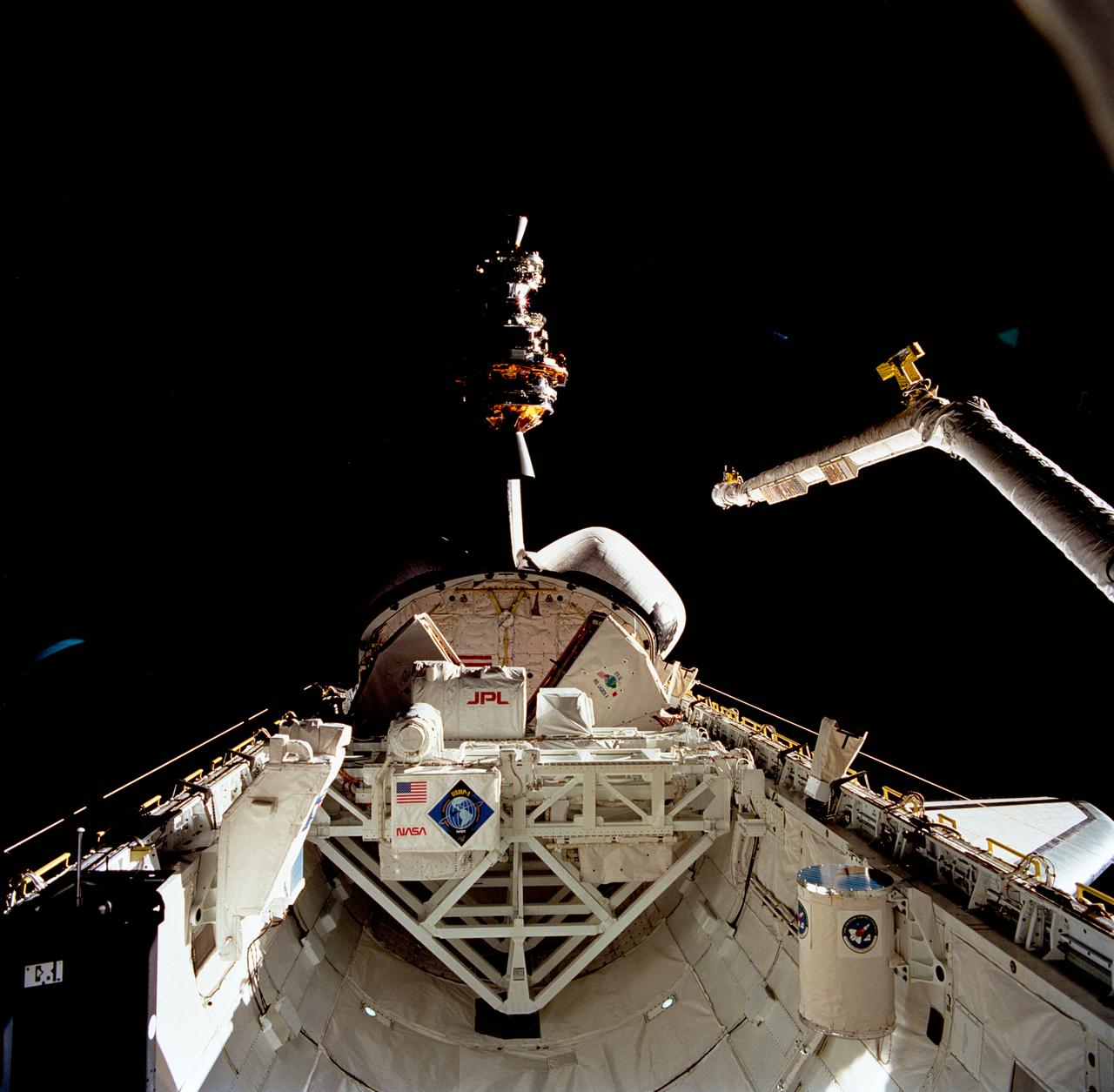
STS052-80-030 (23 Oct 1992) --- One of a series of three views of the deployment of the Laser Geodynamic Satellite (LAGEOS). The photograph was taken with a 70mm handheld camera aimed through the aft flight deck windows of the Earth-orbiting Space Shuttle Columbia. A crew of five NASA astronauts and a Canadian payload specialist spent ten days aboard Columbia for the STS-52 mission.

S83-35782 (18 June 1983) --- An Orbital Maneuvering System (OMS) engine firing caused this bright glow at the aft end of the Earth-orbiting space shuttle Challenger on June 18, 1983. Also visible in the 70mm exposure are parts of the Shuttle Pallet Satellite (SPAS-01). The experiment package for NASA's Office of Space and Terrestrial Applications (OSTA-2), the protective cradles for the Indonesian Palapa-B and Telesat Canada Anik C2 satellites, some getaway special (GAS) canisters and the Canadian-built Remote Manipulator System (RMS). The firing took place less than an hour after deployment of Anik. Photo credit: NASA
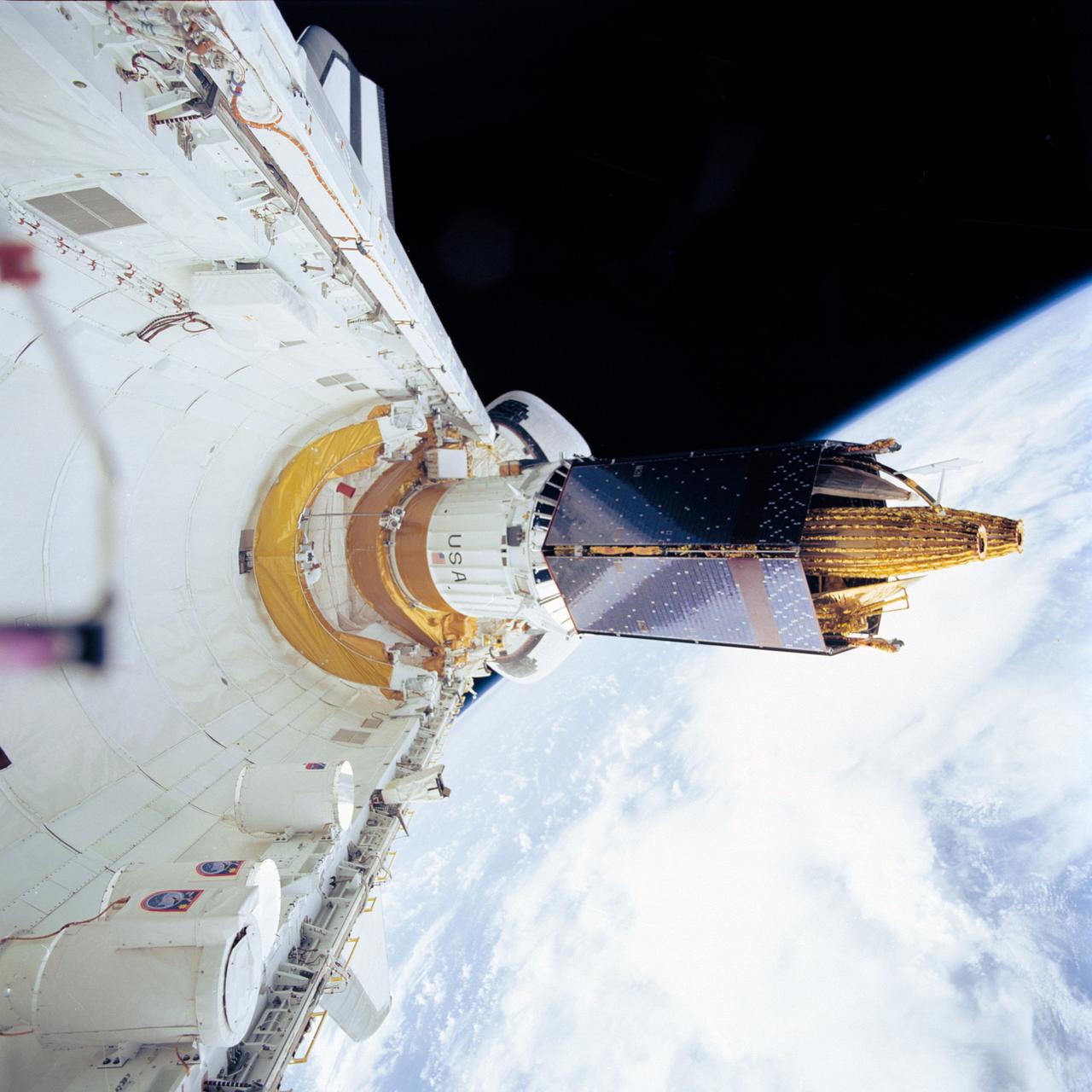
STS043-72-002 (2 Aug 1991) --- The Tracking and Data Relay Satellite (TDRS-E), leaves the payload bay of the earth-orbiting Atlantis a mere six hours after the Space Shuttle was launched from Pad 39A at Kennedy Space Center, Florida. TDRS, built by TRW, will be placed in a geosynchronous orbit and after on-orbit testing, which requires several weeks, will be designated TDRS-5. The communications satellite will replace TDRS-3 at 174 degrees West longitude. The backbone of NASA's space-to-ground communications, the Tracking and Data Relay satellites have increased NASA's ability to send and receive data to spacecraft in low-earth orbit to more than 85 percent of the time. The five astronauts of the STS 43 mission are John E. Blaha, mission commander, Michael A. Baker, pilot, and Shannon W. Lucid, G. David Low, and James C. Adamson, all mission specialists.
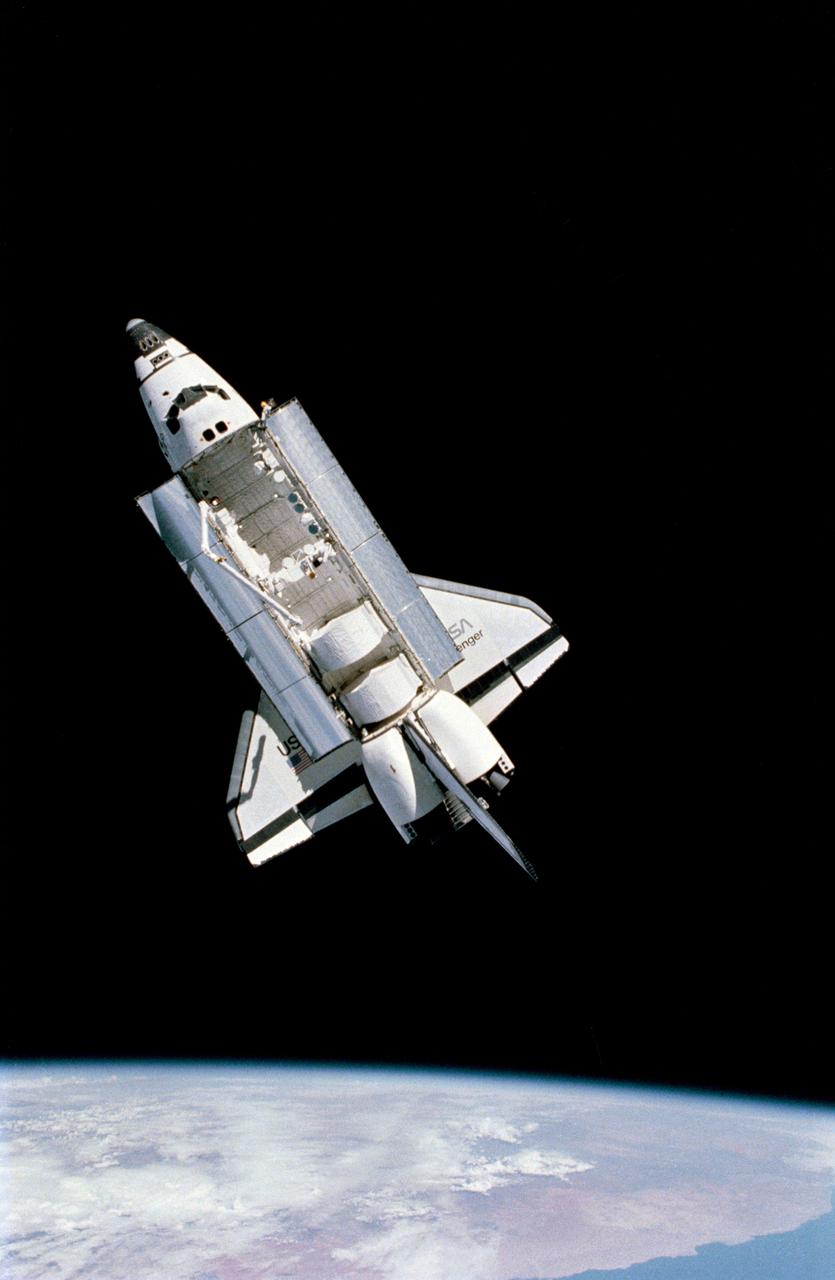
S84-27022 (7 Feb 1984) --- A 35mm frame from the February 7, 1984, extravehicular activity (EVA) photographed with a camera affixed to the gear of astronaut Bruce McCandless II. The mission specialist was equipped with the nitrogen-propelled, hand-controlled Manned Maneuvering Unit (MMU), which took him some 90 meters away from the Space Shuttle Challenger. This scene is reminiscent of views of the Challenger during the June 1983, STS-7 flight, on which the Shuttle Pallet Satellite (SPAS - seen here in the middle of the cargo bay) provided scenes of 38-meter-long reusable vehicle over the Earth.
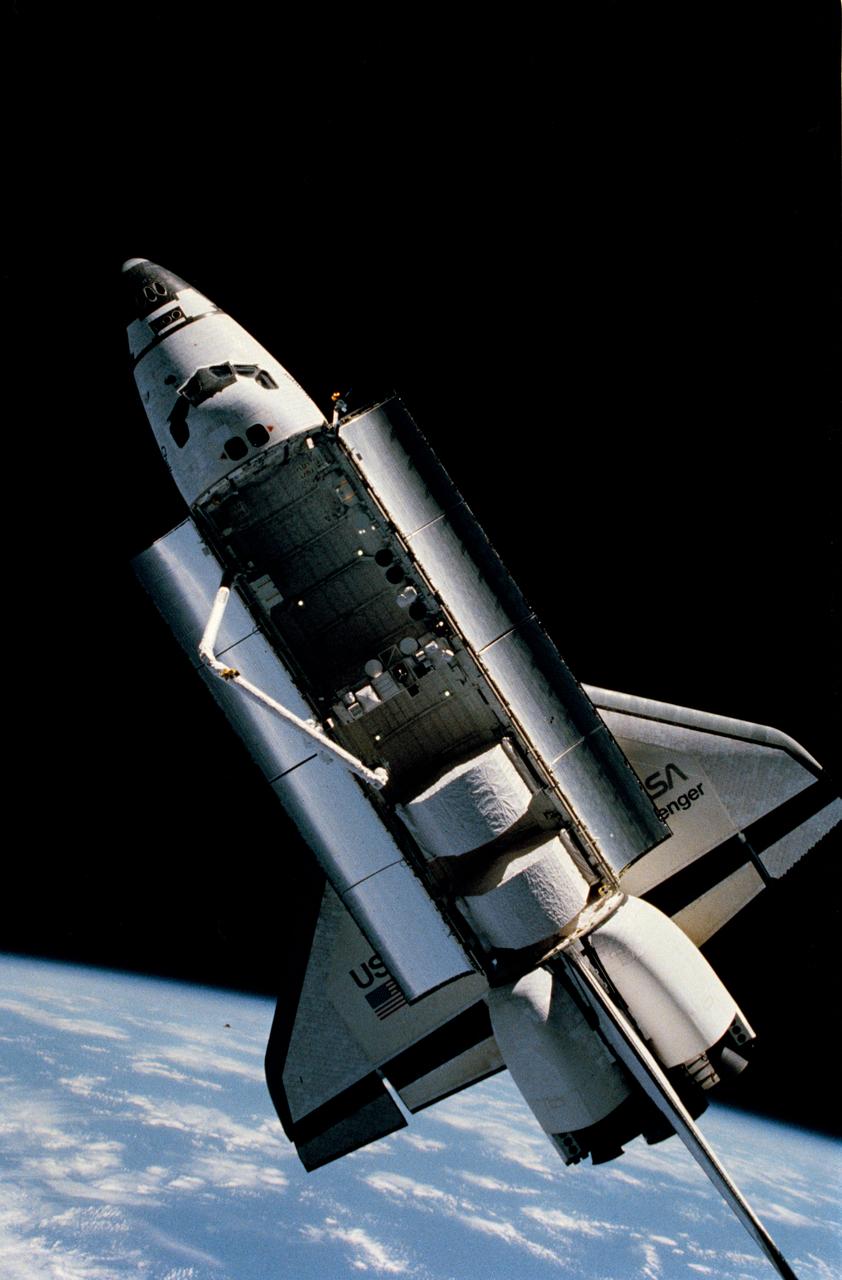
S84-27020 (7 Feb 1984) --- A fixed camera on astronaut Bruce McCandless II's helmet recorded this rare scene of the Space Shuttle Challenger some 50 to 60 meters away during a history-making extravehicular activity (EVA), February 7, 1984. The Shuttle Pallet Satellite (SPAS-01A) is configured mid-cargo bay. Astronaut Robert L. Stewart, standing beneath the Remote Manipulator System (RMS) arm, later donned the same Manned Maneuvering Unit (MMU) which afforded McCandless the freedom of movement to record this image. Also visible in the cargo bay are the support stations for the two MMU back-packs, the sunshields for the Palapa B and Westar VI Satellites, KU-Band antenna and a number of Getaway Special (GAS) canisters.
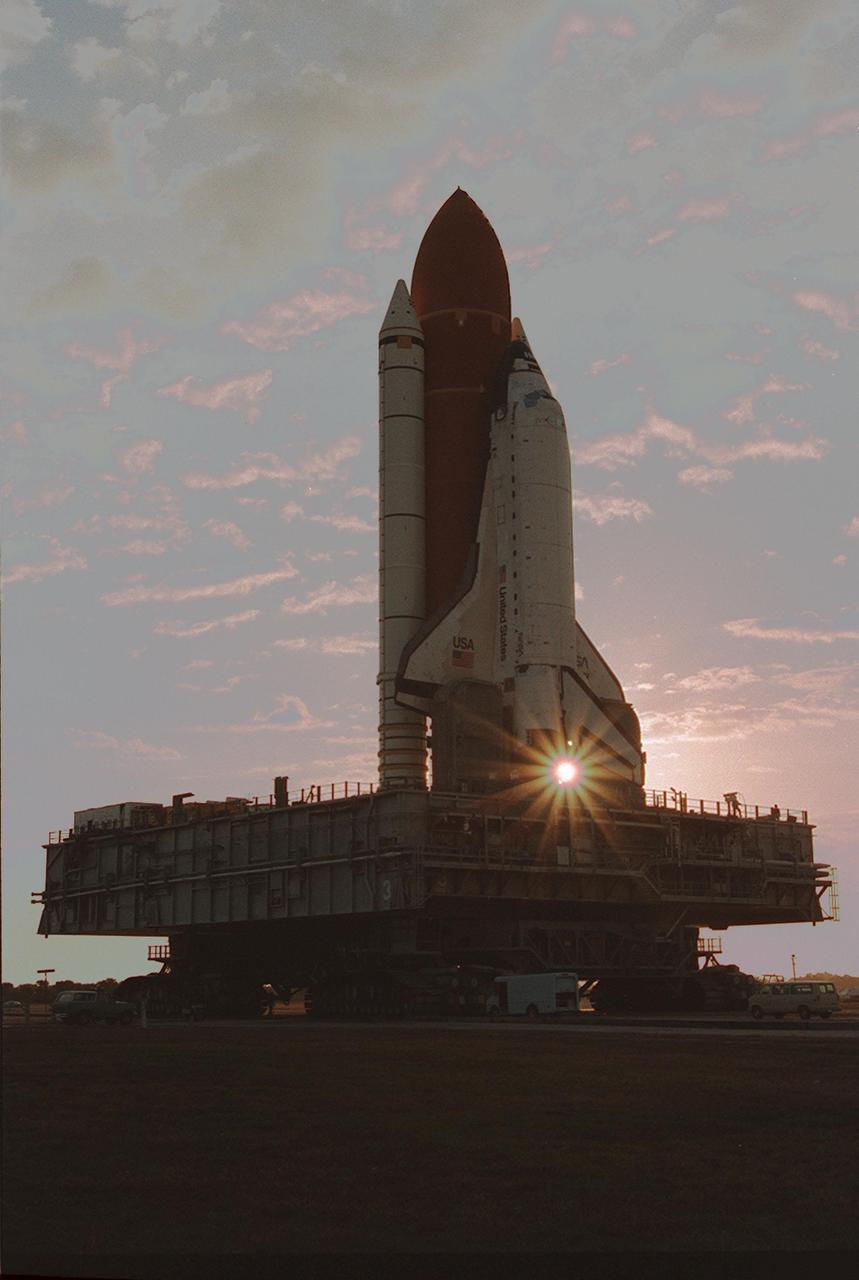
KENNEDY SPACE CENTER, FLA. -- Leaving the Vehicle Assembly Building for Launch Pad 39A on a crisp, clear winter day, the Space Shuttle Discovery makes the final Earth-bound leg of a journey into space. Once at the pad, two of the payloads for Discovery's upcoming flight, mission STS-60, will be installed. The Wake Shield Facility-1 and Get Away Special bridge assembly will be joining SPACEHAB-2 in the orbiter's payload bay. Liftoff of the first Space Shuttle flight of 1994 is currently targeted for around Feb. 3
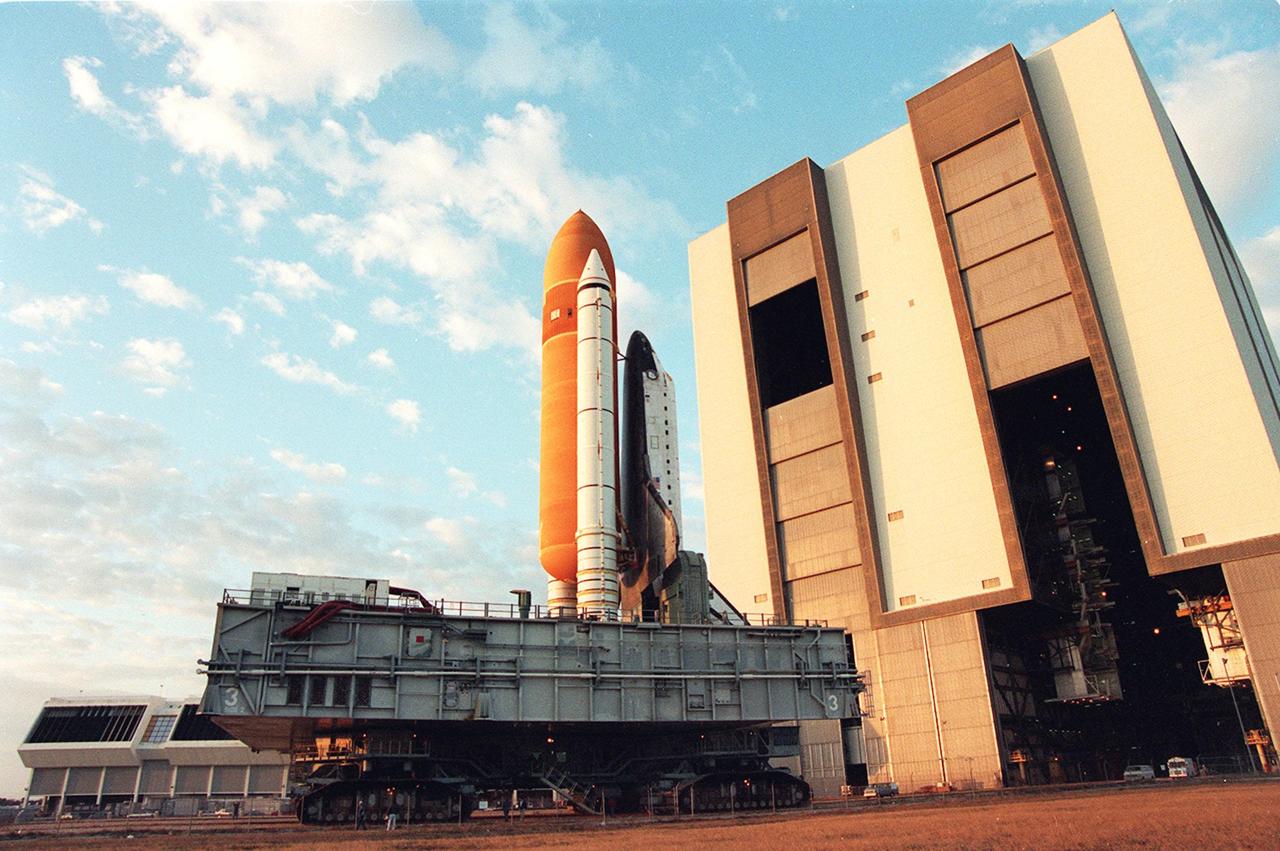
KENNEDY SPACE CENTER, FLA. -- Leaving the Vehicle Asembly Building for Launch Pad 39A on a crisp, clear winter day, the Space Shuttle Discovery makes the final Earth-bound leg of a journey into space. Once at the pad, two of the payloads for Discovery's upcoming flight, mission STS-60, will be installed. The Wake Shield Facility-1 and Get Away Special bridge assembly will be joining SPACEHAB-2 in the orbiter's payload bay. Liftoff of the first Space Shuttle flight of 1994 is currently targeted for around Feb. 3
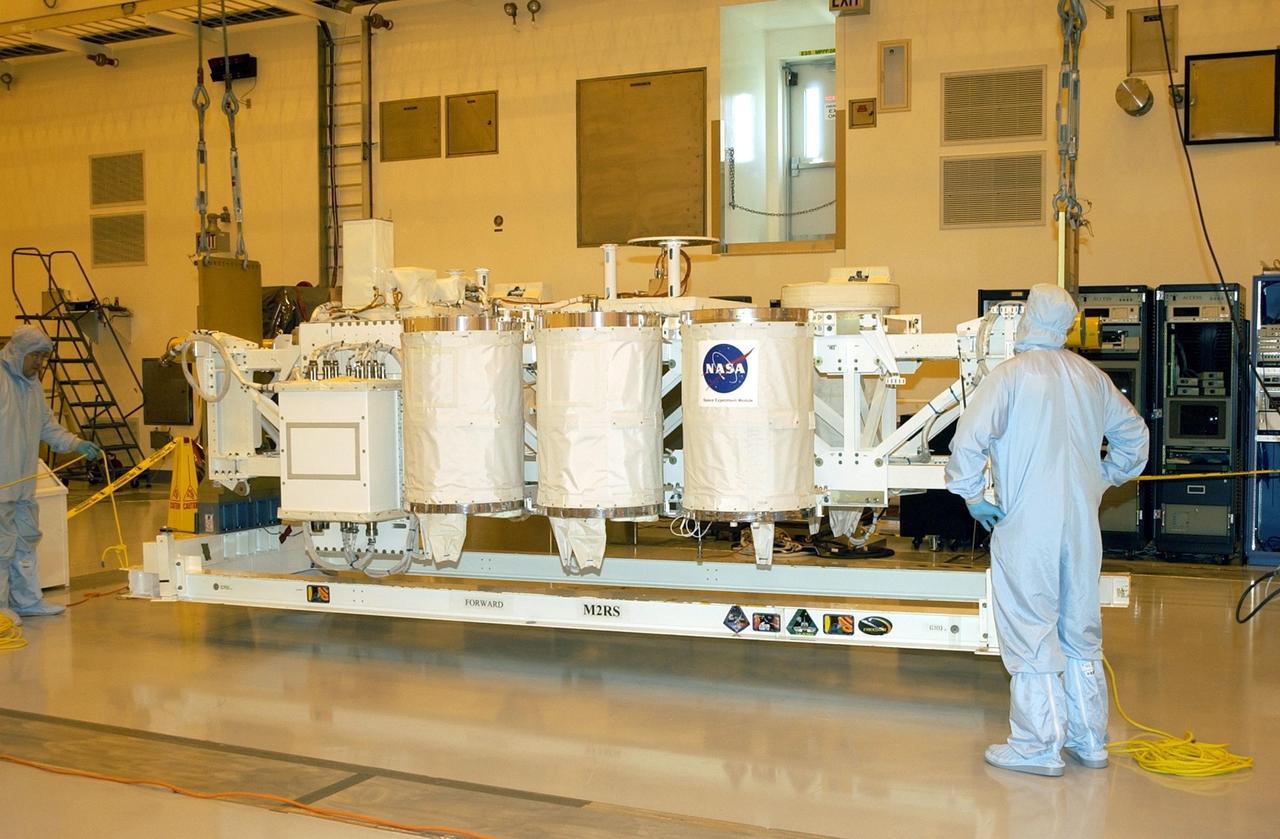
KENNEDY SPACE CENTER, FLA. -- In the Multi-Payload Processing Facility (MPPF), workers watch as the Hitchhiker Bridge, with several Get-Away Special canisters (GAS cans) for mission ST-107, is lifted off the ground. The bridge is being moved to a workstand in the MPPF. The bridge is a carrier for the Fast Reaction Experiments Enabling Science, Technology, Applications and Research (FREESTAR) that incorporates eight high priority secondary attached shuttle experiments on mission STS-107. A research mission, the primary payload is the first flight of the SHI Research Double Module (SHI/RDM), also known as SPACEHAB. The experiments range from material sciences to life sciences. STS-107 is scheduled to launch July 11, 2002
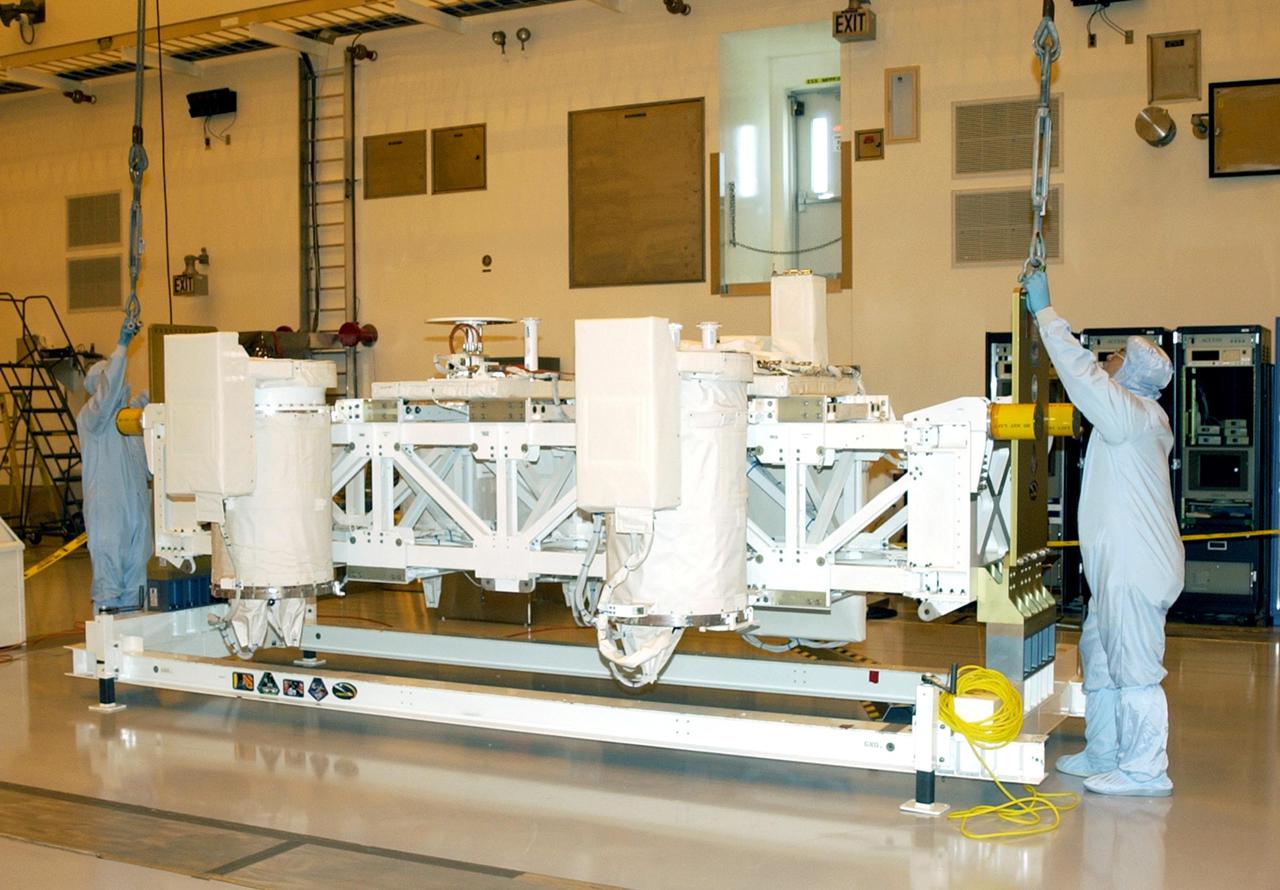
KENNEDY SPACE CENTER, FLA. -- In the Multi-Payload Processing Facility (MPPF), workers attach a crane to the Hitchhiker Bridge that holds several Get-Away Special canisters (GAS cans) for mission ST-107. The bridge is being moved to a workstand in the MPPF. The bridge is a carrier for the Fast Reaction Experiments Enabling Science, Technology, Applications and Research (FREESTAR) that incorporates eight high priority secondary attached shuttle experiments on mission STS-107. A research mission, the primary payload is the first flight of the SHI Research Double Module (SHI_RDM), also known as SPACEHAB. The experiments range from material sciences to life sciences. STS-107 is scheduled to launch July 11, 2002
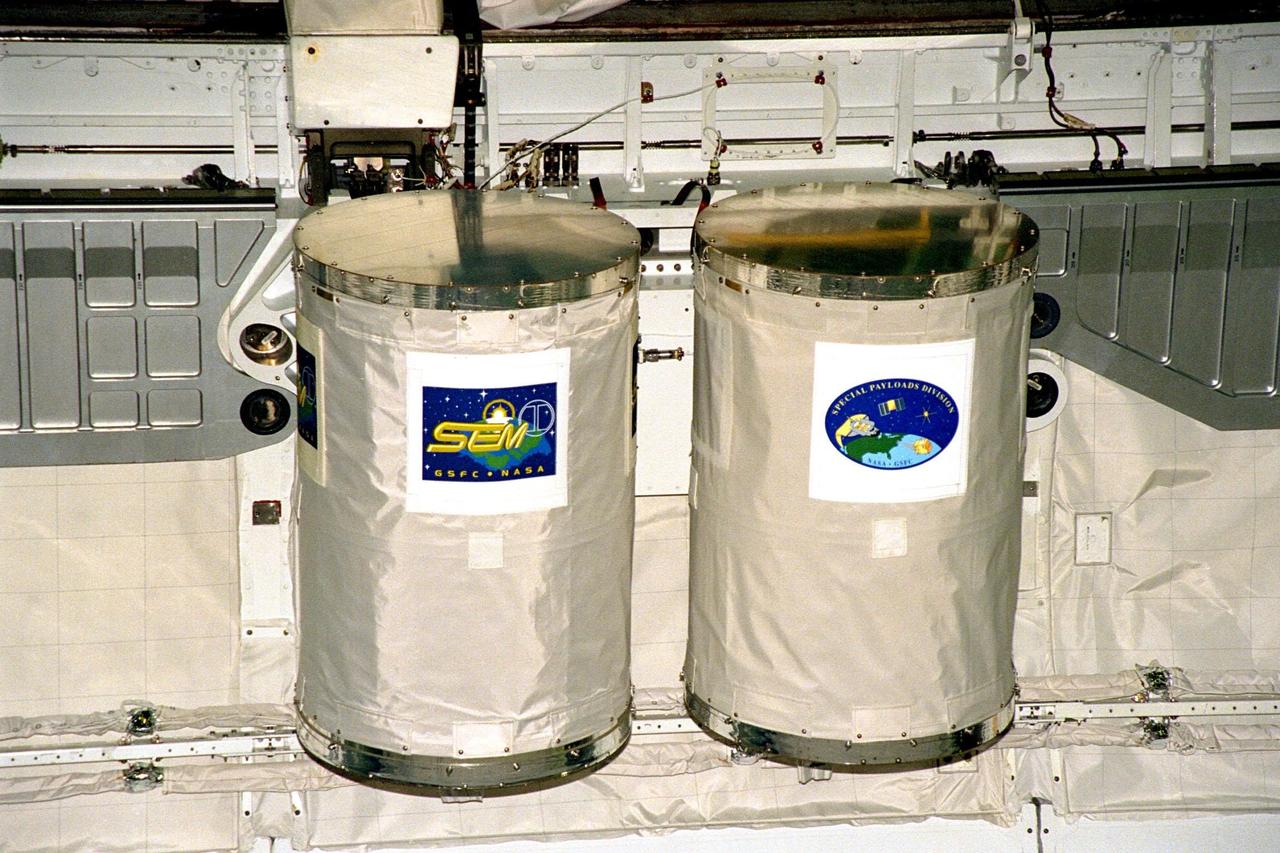
Processing activities for STS-91 continue in KSC's Orbiter Processing Facility Bay 2. Two Get Away Special (GAS) canisters are shown after their installation into Discovery's payload bay. The GAS canister on the left houses the Space Experiment Module (SEM-03), part of an educational initiative of NASA's Shuttle Small Payloads Project. On the right is a canister containing commemorative flags to be flown during the mission. STS-91 is scheduled to launch aboard the Space Shuttle Discovery for the ninth and final docking with the Russian Space Station Mir from KSC's Launch Pad 39A on June 2 with a launch window opening around 6:04 p.m. EDT
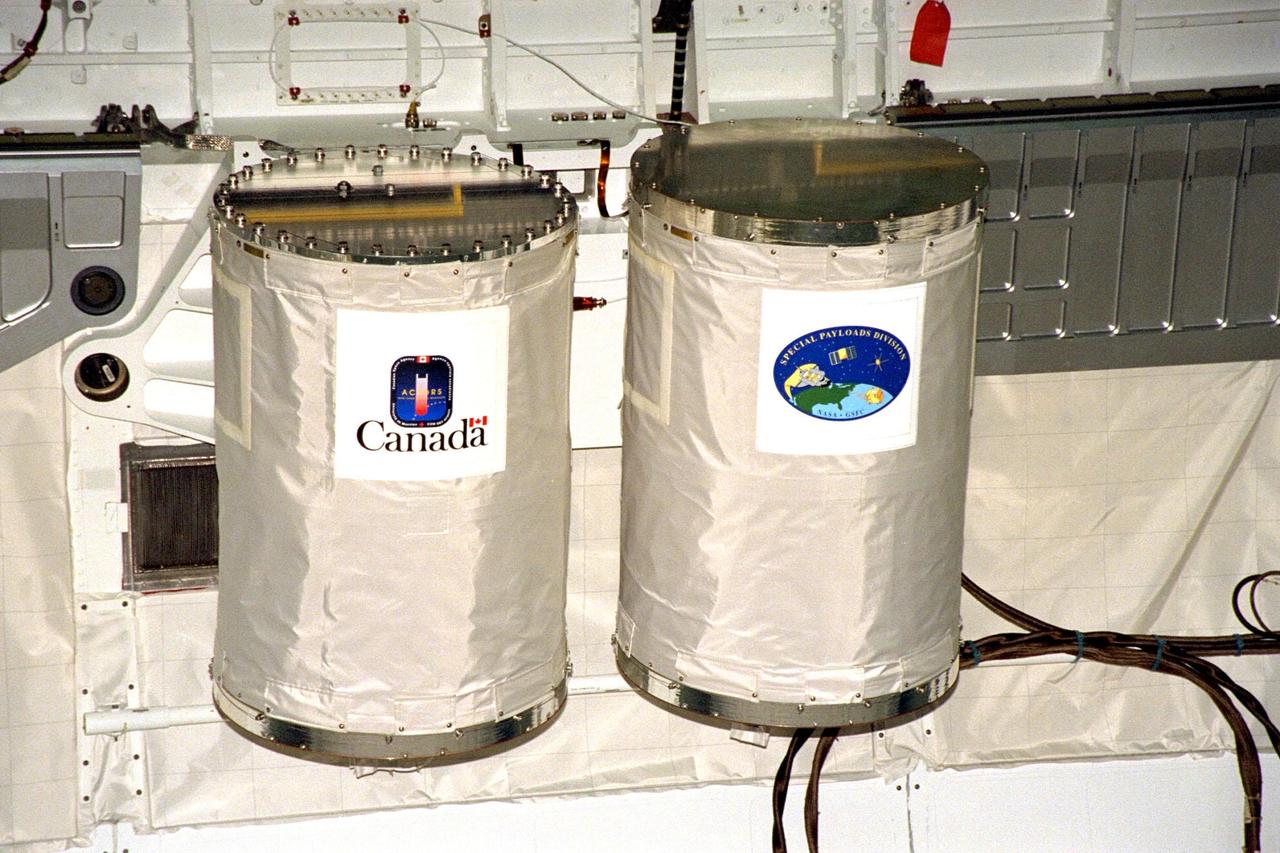
Processing activities for STS-91 continue in KSC's Orbiter Processing Facility Bay 2. Two Get Away Special (GAS) canisters are shown after their installation into Discovery's payload bay. At left is G-648, an Canadian Space Agency-sponsored study of manufactured organic thin film by the physical vapor transport method, and the can on the right contains commemorative flags to be flown during the mission. STS-91 is scheduled to launch aboard the Space Shuttle Discovery for the ninth and final docking with the Russian Space Station Mir from KSC's Launch Pad 39A on June 2 with a launch window opening around 6:04 p.m. EDT
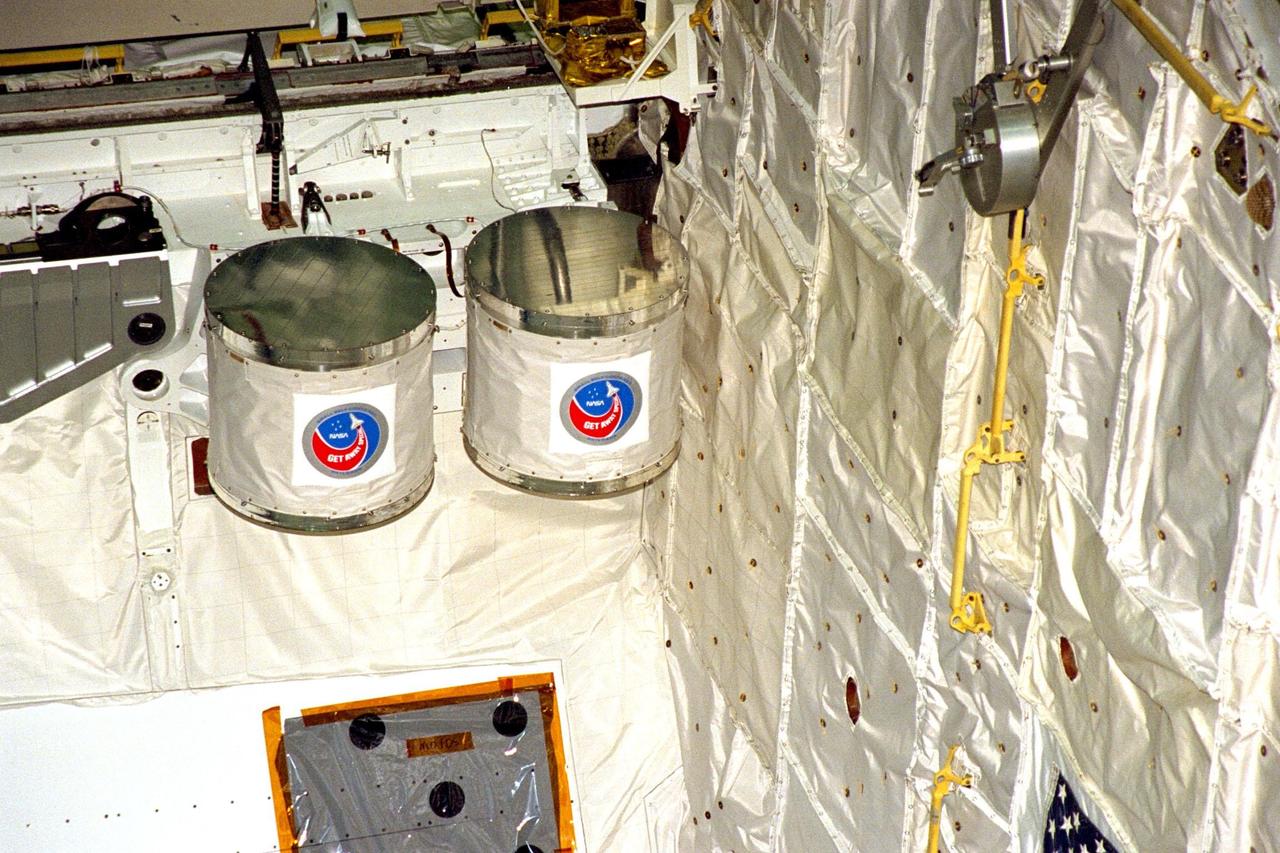
Processing activities for STS-91 continue in KSC's Orbiter Processing Facility Bay 2. Two Get Away Special (GAS) canisters are shown after their installation into Discovery's payload bay. At left is G-090, containing three educational experiments sponsored by Utah State University, and at right is G-743, an experiment sponsored by Broward Community College in Florida to test DNA exposed to cosmic radiation in a microgravity environment. STS-91 is scheduled to launch aboard the Space Shuttle Discovery for the ninth and final docking with the Russian Space Station Mir from KSC's Launch Pad 39A on June 2 with a launch window opening around 6:04 p.m. EDT
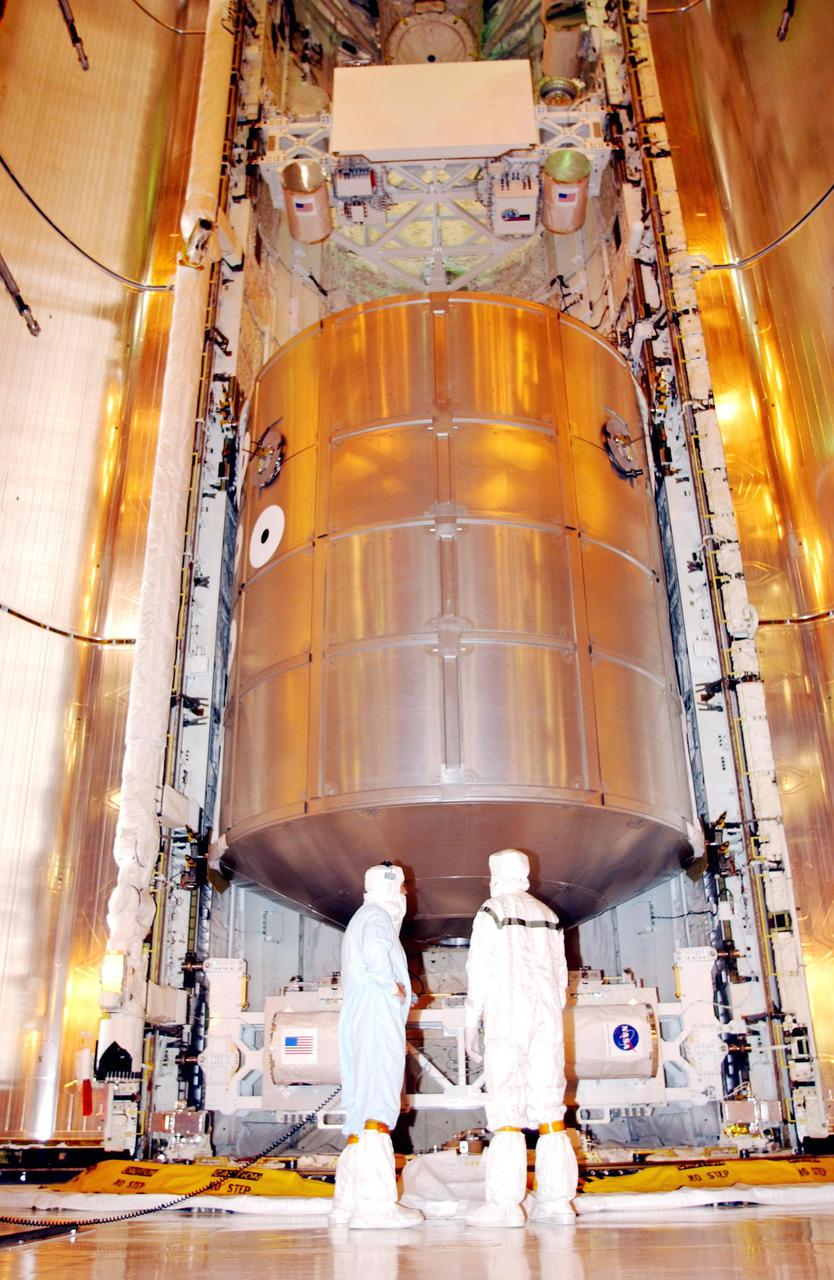
KENNEDY SPACE CENTER, Fla. - Space Shuttle Endeavour's payload bay doors are ready for closure and launch on mission STS-108. Inside the bay is the Multi-Purpose Logistics Module Raffaello, carrying supplies, equipment and experiments for the International Space Station. Surrounding the MPLM are several carriers with varying experiment packages, such as Starshine-2, a Get-Away Special. Endeavour is scheduled to launch Nov. 29 on this first Utilization Flight to the International Space Station. Endeavour will also carry the replacement Expedition 4 crew to the Station and return to Earth with the Expedition 3 crew
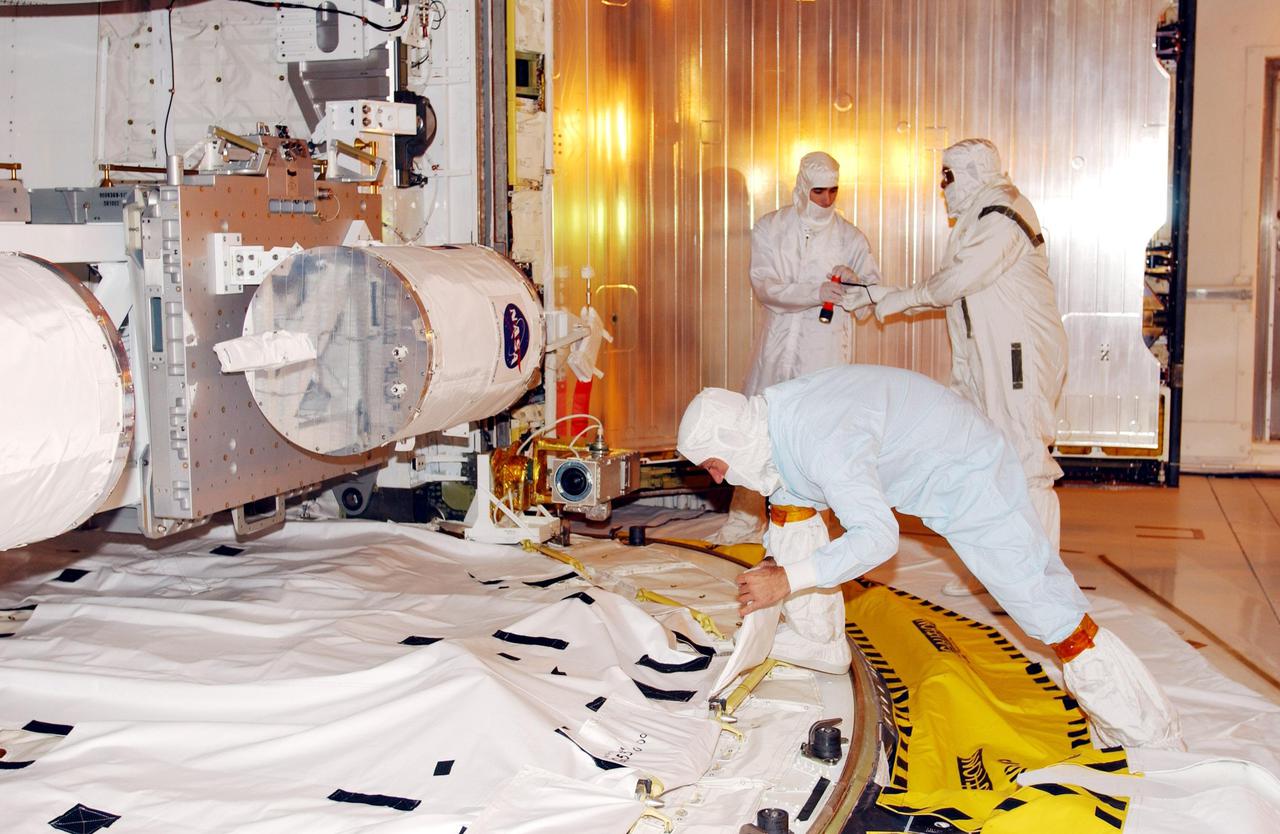
KENNEDY SPACE CENTER, Fla. - A worker makes a final adjustment in the payload bay of Space Shuttle Endeavour before door closure. Inside the bay is the Multi-Purpose Logistics Module Raffaello (foreground), carrying supplies, equipment and experiments for the International Space Station. Sharing the payload bay are several carriers with varying experiment packages, such as Starshine-2, a Get-Away Special. Endeavour is scheduled to launch Nov. 29 on this first Utilization Flight, STS-108, to the International Space Station. Endeavour will also carry the replacement Expedition 4 crew to the Station and return to Earth with the Expedition 3 crew
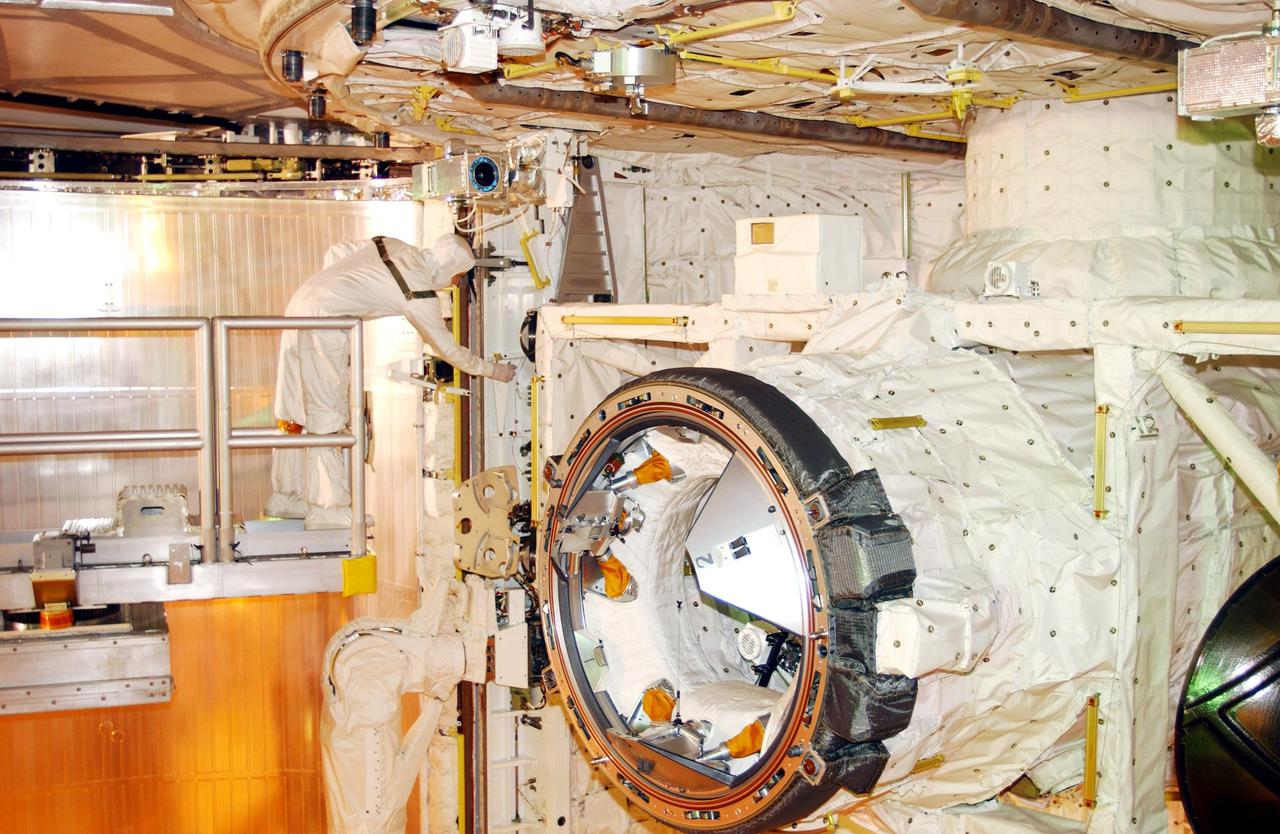
KENNEDY SPACE CENTER, Fla. - A technician prepares for payload bay closure on Space Shuttle Endeavour. Inside the bay is the Multi-Purpose Logistics Module Raffaello (foreground), carrying supplies, equipment and experiments for the International Space Station. Sharing the payload bay are several carriers with varying experiment packages, such as Starshine-2, a Get-Away Special. Endeavour is scheduled to launch Nov. 29 on this first Utilization Flight, STS-108, to the International Space Station. Endeavour will also carry the replacement Expedition 4 crew to the Station and return to Earth with the Expedition 3 crew
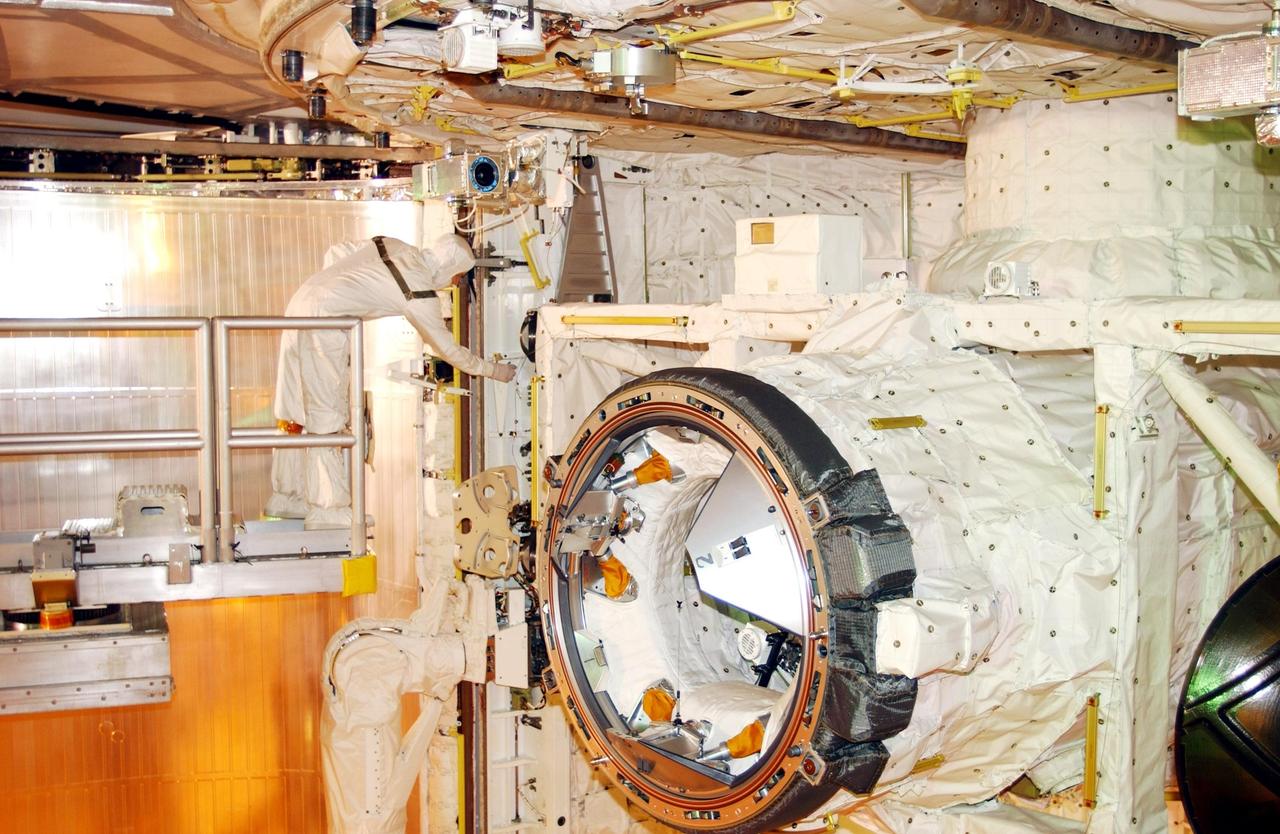
KENNEDY SPACE CENTER, Fla. - A technician prepares for payload bay closure on Space Shuttle Endeavour. Inside the bay is the Multi-Purpose Logistics Module Raffaello (foreground), carrying supplies, equipment and experiments for the International Space Station. Sharing the payload bay are several carriers with varying experiment packages, such as Starshine-2, a Get-Away Special. Endeavour is scheduled to launch Nov. 29 on this first Utilization Flight, STS-108, to the International Space Station. Endeavour will also carry the replacement Expedition 4 crew to the Station and return to Earth with the Expedition 3 crew

KENNEDY SPACE CENTER, Fla. - A worker makes a final adjustment in the payload bay of Space Shuttle Endeavour before door closure. Inside the bay is the Multi-Purpose Logistics Module Raffaello (foreground), carrying supplies, equipment and experiments for the International Space Station. Sharing the payload bay are several carriers with varying experiment packages, such as Starshine-2, a Get-Away Special. Endeavour is scheduled to launch Nov. 29 on this first Utilization Flight, STS-108, to the International Space Station. Endeavour will also carry the replacement Expedition 4 crew to the Station and return to Earth with the Expedition 3 crew
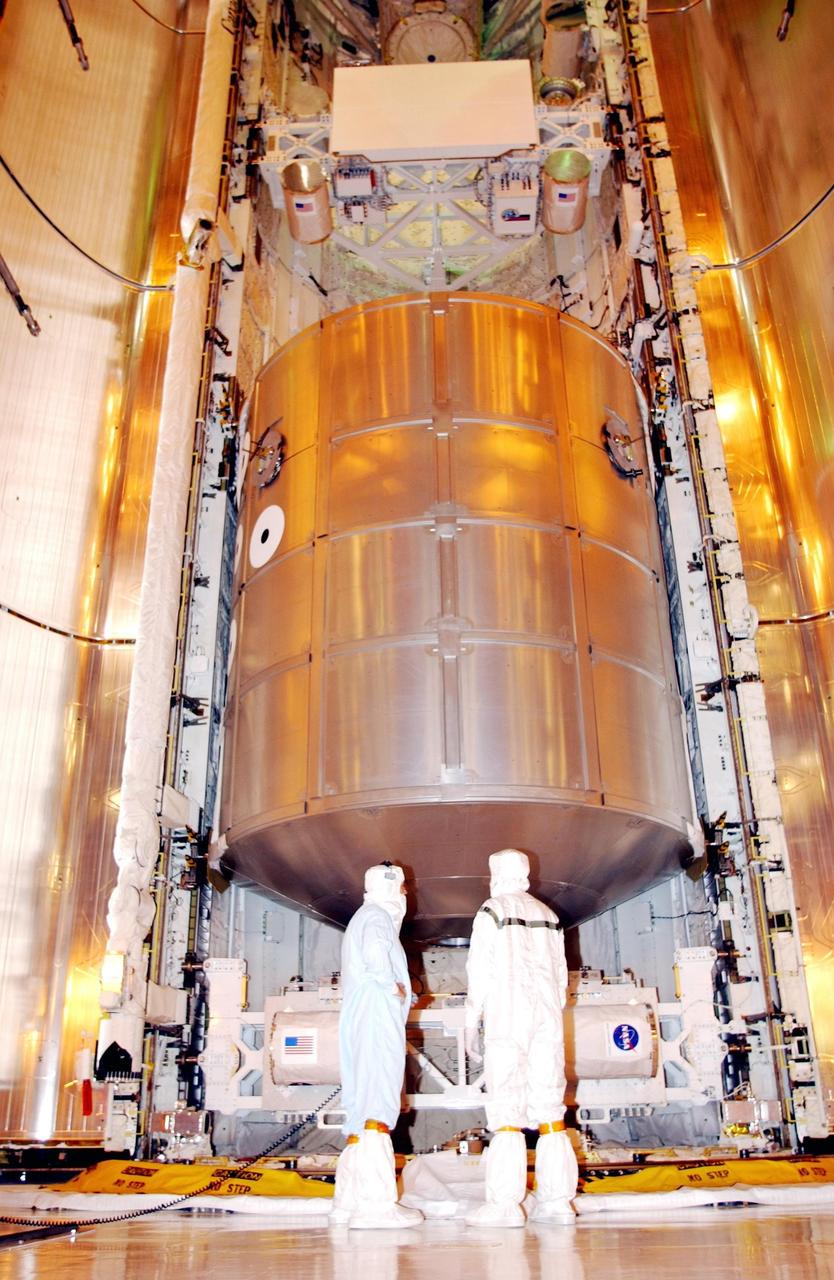
KENNEDY SPACE CENTER, Fla. - Space Shuttle Endeavour's payload bay doors are ready for closure and launch on mission STS-108. Inside the bay is the Multi-Purpose Logistics Module Raffaello, carrying supplies, equipment and experiments for the International Space Station. Surrounding the MPLM are several carriers with varying experiment packages, such as Starshine-2, a Get-Away Special. Endeavour is scheduled to launch Nov. 29 on this first Utilization Flight to the International Space Station. Endeavour will also carry the replacement Expedition 4 crew to the Station and return to Earth with the Expedition 3 crew

KENNEDY SPACE CENTER, Fla. -- Space Shuttle Endeavour's payload bay doors are ready for closure and launch on mission STS-108. Inside the bay is the Multi-Purpose Logistics Module Raffaello (foreground), carrying supplies, equipment and experiments for the International Space Station. Sharing the payload bay are several carriers with varying experiment packages, such as Starshine-2, a Get-Away Special. Endeavour is scheduled to launch Nov. 29 on this first Utilization Flight to the International Space Station. Endeavour will also carry the replacement Expedition 4 crew to the Station and return to Earth with the Expedition 3 crew
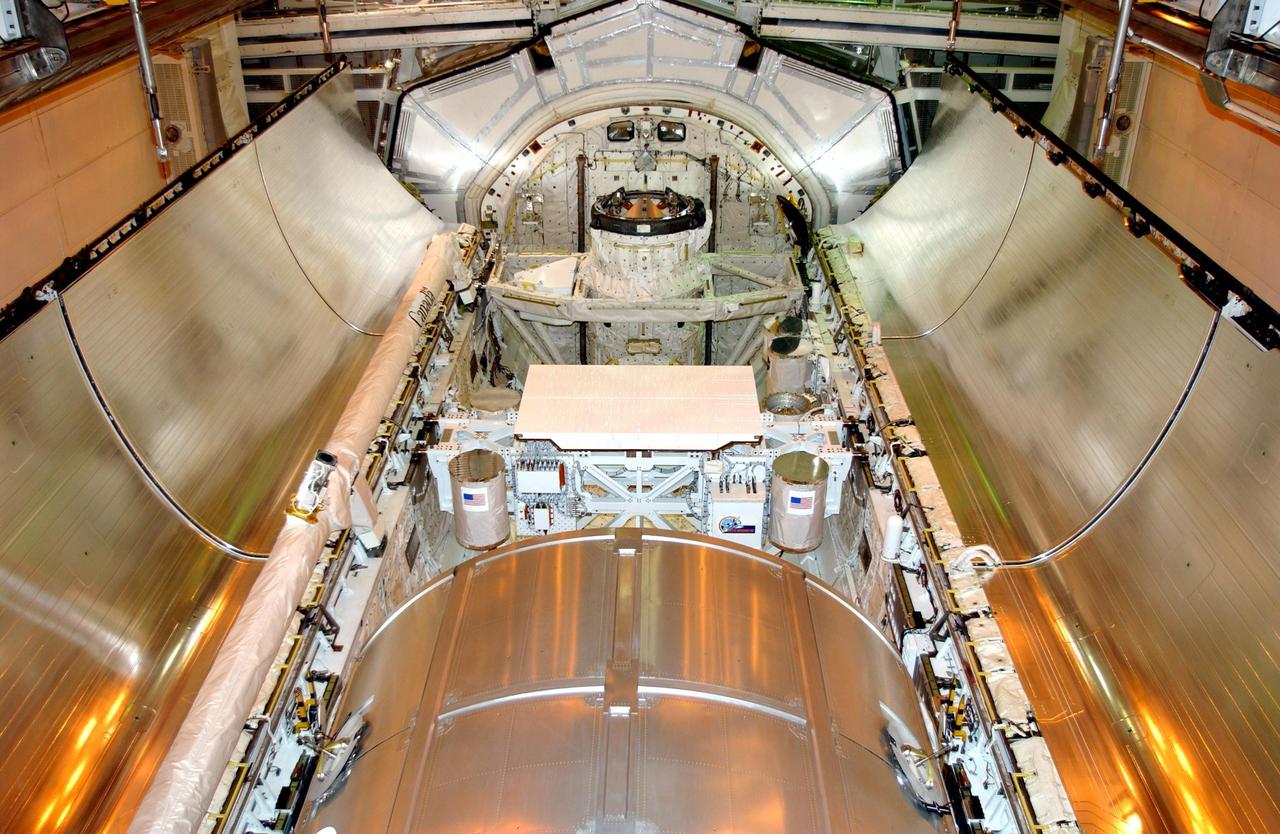
KENNEDY SPACE CENTER, Fla. -- Space Shuttle Endeavour's payload bay doors are ready for closure and launch on mission STS-108. Inside the bay is the Multi-Purpose Logistics Module Raffaello (foreground), carrying supplies, equipment and experiments for the International Space Station. Sharing the payload bay are several carriers with varying experiment packages, such as Starshine-2, a Get-Away Special. Endeavour is scheduled to launch Nov. 29 on this first Utilization Flight to the International Space Station. Endeavour will also carry the replacement Expedition 4 crew to the Station and return to Earth with the Expedition 3 crew
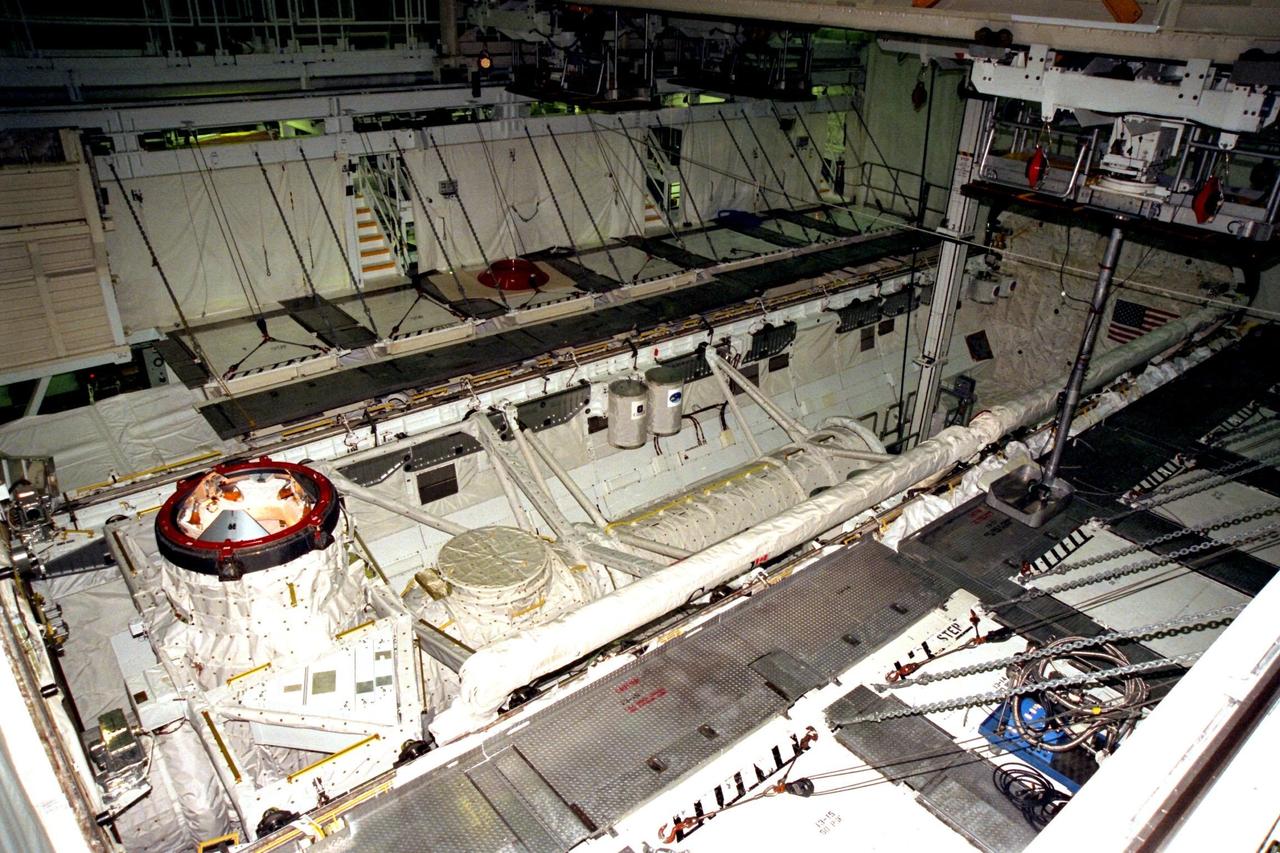
Processing activities for STS-91 continue in KSC's Orbiter Processing Facility Bay 2. The payload bay of Space Shuttle Discovery is relatively empty as installation of the Get Away Special (GAS) canisters begins. Two GAS canisters can be seen in the center of the photograph. On the left is G-648, a Canadian Space Agency-sponsored study on manufactured organic thin film by the physical vapor transport method, and on the right is a can with hundreds of commemorative flags to be flown on the mission. STS-91 is scheduled to launch aboard the Space Shuttle Discovery for the ninth and final docking with the Russian Space Station Mir from KSC's Launch Pad 39A on June 2 with a launch window opening around 6:04 p.m. EDT
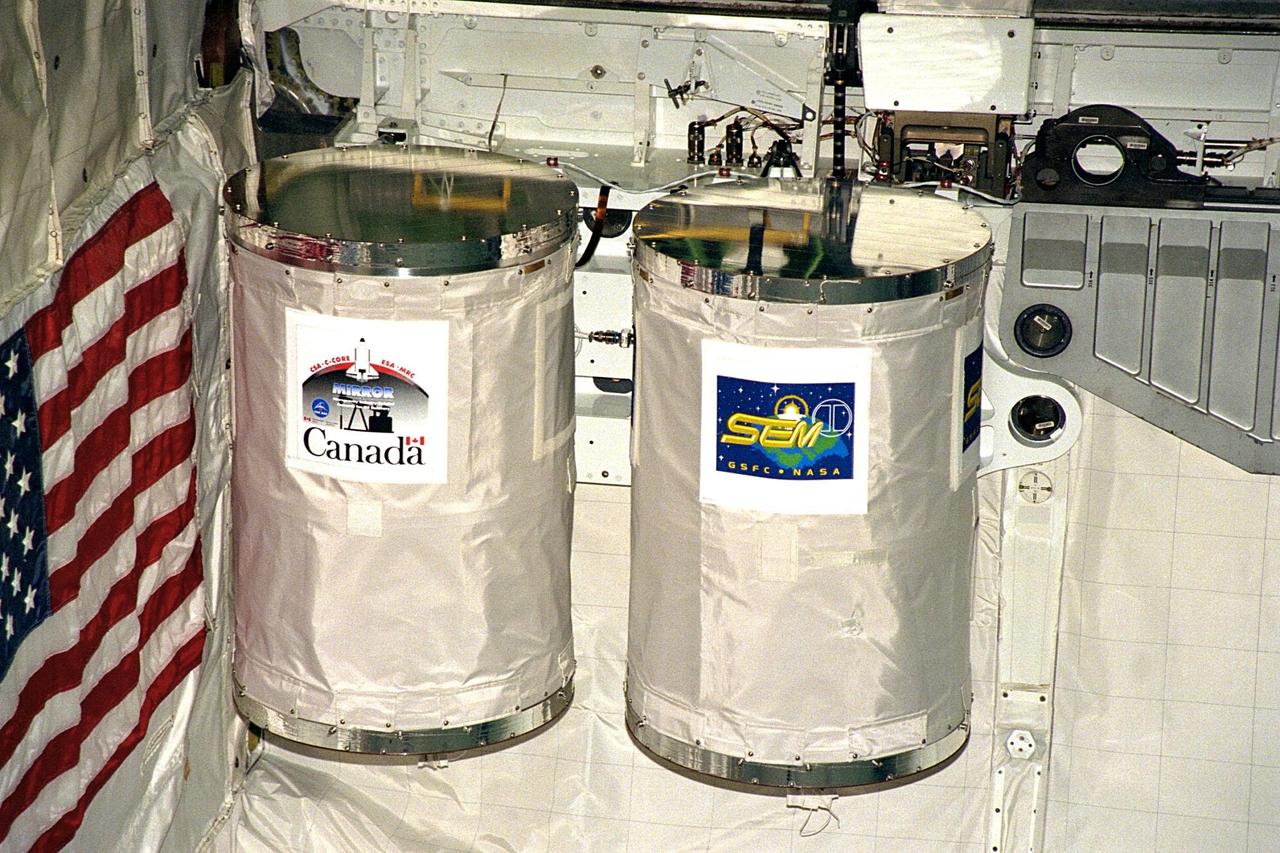
Processing activities for STS-91 continue in Orbiter Processing Facility Bay 2. Two Get Away Special (GAS) canisters are shown after their installation into Discovery's payload bay. The GAS payload G-765, in the canister on the left, is sponsored by the Canadian Space Agency and managed by C-CORE/Memorial University of Newfoundland. It is a study to understand the transport of fluids in porous media as it pertains to improving methods for enhanced oil recovery. The GAS canister on the right houses the Space Experiment Module (SEM-05), part of an educational initiative of NASA's Shuttle Small Payloads Project. STS-91 is scheduled to launch aboard the Space Shuttle Discovery for the ninth and final docking with the Russian Space Station Mir from KSC's Launch Pad 39A on June 2 with a launch window opening around 6:04 p.m. EDT
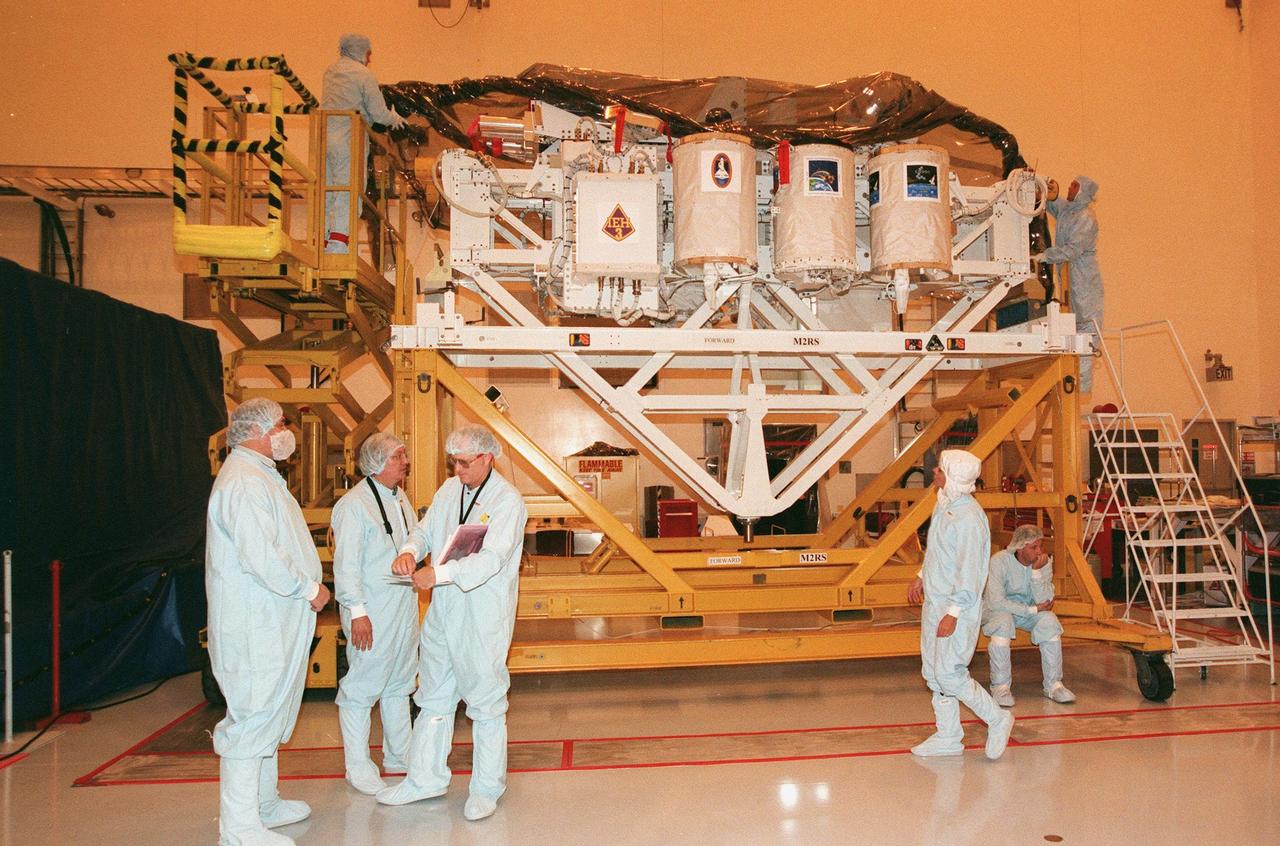
KENNEDY SPACE CENTER, FLA. The International Extreme Ultraviolet Hitchhiker-3 (IEH-3), one of the payloads for the STS-95 mission, is prepared for launch in the Multi-Payload Processing Facility. IEH-3 is comprised of seven experiments, including one that will be deployed on Flight Day 3. It is the small, non-recoverable Petite Amateur Navy Satellite (PANSAT) which will store and transmit digital communications. Other IEH investigations are the Solar Constant Experiment (SOLCON), Solar Extreme Ultraviolet Hitchhiker (SEH), Spectrograph/Telescope for Astronomical Research (STAR-LITE), Ultraviolet Spectrograph Telescope for Astronomical Research (UVSTAR), Consortium for Materials Development in Space Complex Autonomous Payloads (CONCAP-IV) for growing thin films via physical vapor transport, and two Get-Away Special (GAS) canister experiments. The experiments will be mounted on a hitchhiker bridge in Discovery's payload bay

KENNEDY SPACE CENTER, Fla. -- On Launch Pad 39A, two Hitchhiker Experiments Advancing Technology (HEAT) payloads are loaded onto Discovery’s port adapter beam in the payload bay. At left is the Space Experiment Module, an educational initiative to increase educational access to space. The canister contains up to 10 small, enclosed modules that contain separate, passive experiments designed and constructed by students. Many of the experiments will study the growing characteristics of plants subjected to the space environment. At right is the Get Away Special canister containing the Alkali Metal Thermal-to-Electric Converter (AMTEC), designed for efficient conversion of heat into electrical energy. The HEAT payloads are flying on mission STS-105, scheduled to launch Aug. 9, 2001
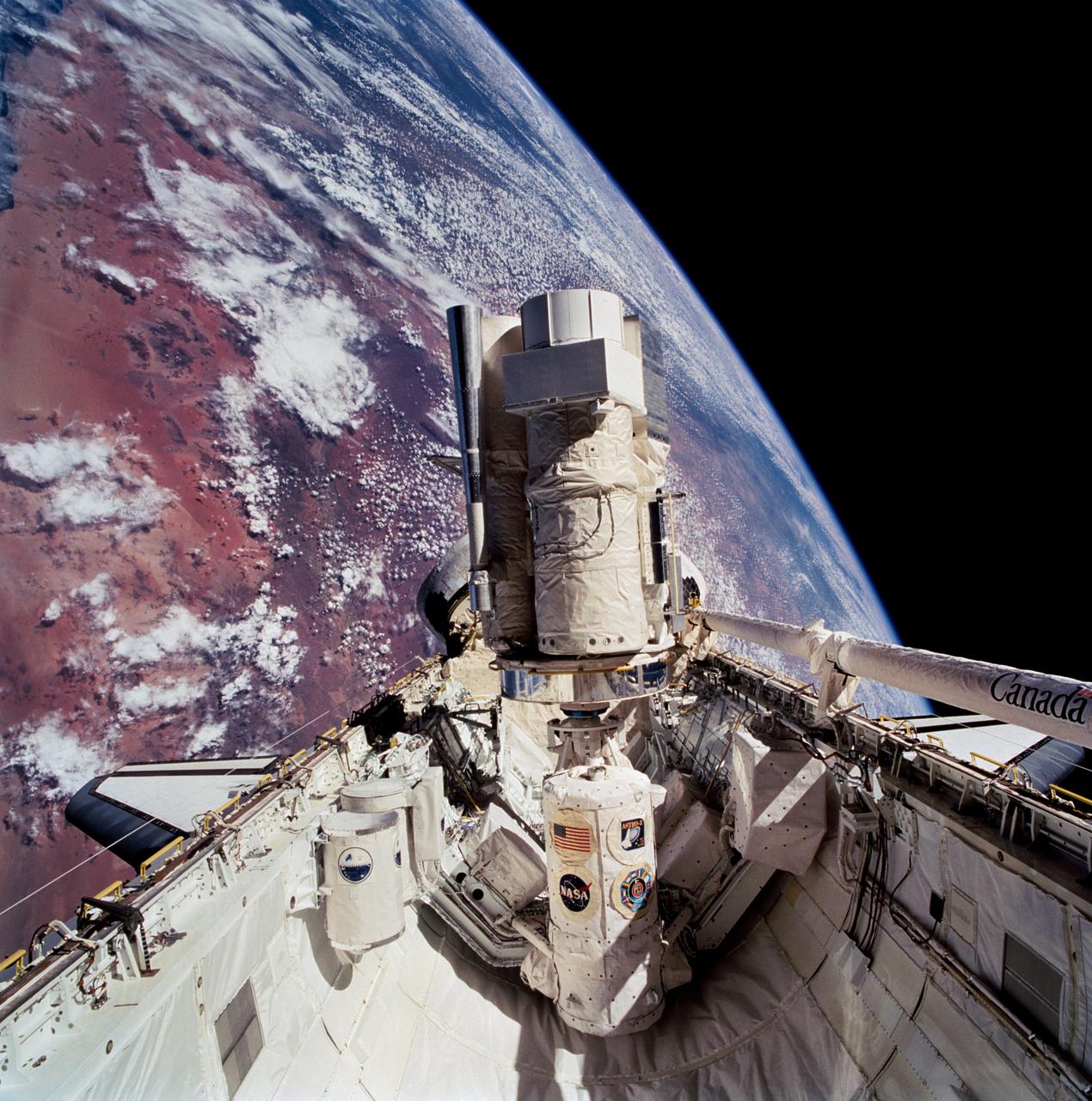
STS067-713-072 (2-18 March 1995) --- This 70mm cargo bay scene, backdropped against a desert area of Namibia, typifies the view that daily greeted the Astro-2 crew members during their almost 17-days aboard the Space Shuttle Endeavour. Positioned on the Spacelab pallet amidst other hardware, the Astro-2 payload is in its operational mode. Visible here are the Instrument Pointing System (IPS), Hopkins Ultraviolet Telescope (HUT), Star Tracker (ST), Ultraviolet Imaging Telescope (UIT), Wisconsin Ultraviolet Photo-Polarimeter Experiment (WUPPE), and Integrated Radiator System (IRS). At this angle, the Optical Sensor Package (OPS) is not seen. The Igloo, which supports the package of experiments, is in center foreground. Two Get-Away Special (GAS) canisters are in lower left foreground. The Extended Duration Orbiter (EDO) pallet, located aft of the cargo bay, is obscured by the Astro-2 payload. The Endeavour was 190 nautical miles above Earth.
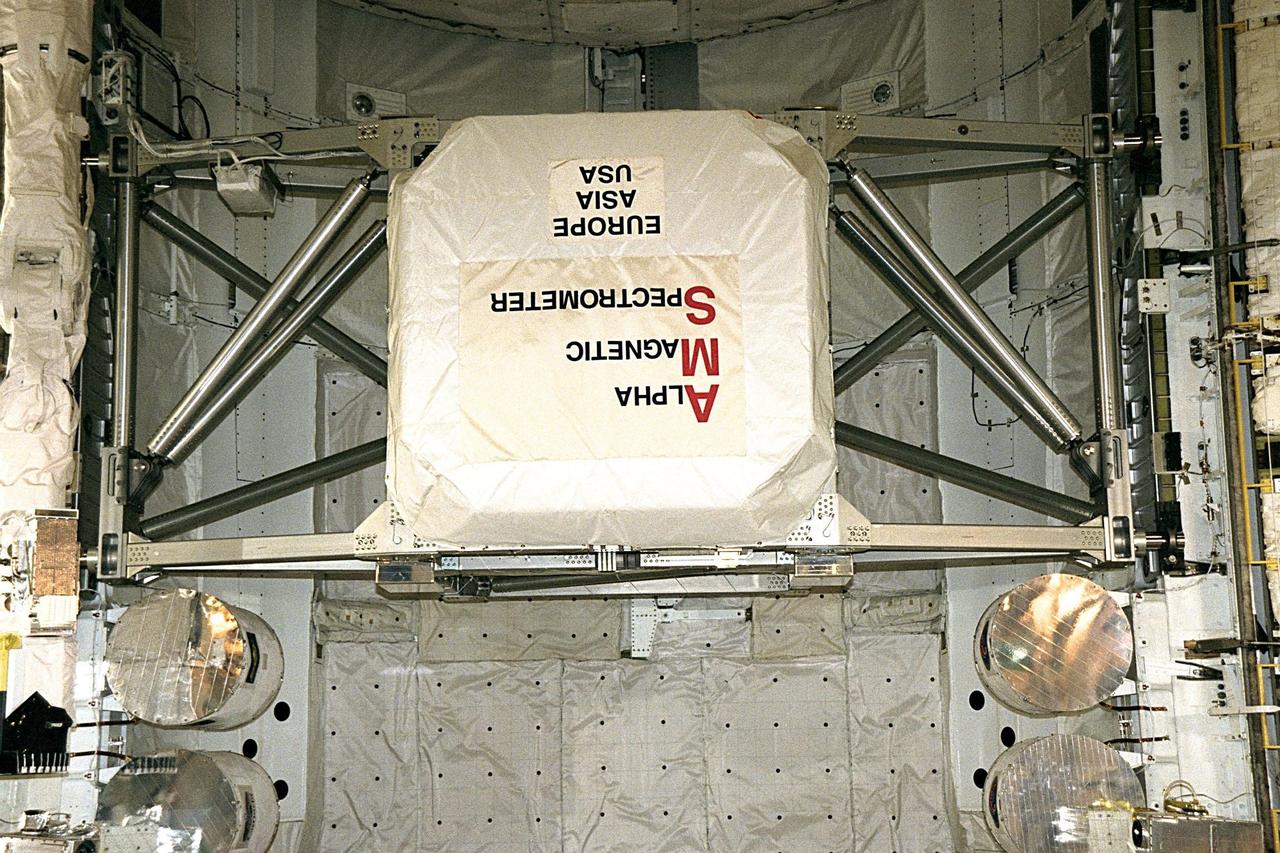
The Alpha Magnetic Spectrometer (AMS) experiment and four Get Away Special (GAS) payload canisters are secure in Discovery's payload bay shortly before the payload bay doors are closed for the flight of STS-91 at Launch Pad 39A. Launch is planned for June 2 with a window opening around 6:10 p.m. EDT. The AMS experiment is the first of a new generation of space-based experiments which will use particles, instead of light, to study the Universe and will search for both antimatter and "dark matter," as well as measure normal matter cosmic and gamma rays. The GAS Program, initiated to provide extremely low-cost access to space, is managed by the Shuttle Small Payloads Project at NASA's Goddard Space Flight Center. Eight GAS experiments will be conducted on STS-91. The mission will also feature the ninth Shuttle docking with the Russian Space Station Mir, the first Mir docking for Discovery, the conclusion of Phase I of the joint U.S.-Russian International Space Station Program, and the first flight of the new Space Shuttle super lightweight external tank. The STS-91 flight crew includes Commander Charles Precourt; Pilot Dominic Gorie; and Mission Specialists Wendy B. Lawrence; Franklin Chang-Diaz, Ph.D.; Janet Kavandi, Ph.D.; and Valery Ryumin, with the Russian Space Agency. Andrew Thomas, Ph.D., will be returning to Earth with the crew after living more than four months aboard Mir