
CAPE CANAVERAL, Fla. -- At the Astrotech payload processing facility, technicians lower NASA's Gamma-Ray Large Area Space Telescope, or GLAST, spacecraft toward the payload attach fitting. The fitting will eventually be used to mate GLAST to the Delta II launch vehicle. The GLAST is a powerful space observatory that will explore the Universe's ultimate frontier, where nature harnesses forces and energies far beyond anything possible on Earth; probe some of science's deepest questions, such as what our Universe is made of, and search for new laws of physics; explain how black holes accelerate jets of material to nearly light speed; and help crack the mystery of stupendously powerful explosions known as gamma-ray bursts. A launch date still is to be determined. Photo credit: NASA/Jim Grossmann

CAPE CANAVERAL, Fla. -- At the Astrotech payload processing facility, technicians check the placement of NASA's Gamma-Ray Large Area Space Telescope, or GLAST, spacecraft on the payload attach fitting. The fitting will eventually be used to mate GLAST to the Delta II launch vehicle. The GLAST is a powerful space observatory that will explore the Universe's ultimate frontier, where nature harnesses forces and energies far beyond anything possible on Earth; probe some of science's deepest questions, such as what our Universe is made of, and search for new laws of physics; explain how black holes accelerate jets of material to nearly light speed; and help crack the mystery of stupendously powerful explosions known as gamma-ray bursts. A launch date still is to be determined. Photo credit: NASA/Jim Grossmann

CAPE CANAVERAL, Fla. -- At the Astrotech payload processing facility, NASA's Gamma-Ray Large Area Space Telescope, or GLAST, spacecraft is being prepared for a move to an payload attach fitting that will eventually be used to mate GLAST to the Delta II launch vehicle. The GLAST is a powerful space observatory that will explore the Universe's ultimate frontier, where nature harnesses forces and energies far beyond anything possible on Earth; probe some of science's deepest questions, such as what our Universe is made of, and search for new laws of physics; explain how black holes accelerate jets of material to nearly light speed; and help crack the mystery of stupendously powerful explosions known as gamma-ray bursts. A launch date still is to be determined. Photo credit: NASA/Jim Grossmann

CAPE CANAVERAL, Fla. -- At the Astrotech payload processing facility, technicians lower NASA's Gamma-Ray Large Area Space Telescope, or GLAST, spacecraft toward the payload attach fitting. The fitting will eventually be used to mate GLAST to the Delta II launch vehicle. The GLAST is a powerful space observatory that will explore the Universe's ultimate frontier, where nature harnesses forces and energies far beyond anything possible on Earth; probe some of science's deepest questions, such as what our Universe is made of, and search for new laws of physics; explain how black holes accelerate jets of material to nearly light speed; and help crack the mystery of stupendously powerful explosions known as gamma-ray bursts. A launch date still is to be determined. Photo credit: NASA/Jim Grossmann

CAPE CANAVERAL, Fla. -- At the Astrotech payload processing facility, technicians prepare the payload attach fitting that will receive NASA's Gamma-Ray Large Area Space Telescope, or GLAST, spacecraft. The fitting will eventually be used to mate GLAST to the Delta II launch vehicle. The GLAST is a powerful space observatory that will explore the Universe's ultimate frontier, where nature harnesses forces and energies far beyond anything possible on Earth; probe some of science's deepest questions, such as what our Universe is made of, and search for new laws of physics; explain how black holes accelerate jets of material to nearly light speed; and help crack the mystery of stupendously powerful explosions known as gamma-ray bursts. A launch date still is to be determined. Photo credit: NASA/Jim Grossmann

CAPE CANAVERAL, Fla. -- At the Astrotech payload processing facility, technicians check the attachment of NASA's Gamma-Ray Large Area Space Telescope, or GLAST, spacecraft on the payload attach fitting. The fitting will eventually be used to mate GLAST to the Delta II launch vehicle. The GLAST is a powerful space observatory that will explore the Universe's ultimate frontier, where nature harnesses forces and energies far beyond anything possible on Earth; probe some of science's deepest questions, such as what our Universe is made of, and search for new laws of physics; explain how black holes accelerate jets of material to nearly light speed; and help crack the mystery of stupendously powerful explosions known as gamma-ray bursts. A launch date still is to be determined. Photo credit: NASA/Jim Grossmann

CAPE CANAVERAL, Fla. -- At the Astrotech payload processing facility, NASA's Gamma-Ray Large Area Space Telescope, or GLAST, spacecraft is being prepared for a move to an payload attach fitting, in the foreground, that will eventually be used to mate GLAST to the Delta II launch vehicle. The GLAST is a powerful space observatory that will explore the Universe's ultimate frontier, where nature harnesses forces and energies far beyond anything possible on Earth; probe some of science's deepest questions, such as what our Universe is made of, and search for new laws of physics; explain how black holes accelerate jets of material to nearly light speed; and help crack the mystery of stupendously powerful explosions known as gamma-ray bursts. A launch date still is to be determined. Photo credit: NASA/Jim Grossmann

CAPE CANAVERAL, Fla. -- At the Astrotech payload processing facility, technicians begin lifting and moving NASA's Gamma-Ray Large Area Space Telescope, or GLAST, spacecraft for its move to a payload attach fitting that will eventually be used to mate GLAST to the Delta II launch vehicle. The GLAST is a powerful space observatory that will explore the Universe's ultimate frontier, where nature harnesses forces and energies far beyond anything possible on Earth; probe some of science's deepest questions, such as what our Universe is made of, and search for new laws of physics; explain how black holes accelerate jets of material to nearly light speed; and help crack the mystery of stupendously powerful explosions known as gamma-ray bursts. A launch date still is to be determined. Photo credit: NASA/Jim Grossmann

CAPE CANAVERAL, Fla. -- At the Astrotech payload processing facility, technicians prepare NASA's Gamma-Ray Large Area Space Telescope, or GLAST, spacecraft for its move to the payload attach fitting that will eventually be used to mate GLAST to the Delta II launch vehicle. The GLAST is a powerful space observatory that will explore the Universe's ultimate frontier, where nature harnesses forces and energies far beyond anything possible on Earth; probe some of science's deepest questions, such as what our Universe is made of, and search for new laws of physics; explain how black holes accelerate jets of material to nearly light speed; and help crack the mystery of stupendously powerful explosions known as gamma-ray bursts. A launch date still is to be determined. Photo credit: NASA/Jim Grossmann

CAPE CANAVERAL, Fla. -- Technicians at Astrotech in Titusville, Fla., work on closeouts of the payload attach fitting on NASA's Gamma-Ray Large Area Space Telescope, or GLAST, spacecraft. The GLAST is a powerful space observatory that will explore the Universe's ultimate frontier, where nature harnesses forces and energies far beyond anything possible on Earth; probe some of science's deepest questions, such as what our Universe is made of, and search for new laws of physics; explain how black holes accelerate jets of material to nearly light speed; and help crack the mystery of stupendously powerful explosions known as gamma-ray bursts. A launch date still is to be determined. Photo credit: NASA/Kim Shiflett

CAPE CANAVERAL, Fla. -- A closeup of NASA's Gamma-Ray Large Area Space Telescope, or GLAST, spacecraft during a press showing at Astrotech in Titusville, Fla. The GLAST is a powerful space observatory that will explore the Universe's ultimate frontier, where nature harnesses forces and energies far beyond anything possible on Earth; probe some of science's deepest questions, such as what our Universe is made of, and search for new laws of physics; explain how black holes accelerate jets of material to nearly light speed; and help crack the mystery of stupendously powerful explosions known as gamma-ray bursts. A launch date still is to be determined. Photo credit: NASA/Kim Shiflett

CAPE CANAVERAL, Fla. -- Technicians at Astrotech in Titusville, Fla., work on closeouts of the payload attach fitting on NASA's Gamma-Ray Large Area Space Telescope, or GLAST, spacecraft. The GLAST is a powerful space observatory that will explore the Universe's ultimate frontier, where nature harnesses forces and energies far beyond anything possible on Earth; probe some of science's deepest questions, such as what our Universe is made of, and search for new laws of physics; explain how black holes accelerate jets of material to nearly light speed; and help crack the mystery of stupendously powerful explosions known as gamma-ray bursts. A launch date still is to be determined. Photo credit: NASA/Kim Shiflett

CAPE CANAVERAL, Fla. -- TvTechnicians at Astrotech in Titusville, Fla., work on closeouts of the payload attach fitting on NASA's Gamma-Ray Large Area Space Telescope, or GLAST, spacecraft. The GLAST is a powerful space observatory that will explore the Universe's ultimate frontier, where nature harnesses forces and energies far beyond anything possible on Earth; probe some of science's deepest questions, such as what our Universe is made of, and search for new laws of physics; explain how black holes accelerate jets of material to nearly light speed; and help crack the mystery of stupendously powerful explosions known as gamma-ray bursts. A launch date still is to be determined. Photo credit: NASA/Kim Shiflett

CAPE CANAVERAL, Fla. -- Technicians at Astrotech in Titusville, Fla., work on closeouts of the payload attach fitting on NASA's Gamma-Ray Large Area Space Telescope, or GLAST, spacecraft. The GLAST is a powerful space observatory that will explore the Universe's ultimate frontier, where nature harnesses forces and energies far beyond anything possible on Earth; probe some of science's deepest questions, such as what our Universe is made of, and search for new laws of physics; explain how black holes accelerate jets of material to nearly light speed; and help crack the mystery of stupendously powerful explosions known as gamma-ray bursts. A launch date still is to be determined. Photo credit: NASA/Kim Shiflett

CAPE CANAVERAL, Fla. Photographers take closeup shots of NASA's Gamma-Ray Large Area Space Telescope, or GLAST, spacecraft during a press showing at Astrotech in Titusville, Fla. The GLAST is a powerful space observatory that will explore the Universe's ultimate frontier, where nature harnesses forces and energies far beyond anything possible on Earth; probe some of science's deepest questions, such as what our Universe is made of, and search for new laws of physics; explain how black holes accelerate jets of material to nearly light speed; and help crack the mystery of stupendously powerful explosions known as gamma-ray bursts. A launch date still is to be determined. Photo credit: NASA/Kim Shiflett

CAPE CANAVERAL, Fla. -- At Astrotech in Titusville, Fla., photographers take photos of NASA's Gamma-Ray Large Area Space Telescope, or GLAST, spacecraft during a press showing. The GLAST is a powerful space observatory that will explore the Universe's ultimate frontier, where nature harnesses forces and energies far beyond anything possible on Earth; probe some of science's deepest questions, such as what our Universe is made of, and search for new laws of physics; explain how black holes accelerate jets of material to nearly light speed; and help crack the mystery of stupendously powerful explosions known as gamma-ray bursts. A launch date still is to be determined. Photo credit: NASA/Kim Shiflett
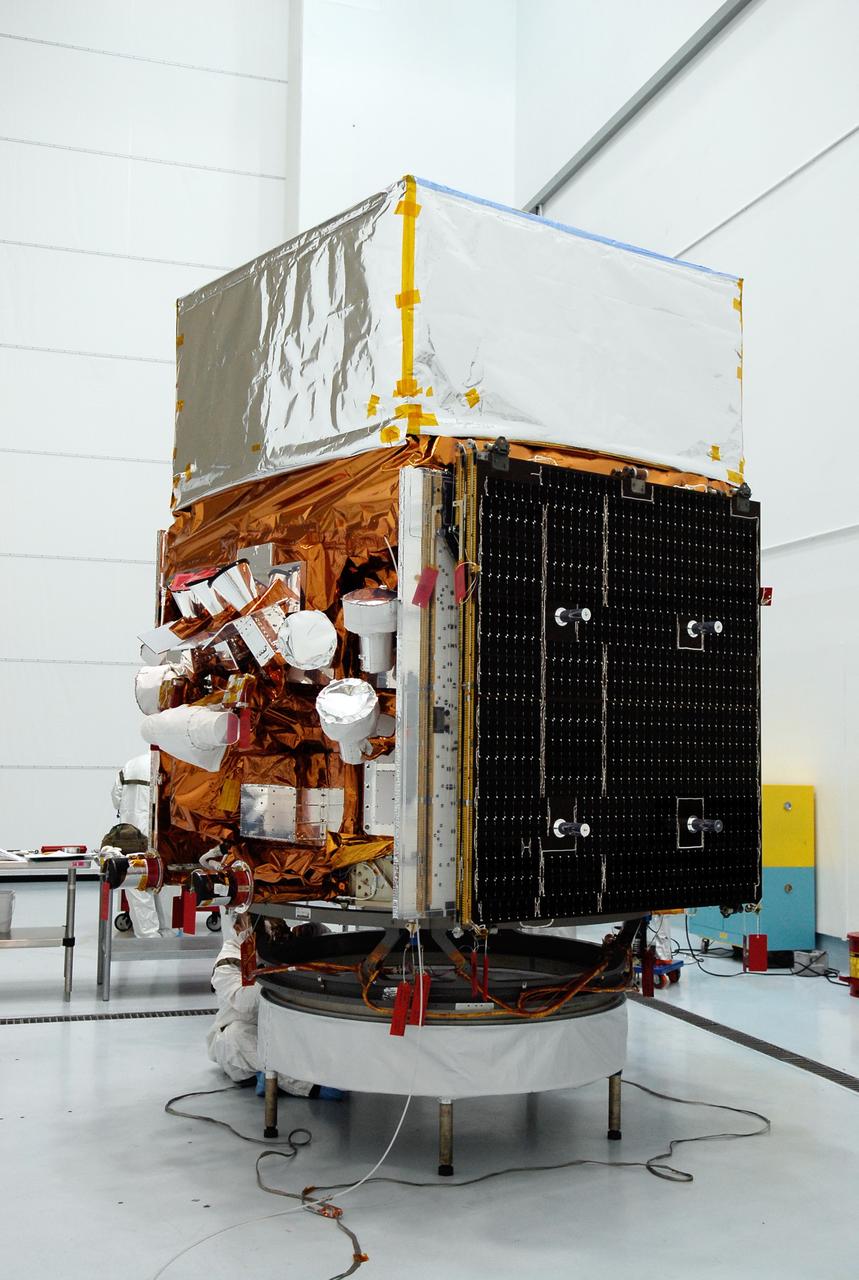
CAPE CANAVERAL, Fla. -- Technicians at Astrotech in Titusville, Fla., work on closeouts of the payload attach fitting on NASA's Gamma-Ray Large Area Space Telescope, or GLAST, spacecraft. The GLAST is a powerful space observatory that will explore the Universe's ultimate frontier, where nature harnesses forces and energies far beyond anything possible on Earth; probe some of science's deepest questions, such as what our Universe is made of, and search for new laws of physics; explain how black holes accelerate jets of material to nearly light speed; and help crack the mystery of stupendously powerful explosions known as gamma-ray bursts. A launch date still is to be determined. Photo credit: NASA/Kim Shiflett

CAPE CANAVERAL, Fla. -- At the Astrotech payload processing facility, NASA's Gamma-Ray Large Area Space Telescope, or GLAST, spacecraft will be installed on this payload attach fitting that will eventually be mated to the Delta II launch vehicle. The GLAST is a powerful space observatory that will explore the Universe's ultimate frontier, where nature harnesses forces and energies far beyond anything possible on Earth; probe some of science's deepest questions, such as what our Universe is made of, and search for new laws of physics; explain how black holes accelerate jets of material to nearly light speed; and help crack the mystery of stupendously powerful explosions known as gamma-ray bursts. A launch date still is to be determined. Photo credit: NASA/Jim Grossmann
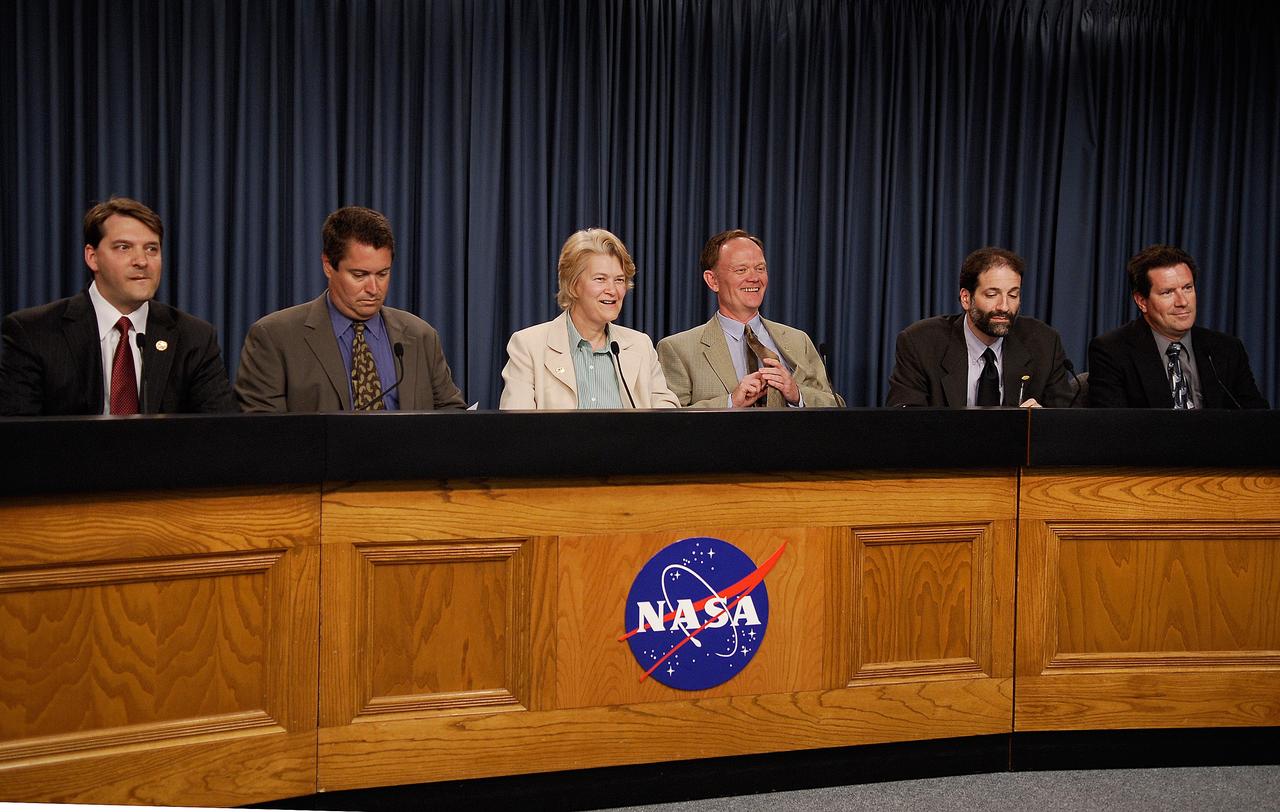
CAPE CANAVERAL, Fla. -- At NASA's Kennedy Space Center, key personnel brief the media on NASA's Gamma-Ray Large Area Space Telescope, or GLAST, launch scheduled for June 11. From left are Dr. Jon Morse, director of NASA's Astrophysics Division; Omar Baez, NASA launch director/launch manager at Kennedy; Kris Walsh, director of the Delta NASA and Commercial Programs with United Launch Alliance; Kevin Grady, GLAST project manager at NASA's Goddard Space Flight Center; Dr. Steven Ritz, GLAST project scientist/astrophysicist at Goddard; and Joel Tumbiolo, the U.S. Air Force Delta II launch weather officer with the 45th Weather Squadron at Cape Canaveral Air Force Station. GLAST is a powerful space observatory that will explore the Universe's ultimate frontier, where nature harnesses forces and energies far beyond anything possible on Earth; probe some of science's deepest questions, such as what our Universe is made of, and search for new laws of physics; explain how black holes accelerate jets of material to nearly light speed; and help crack the mystery of stupendously powerful explosions known as gamma-ray bursts. Photo credit: NASA/Kim Shiflett
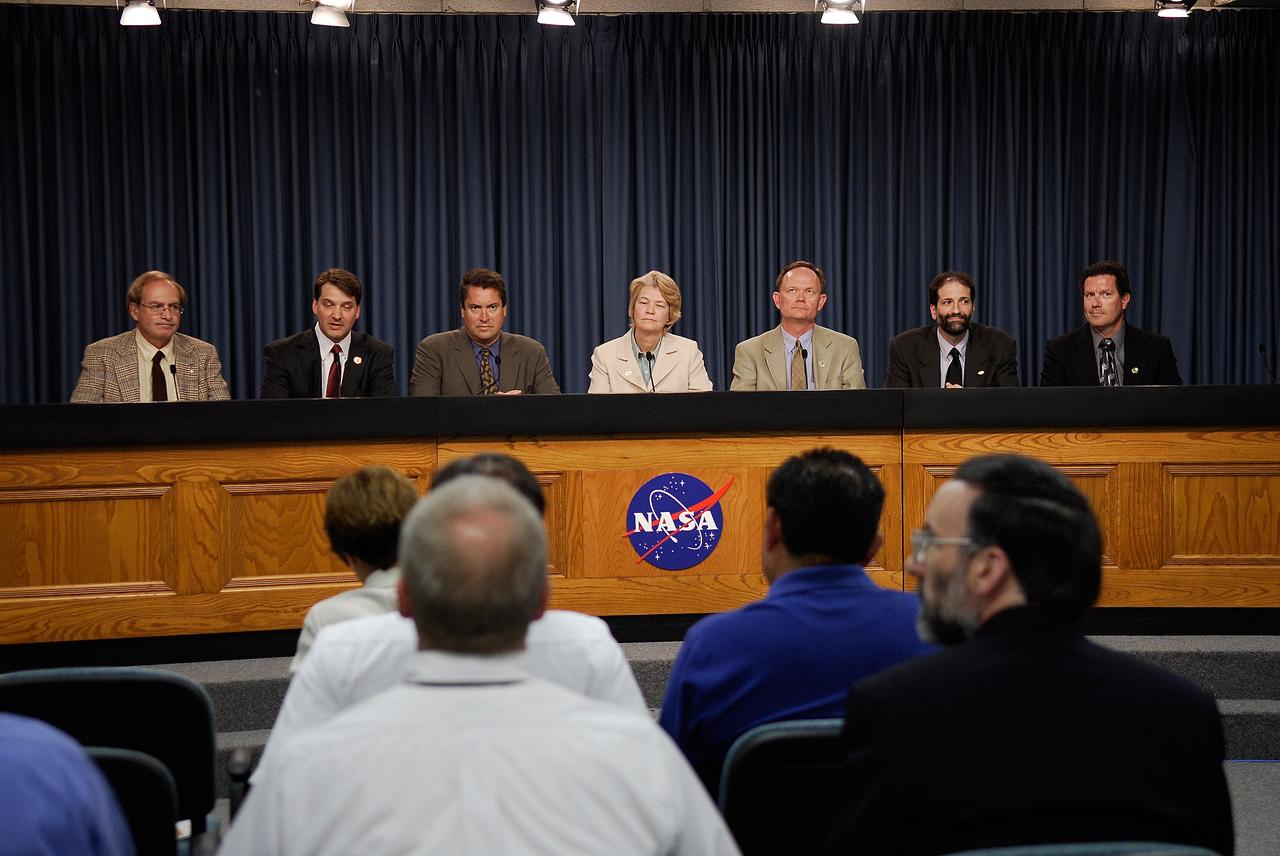
CAPE CANAVERAL, Fla. -- At left, Public Information Officer George Diller moderates a media briefing on NASA's Gamma-Ray Large Area Space Telescope, or GLAST, launch scheduled for June 11. On the panel next to Diller are Dr. Jon Morse, director of NASA's Astrophysics Division; Omar Baez, NASA launch director/launch manager at Kennedy; Kris Walsh, director of the Delta NASA and Commercial Programs with United Launch Alliance; Kevin Grady, GLAST project manager at NASA's Goddard Space Flight Center; Dr. Steven Ritz, GLAST project scientist/astrophysicist at Goddard; and Joel Tumbiolo, the U.S. Air Force Delta II launch weather officer with the 45th Weather Squadron at Cape Canaveral Air Force Station. GLAST is a powerful space observatory that will explore the Universe's ultimate frontier, where nature harnesses forces and energies far beyond anything possible on Earth; probe some of science's deepest questions, such as what our Universe is made of, and search for new laws of physics; explain how black holes accelerate jets of material to nearly light speed; and help crack the mystery of stupendously powerful explosions known as gamma-ray bursts. Photo credit: NASA/Kim Shiflett

KENNEDY SPACE CENTER, FLA. -- NASA's Gamma-Ray Large Area Space Telescope, or GLAST, arrives at Kennedy Space Center in a shipping container aboard a truck to begin final preparations for launch. The GLAST will launch aboard a Delta II rocket May 16 from Launch Pad 17-B on Cape Canaveral Air Force Station. A powerful space observatory, the GLAST will explore the most extreme environments in the universe, and answer questions about supermassive black hole systems, pulsars and the origin of cosmic rays. It also will study the mystery of powerful explosions known as gamma-ray bursts. Photo credit: NASA/Kim Shiflett
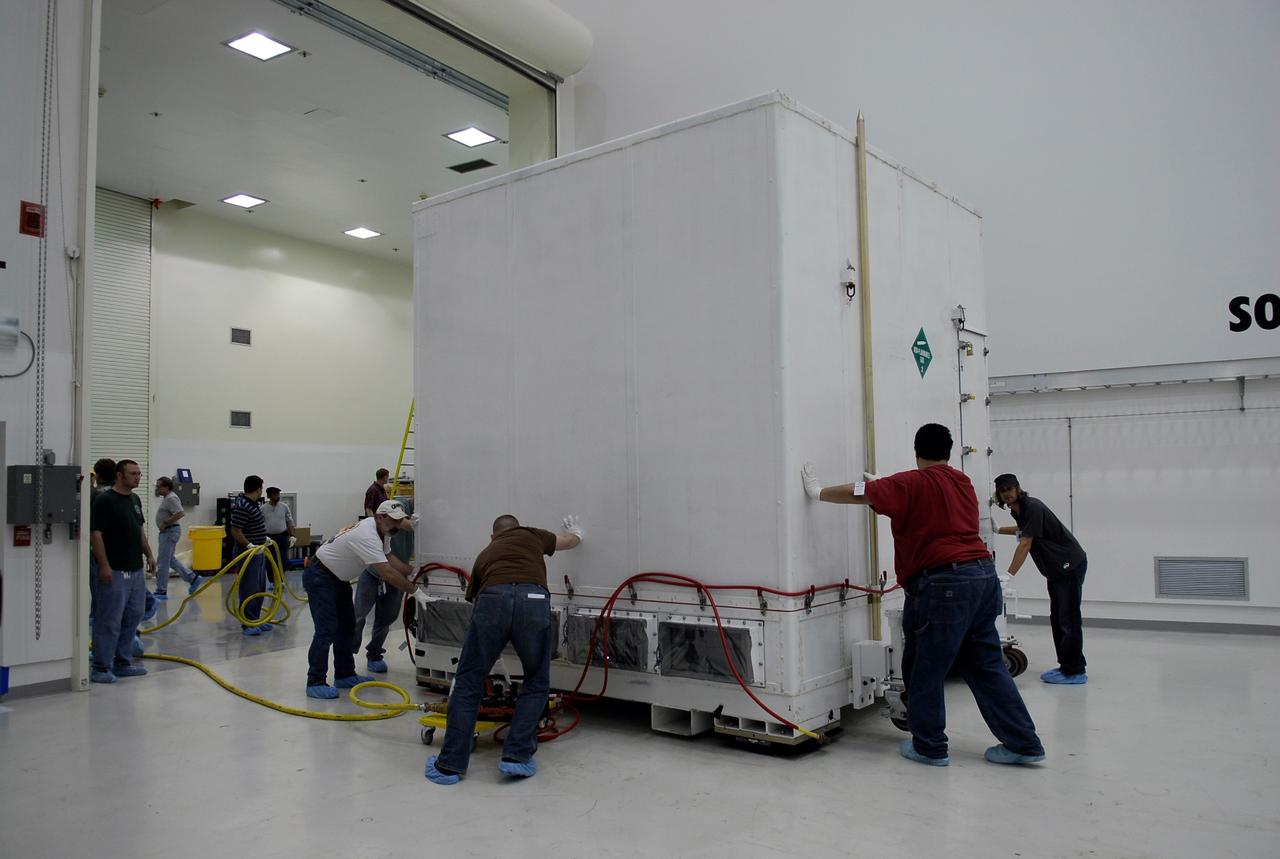
KENNEDY SPACE CENTER, FLA. -- In the Astrotech payload processing facility near the Kennedy Space Center, workers maneuver the shipping container holding NASA's Gamma-Ray Large Area Space Telescope, or GLAST, into place. The GLAST will launch aboard a Delta II rocket May 16 from Launch Pad 17-B on Cape Canaveral Air Force Station. A powerful space observatory, the GLAST will explore the most extreme environments in the universe, and answer questions about supermassive black hole systems, pulsars and the origin of cosmic rays. It also will study the mystery of powerful explosions known as gamma-ray bursts. Photo credit: NASA/Kim Shiflett
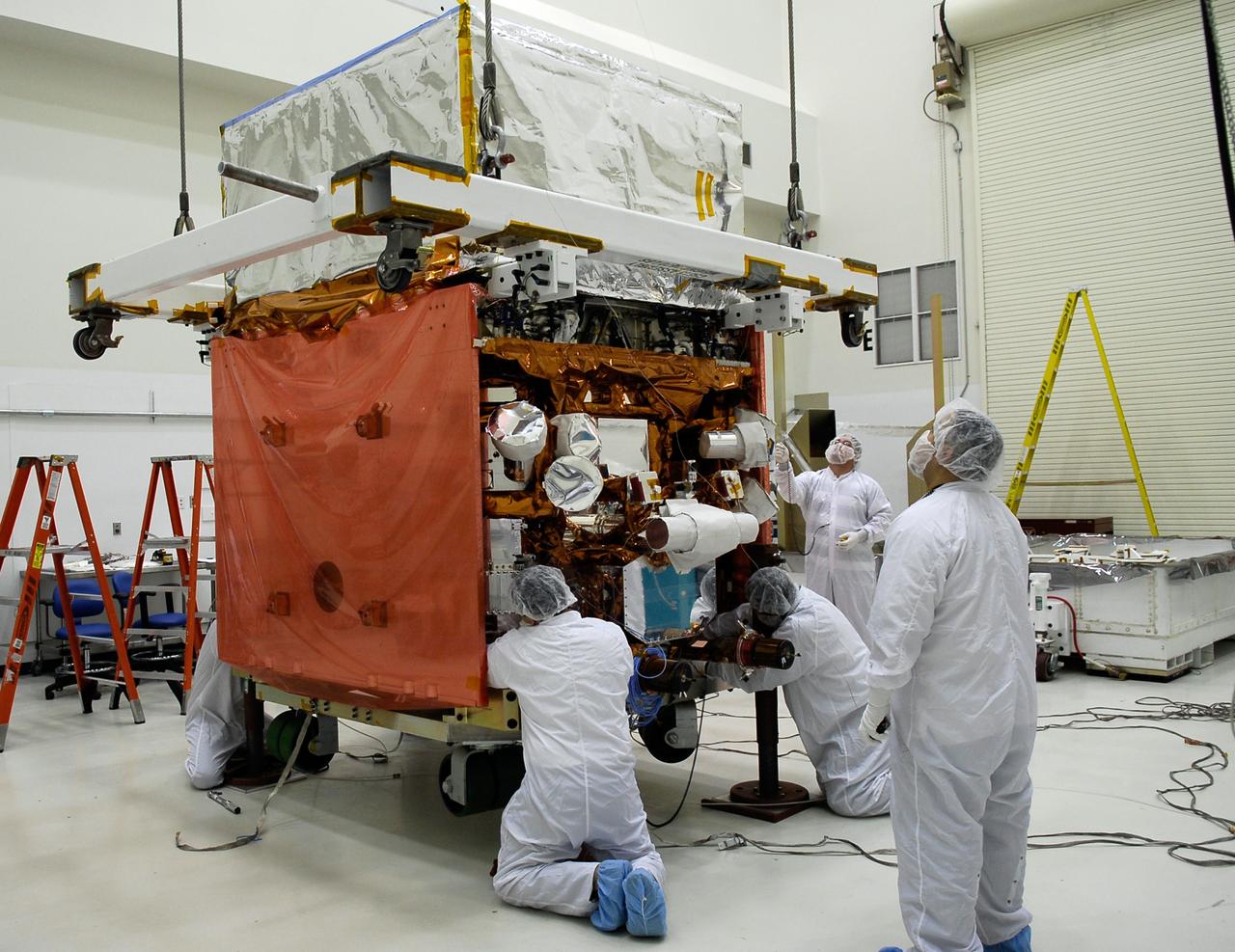
KENNEDY SPACE CENTER, FLA. -- In the Astrotech payload processing facility, General Dynamics technicians secure NASA's Gamma-Ray Large Area Space Telescope, or GLAST, onto a work stand. There GLAST will undergo a complete checkout of the scientific instruments aboard. The telescope will launch aboard a Delta II rocket May 16 from Launch Pad 17-B on Cape Canaveral Air Force Station. A powerful space observatory, the GLAST will explore the most extreme environments in the universe, and answer questions about supermassive black hole systems, pulsars and the origin of cosmic rays. It also will study the mystery of powerful explosions known as gamma-ray bursts. Photo credit: NASA/Kim Shiflett
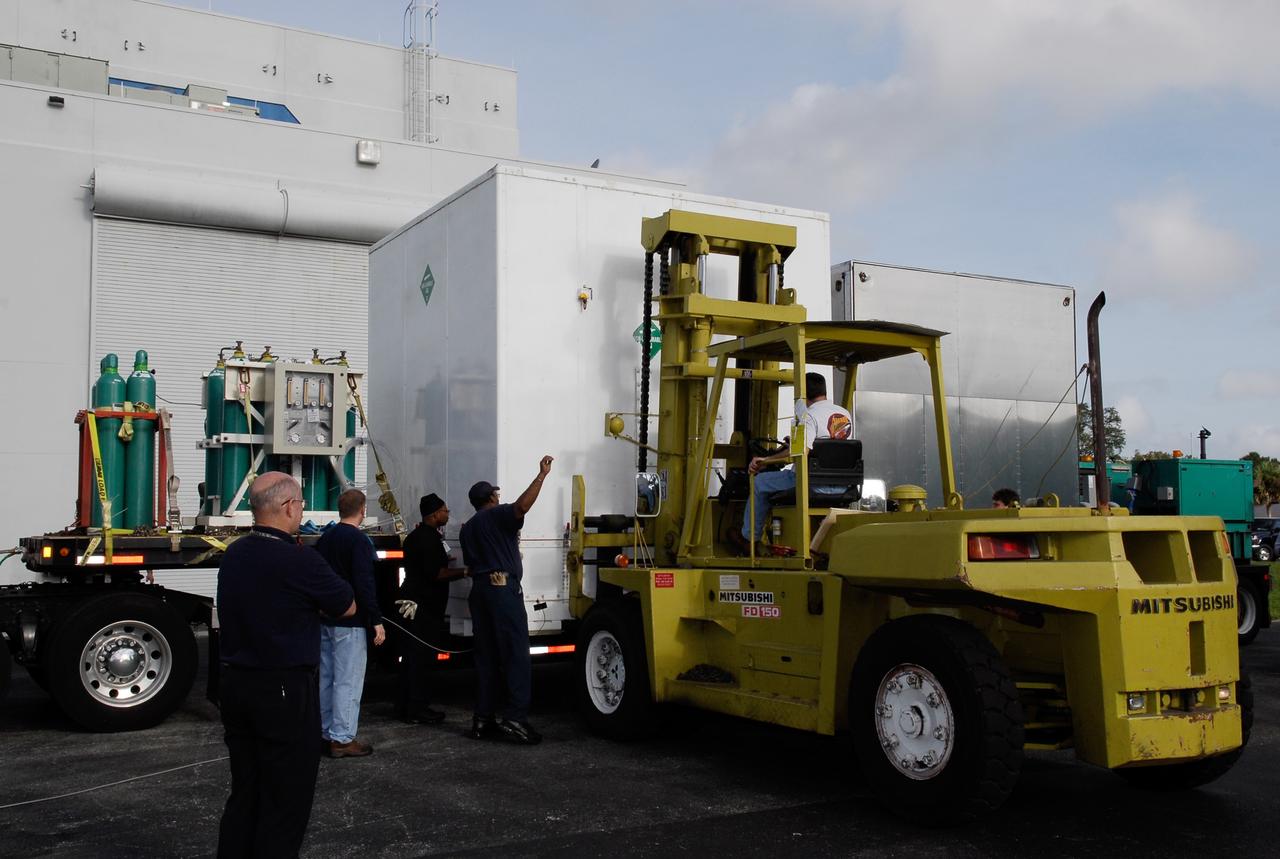
KENNEDY SPACE CENTER, FLA. -- The shipping container holding NASA's Gamma-Ray Large Area Space Telescope, or GLAST, is removed from the truck at the Astrotech payload processing facility near the Kennedy Space Center to begin prelaunch activities. The GLAST will launch aboard a Delta II rocket May 16 from Launch Pad 17-B on Cape Canaveral Air Force Station. A powerful space observatory, the GLAST will explore the most extreme environments in the universe, and answer questions about supermassive black hole systems, pulsars and the origin of cosmic rays. It also will study the mystery of powerful explosions known as gamma-ray bursts. Photo credit: NASA/Kim Shiflett
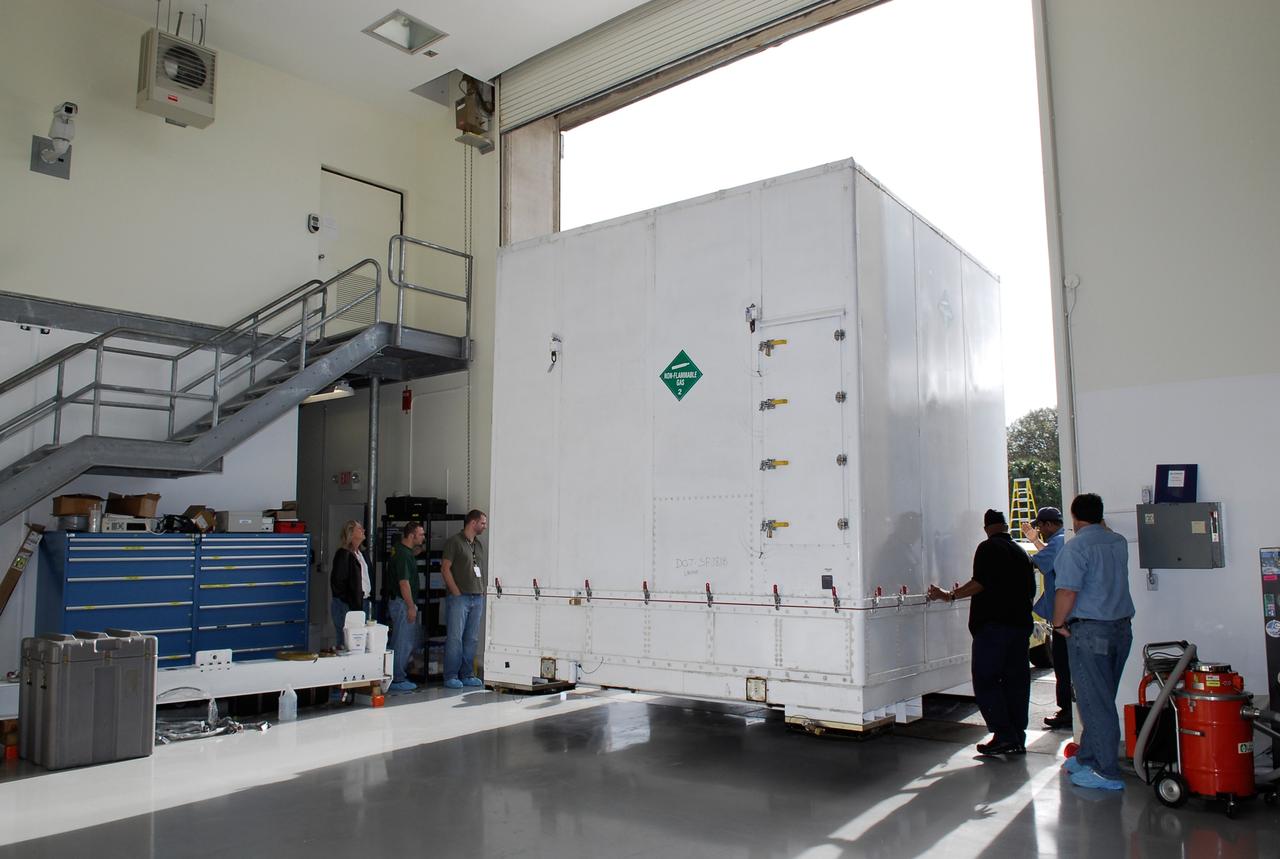
KENNEDY SPACE CENTER, FLA. -- The shipping container holding NASA's Gamma-Ray Large Area Space Telescope, or GLAST, is moved into the Astrotech payload processing facility near the Kennedy Space Center to begin prelaunch activities. The GLAST will launch aboard a Delta II rocket May 16 from Launch Pad 17-B on Cape Canaveral Air Force Station. A powerful space observatory, the GLAST will explore the most extreme environments in the universe, and answer questions about supermassive black hole systems, pulsars and the origin of cosmic rays. It also will study the mystery of powerful explosions known as gamma-ray bursts. Photo credit: NASA/Kim Shiflett
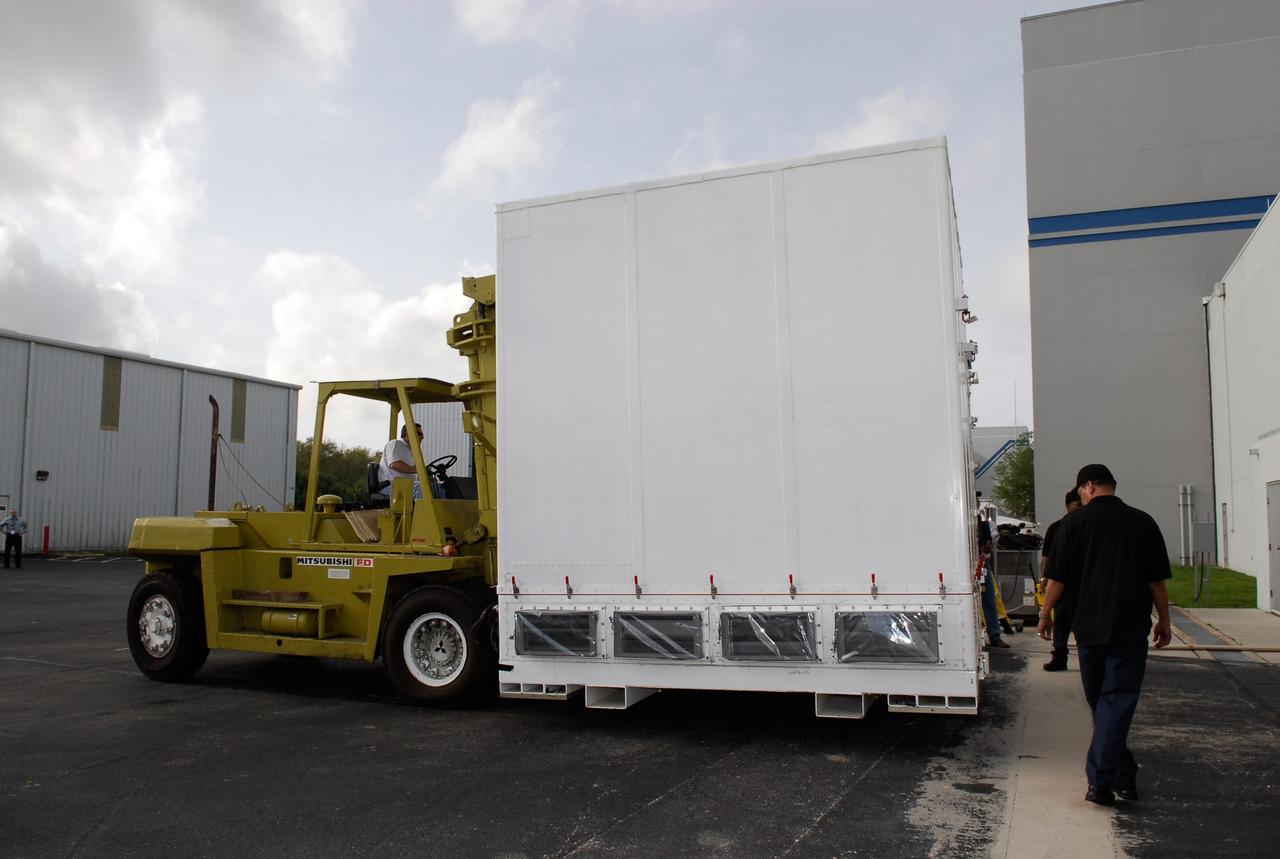
KENNEDY SPACE CENTER, FLA. -- The shipping container holding NASA's Gamma-Ray Large Area Space Telescope, or GLAST, is removed from the truck at the Astrotech payload processing facility near the Kennedy Space Center to begin prelaunch activities. The GLAST will launch aboard a Delta II rocket May 16 from Launch Pad 17-B on Cape Canaveral Air Force Station. A powerful space observatory, the GLAST will explore the most extreme environments in the universe, and answer questions about supermassive black hole systems, pulsars and the origin of cosmic rays. It also will study the mystery of powerful explosions known as gamma-ray bursts. Photo credit: NASA/Kim Shiflett
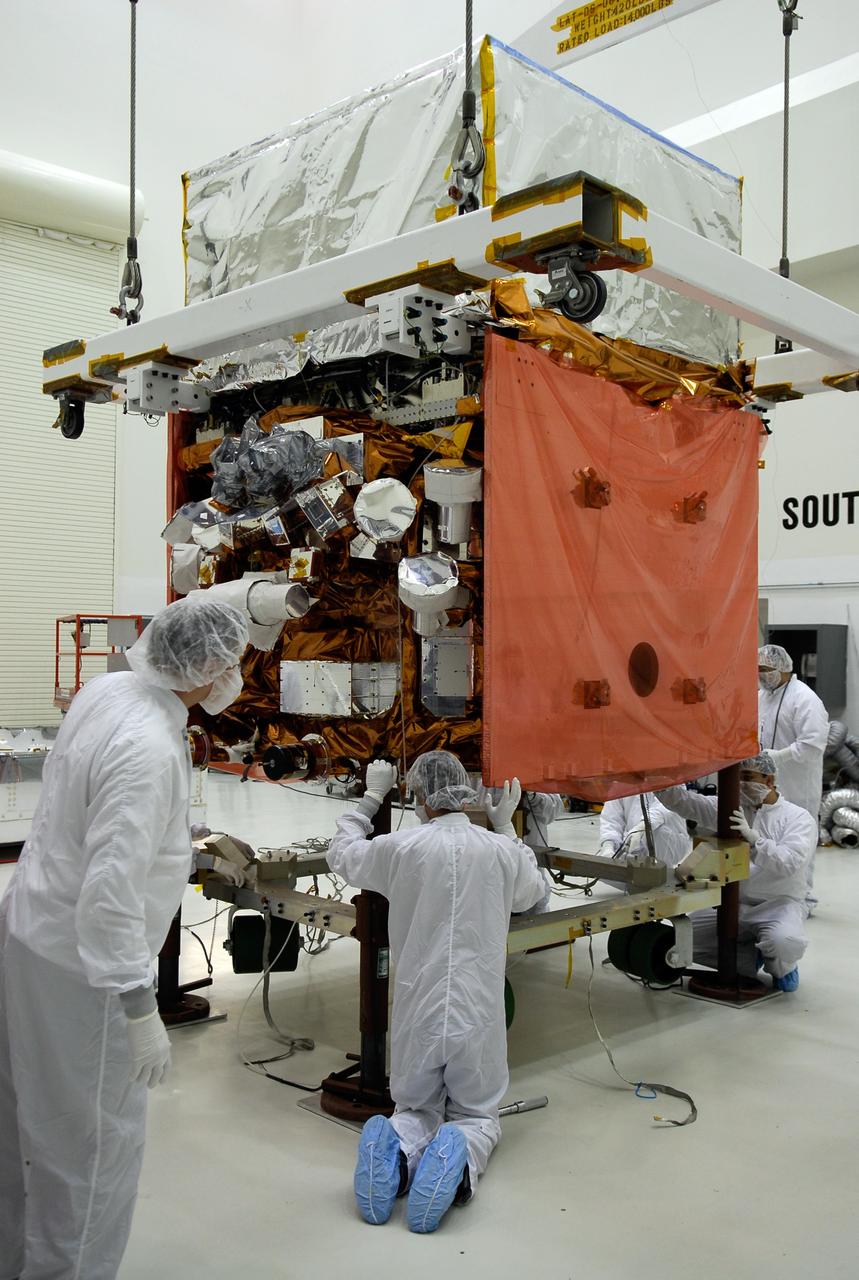
KENNEDY SPACE CENTER, FLA. -- In the Astrotech payload processing facility, General Dynamics technicians keep watch as NASA's Gamma-Ray Large Area Space Telescope, or GLAST, is lowered onto a work stand. There GLAST will undergo a complete checkout of the scientific instruments aboard. . The telescope will launch aboard a Delta II rocket May 16 from Launch Pad 17-B on Cape Canaveral Air Force Station. A powerful space observatory, the GLAST will explore the most extreme environments in the universe, and answer questions about supermassive black hole systems, pulsars and the origin of cosmic rays. It also will study the mystery of powerful explosions known as gamma-ray bursts. Photo credit: NASA/Kim Shiflett
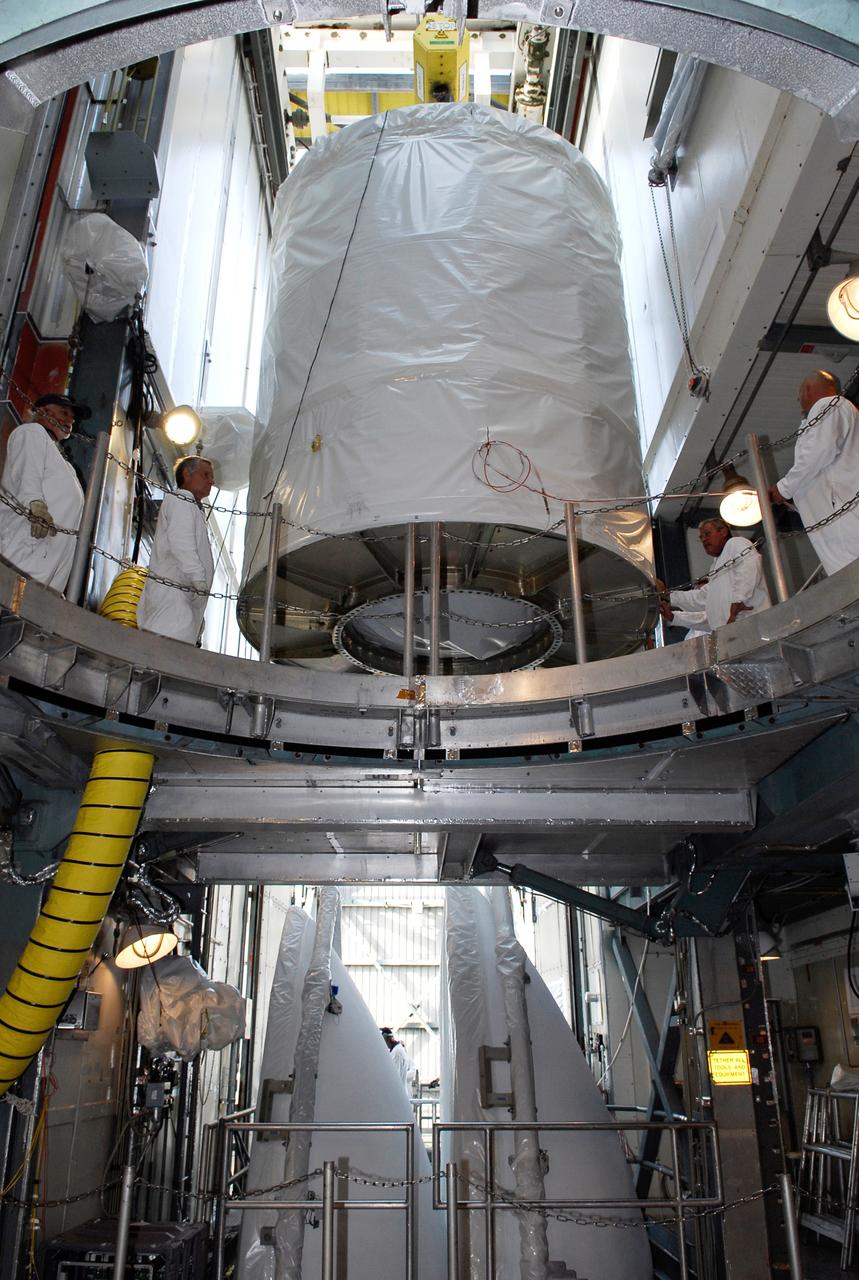
CAPE CANAVERAL, Fla. -- At pad 17-B at Cape Canaveral Air Force Station, workers help maneuver the GLAST spacecraft toward the opening above the Delta II second stage in the mobile service tower. GLAST will be mated with the Delta II second stage. GLAST is a powerful space observatory that will explore the Universe's ultimate frontier, where nature harnesses forces and energies far beyond anything possible on Earth; probe some of science's deepest questions, such as what our Universe is made of, and search for new laws of physics; explain how black holes accelerate jets of material to nearly light speed; and help crack the mystery of stupendously powerful explosions known as gamma-ray bursts. The launch date is targeted no earlier than June 3. Photo credit: NASA/Kim Shiflett
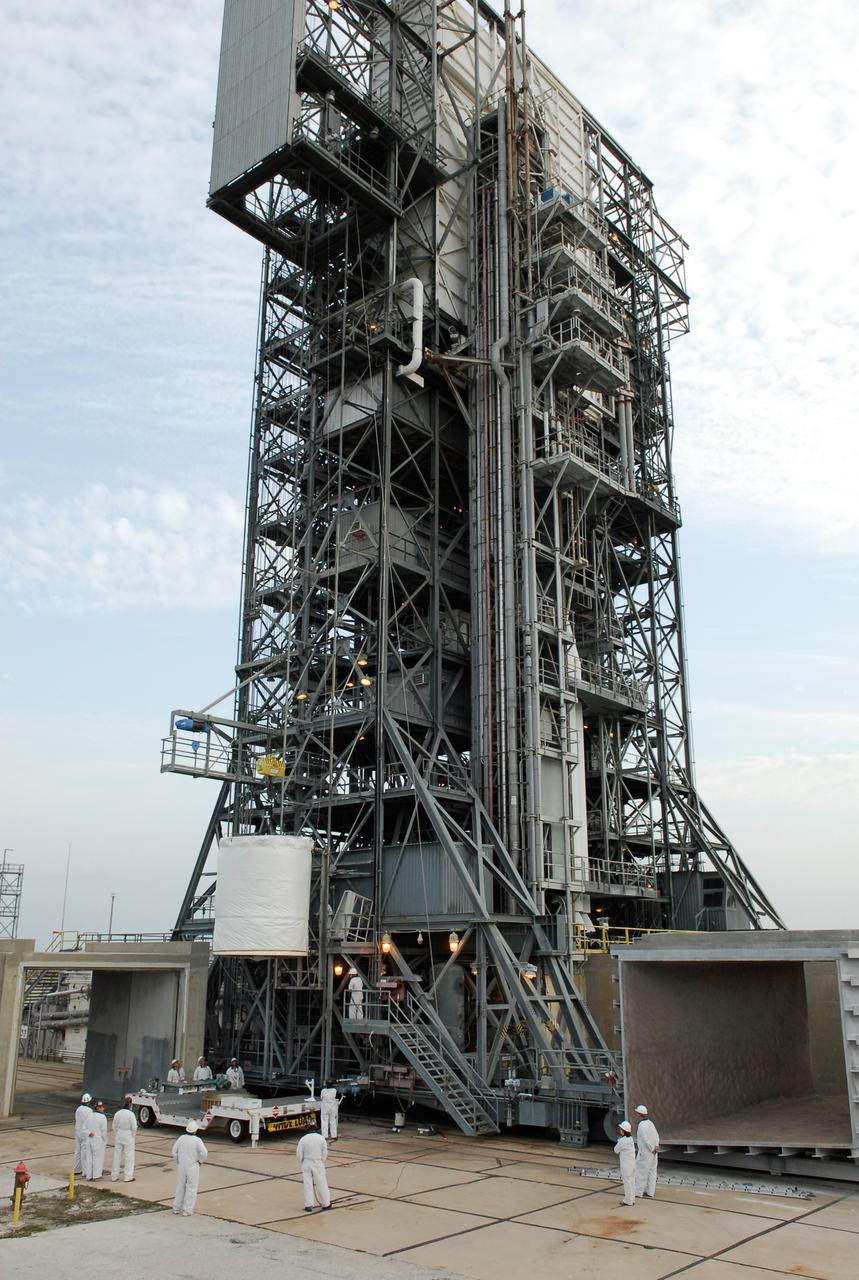
CAPE CANAVERAL, Fla. -- At pad 17-B at Cape Canaveral Air Force Station, the GLAST spacecraft is lifted toward the upper level of the mobile service tower. In the tower, GLAST will be mated with the Delta II second stage. GLAST is a powerful space observatory that will explore the Universe's ultimate frontier, where nature harnesses forces and energies far beyond anything possible on Earth; probe some of science's deepest questions, such as what our Universe is made of, and search for new laws of physics; explain how black holes accelerate jets of material to nearly light speed; and help crack the mystery of stupendously powerful explosions known as gamma-ray bursts. The launch date is targeted no earlier than June 3. Photo credit: NASA/Kim Shiflett
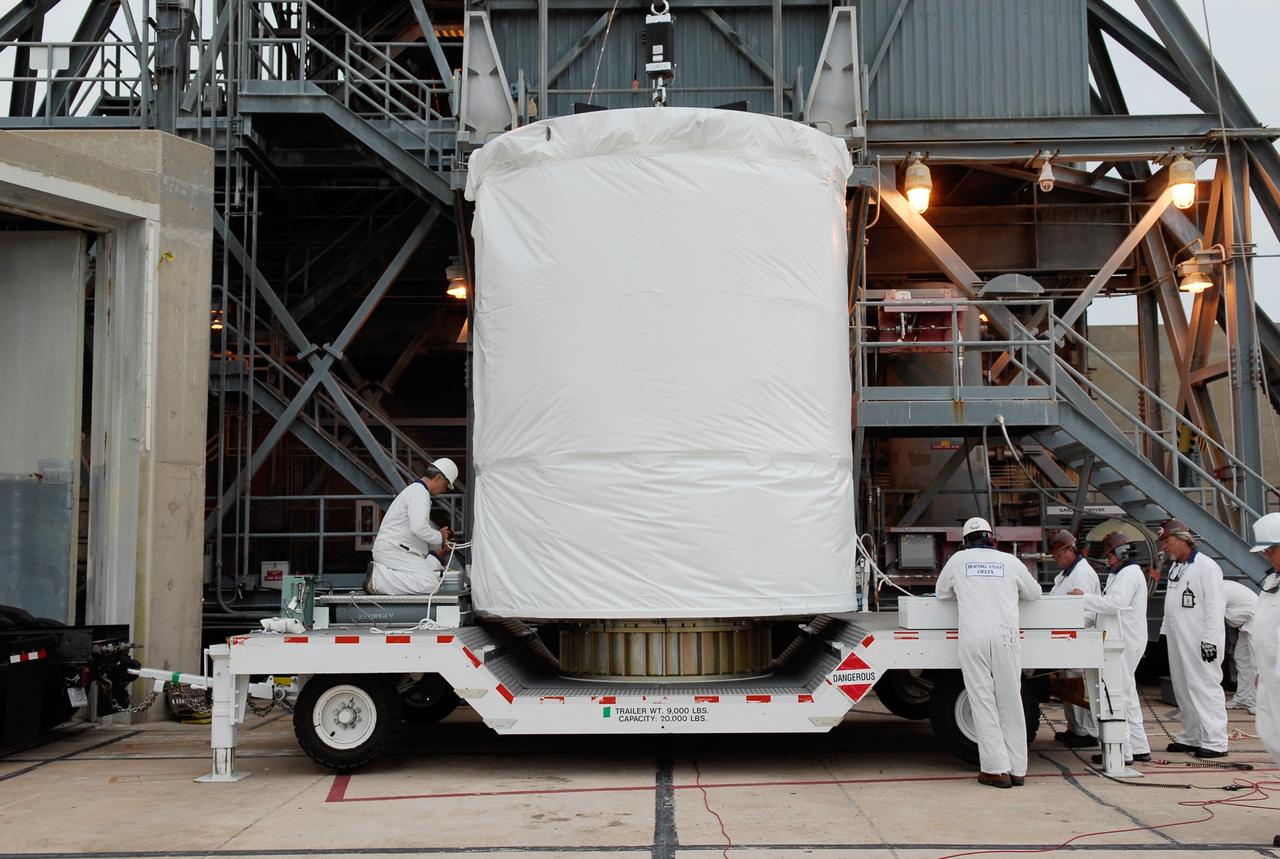
CAPE CANAVERAL, Fla. -- At pad 17-B at Cape Canaveral Air Force Station, workers secure the lines of the hoist that will lift the GLAST spacecraft into the mobile service tower. In the tower, GLAST will be mated with the Delta II second stage. GLAST is a powerful space observatory that will explore the Universe's ultimate frontier, where nature harnesses forces and energies far beyond anything possible on Earth; probe some of science's deepest questions, such as what our Universe is made of, and search for new laws of physics; explain how black holes accelerate jets of material to nearly light speed; and help crack the mystery of stupendously powerful explosions known as gamma-ray bursts. The launch date is targeted no earlier than June 3. Photo credit: NASA/Kim Shiflett
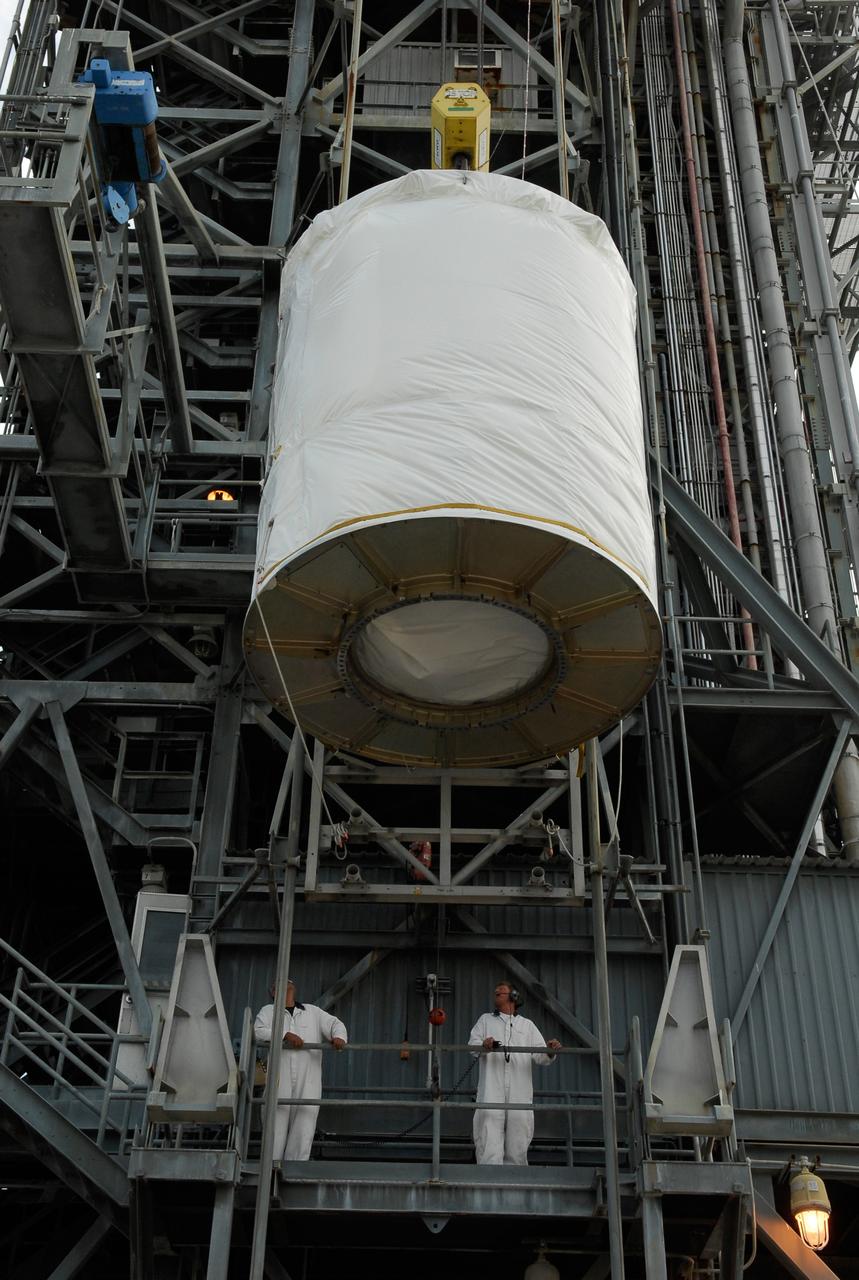
CAPE CANAVERAL, Fla. -- At pad 17-B at Cape Canaveral Air Force Station, workers observe the progress of the GLAST spacecraft as it is lifted toward the upper level of the mobile service tower. In the tower, GLAST will be mated with the Delta II second stage. GLAST is a powerful space observatory that will explore the Universe's ultimate frontier, where nature harnesses forces and energies far beyond anything possible on Earth; probe some of science's deepest questions, such as what our Universe is made of, and search for new laws of physics; explain how black holes accelerate jets of material to nearly light speed; and help crack the mystery of stupendously powerful explosions known as gamma-ray bursts. The launch date is targeted no earlier than June 3. Photo credit: NASA/Kim Shiflett
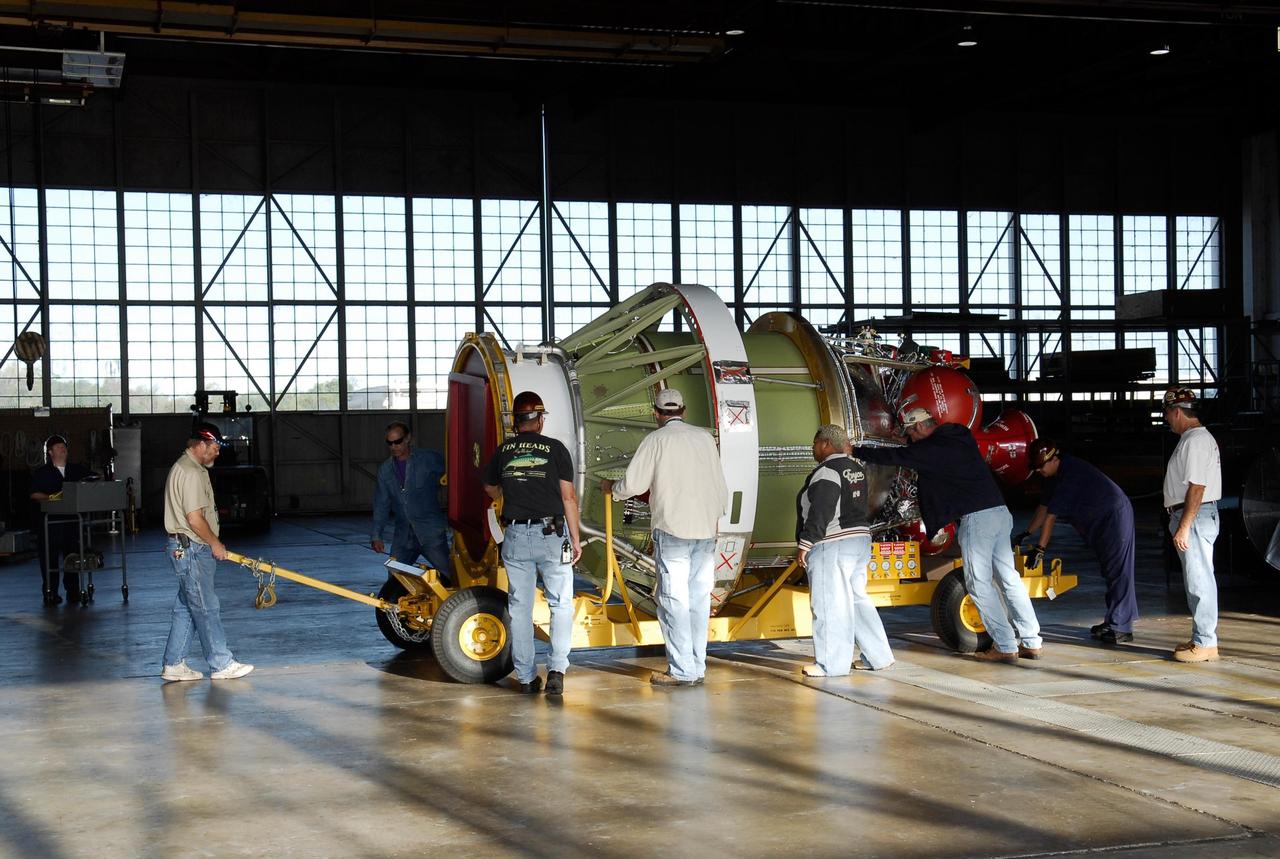
KENNEDY SPACE CENTER, FLA. -- At Cape Canaveral Air Force Station, the Delta II second stage for GLAST has arrived at Hangar M and is moved into place for weighing. The Delta rocket will be used to launch the Gamma-Ray Large Area Space Telescope, or GLAST, May 16 from Launch Pad 17-B on CCAFS. The GLAST is a powerful space observatory that will explore the Universe's ultimate frontier, where nature harnesses forces and energies far beyond anything possible on Earth; probe some of science's deepest questions, such as what our Universe is made of, and search for new laws of physics; explain how black holes accelerate jets of material to nearly light speed; and help crack the mystery of stupendously powerful explosions known as gamma-ray bursts. Photo credit: NASA/Kim Shiflett
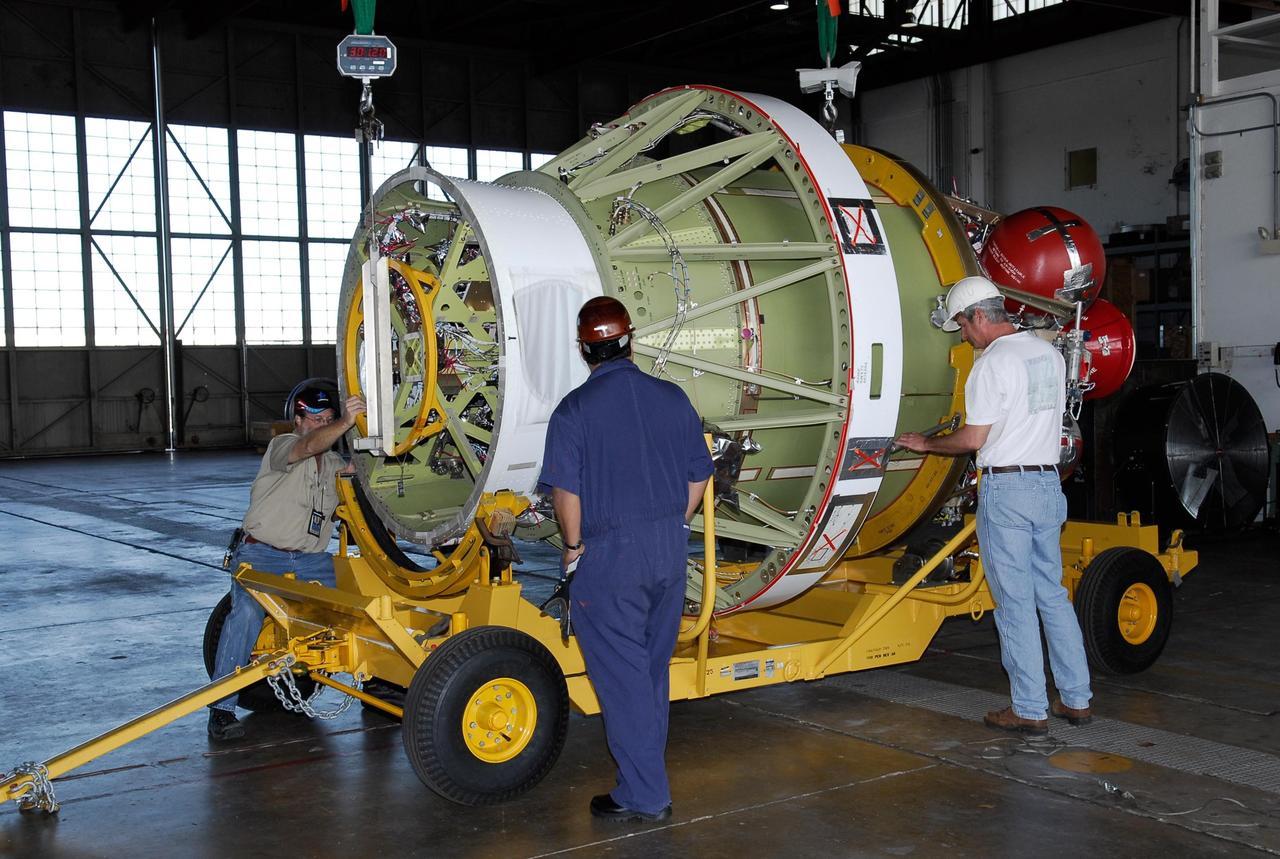
KENNEDY SPACE CENTER, FLA. -- At Cape Canaveral Air Force Station, workers prepare the Delta II second stage for GLAST for weighing. The Delta rocket will be used to launch the Gamma-Ray Large Area Space Telescope, or GLAST, May 16 from Launch Pad 17-B on CCAFS. The GLAST is a powerful space observatory that will explore the Universe's ultimate frontier, where nature harnesses forces and energies far beyond anything possible on Earth; probe some of science's deepest questions, such as what our Universe is made of, and search for new laws of physics; explain how black holes accelerate jets of material to nearly light speed; and help crack the mystery of stupendously powerful explosions known as gamma-ray bursts. Photo credit: NASA/Kim Shiflett
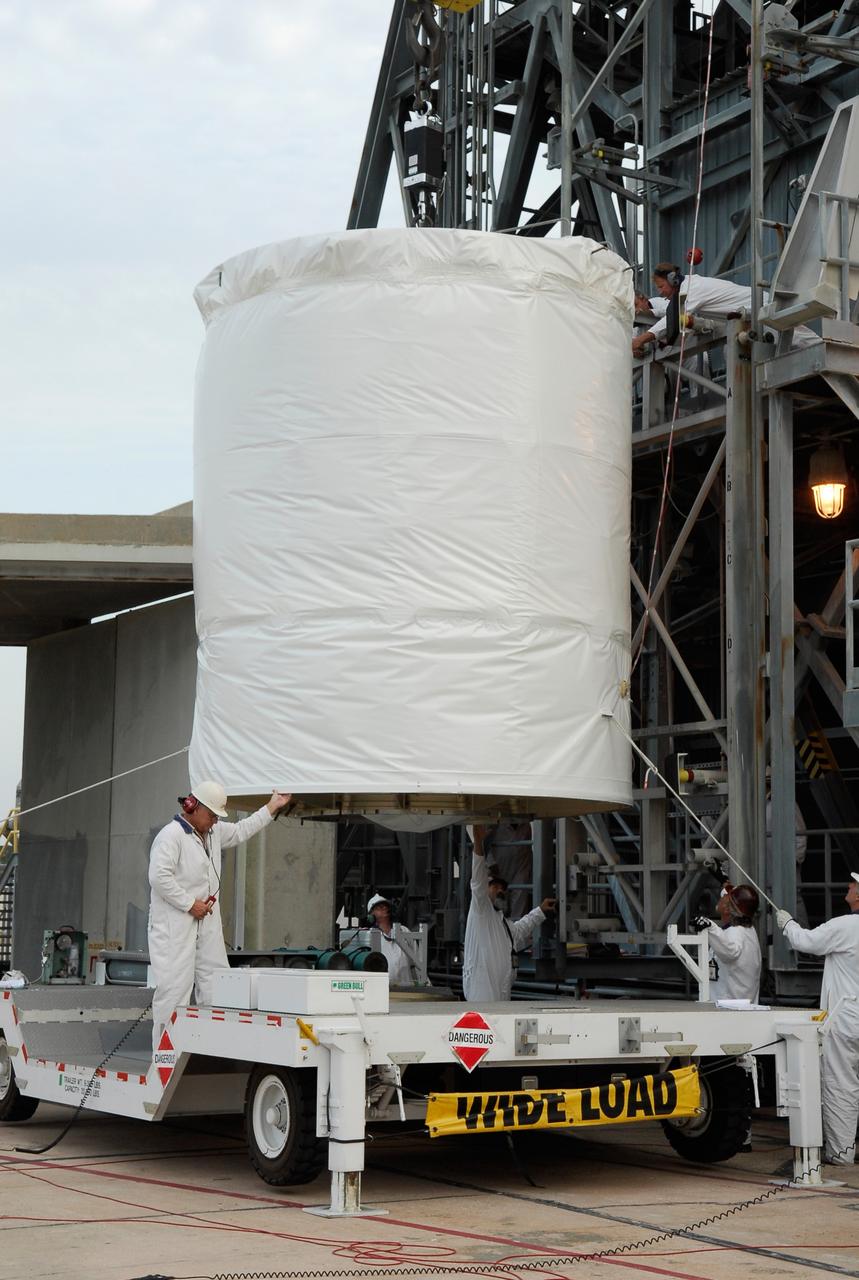
CAPE CANAVERAL, Fla. -- At pad 17-B at Cape Canaveral Air Force Station, workers help stabilize the ascent of the GLAST spacecraft into the mobile service tower. In the tower, GLAST will be mated with the Delta II second stage. GLAST is a powerful space observatory that will explore the Universe's ultimate frontier, where nature harnesses forces and energies far beyond anything possible on Earth; probe some of science's deepest questions, such as what our Universe is made of, and search for new laws of physics; explain how black holes accelerate jets of material to nearly light speed; and help crack the mystery of stupendously powerful explosions known as gamma-ray bursts. The launch date is targeted no earlier than June 3. Photo credit: NASA/Kim Shiflett
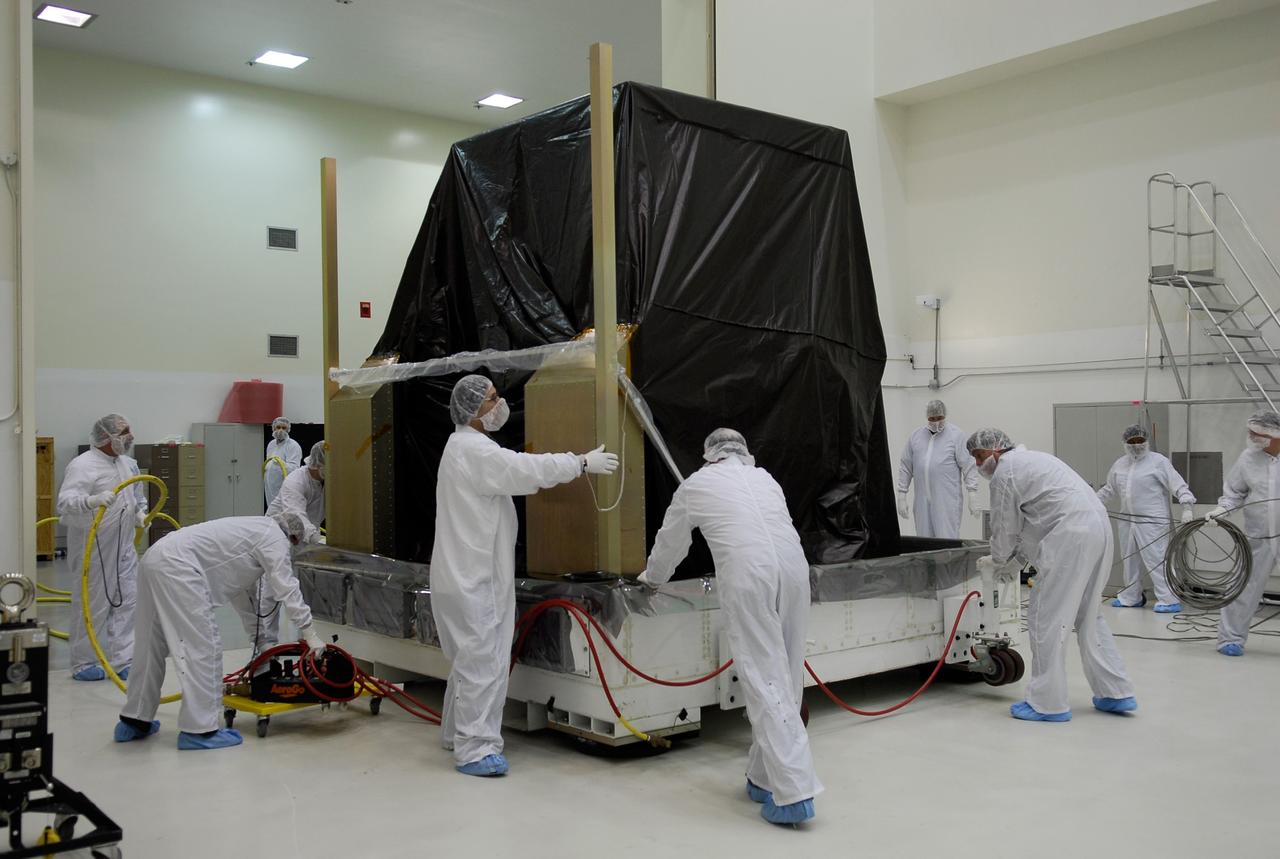
KENNEDY SPACE CENTER, FLA. -- In the Astrotech payload processing facility near the Kennedy Space Center, workers check NASA's Gamma-Ray Large Area Space Telescope, or GLAST, after removal of the shipping container. The workers will prepare for a complete checkout of the telescope's scientific instruments. The GLAST will launch aboard a Delta II rocket May 16 from Launch Pad 17-B on Cape Canaveral Air Force Station. A powerful space observatory, the GLAST will explore the most extreme environments in the universe, and answer questions about supermassive black hole systems, pulsars and the origin of cosmic rays. It also will study the mystery of powerful explosions known as gamma-ray bursts. Photo credit: NASA/Kim Shiflett
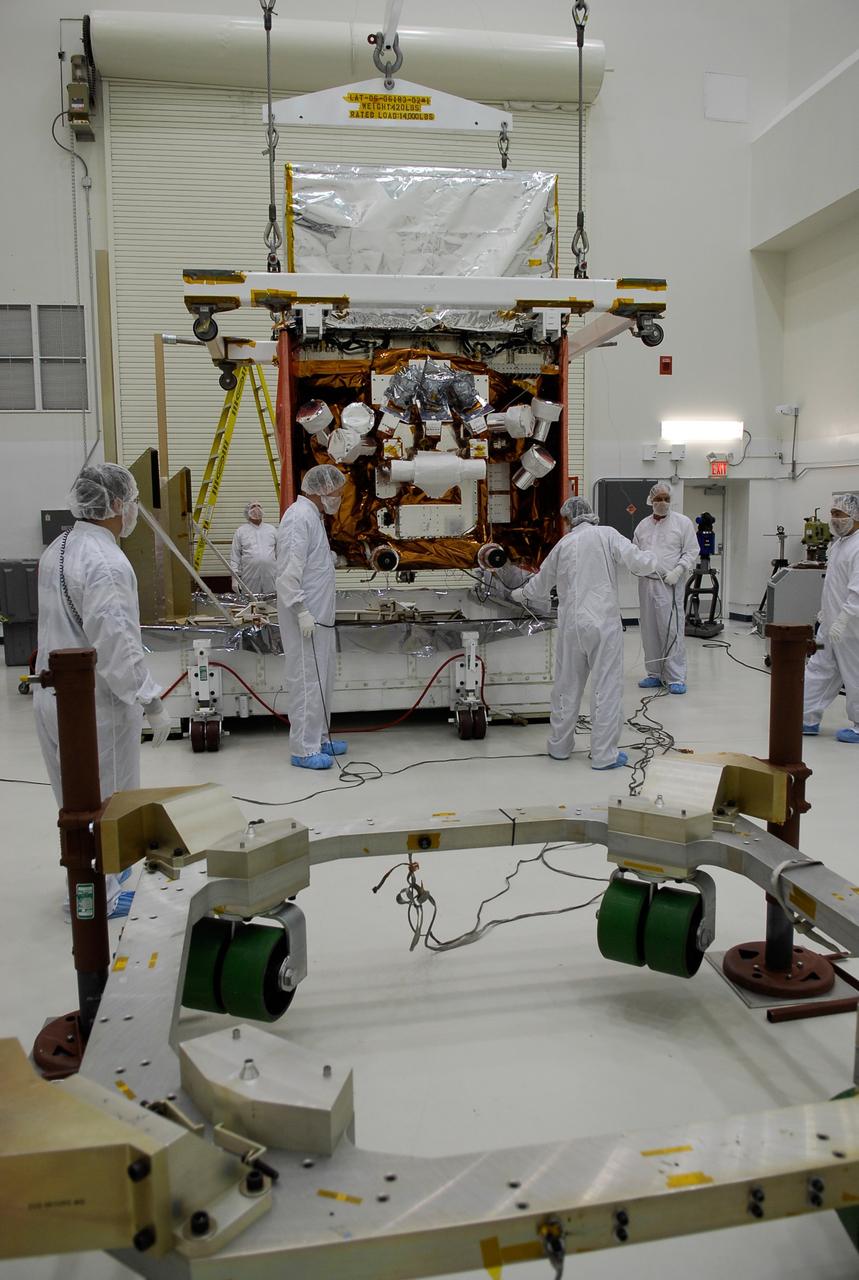
KENNEDY SPACE CENTER, FLA. -- In the Astrotech payload processing facility, General Dynamics technicians keep watch as NASA's Gamma-Ray Large Area Space Telescope, or GLAST, is lifted and begins moving toward the work stand in the foreground. There GLAST will undergo a complete checkout of the scientific instruments aboard. The telescope will launch aboard a Delta II rocket May 16 from Launch Pad 17-B on Cape Canaveral Air Force Station. A powerful space observatory, the GLAST will explore the most extreme environments in the universe, and answer questions about supermassive black hole systems, pulsars and the origin of cosmic rays. It also will study the mystery of powerful explosions known as gamma-ray bursts. Photo credit: NASA/Kim Shiflett
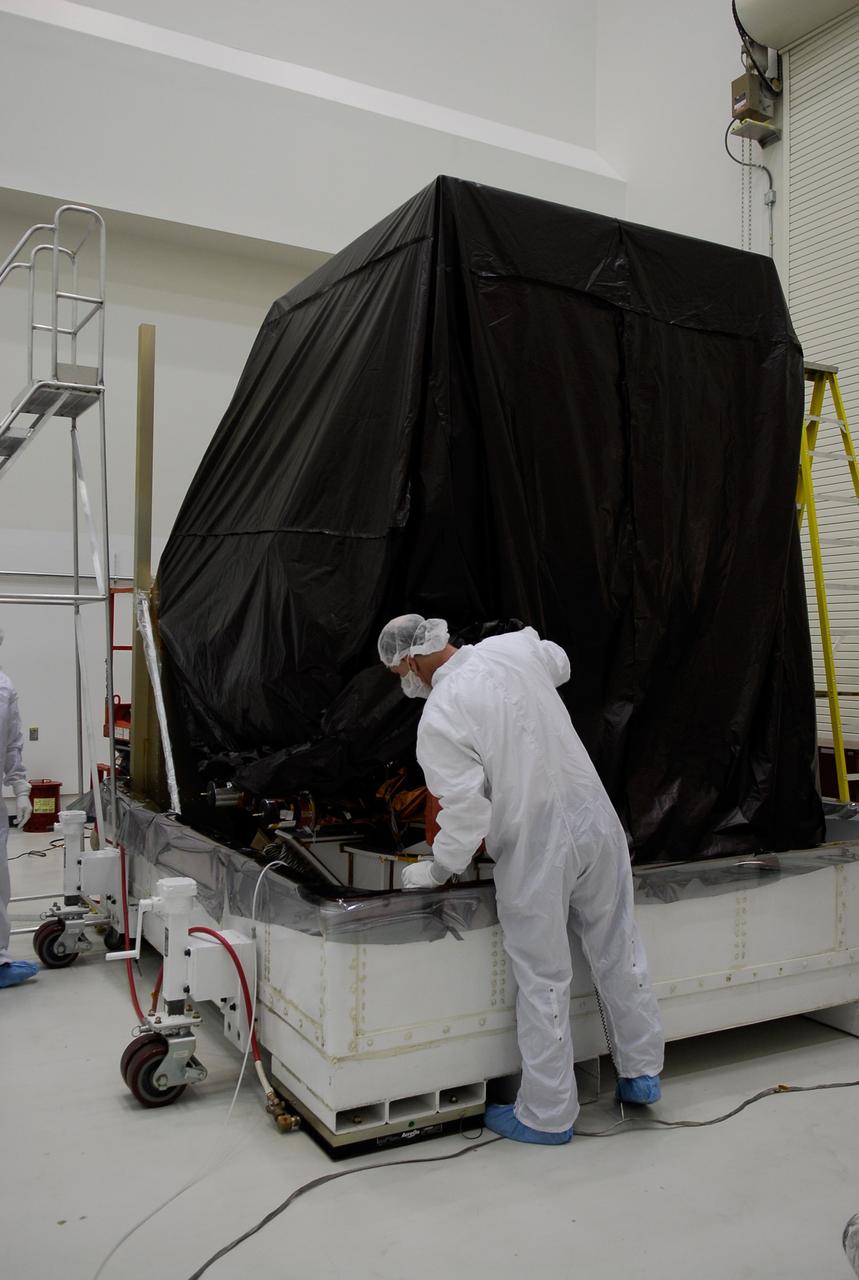
KENNEDY SPACE CENTER, FLA. -- A General Dynamics technician in the Astrotech payload processing facility releases a corner of the protective cover over NASA's Gamma-Ray Large Area Space Telescope, or GLAST, after its arrival. GLAST will be moved to a work stand in the facility for a complete checkout of the telescope's scientific instruments. The telescope will launch aboard a Delta II rocket May 16 from Launch Pad 17-B on Cape Canaveral Air Force Station. A powerful space observatory, the GLAST will explore the most extreme environments in the universe, and answer questions about supermassive black hole systems, pulsars and the origin of cosmic rays. It also will study the mystery of powerful explosions known as gamma-ray bursts. Photo credit: NASA/Kim Shiflett
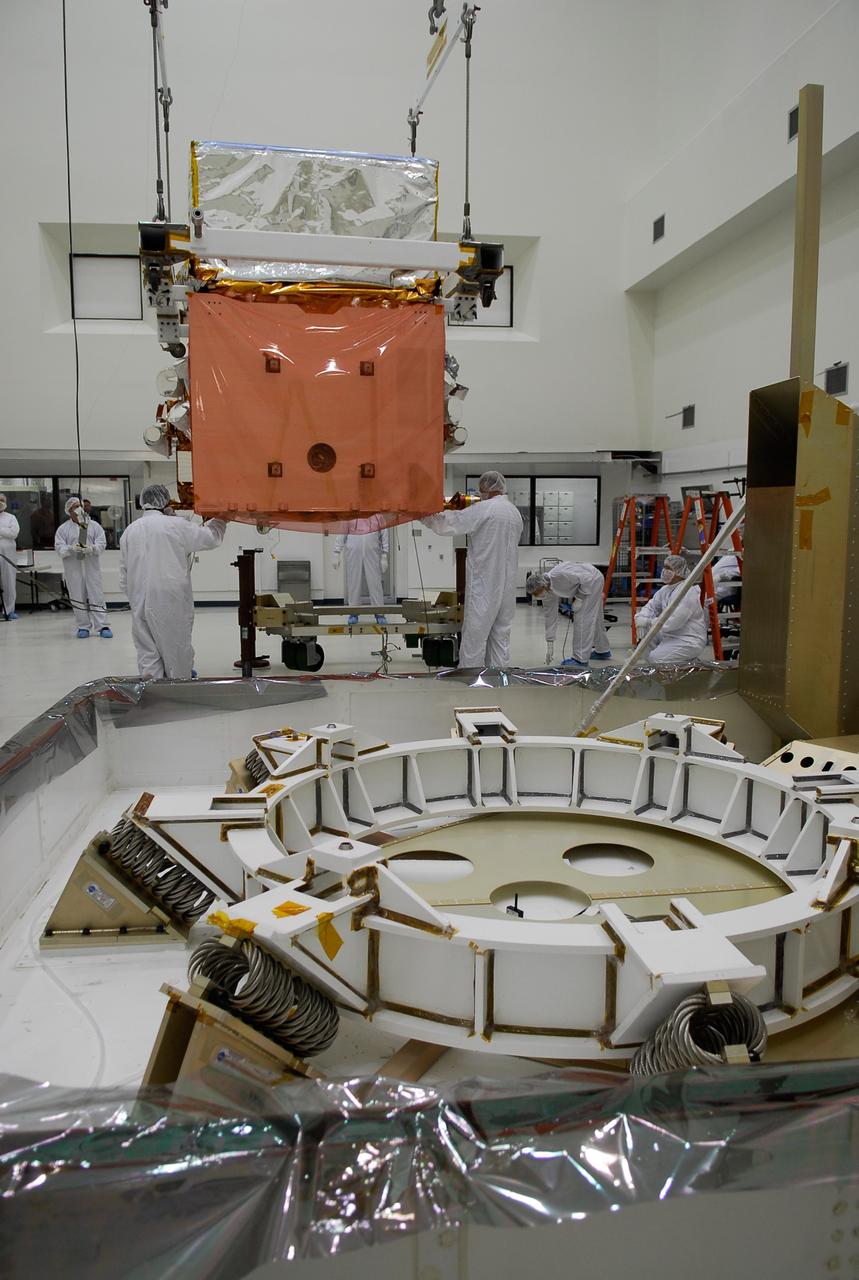
KENNEDY SPACE CENTER, FLA. -- In the Astrotech payload processing facility, General Dynamics technicians keep watch as NASA's Gamma-Ray Large Area Space Telescope, or GLAST, is moved toward a work stand (at left) in the facility. There GLAST will undergo a complete checkout of the scientific instruments aboard. The telescope will launch aboard a Delta II rocket May 16 from Launch Pad 17-B on Cape Canaveral Air Force Station. A powerful space observatory, the GLAST will explore the most extreme environments in the universe, and answer questions about supermassive black hole systems, pulsars and the origin of cosmic rays. It also will study the mystery of powerful explosions known as gamma-ray bursts. Photo credit: NASA/Kim Shiflett
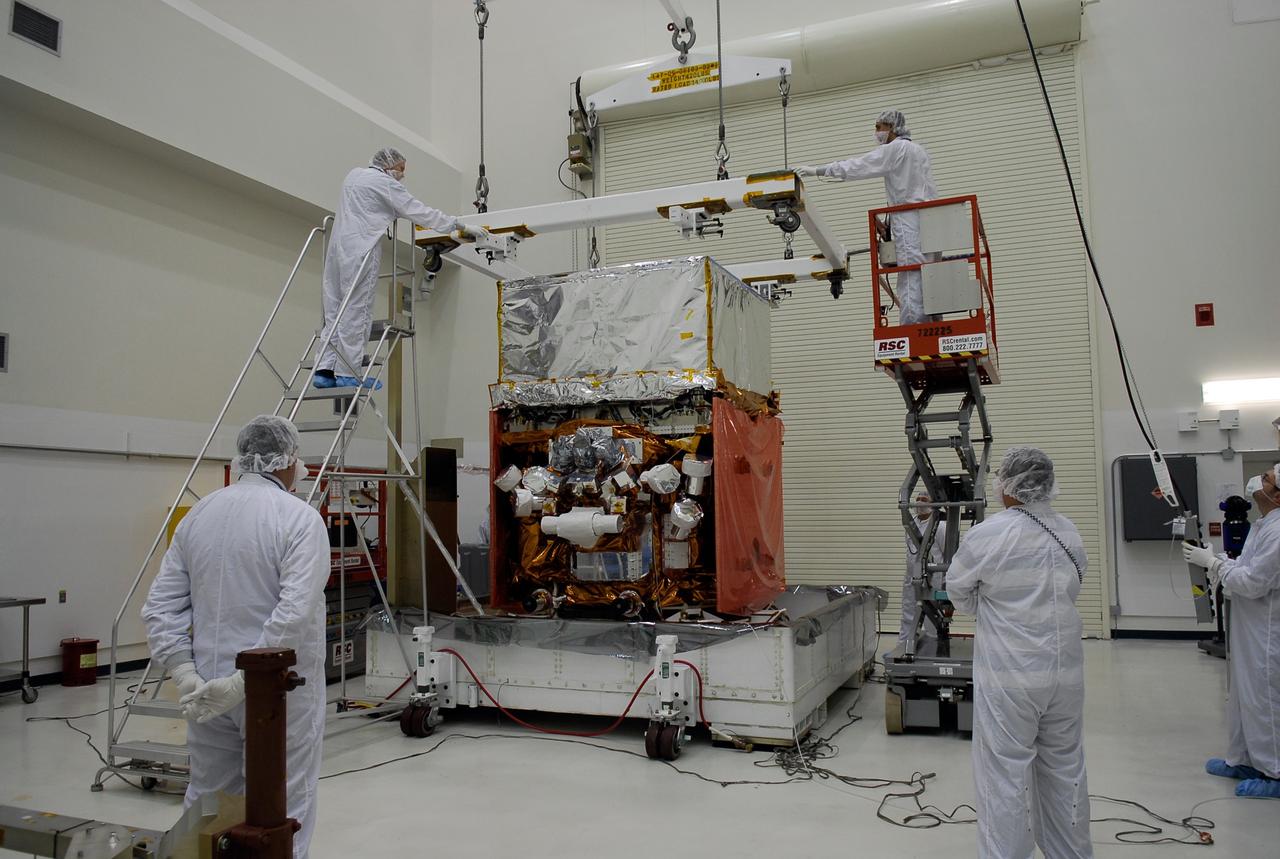
KENNEDY SPACE CENTER, FLA. -- In the Astrotech payload processing facility, General Dynamics technicians lower a crane over NASA's Gamma-Ray Large Area Space Telescope, or GLAST. After the crane is securely attached, the GLAST will be lifted and moved to a work stand in the facility for a complete checkout of the scientific instruments aboard. The telescope will launch aboard a Delta II rocket May 16 from Launch Pad 17-B on Cape Canaveral Air Force Station. A powerful space observatory, the GLAST will explore the most extreme environments in the universe, and answer questions about supermassive black hole systems, pulsars and the origin of cosmic rays. It also will study the mystery of powerful explosions known as gamma-ray bursts. Photo credit: NASA/Kim Shiflett
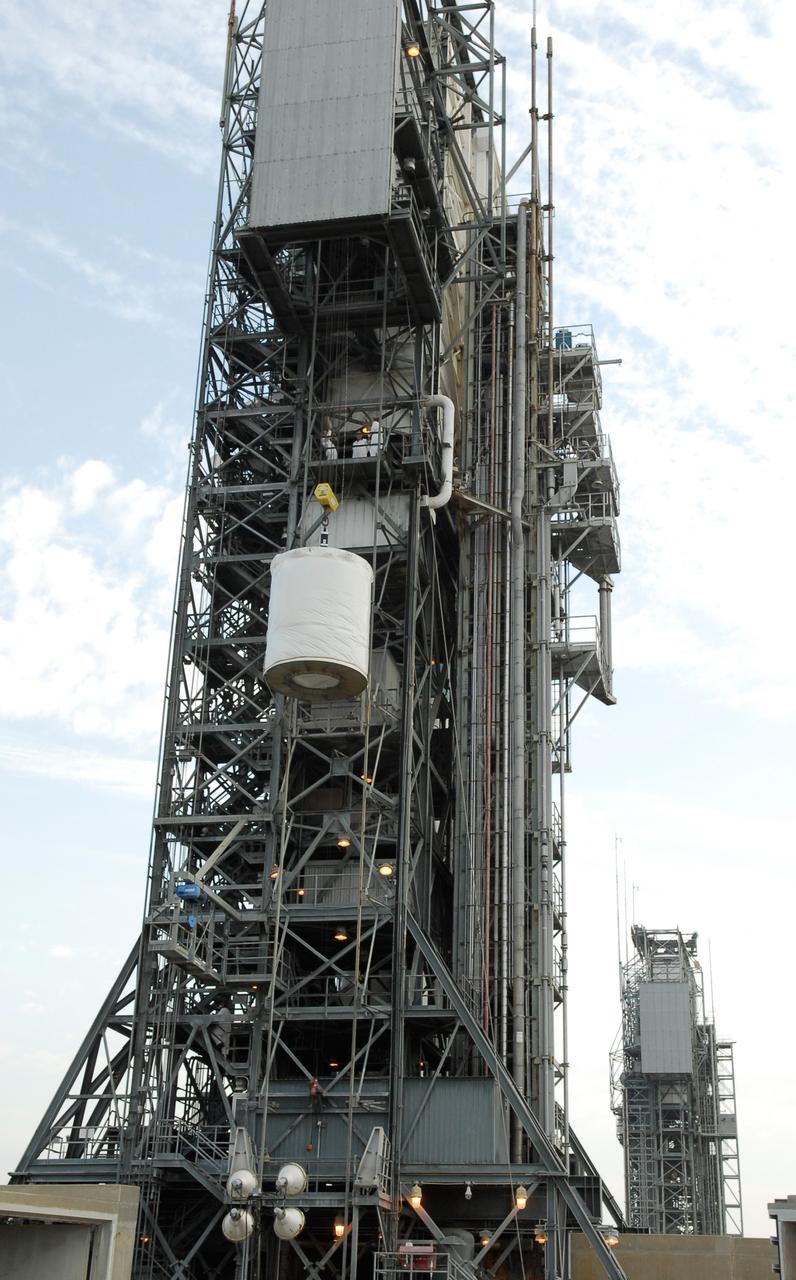
CAPE CANAVERAL, Fla. -- At pad 17-B at Cape Canaveral Air Force Station, the GLAST spacecraft continues its rise toward the upper level of the mobile service tower. In the tower, GLAST will be mated with the Delta II second stage. GLAST is a powerful space observatory that will explore the Universe's ultimate frontier, where nature harnesses forces and energies far beyond anything possible on Earth; probe some of science's deepest questions, such as what our Universe is made of, and search for new laws of physics; explain how black holes accelerate jets of material to nearly light speed; and help crack the mystery of stupendously powerful explosions known as gamma-ray bursts. The launch date is targeted no earlier than June 3. Photo credit: NASA/Kim Shiflett
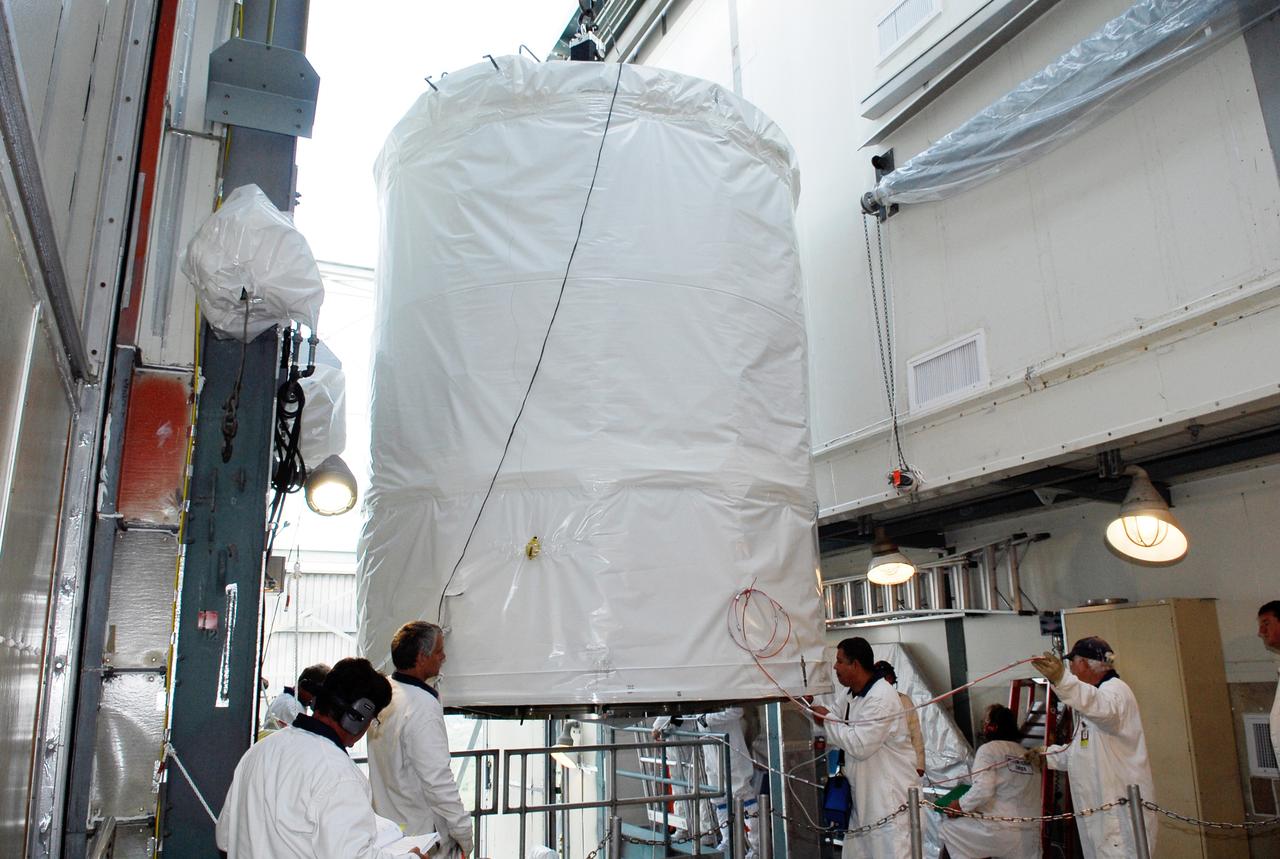
CAPE CANAVERAL, Fla. -- At pad 17-B at Cape Canaveral Air Force Station, workers help maneuver the GLAST spacecraft into the mobile service tower. In the tower, GLAST will be mated with the Delta II second stage. GLAST is a powerful space observatory that will explore the Universe's ultimate frontier, where nature harnesses forces and energies far beyond anything possible on Earth; probe some of science's deepest questions, such as what our Universe is made of, and search for new laws of physics; explain how black holes accelerate jets of material to nearly light speed; and help crack the mystery of stupendously powerful explosions known as gamma-ray bursts. The launch date is targeted no earlier than June 3. Photo credit: NASA/Kim Shiflett
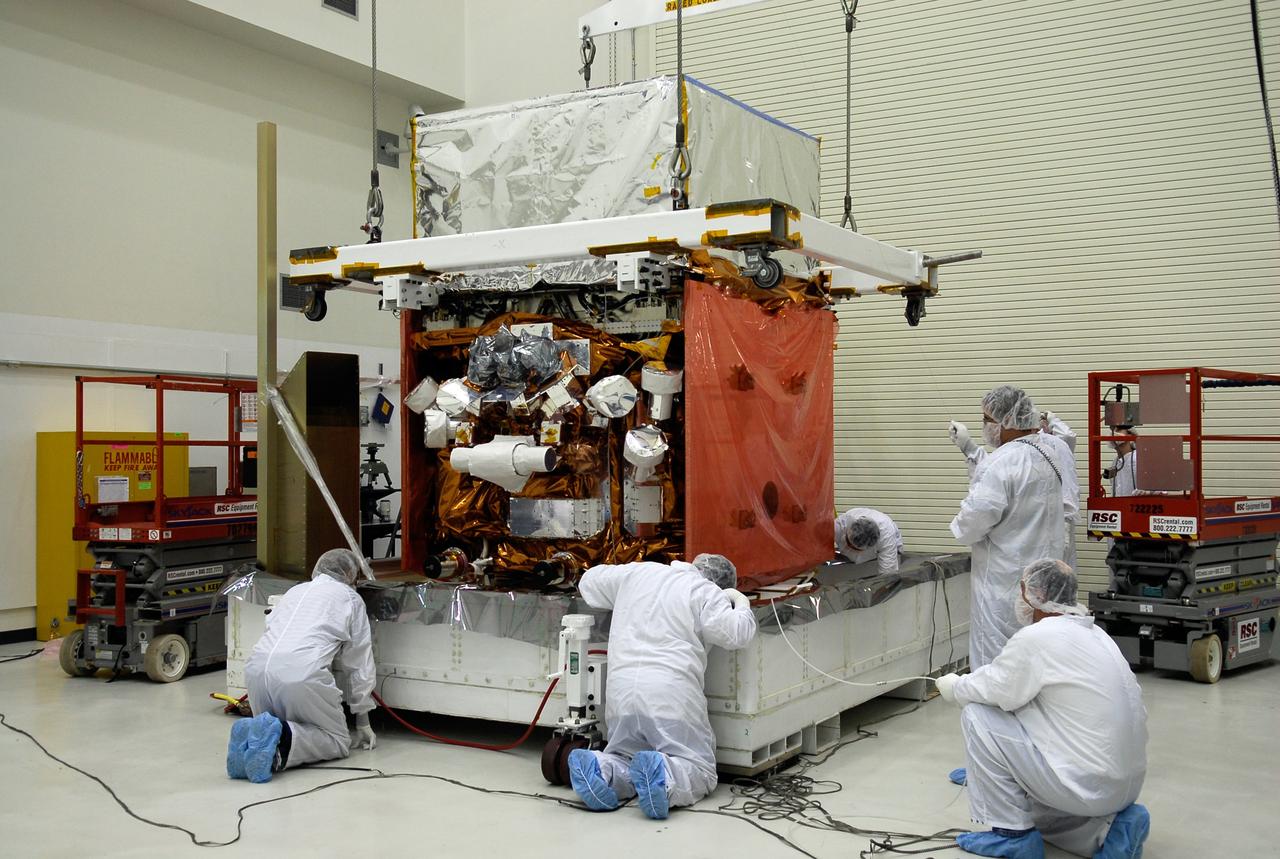
KENNEDY SPACE CENTER, FLA. -- In the Astrotech payload processing facility, General Dynamics technicians check NASA's Gamma-Ray Large Area Space Telescope, or GLAST, as an overhead crane is lowered over it. After the crane is securely attached, the GLAST will be lifted and moved to a work stand in the facility for a complete checkout of the scientific instruments aboard. The telescope will launch aboard a Delta II rocket May 16 from Launch Pad 17-B on Cape Canaveral Air Force Station. A powerful space observatory, the GLAST will explore the most extreme environments in the universe, and answer questions about supermassive black hole systems, pulsars and the origin of cosmic rays. It also will study the mystery of powerful explosions known as gamma-ray bursts. Photo credit: NASA/Kim Shiflett
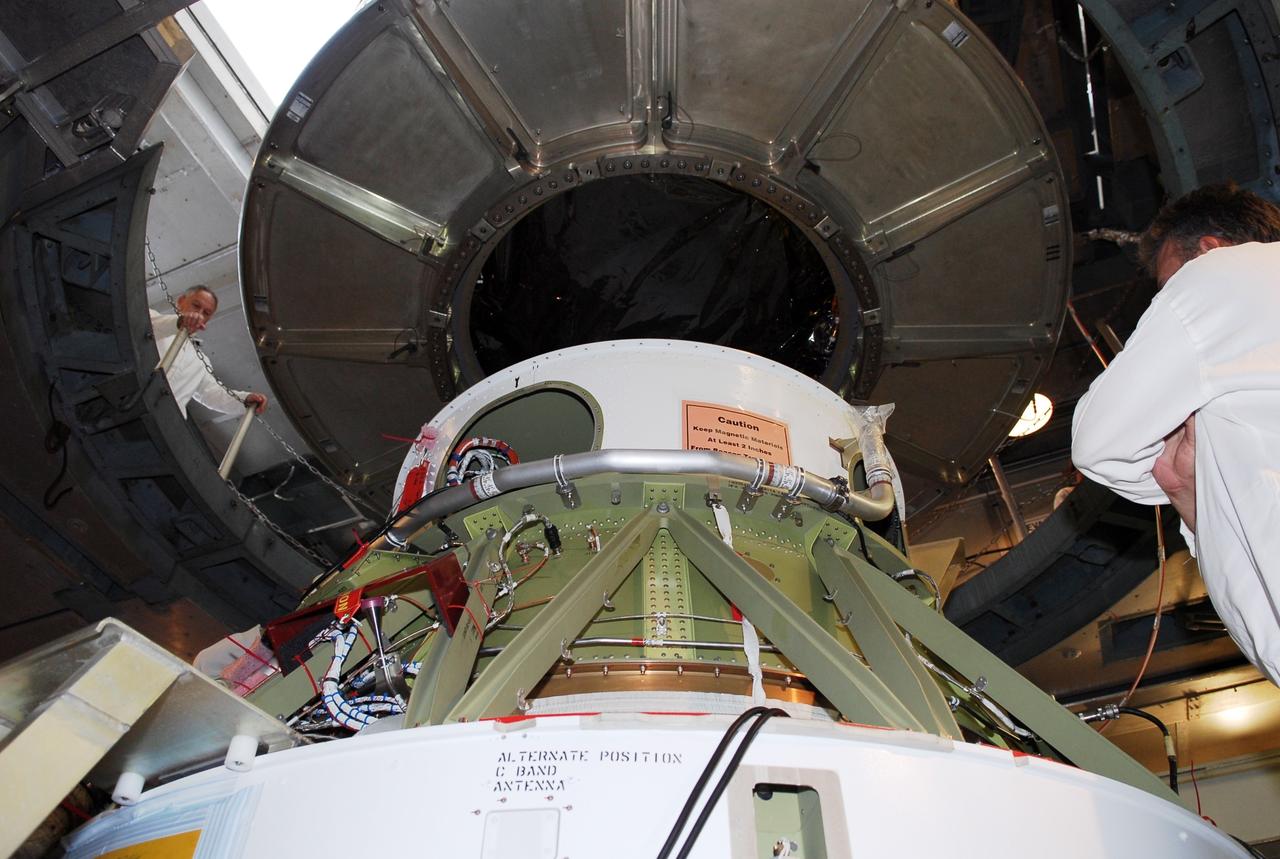
CAPE CANAVERAL, Fla. -- At pad 17-B at Cape Canaveral Air Force Station, the GLAST spacecraft is lowered onto the Delta II second stage in the mobile service tower. GLAST will be mated with the Delta II second stage. GLAST is a powerful space observatory that will explore the Universe's ultimate frontier, where nature harnesses forces and energies far beyond anything possible on Earth; probe some of science's deepest questions, such as what our Universe is made of, and search for new laws of physics; explain how black holes accelerate jets of material to nearly light speed; and help crack the mystery of stupendously powerful explosions known as gamma-ray bursts. The launch date is targeted no earlier than June 3. Photo credit: NASA/Kim Shiflett

CAPE CANAVERAL, Fla. -- At the Astrotech payload processing facility in Titusville, Fla., technicians stretch protective cover over NASA's Gamma-ray Large Area Space Telescope, or GLAST, spacecraft. GLAST is being prepared for its move to the Hazardous Processing Facility for fueling. The GLAST is a powerful space observatory that will explore the universe's ultimate frontier, where nature harnesses forces and energies far beyond anything possible on Earth; probe some of science's deepest questions, such as what our Universe is made of, and search for new laws of physics; explain how black holes accelerate jets of material to nearly light speed; and help crack the mystery of stupendously powerful explosions known as gamma-ray bursts. A launch date is still to be determined. Photo credit: NASA/Mike Kerley
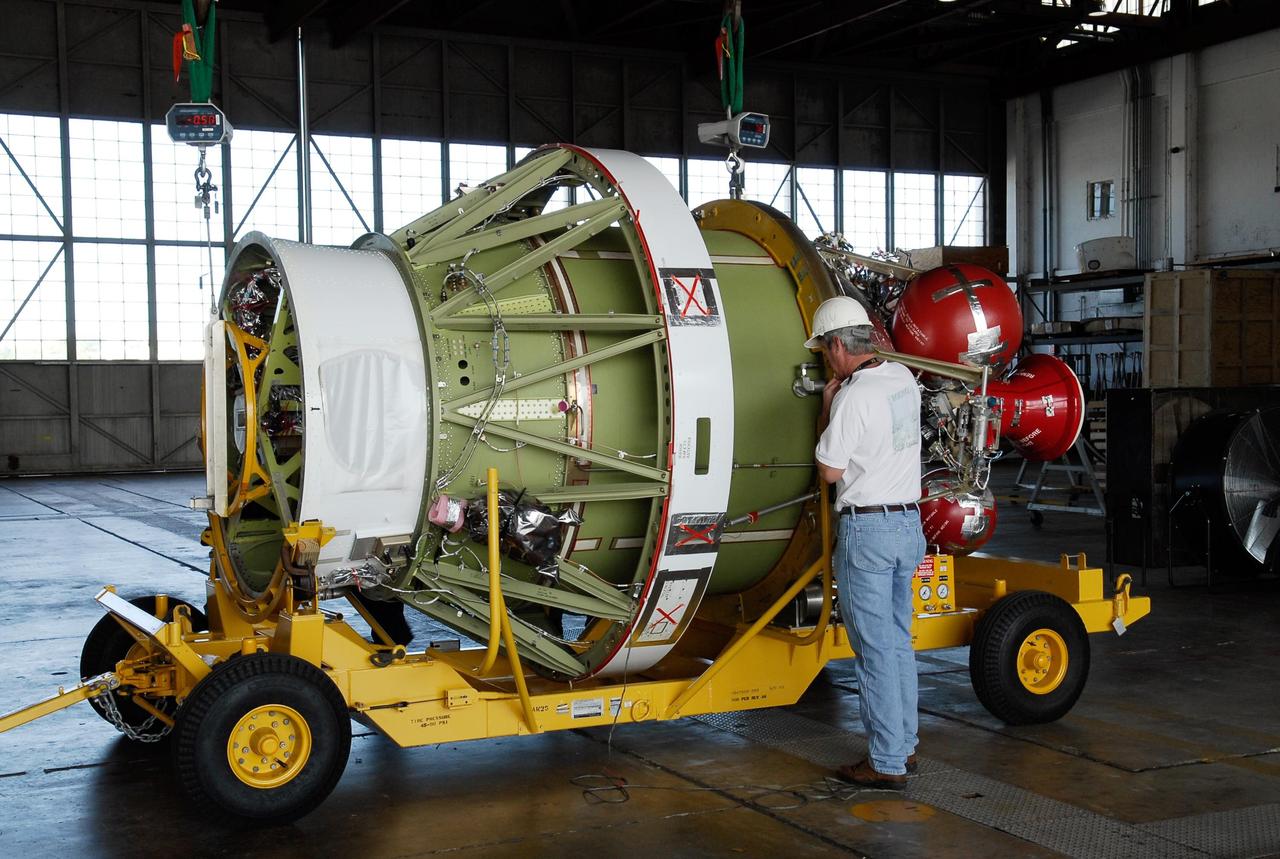
KENNEDY SPACE CENTER, FLA. -- At Cape Canaveral Air Force Station, the Delta II second stage for GLAST has arrived at Hangar M and is prepared for weighing. The Delta rocket will be used to launch the Gamma-Ray Large Area Space Telescope, or GLAST, May 16 from Launch Pad 17-B on CCAFS. The GLAST is a powerful space observatory that will explore the Universe's ultimate frontier, where nature harnesses forces and energies far beyond anything possible on Earth; probe some of science's deepest questions, such as what our Universe is made of, and search for new laws of physics; explain how black holes accelerate jets of material to nearly light speed; and help crack the mystery of stupendously powerful explosions known as gamma-ray bursts. Photo credit: NASA/Kim Shiflett
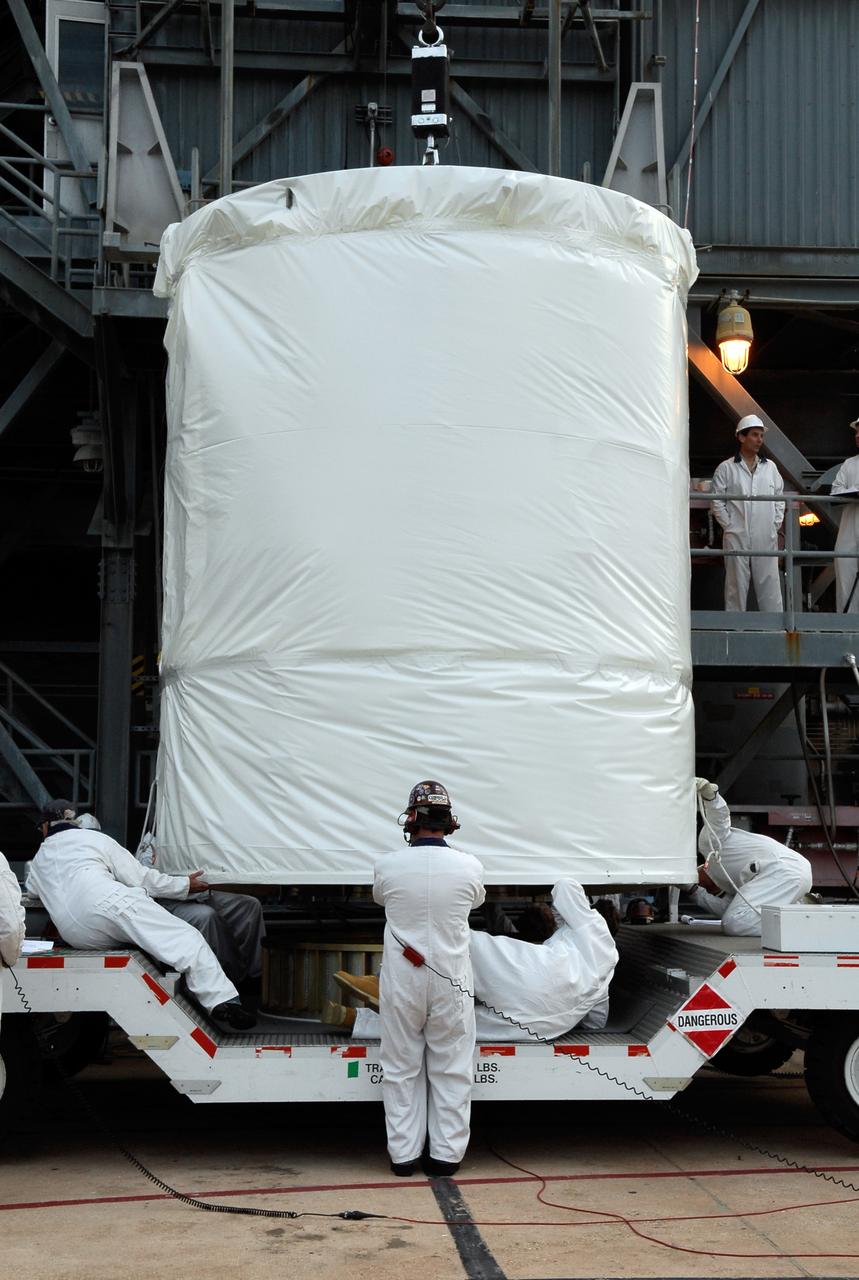
CAPE CANAVERAL, Fla. -- At pad 17-B at Cape Canaveral Air Force Station, workers secure the lines of the hoist that will lift the GLAST spacecraft into the mobile service tower. In the tower, GLAST will be mated with the Delta II second stage. GLAST is a powerful space observatory that will explore the Universe's ultimate frontier, where nature harnesses forces and energies far beyond anything possible on Earth; probe some of science's deepest questions, such as what our Universe is made of, and search for new laws of physics; explain how black holes accelerate jets of material to nearly light speed; and help crack the mystery of stupendously powerful explosions known as gamma-ray bursts. The launch date is targeted no earlier than June 3. Photo credit: NASA/Kim Shiflett
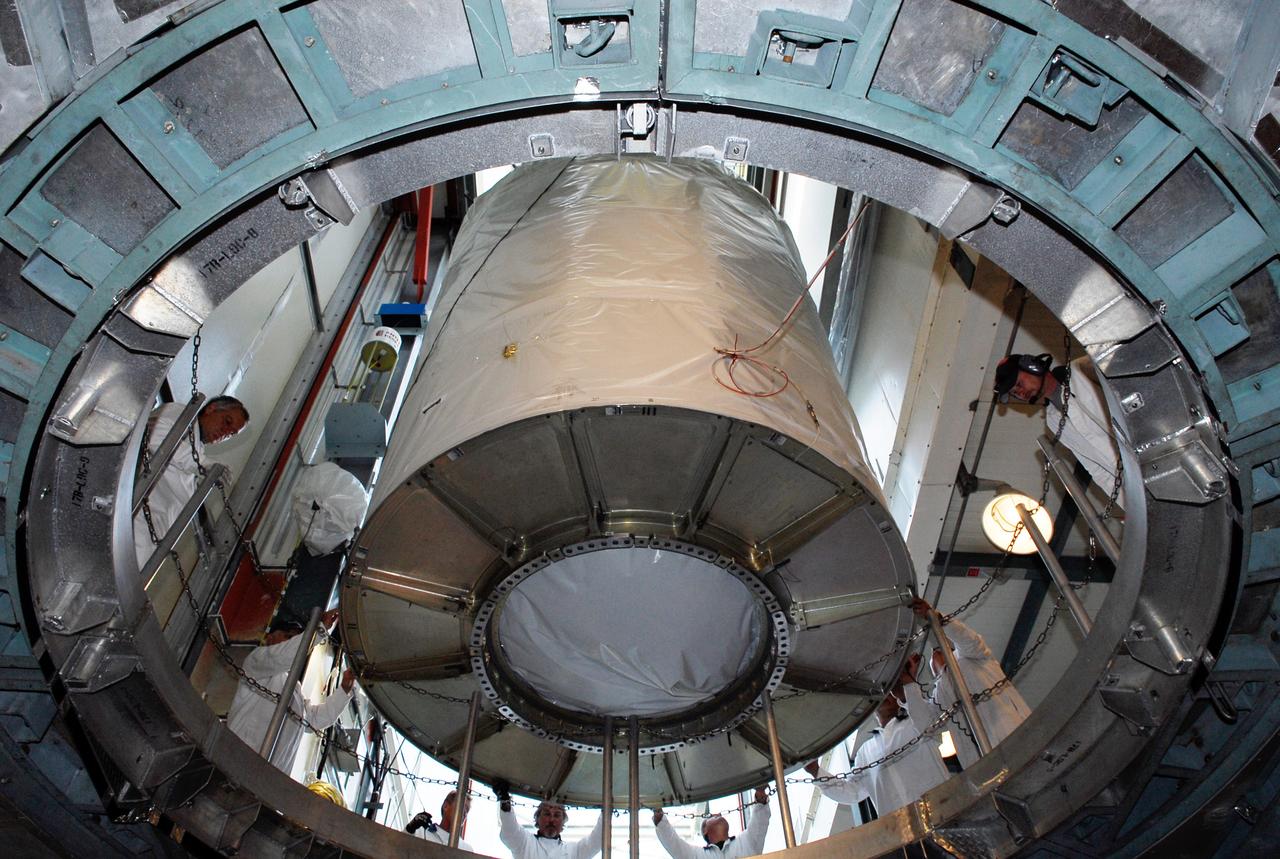
CAPE CANAVERAL, Fla. -- At pad 17-B at Cape Canaveral Air Force Station, workers begin lowering the GLAST spacecraft into the opening above the Delta II second stage in the mobile service tower. GLAST will be mated with the Delta II second stage. GLAST is a powerful space observatory that will explore the Universe's ultimate frontier, where nature harnesses forces and energies far beyond anything possible on Earth; probe some of science's deepest questions, such as what our Universe is made of, and search for new laws of physics; explain how black holes accelerate jets of material to nearly light speed; and help crack the mystery of stupendously powerful explosions known as gamma-ray bursts. The launch date is targeted no earlier than June 3. Photo credit: NASA/Kim Shiflett
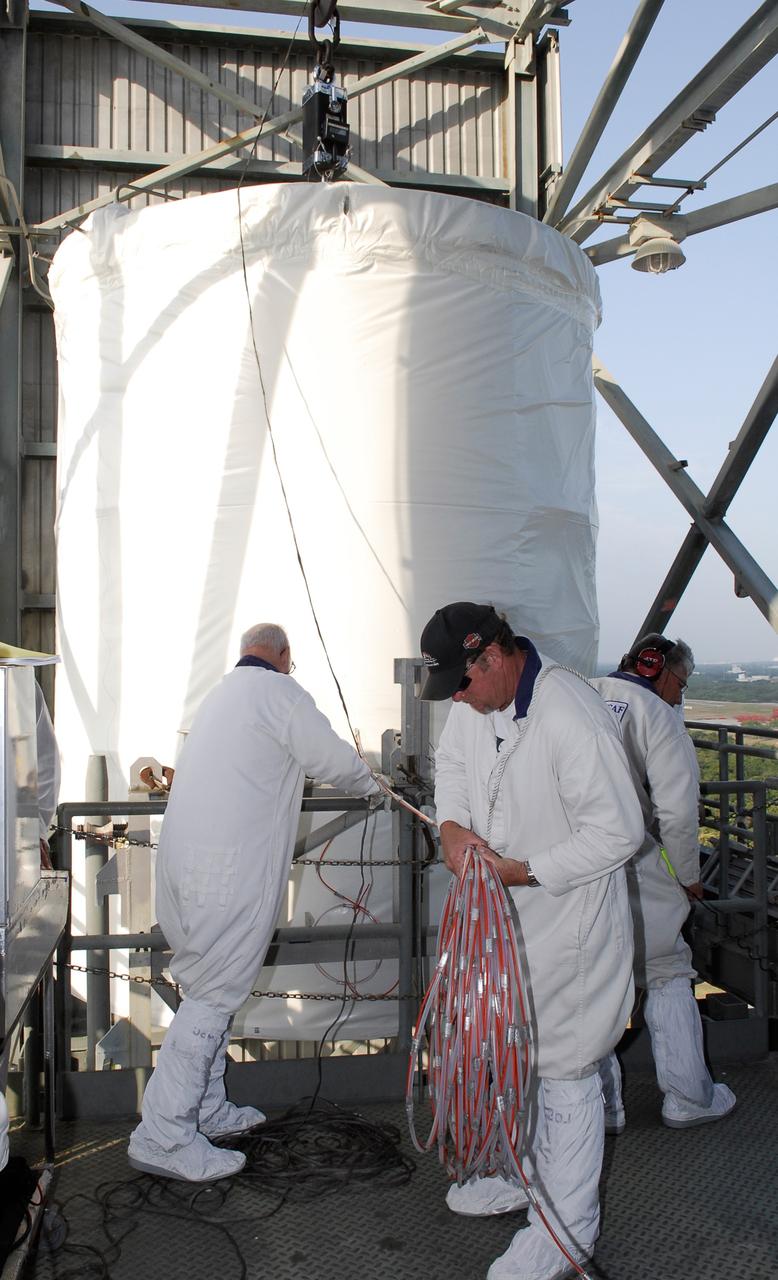
CAPE CANAVERAL, Fla. -- At pad 17-B at Cape Canaveral Air Force Station, workers prepare to move the GLAST spacecraft into the mobile service tower. In the tower, GLAST will be mated with the Delta II second stage. GLAST is a powerful space observatory that will explore the Universe's ultimate frontier, where nature harnesses forces and energies far beyond anything possible on Earth; probe some of science's deepest questions, such as what our Universe is made of, and search for new laws of physics; explain how black holes accelerate jets of material to nearly light speed; and help crack the mystery of stupendously powerful explosions known as gamma-ray bursts. The launch date is targeted no earlier than June 3. Photo credit: NASA/Kim Shiflett
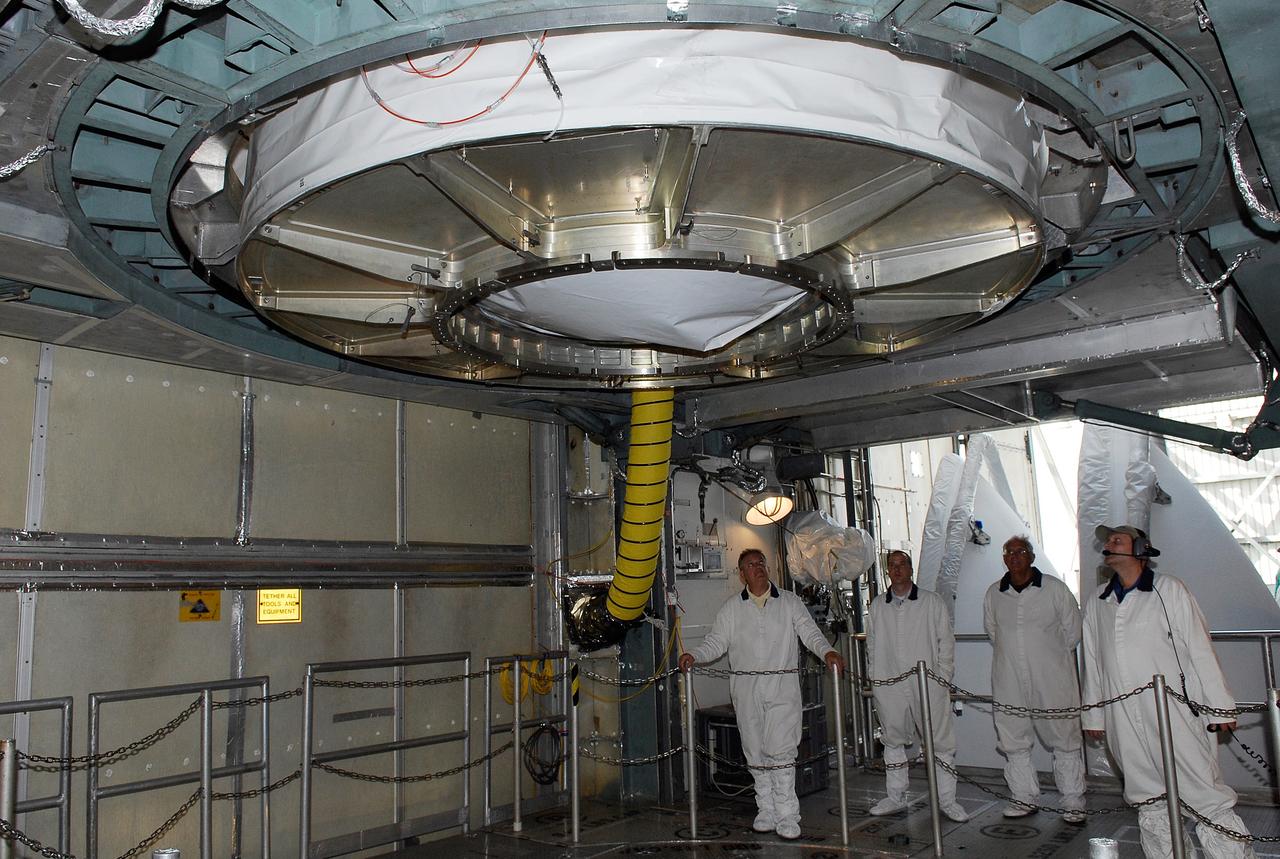
CAPE CANAVERAL, Fla. -- At pad 17-B at Cape Canaveral Air Force Station, workers keep watch as the GLAST spacecraft is lowered into the opening above the Delta II second stage in the mobile service tower. GLAST will be mated with the Delta II second stage. GLAST is a powerful space observatory that will explore the Universe's ultimate frontier, where nature harnesses forces and energies far beyond anything possible on Earth; probe some of science's deepest questions, such as what our Universe is made of, and search for new laws of physics; explain how black holes accelerate jets of material to nearly light speed; and help crack the mystery of stupendously powerful explosions known as gamma-ray bursts. The launch date is targeted no earlier than June 3. Photo credit: NASA/Kim Shiflett
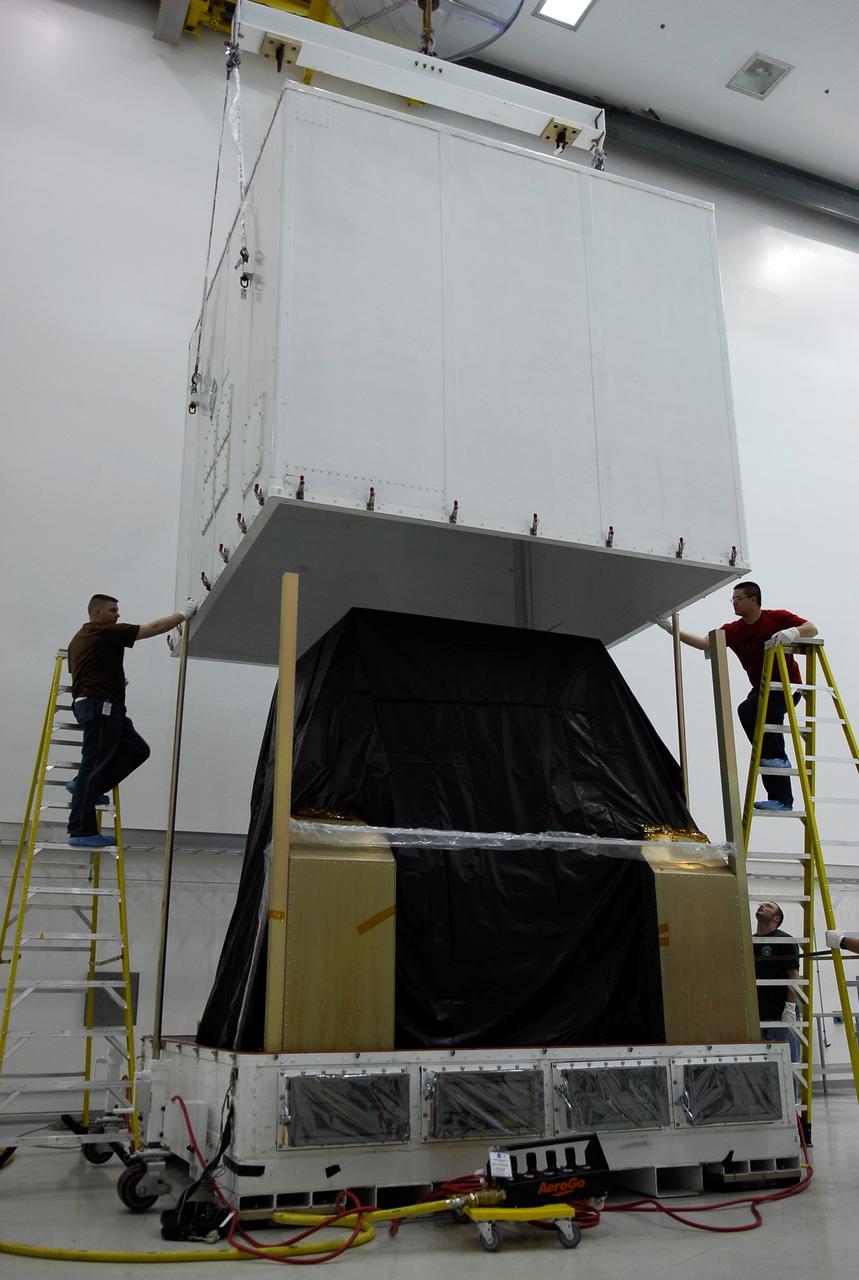
KENNEDY SPACE CENTER, FLA. -- In the Astrotech payload processing facility near the Kennedy Space Center, the shipping container covering NASA's Gamma-Ray Large Area Space Telescope, or GLAST, is lifted to reveal the protected equipment inside. Workers will prepare for a complete checkout of the telescope's scientific instruments. The GLAST will launch aboard a Delta II rocket May 16 from Launch Pad 17-B on Cape Canaveral Air Force Station. A powerful space observatory, the GLAST will explore the most extreme environments in the universe, and answer questions about supermassive black hole systems, pulsars and the origin of cosmic rays. It also will study the mystery of powerful explosions known as gamma-ray bursts. Photo credit: NASA/Kim Shiflett
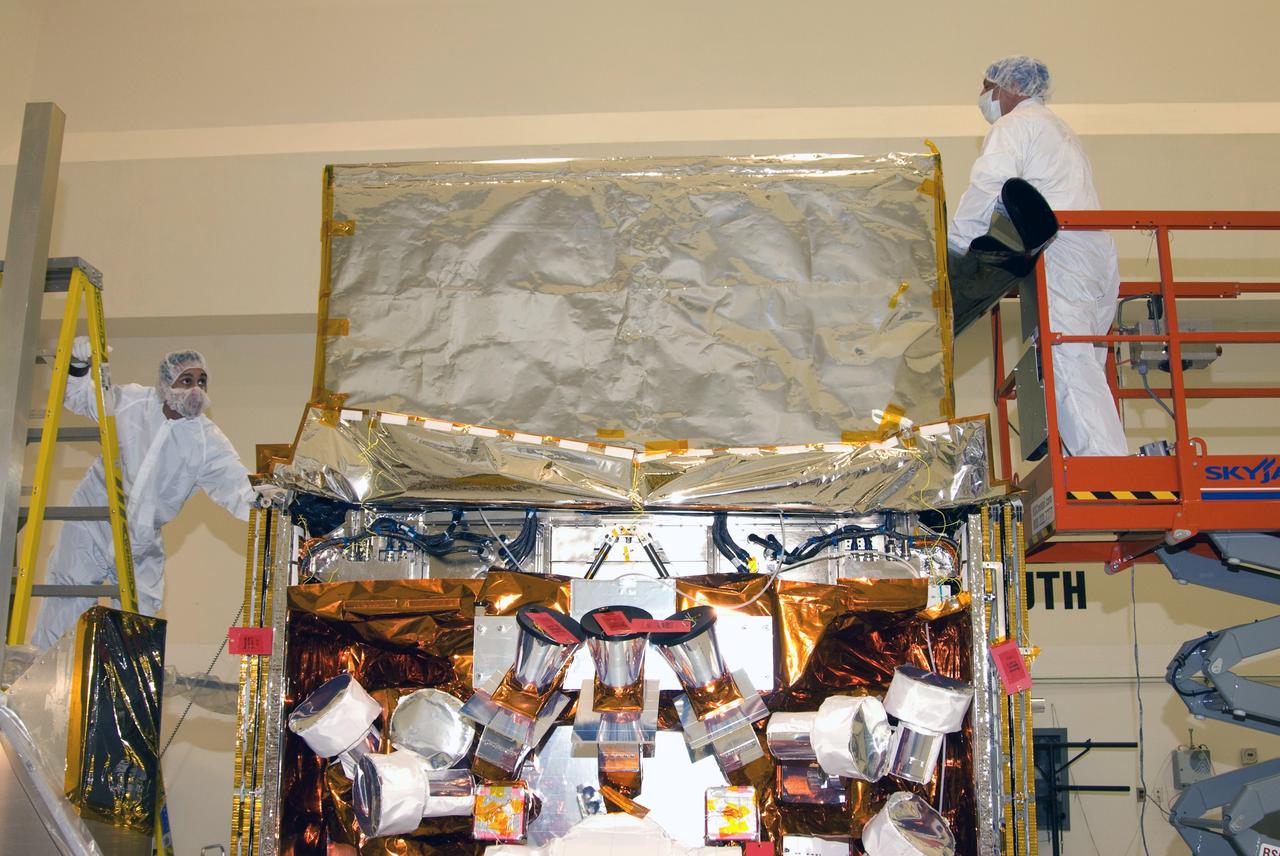
CAPE CANAVERAL, Fla. -- At the Astrotech payload processing facility in Titusville, Fla., technicians begin placing a protective cover over NASA's Gamma-ray Large Area Space Telescope, or GLAST, spacecraft. GLAST is being prepared for its move to the Hazardous Processing Facility for fueling. The GLAST is a powerful space observatory that will explore the universe's ultimate frontier, where nature harnesses forces and energies far beyond anything possible on Earth; probe some of science's deepest questions, such as what our Universe is made of, and search for new laws of physics; explain how black holes accelerate jets of material to nearly light speed; and help crack the mystery of stupendously powerful explosions known as gamma-ray bursts. A launch date is still to be determined. Photo credit: NASA/Mike Kerley
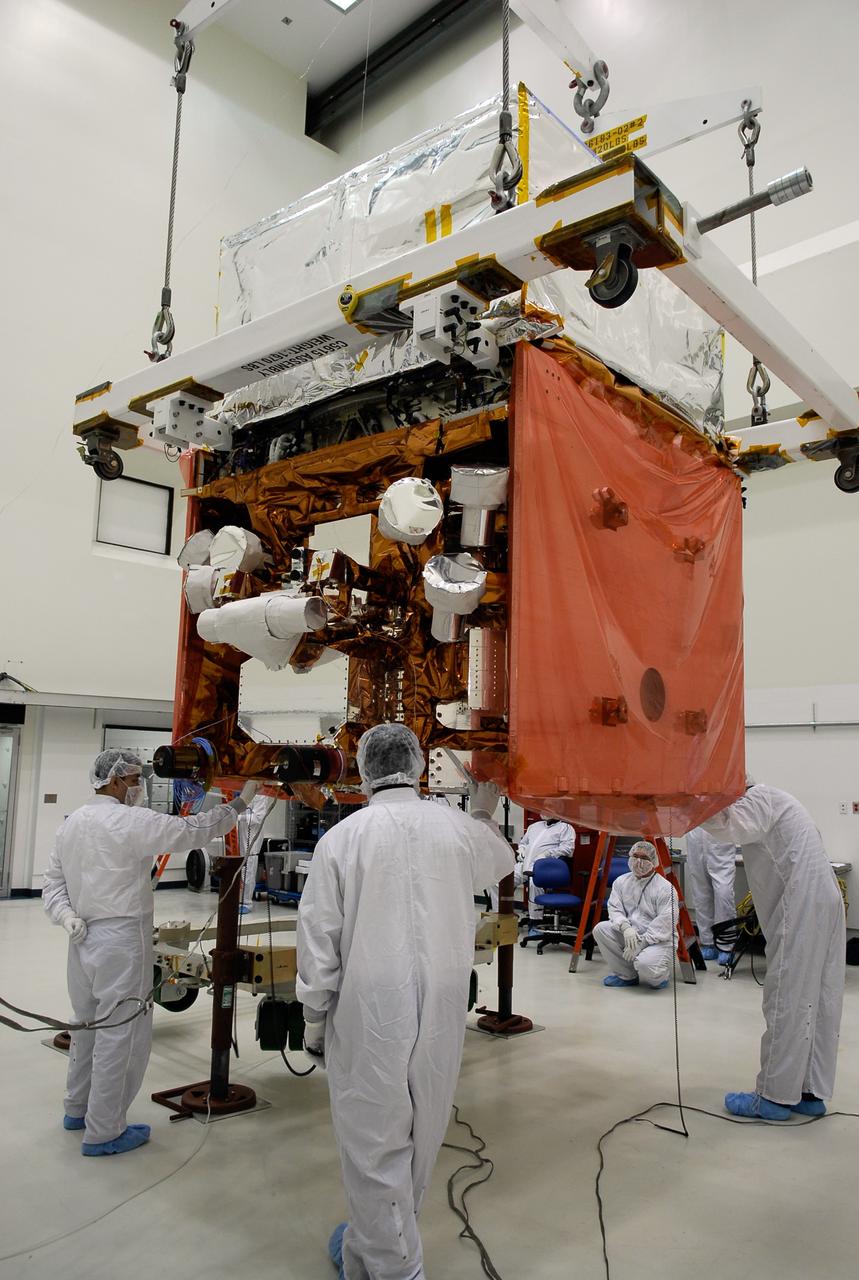
KENNEDY SPACE CENTER, FLA. -- In the Astrotech payload processing facility, General Dynamics technicians keep watch as NASA's Gamma-Ray Large Area Space Telescope, or GLAST, is moved toward a work stand (at left) in the facility. There GLAST will undergo a complete checkout of the scientific instruments aboard. The telescope will launch aboard a Delta II rocket May 16 from Launch Pad 17-B on Cape Canaveral Air Force Station. A powerful space observatory, the GLAST will explore the most extreme environments in the universe, and answer questions about supermassive black hole systems, pulsars and the origin of cosmic rays. It also will study the mystery of powerful explosions known as gamma-ray bursts. Photo credit: NASA/Kim Shiflett
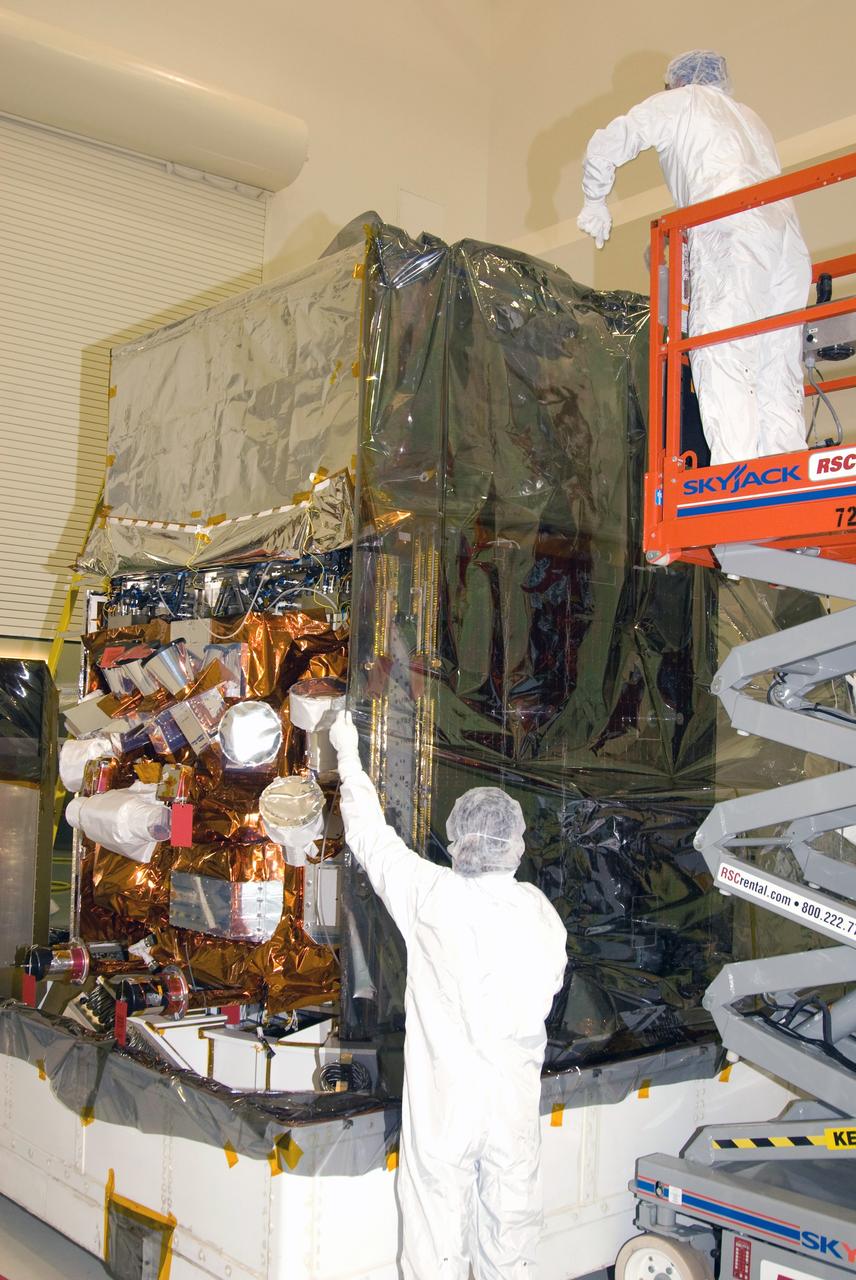
CAPE CANAVERAL, Fla. -- At the Astrotech payload processing facility in Titusville, Fla., technicians stretch protective cover over NASA's Gamma-ray Large Area Space Telescope, or GLAST, spacecraft. GLAST is being prepared for its move to the Hazardous Processing Facility for fueling. The GLAST is a powerful space observatory that will explore the universe's ultimate frontier, where nature harnesses forces and energies far beyond anything possible on Earth; probe some of science's deepest questions, such as what our Universe is made of, and search for new laws of physics; explain how black holes accelerate jets of material to nearly light speed; and help crack the mystery of stupendously powerful explosions known as gamma-ray bursts. A launch date is still to be determined. Photo credit: NASA/Mike Kerley
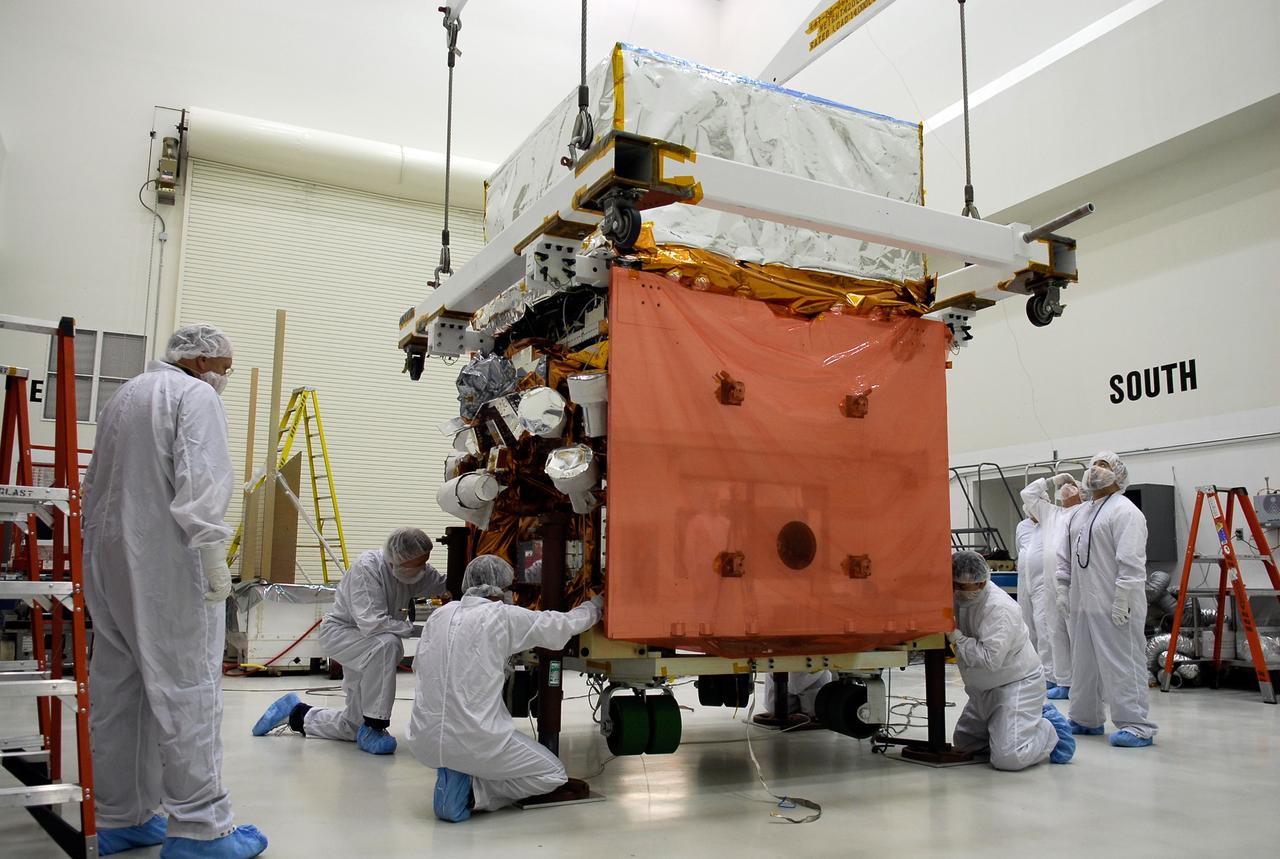
KENNEDY SPACE CENTER, FLA. -- In the Astrotech payload processing facility, General Dynamics technicians secure NASA's Gamma-Ray Large Area Space Telescope, or GLAST, on a work stand as the overhead crane is lifted away. GLAST will undergo a complete checkout of the scientific instruments aboard. The telescope will launch aboard a Delta II rocket May 16 from Launch Pad 17-B on Cape Canaveral Air Force Station. A powerful space observatory, the GLAST will explore the most extreme environments in the universe, and answer questions about supermassive black hole systems, pulsars and the origin of cosmic rays. It also will study the mystery of powerful explosions known as gamma-ray bursts. Photo credit: NASA/Kim Shiflett
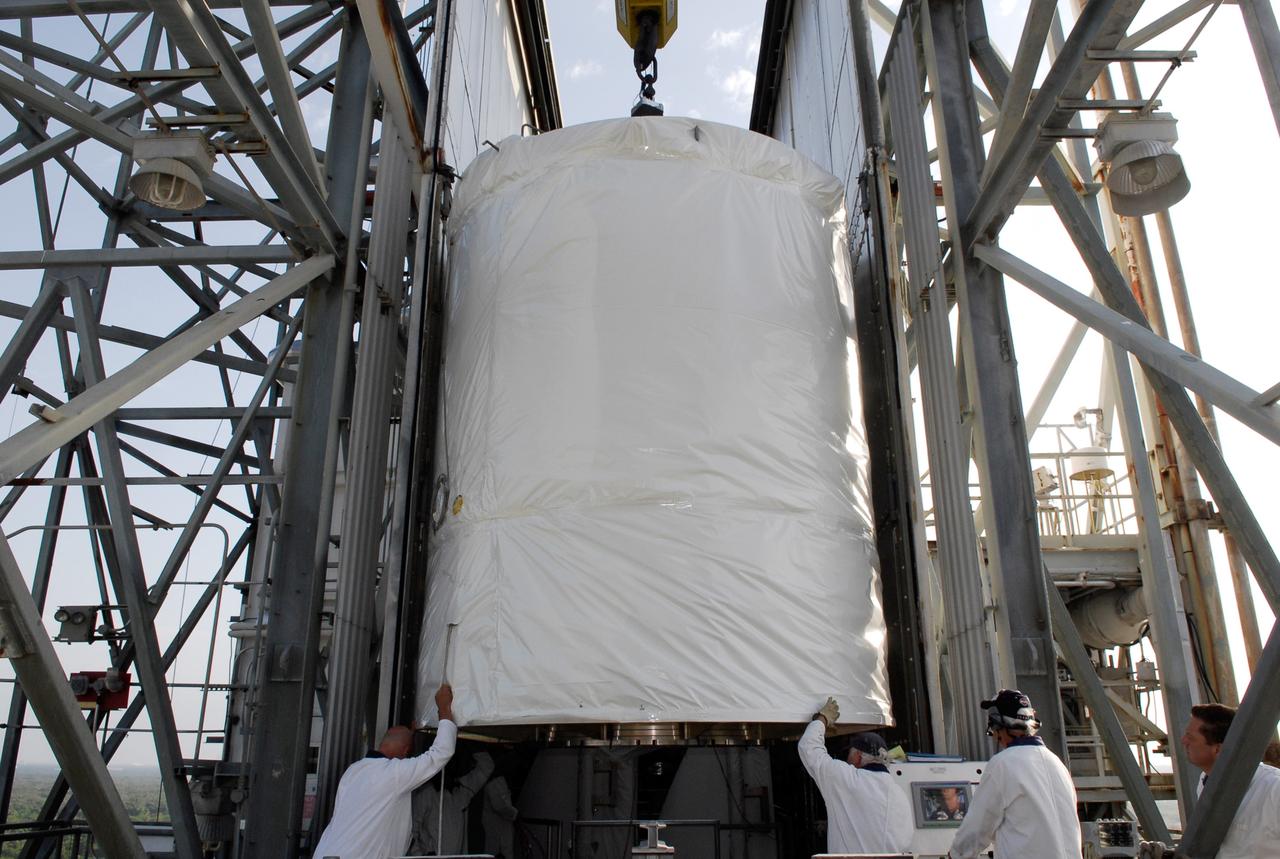
CAPE CANAVERAL, Fla. -- At pad 17-B at Cape Canaveral Air Force Station, workers help maneuver the GLAST spacecraft into the mobile service tower. In the tower, GLAST will be mated with the Delta II second stage. GLAST is a powerful space observatory that will explore the Universe's ultimate frontier, where nature harnesses forces and energies far beyond anything possible on Earth; probe some of science's deepest questions, such as what our Universe is made of, and search for new laws of physics; explain how black holes accelerate jets of material to nearly light speed; and help crack the mystery of stupendously powerful explosions known as gamma-ray bursts. The launch date is targeted no earlier than June 3. Photo credit: NASA/Kim Shiflett
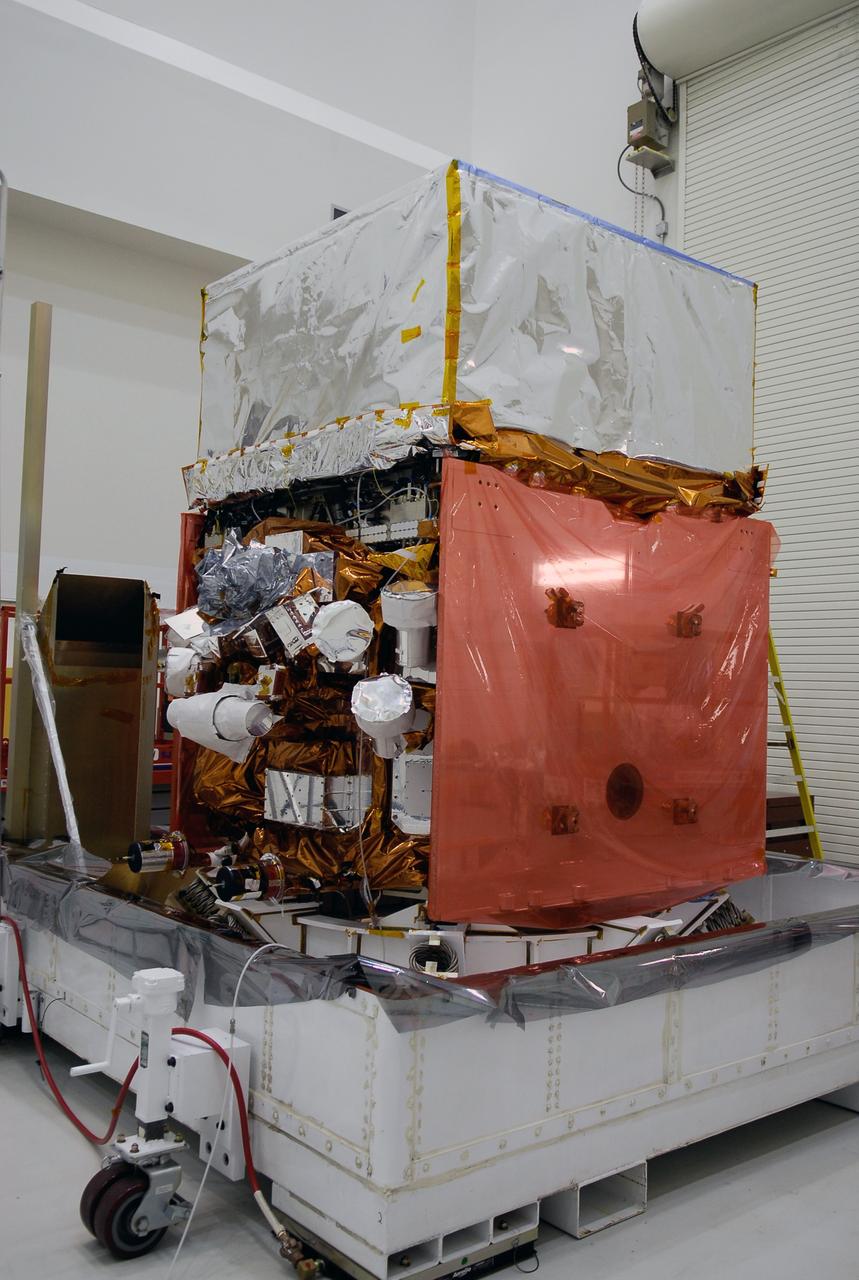
KENNEDY SPACE CENTER, FLA. -- In the Astrotech payload processing facility, NASA's Gamma-Ray Large Area Space Telescope, or GLAST, sits uncovered before its move to a work stand in the facility for a complete checkout of the scientific instruments aboard. The telescope will launch aboard a Delta II rocket May 16 from Launch Pad 17-B on Cape Canaveral Air Force Station. A powerful space observatory, the GLAST will explore the most extreme environments in the universe, and answer questions about supermassive black hole systems, pulsars and the origin of cosmic rays. It also will study the mystery of powerful explosions known as gamma-ray bursts. Photo credit: NASA/Kim Shiflett
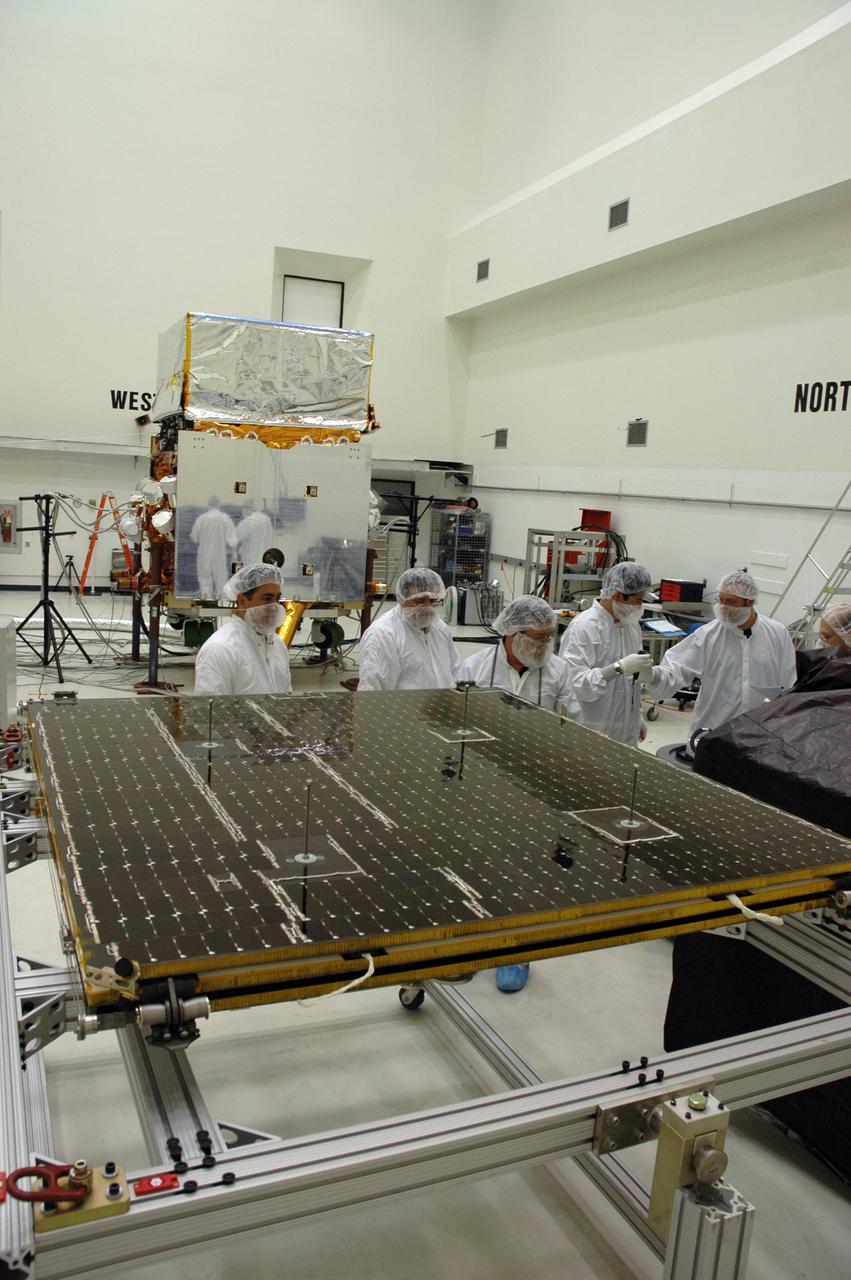
KENNEDY SPACE CENTER, FLA. - In the Astrotech payload processing facility, General Dynamics technicians prepare to install the twin solar arrays on NASA's Gamma-Ray Large Area Space Telescope, or GLAST. The telescope will launch aboard a Delta II rocket May 16 from Launch Pad 17-B on Cape Canaveral Air Force Station. A powerful space observatory, the GLAST will explore the most extreme environments in the universe, and answer questions about supermassive black hole systems, pulsars and the origin of cosmic rays. It also will study the mystery of powerful explosions known as gamma-ray bursts. Photo credit: NASA/Chris Rhodes
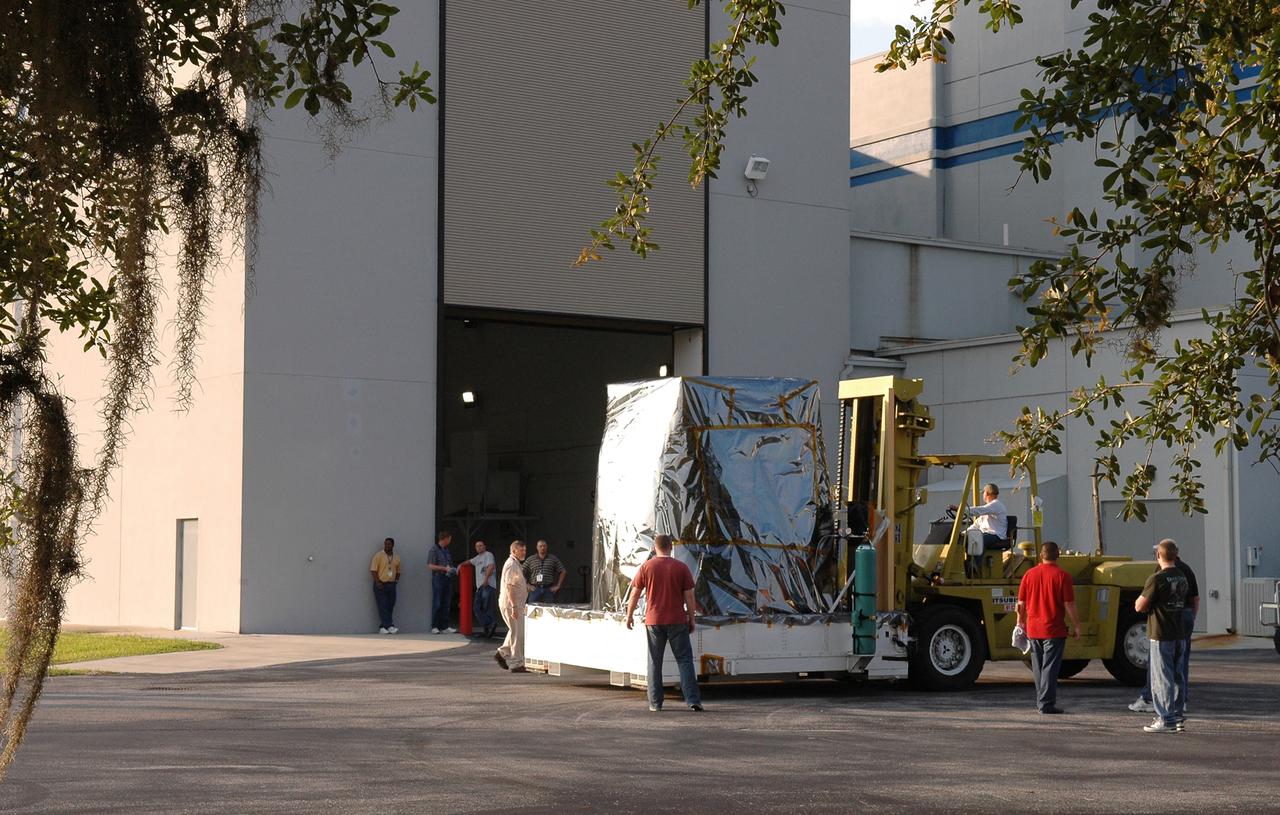
CAPE CANAVERAL, Fla. -- NASA's Gamma-ray Large Area Space Telescope, or GLAST, spacecraft is moved toward the Hazardous Processing Facility for fueling. The GLAST is a powerful space observatory that will explore the Universe's ultimate frontier, where nature harnesses forces and energies far beyond anything possible on Earth; probe some of science's deepest questions, such as what our Universe is made of, and search for new laws of physics; explain how black holes accelerate jets of material to nearly light speed; and help crack the mystery of stupendously powerful explosions known as gamma-ray bursts. A launch date still is to be determined. Photo credit: NASA/Jim Grossmann
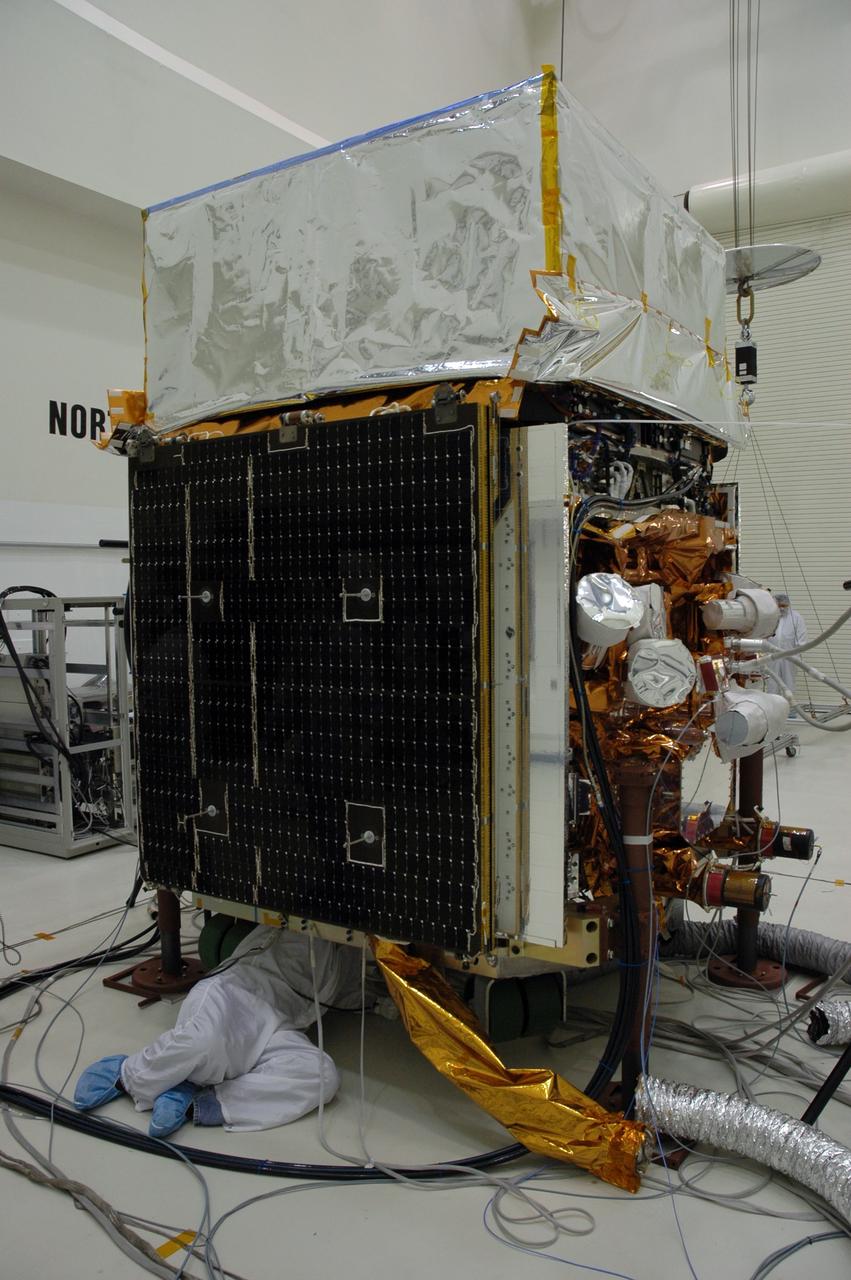
CAPE CANAVERAL, Fla. --- In the Astrotech payload processing facility, a General Dynamics technician finishes the installation of the second of twin solar arrays on NASA's Gamma-Ray Large Area Space Telescope, or GLAST. The telescope will launch aboard a Delta II rocket May 16 from Launch Pad 17-B on Cape Canaveral Air Force Station. A powerful space observatory, the GLAST will explore the most extreme environments in the universe, and answer questions about supermassive black hole systems, pulsars and the origin of cosmic rays. It also will study the mystery of powerful explosions known as gamma-ray bursts. Photo credit: NASA/Chris Rhodes
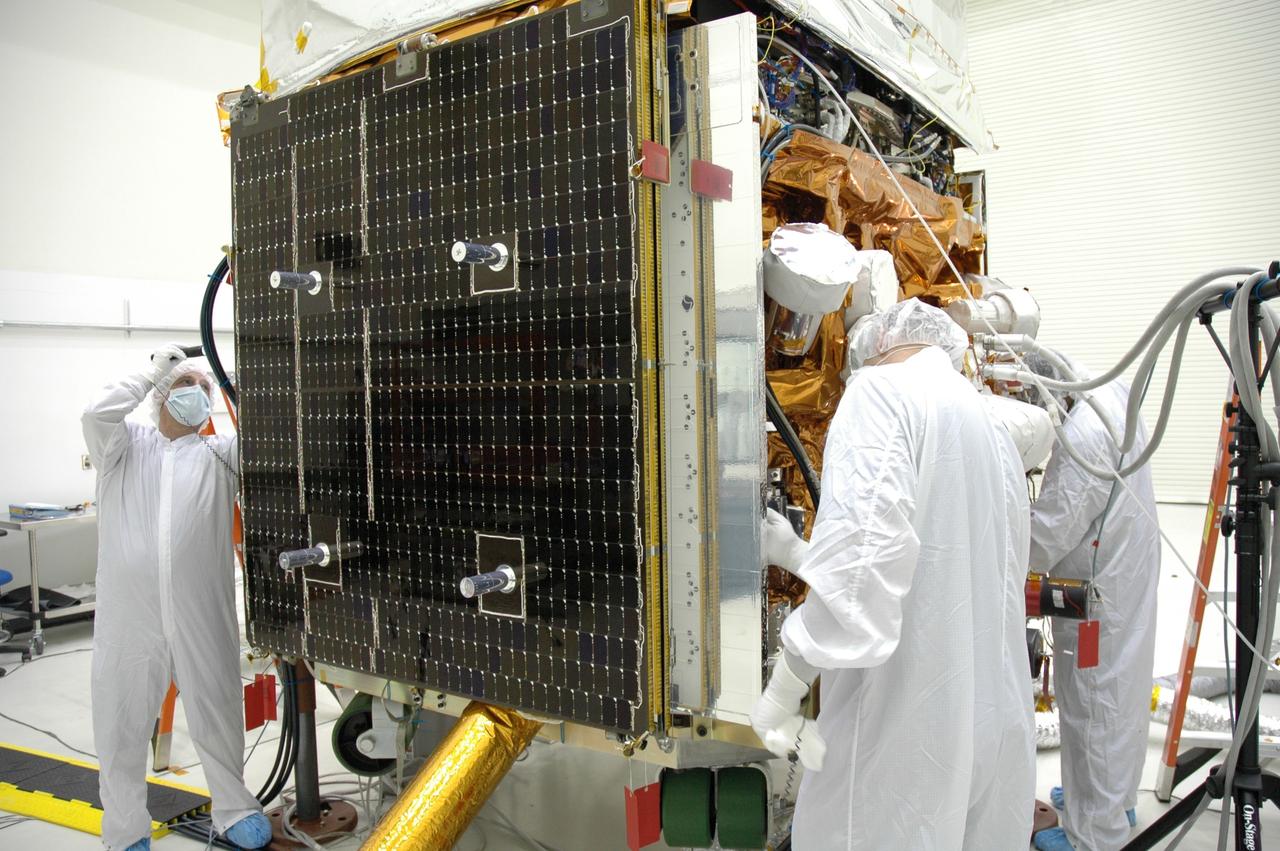
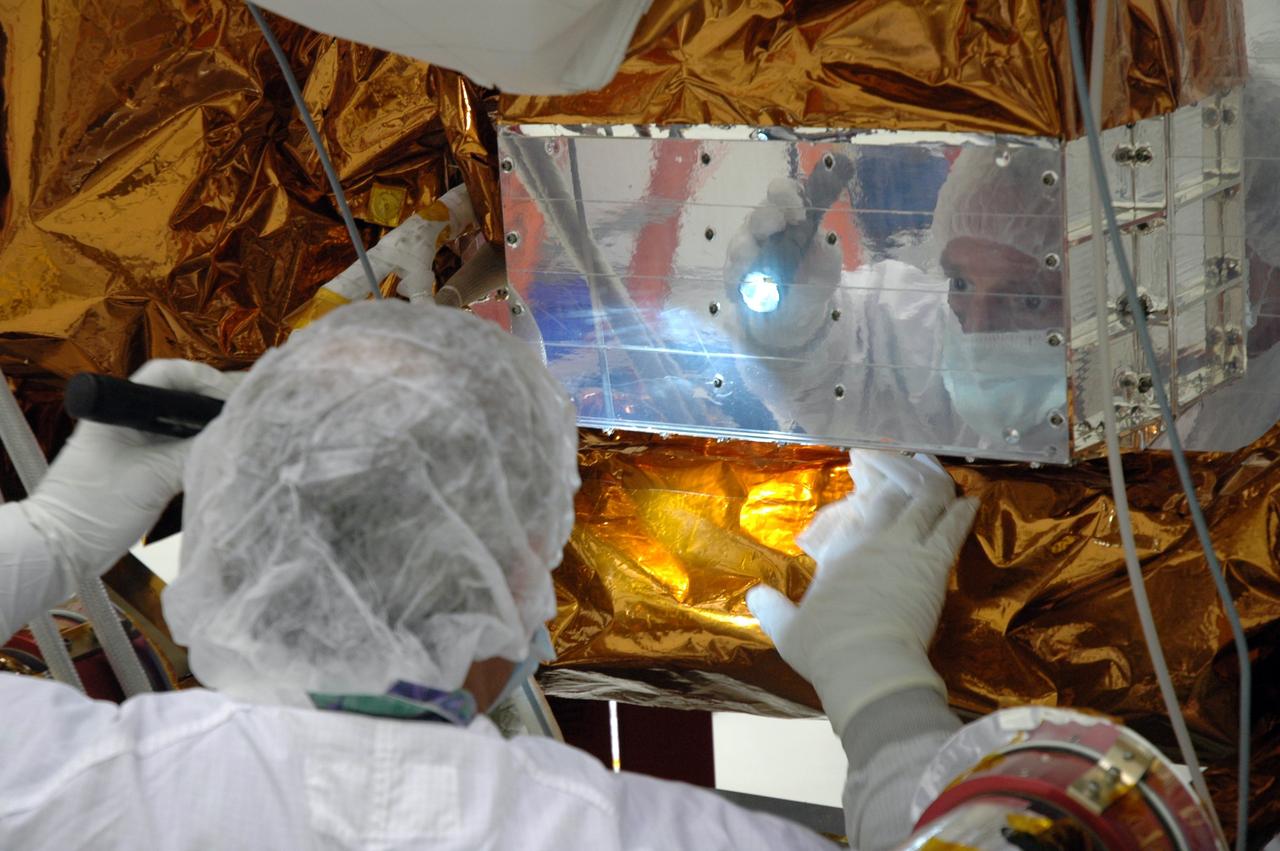
CAPE CANAVERAL, Fla. – At the Astrotech payload processing facility, technicians give NASA's Gamma-ray Large Area Space Telescope, or GLAST, spacecraft a final cleaning. The GLAST is a powerful space observatory that will explore the Universe's ultimate frontier, where nature harnesses forces and energies far beyond anything possible on Earth; probe some of science's deepest questions, such as what our Universe is made of, and search for new laws of physics; explain how black holes accelerate jets of material to nearly light speed; and help crack the mystery of stupendously powerful explosions known as gamma-ray bursts. A launch date is still to be determined. Photo credit: NASA/Jim Grossmann
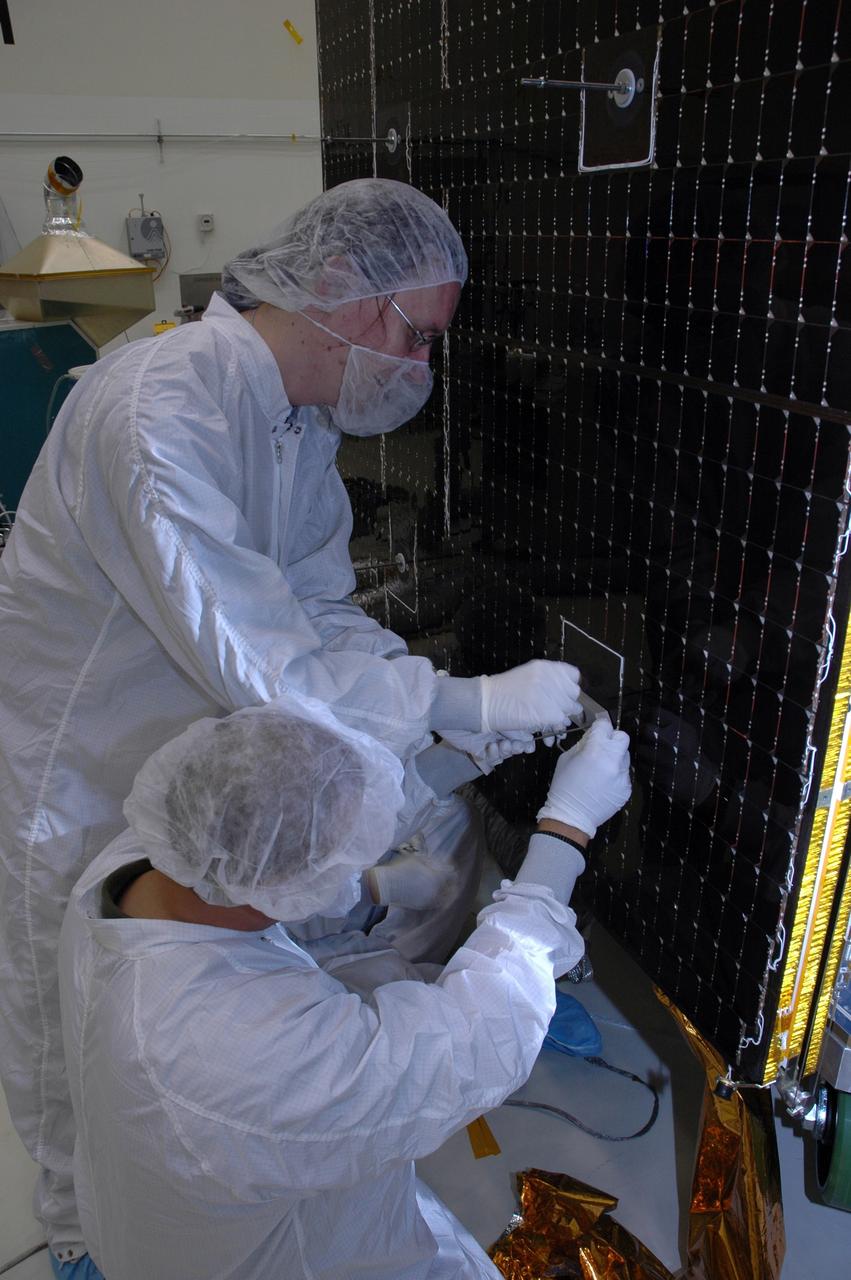
KENNEDY SPACE CENTER, FLA. - In the Astrotech payload processing facility, General Dynamics technicians install one of twin solar arrays on NASA's Gamma-Ray Large Area Space Telescope, or GLAST. The telescope will launch aboard a Delta II rocket May 16 from Launch Pad 17-B on Cape Canaveral Air Force Station. A powerful space observatory, the GLAST will explore the most extreme environments in the universe, and answer questions about supermassive black hole systems, pulsars and the origin of cosmic rays. It also will study the mystery of powerful explosions known as gamma-ray bursts. Photo credit: NASA/Chris Rhodes
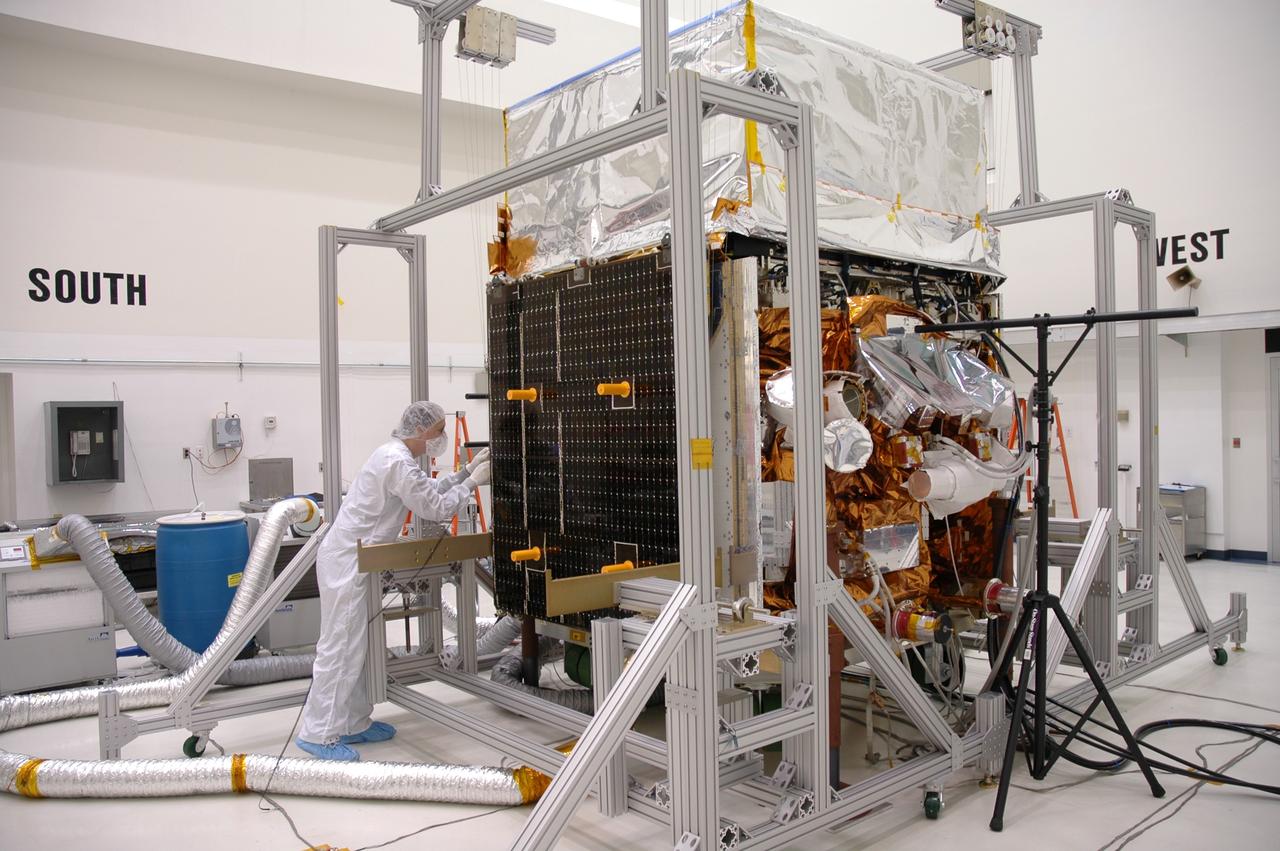
CAPE CANAVERAL, Fla. --- In the Astrotech payload processing facility, a General Dynamics technician prepares to test the deployment mechanism on the solar arrays on NASA's Gamma-Ray Large Area Space Telescope, or GLAST. The telescope will launch aboard a Delta II rocket May 16 from Launch Pad 17-B on Cape Canaveral Air Force Station. A powerful space observatory, the GLAST will explore the most extreme environments in the universe, and answer questions about supermassive black hole systems, pulsars and the origin of cosmic rays. It also will study the mystery of powerful explosions known as gamma-ray bursts. Photo credit: NASA/Jim Grossmann
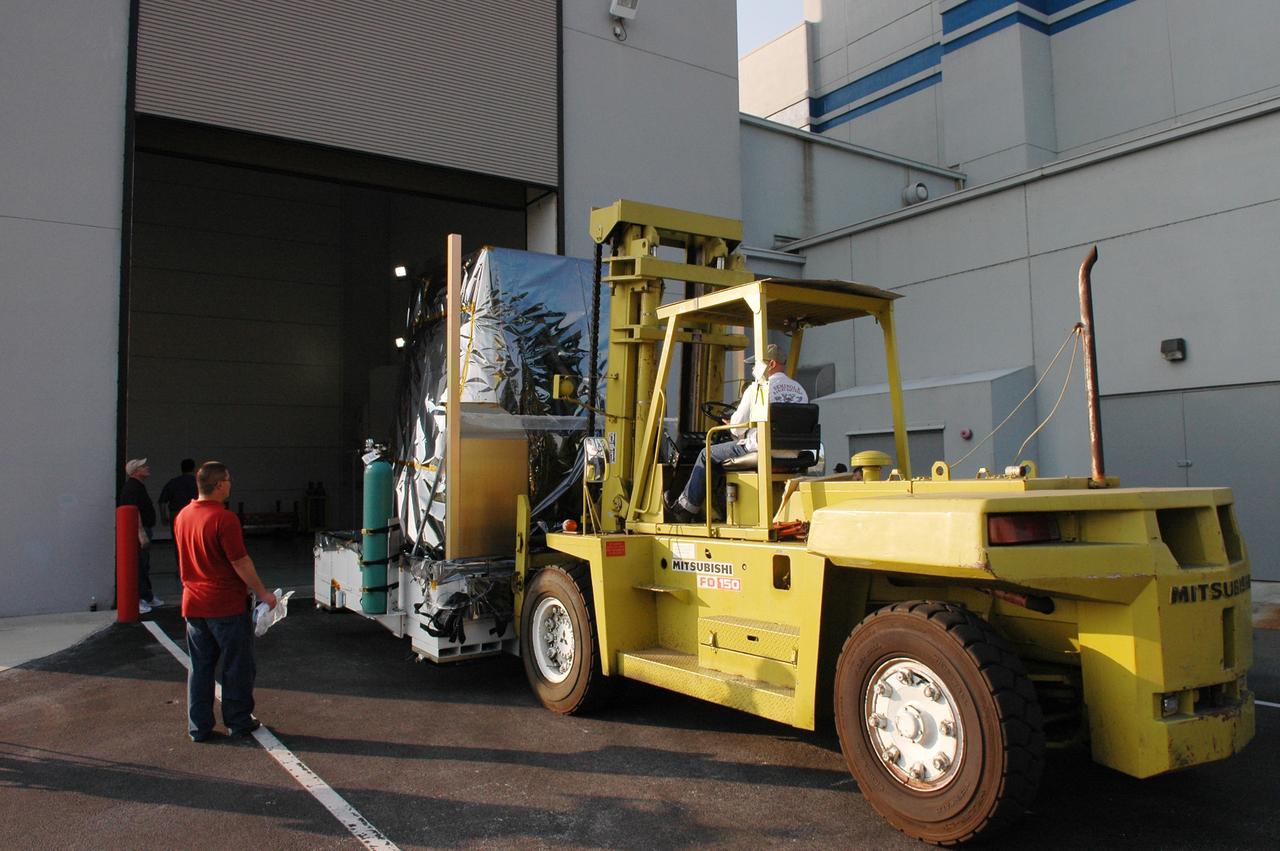
CAPE CANAVERAL, Fla. -- NASA's Gamma-ray Large Area Space Telescope, or GLAST, spacecraft is moved into the Hazardous Processing Facility for fueling. The GLAST is a powerful space observatory that will explore the Universe's ultimate frontier, where nature harnesses forces and energies far beyond anything possible on Earth; probe some of science's deepest questions, such as what our Universe is made of, and search for new laws of physics; explain how black holes accelerate jets of material to nearly light speed; and help crack the mystery of stupendously powerful explosions known as gamma-ray bursts. A launch date still is to be determined. Photo credit: NASA/Jim Grossmann

This view of the gamma-ray sky constructed from one year of Fermi LAT observations is the best view of the extreme universe to date. The map shows the rate at which the LAT detects gamma rays with energies above 300 million electron volts -- about 120 million times the energy of visible light -- from different sky directions. Brighter colors equal higher rates. Credit: NASA/DOE/Fermi LAT Collaboration Full story: <a href="http://www.nasa.gov/mission_pages/GLAST/news/first_year.html" rel="nofollow">www.nasa.gov/mission_pages/GLAST/news/first_year.html</a>
CAPE CANAVERAL, Fla. – At the Astrotech payload processing facility, technicians give NASA's Gamma-ray Large Area Space Telescope, or GLAST, spacecraft a final cleaning. The GLAST is a powerful space observatory that will explore the Universe's ultimate frontier, where nature harnesses forces and energies far beyond anything possible on Earth; probe some of science's deepest questions, such as what our Universe is made of, and search for new laws of physics; explain how black holes accelerate jets of material to nearly light speed; and help crack the mystery of stupendously powerful explosions known as gamma-ray bursts. A launch date is still to be determined. Photo credit: NASA/Jim Grossmann
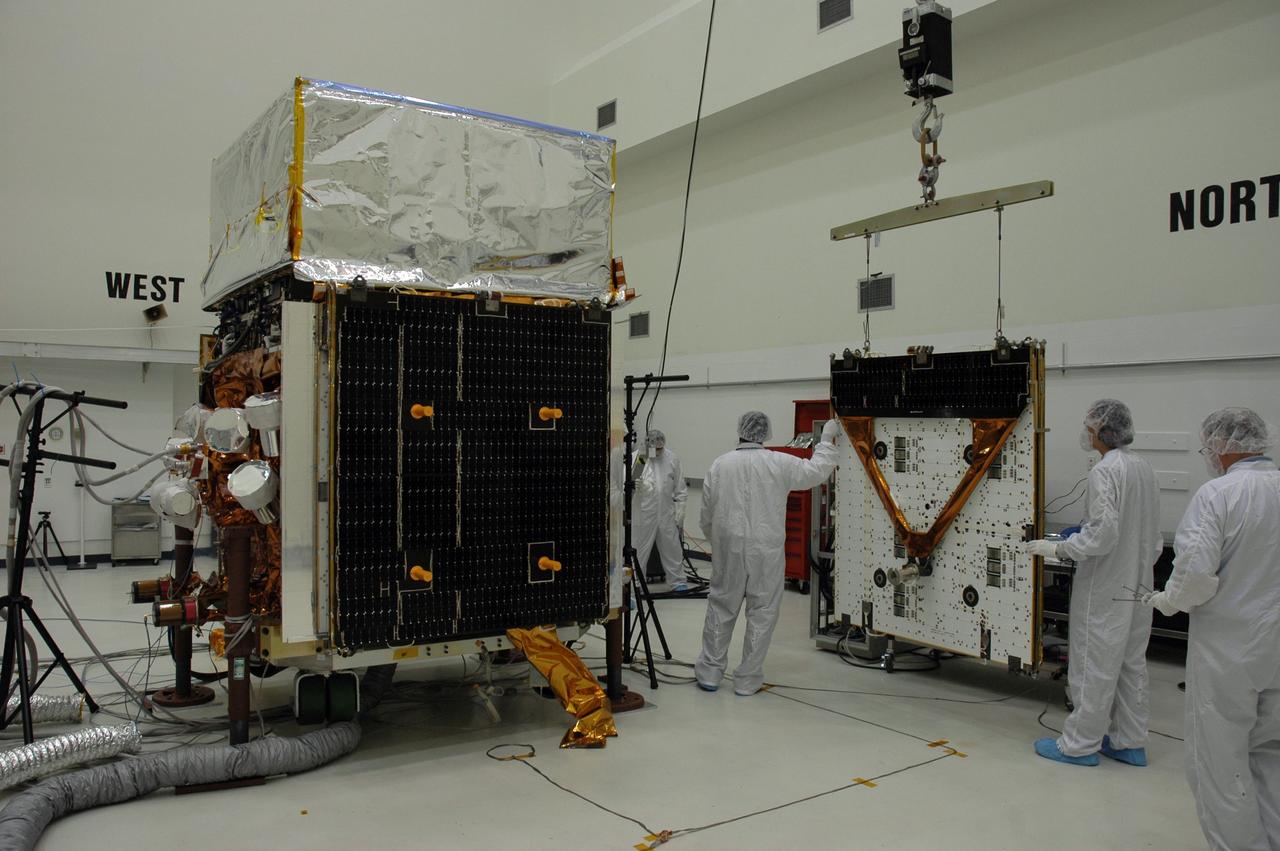
KENNEDY SPACE CENTER, FLA. - In the Astrotech payload processing facility, General Dynamics technicians move the second of twin solar arrays toward NASA's Gamma-Ray Large Area Space Telescope, or GLAST. The telescope will launch aboard a Delta II rocket May 16 from Launch Pad 17-B on Cape Canaveral Air Force Station. A powerful space observatory, the GLAST will explore the most extreme environments in the universe, and answer questions about supermassive black hole systems, pulsars and the origin of cosmic rays. It also will study the mystery of powerful explosions known as gamma-ray bursts. Photo credit: NASA/Chris Rhodes
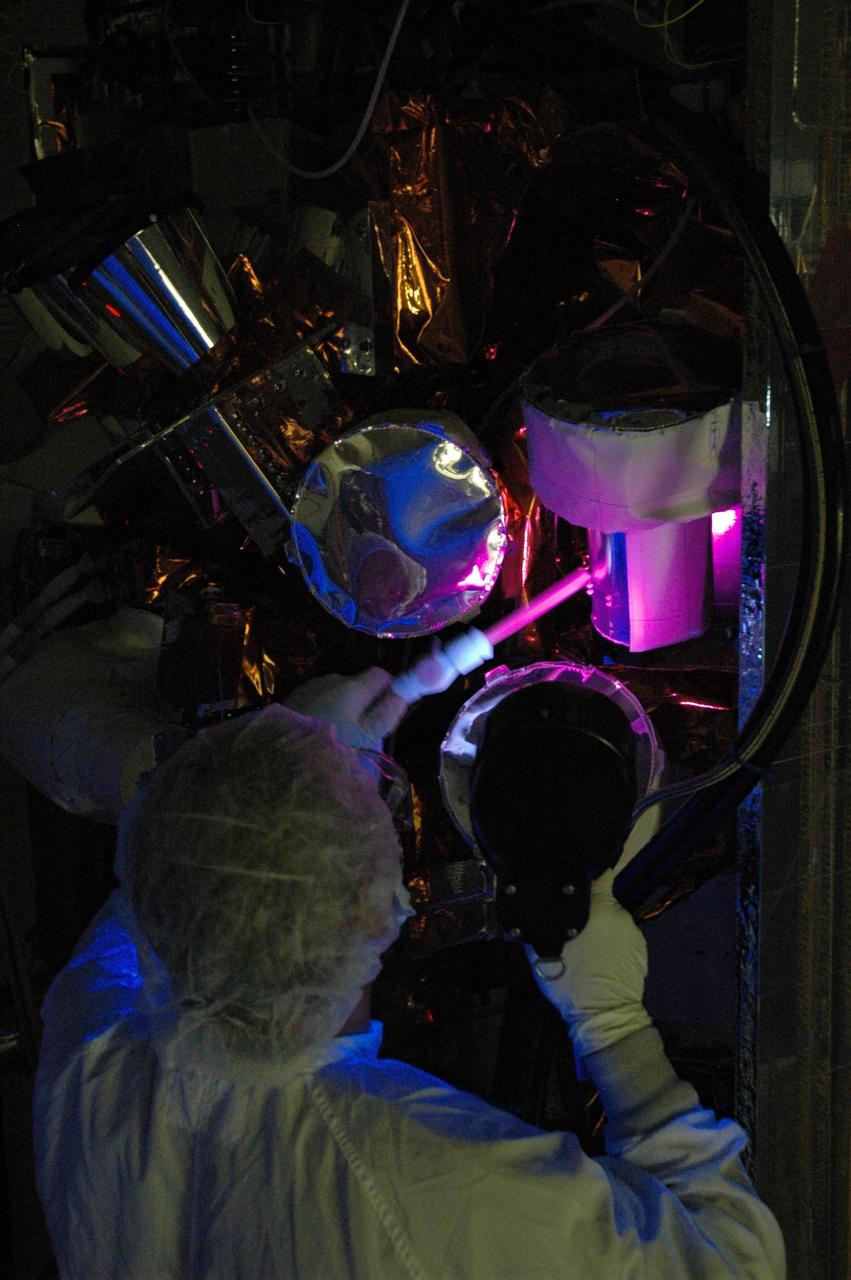
CAPE CANAVERAL, Fla. – At the Astrotech payload processing facility, technicians conduct black light inspection on NASA's Gamma-ray Large Area Space Telescope, or GLAST, spacecraft. The GLAST is a powerful space observatory that will explore the Universe's ultimate frontier, where nature harnesses forces and energies far beyond anything possible on Earth; probe some of science's deepest questions, such as what our Universe is made of, and search for new laws of physics; explain how black holes accelerate jets of material to nearly light speed; and help crack the mystery of stupendously powerful explosions known as gamma-ray bursts. A launch date is still to be determined. Photo credit: NASA/Jim Grossmann
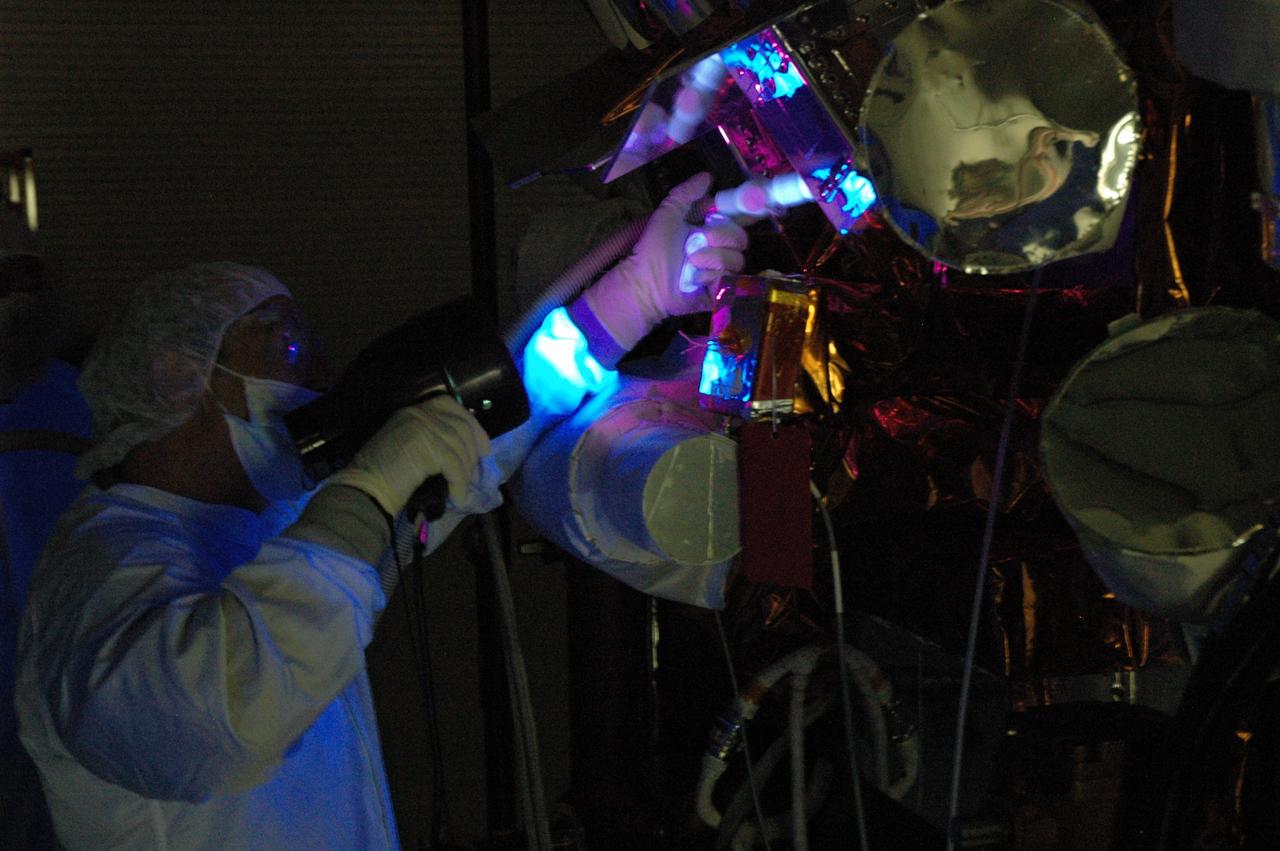
CAPE CANAVERAL, Fla. – At the Astrotech payload processing facility, technicians conduct black light inspection on NASA's Gamma-ray Large Area Space Telescope, or GLAST, spacecraft. The GLAST is a powerful space observatory that will explore the Universe's ultimate frontier, where nature harnesses forces and energies far beyond anything possible on Earth; probe some of science's deepest questions, such as what our Universe is made of, and search for new laws of physics; explain how black holes accelerate jets of material to nearly light speed; and help crack the mystery of stupendously powerful explosions known as gamma-ray bursts. A launch date is still to be determined. Photo credit: NASA/Jim Grossmann
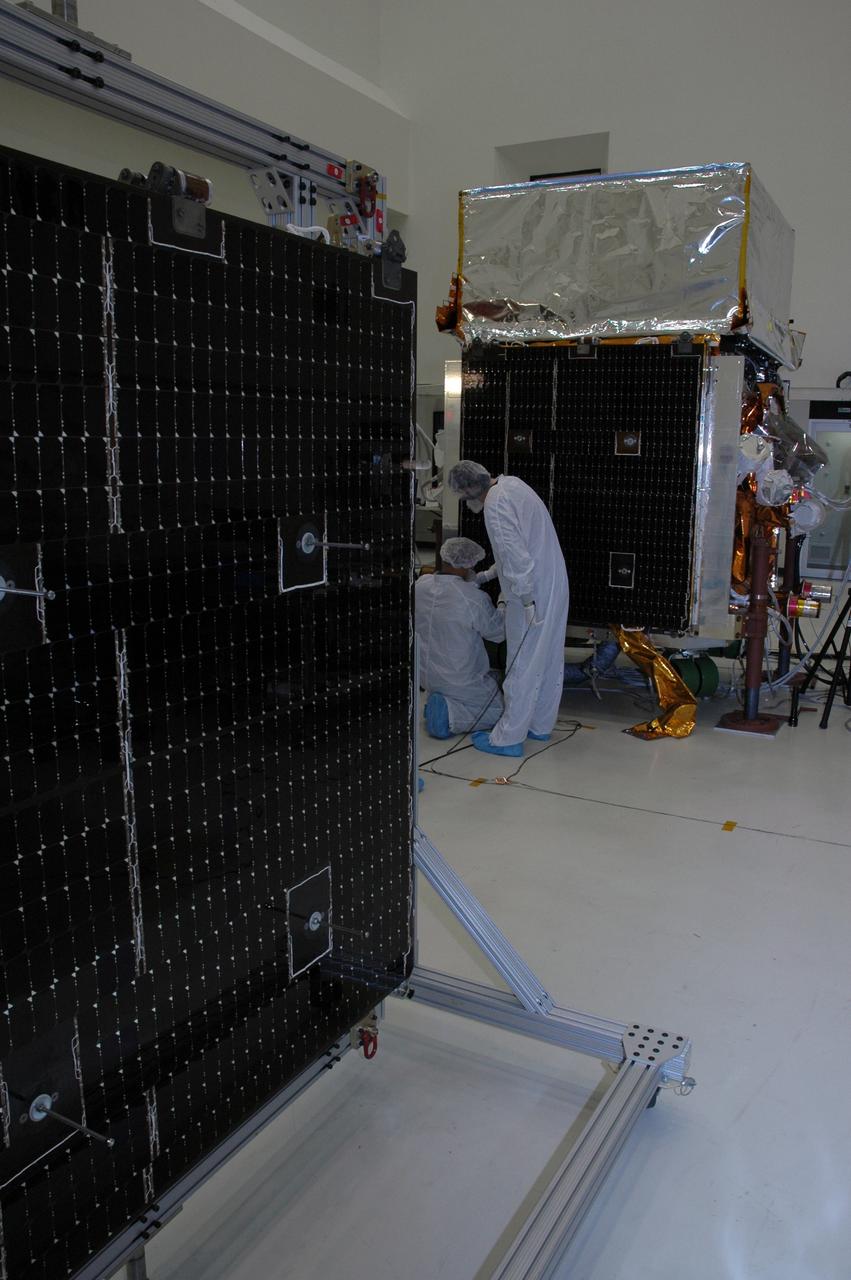
KENNEDY SPACE CENTER, FLA. - In the Astrotech payload processing facility, one of twin solar arrays awaits processing as General Dynamics technicians install the other of the pair on NASA's Gamma-Ray Large Area Space Telescope, or GLAST. The telescope will launch aboard a Delta II rocket May 16 from Launch Pad 17-B on Cape Canaveral Air Force Station. A powerful space observatory, the GLAST will explore the most extreme environments in the universe, and answer questions about supermassive black hole systems, pulsars and the origin of cosmic rays. It also will study the mystery of powerful explosions known as gamma-ray bursts. Photo credit: NASA/Chris Rhodes
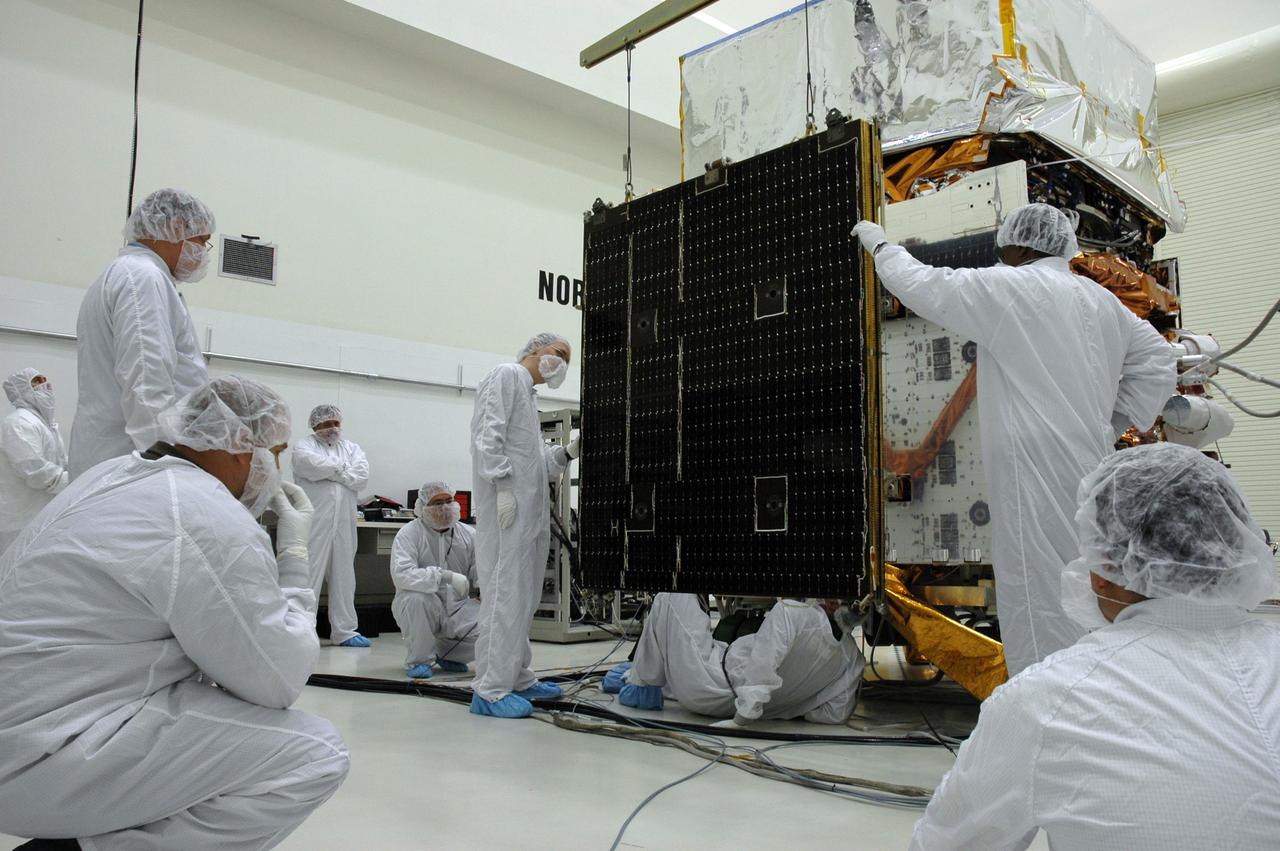
KENNEDY SPACE CENTER, FLA. - In the Astrotech payload processing facility, General Dynamics technicians install the second of twin solar arrays on NASA's Gamma-Ray Large Area Space Telescope, or GLAST. The telescope will launch aboard a Delta II rocket May 16 from Launch Pad 17-B on Cape Canaveral Air Force Station. A powerful space observatory, the GLAST will explore the most extreme environments in the universe, and answer questions about supermassive black hole systems, pulsars and the origin of cosmic rays. It also will study the mystery of powerful explosions known as gamma-ray bursts. Photo credit: NASA/Chris Rhodes
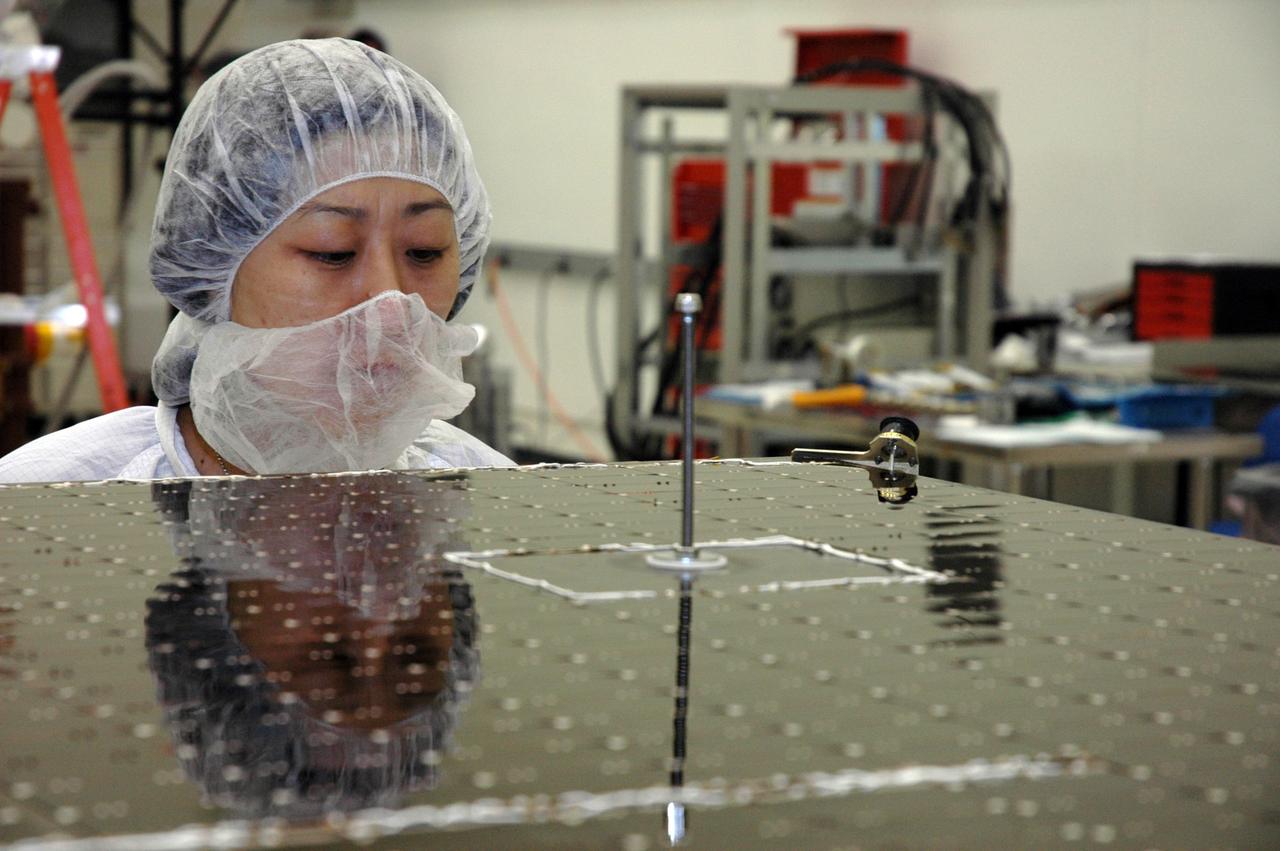
KENNEDY SPACE CENTER, FLA. - In the Astrotech payload processing facility, a General Dynamics technician studies one of twin solar arrays that will be installed on NASA's Gamma-Ray Large Area Space Telescope, or GLAST. The telescope will launch aboard a Delta II rocket May 16 from Launch Pad 17-B on Cape Canaveral Air Force Station. A powerful space observatory, the GLAST will explore the most extreme environments in the universe, and answer questions about supermassive black hole systems, pulsars and the origin of cosmic rays. It also will study the mystery of powerful explosions known as gamma-ray bursts. Photo credit: NASA/Chris Rhodes
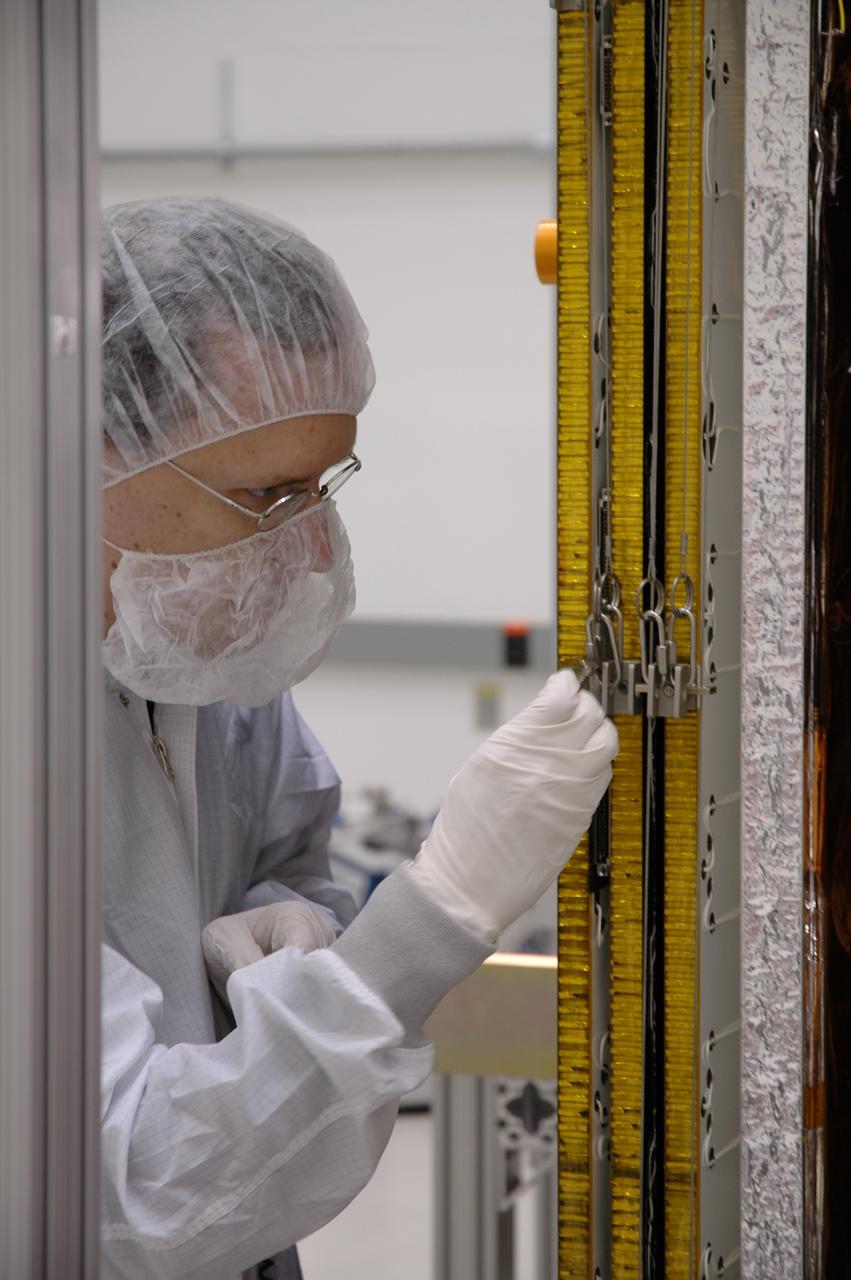
CAPE CANAVERAL, Fla. --- In the Astrotech payload processing facility, a General Dynamics technician prepares to test the deployment mechanism of the solar arrays on NASA's Gamma-Ray Large Area Space Telescope, or GLAST. The telescope will launch aboard a Delta II rocket May 16 from Launch Pad 17-B on Cape Canaveral Air Force Station. A powerful space observatory, the GLAST will explore the most extreme environments in the universe, and answer questions about supermassive black hole systems, pulsars and the origin of cosmic rays. It also will study the mystery of powerful explosions known as gamma-ray bursts. Photo credit: NASA/Jim Grossmann
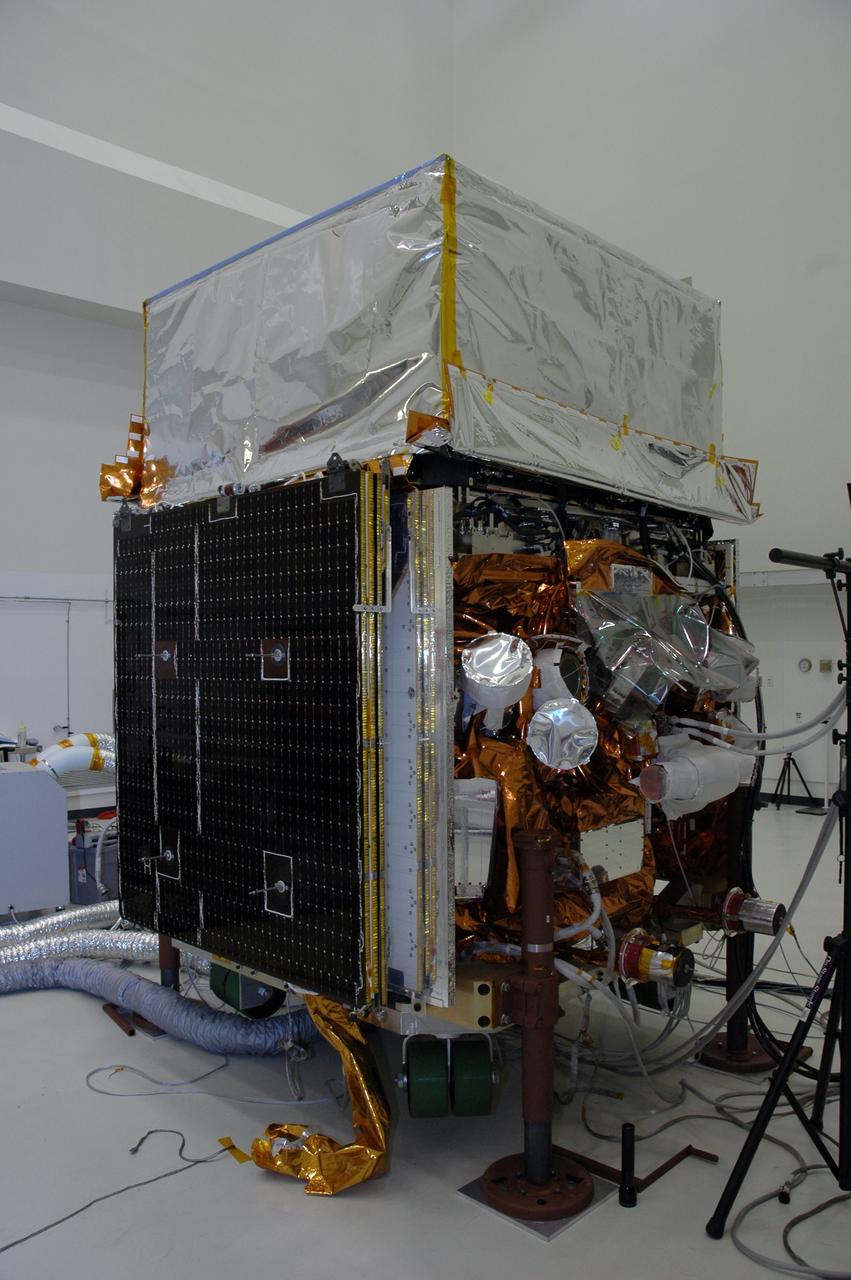
KENNEDY SPACE CENTER, FLA. - In the Astrotech payload processing facility, one of twin solar arrays is positioned on NASA's Gamma-Ray Large Area Space Telescope, or GLAST. The telescope will launch aboard a Delta II rocket May 16 from Launch Pad 17-B on Cape Canaveral Air Force Station. A powerful space observatory, the GLAST will explore the most extreme environments in the universe, and answer questions about supermassive black hole systems, pulsars and the origin of cosmic rays. It also will study the mystery of powerful explosions known as gamma-ray bursts. Photo credit: NASA/Chris Rhodes
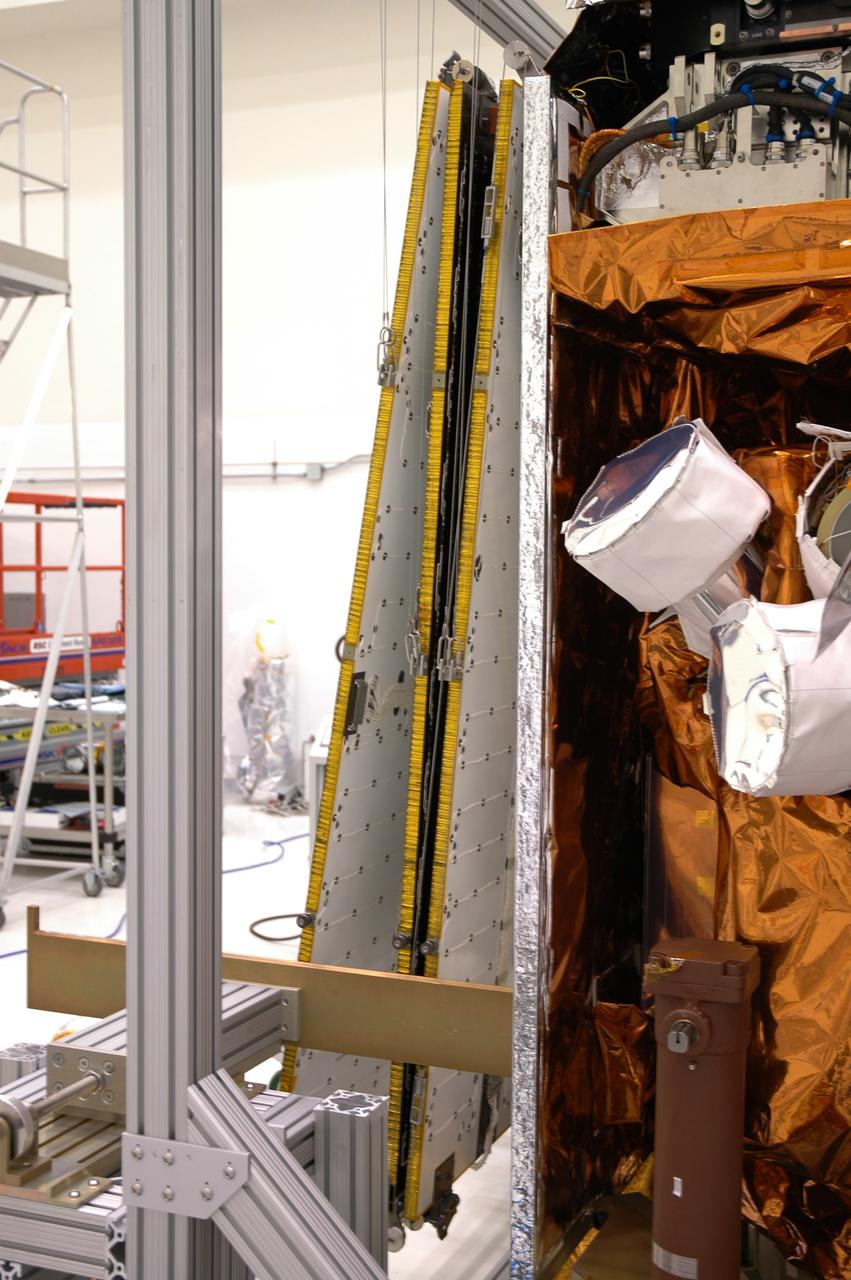
CAPE CANAVERAL, Fla. --- In the Astrotech payload processing facility, the mechanism on NASA's Gamma-Ray Large Area Space Telescope, or GLAST, solar arrays has been released. The telescope will launch aboard a Delta II rocket May 16 from Launch Pad 17-B on Cape Canaveral Air Force Station. A powerful space observatory, the GLAST will explore the most extreme environments in the universe, and answer questions about supermassive black hole systems, pulsars and the origin of cosmic rays. It also will study the mystery of powerful explosions known as gamma-ray bursts. Photo credit: NASA/Jim Grossmann
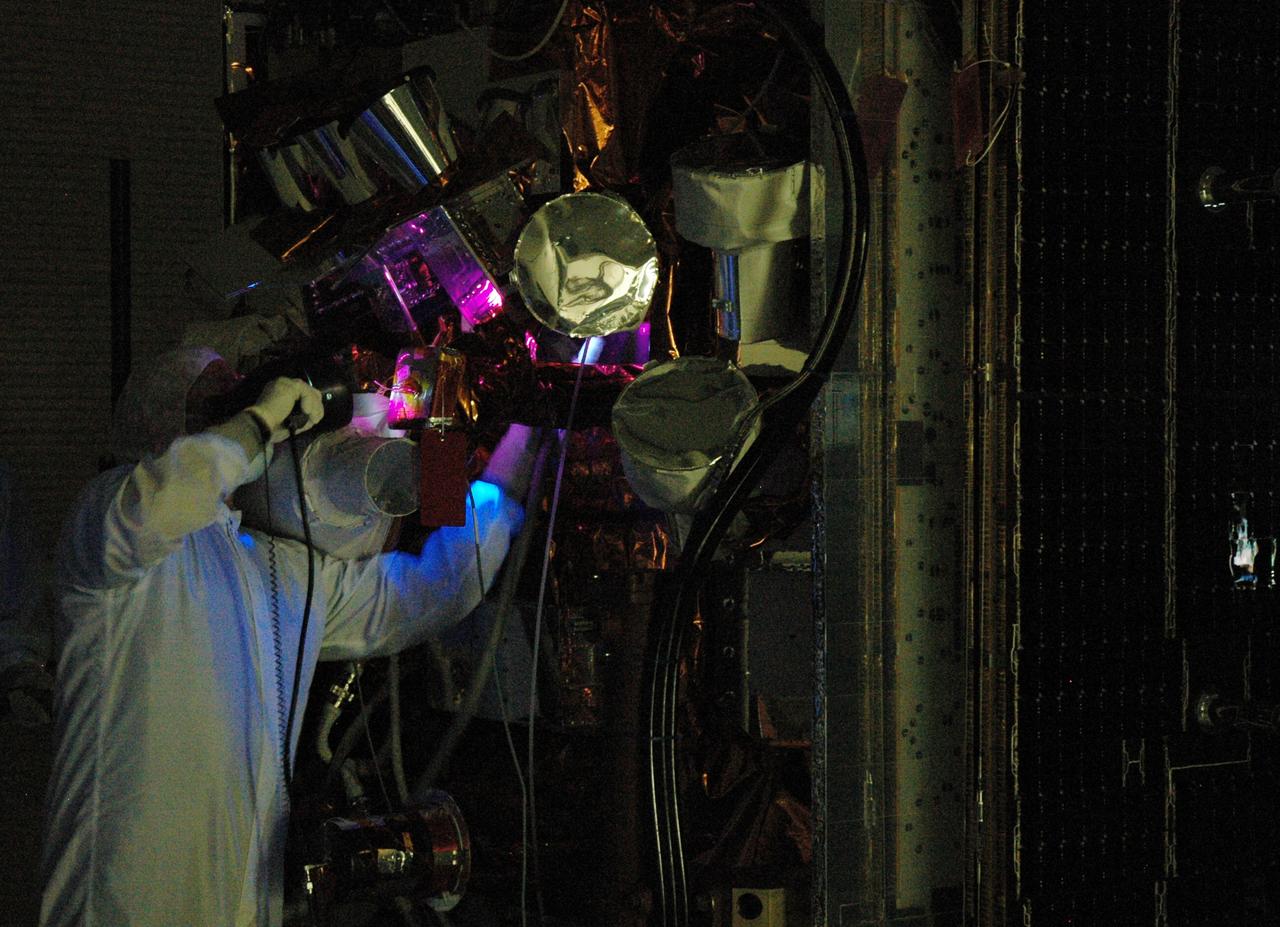
CAPE CANAVERAL, Fla. – At the Astrotech payload processing facility, technicians conduct black light inspection on NASA's Gamma-ray Large Area Space Telescope, or GLAST, spacecraft. The GLAST is a powerful space observatory that will explore the Universe's ultimate frontier, where nature harnesses forces and energies far beyond anything possible on Earth; probe some of science's deepest questions, such as what our Universe is made of, and search for new laws of physics; explain how black holes accelerate jets of material to nearly light speed; and help crack the mystery of stupendously powerful explosions known as gamma-ray bursts. A launch date is still to be determined. Photo credit: NASA/Jim Grossmann
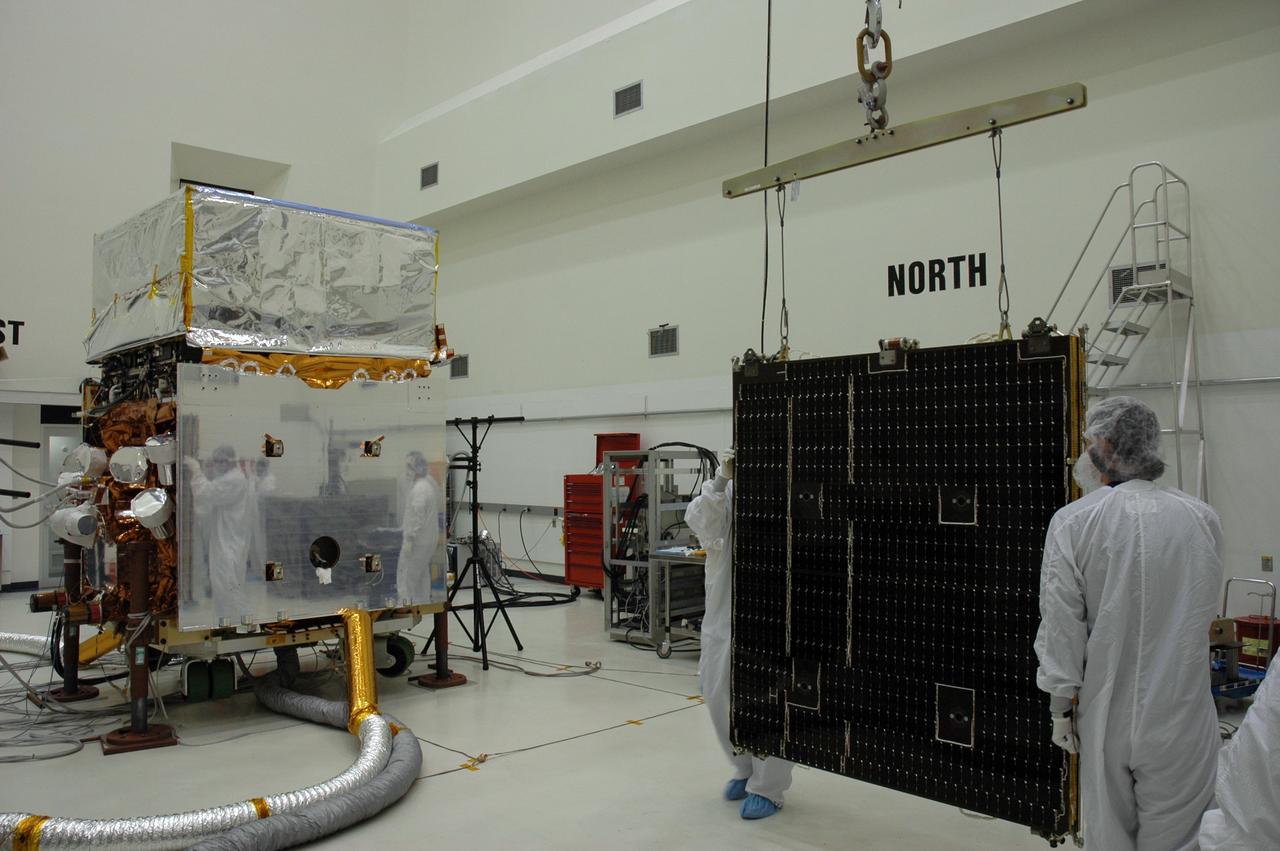
KENNEDY SPACE CENTER, FLA. - In the Astrotech payload processing facility, General Dynamics technicians guide one of twin solar arrays toward NASA's Gamma-Ray Large Area Space Telescope, or GLAST. The telescope will launch aboard a Delta II rocket May 16 from Launch Pad 17-B on Cape Canaveral Air Force Station. A powerful space observatory, the GLAST will explore the most extreme environments in the universe, and answer questions about supermassive black hole systems, pulsars and the origin of cosmic rays. It also will study the mystery of powerful explosions known as gamma-ray bursts. Photo credit: NASA/Chris Rhodes
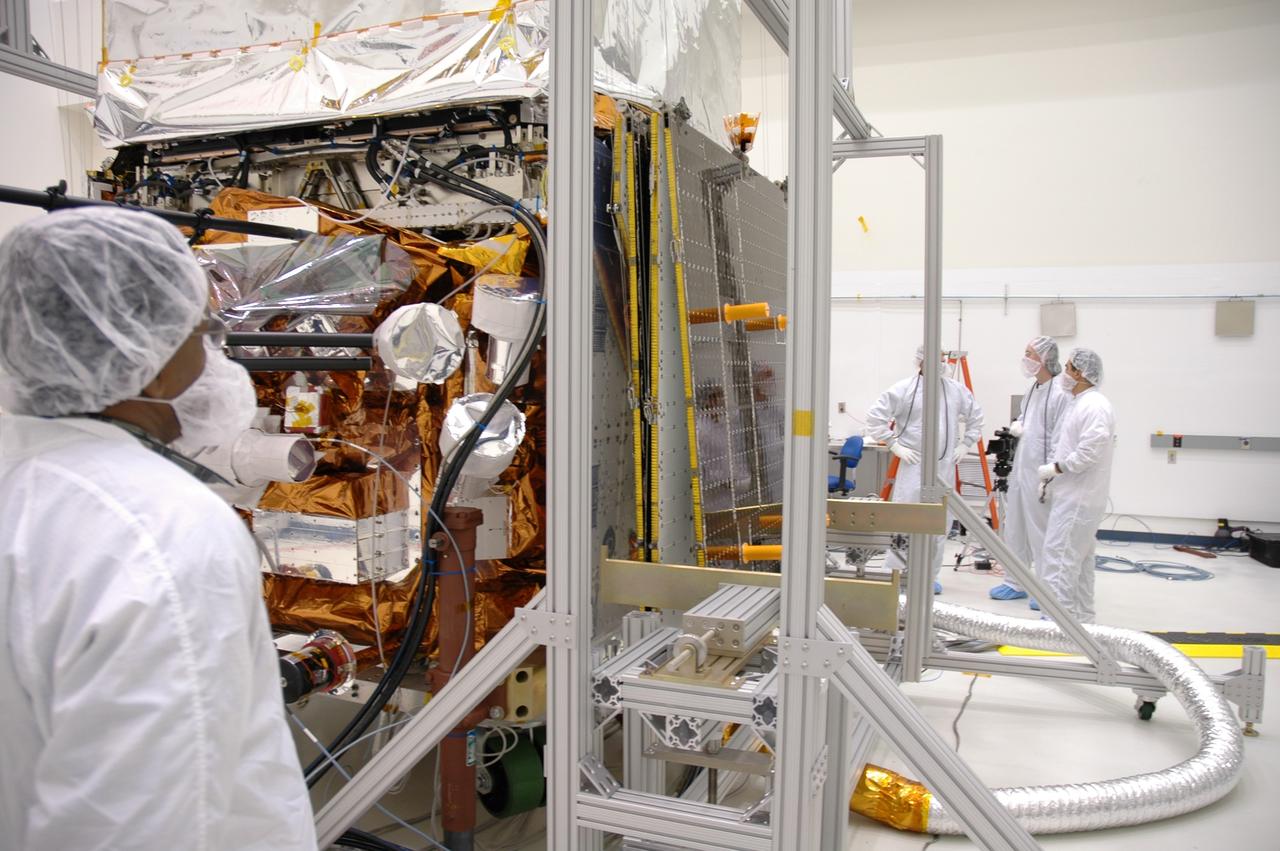
CAPE CANAVERAL, Fla. --- In the Astrotech payload processing facility, NASA's Gamma-Ray Large Area Space Telescope, or GLAST, completes the test of the deployment mechanism on its solar arrays. The telescope will launch aboard a Delta II rocket May 16 from Launch Pad 17-B on Cape Canaveral Air Force Station. A powerful space observatory, the GLAST will explore the most extreme environments in the universe, and answer questions about supermassive black hole systems, pulsars and the origin of cosmic rays. It also will study the mystery of powerful explosions known as gamma-ray bursts. Photo credit: NASA/Jim Grossmann
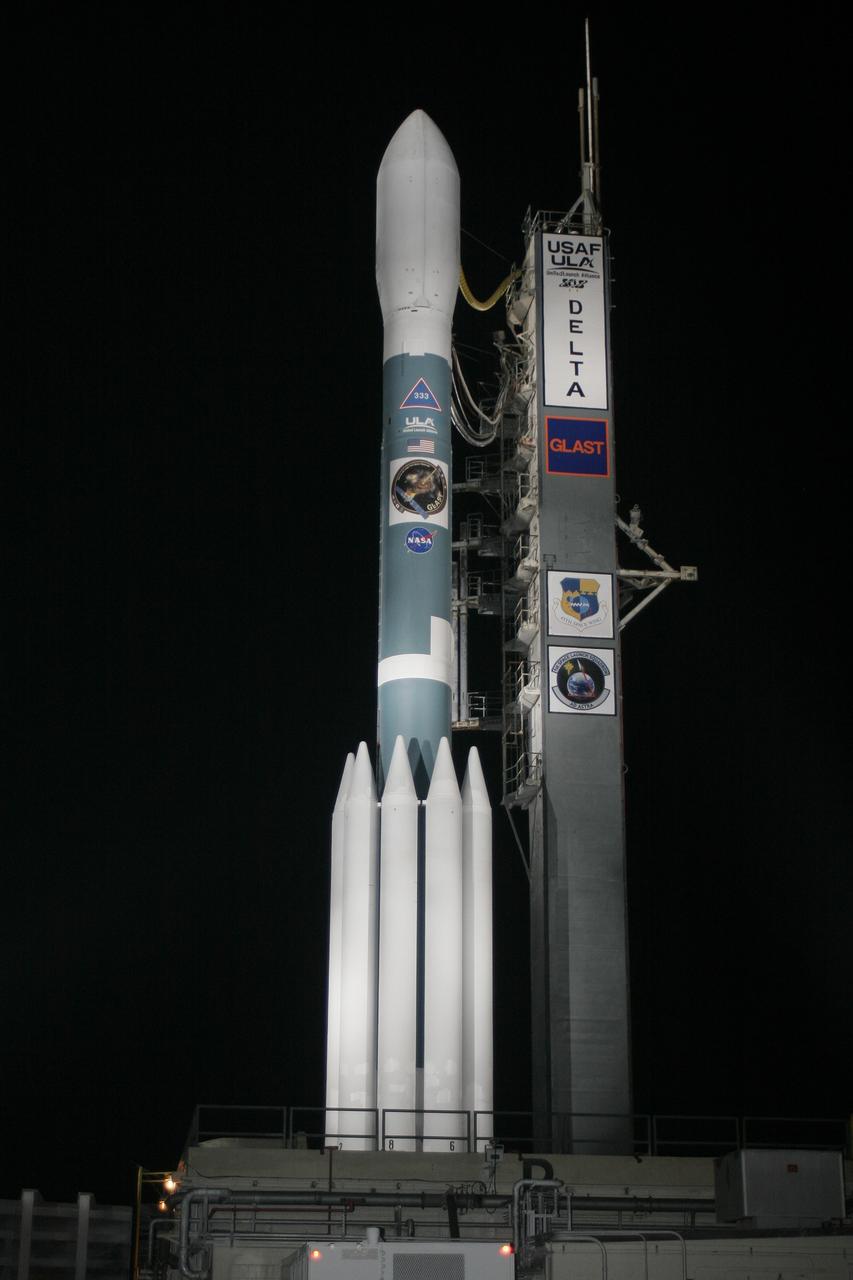
CAPE CANAVERAL, Fla. -- On Cape Canaveral Air Force Station's Launch Pad 17-B, NASA's Gamma-ray Large Area Space Telescope , or GLAST, sits poised for launch atop the United Launch Alliance Delta II rocket after rollback of the mobile service tower. GLAST is a powerful space observatory that will explore the universe's ultimate frontier, where nature harnesses forces and energies far beyond anything possible on Earth; probe some of science's deepest questions, such as what our universe is made of, and search for new laws of physics; explain how black holes accelerate jets of material to nearly light speed; and help crack the mystery of stupendously powerful explosions known as gamma-ray bursts. Launch is scheduled for 11:45 a.m. June 11. Photo credit: Carleton Bailie photograph for United Launch Alliance
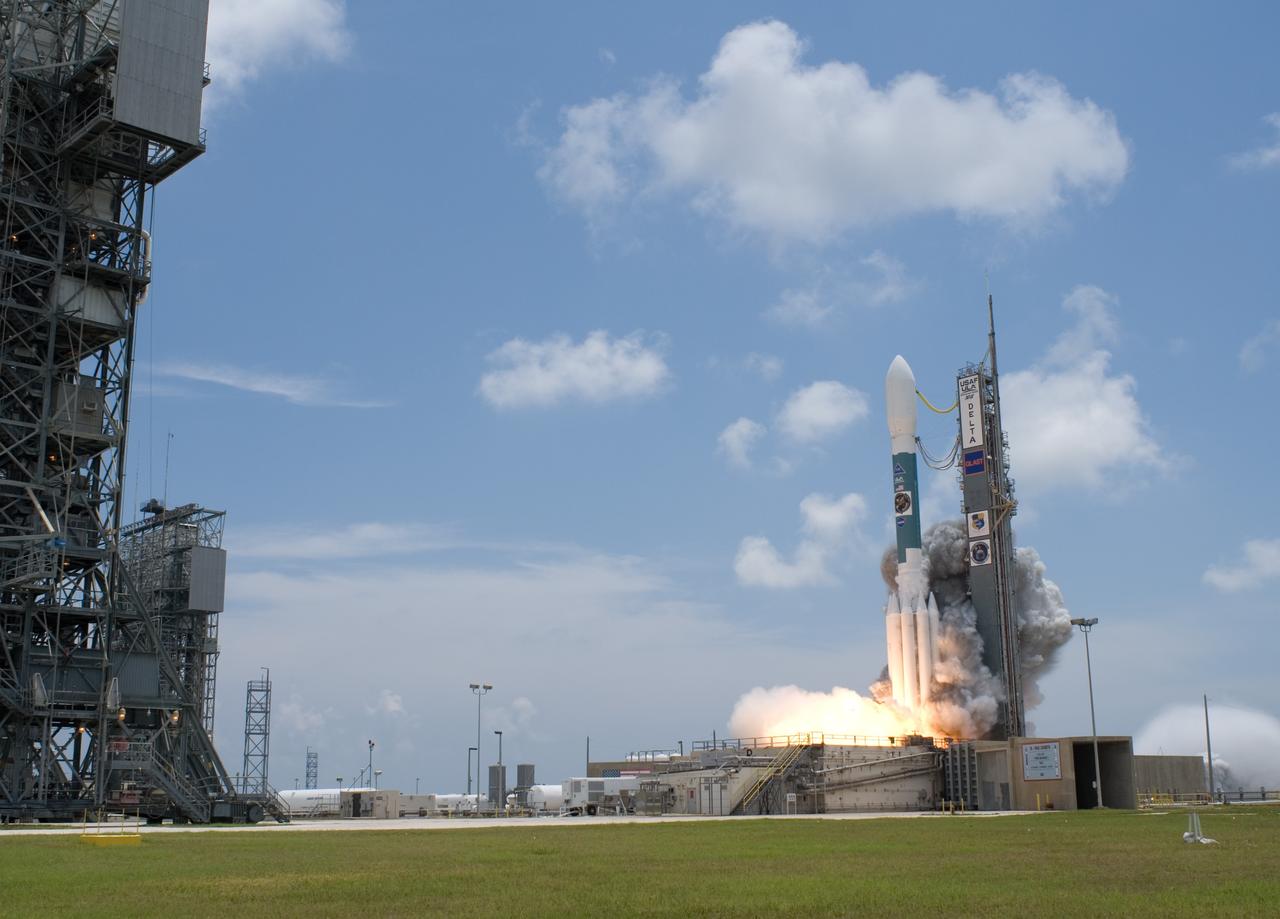
CAPE CANAVERAL, Fla. -- Smoke is generated at liftoff of NASA's Gamma-Ray Large Area Space Telescope , or GLAST, aboard a Delta II rocket from Cape Canaveral Air Force Station's Launch Pad 17-B. Liftoff was at 12:05 p.m. EDT. GLAST is a powerful space observatory that will explore the universe's ultimate frontier, where nature harnesses forces and energies far beyond anything possible on Earth; probe some of science's deepest questions, such as what our universe is made of, and search for new laws of physics; explain how black holes accelerate jets of material to nearly light speed; and help crack the mystery of stupendously powerful explosions known as gamma-ray bursts. Launch is scheduled for 11:45 a.m. June 11. Photo credit: NASA/Tony Gray, Regina Mitchell-Ryall
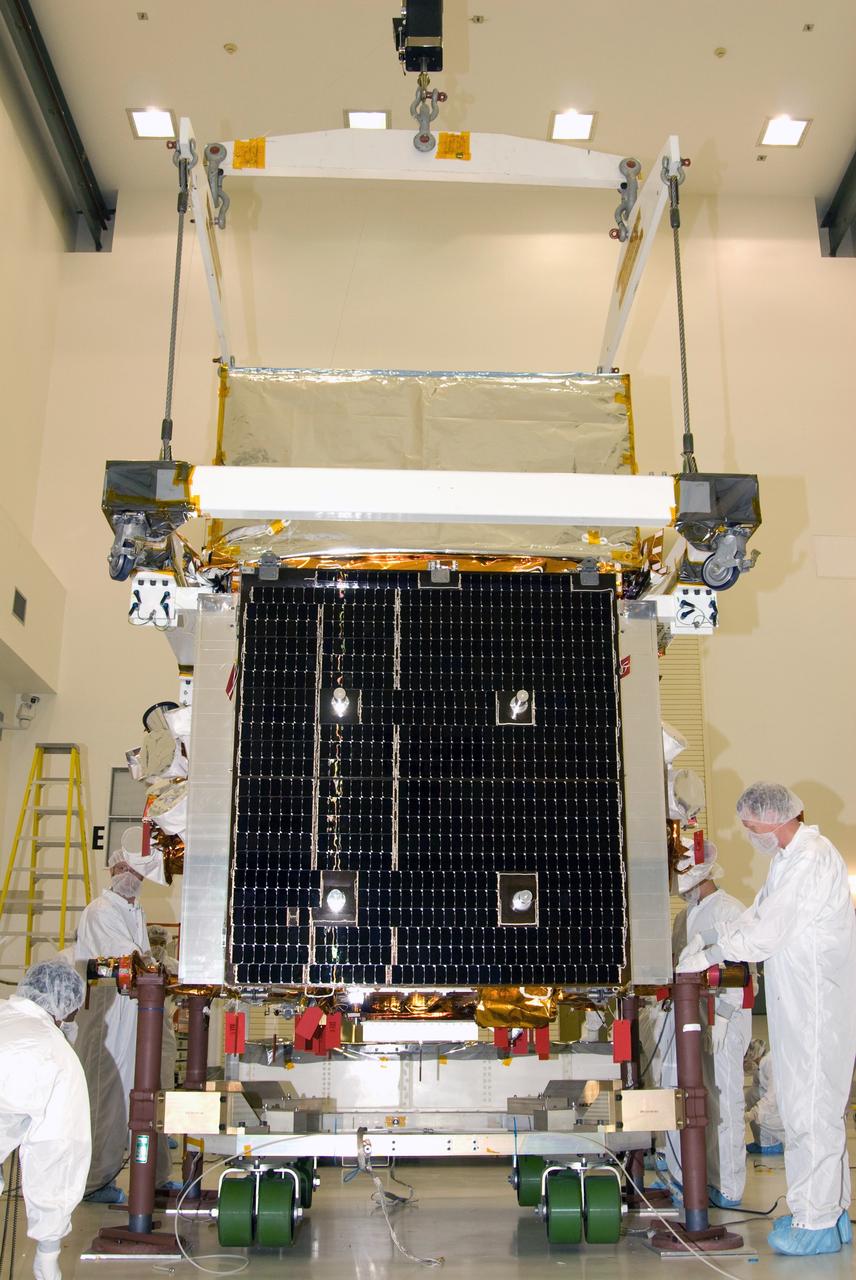
CAPE CANAVERAL, Fla. -- At the Astrotech payload processing facility in Titusville, Fla., the overhead crane continues to lower NASA's Gamma-ray Large Area Space Telescope, or GLAST, spacecraft onto the transporter. The spacecraft is being prepared for its move to the Hazardous Processing Facility for fueling. The GLAST is a powerful space observatory that will explore the universe's ultimate frontier, where nature harnesses forces and energies far beyond anything possible on Earth; probe some of science's deepest questions, such as what our Universe is made of, and search for new laws of physics; explain how black holes accelerate jets of material to nearly light speed; and help crack the mystery of stupendously powerful explosions known as gamma-ray bursts. A launch date is still to be determined. Photo credit: NASA/Mike Kerley
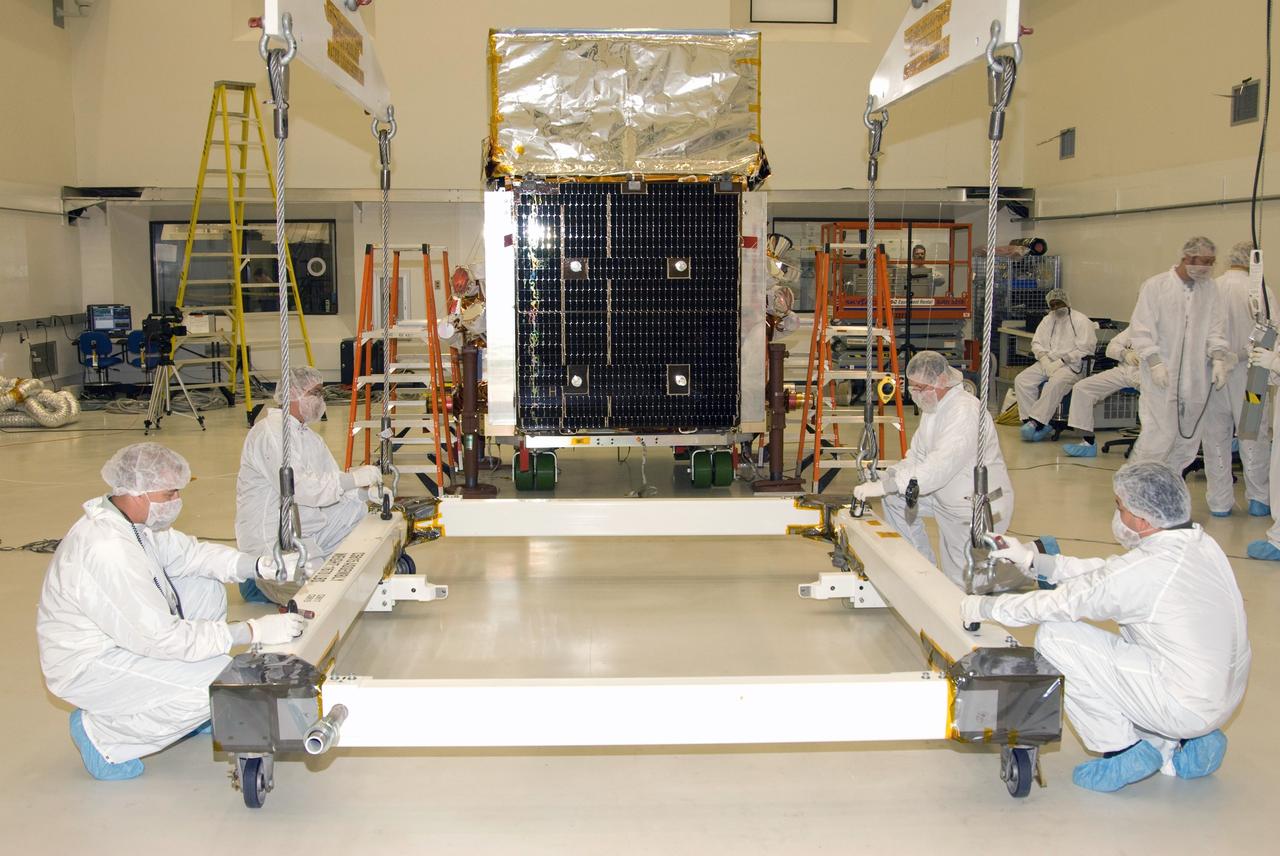
CAPE CANAVERAL, Fla. -- At the Astrotech payload processing facility in Titusville, Fla., technicians attach the cables to the overhead crane that will be used to lift NASA's Gamma-ray Large Area Space Telescope, or GLAST, spacecraft. The spacecraft is being prepared for its move to the Hazardous Processing Facility for fueling. The GLAST is a powerful space observatory that will explore the universe's ultimate frontier, where nature harnesses forces and energies far beyond anything possible on Earth; probe some of science's deepest questions, such as what our Universe is made of, and search for new laws of physics; explain how black holes accelerate jets of material to nearly light speed; and help crack the mystery of stupendously powerful explosions known as gamma-ray bursts. A launch date is still to be determined. Photo credit: NASA/Mike Kerley
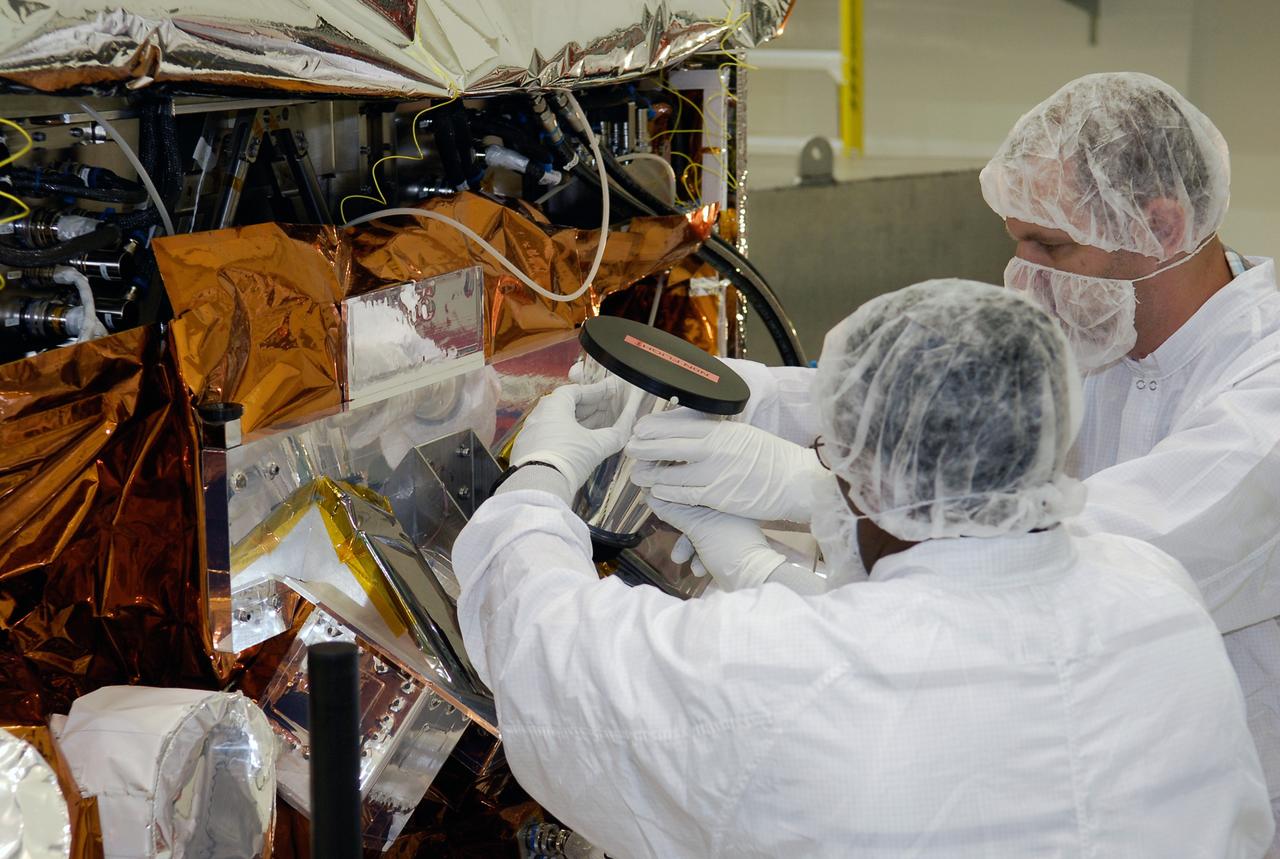
CAPE CANAVERAL, Fla. -- At the Astrotech payload processing facility in Titusville, Fla., workers install one of the star tracker sun shades on NASA's Gamma-ray Large Area Space Telescope, or GLAST, spacecraft. The GLAST is a powerful space observatory that will explore the Universe's ultimate frontier, where nature harnesses forces and energies far beyond anything possible on Earth; probe some of science's deepest questions, such as what our Universe is made of, and search for new laws of physics; explain how black holes accelerate jets of material to nearly light speed; and help crack the mystery of stupendously powerful explosions known as gamma-ray bursts. A launch date is still to be determined. Photo credit: NASA/Kim Shiflett
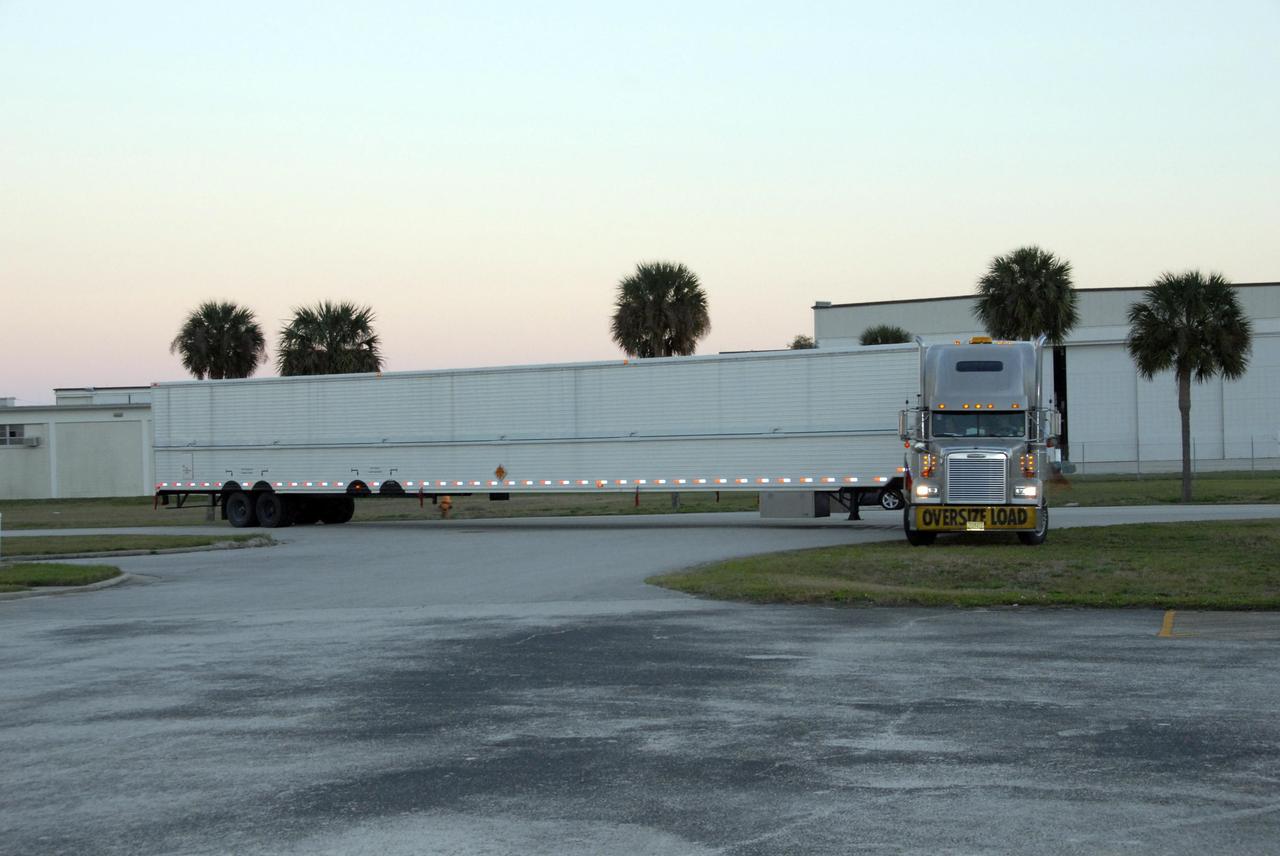
KENNEDY SPACE CENTER, FLA. -- The truck carrying the United Launch Alliance Delta II first stage arrives at Hangar M on Cape Canaveral Air Force Station in Florida. The Delta rocket will be used to launch the Gamma-Ray Large Area Space Telescope, or GLAST, in May from Launch Pad 17-B on CCAFS. The GLAST is a powerful space observatory that will explore the Universe's ultimate frontier, where nature harnesses forces and energies far beyond anything possible on Earth; probe some of science's deepest questions, such as what our Universe is made of, and search for new laws of physics; explain how black holes accelerate jets of material to nearly light speed; and help crack the mystery of stupendously powerful explosions known as gamma-ray bursts. Photo credit: NASA/George Shelton
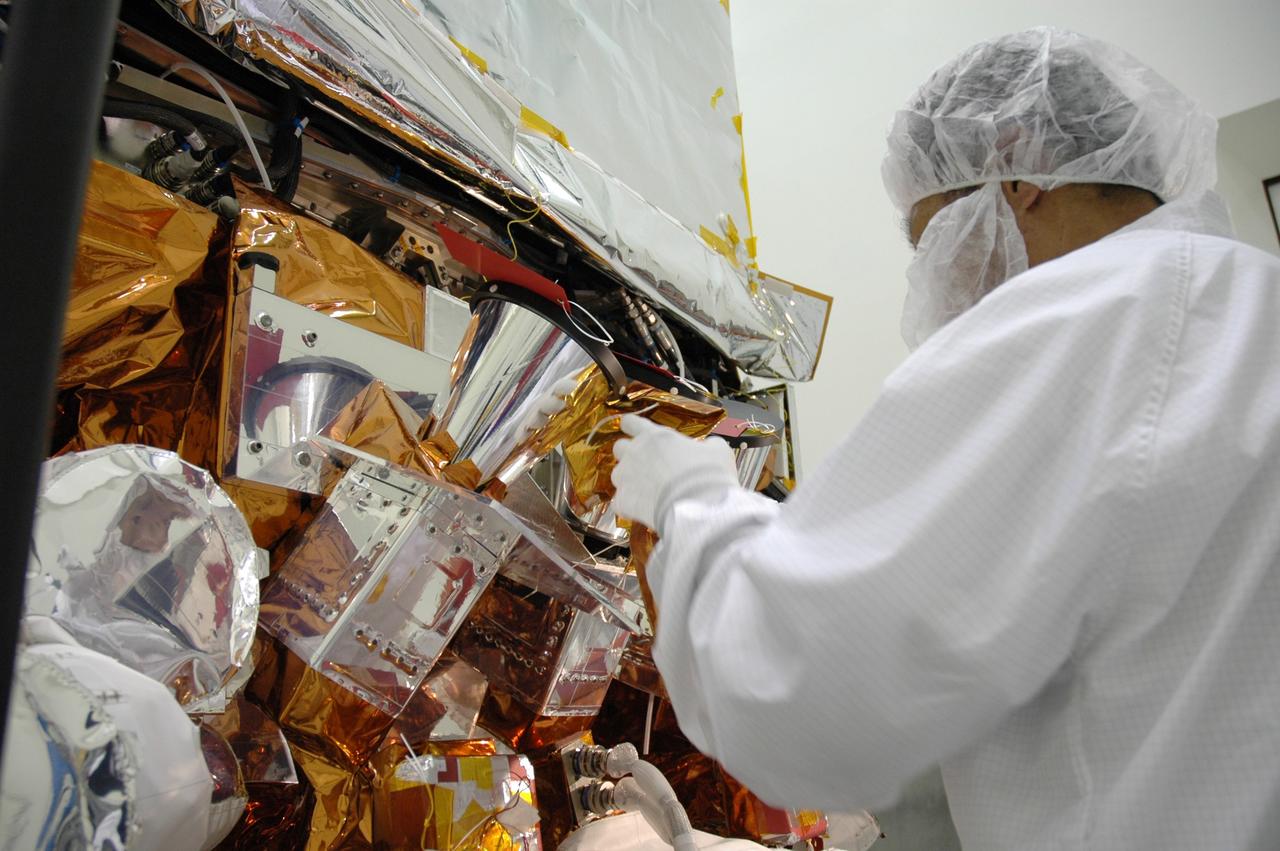
CAPE CANAVERAL, Fla. – At the Astrotech payload processing facility, technicians install insulation blankets around the star tracker sunshades on NASA's Gamma-ray Large Area Space Telescope, or GLAST, spacecraft. The GLAST is a powerful space observatory that will explore the Universe's ultimate frontier, where nature harnesses forces and energies far beyond anything possible on Earth; probe some of science's deepest questions, such as what our Universe is made of, and search for new laws of physics; explain how black holes accelerate jets of material to nearly light speed; and help crack the mystery of stupendously powerful explosions known as gamma-ray bursts. A launch date is still to be determined. Photo credit: NASA/Jim Grossmann
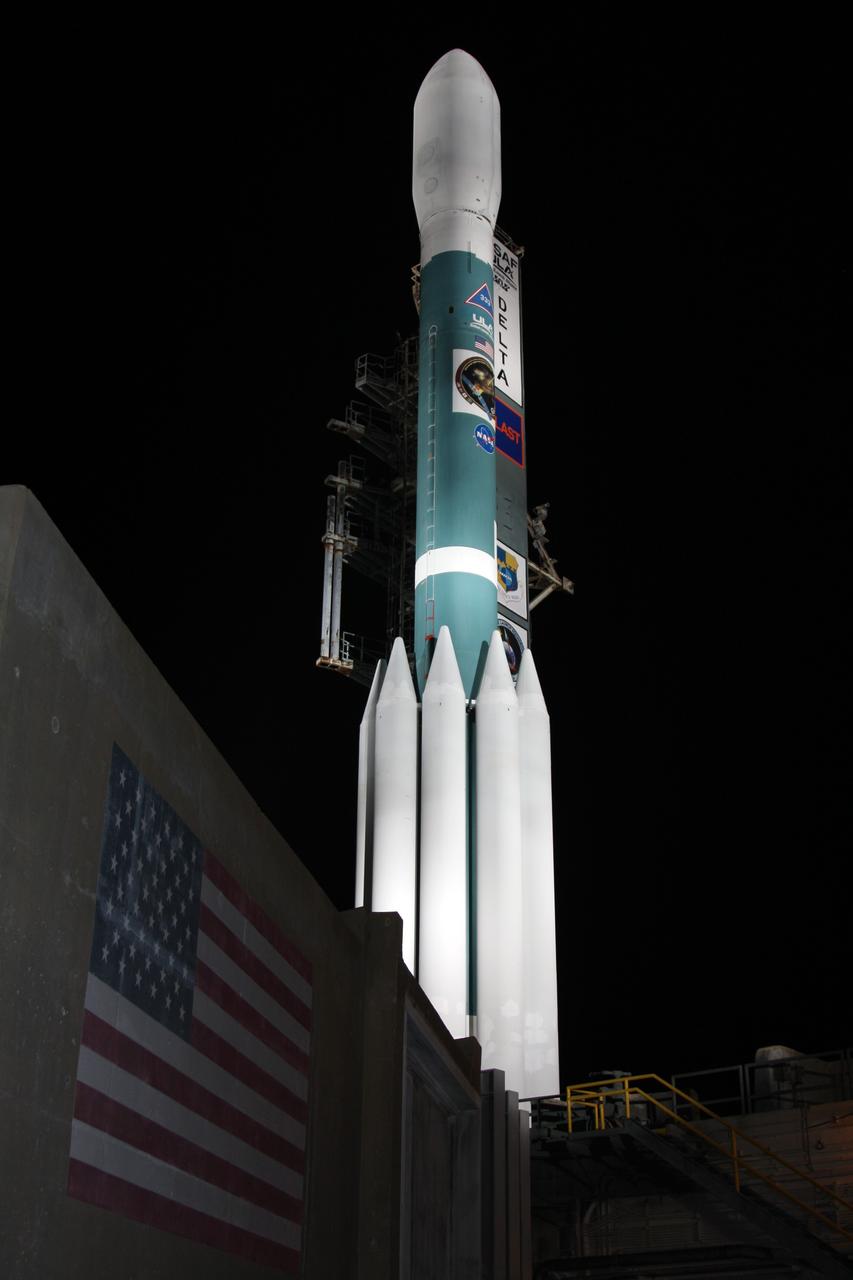
CAPE CANAVERAL, Fla. -- NASA's Gamma-ray Large Area Space Telescope, or GLAST, spacecraft atop the Delta II rocket is spotlighted after rollback of the mobile service tower on Cape Canaveral Air Force Station's Launch Pad 17-B. GLAST is a powerful space observatory that will explore the universe's ultimate frontier, where nature harnesses forces and energies far beyond anything possible on Earth; probe some of science's deepest questions, such as what our universe is made of, and search for new laws of physics; explain how black holes accelerate jets of material to nearly light speed; and help crack the mystery of stupendously powerful explosions known as gamma-ray bursts. Launch is scheduled for 11:45 a.m. June 11. Photo credit: NASA/Dimitri Gerondidakis
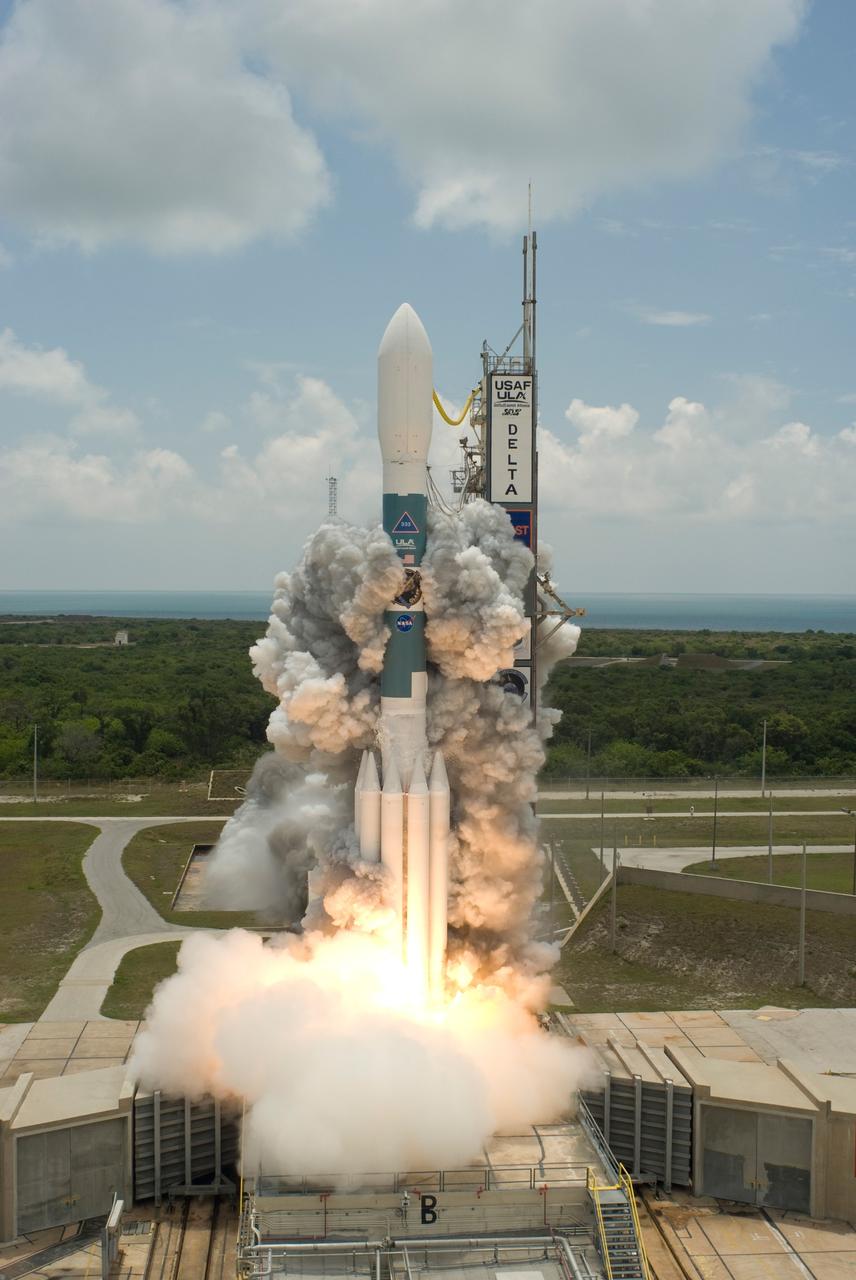
CAPE CANAVERAL, Fla. -- Smoke appears to grab at the Delta II rocket as it launches from Cape Canaveral Air Force Station's Launch Pad 17-B with NASA's Gamma-Ray Large Area Space Telescope , or GLAST, aboard. Liftoff was at 12:05 p.m. EDT. GLAST is a powerful space observatory that will explore the universe's ultimate frontier, where nature harnesses forces and energies far beyond anything possible on Earth; probe some of science's deepest questions, such as what our universe is made of, and search for new laws of physics; explain how black holes accelerate jets of material to nearly light speed; and help crack the mystery of stupendously powerful explosions known as gamma-ray bursts. Launch is scheduled for 11:45 a.m. June 11. Photo credit: NASA/Jerry Cannon, Robert Murray
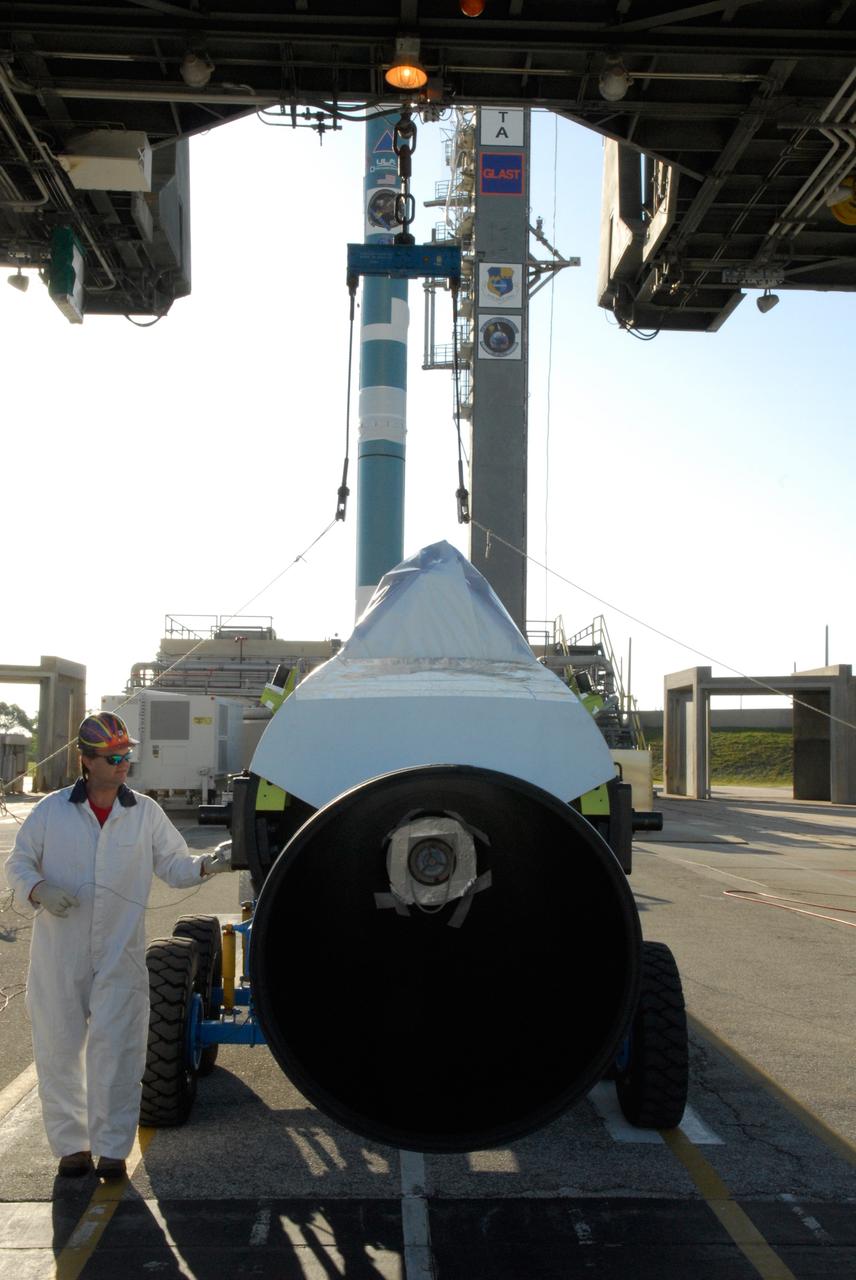
CAPE CANAVERAL, Fla. --- The first solid rocket motor arrives at Pad 17-B on Cape Canaveral Air Force Station for mating with the Delta II rocket (background) to launch NASA's Gamma-ray Large Area Space Telescope, or GLAST, spacecraft. A series of nine strap-on solid rocket motors will help power the first stage.The GLAST is a powerful space observatory that will explore the Universe's ultimate frontier, where nature harnesses forces and energies far beyond anything possible on Earth; probe some of science's deepest questions, such as what our Universe is made of, and search for new laws of physics; explain how black holes accelerate jets of material to nearly light speed; and help crack the mystery of stupendously powerful explosions known as gamma-ray bursts. Launch is currently planned for May 16 from Pad 17-B. Photo credit: NASA/Dimitri Gerondidakis
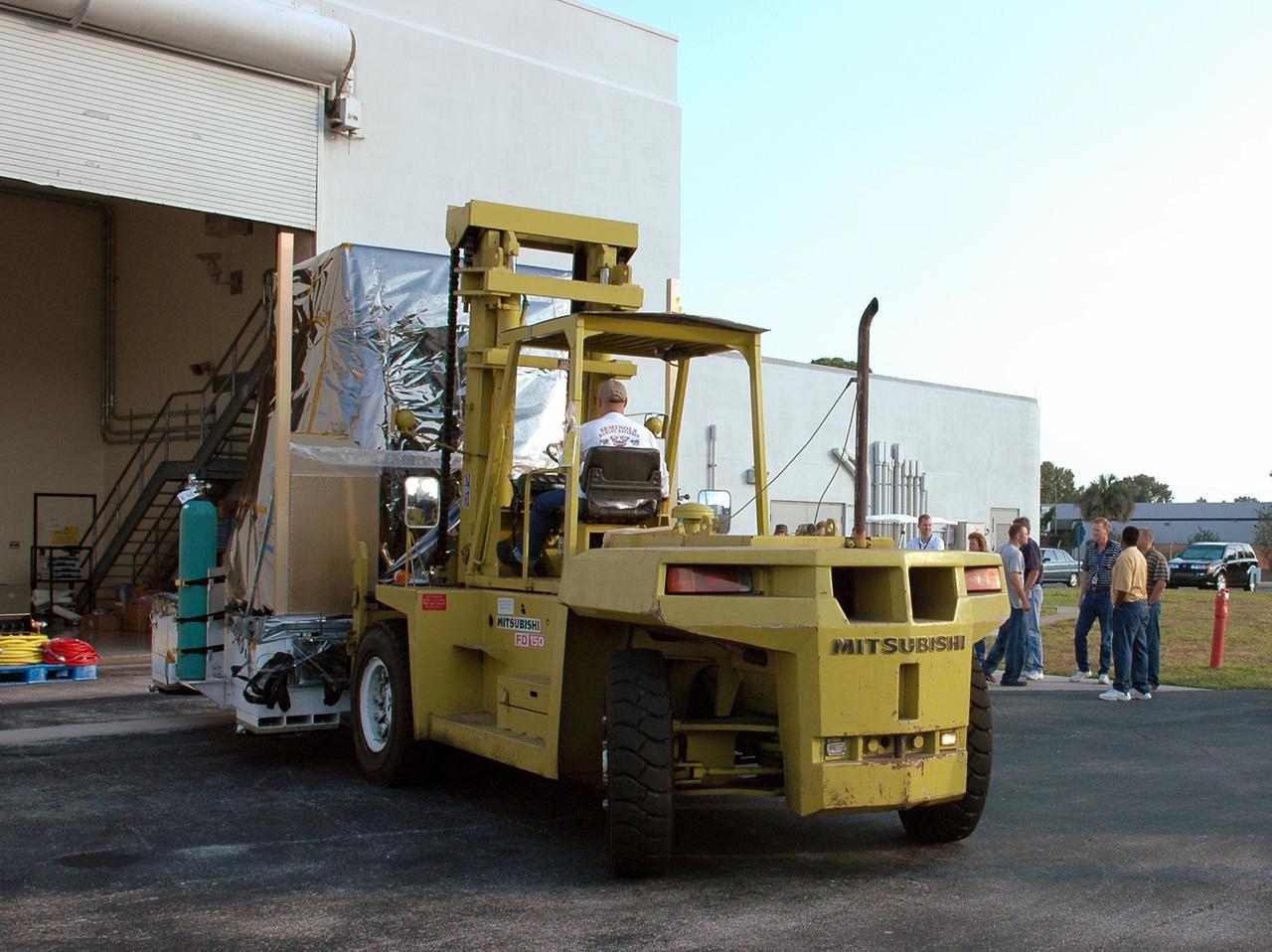
CAPE CANAVERAL, Fla. -- NASA's Gamma-ray Large Area Space Telescope, or GLAST, spacecraft is moved out of the Astrotech payload processing facility in Titusville, Fla. It is being transported to the Hazardous Processing Facility for fueling. The GLAST is a powerful space observatory that will explore the Universe's ultimate frontier, where nature harnesses forces and energies far beyond anything possible on Earth; probe some of science's deepest questions, such as what our Universe is made of, and search for new laws of physics; explain how black holes accelerate jets of material to nearly light speed; and help crack the mystery of stupendously powerful explosions known as gamma-ray bursts. A launch date still is to be determined. Photo credit: NASA/Jim Grossmann
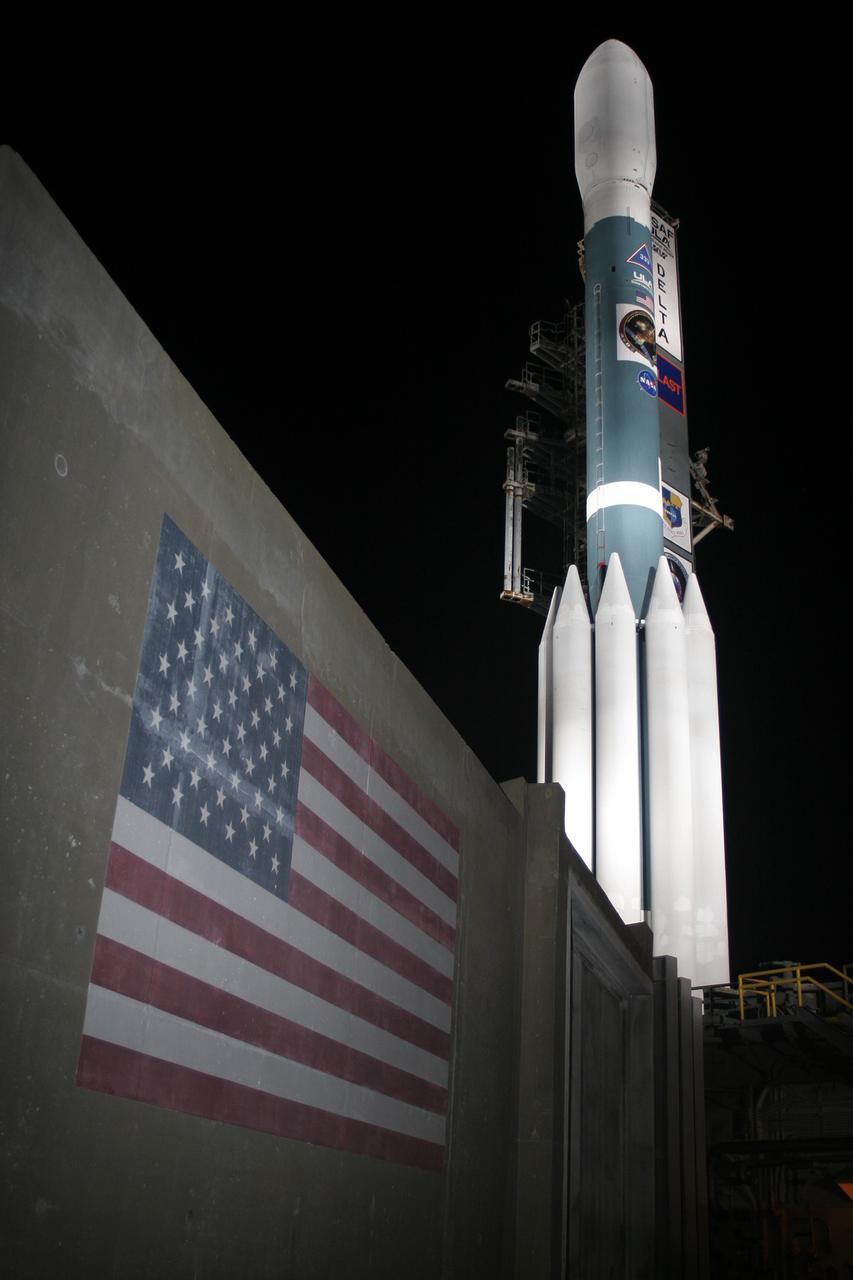
CAPE CANAVERAL, Fla. -- On Cape Canaveral Air Force Station's Launch Pad 17-B, NASA's Gamma-ray Large Area Space Telescope , or GLAST, sits poised for launch atop the United Launch Alliance Delta II rocket after rollback of the mobile service tower. GLAST is a powerful space observatory that will explore the universe's ultimate frontier, where nature harnesses forces and energies far beyond anything possible on Earth; probe some of science's deepest questions, such as what our universe is made of, and search for new laws of physics; explain how black holes accelerate jets of material to nearly light speed; and help crack the mystery of stupendously powerful explosions known as gamma-ray bursts. Launch is scheduled for 11:45 a.m. June 11. Photo credit: Carleton Bailie photograph for United Launch Alliance
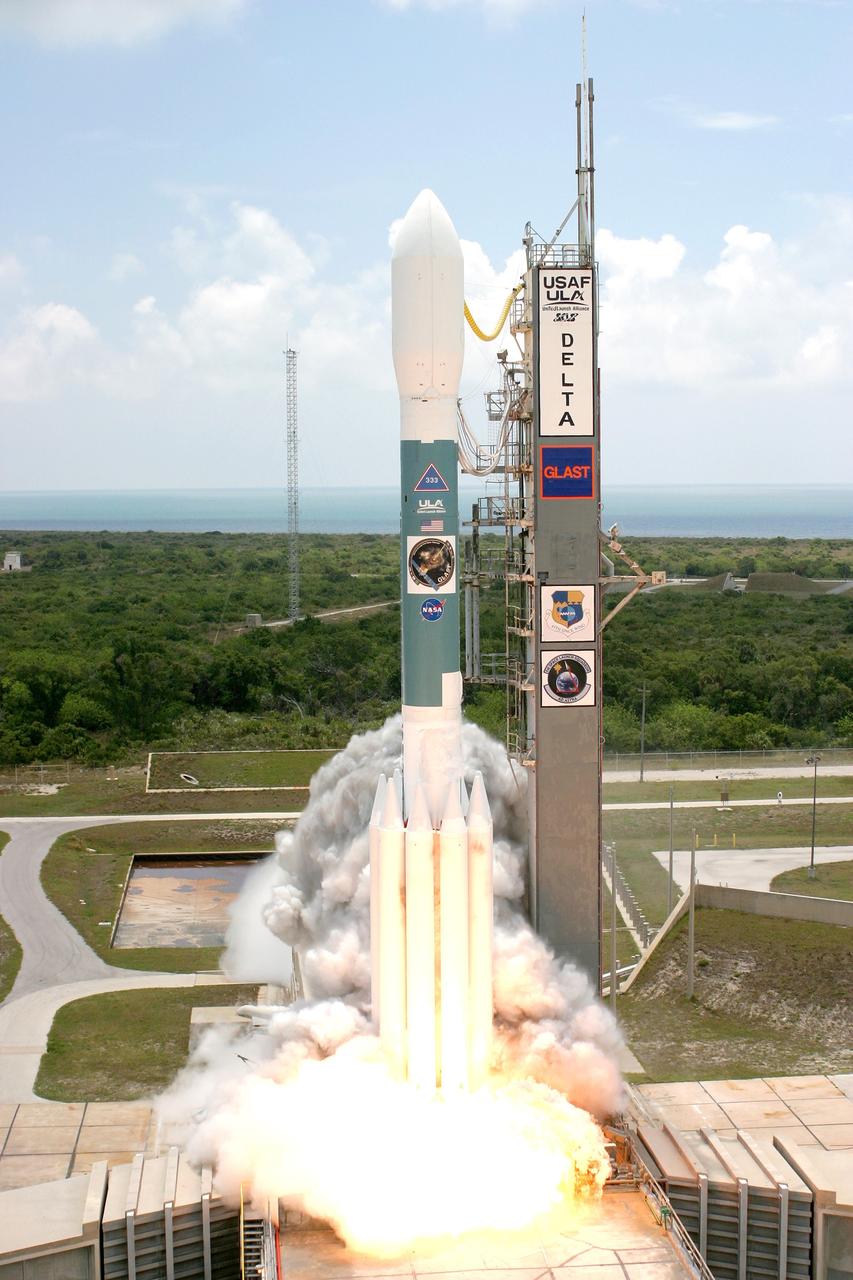
CAPE CANAVERAL, Fla. -- The Delta II rocket with NASA's Gamma-Ray Large Area Space Telescope , or GLAST, on top ignites for liftoff from Cape Canaveral Air Force Station's Launch Pad 17-B. Liftoff was at 12:05 p.m. EDT. GLAST is a powerful space observatory that will explore the universe's ultimate frontier, where nature harnesses forces and energies far beyond anything possible on Earth; probe some of science's deepest questions, such as what our universe is made of, and search for new laws of physics; explain how black holes accelerate jets of material to nearly light speed; and help crack the mystery of stupendously powerful explosions known as gamma-ray bursts. Launch is scheduled for 11:45 a.m. June 11. Photo credit: Carleton Bailie photograph for United Launch Alliance
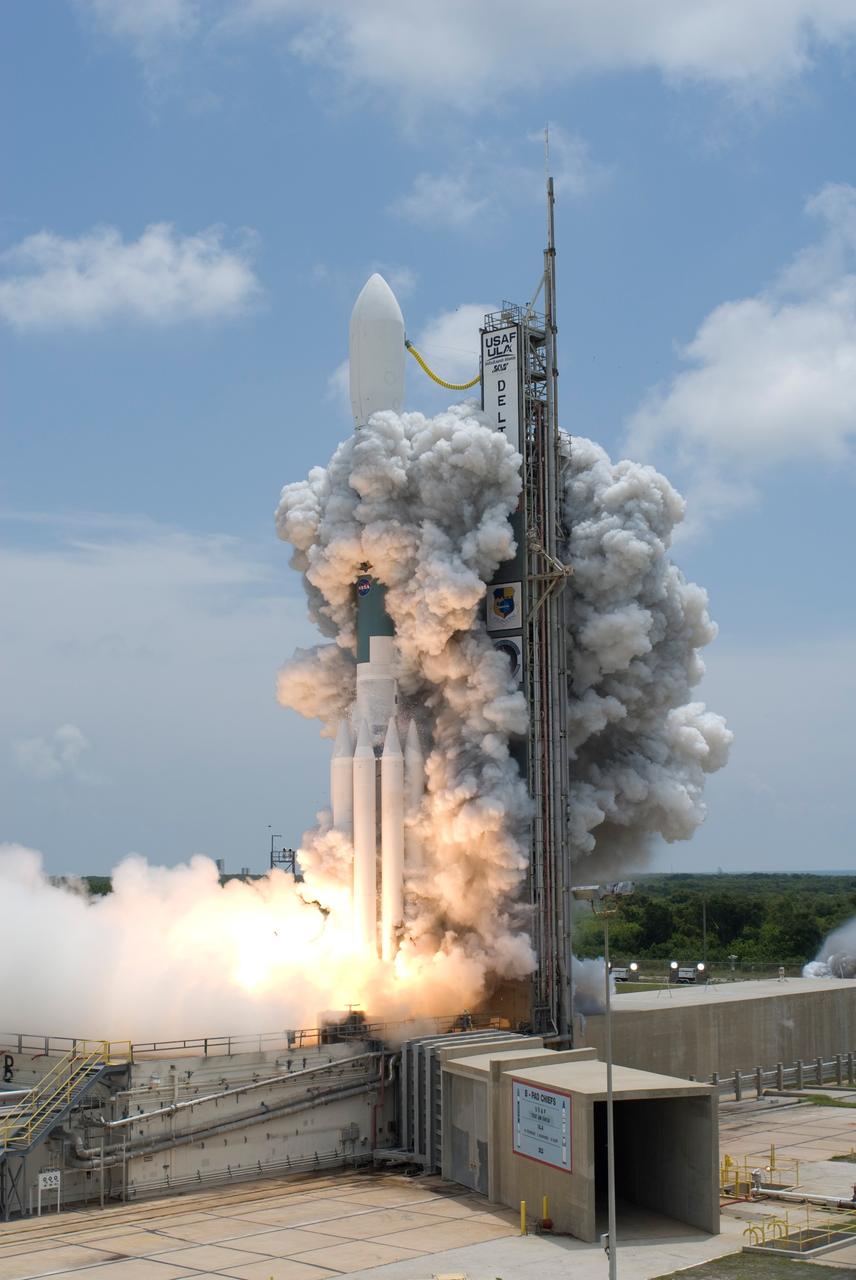
CAPE CANAVERAL, Fla. -- Smoke rises to obscure the Delta II rocket with NASA's Gamma-Ray Large Area Space Telescope , or GLAST, aboard as it launches from Cape Canaveral Air Force Station's Launch Pad 17-B. Liftoff was at 12:05 p.m. EDT. GLAST is a powerful space observatory that will explore the universe's ultimate frontier, where nature harnesses forces and energies far beyond anything possible on Earth; probe some of science's deepest questions, such as what our universe is made of, and search for new laws of physics; explain how black holes accelerate jets of material to nearly light speed; and help crack the mystery of stupendously powerful explosions known as gamma-ray bursts. Launch is scheduled for 11:45 a.m. June 11. Photo credit: NASA/Tony Gray, Regina Mitchell-Ryall
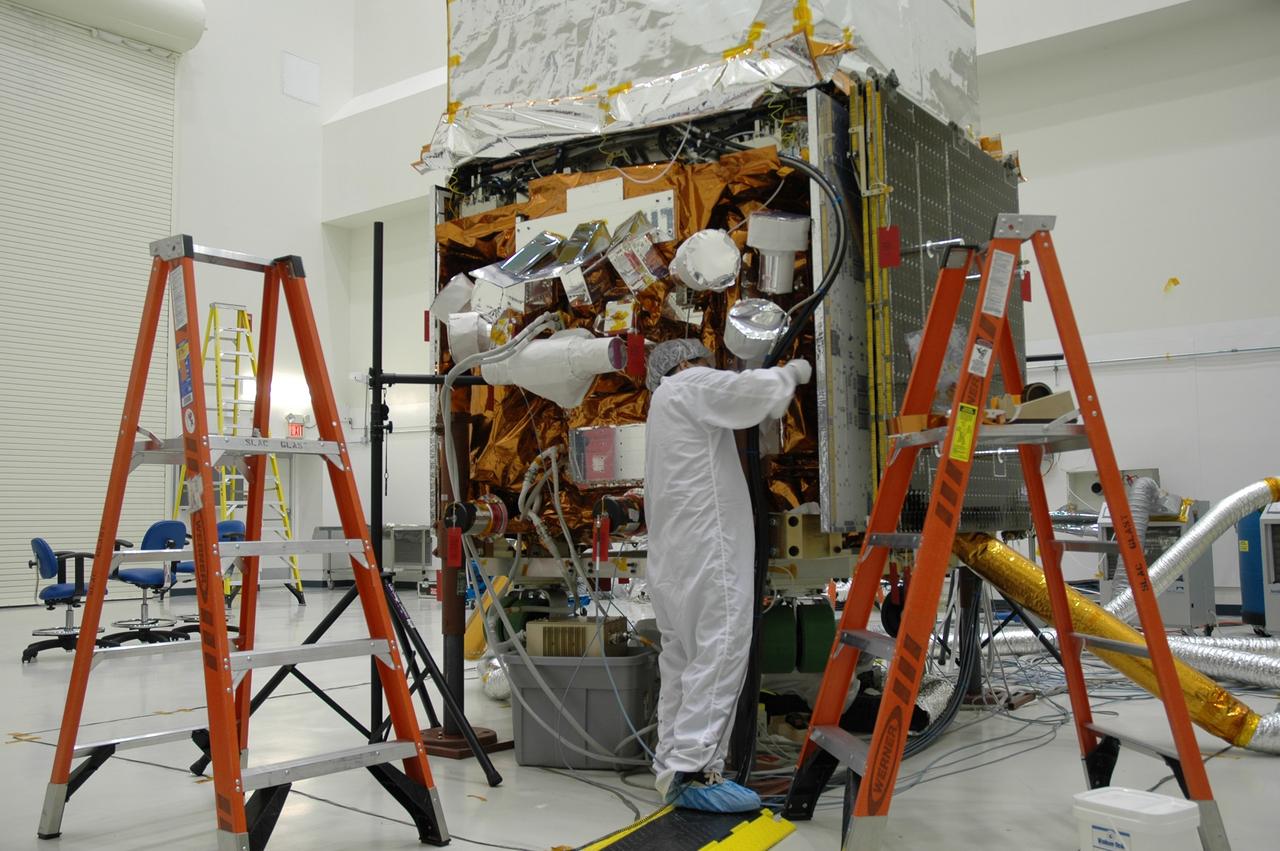
CAPE CANAVERAL, Fla. -- At the Astrotech payload processing facility in Titusville, Fla., workers prepare NASA's Gamma-ray Large Area Space Telescope, or GLAST, spacecraft for star tracker sun shade installation. The GLAST is a powerful space observatory that will explore the Universe's ultimate frontier, where nature harnesses forces and energies far beyond anything possible on Earth; probe some of science's deepest questions, such as what our Universe is made of, and search for new laws of physics; explain how black holes accelerate jets of material to nearly light speed; and help crack the mystery of stupendously powerful explosions known as gamma-ray bursts. A launch date is still to be determined. Photo credit: NASA/Cory Huston
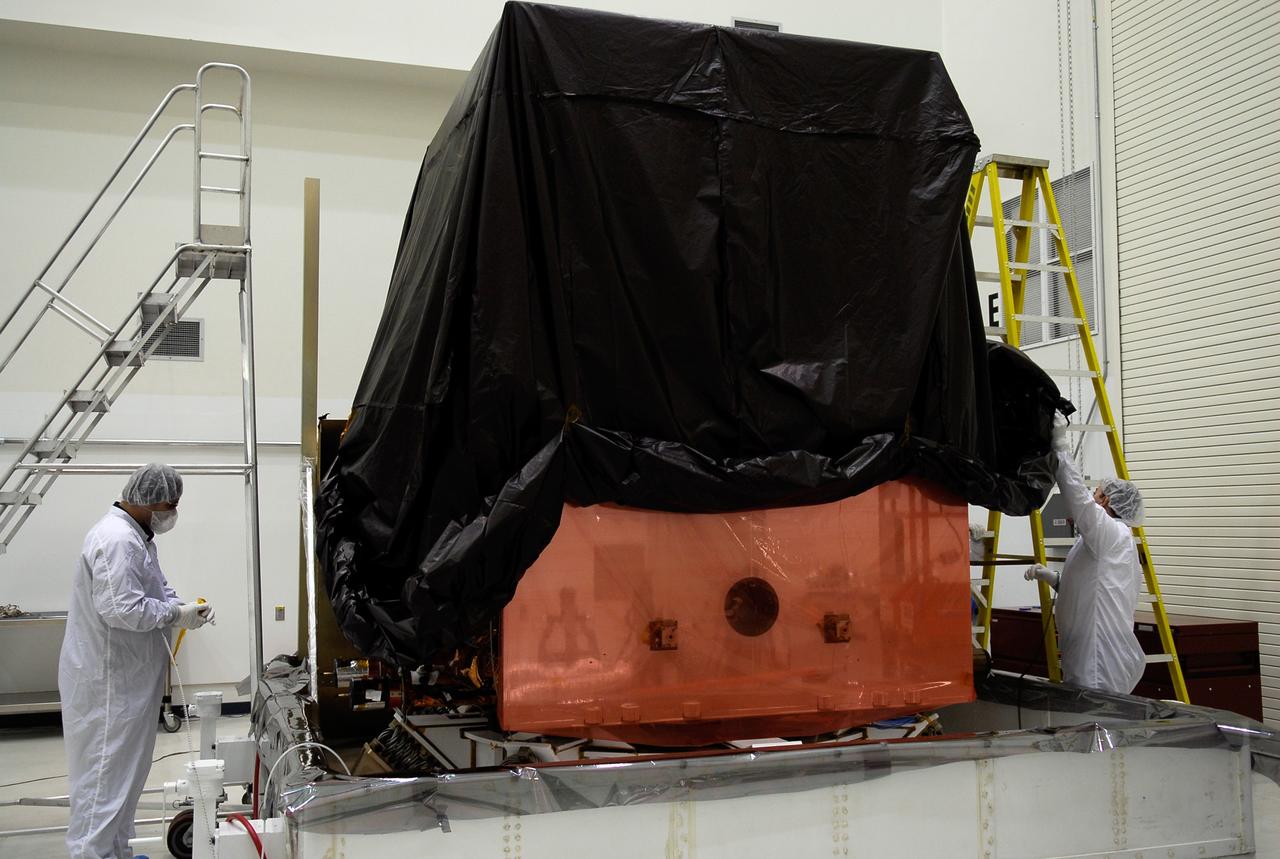
KENNEDY SPACE CENTER, FLA. -- General Dynamics technicians in the Astrotech payload processing facility begin removing the protective cover over NASA's Gamma-Ray Large Area Space Telescope, or GLAST. The space telescope will be moved to a work stand in the facility for a complete checkout of the scientific instruments aboard. The telescope will launch aboard a Delta II rocket May 16 from Launch Pad 17-B on Cape Canaveral Air Force Station. A powerful space observatory, the GLAST will explore the most extreme environments in the universe, and answer questions about supermassive black hole systems, pulsars and the origin of cosmic rays. It also will study the mystery of powerful explosions known as gamma-ray bursts. Photo credit: NASA/Kim Shiflett

CAPE CANAVERAL, Fla. -- In the Astrotech payload processing facility near NASA's Kennedy Space Center, General Dynamics technicians, sitting beneath the Gamma-ray Large Area Space Telescope, or GLAST, carefully position a high-gain antenna under the spacecraft as they prepare to install it on the spacecraft. The GLAST is a powerful space observatory that will explore the universe's ultimate frontier, where nature harnesses forces and energies far beyond anything possible on Earth; probe some of science's deepest questions, such as what our universe is made of, and search for new laws of physics; explain how black holes accelerate jets of material to nearly light speed; and help crack the mystery of stupendously powerful explosions known as gamma-ray bursts. Launch is currently planned in a window between 11:45 a.m. and 1:40 p.m. EDT May 16. Photo credit: NASA/Kim Shiflett
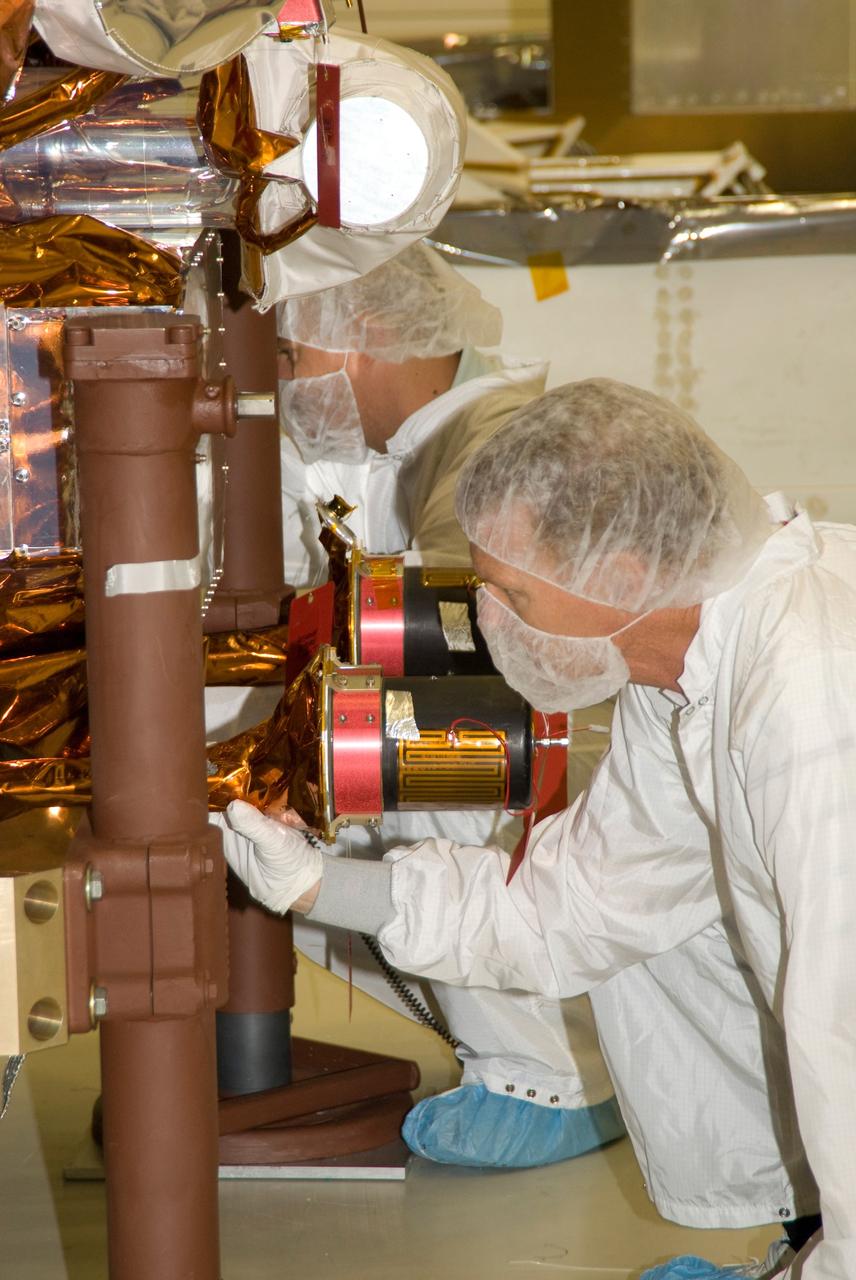
CAPE CANAVERAL, Fla. -- At the Astrotech payload processing facility in Titusville, Fla., technicians check the NASA's Gamma-ray Large Area Space Telescope, or GLAST, spacecraft after being lowered toward the transporter. The spacecraft is being prepared for its move to the Hazardous Processing Facility for fueling. The GLAST is a powerful space observatory that will explore the universe's ultimate frontier, where nature harnesses forces and energies far beyond anything possible on Earth; probe some of science's deepest questions, such as what our Universe is made of, and search for new laws of physics; explain how black holes accelerate jets of material to nearly light speed; and help crack the mystery of stupendously powerful explosions known as gamma-ray bursts. A launch date is still to be determined. Photo credit: NASA/Mike Kerley
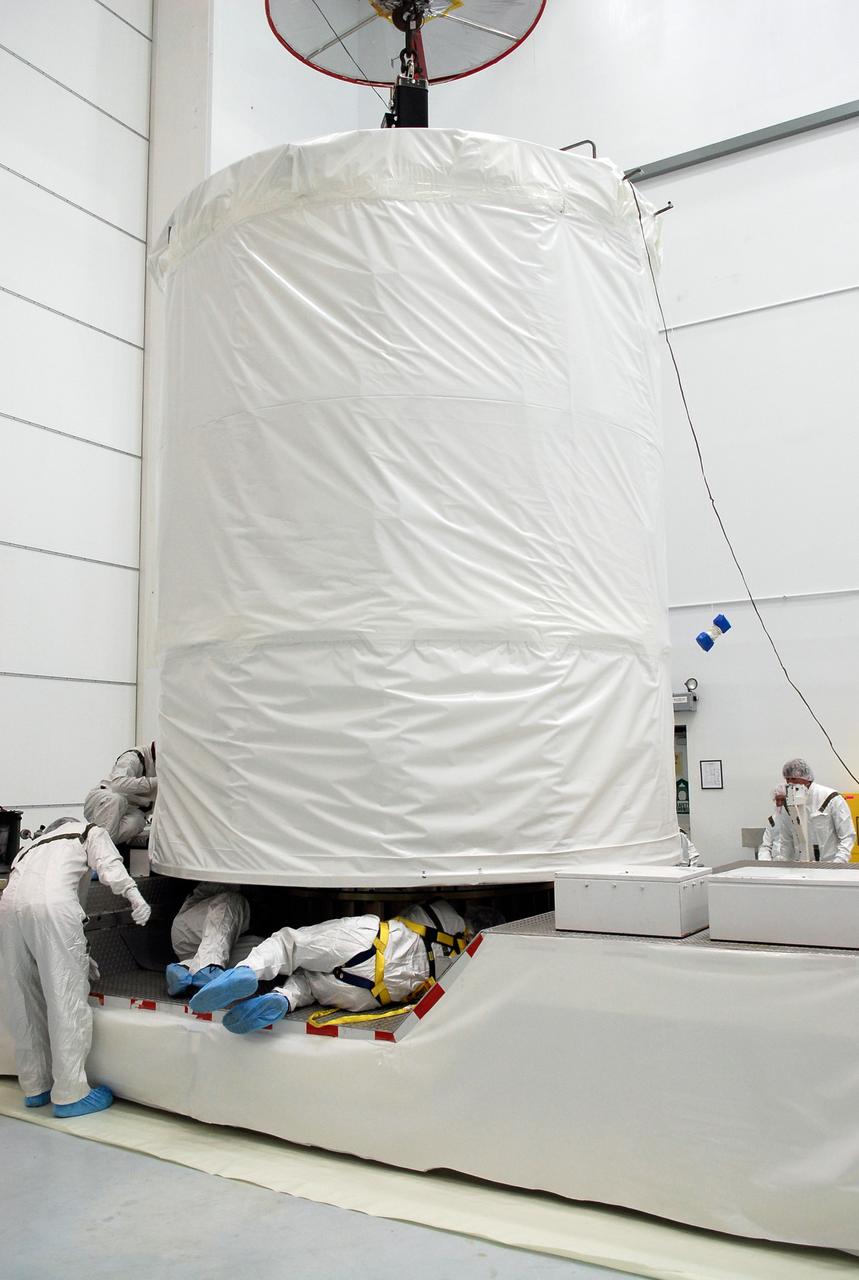
CAPE CANAVERAL, Fla. -- At Astrotech in Titusville, Fla., technicians secure the GLAST spacecraft, inside its payload transportation canister, to the transporter for transfer to pad 17-B at Cape Canaveral Air Force Station. At the pad, NASA's Gamma-Ray Large Area Space Telescope will be lifted into the mobile service tower and encapsulated in the fairing for launch. GLAST is a powerful space observatory that will explore the Universe's ultimate frontier, where nature harnesses forces and energies far beyond anything possible on Earth; probe some of science's deepest questions, such as what our Universe is made of, and search for new laws of physics; explain how black holes accelerate jets of material to nearly light speed; and help crack the mystery of stupendously powerful explosions known as gamma-ray bursts. The launch date is targeted no earlier than June 3. Photo credit: NASA/Kim Shiflett
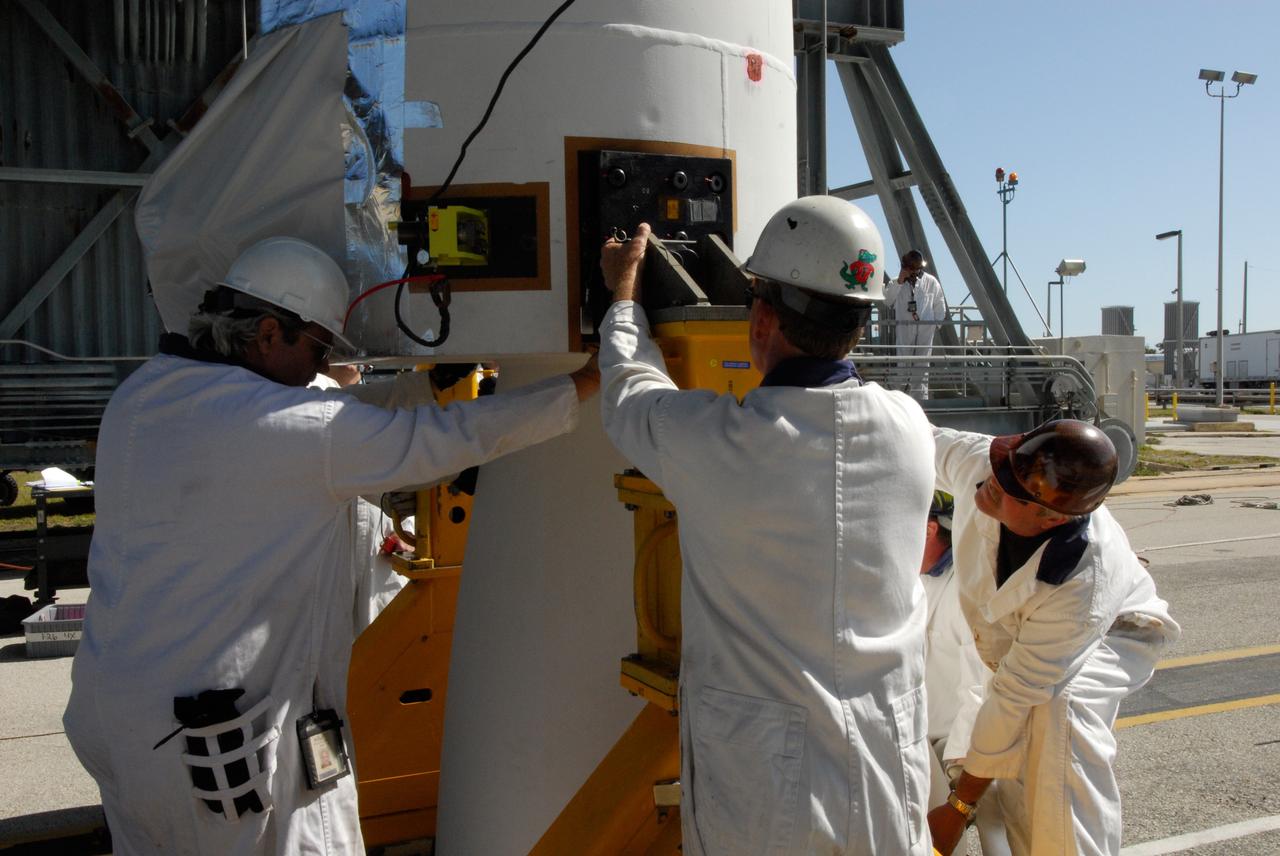
CAPE CANAVERAL, Fla. --- At Pad 17-B on Cape Canaveral Air Force Station, technicians check the electronics on a solid rocket booster to be lifted into the mobile service tower for mating with the Delta II rocket that will launch NASA's Gamma-ray Large Area Space Telescope, or GLAST, spacecraft. A series of nine strap-on solid rocket motors will help power the first stage. The GLAST is a powerful space observatory that will explore the Universe's ultimate frontier, where nature harnesses forces and energies far beyond anything possible on Earth; probe some of science's deepest questions, such as what our Universe is made of, and search for new laws of physics; explain how black holes accelerate jets of material to nearly light speed; and help crack the mystery of stupendously powerful explosions known as gamma-ray bursts. Launch is currently planned for May 16 from Pad 17-B. Photo credit: NASA/Dimitri Gerondidakis
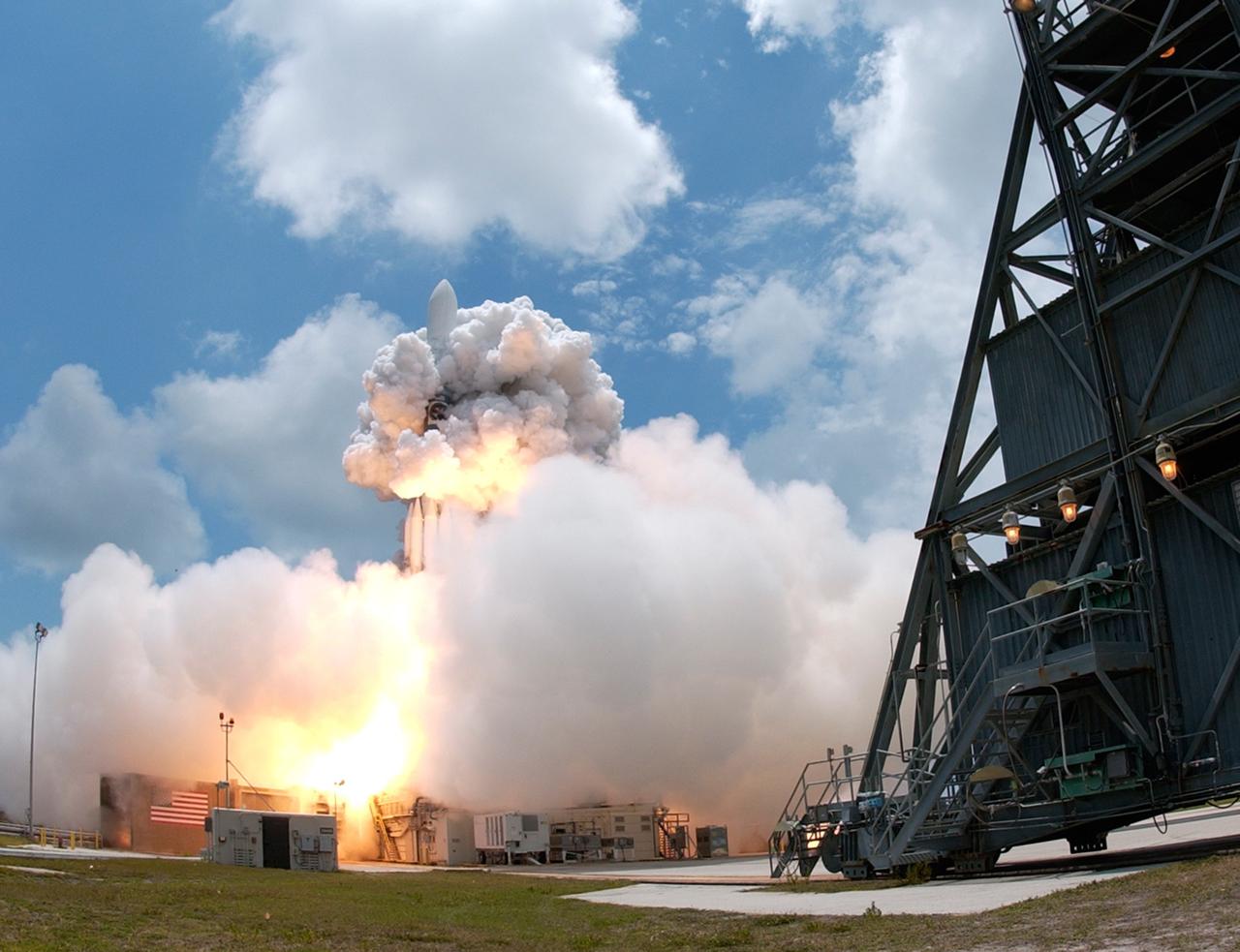
CAPE CANAVERAL, Fla. -- The Delta II rocket with NASA's Gamma-Ray Large Area Space Telescope , or GLAST, on top is bathed in smoke just after liftoff from Cape Canaveral Air Force Station's Launch Pad 17-B. Liftoff was at 12:05 p.m. EDT. GLAST is a powerful space observatory that will explore the universe's ultimate frontier, where nature harnesses forces and energies far beyond anything possible on Earth; probe some of science's deepest questions, such as what our universe is made of, and search for new laws of physics; explain how black holes accelerate jets of material to nearly light speed; and help crack the mystery of stupendously powerful explosions known as gamma-ray bursts. Launch is scheduled for 11:45 a.m. June 11. Photo credit: NASA/Sandra Joseph, Kevin O'Connel
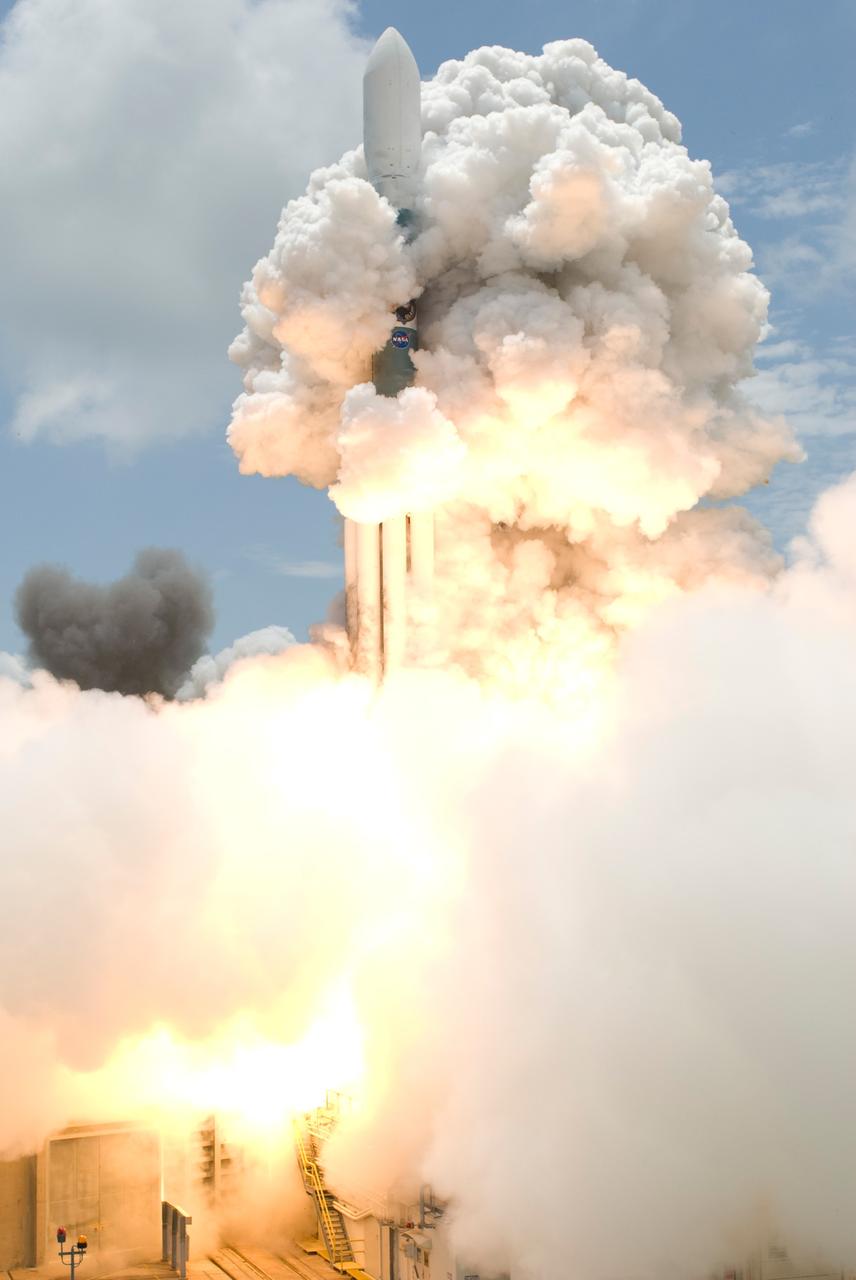
CAPE CANAVERAL, Fla. -- Smoke envelops the Delta II rocket with NASA's Gamma-Ray Large Area Space Telescope , or GLAST, aboard as it launches from Cape Canaveral Air Force Station's Launch Pad 17-B. Liftoff was at 12:05 p.m. EDT. GLAST is a powerful space observatory that will explore the universe's ultimate frontier, where nature harnesses forces and energies far beyond anything possible on Earth; probe some of science's deepest questions, such as what our universe is made of, and search for new laws of physics; explain how black holes accelerate jets of material to nearly light speed; and help crack the mystery of stupendously powerful explosions known as gamma-ray bursts. Launch is scheduled for 11:45 a.m. June 11. Photo credit: NASA/Jerry Cannon, Robert Murray
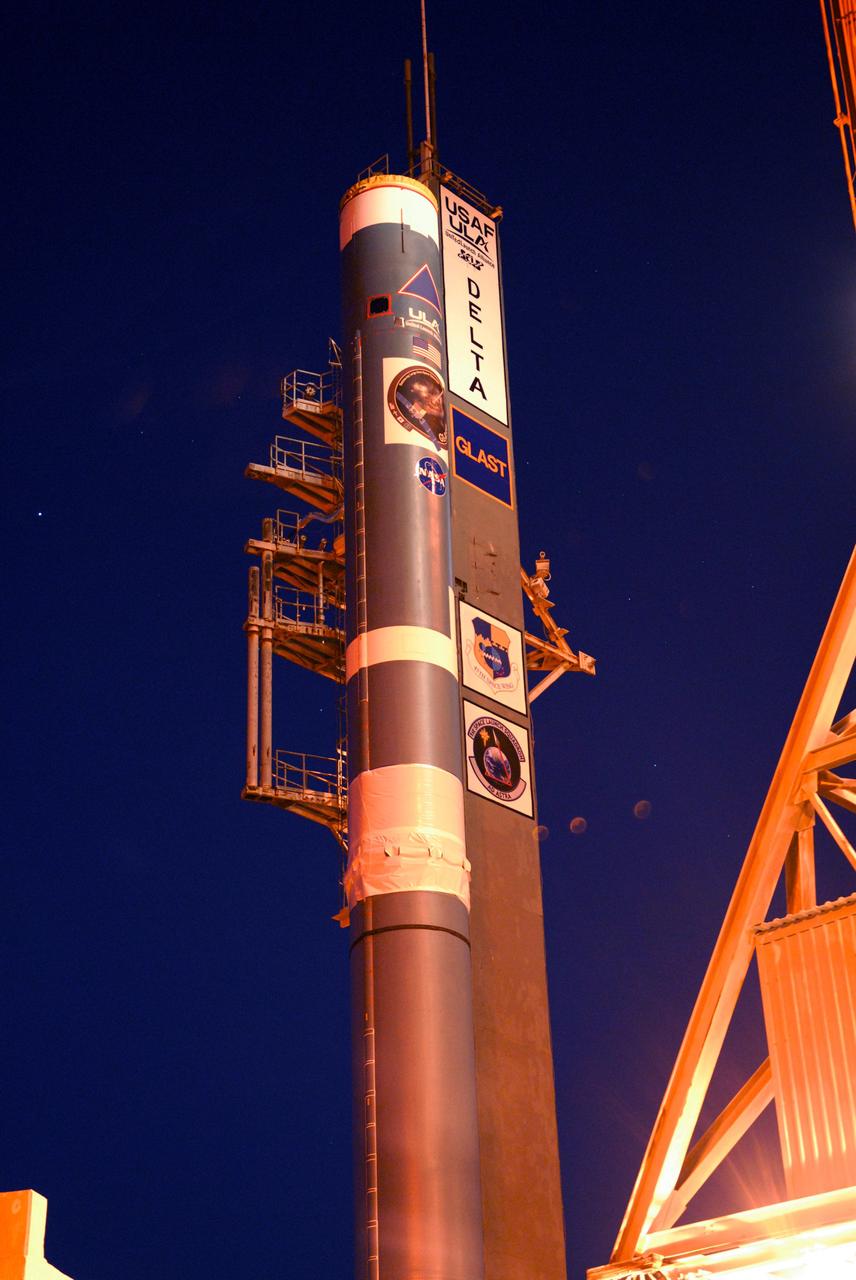
CAPE CANAVERAL, Fla. --- At Cape Canaveral Air Force Station, the Delta II rocket to launch NASA's Gamma-ray Large Area Space Telescope, or GLAST, spacecraft is poised to receive the first of the solid rocket boosters. A series of nine strap-on solid rocket motors will help power the first stage. The GLAST is a powerful space observatory that will explore the Universe's ultimate frontier, where nature harnesses forces and energies far beyond anything possible on Earth; probe some of science's deepest questions, such as what our Universe is made of, and search for new laws of physics; explain how black holes accelerate jets of material to nearly light speed; and help crack the mystery of stupendously powerful explosions known as gamma-ray bursts. Launch is currently planned for May 16 from Pad 17-B. Photo credit: NASA/Dimitri Gerondidakis