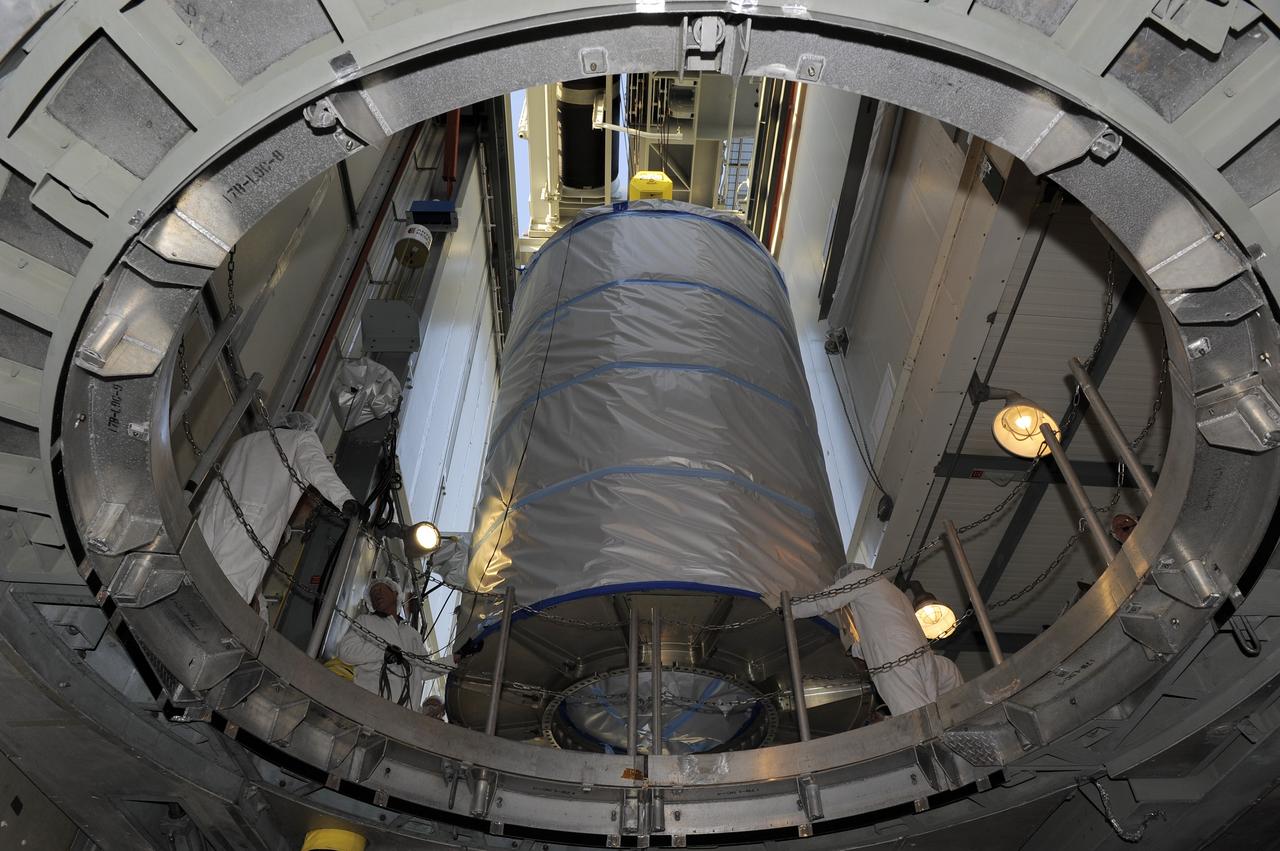
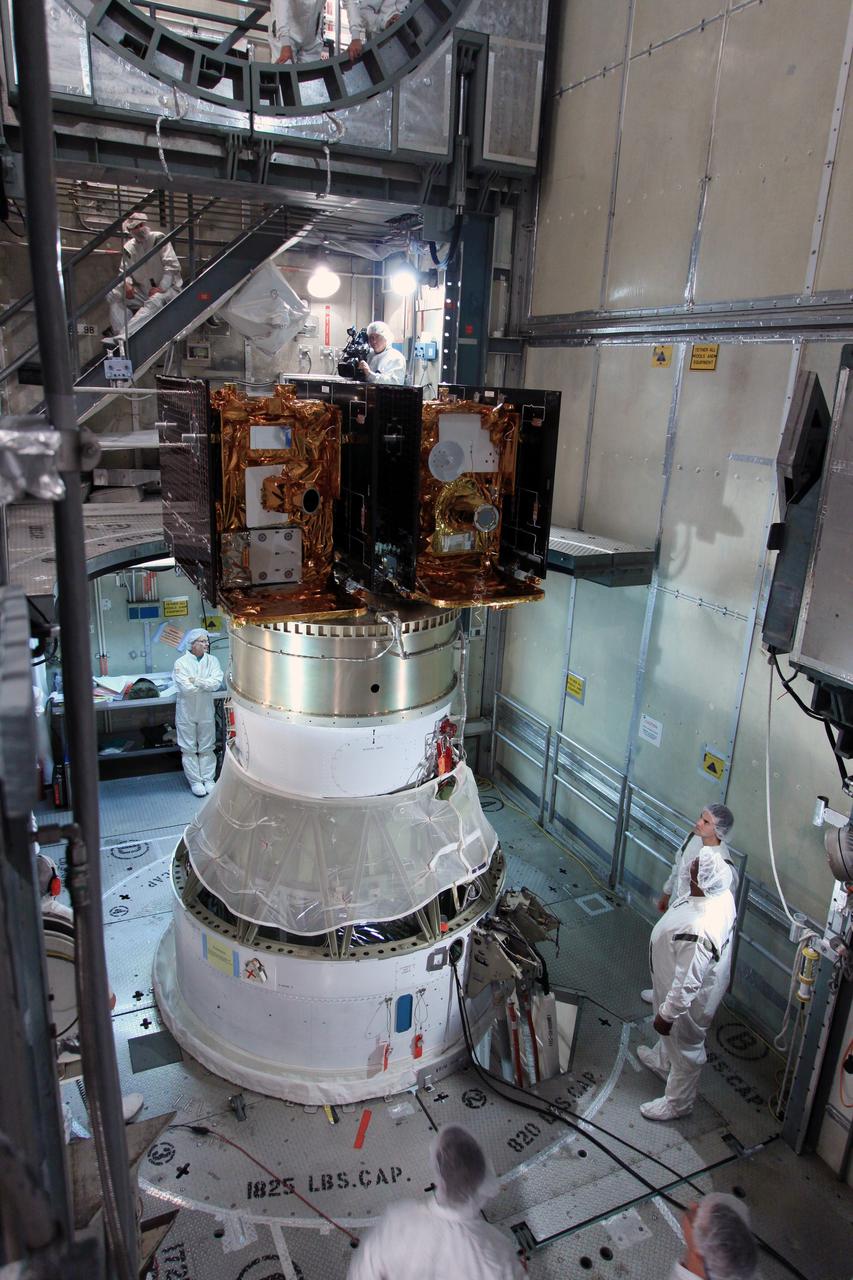
CAPE CANAVERAL, Fla. -- Technicians lower NASA's twin Gravity Recovery and Interior Laboratory (GRAIL) spacecraft into place atop a United Launch Alliance Delta II rocket on Space Launch Complex 17B at Cape Canaveral Air Force Station in Florida. The lunar probes are attached to a spacecraft adapter ring in their side-by-side launch configuration and wrapped in plastic to prevent contamination outside the clean room. The spacecraft will fly in tandem orbits around the moon for several months to measure its gravity field. GRAIL's primary science objectives are to determine the structure of the lunar interior, from crust to core, and to advance understanding of the thermal evolution of the moon. Launch is scheduled for Sept. 8. For more information, visit www.nasa.gov/grail. Photo credit: NASA/Kim Shiflett
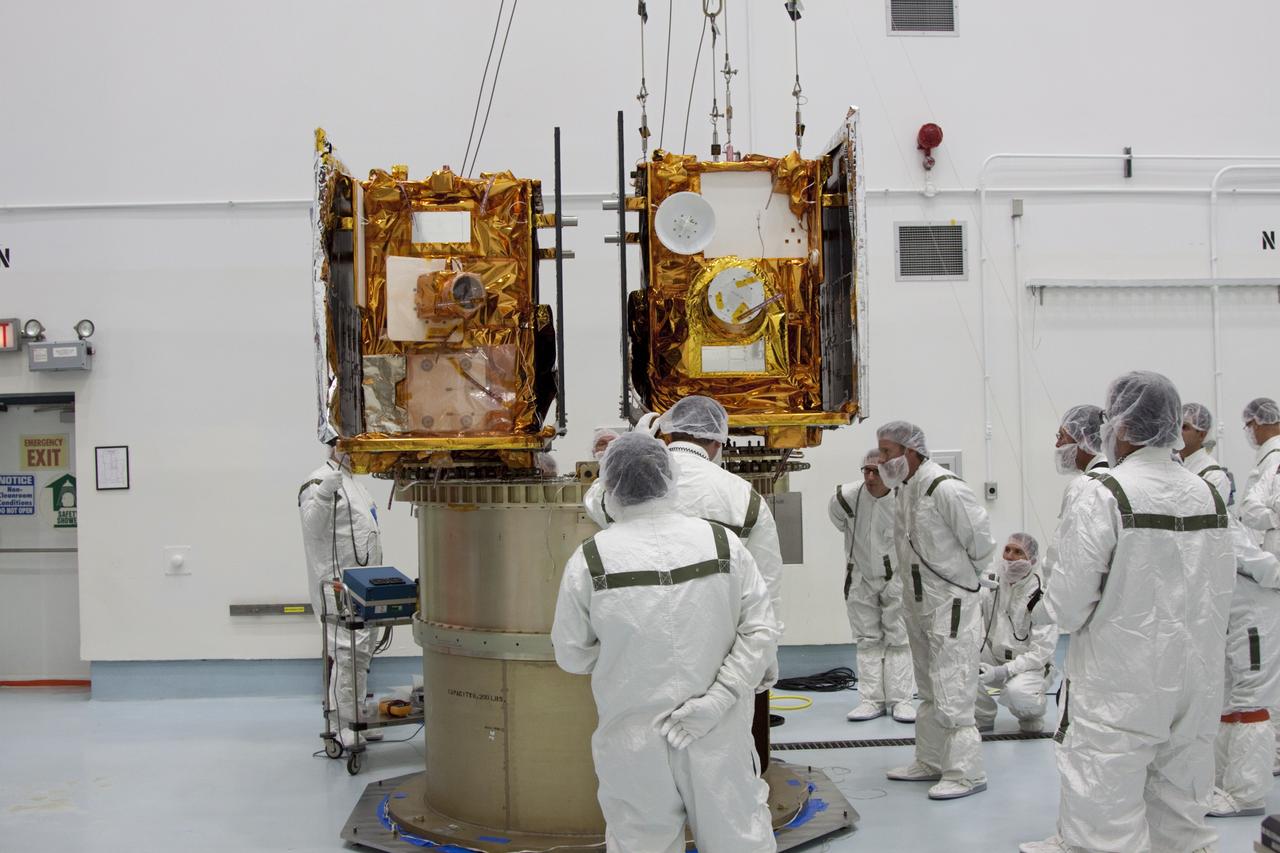
CAPE CANAVERAL, Fla. -- At Astrotech Space Operation's payload processing facility in Titusville, Fla., Lockheed Martin technicians monitor the placement of NASA's Gravity Recovery and Interior Laboratory-A (GRAIL-A) lunar probe on the spacecraft adapter ring. GRAIL-B is already secured to the ring, at left. After the twin GRAIL spacecraft are attached to the adapter ring in their side-by-side launch configuration, they will be transported to the launch pad. GRAIL will fly in tandem orbits around the moon for several months to measure its gravity field. GRAIL's primary science objectives are to determine the structure of the lunar interior, from crust to core, and to advance understanding of the thermal evolution of the moon. Launch aboard a United Launch Alliance Delta II rocket from Space Launch Complex 17B on Cape Canaveral Air Force Station is scheduled for Sept. 8. For more information, visit http://www.nasa.gov/grail. Photo credit: NASA/Jim Grossmann
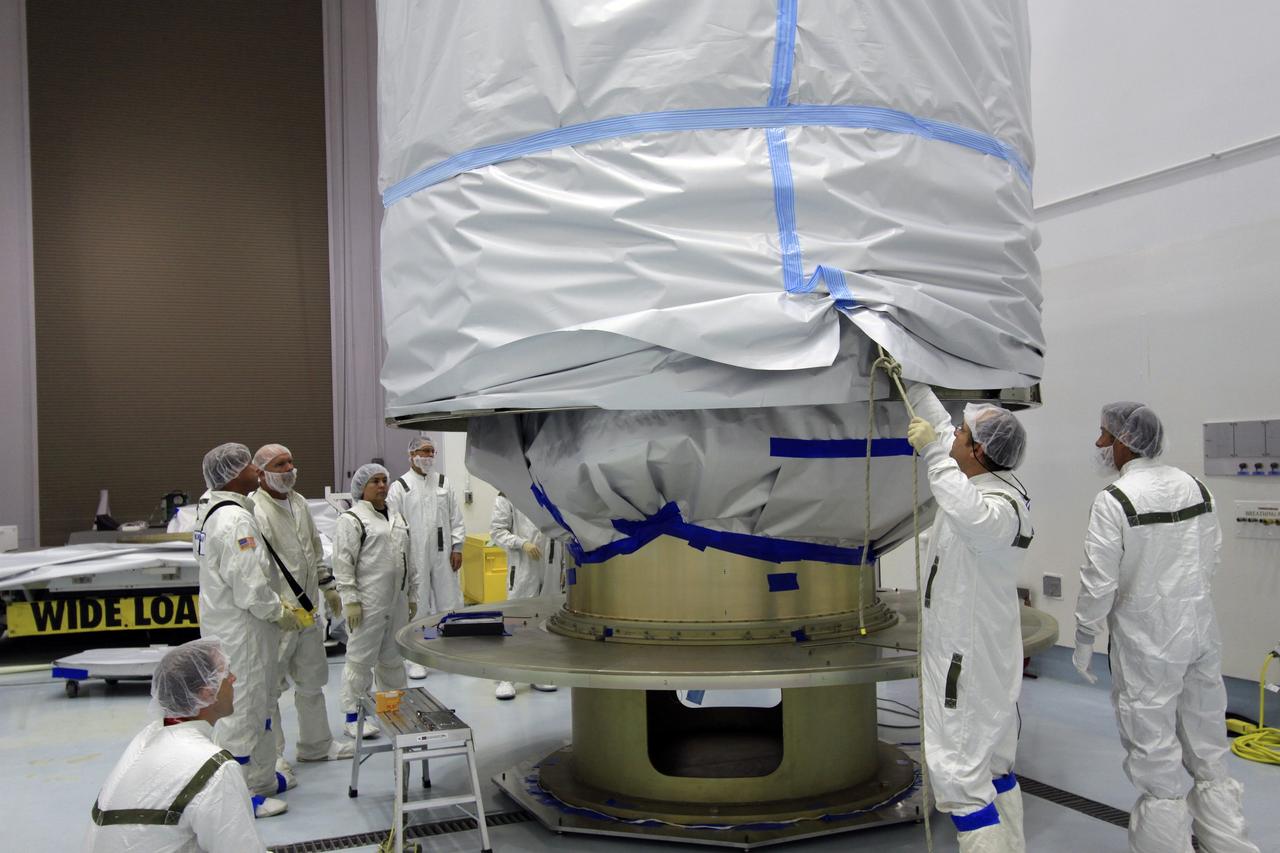
CAPE CANAVERAL, Fla. -- At Astrotech Space Operation's payload processing facility in Titusville, Fla., a protective canister is lowered around NASA's twin Gravity Recovery and Interior Laboratory spacecraft during preparations to transport them to the launch pad. The lunar probes are attached to a spacecraft adapter ring in their side-by-side launch configuration and wrapped in plastic to prevent contamination outside the clean room. The spacecraft will fly in tandem orbits around the moon for several months to measure its gravity field. GRAIL's primary science objectives are to determine the structure of the lunar interior, from crust to core, and to advance understanding of the thermal evolution of the moon. Launch aboard a United Launch Alliance Delta II rocket from Space Launch Complex 17B on Cape Canaveral Air Force Station is scheduled for Sept. 8. For more information, visit http://www.nasa.gov/grail. Photo credit: NASA/Jim Grossmann
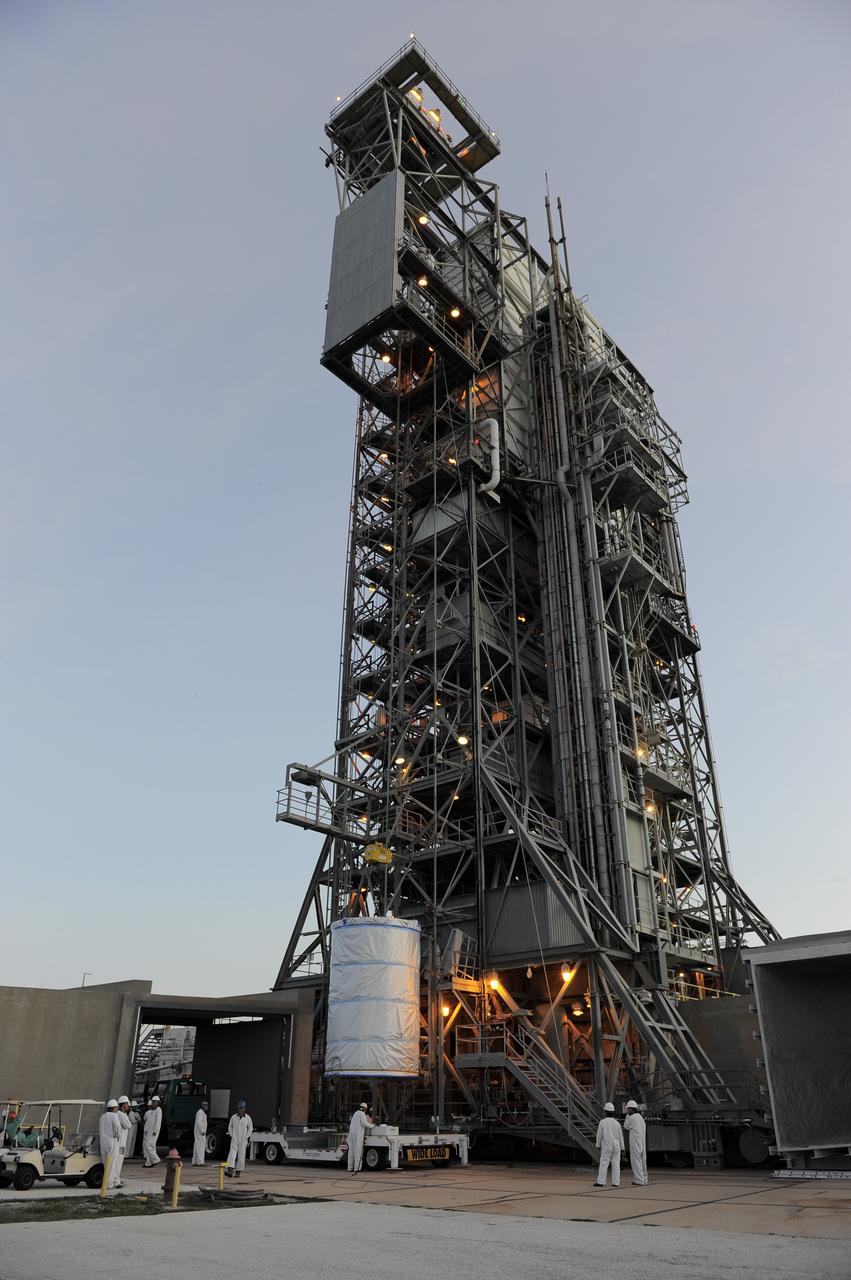
CAPE CANAVERAL, Fla. -- NASA's twin Gravity Recovery and Interior Laboratory (GRAIL) spacecraft are lifted to the top of their launch pad at Space Launch Complex 17B at Cape Canaveral Air Force Station in Florida. The lunar probes are attached to a spacecraft adapter ring in their side-by-side launch configuration and wrapped in plastic to prevent contamination outside the clean room in the Astrotech Space Operation's payload processing facility in Titusville, Fla. The spacecraft will fly in tandem orbits around the moon for several months to measure its gravity field. GRAIL's primary science objectives are to determine the structure of the lunar interior, from crust to core, and to advance understanding of the thermal evolution of the moon. Launch aboard a United Launch Alliance Delta II rocket is scheduled for Sept. 8. For more information, visit www.nasa.gov/grail. Photo credit: NASA/Kim Shiflett
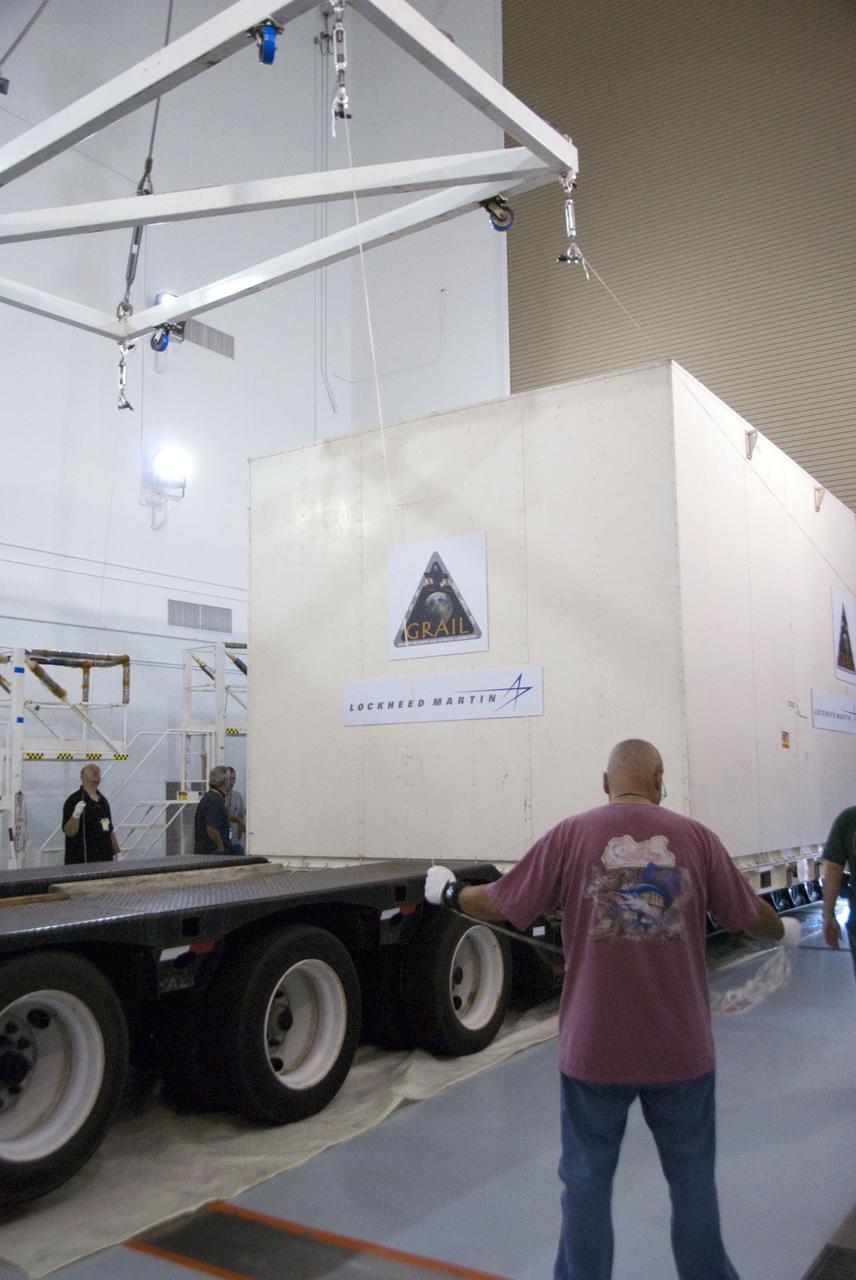
CAPE CANAVERAL, Fla. -- Lockheed Martin technicians oversee the lift of the protective canister housing NASA's twin Gravity Recovery and Interior Laboratory lunar spacecraft from the transporter in the Hazardous Processing Facility (HPF) at Astrotech Space Operation's payload processing facility in Titusville, Fla. In the HPF, the spacecraft will undergo two days of fueling activities. GRAIL will fly in tandem orbits around the moon for several months to measure its gravity field. GRAIL's primary science objectives are to determine the structure of the lunar interior, from crust to core, and to advance understanding of the thermal evolution of the moon. Launch aboard a United Launch Alliance Delta II rocket from Space Launch Complex 17B on Cape Canaveral Air Force Station is scheduled for Sept. 8. For more information, visit http://www.nasa.gov/grail. Photo credit: NASA/Charisse Nahser
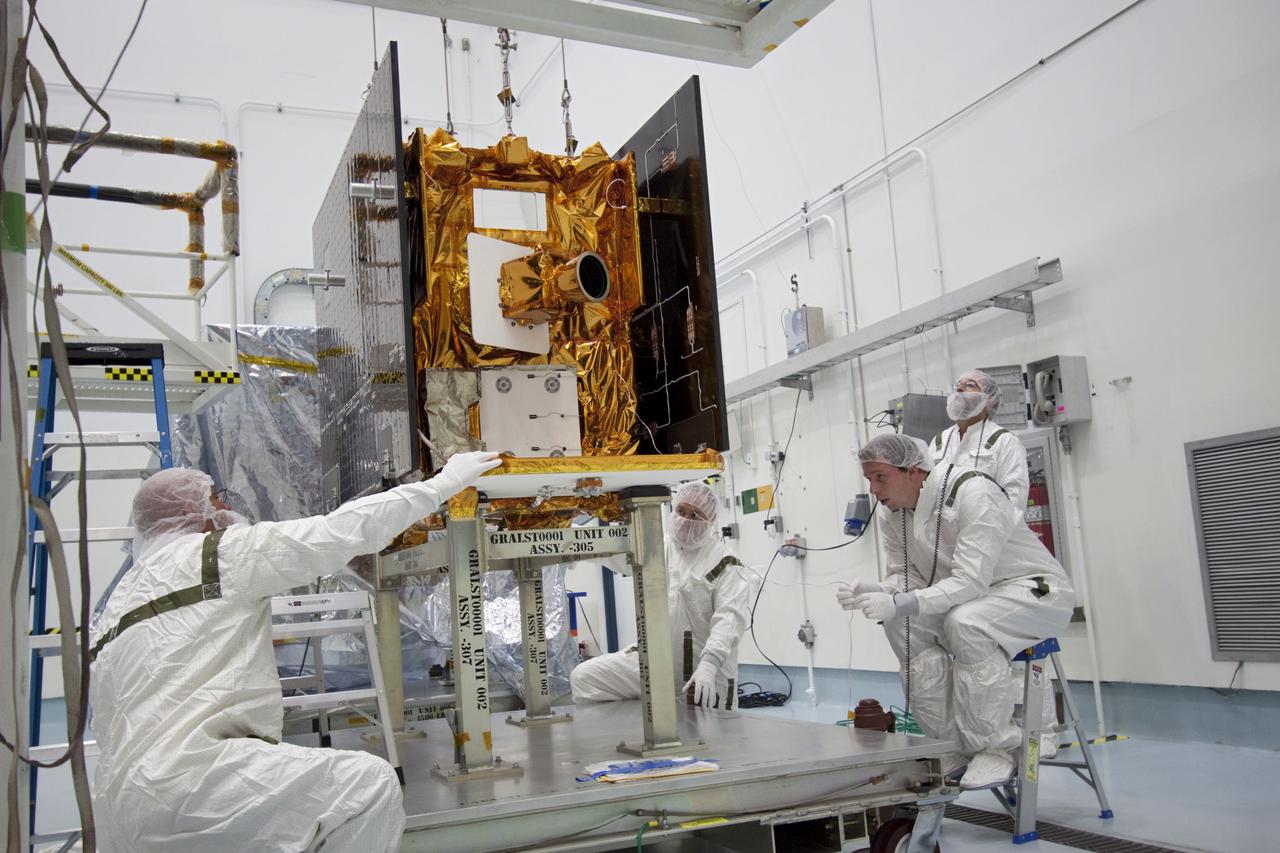
CAPE CANAVERAL, Fla. -- At Astrotech Space Operation's payload processing facility in Titusville, Fla., Lockheed Martin technicians secure a portable scale to one of NASA's twin Gravity Recovery and Interior Laboratory lunar spacecraft. The spacecraft will be lifted and weighed before they are stacked in their launch configuration in preparation for transport to the launch pad. GRAIL will fly in tandem orbits around the moon for several months to measure its gravity field. GRAIL's primary science objectives are to determine the structure of the lunar interior, from crust to core, and to advance understanding of the thermal evolution of the moon. Launch aboard a United Launch Alliance Delta II rocket from Space Launch Complex 17B on Cape Canaveral Air Force Station is scheduled for Sept. 8. For more information, visit http://www.nasa.gov/grail. Photo credit: NASA/Jim Grossmann
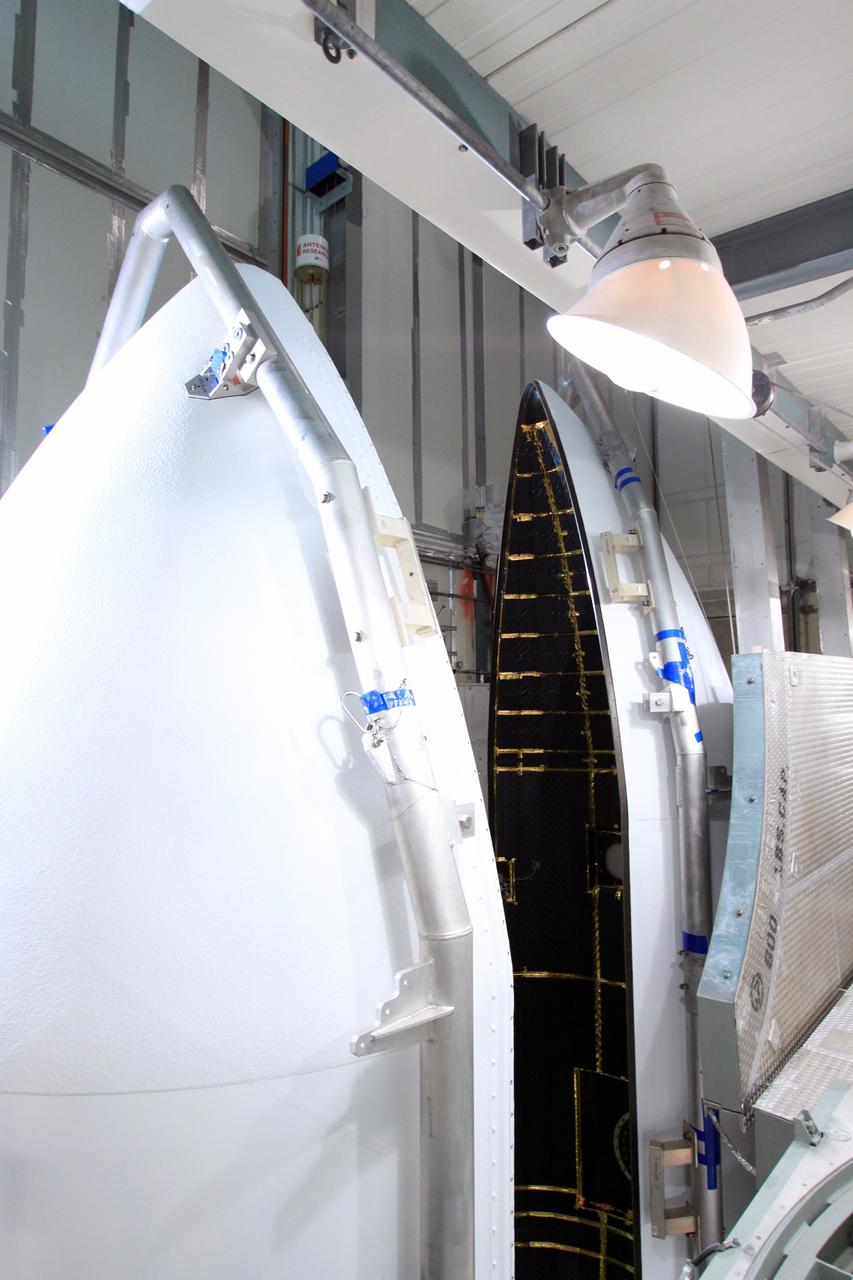
CAPE CANAVERAL, Fla. -- At Space Launch Complex 17B on Cape Canaveral Air Force Station in Florida, the sections of the clamshell-shaped Delta payload fairing close in around NASA's twin Gravity Recovery and Interior Laboratory spacecraft. The fairing will protect the spacecraft from the impact of aerodynamic pressure and heating during ascent and will be jettisoned once the spacecraft is outside the Earth's atmosphere. Launch aboard a United Launch Alliance Delta II rocket from Pad 17B is scheduled for Sept. 8. The spacecraft will fly in tandem orbits around the moon for several months to measure its gravity field. GRAIL's primary science objectives are to determine the structure of the lunar interior, from crust to core, and to advance understanding of the thermal evolution of the moon. For more information, visit http://www.nasa.gov/grail. Photo credit: NASA/Jim Grossmann
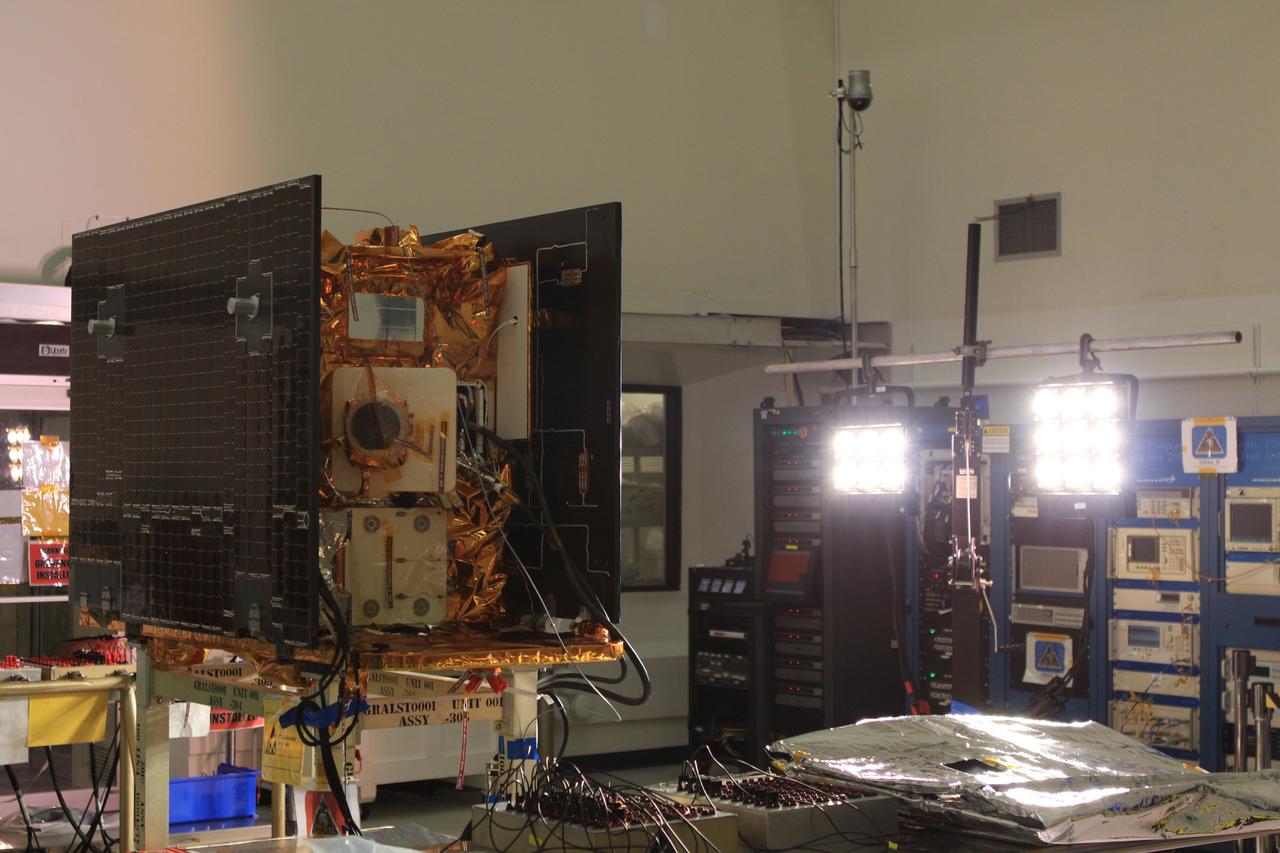
CAPE CANAVERAL, Fla. -- Testing of the solar arrays on NASA's Gravity Recovery and Interior Laboratory-A, or GRAIL-A, spacecraft is under way in Astrotech Space Operation's payload processing facility in Titusville, Fla., to ensure that they will function as planned during the mission. The electrical power subsystem on each of GRAIL's twin spacecraft includes two solar arrays and a lithium ion battery. Each solar array is capable of producing no less than 700 watts. They will be deployed shortly after separation from the launch vehicle and remain fixed throughout the mission. GRAIL will fly in tandem orbits around the moon for several months to measure its gravity field. GRAIL's primary science objectives are to determine the structure of the lunar interior, from crust to core, and to advance understanding of the thermal evolution of the moon. Launch aboard a United Launch Alliance Delta II rocket from Space Launch Complex 17B on Cape Canaveral Air Force Station is scheduled for Sept. 8. For more information, visit http://www.nasa.gov/grail. Photo credit: NASA/Frankie Martin
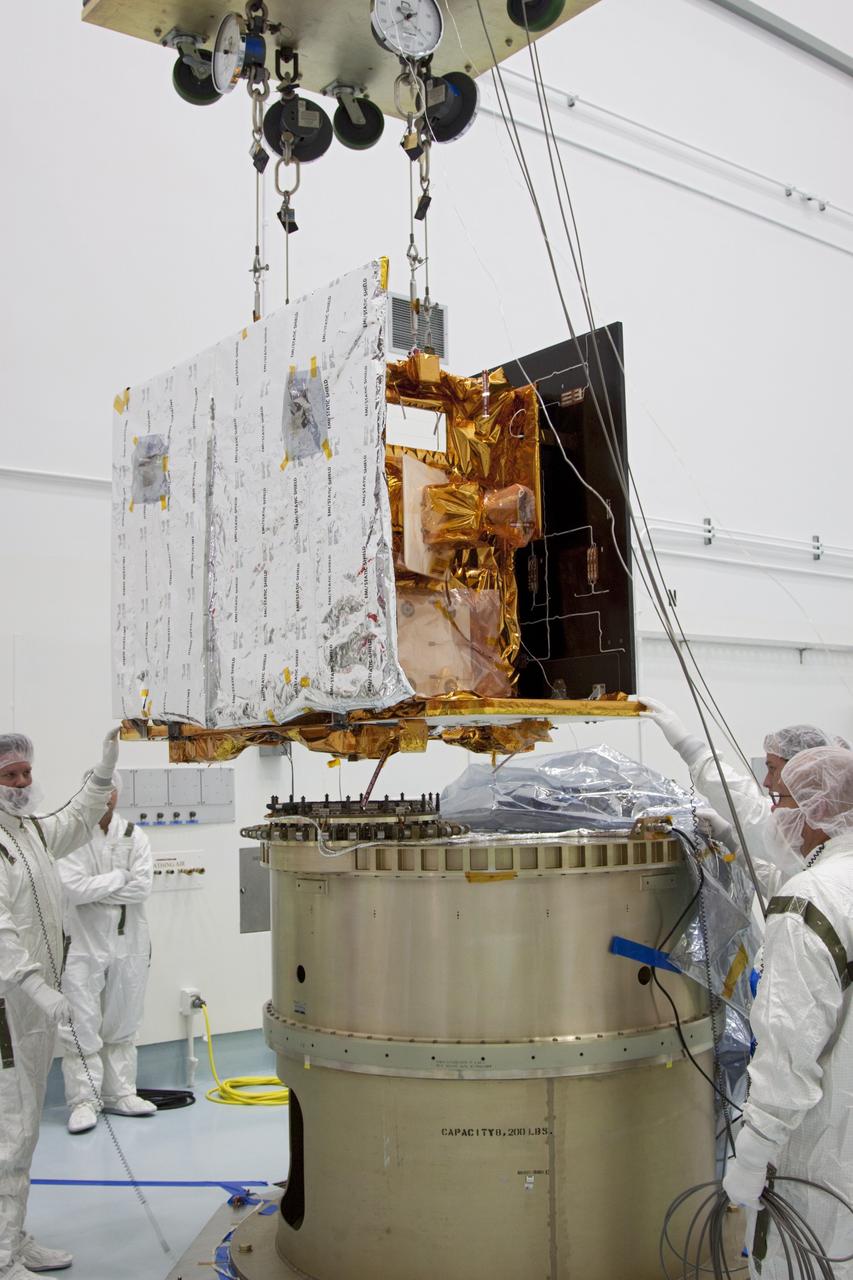
CAPE CANAVERAL, Fla. -- At Astrotech Space Operation's payload processing facility in Titusville, Fla., NASA's Gravity Recovery and Interior Laboratory-B (GRAIL-B) lunar probe is lowered toward the spacecraft adapter ring. After the twin GRAIL spacecraft are attached to the adapter ring in their side-by-side launch configuration, they will be transported to the launch pad. GRAIL will fly in tandem orbits around the moon for several months to measure its gravity field. GRAIL's primary science objectives are to determine the structure of the lunar interior, from crust to core, and to advance understanding of the thermal evolution of the moon. Launch aboard a United Launch Alliance Delta II rocket from Space Launch Complex 17B on Cape Canaveral Air Force Station is scheduled for Sept. 8. For more information, visit http://www.nasa.gov/grail. Photo credit: NASA/Jim Grossmann
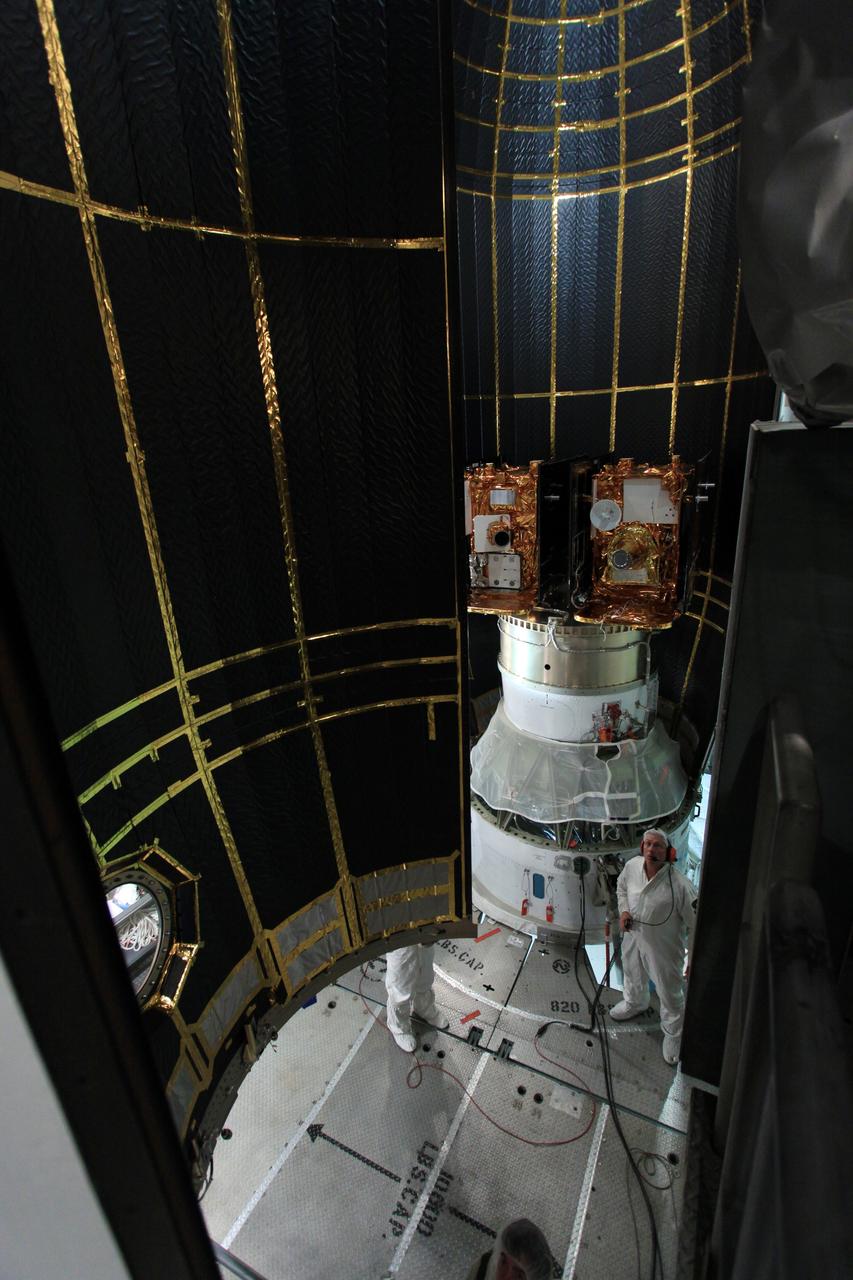
CAPE CANAVERAL, Fla. -- At Space Launch Complex 17B on Cape Canaveral Air Force Station in Florida, the second half of the clamshell-shaped Delta payload fairing swings into place around NASA's twin Gravity Recovery and Interior Laboratory spacecraft under the scrutiny of a spacecraft technician. The fairing will protect the spacecraft from the impact of aerodynamic pressure and heating during ascent and will be jettisoned once the spacecraft is outside the Earth's atmosphere. Launch aboard a United Launch Alliance Delta II rocket from Pad 17B is scheduled for Sept. 8. The spacecraft will fly in tandem orbits around the moon for several months to measure its gravity field. GRAIL's primary science objectives are to determine the structure of the lunar interior, from crust to core, and to advance understanding of the thermal evolution of the moon. For more information, visit http://www.nasa.gov/grail. Photo credit: NASA/Jim Grossmann
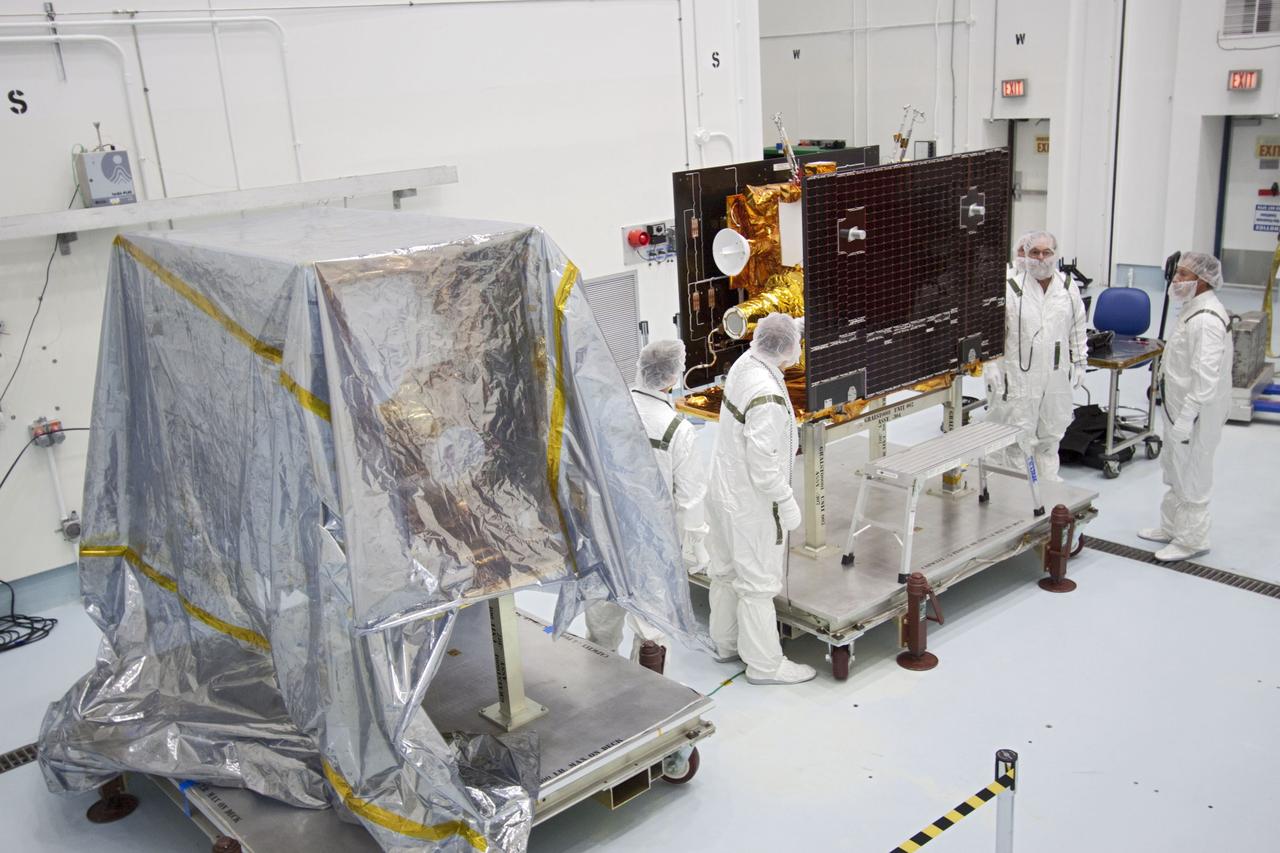
CAPE CANAVERAL, Fla. -- At Astrotech Space Operation's payload processing facility in Titusville, Fla., Lockheed Martin technicians determine the readiness of one of NASA's twin Gravity Recovery and Interior Laboratory lunar spacecraft before the spacecraft are stacked in their launch configuration in preparation for transport to the launch pad. GRAIL will fly in tandem orbits around the moon for several months to measure its gravity field. GRAIL's primary science objectives are to determine the structure of the lunar interior, from crust to core, and to advance understanding of the thermal evolution of the moon. Launch aboard a United Launch Alliance Delta II rocket from Space Launch Complex 17B on Cape Canaveral Air Force Station is scheduled for Sept. 8. For more information, visit http://www.nasa.gov/grail. Photo credit: NASA/Jim Grossmann
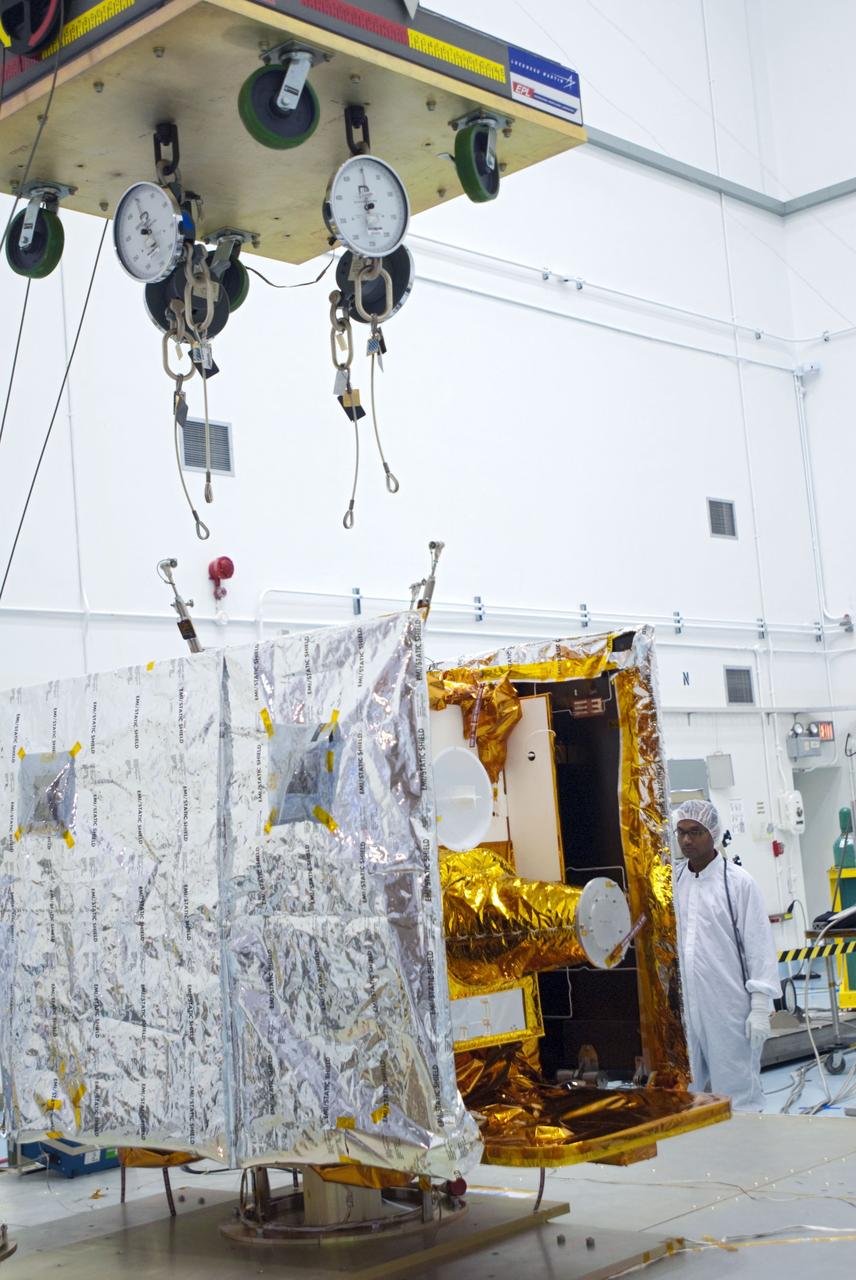
CAPE CANAVERAL, Fla. -- Preparations are under way to lift the second of NASA's twin Gravity Recovery and Interior Laboratory lunar spacecraft to a workstand in the Hazardous Processing Facility (HPF) at Astrotech Space Operation's payload processing facility in Titusville, Fla. In the HPF, the spacecraft will undergo two days of fueling activities. GRAIL will fly in tandem orbits around the moon for several months to measure its gravity field. GRAIL's primary science objectives are to determine the structure of the lunar interior, from crust to core, and to advance understanding of the thermal evolution of the moon. Launch aboard a United Launch Alliance Delta II rocket from Space Launch Complex 17B on Cape Canaveral Air Force Station is scheduled for Sept. 8. For more information, visit http://www.nasa.gov/grail. Photo credit: NASA/Charisse Nahser
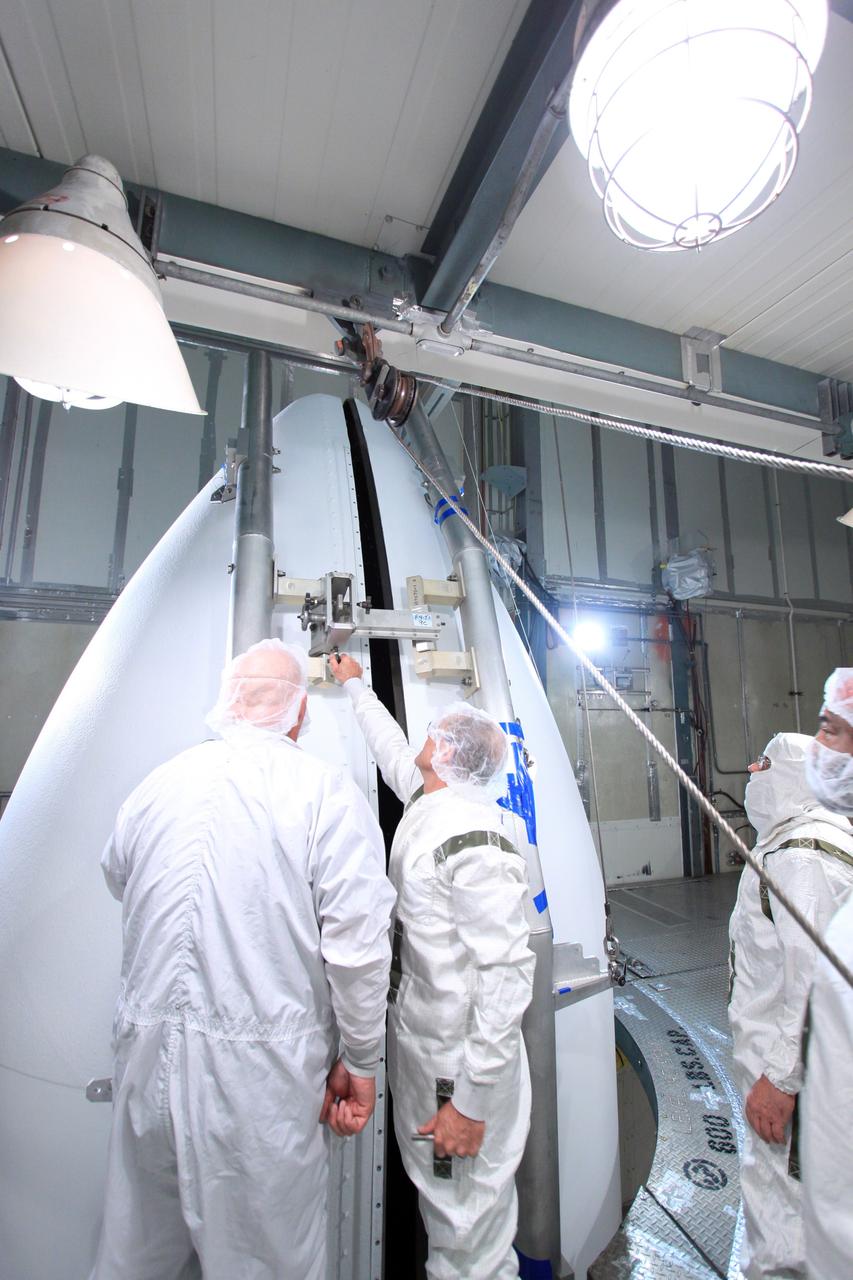
CAPE CANAVERAL, Fla. -- At Space Launch Complex 17B on Cape Canaveral Air Force Station in Florida, spacecraft technicians secure the sections of the clamshell-shaped Delta payload fairing around NASA's twin Gravity Recovery and Interior Laboratory spacecraft. The fairing will protect the spacecraft from the impact of aerodynamic pressure and heating during ascent and will be jettisoned once the spacecraft is outside the Earth's atmosphere. Launch aboard a United Launch Alliance Delta II rocket from Pad 17B is scheduled for Sept. 8. The spacecraft will fly in tandem orbits around the moon for several months to measure its gravity field. GRAIL's primary science objectives are to determine the structure of the lunar interior, from crust to core, and to advance understanding of the thermal evolution of the moon. For more information, visit http://www.nasa.gov/grail. Photo credit: NASA/Jim Grossmann
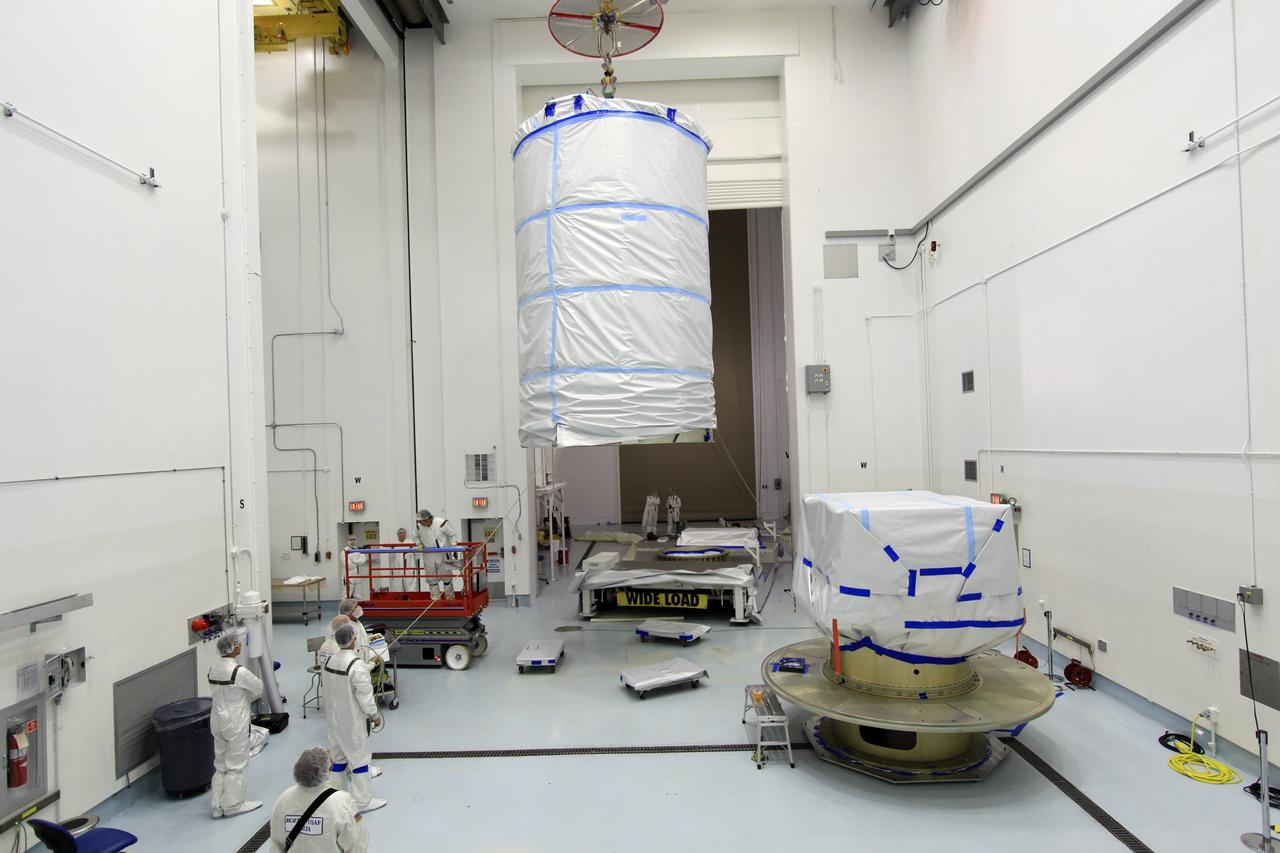
CAPE CANAVERAL, Fla. -- At Astrotech Space Operation's payload processing facility in Titusville, Fla., a crane lifts the protective canister that will enclose NASA's twin Gravity Recovery and Interior Laboratory spacecraft, at right, during transport to the launch pad. The lunar probes are attached to a spacecraft adapter ring in their side-by-side launch configuration and wrapped in plastic to prevent contamination outside the clean room. The spacecraft will fly in tandem orbits around the moon for several months to measure its gravity field. GRAIL's primary science objectives are to determine the structure of the lunar interior, from crust to core, and to advance understanding of the thermal evolution of the moon. Launch aboard a United Launch Alliance Delta II rocket from Space Launch Complex 17B on Cape Canaveral Air Force Station is scheduled for Sept. 8. For more information, visit http://www.nasa.gov/grail. Photo credit: NASA/Jim Grossmann
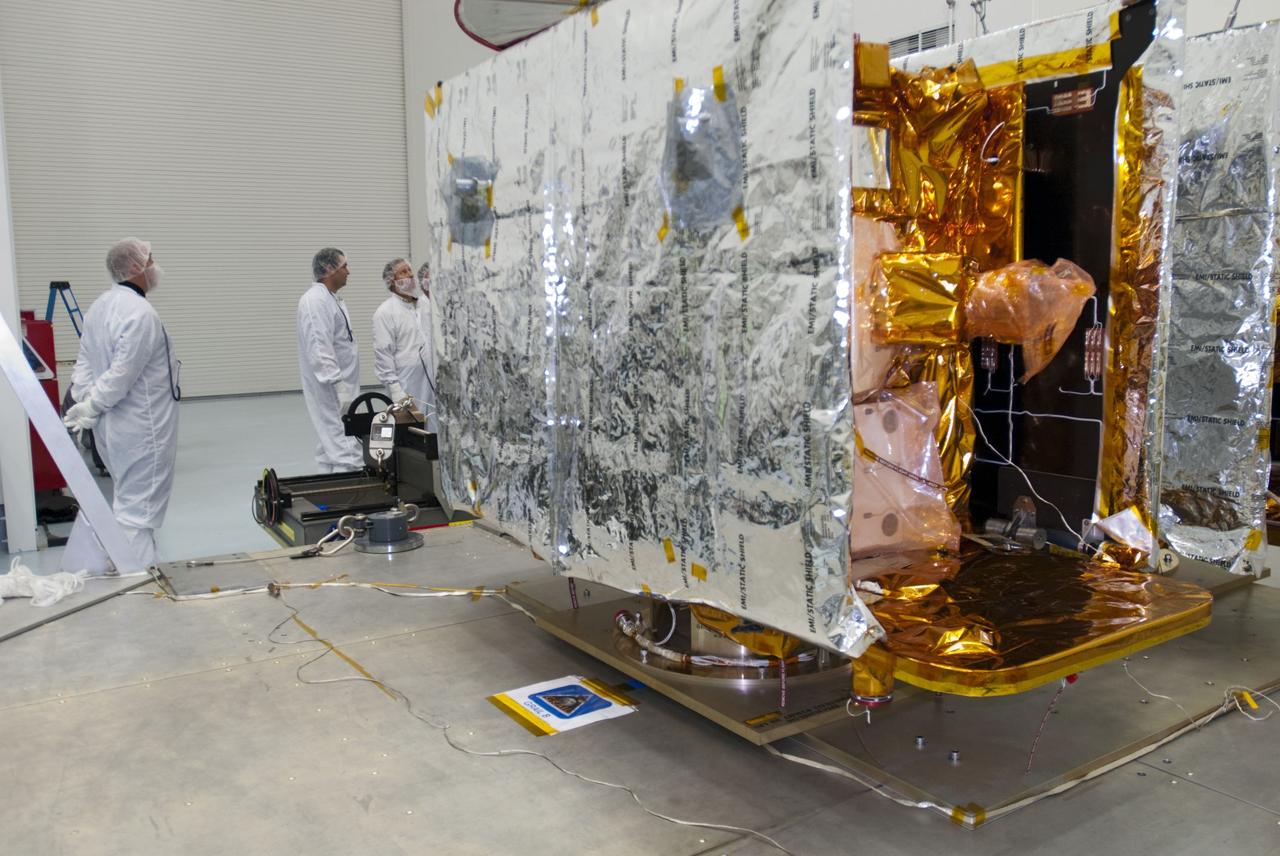
CAPE CANAVERAL, Fla. -- Lockheed Martin technicians examine NASA's twin Gravity Recovery and Interior Laboratory lunar spacecraft before they are moved onto workstands in the Hazardous Processing Facility (HPF) at Astrotech Space Operation's payload processing facility in Titusville, Fla. In the HPF, the spacecraft will undergo two days of fueling activities. GRAIL will fly in tandem orbits around the moon for several months to measure its gravity field. GRAIL's primary science objectives are to determine the structure of the lunar interior, from crust to core, and to advance understanding of the thermal evolution of the moon. Launch aboard a United Launch Alliance Delta II rocket from Space Launch Complex 17B on Cape Canaveral Air Force Station is scheduled for Sept. 8. For more information, visit http://www.nasa.gov/grail. Photo credit: NASA/Charisse Nahser
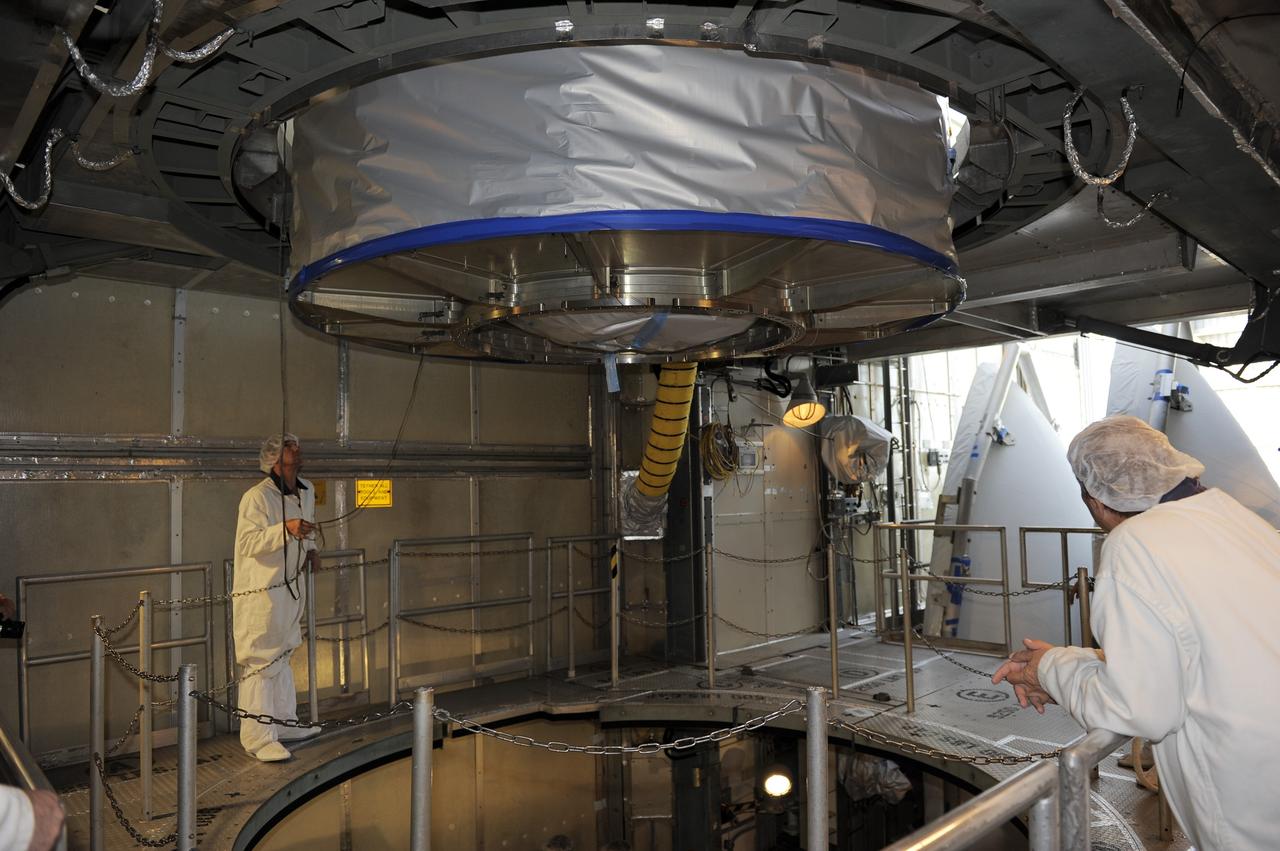
CAPE CANAVERAL, Fla. -- Technicians lower NASA's twin Gravity Recovery and Interior Laboratory (GRAIL) spacecraft into place atop a United Launch Alliance Delta II rocket on Space Launch Complex 17B at Cape Canaveral Air Force Station in Florida. The lunar probes are attached to a spacecraft adapter ring in their side-by-side launch configuration and wrapped in plastic to prevent contamination outside the clean room. The spacecraft will fly in tandem orbits around the moon for several months to measure its gravity field. GRAIL's primary science objectives are to determine the structure of the lunar interior, from crust to core, and to advance understanding of the thermal evolution of the moon. Launch is scheduled for Sept. 8. For more information, visit www.nasa.gov/grail. Photo credit: NASA/Kim Shiflett
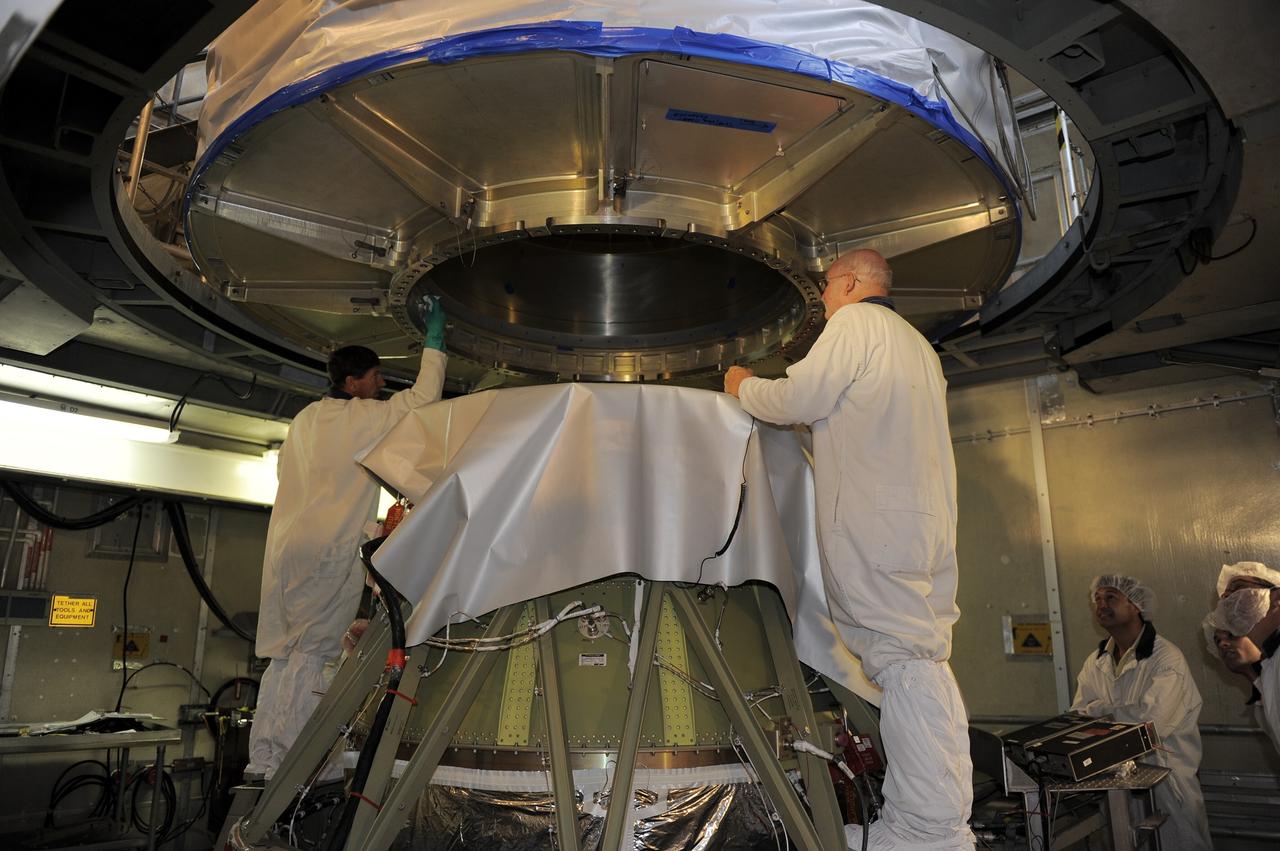
CAPE CANAVERAL, Fla. -- At Space Launch Complex 17B on Cape Canaveral Air Force Station in Florida, NASA's twin Gravity Recovery and Interior Laboratory spacecraft are secured atop a Delta II rocket awaiting enclosure in the Delta payload fairing. The fairing will protect the spacecraft from the impact of aerodynamic pressure and heating during ascent and will be jettisoned once the spacecraft is outside the Earth's atmosphere. Launch aboard a United Launch Alliance Delta II rocket from Pad 17B is scheduled for Sept. 8. The spacecraft will fly in tandem orbits around the moon for several months to measure its gravity field. GRAIL's primary science objectives are to determine the structure of the lunar interior, from crust to core, and to advance understanding of the thermal evolution of the moon. For more information, visit http://www.nasa.gov/grail. Photo credit: NASA/Jim Grossmann
CAPE CANAVERAL, Fla. -- Technicians lower NASA's twin Gravity Recovery and Interior Laboratory (GRAIL) spacecraft into place atop a United Launch Alliance Delta II rocket on Space Launch Complex 17B at Cape Canaveral Air Force Station in Florida. The lunar probes are attached to a spacecraft adapter ring in their side-by-side launch configuration and wrapped in plastic to prevent contamination outside the clean room. The spacecraft will fly in tandem orbits around the moon for several months to measure its gravity field. GRAIL's primary science objectives are to determine the structure of the lunar interior, from crust to core, and to advance understanding of the thermal evolution of the moon. Launch is scheduled for Sept. 8. For more information, visit www.nasa.gov/grail. Photo credit: NASA/Kim Shiflett
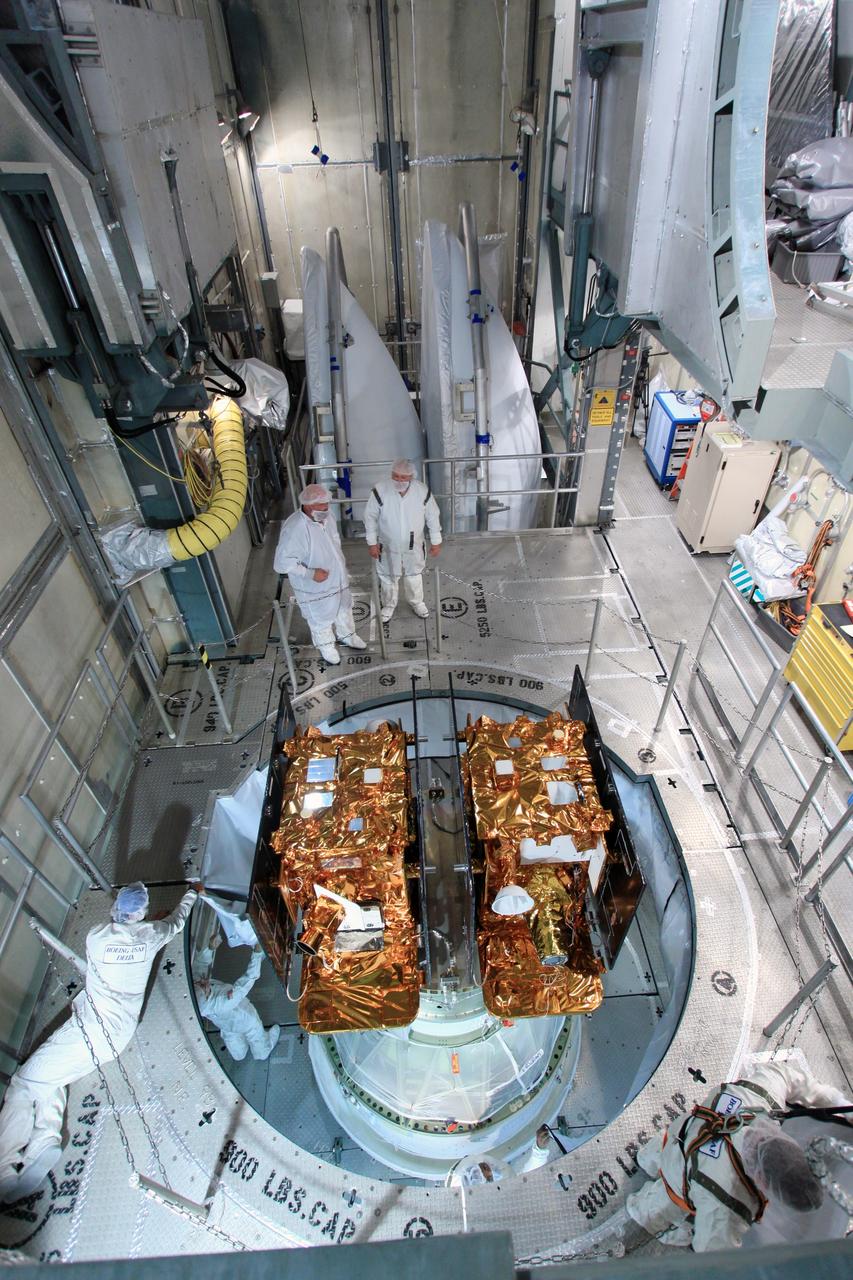
CAPE CANAVERAL, Fla. -- At Space Launch Complex 17B on Cape Canaveral Air Force Station in Florida, NASA's twin Gravity Recovery and Interior Laboratory spacecraft are uncovered and ready for enclosure in the Delta payload fairing. The fairing will protect the spacecraft from the impact of aerodynamic pressure and heating during ascent and will be jettisoned once the spacecraft is outside the Earth's atmosphere. Launch aboard a United Launch Alliance Delta II rocket from Pad 17B is scheduled for Sept. 8. The spacecraft will fly in tandem orbits around the moon for several months to measure its gravity field. GRAIL's primary science objectives are to determine the structure of the lunar interior, from crust to core, and to advance understanding of the thermal evolution of the moon. For more information, visit http://www.nasa.gov/grail. Photo credit: NASA/Jim Grossmann
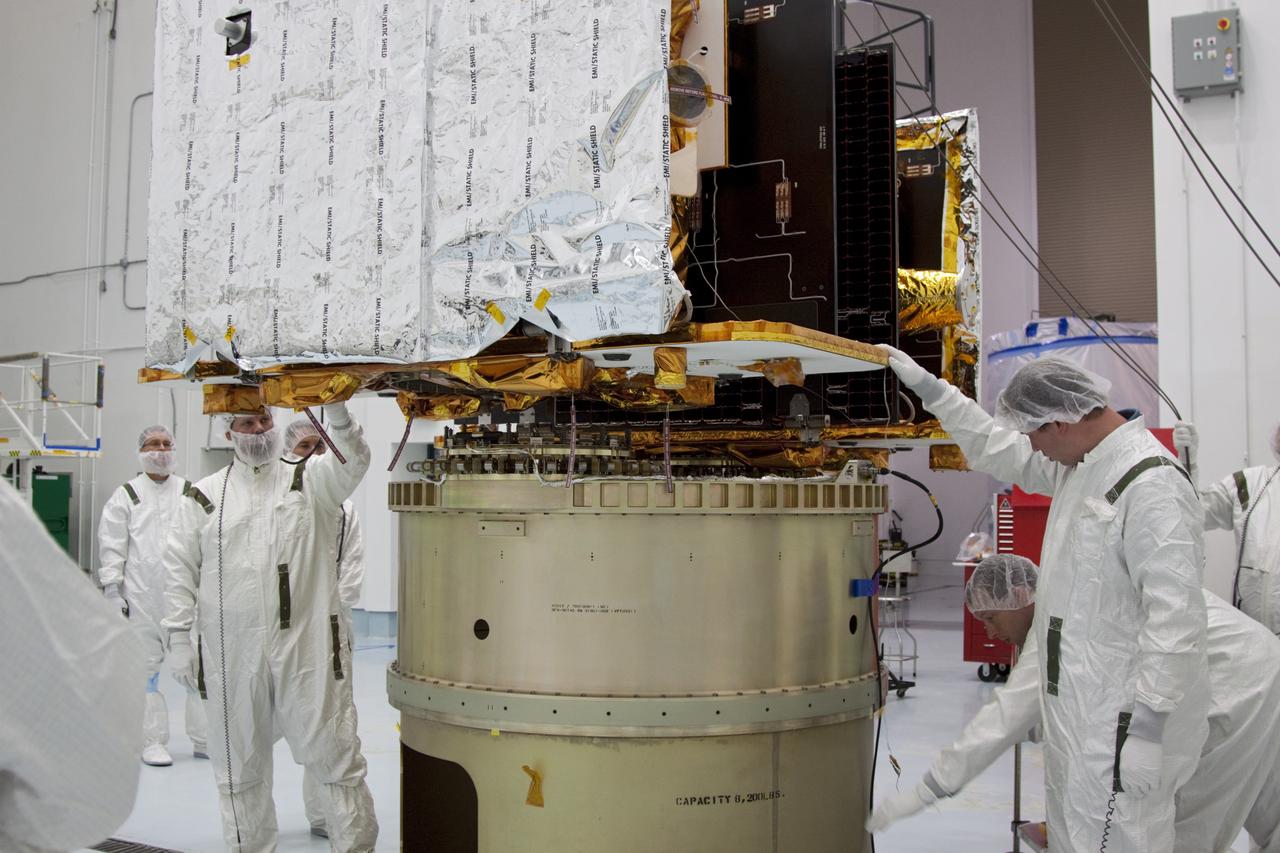
CAPE CANAVERAL, Fla. -- At Astrotech Space Operation's payload processing facility in Titusville, Fla., Lockheed Martin technicians verify that NASA's Gravity Recovery and Interior Laboratory-A (GRAIL-A) lunar probe is lowered into the correct position on the spacecraft adapter ring. After the twin GRAIL spacecraft are attached to the adapter ring in their side-by-side launch configuration, they will be transported to the launch pad. GRAIL will fly in tandem orbits around the moon for several months to measure its gravity field. GRAIL's primary science objectives are to determine the structure of the lunar interior, from crust to core, and to advance understanding of the thermal evolution of the moon. Launch aboard a United Launch Alliance Delta II rocket from Space Launch Complex 17B on Cape Canaveral Air Force Station is scheduled for Sept. 8. For more information, visit http://www.nasa.gov/grail. Photo credit: NASA/Jim Grossmann
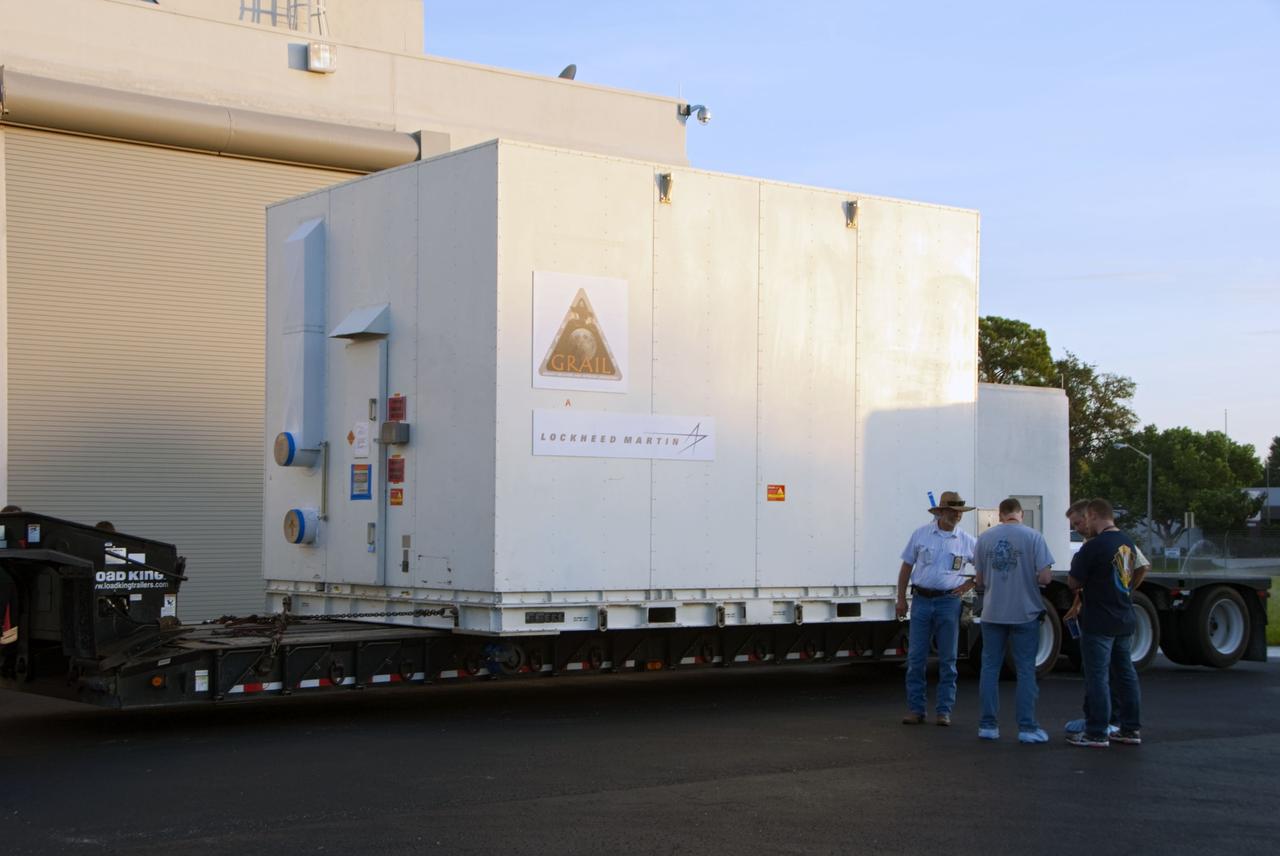
CAPE CANAVERAL, Fla. -- Preparations are under way to transport the protective canister housing NASA's twin Gravity Recovery and Interior Laboratory lunar spacecraft to the Hazardous Processing Facility (HPF) at Astrotech Space Operation's payload processing facility in Titusville, Fla. In the HPF, the spacecraft will undergo two days of fueling activities. GRAIL will fly in tandem orbits around the moon for several months to measure its gravity field. GRAIL's primary science objectives are to determine the structure of the lunar interior, from crust to core, and to advance understanding of the thermal evolution of the moon. Launch aboard a United Launch Alliance Delta II rocket from Space Launch Complex 17B on Cape Canaveral Air Force Station is scheduled for Sept. 8. For more information, visit http://www.nasa.gov/grail. Photo credit: NASA/Charisse Nahser
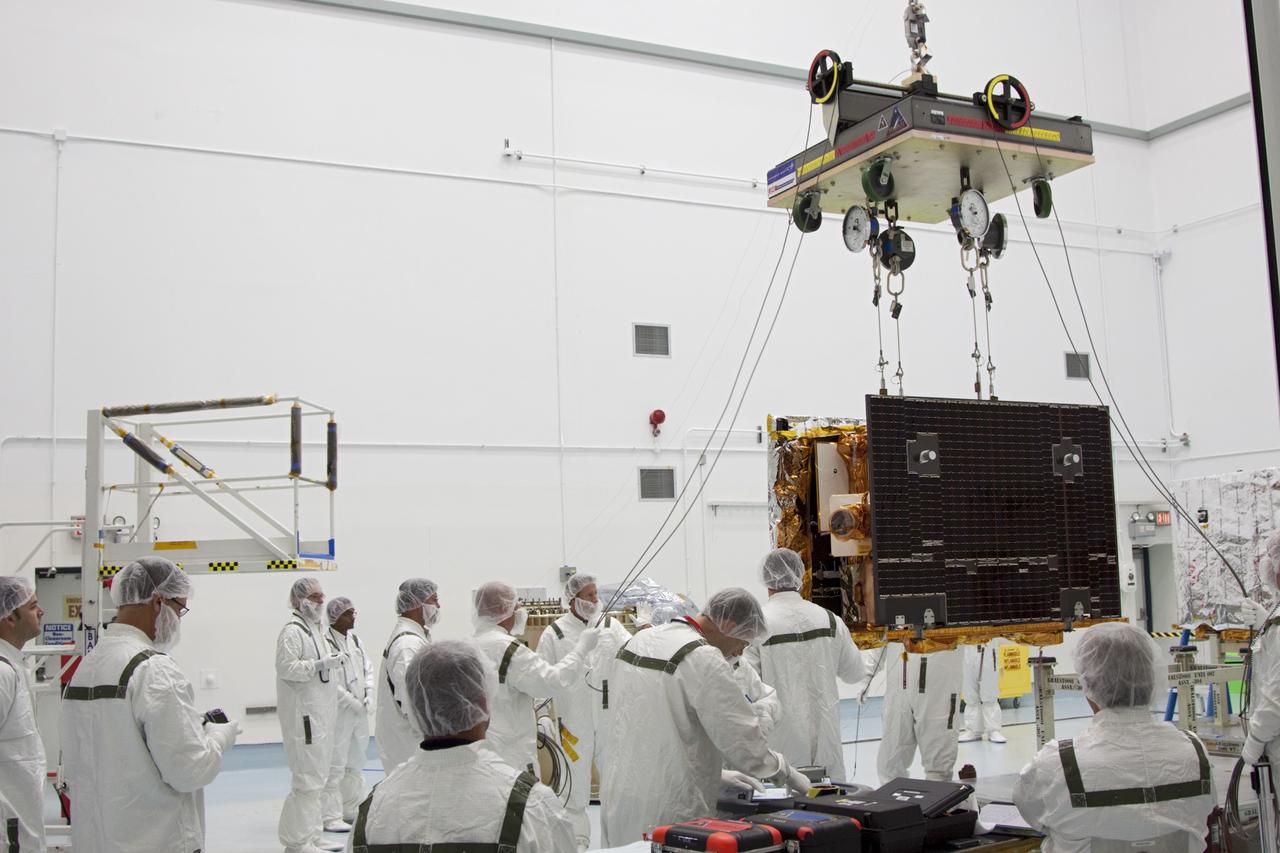
CAPE CANAVERAL, Fla. -- At Astrotech Space Operation's payload processing facility in Titusville, Fla., Lockheed Martin technicians lift NASA's Gravity Recovery and Interior Laboratory-B (GRAIL-B) lunar probe from its workstand. After the twin GRAIL spacecraft are attached to their spacecraft adapter ring in their side-by-side launch configuration, they will be transported to the launch pad. GRAIL will fly in tandem orbits around the moon for several months to measure its gravity field. GRAIL's primary science objectives are to determine the structure of the lunar interior, from crust to core, and to advance understanding of the thermal evolution of the moon. Launch aboard a United Launch Alliance Delta II rocket from Space Launch Complex 17B on Cape Canaveral Air Force Station is scheduled for Sept. 8. For more information, visit http://www.nasa.gov/grail. Photo credit: NASA/Jim Grossmann
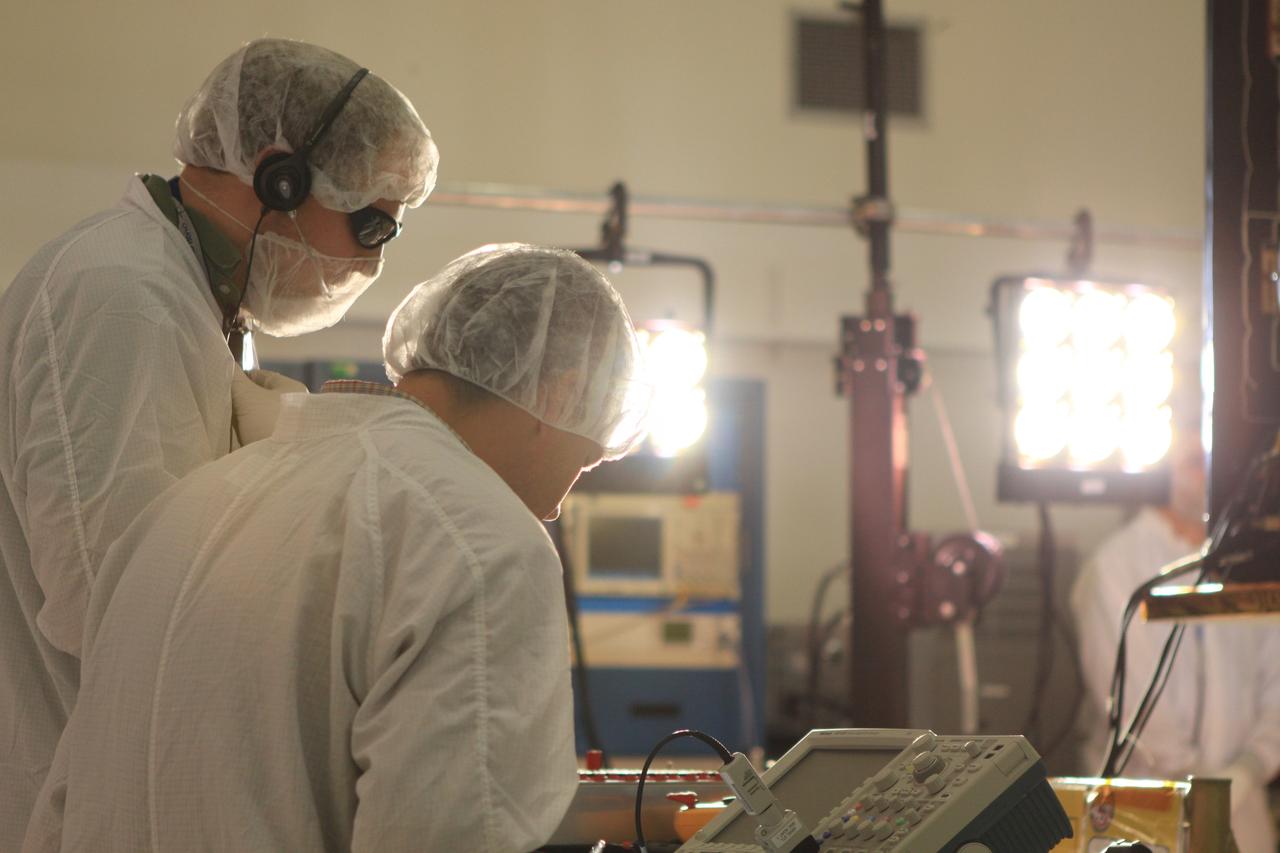
CAPE CANAVERAL, Fla. -- Lockheed Martin technicians in Astrotech Space Operation's payload processing facility in Titusville, Fla., test the solar arrays on NASA's Gravity Recovery and Interior Laboratory-A, or GRAIL-A, spacecraft to ensure that they will function as planned during the mission. The electrical power subsystem on each of GRAIL's twin spacecraft includes two solar arrays and a lithium ion battery. Each solar array is capable of producing no less than 700 watts. They will be deployed shortly after separation from the launch vehicle and remain fixed throughout the mission. GRAIL will fly in tandem orbits around the moon for several months to measure its gravity field. GRAIL's primary science objectives are to determine the structure of the lunar interior, from crust to core, and to advance understanding of the thermal evolution of the moon. Launch aboard a United Launch Alliance Delta II rocket from Space Launch Complex 17B on Cape Canaveral Air Force Station is scheduled for Sept. 8. For more information, visit http://www.nasa.gov/grail. Photo credit: NASA/Frankie Martin
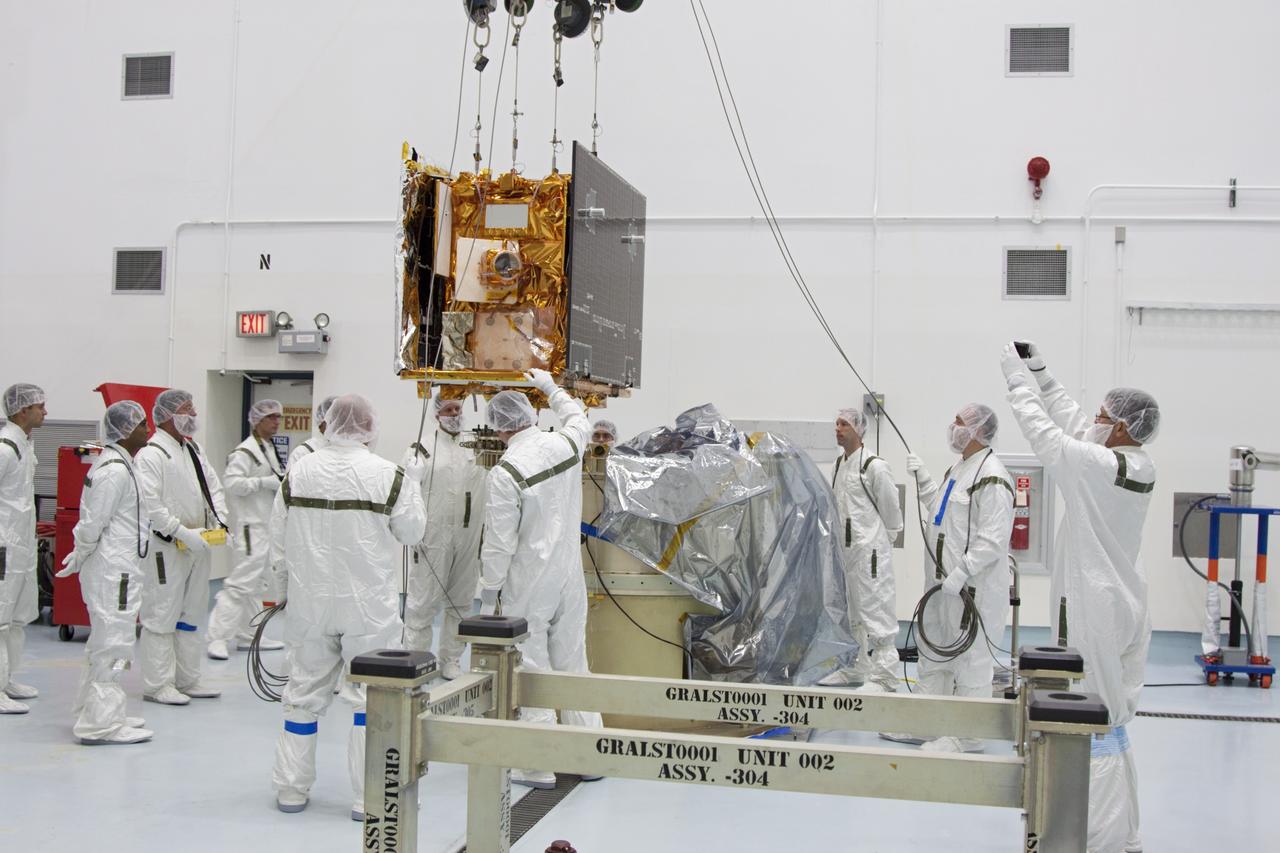
CAPE CANAVERAL, Fla. -- At Astrotech Space Operation's payload processing facility in Titusville, Fla., Lockheed Martin technicians lower NASA's Gravity Recovery and Interior Laboratory-B (GRAIL-B) lunar probe into position on the spacecraft adapter ring. After the twin GRAIL spacecraft are attached to the adapter ring in their side-by-side launch configuration, they will be transported to the launch pad. GRAIL will fly in tandem orbits around the moon for several months to measure its gravity field. GRAIL's primary science objectives are to determine the structure of the lunar interior, from crust to core, and to advance understanding of the thermal evolution of the moon. Launch aboard a United Launch Alliance Delta II rocket from Space Launch Complex 17B on Cape Canaveral Air Force Station is scheduled for Sept. 8. For more information, visit http://www.nasa.gov/grail. Photo credit: NASA/Jim Grossmann
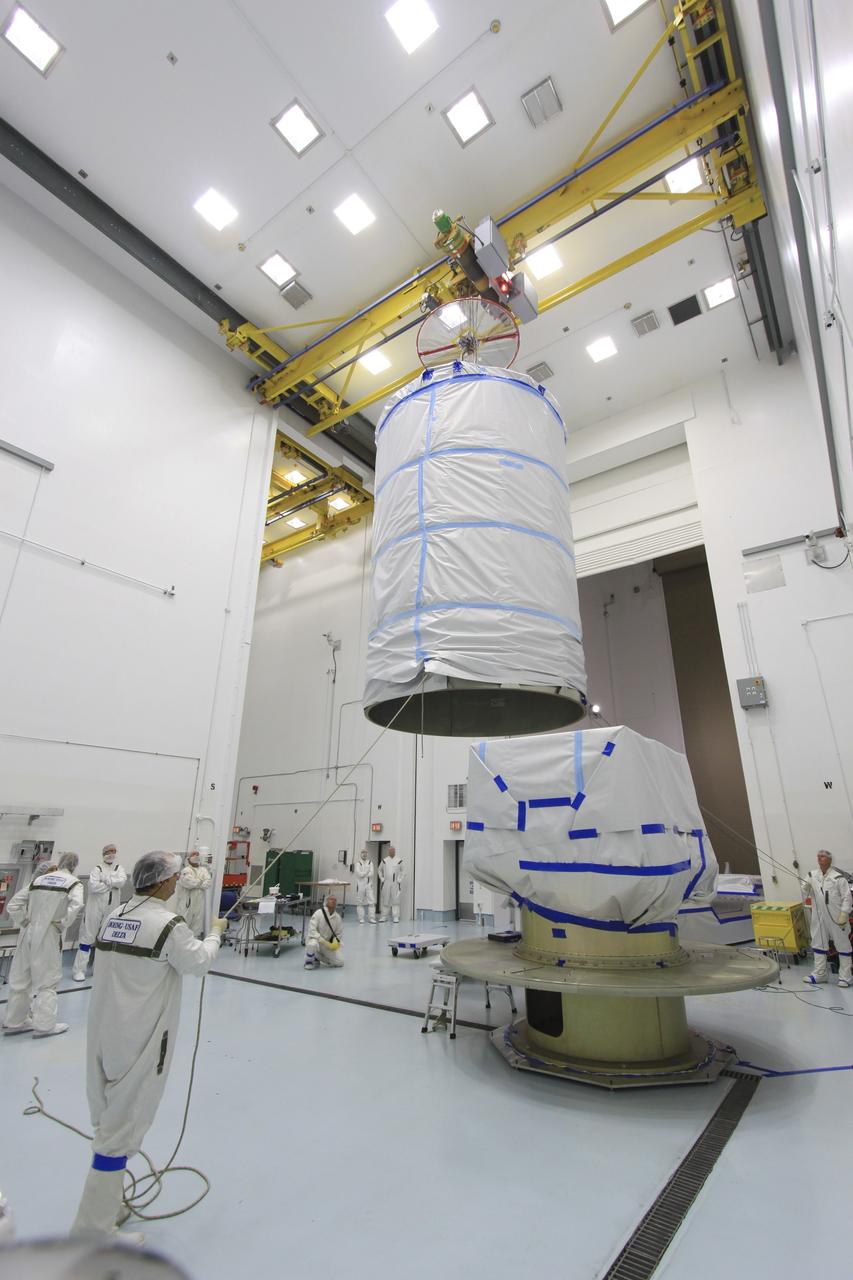
CAPE CANAVERAL, Fla. -- At Astrotech Space Operation's payload processing facility in Titusville, Fla., a crane lowers a protective canister toward NASA's twin Gravity Recovery and Interior Laboratory spacecraft during preparations to transport them to the launch pad. The lunar probes are attached to a spacecraft adapter ring in their side-by-side launch configuration and wrapped in plastic to prevent contamination outside the clean room. The spacecraft will fly in tandem orbits around the moon for several months to measure its gravity field. GRAIL's primary science objectives are to determine the structure of the lunar interior, from crust to core, and to advance understanding of the thermal evolution of the moon. Launch aboard a United Launch Alliance Delta II rocket from Space Launch Complex 17B on Cape Canaveral Air Force Station is scheduled for Sept. 8. For more information, visit http://www.nasa.gov/grail. Photo credit: NASA/Jim Grossmann

CAPE CANAVERAL, Fla. -- Lockheed Martin technicians push NASA's mylar-covered twin Gravity Recovery and Interior Laboratory lunar spacecraft toward the work area of the Hazardous Processing Facility (HPF) at Astrotech Space Operation's payload processing facility in Titusville, Fla. In the HPF, the spacecraft will undergo two days of fueling activities. GRAIL will fly in tandem orbits around the moon for several months to measure its gravity field. GRAIL's primary science objectives are to determine the structure of the lunar interior, from crust to core, and to advance understanding of the thermal evolution of the moon. Launch aboard a United Launch Alliance Delta II rocket from Space Launch Complex 17B on Cape Canaveral Air Force Station is scheduled for Sept. 8. For more information, visit http://www.nasa.gov/grail. Photo credit: NASA/Charisse Nahser
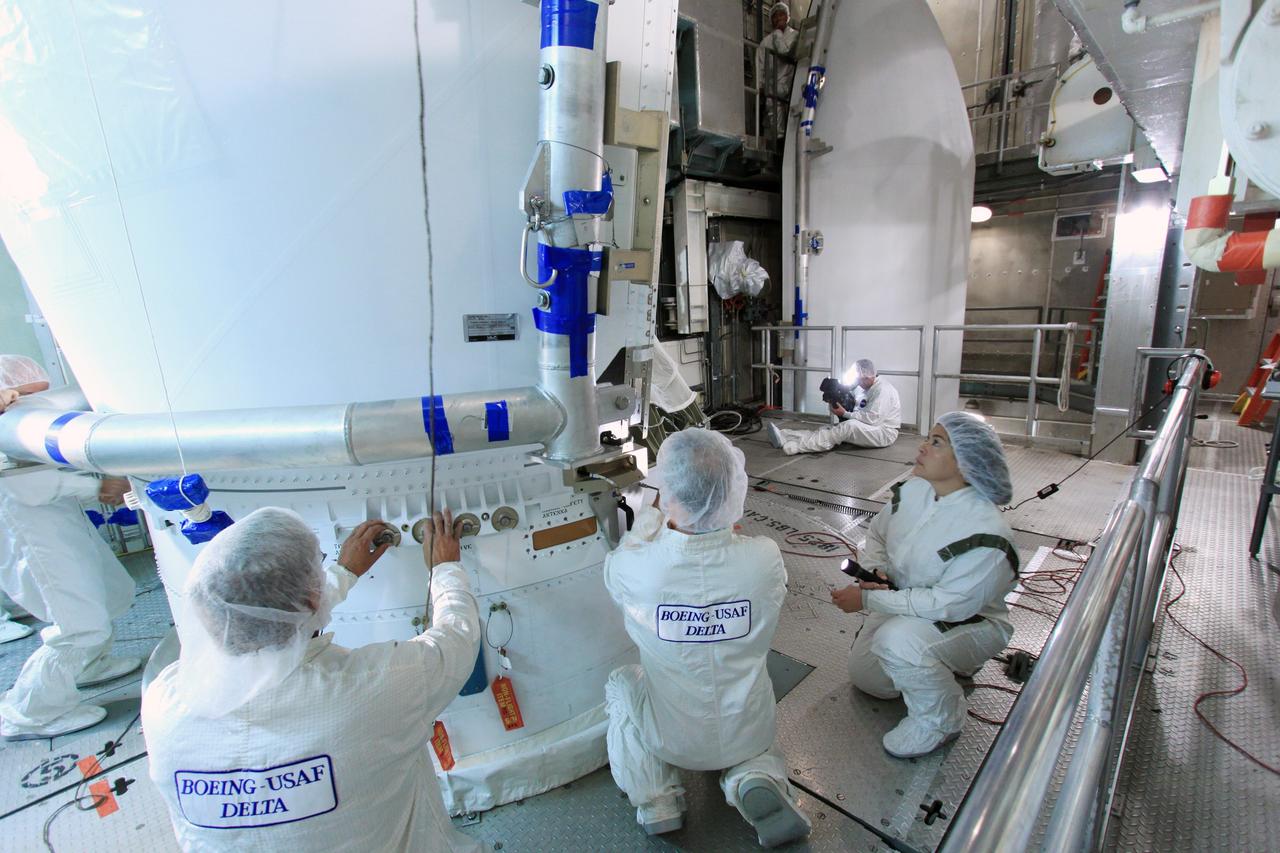
CAPE CANAVERAL, Fla. -- At Space Launch Complex 17B on Cape Canaveral Air Force Station in Florida, spacecraft technicians dressed in clean room attire, known as "bunny" suits, secure half of the clamshell-shaped Delta payload fairing around NASA's twin Gravity Recovery and Interior Laboratory spacecraft. The fairing will protect the spacecraft from the impact of aerodynamic pressure and heating during ascent and will be jettisoned once the spacecraft is outside the Earth's atmosphere. Launch aboard a United Launch Alliance Delta II rocket from Pad 17B is scheduled for Sept. 8. The spacecraft will fly in tandem orbits around the moon for several months to measure its gravity field. GRAIL's primary science objectives are to determine the structure of the lunar interior, from crust to core, and to advance understanding of the thermal evolution of the moon. For more information, visit http://www.nasa.gov/grail. Photo credit: NASA/Jim Grossmann
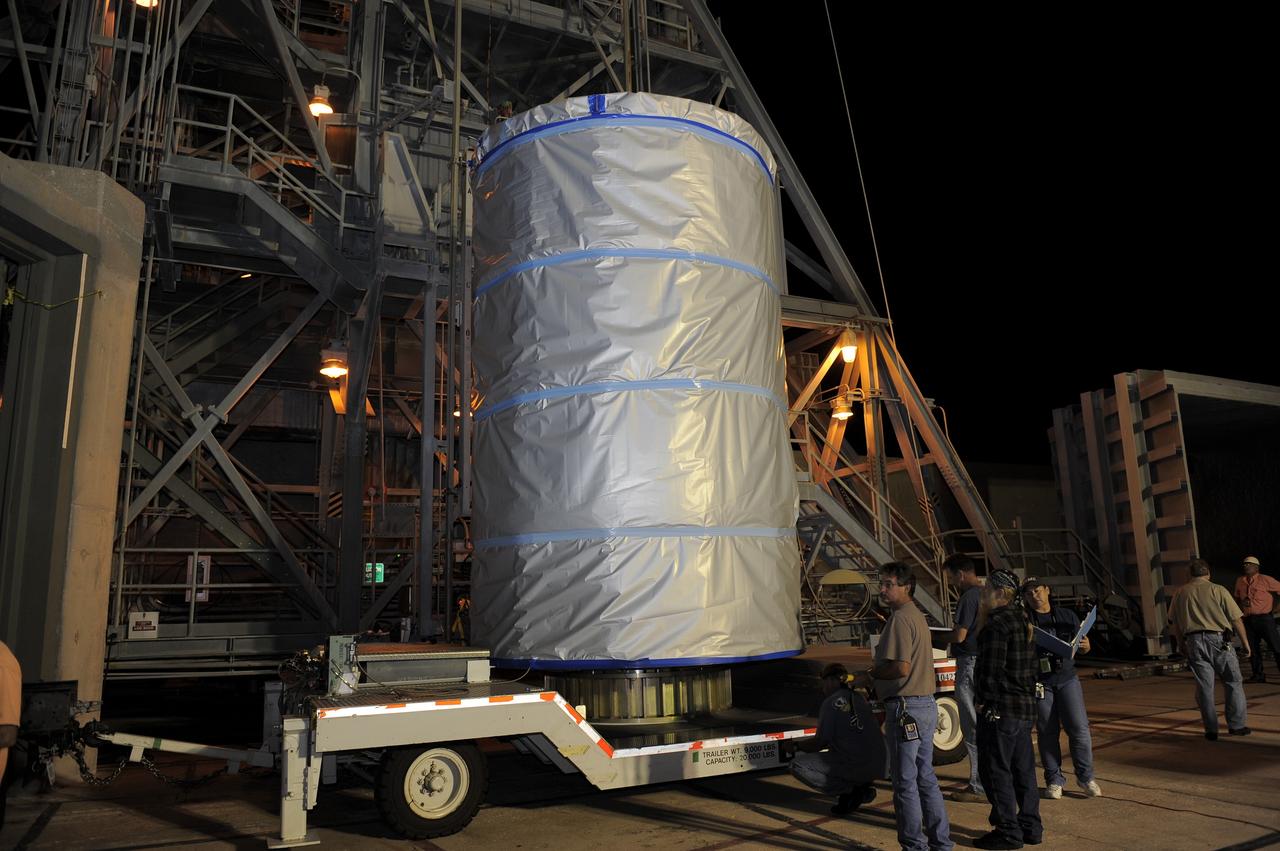
CAPE CANAVERAL, Fla. -- NASA's twin Gravity Recovery and Interior Laboratory (GRAIL) spacecraft will be lifted to the top of their launch pad at Space Launch Complex 17B at Cape Canaveral Air Force Station in Florida. The lunar probes are attached to a spacecraft adapter ring in their side-by-side launch configuration and wrapped in plastic to prevent contamination outside the clean room in the Astrotech Space Operation's payload processing facility in Titusville, Fla. The spacecraft will fly in tandem orbits around the moon for several months to measure its gravity field. GRAIL's primary science objectives are to determine the structure of the lunar interior, from crust to core, and to advance understanding of the thermal evolution of the moon. Launch aboard a United Launch Alliance Delta II rocket is scheduled for Sept. 8. For more information, visit www.nasa.gov/grail. Photo credit: NASA/Kim Shiflett
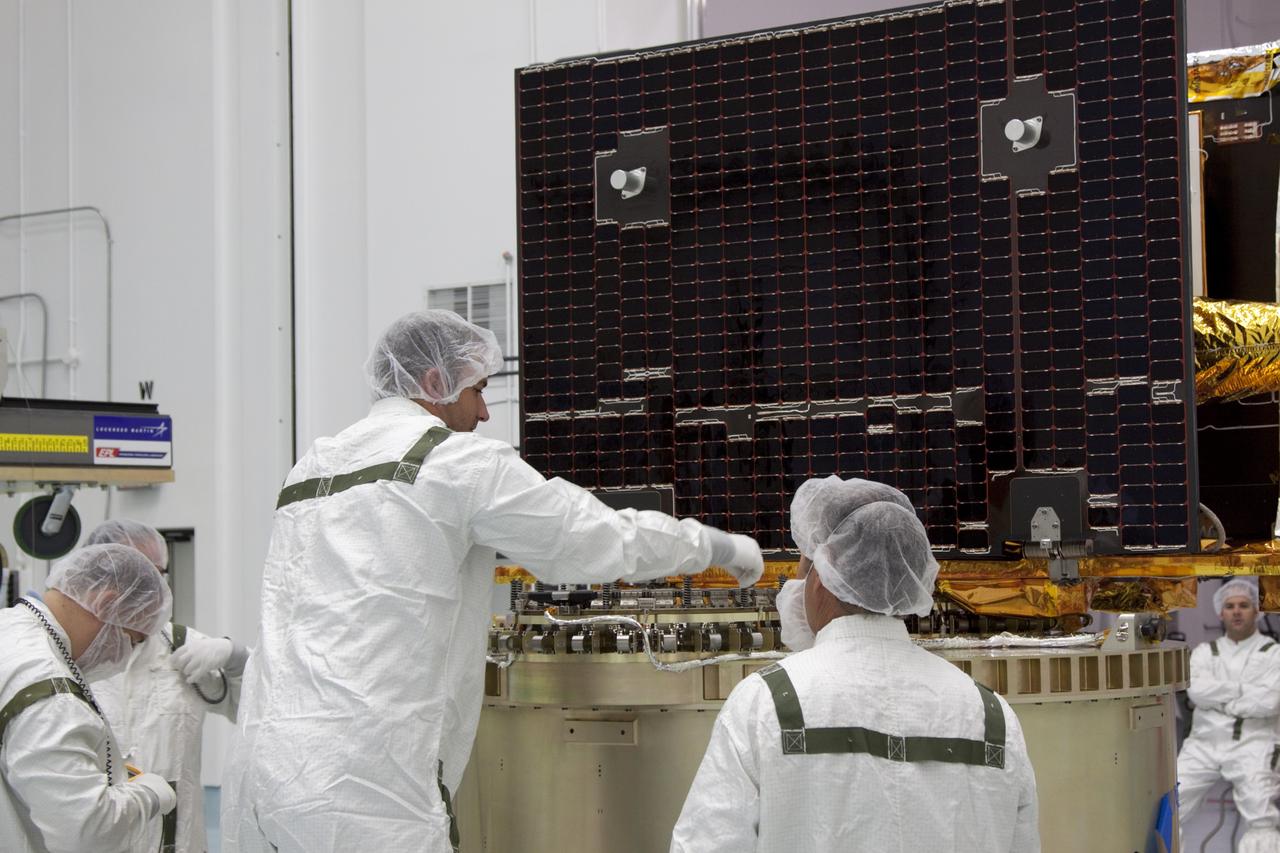
CAPE CANAVERAL, Fla. -- At Astrotech Space Operation's payload processing facility in Titusville, Fla., a Lockheed Martin technician secures NASA's Gravity Recovery and Interior Laboratory-B (GRAIL-B) lunar probe on the spacecraft adapter ring. After the twin GRAIL spacecraft are attached to the adapter ring in their side-by-side launch configuration, they will be transported to the launch pad. GRAIL will fly in tandem orbits around the moon for several months to measure its gravity field. GRAIL's primary science objectives are to determine the structure of the lunar interior, from crust to core, and to advance understanding of the thermal evolution of the moon. Launch aboard a United Launch Alliance Delta II rocket from Space Launch Complex 17B on Cape Canaveral Air Force Station is scheduled for Sept. 8. For more information, visit http://www.nasa.gov/grail. Photo credit: NASA/Jim Grossmann
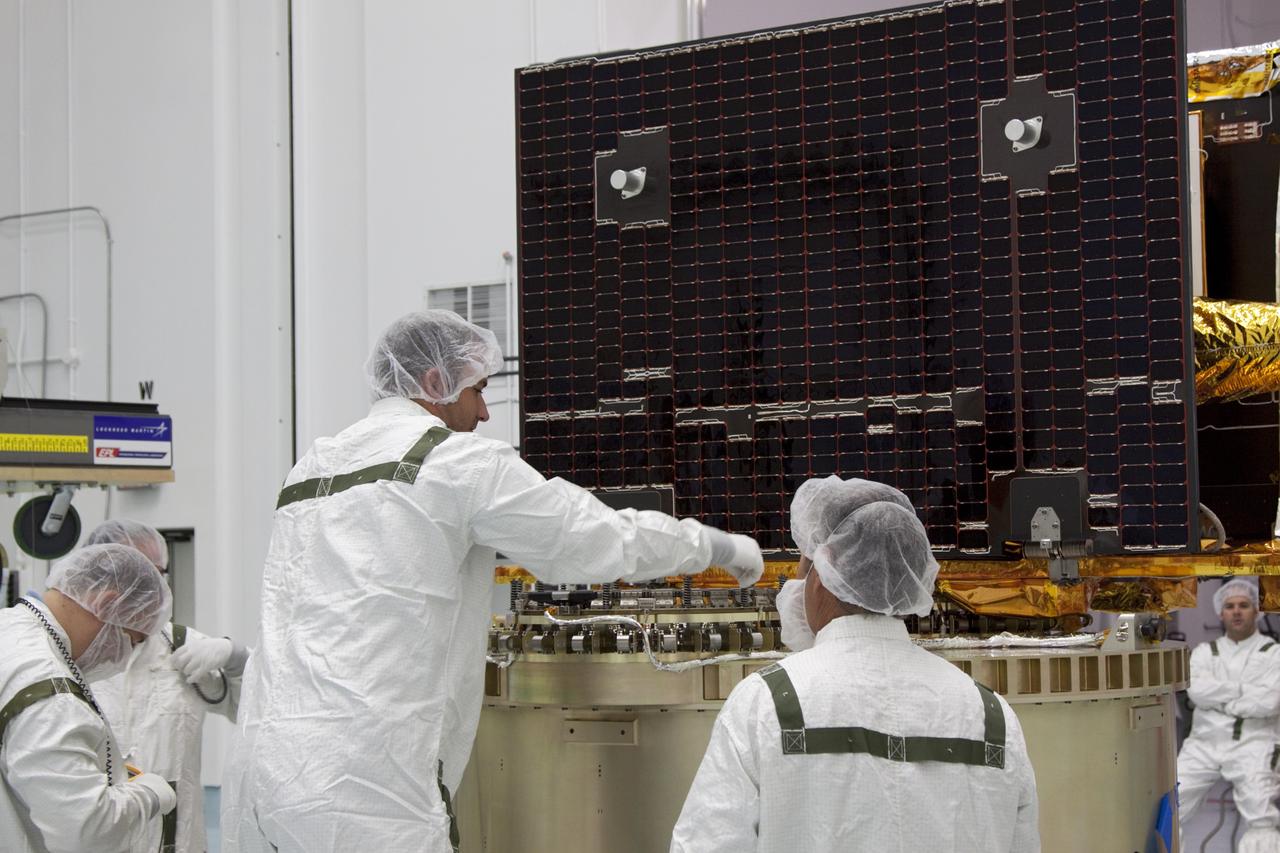
CAPE CANAVERAL, Fla. -- At Astrotech Space Operation's payload processing facility in Titusville, Fla., NASA's Gravity Recovery and Interior Laboratory-B (GRAIL-B) lunar probe is secured on the spacecraft adapter ring. After the twin GRAIL spacecraft are attached to the adapter ring in their side-by-side launch configuration, they will be transported to the launch pad. GRAIL will fly in tandem orbits around the moon for several months to measure its gravity field. GRAIL's primary science objectives are to determine the structure of the lunar interior, from crust to core, and to advance understanding of the thermal evolution of the moon. Launch aboard a United Launch Alliance Delta II rocket from Space Launch Complex 17B on Cape Canaveral Air Force Station is scheduled for Sept. 8. For more information, visit http://www.nasa.gov/grail. Photo credit: NASA/Jim Grossmann
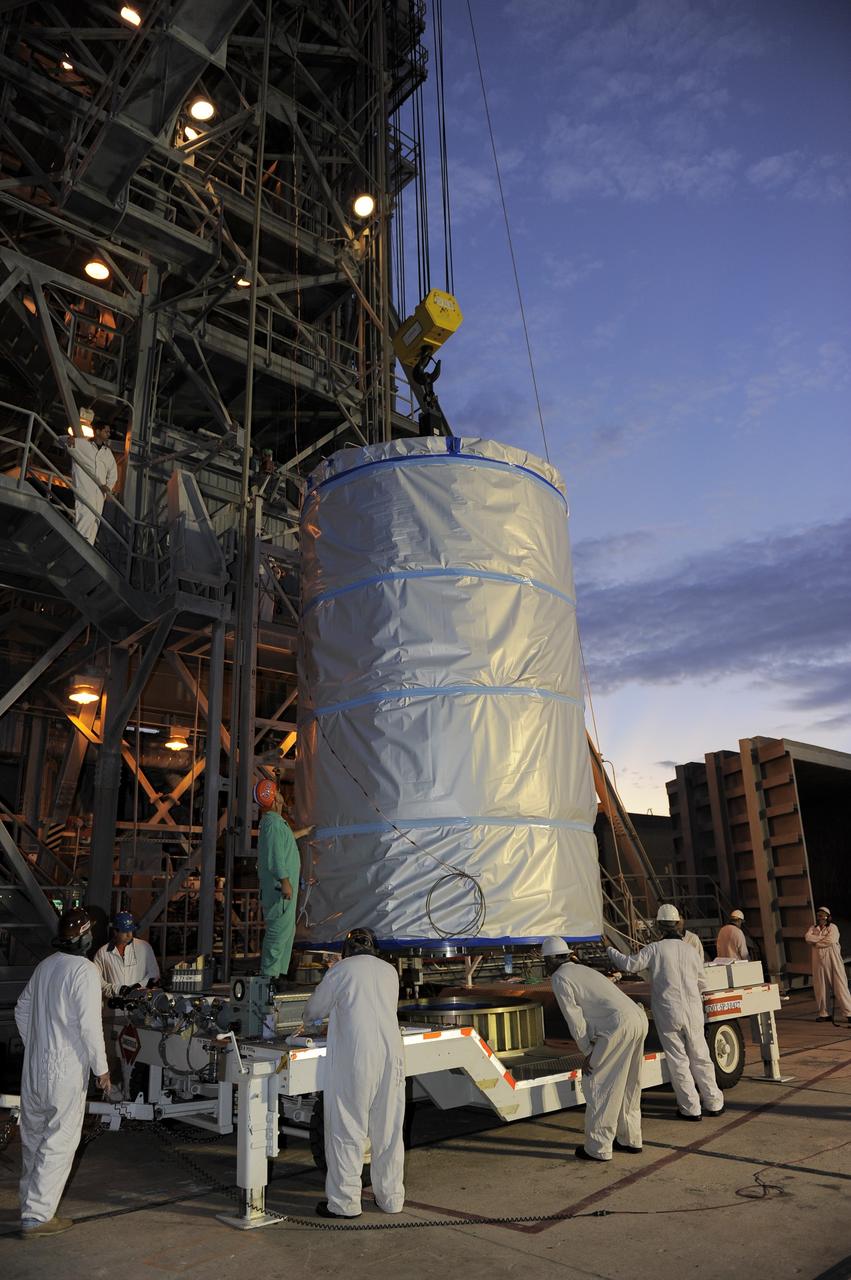
CAPE CANAVERAL, Fla. -- NASA's twin Gravity Recovery and Interior Laboratory (GRAIL) spacecraft are lifted to the top of their launch pad at Space Launch Complex 17B at Cape Canaveral Air Force Station in Florida. The lunar probes are attached to a spacecraft adapter ring in their side-by-side launch configuration and wrapped in plastic to prevent contamination outside the clean room in the Astrotech Space Operation's payload processing facility in Titusville, Fla. The spacecraft will fly in tandem orbits around the moon for several months to measure its gravity field. GRAIL's primary science objectives are to determine the structure of the lunar interior, from crust to core, and to advance understanding of the thermal evolution of the moon. Launch aboard a United Launch Alliance Delta II rocket is scheduled for Sept. 8. For more information, visit www.nasa.gov/grail. Photo credit: NASA/Kim Shiflett
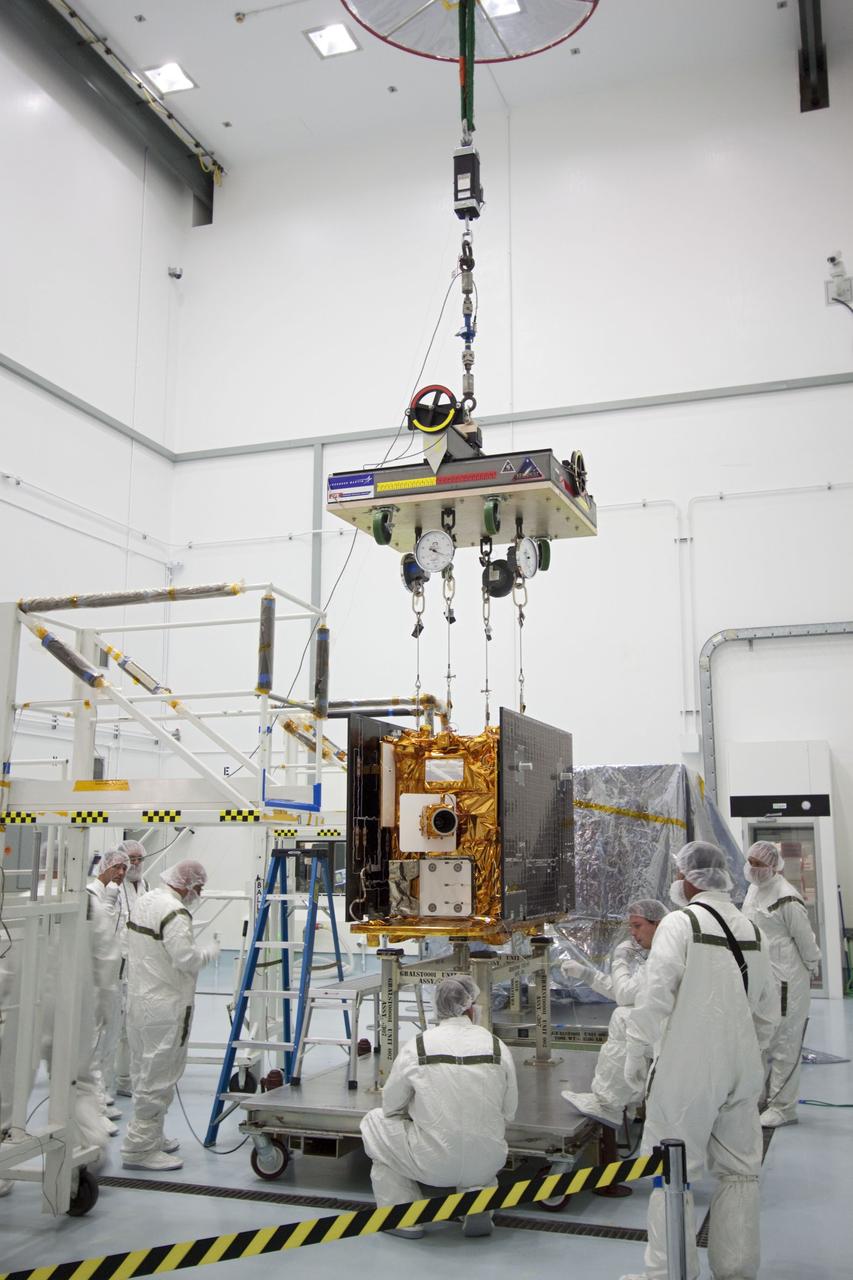
CAPE CANAVERAL, Fla. -- At Astrotech Space Operation's payload processing facility in Titusville, Fla., a portable scale lifts one of NASA's twin Gravity Recovery and Interior Laboratory lunar spacecraft from its workstand. The scale will record the exact weight of the spacecraft before they are stacked in their launch configuration in preparation for transport to the launch pad. GRAIL will fly in tandem orbits around the moon for several months to measure its gravity field. GRAIL's primary science objectives are to determine the structure of the lunar interior, from crust to core, and to advance understanding of the thermal evolution of the moon. Launch aboard a United Launch Alliance Delta II rocket from Space Launch Complex 17B on Cape Canaveral Air Force Station is scheduled for Sept. 8. For more information, visit http://www.nasa.gov/grail. Photo credit: NASA/Jim Grossmann
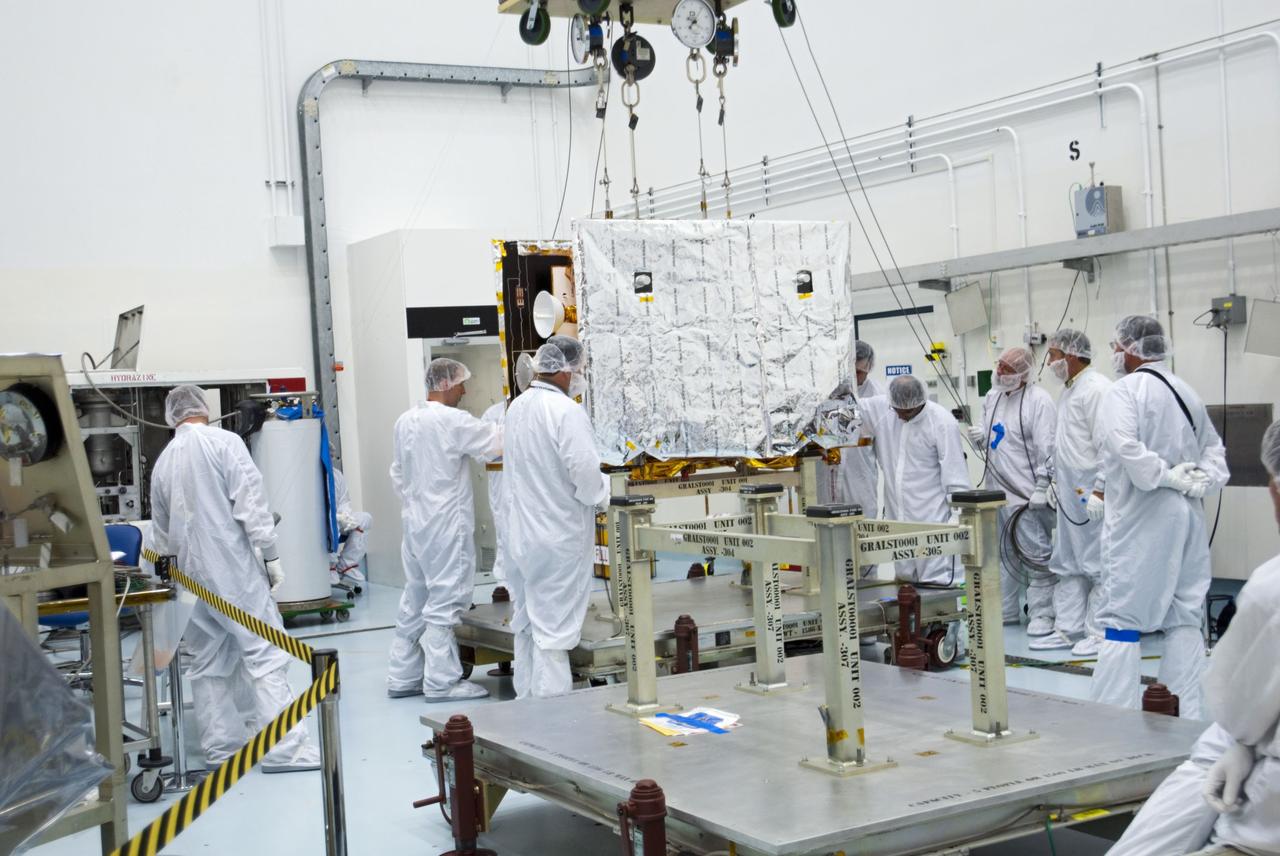
CAPE CANAVERAL, Fla. -- Lockheed Martin technicians lower one of NASA's twin Gravity Recovery and Interior Laboratory lunar spacecraft onto a workstand in the Hazardous Processing Facility (HPF) at Astrotech Space Operation's payload processing facility in Titusville, Fla. In the HPF, the spacecraft will undergo two days of fueling activities. GRAIL will fly in tandem orbits around the moon for several months to measure its gravity field. GRAIL's primary science objectives are to determine the structure of the lunar interior, from crust to core, and to advance understanding of the thermal evolution of the moon. Launch aboard a United Launch Alliance Delta II rocket from Space Launch Complex 17B on Cape Canaveral Air Force Station is scheduled for Sept. 8. For more information, visit http://www.nasa.gov/grail. Photo credit: NASA/Charisse Nahser

CAPE CANAVERAL, Fla. -- NASA's twin Gravity Recovery and Interior Laboratory lunar spacecraft are attached to the spacecraft adapter ring in their launch configuration in Astrotech Space Operation's payload processing facility in Titusville, Fla. Preparations are under way to transport the lunar probes to the launch pad. GRAIL will fly in tandem orbits around the moon for several months to measure its gravity field. GRAIL's primary science objectives are to determine the structure of the lunar interior, from crust to core, and to advance understanding of the thermal evolution of the moon. Launch aboard a United Launch Alliance Delta II rocket from Space Launch Complex 17B on Cape Canaveral Air Force Station is scheduled for Sept. 8. For more information, visit http://www.nasa.gov/grail. Photo credit: NASA/Jim Grossmann
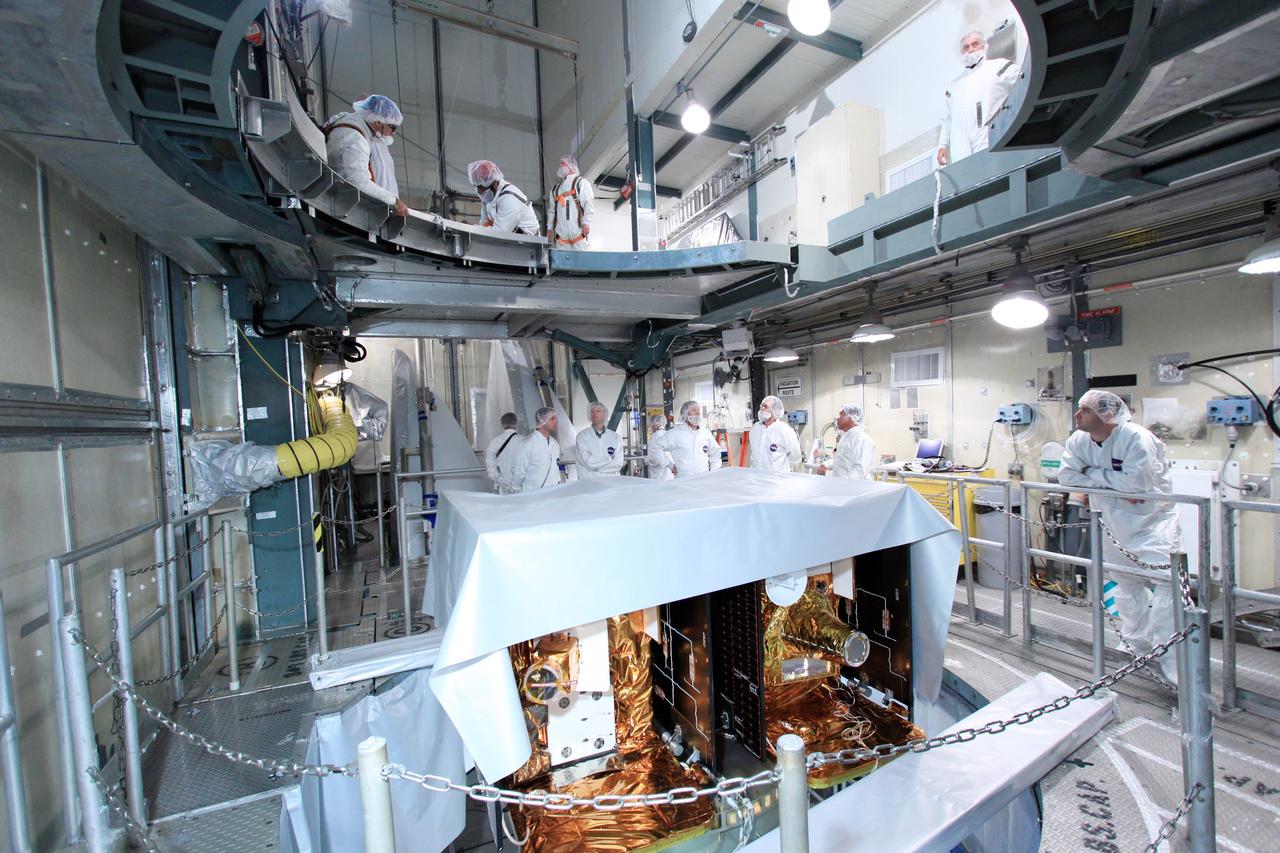
CAPE CANAVERAL, Fla. -- At Space Launch Complex 17B on Cape Canaveral Air Force Station in Florida, spacecraft technicians dressed in clean room attire, known as "bunny" suits, prepare to enclose NASA's twin Gravity Recovery and Interior Laboratory spacecraft in the Delta payload fairing. The fairing will protect the spacecraft from the impact of aerodynamic pressure and heating during ascent and will be jettisoned once the spacecraft is outside the Earth's atmosphere. Launch aboard a United Launch Alliance Delta II rocket from Pad 17B is scheduled for Sept. 8. The spacecraft will fly in tandem orbits around the moon for several months to measure its gravity field. GRAIL's primary science objectives are to determine the structure of the lunar interior, from crust to core, and to advance understanding of the thermal evolution of the moon. For more information, visit http://www.nasa.gov/grail. Photo credit: NASA/Jim Grossmann
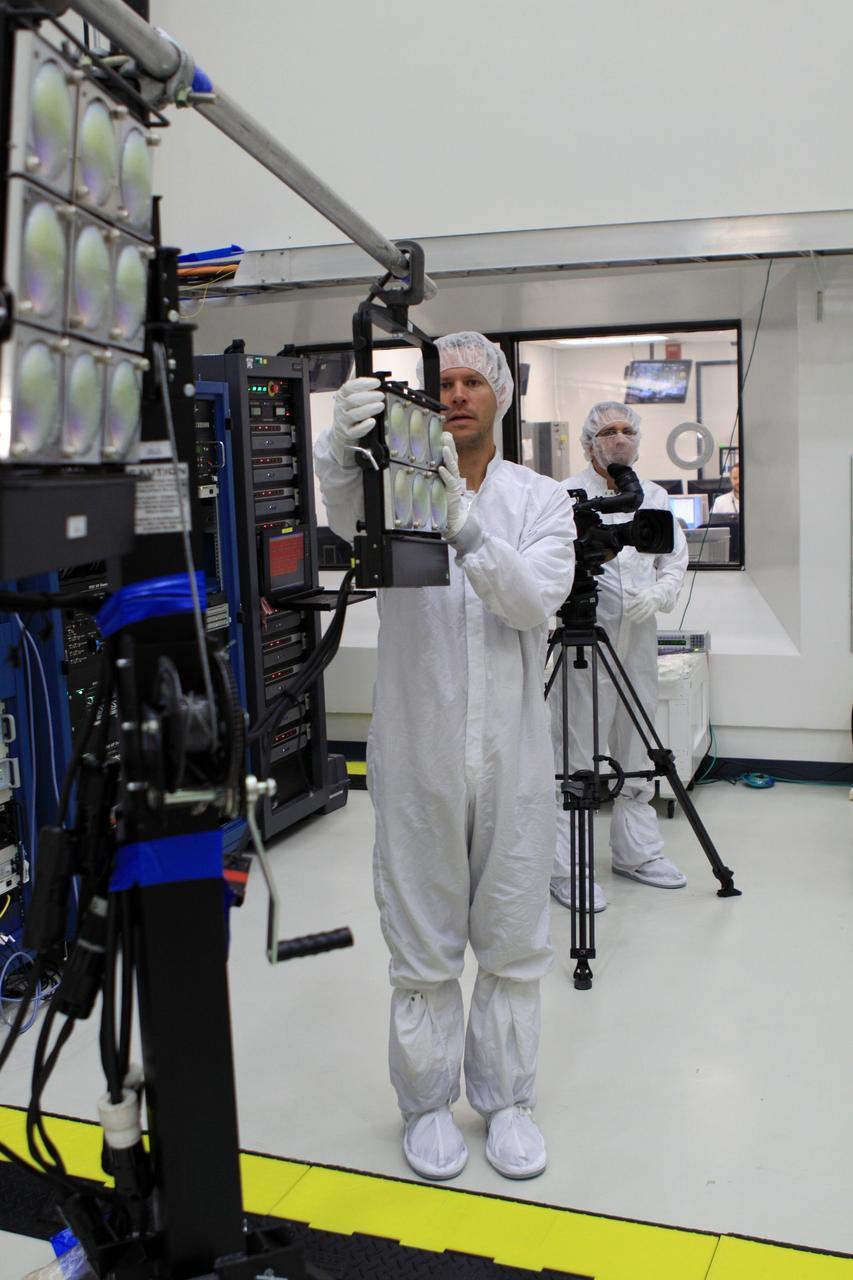
CAPE CANAVERAL, Fla. -- Lockheed Martin technicians in Astrotech Space Operation's payload processing facility in Titusville, Fla., prepare to test the solar arrays on NASA's Gravity Recovery and Interior Laboratory-A, or GRAIL-A, spacecraft to ensure that they will function as planned during the mission. The electrical power subsystem on each of GRAIL's twin spacecraft includes two solar arrays and a lithium ion battery. Each solar array is capable of producing no less than 700 watts. They will be deployed shortly after separation from the launch vehicle and remain fixed throughout the mission. GRAIL will fly in tandem orbits around the moon for several months to measure its gravity field. GRAIL's primary science objectives are to determine the structure of the lunar interior, from crust to core, and to advance understanding of the thermal evolution of the moon. Launch aboard a United Launch Alliance Delta II rocket from Space Launch Complex 17B on Cape Canaveral Air Force Station is scheduled for Sept. 8. For more information, visit http://www.nasa.gov/grail. Photo credit: NASA/Frankie Martin
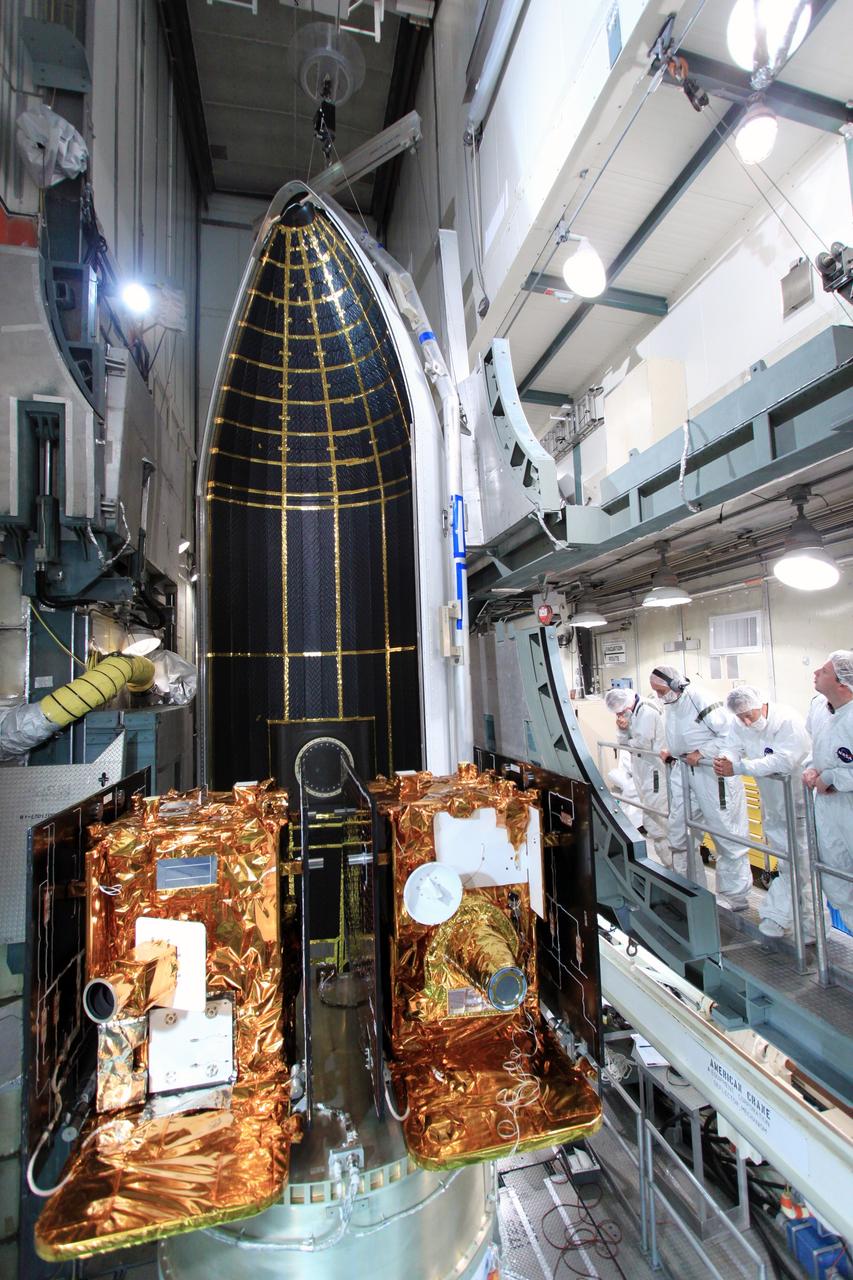
CAPE CANAVERAL, Fla. -- At Space Launch Complex 17B on Cape Canaveral Air Force Station in Florida, a section of the clamshell-shaped Delta payload fairing moves into place to enclose NASA's twin Gravity Recovery and Interior Laboratory spacecraft. The fairing will protect the spacecraft from the impact of aerodynamic pressure and heating during ascent and will be jettisoned once the spacecraft is outside the Earth's atmosphere. Launch aboard a United Launch Alliance Delta II rocket from Pad 17B is scheduled for Sept. 8. The spacecraft will fly in tandem orbits around the moon for several months to measure its gravity field. GRAIL's primary science objectives are to determine the structure of the lunar interior, from crust to core, and to advance understanding of the thermal evolution of the moon. For more information, visit http://www.nasa.gov/grail. Photo credit: NASA/Jim Grossmann

CAPE CANAVERAL, Fla. -- Preparations have begun for two days of fueling activities on NASA's twin Gravity Recovery and Interior Laboratory lunar spacecraft in the Hazardous Processing Facility (HPF) at Astrotech Space Operation's payload processing facility in Titusville, Fla. GRAIL will fly in tandem orbits around the moon for several months to measure its gravity field. GRAIL's primary science objectives are to determine the structure of the lunar interior, from crust to core, and to advance understanding of the thermal evolution of the moon. Launch aboard a United Launch Alliance Delta II rocket from Space Launch Complex 17B on Cape Canaveral Air Force Station is scheduled for Sept. 8. For more information, visit http://www.nasa.gov/grail. Photo credit: NASA/Charisse Nahser
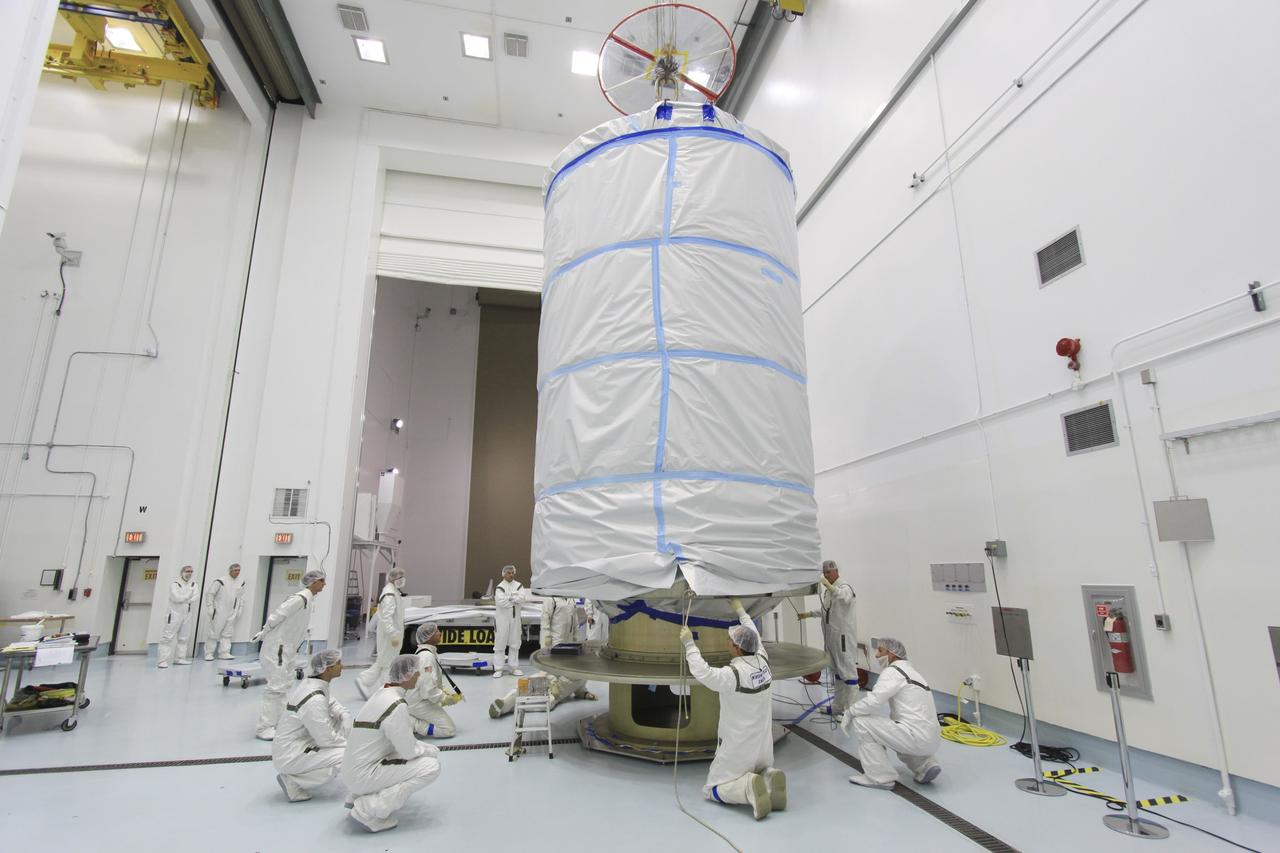
CAPE CANAVERAL, Fla. -- At Astrotech Space Operation's payload processing facility in Titusville, Fla., a protective canister encases NASA's twin Gravity Recovery and Interior Laboratory spacecraft. Preparations are under way to transport the lunar probes, attached to a spacecraft adapter ring in their side-by-side launch configuration, to the launch pad. The spacecraft will fly in tandem orbits around the moon for several months to measure its gravity field. GRAIL's primary science objectives are to determine the structure of the lunar interior, from crust to core, and to advance understanding of the thermal evolution of the moon. Launch aboard a United Launch Alliance Delta II rocket from Space Launch Complex 17B on Cape Canaveral Air Force Station is scheduled for Sept. 8. For more information, visit http://www.nasa.gov/grail. Photo credit: NASA/Jim Grossmann

CAPE CANAVERAL, Fla. -- NASA's twin Gravity Recovery and Interior Laboratory (GRAIL) spacecraft are in place atop a United Launch Alliance Delta II rocket on Space Launch Complex 17B at Cape Canaveral Air Force Station in Florida. The lunar probes are attached to a spacecraft adapter ring in their side-by-side launch configuration and wrapped in plastic to prevent contamination outside the clean room. The spacecraft will fly in tandem orbits around the moon for several months to measure its gravity field. GRAIL's primary science objectives are to determine the structure of the lunar interior, from crust to core, and to advance understanding of the thermal evolution of the moon. Launch is scheduled for Sept. 8. For more information, visit www.nasa.gov/grail. Photo credit: NASA/Kim Shiflett
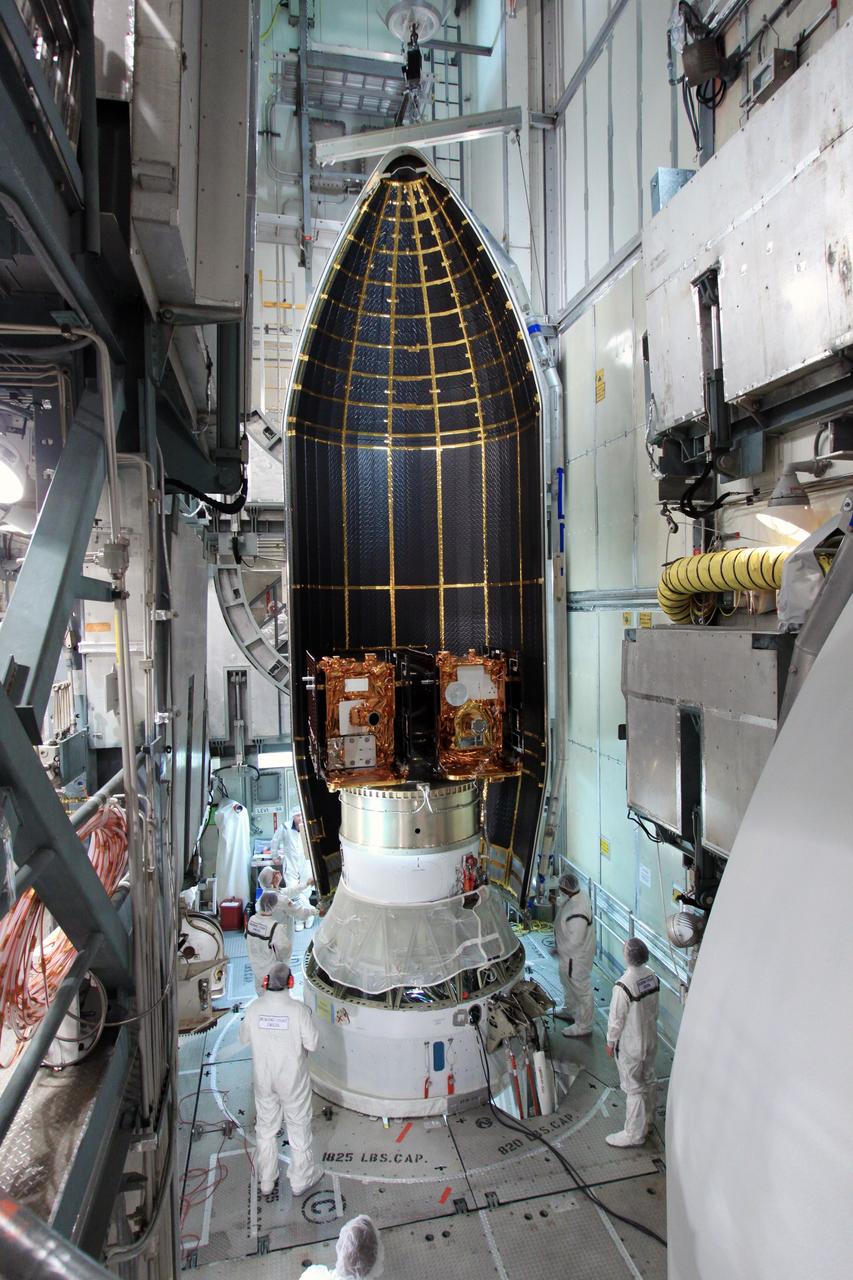
CAPE CANAVERAL, Fla. -- At Space Launch Complex 17B on Cape Canaveral Air Force Station in Florida, spacecraft technicians monitor the movement of a section of the clamshell-shaped Delta payload fairing as it encloses NASA's twin Gravity Recovery and Interior Laboratory spacecraft. The fairing will protect the spacecraft from the impact of aerodynamic pressure and heating during ascent and will be jettisoned once the spacecraft is outside the Earth's atmosphere. Launch aboard a United Launch Alliance Delta II rocket from Pad 17B is scheduled for Sept. 8. The spacecraft will fly in tandem orbits around the moon for several months to measure its gravity field. GRAIL's primary science objectives are to determine the structure of the lunar interior, from crust to core, and to advance understanding of the thermal evolution of the moon. For more information, visit http://www.nasa.gov/grail. Photo credit: NASA/Jim Grossmann

CAPE CANAVERAL, Fla. -- At Astrotech Space Operation's payload processing facility in Titusville, Fla., Lockheed Martin technicians make final adjustment to NASA's Gravity Recovery and Interior Laboratory-A (GRAIL-A) lunar probe before it is secured to the spacecraft adapter ring. GRAIL-B is secured to the ring, at left. After the twin GRAIL spacecraft are attached to the adapter ring in their side-by-side launch configuration, they will be transported to the launch pad. GRAIL will fly in tandem orbits around the moon for several months to measure its gravity field. GRAIL's primary science objectives are to determine the structure of the lunar interior, from crust to core, and to advance understanding of the thermal evolution of the moon. Launch aboard a United Launch Alliance Delta II rocket from Space Launch Complex 17B on Cape Canaveral Air Force Station is scheduled for Sept. 8. For more information, visit http://www.nasa.gov/grail. Photo credit: NASA/Jim Grossmann
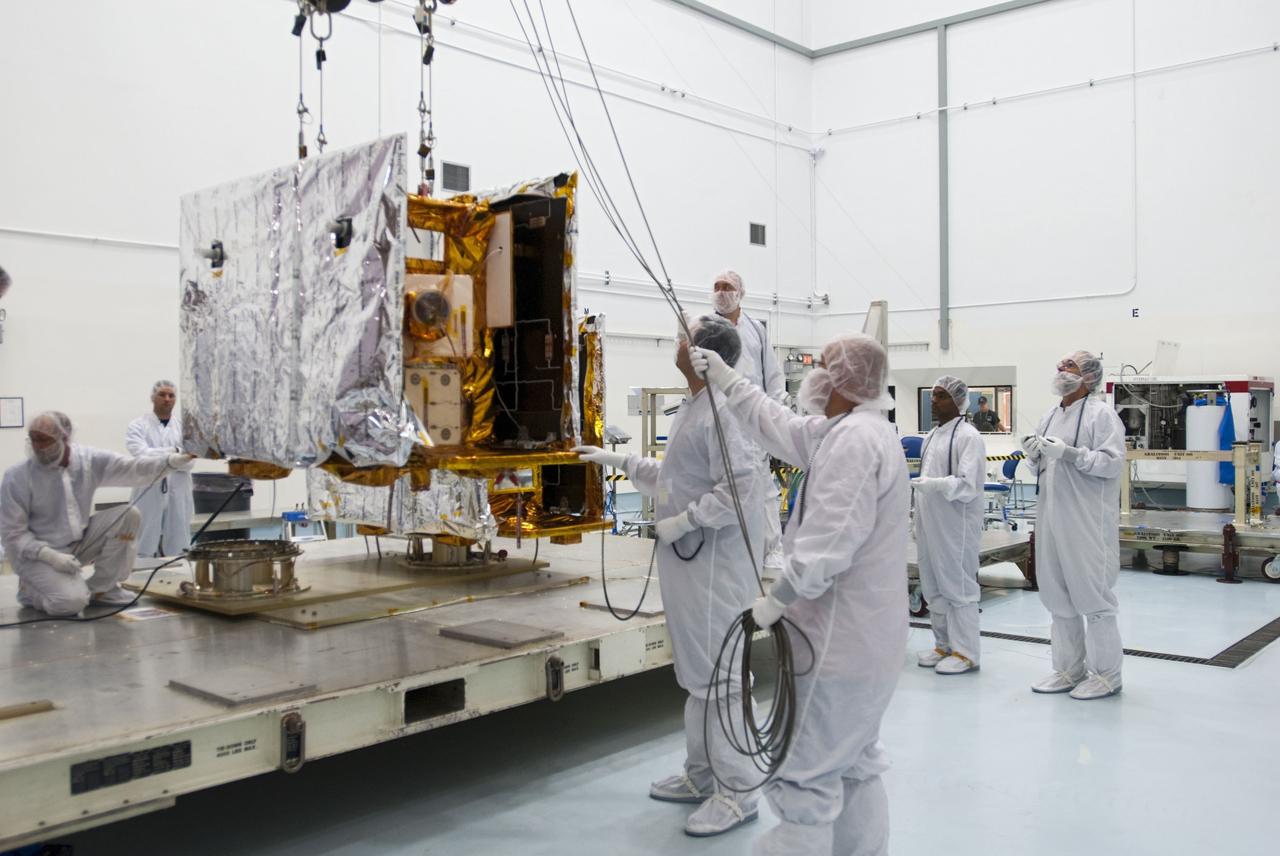
CAPE CANAVERAL, Fla. -- One of NASA's twin Gravity Recovery and Interior Laboratory lunar spacecraft is lifted from its transporter for placement on a workstand in the Hazardous Processing Facility (HPF) at Astrotech Space Operation's payload processing facility in Titusville, Fla. In the HPF, the spacecraft will undergo two days of fueling activities. GRAIL will fly in tandem orbits around the moon for several months to measure its gravity field. GRAIL's primary science objectives are to determine the structure of the lunar interior, from crust to core, and to advance understanding of the thermal evolution of the moon. Launch aboard a United Launch Alliance Delta II rocket from Space Launch Complex 17B on Cape Canaveral Air Force Station is scheduled for Sept. 8. For more information, visit http://www.nasa.gov/grail. Photo credit: NASA/Charisse Nahser
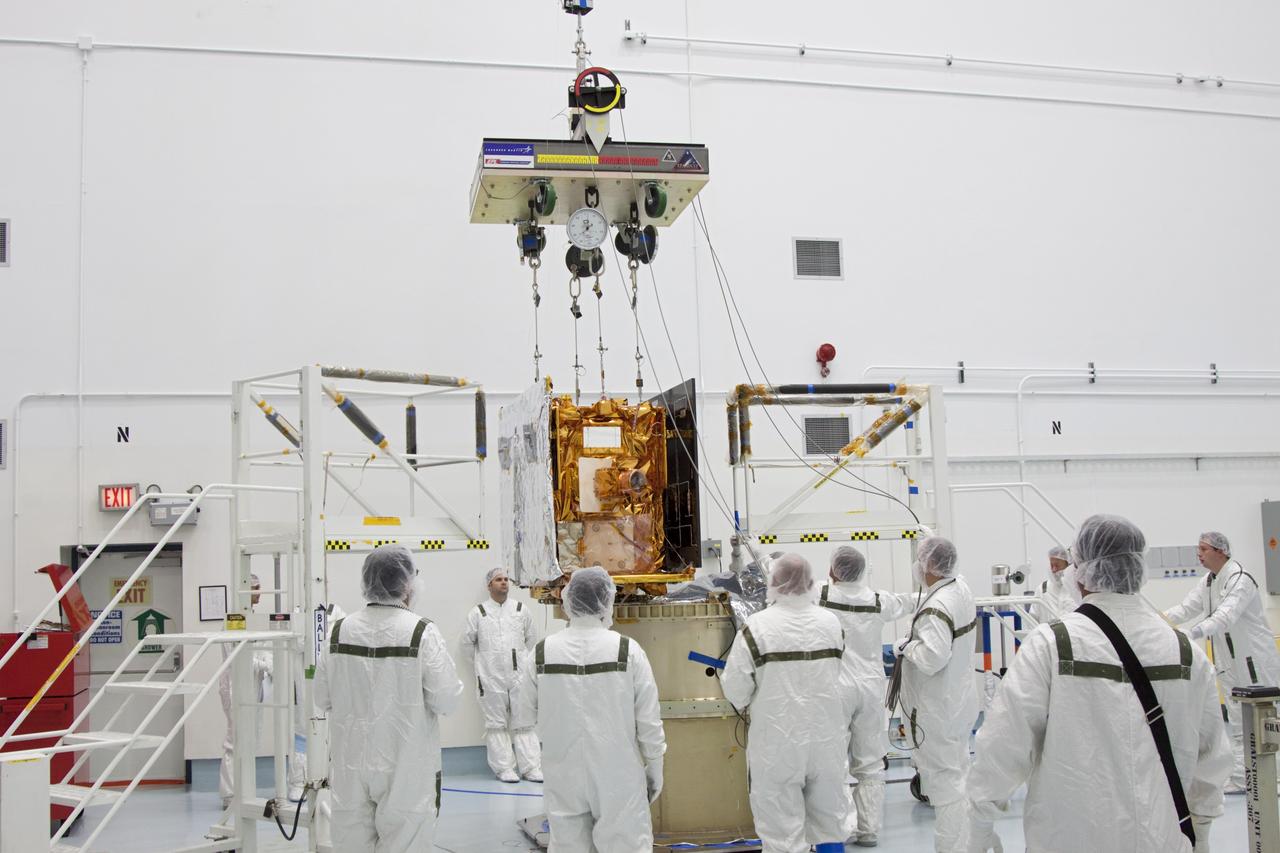
CAPE CANAVERAL, Fla. -- At Astrotech Space Operation's payload processing facility in Titusville, Fla., the lifting device is detached from NASA's Gravity Recovery and Interior Laboratory-B (GRAIL-B) lunar probe following its placement on the spacecraft adapter ring. After the twin GRAIL spacecraft are attached to the adapter ring in their side-by-side launch configuration, they will be transported to the launch pad. GRAIL will fly in tandem orbits around the moon for several months to measure its gravity field. GRAIL's primary science objectives are to determine the structure of the lunar interior, from crust to core, and to advance understanding of the thermal evolution of the moon. Launch aboard a United Launch Alliance Delta II rocket from Space Launch Complex 17B on Cape Canaveral Air Force Station is scheduled for Sept. 8. For more information, visit http://www.nasa.gov/grail. Photo credit: NASA/Jim Grossmann
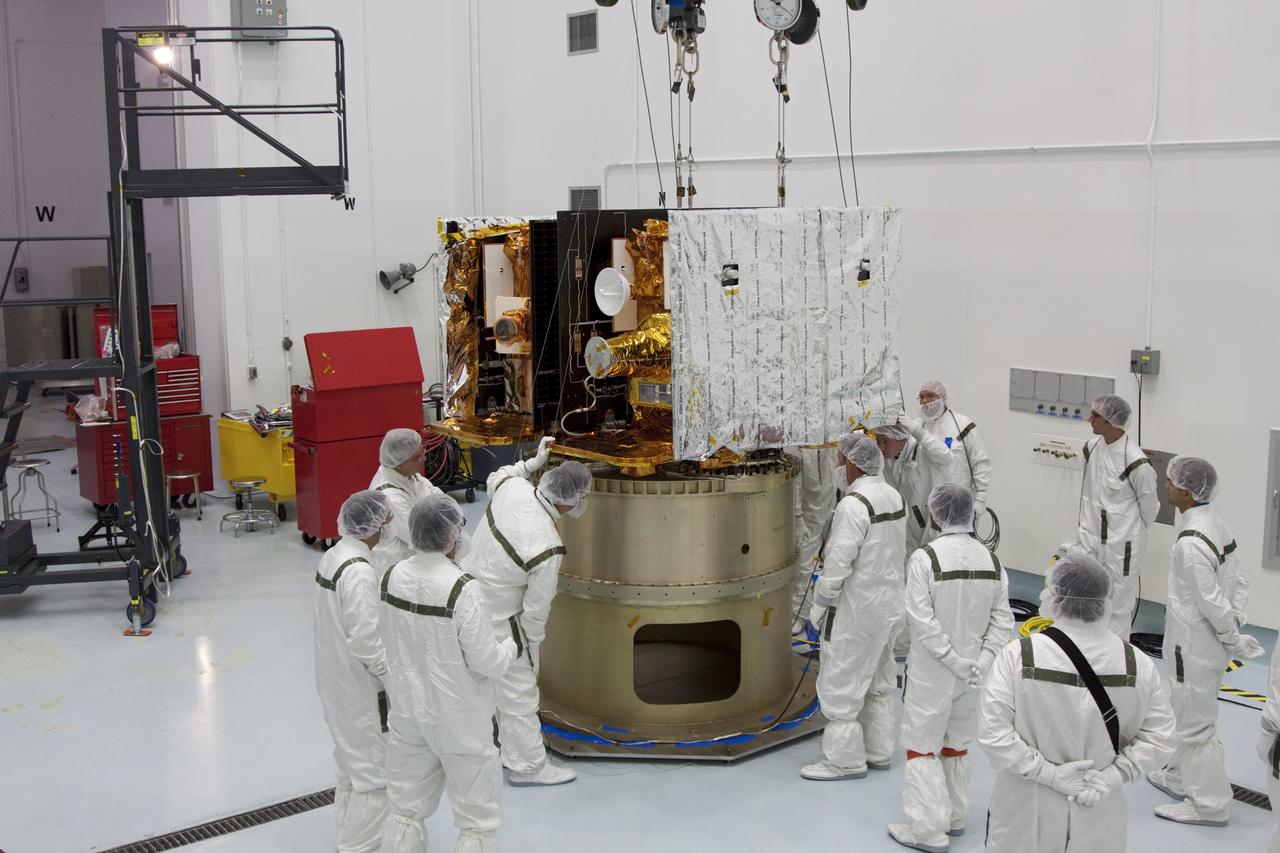
CAPE CANAVERAL, Fla. -- At Astrotech Space Operation's payload processing facility in Titusville, Fla., Lockheed Martin technicians monitor the placement of NASA's Gravity Recovery and Interior Laboratory-A (GRAIL-A) lunar probe on the spacecraft adapter ring. GRAIL-B is already secured to the ring, at left. After the twin GRAIL spacecraft are attached to the adapter ring in their side-by-side launch configuration, they will be transported to the launch pad. GRAIL will fly in tandem orbits around the moon for several months to measure its gravity field. GRAIL's primary science objectives are to determine the structure of the lunar interior, from crust to core, and to advance understanding of the thermal evolution of the moon. Launch aboard a United Launch Alliance Delta II rocket from Space Launch Complex 17B on Cape Canaveral Air Force Station is scheduled for Sept. 8. For more information, visit http://www.nasa.gov/grail. Photo credit: NASA/Jim Grossmann
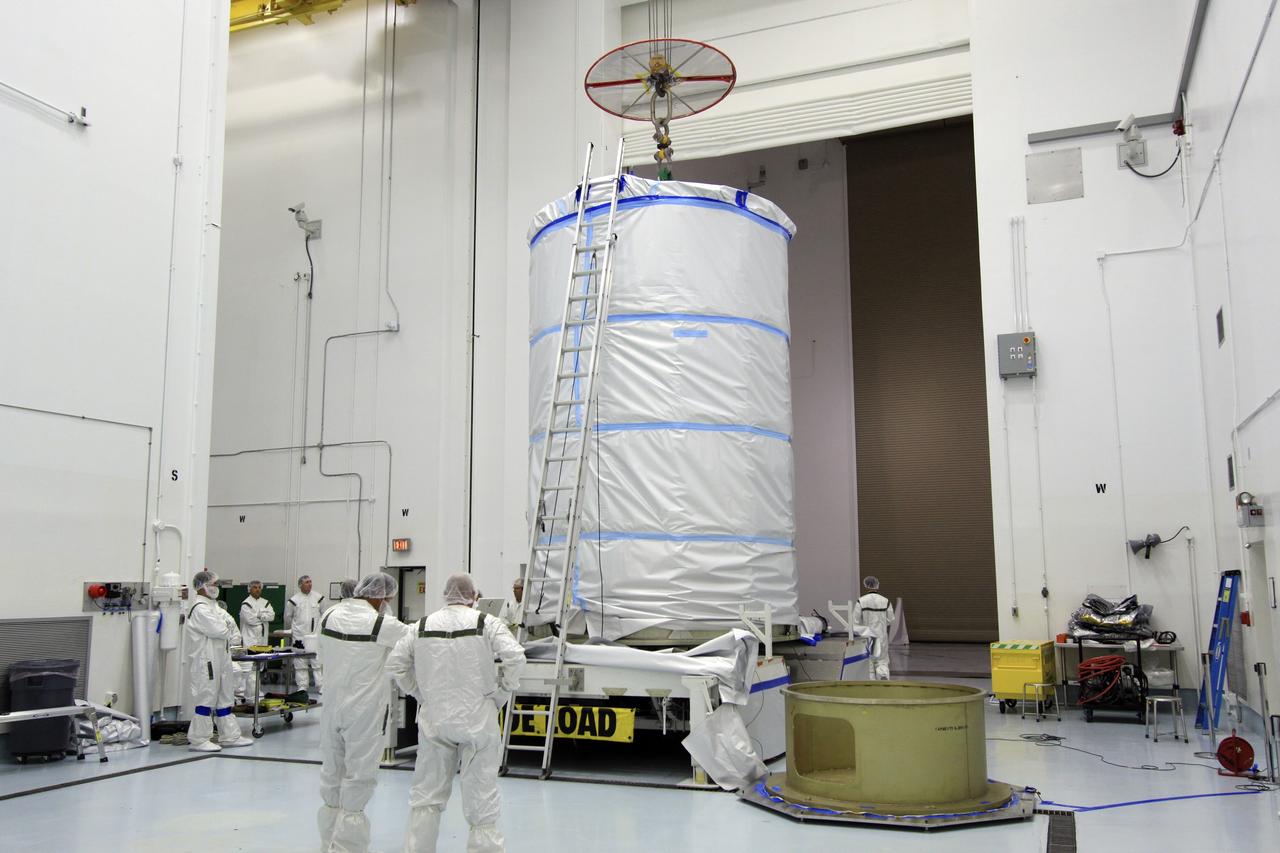
CAPE CANAVERAL, Fla. -- At Astrotech Space Operation's payload processing facility in Titusville, Fla., the protective canister enclosing NASA's twin Gravity Recovery and Interior Laboratory spacecraft is secured on a transportation pallet. Preparations are under way to move the lunar probes, attached to a spacecraft adapter ring in their side-by-side launch configuration, to the launch pad. The spacecraft will fly in tandem orbits around the moon for several months to measure its gravity field. GRAIL's primary science objectives are to determine the structure of the lunar interior, from crust to core, and to advance understanding of the thermal evolution of the moon. Launch aboard a United Launch Alliance Delta II rocket from Space Launch Complex 17B on Cape Canaveral Air Force Station is scheduled for Sept. 8. For more information, visit http://www.nasa.gov/grail. Photo credit: NASA/Jim Grossmann
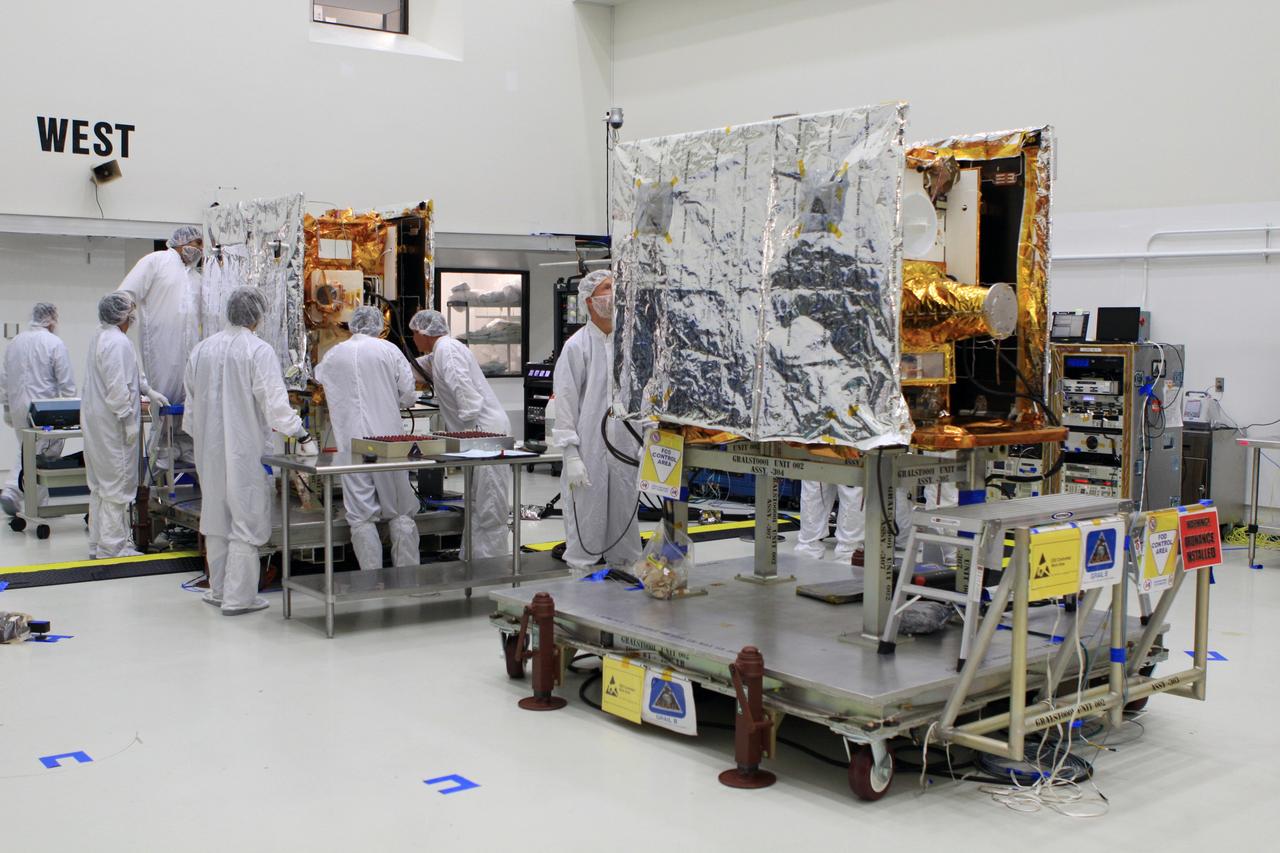
CAPE CANAVERAL, Fla. -- NASA's twin Gravity Recovery and Interior Laboratory spacecraft are positioned side-by-side in Astrotech Space Operation's payload processing facility in Titusville, Fla. Lockheed Martin technicians are performing testing the solar arrays on GRAIL-A to ensure that they will function as planned during the mission. The electrical power subsystem on each of GRAIL's twin spacecraft includes two solar arrays and a lithium ion battery. Each solar array is capable of producing no less than 700 watts. They will be deployed shortly after separation from the launch vehicle and remain fixed throughout the mission. GRAIL will fly in tandem orbits around the moon for several months to measure its gravity field. GRAIL's primary science objectives are to determine the structure of the lunar interior, from crust to core, and to advance understanding of the thermal evolution of the moon. Launch aboard a United Launch Alliance Delta II rocket from Space Launch Complex 17B on Cape Canaveral Air Force Station is scheduled for Sept. 8. For more information, visit http://www.nasa.gov/grail. Photo credit: NASA/Frankie Martin
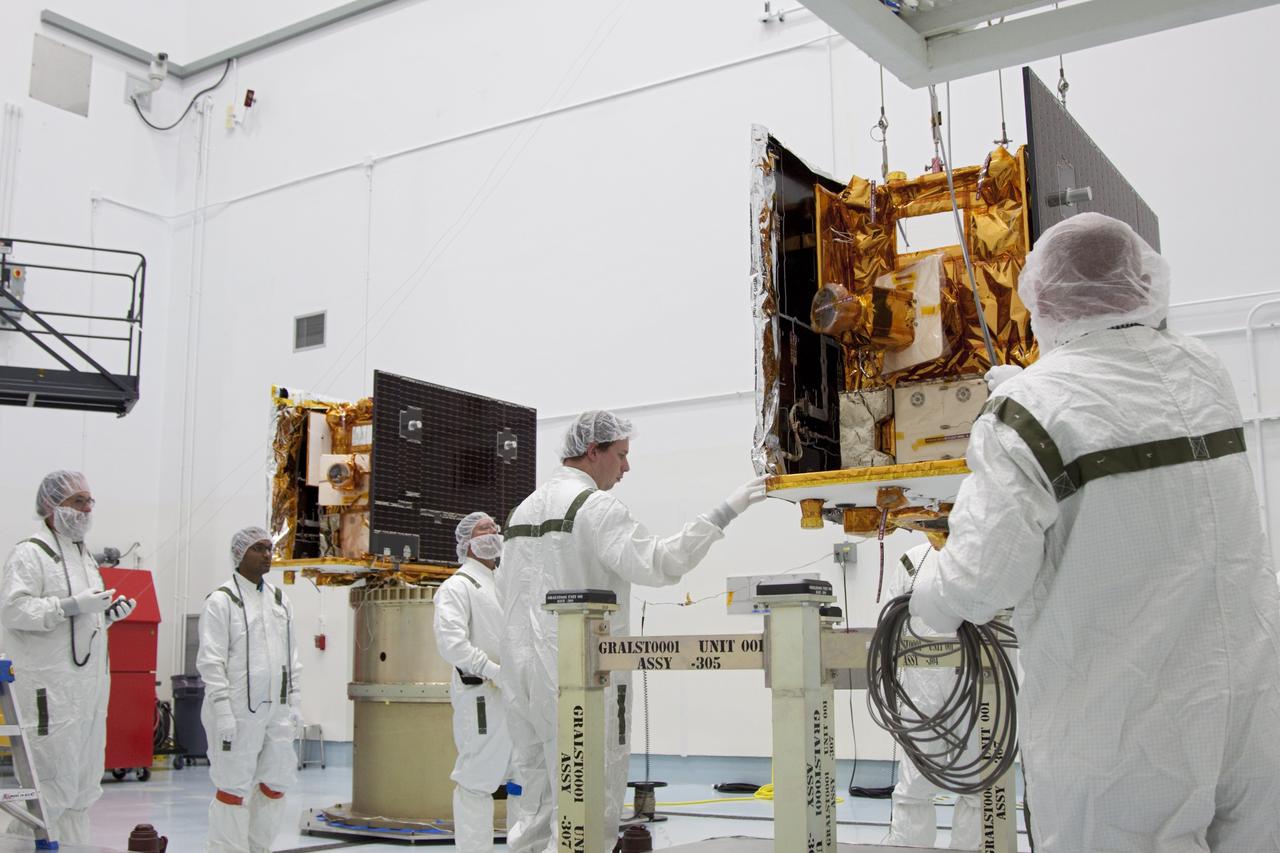
CAPE CANAVERAL, Fla. -- At Astrotech Space Operation's payload processing facility in Titusville, Fla., NASA's Gravity Recovery and Interior Laboratory-A (GRAIL-A) lunar probe is lifted from its workstand. The spacecraft will be transferred to the spacecraft adapter ring, at left, where GRAIL-B is already secured. After the twin GRAIL spacecraft are attached to the adapter ring in their side-by-side launch configuration, they will be transported to the launch pad. GRAIL will fly in tandem orbits around the moon for several months to measure its gravity field. GRAIL's primary science objectives are to determine the structure of the lunar interior, from crust to core, and to advance understanding of the thermal evolution of the moon. Launch aboard a United Launch Alliance Delta II rocket from Space Launch Complex 17B on Cape Canaveral Air Force Station is scheduled for Sept. 8. For more information, visit http://www.nasa.gov/grail. Photo credit: NASA/Jim Grossmann
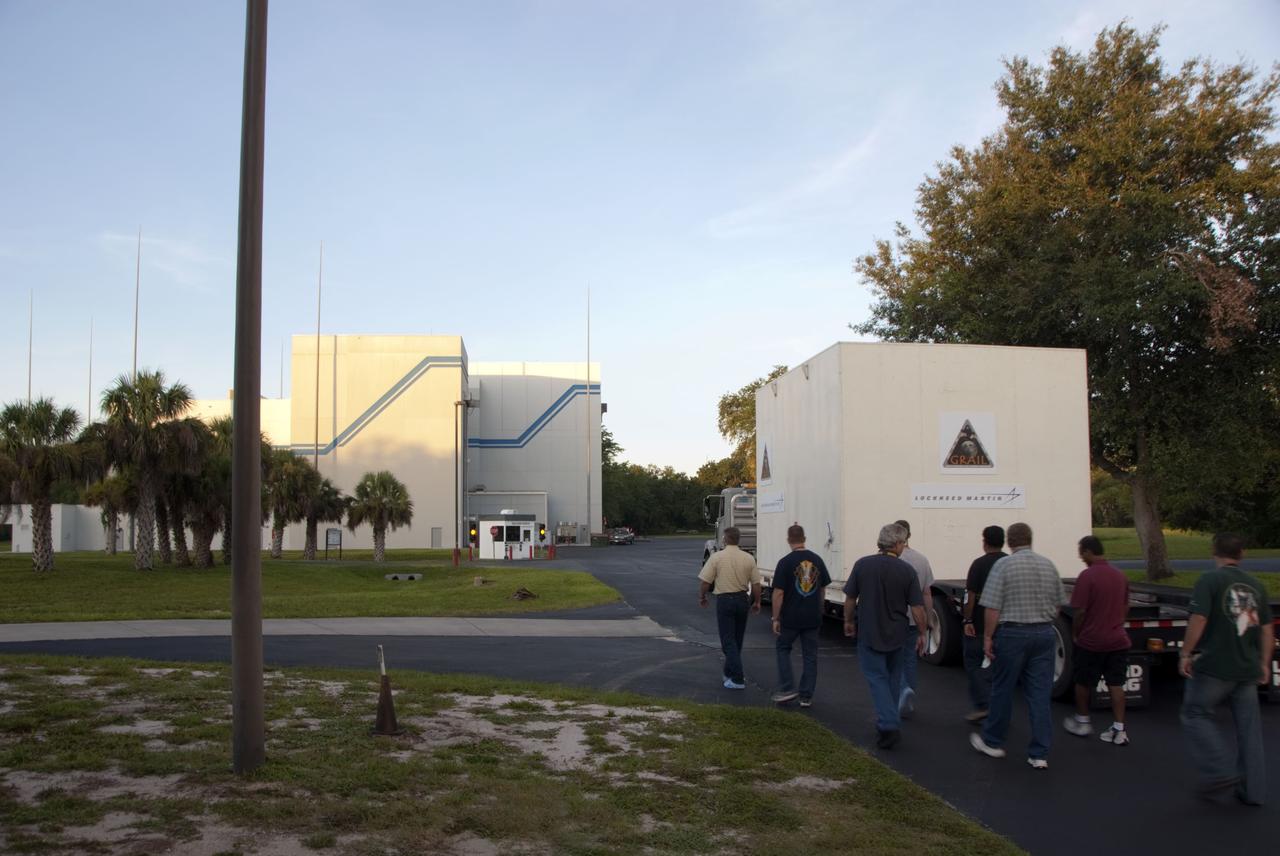
CAPE CANAVERAL, Fla. -- Lockheed Martin technicians escort the protective canister housing NASA's twin Gravity Recovery and Interior Laboratory lunar spacecraft to the Hazardous Processing Facility (HPF) at Astrotech Space Operation's payload processing facility in Titusville, Fla. In the HPF, the spacecraft will undergo two days of fueling activities. GRAIL will fly in tandem orbits around the moon for several months to measure its gravity field. GRAIL's primary science objectives are to determine the structure of the lunar interior, from crust to core, and to advance understanding of the thermal evolution of the moon. Launch aboard a United Launch Alliance Delta II rocket from Space Launch Complex 17B on Cape Canaveral Air Force Station is scheduled for Sept. 8. For more information, visit http://www.nasa.gov/grail. Photo credit: NASA/Charisse Nahser
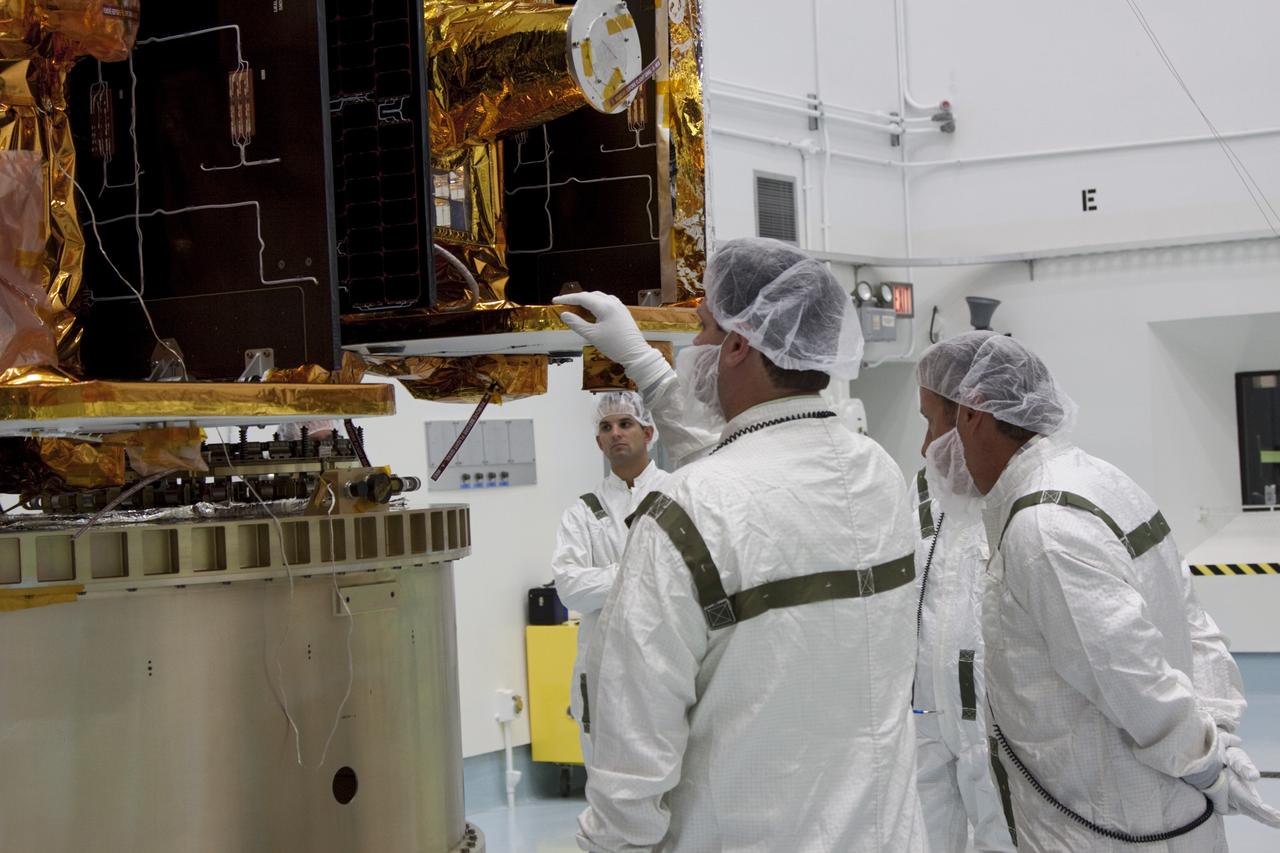
CAPE CANAVERAL, Fla. -- At Astrotech Space Operation's payload processing facility in Titusville, Fla., Lockheed Martin technicians verify that NASA's Gravity Recovery and Interior Laboratory-A (GRAIL-A) lunar probe is positioned correctly on the spacecraft adapter ring. After the twin GRAIL spacecraft are attached to the adapter ring in their side-by-side launch configuration, they will be transported to the launch pad. GRAIL will fly in tandem orbits around the moon for several months to measure its gravity field. GRAIL's primary science objectives are to determine the structure of the lunar interior, from crust to core, and to advance understanding of the thermal evolution of the moon. Launch aboard a United Launch Alliance Delta II rocket from Space Launch Complex 17B on Cape Canaveral Air Force Station is scheduled for Sept. 8. For more information, visit http://www.nasa.gov/grail. Photo credit: NASA/Jim Grossmann
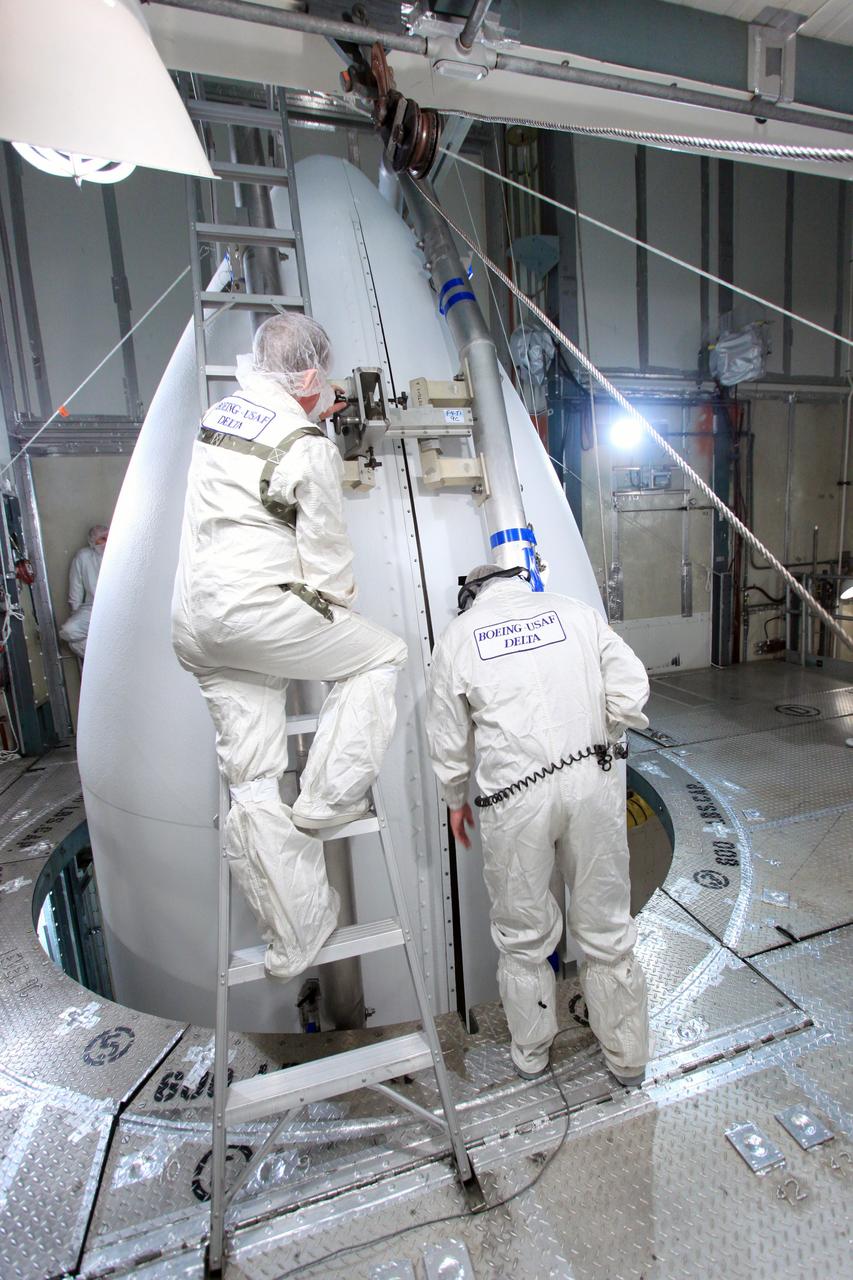
CAPE CANAVERAL, Fla. -- At Space Launch Complex 17B on Cape Canaveral Air Force Station in Florida, NASA's twin Gravity Recovery and Interior Laboratory spacecraft are hidden from view as spacecraft technicians secure the sections of the clamshell-shaped Delta payload fairing around them. The fairing will protect the spacecraft from the impact of aerodynamic pressure and heating during ascent and will be jettisoned once the spacecraft is outside the Earth's atmosphere. Launch aboard a United Launch Alliance Delta II rocket from Pad 17B is scheduled for Sept. 8. The spacecraft will fly in tandem orbits around the moon for several months to measure its gravity field. GRAIL's primary science objectives are to determine the structure of the lunar interior, from crust to core, and to advance understanding of the thermal evolution of the moon. For more information, visit http://www.nasa.gov/grail. Photo credit: NASA/Jim Grossmann
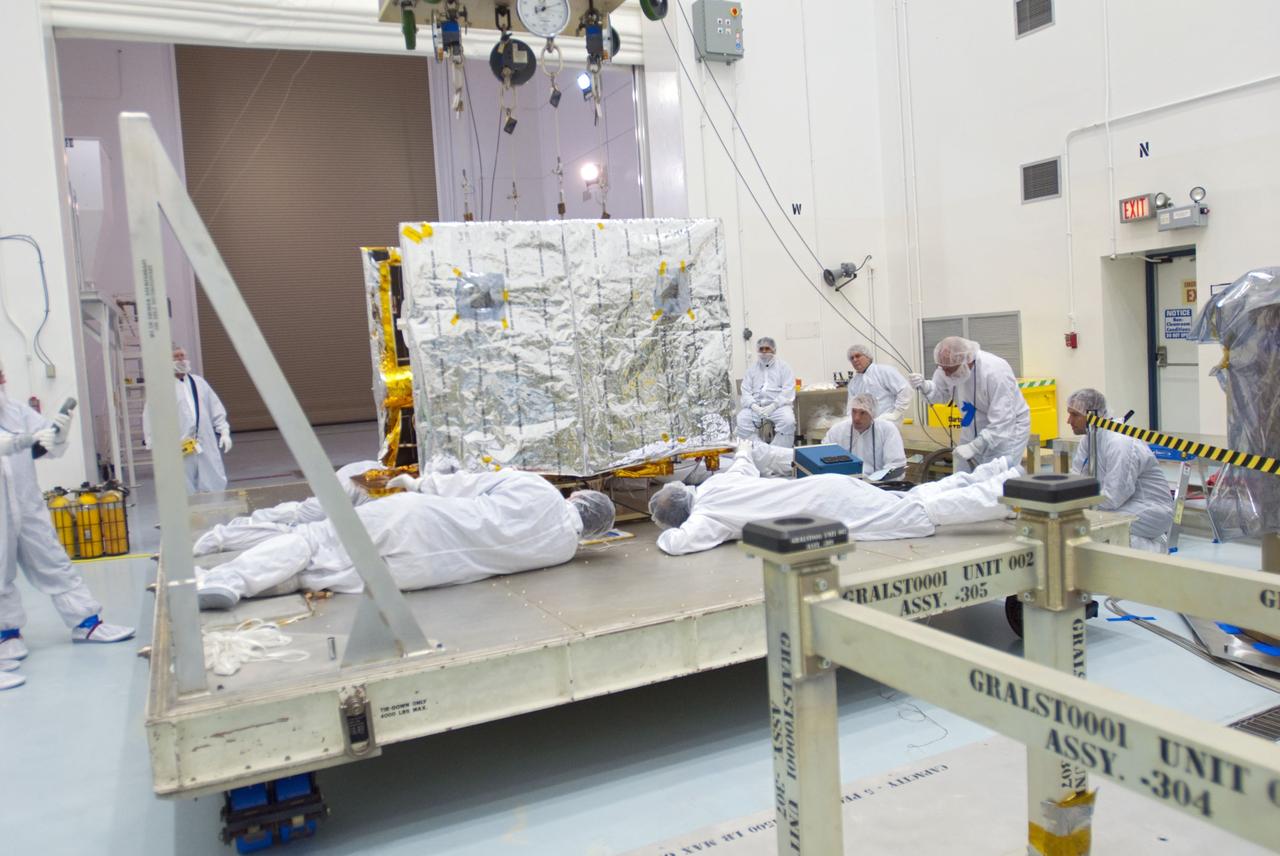
CAPE CANAVERAL, Fla. -- Lockheed Martin technicians inspect the second of NASA's twin Gravity Recovery and Interior Laboratory lunar spacecraft as they prepare to move it to a workstand in the Hazardous Processing Facility (HPF) at Astrotech Space Operation's payload processing facility in Titusville, Fla. In the HPF, the spacecraft will undergo two days of fueling activities. GRAIL will fly in tandem orbits around the moon for several months to measure its gravity field. GRAIL's primary science objectives are to determine the structure of the lunar interior, from crust to core, and to advance understanding of the thermal evolution of the moon. Launch aboard a United Launch Alliance Delta II rocket from Space Launch Complex 17B on Cape Canaveral Air Force Station is scheduled for Sept. 8. For more information, visit http://www.nasa.gov/grail. Photo credit: NASA/Charisse Nahser
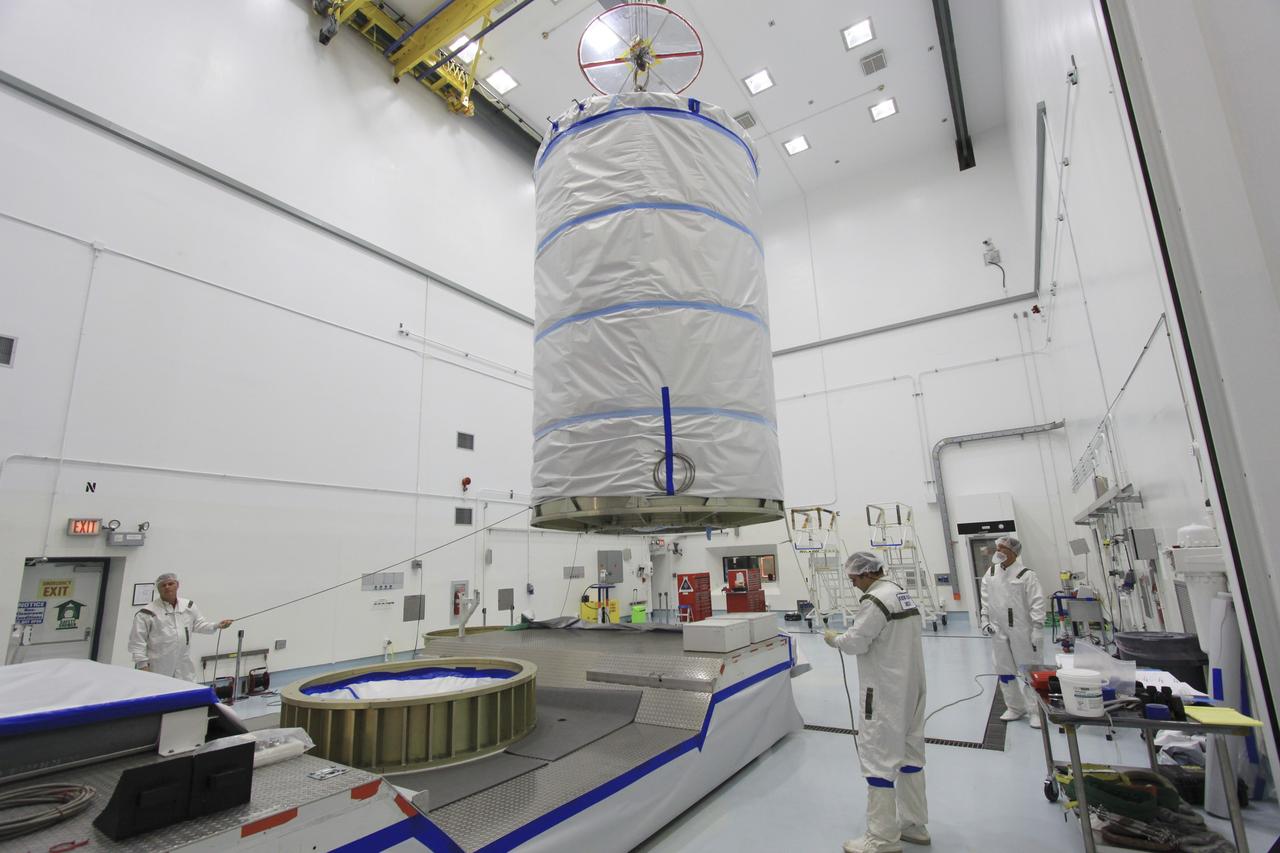
CAPE CANAVERAL, Fla. -- At Astrotech Space Operation's payload processing facility in Titusville, Fla., a protective canister enclosing NASA's twin Gravity Recovery and Interior Laboratory spacecraft is lifted toward a transportation pallet. Preparations are under way to move the lunar probes, attached to a spacecraft adapter ring in their side-by-side launch configuration, to the launch pad. The spacecraft will fly in tandem orbits around the moon for several months to measure its gravity field. GRAIL's primary science objectives are to determine the structure of the lunar interior, from crust to core, and to advance understanding of the thermal evolution of the moon. Launch aboard a United Launch Alliance Delta II rocket from Space Launch Complex 17B on Cape Canaveral Air Force Station is scheduled for Sept. 8. For more information, visit http://www.nasa.gov/grail. Photo credit: NASA/Jim Grossmann
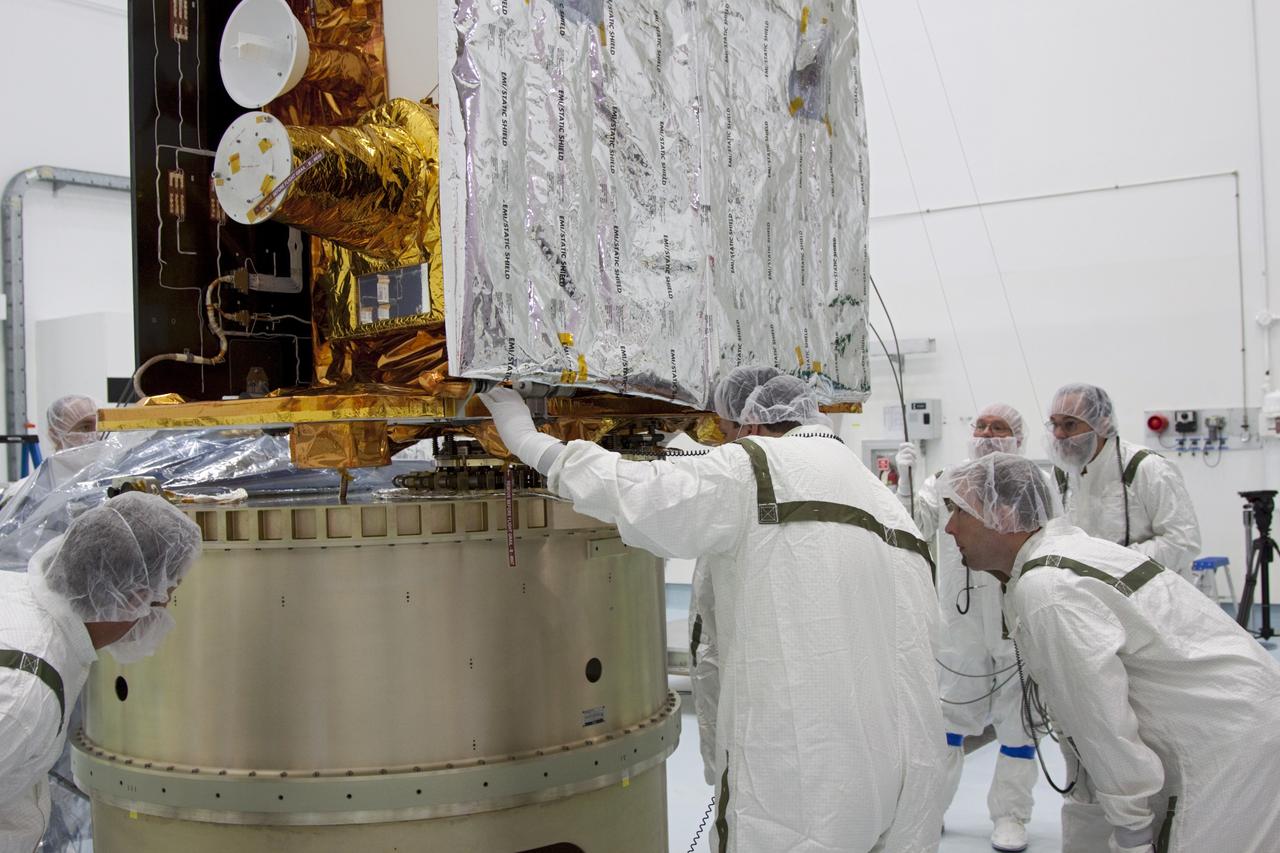
CAPE CANAVERAL, Fla. -- At Astrotech Space Operation's payload processing facility in Titusville, Fla., Lockheed Martin technicians position NASA's Gravity Recovery and Interior Laboratory-B (GRAIL-B) lunar probe on the spacecraft adapter ring. After the twin GRAIL spacecraft are attached to the adapter ring in their side-by-side launch configuration, they will be transported to the launch pad. GRAIL will fly in tandem orbits around the moon for several months to measure its gravity field. GRAIL's primary science objectives are to determine the structure of the lunar interior, from crust to core, and to advance understanding of the thermal evolution of the moon. Launch aboard a United Launch Alliance Delta II rocket from Space Launch Complex 17B on Cape Canaveral Air Force Station is scheduled for Sept. 8. For more information, visit http://www.nasa.gov/grail. Photo credit: NASA/Jim Grossmann
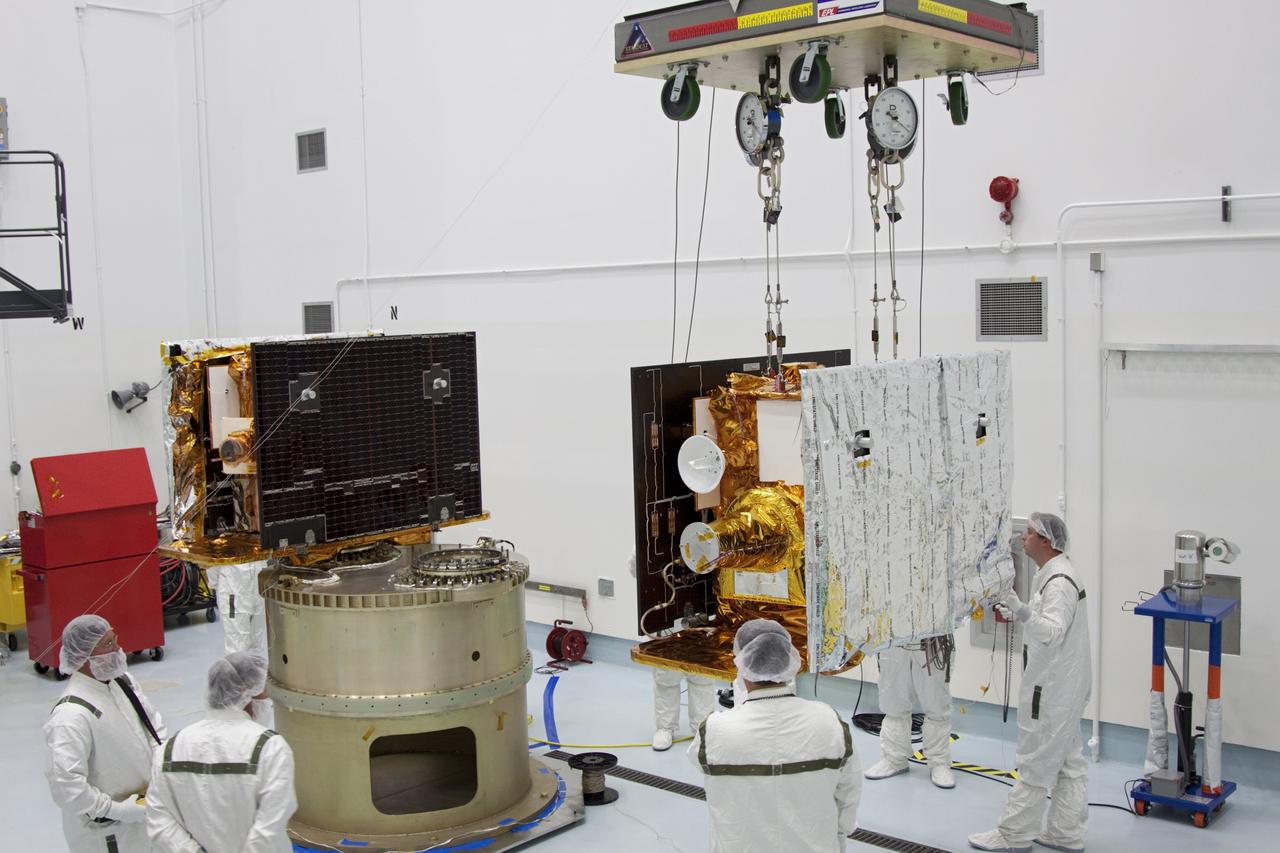
CAPE CANAVERAL, Fla. -- At Astrotech Space Operation's payload processing facility in Titusville, Fla., NASA's Gravity Recovery and Interior Laboratory-A (GRAIL-A) lunar probe slowly approaches the spacecraft adapter ring, at left, where GRAIL-B is already secured. After the twin GRAIL spacecraft are attached to the adapter ring in their side-by-side launch configuration, they will be transported to the launch pad. GRAIL will fly in tandem orbits around the moon for several months to measure its gravity field. GRAIL's primary science objectives are to determine the structure of the lunar interior, from crust to core, and to advance understanding of the thermal evolution of the moon. Launch aboard a United Launch Alliance Delta II rocket from Space Launch Complex 17B on Cape Canaveral Air Force Station is scheduled for Sept. 8. For more information, visit http://www.nasa.gov/grail. Photo credit: NASA/Jim Grossmann

CAPE CANAVERAL, Fla. -- At Astrotech Space Operation's payload processing facility in Titusville, Fla., Lockheed Martin technicians adjust the position of NASA's Gravity Recovery and Interior Laboratory-A (GRAIL-A) lunar probe on the spacecraft adapter ring. GRAIL-B is already secured to the ring, at left. After the twin GRAIL spacecraft are attached to the adapter ring in their side-by-side launch configuration, they will be transported to the launch pad. GRAIL will fly in tandem orbits around the moon for several months to measure its gravity field. GRAIL's primary science objectives are to determine the structure of the lunar interior, from crust to core, and to advance understanding of the thermal evolution of the moon. Launch aboard a United Launch Alliance Delta II rocket from Space Launch Complex 17B on Cape Canaveral Air Force Station is scheduled for Sept. 8. For more information, visit http://www.nasa.gov/grail. Photo credit: NASA/Jim Grossmann
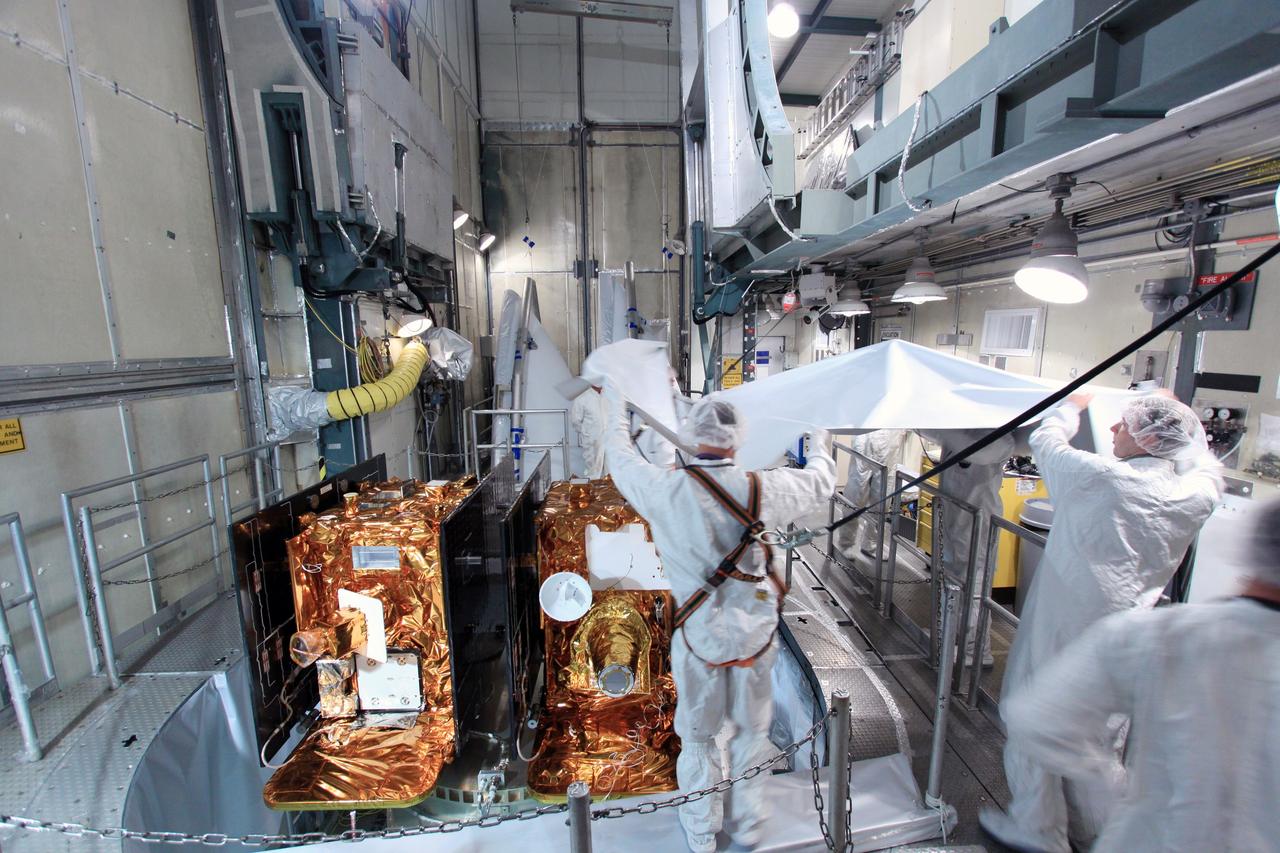
CAPE CANAVERAL, Fla. -- At Space Launch Complex 17B on Cape Canaveral Air Force Station in Florida, spacecraft technicians dressed in clean room attire, known as "bunny" suits, uncover NASA's twin Gravity Recovery and Interior Laboratory spacecraft during preparations to enclose it in the Delta payload fairing. The fairing will protect the spacecraft from the impact of aerodynamic pressure and heating during ascent and will be jettisoned once the spacecraft is outside the Earth's atmosphere. Launch aboard a United Launch Alliance Delta II rocket from Pad 17B is scheduled for Sept. 8. The spacecraft will fly in tandem orbits around the moon for several months to measure its gravity field. GRAIL's primary science objectives are to determine the structure of the lunar interior, from crust to core, and to advance understanding of the thermal evolution of the moon. For more information, visit http://www.nasa.gov/grail. Photo credit: NASA/Jim Grossmann
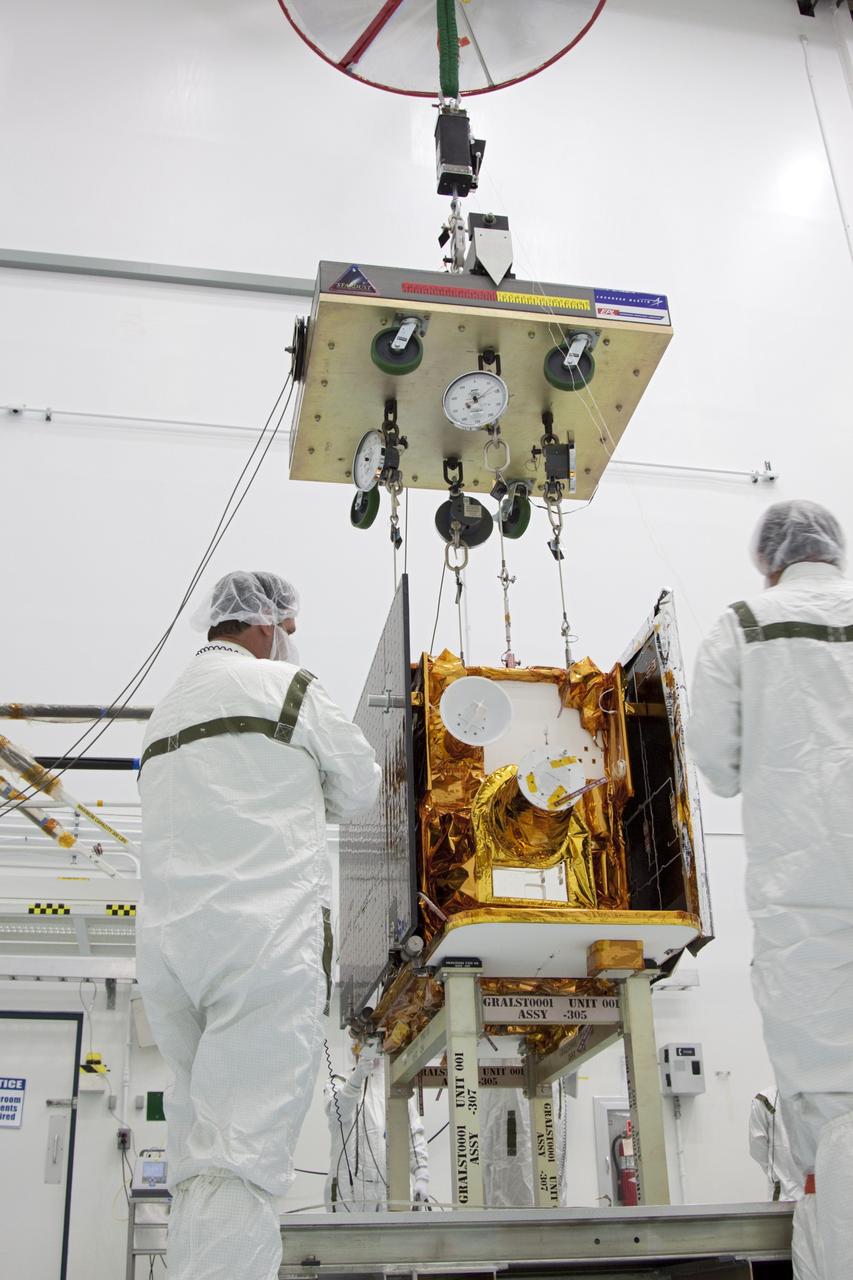
CAPE CANAVERAL, Fla. -- At Astrotech Space Operation's payload processing facility in Titusville, Fla., a lifting device is attached to NASA's Gravity Recovery and Interior Laboratory-A (GRAIL-A) lunar probe to move it from its workstand. After the twin GRAIL spacecraft are attached to the adapter ring in their side-by-side launch configuration, they will be transported to the launch pad. GRAIL will fly in tandem orbits around the moon for several months to measure its gravity field. GRAIL's primary science objectives are to determine the structure of the lunar interior, from crust to core, and to advance understanding of the thermal evolution of the moon. Launch aboard a United Launch Alliance Delta II rocket from Space Launch Complex 17B on Cape Canaveral Air Force Station is scheduled for Sept. 8. For more information, visit http://www.nasa.gov/grail. Photo credit: NASA/Jim Grossmann
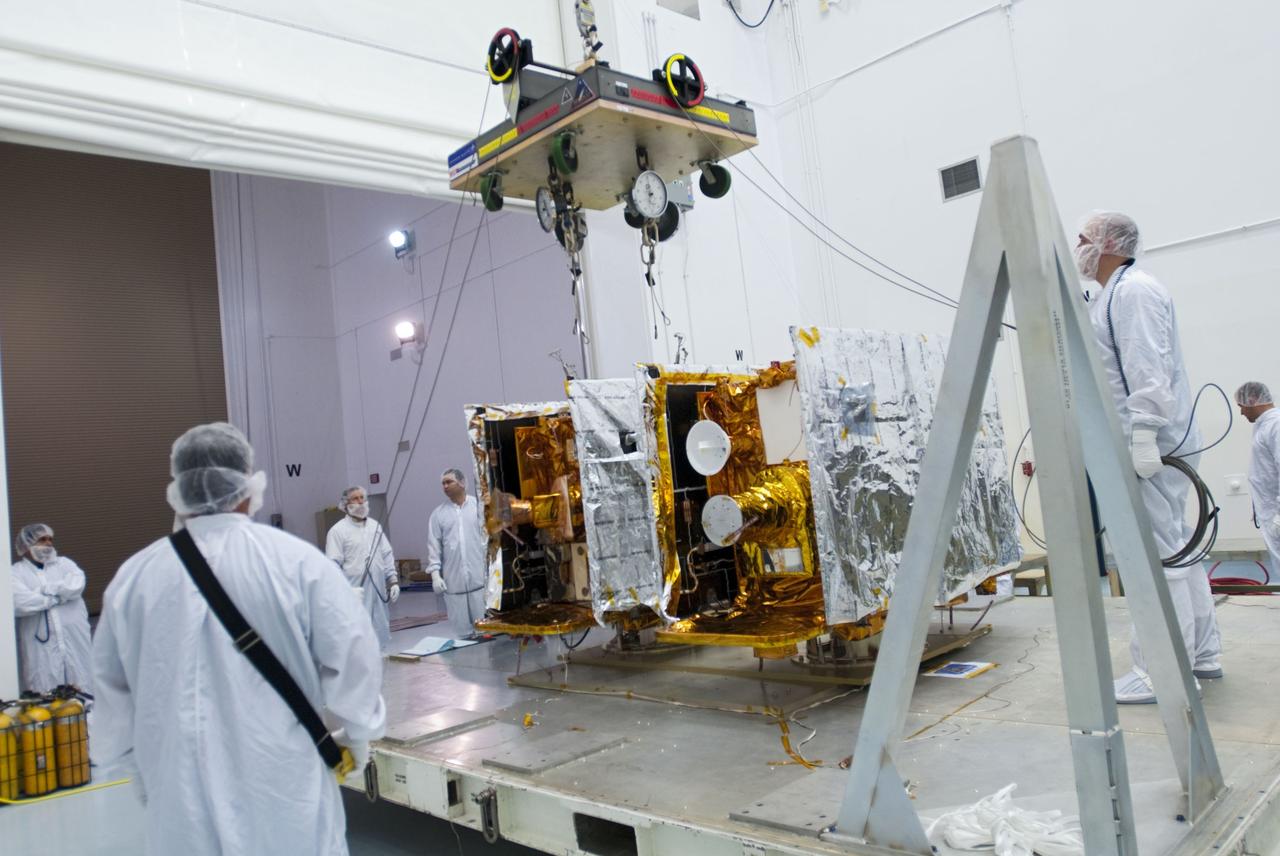
CAPE CANAVERAL, Fla. -- Preparations are under way to lift one of NASA's twin Gravity Recovery and Interior Laboratory lunar spacecraft onto a workstand in the Hazardous Processing Facility (HPF) at Astrotech Space Operation's payload processing facility in Titusville, Fla. In the HPF, the spacecraft will undergo two days of fueling activities. GRAIL will fly in tandem orbits around the moon for several months to measure its gravity field. GRAIL's primary science objectives are to determine the structure of the lunar interior, from crust to core, and to advance understanding of the thermal evolution of the moon. Launch aboard a United Launch Alliance Delta II rocket from Space Launch Complex 17B on Cape Canaveral Air Force Station is scheduled for Sept. 8. For more information, visit http://www.nasa.gov/grail. Photo credit: NASA/Charisse Nahser
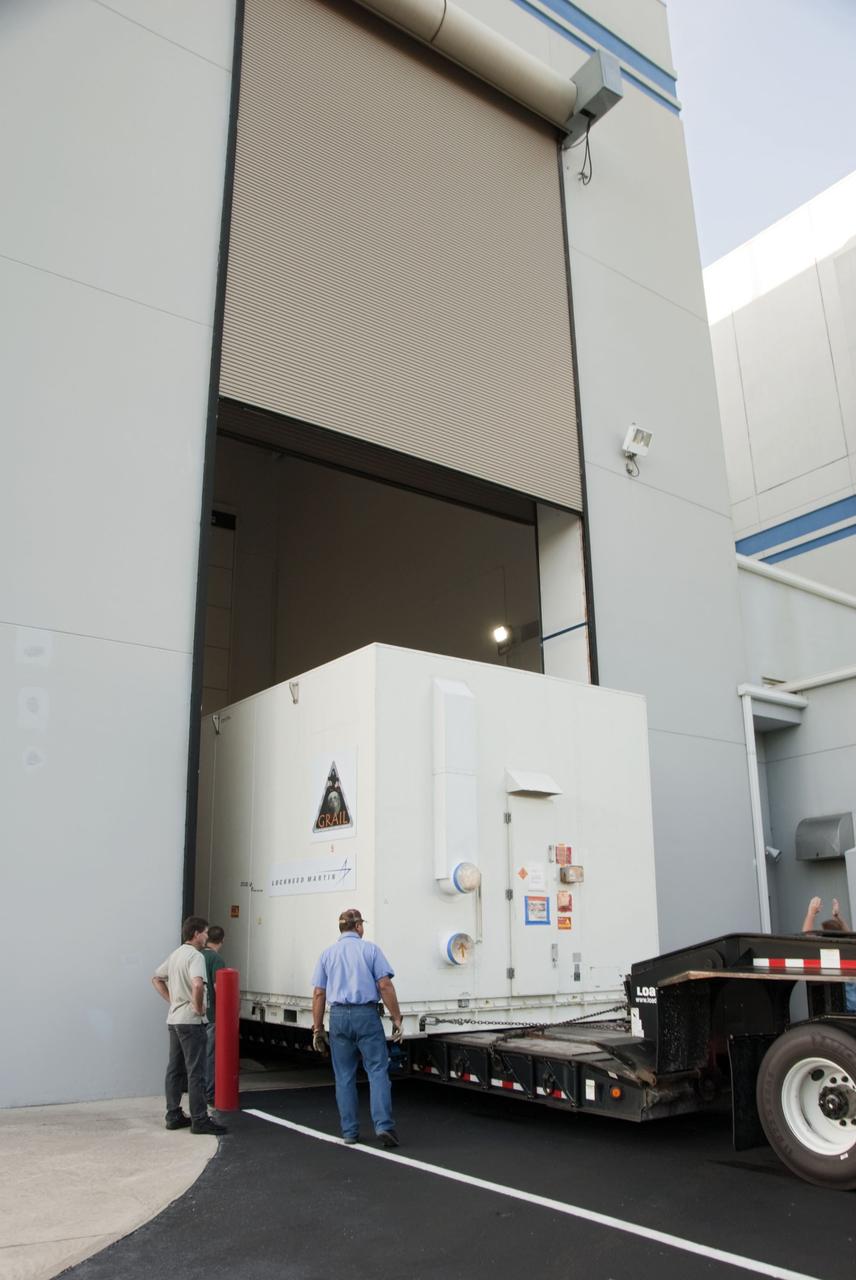
CAPE CANAVERAL, Fla. -- The protective canister housing NASA's twin Gravity Recovery and Interior Laboratory lunar spacecraft arrives at the Hazardous Processing Facility (HPF) at Astrotech Space Operation's payload processing facility in Titusville, Fla. In the HPF, the spacecraft will undergo two days of fueling activities. GRAIL will fly in tandem orbits around the moon for several months to measure its gravity field. GRAIL's primary science objectives are to determine the structure of the lunar interior, from crust to core, and to advance understanding of the thermal evolution of the moon. Launch aboard a United Launch Alliance Delta II rocket from Space Launch Complex 17B on Cape Canaveral Air Force Station is scheduled for Sept. 8. For more information, visit http://www.nasa.gov/grail. Photo credit: NASA/Charisse Nahser
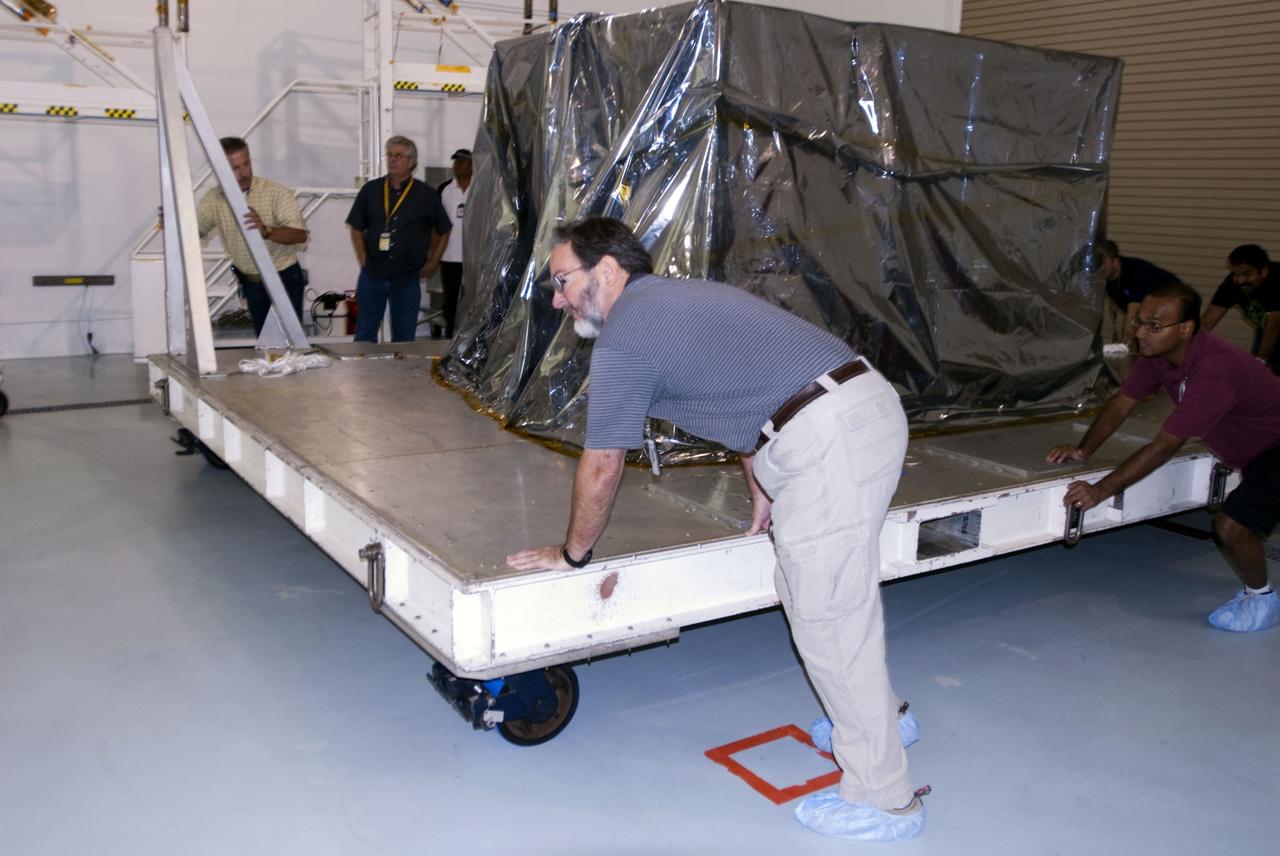
CAPE CANAVERAL, Fla. -- Lockheed Martin technicians push NASA's mylar-covered twin Gravity Recovery and Interior Laboratory lunar spacecraft toward the work area of the Hazardous Processing Facility (HPF) at Astrotech Space Operation's payload processing facility in Titusville, Fla. In the HPF, the spacecraft will undergo two days of fueling activities. GRAIL will fly in tandem orbits around the moon for several months to measure its gravity field. GRAIL's primary science objectives are to determine the structure of the lunar interior, from crust to core, and to advance understanding of the thermal evolution of the moon. Launch aboard a United Launch Alliance Delta II rocket from Space Launch Complex 17B on Cape Canaveral Air Force Station is scheduled for Sept. 8. For more information, visit http://www.nasa.gov/grail. Photo credit: NASA/Charisse Nahser
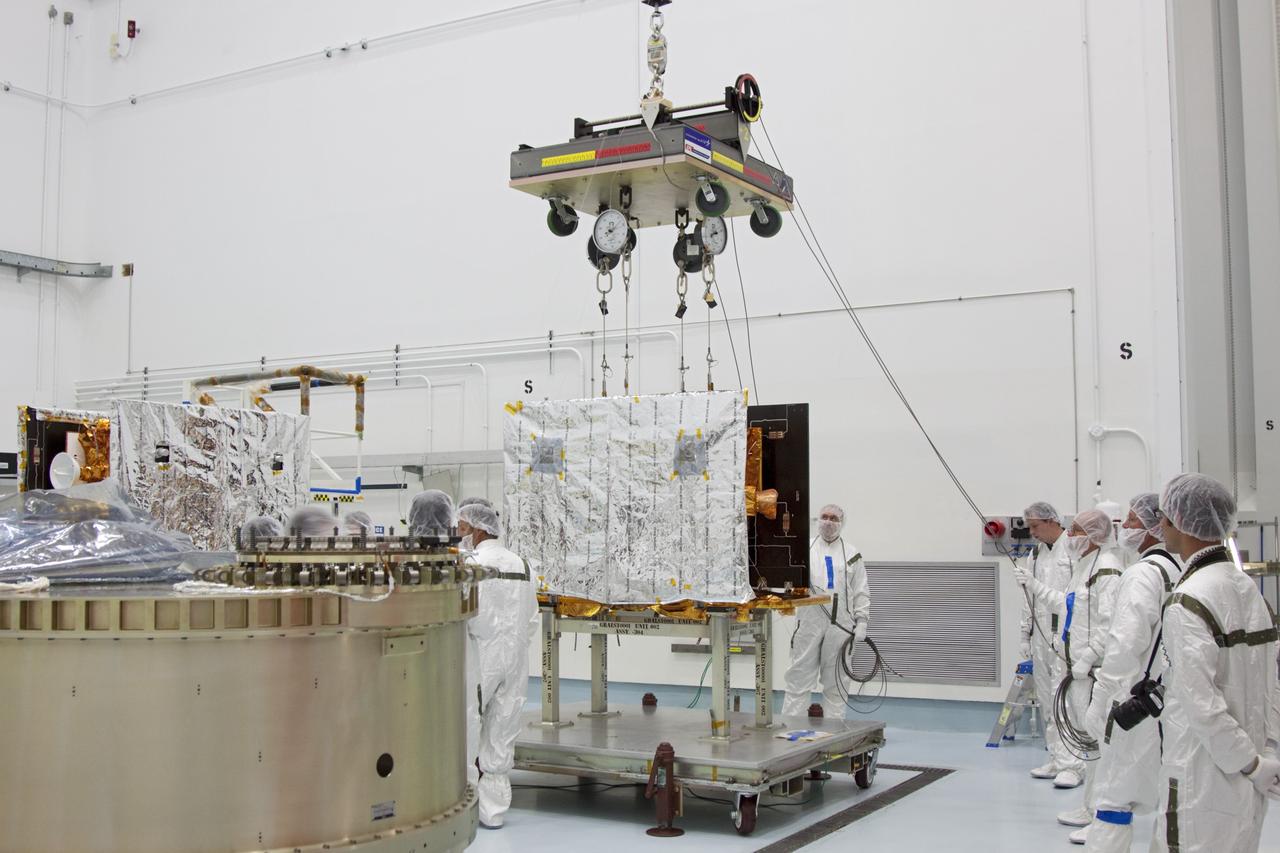
CAPE CANAVERAL, Fla. -- At Astrotech Space Operation's payload processing facility in Titusville, Fla., a lifting device is lowered toward NASA's Gravity Recovery and Interior Laboratory-B (GRAIL-B) lunar probe. At left is GRAIL-A. After the twin GRAIL spacecraft are attached to the spacecraft adapter ring in their side-by-side launch configuration, they will be transported to the launch pad. GRAIL will fly in tandem orbits around the moon for several months to measure its gravity field. GRAIL's primary science objectives are to determine the structure of the lunar interior, from crust to core, and to advance understanding of the thermal evolution of the moon. Launch aboard a United Launch Alliance Delta II rocket from Space Launch Complex 17B on Cape Canaveral Air Force Station is scheduled for Sept. 8. For more information, visit http://www.nasa.gov/grail. Photo credit: NASA/Jim Grossmann
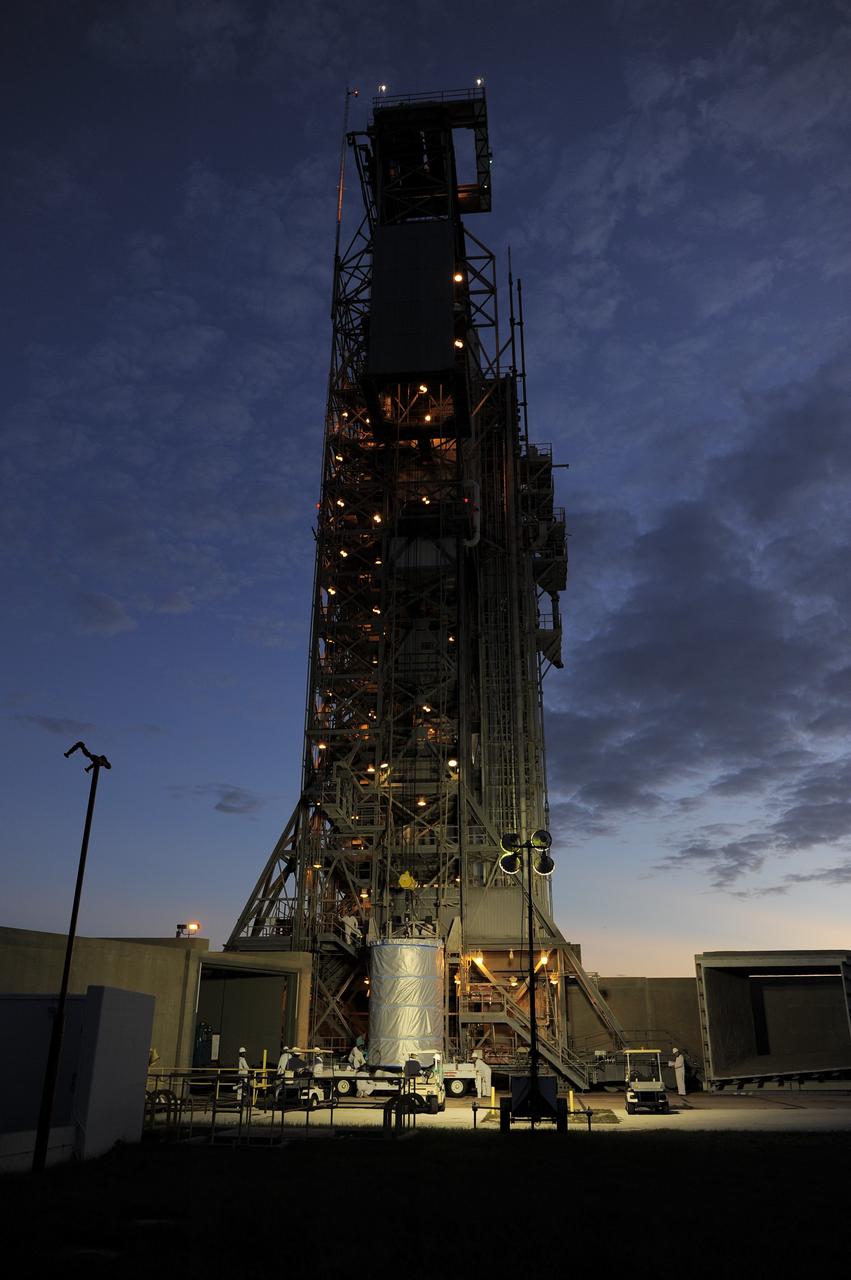
CAPE CANAVERAL, Fla. -- NASA's twin Gravity Recovery and Interior Laboratory (GRAIL) spacecraft are lifted to the top of their launch pad at Space Launch Complex 17B at Cape Canaveral Air Force Station in Florida. The lunar probes are attached to a spacecraft adapter ring in their side-by-side launch configuration and wrapped in plastic to prevent contamination outside the clean room in the Astrotech Space Operation's payload processing facility in Titusville, Fla. The spacecraft will fly in tandem orbits around the moon for several months to measure its gravity field. GRAIL's primary science objectives are to determine the structure of the lunar interior, from crust to core, and to advance understanding of the thermal evolution of the moon. Launch aboard a United Launch Alliance Delta II rocket is scheduled for Sept. 8. For more information, visit www.nasa.gov/grail. Photo credit: NASA/Kim Shiflett
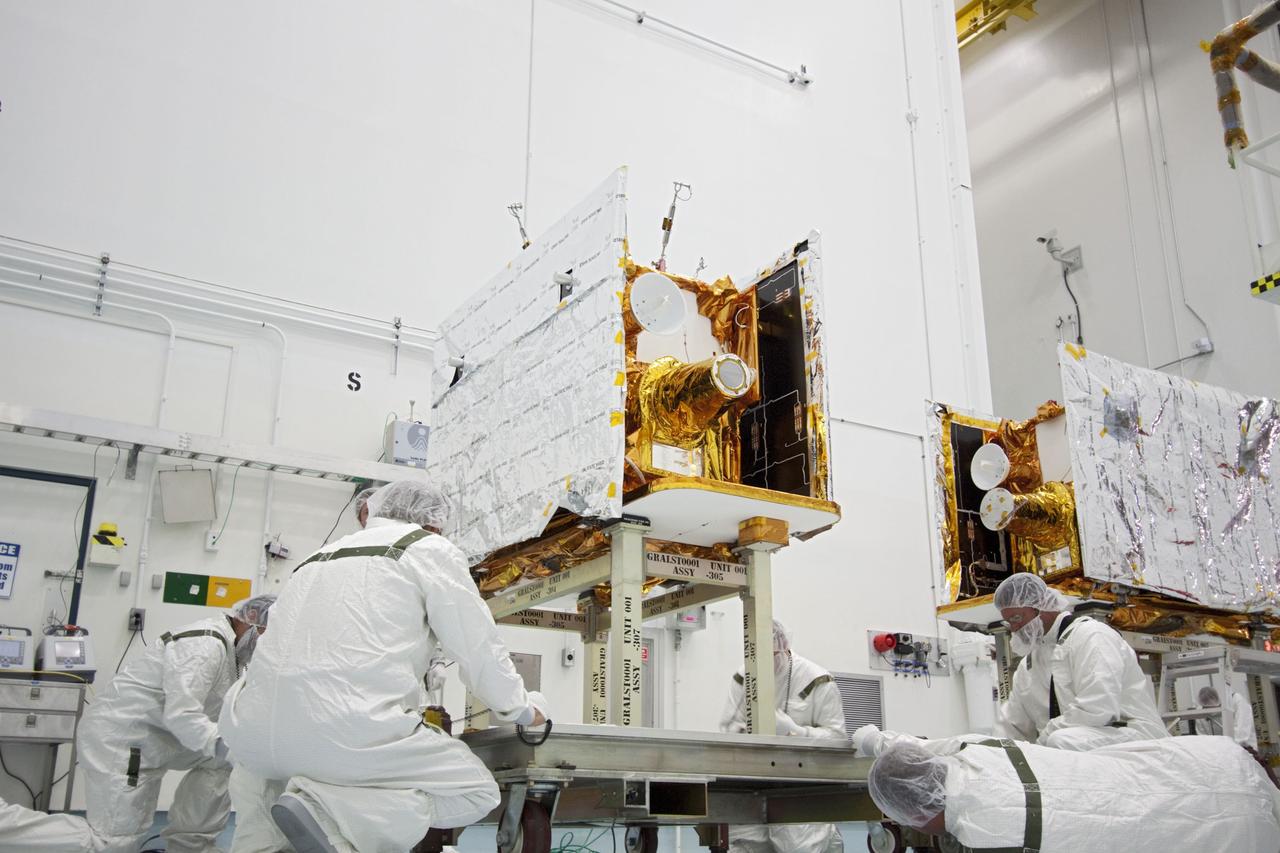
CAPE CANAVERAL, Fla. -- At Astrotech Space Operation's payload processing facility in Titusville, Fla., preparations are under way to stack NASA's twin Gravity Recovery and Interior Laboratory lunar spacecraft in their launch configuration on the spacecraft adapter ring for transport to the launch pad. GRAIL will fly in tandem orbits around the moon for several months to measure its gravity field. GRAIL's primary science objectives are to determine the structure of the lunar interior, from crust to core, and to advance understanding of the thermal evolution of the moon. Launch aboard a United Launch Alliance Delta II rocket from Space Launch Complex 17B on Cape Canaveral Air Force Station is scheduled for Sept. 8. For more information, visit http://www.nasa.gov/grail. Photo credit: NASA/Jim Grossmann
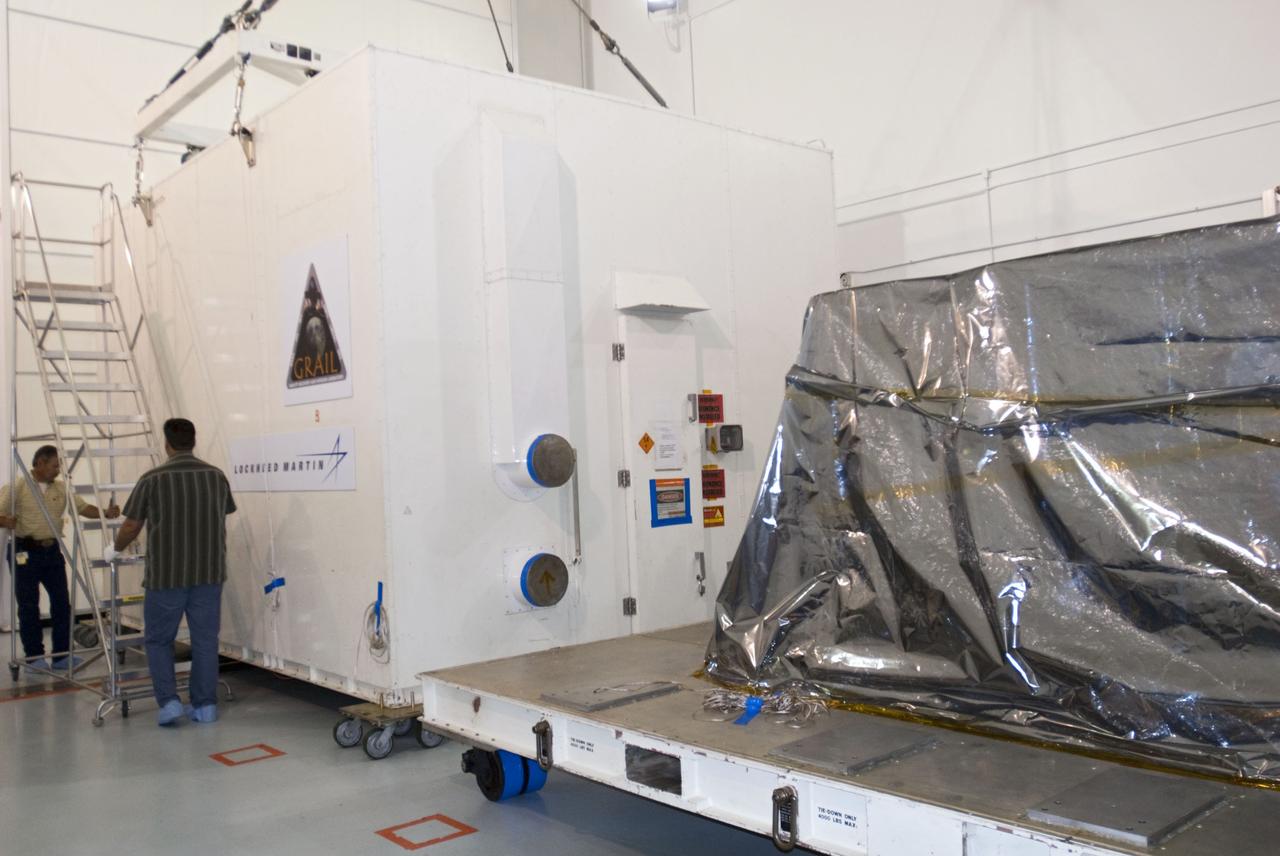
CAPE CANAVERAL, Fla. -- The protective canister housing NASA's twin Gravity Recovery and Interior Laboratory lunar spacecraft is rolled away from the mylar-covered spacecraft in the Hazardous Processing Facility (HPF) at Astrotech Space Operation's payload processing facility in Titusville, Fla. In the HPF, the spacecraft will undergo two days of fueling activities. GRAIL will fly in tandem orbits around the moon for several months to measure its gravity field. GRAIL's primary science objectives are to determine the structure of the lunar interior, from crust to core, and to advance understanding of the thermal evolution of the moon. Launch aboard a United Launch Alliance Delta II rocket from Space Launch Complex 17B on Cape Canaveral Air Force Station is scheduled for Sept. 8. For more information, visit http://www.nasa.gov/grail. Photo credit: NASA/Charisse Nahser
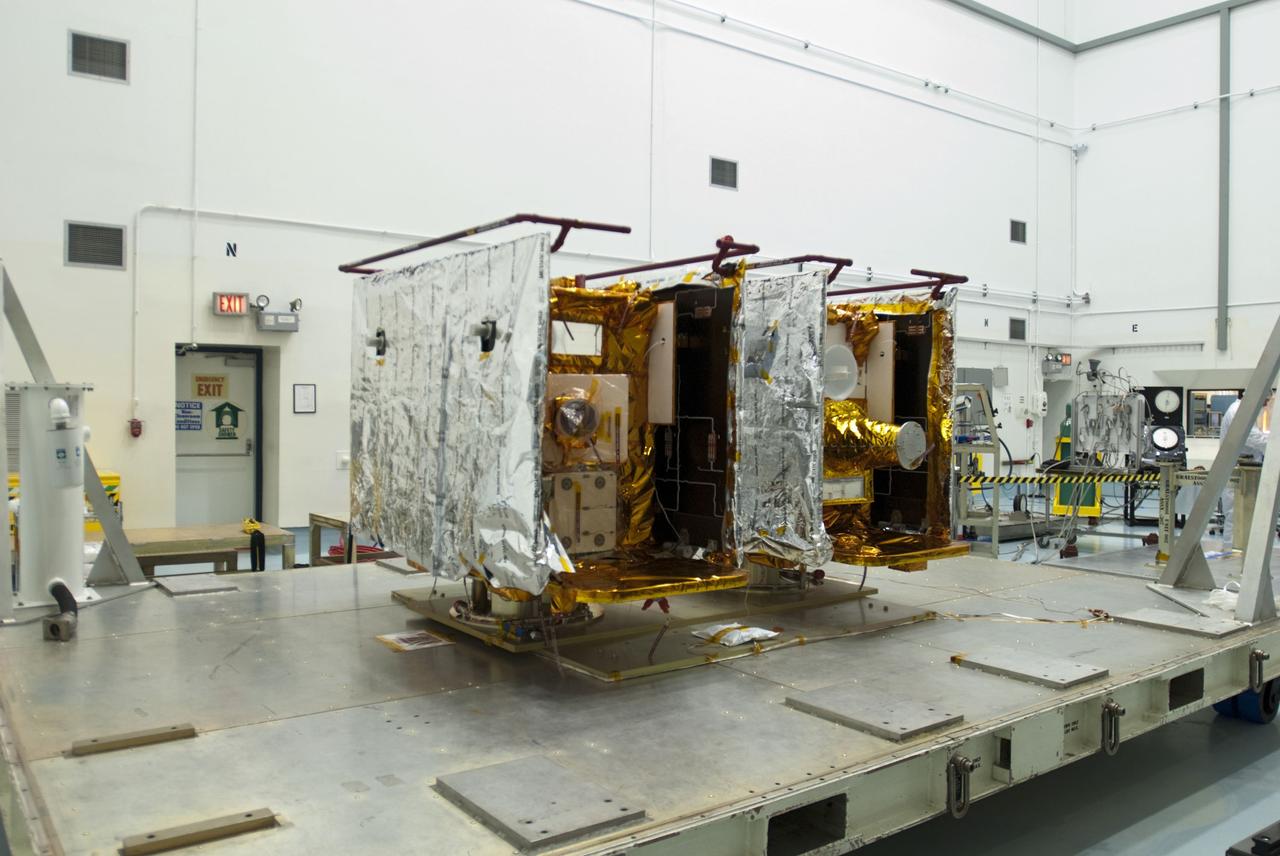
CAPE CANAVERAL, Fla. -- The mylar covering is removed from NASA's twin Gravity Recovery and Interior Laboratory lunar spacecraft in the Hazardous Processing Facility (HPF) at Astrotech Space Operation's payload processing facility in Titusville, Fla. In the HPF, the spacecraft will undergo two days of fueling activities. GRAIL will fly in tandem orbits around the moon for several months to measure its gravity field. GRAIL's primary science objectives are to determine the structure of the lunar interior, from crust to core, and to advance understanding of the thermal evolution of the moon. Launch aboard a United Launch Alliance Delta II rocket from Space Launch Complex 17B on Cape Canaveral Air Force Station is scheduled for Sept. 8. For more information, visit http://www.nasa.gov/grail. Photo credit: NASA/Charisse Nahser
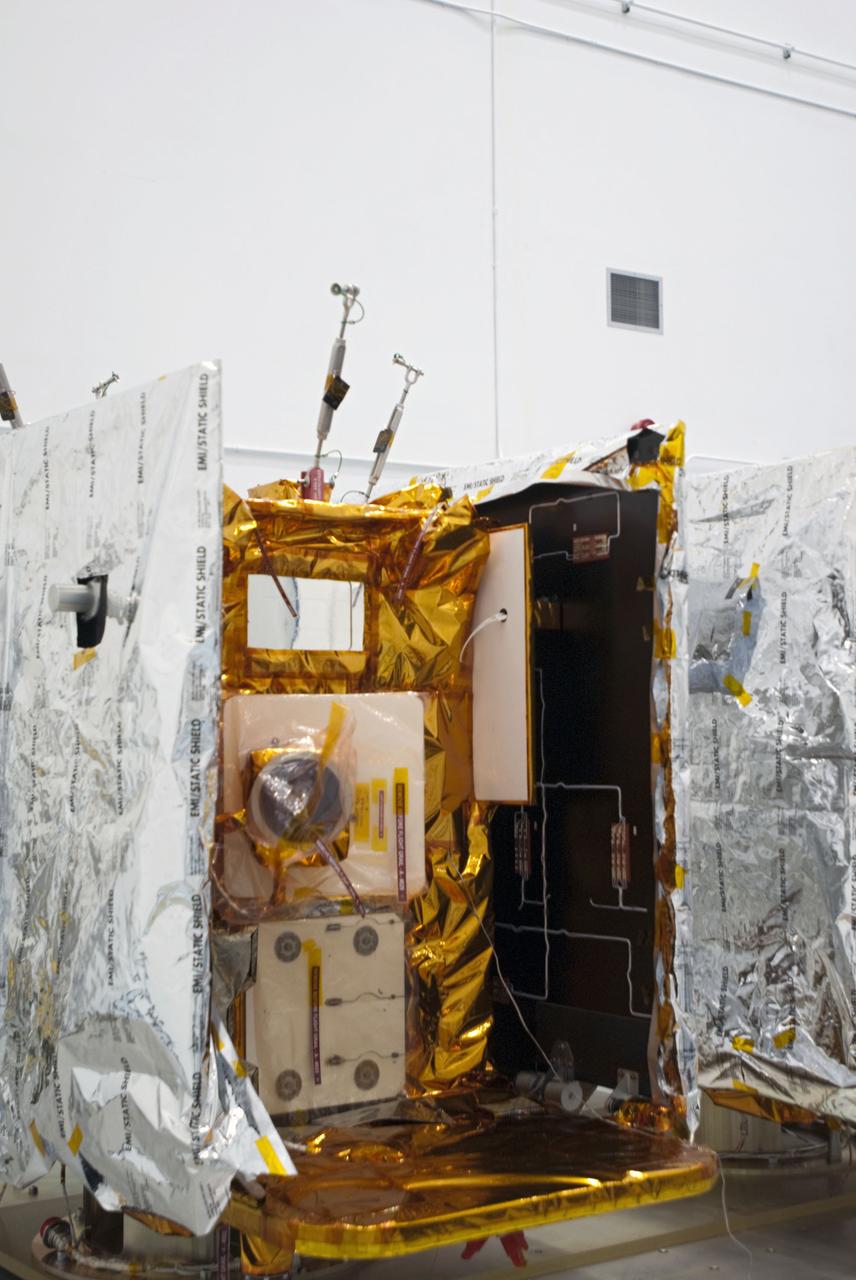
CAPE CANAVERAL, Fla. -- Preparations are under way to begin two days of fueling activities on NASA's twin Gravity Recovery and Interior Laboratory lunar spacecraft in the Hazardous Processing Facility (HPF) at Astrotech Space Operation's payload processing facility in Titusville, Fla. GRAIL will fly in tandem orbits around the moon for several months to measure its gravity field. GRAIL's primary science objectives are to determine the structure of the lunar interior, from crust to core, and to advance understanding of the thermal evolution of the moon. Launch aboard a United Launch Alliance Delta II rocket from Space Launch Complex 17B on Cape Canaveral Air Force Station is scheduled for Sept. 8. For more information, visit http://www.nasa.gov/grail. Photo credit: NASA/Charisse Nahser
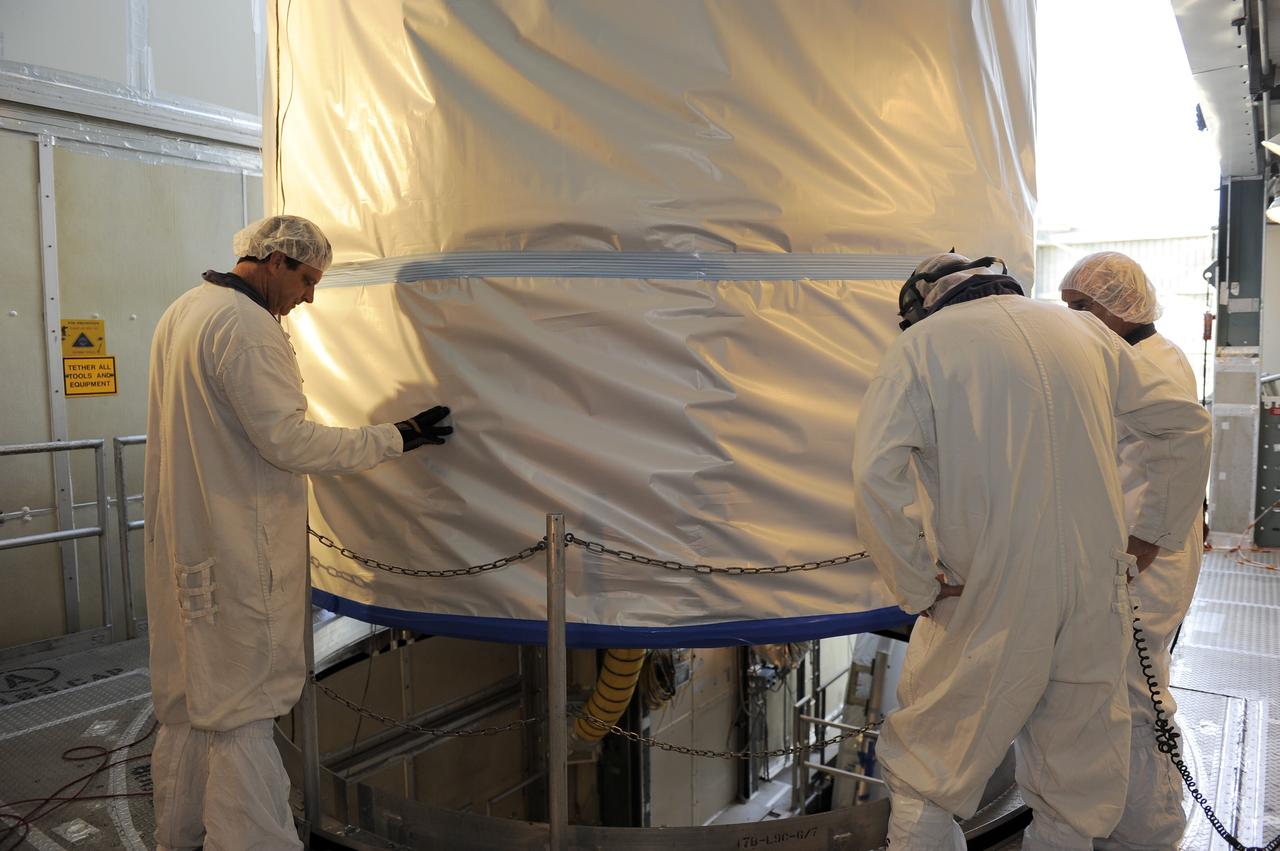
CAPE CANAVERAL, Fla. -- Technicians lower NASA's twin Gravity Recovery and Interior Laboratory (GRAIL) spacecraft into place atop a United Launch Alliance Delta II rocket on Space Launch Complex 17B at Cape Canaveral Air Force Station in Florida. The lunar probes are attached to a spacecraft adapter ring in their side-by-side launch configuration and wrapped in plastic to prevent contamination outside the clean room. The spacecraft will fly in tandem orbits around the moon for several months to measure its gravity field. GRAIL's primary science objectives are to determine the structure of the lunar interior, from crust to core, and to advance understanding of the thermal evolution of the moon. Launch is scheduled for Sept. 8. For more information, visit www.nasa.gov/grail. Photo credit: NASA/Kim Shiflett
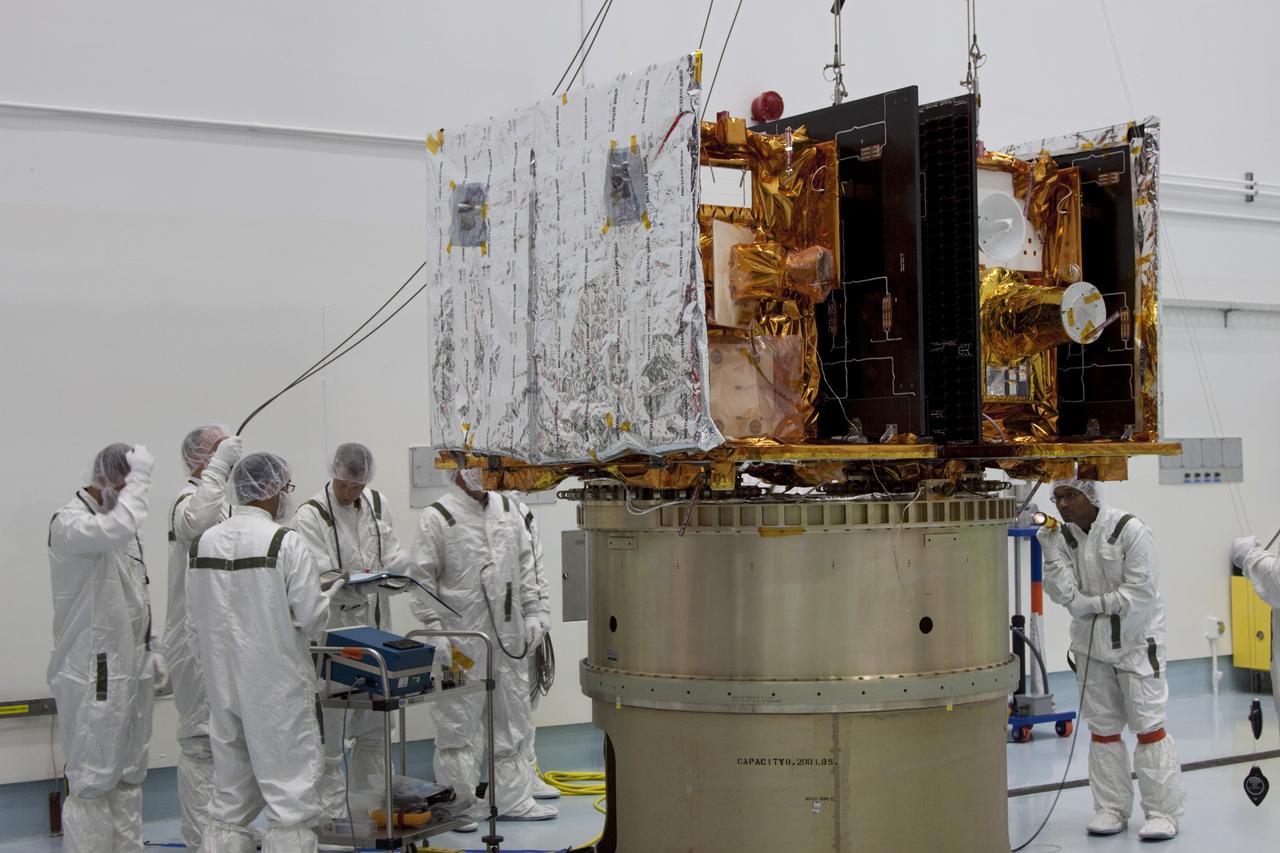
CAPE CANAVERAL, Fla. -- At Astrotech Space Operation's payload processing facility in Titusville, Fla., Lockheed Martin technicians verify that NASA's Gravity Recovery and Interior Laboratory-A (GRAIL-A) lunar probe is in position and ready to be secured to the spacecraft adapter ring. GRAIL-B is secured to the ring, at left. After the twin GRAIL spacecraft are attached to the adapter ring in their side-by-side launch configuration, they will be transported to the launch pad. GRAIL will fly in tandem orbits around the moon for several months to measure its gravity field. GRAIL's primary science objectives are to determine the structure of the lunar interior, from crust to core, and to advance understanding of the thermal evolution of the moon. Launch aboard a United Launch Alliance Delta II rocket from Space Launch Complex 17B on Cape Canaveral Air Force Station is scheduled for Sept. 8. For more information, visit http://www.nasa.gov/grail. Photo credit: NASA/Jim Grossmann
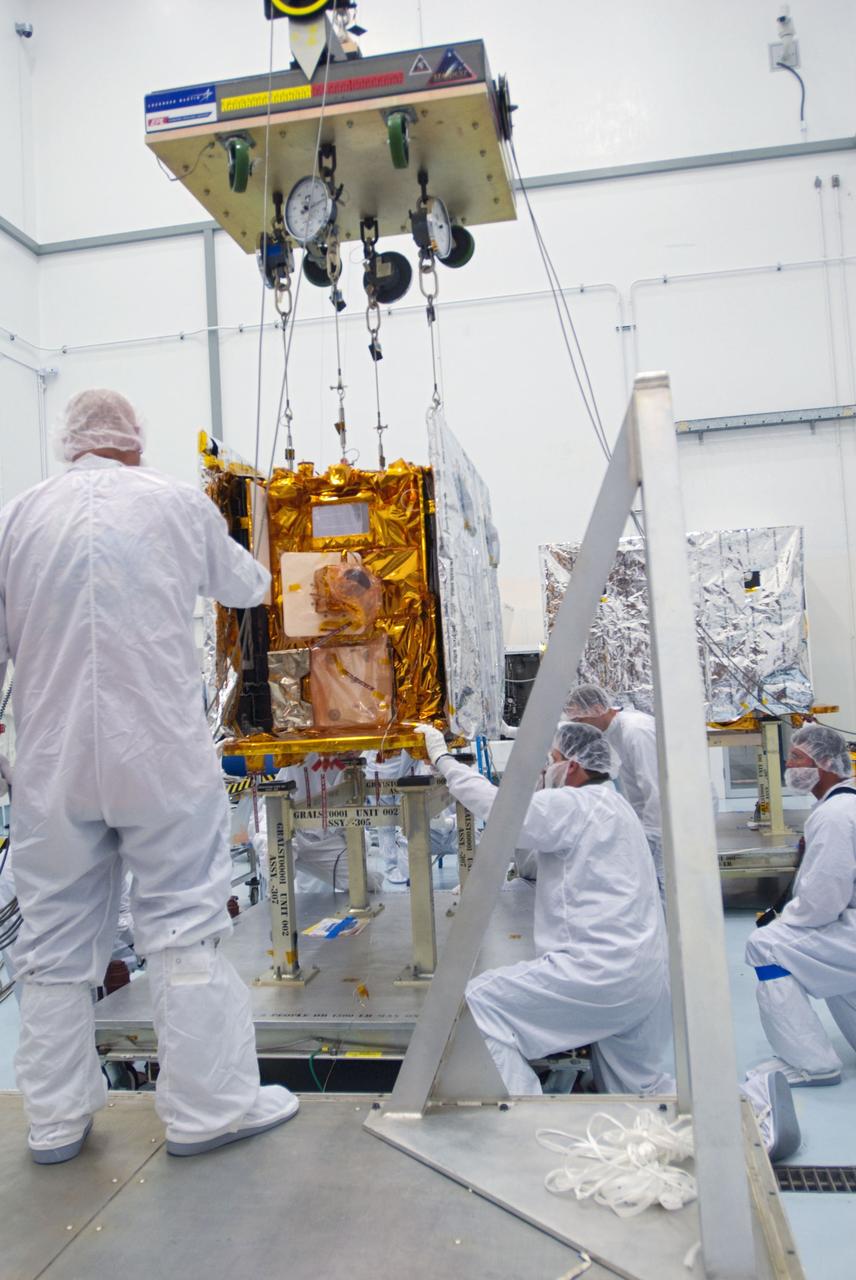
CAPE CANAVERAL, Fla. -- Lockheed Martin technicians lower the second of NASA's twin Gravity Recovery and Interior Laboratory lunar spacecraft onto a workstand in the Hazardous Processing Facility (HPF) at Astrotech Space Operation's payload processing facility in Titusville, Fla. In the HPF, the spacecraft will undergo two days of fueling activities. GRAIL will fly in tandem orbits around the moon for several months to measure its gravity field. GRAIL's primary science objectives are to determine the structure of the lunar interior, from crust to core, and to advance understanding of the thermal evolution of the moon. Launch aboard a United Launch Alliance Delta II rocket from Space Launch Complex 17B on Cape Canaveral Air Force Station is scheduled for Sept. 8. For more information, visit http://www.nasa.gov/grail. Photo credit: NASA/Charisse Nahser
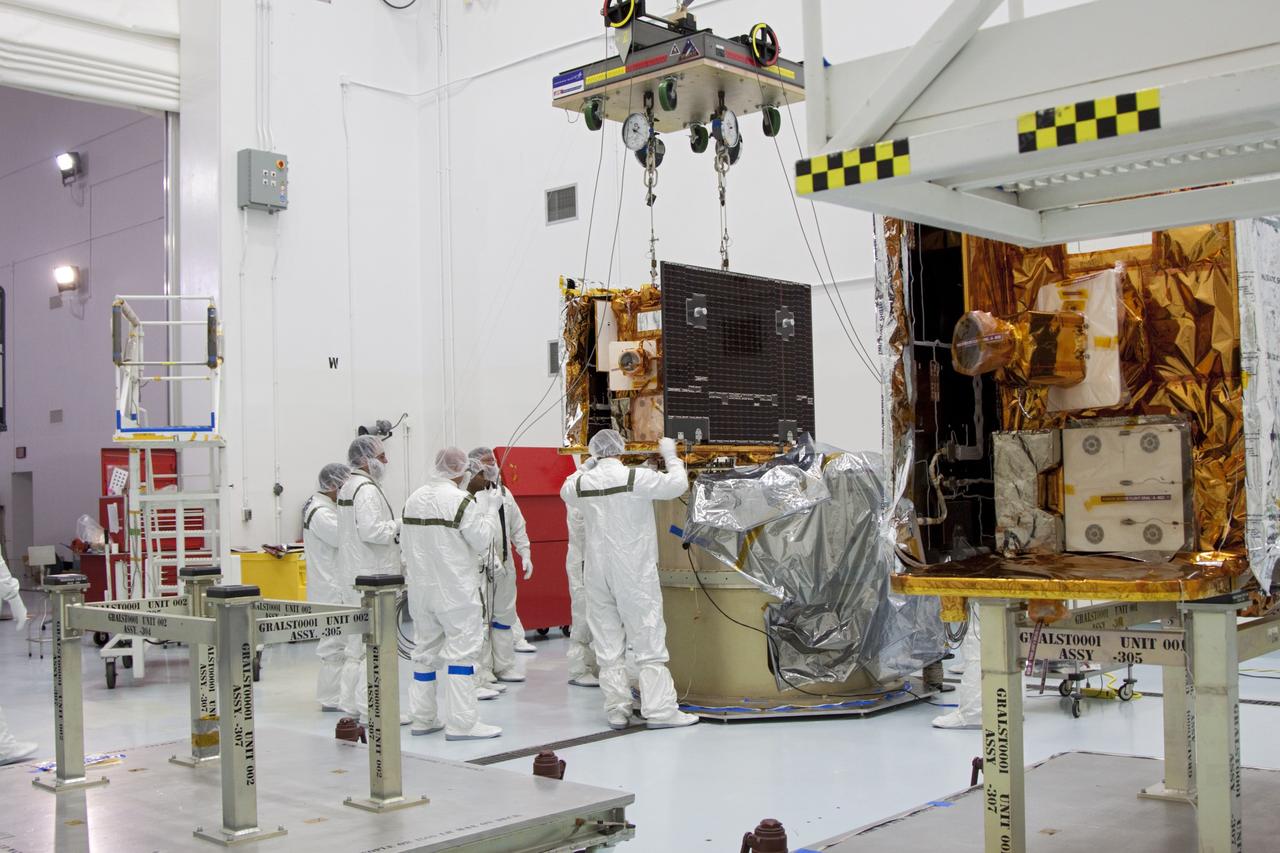
CAPE CANAVERAL, Fla. -- At Astrotech Space Operation's payload processing facility in Titusville, Fla., NASA's Gravity Recovery and Interior Laboratory-B (GRAIL-B) lunar probe comes to rest on the spacecraft adapter ring. At right is GRAIL-A. After the twin GRAIL spacecraft are attached to the adapter ring in their side-by-side launch configuration, they will be transported to the launch pad. GRAIL will fly in tandem orbits around the moon for several months to measure its gravity field. GRAIL's primary science objectives are to determine the structure of the lunar interior, from crust to core, and to advance understanding of the thermal evolution of the moon. Launch aboard a United Launch Alliance Delta II rocket from Space Launch Complex 17B on Cape Canaveral Air Force Station is scheduled for Sept. 8. For more information, visit http://www.nasa.gov/grail. Photo credit: NASA/Jim Grossmann
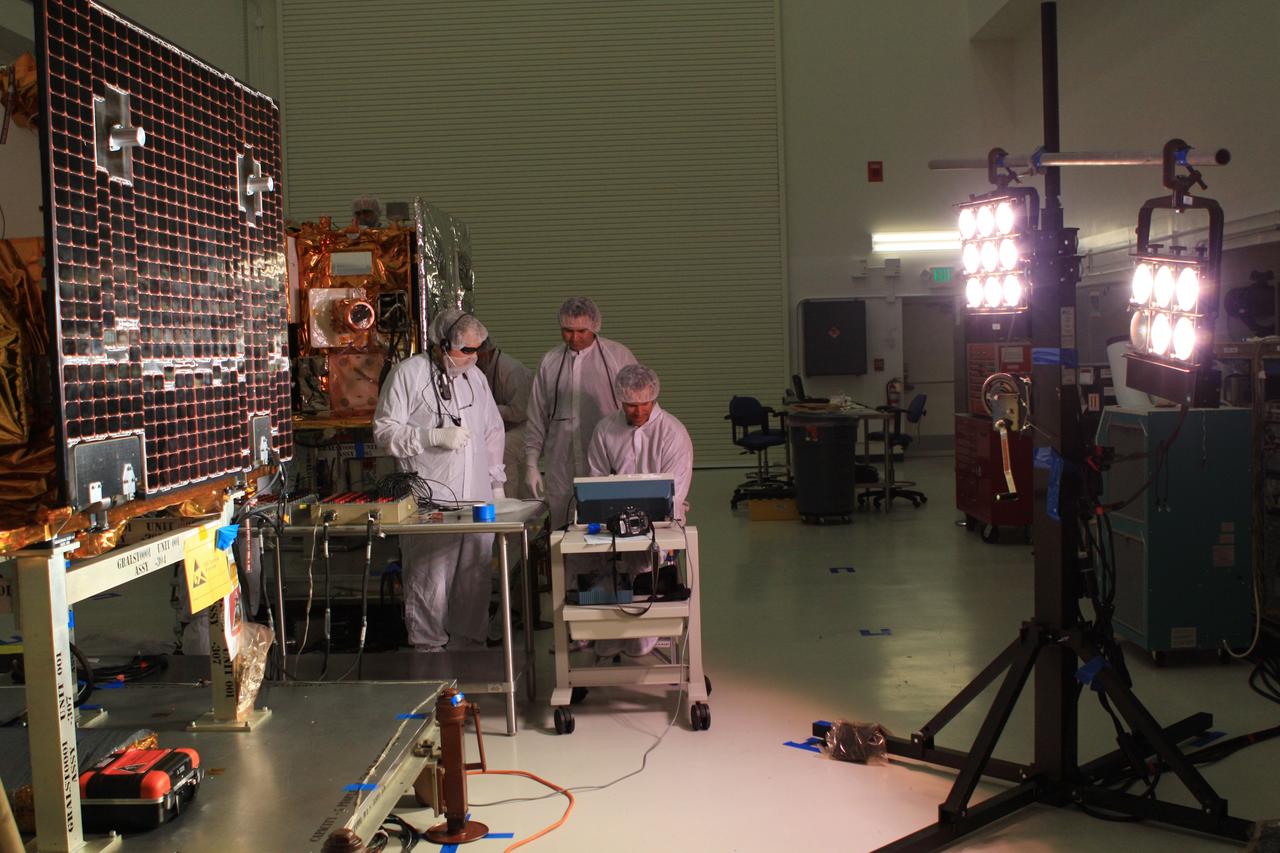
CAPE CANAVERAL, Fla. -- Lockheed Martin technicians in Astrotech Space Operation's payload processing facility in Titusville, Fla., test the solar arrays on NASA's Gravity Recovery and Interior Laboratory-A, or GRAIL-A, spacecraft to ensure that they will function as planned during the mission. The electrical power subsystem on each of GRAIL's twin spacecraft includes two solar arrays and a lithium ion battery. Each solar array is capable of producing no less than 700 watts. They will be deployed shortly after separation from the launch vehicle and remain fixed throughout the mission. GRAIL will fly in tandem orbits around the moon for several months to measure its gravity field. GRAIL's primary science objectives are to determine the structure of the lunar interior, from crust to core, and to advance understanding of the thermal evolution of the moon. Launch aboard a United Launch Alliance Delta II rocket from Space Launch Complex 17B on Cape Canaveral Air Force Station is scheduled for Sept. 8. For more information, visit http://www.nasa.gov/grail. Photo credit: NASA/Frankie Martin
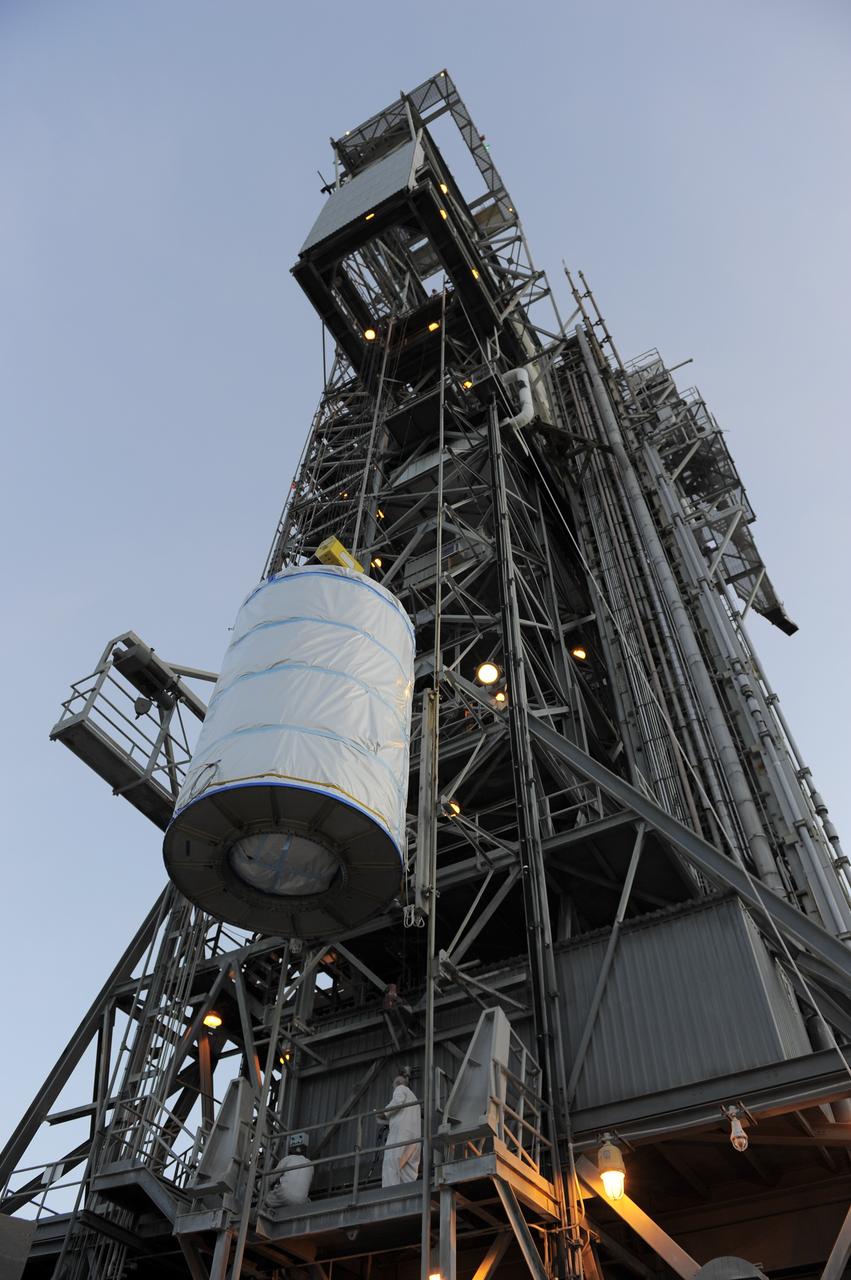
CAPE CANAVERAL, Fla. -- NASA's twin Gravity Recovery and Interior Laboratory (GRAIL) spacecraft are lifted to the top of their launch pad at Space Launch Complex 17B at Cape Canaveral Air Force Station in Florida. The lunar probes are attached to a spacecraft adapter ring in their side-by-side launch configuration and wrapped in plastic to prevent contamination outside the clean room in the Astrotech Space Operation's payload processing facility in Titusville, Fla. The spacecraft will fly in tandem orbits around the moon for several months to measure its gravity field. GRAIL's primary science objectives are to determine the structure of the lunar interior, from crust to core, and to advance understanding of the thermal evolution of the moon. Launch aboard a United Launch Alliance Delta II rocket is scheduled for Sept. 8. For more information, visit www.nasa.gov/grail. Photo credit: NASA/Kim Shiflett
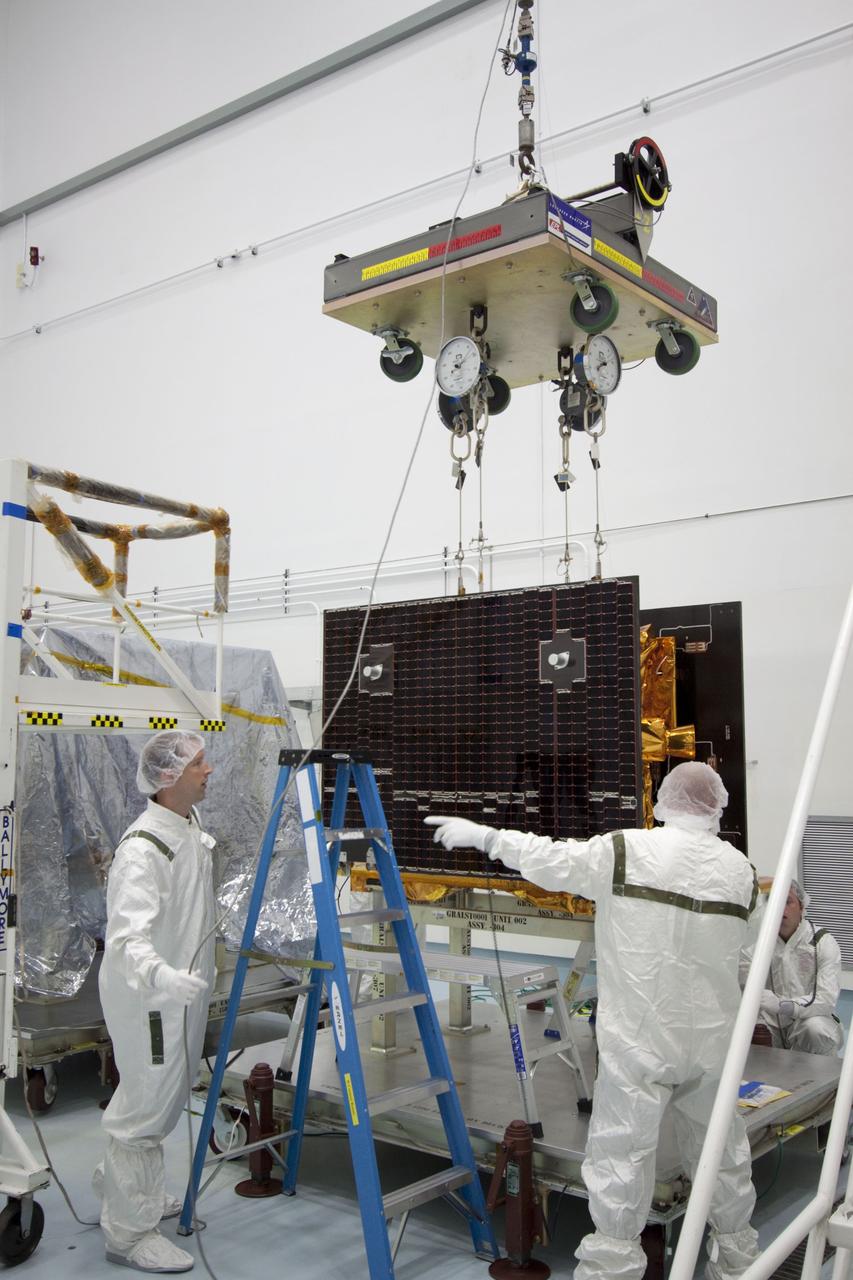
CAPE CANAVERAL, Fla. -- At Astrotech Space Operation's payload processing facility in Titusville, Fla., Lockheed Martin technicians move a portable scale toward one of NASA's twin Gravity Recovery and Interior Laboratory lunar spacecraft. The spacecraft will be lifted and weighed before they are stacked in their launch configuration in preparation for transport to the launch pad. GRAIL will fly in tandem orbits around the moon for several months to measure its gravity field. GRAIL's primary science objectives are to determine the structure of the lunar interior, from crust to core, and to advance understanding of the thermal evolution of the moon. Launch aboard a United Launch Alliance Delta II rocket from Space Launch Complex 17B on Cape Canaveral Air Force Station is scheduled for Sept. 8. For more information, visit http://www.nasa.gov/grail. Photo credit: NASA/Jim Grossmann
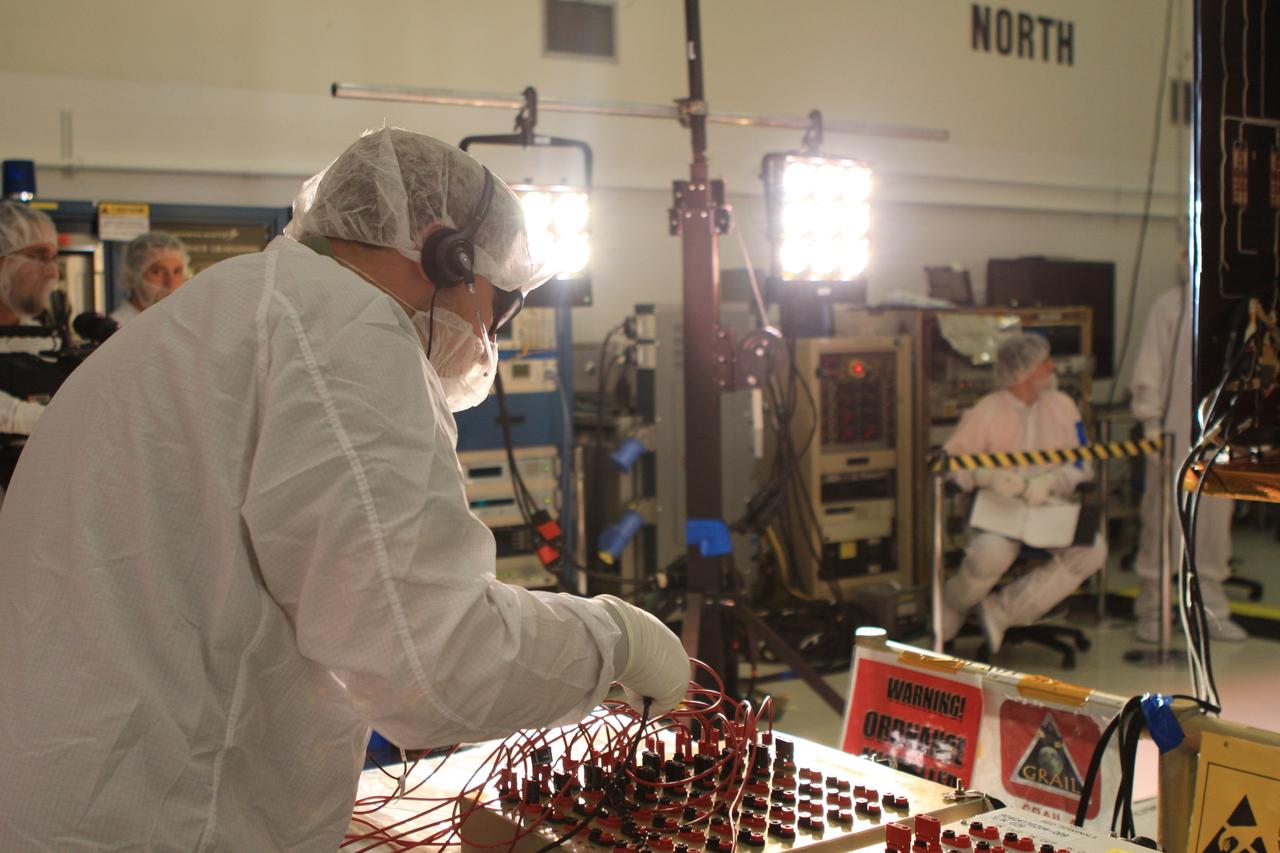
CAPE CANAVERAL, Fla. -- A Lockheed Martin technician in Astrotech Space Operation's payload processing facility in Titusville, Fla., tests the solar arrays on NASA's Gravity Recovery and Interior Laboratory-A, or GRAIL-A, spacecraft to ensure that they will function as planned during the mission. The electrical power subsystem on each of GRAIL's twin spacecraft includes two solar arrays and a lithium ion battery. Each solar array is capable of producing no less than 700 watts. They will be deployed shortly after separation from the launch vehicle and remain fixed throughout the mission. GRAIL will fly in tandem orbits around the moon for several months to measure its gravity field. GRAIL's primary science objectives are to determine the structure of the lunar interior, from crust to core, and to advance understanding of the thermal evolution of the moon. Launch aboard a United Launch Alliance Delta II rocket from Space Launch Complex 17B on Cape Canaveral Air Force Station is scheduled for Sept. 8. For more information, visit http://www.nasa.gov/grail. Photo credit: NASA/Frankie Martin
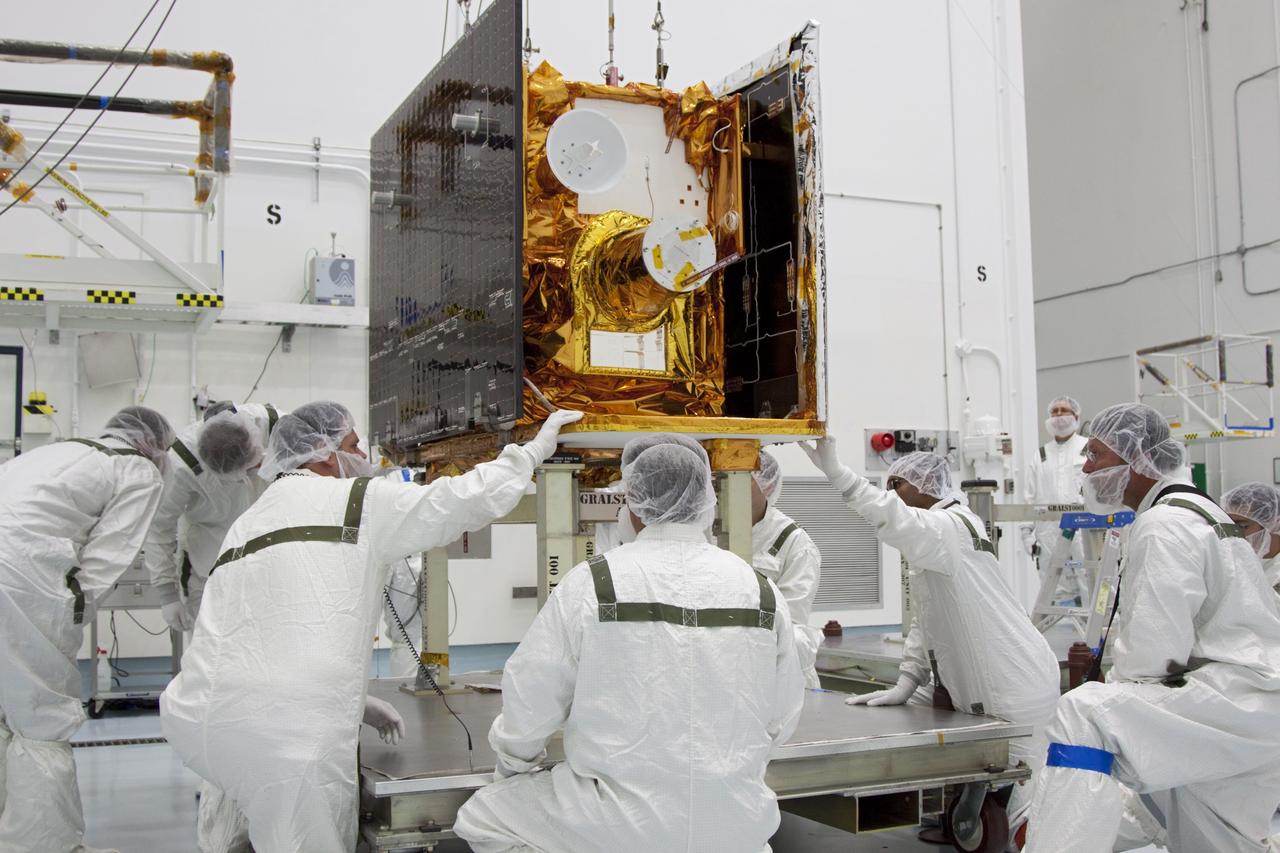
CAPE CANAVERAL, Fla. -- At Astrotech Space Operation's payload processing facility in Titusville, Fla., Lockheed Martin technicians verify that NASA's Gravity Recovery and Interior Laboratory-A (GRAIL-A) lunar probe is lifted carefully from its workstand. After the twin GRAIL spacecraft are attached to the adapter ring in their side-by-side launch configuration, they will be transported to the launch pad. GRAIL will fly in tandem orbits around the moon for several months to measure its gravity field. GRAIL's primary science objectives are to determine the structure of the lunar interior, from crust to core, and to advance understanding of the thermal evolution of the moon. Launch aboard a United Launch Alliance Delta II rocket from Space Launch Complex 17B on Cape Canaveral Air Force Station is scheduled for Sept. 8. For more information, visit http://www.nasa.gov/grail. Photo credit: NASA/Jim Grossmann
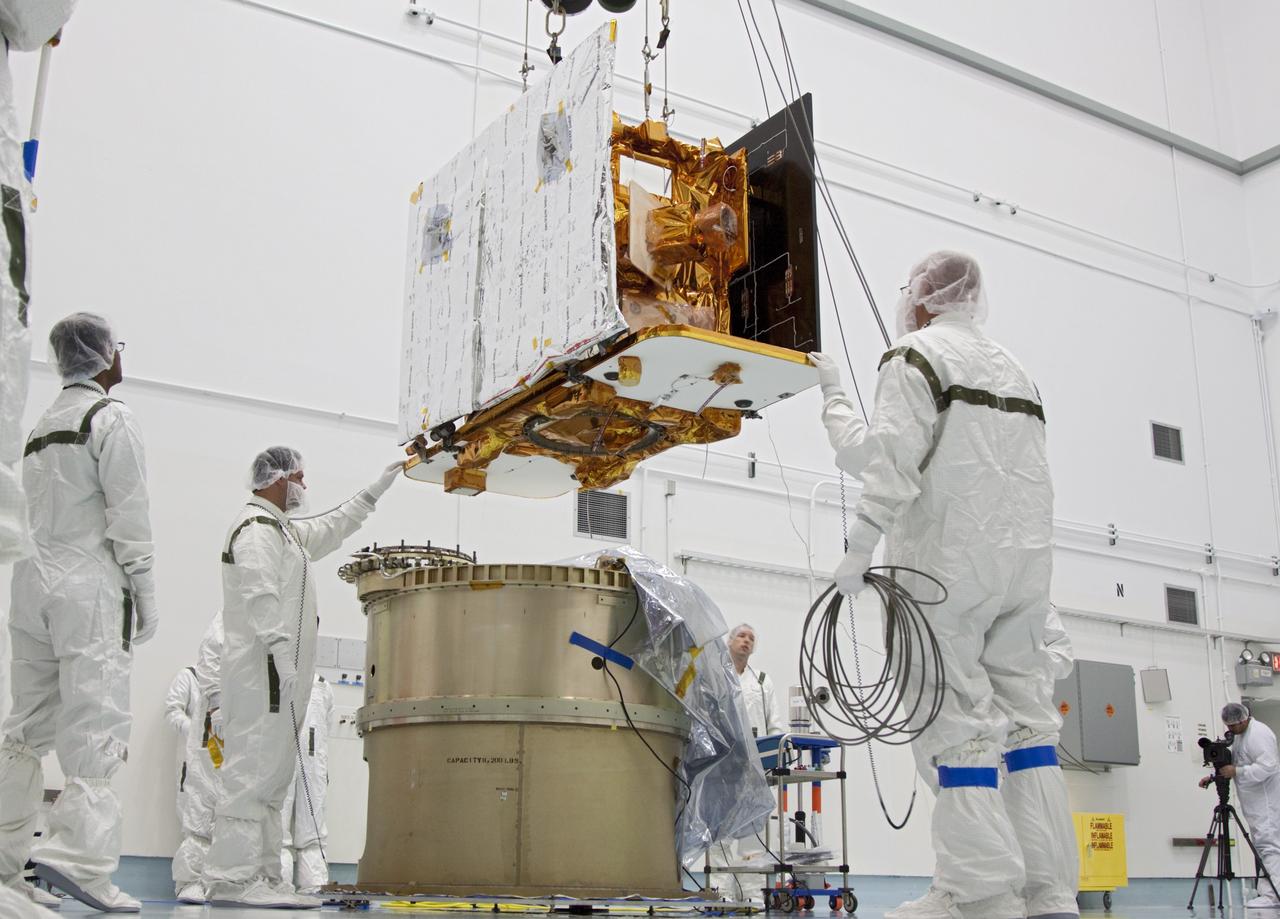
CAPE CANAVERAL, Fla. -- At Astrotech Space Operation's payload processing facility in Titusville, Fla., Lockheed Martin technicians lower NASA's Gravity Recovery and Interior Laboratory-B (GRAIL-B) lunar probe toward the spacecraft adapter ring. After the twin GRAIL spacecraft are attached to the adapter ring in their side-by-side launch configuration, they will be transported to the launch pad. GRAIL will fly in tandem orbits around the moon for several months to measure its gravity field. GRAIL's primary science objectives are to determine the structure of the lunar interior, from crust to core, and to advance understanding of the thermal evolution of the moon. Launch aboard a United Launch Alliance Delta II rocket from Space Launch Complex 17B on Cape Canaveral Air Force Station is scheduled for Sept. 8. For more information, visit http://www.nasa.gov/grail. Photo credit: NASA/Jim Grossmann
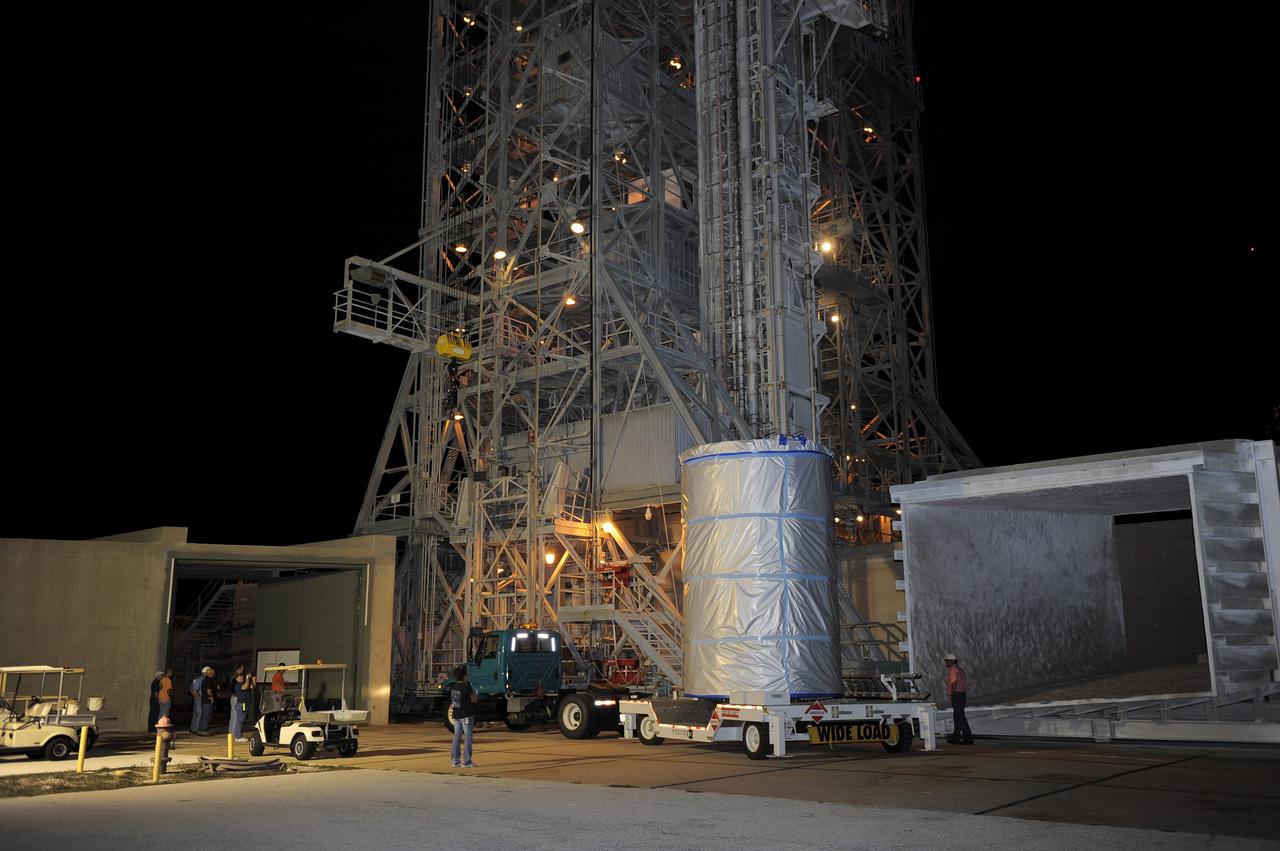
CAPE CANAVERAL, Fla. -- NASA's twin Gravity Recovery and Interior Laboratory (GRAIL) spacecraft arrives at their launch pad at Space Launch Complex 17B at Cape Canaveral Air Force Station in Florida. The lunar probes are attached to a spacecraft adapter ring in their side-by-side launch configuration and wrapped in plastic to prevent contamination outside the clean room in the Astrotech Space Operation's payload processing facility in Titusville, Fla. The spacecraft will fly in tandem orbits around the moon for several months to measure its gravity field. GRAIL's primary science objectives are to determine the structure of the lunar interior, from crust to core, and to advance understanding of the thermal evolution of the moon. Launch aboard a United Launch Alliance Delta II rocket is scheduled for Sept. 8. For more information, visit www.nasa.gov/grail. Photo credit: NASA/Kim Shiflett
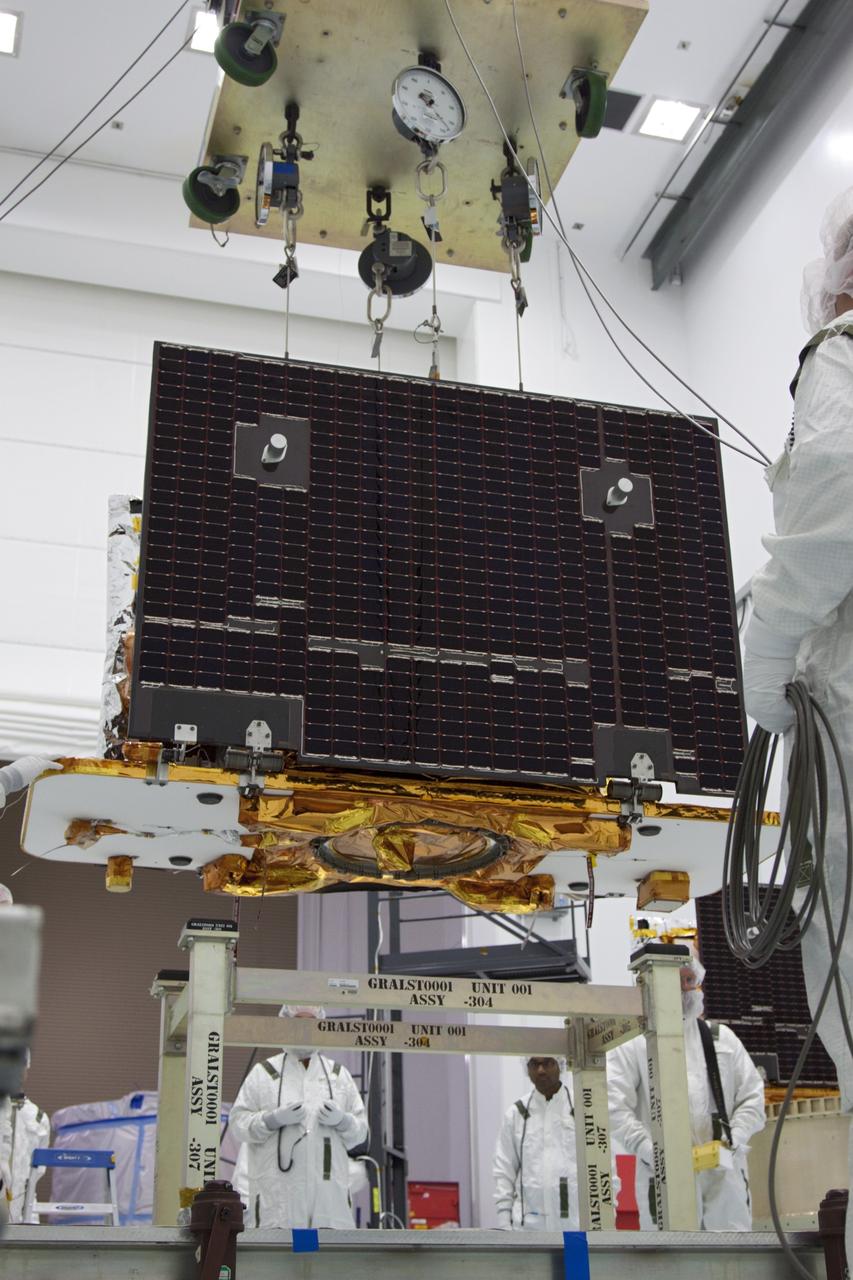
CAPE CANAVERAL, Fla. -- At Astrotech Space Operation's payload processing facility in Titusville, Fla., NASA's Gravity Recovery and Interior Laboratory-A (GRAIL-A) lunar probe is lifted from its workstand. After the twin GRAIL spacecraft are attached to the adapter ring in their side-by-side launch configuration, they will be transported to the launch pad. GRAIL will fly in tandem orbits around the moon for several months to measure its gravity field. GRAIL's primary science objectives are to determine the structure of the lunar interior, from crust to core, and to advance understanding of the thermal evolution of the moon. Launch aboard a United Launch Alliance Delta II rocket from Space Launch Complex 17B on Cape Canaveral Air Force Station is scheduled for Sept. 8. For more information, visit http://www.nasa.gov/grail. Photo credit: NASA/Jim Grossmann
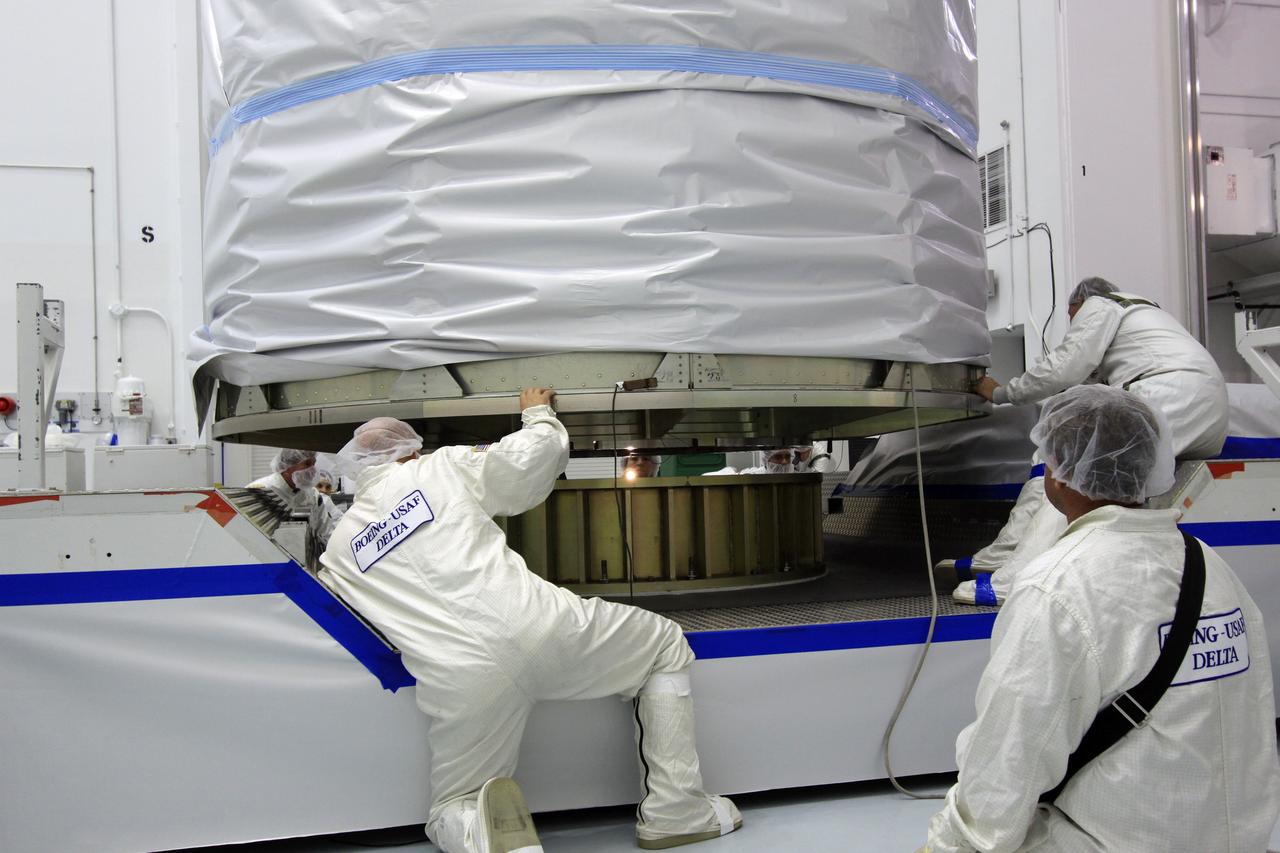
CAPE CANAVERAL, Fla. -- At Astrotech Space Operation's payload processing facility in Titusville, Fla., Lockheed Martin technicians guide the protective canister enclosing NASA's twin Gravity Recovery and Interior Laboratory spacecraft into place on a transportation pallet. Preparations are under way to move the lunar probes, attached to a spacecraft adapter ring in their side-by-side launch configuration, to the launch pad. The spacecraft will fly in tandem orbits around the moon for several months to measure its gravity field. GRAIL's primary science objectives are to determine the structure of the lunar interior, from crust to core, and to advance understanding of the thermal evolution of the moon. Launch aboard a United Launch Alliance Delta II rocket from Space Launch Complex 17B on Cape Canaveral Air Force Station is scheduled for Sept. 8. For more information, visit http://www.nasa.gov/grail. Photo credit: NASA/Jim Grossmann
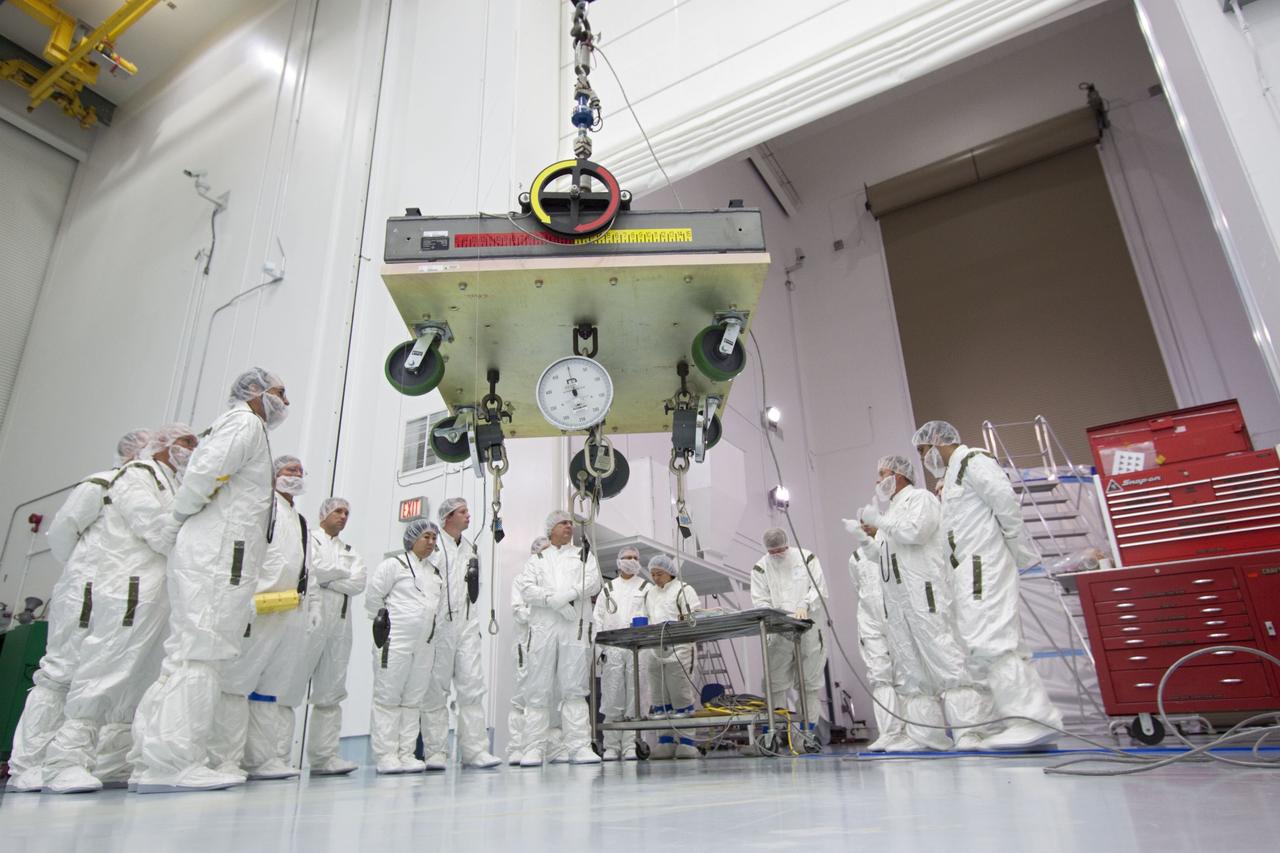
CAPE CANAVERAL, Fla. -- At Astrotech Space Operation's payload processing facility in Titusville, Fla., Lockheed Martin technicians review procedures for weighing one of NASA's twin Gravity Recovery and Interior Laboratory lunar spacecraft before the spacecraft are stacked in their launch configuration in preparation for transport to the launch pad. GRAIL will fly in tandem orbits around the moon for several months to measure its gravity field. GRAIL's primary science objectives are to determine the structure of the lunar interior, from crust to core, and to advance understanding of the thermal evolution of the moon. Launch aboard a United Launch Alliance Delta II rocket from Space Launch Complex 17B on Cape Canaveral Air Force Station is scheduled for Sept. 8. For more information, visit http://www.nasa.gov/grail. Photo credit: NASA/Jim Grossmann
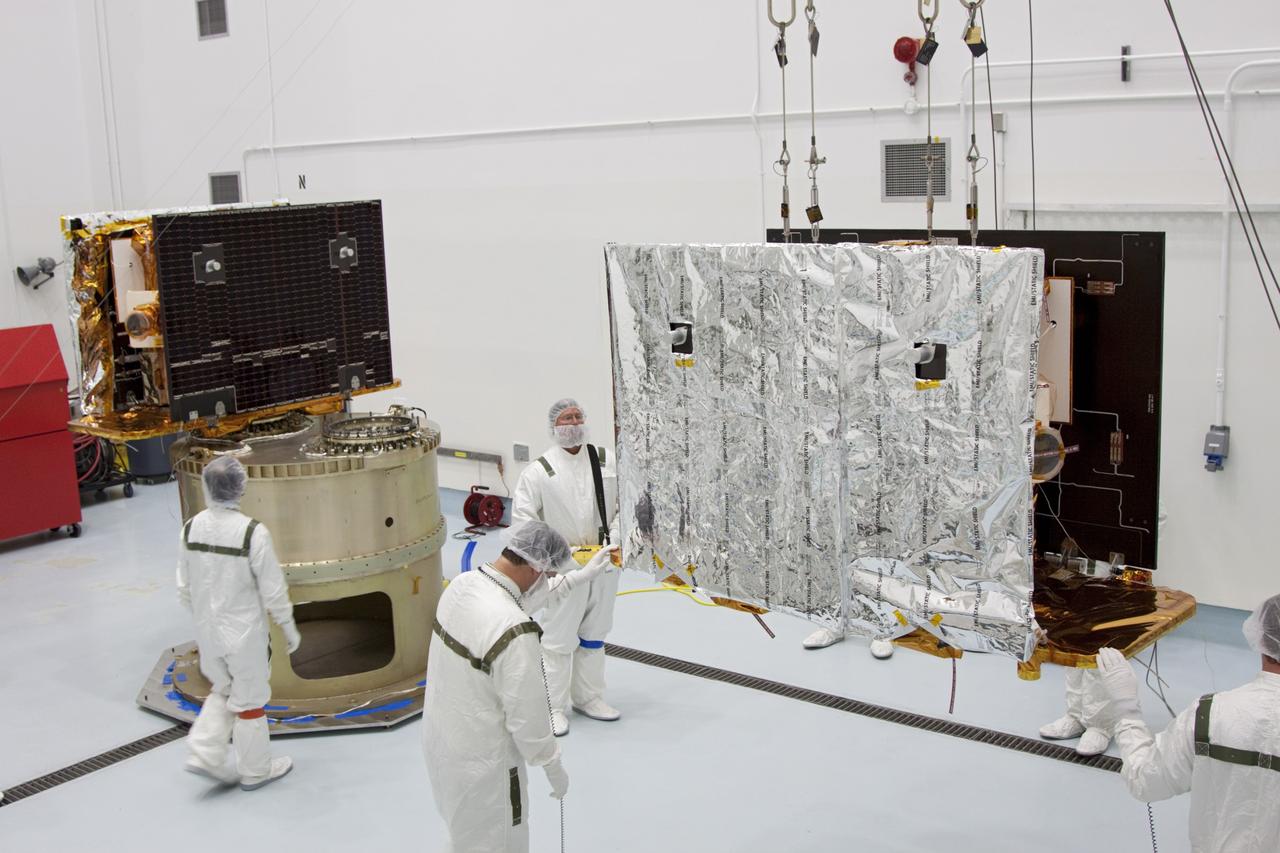
CAPE CANAVERAL, Fla. -- At Astrotech Space Operation's payload processing facility in Titusville, Fla., NASA's Gravity Recovery and Interior Laboratory-A (GRAIL-A) lunar probe moves across the clean room toward the spacecraft adapter ring, at left, where GRAIL-B is already secured. After the twin GRAIL spacecraft are attached to the adapter ring in their side-by-side launch configuration, they will be transported to the launch pad. GRAIL will fly in tandem orbits around the moon for several months to measure its gravity field. GRAIL's primary science objectives are to determine the structure of the lunar interior, from crust to core, and to advance understanding of the thermal evolution of the moon. Launch aboard a United Launch Alliance Delta II rocket from Space Launch Complex 17B on Cape Canaveral Air Force Station is scheduled for Sept. 8. For more information, visit http://www.nasa.gov/grail. Photo credit: NASA/Jim Grossmann
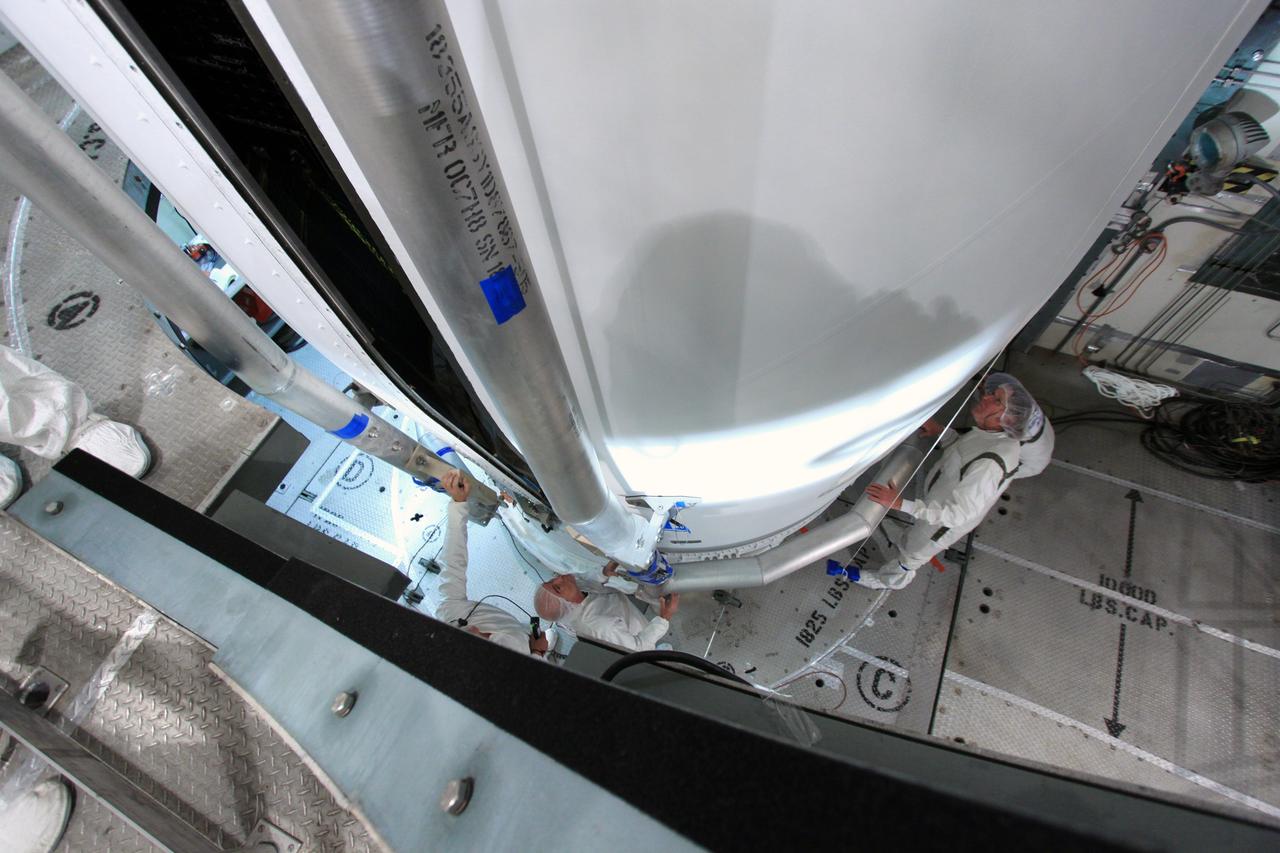
CAPE CANAVERAL, Fla. -- At Space Launch Complex 17B on Cape Canaveral Air Force Station in Florida, this spacecraft technician may be the last person to glimpse NASA's twin Gravity Recovery and Interior Laboratory spacecraft as the sections of the Delta payload fairing close around them. The fairing will protect the spacecraft from the impact of aerodynamic pressure and heating during ascent and will be jettisoned once the spacecraft is outside the Earth's atmosphere. Launch aboard a United Launch Alliance Delta II rocket from Pad 17B is scheduled for Sept. 8. The spacecraft will fly in tandem orbits around the moon for several months to measure its gravity field. GRAIL's primary science objectives are to determine the structure of the lunar interior, from crust to core, and to advance understanding of the thermal evolution of the moon. For more information, visit http://www.nasa.gov/grail. Photo credit: NASA/Jim Grossmann
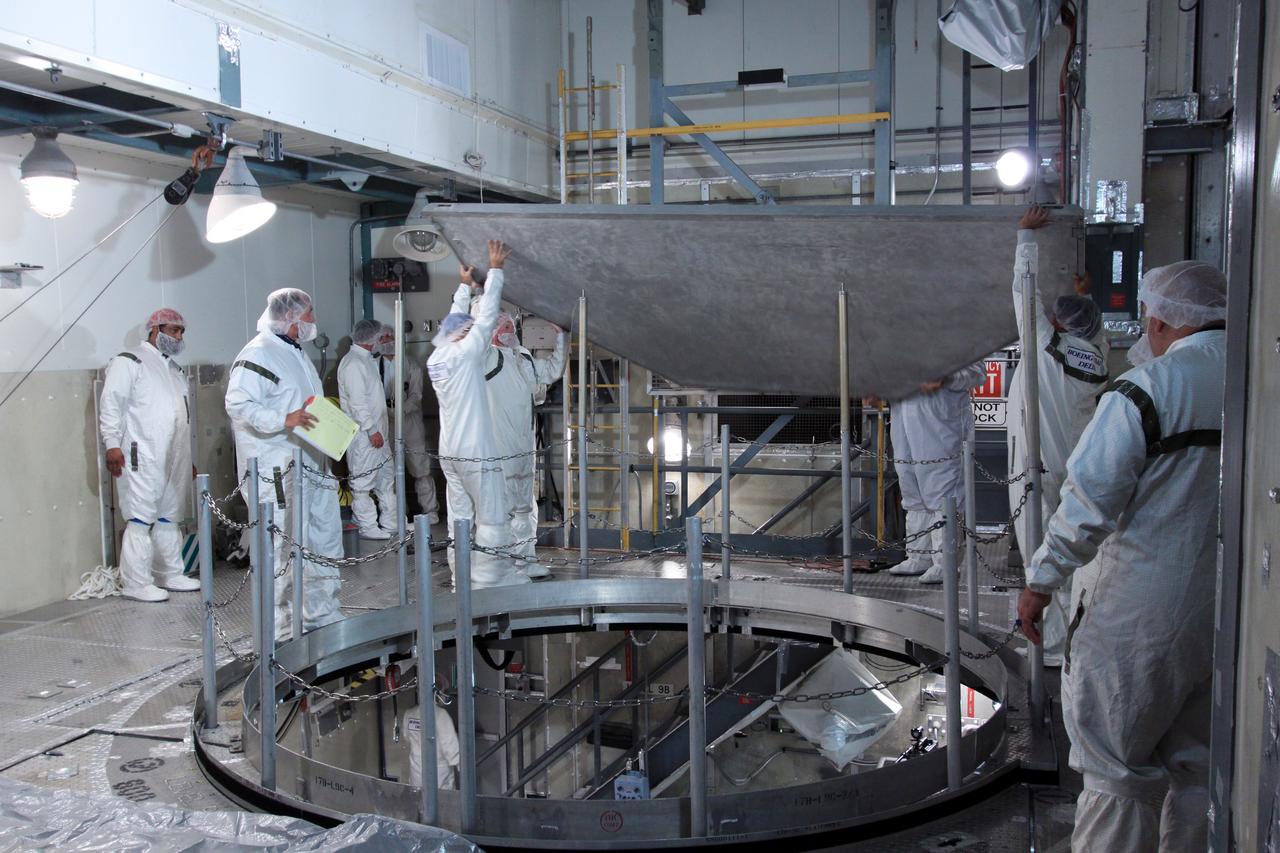
CAPE CANAVERAL, Fla. -- At Space Launch Complex 17B on Cape Canaveral Air Force Station in Florida, preparations are under way to enclose NASA's twin Gravity Recovery and Interior Laboratory spacecraft in the Delta payload fairing. The fairing will protect the spacecraft from the impact of aerodynamic pressure and heating during ascent and will be jettisoned once the spacecraft is outside the Earth's atmosphere. Launch aboard a United Launch Alliance Delta II rocket from Pad 17B is scheduled for Sept. 8. The spacecraft will fly in tandem orbits around the moon for several months to measure its gravity field. GRAIL's primary science objectives are to determine the structure of the lunar interior, from crust to core, and to advance understanding of the thermal evolution of the moon. For more information, visit http://www.nasa.gov/grail. Photo credit: NASA/Jim Grossmann
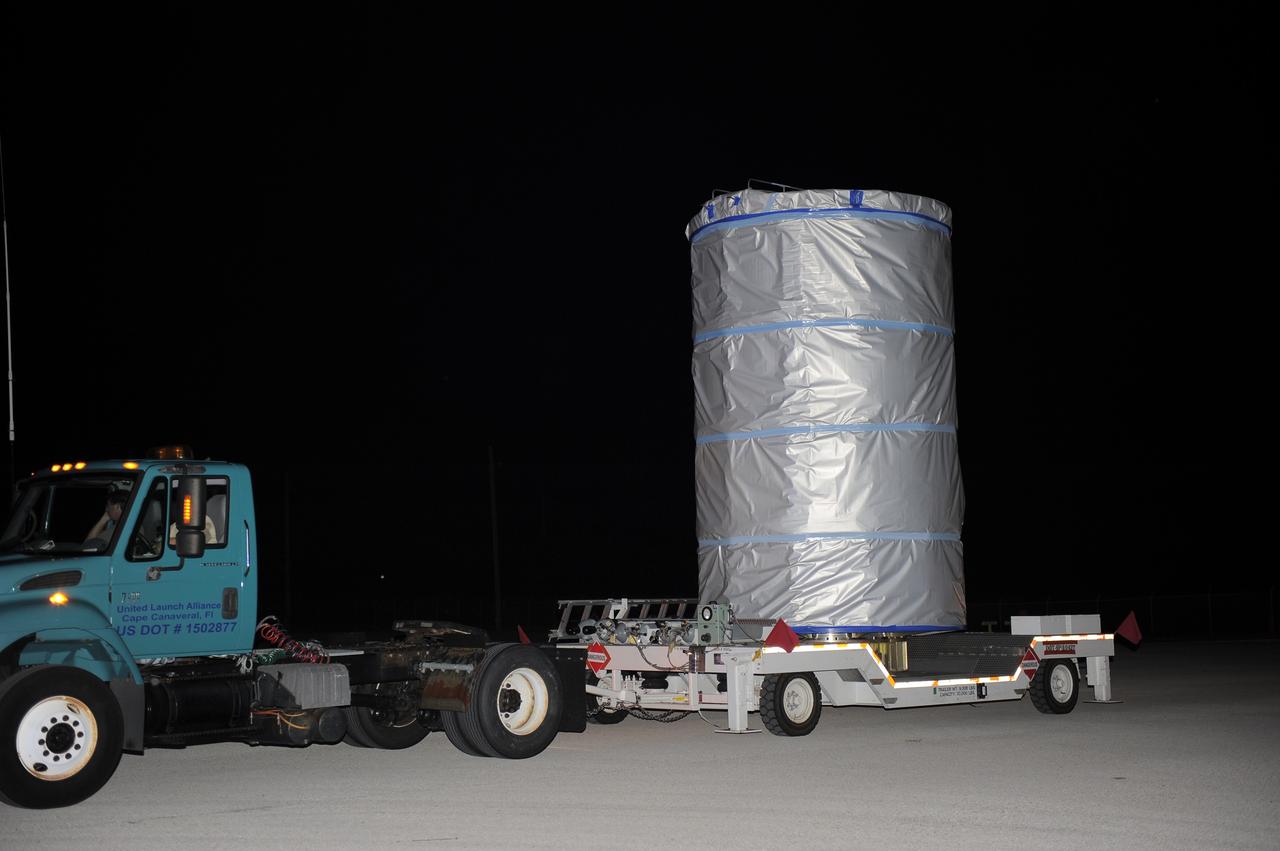
CAPE CANAVERAL, Fla. -- NASA's twin Gravity Recovery and Interior Laboratory (GRAIL) spacecraft are transported from the Astrotech Space Operation's payload processing facility in Titusville, Fla., to their launch pad at Space Launch Complex 17B at Cape Canaveral Air Force Station in Florida. The lunar probes are attached to a spacecraft adapter ring in their side-by-side launch configuration and wrapped in plastic to prevent contamination outside the clean room. The spacecraft will fly in tandem orbits around the moon for several months to measure its gravity field. GRAIL's primary science objectives are to determine the structure of the lunar interior, from crust to core, and to advance understanding of the thermal evolution of the moon. Launch aboard a United Launch Alliance Delta II rocket is scheduled for Sept. 8. For more information, visit www.nasa.gov/grail. Photo credit: NASA/Kim Shiflett
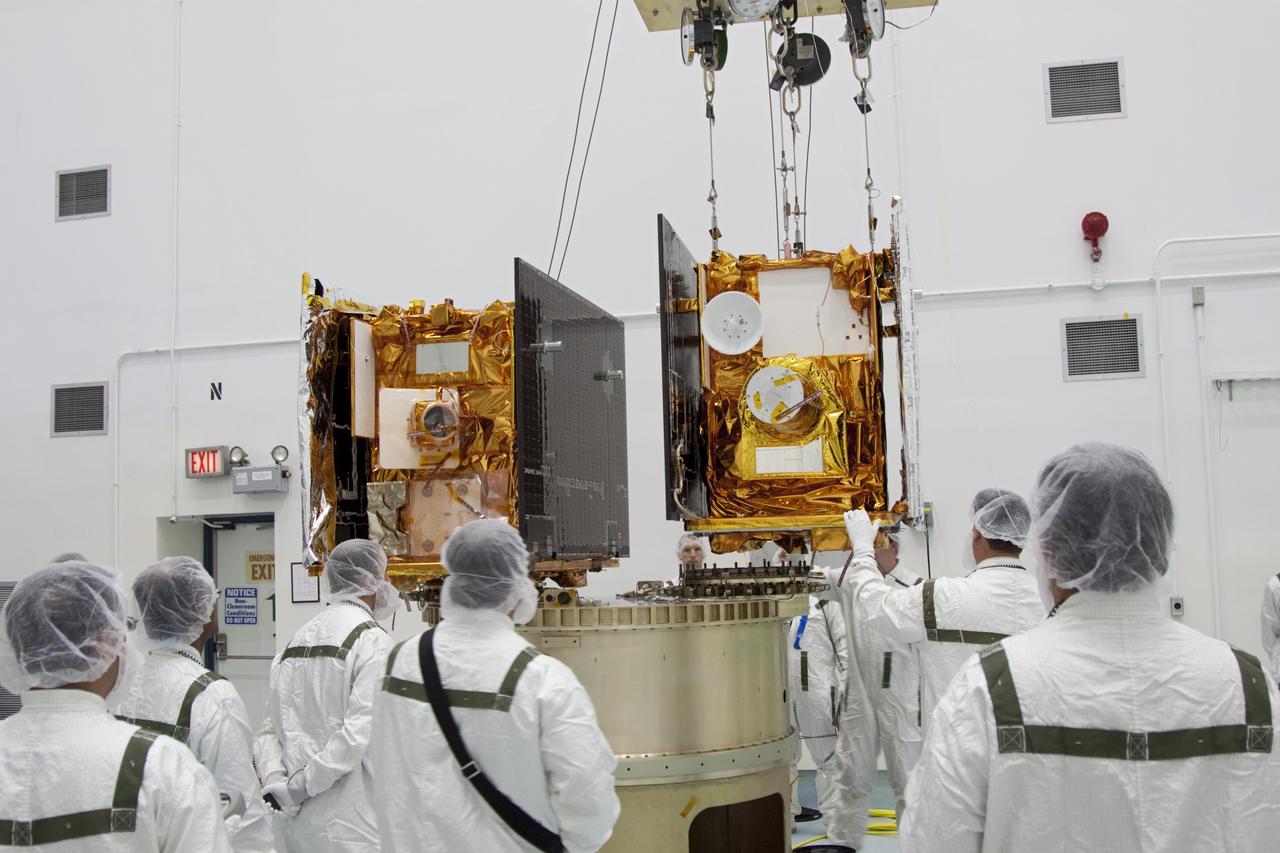
CAPE CANAVERAL, Fla. -- At Astrotech Space Operation's payload processing facility in Titusville, Fla., NASA's Gravity Recovery and Interior Laboratory-A (GRAIL-A) lunar probe us lowered toward the spacecraft adapter ring. GRAIL-B is already secured to the ring, at left. After the twin GRAIL spacecraft are attached to the adapter ring in their side-by-side launch configuration, they will be transported to the launch pad. GRAIL will fly in tandem orbits around the moon for several months to measure its gravity field. GRAIL's primary science objectives are to determine the structure of the lunar interior, from crust to core, and to advance understanding of the thermal evolution of the moon. Launch aboard a United Launch Alliance Delta II rocket from Space Launch Complex 17B on Cape Canaveral Air Force Station is scheduled for Sept. 8. For more information, visit http://www.nasa.gov/grail. Photo credit: NASA/Jim Grossmann
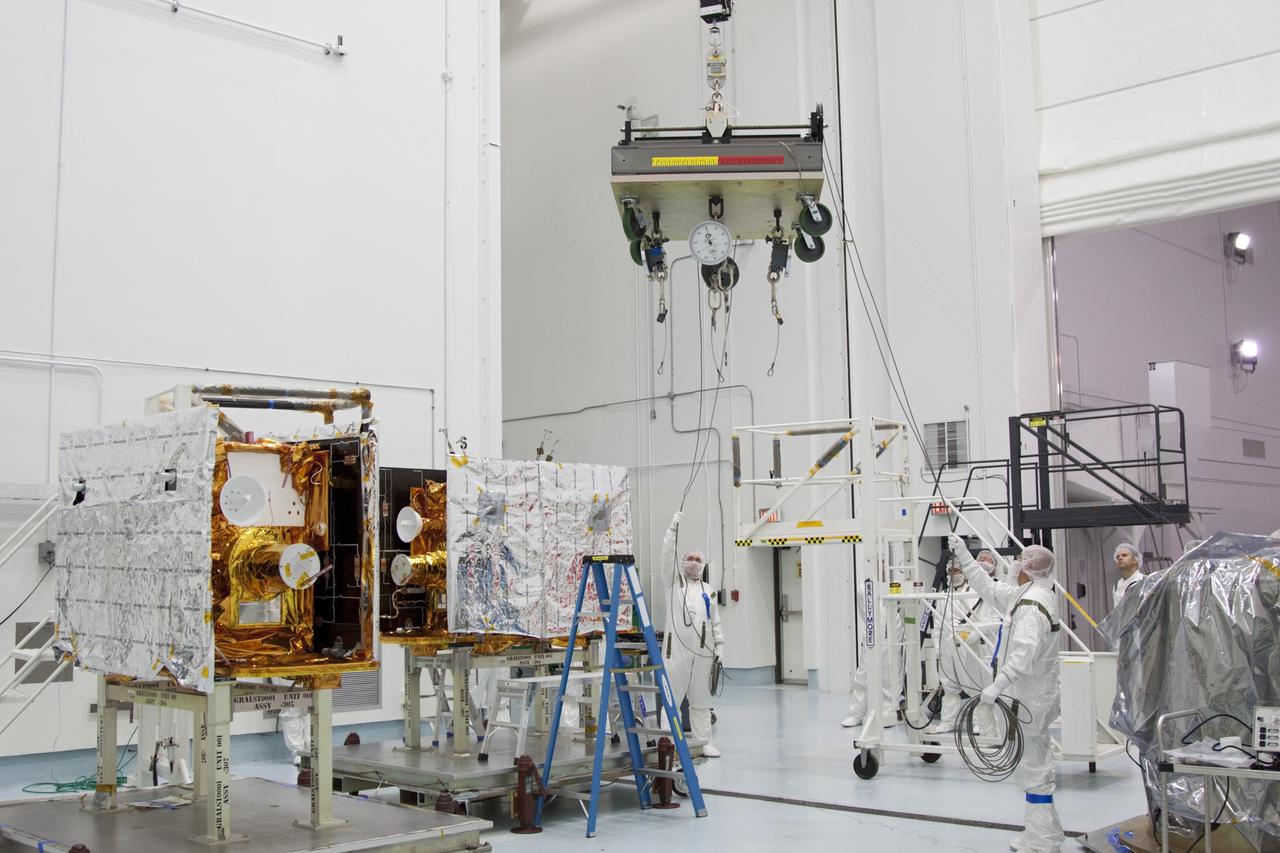
CAPE CANAVERAL, Fla. -- At Astrotech Space Operation's payload processing facility in Titusville, Fla., Lockheed Martin technicians move a lifting device toward NASA's Gravity Recovery and Interior Laboratory-B (GRAIL-B) lunar probe. At left is GRAIL-A. After the twin GRAIL spacecraft are attached to the spacecraft adapter ring in their side-by-side launch configuration, they will be transported to the launch pad. GRAIL will fly in tandem orbits around the moon for several months to measure its gravity field. GRAIL's primary science objectives are to determine the structure of the lunar interior, from crust to core, and to advance understanding of the thermal evolution of the moon. Launch aboard a United Launch Alliance Delta II rocket from Space Launch Complex 17B on Cape Canaveral Air Force Station is scheduled for Sept. 8. For more information, visit http://www.nasa.gov/grail. Photo credit: NASA/Jim Grossmann
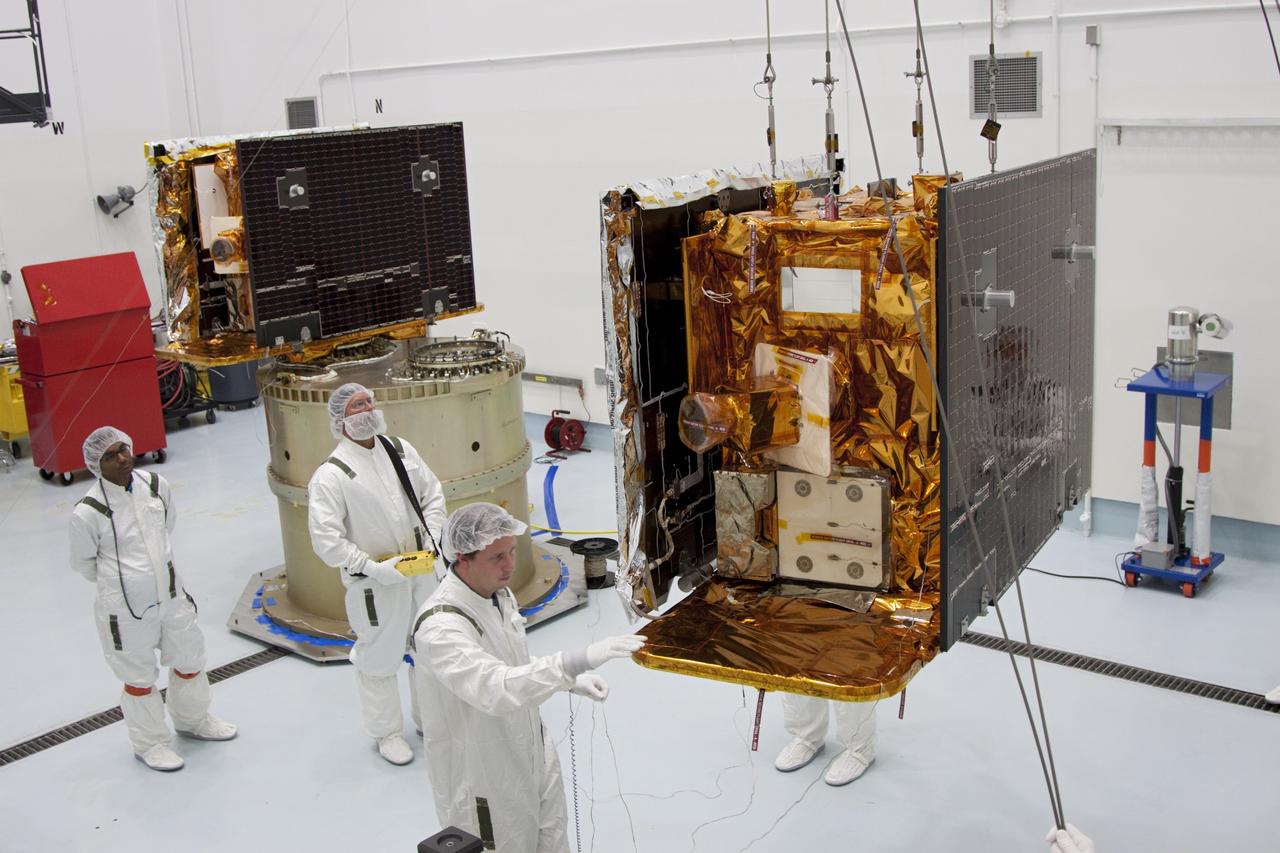
CAPE CANAVERAL, Fla. -- At Astrotech Space Operation's payload processing facility in Titusville, Fla., NASA's Gravity Recovery and Interior Laboratory-A (GRAIL-A) lunar probe is lifted from its workstand and across the clean room toward the spacecraft adapter ring, at left, where GRAIL-B is already secured. After the twin GRAIL spacecraft are attached to the adapter ring in their side-by-side launch configuration, they will be transported to the launch pad. GRAIL will fly in tandem orbits around the moon for several months to measure its gravity field. GRAIL's primary science objectives are to determine the structure of the lunar interior, from crust to core, and to advance understanding of the thermal evolution of the moon. Launch aboard a United Launch Alliance Delta II rocket from Space Launch Complex 17B on Cape Canaveral Air Force Station is scheduled for Sept. 8. For more information, visit http://www.nasa.gov/grail. Photo credit: NASA/Jim Grossmann

CAPE CANAVERAL, Fla. -- This 3-D image shows NASA's twin Gravity Recovery and Interior Laboratory lunar spacecraft attached to the spacecraft adapter ring in their launch configuration in Astrotech Space Operation's payload processing facility in Titusville, Fla. To view this image, use green and magenta 3-D glasses. Preparations are under way to transport the lunar probes to the launch pad. GRAIL will fly in tandem orbits around the moon for several months to measure its gravity field. GRAIL's primary science objectives are to determine the structure of the lunar interior, from crust to core, and to advance understanding of the thermal evolution of the moon. Launch aboard a United Launch Alliance Delta II rocket from Space Launch Complex 17B on Cape Canaveral Air Force Station is scheduled for Sept. 8. For more information, visit http://www.nasa.gov/grail. Photo credit: NASA/Frankie Martin
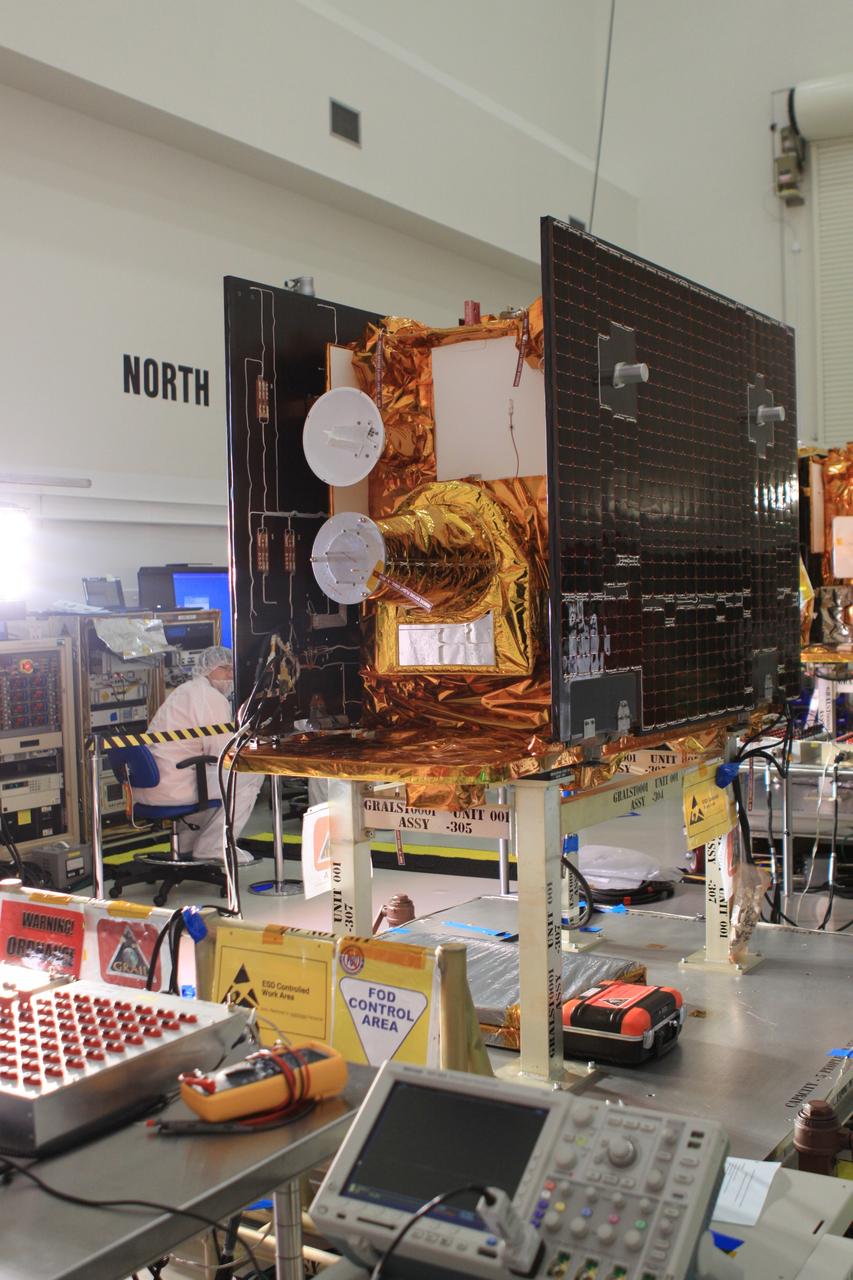
CAPE CANAVERAL, Fla. -- Testing of the solar arrays on NASA's Gravity Recovery and Interior Laboratory-A, or GRAIL-A, spacecraft is under way in Astrotech Space Operation's payload processing facility in Titusville, Fla., to ensure that they will function as planned during the mission. The electrical power subsystem on each of GRAIL's twin spacecraft includes two solar arrays and a lithium ion battery. Each solar array is capable of producing no less than 700 watts. They will be deployed shortly after separation from the launch vehicle and remain fixed throughout the mission. GRAIL will fly in tandem orbits around the moon for several months to measure its gravity field. GRAIL's primary science objectives are to determine the structure of the lunar interior, from crust to core, and to advance understanding of the thermal evolution of the moon. Launch aboard a United Launch Alliance Delta II rocket from Space Launch Complex 17B on Cape Canaveral Air Force Station is scheduled for Sept. 8. For more information, visit http://www.nasa.gov/grail. Photo credit: NASA/Frankie Martin
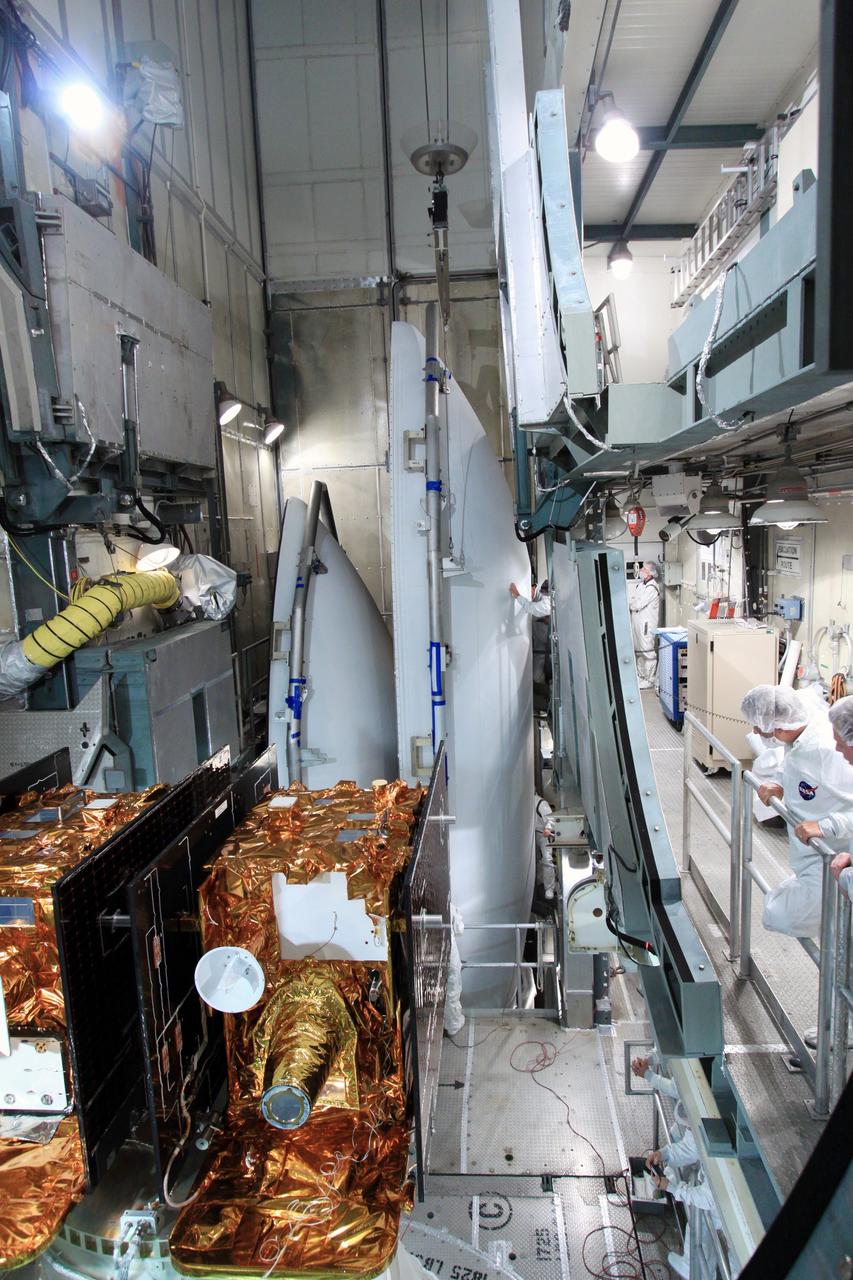
CAPE CANAVERAL, Fla. -- At Space Launch Complex 17B on Cape Canaveral Air Force Station in Florida, sections of the clamshell-shaped Delta payload fairing, in the background, are ready to enclose NASA's twin Gravity Recovery and Interior Laboratory spacecraft. The fairing will protect the spacecraft from the impact of aerodynamic pressure and heating during ascent and will be jettisoned once the spacecraft is outside the Earth's atmosphere. Launch aboard a United Launch Alliance Delta II rocket from Pad 17B is scheduled for Sept. 8. The spacecraft will fly in tandem orbits around the moon for several months to measure its gravity field. GRAIL's primary science objectives are to determine the structure of the lunar interior, from crust to core, and to advance understanding of the thermal evolution of the moon. For more information, visit http://www.nasa.gov/grail. Photo credit: NASA/Jim Grossmann
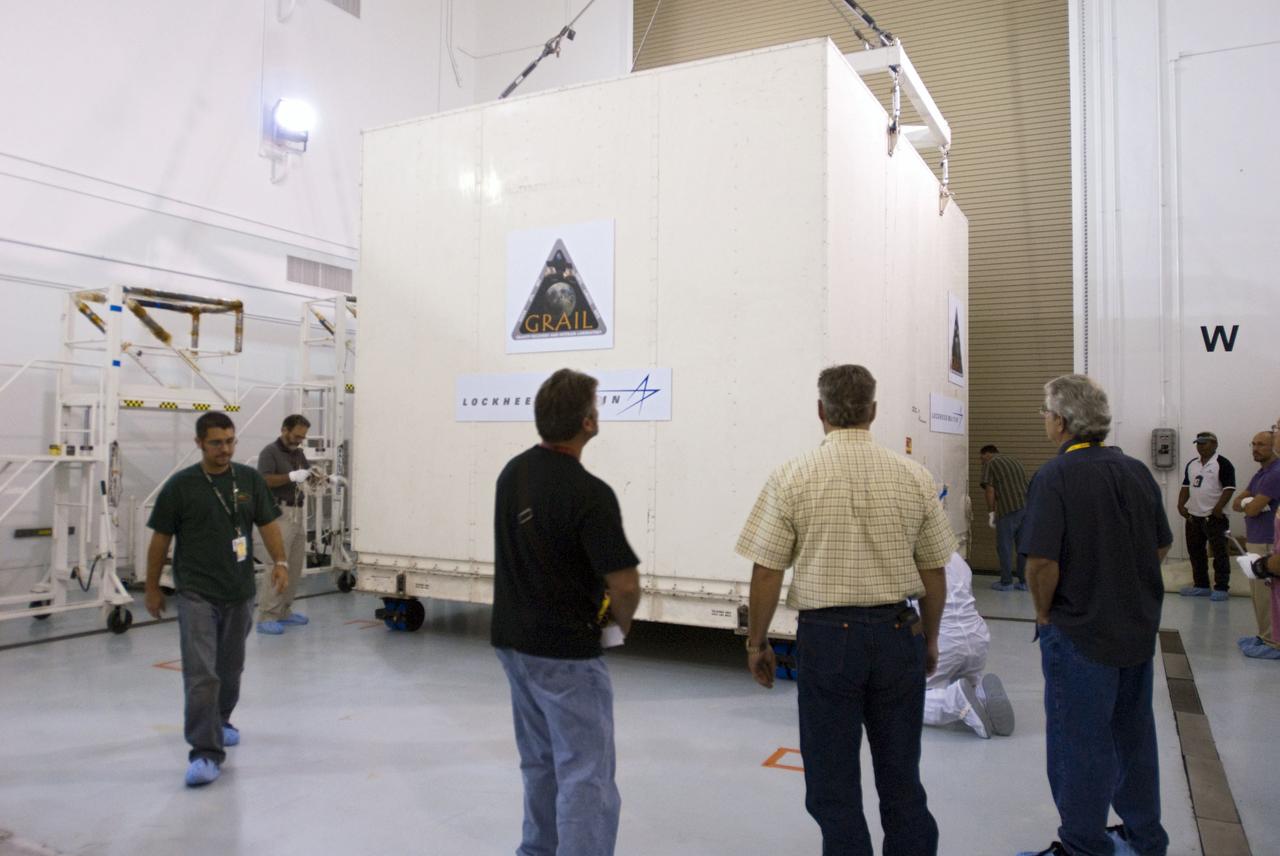
CAPE CANAVERAL, Fla. -- Lockheed Martin technicians oversee the placement of the protective canister housing NASA's twin Gravity Recovery and Interior Laboratory lunar spacecraft on the workroom floor in the Hazardous Processing Facility (HPF) at Astrotech Space Operation's payload processing facility in Titusville, Fla. In the HPF, the spacecraft will undergo two days of fueling activities. GRAIL will fly in tandem orbits around the moon for several months to measure its gravity field. GRAIL's primary science objectives are to determine the structure of the lunar interior, from crust to core, and to advance understanding of the thermal evolution of the moon. Launch aboard a United Launch Alliance Delta II rocket from Space Launch Complex 17B on Cape Canaveral Air Force Station is scheduled for Sept. 8. For more information, visit http://www.nasa.gov/grail. Photo credit: NASA/Charisse Nahser
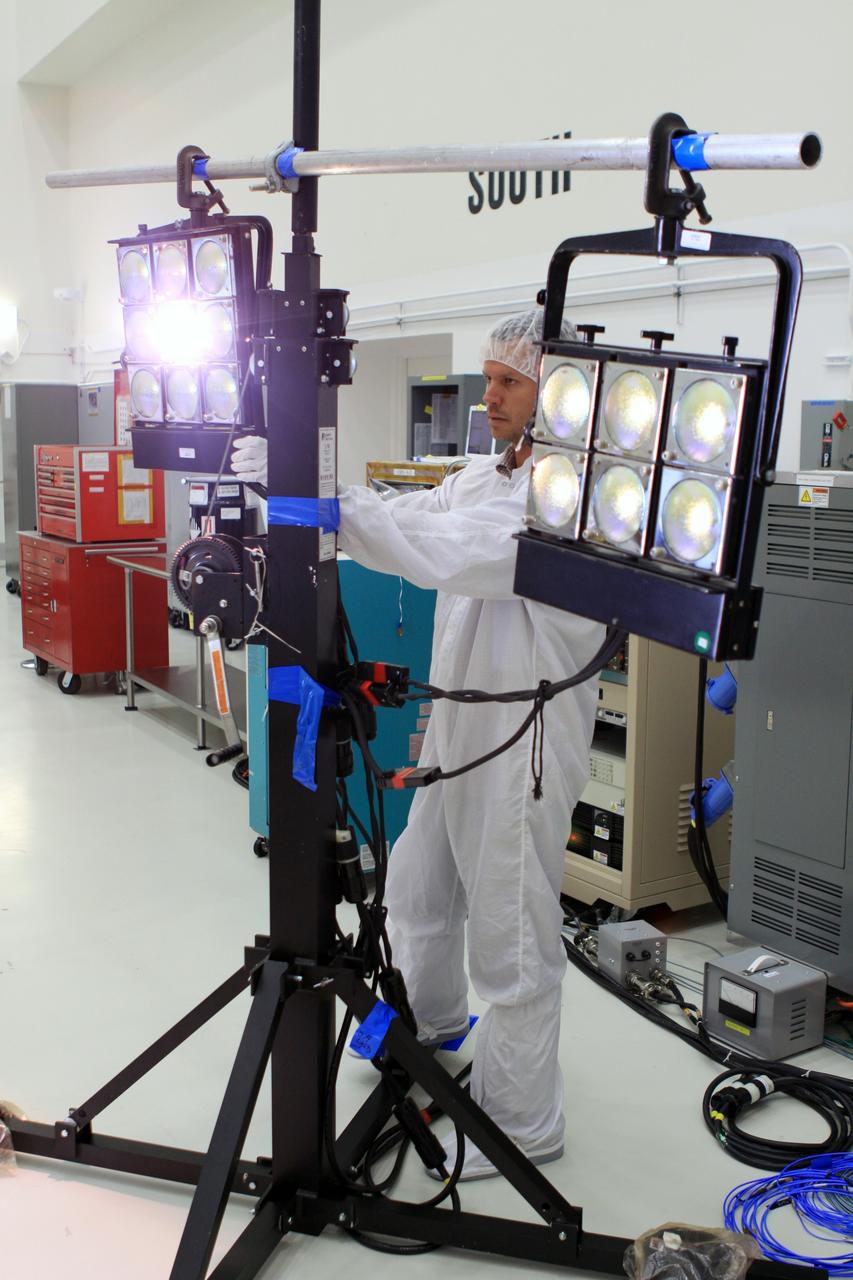
CAPE CANAVERAL, Fla. -- A Lockheed Martin technician in Astrotech Space Operation's payload processing facility in Titusville, Fla., tests the solar arrays on NASA's Gravity Recovery and Interior Laboratory-A, or GRAIL-A, spacecraft to ensure that they will function as planned during the mission. The electrical power subsystem on each of GRAIL's twin spacecraft includes two solar arrays and a lithium ion battery. Each solar array is capable of producing no less than 700 watts. They will be deployed shortly after separation from the launch vehicle and remain fixed throughout the mission. GRAIL will fly in tandem orbits around the moon for several months to measure its gravity field. GRAIL's primary science objectives are to determine the structure of the lunar interior, from crust to core, and to advance understanding of the thermal evolution of the moon. Launch aboard a United Launch Alliance Delta II rocket from Space Launch Complex 17B on Cape Canaveral Air Force Station is scheduled for Sept. 8. For more information, visit http://www.nasa.gov/grail. Photo credit: NASA/Frankie Martin
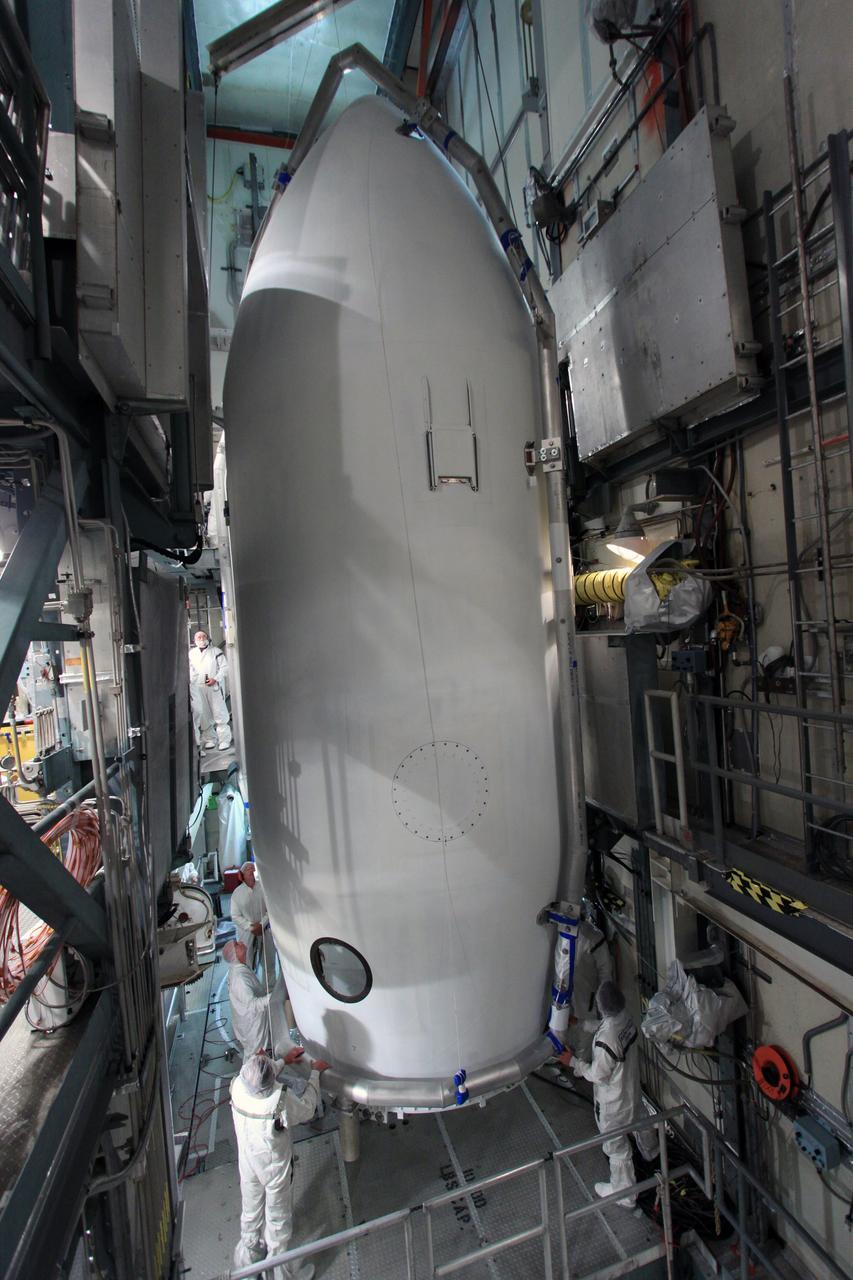
CAPE CANAVERAL, Fla. -- At Space Launch Complex 17B on Cape Canaveral Air Force Station in Florida, the sections of the Delta payload fairing form a protective cocoon around NASA's twin Gravity Recovery and Interior Laboratory spacecraft. The fairing will protect the spacecraft from the impact of aerodynamic pressure and heating during ascent and will be jettisoned once the spacecraft is outside the Earth's atmosphere. Launch aboard a United Launch Alliance Delta II rocket from Pad 17B is scheduled for Sept. 8. The spacecraft will fly in tandem orbits around the moon for several months to measure its gravity field. GRAIL's primary science objectives are to determine the structure of the lunar interior, from crust to core, and to advance understanding of the thermal evolution of the moon. For more information, visit http://www.nasa.gov/grail. Photo credit: NASA/Jim Grossmann
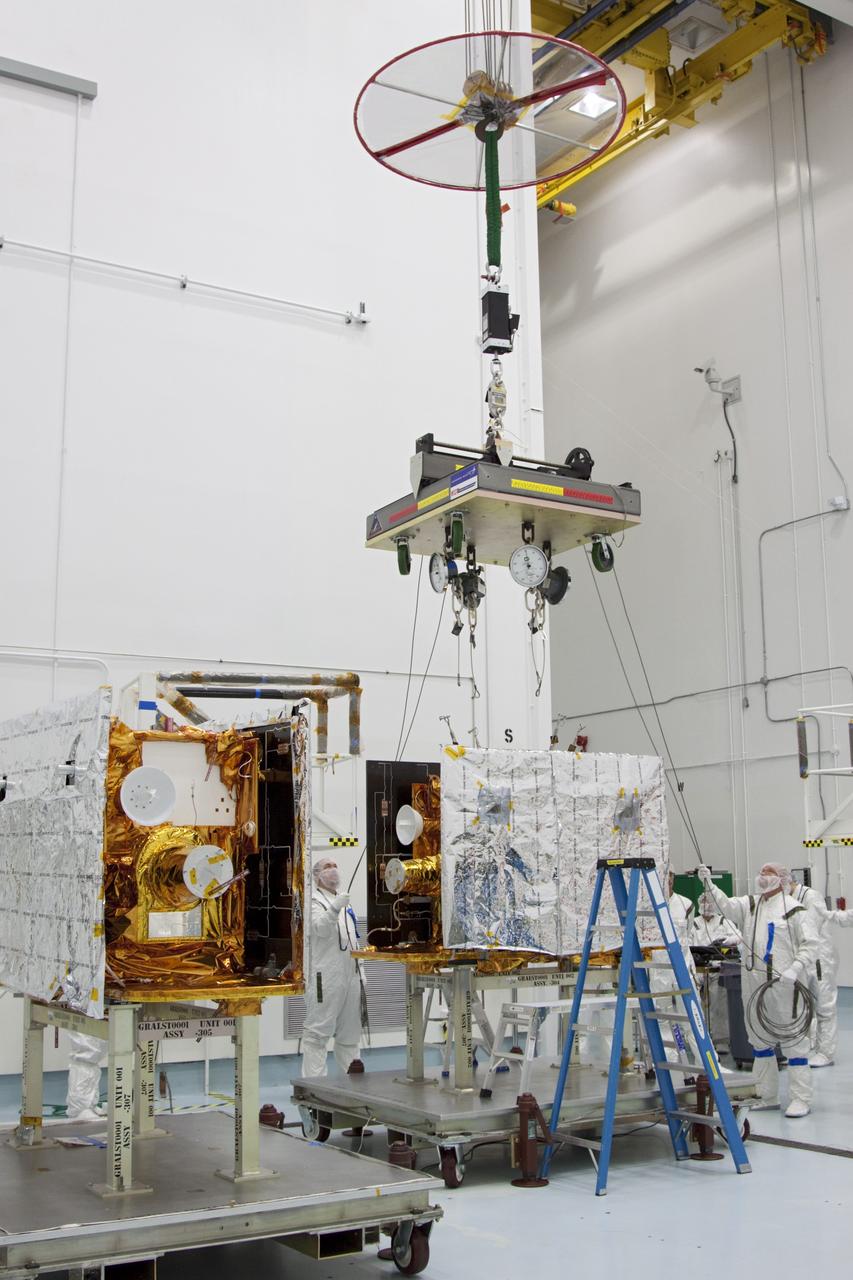
CAPE CANAVERAL, Fla. -- At Astrotech Space Operation's payload processing facility in Titusville, Fla., a lifting device moves into position over NASA's Gravity Recovery and Interior Laboratory-B (GRAIL-B) lunar probe. At left is GRAIL-A. After the twin GRAIL spacecraft are attached to the spacecraft adapter ring in their side-by-side launch configuration, they will be transported to the launch pad. GRAIL will fly in tandem orbits around the moon for several months to measure its gravity field. GRAIL's primary science objectives are to determine the structure of the lunar interior, from crust to core, and to advance understanding of the thermal evolution of the moon. Launch aboard a United Launch Alliance Delta II rocket from Space Launch Complex 17B on Cape Canaveral Air Force Station is scheduled for Sept. 8. For more information, visit http://www.nasa.gov/grail. Photo credit: NASA/Jim Grossmann
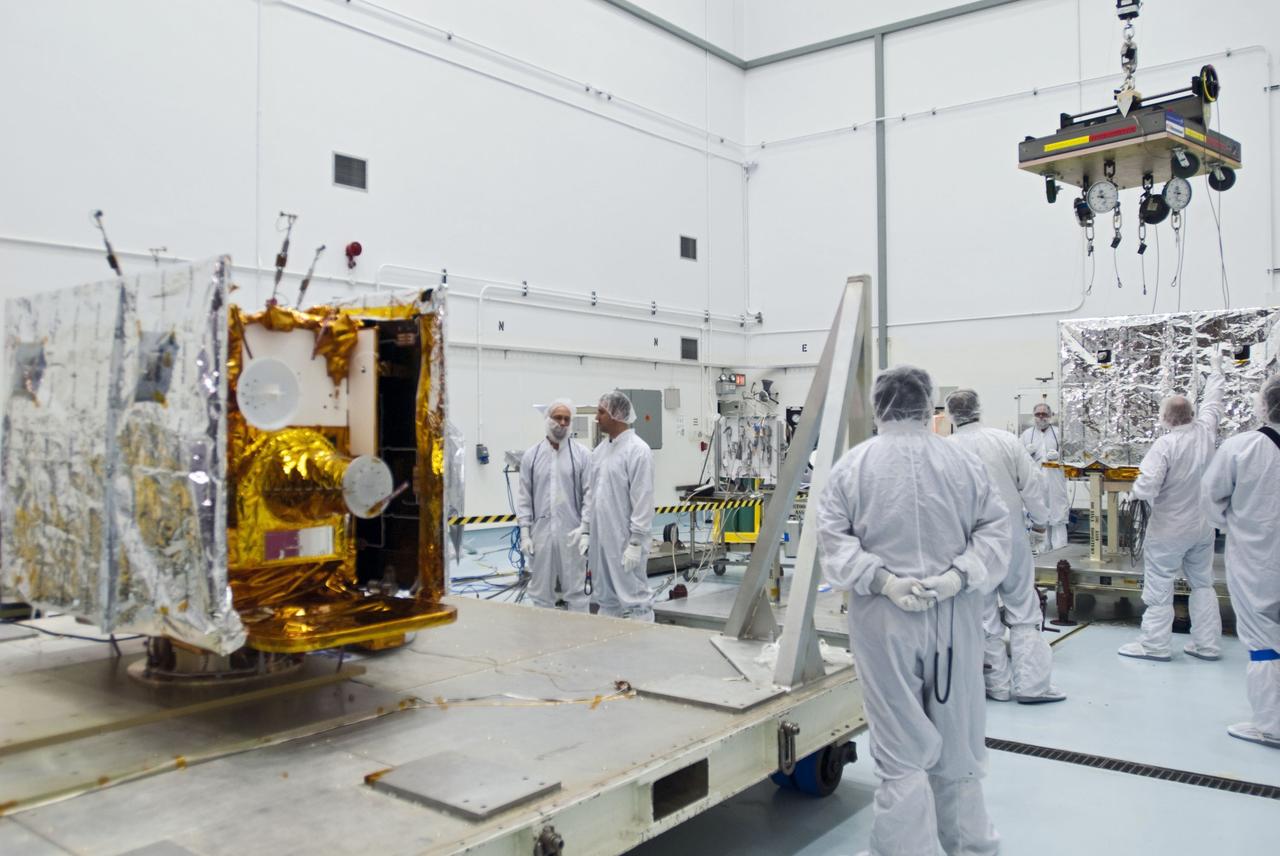
CAPE CANAVERAL, Fla. -- Lockheed Martin technicians prepare to move the second of NASA's twin Gravity Recovery and Interior Laboratory lunar spacecraft to a workstand in the Hazardous Processing Facility (HPF) at Astrotech Space Operation's payload processing facility in Titusville, Fla. In the HPF, the spacecraft will undergo two days of fueling activities. GRAIL will fly in tandem orbits around the moon for several months to measure its gravity field. GRAIL's primary science objectives are to determine the structure of the lunar interior, from crust to core, and to advance understanding of the thermal evolution of the moon. Launch aboard a United Launch Alliance Delta II rocket from Space Launch Complex 17B on Cape Canaveral Air Force Station is scheduled for Sept. 8. For more information, visit http://www.nasa.gov/grail. Photo credit: NASA/Charisse Nahser
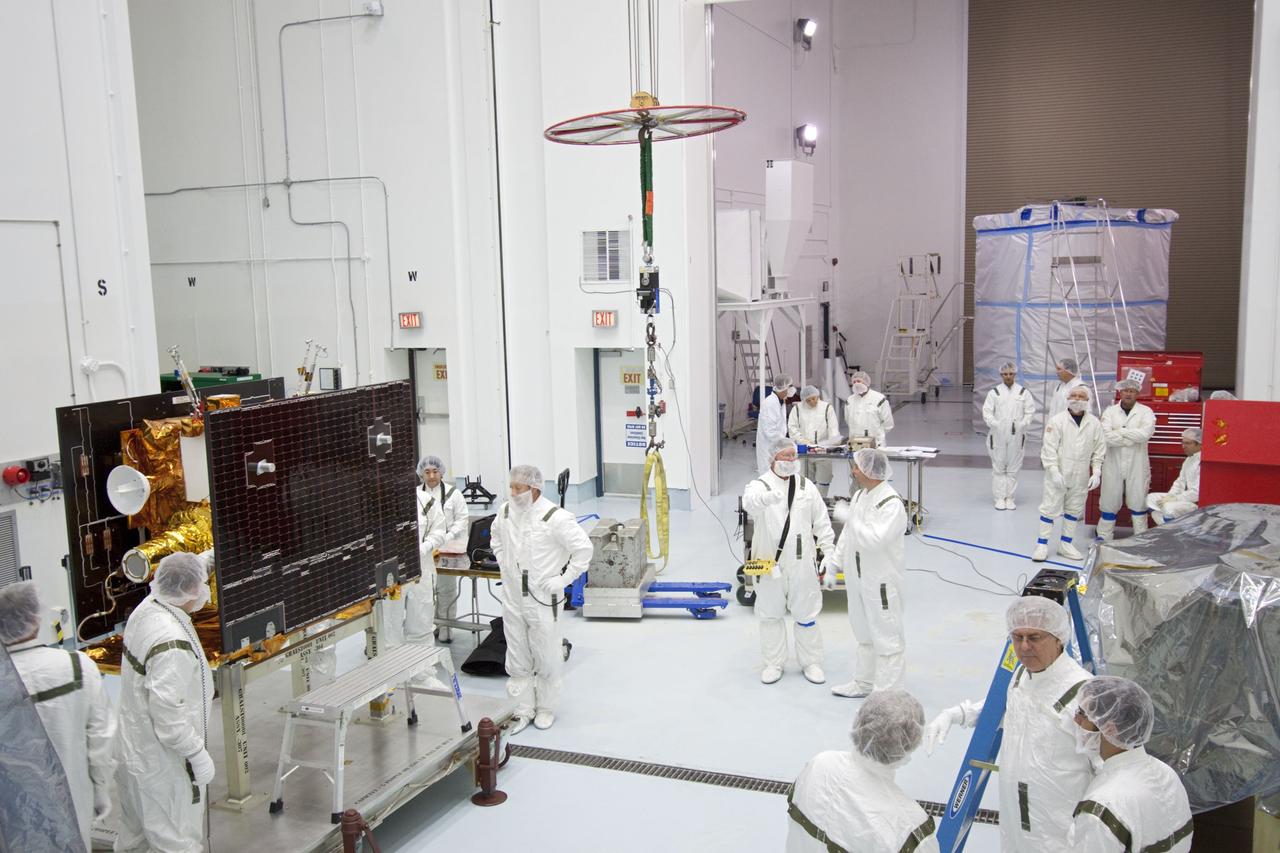
CAPE CANAVERAL, Fla. -- At Astrotech Space Operation's payload processing facility in Titusville, Fla., preparations are under way to determine the weight of one of NASA's twin Gravity Recovery and Interior Laboratory lunar spacecraft before the spacecraft are stacked in their launch configuration in readiness for transport to the launch pad. GRAIL will fly in tandem orbits around the moon for several months to measure its gravity field. GRAIL's primary science objectives are to determine the structure of the lunar interior, from crust to core, and to advance understanding of the thermal evolution of the moon. Launch aboard a United Launch Alliance Delta II rocket from Space Launch Complex 17B on Cape Canaveral Air Force Station is scheduled for Sept. 8. For more information, visit http://www.nasa.gov/grail. Photo credit: NASA/Jim Grossmann
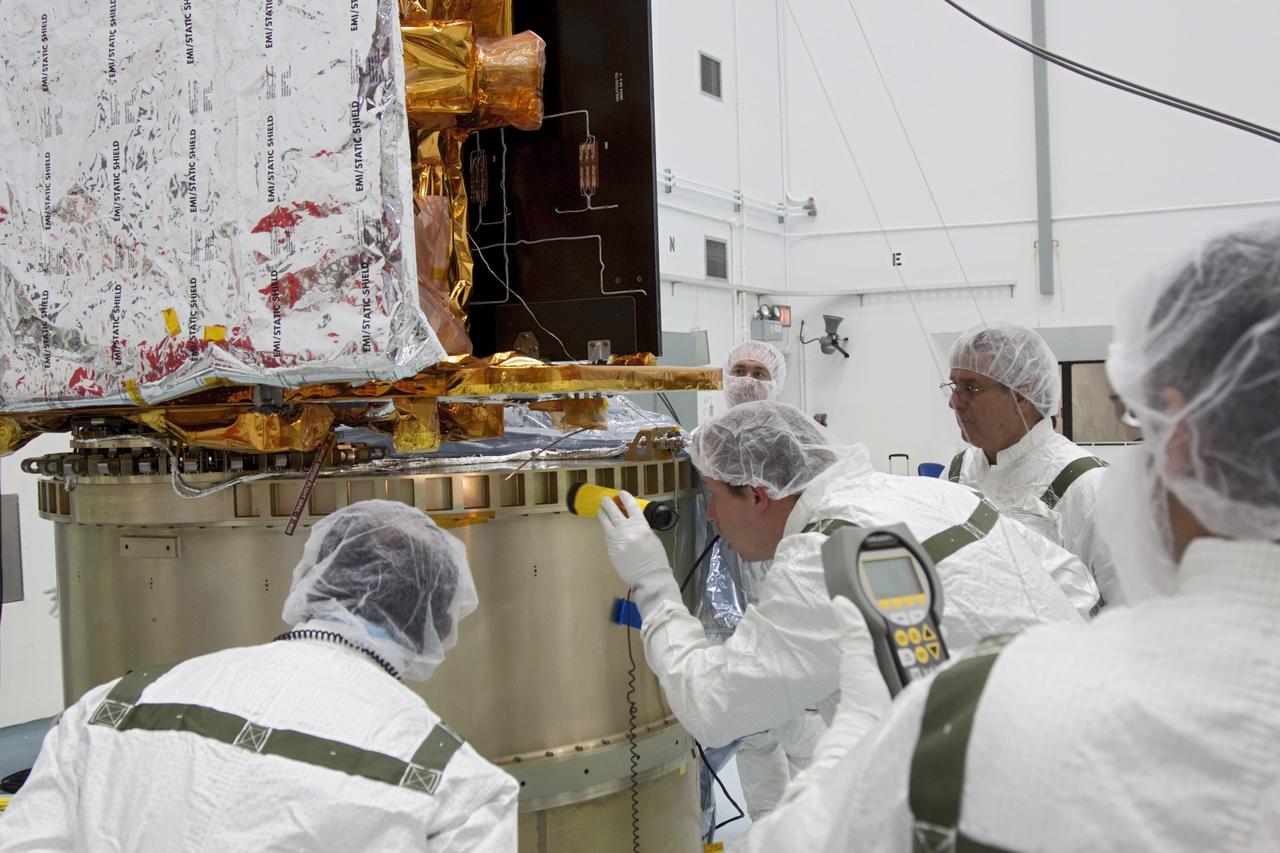
CAPE CANAVERAL, Fla. -- At Astrotech Space Operation's payload processing facility in Titusville, Fla., Lockheed Martin technicians verify that NASA's Gravity Recovery and Interior Laboratory-B (GRAIL-B) lunar probe is in the correct position on the spacecraft adapter ring. After the twin GRAIL spacecraft are attached to the adapter ring in their side-by-side launch configuration, they will be transported to the launch pad. GRAIL will fly in tandem orbits around the moon for several months to measure its gravity field. GRAIL's primary science objectives are to determine the structure of the lunar interior, from crust to core, and to advance understanding of the thermal evolution of the moon. Launch aboard a United Launch Alliance Delta II rocket from Space Launch Complex 17B on Cape Canaveral Air Force Station is scheduled for Sept. 8. For more information, visit http://www.nasa.gov/grail. Photo credit: NASA/Jim Grossmann
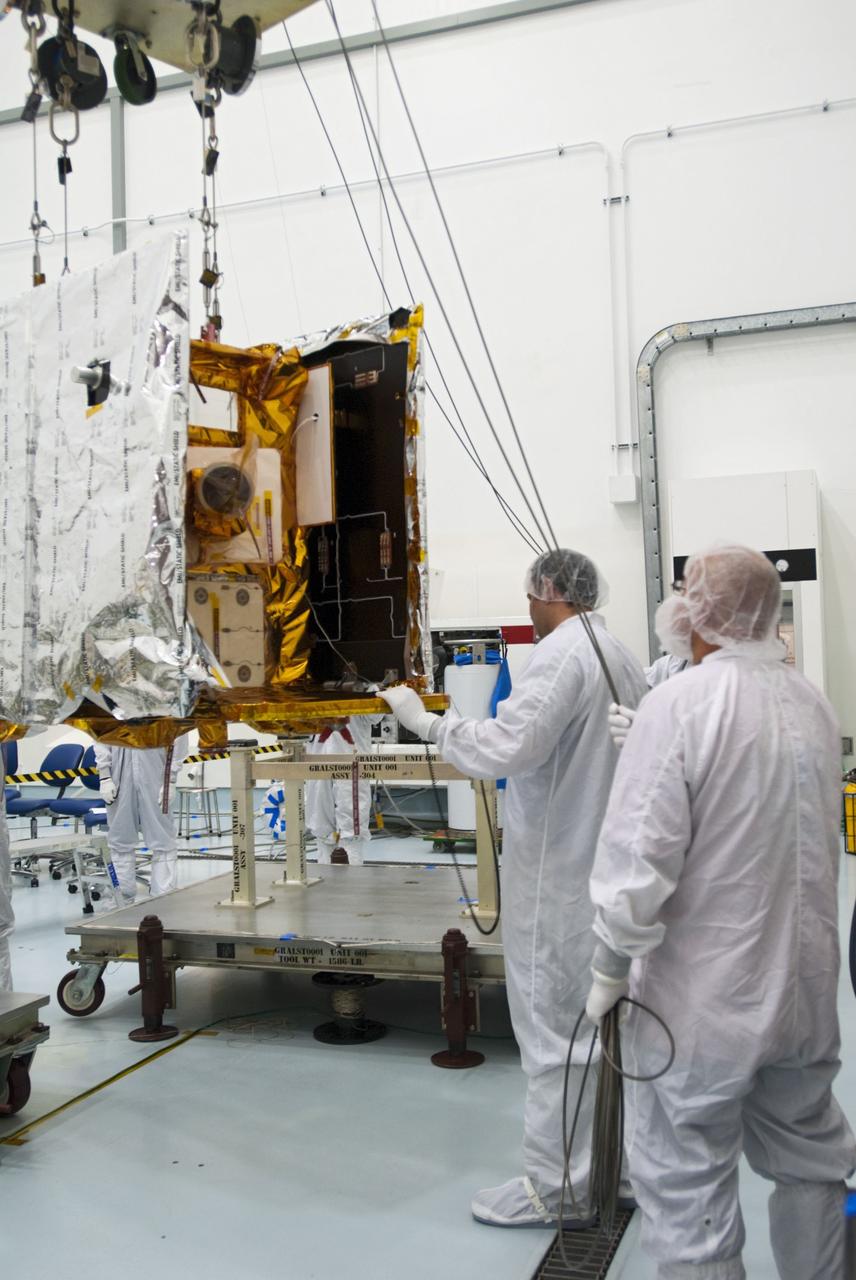
CAPE CANAVERAL, Fla. -- Lockheed Martin technicians move one of NASA's twin Gravity Recovery and Interior Laboratory lunar spacecraft toward a workstand in the Hazardous Processing Facility (HPF) at Astrotech Space Operation's payload processing facility in Titusville, Fla. In the HPF, the spacecraft will undergo two days of fueling activities. GRAIL will fly in tandem orbits around the moon for several months to measure its gravity field. GRAIL's primary science objectives are to determine the structure of the lunar interior, from crust to core, and to advance understanding of the thermal evolution of the moon. Launch aboard a United Launch Alliance Delta II rocket from Space Launch Complex 17B on Cape Canaveral Air Force Station is scheduled for Sept. 8. For more information, visit http://www.nasa.gov/grail. Photo credit: NASA/Charisse Nahser
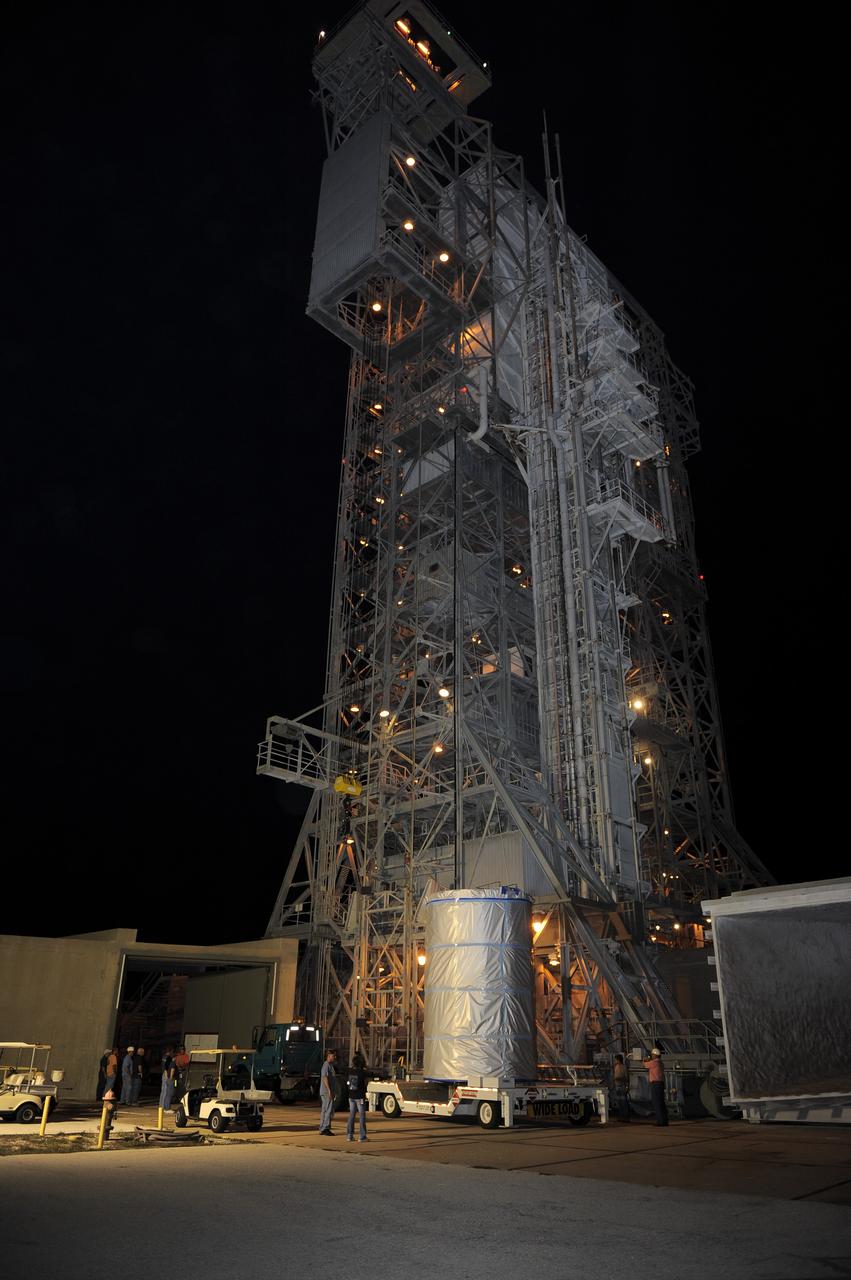
CAPE CANAVERAL, Fla. -- NASA's twin Gravity Recovery and Interior Laboratory (GRAIL) spacecraft arrives at their launch pad at Space Launch Complex 17B at Cape Canaveral Air Force Station in Florida. The lunar probes are attached to a spacecraft adapter ring in their side-by-side launch configuration and wrapped in plastic to prevent contamination outside the clean room in the Astrotech Space Operation's payload processing facility in Titusville, Fla. The spacecraft will fly in tandem orbits around the moon for several months to measure its gravity field. GRAIL's primary science objectives are to determine the structure of the lunar interior, from crust to core, and to advance understanding of the thermal evolution of the moon. Launch aboard a United Launch Alliance Delta II rocket is scheduled for Sept. 8. For more information, visit www.nasa.gov/grail. Photo credit: NASA/Kim Shiflett