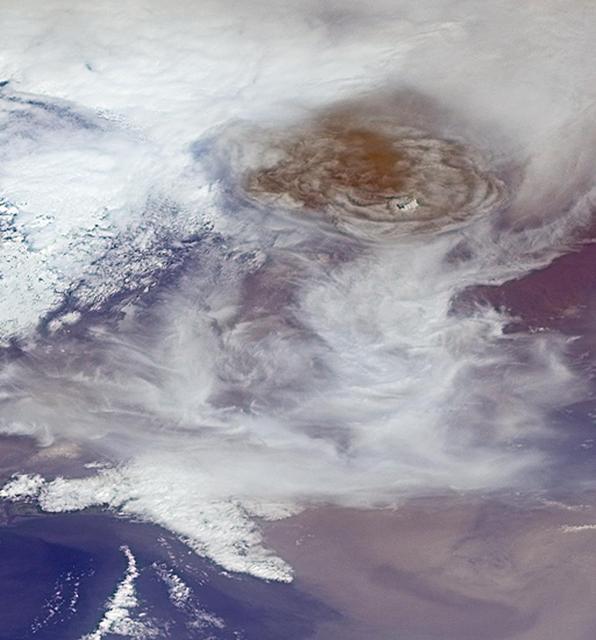
NASA Terra spacecraft captured this image of Grímsvötn, the most active of Iceland volcanoes, which began erupting around 5:30 p.m. local time 1730 UTC on Saturday, May 21, 2011, east of the capital city of Reykjavik.
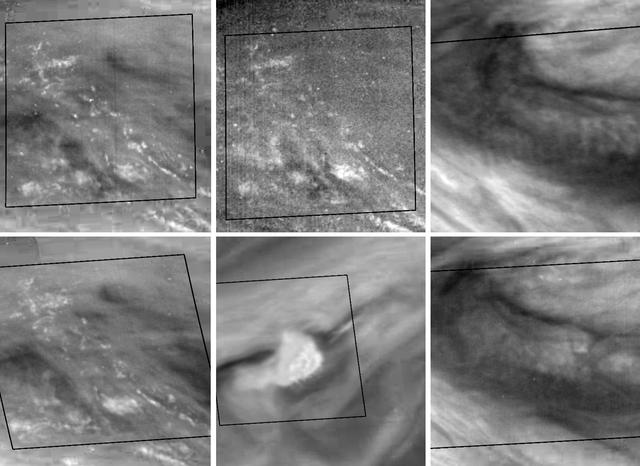
This montage features activity in the turbulent region of Jupiter Great Red Spot GRS. Four sets of images of the GRS were taken by NASA Galileo imaging system over an 11.5 hour period on 26 June, 1996.
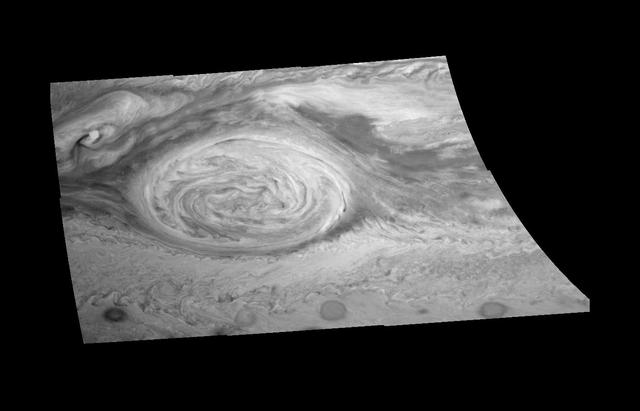
The Great Red Spot GRS of Jupiter as seen by NASA Galileo imaging system. The image is a mosaic of six images taken over an 80 second interval during the first GRS observing sequence on June 26, 1996.
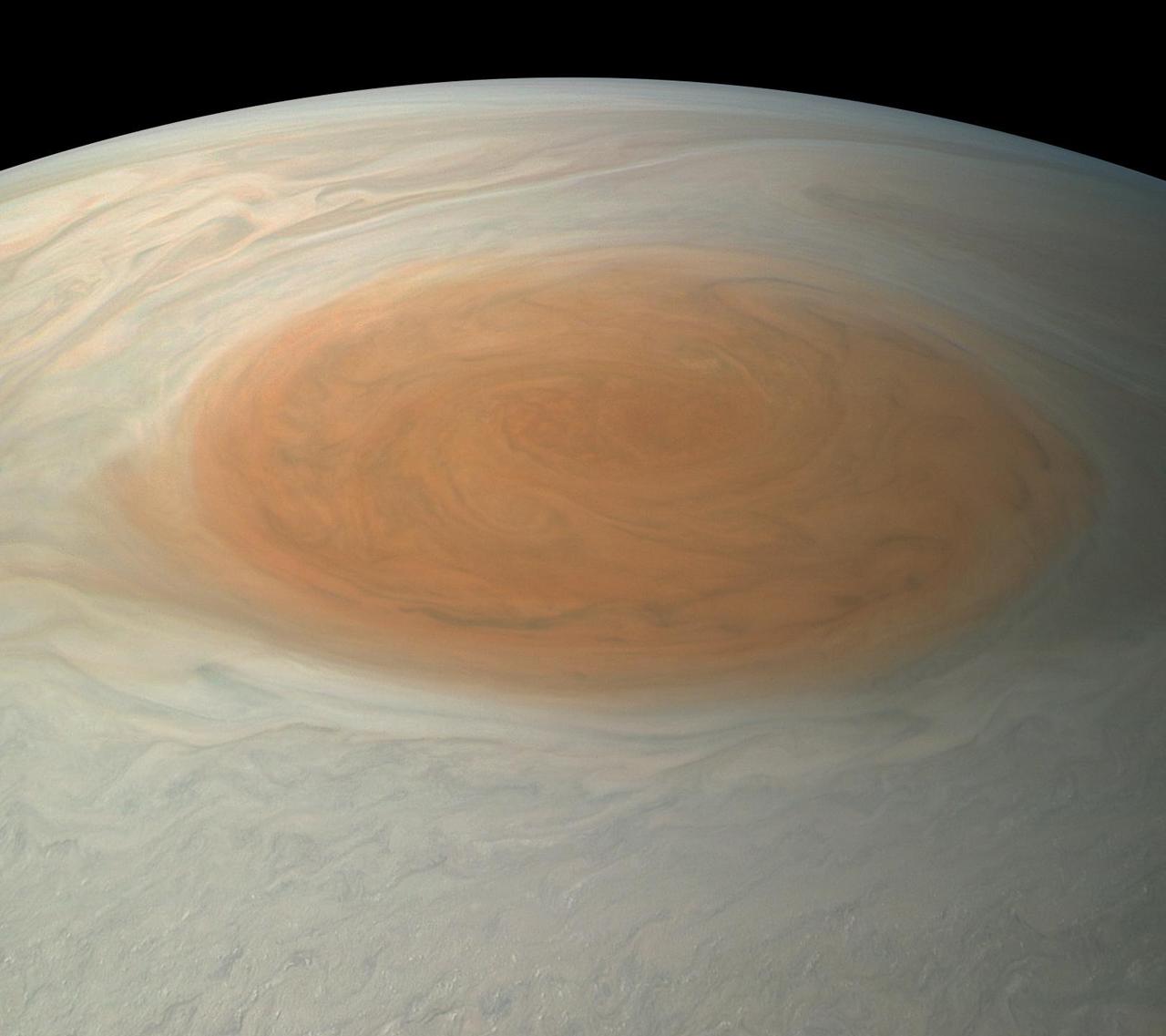
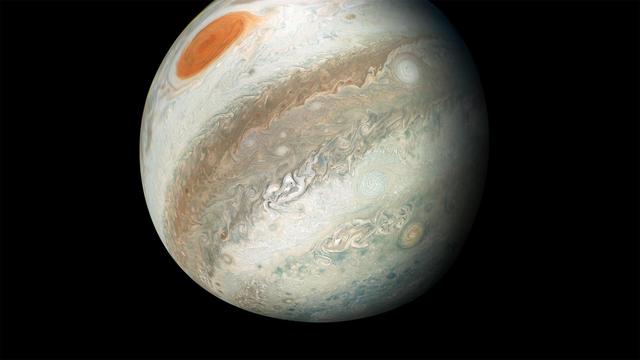
This image of Jupiter's iconic Great Red Spot (GRS) was created by citizen scientist Björn Jónsson using data from the JunoCam imager on NASA's Juno spacecraft. This true-color image offers a natural color rendition of what the Great Red Spot and surrounding areas would look like to human eyes from Juno's position. The tumultuous atmospheric zones in and around the Great Red Spot are clearly visible. The image was taken on July 10, 2017 at 07:10 p.m. PDT (10:10 p.m. EDT), as the Juno spacecraft performed its seventh close flyby of Jupiter. At the time the image was taken, the spacecraft was about 8,648 miles (13,917 kilometers) from the tops of the clouds of the planet at a latitude of -32.6 degrees. https://photojournal.jpl.nasa.gov/catalog/PIA21775. - Enhanced image by Björn Jónsson (CC-NC-SA) based on images provided courtesy of NASA/JPL-Caltech/SwRI/MSSS
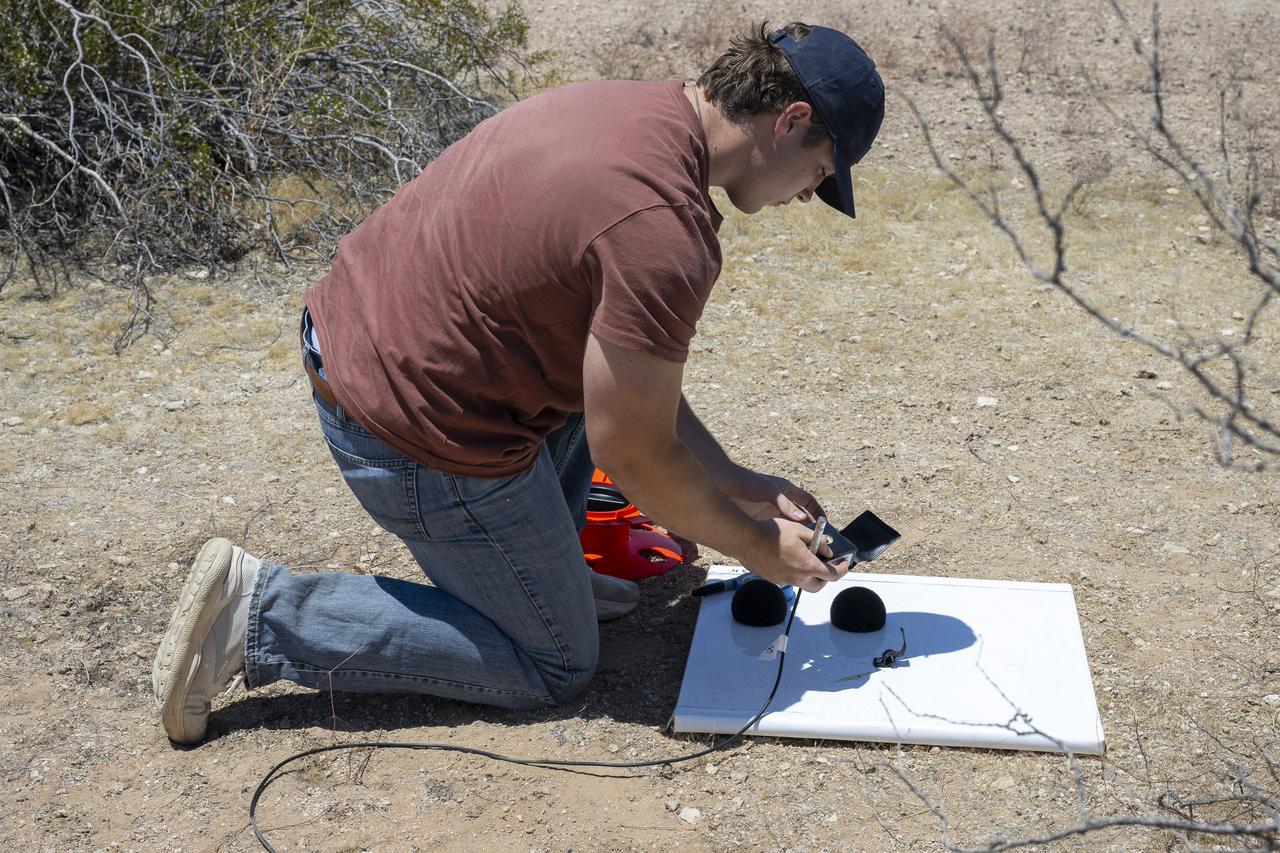
A NASA intern sets up ground recording system (GRS) units in California’s Mojave Desert during a Phase 2 rehearsal of the agency’s Quesst mission. The GRS units were placed across miles of desert terrain to capture the acoustic signature of supersonic aircraft during rehearsal flights and in preparation for the start of the actual tests.
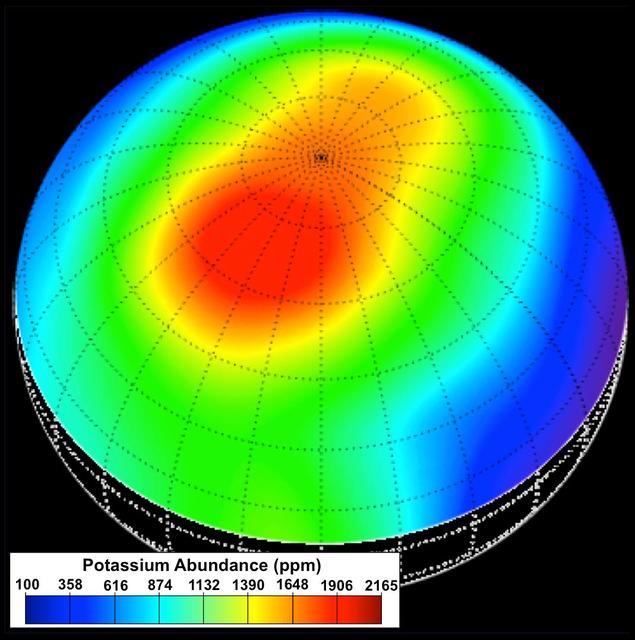
During the first year of NASA MESSENGER orbital mission, the spacecraft GRS instrument measured the elemental composition of Mercury surface materials. mong the most important discoveries from the GRS was the observation of higher abundances of the moderately volatile elements potassium, sodium, and chlorine than expected from previous scientific models and theories. Particularly high concentrations of these elements were observed at high northern latitudes, as illustrated in this potassium abundance map, which provides a view of the surface centered at 60° N latitude and 120° E longitude. This map was the first elemental map ever made of Mercury's surface and is to-date the only map to report absolute elemental concentrations, in comparison to element ratios. Prior to MESSENGER's arrival at Mercury, scientists expected that the planet would be depleted in moderately volatile elements, as is the case for our Moon. The unexpectedly high abundances observed with the GRS have forced a reevaluation of our understanding of the formation and evolution of Mercury. In addition, the K map provided the first evidence for distinct geochemical terranes on Mercury, as the high-potassium region was later found to also be distinct in its low Mg/Si, Ca/Si, S/Si, and high Na/Si and Cl/Si abundances. Instrument: Gamma-Ray Spectrometer (GRS) http://photojournal.jpl.nasa.gov/catalog/PIA19414
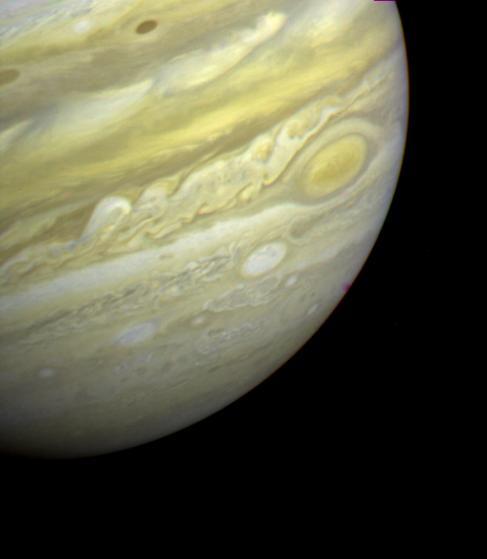
This photo from NASA Voyager 2 was taken on Jun. 9, 1979 and is centered over the long-lived disturbed region west of the Great Red Spot GRS.
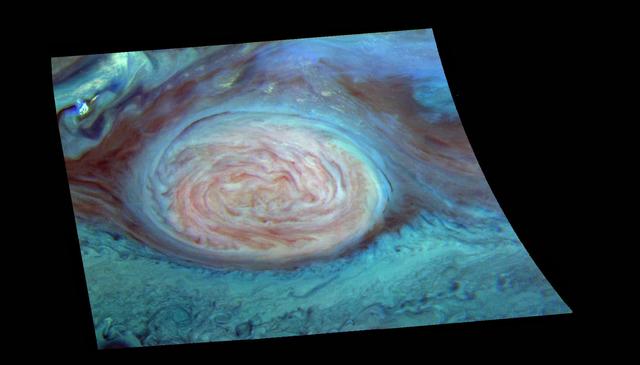
False color representation of Jupiter Great Red Spot GRS taken by NASA Galileo imaging system. The Great Red Spot appears pink and the surrounding region blue because of the particular color coding used in this representation.
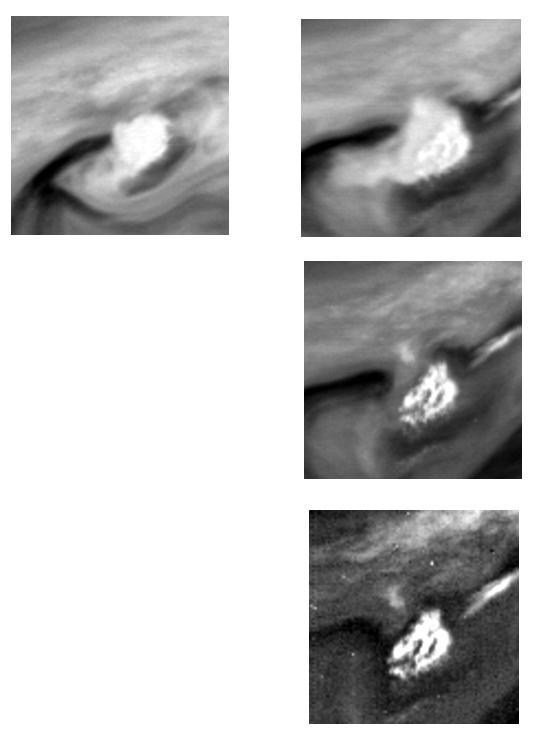
These two images of Jupiter atmosphere were taken by NASA Galileo spacecraft on June 26, 1996. The bright white spot in the center of each image is to the northwest of Jupiter Great Red Spot GRS.
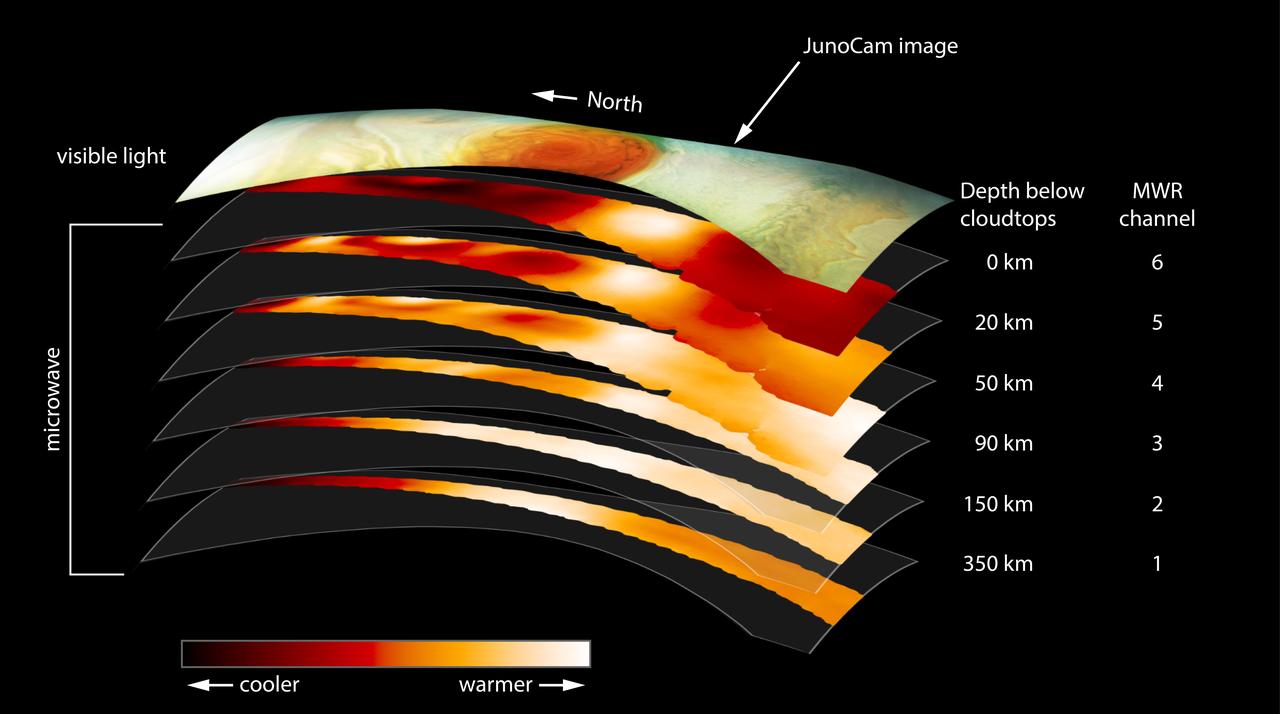
This figure shows data from the six channels of the microwave radiometer (MWR) instrument onboard NASA's Juno spacecraft. The data were collected in the mission's sixth science orbit (referred to as "perijove 7"), during which the spacecraft passed over Jupiter's Great Red Spot. The top layer in the figure is a visible light image from the mission's JunoCam instrument, provided for context. The MWR instrument enables Juno to see deeper into Jupiter than any previous spacecraft or Earth-based observations. Each MWR channel peers progressively deeper below the visible cloud tops. Channel 1 is sensitive to longer microwave wavelengths; each of the other channels is sensitive to progressively shorter wavelengths. The large-scale structure of the Great Red Spot is visible in the data as deep into Jupiter as MWR can observe. https://photojournal.jpl.nasa.gov/catalog/PIA22177
![An overhead crane moves The Gamma Ray Spectrometer (GRS) into place to be installed on the Mars Odyssey Orbiter in the Spacecraft Assembly and Encapsulation Facility 2 (SAEF 2).; The orbiter will carry three science instruments: the Thermal Emission Imaging System (THEMIS), the Gamma Ray Spectrometer (GRS), and the Mars Radiation Environment Experiment (MARIE). THEMIS will map the mineralogy and morphology of the Martian surface using a high-resolution camera and a thermal infrared imaging spectrometer. The GRS will achieve global mapping of the elemental composition of the surface and determine the abundance of hydrogen in the shallow subsurface. [The GRS is a rebuild of the instrument lost with the Mars Observer mission.] The MARIE will characterize aspects of the near-space radiation environment with regards to the radiation-related risk to human explorers. The Mars Odyssey Orbiter is scheduled for launch on April 7, 2001, aboard a Delta 7925 rocket from Launch Pad 17-A, Cape Canaveral Air Force Station](https://images-assets.nasa.gov/image/KSC01pp0191/KSC01pp0191~medium.jpg)
An overhead crane moves The Gamma Ray Spectrometer (GRS) into place to be installed on the Mars Odyssey Orbiter in the Spacecraft Assembly and Encapsulation Facility 2 (SAEF 2).; The orbiter will carry three science instruments: the Thermal Emission Imaging System (THEMIS), the Gamma Ray Spectrometer (GRS), and the Mars Radiation Environment Experiment (MARIE). THEMIS will map the mineralogy and morphology of the Martian surface using a high-resolution camera and a thermal infrared imaging spectrometer. The GRS will achieve global mapping of the elemental composition of the surface and determine the abundance of hydrogen in the shallow subsurface. [The GRS is a rebuild of the instrument lost with the Mars Observer mission.] The MARIE will characterize aspects of the near-space radiation environment with regards to the radiation-related risk to human explorers. The Mars Odyssey Orbiter is scheduled for launch on April 7, 2001, aboard a Delta 7925 rocket from Launch Pad 17-A, Cape Canaveral Air Force Station
![The Gamma Ray Spectrometer (GRS) is installed by technicians on the Mars Odyssey Orbiter in the Spacecraft Assembly and Encapsulation Facility 2 (SAEF 2).; The orbiter will carry three science instruments: the Thermal Emission Imaging System (THEMIS), the Gamma Ray Spectrometer (GRS), and the Mars Radiation Environment Experiment (MARIE). THEMIS will map the mineralogy and morphology of the Martian surface using a high-resolution camera and a thermal infrared imaging spectrometer. The GRS will achieve global mapping of the elemental composition of the surface and determine the abundance of hydrogen in the shallow subsurface. [The GRS is a rebuild of the instrument lost with the Mars Observer mission.] The MARIE will characterize aspects of the near-space radiation environment with regards to the radiation-related risk to human explorers. The Mars Odyssey Orbiter is scheduled for launch on April 7, 2001, aboard a Delta 7925 rocket from Launch Pad 17-A, Cape Canaveral Air Force Station](https://images-assets.nasa.gov/image/01pp0194/01pp0194~medium.jpg)
The Gamma Ray Spectrometer (GRS) is installed by technicians on the Mars Odyssey Orbiter in the Spacecraft Assembly and Encapsulation Facility 2 (SAEF 2).; The orbiter will carry three science instruments: the Thermal Emission Imaging System (THEMIS), the Gamma Ray Spectrometer (GRS), and the Mars Radiation Environment Experiment (MARIE). THEMIS will map the mineralogy and morphology of the Martian surface using a high-resolution camera and a thermal infrared imaging spectrometer. The GRS will achieve global mapping of the elemental composition of the surface and determine the abundance of hydrogen in the shallow subsurface. [The GRS is a rebuild of the instrument lost with the Mars Observer mission.] The MARIE will characterize aspects of the near-space radiation environment with regards to the radiation-related risk to human explorers. The Mars Odyssey Orbiter is scheduled for launch on April 7, 2001, aboard a Delta 7925 rocket from Launch Pad 17-A, Cape Canaveral Air Force Station
![Two technicians involved with the installation of the Gamma Ray Spectrometer (GRS) on the Mars Odyssey Orbiter pose in front of the spacecraft in the Spacecraft Assembly and Encapsulation Facility 2 (SAEF 2).; The orbiter will carry three science instruments: the Thermal Emission Imaging System (THEMIS), the Gamma Ray Spectrometer (GRS), and the Mars Radiation Environment Experiment (MARIE). THEMIS will map the mineralogy and morphology of the Martian surface using a high-resolution camera and a thermal infrared imaging spectrometer. The GRS will achieve global mapping of the elemental composition of the surface and determine the abundance of hydrogen in the shallow subsurface. [The GRS is a rebuild of the instrument lost with the Mars Observer mission.] The MARIE will characterize aspects of the near-space radiation environment with regards to the radiation-related risk to human explorers. The Mars Odyssey Orbiter is scheduled for launch on April 7, 2001, aboard a Delta 7925 rocket from Launch Pad 17-A, Cape Canaveral Air Force Station](https://images-assets.nasa.gov/image/KSC01pp0195/KSC01pp0195~medium.jpg)
Two technicians involved with the installation of the Gamma Ray Spectrometer (GRS) on the Mars Odyssey Orbiter pose in front of the spacecraft in the Spacecraft Assembly and Encapsulation Facility 2 (SAEF 2).; The orbiter will carry three science instruments: the Thermal Emission Imaging System (THEMIS), the Gamma Ray Spectrometer (GRS), and the Mars Radiation Environment Experiment (MARIE). THEMIS will map the mineralogy and morphology of the Martian surface using a high-resolution camera and a thermal infrared imaging spectrometer. The GRS will achieve global mapping of the elemental composition of the surface and determine the abundance of hydrogen in the shallow subsurface. [The GRS is a rebuild of the instrument lost with the Mars Observer mission.] The MARIE will characterize aspects of the near-space radiation environment with regards to the radiation-related risk to human explorers. The Mars Odyssey Orbiter is scheduled for launch on April 7, 2001, aboard a Delta 7925 rocket from Launch Pad 17-A, Cape Canaveral Air Force Station
![Technicians guide The Gamma Ray Spectrometer (GRS); into place to be installed on the Mars Odyssey Orbiter in the Spacecraft Assembly and Encapsulation Facility 2 (SAEF 2).; The orbiter will carry three science instruments: the Thermal Emission Imaging System (THEMIS), the Gamma Ray Spectrometer (GRS), and the Mars Radiation Environment Experiment (MARIE). THEMIS will map the mineralogy and morphology of the Martian surface using a high-resolution camera and a thermal infrared imaging spectrometer. The GRS will achieve global mapping of the elemental composition of the surface and determine the abundance of hydrogen in the shallow subsurface. [The GRS is a rebuild of the instrument lost with the Mars Observer mission.] The MARIE will characterize aspects of the near-space radiation environment with regards to the radiation-related risk to human explorers. The Mars Odyssey Orbiter is scheduled for launch on April 7, 2001, aboard a Delta 7925 rocket from Launch Pad 17-A, Cape Canaveral Air Force Station](https://images-assets.nasa.gov/image/01pp0193/01pp0193~medium.jpg)
Technicians guide The Gamma Ray Spectrometer (GRS); into place to be installed on the Mars Odyssey Orbiter in the Spacecraft Assembly and Encapsulation Facility 2 (SAEF 2).; The orbiter will carry three science instruments: the Thermal Emission Imaging System (THEMIS), the Gamma Ray Spectrometer (GRS), and the Mars Radiation Environment Experiment (MARIE). THEMIS will map the mineralogy and morphology of the Martian surface using a high-resolution camera and a thermal infrared imaging spectrometer. The GRS will achieve global mapping of the elemental composition of the surface and determine the abundance of hydrogen in the shallow subsurface. [The GRS is a rebuild of the instrument lost with the Mars Observer mission.] The MARIE will characterize aspects of the near-space radiation environment with regards to the radiation-related risk to human explorers. The Mars Odyssey Orbiter is scheduled for launch on April 7, 2001, aboard a Delta 7925 rocket from Launch Pad 17-A, Cape Canaveral Air Force Station
![In the Spacecraft Assembly and Encapsulation Facility 2 (SAEF 2), workers attach a crane to the Gamma Ray Spectrometer (GRS); to move it into place to be installed on the Mars Odyssey Orbiter.; The orbiter will carry three science instruments: the Thermal Emission Imaging System (THEMIS), the Gamma Ray Spectrometer (GRS), and the Mars Radiation Environment Experiment (MARIE). THEMIS will map the mineralogy and morphology of the Martian surface using a high-resolution camera and a thermal infrared imaging spectrometer. The GRS will achieve global mapping of the elemental composition of the surface and determine the abundance of hydrogen in the shallow subsurface. [The GRS is a rebuild of the instrument lost with the Mars Observer mission.] The MARIE will characterize aspects of the near-space radiation environment with regards to the radiation-related risk to human explorers. The Mars Odyssey Orbiter is scheduled for launch on April 7, 2001, aboard a Delta 7925 rocket from Launch Pad 17-A, Cape Canaveral Air Force Station](https://images-assets.nasa.gov/image/01pp0190/01pp0190~medium.jpg)
In the Spacecraft Assembly and Encapsulation Facility 2 (SAEF 2), workers attach a crane to the Gamma Ray Spectrometer (GRS); to move it into place to be installed on the Mars Odyssey Orbiter.; The orbiter will carry three science instruments: the Thermal Emission Imaging System (THEMIS), the Gamma Ray Spectrometer (GRS), and the Mars Radiation Environment Experiment (MARIE). THEMIS will map the mineralogy and morphology of the Martian surface using a high-resolution camera and a thermal infrared imaging spectrometer. The GRS will achieve global mapping of the elemental composition of the surface and determine the abundance of hydrogen in the shallow subsurface. [The GRS is a rebuild of the instrument lost with the Mars Observer mission.] The MARIE will characterize aspects of the near-space radiation environment with regards to the radiation-related risk to human explorers. The Mars Odyssey Orbiter is scheduled for launch on April 7, 2001, aboard a Delta 7925 rocket from Launch Pad 17-A, Cape Canaveral Air Force Station
![In the Spacecraft Assembly and Encapsulation Facility 2 (SAEF 2), workers attach a crane to the Gamma Ray Spectrometer (GRS); to move it into place to be installed on the Mars Odyssey Orbiter.; The orbiter will carry three science instruments: the Thermal Emission Imaging System (THEMIS), the Gamma Ray Spectrometer (GRS), and the Mars Radiation Environment Experiment (MARIE). THEMIS will map the mineralogy and morphology of the Martian surface using a high-resolution camera and a thermal infrared imaging spectrometer. The GRS will achieve global mapping of the elemental composition of the surface and determine the abundance of hydrogen in the shallow subsurface. [The GRS is a rebuild of the instrument lost with the Mars Observer mission.] The MARIE will characterize aspects of the near-space radiation environment with regards to the radiation-related risk to human explorers. The Mars Odyssey Orbiter is scheduled for launch on April 7, 2001, aboard a Delta 7925 rocket from Launch Pad 17-A, Cape Canaveral Air Force Station](https://images-assets.nasa.gov/image/KSC01pp0190/KSC01pp0190~medium.jpg)
In the Spacecraft Assembly and Encapsulation Facility 2 (SAEF 2), workers attach a crane to the Gamma Ray Spectrometer (GRS); to move it into place to be installed on the Mars Odyssey Orbiter.; The orbiter will carry three science instruments: the Thermal Emission Imaging System (THEMIS), the Gamma Ray Spectrometer (GRS), and the Mars Radiation Environment Experiment (MARIE). THEMIS will map the mineralogy and morphology of the Martian surface using a high-resolution camera and a thermal infrared imaging spectrometer. The GRS will achieve global mapping of the elemental composition of the surface and determine the abundance of hydrogen in the shallow subsurface. [The GRS is a rebuild of the instrument lost with the Mars Observer mission.] The MARIE will characterize aspects of the near-space radiation environment with regards to the radiation-related risk to human explorers. The Mars Odyssey Orbiter is scheduled for launch on April 7, 2001, aboard a Delta 7925 rocket from Launch Pad 17-A, Cape Canaveral Air Force Station
![The Gamma Ray Spectrometer (GRS) is installed by technicians on the Mars Odyssey Orbiter in the Spacecraft Assembly and Encapsulation Facility 2 (SAEF 2).; The orbiter will carry three science instruments: the Thermal Emission Imaging System (THEMIS), the Gamma Ray Spectrometer (GRS), and the Mars Radiation Environment Experiment (MARIE). THEMIS will map the mineralogy and morphology of the Martian surface using a high-resolution camera and a thermal infrared imaging spectrometer. The GRS will achieve global mapping of the elemental composition of the surface and determine the abundance of hydrogen in the shallow subsurface. [The GRS is a rebuild of the instrument lost with the Mars Observer mission.] The MARIE will characterize aspects of the near-space radiation environment with regards to the radiation-related risk to human explorers. The Mars Odyssey Orbiter is scheduled for launch on April 7, 2001, aboard a Delta 7925 rocket from Launch Pad 17-A, Cape Canaveral Air Force Station](https://images-assets.nasa.gov/image/KSC01pp0194/KSC01pp0194~medium.jpg)
The Gamma Ray Spectrometer (GRS) is installed by technicians on the Mars Odyssey Orbiter in the Spacecraft Assembly and Encapsulation Facility 2 (SAEF 2).; The orbiter will carry three science instruments: the Thermal Emission Imaging System (THEMIS), the Gamma Ray Spectrometer (GRS), and the Mars Radiation Environment Experiment (MARIE). THEMIS will map the mineralogy and morphology of the Martian surface using a high-resolution camera and a thermal infrared imaging spectrometer. The GRS will achieve global mapping of the elemental composition of the surface and determine the abundance of hydrogen in the shallow subsurface. [The GRS is a rebuild of the instrument lost with the Mars Observer mission.] The MARIE will characterize aspects of the near-space radiation environment with regards to the radiation-related risk to human explorers. The Mars Odyssey Orbiter is scheduled for launch on April 7, 2001, aboard a Delta 7925 rocket from Launch Pad 17-A, Cape Canaveral Air Force Station
![Technicians examine the Gamma Ray Spectrometer (GRS) before it is moved to be installed on the Mars Odyssey Orbiter in the Spacecraft Assembly and Encapsulation Facility II (SAEF II).; The orbiter will carry three science instruments: the Thermal Emission Imaging System (THEMIS), the Gamma Ray Spectrometer (GRS), and the Mars Radiation Environment Experiment (MARIE). THEMIS will map the mineralogy and morphology of the Martian surface using a high-resolution camera and a thermal infrared imaging spectrometer. The GRS will achieve global mapping of the elemental composition of the surface and determine the abundance of hydrogen in the shallow subsurface. [The GRS is a rebuild of the instrument lost with the Mars Observer mission.] The MARIE will characterize aspects of the near-space radiation environment with regards to the radiation-related risk to human explorers. The Mars Odyssey Orbiter is scheduled for launch on April 7, 2001, aboard a Delta 7925 rocket from Launch Pad 17-A, Cape Canaveral Air Force Station](https://images-assets.nasa.gov/image/01pp0189/01pp0189~medium.jpg)
Technicians examine the Gamma Ray Spectrometer (GRS) before it is moved to be installed on the Mars Odyssey Orbiter in the Spacecraft Assembly and Encapsulation Facility II (SAEF II).; The orbiter will carry three science instruments: the Thermal Emission Imaging System (THEMIS), the Gamma Ray Spectrometer (GRS), and the Mars Radiation Environment Experiment (MARIE). THEMIS will map the mineralogy and morphology of the Martian surface using a high-resolution camera and a thermal infrared imaging spectrometer. The GRS will achieve global mapping of the elemental composition of the surface and determine the abundance of hydrogen in the shallow subsurface. [The GRS is a rebuild of the instrument lost with the Mars Observer mission.] The MARIE will characterize aspects of the near-space radiation environment with regards to the radiation-related risk to human explorers. The Mars Odyssey Orbiter is scheduled for launch on April 7, 2001, aboard a Delta 7925 rocket from Launch Pad 17-A, Cape Canaveral Air Force Station
![Technicians guide The Gamma Ray Spectrometer (GRS)into place to be installed on the Mars Odyssey Orbiter in the Spacecraft Assembly and Encapsulation Facility 2 (SAEF 2).The orbiter will carry three science instruments: the Thermal Emission Imaging System (THEMIS), the Gamma Ray Spectrometer (GRS), and the Mars Radiation Environment Experiment (MARIE). THEMIS will map the mineralogy and morphology of the Martian surface using a high-resolution camera and a thermal infrared imaging spectrometer. The GRS will achieve global mapping of the elemental composition of the surface and determine the abundance of hydrogen in the shallow subsurface. [The GRS is a rebuild of the instrument lost with the Mars Observer mission.] The MARIE will characterize aspects of the near-space radiation environment with regards to the radiation-related risk to human explorers. The Mars Odyssey Orbiter is scheduled for launch on April 7, 2001, aboard a Delta 7925 rocket from Launch Pad 17-A, Cape Canaveral Air Force Station](https://images-assets.nasa.gov/image/KSC01pp0192/KSC01pp0192~medium.jpg)
Technicians guide The Gamma Ray Spectrometer (GRS)into place to be installed on the Mars Odyssey Orbiter in the Spacecraft Assembly and Encapsulation Facility 2 (SAEF 2).The orbiter will carry three science instruments: the Thermal Emission Imaging System (THEMIS), the Gamma Ray Spectrometer (GRS), and the Mars Radiation Environment Experiment (MARIE). THEMIS will map the mineralogy and morphology of the Martian surface using a high-resolution camera and a thermal infrared imaging spectrometer. The GRS will achieve global mapping of the elemental composition of the surface and determine the abundance of hydrogen in the shallow subsurface. [The GRS is a rebuild of the instrument lost with the Mars Observer mission.] The MARIE will characterize aspects of the near-space radiation environment with regards to the radiation-related risk to human explorers. The Mars Odyssey Orbiter is scheduled for launch on April 7, 2001, aboard a Delta 7925 rocket from Launch Pad 17-A, Cape Canaveral Air Force Station
![Technicians examine the Gamma Ray Spectrometer (GRS) before it is moved to be installed on the Mars Odyssey Orbiter in the Spacecraft Assembly and Encapsulation Facility II (SAEF II).; The orbiter will carry three science instruments: the Thermal Emission Imaging System (THEMIS), the Gamma Ray Spectrometer (GRS), and the Mars Radiation Environment Experiment (MARIE). THEMIS will map the mineralogy and morphology of the Martian surface using a high-resolution camera and a thermal infrared imaging spectrometer. The GRS will achieve global mapping of the elemental composition of the surface and determine the abundance of hydrogen in the shallow subsurface. [The GRS is a rebuild of the instrument lost with the Mars Observer mission.] The MARIE will characterize aspects of the near-space radiation environment with regards to the radiation-related risk to human explorers. The Mars Odyssey Orbiter is scheduled for launch on April 7, 2001, aboard a Delta 7925 rocket from Launch Pad 17-A, Cape Canaveral Air Force Station](https://images-assets.nasa.gov/image/KSC01pp0189/KSC01pp0189~orig.jpg)
Technicians examine the Gamma Ray Spectrometer (GRS) before it is moved to be installed on the Mars Odyssey Orbiter in the Spacecraft Assembly and Encapsulation Facility II (SAEF II).; The orbiter will carry three science instruments: the Thermal Emission Imaging System (THEMIS), the Gamma Ray Spectrometer (GRS), and the Mars Radiation Environment Experiment (MARIE). THEMIS will map the mineralogy and morphology of the Martian surface using a high-resolution camera and a thermal infrared imaging spectrometer. The GRS will achieve global mapping of the elemental composition of the surface and determine the abundance of hydrogen in the shallow subsurface. [The GRS is a rebuild of the instrument lost with the Mars Observer mission.] The MARIE will characterize aspects of the near-space radiation environment with regards to the radiation-related risk to human explorers. The Mars Odyssey Orbiter is scheduled for launch on April 7, 2001, aboard a Delta 7925 rocket from Launch Pad 17-A, Cape Canaveral Air Force Station
![Technicians check out the Gamma Ray Spectrometer (GRS) before it is installed on the Mars Odyssey Orbiter in the Spacecraft Assembly and Encapsulation Facility II (SAEF II) .; The orbiter will carry three science instruments: the Thermal Emission Imaging System (THEMIS), the Gamma Ray Spectrometer (GRS), and the Mars Radiation Environment Experiment (MARIE). THEMIS will map the mineralogy and morphology of the Martian surface using a high-resolution camera and a thermal infrared imaging spectrometer. The GRS will achieve global mapping of the elemental composition of the surface and determine the abundance of hydrogen in the shallow subsurface. [The GRS is a rebuild of the instrument lost with the Mars Observer mission.] The MARIE will characterize aspects of the near-space radiation environment with regards to the radiation-related risk to human explorers. The Mars Odyssey Orbiter is scheduled for launch on April 7, 2001, aboard a Delta 7925 rocket from Launch Pad 17-A, Cape Canaveral Air Force Station](https://images-assets.nasa.gov/image/01pp0188/01pp0188~medium.jpg)
Technicians check out the Gamma Ray Spectrometer (GRS) before it is installed on the Mars Odyssey Orbiter in the Spacecraft Assembly and Encapsulation Facility II (SAEF II) .; The orbiter will carry three science instruments: the Thermal Emission Imaging System (THEMIS), the Gamma Ray Spectrometer (GRS), and the Mars Radiation Environment Experiment (MARIE). THEMIS will map the mineralogy and morphology of the Martian surface using a high-resolution camera and a thermal infrared imaging spectrometer. The GRS will achieve global mapping of the elemental composition of the surface and determine the abundance of hydrogen in the shallow subsurface. [The GRS is a rebuild of the instrument lost with the Mars Observer mission.] The MARIE will characterize aspects of the near-space radiation environment with regards to the radiation-related risk to human explorers. The Mars Odyssey Orbiter is scheduled for launch on April 7, 2001, aboard a Delta 7925 rocket from Launch Pad 17-A, Cape Canaveral Air Force Station
![Two technicians involved with the installation of the Gamma Ray Spectrometer (GRS) on the Mars Odyssey Orbiter pose in front of the spacecraft in the Spacecraft Assembly and Encapsulation Facility 2 (SAEF 2).; The orbiter will carry three science instruments: the Thermal Emission Imaging System (THEMIS), the Gamma Ray Spectrometer (GRS), and the Mars Radiation Environment Experiment (MARIE). THEMIS will map the mineralogy and morphology of the Martian surface using a high-resolution camera and a thermal infrared imaging spectrometer. The GRS will achieve global mapping of the elemental composition of the surface and determine the abundance of hydrogen in the shallow subsurface. [The GRS is a rebuild of the instrument lost with the Mars Observer mission.] The MARIE will characterize aspects of the near-space radiation environment with regards to the radiation-related risk to human explorers. The Mars Odyssey Orbiter is scheduled for launch on April 7, 2001, aboard a Delta 7925 rocket from Launch Pad 17-A, Cape Canaveral Air Force Station](https://images-assets.nasa.gov/image/01pp0195/01pp0195~medium.jpg)
Two technicians involved with the installation of the Gamma Ray Spectrometer (GRS) on the Mars Odyssey Orbiter pose in front of the spacecraft in the Spacecraft Assembly and Encapsulation Facility 2 (SAEF 2).; The orbiter will carry three science instruments: the Thermal Emission Imaging System (THEMIS), the Gamma Ray Spectrometer (GRS), and the Mars Radiation Environment Experiment (MARIE). THEMIS will map the mineralogy and morphology of the Martian surface using a high-resolution camera and a thermal infrared imaging spectrometer. The GRS will achieve global mapping of the elemental composition of the surface and determine the abundance of hydrogen in the shallow subsurface. [The GRS is a rebuild of the instrument lost with the Mars Observer mission.] The MARIE will characterize aspects of the near-space radiation environment with regards to the radiation-related risk to human explorers. The Mars Odyssey Orbiter is scheduled for launch on April 7, 2001, aboard a Delta 7925 rocket from Launch Pad 17-A, Cape Canaveral Air Force Station
![Technicians check out the Gamma Ray Spectrometer (GRS) before it is installed on the Mars Odyssey Orbiter in the Spacecraft Assembly and Encapsulation Facility II (SAEF II) .; The orbiter will carry three science instruments: the Thermal Emission Imaging System (THEMIS), the Gamma Ray Spectrometer (GRS), and the Mars Radiation Environment Experiment (MARIE). THEMIS will map the mineralogy and morphology of the Martian surface using a high-resolution camera and a thermal infrared imaging spectrometer. The GRS will achieve global mapping of the elemental composition of the surface and determine the abundance of hydrogen in the shallow subsurface. [The GRS is a rebuild of the instrument lost with the Mars Observer mission.] The MARIE will characterize aspects of the near-space radiation environment with regards to the radiation-related risk to human explorers. The Mars Odyssey Orbiter is scheduled for launch on April 7, 2001, aboard a Delta 7925 rocket from Launch Pad 17-A, Cape Canaveral Air Force Station](https://images-assets.nasa.gov/image/KSC01pp0188/KSC01pp0188~medium.jpg)
Technicians check out the Gamma Ray Spectrometer (GRS) before it is installed on the Mars Odyssey Orbiter in the Spacecraft Assembly and Encapsulation Facility II (SAEF II) .; The orbiter will carry three science instruments: the Thermal Emission Imaging System (THEMIS), the Gamma Ray Spectrometer (GRS), and the Mars Radiation Environment Experiment (MARIE). THEMIS will map the mineralogy and morphology of the Martian surface using a high-resolution camera and a thermal infrared imaging spectrometer. The GRS will achieve global mapping of the elemental composition of the surface and determine the abundance of hydrogen in the shallow subsurface. [The GRS is a rebuild of the instrument lost with the Mars Observer mission.] The MARIE will characterize aspects of the near-space radiation environment with regards to the radiation-related risk to human explorers. The Mars Odyssey Orbiter is scheduled for launch on April 7, 2001, aboard a Delta 7925 rocket from Launch Pad 17-A, Cape Canaveral Air Force Station
![Technicians guide The Gamma Ray Spectrometer (GRS)into place to be installed on the Mars Odyssey Orbiter in the Spacecraft Assembly and Encapsulation Facility 2 (SAEF 2).The orbiter will carry three science instruments: the Thermal Emission Imaging System (THEMIS), the Gamma Ray Spectrometer (GRS), and the Mars Radiation Environment Experiment (MARIE). THEMIS will map the mineralogy and morphology of the Martian surface using a high-resolution camera and a thermal infrared imaging spectrometer. The GRS will achieve global mapping of the elemental composition of the surface and determine the abundance of hydrogen in the shallow subsurface. [The GRS is a rebuild of the instrument lost with the Mars Observer mission.] The MARIE will characterize aspects of the near-space radiation environment with regards to the radiation-related risk to human explorers. The Mars Odyssey Orbiter is scheduled for launch on April 7, 2001, aboard a Delta 7925 rocket from Launch Pad 17-A, Cape Canaveral Air Force Station](https://images-assets.nasa.gov/image/01pp0192/01pp0192~medium.jpg)
Technicians guide The Gamma Ray Spectrometer (GRS)into place to be installed on the Mars Odyssey Orbiter in the Spacecraft Assembly and Encapsulation Facility 2 (SAEF 2).The orbiter will carry three science instruments: the Thermal Emission Imaging System (THEMIS), the Gamma Ray Spectrometer (GRS), and the Mars Radiation Environment Experiment (MARIE). THEMIS will map the mineralogy and morphology of the Martian surface using a high-resolution camera and a thermal infrared imaging spectrometer. The GRS will achieve global mapping of the elemental composition of the surface and determine the abundance of hydrogen in the shallow subsurface. [The GRS is a rebuild of the instrument lost with the Mars Observer mission.] The MARIE will characterize aspects of the near-space radiation environment with regards to the radiation-related risk to human explorers. The Mars Odyssey Orbiter is scheduled for launch on April 7, 2001, aboard a Delta 7925 rocket from Launch Pad 17-A, Cape Canaveral Air Force Station
![Technicians guide The Gamma Ray Spectrometer (GRS); into place to be installed on the Mars Odyssey Orbiter in the Spacecraft Assembly and Encapsulation Facility 2 (SAEF 2).; The orbiter will carry three science instruments: the Thermal Emission Imaging System (THEMIS), the Gamma Ray Spectrometer (GRS), and the Mars Radiation Environment Experiment (MARIE). THEMIS will map the mineralogy and morphology of the Martian surface using a high-resolution camera and a thermal infrared imaging spectrometer. The GRS will achieve global mapping of the elemental composition of the surface and determine the abundance of hydrogen in the shallow subsurface. [The GRS is a rebuild of the instrument lost with the Mars Observer mission.] The MARIE will characterize aspects of the near-space radiation environment with regards to the radiation-related risk to human explorers. The Mars Odyssey Orbiter is scheduled for launch on April 7, 2001, aboard a Delta 7925 rocket from Launch Pad 17-A, Cape Canaveral Air Force Station](https://images-assets.nasa.gov/image/KSC01pp0193/KSC01pp0193~medium.jpg)
Technicians guide The Gamma Ray Spectrometer (GRS); into place to be installed on the Mars Odyssey Orbiter in the Spacecraft Assembly and Encapsulation Facility 2 (SAEF 2).; The orbiter will carry three science instruments: the Thermal Emission Imaging System (THEMIS), the Gamma Ray Spectrometer (GRS), and the Mars Radiation Environment Experiment (MARIE). THEMIS will map the mineralogy and morphology of the Martian surface using a high-resolution camera and a thermal infrared imaging spectrometer. The GRS will achieve global mapping of the elemental composition of the surface and determine the abundance of hydrogen in the shallow subsurface. [The GRS is a rebuild of the instrument lost with the Mars Observer mission.] The MARIE will characterize aspects of the near-space radiation environment with regards to the radiation-related risk to human explorers. The Mars Odyssey Orbiter is scheduled for launch on April 7, 2001, aboard a Delta 7925 rocket from Launch Pad 17-A, Cape Canaveral Air Force Station
![An overhead crane moves The Gamma Ray Spectrometer (GRS) into place to be installed on the Mars Odyssey Orbiter in the Spacecraft Assembly and Encapsulation Facility 2 (SAEF 2).; The orbiter will carry three science instruments: the Thermal Emission Imaging System (THEMIS), the Gamma Ray Spectrometer (GRS), and the Mars Radiation Environment Experiment (MARIE). THEMIS will map the mineralogy and morphology of the Martian surface using a high-resolution camera and a thermal infrared imaging spectrometer. The GRS will achieve global mapping of the elemental composition of the surface and determine the abundance of hydrogen in the shallow subsurface. [The GRS is a rebuild of the instrument lost with the Mars Observer mission.] The MARIE will characterize aspects of the near-space radiation environment with regards to the radiation-related risk to human explorers. The Mars Odyssey Orbiter is scheduled for launch on April 7, 2001, aboard a Delta 7925 rocket from Launch Pad 17-A, Cape Canaveral Air Force Station](https://images-assets.nasa.gov/image/01pp0191/01pp0191~medium.jpg)
An overhead crane moves The Gamma Ray Spectrometer (GRS) into place to be installed on the Mars Odyssey Orbiter in the Spacecraft Assembly and Encapsulation Facility 2 (SAEF 2).; The orbiter will carry three science instruments: the Thermal Emission Imaging System (THEMIS), the Gamma Ray Spectrometer (GRS), and the Mars Radiation Environment Experiment (MARIE). THEMIS will map the mineralogy and morphology of the Martian surface using a high-resolution camera and a thermal infrared imaging spectrometer. The GRS will achieve global mapping of the elemental composition of the surface and determine the abundance of hydrogen in the shallow subsurface. [The GRS is a rebuild of the instrument lost with the Mars Observer mission.] The MARIE will characterize aspects of the near-space radiation environment with regards to the radiation-related risk to human explorers. The Mars Odyssey Orbiter is scheduled for launch on April 7, 2001, aboard a Delta 7925 rocket from Launch Pad 17-A, Cape Canaveral Air Force Station
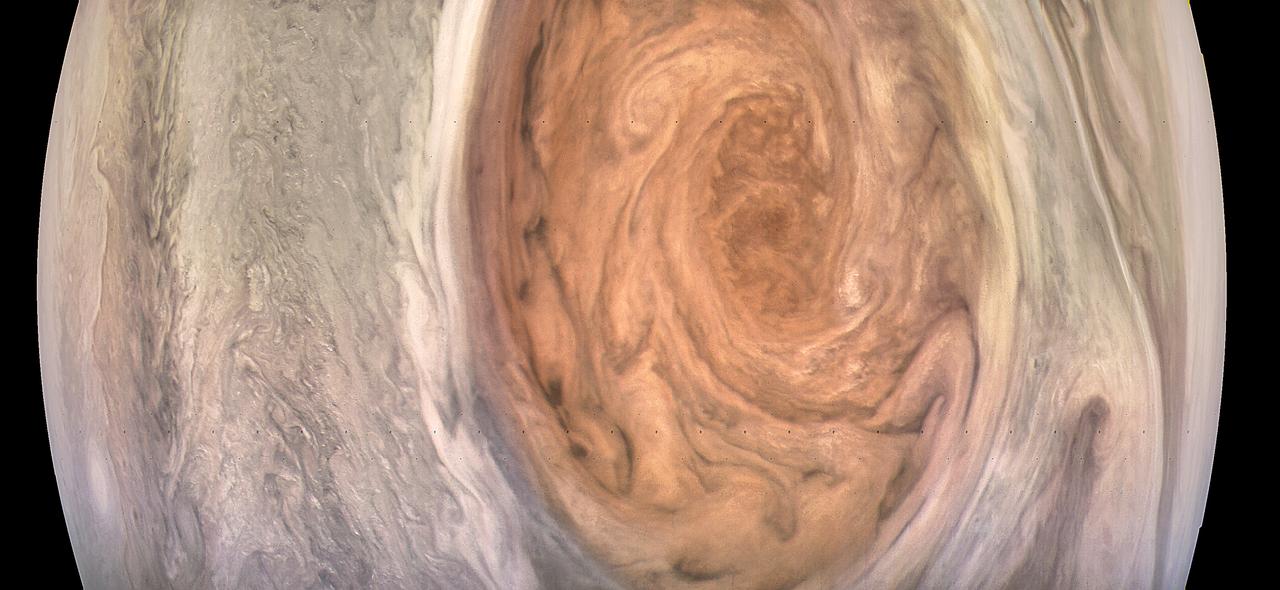
This enhanced-color image of Jupiter's Great Red Spot was created by citizen scientist Kevin Gill using data from the JunoCam imager on NASA's Juno spacecraft. The image was taken on July 10, 2017 at 07:07 p.m. PDT (10:07 p.m. EDT), as the Juno spacecraft performed its 7th close flyby of Jupiter. At the time the image was taken, the spacecraft was about 6,130 miles (9,866 kilometers) from the tops of the clouds of the planet. https://photojournal.jpl.nasa.gov/catalog/PIA21395 . - Enhanced image by Kevin M. Gill (CC-BY) based on images provided courtesy of NASA/JPL-Caltech/SwRI/MSSS
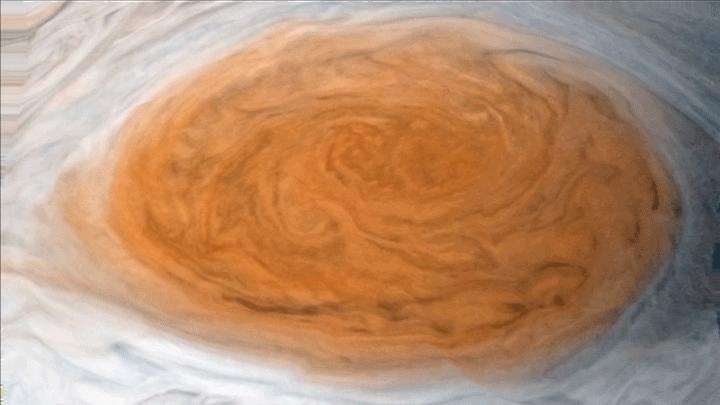
Winds around Jupiter's Great Red Spot are simulated in this JunoCam view that has been animated using a model of the winds there. The wind model, called a velocity field, was derived from data collected by NASA's Voyager spacecraft and Earth-based telescopes. NASA's Juno spacecraft acquired the original, static view during passage over the spot on July 10, 2017. Citizen scientists Gerald Eichstädt and Justin Cowart turned the JunoCam data into a color image mosaic. Juno scientists Shawn Ewald and Andrew Ingersoll applied the velocity data to the image to produce a looping animation. An animation is available at https://photojournal.jpl.nasa.gov/catalog/PIA22178
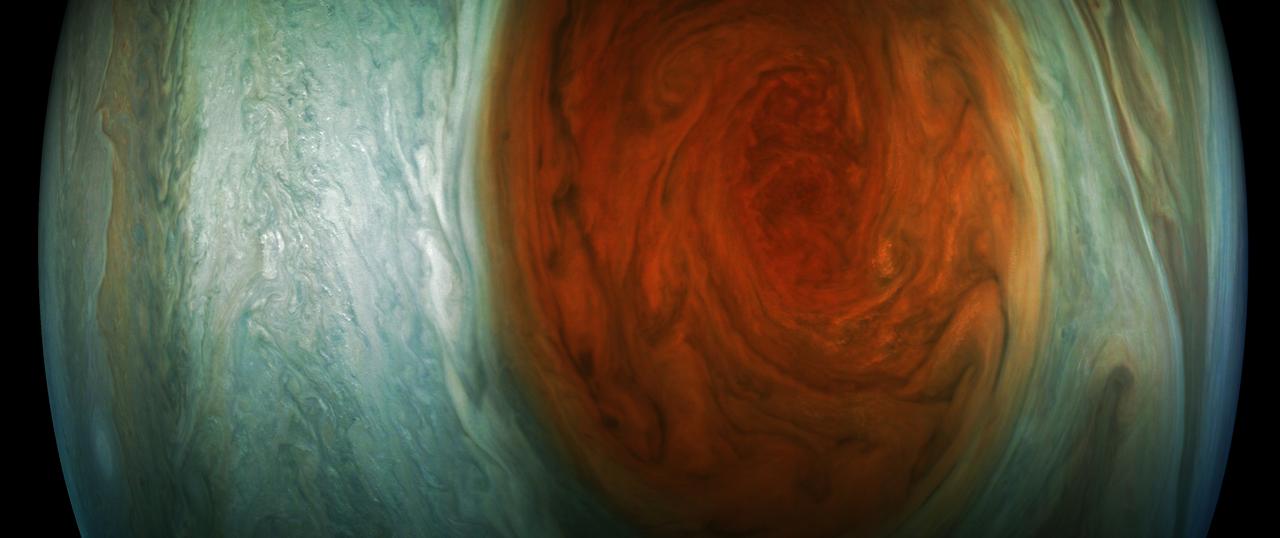
This enhanced-color image of Jupiter's Great Red Spot was created by citizen scientist Gerald Eichstädt using data from the JunoCam imager on NASA's Juno spacecraft. The image was taken on July 10, 2017 at 07:10 p.m. PDT (10:10 p.m. EDT), as the Juno spacecraft performed its 7th close flyby of Jupiter. At the time the image was taken, the spacecraft was about 8,648 miles (13,917 kilometers) from the tops of the clouds of the planet. https://photojournal.jpl.nasa.gov/catalog/PIA21772. - Enhanced image by Gerald Eichstädt based on images provided courtesy of NASA/JPL-Caltech/SwRI/MSSS
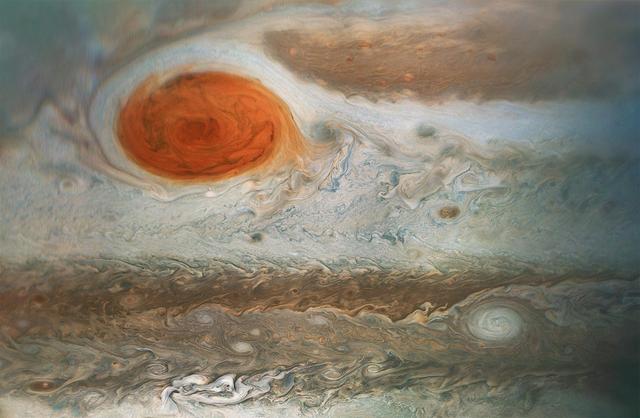
This image of Jupiter's iconic Great Red Spot and surrounding turbulent zones was captured by NASA's Juno spacecraft. The color-enhanced image is a combination of three separate images taken on April 1 between 3:09 a.m. PDT (6:09 a.m. EDT) and 3:24 a.m. PDT (6:24 a.m. EDT), as Juno performed its 12th close flyby of Jupiter. At the time the images were taken, the spacecraft was 15,379 miles (24,749 kilometers) to 30,633 miles (49,299 kilometers) from the tops of the clouds of the planet at a southern latitude spanning 43.2 to 62.1 degrees. Citizen scientists Gerald Eichstädt and Seán Doran processed this image using data from the JunoCam imager. https://photojournal.jpl.nasa.gov/catalog/PIA21985
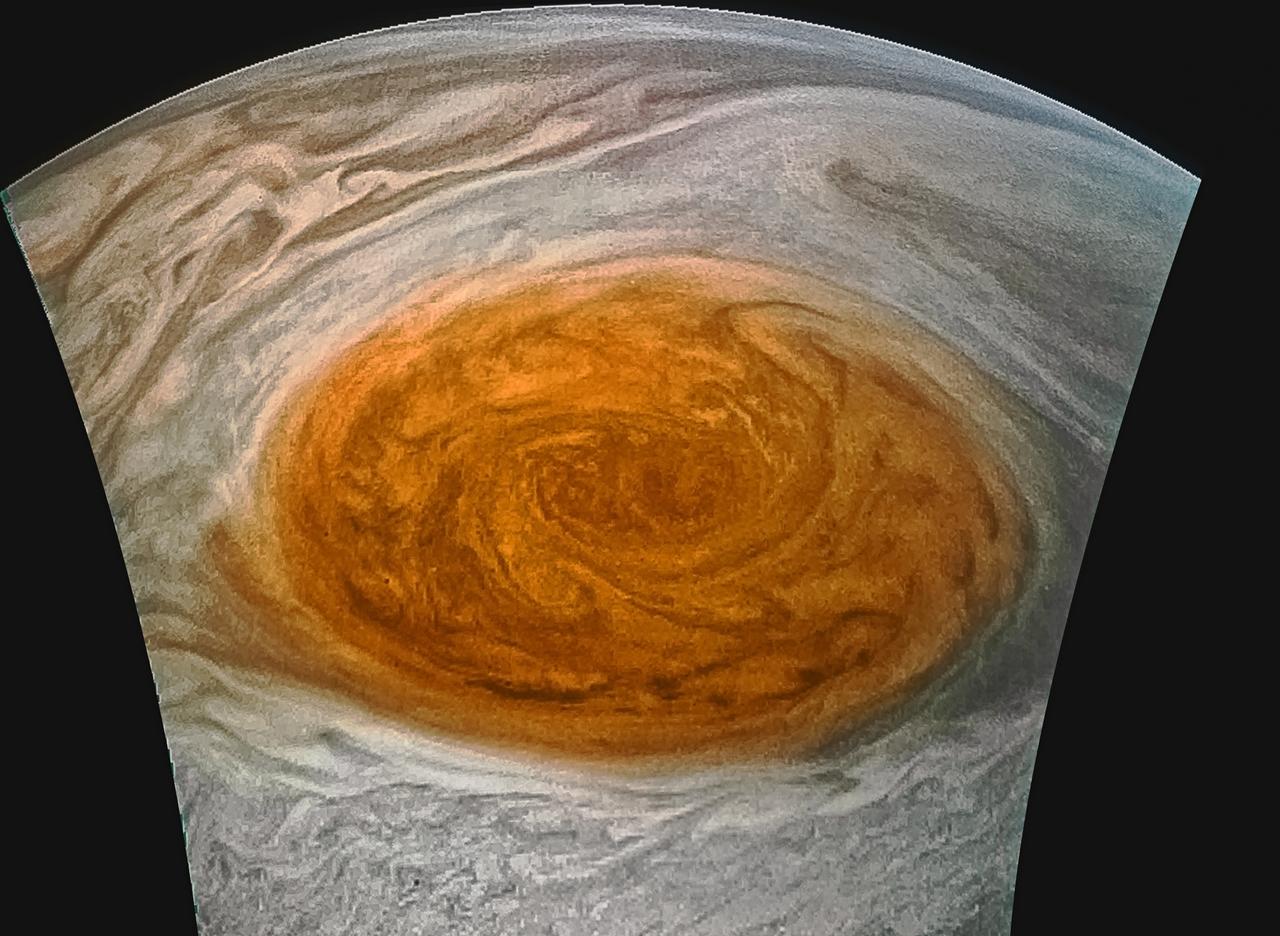
This enhanced-color image of Jupiter's Great Red Spot was created by citizen scientist Jason Major using data from the JunoCam imager on NASA's Juno spacecraft. The image was taken on July 10, 2017 at 07:10 p.m. PDT (10:10 p.m. EDT), as the Juno spacecraft performed its 7th close flyby of Jupiter. At the time the image was taken, the spacecraft was about 8,648 miles (13,917 kilometers) from the tops of the clouds of the planet. https://photojournal.jpl.nasa.gov/catalog/PIA21772 . - Enhanced image by Jason Major based on images provided courtesy of NASA/JPL-Caltech/SwRI/MSSS
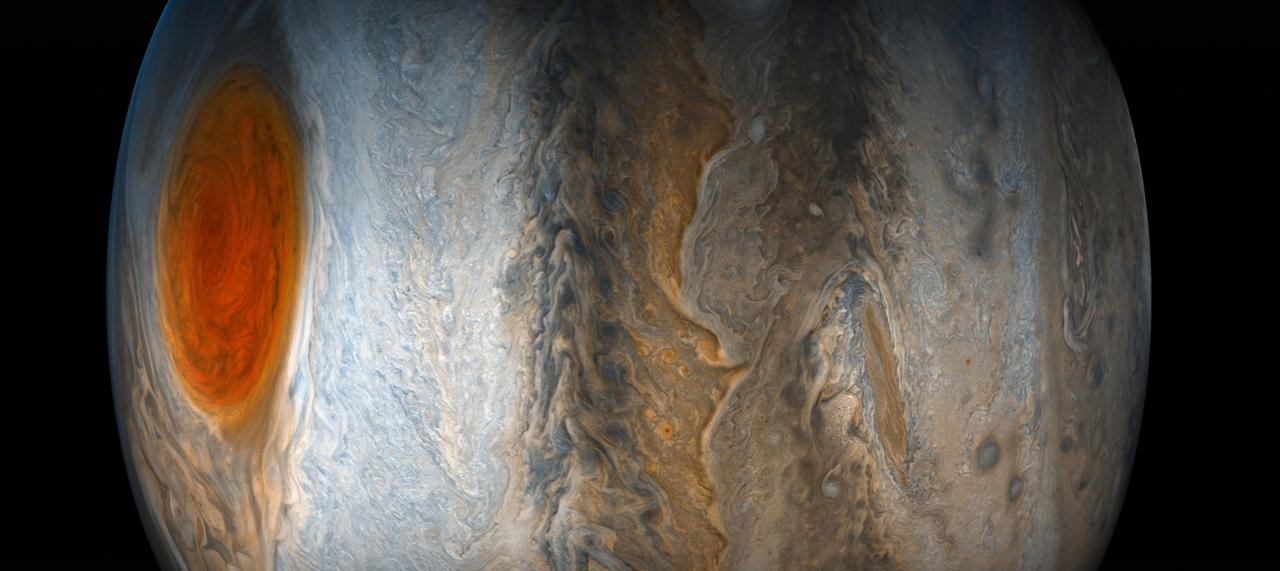
This striking Jovian vista was created by citizen scientists Gerald Eichstädt and Seán Doran using data from the JunoCam imager on NASA's Juno spacecraft. The tumultuous Great Red Spot is fading from Juno's view while the dynamic bands of the southern region of Jupiter come into focus. North is to the left of the image, and south is on the right. The image was taken on July 10, 2017 at 7:12 p.m. PDT (10:12 p.m. EDT), as the Juno spacecraft performed its seventh close flyby of Jupiter. At the time the image was taken, the spacecraft was 10,274 miles (16,535 kilometers) from the tops of the clouds of the planet at a latitude of -36.9 degrees. https://photojournal.jpl.nasa.gov/catalog/PIA21778 **Image Credit: Enhanced Image by Gerald Eichstädt and Seán Doran (CC BY-NC-SA) based on images provided courtesy of NASA/JPL-Caltech/SwRI/MSSS https://creativecommons.org/licenses/by-nc-sa/3.0/
This extraordinary view of Jupiter was captured by NASA's Juno spacecraft on the outbound leg of its 12th close flyby of the gas giant planet. This new perspective of Jupiter from the south makes the Great Red Spot appear as though it is in northern territory. This view is unique to Juno and demonstrates how different our view is when we step off the Earth and experience the true nature of our three-dimensional universe. Juno took the images used to produce this color-enhanced image on April 1 between 3:04 a.m. PDT (6:04 a.m. EDT) and 3:36 a.m. PDT (6:36 a.m. EDT). At the time the images were taken, the spacecraft was between 10,768 miles (17,329 kilometers) to 42,849 miles (68,959 kilometers) from the tops of the clouds of the planet at a southern latitude spanning 34.01 to 71.43 degrees. Citizen scientists Gerald Eichstädt and Seán Doran created this image using data from the spacecraft's JunoCam imager. The view is a composite of several separate JunoCam images that were re-projected, blended, and healed. https://photojournal.jpl.nasa.gov/catalog/PIA22421

This illustration depicts NASA's Juno spacecraft in orbit above Jupiter's Great Red Spot. https://photojournal.jpl.nasa.gov/catalog/PIA21770
![In the Spacecraft Assembly and Encapsulation Facility -2, workers help guide the <a href=http:__mars.jpl.nasa.gov_2001_>2001 Mars Odyssey Orbiter <_a>as it is lowered to a workstand. The Mars Odyssey Orbiter carries three science instruments: the Thermal Emission Imaging System (THEMIS), the Gamma Ray Spectrometer (GRS), and the Mars Radiation Environment Experiment (MARIE). THEMIS will map the mineralogy and morphology of the Martian surface using a high-resolution camera and a thermal infrared imaging spectrometer. The GRS will achieve global mapping of the elemental composition of the surface and determine the abundance of hydrogen in the shallow subsurface. [The GRS is a rebuild of the instrument lost with the Mars Observer mission.] The MARIE will characterize aspects of the near-space radiation environment as related to the radiation-related risk to human explorers. The Mars Odyssey Orbiter is scheduled for launch on April 7, 2001, aboard a Delta 7925 rocket from Launch Pad 17-A, Cape Canaveral Air Force Station](https://images-assets.nasa.gov/image/01pp0101/01pp0101~medium.jpg)
In the Spacecraft Assembly and Encapsulation Facility -2, workers help guide the <a href=http:__mars.jpl.nasa.gov_2001_>2001 Mars Odyssey Orbiter <_a>as it is lowered to a workstand. The Mars Odyssey Orbiter carries three science instruments: the Thermal Emission Imaging System (THEMIS), the Gamma Ray Spectrometer (GRS), and the Mars Radiation Environment Experiment (MARIE). THEMIS will map the mineralogy and morphology of the Martian surface using a high-resolution camera and a thermal infrared imaging spectrometer. The GRS will achieve global mapping of the elemental composition of the surface and determine the abundance of hydrogen in the shallow subsurface. [The GRS is a rebuild of the instrument lost with the Mars Observer mission.] The MARIE will characterize aspects of the near-space radiation environment as related to the radiation-related risk to human explorers. The Mars Odyssey Orbiter is scheduled for launch on April 7, 2001, aboard a Delta 7925 rocket from Launch Pad 17-A, Cape Canaveral Air Force Station
![In the Spacecraft Assembly and Encapsulation Facility -2, workers help guide the solar array from the 2001 Mars Odyssey Orbiter onto a workstand. This will give workers access to other components of the spacecraft and allow inspection of the array. The Mars Odyssey carries three science instruments: the Thermal Emission Imaging System (THEMIS), the Gamma Ray Spectrometer (GRS), and the Mars Radiation Environment Experiment (MARIE). THEMIS will map the mineralogy and morphology of the Martian surface using a high-resolution camera and a thermal infrared imaging spectrometer. The GRS will achieve global mapping of the elemental composition of the surface and determine the abundance of hydrogen in the shallow subsurface. [The GRS is a rebuild of the instrument lost with the Mars Observer mission.] The MARIE will characterize aspects of the near-space radiation environment as related to the radiation-related risk to human explorers. The Mars Odyssey Orbiter is scheduled for launch on April 7, 2001, aboard a Delta 7925 rocket from Launch Pad 17-A, Cape Canaveral Air Force Station](https://images-assets.nasa.gov/image/01pp0124/01pp0124~medium.jpg)
In the Spacecraft Assembly and Encapsulation Facility -2, workers help guide the solar array from the 2001 Mars Odyssey Orbiter onto a workstand. This will give workers access to other components of the spacecraft and allow inspection of the array. The Mars Odyssey carries three science instruments: the Thermal Emission Imaging System (THEMIS), the Gamma Ray Spectrometer (GRS), and the Mars Radiation Environment Experiment (MARIE). THEMIS will map the mineralogy and morphology of the Martian surface using a high-resolution camera and a thermal infrared imaging spectrometer. The GRS will achieve global mapping of the elemental composition of the surface and determine the abundance of hydrogen in the shallow subsurface. [The GRS is a rebuild of the instrument lost with the Mars Observer mission.] The MARIE will characterize aspects of the near-space radiation environment as related to the radiation-related risk to human explorers. The Mars Odyssey Orbiter is scheduled for launch on April 7, 2001, aboard a Delta 7925 rocket from Launch Pad 17-A, Cape Canaveral Air Force Station
![In the Spacecraft Assembly and Encapsulation Facility -2, the solar array from the 2001 Mars Odyssey Orbiter is moved toward a workstand. This will give workers access to other components of the spacecraft and allow inspection of the array. The Mars Odyssey carries three science instruments: the Thermal Emission Imaging System (THEMIS), the Gamma Ray Spectrometer (GRS), and the Mars Radiation Environment Experiment (MARIE). THEMIS will map the mineralogy and morphology of the Martian surface using a high-resolution camera and a thermal infrared imaging spectrometer. The GRS will achieve global mapping of the elemental composition of the surface and determine the abundance of hydrogen in the shallow subsurface. [The GRS is a rebuild of the instrument lost with the Mars Observer mission.] The MARIE will characterize aspects of the near-space radiation environment as related to the radiation-related risk to human explorers. The Mars Odyssey Orbiter is scheduled for launch on April 7, 2001, aboard a Delta 7925 rocket from Launch Pad 17-A, Cape Canaveral Air Force Station](https://images-assets.nasa.gov/image/01pp0123/01pp0123~medium.jpg)
In the Spacecraft Assembly and Encapsulation Facility -2, the solar array from the 2001 Mars Odyssey Orbiter is moved toward a workstand. This will give workers access to other components of the spacecraft and allow inspection of the array. The Mars Odyssey carries three science instruments: the Thermal Emission Imaging System (THEMIS), the Gamma Ray Spectrometer (GRS), and the Mars Radiation Environment Experiment (MARIE). THEMIS will map the mineralogy and morphology of the Martian surface using a high-resolution camera and a thermal infrared imaging spectrometer. The GRS will achieve global mapping of the elemental composition of the surface and determine the abundance of hydrogen in the shallow subsurface. [The GRS is a rebuild of the instrument lost with the Mars Observer mission.] The MARIE will characterize aspects of the near-space radiation environment as related to the radiation-related risk to human explorers. The Mars Odyssey Orbiter is scheduled for launch on April 7, 2001, aboard a Delta 7925 rocket from Launch Pad 17-A, Cape Canaveral Air Force Station
![In the Spacecraft Assembly and Encapsulation Facility -2, workers help guide the <a href='http:__mars.jpl.nasa.gov_2001_'>2001 Mars Odyssey Orbiter <_a> to a workstand (left). The spacecraft carries three science instruments: the Thermal Emission Imaging System (THEMIS), the Gamma Ray Spectrometer (GRS), and the Mars Radiation Environment Experiment (MARIE). THEMIS will map the mineralogy and morphology of the Martian surface using a high-resolution camera and a thermal infrared imaging spectrometer. The GRS will achieve global mapping of the elemental composition of the surface and determine the abundance of hydrogen in the shallow subsurface. [The GRS is a rebuild of the instrument lost with the Mars Observer mission.] The MARIE will characterize aspects of the near-space radiation environment as related to the radiation-related risk to human explorers. The Mars Odyssey Orbiter is scheduled for launch on April 7, 2001, aboard a Delta 7925 rocket from Launch Pad 17-A, Cape Canaveral Air Force Station](https://images-assets.nasa.gov/image/01pp0099/01pp0099~medium.jpg)
In the Spacecraft Assembly and Encapsulation Facility -2, workers help guide the <a href='http:__mars.jpl.nasa.gov_2001_'>2001 Mars Odyssey Orbiter <_a> to a workstand (left). The spacecraft carries three science instruments: the Thermal Emission Imaging System (THEMIS), the Gamma Ray Spectrometer (GRS), and the Mars Radiation Environment Experiment (MARIE). THEMIS will map the mineralogy and morphology of the Martian surface using a high-resolution camera and a thermal infrared imaging spectrometer. The GRS will achieve global mapping of the elemental composition of the surface and determine the abundance of hydrogen in the shallow subsurface. [The GRS is a rebuild of the instrument lost with the Mars Observer mission.] The MARIE will characterize aspects of the near-space radiation environment as related to the radiation-related risk to human explorers. The Mars Odyssey Orbiter is scheduled for launch on April 7, 2001, aboard a Delta 7925 rocket from Launch Pad 17-A, Cape Canaveral Air Force Station
![The <a href=http://mars.jpl.nasa.gov/2001/>2001 Mars Odyssey Orbiter </a>comes to rest on a workstand in the Spacecraft Assembly & Encapsulation Facility -2. Workers check the spacecraft’s position. The Mars Odyssey Orbiter carries three science instruments: the Thermal Emission Imaging System (THEMIS), the Gamma Ray Spectrometer (GRS), and the Mars Radiation Environment Experiment (MARIE). THEMIS will map the mineralogy and morphology of the Martian surface using a high-resolution camera and a thermal infrared imaging spectrometer. The GRS will achieve global mapping of the elemental composition of the surface and determine the abundance of hydrogen in the shallow subsurface. [The GRS is a rebuild of the instrument lost with the Mars Observer mission.] The MARIE will characterize aspects of the near-space radiation environment as related to the radiation-related risk to human explorers. The Mars Odyssey Orbiter is scheduled for launch on April 7, 2001, aboard a Delta 7925 rocket from Launch Pad 17-A, Cape Canaveral Air Force Station](https://images-assets.nasa.gov/image/KSC01pp0102/KSC01pp0102~medium.jpg)
The <a href=http://mars.jpl.nasa.gov/2001/>2001 Mars Odyssey Orbiter </a>comes to rest on a workstand in the Spacecraft Assembly & Encapsulation Facility -2. Workers check the spacecraft’s position. The Mars Odyssey Orbiter carries three science instruments: the Thermal Emission Imaging System (THEMIS), the Gamma Ray Spectrometer (GRS), and the Mars Radiation Environment Experiment (MARIE). THEMIS will map the mineralogy and morphology of the Martian surface using a high-resolution camera and a thermal infrared imaging spectrometer. The GRS will achieve global mapping of the elemental composition of the surface and determine the abundance of hydrogen in the shallow subsurface. [The GRS is a rebuild of the instrument lost with the Mars Observer mission.] The MARIE will characterize aspects of the near-space radiation environment as related to the radiation-related risk to human explorers. The Mars Odyssey Orbiter is scheduled for launch on April 7, 2001, aboard a Delta 7925 rocket from Launch Pad 17-A, Cape Canaveral Air Force Station
![Workers in the Spacecraft Assembly & Encapsulation Facility -2 take a close look at the back side of the opened solar array panels from the 2001 Mars Odyssey Orbiter. The Mars Odyssey carries three science instruments: the Thermal Emission Imaging System (THEMIS), the Gamma Ray Spectrometer (GRS), and the Mars Radiation Environment Experiment (MARIE). THEMIS will map the mineralogy and morphology of the Martian surface using a high-resolution camera and a thermal infrared imaging spectrometer. The GRS will achieve global mapping of the elemental composition of the surface and determine the abundance of hydrogen in the shallow subsurface. [The GRS is a rebuild of the instrument lost with the Mars Observer mission.] The MARIE will characterize aspects of the near-space radiation environment as related to the radiation-related risk to human explorers. The Mars Odyssey Orbiter is scheduled for launch on April 7, 2001, aboard a Delta 7925 rocket from Launch Pad 17-A, Cape Canaveral Air Force Station](https://images-assets.nasa.gov/image/KSC01pp0160/KSC01pp0160~medium.jpg)
Workers in the Spacecraft Assembly & Encapsulation Facility -2 take a close look at the back side of the opened solar array panels from the 2001 Mars Odyssey Orbiter. The Mars Odyssey carries three science instruments: the Thermal Emission Imaging System (THEMIS), the Gamma Ray Spectrometer (GRS), and the Mars Radiation Environment Experiment (MARIE). THEMIS will map the mineralogy and morphology of the Martian surface using a high-resolution camera and a thermal infrared imaging spectrometer. The GRS will achieve global mapping of the elemental composition of the surface and determine the abundance of hydrogen in the shallow subsurface. [The GRS is a rebuild of the instrument lost with the Mars Observer mission.] The MARIE will characterize aspects of the near-space radiation environment as related to the radiation-related risk to human explorers. The Mars Odyssey Orbiter is scheduled for launch on April 7, 2001, aboard a Delta 7925 rocket from Launch Pad 17-A, Cape Canaveral Air Force Station
![In the Spacecraft Assembly & Encapsulation Facility -2, workers help guide the <a href=http://mars.jpl.nasa.gov/2001/>2001 Mars Odyssey Orbiter </a>as it is lowered to a workstand. The Mars Odyssey Orbiter carries three science instruments: the Thermal Emission Imaging System (THEMIS), the Gamma Ray Spectrometer (GRS), and the Mars Radiation Environment Experiment (MARIE). THEMIS will map the mineralogy and morphology of the Martian surface using a high-resolution camera and a thermal infrared imaging spectrometer. The GRS will achieve global mapping of the elemental composition of the surface and determine the abundance of hydrogen in the shallow subsurface. [The GRS is a rebuild of the instrument lost with the Mars Observer mission.] The MARIE will characterize aspects of the near-space radiation environment as related to the radiation-related risk to human explorers. The Mars Odyssey Orbiter is scheduled for launch on April 7, 2001, aboard a Delta 7925 rocket from Launch Pad 17-A, Cape Canaveral Air Force Station](https://images-assets.nasa.gov/image/KSC01pp0101/KSC01pp0101~medium.jpg)
In the Spacecraft Assembly & Encapsulation Facility -2, workers help guide the <a href=http://mars.jpl.nasa.gov/2001/>2001 Mars Odyssey Orbiter </a>as it is lowered to a workstand. The Mars Odyssey Orbiter carries three science instruments: the Thermal Emission Imaging System (THEMIS), the Gamma Ray Spectrometer (GRS), and the Mars Radiation Environment Experiment (MARIE). THEMIS will map the mineralogy and morphology of the Martian surface using a high-resolution camera and a thermal infrared imaging spectrometer. The GRS will achieve global mapping of the elemental composition of the surface and determine the abundance of hydrogen in the shallow subsurface. [The GRS is a rebuild of the instrument lost with the Mars Observer mission.] The MARIE will characterize aspects of the near-space radiation environment as related to the radiation-related risk to human explorers. The Mars Odyssey Orbiter is scheduled for launch on April 7, 2001, aboard a Delta 7925 rocket from Launch Pad 17-A, Cape Canaveral Air Force Station
![The <a href=http:__mars.jpl.nasa.gov_2001_>2001 Mars Odyssey Orbiter<_a> is safely placed on a workstand in the Spacecraft Assembly and Encapsulation Facility -2. The Mars Odyssey Orbiter carries three science instruments: the Thermal Emission Imaging System (THEMIS), the Gamma Ray Spectrometer (GRS), and the Mars Radiation Environment Experiment (MARIE). THEMIS will map the mineralogy and morphology of the Martian surface using a high-resolution camera and a thermal infrared imaging spectrometer. The GRS will achieve global mapping of the elemental composition of the surface and determine the abundance of hydrogen in the shallow subsurface. [The GRS is a rebuild of the instrument lost with the Mars Observer mission.] The MARIE will characterize aspects of the near-space radiation environment as related to the radiation-related risk to human explorers. The Mars Odyssey Orbiter is scheduled for launch on April 7, 2001, aboard a Delta 7925 rocket from Launch Pad 17-A, Cape Canaveral Air Force Station](https://images-assets.nasa.gov/image/01pp0103/01pp0103~medium.jpg)
The <a href=http:__mars.jpl.nasa.gov_2001_>2001 Mars Odyssey Orbiter<_a> is safely placed on a workstand in the Spacecraft Assembly and Encapsulation Facility -2. The Mars Odyssey Orbiter carries three science instruments: the Thermal Emission Imaging System (THEMIS), the Gamma Ray Spectrometer (GRS), and the Mars Radiation Environment Experiment (MARIE). THEMIS will map the mineralogy and morphology of the Martian surface using a high-resolution camera and a thermal infrared imaging spectrometer. The GRS will achieve global mapping of the elemental composition of the surface and determine the abundance of hydrogen in the shallow subsurface. [The GRS is a rebuild of the instrument lost with the Mars Observer mission.] The MARIE will characterize aspects of the near-space radiation environment as related to the radiation-related risk to human explorers. The Mars Odyssey Orbiter is scheduled for launch on April 7, 2001, aboard a Delta 7925 rocket from Launch Pad 17-A, Cape Canaveral Air Force Station
![The <a href=http:__mars.jpl.nasa.gov_2001_>2001 Mars Odyssey Orbiter <_a>comes to rest on a workstand in the Spacecraft Assembly and Encapsulation Facility -2. Workers check the spacecraft’s position. The Mars Odyssey Orbiter carries three science instruments: the Thermal Emission Imaging System (THEMIS), the Gamma Ray Spectrometer (GRS), and the Mars Radiation Environment Experiment (MARIE). THEMIS will map the mineralogy and morphology of the Martian surface using a high-resolution camera and a thermal infrared imaging spectrometer. The GRS will achieve global mapping of the elemental composition of the surface and determine the abundance of hydrogen in the shallow subsurface. [The GRS is a rebuild of the instrument lost with the Mars Observer mission.] The MARIE will characterize aspects of the near-space radiation environment as related to the radiation-related risk to human explorers. The Mars Odyssey Orbiter is scheduled for launch on April 7, 2001, aboard a Delta 7925 rocket from Launch Pad 17-A, Cape Canaveral Air Force Station](https://images-assets.nasa.gov/image/01pp0102/01pp0102~medium.jpg)
The <a href=http:__mars.jpl.nasa.gov_2001_>2001 Mars Odyssey Orbiter <_a>comes to rest on a workstand in the Spacecraft Assembly and Encapsulation Facility -2. Workers check the spacecraft’s position. The Mars Odyssey Orbiter carries three science instruments: the Thermal Emission Imaging System (THEMIS), the Gamma Ray Spectrometer (GRS), and the Mars Radiation Environment Experiment (MARIE). THEMIS will map the mineralogy and morphology of the Martian surface using a high-resolution camera and a thermal infrared imaging spectrometer. The GRS will achieve global mapping of the elemental composition of the surface and determine the abundance of hydrogen in the shallow subsurface. [The GRS is a rebuild of the instrument lost with the Mars Observer mission.] The MARIE will characterize aspects of the near-space radiation environment as related to the radiation-related risk to human explorers. The Mars Odyssey Orbiter is scheduled for launch on April 7, 2001, aboard a Delta 7925 rocket from Launch Pad 17-A, Cape Canaveral Air Force Station
![In the Spacecraft Assembly & Encapsulation Facility -2, workers help guide the <a href="http://mars.jpl.nasa.gov/2001/">2001 Mars Odyssey Orbiter </a> to a workstand (left). The spacecraft carries three science instruments: the Thermal Emission Imaging System (THEMIS), the Gamma Ray Spectrometer (GRS), and the Mars Radiation Environment Experiment (MARIE). THEMIS will map the mineralogy and morphology of the Martian surface using a high-resolution camera and a thermal infrared imaging spectrometer. The GRS will achieve global mapping of the elemental composition of the surface and determine the abundance of hydrogen in the shallow subsurface. [The GRS is a rebuild of the instrument lost with the Mars Observer mission.] The MARIE will characterize aspects of the near-space radiation environment as related to the radiation-related risk to human explorers. The Mars Odyssey Orbiter is scheduled for launch on April 7, 2001, aboard a Delta 7925 rocket from Launch Pad 17-A, Cape Canaveral Air Force Station](https://images-assets.nasa.gov/image/KSC01pp0099/KSC01pp0099~medium.jpg)
In the Spacecraft Assembly & Encapsulation Facility -2, workers help guide the <a href="http://mars.jpl.nasa.gov/2001/">2001 Mars Odyssey Orbiter </a> to a workstand (left). The spacecraft carries three science instruments: the Thermal Emission Imaging System (THEMIS), the Gamma Ray Spectrometer (GRS), and the Mars Radiation Environment Experiment (MARIE). THEMIS will map the mineralogy and morphology of the Martian surface using a high-resolution camera and a thermal infrared imaging spectrometer. The GRS will achieve global mapping of the elemental composition of the surface and determine the abundance of hydrogen in the shallow subsurface. [The GRS is a rebuild of the instrument lost with the Mars Observer mission.] The MARIE will characterize aspects of the near-space radiation environment as related to the radiation-related risk to human explorers. The Mars Odyssey Orbiter is scheduled for launch on April 7, 2001, aboard a Delta 7925 rocket from Launch Pad 17-A, Cape Canaveral Air Force Station
![In the Spacecraft Assembly and Encapsulation Facility -2, workers oversee removal of the solar array on the 2001 Mars Odyssey Orbiter to a nearby workstand. This will give workers access to other components of the spacecraft and allow inspection of the array. The Mars Odyssey carries three science instruments: the Thermal Emission Imaging System (THEMIS), the Gamma Ray Spectrometer (GRS), and the Mars Radiation Environment Experiment (MARIE). THEMIS will map the mineralogy and morphology of the Martian surface using a high-resolution camera and a thermal infrared imaging spectrometer. The GRS will achieve global mapping of the elemental composition of the surface and determine the abundance of hydrogen in the shallow subsurface. [The GRS is a rebuild of the instrument lost with the Mars Observer mission.] The MARIE will characterize aspects of the near-space radiation environment as related to the radiation-related risk to human explorers. The Mars Odyssey Orbiter is scheduled for launch on April 7, 2001, aboard a Delta 7925 rocket from Launch Pad 17-A, Cape Canaveral Air Force Station](https://images-assets.nasa.gov/image/01pp0121/01pp0121~medium.jpg)
In the Spacecraft Assembly and Encapsulation Facility -2, workers oversee removal of the solar array on the 2001 Mars Odyssey Orbiter to a nearby workstand. This will give workers access to other components of the spacecraft and allow inspection of the array. The Mars Odyssey carries three science instruments: the Thermal Emission Imaging System (THEMIS), the Gamma Ray Spectrometer (GRS), and the Mars Radiation Environment Experiment (MARIE). THEMIS will map the mineralogy and morphology of the Martian surface using a high-resolution camera and a thermal infrared imaging spectrometer. The GRS will achieve global mapping of the elemental composition of the surface and determine the abundance of hydrogen in the shallow subsurface. [The GRS is a rebuild of the instrument lost with the Mars Observer mission.] The MARIE will characterize aspects of the near-space radiation environment as related to the radiation-related risk to human explorers. The Mars Odyssey Orbiter is scheduled for launch on April 7, 2001, aboard a Delta 7925 rocket from Launch Pad 17-A, Cape Canaveral Air Force Station
![In the Spacecraft Assembly & Encapsulation Facility -2, workers help guide the solar array from the 2001 Mars Odyssey Orbiter onto a workstand. This will give workers access to other components of the spacecraft and allow inspection of the array. The Mars Odyssey carries three science instruments: the Thermal Emission Imaging System (THEMIS), the Gamma Ray Spectrometer (GRS), and the Mars Radiation Environment Experiment (MARIE). THEMIS will map the mineralogy and morphology of the Martian surface using a high-resolution camera and a thermal infrared imaging spectrometer. The GRS will achieve global mapping of the elemental composition of the surface and determine the abundance of hydrogen in the shallow subsurface. [The GRS is a rebuild of the instrument lost with the Mars Observer mission.] The MARIE will characterize aspects of the near-space radiation environment as related to the radiation-related risk to human explorers. The Mars Odyssey Orbiter is scheduled for launch on April 7, 2001, aboard a Delta 7925 rocket from Launch Pad 17-A, Cape Canaveral Air Force Station](https://images-assets.nasa.gov/image/KSC01pp0124/KSC01pp0124~medium.jpg)
In the Spacecraft Assembly & Encapsulation Facility -2, workers help guide the solar array from the 2001 Mars Odyssey Orbiter onto a workstand. This will give workers access to other components of the spacecraft and allow inspection of the array. The Mars Odyssey carries three science instruments: the Thermal Emission Imaging System (THEMIS), the Gamma Ray Spectrometer (GRS), and the Mars Radiation Environment Experiment (MARIE). THEMIS will map the mineralogy and morphology of the Martian surface using a high-resolution camera and a thermal infrared imaging spectrometer. The GRS will achieve global mapping of the elemental composition of the surface and determine the abundance of hydrogen in the shallow subsurface. [The GRS is a rebuild of the instrument lost with the Mars Observer mission.] The MARIE will characterize aspects of the near-space radiation environment as related to the radiation-related risk to human explorers. The Mars Odyssey Orbiter is scheduled for launch on April 7, 2001, aboard a Delta 7925 rocket from Launch Pad 17-A, Cape Canaveral Air Force Station
![In the Spacecraft Assembly & Encapsulation Facility -2, workers oversee removal of the solar array on the 2001 Mars Odyssey Orbiter to a nearby workstand. This will give workers access to other components of the spacecraft and allow inspection of the array. The Mars Odyssey carries three science instruments: the Thermal Emission Imaging System (THEMIS), the Gamma Ray Spectrometer (GRS), and the Mars Radiation Environment Experiment (MARIE). THEMIS will map the mineralogy and morphology of the Martian surface using a high-resolution camera and a thermal infrared imaging spectrometer. The GRS will achieve global mapping of the elemental composition of the surface and determine the abundance of hydrogen in the shallow subsurface. [The GRS is a rebuild of the instrument lost with the Mars Observer mission.] The MARIE will characterize aspects of the near-space radiation environment as related to the radiation-related risk to human explorers. The Mars Odyssey Orbiter is scheduled for launch on April 7, 2001, aboard a Delta 7925 rocket from Launch Pad 17-A, Cape Canaveral Air Force Station](https://images-assets.nasa.gov/image/KSC01pp0121/KSC01pp0121~medium.jpg)
In the Spacecraft Assembly & Encapsulation Facility -2, workers oversee removal of the solar array on the 2001 Mars Odyssey Orbiter to a nearby workstand. This will give workers access to other components of the spacecraft and allow inspection of the array. The Mars Odyssey carries three science instruments: the Thermal Emission Imaging System (THEMIS), the Gamma Ray Spectrometer (GRS), and the Mars Radiation Environment Experiment (MARIE). THEMIS will map the mineralogy and morphology of the Martian surface using a high-resolution camera and a thermal infrared imaging spectrometer. The GRS will achieve global mapping of the elemental composition of the surface and determine the abundance of hydrogen in the shallow subsurface. [The GRS is a rebuild of the instrument lost with the Mars Observer mission.] The MARIE will characterize aspects of the near-space radiation environment as related to the radiation-related risk to human explorers. The Mars Odyssey Orbiter is scheduled for launch on April 7, 2001, aboard a Delta 7925 rocket from Launch Pad 17-A, Cape Canaveral Air Force Station
![In the Spacecraft Assembly & Encapsulation Facility -2, the solar array from the 2001 Mars Odyssey Orbiter is moved toward a workstand. This will give workers access to other components of the spacecraft and allow inspection of the array. The Mars Odyssey carries three science instruments: the Thermal Emission Imaging System (THEMIS), the Gamma Ray Spectrometer (GRS), and the Mars Radiation Environment Experiment (MARIE). THEMIS will map the mineralogy and morphology of the Martian surface using a high-resolution camera and a thermal infrared imaging spectrometer. The GRS will achieve global mapping of the elemental composition of the surface and determine the abundance of hydrogen in the shallow subsurface. [The GRS is a rebuild of the instrument lost with the Mars Observer mission.] The MARIE will characterize aspects of the near-space radiation environment as related to the radiation-related risk to human explorers. The Mars Odyssey Orbiter is scheduled for launch on April 7, 2001, aboard a Delta 7925 rocket from Launch Pad 17-A, Cape Canaveral Air Force Station](https://images-assets.nasa.gov/image/KSC01pp0123/KSC01pp0123~medium.jpg)
In the Spacecraft Assembly & Encapsulation Facility -2, the solar array from the 2001 Mars Odyssey Orbiter is moved toward a workstand. This will give workers access to other components of the spacecraft and allow inspection of the array. The Mars Odyssey carries three science instruments: the Thermal Emission Imaging System (THEMIS), the Gamma Ray Spectrometer (GRS), and the Mars Radiation Environment Experiment (MARIE). THEMIS will map the mineralogy and morphology of the Martian surface using a high-resolution camera and a thermal infrared imaging spectrometer. The GRS will achieve global mapping of the elemental composition of the surface and determine the abundance of hydrogen in the shallow subsurface. [The GRS is a rebuild of the instrument lost with the Mars Observer mission.] The MARIE will characterize aspects of the near-space radiation environment as related to the radiation-related risk to human explorers. The Mars Odyssey Orbiter is scheduled for launch on April 7, 2001, aboard a Delta 7925 rocket from Launch Pad 17-A, Cape Canaveral Air Force Station
![Workers in the Spacecraft Assembly & Encapsulation Facility -2 open the solar array panels from the 2001 Mars Odyssey Orbiter, allowing inspection of the panels and giving them access to other components. The Mars Odyssey carries three science instruments: the Thermal Emission Imaging System (THEMIS), the Gamma Ray Spectrometer (GRS), and the Mars Radiation Environment Experiment (MARIE). THEMIS will map the mineralogy and morphology of the Martian surface using a high-resolution camera and a thermal infrared imaging spectrometer. The GRS will achieve global mapping of the elemental composition of the surface and determine the abundance of hydrogen in the shallow subsurface. [The GRS is a rebuild of the instrument lost with the Mars Observer mission.] The MARIE will characterize aspects of the near-space radiation environment as related to the radiation-related risk to human explorers. The Mars Odyssey Orbiter is scheduled for launch on April 7, 2001, aboard a Delta 7925 rocket from Launch Pad 17-A, Cape Canaveral Air Force Station](https://images-assets.nasa.gov/image/KSC01pp0158/KSC01pp0158~medium.jpg)
Workers in the Spacecraft Assembly & Encapsulation Facility -2 open the solar array panels from the 2001 Mars Odyssey Orbiter, allowing inspection of the panels and giving them access to other components. The Mars Odyssey carries three science instruments: the Thermal Emission Imaging System (THEMIS), the Gamma Ray Spectrometer (GRS), and the Mars Radiation Environment Experiment (MARIE). THEMIS will map the mineralogy and morphology of the Martian surface using a high-resolution camera and a thermal infrared imaging spectrometer. The GRS will achieve global mapping of the elemental composition of the surface and determine the abundance of hydrogen in the shallow subsurface. [The GRS is a rebuild of the instrument lost with the Mars Observer mission.] The MARIE will characterize aspects of the near-space radiation environment as related to the radiation-related risk to human explorers. The Mars Odyssey Orbiter is scheduled for launch on April 7, 2001, aboard a Delta 7925 rocket from Launch Pad 17-A, Cape Canaveral Air Force Station
![Workers in the Spacecraft Assembly and Encapsulation Facility -2 open the solar array panels from the 2001 Mars Odyssey Orbiter, allowing inspection of the panels and giving them access to other components. The Mars Odyssey carries three science instruments: the Thermal Emission Imaging System (THEMIS), the Gamma Ray Spectrometer (GRS), and the Mars Radiation Environment Experiment (MARIE). THEMIS will map the mineralogy and morphology of the Martian surface using a high-resolution camera and a thermal infrared imaging spectrometer. The GRS will achieve global mapping of the elemental composition of the surface and determine the abundance of hydrogen in the shallow subsurface. [The GRS is a rebuild of the instrument lost with the Mars Observer mission.] The MARIE will characterize aspects of the near-space radiation environment as related to the radiation-related risk to human explorers. The Mars Odyssey Orbiter is scheduled for launch on April 7, 2001, aboard a Delta 7925 rocket from Launch Pad 17-A, Cape Canaveral Air Force Station](https://images-assets.nasa.gov/image/01pp0158/01pp0158~medium.jpg)
Workers in the Spacecraft Assembly and Encapsulation Facility -2 open the solar array panels from the 2001 Mars Odyssey Orbiter, allowing inspection of the panels and giving them access to other components. The Mars Odyssey carries three science instruments: the Thermal Emission Imaging System (THEMIS), the Gamma Ray Spectrometer (GRS), and the Mars Radiation Environment Experiment (MARIE). THEMIS will map the mineralogy and morphology of the Martian surface using a high-resolution camera and a thermal infrared imaging spectrometer. The GRS will achieve global mapping of the elemental composition of the surface and determine the abundance of hydrogen in the shallow subsurface. [The GRS is a rebuild of the instrument lost with the Mars Observer mission.] The MARIE will characterize aspects of the near-space radiation environment as related to the radiation-related risk to human explorers. The Mars Odyssey Orbiter is scheduled for launch on April 7, 2001, aboard a Delta 7925 rocket from Launch Pad 17-A, Cape Canaveral Air Force Station
![The <a href=http://mars.jpl.nasa.gov/2001/>2001 Mars Odyssey Orbiter</a> is safely placed on a workstand in the Spacecraft Assembly & Encapsulation Facility -2. The Mars Odyssey Orbiter carries three science instruments: the Thermal Emission Imaging System (THEMIS), the Gamma Ray Spectrometer (GRS), and the Mars Radiation Environment Experiment (MARIE). THEMIS will map the mineralogy and morphology of the Martian surface using a high-resolution camera and a thermal infrared imaging spectrometer. The GRS will achieve global mapping of the elemental composition of the surface and determine the abundance of hydrogen in the shallow subsurface. [The GRS is a rebuild of the instrument lost with the Mars Observer mission.] The MARIE will characterize aspects of the near-space radiation environment as related to the radiation-related risk to human explorers. The Mars Odyssey Orbiter is scheduled for launch on April 7, 2001, aboard a Delta 7925 rocket from Launch Pad 17-A, Cape Canaveral Air Force Station](https://images-assets.nasa.gov/image/KSC01pp0103/KSC01pp0103~medium.jpg)
The <a href=http://mars.jpl.nasa.gov/2001/>2001 Mars Odyssey Orbiter</a> is safely placed on a workstand in the Spacecraft Assembly & Encapsulation Facility -2. The Mars Odyssey Orbiter carries three science instruments: the Thermal Emission Imaging System (THEMIS), the Gamma Ray Spectrometer (GRS), and the Mars Radiation Environment Experiment (MARIE). THEMIS will map the mineralogy and morphology of the Martian surface using a high-resolution camera and a thermal infrared imaging spectrometer. The GRS will achieve global mapping of the elemental composition of the surface and determine the abundance of hydrogen in the shallow subsurface. [The GRS is a rebuild of the instrument lost with the Mars Observer mission.] The MARIE will characterize aspects of the near-space radiation environment as related to the radiation-related risk to human explorers. The Mars Odyssey Orbiter is scheduled for launch on April 7, 2001, aboard a Delta 7925 rocket from Launch Pad 17-A, Cape Canaveral Air Force Station
![Workers in the Spacecraft Assembly & Encapsulation Facility -2 make a visual check of the front side of the opened solar array panels from the 2001 Mars Odyssey Orbiter. The Mars Odyssey carries three science instruments: the Thermal Emission Imaging System (THEMIS), the Gamma Ray Spectrometer (GRS), and the Mars Radiation Environment Experiment (MARIE). THEMIS will map the mineralogy and morphology of the Martian surface using a high-resolution camera and a thermal infrared imaging spectrometer. The GRS will achieve global mapping of the elemental composition of the surface and determine the abundance of hydrogen in the shallow subsurface. [The GRS is a rebuild of the instrument lost with the Mars Observer mission.] The MARIE will characterize aspects of the near-space radiation environment as related to the radiation-related risk to human explorers. The Mars Odyssey Orbiter is scheduled for launch on April 7, 2001, aboard a Delta 7925 rocket from Launch Pad 17-A, Cape Canaveral Air Force Station](https://images-assets.nasa.gov/image/KSC01pp0159/KSC01pp0159~medium.jpg)
Workers in the Spacecraft Assembly & Encapsulation Facility -2 make a visual check of the front side of the opened solar array panels from the 2001 Mars Odyssey Orbiter. The Mars Odyssey carries three science instruments: the Thermal Emission Imaging System (THEMIS), the Gamma Ray Spectrometer (GRS), and the Mars Radiation Environment Experiment (MARIE). THEMIS will map the mineralogy and morphology of the Martian surface using a high-resolution camera and a thermal infrared imaging spectrometer. The GRS will achieve global mapping of the elemental composition of the surface and determine the abundance of hydrogen in the shallow subsurface. [The GRS is a rebuild of the instrument lost with the Mars Observer mission.] The MARIE will characterize aspects of the near-space radiation environment as related to the radiation-related risk to human explorers. The Mars Odyssey Orbiter is scheduled for launch on April 7, 2001, aboard a Delta 7925 rocket from Launch Pad 17-A, Cape Canaveral Air Force Station
![Workers in the Spacecraft Assembly and Encapsulation Facility -2 make a visual check of the front side of the opened solar array panels from the 2001 Mars Odyssey Orbiter. The Mars Odyssey carries three science instruments: the Thermal Emission Imaging System (THEMIS), the Gamma Ray Spectrometer (GRS), and the Mars Radiation Environment Experiment (MARIE). THEMIS will map the mineralogy and morphology of the Martian surface using a high-resolution camera and a thermal infrared imaging spectrometer. The GRS will achieve global mapping of the elemental composition of the surface and determine the abundance of hydrogen in the shallow subsurface. [The GRS is a rebuild of the instrument lost with the Mars Observer mission.] The MARIE will characterize aspects of the near-space radiation environment as related to the radiation-related risk to human explorers. The Mars Odyssey Orbiter is scheduled for launch on April 7, 2001, aboard a Delta 7925 rocket from Launch Pad 17-A, Cape Canaveral Air Force Station](https://images-assets.nasa.gov/image/01pp0159/01pp0159~medium.jpg)
Workers in the Spacecraft Assembly and Encapsulation Facility -2 make a visual check of the front side of the opened solar array panels from the 2001 Mars Odyssey Orbiter. The Mars Odyssey carries three science instruments: the Thermal Emission Imaging System (THEMIS), the Gamma Ray Spectrometer (GRS), and the Mars Radiation Environment Experiment (MARIE). THEMIS will map the mineralogy and morphology of the Martian surface using a high-resolution camera and a thermal infrared imaging spectrometer. The GRS will achieve global mapping of the elemental composition of the surface and determine the abundance of hydrogen in the shallow subsurface. [The GRS is a rebuild of the instrument lost with the Mars Observer mission.] The MARIE will characterize aspects of the near-space radiation environment as related to the radiation-related risk to human explorers. The Mars Odyssey Orbiter is scheduled for launch on April 7, 2001, aboard a Delta 7925 rocket from Launch Pad 17-A, Cape Canaveral Air Force Station
![Workers in the Spacecraft Assembly and Encapsulation Facility -2 take a close look at the back side of the opened solar array panels from the 2001 Mars Odyssey Orbiter. The Mars Odyssey carries three science instruments: the Thermal Emission Imaging System (THEMIS), the Gamma Ray Spectrometer (GRS), and the Mars Radiation Environment Experiment (MARIE). THEMIS will map the mineralogy and morphology of the Martian surface using a high-resolution camera and a thermal infrared imaging spectrometer. The GRS will achieve global mapping of the elemental composition of the surface and determine the abundance of hydrogen in the shallow subsurface. [The GRS is a rebuild of the instrument lost with the Mars Observer mission.] The MARIE will characterize aspects of the near-space radiation environment as related to the radiation-related risk to human explorers. The Mars Odyssey Orbiter is scheduled for launch on April 7, 2001, aboard a Delta 7925 rocket from Launch Pad 17-A, Cape Canaveral Air Force Station](https://images-assets.nasa.gov/image/01pp0160/01pp0160~medium.jpg)
Workers in the Spacecraft Assembly and Encapsulation Facility -2 take a close look at the back side of the opened solar array panels from the 2001 Mars Odyssey Orbiter. The Mars Odyssey carries three science instruments: the Thermal Emission Imaging System (THEMIS), the Gamma Ray Spectrometer (GRS), and the Mars Radiation Environment Experiment (MARIE). THEMIS will map the mineralogy and morphology of the Martian surface using a high-resolution camera and a thermal infrared imaging spectrometer. The GRS will achieve global mapping of the elemental composition of the surface and determine the abundance of hydrogen in the shallow subsurface. [The GRS is a rebuild of the instrument lost with the Mars Observer mission.] The MARIE will characterize aspects of the near-space radiation environment as related to the radiation-related risk to human explorers. The Mars Odyssey Orbiter is scheduled for launch on April 7, 2001, aboard a Delta 7925 rocket from Launch Pad 17-A, Cape Canaveral Air Force Station

A Delta 7925 rocket on Launch Pad 17-A, Cape Canaveral Air Force Station, is being erected for launch April 7, 2001. The rocket will carry the 2001 Mars Odyssey Orbiter, containing three science instruments: THEMIS, the Gamma Ray Spectrometer (GRS), and the Mars Radiation Environment Experiment (MARIE). THEMIS will map the mineralogy and morphology of the Martian surface using a high-resolution camera and a thermal infrared imaging spectrometer. The GRS will achieve global mapping of the elemental composition of the surface and determine the abundance of hydrogen in the shallow subsurface. The MARIE will characterize aspects of the near-space radiation environment with regards to the radiation-related risk to human explorers
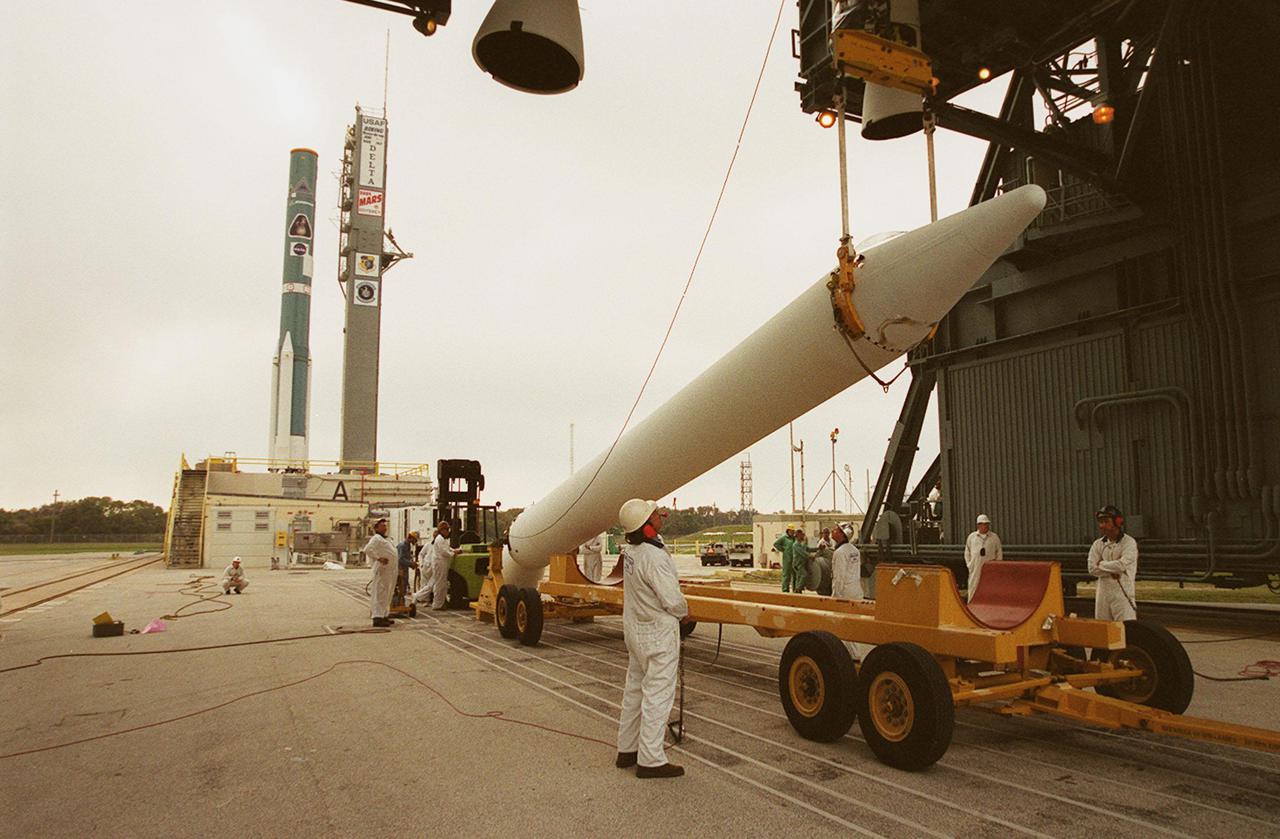
A crane lifts a solid rocket booster on Launch Pad 17-A, Cape Canaveral Air Force Station, where it will be mated with a Delta 7925 rocket for launch April 7, 2001. The rocket will carry the 2001 Mars Odyssey Orbiter, containing three science instruments: THEMIS, the Gamma Ray Spectrometer (GRS), and the Mars Radiation Environment Experiment (MARIE). THEMIS will map the mineralogy and morphology of the Martian surface using a high-resolution camera and a thermal infrared imaging spectrometer. The GRS will achieve global mapping of the elemental composition of the surface and determine the abundance of hydrogen in the shallow subsurface. The MARIE will characterize aspects of the near-space radiation environment with regards to the radiation-related risk to human explorers
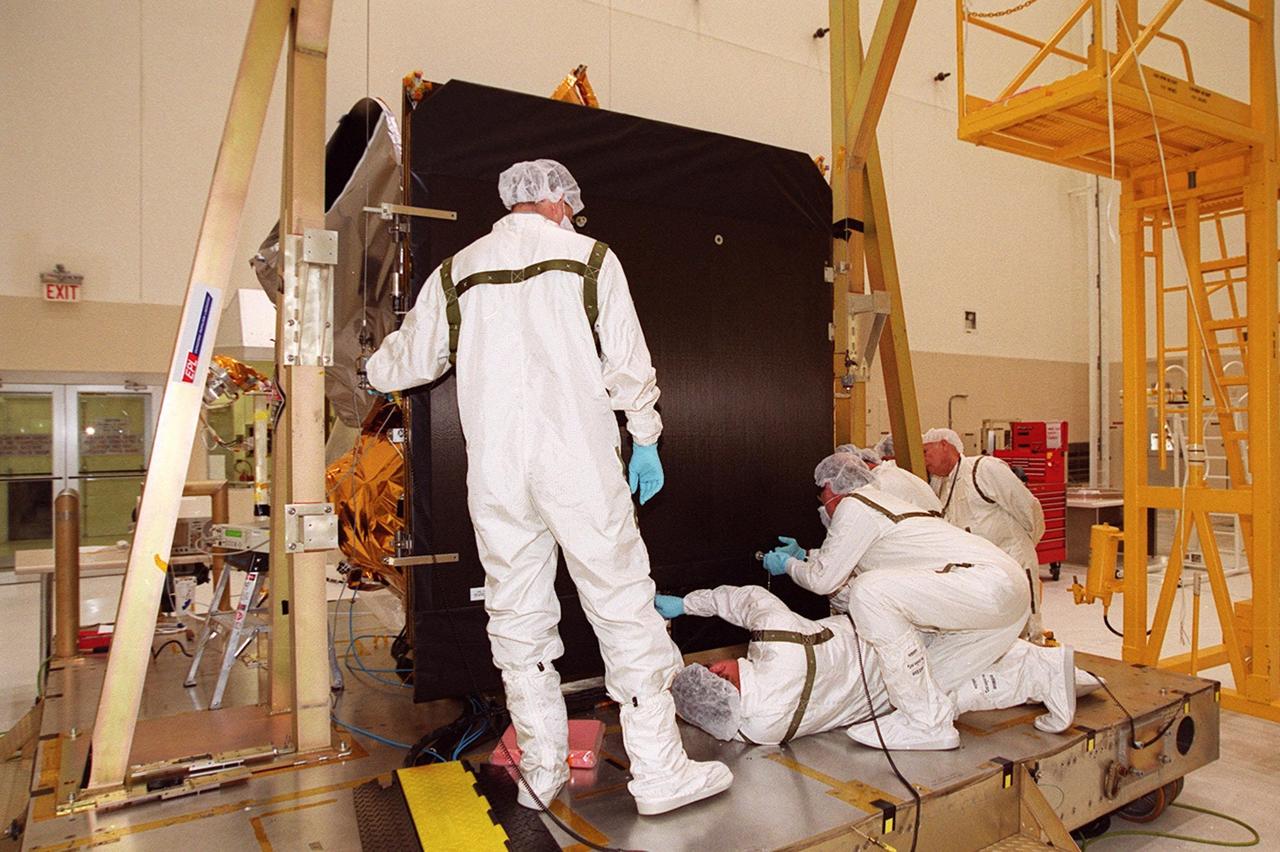
Workers in the Spacecraft Assembly and Encapsulation Facility (SAEF 2) reattach the solar panel on the 2001 Mars Odyssey Orbiter in order to conduct illumination testing. Scheduled for launch April 7, 2001, the orbiter contains three science instruments: THEMIS, the Gamma Ray Spectrometer (GRS), and the Mars Radiation Environment Experiment (MARIE). THEMIS will map the mineralogy and morphology of the Martian surface using a high-resolution camera and a thermal infrared imaging spectrometer. The GRS will achieve global mapping of the elemental composition of the surface and determine the abundance of hydrogen in the shallow subsurface. The MARIE will characterize aspects of the near-space radiation environment with regards to the radiation-related risk to human explorers
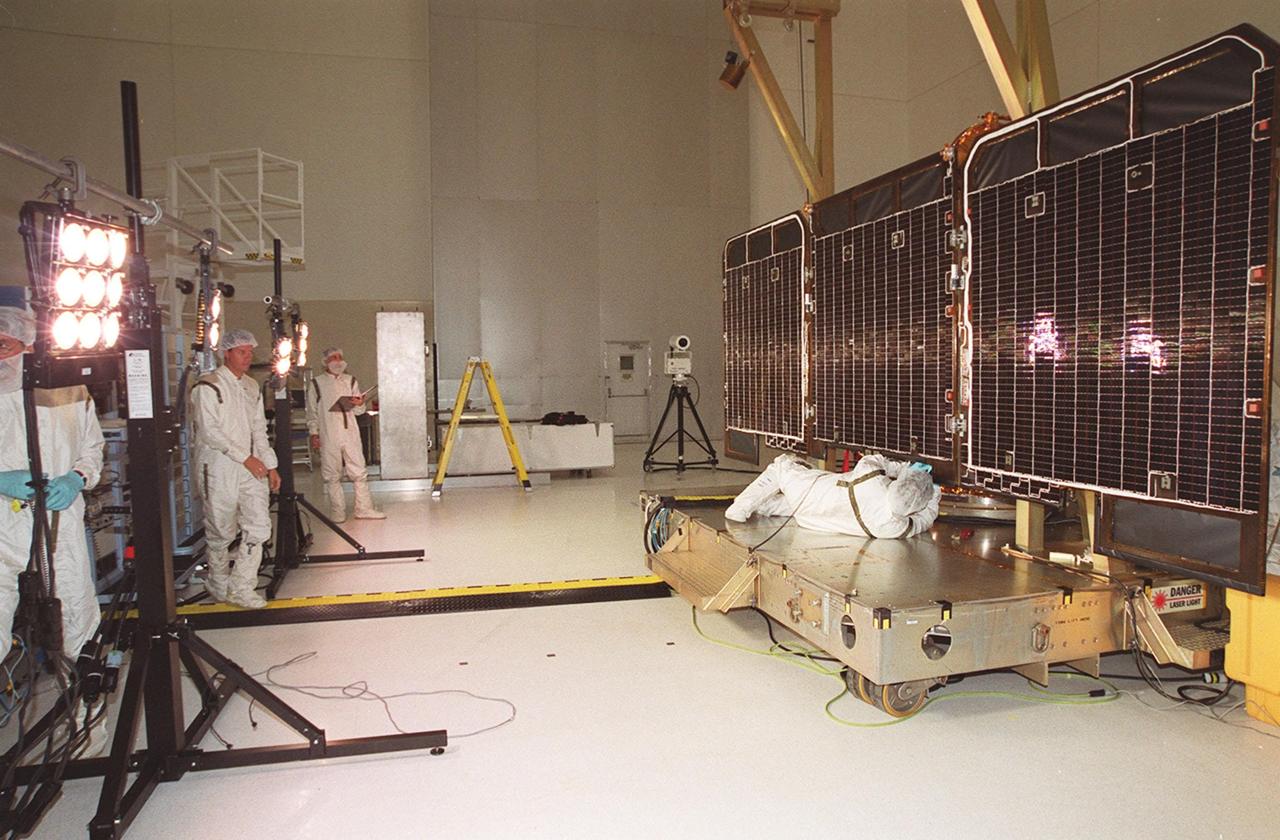
Arrays of lights (left) in the Spacecraft Assembly and Encapsulation Facility (SAEF 2) are used for illumination testing on the solar array panels at right. The panels are part of on the 2001 Mars Odyssey Orbiter. Scheduled for launch April 7, 2001, the orbiter contains three science instruments: THEMIS, the Gamma Ray Spectrometer (GRS), and the Mars Radiation Environment Experiment (MARIE). THEMIS will map the mineralogy and morphology of the Martian surface using a high-resolution camera and a thermal infrared imaging spectrometer. The GRS will achieve global mapping of the elemental composition of the surface and determine the abundance of hydrogen in the shallow subsurface. The MARIE will characterize aspects of the near-space radiation environment with regards to the radiation-related risk to human explorers
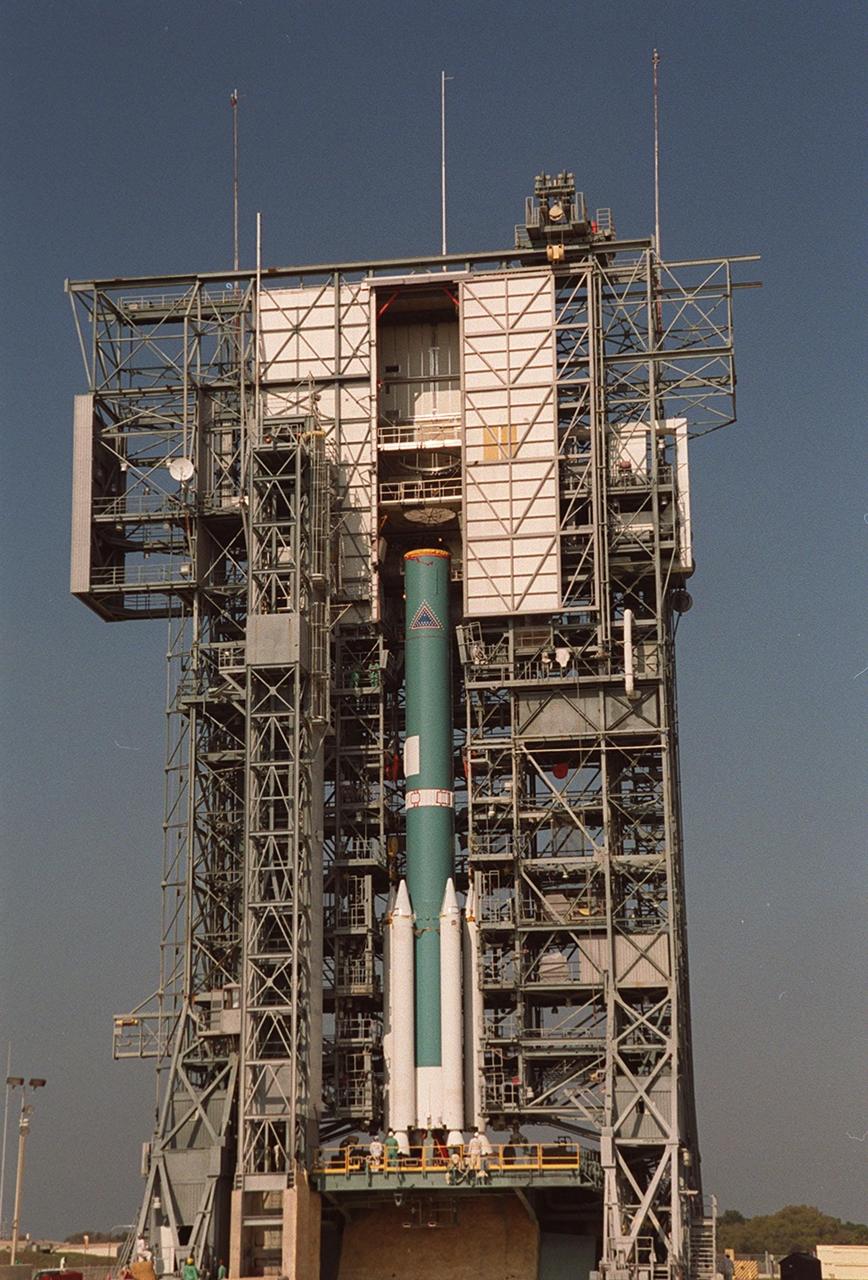
The moveable gantry closes in on a Delta 7925 rocket, bringing an additional three solid rocket boosters for mating to the rocket. Scheduled to launch April 7, 2001, the rocket will carry the 2001 Mars Odyssey Orbiter, containing three science instruments: THEMIS, the Gamma Ray Spectrometer (GRS), and the Mars Radiation Environment Experiment (MARIE). THEMIS will map the mineralogy and morphology of the Martian surface using a high-resolution camera and a thermal infrared imaging spectrometer. The GRS will achieve global mapping of the elemental composition of the surface and determine the abundance of hydrogen in the shallow subsurface. The MARIE will characterize aspects of the near-space radiation environment with regards to the radiation-related risk to human explorers

On Launch Pad 17-A, Cape Canaveral Air Force Station, workers maneuver the first stage of a Boeing Delta rocket into a vertical position . The rocket will carry the 2001 Mars Odyssey Orbiter, scheduled for launch April 7, 2001. Mars Odyssey contains three science instruments: THEMIS, the Gamma Ray Spectrometer (GRS), and the Mars Radiation Environment Experiment (MARIE). THEMIS will map the mineralogy and morphology of the Martian surface using a high-resolution camera and a thermal infrared imaging spectrometer. The GRS will achieve global mapping of the elemental composition of the surface and determine the abundance of hydrogen in the shallow subsurface. The MARIE will characterize aspects of the near-space radiation environment with regards to the radiation-related risk to human explorers
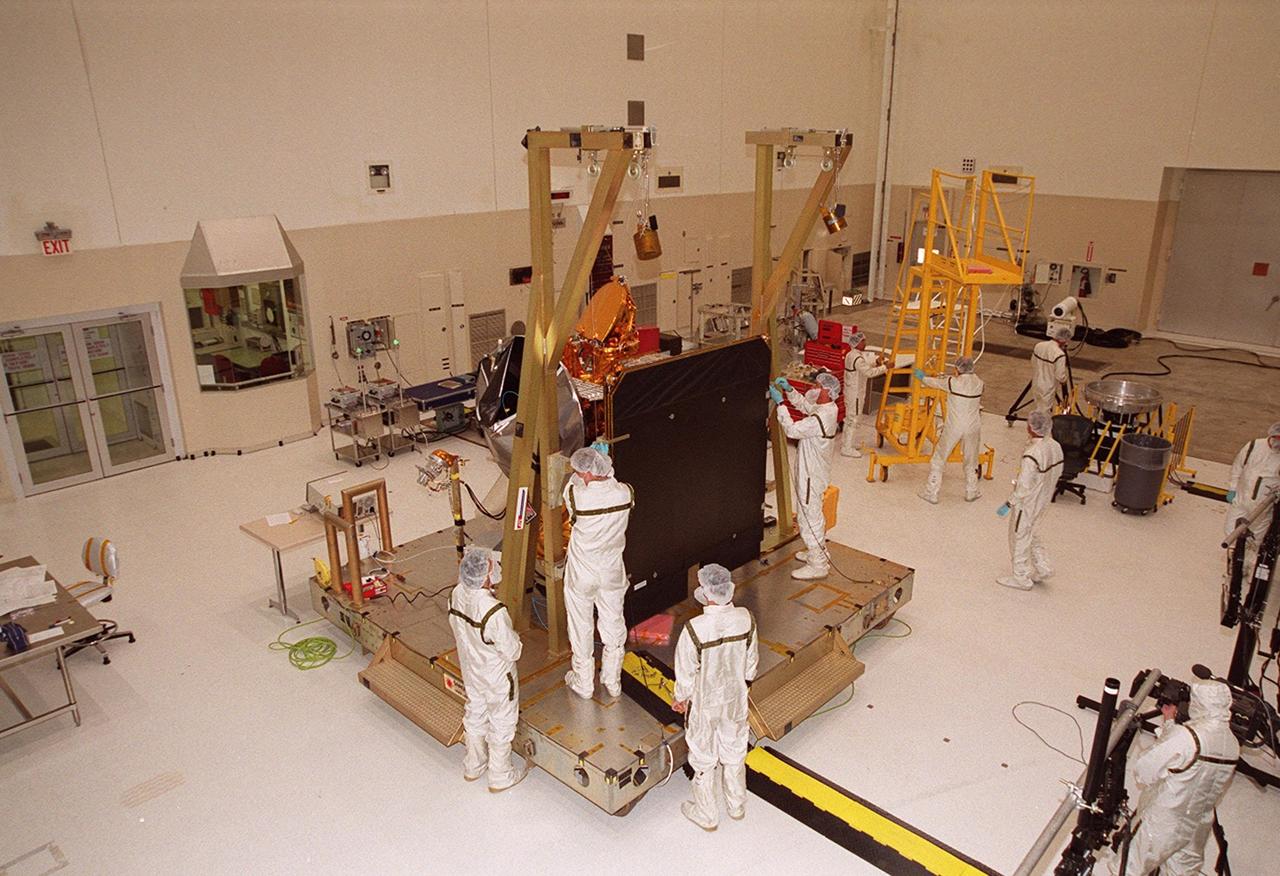
In the Spacecraft Assembly and Encapsulation Facility (SAEF 2), workers get ready to open the panels of the solar array on the 2001 Mars Odyssey Orbiter in order to conduct illumination testing. Scheduled for launch April 7, 2001, the orbiter contains three science instruments: THEMIS, the Gamma Ray Spectrometer (GRS), and the Mars Radiation Environment Experiment (MARIE). THEMIS will map the mineralogy and morphology of the Martian surface using a high-resolution camera and a thermal infrared imaging spectrometer. The GRS will achieve global mapping of the elemental composition of the surface and determine the abundance of hydrogen in the shallow subsurface. The MARIE will characterize aspects of the near-space radiation environment with regards to the radiation-related risk to human explorers

The first stage of a Boeing Delta rocket arrives on Launch Pad 17-A, Cape Canaveral Air Force Station. The rocket will carry the 2001 Mars Odyssey Orbiter, scheduled for launch April 7, 2001. Mars Odyssey contains three science instruments: THEMIS, the Gamma Ray Spectrometer (GRS), and the Mars Radiation Environment Experiment (MARIE). THEMIS will map the mineralogy and morphology of the Martian surface using a high-resolution camera and a thermal infrared imaging spectrometer. The GRS will achieve global mapping of the elemental composition of the surface and determine the abundance of hydrogen in the shallow subsurface. The MARIE will characterize aspects of the near-space radiation environment with regards to the radiation-related risk to human explorers
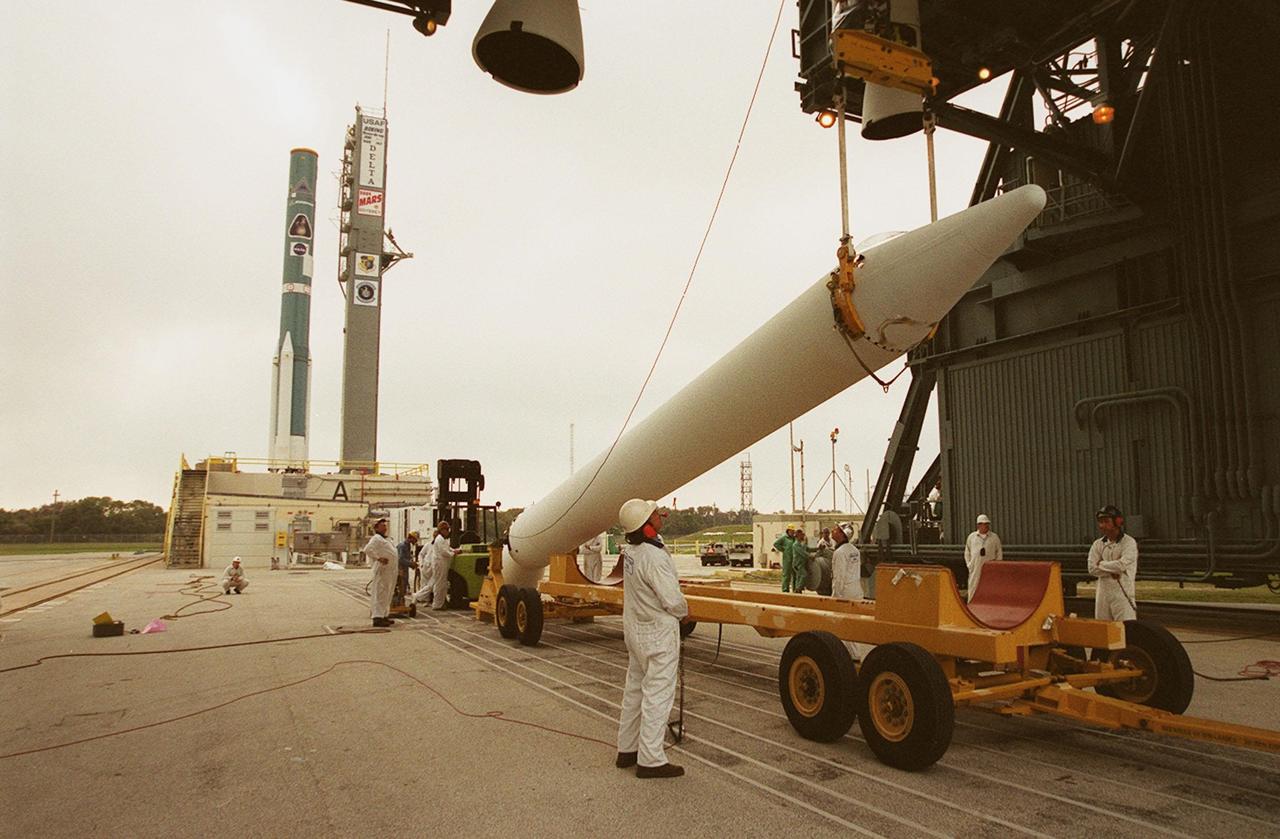
A crane lifts a solid rocket booster on Launch Pad 17-A, Cape Canaveral Air Force Station, where it will be mated with a Delta 7925 rocket for launch April 7, 2001. The rocket will carry the 2001 Mars Odyssey Orbiter, containing three science instruments: THEMIS, the Gamma Ray Spectrometer (GRS), and the Mars Radiation Environment Experiment (MARIE). THEMIS will map the mineralogy and morphology of the Martian surface using a high-resolution camera and a thermal infrared imaging spectrometer. The GRS will achieve global mapping of the elemental composition of the surface and determine the abundance of hydrogen in the shallow subsurface. The MARIE will characterize aspects of the near-space radiation environment with regards to the radiation-related risk to human explorers
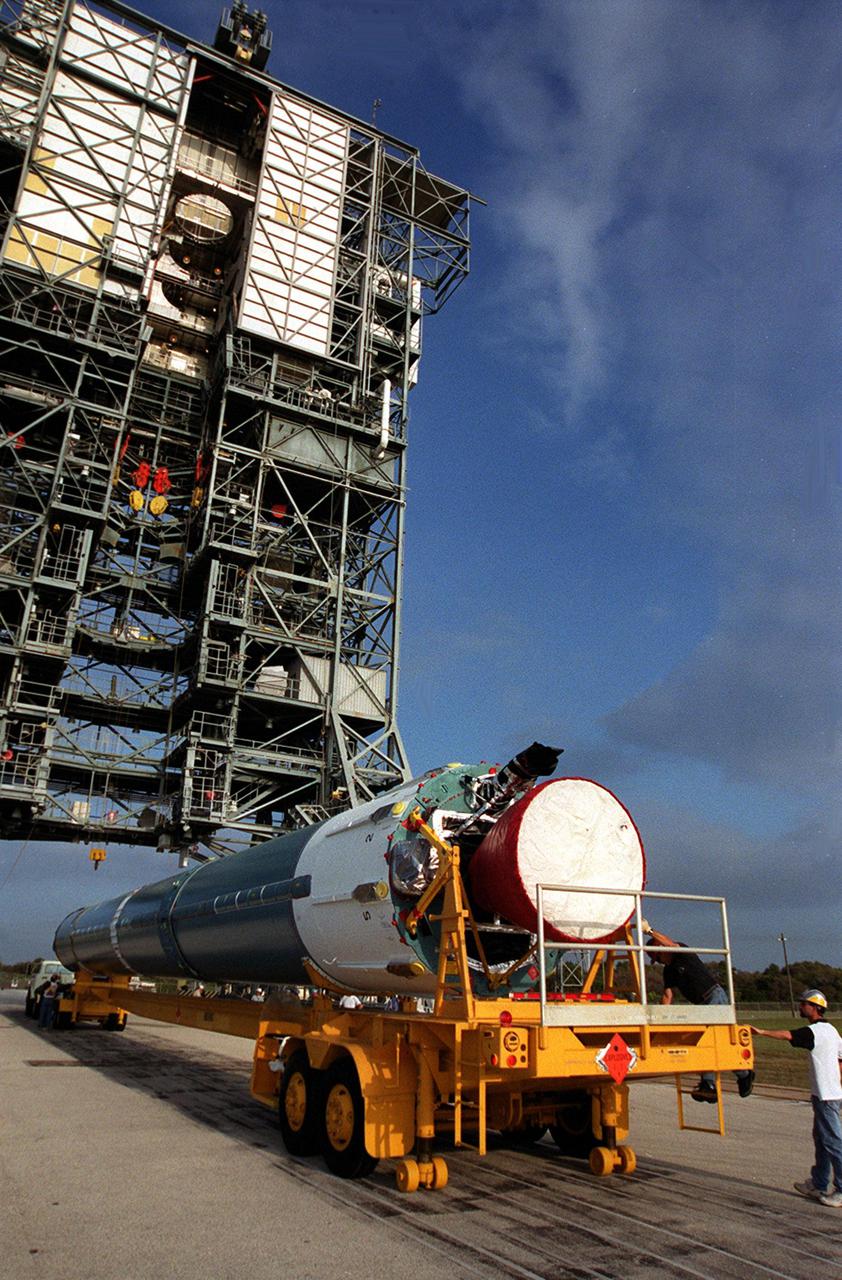
The first stage of a Boeing Delta rocket arrives on Launch Pad 17-A, Cape Canaveral Air Force Station. The rocket will carry the 2001 Mars Odyssey Orbiter, scheduled for launch April 7, 2001. Mars Odyssey contains three science instruments: THEMIS, the Gamma Ray Spectrometer (GRS), and the Mars Radiation Environment Experiment (MARIE). THEMIS will map the mineralogy and morphology of the Martian surface using a high-resolution camera and a thermal infrared imaging spectrometer. The GRS will achieve global mapping of the elemental composition of the surface and determine the abundance of hydrogen in the shallow subsurface. The MARIE will characterize aspects of the near-space radiation environment with regards to the radiation-related risk to human explorers
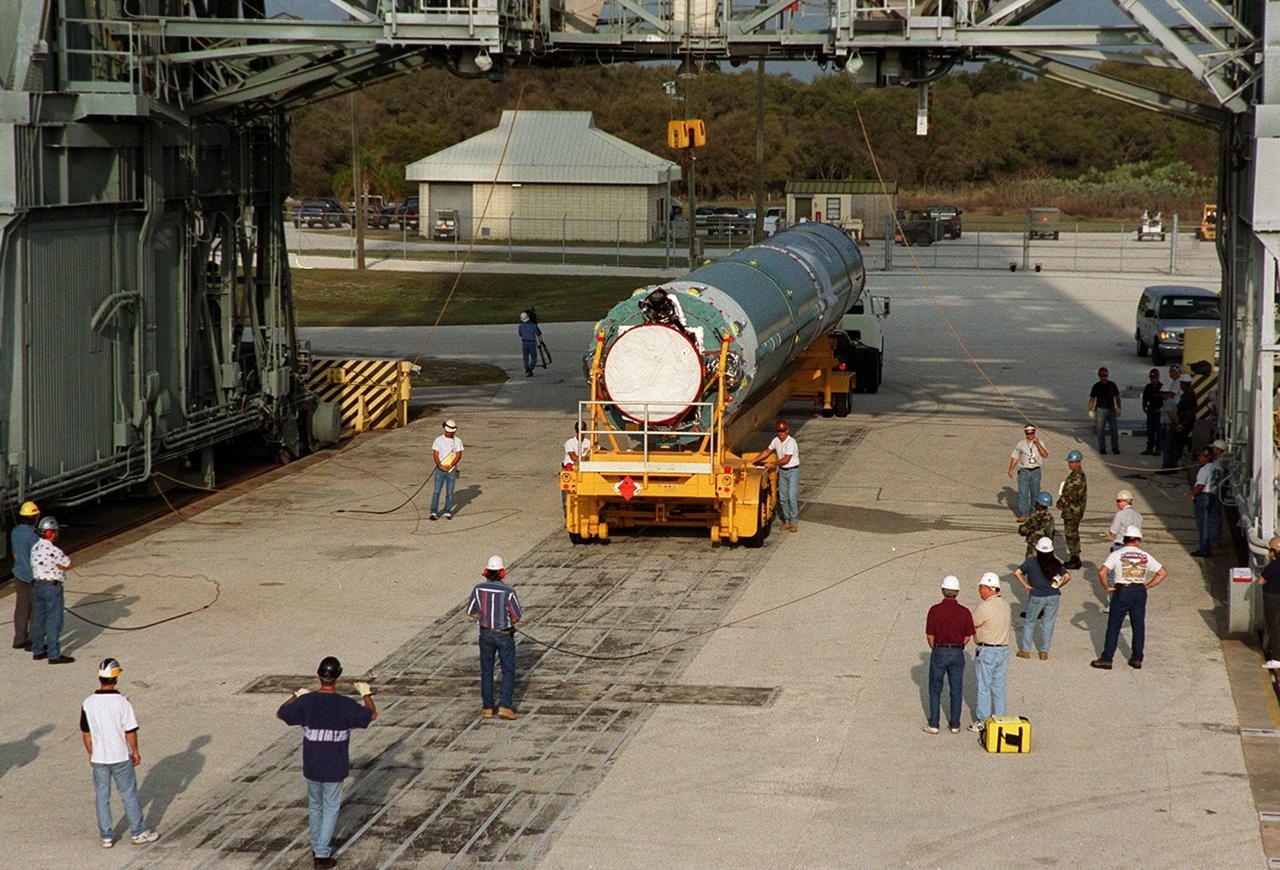
The first stage of a Boeing Delta rocket backs into position to be lifted for erection on Launch Pad 17-A, Cape Canaveral Air Force Station. The rocket will carry the 2001 Mars Odyssey Orbiter, scheduled for launch April 7, 2001. Mars Odyssey contains three science instruments: THEMIS, the Gamma Ray Spectrometer (GRS), and the Mars Radiation Environment Experiment (MARIE). THEMIS will map the mineralogy and morphology of the Martian surface using a high-resolution camera and a thermal infrared imaging spectrometer. The GRS will achieve global mapping of the elemental composition of the surface and determine the abundance of hydrogen in the shallow subsurface. The MARIE will characterize aspects of the near-space radiation environment with regards to the radiation-related risk to human explorers
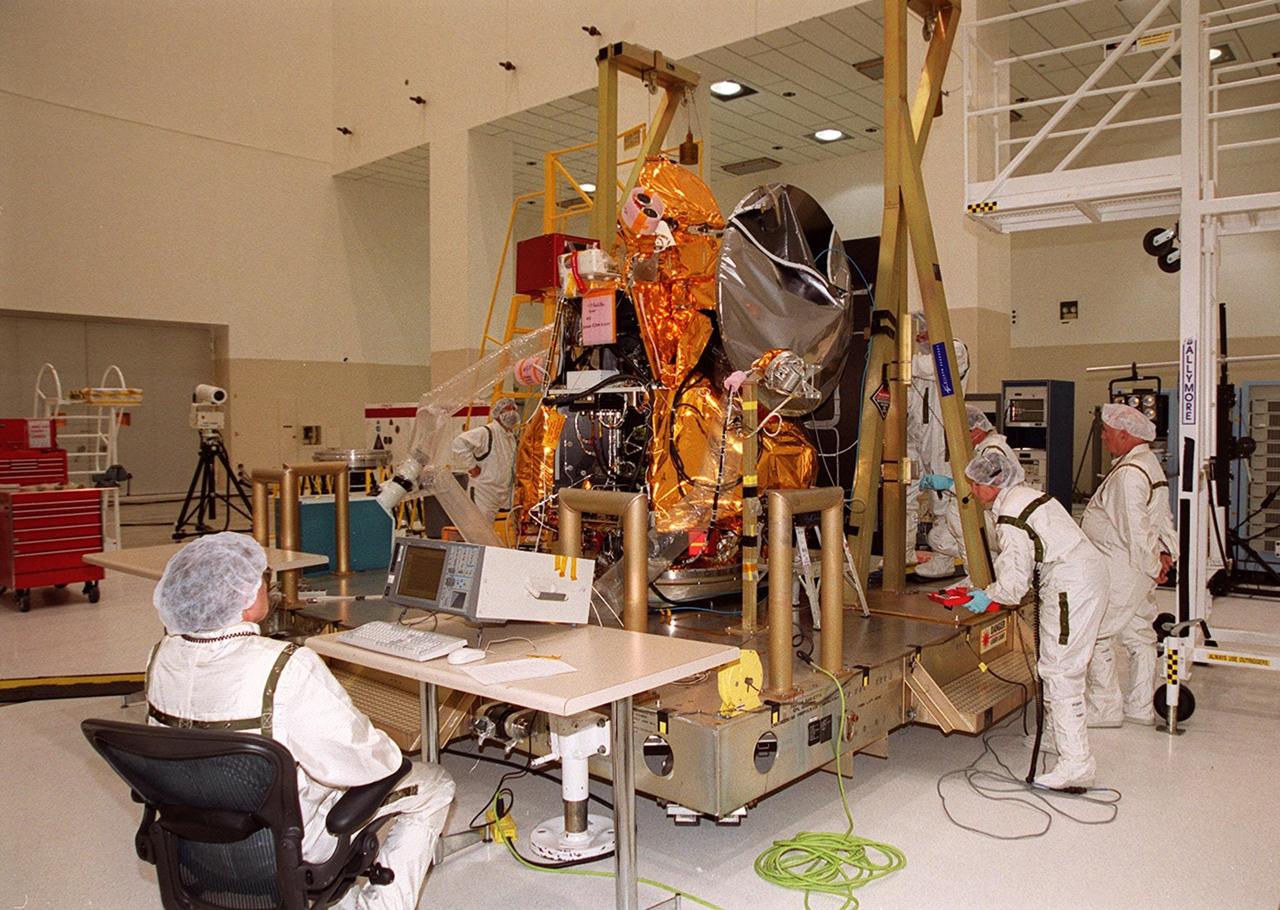
Workers in the Spacecraft Assembly and Encapsulation Facility (SAEF 2) get ready to conduct an illumination test on the 2001 Mars Odyssey Orbiter. Various components of the Odyssey Orbiter are undergoing testing. Scheduled for launch April 7, 2001, the orbiter contains three science instruments: THEMIS, the Gamma Ray Spectrometer (GRS), and the Mars Radiation Environment Experiment (MARIE). THEMIS will map the mineralogy and morphology of the Martian surface using a high-resolution camera and a thermal infrared imaging spectrometer. The GRS will achieve global mapping of the elemental composition of the surface and determine the abundance of hydrogen in the shallow subsurface. The MARIE will characterize aspects of the near-space radiation environment with regards to the radiation-related risk to human explorers
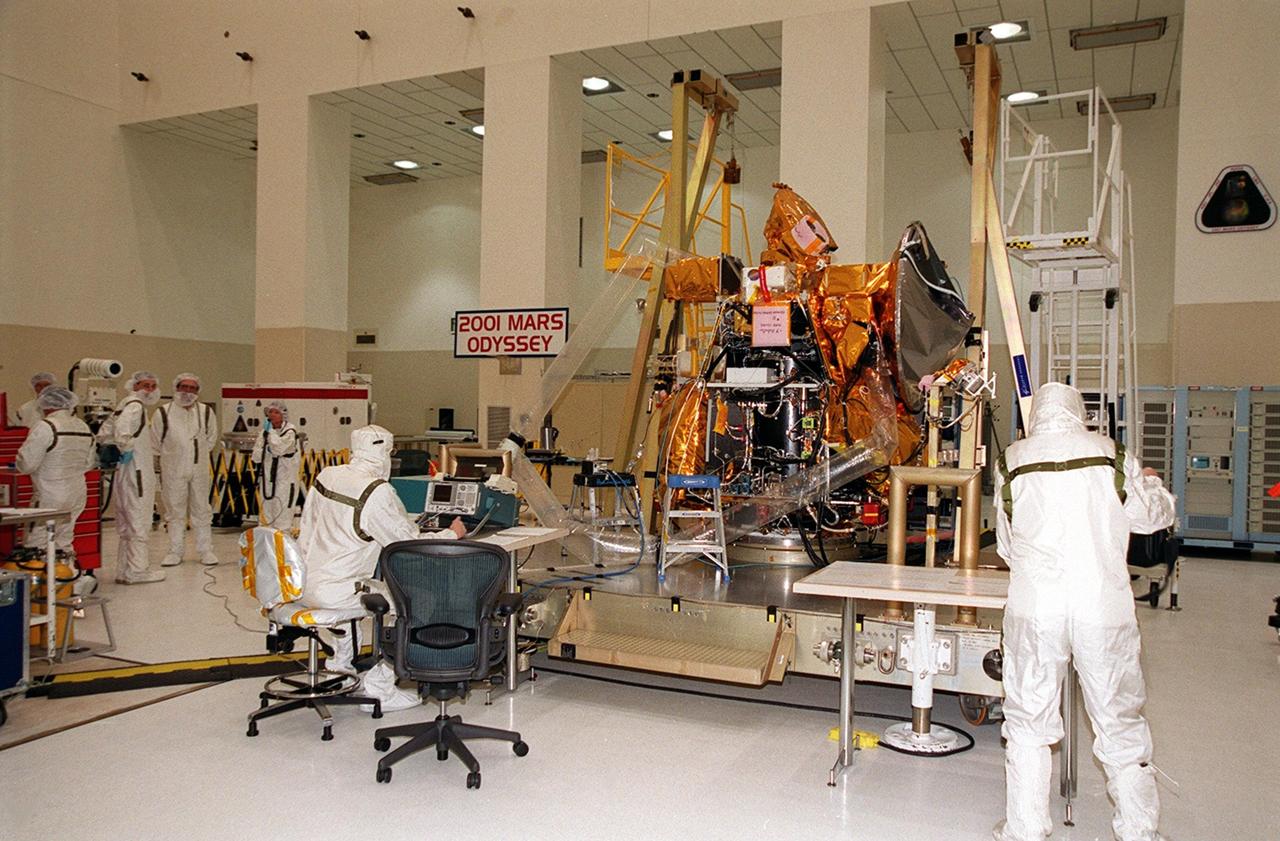
The 2001 Mars Odyssey Orbiter sits in the Spacecraft Assembly and Encapsulation Facility (SAEF 2) while components undergo testing. Workers in the foreground check instruments during testing of the UHF antenna. Scheduled for launch April 7, 2001, the orbiter contains three science instruments: THEMIS, the Gamma Ray Spectrometer (GRS), and the Mars Radiation Environment Experiment (MARIE). THEMIS will map the mineralogy and morphology of the Martian surface using a high-resolution camera and a thermal infrared imaging spectrometer. The GRS will achieve global mapping of the elemental composition of the surface and determine the abundance of hydrogen in the shallow subsurface. The MARIE will characterize aspects of the near-space radiation environment with regards to the radiation-related risk to human explorers
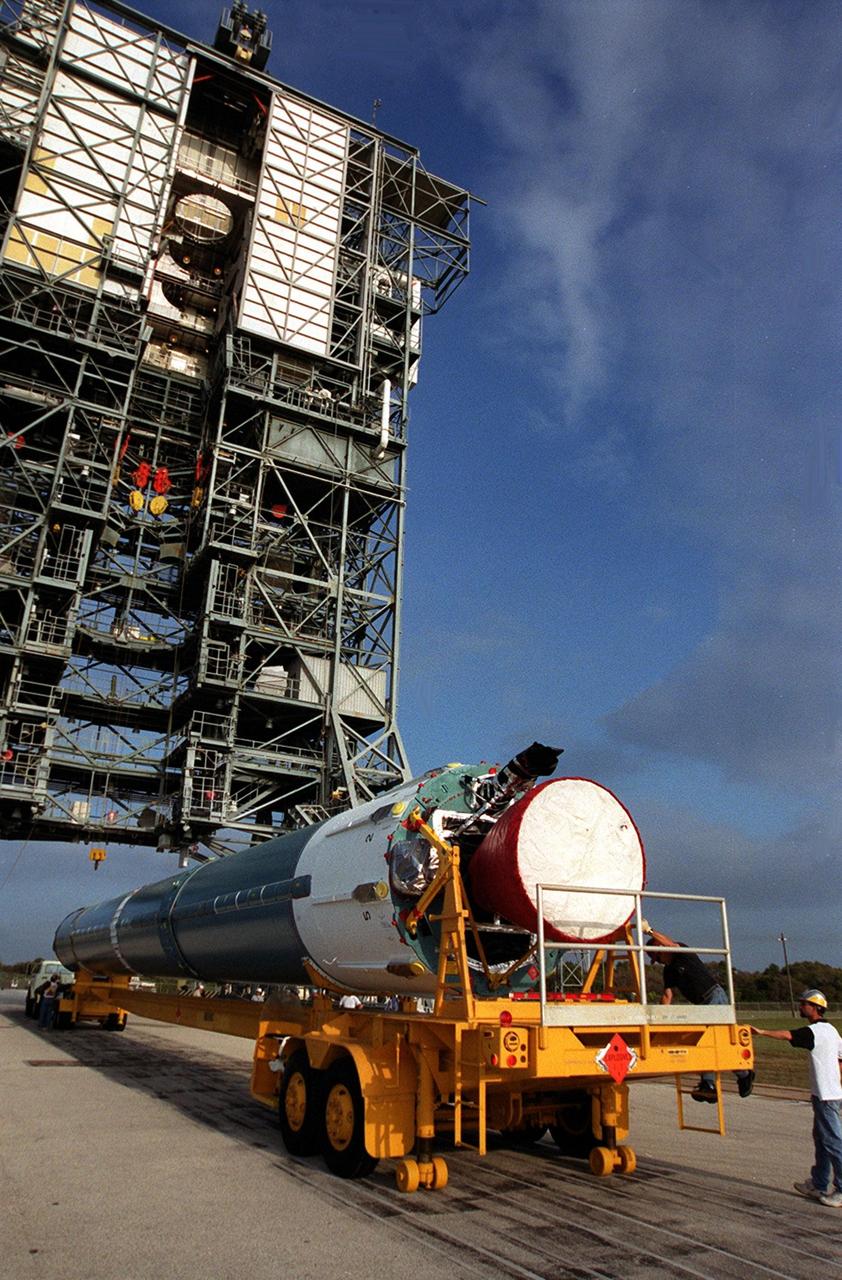
The first stage of a Boeing Delta rocket arrives on Launch Pad 17-A, Cape Canaveral Air Force Station. The rocket will carry the 2001 Mars Odyssey Orbiter, scheduled for launch April 7, 2001. Mars Odyssey contains three science instruments: THEMIS, the Gamma Ray Spectrometer (GRS), and the Mars Radiation Environment Experiment (MARIE). THEMIS will map the mineralogy and morphology of the Martian surface using a high-resolution camera and a thermal infrared imaging spectrometer. The GRS will achieve global mapping of the elemental composition of the surface and determine the abundance of hydrogen in the shallow subsurface. The MARIE will characterize aspects of the near-space radiation environment with regards to the radiation-related risk to human explorers

The first stage of a Boeing Delta rocket is lifted into place in the gantry on Launch Pad 17-A, Cape Canaveral Air Force Station. The rocket will carry the 2001 Mars Odyssey Orbiter, scheduled for launch April 7, 2001. Mars Odyssey contains three science instruments: THEMIS, the Gamma Ray Spectrometer (GRS), and the Mars Radiation Environment Experiment (MARIE). THEMIS will map the mineralogy and morphology of the Martian surface using a high-resolution camera and a thermal infrared imaging spectrometer. The GRS will achieve global mapping of the elemental composition of the surface and determine the abundance of hydrogen in the shallow subsurface. The MARIE will characterize aspects of the near-space radiation environment with regards to the radiation-related risk to human explorers
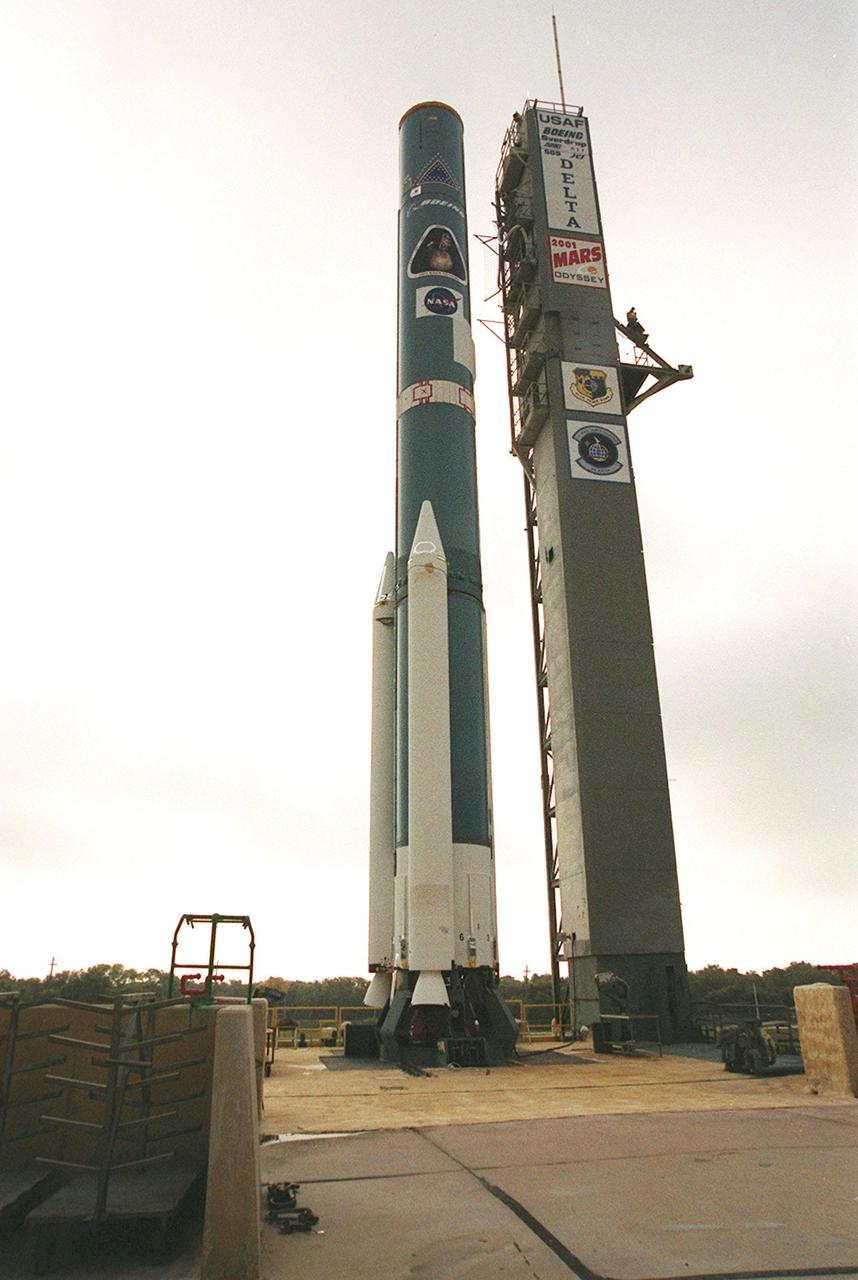
A Delta 7925 rocket on Launch Pad 17-A, Cape Canaveral Air Force Station, is being erected for launch April 7, 2001. The rocket will carry the 2001 Mars Odyssey Orbiter, containing three science instruments: THEMIS, the Gamma Ray Spectrometer (GRS), and the Mars Radiation Environment Experiment (MARIE). THEMIS will map the mineralogy and morphology of the Martian surface using a high-resolution camera and a thermal infrared imaging spectrometer. The GRS will achieve global mapping of the elemental composition of the surface and determine the abundance of hydrogen in the shallow subsurface. The MARIE will characterize aspects of the near-space radiation environment with regards to the radiation-related risk to human explorers
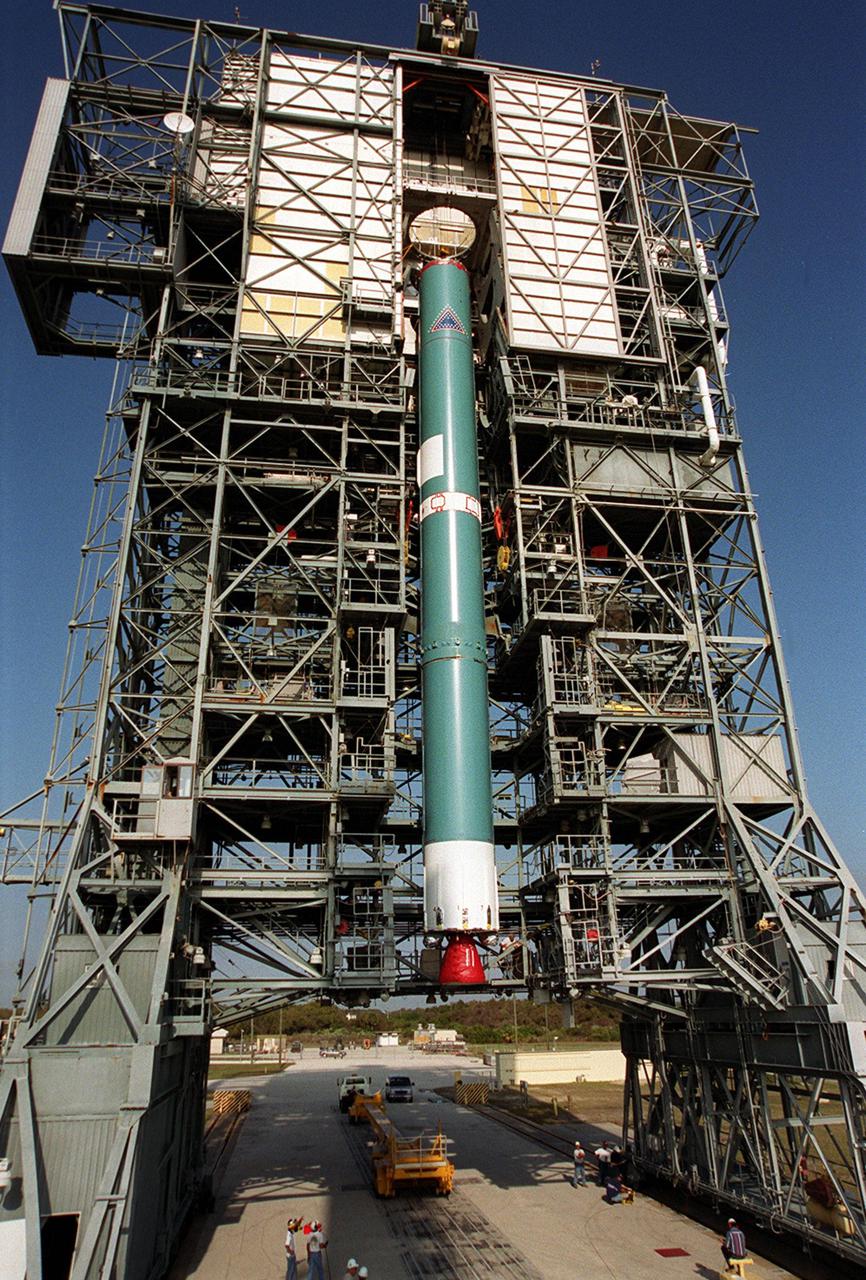
The first stage of a Boeing Delta rocket is lifted vertically up the gantry on Launch Pad 17-A, Cape Canaveral Air Force Station. The rocket will carry the 2001 Mars Odyssey Orbiter, scheduled for launch April 7, 2001. Mars Odyssey contains three science instruments: THEMIS, the Gamma Ray Spectrometer (GRS), and the Mars Radiation Environment Experiment (MARIE). THEMIS will map the mineralogy and morphology of the Martian surface using a high-resolution camera and a thermal infrared imaging spectrometer. The GRS will achieve global mapping of the elemental composition of the surface and determine the abundance of hydrogen in the shallow subsurface. The MARIE will characterize aspects of the near-space radiation environment with regards to the radiation-related risk to human explorers
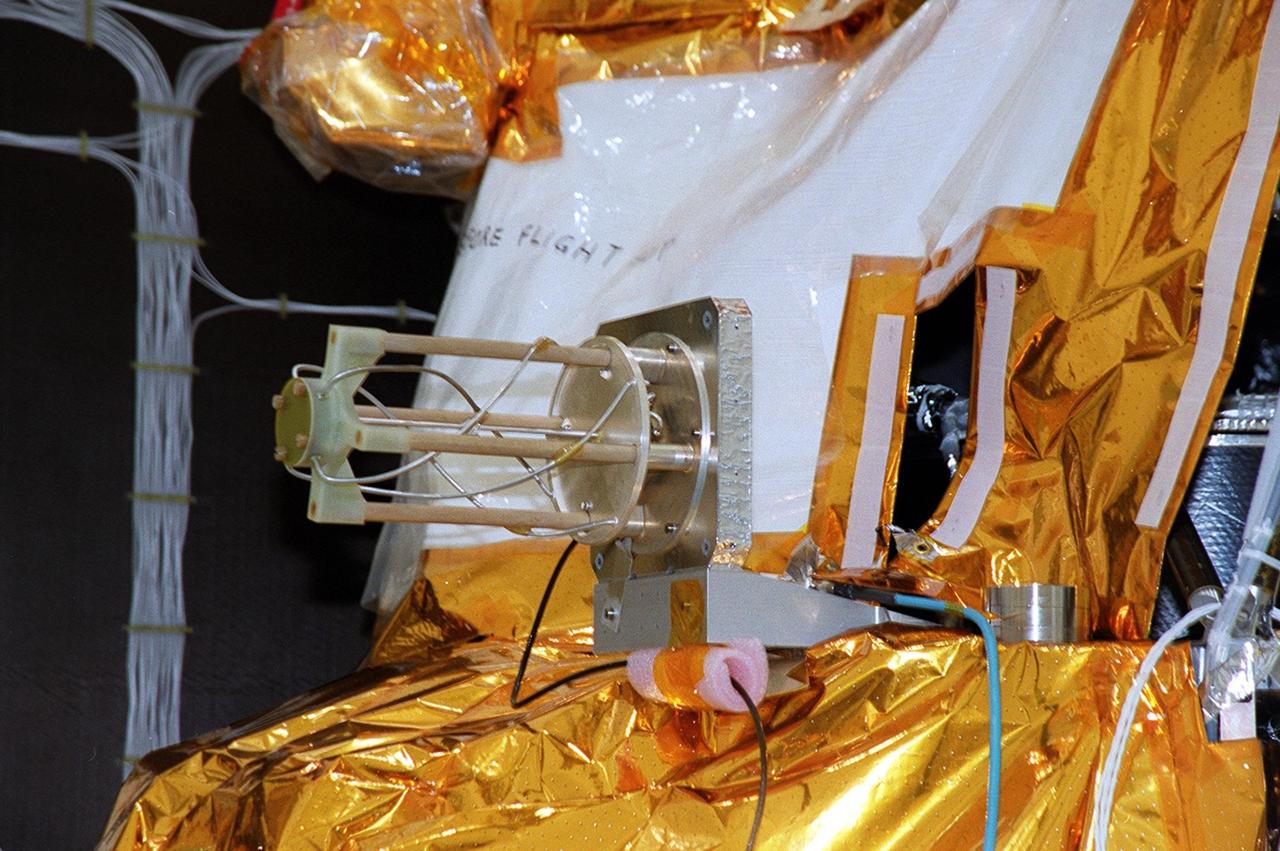
Shown in this closeup is the UHF antenna on the Mars Odyssey Orbiter. The antenna is undergoing testing in the Spacecraft Assembly and Encapsulation Facility (SAEF 2). The 2001 Mars Odyssey Orbiter, scheduled for launch April 7, 2001, contains three science instruments: THEMIS, the Gamma Ray Spectrometer (GRS), and the Mars Radiation Environment Experiment (MARIE). THEMIS will map the mineralogy and morphology of the Martian surface using a high-resolution camera and a thermal infrared imaging spectrometer. The GRS will achieve global mapping of the elemental composition of the surface and determine the abundance of hydrogen in the shallow subsurface. The MARIE will characterize aspects of the near-space radiation environment with regards to the radiation-related risk to human explorers

A worker in the Spacecraft Assembly and Encapsulation Facility (SAEF 2) checks an area of a solar array panel on the 2001 Mars Odyssey Orbiter. The array will undergo illumination testing. Scheduled for launch April 7, 2001, the orbiter contains three science instruments: THEMIS, the Gamma Ray Spectrometer (GRS), and the Mars Radiation Environment Experiment (MARIE). THEMIS will map the mineralogy and morphology of the Martian surface using a high-resolution camera and a thermal infrared imaging spectrometer. The GRS will achieve global mapping of the elemental composition of the surface and determine the abundance of hydrogen in the shallow subsurface. The MARIE will characterize aspects of the near-space radiation environment with regards to the radiation-related risk to human explorers
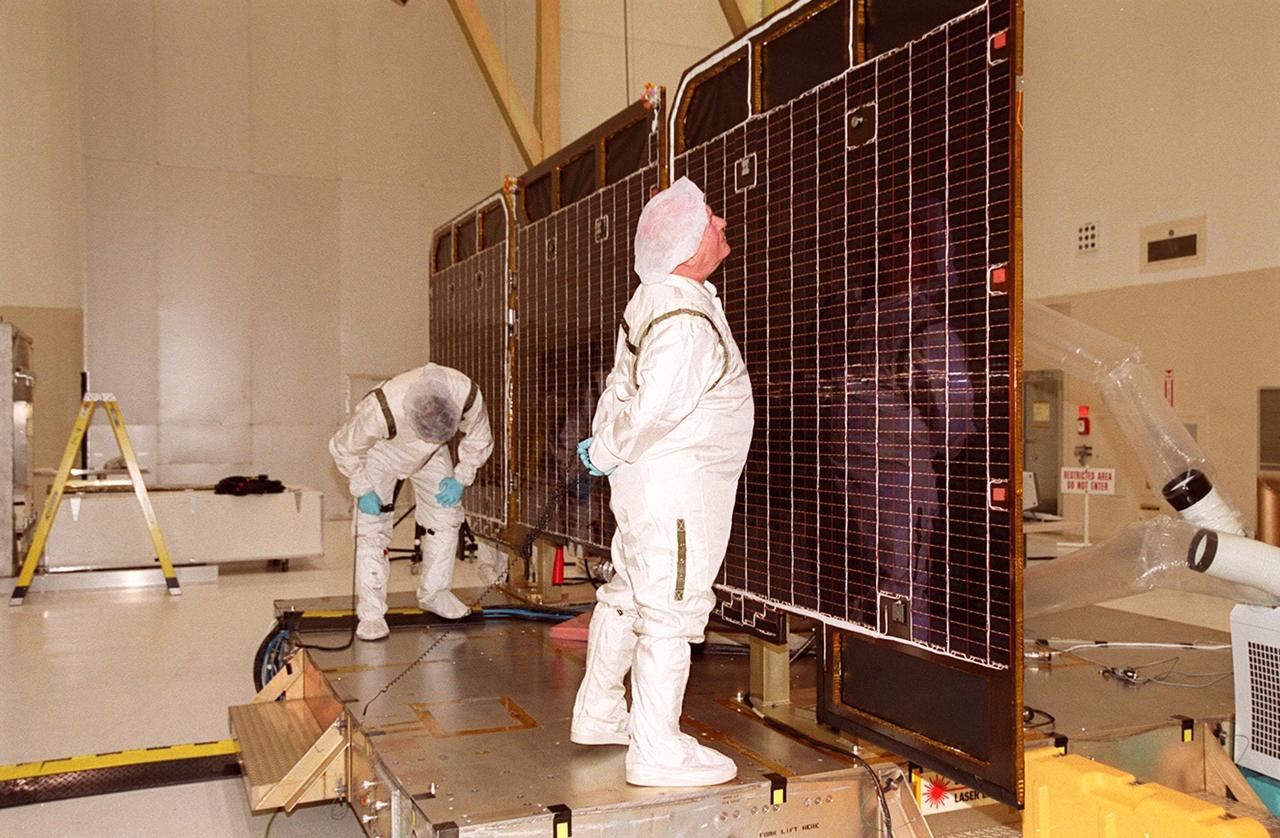
Workers examine parts of the opened solar array panels on the 2001 Mars Odyssey Orbiter. The array will undergo illumination testing. Scheduled for launch April 7, 2001, the orbiter contains three science instruments: THEMIS, the Gamma Ray Spectrometer (GRS), and the Mars Radiation Environment Experiment (MARIE). THEMIS will map the mineralogy and morphology of the Martian surface using a high-resolution camera and a thermal infrared imaging spectrometer. The GRS will achieve global mapping of the elemental composition of the surface and determine the abundance of hydrogen in the shallow subsurface. The MARIE will characterize aspects of the near-space radiation environment with regards to the radiation-related risk to human explorers
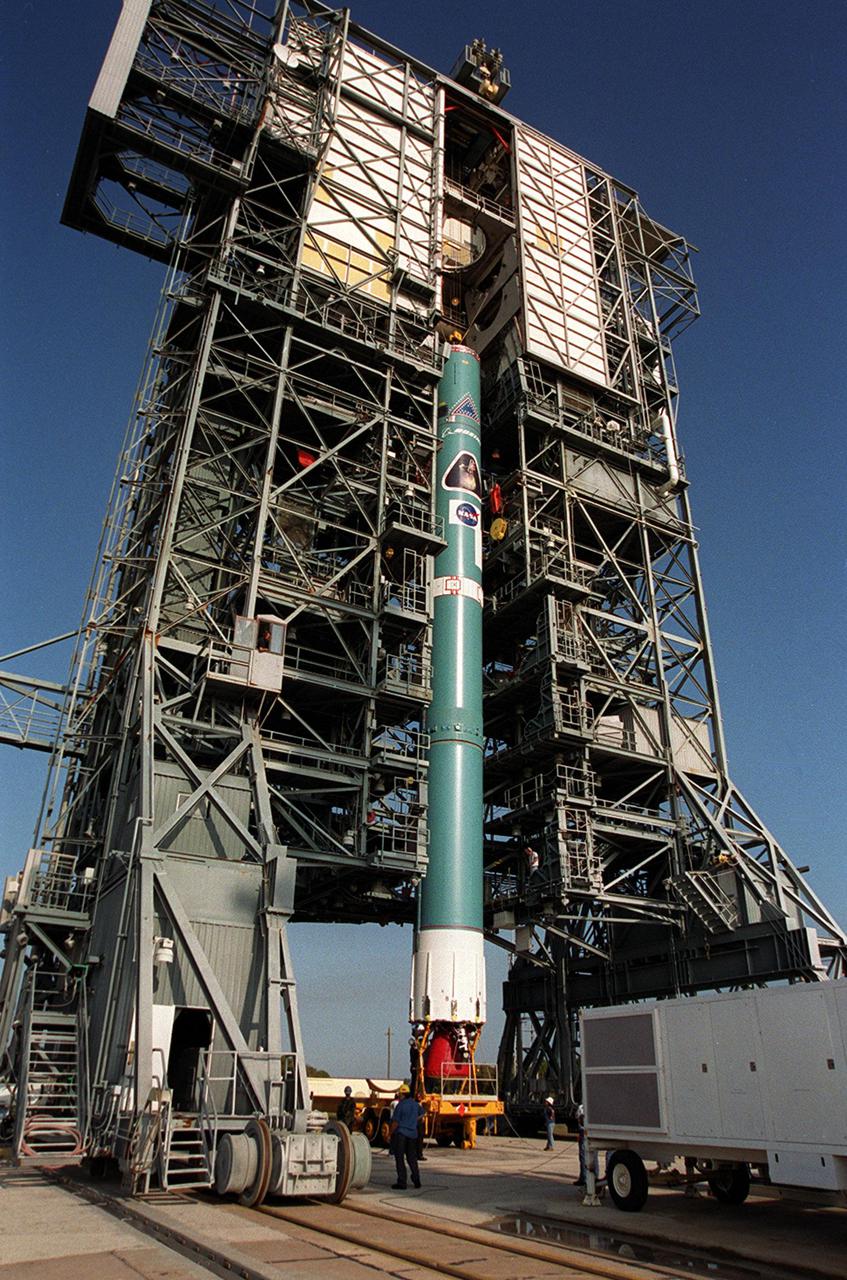
The first stage of a Boeing Delta rocket is in vertical position in the gantry on Launch Pad 17-A, Cape Canaveral Air Force Station. The rocket will carry the 2001 Mars Odyssey Orbiter, scheduled for launch April 7, 2001. Mars Odyssey contains three science instruments: THEMIS, the Gamma Ray Spectrometer (GRS), and the Mars Radiation Environment Experiment (MARIE). THEMIS will map the mineralogy and morphology of the Martian surface using a high-resolution camera and a thermal infrared imaging spectrometer. The GRS will achieve global mapping of the elemental composition of the surface and determine the abundance of hydrogen in the shallow subsurface. The MARIE will characterize aspects of the near-space radiation environment with regards to the radiation-related risk to human explorers
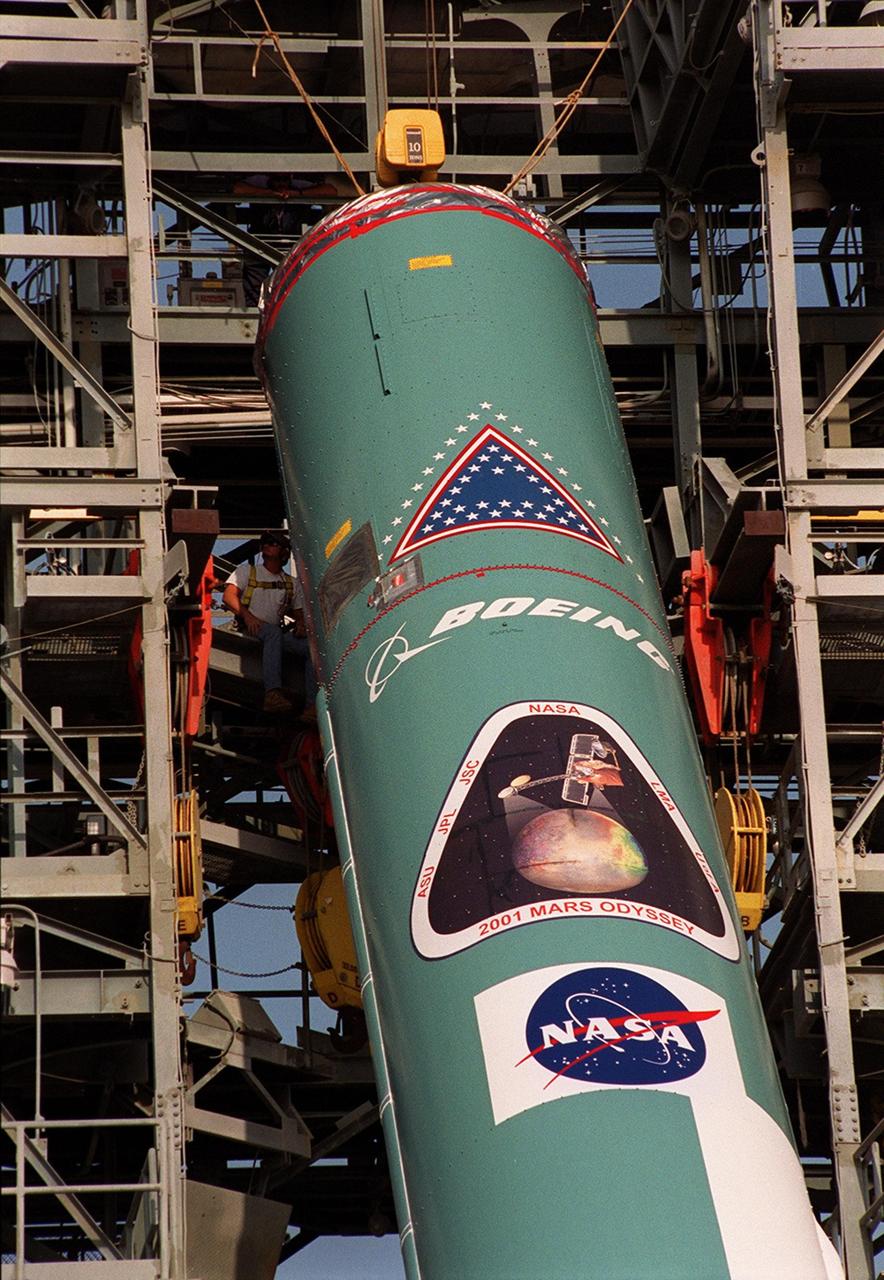
The first stage of a Boeing Delta rocket is lifted into place in the gantry on Launch Pad 17-A, Cape Canaveral Air Force Station. The rocket will carry the 2001 Mars Odyssey Orbiter, scheduled for launch April 7, 2001. Mars Odyssey contains three science instruments: THEMIS, the Gamma Ray Spectrometer (GRS), and the Mars Radiation Environment Experiment (MARIE). THEMIS will map the mineralogy and morphology of the Martian surface using a high-resolution camera and a thermal infrared imaging spectrometer. The GRS will achieve global mapping of the elemental composition of the surface and determine the abundance of hydrogen in the shallow subsurface. The MARIE will characterize aspects of the near-space radiation environment with regards to the radiation-related risk to human explorers
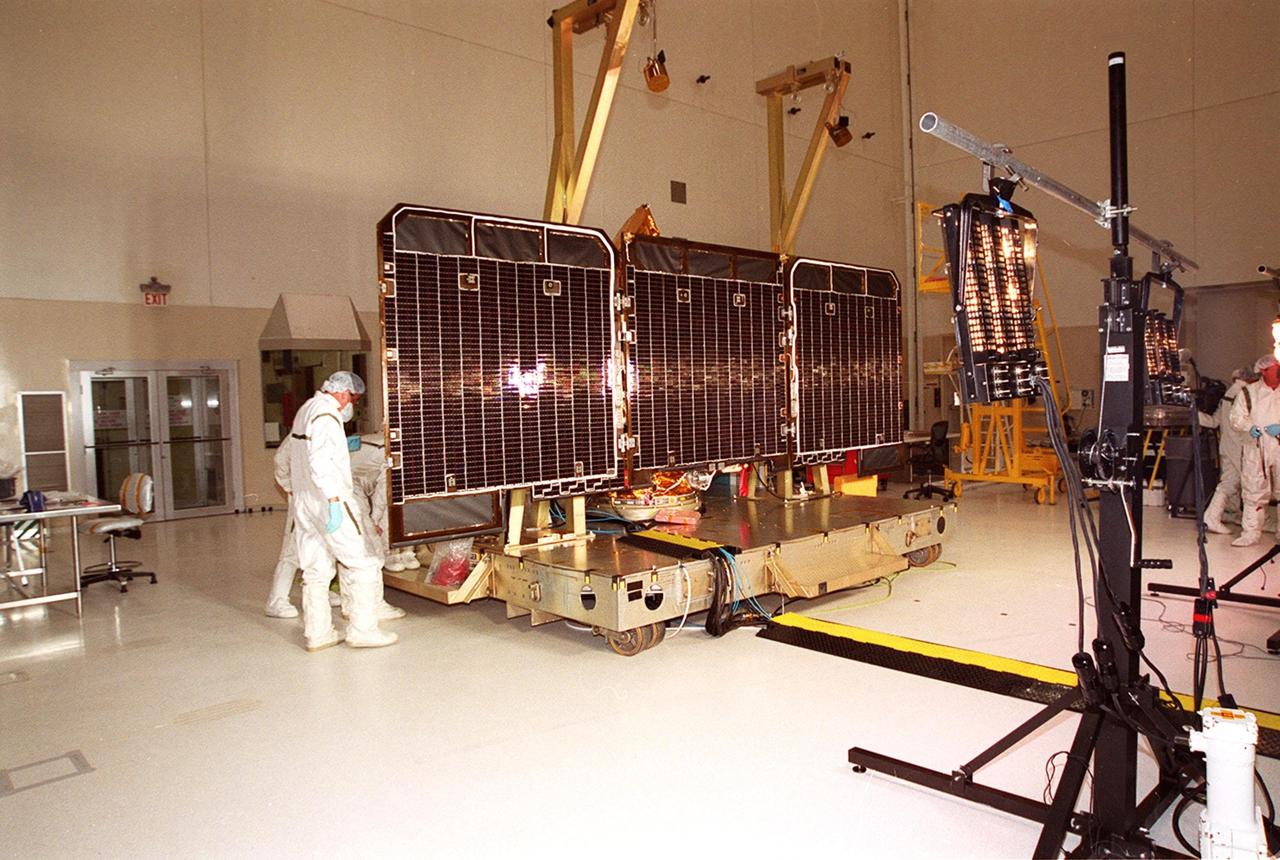
Solar array panels on the 2001 Mars Odyssey Orbiter undergo illumination testing in the Spacecraft Assembly and Encapsulation Facility (SAEF 2). Scheduled for launch April 7, 2001, the orbiter contains three science instruments: THEMIS, the Gamma Ray Spectrometer (GRS), and the Mars Radiation Environment Experiment (MARIE). THEMIS will map the mineralogy and morphology of the Martian surface using a high-resolution camera and a thermal infrared imaging spectrometer. The GRS will achieve global mapping of the elemental composition of the surface and determine the abundance of hydrogen in the shallow subsurface. The MARIE will characterize aspects of the near-space radiation environment with regards to the radiation-related risk to human explorers
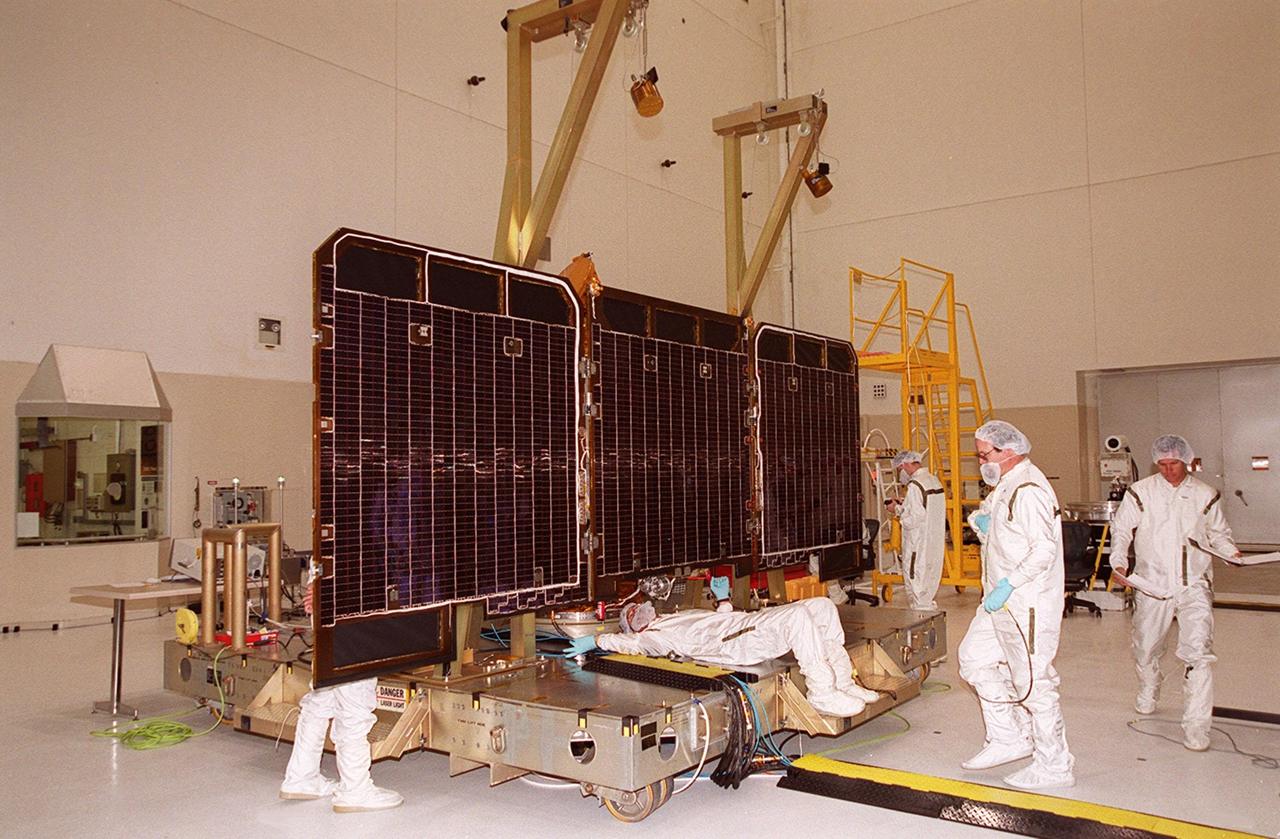
A worker in the Spacecraft Assembly and Encapsulation Facility (SAEF 2) checks the underside of the extended solar array panels on the 2001 Mars Odyssey Orbiter. The array will undergo illumination testing. Scheduled for launch April 7, 2001, the orbiter contains three science instruments: THEMIS, the Gamma Ray Spectrometer (GRS), and the Mars Radiation Environment Experiment (MARIE). THEMIS will map the mineralogy and morphology of the Martian surface using a high-resolution camera and a thermal infrared imaging spectrometer. The GRS will achieve global mapping of the elemental composition of the surface and determine the abundance of hydrogen in the shallow subsurface. The MARIE will characterize aspects of the near-space radiation environment with regards to the radiation-related risk to human explorers

The first stage of a Boeing Delta rocket is lifted vertically up the gantry on Launch Pad 17-A, Cape Canaveral Air Force Station. The rocket will carry the 2001 Mars Odyssey Orbiter, scheduled for launch April 7, 2001. Mars Odyssey contains three science instruments: THEMIS, the Gamma Ray Spectrometer (GRS), and the Mars Radiation Environment Experiment (MARIE). THEMIS will map the mineralogy and morphology of the Martian surface using a high-resolution camera and a thermal infrared imaging spectrometer. The GRS will achieve global mapping of the elemental composition of the surface and determine the abundance of hydrogen in the shallow subsurface. The MARIE will characterize aspects of the near-space radiation environment with regards to the radiation-related risk to human explorers
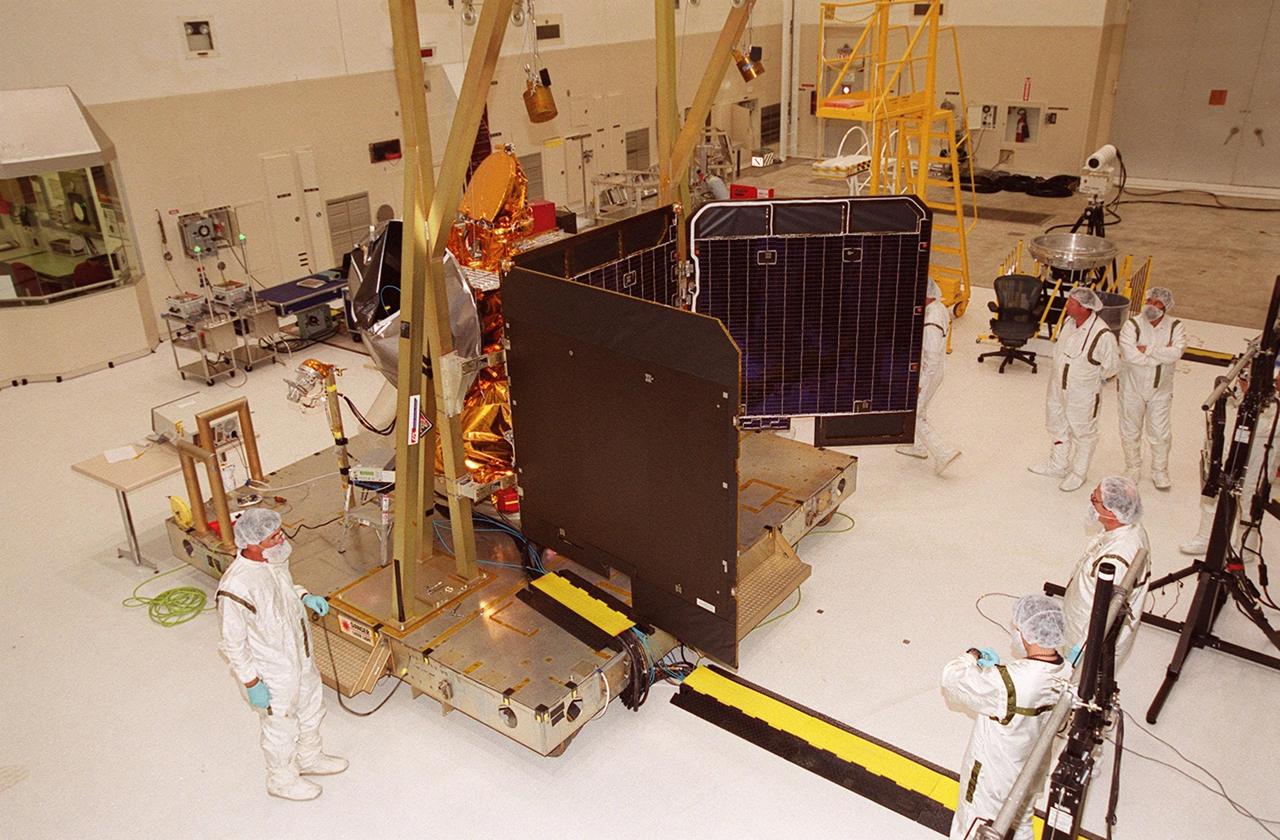
In the Spacecraft Assembly and Encapsulation Facility (SAEF 2), workers stand back as the panels of the solar array on the 2001 Mars Odyssey Orbiter open. The array will undergo illumination testing. Scheduled for launch April 7, 2001, the orbiter contains three science instruments: THEMIS, the Gamma Ray Spectrometer (GRS), and the Mars Radiation Environment Experiment (MARIE). THEMIS will map the mineralogy and morphology of the Martian surface using a high-resolution camera and a thermal infrared imaging spectrometer. The GRS will achieve global mapping of the elemental composition of the surface and determine the abundance of hydrogen in the shallow subsurface. The MARIE will characterize aspects of the near-space radiation environment with regards to the radiation-related risk to human explorers
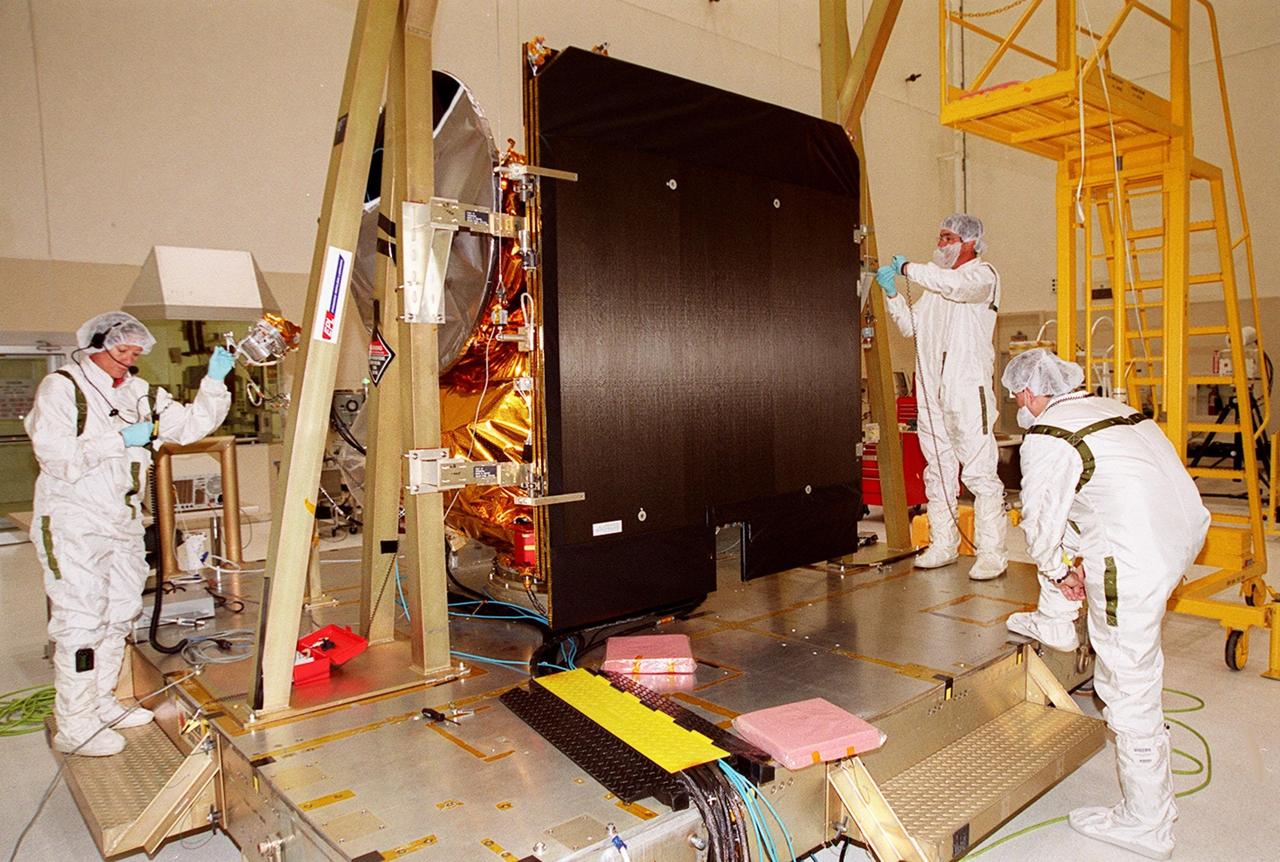
Workers in the Spacecraft Assembly and Encapsulation Facility (SAEF 2) reattach the solar panel on the 2001 Mars Odyssey Orbiter in order to conduct illumination testing. Scheduled for launch April 7, 2001, the orbiter contains three science instruments: THEMIS, the Gamma Ray Spectrometer (GRS), and the Mars Radiation Environment Experiment (MARIE). THEMIS will map the mineralogy and morphology of the Martian surface using a high-resolution camera and a thermal infrared imaging spectrometer. The GRS will achieve global mapping of the elemental composition of the surface and determine the abundance of hydrogen in the shallow subsurface. The MARIE will characterize aspects of the near-space radiation environment with regards to the radiation-related risk to human explorers

On Launch Pad 17-A, Cape Canaveral Air Force Station, workers maneuver the first stage of a Boeing Delta rocket into a vertical position . The rocket will carry the 2001 Mars Odyssey Orbiter, scheduled for launch April 7, 2001. Mars Odyssey contains three science instruments: THEMIS, the Gamma Ray Spectrometer (GRS), and the Mars Radiation Environment Experiment (MARIE). THEMIS will map the mineralogy and morphology of the Martian surface using a high-resolution camera and a thermal infrared imaging spectrometer. The GRS will achieve global mapping of the elemental composition of the surface and determine the abundance of hydrogen in the shallow subsurface. The MARIE will characterize aspects of the near-space radiation environment with regards to the radiation-related risk to human explorers
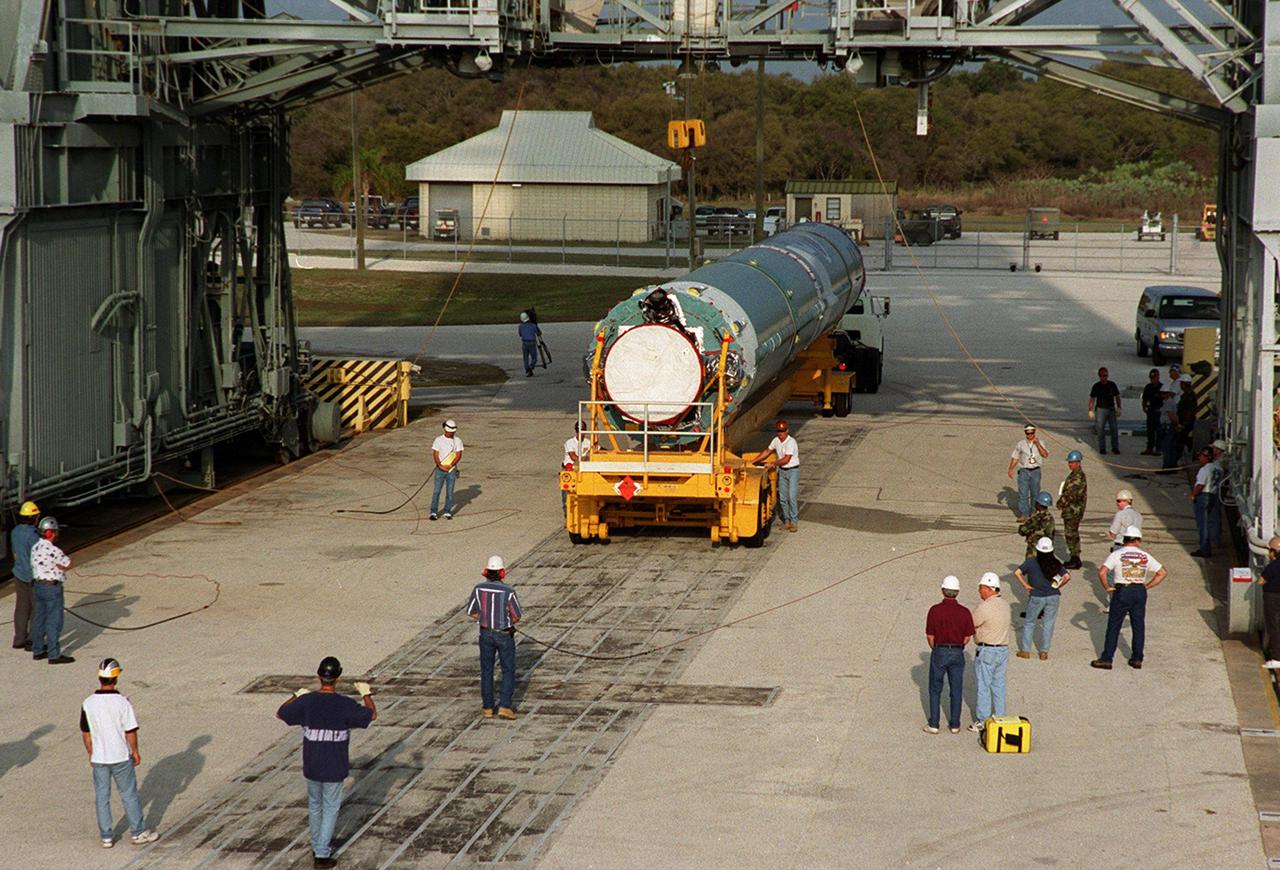
The first stage of a Boeing Delta rocket backs into position to be lifted for erection on Launch Pad 17-A, Cape Canaveral Air Force Station. The rocket will carry the 2001 Mars Odyssey Orbiter, scheduled for launch April 7, 2001. Mars Odyssey contains three science instruments: THEMIS, the Gamma Ray Spectrometer (GRS), and the Mars Radiation Environment Experiment (MARIE). THEMIS will map the mineralogy and morphology of the Martian surface using a high-resolution camera and a thermal infrared imaging spectrometer. The GRS will achieve global mapping of the elemental composition of the surface and determine the abundance of hydrogen in the shallow subsurface. The MARIE will characterize aspects of the near-space radiation environment with regards to the radiation-related risk to human explorers
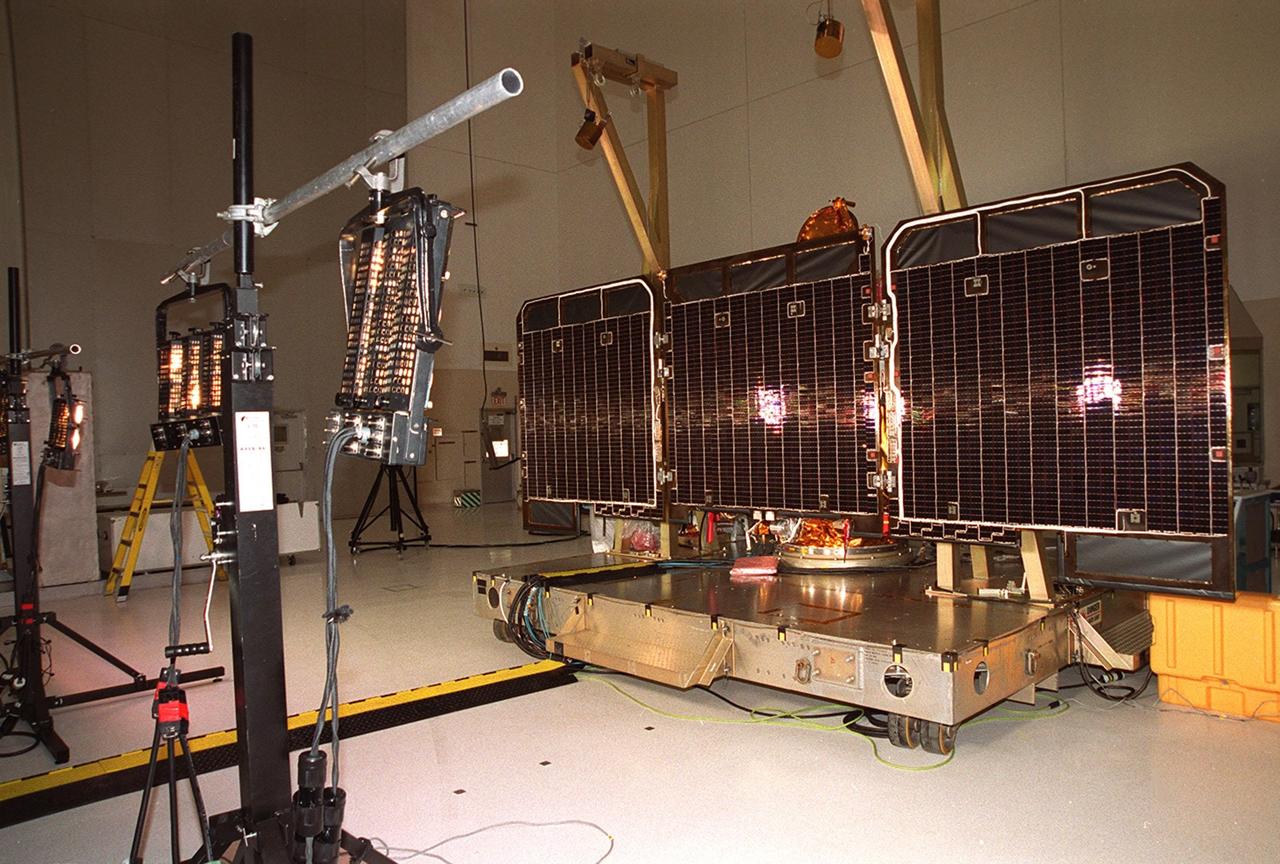
Arrays of lights at left focus on solar array panels at right during illumination testing. The solar array is part of the 2001 Mars Odyssey Orbiter. Scheduled for launch April 7, 2001, the orbiter contains three science instruments: THEMIS, the Gamma Ray Spectrometer (GRS), and the Mars Radiation Environment Experiment (MARIE). THEMIS will map the mineralogy and morphology of the Martian surface using a high-resolution camera and a thermal infrared imaging spectrometer. The GRS will achieve global mapping of the elemental composition of the surface and determine the abundance of hydrogen in the shallow subsurface. The MARIE will characterize aspects of the near-space radiation environment with regards to the radiation-related risk to human explorers
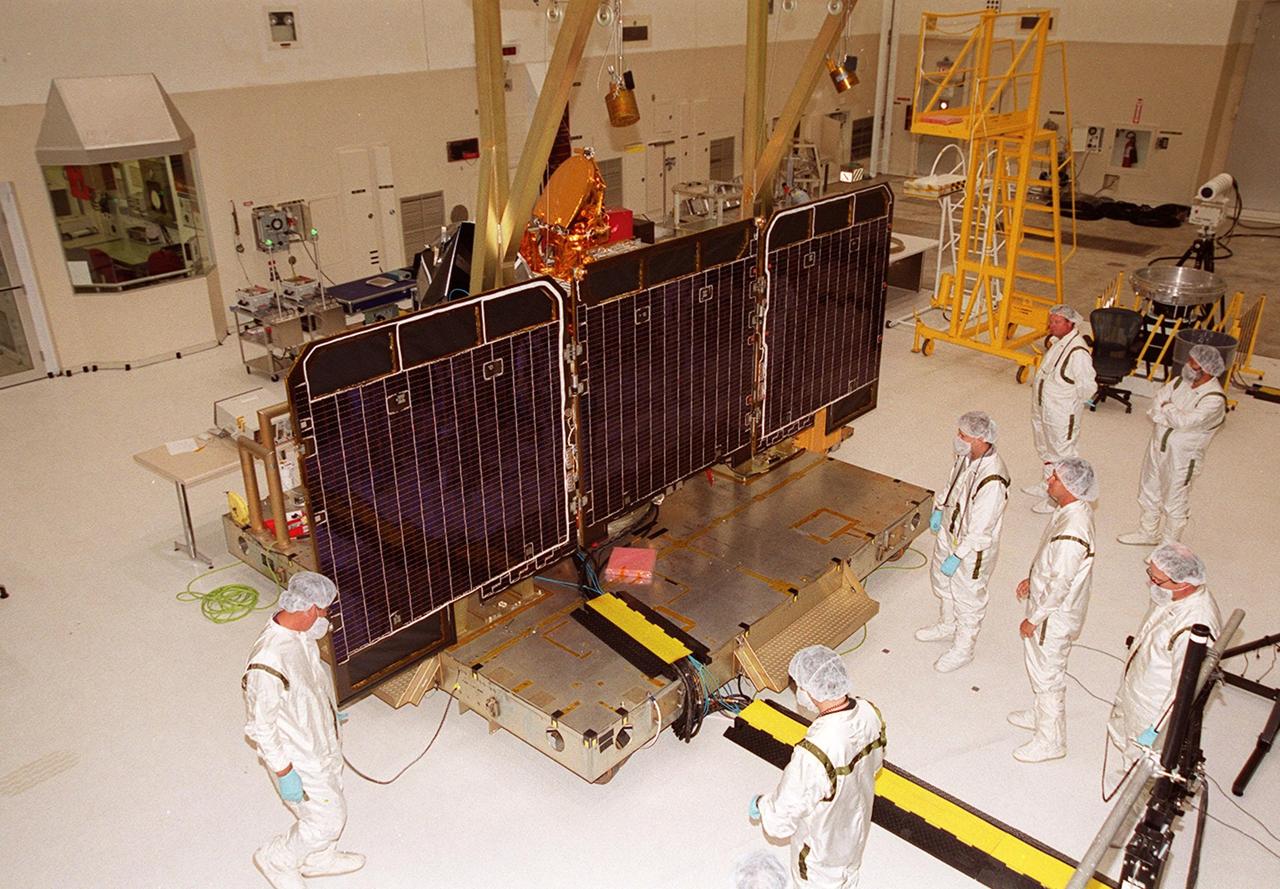
In the Spacecraft Assembly and Encapsulation Facility (SAEF 2), workers look at the opened panels of the solar array on the 2001 Mars Odyssey Orbiter. The array will undergo illumination testing. Scheduled for launch April 7, 2001, the orbiter contains three science instruments: THEMIS, the Gamma Ray Spectrometer (GRS), and the Mars Radiation Environment Experiment (MARIE). THEMIS will map the mineralogy and morphology of the Martian surface using a high-resolution camera and a thermal infrared imaging spectrometer. The GRS will achieve global mapping of the elemental composition of the surface and determine the abundance of hydrogen in the shallow subsurface. The MARIE will characterize aspects of the near-space radiation environment with regards to the radiation-related risk to human explorers
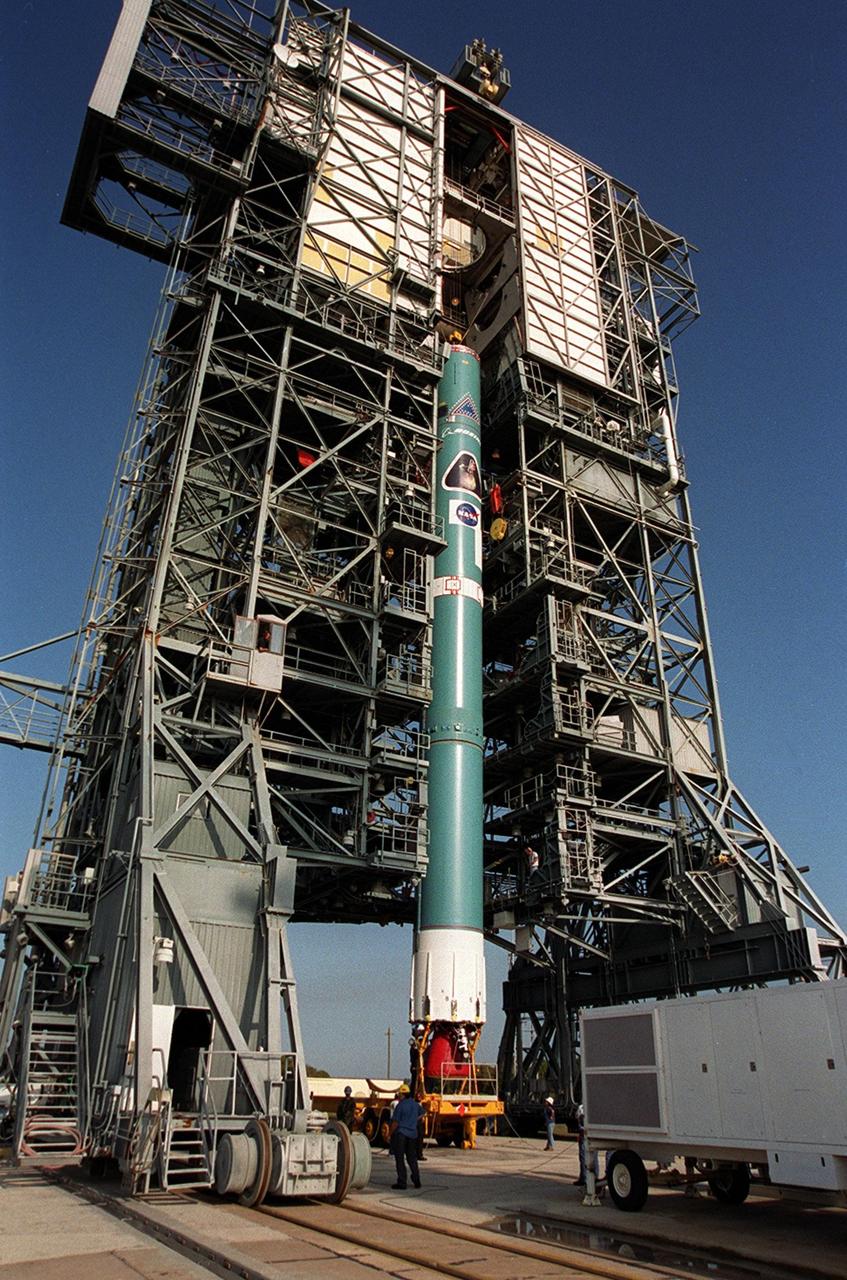
The first stage of a Boeing Delta rocket is in vertical position in the gantry on Launch Pad 17-A, Cape Canaveral Air Force Station. The rocket will carry the 2001 Mars Odyssey Orbiter, scheduled for launch April 7, 2001. Mars Odyssey contains three science instruments: THEMIS, the Gamma Ray Spectrometer (GRS), and the Mars Radiation Environment Experiment (MARIE). THEMIS will map the mineralogy and morphology of the Martian surface using a high-resolution camera and a thermal infrared imaging spectrometer. The GRS will achieve global mapping of the elemental composition of the surface and determine the abundance of hydrogen in the shallow subsurface. The MARIE will characterize aspects of the near-space radiation environment with regards to the radiation-related risk to human explorers

Citizen scientist David Englund created this avant-garde Jovian artwork using data from the JunoCam imager on NASA's Juno spacecraft. The unique interpretation of Jupiter's Great Red Spot was done in a style that pays tribute to French Impressionist painter Claude Monet. The original image was taken on July 10, 2017 at 7:12 p.m. PDT (10:12 p.m. EDT), as the Juno spacecraft performed its 7th close flyby of Jupiter. At the time the image was taken, the spacecraft was 10,274 miles (16,535 kilometers) from the tops of the clouds of the planet, at a latitude of -36.9 degrees. https://photojournal.jpl.nasa.gov/catalog/PIA21779 . - Enhanced image by David Englund based on images provided courtesy of NASA/JPL-Caltech/SwRI/MSSS

This frame from an animation takes the viewer on a simulated flight into, and then out of, Jupiter's upper atmosphere at the location of the Great Red Spot. The perspective begins about 2,000 miles (3,000 kilometers) above the cloud tops of the planet's southern hemisphere. The bar at far left indicates altitude during the quick descent; a second gauge next to that depicts the dramatic increase in temperature that occurs as the perspective dives deeper down. The clouds turn crimson as the perspective passes through the Great Red Spot. Finally, the view ascends out of the spot. This video was created by combining an image from the JunoCam imager on NASA's Juno spacecraft with a computer-generated animation. The animation is available at https://photojournal.jpl.nasa.gov/catalog/PIA22176. - Enhanced image by Gerald Eichstädt / Justin Cowart based on images provided courtesy of NASA/JPL-Caltech/SwRI/MSSS
![In the Spacecraft Assembly and Encapsulation Facility -2, workers check the movement of the <a href='http:__mars.jpl.nasa.gov_2001_'>2001 Mars Odyssey Orbiter <_a> as it is carried to the workstand at right. The circular object facing forward on the spacecraft is a high-gain antenna. On the right side is the rectangular solar array assembly. The Mars Odyssey Orbiter carries three science instruments: the Thermal Emission Imaging System (THEMIS), the Gamma Ray Spectrometer (GRS), and the Mars Radiation Environment Experiment (MARIE). THEMIS will map the mineralogy and morphology of the Martian surface using a high-resolution camera and a thermal infrared imaging spectrometer. The GRS will achieve global mapping of the elemental composition of the surface and determine the abundance of hydrogen in the shallow subsurface. [The GRS is a rebuild of the instrument lost with the Mars Observer mission.] The MARIE will characterize aspects of the near-space radiation environment as related to the radiation-related risk to human explorers. The Mars Odyssey Orbiter is scheduled for launch on April 7, 2001, aboard a Delta 7925 rocket from Launch Pad 17-A, Cape Canaveral Air Force Station](https://images-assets.nasa.gov/image/01pp0100/01pp0100~medium.jpg)
In the Spacecraft Assembly and Encapsulation Facility -2, workers check the movement of the <a href='http:__mars.jpl.nasa.gov_2001_'>2001 Mars Odyssey Orbiter <_a> as it is carried to the workstand at right. The circular object facing forward on the spacecraft is a high-gain antenna. On the right side is the rectangular solar array assembly. The Mars Odyssey Orbiter carries three science instruments: the Thermal Emission Imaging System (THEMIS), the Gamma Ray Spectrometer (GRS), and the Mars Radiation Environment Experiment (MARIE). THEMIS will map the mineralogy and morphology of the Martian surface using a high-resolution camera and a thermal infrared imaging spectrometer. The GRS will achieve global mapping of the elemental composition of the surface and determine the abundance of hydrogen in the shallow subsurface. [The GRS is a rebuild of the instrument lost with the Mars Observer mission.] The MARIE will characterize aspects of the near-space radiation environment as related to the radiation-related risk to human explorers. The Mars Odyssey Orbiter is scheduled for launch on April 7, 2001, aboard a Delta 7925 rocket from Launch Pad 17-A, Cape Canaveral Air Force Station
![In the Spacecraft Assembly & Encapsulation Facility -2, workers check the movement of the <a href="http://mars.jpl.nasa.gov/2001/">2001 Mars Odyssey Orbiter </a> as it is carried to the workstand at right. The circular object facing forward on the spacecraft is a high-gain antenna. On the right side is the rectangular solar array assembly. The Mars Odyssey Orbiter carries three science instruments: the Thermal Emission Imaging System (THEMIS), the Gamma Ray Spectrometer (GRS), and the Mars Radiation Environment Experiment (MARIE). THEMIS will map the mineralogy and morphology of the Martian surface using a high-resolution camera and a thermal infrared imaging spectrometer. The GRS will achieve global mapping of the elemental composition of the surface and determine the abundance of hydrogen in the shallow subsurface. [The GRS is a rebuild of the instrument lost with the Mars Observer mission.] The MARIE will characterize aspects of the near-space radiation environment as related to the radiation-related risk to human explorers. The Mars Odyssey Orbiter is scheduled for launch on April 7, 2001, aboard a Delta 7925 rocket from Launch Pad 17-A, Cape Canaveral Air Force Station](https://images-assets.nasa.gov/image/KSC01pp0100/KSC01pp0100~medium.jpg)
In the Spacecraft Assembly & Encapsulation Facility -2, workers check the movement of the <a href="http://mars.jpl.nasa.gov/2001/">2001 Mars Odyssey Orbiter </a> as it is carried to the workstand at right. The circular object facing forward on the spacecraft is a high-gain antenna. On the right side is the rectangular solar array assembly. The Mars Odyssey Orbiter carries three science instruments: the Thermal Emission Imaging System (THEMIS), the Gamma Ray Spectrometer (GRS), and the Mars Radiation Environment Experiment (MARIE). THEMIS will map the mineralogy and morphology of the Martian surface using a high-resolution camera and a thermal infrared imaging spectrometer. The GRS will achieve global mapping of the elemental composition of the surface and determine the abundance of hydrogen in the shallow subsurface. [The GRS is a rebuild of the instrument lost with the Mars Observer mission.] The MARIE will characterize aspects of the near-space radiation environment as related to the radiation-related risk to human explorers. The Mars Odyssey Orbiter is scheduled for launch on April 7, 2001, aboard a Delta 7925 rocket from Launch Pad 17-A, Cape Canaveral Air Force Station
![In the Spacecraft Assembly & Encapsulation Facility -2, workers attach an overhead crane to the solar array on the 2001 Mars Odyssey Orbiter to move the component to a workstand. This will give workers access to other components of the spacecraft and allow inspection of the array. The Mars Odyssey carries three science instruments: the Thermal Emission Imaging System (THEMIS), the Gamma Ray Spectrometer (GRS), and the Mars Radiation Environment Experiment (MARIE). THEMIS will map the mineralogy and morphology of the Martian surface using a high-resolution camera and a thermal infrared imaging spectrometer. The GRS will achieve global mapping of the elemental composition of the surface and determine the abundance of hydrogen in the shallow subsurface. [The GRS is a rebuild of the instrument lost with the Mars Observer mission.] The MARIE will characterize aspects of the near-space radiation environment as related to the radiation-related risk to human explorers. The Mars Odyssey Orbiter is scheduled for launch on April 7, 2001, aboard a Delta 7925 rocket from Launch Pad 17-A, Cape Canaveral Air Force Station](https://images-assets.nasa.gov/image/KSC01pp0120/KSC01pp0120~medium.jpg)
In the Spacecraft Assembly & Encapsulation Facility -2, workers attach an overhead crane to the solar array on the 2001 Mars Odyssey Orbiter to move the component to a workstand. This will give workers access to other components of the spacecraft and allow inspection of the array. The Mars Odyssey carries three science instruments: the Thermal Emission Imaging System (THEMIS), the Gamma Ray Spectrometer (GRS), and the Mars Radiation Environment Experiment (MARIE). THEMIS will map the mineralogy and morphology of the Martian surface using a high-resolution camera and a thermal infrared imaging spectrometer. The GRS will achieve global mapping of the elemental composition of the surface and determine the abundance of hydrogen in the shallow subsurface. [The GRS is a rebuild of the instrument lost with the Mars Observer mission.] The MARIE will characterize aspects of the near-space radiation environment as related to the radiation-related risk to human explorers. The Mars Odyssey Orbiter is scheduled for launch on April 7, 2001, aboard a Delta 7925 rocket from Launch Pad 17-A, Cape Canaveral Air Force Station
![In the Spacecraft Assembly & Encapsulation Facility -2, the 2001 <a href="http://mars.jpl.nasa.gov/2001/">Mars Odyssey Orbiter </a>is lifted from a platform by an overhead crane while workers help guide it. The Odyssey is being moved to a workstand in the SAEF-2. The spacecraft carries three science instruments: the Thermal Emission Imaging System (THEMIS), the Gamma Ray Spectrometer (GRS), and the Mars Radiation Environment Experiment (MARIE). THEMIS will map the mineralogy and morphology of the Martian surface using a high-resolution camera and a thermal infrared imaging spectrometer. The GRS will achieve global mapping of the elemental composition of the surface and determine the abundance of hydrogen in the shallow subsurface. [The GRS is a rebuild of the instrument lost with the Mars Observer mission.] The MARIE will characterize aspects of the near-space radiation environment as related to the radiation-related risk to human explorers. The Mars Odyssey Orbiter is scheduled for launch on April 7, 2001, aboard a Delta 7925 rocket from Launch Pad 17-A, Cape Canaveral Air Force Station](https://images-assets.nasa.gov/image/KSC01pp0098/KSC01pp0098~medium.jpg)
In the Spacecraft Assembly & Encapsulation Facility -2, the 2001 <a href="http://mars.jpl.nasa.gov/2001/">Mars Odyssey Orbiter </a>is lifted from a platform by an overhead crane while workers help guide it. The Odyssey is being moved to a workstand in the SAEF-2. The spacecraft carries three science instruments: the Thermal Emission Imaging System (THEMIS), the Gamma Ray Spectrometer (GRS), and the Mars Radiation Environment Experiment (MARIE). THEMIS will map the mineralogy and morphology of the Martian surface using a high-resolution camera and a thermal infrared imaging spectrometer. The GRS will achieve global mapping of the elemental composition of the surface and determine the abundance of hydrogen in the shallow subsurface. [The GRS is a rebuild of the instrument lost with the Mars Observer mission.] The MARIE will characterize aspects of the near-space radiation environment as related to the radiation-related risk to human explorers. The Mars Odyssey Orbiter is scheduled for launch on April 7, 2001, aboard a Delta 7925 rocket from Launch Pad 17-A, Cape Canaveral Air Force Station
![In the Spacecraft Assembly and Encapsulation Facility -2, the 2001 <a href='http:__mars.jpl.nasa.gov_2001_'>Mars Odyssey Orbiter <_a>is lifted from a platform by an overhead crane while workers help guide it. The Odyssey is being moved to a workstand in the SAEF-2. The spacecraft carries three science instruments: the Thermal Emission Imaging System (THEMIS), the Gamma Ray Spectrometer (GRS), and the Mars Radiation Environment Experiment (MARIE). THEMIS will map the mineralogy and morphology of the Martian surface using a high-resolution camera and a thermal infrared imaging spectrometer. The GRS will achieve global mapping of the elemental composition of the surface and determine the abundance of hydrogen in the shallow subsurface. [The GRS is a rebuild of the instrument lost with the Mars Observer mission.] The MARIE will characterize aspects of the near-space radiation environment as related to the radiation-related risk to human explorers. The Mars Odyssey Orbiter is scheduled for launch on April 7, 2001, aboard a Delta 7925 rocket from Launch Pad 17-A, Cape Canaveral Air Force Station](https://images-assets.nasa.gov/image/01pp0098/01pp0098~medium.jpg)
In the Spacecraft Assembly and Encapsulation Facility -2, the 2001 <a href='http:__mars.jpl.nasa.gov_2001_'>Mars Odyssey Orbiter <_a>is lifted from a platform by an overhead crane while workers help guide it. The Odyssey is being moved to a workstand in the SAEF-2. The spacecraft carries three science instruments: the Thermal Emission Imaging System (THEMIS), the Gamma Ray Spectrometer (GRS), and the Mars Radiation Environment Experiment (MARIE). THEMIS will map the mineralogy and morphology of the Martian surface using a high-resolution camera and a thermal infrared imaging spectrometer. The GRS will achieve global mapping of the elemental composition of the surface and determine the abundance of hydrogen in the shallow subsurface. [The GRS is a rebuild of the instrument lost with the Mars Observer mission.] The MARIE will characterize aspects of the near-space radiation environment as related to the radiation-related risk to human explorers. The Mars Odyssey Orbiter is scheduled for launch on April 7, 2001, aboard a Delta 7925 rocket from Launch Pad 17-A, Cape Canaveral Air Force Station
![In the Spacecraft Assembly and Encapsulation Facility -2, workers attach an overhead crane to the solar array on the 2001 Mars Odyssey Orbiter to move the component to a workstand. This will give workers access to other components of the spacecraft and allow inspection of the array. The Mars Odyssey carries three science instruments: the Thermal Emission Imaging System (THEMIS), the Gamma Ray Spectrometer (GRS), and the Mars Radiation Environment Experiment (MARIE). THEMIS will map the mineralogy and morphology of the Martian surface using a high-resolution camera and a thermal infrared imaging spectrometer. The GRS will achieve global mapping of the elemental composition of the surface and determine the abundance of hydrogen in the shallow subsurface. [The GRS is a rebuild of the instrument lost with the Mars Observer mission.] The MARIE will characterize aspects of the near-space radiation environment as related to the radiation-related risk to human explorers. The Mars Odyssey Orbiter is scheduled for launch on April 7, 2001, aboard a Delta 7925 rocket from Launch Pad 17-A, Cape Canaveral Air Force Station](https://images-assets.nasa.gov/image/01pp0120/01pp0120~medium.jpg)
In the Spacecraft Assembly and Encapsulation Facility -2, workers attach an overhead crane to the solar array on the 2001 Mars Odyssey Orbiter to move the component to a workstand. This will give workers access to other components of the spacecraft and allow inspection of the array. The Mars Odyssey carries three science instruments: the Thermal Emission Imaging System (THEMIS), the Gamma Ray Spectrometer (GRS), and the Mars Radiation Environment Experiment (MARIE). THEMIS will map the mineralogy and morphology of the Martian surface using a high-resolution camera and a thermal infrared imaging spectrometer. The GRS will achieve global mapping of the elemental composition of the surface and determine the abundance of hydrogen in the shallow subsurface. [The GRS is a rebuild of the instrument lost with the Mars Observer mission.] The MARIE will characterize aspects of the near-space radiation environment as related to the radiation-related risk to human explorers. The Mars Odyssey Orbiter is scheduled for launch on April 7, 2001, aboard a Delta 7925 rocket from Launch Pad 17-A, Cape Canaveral Air Force Station
![Workers in the Spacecraft Assembly & Encapsulation Facility -2 help guide the solar array just removed from the 2001 Mars Odyssey Orbiter toward a nearby workstand. This will give workers access to other components of the spacecraft and allow inspection of the array. The Mars Odyssey carries three science instruments: the Thermal Emission Imaging System (THEMIS), the Gamma Ray Spectrometer (GRS), and the Mars Radiation Environment Experiment (MARIE). THEMIS will map the mineralogy and morphology of the Martian surface using a high-resolution camera and a thermal infrared imaging spectrometer. The GRS will achieve global mapping of the elemental composition of the surface and determine the abundance of hydrogen in the shallow subsurface. [The GRS is a rebuild of the instrument lost with the Mars Observer mission.] The MARIE will characterize aspects of the near-space radiation environment as related to the radiation-related risk to human explorers. The Mars Odyssey Orbiter is scheduled for launch on April 7, 2001, aboard a Delta 7925 rocket from Launch Pad 17-A, Cape Canaveral Air Force Station](https://images-assets.nasa.gov/image/KSC01pp0122/KSC01pp0122~medium.jpg)
Workers in the Spacecraft Assembly & Encapsulation Facility -2 help guide the solar array just removed from the 2001 Mars Odyssey Orbiter toward a nearby workstand. This will give workers access to other components of the spacecraft and allow inspection of the array. The Mars Odyssey carries three science instruments: the Thermal Emission Imaging System (THEMIS), the Gamma Ray Spectrometer (GRS), and the Mars Radiation Environment Experiment (MARIE). THEMIS will map the mineralogy and morphology of the Martian surface using a high-resolution camera and a thermal infrared imaging spectrometer. The GRS will achieve global mapping of the elemental composition of the surface and determine the abundance of hydrogen in the shallow subsurface. [The GRS is a rebuild of the instrument lost with the Mars Observer mission.] The MARIE will characterize aspects of the near-space radiation environment as related to the radiation-related risk to human explorers. The Mars Odyssey Orbiter is scheduled for launch on April 7, 2001, aboard a Delta 7925 rocket from Launch Pad 17-A, Cape Canaveral Air Force Station
![Workers in the Spacecraft Assembly and Encapsulation Facility -2 help guide the solar array just removed from the 2001 Mars Odyssey Orbiter toward a nearby workstand. This will give workers access to other components of the spacecraft and allow inspection of the array. The Mars Odyssey carries three science instruments: the Thermal Emission Imaging System (THEMIS), the Gamma Ray Spectrometer (GRS), and the Mars Radiation Environment Experiment (MARIE). THEMIS will map the mineralogy and morphology of the Martian surface using a high-resolution camera and a thermal infrared imaging spectrometer. The GRS will achieve global mapping of the elemental composition of the surface and determine the abundance of hydrogen in the shallow subsurface. [The GRS is a rebuild of the instrument lost with the Mars Observer mission.] The MARIE will characterize aspects of the near-space radiation environment as related to the radiation-related risk to human explorers. The Mars Odyssey Orbiter is scheduled for launch on April 7, 2001, aboard a Delta 7925 rocket from Launch Pad 17-A, Cape Canaveral Air Force Station](https://images-assets.nasa.gov/image/01pp0122/01pp0122~medium.jpg)
Workers in the Spacecraft Assembly and Encapsulation Facility -2 help guide the solar array just removed from the 2001 Mars Odyssey Orbiter toward a nearby workstand. This will give workers access to other components of the spacecraft and allow inspection of the array. The Mars Odyssey carries three science instruments: the Thermal Emission Imaging System (THEMIS), the Gamma Ray Spectrometer (GRS), and the Mars Radiation Environment Experiment (MARIE). THEMIS will map the mineralogy and morphology of the Martian surface using a high-resolution camera and a thermal infrared imaging spectrometer. The GRS will achieve global mapping of the elemental composition of the surface and determine the abundance of hydrogen in the shallow subsurface. [The GRS is a rebuild of the instrument lost with the Mars Observer mission.] The MARIE will characterize aspects of the near-space radiation environment as related to the radiation-related risk to human explorers. The Mars Odyssey Orbiter is scheduled for launch on April 7, 2001, aboard a Delta 7925 rocket from Launch Pad 17-A, Cape Canaveral Air Force Station
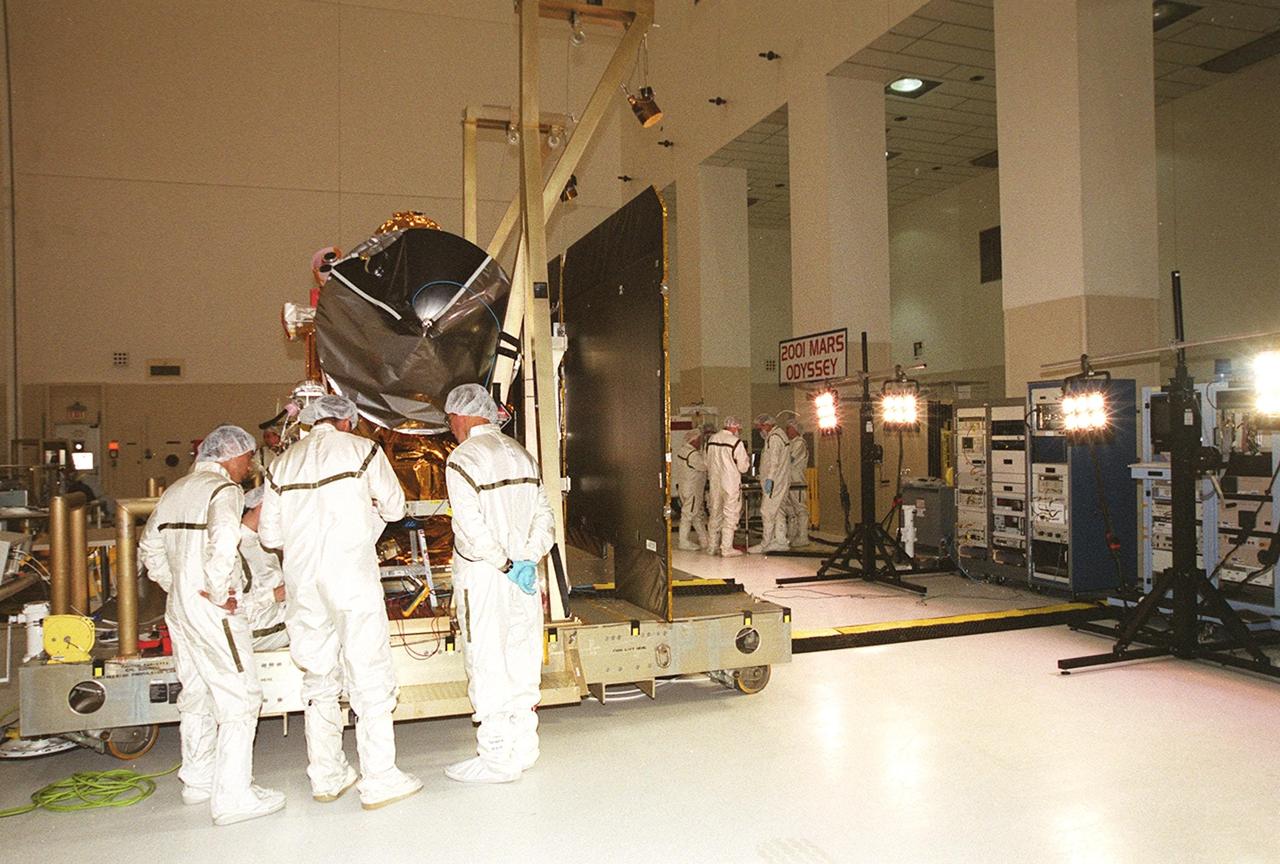
Workers testing in the Spacecraft Assembly and Encapsulation Facility (SAEF 2) stand alongside the 2001 Mars Odyssey Orbiter and behind its solar array panels. The arrays of lights (right) focus on the panels during illumination testing. Scheduled for launch April 7, 2001, the orbiter contains three science instruments: THEMIS, the Gamma Ray Spectrometer (GRS), and the Mars Radiation Environment Experiment (MARIE). THEMIS will map the mineralogy and morphology of the Martian surface using a high-resolution camera and a thermal infrared imaging spectrometer. The GRS will achieve global mapping of the elemental composition of the surface and determine the abundance of hydrogen in the shallow subsurface. The MARIE will characterize aspects of the near-space radiation environment with regards to the radiation-related risk to human explorers

A piece of the fairing that will cover the Mars Odyssey Orbiter during is lifted up the gantry at Launch Pad 17-A, Cape Canaveral Air Force Station. The 2001 Mars Odyssey Orbiter is scheduled for launch on a Delta rocket April 7, 2001. Mars Odyssey contains three science instruments: THEMIS, the Gamma Ray Spectrometer (GRS), and the Mars Radiation Environment Experiment (MARIE). THEMIS will map the mineralogy and morphology of the Martian surface using a high-resolution camera and a thermal infrared imaging spectrometer. The GRS will achieve global mapping of the elemental composition of the surface and determine the abundance of hydrogen in the shallow subsurface. The MARIE will characterize aspects of the near-space radiation environment with regards to the radiation-related risk to human explorers
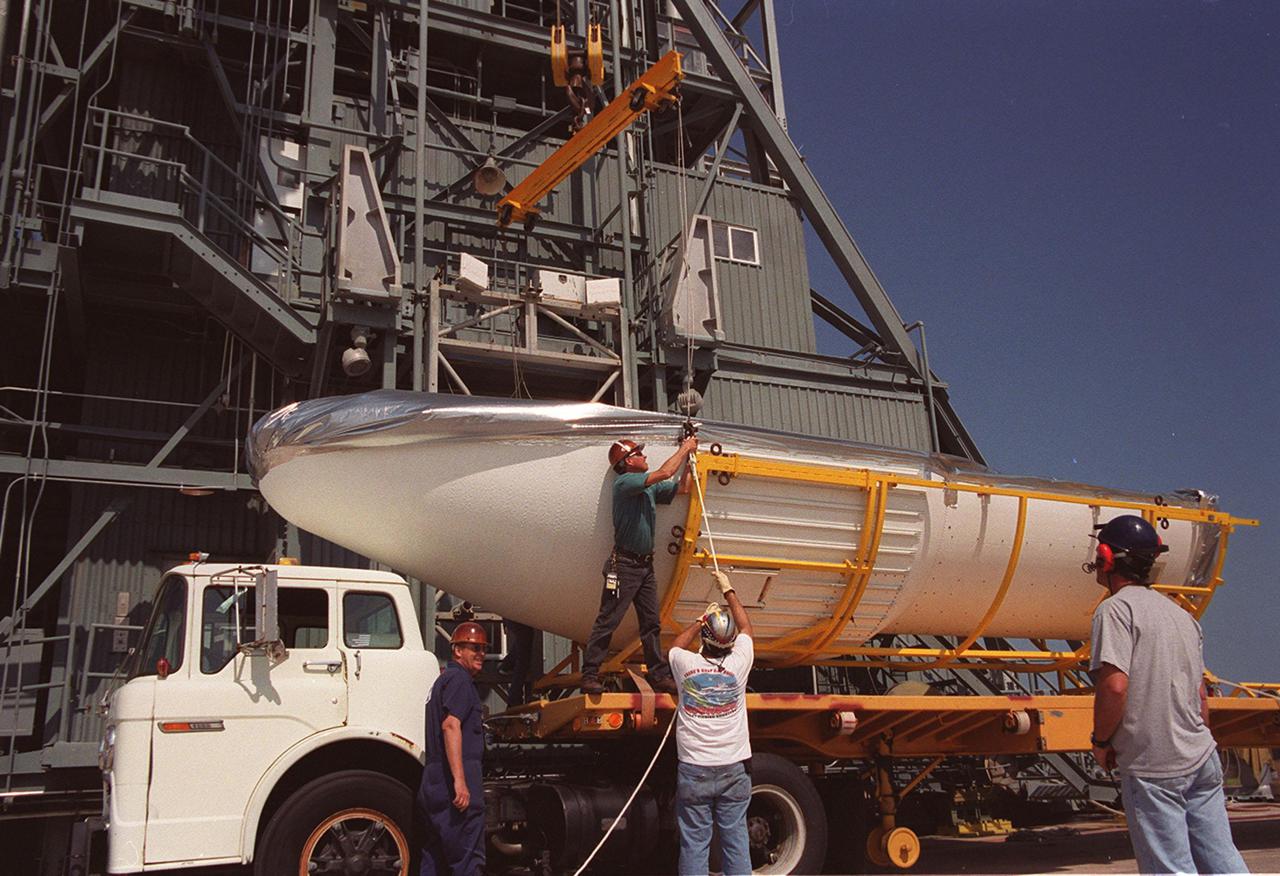
Workers at Launch Pad 17-A, Cape Canaveral Air Force Station, attach cables from a crane to one piece of the fairing that will cover the Mars Odyssey Orbiter during launch on a Delta rocket. The 2001 Mars Odyssey Orbiter is scheduled for launch April 7, 2001. Mars Odyssey contains three science instruments: THEMIS, the Gamma Ray Spectrometer (GRS), and the Mars Radiation Environment Experiment (MARIE). THEMIS will map the mineralogy and morphology of the Martian surface using a high-resolution camera and a thermal infrared imaging spectrometer. The GRS will achieve global mapping of the elemental composition of the surface and determine the abundance of hydrogen in the shallow subsurface. The MARIE will characterize aspects of the near-space radiation environment with regards to the radiation-related risk to human explorers
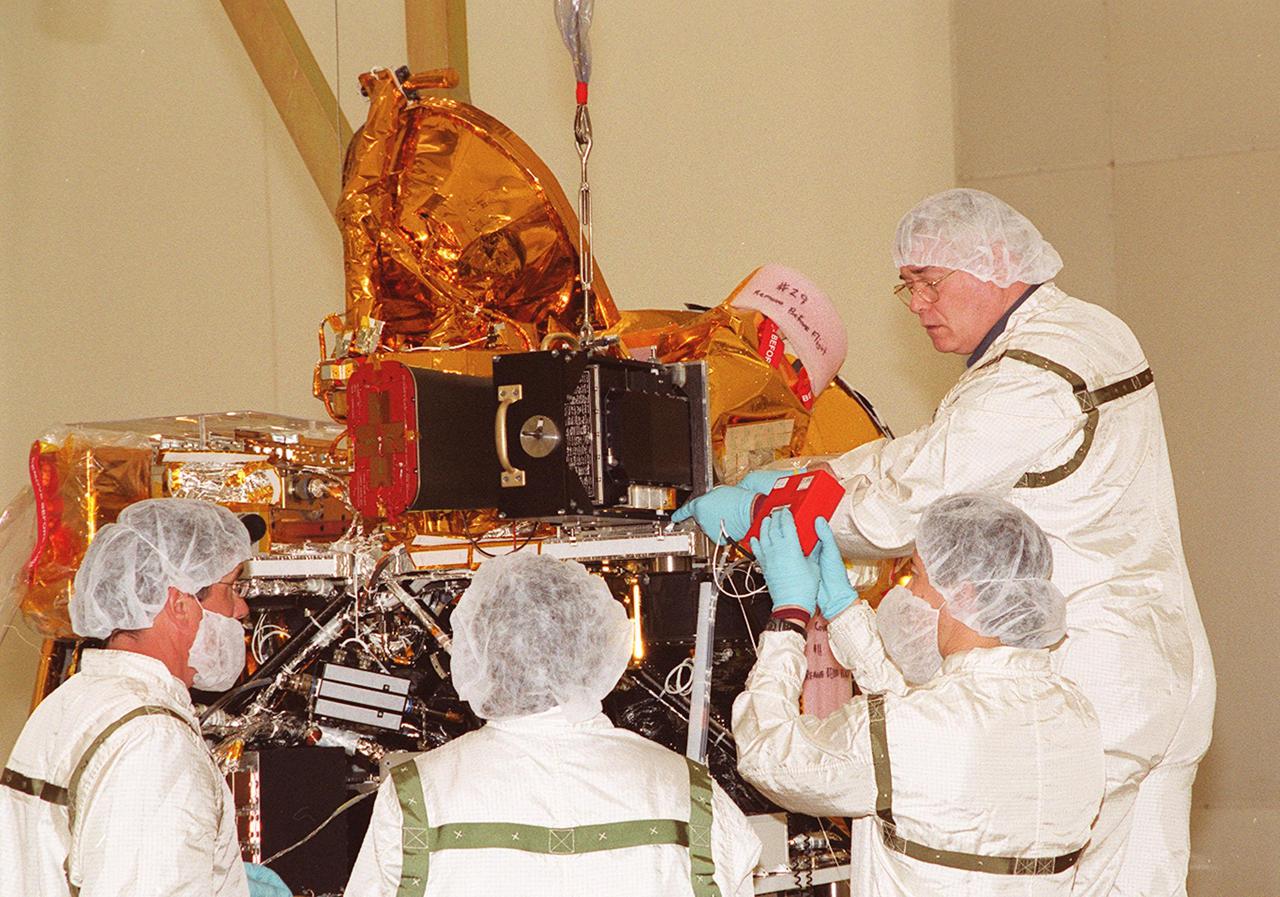
Workers in the Spacecraft Assembly and Encapsulation Facility 2 check the placement of the Thermal Emission Imaging System (THEMIS) on the Mars Odyssey Orbiter. THEMIS will map the mineralogy and morphology of the Martian surface using a high-resolution camera and a thermal infrared imaging spectrometer. The orbiter will carry three science instruments: THEMIS, the Gamma Ray Spectrometer (GRS), and the Mars Radiation Environment Experiment (MARIE). The GRS will achieve global mapping of the elemental composition of the surface and determine the abundance of hydrogen in the shallow subsurface. The MARIE will characterize aspects of the near-space radiation environment with regards to the radiation-related risk to human explorers. The Mars Odyssey Orbiter is scheduled for launch on April 7, 2001, aboard a Delta 7925 rocket from Launch Pad 17-A, Cape Canaveral Air Force Station