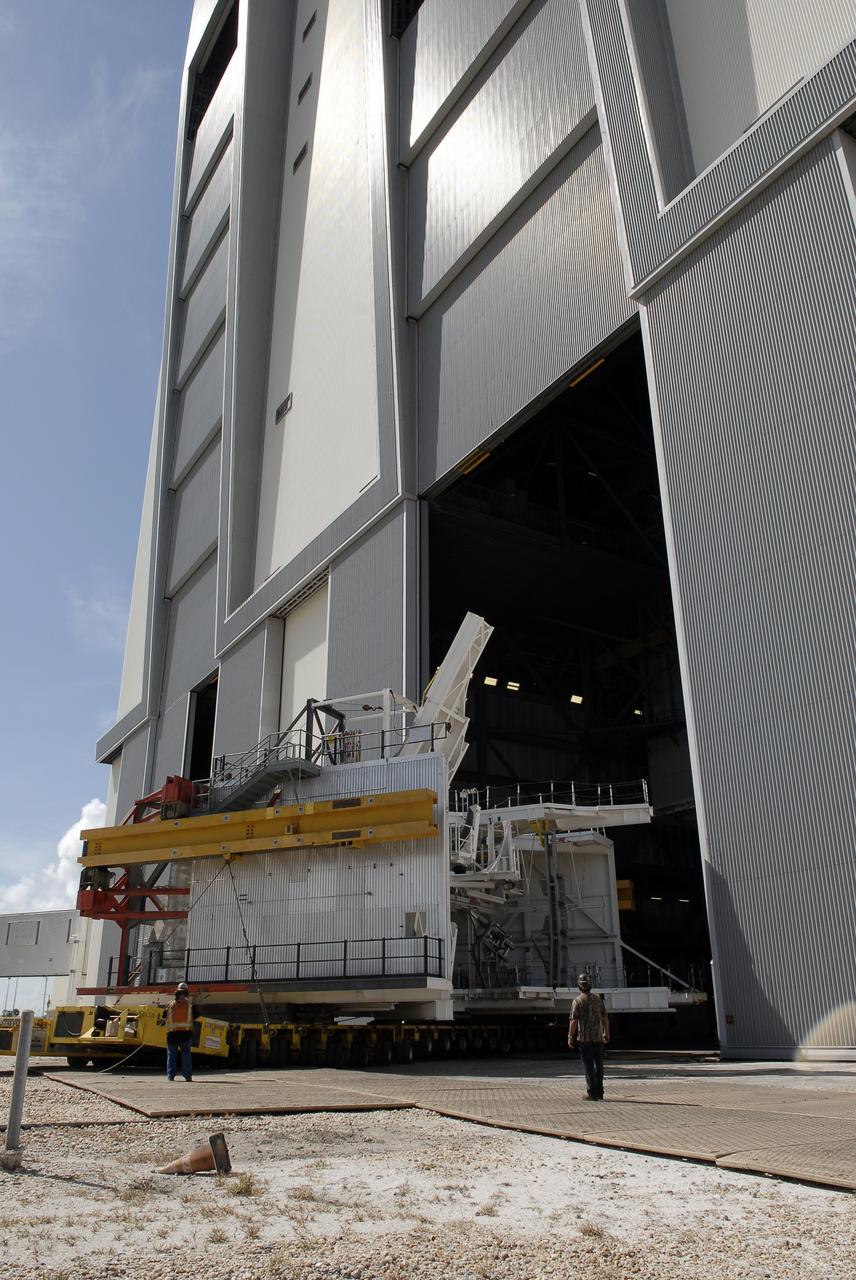
CAPE CANAVERAL, Fla. – As part of NASA's Ground Systems Development and Operations Program at the Kennedy Space Center in Florida, technicians oversee a large space shuttle-era work platform being removed from high bay 3 of the Vehicle Assembly Building, or VAB. The work is part of a center-wide modernization and refurbishment initiative to accommodate NASA’s Space Launch System and a variety of other spacecraft instead of the whole building supporting one design. The Ground Systems Development and Operations Program is developing the necessary ground systems, infrastructure and operational approaches required to safely process, assemble, transport and launch the next generation of rockets and spacecraft in support of NASA’s exploration objectives. Future work also will replace the antiquated communications, power and vehicle access resources with modern efficient systems. Some of the utilities and systems slated for replacement have been used since the VAB opened in 1965. For more information, visit http://www.nasa.gov/exploration/systems/ground/index.html Photo credit: NASA/ Charisse Nahser
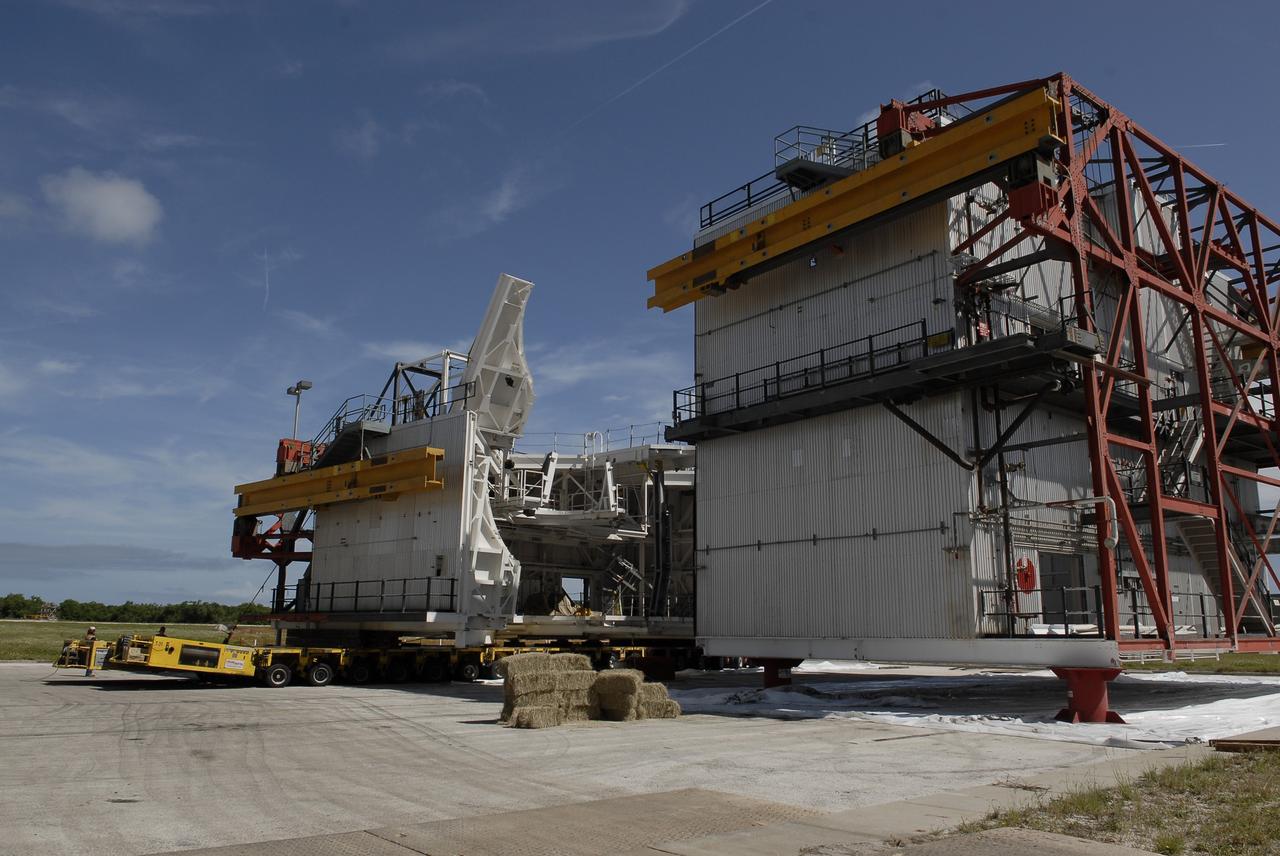
CAPE CANAVERAL, Fla. – As part of NASA's Ground Systems Development and Operations Program at the Kennedy Space Center in Florida, a large space shuttle-era work platform has been removed from the Vehicle Assembly Building, or VAB. The work is part of a center-wide modernization and refurbishment initiative to accommodate NASA’s Space Launch System and a variety of other spacecraft instead of the whole building supporting one design. The Ground Systems Development and Operations Program is developing the necessary ground systems, infrastructure and operational approaches required to safely process, assemble, transport and launch the next generation of rockets and spacecraft in support of NASA’s exploration objectives. Future work also will replace the antiquated communications, power and vehicle access resources with modern efficient systems. Some of the utilities and systems slated for replacement have been used since the VAB opened in 1965. For more information, visit http://www.nasa.gov/exploration/systems/ground/index.html Photo credit: NASA/ Charisse Nahser
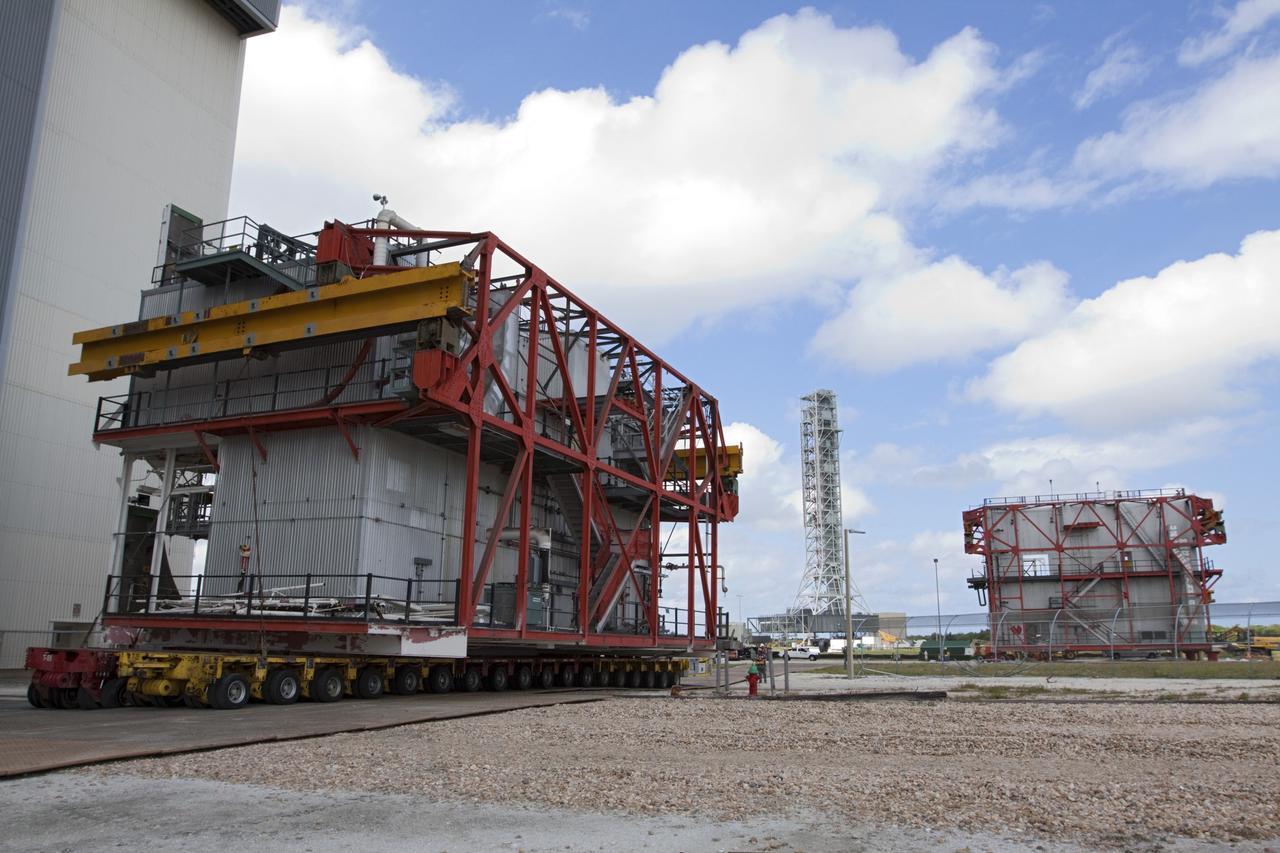
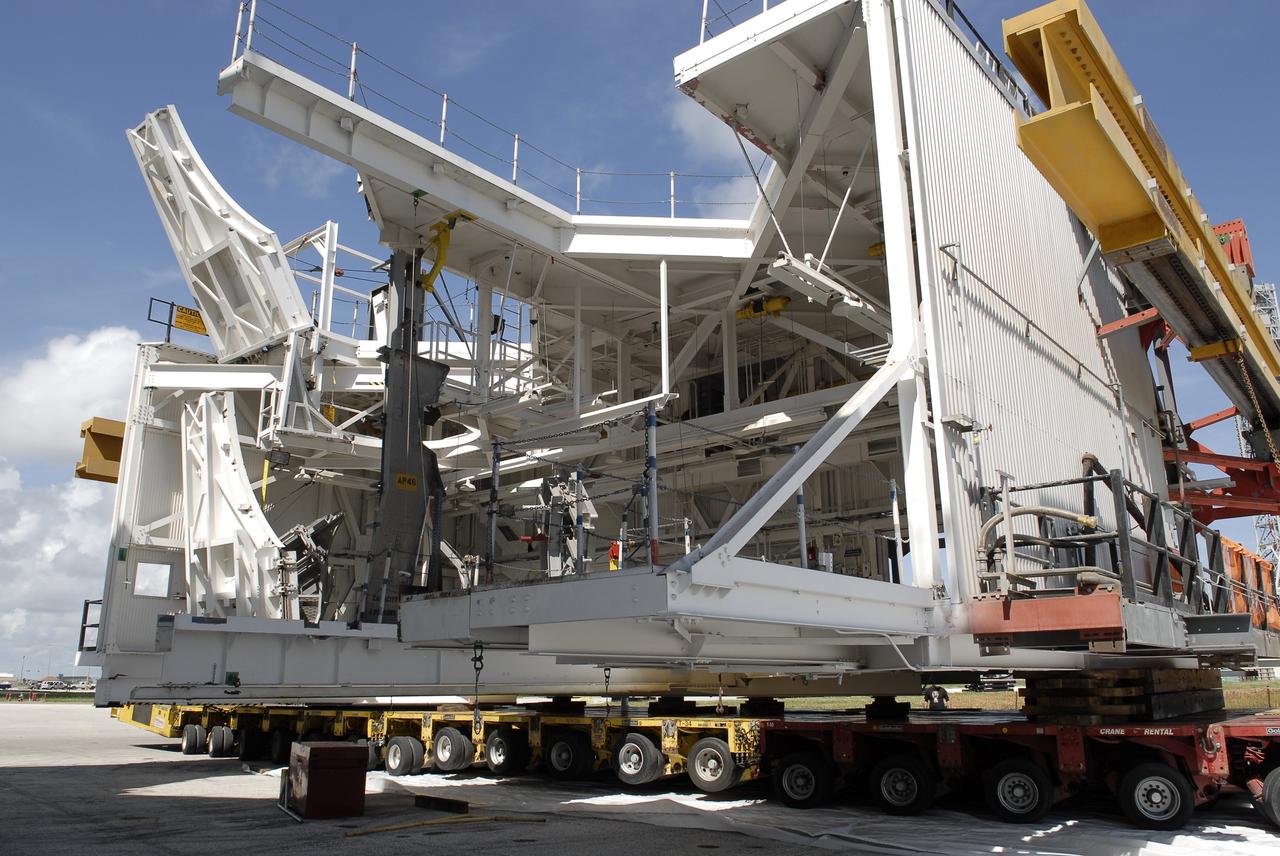
CAPE CANAVERAL, Fla. – As part of NASA's Ground Systems Development and Operations Program at the Kennedy Space Center in Florida, a large space shuttle-era work platform is being removed from high bay 3 of the Vehicle Assembly Building, or VAB, and placed on a transporter for removal. The work is part of a center-wide modernization and refurbishment initiative to accommodate NASA’s Space Launch System and a variety of other spacecraft instead of the whole building supporting one design. The Ground Systems Development and Operations Program is developing the necessary ground systems, infrastructure and operational approaches required to safely process, assemble, transport and launch the next generation of rockets and spacecraft in support of NASA’s exploration objectives. Future work also will replace the antiquated communications, power and vehicle access resources with modern efficient systems. Some of the utilities and systems slated for replacement have been used since the VAB opened in 1965. For more information, visit http://www.nasa.gov/exploration/systems/ground/index.html Photo credit: NASA/Kim Shiflett
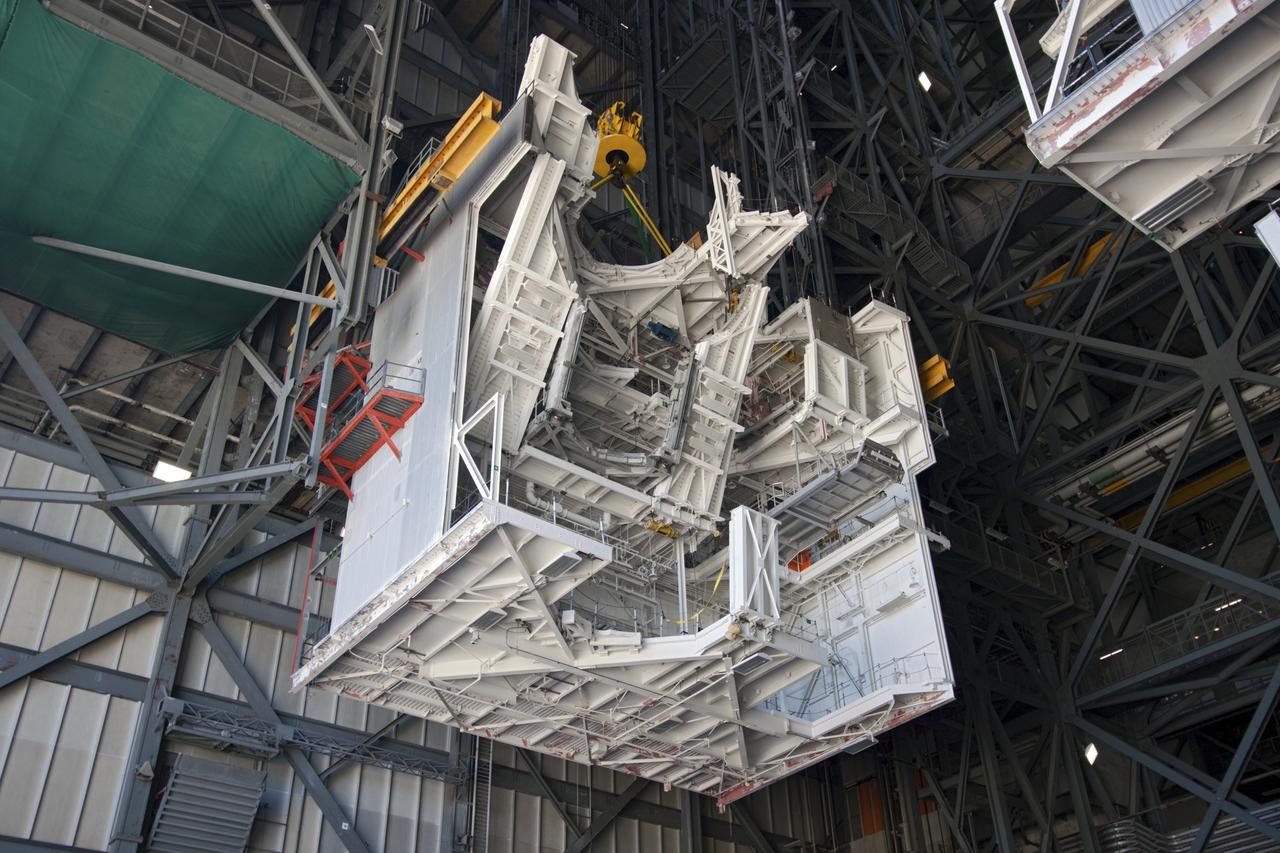
CAPE CANAVERAL, Fla. – As part of NASA's Ground Systems Development and Operations Program at the Kennedy Space Center in Florida, a large space shuttle-era work platform is being removed from high bay 3 of the Vehicle Assembly Building, or VAB. The work is part of a center-wide modernization and refurbishment initiative to accommodate NASA’s Space Launch System and a variety of other spacecraft instead of the whole building supporting one design. The Ground Systems Development and Operations Program is developing the necessary ground systems, infrastructure and operational approaches required to safely process, assemble, transport and launch the next generation of rockets and spacecraft in support of NASA’s exploration objectives. Future work also will replace the antiquated communications, power and vehicle access resources with modern efficient systems. Some of the utilities and systems slated for replacement have been used since the VAB opened in 1965. For more information, visit http://www.nasa.gov/exploration/systems/ground/index.html Photo credit: NASA/Jim Grossmann

CAPE CANAVERAL, Fla. – As part of NASA's Ground Systems Development and Operations Program at the Kennedy Space Center in Florida, space shuttle-era work platforms have been removed from high bay 3 of the Vehicle Assembly Building, or VAB. The work is part of a center-wide modernization and refurbishment initiative to accommodate NASA’s Space Launch System and a variety of other spacecraft instead of the whole building supporting one design. Visible in the lower background is the space shuttle Atlantis being readied for its move to the Kennedy Space Center Visitor Complex. The Ground Systems Development and Operations Program is developing the necessary ground systems, infrastructure and operational approaches required to safely process, assemble, transport and launch the next generation of rockets and spacecraft in support of NASA’s exploration objectives. Future work also will replace the antiquated communications, power and vehicle access resources with modern efficient systems. Some of the utilities and systems slated for replacement have been used since the VAB opened in 1965. For more information, visit http://www.nasa.gov/exploration/systems/ground/index.html Photo credit: NASA/Kim Shiflett
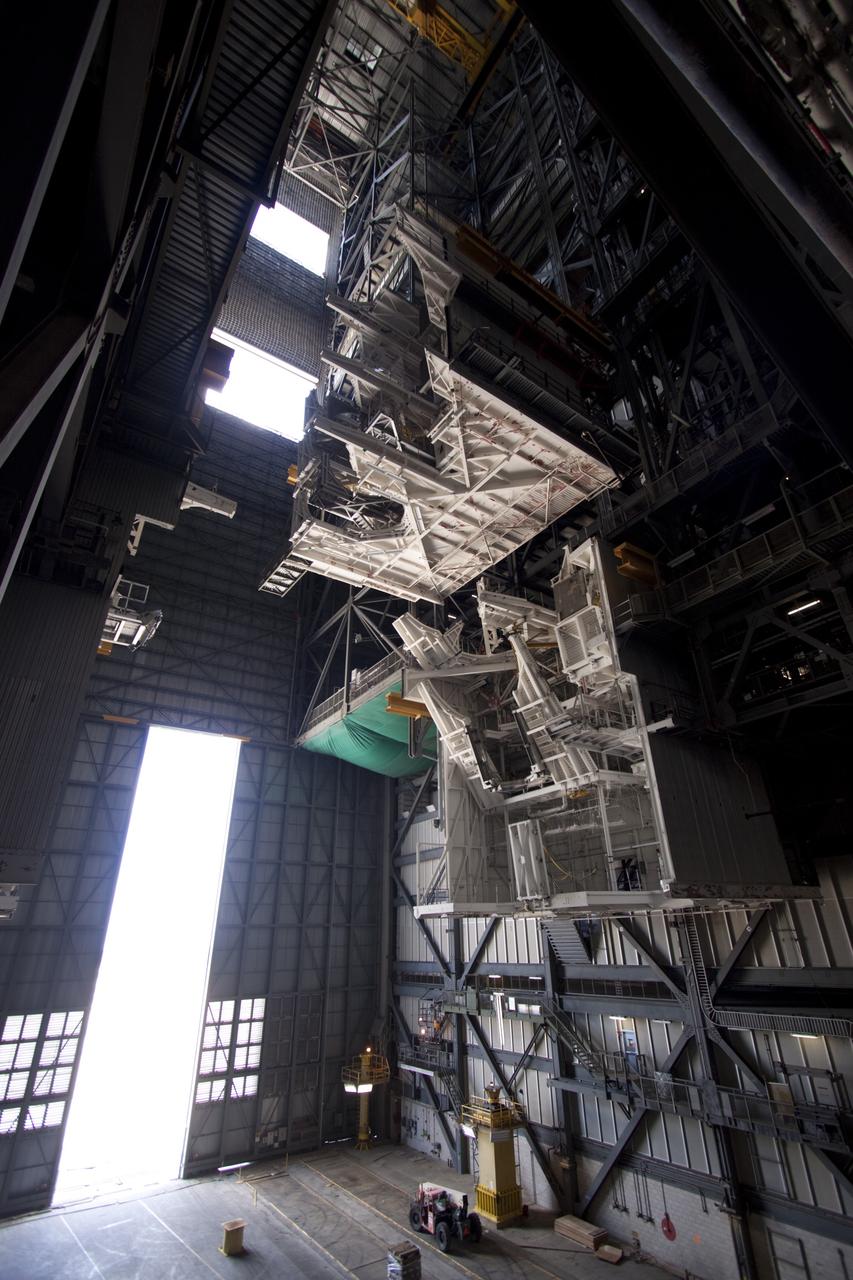
CAPE CANAVERAL, Fla. – As part of NASA's Ground Systems Development and Operations Program at the Kennedy Space Center in Florida, a large space shuttle-era work platform is being removed from high bay 3 of the Vehicle Assembly Building, or VAB. The work is part of a center-wide modernization and refurbishment initiative to accommodate NASA’s Space Launch System and a variety of other spacecraft instead of the whole building supporting one design. The Ground Systems Development and Operations Program is developing the necessary ground systems, infrastructure and operational approaches required to safely process, assemble, transport and launch the next generation of rockets and spacecraft in support of NASA’s exploration objectives. Future work also will replace the antiquated communications, power and vehicle access resources with modern efficient systems. Some of the utilities and systems slated for replacement have been used since the VAB opened in 1965. For more information, visit http://www.nasa.gov/exploration/systems/ground/index.html Photo credit: NASA/Jim Grossmann

CAPE CANAVERAL, Fla. – As part of NASA's Ground Systems Development and Operations Program at the Kennedy Space Center in Florida, space shuttle-era work platforms have been removed from high bay 3 of the Vehicle Assembly Building, or VAB. The work is part of a center-wide modernization and refurbishment initiative to accommodate NASA’s Space Launch System and a variety of other spacecraft instead of the whole building supporting one design. The Ground Systems Development and Operations Program is developing the necessary ground systems, infrastructure and operational approaches required to safely process, assemble, transport and launch the next generation of rockets and spacecraft in support of NASA’s exploration objectives. Future work also will replace the antiquated communications, power and vehicle access resources with modern efficient systems. Some of the utilities and systems slated for replacement have been used since the VAB opened in 1965. For more information, visit http://www.nasa.gov/exploration/systems/ground/index.html Photo credit: NASA/Kim Shiflett
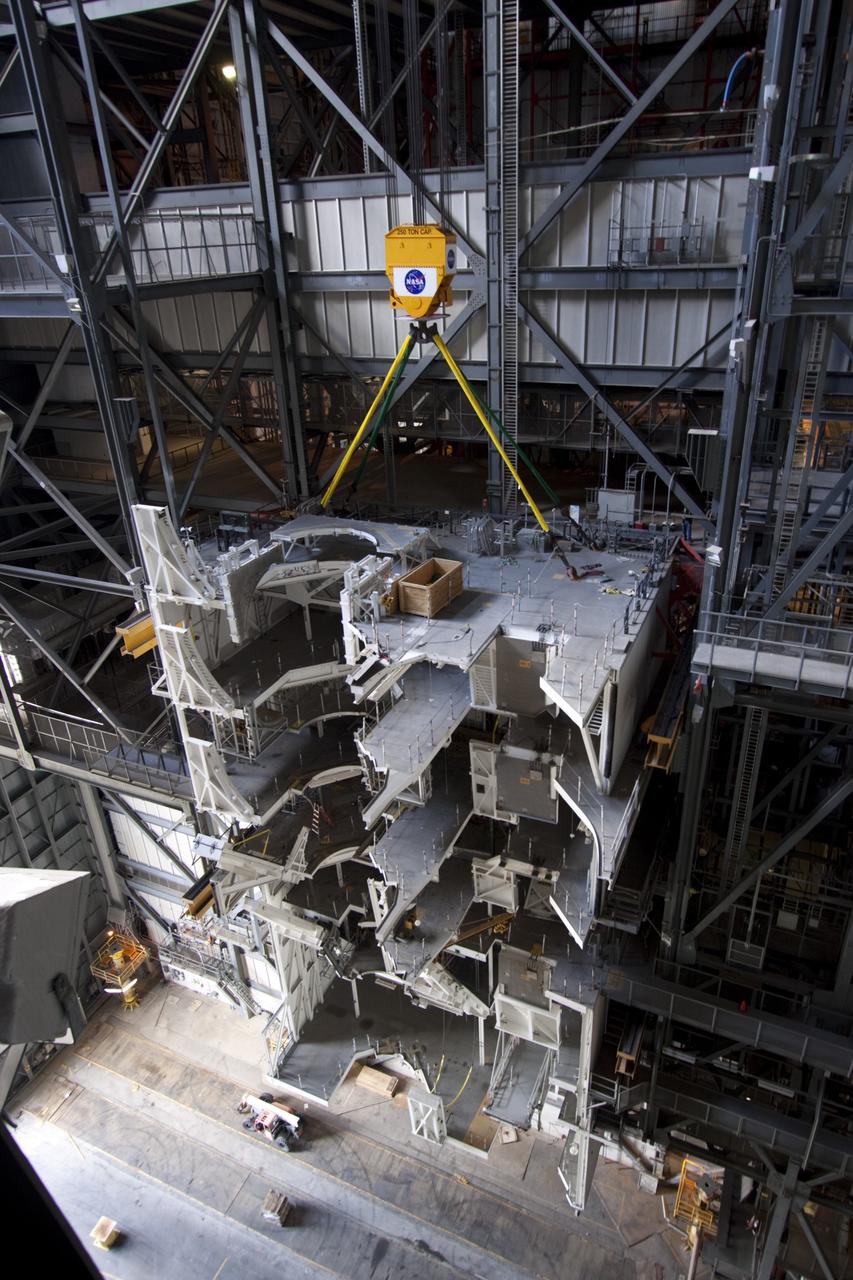
CAPE CANAVERAL, Fla. – As part of NASA's Ground Systems Development and Operations Program at the Kennedy Space Center in Florida, a large space shuttle-era work platform is being removed from high bay 3 of the Vehicle Assembly Building, or VAB. The work is part of a center-wide modernization and refurbishment initiative to accommodate NASA’s Space Launch System and a variety of other spacecraft instead of the whole building supporting one design. The Ground Systems Development and Operations Program is developing the necessary ground systems, infrastructure and operational approaches required to safely process, assemble, transport and launch the next generation of rockets and spacecraft in support of NASA’s exploration objectives. Future work also will replace the antiquated communications, power and vehicle access resources with modern efficient systems. Some of the utilities and systems slated for replacement have been used since the VAB opened in 1965. For more information, visit http://www.nasa.gov/exploration/systems/ground/index.html Photo credit: NASA/Jim Grossmann
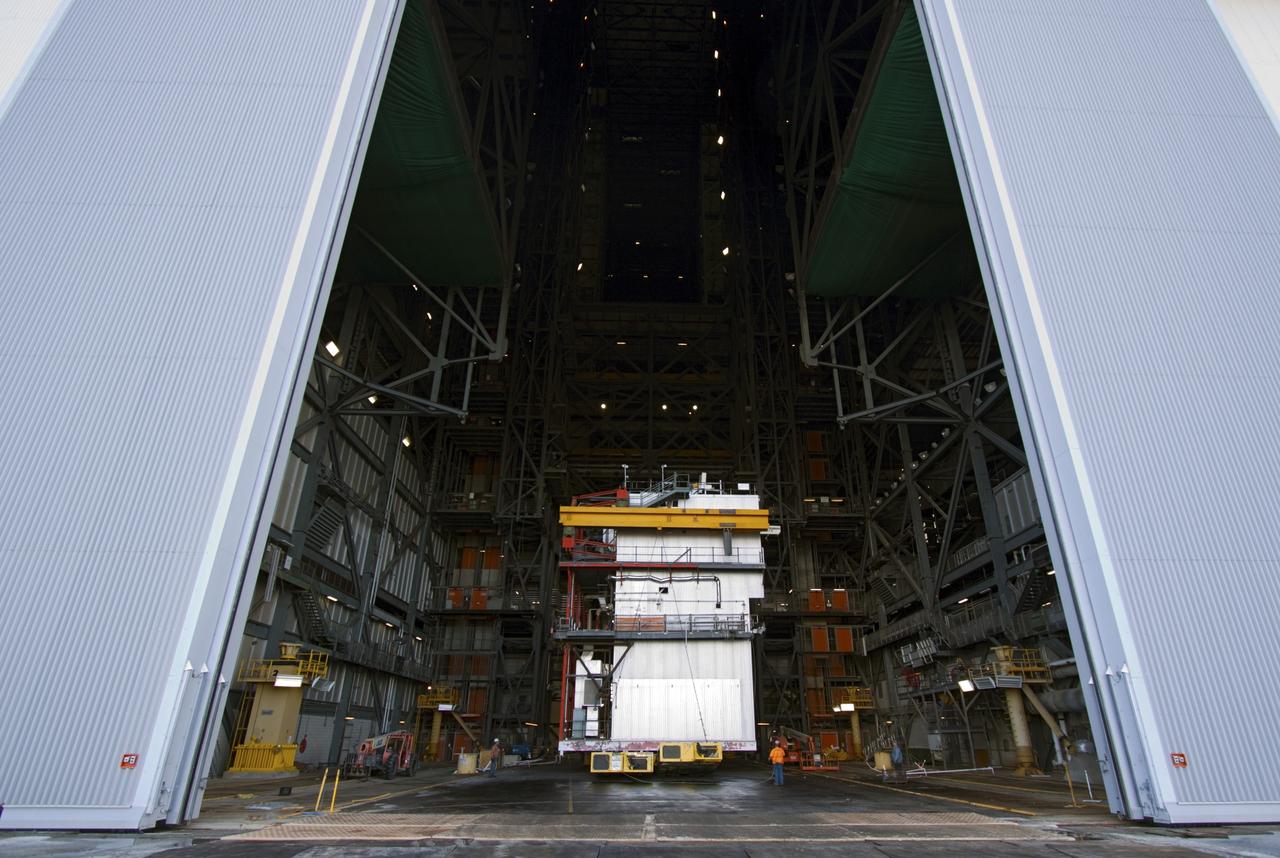
CAPE CANAVERAL, Fla. – As part of NASA's Ground Systems Development and Operations Program at the Kennedy Space Center in Florida, a large space shuttle-era work platform has been removed from high bay 3 of the Vehicle Assembly Building, or VAB. The work is part of a center-wide modernization and refurbishment initiative to accommodate NASA’s Space Launch System and a variety of other spacecraft instead of the whole building supporting one design. The Ground Systems Development and Operations Program is developing the necessary ground systems, infrastructure and operational approaches required to safely process, assemble, transport and launch the next generation of rockets and spacecraft in support of NASA’s exploration objectives. Future work also will replace the antiquated communications, power and vehicle access resources with modern efficient systems. Some of the utilities and systems slated for replacement have been used since the VAB opened in 1965. For more information, visit http://www.nasa.gov/exploration/systems/ground/index.html Photo credit: NASA/Jim Grossmann
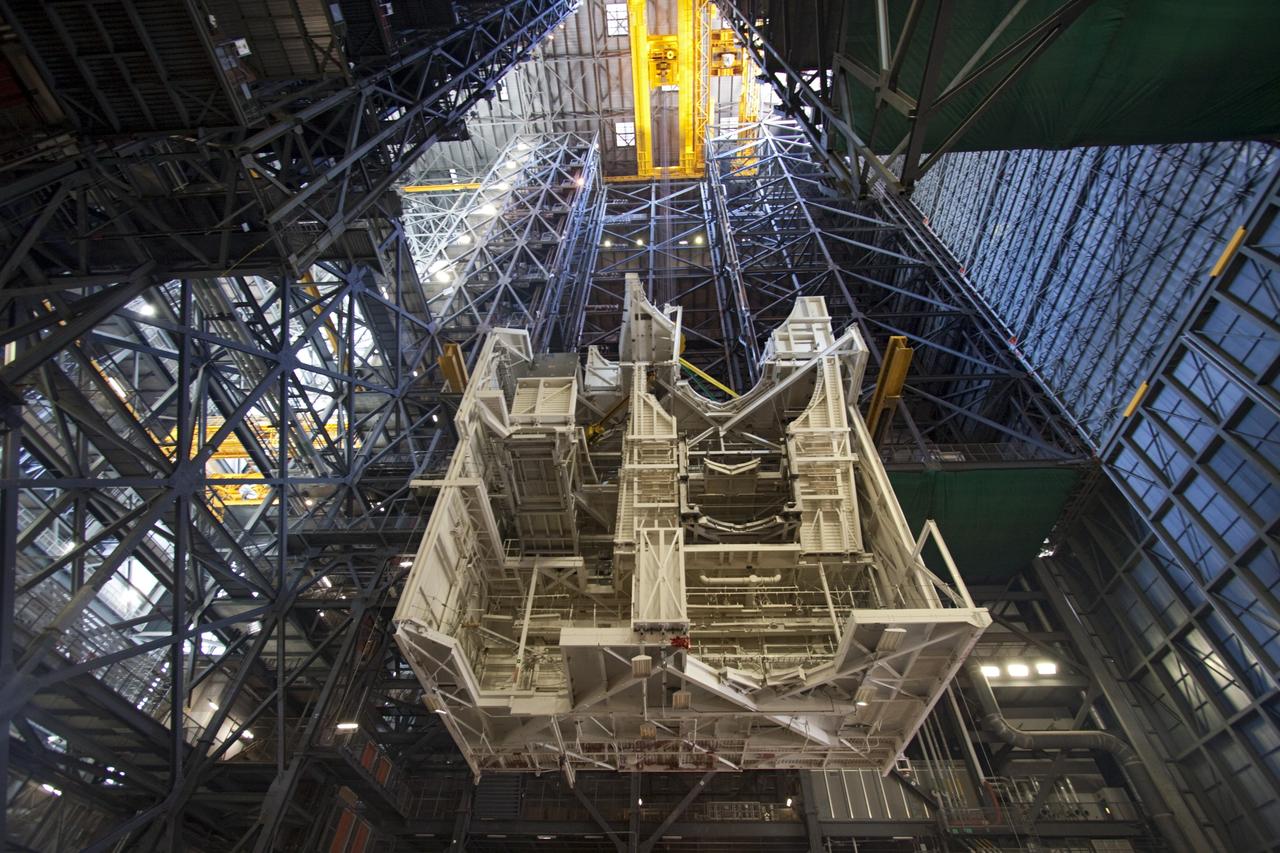
CAPE CANAVERAL, Fla. – As part of NASA's Ground Systems Development and Operations Program at the Kennedy Space Center in Florida, a large space shuttle-era work platform is being lowered and removed from high bay 3 of the Vehicle Assembly Building, or VAB. The work is part of a center-wide modernization and refurbishment initiative to accommodate NASA’s Space Launch System and a variety of other spacecraft instead of the whole building supporting one design. The Ground Systems Development and Operations Program is developing the necessary ground systems, infrastructure and operational approaches required to safely process, assemble, transport and launch the next generation of rockets and spacecraft in support of NASA’s exploration objectives. Future work also will replace the antiquated communications, power and vehicle access resources with modern efficient systems. Some of the utilities and systems slated for replacement have been used since the VAB opened in 1965. For more information, visit http://www.nasa.gov/exploration/systems/ground/index.html Photo credit: NASA/Jim Grossmann
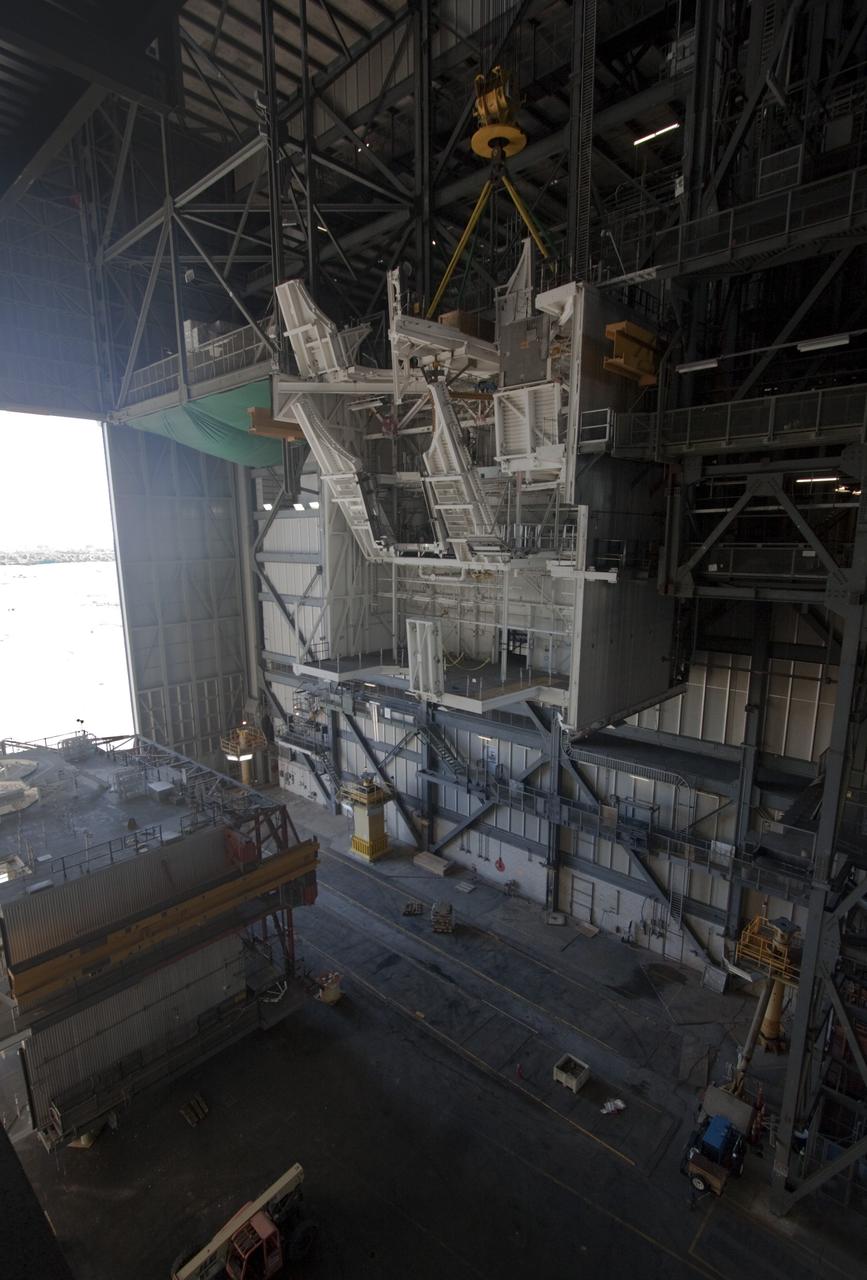
CAPE CANAVERAL, Fla. – As part of NASA's Ground Systems Development and Operations Program at the Kennedy Space Center in Florida, a large space shuttle-era work platform is being removed from high bay 3 of the Vehicle Assembly Building, or VAB. The work is part of a center-wide modernization and refurbishment initiative to accommodate NASA’s Space Launch System and a variety of other spacecraft instead of the whole building supporting one design. The Ground Systems Development and Operations Program is developing the necessary ground systems, infrastructure and operational approaches required to safely process, assemble, transport and launch the next generation of rockets and spacecraft in support of NASA’s exploration objectives. Future work also will replace the antiquated communications, power and vehicle access resources with modern efficient systems. Some of the utilities and systems slated for replacement have been used since the VAB opened in 1965. For more information, visit http://www.nasa.gov/exploration/systems/ground/index.html Photo credit: NASA/Jim Grossmann
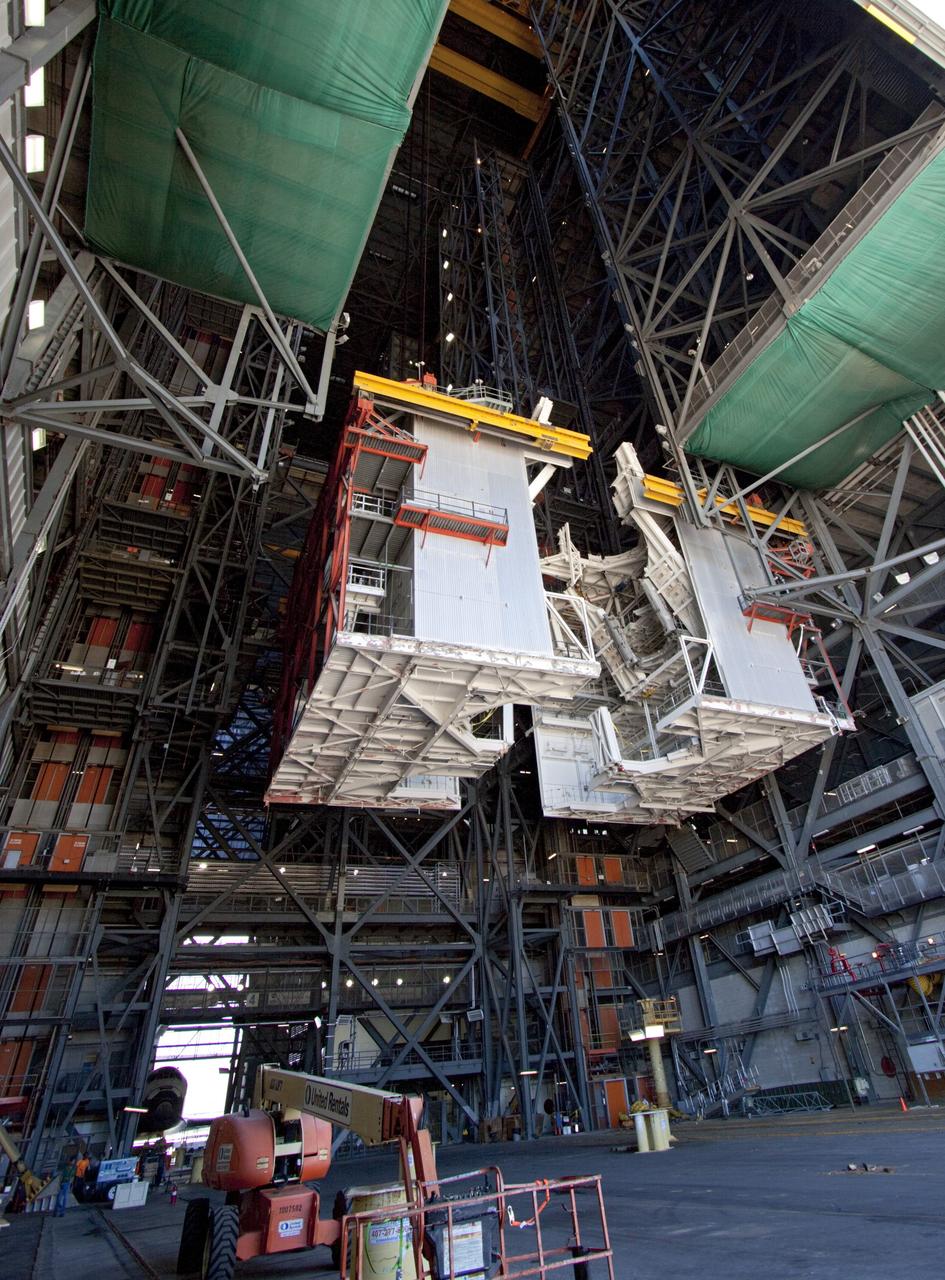
CAPE CANAVERAL, Fla. – As part of NASA's Ground Systems Development and Operations Program at the Kennedy Space Center in Florida, a large space shuttle-era work platform is being removed from high bay 3 of the Vehicle Assembly Building, or VAB. The work is part of a center-wide modernization and refurbishment initiative to accommodate NASA’s Space Launch System and a variety of other spacecraft instead of the whole building supporting one design. Visible in the lower-left background is the space shuttle Atlantis being readied for its move to the Kennedy Space Center Visitor Complex. The Ground Systems Development and Operations Program is developing the necessary ground systems, infrastructure and operational approaches required to safely process, assemble, transport and launch the next generation of rockets and spacecraft in support of NASA’s exploration objectives. Future work also will replace the antiquated communications, power and vehicle access resources with modern efficient systems. Some of the utilities and systems slated for replacement have been used since the VAB opened in 1965. For more information, visit http://www.nasa.gov/exploration/systems/ground/index.html Photo credit: NASA/Jim Grossmann
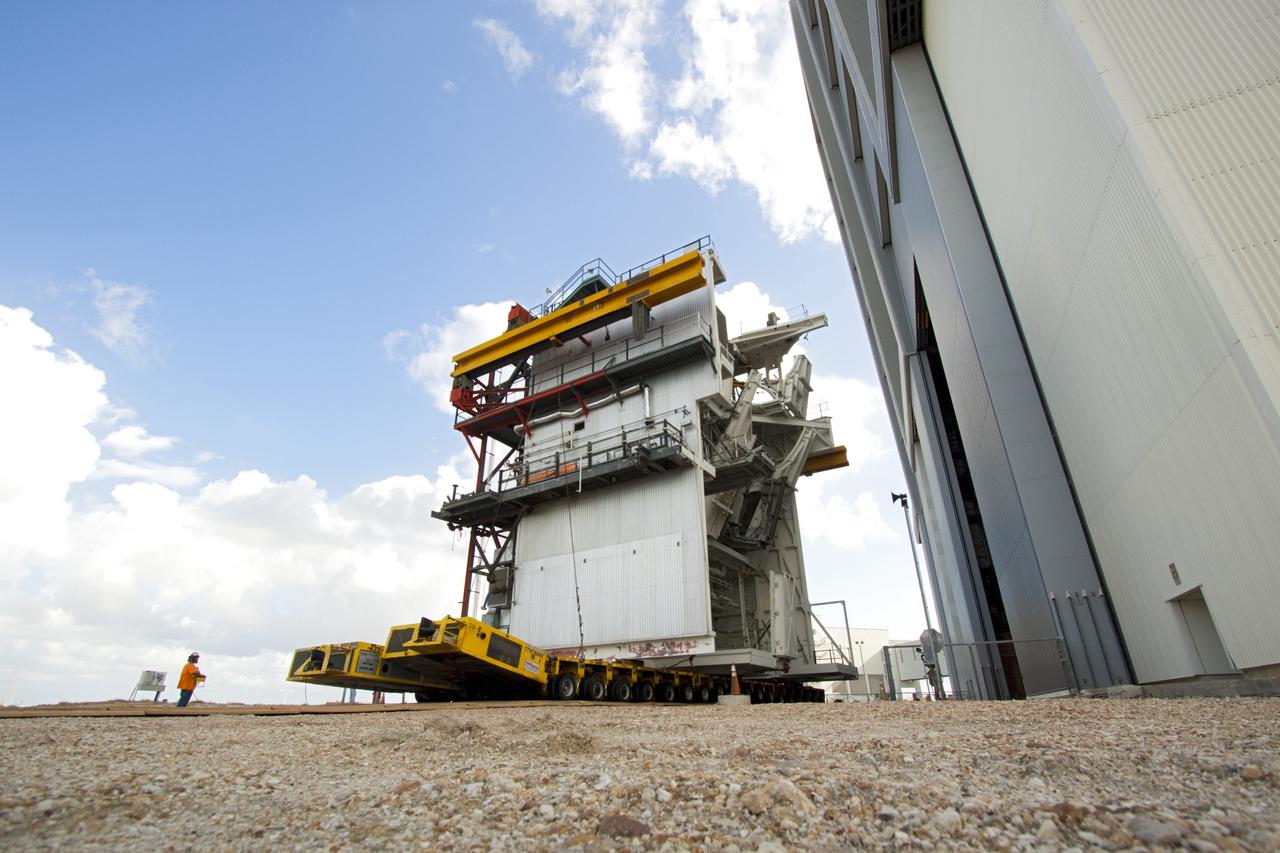
CAPE CANAVERAL, Fla. – As part of NASA's Ground Systems Development and Operations Program at the Kennedy Space Center in Florida, a large space shuttle-era work platform has been removed from high bay 3 of the Vehicle Assembly Building, or VAB. The work is part of a center-wide modernization and refurbishment initiative to accommodate NASA’s Space Launch System and a variety of other spacecraft instead of the whole building supporting one design. The Ground Systems Development and Operations Program is developing the necessary ground systems, infrastructure and operational approaches required to safely process, assemble, transport and launch the next generation of rockets and spacecraft in support of NASA’s exploration objectives. Future work also will replace the antiquated communications, power and vehicle access resources with modern efficient systems. Some of the utilities and systems slated for replacement have been used since the VAB opened in 1965. For more information, visit http://www.nasa.gov/exploration/systems/ground/index.html Photo credit: NASA/Jim Grossmann
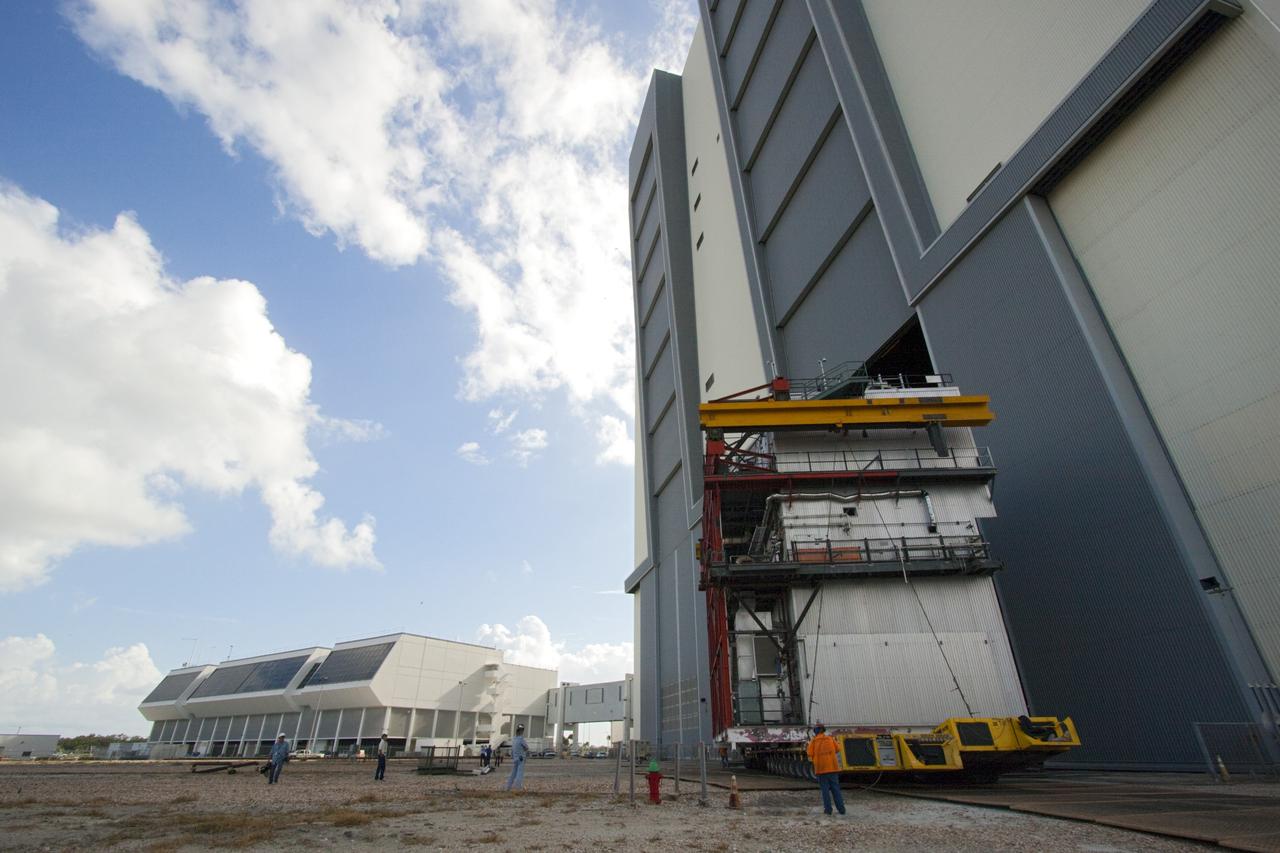
CAPE CANAVERAL, Fla. – As part of NASA's Ground Systems Development and Operations Program at the Kennedy Space Center in Florida, a large space shuttle-era work platform has been removed from high bay 3 of the Vehicle Assembly Building, or VAB. The work is part of a center-wide modernization and refurbishment initiative to accommodate NASA’s Space Launch System and a variety of other spacecraft instead of the whole building supporting one design. The Ground Systems Development and Operations Program is developing the necessary ground systems, infrastructure and operational approaches required to safely process, assemble, transport and launch the next generation of rockets and spacecraft in support of NASA’s exploration objectives. Future work also will replace the antiquated communications, power and vehicle access resources with modern efficient systems. Some of the utilities and systems slated for replacement have been used since the VAB opened in 1965. For more information, visit http://www.nasa.gov/exploration/systems/ground/index.html Photo credit: NASA/Jim Grossmann
CAPE CANAVERAL, Fla. – As part of NASA's Ground Systems Development and Operations Program at the Kennedy Space Center in Florida, a work platform is lowered onto a transporter for removal from the Vehicle Assembly Building, or VAB. As part of a modernization effort, flexible settings area being designed for multiple launch vehicles instead of the whole building supporting one design. The Ground Systems Development and Operations Program is developing the necessary ground systems, infrastructure and operational approaches required to safely process, assemble, transport and launch the next generation of rockets and spacecraft in support of NASA’s exploration objectives. Future work also will replace the antiquated communications, power and vehicle access resources with modern efficient systems. Some of the utilities and systems slated for replacement have been used since the VAB opened in 1965. For more information, visit http://www.nasa.gov/exploration/systems/ground/index.html Photo credit: NASA/Charisse Nahser
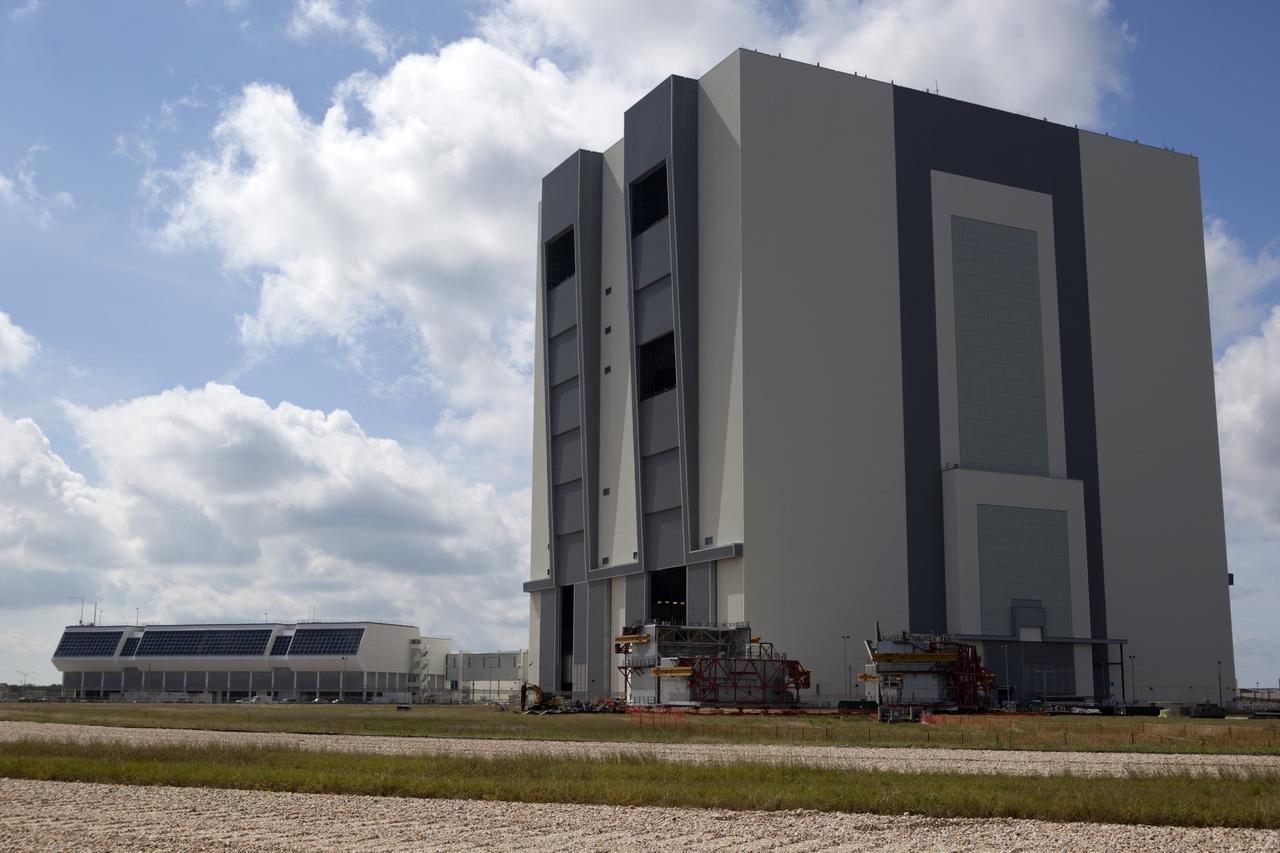
CAPE CANAVERAL, Fla. – As part of NASA's Ground Systems Development and Operations Program at the Kennedy Space Center in Florida, a large space shuttle-era work platform is being removed by transporter from high bay 3 of the Vehicle Assembly Building, or VAB. The work is part of a center-wide modernization and refurbishment initiative to accommodate NASA’s Space Launch System and a variety of other spacecraft instead of the whole building supporting one design. The Ground Systems Development and Operations Program is developing the necessary ground systems, infrastructure and operational approaches required to safely process, assemble, transport and launch the next generation of rockets and spacecraft in support of NASA’s exploration objectives. Future work also will replace the antiquated communications, power and vehicle access resources with modern efficient systems. Some of the utilities and systems slated for replacement have been used since the VAB opened in 1965. For more information, visit http://www.nasa.gov/exploration/systems/ground/index.html Photo credit: NASA/Dimitri Gerondidakis

CAPE CANAVERAL, Fla. – As part of NASA's Ground Systems Development and Operations Program at the Kennedy Space Center in Florida, a large space shuttle-era work platform is being removed from high bay 3 of the Vehicle Assembly Building, or VAB. The work is part of a center-wide modernization and refurbishment initiative to accommodate NASA’s Space Launch System and a variety of other spacecraft instead of the whole building supporting one design. The Ground Systems Development and Operations Program is developing the necessary ground systems, infrastructure and operational approaches required to safely process, assemble, transport and launch the next generation of rockets and spacecraft in support of NASA’s exploration objectives. Future work also will replace the antiquated communications, power and vehicle access resources with modern efficient systems. Some of the utilities and systems slated for replacement have been used since the VAB opened in 1965. For more information, visit http://www.nasa.gov/exploration/systems/ground/index.html Photo credit: NASA/Jim Grossmann
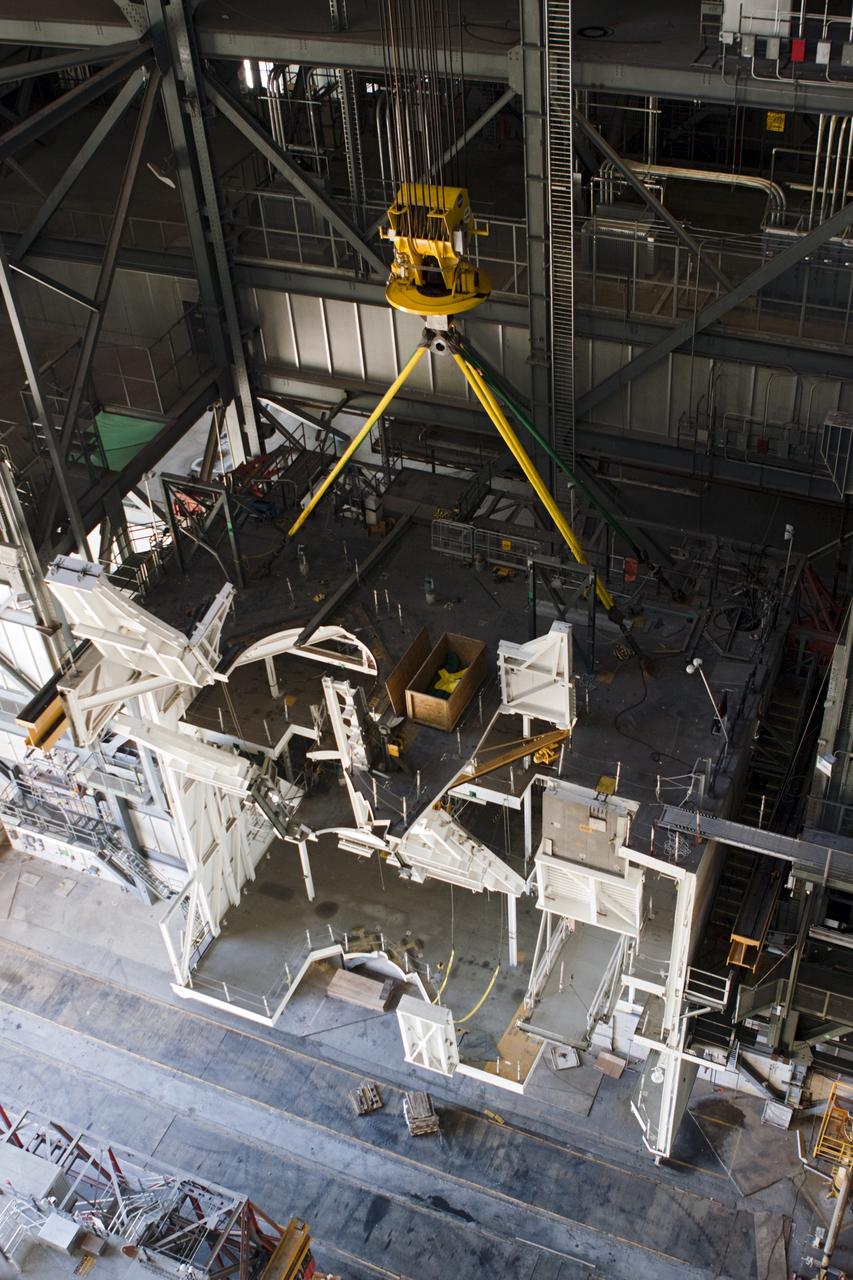
CAPE CANAVERAL, Fla. – As part of NASA's Ground Systems Development and Operations Program at the Kennedy Space Center in Florida, a large space shuttle-era work platform is being removed from high bay 3 of the Vehicle Assembly Building, or VAB. The work is part of a center-wide modernization and refurbishment initiative to accommodate NASA’s Space Launch System and a variety of other spacecraft instead of the whole building supporting one design. The Ground Systems Development and Operations Program is developing the necessary ground systems, infrastructure and operational approaches required to safely process, assemble, transport and launch the next generation of rockets and spacecraft in support of NASA’s exploration objectives. Future work also will replace the antiquated communications, power and vehicle access resources with modern efficient systems. Some of the utilities and systems slated for replacement have been used since the VAB opened in 1965. For more information, visit http://www.nasa.gov/exploration/systems/ground/index.html Photo credit: NASA/Jim Grossmann
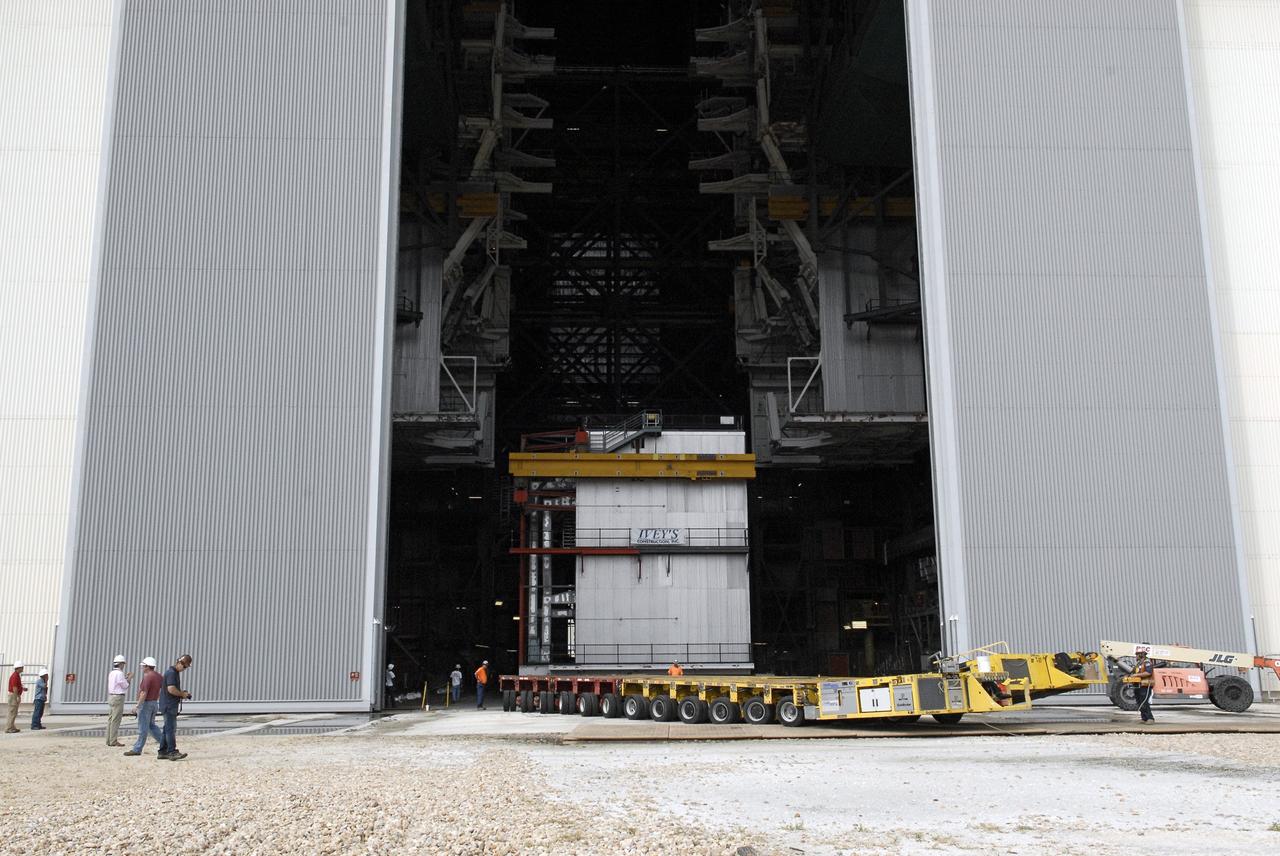
CAPE CANAVERAL, Fla. – As part of NASA's Ground Systems Development and Operations Program at the Kennedy Space Center in Florida, a work platform is lowered onto a transporter for removal from the Vehicle Assembly Building, or VAB. As part of a modernization effort, flexible settings area being designed for multiple launch vehicles instead of the whole building supporting one design. The Ground Systems Development and Operations Program is developing the necessary ground systems, infrastructure and operational approaches required to safely process, assemble, transport and launch the next generation of rockets and spacecraft in support of NASA’s exploration objectives. Future work also will replace the antiquated communications, power and vehicle access resources with modern efficient systems. Some of the utilities and systems slated for replacement have been used since the VAB opened in 1965. For more information, visit http://www.nasa.gov/exploration/systems/ground/index.html Photo credit: NASA/Charisse Nahser
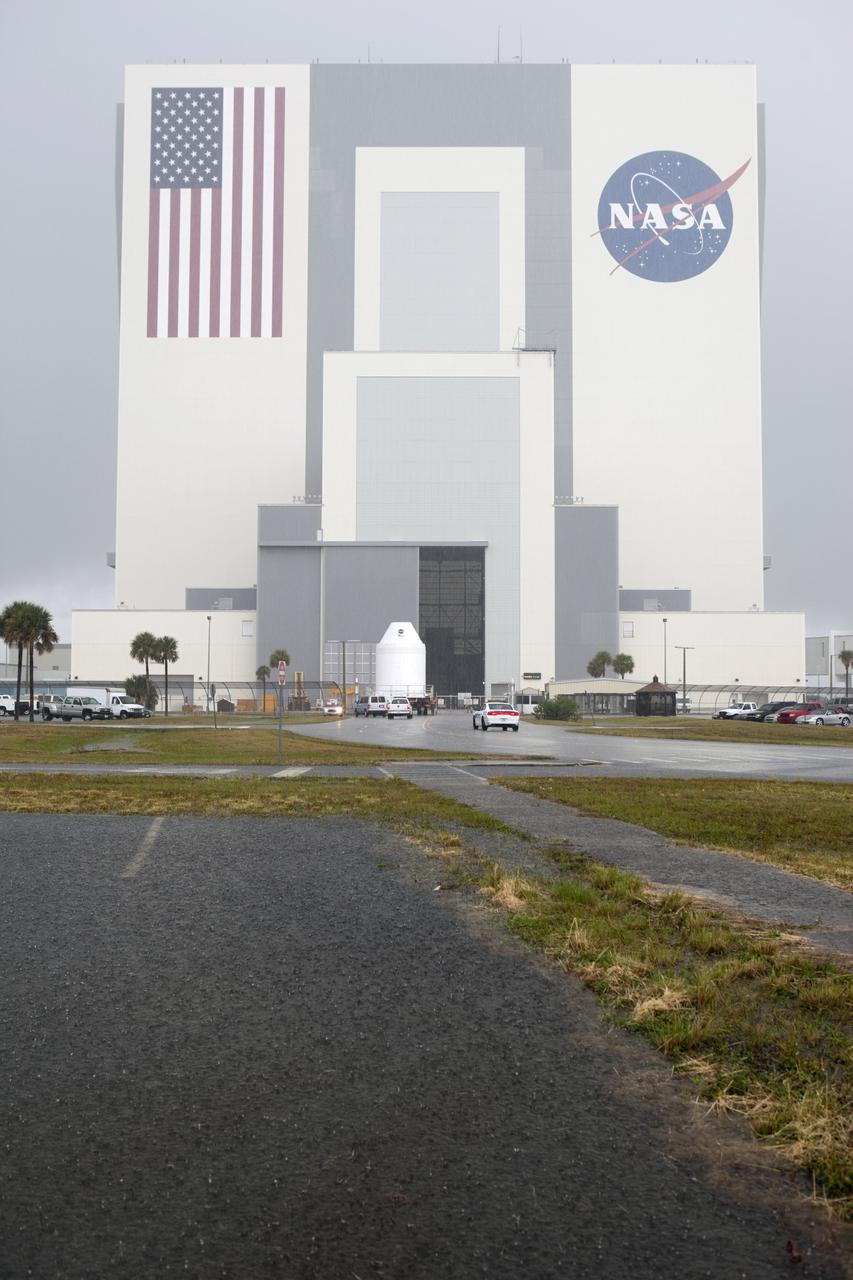
CAPE CANAVERAL, Fla. – A full-size test mock-up of the Orion spacecraft arrives at the Vehicle Assembly Building at NASA's Kennedy Space Center in Florida to test the path flight hardware will take during future launch processing. Orion is the exploration spacecraft designed to carry crews to space beyond low Earth orbit. It will provide emergency abort capability, sustain the crew during the space travel and provide safe re-entry from deep space return velocities. The first unpiloted test flight of the Orion is scheduled to launch in 2014 atop a Delta IV rocket and in 2017 on a Space Launch System rocket. For more information, visit http://www.nasa.gov/orion Photo credit: NASA/Dimitri Gerondidakis
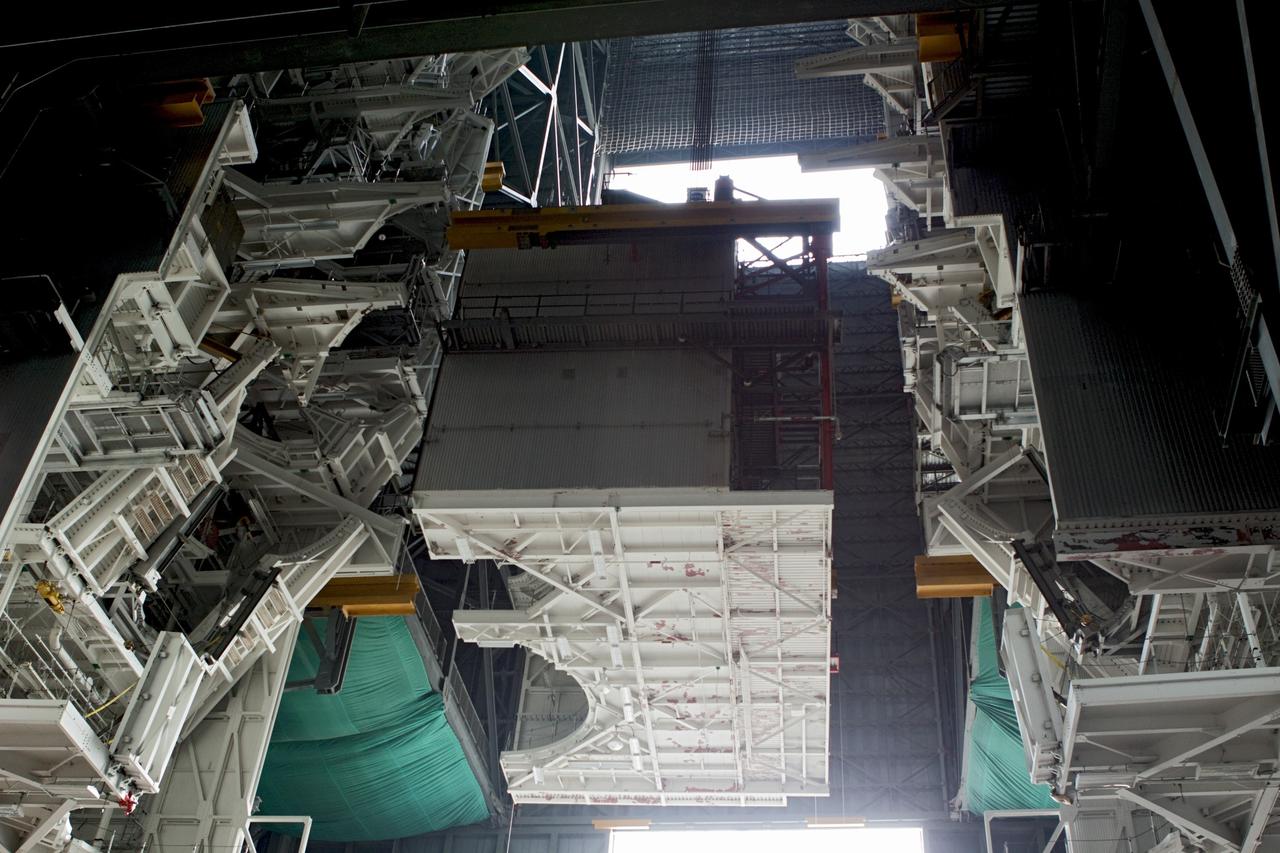
CAPE CANAVERAL, Fla. – As part of NASA's Ground Systems Development and Operations Program at the Kennedy Space Center in Florida, a large work platform is being removed from the Vehicle Assembly Building, or VAB. As part of a modernization effort, flexible settings are being designed for multiple launch vehicles instead of the whole building supporting one design. The Ground Systems Development and Operations Program is developing the necessary ground systems, infrastructure and operational approaches required to safely process, assemble, transport and launch the next generation of rockets and spacecraft in support of NASA’s exploration objectives. Future work also will replace the antiquated communications, power and vehicle access resources with modern efficient systems. Some of the utilities and systems slated for replacement have been used since the VAB opened in 1965. For more information, visit http://www.nasa.gov/exploration/systems/ground/index.html Photo credit: NASA/Jim Grossmann
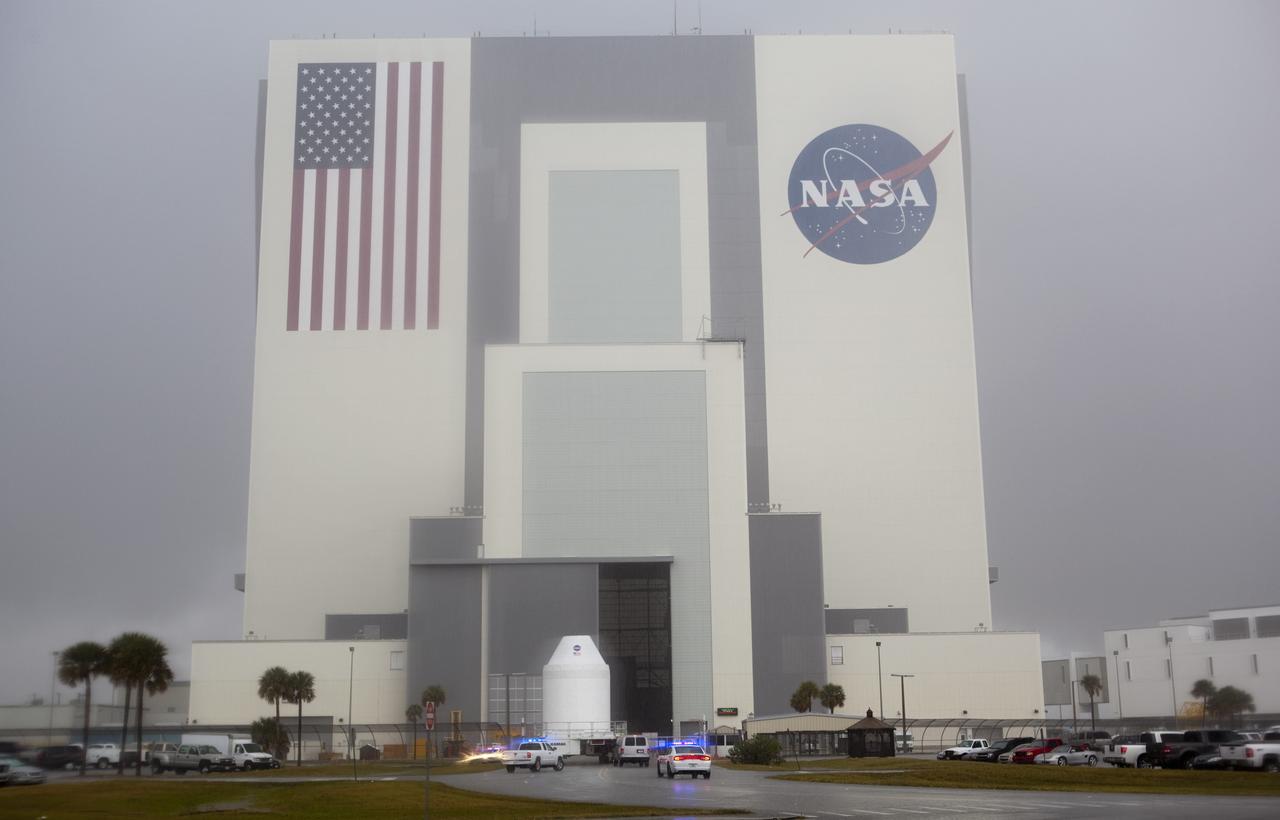
CAPE CANAVERAL, Fla. – A full-size test mock-up of the Orion spacecraft arrives at the Vehicle Assembly Building at NASA's Kennedy Space Center in Florida to test the path flight hardware will take during future launch processing. Orion is the exploration spacecraft designed to carry crews to space beyond low Earth orbit. It will provide emergency abort capability, sustain the crew during the space travel and provide safe re-entry from deep space return velocities. The first unpiloted test flight of the Orion is scheduled to launch in 2014 atop a Delta IV rocket and in 2017 on a Space Launch System rocket. For more information, visit http://www.nasa.gov/orion Photo credit: NASA/Dimitri Gerondidakis
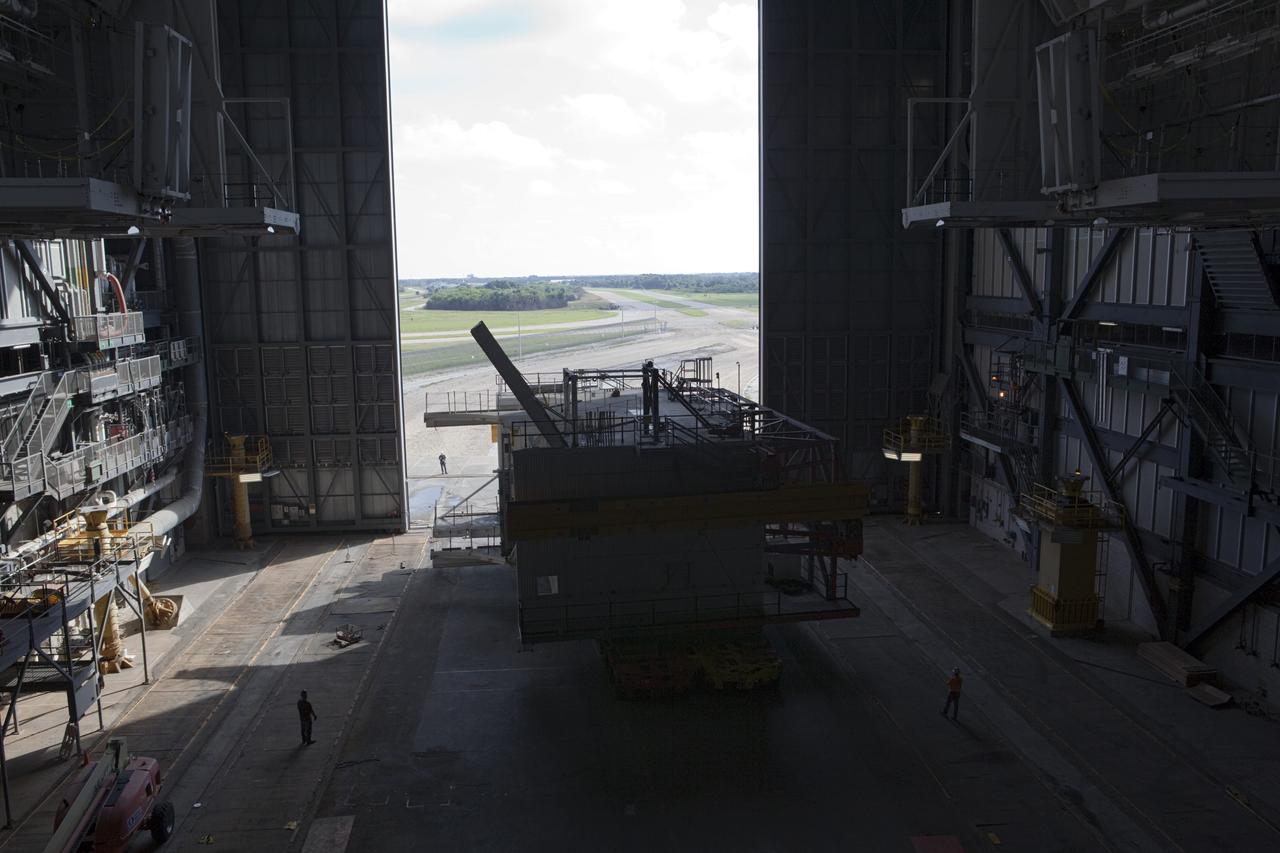
CAPE CANAVERAL, Fla. – As part of NASA's Ground Systems Development and Operations Program at the Kennedy Space Center in Florida, a large space shuttle-era work platform is being removed from high bay 3 of the Vehicle Assembly Building, or VAB. The work is part of a center-wide modernization and refurbishment initiative to accommodate NASA’s Space Launch System and a variety of other spacecraft instead of the whole building supporting one design. The Ground Systems Development and Operations Program is developing the necessary ground systems, infrastructure and operational approaches required to safely process, assemble, transport and launch the next generation of rockets and spacecraft in support of NASA’s exploration objectives. Future work also will replace the antiquated communications, power and vehicle access resources with modern efficient systems. Some of the utilities and systems slated for replacement have been used since the VAB opened in 1965. For more information, visit http://www.nasa.gov/exploration/systems/ground/index.html Photo credit: NASA/Dimitri Gerondidakis
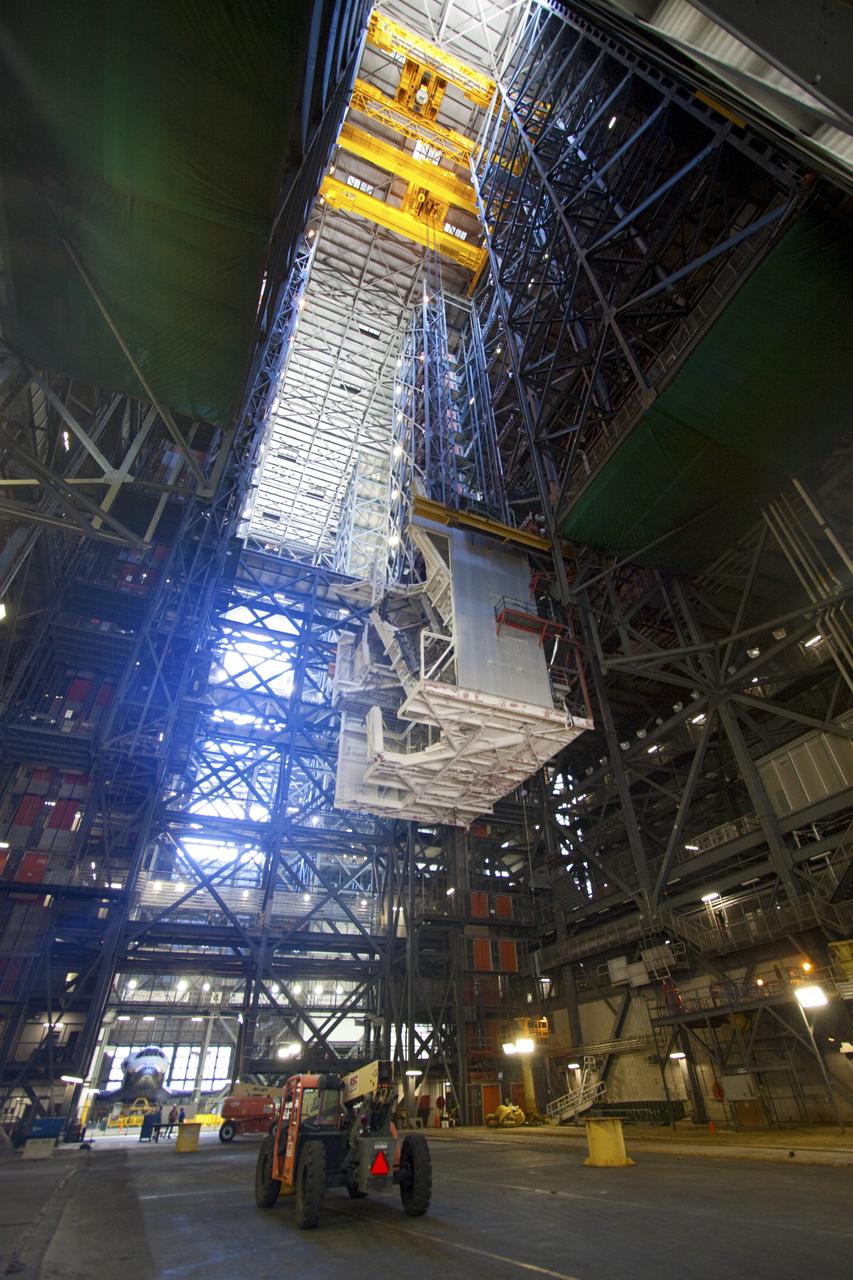
CAPE CANAVERAL, Fla. – As part of NASA's Ground Systems Development and Operations Program at the Kennedy Space Center in Florida, a large space shuttle-era work platform is being removed from high bay 3 of the Vehicle Assembly Building, or VAB. The work is part of a center-wide modernization and refurbishment initiative to accommodate NASA’s Space Launch System and a variety of other spacecraft instead of the whole building supporting one design. Visible in the background on the lower left is the space shuttle Atlantis being readied for its move to the Kennedy Space Center Visitor Complex. The Ground Systems Development and Operations Program is developing the necessary ground systems, infrastructure and operational approaches required to safely process, assemble, transport and launch the next generation of rockets and spacecraft in support of NASA’s exploration objectives. Future work also will replace the antiquated communications, power and vehicle access resources with modern efficient systems. Some of the utilities and systems slated for replacement have been used since the VAB opened in 1965. For more information, visit http://www.nasa.gov/exploration/systems/ground/index.html Photo credit: NASA/Jim Grossmann
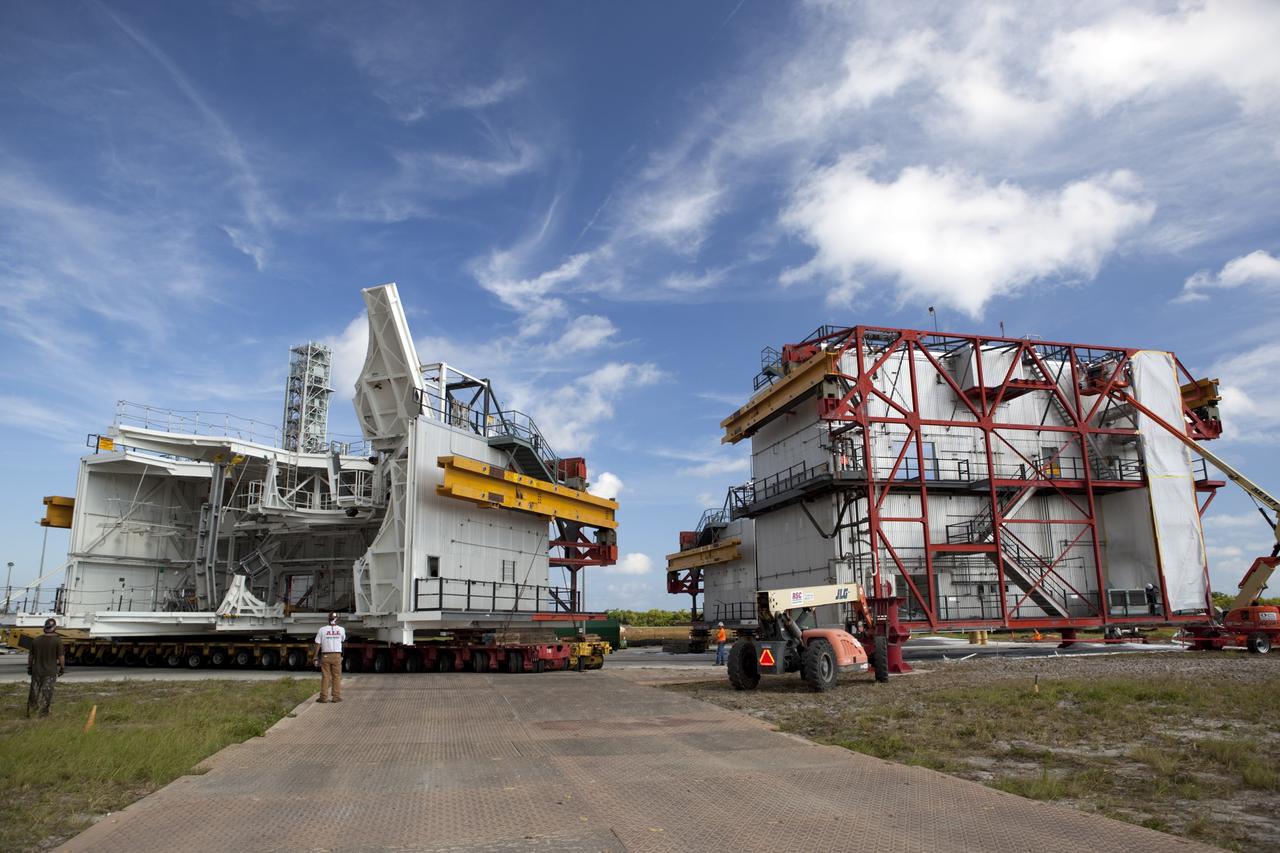
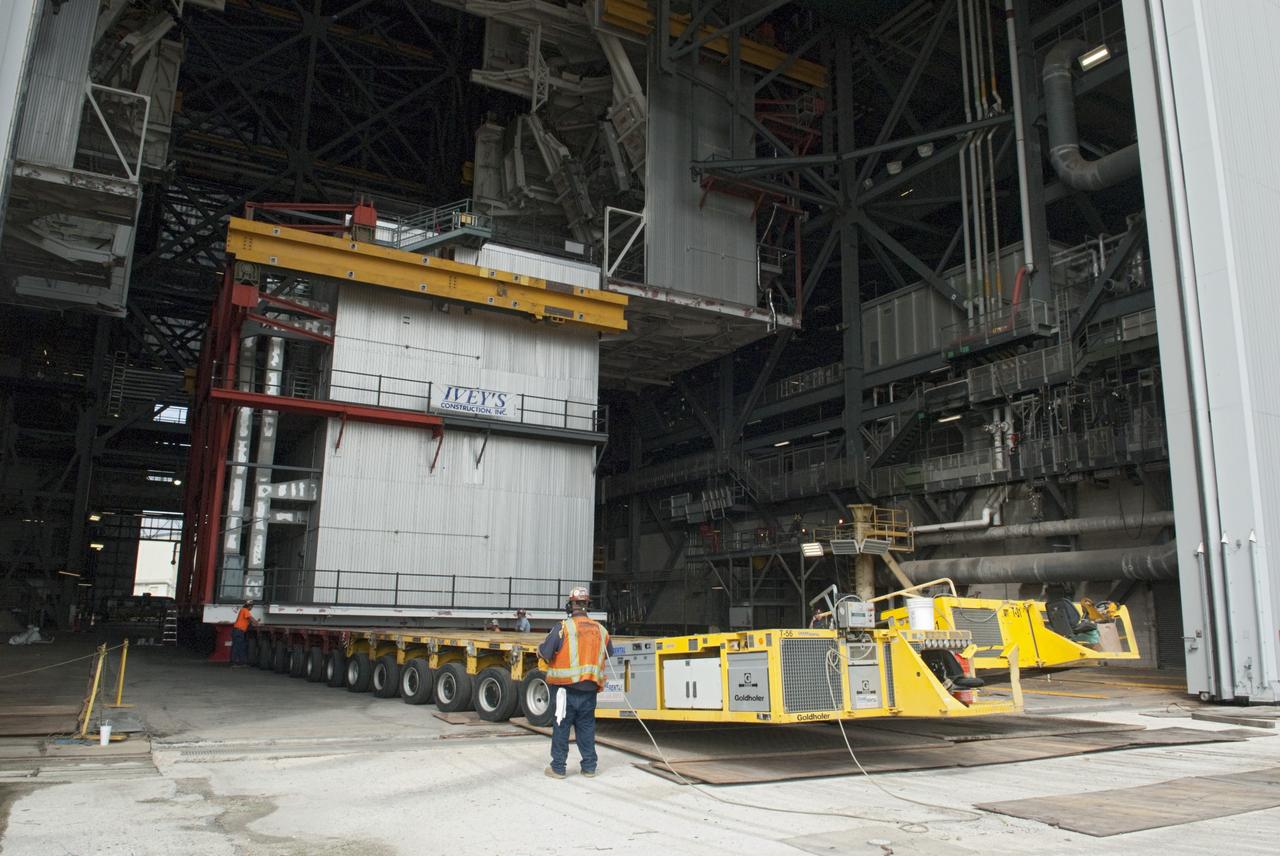
CAPE CANAVERAL, Fla. – As part of NASA's Ground Systems Development and Operations Program at the Kennedy Space Center in Florida, a technician oversees a large space shuttle-era work platform being removed by transporter from high bay 3 of the Vehicle Assembly Building, or VAB. The work is part of a center-wide modernization and refurbishment initiative to accommodate NASA’s Space Launch System and a variety of other spacecraft instead of the whole building supporting one design. The Ground Systems Development and Operations Program is developing the necessary ground systems, infrastructure and operational approaches required to safely process, assemble, transport and launch the next generation of rockets and spacecraft in support of NASA’s exploration objectives. Future work also will replace the antiquated communications, power and vehicle access resources with modern efficient systems. Some of the utilities and systems slated for replacement have been used since the VAB opened in 1965. For more information, visit http://www.nasa.gov/exploration/systems/ground/index.html Photo credit: NASA/Dimitri Gerondidakis
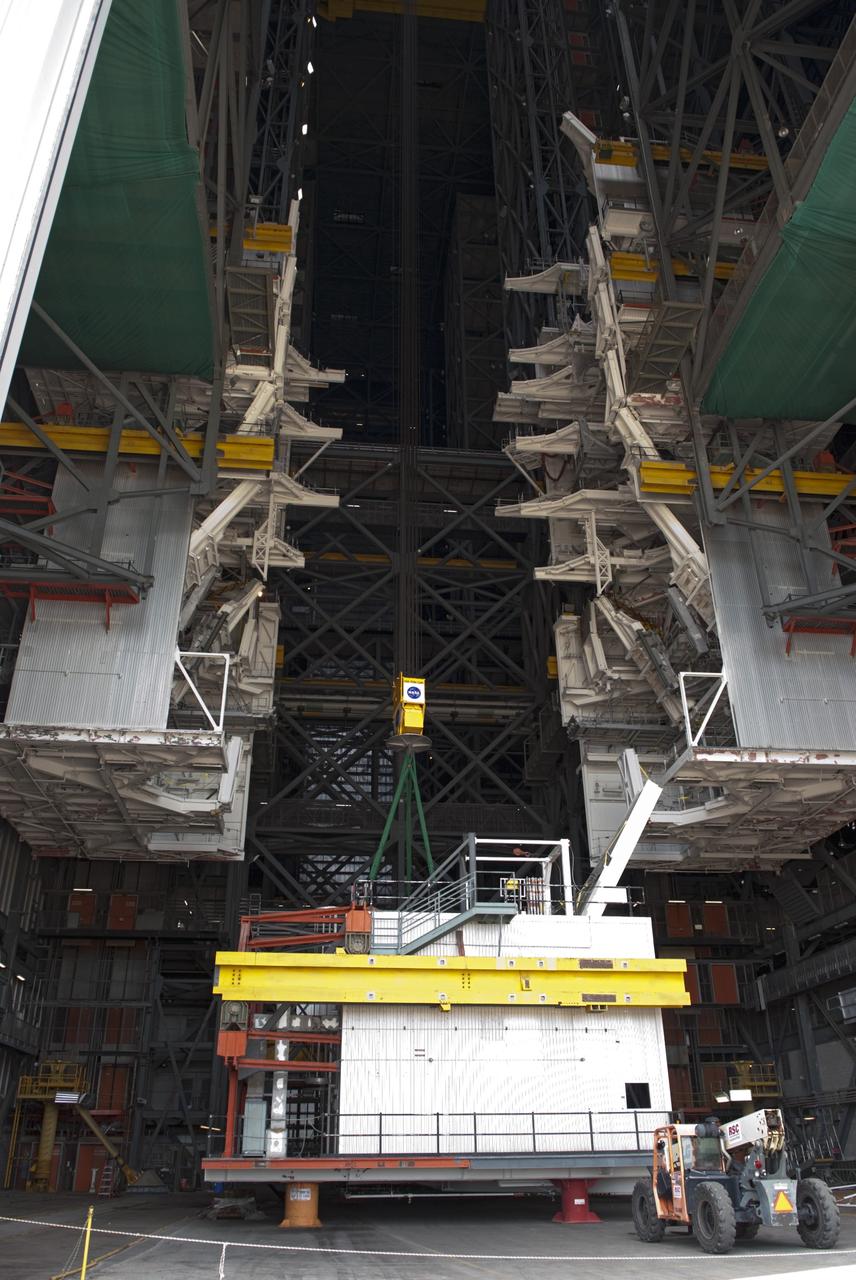
CAPE CANAVERAL, Fla. – As part of NASA's Ground Systems Development and Operations Program at the Kennedy Space Center in Florida, a large space shuttle-era work platform is being removed from high bay 3 of the Vehicle Assembly Building, or VAB. The work is part of a center-wide modernization and refurbishment initiative to accommodate NASA’s Space Launch System and a variety of other spacecraft instead of the whole building supporting one design. The Ground Systems Development and Operations Program is developing the necessary ground systems, infrastructure and operational approaches required to safely process, assemble, transport and launch the next generation of rockets and spacecraft in support of NASA’s exploration objectives. Future work also will replace the antiquated communications, power and vehicle access resources with modern efficient systems. Some of the utilities and systems slated for replacement have been used since the VAB opened in 1965. For more information, visit http://www.nasa.gov/exploration/systems/ground/index.html Photo credit: NASA/ Charisse Nahser
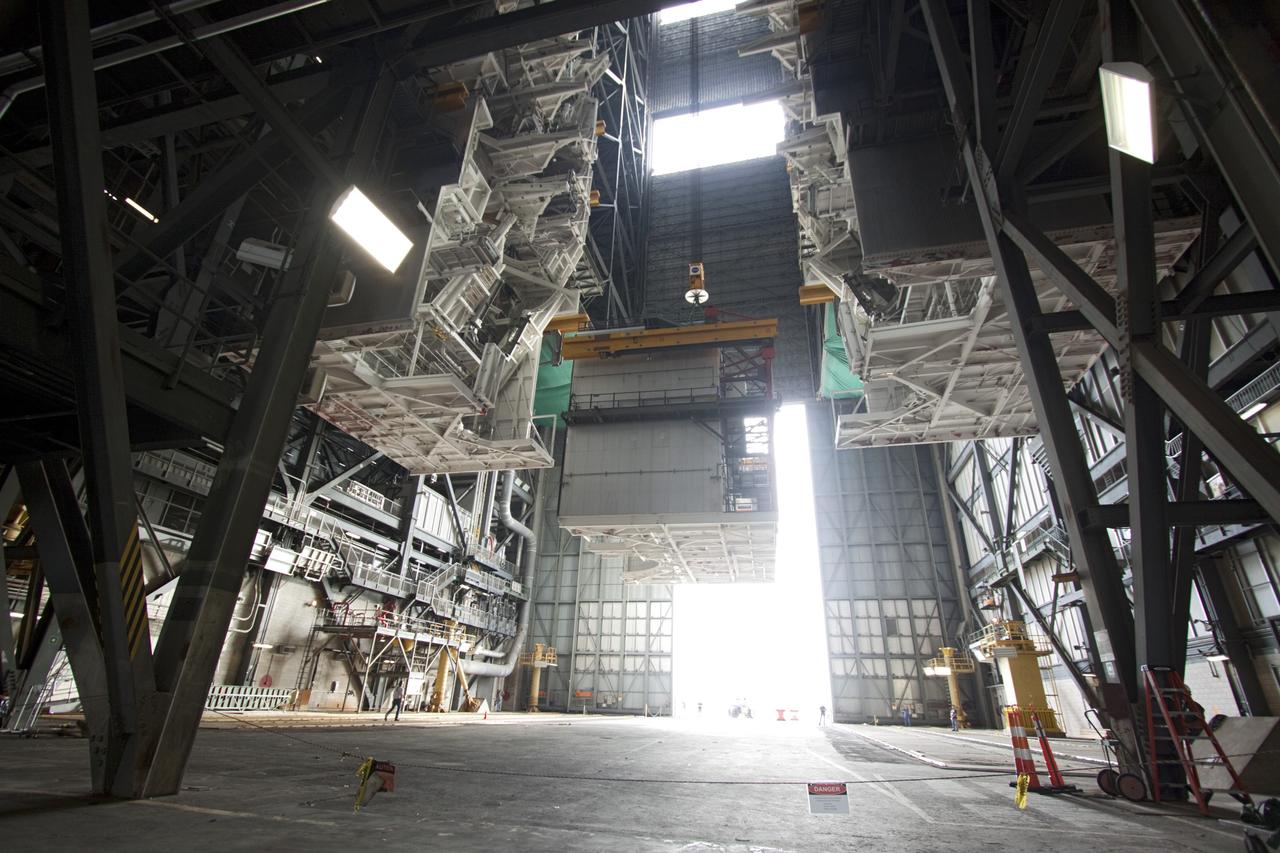
CAPE CANAVERAL, Fla. – As part of NASA's Ground Systems Development and Operations Program at the Kennedy Space Center in Florida, a large work platform is being removed from the Vehicle Assembly Building, or VAB. As part of a modernization effort, flexible settings are being designed for multiple launch vehicles instead of the whole building supporting one design. The Ground Systems Development and Operations Program is developing the necessary ground systems, infrastructure and operational approaches required to safely process, assemble, transport and launch the next generation of rockets and spacecraft in support of NASA’s exploration objectives. Future work also will replace the antiquated communications, power and vehicle access resources with modern efficient systems. Some of the utilities and systems slated for replacement have been used since the VAB opened in 1965. For more information, visit http://www.nasa.gov/exploration/systems/ground/index.html Photo credit: NASA/Jim Grossmann
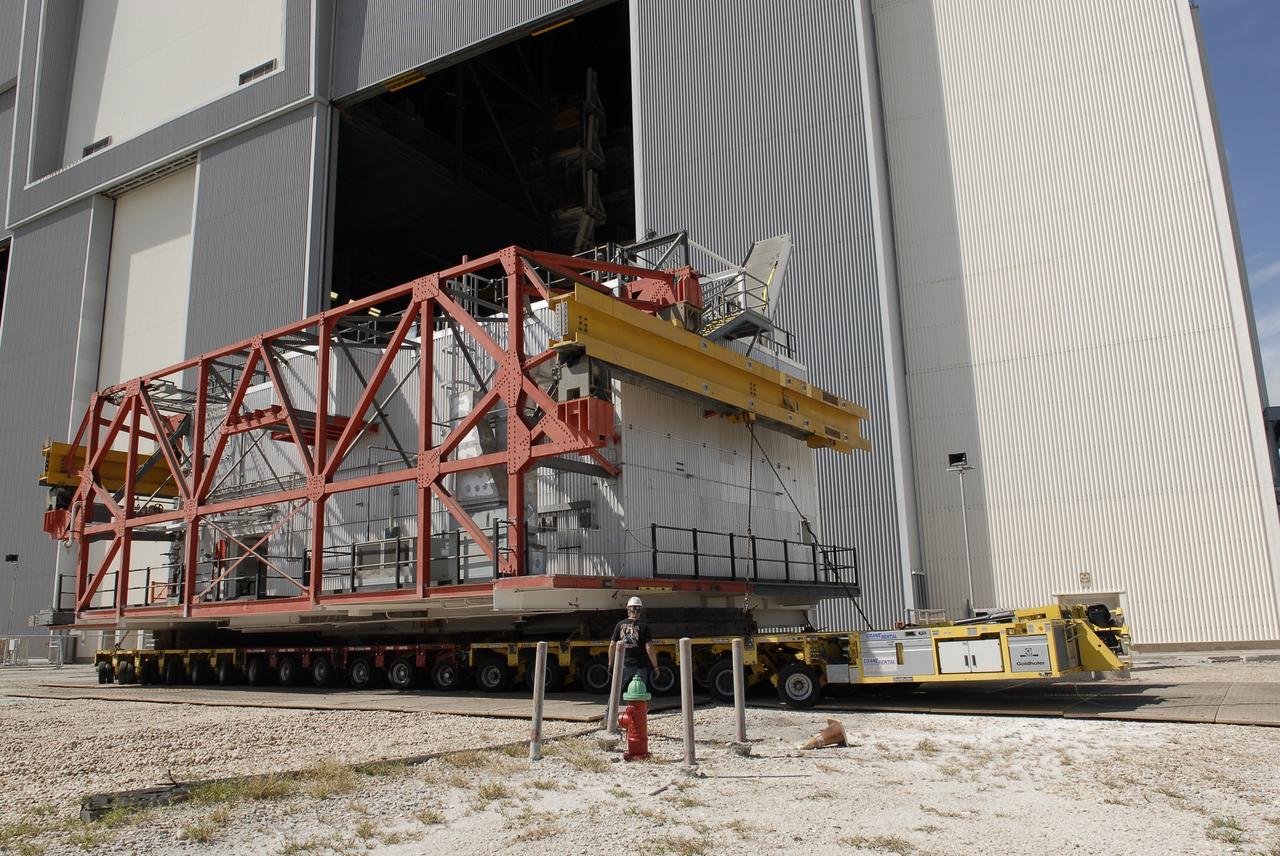
CAPE CANAVERAL, Fla. – As part of NASA's Ground Systems Development and Operations Program at the Kennedy Space Center in Florida, a large space shuttle-era work platform being removed from high bay 3 of the Vehicle Assembly Building, or VAB. The work is part of a center-wide modernization and refurbishment initiative to accommodate NASA’s Space Launch System and a variety of other spacecraft instead of the whole building supporting one design. The Ground Systems Development and Operations Program is developing the necessary ground systems, infrastructure and operational approaches required to safely process, assemble, transport and launch the next generation of rockets and spacecraft in support of NASA’s exploration objectives. Future work also will replace the antiquated communications, power and vehicle access resources with modern efficient systems. Some of the utilities and systems slated for replacement have been used since the VAB opened in 1965. For more information, visit http://www.nasa.gov/exploration/systems/ground/index.html Photo credit: NASA/ Charisse Nahser
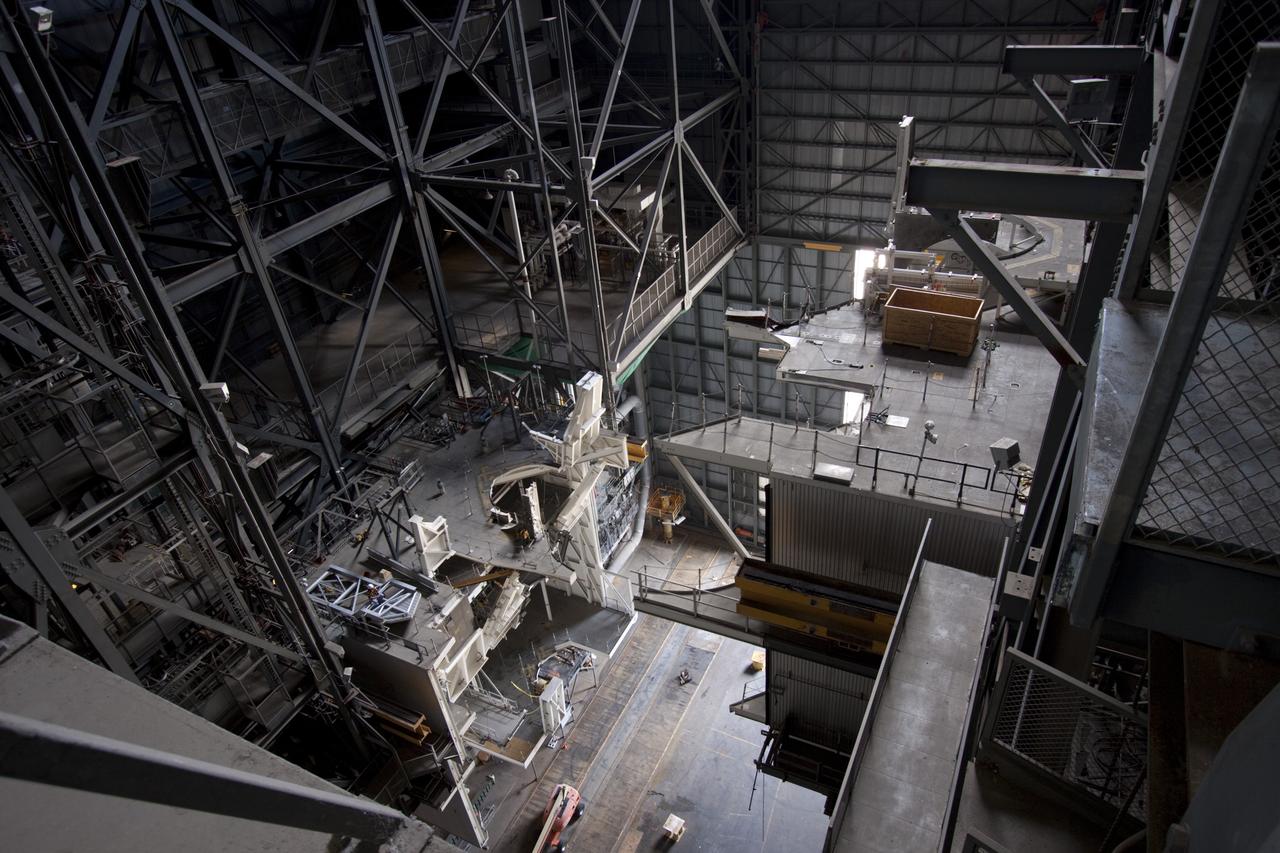
CAPE CANAVERAL, Fla. – As part of NASA's Ground Systems Development and Operations Program at the Kennedy Space Center in Florida, a large space shuttle-era work platform is being removed from high bay 3 of the Vehicle Assembly Building, or VAB. The work is part of a center-wide modernization and refurbishment initiative to accommodate NASA’s Space Launch System and a variety of other spacecraft instead of the whole building supporting one design. The Ground Systems Development and Operations Program is developing the necessary ground systems, infrastructure and operational approaches required to safely process, assemble, transport and launch the next generation of rockets and spacecraft in support of NASA’s exploration objectives. Future work also will replace the antiquated communications, power and vehicle access resources with modern efficient systems. Some of the utilities and systems slated for replacement have been used since the VAB opened in 1965. For more information, visit http://www.nasa.gov/exploration/systems/ground/index.html Photo credit: NASA/Jim Grossmann
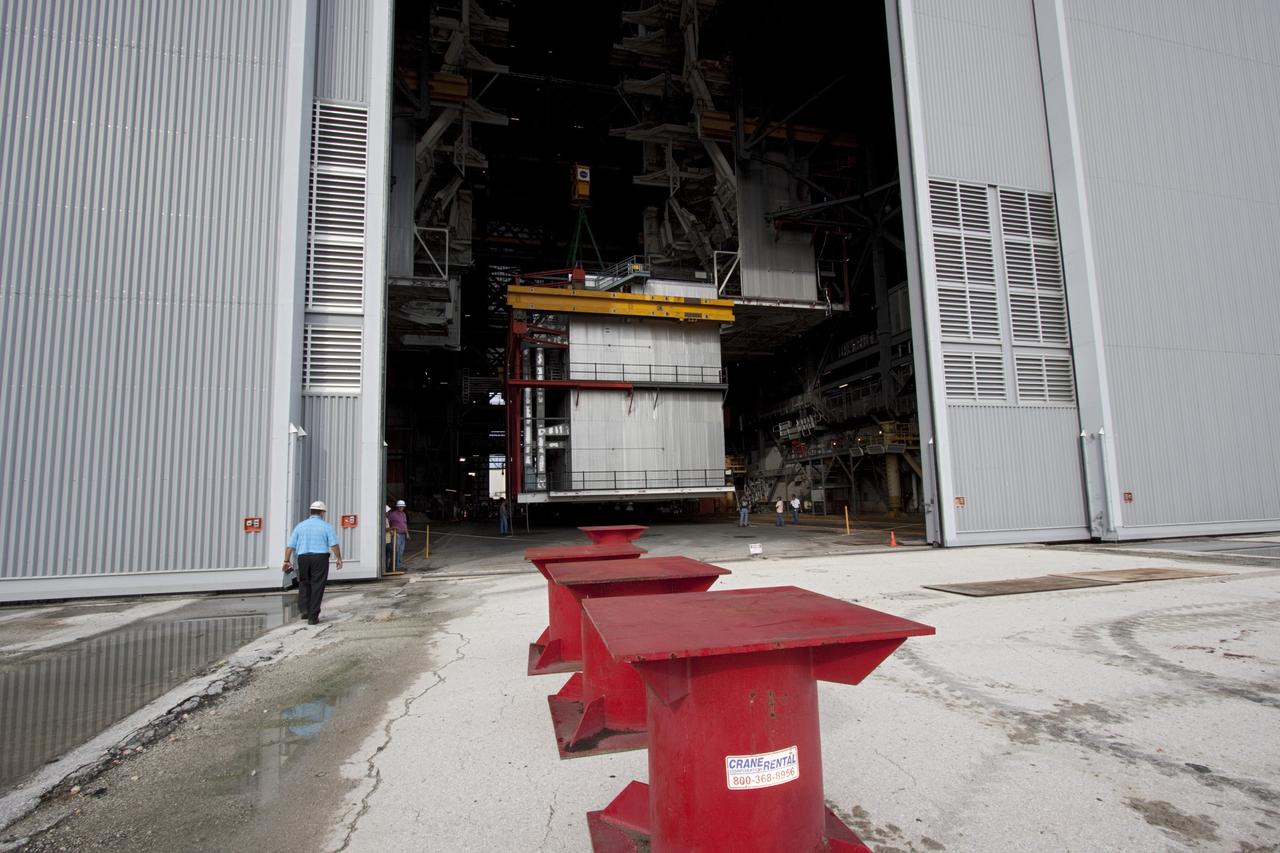
CAPE CANAVERAL, Fla. – As part of NASA's Ground Systems Development and Operations Program at the Kennedy Space Center in Florida, a large work platform is being removed from the Vehicle Assembly Building, or VAB. As part of a modernization effort, flexible settings are being designed for multiple launch vehicles instead of the whole building supporting one design. The Ground Systems Development and Operations Program is developing the necessary ground systems, infrastructure and operational approaches required to safely process, assemble, transport and launch the next generation of rockets and spacecraft in support of NASA’s exploration objectives. Future work also will replace the antiquated communications, power and vehicle access resources with modern efficient systems. Some of the utilities and systems slated for replacement have been used since the VAB opened in 1965. For more information, visit http://www.nasa.gov/exploration/systems/ground/index.html Photo credit: NASA/Jim Grossmann
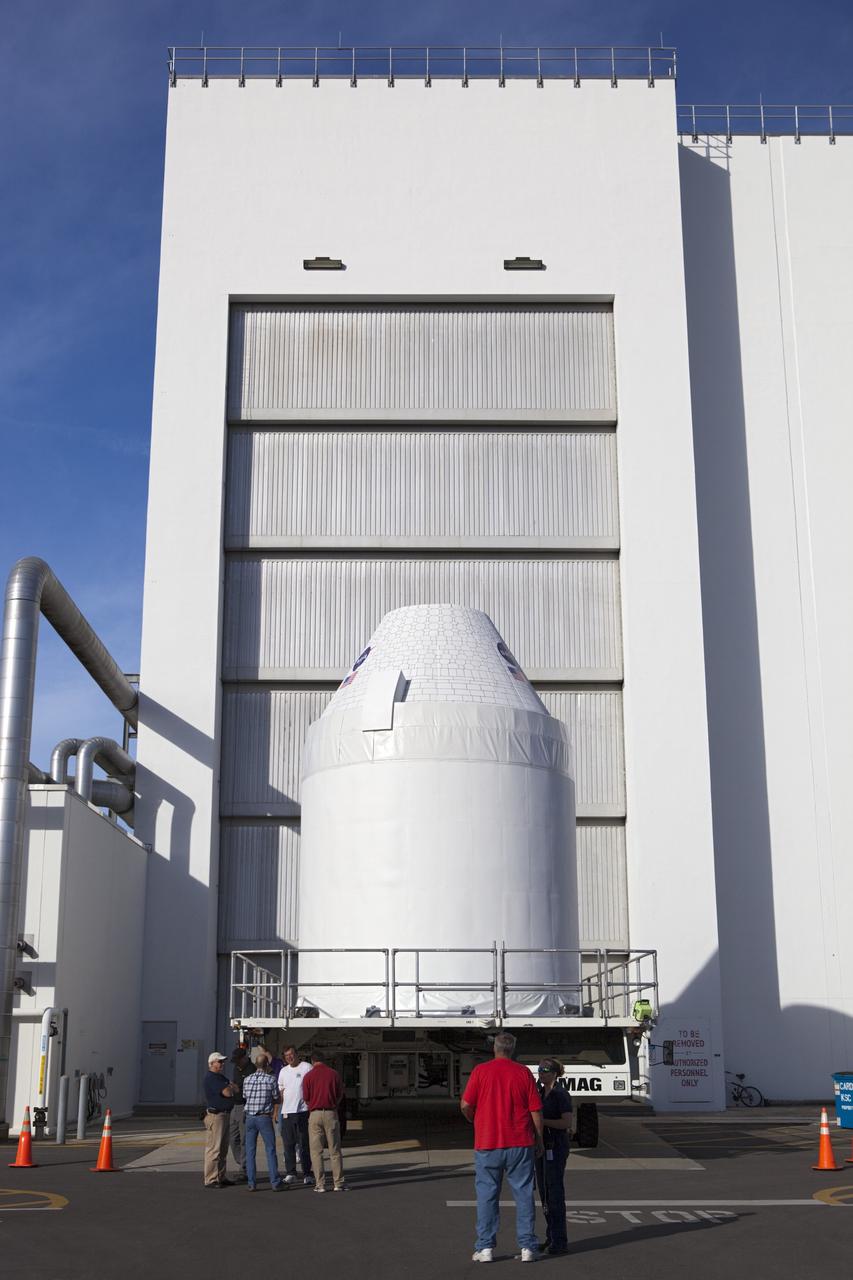
CAPE CANAVERAL, Fla. – A full-size test mock-up of the Orion spacecraft moves from the Operations and Checkout Building at NASA's Kennedy Space Center in Florida. The test article is on its way to the Multi-Payload Processing Facility, or MPPF, to test the path flight hardware will take during future launch processing. Orion is the exploration spacecraft designed to carry crews to space beyond low Earth orbit. It will provide emergency abort capability, sustain the crew during the space travel and provide safe re-entry from deep space return velocities. The first unpiloted test flight of the Orion is scheduled to launch in 2014 atop a Delta IV rocket and in 2017 on a Space Launch System rocket. For more information, visit http://www.nasa.gov/orion Photo credit: NASA/Dimitri Gerondidakis
CAPE CANAVERAL, Fla. – As part of NASA's Ground Systems Development and Operations Program at the Kennedy Space Center in Florida, a large space shuttle-era work platform being removed from the Vehicle Assembly Building, or VAB. The work is part of a center-wide modernization and refurbishment initiative to accommodate NASA’s Space Launch System and a variety of other spacecraft instead of the whole building supporting one design. The Ground Systems Development and Operations Program is developing the necessary ground systems, infrastructure and operational approaches required to safely process, assemble, transport and launch the next generation of rockets and spacecraft in support of NASA’s exploration objectives. Future work also will replace the antiquated communications, power and vehicle access resources with modern efficient systems. Some of the utilities and systems slated for replacement have been used since the VAB opened in 1965. For more information, visit http://www.nasa.gov/exploration/systems/ground/index.html Photo credit: NASA/ Charisse Nahser
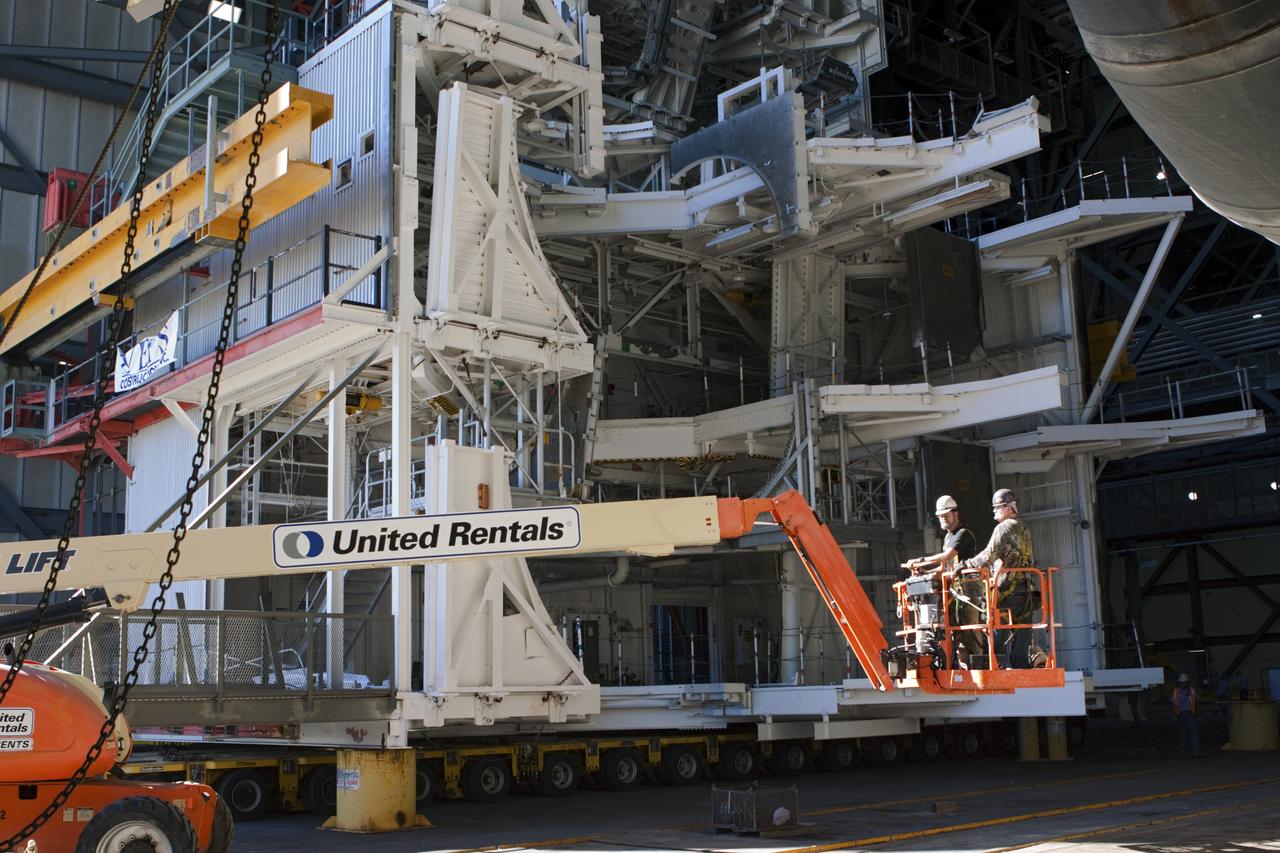
CAPE CANAVERAL, Fla. – As part of NASA's Ground Systems Development and Operations Program at the Kennedy Space Center in Florida, a large space shuttle-era work platform is being inspected prior to removal from high bay 3 of the Vehicle Assembly Building, or VAB. The work is part of a center-wide modernization and refurbishment initiative to accommodate NASA’s Space Launch System and a variety of other spacecraft instead of the whole building supporting one design. The Ground Systems Development and Operations Program is developing the necessary ground systems, infrastructure and operational approaches required to safely process, assemble, transport and launch the next generation of rockets and spacecraft in support of NASA’s exploration objectives. Future work also will replace the antiquated communications, power and vehicle access resources with modern efficient systems. Some of the utilities and systems slated for replacement have been used since the VAB opened in 1965. For more information, visit http://www.nasa.gov/exploration/systems/ground/index.html Photo credit: NASA/Jim Grossmann
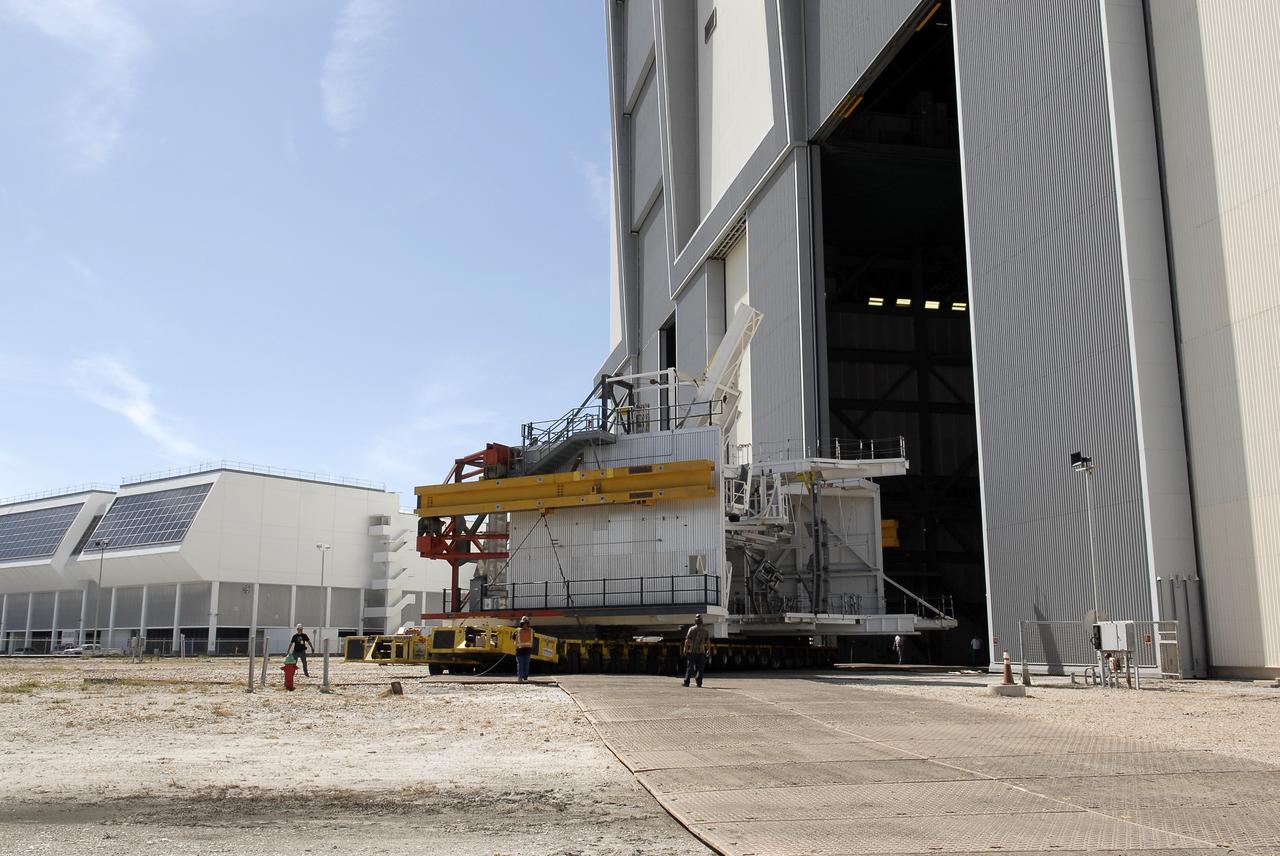
CAPE CANAVERAL, Fla. – As part of NASA's Ground Systems Development and Operations Program at the Kennedy Space Center in Florida, technicians oversee a large space shuttle-era work platform being removed from high bay 3 of the Vehicle Assembly Building, or VAB. The work is part of a center-wide modernization and refurbishment initiative to accommodate NASA’s Space Launch System and a variety of other spacecraft instead of the whole building supporting one design. The Ground Systems Development and Operations Program is developing the necessary ground systems, infrastructure and operational approaches required to safely process, assemble, transport and launch the next generation of rockets and spacecraft in support of NASA’s exploration objectives. Future work also will replace the antiquated communications, power and vehicle access resources with modern efficient systems. Some of the utilities and systems slated for replacement have been used since the VAB opened in 1965. For more information, visit http://www.nasa.gov/exploration/systems/ground/index.html Photo credit: NASA/ Charisse Nahser
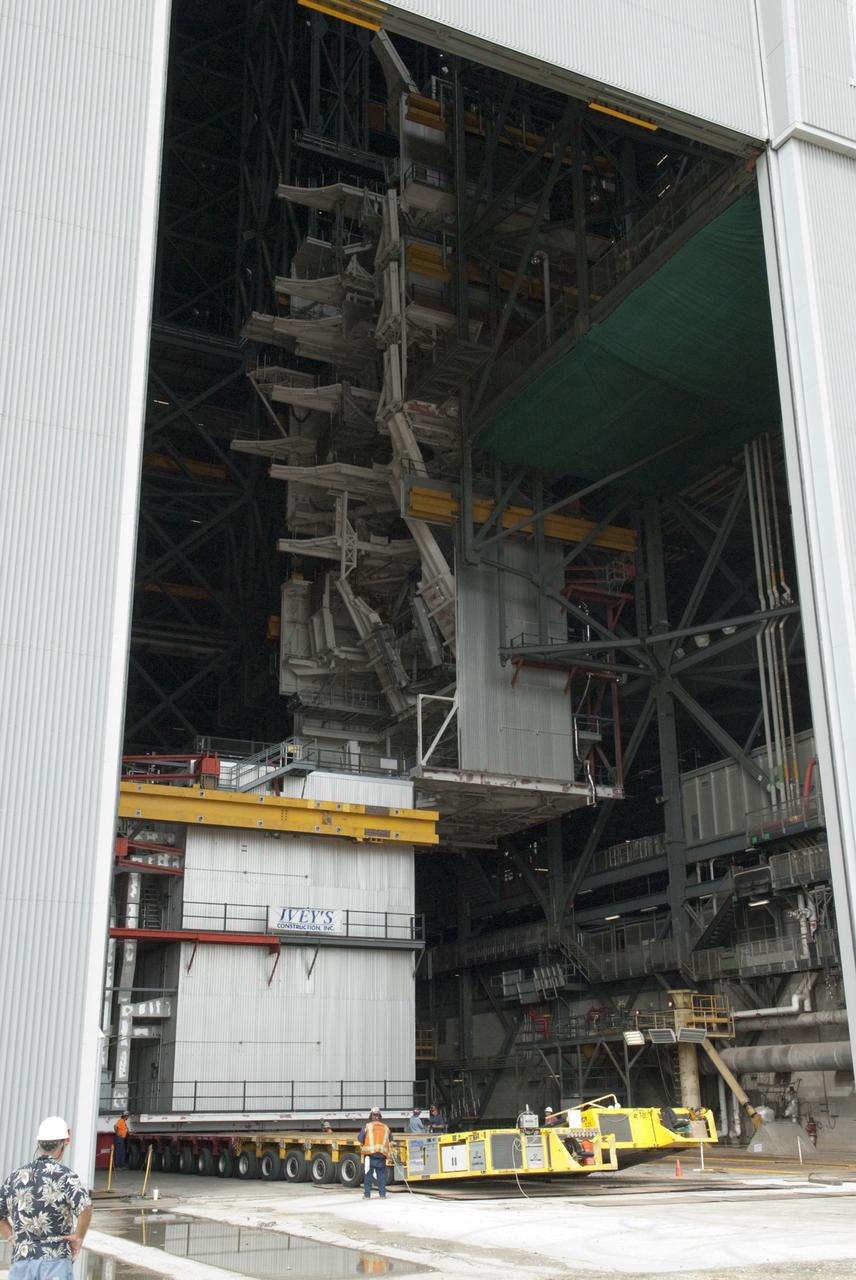
CAPE CANAVERAL, Fla. – As part of NASA's Ground Systems Development and Operations Program at the Kennedy Space Center in Florida, a work platform is lowered onto a transporter for removal from the Vehicle Assembly Building, or VAB. As part of a modernization effort, flexible settings area being designed for multiple launch vehicles instead of the whole building supporting one design. The Ground Systems Development and Operations Program is developing the necessary ground systems, infrastructure and operational approaches required to safely process, assemble, transport and launch the next generation of rockets and spacecraft in support of NASA’s exploration objectives. Future work also will replace the antiquated communications, power and vehicle access resources with modern efficient systems. Some of the utilities and systems slated for replacement have been used since the VAB opened in 1965. For more information, visit http://www.nasa.gov/exploration/systems/ground/index.html Photo credit: NASA/Charisse Nahser
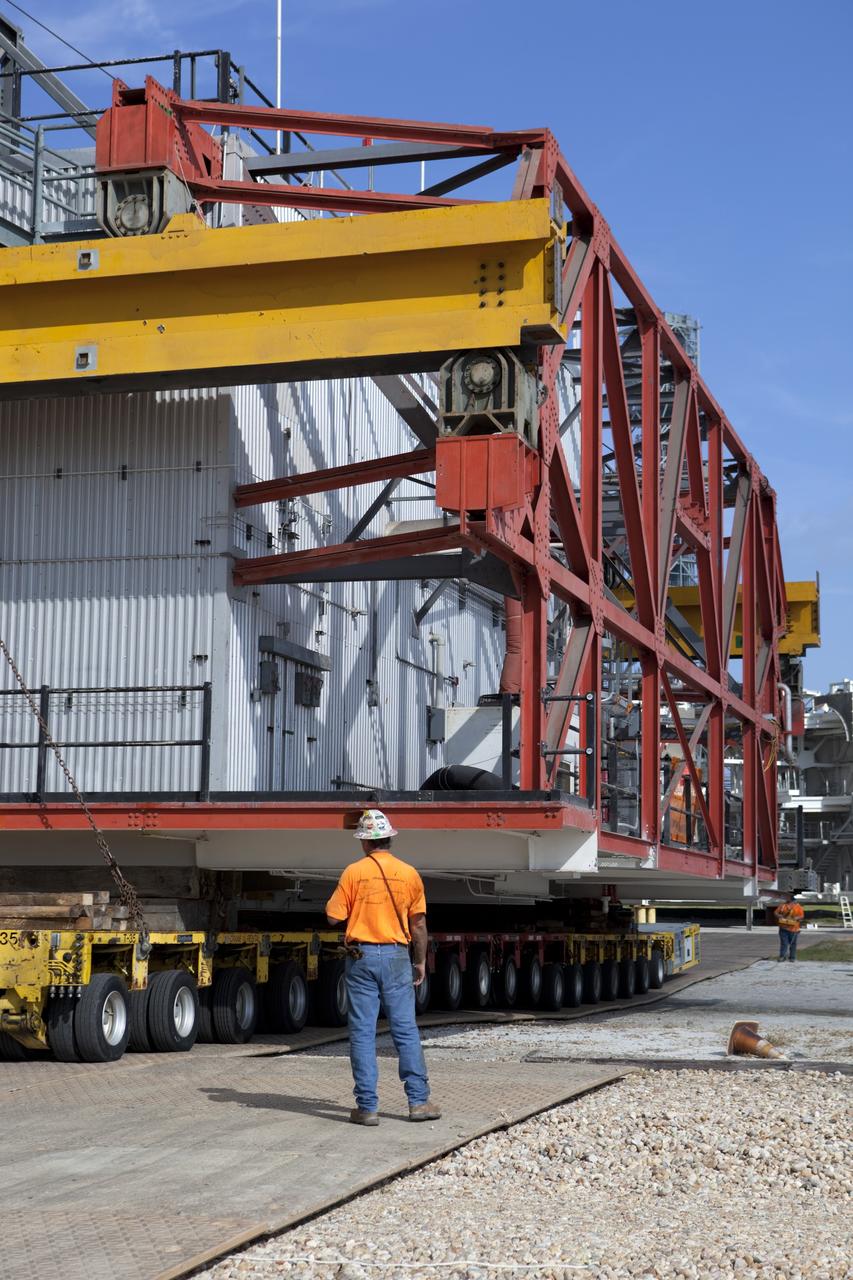
CAPE CANAVERAL, Fla. – As part of NASA's Ground Systems Development and Operations Program at the Kennedy Space Center in Florida, a technician oversees a large space shuttle-era work platform being removed by transporter from high bay 3 of the Vehicle Assembly Building, or VAB. The work is part of a center-wide modernization and refurbishment initiative to accommodate NASA’s Space Launch System and a variety of other spacecraft instead of the whole building supporting one design. The Ground Systems Development and Operations Program is developing the necessary ground systems, infrastructure and operational approaches required to safely process, assemble, transport and launch the next generation of rockets and spacecraft in support of NASA’s exploration objectives. Future work also will replace the antiquated communications, power and vehicle access resources with modern efficient systems. Some of the utilities and systems slated for replacement have been used since the VAB opened in 1965. For more information, visit http://www.nasa.gov/exploration/systems/ground/index.html Photo credit: NASA/Dimitri Gerondidakis
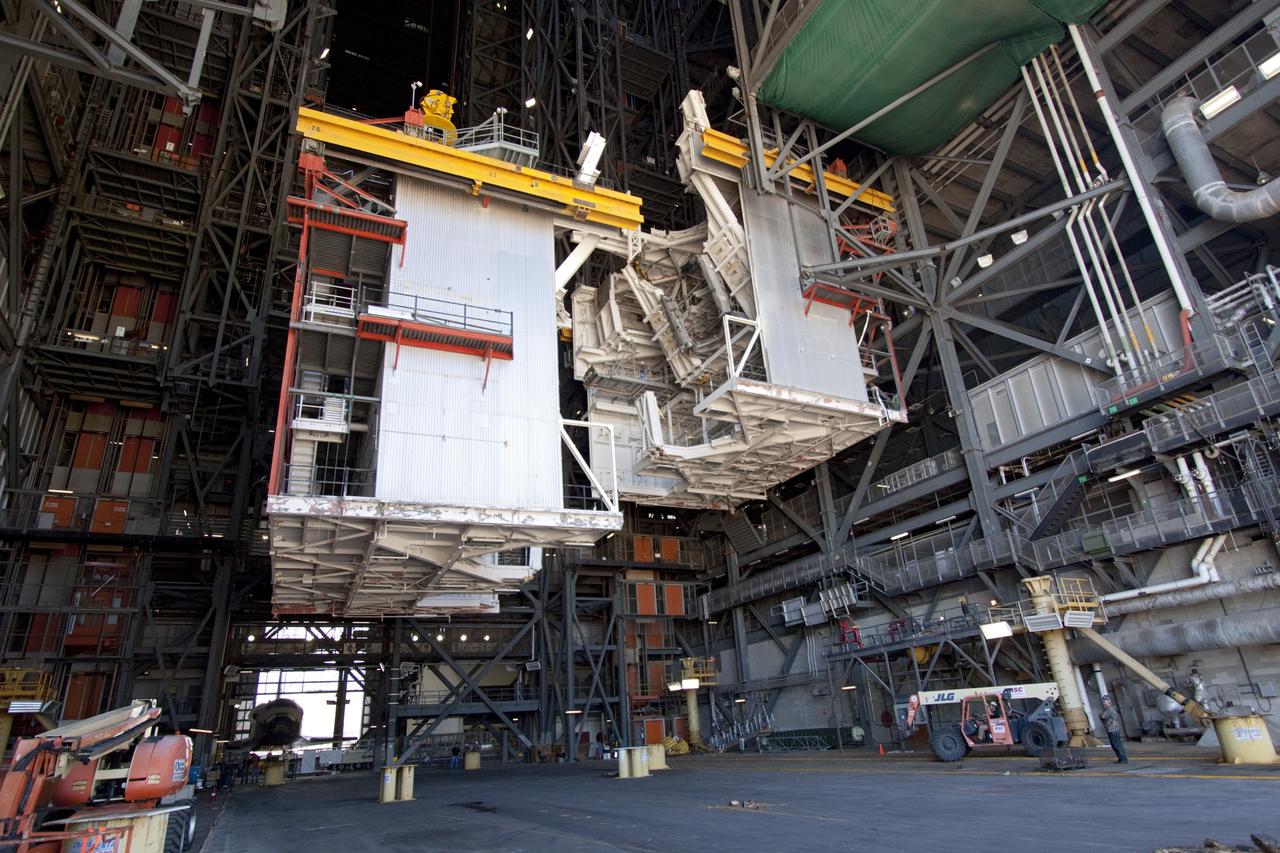
CAPE CANAVERAL, Fla. – As part of NASA's Ground Systems Development and Operations Program at the Kennedy Space Center in Florida, a large space shuttle-era work platform is being removed from high bay 3 of the Vehicle Assembly Building, or VAB. The work is part of a center-wide modernization and refurbishment initiative to accommodate NASA’s Space Launch System and a variety of other spacecraft instead of the whole building supporting one design. Visible in the lower-left background is the space shuttle Atlantis being readied for its move to the Kennedy Space Center Visitor Complex. The Ground Systems Development and Operations Program is developing the necessary ground systems, infrastructure and operational approaches required to safely process, assemble, transport and launch the next generation of rockets and spacecraft in support of NASA’s exploration objectives. Future work also will replace the antiquated communications, power and vehicle access resources with modern efficient systems. Some of the utilities and systems slated for replacement have been used since the VAB opened in 1965. For more information, visit http://www.nasa.gov/exploration/systems/ground/index.html Photo credit: NASA/Jim Grossmann
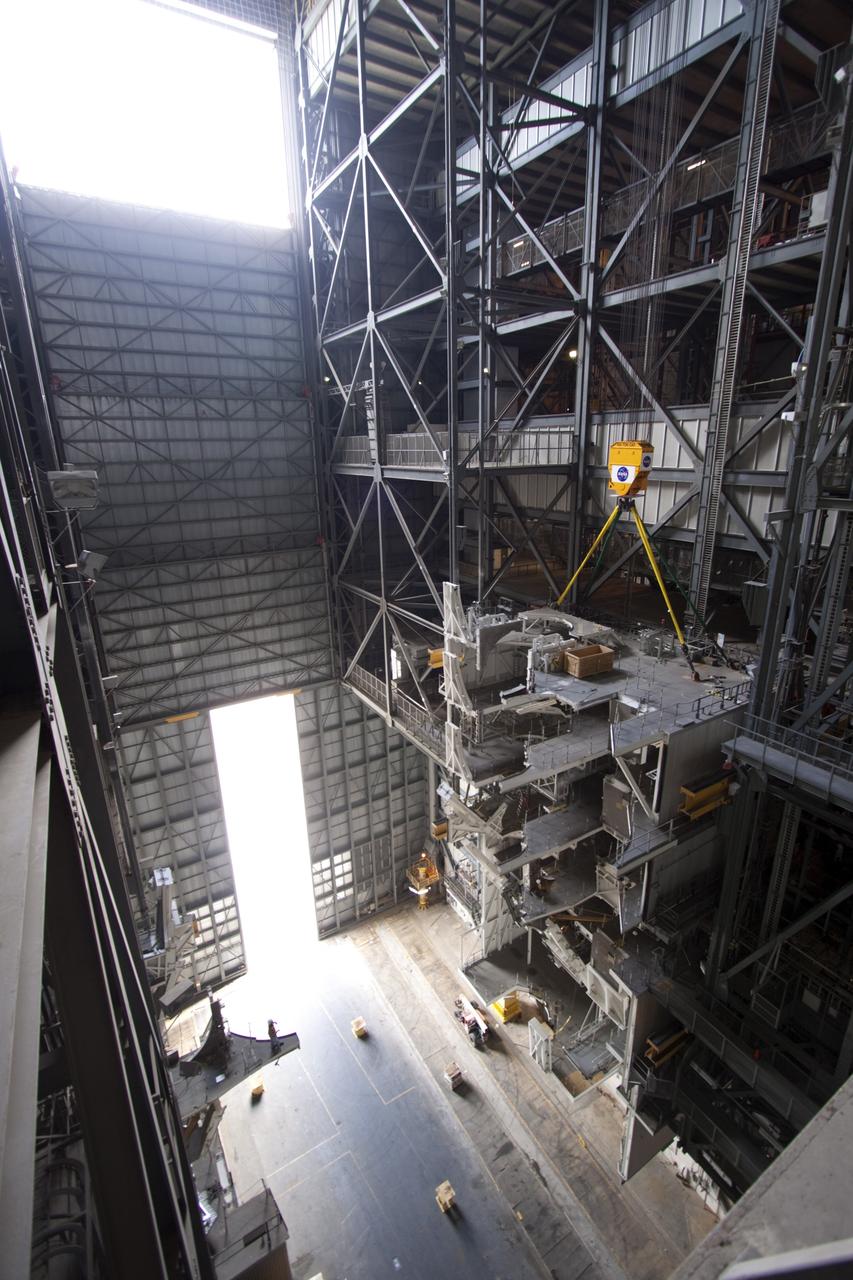
CAPE CANAVERAL, Fla. – As part of NASA's Ground Systems Development and Operations Program at the Kennedy Space Center in Florida, a large space shuttle-era work platform is being removed from high bay 3 of the Vehicle Assembly Building, or VAB. The work is part of a center-wide modernization and refurbishment initiative to accommodate NASA’s Space Launch System and a variety of other spacecraft instead of the whole building supporting one design. The Ground Systems Development and Operations Program is developing the necessary ground systems, infrastructure and operational approaches required to safely process, assemble, transport and launch the next generation of rockets and spacecraft in support of NASA’s exploration objectives. Future work also will replace the antiquated communications, power and vehicle access resources with modern efficient systems. Some of the utilities and systems slated for replacement have been used since the VAB opened in 1965. For more information, visit http://www.nasa.gov/exploration/systems/ground/index.html Photo credit: NASA/Jim Grossmann
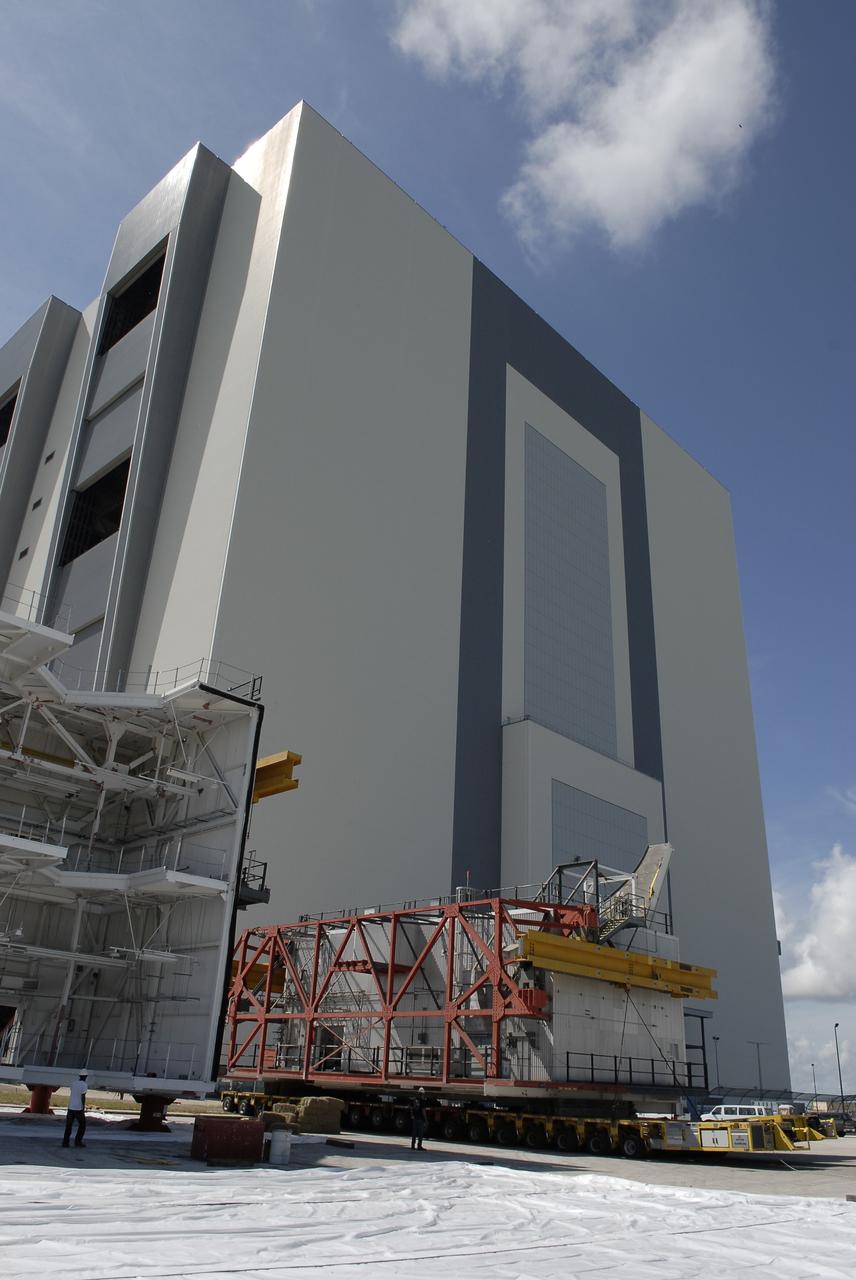
CAPE CANAVERAL, Fla. – As part of NASA's Ground Systems Development and Operations Program at the Kennedy Space Center in Florida, a large space shuttle-era work platform being removed from high bay 3 of the Vehicle Assembly Building, or VAB. The work is part of a center-wide modernization and refurbishment initiative to accommodate NASA’s Space Launch System and a variety of other spacecraft instead of the whole building supporting one design. The Ground Systems Development and Operations Program is developing the necessary ground systems, infrastructure and operational approaches required to safely process, assemble, transport and launch the next generation of rockets and spacecraft in support of NASA’s exploration objectives. Future work also will replace the antiquated communications, power and vehicle access resources with modern efficient systems. Some of the utilities and systems slated for replacement have been used since the VAB opened in 1965. For more information, visit http://www.nasa.gov/exploration/systems/ground/index.html Photo credit: NASA/ Charisse Nahser
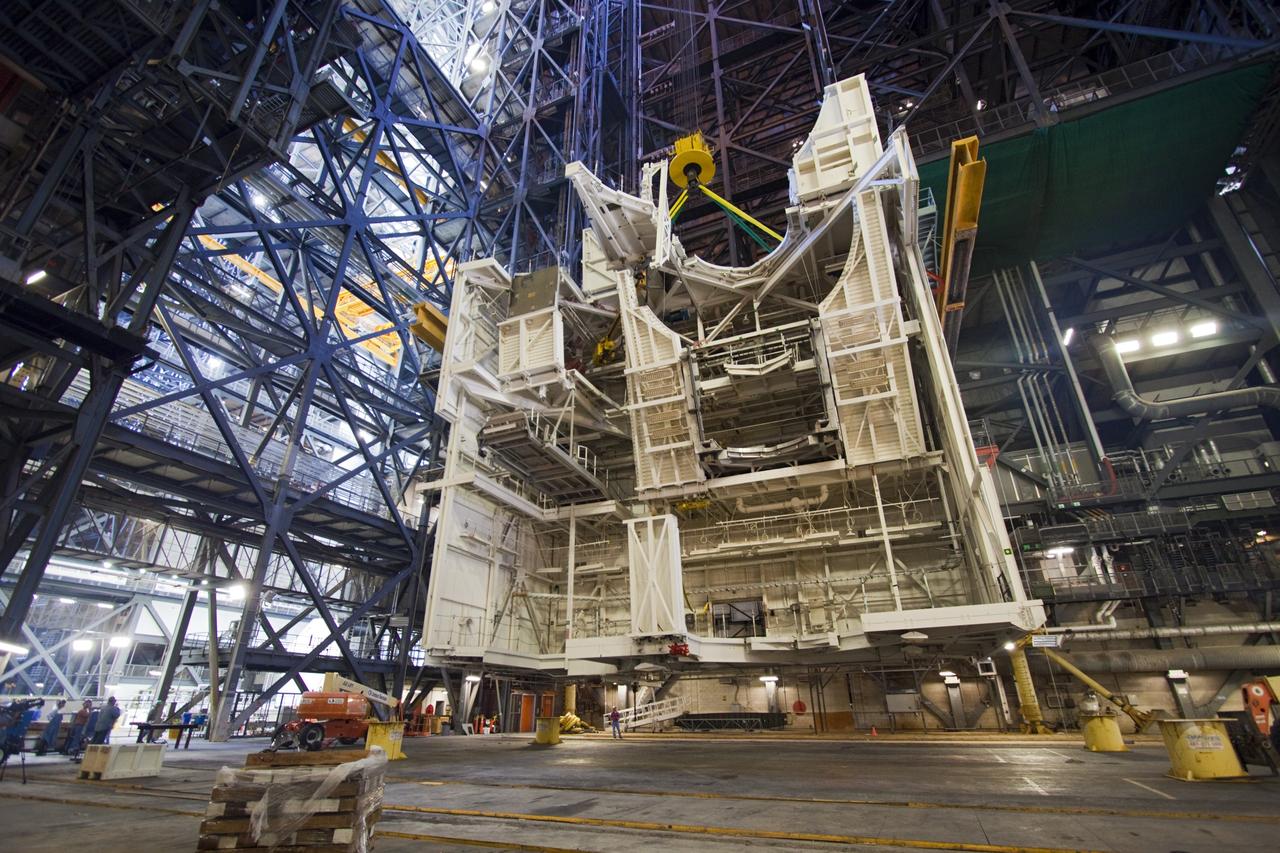
CAPE CANAVERAL, Fla. – As part of NASA's Ground Systems Development and Operations Program at the Kennedy Space Center in Florida, a large space shuttle-era work platform is being lowered and removed from high bay 3 of the Vehicle Assembly Building, or VAB. The work is part of a center-wide modernization and refurbishment initiative to accommodate NASA’s Space Launch System and a variety of other spacecraft instead of the whole building supporting one design. The Ground Systems Development and Operations Program is developing the necessary ground systems, infrastructure and operational approaches required to safely process, assemble, transport and launch the next generation of rockets and spacecraft in support of NASA’s exploration objectives. Future work also will replace the antiquated communications, power and vehicle access resources with modern efficient systems. Some of the utilities and systems slated for replacement have been used since the VAB opened in 1965. For more information, visit http://www.nasa.gov/exploration/systems/ground/index.html Photo credit: NASA/Jim Grossmann
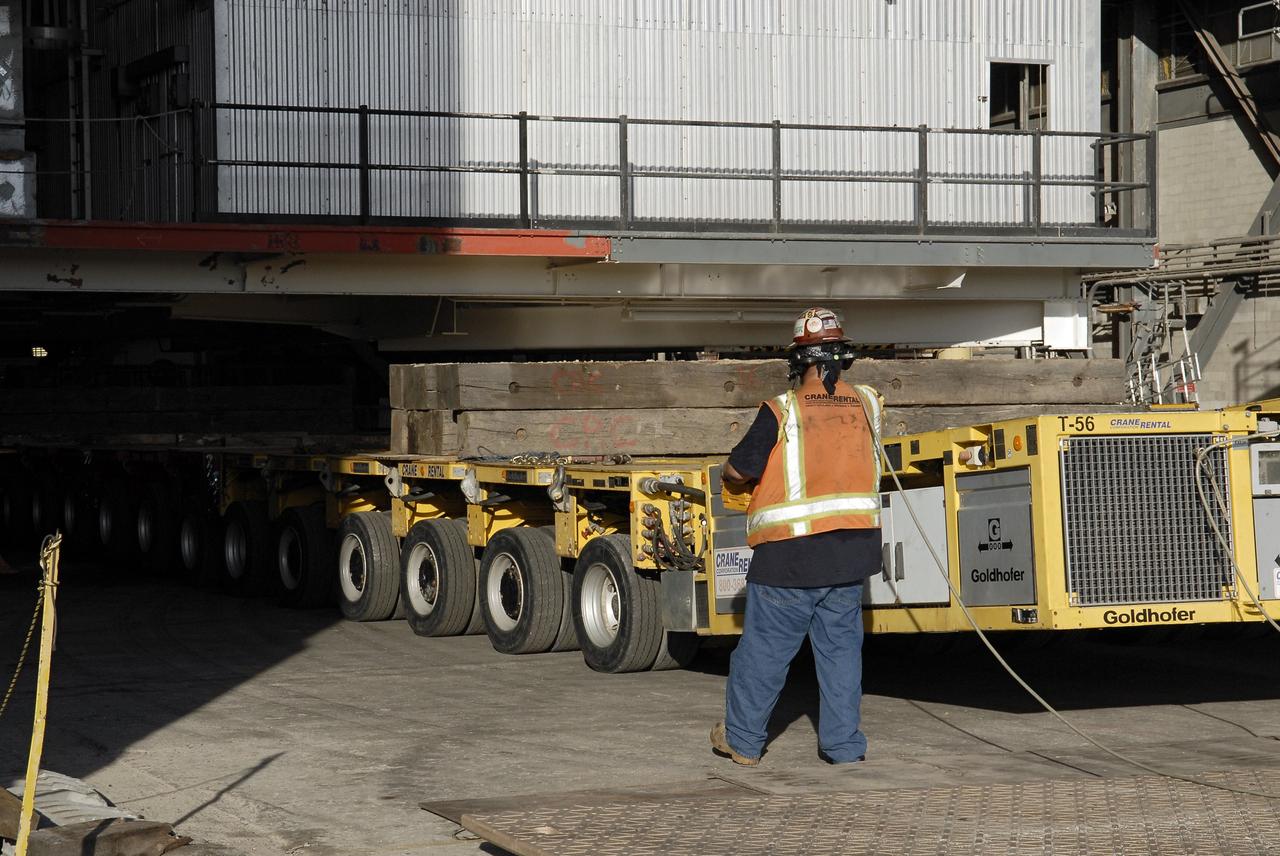
CAPE CANAVERAL, Fla. – As part of NASA's Ground Systems Development and Operations Program at the Kennedy Space Center in Florida, a technician oversees a large space shuttle-era work platform being removed from high bay 3 of the Vehicle Assembly Building, or VAB, and placed on a transporter for removal. The work is part of a center-wide modernization and refurbishment initiative to accommodate NASA’s Space Launch System and a variety of other spacecraft instead of the whole building supporting one design. The Ground Systems Development and Operations Program is developing the necessary ground systems, infrastructure and operational approaches required to safely process, assemble, transport and launch the next generation of rockets and spacecraft in support of NASA’s exploration objectives. Future work also will replace the antiquated communications, power and vehicle access resources with modern efficient systems. Some of the utilities and systems slated for replacement have been used since the VAB opened in 1965. For more information, visit http://www.nasa.gov/exploration/systems/ground/index.html Photo credit: NASA/ Charisse Nahser
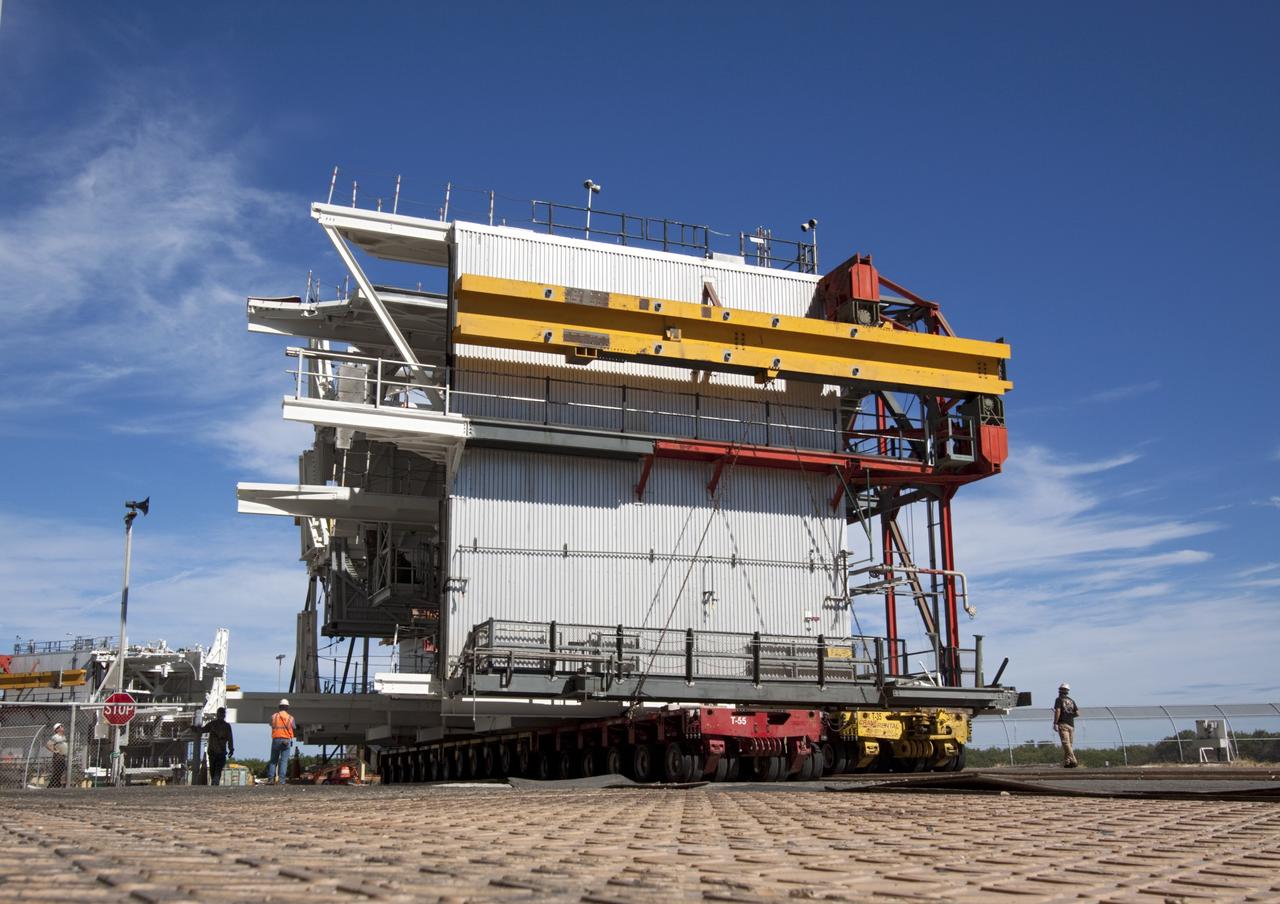
CAPE CANAVERAL, Fla. – As part of NASA's Ground Systems Development and Operations Program at the Kennedy Space Center in Florida, a large space shuttle-era work platform has been removed from high bay 3 of the Vehicle Assembly Building, or VAB. The work is part of a center-wide modernization and refurbishment initiative to accommodate NASA’s Space Launch System and a variety of other spacecraft instead of the whole building supporting one design. The Ground Systems Development and Operations Program is developing the necessary ground systems, infrastructure and operational approaches required to safely process, assemble, transport and launch the next generation of rockets and spacecraft in support of NASA’s exploration objectives. Future work also will replace the antiquated communications, power and vehicle access resources with modern efficient systems. Some of the utilities and systems slated for replacement have been used since the VAB opened in 1965. For more information, visit http://www.nasa.gov/exploration/systems/ground/index.html Photo credit: NASA/Jim Grossmann
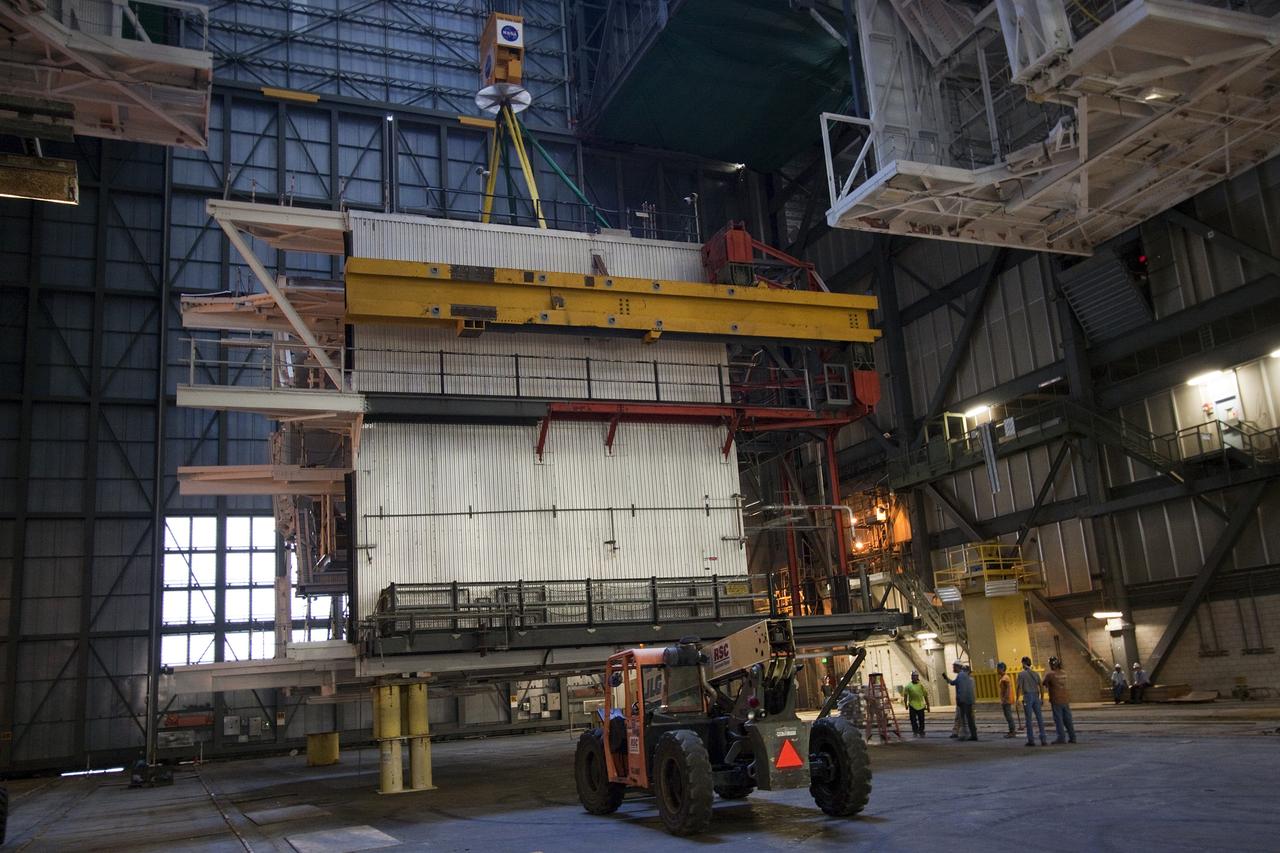
CAPE CANAVERAL, Fla. – As part of NASA's Ground Systems Development and Operations Program at the Kennedy Space Center in Florida, a large space shuttle-era work platform is being removed from high bay 3 of the Vehicle Assembly Building, or VAB. The work is part of a center-wide modernization and refurbishment initiative to accommodate NASA’s Space Launch System and a variety of other spacecraft instead of the whole building supporting one design. The Ground Systems Development and Operations Program is developing the necessary ground systems, infrastructure and operational approaches required to safely process, assemble, transport and launch the next generation of rockets and spacecraft in support of NASA’s exploration objectives. Future work also will replace the antiquated communications, power and vehicle access resources with modern efficient systems. Some of the utilities and systems slated for replacement have been used since the VAB opened in 1965. For more information, visit http://www.nasa.gov/exploration/systems/ground/index.html Photo credit: NASA/Jim Grossmann
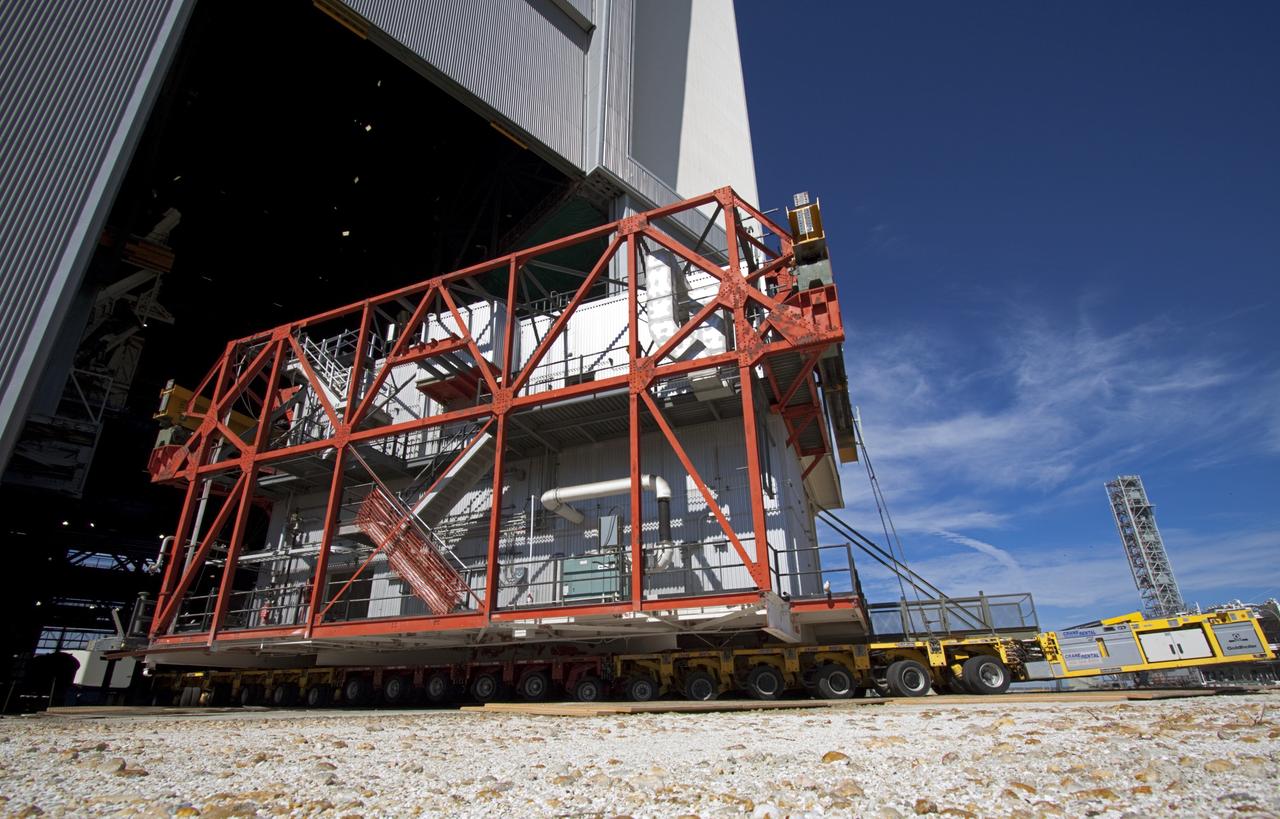
CAPE CANAVERAL, Fla. – As part of NASA's Ground Systems Development and Operations Program at the Kennedy Space Center in Florida, a large space shuttle-era work platform is being removed from high bay 3 of the Vehicle Assembly Building, or VAB. The work is part of a center-wide modernization and refurbishment initiative to accommodate NASA’s Space Launch System and a variety of other spacecraft instead of the whole building supporting one design. The Ground Systems Development and Operations Program is developing the necessary ground systems, infrastructure and operational approaches required to safely process, assemble, transport and launch the next generation of rockets and spacecraft in support of NASA’s exploration objectives. Future work also will replace the antiquated communications, power and vehicle access resources with modern efficient systems. Some of the utilities and systems slated for replacement have been used since the VAB opened in 1965. For more information, visit http://www.nasa.gov/exploration/systems/ground/index.html Photo credit: NASA/Jim Grossmann
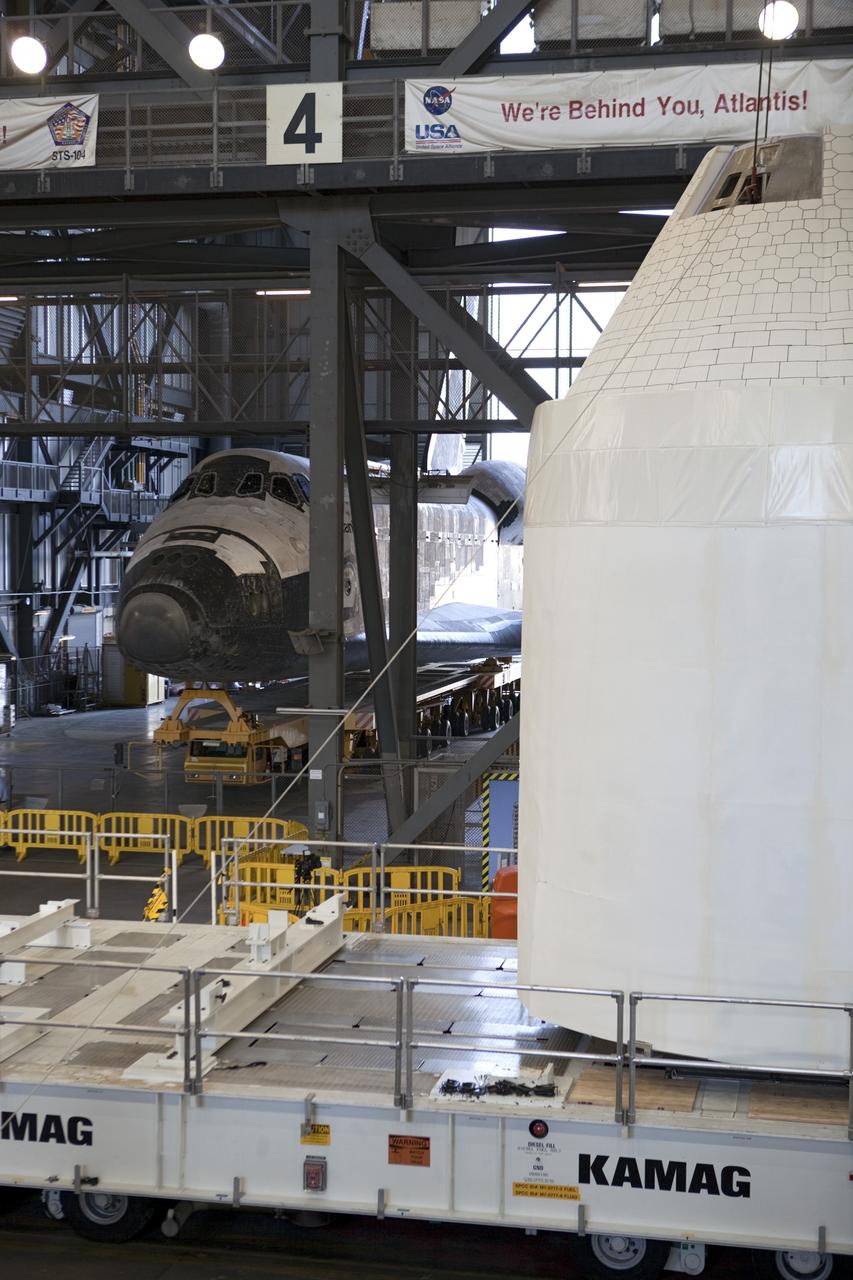
CAPE CANAVERAL, Fla. – An Orion mockup spacecraft atop its service module simulator is lowered onto a transporter in the transfer aisle of the Vehicle Assembly Building, or VAB, at NASA's Kennedy Space Center in Florida. The Orion mockup is exact in details on the outside, but mostly empty on the inside. The work in the VAB is crucial to making sure the designs are accurate. Visible in the background on the left is the space shuttle Atlantis being readied for its move to the Kennedy Space Center Visitor Complex. Orion is the exploration spacecraft designed to carry crews to space beyond low Earth orbit. It will provide emergency abort capability, sustain the crew during the space travel and provide safe re-entry from deep space return velocities. The first unpiloted test flight of the Orion is scheduled to launch in 2014 atop a Delta IV rocket and in 2017 on a Space Launch System rocket. For more information, visit http://www.nasa.gov/orion Photo credit: NASA/ Dmitri Gerondidakis

CAPE CANAVERAL, Fla. – As part of NASA's Ground Systems Development and Operations Program at the Kennedy Space Center in Florida, a large space shuttle-era work platform is being removed from high bay 3 of the Vehicle Assembly Building, or VAB. The work is part of a center-wide modernization and refurbishment initiative to accommodate NASA’s Space Launch System and a variety of other spacecraft instead of the whole building supporting one design. The Ground Systems Development and Operations Program is developing the necessary ground systems, infrastructure and operational approaches required to safely process, assemble, transport and launch the next generation of rockets and spacecraft in support of NASA’s exploration objectives. Future work also will replace the antiquated communications, power and vehicle access resources with modern efficient systems. Some of the utilities and systems slated for replacement have been used since the VAB opened in 1965. For more information, visit http://www.nasa.gov/exploration/systems/ground/index.html Photo credit: NASA/Jim Grossmann
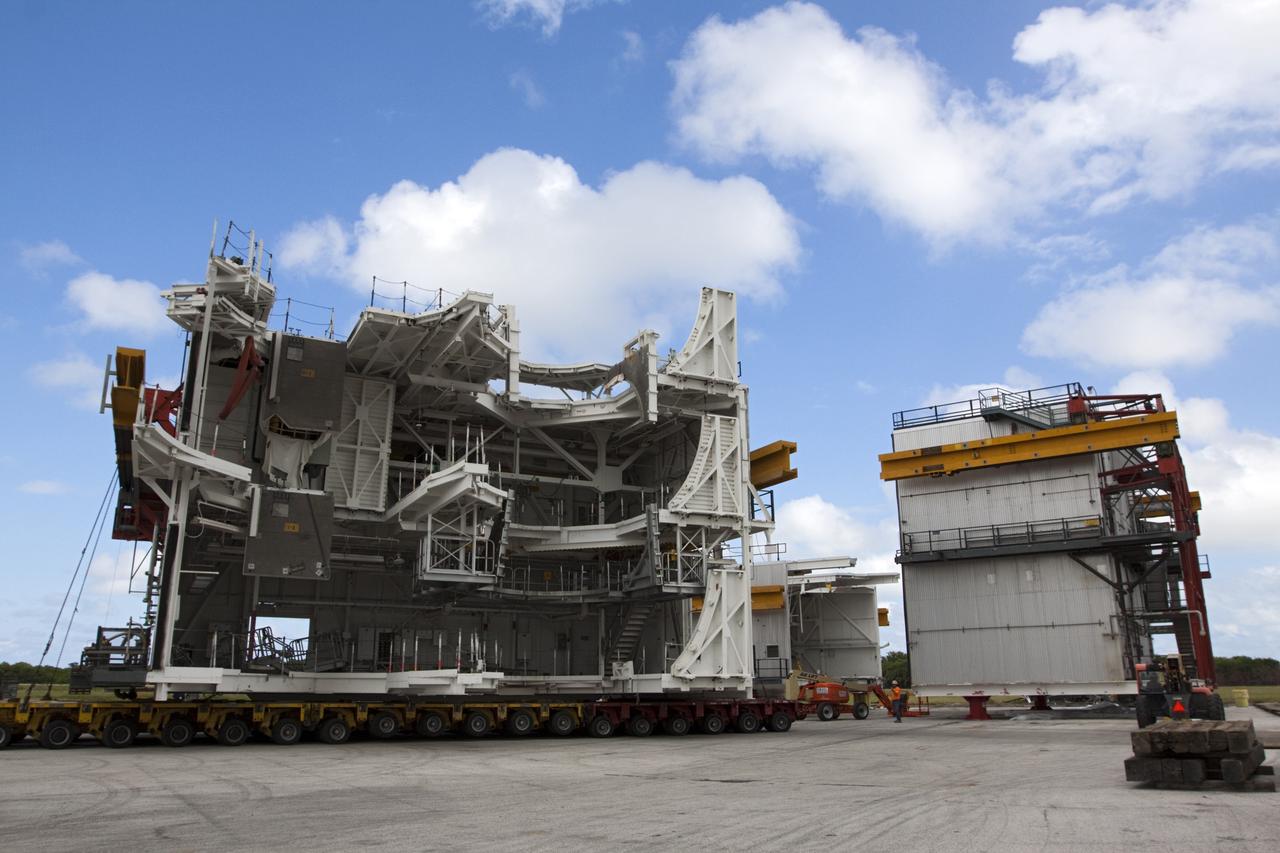
CAPE CANAVERAL, Fla. – As part of NASA's Ground Systems Development and Operations Program at the Kennedy Space Center in Florida, a large space shuttle-era work platform is being removed from high bay 3 of the Vehicle Assembly Building, or VAB, and placed on a transporter for removal. The work is part of a center-wide modernization and refurbishment initiative to accommodate NASA’s Space Launch System and a variety of other spacecraft instead of the whole building supporting one design. The Ground Systems Development and Operations Program is developing the necessary ground systems, infrastructure and operational approaches required to safely process, assemble, transport and launch the next generation of rockets and spacecraft in support of NASA’s exploration objectives. Future work also will replace the antiquated communications, power and vehicle access resources with modern efficient systems. Some of the utilities and systems slated for replacement have been used since the VAB opened in 1965. For more information, visit http://www.nasa.gov/exploration/systems/ground/index.html Photo credit: NASA/Kim Shiflett
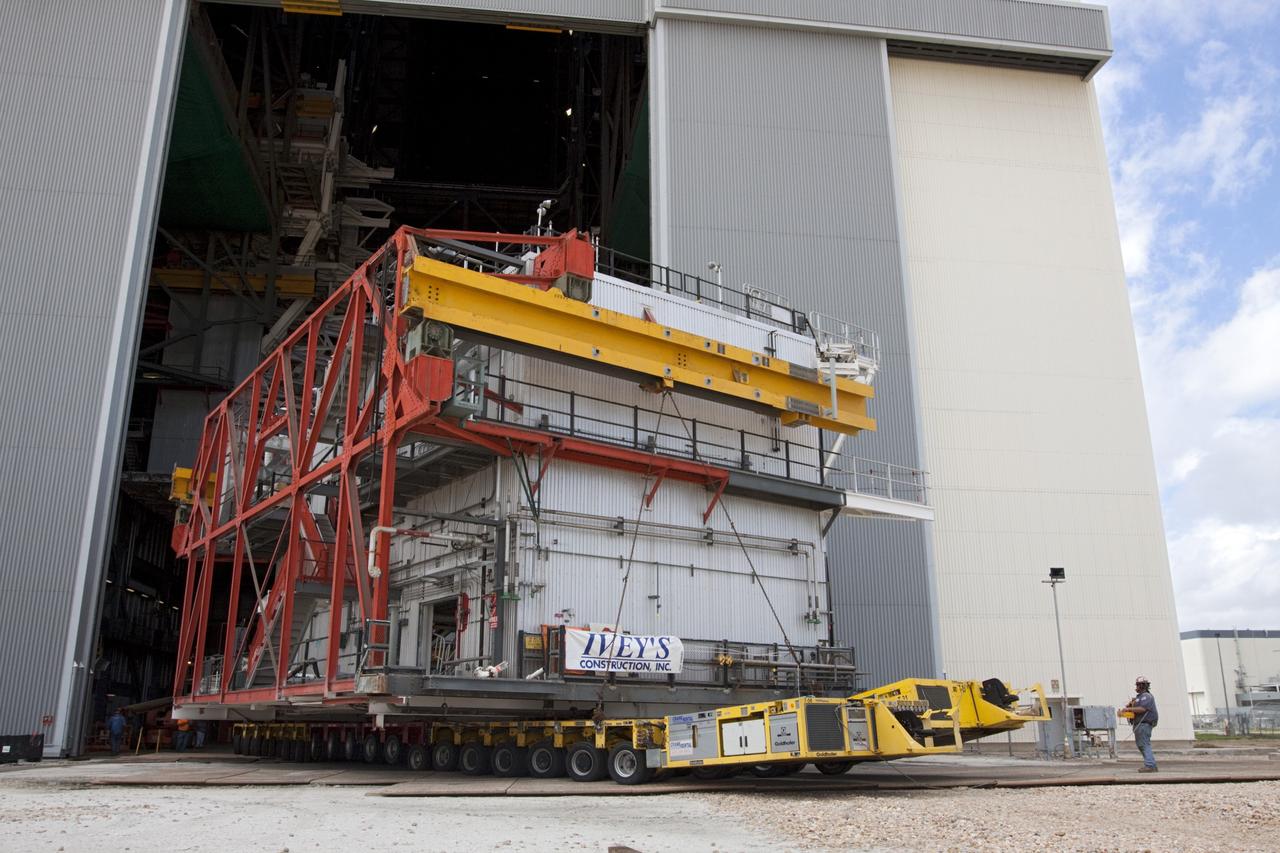
CAPE CANAVERAL, Fla. – As part of NASA's Ground Systems Development and Operations Program at the Kennedy Space Center in Florida, a large space shuttle-era work platform is being removed from high bay 3 of the Vehicle Assembly Building, or VAB. The work is part of a center-wide modernization and refurbishment initiative to accommodate NASA’s Space Launch System and a variety of other spacecraft instead of the whole building supporting one design. The Ground Systems Development and Operations Program is developing the necessary ground systems, infrastructure and operational approaches required to safely process, assemble, transport and launch the next generation of rockets and spacecraft in support of NASA’s exploration objectives. Future work also will replace the antiquated communications, power and vehicle access resources with modern efficient systems. Some of the utilities and systems slated for replacement have been used since the VAB opened in 1965. For more information, visit http://www.nasa.gov/exploration/systems/ground/index.html Photo credit: NASA/Kim Shiflett
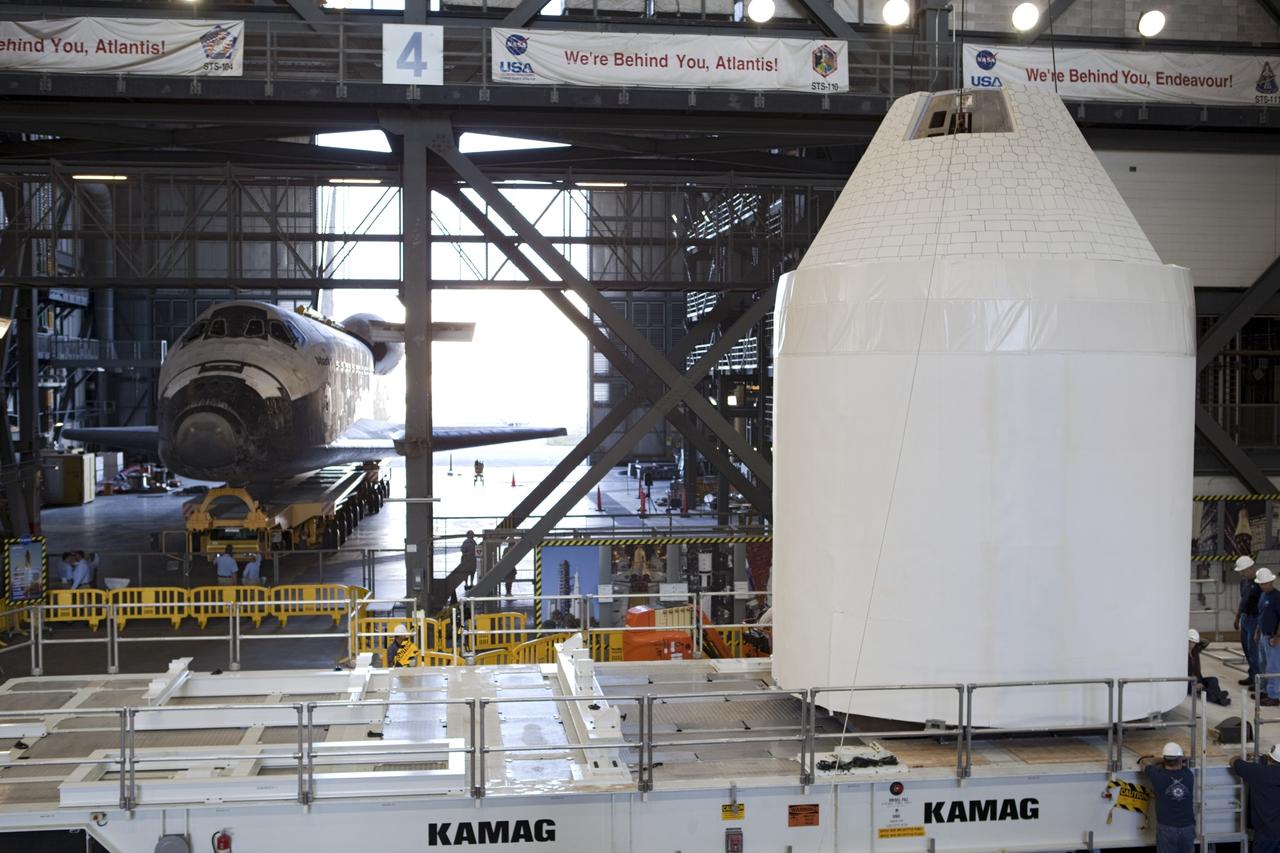
CAPE CANAVERAL, Fla. – An Orion mockup spacecraft atop its service module simulator is lowered onto a transporter in the transfer aisle of the Vehicle Assembly Building, or VAB, at NASA's Kennedy Space Center in Florida. The Orion mockup is exact in details on the outside, but mostly empty on the inside. The work in the VAB is crucial to making sure the designs are accurate. Visible in the background on the left is the space shuttle Atlantis being readied for its move to the Kennedy Space Center Visitor Complex. Orion is the exploration spacecraft designed to carry crews to space beyond low Earth orbit. It will provide emergency abort capability, sustain the crew during the space travel and provide safe re-entry from deep space return velocities. The first unpiloted test flight of the Orion is scheduled to launch in 2014 atop a Delta IV rocket and in 2017 on a Space Launch System rocket. For more information, visit http://www.nasa.gov/orion Photo credit: NASA/ Dmitri Gerondidakis
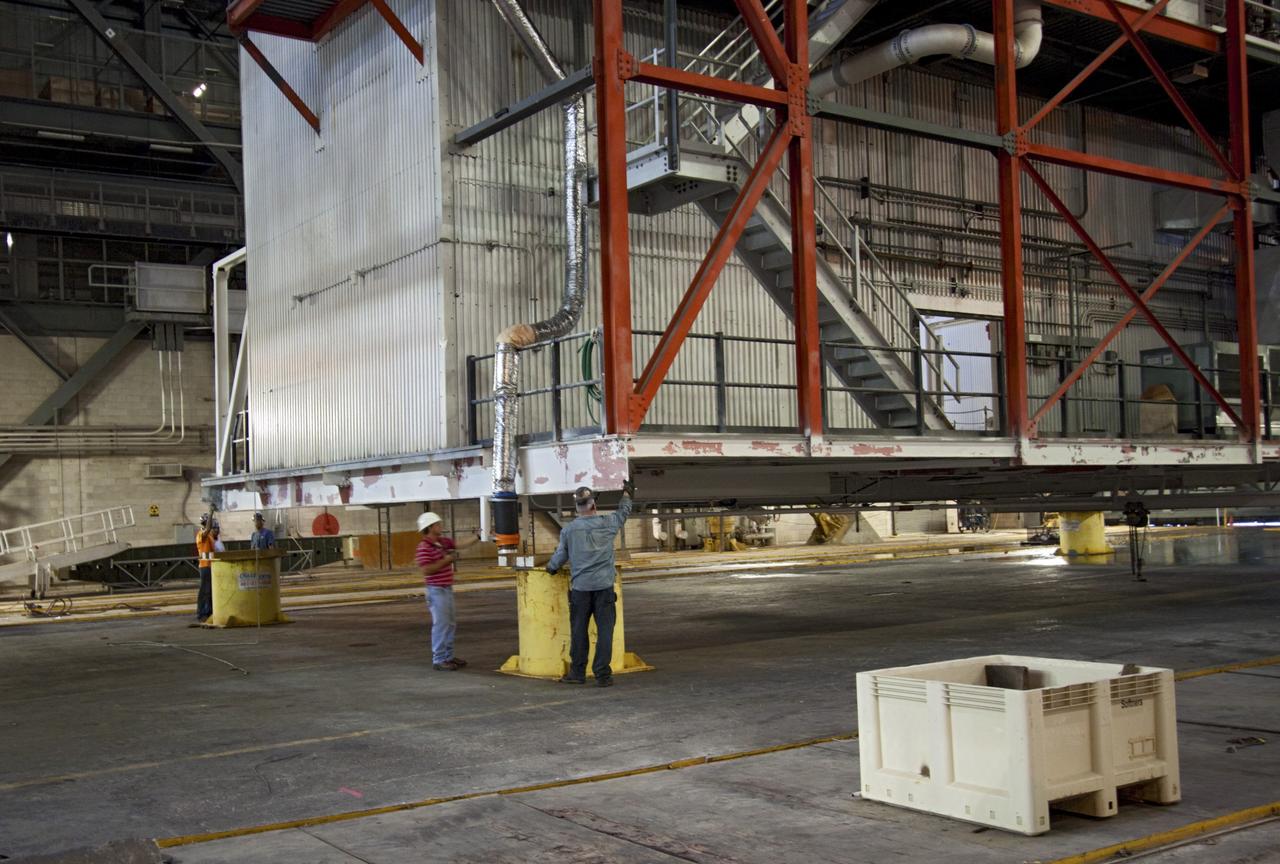
CAPE CANAVERAL, Fla. – As part of NASA's Ground Systems Development and Operations Program at the Kennedy Space Center in Florida, a large space shuttle-era work platform is being positioned on pedestals for removal from high bay 3 of the Vehicle Assembly Building, or VAB. The work is part of a center-wide modernization and refurbishment initiative to accommodate NASA’s Space Launch System and a variety of other spacecraft instead of the whole building supporting one design. The Ground Systems Development and Operations Program is developing the necessary ground systems, infrastructure and operational approaches required to safely process, assemble, transport and launch the next generation of rockets and spacecraft in support of NASA’s exploration objectives. Future work also will replace the antiquated communications, power and vehicle access resources with modern efficient systems. Some of the utilities and systems slated for replacement have been used since the VAB opened in 1965. For more information, visit http://www.nasa.gov/exploration/systems/ground/index.html Photo credit: NASA/Jim Grossmann
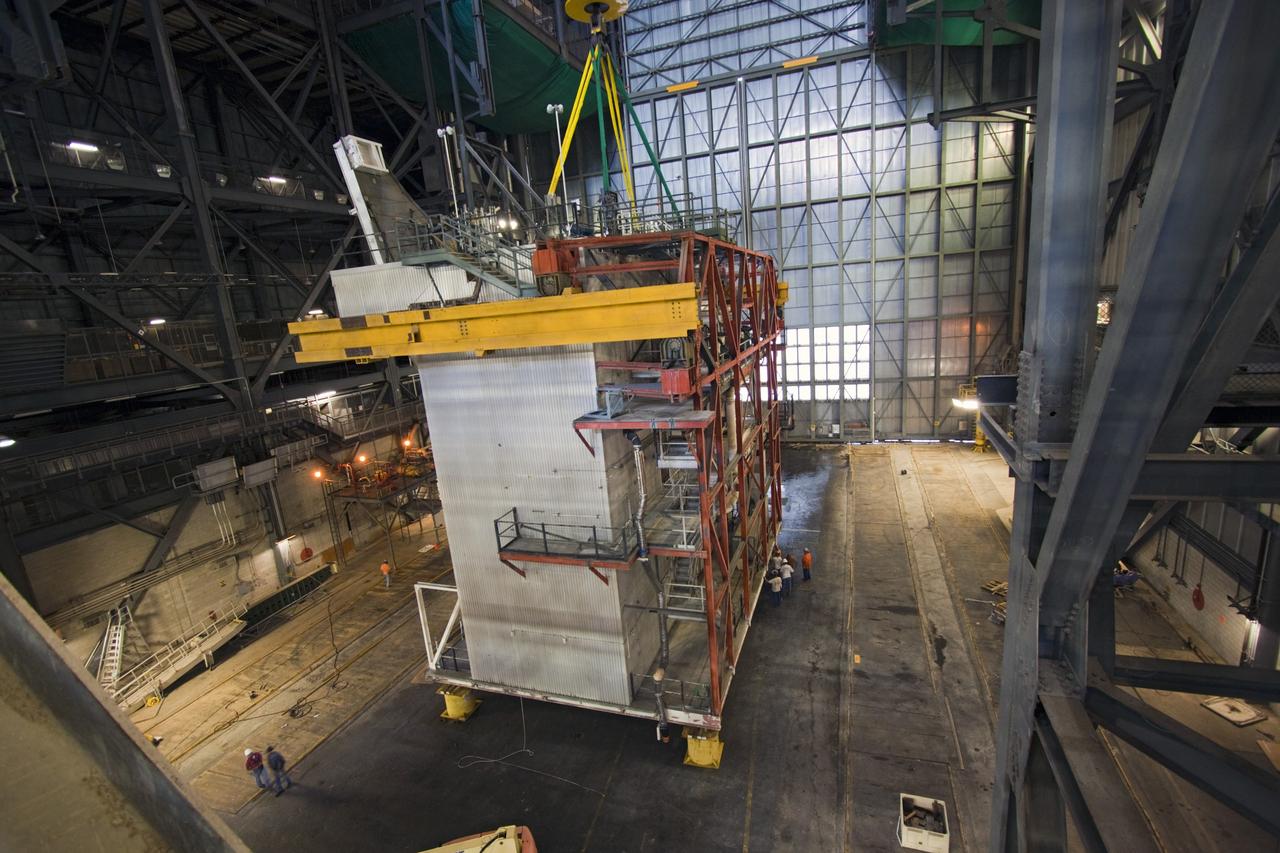
CAPE CANAVERAL, Fla. – As part of NASA's Ground Systems Development and Operations Program at the Kennedy Space Center in Florida, a large space shuttle-era work platform is being removed from high bay 3 of the Vehicle Assembly Building, or VAB. The work is part of a center-wide modernization and refurbishment initiative to accommodate NASA’s Space Launch System and a variety of other spacecraft instead of the whole building supporting one design. The Ground Systems Development and Operations Program is developing the necessary ground systems, infrastructure and operational approaches required to safely process, assemble, transport and launch the next generation of rockets and spacecraft in support of NASA’s exploration objectives. Future work also will replace the antiquated communications, power and vehicle access resources with modern efficient systems. Some of the utilities and systems slated for replacement have been used since the VAB opened in 1965. For more information, visit http://www.nasa.gov/exploration/systems/ground/index.html Photo credit: NASA/Jim Grossmann
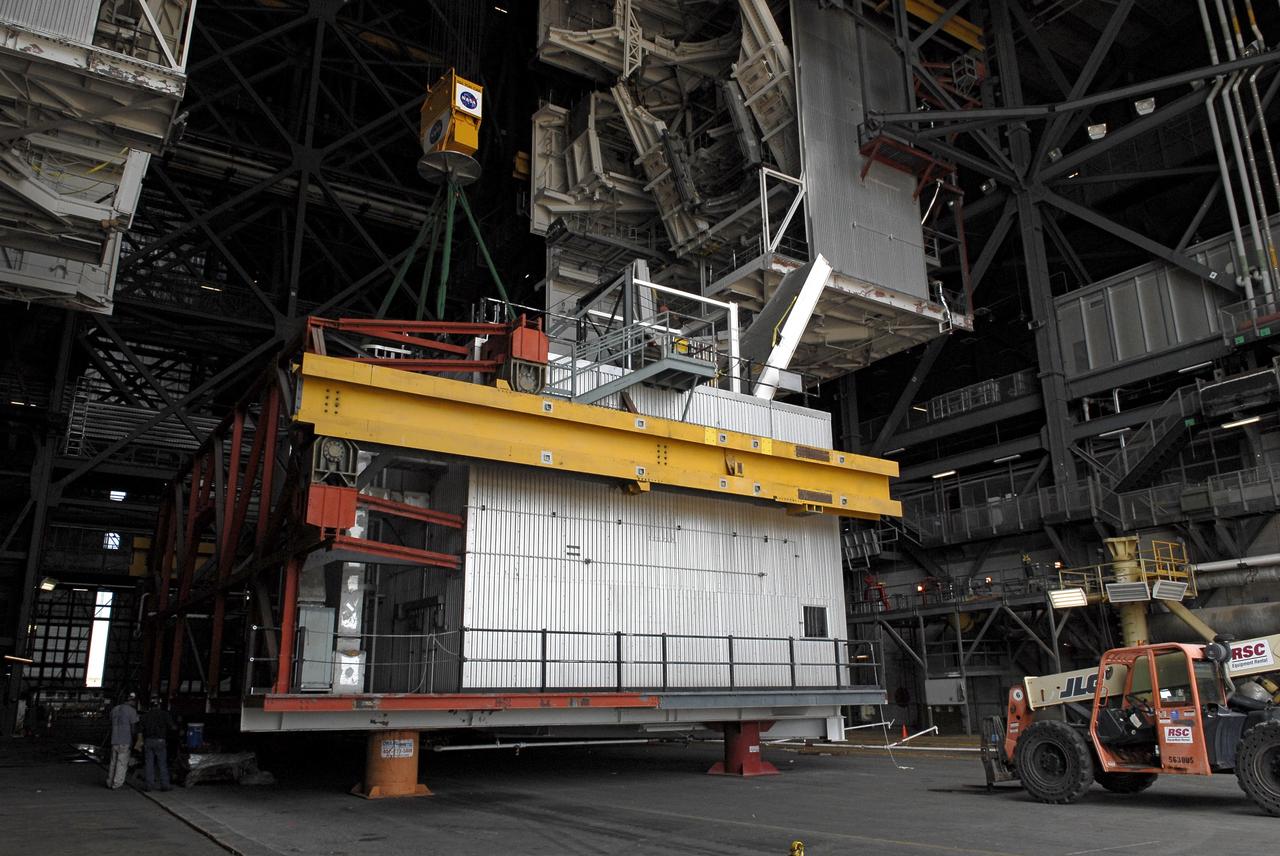
CAPE CANAVERAL, Fla. – As part of NASA's Ground Systems Development and Operations Program at the Kennedy Space Center in Florida, a large space shuttle-era work platform is being removed from high bay 3 of the Vehicle Assembly Building, or VAB. The work is part of a center-wide modernization and refurbishment initiative to accommodate NASA’s Space Launch System and a variety of other spacecraft instead of the whole building supporting one design. The Ground Systems Development and Operations Program is developing the necessary ground systems, infrastructure and operational approaches required to safely process, assemble, transport and launch the next generation of rockets and spacecraft in support of NASA’s exploration objectives. Future work also will replace the antiquated communications, power and vehicle access resources with modern efficient systems. Some of the utilities and systems slated for replacement have been used since the VAB opened in 1965. For more information, visit http://www.nasa.gov/exploration/systems/ground/index.html Photo credit: NASA/ Charisse Nahser
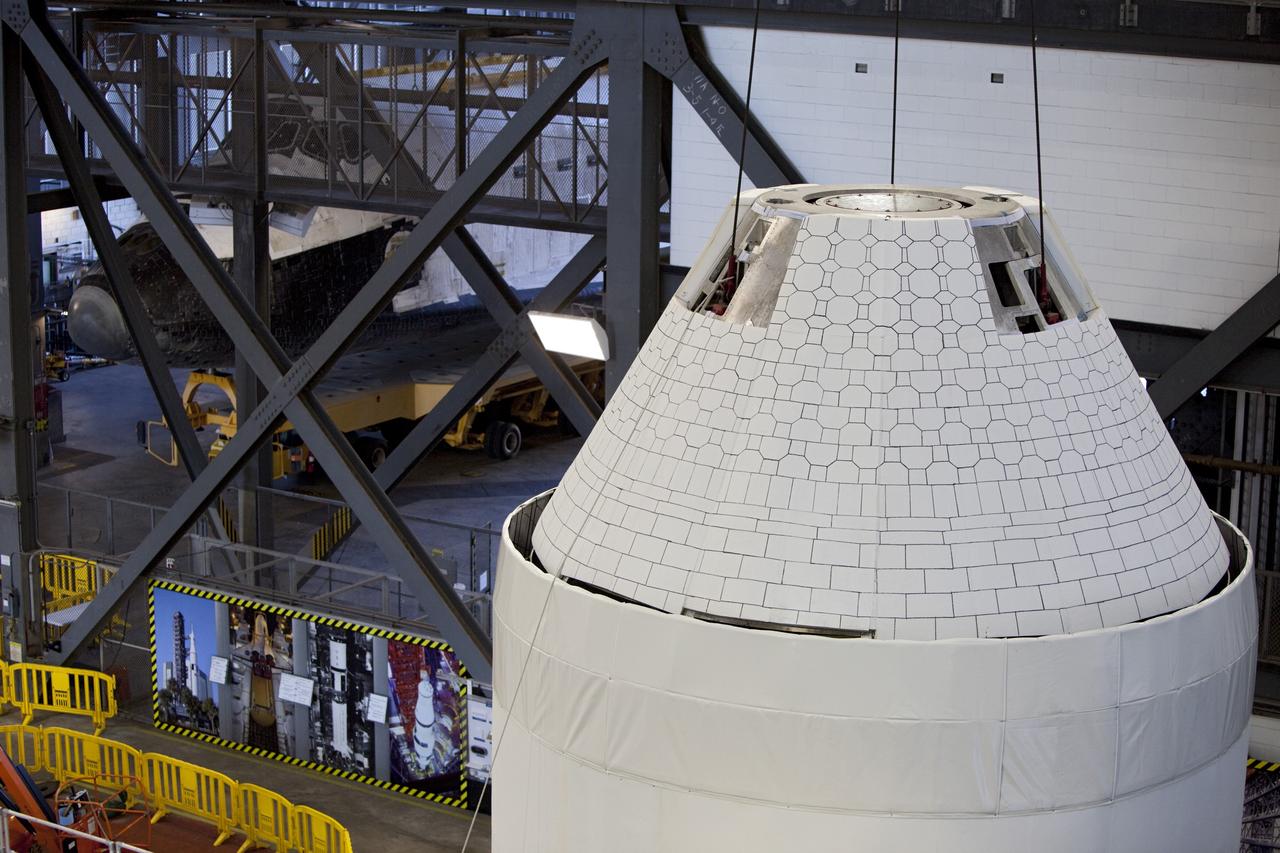
CAPE CANAVERAL, Fla. – An Orion mockup spacecraft atop its service module simulator is lifted in the transfer aisle of the Vehicle Assembly Building, or VAB, at NASA's Kennedy Space Center in Florida. The Orion mockup is exact in details on the outside, but mostly empty on the inside. The work in the VAB is crucial to making sure the designs are accurate. Visible in the background on the left is the space shuttle Atlantis being readied for its move to the Kennedy Space Center Visitor Complex. Orion is the exploration spacecraft designed to carry crews to space beyond low Earth orbit. It will provide emergency abort capability, sustain the crew during the space travel and provide safe re-entry from deep space return velocities. The first unpiloted test flight of the Orion is scheduled to launch in 2014 atop a Delta IV rocket and in 2017 on a Space Launch System rocket. For more information, visit http://www.nasa.gov/orion Photo credit: NASA/ Dmitri Gerondidakis

CAPE CANAVERAL, Fla. – As part of NASA's Ground Systems Development and Operations Program at the Kennedy Space Center in Florida, a large space shuttle-era work platform is being removed from high bay 3 of the Vehicle Assembly Building, or VAB. The work is part of a center-wide modernization and refurbishment initiative to accommodate NASA’s Space Launch System and a variety of other spacecraft instead of the whole building supporting one design. The Ground Systems Development and Operations Program is developing the necessary ground systems, infrastructure and operational approaches required to safely process, assemble, transport and launch the next generation of rockets and spacecraft in support of NASA’s exploration objectives. Future work also will replace the antiquated communications, power and vehicle access resources with modern efficient systems. Some of the utilities and systems slated for replacement have been used since the VAB opened in 1965. For more information, visit http://www.nasa.gov/exploration/systems/ground/index.html Photo credit: NASA/Kim Shiflett
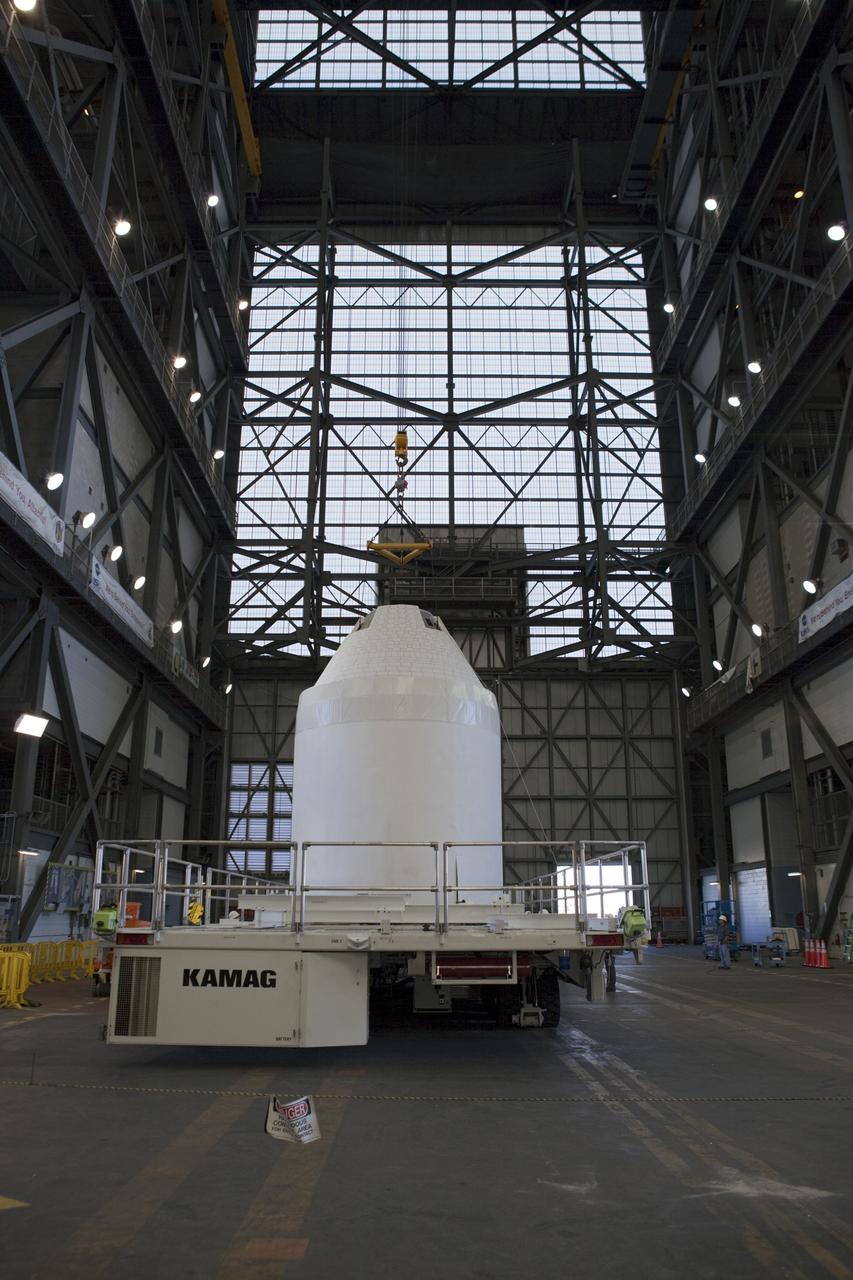
CAPE CANAVERAL, Fla. – An Orion mockup spacecraft atop its service module simulator is lowered onto a transporter in the transfer aisle of the Vehicle Assembly Building, or VAB, at NASA's Kennedy Space Center in Florida. The Orion mockup is exact in details on the outside, but mostly empty on the inside. The work in the VAB is crucial to making sure the designs are accurate. Orion is the exploration spacecraft designed to carry crews to space beyond low Earth orbit. It will provide emergency abort capability, sustain the crew during the space travel and provide safe re-entry from deep space return velocities. The first unpiloted test flight of the Orion is scheduled to launch in 2014 atop a Delta IV rocket and in 2017 on a Space Launch System rocket. For more information, visit http://www.nasa.gov/orion Photo credit: NASA/ Dmitri Gerondidakis
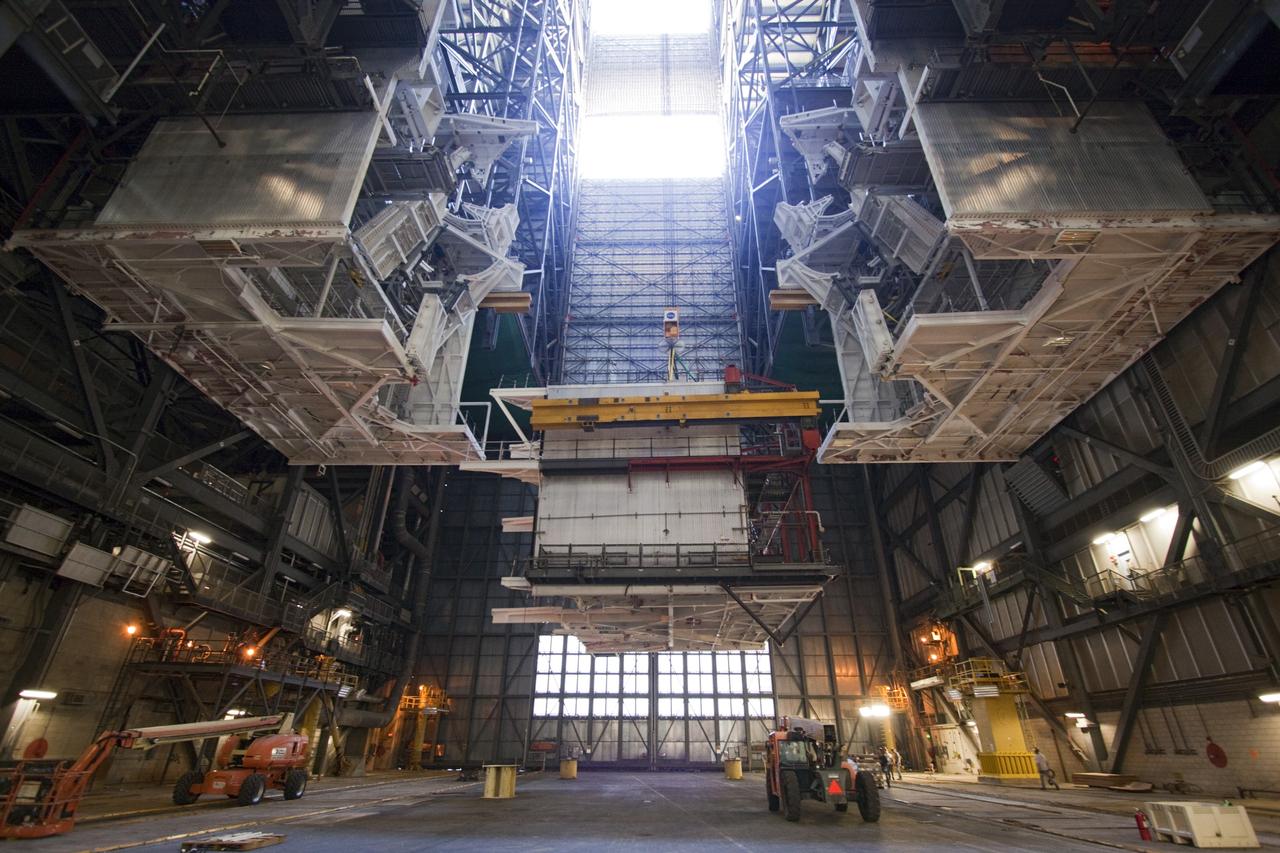
CAPE CANAVERAL, Fla. – As part of NASA's Ground Systems Development and Operations Program at the Kennedy Space Center in Florida, a large space shuttle-era work platform is being removed from high bay 3 of the Vehicle Assembly Building, or VAB. The work is part of a center-wide modernization and refurbishment initiative to accommodate NASA’s Space Launch System and a variety of other spacecraft instead of the whole building supporting one design. The Ground Systems Development and Operations Program is developing the necessary ground systems, infrastructure and operational approaches required to safely process, assemble, transport and launch the next generation of rockets and spacecraft in support of NASA’s exploration objectives. Future work also will replace the antiquated communications, power and vehicle access resources with modern efficient systems. Some of the utilities and systems slated for replacement have been used since the VAB opened in 1965. For more information, visit http://www.nasa.gov/exploration/systems/ground/index.html Photo credit: NASA/Jim Grossmann
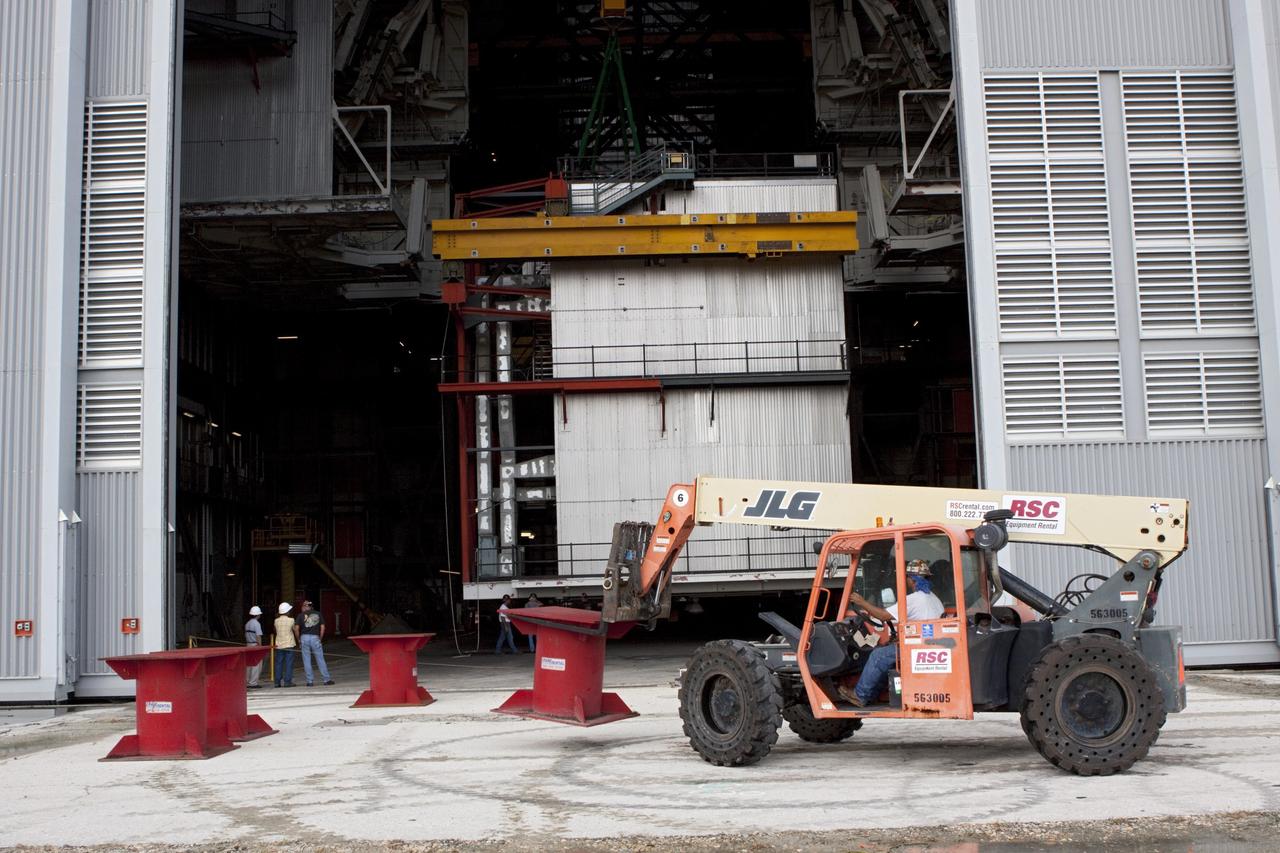
CAPE CANAVERAL, Fla. – As part of NASA's Ground Systems Development and Operations Program at the Kennedy Space Center in Florida, support pedestals are moved into position just outside the doors of the Vehicle Assembly Building, or VAB. Inside, a large work platform is being removed from an upper level to the ground. The effort is part of modernization plans including flexible settings for multiple launch vehicles instead of the whole building supporting one design. The Ground Systems Development and Operations Program is developing the necessary ground systems, infrastructure and operational approaches required to safely process, assemble, transport and launch the next generation of rockets and spacecraft in support of NASA’s exploration objectives. Future work also will replace the antiquated communications, power and vehicle access resources with modern efficient systems. Some of the utilities and systems slated for replacement have been used since the VAB opened in 1965. For more information, visit http://www.nasa.gov/exploration/systems/ground/index.html Photo credit: NASA/Jim Grossmann
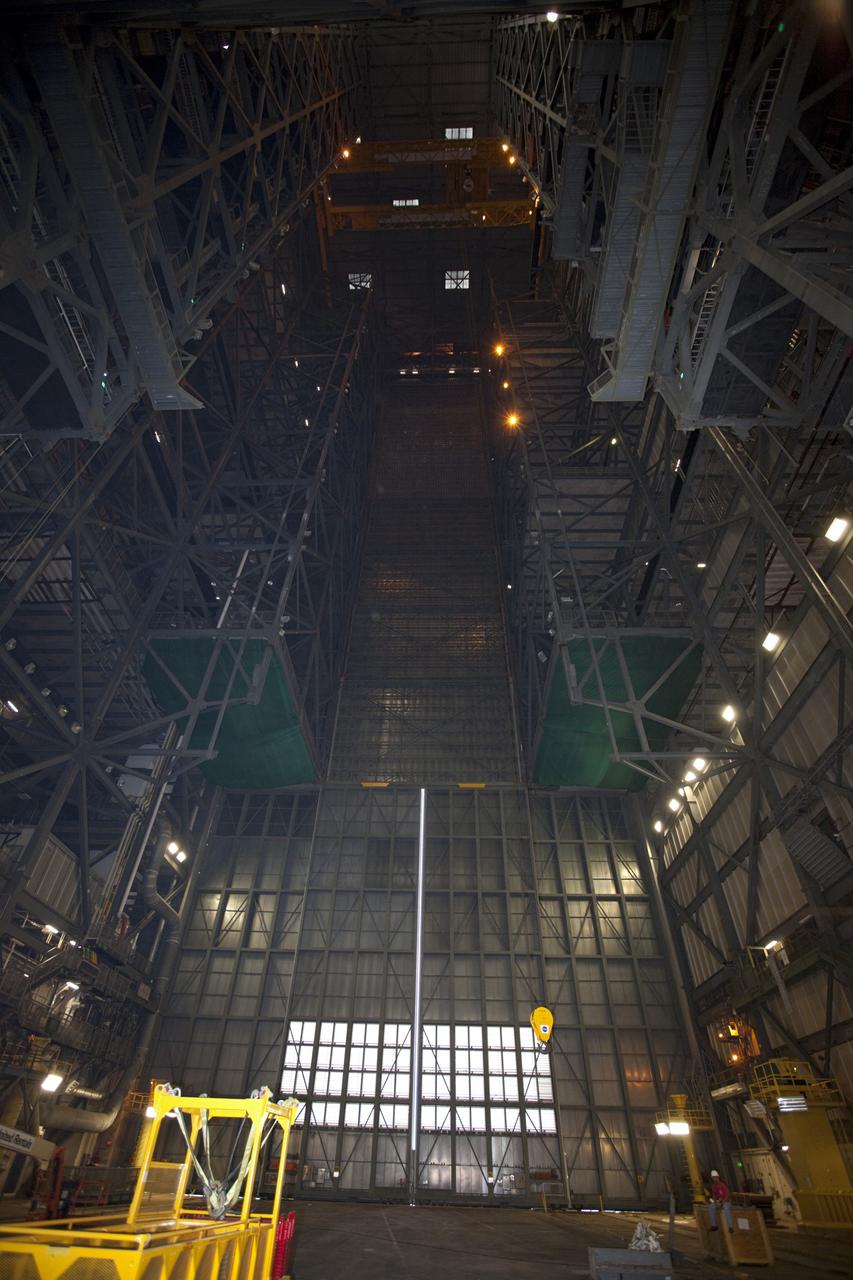
CAPE CANAVERAL, Fla. – As part of NASA's Ground Systems Development and Operations Program at the Kennedy Space Center in Florida, space shuttle-era work platforms have been removed from high bay 3 of the Vehicle Assembly Building, or VAB. The work is part of a center-wide modernization and refurbishment initiative to accommodate NASA’s Space Launch System and a variety of other spacecraft instead of the whole building supporting one design. The Ground Systems Development and Operations Program is developing the necessary ground systems, infrastructure and operational approaches required to safely process, assemble, transport and launch the next generation of rockets and spacecraft in support of NASA’s exploration objectives. Future work also will replace the antiquated communications, power and vehicle access resources with modern efficient systems. Some of the utilities and systems slated for replacement have been used since the VAB opened in 1965. For more information, visit http://www.nasa.gov/exploration/systems/ground/index.html Photo credit: NASA/Kim Shiflett
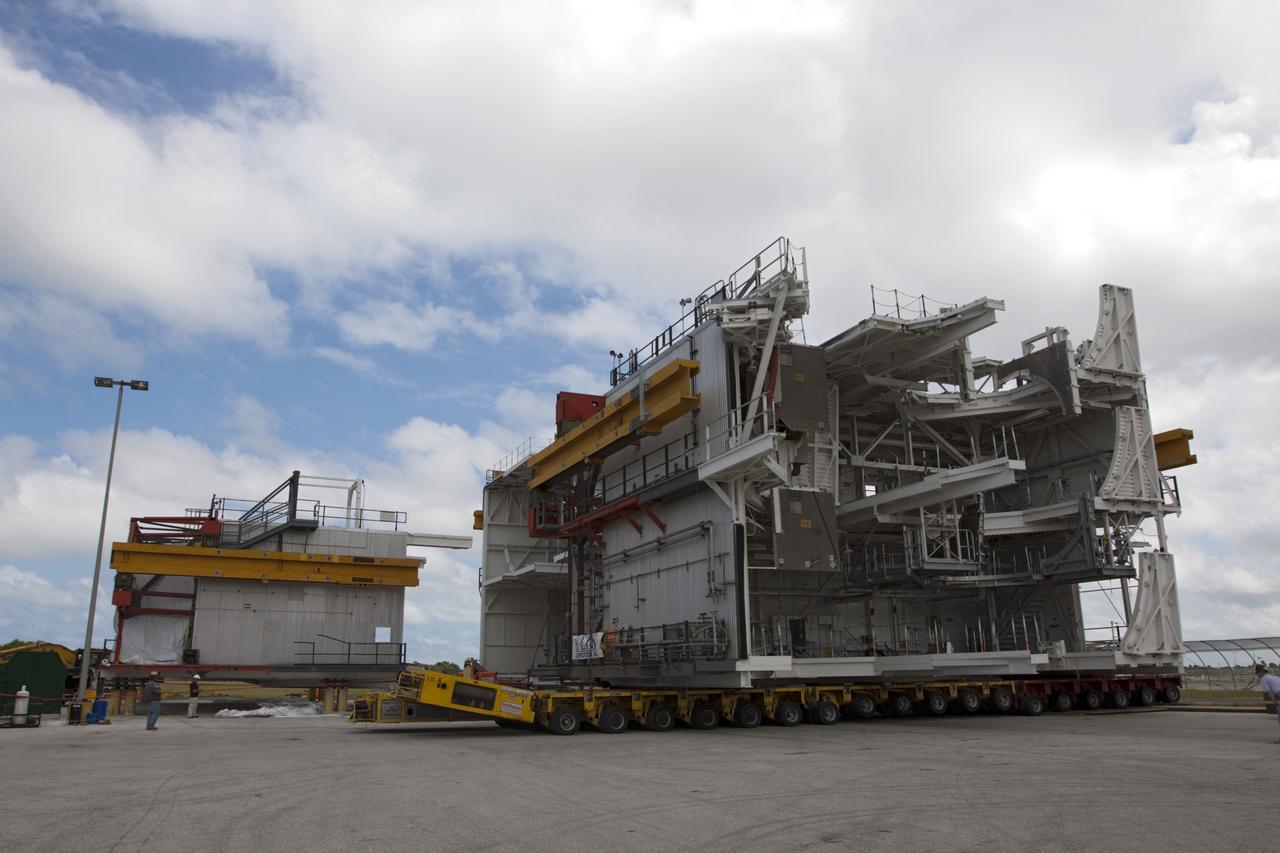
CAPE CANAVERAL, Fla. – As part of NASA's Ground Systems Development and Operations Program at the Kennedy Space Center in Florida, a large space shuttle-era work platform is being removed from high bay 3 of the Vehicle Assembly Building, or VAB, and placed on a transporter for removal. The work is part of a center-wide modernization and refurbishment initiative to accommodate NASA’s Space Launch System and a variety of other spacecraft instead of the whole building supporting one design. The Ground Systems Development and Operations Program is developing the necessary ground systems, infrastructure and operational approaches required to safely process, assemble, transport and launch the next generation of rockets and spacecraft in support of NASA’s exploration objectives. Future work also will replace the antiquated communications, power and vehicle access resources with modern efficient systems. Some of the utilities and systems slated for replacement have been used since the VAB opened in 1965. For more information, visit http://www.nasa.gov/exploration/systems/ground/index.html Photo credit: NASA/Kim Shiflett
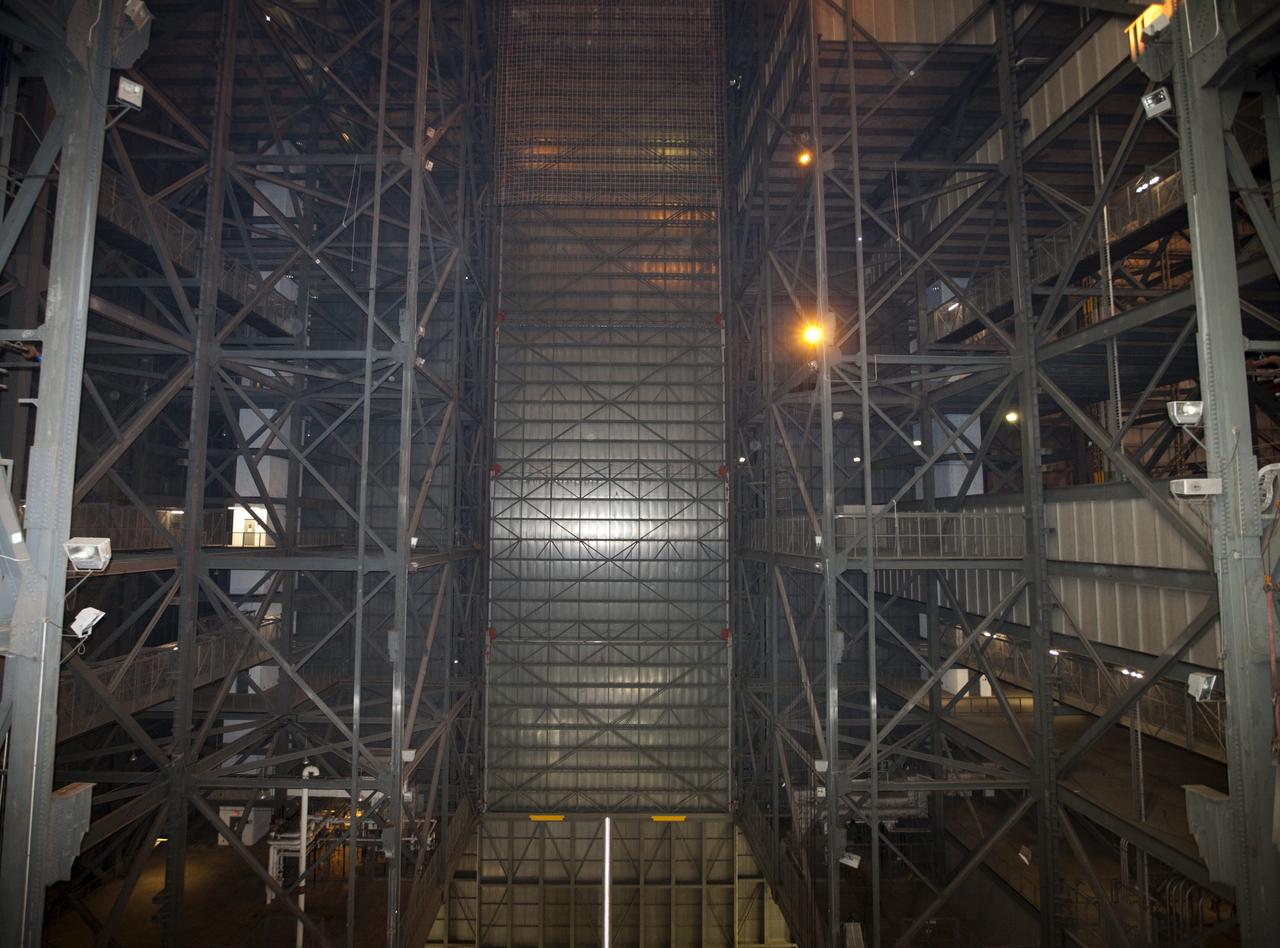
CAPE CANAVERAL, Fla. – As part of NASA's Ground Systems Development and Operations Program at the Kennedy Space Center in Florida, space shuttle-era work platforms have been removed from high bay 3 of the Vehicle Assembly Building, or VAB. The work is part of a center-wide modernization and refurbishment initiative to accommodate NASA’s Space Launch System and a variety of other spacecraft instead of the whole building supporting one design. The Ground Systems Development and Operations Program is developing the necessary ground systems, infrastructure and operational approaches required to safely process, assemble, transport and launch the next generation of rockets and spacecraft in support of NASA’s exploration objectives. Future work also will replace the antiquated communications, power and vehicle access resources with modern efficient systems. Some of the utilities and systems slated for replacement have been used since the VAB opened in 1965. For more information, visit http://www.nasa.gov/exploration/systems/ground/index.html Photo credit: NASA/Kim Shiflett
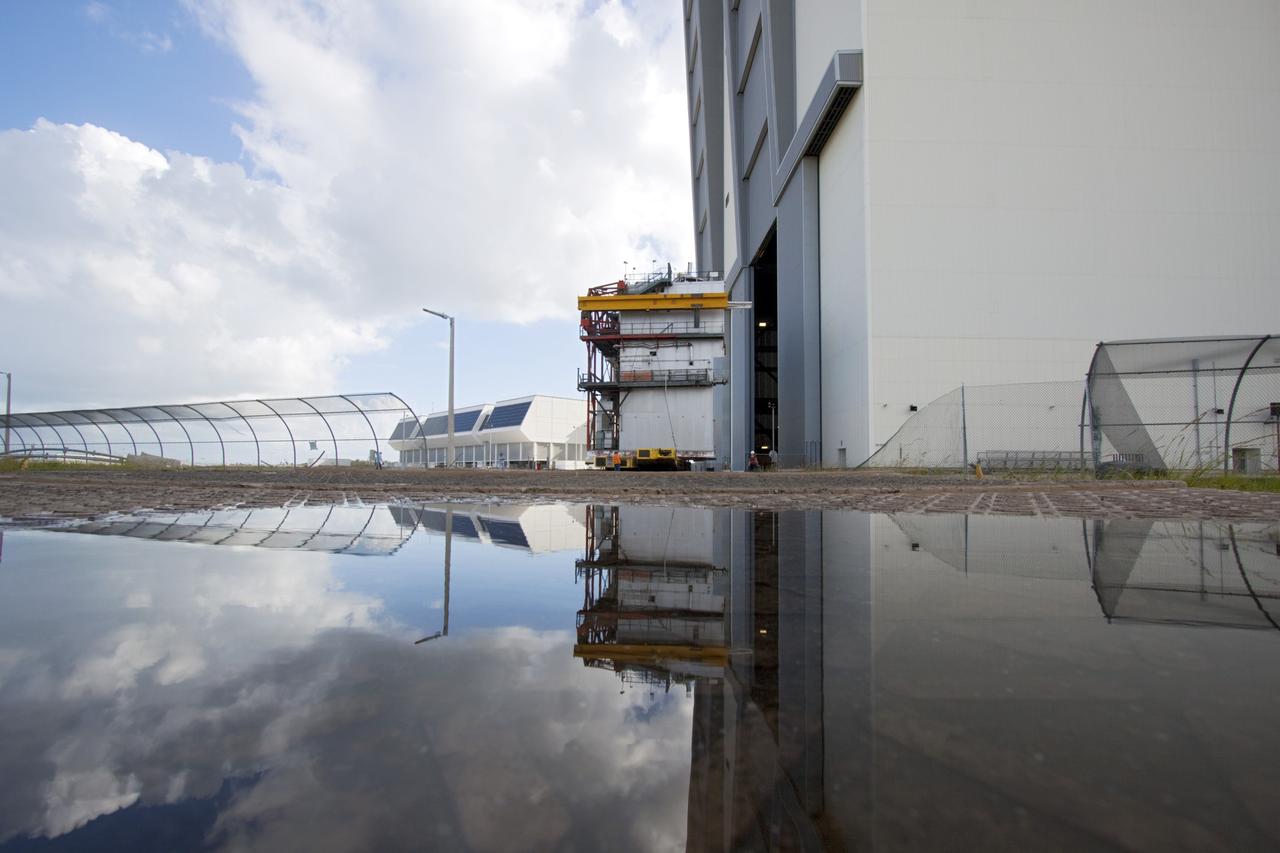
CAPE CANAVERAL, Fla. – As part of NASA's Ground Systems Development and Operations Program at the Kennedy Space Center in Florida, a large space shuttle-era work platform has been removed from high bay 3 of the Vehicle Assembly Building, or VAB. The work is part of a center-wide modernization and refurbishment initiative to accommodate NASA’s Space Launch System and a variety of other spacecraft instead of the whole building supporting one design. The Ground Systems Development and Operations Program is developing the necessary ground systems, infrastructure and operational approaches required to safely process, assemble, transport and launch the next generation of rockets and spacecraft in support of NASA’s exploration objectives. Future work also will replace the antiquated communications, power and vehicle access resources with modern efficient systems. Some of the utilities and systems slated for replacement have been used since the VAB opened in 1965. For more information, visit http://www.nasa.gov/exploration/systems/ground/index.html Photo credit: NASA/Jim Grossmann
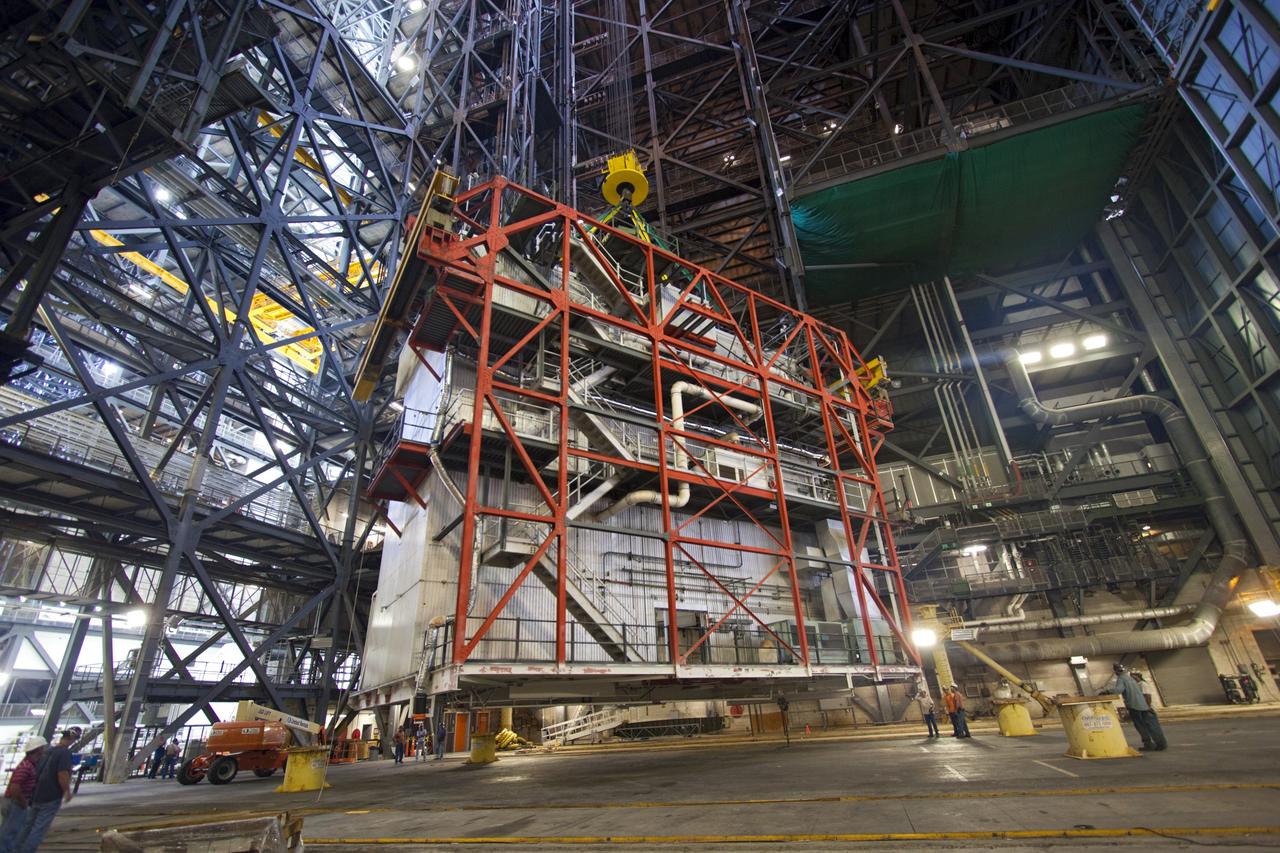
CAPE CANAVERAL, Fla. – As part of NASA's Ground Systems Development and Operations Program at the Kennedy Space Center in Florida, a large space shuttle-era work platform is being lowered and removed from high bay 3 of the Vehicle Assembly Building, or VAB. The work is part of a center-wide modernization and refurbishment initiative to accommodate NASA’s Space Launch System and a variety of other spacecraft instead of the whole building supporting one design. The Ground Systems Development and Operations Program is developing the necessary ground systems, infrastructure and operational approaches required to safely process, assemble, transport and launch the next generation of rockets and spacecraft in support of NASA’s exploration objectives. Future work also will replace the antiquated communications, power and vehicle access resources with modern efficient systems. Some of the utilities and systems slated for replacement have been used since the VAB opened in 1965. For more information, visit http://www.nasa.gov/exploration/systems/ground/index.html Photo credit: NASA/Jim Grossmann
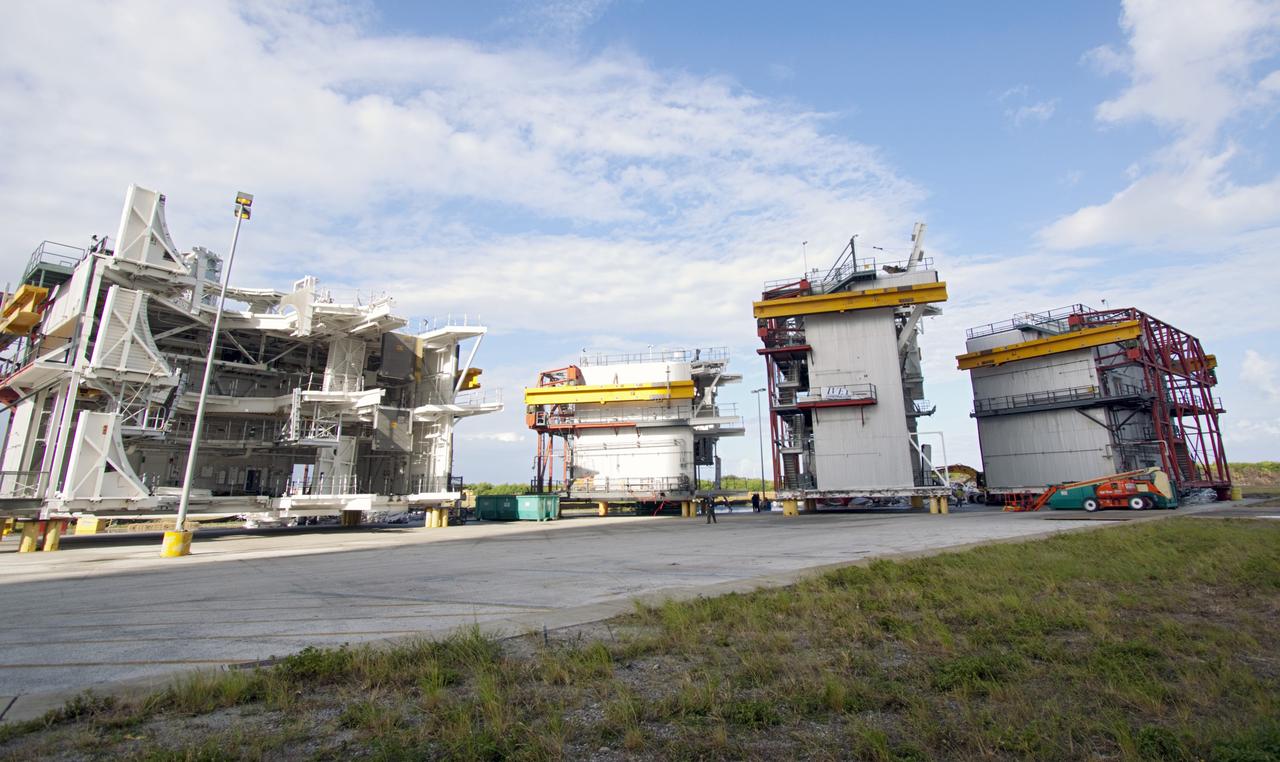
CAPE CANAVERAL, Fla. – As part of NASA's Ground Systems Development and Operations Program at the Kennedy Space Center in Florida, several large space shuttle-era work platforms have been removed from high bay 3 of the Vehicle Assembly Building, or VAB. The work is part of a center-wide modernization and refurbishment initiative to accommodate NASA’s Space Launch System and a variety of other spacecraft instead of the whole building supporting one design. The Ground Systems Development and Operations Program is developing the necessary ground systems, infrastructure and operational approaches required to safely process, assemble, transport and launch the next generation of rockets and spacecraft in support of NASA’s exploration objectives. Future work also will replace the antiquated communications, power and vehicle access resources with modern efficient systems. Some of the utilities and systems slated for replacement have been used since the VAB opened in 1965. For more information, visit http://www.nasa.gov/exploration/systems/ground/index.html Photo credit: NASA/Jim Grossmann
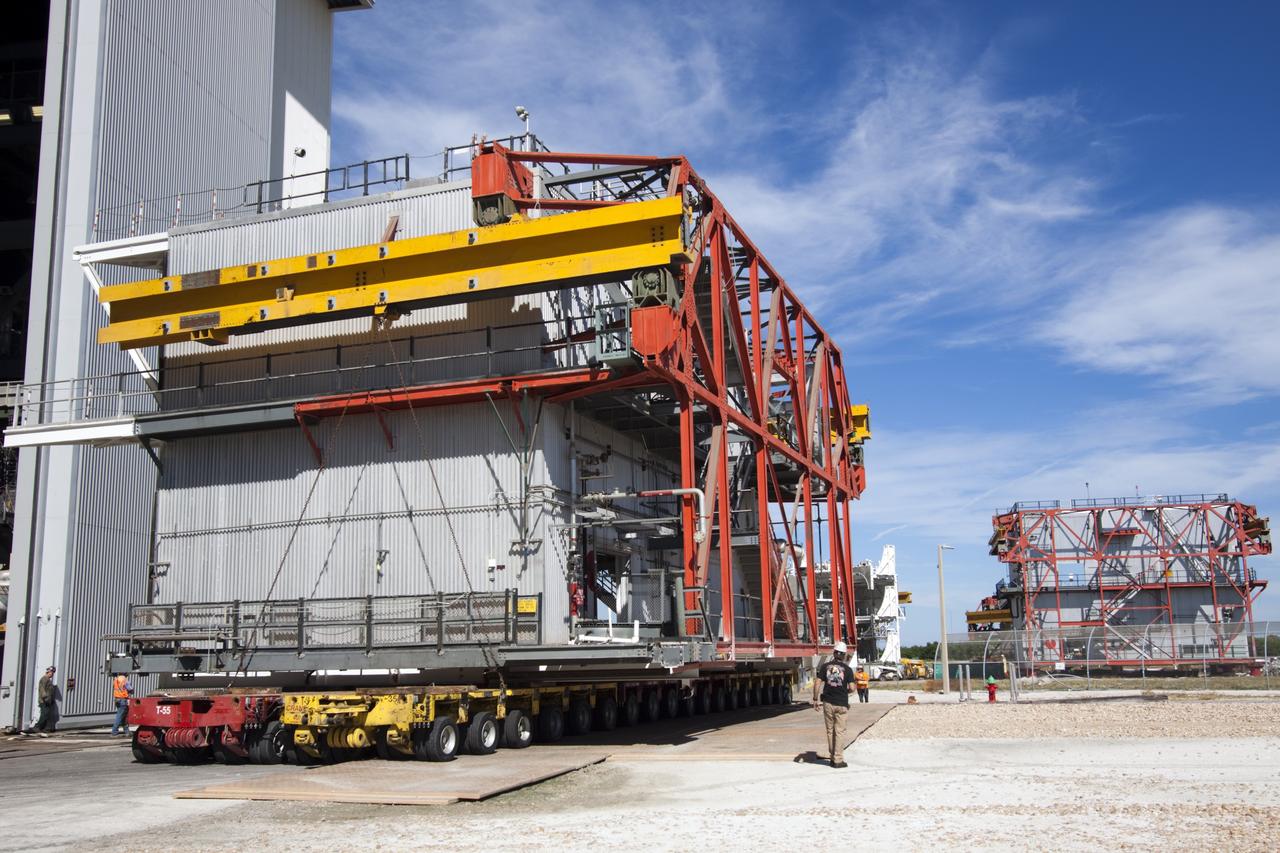
CAPE CANAVERAL, Fla. – As part of NASA's Ground Systems Development and Operations Program at the Kennedy Space Center in Florida, a large space shuttle-era work platform is being removed from high bay 3 of the Vehicle Assembly Building, or VAB. The work is part of a center-wide modernization and refurbishment initiative to accommodate NASA’s Space Launch System and a variety of other spacecraft instead of the whole building supporting one design. The Ground Systems Development and Operations Program is developing the necessary ground systems, infrastructure and operational approaches required to safely process, assemble, transport and launch the next generation of rockets and spacecraft in support of NASA’s exploration objectives. Future work also will replace the antiquated communications, power and vehicle access resources with modern efficient systems. Some of the utilities and systems slated for replacement have been used since the VAB opened in 1965. For more information, visit http://www.nasa.gov/exploration/systems/ground/index.html Photo credit: NASA/Jim Grossmann

CAPE CANAVERAL, Fla. – As part of NASA's Ground Systems Development and Operations Program at the Kennedy Space Center in Florida, a large space shuttle-era work platform is being removed from high bay 3 of the Vehicle Assembly Building, or VAB. The work is part of a center-wide modernization and refurbishment initiative to accommodate NASA’s Space Launch System and a variety of other spacecraft instead of the whole building supporting one design. The Ground Systems Development and Operations Program is developing the necessary ground systems, infrastructure and operational approaches required to safely process, assemble, transport and launch the next generation of rockets and spacecraft in support of NASA’s exploration objectives. Future work also will replace the antiquated communications, power and vehicle access resources with modern efficient systems. Some of the utilities and systems slated for replacement have been used since the VAB opened in 1965. For more information, visit http://www.nasa.gov/exploration/systems/ground/index.html Photo credit: NASA/ Charisse Nahser

CAPE CANAVERAL, Fla. – As part of NASA's Ground Systems Development and Operations Program at the Kennedy Space Center in Florida, a large space shuttle-era work platform is being removed from high bay 3 of the Vehicle Assembly Building, or VAB. The work is part of a center-wide modernization and refurbishment initiative to accommodate NASA’s Space Launch System and a variety of other spacecraft instead of the whole building supporting one design. The Ground Systems Development and Operations Program is developing the necessary ground systems, infrastructure and operational approaches required to safely process, assemble, transport and launch the next generation of rockets and spacecraft in support of NASA’s exploration objectives. Future work also will replace the antiquated communications, power and vehicle access resources with modern efficient systems. Some of the utilities and systems slated for replacement have been used since the VAB opened in 1965. For more information, visit http://www.nasa.gov/exploration/systems/ground/index.html Photo credit: NASA/Jim Grossmann
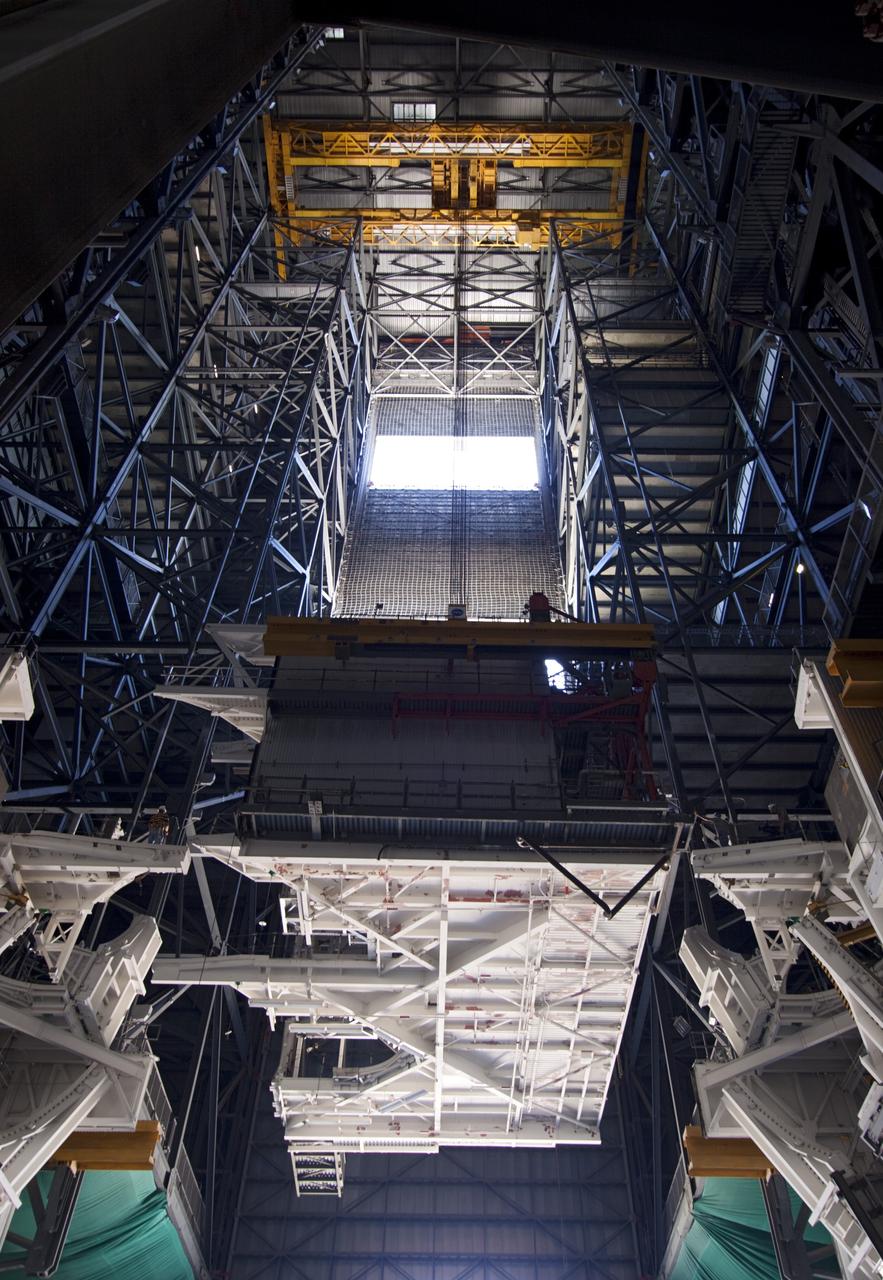
CAPE CANAVERAL, Fla. – As part of NASA's Ground Systems Development and Operations Program at the Kennedy Space Center in Florida, a large space shuttle-era work platform is being removed from high bay 3 of the Vehicle Assembly Building, or VAB. The work is part of a center-wide modernization and refurbishment initiative to accommodate NASA’s Space Launch System and a variety of other spacecraft instead of the whole building supporting one design. The Ground Systems Development and Operations Program is developing the necessary ground systems, infrastructure and operational approaches required to safely process, assemble, transport and launch the next generation of rockets and spacecraft in support of NASA’s exploration objectives. Future work also will replace the antiquated communications, power and vehicle access resources with modern efficient systems. Some of the utilities and systems slated for replacement have been used since the VAB opened in 1965. For more information, visit http://www.nasa.gov/exploration/systems/ground/index.html Photo credit: NASA/Jim Grossmann
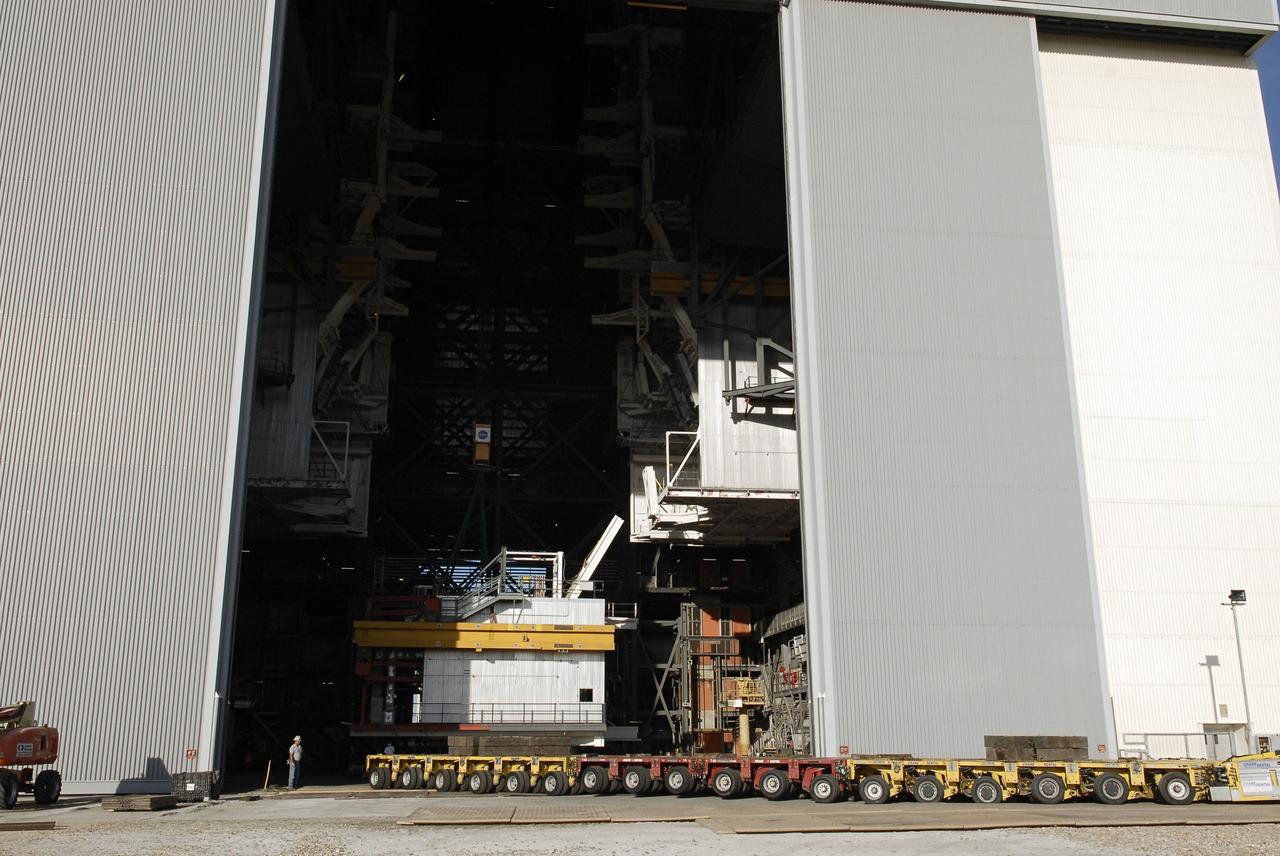
CAPE CANAVERAL, Fla. – As part of NASA's Ground Systems Development and Operations Program at the Kennedy Space Center in Florida, a large space shuttle-era work platform is being removed from high bay 3 of the Vehicle Assembly Building, or VAB, and placed on a transporter for removal. The work is part of a center-wide modernization and refurbishment initiative to accommodate NASA’s Space Launch System and a variety of other spacecraft instead of the whole building supporting one design. The Ground Systems Development and Operations Program is developing the necessary ground systems, infrastructure and operational approaches required to safely process, assemble, transport and launch the next generation of rockets and spacecraft in support of NASA’s exploration objectives. Future work also will replace the antiquated communications, power and vehicle access resources with modern efficient systems. Some of the utilities and systems slated for replacement have been used since the VAB opened in 1965. For more information, visit http://www.nasa.gov/exploration/systems/ground/index.html Photo credit: NASA/ Charisse Nahser
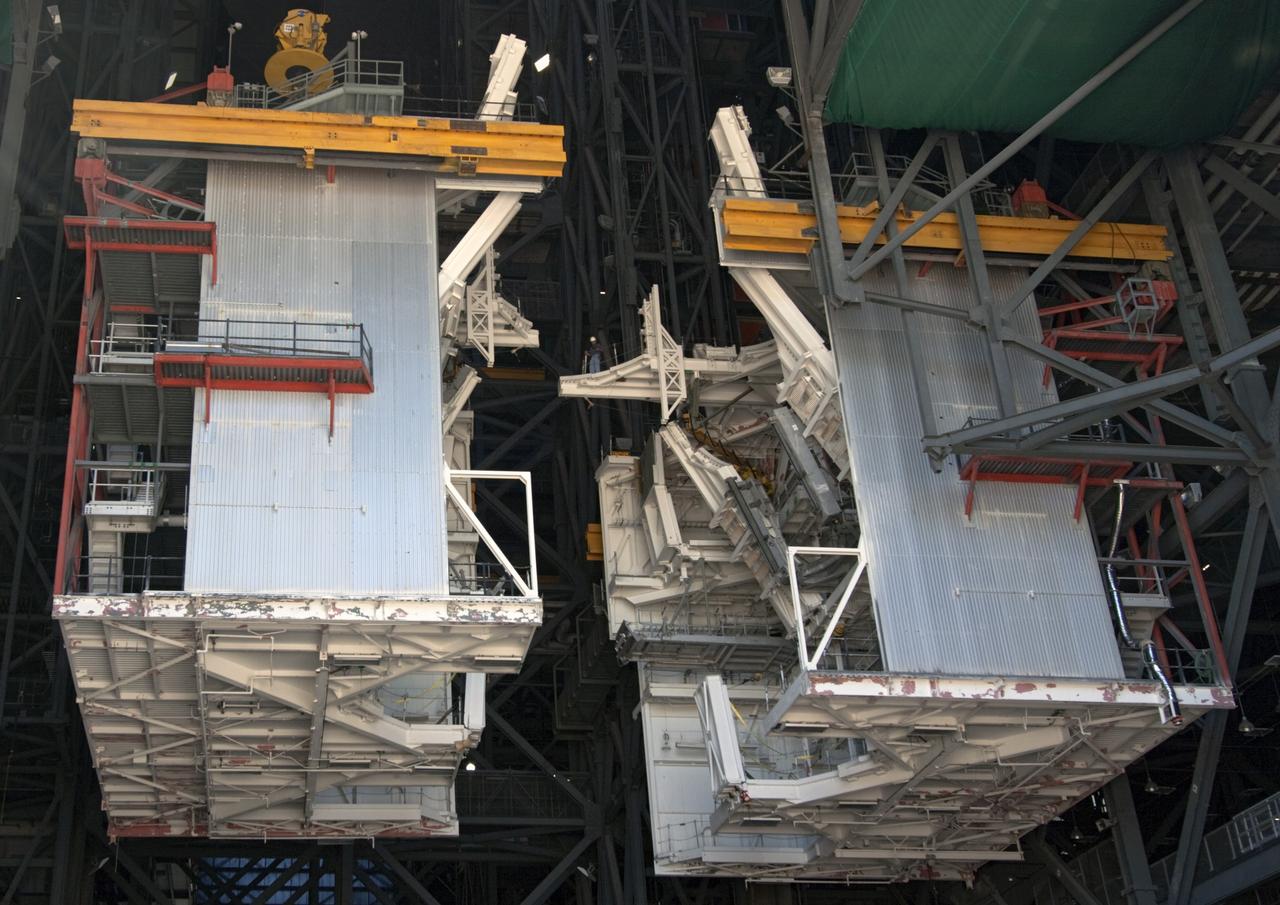
CAPE CANAVERAL, Fla. – As part of NASA's Ground Systems Development and Operations Program at the Kennedy Space Center in Florida, a large space shuttle-era work platform is being removed from high bay 3 of the Vehicle Assembly Building, or VAB. The work is part of a center-wide modernization and refurbishment initiative to accommodate NASA’s Space Launch System and a variety of other spacecraft instead of the whole building supporting one design. The Ground Systems Development and Operations Program is developing the necessary ground systems, infrastructure and operational approaches required to safely process, assemble, transport and launch the next generation of rockets and spacecraft in support of NASA’s exploration objectives. Future work also will replace the antiquated communications, power and vehicle access resources with modern efficient systems. Some of the utilities and systems slated for replacement have been used since the VAB opened in 1965. For more information, visit http://www.nasa.gov/exploration/systems/ground/index.html Photo credit: NASA/Jim Grossmann
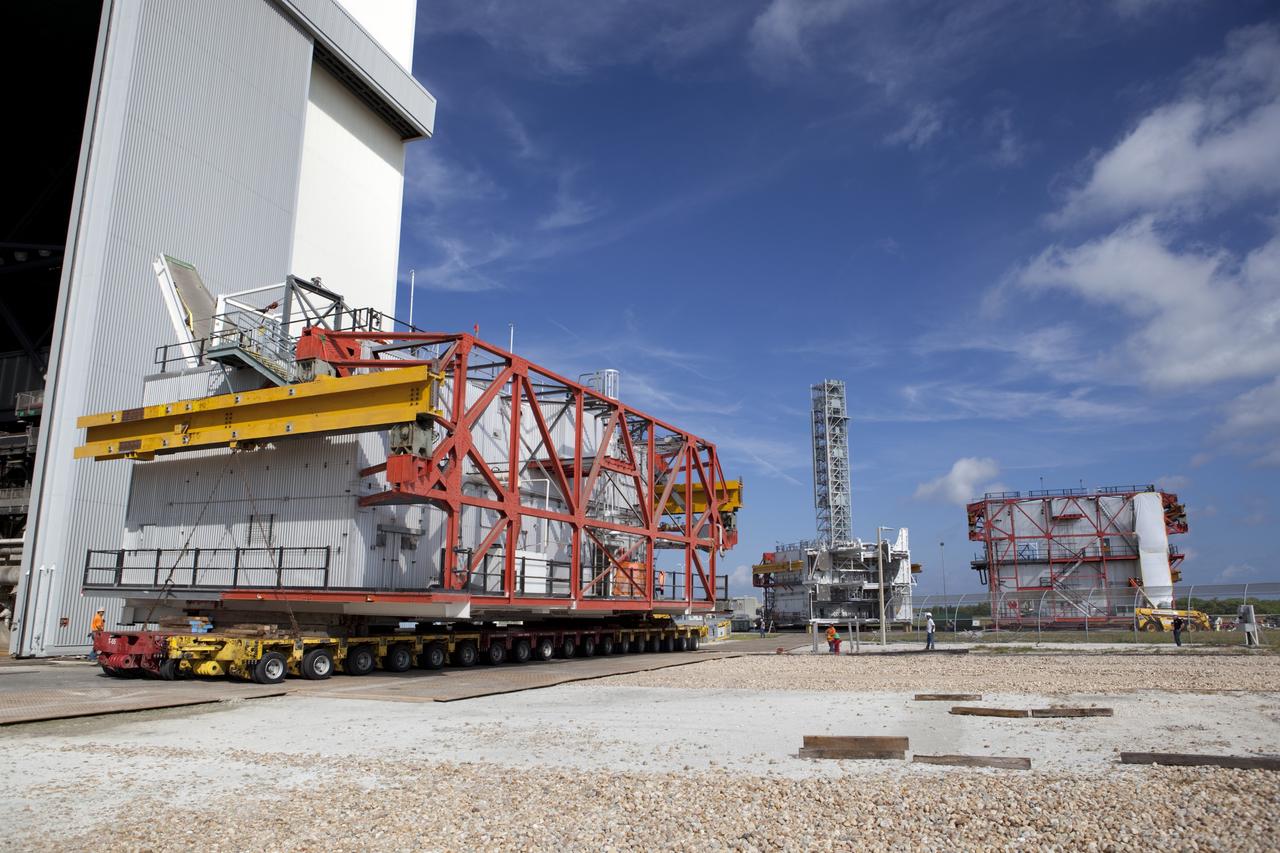
CAPE CANAVERAL, Fla. – As part of NASA's Ground Systems Development and Operations Program at the Kennedy Space Center in Florida, a large space shuttle-era work platform is being removed by transporter from high bay 3 of the Vehicle Assembly Building, or VAB. The work is part of a center-wide modernization and refurbishment initiative to accommodate NASA’s Space Launch System and a variety of other spacecraft instead of the whole building supporting one design. The Ground Systems Development and Operations Program is developing the necessary ground systems, infrastructure and operational approaches required to safely process, assemble, transport and launch the next generation of rockets and spacecraft in support of NASA’s exploration objectives. Future work also will replace the antiquated communications, power and vehicle access resources with modern efficient systems. Some of the utilities and systems slated for replacement have been used since the VAB opened in 1965. For more information, visit http://www.nasa.gov/exploration/systems/ground/index.html Photo credit: NASA/Dimitri Gerondidakis
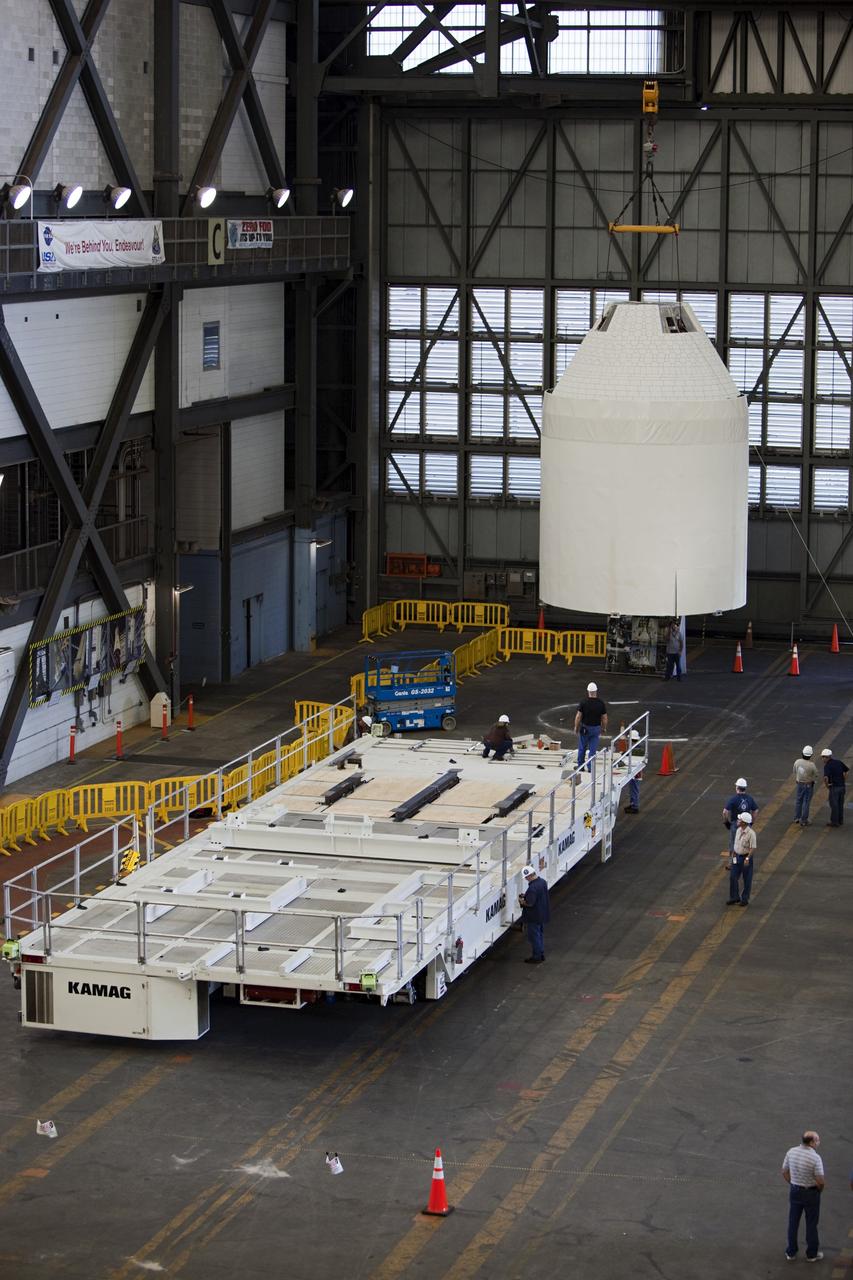
CAPE CANAVERAL, Fla. – An Orion mockup spacecraft atop its service module simulator is lifted in the transfer aisle of the Vehicle Assembly Building, or VAB, at NASA's Kennedy Space Center in Florida. The Orion mockup is exact in details on the outside, but mostly empty on the inside. The work in the VAB is crucial to making sure the designs are accurate. Orion is the exploration spacecraft designed to carry crews to space beyond low Earth orbit. It will provide emergency abort capability, sustain the crew during the space travel and provide safe re-entry from deep space return velocities. The first unpiloted test flight of the Orion is scheduled to launch in 2014 atop a Delta IV rocket and in 2017 on a Space Launch System rocket. For more information, visit http://www.nasa.gov/orion Photo credit: NASA/ Dmitri Gerondidakis

CAPE CANAVERAL, Fla. – At NASA’s Kennedy Space Center in Florida, workers pull cables between the 26th and 29th floors of high bay 3 in the 525-foot-tall Vehicle Assembly Building, or VAB, during part of a centerwide refurbishment initiative under the Ground Systems Development and Operations GSDO Program. The cable replacement project is under way in high bays 1 and 3 on the east side of the building, facing Launch Complex 39’s pads A and B. Approximately 150 miles of existing Apollo/shuttle era cabling is being removed to make room for installation of state-of-the-art command, communication and control systems that will be needed by future users to perform vehicle testing and verification prior to rollout to the launch pad. For more information, visit http://go.nasa.gov/groundsystems. Photo credit: NASA/Jim Grossmann
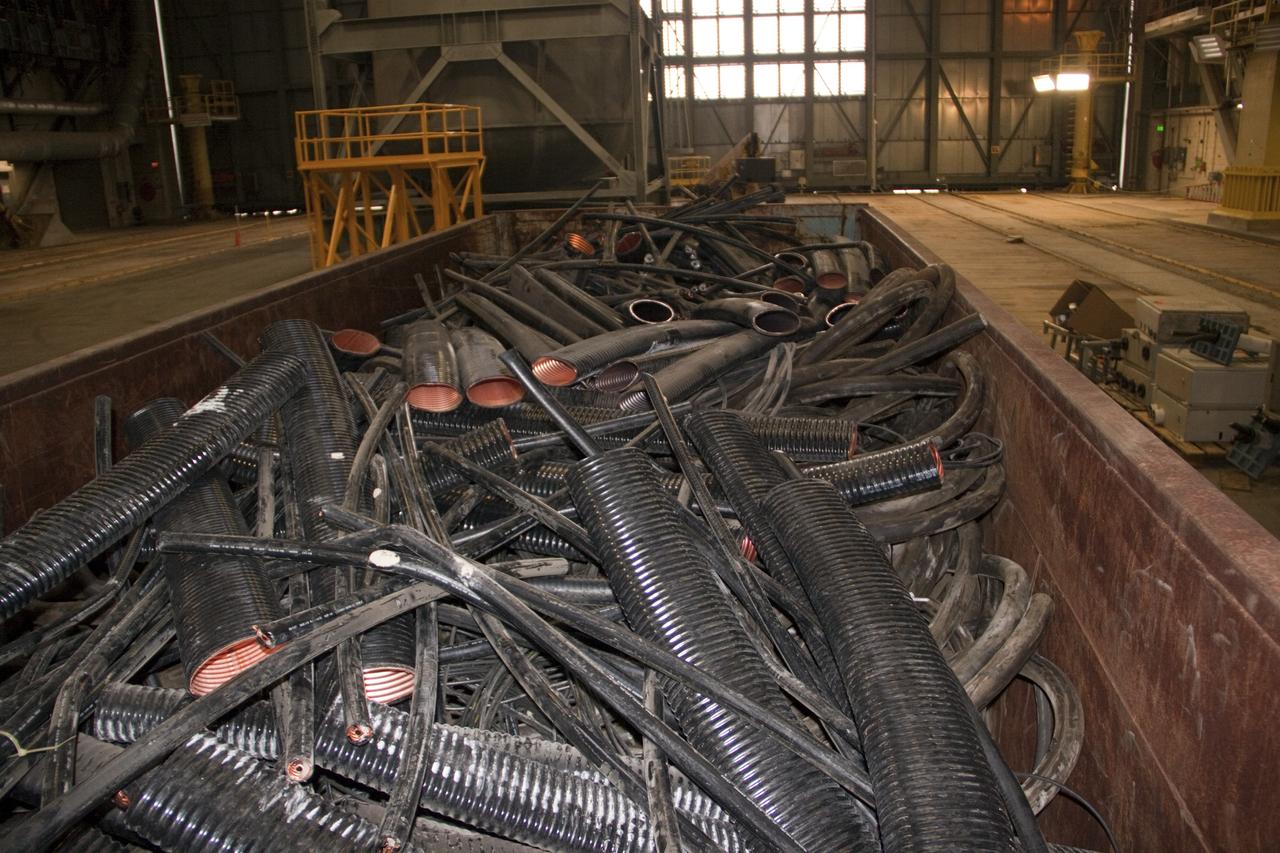
CAPE CANAVERAL, Fla. – At NASA’s Kennedy Space Center in Florida, old cabling is being pulled from high bay 3 in the Vehicle Assembly Building, or VAB, as part of a centerwide refurbishment initiative under the Ground Systems Development and Operations GSDO Program. The cable replacement project is under way in high bays 1 and 3 on the east side of the building, facing Launch Complex 39’s pads A and B. Approximately 150 miles of existing Apollo/shuttle era cabling is being removed to make room for installation of state-of-the-art command, communication and control systems that will be needed by future users to perform vehicle testing and verification prior to rollout to the launch pad. For more information, visit http://go.nasa.gov/groundsystems. Photo credit: NASA/Jim Grossmann
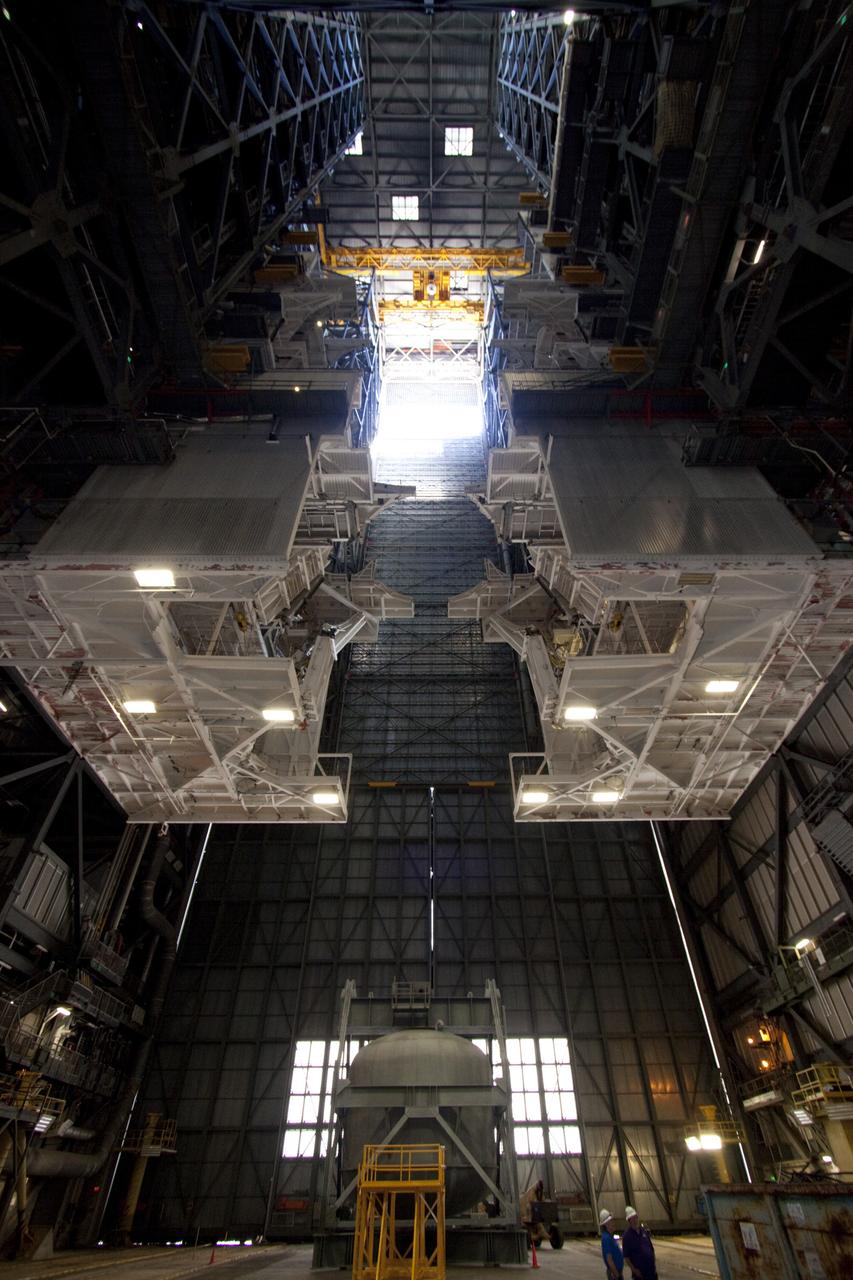
CAPE CANAVERAL, Fla. – At NASA’s Kennedy Space Center in Florida, refurbishment of high bay 3 is under way in the Vehicle Assembly Building, or VAB, as part of a centerwide refurbishment initiative under the Ground Systems Development and Operations GSDO Program. It is 525 feet from the bay’s ceiling to the floor. The cable replacement project is under way in high bays 1 and 3 on the east side of the building, facing Launch Complex 39’s pads A and B. Approximately 150 miles of existing Apollo/shuttle era cabling is being removed to make room for installation of state-of-the-art command, communication and control systems that will be needed by future users to perform vehicle testing and verification prior to rollout to the launch pad. For more information, visit http://go.nasa.gov/groundsystems. Photo credit: NASA/Jim Grossmann
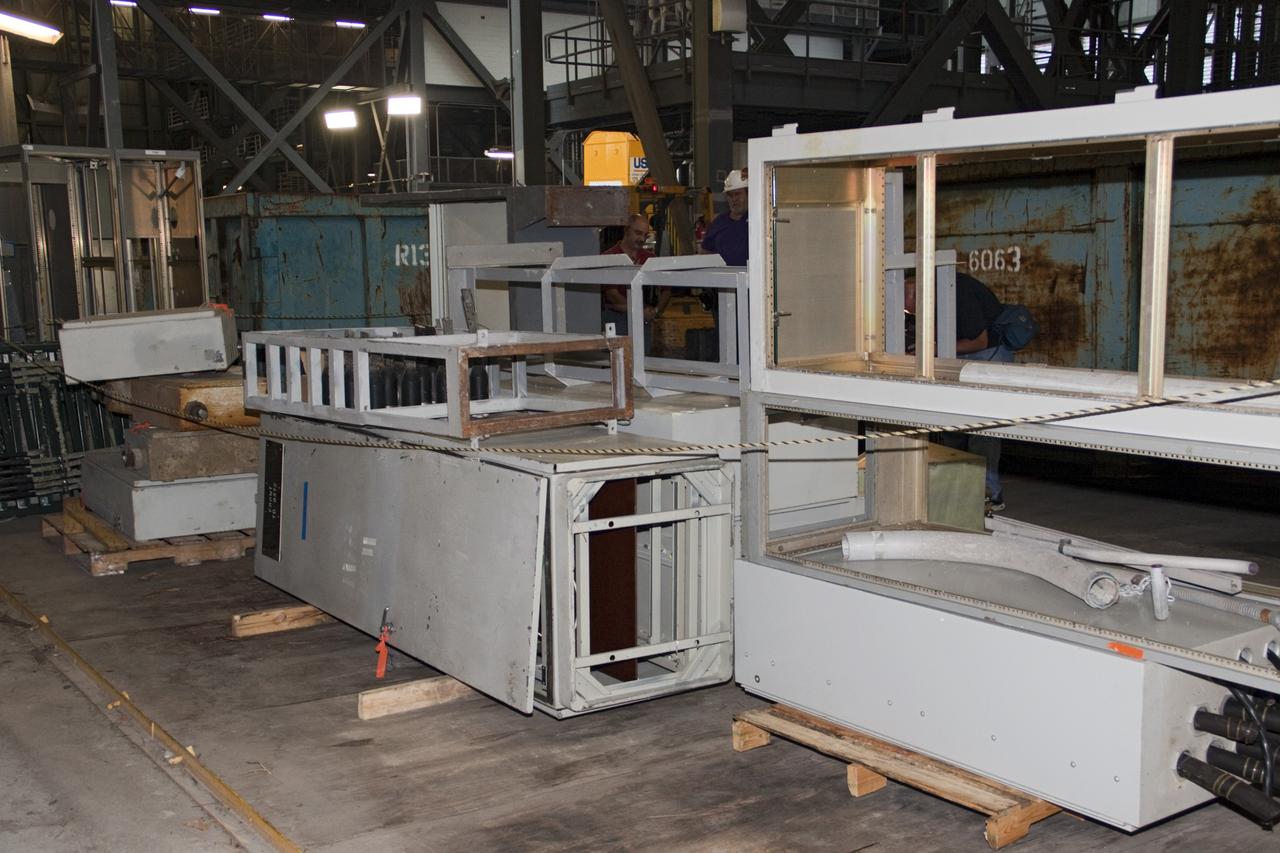
CAPE CANAVERAL, Fla. – At NASA’s Kennedy Space Center in Florida, old racks are being excessed in high bay 3 in the Vehicle Assembly Building, or VAB, as part of a centerwide refurbishment initiative under the Ground Systems Development and Operations GSDO Program The cable replacement project is under way in high bays 1 and 3 on the east side of the building, facing Launch Complex 39’s pads A and B. Approximately 150 miles of existing Apollo/shuttle era cabling is being removed to make room for installation of state-of-the-art command, communication and control systems that will be needed by future users to perform vehicle testing and verification prior to rollout to the launch pad. For more information, visit http://go.nasa.gov/groundsystems. Photo credit: NASA/Jim Grossmann
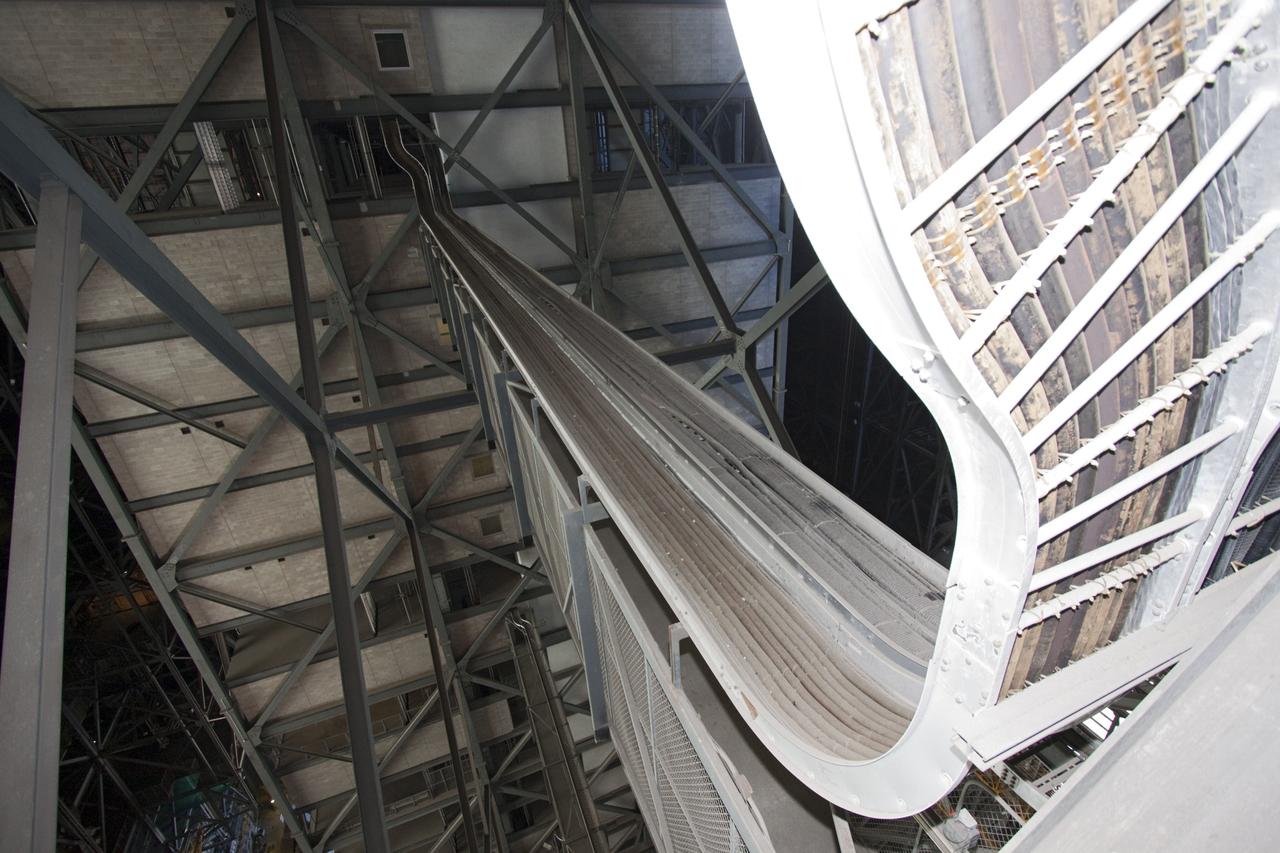
CAPE CANAVERAL, Fla. – At NASA’s Kennedy Space Center in Florida, cable trays wind their way along the grating in high bay 3 in the Vehicle Assembly Building, or VAB, during part of a centerwide refurbishment initiative under the Ground Systems Development and Operations GSDO Program. The cable replacement project is under way in high bays 1 and 3 on the east side of the building, facing Launch Complex 39’s pads A and B. Approximately 150 miles of existing Apollo/shuttle era cabling is being removed to make room for installation of state-of-the-art command, communication and control systems that will be needed by future users to perform vehicle testing and verification prior to rollout to the launch pad. For more information, visit http://go.nasa.gov/groundsystems. Photo credit: NASA/Jim Grossmann

CAPE CANAVERAL, Fla. – At NASA’s Kennedy Space Center in Florida, cable trays run along the walls in high bay 3 in the Vehicle Assembly Building, or VAB, as part of a centerwide refurbishment initiative under the Ground Systems Development and Operations GSDO Program. The cable replacement project is under way in high bays 1 and 3 on the east side of the building, facing Launch Complex 39’s pads A and B. Approximately 150 miles of existing Apollo/shuttle era cabling is being removed to make room for installation of state-of-the-art command, communication and control systems that will be needed by future users to perform vehicle testing and verification prior to rollout to the launch pad. For more information, visit http://go.nasa.gov/groundsystems. Photo credit: NASA/Jim Grossmann
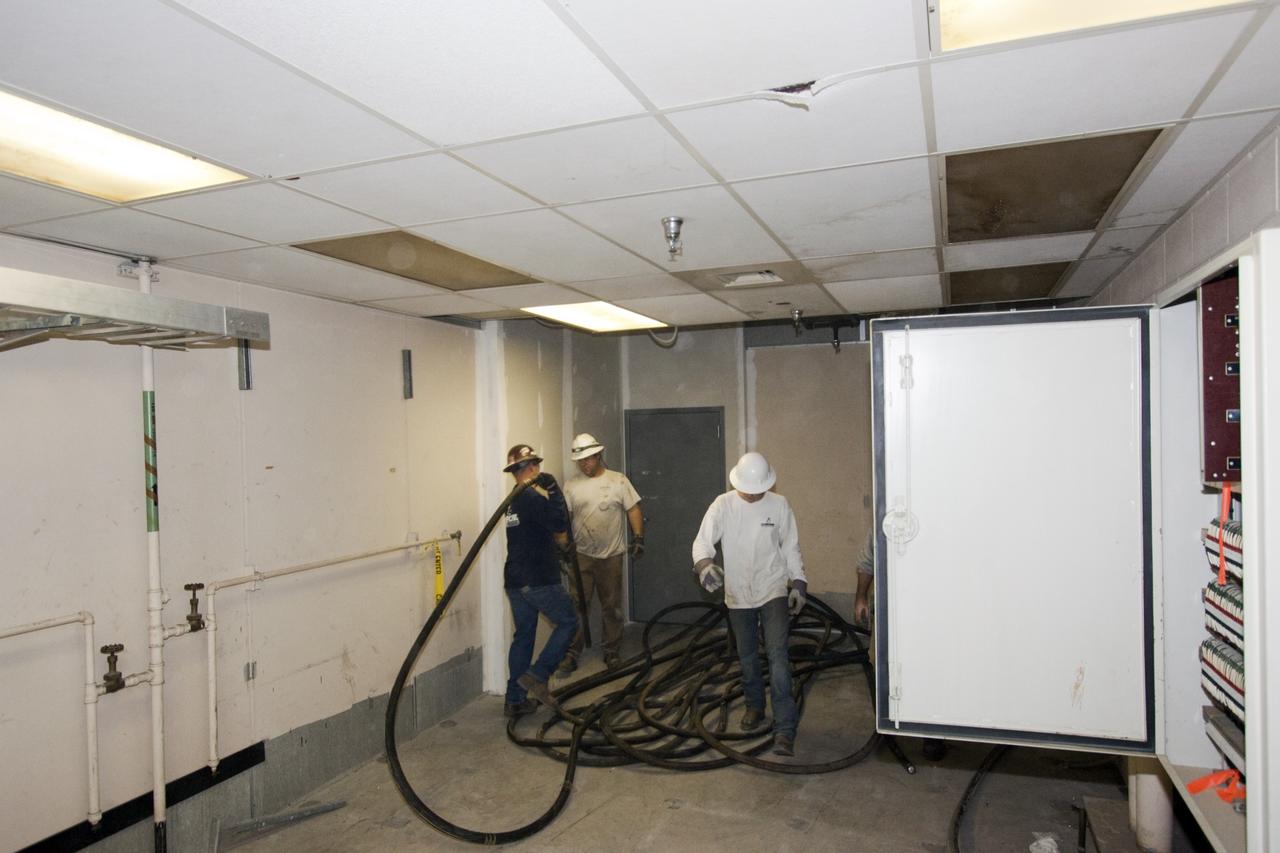
CAPE CANAVERAL, Fla. – At NASA’s Kennedy Space Center in Florida, workers remove cables between the 26th and 29th floors of high bay 3 in the 525-foot-tall Vehicle Assembly Building, or VAB, during part of a centerwide refurbishment initiative under the Ground Systems Development and Operations GSDO Program. The cable replacement project is under way in high bays 1 and 3 on the east side of the building, facing Launch Complex 39’s pads A and B. Approximately 150 miles of existing Apollo/shuttle era cabling is being removed to make room for installation of state-of-the-art command, communication and control systems that will be needed by future users to perform vehicle testing and verification prior to rollout to the launch pad. For more information, visit http://go.nasa.gov/groundsystems. Photo credit: NASA/Jim Grossmann
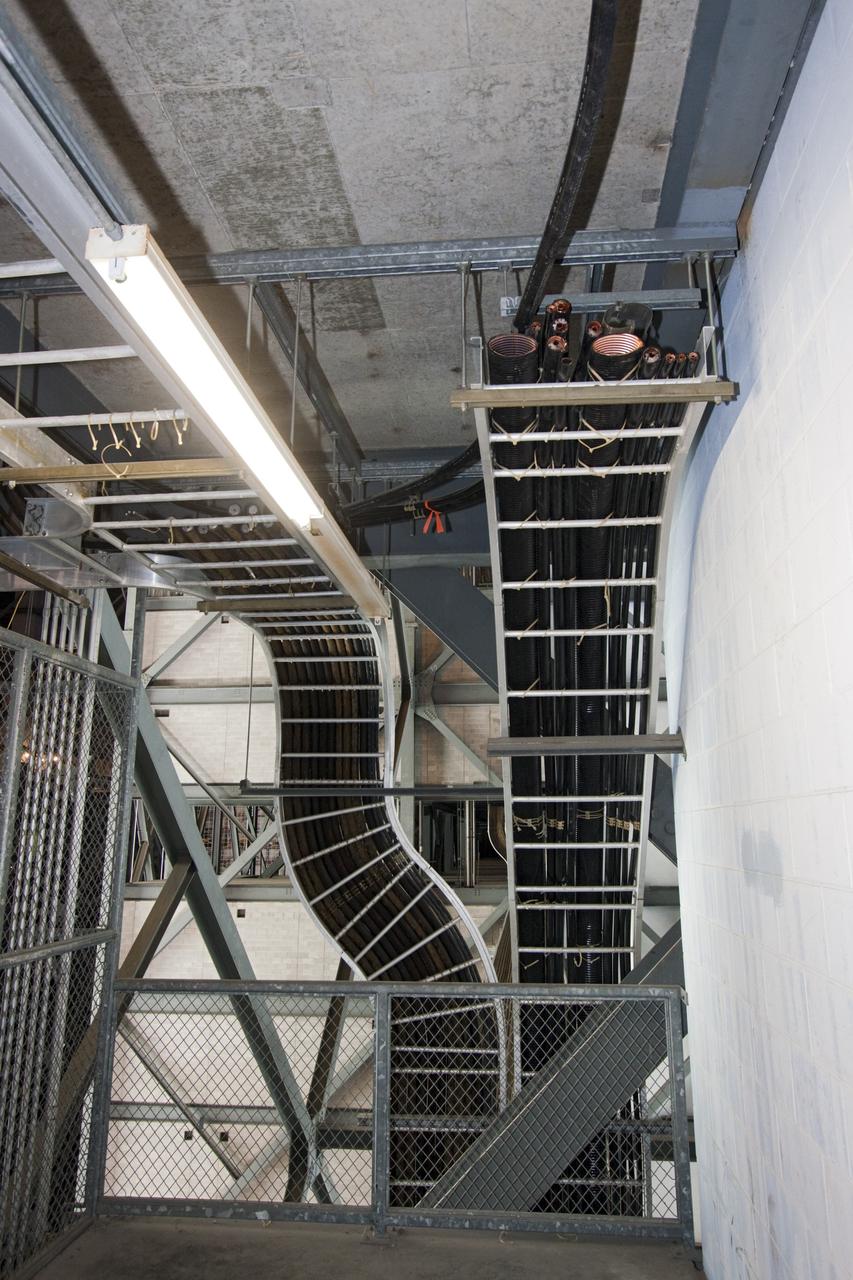
CAPE CANAVERAL, Fla. – At NASA’s Kennedy Space Center in Florida, cable is being pulled from the cable trays lining the walls of high bay 3 in the Vehicle Assembly Building, or VAB, as part of a centerwide refurbishment initiative under the Ground Systems Development and Operations GSDO Program. The cable replacement project is under way in high bays 1 and 3 on the east side of the building, facing Launch Complex 39’s pads A and B. Approximately 150 miles of existing Apollo/shuttle era cabling is being removed to make room for installation of state-of-the-art command, communication and control systems that will be needed by future users to perform vehicle testing and verification prior to rollout to the launch pad. For more information, visit http://go.nasa.gov/groundsystems. Photo credit: NASA/Jim Grossmann
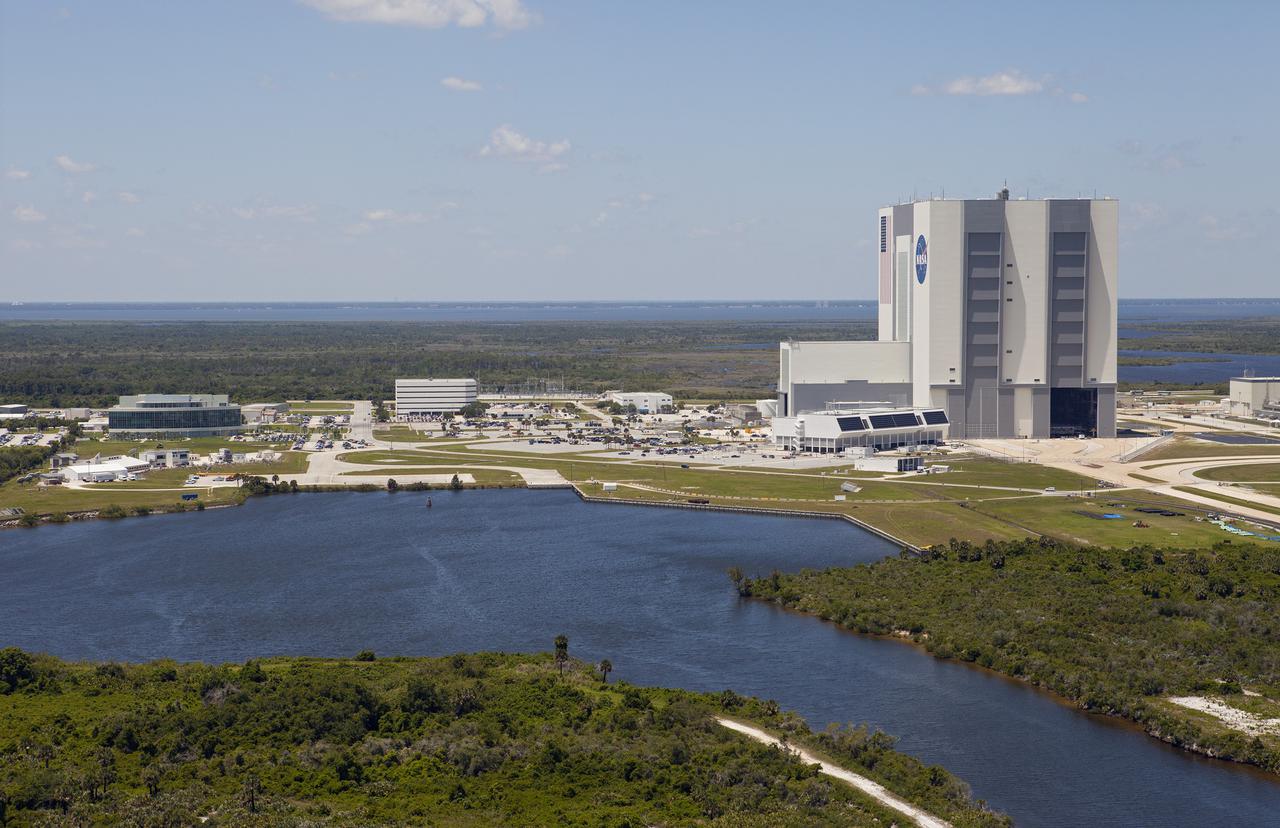
CAPE CANAVERAL, Fla. – An up close aerial view of the Vehicle Assembly Building and other facilities in the Launch Complex 39 area at NASA’s Kennedy Space Center in Florida. In front of the VAB is the Launch Control Center. To the left are the Operations Support Buildings I and II. Upgrades are underway at Pad B and other facilities in the Launch Complex 39 area. The Ground Systems Development and Operations, or GSDO, Program office at Kennedy is leading the center’s transformation from a historically government-only launch complex to a spaceport that can safely handle a variety of rockets and spacecraft, including NASA’s Space Launch System. For more information about GSDO, visit: http:__go.nasa.gov_groundsystems. Photo credit: NASA_Kim Shiflett
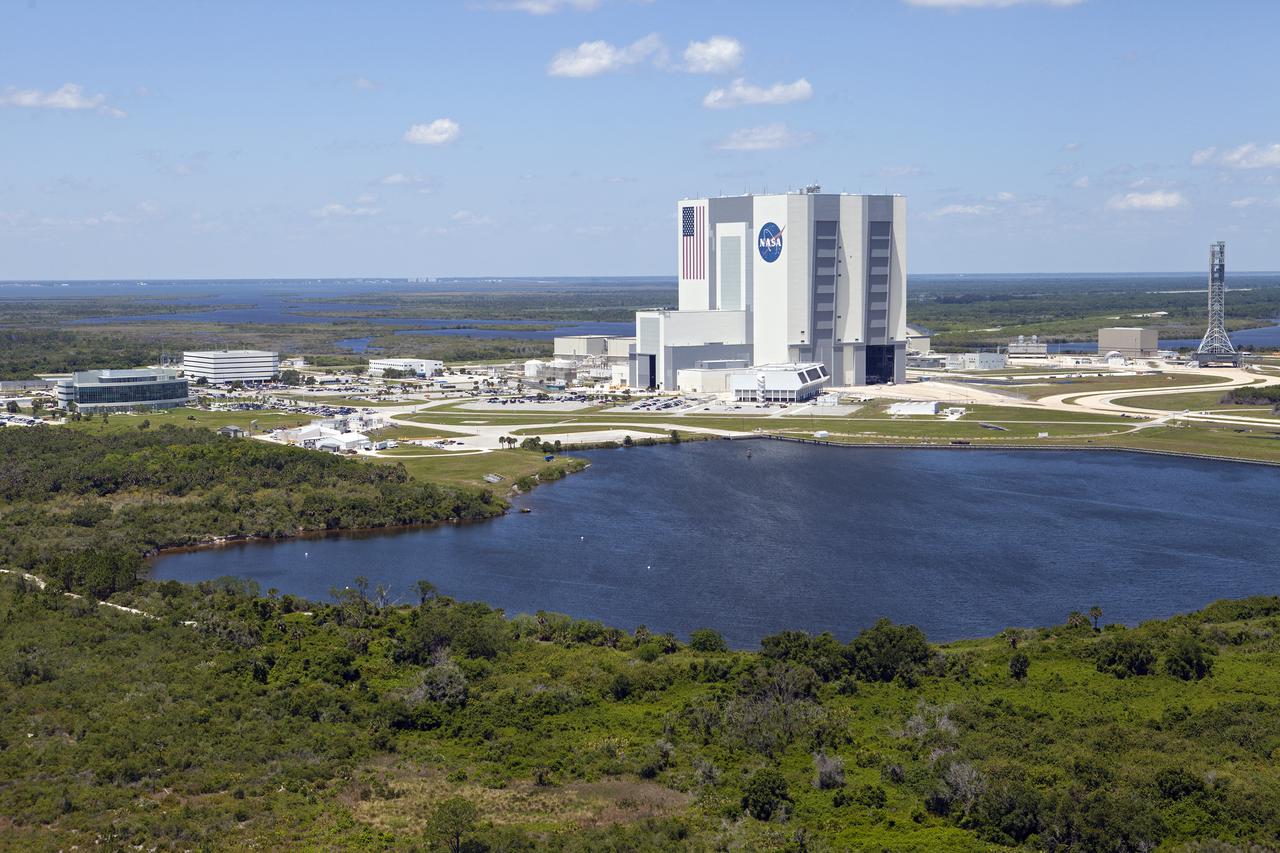
CAPE CANAVERAL, Fla. – An aerial view of the Vehicle Assembly Building, or VAB, and other buildings in the Launch Complex 39 area at NASA’s Kennedy Space Center in Florida. The Launch Control Center is in front of the VAB. To the right is the mobile launcher that will be used to transport NASA’s Space Launch System rocket and the Orion crew capsule to Launch Pad 39B. Upgrades are underway at Pad B and other facilities in the Launch Complex 39 area. The Ground Systems Development and Operations, or GSDO, Program office at Kennedy is leading the center’s transformation from a historically government-only launch complex to a spaceport that can safely handle a variety of rockets and spacecraft, including NASA’s Space Launch System. For more information about GSDO, visit: http:__go.nasa.gov_groundsystems. Photo credit: NASA_Kim Shiflett
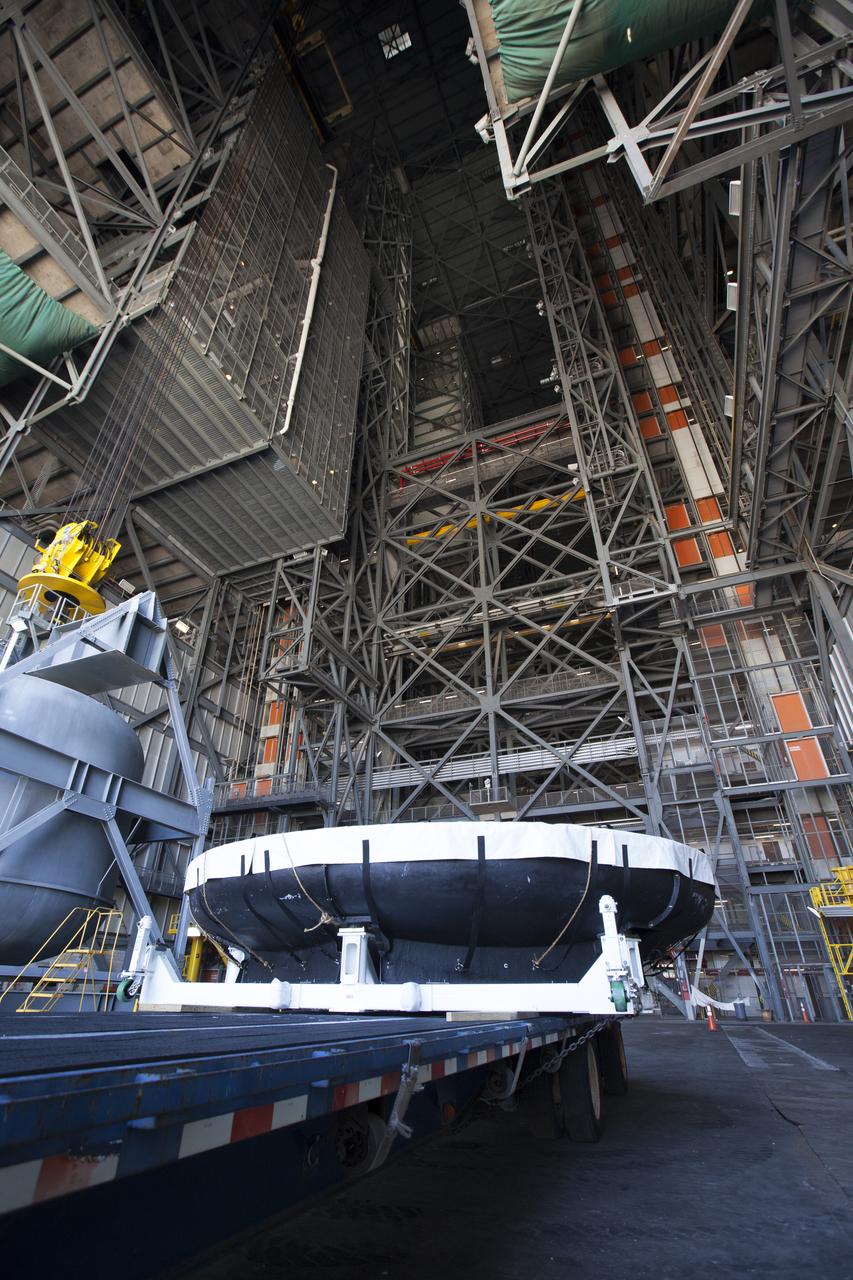
A flatbed truck carrying the Orion heat shield from Exploration Flight Test-1, backs into High Bay 2 in the Vehicle Assembly Building (VAB) at NASA's Kennedy Space Center in Florida. The heat shield was moved from the Launch Abort System Facility. The heat shield is being transferred from the Orion Program to the Ground Systems Development and Operations Program, Landing and Recovery Operations. In the VAB, the heat shield will be integrated with the Orion ground test article and used for future underway recovery testing.
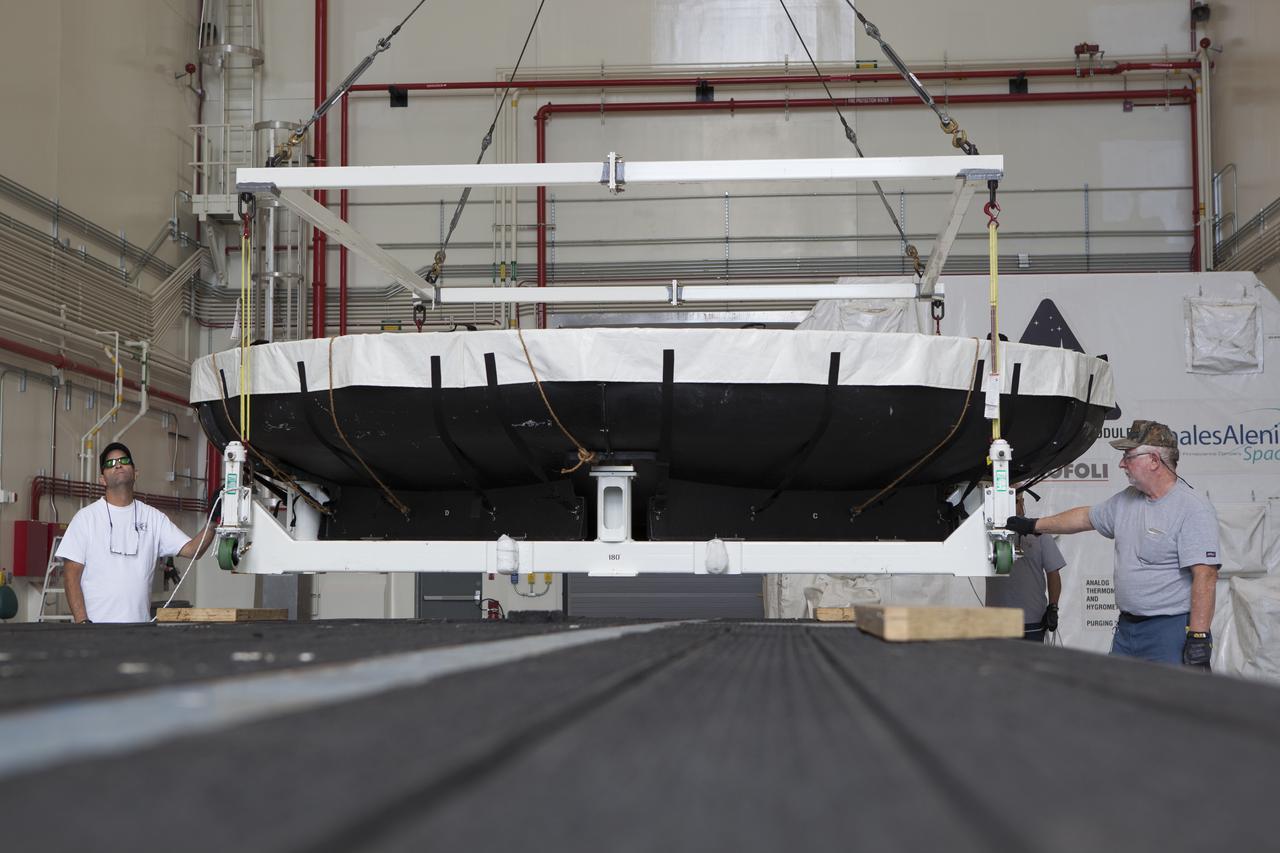
Inside the Launch Abort System Facility at NASA's Kennedy Space Center in Florida, the Orion heat shield from Exploration Flight Test-1 is being loaded onto a transporter for its move to the Vehicle Assembly Building (VAB). The heat shield is being transferred from the Orion Program to the Ground Systems Development and Operations Program, Landing and Recovery Operations. In the VAB, the heat shield will be integrated with the Orion ground test article and used for future underway recovery testing.
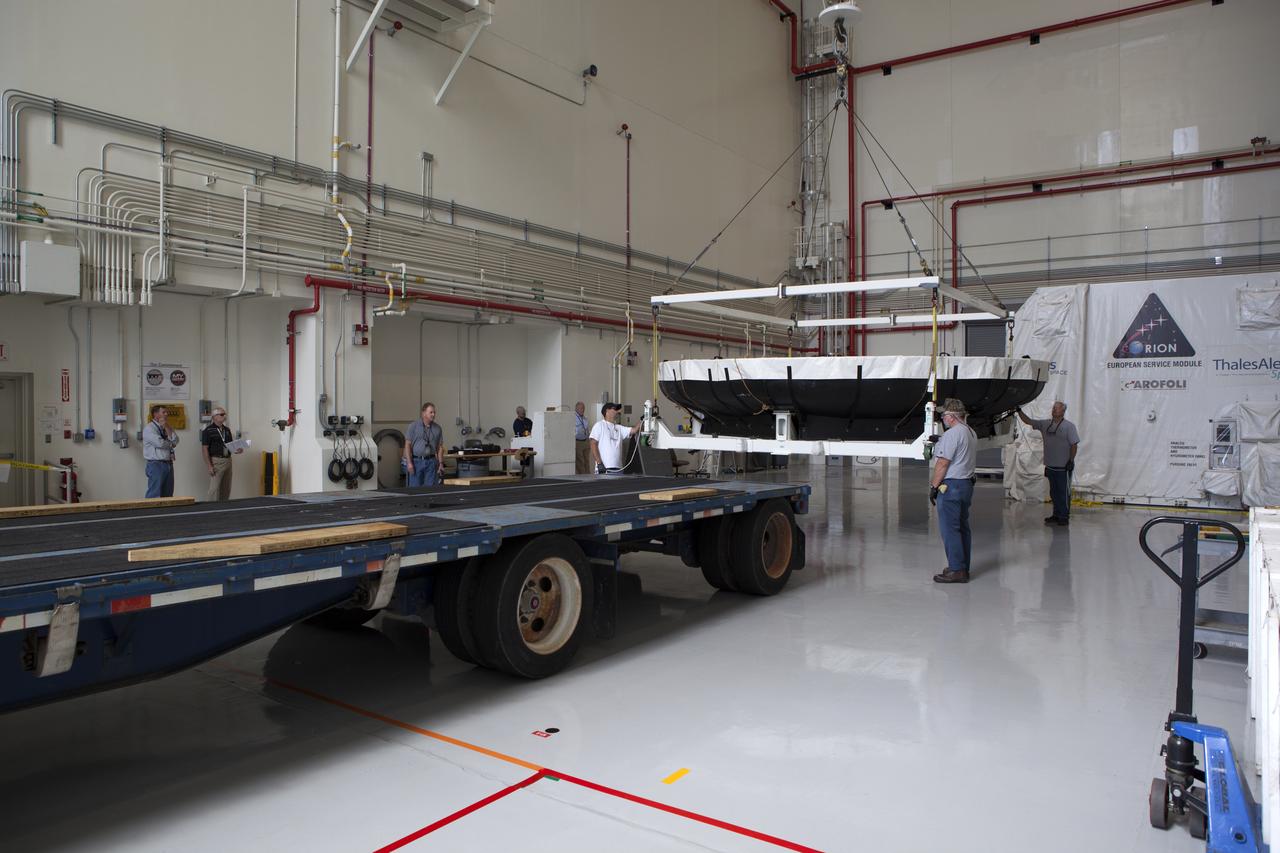
Inside the Launch Abort System Facility at NASA's Kennedy Space Center in Florida, the Orion heat shield from Exploration Flight Test-1 is being loaded onto a transporter for its move to the Vehicle Assembly Building (VAB). The heat shield is being transferred from the Orion Program to the Ground Systems Development and Operations Program, Landing and Recovery Operations. In the VAB, the heat shield will be integrated with the Orion ground test article and used for future underway recovery testing.
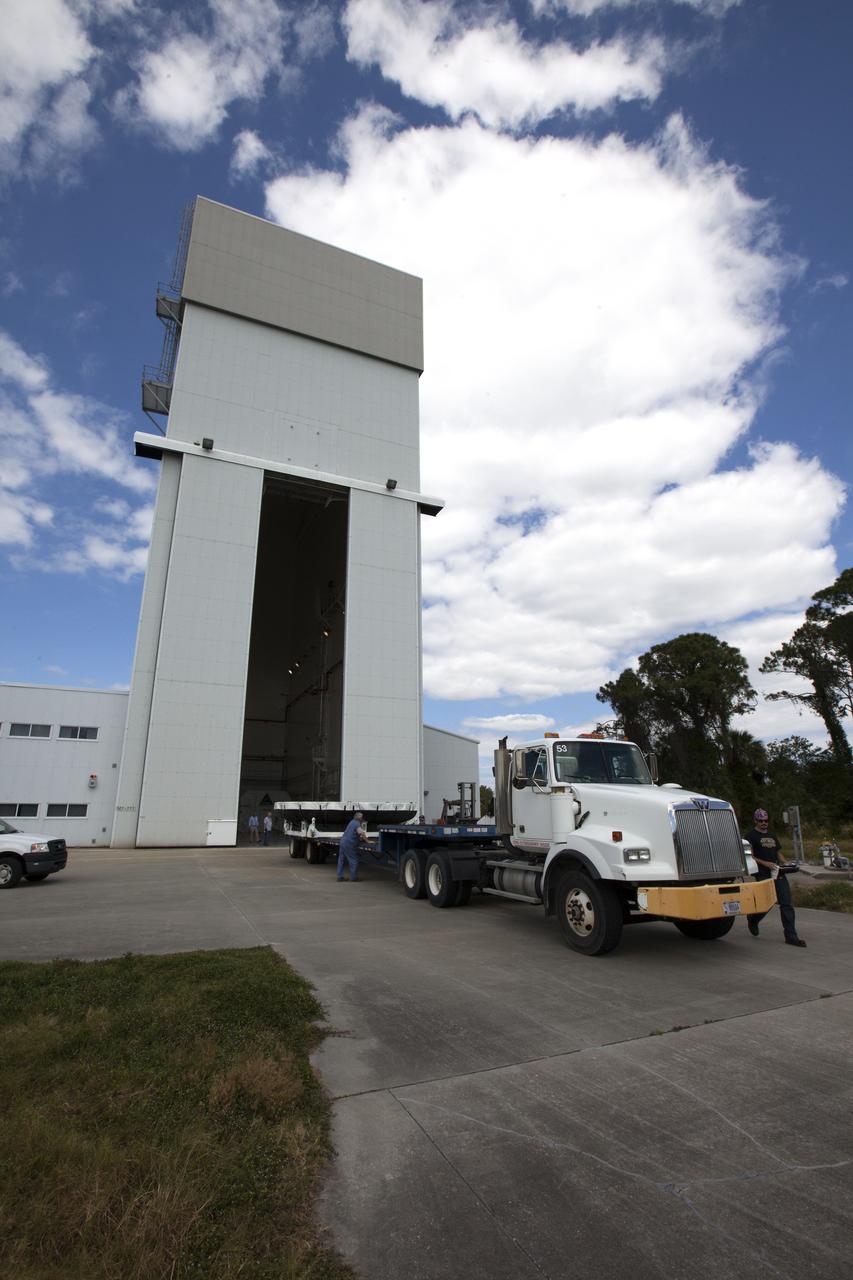
The Orion heat shield from Exploration Flight Test-1, secured on a transporter, departs the Launch Abort System Facility at NASA's Kennedy Space Center in Florida, for its move to the Vehicle Assembly Building (VAB). The heat shield is being transferred from the Orion Program to the Ground Systems Development and Operations Program, Landing and Recovery Operations. In the VAB, the heat shield will be integrated with the Orion ground test article and used for future underway recovery testing.
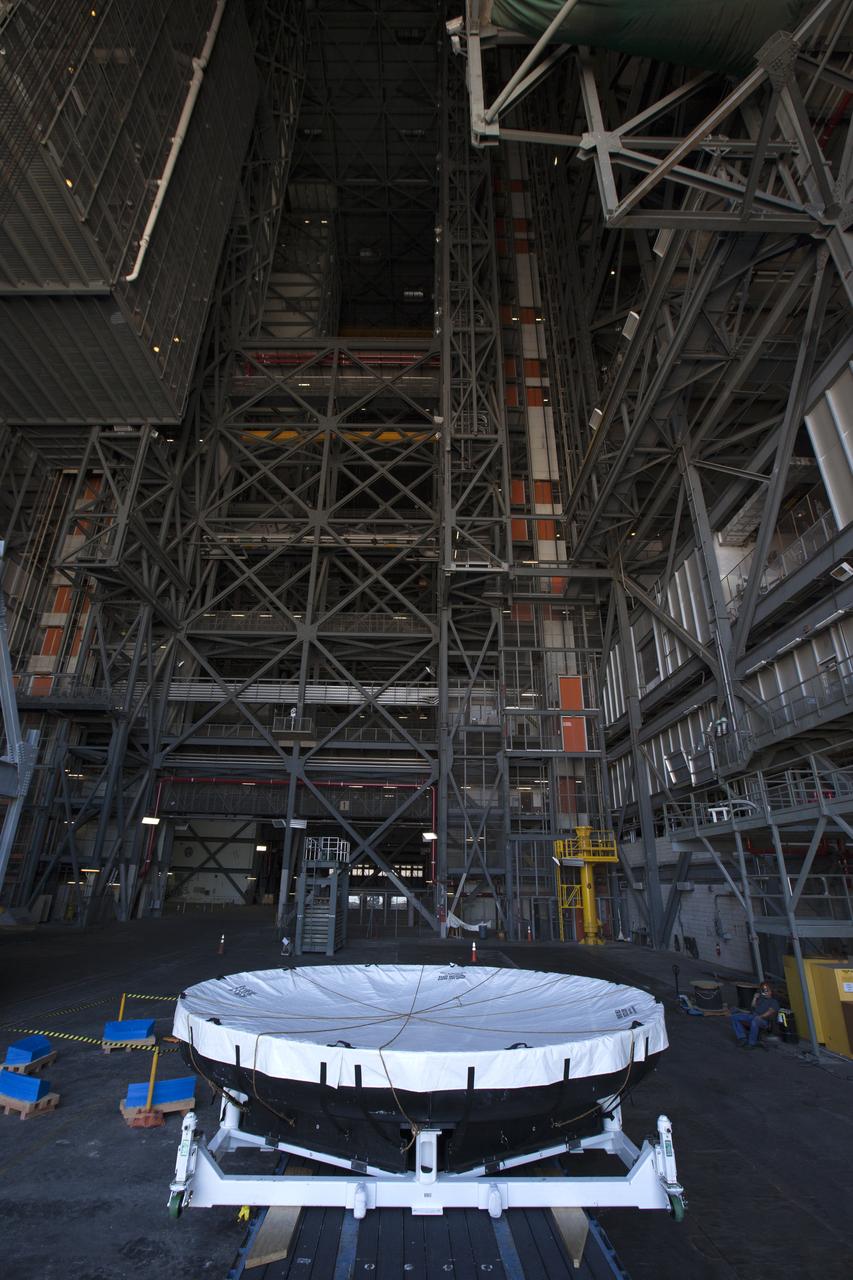
The Orion heat shield from Exploration Flight Test-1 has arrived in High Bay 2 in the Vehicle Assembly Building (VAB) at NASA's Kennedy Space Center in Florida. The heat shield was moved from the Launch Abort System Facility. The heat shield is being transferred from the Orion Program to the Ground Systems Development and Operations Program, Landing and Recovery Operations. In the VAB, the heat shield will be integrated with the Orion ground test article and used for future underway recovery testing.
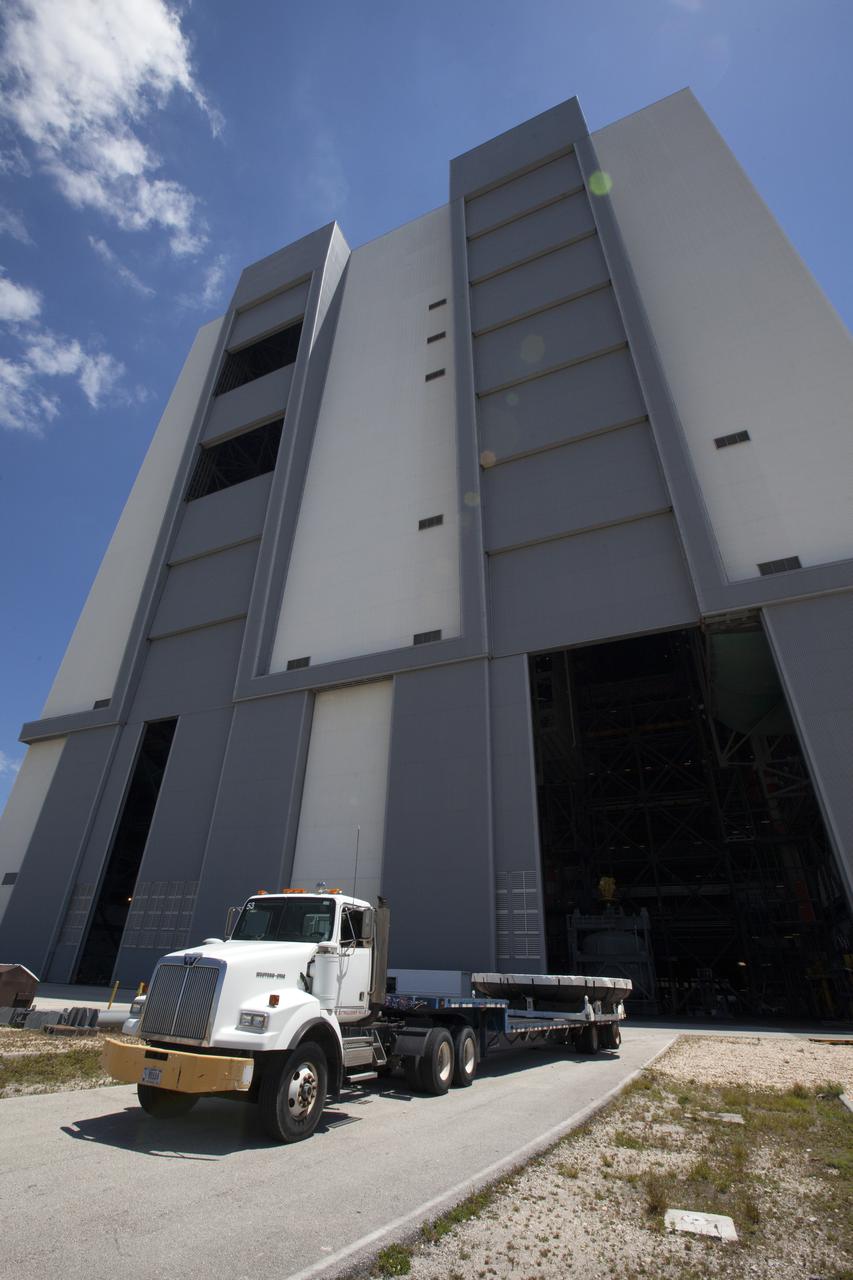
A flatbed truck carrying the Orion heat shield from Exploration Flight Test-1, prepares to back into High Bay 2 in the Vehicle Assembly Building (VAB) at NASA's Kennedy Space Center in Florida. The heat shield was moved from the Launch Abort System Facility. The heat shield is being transferred from the Orion Program to the Ground Systems Development and Operations Program, Landing and Recovery Operations. In the VAB, the heat shield will be integrated with the Orion ground test article and used for future underway recovery testing.
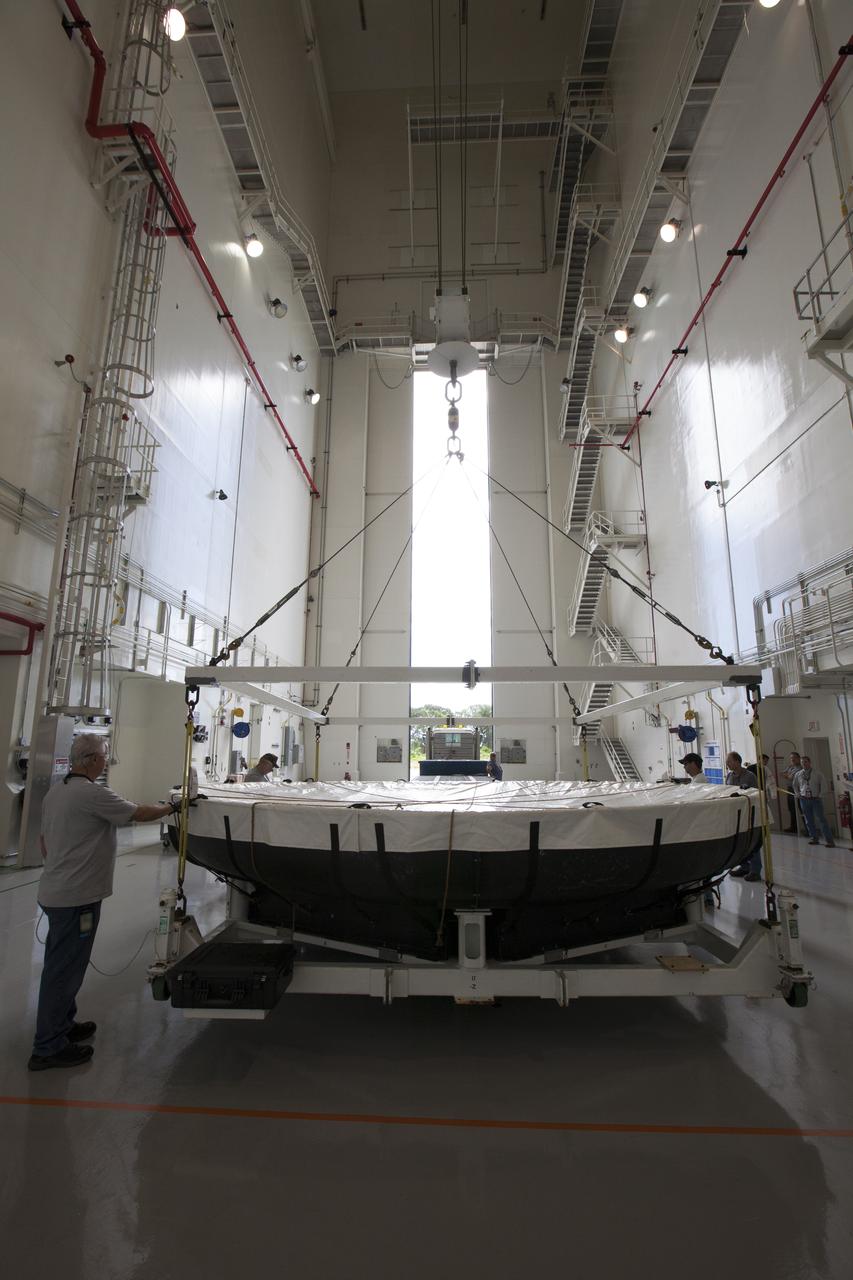
Inside the Launch Abort System Facility at NASA's Kennedy Space Center in Florida, the Orion heat shield from Exploration Flight Test-1 is secured on a transporter and ready for its move to the Vehicle Assembly Building (VAB). The heat shield is being transferred from the Orion Program to the Ground Systems Development and Operations Program, Landing and Recovery Operations. In the VAB, the heat shield will be integrated with the Orion ground test article and used for future underway recovery testing.
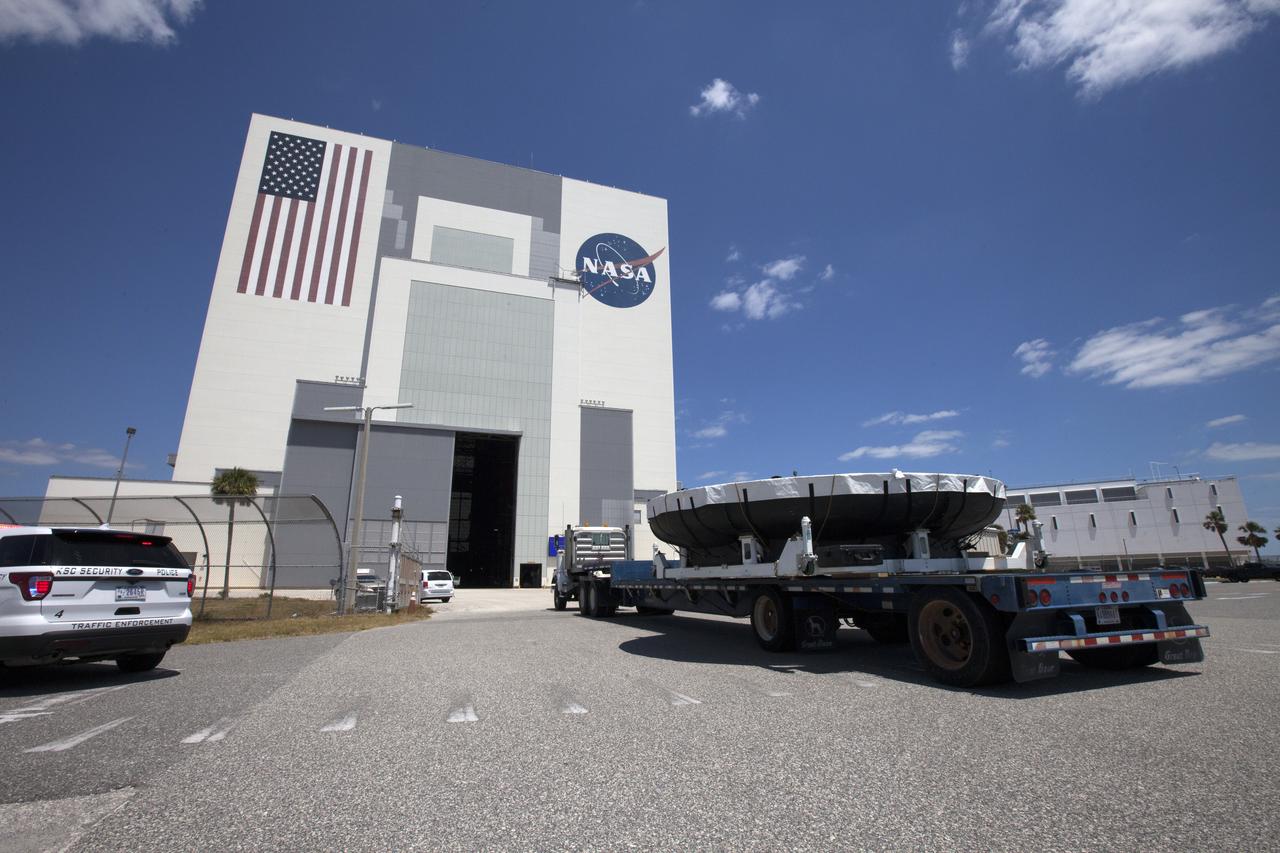
The Orion heat shield from Exploration Flight Test-1, secured on a transporter, arrives at the Vehicle Assembly Building (VAB) at NASA's Kennedy Space Center in Florida. The heat shield was moved from the Launch Abort System Facility. The heat shield is being transferred from the Orion Program to the Ground Systems Development and Operations Program, Landing and Recovery Operations. In the VAB, the heat shield will be integrated with the Orion ground test article and used for future underway recovery testing.
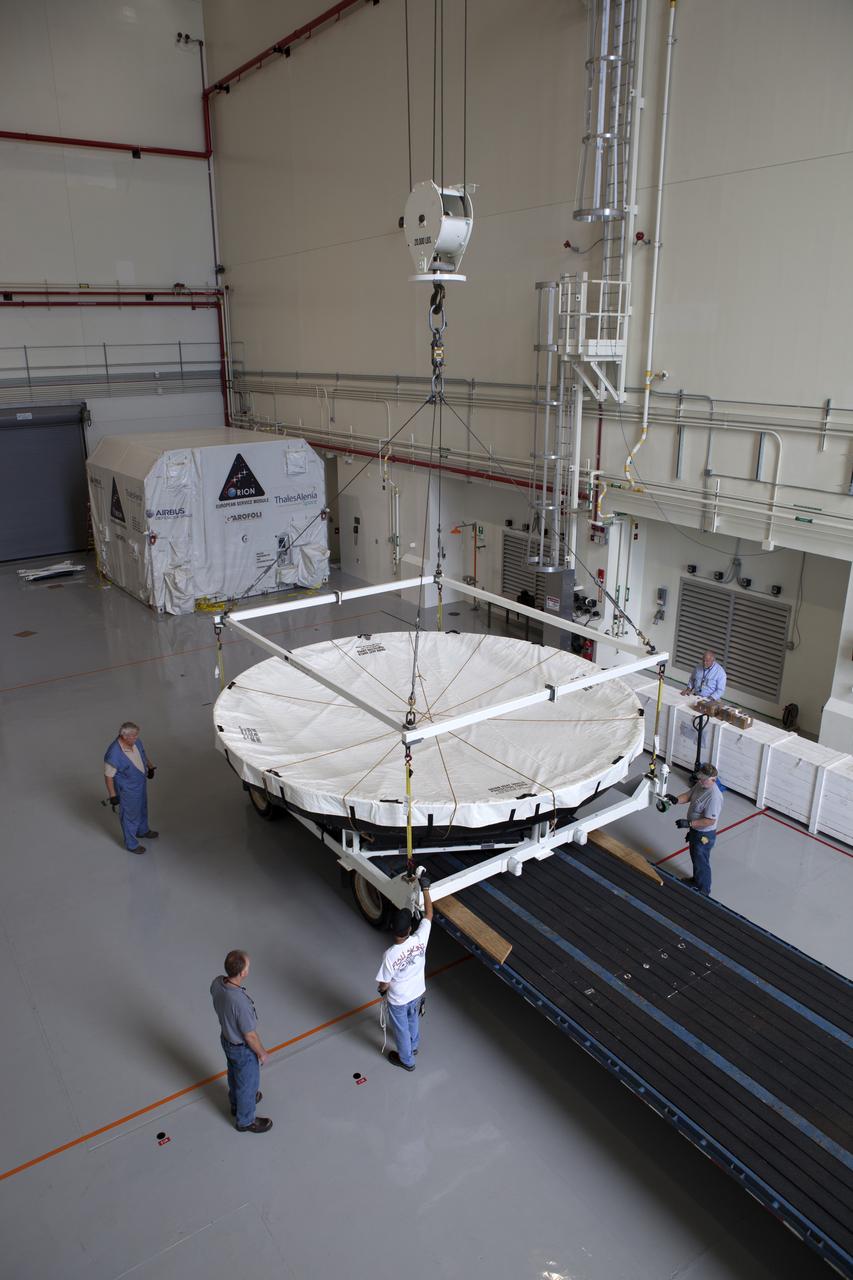
Inside the Launch Abort System Facility at NASA's Kennedy Space Center in Florida, a crane lowers the Orion heat shield from Exploration Flight Test-1 onto a transporter for its move to the Vehicle Assembly Building (VAB). The heat shield is being transferred from the Orion Program to the Ground Systems Development and Operations Program, Landing and Recovery Operations. In the VAB, the heat shield will be integrated with the Orion ground test article and used for future underway recovery testing.
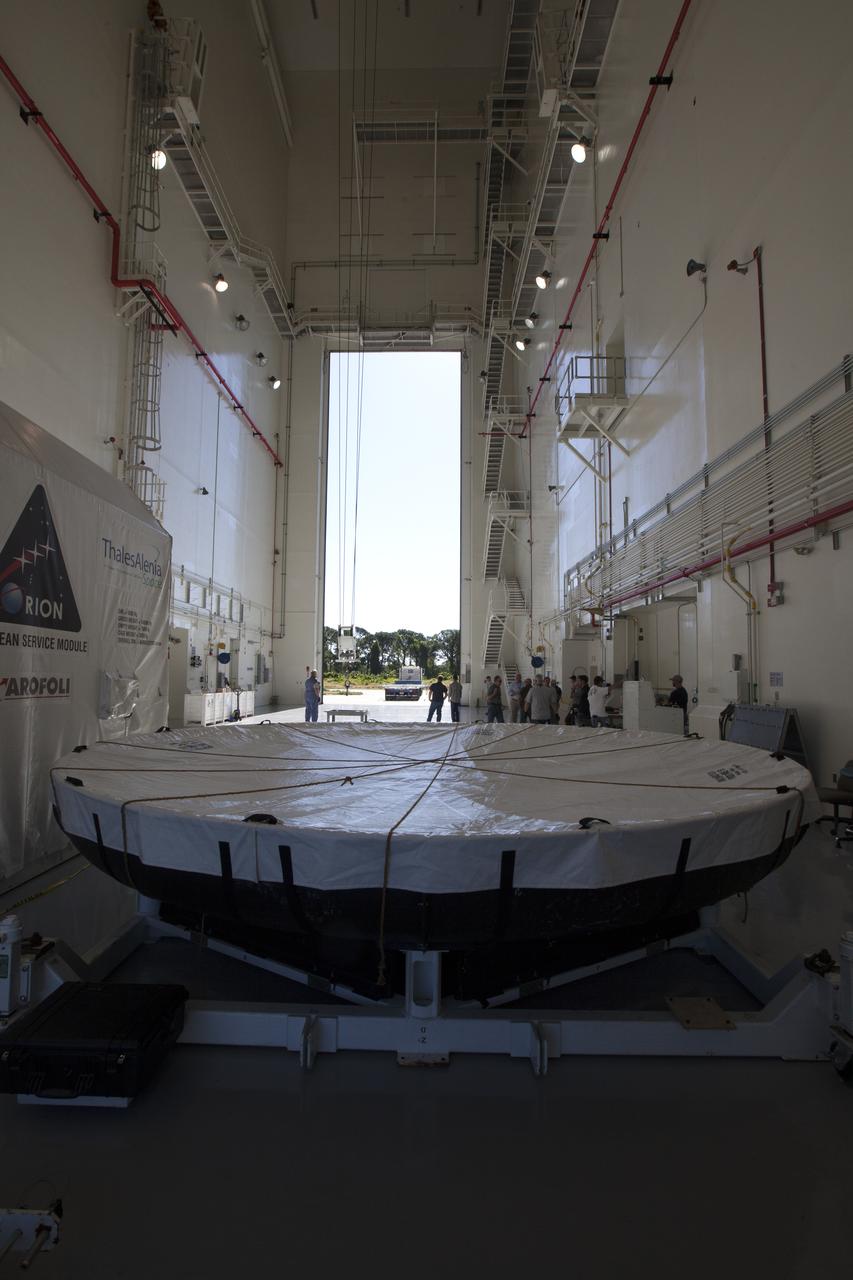
Inside the Launch Abort System Facility at NASA's Kennedy Space Center in Florida, the Orion heat shield from Exploration Flight Test-1 is being prepared for its move to the Vehicle Assembly Building (VAB). The heat shield is being transferred from the Orion Program to the Ground Systems Development and Operations Program, Landing and Recovery Operations. In the VAB, the heat shield will be integrated with the Orion ground test article and used for future underway recovery testing.
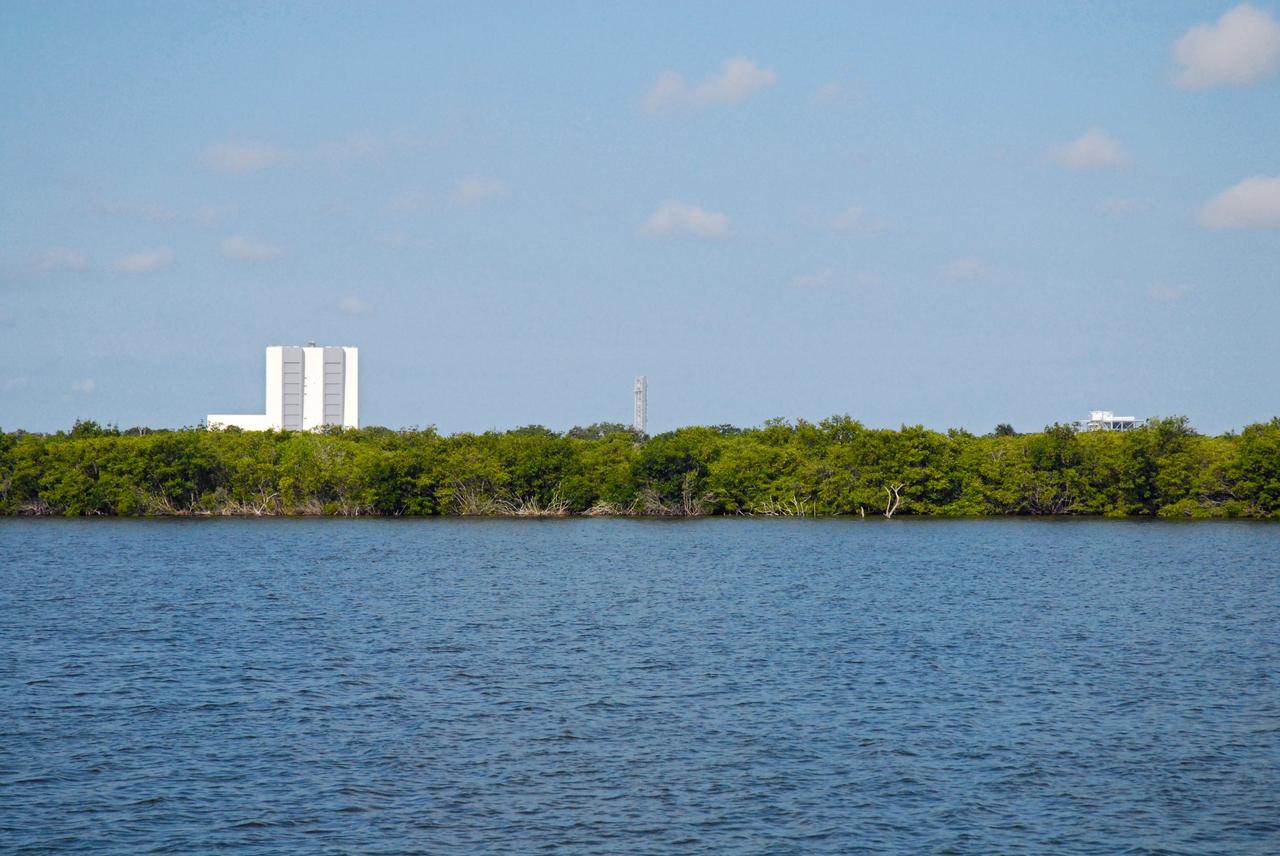
CAPE CANAVERAL, Fla. – The Vehicle Assembly Building, or VAB, and NASA's new mobile launcher, or ML, are seen in the distance during a field-guided boat tour of NASA's Kennedy Space Center in Florida. As part of the center's first-ever Innovation Expo, the tour, called "Living Outdoor Laboratory for Environmental Sustainability," is giving employees the opportunity to see the unique estuarine ecosystems that are protected from development by the presence of Kennedy and the Merritt Island National Wildlife Refuge. The 355-foot-tall ML structure, which took about two years to construct, will be modified by NASA’s Ground Systems Development and Operations, or GSDO, Program to support NASA’s Space Launch System, the heavy-lift rocket that will launch astronauts into deep space on future exploration missions. The diverse and healthy area encompassing about 140,000 acres of central Florida's east coast has been closed to the public for 50 years, allowing the coastal dunes, saltwater estuaries and marshes, freshwater impoundments, scrub, pine flatwoods, and hardwood hammocks to provide habitats for more than 1,000 species of plants and animals. Innovation Expo is showcasing the innovative work taking place throughout the center's facilities and labs to encourage employees to work together to solve future challenges. For more information, visit http://www.nasa.gov/kennedy. Photo credit: NASA
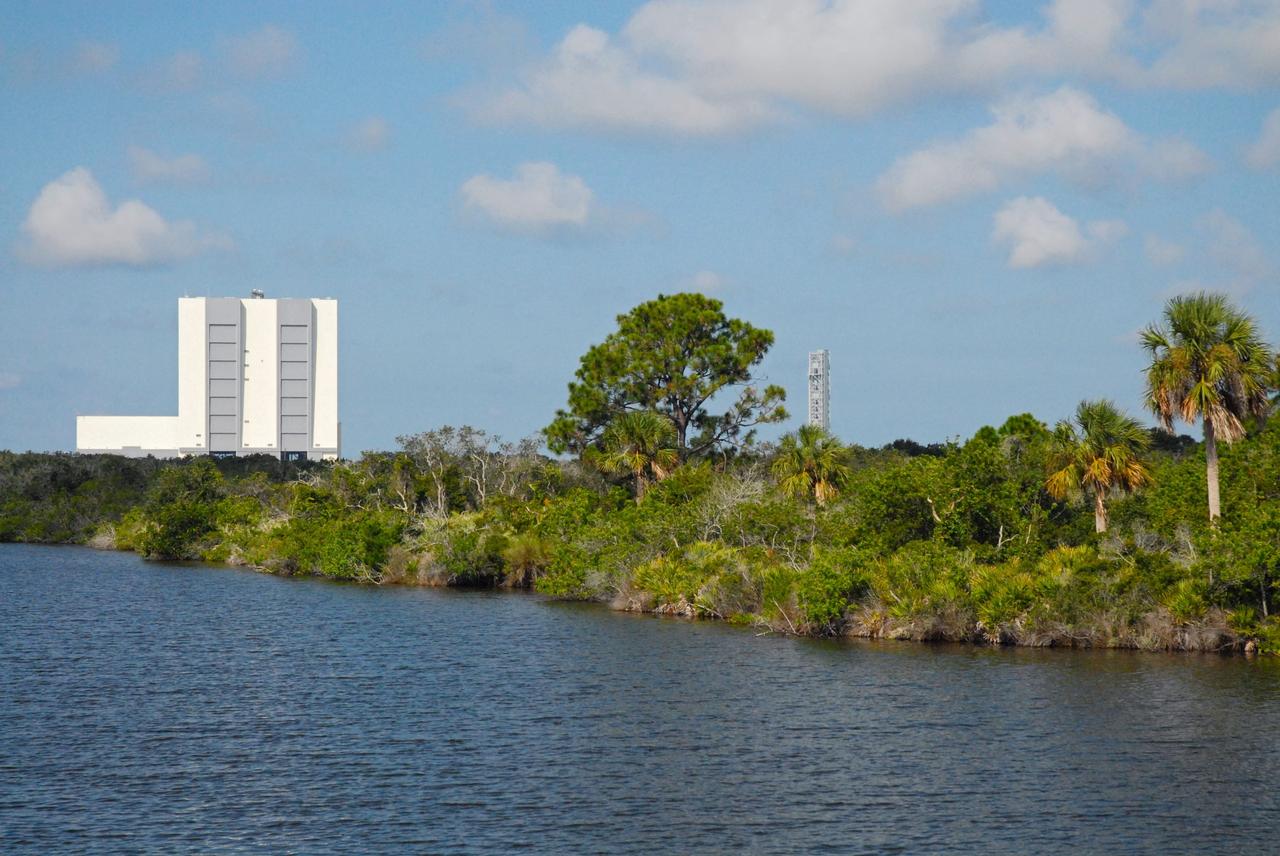
CAPE CANAVERAL, Fla. – The Vehicle Assembly Building, or VAB, and NASA's new mobile launcher, or ML, are seen in the distance during a field-guided boat tour of NASA's Kennedy Space Center in Florida. As part of the center's first-ever Innovation Expo, the tour, called "Living Outdoor Laboratory for Environmental Sustainability," is giving employees the opportunity to see the unique estuarine ecosystems that are protected from development by the presence of Kennedy and the Merritt Island National Wildlife Refuge. The 355-foot-tall ML structure, which took about two years to construct, will be modified by NASA’s Ground Systems Development and Operations, or GSDO, Program to support NASA’s Space Launch System, the heavy-lift rocket that will launch astronauts into deep space on future exploration missions. The diverse and healthy area encompassing about 140,000 acres of central Florida's east coast has been closed to the public for 50 years, allowing the coastal dunes, saltwater estuaries and marshes, freshwater impoundments, scrub, pine flatwoods, and hardwood hammocks to provide habitats for more than 1,000 species of plants and animals. Innovation Expo is showcasing the innovative work taking place throughout the center's facilities and labs to encourage employees to work together to solve future challenges. For more information, visit http://www.nasa.gov/kennedy. Photo credit: NASA
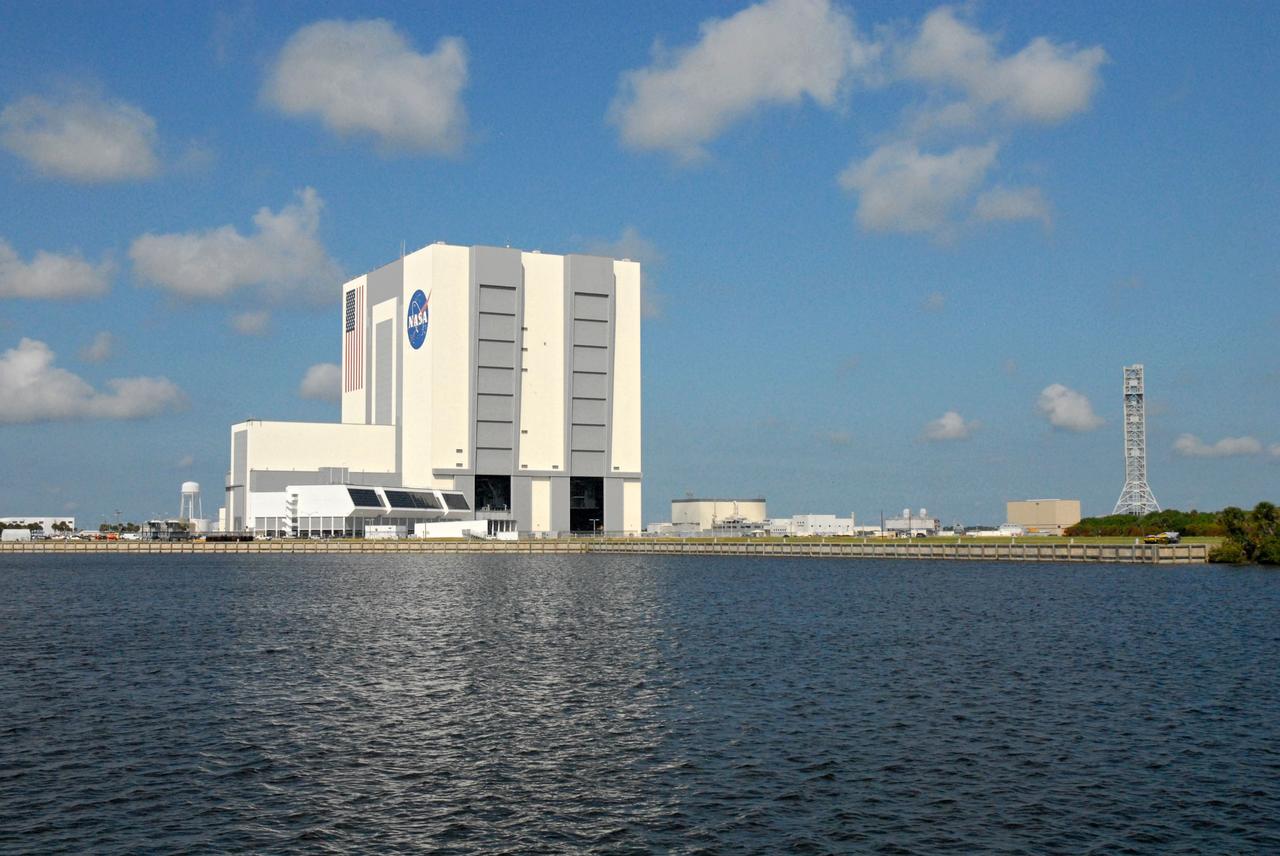
CAPE CANAVERAL, Fla. – The Vehicle Assembly Building, or VAB, and NASA's new mobile launcher, or ML, are seen during a field-guided boat tour of NASA's Kennedy Space Center in Florida. As part of the center's first-ever Innovation Expo, the tour, called "Living Outdoor Laboratory for Environmental Sustainability," is giving employees the opportunity to see the unique estuarine ecosystems that are protected from development by the presence of Kennedy and the Merritt Island National Wildlife Refuge. The 355-foot-tall ML structure, which took about two years to construct, will be modified by NASA’s Ground Systems Development and Operations, or GSDO, Program to support NASA’s Space Launch System, the heavy-lift rocket that will launch astronauts into deep space on future exploration missions. The diverse and healthy area encompassing about 140,000 acres of central Florida's east coast has been closed to the public for 50 years, allowing the coastal dunes, saltwater estuaries and marshes, freshwater impoundments, scrub, pine flatwoods, and hardwood hammocks to provide habitats for more than 1,000 species of plants and animals. Innovation Expo is showcasing the innovative work taking place throughout the center's facilities and labs to encourage employees to work together to solve future challenges. For more information, visit http://www.nasa.gov/kennedy. Photo credit: NASA
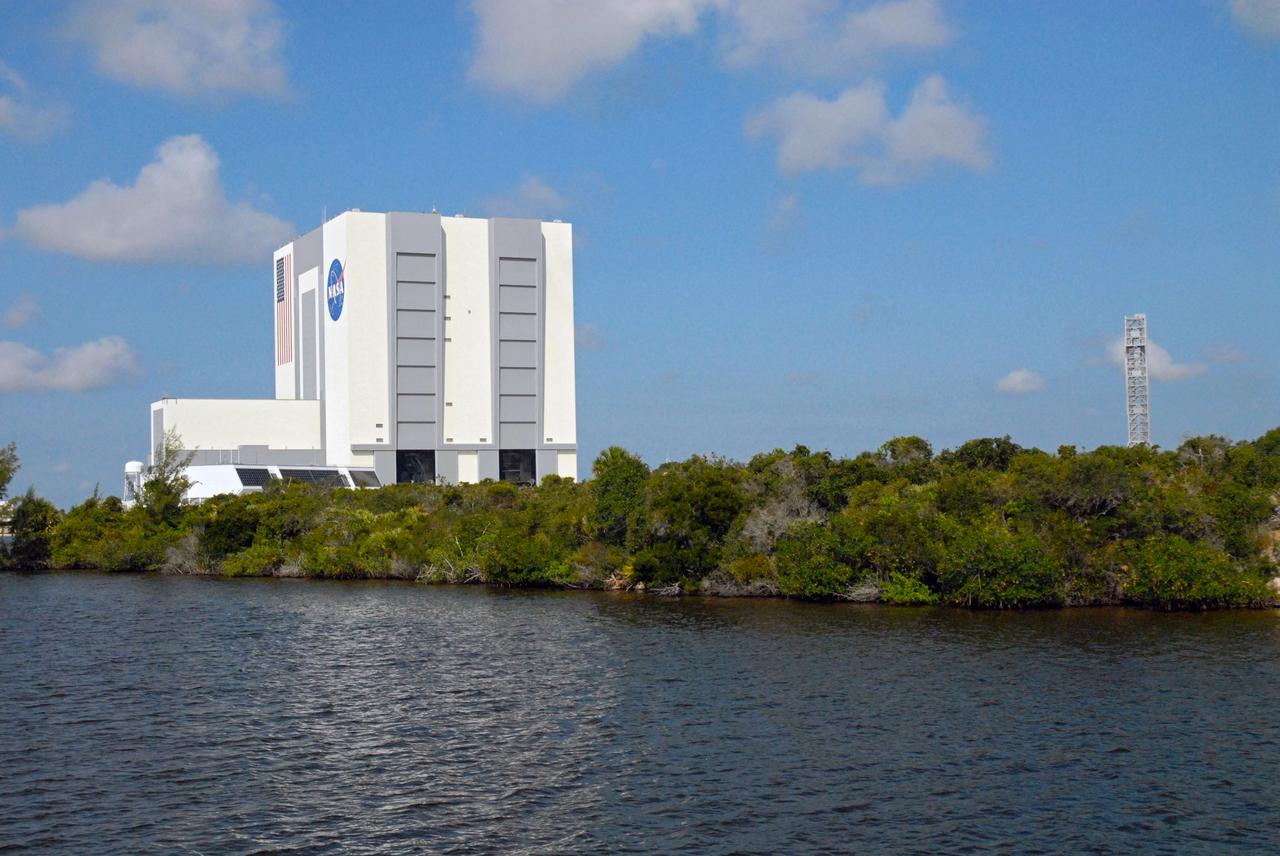
CAPE CANAVERAL, Fla. – The Vehicle Assembly Building, or VAB, and NASA's new mobile launcher, or ML, are seen during a field-guided boat tour of NASA's Kennedy Space Center in Florida. As part of the center's first-ever Innovation Expo, the tour, called "Living Outdoor Laboratory for Environmental Sustainability," is giving employees the opportunity to see the unique estuarine ecosystems that are protected from development by the presence of Kennedy and the Merritt Island National Wildlife Refuge. The 355-foot-tall ML structure, which took about two years to construct, will be modified by NASA’s Ground Systems Development and Operations, or GSDO, Program to support NASA’s Space Launch System, the heavy-lift rocket that will launch astronauts into deep space on future exploration missions. The diverse and healthy area encompassing about 140,000 acres of central Florida's east coast has been closed to the public for 50 years, allowing the coastal dunes, saltwater estuaries and marshes, freshwater impoundments, scrub, pine flatwoods, and hardwood hammocks to provide habitats for more than 1,000 species of plants and animals. Innovation Expo is showcasing the innovative work taking place throughout the center's facilities and labs to encourage employees to work together to solve future challenges. For more information, visit http://www.nasa.gov/kennedy. Photo credit: NASA
CAPE CANAVERAL, Fla. – The Vehicle Assembly Building, or VAB, and NASA's new mobile launcher, or ML, are seen in the distance during a field-guided boat tour of NASA's Kennedy Space Center in Florida. As part of the center's first-ever Innovation Expo, the tour, called "Living Outdoor Laboratory for Environmental Sustainability," is giving employees the opportunity to see the unique estuarine ecosystems that are protected from development by the presence of Kennedy and the Merritt Island National Wildlife Refuge. The 355-foot-tall ML structure, which took about two years to construct, will be modified by NASA’s Ground Systems Development and Operations, or GSDO, Program to support NASA’s Space Launch System, the heavy-lift rocket that will launch astronauts into deep space on future exploration missions. The diverse and healthy area encompassing about 140,000 acres of central Florida's east coast has been closed to the public for 50 years, allowing the coastal dunes, saltwater estuaries and marshes, freshwater impoundments, scrub, pine flatwoods, and hardwood hammocks to provide habitats for more than 1,000 species of plants and animals. Innovation Expo is showcasing the innovative work taking place throughout the center's facilities and labs to encourage employees to work together to solve future challenges. For more information, visit http://www.nasa.gov/kennedy. Photo credit: NASA