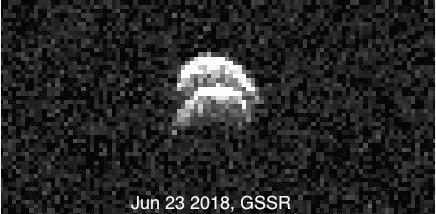
Radar images of the binary asteroid 2017 YE5 from NASA's Goldstone Solar System Radar (GSSR). The observations, conducted on June 23, 2018, show two lobes, but do not yet show two separate objects. A movie is available at https://photojournal.jpl.nasa.gov/catalog/PIA22557
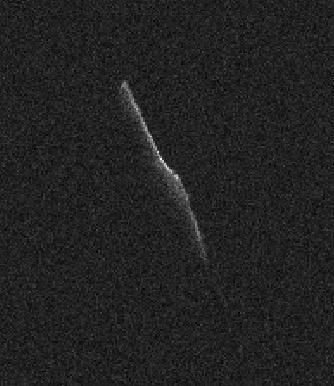
The elongated asteroid in this radar image, named 2003 SD220, will safely fly past Earth on Thursday, Dec. 24, 2015, at a distance of 6.8 million miles (11 million kilometers). The image was taken on Dec. 22 by scientists using NASA's 230-foot (70-meter) Deep Space Network antenna at Goldstone, California, when the asteroid was approaching its flyby distance. This asteroid is at least 3,600 feet (1,100 meters) long. In 2018, it will safely pass Earth at a distance of 1.8 million miles (2.8 million kilometers). http://photojournal.jpl.nasa.gov/catalog/PIA20280
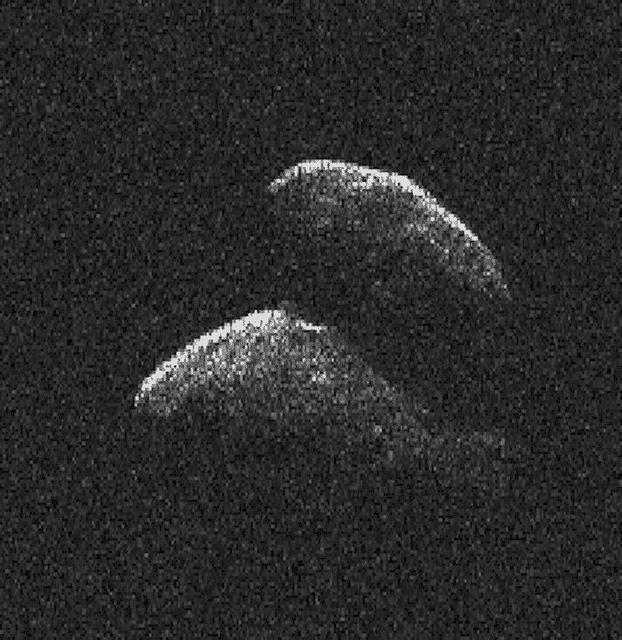
This frame from a movie of asteroid 2014 JO25 was generated using radar data collected by NASA 230-foot-wide 70-meter Deep Space Network antenna at Goldstone, California on April 19, 2017. When the observations began 2014 JO25 was 1.53 million miles (2.47 million kilometers) from Earth. By the time the observations concluded, the asteroid was 1.61 million miles (2.59 million kilometers) away. The asteroid has a contact binary structure -- two lobes connected by a neck-like region. The largest of the asteroid's two lobes is estimated to be 2,000 feet (610 meters) across. Asteroid 2014 JO25 approached to within 1.1 million miles (1.8 million kilometers) of Earth on April 19. There are no future flybys by 2014 JO25 as close as this one for more than 400 years. The resolution of the radar images is about 25 feet (7.5 meters) per pixel. 154 images were used to create a movie. The movie can be seen at. https://photojournal.jpl.nasa.gov/catalog/PIA21597
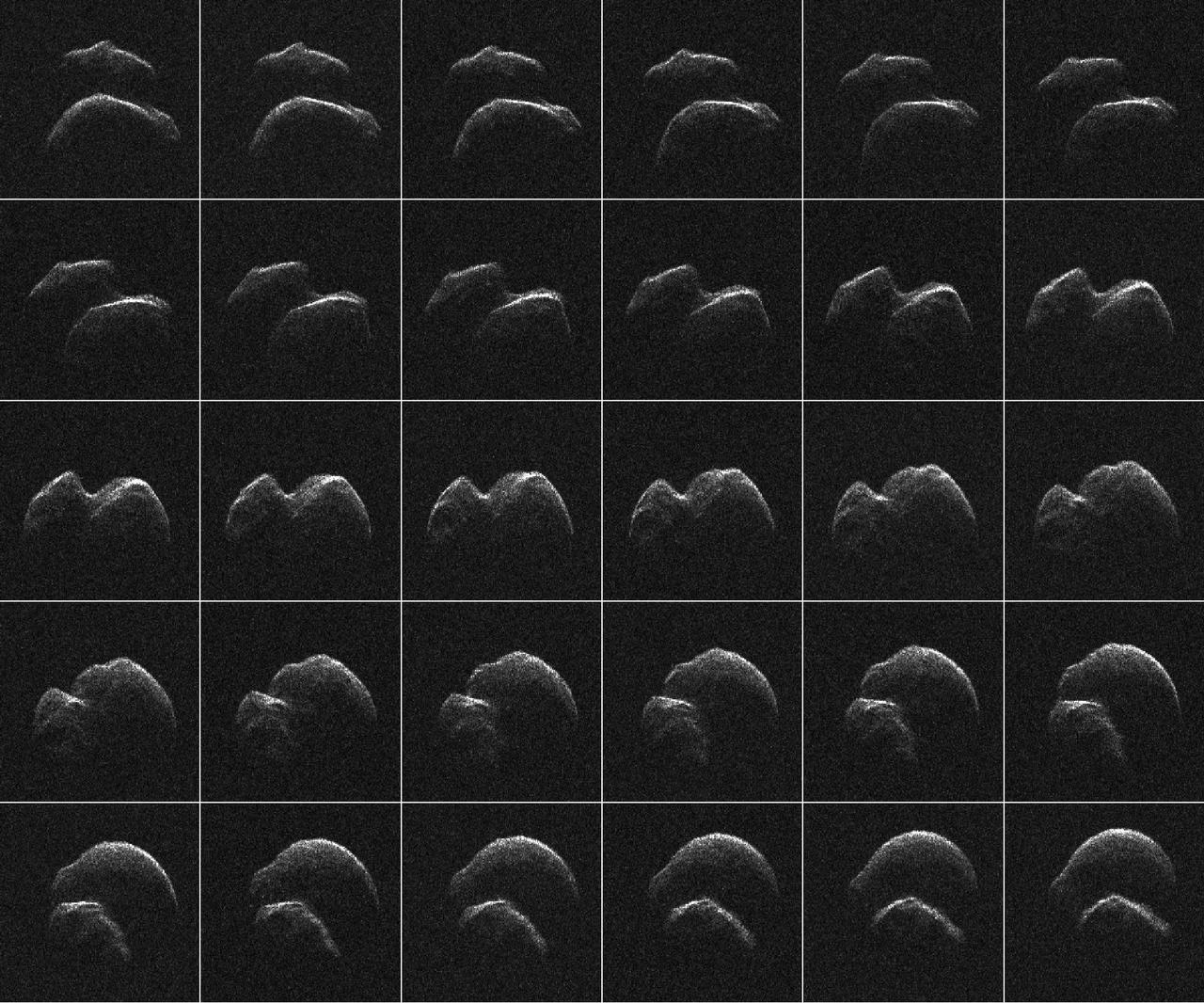
This composite of 30 images of asteroid 2014 JO25 was generated with radar data collected using NASA Goldstone Solar System Radar in California Mojave Desert. https://photojournal.jpl.nasa.gov/catalog/PIA21594
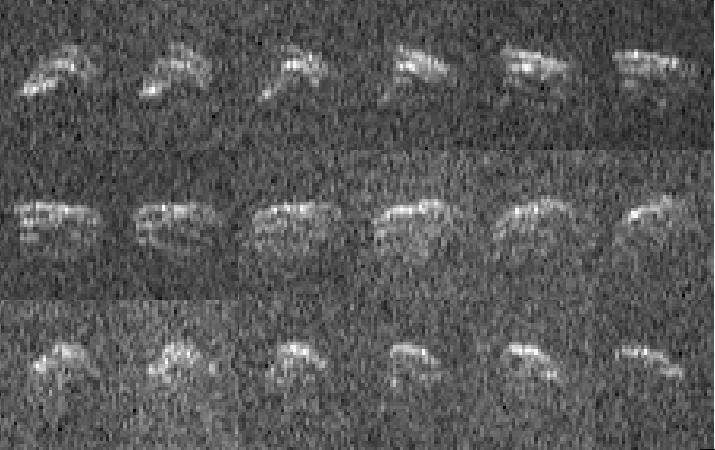
This sequence of radar images of asteroid 2013 ET was obtained on Mar. 10, 2013, by NASA scientists using the 230-foot 70-meter DSN antenna at Goldstone, CA, when the asteroid was about 693,000 mi 1.1 million km from Earth.
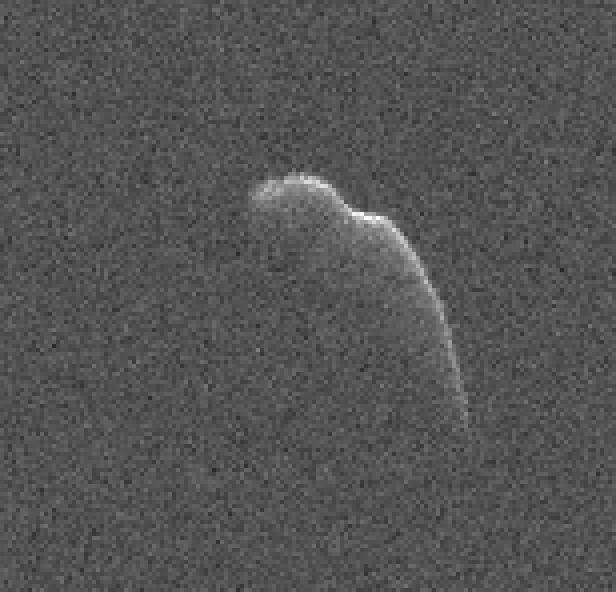
This image of an asteroid that is at least 3,600 feet (1,100 meters) long was taken on Dec. 17, 2015, by scientists using NASA's 230-foot (70-meter) DSS-14 antenna at Goldstone, California. This asteroid, named 2003 SD2020, will safely fly past Earth on Thursday, Dec. 24, at a distance of 6.8 million miles (11 million kilometers). At the time this image was taken, the asteroid was about 7.3 million miles (12 million kilometers) from Earth. In 2018, this asteroid will fly past Earth at a distance of 1.8 million miles (2.8 million kilometers). http://photojournal.jpl.nasa.gov/catalog/PIA20279
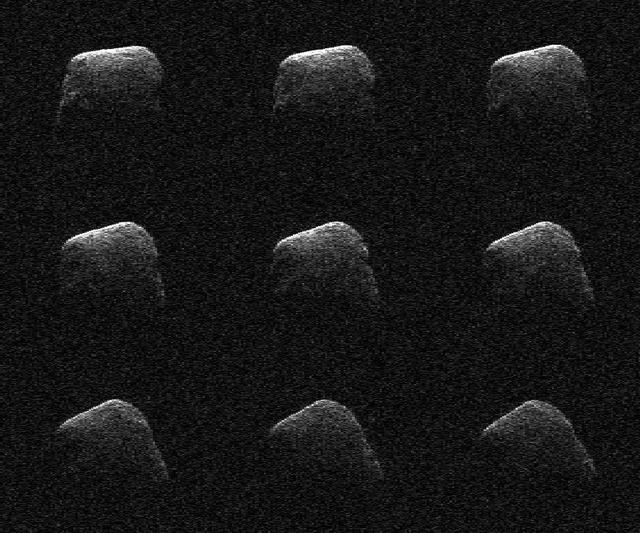
These radar images of comet P/2016 BA14 were taken on March 22, 2016, by scientists using an antenna of NASA Deep Space Network at Goldstone, CA. At the time, the comet was about 2.2 million miles 3.6 million kilometers from Earth.
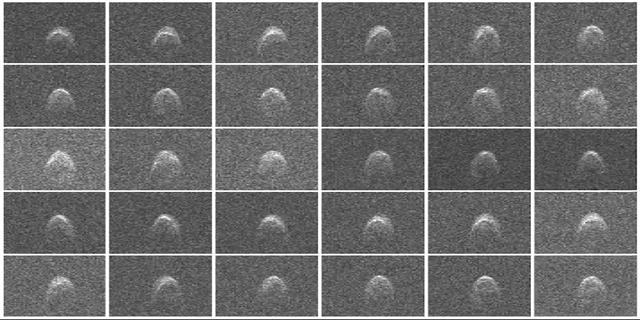
This collage of radar images of near-Earth asteroid 2005 WK4 was collected by NASA scientists using the 230-foot 70-meter Deep Space Network antenna at Goldstone, Calif., on Aug. 8, 2013.
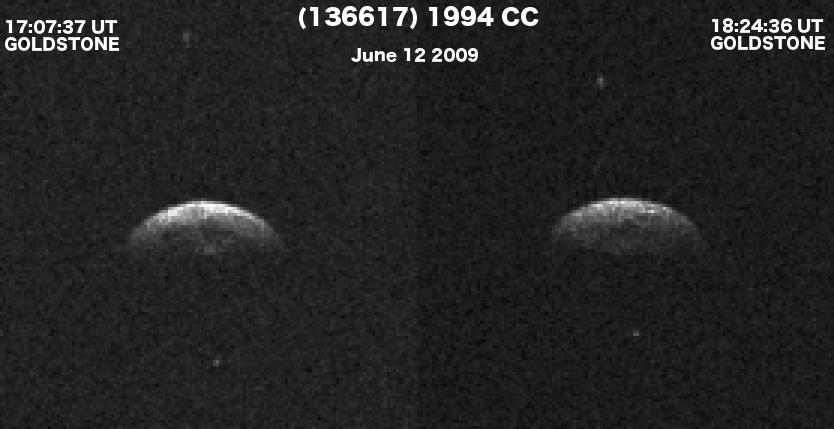
NASA Deep Space Network, Goldstone radar images show triple asteroid 1994 CC, which consists of a central object approximately 700 meters 2,300 feet in diameter and two smaller moons that orbit the central body. Animation available at the Photojournal
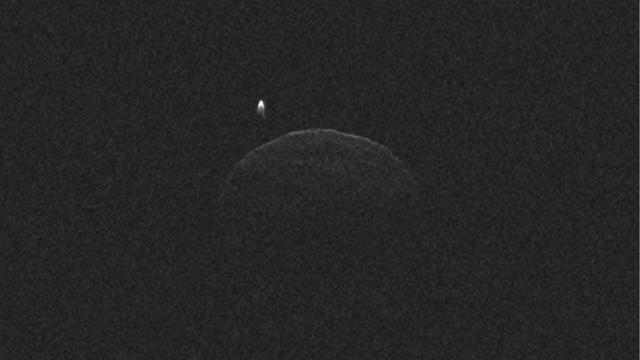
This radar imagery of asteroid 1998 QE2 and its moon was generated from data collected by NASA 230-foot-wide 70-meter Deep Space Network antenna at Goldstone, Calif., on June 1, 2013.
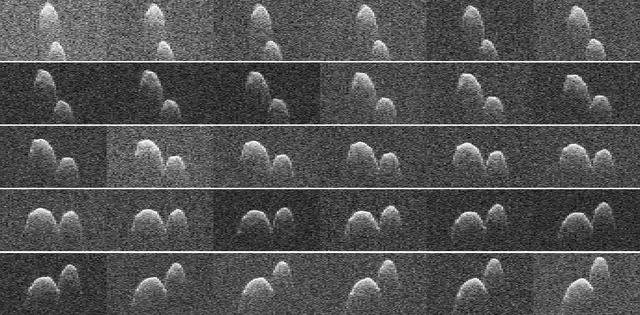
This collage of radar images of near-Earth asteroid 1999 JD6 was collected by NASA scientists on July 25, 2015. The images show the rotation of the asteroid, which made its closest approach on July 24 at 9:55 p.m. PDT (12:55 a.m. EDT on July 25) at a distance of about 4.5 million miles (7.2 million kilometers, or about 19 times the distance from Earth to the moon). The asteroid appears to be a contact binary -- an asteroid with two lobes that are stuck together. These views, which are radar echoes, were obtained by pairing NASA's 230-foot-wide (70-meter) Deep Space Network antenna at Goldstone, California, with the 330-foot (100-meter) National Science Foundation Green Bank Telescope in West Virginia. Using this approach, the Goldstone antenna beams a radar signal at an asteroid and Green Bank receives the reflections. The technique, referred to as a bistatic observation, dramatically improves the amount of detail that can be seen in radar images. The new views obtained with the technique show features as small as about 25 feet (7.5 meters) wide. The images show the asteroid is highly elongated, with a length of approximately 1.2 miles (2 kilometers) on its long axis. http://photojournal.jpl.nasa.gov/catalog/PIA19647
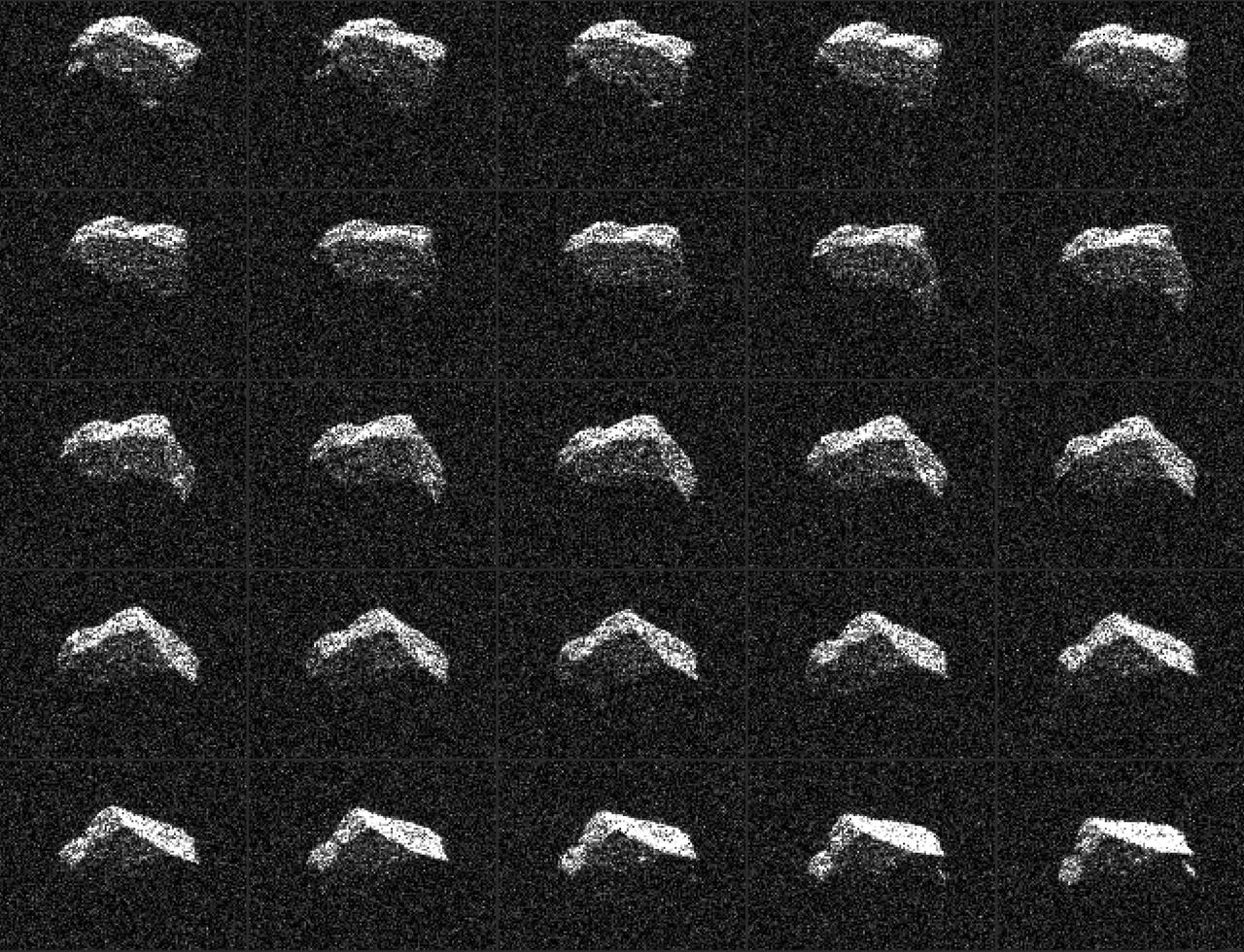
This composite of 25 images of asteroid 2017 BQ6 was generated with radar data collected using NASA's Goldstone Solar System Radar in California's Mojave Desert. The images were gathered on Feb. 7, 2017, between 8:39 and 9:50 p.m. PST (11:39 p.m. EST and 12:50 a.m., Feb. 7), revealing an irregular, angular-appearing asteroid about 660 feet (200 meters) in size that rotates about once every three hours. The images have resolutions as fine as 12 feet (3.75 meters) per pixel. http://photojournal.jpl.nasa.gov/catalog/PIA21452
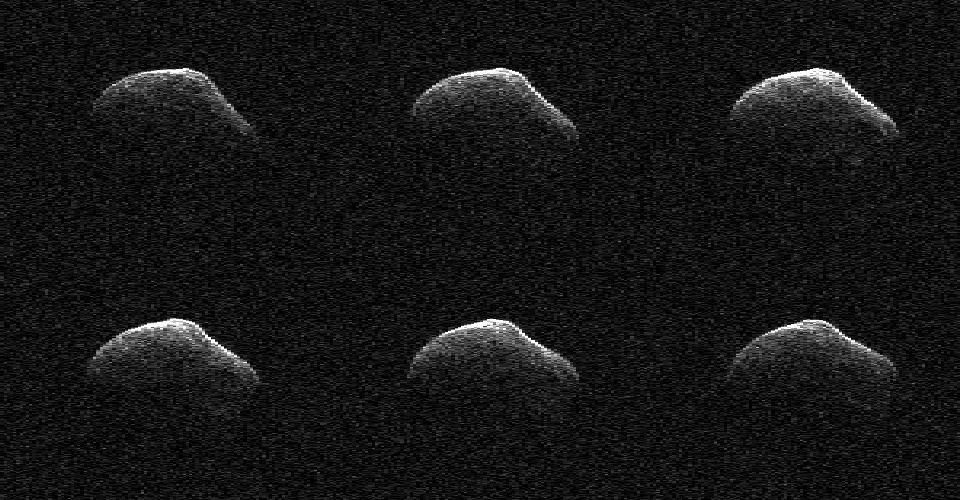
These radar images of comet P/2016 BA14 were taken on March 23, 2016, by scientists using an antenna of NASA Deep Space Network at Goldstone, California. At the time, the comet was about 2.2 million miles 3.6 million kilometers from Earth.
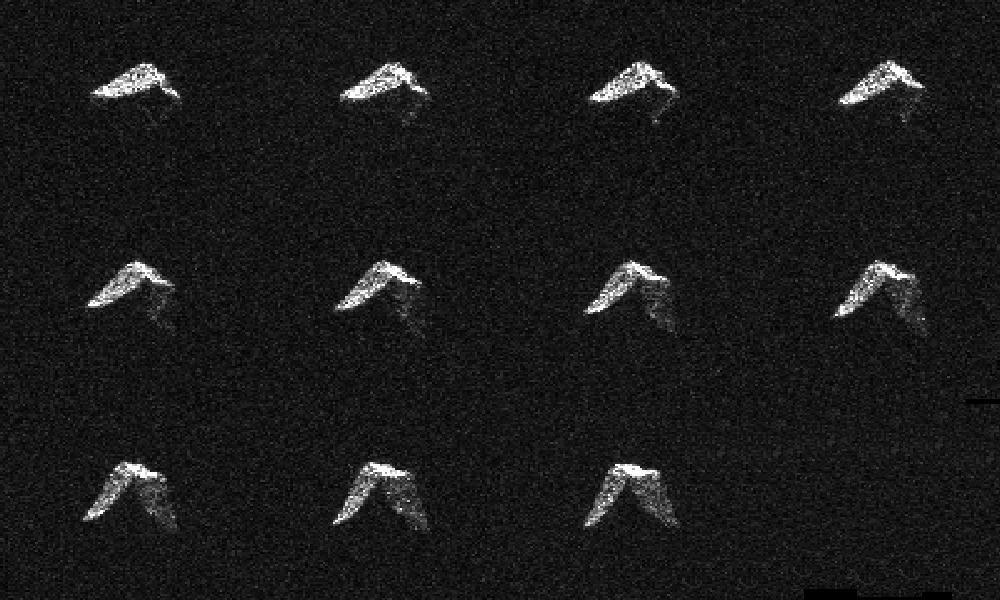
This composite of 11 images of asteroid 2017 BQ6 was generated with radar data collected using NASA's Goldstone Solar System Radar in California's Mojave Desert on Feb. 5, 2017, between 5:24 and 5:52 p.m. PST (8:24 to 8:52 p.m. EST / 1:24 to 1:52 UTC). The images have resolutions as fine as 12 feet (3.75 meters) per pixel. http://photojournal.jpl.nasa.gov/catalog/PIA21453
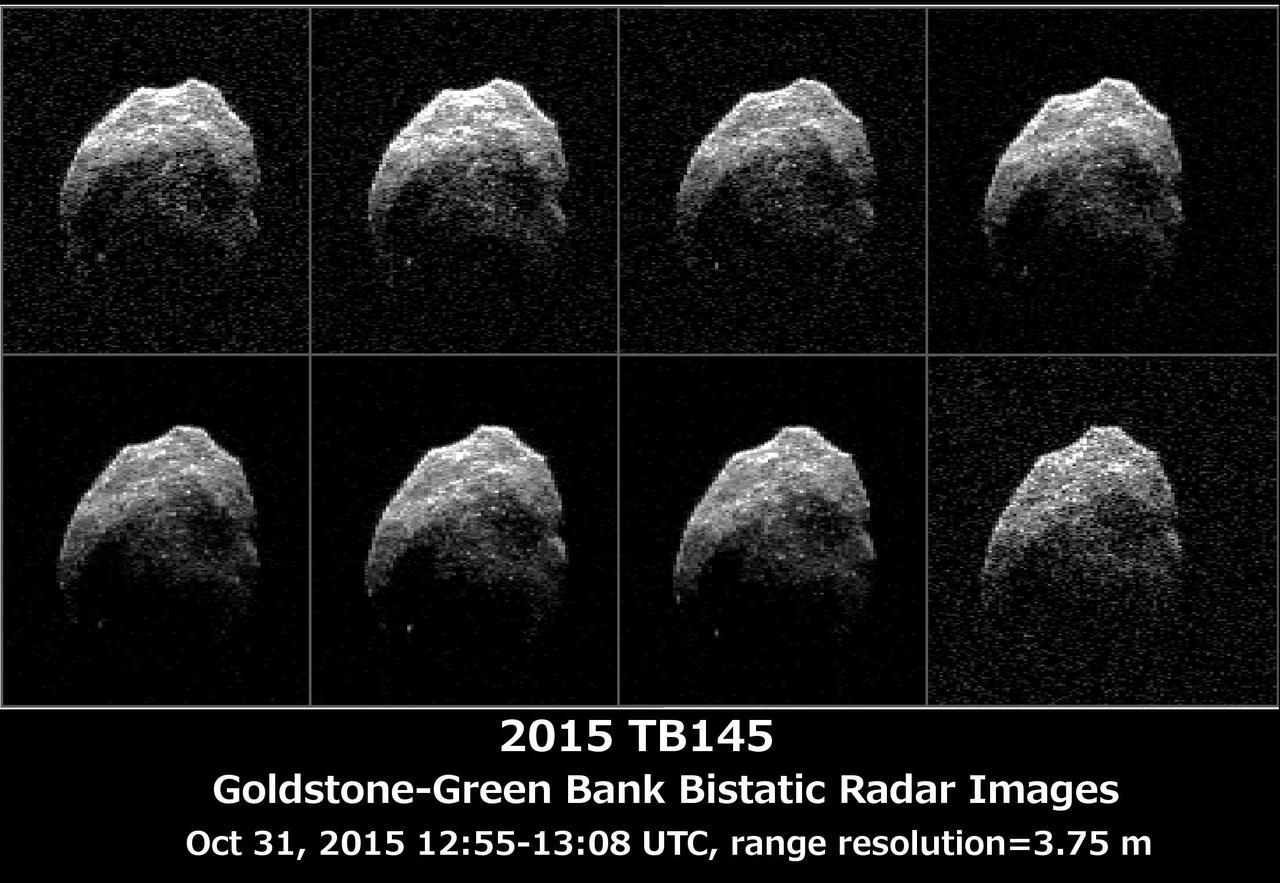
The 230-foot 70-meter DSS-14 antenna at Goldstone, Ca. obtained these radar images of asteroid 2015 TB145 on Oct. 31, 2015. Asteroid 2015 TB145 is depicted in eight individual radar images collected on Oct. 31, 2015 between 5:55 a.m. PDT (8:55 a.m. EDT) and 6:08 a.m. PDT (9:08 a.m. EDT). At the time the radar images were taken, the asteroid was between 440,000 miles (710,000 kilometers) and about 430,000 miles (690,000 kilometers) distant. Asteroid 2015 TB145 safely flew past Earth on Oct. 31, at 10:00 a.m. PDT (1 p.m. EDT) at about 1.3 lunar distances (300,000 miles, 480,000 kilometers). To obtain the radar images, the scientists used the 230-foot (70-meter) DSS-14 antenna at Goldstone, California, to transmit high power microwaves toward the asteroid. The signal bounced of the asteroid, and their radar echoes were received by the National Radio Astronomy Observatory's 100-meter (330-foot) Green Bank Telescope in West Virginia. The images achieve a spatial resolution of about 13 feet (4 meters) per pixel. http://photojournal.jpl.nasa.gov/catalog/PIA20043
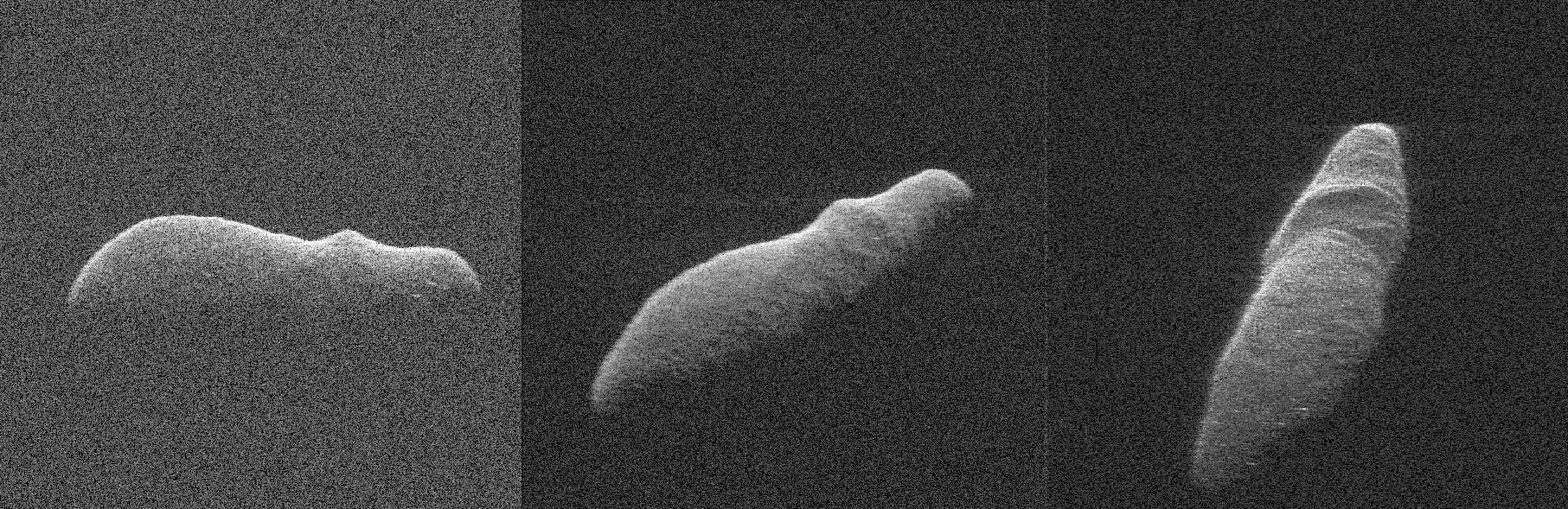
These three radar images of near-Earth asteroid 2003 SD220 were obtained on Dec. 15-17, by coordinating observations with NASA's 230-foot (70-meter) antenna at the Goldstone Deep Space Communications Complex in California and the National Science Foundation's (NSF) 330-foot (100-meter) Green Bank Telescope in West Virginia. The radar image on the left was obtained on Dec. 15 when asteroid 2003 SD220 was 2.8 million miles (4.5 million kilometers) from Earth. The radar image in the middle was generated from data collected on Dec. 16 when the asteroid was 2.5 million miles (4.0 million kilometers) from Earth. The image on the right was obtained on Dec. 17 when 2003 SD220 was 2.2 million miles (3.6 million kilometers) from Earth. The spatial resolution on the images is as fine as 12 feet (3.7 meters) per pixel. The radar images reveal the asteroid is at least one mile (1.6 kilometers) long. Asteroid 2003 SD220 was discovered on Sept. 29, 2003, by astronomers at the Lowell Observatory Near-Earth-Object Search (LONEOS) in Flagstaff, Arizona -- an early Near-Earth Object (NEO) survey project supported by NASA that is no longer in operation. The asteroid will fly safely past Earth on Saturday, Dec. 22, 2018, at a distance of about 1.8 million miles (2.9 million kilometers). This will be the asteroid's closest approach in more than 400 years and the closest until 2070, when the asteroid will safely fly by slightly closer. https://photojournal.jpl.nasa.gov/catalog/PIA22970

Asteroid 1998 WT24 left in December 2001, right on December 11, 2015 taken by NASA the 230-foot 70-meter DSS-14 antenna at Goldstone, California.