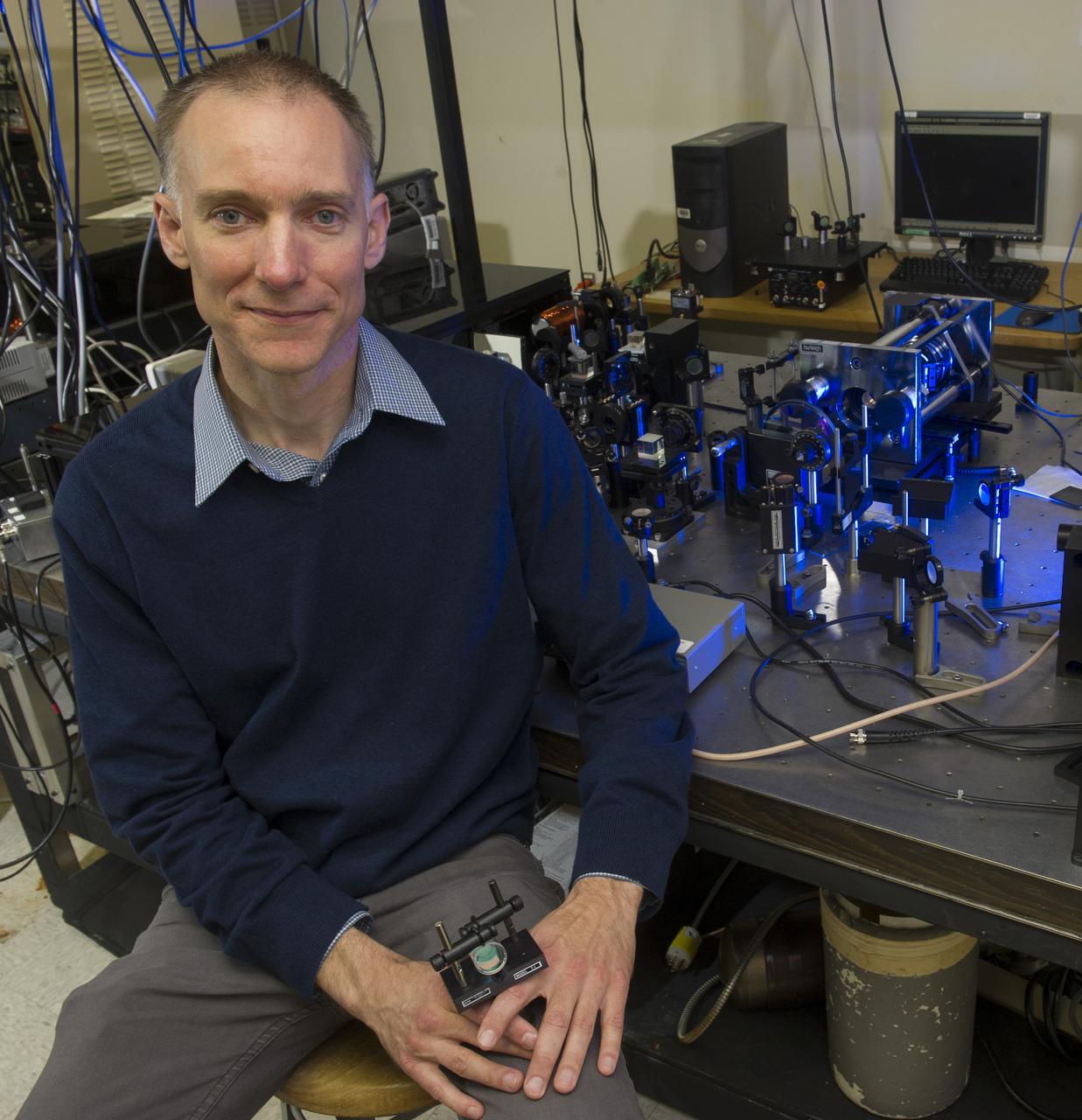
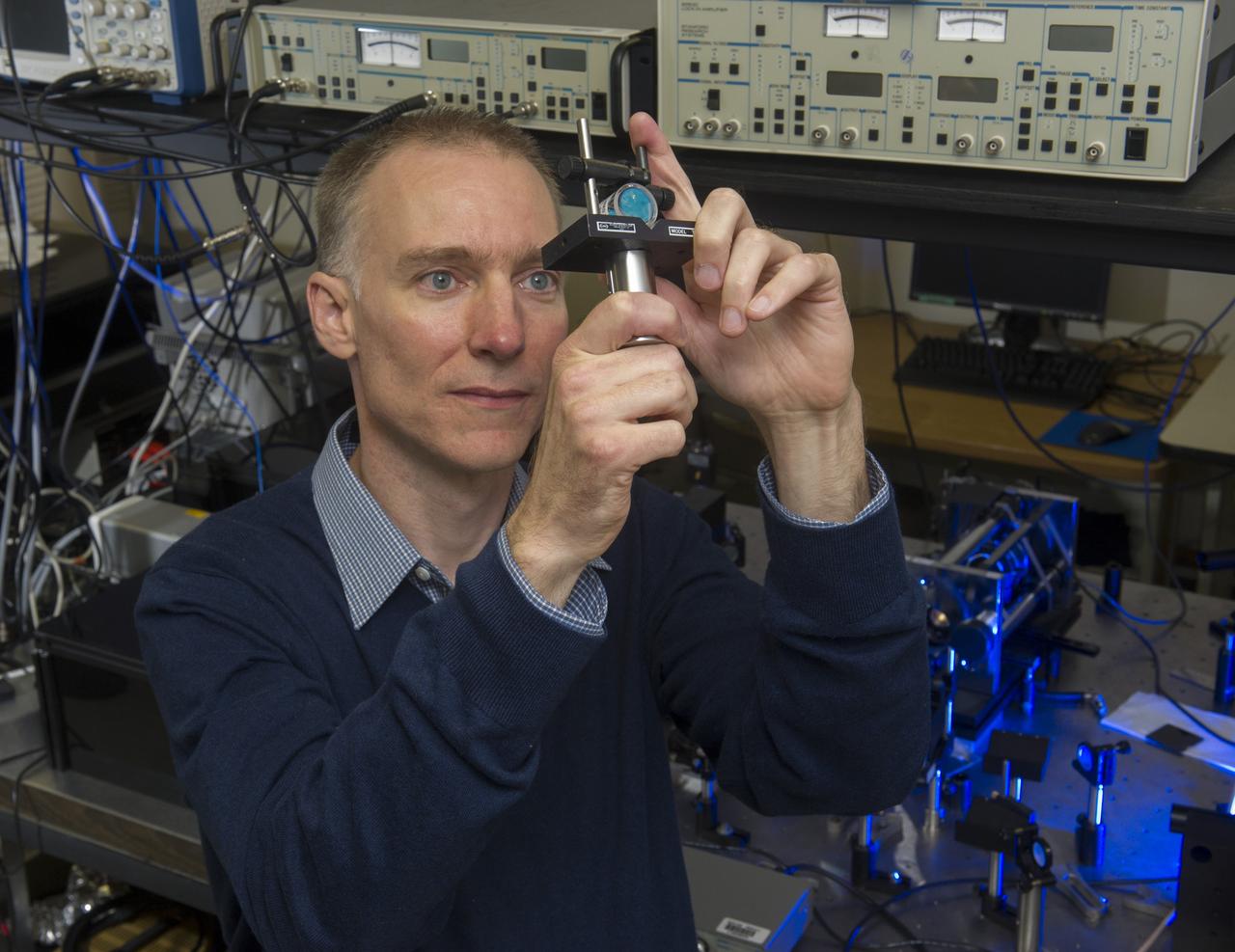
NASA RESEARCHER DR. DAVID SMITH AT NASA’S MARSHALL SPACE FLIGHT CENTER IN HUNTSVILLE, ALA., IS LEADING A THREE-YEAR PROJECT TO REVOLUTIONIZE IN-FLIGHT NAVIGATION SYSTEMS FOR SPACE VEHICLES AND MILITARY AND COMMERCIAL VEHICLES. SMITH AND HIS TEAM SEEK TO REFINE THE HIGHLY SENSITIVE OPTICAL GYROSCOPES THAT DRIVE SPACE VEHICLES’ INERTIAL GUIDANCE SYSTEMS – DELIVERING GYROSCOPES AT LEAST 1,000 TIMES MORE SENSITIVE THAN CURRENT SYSTEMS.
1201057
NASA RESEARCHER DR. DAVID SMITH AT NASA’S MARSHALL SPACE FLIGHT CENTER IN HUNTSVILLE, ALA., IS LEADING A THREE-YEAR PROJECT TO REVOLUTIONIZE IN-FLIGHT NAVIGATION SYSTEMS FOR SPACE VEHICLES AND MILITARY AND COMMERCIAL VEHICLES. SMITH AND HIS TEAM SEEK TO REFINE THE HIGHLY SENSITIVE OPTICAL GYROSCOPES THAT DRIVE SPACE VEHICLES’ INERTIAL GUIDANCE SYSTEMS – DELIVERING GYROSCOPES AT LEAST 1,000 TIMES MORE SENSITIVE THAN CURRENT SYSTEMS.
1201054
NASA RESEARCHER DR. DAVID SMITH AT NASA’S MARSHALL SPACE FLIGHT CENTER IN HUNTSVILLE, ALA., IS LEADING A THREE-YEAR PROJECT TO REVOLUTIONIZE IN-FLIGHT NAVIGATION SYSTEMS FOR SPACE VEHICLES AND MILITARY AND COMMERCIAL VEHICLES. SMITH AND HIS TEAM SEEK TO REFINE THE HIGHLY SENSITIVE OPTICAL GYROSCOPES THAT DRIVE SPACE VEHICLES’ INERTIAL GUIDANCE SYSTEMS – DELIVERING GYROSCOPES AT LEAST 1,000 TIMES MORE SENSITIVE THAN CURRENT SYSTEMS.
1201055
NASA RESEARCHER DR. DAVID SMITH AT NASA’S MARSHALL SPACE FLIGHT CENTER IN HUNTSVILLE, ALA., IS LEADING A THREE-YEAR PROJECT TO REVOLUTIONIZE IN-FLIGHT NAVIGATION SYSTEMS FOR SPACE VEHICLES AND MILITARY AND COMMERCIAL VEHICLES. SMITH AND HIS TEAM SEEK TO REFINE THE HIGHLY SENSITIVE OPTICAL GYROSCOPES THAT DRIVE SPACE VEHICLES’ INERTIAL GUIDANCE SYSTEMS – DELIVERING GYROSCOPES AT LEAST 1,000 TIMES MORE SENSITIVE THAN CURRENT SYSTEMS.
1201056
NASA RESEARCHER DR. DAVID SMITH AT NASA’S MARSHALL SPACE FLIGHT CENTER IN HUNTSVILLE, ALA., IS LEADING A THREE-YEAR PROJECT TO REVOLUTIONIZE IN-FLIGHT NAVIGATION SYSTEMS FOR SPACE VEHICLES AND MILITARY AND COMMERCIAL VEHICLES. SMITH AND HIS TEAM SEEK TO REFINE THE HIGHLY SENSITIVE OPTICAL GYROSCOPES THAT DRIVE SPACE VEHICLES’ INERTIAL GUIDANCE SYSTEMS – DELIVERING GYROSCOPES AT LEAST 1,000 TIMES MORE SENSITIVE THAN CURRENT SYSTEMS.
1201053
NASA RESEARCHER DR. DAVID SMITH AT NASA’S MARSHALL SPACE FLIGHT CENTER IN HUNTSVILLE, ALA., IS LEADING A THREE-YEAR PROJECT TO REVOLUTIONIZE IN-FLIGHT NAVIGATION SYSTEMS FOR SPACE VEHICLES AND MILITARY AND COMMERCIAL VEHICLES. SMITH AND HIS TEAM SEEK TO REFINE THE HIGHLY SENSITIVE OPTICAL GYROSCOPES THAT DRIVE SPACE VEHICLES’ INERTIAL GUIDANCE SYSTEMS – DELIVERING GYROSCOPES AT LEAST 1,000 TIMES MORE SENSITIVE THAN CURRENT SYSTEMS.
1201052
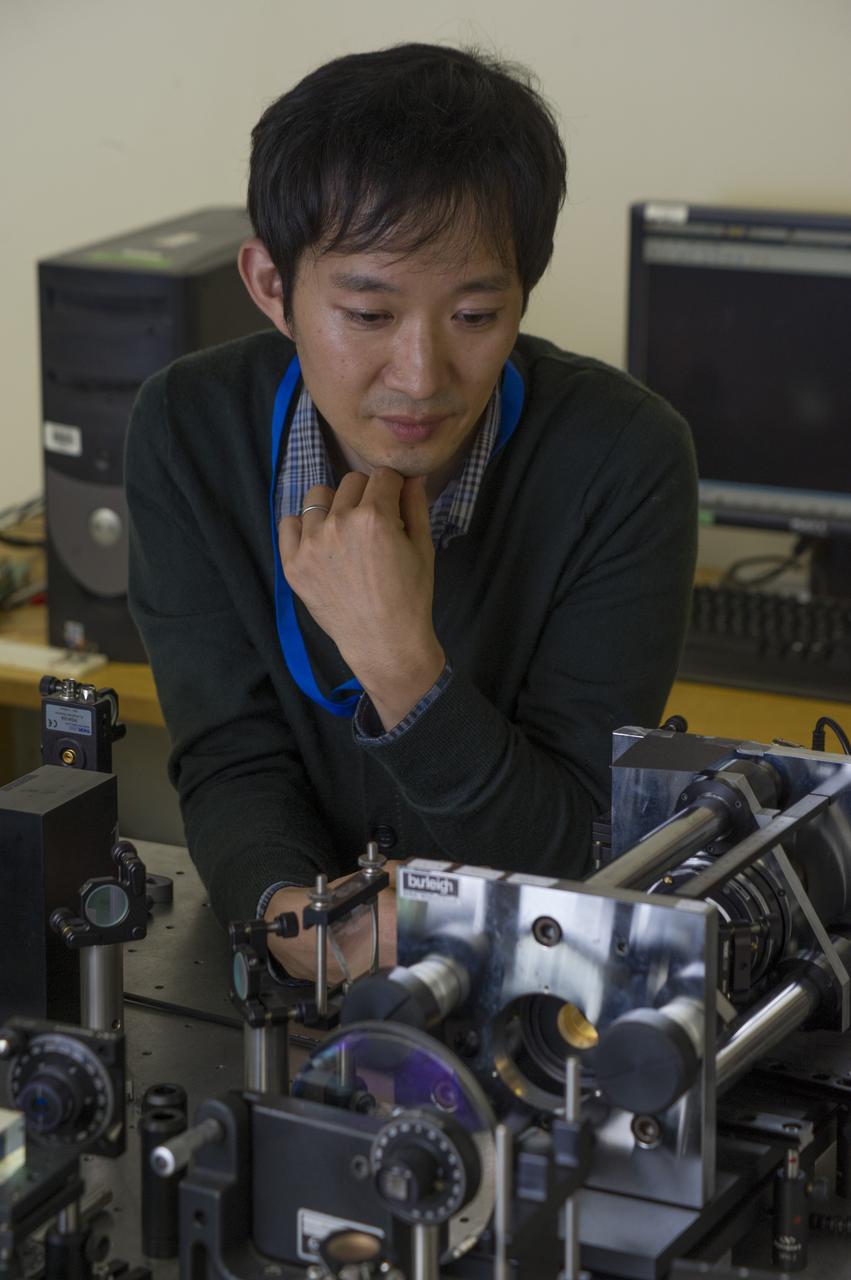
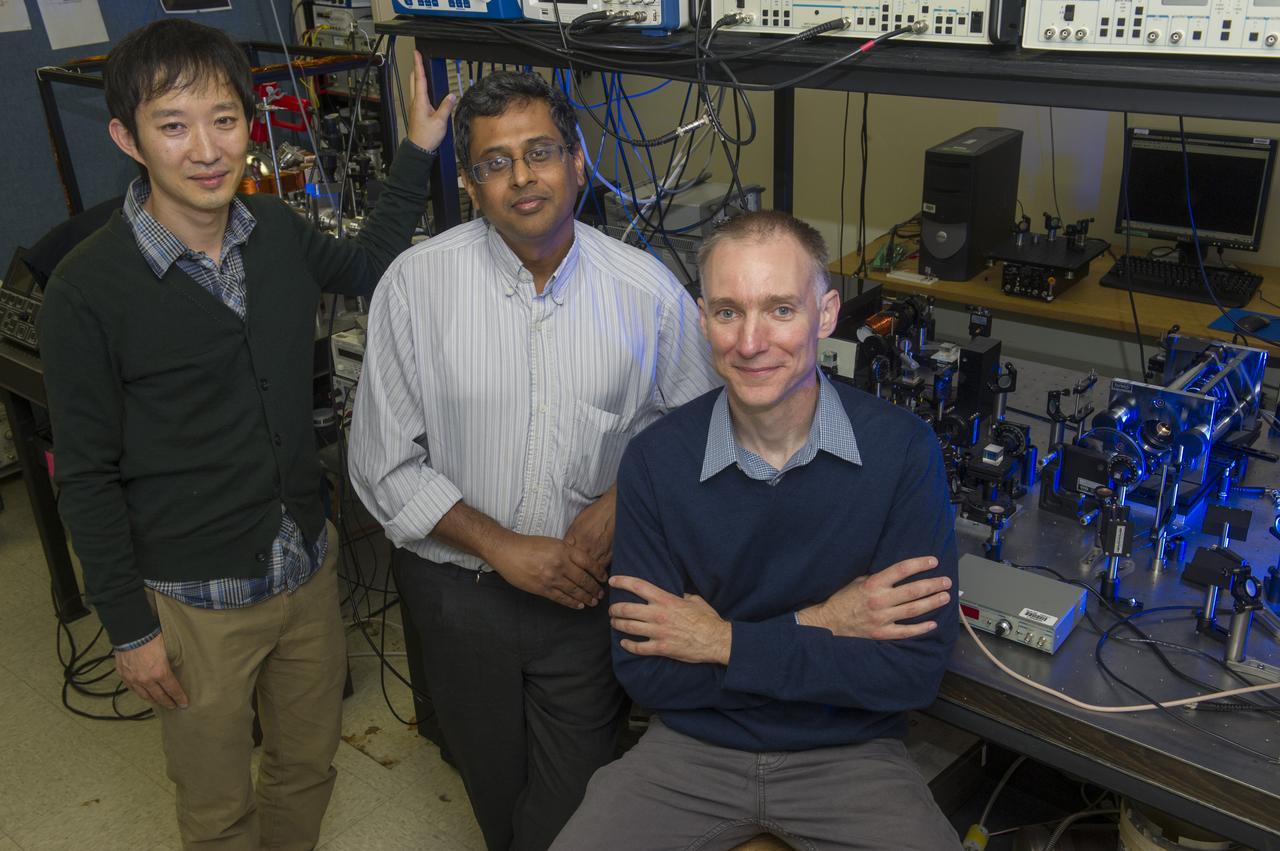
ARMY CONTRACTOR HONGROK CHANG IN THE FAST LIGHT OPTICAL GYROSCOPE LAB
1201051
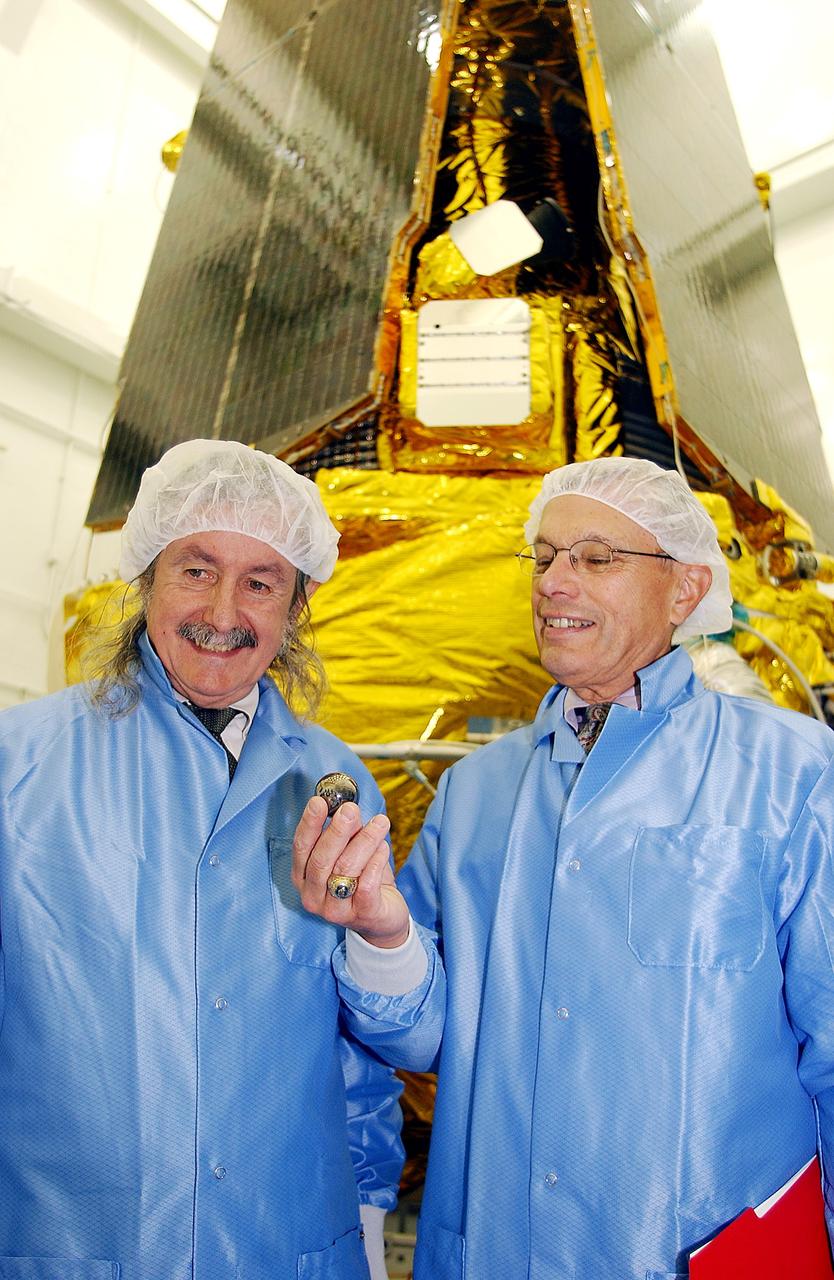
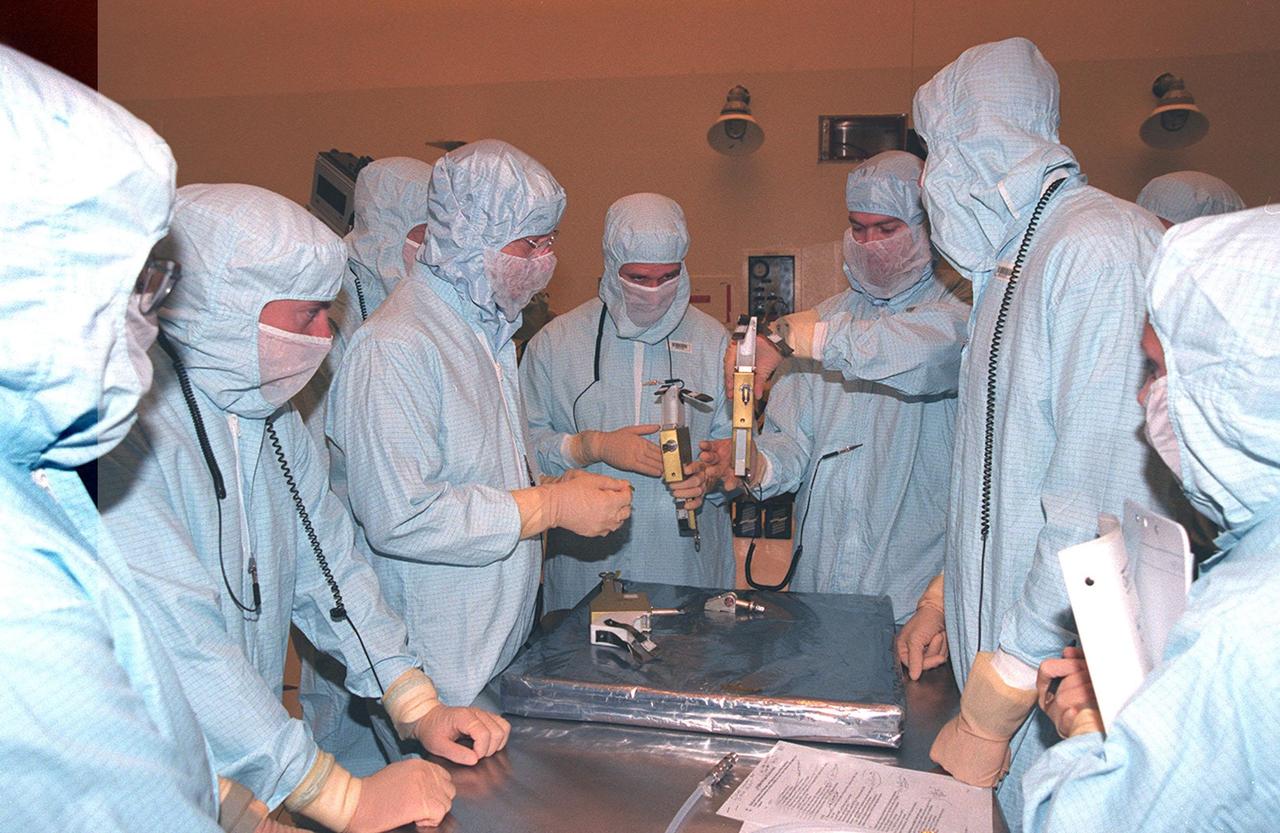
VANDENBERG AFB, CALIF. -  In the NASA spacecraft processing facility on North Vandenberg Air Force Base,  Dr. Francis Everitt, principal investigator, and Brad Parkinson, co-principal investigator, both from Stanford University, hold one of the small gyroscopes used in the Gravity Probe B spacecraft.  The GP-B towers behind them.  The Gravity Probe B mission is a relativity experiment developed by NASA’s Marshall Space Flight Center, Stanford University and Lockheed Martin.  The spacecraft will test two extraordinary predictions of Albert Einstein’s general theory of relativity that he advanced in 1916: the geodetic effect (how space and time are warped by the presence of the Earth) and frame dragging (how Earth’s rotation drags space and time around with it).  Gravity Probe B consists of four sophisticated gyroscopes that will provide an almost perfect space-time reference system.  The mission will look in a precision manner for tiny changes in the direction of spin.
VANDENBERG AFB, CALIF. - In the NASA spacecraft processing facility on North Vandenberg Air Force Base, Dr. Francis Everitt, principal investigator, and Brad Parkinson, co-principal investigator, both from Stanford University, hold one of the small gyroscopes used in the Gravity Probe B spacecraft. The GP-B towers behind them. The Gravity Probe B mission is a relativity experiment developed by NASA’s Marshall Space Flight Center, Stanford University and Lockheed Martin. The spacecraft will test two extraordinary predictions of Albert Einstein’s general theory of relativity that he advanced in 1916: the geodetic effect (how space and time are warped by the presence of the Earth) and frame dragging (how Earth’s rotation drags space and time around with it). Gravity Probe B consists of four sophisticated gyroscopes that will provide an almost perfect space-time reference system. The mission will look in a precision manner for tiny changes in the direction of spin.
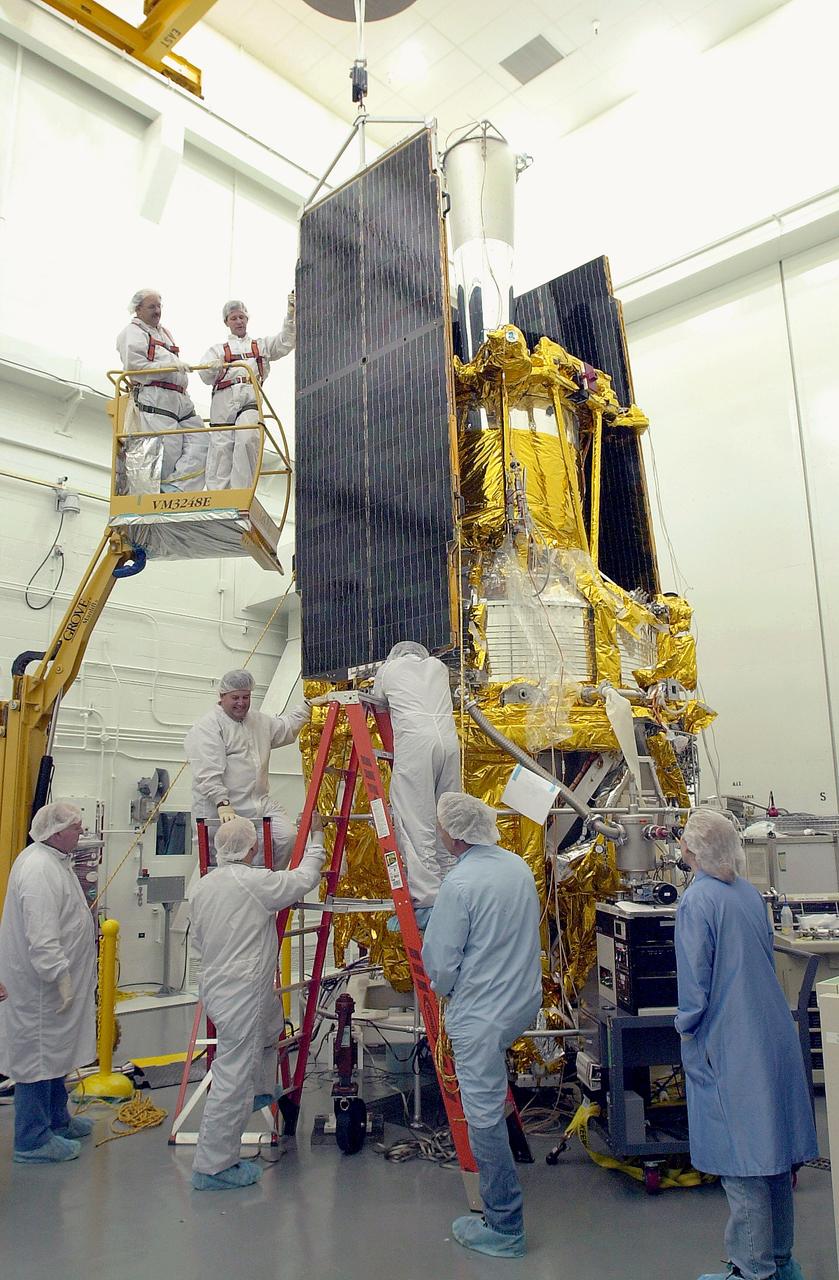
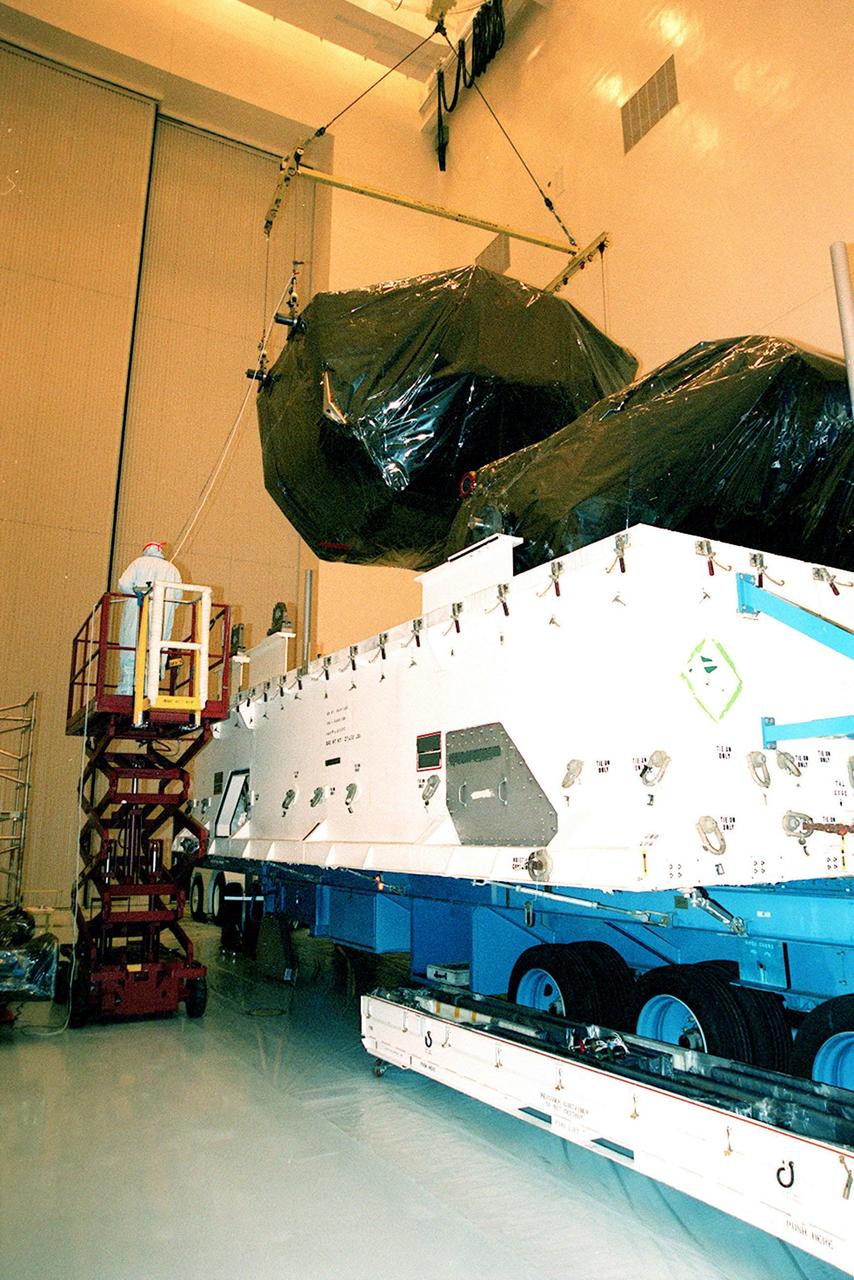
VANDENBERG AFB, CALIF. -  Workers in the NASA spacecraft processing facility on North Vandenberg Air Force Base attach a solar array panel on the Gravity Probe B spacecraft.  Installing each array is a 3-day process and includes a functional deployment test.  The Gravity Probe B mission is a relativity experiment developed by NASA’s Marshall Space Flight Center, Stanford University and Lockheed Martin.  The spacecraft will test two extraordinary predictions of Albert Einstein’s general theory of relativity that he advanced in 1916: the geodetic effect (how space and time are warped by the presence of the Earth) and frame dragging (how Earth’s rotation drags space and time around with it).  Gravity Probe B consists of four sophisticated gyroscopes that will provide an almost perfect space-time reference system.  The mission will look in a precision manner for tiny changes in the direction of spin.
VANDENBERG AFB, CALIF. - Workers in the NASA spacecraft processing facility on North Vandenberg Air Force Base attach a solar array panel on the Gravity Probe B spacecraft. Installing each array is a 3-day process and includes a functional deployment test. The Gravity Probe B mission is a relativity experiment developed by NASA’s Marshall Space Flight Center, Stanford University and Lockheed Martin. The spacecraft will test two extraordinary predictions of Albert Einstein’s general theory of relativity that he advanced in 1916: the geodetic effect (how space and time are warped by the presence of the Earth) and frame dragging (how Earth’s rotation drags space and time around with it). Gravity Probe B consists of four sophisticated gyroscopes that will provide an almost perfect space-time reference system. The mission will look in a precision manner for tiny changes in the direction of spin.
VANDENBERG AFB, CALIF. -  In the NASA spacecraft processing facility on North Vandenberg Air Force Base, the Gravity Probe B spacecraft is seen with two solar array panels installed.  Installing each array is a 3-day process and includes a functional deployment test.  The Gravity Probe B mission is a relativity experiment developed by NASA’s Marshall Space Flight Center, Stanford University and Lockheed Martin.  The spacecraft will test two extraordinary predictions of Albert Einstein’s general theory of relativity that he advanced in 1916: the geodetic effect (how space and time are warped by the presence of the Earth) and frame dragging (how Earth’s rotation drags space and time around with it).  Gravity Probe B consists of four sophisticated gyroscopes that will provide an almost perfect space-time reference system.  The mission will look in a precision manner for tiny changes in the direction of spin.
VANDENBERG AFB, CALIF. - In the NASA spacecraft processing facility on North Vandenberg Air Force Base, the Gravity Probe B spacecraft is seen with two solar array panels installed. Installing each array is a 3-day process and includes a functional deployment test. The Gravity Probe B mission is a relativity experiment developed by NASA’s Marshall Space Flight Center, Stanford University and Lockheed Martin. The spacecraft will test two extraordinary predictions of Albert Einstein’s general theory of relativity that he advanced in 1916: the geodetic effect (how space and time are warped by the presence of the Earth) and frame dragging (how Earth’s rotation drags space and time around with it). Gravity Probe B consists of four sophisticated gyroscopes that will provide an almost perfect space-time reference system. The mission will look in a precision manner for tiny changes in the direction of spin.
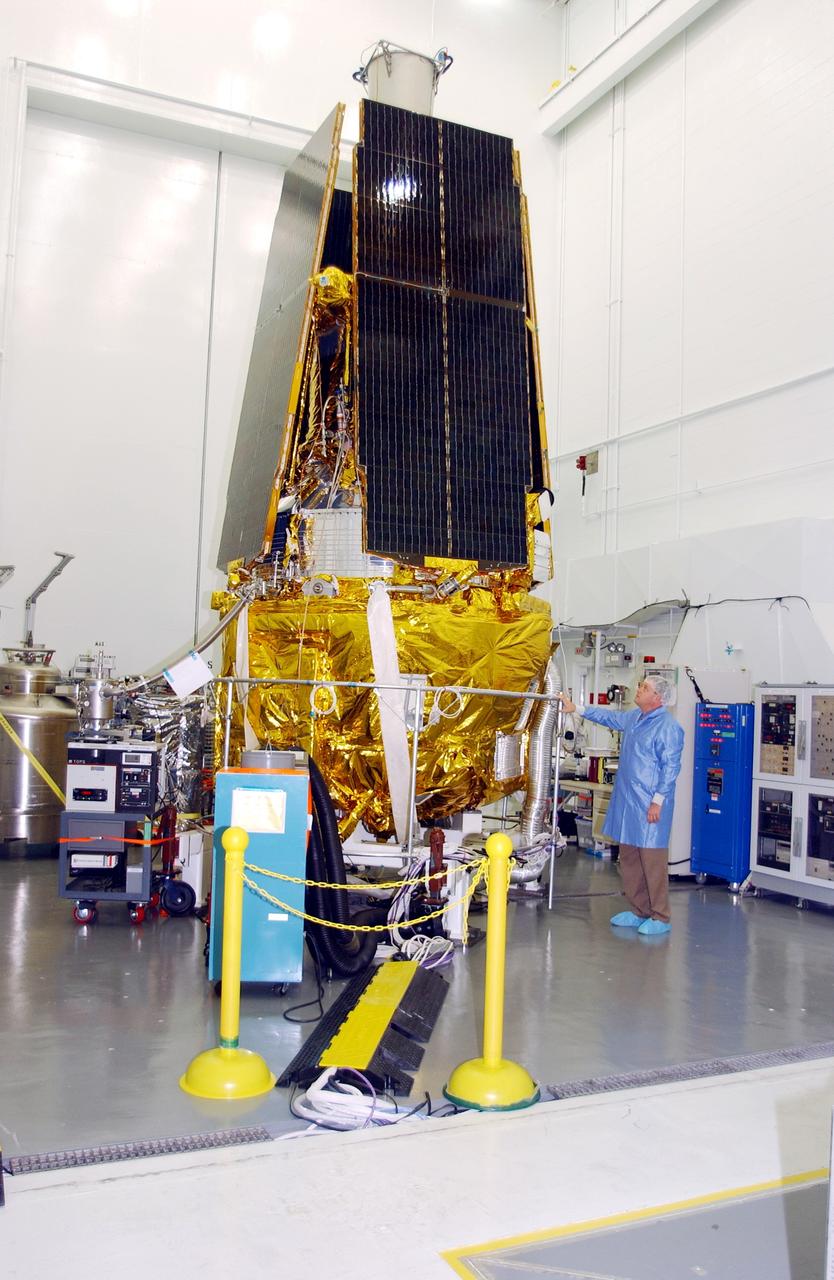
VANDENBERG AFB, CALIF. -  In the NASA spacecraft processing facility on North Vandenberg Air Force Base, the Gravity Probe B spacecraft is seen with all four solar array panels installed.  Installing each array is a 3-day process and includes a functional deployment test.  The Gravity Probe B mission is a relativity experiment developed by NASA’s Marshall Space Flight Center, Stanford University and Lockheed Martin.  The spacecraft will test two extraordinary predictions of Albert Einstein’s general theory of relativity that he advanced in 1916: the geodetic effect (how space and time are warped by the presence of the Earth) and frame dragging (how Earth’s rotation drags space and time around with it).  Gravity Probe B consists of four sophisticated gyroscopes that will provide an almost perfect space-time reference system.  The mission will look in a precision manner for tiny changes in the direction of spin.
VANDENBERG AFB, CALIF. - In the NASA spacecraft processing facility on North Vandenberg Air Force Base, the Gravity Probe B spacecraft is seen with all four solar array panels installed. Installing each array is a 3-day process and includes a functional deployment test. The Gravity Probe B mission is a relativity experiment developed by NASA’s Marshall Space Flight Center, Stanford University and Lockheed Martin. The spacecraft will test two extraordinary predictions of Albert Einstein’s general theory of relativity that he advanced in 1916: the geodetic effect (how space and time are warped by the presence of the Earth) and frame dragging (how Earth’s rotation drags space and time around with it). Gravity Probe B consists of four sophisticated gyroscopes that will provide an almost perfect space-time reference system. The mission will look in a precision manner for tiny changes in the direction of spin.
VANDENBERG AFB, CALIF. - Workers in the NASA spacecraft processing facility on North Vandenberg Air Force Base attach a solar array panel on the Gravity Probe B spacecraft.  Installing each array is a 3-day process and includes a functional deployment test.  The Gravity Probe B mission is a relativity experiment developed by NASA’s Marshall Space Flight Center, Stanford University and Lockheed Martin.  The spacecraft will test two extraordinary predictions of Albert Einstein’s general theory of relativity that he advanced in 1916: the geodetic effect (how space and time are warped by the presence of the Earth) and frame dragging (how Earth’s rotation drags space and time around with it).  Gravity Probe B consists of four sophisticated gyroscopes that will provide an almost perfect space-time reference system.  The mission will look in a precision manner for tiny changes in the direction of spin.
VANDENBERG AFB, CALIF. - Workers in the NASA spacecraft processing facility on North Vandenberg Air Force Base attach a solar array panel on the Gravity Probe B spacecraft. Installing each array is a 3-day process and includes a functional deployment test. The Gravity Probe B mission is a relativity experiment developed by NASA’s Marshall Space Flight Center, Stanford University and Lockheed Martin. The spacecraft will test two extraordinary predictions of Albert Einstein’s general theory of relativity that he advanced in 1916: the geodetic effect (how space and time are warped by the presence of the Earth) and frame dragging (how Earth’s rotation drags space and time around with it). Gravity Probe B consists of four sophisticated gyroscopes that will provide an almost perfect space-time reference system. The mission will look in a precision manner for tiny changes in the direction of spin.
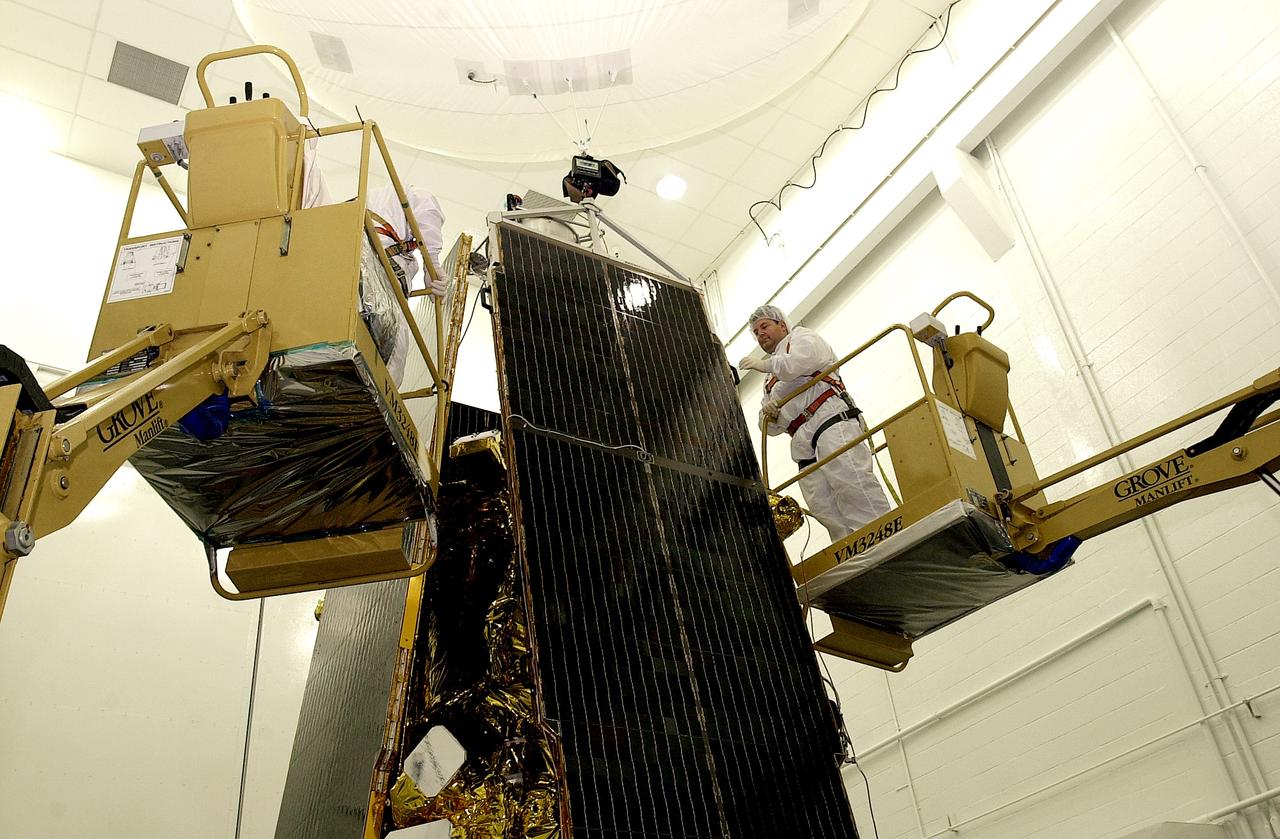
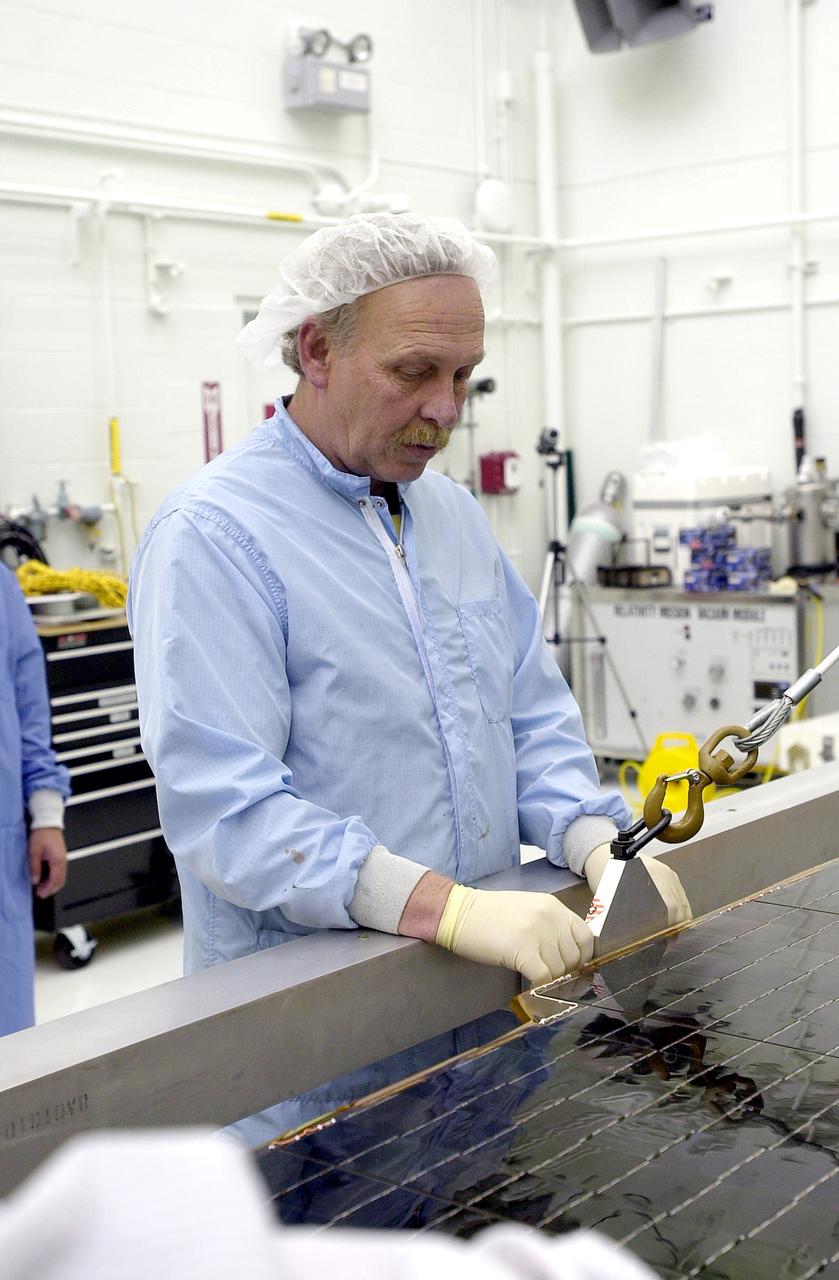
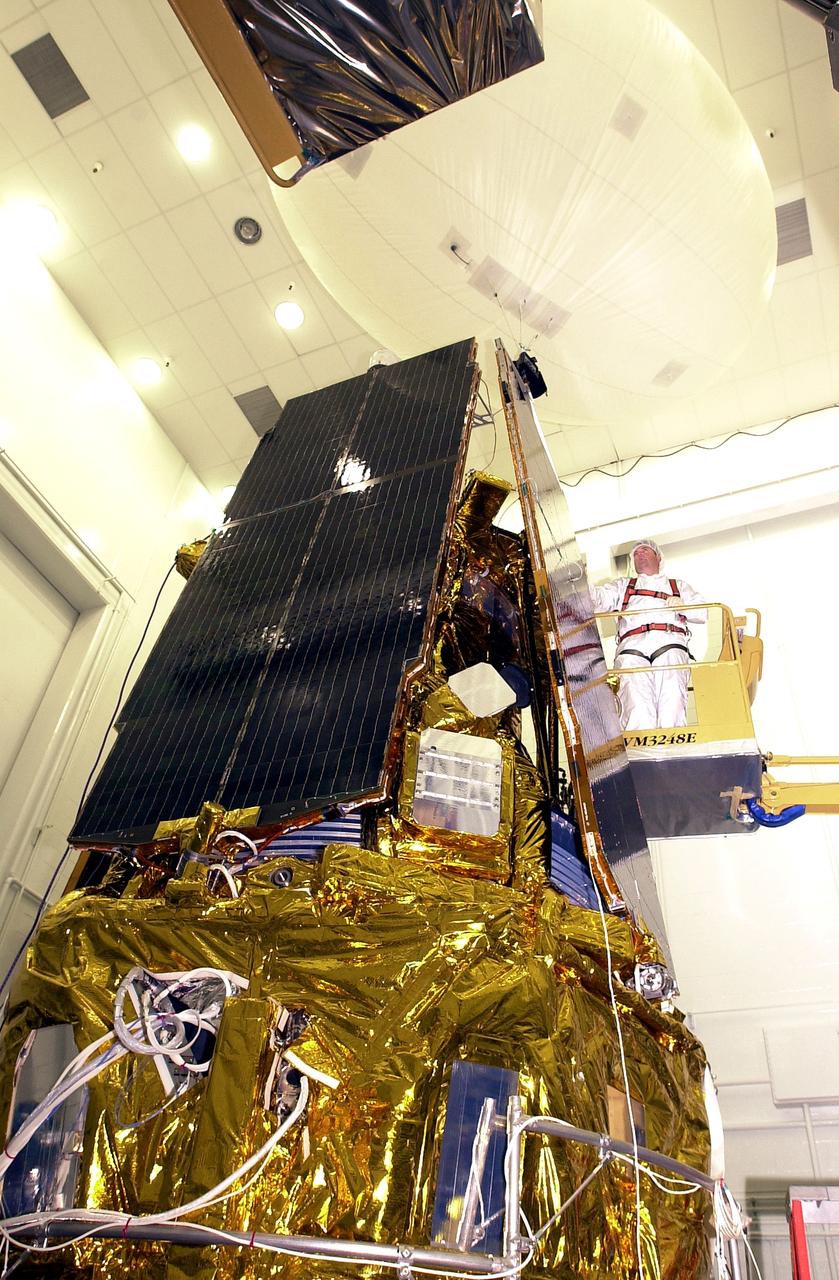
VANDENBERG AFB, CALIF. - A worker in the NASA spacecraft processing facility on North Vandenberg Air Force Base adjust the supports on a solar array panel to be lifted and  installed on the Gravity Probe B spacecraft.  Installing each array is a 3-day process and includes a functional deployment test.  The Gravity Probe B mission is a relativity experiment developed by NASA’s Marshall Space Flight Center, Stanford University and Lockheed Martin.  The spacecraft will test two extraordinary predictions of Albert Einstein’s general theory of relativity that he advanced in 1916: the geodetic effect (how space and time are warped by the presence of the Earth) and frame dragging (how Earth’s rotation drags space and time around with it).  Gravity Probe B consists of four sophisticated gyroscopes that will provide an almost perfect space-time reference system.  The mission will look in a precision manner for tiny changes in the direction of spin.
VANDENBERG AFB, CALIF. - A worker in the NASA spacecraft processing facility on North Vandenberg Air Force Base adjust the supports on a solar array panel to be lifted and installed on the Gravity Probe B spacecraft. Installing each array is a 3-day process and includes a functional deployment test. The Gravity Probe B mission is a relativity experiment developed by NASA’s Marshall Space Flight Center, Stanford University and Lockheed Martin. The spacecraft will test two extraordinary predictions of Albert Einstein’s general theory of relativity that he advanced in 1916: the geodetic effect (how space and time are warped by the presence of the Earth) and frame dragging (how Earth’s rotation drags space and time around with it). Gravity Probe B consists of four sophisticated gyroscopes that will provide an almost perfect space-time reference system. The mission will look in a precision manner for tiny changes in the direction of spin.
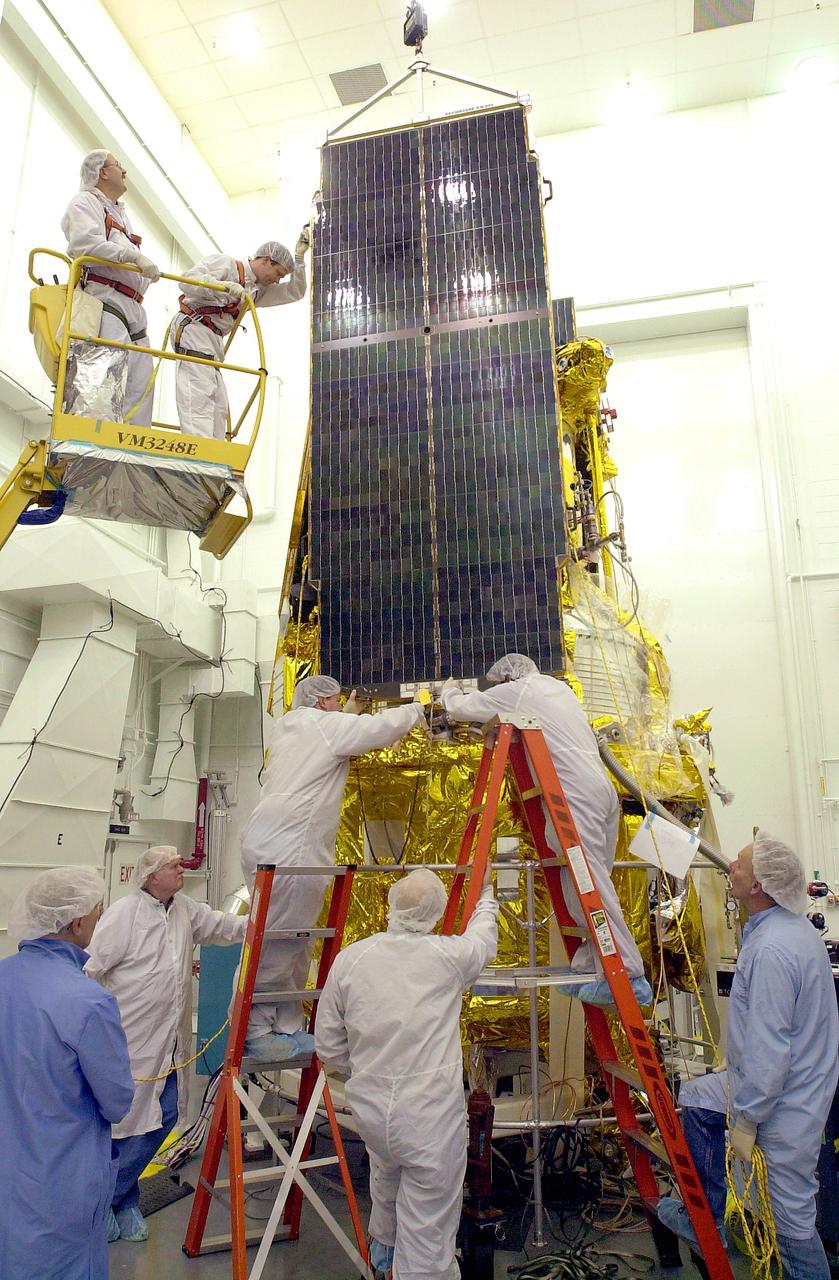
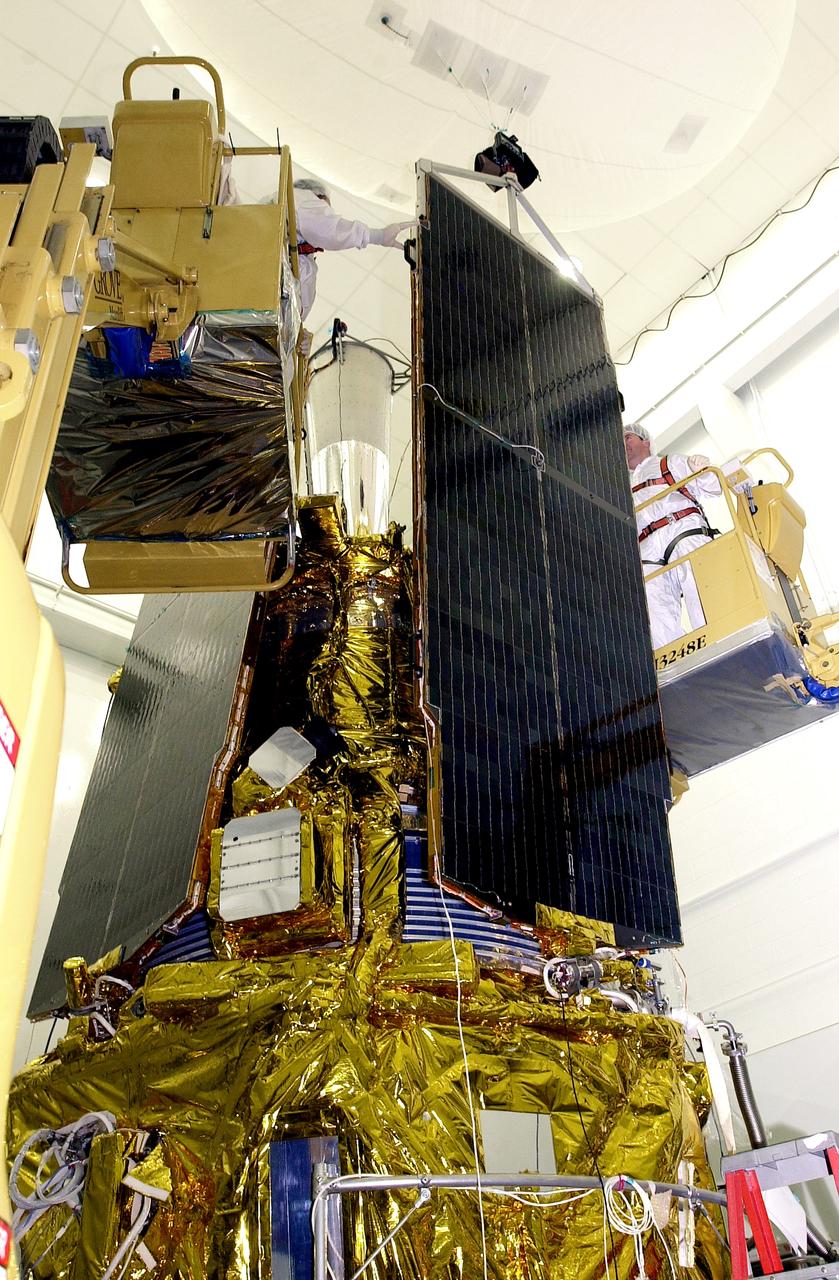
VANDENBERG AFB, CALIF. -  In the NASA spacecraft processing facility on North Vandenberg Air Force Base, workers prepare to attach the top of a solar array panel onto the Gravity Probe B spacecraft.  Installing each array is a 3-day process and includes a functional deployment test.  The Gravity Probe B mission is a relativity experiment developed by NASA’s Marshall Space Flight Center, Stanford University and Lockheed Martin.  The spacecraft will test two extraordinary predictions of Albert Einstein’s general theory of relativity that he advanced in 1916: the geodetic effect (how space and time are warped by the presence of the Earth) and frame dragging (how Earth’s rotation drags space and time around with it).  Gravity Probe B consists of four sophisticated gyroscopes that will provide an almost perfect space-time reference system.  The mission will look in a precision manner for tiny changes in the direction of spin.
VANDENBERG AFB, CALIF. - In the NASA spacecraft processing facility on North Vandenberg Air Force Base, workers prepare to attach the top of a solar array panel onto the Gravity Probe B spacecraft. Installing each array is a 3-day process and includes a functional deployment test. The Gravity Probe B mission is a relativity experiment developed by NASA’s Marshall Space Flight Center, Stanford University and Lockheed Martin. The spacecraft will test two extraordinary predictions of Albert Einstein’s general theory of relativity that he advanced in 1916: the geodetic effect (how space and time are warped by the presence of the Earth) and frame dragging (how Earth’s rotation drags space and time around with it). Gravity Probe B consists of four sophisticated gyroscopes that will provide an almost perfect space-time reference system. The mission will look in a precision manner for tiny changes in the direction of spin.
VANDENBERG AFB, CALIF. -  In the NASA spacecraft processing facility on North Vandenberg Air Force Base, workers prepare to attach the top of a solar array panel onto the Gravity Probe B spacecraft.  Installing each array is a 3-day process and includes a functional deployment test.  The Gravity Probe B mission is a relativity experiment developed by NASA’s Marshall Space Flight Center, Stanford University and Lockheed Martin.  The spacecraft will test two extraordinary predictions of Albert Einstein’s general theory of relativity that he advanced in 1916: the geodetic effect (how space and time are warped by the presence of the Earth) and frame dragging (how Earth’s rotation drags space and time around with it).  Gravity Probe B consists of four sophisticated gyroscopes that will provide an almost perfect space-time reference system.  The mission will look in a precision manner for tiny changes in the direction of spin.
VANDENBERG AFB, CALIF. - In the NASA spacecraft processing facility on North Vandenberg Air Force Base, workers prepare to attach the top of a solar array panel onto the Gravity Probe B spacecraft. Installing each array is a 3-day process and includes a functional deployment test. The Gravity Probe B mission is a relativity experiment developed by NASA’s Marshall Space Flight Center, Stanford University and Lockheed Martin. The spacecraft will test two extraordinary predictions of Albert Einstein’s general theory of relativity that he advanced in 1916: the geodetic effect (how space and time are warped by the presence of the Earth) and frame dragging (how Earth’s rotation drags space and time around with it). Gravity Probe B consists of four sophisticated gyroscopes that will provide an almost perfect space-time reference system. The mission will look in a precision manner for tiny changes in the direction of spin.
VANDENBERG AFB, CALIF. -  In the NASA spacecraft processing facility on North Vandenberg Air Force Base, workers stand by as the balloon at right is released to lift the solar array panel into position for installation on the Gravity Probe B spacecraft.  Installing each array is a 3-day process and includes a functional deployment test.  The Gravity Probe B mission is a relativity experiment developed by NASA’s Marshall Space Flight Center, Stanford University and Lockheed Martin.  The spacecraft will test two extraordinary predictions of Albert Einstein’s general theory of relativity that he advanced in 1916: the geodetic effect (how space and time are warped by the presence of the Earth) and frame dragging (how Earth’s rotation drags space and time around with it).  Gravity Probe B consists of four sophisticated gyroscopes that will provide an almost perfect space-time reference system.  The mission will look in a precision manner for tiny changes in the direction of spin.
VANDENBERG AFB, CALIF. - In the NASA spacecraft processing facility on North Vandenberg Air Force Base, workers stand by as the balloon at right is released to lift the solar array panel into position for installation on the Gravity Probe B spacecraft. Installing each array is a 3-day process and includes a functional deployment test. The Gravity Probe B mission is a relativity experiment developed by NASA’s Marshall Space Flight Center, Stanford University and Lockheed Martin. The spacecraft will test two extraordinary predictions of Albert Einstein’s general theory of relativity that he advanced in 1916: the geodetic effect (how space and time are warped by the presence of the Earth) and frame dragging (how Earth’s rotation drags space and time around with it). Gravity Probe B consists of four sophisticated gyroscopes that will provide an almost perfect space-time reference system. The mission will look in a precision manner for tiny changes in the direction of spin.
VANDENBERG AFB, CALIF. -  In the NASA spacecraft processing facility on North Vandenberg Air Force Base, a worker checks the installation of a solar array panel onto the Gravity Probe B spacecraft.  Installing each array is a 3-day process and includes a functional deployment test.  The Gravity Probe B mission is a relativity experiment developed by NASA’s Marshall Space Flight Center, Stanford University and Lockheed Martin.  The spacecraft will test two extraordinary predictions of Albert Einstein’s general theory of relativity that he advanced in 1916: the geodetic effect (how space and time are warped by the presence of the Earth) and frame dragging (how Earth’s rotation drags space and time around with it).  Gravity Probe B consists of four sophisticated gyroscopes that will provide an almost perfect space-time reference system.  The mission will look in a precision manner for tiny changes in the direction of spin.
VANDENBERG AFB, CALIF. - In the NASA spacecraft processing facility on North Vandenberg Air Force Base, a worker checks the installation of a solar array panel onto the Gravity Probe B spacecraft. Installing each array is a 3-day process and includes a functional deployment test. The Gravity Probe B mission is a relativity experiment developed by NASA’s Marshall Space Flight Center, Stanford University and Lockheed Martin. The spacecraft will test two extraordinary predictions of Albert Einstein’s general theory of relativity that he advanced in 1916: the geodetic effect (how space and time are warped by the presence of the Earth) and frame dragging (how Earth’s rotation drags space and time around with it). Gravity Probe B consists of four sophisticated gyroscopes that will provide an almost perfect space-time reference system. The mission will look in a precision manner for tiny changes in the direction of spin.
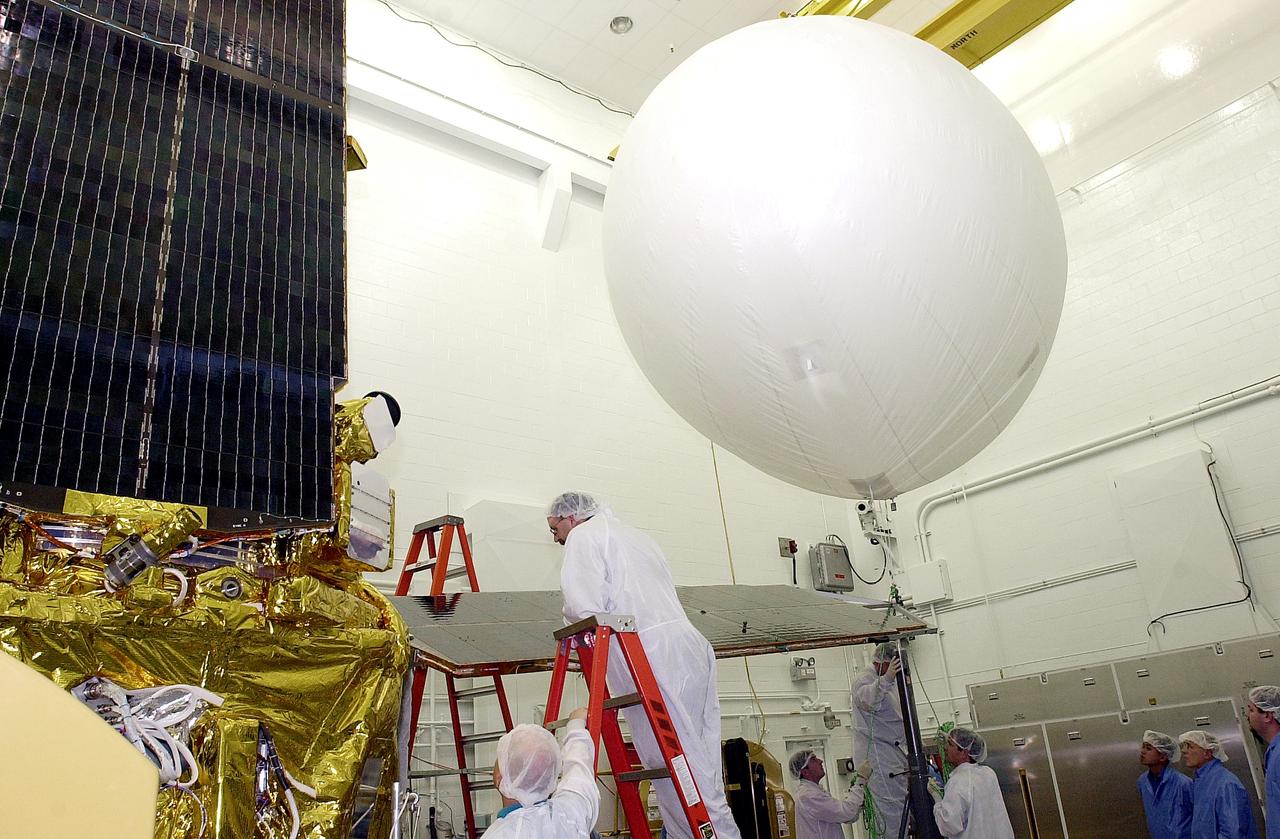
VANDENBERG AFB, CALIF. -  In the NASA spacecraft processing facility on North Vandenberg Air Force Base, a balloon gently lifts the solar array panel to be installed on the Gravity Probe B spacecraft.  Installing each array is a 3-day process and includes a functional deployment test.  The Gravity Probe B mission is a relativity experiment developed by NASA’s Marshall Space Flight Center, Stanford University and Lockheed Martin.  The spacecraft will test two extraordinary predictions of Albert Einstein’s general theory of relativity that he advanced in 1916: the geodetic effect (how space and time are warped by the presence of the Earth) and frame dragging (how Earth’s rotation drags space and time around with it).  Gravity Probe B consists of four sophisticated gyroscopes that will provide an almost perfect space-time reference system.  The mission will look in a precision manner for tiny changes in the direction of spin.
VANDENBERG AFB, CALIF. - In the NASA spacecraft processing facility on North Vandenberg Air Force Base, a balloon gently lifts the solar array panel to be installed on the Gravity Probe B spacecraft. Installing each array is a 3-day process and includes a functional deployment test. The Gravity Probe B mission is a relativity experiment developed by NASA’s Marshall Space Flight Center, Stanford University and Lockheed Martin. The spacecraft will test two extraordinary predictions of Albert Einstein’s general theory of relativity that he advanced in 1916: the geodetic effect (how space and time are warped by the presence of the Earth) and frame dragging (how Earth’s rotation drags space and time around with it). Gravity Probe B consists of four sophisticated gyroscopes that will provide an almost perfect space-time reference system. The mission will look in a precision manner for tiny changes in the direction of spin.
FROM RIGHT, MARSHALL RESEARCHER DR. DAVID SMITH, U.S. ARMY RESEARCHER KRISHNA MYNENI AND ARMY CONTRACTOR HONGROK CHANG HAVE BEGUN A THREE-YEAR NASA PROJECT TO DEVELOP INNOVATIVE NEW GYROSCOPES THAT COULD DRAMATICALLY IMPROVE IN-FLIGHT NAVIGATION CAPABILITIES FOR SPACE VEHICLES, MILITARY AIR AND SEA ASSETS AND COMMERCIAL VEHICLES. THE “FAST LIGHT OPTICAL GYROSCOPES FOR PRECISE INERTIAL NAVIGATION” PROJECT INCLUDES RESEARCHERS AT NASA’S MARSHALL SPACE FLIGHT CENTER IN HUNTSVILLE, ALA.; THE U.S. ARMY AVIATION AND MISSILE RESEARCH, DEVELOPMENT AND ENGINEERING CENTER (AMRDEC) AT REDSTONE ARSENAL IN HUNTSVILLE; AND NORTHWESTERN UNIVERSITY IN EVANSTON, ILL.
1201050
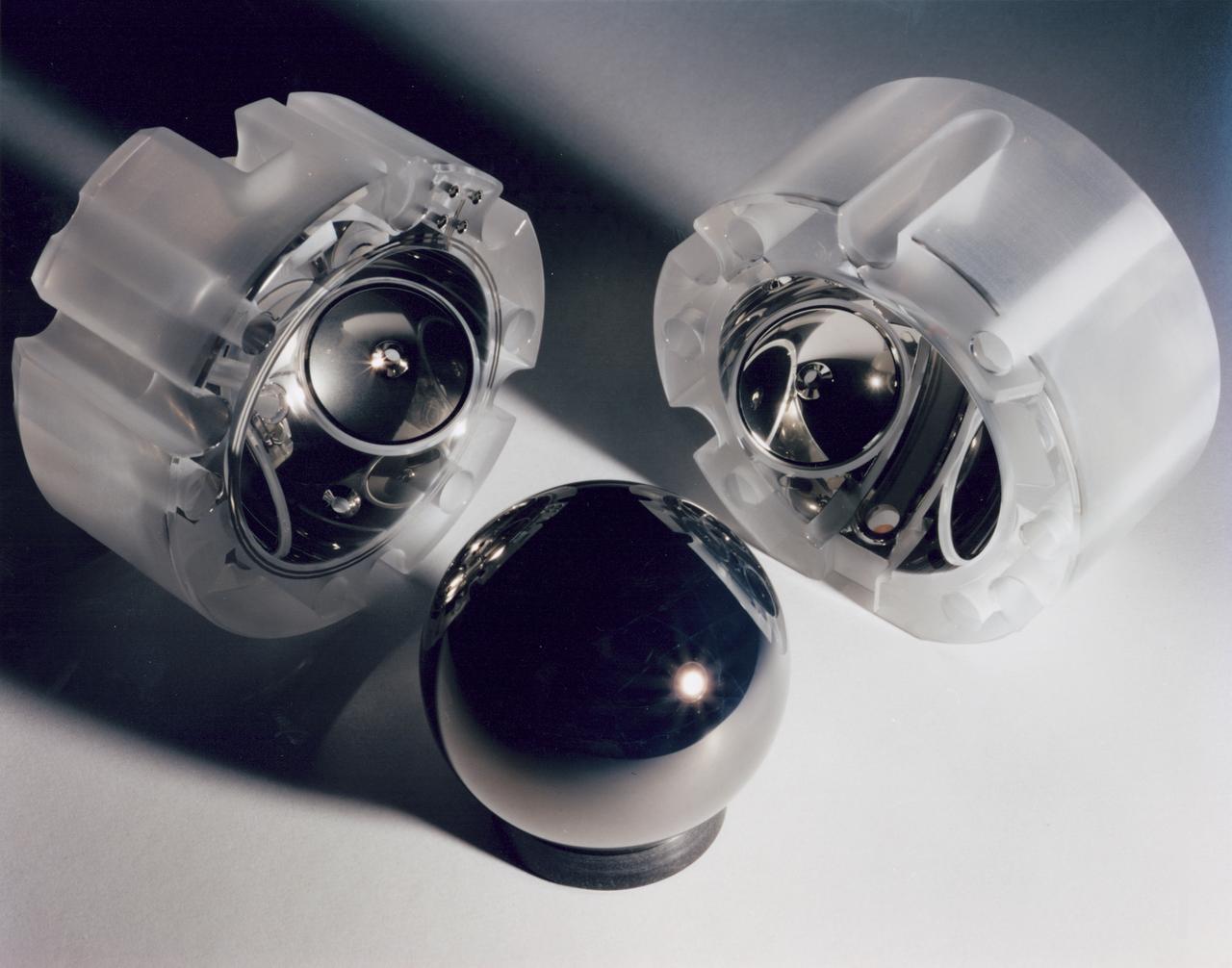
The Gravity Probe B (GP-B) is the relativity experiment developed at Stanford University to test two extraordinary predictions of Albert Einstein’s general theory of relativity. The experiment will measure, very precisely, the expected tiny changes in the direction of the spin axes of four gyroscopes contained in an Earth-orbiting satellite at a 400-mile altitude. So free are the gyroscopes from disturbance that they will provide an almost perfect space-time reference system. They will measure how space and time are very slightly warped by the presence of the Earth, and, more profoundly, how the Earth’s rotation very slightly drags space-time around with it. These effects, though small for the Earth, have far-reaching implications for the nature of matter and the structure of the Universe. This photograph is a close up of a niobium-coated gyroscope motor and its housing halves. GP-B is among the most thoroughly researched programs ever undertaken by NASA. This is the story of a scientific quest in which physicists and engineers have collaborated closely over many years. Inspired by their quest, they have invented a whole range of technologies that are already enlivening other branches of science and engineering.  Launched  April 20, 2004 , the GP-B program was managed for NASA by the Marshall Space Flight Center. Development of the GP-B is the responsibility of Stanford University along with major subcontractor Lockheed Martin Corporation.  (Image credit to Don Harley.)
Space Science
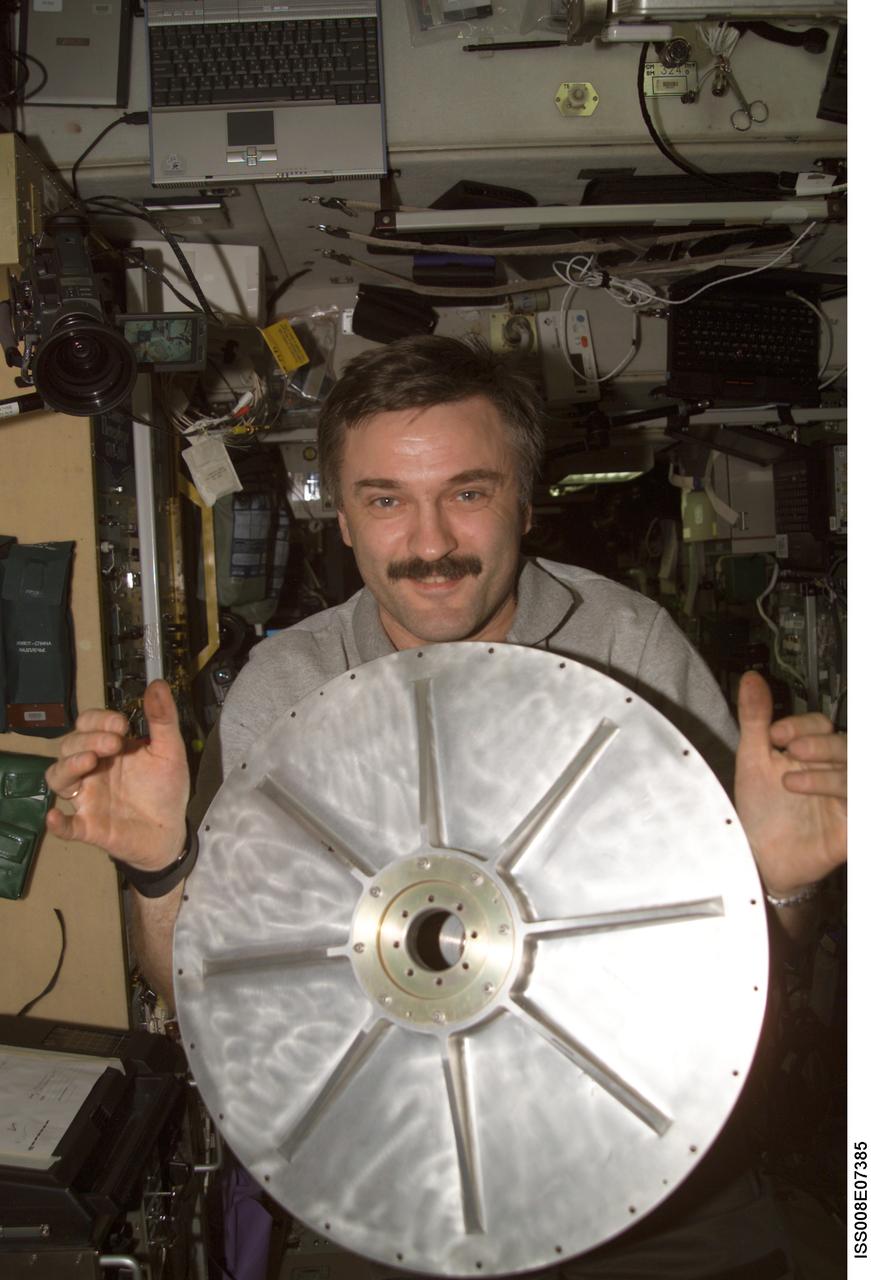
ISS008-E-07385 (9 December 2003) --- Cosmonaut Alexander Y. Kaleri, Expedition 8 flight engineer, holds the top end-cap for the Treadmill Vibration Isolation System (TVIS) gyroscope in the Zvezda Service Module on the International Space Station (ISS). Kaleri represents Rosaviakosmos.
Kaleri holds the top endcap for the TVIS Gyroscope in SM during Expedition 8
ISS008-E-07384 (9 Dec. 2003) --- Astronaut C. Michael Foale, Expedition 8 commander and NASA ISS science officer, holds the top end-cap for the Treadmill Vibration Isolation System (TVIS) gyroscope in the Zvezda Service Module on the International Space Station (ISS).
Foale holds the top endcap for the TVIS Gyroscope in SM during Expedition 8
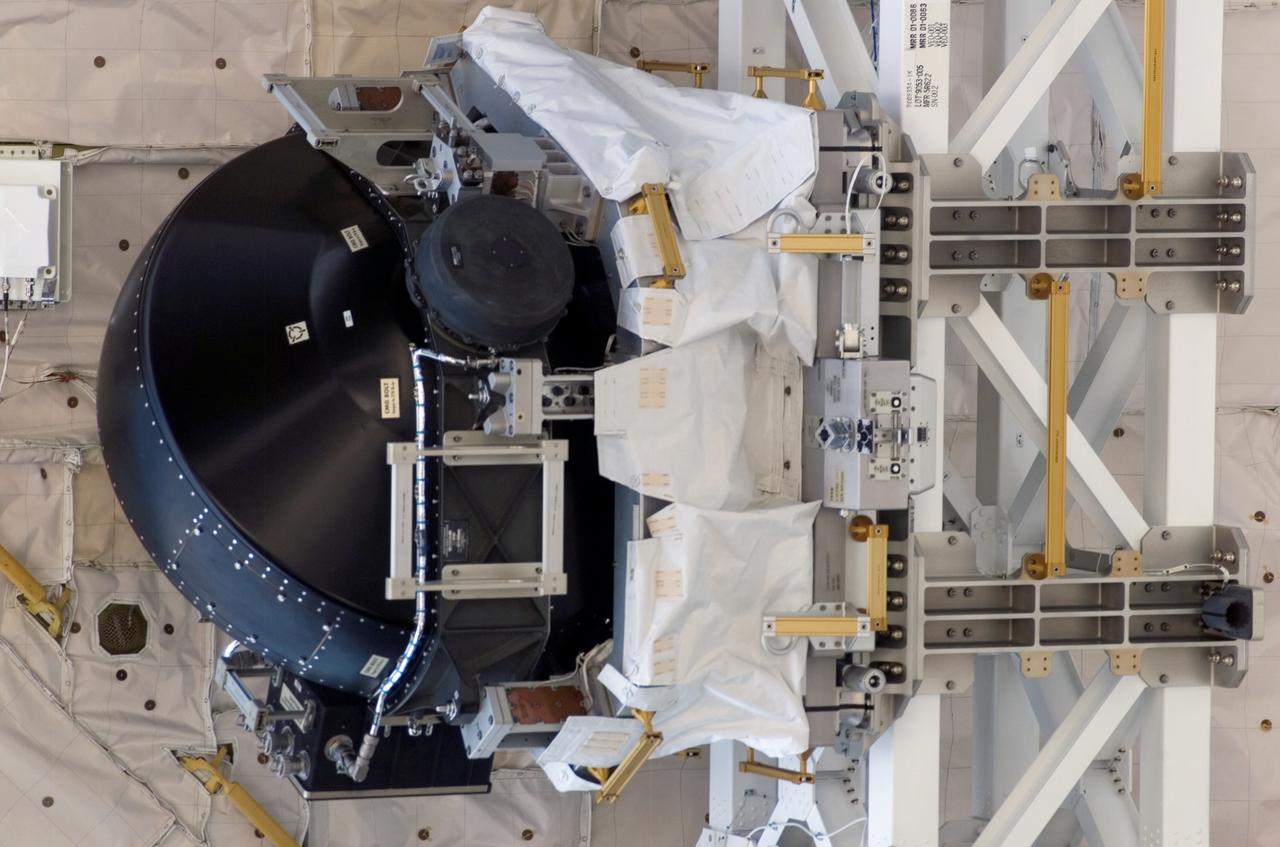
ISS011-E-11356 (30 July 2005) --- A new Control Moment Gyroscope (CMG) sits in its cradle in the payload bay of the Space Shuttle Discovery prior to its installation on the International Space Station. During their spacewalk scheduled for Monday, August 1, astronaut Stephen K. Robinson and Japan Aerospace Exploration Agency (JAXA) astronaut Soichi Noguchi, both STS-114 mission specialists, will replace CMG-1, which had failed in June 2002, with the new CMG bought onboard Discovery.
Control Moment Gyroscope in payload bay during EVA 1
KENNEDY SPACE CENTER, FLA.  - This logo for the Gravity Probe B mission portrays the theory of curved spacetime and "frame-dragging," developed by Einstein and other scientists, that the mission will test.  The Gravity Probe B will launch a payload of four gyroscopes into low-Earth polar orbit. Once in orbit, for 18 months each gyroscope’s spin axis will be monitored as it travels through local spacetime, observing and measuring the effects.  The experiment was developed by Stanford University, NASA’s Marshall Space Flight Center and Lockheed Martin.
KENNEDY SPACE CENTER, FLA. - This logo for the Gravity Probe B mission portrays the theory of curved spacetime and "frame-dragging," developed by Einstein and other scientists, that the mission will test. The Gravity Probe B will launch a payload of four gyroscopes into low-Earth polar orbit. Once in orbit, for 18 months each gyroscope’s spin axis will be monitored as it travels through local spacetime, observing and measuring the effects. The experiment was developed by Stanford University, NASA’s Marshall Space Flight Center and Lockheed Martin.
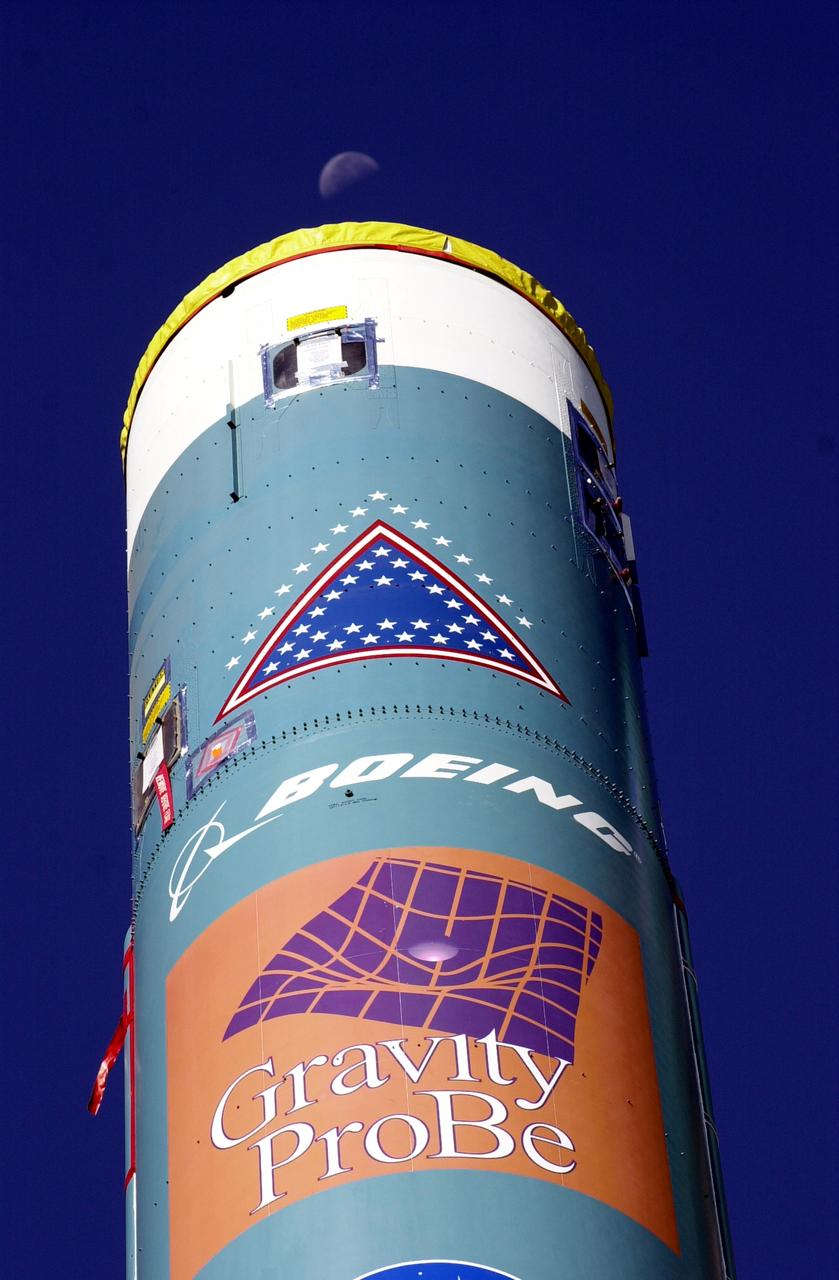
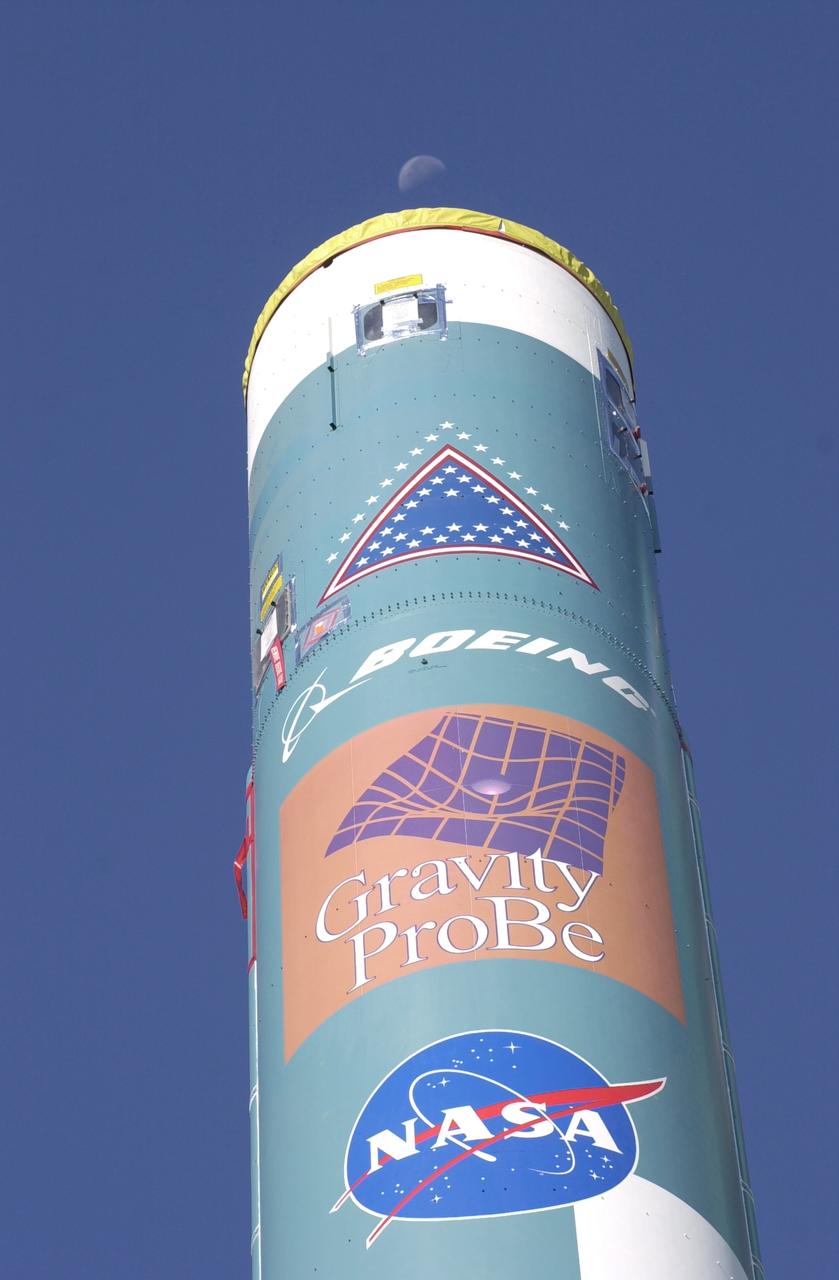
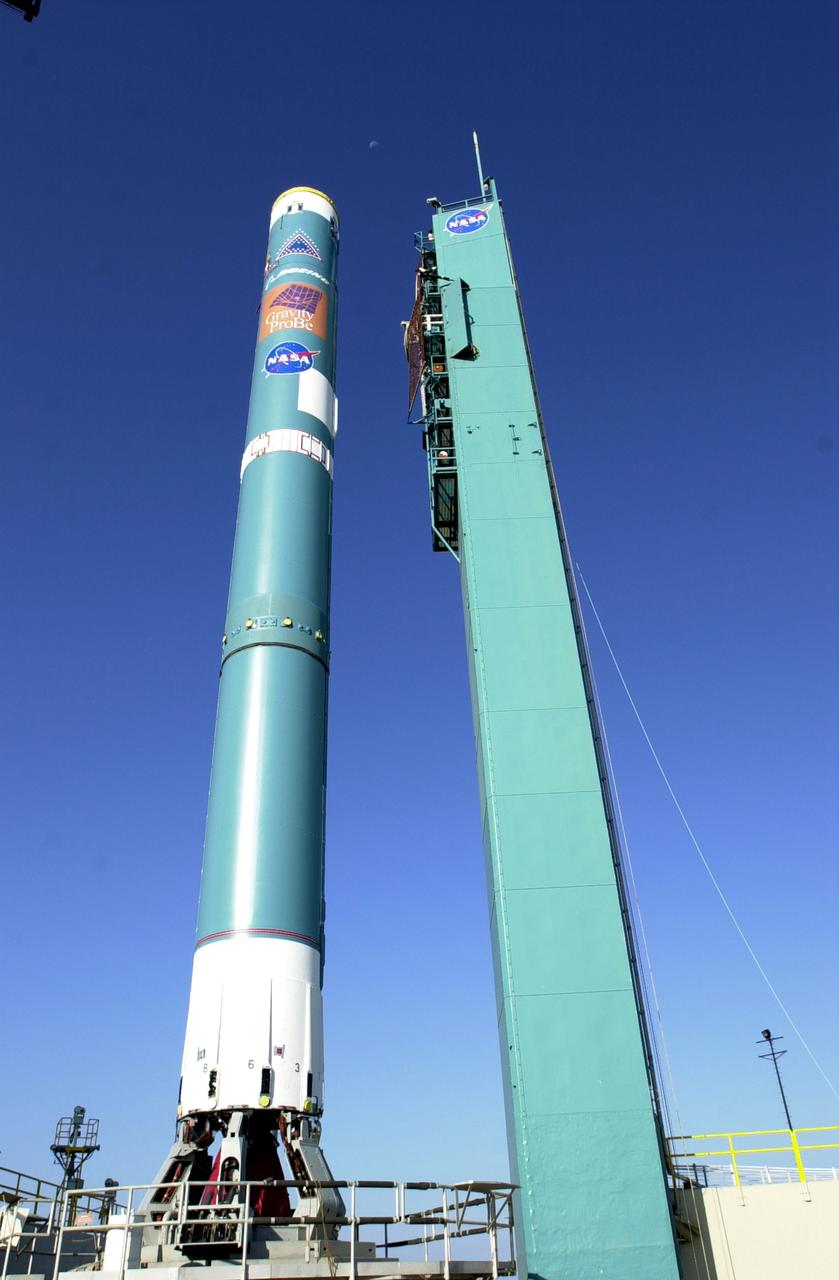
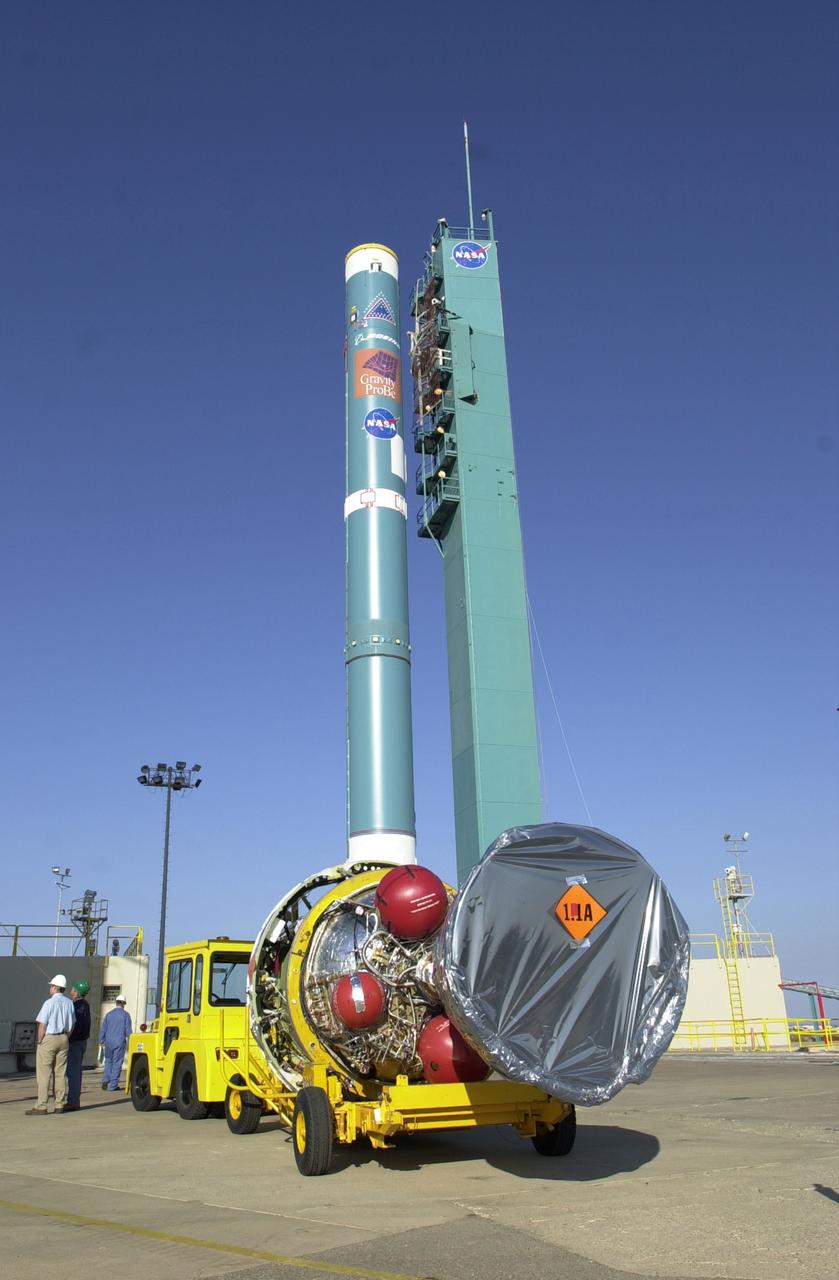
VANDENBERG AFB, CALIF. -  Logos identify the mission of this Delta II rocket that will launch the Gravity Probe B experiment, developed by Stanford University, Lockheed Martin and NASA’s Marshall Space Flight Center.   The Gravity Probe B will launch a payload of four gyroscopes into low-Earth polar orbit to test two extraordinary predictions of Albert Einstein’s general theory of relativity: the geodetic effect (how space and time are warped by the presence of the Earth) and frame dragging (how Earth’s rotation drags space and time around with it). Once in orbit, for 18 months each gyroscope’s spin axis will be monitored as it travels through local spacetime, observing and measuring these effects. The targeted launch date is Dec. 6, 2003.
VANDENBERG AFB, CALIF. - Logos identify the mission of this Delta II rocket that will launch the Gravity Probe B experiment, developed by Stanford University, Lockheed Martin and NASA’s Marshall Space Flight Center. The Gravity Probe B will launch a payload of four gyroscopes into low-Earth polar orbit to test two extraordinary predictions of Albert Einstein’s general theory of relativity: the geodetic effect (how space and time are warped by the presence of the Earth) and frame dragging (how Earth’s rotation drags space and time around with it). Once in orbit, for 18 months each gyroscope’s spin axis will be monitored as it travels through local spacetime, observing and measuring these effects. The targeted launch date is Dec. 6, 2003.
VANDENBERG AFB, CALIF. -  Logos identify the mission of this Delta II rocket that will launch the Gravity Probe B experiment, developed by Stanford University, Lockheed Martin and NASA’s Marshall Space Flight Center.   The Gravity Probe B will launch a payload of four gyroscopes into low-Earth polar orbit to test two extraordinary predictions of Albert Einstein’s general theory of relativity: the geodetic effect (how space and time are warped by the presence of the Earth) and frame dragging (how Earth’s rotation drags space and time around with it). Once in orbit, for 18 months each gyroscope’s spin axis will be monitored as it travels through local spacetime, observing and measuring these effects. The targeted launch date is Dec. 6, 2003.
VANDENBERG AFB, CALIF. - Logos identify the mission of this Delta II rocket that will launch the Gravity Probe B experiment, developed by Stanford University, Lockheed Martin and NASA’s Marshall Space Flight Center. The Gravity Probe B will launch a payload of four gyroscopes into low-Earth polar orbit to test two extraordinary predictions of Albert Einstein’s general theory of relativity: the geodetic effect (how space and time are warped by the presence of the Earth) and frame dragging (how Earth’s rotation drags space and time around with it). Once in orbit, for 18 months each gyroscope’s spin axis will be monitored as it travels through local spacetime, observing and measuring these effects. The targeted launch date is Dec. 6, 2003.
ISS018-E-041052 (18 March 2009) --- Japan Aerospace Exploration Agency (JAXA) astronaut Koichi Wakata, Expedition 18 flight engineer, is pictured in the Zvezda Service Module of the International Space Station while Space Shuttle Discovery (STS-119) remains docked with the station.
Gyroscope Maintenance in Service Module (SM)
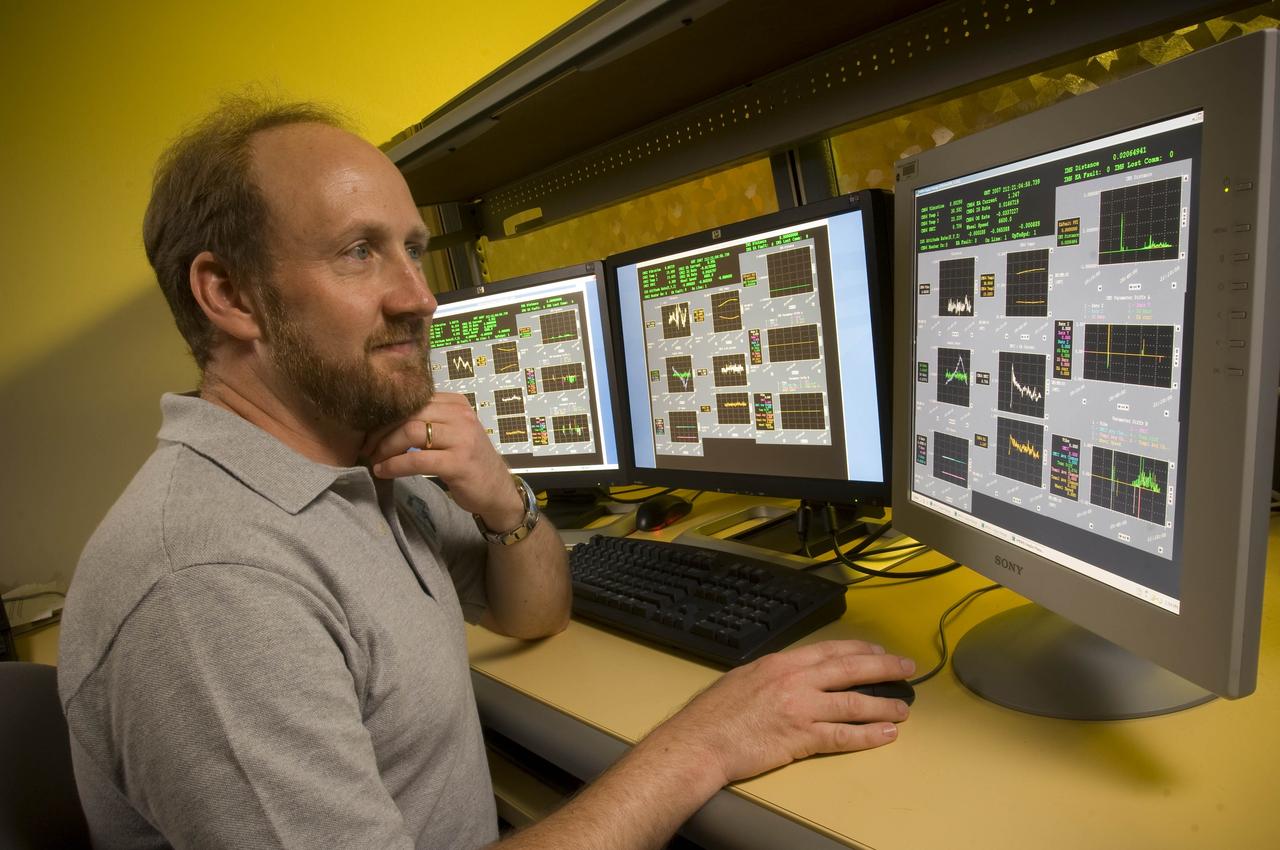
David L. Iverson of NASA Ames Research center, Moffett Field, California, led development of computer software to monitor the conditions of the gyroscopes that keep the International Space Station (ISS) properly oriented in space as the ISS orbits Earth.   The gyroscopes are flywheels that control the station's attitude without the use of propellant fuel. NASA computer scientists designed the new software, the Inductive Monitoring System, to detect warning signs that precede a gyroscope's failure. According to NASA officials, engineers will add the new software tool to a group of existing tools to identify and track problems related to the gyroscopes.  If the software detects warning signs, it will quickly warn the space station's mission control center.
ARC-2007-ACD07-0140-001
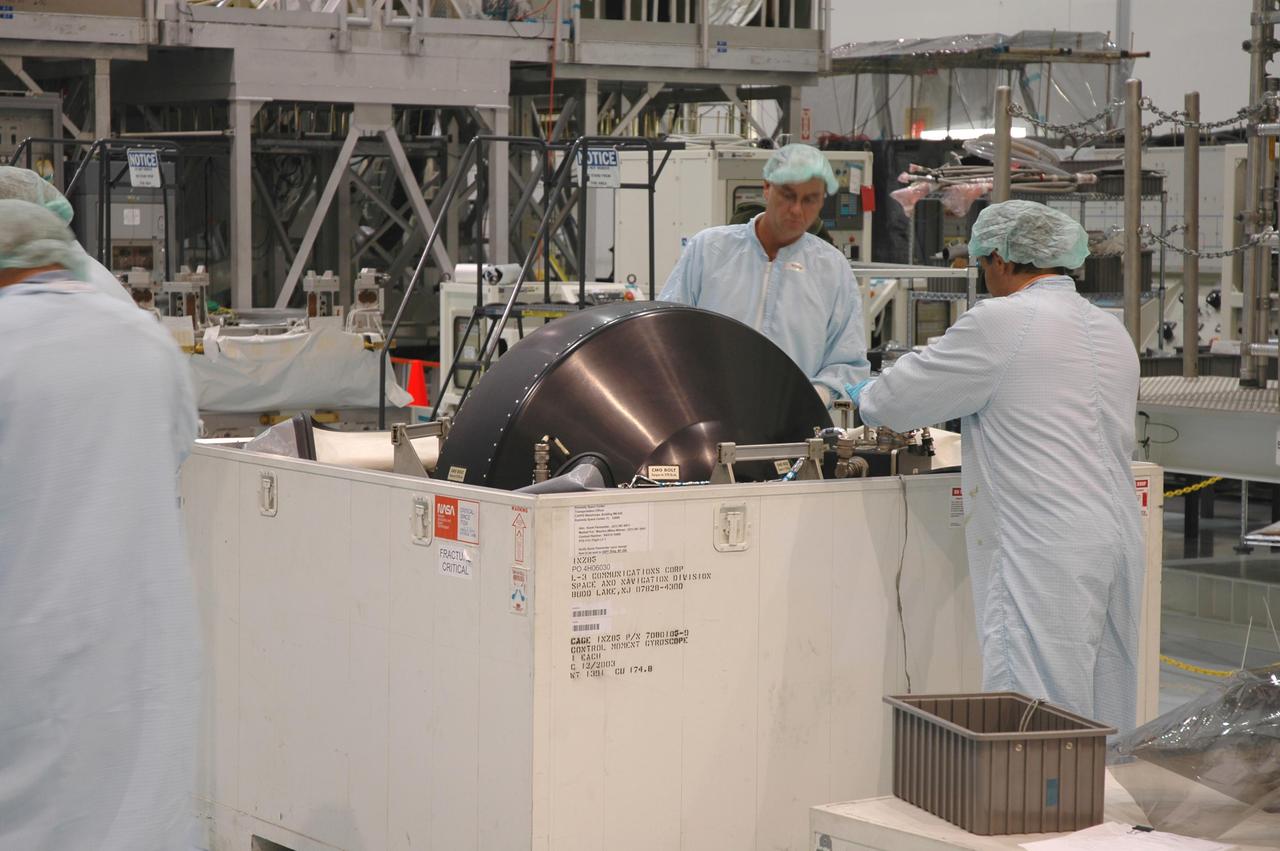
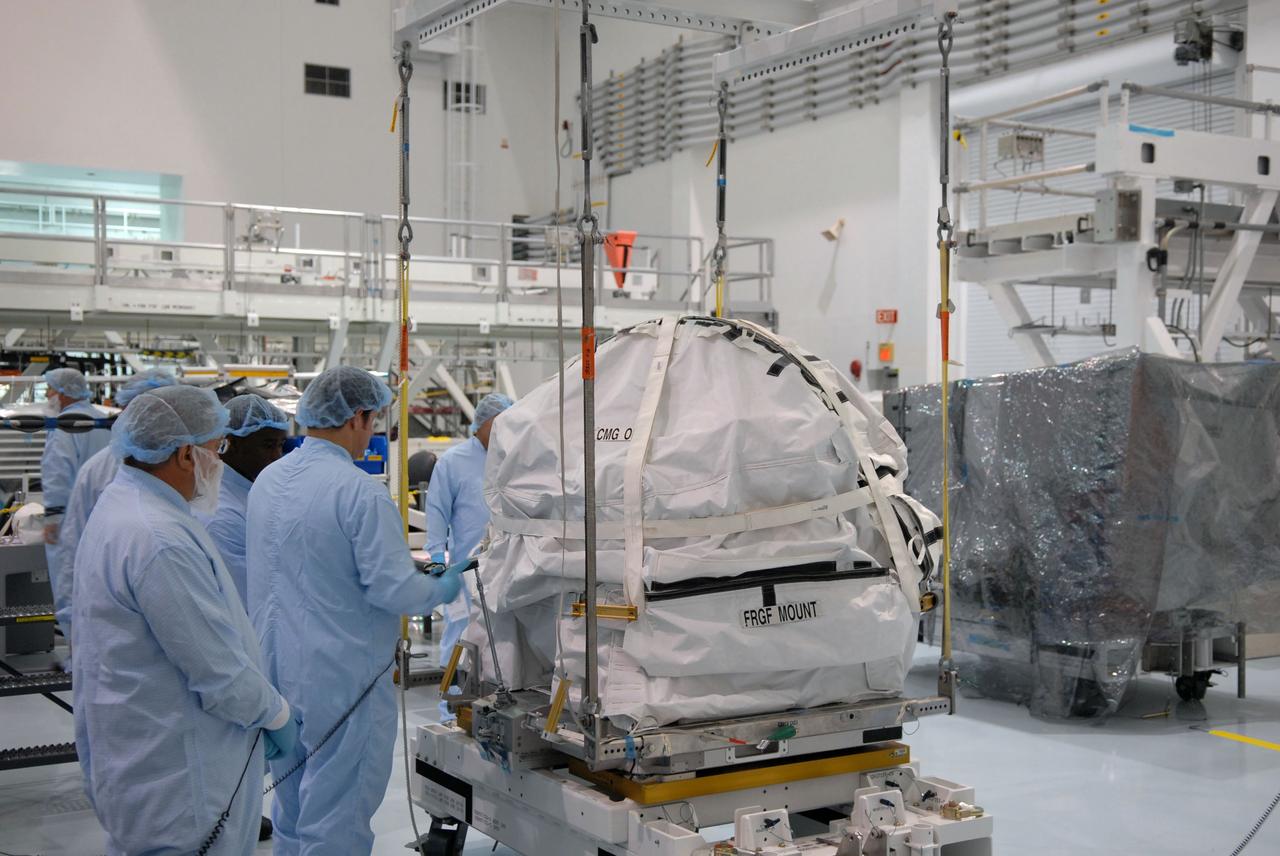
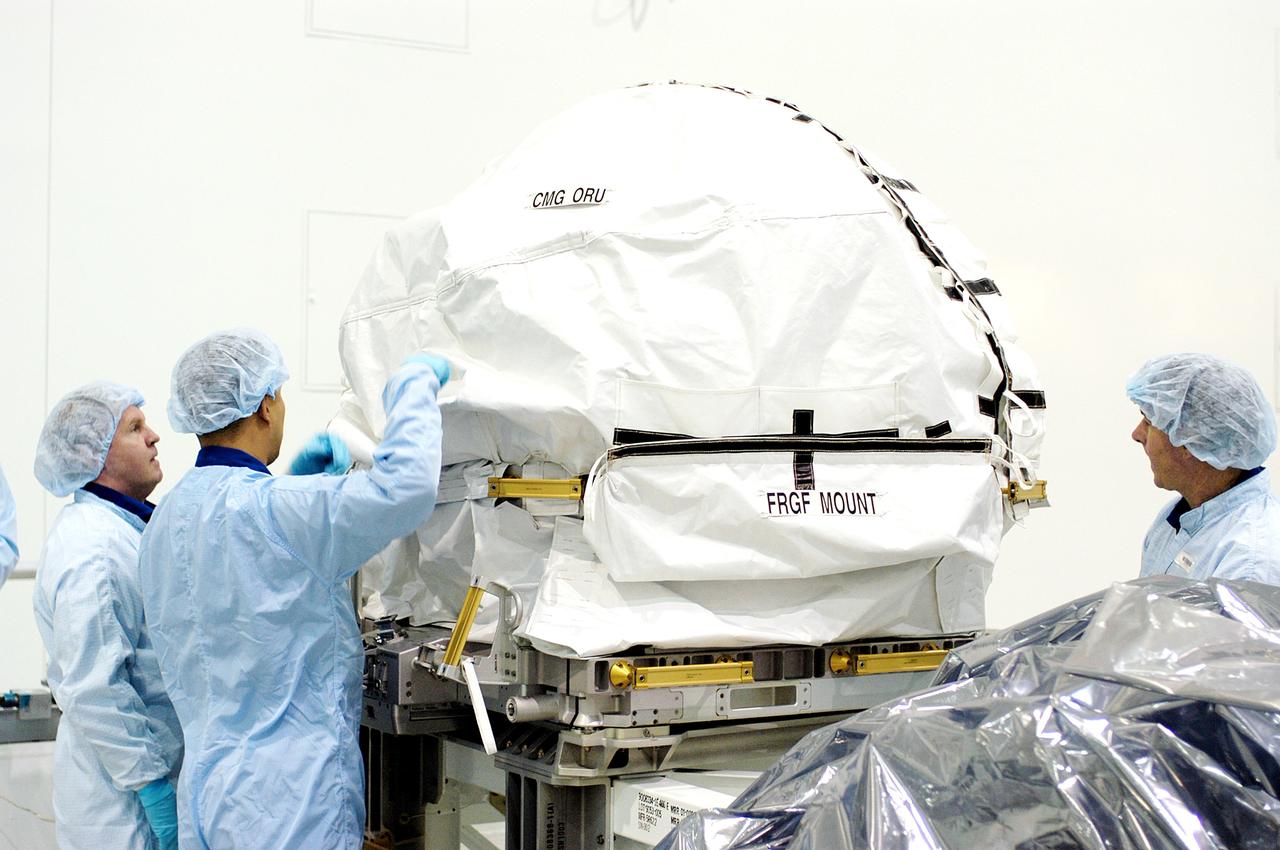
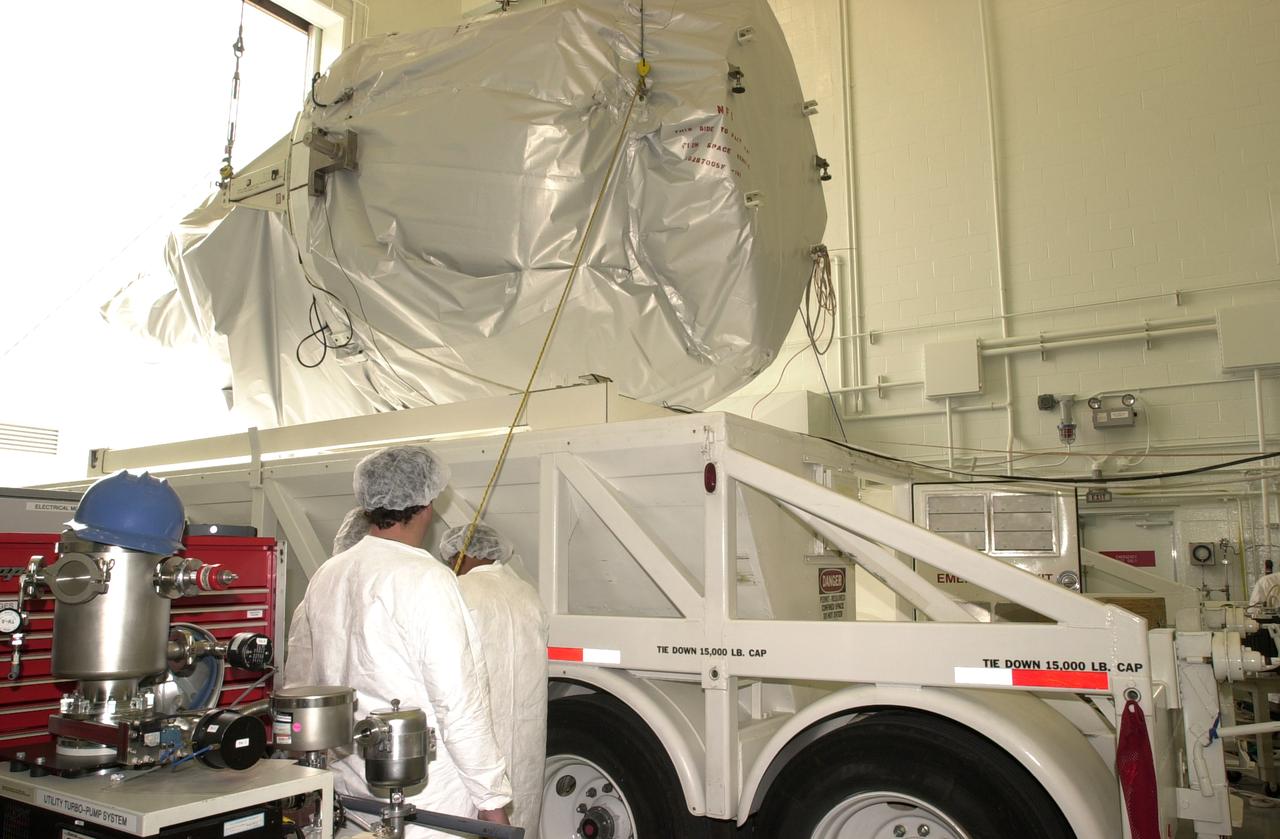
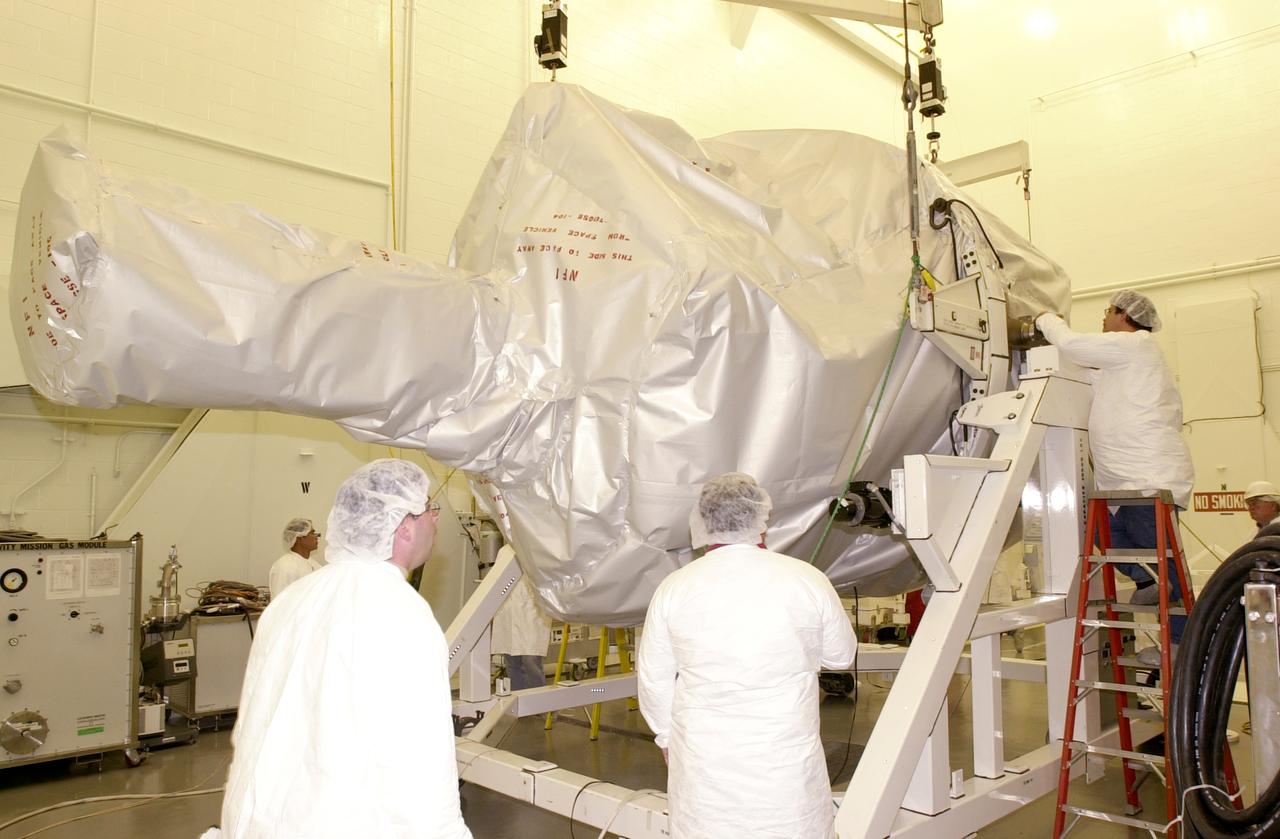
KENNEDY SPACE CENTER, FLA.  -  In the Space Station Processing Facility, workers help maneuver the Control Moment Gyroscope (CMG) onto a stand prior to its being returned to the vendor for repair.  The faulty CMG was removed from the International Space Station and replaced with a new one on mission STS-114 in August.  A control moment gyroscope  is an actuator used to apply very high attitude-control torques to agile spacecraft.  The Space Station uses four massive control moment gyroscopes to maintain the Station’s orientation in space.
KSC-05PD-2068
KENNEDY SPACE CENTER, FLA.  -  In the Space Station Processing Facility, the Control Moment Gyroscope (CMG) at left is being returned to the vendor for repair.  The faulty CMG was removed from the International Space Station and replaced with a new one on mission STS-114 in August.  A control moment gyroscope  is an actuator used to apply very high attitude-control torques to agile spacecraft.  The Space Station uses four massive control moment gyroscopes to maintain the Station’s orientation in space.
KSC-05PD-2065
KENNEDY SPACE CENTER, FLA.  - In the Space Station Processing Facility, the Control Moment Gyroscope (CMG) is moved toward a stand prior to its being returned to the vendor for repair.  The faulty CMG was removed from the International Space Station and replaced with a new one on mission STS-114 in August.   A control moment gyroscope  is an actuator used to apply very high attitude-control torques to agile spacecraft.  The Space Station uses four massive control moment gyroscopes to maintain the Station’s orientation in space.
KSC-05PD-2067
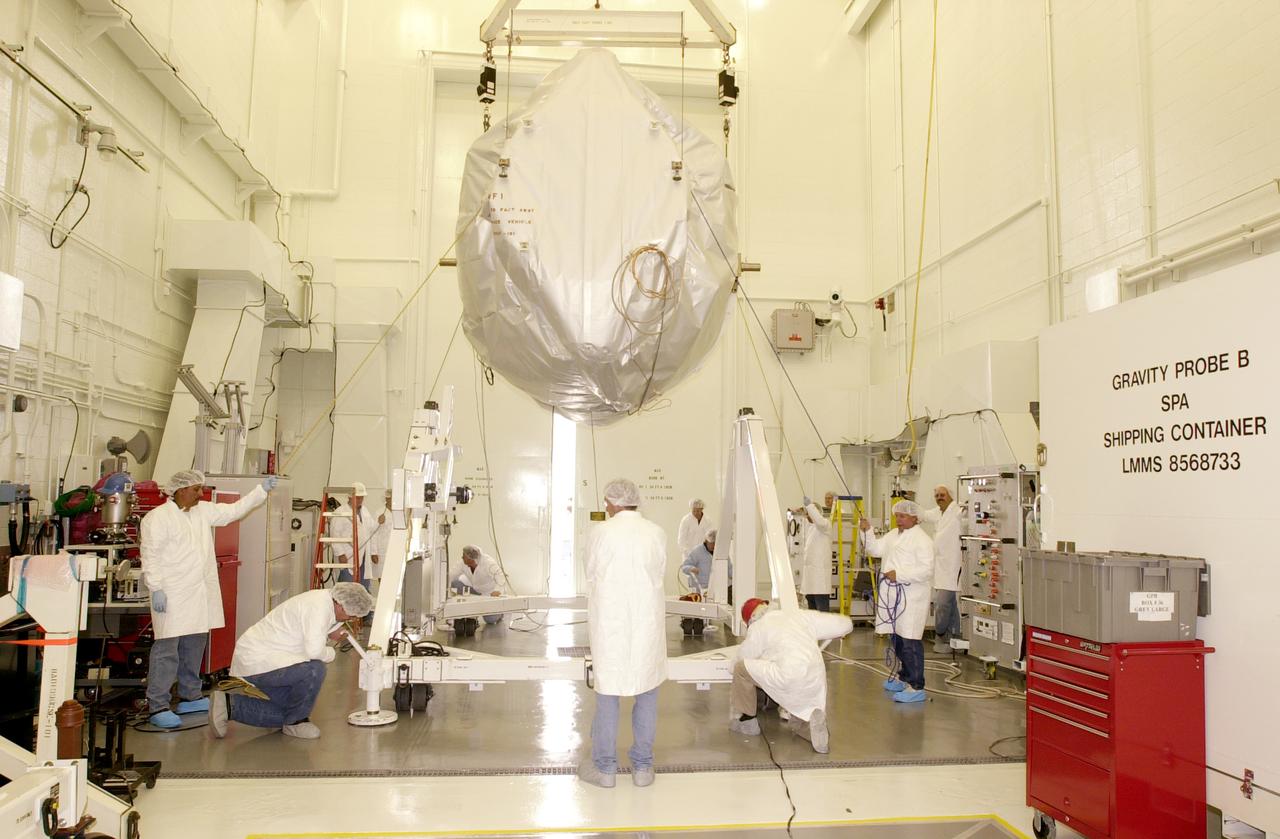
KENNEDY SPACE CENTER, FLA.  -  In the Space Station Processing Facility, workers oversee the packing of the Control Moment Gyroscope (CMG) in a shipping container.  The faulty CMG was removed from the International Space Station and replaced with a new one on mission STS-114 in August.   A control moment gyroscope  is an actuator used to apply very high attitude-control torques to agile spacecraft.  The Space Station uses four massive control moment gyroscopes to maintain the Station’s orientation in space.
KSC-05PD-2070
KENNEDY SPACE CENTER, FLA.  - The Control Moment Gyroscope (CMG) is moved across the floor of the Space Station Processing Facility.  It is being transferred to a stand prior to its being returned to the vendor for repair.  The faulty CMG was removed from the International Space Station and replaced with a new one on mission STS-114 in August.  A control moment gyroscope  is an actuator used to apply very high attitude-control torques to agile spacecraft.  The Space Station uses four massive control moment gyroscopes to maintain the Station’s orientation in space.
KSC-05PD-2066
David L. Iverson of NASA Ames Research Center, Moffett Field, California (in foreground) led development of computer software to monitor the conditions of the gyroscopes that keep the International Space Station (ISS) properly oriented in space as the ISS orbits Earth. Also, Charles Lee is pictured.   During its develoment, researchers used the software to analyze archived gyroscope records.  In these tests, users noticed problems with the gyroscopes long before the current systems flagged glitches.  Testers trained using several months of normal space station gyroscope data collected by the International Space Station Mission Control Center at NASA Johnson Space Center, Houston.  Promising tests results convinced officials to start using the software in 2007.
ARC-2007-ACD07-0140-002
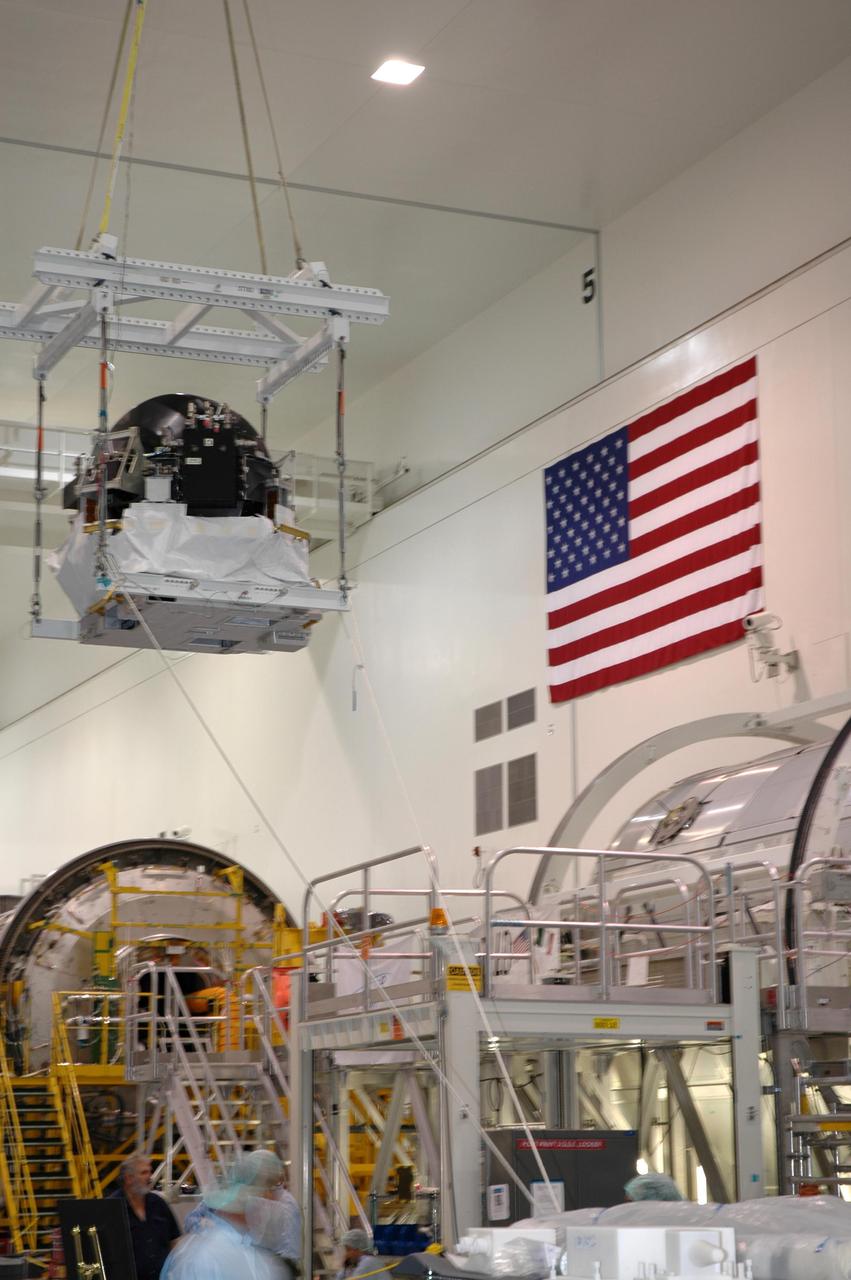
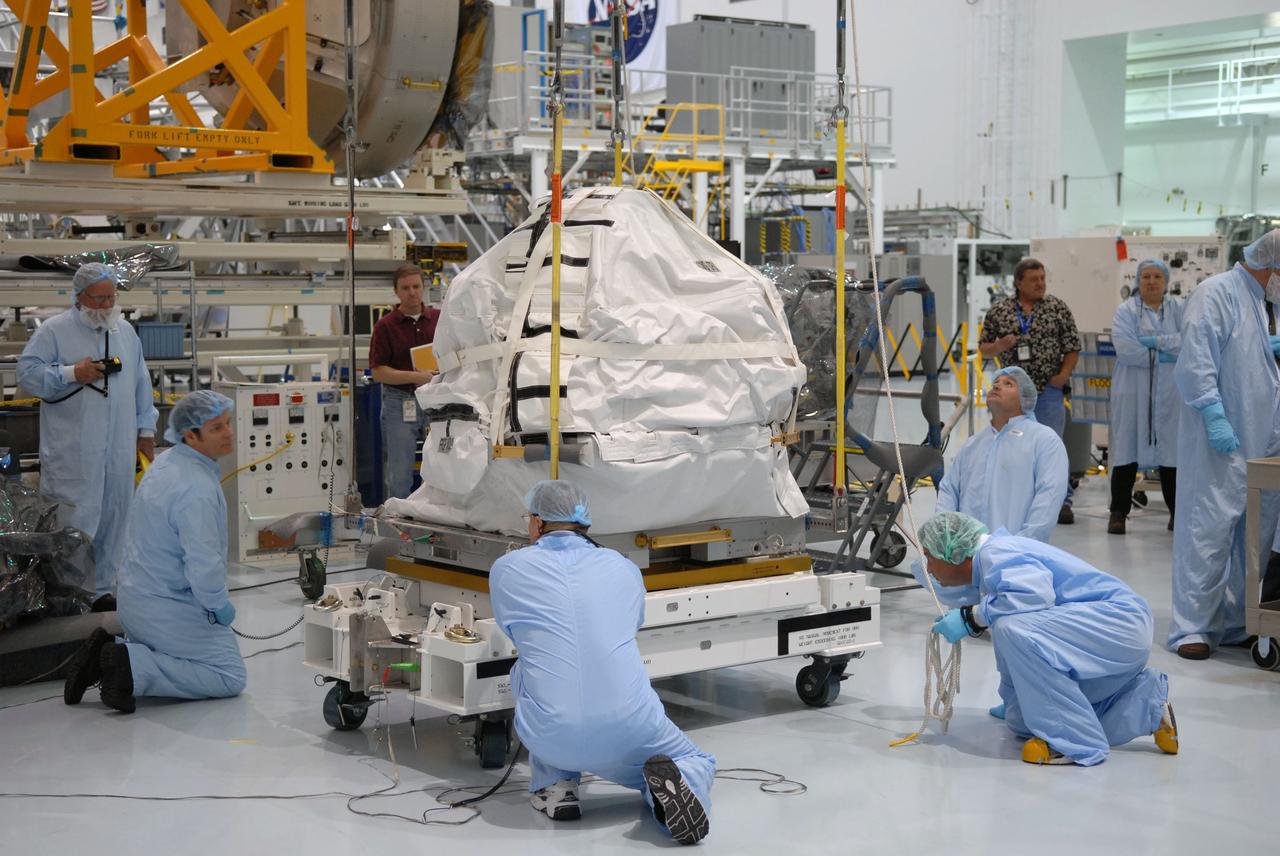
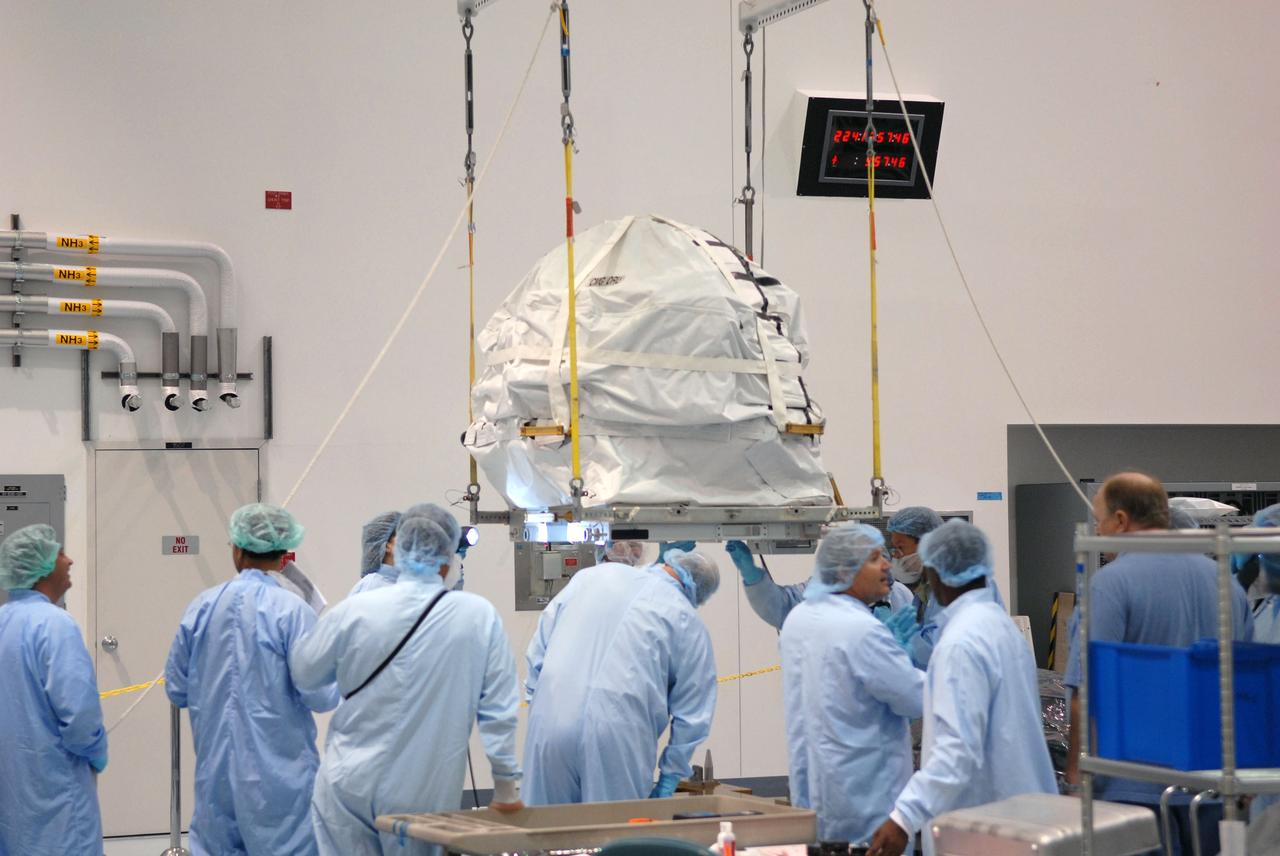
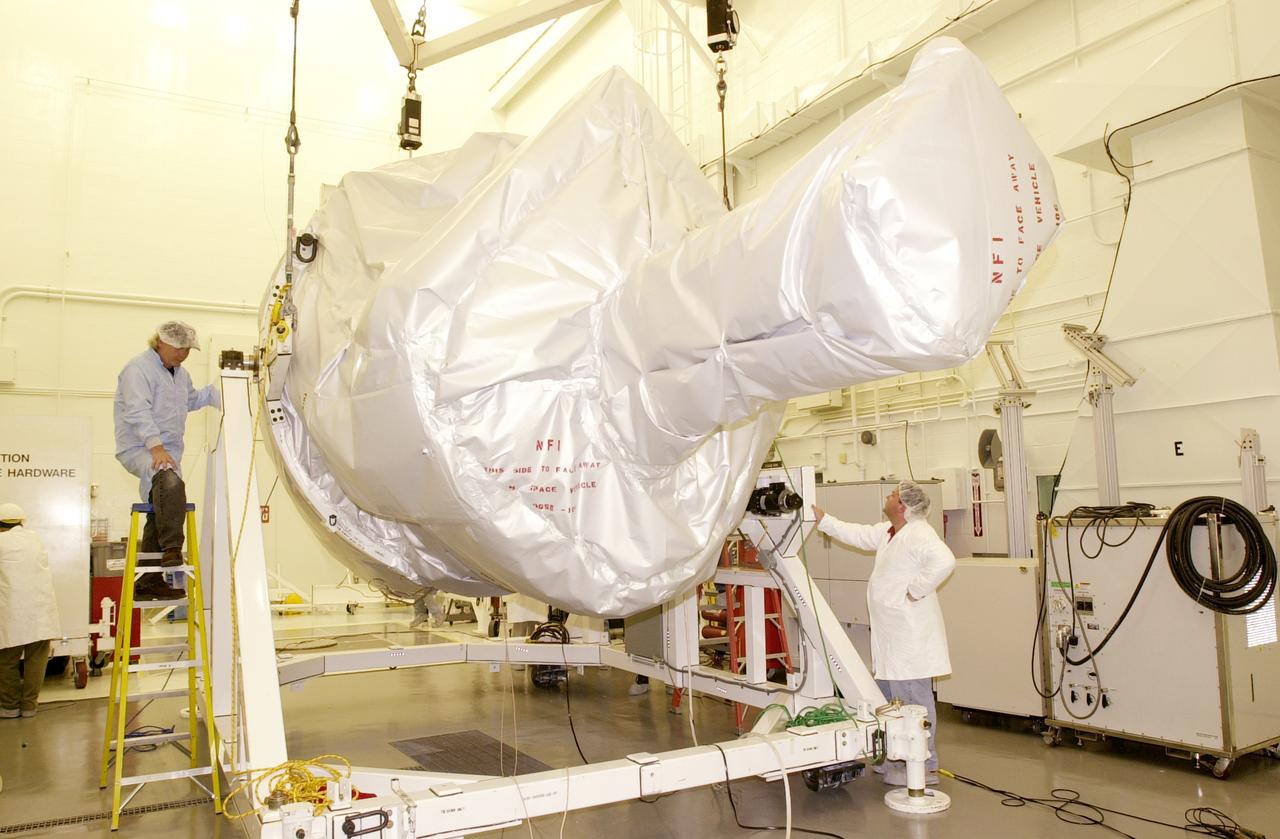
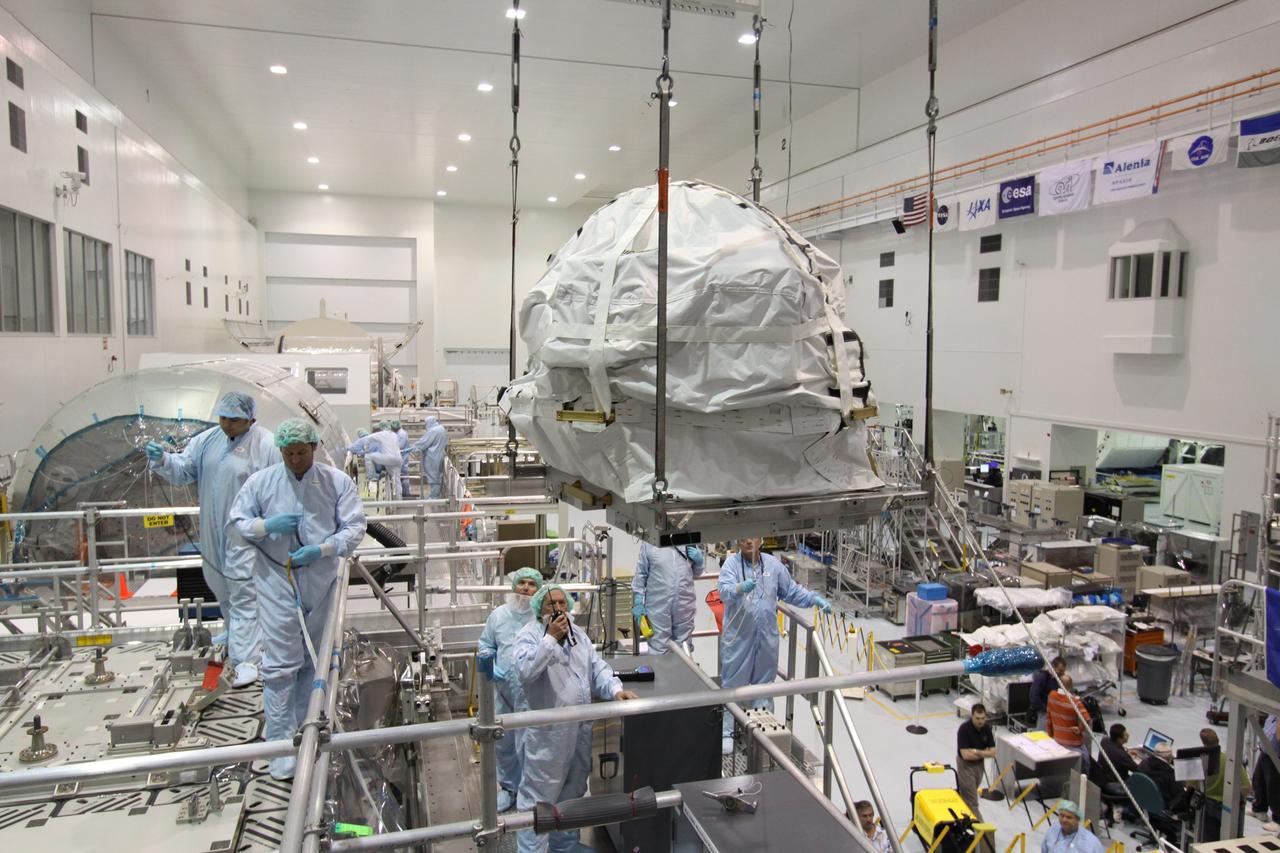
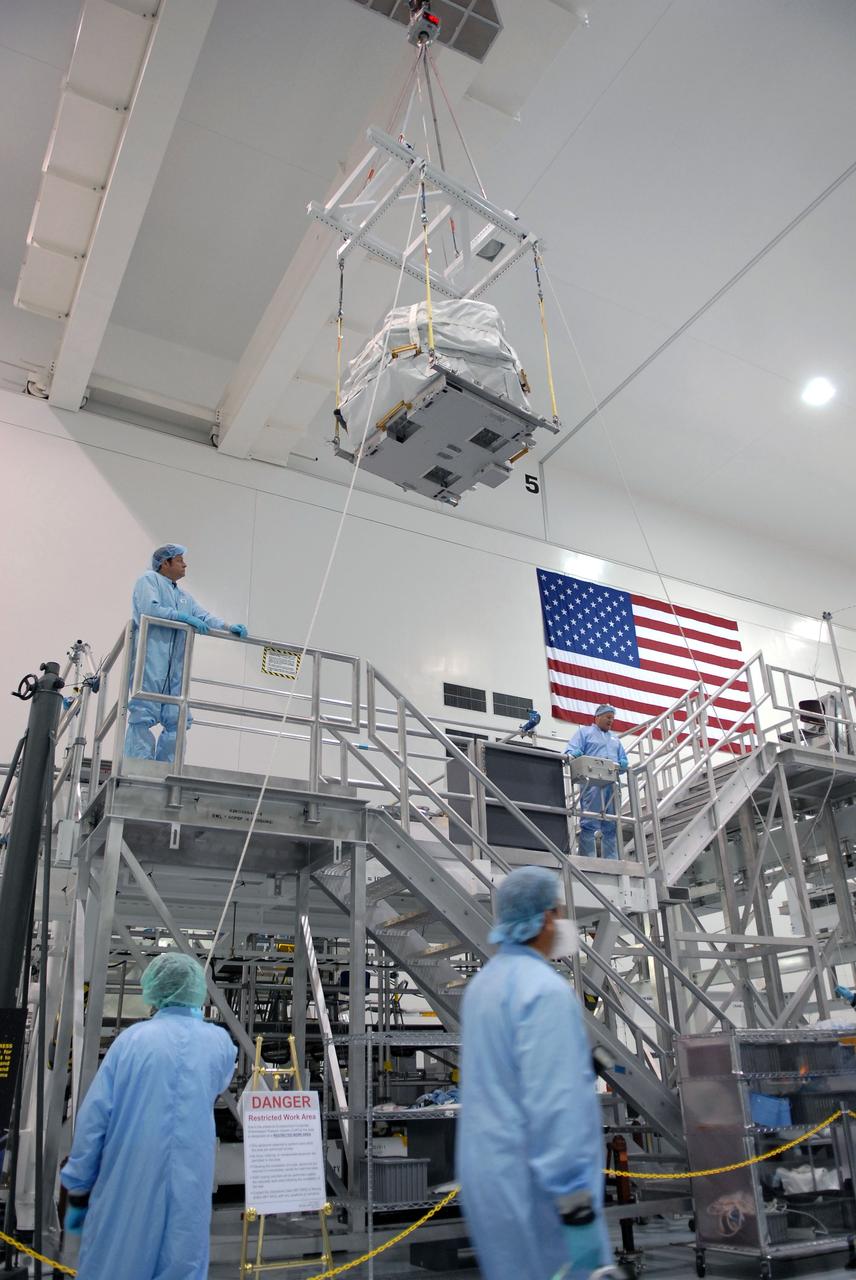
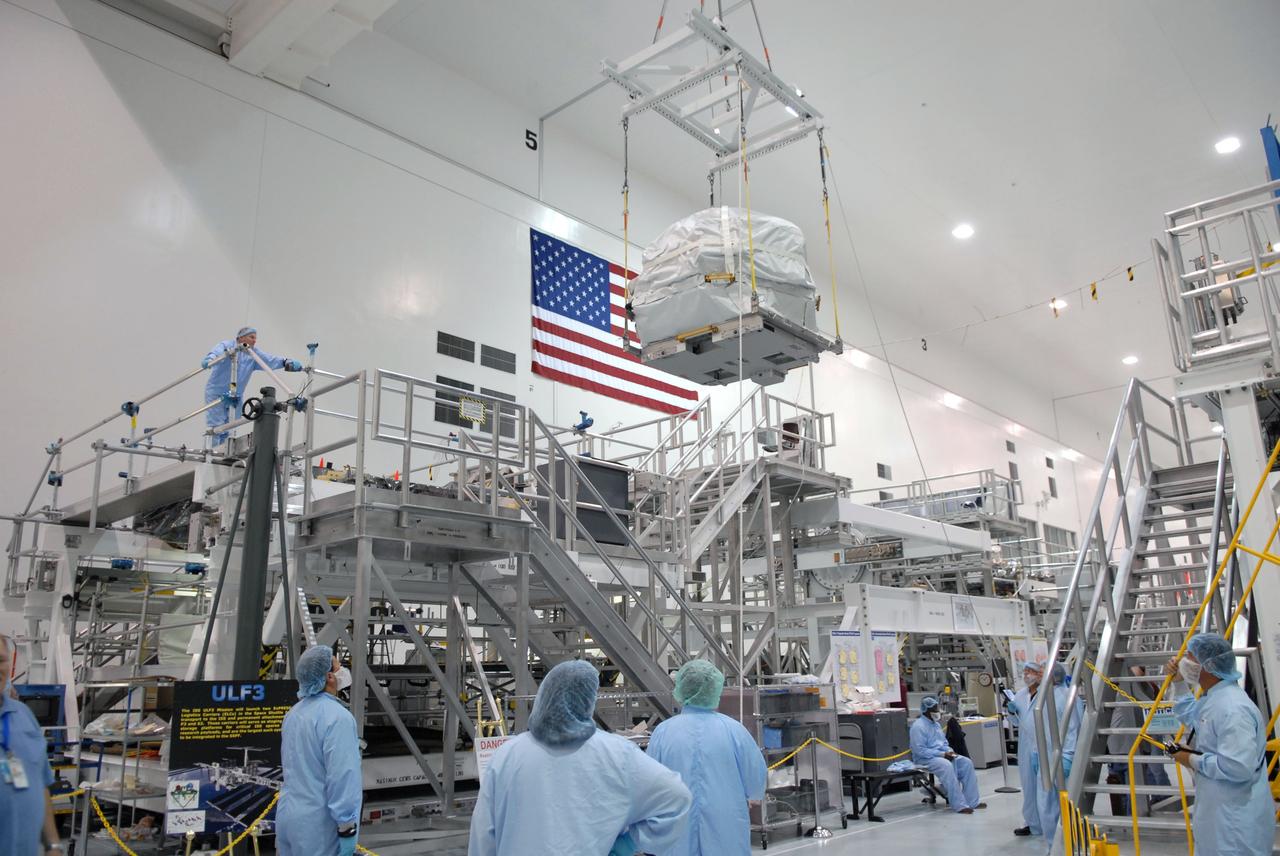
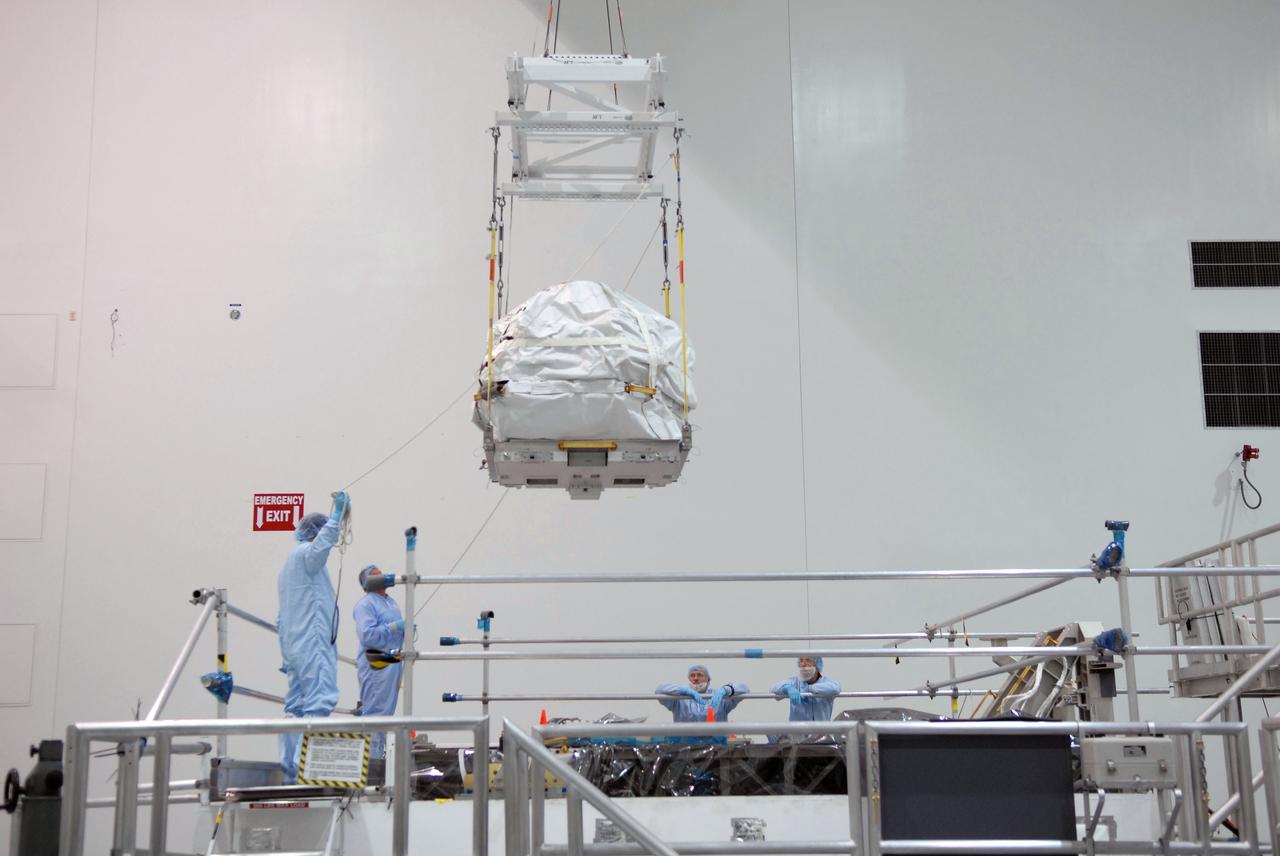
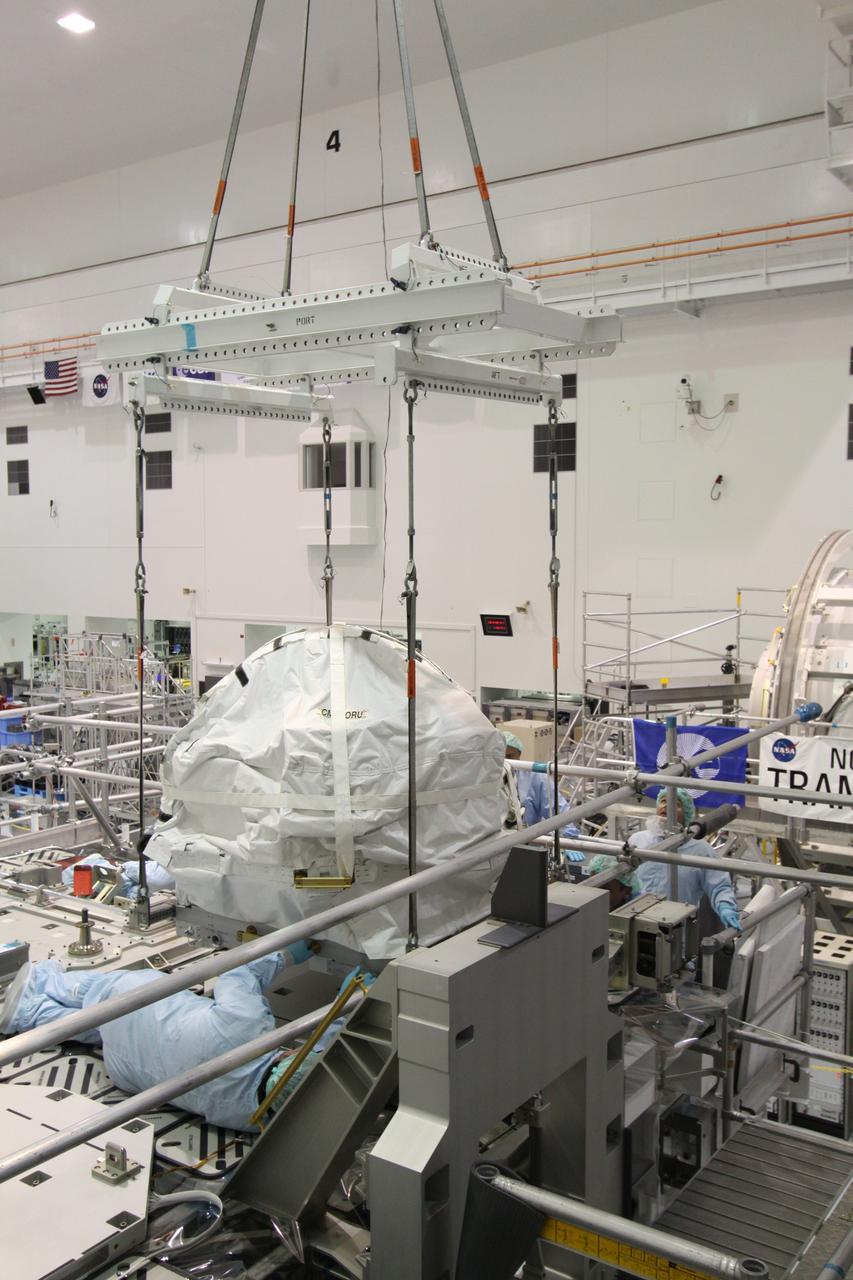
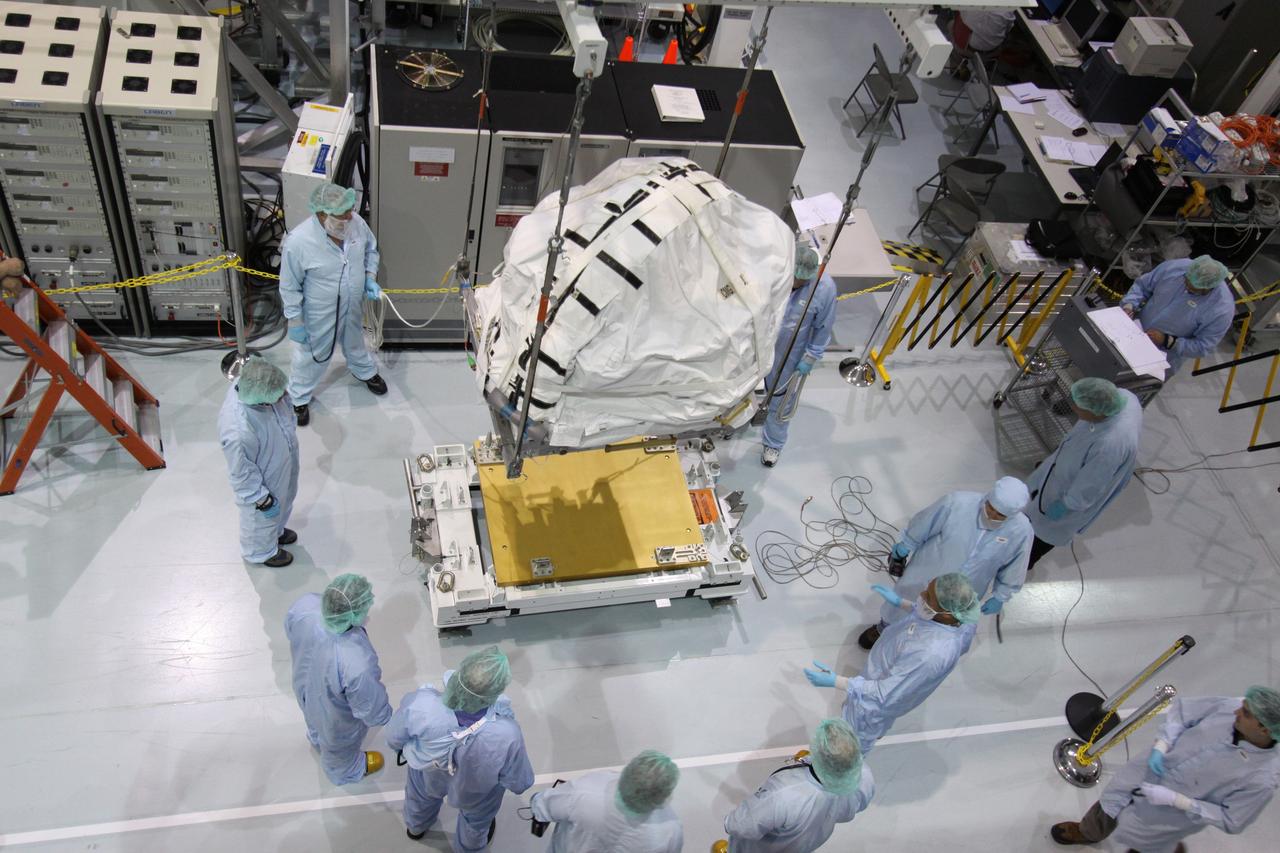
CAPE CANAVERAL, Fla. – In the Space Station Processing Facility at NASA's Kennedy Space Center in Florida, technicians monitor a control moment gyroscope as it is lifted by crane from a work stand. The gyroscope will be installed on an EXPRESS Logistics Carrier for flight.  The carrier is part of the STS-129 payload on space shuttle Atlantis, which will deliver to the International Space Station two spare gyroscopes, two nitrogen tank assemblies, two pump modules, an ammonia tank assembly and a spare latching end effector for the station's robotic arm. STS-129 is targeted to launch Nov. 12. Photo credit: NASA/Jim Grossmann
KSC-2009-4632
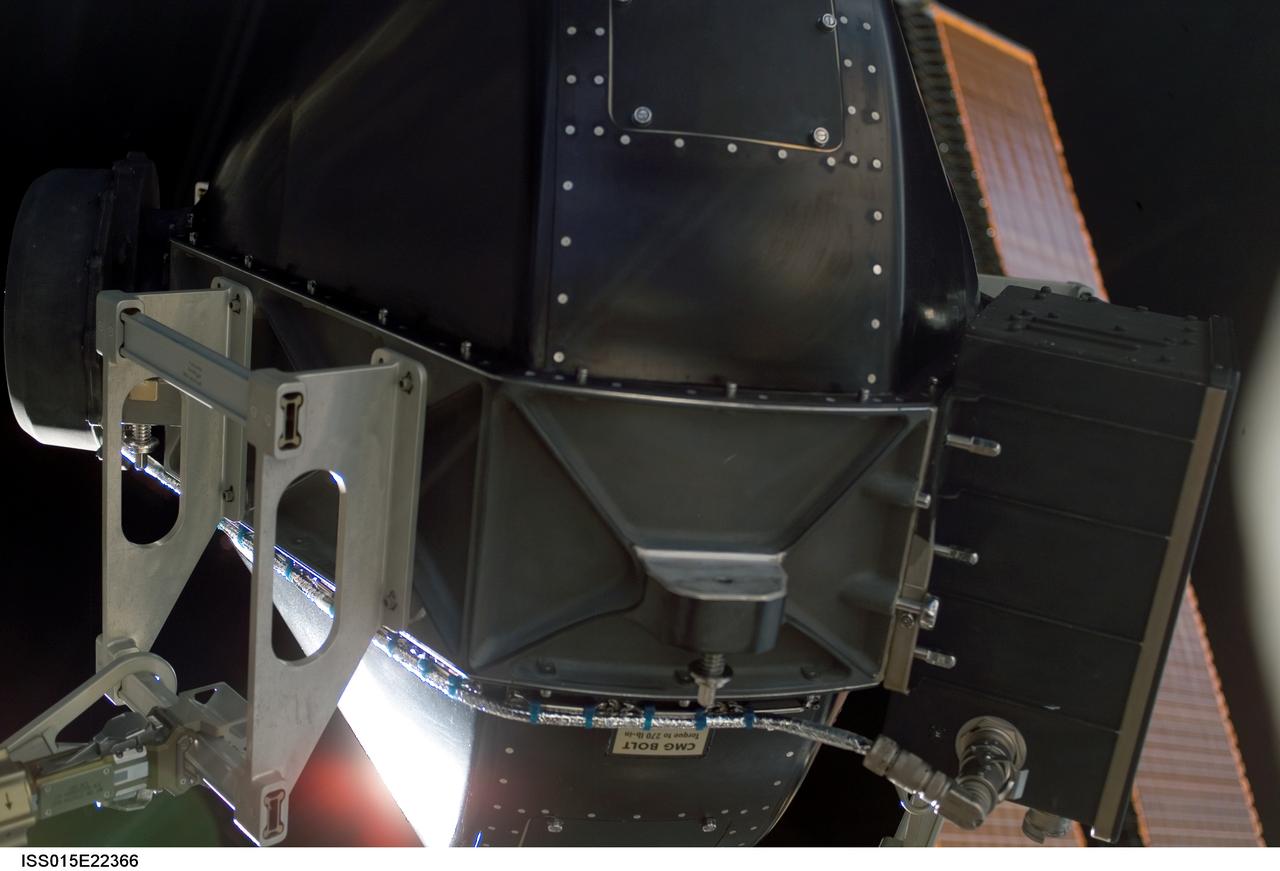
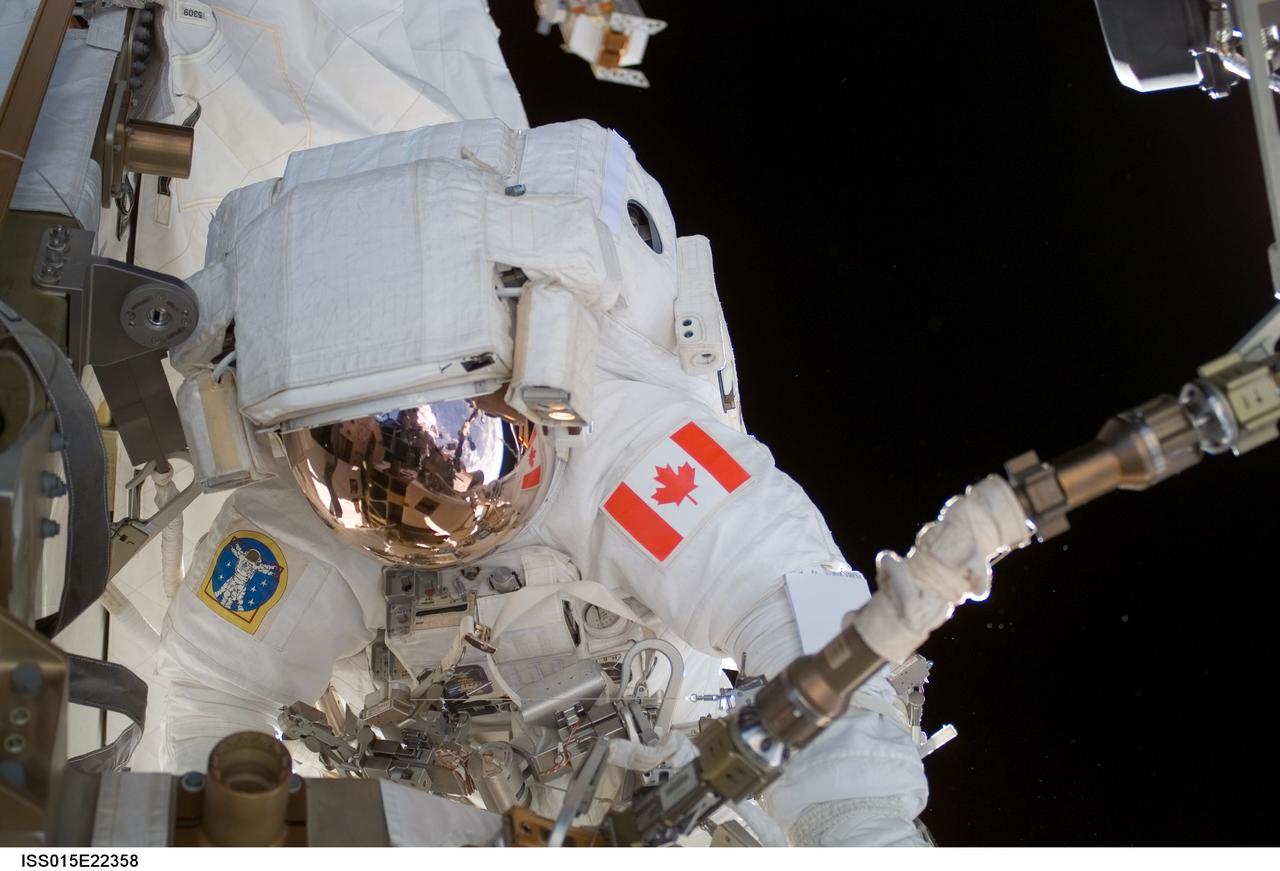
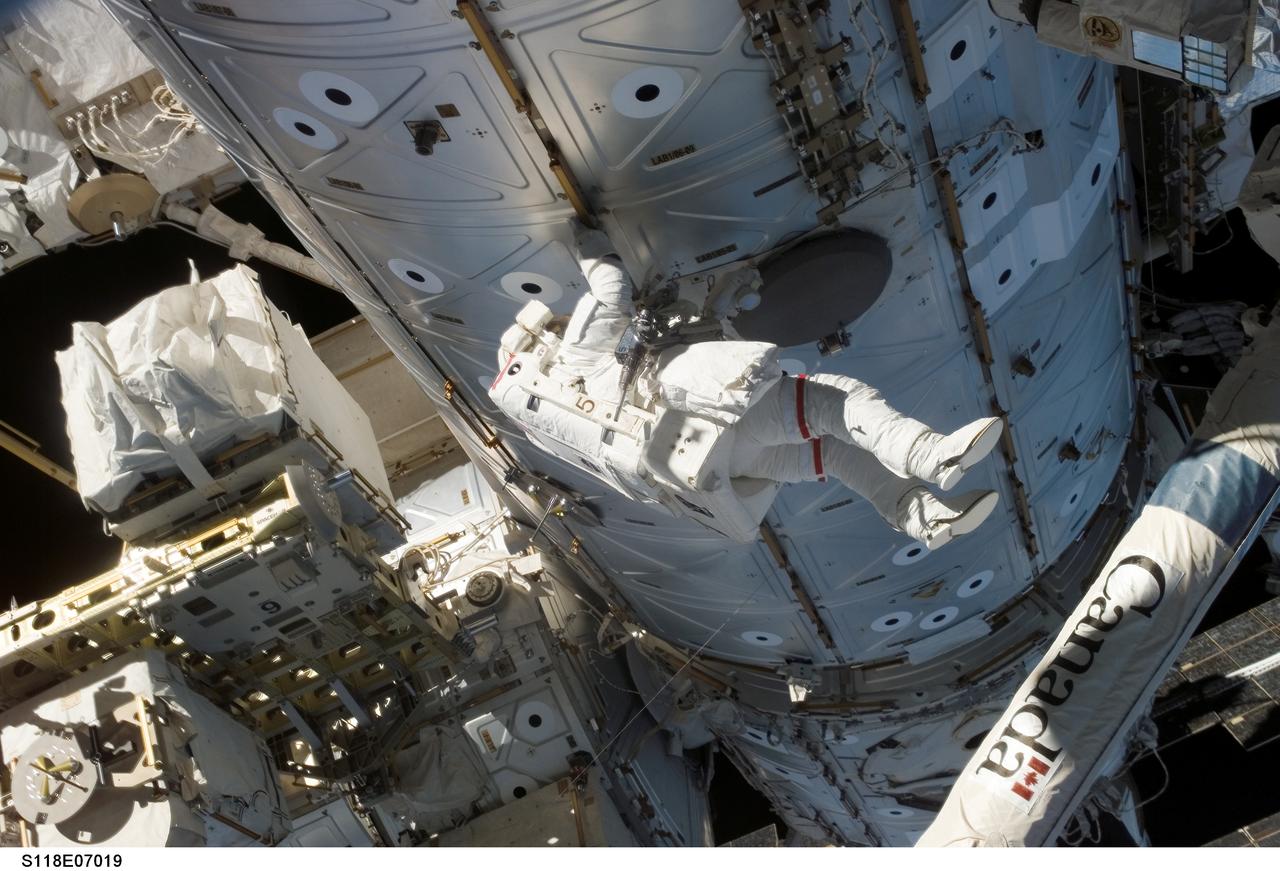
ISS015-E-22366 (13 Aug. 2007) --- A close-up view of the new control moment gyroscope (CMG) photographed by a crewmember during the mission's second planned session of extravehicular activity (EVA). During the spacewalk, Canadian Space Agency's astronaut Dave Williams (out of frame) and astronaut Rick Mastracchio (out of frame), both STS-118 mission specialists, removed a faulty control moment gyroscope (CMG-3) and installed a new CMG into the station's Z1 truss. The failed CMG will remain at its temporary stowage location on the station's exterior before it is returned to Earth on a later shuttle mission. The new gyroscope is one of four CMGs that are used to control the station's attitude in orbit.
View of the new CMG during Expedition 15/STS-118 EVA 2
KENNEDY SPACE CENTER, FLA.  -  In the Space Station Processing Facility, the Control Moment Gyroscope (CMG) is separated from its base and workers help guide it toward a shipping container for its return to the vendor for repair.  The faulty CMG was removed from the International Space Station and replaced with a new one on mission STS-114 in August.   A control moment gyroscope  is an actuator used to apply very high attitude-control torques to agile spacecraft.  The Space Station uses four massive control moment gyroscopes to maintain the Station’s orientation in space.
KSC-05PD-2069
CAPE CANAVERAL, Fla. – In the Space Station Processing Facility at NASA's Kennedy Space Center in Florida, technicians check the bottom of a control moment gyroscope as it is lifted slowly by crane from a work stand. The gyroscope will be installed on an EXPRESS Logistics Carrier for flight.  The carrier is part of the STS-129 payload on space shuttle Atlantis, which will deliver to the International Space Station two spare gyroscopes, two nitrogen tank assemblies, two pump modules, an ammonia tank assembly and a spare latching end effector for the station's robotic arm. STS-129 is targeted to launch Nov. 12. Photo credit: NASA/Jim Grossmann
KSC-2009-4633
CAPE CANAVERAL, Fla. – In the Space Station Processing Facility at NASA's Kennedy Space Center in Florida, technicians prepare for a control moment gyroscope to be lifted by crane from a work stand. The gyroscope will be installed on an EXPRESS Logistics Carrier for flight. The carrier is part of the STS-129 payload on space shuttle Atlantis, which will deliver to the International Space Station two spare gyroscopes, two nitrogen tank assemblies, two pump modules, an ammonia tank assembly and a spare latching end effector for the station's robotic arm. STS-129 is targeted to launch Nov. 12. Photo credit: NASA/Jim Grossmann
KSC-2009-4631
VANDENBERG AFB, CALIF. - Workers on the mobile service tower at Space Launch Complex 2, Vandenberg Air Force Base, Calif., check the Delta II rocket’s second stage as it is mated with the first stage. The Delta II is the launch vehicle for the Gravity Probe B experiment, developed by Stanford University, Lockheed Martin and NASA’s Marshall Space Flight Center.   The Gravity Probe B will launch a payload of four gyroscopes into low-Earth polar orbit to test two extraordinary predictions of Albert Einstein’s general theory of relativity: the geodetic effect (how space and time are warped by the presence of the Earth) and frame dragging (how Earth’s rotation drags space and time around with it). Once in orbit, for 18 months each gyroscope’s spin axis will be monitored as it travels through local spacetime, observing and measuring these effects. The targeted launch date is Dec. 6, 2003.
VANDENBERG AFB, CALIF. - Workers on the mobile service tower at Space Launch Complex 2, Vandenberg Air Force Base, Calif., check the Delta II rocket’s second stage as it is mated with the first stage. The Delta II is the launch vehicle for the Gravity Probe B experiment, developed by Stanford University, Lockheed Martin and NASA’s Marshall Space Flight Center. The Gravity Probe B will launch a payload of four gyroscopes into low-Earth polar orbit to test two extraordinary predictions of Albert Einstein’s general theory of relativity: the geodetic effect (how space and time are warped by the presence of the Earth) and frame dragging (how Earth’s rotation drags space and time around with it). Once in orbit, for 18 months each gyroscope’s spin axis will be monitored as it travels through local spacetime, observing and measuring these effects. The targeted launch date is Dec. 6, 2003.
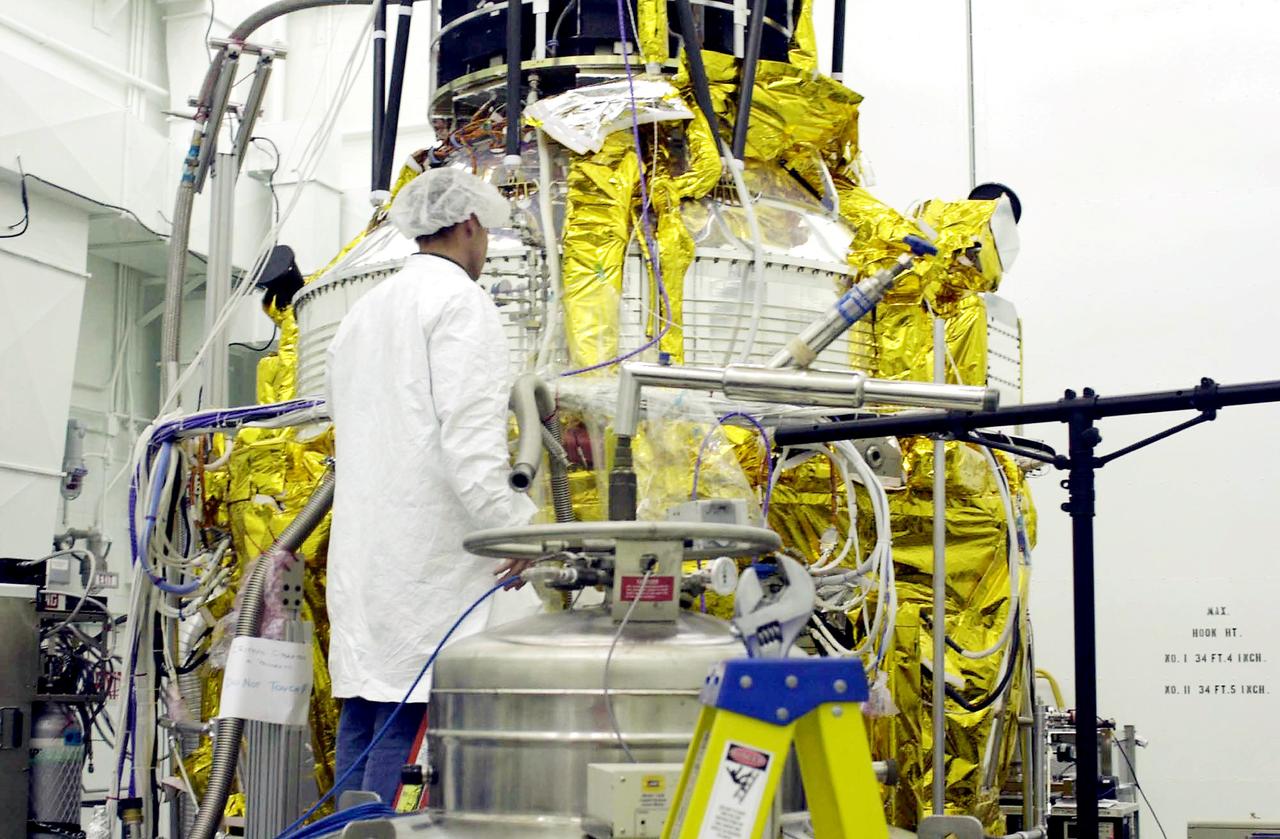
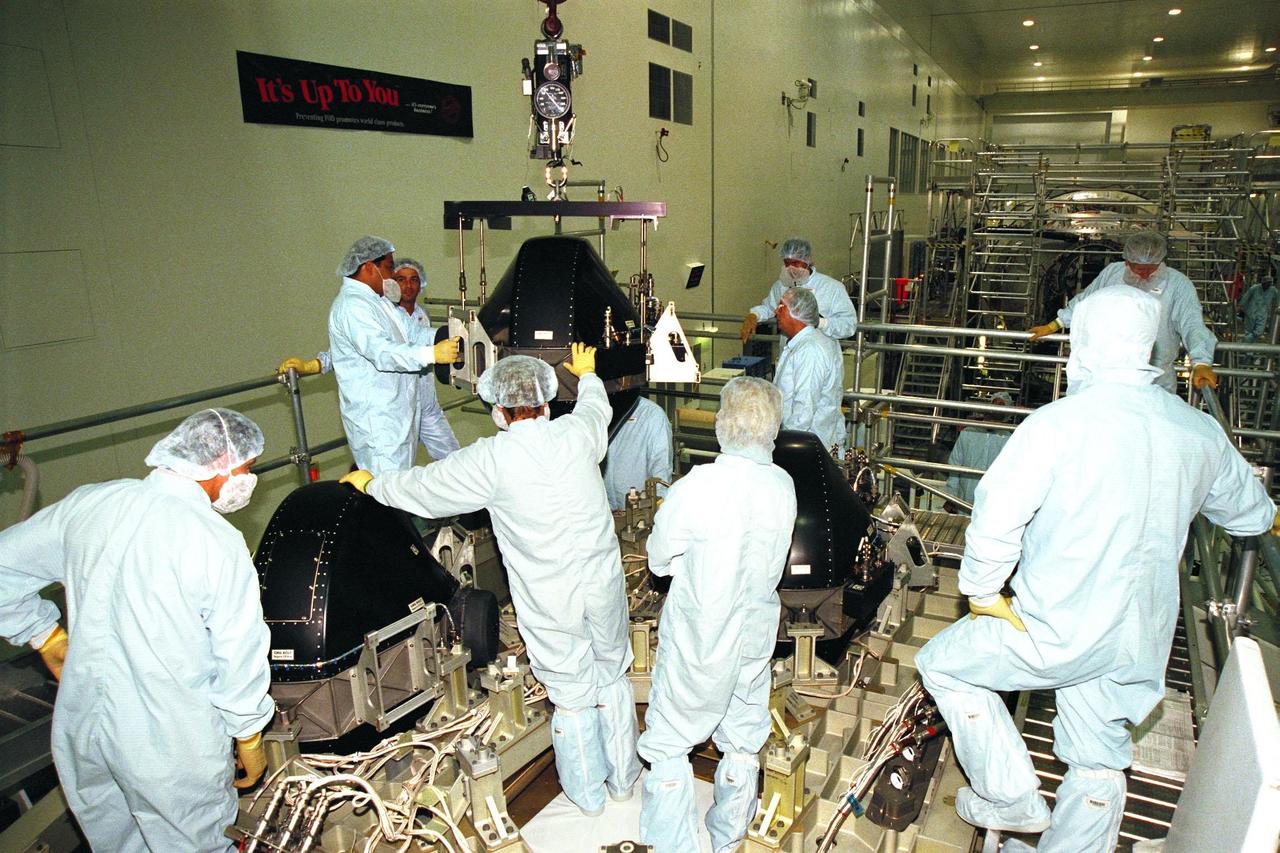
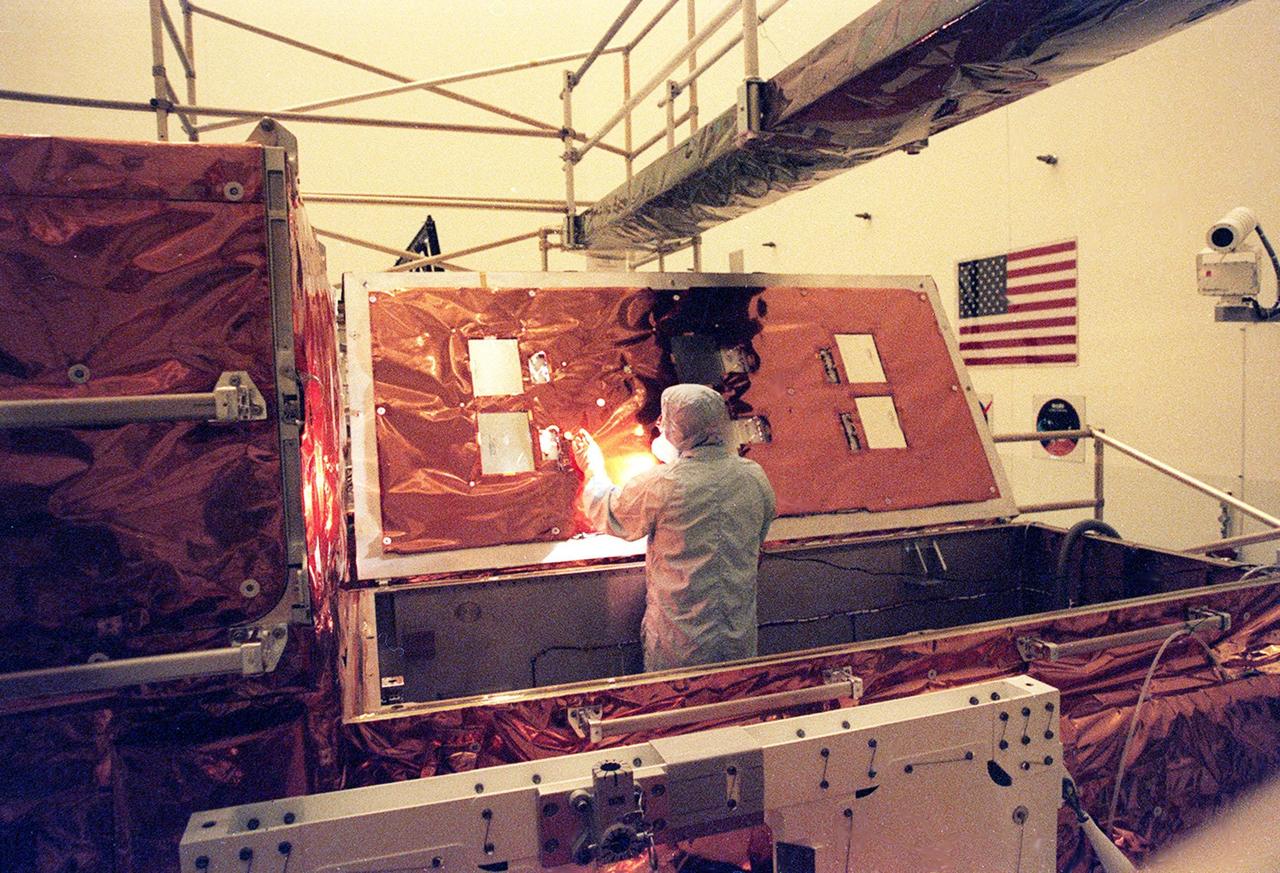
VANDENBERG AFB, CALIF. -   A worker in the spacecraft processing facility on North Vandenberg Air Force Base checks the Gravity Probe B experiment during prelaunch testing.  The Gravity Probe B will launch a payload of four gyroscopes into low-Earth polar orbit to test two extraordinary predictions of Albert Einstein’s general theory of relativity: the geodetic effect (how space and time are warped by the presence of the Earth) and frame dragging (how Earth’s rotation drags space and time around with it). Once in orbit, for 18 months each gyroscope’s spin axis will be monitored as it travels through local spacetime, observing and measuring these effects.  The experiment was developed by Stanford University, Lockheed Martin and NASA’s Marshall Space Flight Center.   The targeted launch date is Dec. 6, 2003.
VANDENBERG AFB, CALIF. - A worker in the spacecraft processing facility on North Vandenberg Air Force Base checks the Gravity Probe B experiment during prelaunch testing. The Gravity Probe B will launch a payload of four gyroscopes into low-Earth polar orbit to test two extraordinary predictions of Albert Einstein’s general theory of relativity: the geodetic effect (how space and time are warped by the presence of the Earth) and frame dragging (how Earth’s rotation drags space and time around with it). Once in orbit, for 18 months each gyroscope’s spin axis will be monitored as it travels through local spacetime, observing and measuring these effects. The experiment was developed by Stanford University, Lockheed Martin and NASA’s Marshall Space Flight Center. The targeted launch date is Dec. 6, 2003.
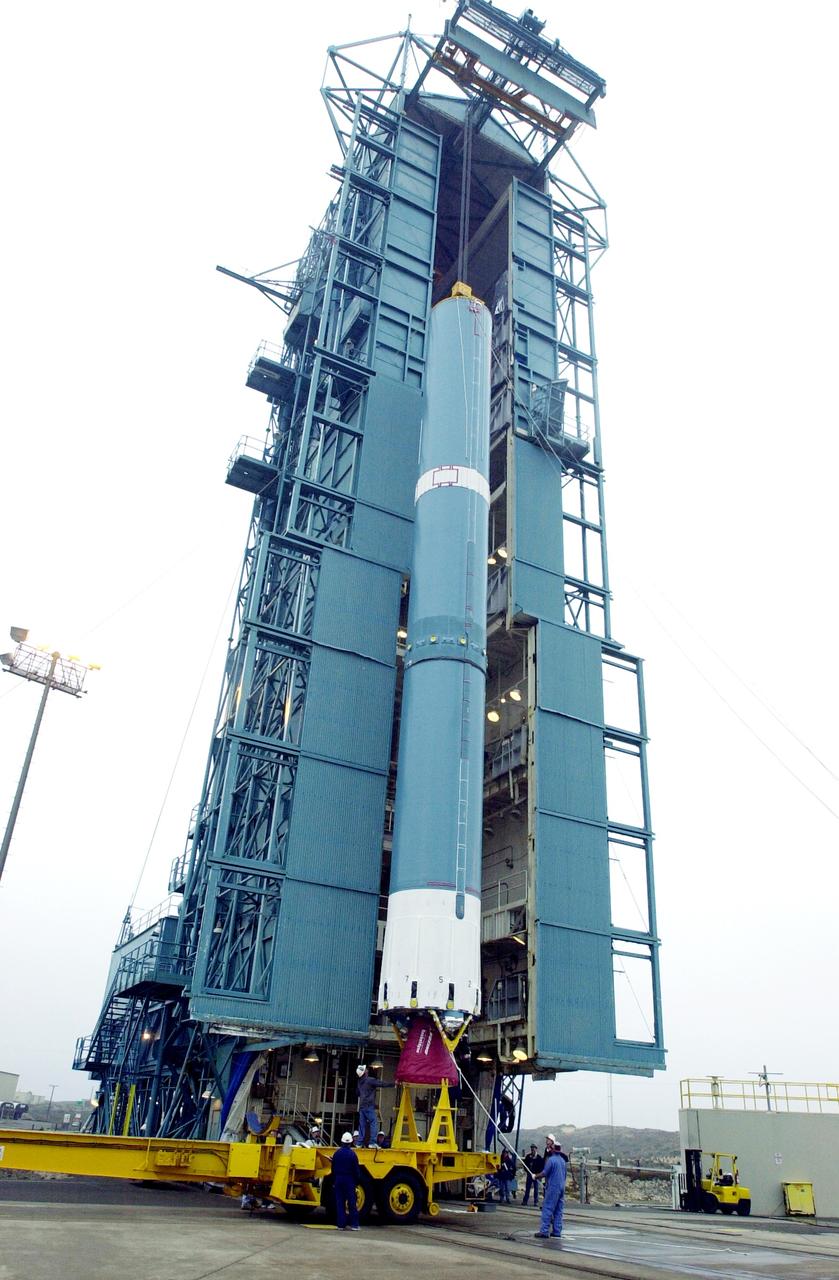
VANDENBERG AFB, CALIF. -  The first stage of the Delta II launch vehicle for the Gravity Probe B experiment is raised to a vertical position at Space Launch Complex 2, Vandenberg Air Force Base, Calif.  The Gravity Probe B will launch a payload of four gyroscopes into low-Earth polar orbit to test two extraordinary predictions of Albert Einstein’s general theory of relativity: the geodetic effect (how space and time are warped by the presence of the Earth) and frame dragging (how Earth’s rotation drags space and time around with it). Once in orbit, for 18 months each gyroscope’s spin axis will be monitored as it travels through local spacetime, observing and measuring these effects.  The experiment was developed by Stanford University, Lockheed Martin and NASA’s Marshall Space Flight Center.  The targeted launch date is Dec. 6, 2003.
VANDENBERG AFB, CALIF. - The first stage of the Delta II launch vehicle for the Gravity Probe B experiment is raised to a vertical position at Space Launch Complex 2, Vandenberg Air Force Base, Calif. The Gravity Probe B will launch a payload of four gyroscopes into low-Earth polar orbit to test two extraordinary predictions of Albert Einstein’s general theory of relativity: the geodetic effect (how space and time are warped by the presence of the Earth) and frame dragging (how Earth’s rotation drags space and time around with it). Once in orbit, for 18 months each gyroscope’s spin axis will be monitored as it travels through local spacetime, observing and measuring these effects. The experiment was developed by Stanford University, Lockheed Martin and NASA’s Marshall Space Flight Center. The targeted launch date is Dec. 6, 2003.
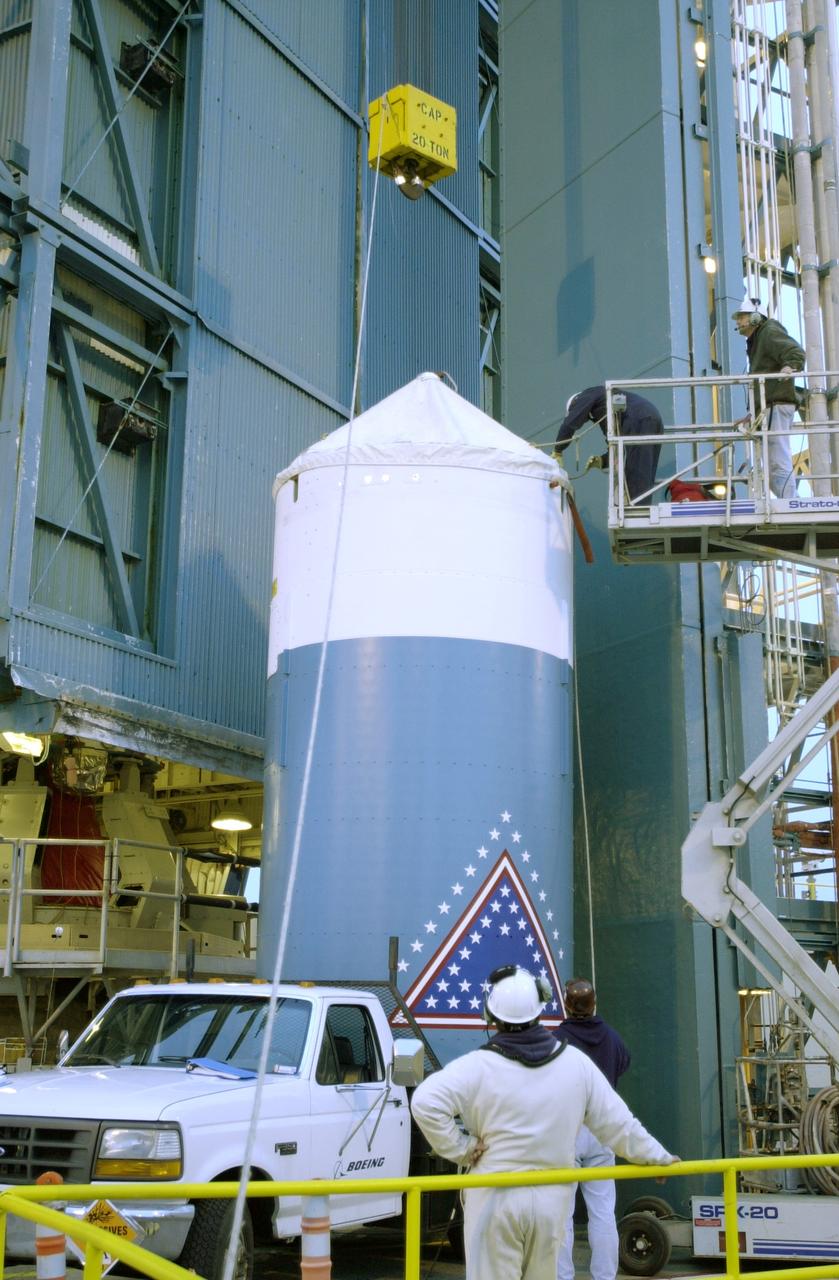
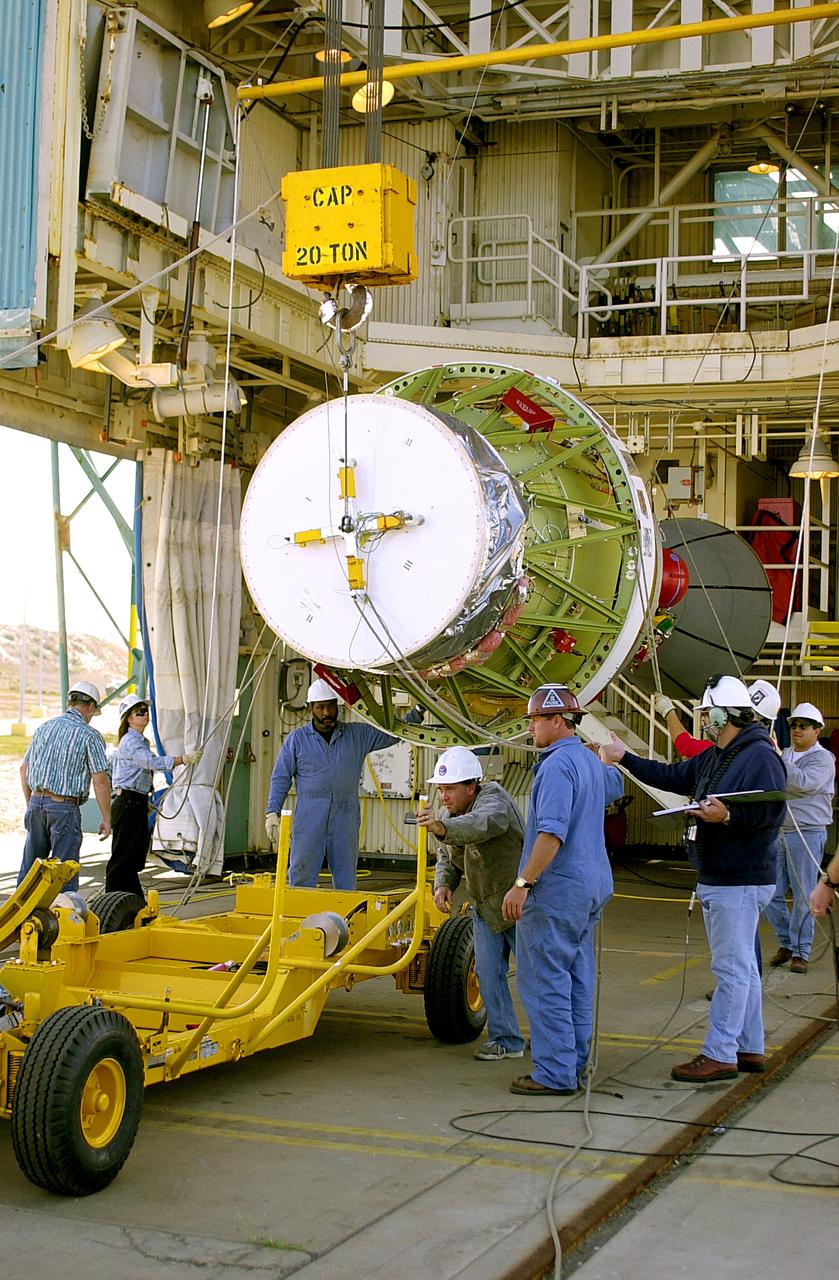
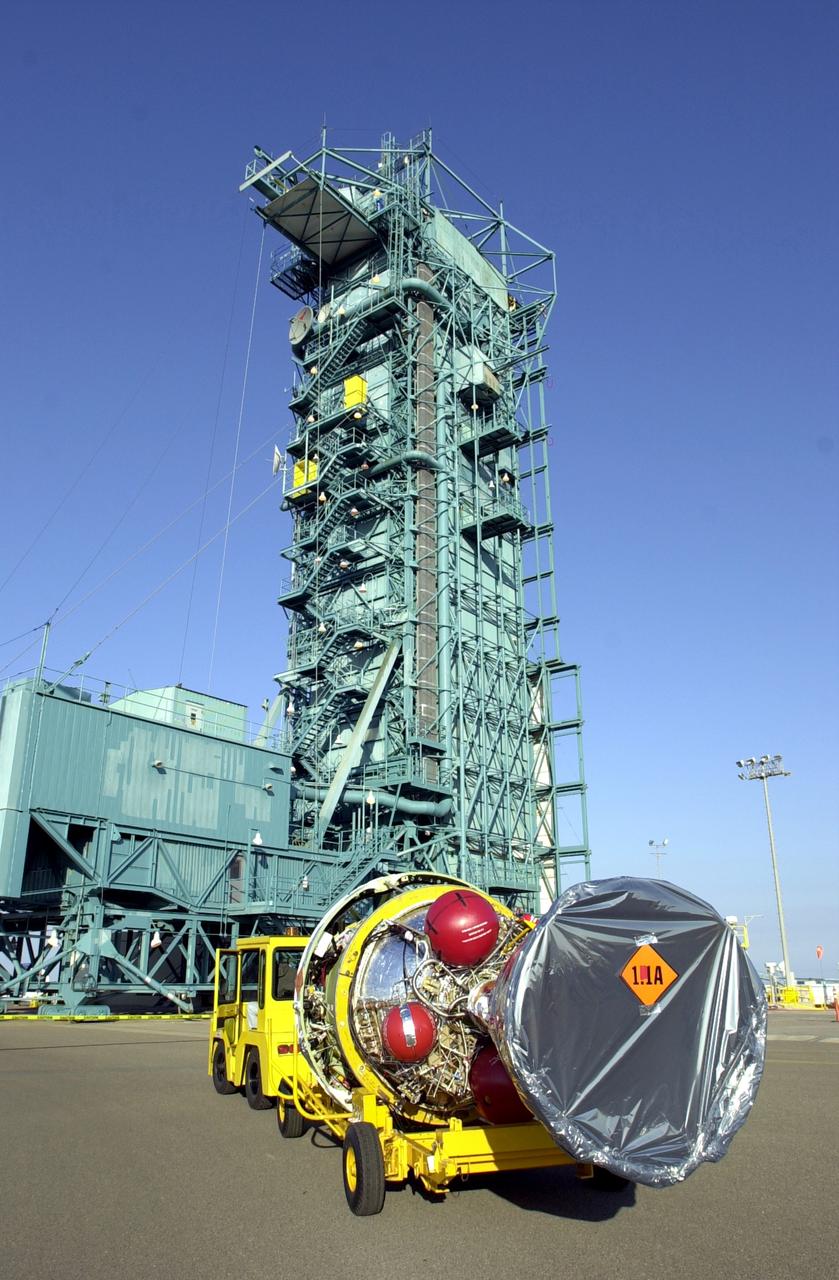
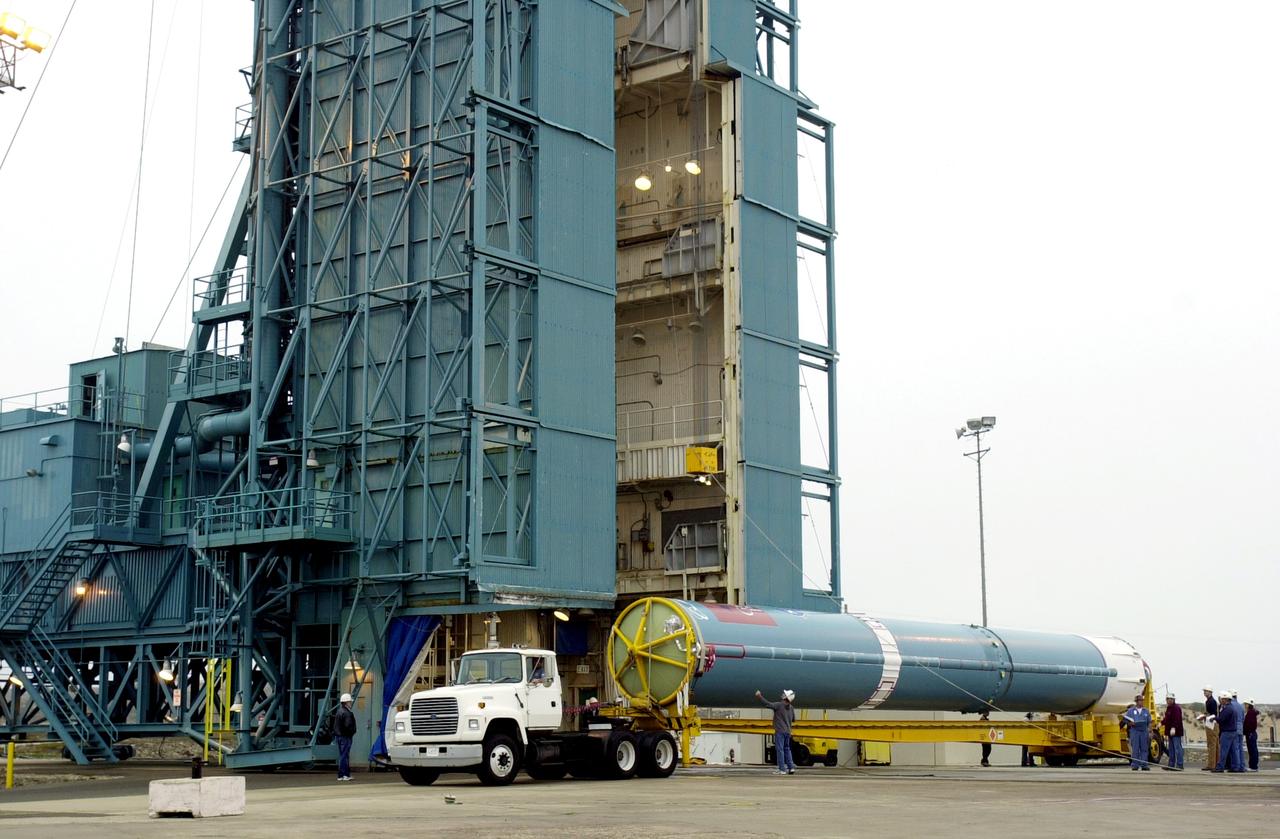
VANDENBERG AFB, CALIF. -  The second stage of the Delta II launch vehicle for the Gravity Probe B experiment arrives at the mobile service tower on Space Launch Complex 2, Vandenberg Air Force Base, Calif.  The Gravity Probe B will launch a payload of four gyroscopes into low-Earth polar orbit to test two extraordinary predictions of Albert Einstein’s general theory of relativity: the geodetic effect (how space and time are warped by the presence of the Earth) and frame dragging (how Earth’s rotation drags space and time around with it). Once in orbit, for 18 months each gyroscope’s spin axis will be monitored as it travels through local spacetime, observing and measuring these effects.  The experiment was developed by Stanford University, Lockheed Martin and NASA’s Marshall Space Flight Center.  The targeted launch date is Dec. 6, 2003.
VANDENBERG AFB, CALIF. - The second stage of the Delta II launch vehicle for the Gravity Probe B experiment arrives at the mobile service tower on Space Launch Complex 2, Vandenberg Air Force Base, Calif. The Gravity Probe B will launch a payload of four gyroscopes into low-Earth polar orbit to test two extraordinary predictions of Albert Einstein’s general theory of relativity: the geodetic effect (how space and time are warped by the presence of the Earth) and frame dragging (how Earth’s rotation drags space and time around with it). Once in orbit, for 18 months each gyroscope’s spin axis will be monitored as it travels through local spacetime, observing and measuring these effects. The experiment was developed by Stanford University, Lockheed Martin and NASA’s Marshall Space Flight Center. The targeted launch date is Dec. 6, 2003.
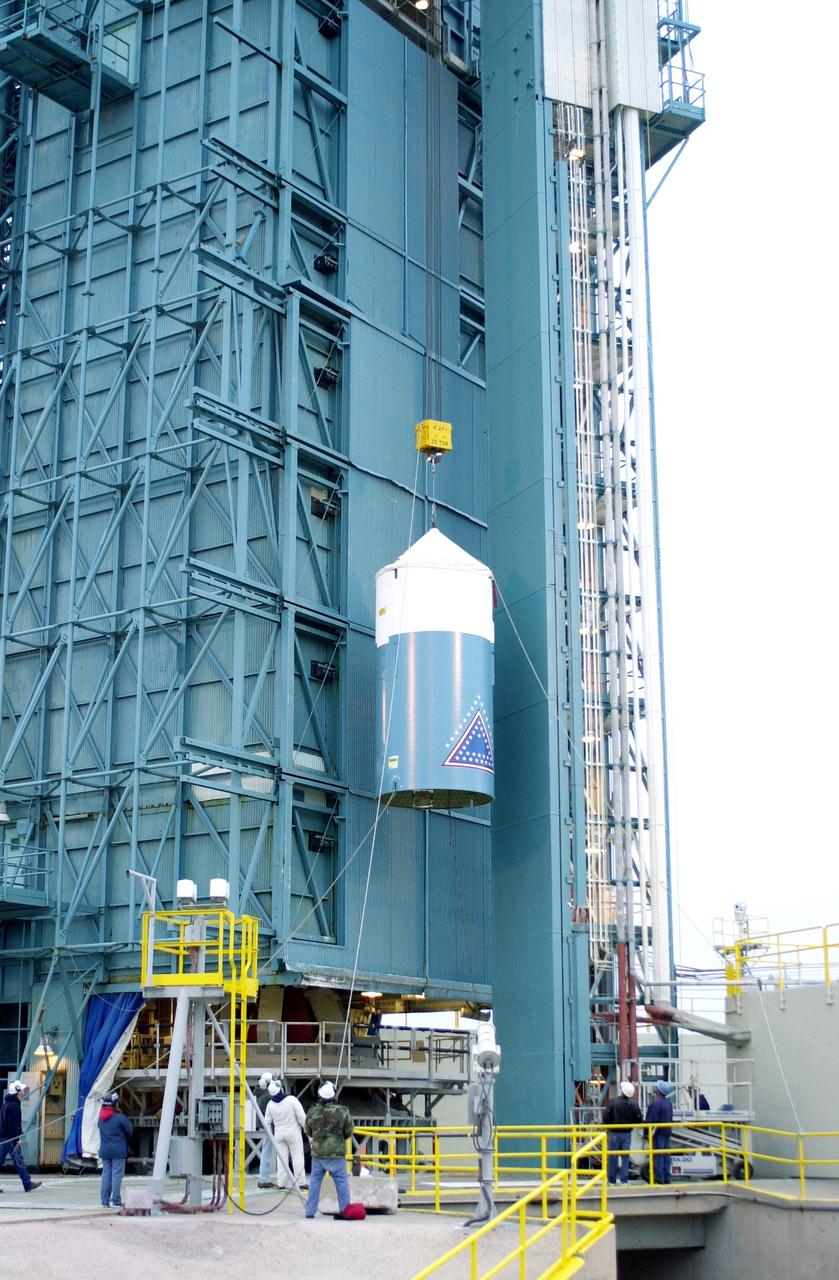
VANDENBERG AFB, CALIF. -   The interstage of the Delta II launch vehicle for the Gravity Probe B experiment is moved into the mobile service tower on Space Launch Complex 2, Vandenberg Air Force Base, Calif., where it will be mated with the second stage.  The Gravity Probe B will launch a payload of four gyroscopes into low-Earth polar orbit to test two extraordinary predictions of Albert Einstein’s general theory of relativity: the geodetic effect (how space and time are warped by the presence of the Earth) and frame dragging (how Earth’s rotation drags space and time around with it). Once in orbit, for 18 months each gyroscope’s spin axis will be monitored as it travels through local spacetime, observing and measuring these effects.  The experiment was developed by Stanford University, Lockheed Martin and NASA’s Marshall Space Flight Center.  The targeted launch date is Dec. 6, 2003.
VANDENBERG AFB, CALIF. - The interstage of the Delta II launch vehicle for the Gravity Probe B experiment is moved into the mobile service tower on Space Launch Complex 2, Vandenberg Air Force Base, Calif., where it will be mated with the second stage. The Gravity Probe B will launch a payload of four gyroscopes into low-Earth polar orbit to test two extraordinary predictions of Albert Einstein’s general theory of relativity: the geodetic effect (how space and time are warped by the presence of the Earth) and frame dragging (how Earth’s rotation drags space and time around with it). Once in orbit, for 18 months each gyroscope’s spin axis will be monitored as it travels through local spacetime, observing and measuring these effects. The experiment was developed by Stanford University, Lockheed Martin and NASA’s Marshall Space Flight Center. The targeted launch date is Dec. 6, 2003.
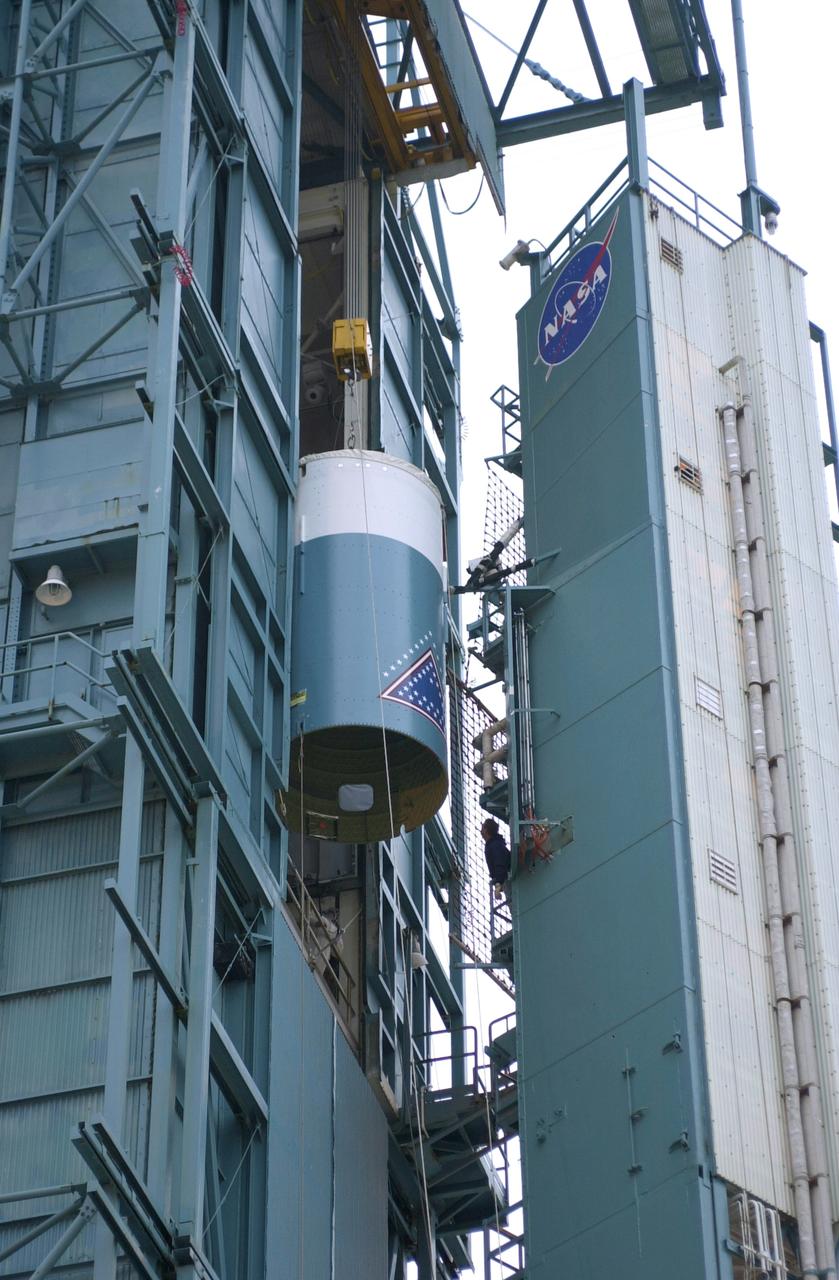
VANDENBERG AFB, CALIF. -  The second stage of the Delta II launch vehicle for the Gravity Probe B experiment is lifted up the mobile service tower on Space Launch Complex 2, Vandenberg Air Force Base, Calif.  The Gravity Probe B will launch a payload of four gyroscopes into low-Earth polar orbit to test two extraordinary predictions of Albert Einstein’s general theory of relativity: the geodetic effect (how space and time are warped by the presence of the Earth) and frame dragging (how Earth’s rotation drags space and time around with it). Once in orbit, for 18 months each gyroscope’s spin axis will be monitored as it travels through local spacetime, observing and measuring these effects.  The experiment was developed by Stanford University, Lockheed Martin and NASA’s Marshall Space Flight Center.  The targeted launch date is Dec. 6, 2003.
VANDENBERG AFB, CALIF. - The second stage of the Delta II launch vehicle for the Gravity Probe B experiment is lifted up the mobile service tower on Space Launch Complex 2, Vandenberg Air Force Base, Calif. The Gravity Probe B will launch a payload of four gyroscopes into low-Earth polar orbit to test two extraordinary predictions of Albert Einstein’s general theory of relativity: the geodetic effect (how space and time are warped by the presence of the Earth) and frame dragging (how Earth’s rotation drags space and time around with it). Once in orbit, for 18 months each gyroscope’s spin axis will be monitored as it travels through local spacetime, observing and measuring these effects. The experiment was developed by Stanford University, Lockheed Martin and NASA’s Marshall Space Flight Center. The targeted launch date is Dec. 6, 2003.
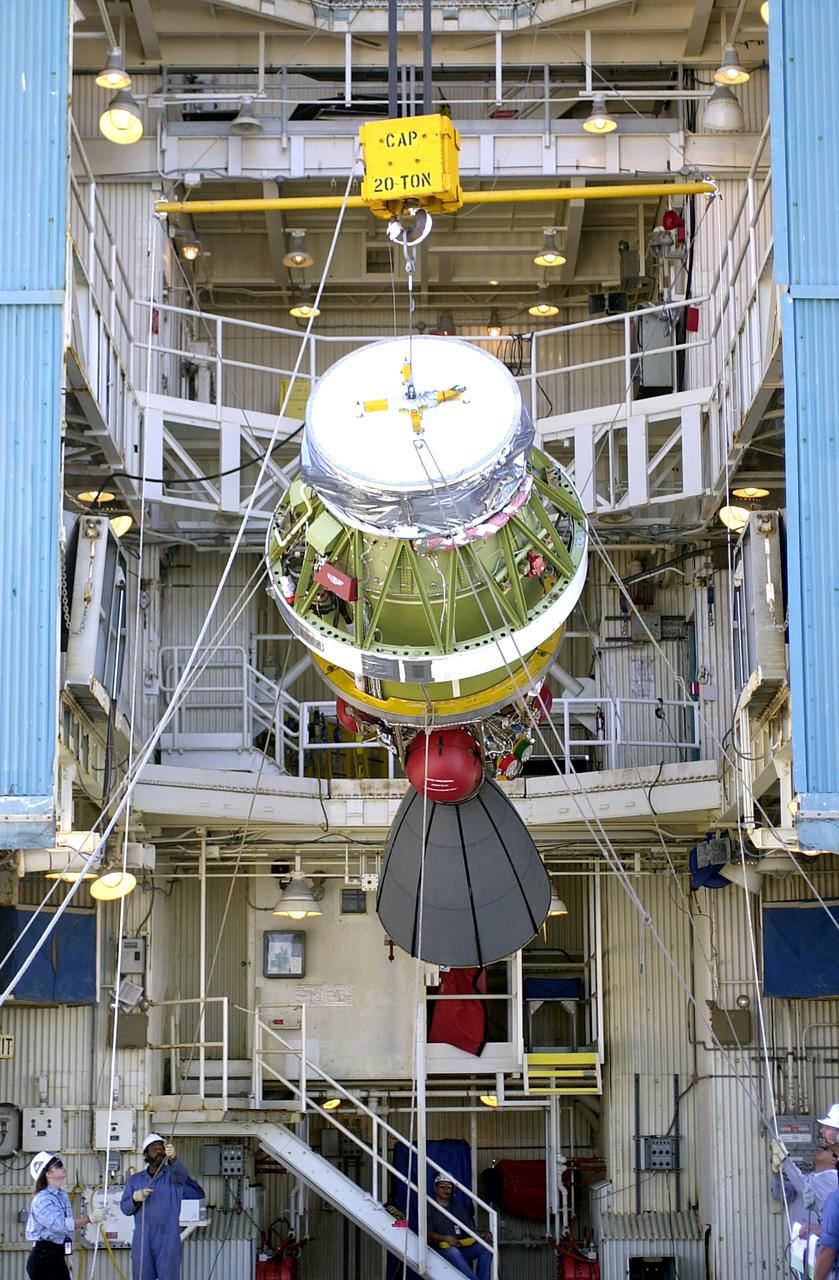
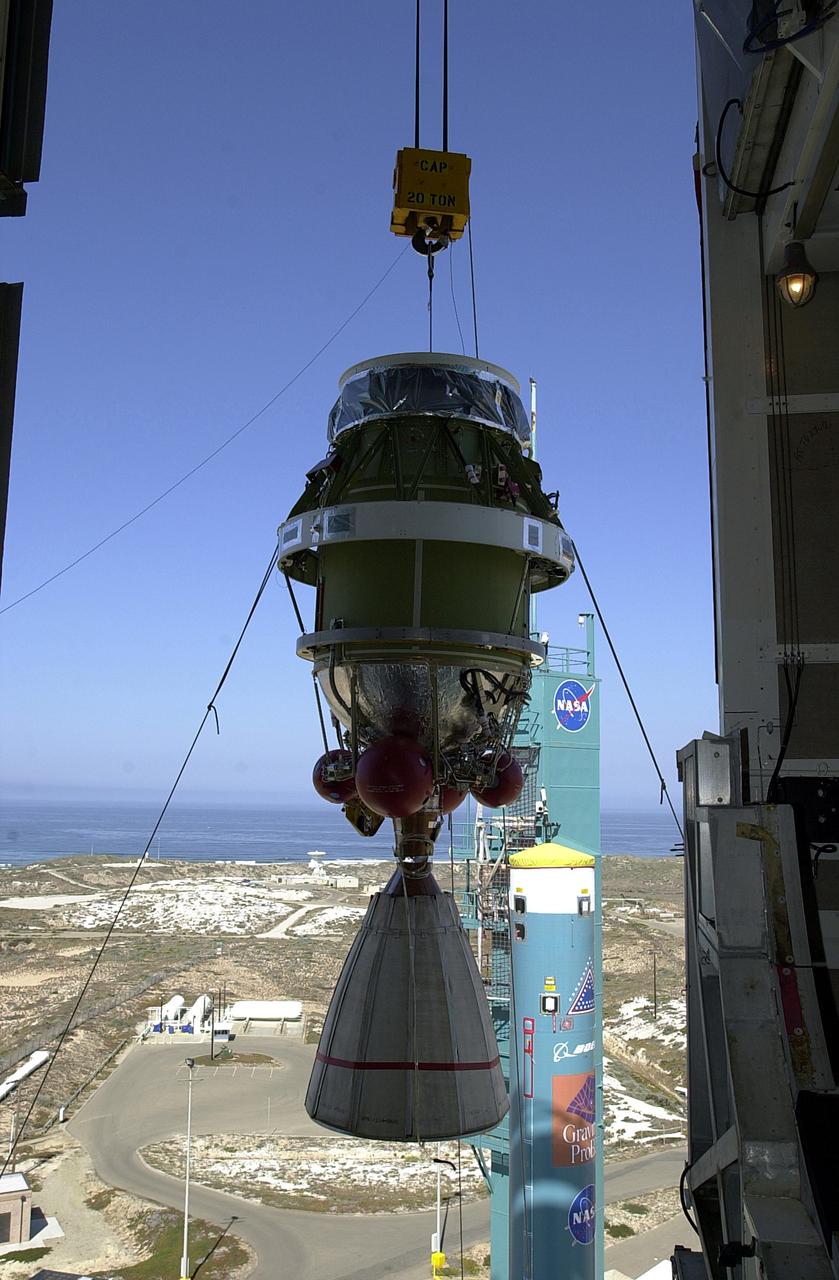
VANDENBERG AFB, CALIF. -  The interstage of the Delta II launch vehicle for the Gravity Probe B experiment is lifted up the mobile service tower on Space Launch Complex 2, Vandenberg Air Force Base, Calif.  It will enclose the second stage.  The Gravity Probe B will launch a payload of four gyroscopes into low-Earth polar orbit to test two extraordinary predictions of Albert Einstein’s general theory of relativity: the geodetic effect (how space and time are warped by the presence of the Earth) and frame dragging (how Earth’s rotation drags space and time around with it). Once in orbit, for 18 months each gyroscope’s spin axis will be monitored as it travels through local spacetime, observing and measuring these effects.  The experiment was developed by Stanford University, Lockheed Martin and NASA’s Marshall Space Flight Center.  The targeted launch date is Dec. 6, 2003.
VANDENBERG AFB, CALIF. - The interstage of the Delta II launch vehicle for the Gravity Probe B experiment is lifted up the mobile service tower on Space Launch Complex 2, Vandenberg Air Force Base, Calif. It will enclose the second stage. The Gravity Probe B will launch a payload of four gyroscopes into low-Earth polar orbit to test two extraordinary predictions of Albert Einstein’s general theory of relativity: the geodetic effect (how space and time are warped by the presence of the Earth) and frame dragging (how Earth’s rotation drags space and time around with it). Once in orbit, for 18 months each gyroscope’s spin axis will be monitored as it travels through local spacetime, observing and measuring these effects. The experiment was developed by Stanford University, Lockheed Martin and NASA’s Marshall Space Flight Center. The targeted launch date is Dec. 6, 2003.
VANDENBERG AFB, CALIF. -  The second stage of the Delta II launch vehicle for the Gravity Probe B experiment is moved into the mobile service tower on Space Launch Complex 2, Vandenberg Air Force Base, Calif.   Behind it can be seen the first stage of the Delta II.  The Gravity Probe B will launch a payload of four gyroscopes into low-Earth polar orbit to test two extraordinary predictions of Albert Einstein’s general theory of relativity: the geodetic effect (how space and time are warped by the presence of the Earth) and frame dragging (how Earth’s rotation drags space and time around with it). Once in orbit, for 18 months each gyroscope’s spin axis will be monitored as it travels through local spacetime, observing and measuring these effects.  The experiment was developed by Stanford University, Lockheed Martin and NASA’s Marshall Space Flight Center.  The targeted launch date is Dec. 6, 2003.
VANDENBERG AFB, CALIF. - The second stage of the Delta II launch vehicle for the Gravity Probe B experiment is moved into the mobile service tower on Space Launch Complex 2, Vandenberg Air Force Base, Calif. Behind it can be seen the first stage of the Delta II. The Gravity Probe B will launch a payload of four gyroscopes into low-Earth polar orbit to test two extraordinary predictions of Albert Einstein’s general theory of relativity: the geodetic effect (how space and time are warped by the presence of the Earth) and frame dragging (how Earth’s rotation drags space and time around with it). Once in orbit, for 18 months each gyroscope’s spin axis will be monitored as it travels through local spacetime, observing and measuring these effects. The experiment was developed by Stanford University, Lockheed Martin and NASA’s Marshall Space Flight Center. The targeted launch date is Dec. 6, 2003.
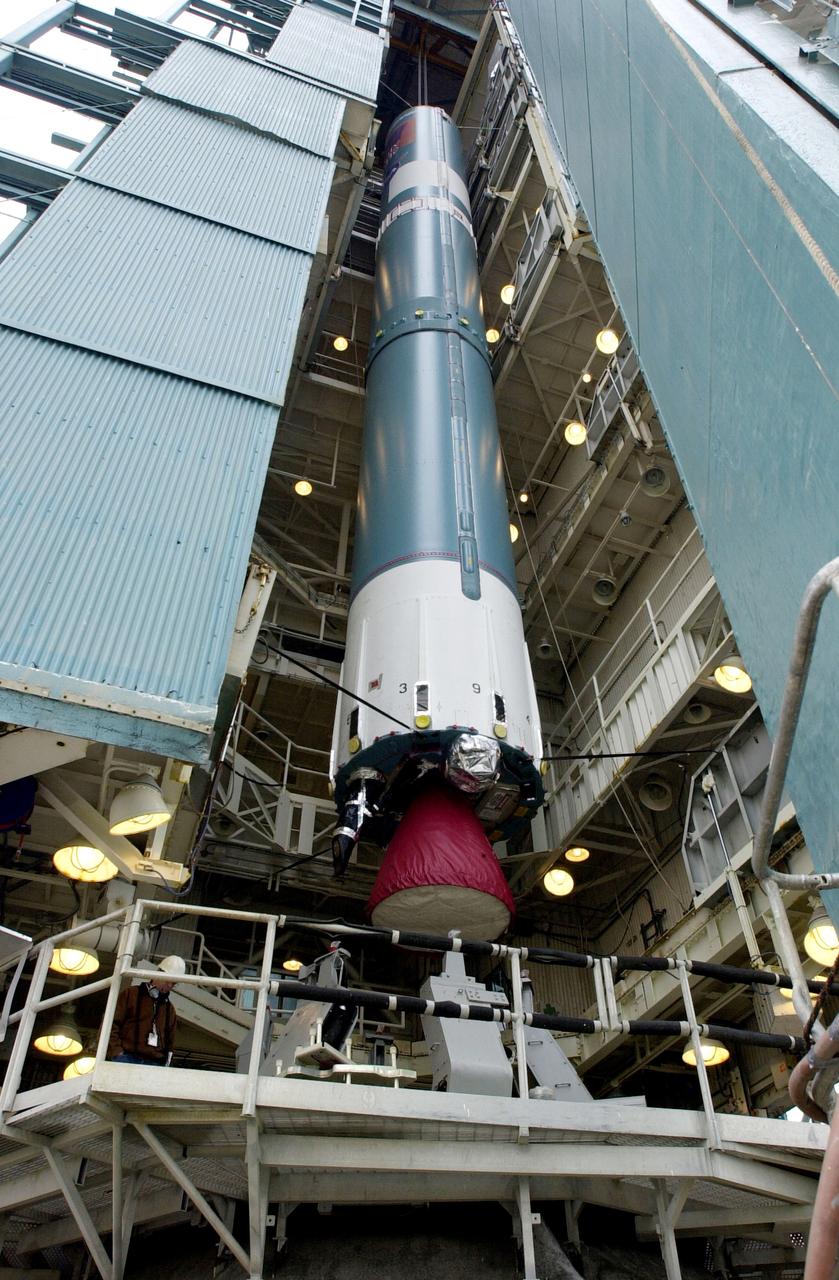
VANDENBERG AFB, CALIF. -  Viewed from inside, the second stage of the Delta II launch vehicle for the Gravity Probe B experiment is lifted up the mobile service tower on Space Launch Complex 2, Vandenberg Air Force Base, Calif.   Behind it is the first stage of the Delta II.  The Gravity Probe B will launch a payload of four gyroscopes into low-Earth polar orbit to test two extraordinary predictions of Albert Einstein’s general theory of relativity: the geodetic effect (how space and time are warped by the presence of the Earth) and frame dragging (how Earth’s rotation drags space and time around with it). Once in orbit, for 18 months each gyroscope’s spin axis will be monitored as it travels through local spacetime, observing and measuring these effects.  The experiment was developed by Stanford University, Lockheed Martin and NASA’s Marshall Space Flight Center.  The targeted launch date is Dec. 6, 2003.
VANDENBERG AFB, CALIF. - Viewed from inside, the second stage of the Delta II launch vehicle for the Gravity Probe B experiment is lifted up the mobile service tower on Space Launch Complex 2, Vandenberg Air Force Base, Calif. Behind it is the first stage of the Delta II. The Gravity Probe B will launch a payload of four gyroscopes into low-Earth polar orbit to test two extraordinary predictions of Albert Einstein’s general theory of relativity: the geodetic effect (how space and time are warped by the presence of the Earth) and frame dragging (how Earth’s rotation drags space and time around with it). Once in orbit, for 18 months each gyroscope’s spin axis will be monitored as it travels through local spacetime, observing and measuring these effects. The experiment was developed by Stanford University, Lockheed Martin and NASA’s Marshall Space Flight Center. The targeted launch date is Dec. 6, 2003.
VANDENBERG AFB, CALIF. - The second stage of the Delta II launch vehicle for the Gravity Probe B experiment is lifted off the transporter after its arrival on Space Launch Complex 2, Vandenberg Air Force Base, Calif.  The Gravity Probe B will launch a payload of four gyroscopes into low-Earth polar orbit to test two extraordinary predictions of Albert Einstein’s general theory of relativity: the geodetic effect (how space and time are warped by the presence of the Earth) and frame dragging (how Earth’s rotation drags space and time around with it). Once in orbit, for 18 months each gyroscope’s spin axis will be monitored as it travels through local spacetime, observing and measuring these effects.  The experiment was developed by Stanford University, Lockheed Martin and NASA’s Marshall Space Flight Center.  The targeted launch date is Dec. 6, 2003.
VANDENBERG AFB, CALIF. - The second stage of the Delta II launch vehicle for the Gravity Probe B experiment is lifted off the transporter after its arrival on Space Launch Complex 2, Vandenberg Air Force Base, Calif. The Gravity Probe B will launch a payload of four gyroscopes into low-Earth polar orbit to test two extraordinary predictions of Albert Einstein’s general theory of relativity: the geodetic effect (how space and time are warped by the presence of the Earth) and frame dragging (how Earth’s rotation drags space and time around with it). Once in orbit, for 18 months each gyroscope’s spin axis will be monitored as it travels through local spacetime, observing and measuring these effects. The experiment was developed by Stanford University, Lockheed Martin and NASA’s Marshall Space Flight Center. The targeted launch date is Dec. 6, 2003.
VANDENBERG AFB, CALIF. -  Viewed from inside, the second stage of the Delta II launch vehicle for the Gravity Probe B experiment is lifted up the mobile service tower on Space Launch Complex 2, Vandenberg Air Force Base, Calif.   The Gravity Probe B will launch a payload of four gyroscopes into low-Earth polar orbit to test two extraordinary predictions of Albert Einstein’s general theory of relativity: the geodetic effect (how space and time are warped by the presence of the Earth) and frame dragging (how Earth’s rotation drags space and time around with it). Once in orbit, for 18 months each gyroscope’s spin axis will be monitored as it travels through local spacetime, observing and measuring these effects.  The experiment was developed by Stanford University, Lockheed Martin and NASA’s Marshall Space Flight Center.  The targeted launch date is Dec. 6, 2003.
VANDENBERG AFB, CALIF. - Viewed from inside, the second stage of the Delta II launch vehicle for the Gravity Probe B experiment is lifted up the mobile service tower on Space Launch Complex 2, Vandenberg Air Force Base, Calif. The Gravity Probe B will launch a payload of four gyroscopes into low-Earth polar orbit to test two extraordinary predictions of Albert Einstein’s general theory of relativity: the geodetic effect (how space and time are warped by the presence of the Earth) and frame dragging (how Earth’s rotation drags space and time around with it). Once in orbit, for 18 months each gyroscope’s spin axis will be monitored as it travels through local spacetime, observing and measuring these effects. The experiment was developed by Stanford University, Lockheed Martin and NASA’s Marshall Space Flight Center. The targeted launch date is Dec. 6, 2003.
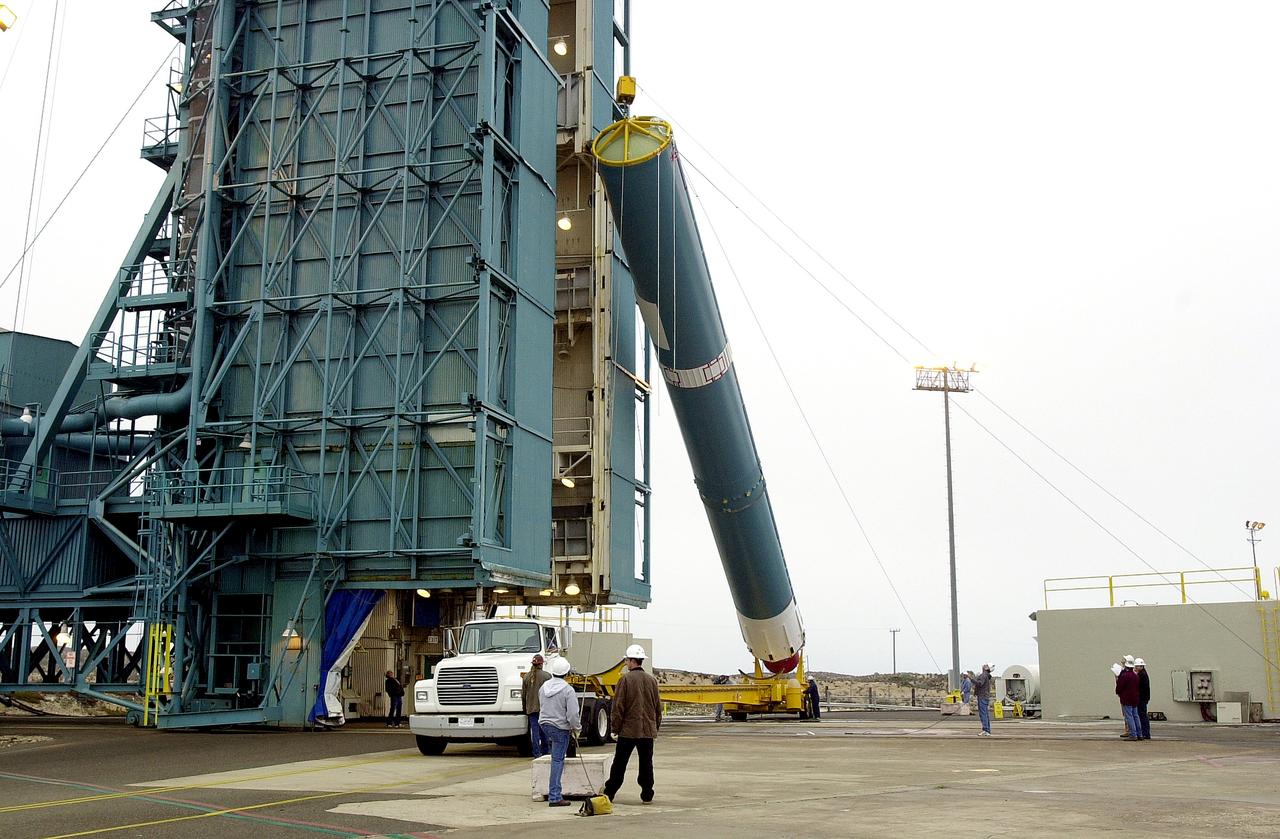
VANDENBERG AFB, CALIF. -   The first stage of the Delta II launch vehicle for the Gravity Probe B experiment is lifted up the mobile service tower on Space Launch Complex 2, Vandenberg Air Force Base, Calif.  The Gravity Probe B will launch a payload of four gyroscopes into low-Earth polar orbit to test two extraordinary predictions of Albert Einstein’s general theory of relativity: the geodetic effect (how space and time are warped by the presence of the Earth) and frame dragging (how Earth’s rotation drags space and time around with it). Once in orbit, for 18 months each gyroscope’s spin axis will be monitored as it travels through local spacetime, observing and measuring these effects.  The experiment was developed by Stanford University, Lockheed Martin and NASA’s Marshall Space Flight Center.  The targeted launch date is Dec. 6, 2003.
VANDENBERG AFB, CALIF. - The first stage of the Delta II launch vehicle for the Gravity Probe B experiment is lifted up the mobile service tower on Space Launch Complex 2, Vandenberg Air Force Base, Calif. The Gravity Probe B will launch a payload of four gyroscopes into low-Earth polar orbit to test two extraordinary predictions of Albert Einstein’s general theory of relativity: the geodetic effect (how space and time are warped by the presence of the Earth) and frame dragging (how Earth’s rotation drags space and time around with it). Once in orbit, for 18 months each gyroscope’s spin axis will be monitored as it travels through local spacetime, observing and measuring these effects. The experiment was developed by Stanford University, Lockheed Martin and NASA’s Marshall Space Flight Center. The targeted launch date is Dec. 6, 2003.
VANDENBERG AFB, CALIF. -   In the spacecraft processing facility on North Vandenberg Air Force Base, the Gravity Probe B experiment sits on an assembly and test stand where it has been subject to various prelaunch testing.  The Gravity Probe B will launch a payload of four gyroscopes into low-Earth polar orbit to test two extraordinary predictions of Albert Einstein’s general theory of relativity: the geodetic effect (how space and time are warped by the presence of the Earth) and frame dragging (how Earth’s rotation drags space and time around with it). Once in orbit, for 18 months each gyroscope’s spin axis will be monitored as it travels through local spacetime, observing and measuring these effects.  The experiment was developed by Stanford University, Lockheed Martin and NASA’s Marshall Space Flight Center.   The targeted launch date is Dec. 6, 2003.
VANDENBERG AFB, CALIF. - In the spacecraft processing facility on North Vandenberg Air Force Base, the Gravity Probe B experiment sits on an assembly and test stand where it has been subject to various prelaunch testing. The Gravity Probe B will launch a payload of four gyroscopes into low-Earth polar orbit to test two extraordinary predictions of Albert Einstein’s general theory of relativity: the geodetic effect (how space and time are warped by the presence of the Earth) and frame dragging (how Earth’s rotation drags space and time around with it). Once in orbit, for 18 months each gyroscope’s spin axis will be monitored as it travels through local spacetime, observing and measuring these effects. The experiment was developed by Stanford University, Lockheed Martin and NASA’s Marshall Space Flight Center. The targeted launch date is Dec. 6, 2003.
VANDENBERG AFB, CALIF. -  The second stage of the Delta II launch vehicle for the Gravity Probe B experiment arrives at the mobile service tower on Space Launch Complex 2, Vandenberg Air Force Base, Calif.  The Gravity Probe B will launch a payload of four gyroscopes into low-Earth polar orbit to test two extraordinary predictions of Albert Einstein’s general theory of relativity: the geodetic effect (how space and time are warped by the presence of the Earth) and frame dragging (how Earth’s rotation drags space and time around with it). Once in orbit, for 18 months each gyroscope’s spin axis will be monitored as it travels through local spacetime, observing and measuring these effects.  The experiment was developed by Stanford University, Lockheed Martin and NASA’s Marshall Space Flight Center.  The targeted launch date is Dec. 6, 2003.
VANDENBERG AFB, CALIF. - The second stage of the Delta II launch vehicle for the Gravity Probe B experiment arrives at the mobile service tower on Space Launch Complex 2, Vandenberg Air Force Base, Calif. The Gravity Probe B will launch a payload of four gyroscopes into low-Earth polar orbit to test two extraordinary predictions of Albert Einstein’s general theory of relativity: the geodetic effect (how space and time are warped by the presence of the Earth) and frame dragging (how Earth’s rotation drags space and time around with it). Once in orbit, for 18 months each gyroscope’s spin axis will be monitored as it travels through local spacetime, observing and measuring these effects. The experiment was developed by Stanford University, Lockheed Martin and NASA’s Marshall Space Flight Center. The targeted launch date is Dec. 6, 2003.
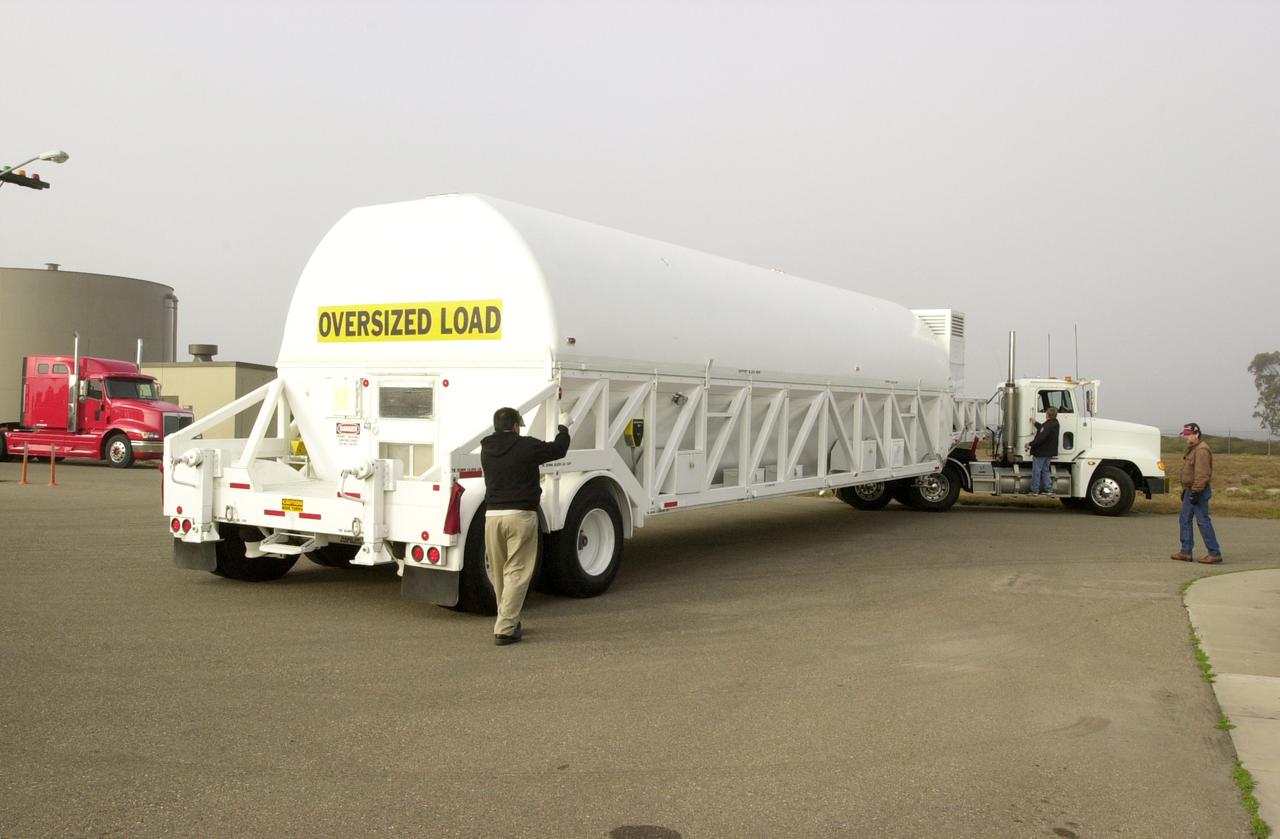
VANDENBERG AFB, CALIF. -  The first stage of the Delta II launch vehicle for the Gravity Probe B experiment arrives at Space Launch Complex 2, Vandenberg Air Force Base, Calif.  The Gravity Probe B will launch a payload of four gyroscopes into low-Earth polar orbit to test two extraordinary predictions of Albert Einstein’s general theory of relativity: the geodetic effect (how space and time are warped by the presence of the Earth) and frame dragging (how Earth’s rotation drags space and time around with it). Once in orbit, for 18 months each gyroscope’s spin axis will be monitored as it travels through local spacetime, observing and measuring these effects.  The experiment was developed by Stanford University, Lockheed Martin and NASA’s Marshall Space Flight Center.  The targeted launch date is Dec. 6, 2003.
VANDENBERG AFB, CALIF. - The first stage of the Delta II launch vehicle for the Gravity Probe B experiment arrives at Space Launch Complex 2, Vandenberg Air Force Base, Calif. The Gravity Probe B will launch a payload of four gyroscopes into low-Earth polar orbit to test two extraordinary predictions of Albert Einstein’s general theory of relativity: the geodetic effect (how space and time are warped by the presence of the Earth) and frame dragging (how Earth’s rotation drags space and time around with it). Once in orbit, for 18 months each gyroscope’s spin axis will be monitored as it travels through local spacetime, observing and measuring these effects. The experiment was developed by Stanford University, Lockheed Martin and NASA’s Marshall Space Flight Center. The targeted launch date is Dec. 6, 2003.
VANDENBERG AFB, CALIF. -  The interstage of the Delta II launch vehicle for the Gravity Probe B experiment is  prepared for lifting up the mobile service tower on Space Launch Complex 2, Vandenberg Air Force Base, Calif.  It will enclose the second stage.  The Gravity Probe B will launch a payload of four gyroscopes into low-Earth polar orbit to test two extraordinary predictions of Albert Einstein’s general theory of relativity: the geodetic effect (how space and time are warped by the presence of the Earth) and frame dragging (how Earth’s rotation drags space and time around with it). Once in orbit, for 18 months each gyroscope’s spin axis will be monitored as it travels through local spacetime, observing and measuring these effects.  The experiment was developed by Stanford University, Lockheed Martin and NASA’s Marshall Space Flight Center.  The targeted launch date is Dec. 6, 2003.
VANDENBERG AFB, CALIF. - The interstage of the Delta II launch vehicle for the Gravity Probe B experiment is prepared for lifting up the mobile service tower on Space Launch Complex 2, Vandenberg Air Force Base, Calif. It will enclose the second stage. The Gravity Probe B will launch a payload of four gyroscopes into low-Earth polar orbit to test two extraordinary predictions of Albert Einstein’s general theory of relativity: the geodetic effect (how space and time are warped by the presence of the Earth) and frame dragging (how Earth’s rotation drags space and time around with it). Once in orbit, for 18 months each gyroscope’s spin axis will be monitored as it travels through local spacetime, observing and measuring these effects. The experiment was developed by Stanford University, Lockheed Martin and NASA’s Marshall Space Flight Center. The targeted launch date is Dec. 6, 2003.
VANDENBERG AFB, CALIF. -   The interstage of the Delta II launch vehicle for the Gravity Probe B experiment is moved into the mobile service tower on Space Launch Complex 2, Vandenberg Air Force Base, Calif., where it will be mated with the second stage.  The Gravity Probe B will launch a payload of four gyroscopes into low-Earth polar orbit to test two extraordinary predictions of Albert Einstein’s general theory of relativity: the geodetic effect (how space and time are warped by the presence of the Earth) and frame dragging (how Earth’s rotation drags space and time around with it). Once in orbit, for 18 months each gyroscope’s spin axis will be monitored as it travels through local spacetime, observing and measuring these effects.  The experiment was developed by Stanford University, Lockheed Martin and NASA’s Marshall Space Flight Center.  The targeted launch date is Dec. 6, 2003.
VANDENBERG AFB, CALIF. - The interstage of the Delta II launch vehicle for the Gravity Probe B experiment is moved into the mobile service tower on Space Launch Complex 2, Vandenberg Air Force Base, Calif., where it will be mated with the second stage. The Gravity Probe B will launch a payload of four gyroscopes into low-Earth polar orbit to test two extraordinary predictions of Albert Einstein’s general theory of relativity: the geodetic effect (how space and time are warped by the presence of the Earth) and frame dragging (how Earth’s rotation drags space and time around with it). Once in orbit, for 18 months each gyroscope’s spin axis will be monitored as it travels through local spacetime, observing and measuring these effects. The experiment was developed by Stanford University, Lockheed Martin and NASA’s Marshall Space Flight Center. The targeted launch date is Dec. 6, 2003.
VANDENBERG AFB, CALIF. -  The first stage of the Delta II launch vehicle for the Gravity Probe B experiment is ready to be lifted up the mobile service tower on Space Launch Complex 2, Vandenberg Air Force Base, Calif.  The Gravity Probe B will launch a payload of four gyroscopes into low-Earth polar orbit to test two extraordinary predictions of Albert Einstein’s general theory of relativity: the geodetic effect (how space and time are warped by the presence of the Earth) and frame dragging (how Earth’s rotation drags space and time around with it). Once in orbit, for 18 months each gyroscope’s spin axis will be monitored as it travels through local spacetime, observing and measuring these effects.  The experiment was developed by Stanford University, Lockheed Martin and NASA’s Marshall Space Flight Center.  The targeted launch date is Dec. 6, 2003.
VANDENBERG AFB, CALIF. - The first stage of the Delta II launch vehicle for the Gravity Probe B experiment is ready to be lifted up the mobile service tower on Space Launch Complex 2, Vandenberg Air Force Base, Calif. The Gravity Probe B will launch a payload of four gyroscopes into low-Earth polar orbit to test two extraordinary predictions of Albert Einstein’s general theory of relativity: the geodetic effect (how space and time are warped by the presence of the Earth) and frame dragging (how Earth’s rotation drags space and time around with it). Once in orbit, for 18 months each gyroscope’s spin axis will be monitored as it travels through local spacetime, observing and measuring these effects. The experiment was developed by Stanford University, Lockheed Martin and NASA’s Marshall Space Flight Center. The targeted launch date is Dec. 6, 2003.
VANDENBERG AFB, CALIF. -  The mobile service tower on Space Launch Complex 2, Vandenberg Air Force Base, Calif., rolls back from the Delta II rocket that will launch the Gravity Probe B experiment.  The Gravity Probe B will launch a payload of four gyroscopes into low-Earth polar orbit to test two extraordinary predictions of Albert Einstein’s general theory of relativity: the geodetic effect (how space and time are warped by the presence of the Earth) and frame dragging (how Earth’s rotation drags space and time around with it). Once in orbit, for 18 months each gyroscope’s spin axis will be monitored as it travels through local spacetime, observing and measuring these effects.  The experiment was developed by Stanford University, Lockheed Martin and NASA’s Marshall Space Flight Center.  The targeted launch date is Dec. 6, 2003.
VANDENBERG AFB, CALIF. - The mobile service tower on Space Launch Complex 2, Vandenberg Air Force Base, Calif., rolls back from the Delta II rocket that will launch the Gravity Probe B experiment. The Gravity Probe B will launch a payload of four gyroscopes into low-Earth polar orbit to test two extraordinary predictions of Albert Einstein’s general theory of relativity: the geodetic effect (how space and time are warped by the presence of the Earth) and frame dragging (how Earth’s rotation drags space and time around with it). Once in orbit, for 18 months each gyroscope’s spin axis will be monitored as it travels through local spacetime, observing and measuring these effects. The experiment was developed by Stanford University, Lockheed Martin and NASA’s Marshall Space Flight Center. The targeted launch date is Dec. 6, 2003.
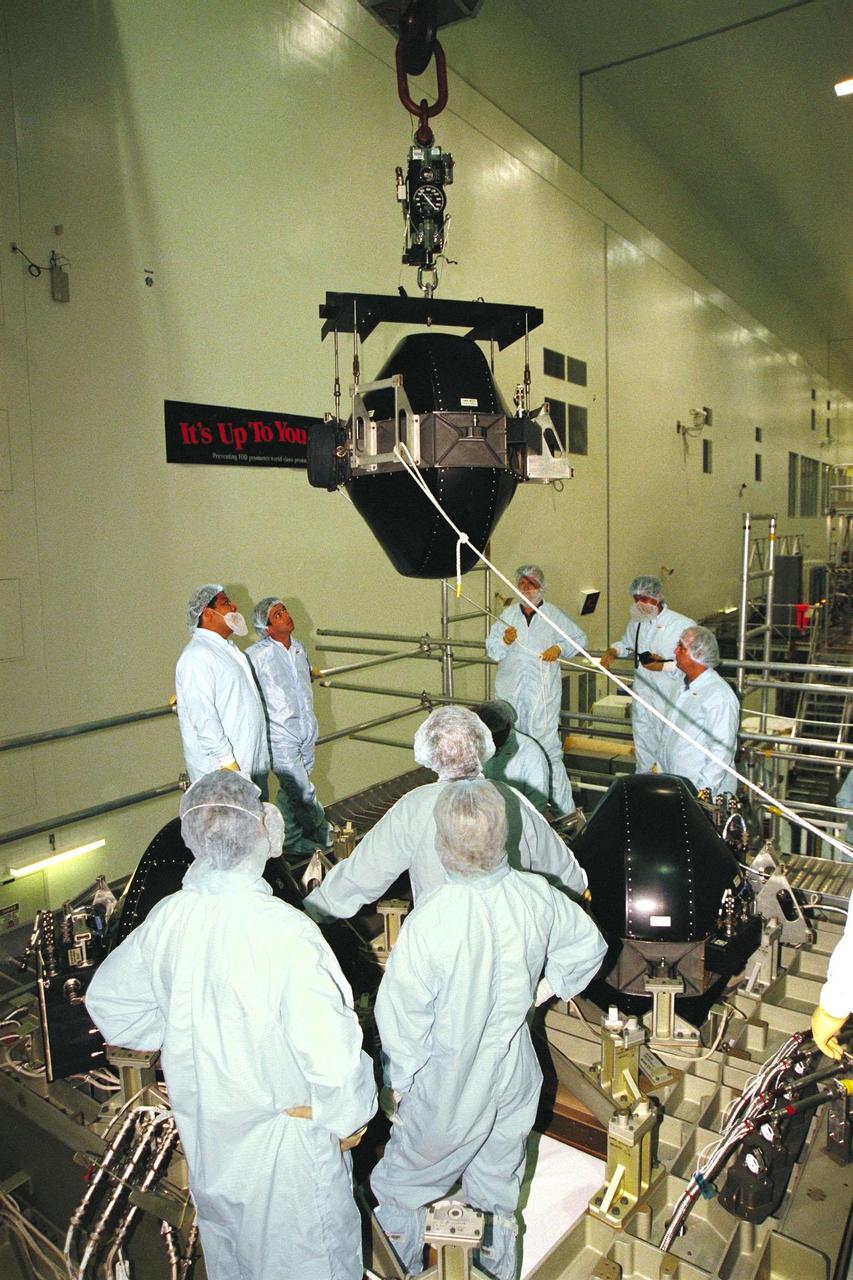
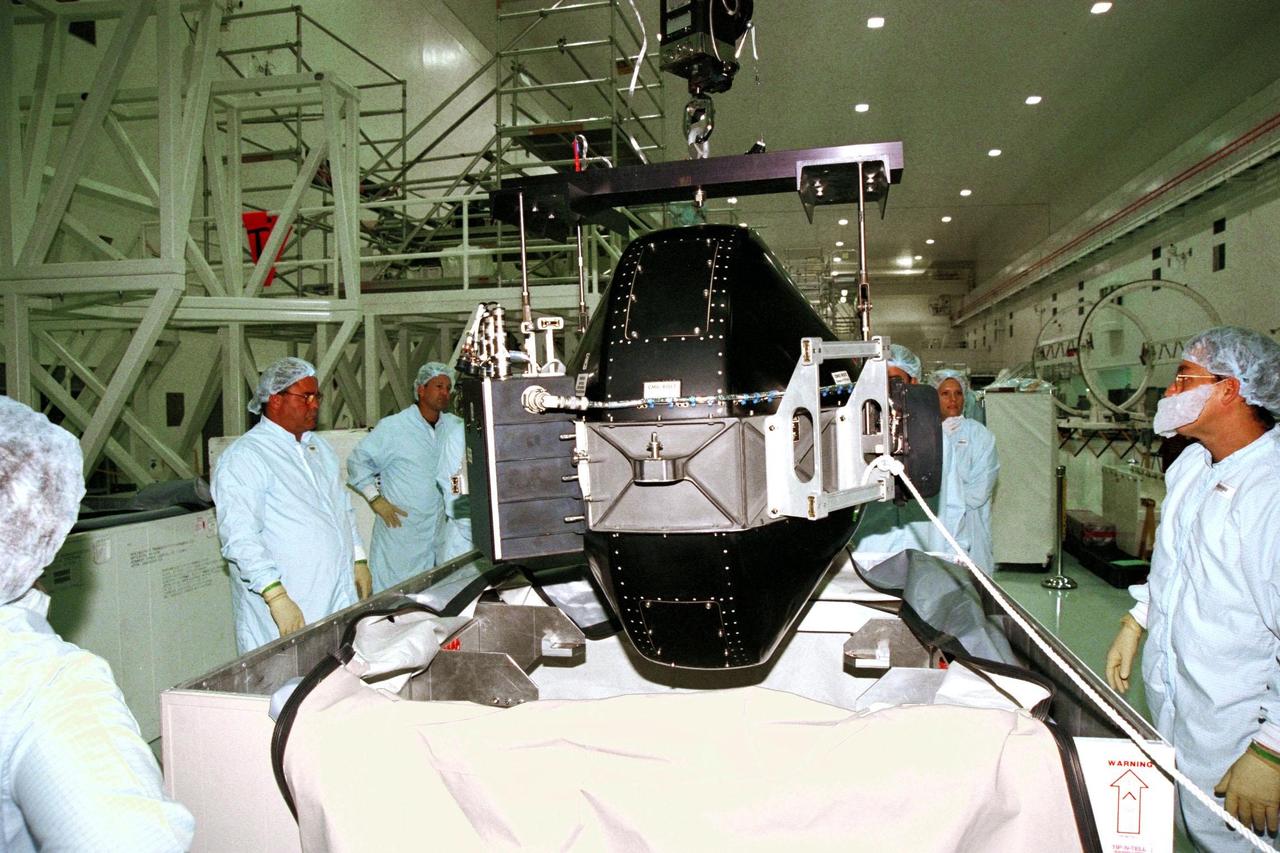
Boeing technicians remove the cover from a Control Moment Gyroscope (CMG) in the Space Station Processing Facility at KSC. The CMG will be attached to the Integrated Truss Structure (ITS) Z1. Gyroscopes are used for stabilization of the International Space Station (ISS). The CMG and Z1, part of the construction of the ISS, will be carried on STS-92, the third U.S. flight planned for on-orbit construction of the ISS. STS-92 is scheduled for liftoff on June 17, 1999, aboard the Space Shuttle Atlantis
KSC-98pc868
Boeing technicians lower a Control Moment Gyroscope (CMG) into place on the Integrated Truss Structure (ITS) Z1 in the Space Station Processing Facility at KSC. Gyroscopes are used for stabilization of the International Space Station (ISS). The CMG and Z1, part of the construction of the ISS, will be carried on STS-92, the third U.S. flight planned for on-orbit construction of the ISS. STS-92 is scheduled for liftoff on June 17, 1999, aboard the Space Shuttle Atlantis
KSC-98pc870
Boeing technicians move a Control Moment Gyroscope (CMG) to the Integrated Truss Structure (ITS) Z1 in the Space Station Processing Facility at KSC. Gyroscopes are used for stabilization of the International Space Station (ISS). The CMG and Z1, part of the construction of the ISS, will be carried on STS-92, the third U.S. flight planned for on-orbit construction of the ISS. STS-92 is scheduled for liftoff on June 17, 1999, aboard the Space Shuttle Atlantis
KSC-98pc869
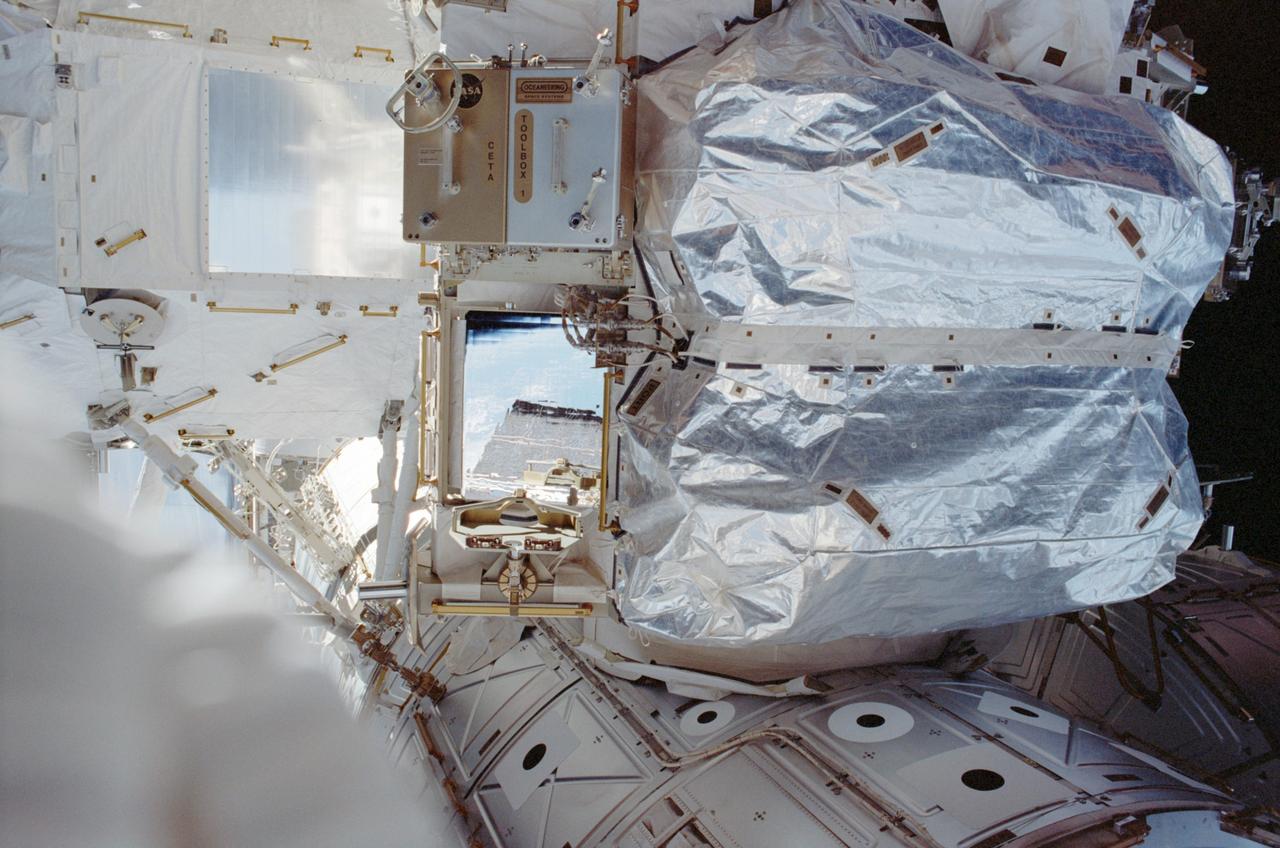
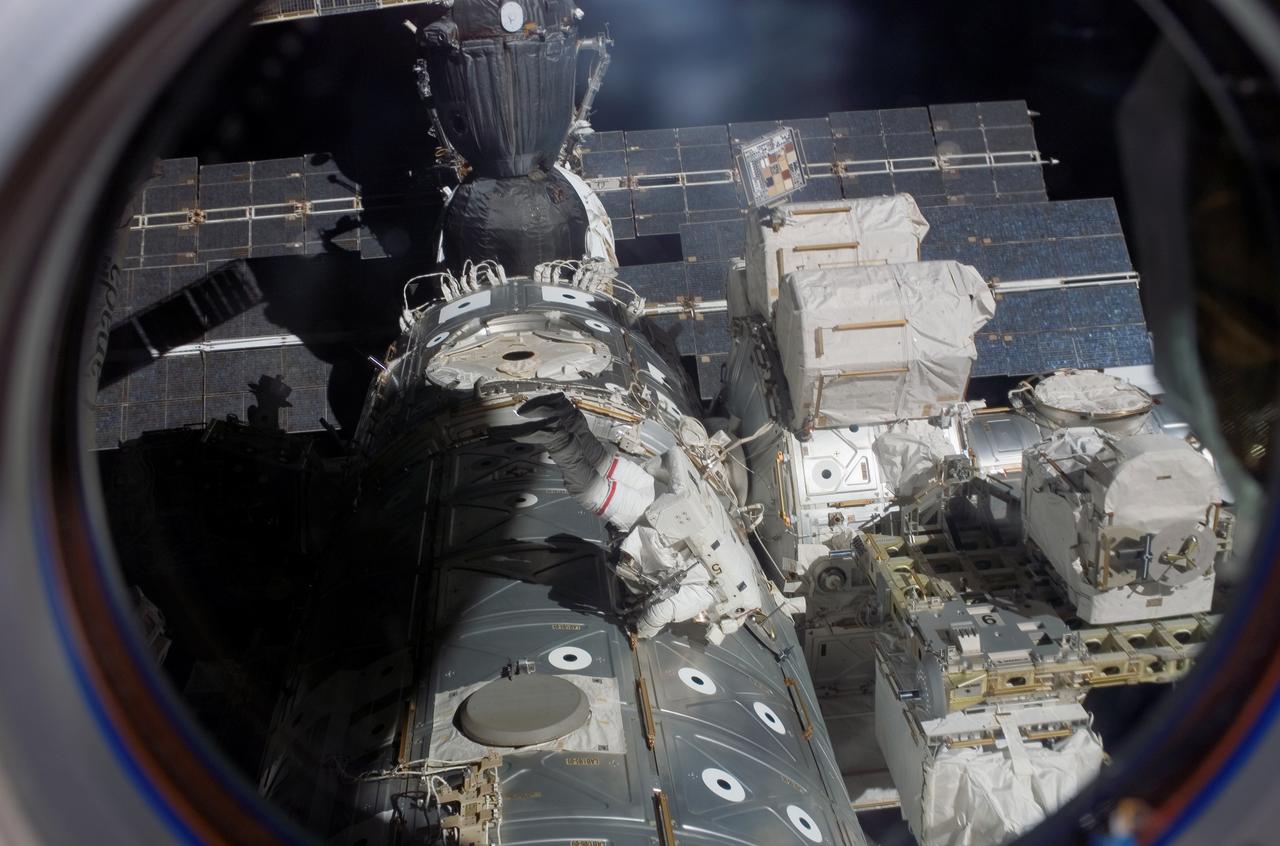
STS111-310-022 (9 June 2002) --- Medium shot of Z Truss Control Moment Gyroscope (CMG) on the International Space Station as photographed during STS-111 spacewalk.
View of the MLI on the CMG on the Z1 truss taken during STS-111 UF-2 EVA 1
KENNEDY SPACE CENTER, FLA. - In the Space Station Processing Facility, members of the STS-114 crew look at a Control Moment Gyroscope.  From left are Mission Specialists Andrew Thomas, Soichi Noguchi and Stephen Robinson.  Noguchi is with the Japan Aerospace Exploration Agency, JAXA.  Thomas is a new addition to the mission crew. The STS-114 crew is at KSC to take part in crew equipment and orbiter familiarization.
KENNEDY SPACE CENTER, FLA. - In the Space Station Processing Facility, members of the STS-114 crew look at a Control Moment Gyroscope. From left are Mission Specialists Andrew Thomas, Soichi Noguchi and Stephen Robinson. Noguchi is with the Japan Aerospace Exploration Agency, JAXA. Thomas is a new addition to the mission crew. The STS-114 crew is at KSC to take part in crew equipment and orbiter familiarization.
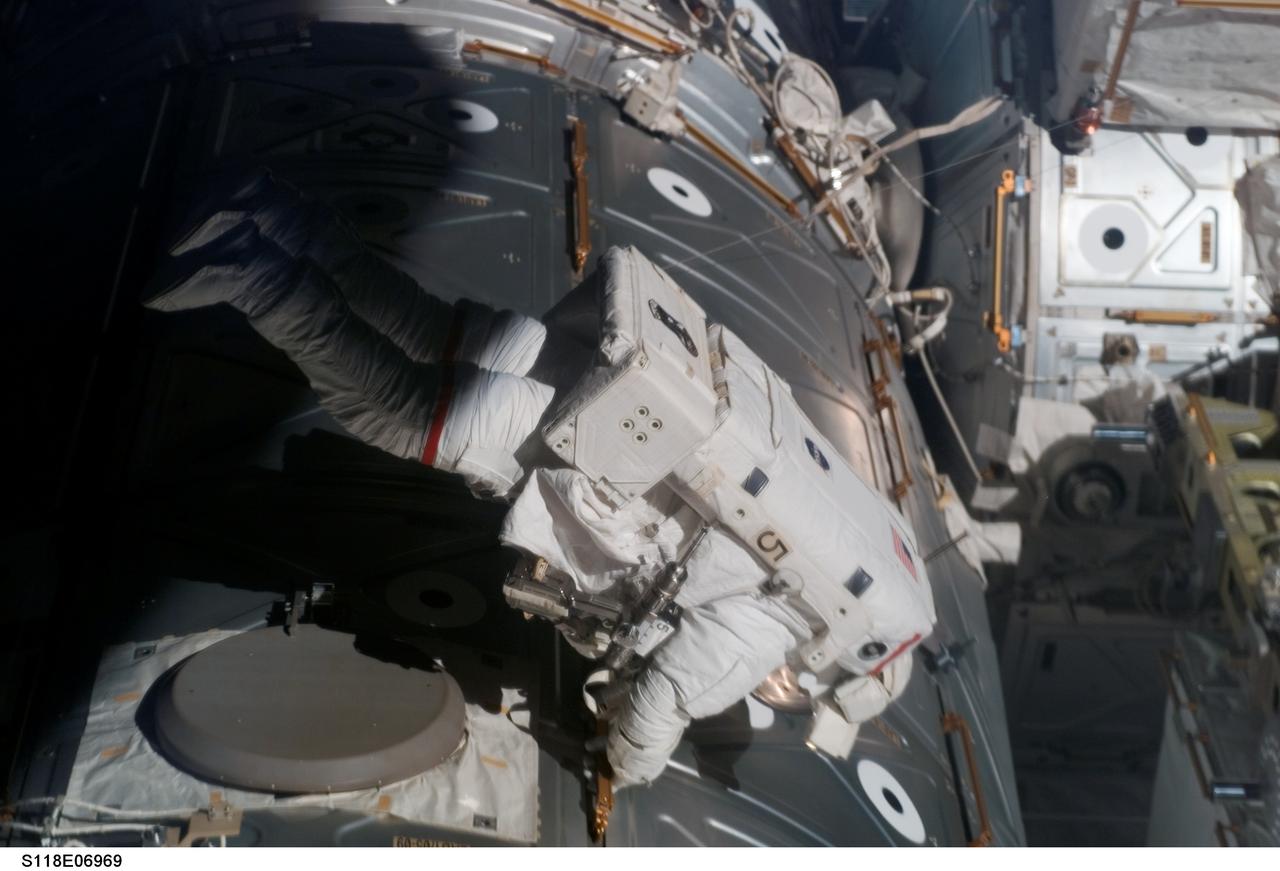
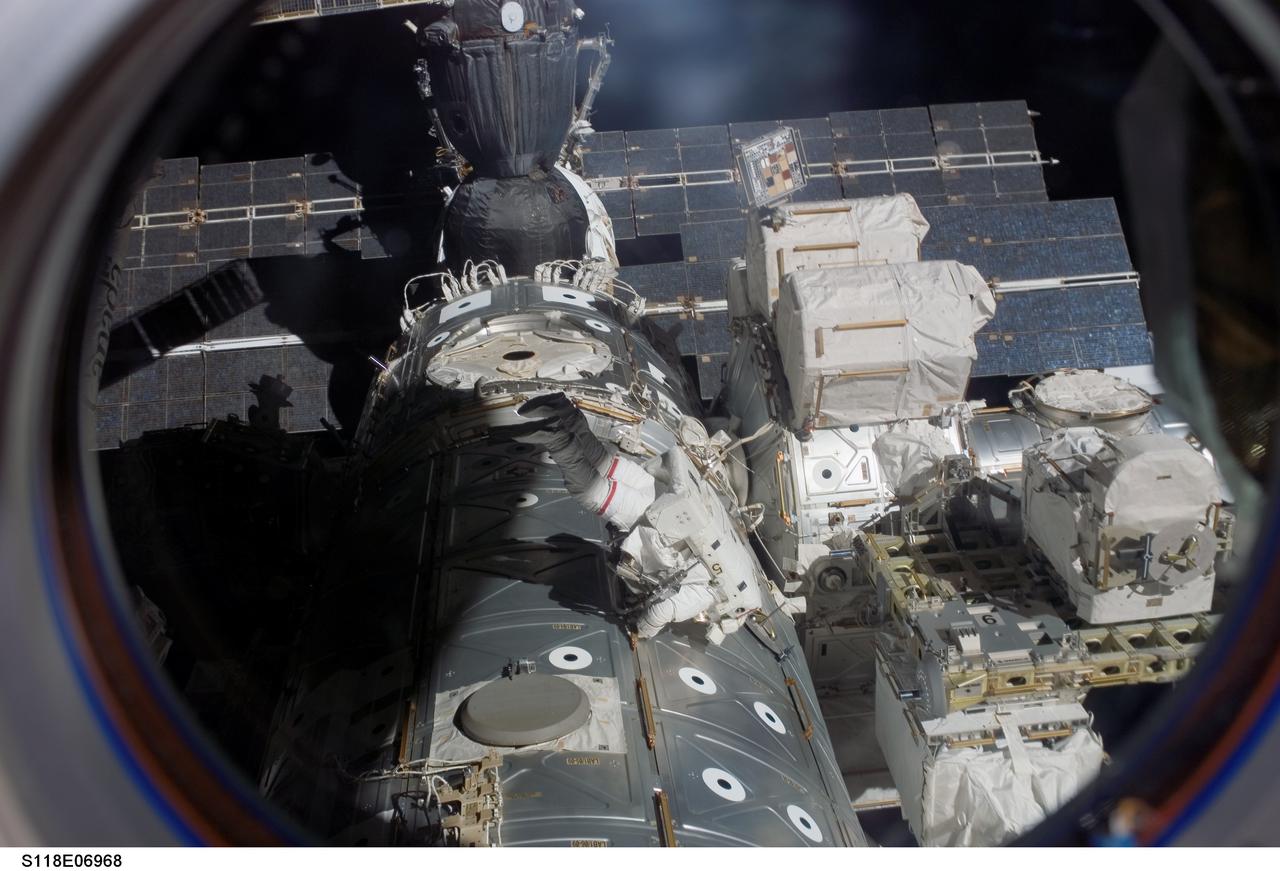
S118-E-06968 (13 Aug. 2007) --- Astronaut Rick Mastracchio, STS-118 mission specialist, participates in the mission's second planned session of extravehicular activity (EVA) as construction and maintenance continue on the International Space Station. During the 6-hour, 28-minute spacewalk, Mastracchio and astronaut Dave Williams (out of frame), mission specialist representing the Canadian Space Agency, removed a faulty control moment gyroscope (CMG-3) and installed a new CMG into the station's Z1 truss. The failed CMG will remain at its temporary stowage location on the station's exterior until it is returned to Earth on a later shuttle mission. The new gyroscope is one of four CMGs that are used to control the station's attitude in orbit.
View of MS Mastracchio participating in EVA 2 during STS-118/Expedition 15 Joint Operations
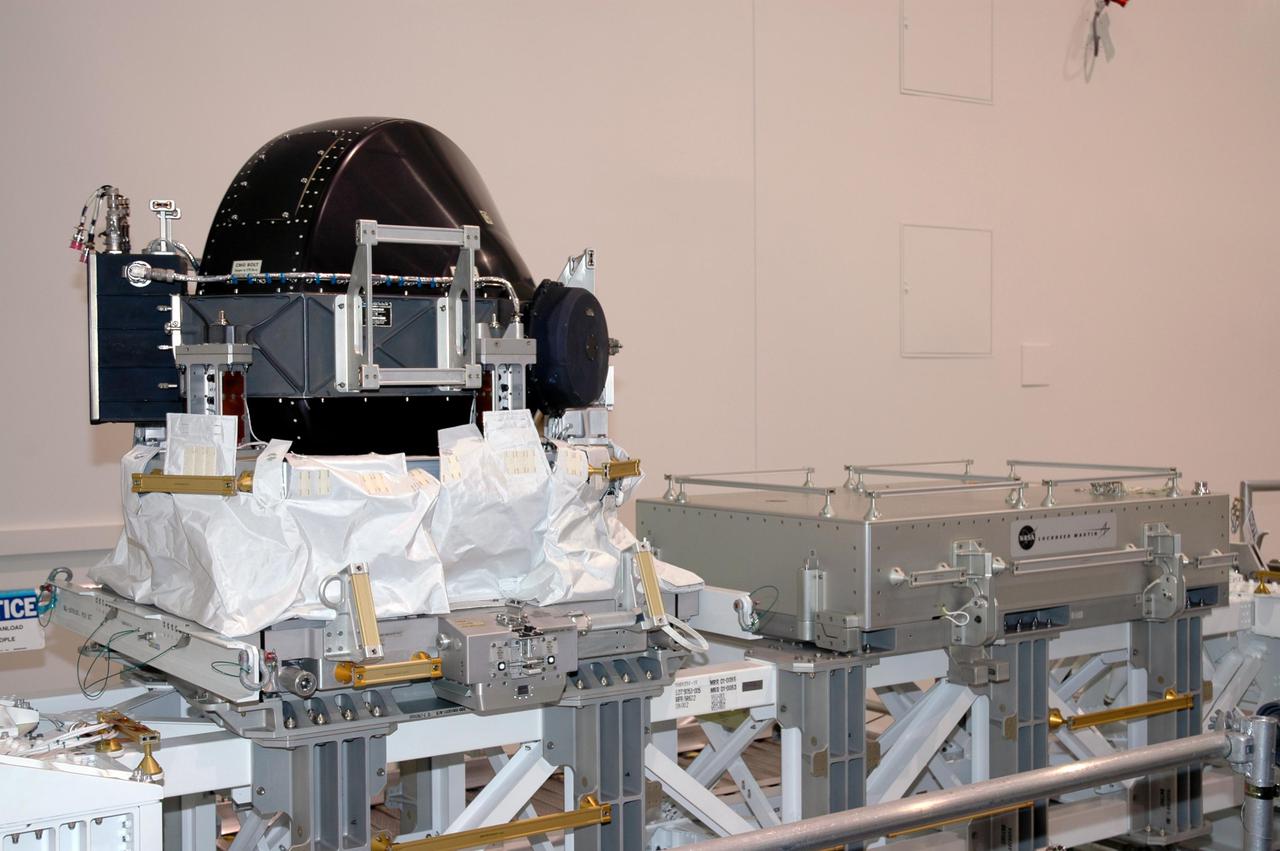
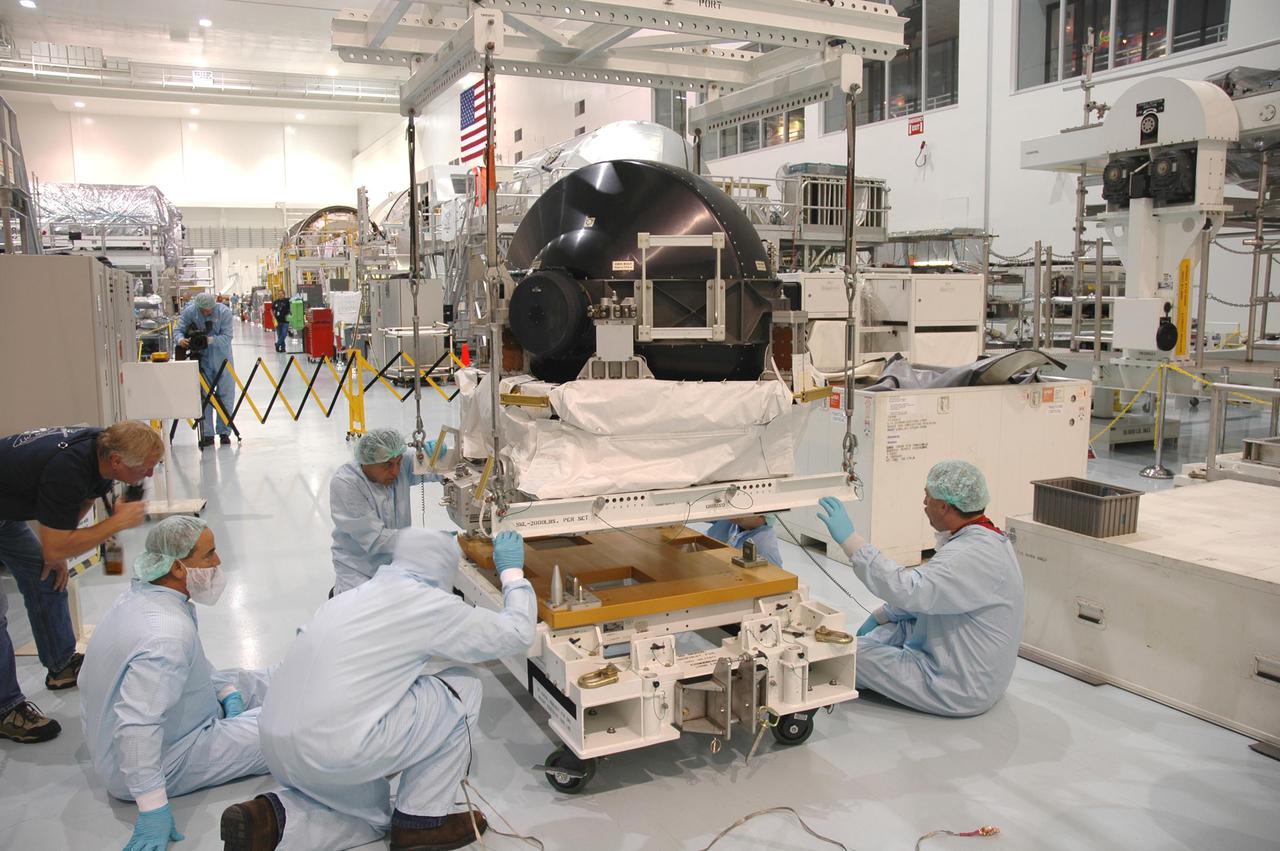
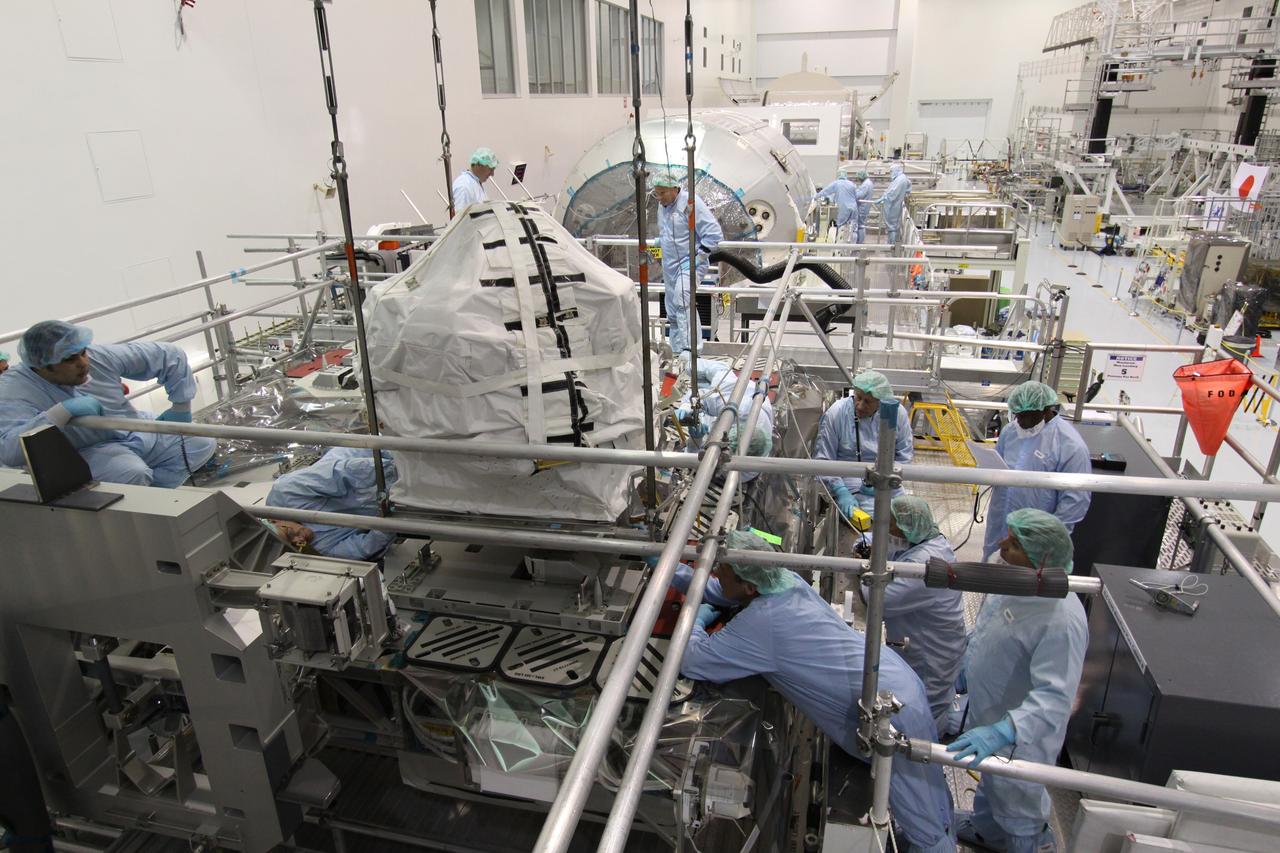
CAPE CANAVERAL, Fla. – In the Space Station Processing Facility at NASA's Kennedy Space Center in Florida,  technicians check the position of the control moment gyroscope after being placed on an EXPRESS Logistics Carrier. The carrier is part of the STS-129 payload on space shuttle Atlantis, which will deliver to the International Space Station two spare gyroscopes, two nitrogen tank assemblies, two pump modules, an ammonia tank assembly and a spare latching end effector for the station's robotic arm.  STS-129 is targeted to launch Nov. 12 .  Photo credit: NASA/Jack Pfaller
KSC-2009-4204
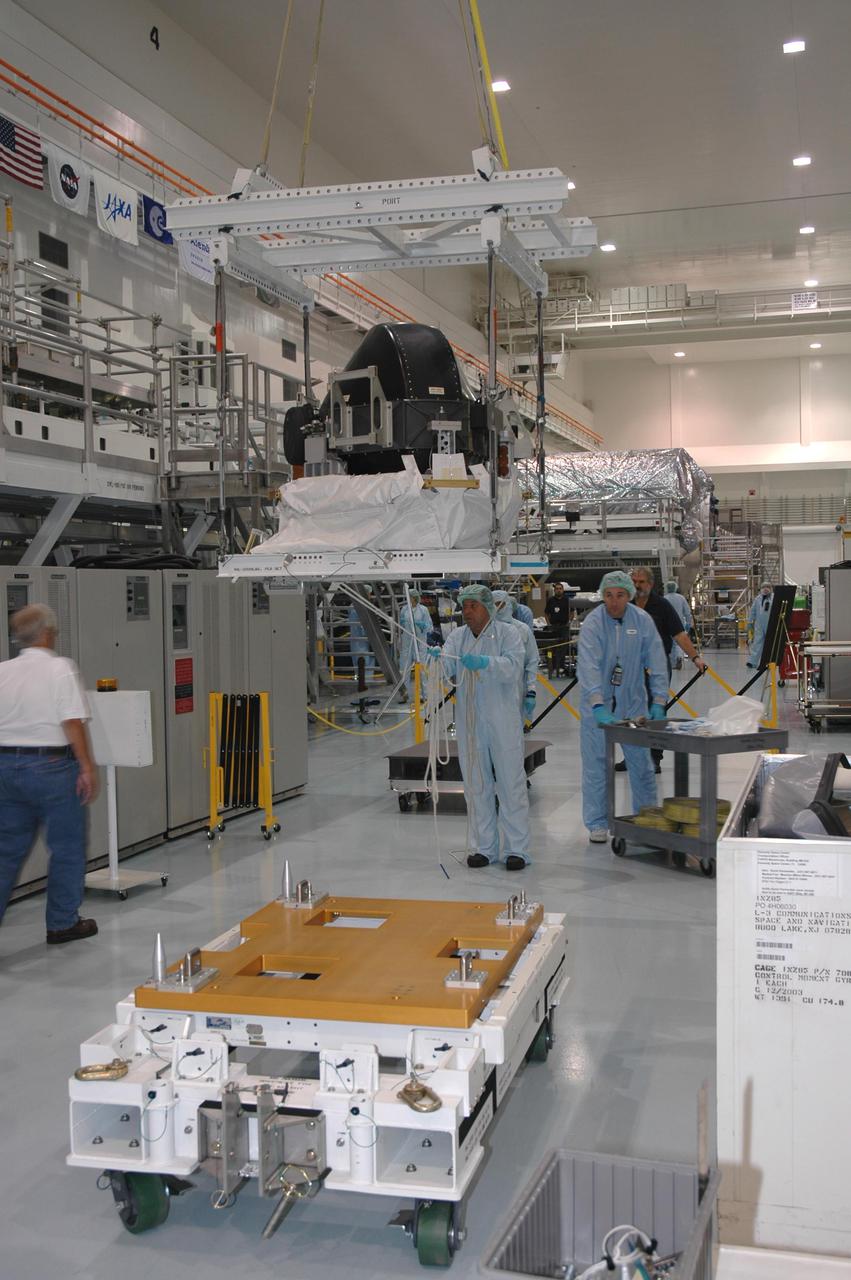
CAPE CANAVERAL, Fla. – In the Space Station Processing Facility at NASA's Kennedy Space Center in Florida, a control moment gyroscope is lifted by crane toward an EXPRESS Logistics Carrier on which it will be installed for flight.  The carrier is part of the STS-129 payload on space shuttle Atlantis, which will deliver to the International Space Station two spare gyroscopes, two nitrogen tank assemblies, two pump modules, an ammonia tank assembly and a spare latching end effector for the station's robotic arm. STS-129 is targeted to launch Nov. 12. Photo credit: NASA/Jim Grossmann
KSC-2009-4634
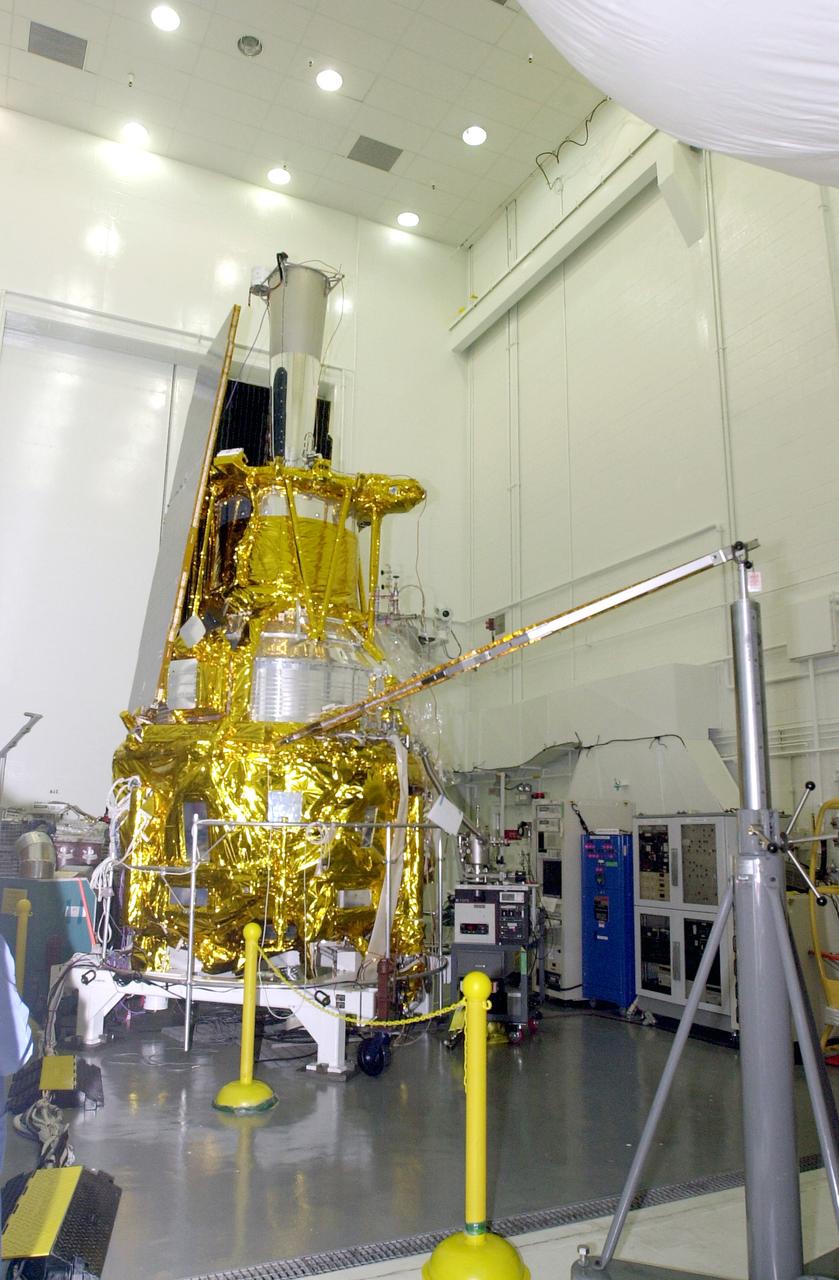
The Gravity Probe B experiment rests on an assembly and test stand in the spacecraft processing facility on North Vandenberg Air Force Base. Gravity Probe B will launch a payload of four gyroscopes into low-Earth polar orbit to test two extraordinary predictions of Albert Einstein’s general theory of relativity: the geodetic effect (how space and time are warped by the presence of the Earth) and frame dragging (how Earth’s rotation drags space and time around with it). Once in orbit, for 18 months each gyroscope’s spin axis will be monitored as it travels through local spacetime, observing and measuring these effects. The experiment was developed by Stanford University, Lockheed Martin and NASA’s Marshall Space Flight Center.
Gravity Probe B
CAPE CANAVERAL, Fla. – In the Space Station Processing Facility at NASA's Kennedy Space Center in Florida,  technicians keep watch as the control moment gyroscope is lowered toward an EXPRESS Logistics Carrier.  The carrier is part of the STS-129 payload on space shuttle Atlantis, which will deliver to the International Space Station two spare gyroscopes, two nitrogen tank assemblies, two pump modules, an ammonia tank assembly and a spare latching end effector for the station's robotic arm.  STS-129 is targeted to launch Nov. 12 .  Photo credit: NASA/Jack Pfaller
KSC-2009-4202
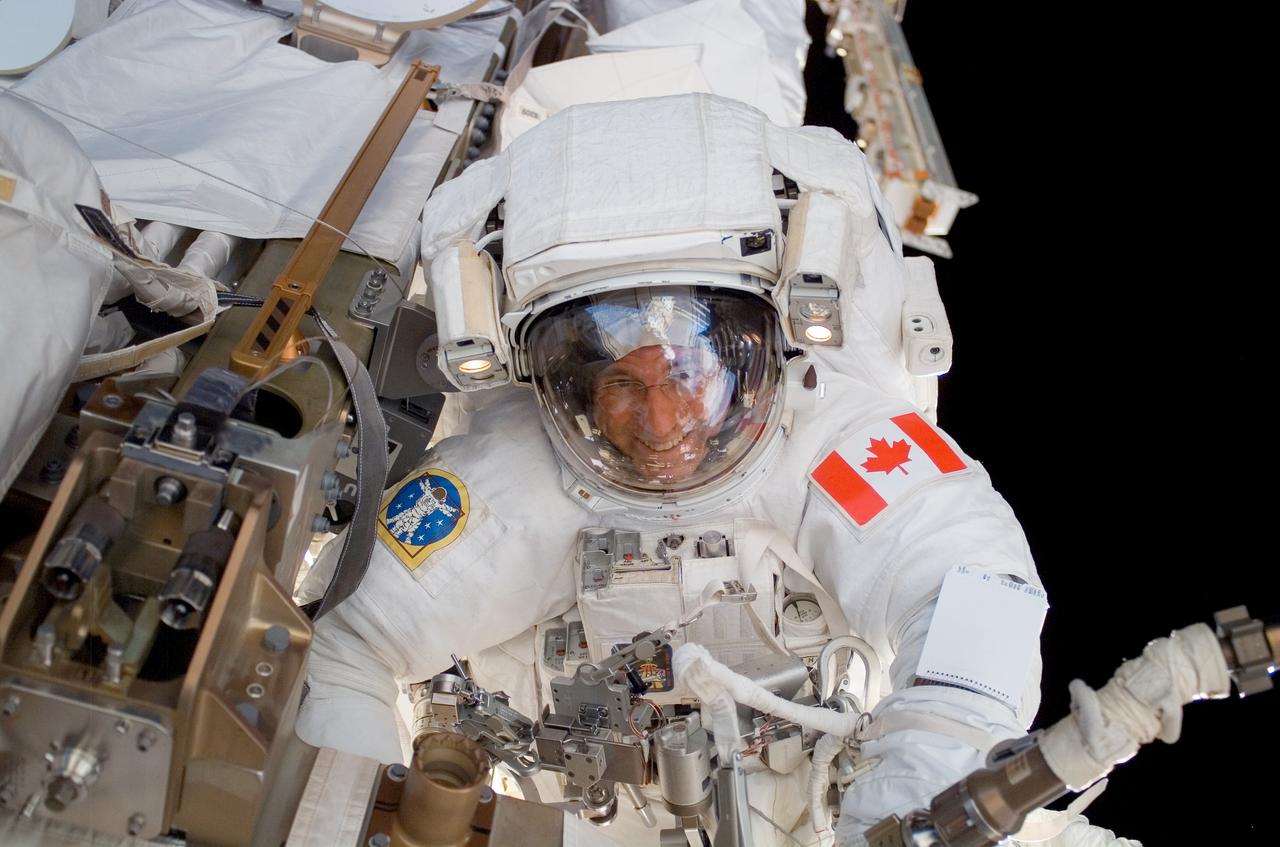
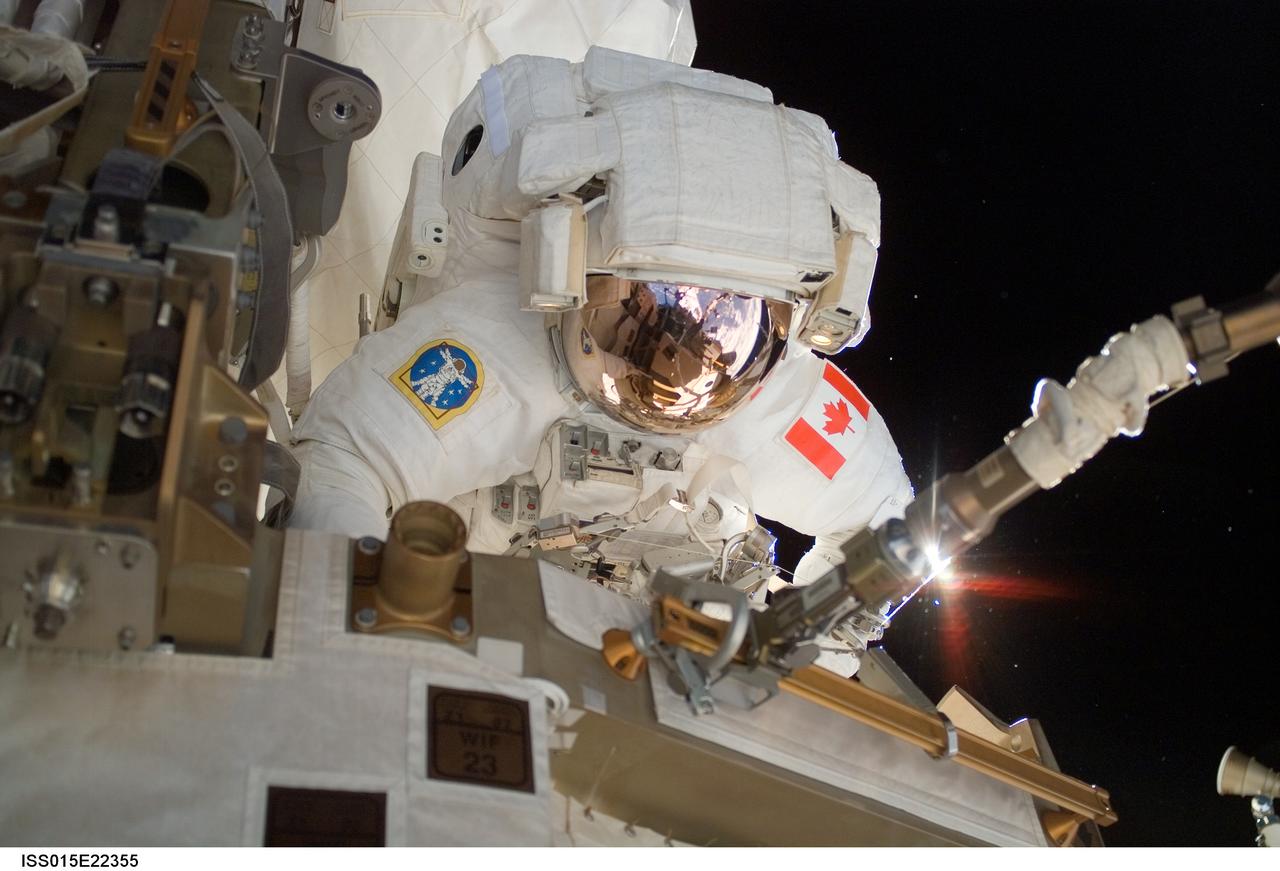
ISS015-E-22355 (13 Aug. 2007) --- Astronaut Dave Williams, STS-118 mission specialist representing the Canadian Space Agency, participates in the mission's second planned session of extravehicular activity (EVA) as construction and maintenance continue on the International Space Station. During the 6-hour, 28-minute spacewalk Williams and astronaut Rick Mastracchio (out of frame), mission specialist, removed a faulty control moment gyroscope (CMG-3) and installed a new CMG into the station's Z1 truss. The failed CMG will remain at its temporary stowage location on the station's exterior until it is returned to Earth on a later shuttle mission. The new gyroscope is one of four CMGs that are used to control the station's attitude in orbit.
View of MS Williams installing the new CMG during Expedition 15/STS-118 EVA 2
CAPE CANAVERAL, Fla. – In the Space Station Processing Facility at NASA's Kennedy Space Center in Florida,  technicians keep watch as the control moment gyroscope is moved toward an EXPRESS Logistics Carrier.  The carrier is part of the STS-129 payload on space shuttle Atlantis, which will deliver to the International Space Station two spare gyroscopes, two nitrogen tank assemblies, two pump modules, an ammonia tank assembly and a spare latching end effector for the station's robotic arm.  STS-129 is targeted to launch Nov. 12 .  Photo credit: NASA/Jack Pfaller
KSC-2009-4201
The Gravity Probe B experiment is lifted from its transporter in the spacecraft processing facility on North Vandenberg Air Force Base. Gravity Probe B will launch a payload of four gyroscopes into low-Earth polar orbit to test two extraordinary predictions of Albert Einstein’s general theory of relativity: the geodetic effect (how space and time are warped by the presence of the Earth) and frame dragging (how Earth’s rotation drags space and time around with it). Once in orbit, for 18 months each gyroscope’s spin axis will be monitored as it travels through local spacetime, observing and measuring these effects. The experiment was developed by Stanford University, Lockheed Martin and NASA’s Marshall Space Flight Center.
Gravity Probe B
CAPE CANAVERAL, Fla. – In the Space Station Processing Facility at NASA's Kennedy Space Center in Florida,  technicians watch as the control moment gyroscope is lowered onto an EXPRESS Logistics Carrier.  The carrier is part of the STS-129 payload on space shuttle Atlantis, which will deliver to the International Space Station two spare gyroscopes, two nitrogen tank assemblies, two pump modules, an ammonia tank assembly and a spare latching end effector for the station's robotic arm.  STS-129 is targeted to launch Nov. 12 .  Photo credit: NASA/Jack Pfaller
KSC-2009-4203
CAPE CANAVERAL, Fla. – In the Space Station Processing Facility at NASA's Kennedy Space Center in Florida,  technicians keep watch as the control moment gyroscope is lifted from its stand.  It will be moved to an EXPRESS Logistics Carrier.  The carrier is part of the STS-129 payload on space shuttle Atlantis, which will deliver to the International Space Station two spare gyroscopes, two nitrogen tank assemblies, two pump modules, an ammonia tank assembly and a spare latching end effector for the station's robotic arm.  STS-129 is targeted to launch Nov. 12 .  Photo credit: NASA/Jack Pfaller
KSC-2009-4198
CAPE CANAVERAL, Fla. – In the Space Station Processing Facility at NASA's Kennedy Space Center in Florida, a control moment gyroscope is lowered by crane onto an EXPRESS Logistics Carrier on which it will be installed for flight.  The carrier is part of the STS-129 payload on space shuttle Atlantis, which will deliver to the International Space Station two spare gyroscopes, two nitrogen tank assemblies, two pump modules, an ammonia tank assembly and a spare latching end effector for the station's robotic arm. STS-129 is targeted to launch Nov. 12. Photo credit: NASA/Jim Grossmann
KSC-2009-4636
S118-E-06969 (13 Aug. 2007) --- Astronaut Rick Mastracchio, STS-118 mission specialist, participates in the mission's second planned session of extravehicular activity (EVA) as construction and maintenance continue on the International Space Station. During the 6-hour, 28-minute spacewalk, Mastracchio and astronaut Dave Williams (out of frame), mission specialist representing the Canadian Space Agency, removed a faulty control moment gyroscope (CMG-3) and installed a new CMG into the station's Z1 truss. The failed CMG will remain at its temporary stowage location on the station's exterior until it is returned to Earth on a later shuttle mission. The new gyroscope is one of four CMGs that are used to control the station's attitude in orbit.
View of MS Mastracchio participating in EVA 2 during STS-118/Expedition 15 Joint Operations
S118-E-07019 (13 Aug. 2007) --- Astronaut Rick Mastracchio, STS-118 mission specialist, participates in the mission's second planned session of extravehicular activity (EVA) as construction and maintenance continue on the International Space Station. During the 6-hour, 28-minute spacewalk, Mastracchio and astronaut Dave Williams (out of frame), mission specialist representing the Canadian Space Agency, removed a faulty control moment gyroscope (CMG-3) and installed a new CMG into the station's Z1 truss. The failed CMG will remain at its temporary stowage location on the station's exterior until it is returned to Earth on a later shuttle mission. The new gyroscope is one of four CMGs that are used to control the station's attitude in orbit.
View of MS Mastracchio as he makes his way to the ESP2 during EVA 2
As the construction continued on the International Space Station (ISS), STS-118 astronaut and mission specialist, Dave Williams, representing the Canadian Space Agency, was anchored on the foot restraint of the Canadarm2 as he participated in the second session of Extra Vehicular Activity (EVA) for the mission. Assisting Williams was Rick Mastracchio (out of frame). During the 6 hour, 28 minute space walk, the two removed a faulty control moment gyroscope (CMG-3) and installed a new CMG into the Z1 truss. The failed CMG will remain in its temporary stowage location on the exterior of the station until it is returned to Earth on a later Shuttle mission. The new gyroscope is one of four CMGs that are used to control the orbital attitude of the station.
International Space Station (ISS)
Enclosed in a canister, the Gravity Probe B (GP-B) spacecraft arrives on Vandenberg Air Force Base, headed for the spacecraft processing facility. Gravity Probe B will launch a payload of four gyroscopes into low-Earth polar orbit to test two extraordinary predictions of Albert Einstein’s general theory of relativity: the geodetic effect (how space and time are warped by the presence of the Earth) and frame dragging (how Earth’s rotation drags space and time around with it). Once in orbit, for 18 months each gyroscope’s spin axis will be monitored as it travels through local spacetime, observing and measuring these effects. The experiment was developed by Stanford University, Lockheed Martin and NASA’s Marshall Space Flight Center.
Gravity Probe B
ISS015-E-22364 (13 Aug. 2007) --- Astronaut Dave Williams, STS-118 mission specialist representing the Canadian Space Agency, participates in the mission's second planned session of extravehicular activity (EVA) as construction and maintenance continue on the International Space Station. During the 6-hour, 28-minute spacewalk, Williams and astronaut Rick Mastracchio (out of frame), mission specialist, removed a faulty control moment gyroscope (CMG-3) and installed a new CMG into the station's Z1 truss. The failed CMG will remain at its temporary stowage location on the station's exterior until it is returned to Earth on a later shuttle mission. The new gyroscope is one of four CMGs that are used to control the station's attitude in orbit.
View of MS Williams installing the new CMG during Expedition 15/STS-118 EVA 2
CAPE CANAVERAL, Fla. – In the Space Station Processing Facility at NASA's Kennedy Space Center in Florida, a control moment gyroscope is lifted by crane above an EXPRESS Logistics Carrier on which it will be installed for flight.  The carrier is part of the STS-129 payload on space shuttle Atlantis, which will deliver to the International Space Station two spare gyroscopes, two nitrogen tank assemblies, two pump modules, an ammonia tank assembly and a spare latching end effector for the station's robotic arm. STS-129 is targeted to launch Nov. 12. Photo credit: NASA/Jim Grossmann
KSC-2009-4635
As the construction continued on the International Space Station (ISS), STS-118 astronaut and mission specialist Rick Mastracchio participated in the second session of Extra Vehicular Activity (EVA) for the mission. Assisting Mastracchio was Canadian Space Agency representative Dave Williams (out of frame). During the 6 hour, 28 minute space walk, the two removed a faulty control moment gyroscope (CMG-3) and installed a new CMG into the Z1 truss.  The failed CMG will remain in its temporary stowage location on the exterior of the station until it is returned to Earth on a later Shuttle mission. The new gyroscope is one of four CMGs that are used to control the orbital attitude of the station.
International Space Station (ISS)
In the Payload Hazardous Servicing Facility clean room, the gyroscopes (left) and computer (right), part of the flight hardware for the Hubble Space Telescope Servicing mission, is on display for media representatives. This mission is designed to replace aging parts on the nine-year-old observatory and to upgrade some of its functioning systems. During the flight, the astronaut crew will replace all six of Hubble's gyroscopes, a fine guidance sensor, the observatory's main computer, and other equipment. The 10-day mission is scheduled to launch no earlier than Dec. 2 at 4:32 a.m. EST from Launch Complex 39
KSC-99pp1199
ISS015-E-22358 (13 Aug. 2007) --- Astronaut Dave Williams, STS-118 mission specialist representing the Canadian Space Agency, participates in the mission's second planned session of extravehicular activity (EVA) as construction and maintenance continue on the International Space Station. During the 6-hour, 28-minute spacewalk Williams and astronaut Rick Mastracchio (out of frame), mission specialist, removed a faulty control moment gyroscope (CMG-3) and installed a new CMG into the station's Z1 truss. The failed CMG will remain at its temporary stowage location on the station's exterior until it is returned to Earth on a later shuttle mission. The new gyroscope is one of four CMGs that are used to control the station's attitude in orbit.
View of MS Williams installing the new CMG during Expedition 15/STS-118 EVA 2
CAPE CANAVERAL, Fla. – In the Space Station Processing Facility at NASA's Kennedy Space Center in Florida,  technicians keep watch as the control moment gyroscope is moved toward an EXPRESS Logistics Carrier.  The carrier is part of the STS-129 payload on space shuttle Atlantis, which will deliver to the International Space Station two spare gyroscopes, two nitrogen tank assemblies, two pump modules, an ammonia tank assembly and a spare latching end effector for the station's robotic arm.  STS-129 is targeted to launch Nov. 12 .  Photo credit: NASA/Jack Pfaller
KSC-2009-4200
ISS015-E-22371 (13 Aug. 2007) --- Astronaut Dave Williams, STS-118 mission specialist representing the Canadian Space Agency, participates in the mission's second planned session of extravehicular activity (EVA) as construction and maintenance continue on the International Space Station. During the 6-hour, 28-minute spacewalk, Williams and astronaut Rick Mastracchio (out of frame), mission specialist, removed a faulty control moment gyroscope (CMG-3) and installed a new CMG into the station's Z1 truss. The failed CMG will remain at its temporary stowage location on the station's exterior until it is returned to Earth on a later shuttle mission. The new gyroscope is one of four CMGs that are used to control the station's attitude in orbit.
View of MS Williams installing the new CMG during Expedition 15/STS-118 EVA 2
The Gravity Probe B experiment enters the spacecraft processing facility on North Vandenberg Air Force Base. Gravity Probe B will launch a payload of four gyroscopes into low-Earth polar orbit to test two extraordinary predictions of Albert Einstein’s general theory of relativity: the geodetic effect (how space and time are warped by the presence of the Earth) and frame dragging (how Earth’s rotation drags space and time around with it). Once in orbit, for 18 months each gyroscope’s spin axis will be monitored as it travels through local spacetime, observing and measuring these effects. The experiment was developed by Stanford University, Lockheed Martin and NASA’s Marshall Space Flight Center.
Gravity Probe B
CAPE CANAVERAL, Fla. – In the Space Station Processing Facility at NASA's Kennedy Space Center in Florida,  technicians keep watch as the control moment gyroscope is lifted past the Node 3 Tranquility module to an EXPRESS Logistics Carrier.  The carrier is part of the STS-129 payload on space shuttle Atlantis, which will deliver to the International Space Station two spare gyroscopes, two nitrogen tank assemblies, two pump modules, an ammonia tank assembly and a spare latching end effector for the station's robotic arm.  STS-129 is targeted to launch Nov. 12 .  Photo credit: NASA/Jack Pfaller
KSC-2009-4199
A transporter carrying the Gravity Probe B experiment backs into the spacecraft processing facility on North Vandenberg Air Force Base. Gravity Probe B will launch a payload of four gyroscopes into low-Earth polar orbit to test two extraordinary predictions of Albert Einstein’s general theory of relativity: the geodetic effect (how space and time are warped by the presence of the Earth) and frame dragging (how Earth’s rotation drags space and time around with it). Once in orbit, for 18 months each gyroscope’s spin axis will be monitored as it travels through local spacetime, observing and measuring these effects. The experiment was developed by Stanford University, Lockheed Martin and NASA’s Marshall Space Flight Center.
Gravity Probe B
At Vandenberg AFB, the canister enclosing the Gravity Probe B (GP-B) spacecraft is removed from the transporter. Gravity Probe B will launch a payload of four gyroscopes into low-Earth polar orbit to test two extraordinary predictions of Albert Einstein’s general theory of relativity: the geodetic effect (how space and time are warped by the presence of the Earth) and frame dragging (how Earth’s rotation drags space and time around with it). Once in orbit, for 18 months each gyroscope’s spin axis will be monitored as it travels through local spacetime, observing and measuring these effects. The experiment was developed by Stanford University, Lockheed Martin and NASA’s Marshall Space Flight Center.
Gravity Probe B
The Gravity Probe B experiment is lowered onto an assembly and test stand in the spacecraft processing facility on North Vandenberg Air Force Base. Gravity Probe B will launch a payload of four gyroscopes into low-Earth polar orbit to test two extraordinary predictions of Albert Einstein’s general theory of relativity: the geodetic effect (how space and time are warped by the presence of the Earth) and frame dragging (how Earth’s rotation drags space and time around with it). Once in orbit, for 18 months each gyroscope’s spin axis will be monitored as it travels through local spacetime, observing and measuring these effects. The experiment was developed by Stanford University, Lockheed Martin and NASA’s Marshall Space Flight Center.
Gravity Probe B
CAPE CANAVERAL, Fla. – In the Space Station Processing Facility at NASA's Kennedy Space Center in Florida, technicians get ready to move the control moment gyroscope, or CMG, to an EXPRESS Logistics Carrier. The carrier is part of the STS-129 payload on space shuttle Atlantis, which will deliver to the International Space Station two spare gyroscopes, two nitrogen tank assemblies, two pump modules, an ammonia tank assembly and a spare latching end effector for the station's robotic arm.  STS-129 is targeted to launch Nov. 12 .  Photo credit: NASA/Jack Pfaller
KSC-2009-4197
A C-5 air cargo plane lands at Kennedy Space Center carrying the payload flight hardware for the Third Hubble Space Telescope Servicing Mission (SM-3A). The hardware will be taken to the Payload Hazardous Servicing Facility for final testing and integration of payload elements. Mission STS-103 is a "call-up" mission which is being planned due to the need to replace portions of the Hubble's pointing system, the gyros, which have begun to fail. Although Hubble is operating normally and conducting its scientific observations, only three of its six gyroscopes are working properly. The gyroscopes allow the telescope to point at stars, galaxies and planets. The STS-103 crew will not only replace gyroscopes, it will also replace a Fine Guidance Sensor and an older computer with a new enhanced model, an older data tape recorder with a solid state digital recorder, a failed spare transmitter with a new one, and degraded insulation on the telescope with new thermal insulation. The crew will also install a Battery Voltage/Temperature Improvement Kit to protect the spacecraft batteries from overcharging and overheating when the telescope goes into a safe mode. Launch of STS-93 is currently targeted for Oct. 14 but under review, pending the launch date of a prior mission, STS-99, also under review
KSC-99pp1037
A C-5 air cargo plane opens to reveal a shipping container with payload flight hardware for the Third Hubble Space Telescope Servicing Mission (SM-3A). The hardware will be taken to the Payload Hazardous Servicing Facility for final testing and integration of payload elements. Mission STS-103 is a "call-up" mission which is being planned due to the need to replace portions of the Hubble's pointing system, the gyros, which have begun to fail. Although Hubble is operating normally and conducting its scientific observations, only three of its six gyroscopes are working properly. The gyroscopes allow the telescope to point at stars, galaxies and planets. The STS-103 crew will not only replace gyroscopes, it will also replace a Fine Guidance Sensor and an older computer with a new enhanced model, an older data tape recorder with a solid state digital recorder, a failed spare transmitter with a new one, and degraded insulation on the telescope with new thermal insulation. The crew will also install a Battery Voltage/Temperature Improvement Kit to protect the spacecraft batteries from overcharging and overheating when the telescope goes into a safe mode. Launch of STS-93 is currently targeted for Oct. 14 but under review, pending the launch date of a prior mission, STS-99, also under review
KSC-99pp1038
In the Payload Hazardous Servicing Facility, a worker gives a black light inspection to part of the servicing equipment for the third Hubble Space Telescope Servicing Mission (SM-3A), STS-103. The hardware is undergoing final testing and integration of payload elements. Mission STS-103 is a "call-up" due to the need to replace portions of the Hubble's pointing system, the gyros, which have begun to fail. Although Hubble is operating normally and conducting its scientific observations, only three of its six gyroscopes are working properly. The gyroscopes allow the telescope to point at stars, galaxies and planets. The STS-103 crew will not only replace gyroscopes, it will also replace a Fine Guidance Sensor and an older computer with a new enhanced model, an older data tape recorder with a solid state digital recorder, a failed spare transmitter with a new one, and degraded insulation on the telescope with new thermal insulation. The crew will also install a Battery Voltage/Temperature Improvement Kit to protect the spacecraft batteries from overcharging and overheating when the telescope goes into a safe mode. The scheduled launch date in October is under review
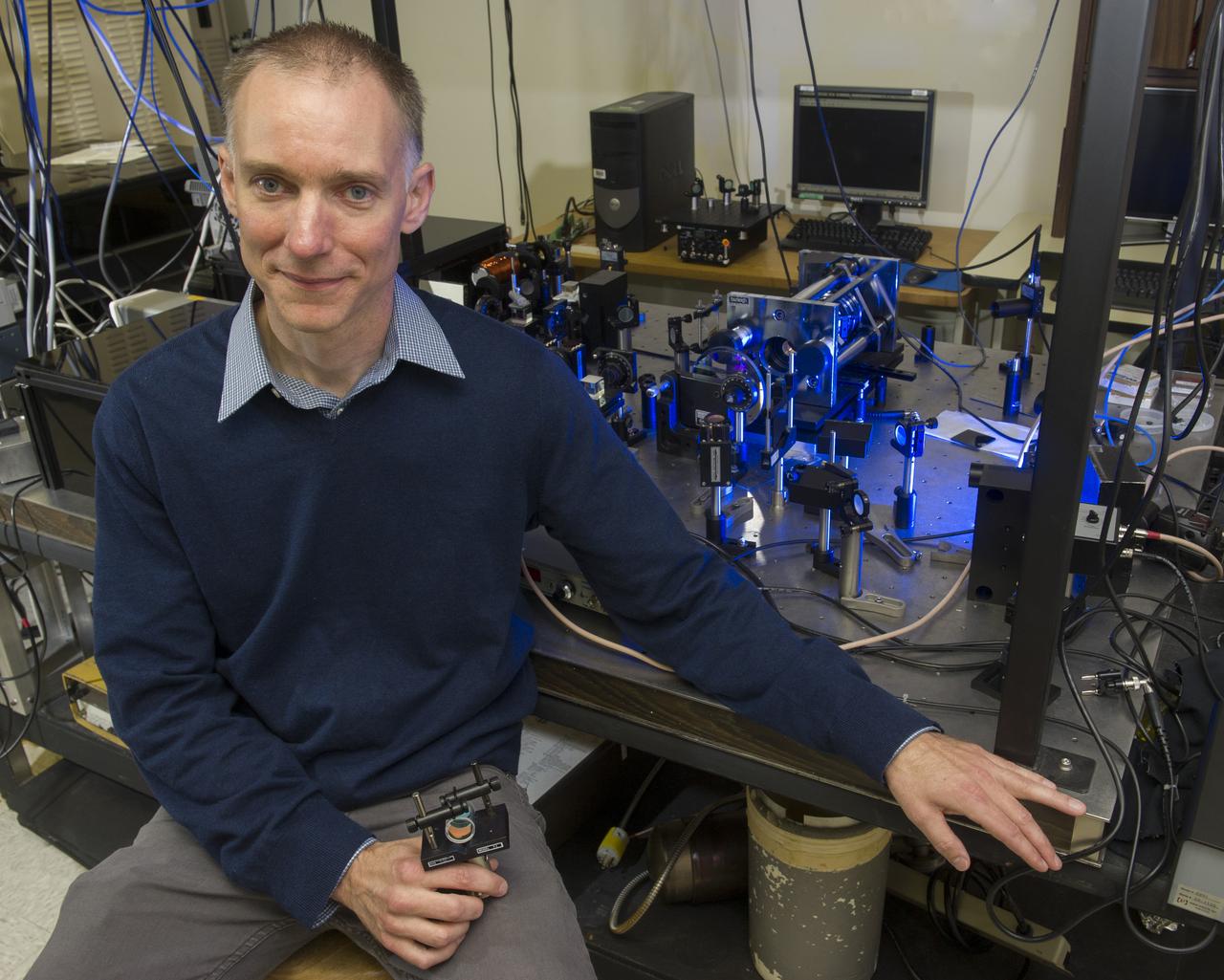
KSC-99pp1078
A shipping container with payload flight hardware for the Third Hubble Space Telescope Servicing Mission (SM-3A) is transferred onto a transporter from the C-5 air cargo plane that brought it to KSC. The hardware will be taken to the Payload Hazardous Servicing Facility for final testing and integration of payload elements. Mission STS-103 is a "call-up" mission which is being planned due to the need to replace portions of the Hubble's pointing system, the gyros, which have begun to fail. Although Hubble is operating normally and conducting its scientific observations, only three of its six gyroscopes are working properly. The gyroscopes allow the telescope to point at stars, galaxies and planets. The STS-103 crew will not only replace gyroscopes, it will also replace a Fine Guidance Sensor and an older computer with a new enhanced model, an older data tape recorder with a solid state digital recorder, a failed spare transmitter with a new one, and degraded insulation on the telescope with new thermal insulation. The crew will also install a Battery Voltage/Temperature Improvement Kit to protect the spacecraft batteries from overcharging and overheating when the telescope goes into a safe mode. Launch of STS-93 is currently targeted for Oct. 14 but under review, pending the launch date of a prior mission, STS-99, also under review
KSC-99pp1040
In the Payload Hazardous Servicing Facility, the STS-103 crew look over equipment to be used during their mission. The seven-member crew, taking part in a Crew Equipment Interface Test, are Commander Curtis L. Brown Jr., Pilot Scott J. Kelly, and Mission Specialists Steven L. Smith, C. Michael Foale (Ph.D.), John M. Grunsfeld (Ph.D.), Claude Nicollier of Switzerland, and Jean-François Clervoy of France. Nicollier and Clervoy are with the European Space Agency. Mission STS-103 is a "call-up" due to the need to replace portions of the pointing system, the gyros, which have begun to fail on the Hubble Space Telescope. Although Hubble is operating normally and conducting its scientific observations, only three of its six gyroscopes are working properly. The gyroscopes allow the telescope to point at stars, galaxies and planets. The STS-103 crew will not only replace gyroscopes, it will also replace a Fine Guidance Sensor and an older computer with a new enhanced model, an older data tape recorder with a solid state digital recorder, a failed spare transmitter with a new one, and degraded insulation on the telescope with new thermal insulation. The crew will also install a Battery Voltage/Temperature Improvement Kit to protect the spacecraft batteries from overcharging and overheating when the telescope goes into a safe mode. The scheduled launch date in October is under review
KSC-99pp1086
A shipping container with payload flight hardware for the Third Hubble Space Telescope Servicing Mission (SM-3A) sits on a flatbed trailer for transfer to the Payload Hazardous Servicing Facility where it will undergo final testing and integration of payload elements. Mission STS-103 is a "call-up" mission which is being planned due to the need to replace portions of the Hubble's pointing system, the gyros, which have begun to fail. Although Hubble is operating normally and conducting its scientific observations, only three of its six gyroscopes are working properly. The gyroscopes allow the telescope to point at stars, galaxies and planets. The STS-103 crew will not only replace gyroscopes, it will also replace a Fine Guidance Sensor and an older computer with a new enhanced model, an older data tape recorder with a solid state digital recorder, a failed spare transmitter with a new one, and degraded insulation on the telescope with new thermal insulation. The crew will also install a Battery Voltage/Temperature Improvement Kit to protect the spacecraft batteries from overcharging and overheating when the telescope goes into a safe mode. Launch of STS-93 is currently targeted for Oct. 14 but under review, pending the launch date of a prior mission, STS-99, also under review
KSC-99pp1041
In the Payload Hazardous Servicing Facility, members of the STS-103 crew get instructions on use of rib clamps for the Shield Shell Replacement Fabric (SSRF) task on repair of the Hubble Space Telescope. The seven-member crew are Commander Curtis L. Brown Jr., Pilot Scott J. Kelly, and Mission Specialists Steven L. Smith, C. Michael Foale (Ph.D.), John M. Grunsfeld (Ph.D.), Claude Nicollier of Switzerland, and Jean-François Clervoy of France. Nicollier and Clervoy are with the European Space Agency. Mission STS-103 is a "call-up" due to the need to replace portions of the pointing system, the gyros, which have begun to fail on the Hubble Space Telescope. Although Hubble is operating normally and conducting its scientific observations, only three of its six gyroscopes are working properly. The gyroscopes allow the telescope to point at stars, galaxies and planets. The STS-103 crew will not only replace gyroscopes, it will also replace a Fine Guidance Sensor, an older computer with a new enhanced model, an older data tape recorder with a solid state digital recorder, a failed spare transmitter with a new one, and degraded insulation on the telescope with new thermal insulation. The crew will also install a Battery Voltage/Temperature Improvement Kit to protect the spacecraft batteries from overcharging and overheating when the telescope goes into a safe mode. The scheduled launch date in October is under review
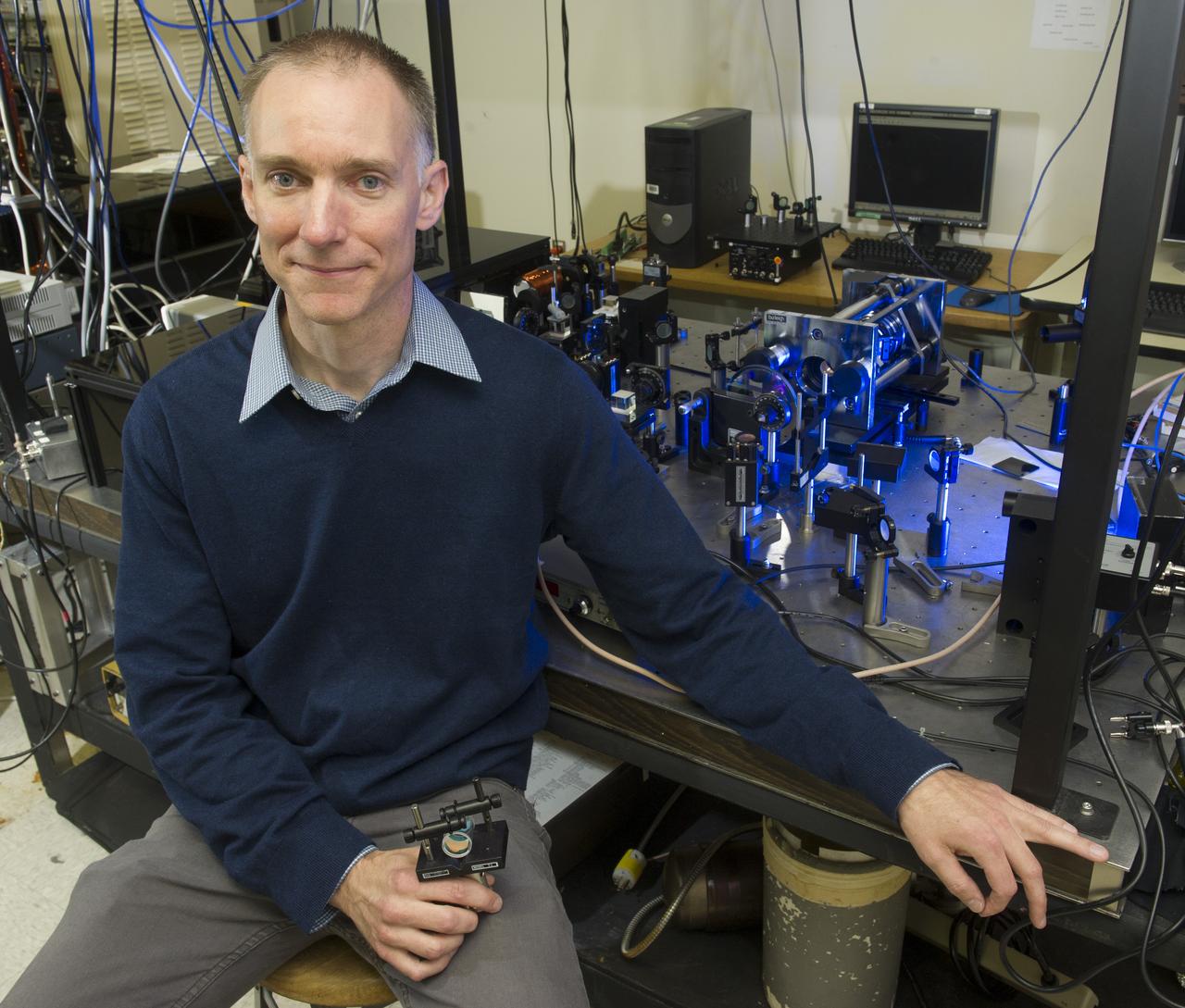
KSC-99pp1088
In the Payload Hazardous Servicing Facility, members of the STS-103 crew look at some of the equipment to be used during their mission. The seven-member crew are Commander Curtis L. Brown Jr., Pilot Scott J. Kelly, and Mission Specialists Steven L. Smith, C. Michael Foale (Ph.D.), John M. Grunsfeld (Ph.D.), Claude Nicollier of Switzerland, and Jean-François Clervoy of France. Nicollier and Clervoy are with the European Space Agency. Mission STS-103 is a "call-up" due to the need to replace portions of the pointing system, the gyros, which have begun to fail on the Hubble Space Telescope. Although Hubble is operating normally and conducting its scientific observations, only three of its six gyroscopes are working properly. The gyroscopes allow the telescope to point at stars, galaxies and planets. The STS-103 crew will not only replace gyroscopes, it will also replace a Fine Guidance Sensor and an older computer with a new enhanced model, an older data tape recorder with a solid state digital recorder, a failed spare transmitter with a new one, and degraded insulation on the telescope with new thermal insulation. The crew will also install a Battery Voltage/Temperature Improvement Kit to protect the spacecraft batteries from overcharging and overheating when the telescope goes into a safe mode. The scheduled launch date in October is under review
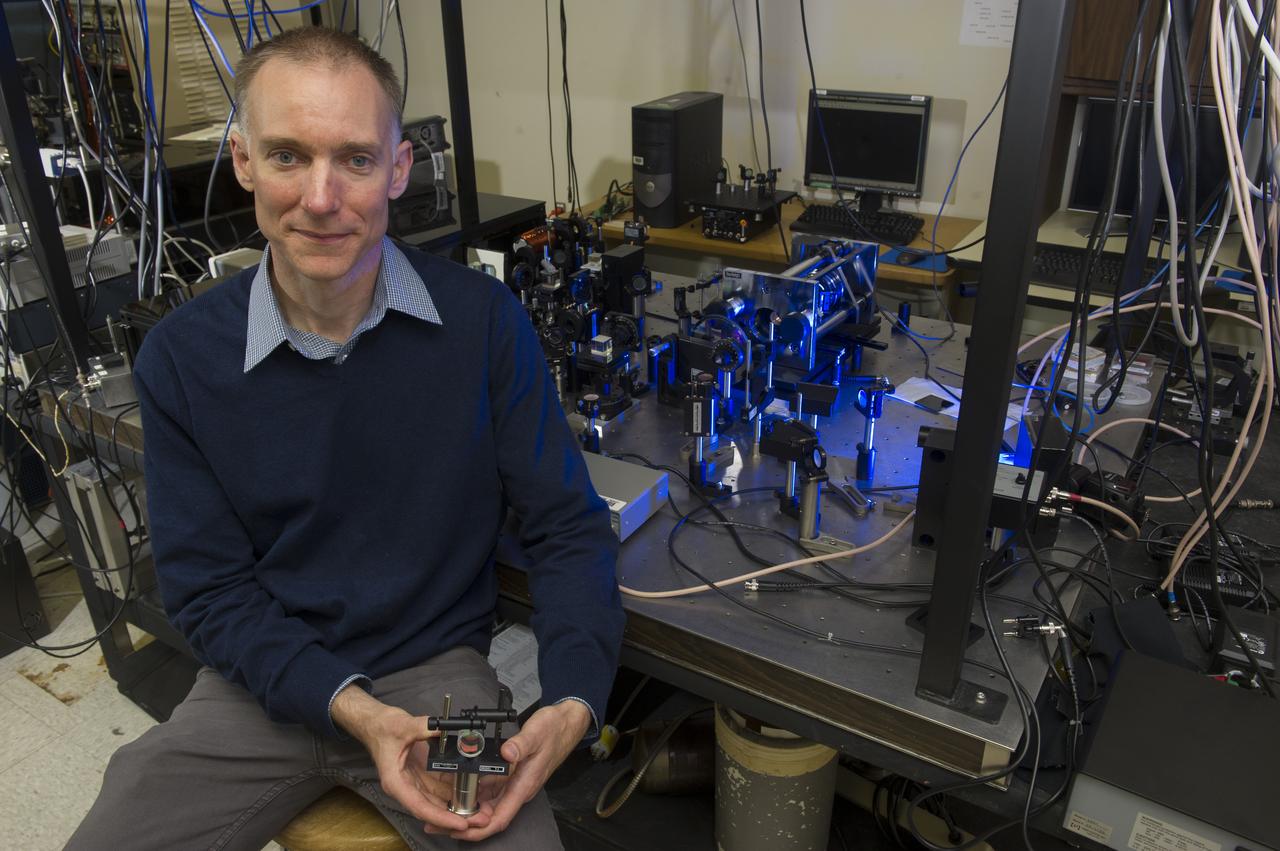
KSC-99pp1089
A shipping container with payload flight hardware for the Third Hubble Space Telescope Servicing Mission (SM-3A) is ready for transfer onto a transporter from the C-5 air cargo plane that brought it to KSC. The hardware will be taken to the Payload Hazardous Servicing Facility for final testing and integration of payload elements. Mission STS-103 is a "call-up" mission which is being planned due to the need to replace portions of the Hubble's pointing system, the gyros, which have begun to fail. Although Hubble is operating normally and conducting its scientific observations, only three of its six gyroscopes are working properly. The gyroscopes allow the telescope to point at stars, galaxies and planets. The STS-103 crew will not only replace gyroscopes, it will also replace a Fine Guidance Sensor and an older computer with a new enhanced model, an older data tape recorder with a solid state digital recorder, a failed spare transmitter with a new one, and degraded insulation on the telescope with new thermal insulation. The crew will also install a Battery Voltage/Temperature Improvement Kit to protect the spacecraft batteries from overcharging and overheating when the telescope goes into a safe mode. Launch of STS-93 is currently targeted for Oct. 14 but under review, pending the launch date of a prior mission, STS-99, also under review
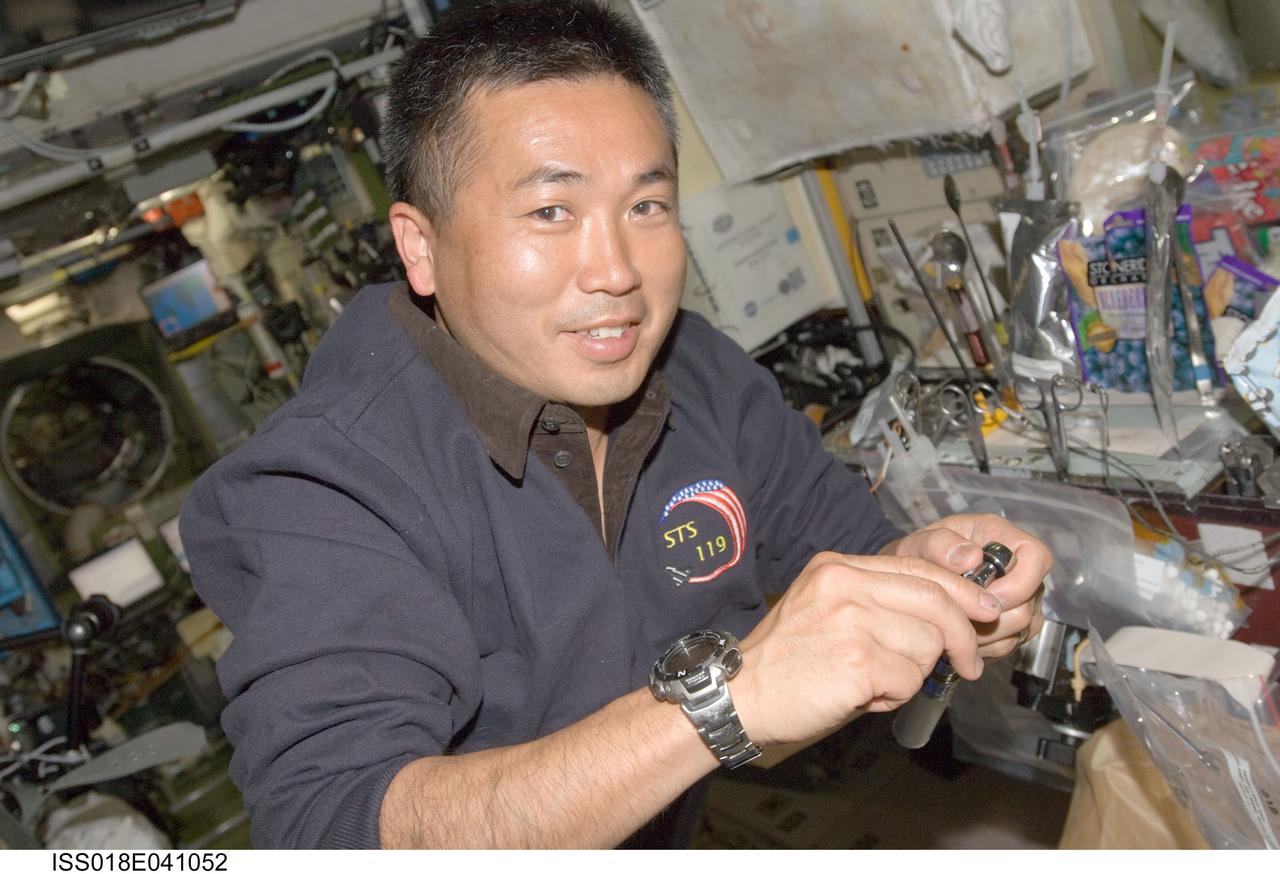
KSC-99pp1039