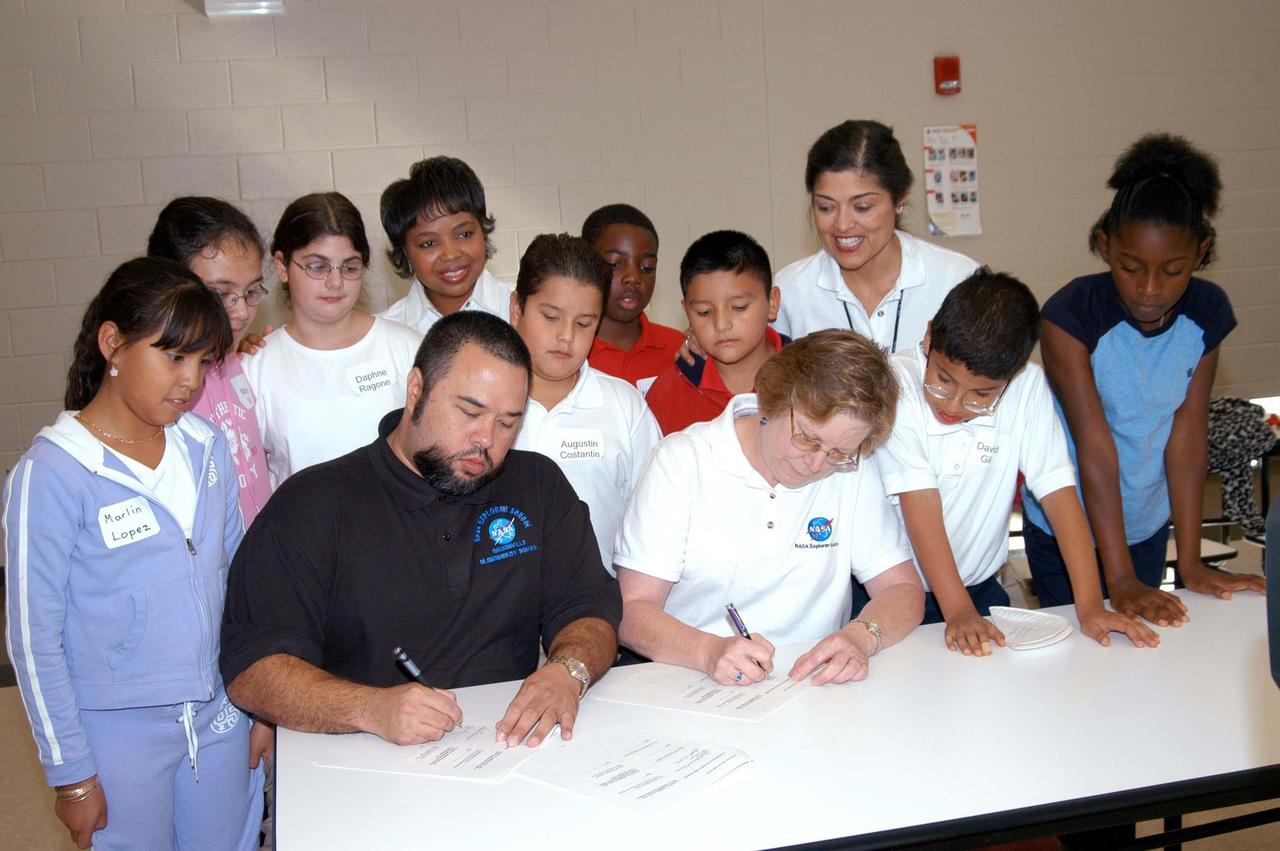
KENNEDY SPACE CENTER, FLA. - Shawn McCollough, principal of Gainesville Elementary School, a NASA Explorer School (NES) in Gainesville, Ga., and a teacher sign a Memorandum of Understanding between KSC and the school for the NES program. Schools from across the country are eligible to apply online for an opportunity to partner with NASA in a program designed to bring engaging mathematics, science and technology learning to educators, students and families.
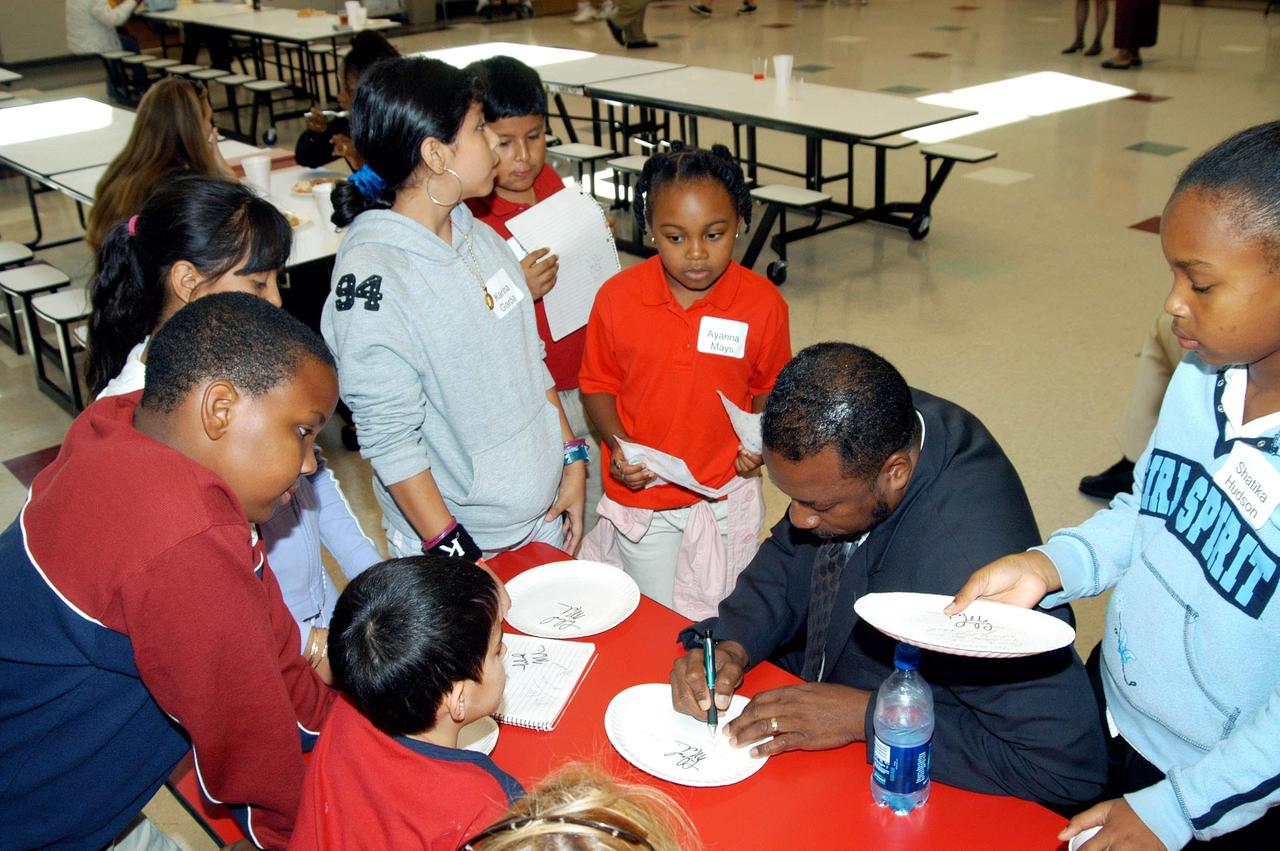
KENNEDY SPACE CENTER, FLA. - KSC Deputy Director Dr. Woodrow Whitlow Jr. signs autographs for students at Gainesville Elementary School, a NASA Explorer School in Gainesville, Ga. Whitlow accompanied Jim Jennings, deputy associate administrator for Institutions and Asset Management at NASA Headquarters, who visited the school to share the new vision for space exploration with the next generation of explorers. Whitlow talked with students about our destiny as explorers, NASA’s stepping stone approach to exploring Earth, the Moon, Mars and beyond, how space impacts our lives, and how people and machines rely on each other in space.
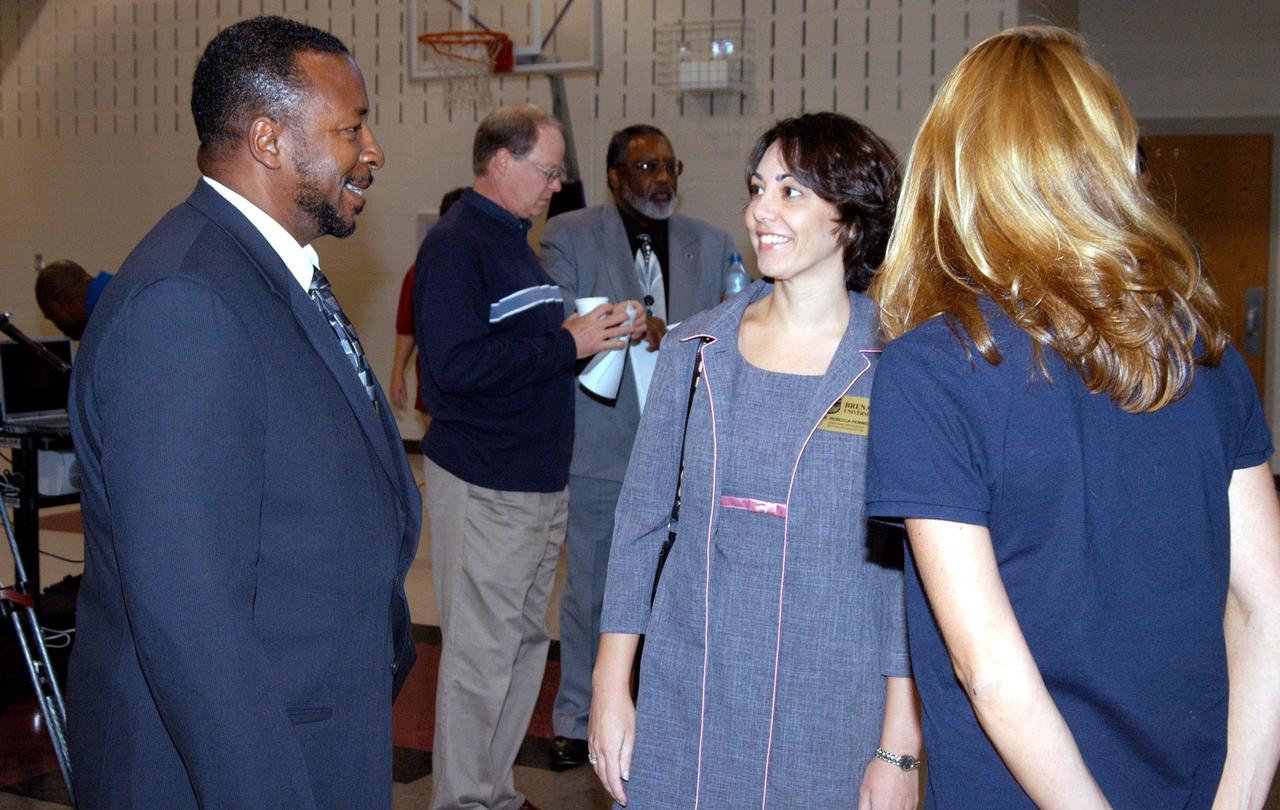
KENNEDY SPACE CENTER, FLA. - KSC Deputy Director Dr. Woodrow Whitlow Jr. (left) talks with staff members of Gainesville Elementary School, a NASA Explorer School in Gainesville, Ga. In the background are Bruce Buckingham (left) , NASA KSC News Chief, and Jim Jennings, deputy associate administrator for Institutions and Asset Management at NASA Headquarters. Jennings shared the new vision for space exploration with this next generation of explorers. Whitlow talked with students about our destiny as explorers, NASA’s stepping stone approach to exploring Earth, the Moon, Mars and beyond, how space impacts our lives, and how people and machines rely on each other in space.

KENNEDY SPACE CENTER, FLA. - KSC Deputy Director Dr. Woodrow Whitlow Jr. and Deputy Associate Administrator for Institutions and Asset Management at NASA Headquarters Jim Jennings visit Gainesville Elementary School, a NASA Explorer School in Gainesville, Ga. Jennings is visiting the school to share the new vision for space exploration with the next generation of explorers. Whitlow talked with students about our destiny as explorers, NASA’s stepping stone approach to exploring Earth, the Moon, Mars and beyond, how space impacts our lives, and how people and machines rely on each other in space.

KENNEDY SPACE CENTER, FLA. - Jim Jennings, deputy associate administrator for Institutions and Asset Management at NASA Headquarters, signs an autograph for a student at Gainesville Elementary School, a NASA Explorer School in Gainesville, Ga. Jennings visited to the school to share the new vision for space exploration with the next generation of explorers. Accompanying him was KSC Deputy Director Dr. Woodrow Whitlow Jr., who talked with students about our destiny as explorers, NASA’s stepping stone approach to exploring Earth, the Moon, Mars and beyond, how space impacts our lives, and how people and machines rely on each other in space.
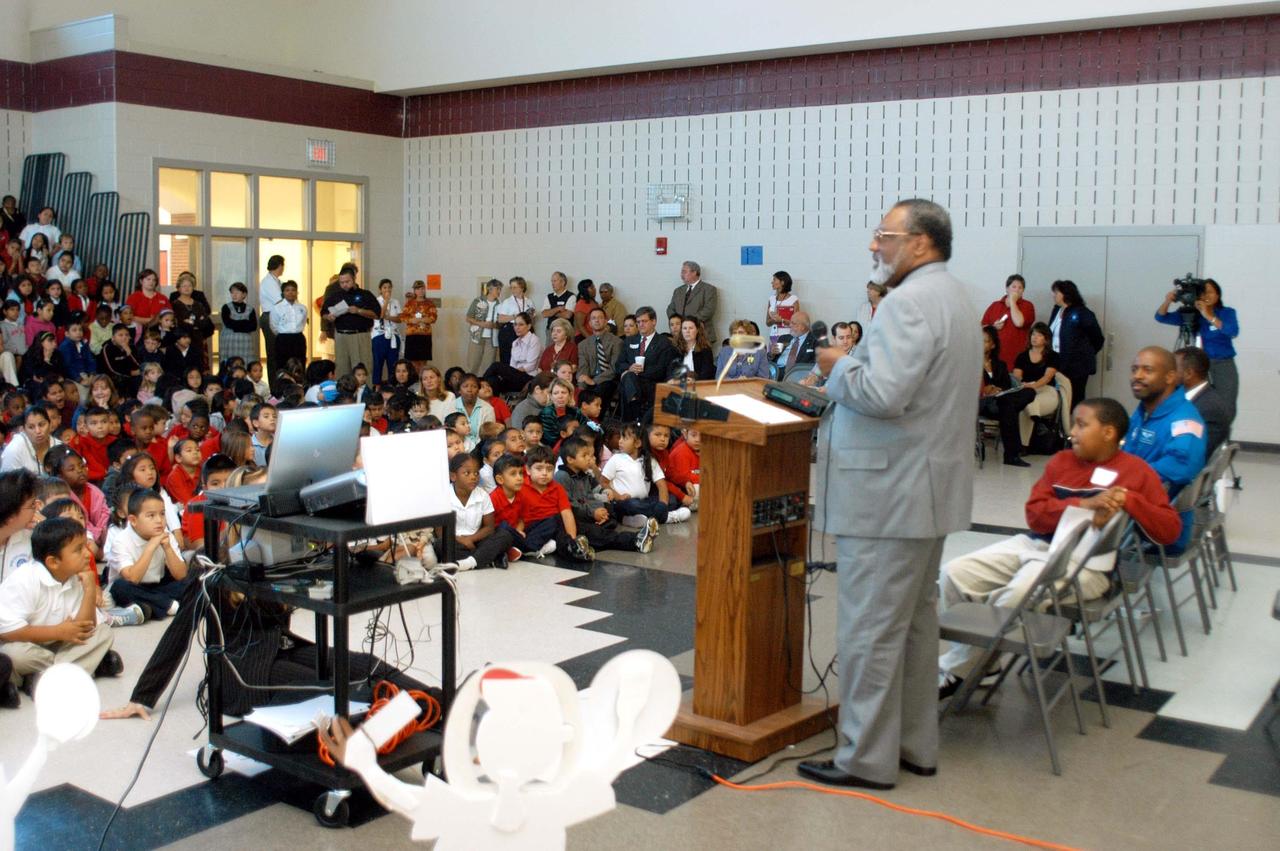
KENNEDY SPACE CENTER, FLA. - Jim Jennings, deputy associate administrator for Institutions and Asset Management at NASA Headquarters, talks to students at Gainesville Elementary School, a NASA Explorer School in Gainesville, Ga. Jennings visited the school to share the new vision for space exploration with the next generation of explorers. Also visiting the school was astronaut Leland Melvin and KSC Deputy Director Dr. Woodrow Whitlow Jr., seated at right. Whitlow talked with students about our destiny as explorers, NASA’s stepping stone approach to exploring Earth, the Moon, Mars and beyond, how space impacts our lives, and how people and machines rely on each other in space.

KENNEDY SPACE CENTER, FLA. - Almost hidden in the center amid the sea of students at Gainesville Elementary School, a NASA Explorer School in Gainesville, Ga., are Jim Jennings, deputy associate administrator for Institutions and Asset Management at NASA Headquarters; Dr. Woodrow Whitlow Jr., KSC deputy director; and astronaut Leland Melvin. Whitlow and Melvin accompanied Jennings on the visit to the school to share the new vision for space exploration with the next generation of explorers. Whitlow talked about our destiny as explorers, NASA’s stepping stone approach to exploring Earth, the Moon, Mars and beyond, how space impacts our lives, and how people and machines rely on each other in space. Melvin talked about the importance of teamwork and what it takes for mission success.
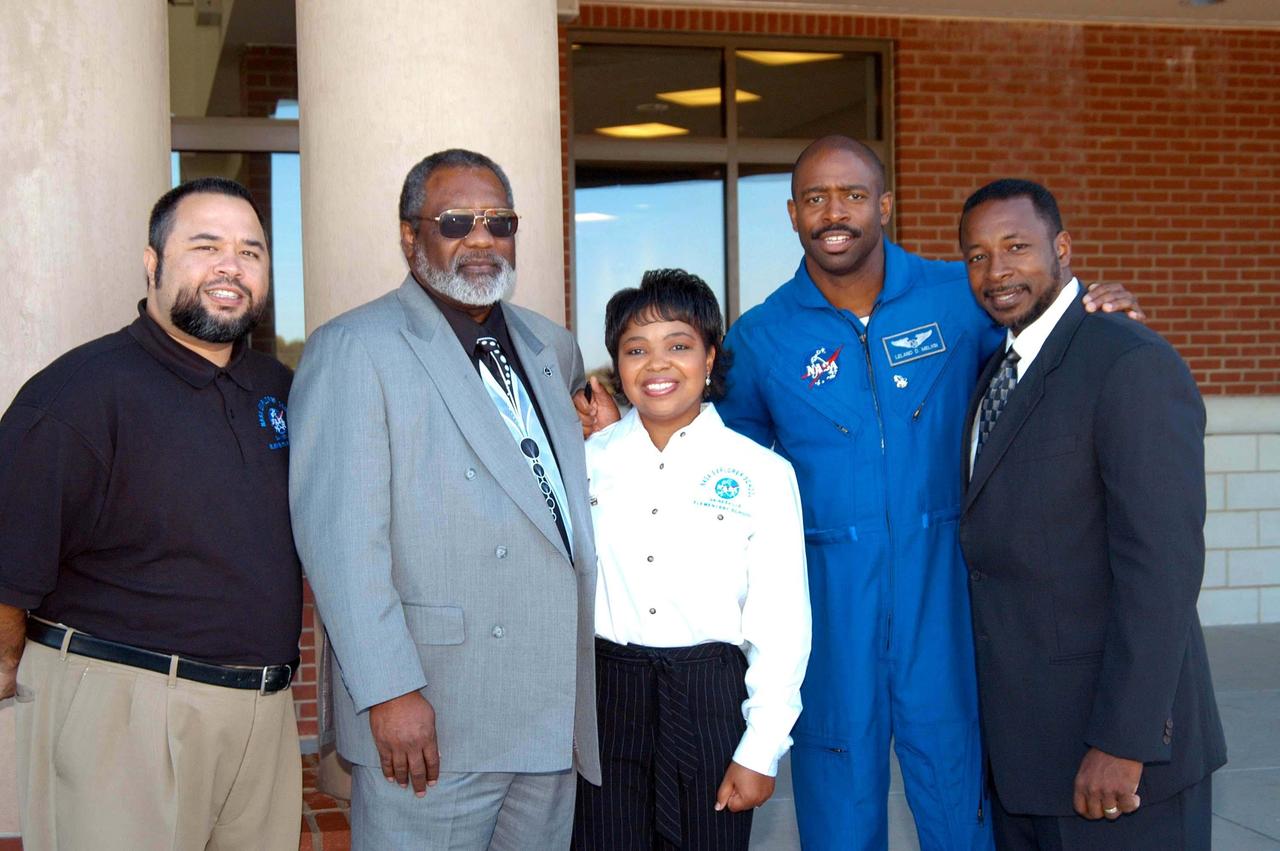
KENNEDY SPACE CENTER, FLA. - Outside Gainesville Elementary School, a NASA Explorer School in Gainesville, Ga., Principal Shawn McCollough (far left) and a staff member pose for this photo with Jim Jennings (second from left), deputy associate administrator for Institutions and Asset Management at NASA Headquarters; astronaut Leland Melvin (second from right); and Dr. Woodrow Whitlow (far right), KSC deputy director. Jennings visited the school to share the new vision for space exploration with the next generation of explorers. Whitlow and Melvin accompanied him and talked with students about our destiny as explorers, NASA’s stepping stone approach to exploring Earth, the Moon, Mars and beyond, how space impacts our lives, and how people and machines rely on each other in space.

KENNEDY SPACE CENTER, FLA. - KSC Deputy Director Dr. Woodrow Whitlow Jr. (far right) asks students questions at Gainesville Elementary School, a NASA Explorer School in Gainesville, Ga. Whitlow and astronaut Leland Melvin (center) accompanied Jim Jennings (at left), deputy associate administrator for Institutions and Asset Management at NASA Headquarters, on the visit to the school to share the new vision for space exploration with the next generation of explorers. Whitlow talked with students about our destiny as explorers, NASA’s stepping stone approach to exploring Earth, the Moon, Mars and beyond, how space impacts our lives, and how people and machines rely on each other in space. Melvin talked about the importance of teamwork and what it takes for mission success.
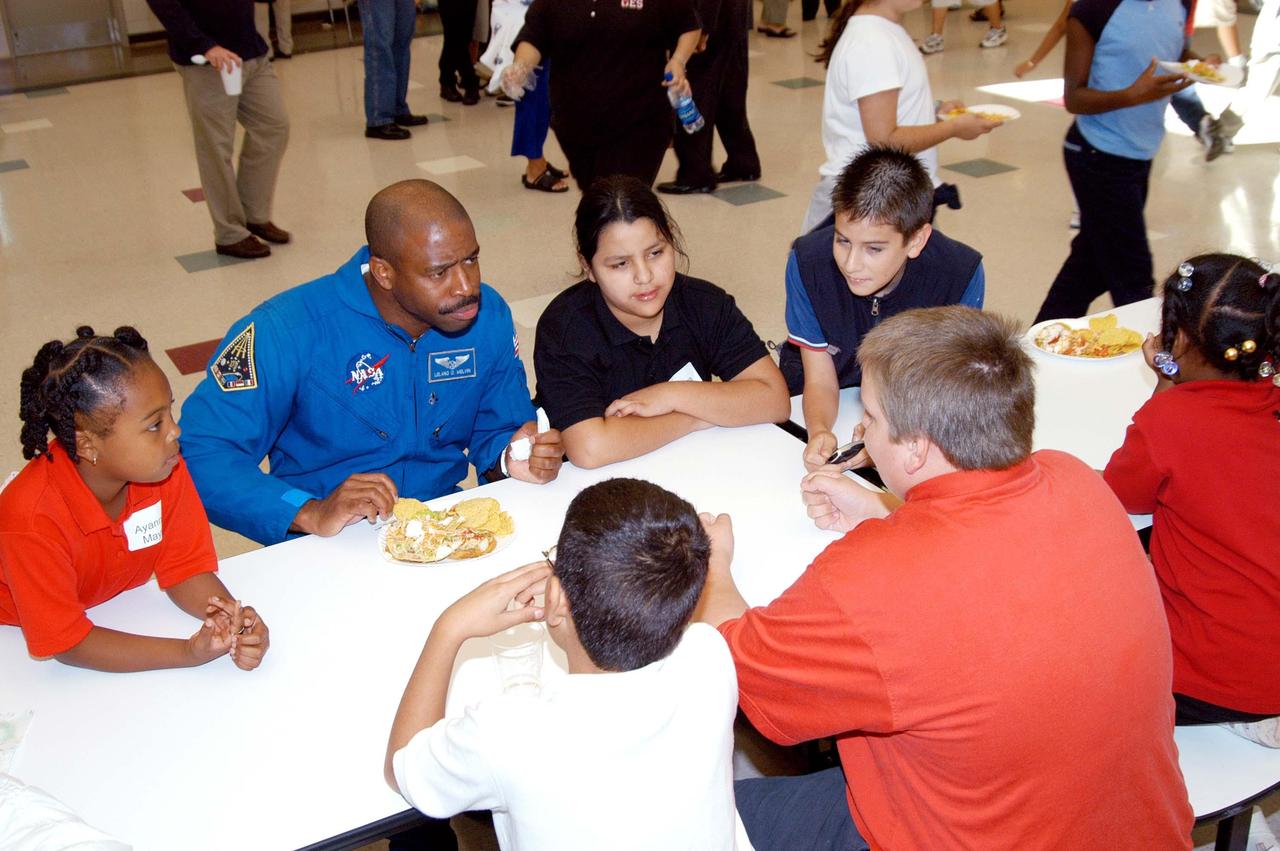
KENNEDY SPACE CENTER, FLA. - Astronaut Leland Melvin joins students in the cafeteria at Gainesville Elementary School, a NASA Explorer School in Gainesville, Ga. Melvin joined Jim Jennings, deputy associate administrator for Institutions and Asset Management at NASA Headquarters, on the visit to the school to share the new vision for space exploration with the next generation of explorers. Melvin talked about the importance of teamwork and what it takes for mission success. Also visiting was KSC Deputy Director Woodrow Whitlow Jr., who talked with students about our destiny as explorers, NASA’s stepping stone approach to exploring Earth, the Moon, Mars and beyond, how space impacts our lives, and how people and machines rely on each other in space.

KENNEDY SPACE CENTER, FLA. - At Gainesville Elementary School, a NASA Explorer School in Gainesville, Ga., astronaut Leland Melvin hands a patch to a student for answering a question. Melvin joined Jim Jennings, deputy associate administrator for Institutions and Asset Management at NASA Headquarters, on the visit to the school to share the new vision for space exploration with the next generation of explorers. Melvin talked about the importance of teamwork and what it takes for mission success. Also visiting was KSC Deputy Director Woodrow Whitlow Jr., who talked with students about our destiny as explorers, NASA’s stepping stone approach to exploring Earth, the Moon, Mars and beyond, how space impacts our lives, and how people and machines rely on each other in space. Melvin talked about the importance of teamwork and what it takes for mission success.

KENNEDY SPACE CENTER, FLA. - Astronaut Leland Melvin joins staff members of Gainesville Elementary School, a NASA Explorer School in Gainesville, Ga. Melvin accompanied Jim Jennings, deputy associate administrator for Institutions and Asset Management at NASA Headquarters, on a visit to the school to share the new vision for space exploration with the next generation of explorers. Jennings talked about the future and the vision for space, plus different NASA careers needed to meet the vision and what students and teachers can do toward that goal. Also visiting was KSC Deputy Director Dr. Woodrow Whitlow, who talked with students about our destiny as explorers, NASA’s stepping stone approach to exploring Earth, the Moon, Mars and beyond, how space impacts our lives, and how people and machines rely on each other in space.
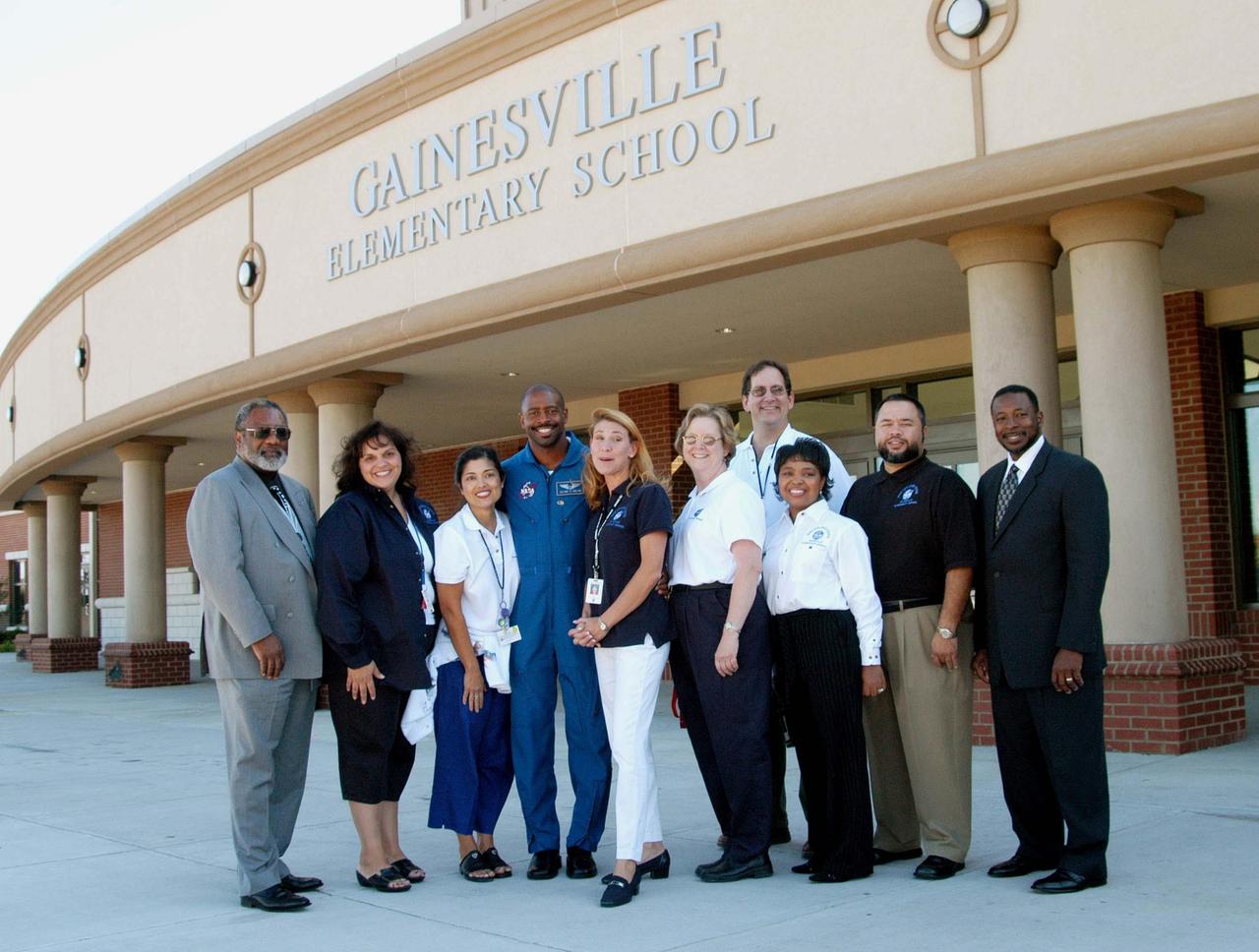
KENNEDY SPACE CENTER, FLA. - Outside Gainesville Elementary School, a NASA Explorer School in Gainesville, Ga., school staff members pose for this photo with Jim Jennings (far left), deputy associate administrator for Institutions and Asset Management at NASA Headquarters; astronaut Leland Melvin (center); and Dr. Woodrow Whitlow (far right), KSC deputy director. Jennings visited the school to share the new vision for space exploration with the next generation of explorers. Whitlow and Melvin accompanied him and talked with students about our destiny as explorers, NASA’s stepping stone approach to exploring Earth, the Moon, Mars and beyond, how space impacts our lives, and how people and machines rely on each other in space.
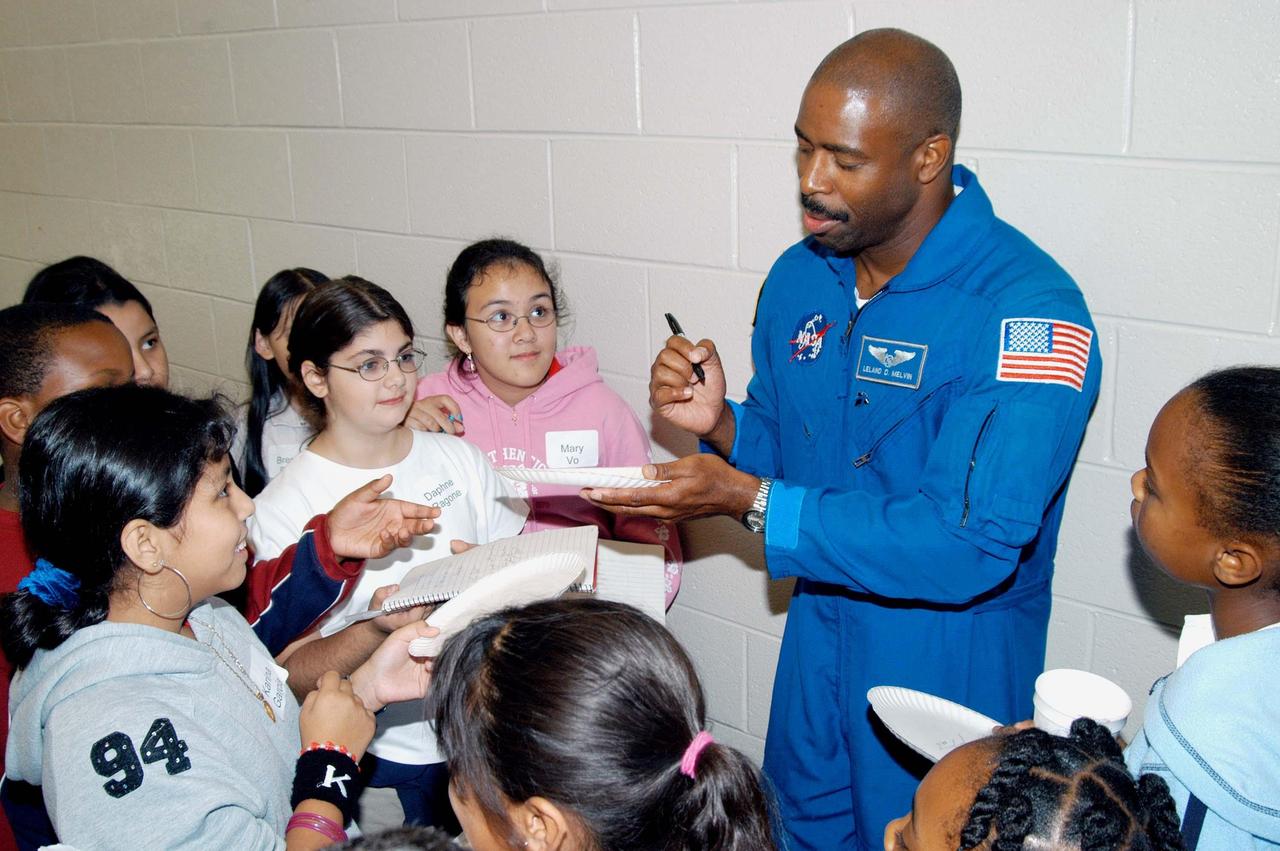
KENNEDY SPACE CENTER, FLA. - Astronaut Leland Melvin signs autographs for students at Gainesville Elementary School, a NASA Explorer School in Gainesville, Ga. Melvin joined Jim Jennings, deputy associate administrator for Institutions and Asset Management at NASA Headquarters, on the visit to the school to share the new vision for space exploration with the next generation of explorers. Melvin talked about the importance of teamwork and what it takes for mission success. Also visiting was KSC Deputy Director Woodrow Whitlow Jr., who talked with students about our destiny as explorers, NASA’s stepping stone approach to exploring Earth, the Moon, Mars and beyond, how space impacts our lives, and how people and machines rely on each other in space.

KENNEDY SPACE CENTER, FLA. - Astronaut Leland Melvin talks to students in the cafeteria at Gainesville Elementary School, a NASA Explorer School in Gainesville, Ga. Melvin joined Jim Jennings, deputy associate administrator for Institutions and Asset Management at NASA Headquarters, on the visit to the school to share the new vision for space exploration with the next generation of explorers. Melvin talked about the importance of teamwork and what it takes for mission success. Also visiting was KSC Deputy Director Woodrow Whitlow Jr., who talked with students about our destiny as explorers, NASA’s stepping stone approach to exploring Earth, the Moon, Mars and beyond, how space impacts our lives, and how people and machines rely on each other in space.
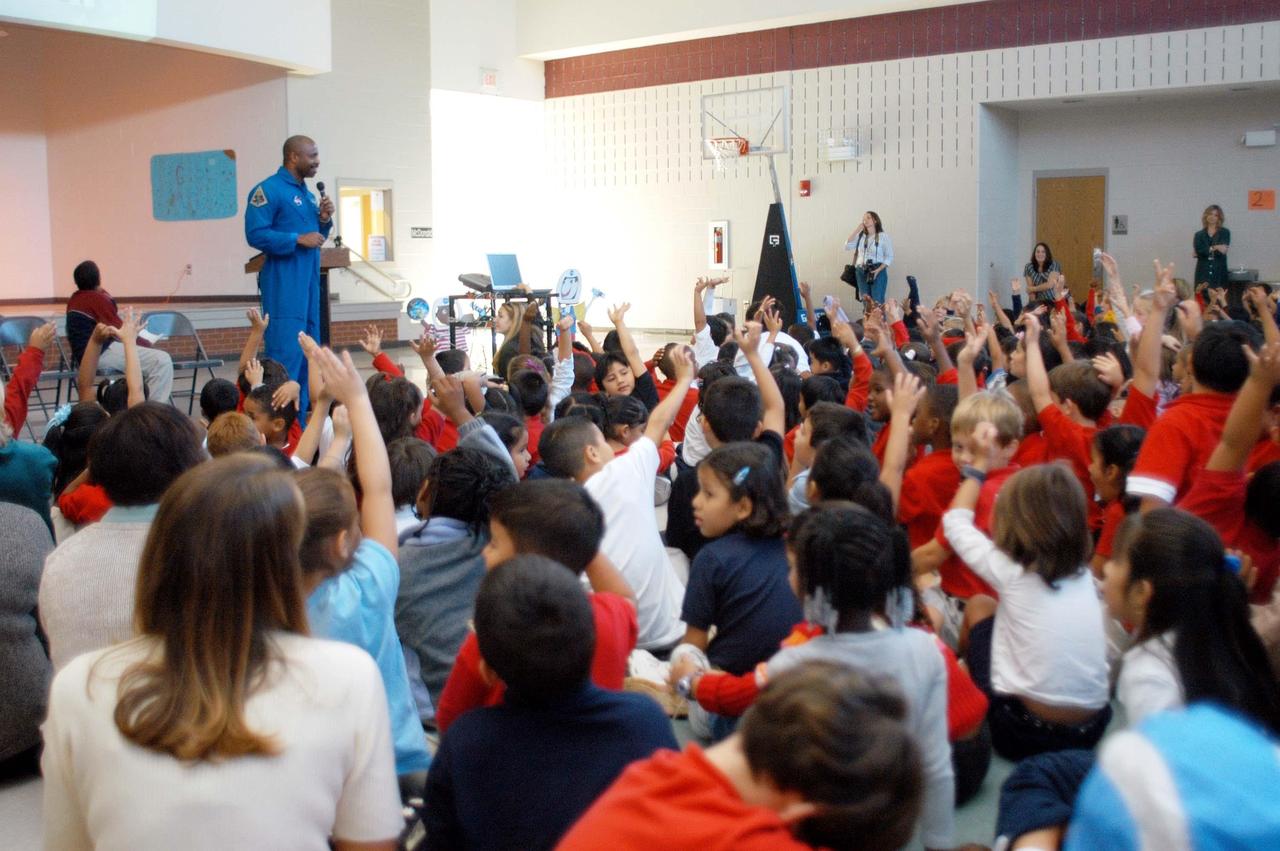
KENNEDY SPACE CENTER, FLA. - Astronaut Leland Melvin talks and interacts with students at Gainesville Elementary School, a NASA Explorer School in Gainesville, Ga. Melvin joined Jim Jennings, deputy associate administrator for Institutions and Asset Management at NASA Headquarters, on the visit to the school to share the new vision for space exploration with the next generation of explorers. Also accompanying Jennings was KSC Deputy Director Dr. Woodrow Whitlow Jr., who talked with students about our destiny as explorers, NASA’s stepping stone approach to exploring Earth, the Moon, Mars and beyond, how space impacts our lives, and how people and machines rely on each other in space. Melvin talked about the importance of teamwork and what it takes for mission success.

KENNEDY SPACE CENTER, FLA. - Astronaut Leland Melvin talks and interacts with students at Gainesville Elementary School, a NASA Explorer School in Gainesville, Ga. Melvin joined Jim Jennings, deputy associate administrator for Institutions and Asset Management at NASA Headquarters, on the visit to the school to share the new vision for space exploration with the next generation of explorers. Also accompanying Jennings was KSC Deputy Director Dr. Woodrow Whitlow Jr., who talked with students about our destiny as explorers, NASA’s stepping stone approach to exploring Earth, the Moon, Mars and beyond, how space impacts our lives, and how people and machines rely on each other in space. Melvin talked about the importance of teamwork and what it takes for mission success.
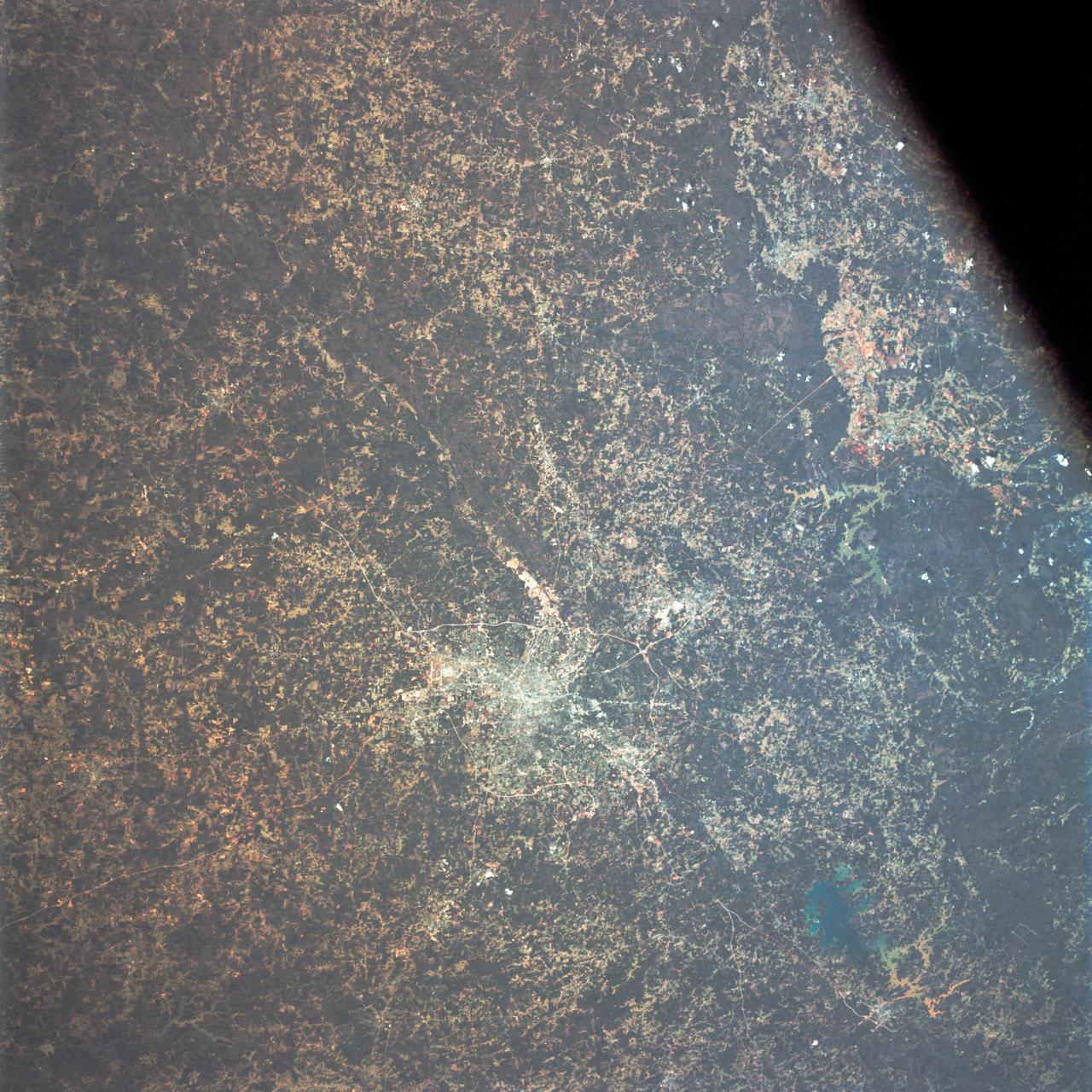
AS09-23-3567 (3-13 March 1969) --- Oblique view of the Atlanta, Georgia area as photographed from the Apollo 9 spacecraft during its Earth-orbital mission. The Chattahoochee River runs from Lake Sidney Lanier, near Gainesville (at upper left corner), south-westward by Atlanta and between Newnan and Carrollton (lower right). Allatoona Lake is at left center.
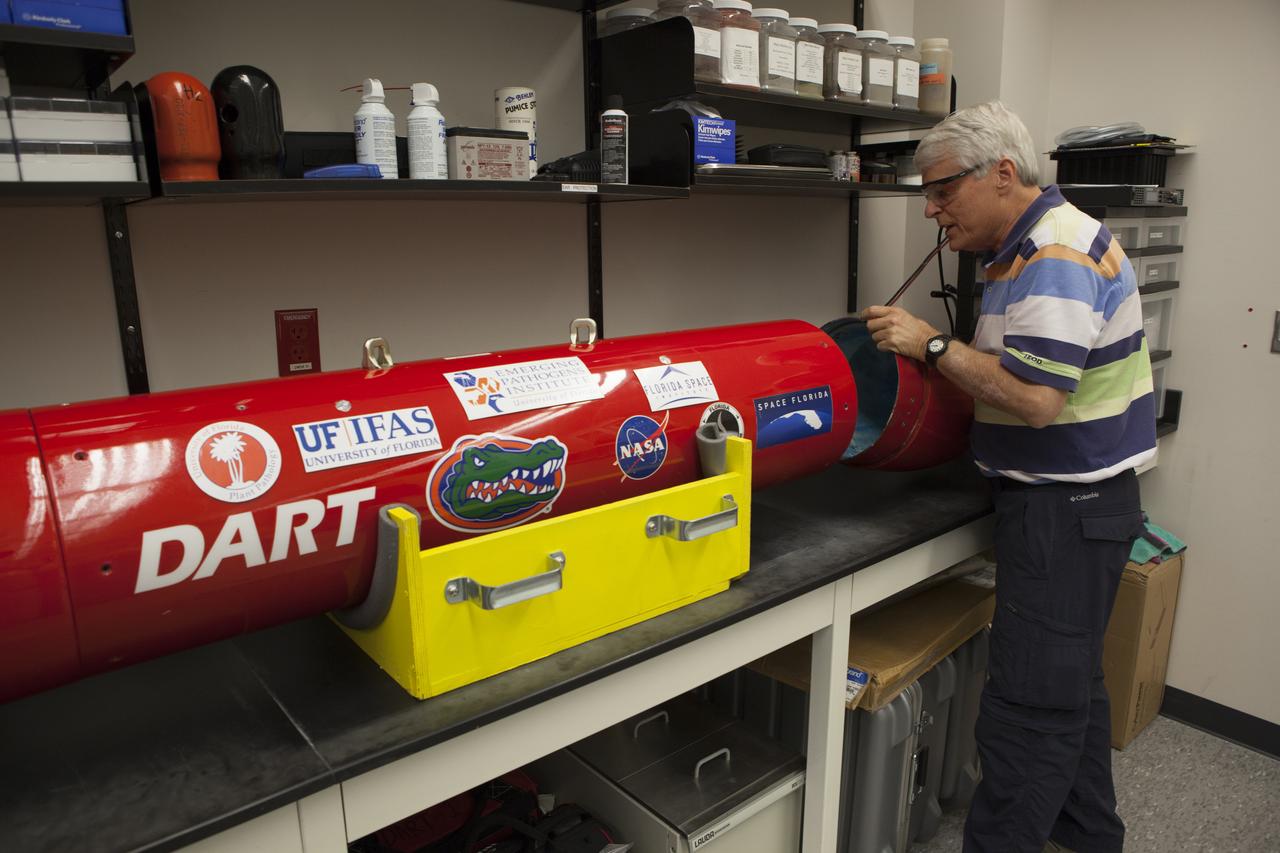
A researcher from the University of Florida in Gainesville, checks the Dust Atmospheric Recovery Technology, or DART, spacecraft in a laboratory inside the Space Life Sciences Lab at NASA’s Kennedy Space Center in Florida. DART will characterize the dust loading and microbial diversity in the atmosphere over Florida during summer months with a special emphasis on their interactions during an African dust storm. DART will be used to collect atmospheric aerosols and suspended microbial cells over Florida and Kennedy. Results will help predict the risks of excessive microbial contamination adhering to spacecraft surfaces.
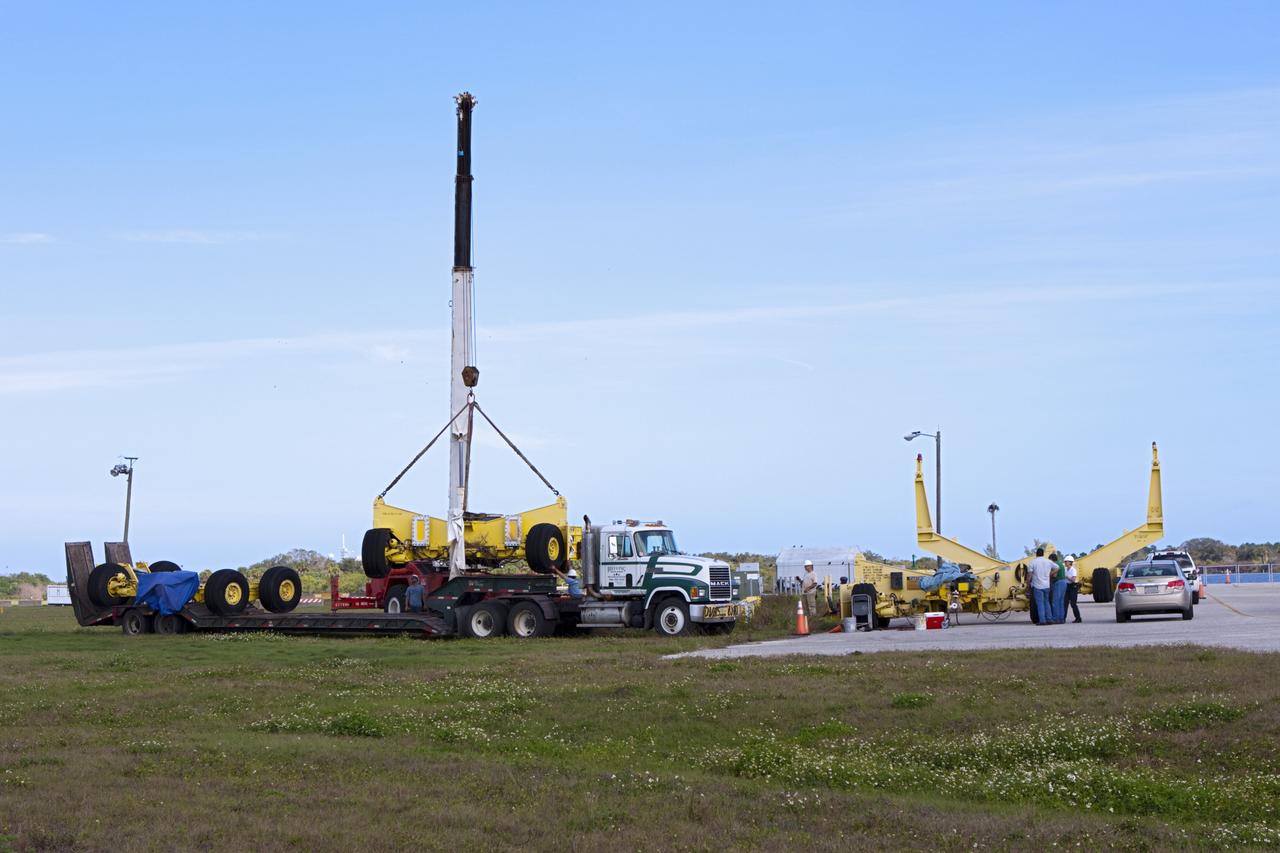
CAPE CANAVERAL, Fla. – At NASA’s Kennedy Space Center in Florida, two space shuttle external fuel tank transporters are being prepared for transfer to the Wings of Dreams Aviation Museum at Keystone Heights Airport between Gainesville and Jacksonville, Fla. At the Wings of Dreams Aviation Museum a mock-up shuttle external fuel tank will be displayed. During space shuttle launches, the external tanks contained over 500,000 gallons of liquid hydrogen and liquid oxygen propellant for the shuttle orbiters' three main engines. The effort is part of Transition and Retirement of the space shuttle. For more information, visit http://www.nasa.gov/transition Photo credit: NASA/ Jim Grossmann
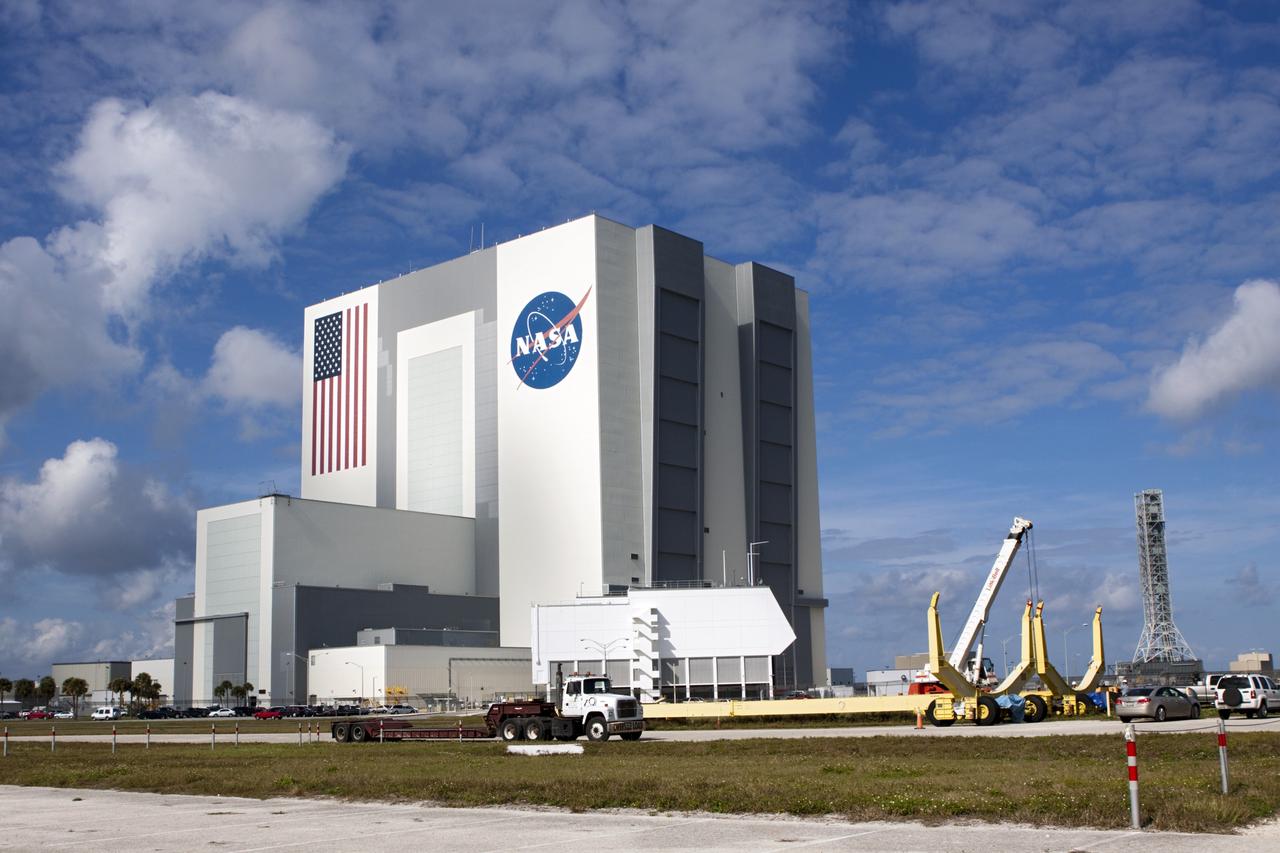
CAPE CANAVERAL, Fla. – At NASA’s Kennedy Space Center in Florida, two space shuttle external fuel tank transporters are being prepared for transfer to the Wings of Dreams Aviation Museum at Keystone Heights Airport between Gainesville and Jacksonville, Fla. At the Wings of Dreams Aviation Museum a mock-up shuttle external fuel tank will be displayed. During space shuttle launches, the external tanks contained over 500,000 gallons of liquid hydrogen and liquid oxygen propellant for the shuttle orbiters' three main engines. The effort is part of Transition and Retirement of the space shuttle. For more information, visit http://www.nasa.gov/transition Photo credit: NASA/ Jim Grossmann
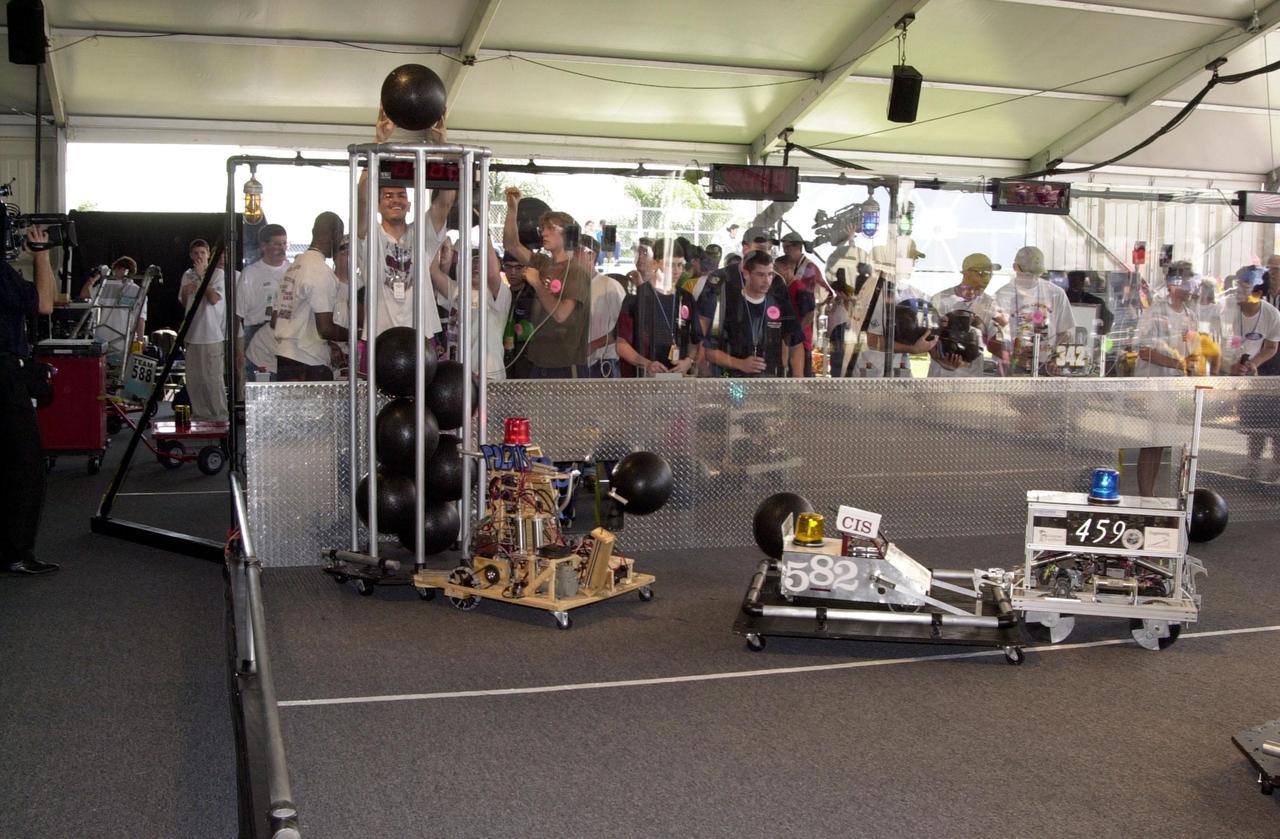
Student teams direct their robots on the playing field during the NASA/KSC FIRST Southeastern Regional event held March 1-3, 2001. Robot number 582 is by the Viking Electros, W.M. Raines High School, Jacksonville, Fla. Number 459 is by Eastside High School, Gainesville, Fla. FIRST (For Inspiration and Recognition of Science and Technology) events are held nationwide, pitting robots against each other and the clock on a playing field. Many teams are sponsored by corporations and academic institutions. There are 27 teams throughout the State of Florida who are competing. KSC, which sponsors nine teams, has held the regional event for two years
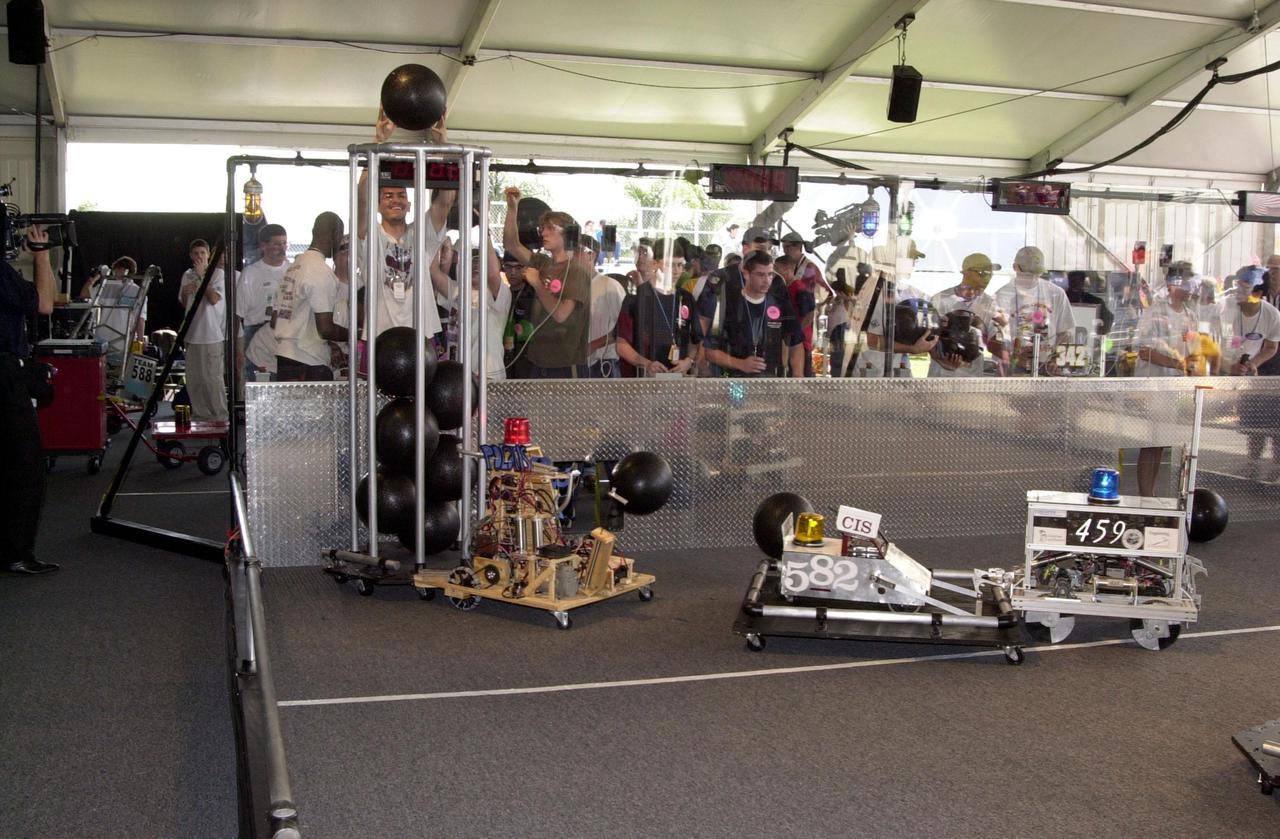
Student teams direct their robots on the playing field during the NASA_KSC FIRST Southeastern Regional event held March 1-3, 2001. Robot number 582 is by the Viking Electros, W.M. Raines High School, Jacksonville, Fla. Number 459 is by Eastside High School, Gainesville, Fla. FIRST (For Inspiration and Recognition of Science and Technology) events are held nationwide, pitting robots against each other and the clock on a playing field. Many teams are sponsored by corporations and academic institutions. There are 27 teams throughout the State of Florida who are competing. KSC, which sponsors nine teams, has held the regional event for two years
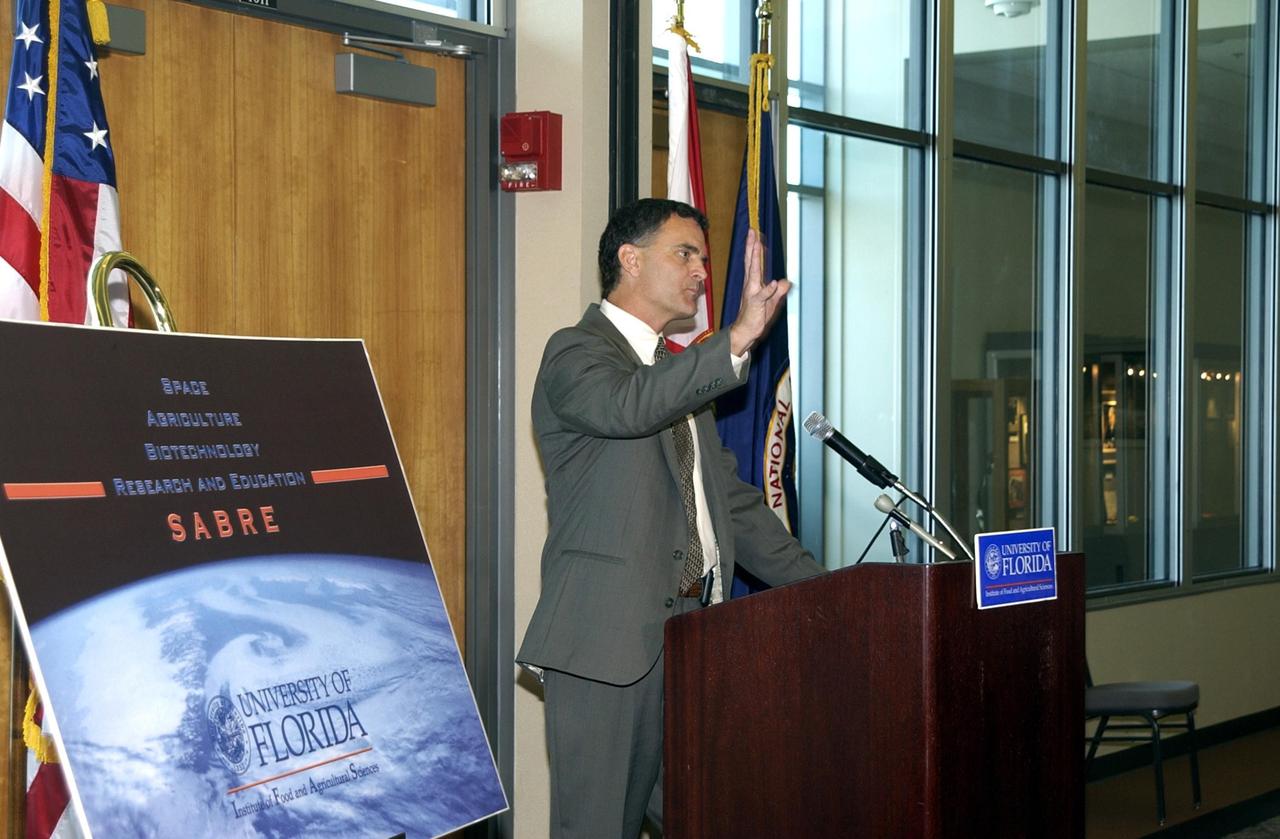
KENNEDY SPACE CENTER, FLA. -- Robert Ferl, professor in the horticultural sciences department and assistant director of the University of Florida Biotechnology Program, speaks during the opening ceremony to launch a new program called SABRE, Space Agricultural Biotechnology Research and Education, that involves UF and NASA. SABRE will focus on the discovery, development and application of the biological aspects of advanced life support strategies. The program will include faculty from UF's Institute of Food and Agricultural Sciences, who will be located at both KSC - in the state-owned Space Experiment Research and Processing Laboratory (SERPL) being built there - and UF in Gainesville. Ferl will direct and be responsible for coordinating the research and education efforts of UF and NASA.
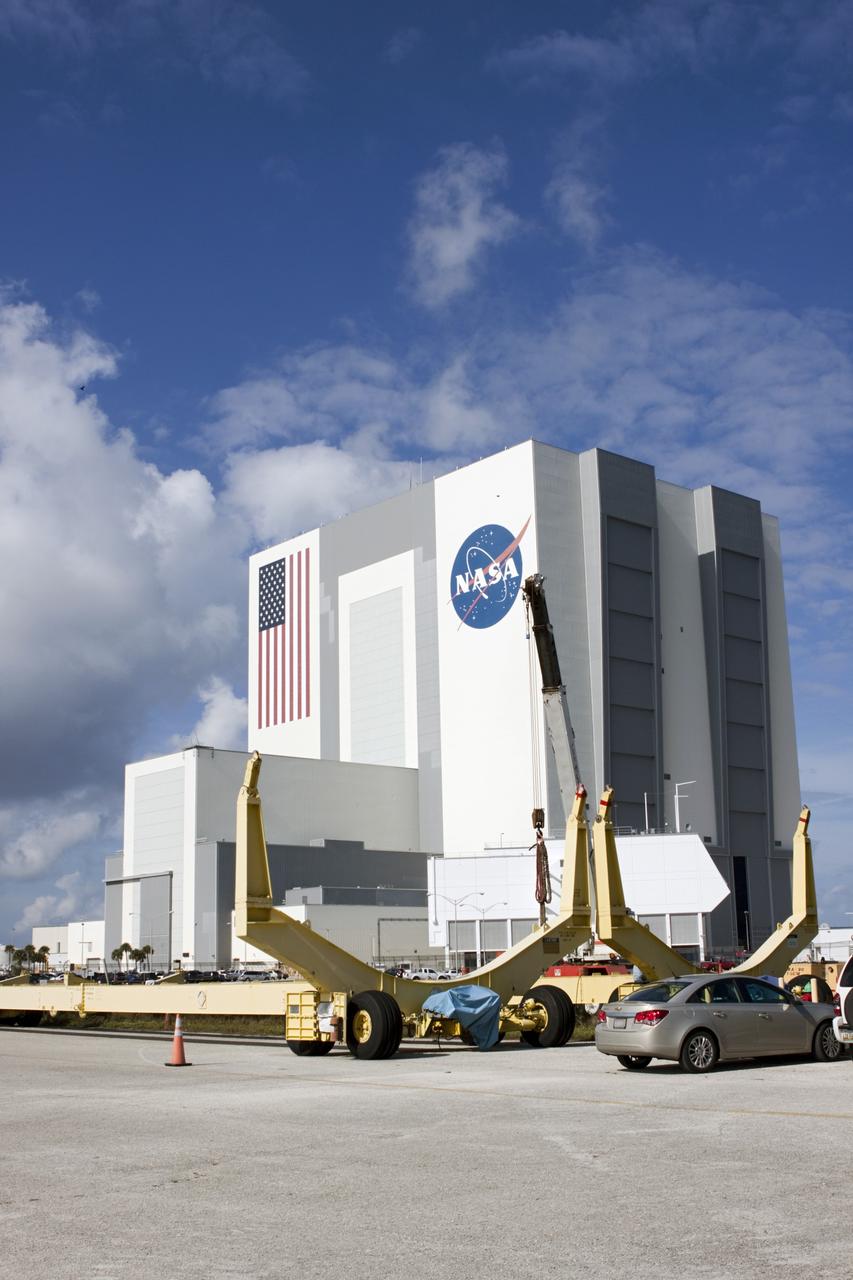
CAPE CANAVERAL, Fla. – At NASA’s Kennedy Space Center in Florida, two space shuttle external fuel tank transporters are being prepared for transfer to the Wings of Dreams Aviation Museum at Keystone Heights Airport between Gainesville and Jacksonville, Fla. At the Wings of Dreams Aviation Museum a mock-up shuttle external fuel tank will be displayed. During space shuttle launches, the external tanks contained over 500,000 gallons of liquid hydrogen and liquid oxygen propellant for the shuttle orbiters' three main engines. The effort is part of Transition and Retirement of the space shuttle. For more information, visit http://www.nasa.gov/transition Photo credit: NASA/ Jim Grossmann
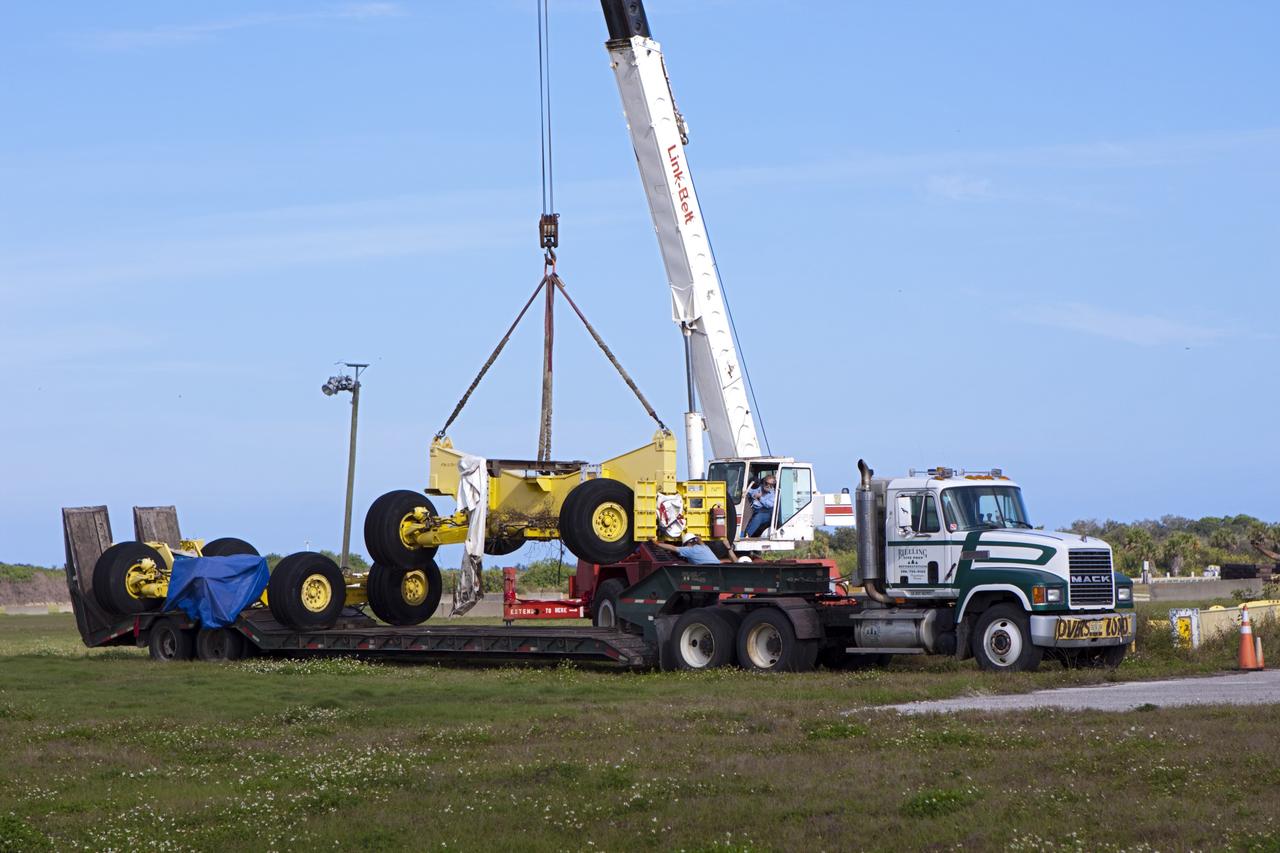
CAPE CANAVERAL, Fla. – At NASA’s Kennedy Space Center in Florida, two space shuttle external fuel tank transporters are being prepared for transfer to the Wings of Dreams Aviation Museum at Keystone Heights Airport between Gainesville and Jacksonville, Fla. At the Wings of Dreams Aviation Museum a mock-up shuttle external fuel tank will be displayed. During space shuttle launches, the external tanks contained over 500,000 gallons of liquid hydrogen and liquid oxygen propellant for the shuttle orbiters' three main engines. The effort is part of Transition and Retirement of the space shuttle. For more information, visit http://www.nasa.gov/transition Photo credit: NASA/ Jim Grossmann
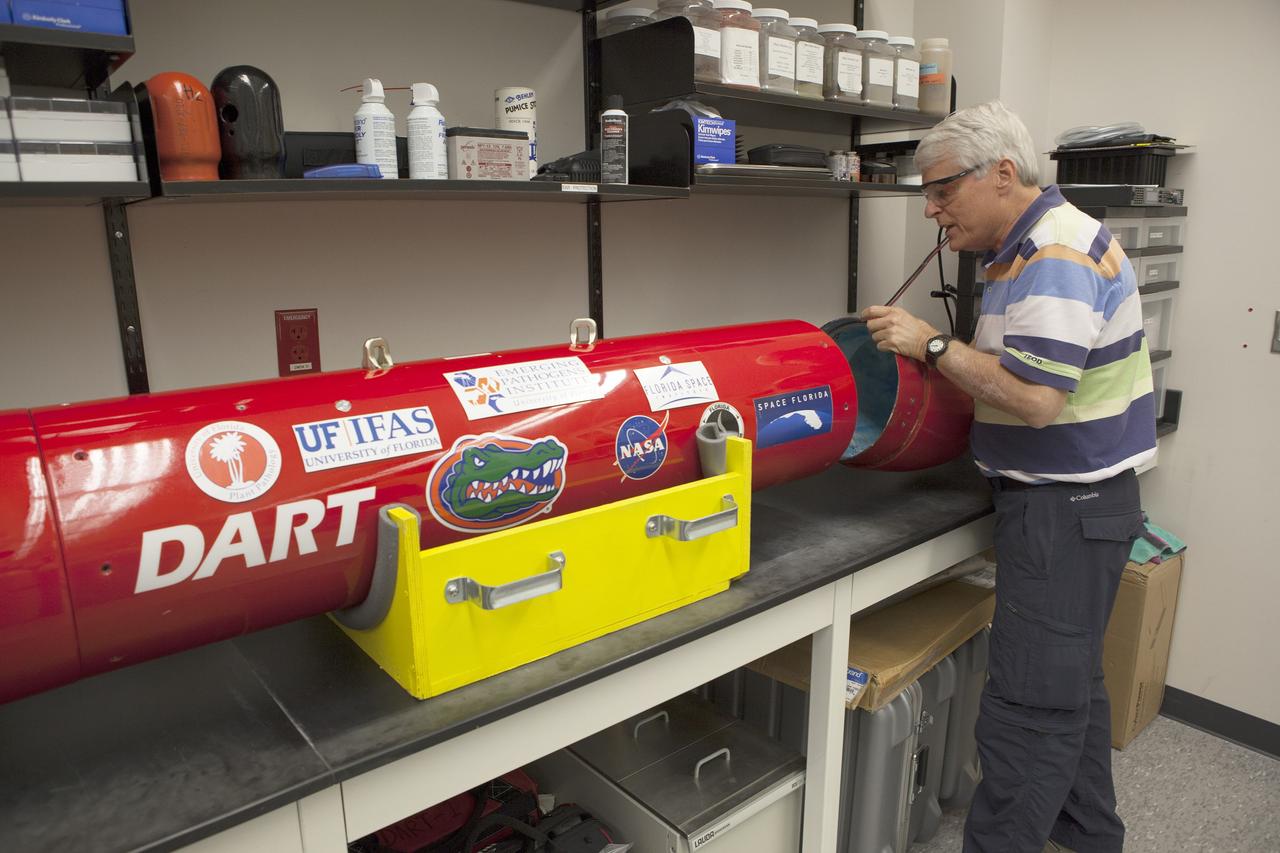
CAPE CANAVERAL, Fla. – A researcher from the University of Florida in Gainesville, checks the Dust Atmospheric Recovery Technology, or DART, spacecraft in a laboratory inside the Space Life Sciences Lab at NASA’s Kennedy Space Center in Florida. DART will characterize the dust loading and microbial diversity in the atmosphere over Florida during summer months with a special emphasis on their interactions during an African dust storm. DART will be used to collect atmospheric aerosols and suspended microbial cells over Florida and Kennedy. Results will help predict the risks of excessive microbial contamination adhering to spacecraft surfaces. Photo credit: NASA/Dimitri Gerondidakis
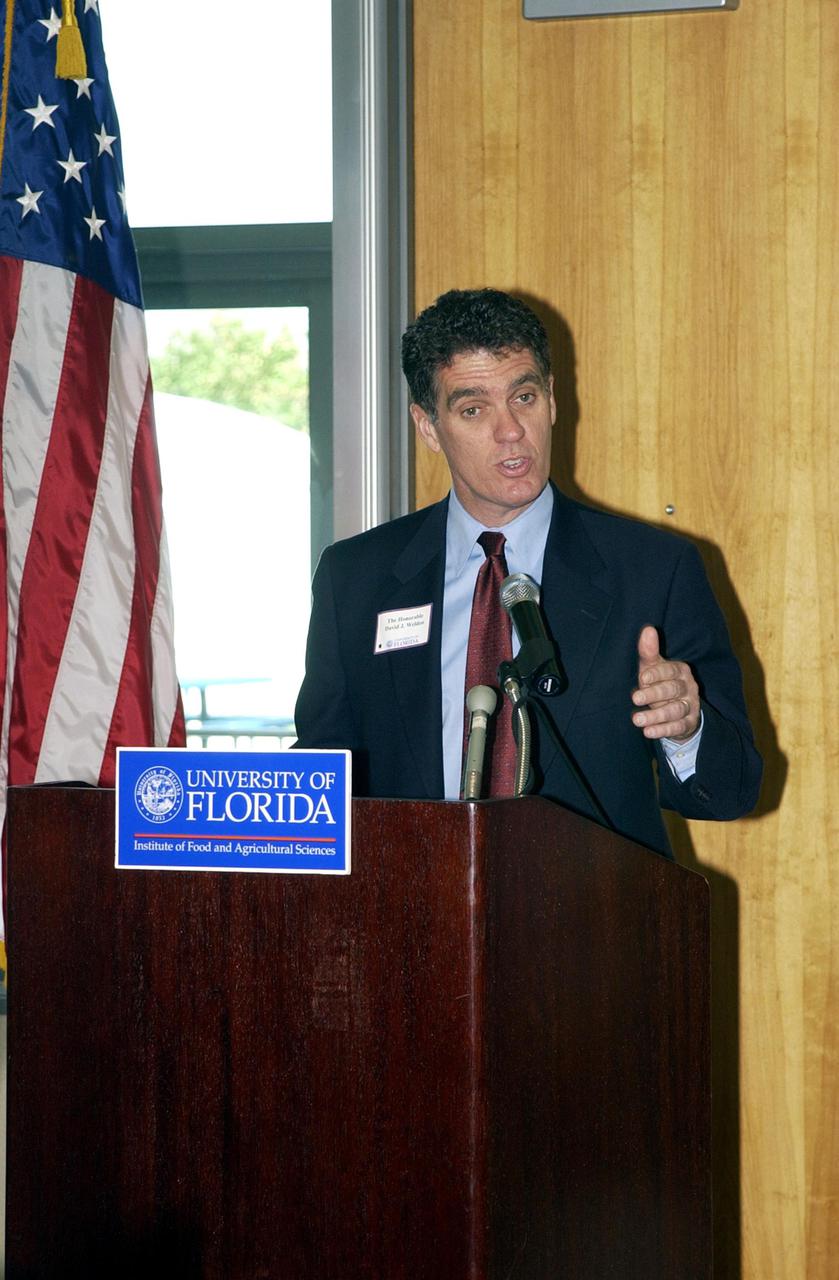
KENNEDY SPACE CENTER, FLA. -- U.S. Representative Dave Weldon addresses a large group attending the opening of a new program known as SABRE, Space Agricultural Biotechnology Research and Education, that involves the University of Florida and NASA. SABRE will focus on the discovery, development and application of the biological aspects of advanced life support strategies. The program will include faculty from UF's Institute of Food and Agricultural Sciences, who will be located at both KSC - in the state-owned Space Experiment Research and Processing Laboratory (SERPL) being built there - and UF in Gainesville. SABRE will be directed by Robert Ferl, professor in the horticultural sciences department and assistant director of UF's Biotechnology Program. He will be responsible for coordinating the research and education efforts of UF and NASA
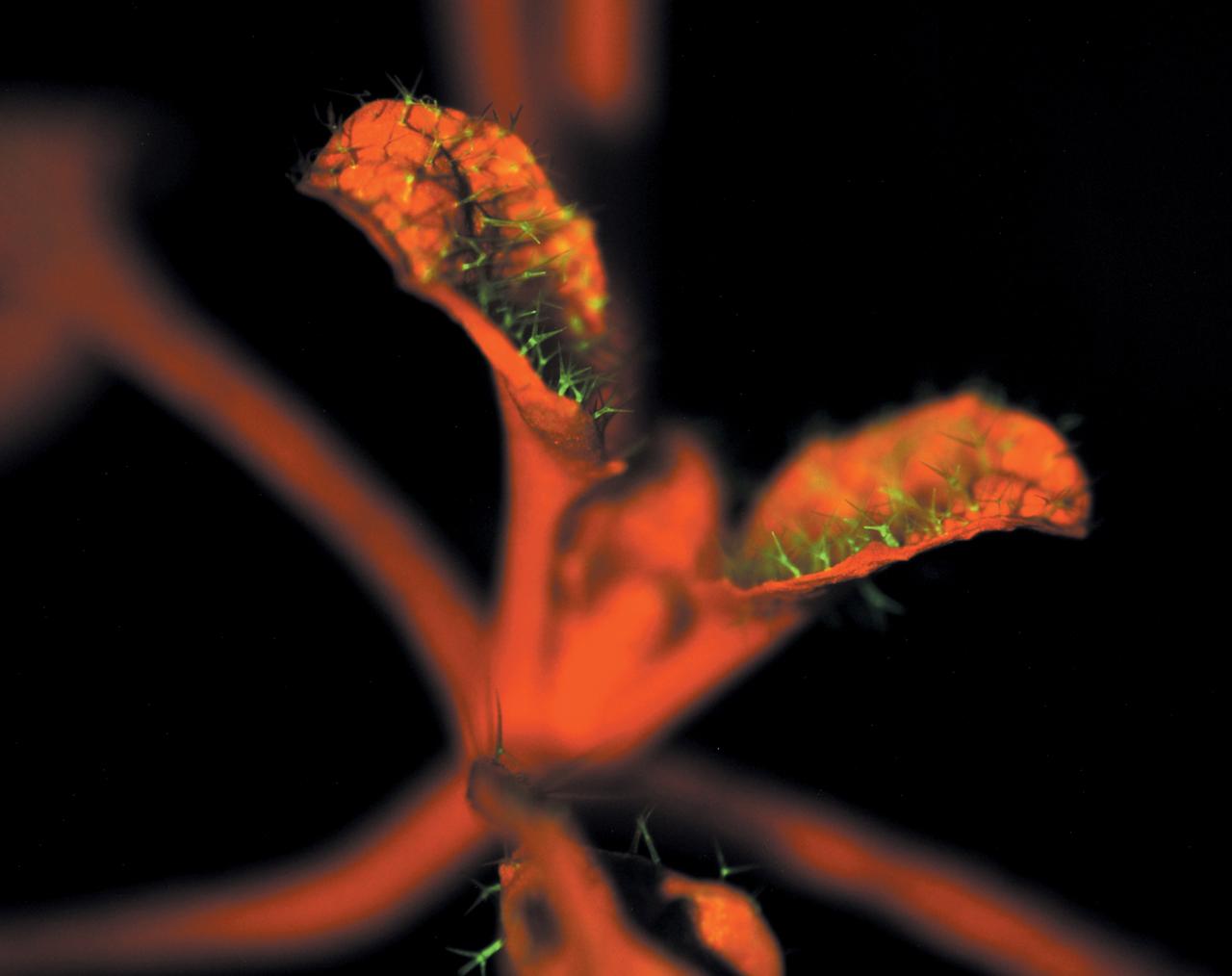
Researchers in Robert Ferl’s lab at the University of Florida in Gainesville, genetically altered this Arabdopsis Thaliana (a brassica species) plant to learn how extreme environments, such as the low atmospheric pressure on Mars, affect plant genes. They inserted green fluorescent protein (GFP) near the on/off switches for anoxia and drought genes. When those genes were turned on after exposure to reduced atmospheric pressure, GFP was turned on as well, causing cells expressing those genes to glow green under a blue light. The natural fluorescence of chlorophyll accounts for the red glow.
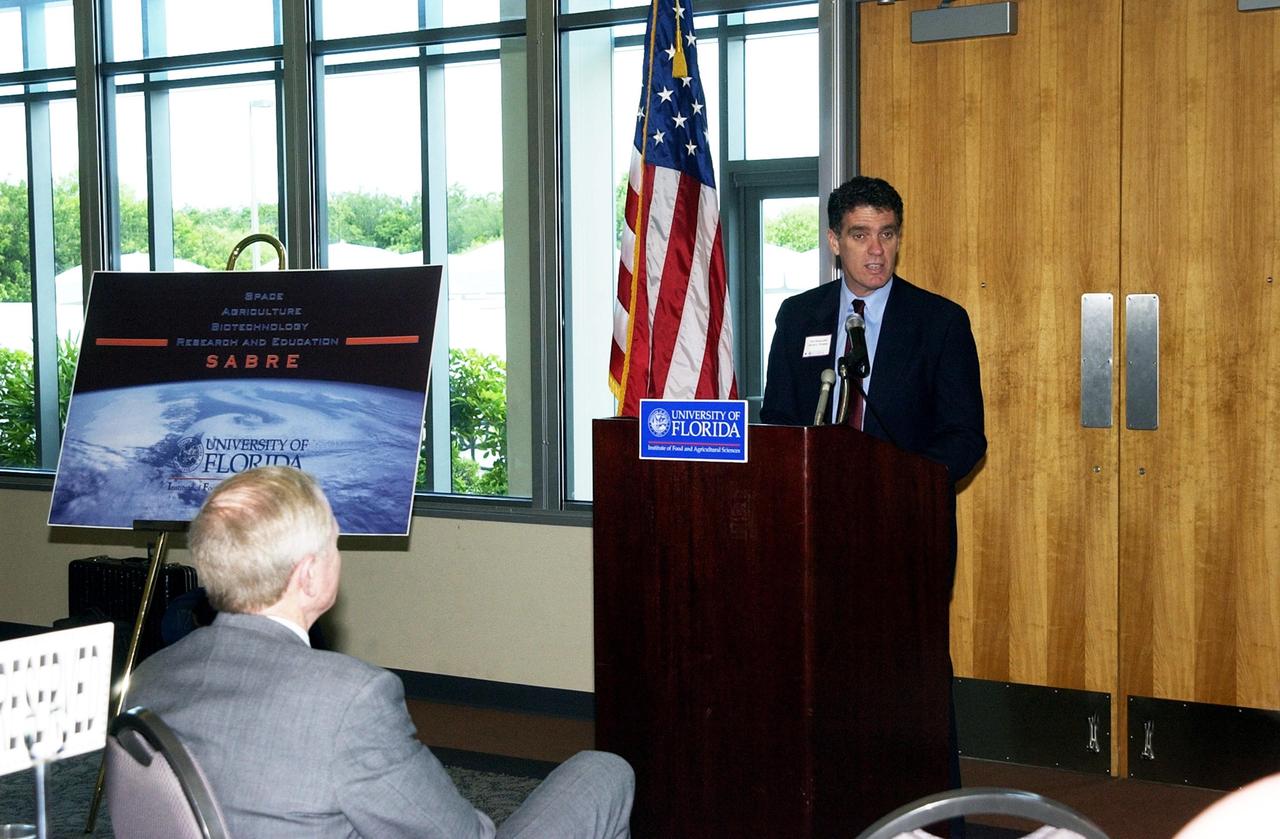
KENNEDY SPACE CENTER, FLA. -- U.S. Representative Dave Weldon addresses a large group attending the opening of a new program known as SABRE, Space Agricultural Biotechnology Research and Education, that involves the University of Florida and NASA. SABRE will focus on the discovery, development and application of the biological aspects of advanced life support strategies. The program will include faculty from UF's Institute of Food and Agricultural Sciences, who will be located at both KSC - in the state-owned Space Experiment Research and Processing Laboratory (SERPL) being built there - and UF in Gainesville. SABRE will be directed by Robert Ferl, professor in the horticultural sciences department and assistant director of UF's Biotechnology Program. He will be responsible for coordinating the research and education efforts of UF and NASA
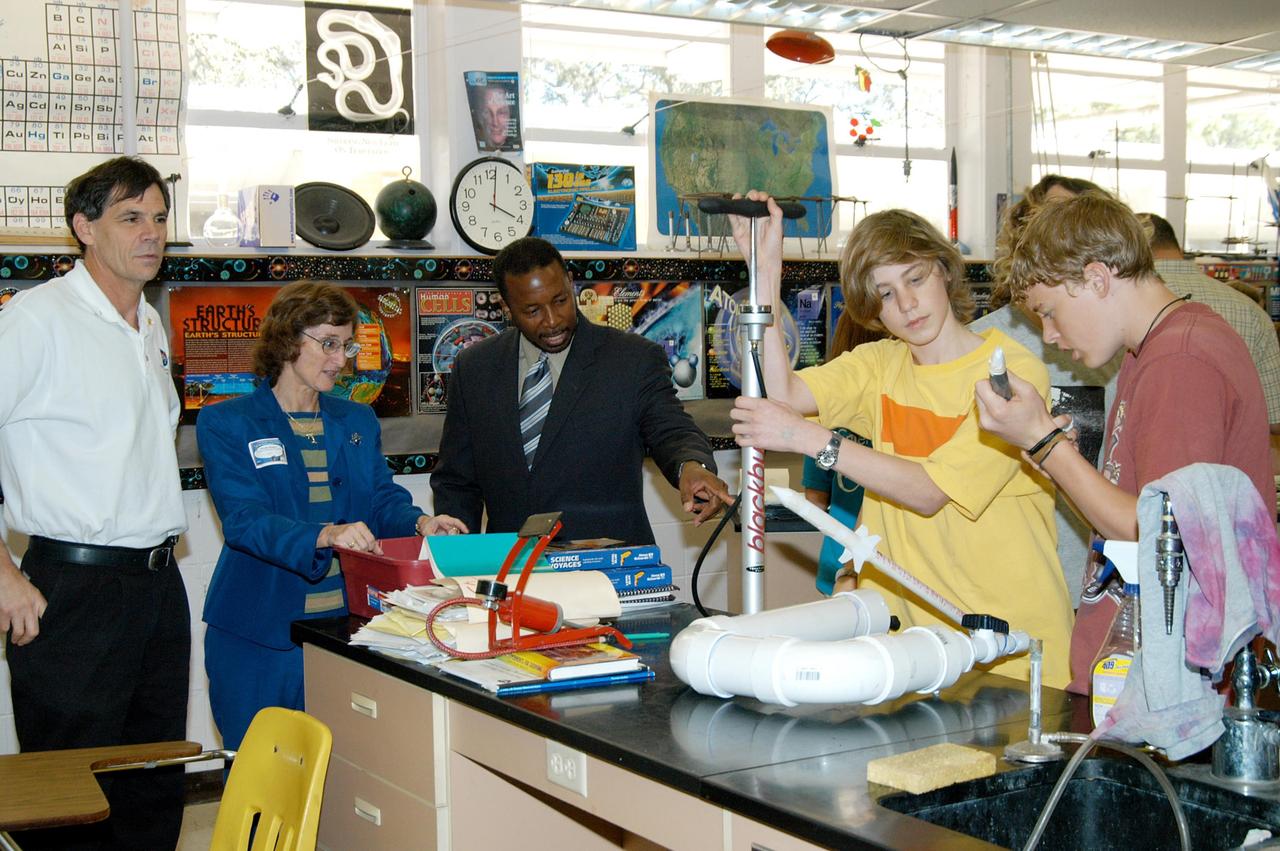
KENNEDY SPACE CENTER, FLA. - KSC Deputy Director Woodrow Whitlow Jr. looks at students’ projects in a classroom at Howard Bishop Middle School in Gainesville, Fla. Dr. Whitlow shared the new vision for space exploration with the students, the next generation of explorers. Whitlow talked about our destiny as explorers, NASA’s stepping stone approach to exploring Earth, the Moon, Mars and beyond, how space impacts our lives, and how people and machines rely on each other in space. The presentation also included a downlink from the International Space Station for students to ask questions of the Expedition 8 crew, Commander Michael Foale and Flight Engineer Alexander Kaleri. Howard Bishop Middle School is one of 50 nationwide (four in Florida) in the NASA Explorer Schools (NES) Program. NES establishes a three-year partnership between NASA and 50 NASA Explorer Schools teams, consisting of teachers and education administrators from diverse communities nationwide.
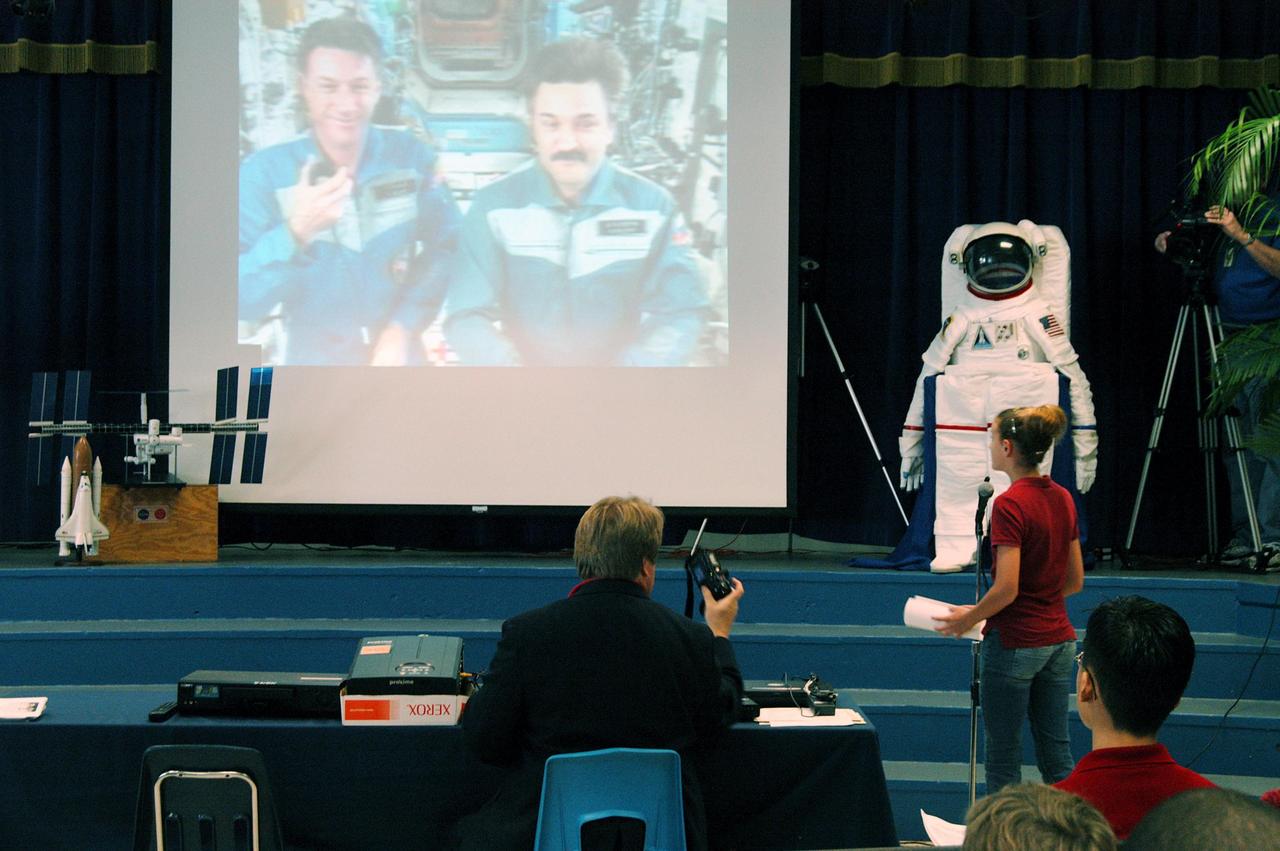
KENNEDY SPACE CENTER, FLA. - At Howard Bishop Middle School in Gainesville, Fla., during a presentation that shared the new vision for space exploration, the Expedition 8 crew, Commander Michael Foale and Flight Engineer Alexander Kaleri, participated in a downlink from the International Space Station (seen on the screen on stage). Deputy Director Dr. Woodrow Whitlow Jr. represented KSC, talking about our destiny as explorers, NASA’s stepping stone approach to exploring Earth, the Moon, Mars and beyond, how space impacts our lives, and how people and machines rely on each other in space. Howard Bishop Middle School is one of 50 nationwide (four in Florida) in the NASA Explorer Schools (NES) Program. NES establishes a three-year partnership between NASA and 50 NASA Explorer Schools teams, consisting of teachers and education administrators from diverse communities nationwide.
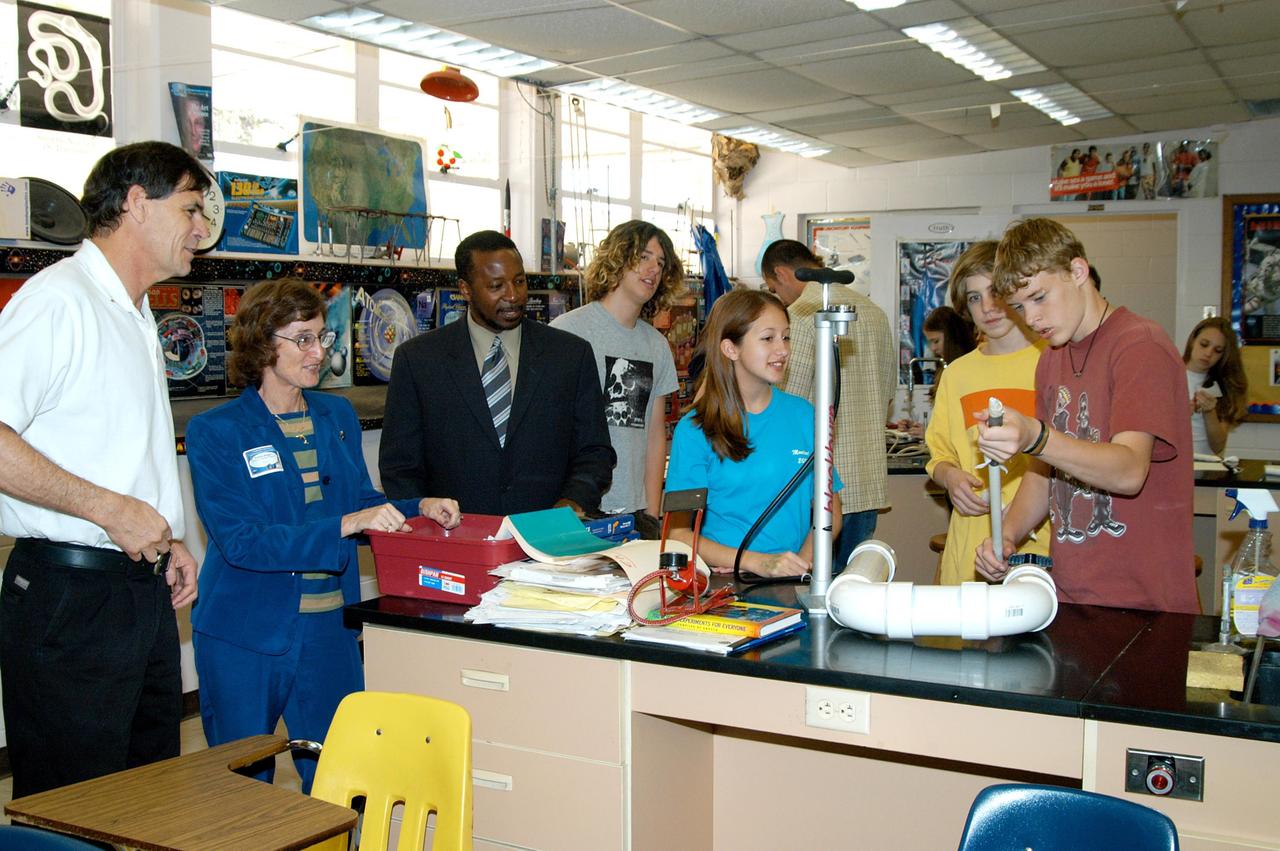
KENNEDY SPACE CENTER, FLA. - KSC Deputy Director Woodrow Whitlow Jr. looks at students’ projects in a classroom at Howard Bishop Middle School in Gainesville, Fla. Dr. Whitlow shared the new vision for space exploration with the students, the next generation of explorers. Whitlow talked about our destiny as explorers, NASA’s stepping stone approach to exploring Earth, the Moon, Mars and beyond, how space impacts our lives, and how people and machines rely on each other in space. The presentation also included a downlink from the International Space Station for students to ask questions of the Expedition 8 crew, Commander Michael Foale and Flight Engineer Alexander Kaleri. Howard Bishop Middle School is one of 50 nationwide (four in Florida) in the NASA Explorer Schools (NES) Program. NES establishes a three-year partnership between NASA and 50 NASA Explorer Schools teams, consisting of teachers and education administrators from diverse communities nationwide.
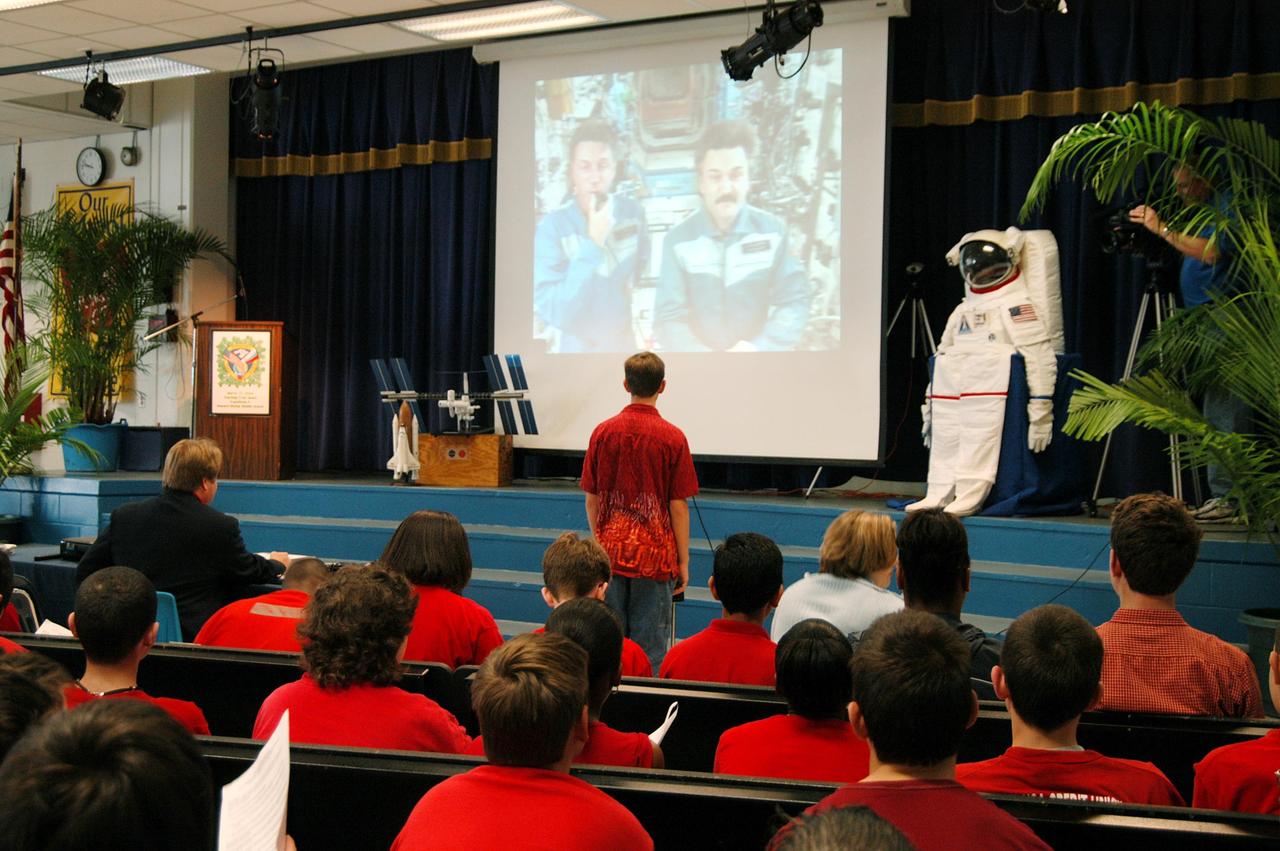
KENNEDY SPACE CENTER, FLA. - At Howard Bishop Middle School in Gainesville, Fla., a student asks the Expedition 8 crew (Commander Michael Foale and Flight Engineer Alexander Kaleri seen on the screen on stage) a question in a downlink from the International Space Station. During a presentation that shared the new vision for space exploration, KSC Deputy Director Dr. Woodrow Whitlow Jr. talked about our destiny as explorers, NASA’s stepping stone approach to exploring Earth, the Moon, Mars and beyond, how space impacts our lives, and how people and machines rely on each other in space. Howard Bishop Middle School is one of 50 nationwide (four in Florida) in the NASA Explorer Schools (NES) Program. NES establishes a three-year partnership between NASA and 50 NASA Explorer Schools teams, consisting of teachers and education administrators from diverse communities nationwide.
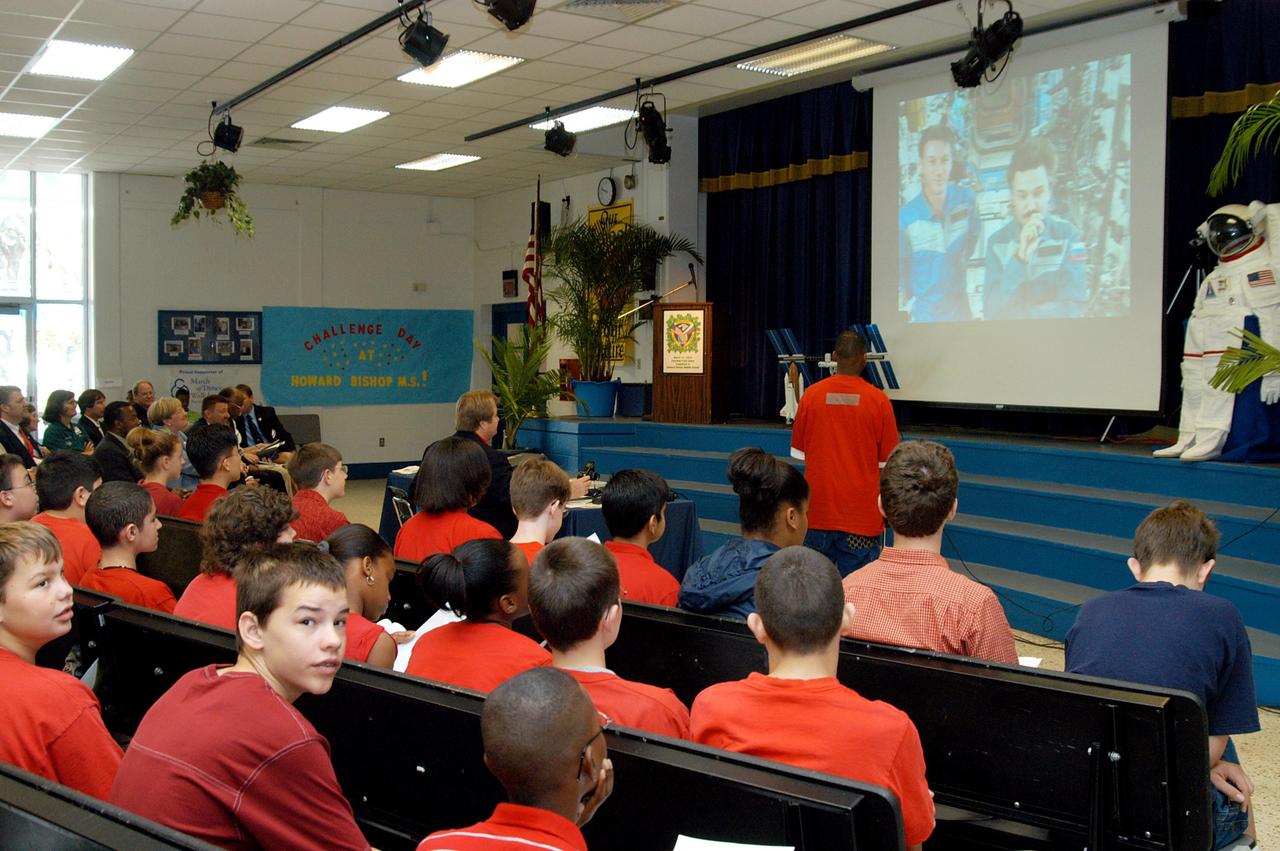
KENNEDY SPACE CENTER, FLA. - At Howard Bishop Middle School in Gainesville, Fla., a student asks the Expedition 8 crew (Commander Michael Foale and Flight Engineer Alexander Kaleri seen on the screen on stage) a question in a downlink from the International Space Station. During a presentation that shared the new vision for space exploration, KSC Deputy Director Dr. Woodrow Whitlow Jr. talked about our destiny as explorers, NASA’s stepping stone approach to exploring Earth, the Moon, Mars and beyond, how space impacts our lives, and how people and machines rely on each other in space. Howard Bishop Middle School is one of 50 nationwide (four in Florida) in the NASA Explorer Schools (NES) Program. NES establishes a three-year partnership between NASA and 50 NASA Explorer Schools teams, consisting of teachers and education administrators from diverse communities nationwide.
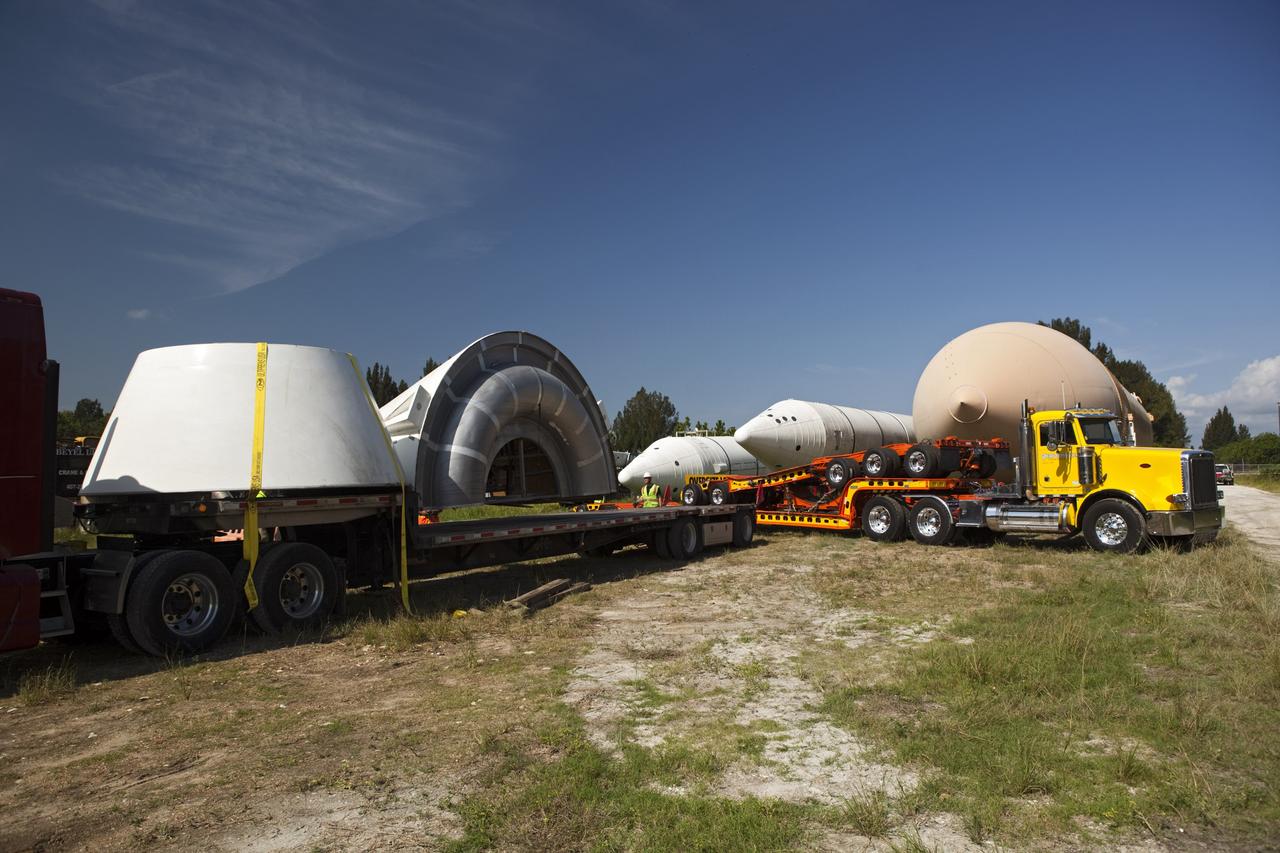
CAPE CANAVERAL, Fla. – At NASA’s Kennedy Space Center in Florida, aft skirts for space shuttle solid rocket boosters are being loaded on a truck. A twin set of space shuttle solid rocket boosters and an external fuel tank are being prepared for transport to separate museums. The solid rocket boosters, or SRBs, will be displayed at the California Science Center in Los Angeles. The external tank soon will be transported for display at the Wings of Dreams Aviation Museum at Keystone Heights Airport between Gainesville and Jacksonville, Fla. The 149-foot SRBs together provided six million pounds of thrust. The external fuel tank contained over 500,000 gallons of liquid hydrogen and liquid oxygen propellant for the shuttle orbiters' three main engines. The work is part of Transition and Retirement of the space shuttle. For more information, visit http://www.nasa.gov/transition Photo credit: NASA/ Dimitri Gerondidakis
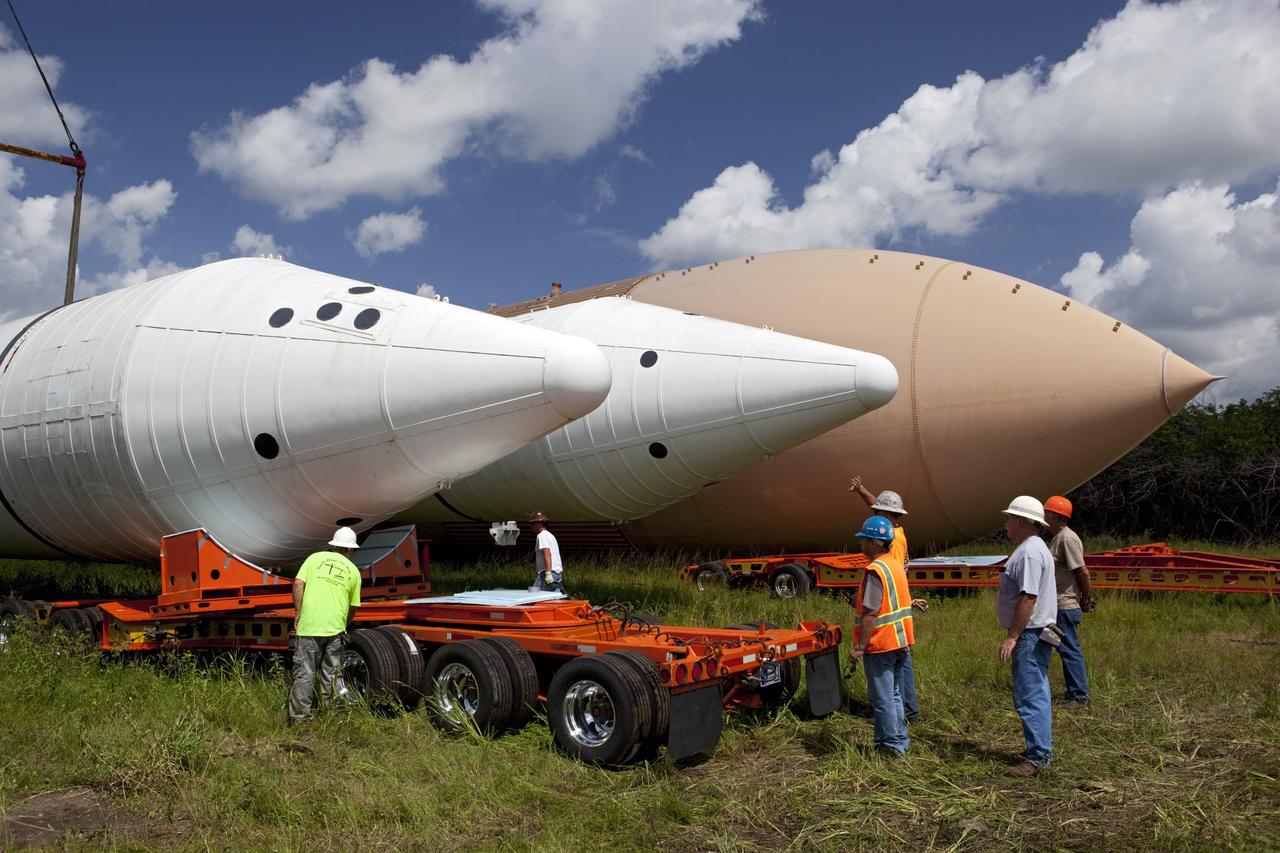
CAPE CANAVERAL, Fla. – At NASA’s Kennedy Space Center in Florida, preparations are underway to load a twin set of space shuttle solid rocket boosters and an external fuel tank on trucks for transport to separate museums. The solid rocket boosters, or SRBs, will be displayed at the California Science Center in Los Angeles. The external tank soon will be transported for display at the Wings of Dreams Aviation Museum at Keystone Heights Airport between Gainesville and Jacksonville, Fla. The 149-foot SRBs together provided six million pounds of thrust. The external fuel tank contained over 500,000 gallons of liquid hydrogen and liquid oxygen propellant for the shuttle orbiters' three main engines. The work is part of Transition and Retirement of the space shuttle. For more information, visit http://www.nasa.gov/transition Photo credit: NASA/ Dimitri Gerondidakis
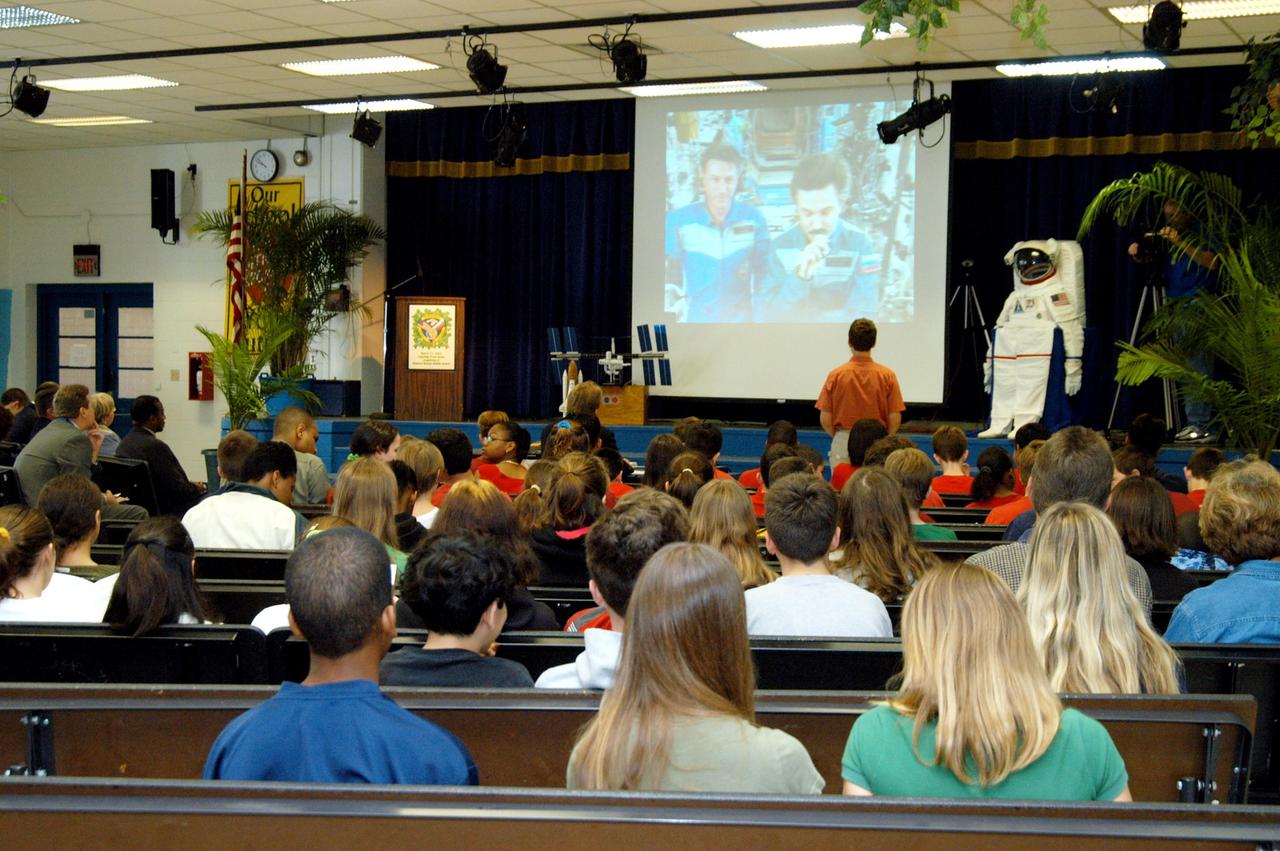
KENNEDY SPACE CENTER, FLA. - At Howard Bishop Middle School in Gainesville, Fla., a student asks the Expedition 8 crew (Commander Michael Foale and Flight Engineer Alexander Kaleri seen on the screen on stage) a question in a downlink from the International Space Station. During a presentation that shared the new vision for space exploration, KSC Deputy Director Dr. Woodrow Whitlow Jr. talked about our destiny as explorers, NASA’s stepping stone approach to exploring Earth, the Moon, Mars and beyond, how space impacts our lives, and how people and machines rely on each other in space. Howard Bishop Middle School is one of 50 nationwide (four in Florida) in the NASA Explorer Schools (NES) Program. NES establishes a three-year partnership between NASA and 50 NASA Explorer Schools teams, consisting of teachers and education administrators from diverse communities nationwide.
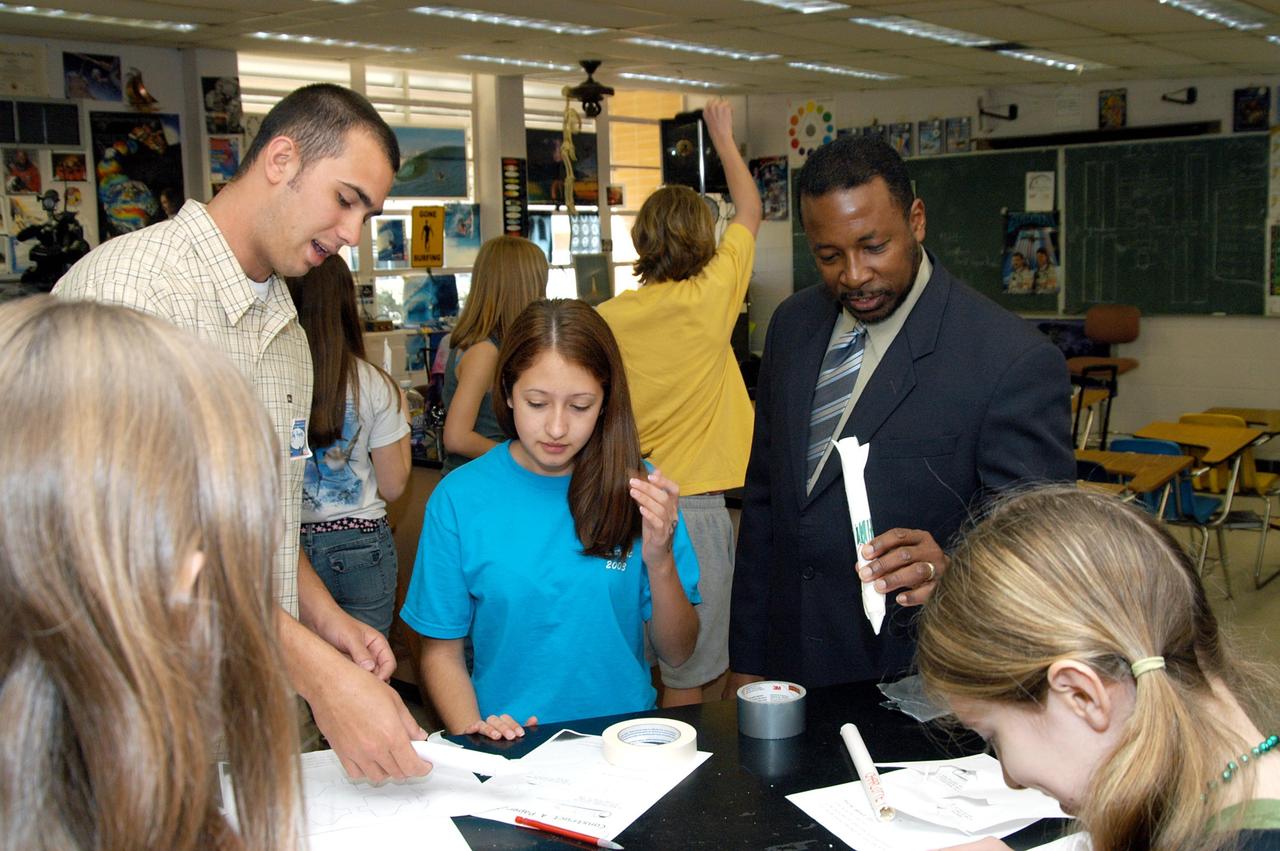
KENNEDY SPACE CENTER, FLA. - KSC Deputy Director Woodrow Whitlow Jr. looks at students’ projects in a classroom at Howard Bishop Middle School in Gainesville, Fla. Dr. Whitlow shared the new vision for space exploration with the students, the next generation of explorers. Whitlow talked about our destiny as explorers, NASA’s stepping stone approach to exploring Earth, the Moon, Mars and beyond, how space impacts our lives, and how people and machines rely on each other in space. The presentation also included a downlink from the International Space Station for students to ask questions of the Expedition 8 crew, Commander Michael Foale and Flight Engineer Alexander Kaleri. Howard Bishop Middle School is one of 50 nationwide (four in Florida) in the NASA Explorer Schools (NES) Program. NES establishes a three-year partnership between NASA and 50 NASA Explorer Schools teams, consisting of teachers and education administrators from diverse communities nationwide.
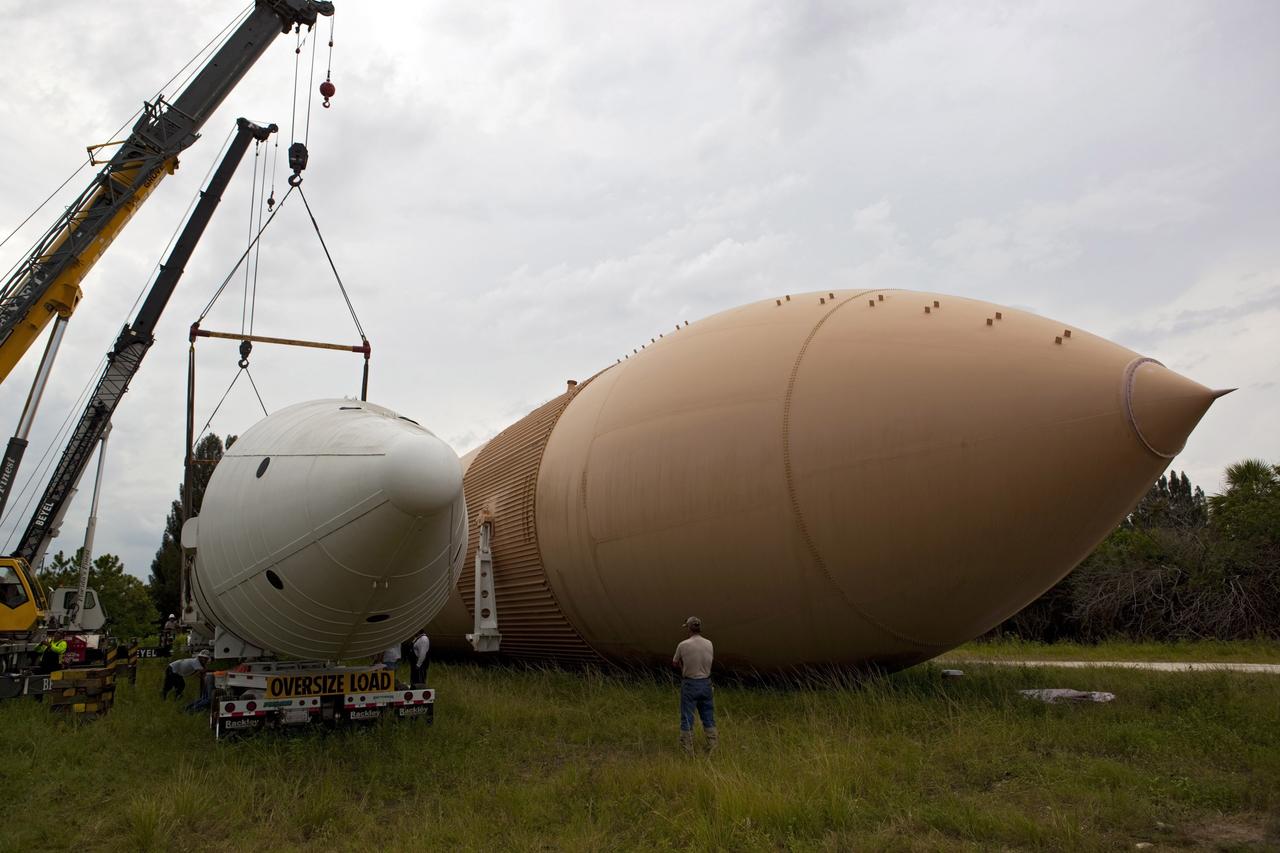
CAPE CANAVERAL, Fla. – At NASA’s Kennedy Space Center in Florida, a crane is used to load a space shuttle solid rocket booster and an external fuel tank on trucks for transport to separate museums. The solid rocket boosters, or SRBs, will be displayed at the California Science Center in Los Angeles. The external tank soon will be transported for display at the Wings of Dreams Aviation Museum at Keystone Heights Airport between Gainesville and Jacksonville, Fla. The 149-foot SRBs together provided six million pounds of thrust. The external fuel tank contained over 500,000 gallons of liquid hydrogen and liquid oxygen propellant for the shuttle orbiters' three main engines. The work is part of Transition and Retirement of the space shuttle. For more information, visit http://www.nasa.gov/transition Photo credit: NASA/ Dimitri Gerondidakis
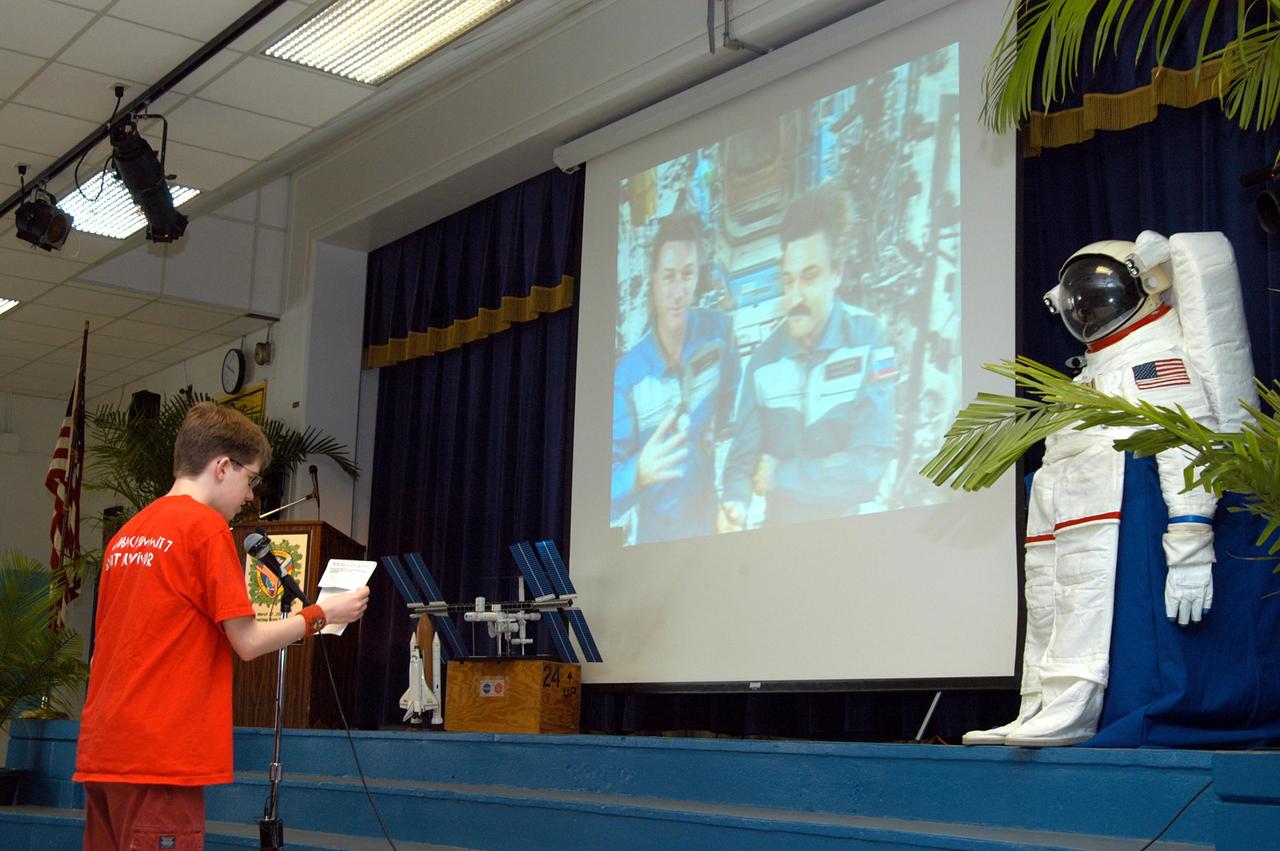
KENNEDY SPACE CENTER, FLA. - At Howard Bishop Middle School in Gainesville, Fla., a student asks the Expedition 8 crew (Commander Michael Foale and Flight Engineer Alexander Kaleri seen on the screen on stage) a question in a downlink from the International Space Station. During a presentation that shared the new vision for space exploration, KSC Deputy Director Dr. Woodrow Whitlow Jr. talked about our destiny as explorers, NASA’s stepping stone approach to exploring Earth, the Moon, Mars and beyond, how space impacts our lives, and how people and machines rely on each other in space. Howard Bishop Middle School is one of 50 nationwide (four in Florida) in the NASA Explorer Schools (NES) Program. NES establishes a three-year partnership between NASA and 50 NASA Explorer Schools teams, consisting of teachers and education administrators from diverse communities nationwide.
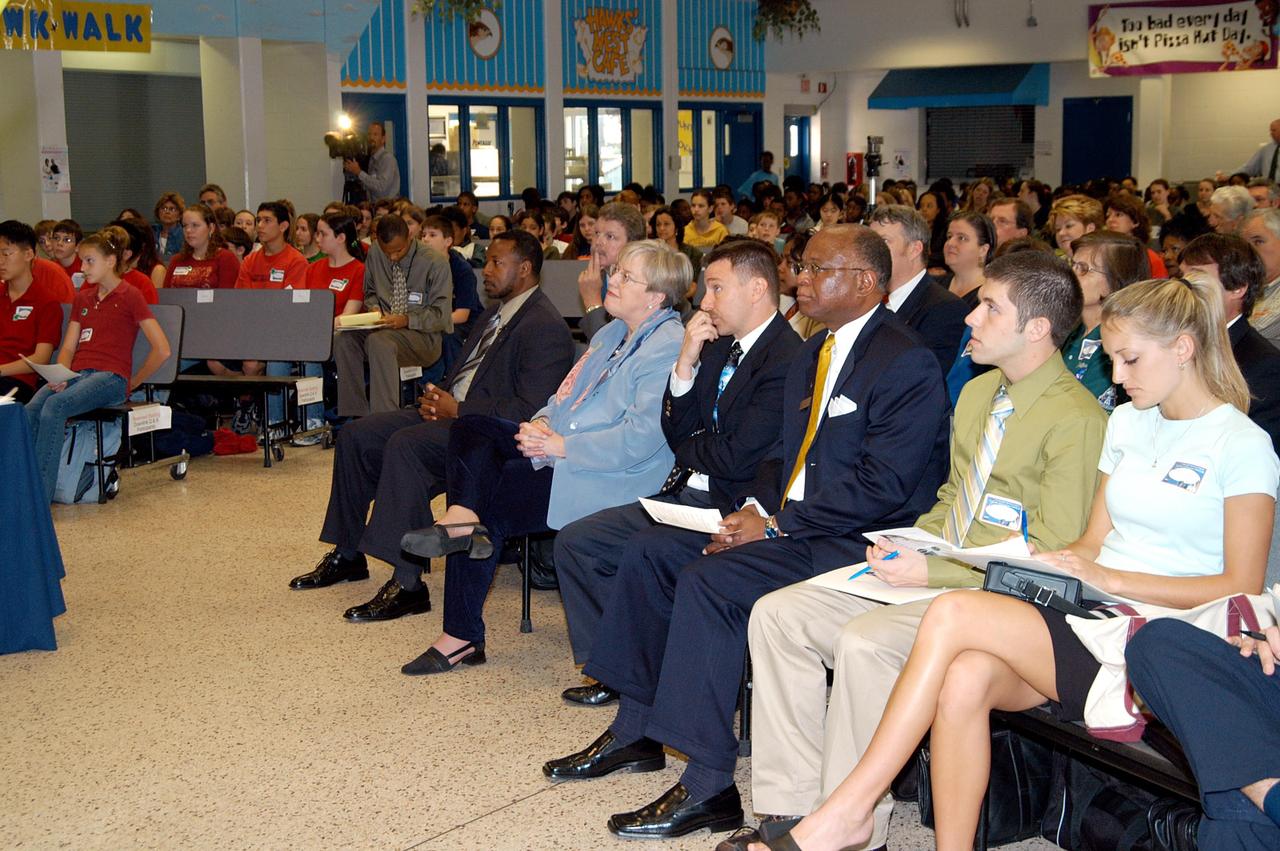
KENNEDY SPACE CENTER, FLA. - Students, teachers and administrators of Howard Bishop Middle School in Gainesville, Fla., listen to a presentation that shared the new vision for space exploration, KSC Deputy Director Dr. Woodrow Whitlow Jr. talked about our destiny as explorers, NASA’s stepping stone approach to exploring Earth, the Moon, Mars and beyond, how space impacts our lives, and how people and machines rely on each other in space. The presentation also included a downlink from the International Space Station for students to ask questions of the Expedition 8 crew, Commander Michael Foale and Flight Engineer Alexander Kaleri. Howard Bishop Middle School is one of 50 nationwide (four in Florida) in the NASA Explorer Schools (NES) Program. NES establishes a three-year partnership between NASA and 50 NASA Explorer Schools teams, consisting of teachers and education administrators from diverse communities nationwide.
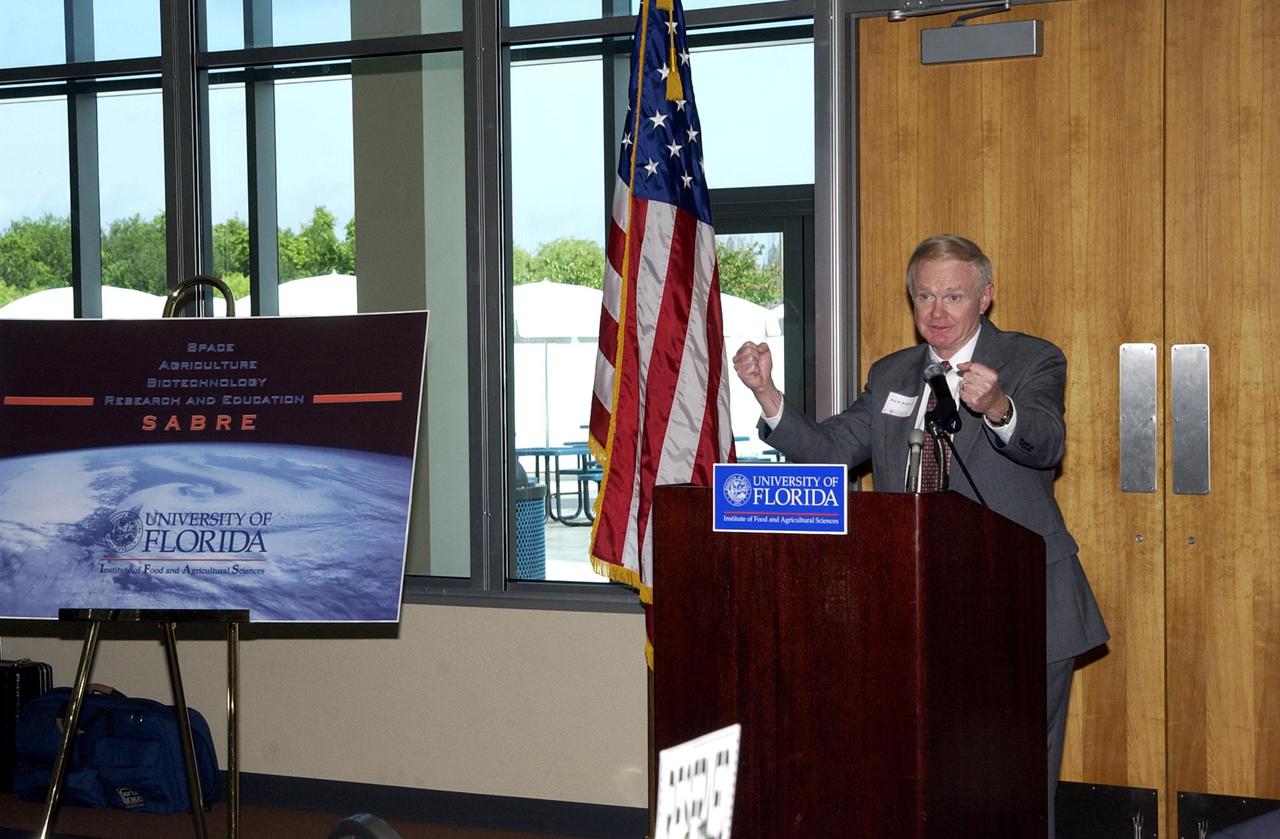
KENNEDY SPACE CENTER, FLA. - Center Director Roy D. Bridges Jr. shows his enthusiasm for the new program SABRE being launched at KSC. SABRE, Space Agricultural Biotechnology Research and Education, involves the University of Florida and NASA. Bridges was speaking at the opening ceremony that included officials from both organizations. SABRE will focus on the discovery, development and application of the biological aspects of advanced life support strategies. The program will include faculty from UF's Institute of Food and Agricultural Sciences, who will be located at both KSC - in the state-owned Space Experiment Research and Processing Laboratory (SERPL) being built there - and UF in Gainesville. SABRE will be directed by Robert Ferl, professor in the horticultural sciences department and assistant director of UF's Biotechnology Program. He will be responsible for coordinating the research and education efforts of UF and NASA
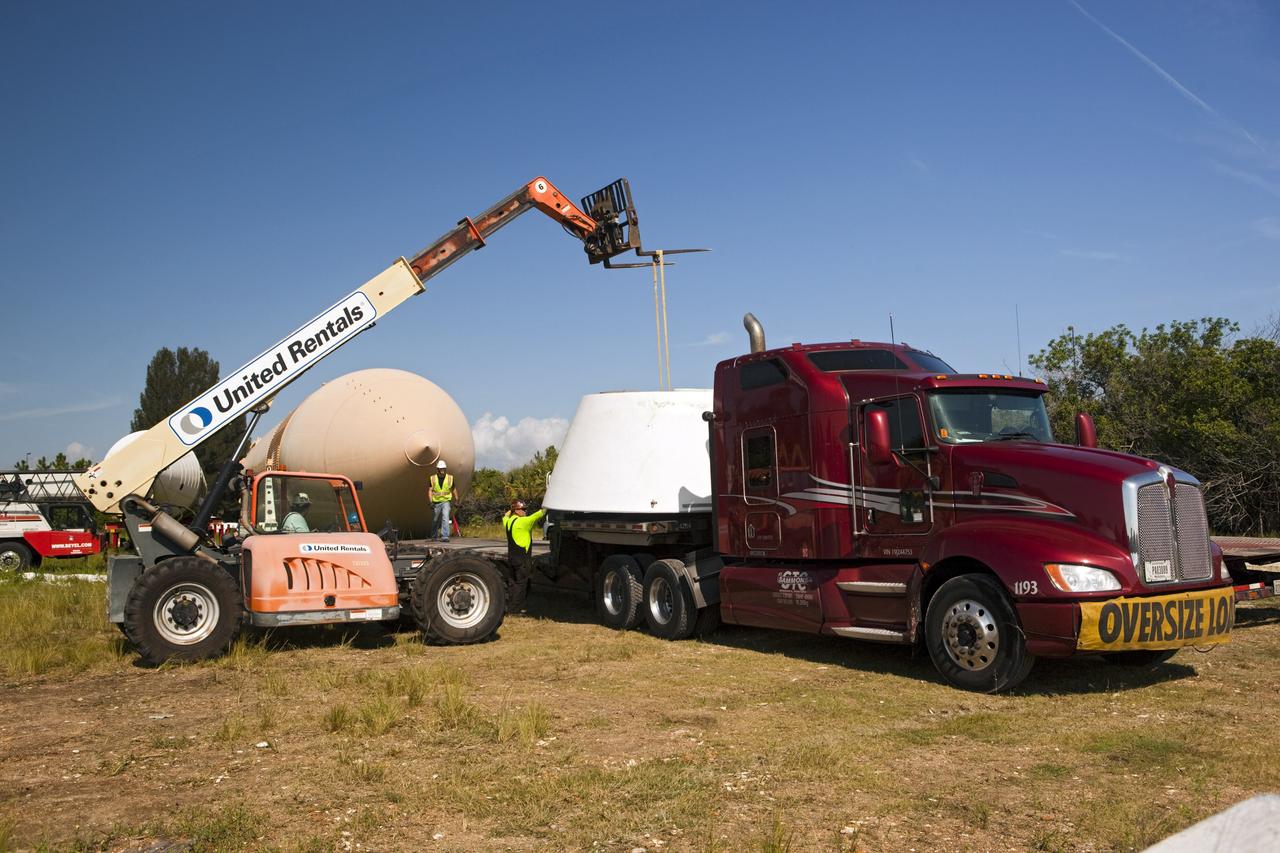
CAPE CANAVERAL, Fla. – At NASA’s Kennedy Space Center in Florida, a crane is used to load the aft skirt for a space shuttle solid rocket booster on a truck. A twin set of space shuttle solid rocket boosters and an external fuel tank are being prepared for transport to separate museums. The solid rocket boosters, or SRBs, will be displayed at the California Science Center in Los Angeles. The external tank soon will be transported for display at the Wings of Dreams Aviation Museum at Keystone Heights Airport between Gainesville and Jacksonville, Fla. The 149-foot SRBs together provided six million pounds of thrust. The external fuel tank contained over 500,000 gallons of liquid hydrogen and liquid oxygen propellant for the shuttle orbiters' three main engines. The work is part of Transition and Retirement of the space shuttle. For more information, visit http://www.nasa.gov/transition Photo credit: NASA/ Dimitri Gerondidakis
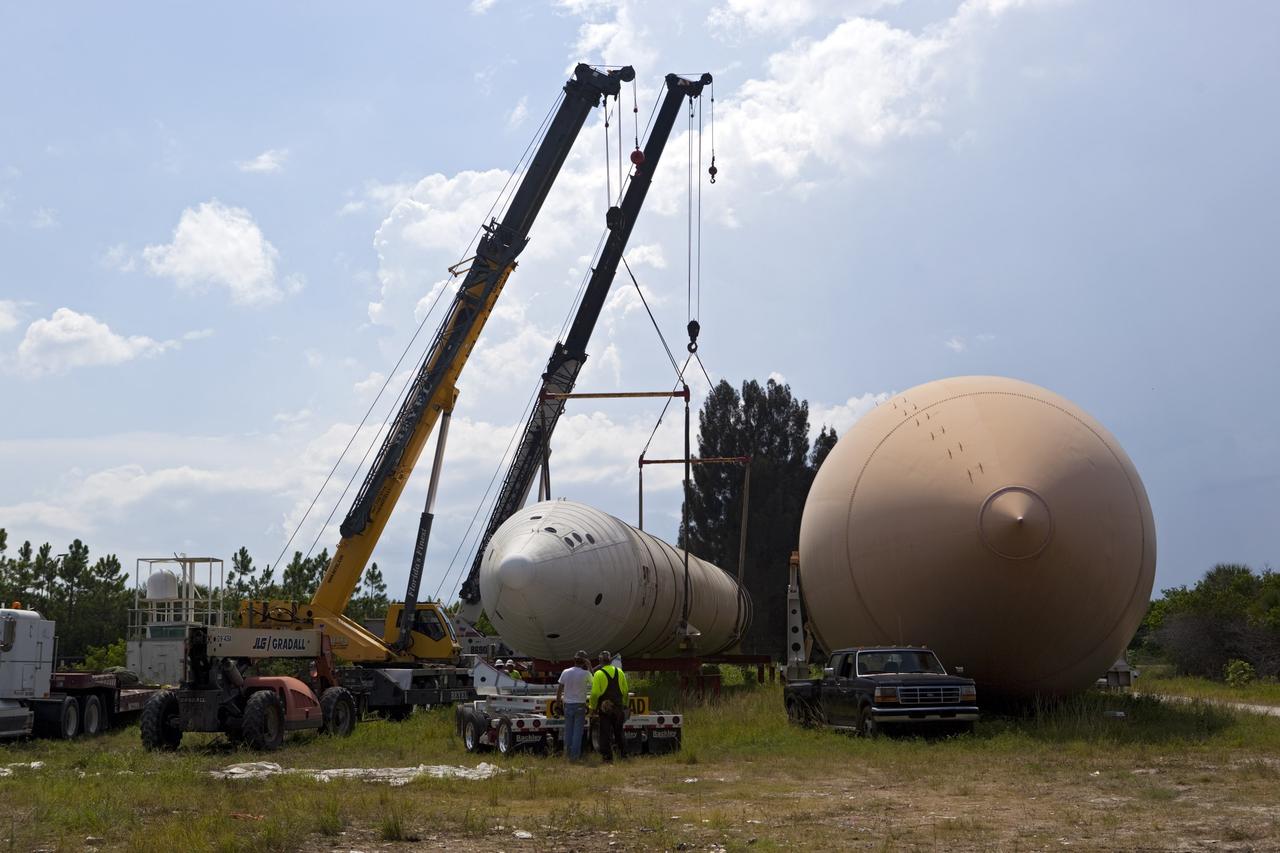
CAPE CANAVERAL, Fla. – At NASA’s Kennedy Space Center in Florida, a crane is used to load a space shuttle solid rocket booster and an external fuel tank on to trucks for transport to separate museums. The solid rocket boosters, or SRBs, will be displayed at the California Science Center in Los Angeles. The external tank soon will be transported for display at the Wings of Dreams Aviation Museum at Keystone Heights Airport between Gainesville and Jacksonville, Fla. The 149-foot SRBs together provided six million pounds of thrust. The external fuel tank contained over 500,000 gallons of liquid hydrogen and liquid oxygen propellant for the shuttle orbiters' three main engines. The work is part of Transition and Retirement of the space shuttle. For more information, visit http://www.nasa.gov/transition Photo credit: NASA/ Dimitri Gerondidakis

CAPE CANAVERAL, Fla. – At NASA’s Kennedy Space Center in Florida, a crane is used to load a space shuttle solid rocket booster and an external fuel tank on trucks for transport to separate museums. The solid rocket boosters, or SRBs, will be displayed at the California Science Center in Los Angeles. The external tank soon will be transported for display at the Wings of Dreams Aviation Museum at Keystone Heights Airport between Gainesville and Jacksonville, Fla. The 149-foot SRBs together provided six million pounds of thrust. The external fuel tank contained over 500,000 gallons of liquid hydrogen and liquid oxygen propellant for the shuttle orbiters' three main engines. The work is part of Transition and Retirement of the space shuttle. For more information, visit http://www.nasa.gov/transition Photo credit: NASA/ Dimitri Gerondidakis
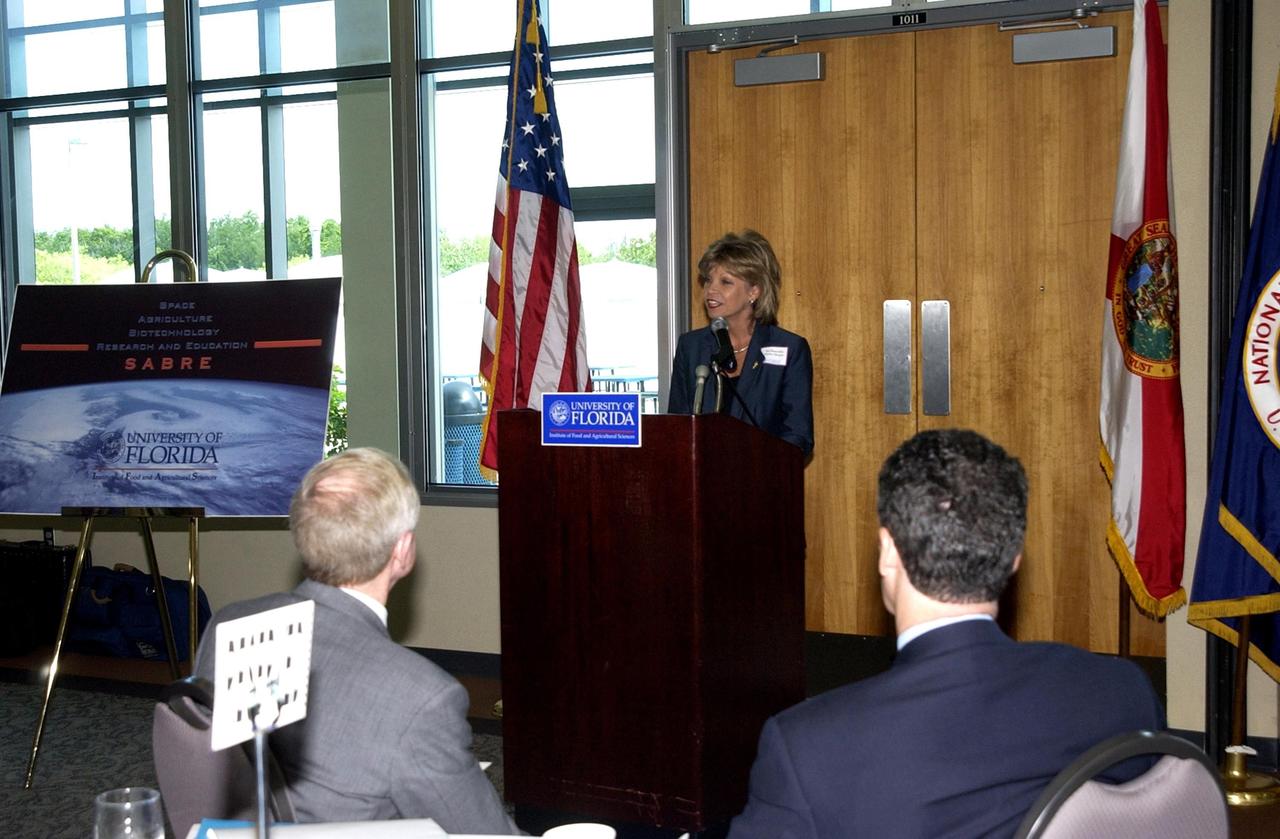
KENNEDY SPACE CENTER, FLA. -- The Honorable Diana Morgan speaks to attendees at the opening ceremony kicking off a new program known as SABRE, Space Agricultural Biotechnology Research and Education. In the foreground are Center Director Roy D. Bridges Jr. (left) and U.S. Representative Dave Weldon (right). The SABRE program is a combined effort of the University of Florida and NASA. Morgan is vice chair on the UF Board of Trustees. SABRE will focus on the discovery, development and application of the biological aspects of advanced life support strategies. The program will include faculty from UF's Institute of Food and Agricultural Sciences, who will be located at both KSC - in the state-owned Space Experiment Research and Processing Laboratory (SERPL) being built there - and UF in Gainesville. SABRE will be directed by Robert Ferl, professor in the horticultural sciences department and assistant director of UF's Biotechnology Program. He will be responsible for coordinating the research and education efforts of UF and NASA

KENNEDY SPACE CENTER, FLA. -- Center Director Roy D. Bridges Jr. speaks at the opening ceremony to launch a new program called SABRE, Space Agricultural Biotechnology Research and Education, involving the University of Florida and NASA. Officials from UF and NASA attended the event. SABRE will focus on the discovery, development and application of the biological aspects of advanced life support strategies. The program will include faculty from UF's Institute of Food and Agricultural Sciences, who will be located at both KSC - in the state-owned Space Experiment Research and Processing Laboratory (SERPL) being built there - and UF in Gainesville. SABRE will be directed by Robert Ferl, professor in the horticultural sciences department and assistant director of UF's Biotechnology Program. He will be responsible for coordinating the research and education efforts of UF and NASA
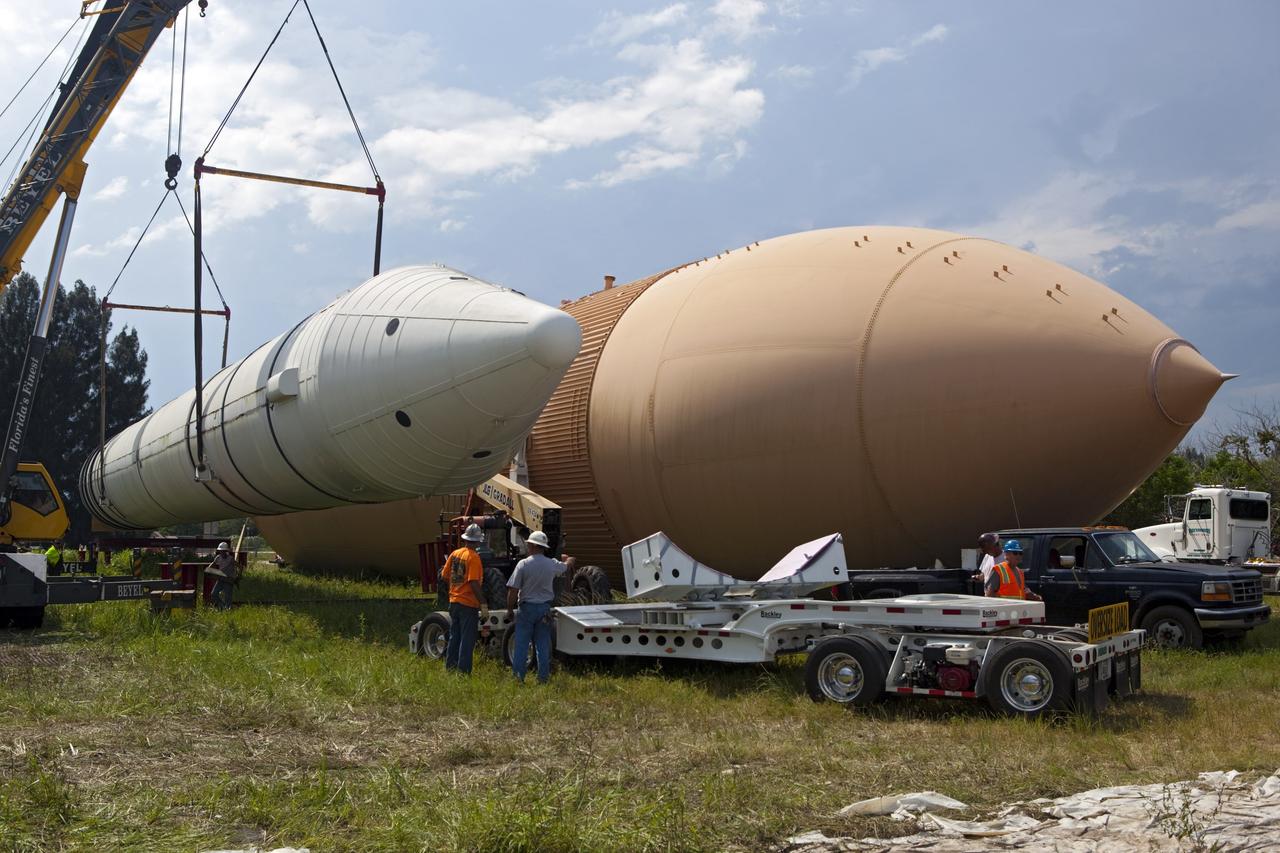
CAPE CANAVERAL, Fla. – At NASA’s Kennedy Space Center in Florida, a crane is used to load a space shuttle solid rocket booster and an external fuel tank on trucks for transport to separate museums. The solid rocket boosters, or SRBs, will be displayed at the California Science Center in Los Angeles. The external tank soon will be transported for display at the Wings of Dreams Aviation Museum at Keystone Heights Airport between Gainesville and Jacksonville, Fla. The 149-foot SRBs together provided six million pounds of thrust. The external fuel tank contained over 500,000 gallons of liquid hydrogen and liquid oxygen propellant for the shuttle orbiters' three main engines. The work is part of Transition and Retirement of the space shuttle. For more information, visit http://www.nasa.gov/transition Photo credit: NASA/ Dimitri Gerondidakis
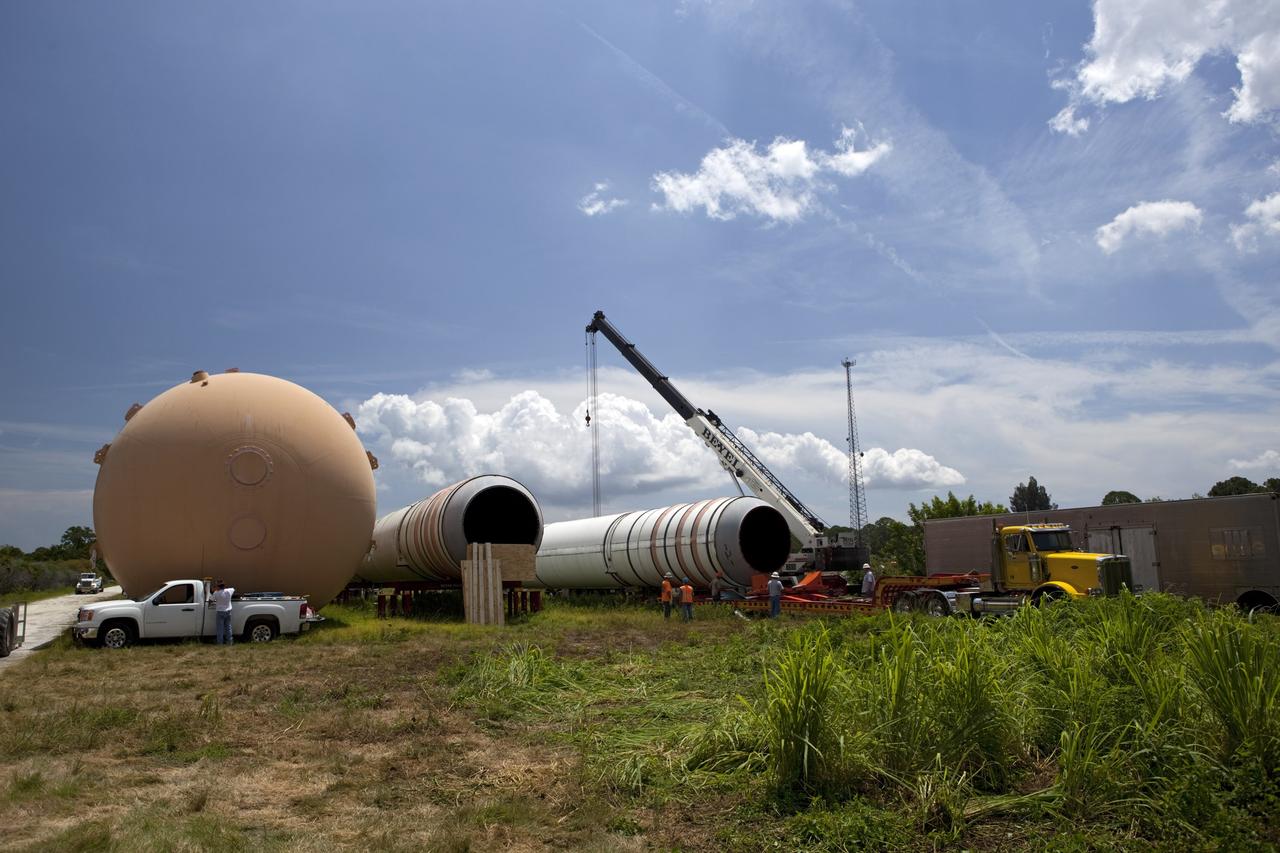
CAPE CANAVERAL, Fla. – At NASA’s Kennedy Space Center in Florida, a crane is used to load a twin set of space shuttle solid rocket boosters and an external fuel tank on trucks for transport to separate museums. The solid rocket boosters, or SRBs, will be displayed at the California Science Center in Los Angeles. The external tank soon will be transported for display at the Wings of Dreams Aviation Museum at Keystone Heights Airport between Gainesville and Jacksonville, Fla. The 149-foot SRBs together provided six million pounds of thrust. The external fuel tank contained over 500,000 gallons of liquid hydrogen and liquid oxygen propellant for the shuttle orbiters' three main engines. The work is part of Transition and Retirement of the space shuttle. For more information, visit http://www.nasa.gov/transition Photo credit: NASA/ Dimitri Gerondidakis
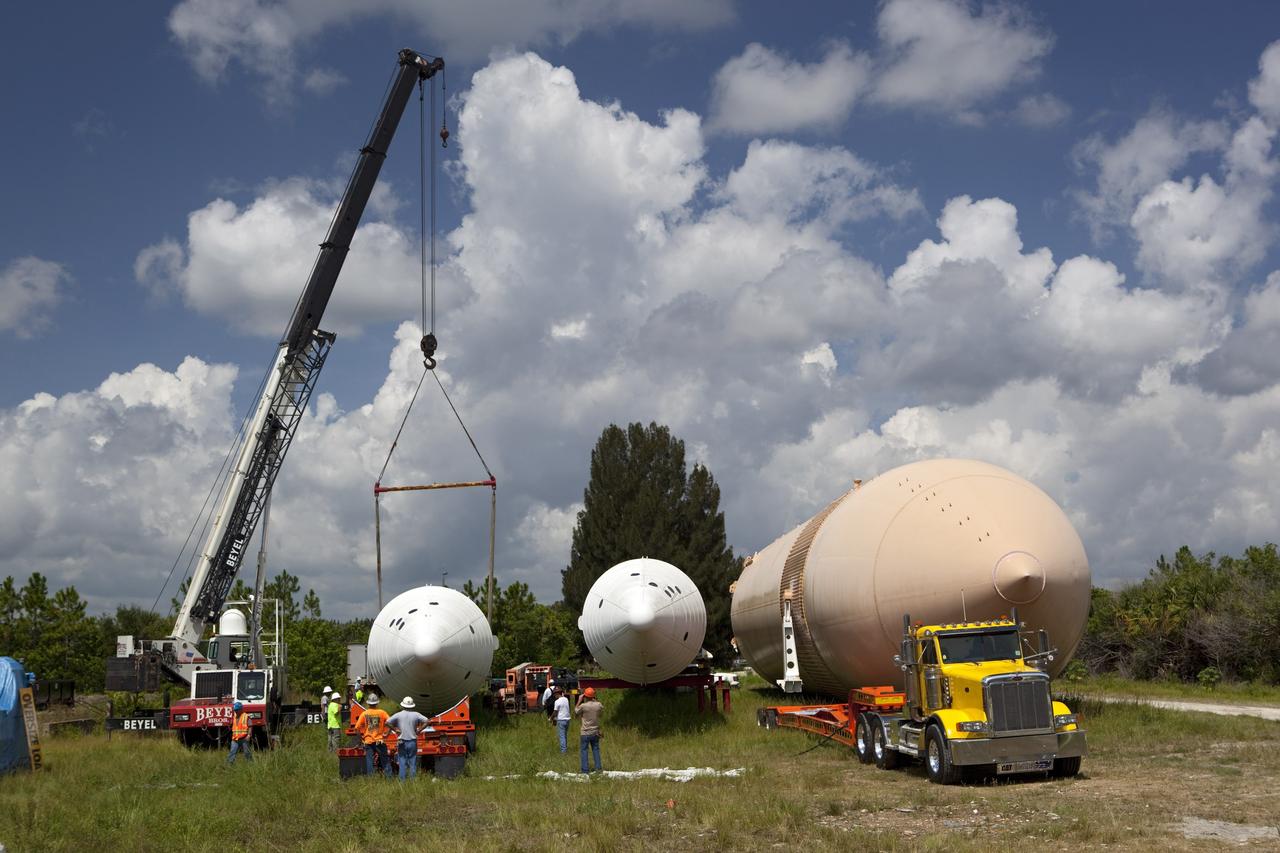
CAPE CANAVERAL, Fla. – At NASA’s Kennedy Space Center in Florida, a crane is used to load a twin set of space shuttle solid rocket boosters and an external fuel tank on trucks for transport to separate museums. The solid rocket boosters, or SRBs, will be displayed at the California Science Center in Los Angeles. The external tank soon will be transported for display at the Wings of Dreams Aviation Museum at Keystone Heights Airport between Gainesville and Jacksonville, Fla. The 149-foot SRBs together provided six million pounds of thrust. The external fuel tank contained over 500,000 gallons of liquid hydrogen and liquid oxygen propellant for the shuttle orbiters' three main engines. The work is part of Transition and Retirement of the space shuttle. For more information, visit http://www.nasa.gov/transition Photo credit: NASA/ Dimitri Gerondidakis
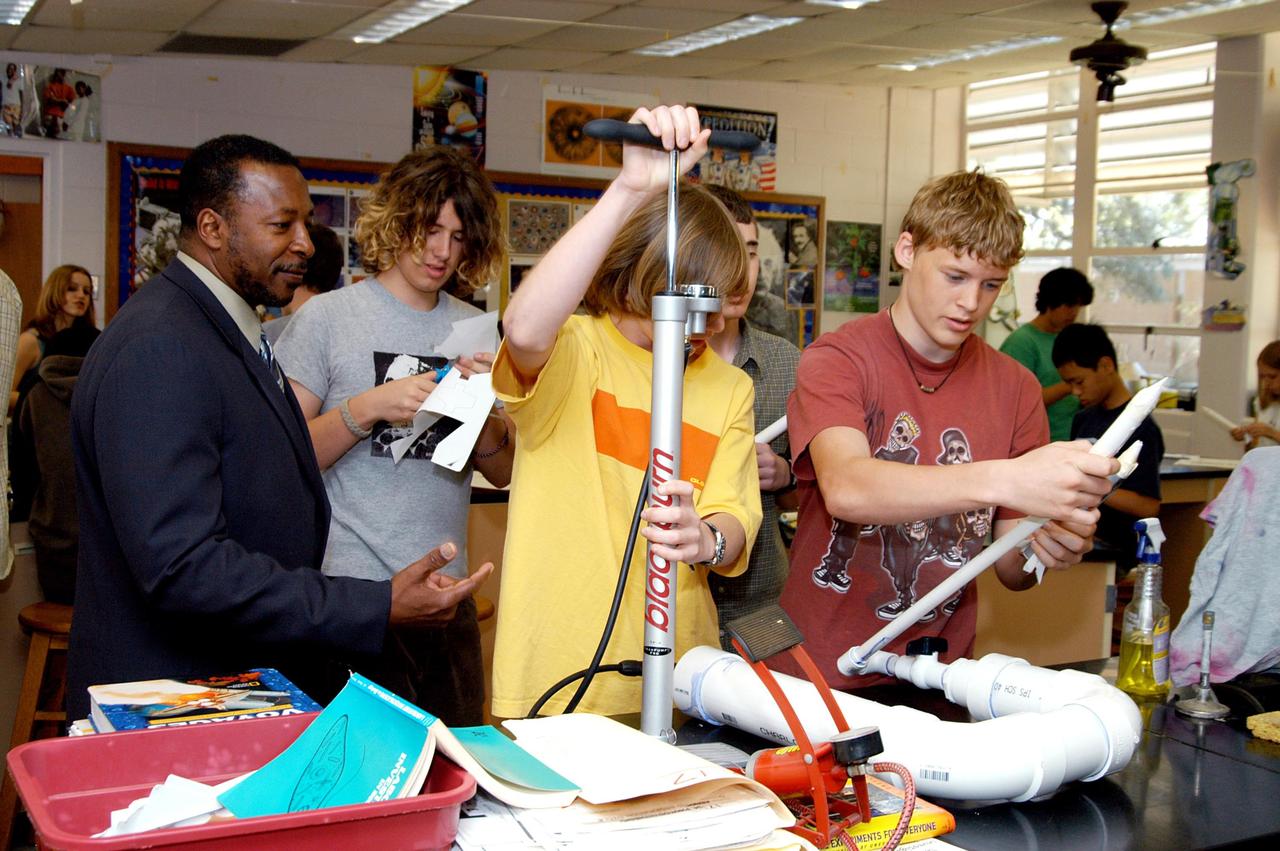
KENNEDY SPACE CENTER, FLA. - KSC Deputy Director Woodrow Whitlow Jr. looks at students’ projects in a classroom at Howard Bishop Middle School in Gainesville, Fla. Dr. Whitlow shared the new vision for space exploration with the students, the next generation of explorers. Whitlow talked about our destiny as explorers, NASA’s stepping stone approach to exploring Earth, the Moon, Mars and beyond, how space impacts our lives, and how people and machines rely on each other in space. The presentation also included a downlink from the International Space Station for students to ask questions of the Expedition 8 crew, Commander Michael Foale and Flight Engineer Alexander Kaleri. Howard Bishop Middle School is one of 50 nationwide (four in Florida) in the NASA Explorer Schools (NES) Program. NES establishes a three-year partnership between NASA and 50 NASA Explorer Schools teams, consisting of teachers and education administrators from diverse communities nationwide.
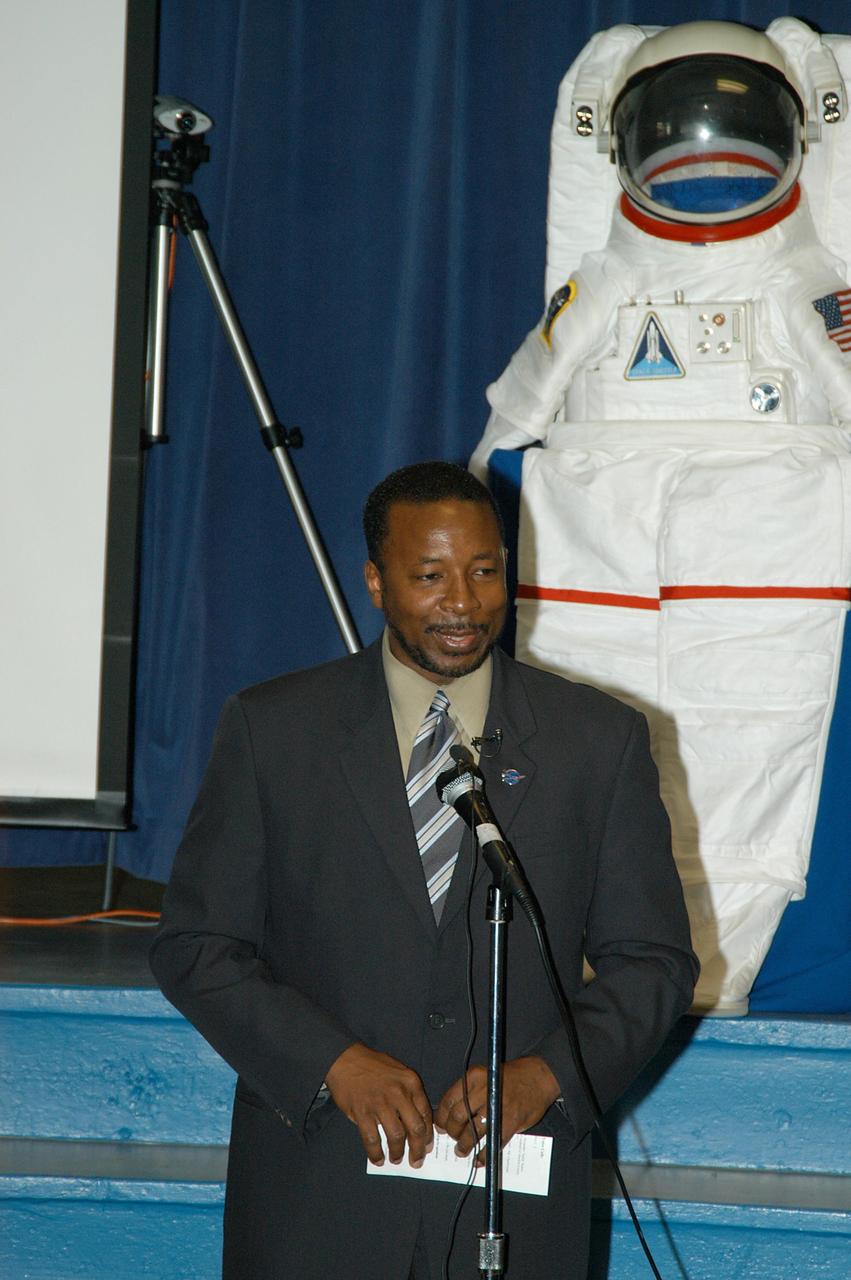
KENNEDY SPACE CENTER, FLA. - At Howard Bishop Middle School in Gainesville, Fla., Dr. Woodrow Whitlow Jr., KSC deputy director, shares the new vision for space exploration with the students, the next generation of explorers. Whitlow talked about our destiny as explorers, NASA’s stepping stone approach to exploring Earth, the Moon, Mars and beyond, how space impacts our lives, and how people and machines rely on each other in space. The presentation also included a downlink from the International Space Station for students to ask questions of the Expedition 8 crew, Commander Michael Foale and Flight Engineer Alexander Kaleri. Howard Bishop Middle School is one of 50 nationwide (four in Florida) in the NASA Explorer Schools (NES) Program. NES establishes a three-year partnership between NASA and 50 NASA Explorer Schools teams, consisting of teachers and education administrators from diverse communities nationwide.
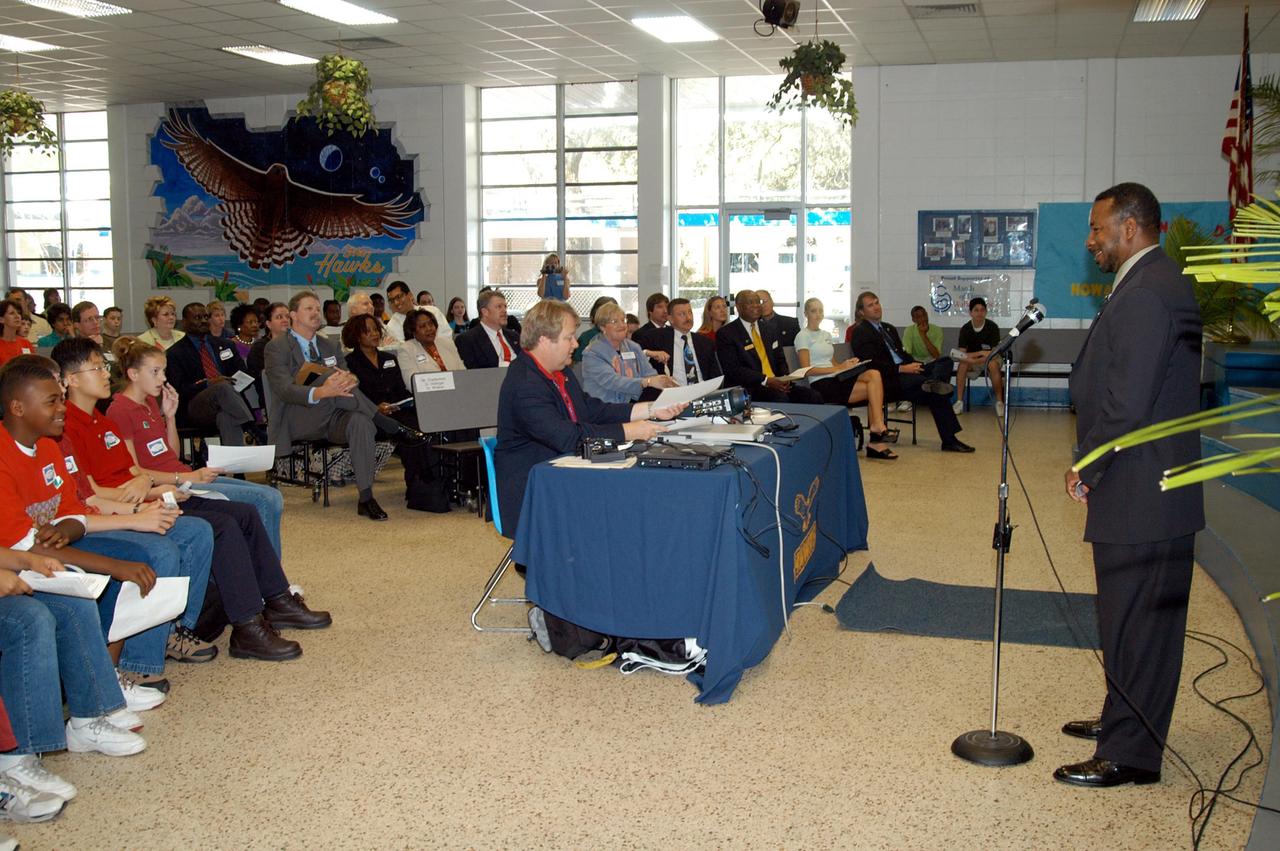
KENNEDY SPACE CENTER, FLA. - KSC Deputy Director Dr. Woodrow Whitlow Jr. shares the new vision for space exploration with the students, the next generation of explorers, at Howard Bishop Middle School in Gainesville, Fla. Whitlow talked about our destiny as explorers, NASA’s stepping stone approach to exploring Earth, the Moon, Mars and beyond, how space impacts our lives, and how people and machines rely on each other in space. The presentation also included a downlink from the International Space Station for students to ask questions of the Expedition 8 crew, Commander Michael Foale and Flight Engineer Alexander Kaleri. Howard Bishop Middle School is one of 50 nationwide (four in Florida) in the NASA Explorer Schools (NES) Program. NES establishes a three-year partnership between NASA and 50 NASA Explorer Schools teams, consisting of teachers and education administrators from diverse communities nationwide.
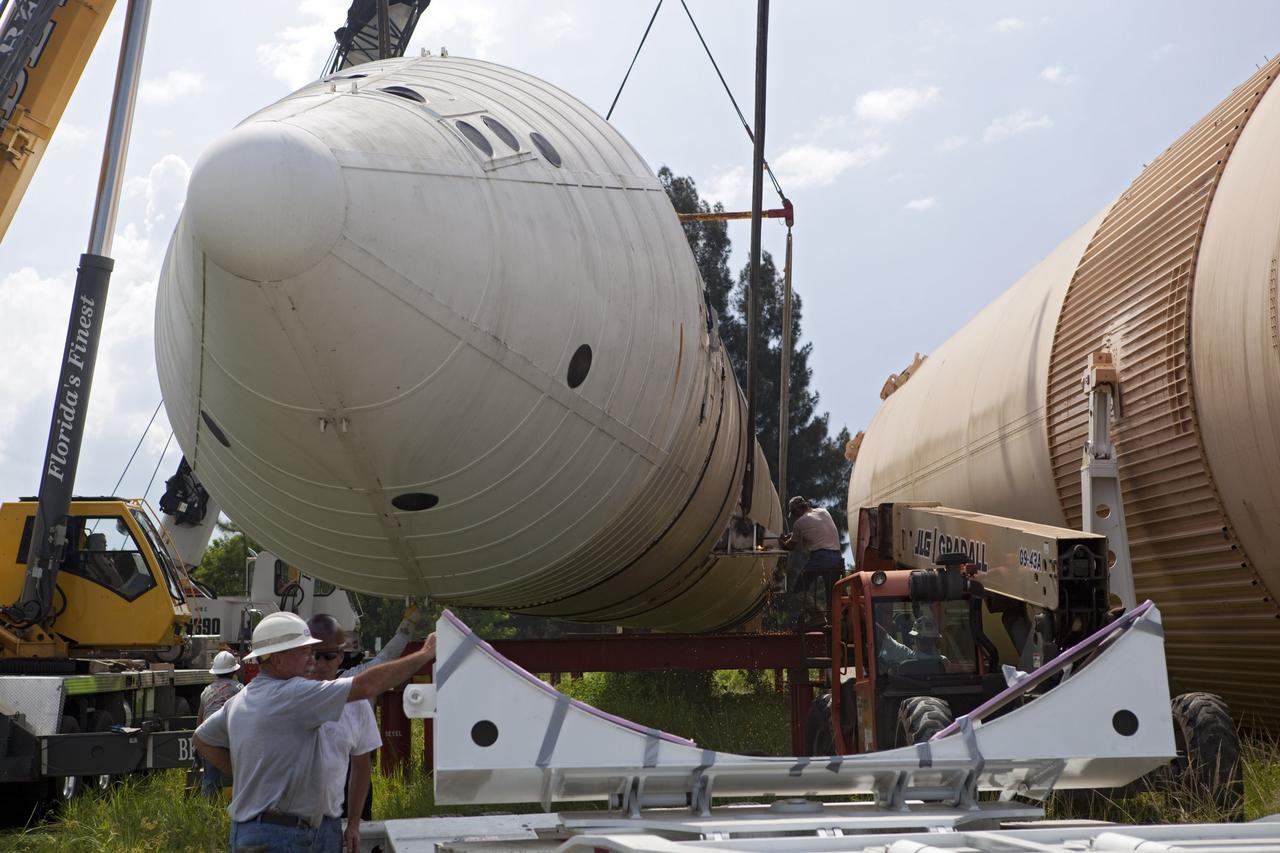
CAPE CANAVERAL, Fla. – At NASA’s Kennedy Space Center in Florida, a crane is used to load a space shuttle solid rocket booster and an external fuel tank on trucks for transport to separate museums. The solid rocket boosters, or SRBs, will be displayed at the California Science Center in Los Angeles. The external tank soon will be transported for display at the Wings of Dreams Aviation Museum at Keystone Heights Airport between Gainesville and Jacksonville, Fla. The 149-foot SRBs together provided six million pounds of thrust. The external fuel tank contained over 500,000 gallons of liquid hydrogen and liquid oxygen propellant for the shuttle orbiters' three main engines. The work is part of Transition and Retirement of the space shuttle. For more information, visit http://www.nasa.gov/transition Photo credit: NASA/ Dimitri Gerondidakis
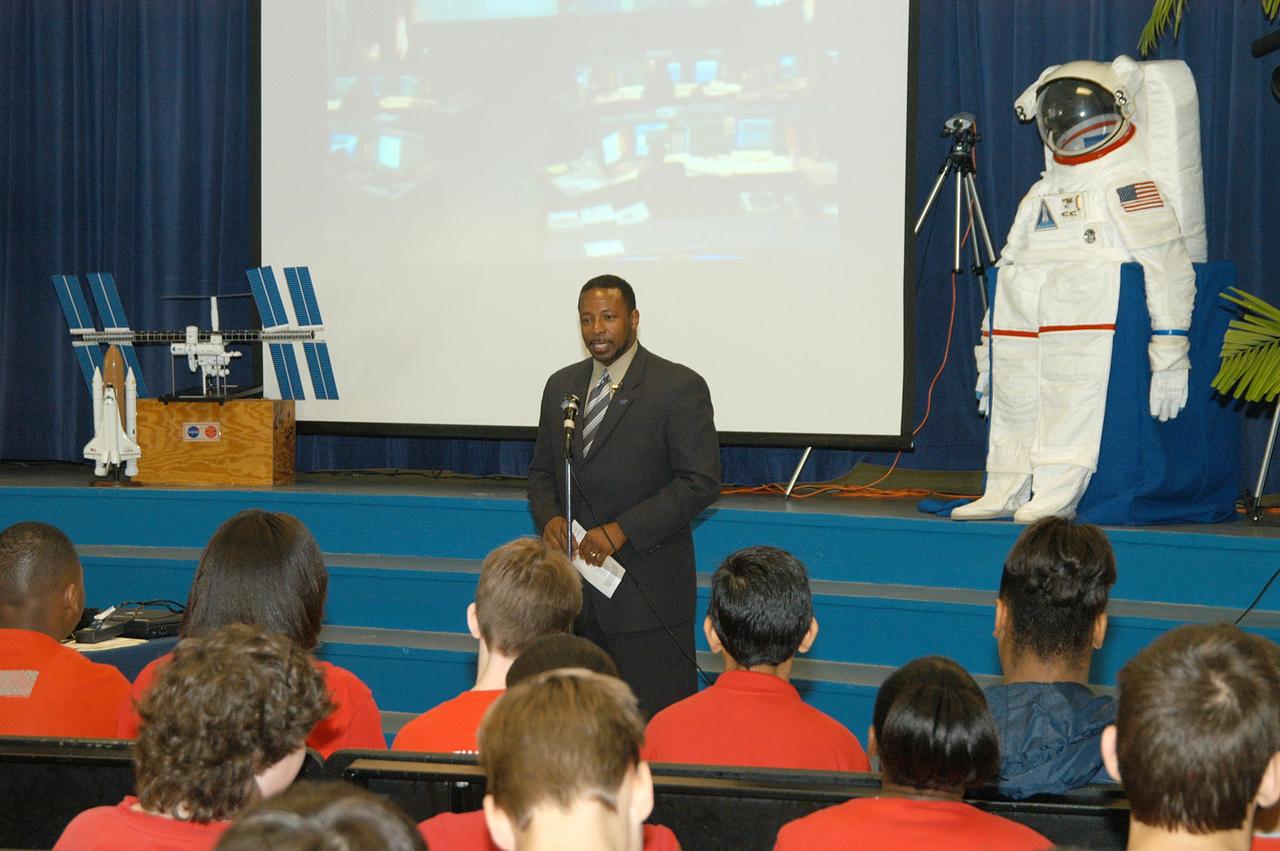
KENNEDY SPACE CENTER, FLA. - At Howard Bishop Middle School in Gainesville, Fla., KSC Deputy Director Dr. Woodrow Whitlow Jr. shares the new vision for space exploration with the students, the next generation of explorers. Whitlow talked about our destiny as explorers, NASA’s stepping stone approach to exploring Earth, the Moon, Mars and beyond, how space impacts our lives, and how people and machines rely on each other in space. The presentation also included a downlink from the International Space Station for students to ask questions of the Expedition 8 crew, Commander Michael Foale and Flight Engineer Alexander Kaleri. Howard Bishop Middle School is one of 50 nationwide (four in Florida) in the NASA Explorer Schools (NES) Program. NES establishes a three-year partnership between NASA and 50 NASA Explorer Schools teams, consisting of teachers and education administrators from diverse communities nationwide.
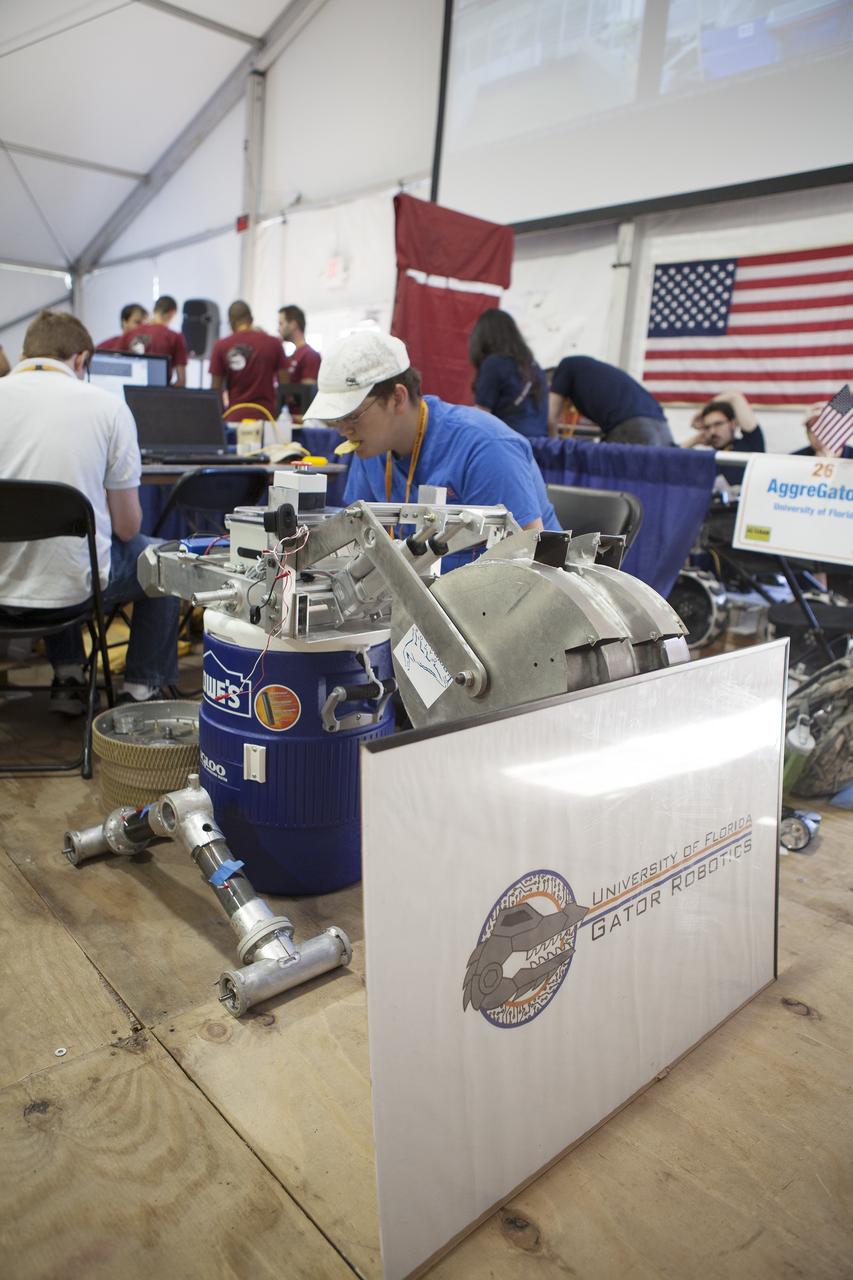
CAPE CANAVERAL, Fla. – Team members from the University of Florida in Gainesville prepare their robot for the mining portion of NASA's 2014 Robotics Mining Competition at the Kennedy Space Center Visitor Complex in Florida. More than 35 teams from around the U.S. have designed and built remote-controlled robots for the mining competition. The competition is a NASA Human Exploration and Operations Mission Directorate project designed to engage and retain students in science, technology, engineering and mathematics, or STEM, fields by expanding opportunities for student research and design. Teams use their remote-controlled robotics to maneuver and dig in a supersized sandbox filled with a crushed material that has characteristics similar to Martian soil. The objective of the challenge is to see which team’s robot can collect and move the most regolith within a specified amount of time. For more information, visit www.nasa.gov/nasarmc. Photo credit: NASA/Frankie Martin
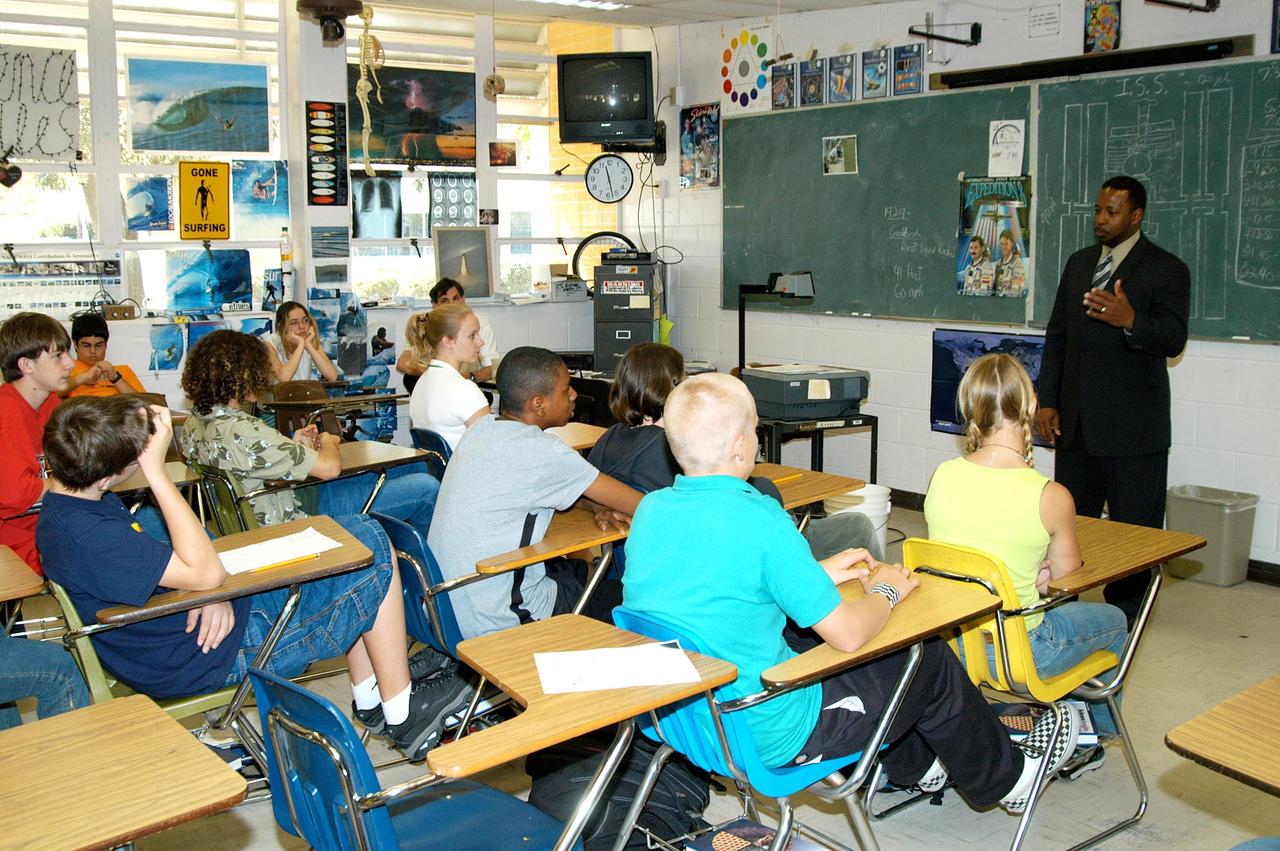
KENNEDY SPACE CENTER, FLA. - KSC Deputy Director Woodrow Whitlow Jr. talks to students in a classroom at Howard Bishop Middle School in Gainesville, Fla. Dr. Whitlow shared the new vision for space exploration with the students, the next generation of explorers. Whitlow talked about our destiny as explorers, NASA’s stepping stone approach to exploring Earth, the Moon, Mars and beyond, how space impacts our lives, and how people and machines rely on each other in space. The presentation also included a downlink from the International Space Station for students to ask questions of the Expedition 8 crew, Commander Michael Foale and Flight Engineer Alexander Kaleri. Howard Bishop Middle School is one of 50 nationwide (four in Florida) in the NASA Explorer Schools (NES) Program. NES establishes a three-year partnership between NASA and 50 NASA Explorer Schools teams, consisting of teachers and education administrators from diverse communities nationwide.
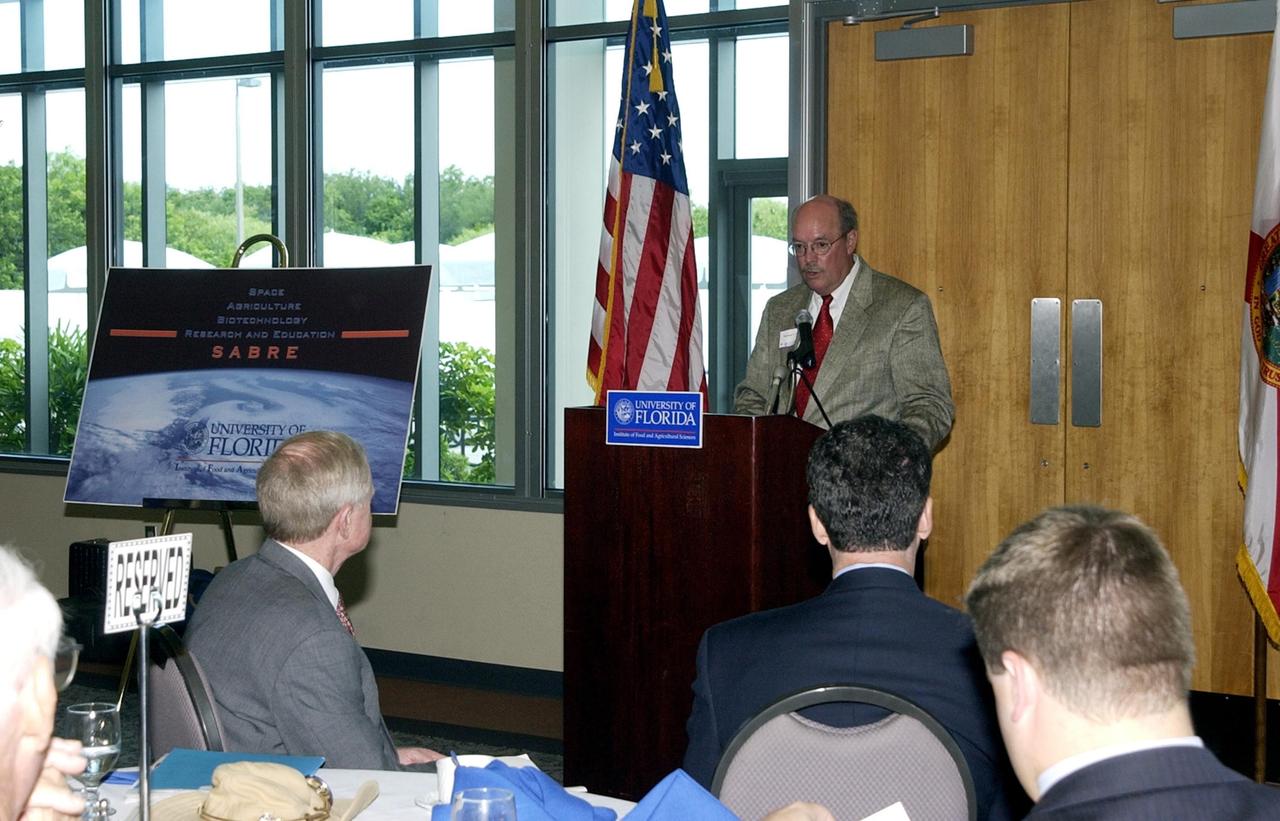
KENNEDY SPACE CENTER, FLA. -- Mike Martin, University of Florida vice president for agriculture and natural resources, speaks during the opening ceremony to launch a new program called SABRE, Space Agricultural Biotechnology Research and Education, that involves UF and NASA. Officials from UF and NASA attended the event. In the foreground are Center Director Roy D. Bridges Jr. (left) and U.S. Rep. Dave Weldon (right). SABRE will focus on the discovery, development and application of the biological aspects of advanced life support strategies. The program will include faculty from UF's Institute of Food and Agricultural Sciences, who will be located at both KSC - in the state-owned Space Experiment Research and Processing Laboratory (SERPL) being built there - and UF in Gainesville. SABRE will be directed by Robert Ferl, professor in the horticultural sciences department and assistant director of UF's Biotechnology Program. He will be responsible for coordinating the research and education efforts of UF and NASA
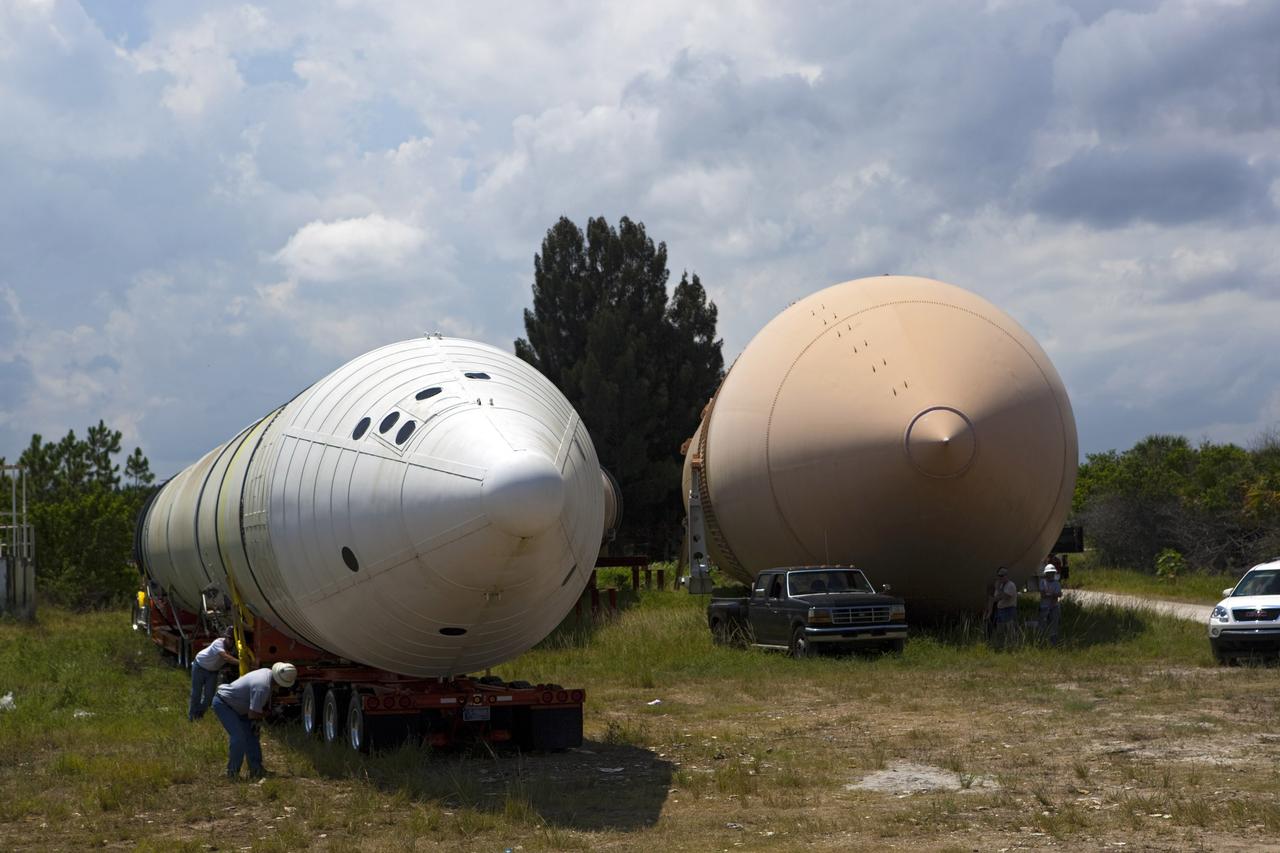
CAPE CANAVERAL, Fla. – At NASA’s Kennedy Space Center in Florida, preparations are underway to load a twin set of space shuttle solid rocket boosters and an external fuel tank on trucks for transport to separate museums. The solid rocket boosters, or SRBs, will be displayed at the California Science Center in Los Angeles. The external tank soon will be transported for display at the Wings of Dreams Aviation Museum at Keystone Heights Airport between Gainesville and Jacksonville, Fla. The 149-foot SRBs together provided six million pounds of thrust. The external fuel tank contained over 500,000 gallons of liquid hydrogen and liquid oxygen propellant for the shuttle orbiters' three main engines. The work is part of Transition and Retirement of the space shuttle. For more information, visit http://www.nasa.gov/transition Photo credit: NASA/ Dimitri Gerondidakis
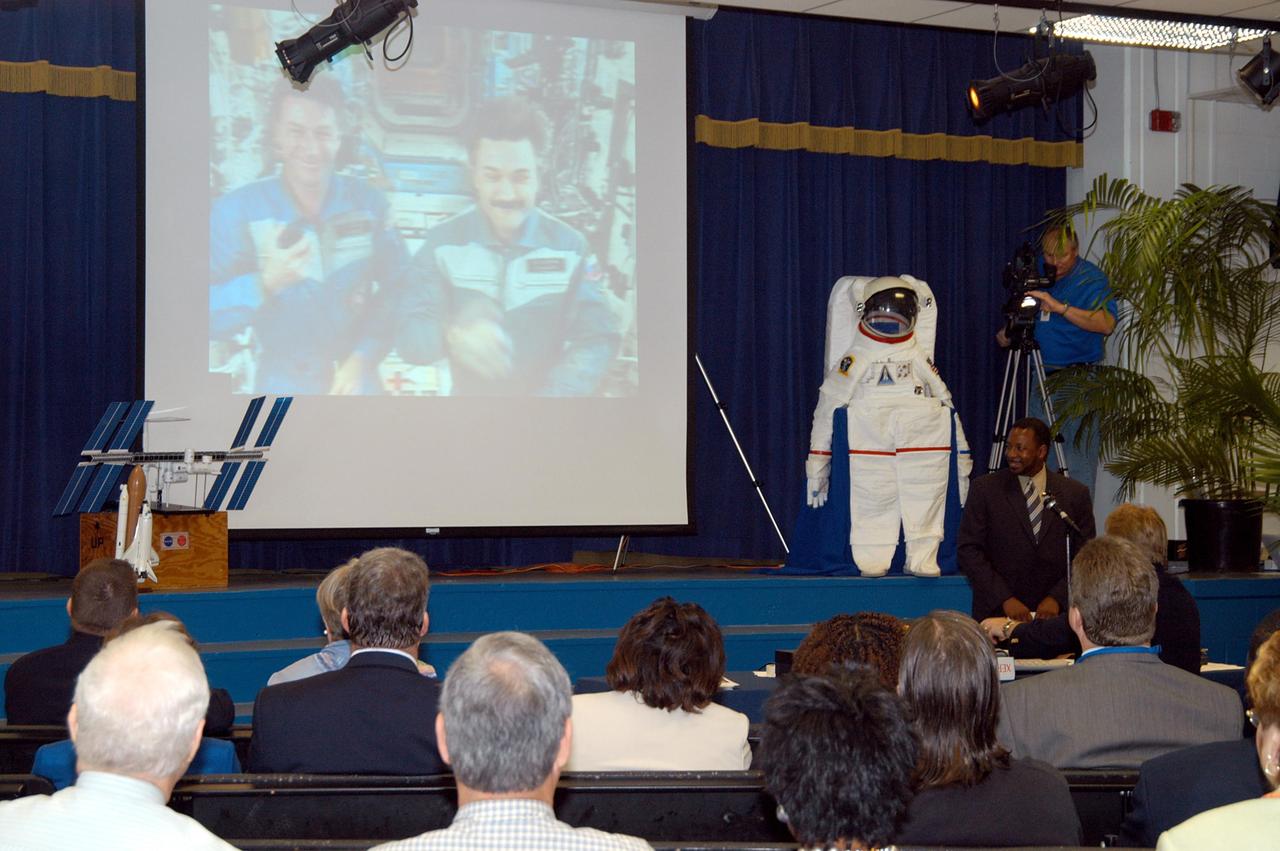
KENNEDY SPACE CENTER, FLA. - At Howard Bishop Middle School in Gainesville, Fla., during a presentation that shared the new vision for space exploration, the Expedition 8 crew, Commander Michael Foale and Flight Engineer Alexander Kaleri, participated in a downlink from the International Space Station (seen on the screen on stage). Deputy Director Dr. Woodrow Whitlow Jr. represented KSC, talking about our destiny as explorers, NASA’s stepping stone approach to exploring Earth, the Moon, Mars and beyond, how space impacts our lives, and how people and machines rely on each other in space. Howard Bishop Middle School is one of 50 nationwide (four in Florida) in the NASA Explorer Schools (NES) Program. NES establishes a three-year partnership between NASA and 50 NASA Explorer Schools teams, consisting of teachers and education administrators from diverse communities nationwide.
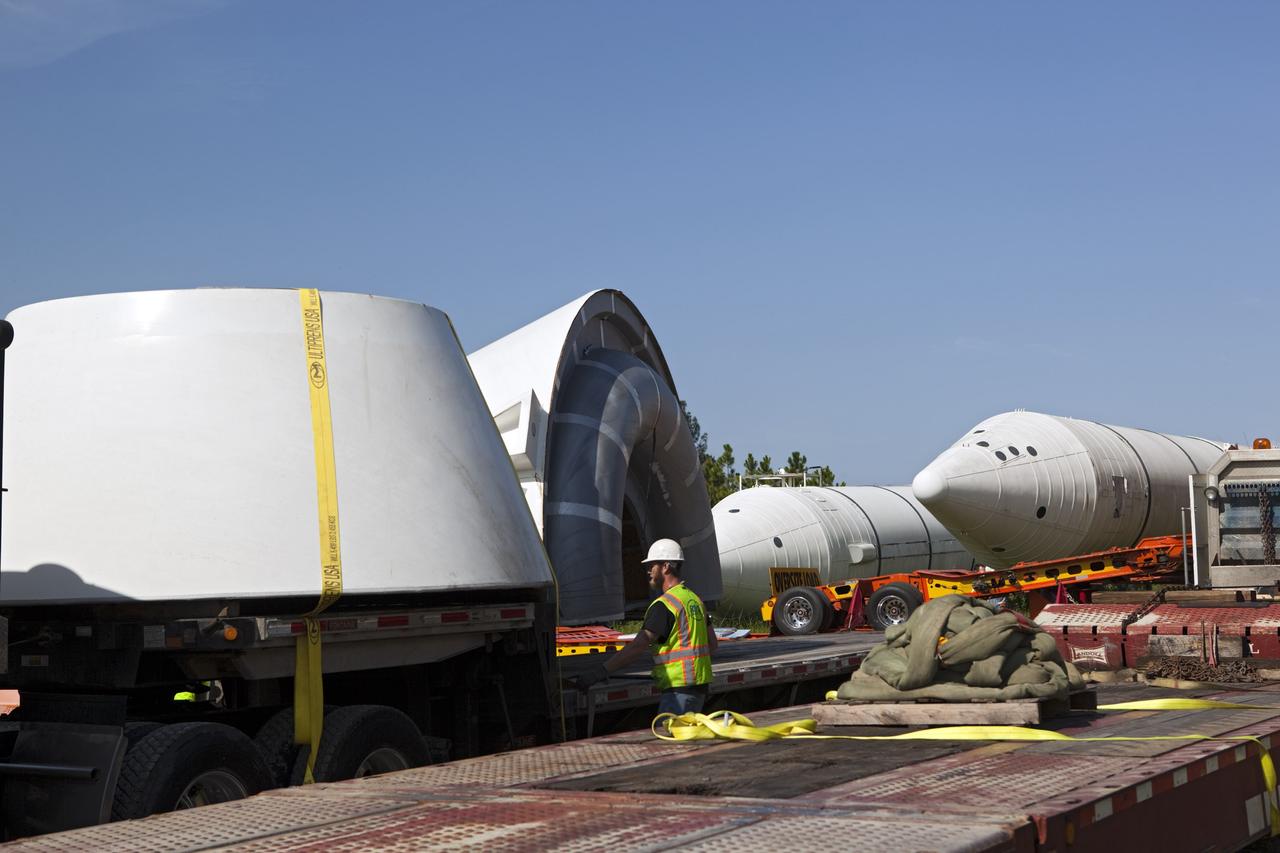
CAPE CANAVERAL, Fla. – At NASA’s Kennedy Space Center in Florida, aft skirts for space shuttle solid rocket boosters are being loaded on a truck. A twin set of space shuttle solid rocket boosters and an external fuel tank are being prepared for transport to separate museums. The solid rocket boosters, or SRBs, will be displayed at the California Science Center in Los Angeles. The external tank soon will be transported for display at the Wings of Dreams Aviation Museum at Keystone Heights Airport between Gainesville and Jacksonville, Fla. The 149-foot SRBs together provided six million pounds of thrust. The external fuel tank contained over 500,000 gallons of liquid hydrogen and liquid oxygen propellant for the shuttle orbiters' three main engines. The work is part of Transition and Retirement of the space shuttle. For more information, visit http://www.nasa.gov/transition Photo credit: NASA/ Dimitri Gerondidakis
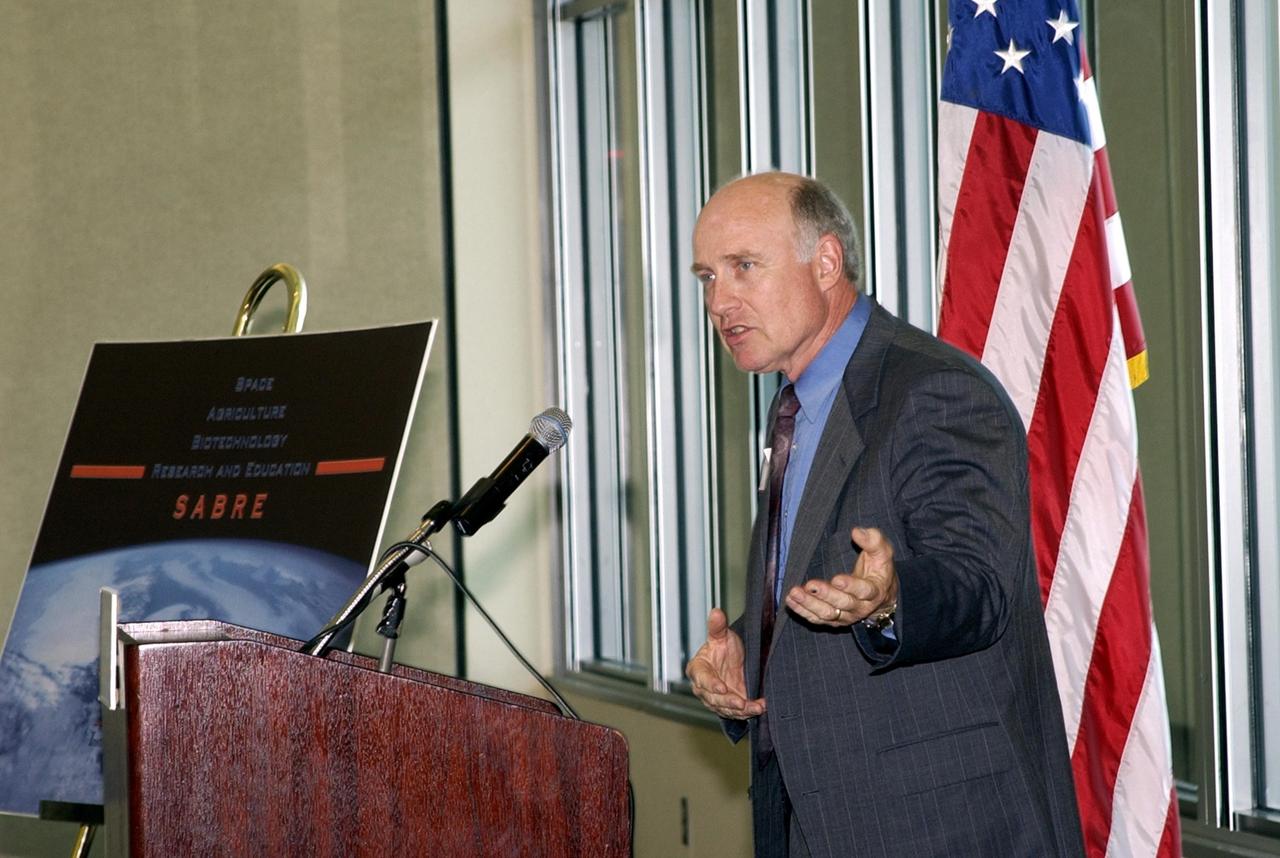
KENNEDY SPACE CENTER, FLA. -- At the opening ceremony for the new program known as SABRE, Space Agricultural Biotechnology Research and Education, William Knott speaks to attendees. Knott is senior scientist in the NASA biological sciences office. SABRE is a joint effort of the University of Florida and NASA and will focus on the discovery, development and application of the biological aspects of advanced life support strategies. The program will include faculty from UF's Institute of Food and Agricultural Sciences, who will be located at both KSC - in the state-owned Space Experiment Research and Processing Laboratory (SERPL) being built there - and UF in Gainesville. Robert Ferl, professor in the horticultural sciences department and assistant director of the University of Florida Biotechnology Program, will direct and be responsible for coordinating the research and education.
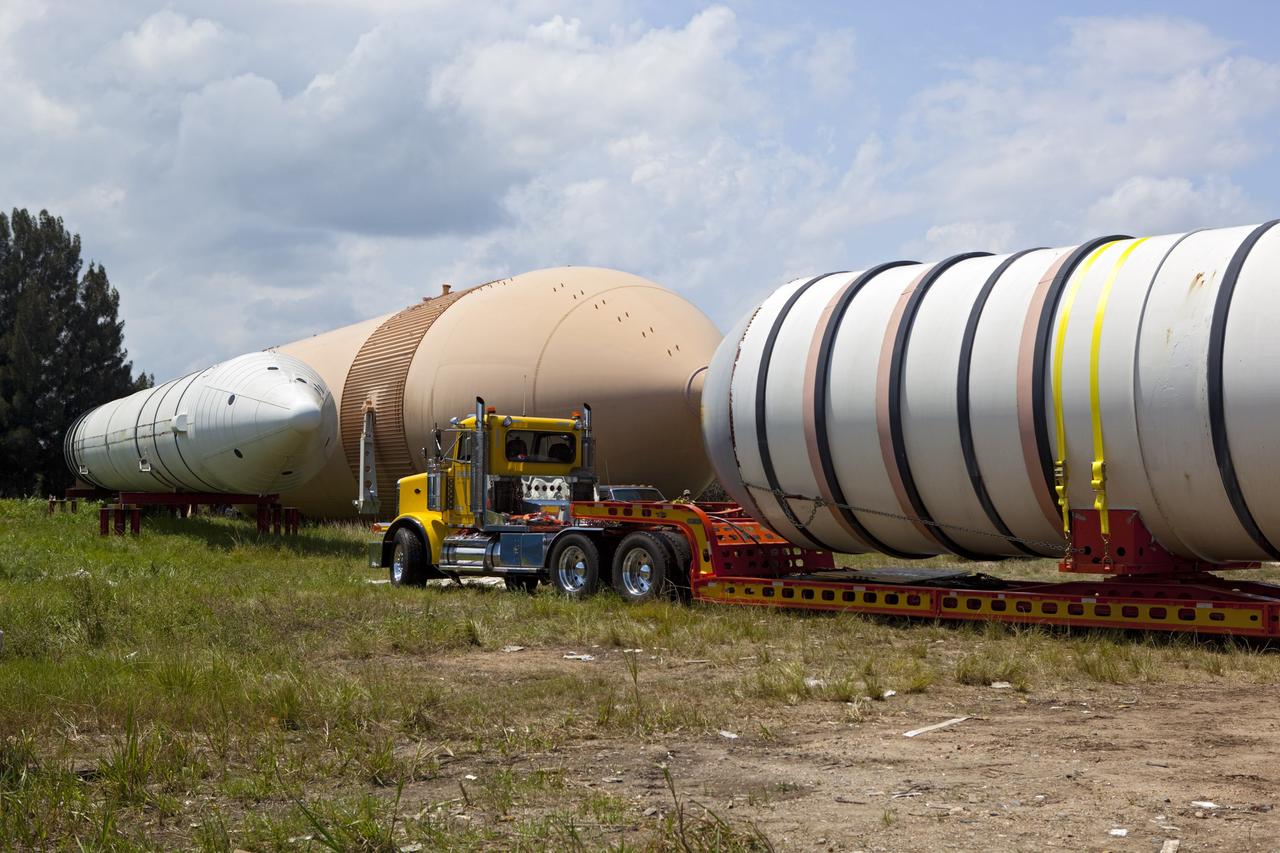
CAPE CANAVERAL, Fla. – At NASA’s Kennedy Space Center in Florida, a twin set of space shuttle solid rocket boosters and an external fuel tank are being loaded on trucks for transport to separate museums. The solid rocket boosters, or SRBs, will be displayed at the California Science Center in Los Angeles. The external tank soon will be transported for display at the Wings of Dreams Aviation Museum at Keystone Heights Airport between Gainesville and Jacksonville, Fla. The 149-foot SRBs together provided six million pounds of thrust. The external fuel tank contained over 500,000 gallons of liquid hydrogen and liquid oxygen propellant for the shuttle orbiters' three main engines. The work is part of Transition and Retirement of the space shuttle. For more information, visit http://www.nasa.gov/transition Photo credit: NASA/ Dimitri Gerondidakis
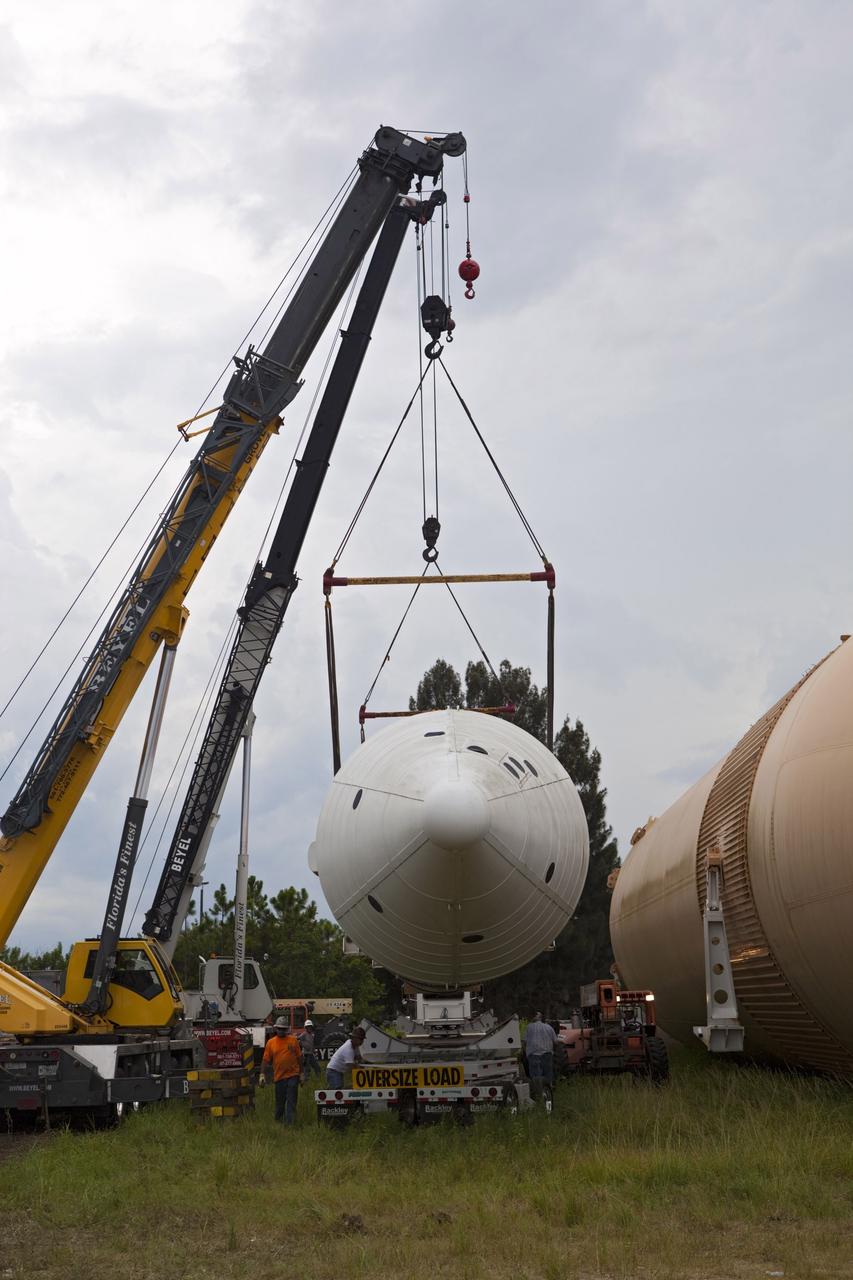
CAPE CANAVERAL, Fla. – At NASA’s Kennedy Space Center in Florida, a crane is used to load a space shuttle solid rocket booster and an external fuel tank on trucks for transport to separate museums. The solid rocket boosters, or SRBs, will be displayed at the California Science Center in Los Angeles. The external tank soon will be transported for display at the Wings of Dreams Aviation Museum at Keystone Heights Airport between Gainesville and Jacksonville, Fla. The 149-foot SRBs together provided six million pounds of thrust. The external fuel tank contained over 500,000 gallons of liquid hydrogen and liquid oxygen propellant for the shuttle orbiters' three main engines. The work is part of Transition and Retirement of the space shuttle. For more information, visit http://www.nasa.gov/transition Photo credit: NASA/ Dimitri Gerondidakis
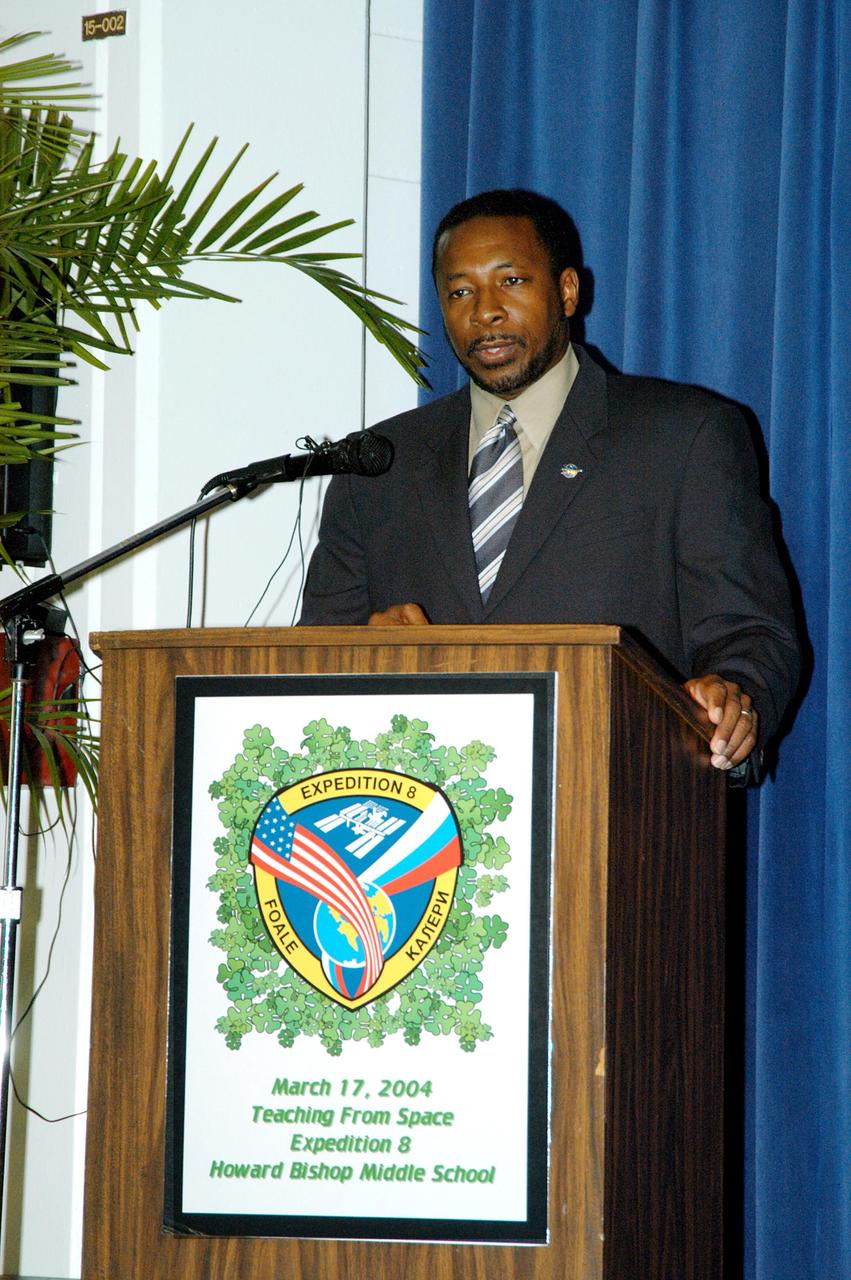
KENNEDY SPACE CENTER, FLA. - At Howard Bishop Middle School in Gainesville, Fla., Dr. Woodrow Whitlow Jr., KSC deputy director, shares the new vision for space exploration with the students, the next generation of explorers. Whitlow talked about our destiny as explorers, NASA’s stepping stone approach to exploring Earth, the Moon, Mars and beyond, how space impacts our lives, and how people and machines rely on each other in space. The presentation also included a downlink from the International Space Station for students to ask questions of the Expedition 8 crew, Commander Michael Foale and Flight Engineer Alexander Kaleri. Howard Bishop Middle School is one of 50 nationwide (four in Florida) in the NASA Explorer Schools (NES) Program. NES establishes a three-year partnership between NASA and 50 NASA Explorer Schools teams, consisting of teachers and education administrators from diverse communities nationwide.
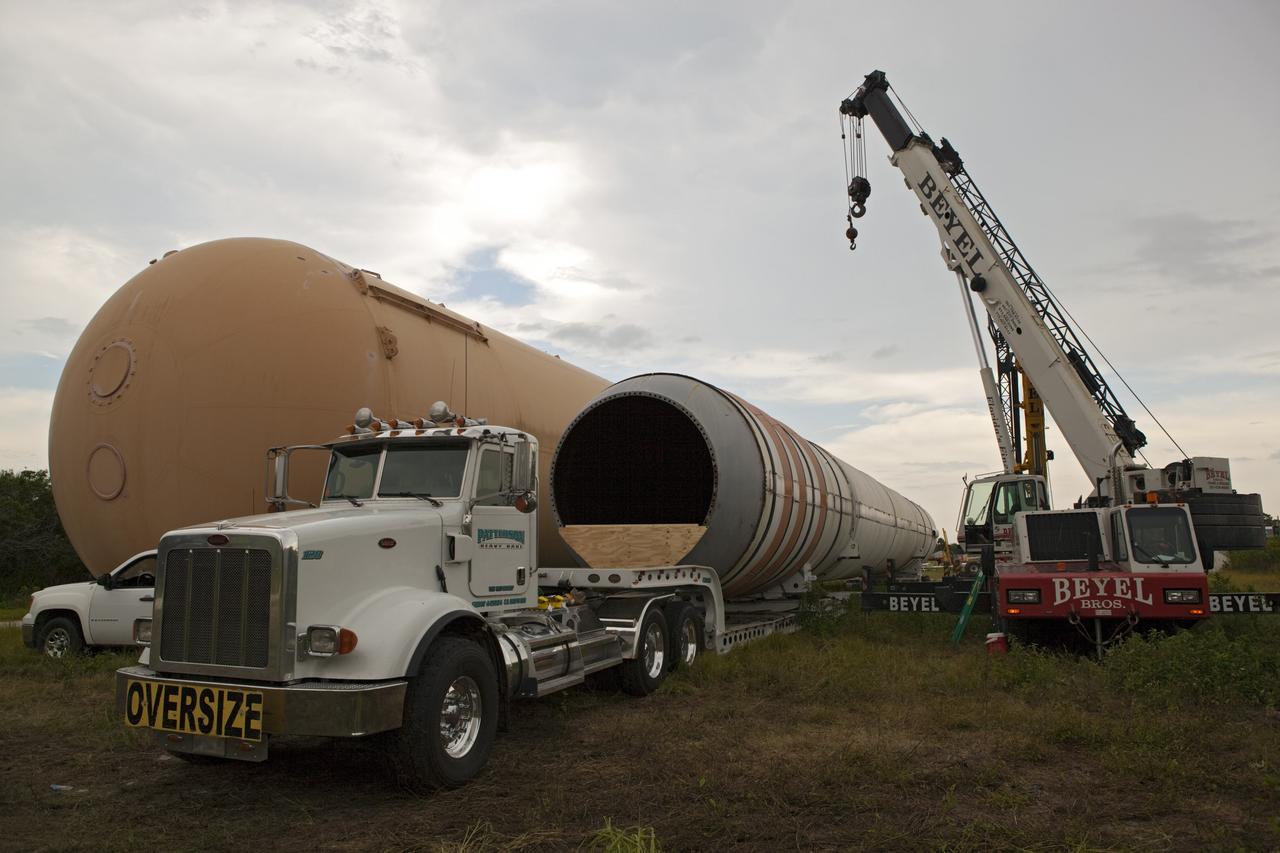
CAPE CANAVERAL, Fla. – At NASA’s Kennedy Space Center in Florida, a crane is used to load a space shuttle solid rocket booster and an external fuel tank on trucks for transport to separate museums. The solid rocket boosters, or SRBs, will be displayed at the California Science Center in Los Angeles. The external tank soon will be transported for display at the Wings of Dreams Aviation Museum at Keystone Heights Airport between Gainesville and Jacksonville, Fla. The 149-foot SRBs together provided six million pounds of thrust. The external fuel tank contained over 500,000 gallons of liquid hydrogen and liquid oxygen propellant for the shuttle orbiters' three main engines. The work is part of Transition and Retirement of the space shuttle. For more information, visit http://www.nasa.gov/transition Photo credit: NASA/ Dimitri Gerondidakis
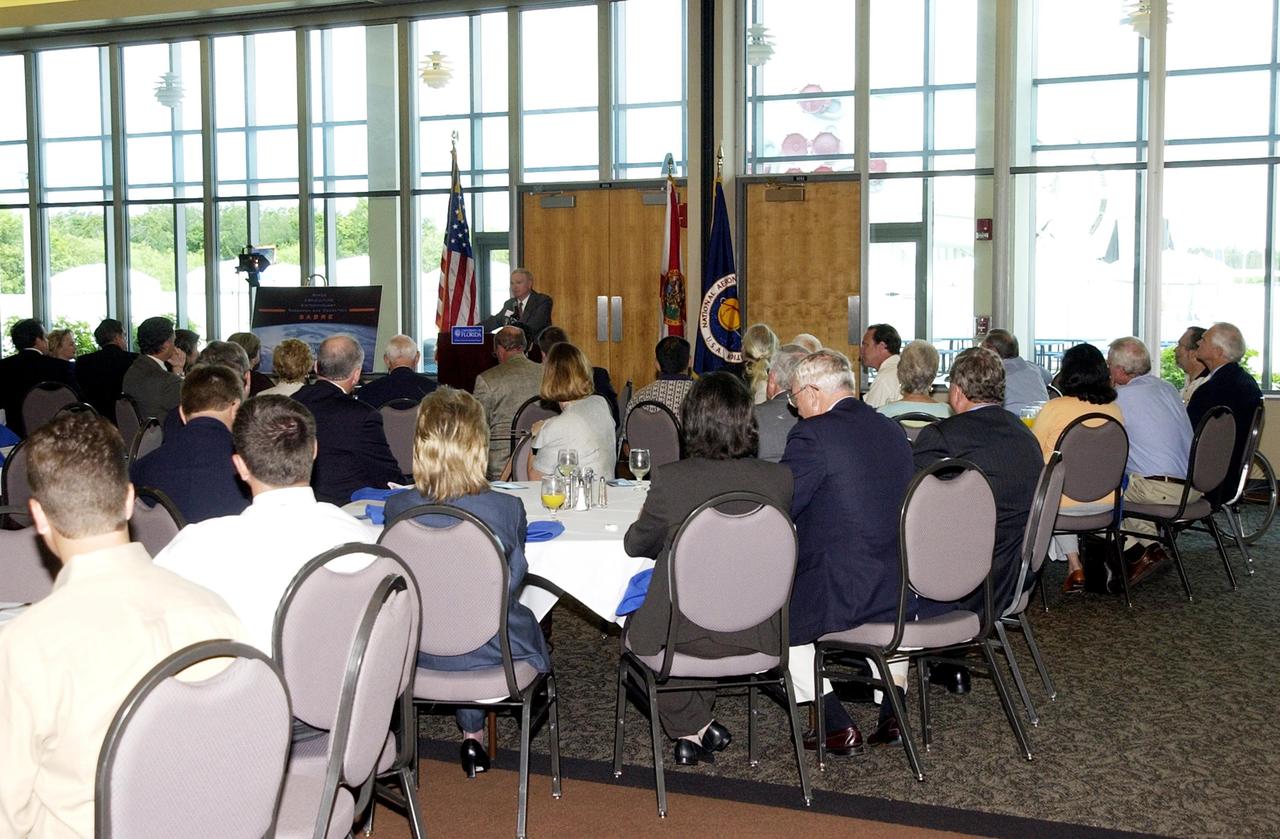
KENNEDY SPACE CENTER, FLA. -- Center Director Roy D. Bridges Jr. speaks to a large group attending the opening of a new program known as SABRE, Space Agricultural Biotechnology Research and Education, that involves the University of Florida and NASA. SABRE will focus on the discovery, development and application of the biological aspects of advanced life support strategies. The program will include faculty from UF's Institute of Food and Agricultural Sciences, who will be located at both KSC - in the state-owned Space Experiment Research and Processing Laboratory (SERPL) being built there - and UF in Gainesville. SABRE will be directed by Robert Ferl, professor in the horticultural sciences department and assistant director of UF's Biotechnology Program. He will be responsible for coordinating the research and education efforts of UF and NASA
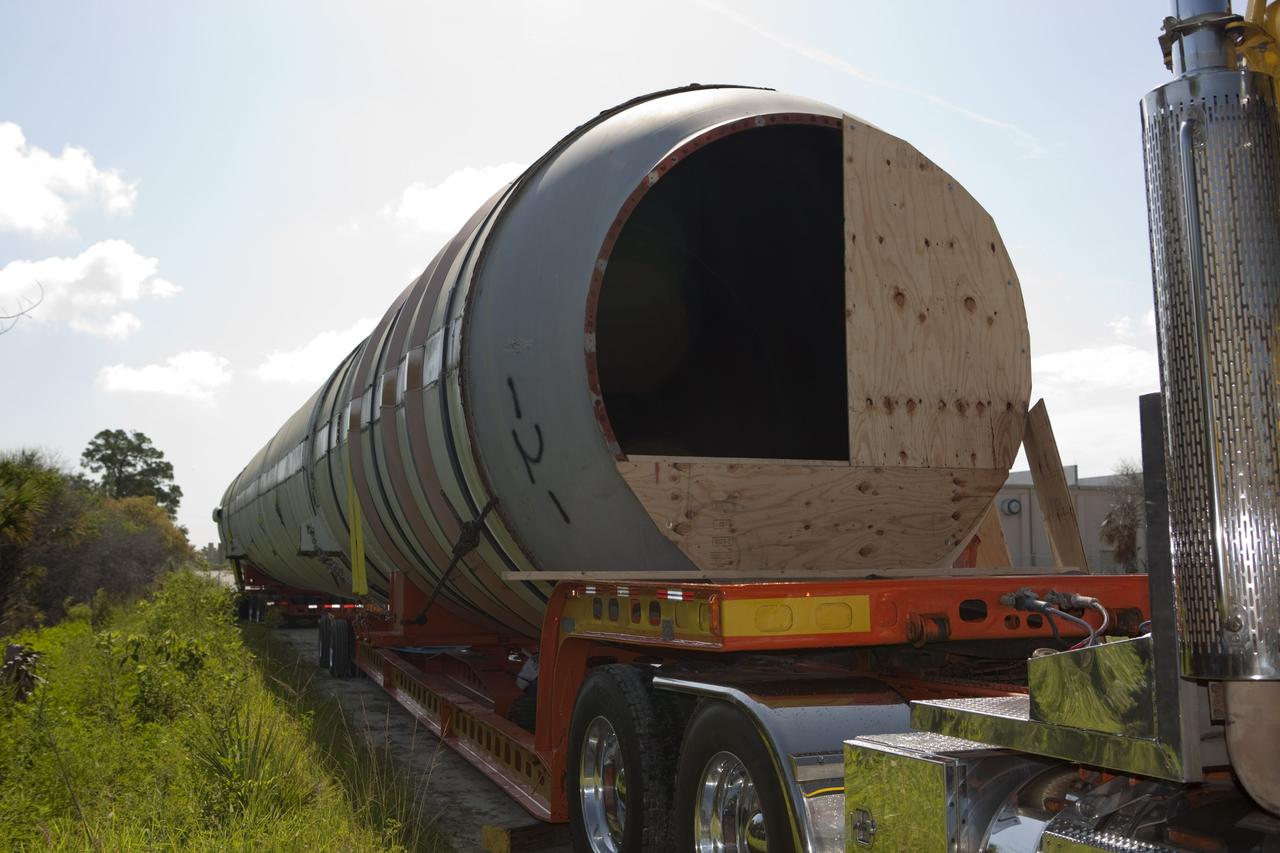
CAPE CANAVERAL, Fla. – At NASA’s Kennedy Space Center in Florida, a space shuttle solid rocket booster has been loaded on a truck. A twin set of space shuttle solid rocket boosters and an external fuel tank are being prepared for transport to separate museums. The solid rocket boosters, or SRBs, will be displayed at the California Science Center in Los Angeles. The external tank soon will be transported for display at the Wings of Dreams Aviation Museum at Keystone Heights Airport between Gainesville and Jacksonville, Fla. The 149-foot SRBs together provided six million pounds of thrust. The external fuel tank contained over 500,000 gallons of liquid hydrogen and liquid oxygen propellant for the shuttle orbiters' three main engines. The work is part of Transition and Retirement of the space shuttle. For more information, visit http://www.nasa.gov/transition Photo credit: NASA/ Dimitri Gerondidakis
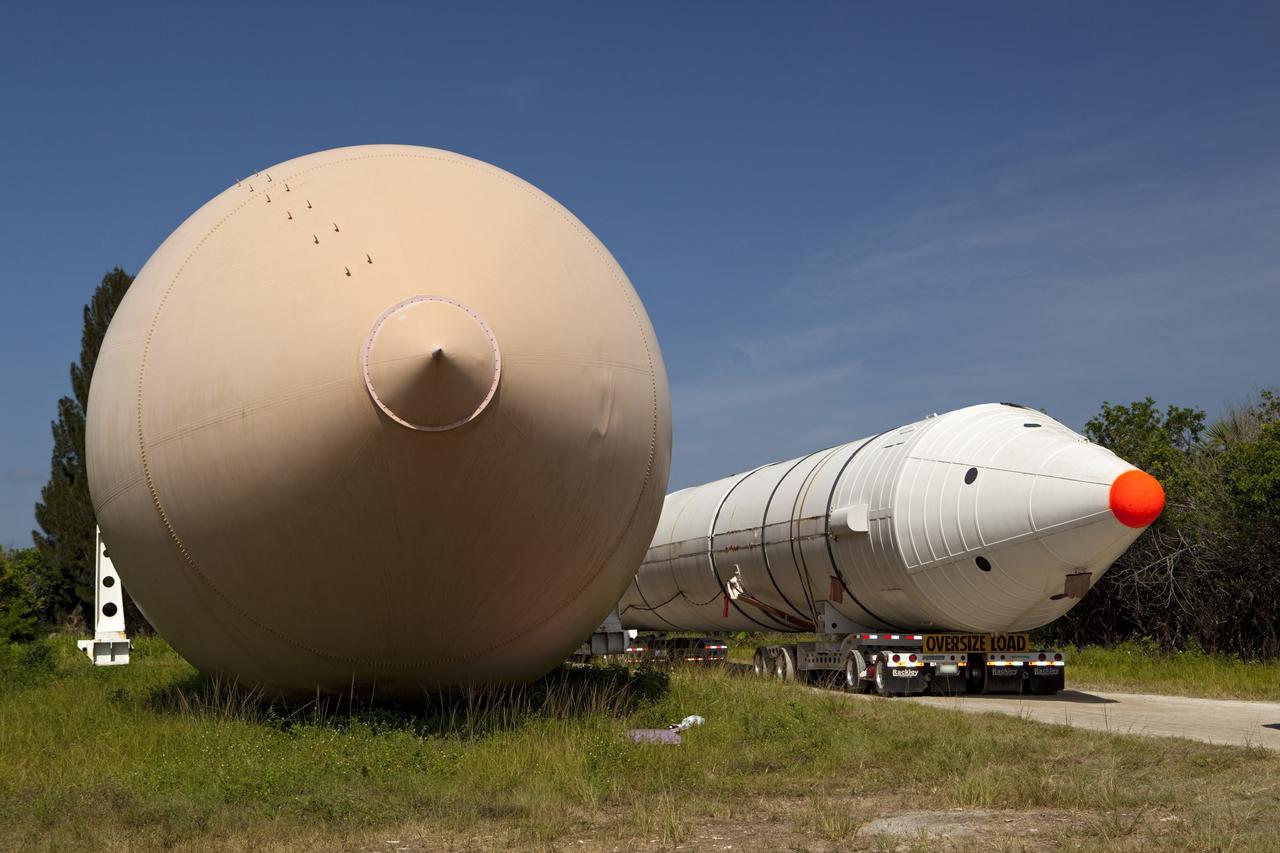
CAPE CANAVERAL, Fla. – At NASA’s Kennedy Space Center in Florida, a space shuttle solid rocket booster and an external fuel tank are being prepared for transport to separate museums. The solid rocket boosters, or SRBs, will be displayed at the California Science Center in Los Angeles. The external tank soon will be transported for display at the Wings of Dreams Aviation Museum at Keystone Heights Airport between Gainesville and Jacksonville, Fla. The 149-foot SRBs together provided six million pounds of thrust. The external fuel tank contained over 500,000 gallons of liquid hydrogen and liquid oxygen propellant for the shuttle orbiters' three main engines. The work is part of Transition and Retirement of the space shuttle. For more information, visit http://www.nasa.gov/transition Photo credit: NASA/ Dimitri Gerondidakis
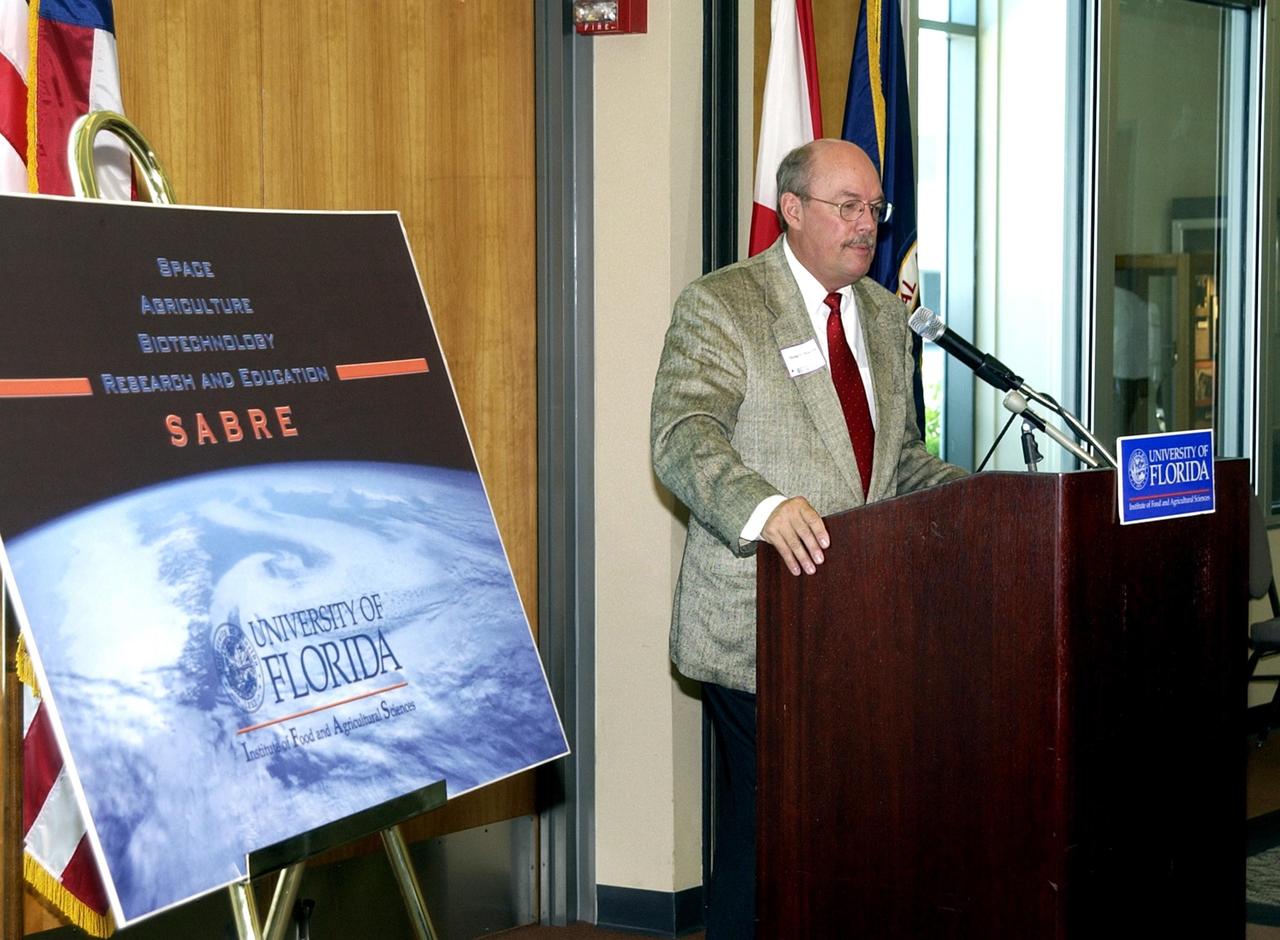
KENNEDY SPACE CENTER, FLA. -- Mike Martin, University of Florida vice president for agriculture and natural resources, speaks during the opening ceremony to launch a new program called SABRE, Space Agricultural Biotechnology Research and Education, that involves UF and NASA. Officials from UF and NASA attended the event. SABRE will focus on the discovery, development and application of the biological aspects of advanced life support strategies. The program will include faculty from UF's Institute of Food and Agricultural Sciences, who will be located at both KSC - in the state-owned Space Experiment Research and Processing Laboratory (SERPL) being built there - and UF in Gainesville. SABRE will be directed by Robert Ferl, professor in the horticultural sciences department and assistant director of UF's Biotechnology Program. He will be responsible for coordinating the research and education efforts of UF and NASA
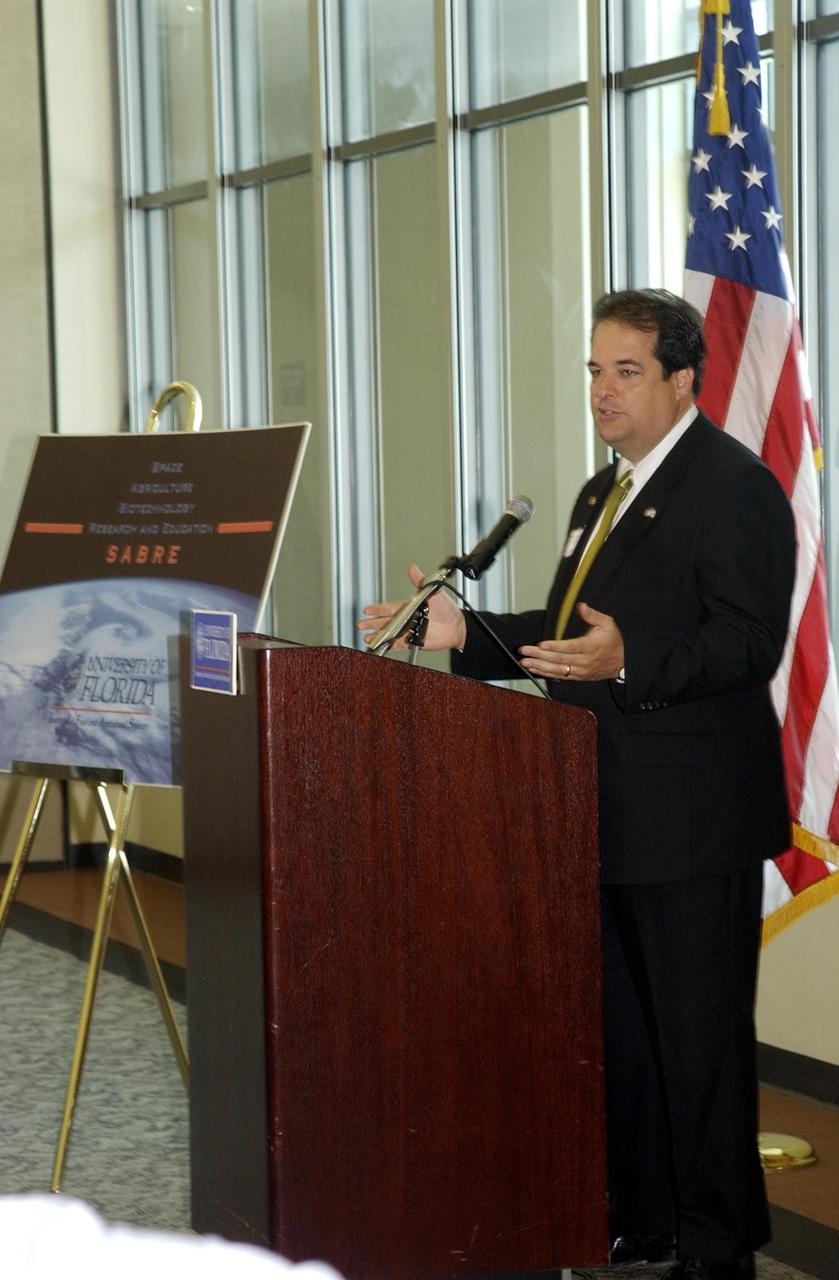
KENNEDY SPACE CENTER, FLA. -- Florida Representative Bob Allen speaks to attendees at the opening ceremony kicking off a new program known as SABRE, Space Agricultural Biotechnology Research and Education. The program is a combined effort of the University of Florida and NASA. SABRE will focus on the discovery, development and application of the biological aspects of advanced life support strategies. The program will include faculty from UF's Institute of Food and Agricultural Sciences, who will be located at both KSC - in the state-owned Space Experiment Research and Processing Laboratory (SERPL) being built there - and UF in Gainesville. SABRE will be directed by Robert Ferl, professor in the horticultural sciences department and assistant director of UF's Biotechnology Program. He will be responsible for coordinating the research and education efforts of UF and NASA
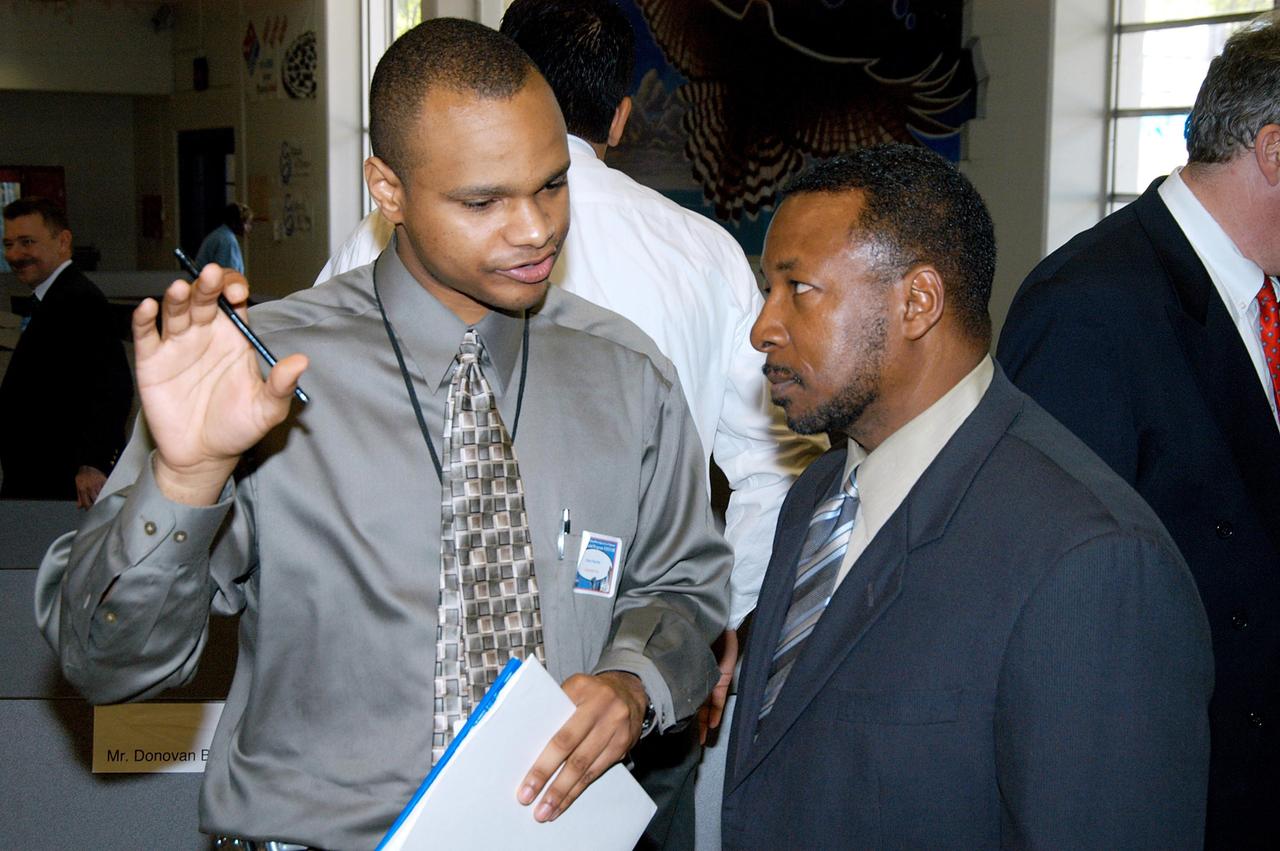
KENNEDY SPACE CENTER, FLA. - KSC Deputy Director Woodrow Whitlow Jr. (right) is interviewed after a presentation at Howard Bishop Middle School in Gainesville, Fla. Dr. Whitlow shared the new vision for space exploration with the students, the next generation of explorers. Whitlow talked about our destiny as explorers, NASA’s stepping stone approach to exploring Earth, the Moon, Mars and beyond, how space impacts our lives, and how people and machines rely on each other in space. The presentation also included a downlink from the International Space Station for students to ask questions of the Expedition 8 crew, Commander Michael Foale and Flight Engineer Alexander Kaleri. Howard Bishop Middle School is one of 50 nationwide (four in Florida) in the NASA Explorer Schools (NES) Program. NES establishes a three-year partnership between NASA and 50 NASA Explorer Schools teams, consisting of teachers and education administrators from diverse communities nationwide.
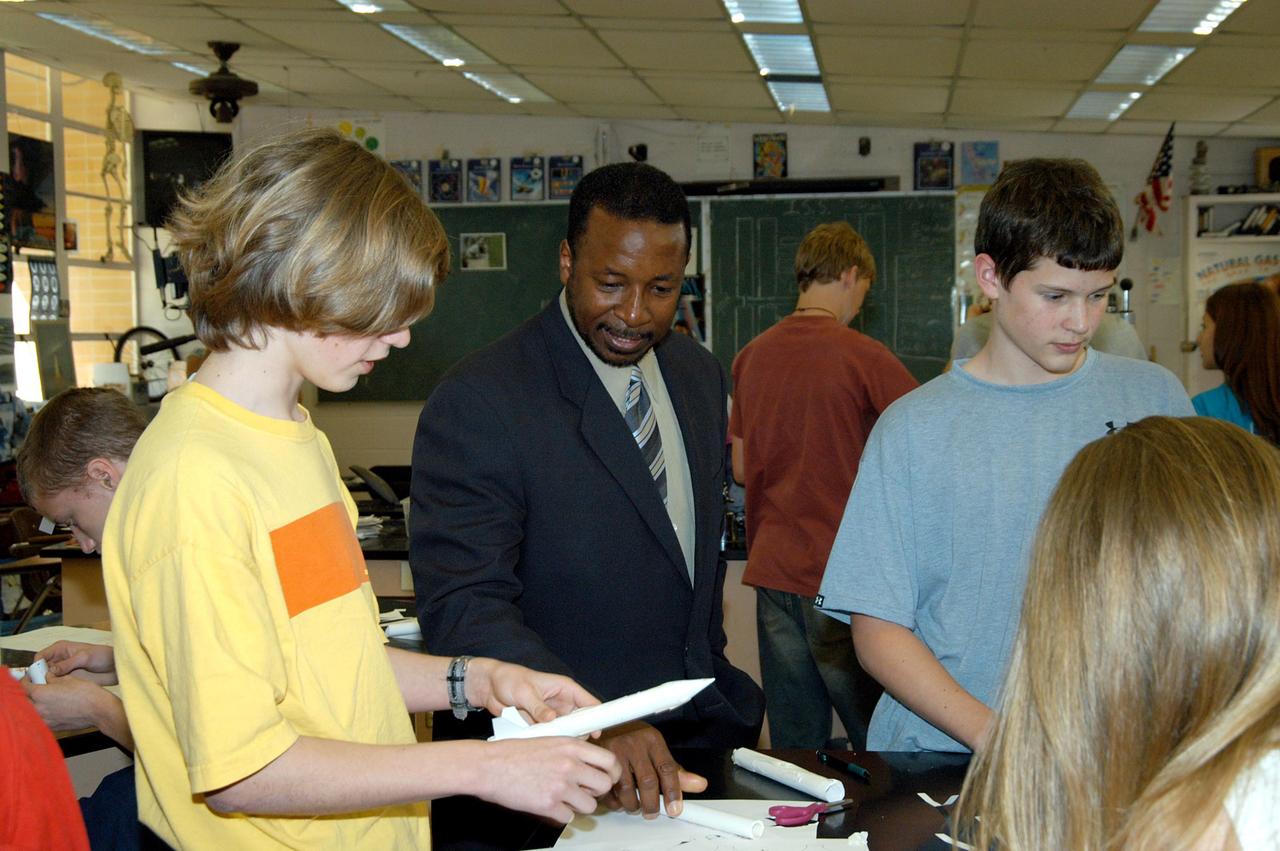
KENNEDY SPACE CENTER, FLA. - KSC Deputy Director Woodrow Whitlow Jr. looks at students’ projects in a classroom at Howard Bishop Middle School in Gainesville, Fla. Dr. Whitlow shared the new vision for space exploration with the students, the next generation of explorers. Whitlow talked about our destiny as explorers, NASA’s stepping stone approach to exploring Earth, the Moon, Mars and beyond, how space impacts our lives, and how people and machines rely on each other in space. The presentation also included a downlink from the International Space Station for students to ask questions of the Expedition 8 crew, Commander Michael Foale and Flight Engineer Alexander Kaleri. Howard Bishop Middle School is one of 50 nationwide (four in Florida) in the NASA Explorer Schools (NES) Program. NES establishes a three-year partnership between NASA and 50 NASA Explorer Schools teams, consisting of teachers and education administrators from diverse communities nationwide.
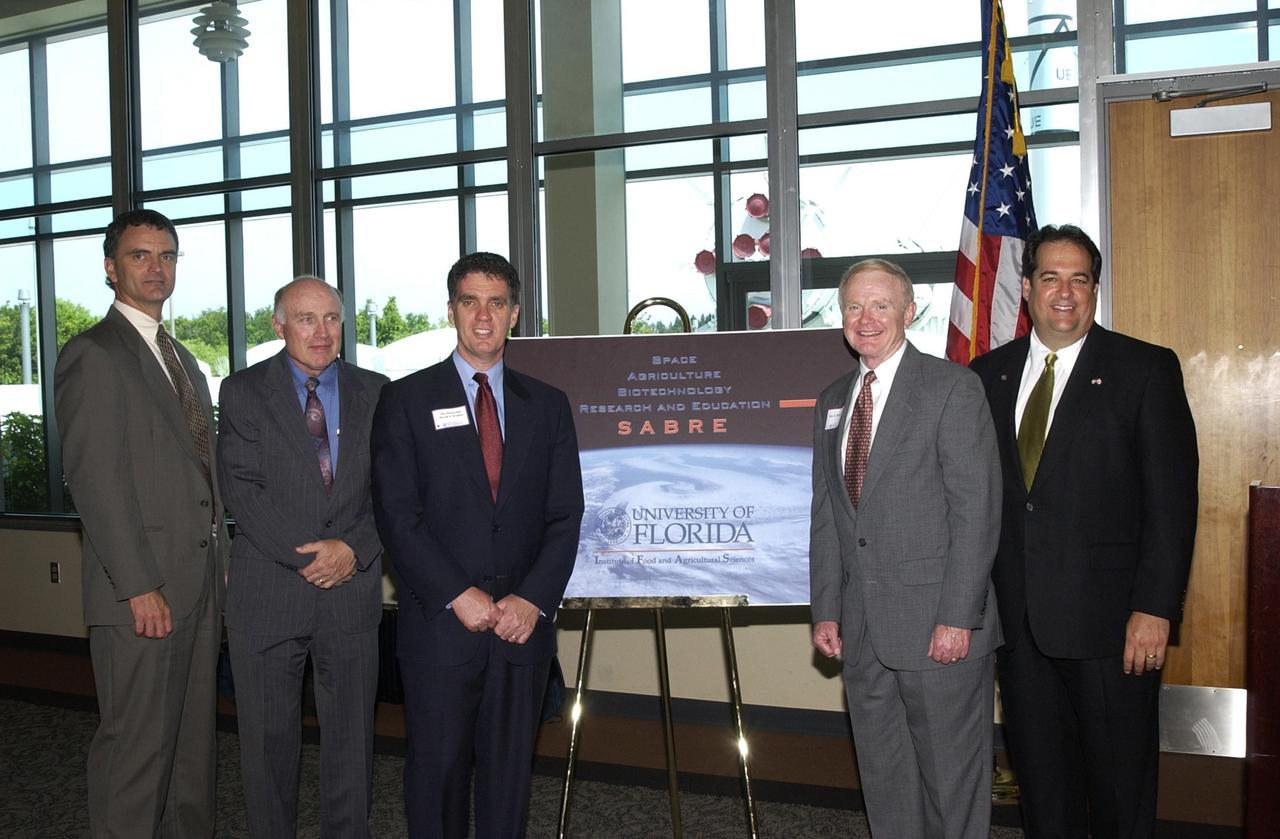
KENNEDY SPACE CENTER, FLA. -- At the opening ceremony for the new program known as SABRE, Space Agricultural Biotechnology Research and Education, key participants gather around the SABRE poster. From left are Robert Ferl, professor in the horticultural sciences department and assistant director of the University of Florida Biotechnology Program, who will direct and be responsible for coordinating the research and education; William Knott, senior scientist in the NASA biological sciences office; U.S. Representative Dave Weldon; Center Director Roy D. Bridges Jr.; and Florida Representative Bob Allen. Involving UF and NASA, SABRE will focus on the discovery, development and application of the biological aspects of advanced life support strategies. The program will include faculty from UF's Institute of Food and Agricultural Sciences, who will be located at both KSC - in the state-owned Space Experiment Research and Processing Laboratory (SERPL) being built there - and UF in Gainesville
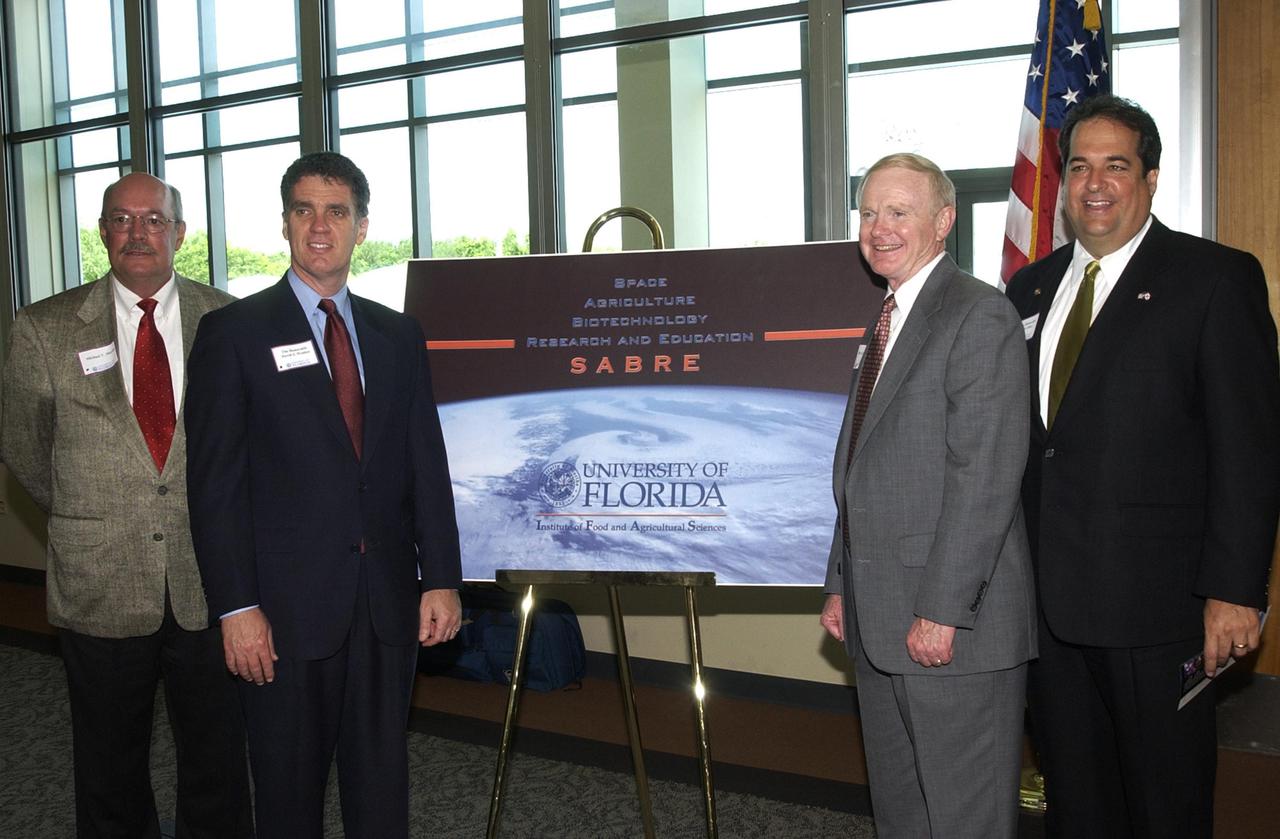
KENNEDY SPACE CENTER, FLA. -- At the opening ceremony for the new program known as SABRE, Space Agricultural Biotechnology Research and Education, four of the speakers gather around the SABRE poster. From left are University of Florida Vice President for Agriculture and Natural Resources Mike Martin, U.S. Representative Dave Weldon, Center Director Roy D. Bridges Jr., and Florida Representative Bob Allen. Involving UF and NASA, SABRE will focus on the discovery, development and application of the biological aspects of advanced life support strategies. The program will include faculty from UF's Institute of Food and Agricultural Sciences, who will be located at both KSC - in the state-owned Space Experiment Research and Processing Laboratory (SERPL) being built there - and UF in Gainesville. Robert Ferl, professor in the horticultural sciences department and assistant director of the University of Florida Biotechnology Program, will direct and be responsible for coordinating the research and education efforts of UF and NASA.
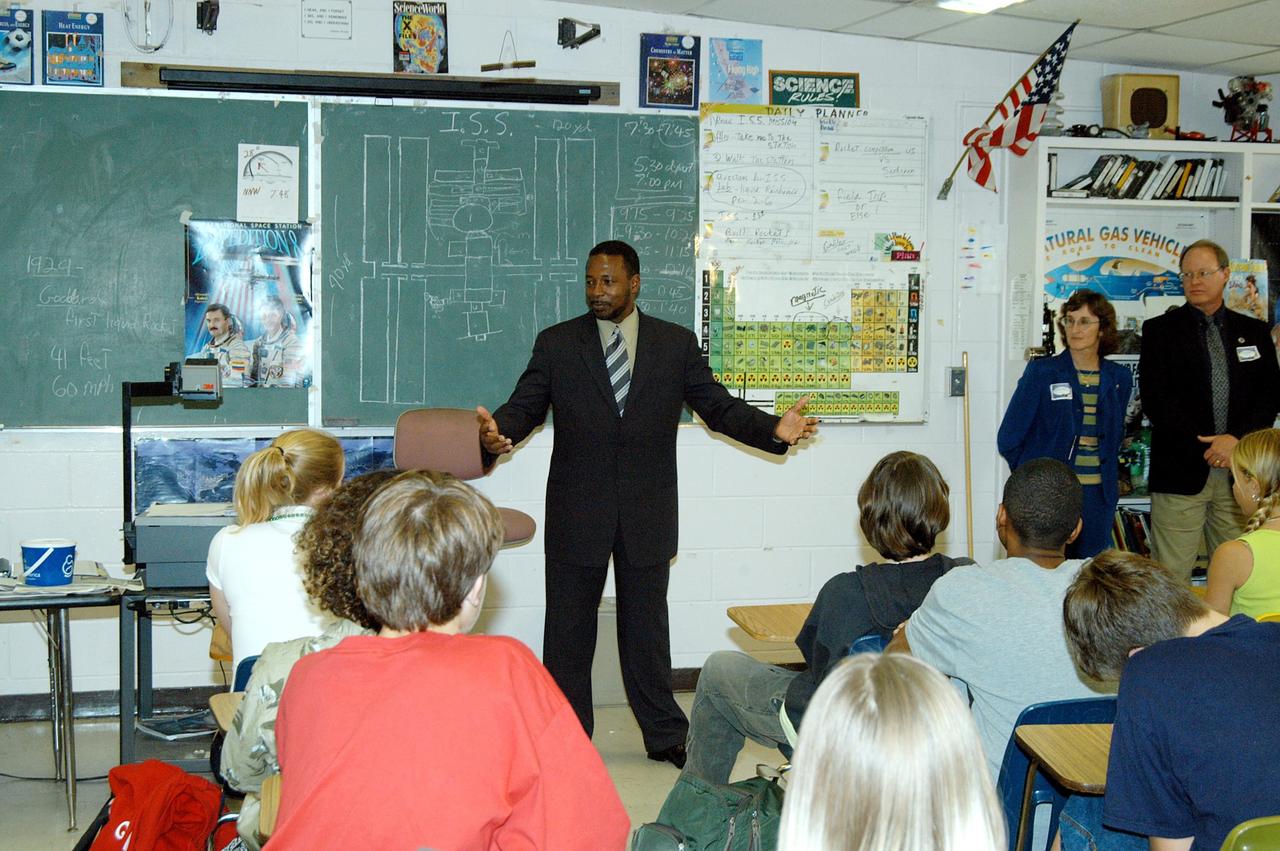
KENNEDY SPACE CENTER, FLA. - KSC Deputy Director Woodrow Whitlow Jr. talks to students in a classroom at Howard Bishop Middle School in Gainesville, Fla. Dr. Whitlow shared the new vision for space exploration with the students, the next generation of explorers. Whitlow talked about our destiny as explorers, NASA’s stepping stone approach to exploring Earth, the Moon, Mars and beyond, how space impacts our lives, and how people and machines rely on each other in space. The presentation also included a downlink from the International Space Station for students to ask questions of the Expedition 8 crew, Commander Michael Foale and Flight Engineer Alexander Kaleri. Howard Bishop Middle School is one of 50 nationwide (four in Florida) in the NASA Explorer Schools (NES) Program. NES establishes a three-year partnership between NASA and 50 NASA Explorer Schools teams, consisting of teachers and education administrators from diverse communities nationwide.
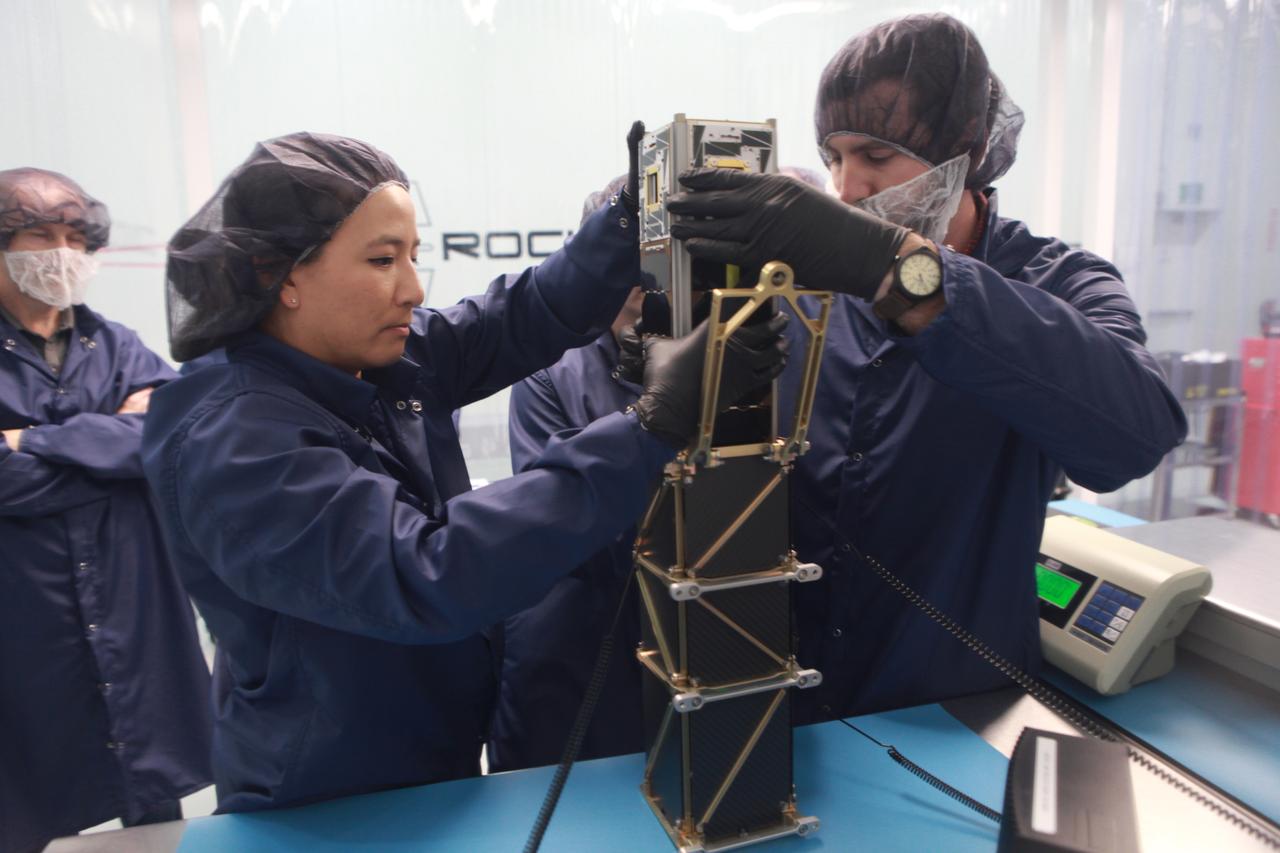
The goal of the CHOMPTT mission is to demonstrate new technologies that could be used for navigation and satellite networking in deep space. For future explorers and colonizers of the Moon or Mars, navigation systems like GPS here on Earth, will be essential. The key idea behind CHOMPTT is to use lasers to transfer time code data over long distances instead of radio waves. Because lasers can be more tightly beamed compared to radio waves, more of the transmitted energy reaches its intended target, making them more power-efficient. CHOMPTT takes advantage of this and of new miniature but very stable atomic clocks to produce a timing system with performance similar to that of GPS, but in a very compact and power efficient form factor. We will use a pulsed laser system, located at the Kennedy Space Center that will be synchronized with an atomic clock. Laser pulses will propagate from the ground to the orbiting CHOMPTT CubeSat and back. By precisely measuring the time of emission and detection of these pulses on the ground and in space we can calculate the time discrepancy between the ground atomic clock and the atomic clock on CHOMPTT. Our goal is to do this with an accuracy of 0.2 billionths of a second, or the time it takes light to travel just 6 centimeters. In the future, we envision using this technology on constellations or swarms of small satellites, for example orbiting the Moon, to equip them with precision navigation, networking, and ranging capabilities. CHOMPTT is a collaboration between the University of Florida and the NASA Ames Research Center. The CHOMPTT precision timing payload was designed and built by the Precision Space Systems Lab at the University of Florida, while the 3U CubeSat bus that has prior flight heritage, was provided by NASA Ames. The CHOMPTT mission has been funded by the Air Force Research Lab and by NASA.
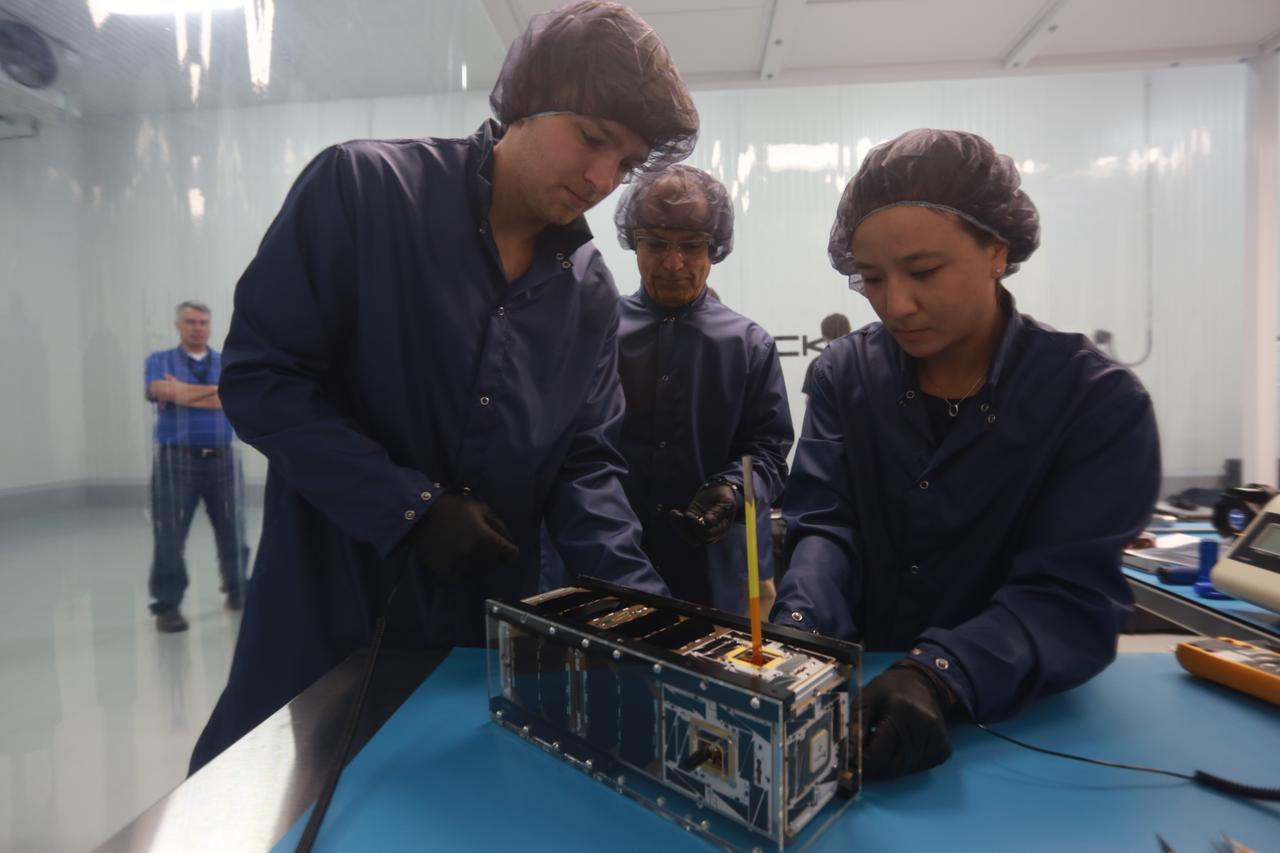
The goal of the CHOMPTT mission is to demonstrate new technologies that could be used for navigation and satellite networking in deep space. For future explorers and colonizers of the Moon or Mars, navigation systems like GPS here on Earth, will be essential. The key idea behind CHOMPTT is to use lasers to transfer time code data over long distances instead of radio waves. Because lasers can be more tightly beamed compared to radio waves, more of the transmitted energy reaches its intended target, making them more power-efficient. CHOMPTT takes advantage of this and of new miniature but very stable atomic clocks to produce a timing system with performance similar to that of GPS, but in a very compact and power efficient form factor. We will use a pulsed laser system, located at the Kennedy Space Center that will be synchronized with an atomic clock. Laser pulses will propagate from the ground to the orbiting CHOMPTT CubeSat and back. By precisely measuring the time of emission and detection of these pulses on the ground and in space we can calculate the time discrepancy between the ground atomic clock and the atomic clock on CHOMPTT. Our goal is to do this with an accuracy of 0.2 billionths of a second, or the time it takes light to travel just 6 centimeters. In the future, we envision using this technology on constellations or swarms of small satellites, for example orbiting the Moon, to equip them with precision navigation, networking, and ranging capabilities. CHOMPTT is a collaboration between the University of Florida and the NASA Ames Research Center. The CHOMPTT precision timing payload was designed and built by the Precision Space Systems Lab at the University of Florida, while the 3U CubeSat bus that has prior flight heritage, was provided by NASA Ames. The CHOMPTT mission has been funded by the Air Force Research Lab and by NASA.
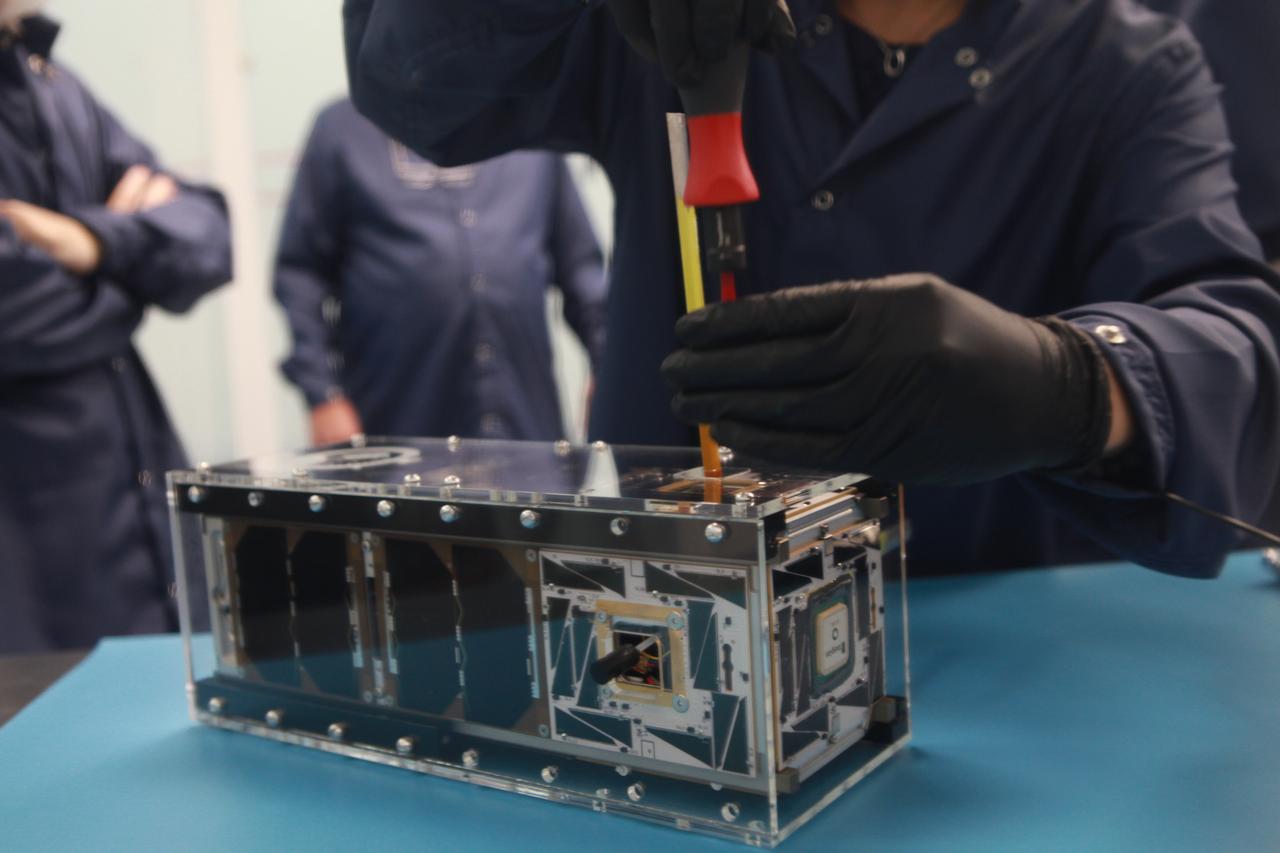
The goal of the CHOMPTT mission is to demonstrate new technologies that could be used for navigation and satellite networking in deep space. For future explorers and colonizers of the Moon or Mars, navigation systems like GPS here on Earth, will be essential. The key idea behind CHOMPTT is to use lasers to transfer time code data over long distances instead of radio waves. Because lasers can be more tightly beamed compared to radio waves, more of the transmitted energy reaches its intended target, making them more power-efficient. CHOMPTT takes advantage of this and of new miniature but very stable atomic clocks to produce a timing system with performance similar to that of GPS, but in a very compact and power efficient form factor. We will use a pulsed laser system, located at the Kennedy Space Center that will be synchronized with an atomic clock. Laser pulses will propagate from the ground to the orbiting CHOMPTT CubeSat and back. By precisely measuring the time of emission and detection of these pulses on the ground and in space we can calculate the time discrepancy between the ground atomic clock and the atomic clock on CHOMPTT. Our goal is to do this with an accuracy of 0.2 billionths of a second, or the time it takes light to travel just 6 centimeters. In the future, we envision using this technology on constellations or swarms of small satellites, for example orbiting the Moon, to equip them with precision navigation, networking, and ranging capabilities. CHOMPTT is a collaboration between the University of Florida and the NASA Ames Research Center. The CHOMPTT precision timing payload was designed and built by the Precision Space Systems Lab at the University of Florida, while the 3U CubeSat bus that has prior flight heritage, was provided by NASA Ames. The CHOMPTT mission has been funded by the Air Force Research Lab and by NASA.
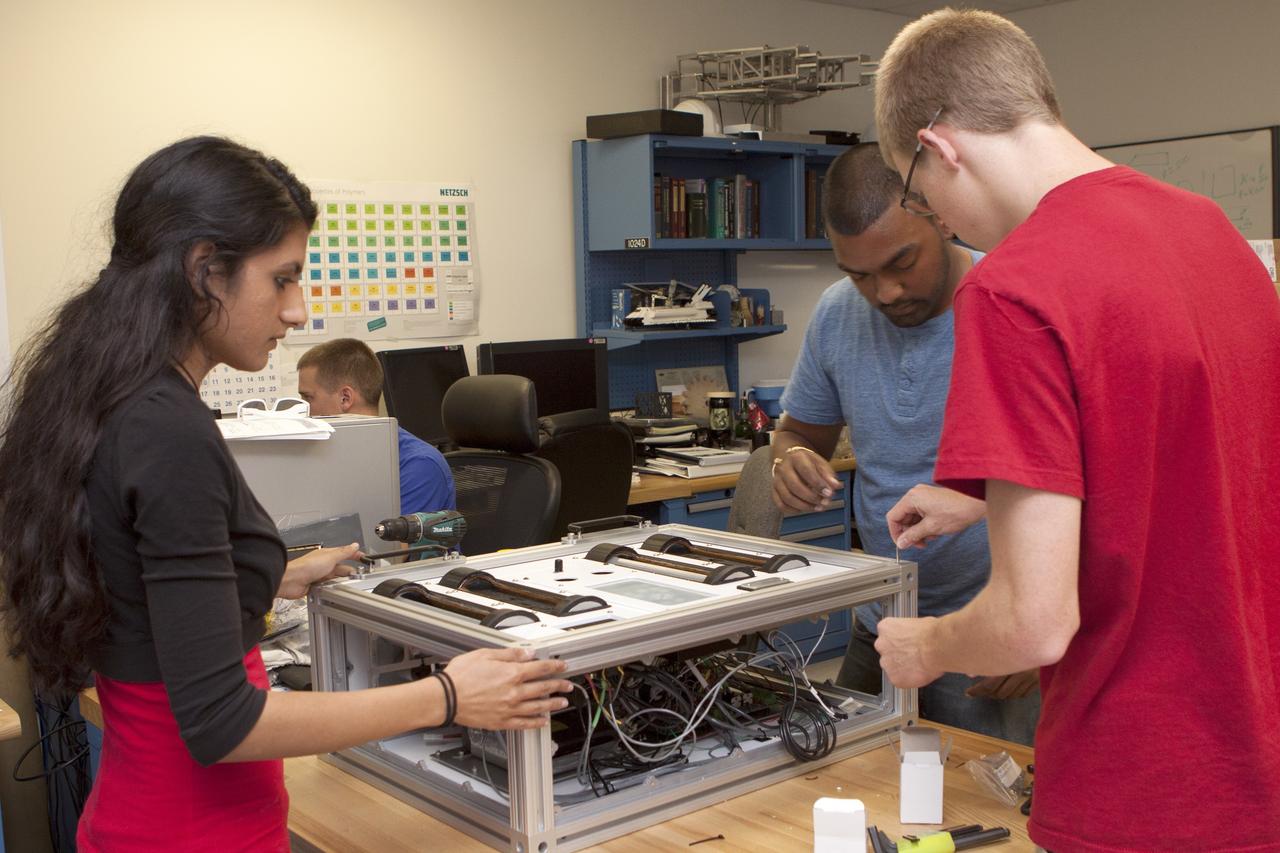
CAPE CANAVERAL, Fla. – Inside the Prototype Laboratory at NASA's Kennedy Space Center in Florida, Prital Thakrar, left, design lead and student engineer trainee from the University of Florida in Gainesville, Anthony Bharrat, NASA avionics lead, and Evan Williams, an Education intern from the University of Central Florida, prepare the experiment container for NASA's Exposing Microorganisms in the Stratosphere, or E-MIST, experiment. The container was designed and built at Kennedy. The 80-pound structure features four doors that rotate to expose up to 10 microbial samples each for a predetermined period of time in the Earth's stratosphere. The E-MIST experiment will launch on the exterior of a giant scientific balloon gondola at about 8 a.m. MST on Aug. 24 from Ft. Sumner, New Mexico. It will soar 125,000 feet above the Earth during a 5-hour journey over the desert to understand how spore-forming bacteria, commonly found in spacecraft assembly facilities can survive. Photo credit: NASA/Kim Shiflett
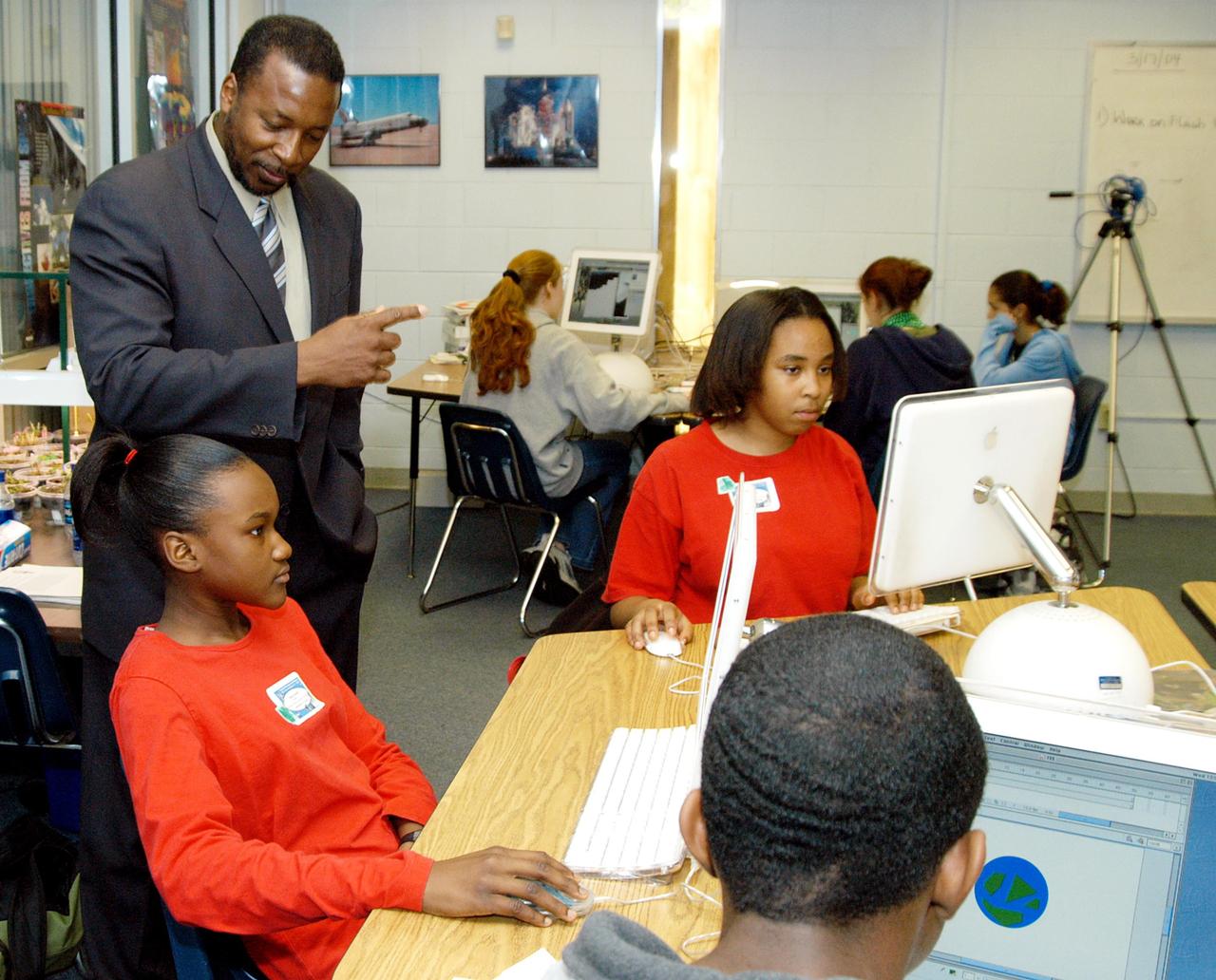
KENNEDY SPACE CENTER, FLA. - KSC Deputy Director Woodrow Whitlow Jr. looks at a student’s computer project after his presentation in the classroom at Howard Bishop Middle School in Gainesville, Fla. Dr. Whitlow shared the new vision for space exploration with the students, the next generation of explorers. Whitlow talked about our destiny as explorers, NASA’s stepping stone approach to exploring Earth, the Moon, Mars and beyond, how space impacts our lives, and how people and machines rely on each other in space. The presentation also included a downlink from the International Space Station for students to ask questions of the Expedition 8 crew, Commander Michael Foale and Flight Engineer Alexander Kaleri. Howard Bishop Middle School is one of 50 nationwide (four in Florida) in the NASA Explorer Schools (NES) Program. NES establishes a three-year partnership between NASA and 50 NASA Explorer Schools teams, consisting of teachers and education administrators from diverse communities nationwide.
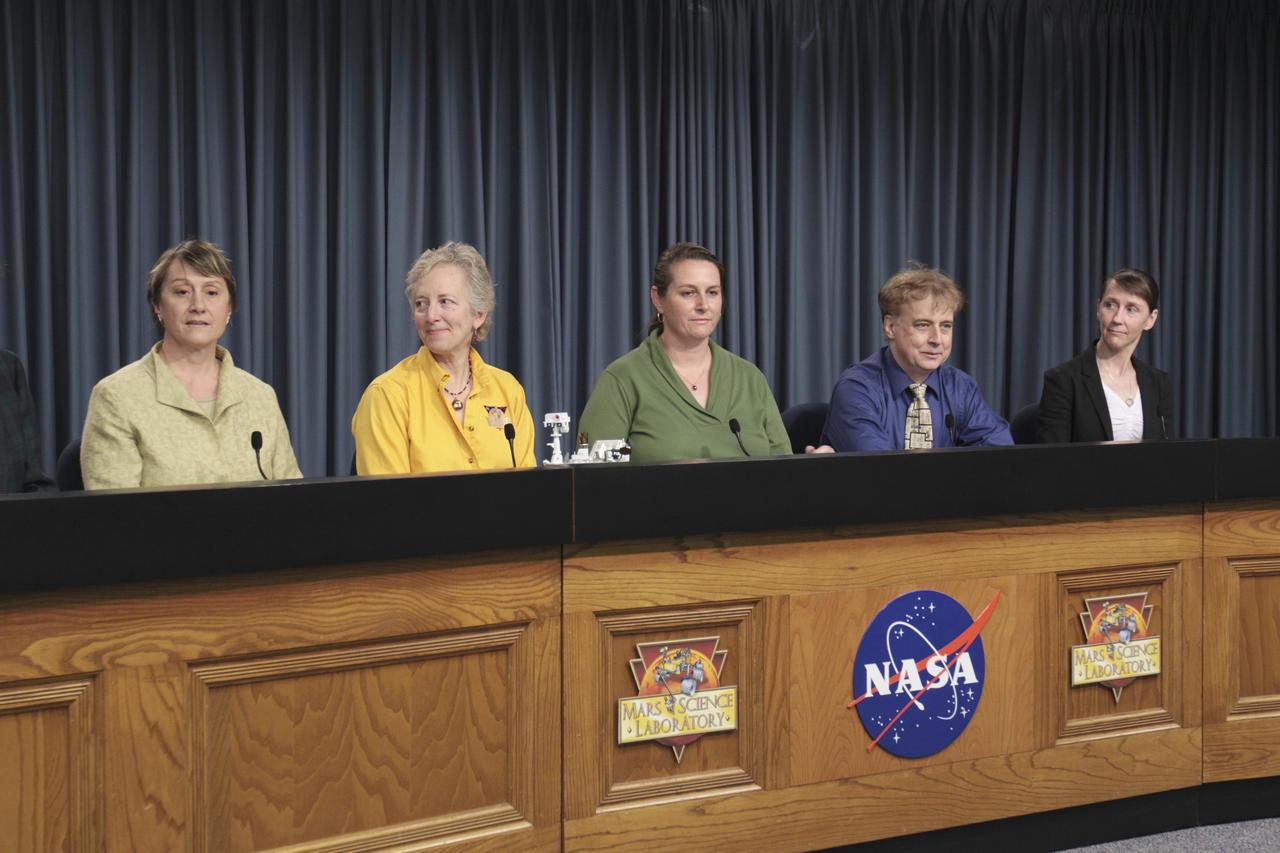
CAPE CANAVERAL, Fla. – At NASA’s Kennedy Space Center in Florida, several scientists and researchers participate in a “Looking for Signs of Life in the Universe” news conference, Nov. 22, as part of preflight activities for the Mars Science Laboratory (MSL) mission. From left, are NASA Astrobiology Director Mary Voytek; Professor Jamie Foster from the Department of Microbiology and Cell Science at the University of Florida in Gainesville; MSL Deputy Principal Investigator Pan Conrad; Director of the Foundation for Applied Molecular Evolution Steven Benner; and NASA Planetary Protection Officer Catharine Conley. MSL’s components include a car-sized rover, Curiosity, which has 10 science instruments designed to search for signs of life, including methane, and help determine if the gas is from a biological or geological source. Launch of MSL aboard a United Launch Alliance Atlas V rocket is targeted for Nov. 26 from Space Launch Complex 41 on Cape Canaveral Air Force Station in Florida. For more information, visit http://www.nasa.gov/msl. Photo credit: NASA/Kim Shiflett
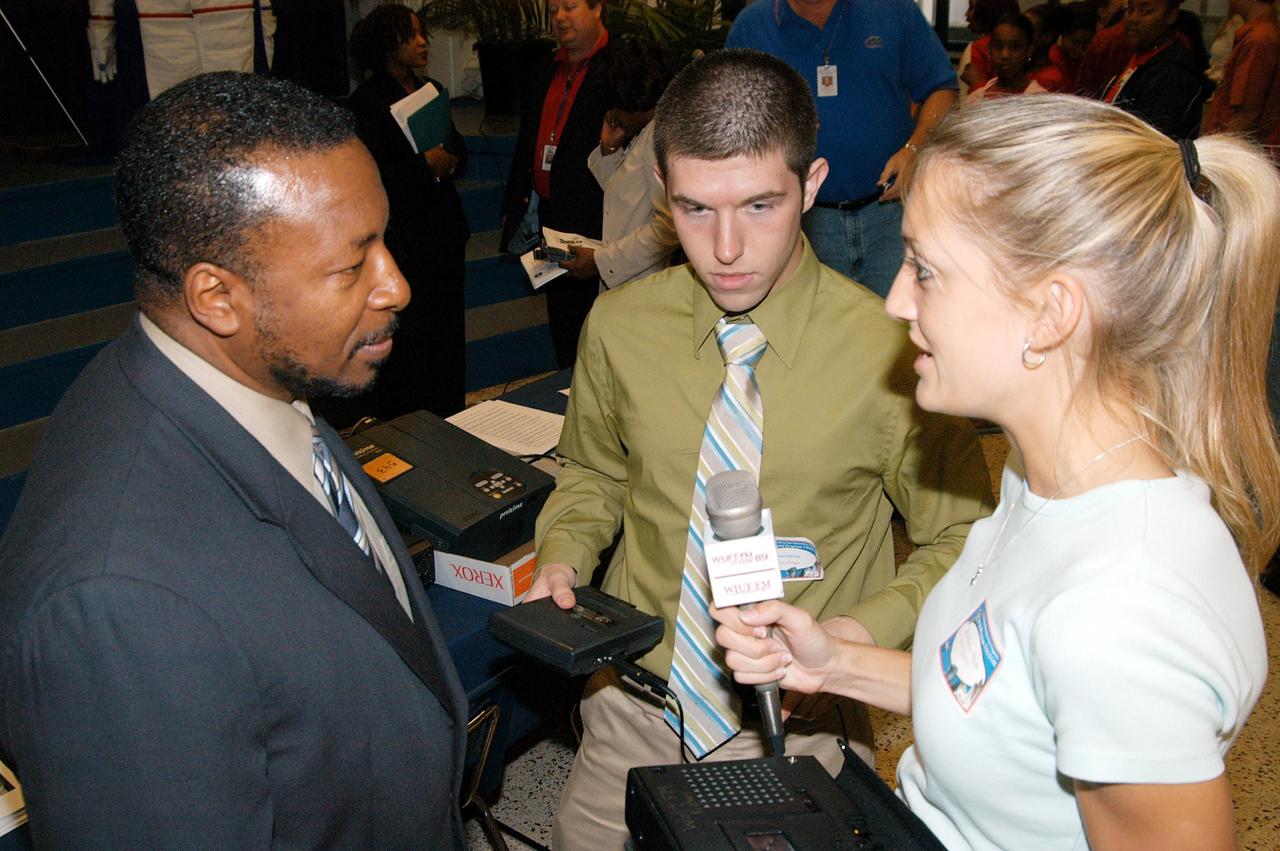
KENNEDY SPACE CENTER, FLA. - KSC Deputy Director Woodrow Whitlow Jr. (left) is interviewed by a reporter (right) for WTUF-FM radio after a presentation at Howard Bishop Middle School in Gainesville, Fla. Dr. Whitlow shared the new vision for space exploration with the students, the next generation of explorers. Whitlow talked about our destiny as explorers, NASA’s stepping stone approach to exploring Earth, the Moon, Mars and beyond, how space impacts our lives, and how people and machines rely on each other in space. The presentation also included a downlink from the International Space Station for students to ask questions of the Expedition 8 crew, Commander Michael Foale and Flight Engineer Alexander Kaleri. Howard Bishop Middle School is one of 50 nationwide (four in Florida) in the NASA Explorer Schools (NES) Program. NES establishes a three-year partnership between NASA and 50 NASA Explorer Schools teams, consisting of teachers and education administrators from diverse communities nationwide.
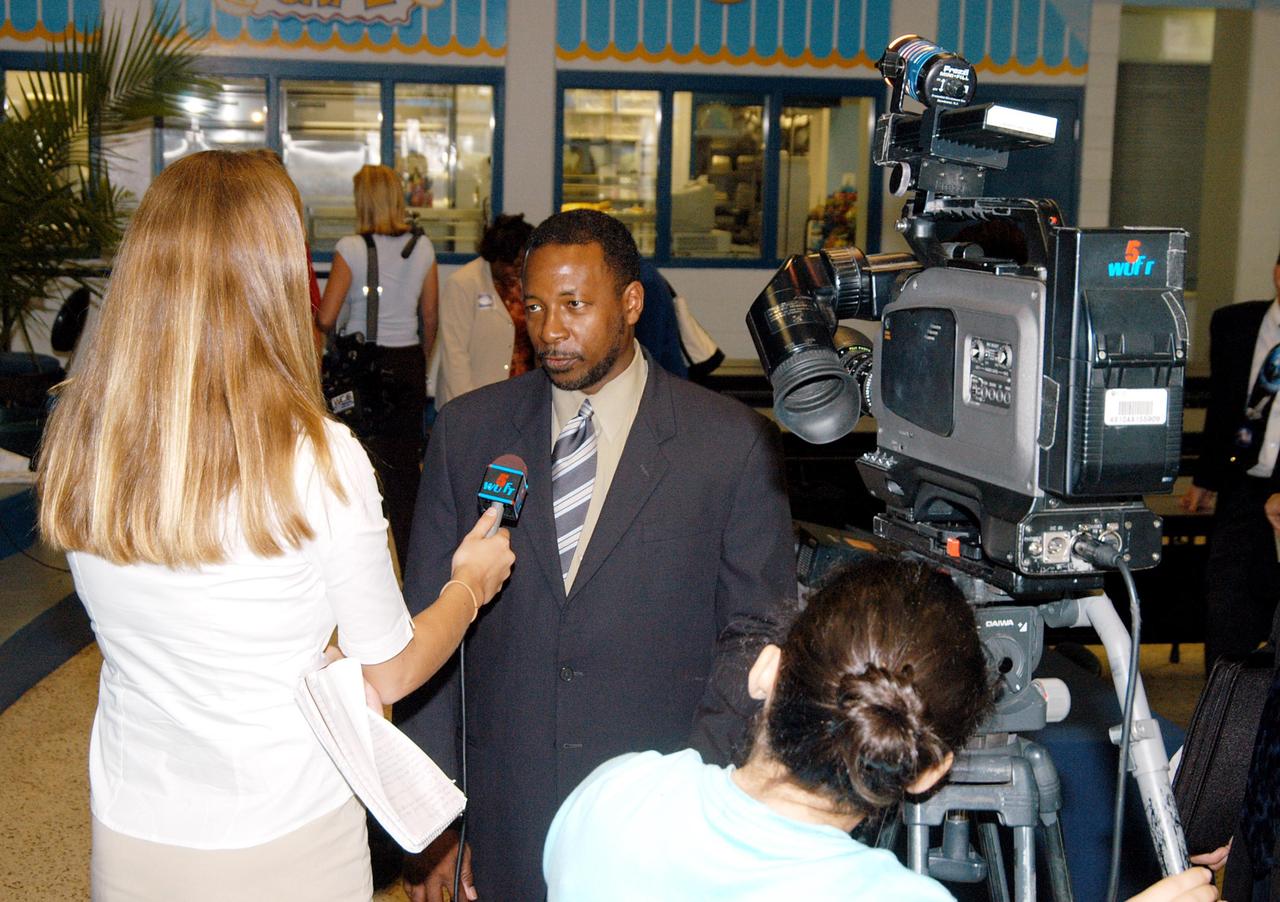
KENNEDY SPACE CENTER, FLA. - KSC Deputy Director Woodrow Whitlow Jr. (center) is interviewed by TV station WUFT after a presentation at Howard Bishop Middle School in Gainesville, Fla. Dr. Whitlow shared the new vision for space exploration with the students, the next generation of explorers. Whitlow talked about our destiny as explorers, NASA’s stepping stone approach to exploring Earth, the Moon, Mars and beyond, how space impacts our lives, and how people and machines rely on each other in space. The presentation also included a downlink from the International Space Station for students to ask questions of the Expedition 8 crew, Commander Michael Foale and Flight Engineer Alexander Kaleri. Howard Bishop Middle School is one of 50 nationwide (four in Florida) in the NASA Explorer Schools (NES) Program. NES establishes a three-year partnership between NASA and 50 NASA Explorer Schools teams, consisting of teachers and education administrators from diverse communities nationwide
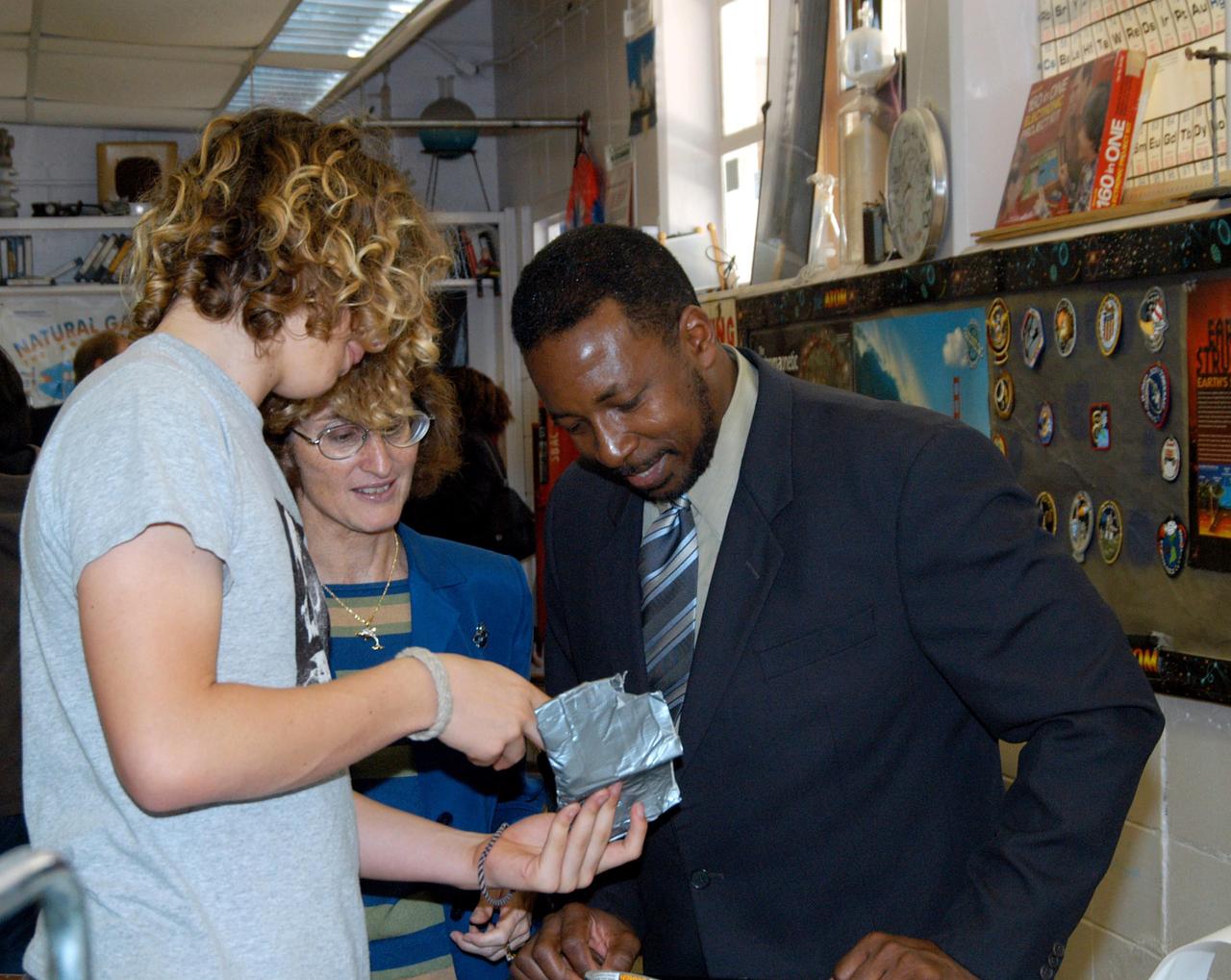
KENNEDY SPACE CENTER, FLA. - KSC Deputy Director Woodrow Whitlow Jr. talks to a student about his project in a classroom at Howard Bishop Middle School in Gainesville, Fla. Dr. Whitlow shared the new vision for space exploration with the students, the next generation of explorers. Whitlow talked about our destiny as explorers, NASA’s stepping stone approach to exploring Earth, the Moon, Mars and beyond, how space impacts our lives, and how people and machines rely on each other in space. The presentation also included a downlink from the International Space Station for students to ask questions of the Expedition 8 crew, Commander Michael Foale and Flight Engineer Alexander Kaleri. Howard Bishop Middle School is one of 50 nationwide (four in Florida) in the NASA Explorer Schools (NES) Program. NES establishes a three-year partnership between NASA and 50 NASA Explorer Schools teams, consisting of teachers and education administrators from diverse communities nationwide.
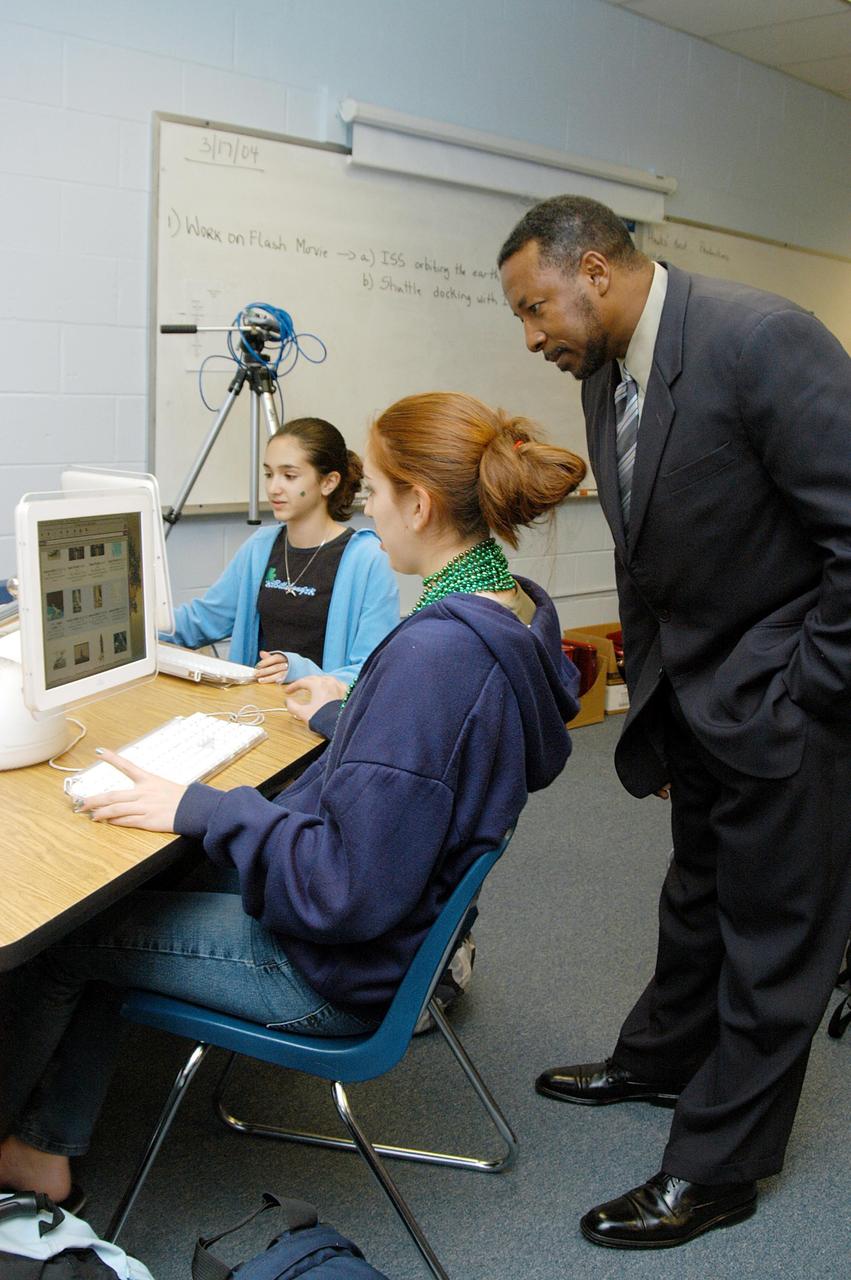
KENNEDY SPACE CENTER, FLA. - KSC Deputy Director Woodrow Whitlow Jr. looks at a student’s computer project after his presentation in the classroom at Howard Bishop Middle School in Gainesville, Fla. Dr. Whitlow shared the new vision for space exploration with the students, the next generation of explorers. Whitlow talked about our destiny as explorers, NASA’s stepping stone approach to exploring Earth, the Moon, Mars and beyond, how space impacts our lives, and how people and machines rely on each other in space. The presentation also included a downlink from the International Space Station for students to ask questions of the Expedition 8 crew, Commander Michael Foale and Flight Engineer Alexander Kaleri. Howard Bishop Middle School is one of 50 nationwide (four in Florida) in the NASA Explorer Schools (NES) Program. NES establishes a three-year partnership between NASA and 50 NASA Explorer Schools teams, consisting of teachers and education administrators from diverse communities nationwide.
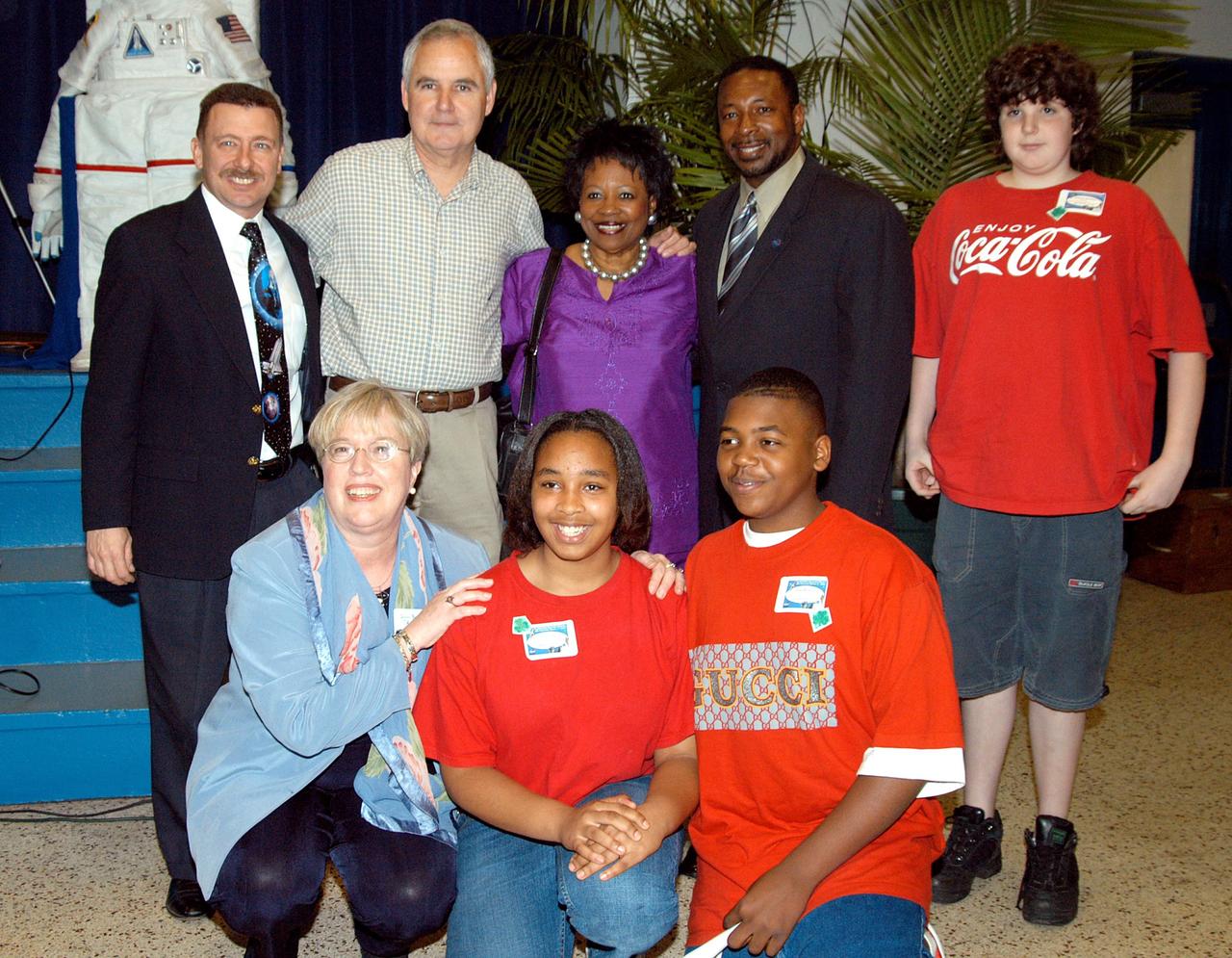
KENNEDY SPACE CENTER, FLA. - KSC Deputy Director Woodrow Whitlow Jr. (rear, second from right) poses with students and administrators at Howard Bishop Middle School in Gainesville, Fla. Dr. Whitlow shared the new vision for space exploration with the students, the next generation of explorers. Whitlow talked about our destiny as explorers, NASA’s stepping stone approach to exploring Earth, the Moon, Mars and beyond, how space impacts our lives, and how people and machines rely on each other in space. The presentation also included a downlink from the International Space Station for students to ask questions of the Expedition 8 crew, Commander Michael Foale and Flight Engineer Alexander Kaleri. Howard Bishop Middle School is one of 50 nationwide (four in Florida) in the NASA Explorer Schools (NES) Program. NES establishes a three-year partnership between NASA and 50 NASA Explorer Schools teams, consisting of teachers and education administrators from diverse communities nationwide.
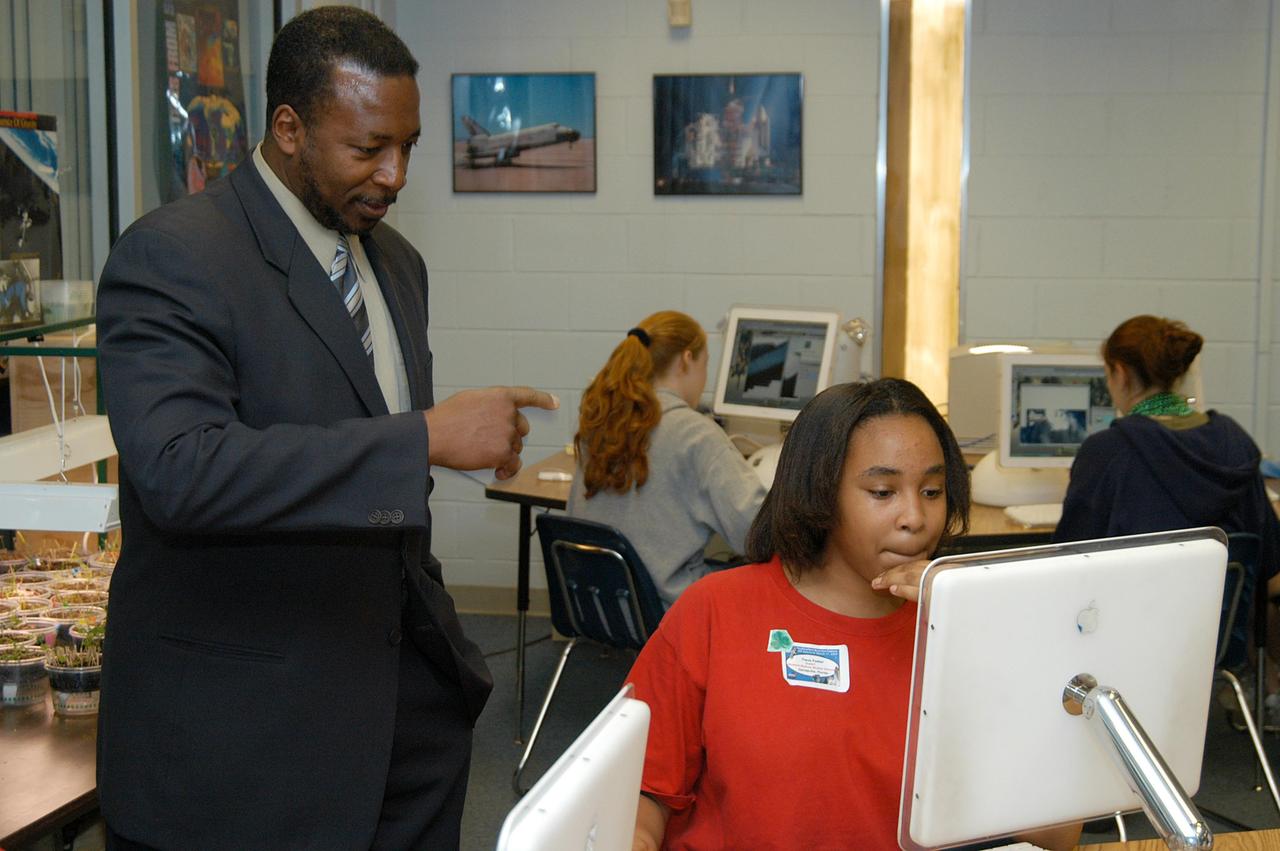
KENNEDY SPACE CENTER, FLA. - KSC Deputy Director Woodrow Whitlow Jr. looks at a student’s computer project after his presentation in the classroom at Howard Bishop Middle School in Gainesville, Fla. Dr. Whitlow shared the new vision for space exploration with the students, the next generation of explorers. Whitlow talked about our destiny as explorers, NASA’s stepping stone approach to exploring Earth, the Moon, Mars and beyond, how space impacts our lives, and how people and machines rely on each other in space. The presentation also included a downlink from the International Space Station for students to ask questions of the Expedition 8 crew, Commander Michael Foale and Flight Engineer Alexander Kaleri. Howard Bishop Middle School is one of 50 nationwide (four in Florida) in the NASA Explorer Schools (NES) Program. NES establishes a three-year partnership between NASA and 50 NASA Explorer Schools teams, consisting of teachers and education administrators from diverse communities nationwide.
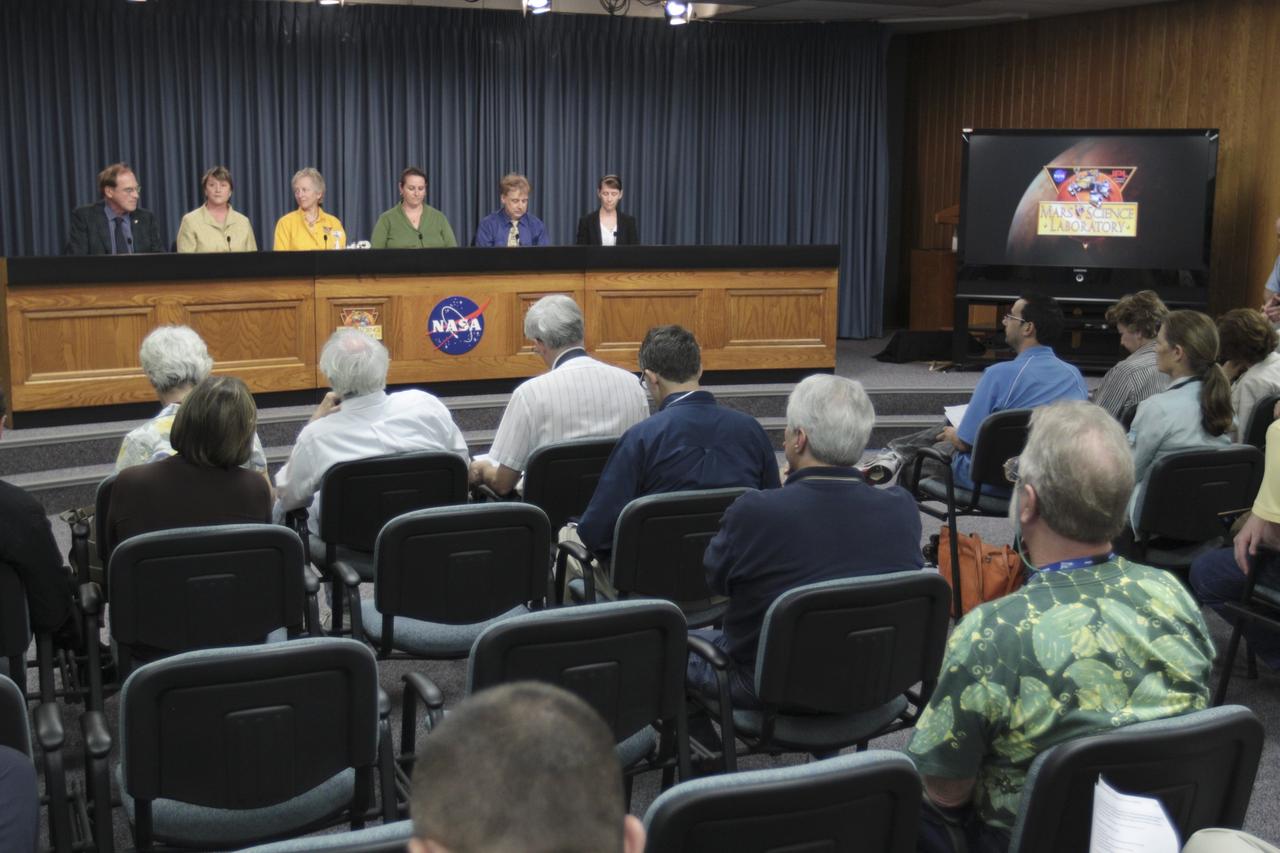
CAPE CANAVERAL, Fla. – At NASA’s Kennedy Space Center in Florida, several scientists and researchers participate in a “Looking for Signs of Life in the Universe” news conference, Nov. 22, as part of preflight activities for the Mars Science Laboratory (MSL) mission. From left, are NASA Public Affairs Officer and conference moderator George Diller; NASA Astrobiology Director Mary Voytek; Professor Jamie Foster from the Department of Microbiology and Cell Science at the University of Florida in Gainesville; MSL Deputy Principal Investigator Pan Conrad; Director of the Foundation for Applied Molecular Evolution Steven Benner; and NASA Planetary Protection Officer Catharine Conley. MSL’s components include a car-sized rover, Curiosity, which has 10 science instruments designed to search for signs of life, including methane, and help determine if the gas is from a biological or geological source. Launch of MSL aboard a United Launch Alliance Atlas V rocket is targeted for Nov. 26 from Space Launch Complex 41 on Cape Canaveral Air Force Station in Florida. For more information, visit http://www.nasa.gov/msl. Photo credit: NASA/Kim Shiflett
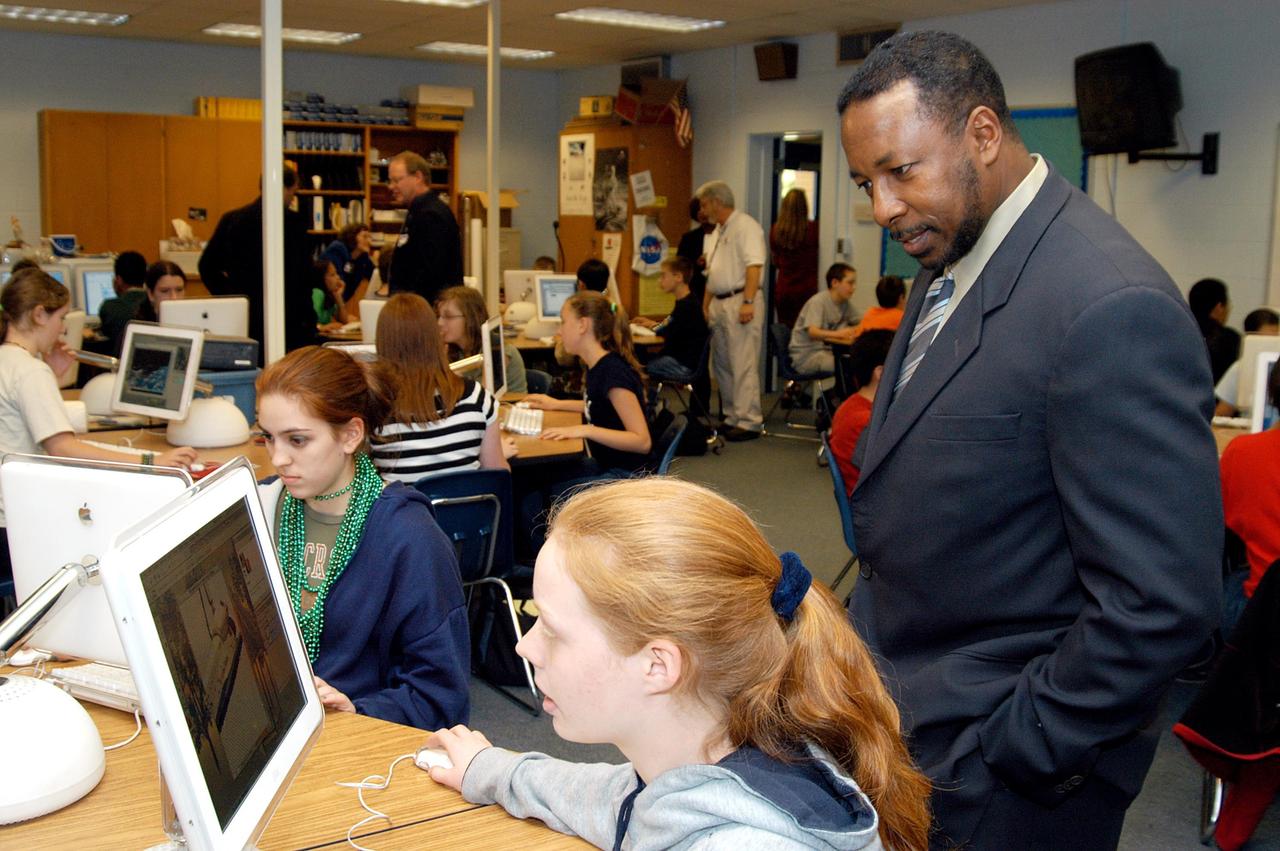
KENNEDY SPACE CENTER, FLA. - KSC Deputy Director Woodrow Whitlow Jr. looks at a student’s computer project after his presentation in the classroom at Howard Bishop Middle School in Gainesville, Fla. Dr. Whitlow shared the new vision for space exploration with the students, the next generation of explorers. Whitlow talked about our destiny as explorers, NASA’s stepping stone approach to exploring Earth, the Moon, Mars and beyond, how space impacts our lives, and how people and machines rely on each other in space. The presentation also included a downlink from the International Space Station for students to ask questions of the Expedition 8 crew, Commander Michael Foale and Flight Engineer Alexander Kaleri. Howard Bishop Middle School is one of 50 nationwide (four in Florida) in the NASA Explorer Schools (NES) Program. NES establishes a three-year partnership between NASA and 50 NASA Explorer Schools teams, consisting of teachers and education administrators from diverse communities nationwide.
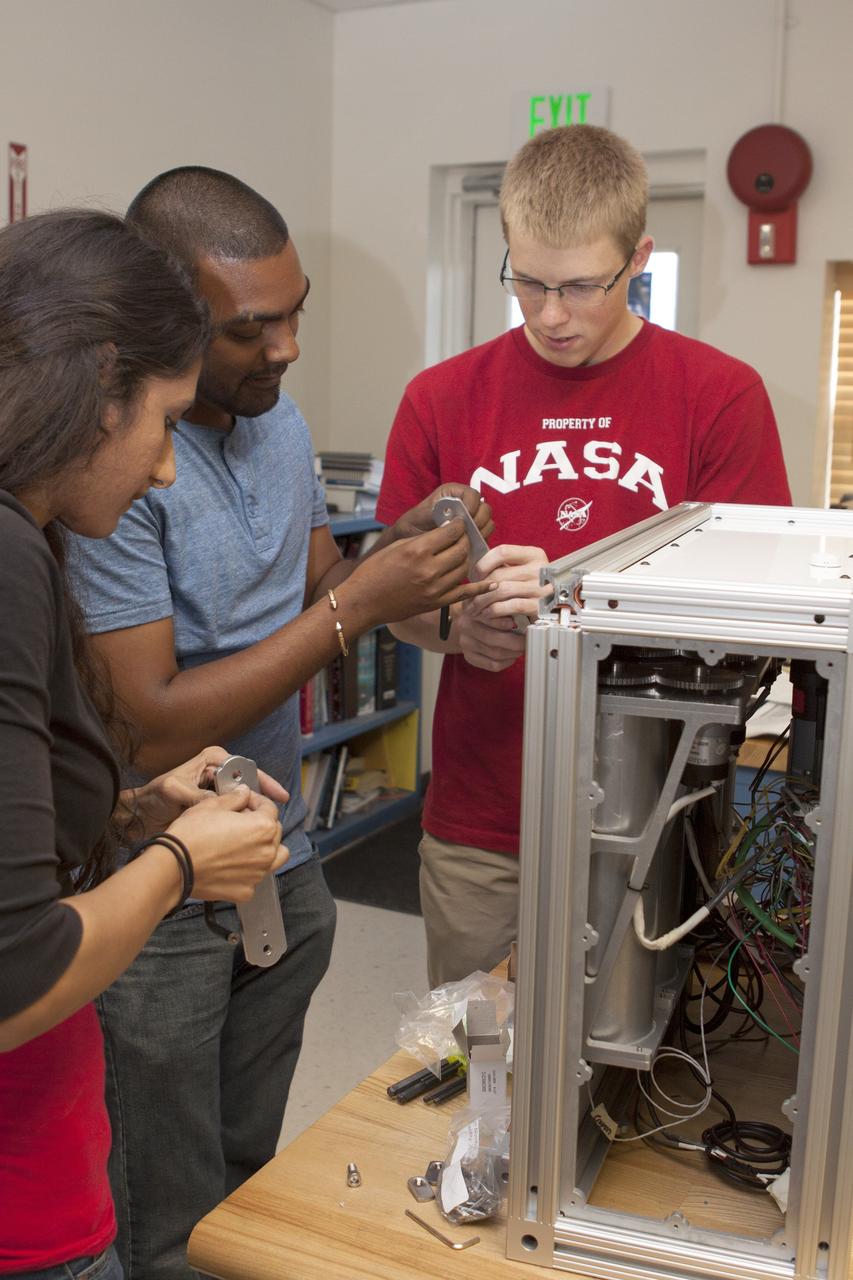
CAPE CANAVERAL, Fla. – Inside the Prototype Laboratory at NASA's Kennedy Space Center in Florida, Prital Thakrar, left, design lead and student engineer trainee from the University of Florida in Gainesville, Anthony Bharrat, NASA avionics lead, and Evan Williams, an Education intern from the University of Central Florida, prepare the experiment container for NASA's Exposing Microorganisms in the Stratosphere, or E-MIST, experiment. The container was designed and built at Kennedy. The 80-pound structure features four doors that rotate to expose up to 10 microbial samples each for a predetermined period of time in the Earth's stratosphere. The E-MIST experiment will launch on the exterior of a giant scientific balloon gondola at about 8 a.m. MST on Aug. 24 from Ft. Sumner, New Mexico. It will soar 125,000 feet above the Earth during a 5-hour journey over the desert to understand how spore-forming bacteria, commonly found in spacecraft assembly facilities can survive. Photo credit: NASA/Kim Shiflett