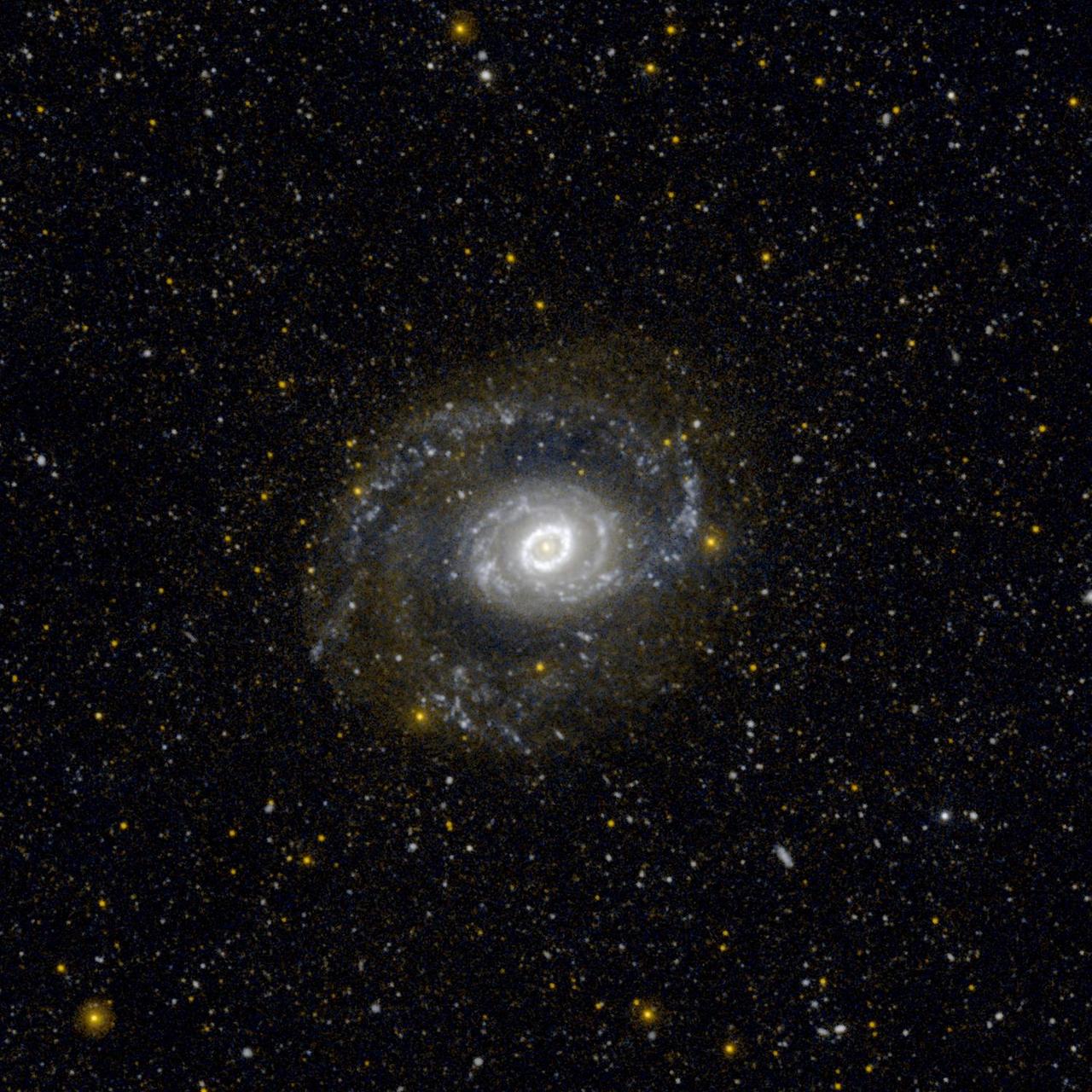
This image from NASA Galaxy Evolution Explorer GALEX shows Messier 94, also known as NGC 4736, in ultraviolet light. It is located 17 million light-years away in the constellation Canes Venatici.
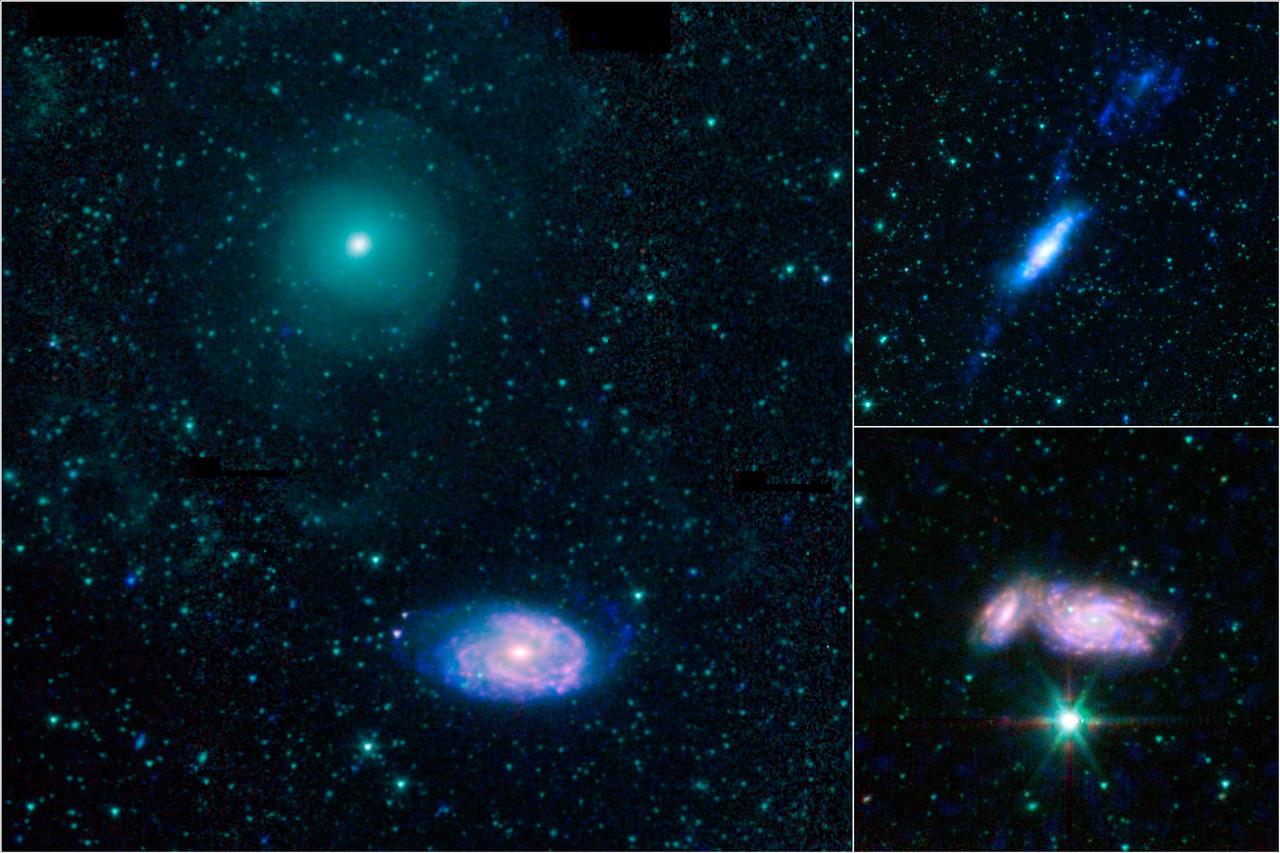
This montage combines observations from NASA Spitzer Space Telescope and NASA Galaxy Evolution Explorer GALEX spacecraft showing three examples of colliding galaxies from a new photo atlas of galactic train wrecks.

The galaxy UGC 1382 has been revealed to be far larger and stranger than previously thought. Astronomers relied on a combination of ground-based and space telescopes to uncover the true nature of this "Frankenstein galaxy." The composite image shows the same galaxy as viewed with different instruments. The component images are also available. In the image at left, UGC 1382 appears to be a simple elliptical galaxy, based on optical data from the Sloan Digital Sky Survey (SDSS). But spiral arms emerged when astronomers incorporated ultraviolet data from the Galaxy Evolution Explorer (GALEX) and deep optical data from SDSS, as seen in the middle image. Combining that with a view of low-density hydrogen gas (shown in green), detected at radio wavelengths by the Very Large Array, scientists discovered that UGC 1382 is a giant, and one of the largest isolated galaxies known. GALEX in particular was able detect very faint features because it operated from space, which is necessary for UV observations because ultraviolet light is absorbed by the Earth's atmosphere. Astronomers also used Stripe 82 of SDSS, a small region of sky where SDSS imaged the sky 80 times longer than the original standard SDSS survey. This enabled optical detection of much fainter features as well. http://photojournal.jpl.nasa.gov/catalog/PIA20695

The Blue Ring Nebula was discovered in 2004 by NASA's Galaxy Evolution Explorer (GALEX) mission. Astronomers think the nebula was created by the merger of two stars, and that we are seeing the system a few thousand years after the merger, when evidence of the collision is still apparent. The blue light in the image shows the debris cloud created by the merger. As the hot cloud of material expanded into space and cooled down, it formed hydrogen molecules that collided with the interstellar medium (the particles occupying the space between stars). These collisions caused the hydrogen molecules to radiate far-ultraviolet light, which was detected by GALEX. Yellow indicates near-ultraviolet light, also detected by GALEX, which is emitted by the star at the center of the nebula and many surrounding stars. Infrared light observed by NASA's Wide-field Infrared Survey Explorer (WISE) is also shown in red, and is primarily emitted by the central star. Detailed analysis of the WISE data revealed a ring of debris around the star – further evidence of a merger. Magenta indicates optical light — light visible to the human eye — collected using the Hale Telescope. This light comes from the shockwave at the front of the expanding debris cones. The optical light helped astronomers discover that the nebula actually consists of two cones moving away from the central star. The base of one cone is moving almost directly toward Earth, while the other is moving almost directly away, and the magenta light outlines the two bases. The blue region in the image shows where the cones overlap; the non-overlapping regions are too faint for GALEX to see. Figure A shows the orientation of the cones to Earth and the way they appear to overlap. https://photojournal.jpl.nasa.gov/catalog/PIA23867
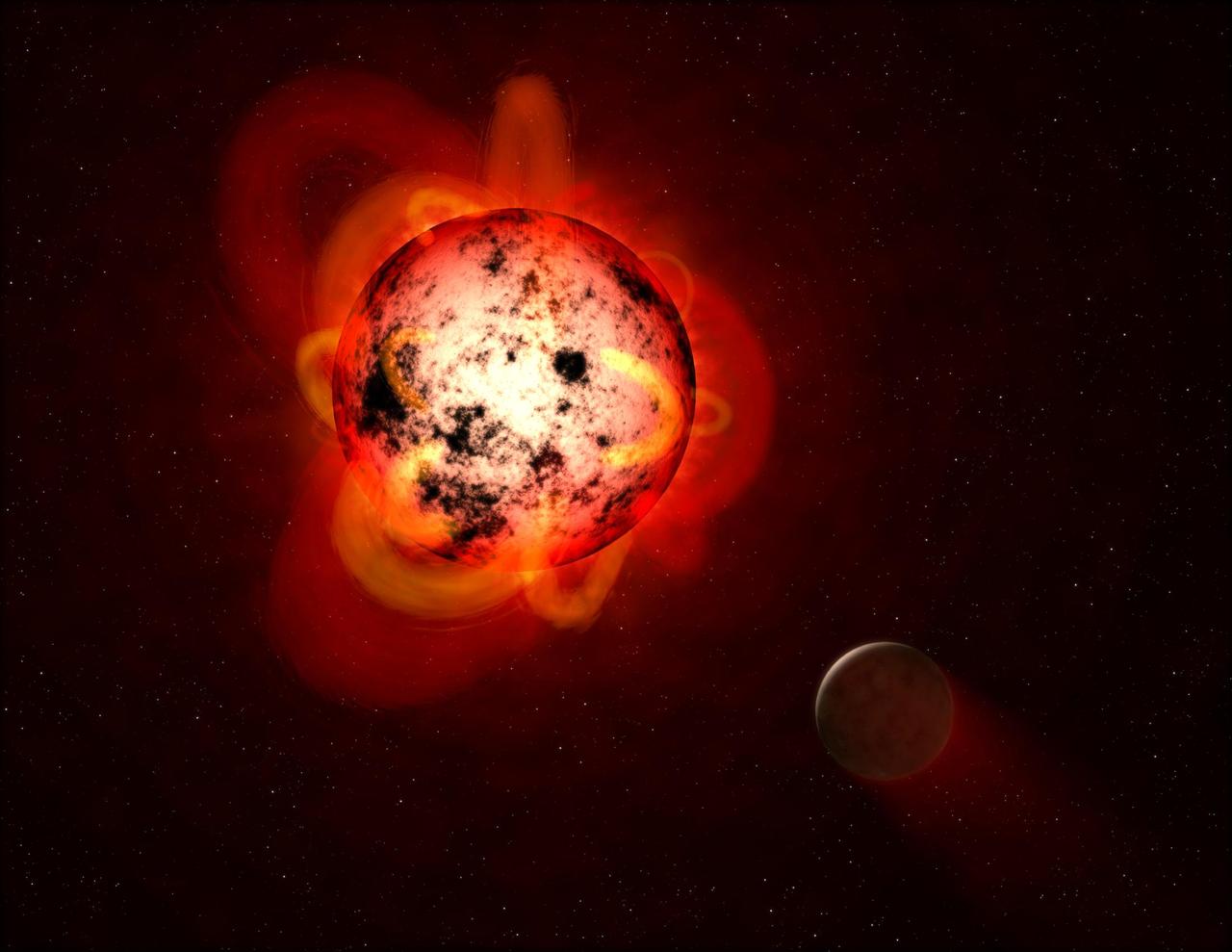
This illustration shows a red dwarf star orbited by a hypothetical exoplanet. Red dwarfs tend to be magnetically active, displaying gigantic arcing prominences and a wealth of dark sunspots. Red dwarfs also erupt with intense flares that could strip a nearby planet's atmosphere over time, or make the surface inhospitable to life as we know it. By mining data from the Galaxy Evolution Explorer (GALEX) spacecraft, a team of astronomers identified dozens of flares at a range of durations and strengths. The team measured events with less total energy than many previously detected flares from red dwarfs. This is important because, although individually less energetic and therefore less hostile to life, smaller flares might be much more frequent and add up over time to produce a cumulative effect on an orbiting planet. https://photojournal.jpl.nasa.gov/catalog/PIA21473

This compilation shows the constellation Hercules, as imaged on May 21 and 22, 2003, by NASA Galaxy Evolution Explorer. The images were captured by the two channels of the spacecraft camera during the mission first light milestone.

This artist concept shows a supermassive black hole at the center of a remote galaxy digesting the remnants of a star.

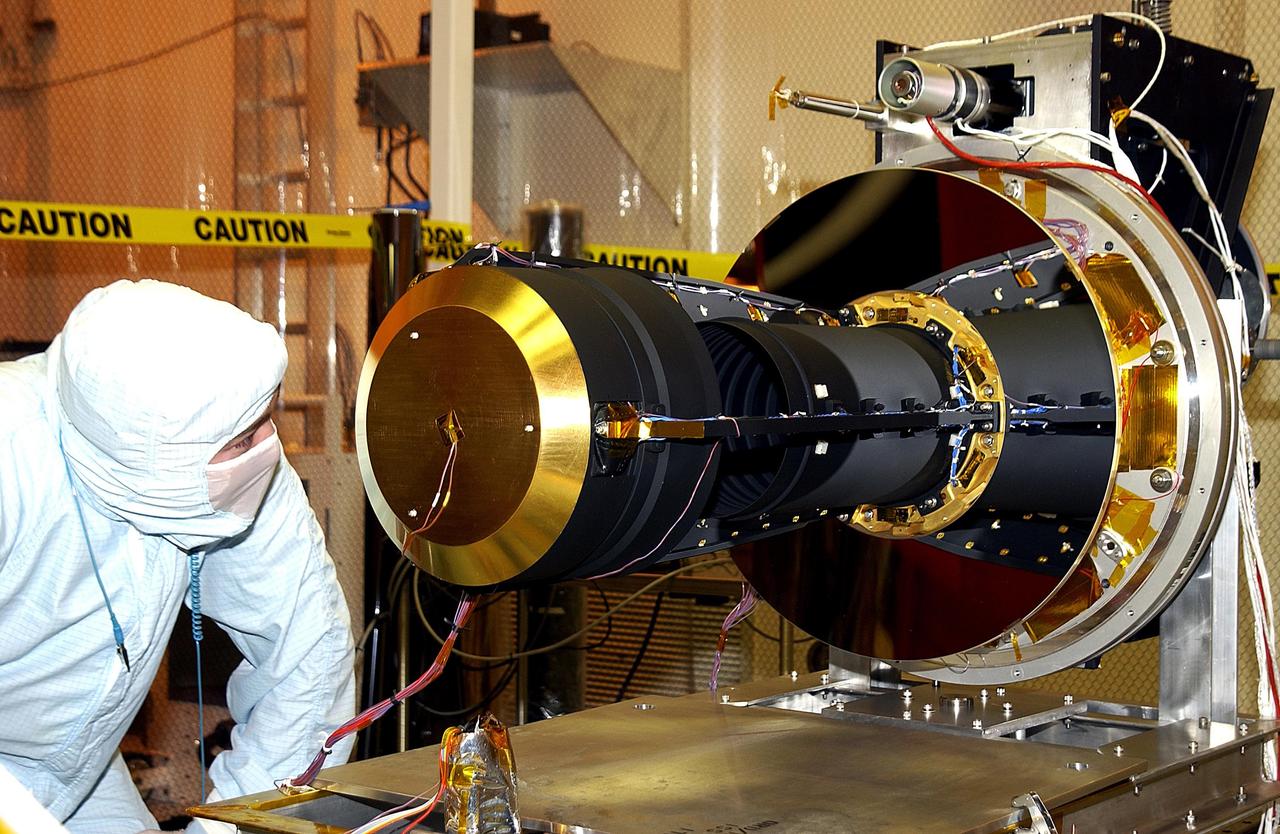
In the Multi-Payload Processing Facility, workers check the deployment of the cover of the telescope on NASA Galaxy Evolution Explorer, an orbiting space telescope observing galaxies in ultraviolet light across 10 billion years of cosmic history.
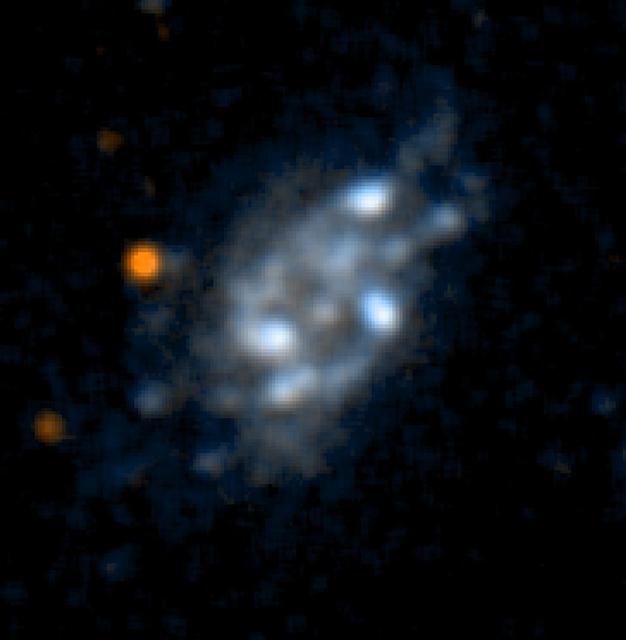
This ultraviolet color image of the galaxy UGC10445 was taken by NASA Galaxy Evolution Explorer on June 7 and June 14, 2003. UGC10445 is a spiral galaxy located 40 million light-years from Earth. http://photojournal.jpl.nasa.gov/catalog/PIA04623
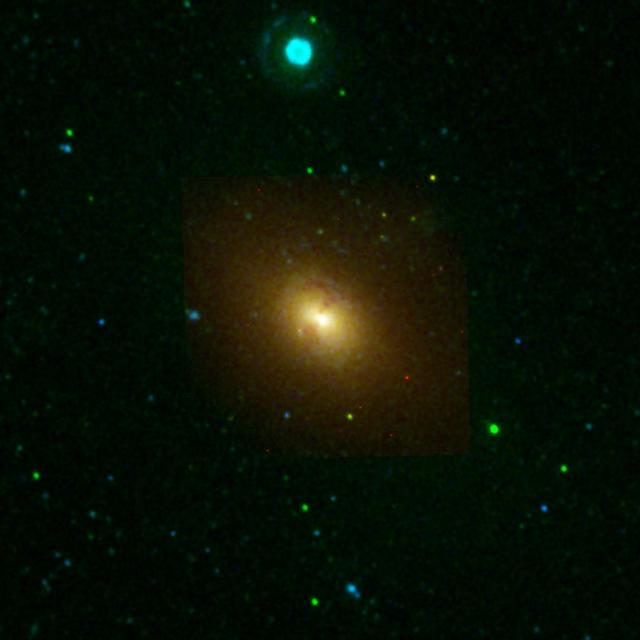
This image from NASA Galaxy Evolution Explorer shows the galaxy NGC 1316, located about 62 million light-years away in the constellation Fornax. The elliptical-shaped galaxy may be in the late stages of merging with a smaller companion galaxy.
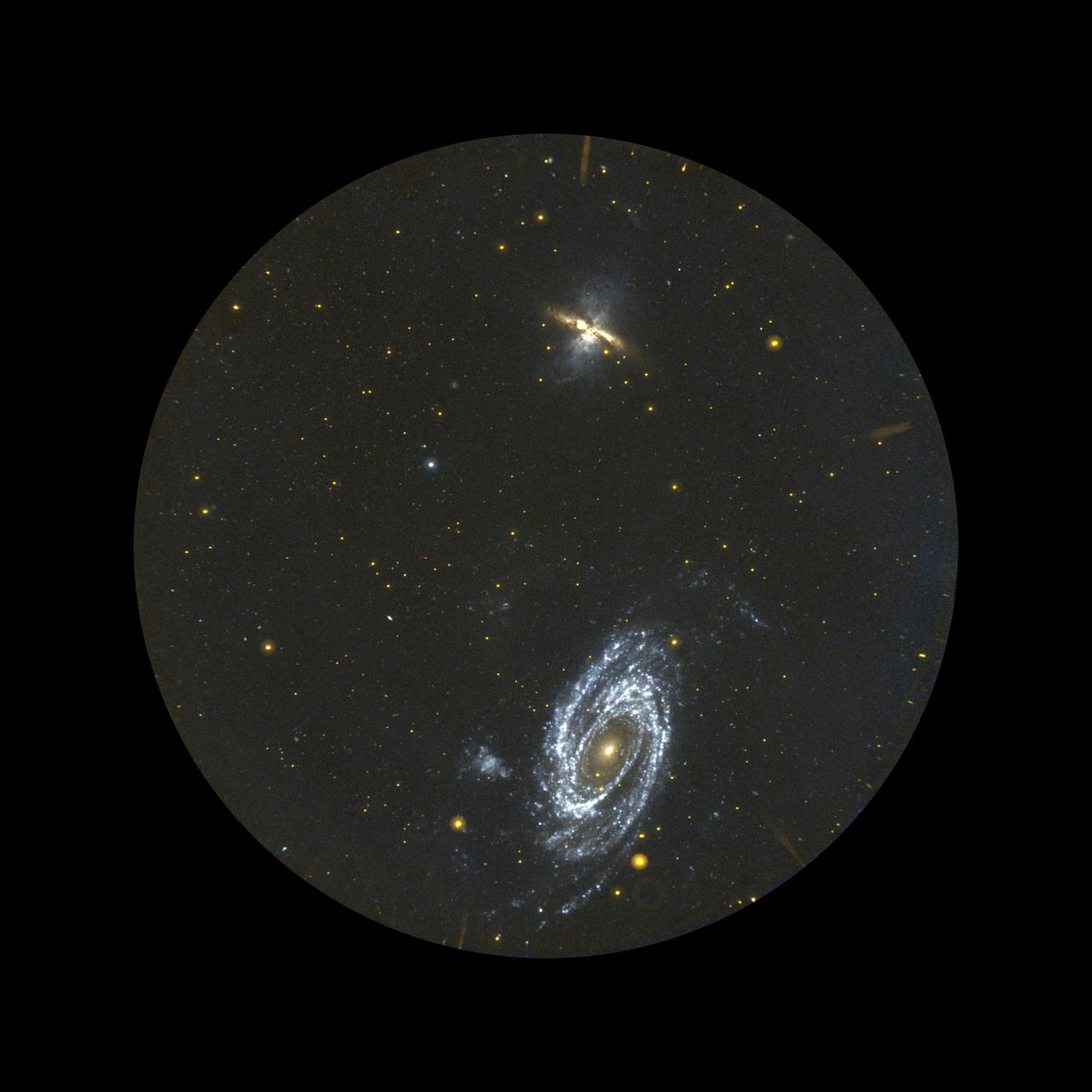
The Galaxy Evolution Explorer specializes in surveying galaxies in ultraviolet light. Its telescope, 50 centimeters (19.7 inches) in diameter, has a field of view that is much wider than most ground-based and space-based telescopes. This field of view, nearly three times the diameter of the Moon, allowed the Galaxy Evolution Explorer to discover seemingly newborn galaxies in our local universe. The telescope surveyed thousands of galaxies before finding three-dozen of these newborns. http://photojournal.jpl.nasa.gov/catalog/PIA05979

NASA Galaxy Evolution Explorer is celebrates its fourth year in space with some of M81 hottest stars. In this ultraviolet image, the magnificent M81 spiral galaxy is shown at the center.

This diagram based on results from NASA Galaxy Evolution Explorer and the Anglo-Australian Telescope illustrates two ways to measure how fast the universe is expanding.
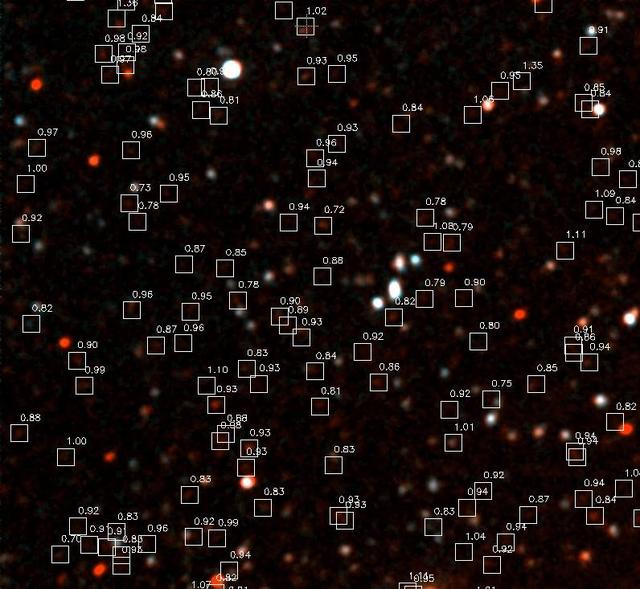
NASA's Galaxy Evolution Explorer photographed this ultraviolet color blowup of the Groth Deep Image on June 22 and June 23, 2003. Hundreds of galaxies are detected in this portion of the image, and the faint red galaxies are believed to be 6 billion light years away. The white boxes show the location of these distant galaxies, of which more than a 100 can be detected in this image. NASA astronomers expect to detect 10,000 such galaxies after extrapolating to the full image at a deeper exposure level. http://photojournal.jpl.nasa.gov/catalog/PIA04626
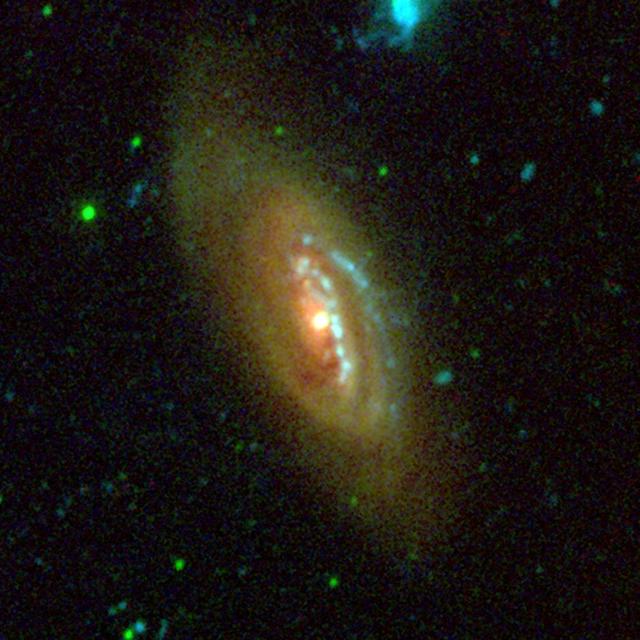
This image from NASA Galaxy Evolution Explorer shows the galaxy NGC 4569 in the constellation Virgo. It is one of the largest and brightest spiral galaxies found in the Virgo cluster of galaxies, the nearest major galaxy cluster to our Milky Way galaxy.
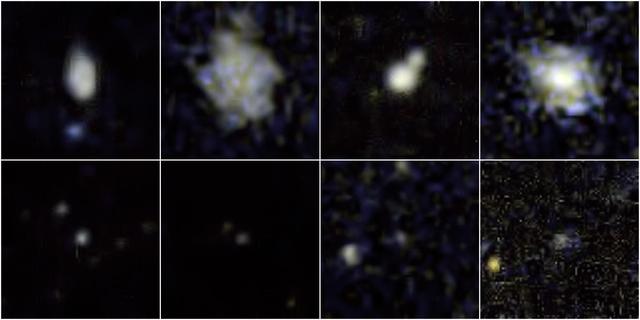
These postage-stamp images taken by NASA Galaxy Evolution Explorer are helping to solve a mystery -- why do the littlest of galaxies produce the biggest of star explosions, or supernovae?

This artist concept illustrates a young, red dwarf star surrounded by three planets. NASA Galaxy Evolution Explorer is helping to identify young, red dwarf stars that are close to us by detecting their ultraviolet light.
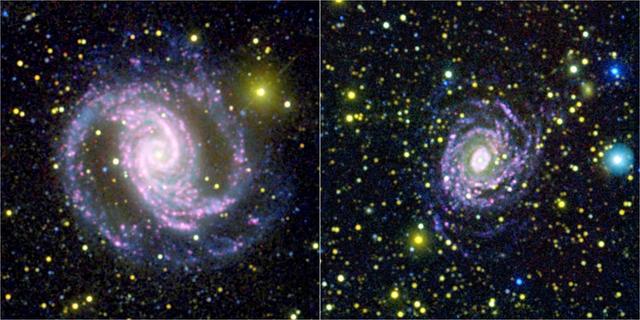
These two photographs were made by combining data from NASA Galaxy Evolution Explorer spacecraft and the Cerro Tololo Inter-American Observatory in Chile to learn that not all galaxies make stars of different sizes in the same quantities.

This diagram illustrates research from NASA Galaxy Evolution Explorer showing that black holes once they reach a critical size can put the brakes on new star formation in elliptical galaxies.
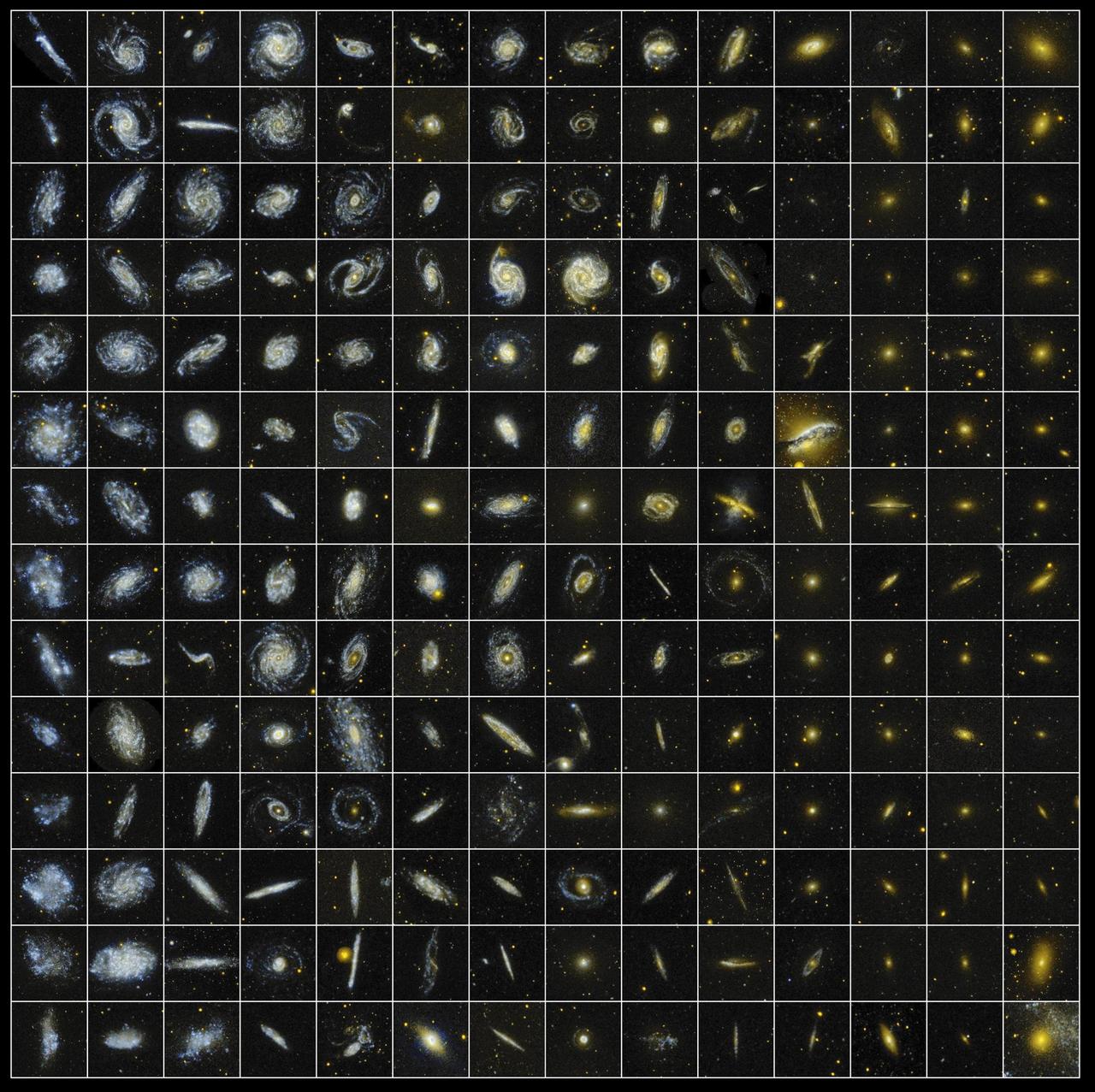
From sparkling blue rings to dazzling golden disks and mined from NASA Galaxy Evolution Explorer Survey of Nearby Galaxies data, these cosmic gems were collected with the telescope sensitive ultraviolet instruments.
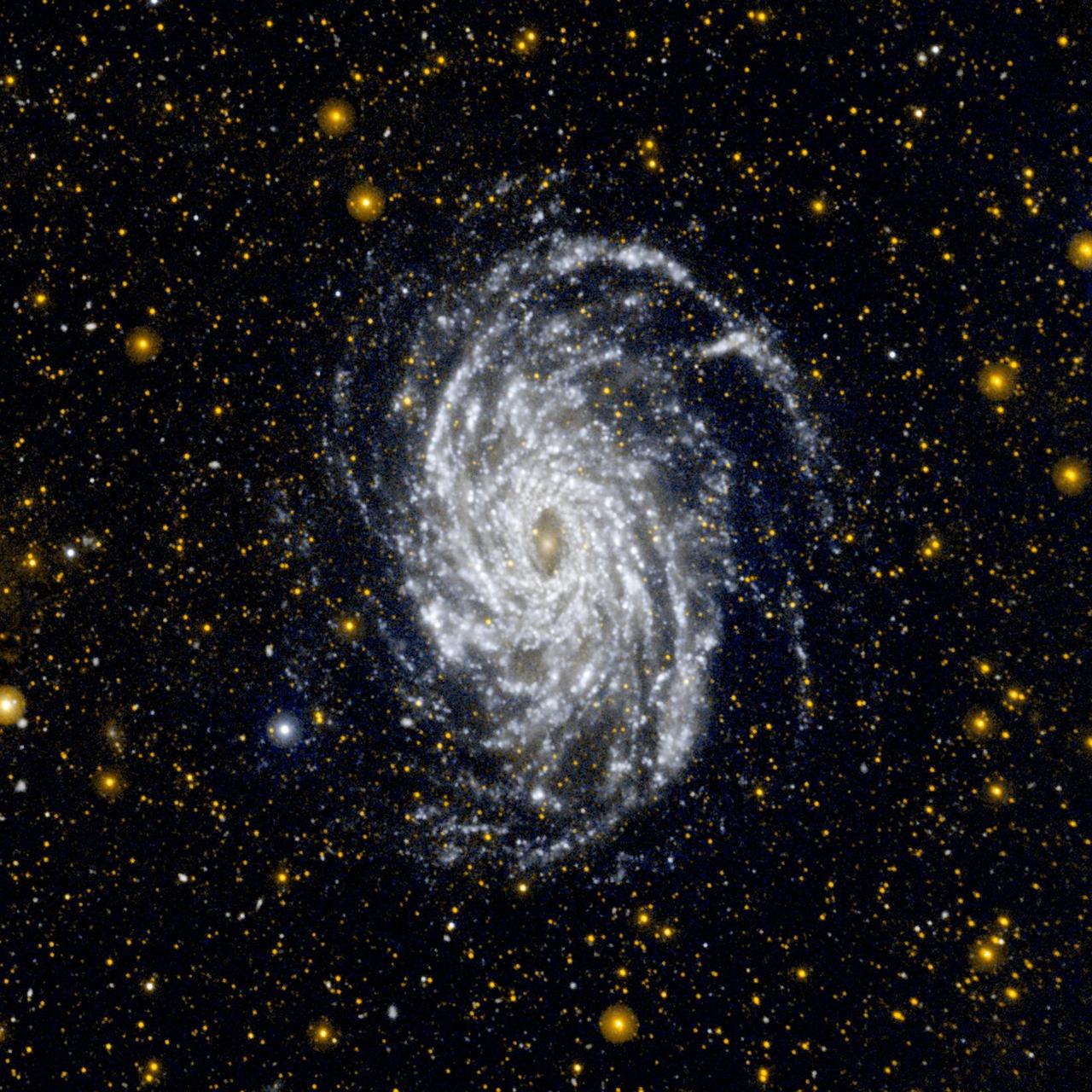
This image from NASA Galaxy Evolution Explorer shows NGC 6744, one of the galaxies most similar to our Milky Way in the local universe.
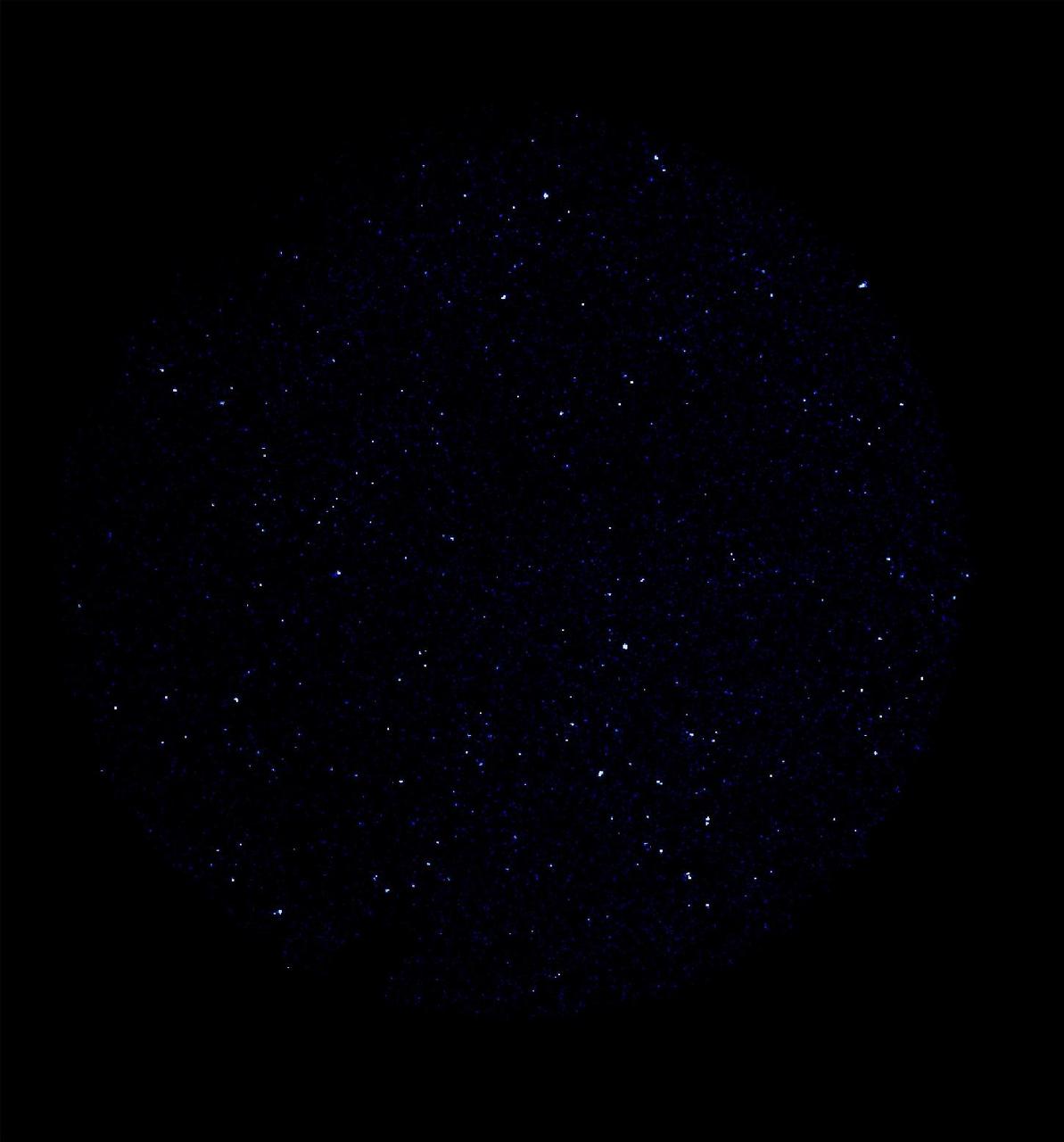
This image was taken May 21 and 22, 2003 by NASA Galaxy Evolution Explorer. The image was made from data gathered by the far ultraviolet channel of the spacecraft camera during the mission first light milestone. It shows about 400 celestial objects
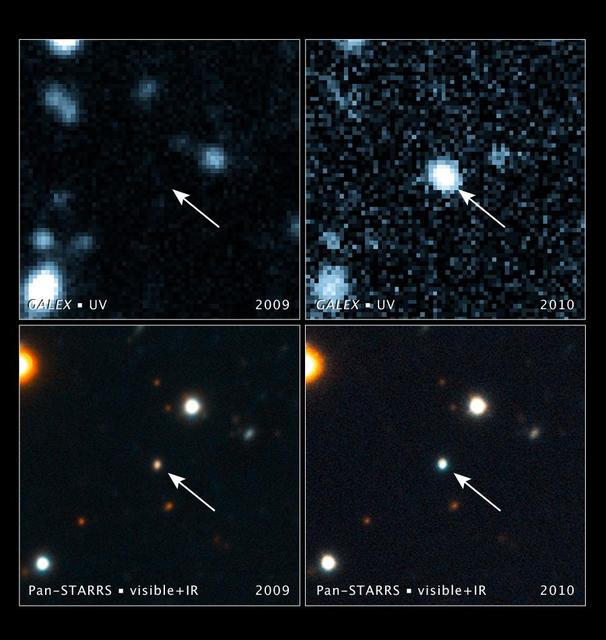
These images, taken with NASA Galaxy Evolution Explorer and the Pan-STARRS1 telescope in Hawaii, show a brightening inside a galaxy caused by a flare from its nucleus. The arrow in each image points to the galaxy.

This computer-simulated image shows gas from a tidally shredded star falling into a black hole. Astronomers observed the flare in ultraviolet light using NASA Galaxy Evolution Explorer.
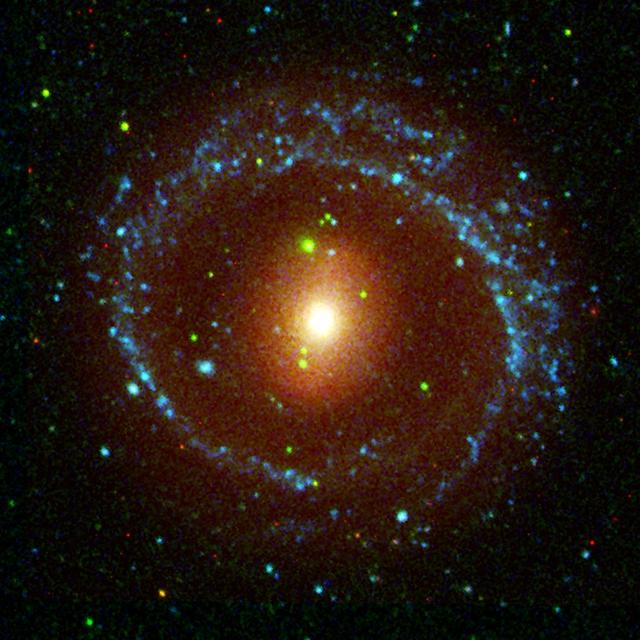
This image from NASA Galaxy Evolution Explorer shows the galaxy NGC 1291, located about 33 million light-years away in the constellation Eridanus. NGC 1291 is notable for its unusual inner bar and outer ring structure.

This artist concept depicts a supermassive black hole at the center of a galaxy. NASA Galaxy Evolution Explorer found evidence that black holes once they grow to a critical size stifle the formation of new stars in elliptical galaxies.

New results from NASA Galaxy Evolution Explorer and the Anglo-Australian Telescope atop Siding Spring Mountain in Australia confirm that dark energy is a smooth, uniform force that now dominates over the effects of gravity.
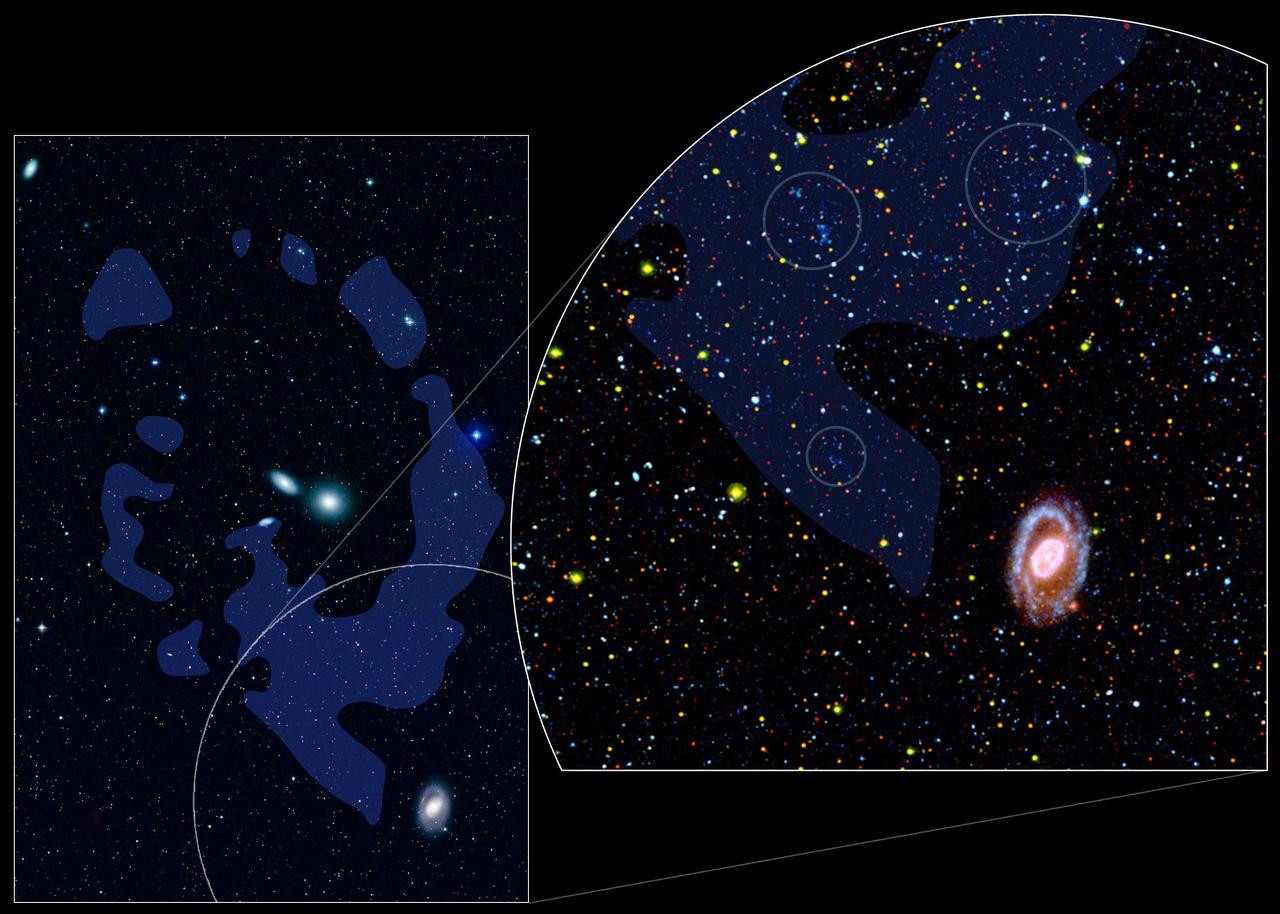
The unique ultraviolet vision of NASA Galaxy Evolution Explorer revealed, for the first time, dwarf galaxies forming out of nothing more than pristine gas likely leftover from the early universe.
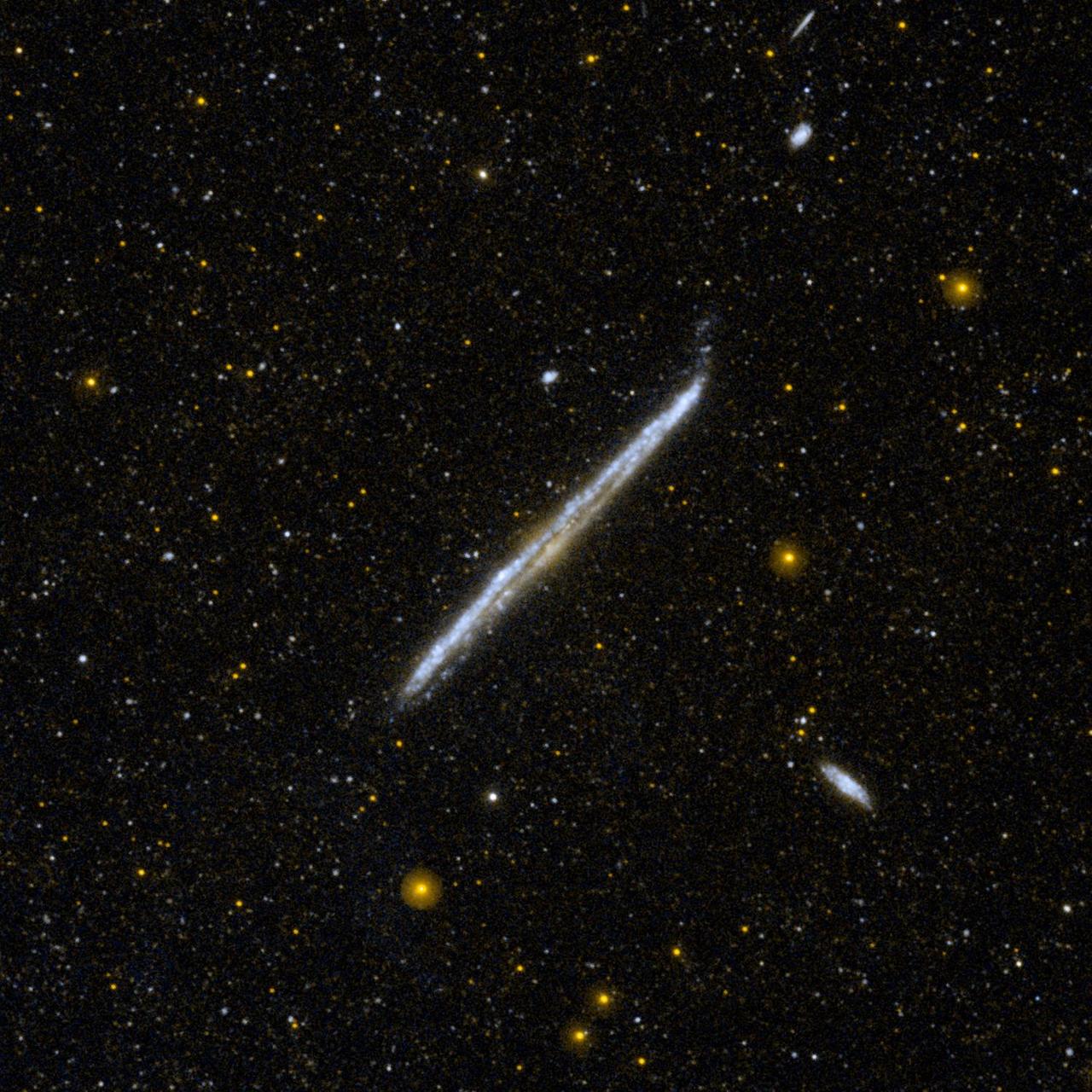
This image from NASA Galaxy Evolution Explorer shows NGC 4565, one of the nearest and brightest galaxies not included in the famous list by 18th-century comet hunter Charles Messier.
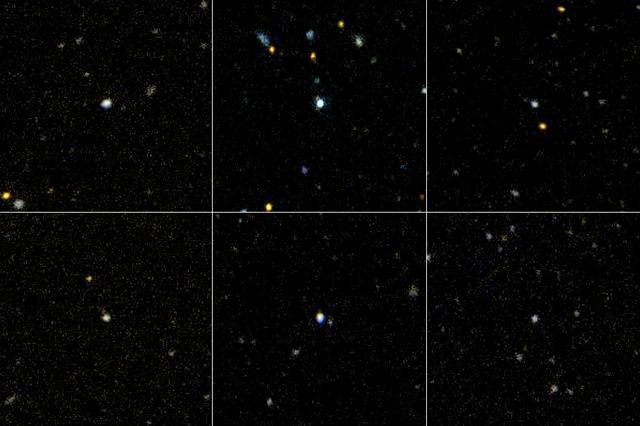
This image shows six of the three-dozen "ultraviolet luminous galaxies" spotted in our corner of the universe by NASA's Galaxy Evolution Explorer. These massive galaxies greatly resemble newborn galaxies that were common in the early universe. The discovery came as a surprise, because astronomers had thought that the universe's "birth-rate" had declined, and that massive galaxies were no longer forming. The galaxies, located in the center of each panel, were discovered after the Galaxy Evolution Explorer scanned a large portion of the sky with its highly sensitive ultraviolet-light detectors. Because young stars pack most of their light into ultraviolet wavelengths, young galaxies appear to the Galaxy Evolution Explorer like diamonds in a field of stones. Astronomers mined for these rare "gems" before, but missed them because they weren't able to examine a large enough slice of the sky. The Galaxy Evolution Explorer surveyed thousands of nearby galaxies before finding three-dozen newborns. While still relatively close in astronomical terms, these galaxies are far enough away to appear small to the Galaxy Evolution Explorer. Clockwise beginning from the upper left, they are called: GALEX_J232539.24+004507.1, GALEX_J231812.98-004126.1, GALEX_J015028.39+130858.5, GALEX_J021348.52+125951.3, GALEX_J143417.15+020742.5, GALEX_J020354.02-092452.5. http://photojournal.jpl.nasa.gov/catalog/PIA07143

The Ghost of Mirach galaxy is shown in visible light on the left, and in ultraviolet as seen by NASA Galaxy Evolution Explorer on the right. The fields of view are identical in both pictures, with the Ghost of Mirach -— a galaxy called NGC 404.

A group of six streaking objects, the identities of which remain unknown, can be seen here flying across the telescope sight in this image from NASA Galaxy Evolution Explorer.

Wispy tendrils of hot dust and gas glow brightly in this ultraviolet image of the Cygnus Loop nebula, taken by NASA Galaxy Evolution Explorer. The nebula lies about 1,500 light-years away.
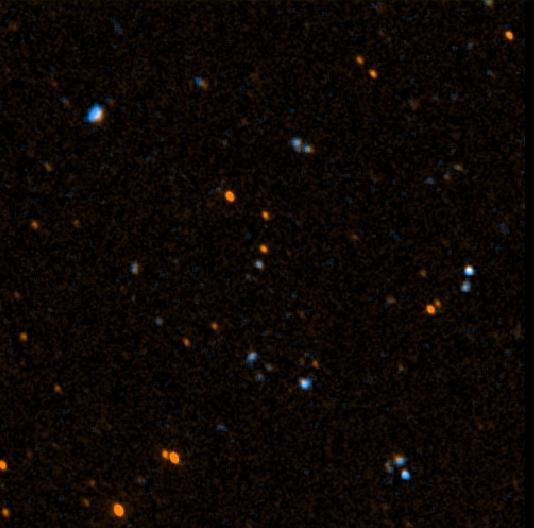
This image was taken May 21 and 22, 2003, by NASA Galaxy Evolution Explorer. The image was made from data gathered by the two channels of the spacecraft camera during the mission first light milestone.
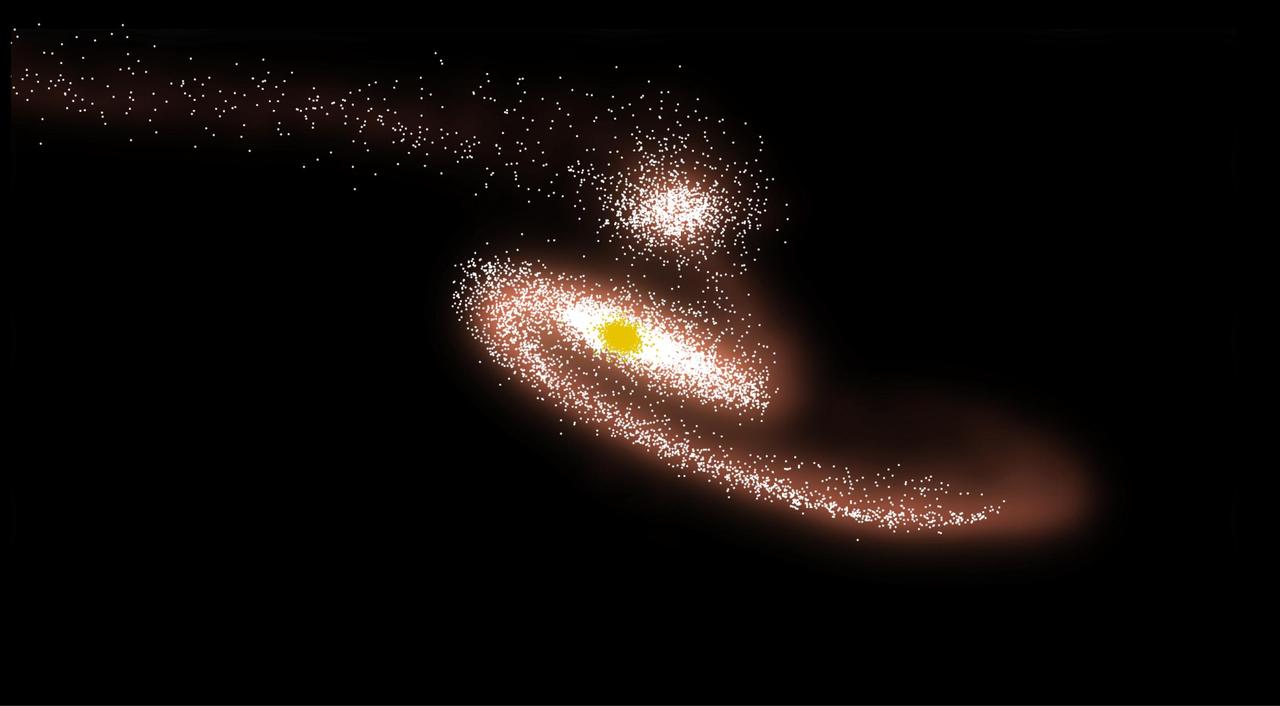
Computer simulations of the collision between NGC 6872 and IC 4970 reproduce the basic features of the galaxies as we see them today.
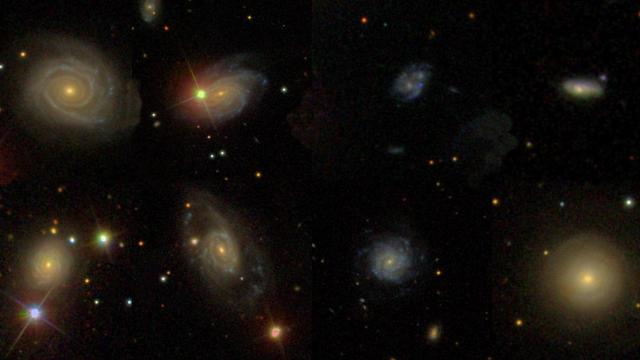
A new study analyzes several sites where dead stars once exploded. The explosions, called Type Ia supernovae, occurred within galaxies, six of which are shown in these images from the Sloan Digital Sky Survey.
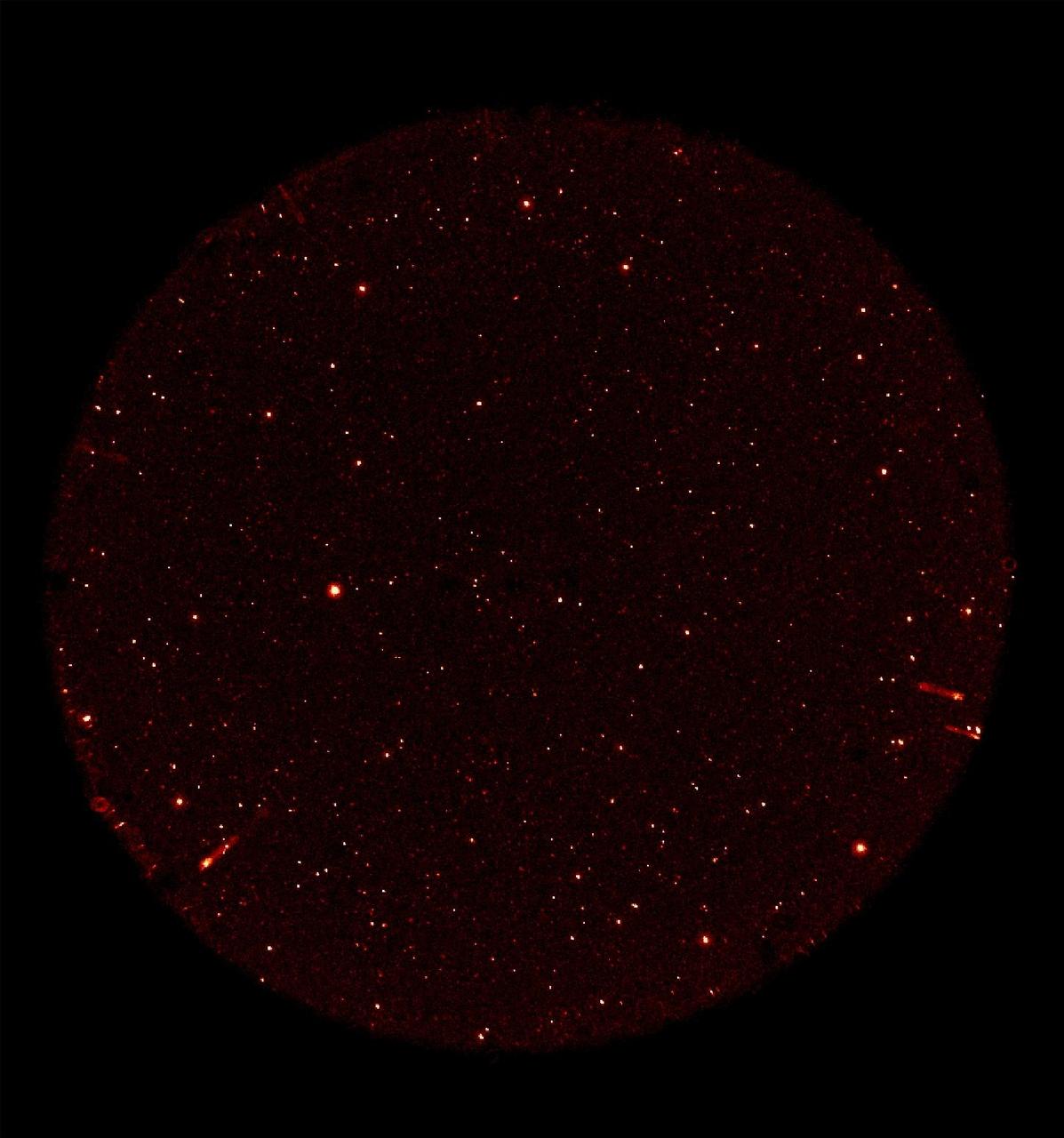
This image was taken on May 21 and 22, 2003, by NASA Galaxy Evolution Explorer. The image was made from data gathered during the missions first light milestone, and shows celestial objects in the constellation Hercules.

Evidence from NASA Galaxy Evolution Explorer supports the long-held notion that many galaxies begin life as smaller spirals before transforming into larger, elliptical-shaped galaxies.
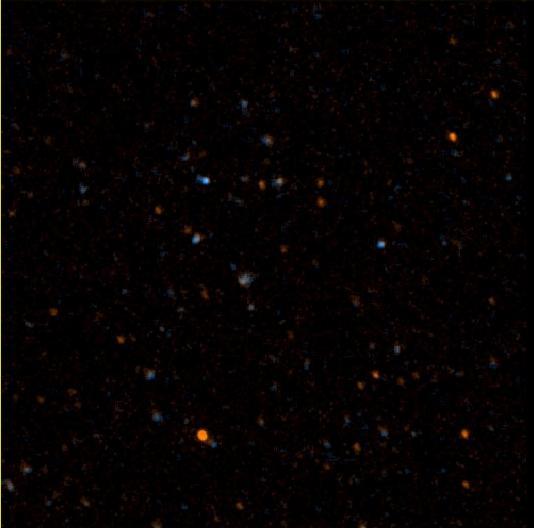
NASA's Galaxy Evolution Explorer took this image on May 21 and 22, 2003. The image was made from data gathered by the two channels of the spacecraft camera during the mission's "first light" milestone. It shows about 100 celestial objects in the constellation Hercules. The reddish objects represent those detected by the camera's near ultraviolet channel over a 5-minute period, while bluish objects were detected over a 3-minute period by the camera's far ultraviolet channel. The Galaxy Evolution Explorer's first light images are dedicated to the crew of the Space Shuttle Columbia. The Hercules region was directly above Columbia when it made its last contact with NASA Mission Control on February 1, over the skies of Texas. The Galaxy Evolution Explorer launched on April 28 on a mission to map the celestial sky in the ultraviolet and determine the history of star formation in the universe over the last 10 billion years. http://photojournal.jpl.nasa.gov/catalog/PIA04281

Since its launch in 2003, NASA Galaxy Evolution Explorer the space telescope originally designed to observe galaxies across the universe in ultraviolet light has discovered a festive sky blinking with flaring and erupting stars.

This image is from NASA Galaxy Evolution Explorer is an observation of the large galaxy in Andromeda, Messier 31. The Andromeda galaxy is the most massive in the local group of galaxies that includes our Milky Way.
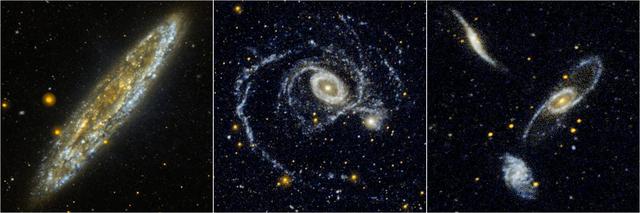
Located 10 million light-years away in the southern constellation Sculptor, the Silver Dollar galaxy, or NGC 253, is one of the brightest spiral galaxies in the night sky as seen in this edge-on view from NASA Galaxy Evolution Explorer.
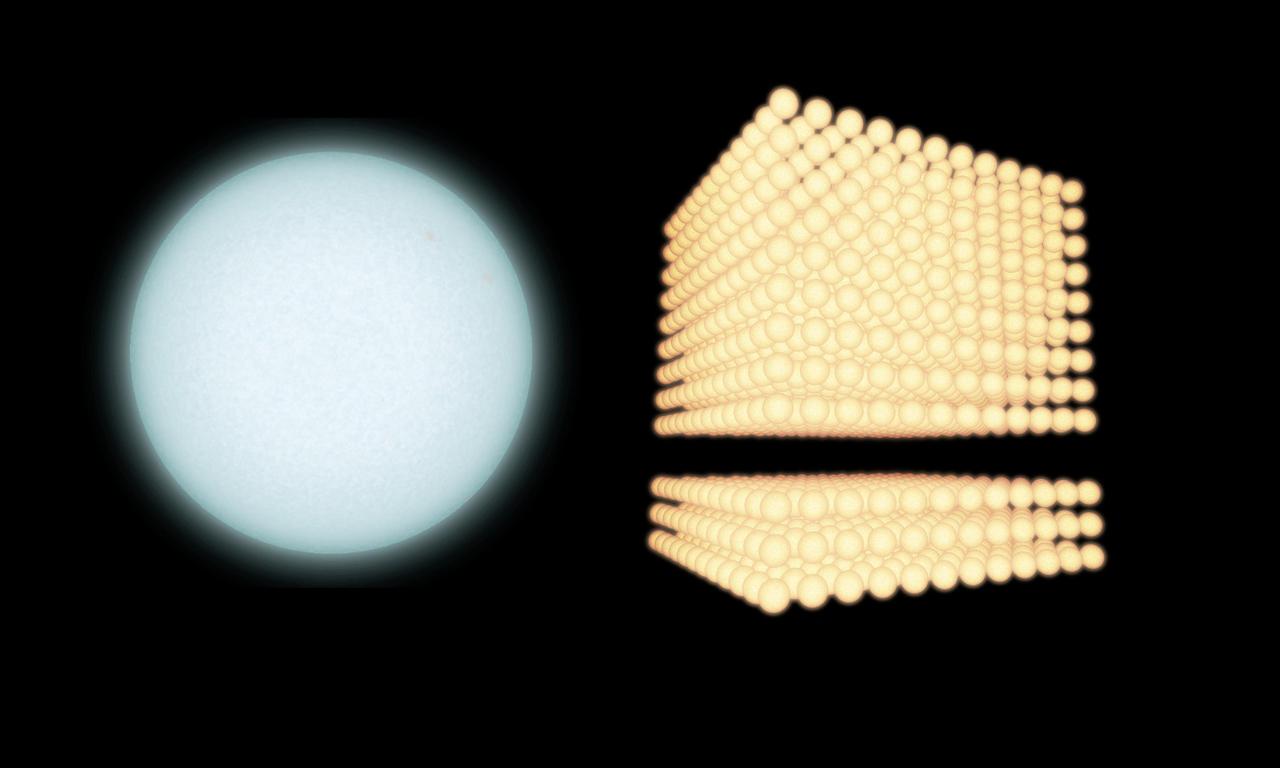
NASA Galaxy Evolution Explorer spacecraft and Cerro Tololo Inter-American Observatory combined data making this diagram illustratrating the extent to which astronomers have been underestimating the proportion of small to big stars in certain galaxies.
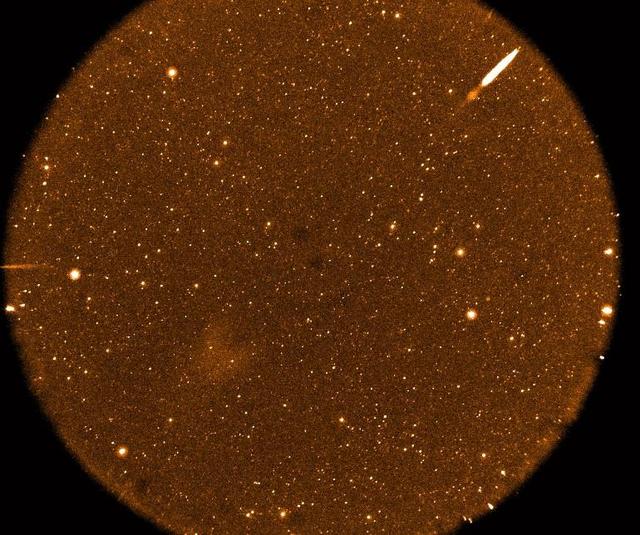
This is the first Deep Imaging Survey image taken by NASA Galaxy Evolution Explorer. On June 22 and 23, 2003, the spacecraft obtained this near ultraviolet image of the Groth region by adding multiple orbits for a total exposure time of 14,000 seconds. Tens of thousands of objects can be identified in this picture. http://photojournal.jpl.nasa.gov/catalog/PIA04627
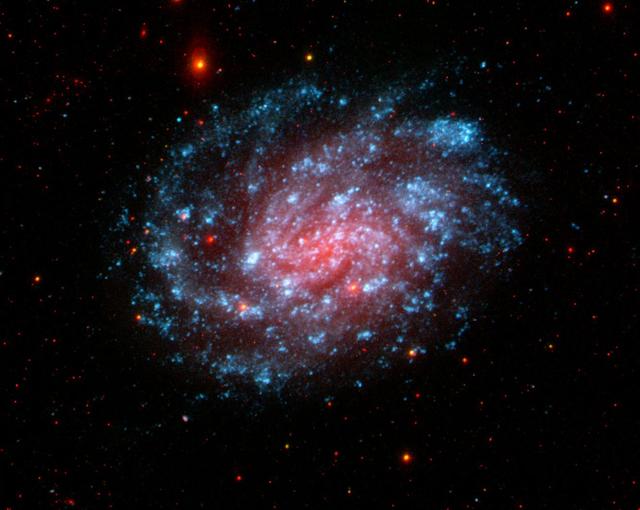
This image from NASA Galaxy Evolution Explorer shows the galaxy NGC 300, located about seven million light-years away in the constellation Sculptor. It is a classic spiral galaxy with open arms and vigorous star formation throughout.
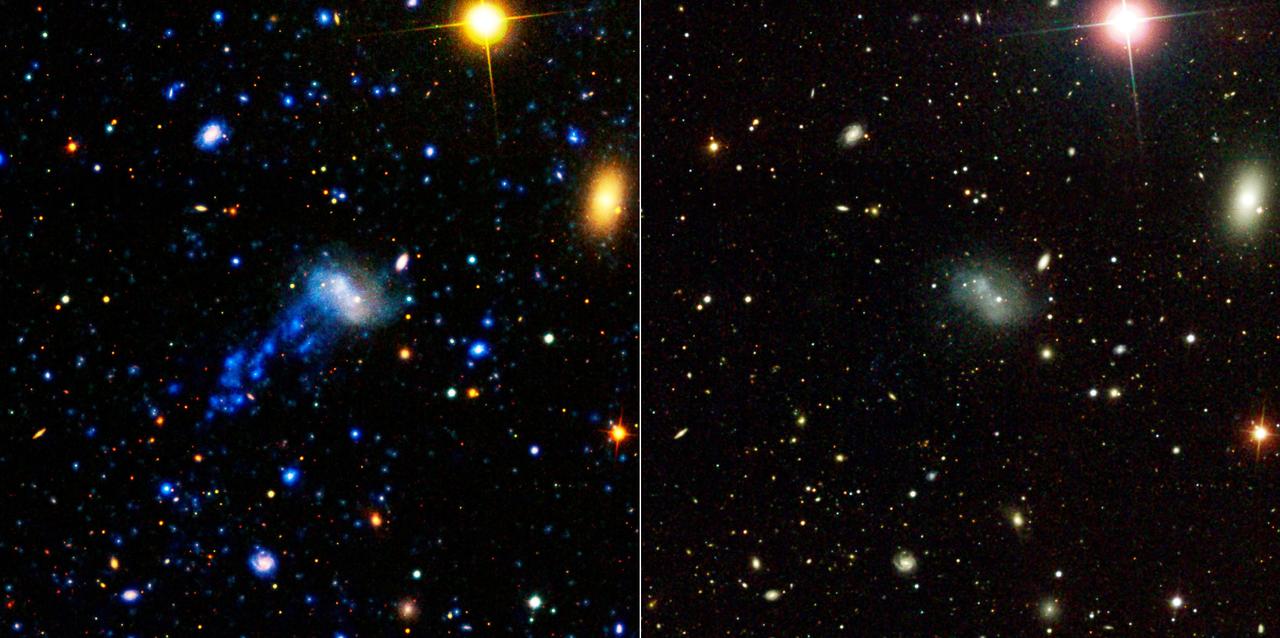
NASA Galaxy Evolution Explorer found a tail behind a galaxy called IC 3418. This star-studded tail was created as the galaxy plunged into gas in a family of galaxies known as the Virgo cluster.
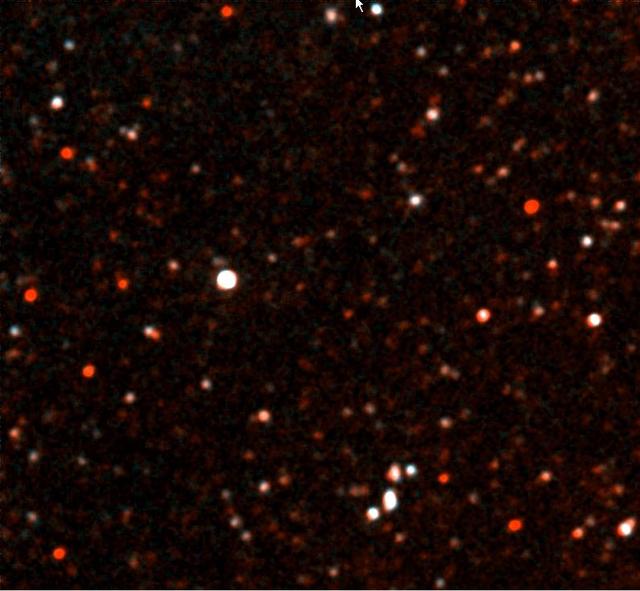
This ultraviolet color blowup of the Groth Deep Image was taken by NASA Galaxy Evolution Explorer on June 22 and June 23, 2003. Many hundreds of galaxies are detected in this portion of the image. NASA astronomers believe the faint red galaxies are 6 billion light years away. http://photojournal.jpl.nasa.gov/catalog/PIA04625
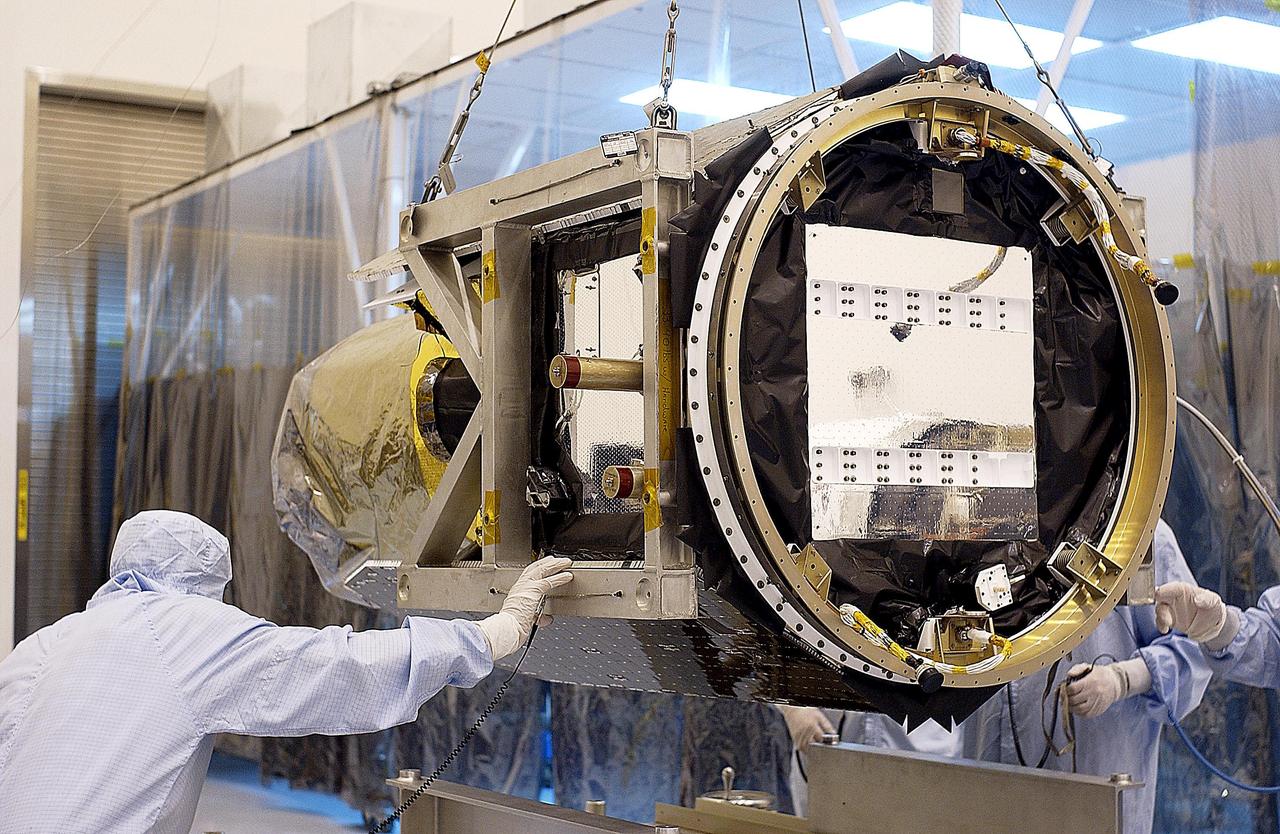
KENNEDY SPACE CENTER, Fla. - The Galaxy Evolution Explorer (GALEX) spacecraft is lowered toward a work stand. Foreign object debris shields will be installed before its launch. The GALEX is an orbiting space telescope that will observe galaxies in ultraviolet light across 10 billion years of cosmic history. During its 29-month mission GALEX will produce the first comprehensive map of a Universe of galaxies under construction, bringing more understanding how galaxies like the Milky Way were formed. The GALEX launch date is under review.
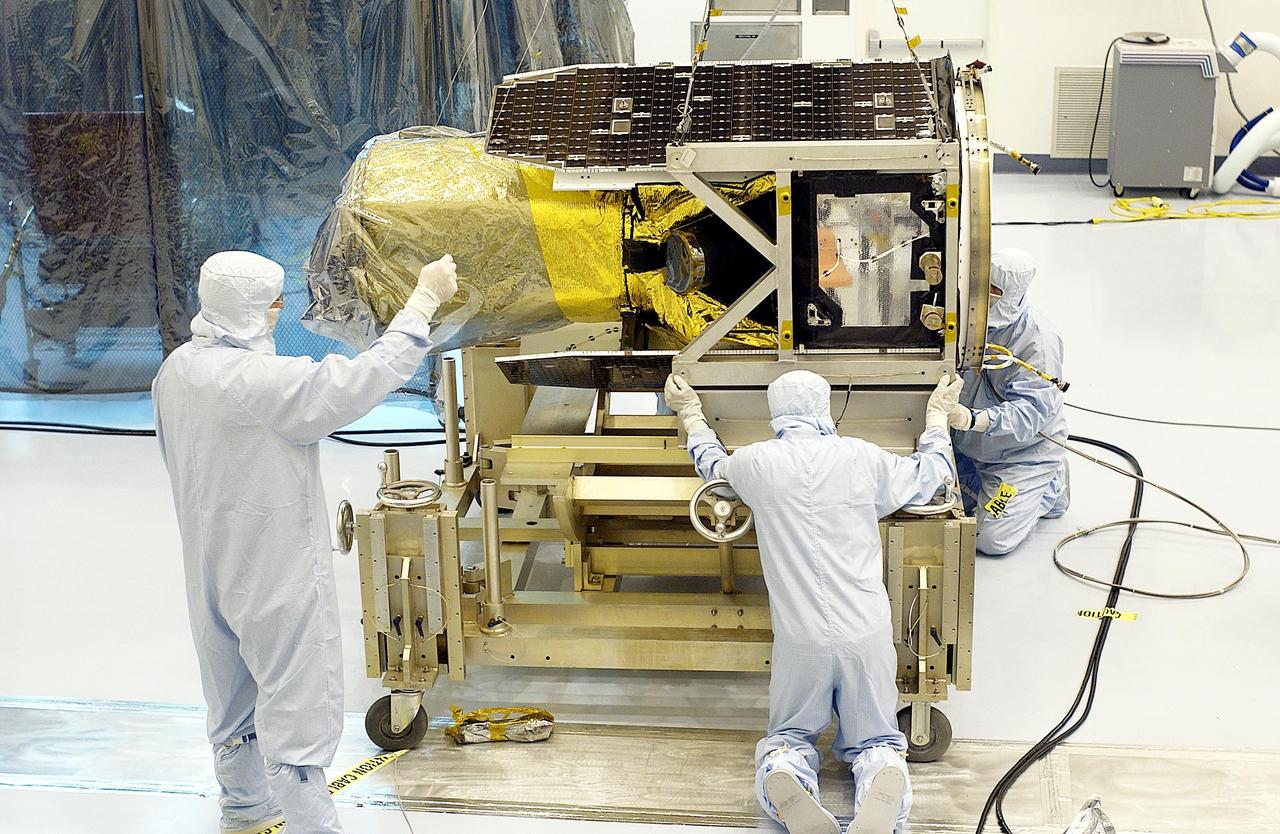
KENNEDY SPACE CENTER, Fla. - The Galaxy Evolution Explorer (GALEX) spacecraft is placed on a work stand. Foreign object debris shields will be installed before its launch. The GALEX is an orbiting space telescope that will observe galaxies in ultraviolet light across 10 billion years of cosmic history. During its 29-month mission GALEX will produce the first comprehensive map of a Universe of galaxies under construction, bringing more understanding how galaxies like the Milky Way were formed. The GALEX launch date is under review.
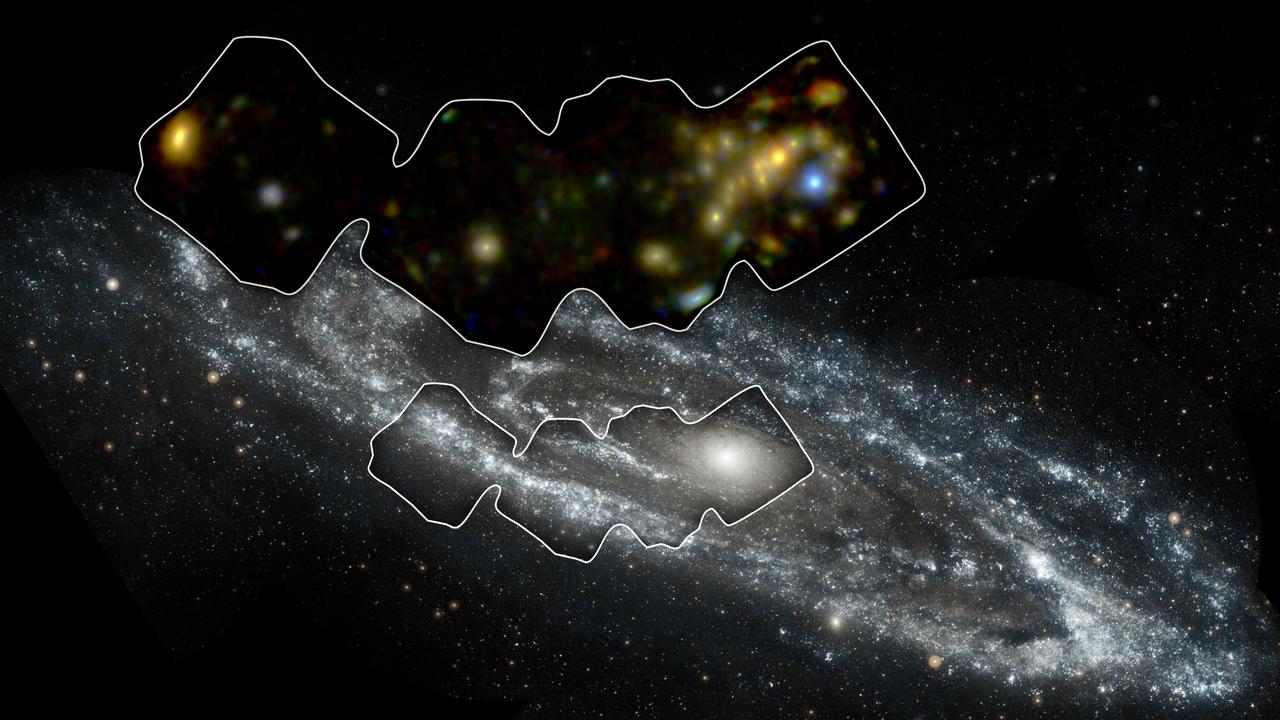
These images from NASA GALEX and NuSTAR is of Andromeda, a spiral galaxy like our Milky Way but larger in size. It lies 2.5 million light-years away in the Andromeda constellation.
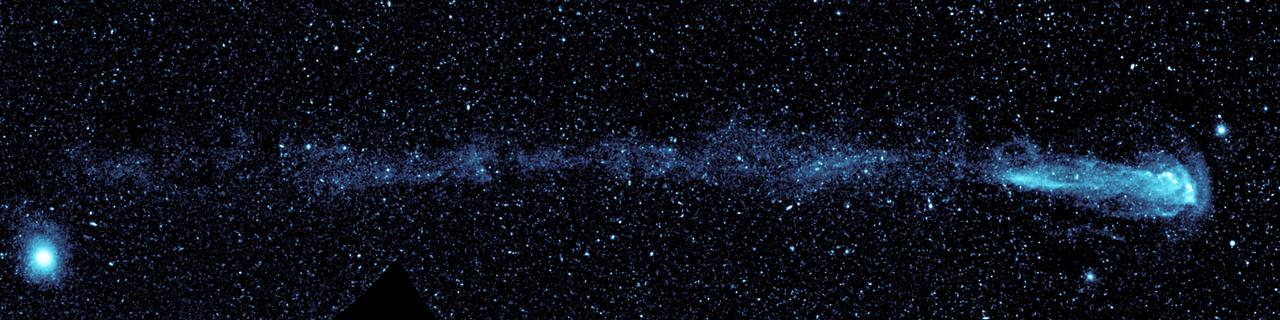
New ultraviolet images from NASA Galaxy Evolution Explorer shows a speeding star that is leaving an enormous trail of eeds for new solar systems. The star, named Mira pronounced my-rah after the latin word for wonderful.
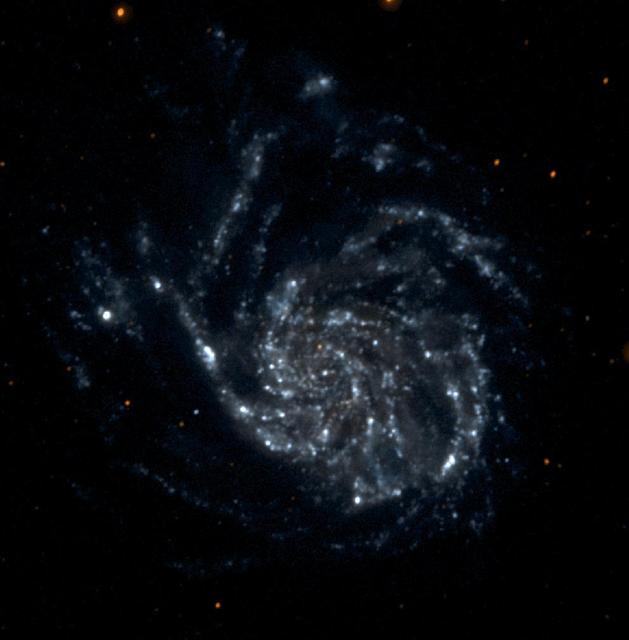
This single orbit exposure, ultraviolet color image of Messier 101 was taken by NASA's Galaxy Evolution Explorer on June 20, 2003. Messier 101 is a large spiral galaxy located 20 million light-years from Earth. This image is a short and medium "exposure" picture of the evolution of star formation in a spiral galaxy. The far ultraviolet emission detects the younger stars as concentrated in tight spiral arms, while the near ultraviolet emission, which traces stars living for more than 100 million years, displays the movement of the spiral pattern over a 100 million year period. The red stars in the foreground of the image are Milky Way stars. http://photojournal.jpl.nasa.gov/catalog/PIA04632
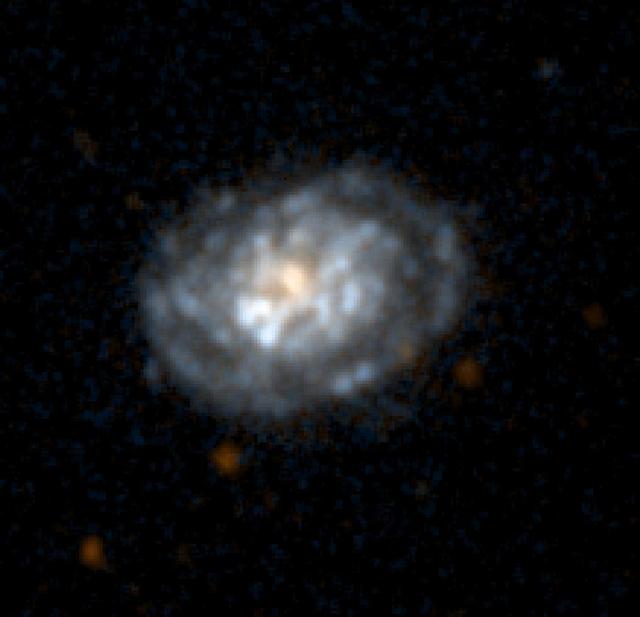
NASA Galaxy Evolution Explorer took this ultraviolet color image of the galaxy NGC5962 on June 7, 2003. This spiral galaxy is located 90 million light-years from Earth. http://photojournal.jpl.nasa.gov/catalog/PIA04635
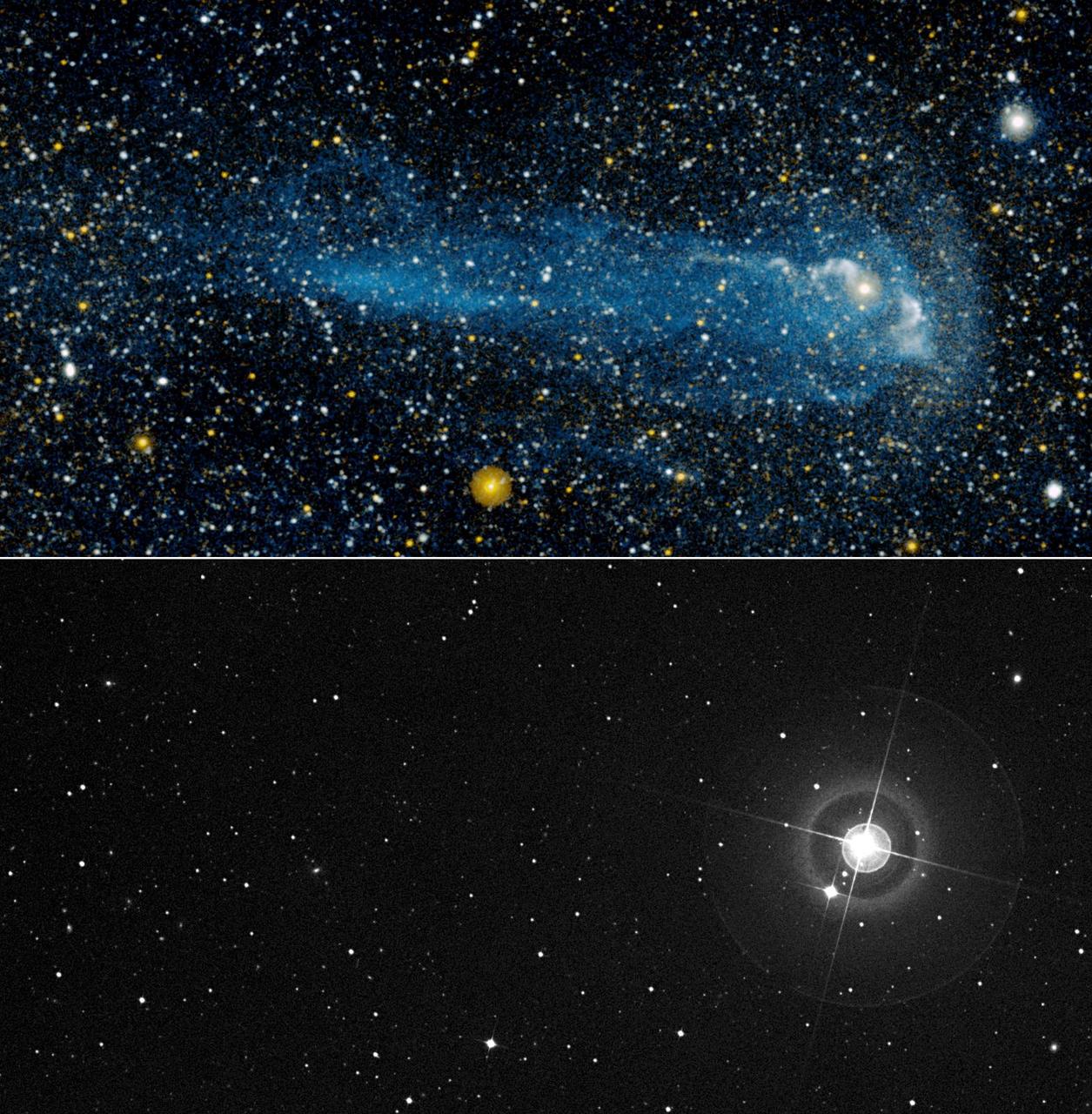
NASA Galaxy Evolution Explorer discovered an exceptionally long comet-like tail of material trailing behind Mira -- a star that has been studied thoroughly for about 400 years.

Since its launch five years ago, the Galaxy Evolution Explorer has photographed hundreds of millions of galaxies in ultraviolet light. M106 is one of those galaxies, 22 light years away, it strikes a pose in blue and gold for this new commemorative portrait. The galaxy's extended arms are the blue filaments that curve around its edge, creating its outer disk. Tints of blue in M106's arms reveal hot, young massive stars. Traces of gold toward the center show an older stellar population and indicate the presence of obscuring dust. From 24 million light-years away, neighboring galaxy NGC 4248 also makes a memorable appearance, sitting just right of M106. The irregular galaxy looks like a yellow smudge, with a bluish-white bar in the center. The galaxy's outer golden glow indicates a population of older stars, while the blue central region shows a younger stellar demographic. Dwarf galaxy UGC 7365 emerges at the bottom center of this image, as a faint yellow smudge directly below M106. This galaxy is not forming any new stars, and looks much smaller than M106 despite being closer to Earth, at 14 million light-years away. Over the past five years, the Galaxy Evolution Explorer has imaged half a billion objects over 27,000 square degrees of sky —equivalent to an area that would be covered by 138,000 full moons. The telescope orbits Earth every 94 minutes and travels approximately 408,470 million miles per day. Its overarching question is: how do galaxies grow and change over 10 billion years of cosmic history? M106, also known as NGC 4258, is located in the constellation Canes Venatici. This image is a two-color composite, where far-ultraviolet light is blue, and near-ultraviolet light is red. http://photojournal.jpl.nasa.gov/catalog/PIA10600
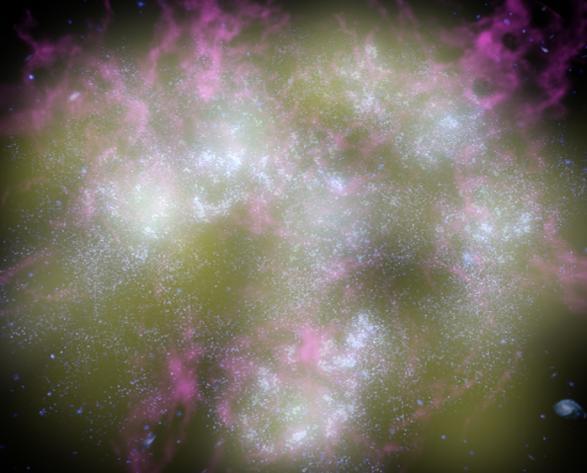
This artist's animation shows a typical young galaxy, teeming with hot, newborn stars and exploding supernovas. The supernovas are seen as white flashes of light. NASA's Galaxy Evolution Explorer spotted three-dozen young galaxies like the one shown here in our corner of the universe. It was able to see them with the help of its highly sensitive ultraviolet detectors. Because newborn stars radiate ultraviolet light, young galaxies light up brilliantly when viewed in ultraviolet wavelengths. The findings came as a surprise, because astronomers had thought that the universe's "birth-rate" had declined, and that massive galaxies were no longer forming. http://photojournal.jpl.nasa.gov/catalog/PIA07144
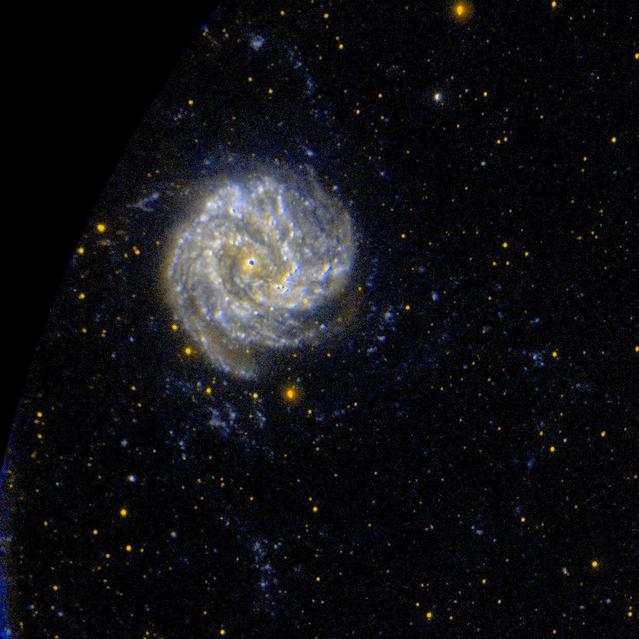
Ultraviolet images such as this one from NASA's Galaxy Evolution Explorer suggest the M83 has unusual pockets of star formation separated by large distances from the spiral arms in the main disk of the galaxy. http://photojournal.jpl.nasa.gov/catalog/PIA07903
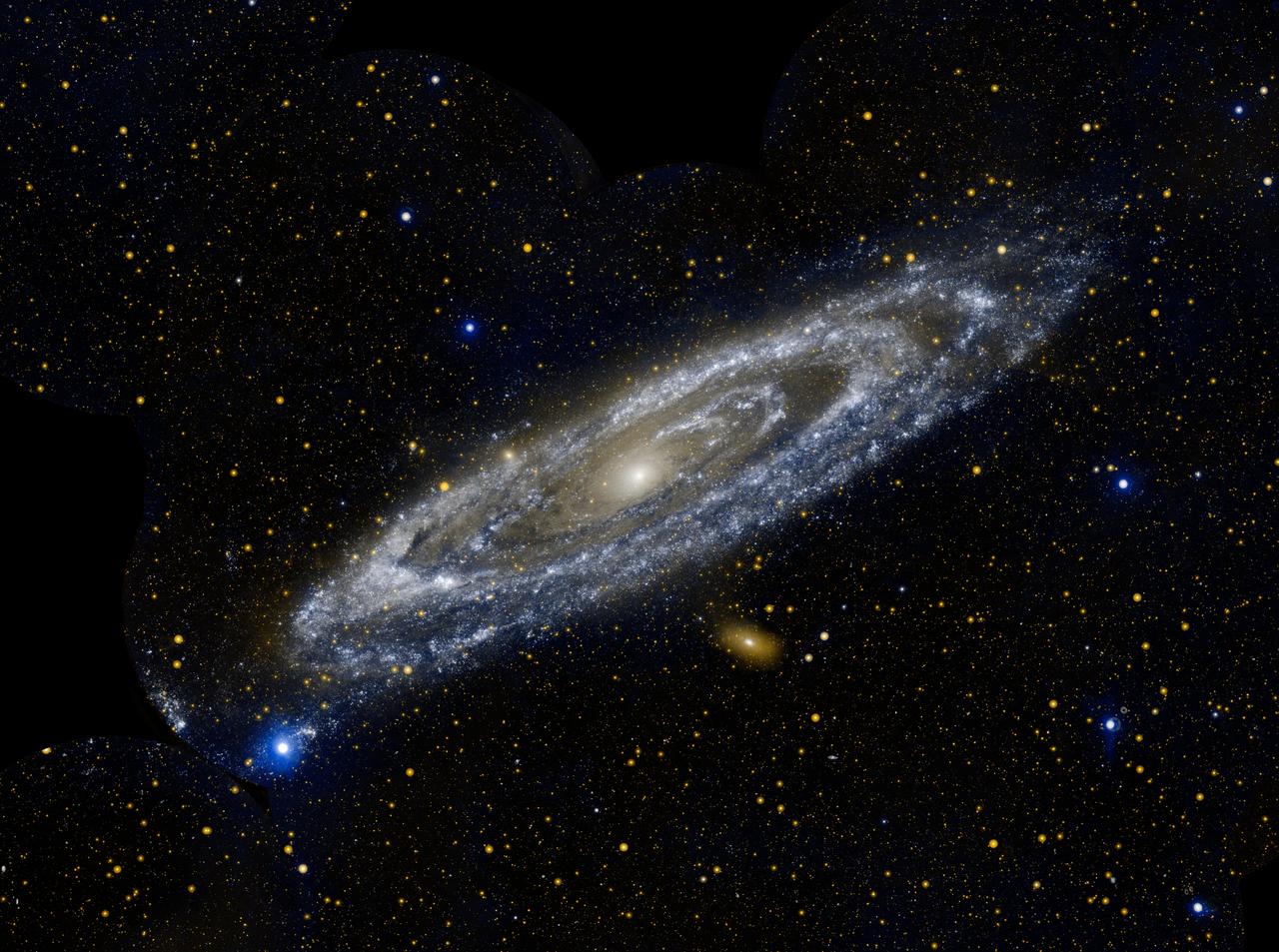
Hot stars burn brightly in this new image from NASA Galaxy Evolution Explorer, showing the ultraviolet side of a familiar face. Approximately 2.5 million light-years away, the Andromeda galaxy, or M31, is our Milky Way largest galactic neighbor.

This is an ultraviolet color image of the galaxy NGC5398 taken by NASA Galaxy Evolution Explorer on June 7, 2003. NGC5398 is a barred spiral galaxy located 60 million light-years from Earth. The star formation is concentrated in the two bright regions of the image. http://photojournal.jpl.nasa.gov/catalog/PIA04633
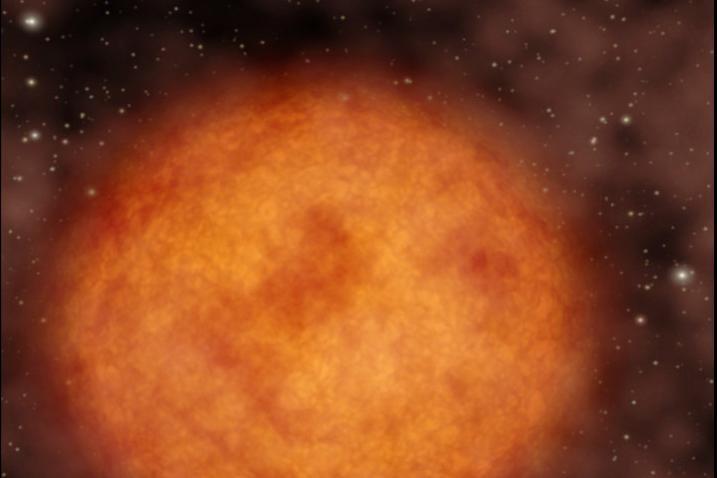
This artist concept illustrates a star flying through our galaxy at supersonic speeds, leaving a 13-light-year-long trail of glowing material in its wake. The star, named Mira pronounced my-rah after the latin word for wonderful.
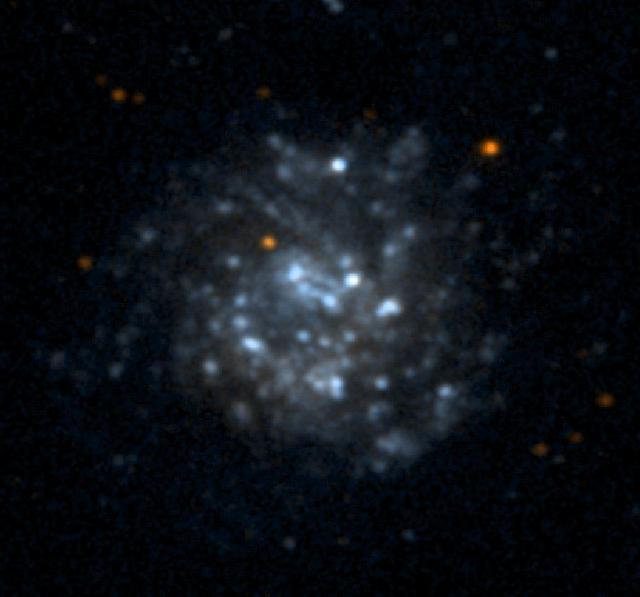
NASA Galaxy Evolution Explorer took this ultraviolet color image of the galaxy NGC5474 on June 7, 2003. NGC5474 is located 20 million light-years from Earth and is within a group of galaxies dominated by the Messier 101 galaxy. Star formation in this galaxy shows some evidence of a disturbed spiral pattern, which may have been induced by tidal interactions with Messier 101. http://photojournal.jpl.nasa.gov/catalog/PIA04634

This image of the active galaxy Centaurus A was taken by NASA's Galaxy Evolution Explorer on June 7, 2003. The galaxy is located 30 million light-years from Earth and is seen edge on, with a prominent dust lane across the major axis. In this image the near ultraviolet emission is represented as green, and the far ultraviolet emission as blue. The galaxy exhibits jets of high energy particles, which were traced by the X-ray emission and measured by NASA's Chandra X-ray Observatory. These X-ray emissions are seen as red in the image. Several regions of ultraviolet emission can be seen where the jets of high energy particles intersect with hydrogen clouds in the upper left corner of the image. The emission shown may be the result of recent star formation triggered by the compression of gas by the jet. http://photojournal.jpl.nasa.gov/catalog/PIA04624
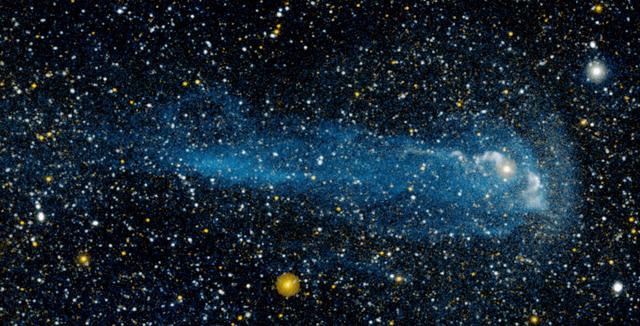
A close-up view of a star racing through space faster than a speeding bullet can be seen in this image from NASA Galaxy Evolution Explorer. The star is called Mira pronounced My-rah.
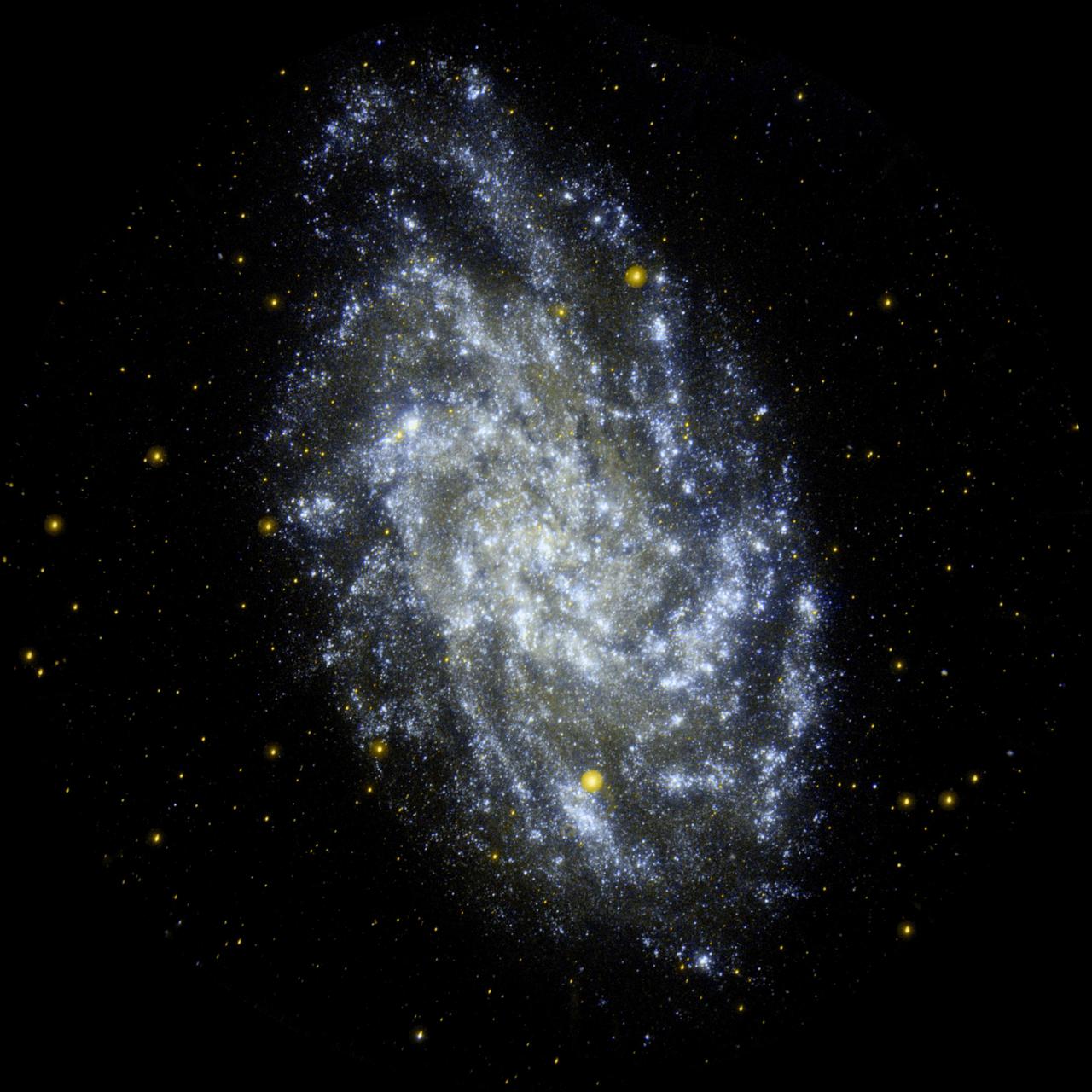
This image from NASA Galaxy Evolution Explorer shows M33, the Triangulum Galaxy, is a perennial favorite of amateur and professional astronomers alike, due to its orientation and relative proximity to us.
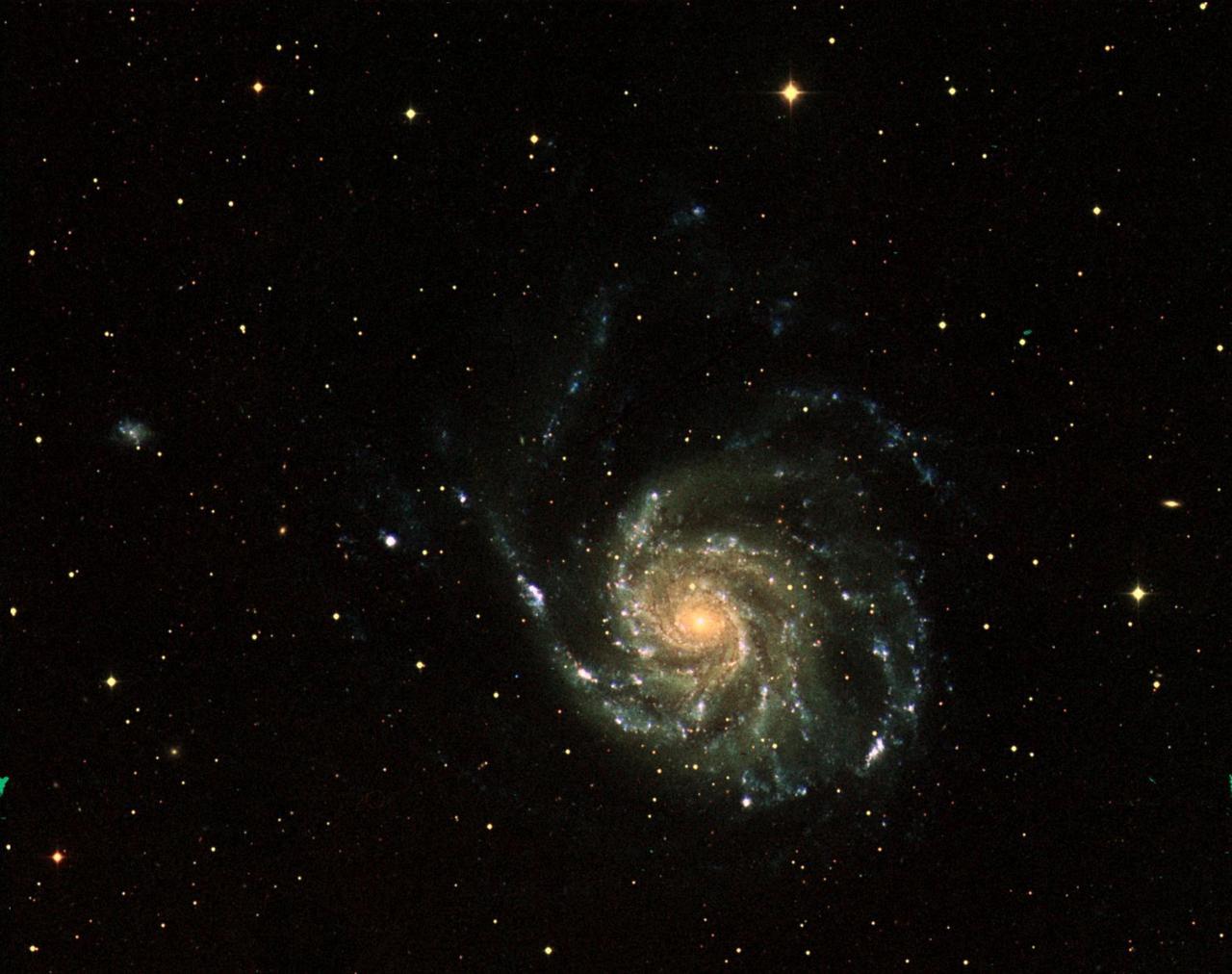
This three-color image of galaxy M101 was taken by NASA's Galaxy Evolution Explorer on June 20, 2003. The far ultraviolet emissions are shown in blue, the near ultraviolet emissions are green, and the red emissions, which were taken from NASA's Digital Sky Survey, represent visible light. This image combines short, medium, and long "exposure" pictures to best display the evolution of star formation in a spiral galaxy. http://photojournal.jpl.nasa.gov/catalog/PIA04630
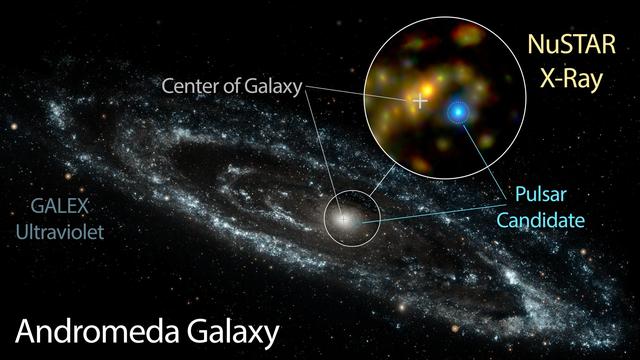
NASA's Nuclear Spectroscope Telescope Array, or NuSTAR, has identified a candidate pulsar in Andromeda -- the nearest large galaxy to the Milky Way. This likely pulsar is brighter at high energies than the Andromeda galaxy's entire black hole population. The inset image shows the pulsar candidate in blue, as seen in X-ray light by NuSTAR. The background image of Andromeda was taken by NASA's Galaxy Evolution Explorer in ultraviolet light. Andromeda is a spiral galaxy like our Milky Way but larger in size. It lies 2.5 million light-years away in the Andromeda constellation. http://photojournal.jpl.nasa.gov/catalog/PIA20970

This ultraviolet image from NASA Galaxy Evolution Explorer is of a small area of the Virgo Cluster of galaxies. http://photojournal.jpl.nasa.gov/catalog/PIA07906

KENNEDY SPACE CENTER, Fla. - The Galaxy Evolution Explorer (GALEX) spacecraft is lifted toward a work stand (in the foreground). Foreign object debris shields will be installed before its launch. The GALEX is an orbiting space telescope that will observe galaxies in ultraviolet light across 10 billion years of cosmic history. During its 29-month mission GALEX will produce the first comprehensive map of a Universe of galaxies under construction, bringing more understanding how galaxies like the Milky Way were formed. The GALEX launch date is under review.

KENNEDY SPACE CENTER, FLA. - Foreign object debris shields are installed and a borescope inspection is conducted on the Galaxy Evolution Explorer (GALEX) spacecraft in the Payload Hazardous Servicing Facility. Technicians are looking for a small fastener and associated clip missing from a demated connector identified during preflight testing. GALEX is an orbiting space telescope that will observe galaxies in ultraviolet light across 10 billion years of cosmic history. During its 29-month mission, GALEX will produce the first comprehensive map of a Universe of galaxies under construction, bringing more understanding to how galaxies like the Milky Way were formed. The GALEX launch date in late April is currently under review.
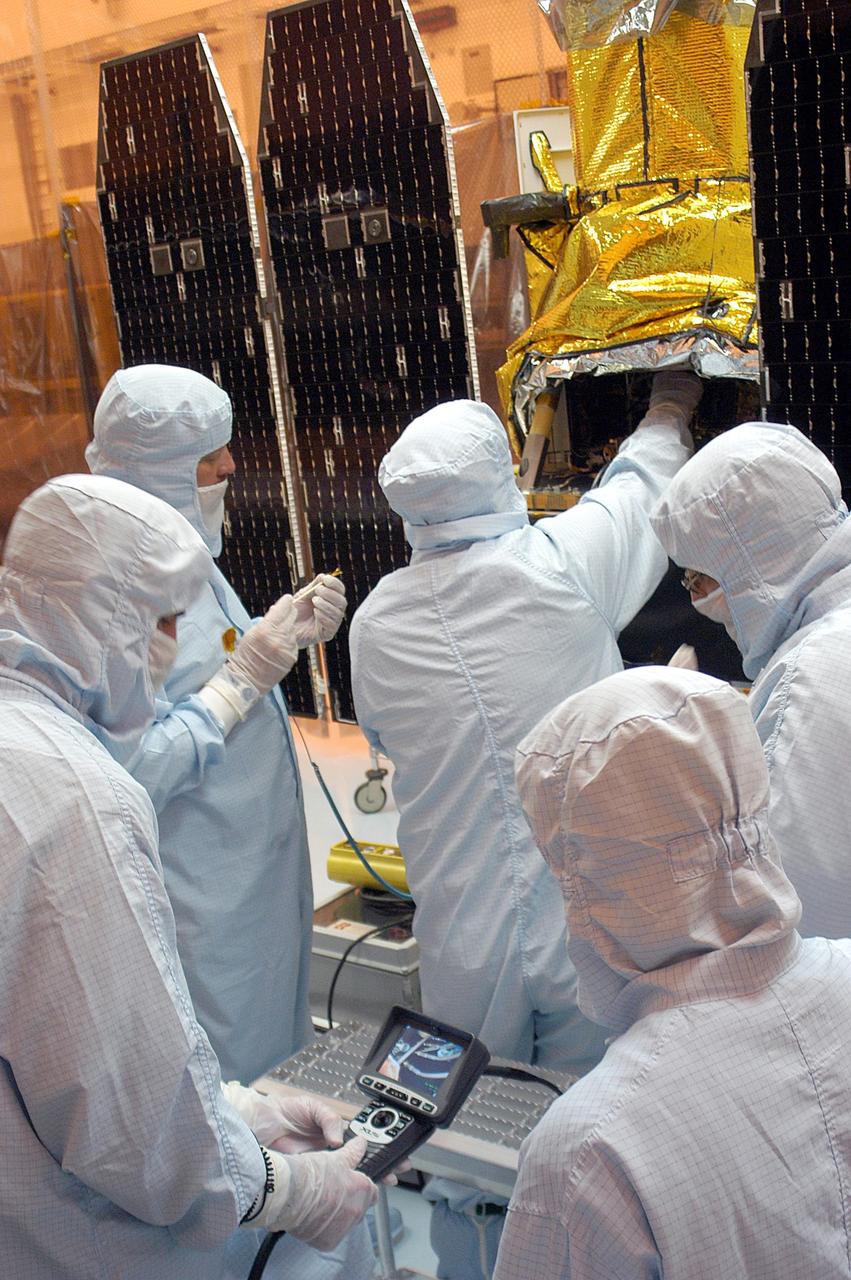
KENNEDY SPACE CENTER, FLA. - Foreign object debris shields are installed and a borescope inspection is conducted on the Galaxy Evolution Explorer (GALEX) spacecraft in the Payload Hazardous Servicing Facility. Technicians are looking for a small fastener and associated clip missing from a demated connector identified during preflight testing. GALEX is an orbiting space telescope that will observe galaxies in ultraviolet light across 10 billion years of cosmic history. During its 29-month mission, GALEX will produce the first comprehensive map of a Universe of galaxies under construction, bringing more understanding to how galaxies like the Milky Way were formed. The GALEX launch date in late April is currently under review.
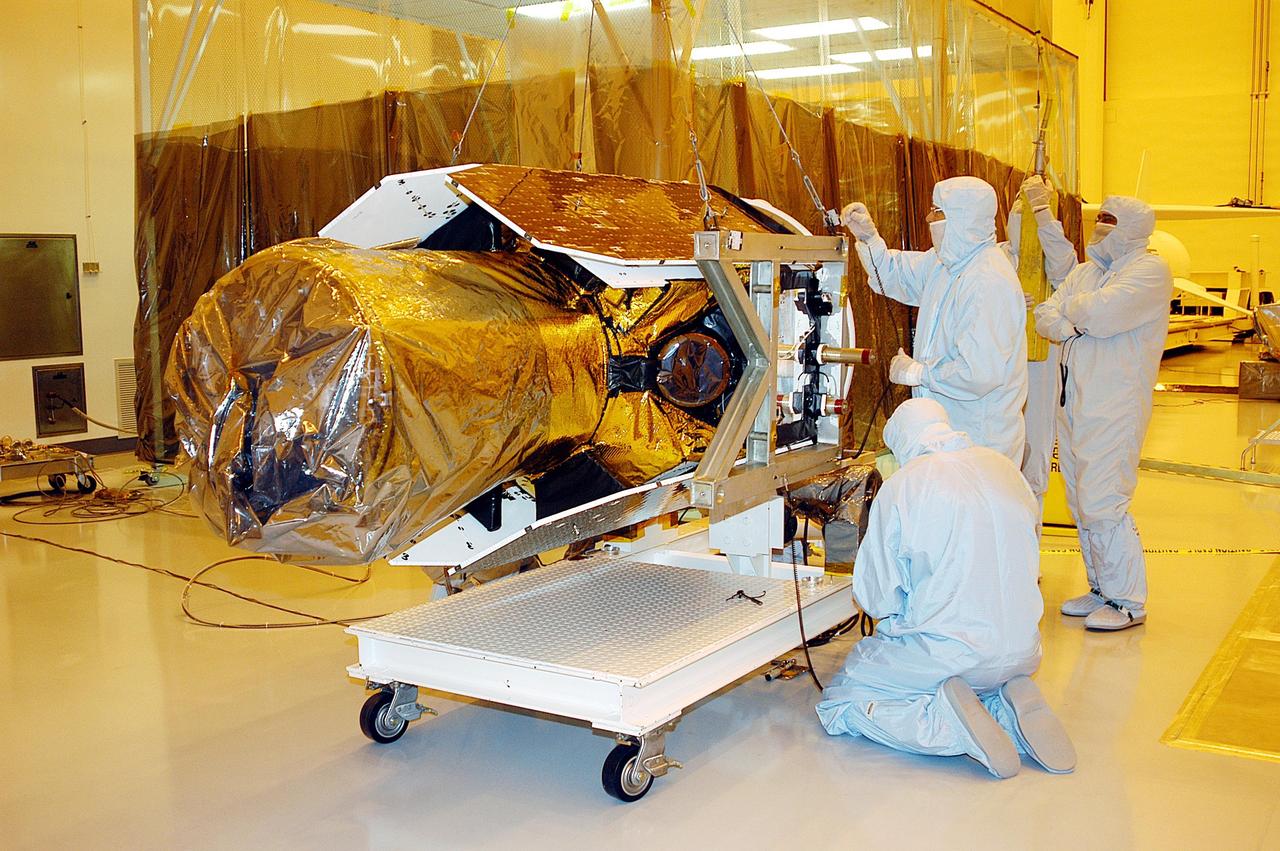
KENNEDY SPACE CENTER, FLA. - The Galaxy Evolution Explorer (GALEX) spacecraft is demated from its Pegasus launch vehicle and secured to a workstand in the Payload Hazardous Servicing Facility. A borescope inspection will be conducted to locate a small fastener and associated clip missing from a demated connector identified during preflight testing. GALEX is an orbiting space telescope that will observe galaxies in ultraviolet light across 10 billion years of cosmic history. During its 29-month mission, GALEX will produce the first comprehensive map of a Universe of galaxies under construction, bringing more understanding to how galaxies like the Milky Way were formed. The GALEX launch date in late April is currently under review.
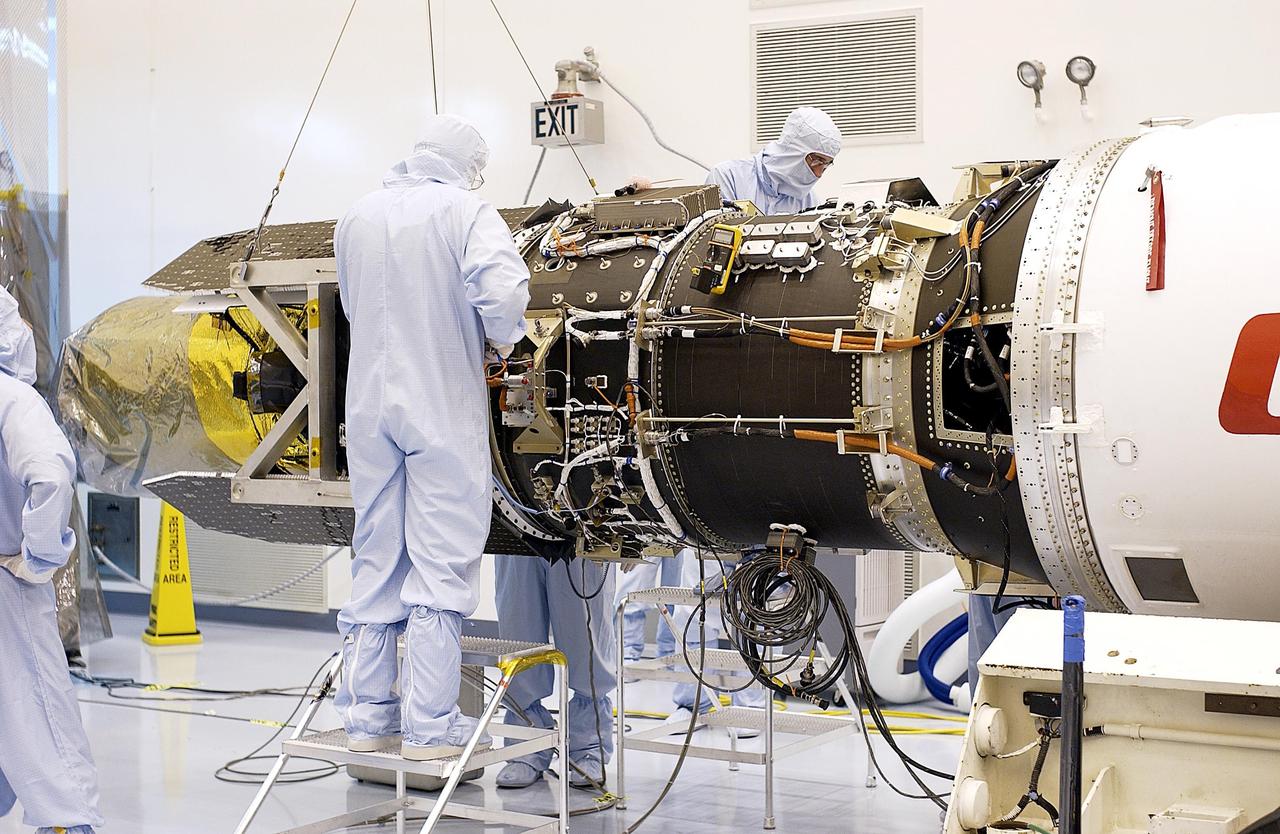
KENNEDY SPACE CENTER, FLA. - Workers in the Multi-Payload Processing Facility prepare to demate the Galaxy Evolution Explorer (GALEX) spacecraft from the Pegasus XL launch vehicle. Foreign object debris shields will be installed before its launch. The GALEX is an orbiting space telescope that will observe galaxies in ultraviolet light across 10 billion years of cosmic history. During its 29-month mission GALEX will produce the first comprehensive map of a Universe of galaxies under construction, bringing more understanding how galaxies like the Milky Way were formed. The GALEX launch date is under review.
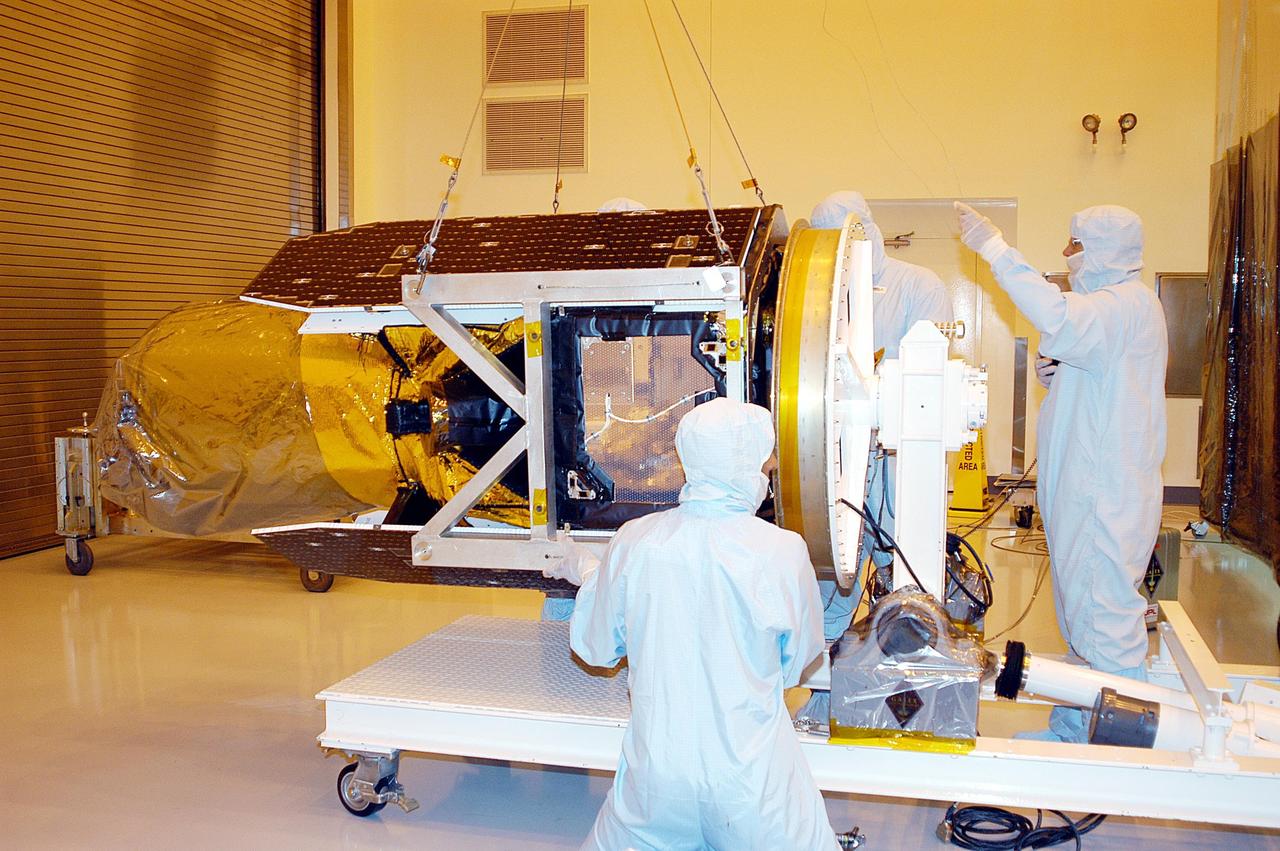
KENNEDY SPACE CENTER, FLA. - The Galaxy Evolution Explorer (GALEX) spacecraft is demated from its Pegasus launch vehicle and secured to a workstand in the Payload Hazardous Servicing Facility. A borescope inspection will be conducted to locate a small fastener and associated clip missing from a demated connector identified during preflight testing. GALEX is an orbiting space telescope that will observe galaxies in ultraviolet light across 10 billion years of cosmic history. During its 29-month mission, GALEX will produce the first comprehensive map of a Universe of galaxies under construction, bringing more understanding to how galaxies like the Milky Way were formed. The GALEX launch date in late April is currently under review.
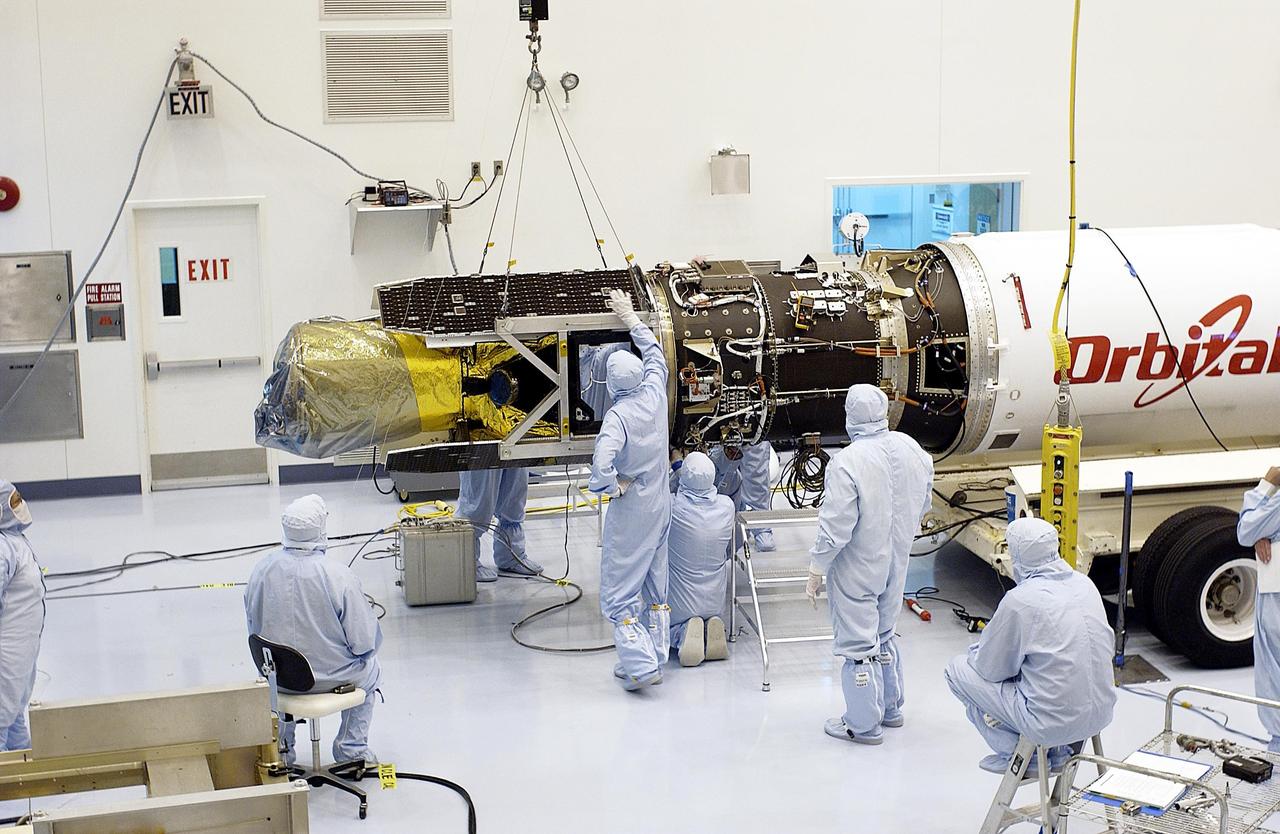
KENNEDY SPACE CENTER, Fla. - Workers in the Multi-Payload Processing Facility begin demating the Galaxy Evolution Explorer (GALEX) spacecraft from the Pegasus XL launch vehicle. Foreign object debris shields will be installed before its launch. The GALEX is an orbiting space telescope that will observe galaxies in ultraviolet light across 10 billion years of cosmic history. During its 29-month mission GALEX will produce the first comprehensive map of a Universe of galaxies under construction, bringing more understanding how galaxies like the Milky Way were formed. The GALEX launch date is under review.
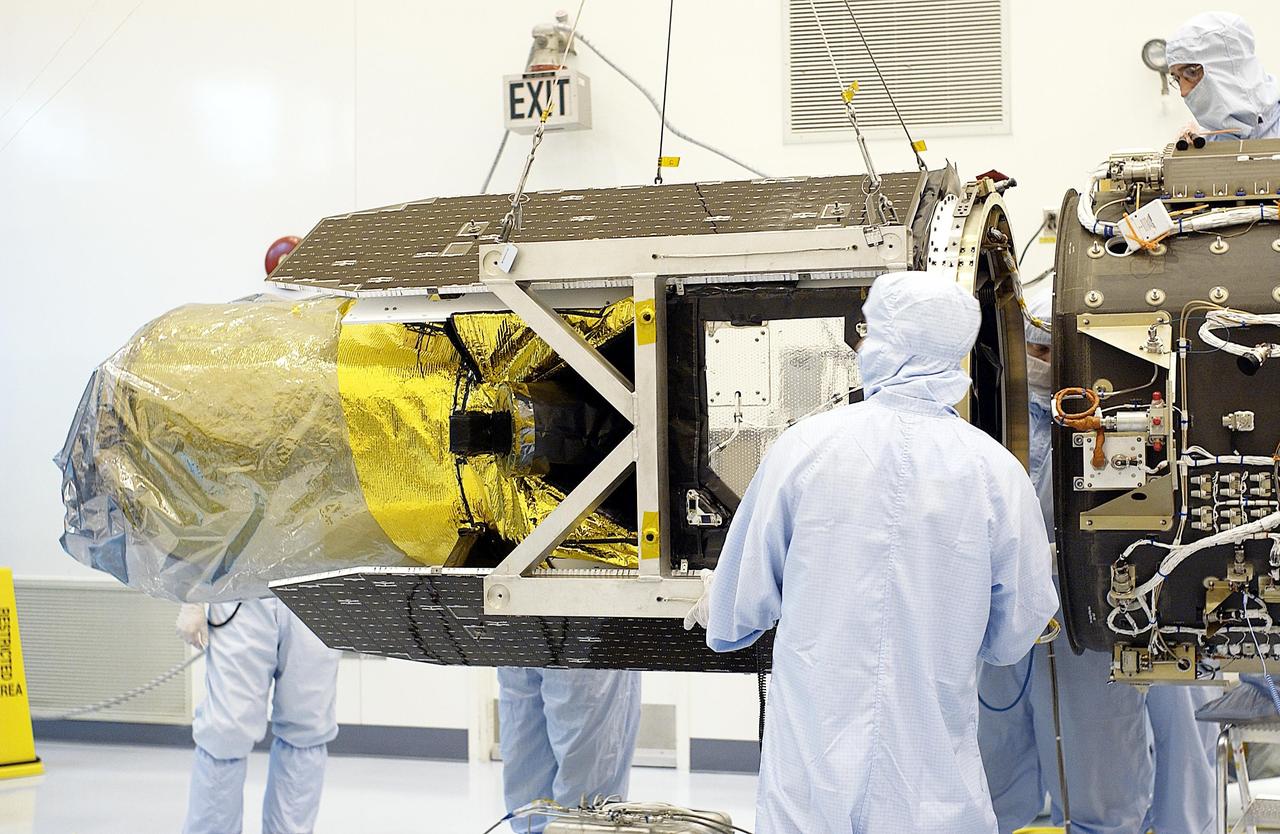
KENNEDY SPACE CENTER, Fla. - The Galaxy Evolution Explorer (GALEX) spacecraft is moved away from the Pegasus XL launch vehicle. Foreign object debris shields will be installed before its launch. The GALEX is an orbiting space telescope that will observe galaxies in ultraviolet light across 10 billion years of cosmic history. During its 29-month mission GALEX will produce the first comprehensive map of a Universe of galaxies under construction, bringing more understanding how galaxies like the Milky Way were formed. The GALEX launch date is under review.
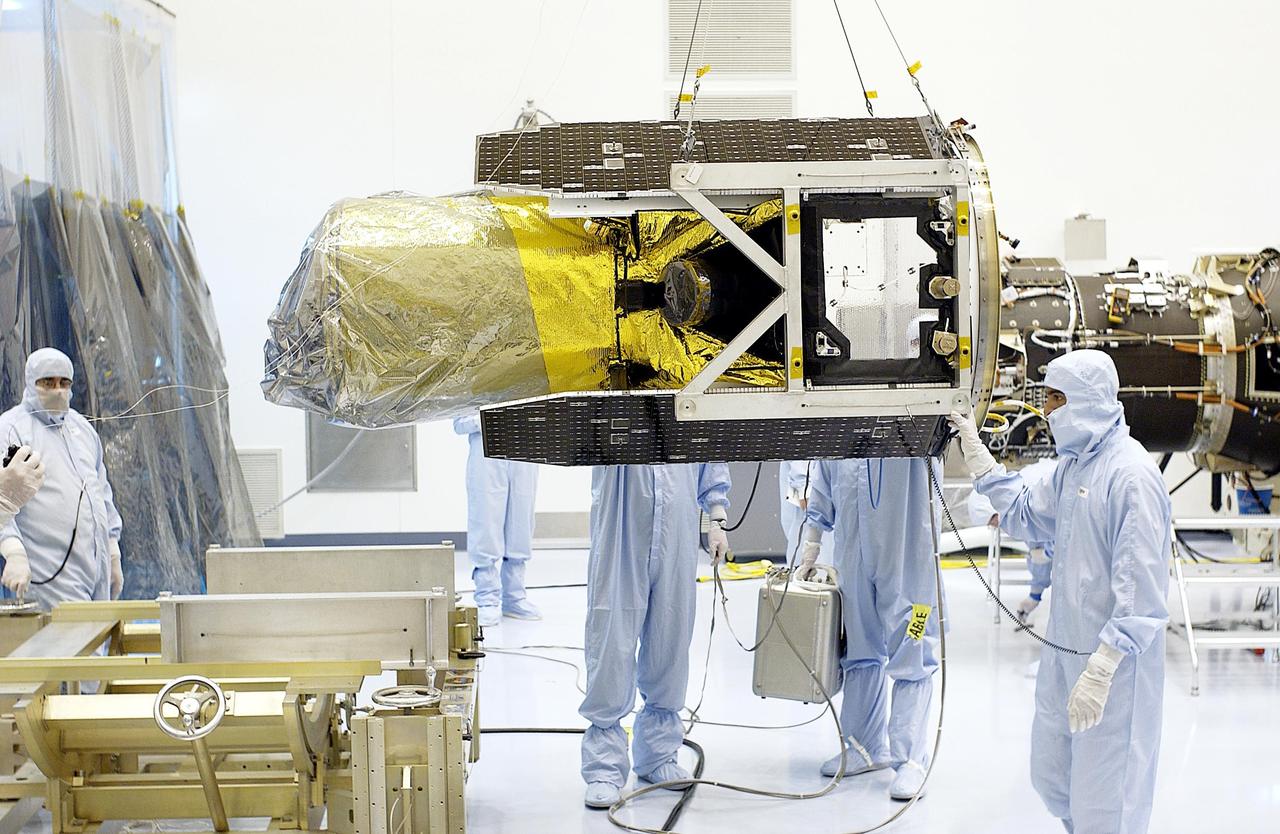
KENNEDY SPACE CENTER, Fla. - The Galaxy Evolution Explorer (GALEX) spacecraft is moved toward a work stand (in the foreground). Foreign object debris shields will be installed before its launch. The GALEX is an orbiting space telescope that will observe galaxies in ultraviolet light across 10 billion years of cosmic history. During its 29-month mission GALEX will produce the first comprehensive map of a Universe of galaxies under construction, bringing more understanding how galaxies like the Milky Way were formed. The GALEX launch date is under review.

KENNEDY SPACE CENTER, Fla. - The Galaxy Evolution Explorer (GALEX) spacecraft is lifted away from the Pegasus XL launch vehicle after demating. Foreign object debris shields will be installed before its launch. The GALEX is an orbiting space telescope that will observe galaxies in ultraviolet light across 10 billion years of cosmic history. During its 29-month mission GALEX will produce the first comprehensive map of a Universe of galaxies under construction, bringing more understanding how galaxies like the Milky Way were formed. The GALEX launch date is under review.
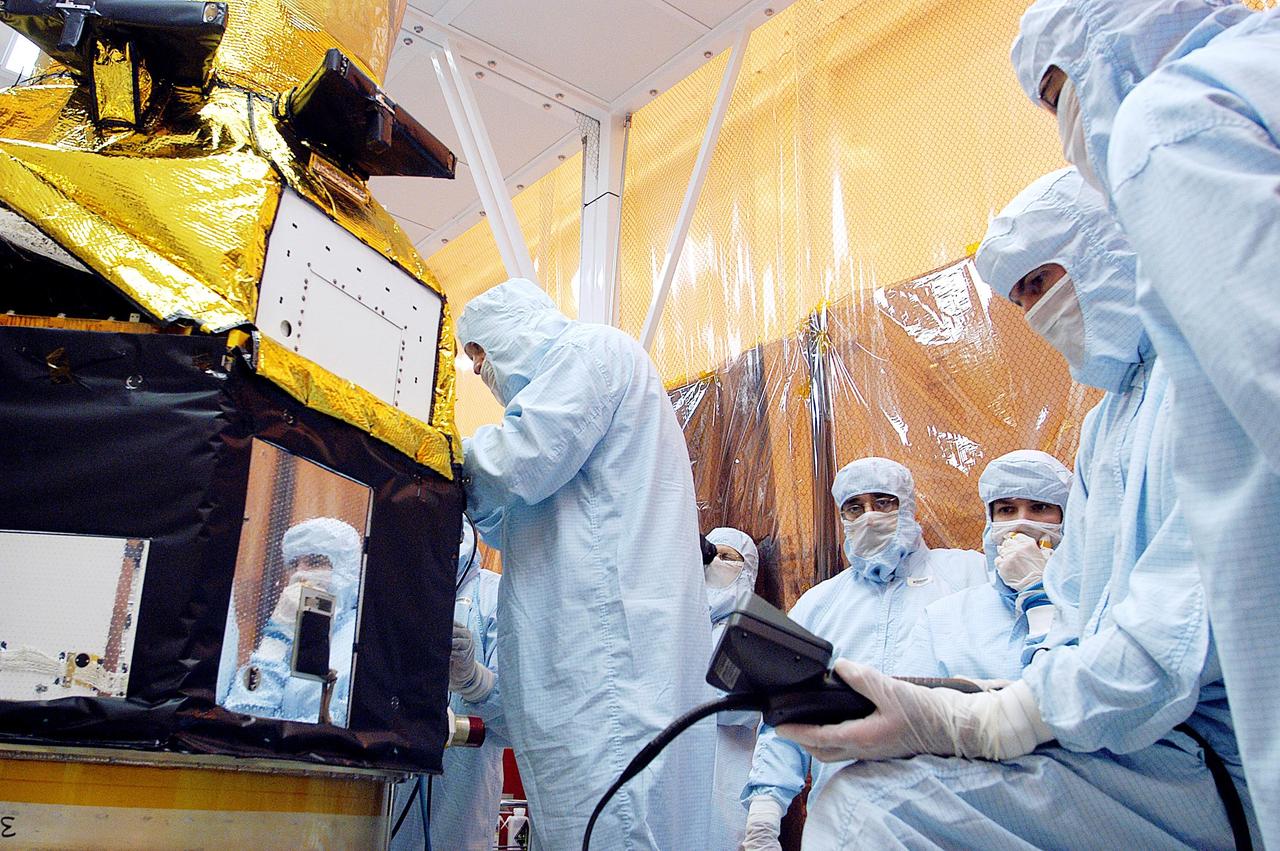
KENNEDY SPACE CENTER, FLA. - Foreign object debris shields are installed and a borescope inspection is conducted on the Galaxy Evolution Explorer (GALEX) spacecraft in the Payload Hazardous Servicing Facility. Technicians are looking for a small fastener and associated clip missing from a demated connector identified during preflight testing. GALEX is an orbiting space telescope that will observe galaxies in ultraviolet light across 10 billion years of cosmic history. During its 29-month mission, GALEX will produce the first comprehensive map of a Universe of galaxies under construction, bringing more understanding to how galaxies like the Milky Way were formed. The GALEX launch date in late April is currently under review.
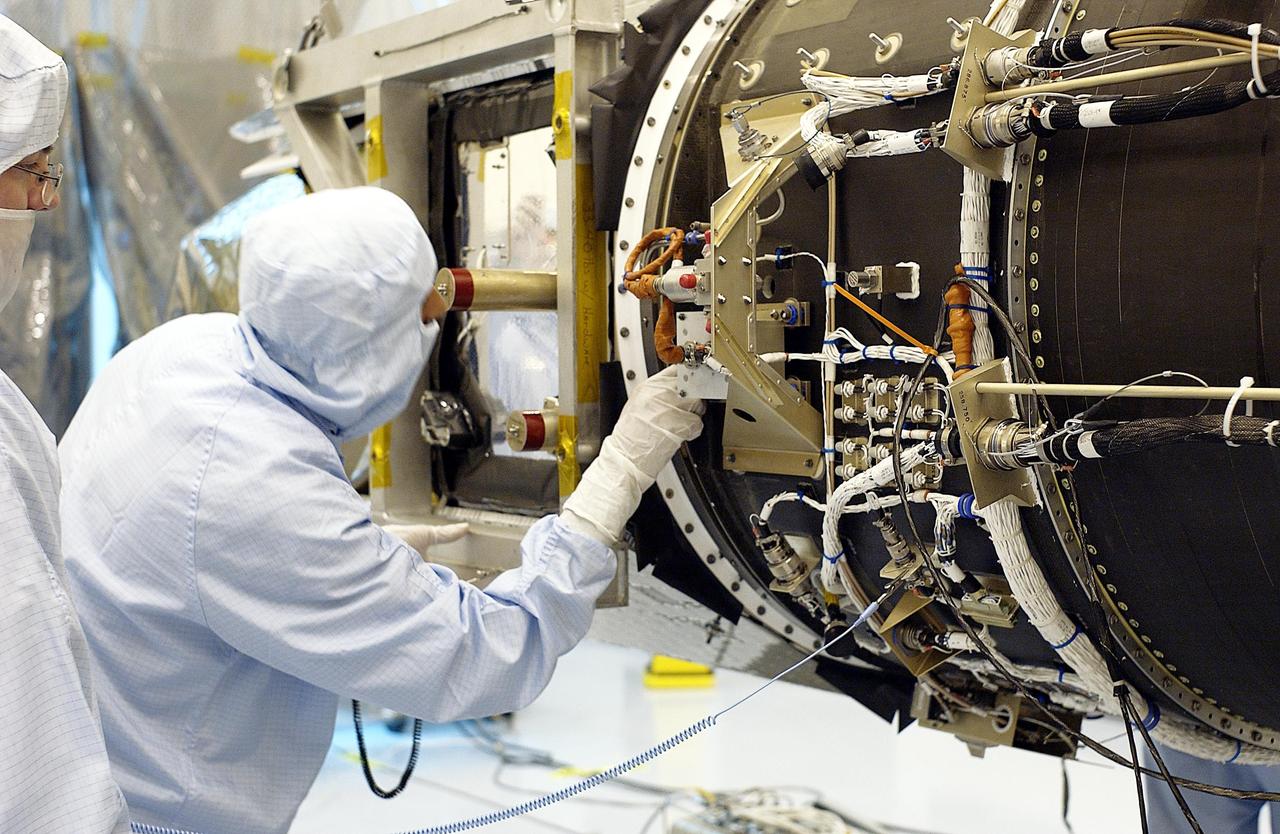
KENNEDY SPACE CENTER, Fla. - Workers in the Multi-Payload Processing Facility check the Galaxy Evolution Explorer (GALEX) spacecraft as it is removed from the Pegasus XL launch vehicle. Foreign object debris shields will be installed before its launch. The GALEX is an orbiting space telescope that will observe galaxies in ultraviolet light across 10 billion years of cosmic history. During its 29-month mission GALEX will produce the first comprehensive map of a Universe of galaxies under construction, bringing more understanding how galaxies like the Milky Way were formed. The GALEX launch date is under review.

KENNEDY SPACE CENTER, FLA. - Foreign object debris shields are installed and a borescope inspection is conducted on the Galaxy Evolution Explorer (GALEX) spacecraft in the Payload Hazardous Servicing Facility. Technicians are looking for a small fastener and associated clip missing from a demated connector identified during preflight testing. GALEX is an orbiting space telescope that will observe galaxies in ultraviolet light across 10 billion years of cosmic history. During its 29-month mission, GALEX will produce the first comprehensive map of a Universe of galaxies under construction, bringing more understanding to how galaxies like the Milky Way were formed. The GALEX launch date in late April is currently under review.
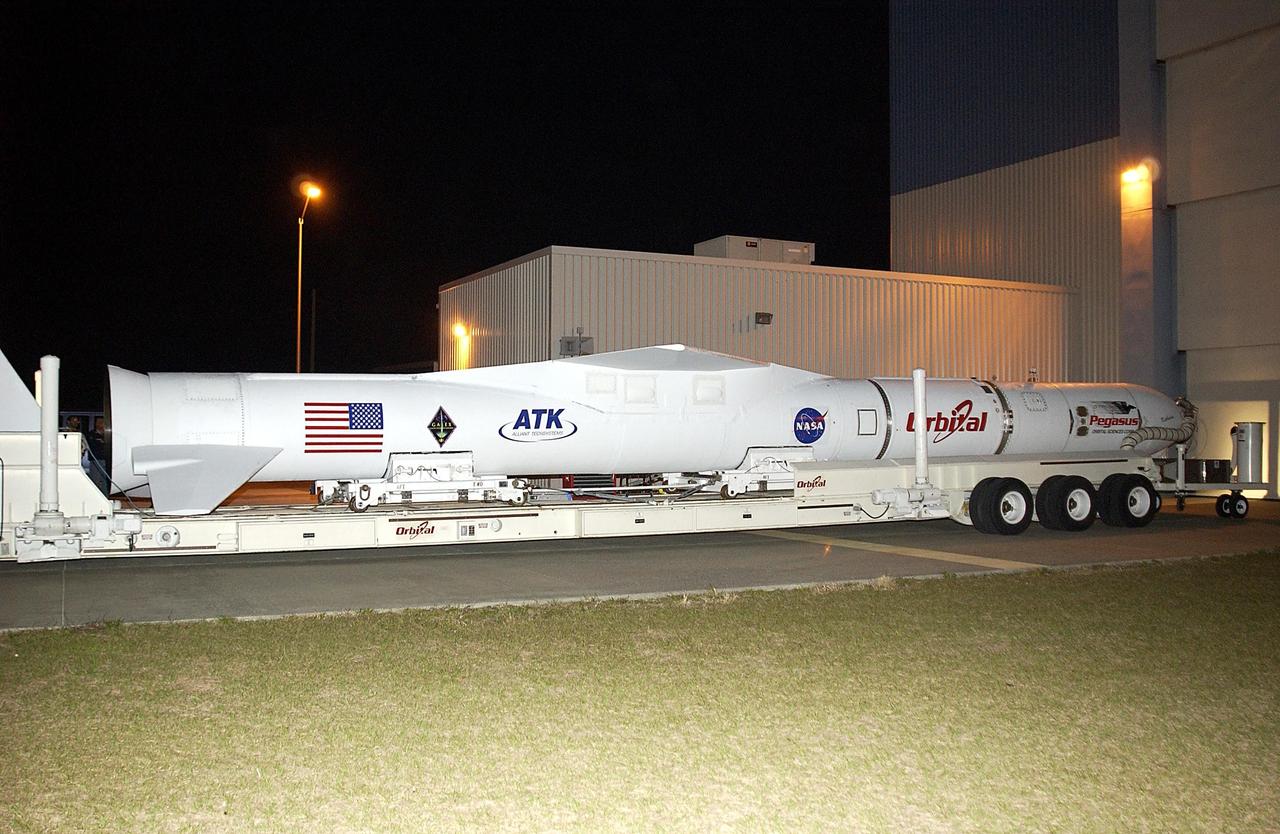
KENNEDY SPACE CENTER, FLA. - As darkness falls, the Pegasus launch vehicle arrives at the Multi-Payload Processing Facility (MPPF) at KSC. There it will be mated to the Galaxy Evolution Explorer (GALEX). The Pegasus will carry into orbit the GALEX, a space telescope that will observe galaxies in ultraviolet light across 10 billion years of cosmic history. Led by the California Institute of Technology, GALEX will conduct several first-of-a-kind sky surveys, including an extra-galactic (beyond our galaxy) ultraviolet all-sky survey. During its 29-month mission GALEX will produce the first comprehensive map of a Universe of galaxies under construction, bringing more understanding of how galaxies like the Milky Way were formed. GALEX is due to be launched from Cape Canaveral Air Force Station March 25.
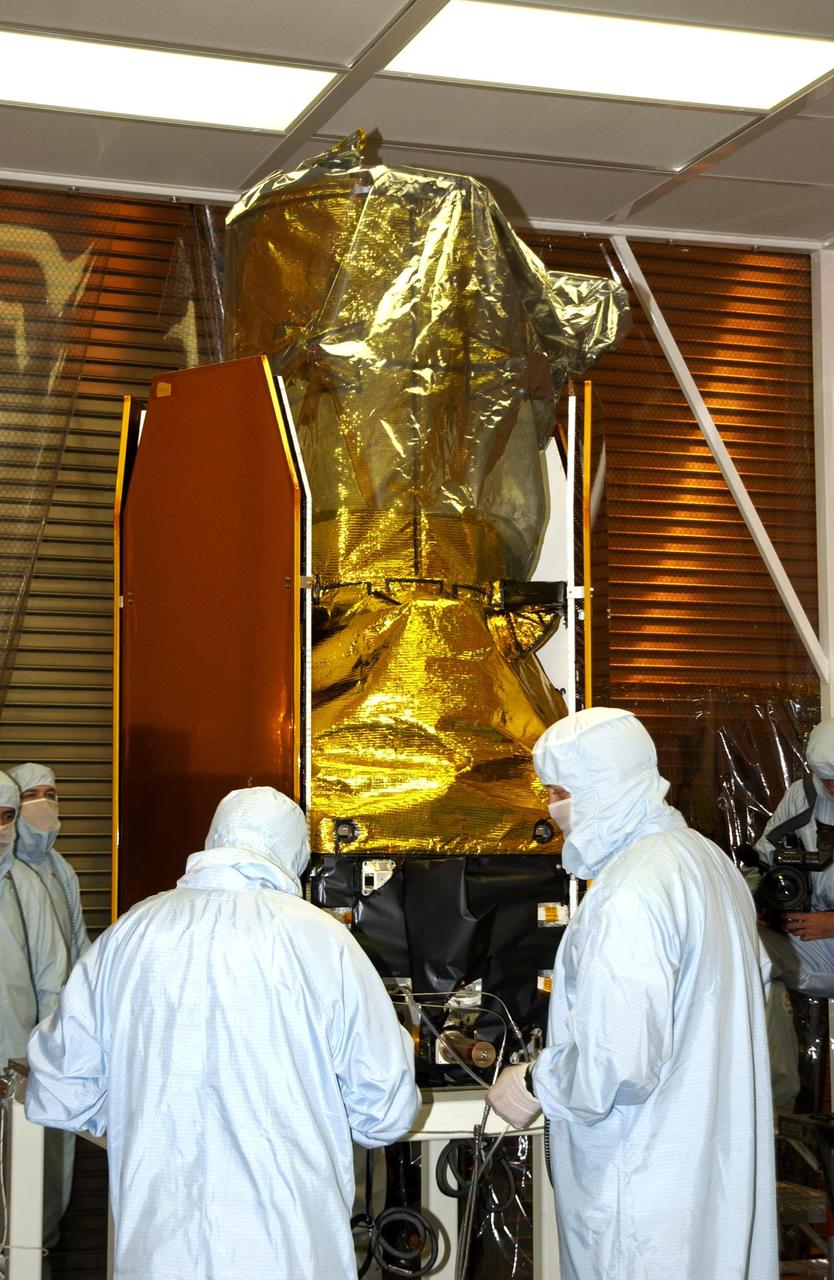
KENNEDY SPACE CENTER, FLA. -- In the Multi-Payload Processing Facility, the GALEX satellite has been moved to a rotation stand. The Galaxy Evolution Explorer (GALEX) is an orbiting space telescope that will observe galaxies in ultraviolet light across 10 billion years of cosmic history. Led by the California Institute of Technology, GALEX will conduct several first-of-a-kind sky surveys, including an extra-galactic (beyond our galaxy) ultraviolet all-sky survey. During its 29-month mission GALEX will produce the first comprehensive map of a Universe of galaxies under construction, bringing more understanding of how galaxies like the Milky Way were formed. GALEX is due to be launched from Cape Canaveral Air Force Station March 25 via a Pegasus rocket.
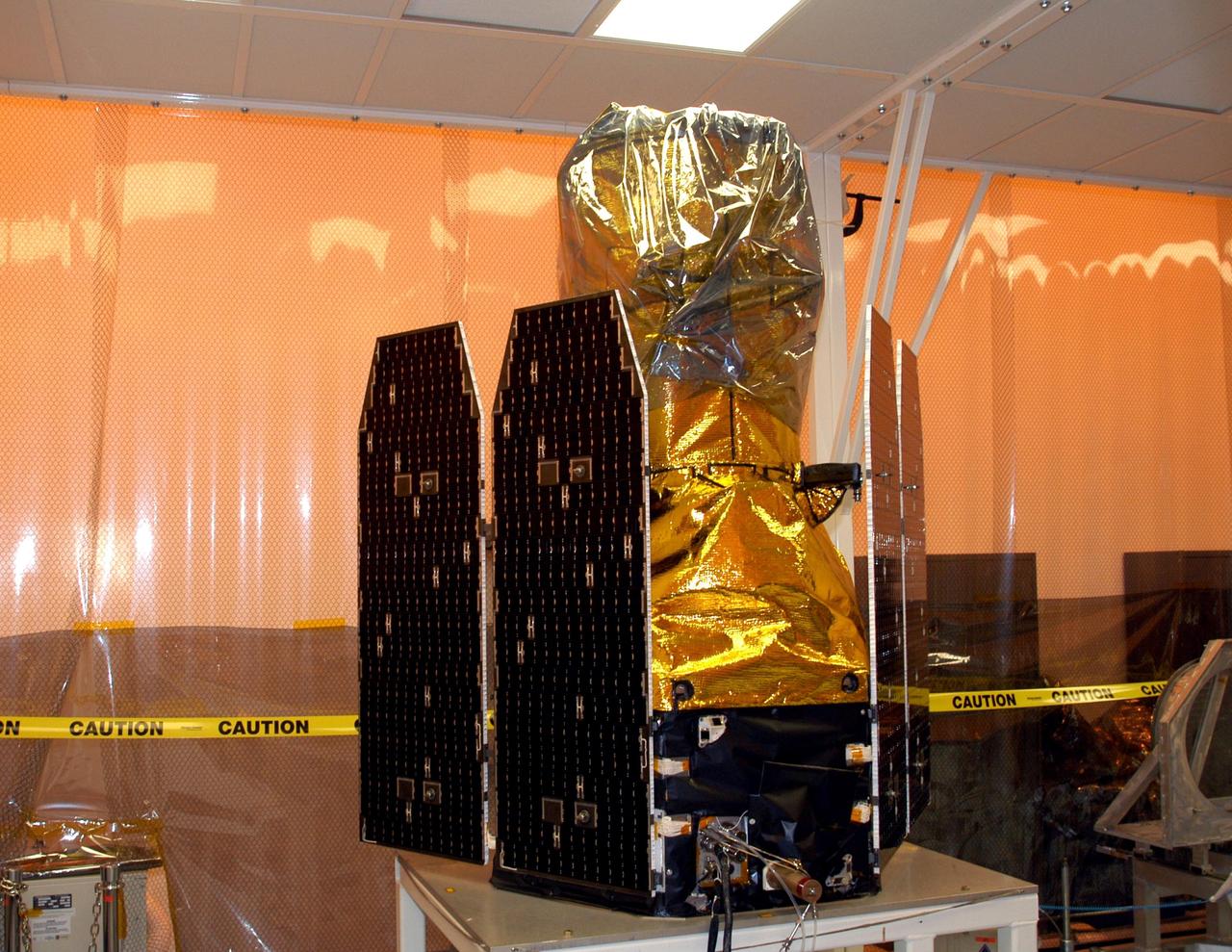
KENNEDY SPACE CENTER, FLA. - The Galaxy Evolution Explorer (GALEX) satellite is ready for deployment of its solar array panels during processing in the Multi-Payload Processing Facility. The GALEX is an orbiting space telescope that will observe galaxies in ultraviolet light across 10 billion years of cosmic history. Led by the California Institute of Technology, GALEX will conduct several first-of-a-kind sky surveys, including an extra-galactic (beyond our galaxy) ultraviolet all-sky survey. During its 29-month mission GALEX will produce the first comprehensive map of a Universe of galaxies under construction, bringing more understanding of how galaxies like the Milky Way were formed. GALEX is due to be launched from Cape Canaveral Air Force Station March 25 via a Pegasus rocket.

KENNEDY SPACE CENTER, FLA. - Workers in the Multi-Payload Processing Facility look over the GALEX satellite before solar array testing. The Galaxy Evolution Explorer (GALEX) is an orbiting space telescope that will observe galaxies in ultraviolet light across 10 billion years of cosmic history. Led by the California Institute of Technology, GALEX will conduct several first-of-a-kind sky surveys, including an extra-galactic (beyond our galaxy) ultraviolet all-sky survey. During its 29-month mission GALEX will produce the first comprehensive map of a Universe of galaxies under construction, bringing more understanding of how galaxies like the Milky Way were formed. GALEX is due to be launched from Cape Canaveral Air Force Station March 25 via a Pegasus rocket.

KENNEDY SPACE CENTER, FLA. - Workers in the Multi-Payload Processing Facility check the solar array panels on the Galaxy Evolution Explorer (GALEX) satellite after they were deployed. The GALEX is an orbiting space telescope that will observe galaxies in ultraviolet light across 10 billion years of cosmic history. Led by the California Institute of Technology, GALEX will conduct several first-of-a-kind sky surveys, including an extra-galactic (beyond our galaxy) ultraviolet all-sky survey. During its 29-month mission GALEX will produce the first comprehensive map of a Universe of galaxies under construction, bringing more understanding of how galaxies like the Milky Way were formed. GALEX is due to be launched from Cape Canaveral Air Force Station March 25 via a Pegasus rocket.
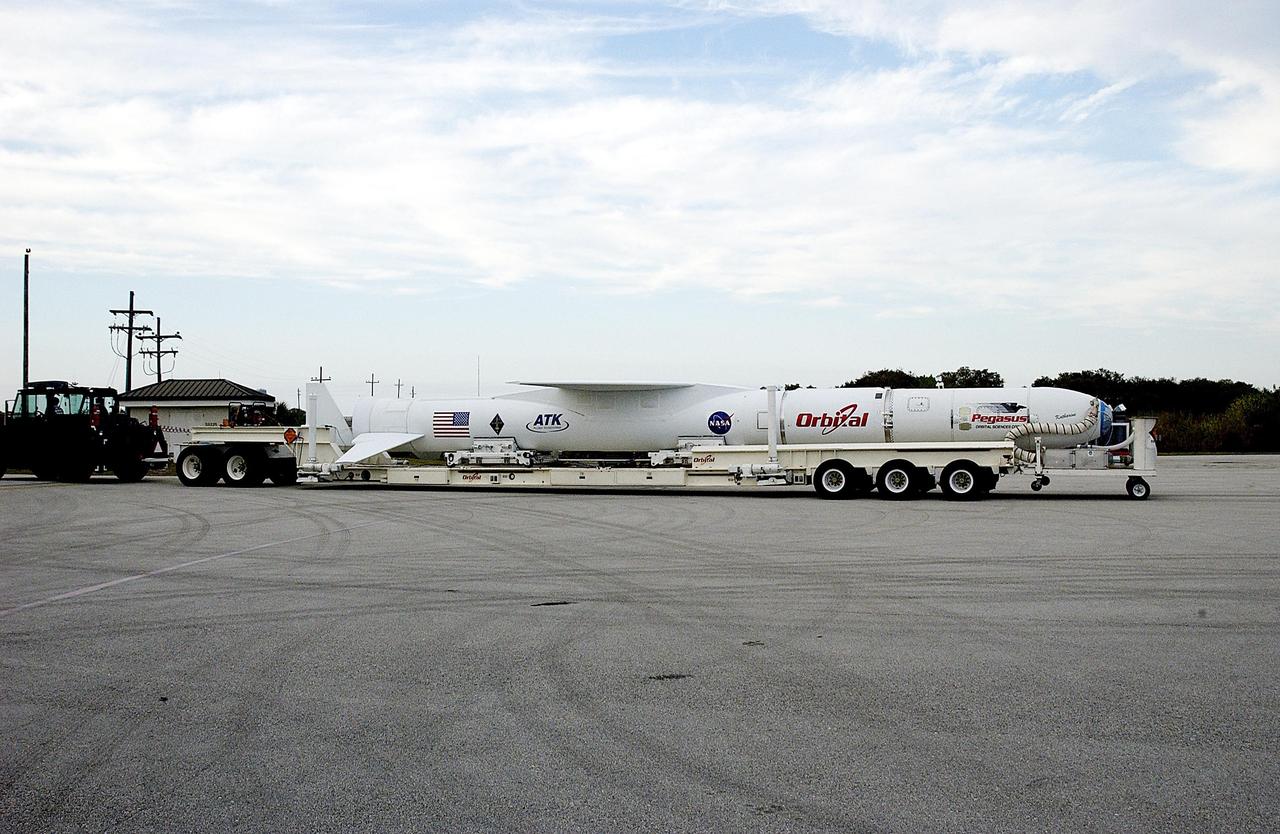
KENNEDY SPACE CENTER, FLA. -- The Pegasus launch vehicle is on a transporter, ready to be moved from the Skid Strip, Cape Canaveral Air Force Station, to the Multi-Payload Processing Facility (MPPF) at KSC. There it will be mated to the Galaxy Evolution Explorer (GALEX). The Pegasus will carry into orbit the GALEX, an orbiting space telescope that will observe galaxies in ultraviolet light across 10 billion years of cosmic history. Led by the California Institute of Technology, GALEX will conduct several first-of-a-kind sky surveys, including an extra-galactic (beyond our galaxy) ultraviolet all-sky survey. During its 29-month mission GALEX will produce the first comprehensive map of a Universe of galaxies under construction, bringing more understanding of how galaxies like the Milky Way were formed. GALEX is due to be launched from Cape Canaveral Air Force Station March 25.
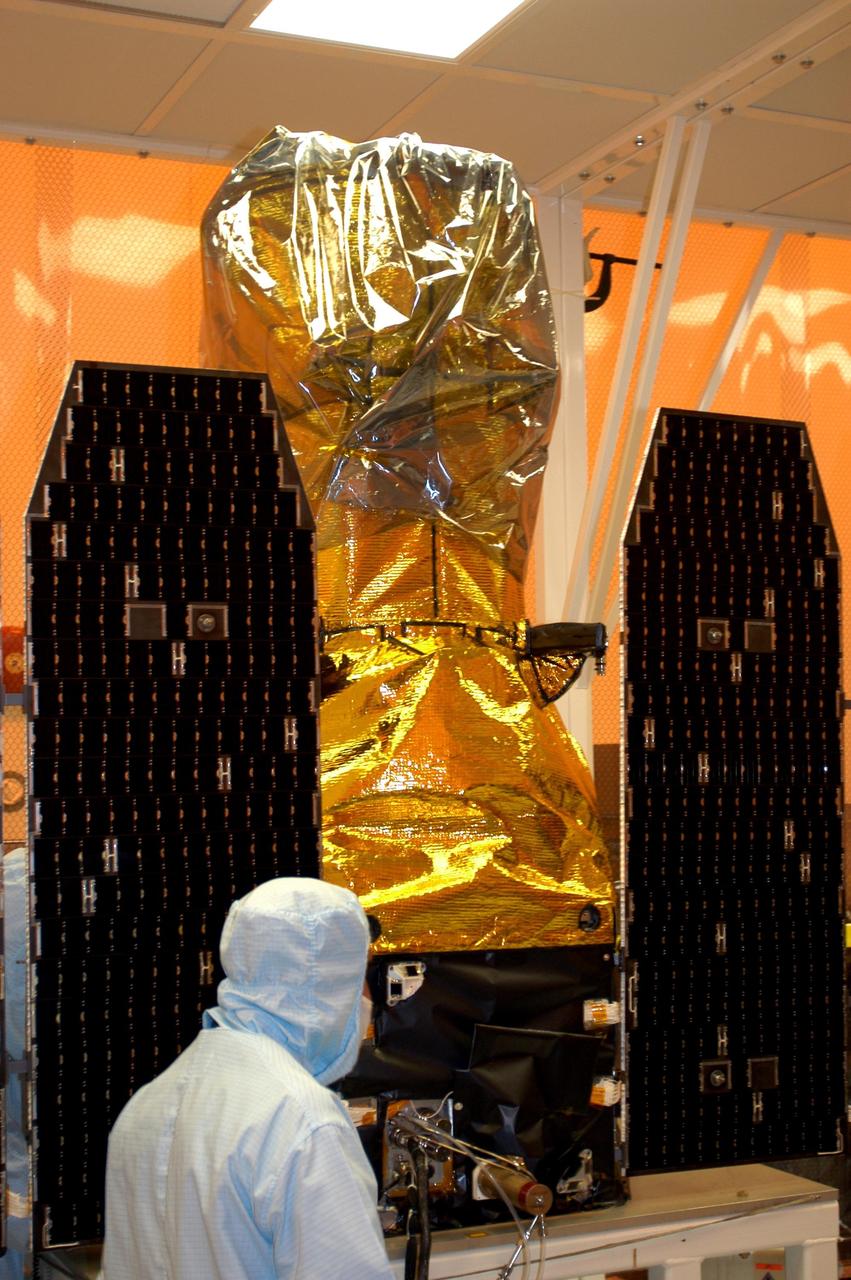
KENNEDY SPACE CENTER, FLA. -- The solar array panels on the Galaxy Evolution Explorer (GALEX) satellite are deployed during processing in the Multi-Payload Processing Facility. The GALEX is an orbiting space telescope that will observe galaxies in ultraviolet light across 10 billion years of cosmic history. Led by the California Institute of Technology, GALEX will conduct several first-of-a-kind sky surveys, including an extra-galactic (beyond our galaxy) ultraviolet all-sky survey. During its 29-month mission GALEX will produce the first comprehensive map of a Universe of galaxies under construction, bringing more understanding of how galaxies like the Milky Way were formed. GALEX is due to be launched from Cape Canaveral Air Force Station March 25 via a Pegasus rocket.
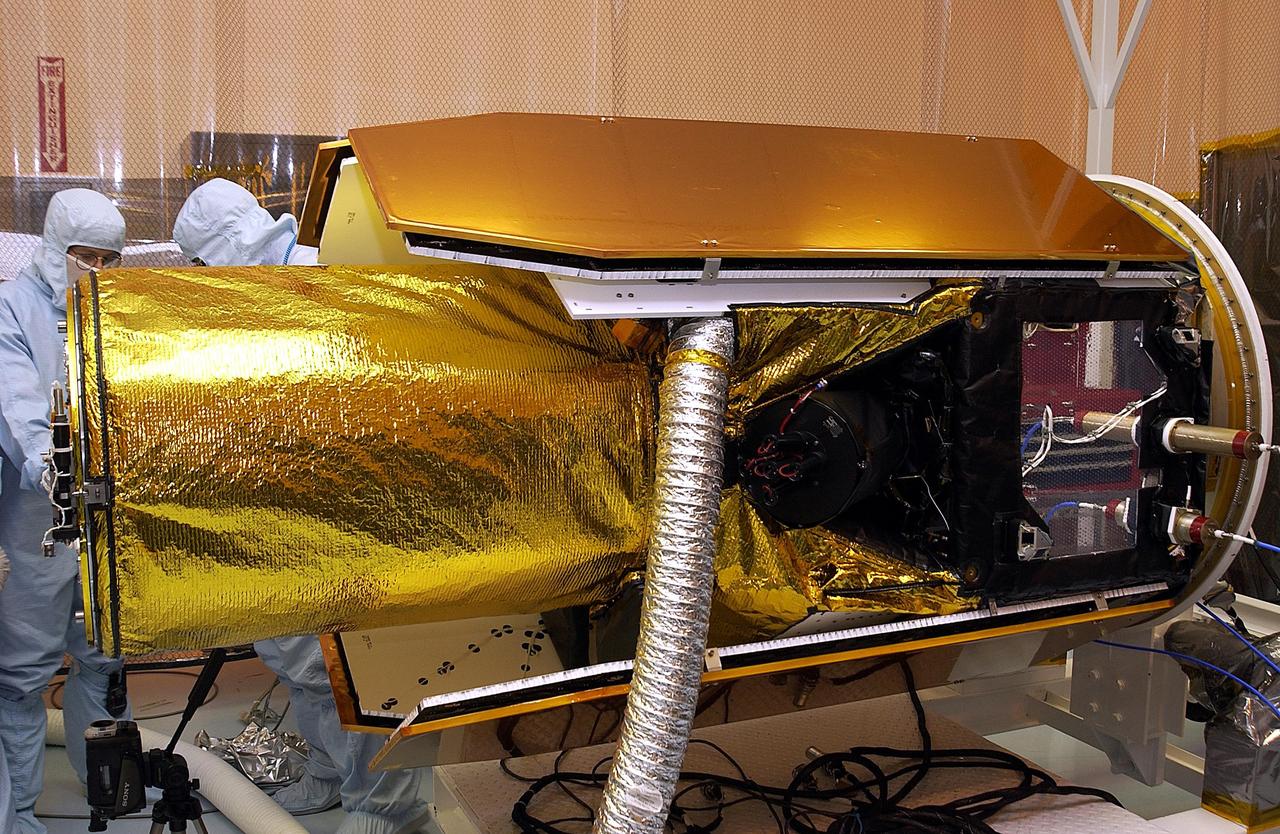
KENNEDY SPACE CENTER, FLA. -- In the Multi-Payload Processing Facility, workers check the deployment of the cover of the telescope on the GALEX satellite. The Galaxy Evolution Explorer (GALEX) is an orbiting space telescope that will observe galaxies in ultraviolet light across 10 billion years of cosmic history. Led by the California Institute of Technology, GALEX will conduct several first-of-a-kind sky surveys, including an extra-galactic (beyond our galaxy) ultraviolet all-sky survey. During its 29-month mission GALEX will produce the first comprehensive map of a Universe of galaxies under construction, bringing more understanding of how galaxies like the Milky Way were formed. GALEX is due to be launched from Cape Canaveral Air Force Station March 25 via a Pegasus rocket.
KENNEDY SPACE CENTER, FLA. -- In the Multi-Payload Processing Facility, a worker inspects the GALEX satellite after its rotation on a stand. The Galaxy Evolution Explorer (GALEX) is an orbiting space telescope that will observe galaxies in ultraviolet light across 10 billion years of cosmic history. Led by the California Institute of Technology, GALEX will conduct several first-of-a-kind sky surveys, including an extra-galactic (beyond our galaxy) ultraviolet all-sky survey. During its 29-month mission GALEX will produce the first comprehensive map of a Universe of galaxies under construction, bringing more understanding of how galaxies like the Milky Way were formed. GALEX is due to be launched from Cape Canaveral Air Force Station March 25 via a Pegasus rocket.
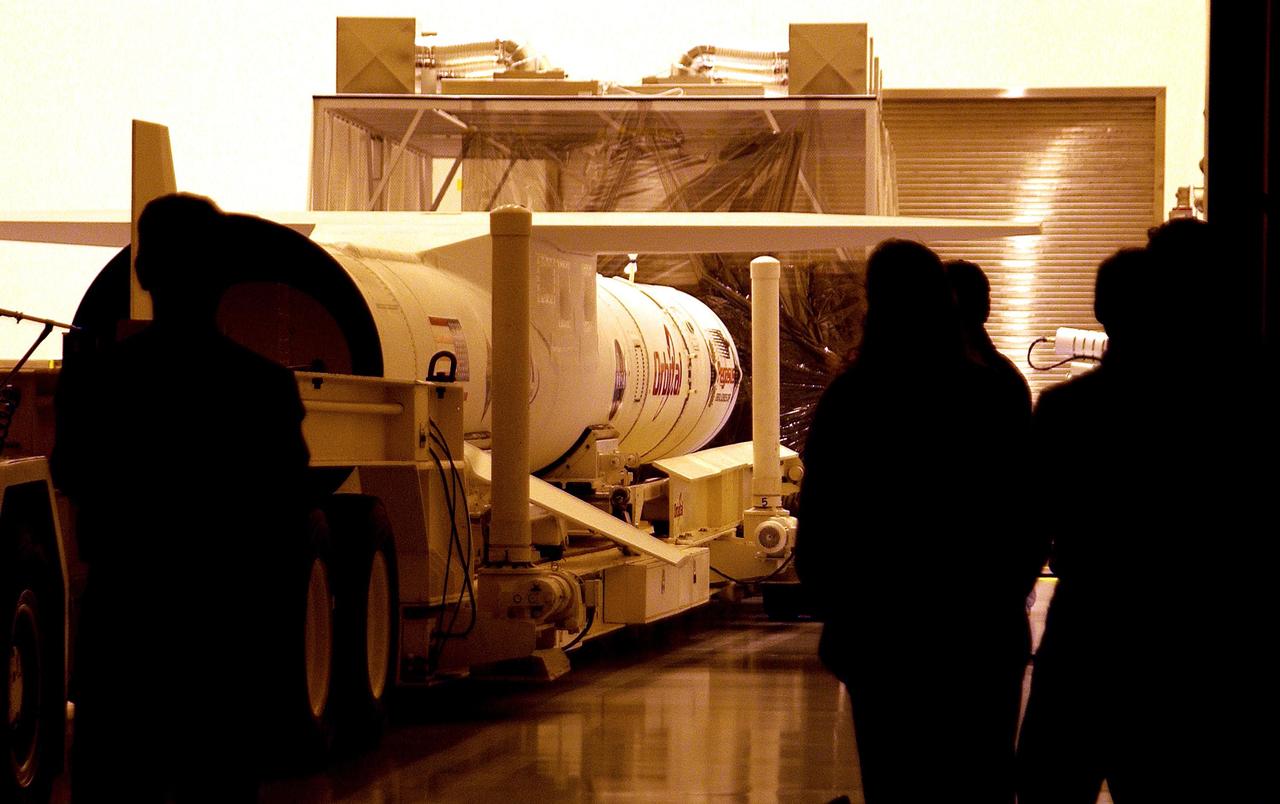
KENNEDY SPACE CENTER, FLA. -- The Pegasus launch vehicle is inside the Multi-Payload Processing Facility (MPPF) at KSC. There it will be mated to the Galaxy Evolution Explorer (GALEX). The Pegasus will carry into orbit the GALEX, a space telescope that will observe galaxies in ultraviolet light across 10 billion years of cosmic history. Led by the California Institute of Technology, GALEX will conduct several first-of-a-kind sky surveys, including an extra-galactic (beyond our galaxy) ultraviolet all-sky survey. During its 29-month mission GALEX will produce the first comprehensive map of a Universe of galaxies under construction, bringing more understanding of how galaxies like the Milky Way were formed. GALEX is due to be launched from Cape Canaveral Air Force Station March 25.

KENNEDY SPACE CENTER, FLA. -- The Pegasus launch vehicle enters the Multi-Payload Processing Facility (MPPF) at KSC. There it will be mated to the Galaxy Evolution Explorer (GALEX). The Pegasus will carry into orbit the GALEX, a space telescope that will observe galaxies in ultraviolet light across 10 billion years of cosmic history. Led by the California Institute of Technology, GALEX will conduct several first-of-a-kind sky surveys, including an extra-galactic (beyond our galaxy) ultraviolet all-sky survey. During its 29-month mission GALEX will produce the first comprehensive map of a Universe of galaxies under construction, bringing more understanding of how galaxies like the Milky Way were formed. GALEX is due to be launched from Cape Canaveral Air Force Station March 25.
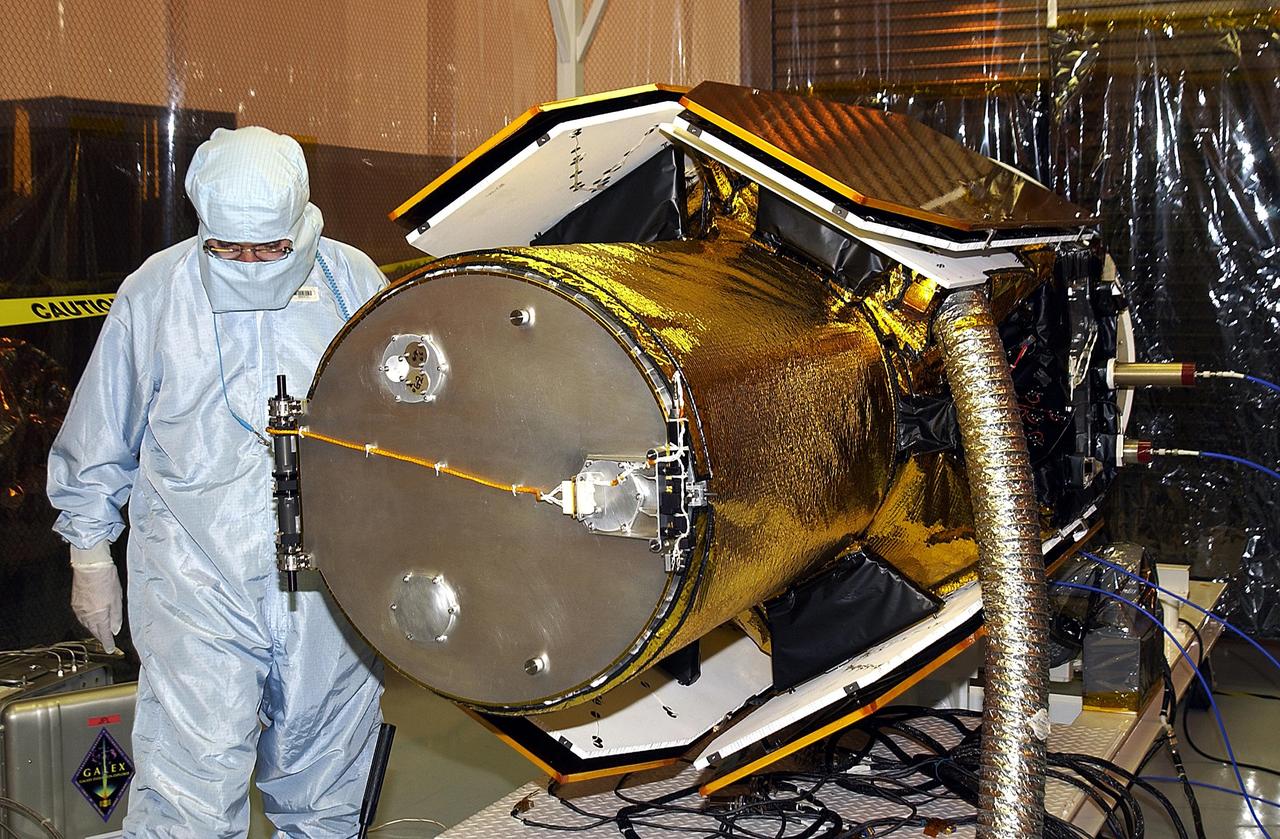
KENNEDY SPACE CENTER, FLA. -- In the Multi-Payload Processing Facility, workers check the deployment of the cover of the telescope on the GALEX satellite. The Galaxy Evolution Explorer (GALEX) is an orbiting space telescope that will observe galaxies in ultraviolet light across 10 billion years of cosmic history. Led by the California Institute of Technology, GALEX will conduct several first-of-a-kind sky surveys, including an extra-galactic (beyond our galaxy) ultraviolet all-sky survey. During its 29-month mission GALEX will produce the first comprehensive map of a Universe of galaxies under construction, bringing more understanding of how galaxies like the Milky Way were formed. GALEX is due to be launched from Cape Canaveral Air Force Station March 25 via a Pegasus rocket.
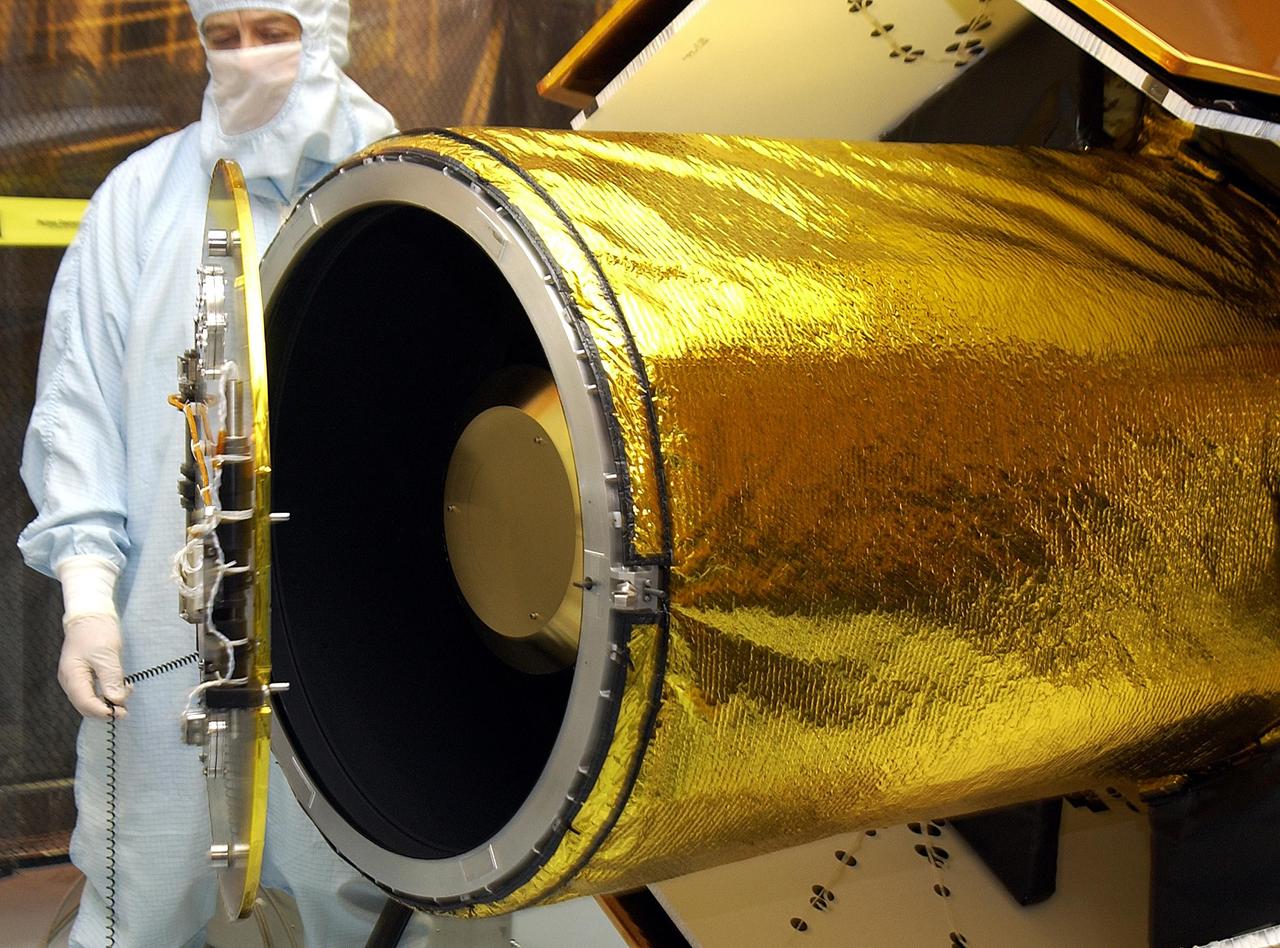
KENNEDY SPACE CENTER, FLA. -- In the Multi-Payload Processing Facility, workers check the deployment of the cover of the telescope on the GALEX satellite. The Galaxy Evolution Explorer (GALEX) is an orbiting space telescope that will observe galaxies in ultraviolet light across 10 billion years of cosmic history. Led by the California Institute of Technology, GALEX will conduct several first-of-a-kind sky surveys, including an extra-galactic (beyond our galaxy) ultraviolet all-sky survey. During its 29-month mission GALEX will produce the first comprehensive map of a Universe of galaxies under construction, bringing more understanding of how galaxies like the Milky Way were formed. GALEX is due to be launched from Cape Canaveral Air Force Station March 25 via a Pegasus rocket.
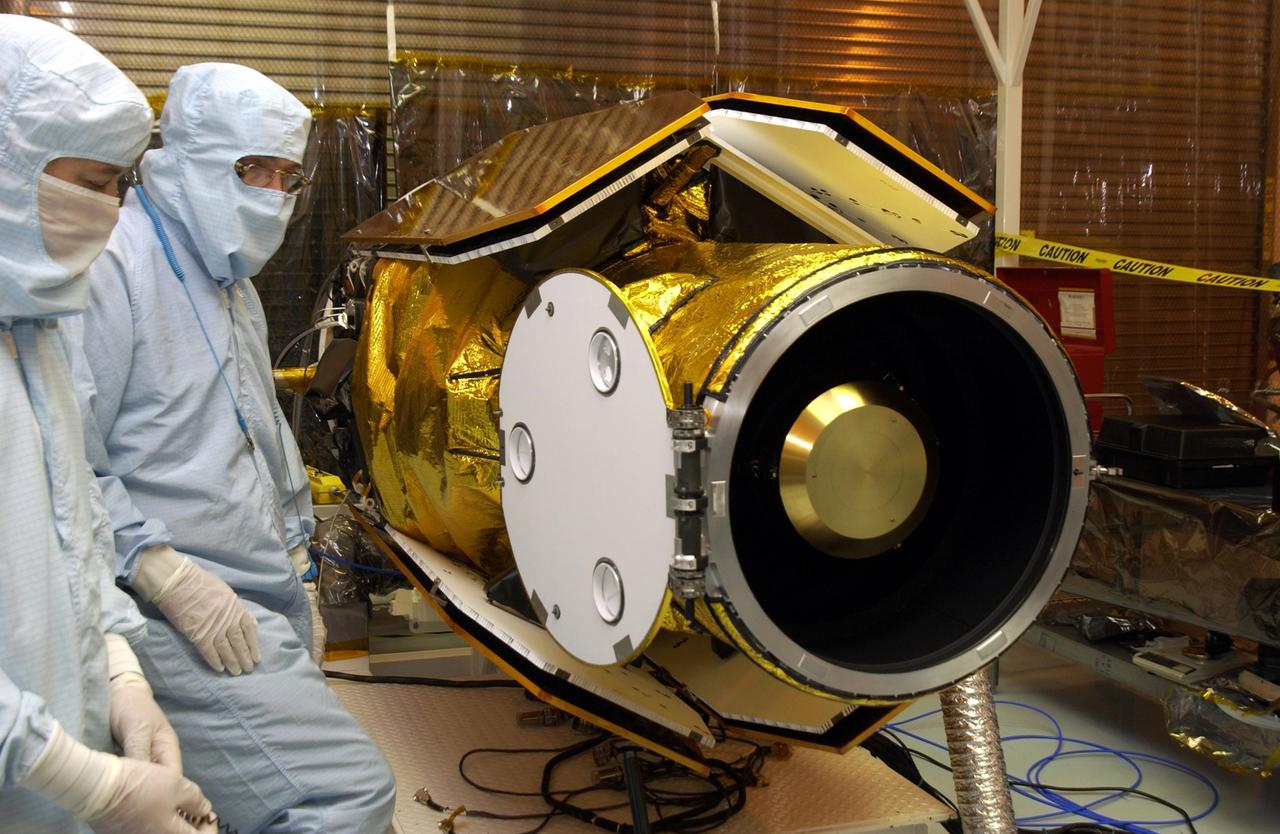
KENNEDY SPACE CENTER, FLA. -- In the Multi-Payload Processing Facility, workers check the deployment of the cover of the telescope on the GALEX satellite. The Galaxy Evolution Explorer (GALEX) is an orbiting space telescope that will observe galaxies in ultraviolet light across 10 billion years of cosmic history. Led by the California Institute of Technology, GALEX will conduct several first-of-a-kind sky surveys, including an extra-galactic (beyond our galaxy) ultraviolet all-sky survey. During its 29-month mission GALEX will produce the first comprehensive map of a Universe of galaxies under construction, bringing more understanding of how galaxies like the Milky Way were formed. GALEX is due to be launched from Cape Canaveral Air Force Station March 25 via a Pegasus rocket.
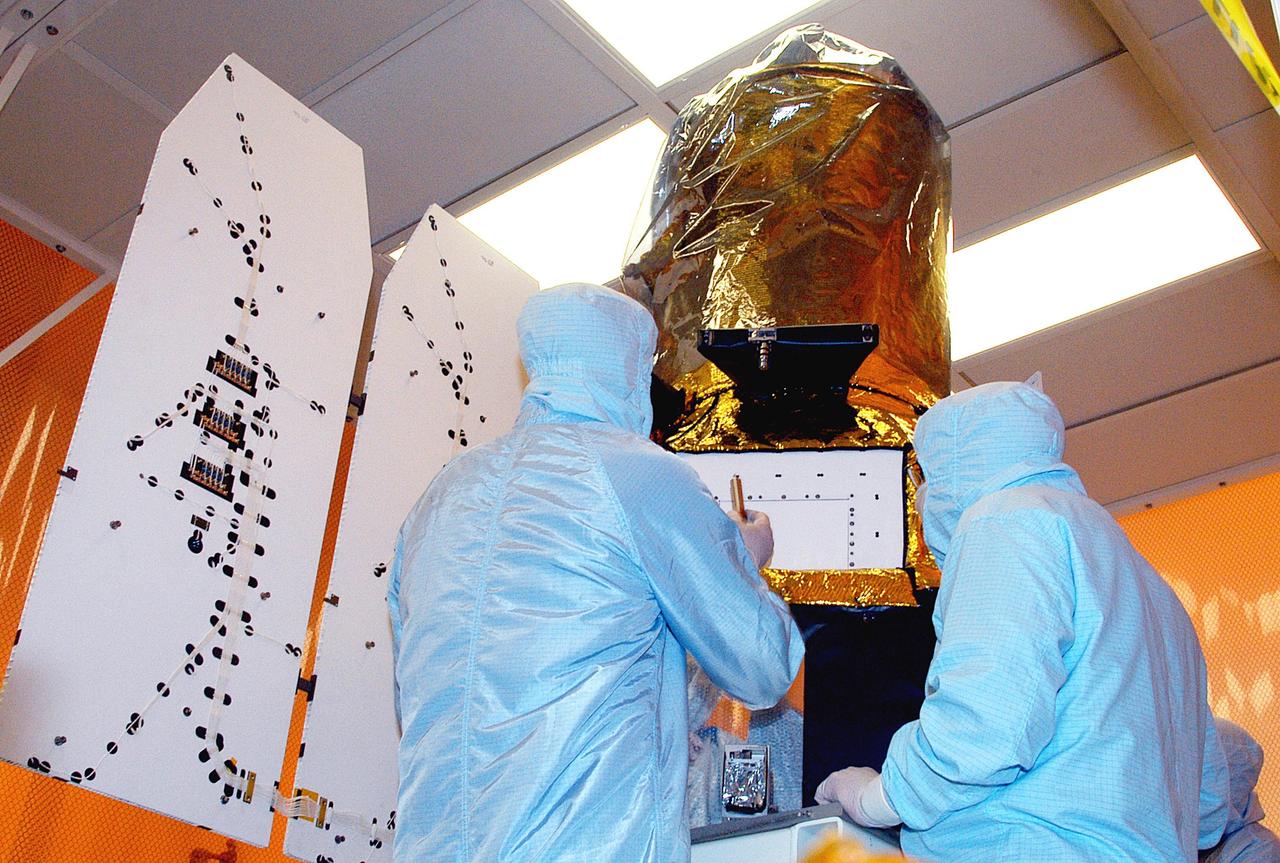
KENNEDY SPACE CENTER, FLA. -- Workers in the Multi-Payload Processing Facility check the solar array panels on the Galaxy Evolution Explorer (GALEX) satellite after they were deployed. The GALEX is an orbiting space telescope that will observe galaxies in ultraviolet light across 10 billion years of cosmic history. Led by the California Institute of Technology, GALEX will conduct several first-of-a-kind sky surveys, including an extra-galactic (beyond our galaxy) ultraviolet all-sky survey. During its 29-month mission GALEX will produce the first comprehensive map of a Universe of galaxies under construction, bringing more understanding of how galaxies like the Milky Way were formed. GALEX is due to be launched from Cape Canaveral Air Force Station March 25 via a Pegasus rocket.

KENNEDY SPACE CENTER, FLA. - The solar array panels on the Galaxy Evolution Explorer (GALEX) satellite are deployed during processing in the Multi-Payload Processing Facility. The GALEX is an orbiting space telescope that will observe galaxies in ultraviolet light across 10 billion years of cosmic history. Led by the California Institute of Technology, GALEX will conduct several first-of-a-kind sky surveys, including an extra-galactic (beyond our galaxy) ultraviolet all-sky survey. During its 29-month mission GALEX will produce the first comprehensive map of a Universe of galaxies under construction, bringing more understanding of how galaxies like the Milky Way were formed. GALEX is due to be launched from Cape Canaveral Air Force Station March 25 via a Pegasus rocket.
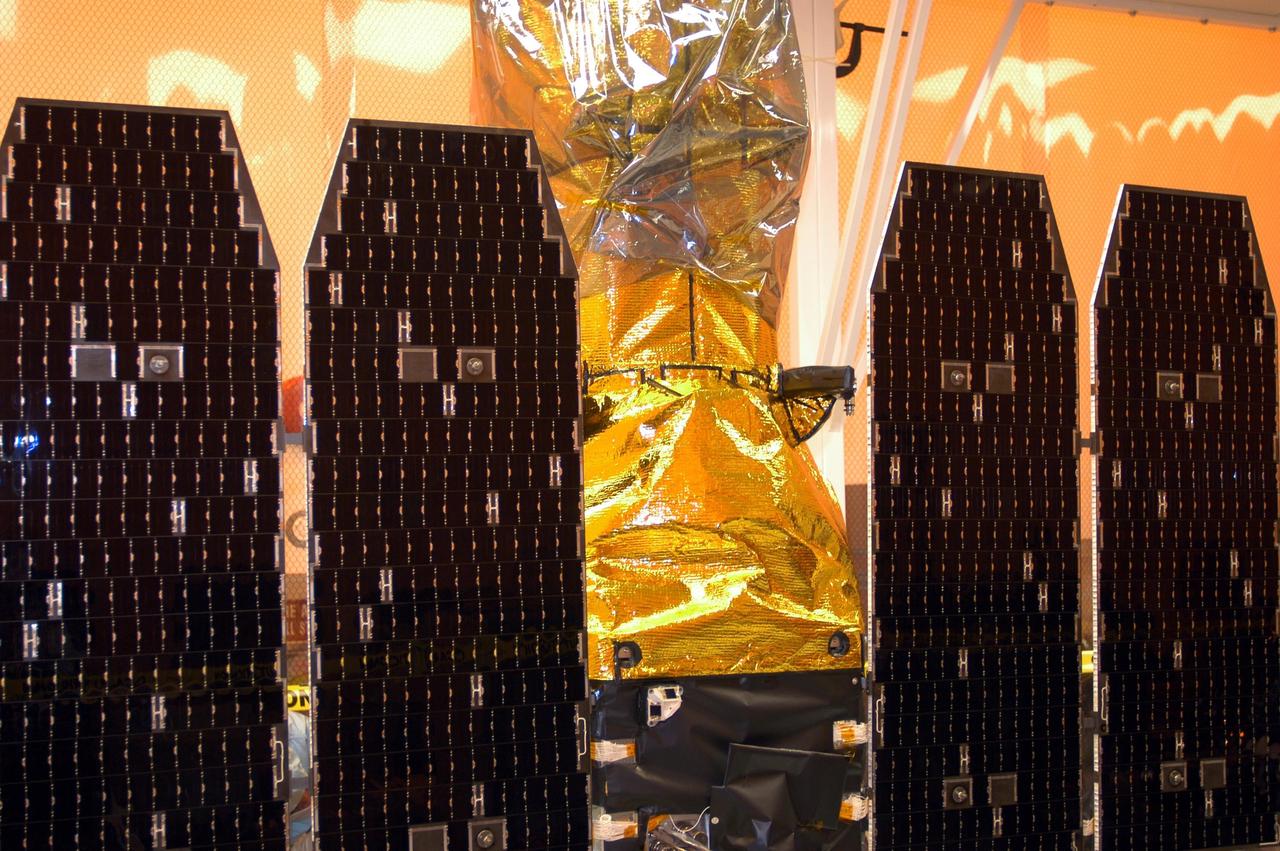
KENNEDY SPACE CENTER, FLA. -- The solar array panels on the Galaxy Evolution Explorer (GALEX) satellite are deployed during processing in the Multi-Payload Processing Facility. The GALEX is an orbiting space telescope that will observe galaxies in ultraviolet light across 10 billion years of cosmic history. Led by the California Institute of Technology, GALEX will conduct several first-of-a-kind sky surveys, including an extra-galactic (beyond our galaxy) ultraviolet all-sky survey. During its 29-month mission GALEX will produce the first comprehensive map of a Universe of galaxies under construction, bringing more understanding of how galaxies like the Milky Way were formed. GALEX is due to be launched from Cape Canaveral Air Force Station March 25 via a Pegasus rocket.
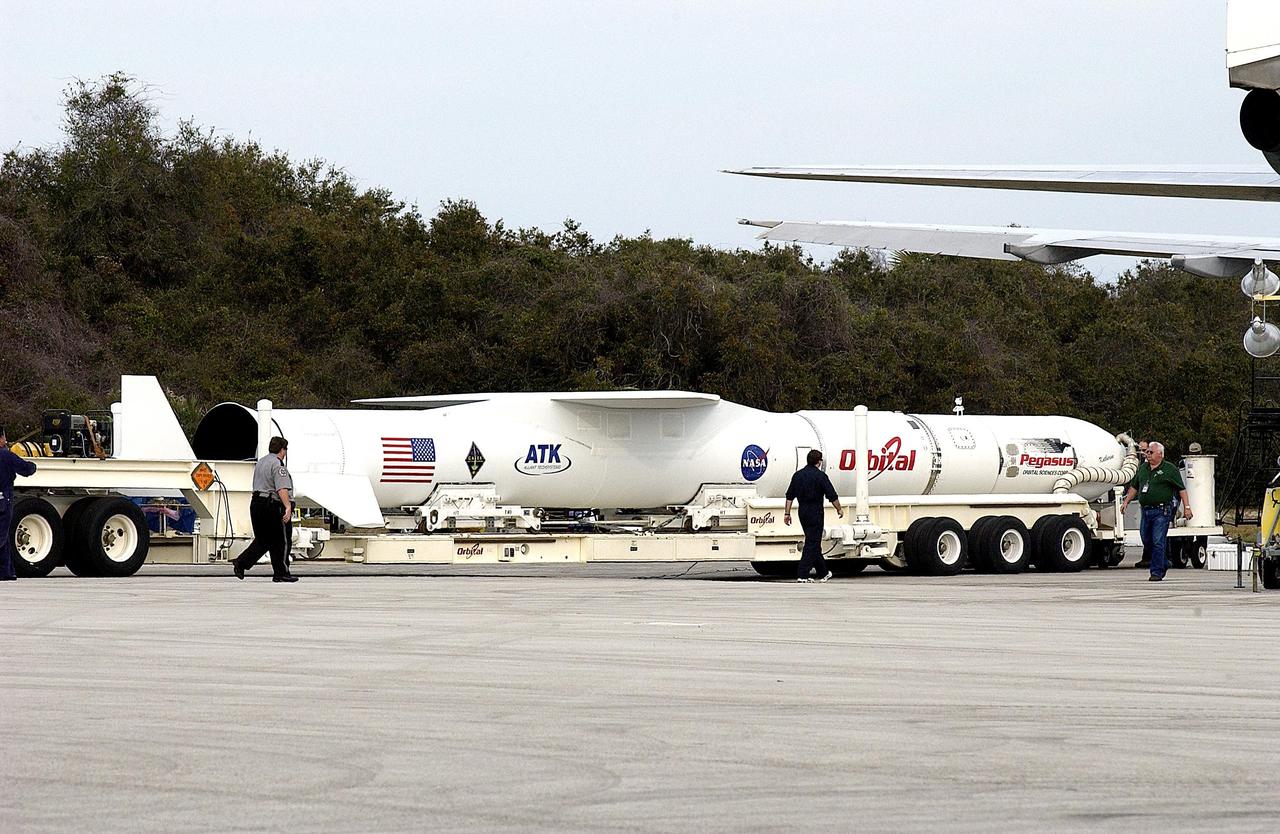
KENNEDY SPACE CENTER, FLA. -- The Pegasus launch vehicle is on a transporter, ready to be moved from the Skid Strip, Cape Canaveral Air Force Station, to the Multi-Payload Processing Facility (MPPF) at KSC. There it will be mated to the Galaxy Evolution Explorer (GALEX). The Pegasus will carry the GALEX, an orbiting space telescope that will observe galaxies in ultraviolet light across 10 billion years of cosmic history, into orbit. Led by the California Institute of Technology, GALEX will conduct several first-of-a-kind sky surveys, including an extra-galactic (beyond our galaxy) ultraviolet all-sky survey. During its 29-month mission GALEX will produce the first comprehensive map of a Universe of galaxies under construction, bringing more understanding of how galaxies like the Milky Way were formed. GALEX is due to be launched from Cape Canaveral Air Force Station March 25.

KENNEDY SPACE CENTER, FLA. -- In the Multi-Payload Processing Facility, workers check the deployment of the cover of the telescope on the GALEX satellite. The Galaxy Evolution Explorer (GALEX) is an orbiting space telescope that will observe galaxies in ultraviolet light across 10 billion years of cosmic history. Led by the California Institute of Technology, GALEX will conduct several first-of-a-kind sky surveys, including an extra-galactic (beyond our galaxy) ultraviolet all-sky survey. During its 29-month mission GALEX will produce the first comprehensive map of a Universe of galaxies under construction, bringing more understanding of how galaxies like the Milky Way were formed. GALEX is due to be launched from Cape Canaveral Air Force Station March 25 via a Pegasus rocket.
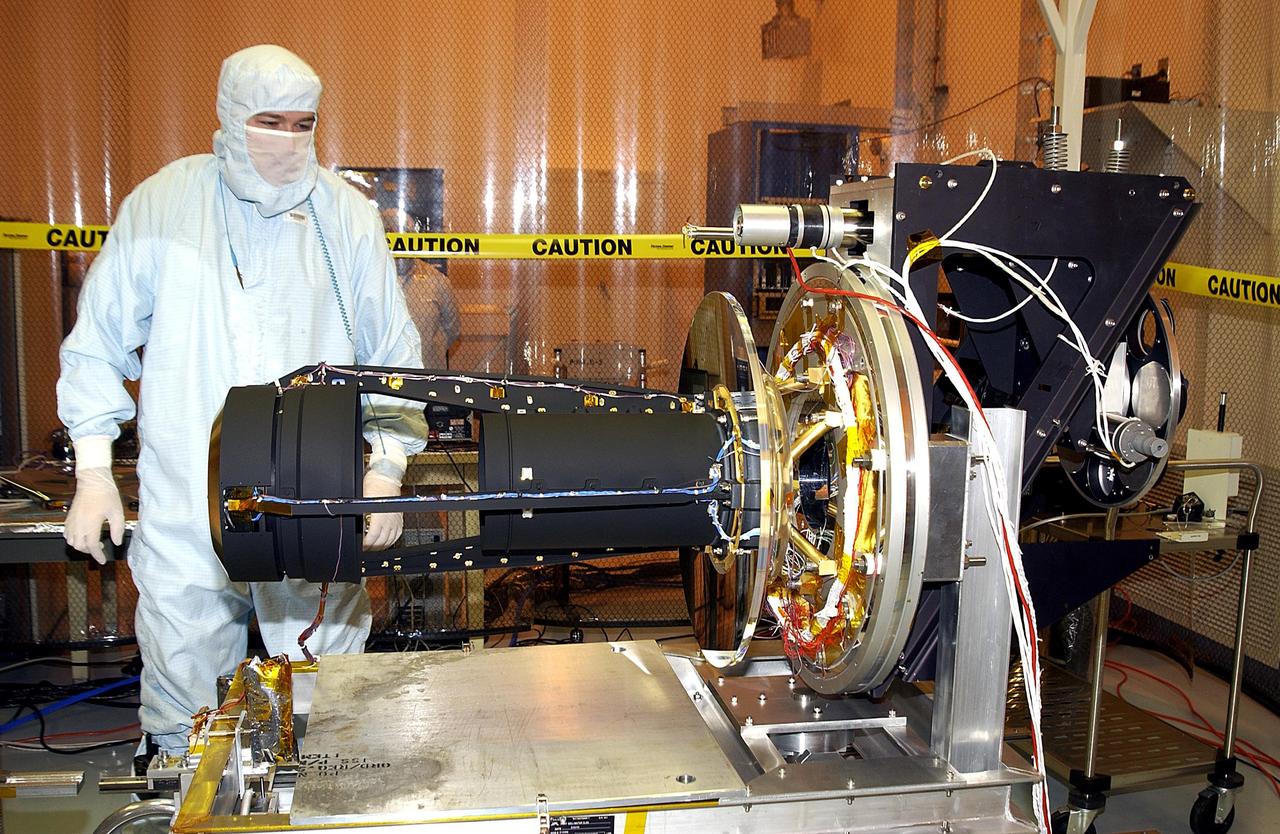
KENNEDY SPACE CENTER, FLA. -- In the Multi-Payload Processing Facility, a worker checks over the GALEX satellite on a rotation stand. The Galaxy Evolution Explorer (GALEX) is an orbiting space telescope that will observe galaxies in ultraviolet light across 10 billion years of cosmic history. Led by the California Institute of Technology, GALEX will conduct several first-of-a-kind sky surveys, including an extra-galactic (beyond our galaxy) ultraviolet all-sky survey. During its 29-month mission GALEX will produce the first comprehensive map of a Universe of galaxies under construction, bringing more understanding of how galaxies like the Milky Way were formed. GALEX is due to be launched from Cape Canaveral Air Force Station March 25 via a Pegasus rocket.