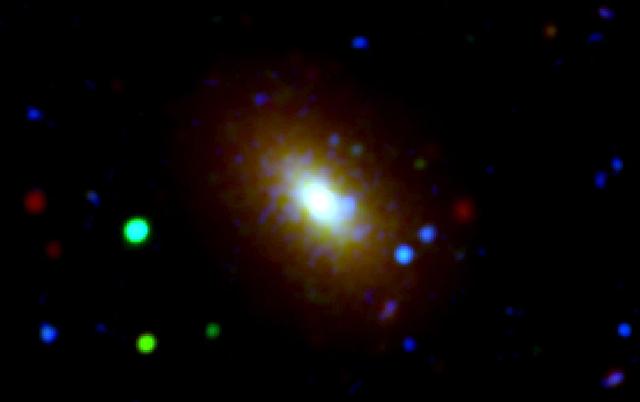
Evidence from NASA Wide-field Infrared Survey Explorer and Galaxy Evolution Explorer missions provide support for the inside-out theory of galaxy evolution, which holds that star formation starts at the core of the galaxy and spreads outward.
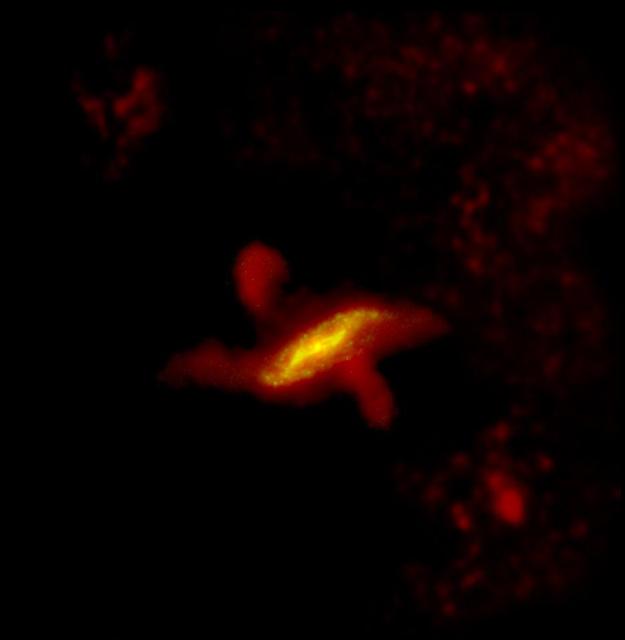
This parallelogram shaped region of dust observed by ESA Herschel Space telescope can be best described using galaxy formation models where a flat spiral galaxy collides with an elliptical galaxy becoming warped in the process.
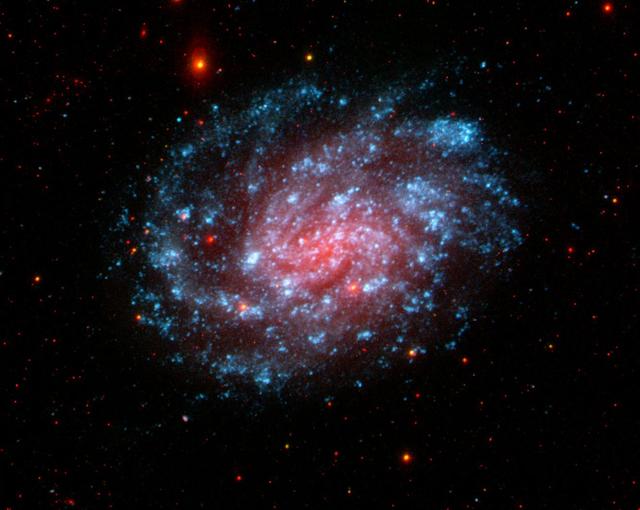
This image from NASA Galaxy Evolution Explorer shows the galaxy NGC 300, located about seven million light-years away in the constellation Sculptor. It is a classic spiral galaxy with open arms and vigorous star formation throughout.

This artist concept depicts a supermassive black hole at the center of a galaxy. NASA Galaxy Evolution Explorer found evidence that black holes once they grow to a critical size stifle the formation of new stars in elliptical galaxies.
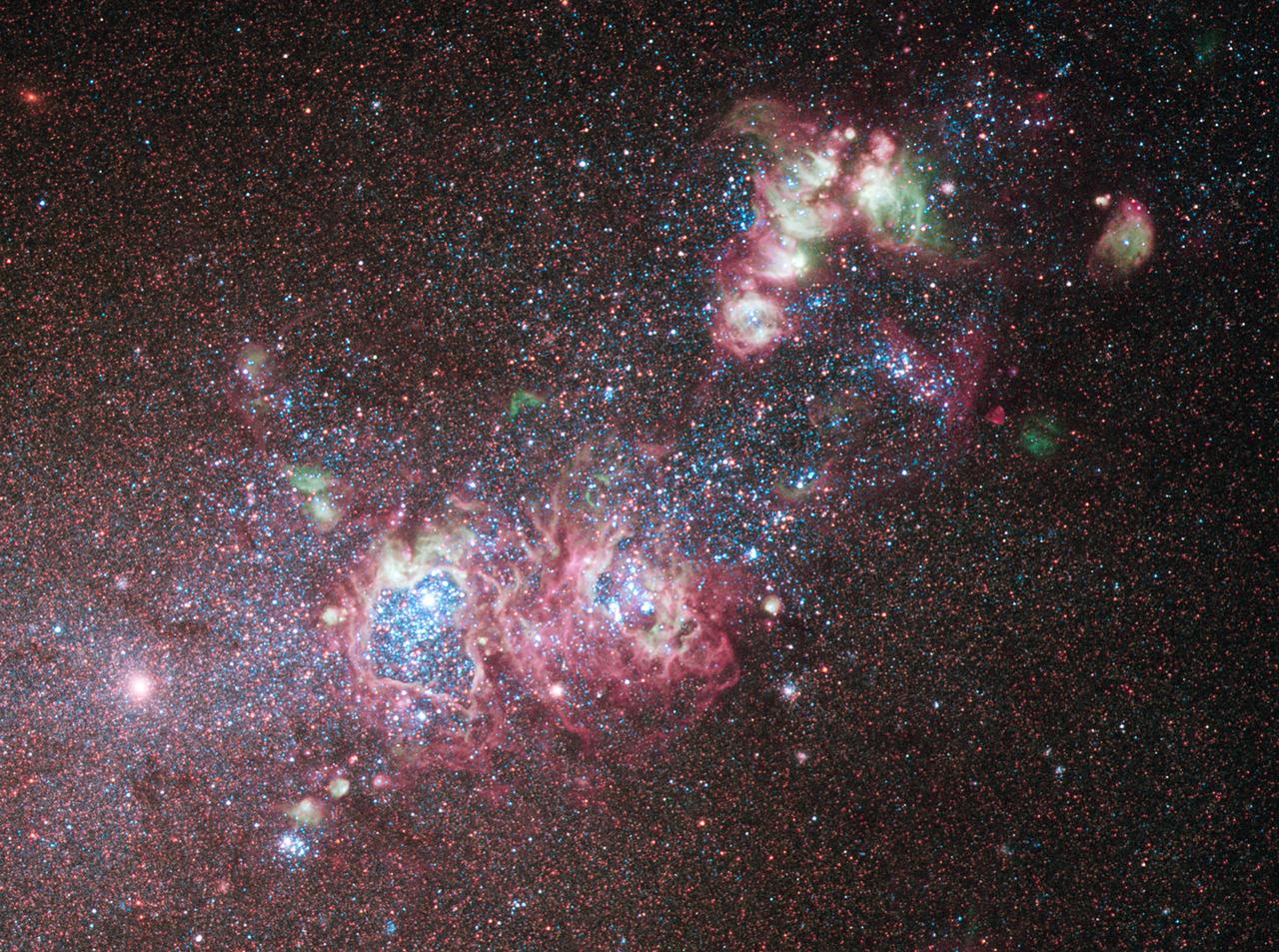
The dwarf galaxy NGC 4214 is ablaze with young stars and gas clouds. Located around 10 million light-years away in the constellation of Canes Venatici (The Hunting Dogs), the galaxy's close proximity, combined with the wide variety of evolutionary stages among the stars, make it an ideal laboratory to research the triggers of star formation and evolution. Intricate patterns of glowing hydrogen formed during the star-birthing process, cavities blown clear of gas by stellar winds, and bright stellar clusters of NGC 4214 can be seen in this optical and near-infrared image. Observations of this dwarf galaxy have also revealed clusters of much older red supergiant stars. Additional older stars can be seen dotted all across the galaxy. The variety of stars at different stages in their evolution indicates that the recent and ongoing starburst periods are not the first, and the galaxy's abundant supply of hydrogen means that star formation will continue into the future. This color image was taken using the Wide Field Camera 3 in December 2009. Credit: NASA, ESA, and the Hubble Heritage (STScI/AURA)-ESA/Hubble Collaboration Acknowledgment: R. O'Connell (University of Virginia) and the WFC3 Scientific Oversight Committee <b><a href="http://www.nasa.gov/audience/formedia/features/MP_Photo_Guidelines.html" rel="nofollow">NASA image use policy.</a></b> <b><a href="http://www.nasa.gov/centers/goddard/home/index.html" rel="nofollow">NASA Goddard Space Flight Center</a></b> enables NASA’s mission through four scientific endeavors: Earth Science, Heliophysics, Solar System Exploration, and Astrophysics. Goddard plays a leading role in NASA’s accomplishments by contributing compelling scientific knowledge to advance the Agency’s mission. <b>Follow us on <a href="http://twitter.com/NASAGoddardPix" rel="nofollow">Twitter</a></b> <b>Like us on <a href="http://www.facebook.com/pages/Greenbelt-MD/NASA-Goddard/395013845897?ref=tsd" rel="nofollow">Facebook</a></b> <b>Find us on <a href="http://instagram.com/nasagoddard?vm=grid" rel="nofollow">Instagram</a></b>
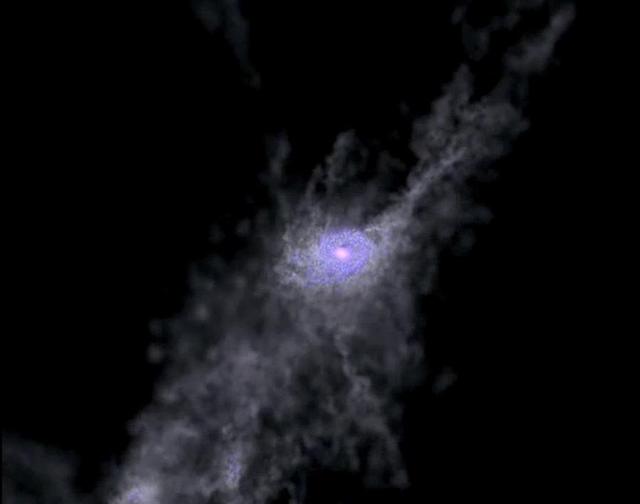
Created with the help of supercomputers, this frame from a simulation shows the formation of a massive galaxy during the first 2 billion years of the universe.
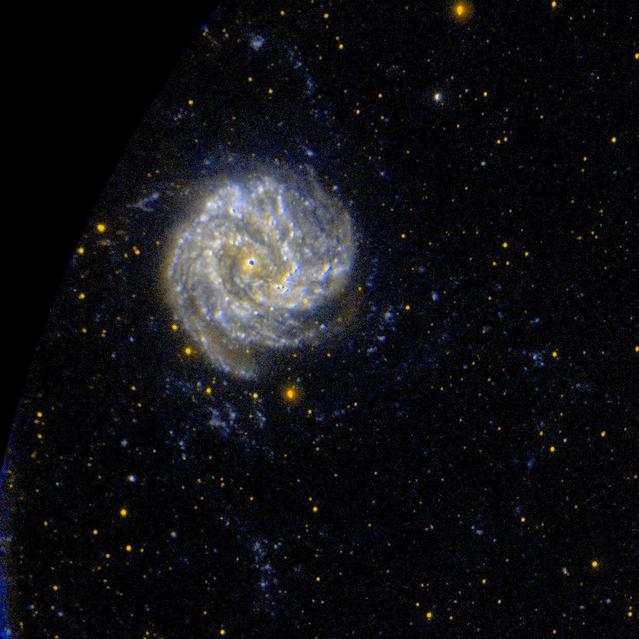
Ultraviolet images such as this one from NASA's Galaxy Evolution Explorer suggest the M83 has unusual pockets of star formation separated by large distances from the spiral arms in the main disk of the galaxy. http://photojournal.jpl.nasa.gov/catalog/PIA07903

This diagram illustrates research from NASA Galaxy Evolution Explorer showing that black holes once they reach a critical size can put the brakes on new star formation in elliptical galaxies.
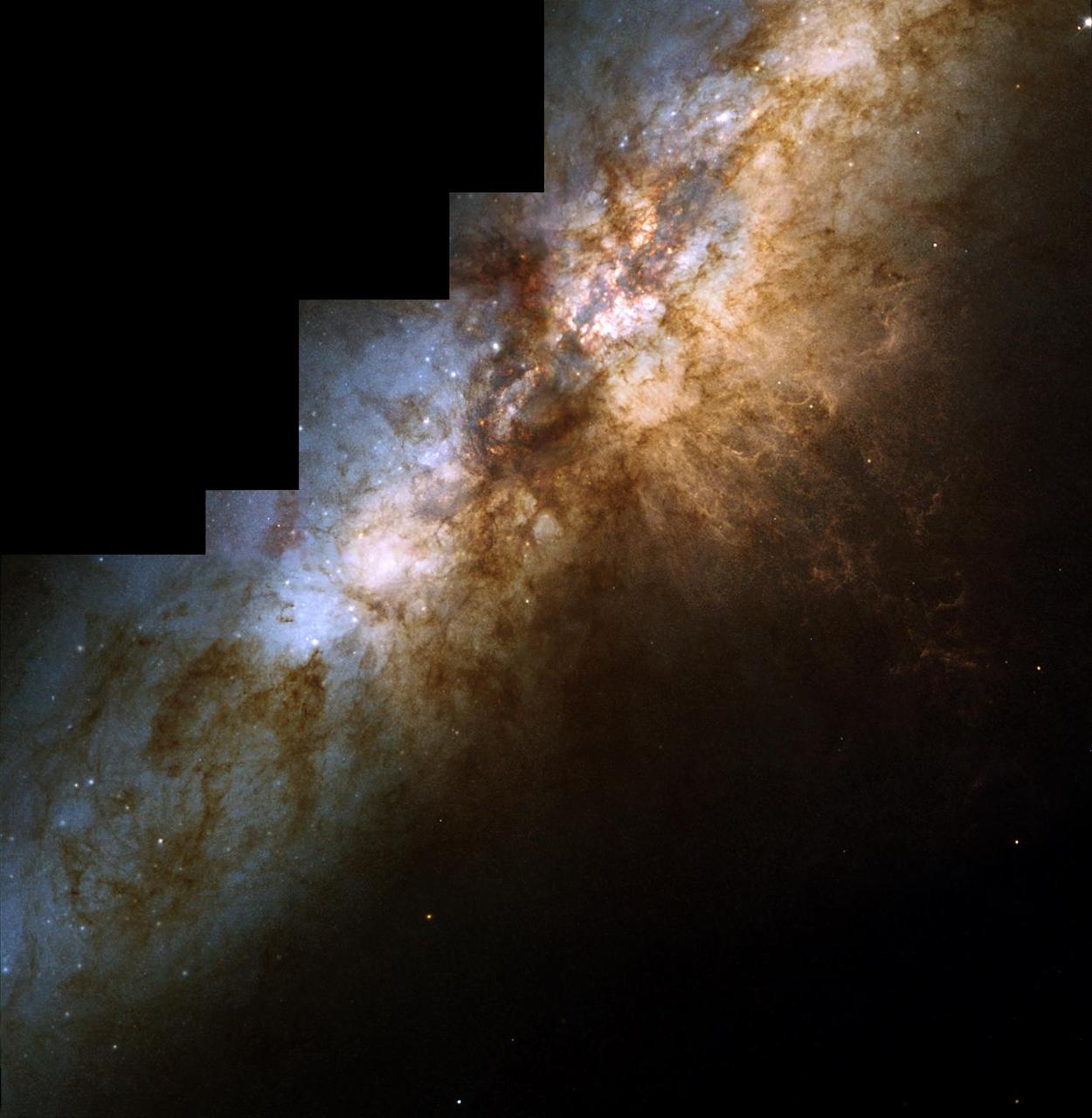
A colorful image showing violent star formation triggered when two galaxies bumped into each other has been captured by NASA Hubble Space Telescope.
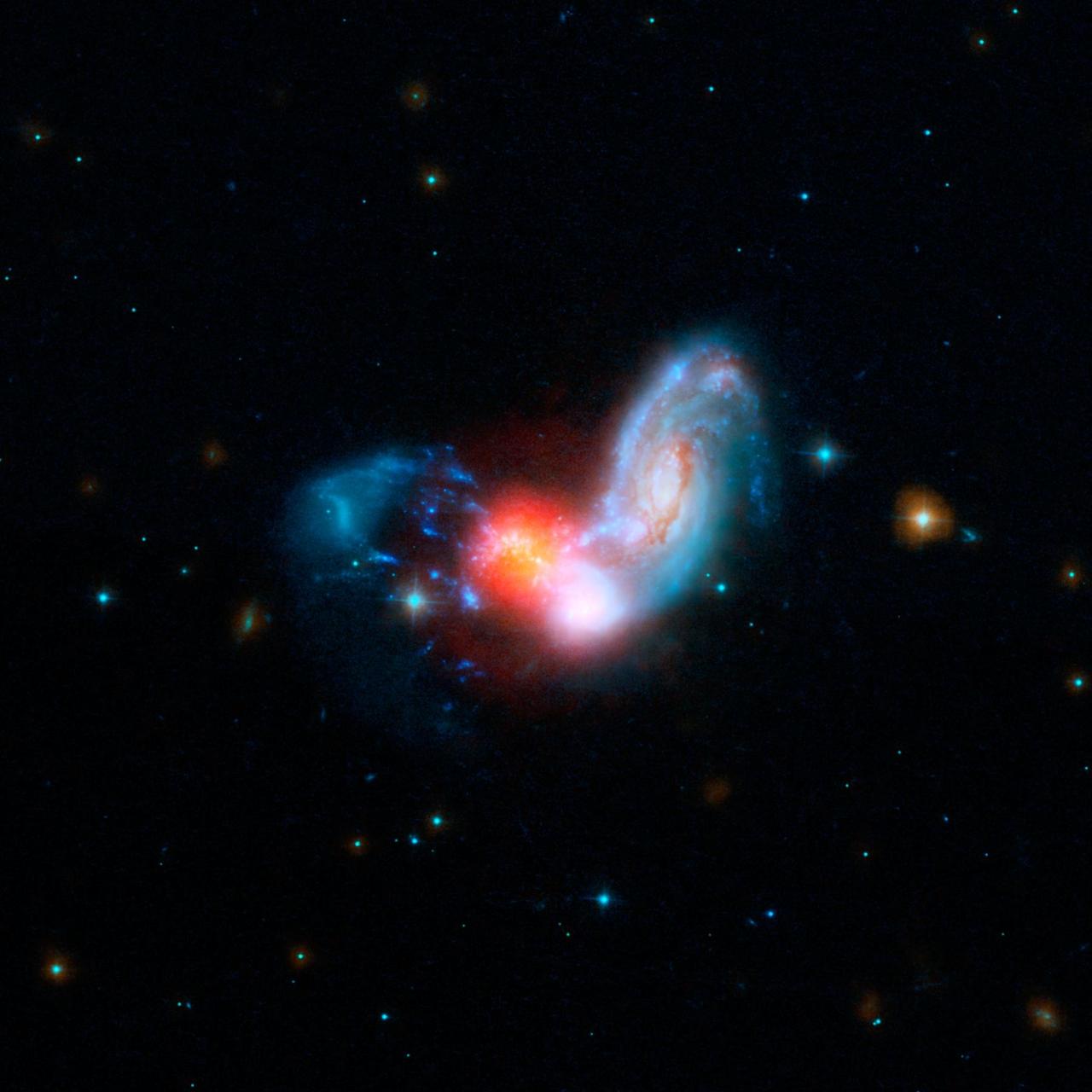
A brilliant burst of star formation is revealed in this image combining observations from NASA Spitzer and Hubble Space Telescopes. The collision of two spiral galaxies has triggered this luminous starburst.

This mosaic reveals a panorama of the Milky Way from NASA Spitzer Space Telescope. This picture covers only about three percent of the sky, but includes more than half of the galaxy stars and the majority of its star formation activity.

In combined data from ESA Herschel and NASA Spitzer telescopes, irregular distribution of dust in the Small Magellanic Cloud becomes clear. A stream of dust extends to left, known as the galaxy wing, and a bar of star formation appears to right.
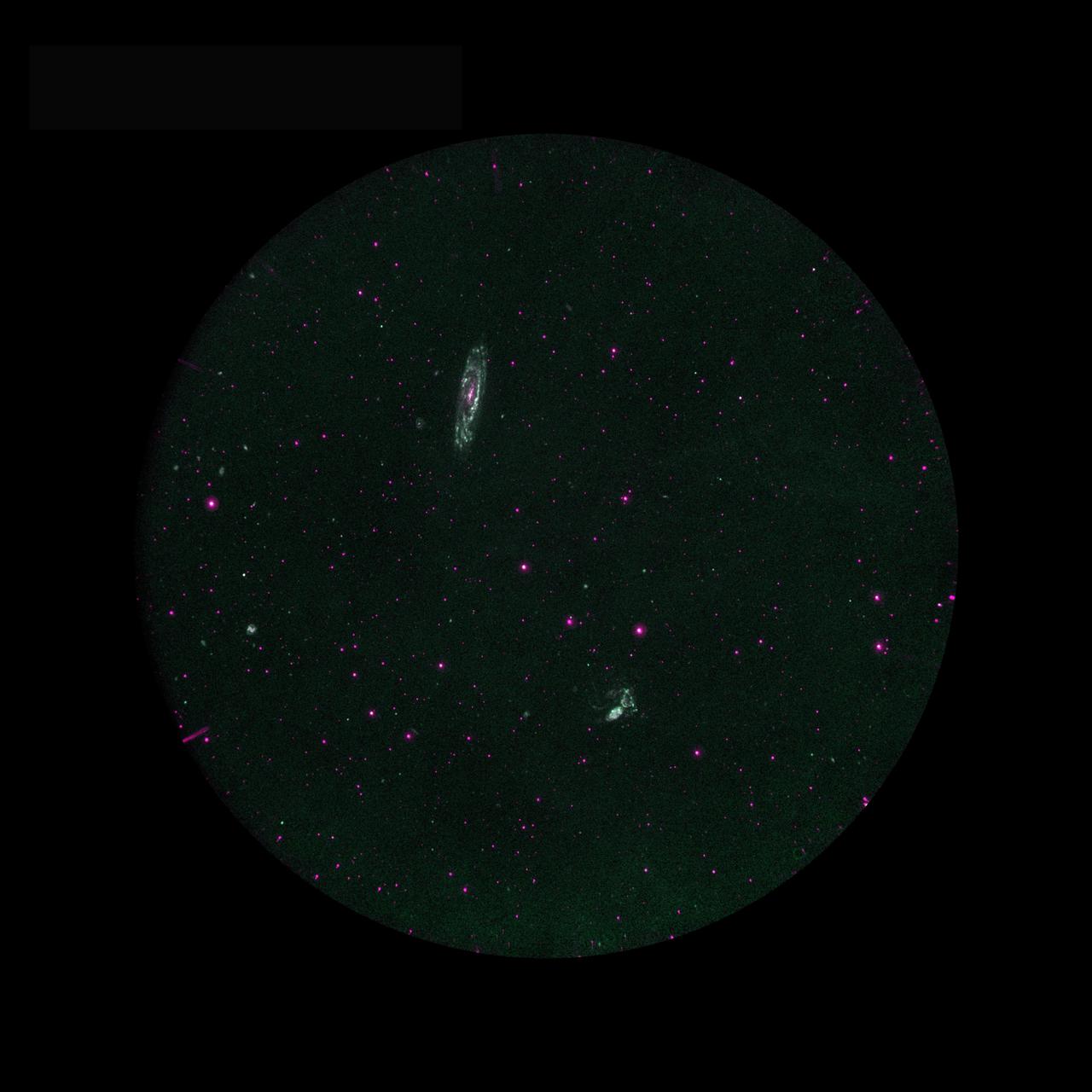
Galaxy Evolution Explorer observation of Stephan's Quintet and the nearby galaxy NGC 7331. Blue represents far ultraviolet, and red near ultraviolet. Stephan's quintet is an interacting group of galaxies. Close inspection of the group (lower center-right) shows blue regions of recent star formation associated with streamers of gas (tidal tails) created by the interaction. NGC 7331 shows prominent star formation in spiral arms. http://photojournal.jpl.nasa.gov/catalog/PIA04925
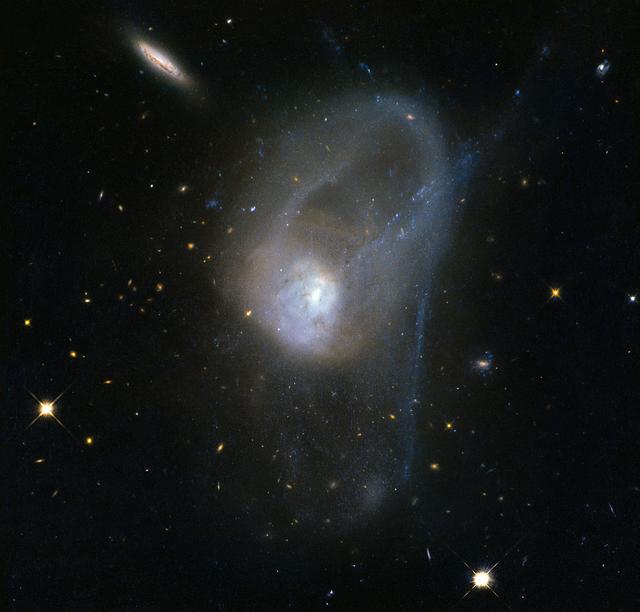
It is known today that merging galaxies play a large role in the evolution of galaxies and the formation of elliptical galaxies in particular. However there are only a few merging systems close enough to be observed in depth. The pair of interacting galaxies picture seen here — known as NGC 3921 — is one of these systems. NGC 3921 — found in the constellation of Ursa Major (The Great Bear) — is an interacting pair of disc galaxies in the late stages of its merger. Observations show that both of the galaxies involved were about the same mass and collided about 700 million years ago. You can see clearly in this image the disturbed morphology, tails and loops characteristic of a post-merger. The clash of galaxies caused a rush of star formation and previous Hubble observations showed over 1000 bright, young star clusters bursting to life at the heart of the galaxy pair.
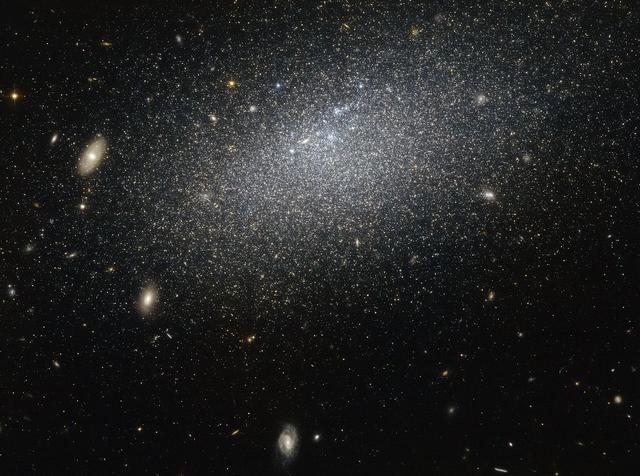
The drizzle of stars scattered across this image forms a galaxy known as UGC 4879. UGC 4879 is an irregular dwarf galaxy — as the name suggests, galaxies of this type are a little smaller and messier than their cosmic cousins, lacking the majestic swirl of a spiral or the coherence of an elliptical. This galaxy is also very isolated. There are about 2.3 million light years between UGC 4879 and its closest neighbour, Leo A, which is about the same distance as that between the Andromeda Galaxy and the Milky Way. This galaxy’s isolation means that it has not interacted with any surrounding galaxies, making it an ideal laboratory for studying star formation uncomplicated by interactions with other galaxies. Studies of UGC 4879 have revealed a significant amount of star formation in the first 4-billion-years after the Big Bang, followed by a strange nine-billion-year lull in star formation, ended 1-billion-years ago by a more recent reignition. The reason for this behaviour, however, remains mysterious, and the solitary galaxy continues to provide ample study material for astronomers looking to understand the complex mysteries of starbirth throughout the Universe.
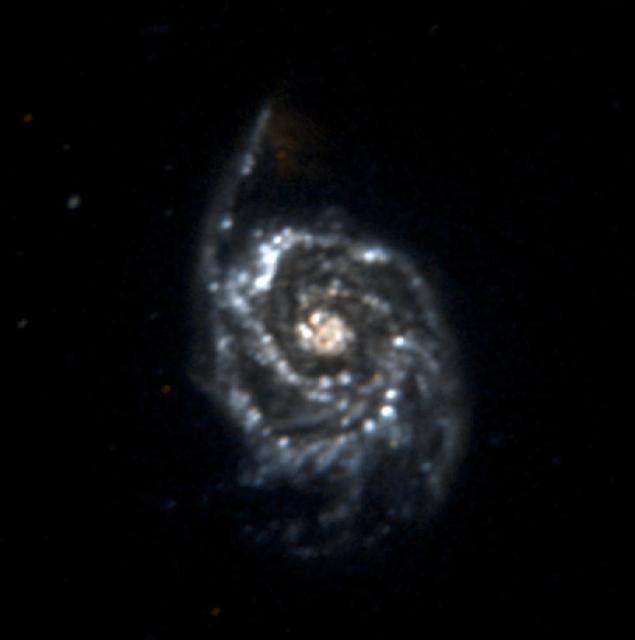
NASA's Galaxy Evolution Explorer took this image of the spiral galaxy Messier 51 on June 19 and 20, 2003. Messier 51 is located 27 million light-years from Earth. Due to a lack of star formation, the companion galaxy in the top of the picture is barely visible as a near ultraviolet object. http://photojournal.jpl.nasa.gov/catalog/PIA04628

This is an ultraviolet color image of the galaxy NGC5398 taken by NASA Galaxy Evolution Explorer on June 7, 2003. NGC5398 is a barred spiral galaxy located 60 million light-years from Earth. The star formation is concentrated in the two bright regions of the image. http://photojournal.jpl.nasa.gov/catalog/PIA04633

The bright streak of glowing gas and stars in this NASA/ESA Hubble Space Telescope image is known as PGC 51017, or SBSG 1415+437. It is type of galaxy known as a blue compact dwarf. This particular dwarf is well studied and has an interesting star formation history. Astronomers initially thought that SBS 1415+437 was a very young galaxy currently undergoing its very first burst of star formation, but more recent studies have suggested that the galaxy is in fact a little older, containing stars over 1.3 billion years old. Starbursts are an area of ongoing research for astronomers — short-lived and intense periods of star formation, during which huge amounts of gas within a galaxy are hungrily used up to form newborn stars. They have been seen in gas-rich disc galaxies, and in some lower-mass dwarfs. However, it is still unclear whether all dwarf galaxies experience starbursts as part of their evolution. It is possible that dwarf galaxies undergo a star formation cycle, with bursts occurring repeatedly over time. SBS 1415+437 is an interesting target for another reason. Dwarf galaxies like this are thought to have formed early in the Universe, producing some of the very first stars before merging together to create more massive galaxies. Dwarf galaxies which contain very few of the heavier elements formed from having several generations of stars, like SBS 1415+437, remain some of the best places to study star-forming processes similar to those thought to occur in the early Universe. However, it seems that our nearby patch of the Universe may not contain any galaxies that are currently undergoing their first burst of star formation. A version of this image was entered into the Hubble’s Hidden Treasures image processing competition by contestant Nick Rose.
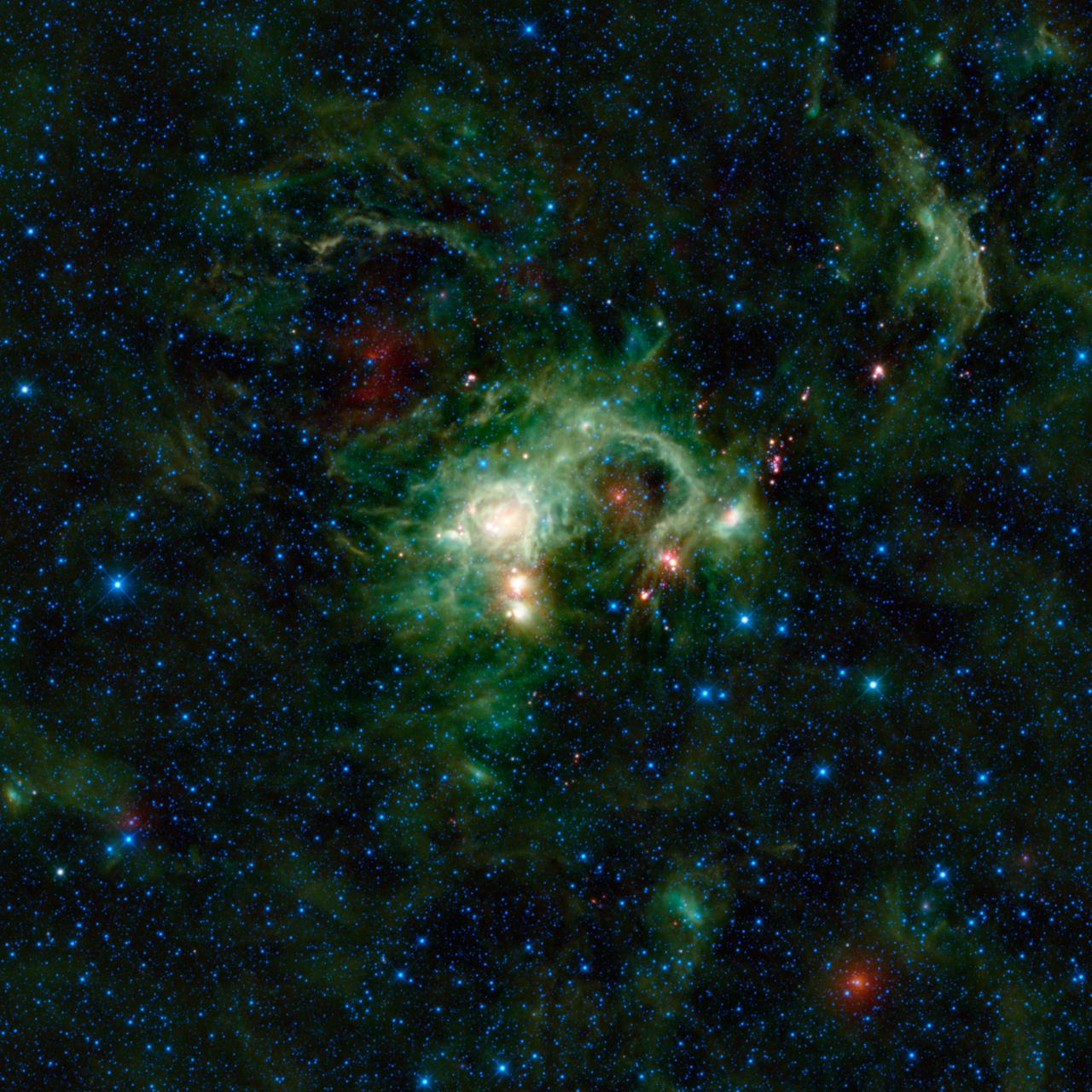
In the Perseus spiral arm of the Milky Way galaxy, opposite the galactic center, lies the nebula SH 2-235. As seen in infrared light, NASA Wide-field Infrared Survey Explorer reveals SH 2-235 to be a huge star formation complex.
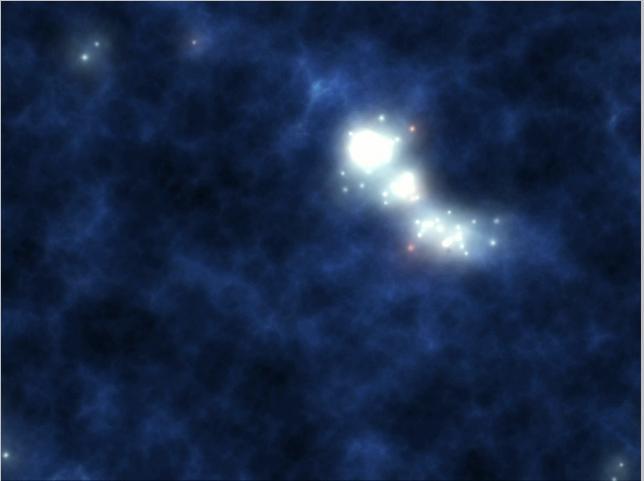
This artist animation illustrates the universe early years, from its explosive formation to its dark ages to its first stars and mini-galaxies. Scientists using NASA Spitzer Space Telescope found patches of infrared light splattered across the sky.
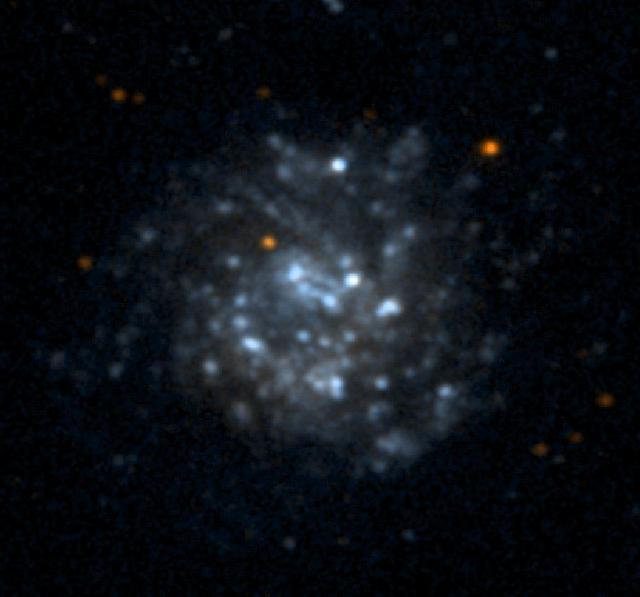
NASA Galaxy Evolution Explorer took this ultraviolet color image of the galaxy NGC5474 on June 7, 2003. NGC5474 is located 20 million light-years from Earth and is within a group of galaxies dominated by the Messier 101 galaxy. Star formation in this galaxy shows some evidence of a disturbed spiral pattern, which may have been induced by tidal interactions with Messier 101. http://photojournal.jpl.nasa.gov/catalog/PIA04634

This Chandra X-ray observatory image of M83 shows numerous point-like neutron stars and black hole x-ray sources scattered throughout the disk of this spiral galaxy. The bright nuclear region of the galaxy glows prominently due to a burst of star formation that is estimated to have begun about 20 million years ago in the galaxy's time frame. The nuclear region, enveloped by a 7 million degree Celsius gas cloud of carbon, neon, magnesium, silicon, and sulfur atoms, contains a much higher concentration of neutron stars and black holes than the rest of the galaxy. Hot gas with a slightly lower temperature of 4 million degrees observed along the spiral arms of the galaxy suggests that star formation in this region may be occurring at a more sedate rate.

The smudge of stars at the center of this NASA/ESA Hubble Space Telescope image is a galaxy known as UGC 5797. UGC 5797 is an emission line galaxy, meaning that it is currently undergoing active star formation. The result is a stellar population that is constantly being refurbished as massive bright blue stars form. Galaxies with prolific star formation are not only veiled in a blue tint, but are key to the continuation of a stellar cycle. In this image UGC 5797 appears in front of a background of spiral galaxies. Spiral galaxies have copious amounts of dust and gas — the main ingredient for stars — and therefore often also belong to the class of emission line galaxies. Spiral galaxies have disk-like shapes that drastically vary in appearance depending on the angle at which they are observed. The collection of spiral galaxies in this frame exhibits this attribute acutely: Some are viewed face-on, revealing the structure of the spiral arms, while the two in the bottom left are seen edge-on, appearing as plain streaks in the sky. There are many spiral galaxies, with varying colors and at different angles, sprinkled across this image — just take a look. Credit: ESA/Hubble & NASA, Acknowledgement: Luca Limatola
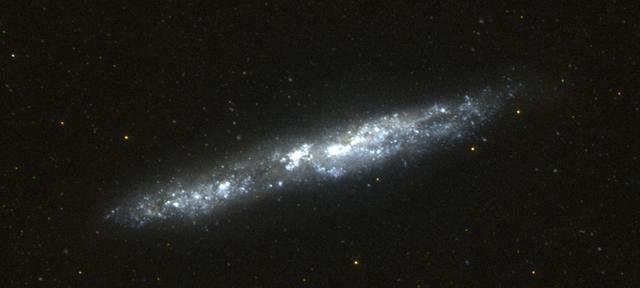
This image of the nearby edge-on spiral galaxy NGC 55 was taken by Galaxy Evolution Explorer on September 14, 2003, during 2 orbits. This galaxy lies 5.4 million light years from our Milky Way galaxy and is a member of the "local group" of galaxies that also includes the Andromeda galaxy (M31), the Magellanic clouds, and 40 other galaxies. The spiral disk of NGC 55 is inclined to our line of sight by approximately 80 degrees and so this galaxy looks cigar-shaped. This picture is a combination of Galaxy Evolution Explorer images taken with the far ultraviolet (colored blue) and near ultraviolet detectors, (colored red). The bright blue regions in this image are areas of active star formation detected in the ultraviolet by Galaxy Evolution Explorer. The red stars in this image are foreground stars in our own Milky Way galaxy. http://photojournal.jpl.nasa.gov/catalog/PIA04923

KENNEDY SPACE CENTER, FLA. - Orbital Sciences’ L-1011 aircraft takes off from Cape Canaveral Air Force Station carrying the Pegasus XL rocket/Galaxy Evolution Explorer (GALEX) under its belly. Release of the Pegasus was scheduled for about 8 a.m. over the Atlantic Ocean at an altitude of 39,000 feet at a location approximately 100 nautical miles offshore east-northeast of Cape Canaveral. Spacecraft separation from the Pegasus occurs 11 minutes later. At that time the satellite will be in a circular orbit of 431 statute miles (690 km) at a 29-degree inclination. The GALEX will carry into space an orbiting telescope that will observe a million galaxies across 10 billion years of cosmic history to help astronomers determine when the stars and elements we see today had their origins. The spacecraft will sweep the skies for 28 months using state-of-the-art ultraviolet detectors to single out galaxies dominated by young, hot, short-lived stars that give off a great deal of energy at that wavelength. These galaxies are actively creating stars, and therefore provide a window into the history and causes of star formation in galaxies.
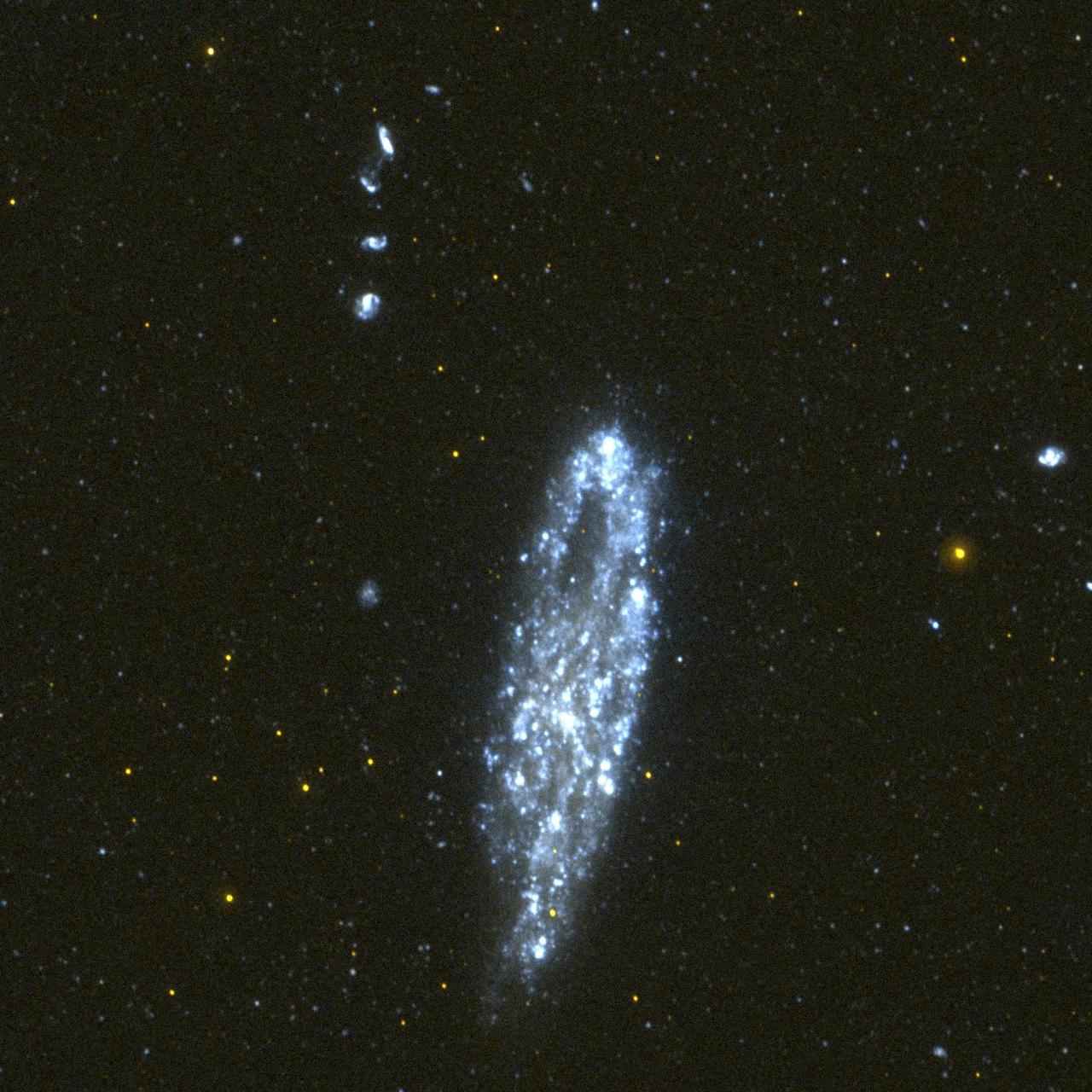
This image of the dwarf spiral galaxy NGC 247 was taken by Galaxy Evolution Explorer on October 13, 2003, in a single orbit exposure of 1600 seconds. The region that looks like a "hole" in the upper part of the galaxy is a location with a deficit of gas and therefore a lower star formation rate and ultraviolet brightness. Optical images of this galaxy show a bright star on the southern edge. This star is faint and red in the Galaxy Evolution Explorer ultraviolet image, revealing that it is a foreground star in our Milky Way galaxy. The string of background galaxies to the North-East (upper left) of NGC 247 is 355 million light years from our Milky Way galaxy whereas NGC 247 is a mere 9 million light years away. The faint blue light that can be seen in the Galaxy Evolution Explorer image of the upper two of these background galaxies may indicate that they are in the process of merging together. http://photojournal.jpl.nasa.gov/catalog/PIA04922
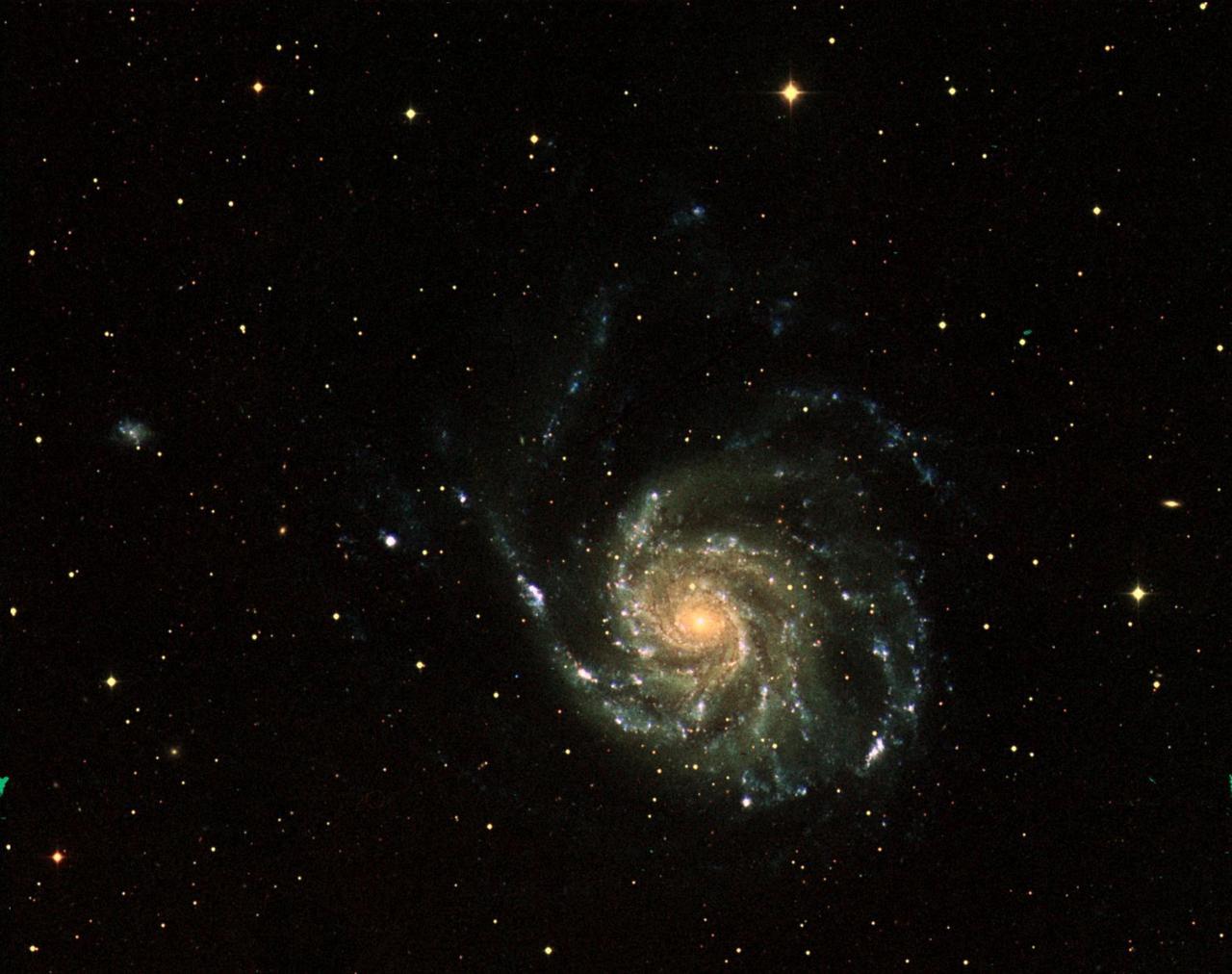
This three-color image of galaxy M101 was taken by NASA's Galaxy Evolution Explorer on June 20, 2003. The far ultraviolet emissions are shown in blue, the near ultraviolet emissions are green, and the red emissions, which were taken from NASA's Digital Sky Survey, represent visible light. This image combines short, medium, and long "exposure" pictures to best display the evolution of star formation in a spiral galaxy. http://photojournal.jpl.nasa.gov/catalog/PIA04630

The NASA/ESA Hubble Space Telescope doesn’t usually get much assistance from its celestial subjects — but to take this image, the telescope opted for teamwork and made good use of a fascinating cosmic phenomenon known as gravitational lensing. This effect works when the gravitational influence of a massive object, such as the galaxy cluster in this image, is so colossal that it warps the surrounding space, causing nearby light to travel along distorted paths. The massive object is effectively turned into a giant magnifying glass, bending and amplifying the light traveling from more distant galaxies lying behind it. In this particular case, astronomers used the foreground galaxy cluster (named SDSS J0915+3826) to study star formation in galaxies lying so far away that their light has taken up to 11.5 billion years to reach Earth. These galaxies formed at a very early stage in the lifetime of the universe, giving astronomers a rare glimpse into the beginning of the cosmos. Despite the distance of these galaxies, the lensing effects of SDSS J0915+3826 allowed astronomers to work out the sizes, luminosities, star formation rates and stellar populations of individual star-forming clumps within these galaxies — quite an achievement! Image credit: ESA/Hubble & NASA
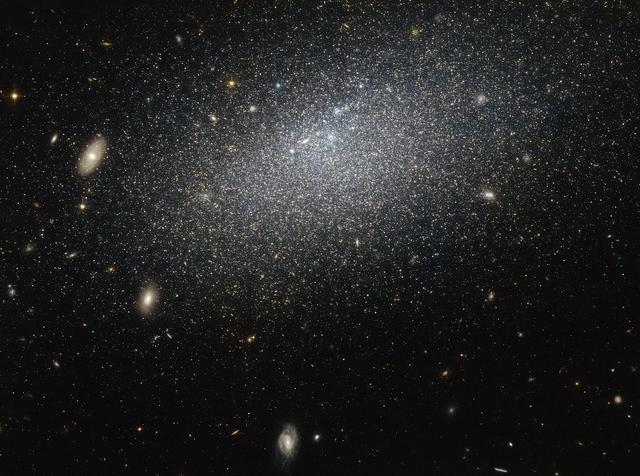
This irregular dwarf galaxy's closes neighbor is 2.3 million light years away, so yeah, we're calling it "isolated". The drizzle of stars scattered across this image forms a galaxy known as UGC 4879. UGC 4879 is an irregular dwarf galaxy — as the name suggests, galaxies of this type are a little smaller and messier than their cosmic cousins, lacking the majestic swirl of a spiral or the coherence of an elliptical. This galaxy is also very isolated. There are about 2.3 million light years between UGC 4879 and its closest neighbor, Leo A, which is about the same distance as that between the Andromeda Galaxy and the Milky Way. This galaxy’s isolation means that it has not interacted with any surrounding galaxies, making it an ideal laboratory for studying star formation uncomplicated by interactions with other galaxies. Studies of UGC 4879 have revealed a significant amount of star formation in the first 4 billion years after the Big Bang, followed by a strange 9-billion-year lull in star formation that ended 1 billion years ago by a more recent re-ignition. The reason for this behavior, however, remains mysterious, and the solitary galaxy continues to provide ample study material for astronomers looking to understand the complex mysteries of star birth throughout the universe. Image credit: NASA/ESA <b><a href="http://www.nasa.gov/audience/formedia/features/MP_Photo_Guidelines.html" rel="nofollow">NASA image use policy.</a></b> <b><a href="http://www.nasa.gov/centers/goddard/home/index.html" rel="nofollow">NASA Goddard Space Flight Center</a></b> enables NASA’s mission through four scientific endeavors: Earth Science, Heliophysics, Solar System Exploration, and Astrophysics. Goddard plays a leading role in NASA’s accomplishments by contributing compelling scientific knowledge to advance the Agency’s mission. <b>Follow us on <a href="http://twitter.com/NASAGoddardPix" rel="nofollow">Twitter</a></b> <b>Like us on <a href="http://www.facebook.com/pages/Greenbelt-MD/NASA-Goddard/395013845897?ref=tsd" rel="nofollow">Facebook</a></b> <b>Find us on <a href="http://instagrid.me/nasagoddard/?vm=grid" rel="nofollow">Instagram</a></b>
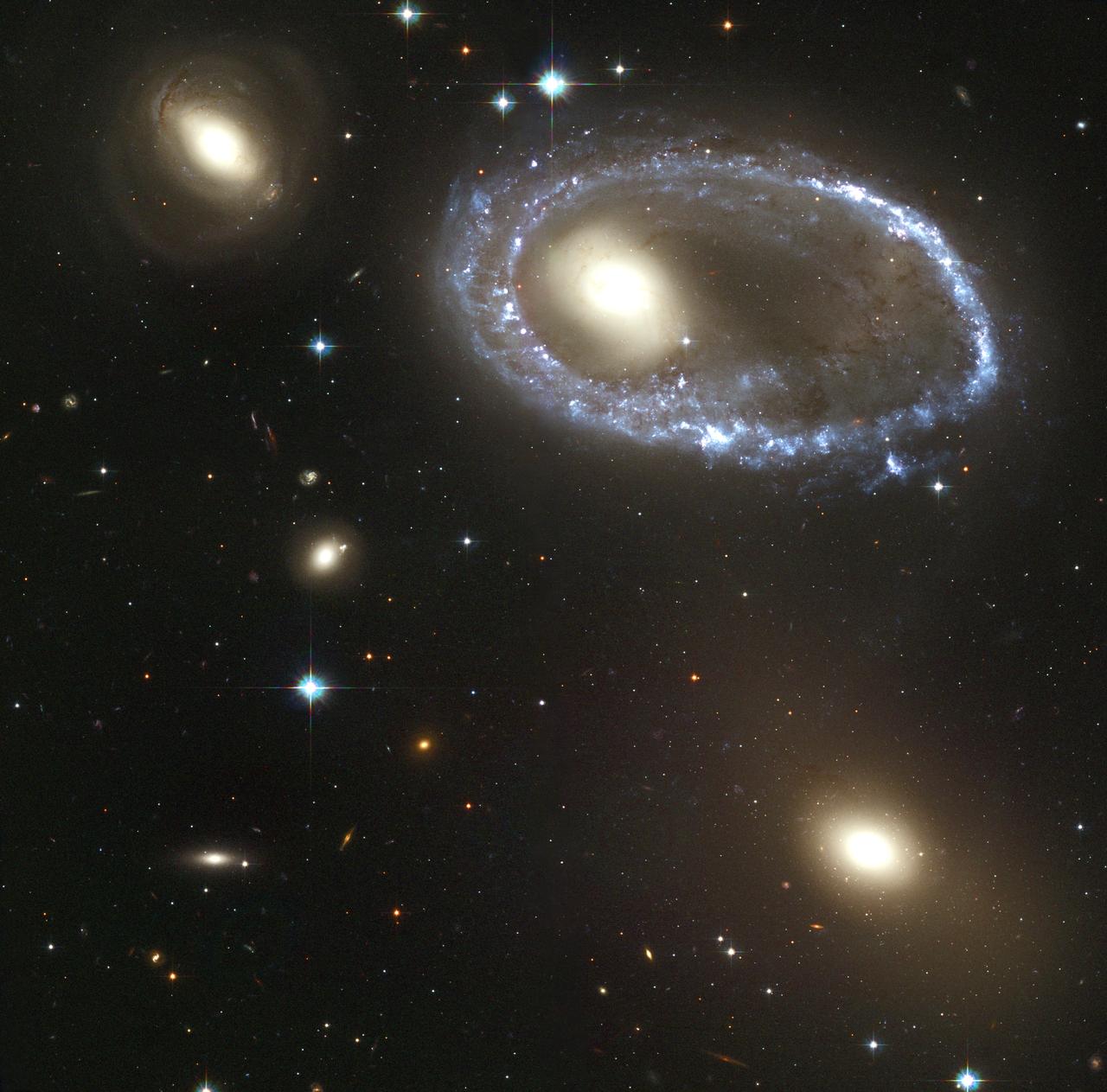
Released to commemorate the 14th anniversary of NASA’s Hubble Space Telescope (HST) is the image of a galaxy cataloged as AM 0644-741. Resembling a diamond encrusted bracelet, the ring of brilliant blue star clusters wraps around a yellowish nucleus of what was once a normal spiral galaxy. Located 300 million light years away in the direction of the southern constellation Dorado, the sparkling blue ring is 150,000 light years in diameter, making it larger than our entire home galaxy, the Milky Way. Ring galaxies are a striking example of how collisions between galaxies can dramatically change their structure, while triggering the formation of new stars. Typically one galaxy plunges directly into the disk of another one. The ring that pierced through this galaxy’s ring is out of the image but is visible in larger-field images. The soft galaxy visible to the left of the ring galaxy is a coincidental background galaxy which is not interacting with the ring. Rampant star formation explains why the ring is so blue. It is continuously forming massive, young, hot stars. Another sign of robust star formation is the pink regions along the ring. These are rare clouds of glowing hydrogen gas, fluorescing because of the strong ultraviolet light from the newly formed stars. The Hubble Heritage Team used the Hubble Advanced Camera for Surveys to take this image using a combination of four separate filters that isolate blue, green, red, and near-infrared light to create the color image.
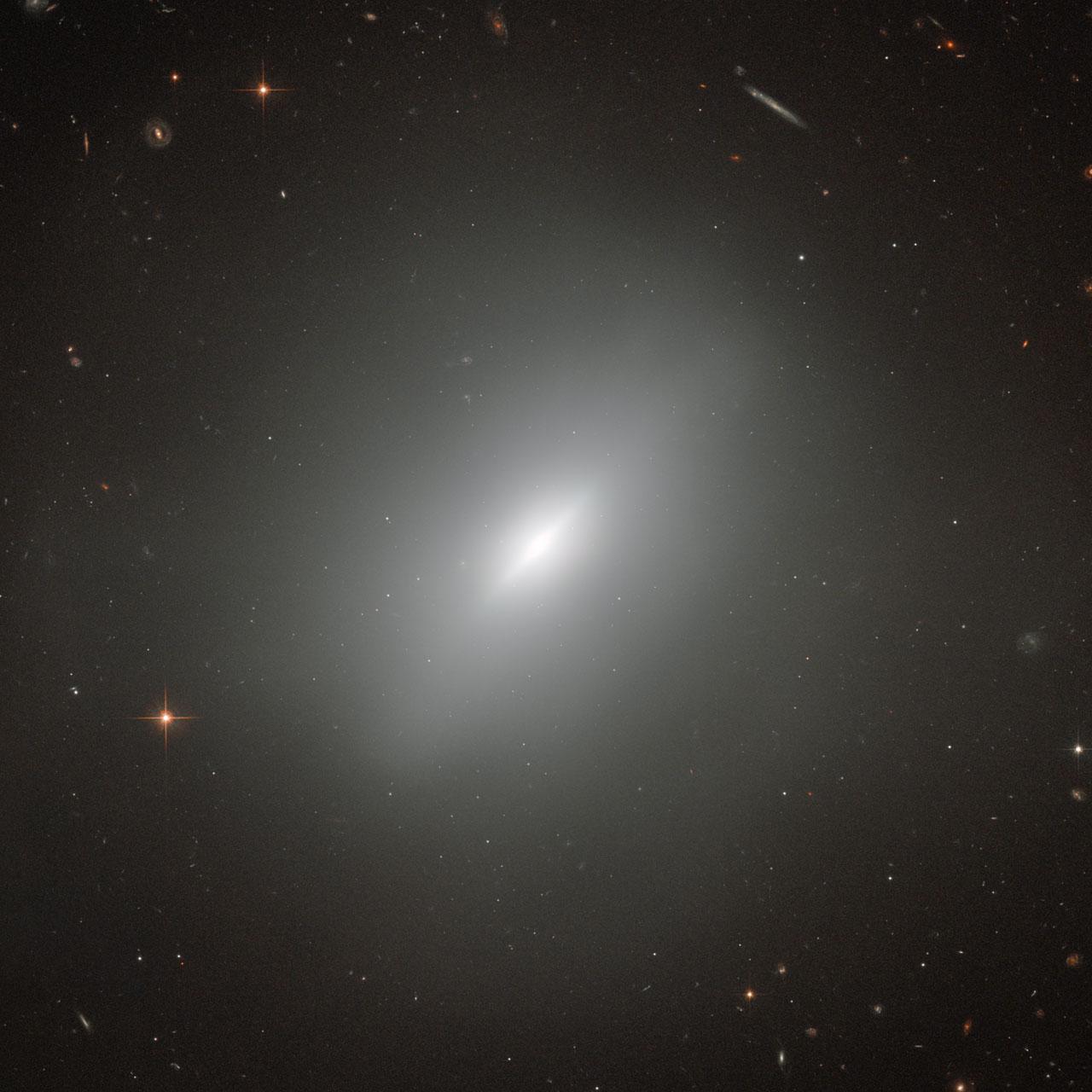
At the centre of this amazing image is the elliptical galaxy NGC 3610. Surrounding the galaxy are a wealth of other galaxies of all shapes. There are spiral galaxies, galaxies with a bar in their central regions, distorted galaxies and elliptical galaxies, all visible in the background. In fact, almost every bright dot in this image is a galaxy — the few foreground stars are clearly distinguishable due to the diffraction spikes that overlay their images. NGC 3610 is of course the most prominent object in this image — and a very interesting one at that! Discovered in 1793 by William Herschel, it was later found that this elliptical galaxy contains a disc. This is very unusual, as discs are one of the main distinguishing features of a spiral galaxy. And NGC 3610 even hosts a memarkable bright disc. The reason for the peculiar shape of NGC 3610 stems from its formation history. When galaxies form, they usually resemble our galaxy, the Milky Way, with flat discs and spiral arms where star formation rates are high and which are therefore very bright. An elliptical galaxy is a much more disordered object which results from the merging of two or more disc galaxies. During these violent mergers most of the internal structure of the original galaxies is destroyed. The fact that NGC 3610 still shows some structure in the form of a bright disc implies that it formed only a short time ago. The galaxy’s age has been put at around four billion years and it is an important object for studying the early stages of evolution in elliptical galaxies.
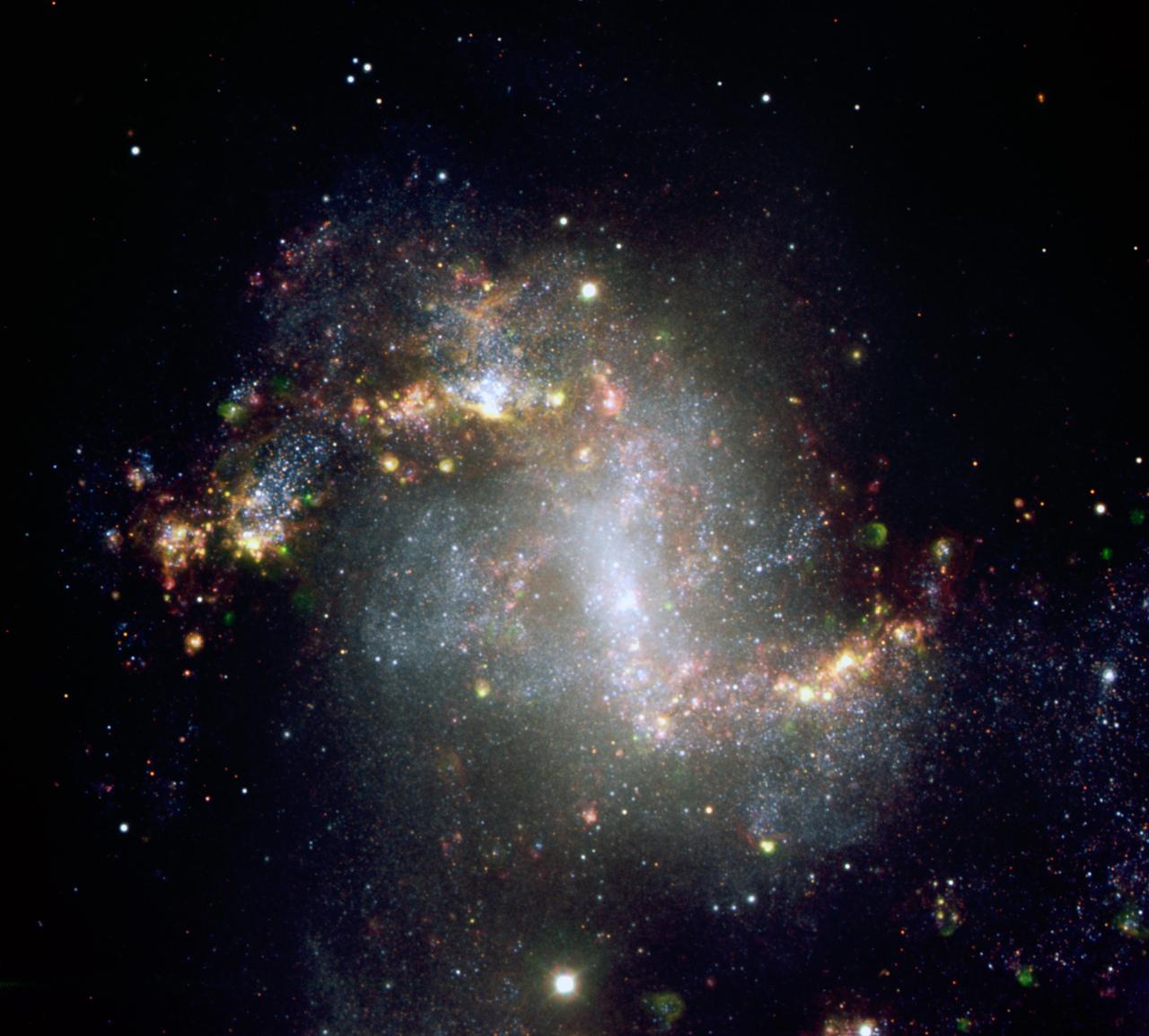
The central parts of the starburst galaxy NGC 1313. The very active state of this galaxy is evident from the image, showing many star formation regions. A great number of supershell nebulae, that is, cocoons of gas inflated and etched by successive bursts of star formation, are visible. The green nebulosities are regions emitting in the ionised oxygen lines and may harbour clusters with very hot stars. This colour-composite is based on images obtained with the FORS1 instrument on one of the 8.2-m Unit Telescope of ESO's Very Large Telescope, located at Cerro Paranal. The data were obtained in the night of 16 December 2003, through different broad- (R, B, and z) and narrow-band filters (H-alpha, OI, and OIII).
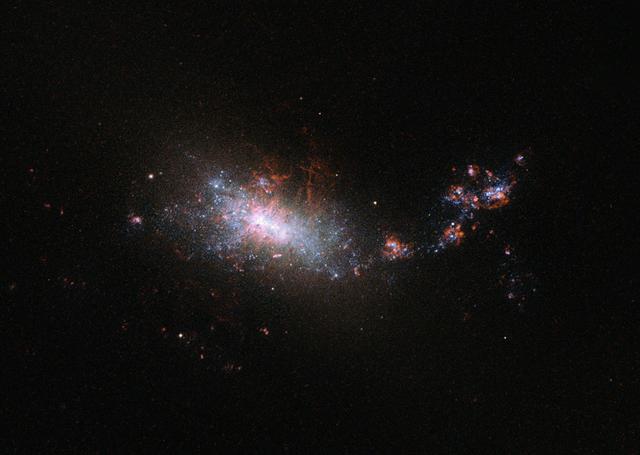
This dramatic image shows the NASA/ESA Hubble Space Telescope’s view of dwarf galaxy known as NGC 1140, which lies 60 million light-years away in the constellation of Eridanus. As can be seen in this image NGC 1140 has an irregular form, much like the Large Magellanic Cloud — a small galaxy that orbits the Milky Way. This small galaxy is undergoing what is known as a starburst. Despite being almost ten times smaller than the Milky Way it is creating stars at about the same rate, with the equivalent of one star the size of our sun being created per year. This is clearly visible in the image, which shows the galaxy illuminated by bright, blue-white, young stars. Galaxies like NGC 1140 — small, starbursting and containing large amounts of primordial gas with far fewer elements heavier than hydrogen and helium than are present in our sun — are of particular interest to astronomers. Their composition makes them similar to the intensely star-forming galaxies in the early Universe. And these early Universe galaxies were the building blocks of present-day large galaxies like our galaxy, the Milky Way. But, as they are so far away these early Universe galaxies are harder to study so these closer starbursting galaxies are a good substitute for learning more about galaxy evolution. The vigorous star formation will have a very destructive effect on this small dwarf galaxy in its future. When the larger stars in the galaxy die, and explode as supernovae, gas is blown into space and may easily escape the gravitational pull of the galaxy. The ejection of gas from the galaxy means it is throwing out its potential for future stars as this gas is one of the building blocks of star formation. NGC 1140’s starburst cannot last for long. Image credit: ESA/Hubble & NASA
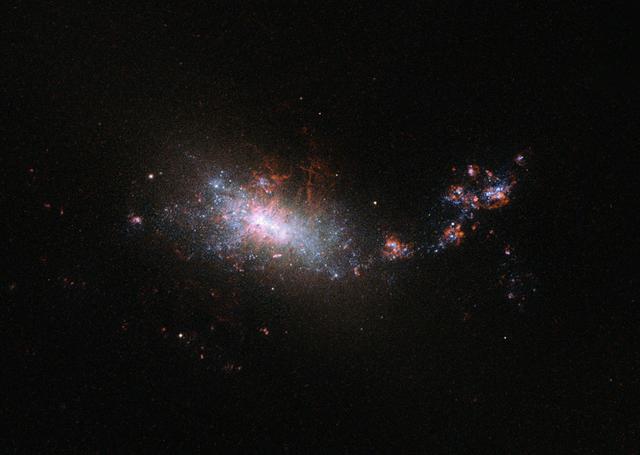
This dramatic image shows the NASA/ESA Hubble Space Telescope’s view of dwarf galaxy known as NGC 1140, which lies 60 million light-years away in the constellation of Eridanus. As can be seen in this image NGC 1140 has an irregular form, much like the Large Magellanic Cloud — a small galaxy that orbits the Milky Way. This small galaxy is undergoing what is known as a starburst. Despite being almost ten times smaller than the Milky Way it is creating stars at about the same rate, with the equivalent of one star the size of the Sun being created per year. This is clearly visible in the image, which shows the galaxy illuminated by bright, blue-white, young stars. Galaxies like NGC 1140 — small, starbursting and containing large amounts of primordial gas with way fewer elements heavier than hydrogen and helium than present in our Sun — are of particular interest to astronomers. Their composition makes them similar to the intensely star-forming galaxies in the early Universe. And these early Universe galaxies were the building blocks of present-day large galaxies like our galaxy, the Milky Way. But, as they are so far away these early Universe galaxies are harder to study so these closer starbursting galaxies are a good substitute for learning more about galaxy evolution . The vigorous star formation will have a very destructive effect on this small dwarf galaxy in its future. When the larger stars in the galaxy die, and explode as supernovae, gas is blown into space and may easily escape the gravitational pull of the galaxy. The ejection of gas from the galaxy means it is throwing out its potential for future stars as this gas is one of the building blocks of star formation. NGC 1140’s starburst cannot last for long.
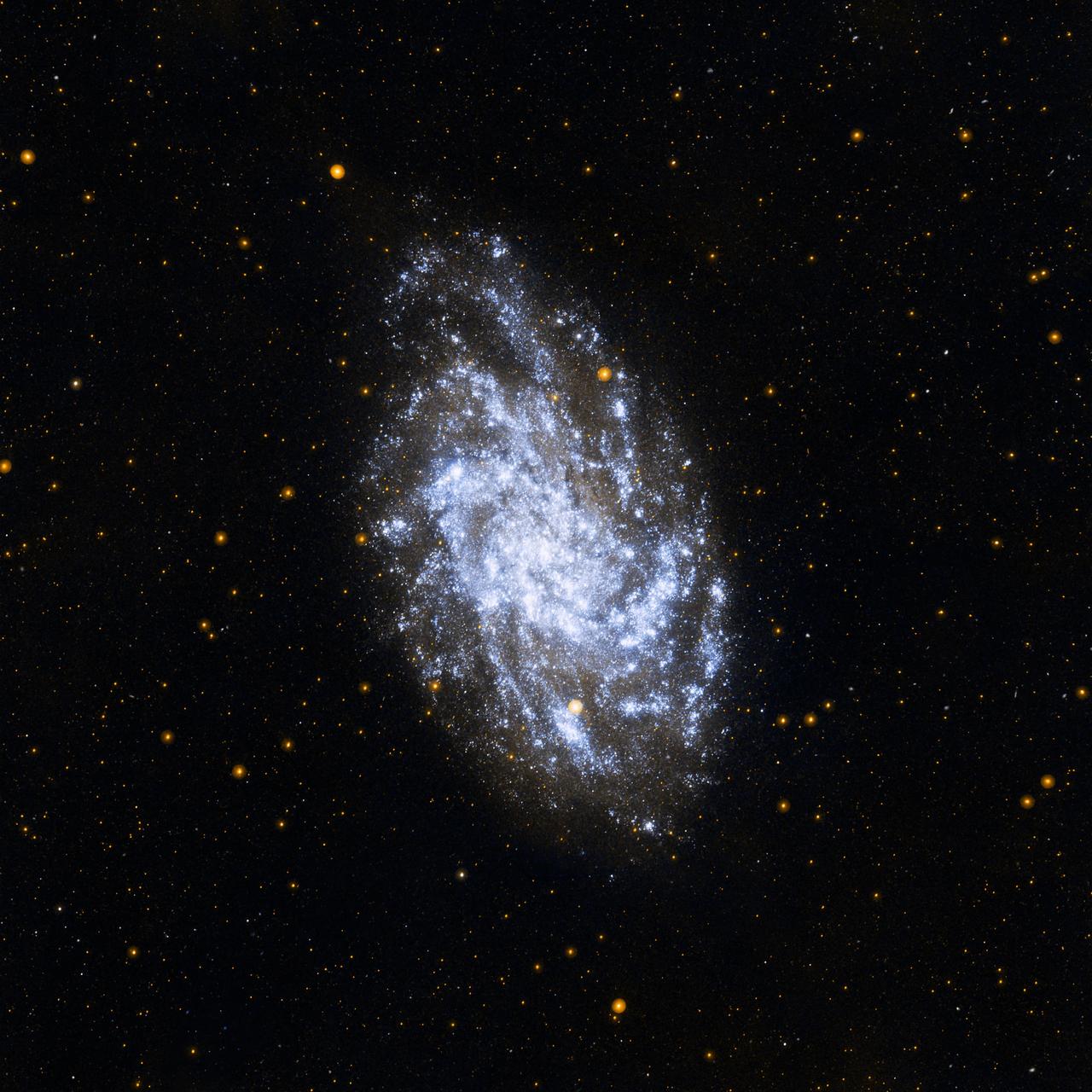
NASA Galaxy Evolution Explorer Mission celebrates its sixth anniversary studying galaxies beyond our Milky Way through its sensitive ultraviolet telescope, the only such far-ultraviolet detector in space. The mission studies the shape, brightness, size and distance of distant galaxies across 10 billion years of cosmic history, giving scientists a wealth of data to help us better understand the origins of the universe. One such object is pictured here, the galaxy NGC598, more commonly known as M33. The image shows a map of the recent star formation history of M33. The bright blue and white areas are where star formation has been extremely active over the past few million years. The patches of yellow and gold are regions where star formation was more active 100 million years ago. In addition, the ultraviolet image shows the most massive young stars in M33. These stars burn their large supply of hydrogen fuel quickly, burning hot and bright while emitting most of their energy at ultraviolet wavelengths. Compared with low-mass stars like our sun, which live for billions of years, these massive stars never reach old age, having a lifespan as short as a few million years. http://photojournal.jpl.nasa.gov/catalog/PIA12000
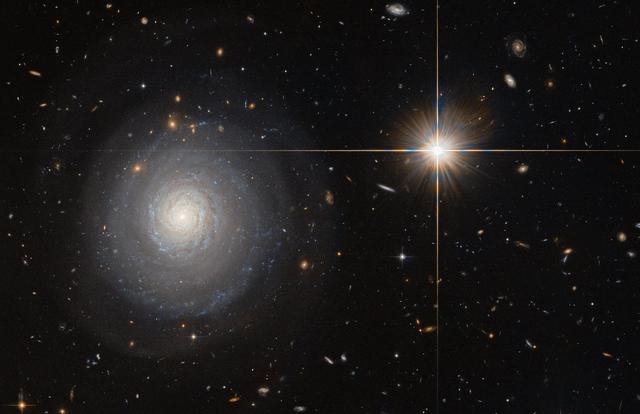
This image was taken by the NASA/ESA Hubble Space Telescope’s Advanced Camera for Surveys (ACS) and shows a starburst galaxy named MCG+07-33-027. This galaxy lies some 300 million light-years away from us, and is currently experiencing an extraordinarily high rate of star formation — a starburst. Normal galaxies produce only a couple of new stars per year, but starburst galaxies can produce a hundred times more than that. As MCG+07-33-027 is seen face-on, the galaxy’s spiral arms and the bright star-forming regions within them are clearly visible and easy for astronomers to study. In order to form newborn stars, the parent galaxy has to hold a large reservoir of gas, which is slowly depleted to spawn stars over time. For galaxies in a state of starburst, this intense period of star formation has to be triggered somehow — often this happens due to a collision with another galaxy. MCG+07-33-027, however, is special; while many galaxies are located within a large cluster of galaxies, MCG+07-33-027 is a field galaxy, which means it is rather isolated. Thus, the triggering of the starburst was most likely not due to a collision with a neighboring or passing galaxy and astronomers are still speculating about the cause. The bright object to the right of the galaxy is a foreground star in our own galaxy. Image credit: ESA/Hubble & NASA and N. Grogin (STScI)
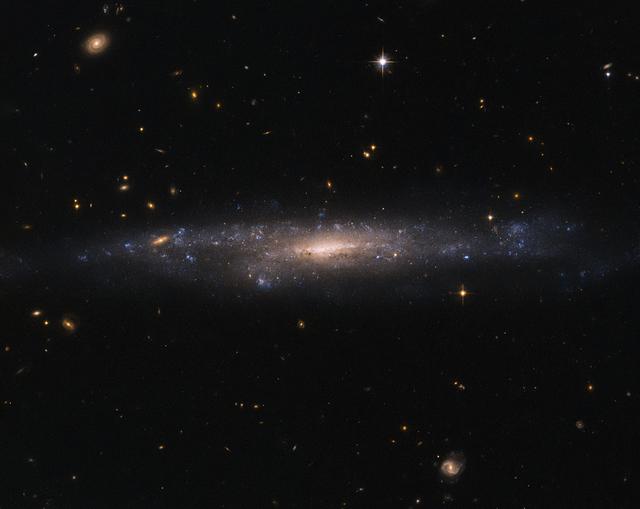
This striking NASA/ESA Hubble Space Telescope image captures the galaxy UGC 477, located just over 110 million light-years away in the constellation of Pisces (The Fish). UGC 477 is a low surface brightness (LSB) galaxy. First proposed in 1976 by Mike Disney, the existence of LSB galaxies was confirmed only in 1986 with the discovery of Malin 1. LSB galaxies like UGC 477 are more diffusely distributed than galaxies such as Andromeda and the Milky Way. With surface brightnesses up to 250 times fainter than the night sky, these galaxies can be incredibly difficult to detect. Most of the matter present in LSB galaxies is in the form of hydrogen gas, rather than stars. Unlike the bulges of normal spiral galaxies, the centres of LSB galaxies do not contain large numbers of stars. Astronomers suspect that this is because LSB galaxies are mainly found in regions devoid of other galaxies, and have therefore experienced fewer galactic interactions and mergers capable of triggering high rates of star formation. LSB galaxies such as UGC 477 instead appear to be dominated by dark matter, making them excellent objects to study to further our understanding of this elusive substance. However, due to an underrepresentation in galactic surveys — caused by their characteristic low brightness — their importance has only been realised relatively recently.
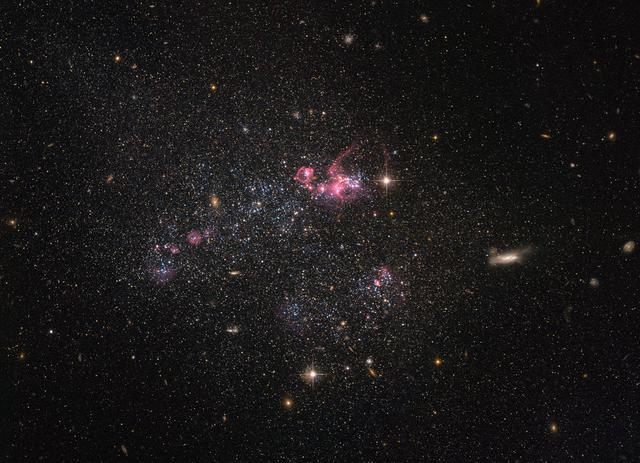
Despite being less famous than their elliptical and spiral galactic cousins, irregular dwarf galaxies, such as the one captured in this NASA/ESA Hubble Space Telescope image, are actually one of the most common types of galaxy in the Universe. Known as UGC 4459, this dwarf galaxy is located approximately 11 million light-years away in the constellation of Ursa Major (The Great Bear), a constellation that is also home to the Pinwheel Galaxy (M101), the Owl Nebula (M97), Messier 81, Messier 82 and several other galaxies all part of the M81 group. UGC 4459’s diffused and disorganised appearance is characteristic of an irregular dwarf galaxy. Lacking a distinctive structure or shape, irregular dwarf galaxies are often chaotic in appearance, with neither a nuclear bulge — a huge, tightly packed central group of stars — nor any trace of spiral arms — regions of stars extending from the centre of the galaxy. Astronomers suspect that some irregular dwarf galaxies were once spiral or elliptical galaxies, but were later deformed by the gravitational pull of nearby objects. Rich with young blue stars and older red stars, UGC 4459 has a stellar population of several billion. Though seemingly impressive, this is small when compared to the 200 to 400 billion stars in the Milky Way! Observations with Hubble have shown that because of their low masses, star formation is very low compared to larger galaxies. Only very little of their original gas has been turned into stars. Thus, these small galaxies are interesting to study to better understand primordial environments and the star formation process.

Morphologies, masses, and structures - oh, my! This beautiful clump of glowing gas, dark dust and glittering stars is the spiral galaxy NGC 4248, located about 24 million light-years away in the constellation of Canes Venatici (The Hunting Dogs). This image was produced by the NASA/ESA Hubble Space Telescope as it embarked upon compiling the first Hubble ultraviolet “atlas,” for which the telescope targeted 50 nearby star-forming galaxies. The collection spans all kinds of different morphologies, masses, and structures. Studying this sample can help us to piece together the star-formation history of the Universe. By exploring how massive stars form and evolve within such galaxies, astronomers can learn more about how, when, and where star formation occurs, how star clusters change over time, and how the process of forming new stars is related to the properties of both the host galaxy and the surrounding interstellar medium (the gas and dust that fills the space between individual stars). This galaxy was imaged with observations from Hubble’s Wide Field Camera 3. Image credit: ESA/Hubble & NASA
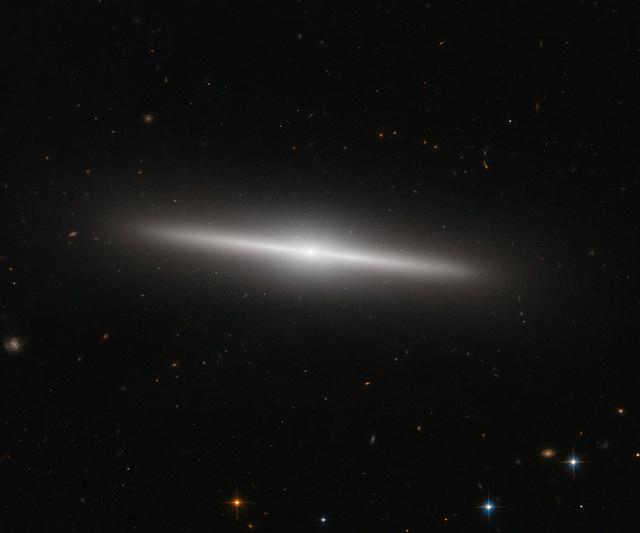
Hubble sees a galaxy 60 million light-years away This new NASA/ESA Hubble Space Telescope image shows the galaxy IC 335 in front of a backdrop of distant galaxies. IC 335 is part of a galaxy group containing three other galaxies, and located in the Fornax Galaxy Cluster 60 million light-years away. As seen in this image, the disk of IC 335 appears edge-on from the vantage point of Earth. This makes it harder for astronomers to classify it, as most of the characteristics of a galaxy’s morphology — the arms of a spiral or the bar across the center — are only visible on its face. Still, the 45 000 light-year-long galaxy could be classified as an S0 type. These lenticular galaxies are an intermediate state in galaxy morphological classification schemes between true spiral and elliptical galaxies. They have a thin stellar disk and a bulge, like spiral galaxies, but in contrast to typical spiral galaxies they have used up most of the interstellar medium. Only a few new stars can be created out of the material that is left and the star formation rate is very low. Hence, the population of stars in S0 galaxies consists mainly of aging stars, very similar to the star population in elliptical galaxies. As S0 galaxies have only ill-defined spiral arms they are easily mistaken for elliptical galaxies if they are seen inclined face-on or edge-on as IC 335 here. And indeed, despite the morphological differences between S0 and elliptical class galaxies, they share some common characteristics, like typical sizes and spectral features. Both classes are also deemed "early-type" galaxies, because they are evolving passively. However, while elliptical galaxies may be passively evolving when we observe them, they have usually had violent interactions with other galaxies in their past. In contrast, S0 galaxies are either aging and fading spiral galaxies, which never had any interactions with other galaxies, or they are the aging result of a single merger between two spiral galaxies in the past. The exact nature of these galaxies is still a matter of debate. Credit: ESA/Hubble and NASA
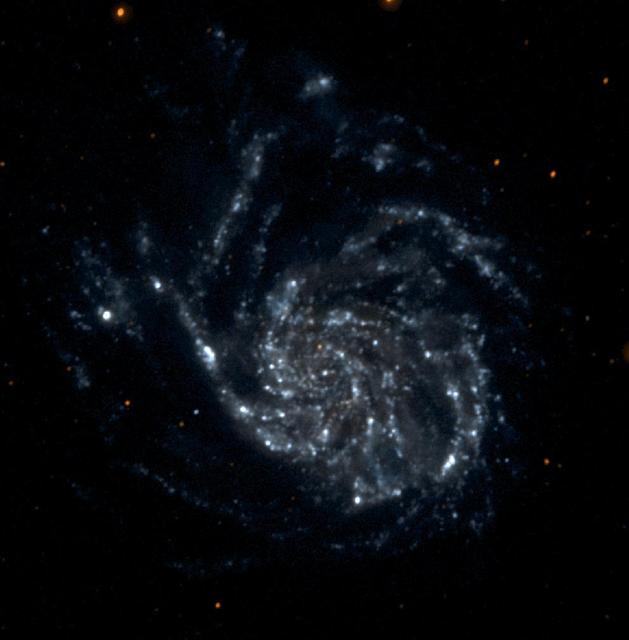
This single orbit exposure, ultraviolet color image of Messier 101 was taken by NASA's Galaxy Evolution Explorer on June 20, 2003. Messier 101 is a large spiral galaxy located 20 million light-years from Earth. This image is a short and medium "exposure" picture of the evolution of star formation in a spiral galaxy. The far ultraviolet emission detects the younger stars as concentrated in tight spiral arms, while the near ultraviolet emission, which traces stars living for more than 100 million years, displays the movement of the spiral pattern over a 100 million year period. The red stars in the foreground of the image are Milky Way stars. http://photojournal.jpl.nasa.gov/catalog/PIA04632
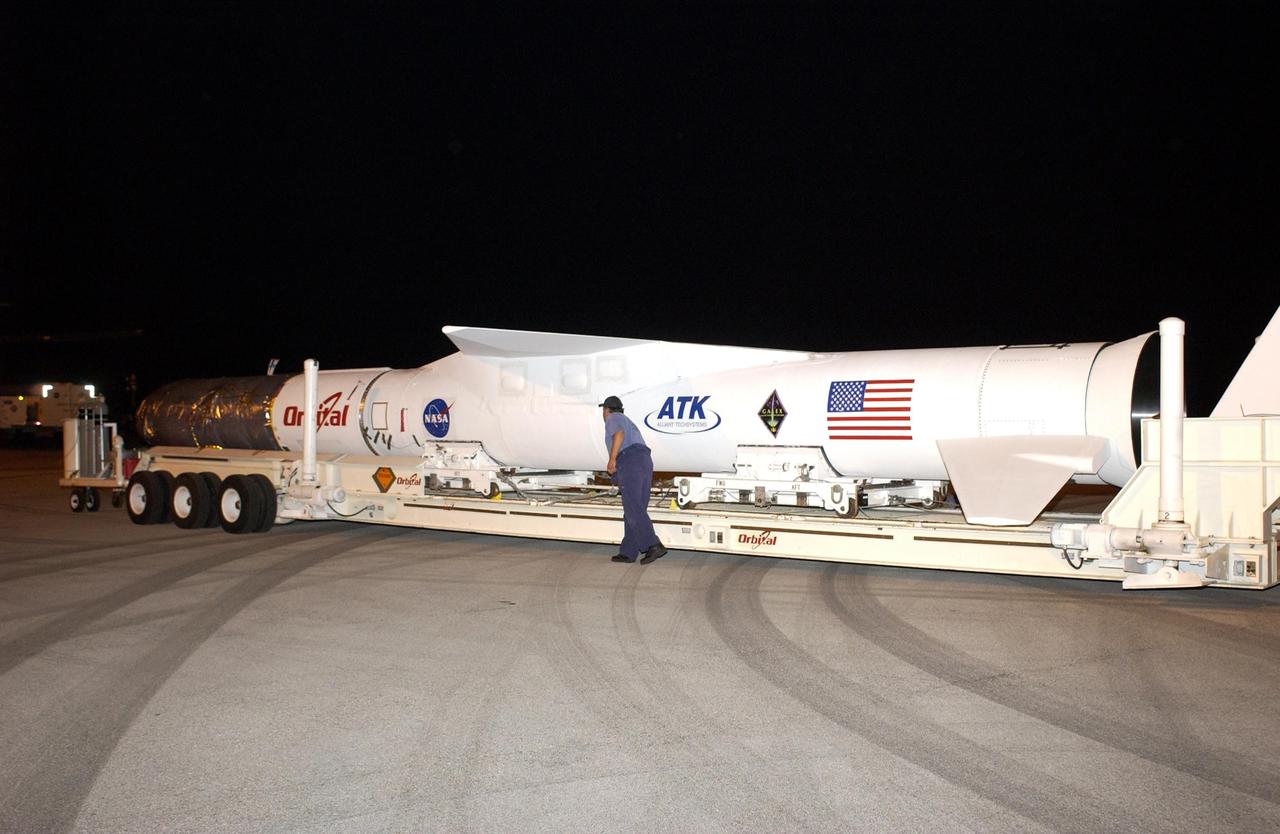
KENNEDY SPACE CENTER, FLA. - The mated Pegasus XL and Galaxy Evolution Explorer (GALEX) satellite arrive at Cape Canaveral Air Force Station. The GALEX, to be launched April 28 from an Orbital Sciences L-1011 aircraft, will carry into space an orbiting telescope that will observe a million galaxies across 10 billion years of cosmic history to help astronomers determine when the stars and elements we see today had their origins. The spacecraft will sweep the skies for 28 months using state-of-the-art ultraviolet detectors to single out galaxies dominated by young, hot, short-lived stars that give off a great deal of energy at that wavelength. These galaxies are actively creating stars, and therefore provide a window into the history and causes of star formation in galaxies.
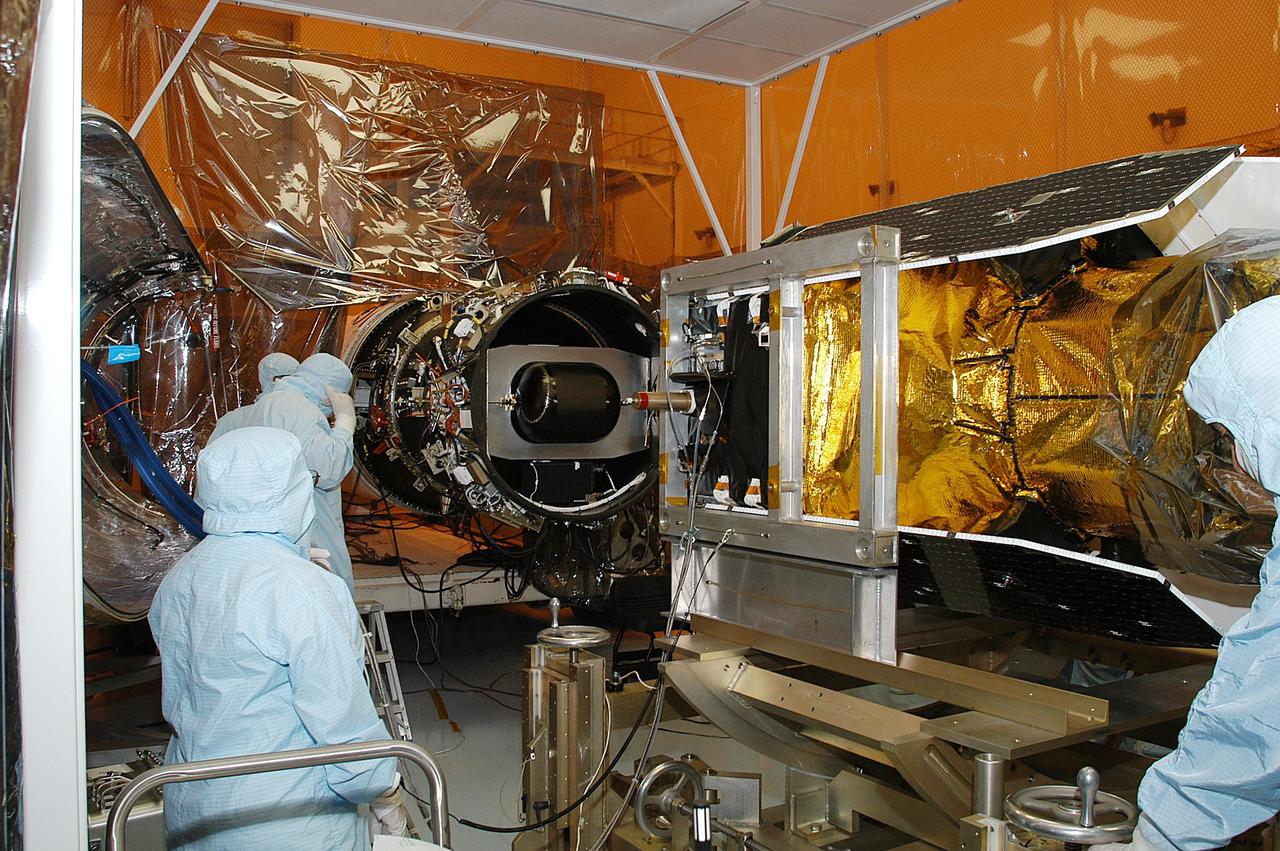
KENNEDY SPACE CENTER, FLA. -- In the Multi-Payload Processing Facility, NASA's Galaxy Evolution Explorer is prepared for mating with the Pegasus XL launch vehicle. The GALEX, set to launch April 2 from Cape Canaveral Air Force Station, will carry into space an orbiting telescope that will observe a million galaxies across 10 billion years of cosmic history to help astronomers determine when the stars and elements we see today had their origins. The spacecraft will sweep the skies for 28 months using state-of-the-art ultraviolet detectors to single out galaxies dominated by young, hot, short-lived stars that give off a great deal of energy at that wavelength. These galaxies are actively creating stars, and therefore provide a window into the history and causes of star formation in galaxies.
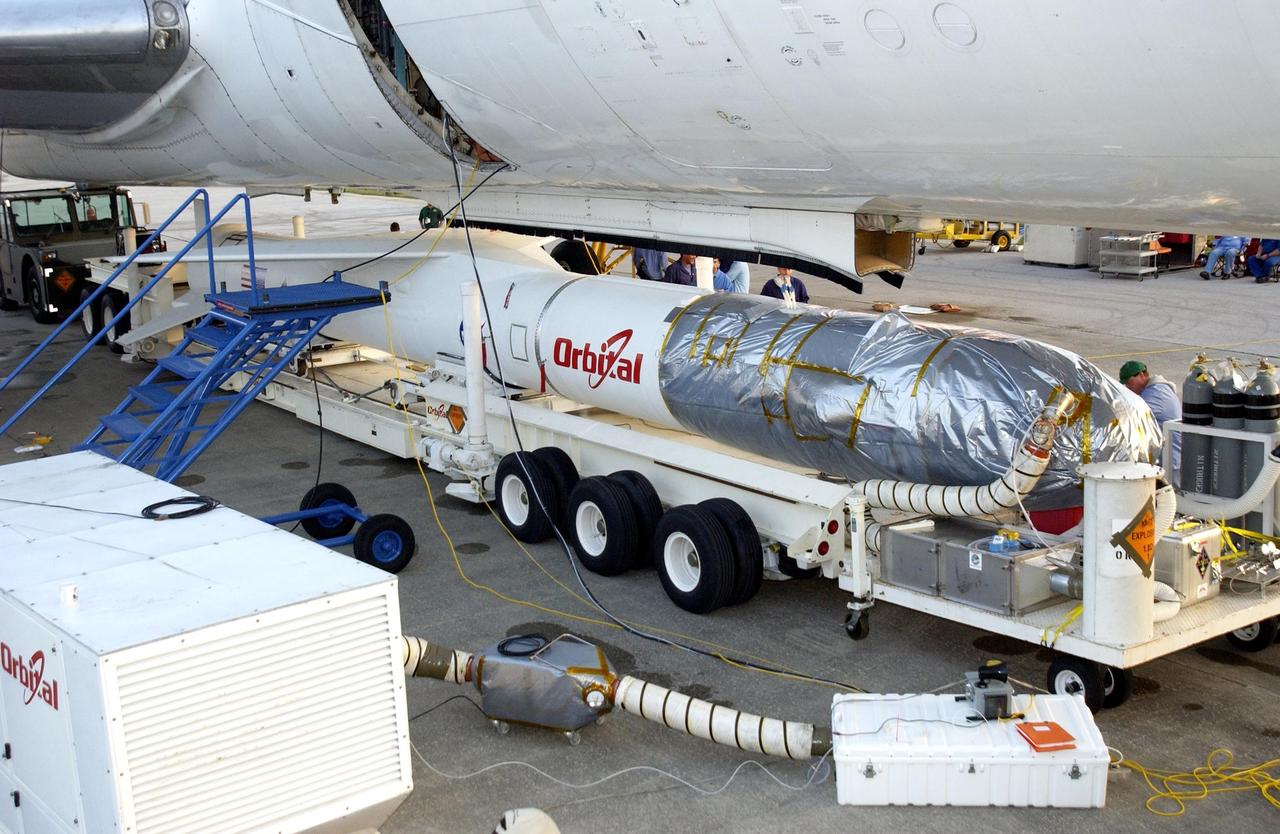
KENNEDY SPACE CENTER, FLA. - At Cape Canaveral Air Force Station, workers prepare to attach the mated Pegasus XL and Galaxy Evolution Explorer (GALEX) satellite to the Orbital Sciences L-1011 aircraft. The GALEX, to be launched April 28 from the L-1011, will carry into space an orbiting telescope that will observe a million galaxies across 10 billion years of cosmic history to help astronomers determine when the stars and elements we see today had their origins. The spacecraft will sweep the skies for 28 months using state-of-the-art ultraviolet detectors to single out galaxies dominated by young, hot, short-lived stars that give off a great deal of energy at that wavelength. These galaxies are actively creating stars, and therefore provide a window into the history and causes of star formation in galaxies.

KENNEDY SPACE CENTER, FLA. - In the early morning light, the mated Pegasus XL and Galaxy Evolution Explorer (GALEX) satellite are seen near the Orbital Sciences L-1011 aircraft at Cape Canaveral Air Force Station. The GALEX, to be launched April 28 from the L-1011, will carry into space an orbiting telescope that will observe a million galaxies across 10 billion years of cosmic history to help astronomers determine when the stars and elements we see today had their origins. The spacecraft will sweep the skies for 28 months using state-of-the-art ultraviolet detectors to single out galaxies dominated by young, hot, short-lived stars that give off a great deal of energy at that wavelength. These galaxies are actively creating stars, and therefore provide a window into the history and causes of star formation in galaxies.

KENNEDY SPACE CENTER, FLA. - At Cape Canaveral Air Force Station, Orbital Sciences' L-1011 aircraft waits for takeoff time between 7:50 and 9:50 a.m. EDT. Attached underneath is the Pegasus XL rocket with its payload, the Galaxy Evolution Explorer (GALEX), due to be released about 8 a.m. The GALEX will carry into space an orbiting telescope that will observe a million galaxies across 10 billion years of cosmic history to help astronomers determine when the stars and elements we see today had their origins. The spacecraft will sweep the skies for 28 months using state-of-the-art ultraviolet detectors to single out galaxies dominated by young, hot, short-lived stars that give off a great deal of energy at that wavelength. These galaxies are actively creating stars, and therefore provide a window into the history and causes of star formation in galaxies.
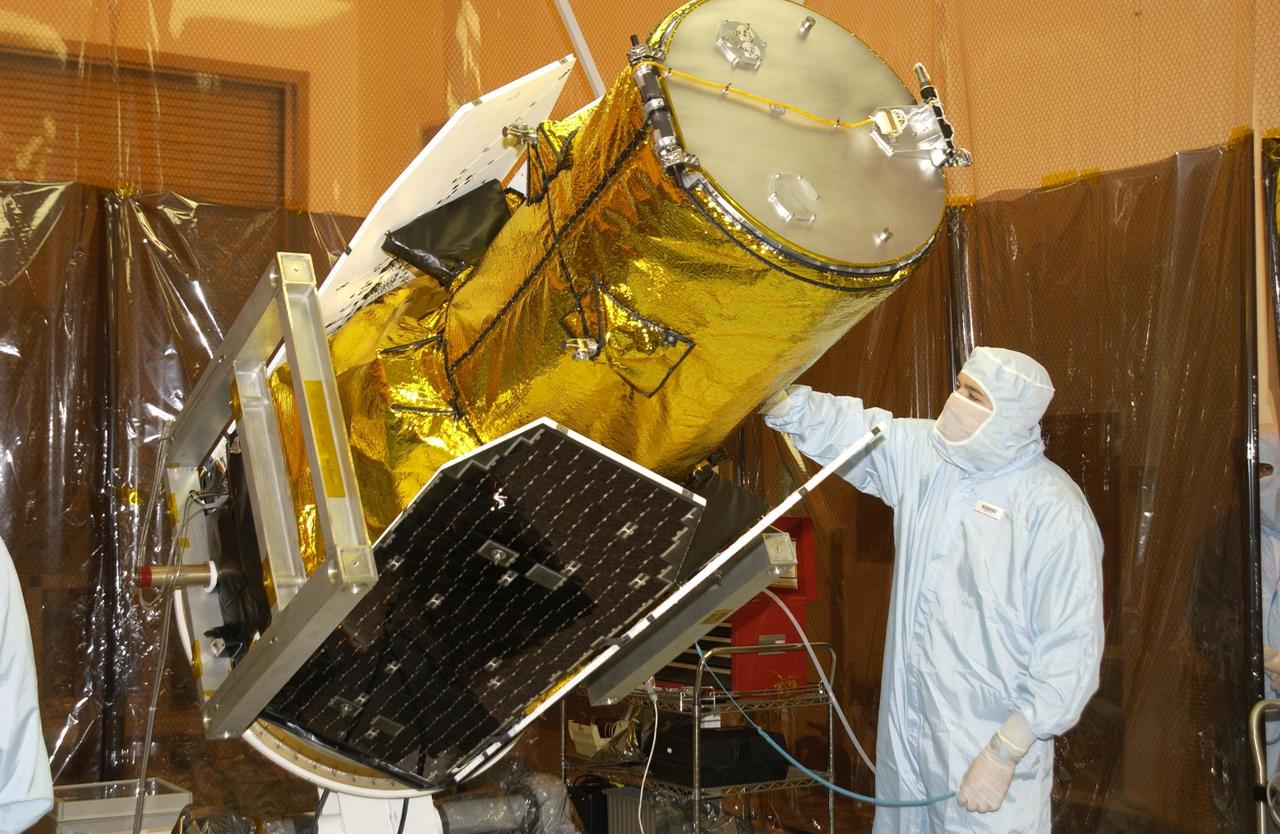
KENNEDY SPACE CENTER, FLA. -A worker in the Multi-Payload Processing Facility watches closely as NASA's Galaxy Evolution Explorer spacecraft is rotated in preparation for mating with the Pegasus XL launch vehicle. The GALEX, set to launch April 2 from Cape Canaveral Air Force Station, will carry into space an orbiting telescope that will observe a million galaxies across 10 billion years of cosmic history to help astronomers determine when the stars and elements we see today had their origins. From its orbit high above Earth, the spacecraft will sweep the skies for 28 months using state-of-the-art ultraviolet detectors. Looking in the ultraviolet will single out galaxies dominated by young, hot, short-lived stars that give off a great deal of energy at that wavelength. These galaxies are actively creating stars, and therefore provide a window into the history and causes of star formation in galaxies.
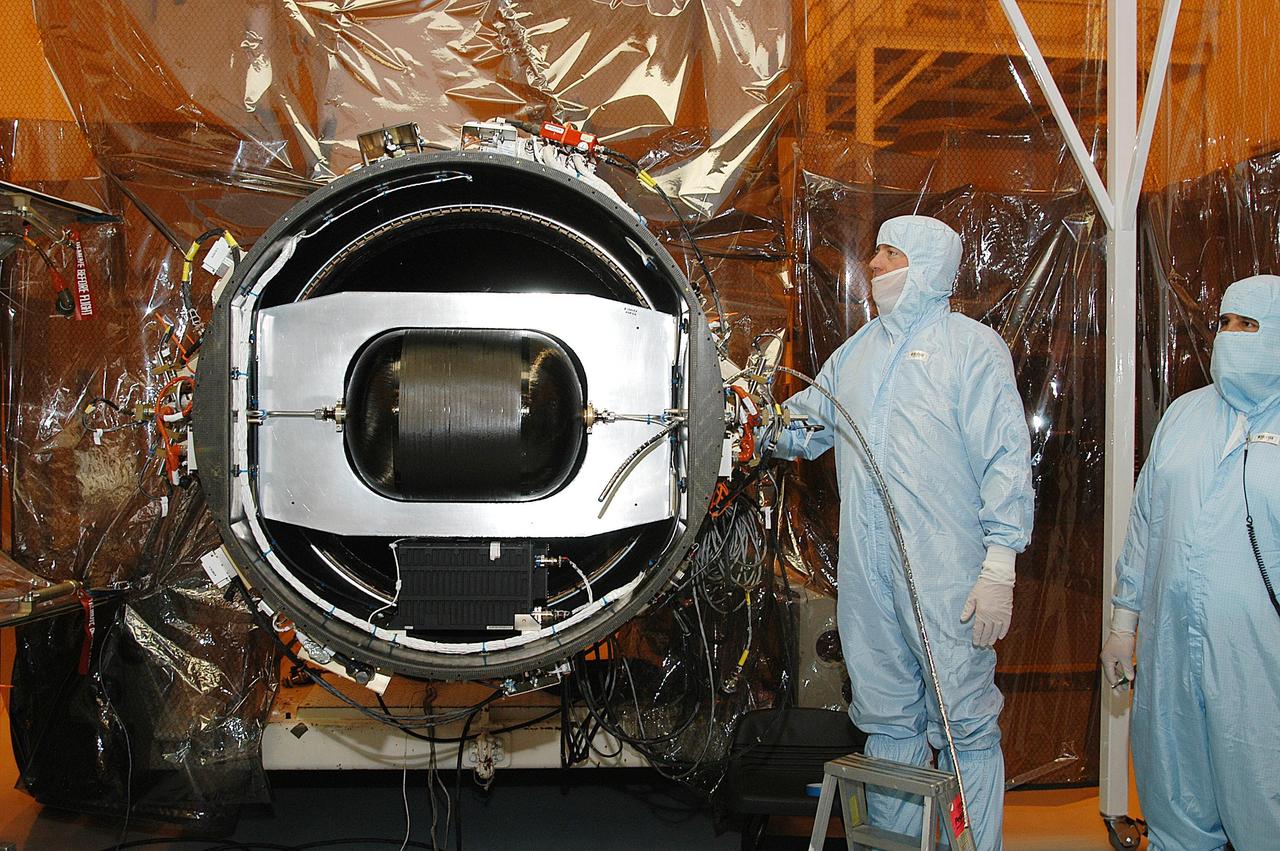
KENNEDY SPACE CENTER, FLA. -- In the Multi-Payload Processing Facility, NASA's Galaxy Evolution Explorer is prepared for mating with the Pegasus XL launch vehicle. The GALEX, set to launch April 2 from Cape Canaveral Air Force Station, will carry into space an orbiting telescope that will observe a million galaxies across 10 billion years of cosmic history to help astronomers determine when the stars and elements we see today had their origins. The spacecraft will sweep the skies for 28 months using state-of-the-art ultraviolet detectors to single out galaxies dominated by young, hot, short-lived stars that give off a great deal of energy at that wavelength. These galaxies are actively creating stars, and therefore provide a window into the history and causes of star formation in galaxies.

KENNEDY SPACE CENTER, FLA. - At Cape Canaveral Air Force Station, workers finish attaching the mated Pegasus XL and Galaxy Evolution Explorer (GALEX) satellite to the Orbital Sciences L-1011 aircraft. The GALEX, to be launched April 28 from the L-1011, will carry into space an orbiting telescope that will observe a million galaxies across 10 billion years of cosmic history to help astronomers determine when the stars and elements we see today had their origins. The spacecraft will sweep the skies for 28 months using state-of-the-art ultraviolet detectors to single out galaxies dominated by young, hot, short-lived stars that give off a great deal of energy at that wavelength. These galaxies are actively creating stars, and therefore provide a window into the history and causes of star formation in galaxies.

KENNEDY SPACE CENTER, FLA. - The mated Pegasus XL and Galaxy Evolution Explorer (GALEX) satellite move under the Orbital Sciences L-1011 aircraft at Cape Canaveral Air Force Station. The GALEX, to be launched April 28 from the L-1011, will carry into space an orbiting telescope that will observe a million galaxies across 10 billion years of cosmic history to help astronomers determine when the stars and elements we see today had their origins. The spacecraft will sweep the skies for 28 months using state-of-the-art ultraviolet detectors to single out galaxies dominated by young, hot, short-lived stars that give off a great deal of energy at that wavelength. These galaxies are actively creating stars, and therefore provide a window into the history and causes of star formation in galaxies.
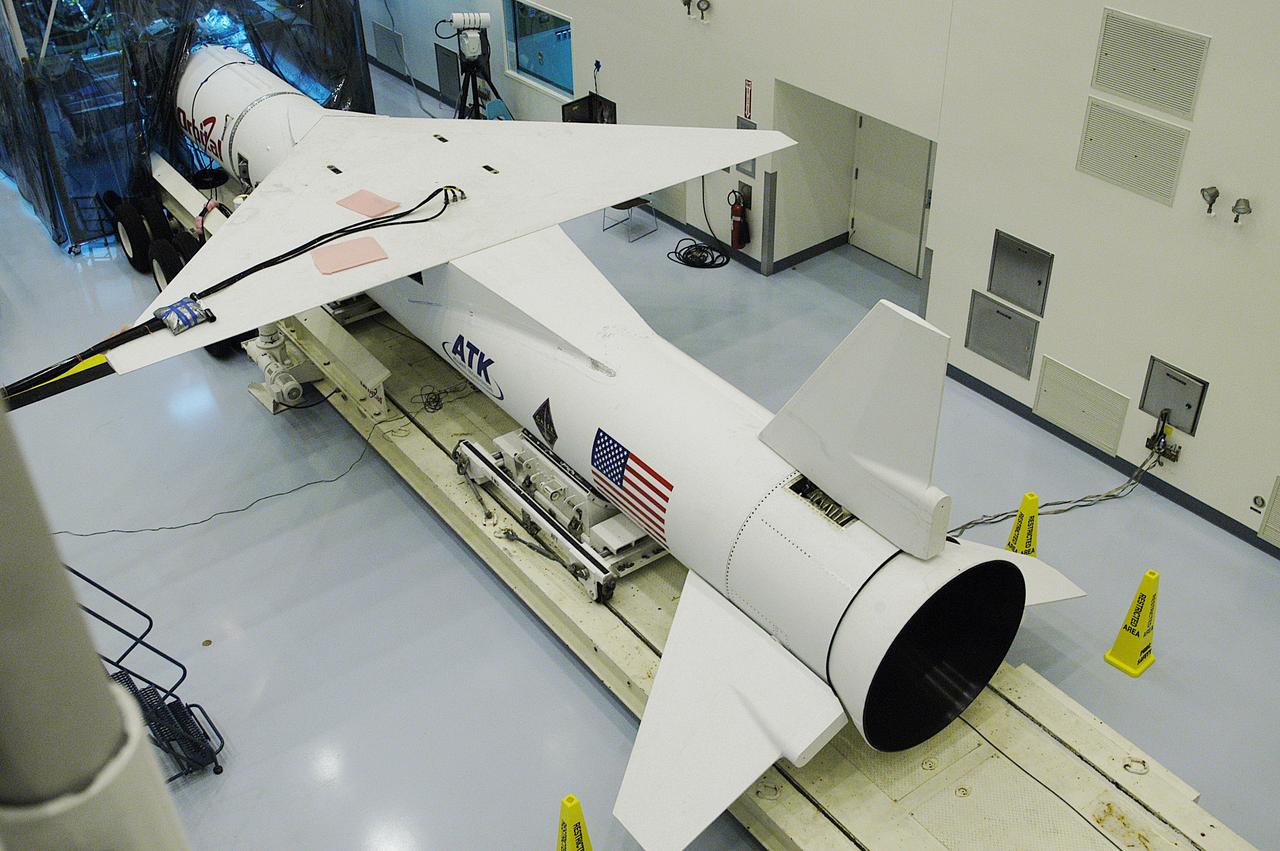
In the Multi-Payload Processing Facility, the Pegasus XL launch vehicle is in position for mating of the Galaxy Evolution Explorer (GALEX) satellite. The GALEX, set to launch April 2 from Cape Canaveral Air Force Station, will carry into space an orbiting telescope that will observe a million galaxies across 10 billion years of cosmic history to help astronomers determine when the stars and elements we see today had their origins. The spacecraft will sweep the skies for 28 months using state-of-the-art ultraviolet detectors to single out galaxies dominated by young, hot, short-lived stars that give off a great deal of energy at that wavelength. These galaxies are actively creating stars, and therefore provide a window into the history and causes of star formation in galaxies.
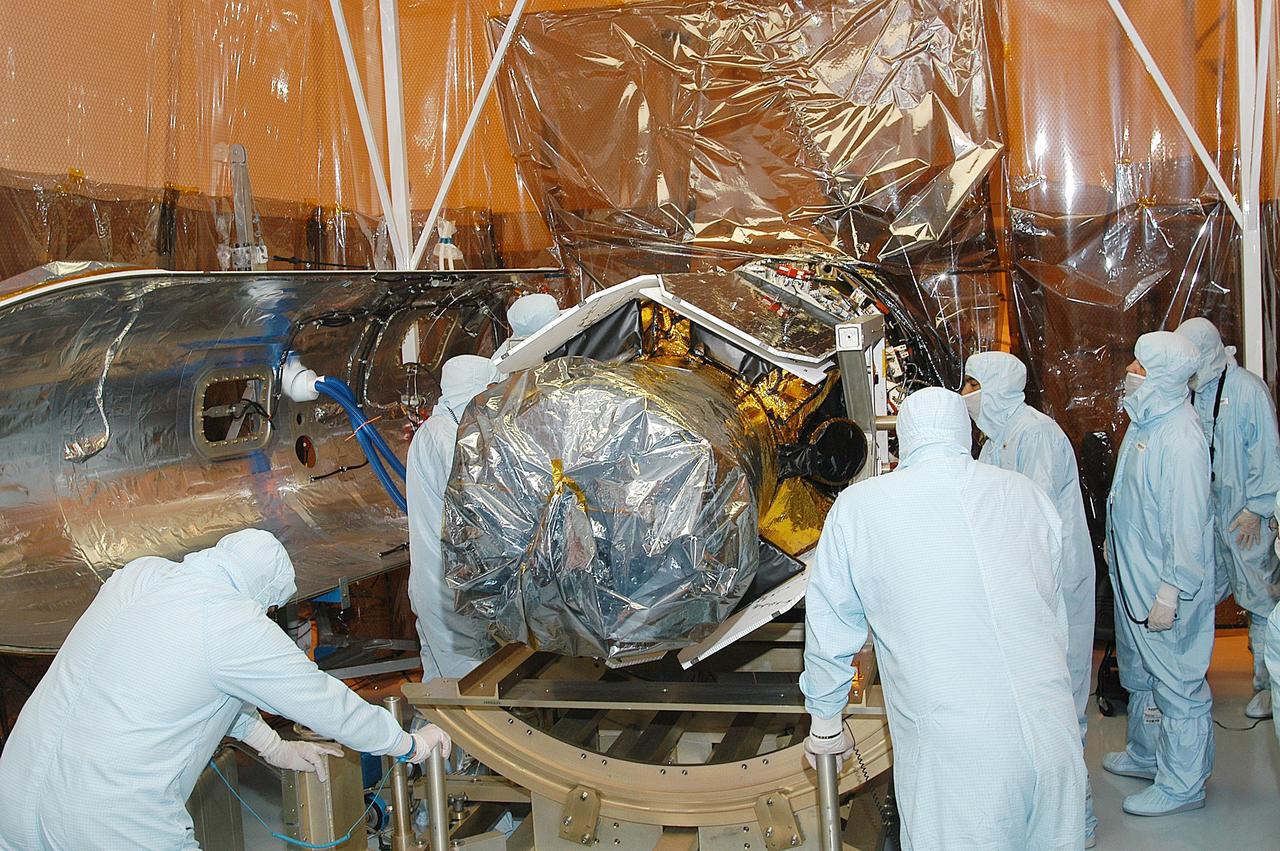
KENNEDY SPACE CENTER, FLA. -- In the Multi-Payload Processing Facility, NASA's Galaxy Evolution Explorer is prepared for mating with the Pegasus XL launch vehicle. The GALEX, set to launch April 2 from Cape Canaveral Air Force Station, will carry into space an orbiting telescope that will observe a million galaxies across 10 billion years of cosmic history to help astronomers determine when the stars and elements we see today had their origins. The spacecraft will sweep the skies for 28 months using state-of-the-art ultraviolet detectors to single out galaxies dominated by young, hot, short-lived stars that give off a great deal of energy at that wavelength. These galaxies are actively creating stars, and therefore provide a window into the history and causes of star formation in galaxies.
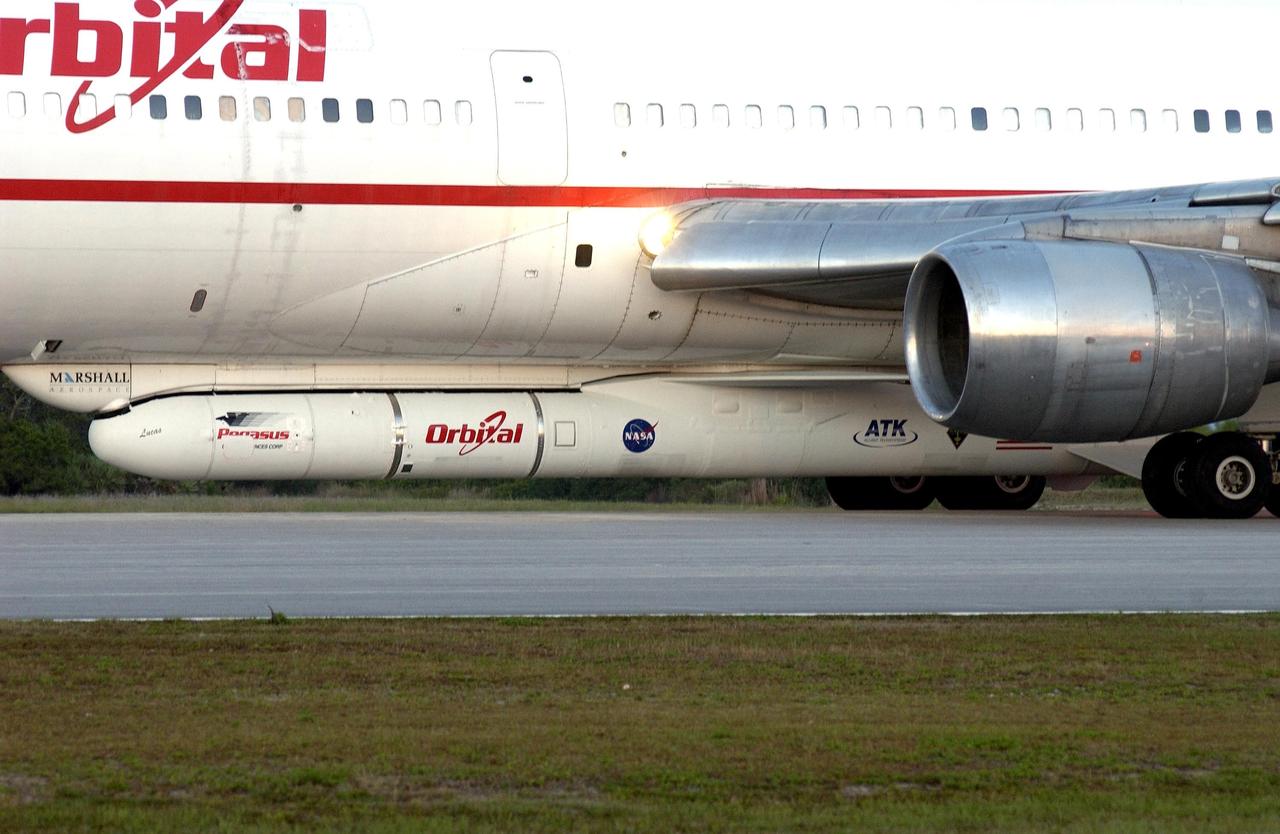
KENNEDY SPACE CENTER, FLA. - Orbital Sciences' L-1011 aircraft carries the Pegasus XL rocket/Galaxy Evolution Explorer (GALEX) under its belly. The aircraft is scheduled for takeoff in a window beginning at 7:50 a.m. and release of the Pegasus about 8 a.m. The GALEX will carry into space an orbiting telescope that will observe a million galaxies across 10 billion years of cosmic history to help astronomers determine when the stars and elements we see today had their origins. The spacecraft will sweep the skies for 28 months using state-of-the-art ultraviolet detectors to single out galaxies dominated by young, hot, short-lived stars that give off a great deal of energy at that wavelength. These galaxies are actively creating stars, and therefore provide a window into the history and causes of star formation in galaxies.
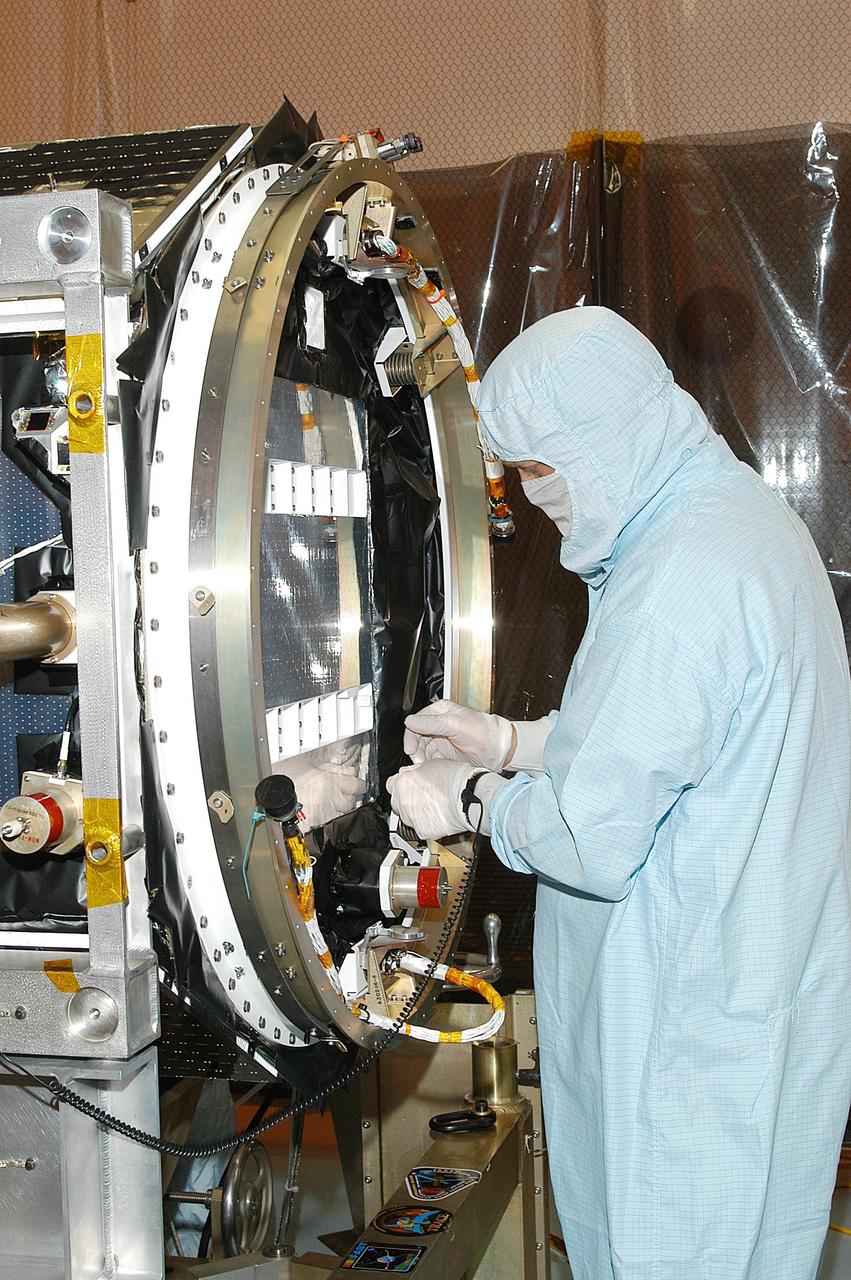
KENNEDY SPACE CENTER, FLA. -- -- In the Multi-Payload Processing Facility, NASA's Galaxy Evolution Explorer is prepared for mating with the Pegasus XL launch vehicle. The GALEX, set to launch April 2 from Cape Canaveral Air Force Station, will carry into space an orbiting telescope that will observe a million galaxies across 10 billion years of cosmic history to help astronomers determine when the stars and elements we see today had their origins. The spacecraft will sweep the skies for 28 months using state-of-the-art ultraviolet detectors to single out galaxies dominated by young, hot, short-lived stars that give off a great deal of energy at that wavelength. These galaxies are actively creating stars, and therefore provide a window into the history and causes of star formation in galaxies.
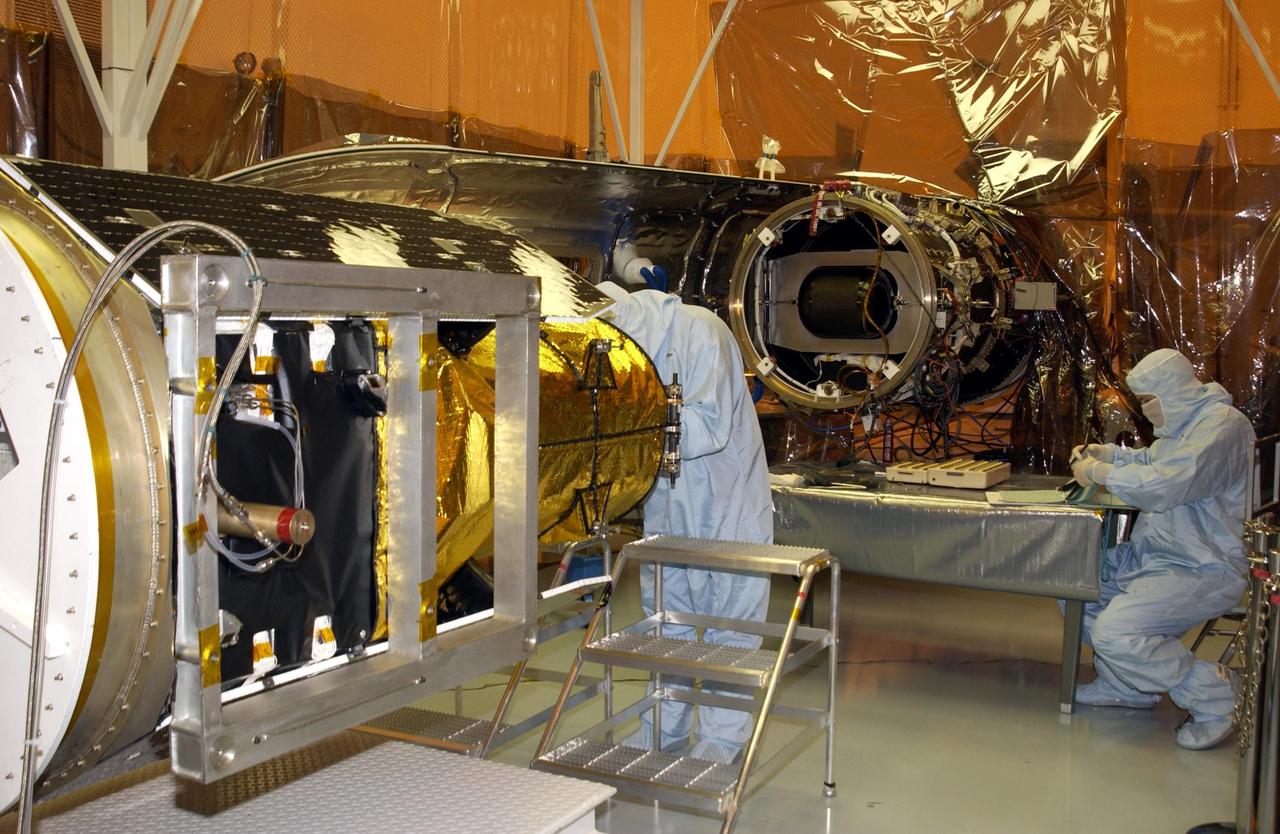
KENNEDY SPACE CENTER, FLA. -- A technician (left) works on NASA's Galaxy Evolution Explorer spacecraft after rotation. The GALEX will be mated mating with the Pegasus XL launch vehicle. Set to launch April 2 from Cape Canaveral Air Force Station, the GALEX will carry into space an orbiting telescope that will observe a million galaxies across 10 billion years of cosmic history to help astronomers determine when the stars and elements we see today had their origins. From its orbit high above Earth, the spacecraft will sweep the skies for 28 months using state-of-the-art ultraviolet detectors. Looking in the ultraviolet will single out galaxies dominated by young, hot, short-lived stars that give off a great deal of energy at that wavelength. These galaxies are actively creating stars, and therefore provide a window into the history and causes of star formation in galaxies.
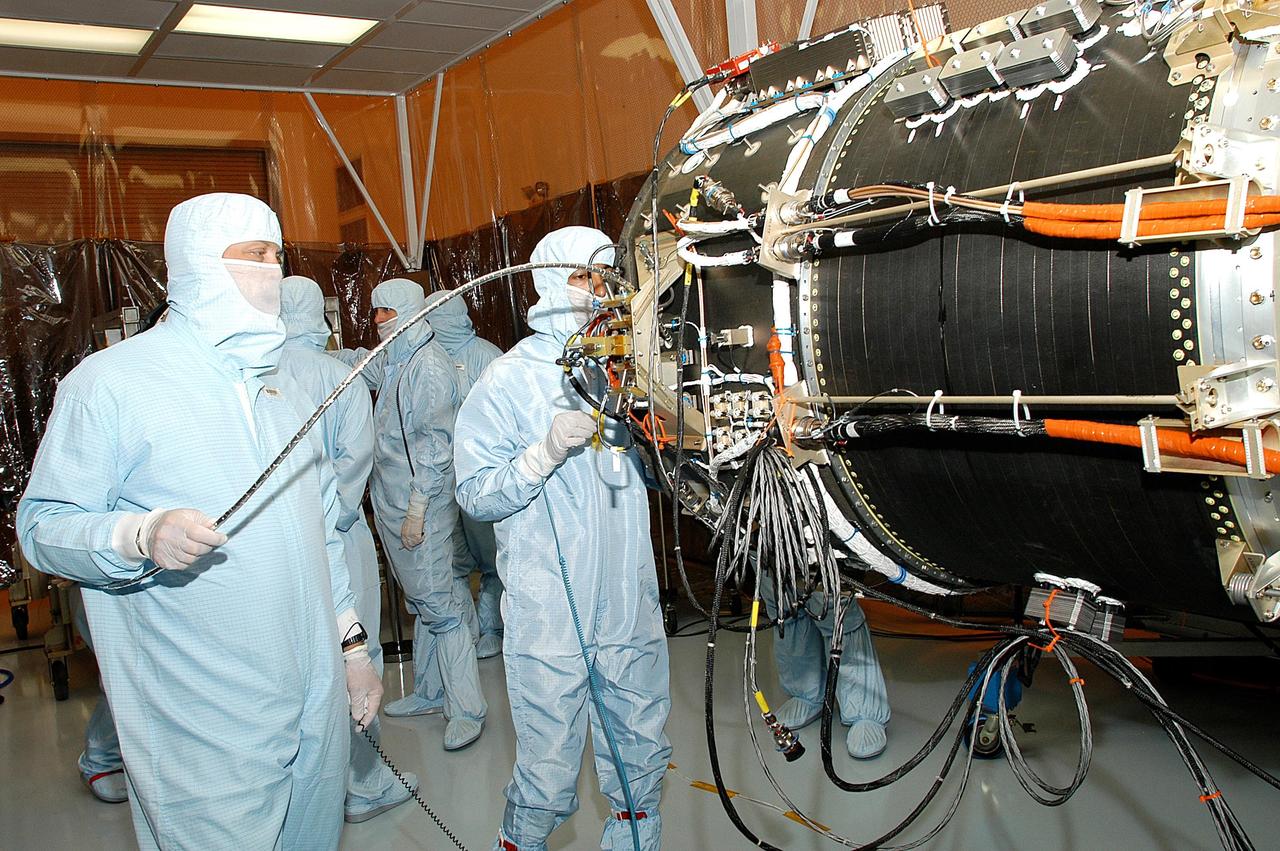
KENNEDY SPACE CENTER, FLA. -- In the Multi-Payload Processing Facility, NASA's Galaxy Evolution Explorer is prepared for mating with the Pegasus XL launch vehicle. The GALEX, set to launch April 2 from Cape Canaveral Air Force Station, will carry into space an orbiting telescope that will observe a million galaxies across 10 billion years of cosmic history to help astronomers determine when the stars and elements we see today had their origins. The spacecraft will sweep the skies for 28 months using state-of-the-art ultraviolet detectors to single out galaxies dominated by young, hot, short-lived stars that give off a great deal of energy at that wavelength. These galaxies are actively creating stars, and therefore provide a window into the history and causes of star formation in galaxies.
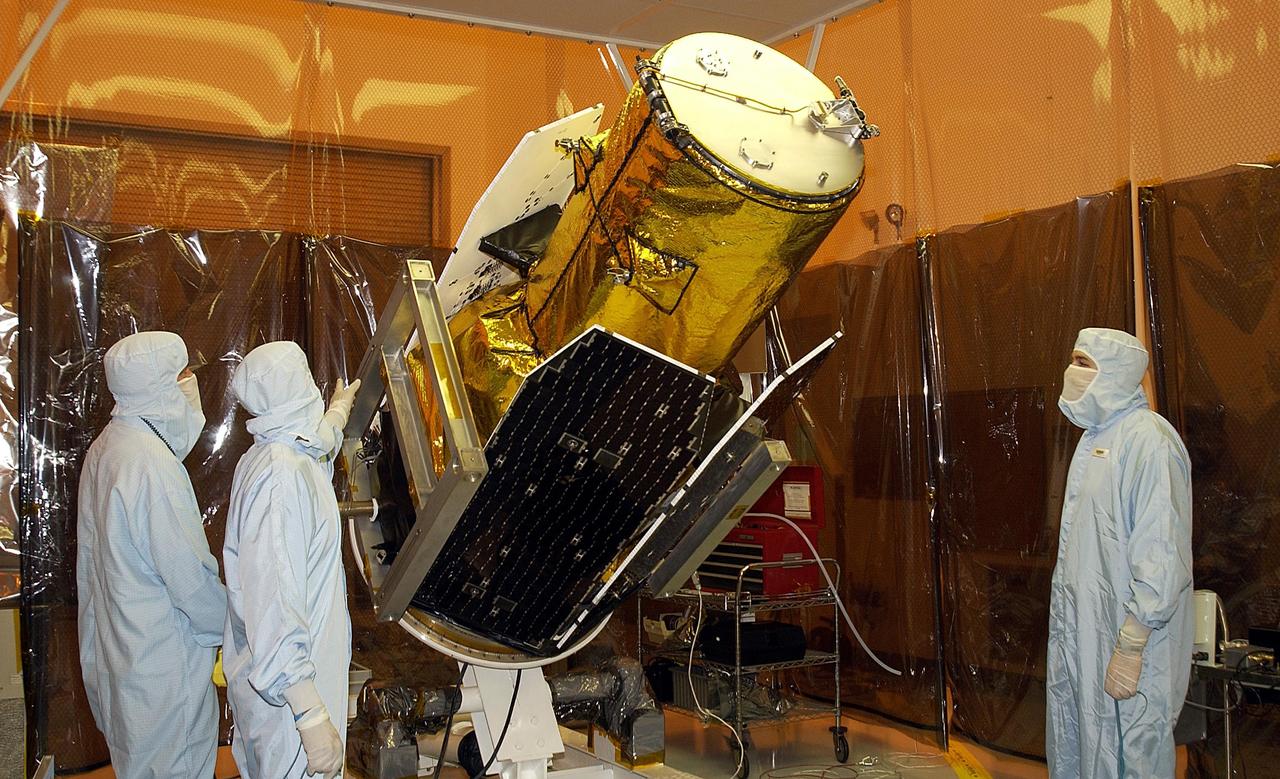
KENNEDY SPACE CENTER, FLA. - Workers in the Multi-Payload Processing Facility watch as NASA's Galaxy Evolution Explorer spacecraft is rotated in preparation for mating with the Pegasus XL launch vehicle. The GALEX, set to launch April 2 from Cape Canaveral Air Force Station, will carry into space an orbiting telescope that will observe a million galaxies across 10 billion years of cosmic history to help astronomers determine when the stars and elements we see today had their origins. From its orbit high above Earth, the spacecraft will sweep the skies for 28 months using state-of-the-art ultraviolet detectors. Looking in the ultraviolet will single out galaxies dominated by young, hot, short-lived stars that give off a great deal of energy at that wavelength. These galaxies are actively creating stars, and therefore provide a window into the history and causes of star formation in galaxies.
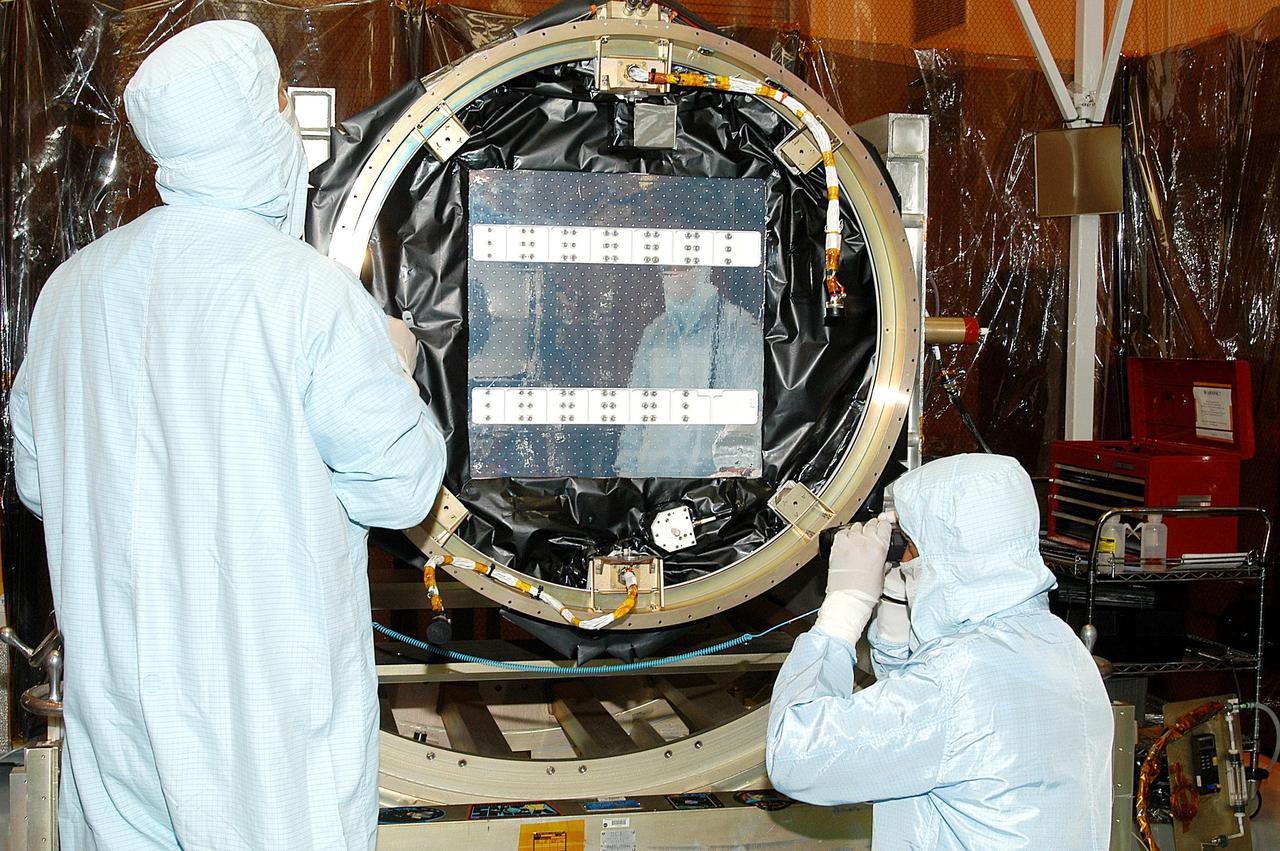
KENNEDY SPACE CENTER, FLA. -- -- In the Multi-Payload Processing Facility, NASA's Galaxy Evolution Explorer is prepared for mating with the Pegasus XL launch vehicle. The GALEX, set to launch April 2 from Cape Canaveral Air Force Station, will carry into space an orbiting telescope that will observe a million galaxies across 10 billion years of cosmic history to help astronomers determine when the stars and elements we see today had their origins. The spacecraft will sweep the skies for 28 months using state-of-the-art ultraviolet detectors to single out galaxies dominated by young, hot, short-lived stars that give off a great deal of energy at that wavelength. These galaxies are actively creating stars, and therefore provide a window into the history and causes of star formation in galaxies.
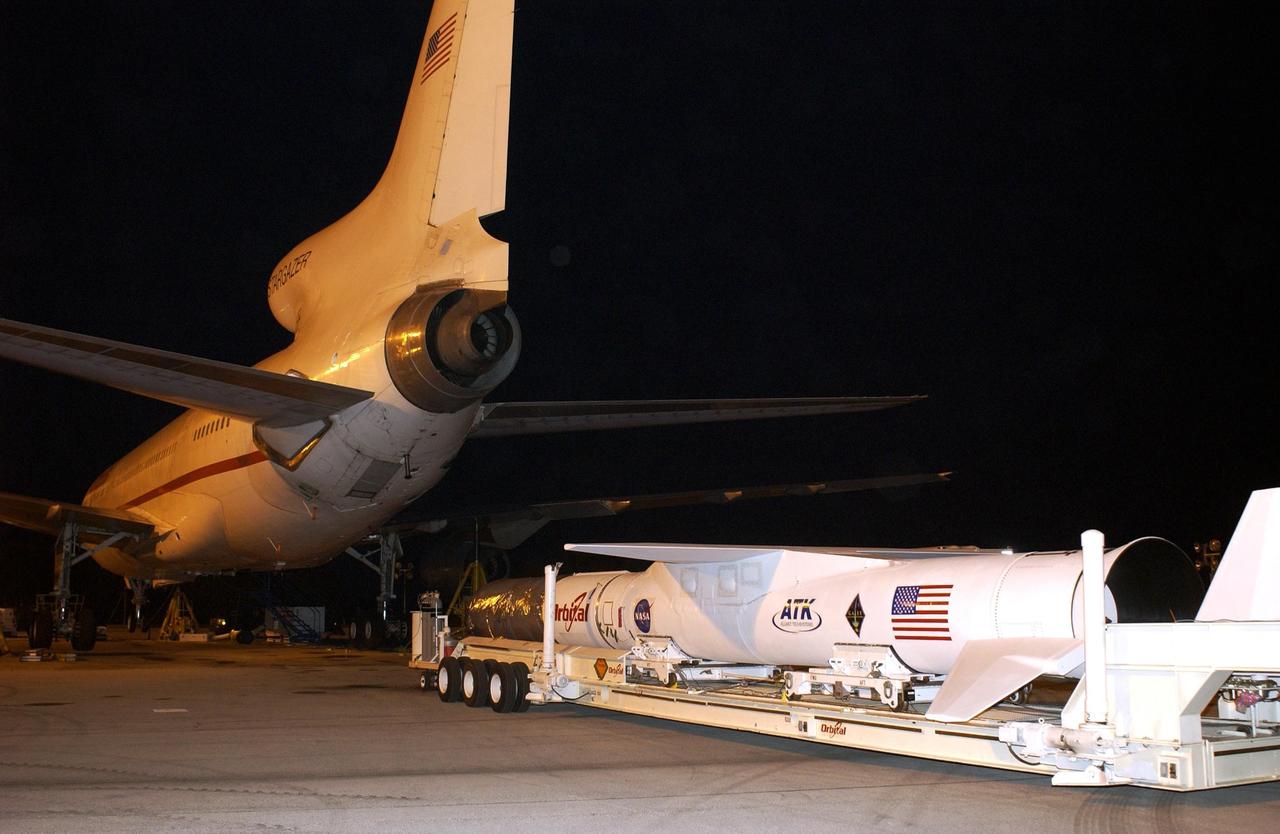
KENNEDY SPACE CENTER, FLA. - The mated Pegasus XL and Galaxy Evolution Explorer (GALEX) satellite approach the Orbital Sciences L-1011 aircraft at Cape Canaveral Air Force Station. The GALEX, to be launched April 28 from the L-1011, will carry into space an orbiting telescope that will observe a million galaxies across 10 billion years of cosmic history to help astronomers determine when the stars and elements we see today had their origins. The spacecraft will sweep the skies for 28 months using state-of-the-art ultraviolet detectors to single out galaxies dominated by young, hot, short-lived stars that give off a great deal of energy at that wavelength. These galaxies are actively creating stars, and therefore provide a window into the history and causes of star formation in galaxies.

KENNEDY SPACE CENTER, FLA. - The mated Pegasus XL and Galaxy Evolution Explorer (GALEX) satellite are moved into position under the Orbital Sciences L-1011 aircraft at Cape Canaveral Air Force Station. The GALEX, to be launched April 28 from the L-1011, will carry into space an orbiting telescope that will observe a million galaxies across 10 billion years of cosmic history to help astronomers determine when the stars and elements we see today had their origins. The spacecraft will sweep the skies for 28 months using state-of-the-art ultraviolet detectors to single out galaxies dominated by young, hot, short-lived stars that give off a great deal of energy at that wavelength. These galaxies are actively creating stars, and therefore provide a window into the history and causes of star formation in galaxies.

KENNEDY SPACE CENTER, FLA. - At Cape Canaveral Air Force Station, workers finish attaching the mated Pegasus XL and Galaxy Evolution Explorer (GALEX) satellite to the Orbital Sciences L-1011 aircraft. The GALEX, to be launched April 28 from the L-1011, will carry into space an orbiting telescope that will observe a million galaxies across 10 billion years of cosmic history to help astronomers determine when the stars and elements we see today had their origins. The spacecraft will sweep the skies for 28 months using state-of-the-art ultraviolet detectors to single out galaxies dominated by young, hot, short-lived stars that give off a great deal of energy at that wavelength. These galaxies are actively creating stars, and therefore provide a window into the history and causes of star formation in galaxies.

KENNEDY SPACE CENTER, FLA. - In the early morning hours at Cape Canaveral Air Force Station, Orbital Sciences' L-1011 aircraft waits for takeoff time between 7:50 and 9:50 a.m. EDT. Attached underneath is the Pegasus XL rocket with its payload, the Galaxy Evolution Explorer (GALEX), due to be released about 8 a.m. The GALEX will carry into space an orbiting telescope that will observe a million galaxies across 10 billion years of cosmic history to help astronomers determine when the stars and elements we see today had their origins. The spacecraft will sweep the skies for 28 months using state-of-the-art ultraviolet detectors to single out galaxies dominated by young, hot, short-lived stars that give off a great deal of energy at that wavelength. These galaxies are actively creating stars, and therefore provide a window into the history and causes of star formation in galaxies.

In the Multi-Payload Processing Facility, the Pegasus XL launch vehicle waits for mating of the Galaxy Evolution Explorer (GALEX) satellite. The GALEX, set to launch April 2 from Cape Canaveral Air Force Station, will carry into space an orbiting telescope that will observe a million galaxies across 10 billion years of cosmic history to help astronomers determine when the stars and elements we see today had their origins. The spacecraft will sweep the skies for 28 months using state-of-the-art ultraviolet detectors to single out galaxies dominated by young, hot, short-lived stars that give off a great deal of energy at that wavelength. These galaxies are actively creating stars, and therefore provide a window into the history and causes of star formation in galaxies.
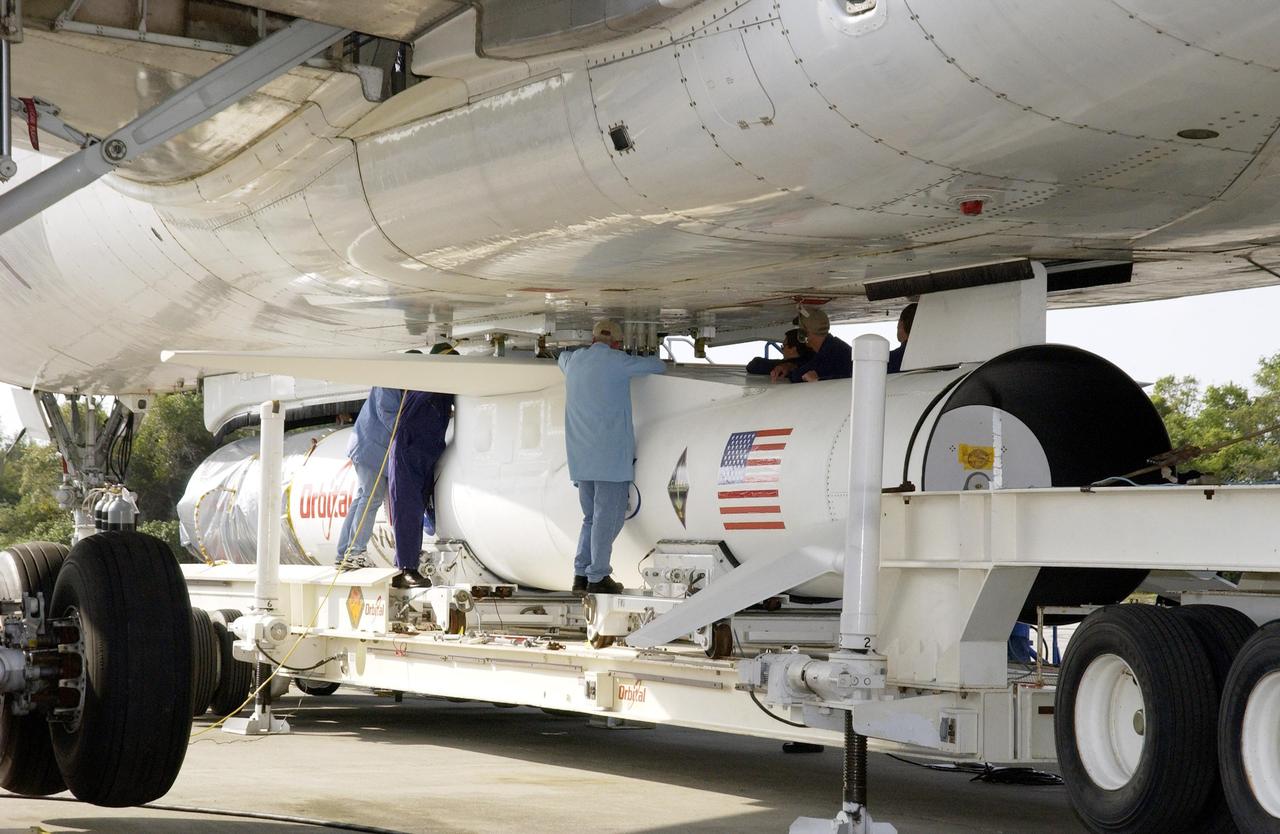
KENNEDY SPACE CENTER, FLA. - At Cape Canaveral Air Force Station, workers attach the mated Pegasus XL and Galaxy Evolution Explorer (GALEX) satellite to the Orbital Sciences L-1011 aircraft. The GALEX, to be launched April 28 from the L-1011, will carry into space an orbiting telescope that will observe a million galaxies across 10 billion years of cosmic history to help astronomers determine when the stars and elements we see today had their origins. The spacecraft will sweep the skies for 28 months using state-of-the-art ultraviolet detectors to single out galaxies dominated by young, hot, short-lived stars that give off a great deal of energy at that wavelength. These galaxies are actively creating stars, and therefore provide a window into the history and causes of star formation in galaxies.
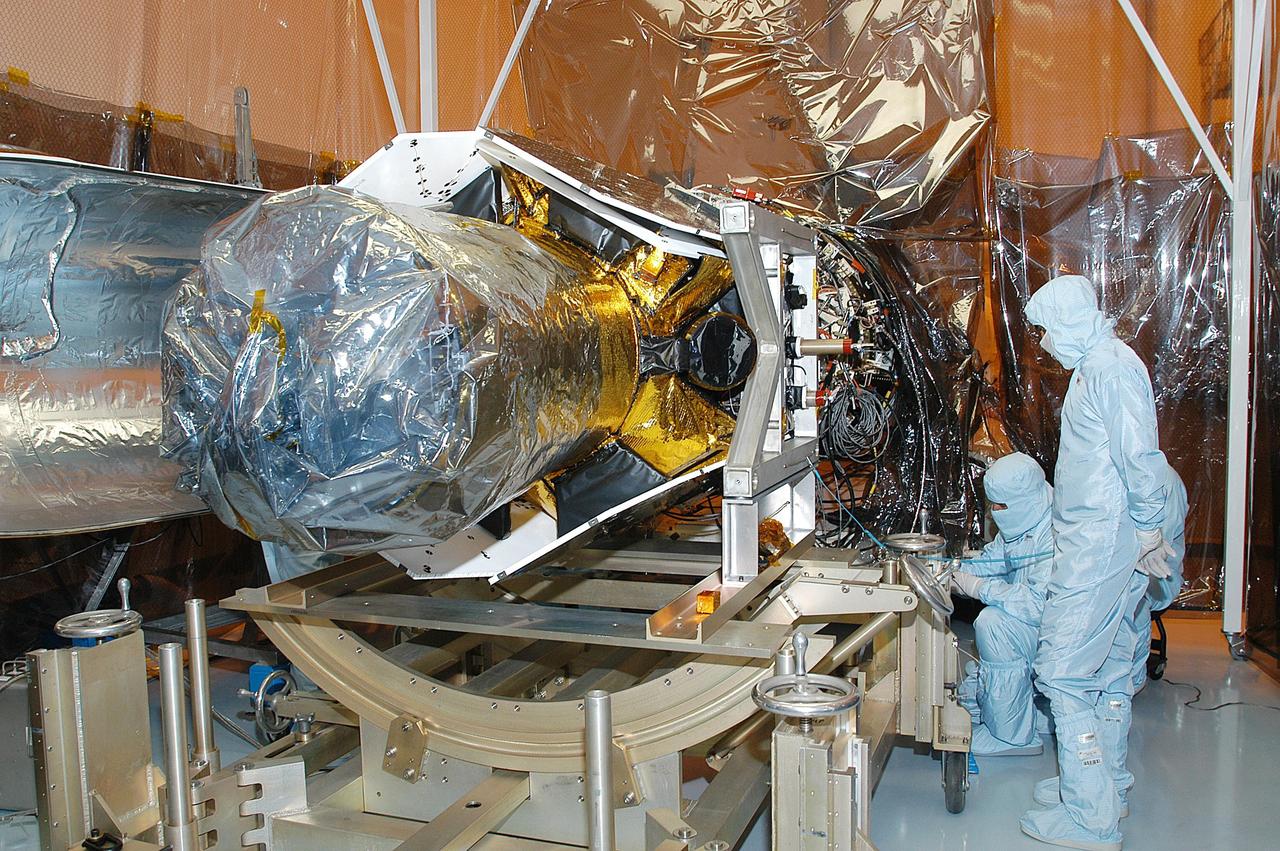
KENNEDY SPACE CENTER, FLA. -- In the Multi-Payload Processing Facility, NASA's Galaxy Evolution Explorer is prepared for mating with the Pegasus XL launch vehicle. The GALEX, set to launch April 2 from Cape Canaveral Air Force Station, will carry into space an orbiting telescope that will observe a million galaxies across 10 billion years of cosmic history to help astronomers determine when the stars and elements we see today had their origins. The spacecraft will sweep the skies for 28 months using state-of-the-art ultraviolet detectors to single out galaxies dominated by young, hot, short-lived stars that give off a great deal of energy at that wavelength. These galaxies are actively creating stars, and therefore provide a window into the history and causes of star formation in galaxies.

KENNEDY SPACE CENTER, FLA. - At Cape Canaveral Air Force Station, the Pegasus XL and Galaxy Evolution Explorer (GALEX) satellite are mated to the Orbital Sciences L-1011 aircraft. The GALEX, to be launched April 28 from the L-1011, will carry into space an orbiting telescope that will observe a million galaxies across 10 billion years of cosmic history to help astronomers determine when the stars and elements we see today had their origins. The spacecraft will sweep the skies for 28 months using state-of-the-art ultraviolet detectors to single out galaxies dominated by young, hot, short-lived stars that give off a great deal of energy at that wavelength. These galaxies are actively creating stars, and therefore provide a window into the history and causes of star formation in galaxies.
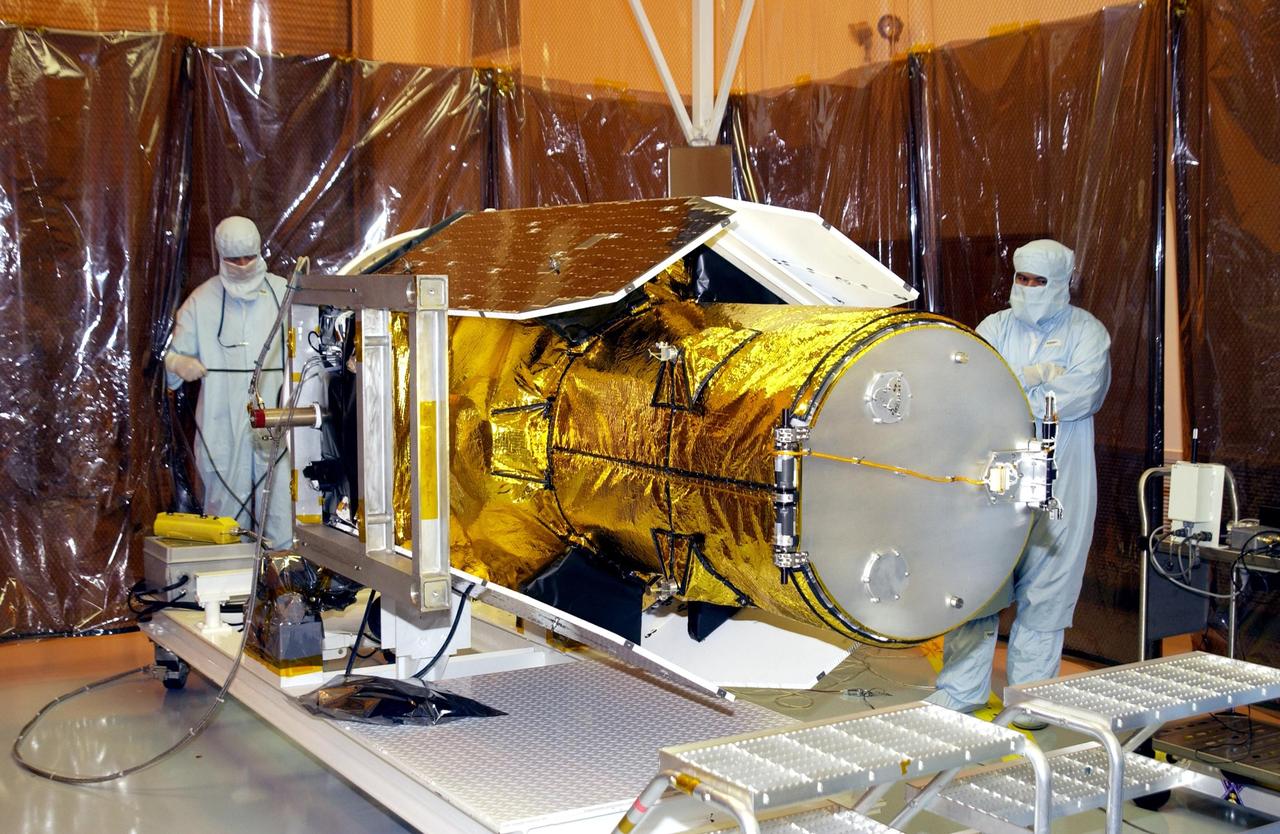
KENNEDY SPACE CENTER, FLA. -- NASA's Galaxy Evolution Explorer spacecraft is successfully rotated to horizontal in preparation for mating with the Pegasus XL launch vehicle. The GALEX, set to launch April 2 from Cape Canaveral Air Force Station, will carry into space an orbiting telescope that will observe a million galaxies across 10 billion years of cosmic history to help astronomers determine when the stars and elements we see today had their origins. From its orbit high above Earth, the spacecraft will sweep the skies for 28 months using state-of-the-art ultraviolet detectors. Looking in the ultraviolet will single out galaxies dominated by young, hot, short-lived stars that give off a great deal of energy at that wavelength. These galaxies are actively creating stars, and therefore provide a window into the history and causes of star formation in galaxies.

KENNEDY SPACE CENTER, FLA. - At Cape Canaveral Air Force Station, Orbital Sciences' L-1011 aircraft waits for takeoff time between 7:50 and 9:50 a.m. EDT. Attached underneath is the Pegasus XL rocket with its payload, the Galaxy Evolution Explorer (GALEX), due to be released about 8 a.m. The GALEX will carry into space an orbiting telescope that will observe a million galaxies across 10 billion years of cosmic history to help astronomers determine when the stars and elements we see today had their origins. The spacecraft will sweep the skies for 28 months using state-of-the-art ultraviolet detectors to single out galaxies dominated by young, hot, short-lived stars that give off a great deal of energy at that wavelength. These galaxies are actively creating stars, and therefore provide a window into the history and causes of star formation in galaxies.
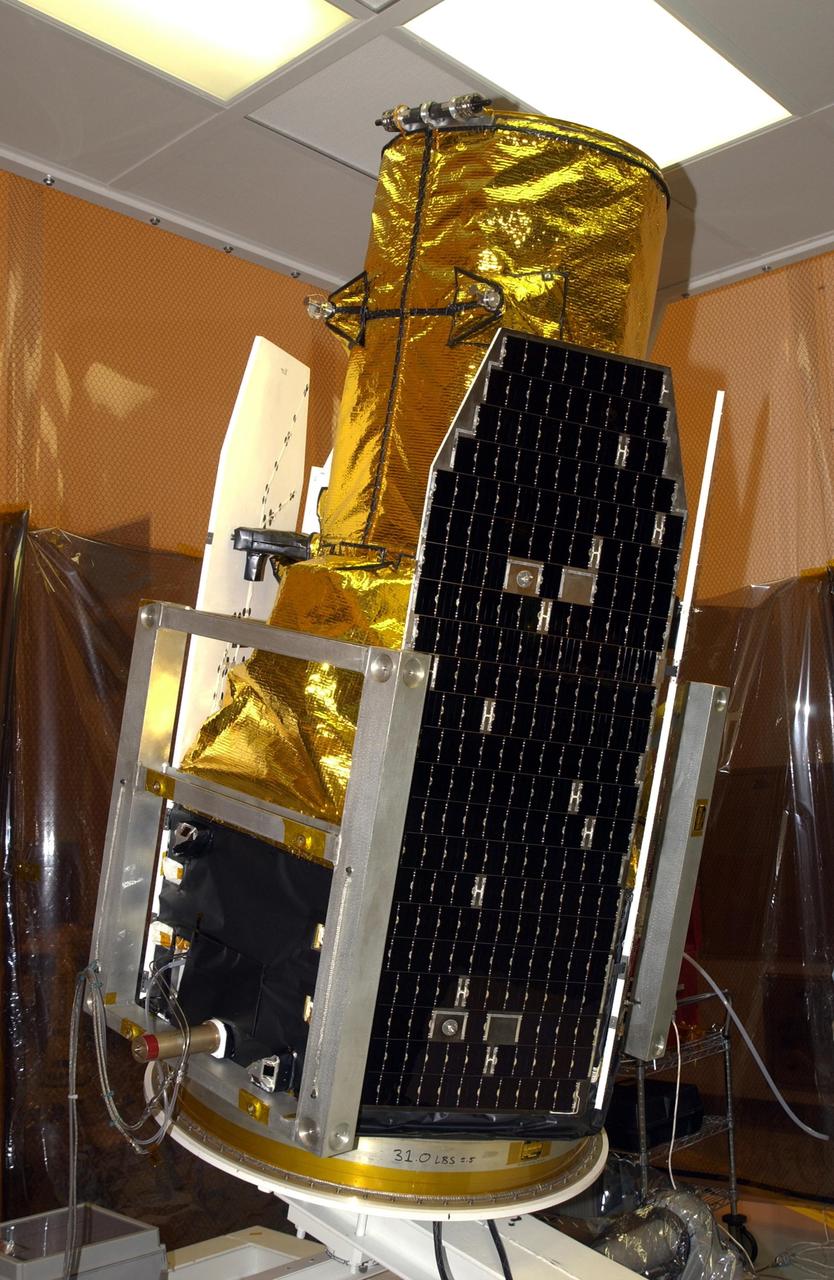
KENNEDY SPACE CENTER, FLA. -- In the Multi-Payload Processing Facility, NASA's Galaxy Evolution Explorer spacecraft is moved to a rotation stand in preparation for mating with the Pegasus XL launch vehicle. The GALEX, set to launch April 2 from Cape Canaveral Air Force Station, will carry into space an orbiting telescope that will observe a million galaxies across 10 billion years of cosmic history to help astronomers determine when the stars and elements we see today had their origins. From its orbit high above Earth, the spacecraft will sweep the skies for 28 months using state-of-the-art ultraviolet detectors. Looking in the ultraviolet will single out galaxies dominated by young, hot, short-lived stars that give off a great deal of energy at that wavelength. These galaxies are actively creating stars, and therefore provide a window into the history and causes of star formation in galaxies.
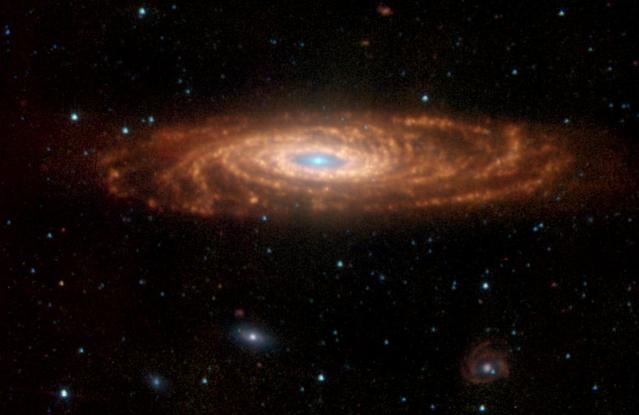
NASA's Spitzer Space Telescope has captured these infrared images of a nearby spiral galaxy that resembles our own Milky Way. The targeted galaxy, known as NGC 7331 and sometimes referred to as our galaxy's twin, is found in the constellation Pegasus at a distance of 50 million light-years. This inclined galaxy was discovered in 1784 by William Herschel, who also discovered infrared light. The evolution of this galaxy is a story that depends significantly on the amount and distribution of gas and dust, the locations and rates of star formation, and on how the energy from star formation is recycled by the local environment. The new Spitzer images are allowing astronomers to "read" this story by dissecting the galaxy into its separate components. The image, measuring 12.6 by 8.2 arcminutes, was obtained by Spitzer's infrared array camera. It is a four-color composite of invisible light, showing emissions from wavelengths of 3.6 microns (blue), 4.5 microns (green), 5.8 microns (yellow) and 8.0 microns (red). These wavelengths are roughly 10 times longer than those seen by the human eye. The infrared light seen in this image originates from two very different sources. At shorter wavelengths (3.6 to 4.5 microns), the light comes mainly from stars, particularly ones that are older and cooler than our Sun. This starlight fades at longer wavelengths (5.8 to 8.0 microns), where instead we see the glow from clouds of interstellar dust. This dust consists mainly of a variety of carbon-based organic molecules known collectively as polycyclic aromatic hydrocarbons. Wherever these compounds are found, there will also be dust granules and gas, which provide a reservoir of raw materials for future star formation. One feature that stands out in the Spitzer image is the ring of actively forming stars that surrounds the galaxy center (yellow). This ring, with a radius of nearly 20,000 light-years, is invisible at shorter wavelengths, yet has been detected at sub-millimeter and radio wavelengths. It is made up in large part of polycyclic aromatic hydrocarbons. Spitzer measurements suggest that the ring contains enough gas to produce four billion stars like the Sun. Three other galaxies are seen below NGC 7331, all about 10 times farther away. From left to right are NGC 7336, NGC 7335 and NGC 7337. The blue dots scattered throughout the images are foreground stars in the Milky Way; the red ones are galaxies that are even more distant. The Spitzer observations of NGC 7331 are part of a large 500-hour science project, known as the Spitzer Infrared Nearby Galaxy Survey, which will comprehensively study 75 nearby galaxies with infrared imaging and spectroscopy. http://photojournal.jpl.nasa.gov/catalog/PIA06322
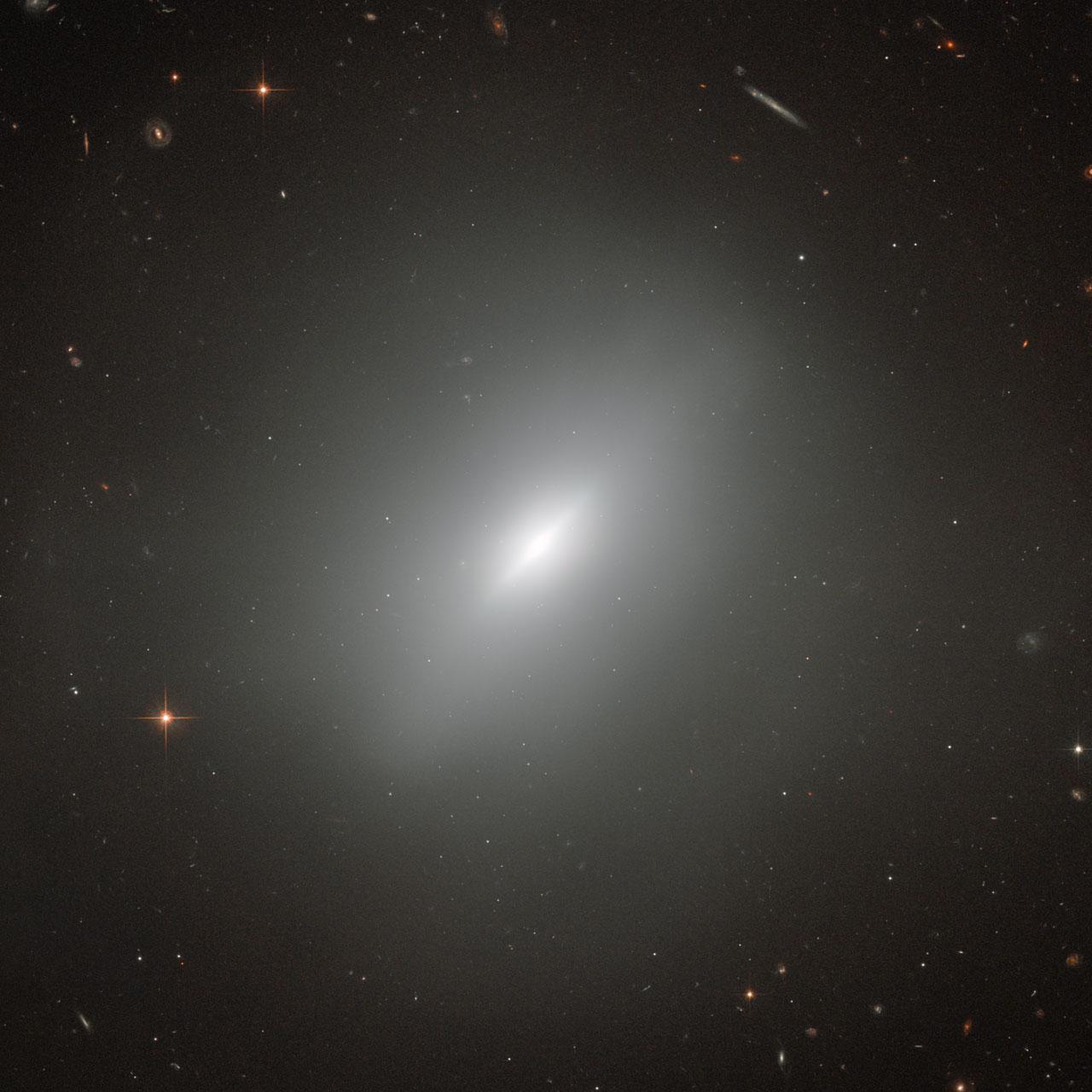
At the center of this amazing Hubble image is the elliptical galaxy NGC 3610. Surrounding the galaxy are a wealth of other galaxies of all shapes. There are spiral galaxies, galaxies with a bar in their central regions, distorted galaxies and elliptical galaxies, all visible in the background. In fact, almost every bright dot in this image is a galaxy — the few foreground stars are clearly distinguishable due to the diffraction spikes (lines radiating from bright light sources in reflecting telescope images) that overlay their images. NGC 3610 is of course the most prominent object in this image — and a very interesting one at that! Discovered in 1793 by William Herschel, it was later found that this elliptical galaxy contains a disk. This is very unusual, as disks are one of the main distinguishing features of a spiral galaxy. And the disk in NGC 3610 is remarkably bright. The reason for the peculiar shape of NGC 3610 stems from its formation history. When galaxies form, they usually resemble our galaxy, the Milky Way, with flat disks and spiral arms where star formation rates are high and which are therefore very bright. An elliptical galaxy is a much more disordered object which results from the merging of two or more disk galaxies. During these violent mergers most of the internal structure of the original galaxies is destroyed. The fact that NGC 3610 still shows some structure in the form of a bright disk implies that it formed only a short time ago. The galaxy’s age has been put at around four billion years and it is an important object for studying the early stages of evolution in elliptical galaxies. Image credit: ESA/Hubble & NASA, Acknowledgement: Judy Schmidt <b><a href="http://www.nasa.gov/audience/formedia/features/MP_Photo_Guidelines.html" rel="nofollow">NASA image use policy.</a></b> <b><a href="http://www.nasa.gov/centers/goddard/home/index.html" rel="nofollow">NASA Goddard Space Flight Center</a></b> enables NASA’s mission through four scientific endeavors: Earth Science, Heliophysics, Solar System Exploration, and Astrophysics. Goddard plays a leading role in NASA’s accomplishments by contributing compelling scientific knowledge to advance the Agency’s mission. <b>Follow us on <a href="http://twitter.com/NASAGoddardPix" rel="nofollow">Twitter</a></b> <b>Like us on <a href="http://www.facebook.com/pages/Greenbelt-MD/NASA-Goddard/395013845897?ref=tsd" rel="nofollow">Facebook</a></b> <b>Find us on <a href="http://instagrid.me/nasagoddard/?vm=grid" rel="nofollow">Instagram</a></b>
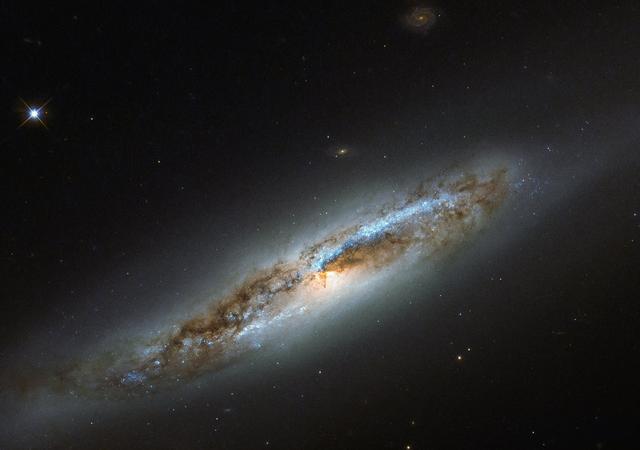
The constellation of Virgo (The Virgin) is especially rich in galaxies, due in part to the presence of a massive and gravitationally-bound collection of more than 1300 galaxies called the Virgo Cluster. One particular member of this cosmic community, NGC 4388, is captured in this image, as seen by the NASA/ESA Hubble Space Telescope’s Wide Field Camera 3. Located some 60 million light-years away, NGC 4388 is experiencing some of the less desirable effects that come with belonging to such a massive galaxy cluster. It is undergoing a transformation and has taken on a somewhat confused identity. While the galaxy’s outskirts appear smooth and featureless, a classic feature of an elliptical galaxy, its center displays remarkable dust lanes constrained within two symmetric spiral arms, which emerge from the galaxy’s glowing core — one of the obvious features of a spiral galaxy. Within the arms, speckles of bright blue mark the locations of young stars, indicating that NGC 4388 has hosted recent bursts of star formation. Despite the mixed messages, NGC 4388 is classified as a spiral galaxy. Its unusual combination of features are thought to have been caused by interactions between NGC 4388 and other galaxies in the Virgo Cluster. Gravitational interactions — from glancing blows to head-on collisions, tidal influencing, mergers, and galactic cannibalism — can be devastating to galaxies. While some may be lucky enough to simply suffer a distorted spiral arm or newly-triggered wave of star formation, others see their structure and contents completely and irrevocably altered. Image credits: ESA/NASA
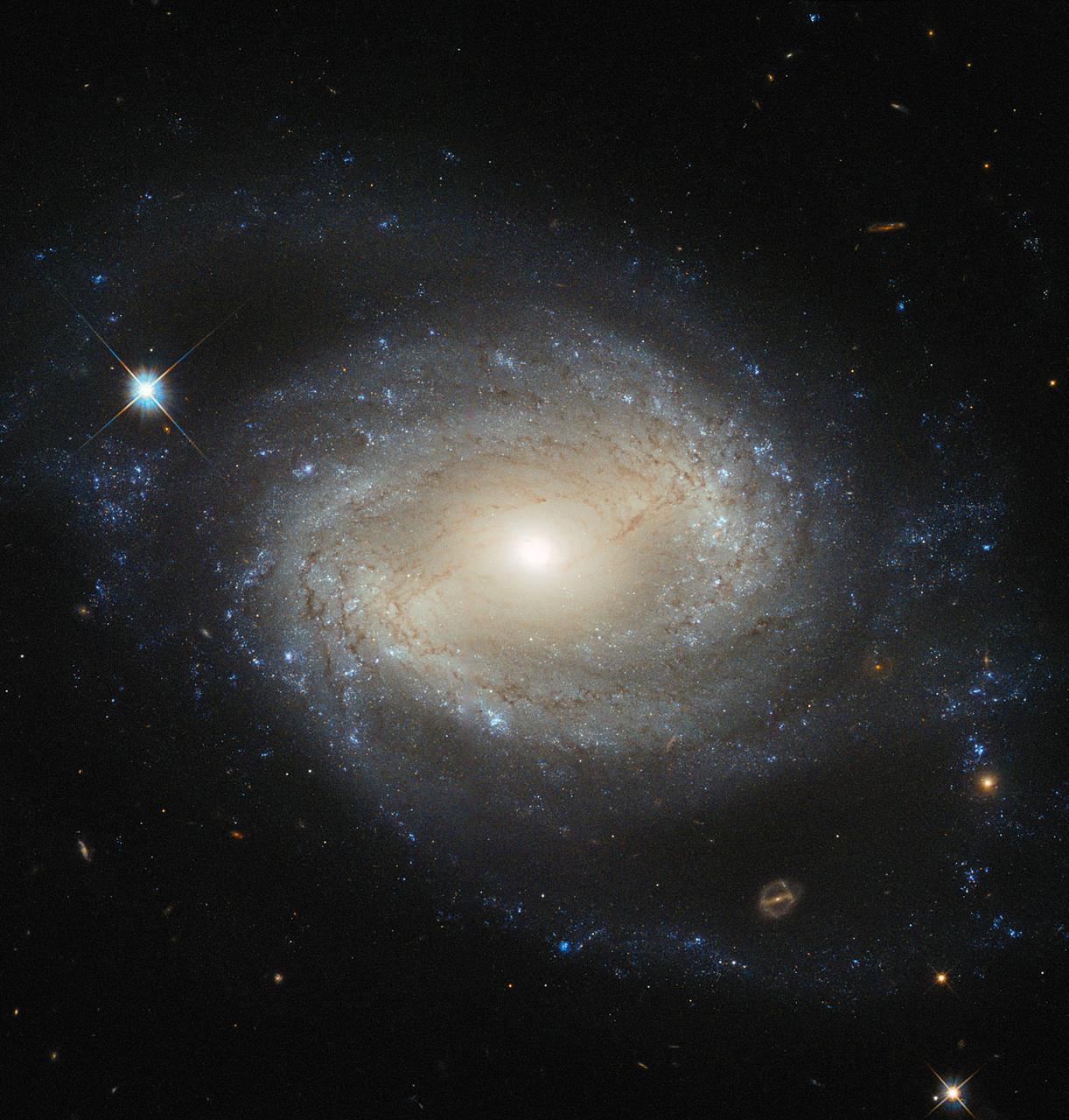
NGC 4639 is a beautiful example of a type of galaxy known as a barred spiral. It lies over 70 million light-years away in the constellation of Virgo and is one of about 1500 galaxies that make up the Virgo Cluster. In this image, taken by the NASA/ESA Hubble Space Telescope, one can clearly see the bar running through the bright, round core of the galaxy. Bars are found in around two thirds of spiral galaxies, and are thought to be a natural phase in their evolution. The galaxy’s spiral arms are sprinkled with bright regions of active star formation. Each of these tiny jewels is actually several hundred light-years across and contains hundreds or thousands of newly formed stars. But NGC 4639 also conceals a dark secret in its core — a massive black hole that is consuming the surrounding gas. This is known as an active galactic nucleus (AGN), and is revealed by characteristic features in the spectrum of light from the galaxy and by X-rays produced close to the black hole as the hot gas plunges towards it. Most galaxies are thought to contain a black hole at the centre. NGC 4639 is in fact a very weak example of an AGN, demonstrating that AGNs exist over a large range of activity, from galaxies like NGC 4639 to distant quasars, where the parent galaxy is almost completely dominated by the emissions from the AGN.
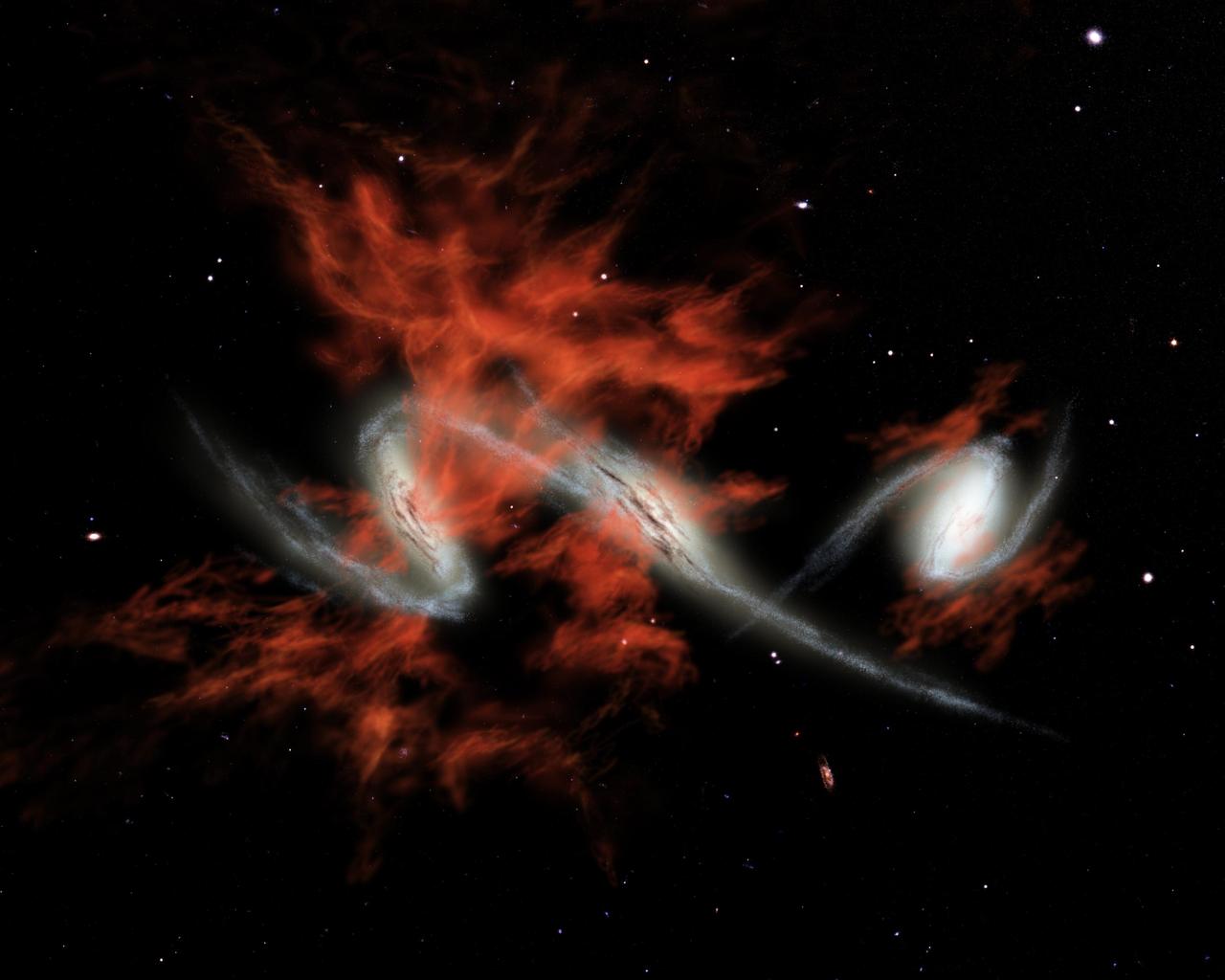
This artist's concept illustrates one possible answer to the puzzle of the "giant galactic blobs." These blobs (red), first identified about five years ago, are mammoth clouds of intensely glowing material that surround distant galaxies (white). Astronomers using visible-light telescopes can see the glow of the blobs, but they didn't know what provides the energy to light them up. NASA's Spitzer Space Telescope set its infrared eyes on one well-known blob located 11 billion light-years away, and discovered three tremendously bright galaxies, each shining with the light of more than one trillion Suns, headed toward each other. Spitzer also observed three other blobs in the same galactic neighborhood and found equally bright galaxies within them. One of these blobs is also known to contain galaxies merging together. The findings suggest that galactic mergers might be the mysterious source of blobs. If so, then one explanation for how mergers produce such large clouds of material is that they trigger intense bursts of star formation. This star formation would lead to exploding massive stars, or supernovae, which would then shoot gases outward in a phenomenon known as superwinds. Blobs produced in this fashion are illustrated in this artist's concept. http://photojournal.jpl.nasa.gov/catalog/PIA07221
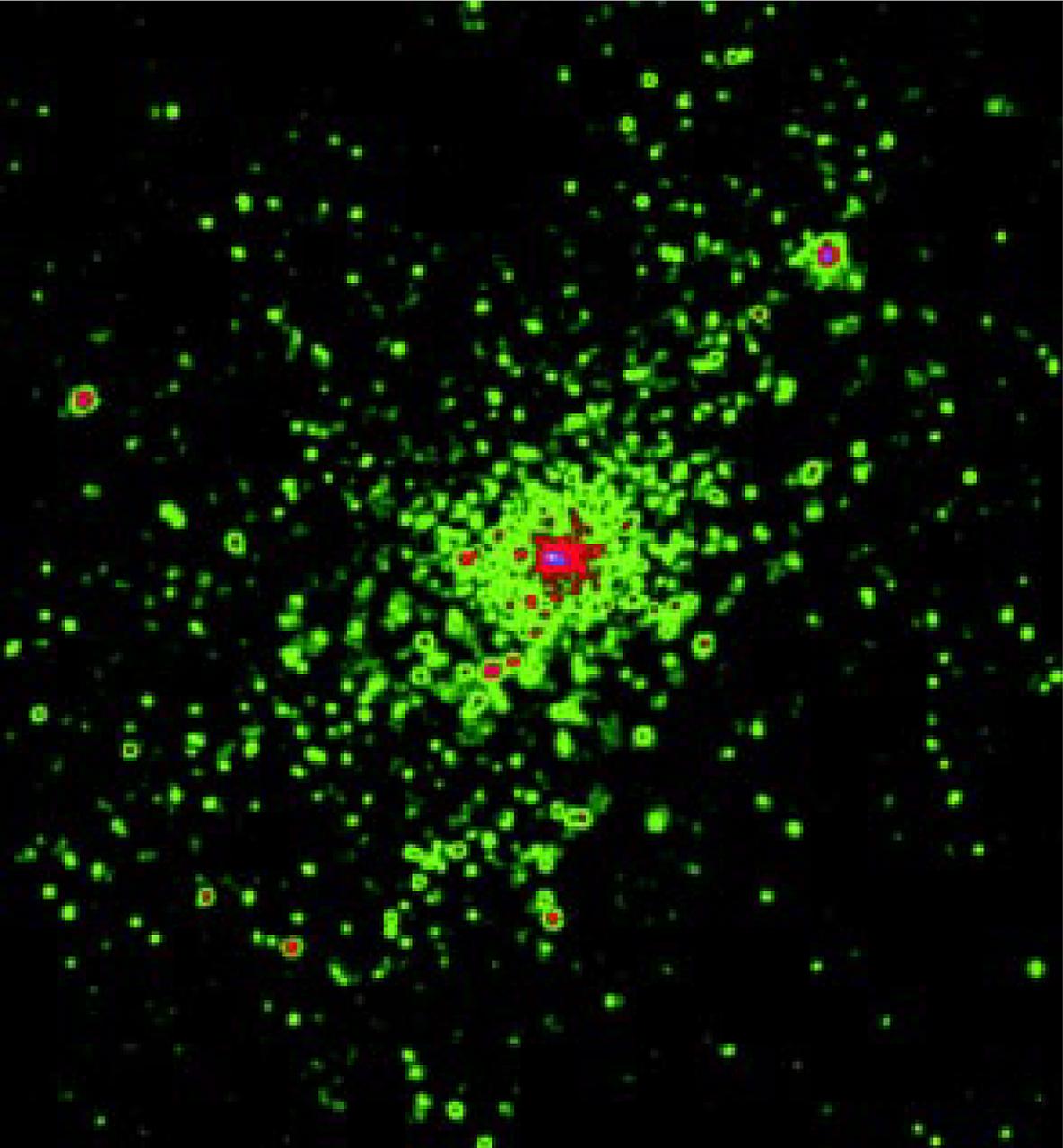
NGC 3603 is a bustling region of star birth in the Carina spiral arm of the Milky Way galaxy, about 20,000 light-years from Earth. For the first time, this Chandra image resolves the multitude of individual x-ray sources in this star-forming region. (The intensity of the x-rays observed by Chandra are depicted by the various colors in this image. Green represents lower intensity sources, while purple and red indicate increasing x-ray intensity.) Specifically, the Chandra image reveals dozens of extremely massive stars born in a burst of star formation about 2 million years ago. This region's activities may be indicative of what is happening in other distant "starburst" galaxies (bright galaxies flush with new stars). In the case of NGC 3603, scientists now believe that these x-rays are emitted from massive stars and stellar winds, since the stars are too young to have produced supernovae or have evolved into neutron stars. The Chandra observations of NGC 3603 may provide new clues about x-ray emission in starburst galaxies as well as star formation itself. (Photo credit: NASA/GSFC/M. Corcoran et al)
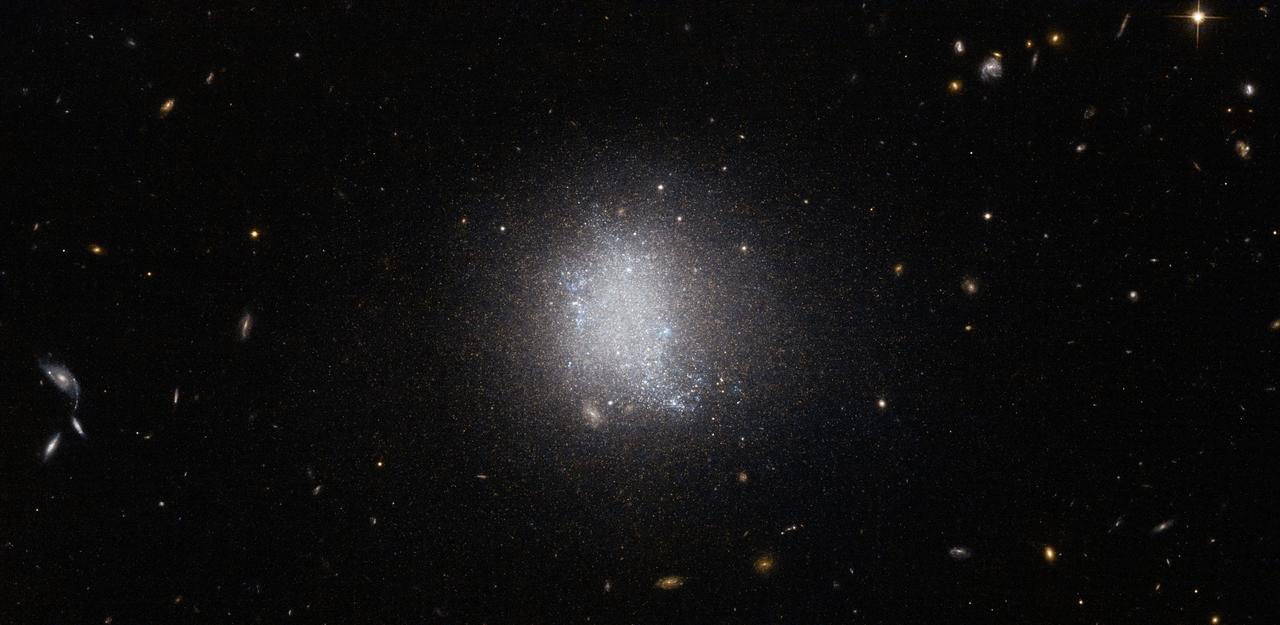
The smudge of stars at the center of this NASA/ESA Hubble Space Telescope image is a galaxy known as UGC 5797. UGC 5797 is an emission line galaxy, meaning that it is currently undergoing active star formation. The result is a stellar population that is constantly being refurbished as massive bright blue stars form. Galaxies with prolific star formation are not only veiled in a blue tint, but are key to the continuation of a stellar cycle. In this image UGC 5797 appears in front of a background of spiral galaxies. Spiral galaxies have copious amounts of dust and gas — the main ingredient for stars — and therefore often also belong to the class of emission line galaxies. Spiral galaxies have disk-like shapes that drastically vary in appearance depending on the angle at which they are observed. The collection of spiral galaxies in this frame exhibits this attribute acutely: Some are viewed face-on, revealing the structure of the spiral arms, while the two in the bottom left are seen edge-on, appearing as plain streaks in the sky. There are many spiral galaxies, with varying colors and at different angles, sprinkled across this image — just take a look. Credit: ESA/Hubble & NASA, Acknowledgement: Luca Limatola <b><a href="http://www.nasa.gov/audience/formedia/features/MP_Photo_Guidelines.html" rel="nofollow">NASA image use policy.</a></b> <b><a href="http://www.nasa.gov/centers/goddard/home/index.html" rel="nofollow">NASA Goddard Space Flight Center</a></b> enables NASA’s mission through four scientific endeavors: Earth Science, Heliophysics, Solar System Exploration, and Astrophysics. Goddard plays a leading role in NASA’s accomplishments by contributing compelling scientific knowledge to advance the Agency’s mission. <b>Follow us on <a href="http://twitter.com/NASAGoddardPix" rel="nofollow">Twitter</a></b> <b>Like us on <a href="http://www.facebook.com/pages/Greenbelt-MD/NASA-Goddard/395013845897?ref=tsd" rel="nofollow">Facebook</a></b> <b>Find us on <a href="http://instagrid.me/nasagoddard/?vm=grid" rel="nofollow">Instagram</a></b>

Thousands of galaxies flood this near-infrared image of galaxy cluster SMACS 0723. High-resolution imaging from NASA’s James Webb Space Telescope combined with a natural effect known as gravitational lensing made this finely detailed image possible. First, focus on the galaxies responsible for the lensing: the bright white elliptical galaxy at the center of the image and smaller white galaxies throughout the image. Bound together by gravity in a galaxy cluster, they are bending the light from galaxies that appear in the vast distances behind them. The combined mass of the galaxies and dark matter act as a cosmic telescope, creating magnified, contorted, and sometimes mirrored images of individual galaxies. Clear examples of mirroring are found in the prominent orange arcs to the left and right of the brightest cluster galaxy. These are lensed galaxies – each individual galaxy is shown twice in one arc. Webb’s image has fully revealed their bright cores, which are filled with stars, along with orange star clusters along their edges. Not all galaxies in this field are mirrored – some are stretched. Others appear scattered by interactions with other galaxies, leaving trails of stars behind them. Webb has refined the level of detail we can observe throughout this field. Very diffuse galaxies appear like collections of loosely bound dandelion seeds aloft in a breeze. Individual “pods” of star formation practically bloom within some of the most distant galaxies – the clearest, most detailed views of star clusters in the early universe so far. One galaxy speckled with star clusters appears near the bottom end of the bright central star’s vertical diffraction spike – just to the right of a long orange arc. The long, thin ladybug-like galaxy is flecked with pockets of star formation. Draw a line between its “wings” to roughly match up its star clusters, mirrored top to bottom. Because this galaxy is so magnified and its individual star clusters are so crisp, researchers will be able to study it in exquisite detail, which wasn’t previously possible for galaxies this distant. The galaxies in this scene that are farthest away – the tiniest galaxies that are located well behind the cluster – look nothing like the spiral and elliptical galaxies observed in the local universe. They are much clumpier and more irregular. Webb’s highly detailed image may help researchers measure the ages and masses of star clusters within these distant galaxies. This might lead to more accurate models of galaxies that existed at cosmic “spring,” when galaxies were sprouting tiny “buds” of new growth, actively interacting and merging, and had yet to develop into larger spirals. Ultimately, Webb’s upcoming observations will help astronomers better understand how galaxies form and grow in the early universe. NIRCam was built by a team at the University of Arizona and Lockheed Martin’s Advanced Technology Center. For a full array of Webb’s first images and spectra, including downloadable files, please visit: https://webbtelescope.org/news/first-images

This image of the active galaxy Centaurus A was taken by NASA's Galaxy Evolution Explorer on June 7, 2003. The galaxy is located 30 million light-years from Earth and is seen edge on, with a prominent dust lane across the major axis. In this image the near ultraviolet emission is represented as green, and the far ultraviolet emission as blue. The galaxy exhibits jets of high energy particles, which were traced by the X-ray emission and measured by NASA's Chandra X-ray Observatory. These X-ray emissions are seen as red in the image. Several regions of ultraviolet emission can be seen where the jets of high energy particles intersect with hydrogen clouds in the upper left corner of the image. The emission shown may be the result of recent star formation triggered by the compression of gas by the jet. http://photojournal.jpl.nasa.gov/catalog/PIA04624
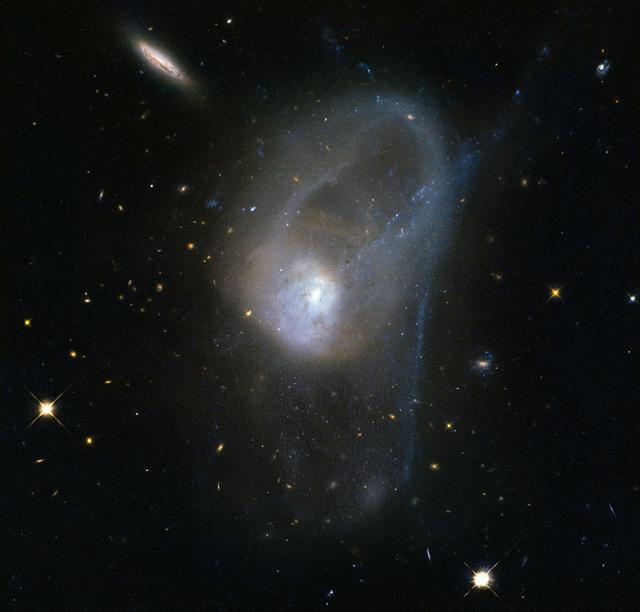
It is known today that merging galaxies play a large role in the evolution of galaxies and the formation of elliptical galaxies in particular. However there are only a few merging systems close enough to be observed in depth. The pair of interacting galaxies seen here — known as NGC 3921 — is one of these systems. NGC 3921 — found in the constellation of Ursa Major (The Great Bear) — is an interacting pair of disk galaxies in the late stages of its merger. Observations show that both of the galaxies involved were about the same mass and collided about 700 million years ago. You can see clearly in this image the disturbed morphology, tails and loops characteristic of a post-merger. The clash of galaxies caused a rush of star formation and previous Hubble observations showed over 1,000 bright, young star clusters bursting to life at the heart of the galaxy pair. Image credit: ESA/Hubble & NASA, Acknowledgement: Judy Schmidt <b><a href="http://www.nasa.gov/audience/formedia/features/MP_Photo_Guidelines.html" rel="nofollow">NASA image use policy.</a></b> <b><a href="http://www.nasa.gov/centers/goddard/home/index.html" rel="nofollow">NASA Goddard Space Flight Center</a></b> enables NASA’s mission through four scientific endeavors: Earth Science, Heliophysics, Solar System Exploration, and Astrophysics. Goddard plays a leading role in NASA’s accomplishments by contributing compelling scientific knowledge to advance the Agency’s mission. <b>Follow us on <a href="http://twitter.com/NASAGoddardPix" rel="nofollow">Twitter</a></b> <b>Like us on <a href="http://www.facebook.com/pages/Greenbelt-MD/NASA-Goddard/395013845897?ref=tsd" rel="nofollow">Facebook</a></b> <b>Find us on <a href="http://instagrid.me/nasagoddard/?vm=grid" rel="nofollow">Instagram</a></b>
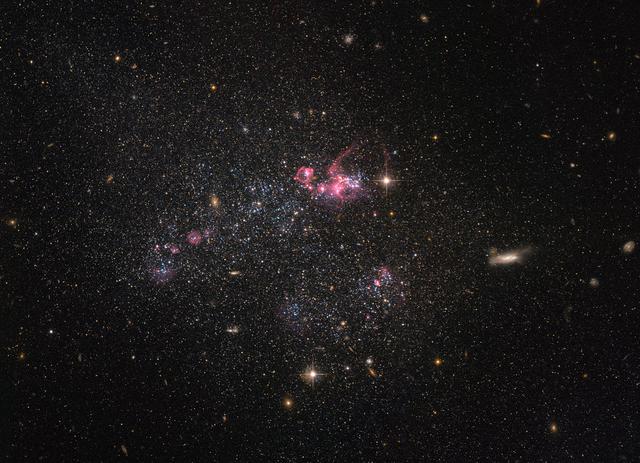
Despite being less famous than their elliptical and spiral galactic cousins, irregular dwarf galaxies, such as the one captured in this NASA/ESA Hubble Space Telescope image, are actually one of the most common types of galaxy in the universe. Known as UGC 4459, this dwarf galaxy is located approximately 11 million light-years away in the constellation of Ursa Major (The Great Bear), a constellation that is also home to the Pinwheel Galaxy (M101), the Owl Nebula (M97), Messier 81, Messier 82 and several other galaxies all part of the M81 group. UGC 4459’s diffused and disorganized appearance is characteristic of an irregular dwarf galaxy. Lacking a distinctive structure or shape, irregular dwarf galaxies are often chaotic in appearance, with neither a nuclear bulge — a huge, tightly packed central group of stars — nor any trace of spiral arms — regions of stars extending from the center of the galaxy. Astronomers suspect that some irregular dwarf galaxies were once spiral or elliptical galaxies, but were later deformed by the gravitational pull of nearby objects. Rich with young blue stars and older red stars, UGC 4459 has a stellar population of several billion. Though seemingly impressive, this is small when compared to the 200 to 400 billion stars in the Milky Way! Observations with Hubble have shown that because of their low masses of dwarf galaxies like UGC 4459, star formation is very low compared to larger galaxies. Only very little of their original gas has been turned into stars. Thus, these small galaxies are interesting to study to better understand primordial environments and the star formation process. Image Credit: ESA/Hubble and NASA; Acknowledgement: Judy Schmidt <b><a href="http://www.nasa.gov/audience/formedia/features/MP_Photo_Guidelines.html" rel="nofollow">NASA image use policy.</a></b> <b><a href="http://www.nasa.gov/centers/goddard/home/index.html" rel="nofollow">NASA Goddard Space Flight Center</a></b> enables NASA’s mission through four scientific endeavors: Earth Science, Heliophysics, Solar System Exploration, and Astrophysics. Goddard plays a leading role in NASA’s accomplishments by contributing compelling scientific knowledge to advance the Agency’s mission. <b>Follow us on <a href="http://twitter.com/NASAGoddardPix" rel="nofollow">Twitter</a></b> <b>Like us on <a href="http://www.facebook.com/pages/Greenbelt-MD/NASA-Goddard/395013845897?ref=tsd" rel="nofollow">Facebook</a></b> <b>Find us on <a href="http://instagrid.me/nasagoddard/?vm=grid" rel="nofollow">Instagram</a></b>
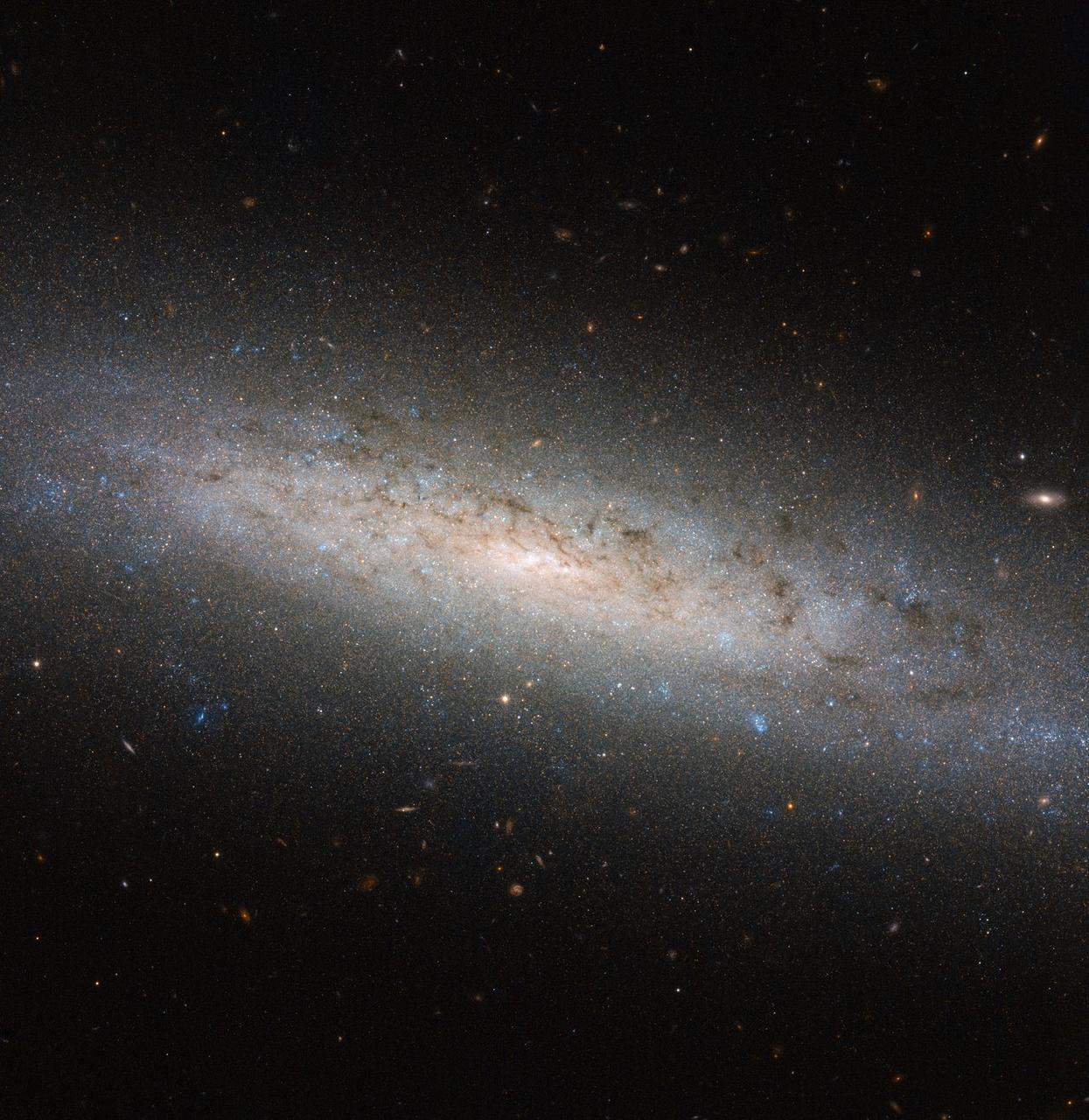
This shining disc of a spiral galaxy sits approximately 25 million light-years away from Earth in the constellation of Sculptor. Named NGC 24, the galaxy was discovered by British astronomer William Herschel in 1785, and measures some 40 000 light-years across. This picture was taken using the NASA/ESA Hubble Space Telescope’s Advanced Camera for Surveys, known as ACS for short. It shows NGC 24 in detail, highlighting the blue bursts (young stars), dark lanes (cosmic dust), and red bubbles (hydrogen gas) of material peppered throughout the galaxy’s spiral arms. Numerous distant galaxies can also been seen hovering around NGC 24’s perimeter. However, there may be more to this picture than first meets the eye. Astronomers suspect that spiral galaxies like NGC 24 and the Milky Way are surrounded by, and contained within, extended haloes of dark matter. Dark matter is a mysterious substance that cannot be seen; instead, it reveals itself via its gravitational interactions with surrounding material. Its existence was originally proposed to explain why the outer parts of galaxies, including our own, rotate unexpectedly fast, but it is thought to also play an essential role in a galaxy’s formation and evolution. Most of NGC 24’s mass — a whopping 80 % — is thought to be held within such a dark halo.
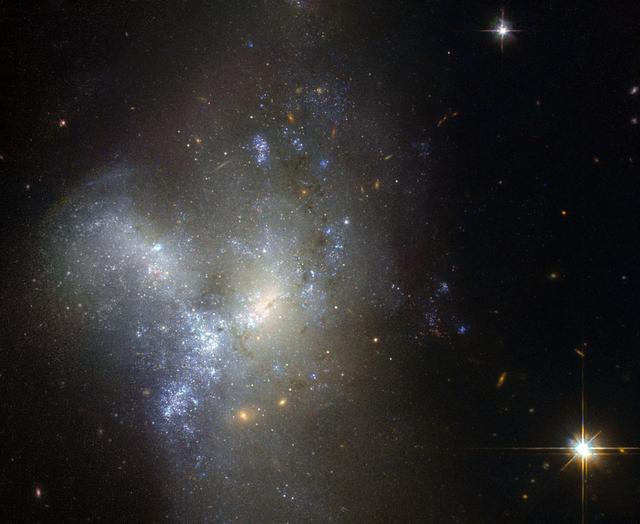
This image, taken by the NASA/ESA Hubble Space Telescope, shows a peculiar galaxy known as NGC 1487, lying about 30 million light-years away in the southern constellation of Eridanus. Rather than viewing a celestial object, it is actually better to think of this as an event. Here, we are witnessing two or more galaxies in the act of merging together to form a single new galaxy. Each progenitor has lost almost all traces of its original appearance, as stars and gas have been thrown hither and thither by gravity in an elaborate cosmic whirl. Unless one is very much bigger than the other, galaxies are always disrupted by the violence of the merging process. As a result, it is very difficult to determine precisely what the original galaxies looked like and, indeed, how many of them there were. In this case, it is possible that we are seeing the merger of several dwarf galaxies that were previously clumped together in a small group. Although older yellow and red stars can be seen in the outer regions of the new galaxy, its appearance is dominated by large areas of bright blue stars, illuminating the patches of gas that gave them life. This burst of star formation may well have been triggered by the merger.
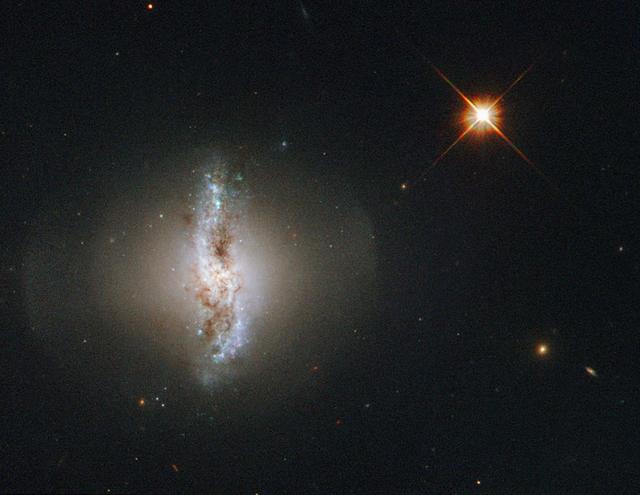
This Picture of the Week shows Arp 230, also known as IC 51, observed by the NASA/ESA Hubble Space Telescope. Arp 230 is a galaxy of an uncommon or peculiar shape, and is therefore part of the Atlas of Peculiar Galaxies produced by Halton Arp. Its irregular shape is thought to be the result of a violent collision with another galaxy sometime in the past. The collision could also be held responsible for the formation of the galaxy’s polar ring. The outer ring surrounding the galaxy consists of gas and stars and rotates over the poles of the galaxy. It is thought that the orbit of the smaller of the two galaxies that created Arp 230 was perpendicular to the disk of the second, larger galaxy when they collided. In the process of merging the smaller galaxy would have been ripped apart and may have formed the polar ring structure astronomers can observe today. Arp 230 is quite small for a lenticular galaxy, so the two original galaxies forming it must both have been smaller than the Milky Way. A lenticular galaxy is a galaxy with a prominent central bulge and a disk, but no clear spiral arms. They are classified as intermediate between an elliptical galaxy and a spiral galaxy. Credit: ESA/Hubble & NASA, Acknowledgement: Flickr user Det58 <b><a href="http://www.nasa.gov/audience/formedia/features/MP_Photo_Guidelines.html" rel="nofollow">NASA image use policy.</a></b> <b><a href="http://www.nasa.gov/centers/goddard/home/index.html" rel="nofollow">NASA Goddard Space Flight Center</a></b> enables NASA’s mission through four scientific endeavors: Earth Science, Heliophysics, Solar System Exploration, and Astrophysics. Goddard plays a leading role in NASA’s accomplishments by contributing compelling scientific knowledge to advance the Agency’s mission. <b>Follow us on <a href="http://twitter.com/NASAGoddardPix" rel="nofollow">Twitter</a></b> <b>Like us on <a href="http://www.facebook.com/pages/Greenbelt-MD/NASA-Goddard/395013845897?ref=tsd" rel="nofollow">Facebook</a></b> <b>Find us on <a href="http://instagrid.me/nasagoddard/?vm=grid" rel="nofollow">Instagram</a></b>
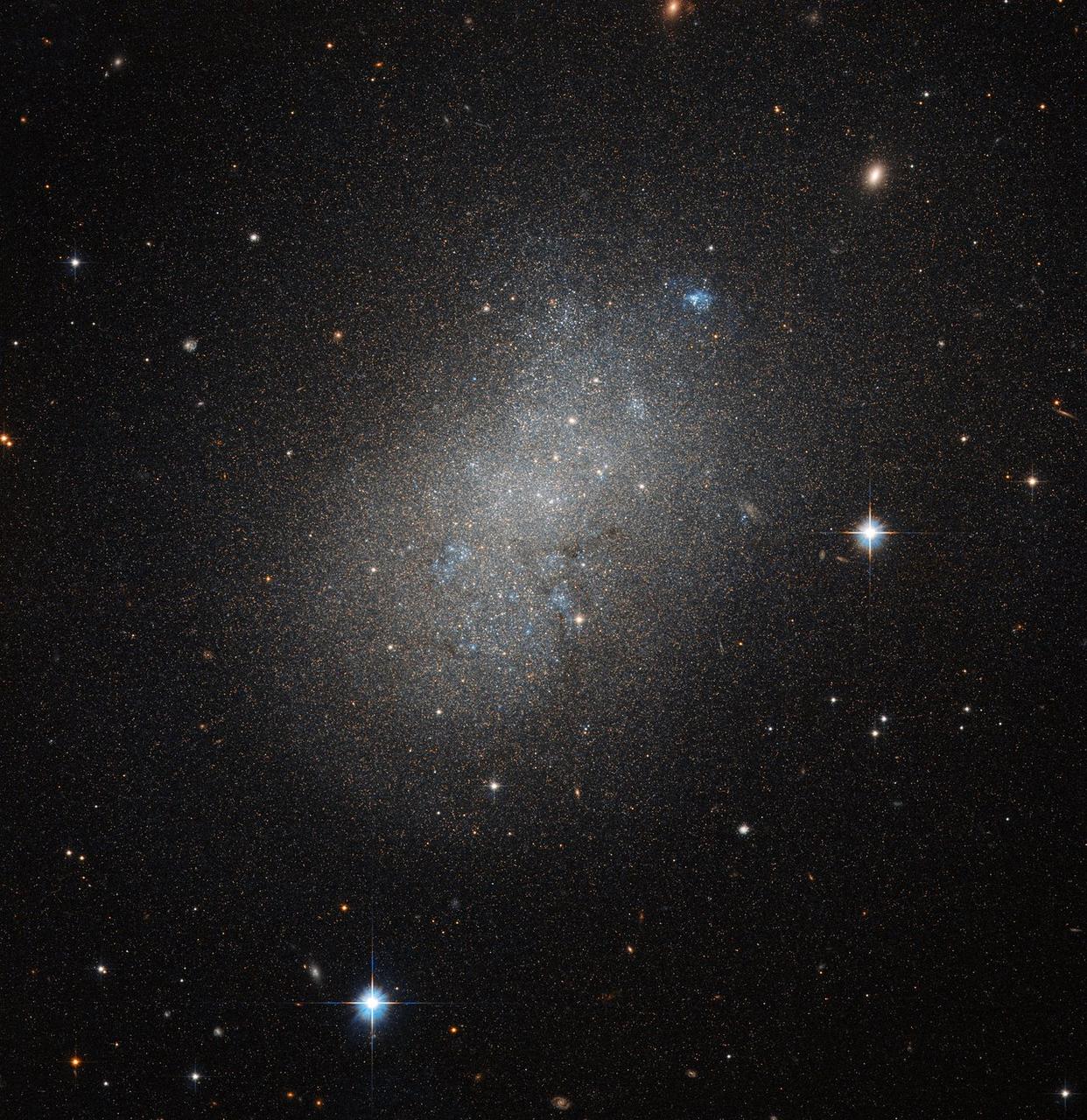
This image, courtesy of the NASA/ESA Hubble Space Telescope’s Advanced Camera for Surveys (ACS), captures the glow of distant stars within NGC 5264, a dwarf galaxy located just over 15 million light-years away in the constellation of Hydra (The Sea Serpent). Dwarf galaxies like NGC 5264 typically possess around a billion stars — just 1 percent of the number of stars found within the Milky Way. They are usually found orbiting other larger galaxies such as our own, and are thought to form from the material left over from the messy formation of their larger cosmic relatives. NGC 5264 clearly possesses an irregular shape — unlike the more common spiral or elliptical galaxies — with knots of blue star formation. Astronomers believe that this is due to the gravitational interactions between NGC 5264 and other galaxies nearby. These past flirtations sparked the formation of new generations of stars, which now glow in bright shades of blue. Credit: ESA/Hubble & NASA <b><a href="http://www.nasa.gov/audience/formedia/features/MP_Photo_Guidelines.html" rel="nofollow">NASA image use policy.</a></b> <b><a href="http://www.nasa.gov/centers/goddard/home/index.html" rel="nofollow">NASA Goddard Space Flight Center</a></b> enables NASA’s mission through four scientific endeavors: Earth Science, Heliophysics, Solar System Exploration, and Astrophysics. Goddard plays a leading role in NASA’s accomplishments by contributing compelling scientific knowledge to advance the Agency’s mission. <b>Follow us on <a href="http://twitter.com/NASAGoddardPix" rel="nofollow">Twitter</a></b> <b>Like us on <a href="http://www.facebook.com/pages/Greenbelt-MD/NASA-Goddard/395013845897?ref=tsd" rel="nofollow">Facebook</a></b> <b>Find us on <a href="http://instagrid.me/nasagoddard/?vm=grid" rel="nofollow">Instagram</a></b>
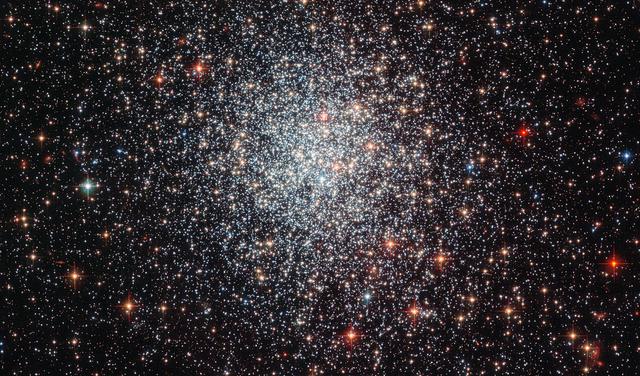
Shown here in a new image taken with the Advanced Camera for Surveys (ACS) on board the NASA/ESA Hubble Space Telescope, is the globular cluster NGC 1783. This is one of the biggest globular clusters in the Large Magellanic Cloud, a satellite galaxy of our own galaxy, the Milky Way, in the southern hemisphere constellation of Dorado. First observed by John Herschel in 1835, NGC 1783 is nearly 160 000 light-years from Earth, and has a mass around 170 000 times that of the Sun. Globular clusters are dense collections of stars held together by their own gravity, which orbit around galaxies like satellites. The image clearly shows the symmetrical shape of NGC 1783 and the concentration of stars towards the centre, both typical features of globular clusters. By measuring the colour and brightness of individual stars, astronomers can deduce an overall age for a cluster and a picture of its star formation history. NGC 1783 is thought to be under one and a half billion years old — which is very young for globular clusters, which are typically several billion years old. During that time, it is thought to have undergone at least two periods of star formation, separated by 50 to 100 million years. This ebb and flow of star-forming activity is an indicator of how much gas is available for star formation at any one time. When the most massive stars created in the first burst of formation explode as supernovae they blow away the gas needed to form further stars, but the gas reservoir can later be replenished by less massive stars which last longer and shed their gas less violently. After this gas flows to the dense central regions of the star cluster, a second phase of star formation can take place and once again the short-lived massive stars blow away any leftover gas. This cycle can continue a few times, at which time the remaining gas reservoir is thought to be too small to form any new stars. A version of this image was entered into the Hubble's Hidden Treasures image pr

Chandra X-Ray Observatory provided this composite X-ray (blue and green) and optical (red) image of the active galaxy NGC 1068 showing gas blowing away in a high-speed wind from the vicinity of a central supermassive black hole. Regions of intense star formation in the irner spiral arms of the galaxy are highlighted by both optical and x-ray emissions. A doughnut shaped cloud of cool gas and dust surrounding the black hole, known as the torus, appears as the elongated white spot . It has has a mass of about 5 million suns and is estimated to extend from within a few light years of the black hole out to about 300 light years.
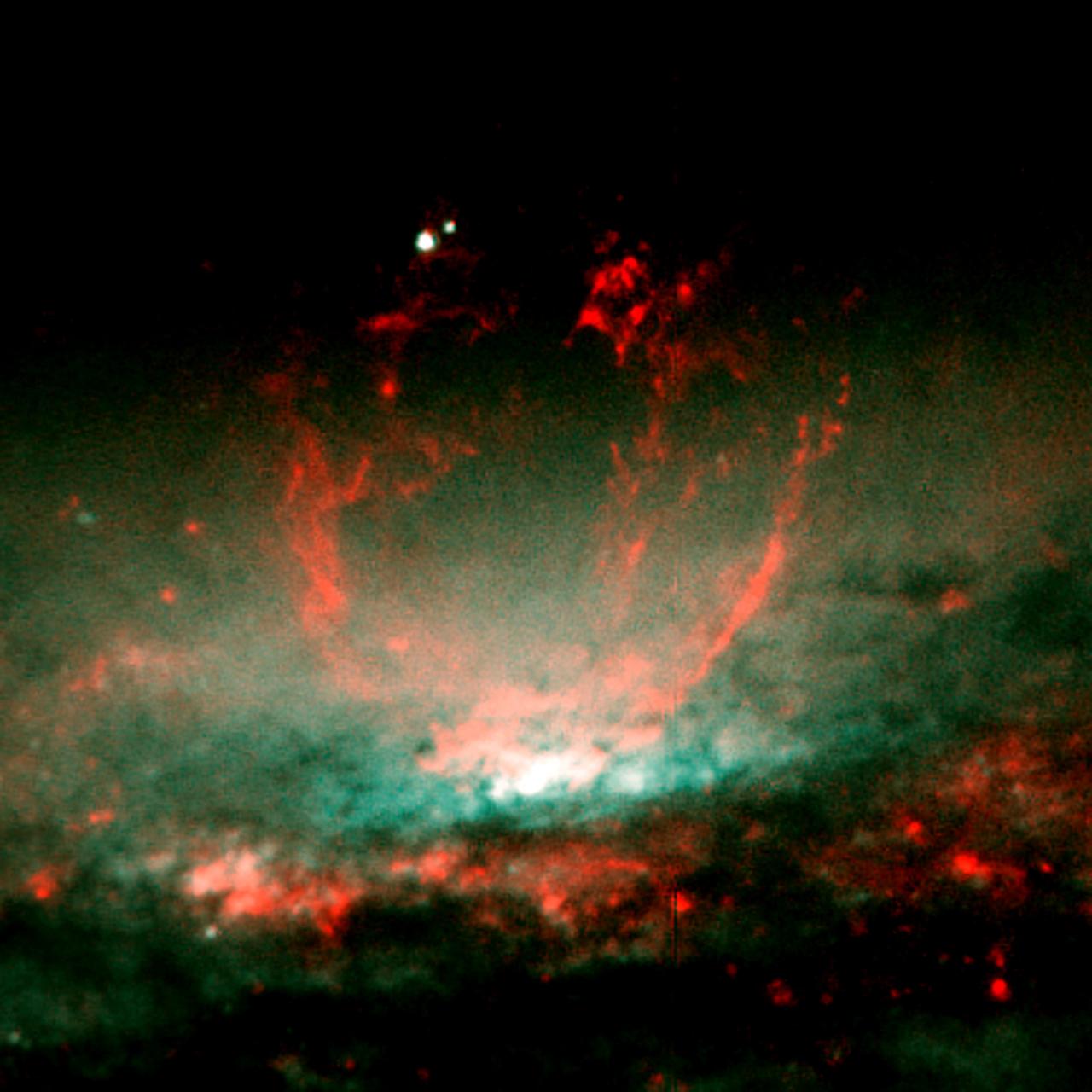
NASA's Hubble Space Telescope (HST) captures a lumpy bubble of hot gas rising from a cauldron of glowing matter in Galaxy NGC 3079, located 50 million light-years from Earth in the constellation Ursa Major. Astronomers suspect the bubble is being blown by "winds" or high speed streams of particles, released during a burst of star formation. The bubble's lumpy surface has four columns of gaseous filaments towering above the galaxy's disc that whirl around in a vortex and are expelled into space. Eventually, this gas will rain down on the disc and may collide with gas clouds, compress them, and form a new generation of stars.
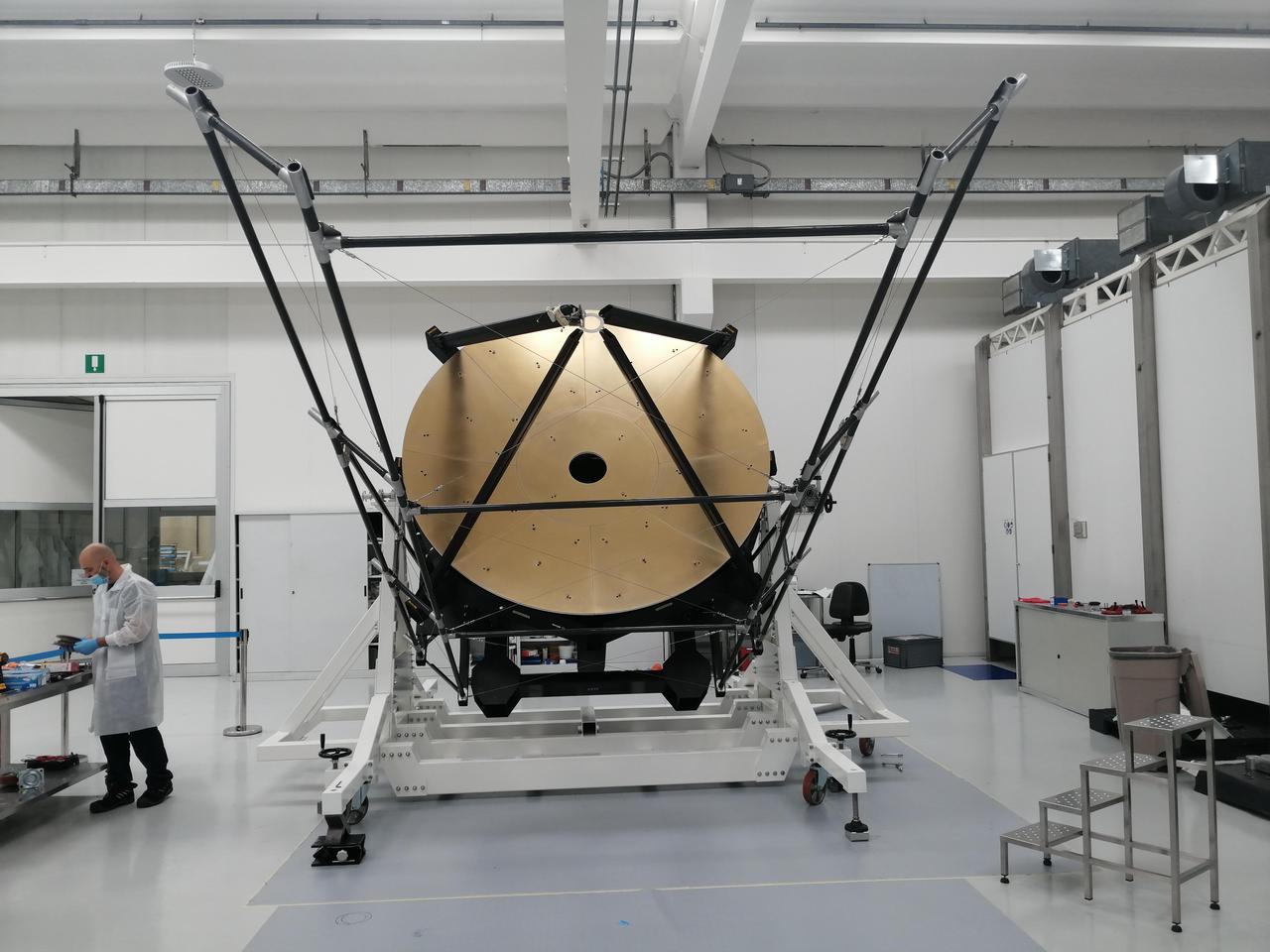
The 8.2-foot (2.5-meter) primary mirror on NASA's Astrophysics Stratospheric Telescope for High Spectral Resolution Observations at Submillimeter-wavelengths mission, or ASTHROS, is one of the largest to ever fly on a high-altitude balloon. The lightweight mirror, shown here, is coated in gold and nickel to make it more reflective in far-infrared wavelengths. NASA contracted Media Lario, an optics company in Bosisio Parini, Italy, to design and produce ASTHROS' full telescope unit, including the primary mirror, a secondary mirror, and supporting structure (called the cradle). The mirror is pictured at Media Lario. The mission's main science goal is to study stellar feedback, the process by which living stars disperse and reshape clouds of gas and dust that may eventually form new stars. Feedback regulates star formation in many galaxies, and too much can halt star formation entirely. ASTHROS will look at several star-forming regions in our galaxy where feedback takes place, and at distant galaxies containing millions of stars to see how feedback plays out at large scales and in different environments. https://photojournal.jpl.nasa.gov/catalog/PIA25166
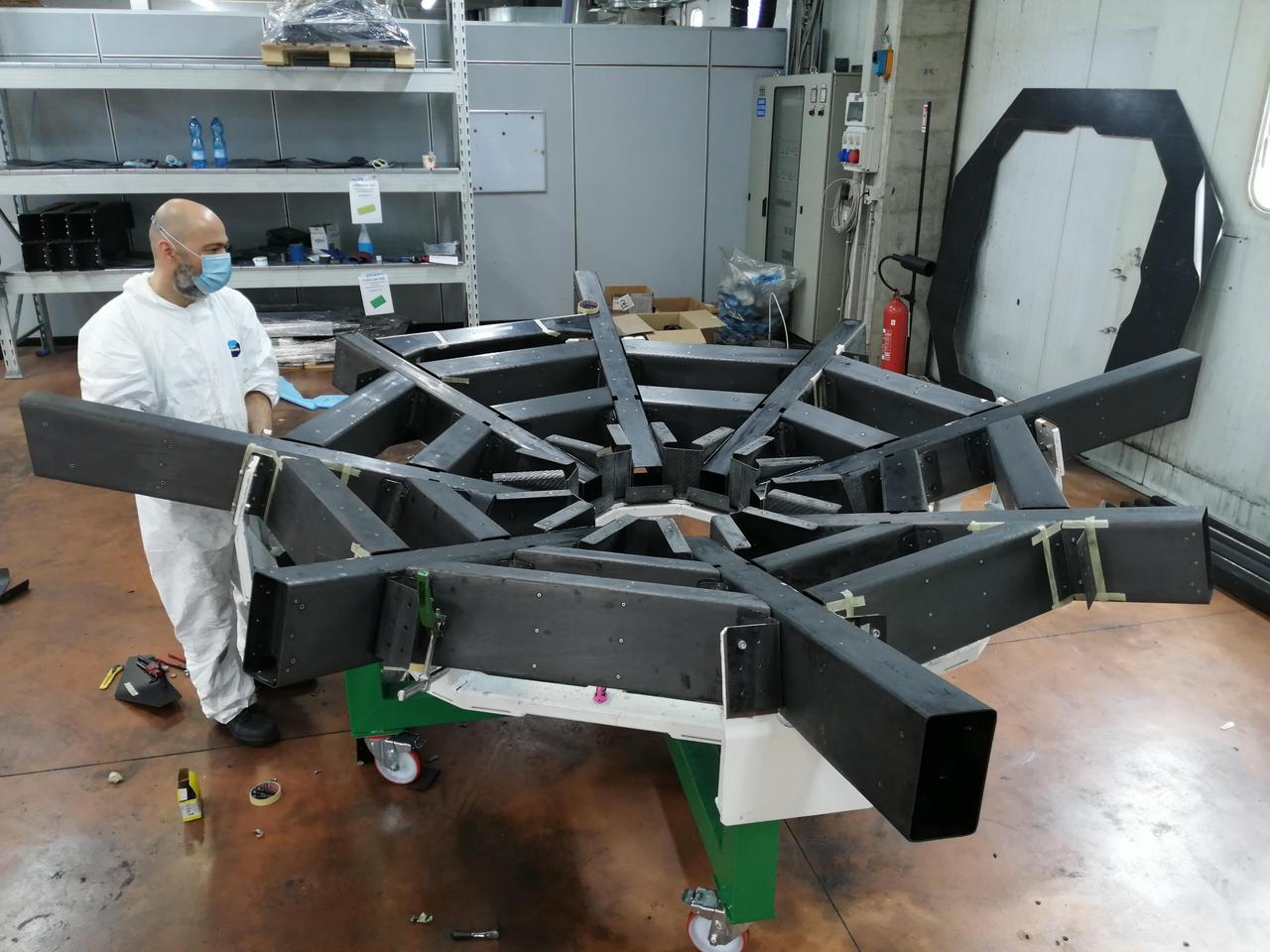
Known as the cradle, the structure that supports the primary mirror on NASA's Astrophysics Stratospheric Telescope for High Spectral Resolution Observations at Submillimeter-wavelengths mission, or ASTHROS, keeps the mirror panels aligned. Made from carbon fiber, it and must be both lightweight and extremely rigid. NASA contracted Media Lario, an optics company in Bosisio Parini, Italy, to design and produce ASTHROS' full telescope unit, including the primary mirror, a secondary mirror, and supporting structure (called the cradle). The cradle is shown here at Media Lario. The mission's main science goal is to study stellar feedback, the process by which living stars disperse and reshape clouds of gas and dust that may eventually form new stars. Feedback regulates star formation in many galaxies, and too much can halt star formation entirely. ASTHROS will look at several star-forming regions in our galaxy where feedback takes place, and at distant galaxies containing millions of stars to see how feedback plays out at large scales and in different environments. https://photojournal.jpl.nasa.gov/catalog/PIA25169
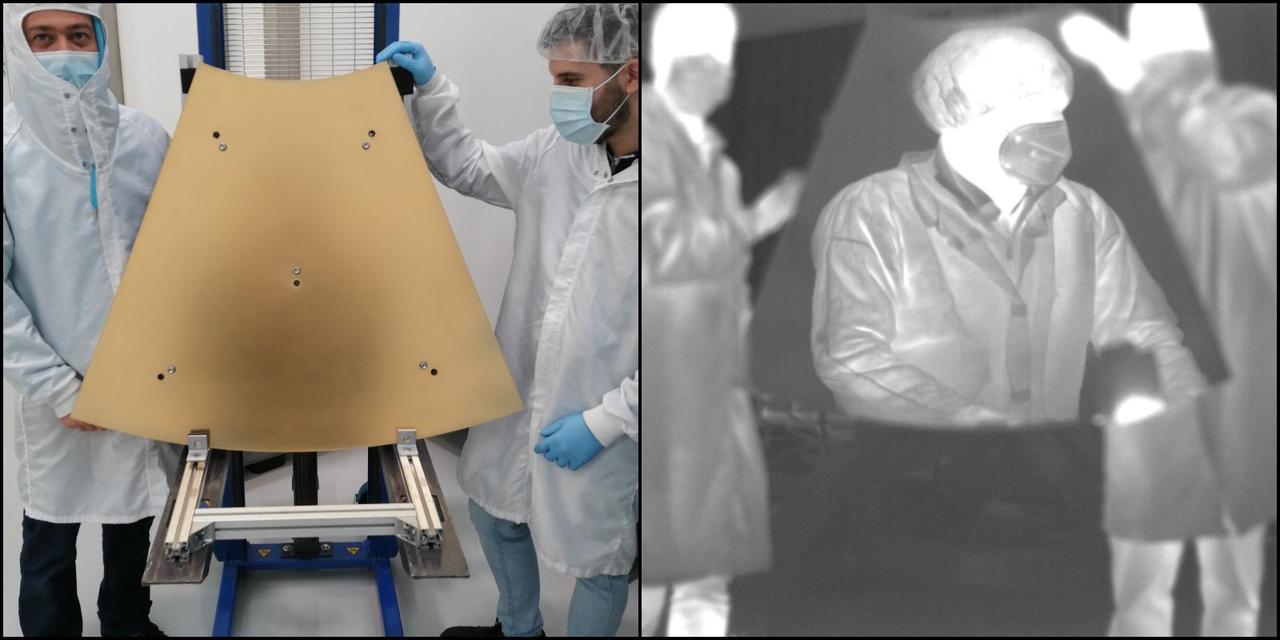
A gold-coated mirror panel on NASA's Astrophysics Stratospheric Telescope for High Spectral Resolution Observations at Submillimeter-wavelengths mission, or ASTHROS, appears blurry to the naked eye, as seen at left. But when photographed with an infrared camera, right, the panel reflects a technician's image as clearly as if the person were looking in a mirror. NASA contracted Media Lario, an optics company in Bosisio Parini, Italy, to design and produce ASTHROS' full telescope unit, including the primary mirror, a secondary mirror, and supporting structure (called the cradle). The cradle is shown here at Media Lario. The mission's main science goal is to study stellar feedback, the process by which living stars disperse and reshape clouds of gas and dust that may eventually form new stars. Feedback regulates star formation in many galaxies, and too much can halt star formation entirely. ASTHROS will look at several star-forming regions in our galaxy where feedback takes place, and at distant galaxies containing millions of stars to see how feedback plays out at large scales and in different environments. https://photojournal.jpl.nasa.gov/catalog/PIA25170
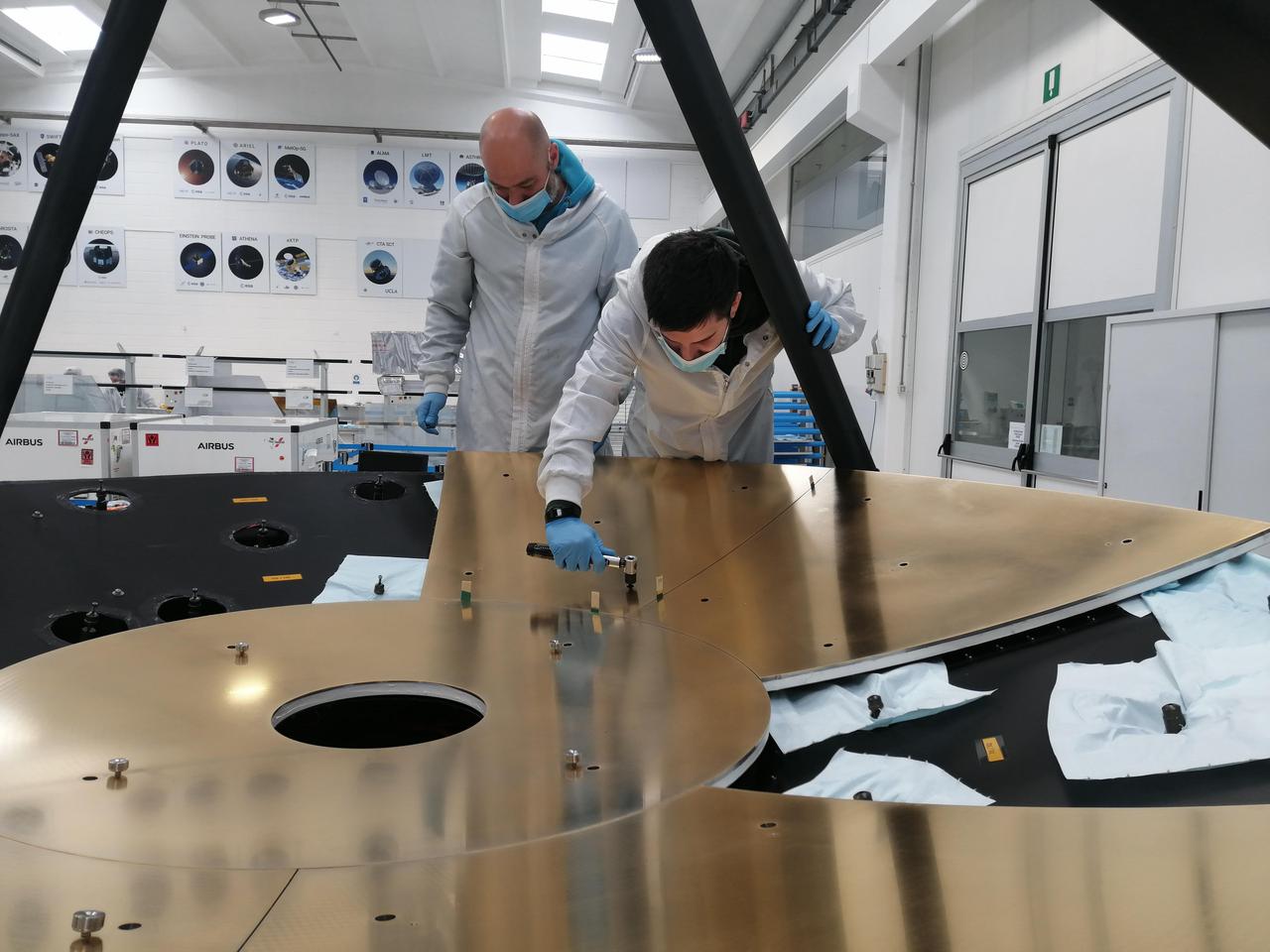
The mirror on NASA's Astrophysics Stratospheric Telescope for High Spectral Resolution Observations at Submillimeter-wavelengths mission, or ASTHROS, is composed of nine panels, coated in nickel and gold. Here, engineers attach panels to the mirror's support structure. The panels must be aligned to within 0.0001 inches (2.5 micrometers), or a fraction of the width of a human hair. Manufacturing multiple panels requires less time and expense than making the mirror as a single piece. NASA contracted Media Lario, an optics company in Bosisio Parini, Italy, to design and produce ASTHROS' full telescope unit, including the primary mirror, a secondary mirror, and supporting structure (called the cradle). The mirror is shown here at Media Lario. The mission's main science goal is to study stellar feedback, the process by which living stars disperse and reshape clouds of gas and dust that may eventually form new stars. Feedback regulates star formation in many galaxies, and too much can halt star formation entirely. ASTHROS will look at several star-forming regions in our galaxy where feedback takes place, and at distant galaxies containing millions of stars to see how feedback plays out at large scales and in different environments. https://photojournal.jpl.nasa.gov/catalog/PIA25167
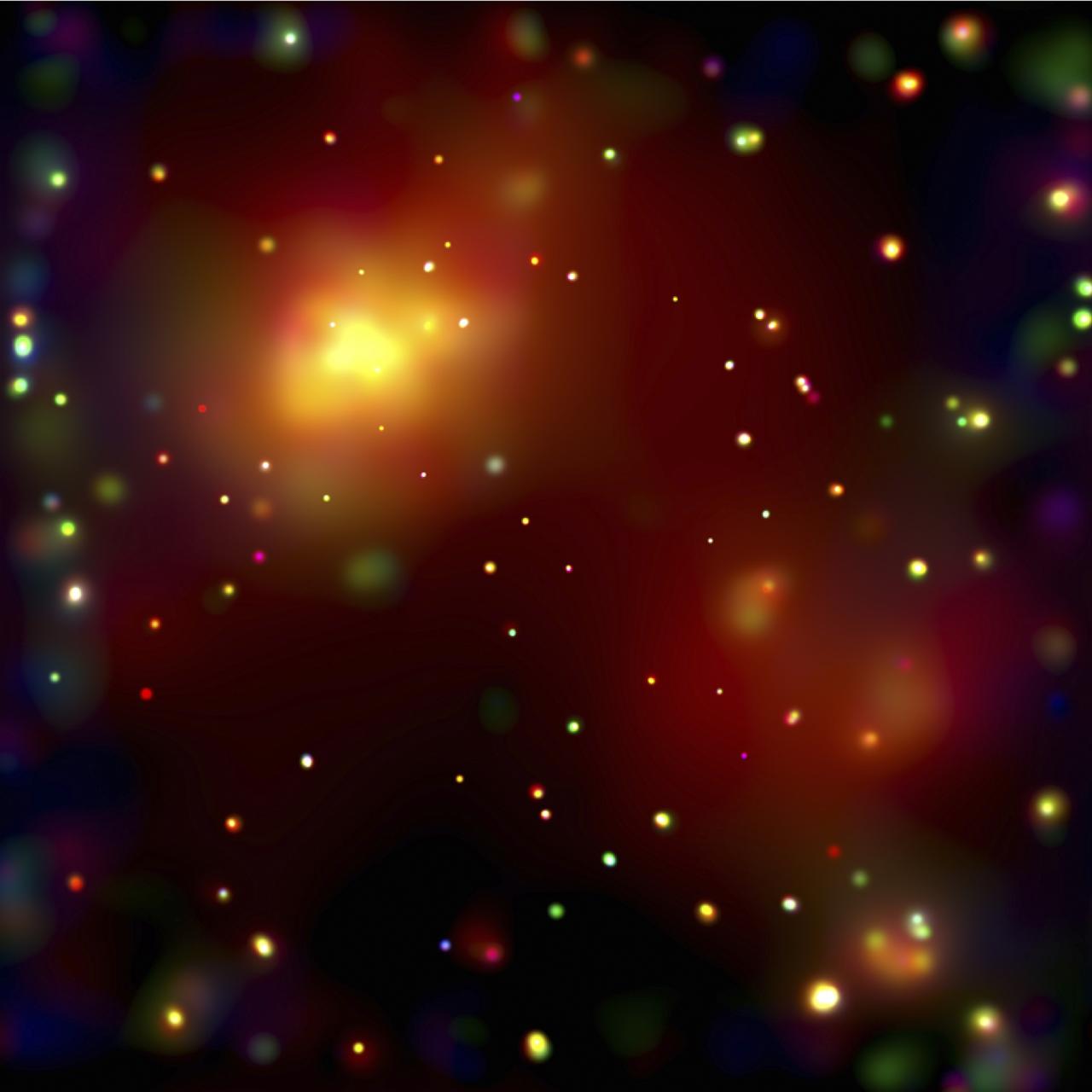
This image of the galaxy cluster Abell 2125, provided by the Chandra X-Ray Observatory (CXO), reveals several massive multimillion degree Celsius gas clouds that appear to be in the process of merging. Ten of the point-like sources are associated with galaxies in the cluster and the rest are probably distant background galaxies. The small bright feature in the extreme lower right-hand corner is probably a background galaxy cluster not associated with Abell 2125. The bright gas cloud on the upper left is the core of the cluster and envelopes hundreds of galaxies. It consists of several elongated clouds that are merging. Chandra, Hubble Space Telescope (HST), and Very Large Array radio telescope data show that several galaxies in the Abell 2125 core cluster are being stripped of their gas as they fall through surrounding high-pressure hot gas. This stripping process has enriched the core cluster's gas in heavy elements such as iron. In contrast, the bright large cloud on the lower right envelopes hundreds of galaxies and has an extraordinarily low concentration of iron atoms. It is thought that this cloud, which is several million light years from the core cluster, has not yet been enriched by the stripping of iron-rich gas from its member galaxies. Over time, as this cloud merges into the core and the hot gas pressure increases, iron atoms should be swept from the galaxies. Building a massive galaxy cluster is a step-by-step enterprise that takes billions of years and affects the growth and evolution of the member galaxies. The observations of A 2125 provide a rare glimpse into the early steps in this process. NASA’s Marshall Space Flight Center in Huntsville, Alabama manages both the Chandra and Hubble programs. (NASA/UMass/D. Wang et al.))
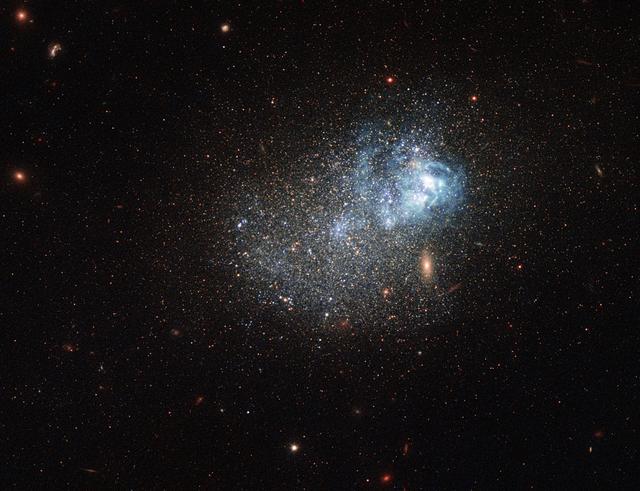
This sprinkle of cosmic glitter is a blue compact dwarf galaxy known as Markarian 209. Galaxies of this type are blue-hued, compact in size, gas-rich, and low in heavy elements. They are often used by astronomers to study star formation, as their conditions are similar to those thought to exist in the early Universe. Markarian 209 in particular has been studied extensively. It is filled with diffuse gas and peppered with star-forming regions towards its core. This image captures it undergoing a particularly dramatic burst of star formation, visible as the lighter blue cloudy region towards the top right of the galaxy. This clump is filled with very young and hot newborn stars. This galaxy was initially thought to be a young galaxy undergoing its very first episode of star formation, but later research showed that Markarian 209 is actually very old, with an almost continuous history of forming new stars. It is thought to have never had a dormant period — a period during which no stars were formed — lasting longer than 100 million years. The dominant population of stars in Markarian 209 is still quite young, in stellar terms, with ages of under 3 million years. For comparison, the sun is some 4.6 billion years old, and is roughly halfway through its expected lifespan. The observations used to make this image were taken using Hubble’s Wide Field Camera 3 and Advanced Camera for Surveys, and span the ultraviolet, visible, and infrared parts of the spectrum. A scattering of other bright galaxies can be seen across the frame, including the bright golden oval that could, due to a trick of perspective, be mistaken as part of Markarian 209 but is in fact a background galaxy. Credit: ESA/Hubble & NASA Acknowledgement: Nick Rose <b><a href="http://www.nasa.gov/audience/formedia/features/MP_Photo_Guidelines.html" rel="nofollow">NASA image use policy.</a></b> <b><a href="http://www.nasa.gov/centers/goddard/home/index.html" rel="nofollow">NASA Goddard Space Flight Center</a></b> enables NASA’s mission through four scientific endeavors: Earth Science, Heliophysics, Solar System Exploration, and Astrophysics. Goddard plays a leading role in NASA’s accomplishments by contributing compelling scientific knowledge to advance the Agency’s mission. <b>Follow us on <a href="http://twitter.com/NASAGoddardPix" rel="nofollow">Twitter</a></b> <b>Like us on <a href="http://www.facebook.com/pages/Greenbelt-MD/NASA-Goddard/395013845897?ref=tsd" rel="nofollow">Facebook</a></b> <b>Find us on <a href="http://instagram.com/nasagoddard?vm=grid" rel="nofollow">Instagram</a></b>
NASA's Galaxy Evolution Explorer took this image on May 21 and 22, 2003. The image was made from data gathered by the two channels of the spacecraft camera during the mission's "first light" milestone. It shows about 100 celestial objects in the constellation Hercules. The reddish objects represent those detected by the camera's near ultraviolet channel over a 5-minute period, while bluish objects were detected over a 3-minute period by the camera's far ultraviolet channel. The Galaxy Evolution Explorer's first light images are dedicated to the crew of the Space Shuttle Columbia. The Hercules region was directly above Columbia when it made its last contact with NASA Mission Control on February 1, over the skies of Texas. The Galaxy Evolution Explorer launched on April 28 on a mission to map the celestial sky in the ultraviolet and determine the history of star formation in the universe over the last 10 billion years. http://photojournal.jpl.nasa.gov/catalog/PIA04281
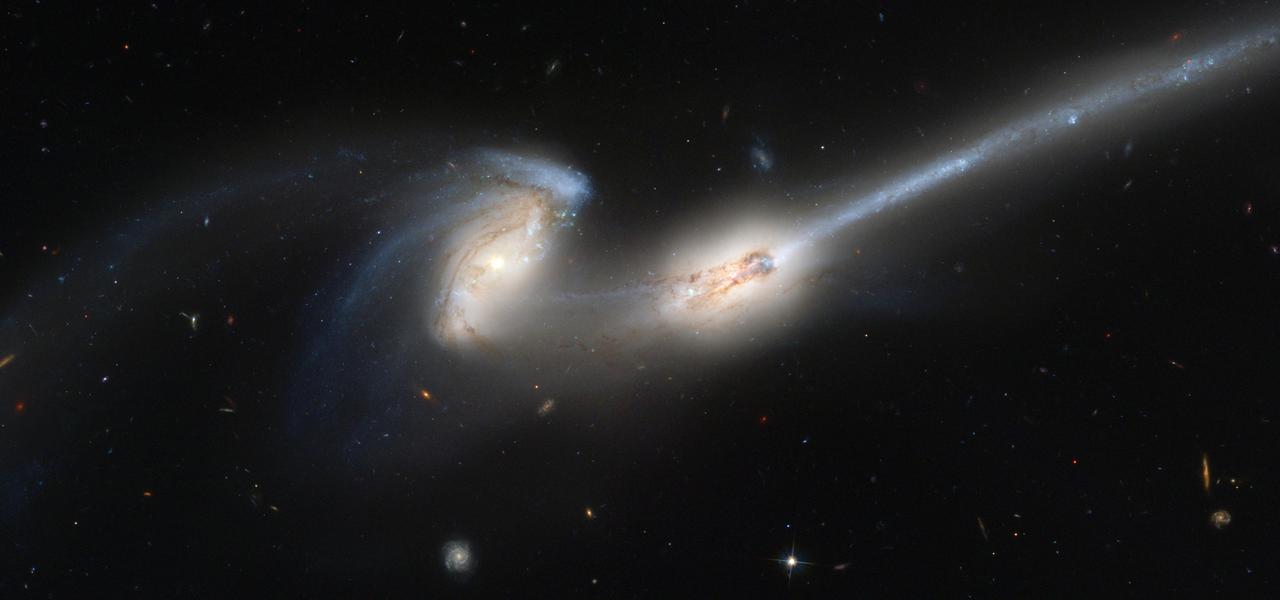
The Advanced Camera for Surveys (ACS), the newest camera on the Hubble Space Telescope, has captured a spectacular pair of galaxies. Located 300 million light-years away in the constellation Coma Berenices, the colliding galaxies have been nicknamed "The Mice" because of the long tails of stars and gas emanating from each galaxy. Otherwise known as NGC 4676, the pair will eventually merge into a single giant galaxy. In the galaxy at left, the bright blue patch is resolved into a vigorous cascade of clusters and associations of young, hot blue stars, whose formation has been triggered by the tidal forces of the gravitational interaction. The clumps of young stars in the long, straight tidal tail (upper right) are separated by fainter regions of material. These dim regions suggest that the clumps of stars have formed from the gravitational collapse of the gas and dust that once occupied those areas. Some of the clumps have luminous masses comparable to dwarf galaxies that orbit the halo of our own Milky Way Galaxy. Computer simulations by astronomers show that we are seeing two near identical spiral galaxies approximately 160 million years after their closest encounter. The simulations also show that the pair will eventually merge, forming a large, nearly spherical galaxy (known as an elliptical galaxy). The Mice presage what may happen to our own Milky Way several billion years from now when it collides with our nearest large neighbor, the Andromeda Galaxy (M31). This picture is assembled from three sets of images taken on April 7, 2002, in blue, orange, and near-infrared filters. Credit: NASA, H. Fort (JHU), G. Illingworth (USCS/LO), M. Clampin (STScI), G. Hartig (STScI), the ACS Science Team, and ESA.
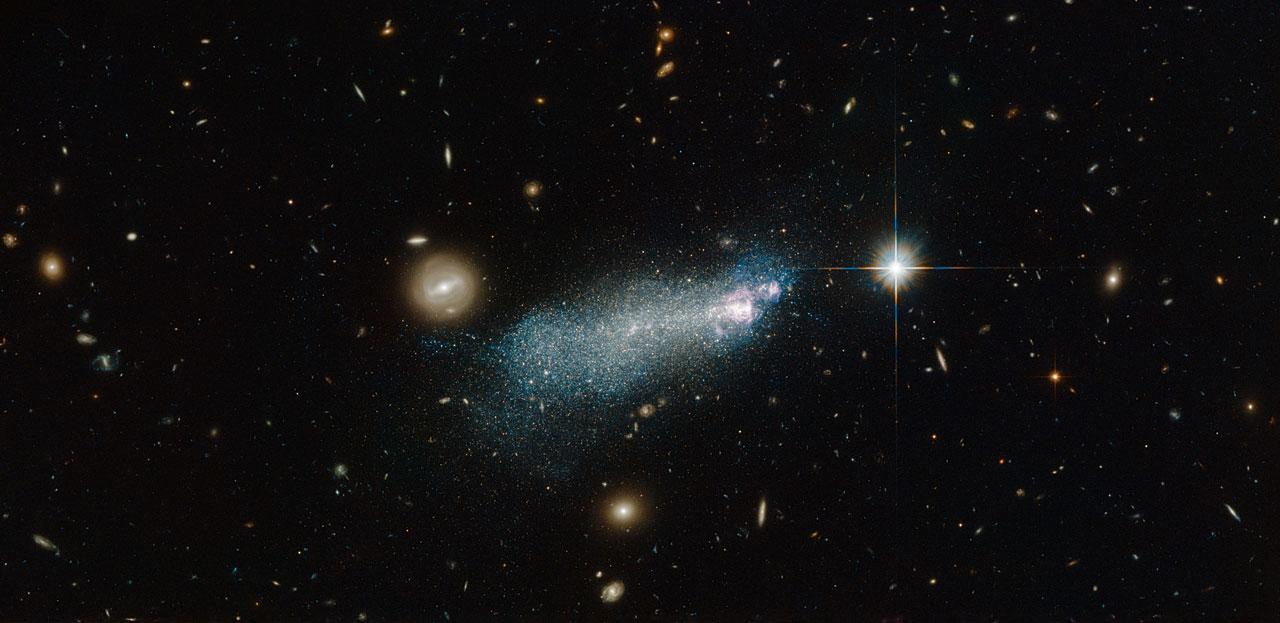
The bright streak of glowing gas and stars in this NASA/ESA Hubble Space Telescope image is known as PGC 51017, or SBSG 1415+437. It is a type of galaxy known as a blue compact dwarf. This particular dwarf is well studied and has an interesting star formation history. Astronomers initially thought that SBS 1415+437 was a very young galaxy currently undergoing its very first burst of star formation, but more recent studies have suggested that the galaxy is in fact a little older, containing stars over 1.3 billion years old. Starbursts are an area of ongoing research for astronomers — short-lived and intense periods of star formation, during which huge amounts of gas within a galaxy are hungrily used up to form newborn stars. Read more: <a href="http://1.usa.gov/1ExsNx0" rel="nofollow">1.usa.gov/1ExsNx0</a> Credit: ESA/Hubble and NASA Acknowledgement: Alessandra Aloisi (STScI) and Nick Rose <b><a href="http://www.nasa.gov/audience/formedia/features/MP_Photo_Guidelines.html" rel="nofollow">NASA image use policy.</a></b> <b><a href="http://www.nasa.gov/centers/goddard/home/index.html" rel="nofollow">NASA Goddard Space Flight Center</a></b> enables NASA’s mission through four scientific endeavors: Earth Science, Heliophysics, Solar System Exploration, and Astrophysics. Goddard plays a leading role in NASA’s accomplishments by contributing compelling scientific knowledge to advance the Agency’s mission. <b>Follow us on <a href="http://twitter.com/NASAGoddardPix" rel="nofollow">Twitter</a></b> <b>Like us on <a href="http://www.facebook.com/pages/Greenbelt-MD/NASA-Goddard/395013845897?ref=tsd" rel="nofollow">Facebook</a></b> <b>Find us on <a href="http://instagrid.me/nasagoddard/?vm=grid" rel="nofollow">Instagram</a></b>

KENNEDY SPACE CENTER, FLA. - Orbital Sciences' L-1011 aircraft takes off from Cape Canaveral Air Force Station carrying the Pegasus XL rocket/Galaxy Evolution Explorer (GALEX) under its belly. Release of the Pegasus was scheduled for about 8 a.m. over the Atlantic Ocean at an altitude of 39,000 feet at a location approximately 100 nautical miles offshore east-northeast of Cape Canaveral. Spacecraft separation from the Pegasus occurs 11 minutes later. At that time the satellite will be in a circular orbit of 431 statute miles (690 km) at a 29-degree inclination. The GALEX will carry into space an orbiting telescope that will observe a million galaxies across 10 billion years of cosmic history to help astronomers determine when the stars and elements we see today had their origins. The spacecraft will sweep the skies for 28 months using state-of-the-art ultraviolet detectors to single out galaxies dominated by young, hot, short-lived stars that give off a great deal of energy at that wavelength. These galaxies are actively creating stars, and therefore provide a window into the history and causes of star formation in galaxies.

KENNEDY SPACE CENTER, FLA. - Orbital Sciences' L-1011 aircraft takes off from Cape Canaveral Air Force Station carrying the Pegasus XL rocket/Galaxy Evolution Explorer (GALEX) under its belly. Release of the Pegasus was scheduled for about 8 a.m. over the Atlantic Ocean at an altitude of 39,000 feet at a location approximately 100 nautical miles offshore east-northeast of Cape Canaveral. Spacecraft separation from the Pegasus occurs 11 minutes later. At that time the satellite will be in a circular orbit of 431 statute miles (690 km) at a 29-degree inclination. The GALEX will carry into space an orbiting telescope that will observe a million galaxies across 10 billion years of cosmic history to help astronomers determine when the stars and elements we see today had their origins. The spacecraft will sweep the skies for 28 months using state-of-the-art ultraviolet detectors to single out galaxies dominated by young, hot, short-lived stars that give off a great deal of energy at that wavelength. These galaxies are actively creating stars, and therefore provide a window into the history and causes of star formation in galaxies.

KENNEDY SPACE CENTER, FLA. - Orbital Sciences' L-1011 aircraft takes off from Cape Canaveral Air Force Station carrying the Pegasus XL rocket/Galaxy Evolution Explorer (GALEX) under its belly. Release of the Pegasus was scheduled for about 8 a.m. over the Atlantic Ocean at an altitude of 39,000 feet at a location approximately 100 nautical miles offshore east-northeast of Cape Canaveral. Spacecraft separation from the Pegasus occurs 11 minutes later. At that time the satellite will be in a circular orbit of 431 statute miles (690 km) at a 29-degree inclination. The GALEX will carry into space an orbiting telescope that will observe a million galaxies across 10 billion years of cosmic history to help astronomers determine when the stars and elements we see today had their origins. The spacecraft will sweep the skies for 28 months using state-of-the-art ultraviolet detectors to single out galaxies dominated by young, hot, short-lived stars that give off a great deal of energy at that wavelength. These galaxies are actively creating stars, and therefore provide a window into the history and causes of star formation in galaxies.
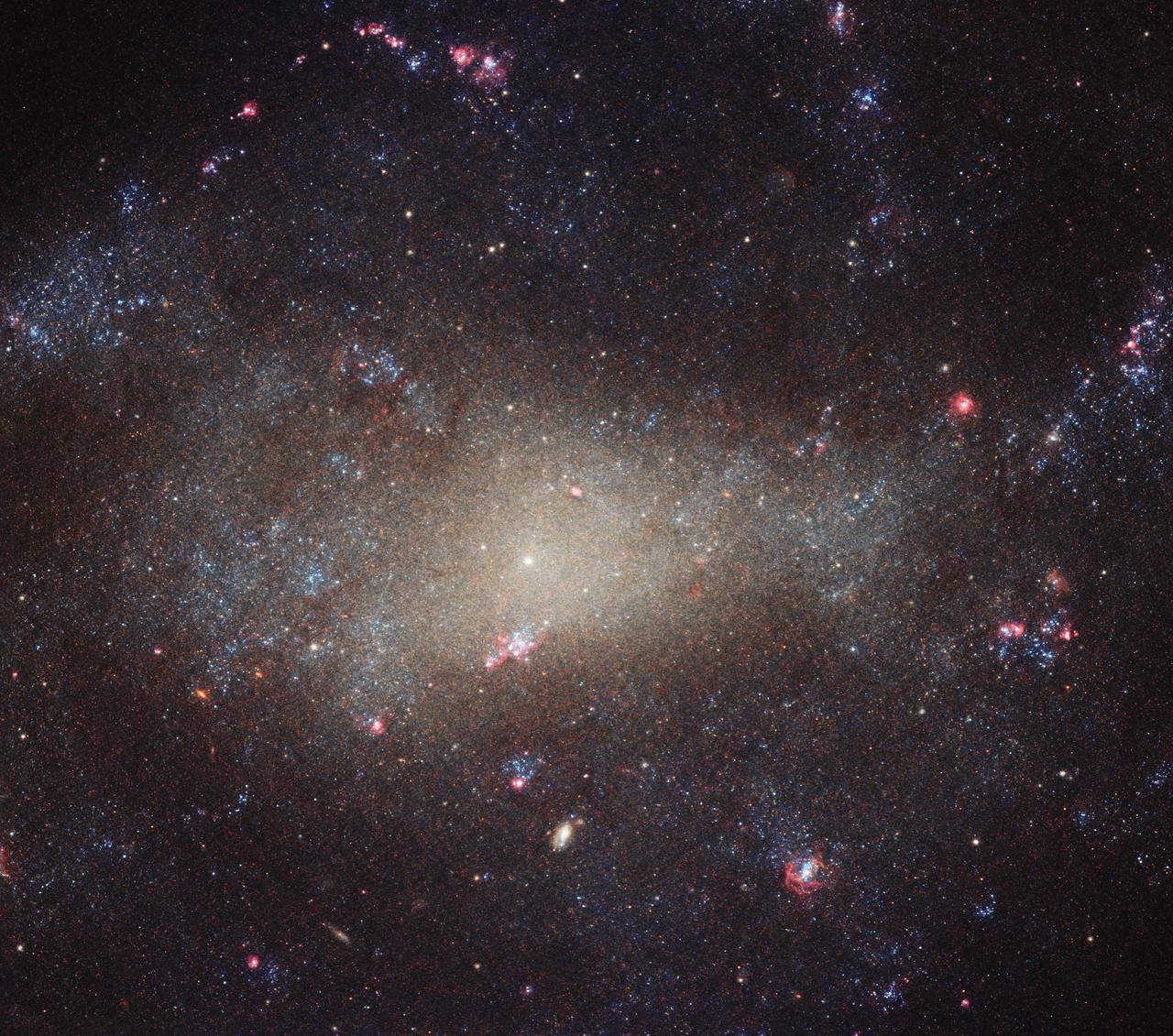
Tucked away in the small northern constellation of Canes Venatici (The Hunting Dogs) is the galaxy NGC 4242, shown here as seen by the NASA/ESA Hubble Space Telescope. The galaxy lies some 30 million light-years from us. At this distance from Earth, actually not all that far on a cosmic scale, NGC 4242 is visible to anyone armed with even a basic telescope, as British astronomer William Herschel found when he discovered the galaxy in 1788. This image shows the galaxy’s bright center and the surrounding dimmer and more diffuse “fuzz.” Despite appearing to be relatively bright in this image, studies have found that NGC 4242 is actually relatively dim (it has a moderate-to-low surface brightness and low luminosity) and also supports a low rate of star formation. The galaxy also seems to have a weak bar of stars cutting through its asymmetric center, and a very faint and poorly-defined spiral structure throughout its disk. But if NGC 4242 is not all that remarkable, as with much of the Universe, it is still a beautiful and ethereal sight. Credit: ESA/Hubble & NASA