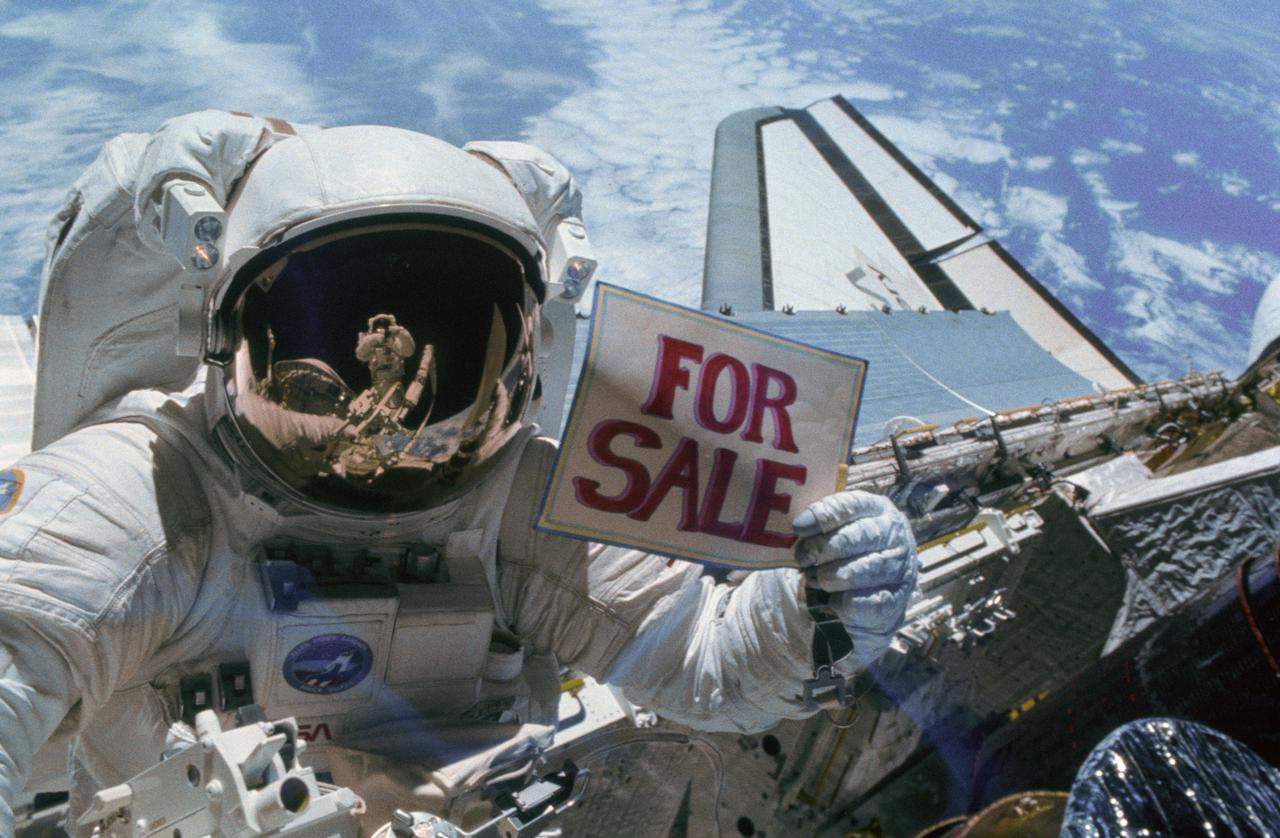
Astronauts are clowning around in space in this STS-51A onboard photo. Astronaut Gardner, holds a “For Sale” sign after the retrieval of two malfunctioning satellites; the Western Union Telegraph Communication Satellite (WESTAR VI); and the PALAPA-B2 Satellite. Astronaut Allen, who is standing on the Remote Manipulator System (RMS) is reflected in Gardner’s helmet visor. The 51A mission launched aboard the Space Shuttle Discovery on November 8, 1984.
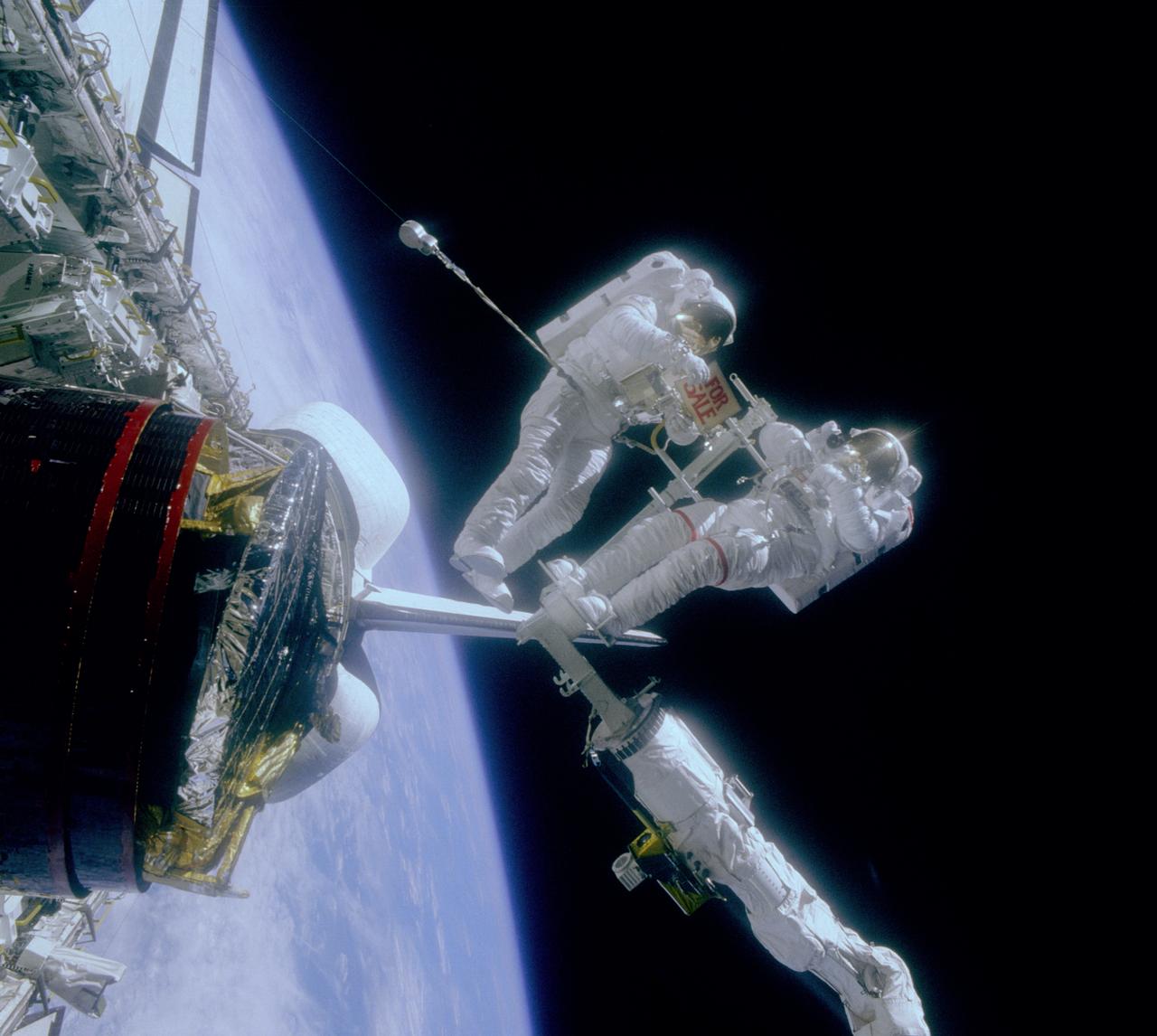
Astronauts are clowning around in space in this STS-51A onboard photo. Astronaut Gardner, holds a “For Sale” sign after the retrieval of two malfunctioning satellites; the Western Union Telegraph Communication Satellite (WESTAR VI); and the PALAPA-B2 Satellite. Astronaut Allen, who is standing on the RMS (Remote Manipulator System) is reflected in Gardner’s helmet visor. The 51A mission launched aboard the Space Shuttle Discovery on November 8, 1984.

Astronaut Dale A. Gardner, 51-A mission specialist, rehearses control of manned maneuvering unit (MMU) during a practice for an extravehicular activity (EVA). Gardner is in the Shuttle mockup and integration laboratory at JSC. Gardner handles a stinger device to make initial contact with one of the two satellites they will be working with.
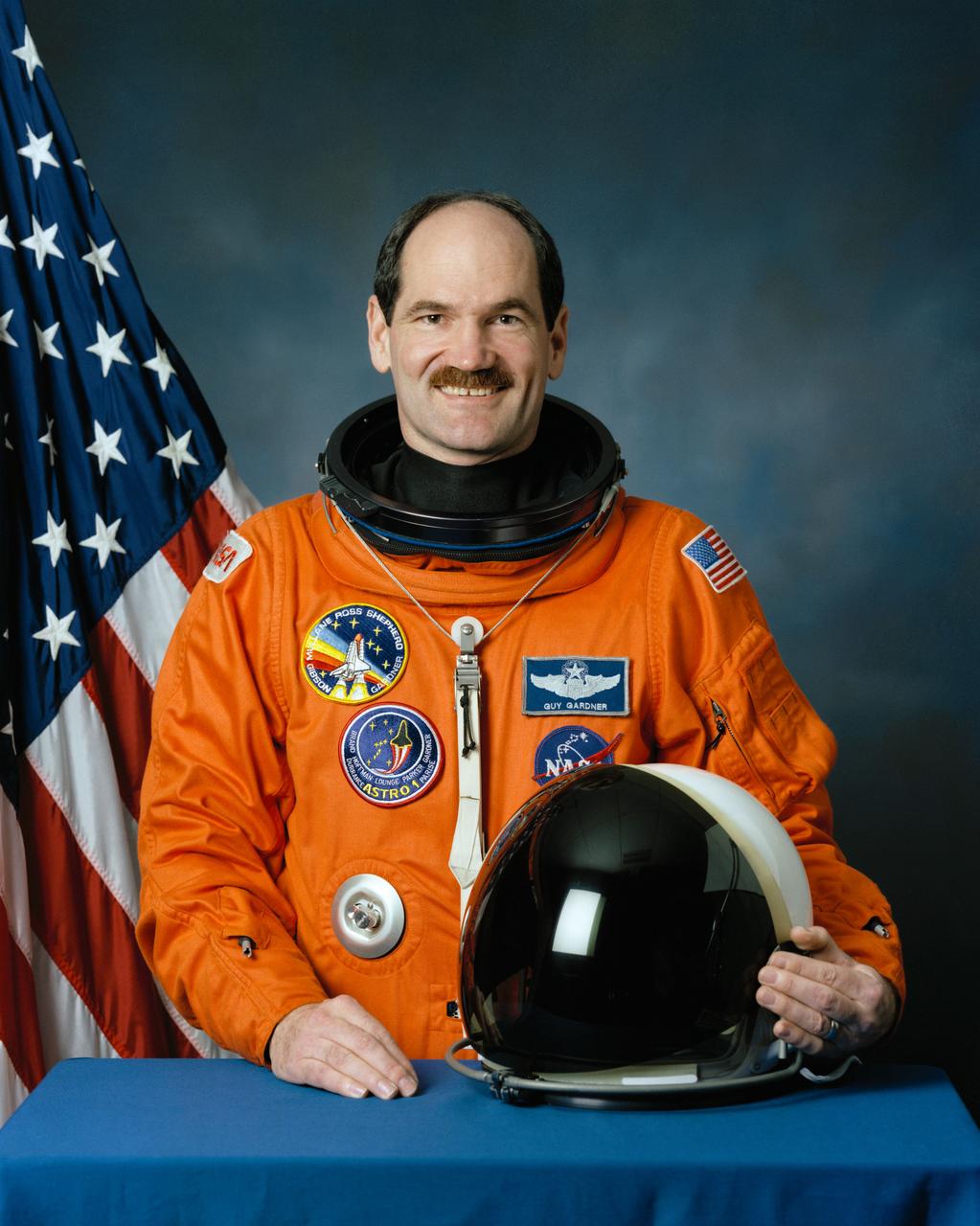
S90-32808 (1990) --- Astronaut Guy S. Gardner.

Astronat Dale A. Gardner achieves a hard dock with the previously spinning Westar VI satellite. Gardner uses a "stinger" device to stabilize the communications satellite.

51A-39-034 (14 Nov. 1984) --- A 70mm frame of astronaut Dale A. Gardner, wearing the Manned Maneuvering Unit (MMU) approaching the spinning WESTAR VI satellite over Bahama Banks. The end effector of the Remote Manipulator System (RMS) controlled by Dr. Anna L. Fisher inside the space shuttle Discovery's cabin, awaits its duty at right. Gardner made a hard dock with the stinger at 6:32 a.m. (CST). Photo credit: NASA

51A-39-040 (14 Nov. 1984) --- A 70mm frame of Westar VI retrieval. Astronauts Dale A. Gardner, left, and Joseph P. Allen IV work together with Anna L. Fisher (not pictured, controlling remote manipulator system (RMS) arm from Discovery?s cabin) to bring Westar VI/PAM-D into cargo bay. Allen is on the mobile foot restraint, which is attached to the RMS end effector, while Gardner works to remove a stinger device from the now stabilized satellite. Photo credit: NASA

51A-104-008 (14 Nov 1984) --- Astronaut Dale A. Gardner appears to be under the remote manipulator system (RMS) end effector as he makes a turn in space and prepared to traverse, using the manned maneuvering unit (MMU) backpack, to the nearby Westar VI to "Sting" it with the device he carries. The stringer will enter the communications satellite through the nozzle of the spent motor. Gardner achieved a hard dock at 6:32 A.M. and this picture was photographed about five minutes earlier, on Nov. 14, 1984.
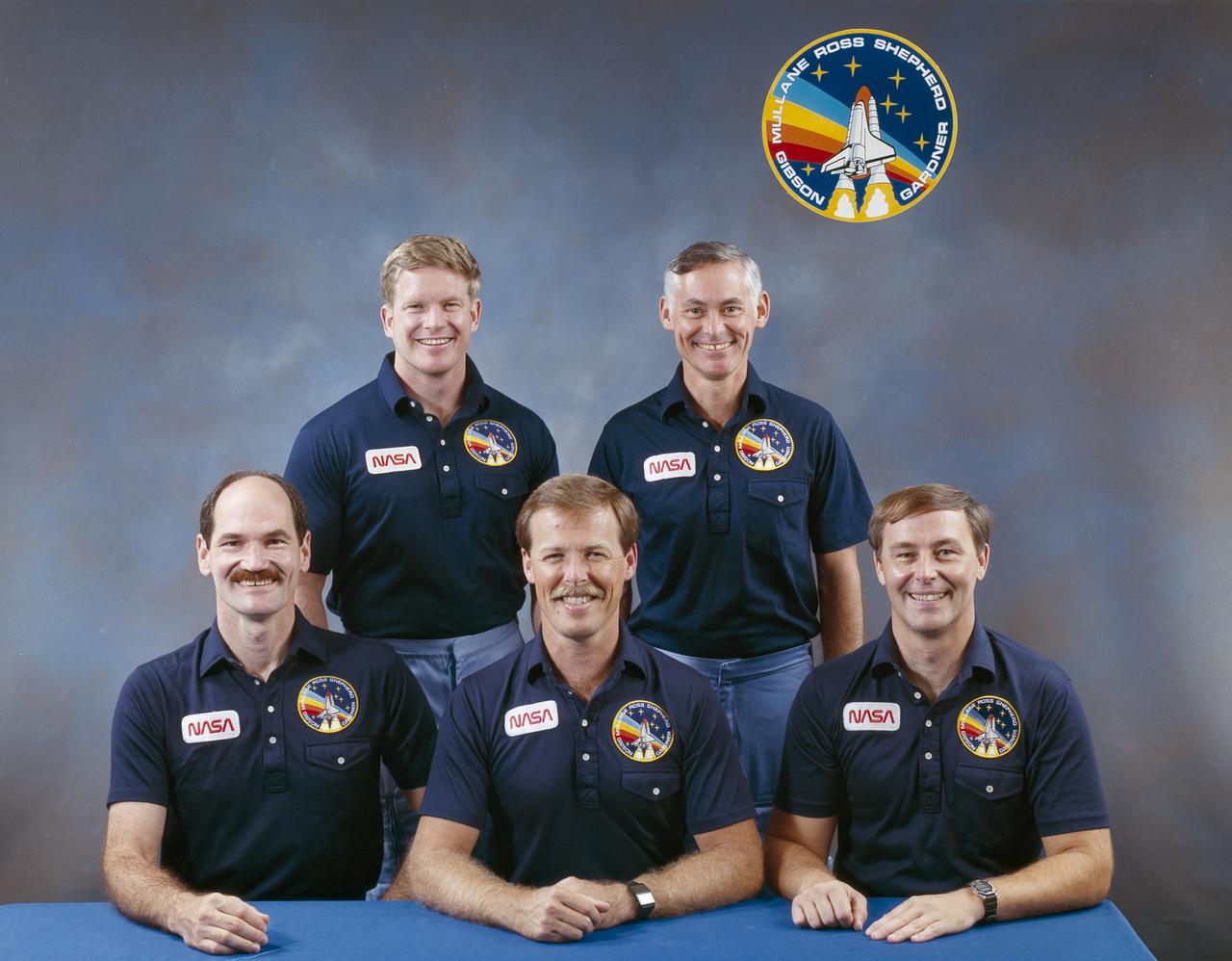
The STS-27 crew portrait features 5 astronauts. Seated, left to right, are Jerry L. Ross, mission specialist; Guy S. Gardner, pilot; and Robert L. Gibson, commander. On the back row, left to right, are mission specialists Richard M. Mullane, and William M. Shepherd. Launched aboard the Space Shuttle Atlantis on December 2, 1988 at 9:30:34 am (EST), the STS-27 mission was the third mission dedicated to the Department of Defense (DOD).

51A-46-057 (14 November 1984) --- Astronaut Dale A. Gardner, getting his turn in the Manned Maneuvering Unit (MMU) like those used by five other astronauts this year, prepares to dock with the spinning WESTAR VI satellite. Gardner used a large tool called the Apogee Kick Motor Capture Device (ACD) to enter the nozzle of a spent WESTAR VI engine and stabilize the communications spacecraft sufficiently to capture it for return to Earth in the cargo bay of the Space Shuttle Discovery. This frame was used by the STS-51A crew at its Post-Flight Press Conference (PFPC) on November 28, 1984.
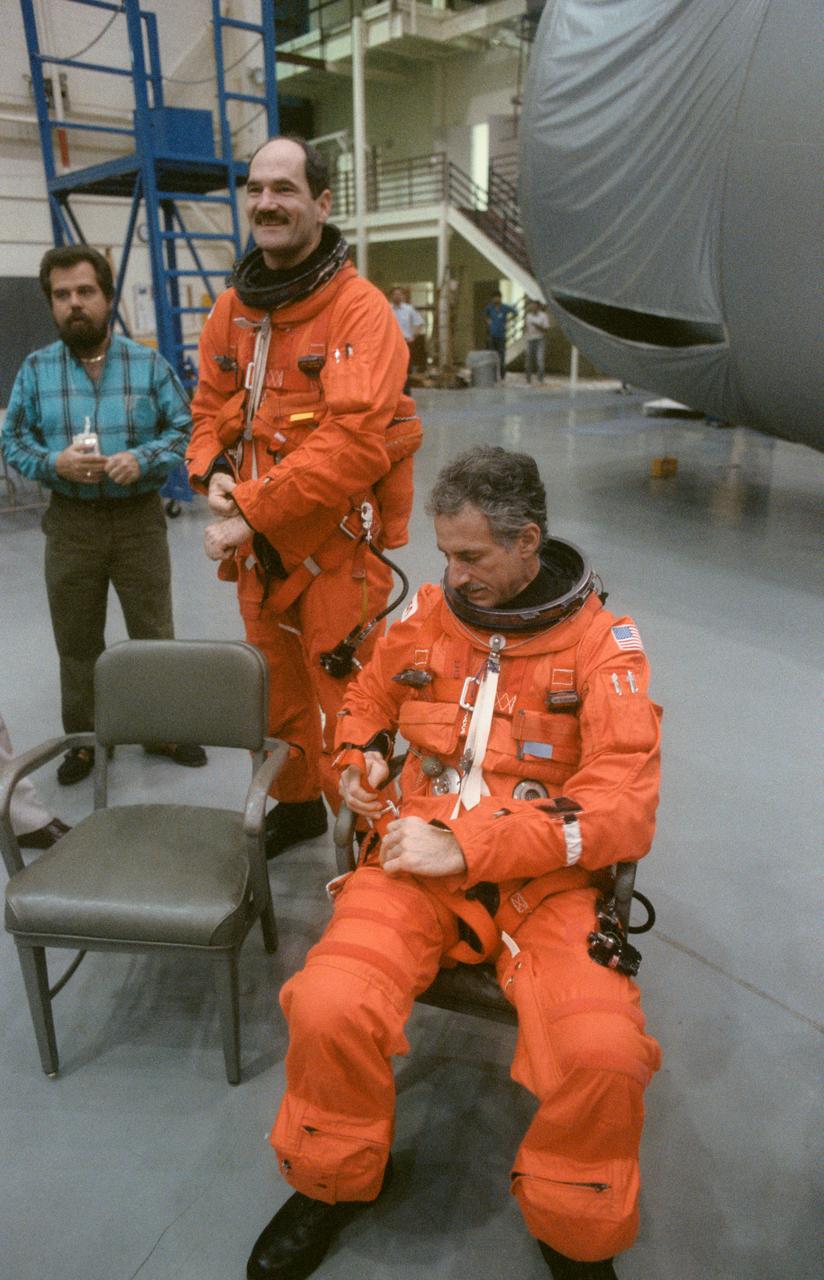
S90-28710 (12 Feb 1990) --- Astronaut Guy S. Gardner, STS-35 pilot, (standing) and Jeffrey A. Hoffman, mission specialist, prepare for egress training at the Johnson Space Center?s (JSC) Mockup and Integration Laboratory (MAIL) Bldg 9A. Gardner and Hoffman, wearing orange launch and entry suits (LES), adjust their parachute harnesses as they listen to instructions before training begins. The astronaut crewmembers and payload specialists for the scheduled May flight were specifically learning proper measures to take in the event of an emergency on the launch pad necessitating emergency evacuation of the orbiter.

51A-104-049 (14 Nov. 1984) --- Astronaut Dale A. Gardner, having just completed the major portion of his second extravehicular activity (EVA) period in three days aboard the Earth-orbiting Discovery, holds up a for sale sign. Astronaut Joseph P. Allen IV, who also participated in the two EVA, is reflected in Gardner's helmet visor. A portion of each of two recovered satellites is in lower right corner, with Westar nearer Discovery's aft. Dr. Allen, standing on the mobile foot restraint, connected to the remote manipulator system. Photo credit: NASA
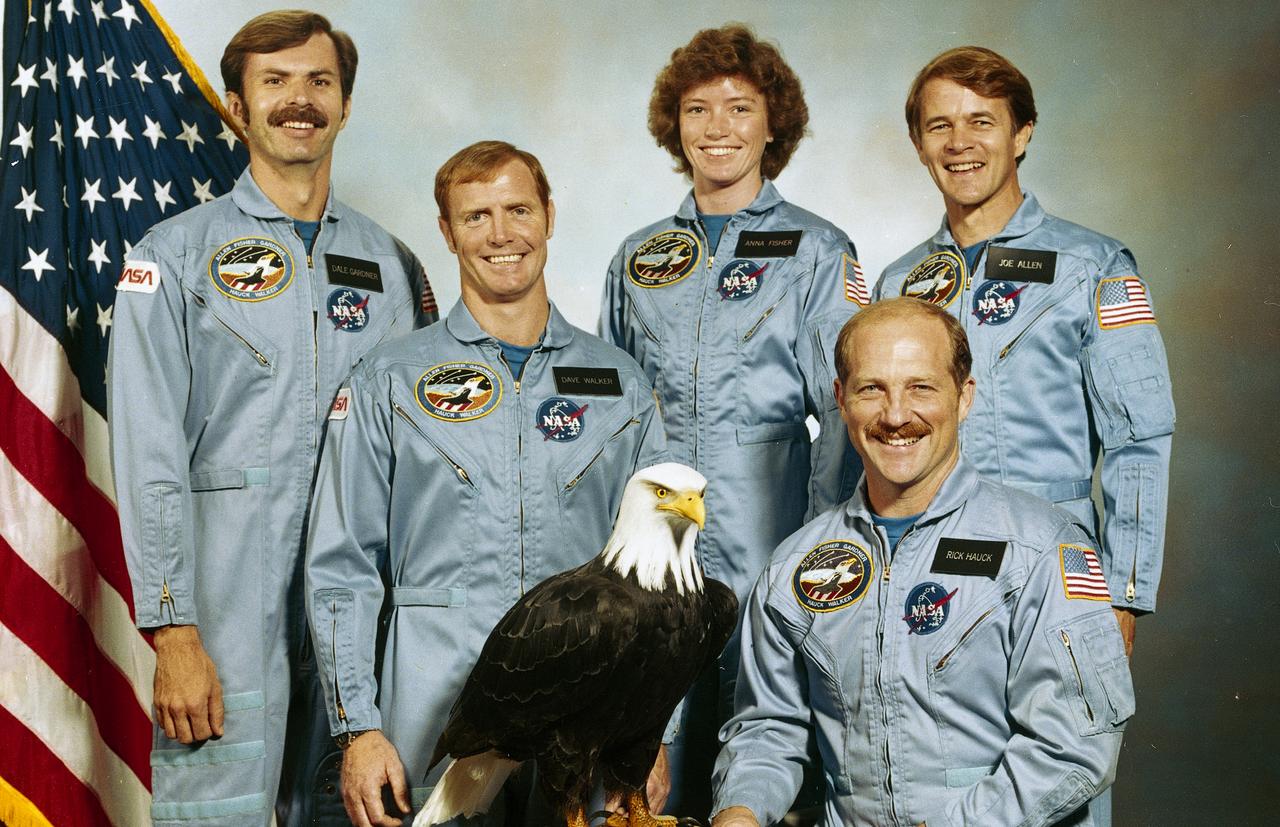
The crew assigned to the STS-51A mission included Frederick H. Hauck, commander,who is seated to the right. Standing, left to right, are Dale A. Gardner, mission specialist; David M. Walker, pilot; and mission specialists Anna L. Fisher, and Joseph P. Allen. Launched aboard the Space Shuttle Discovery on November 8, 1984 at 7:15:00 am (EST), the STS-51A mission deployed the Canadian communications satellite TELLESAT-H (ANIK), and the defense communications satellite SYCOM IV-1 (also known as LEASAT-1). In addition, 2 malfunctioning satellites were retrieved: the PALAPA-B2 and the WESTAR-VI.

STS008-18-468 (30 Aug-5 Sept 1983) --- Astronaut William E. Thornton, right conducts an audiometry test on Astronaut Dale A. Gardner in the mid deck of the Earth-orbiting Space Shuttle Challenger. Both men are mission specialists for the reusable spacecraft’s second five-person crew. This frame was shot with a 35mm camera.
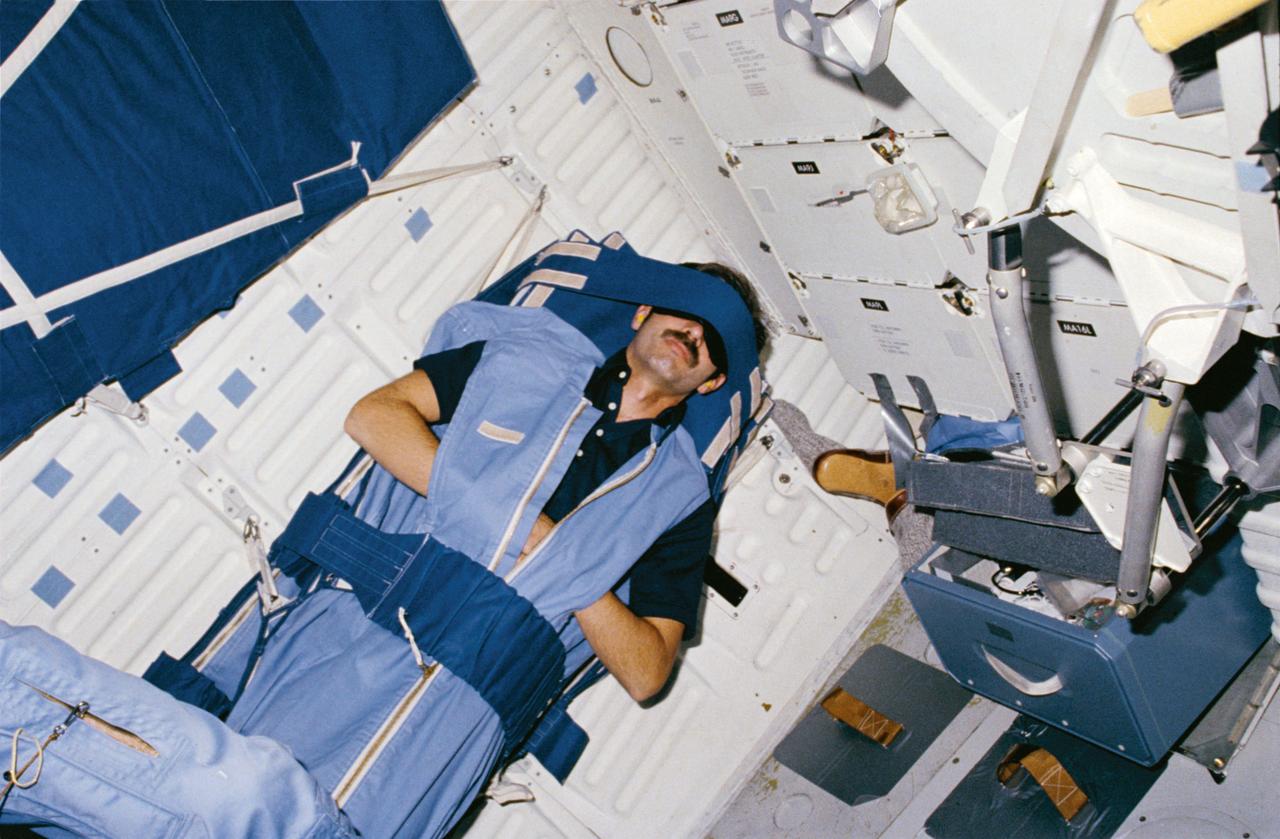
STS008-05-145 (5 Sept 1983) --- On middeck (MDK), Mission Specialist (MS) Gardner sleeps in sleep restraint attached to starboard wall. Open airlock hatch, airlock hatch hinge, and free-floating footwear appear in view.
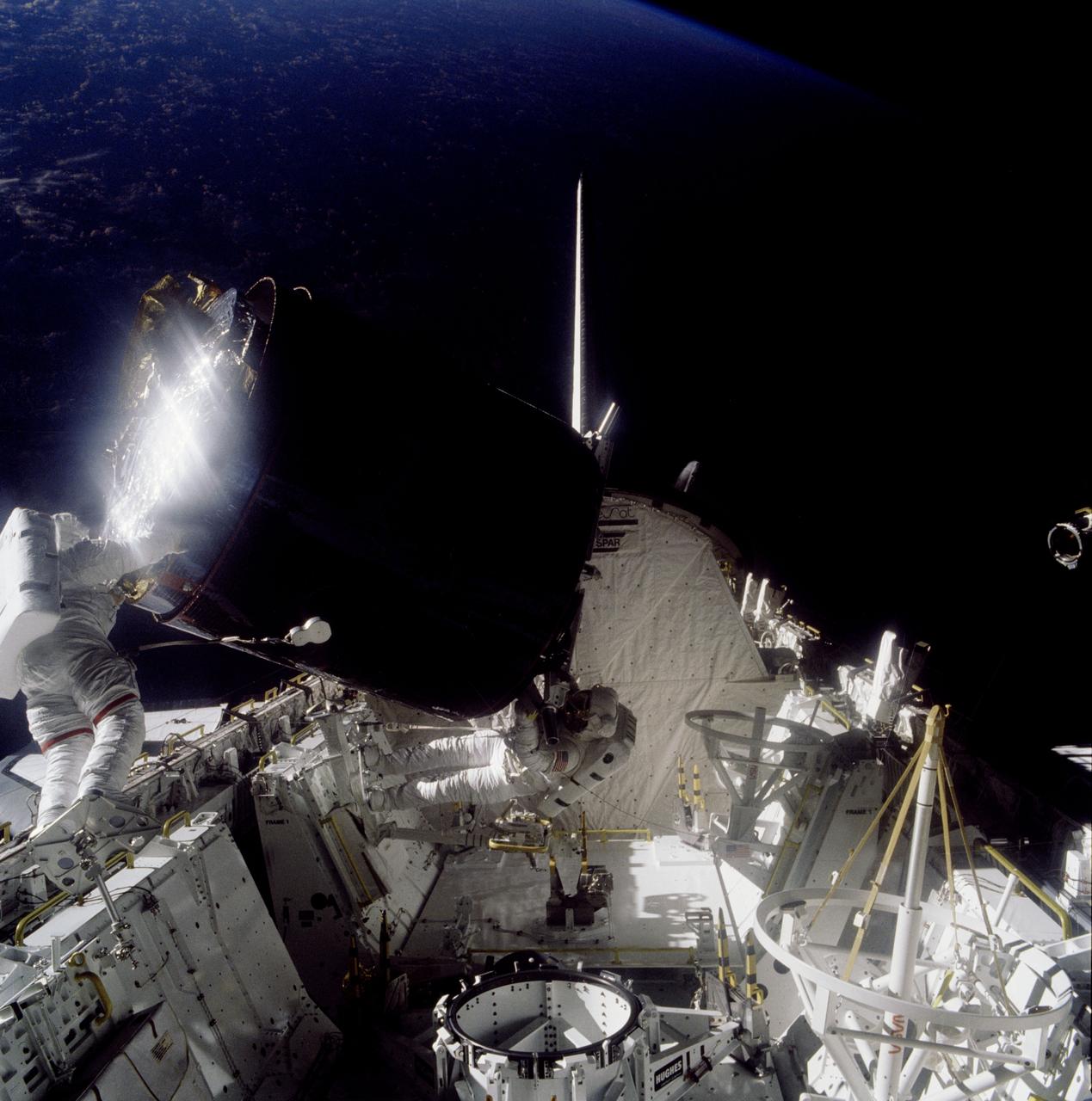
51A-41-058 (12 November 1984) --- Astronaut Joseph P. Allen IV appears to be lifting weights. Astronaut Dale A. Gardner holding on. Actually, Dr. Allen is the sole anchor for the top portion (and most of) the captured Palapa B-2 communications satellite during the Nov. 12 retrieval extravehicular activity (EVA) of the two mission specialists. This scene came near the end of the long-duration task. Gardner used a torque wrench to tighten clamps on an adapter used to secure the Palapa to its "parking place" in Discovery's cargo bay. Note the difference between the two stinger devices stowed on Challenger's port side (right side of frame). The one nearer the spacecraft's vertical stabilizer is spent, having been inserted by Allen earlier in the day to stabilize the communications satellite. The one nearer the camera awaited duty in two days when it would aid in the capture of the Westar VI satellite.
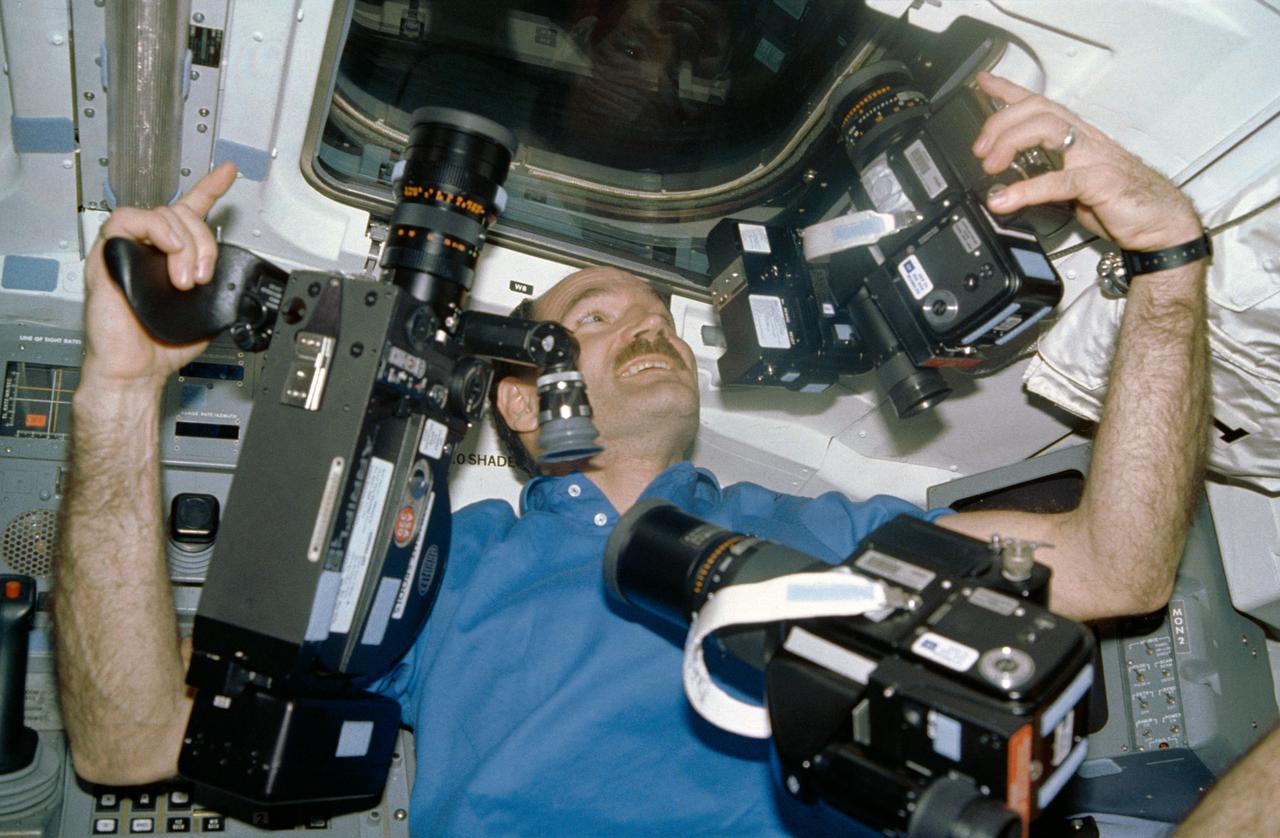
STS027-14-021 (2-6 Dec. 1988) --- Astronaut Guy S. Gardner, STS-27 pilot, appears to have enough cameras as he prepares to take photographs onboard the Earth-orbiting space shuttle Atlantis. Photo credit: NASA
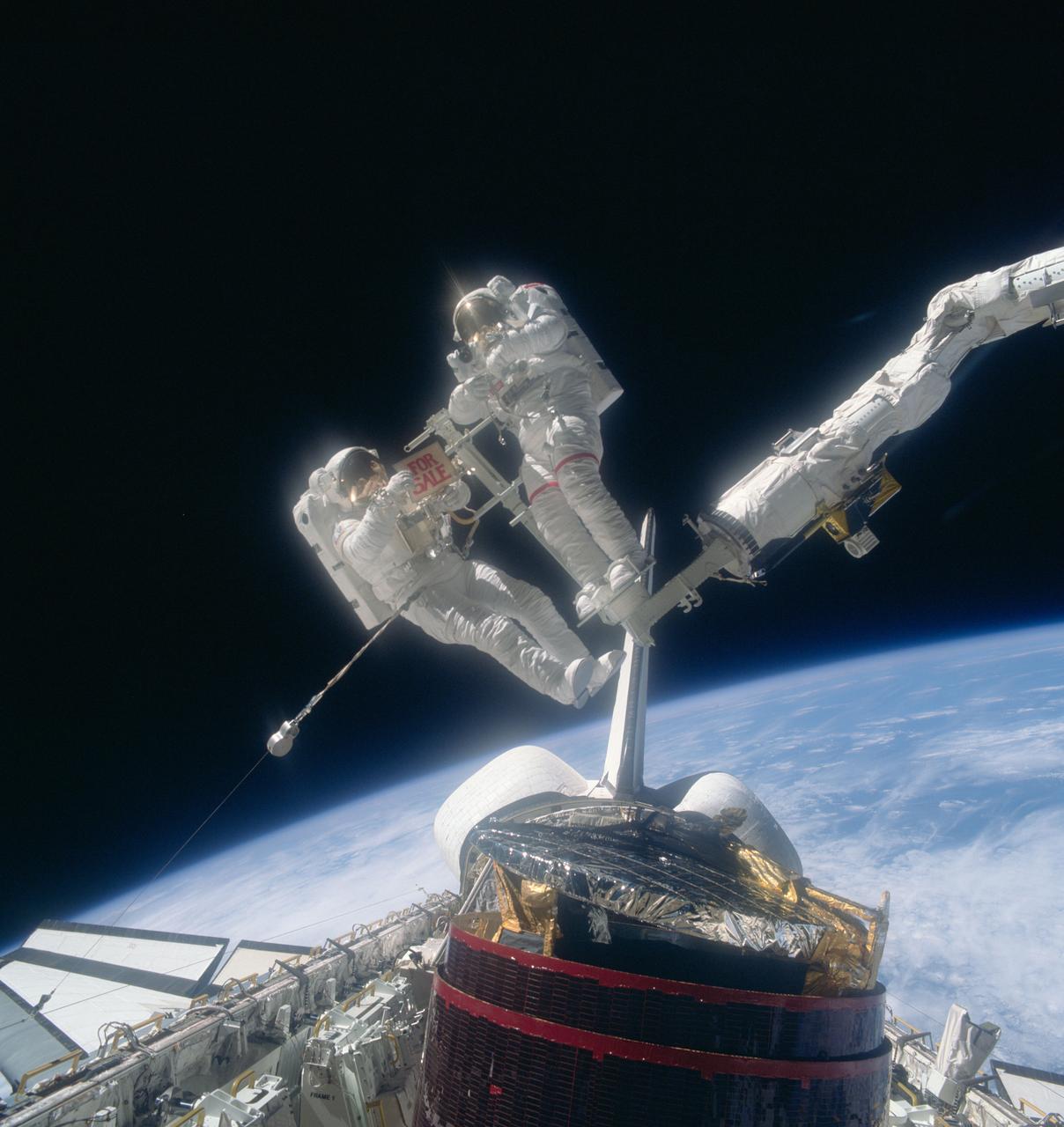
51A-39-063 (14 Nov 1984) --- A 70mm frame of WESTAR VI post-retrieval activity. Astronaut Dale A. Gardner (left), STS-51A mission specialist, holds a "For Sale" sign, making light reference to the status of the re-captured communications spacecraft, which has been stranded since its initial deployment. Astronaut Joseph P. Allen IV stands on the Mobile Foot Restraint (MFR), which in tandem with the Remote Manipulator System (RMS) arm, controlled by Dr. Anna L. Fisher inside the space shuttle Discovery's cabin, served as a cherry-picker for capture efforts. Photo credit: NASA
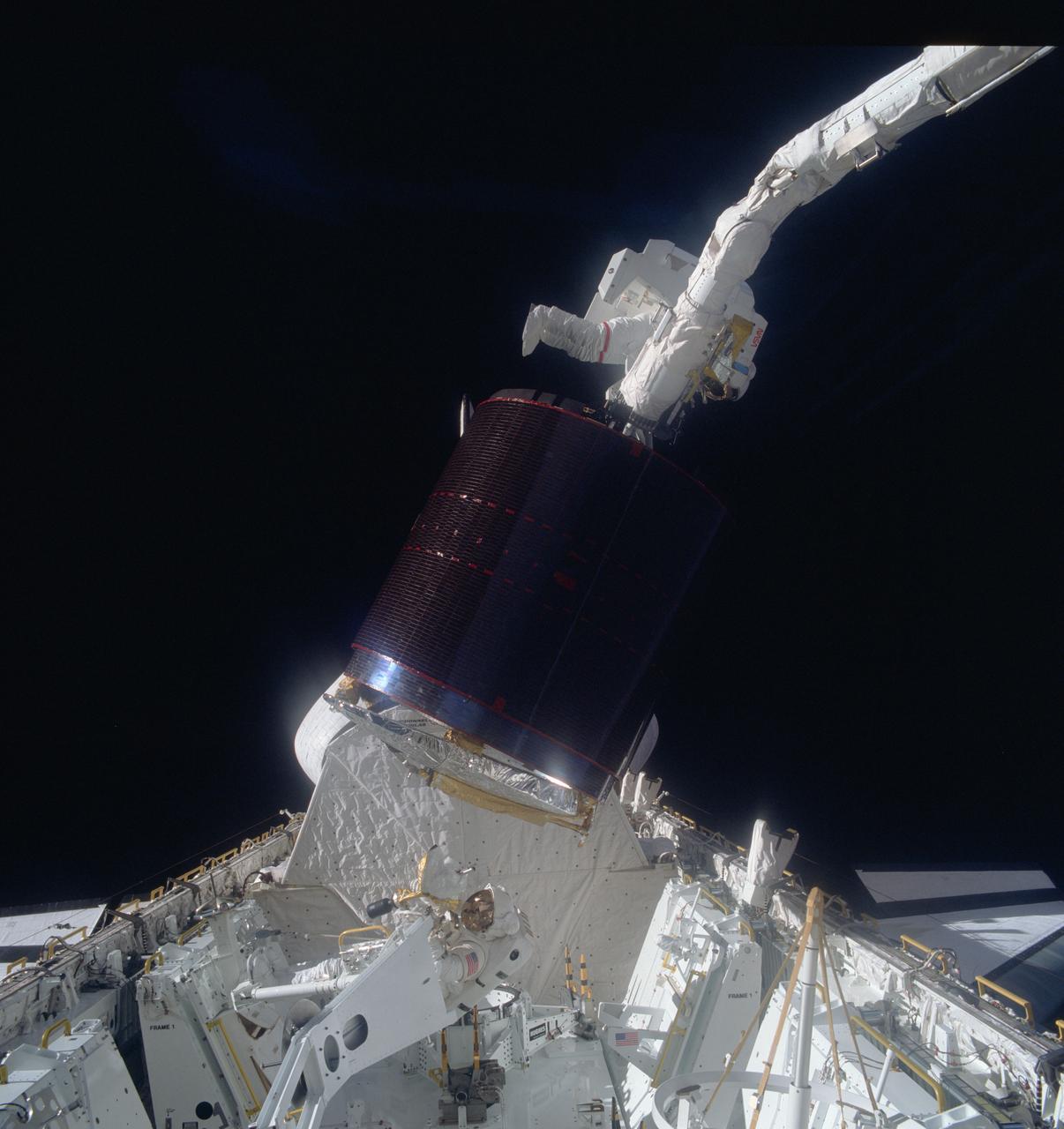
51A-41-021 (12 Nov 1984) --- Astronaut Joseph P. Allen IV, top, hangs onto a stinger device, which earlier had stabilized the pictured Palapa B-2 communications satellite, as astronaut Dale A. Gardner in the cargo bay of Discovery waits to assist in the berthing of the previously stranded spinning spacecraft. The end effector of the remote manipulatore system (RMS), controlled from inside Discovery's cabin by astronaut Anna L. Fisher, grasps a special grapple point to Allen's right. A fellow crewmember on the flight deck, using a 70mm handheld Hasselblad camera, exposed the frame. The activity took place on November 12, 1984.
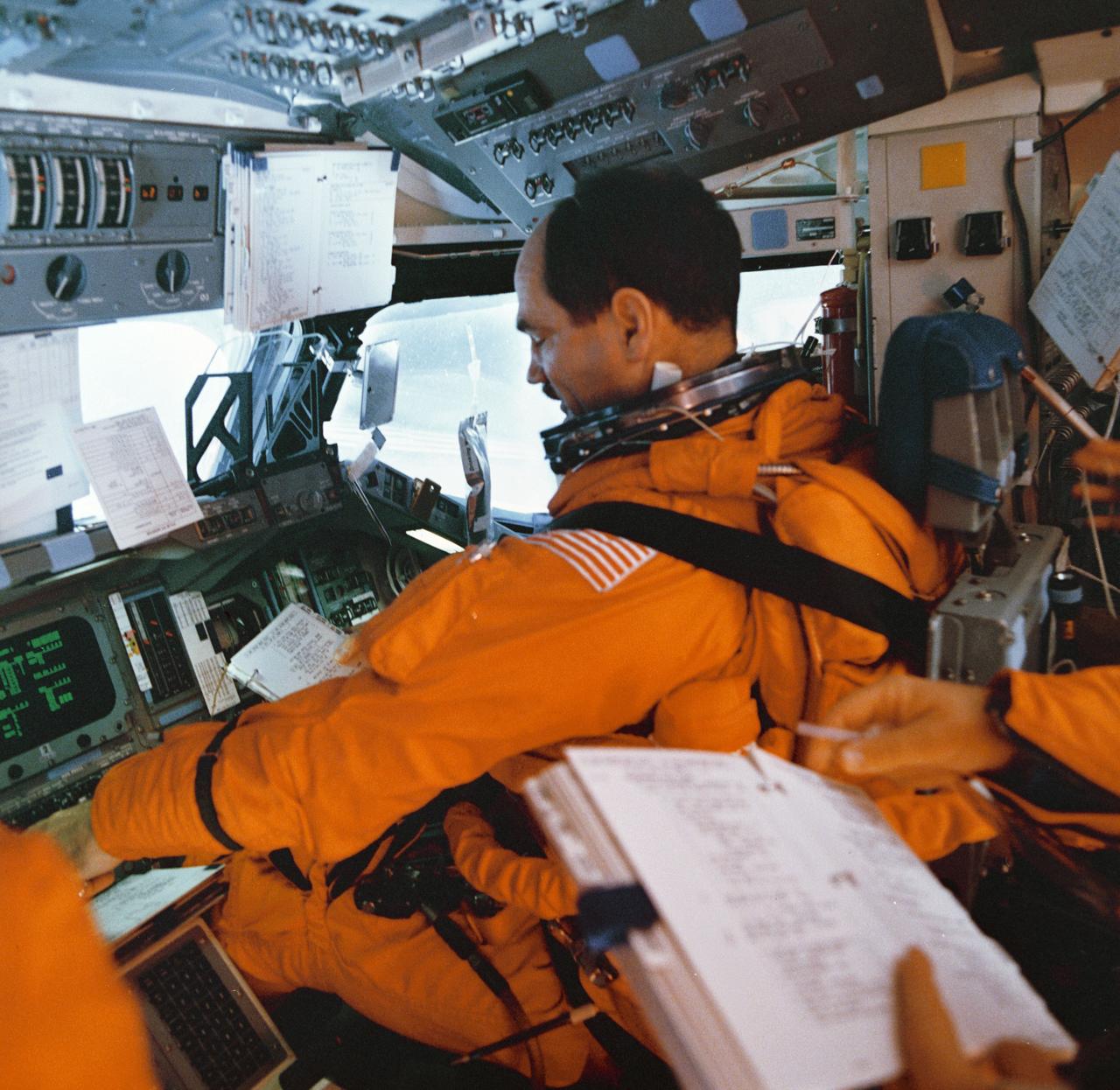
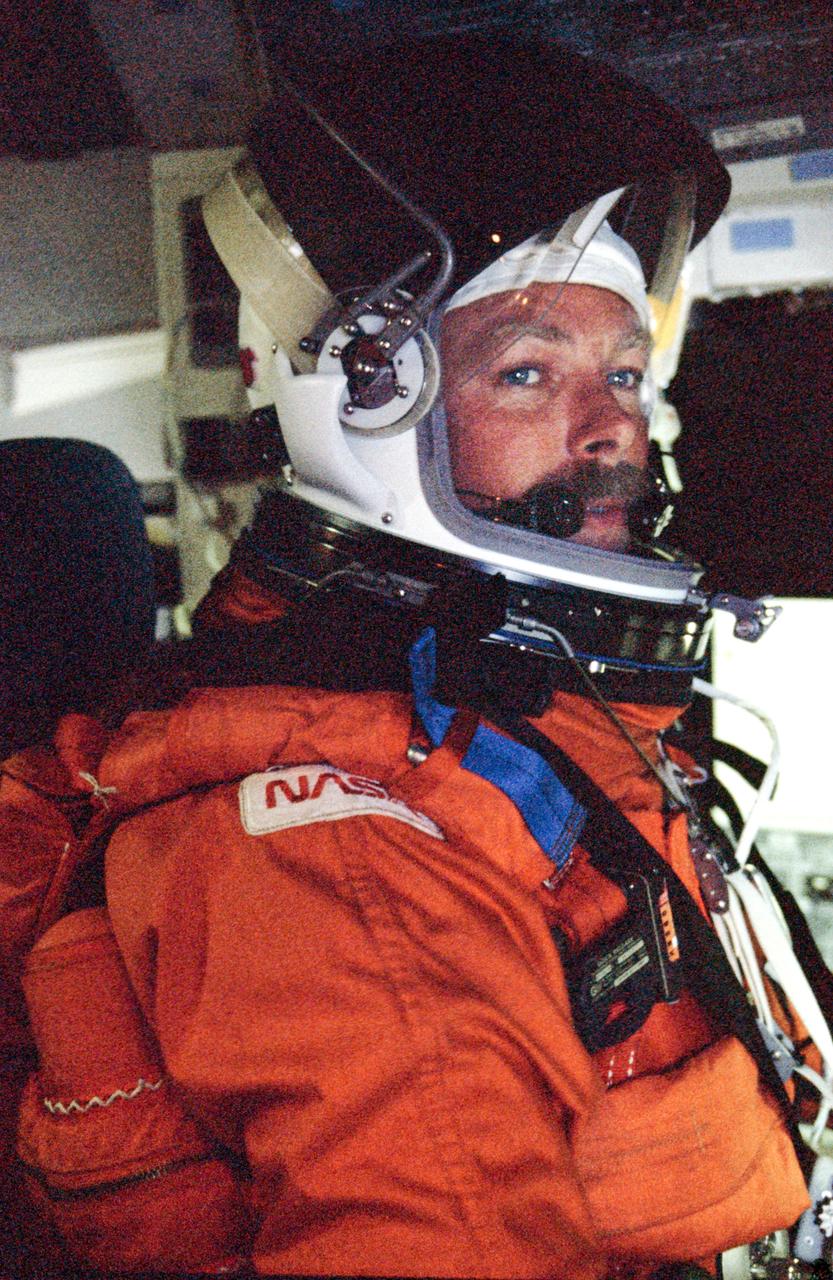
STS035-515-003 (2-10 Dec 1990) --- STS-35 Pilot Guy S. Gardner, wearing his launch and entry suit (LES), reviews descent checklist while at the pilots station on the forward flight deck of Columbia, Orbiter Vehicle (OV) 102. Crewmembers are conducting procedures related to the final stages of the mission and the landing sequence. Silhouetted in forward windows W4 and W5 are the head up display (HUD), flight mirror assembly, and a drinking water bag with straw.
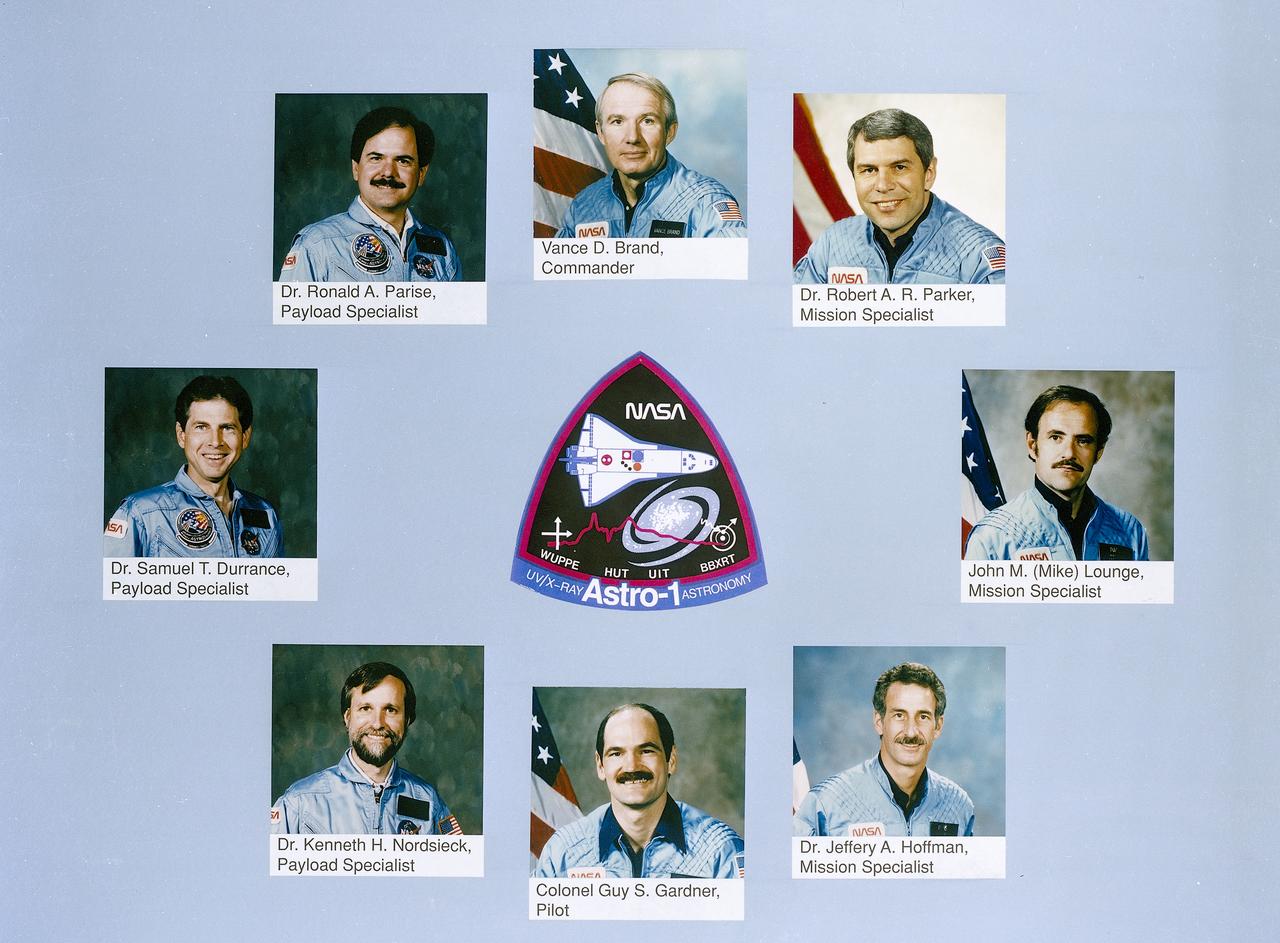
This montage consists of 8 individual STS-35 crew member portraits surrounding the mission’s insignia. Starting from top center, clockwise, are Vance D. Brand, commander; mission specialists Dr. Robert A. R. Parker, John M. (Mike) Lounge, and Dr. Jeffery A. Hoffman; Colonel Guy S. Gardner, pilot; and payload specialists Dr. Kenneth H. Nordsieck, Dr. Samual T. Durrance, and Dr. Ronald A. Parise. The crew of 8 launched aboard the Space Shuttle Orbiter Columbia on December 2, 1990 at 1:19:01am (EST). The primary objective of the mission was round the clock observation of the celestial sphere in ultrviolet and X-Ray astronomy with the Astro-1 observatory which consisted of four telescopes: the Hopkins Ultraviolet Telescope (HUT); the Wisconsin Ultraviolet Photo-Polarimeter Experiment (WUPPE); the Ultraviolet Imaging Telescope (UIT); and the Broad Band X-Ray Telescope (BBXRT). Due to loss of data used for pointing and operating the ultraviolet telescopes, Marshall Space Flight Center ground teams were forced to aim the telescopes with fine tuning by the flight crew.
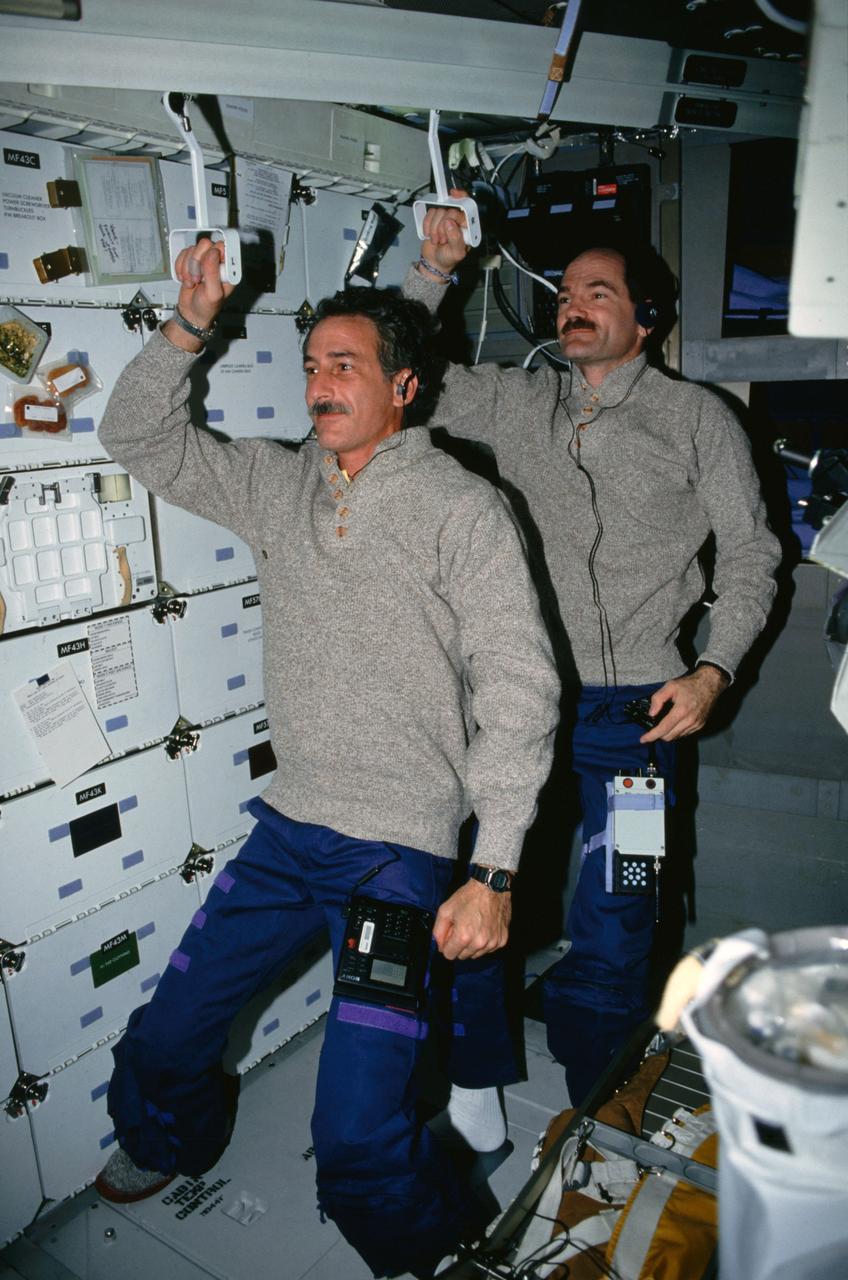
STS035-10-005 (2-10 Dec 1990) --- STS-35 Mission Specialist (MS) Jeffrey A. Hoffman (front) and Pilot Guy S. Gardner, holding Development Test Objective (DTO) 634 trash compactor handles to the ceiling, "commute" to work on the middeck of Columbia, Orbiter Vehicle (OV) 102. Just below Hoffman's right elbow in locker MF43G DTO 634, Trash Compaction and Retention System Demonstration, trash compactor with a geared mechanism that allows manual compaction of wet and dry trash is visible. Also in the view are the stowed treadmill on the middeck floor and the starboard side sleep station.
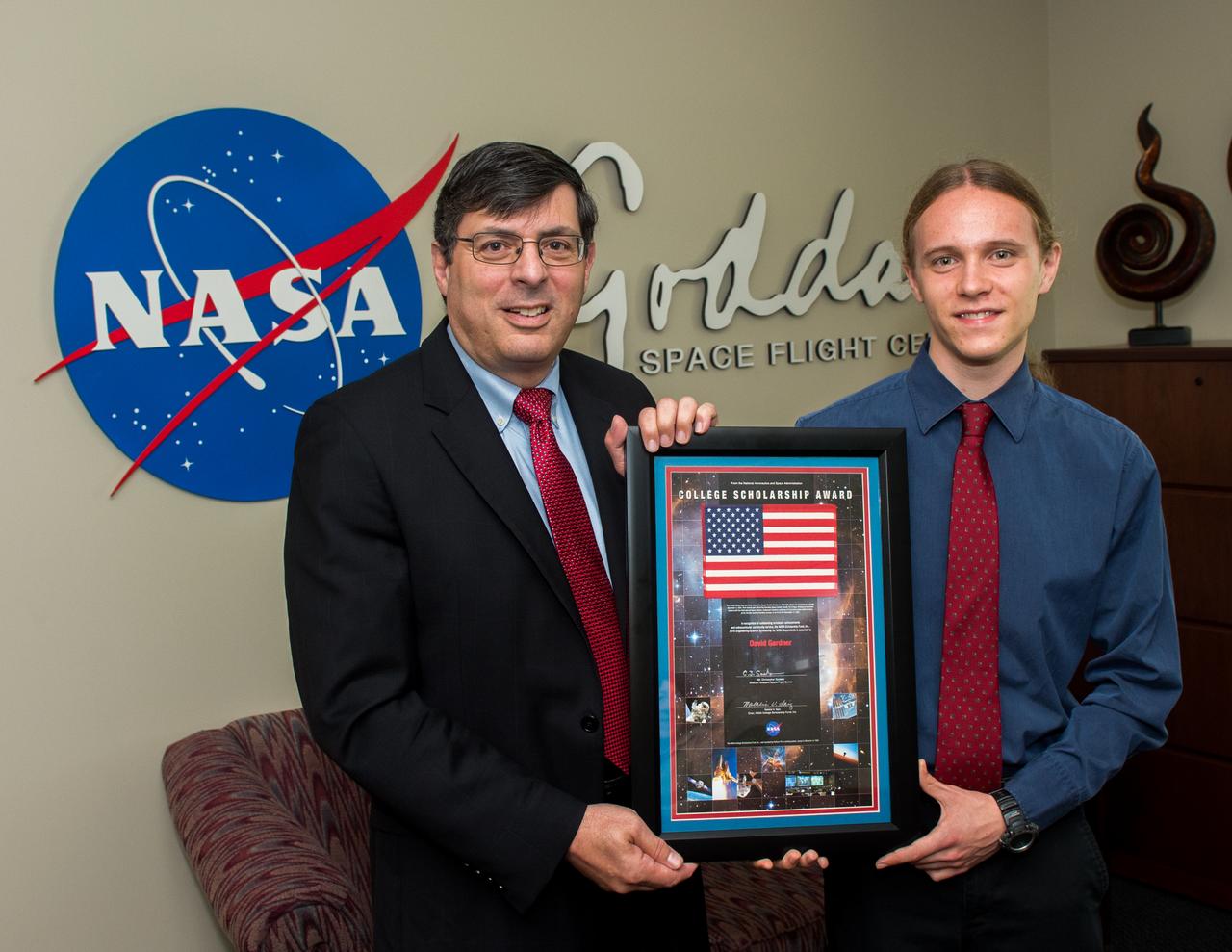
Center Director Chris Scolese with NASA Scholarship winner David Gardner
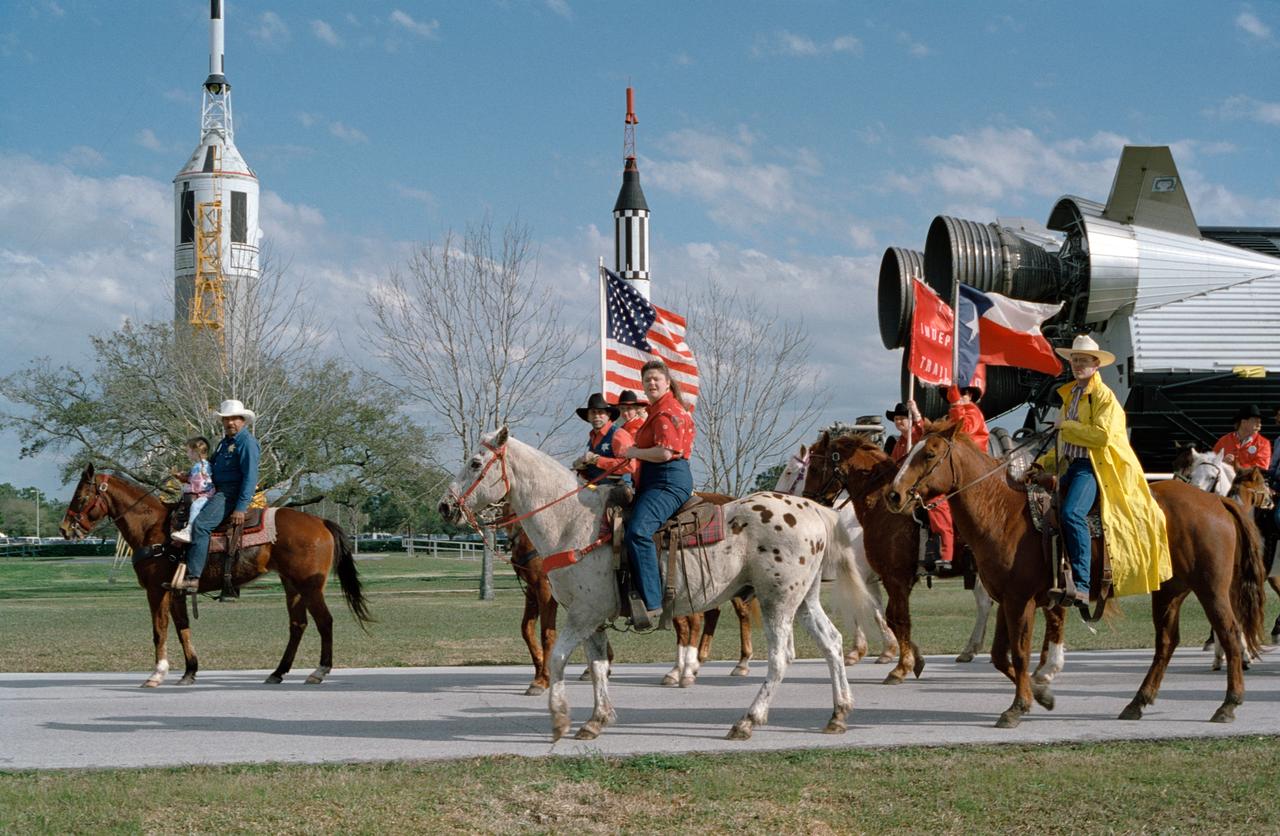
Rose Gardner of the JSC Travel Office, center, rides with the Independence Trail Riders as they enter JSC at Rocket Park.
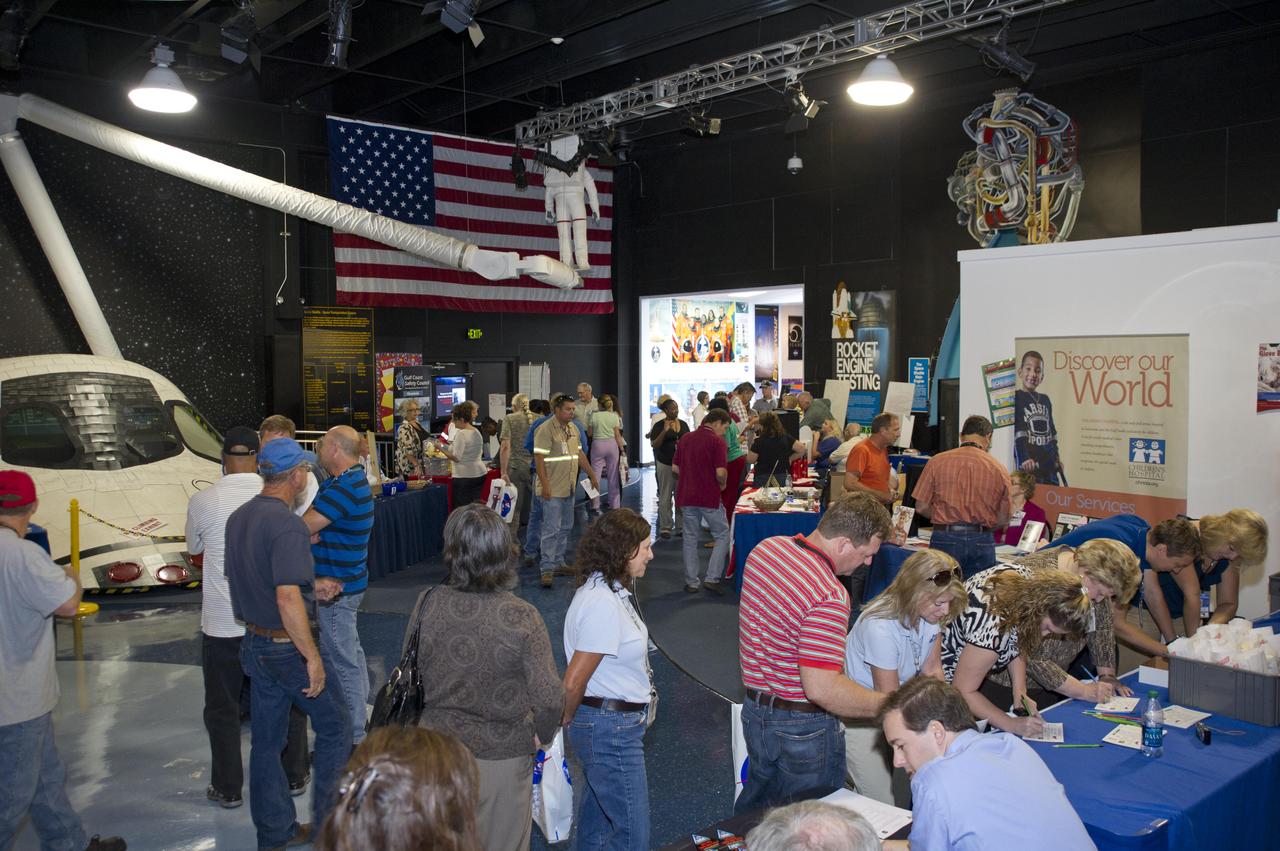
Employees at NASA's John C. Stennis Space Center participated in 2012 Safety and Health Day activities Aug. 21. Various organizations provided interactive exhibits and information on a range of safety and health issues. During large group presentations, Brad Gardner also spoke about losing part of his right arm to an industrial accident in 2003 and what it has taught him about preventing accidents. Gardner served 22 years in the U.S. Air Force and has a background in safety management.
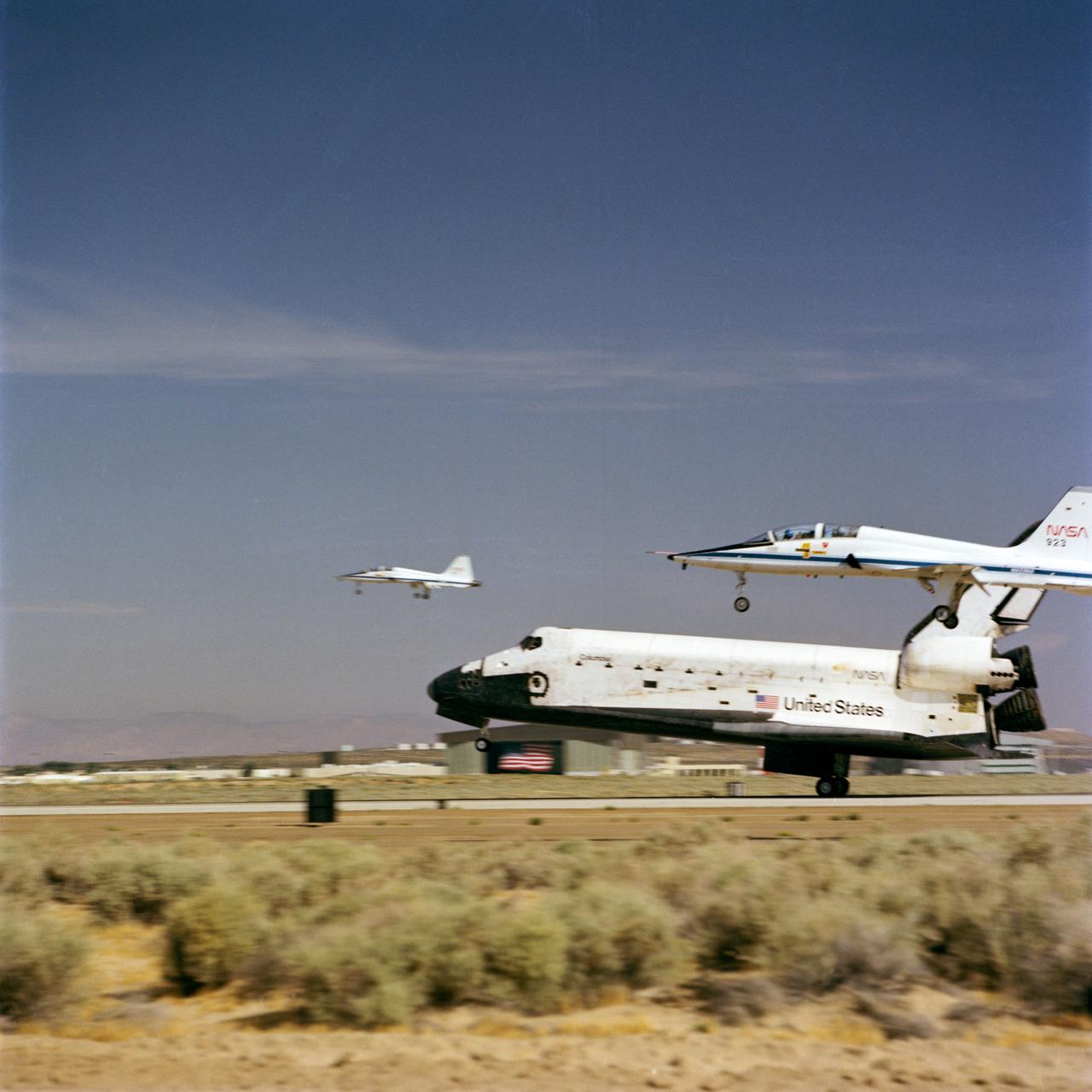
Views of the Columbia landing at EAFB ending the STS-4 Mission on 07/04/1982; of President and Mrs. Reagan greeting the crew out on the Lake bed Runway; and, the view of Roy Rogers with Astronauts Jerry Ross and Guy Gardner. 1. President Ronald Reagan & wife Nancy 2. Roy Rogers 3. Astronaut Jerry L. Ross 4. Astronaut Guy S. Gardner Edwards AFB, CA
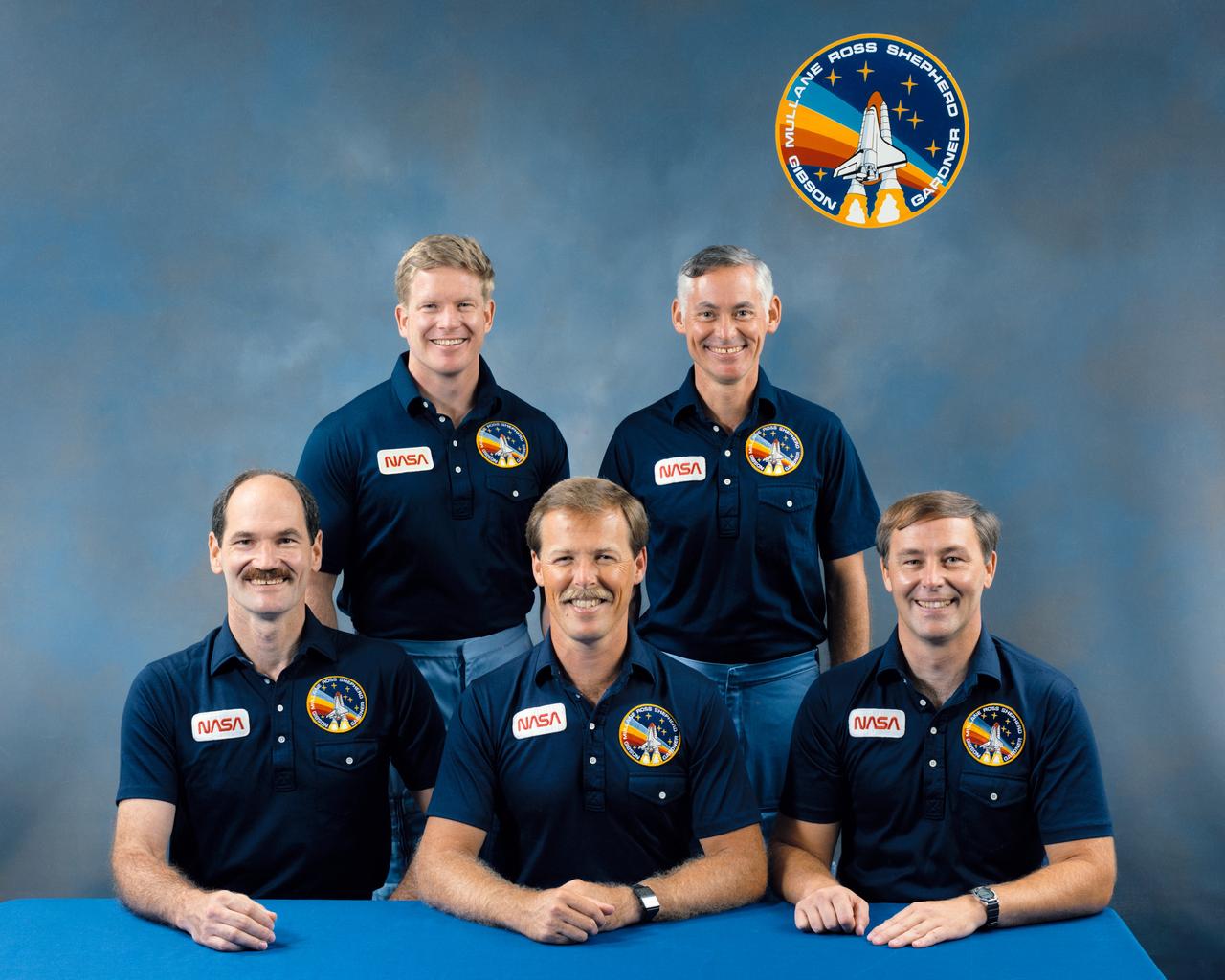
S88-45002 (August 1988) --- These five astronauts will fly aboard the Space Shuttle Atlantis for the STS-27 mission. They are (seated left to right) astronauts Guy S. Gardner, Robert L. Gibson and Jerry L. Ross; and (standing, left to right) William M. Shepherd and Richard M. (Mike) Mullane. Gibson is commander; Gardner, pilot; and the other three will serve as mission specialists.
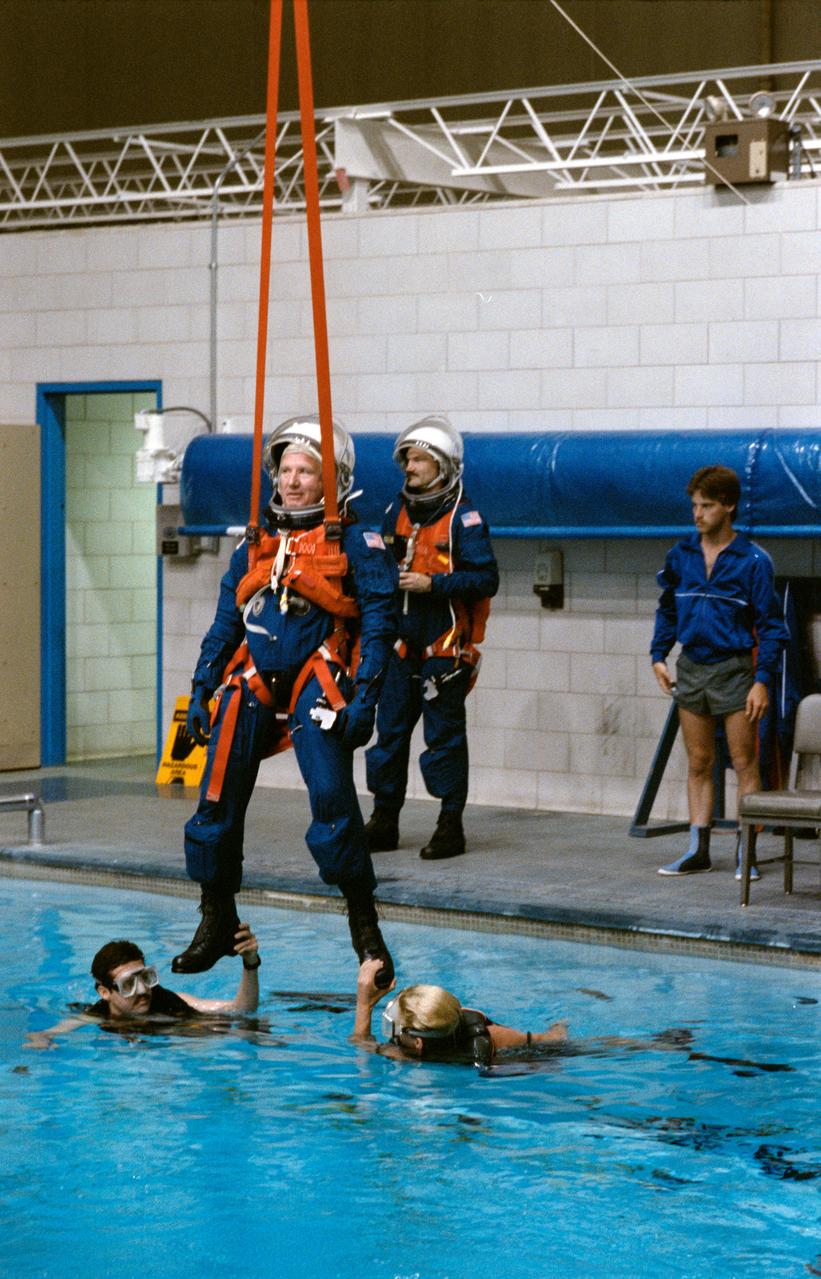
S90-34964 (16 April 1990) --- Astronaut Vance D. Brand, STS-35 commander, is suspended via his parachute harness above the pool in the Johnson Space Center?s (JSC) Weightless Environment Training Facility (WETF) Bldg 29 during launch emergency egress exercises. Divers in the pool hold Brand's feet to steady him. In the background and on the poolside is pilot Guy S. Gardner. Both Brand and Gardner are wearing launch and entry suits (LES) and launch and entry helmets (LEH).
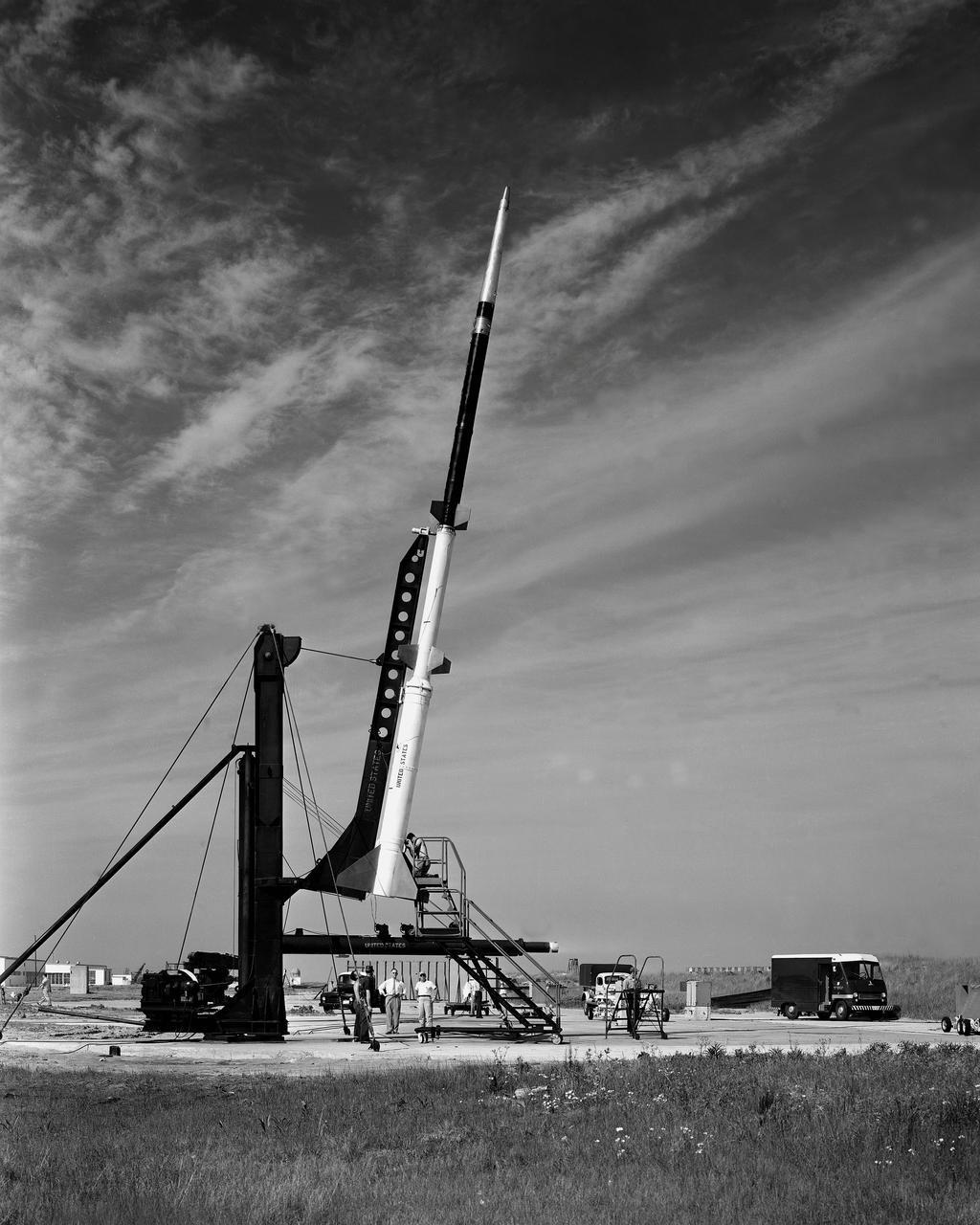
L59-3896 Engineers W. N. Gardner and C.A. Brown, Jr., check operations as Trailblazer 1b is readied for Flight, June 4, 1959. Photograph published in A New Dimension Wallops Island Flight Test Range: The First Fifteen Years by Joseph Shortal. A NASA publication, page 675. D58-3001 Model. Engineers W. N. Gardner and C.A. Brown
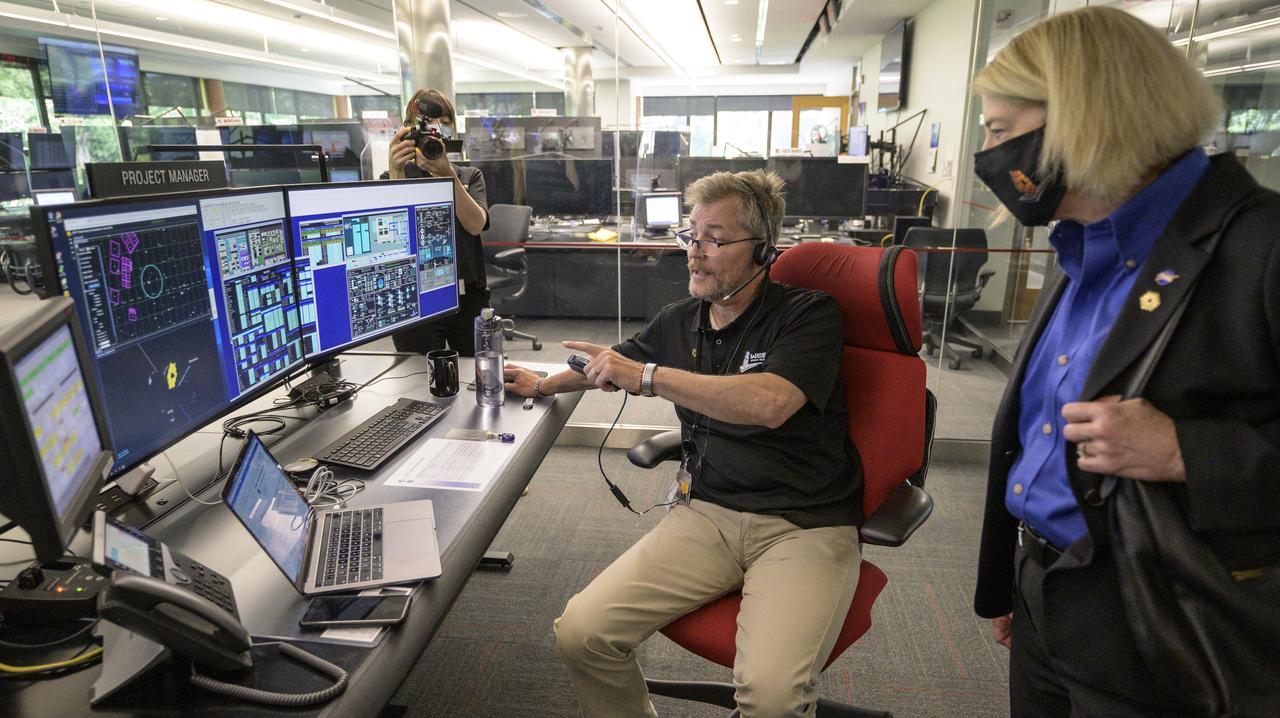
NASA Deputy Administrator Pam Melroy, right, talks with NASA James Webb Space Telescope deputy senior project scientist Jon Gardner, as she is given a tour of the NASA James Webb Space Telescope Mission Operations Center, Wednesday, June 29, 2022, at the Space Telescope Science Institute (STScI) in Baltimore. Prior to the tour the deputy spoke at a briefing that focused on the status of NASA’s James Webb Space Telescope in its final weeks of preparing for its science mission, as well as overviews of planned science for Webb’s first year of operations. Photo Credit: (NASA/Bill Ingalls)
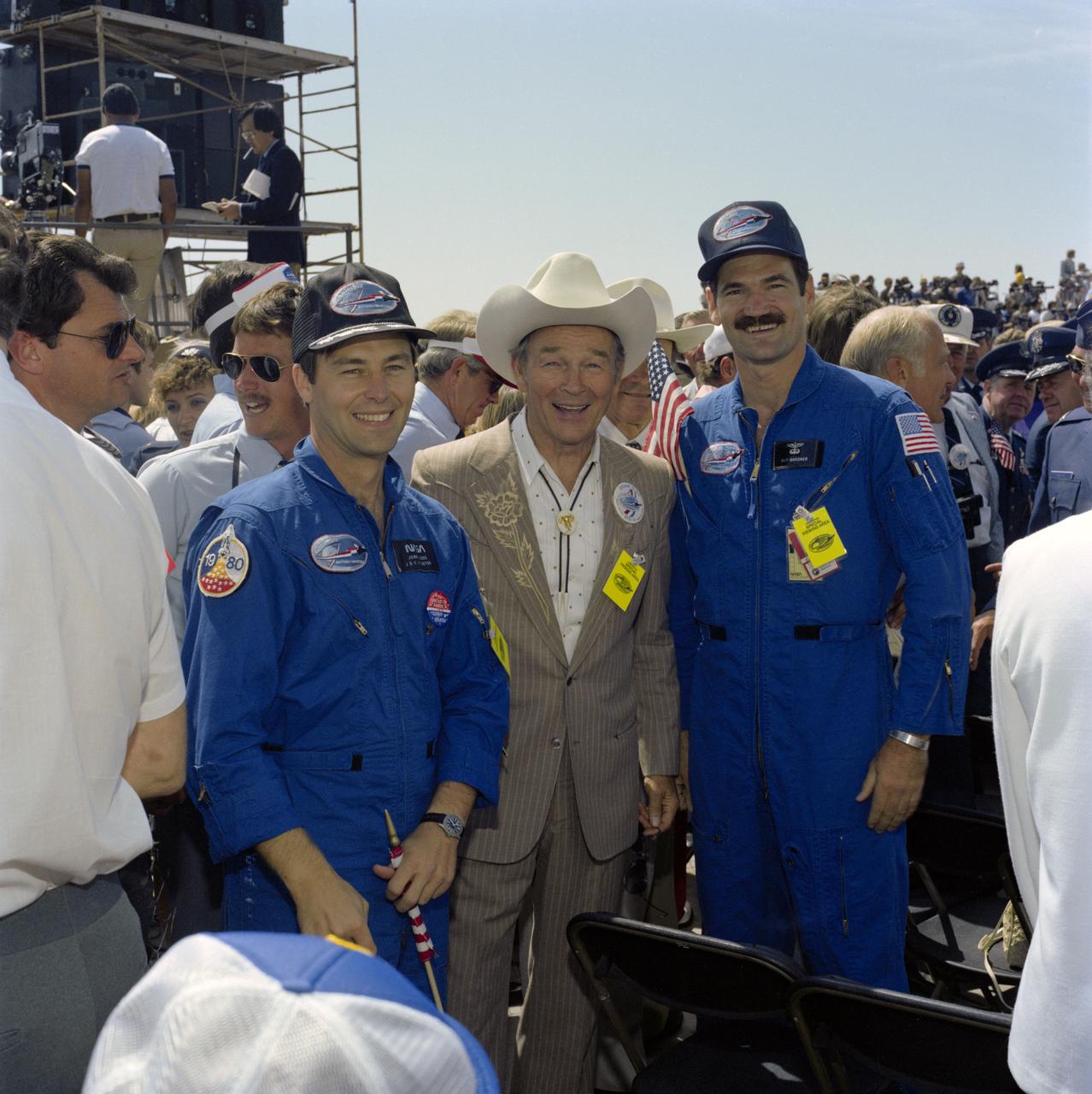
S82-33226 (4 July 1982) --- Inveterate space fan Roy Rogers with astronauts Jerry L. Ross, left, and Guy S. Gardner at Edwards Air Force Base for the landing of the space shuttle Columbia at the conclusion of the STS-4 mission on July 4, 1982. Ross and Gardner piloted chase planes involved in the approach and landing operations for the flight?s conclusion. Also present at the landing was (near far right) former astronaut Edwin E. Aldrin Jr., lunar module pilot for the historic first moon landing of almost 13 years ago. Photo credit: NASA

STS008-16-454 (30 Aug-5 Sept 1983) --- Following a precedent set early two decades ago during the Gemini program, three members of the STS-8 astronaut crew aboard the Earth-orbiting Space Shuttle Challenger reveal their military backgrounds and loyalties. Astronauts (left to right) Dale A. Gardner, Richard H. Truly and Daniel C. Brandenstein leave no mystery as to their alma mater and gridiron sentimentalities as they display U.S. Navy stickers. The trio was photographed by Astronaut Guion S. Bluford on the flight deck. Truly is crew commander; Brandenstein, pilot; and Gardner and Bluford, along with Dr. William E. Thornton are all mission specialists for this six-day flight.
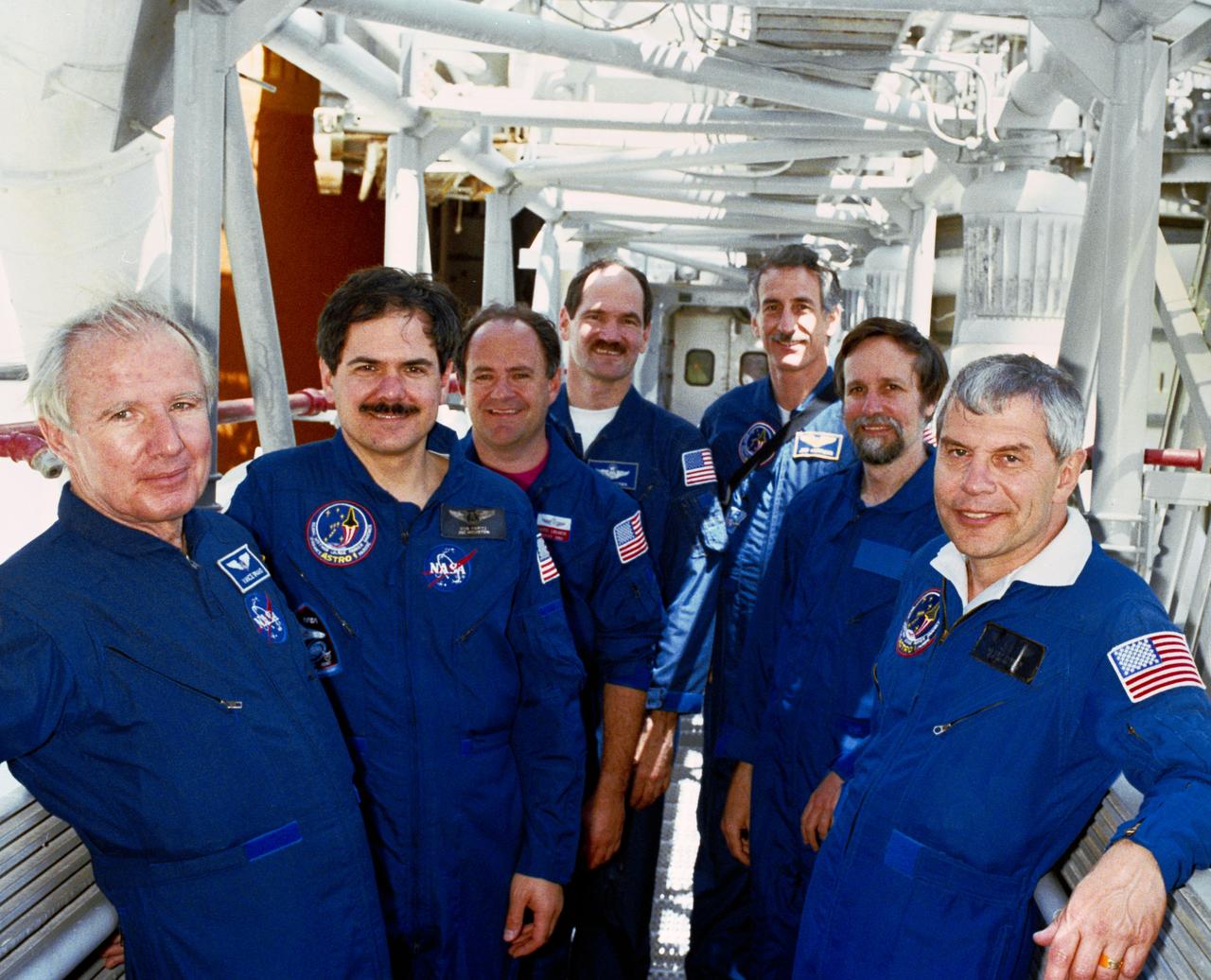
S90-38029 (21 May 1990) --- STS-35 Columbia, Orbiter Vehicle (OV) 102, crewmembers commander Vance D. Brand, pilot Guy S. Gardner, mission specialists Jeffrey A. Hoffman, John M. Lounge, Robert A. R. Parker, payload specialists Samuel T. Durrance and Ronald A. Parise and backup payload specialist Kenneth Nordsieck take a break from training activities and pose on the 195-Floor Level on Launch Pad 39A at the Kennedy Space Center (KSC). On left from front to back are Brand, Parise, Lounge and Gardner and on right from front to back are Parker, Nordsieck, and Hoffman. View provided by KSC with alternate number KSC-90PC-670.
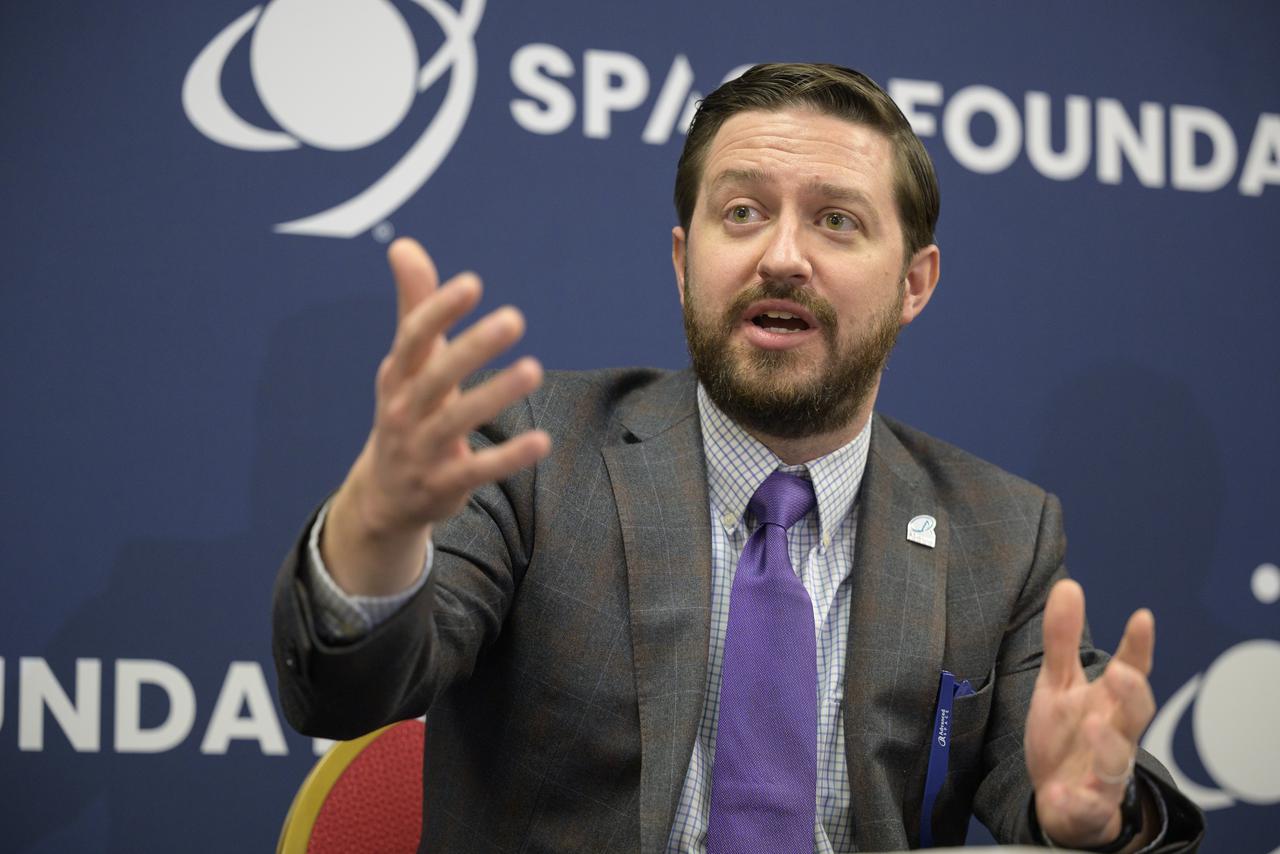
Bradley Cheetham (CEO) or Tom Gardner (Director of Engineering), Advanced Space speaks at “Small Satellites, Big Missions: Pathfinding CubeSats Exploring the Moon and Beyond,” a news conference during the 37th Space Symposium, Wednesday, April 6, 2022, in Colorado Springs, Colorado. Photo Credit: (NASA/Bill Ingalls)
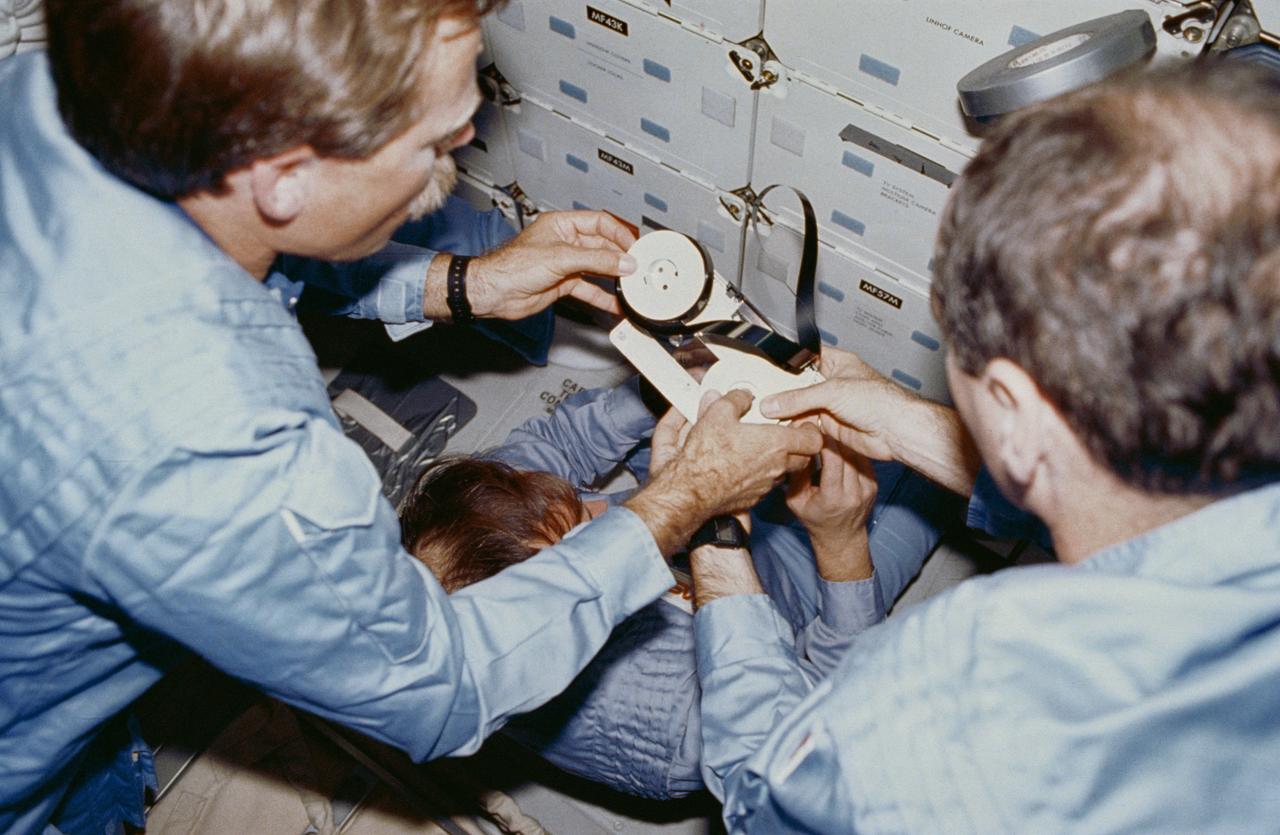
STS027-05-020 (2-6 Dec. 1988) --- In the foreground, astronauts Robert L. Gibson (left) and Guy S. Gardner, commander and pilot, respectively, for the STS-27 mission, repair a 3/4-inch video reel on the middeck of the Earth-orbiting space shuttle Atlantis. Photo credit: NASA
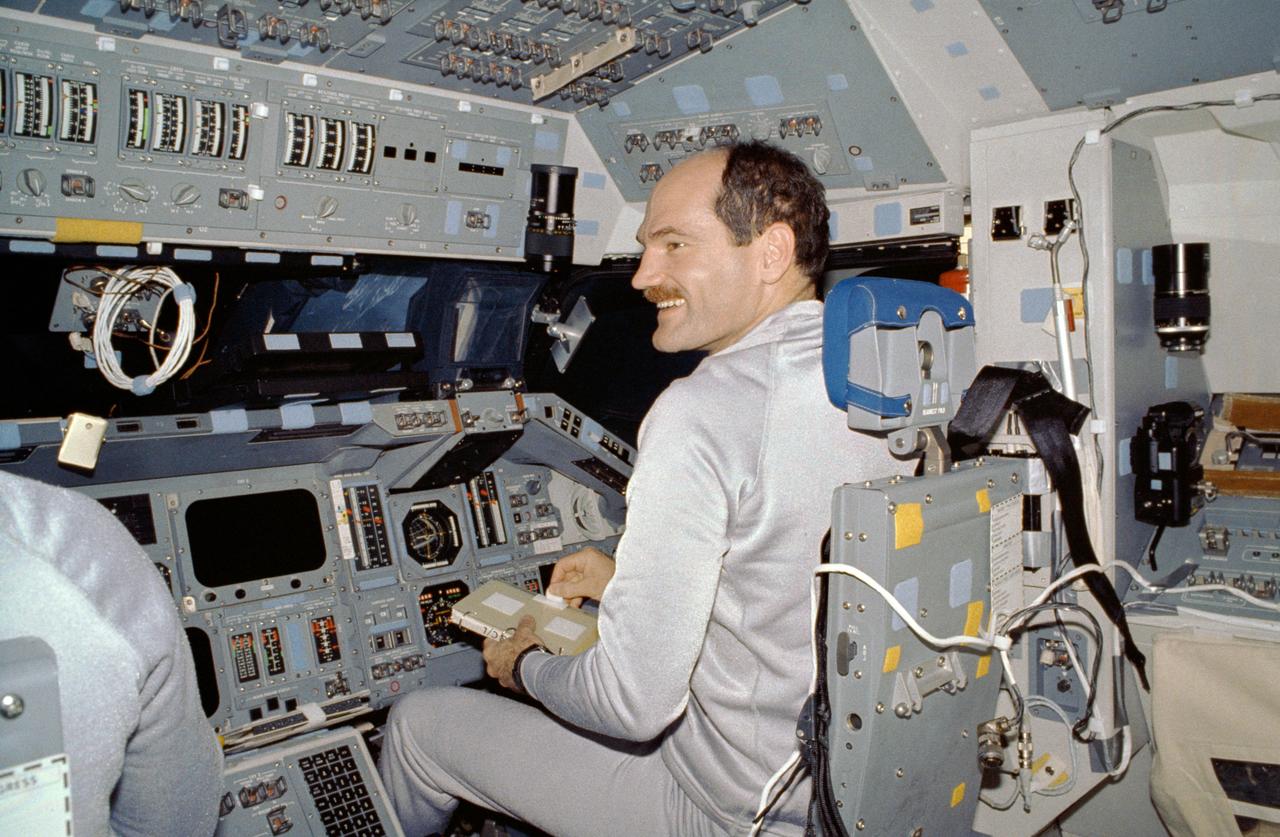
STS027-10-020a (2-6 Dec. 1988) --- Astronaut Guy S. Gardner, STS-27 pilot, converses with astronaut Robert L. Gibson (almost totally out of view at left) commander, as the two are seated at their respective stations on the flight deck of the Earth-orbiting space shuttle Atlantis. Photo credit: NASA
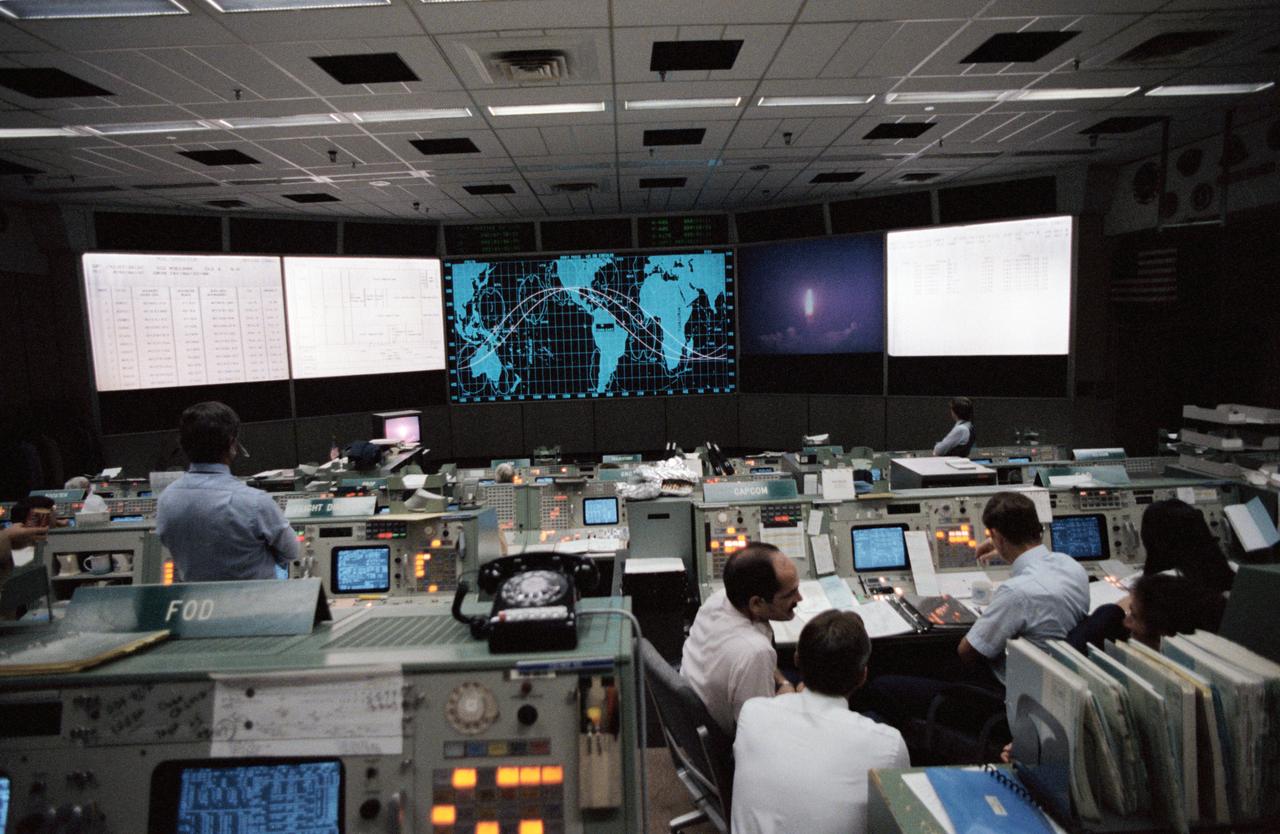
Serving as spacecraft communicators (CAPCOM) are Astronauts Guy S. Gardner (left), William F. Fisher (center), Bryan D. O'Connor (seated facing console), and Jeffrey A. Hoffman. Cheevon B. Lau is seated at the flight activities officer (FAO) console to the right of the CAPCOM console. The scene on the large screen in the mission operations control room (MOCR) is a replay of the launch of the Challenger (39264); Flight Director Jay H. Greene, left, watches a replay of the STS-8 launch on the large screen in the MOCR. He is joined by O'Connor, Jeffrey A. Hoffman, Gardner and Fisher. Lau works at the FAO console near the CAPCOM console (39265); Harold Black, integrated communications officer (INCO) for STS-8 mans the INCO console during the first TV downlink from the Challengers flight. The payload bay can be seen on the screen in the front of the MOCR (39266).
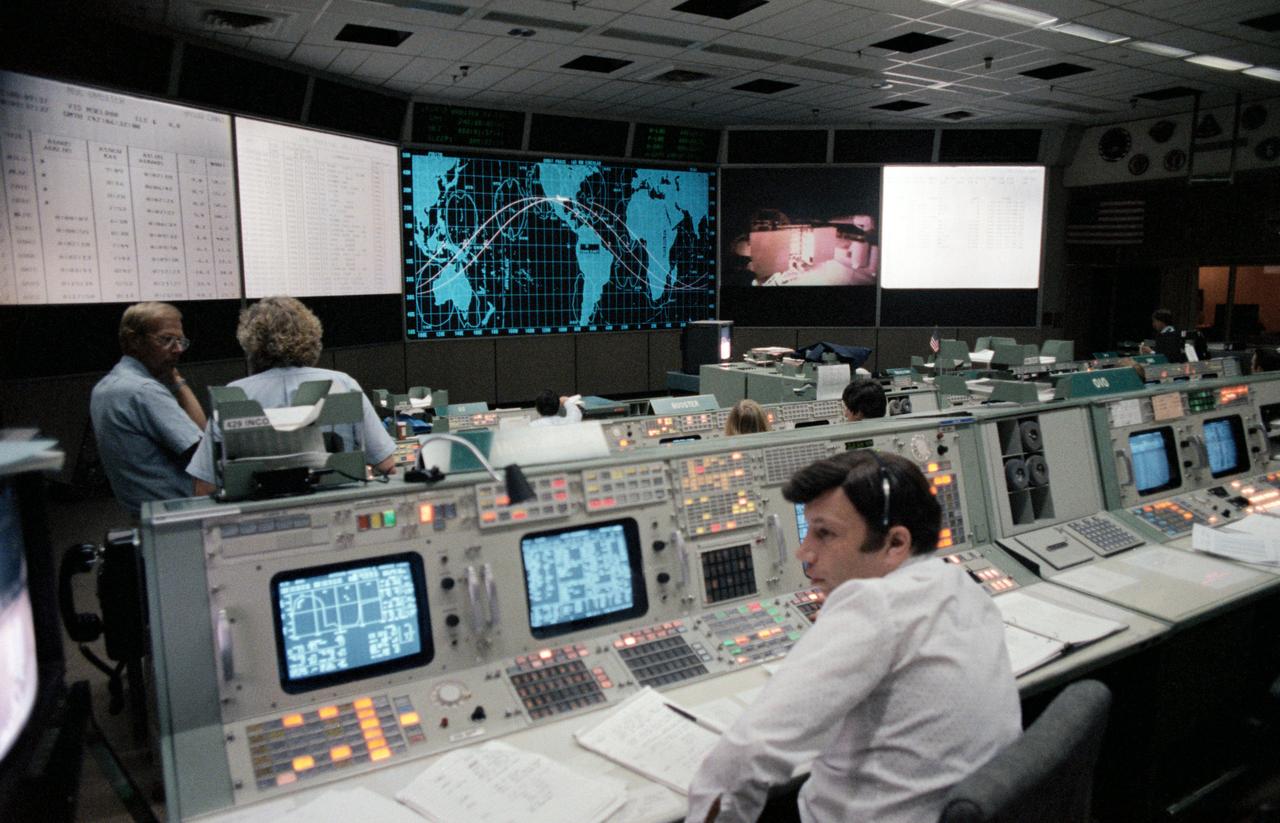
Serving as spacecraft communicators (CAPCOM) are Astronauts Guy S. Gardner (left), William F. Fisher (center), Bryan D. O'Connor (seated facing console), and Jeffrey A. Hoffman. Cheevon B. Lau is seated at the flight activities officer (FAO) console to the right of the CAPCOM console. The scene on the large screen in the mission operations control room (MOCR) is a replay of the launch of the Challenger (39264); Flight Director Jay H. Greene, left, watches a replay of the STS-8 launch on the large screen in the MOCR. He is joined by O'Connor, Jeffrey A. Hoffman, Gardner and Fisher. Lau works at the FAO console near the CAPCOM console (39265); Harold Black, integrated communications officer (INCO) for STS-8 mans the INCO console during the first TV downlink from the Challengers flight. The payload bay can be seen on the screen in the front of the MOCR (39266).
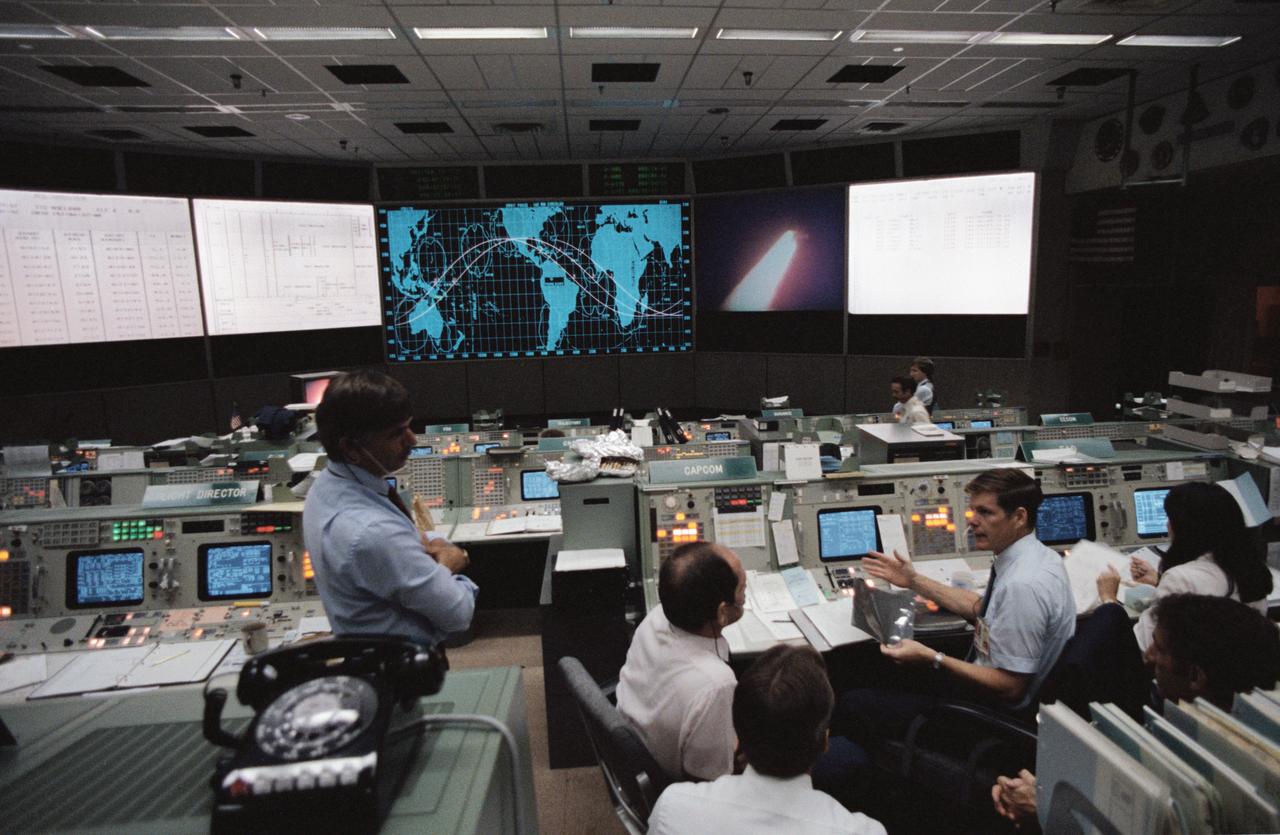
Serving as spacecraft communicators (CAPCOM) are Astronauts Guy S. Gardner (left), William F. Fisher (center), Bryan D. O'Connor (seated facing console), and Jeffrey A. Hoffman. Cheevon B. Lau is seated at the flight activities officer (FAO) console to the right of the CAPCOM console. The scene on the large screen in the mission operations control room (MOCR) is a replay of the launch of the Challenger (39264); Flight Director Jay H. Greene, left, watches a replay of the STS-8 launch on the large screen in the MOCR. He is joined by O'Connor, Jeffrey A. Hoffman, Gardner and Fisher. Lau works at the FAO console near the CAPCOM console (39265); Harold Black, integrated communications officer (INCO) for STS-8 mans the INCO console during the first TV downlink from the Challengers flight. The payload bay can be seen on the screen in the front of the MOCR (39266).
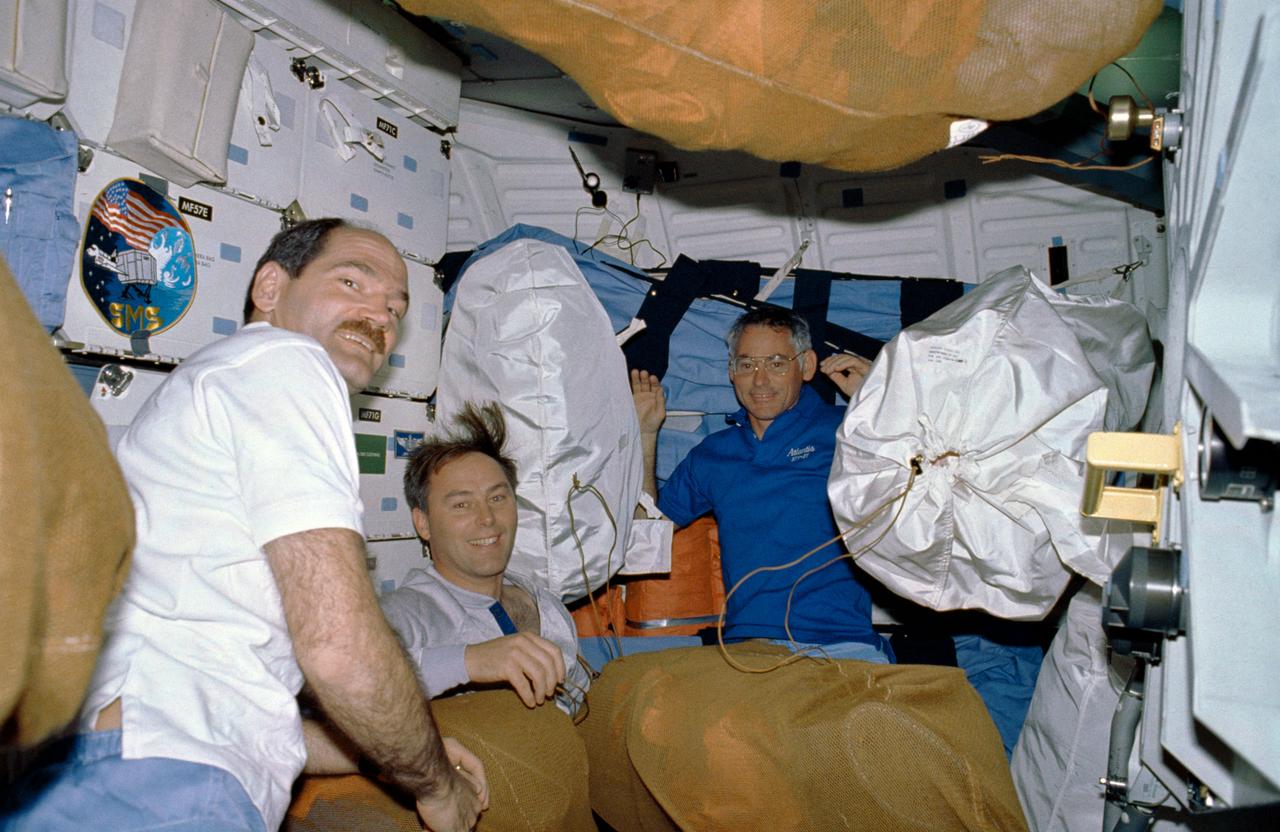
STS027-10-003 (2-6 Dec. 1988) --- From the left, astronauts Guy S. Gardner, STS-27 pilot, along with Jerry L. Ross and Richard M. (Mike) Mullane, both mission specialists, take a break from moving gear and equipment on the middeck of the Earth-orbiting space shuttle Atlantis. Photo credit: NASA
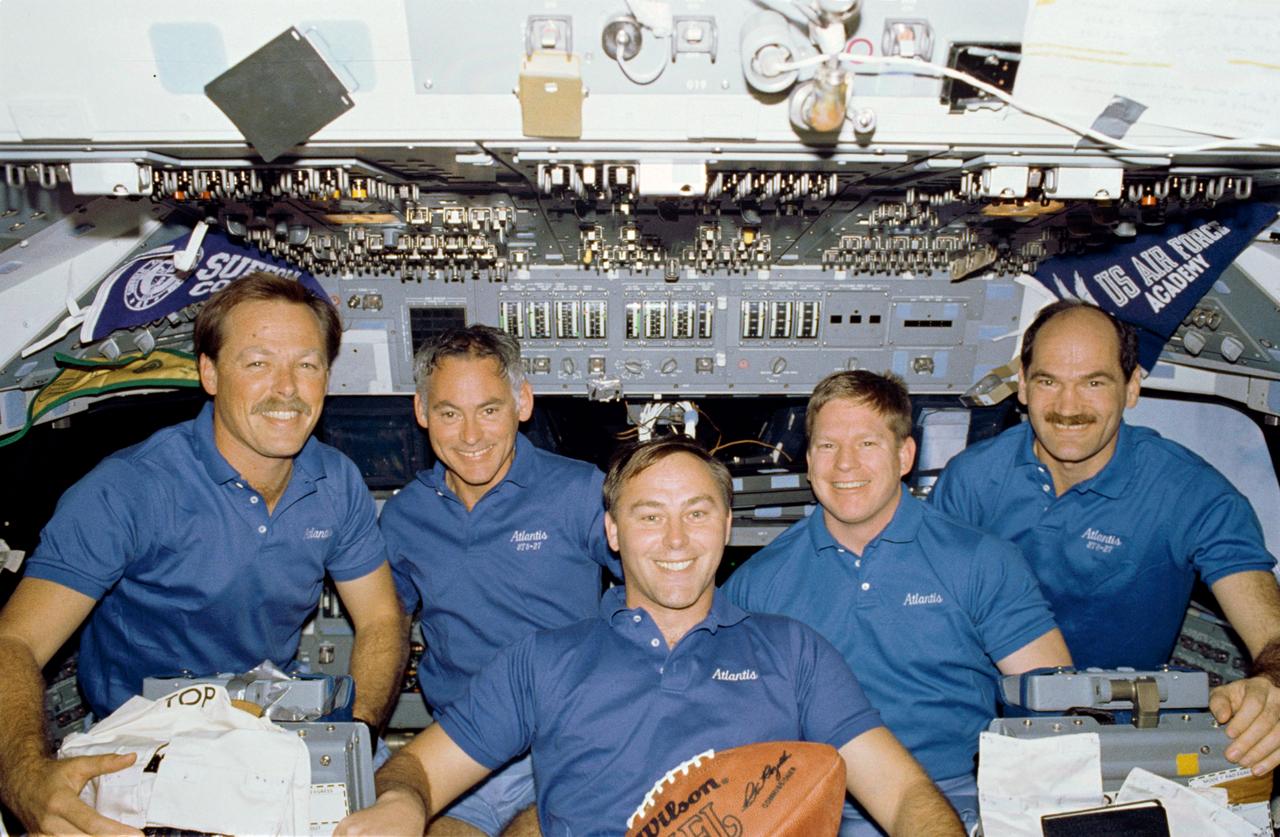
STS027-11-012 (2-6 Dec. 1988) --- The crew members for the STS-27 space flight pose on the flight deck of the Earth-orbiting space shuttle Atlantis with a football free-floating in the foreground. Left to right are astronauts Robert L. Gibson, commander; Richard M. (Mike) Mullane, Jerry L. Ross and William M. Shepherd, mission specialists; and Guy S. Gardner, pilot. The football was later presented to the National Football League (NFL) at halftime of the Super Bowl in Miami. Photo credit: NASA
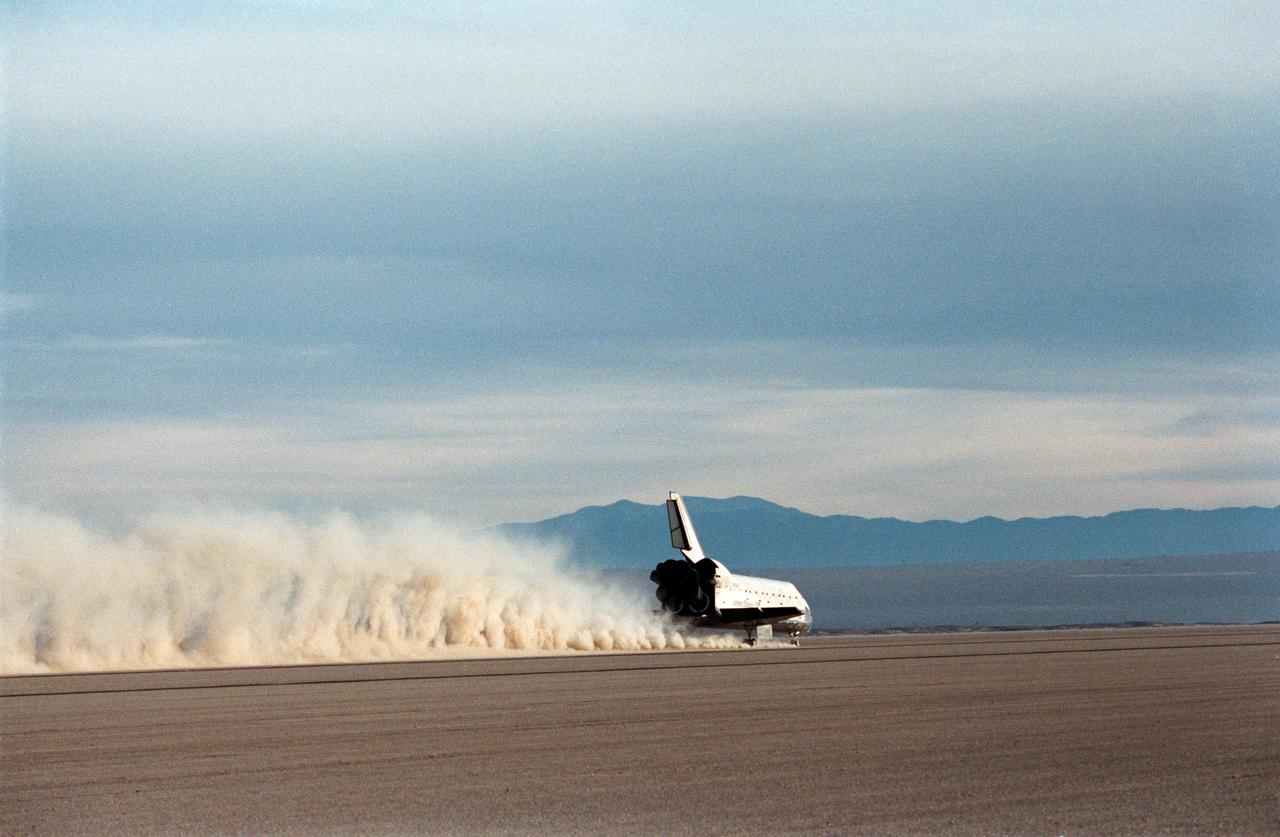
STS027-S-012 (6 Dec. 1988) --- A 70mm camera records the landing of the Space Shuttle Atlantis on Rogers Dry Lake Bed near the Dryden Flight Research Facility in California. The wheels of the vehicle came to a stop at 3:36:53 p.m. (PST), marking the completion of a successful mission which involved five veteran NASA astronauts. Onboard for the four-day flight were astronauts Robert L. Gibson, Guy S. Gardner, Jerry L. Ross, Richard M. (Mike) Mullane and William M. Shepherd.
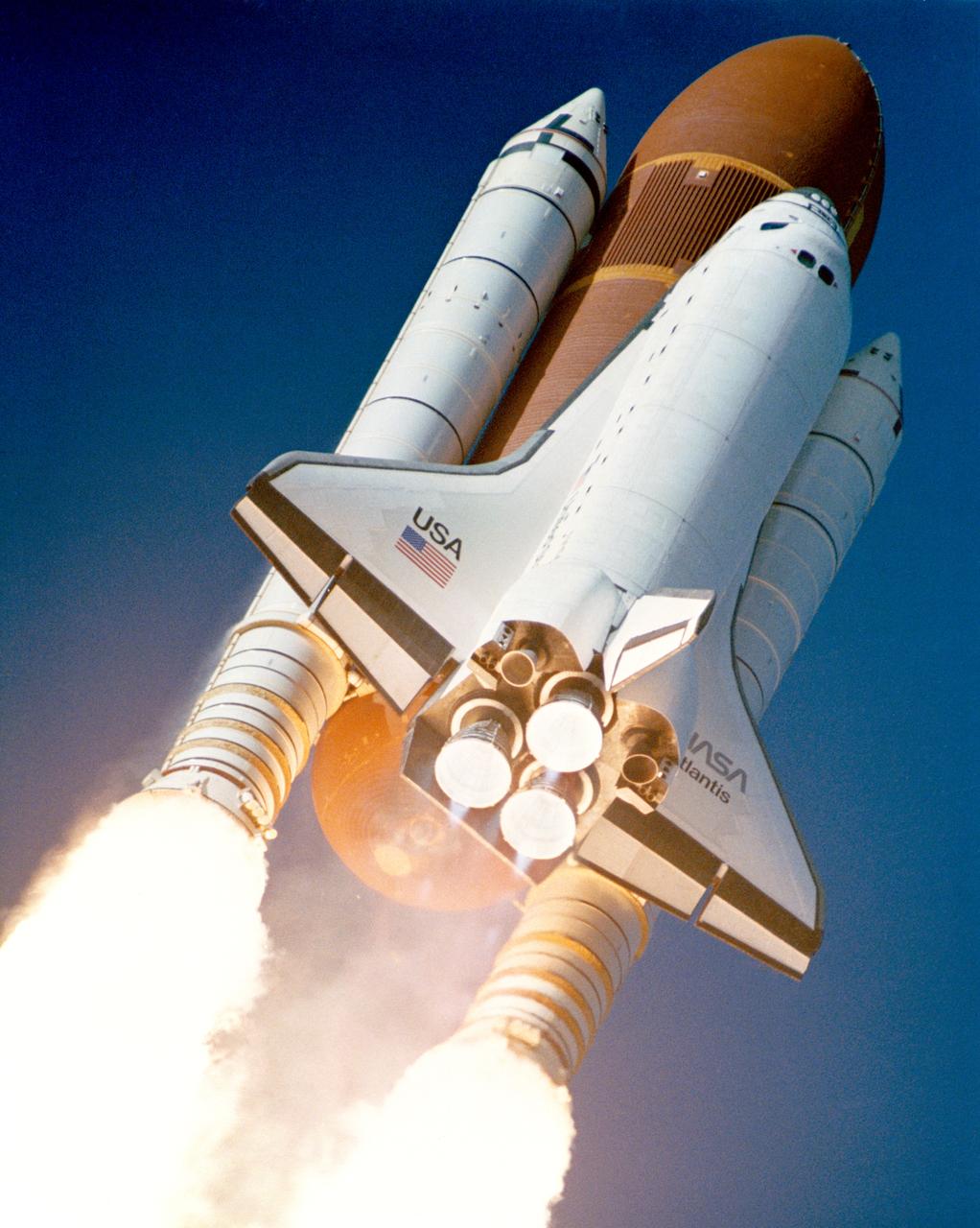
STS027-S-071 (2 Dec. 1988) --- The Space Shuttle Atlantis and its five-man crew of astronauts are launched from Kennedy Space Center?s Pad 39B at 9:30 a.m. (EST), Dec. 2, 1988. Onboard the Department of Defense?dedicated mission are astronauts Robert L. Gibson, Guy S. Gardner, Jerry L. Ross, Richard M. (Mike) Mullane and Williams M. Shepherd.
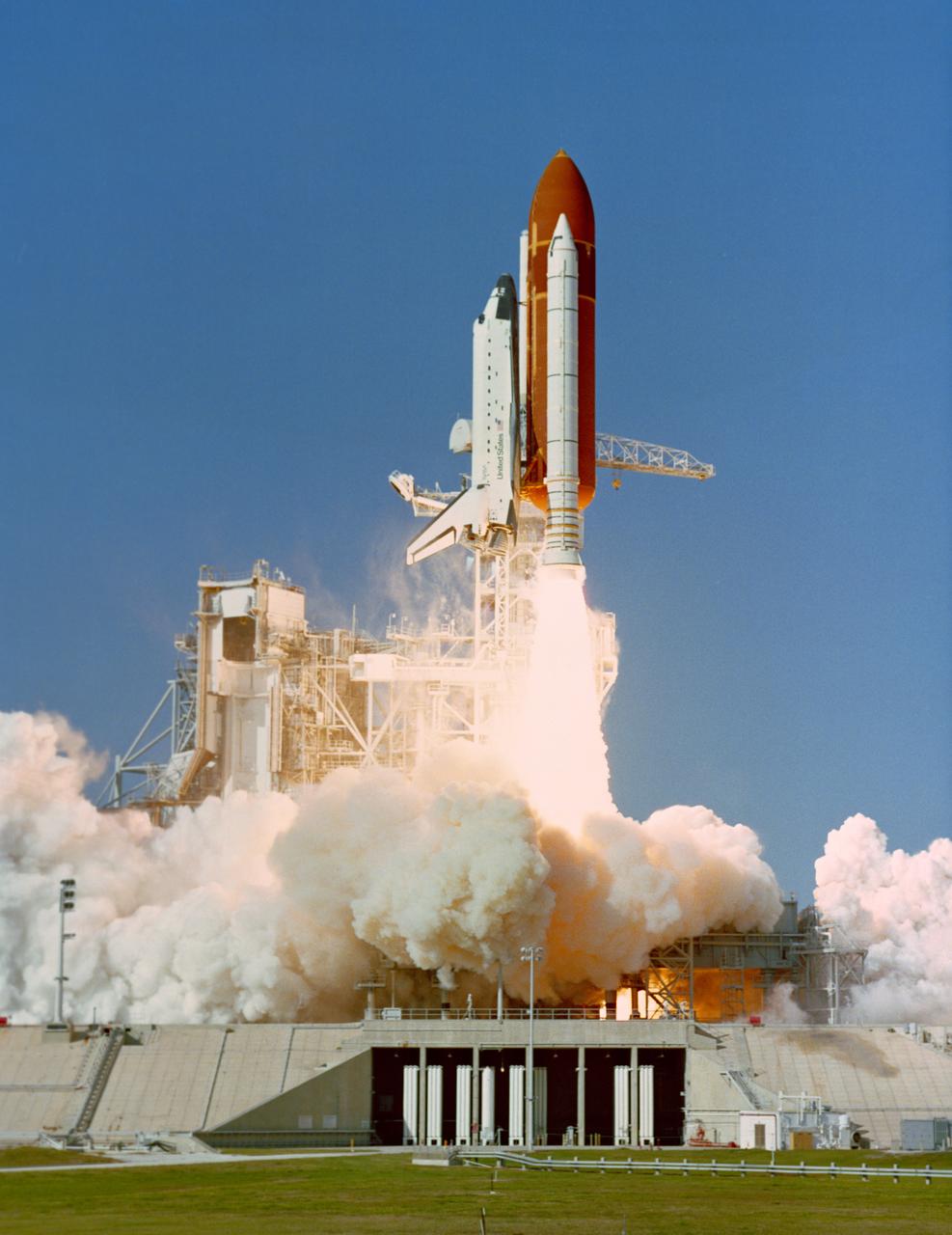
STS027-S-005 (Dec 2, 1988) --- Space Shuttle Atlantis is launched from Kennedy Space Center's (KSC) Pad 39-B at 9:30 a.m. EST, on a Department of Defense (DOD) dedicated mission. This is the third mission for the orbiter Atlantis. Crew members are: Commander Robert L. "Hoot" Gibson; Pilot Guy S. Gardner; and Mission Specialists Jerry L. Ross, William M. Shepherd and Richard M. (Mike) Mullane.
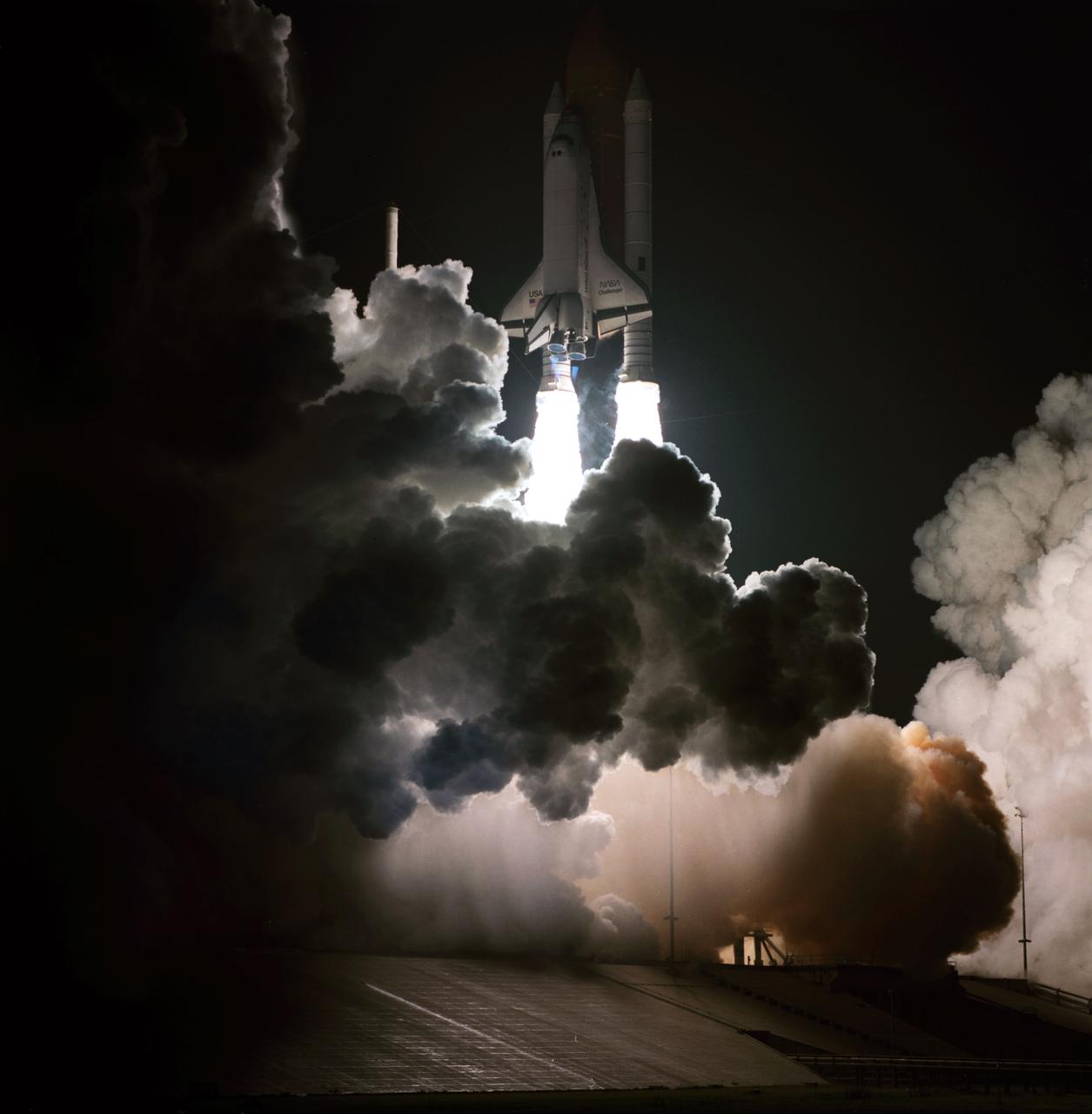
S83-39513 (30 Aug. 1983) --- NASA's eighth space shuttle launch lights up the Florida sky at 2:32 a.m. (EDT), Aug. 30, 1983. The Challenger's third flight is the first to have its beginnings in darkness. Five astronauts and an assortment of experiments are aboard the reusable vehicle. Crew members are astronauts Richard H. Truly, STS-8 commander; Daniel C. Brandenstein, pilot; and Dale A. Gardner, Guion S. Bluford and William E. Thornton, all mission specialists. Photo credit: NASA
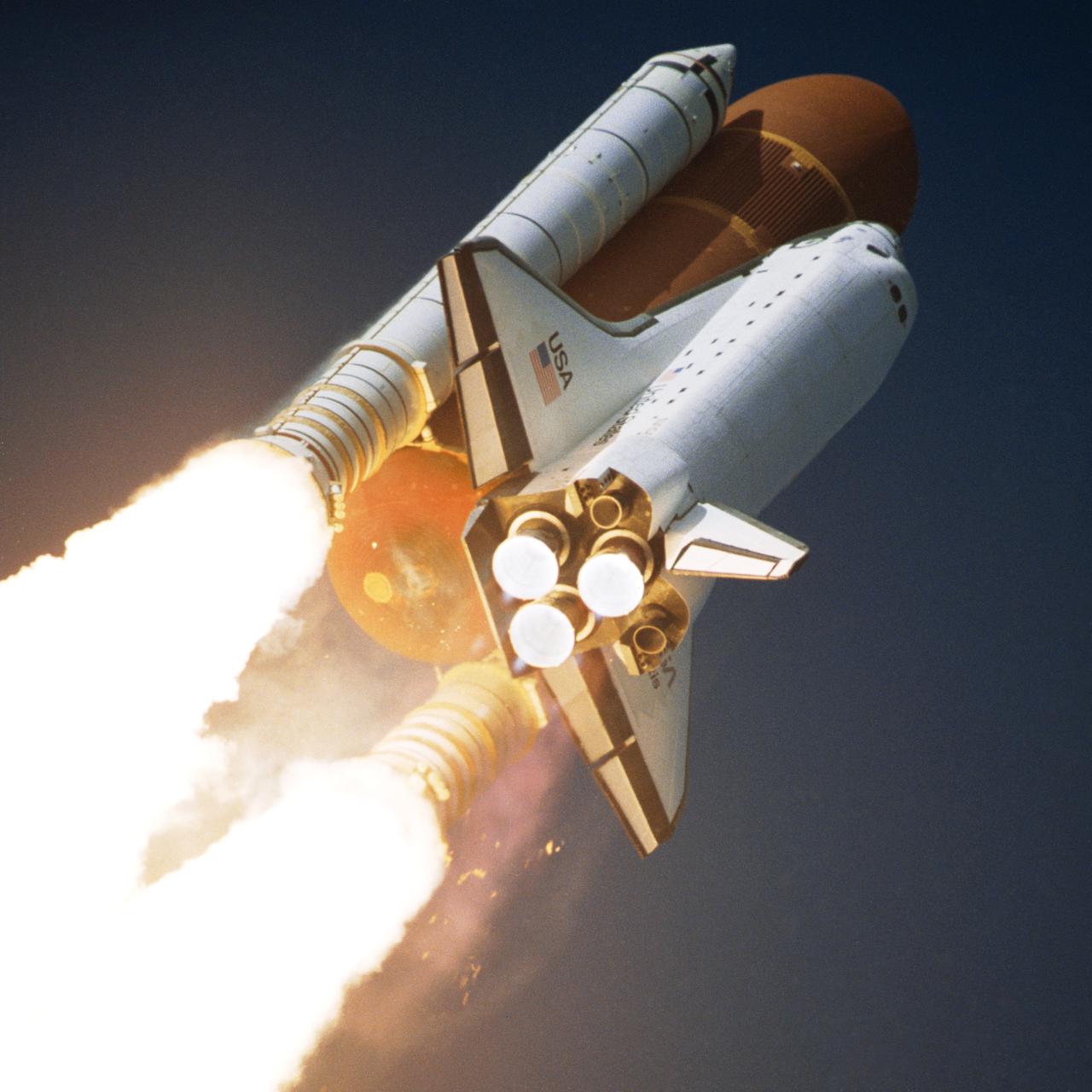
STS027-S-003 (2 Dec. 1988) --- The Space Shuttle Atlantis and its five-man crew of astronauts are launched from Kennedy Space Center?s Pad 39B at 9:30 a.m. (EST), Dec. 2, 1988. Onboard the Department of Defense ? dedicated mission are astronauts Robert L. Gibson, Guy S. Gardner, Jerry L. Ross, Richard M. (Mike) Mullane and Williams M. Shepherd.
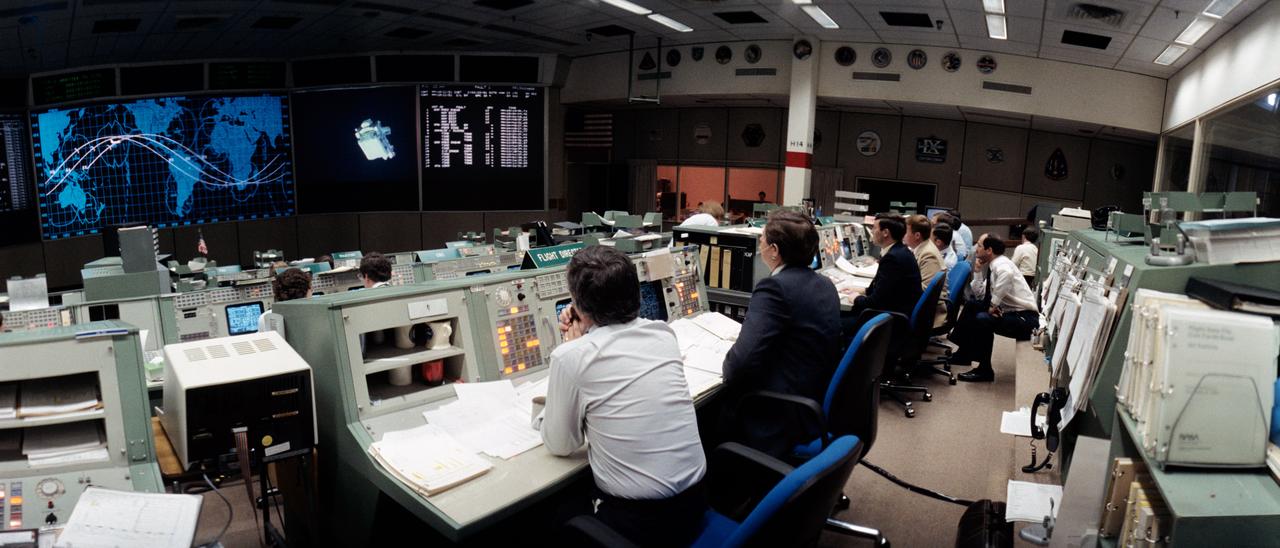
Astronaut George D. Nelson (see monitor at front of room) is viewed by flight controllers in the Mission Operations Control Room (MOCR) of JSC's Mission Control Center during 41-C extravehicular activity (EVA). In the foreground are Flight Directors Jay H. Greene and John T. Cox. Astronauts Jerry L. Ross and Richard H. Richards are seated at the CAPCOM or spacecraft communicators console at right background. Astronaut Guy S. Gardner is perched just behind them.
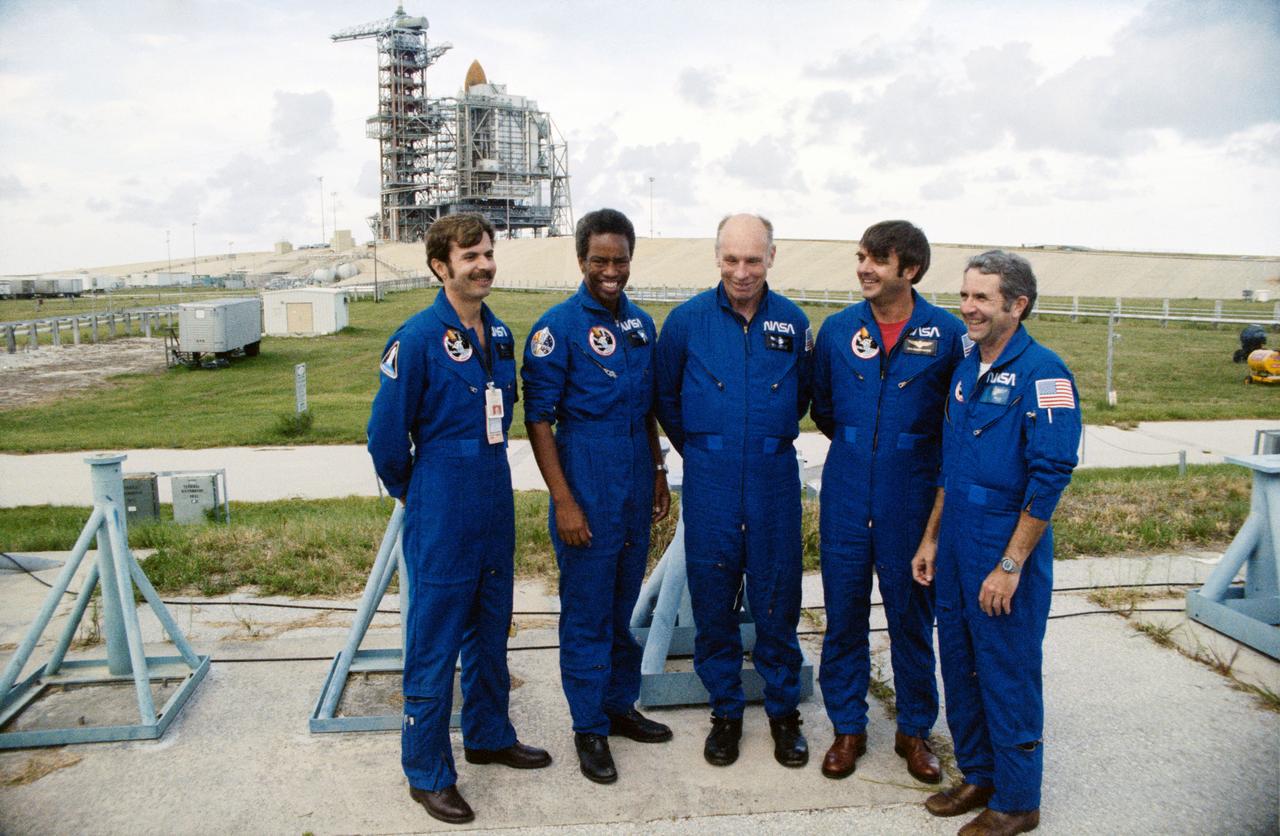
S83-38479 (16 Aug 1983) --- STS-8 crew poses at pad 39A at Kennedy Space Center (KSC) during a session with the news media. From left to right are Astronauts Dale A. Gardner, Guion S. Bluford, and Dr. William E. Thornton, all mission specialists; Daniel C. Brandenstein, pilot; and Richard F. Truly, crew commander.
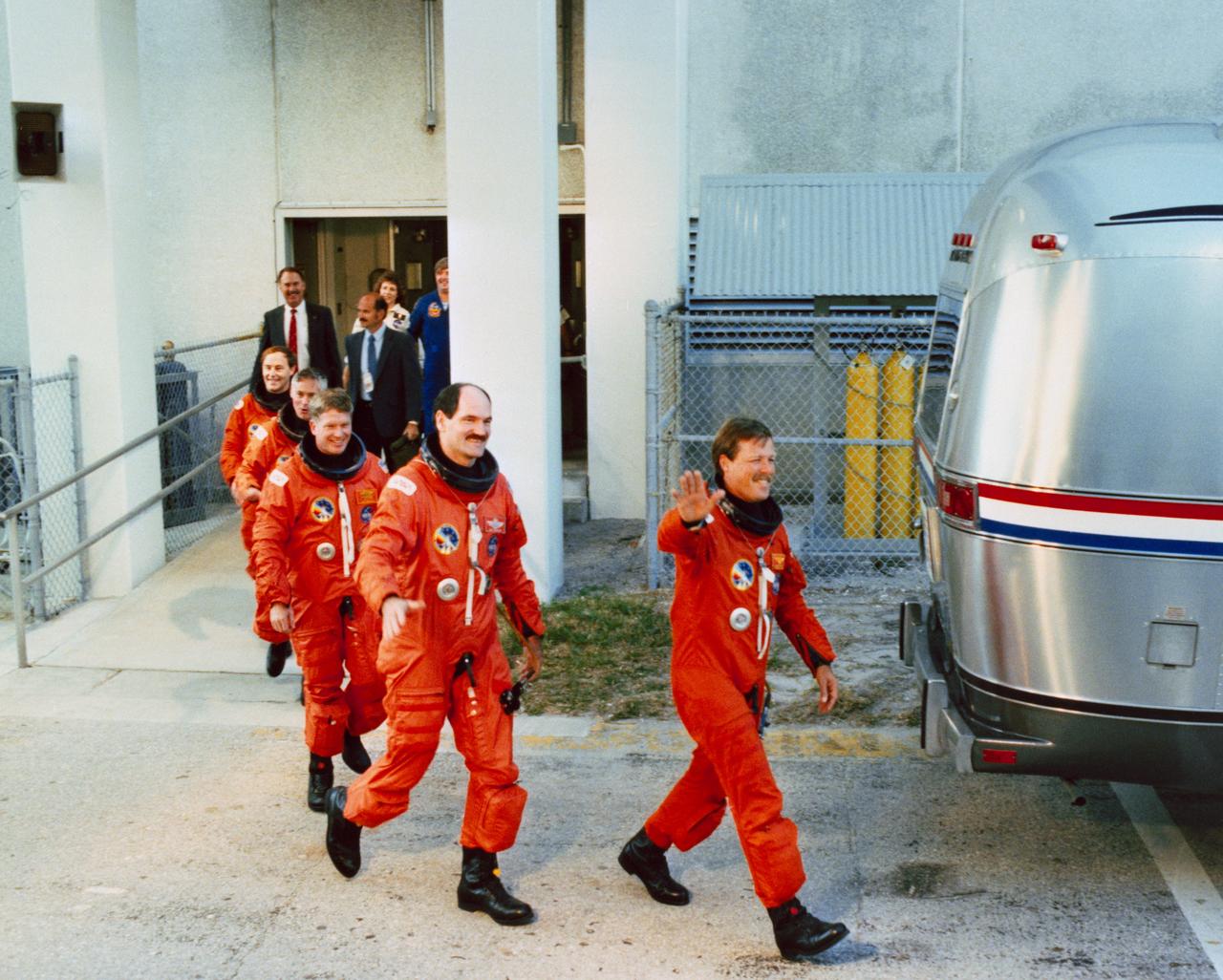
S88-53244 (14 Nov 1988) --- The crewmembers for STS-27 leave the operations and checkout (O&C) building en route to a transfer van that will take them to Launch Pad 39B for their terminal countdown demonstration test. From the front to the rear are astronauts Robert L. Gibson, Guy S. Gardner, William M. Shepherd, Richard M. (Mike) Mullane and Jerry L. Ross.
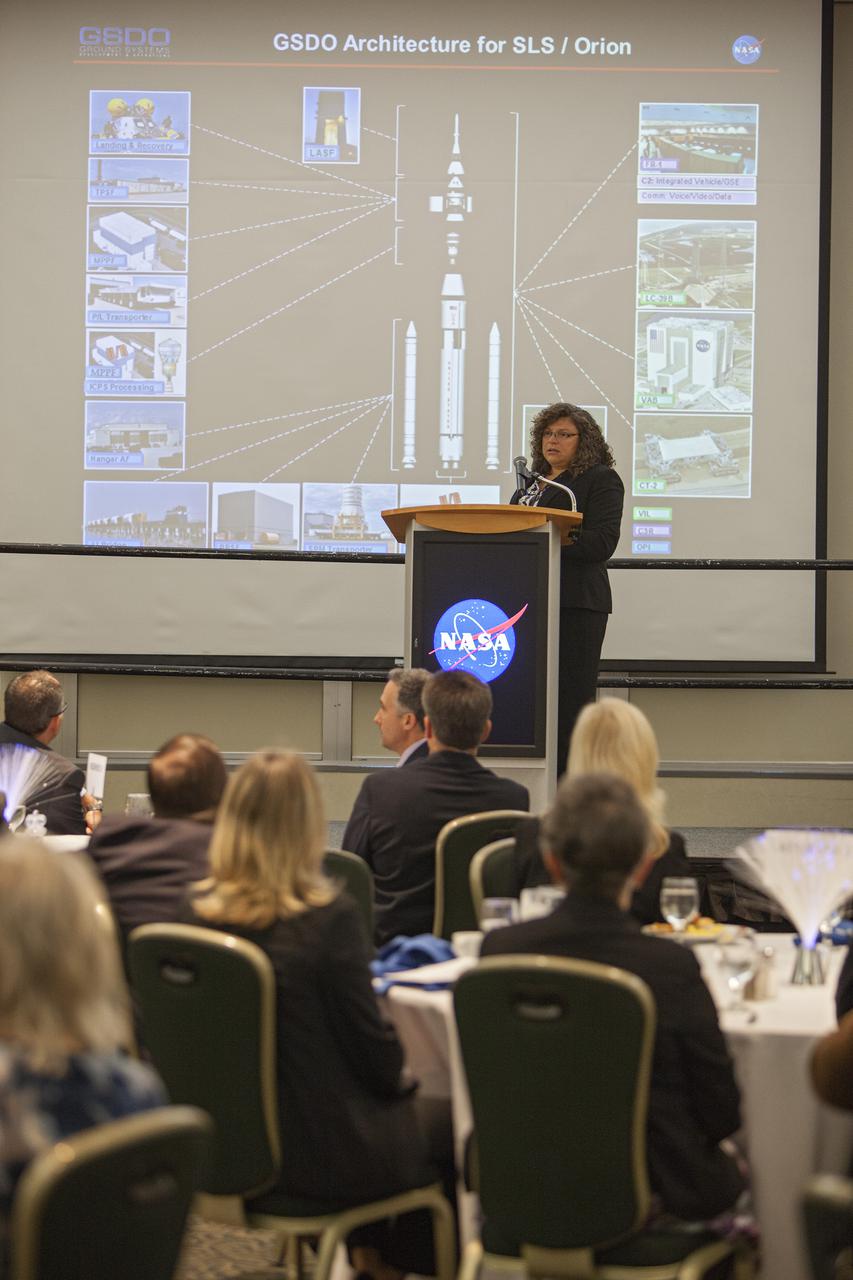
CAPE CANAVERAL, Fla. -- Ruth Gardner, Exploration Systems manager in Ground System Development and Operations at the Kennedy Space Center provided an on current and future activities at the Florida spaceport during the annual Community Leaders Briefing. The reports were part of the annual Community Leaders Briefing at the Kurt H. Debus Conference Center at the Kennedy Space Center Visitor Complex attended by local, state and U.S. government representatives, along with individuals from business and industry. Photo credit: NASA_Dimitri Gerondidakis
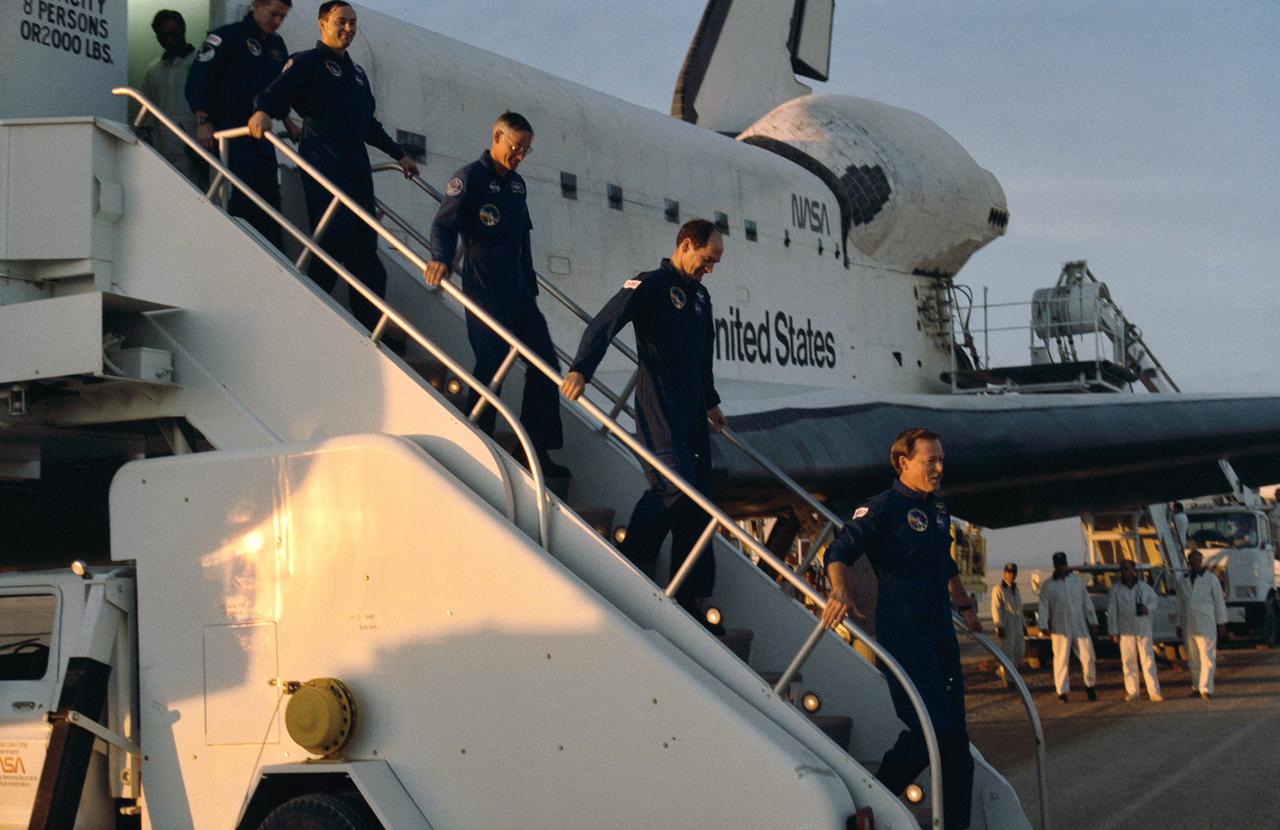
STS027-S-020 (6 Dec 1988) --- The five astronauts who were aboard Atlantis for its return to flight leave their spacecraft after almost 4 1/2 days in space. From bottom to top are Astronauts Robert L. Gibson, mission commander; Guy S. Gardner, pilot; and Richard M. (Mike) Mullane, Jerry L. Ross and William M. Shepherd, mission specialists. Atlantis touched down on Rogers Dry Lake Bed at 3:36 p.m. (PST), Dec. 6, 1988.
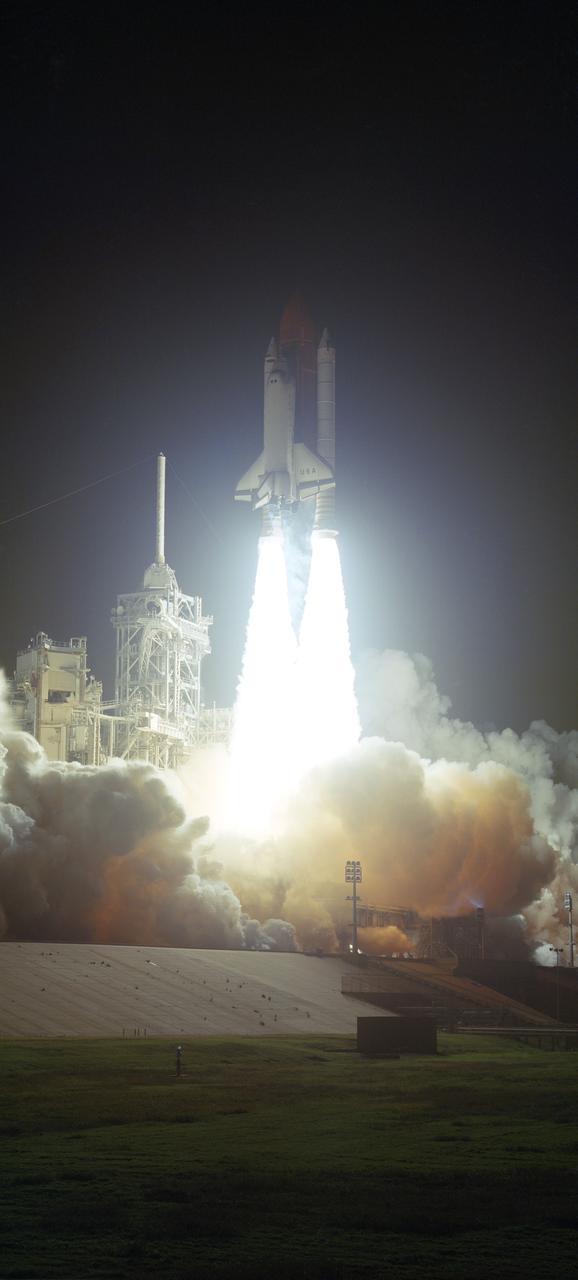
STS035-S-021 (2 Dec 1990) --- The Space Shuttle Columbia lifts off Launch Pad 39B at 1:49 a.m. (EST), Dec. 2, 1990. Primary payload onboard is the Astro-1 astronomical laboratory, headed for a ten-day fight dedicated to the single discipline of astrophysics. Crewmembers are five astronauts--Vance D. Brand, Guy S. Gardner, John M. (Mike) Lounge, Jeffrey A. Hoffman and Robert A.R. Parker--and two payload specialists--Samuel T. Durrance and Ronald A. Parise.
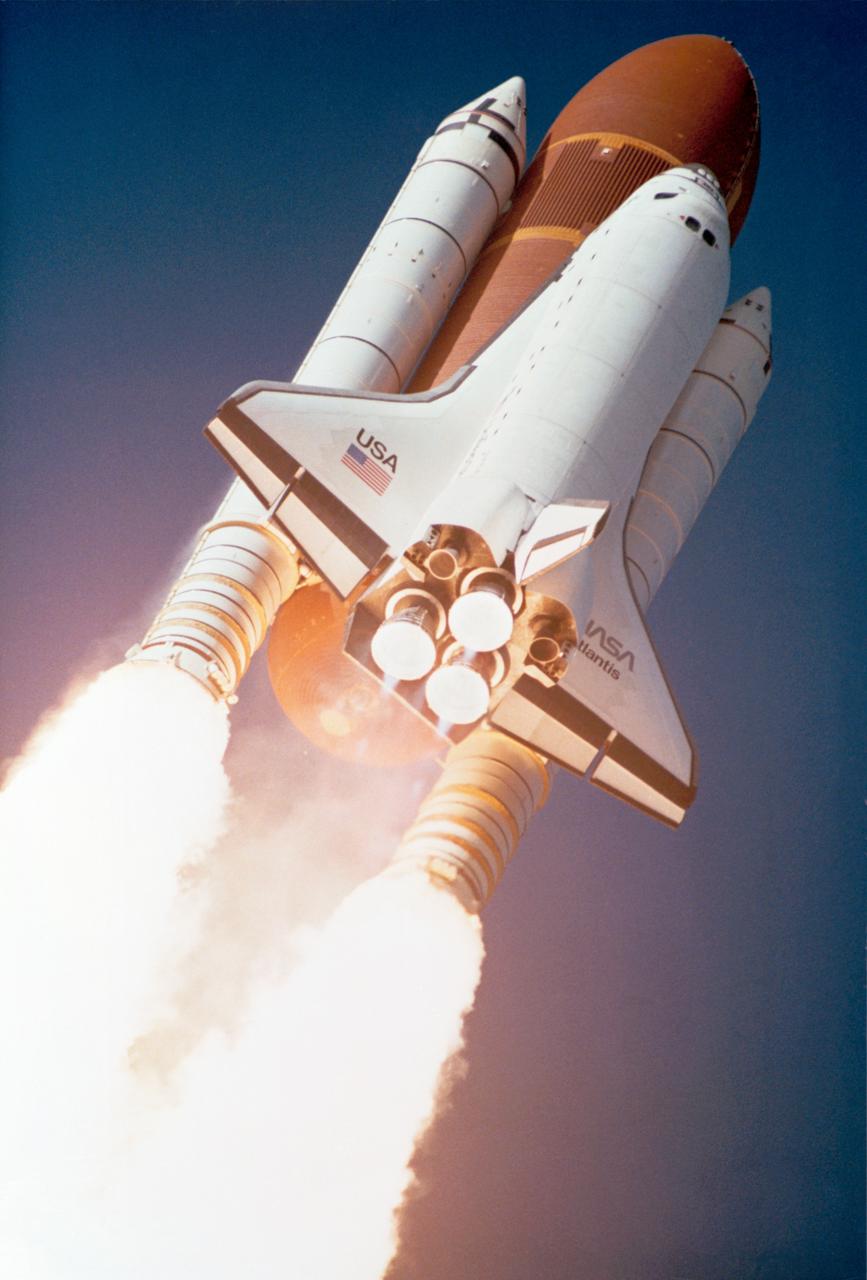
S88-55870 (2 Dec. 1988) --- The space shuttle Atlantis and its five-man crew of astronauts are launched from Kennedy Space Center?s Pad 39B at 9:30 a.m. (EST), Dec. 2, 1988. Onboard the Department of Defense?dedicated mission are astronauts Robert L. Gibson, Guy S. Gardner, Jerry L. Ross, Richard M. (Mike) Mullane and Williams M. Shepherd. Photo credit: NASA
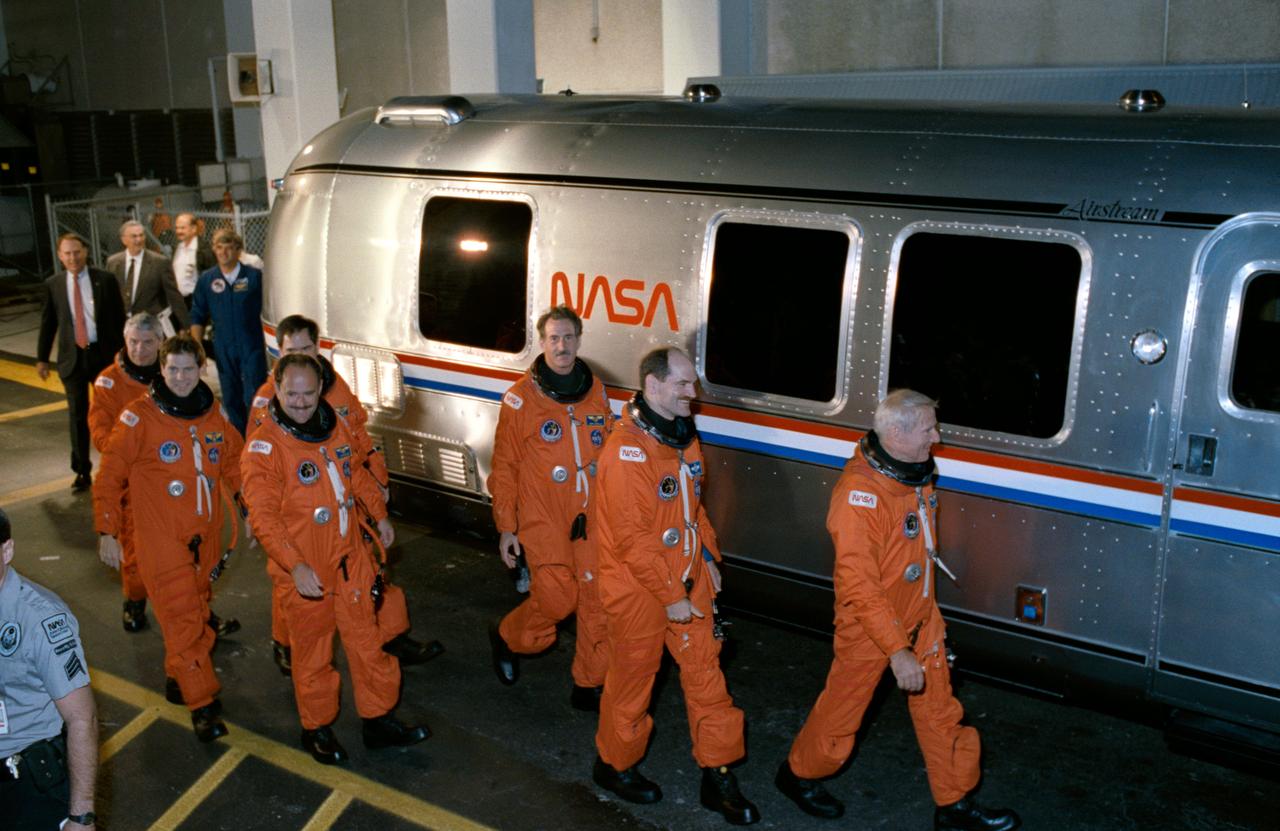
STS035-S-016 (2 Dec 1990) --- Astronaut Vance D. Brand, right, leads the STS 35 crew toward a transfer van that will take them from the nearby operations and checkout (O&C) building to Launch Complex 39. Trailing the mission commander, left to right, are Robert A. R. Parker, Samuel T. Durrance, Ronald A. Parise, John M. (Mike) Lounge, Jeffrey A. Hoffman and Guy S. Gardner.
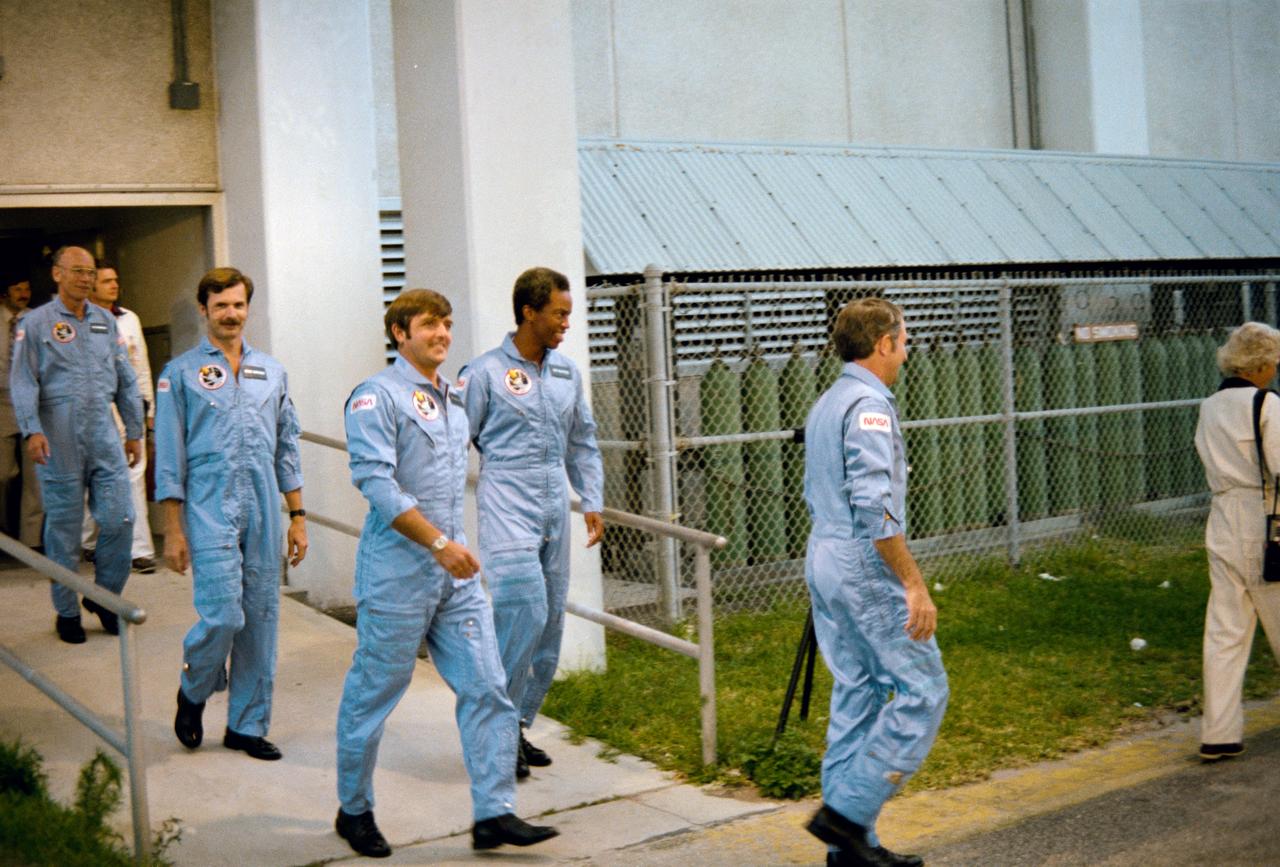
S83-39237 (6 Aug 1983) --- The five astronaut crewmembers of NASA?s STS-8 mission leave the operations and checkout building at the Kennedy Space during a rehearsal for their August 30 launch at KSC?s launch complex 39. They are, from the right, Astronauts Richard H. Truly, commander; Daniel C. Brandenstein, pilot; and Guion S. Bluford, Dale A. Gardner and William E. Thornton, all mission specialists.
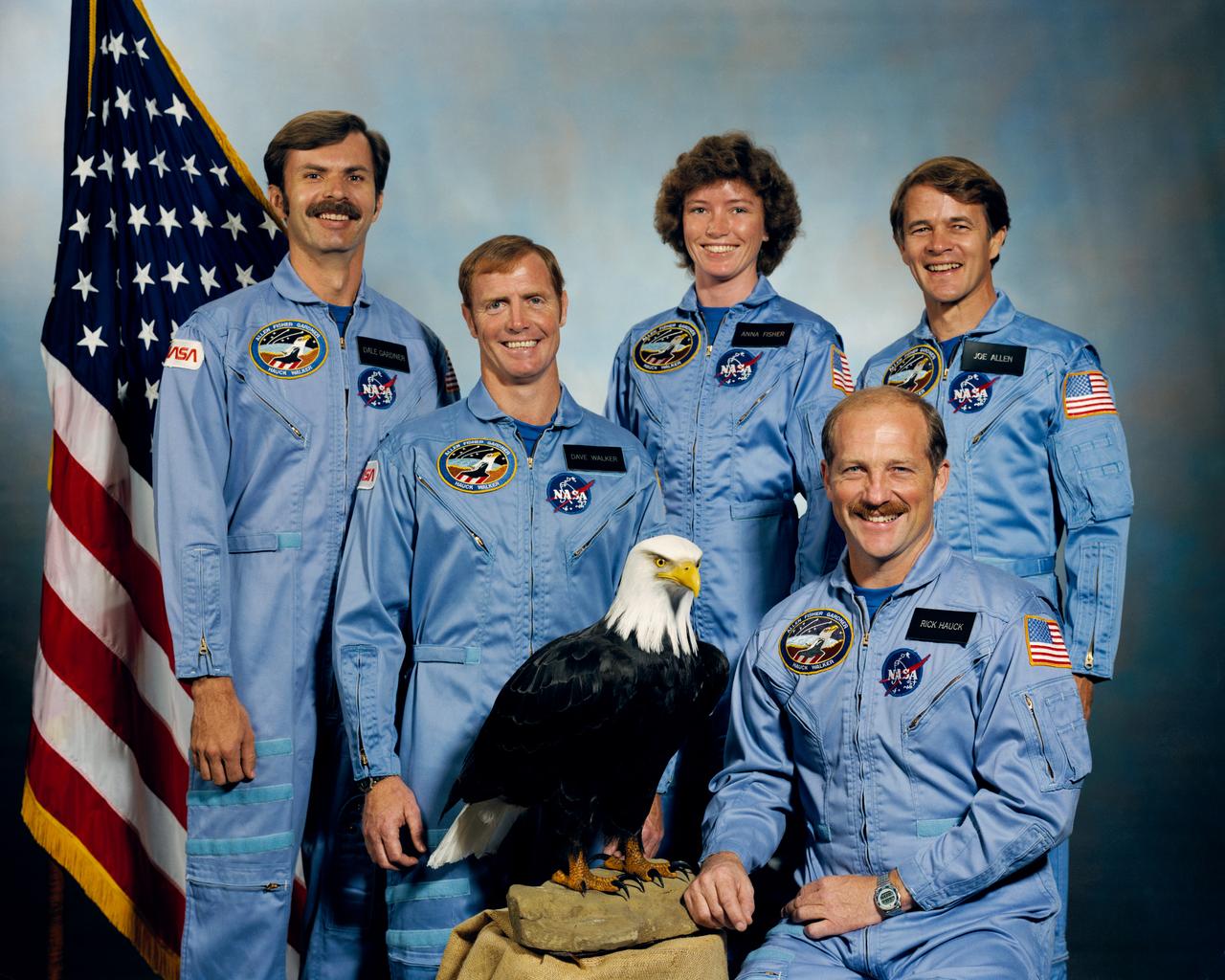
S84-40082 (August 1984) --- These five astronauts are scheduled to fly aboard the Space Shuttle Discovery on Mission STS-51A for NASA. The mission is scheduled for early November 1984. Astronaut Frederick H. (Rick) Hauck, seated, is crew commander. Astronaut David M. Walker, pilot, stands next to the Eagle, 51-A mascot. Others on the back row, left-to-right, are astronauts Dale A. Gardner, Anna L. Fisher and Joseph P. Allen IV, all mission specialists.

51A-13-028 (12 Nov 1984) --- The five-member crew celebrates a successful mission. The reference to the eagle has to do with the Discovery crew’s mascot, which appeared both in its crew portrait and insignia. L-R (front row) astronauts David M. Walker, Anna Lee Fisher and Joseph P. Allen; (back row) Dale A. Gardner and Frederick H. (Rick) Hauck.
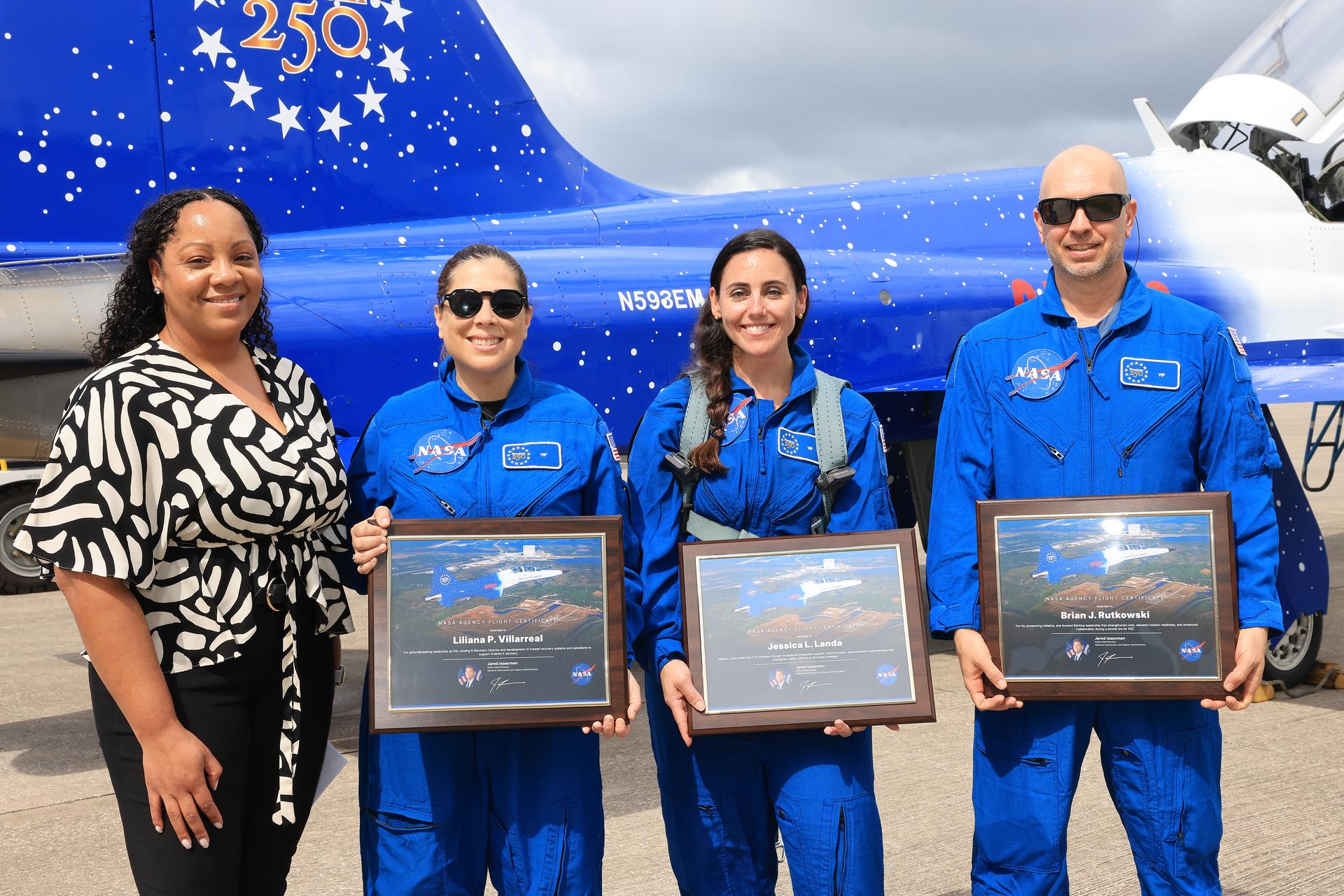
From left, Toni Gardner, Kennedy Space Center Deputy Director of Human Capital Office, along with NASA employees Lilianna Villarreal, Jessica Landa, and Brian Rutkowski pose for a photograph after participating in an employee incentive flying event using NASA Administrator Jared Isaacman's personal F-5 aircraft, Friday, Sept. 18, 2026, at NASA’s Kennedy Space Center in Florida. As part of the agency’s Flight Experience Award program, the employees donned NASA flight suits, completed preflight briefings, and experienced a unique flight. The ride-along flight experience award program highlights NASA’s commitment to celebrating excellence across the workforce.
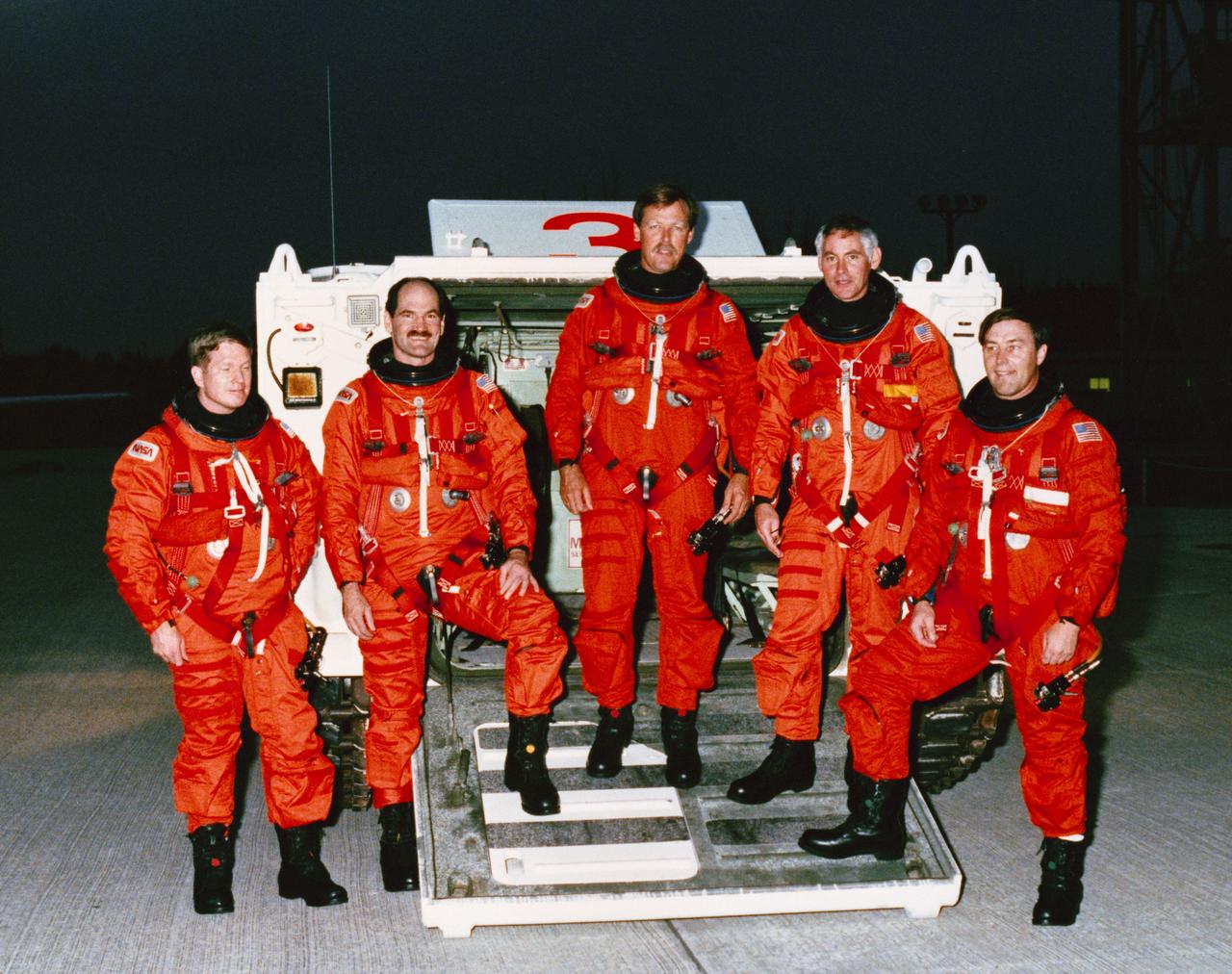
S88-53086 (17 Nov 1988) --- STS-27 Atlantis, Orbiter Vehicle (OV) 104, crewmembers participate in the terminal countdown demonstration test (TCDT) at the Kennedy Space Center (KSC). Standing in front of the M113 tracked rescue vehicle (armored personnel carrier (APC)) are left to right Mission Specialist (MS) William M. Shepherd, Pilot Guy S. Gardner, Commander Robert L. Gibson, MS Richard M. Mullane, and MS Jerry L. Ross. Crewmembers are wearing orange partial pressure or launch and entry suits (LES).
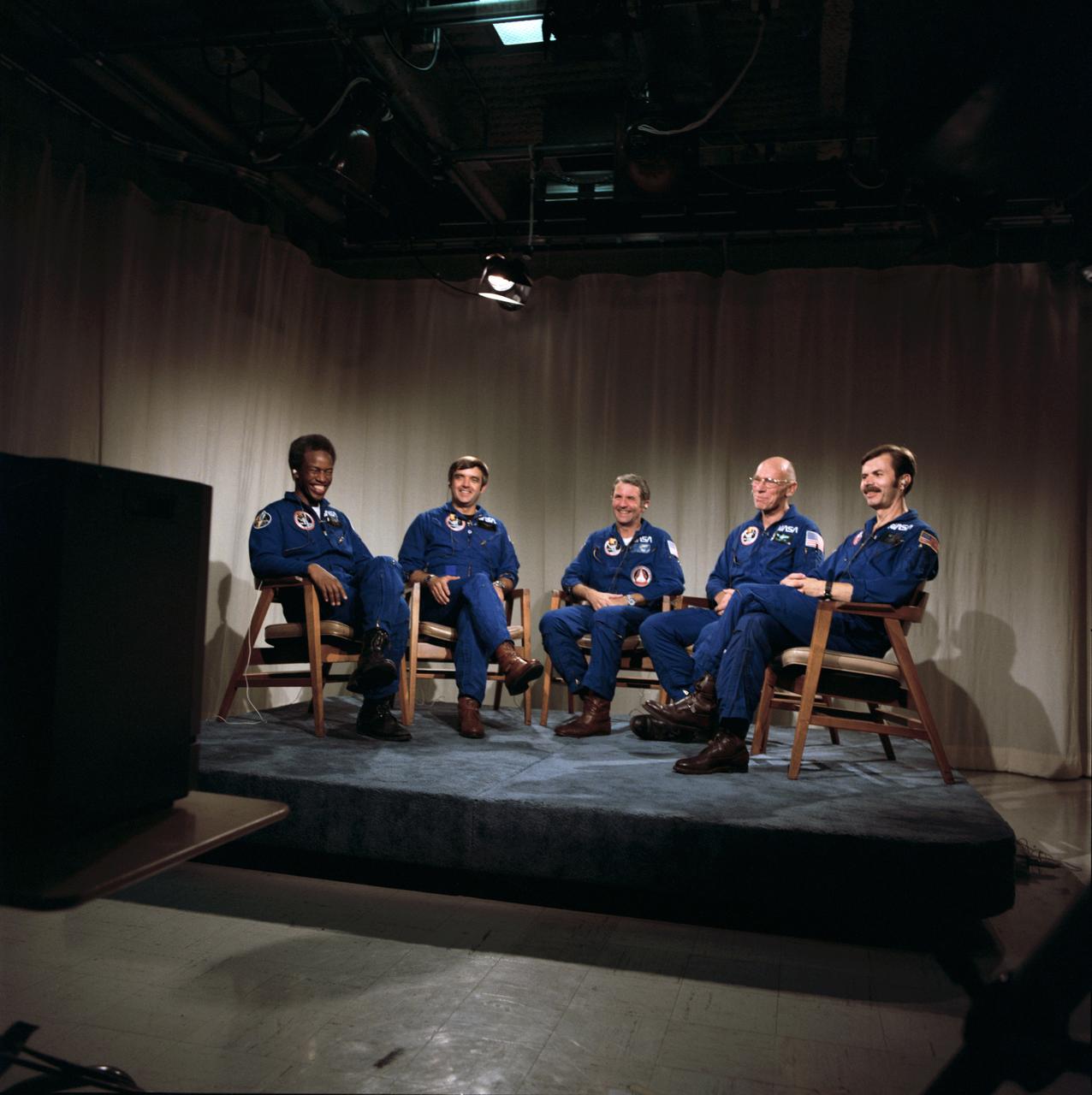
S83-39693 (5 Sept 1983) --- The five member astronaut crew of the Space Shuttle Challenger for STS-8 responds to a comment made by President Ronald Reagan during a post flight telephone conversation with the chief executive. The five astronauts earlier today landed the reusable spacecraft at Edwards Air Force Base in California and were flown to JSC via NASA aircraft. Richard H. Truly, center, is crew commander. Pilot for the six day flight was Daniel C. Brandenstein, second left. The mission specialist were Guion S. Bluford, left: Dr. William S. Thornton, second right, and Dale A. Gardner, right.
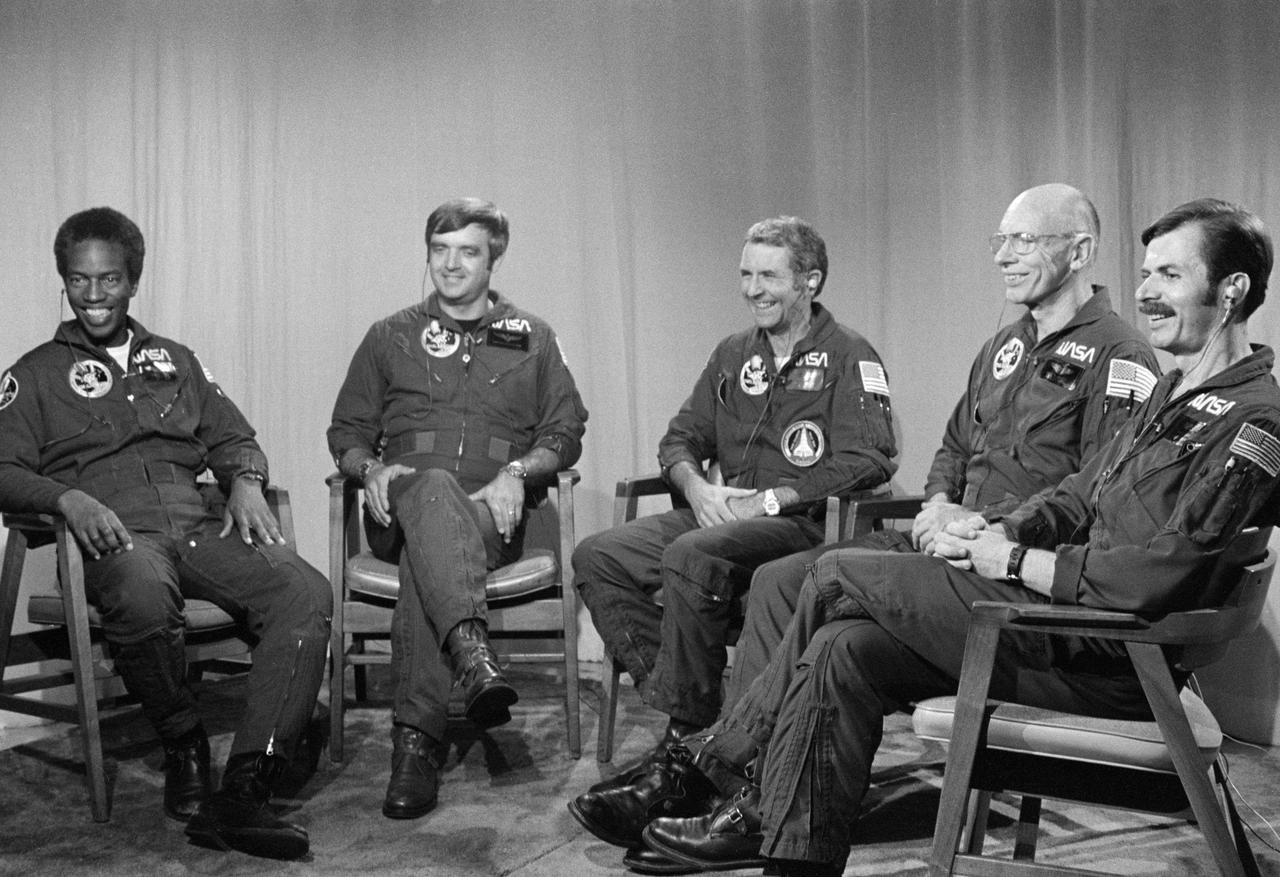
S83-39696 (5 Sept 1983) --- The five member astronaut crew of the Space Shuttle Challenger for STS-8 responds to a comment made by President Ronald Reagan during a post flight telephone conversation with the chief executive. The five astronauts earlier today landed the reusable spacecraft at Edwards Air Force Base in California and were flown to JSC via NASA aircraft. Richard H. Truly, center, is crew commander. Pilot for the six day flight was Daniel C. Brandenstein, second left. The mission specialist were Guion S. Bluford, left: Dr. William S. Thornton, second right, and Dale A. Gardner, right. Photo credit: NASA
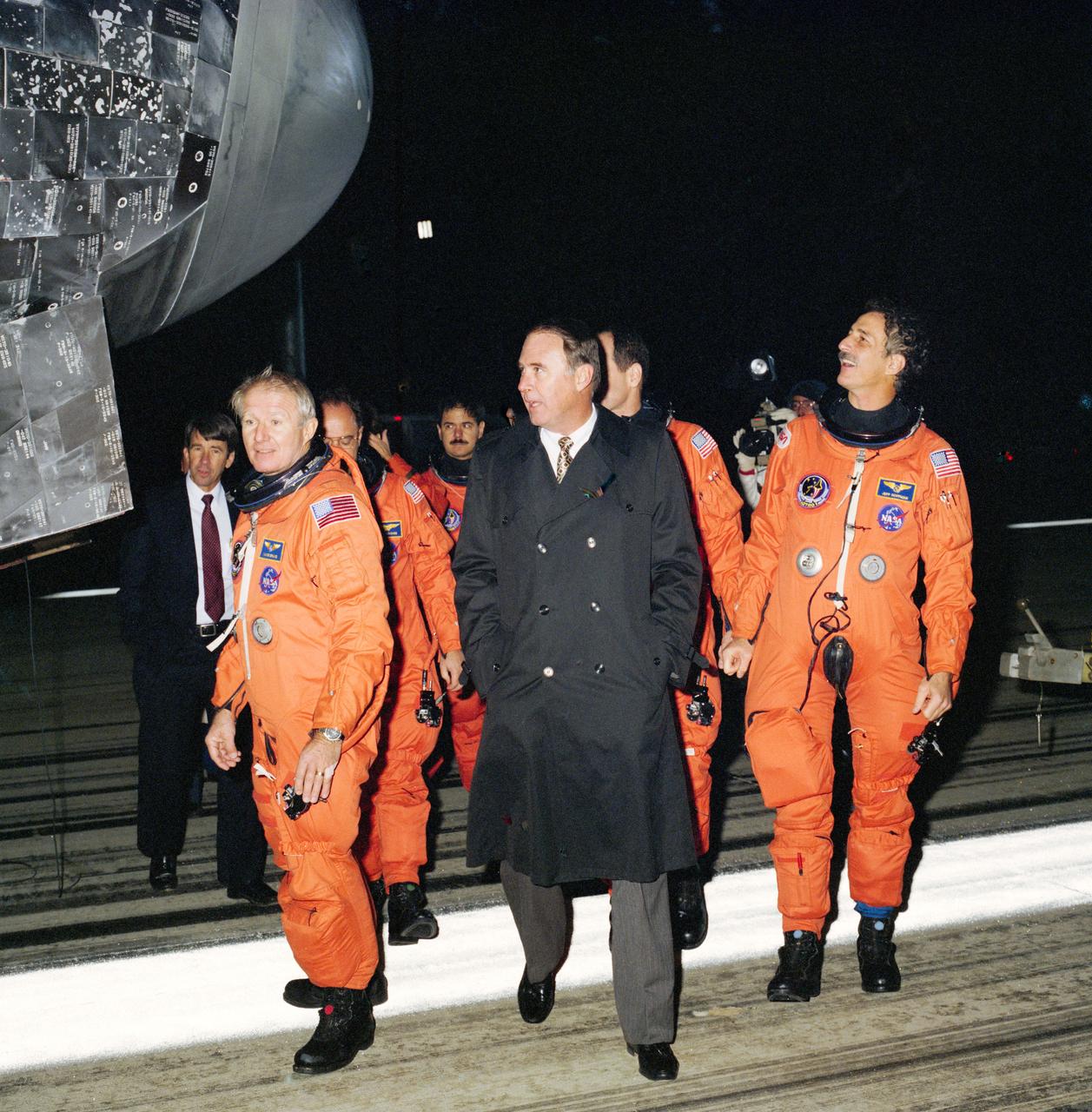
STS035-S-091 (10 Dec 1990) --- Donald R. Puddy (center), Director of Flight Crew Operations at the Johnson Space Center (JSC), joins the STS-35 crewmembers in a post-landing walk-around inspection of the Columbia at Edwards Air Force Base. Crewmembers pictured are, left to right, Vance D. Brand, John M. (Mike) Lounge, Ronald A. Parise, Guy S. Gardner and Jeffrey A. Hoffman. Obscured or out of frame are Samuel T. Durrance and Robert A. R. Parker. Dr. William B. Lenoir, NASA Associate Administrator for Space Flight, is at far left background.

KENNEDY SPACE CENTER, FLA. - Bud Gardner (left), with the Florida Space Research Institute, and U.S. Representative Dave Weldon (right) pose with John Winn, who accepted the Explorer award presented to the Canaveral Council of Technical Societies by the Florida Space Business Roundtable for outstanding contributions to Florida’s space industry. The dinner kicked off the annual Space Congress, held April 28-May 1, 2003, in Cape Canaveral, Fla. The theme for the event was “Linking the Past to the Future: A Celebration of Space” and commemorated the 40th anniversary of the Kennedy Space Center and the Centennial of Flight.
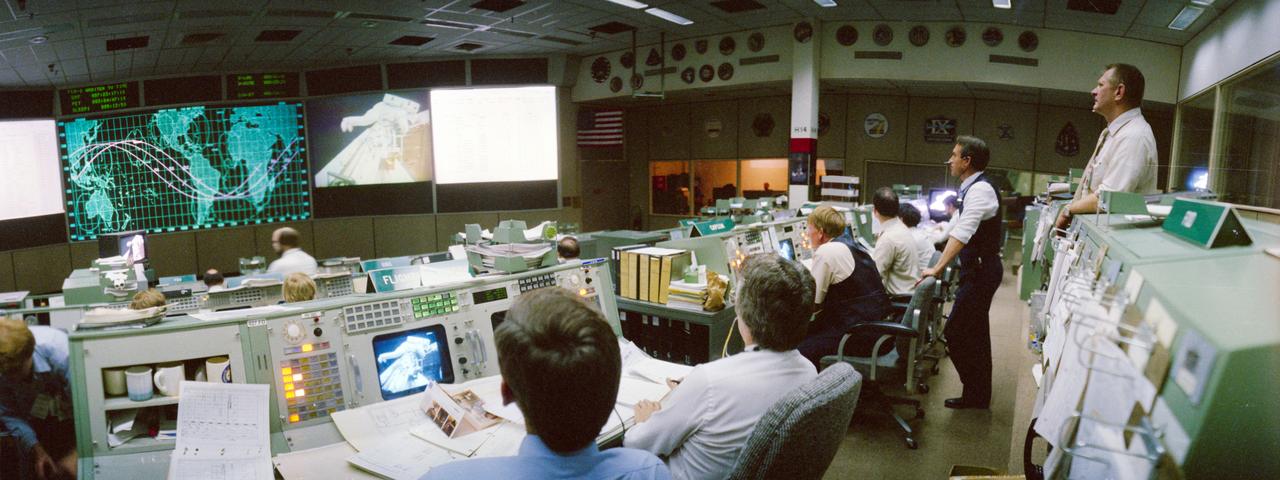
This is a wide-angle view of flight controllers in the MOCR of Mission Control Center (MCC) during the STS-6 Extravehicular Activity (EVA). They are watching the large monitor in the front of the MOCR and small ones at individual consoles as Astronaut Donald H. Peterson translates along the Challenger's port side longerons. Flight Directors Gary E. Coen (left) and Harold M. Draughon are in the foreground. Astronauts John A. McBride and Guy S. Gardner man the Spacecraft Communicator (CAPCOM) Console near center frame. Standing behind the CAPCOM Console is Astronaut William F. Fisher. Eugene F. Kranz, Director of Mission Operations, stands at right near the Flight Operations Directorate Console. JSC, Houston, TX
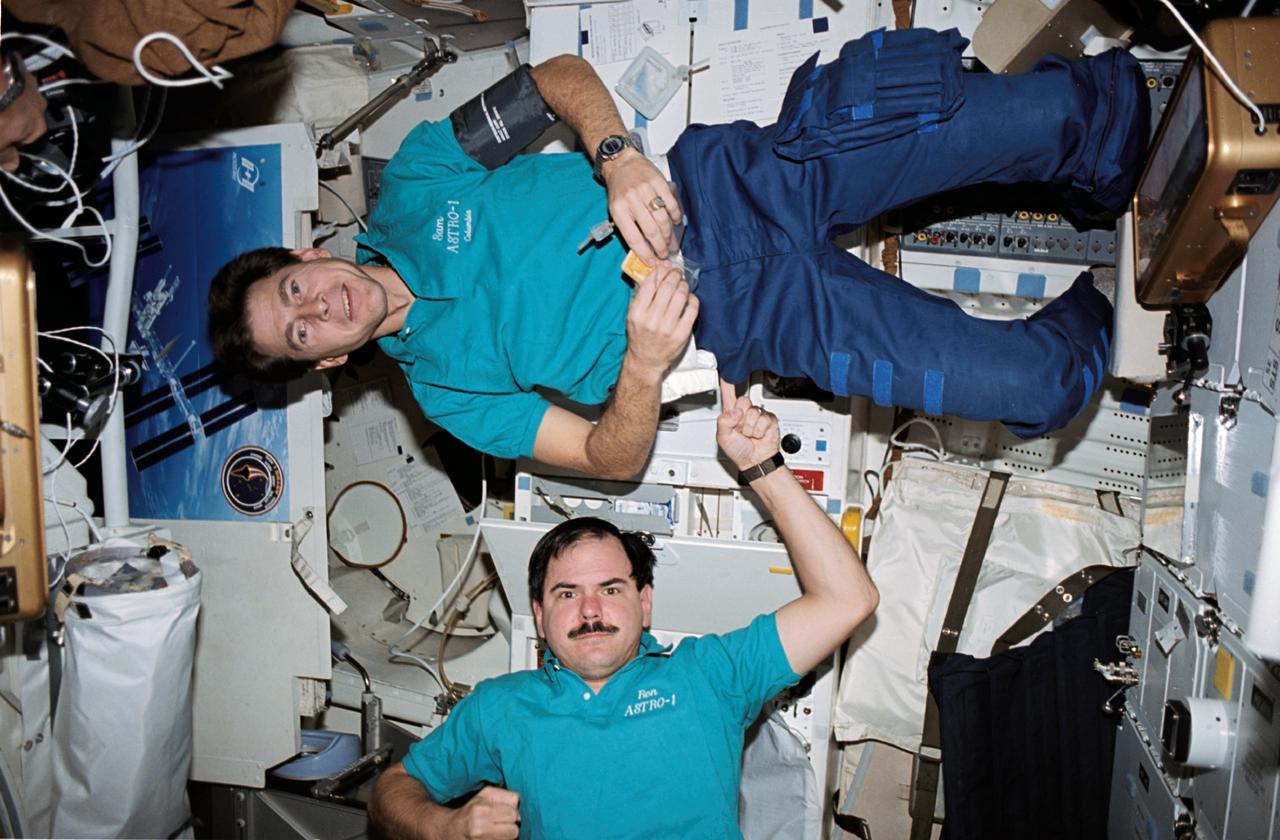
STS035-49-028 (2-10 Dec. 1990) --- This is one of 25 visuals used by the STS-35 crew at its Dec. 20, 1990 post-flight press conference. Columbia's flight of almost nine days duration (launched Dec. 2 from Kennedy Space Center and landed Dec. 10 at Edwards Air Force Base) carried the Astro-1 payload and was dedicated to astrophysics. The mission involved a seven-man crew. Crewmembers were astronauts Vance D. Brand, Guy S. Gardner, Jeffrey A. Hoffman, Robert A.R. Parker and John M. (Mike) Lounge; and Payload Specialists Samuel T. Durrance and Ronald A. Parise.
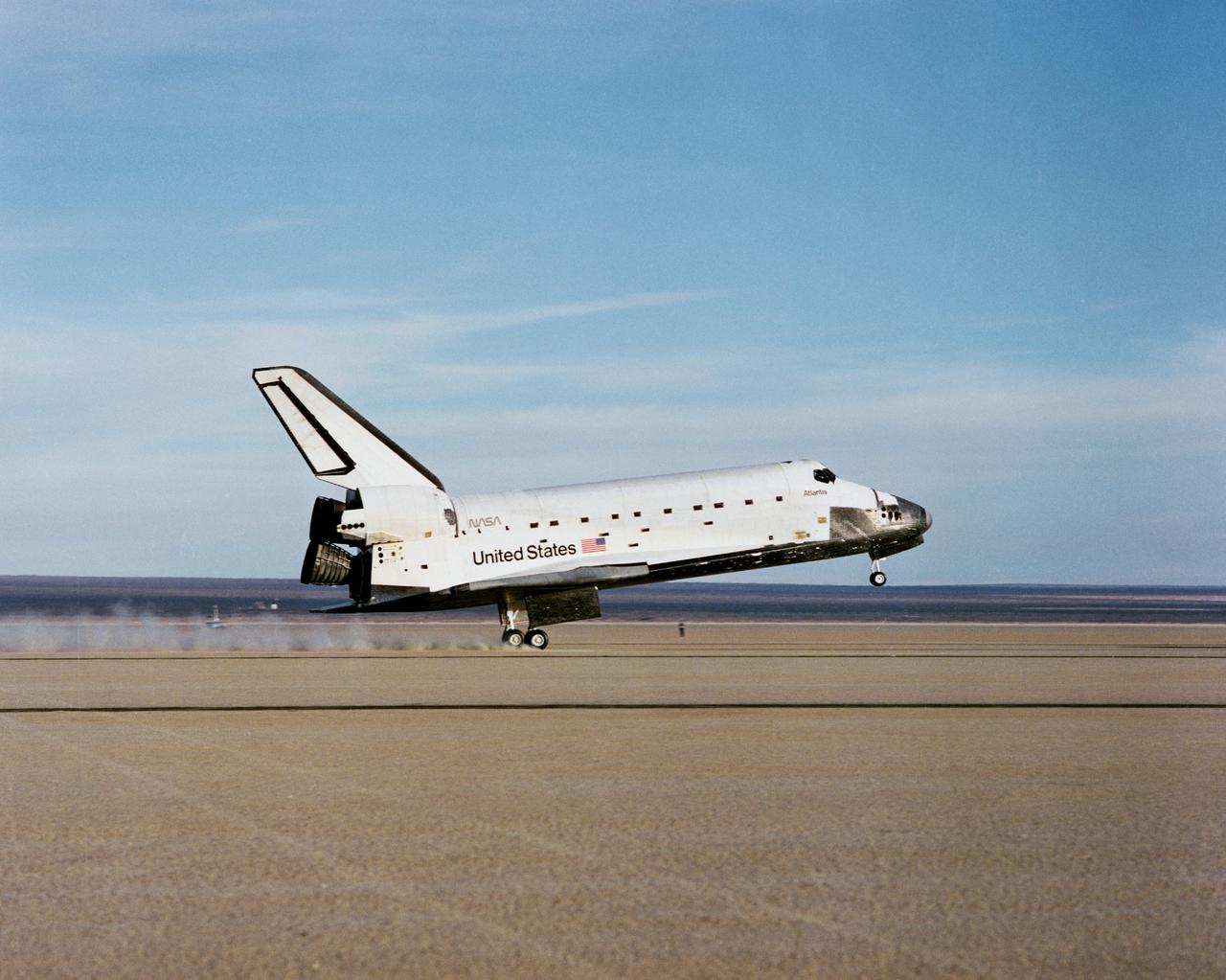
STS027-S-014 (6 Dec. 1988) --- A 70mm camera records the landing of the space shuttle Atlantis on Rogers Dry Lake Bed near the Dryden Flight Research Facility in California. The wheels of the vehicle came to a stop at 3:36:53 p.m. (PST), marking the completion of a successful mission which involved five veteran NASA astronauts. Onboard for the four-day flight were astronauts Robert L. Gibson, Guy S. Gardner, Jerry L. Ross, Richard M. (Mike) Mullane and William M. Shepherd. Photo credit: NASA
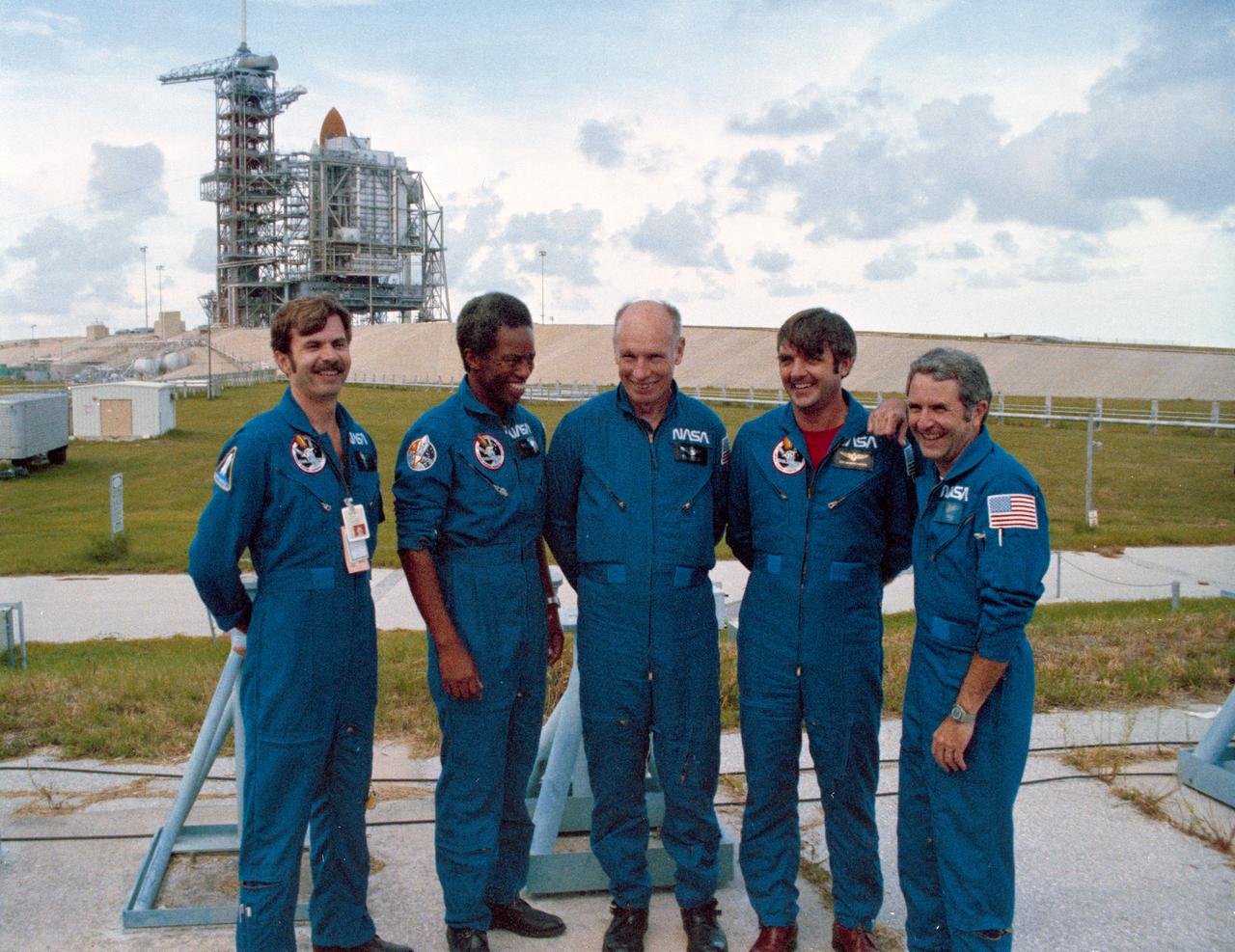
S83-38389 (6 Aug. 1983) --- The STS-8 crew members pause for a crew photo at Pad 39A after a question and answer session with the press. They were about to participate in the STS-8 countdown demonstration test. They will repeat many of their measures on Aug. 30 when they are scheduled to lift off aboard the space shuttle Challenger. From left to right are astronauts Dale A. Gardner, Guion S. Bluford, Dr. William E. Thornton, all mission specialists; Daniel C. Brandenstein, pilot; and Richard F. Truly, commander. The Challenger is in the background at complex 39.
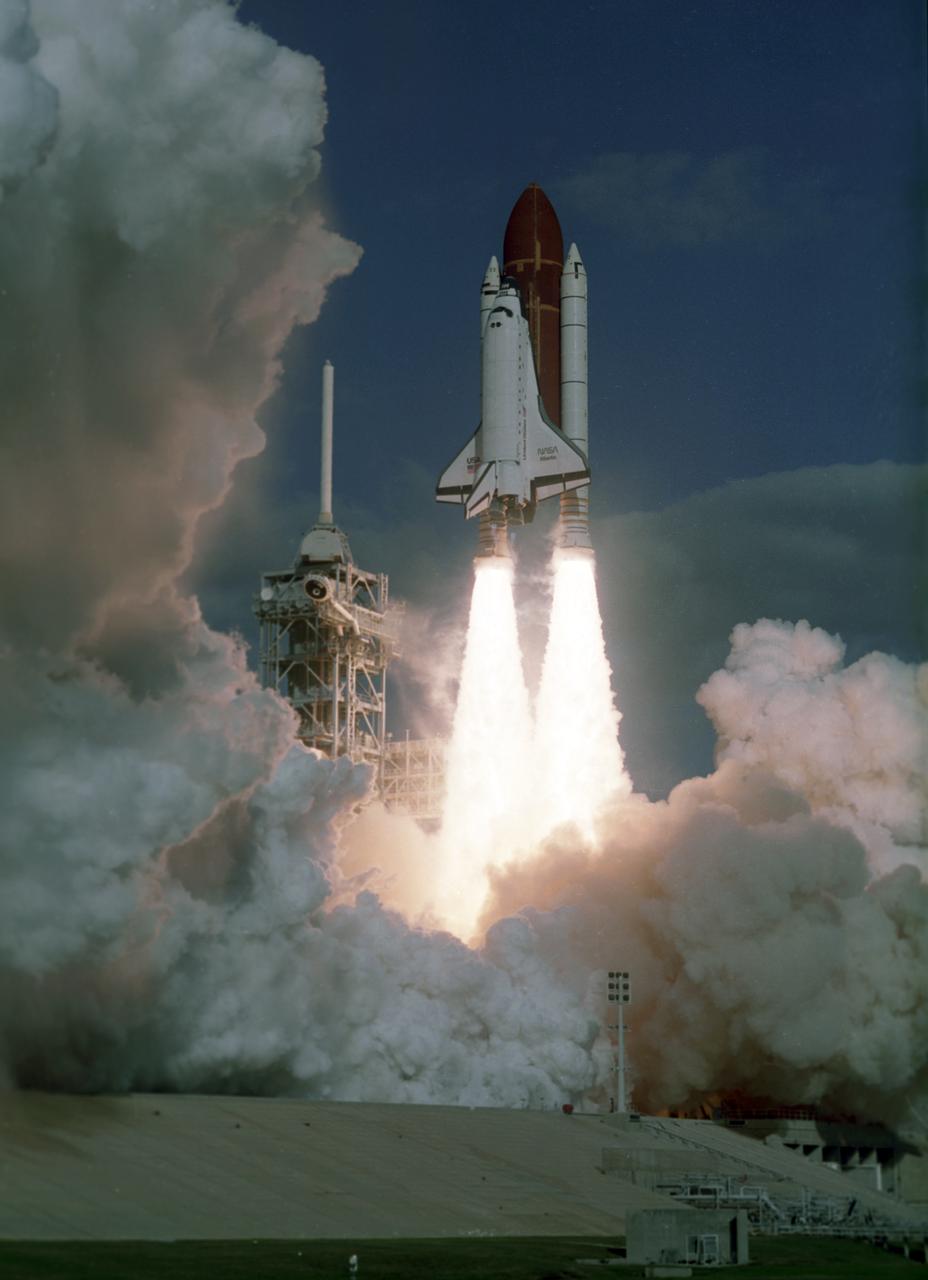
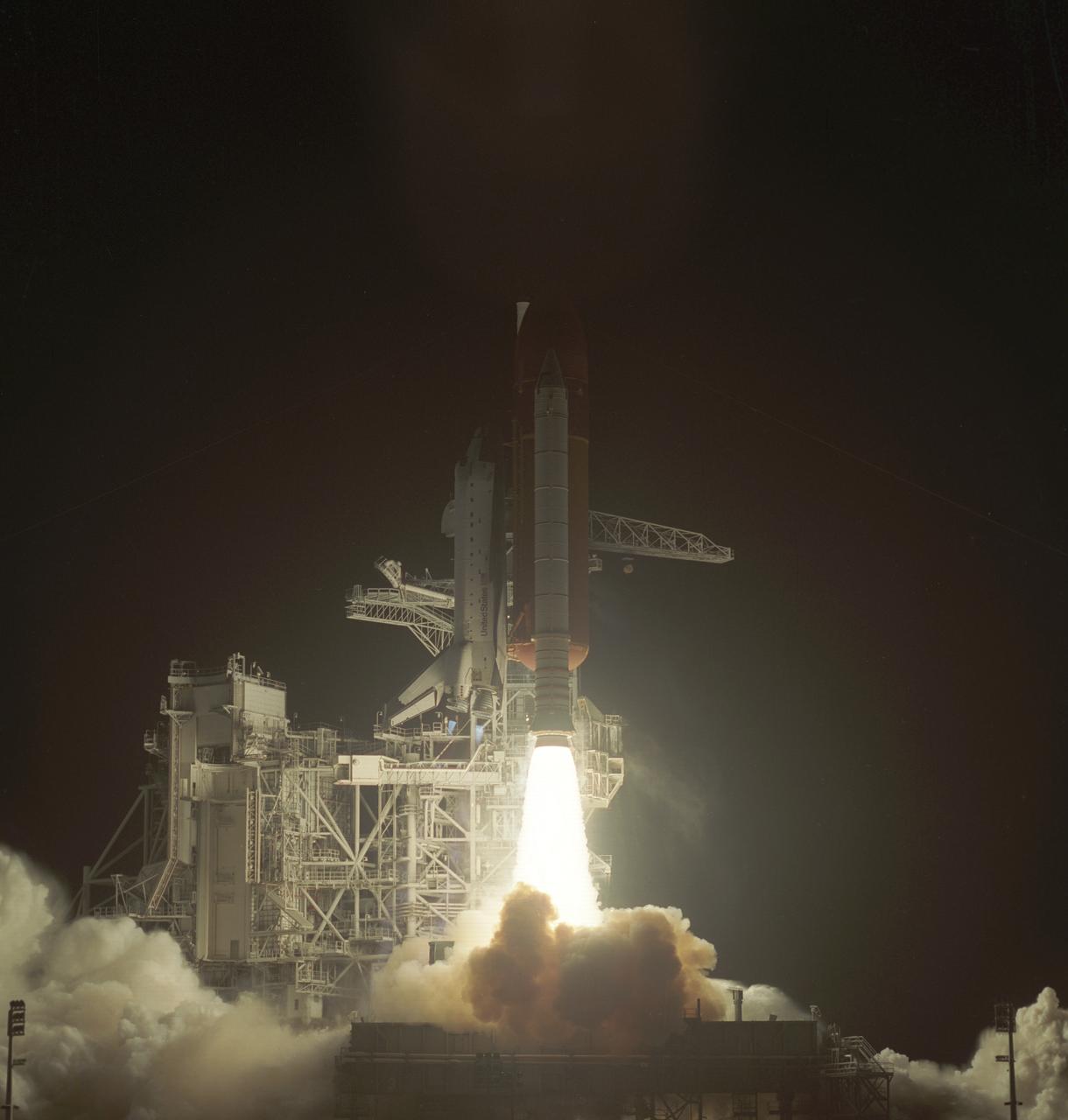
Space Shuttle orbiter Atlantis takes flight on its STS-27 mission, December 2, 1988, utilizing 375,000 pounds of thrust produced by its three main engines. The engines start in 3.9 seconds of ignition and go to static pump speeds of approximately 35,000 revolutions per minute during that time. The Marshall Space Flight Center had management responsibility of Space Shuttle propulsion elements, including the Main Engines. The STS-27 mission, the third mission dedicated to the Department of Defense (DOD), was crewed by five astronauts: Robert L. Gibson, commander; Guy S. Gardner, pilot; and mission specialists Richard M. Mullane, Jerry L. Ross, and William M. Shepherd.
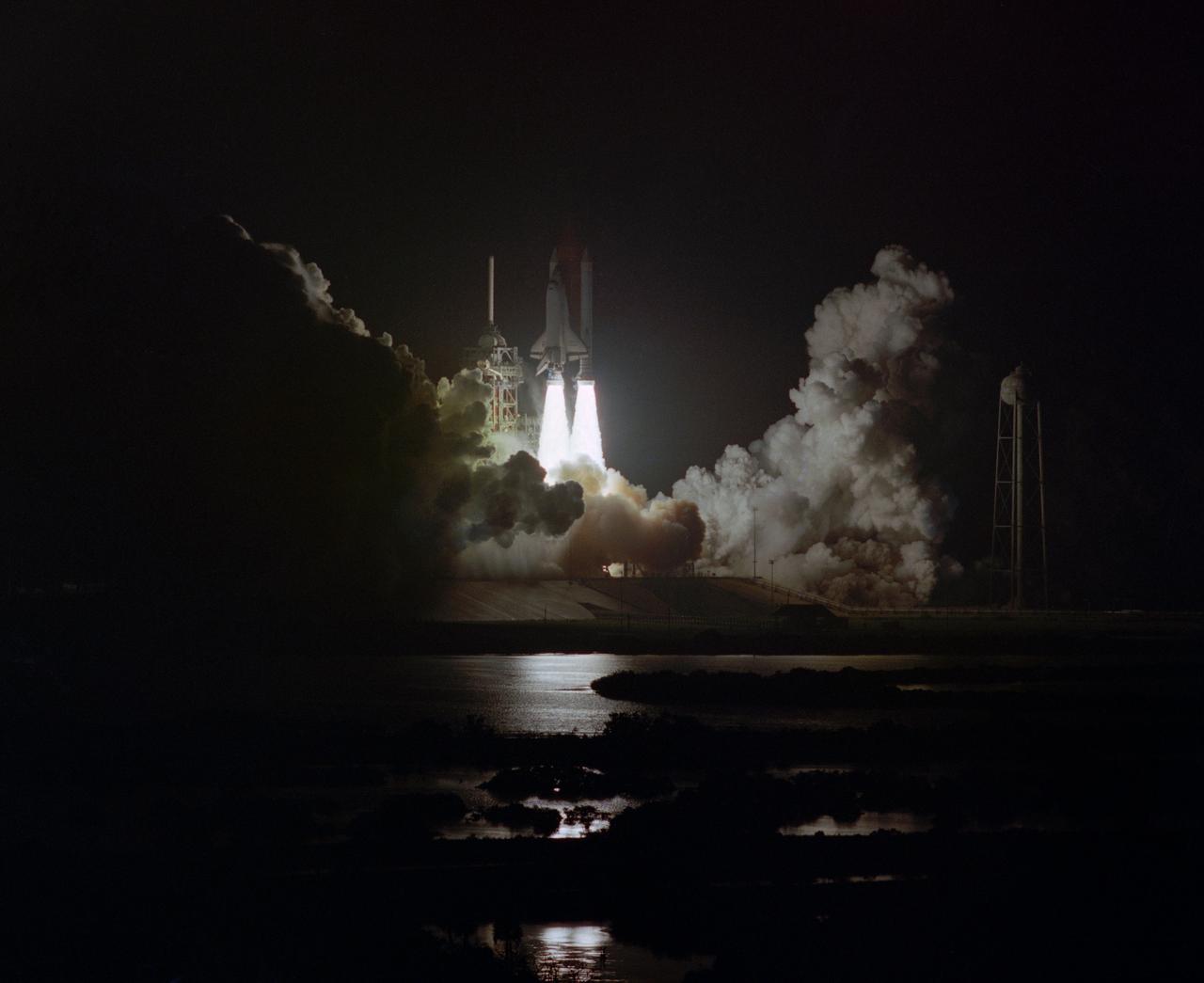
S83-39512 (30 Aug. 1983) --- NASA's eighth space shuttle launch lights up the Florida sky at 2:32 a.m. (EDT), Aug. 30, 1983. The space shuttle Challenger's third flight is the first to have its beginnings in darkness. Five astronauts and an assortment of experiments are aboard the reusable vehicle. Crew members are astronauts Richard H. Truly, STS-8 commander; Daniel C. Brandenstein, pilot; and Dale A. Gardner, Guion S. Bluford and William E. Thornton, all mission specialists. Photo credit: NASA
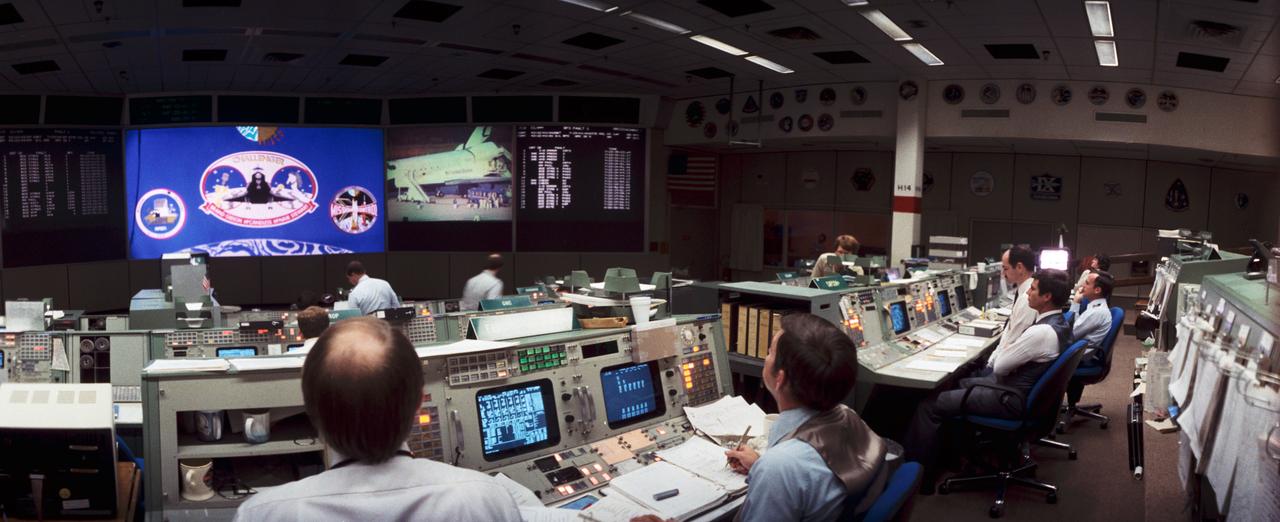
S84-26977 (11 Feb 1984) --- Flight Director Randy Stone, left, and Gary Coen, center foreground, watch a monitor in the front of the mission operations control room (MOCR) to stay attuned to post-landing activity at the KSC facility in Florida. MOCR is the Johnson Space Center?s mission control center. Astronauts John E. Blaha and Guy S. Gardner man the spacecraft communicator (CAPCOM) console in the background. The Space Shuttle Challenger, having just completed its fourth mission in earth orbit and weighing some 201,600 pounds, can be seen on the monitor.
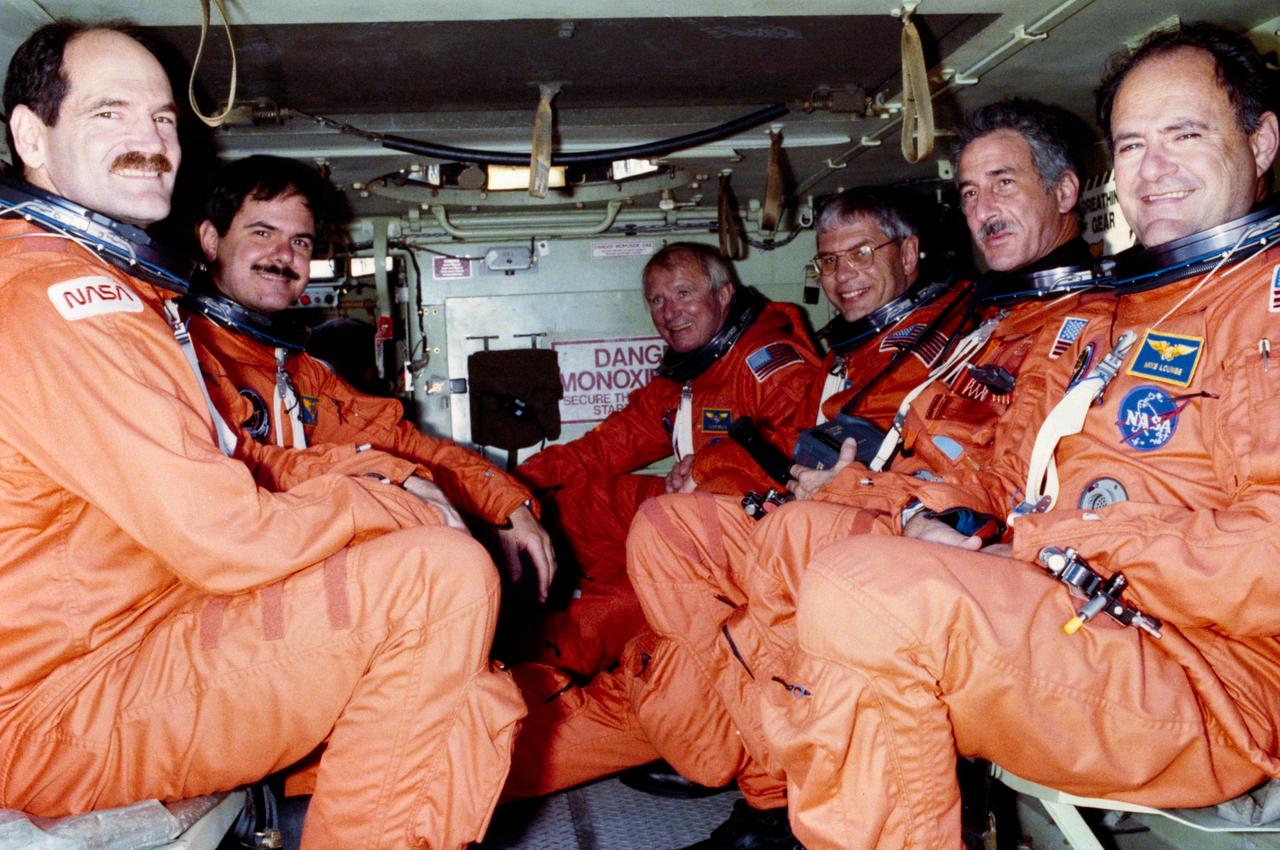
S90-40670 (13 June 1990) --- STS-35 crewmembers take a ride in the M113 tracked vehicle during emergency training conducted during the Terminal Countdown Demonstration Test (TCDT) at the Kennedy Space Center (KSC). From left, wearing launch and entry suits (LES), are pilot Guy S. Gardner, payload specialist Ronald A. Parise, commander Vance D. Brand, mission specialists Robert A. R. Parker, Jeffrey A. Hoffman and John M. Lounge. The two-day TCDT, which began 04-27-90, is a dress rehearsal for launch. STS-35 is set to lift off in May. View provided by KSC with alternate number KSC-90PC-838.
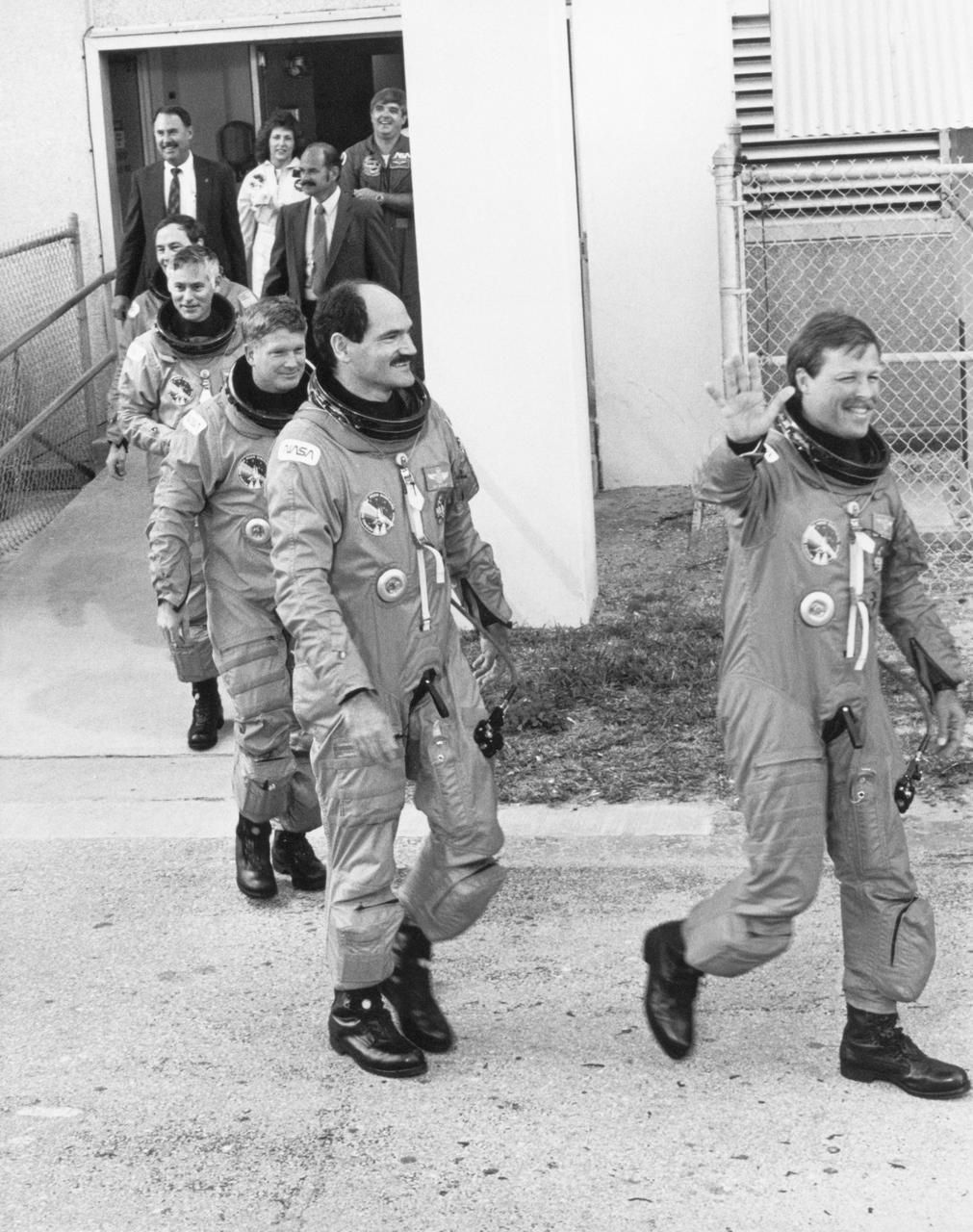
S88-53088 (2 Dec. 1988) --- The STS-27 crew strides down the ramp from the Operations and Checkout Building at Kennedy Space Center to grab a van that will take the crew members to Launch Complex 39 for the Dec. 2, 1988 liftoff of Atlantis. Astronaut Robert L. Gibson, commander, waves to well-wishers (out of frame). He is followed by astronaut Guy S. Gardner, pilot, along with the flight?s three mission specialists -- astronauts William M. Shepherd, Richard M.(Mike) Mullane and Jerry L. Ross. Photo credit: NASA
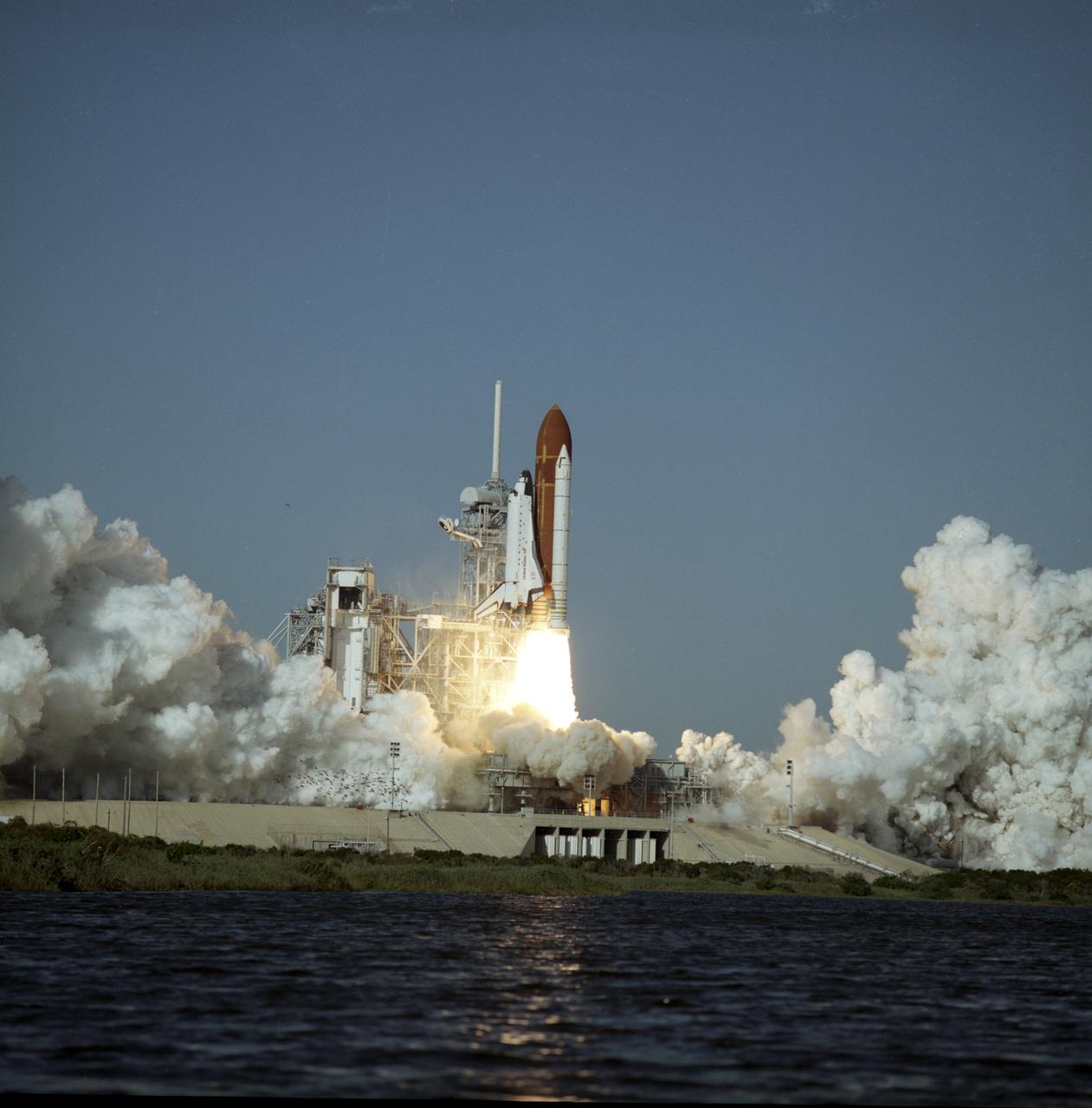
Space Shuttle orbiter Atlantis takes flight on its STS-27 mission, December 2, 1988, utilizing 375,000 pounds of thrust produced by its three main engines. The engines start in 3.9 seconds of ignition and go to static pump speeds of approximately 35,000 revolutions per minute during that time. The Marshall Space Flight Center had management responsibility of Space Shuttle propulsion elements, including the Main Engines. The STS-27 mission, the third mission dedicated to the Department of Defense (DOD), was crewed by five astronauts: Robert L. Gibson, commander; Guy S. Gardner, pilot; and mission specialists Richard M. Mullane, Jerry L. Ross, and William M. Shepherd.
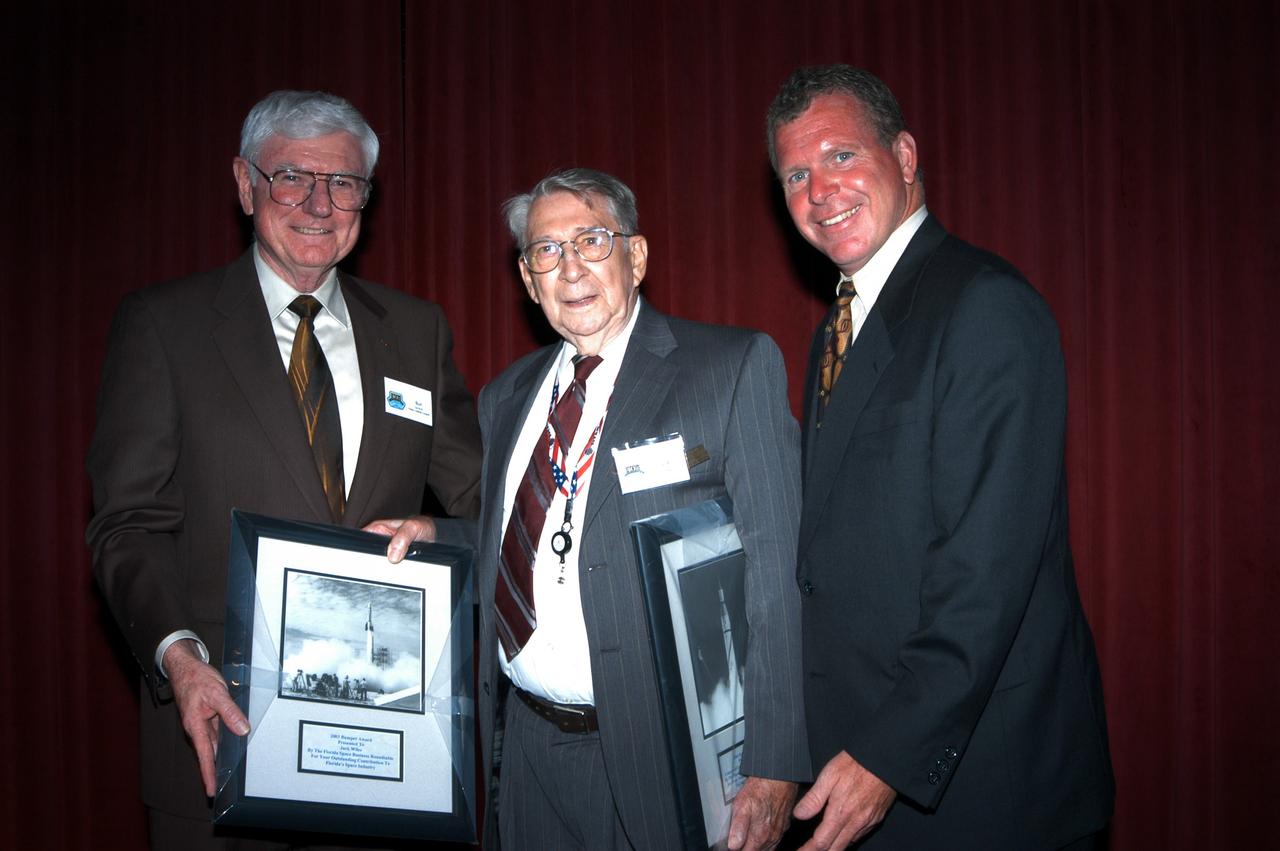
KENNEDY SPACE CENTER, FLA. - Bud Gardner (left), with the Florida Space Research Institute, and U.S. Representative Tom Feeney (right) pose with John Winn, who received the 2003 Bumper award at the Congressional Dinner for outstanding contributions to Florida’s space industry. The award was presented by the Florida Space Business Roundtable. The dinner kicked off the annual Space Congress, held April 28-May 1, 2003, in Cape Canaveral, Fla. The theme for the event was “Linking the Past to the Future: A Celebration of Space” and commemorated the 40th anniversary of the Kennedy Space Center and the Centennial of Flight.
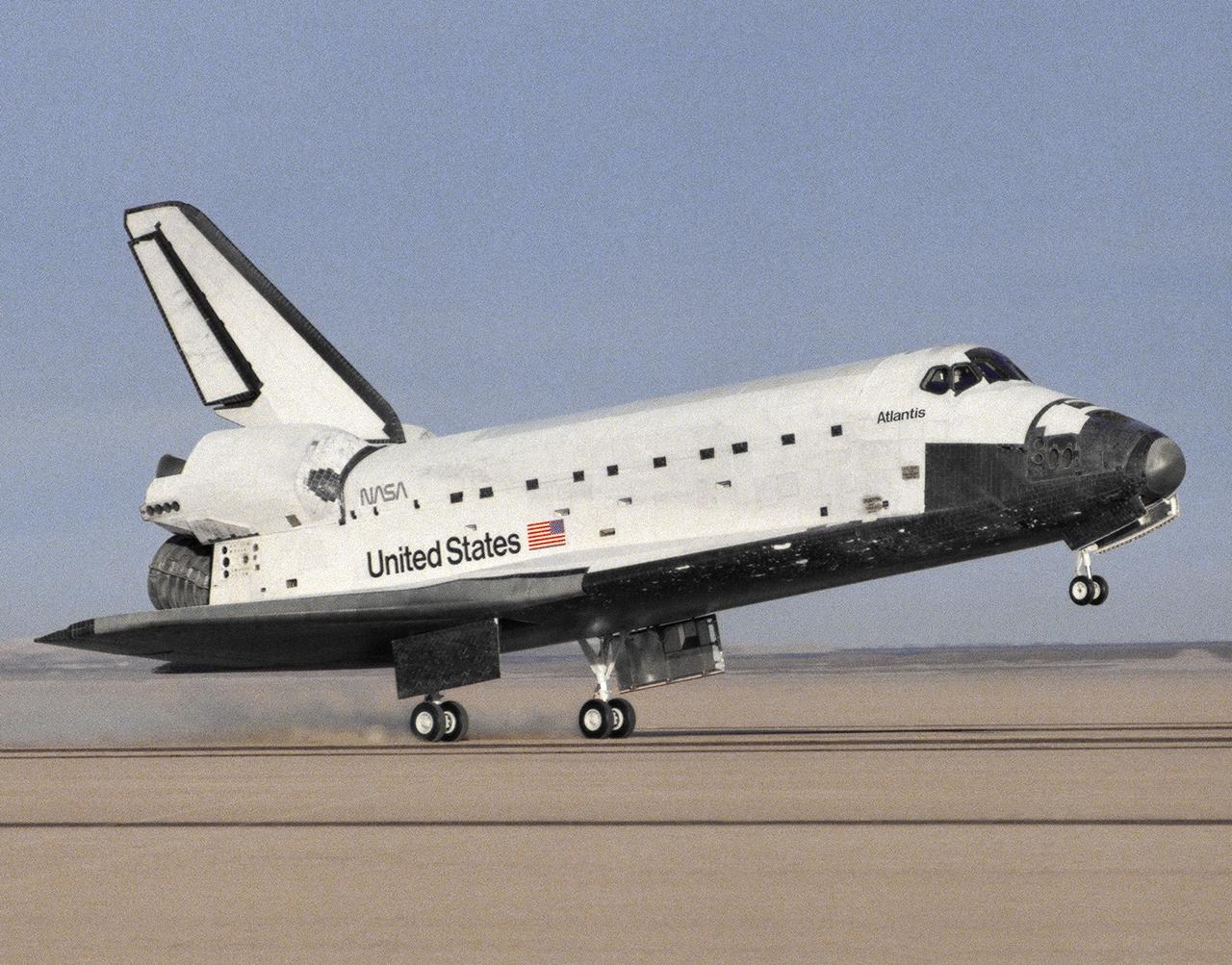
The Space Shuttle Atlantis touches down at 3:35 p.m. PST on 6 December 1988 at NASA's then Ames-Dryden Flight Research Facility at the conclusion of the STS-27 Department of Defense mission. Landing took place on runway 17 of the Rogers Dry Lake, concluding the 4-day, 9-hour, 6-minute mission. The five-man crew was led by Commander Robert L. Gibson and included Pilot Guy S. Gardner; Mission Specialists Jerry L. Ross, William M. Sheperd, and Richard M. Mullane. Atlantis was launched on December 2 from NASA's Kennedy Space Center.
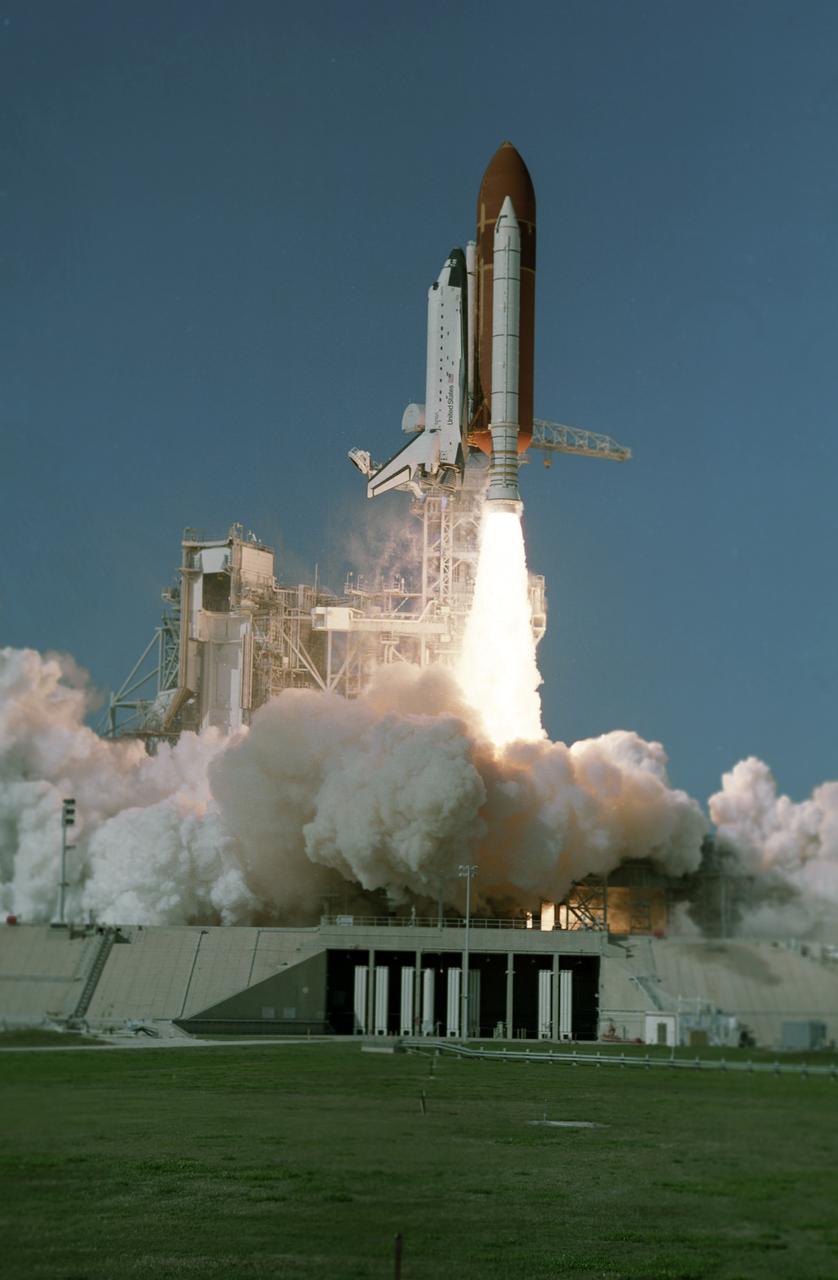
Space Shuttle orbiter Atlantis takes flight on its STS-27 mission, December 2, 1988, utilizing 375,000 pounds of thrust produced by its three main engines. The engines start in 3.9 seconds of ignition and go to static pump speeds of approximately 35,000 revolutions per minute during that time. The Marshall Space Flight Center had management responsibility of Space Shuttle propulsion elements, including the Main Engines. The STS-27 mission, the third mission dedicated to the Department of Defense (DOD), was crewed by five astronauts: Robert L. Gibson, commander; Guy S. Gardner, pilot; and mission specialists Richard M. Mullane, Jerry L. Ross, and William M. Shepherd.
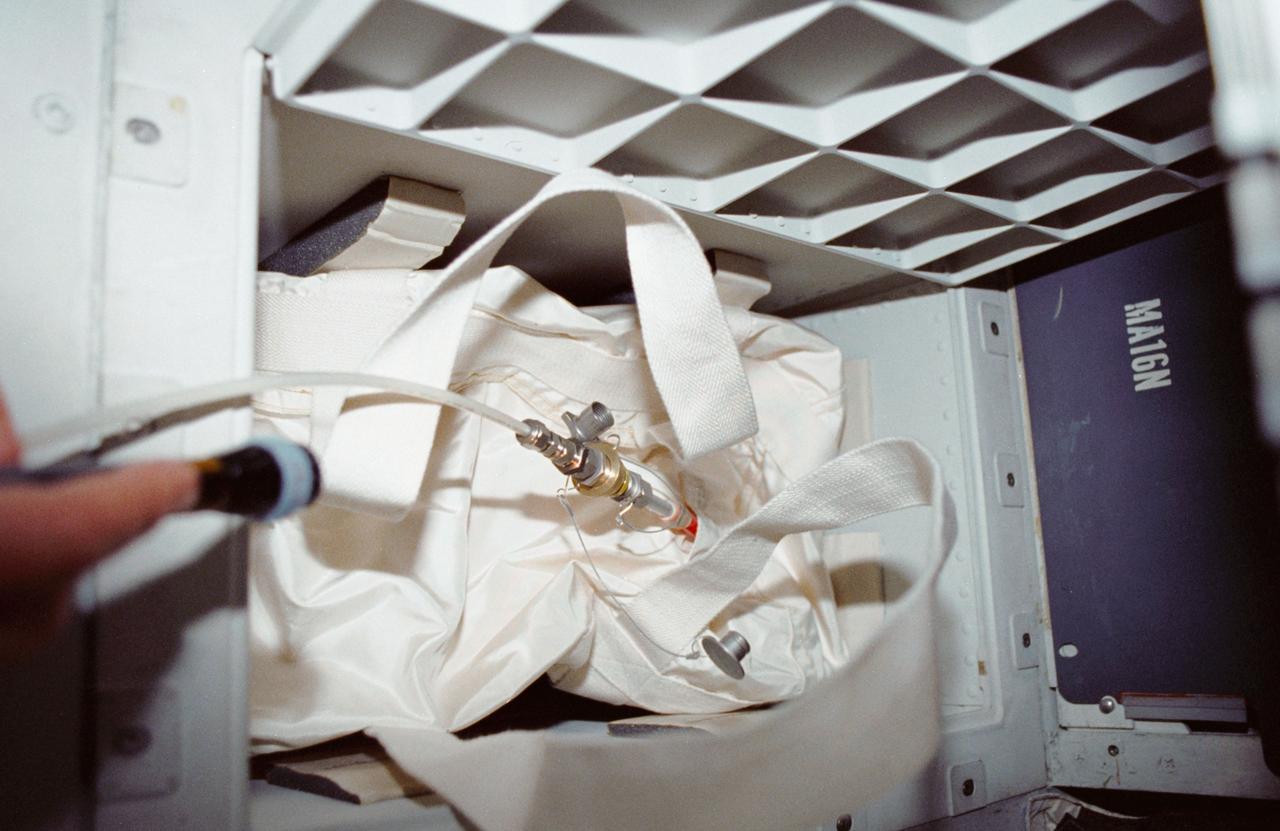
STS035-12-005 (2-10 Dec 1990) --- During STS-35, middeck stowage volume G and a contingency water container (CWC) were utilized to remedy a problem onboard Columbia, Orbiter Vehicle (OV) 102. A hose connecting OV-102's waste water system to the CWC was used in order to bypass a suspected clog in the line from the waste water tank to the exit nozzle. On flight day seven, Pilot Guy S. Gardner carried out an inflight maintenance (IFM) procedure by connecting a spare hose from the line to the container. The CWC is a rubber-lined duffle bag that holds about 95 pounds of water and is used in situations where water cannot be dumped overboard normally.
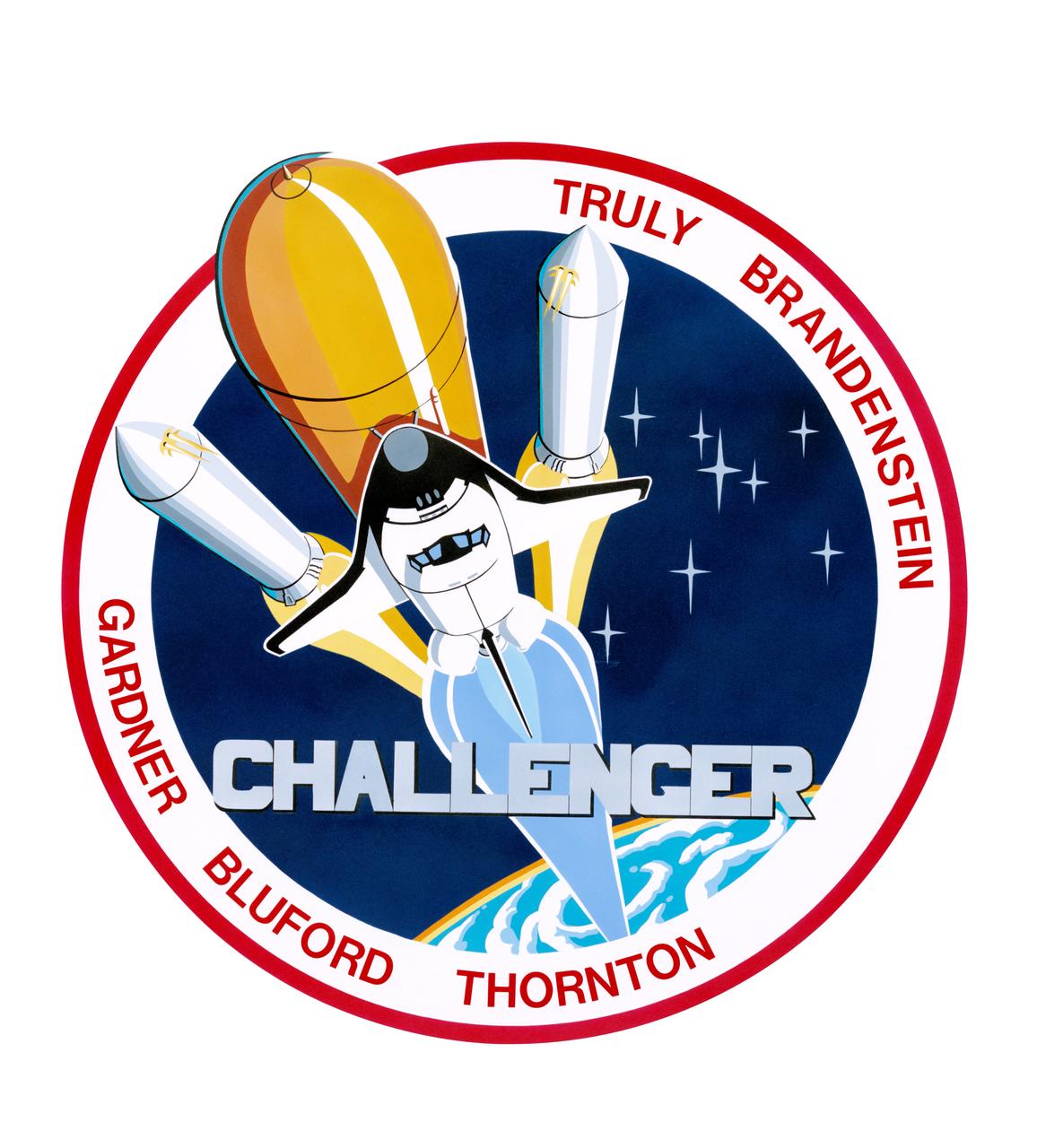
S83-30608 (29 April 1983) --- The night launch of the space shuttle Challenger heading toward its third Earth-orbital mission is featured in the official insignia for STS-8. The eighth flight of the United States Space Transportation System (STS) is represented by eight stars of the constellation Aquila, "The Eagle," astronauts Richard H. Truly, commander; Daniel C. Brandenstein, pilot; Dale A. Gardner, Guion S. Bluford, and William E. Thornton -- all mission specialists -- have their surnames on the border of the insignia. The NASA insignia design for space shuttle flights is reserved for use by the astronauts and for other official use as the NASA Administrator may authorize. Public availability has been approved only in the forms of illustrations by the various news media. When and if there is any change in this policy, which is not anticipated, the change will be publicly announced. Photo credit: NASA
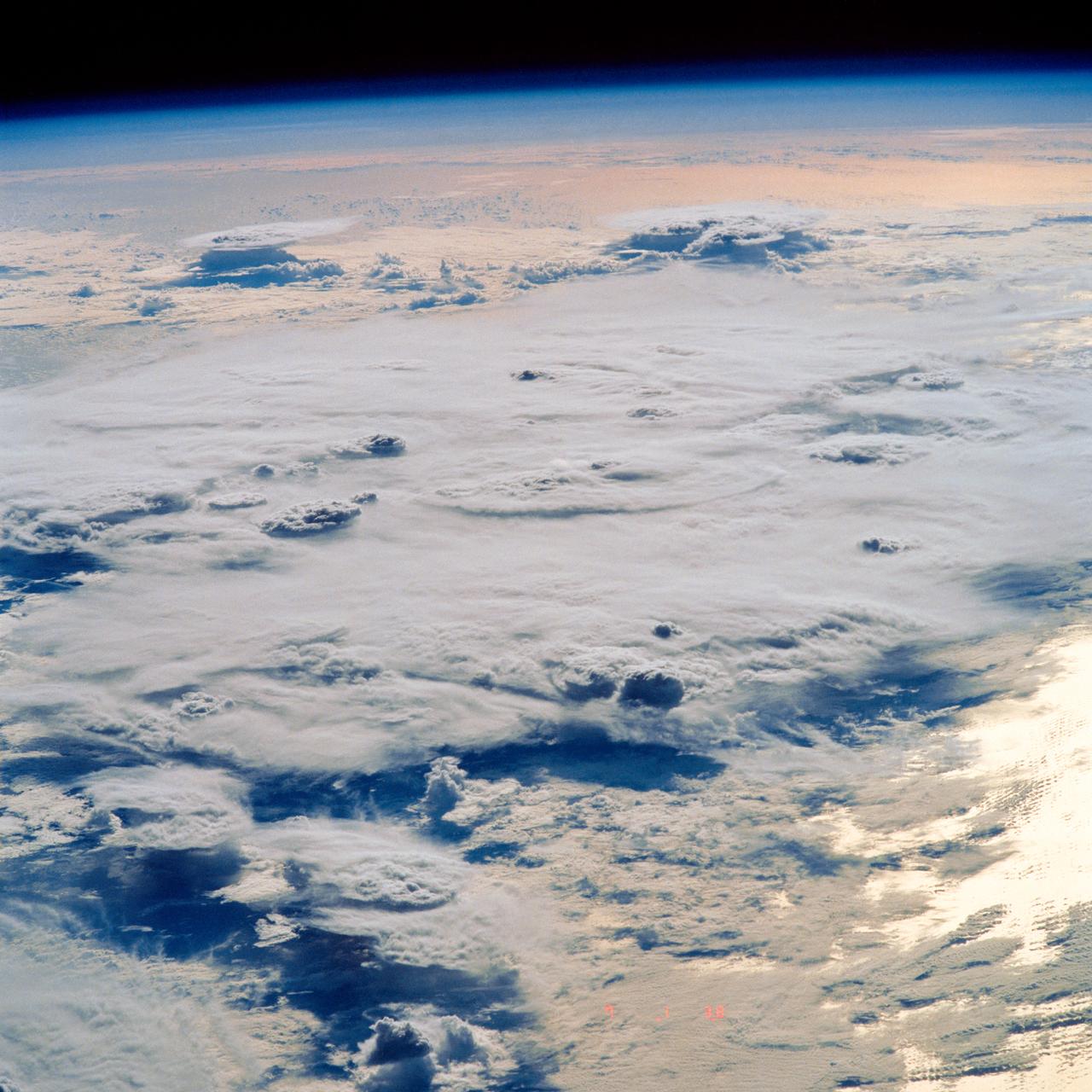
STS035-607-024 (2-10 Dec. 1990) --- This is one of 25 visuals used by the STS-35 crew at its Dec. 20, 1990 post-flight press conference. Space Shuttle Columbia's flight of almost nine days duration (launched December 2 from Kennedy Space Center (KSC) and landed December 10 at Edwards Air Force Base) carried the Astro-1 payload and was dedicated to astrophysics. The mission involved a seven-man crew. Crew members were astronauts Vance D. Brand, Guy S. Gardner, Jeffrey A. Hoffman, Robert A.R. Parker and John M. (Mike) Lounge; and payload specialists Samuel T. Durrance and Ronald A. Parise. Thunderstorm systems over the Pacific Ocean, with heavy sunglint, as photographed with a handheld Rolleiflex camera aimed through Columbia's aft flight deck windows.
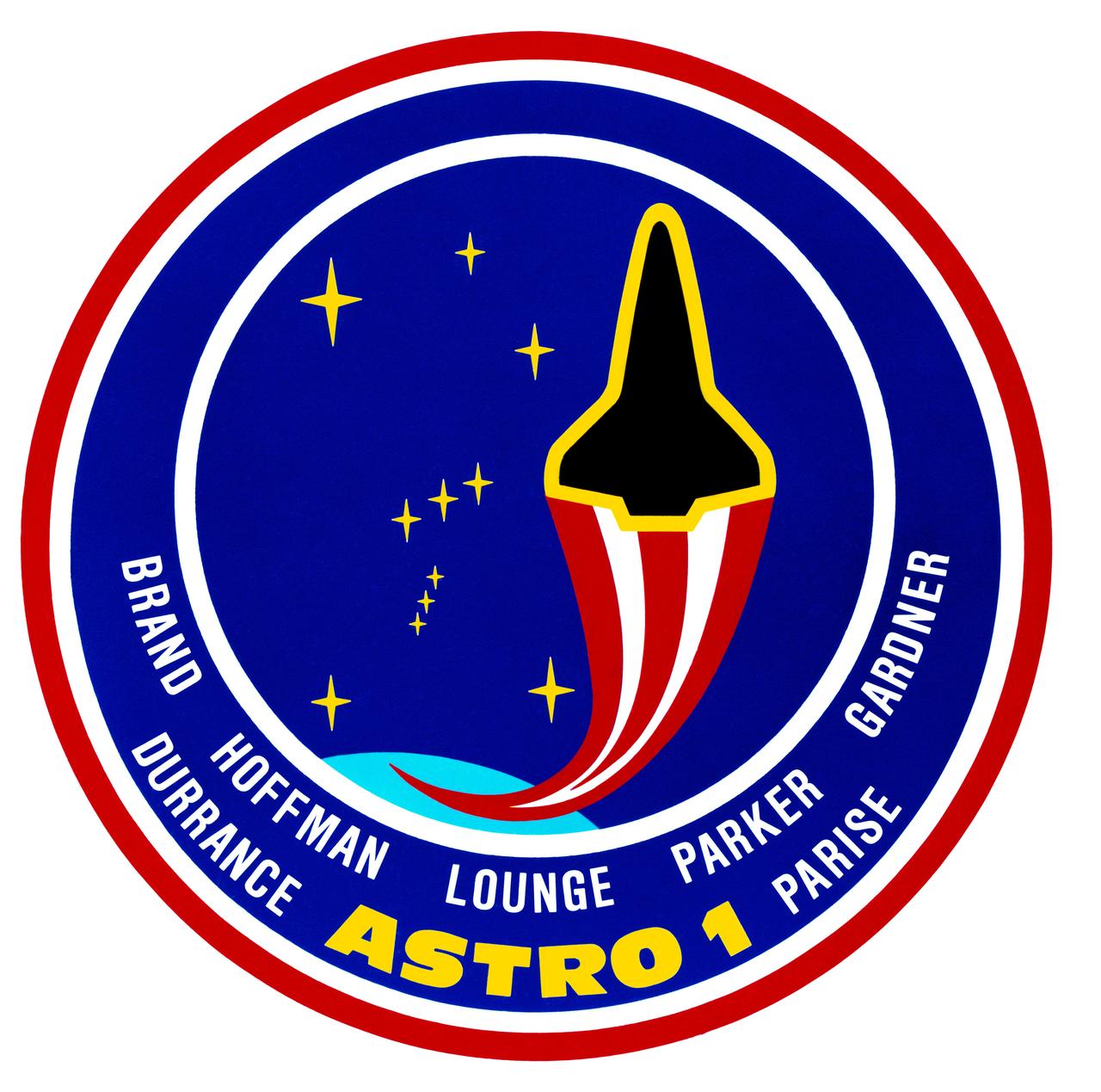
STS035-S-001 (29 Jan. 1990) --- Designed by the crew members assigned to the mission, the STS-35 crew patch symbolizes the space shuttle flying above Earth's atmosphere to better study the many celestial objects of the Universe, represented by the constellation Orion. The primary payload of STS-35 is ASTRO-l, a group of ultraviolet telescopes and the Broad-Band X-Ray Telescope. Crew members on the flight are astronauts Vance D. Brand, commander; Guy S. Gardner, pilot; and Jeffrey A. Hoffman, John M. (Mike) Lounge, Robert A. R. Parker, all mission specialists; along with the two payload specialists - Samuel T. Durrance and Ronald Parise. The NASA insignia design for space shuttle flights is reserved for use by the astronauts and for other official use as the NASA Administrator may authorize. Public availability has been approved only in the forms of illustrations by the various news media. When and if there is any change in this policy, which is not anticipated, the change will be publicly announced. Photo credit: NASA
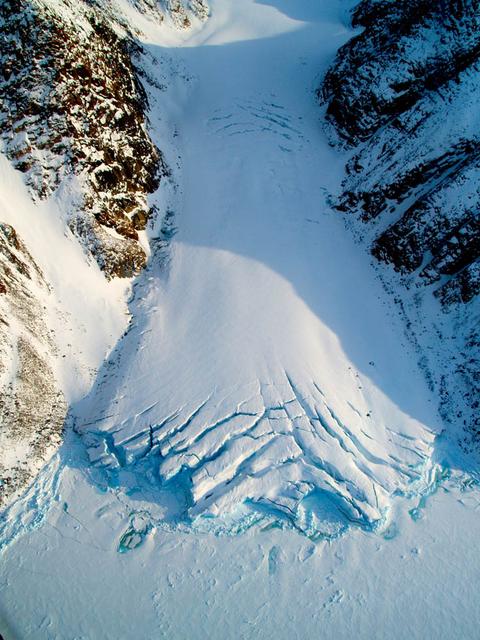
Small valley glacier exiting the Devon Island Ice Cap in Canada. To learn about the contributions of glaciers to sea level rise, visit: <a href="http://www.nasa.gov/topics/earth/features/glacier-sea-rise.html" rel="nofollow">www.nasa.gov/topics/earth/features/glacier-sea-rise.html</a> Credit: Alex Gardner, Clark University <b><a href="http://www.nasa.gov/audience/formedia/features/MP_Photo_Guidelines.html" rel="nofollow">NASA image use policy.</a></b> <b><a href="http://www.nasa.gov/centers/goddard/home/index.html" rel="nofollow">NASA Goddard Space Flight Center</a></b> enables NASA’s mission through four scientific endeavors: Earth Science, Heliophysics, Solar System Exploration, and Astrophysics. Goddard plays a leading role in NASA’s accomplishments by contributing compelling scientific knowledge to advance the Agency’s mission. <b>Follow us on <a href="http://twitter.com/NASA_GoddardPix" rel="nofollow">Twitter</a></b> <b>Like us on <a href="http://www.facebook.com/pages/Greenbelt-MD/NASA-Goddard/395013845897?ref=tsd" rel="nofollow">Facebook</a></b> <b>Find us on <a href="http://instagram.com/nasagoddard?vm=grid" rel="nofollow">Instagram</a></b>

Aerial view of the Sverdrup Glacier, a river of ice that flows from the interior of the Devon Island Ice Cap (Canada) into the ocean. To learn about the contributions of glaciers to sea level rise, visit: <a href="http://www.nasa.gov/topics/earth/features/glacier-sea-rise.html" rel="nofollow">www.nasa.gov/topics/earth/features/glacier-sea-rise.html</a> Credit: Alex Gardner, Clark University <b><a href="http://www.nasa.gov/audience/formedia/features/MP_Photo_Guidelines.html" rel="nofollow">NASA image use policy.</a></b> <b><a href="http://www.nasa.gov/centers/goddard/home/index.html" rel="nofollow">NASA Goddard Space Flight Center</a></b> enables NASA’s mission through four scientific endeavors: Earth Science, Heliophysics, Solar System Exploration, and Astrophysics. Goddard plays a leading role in NASA’s accomplishments by contributing compelling scientific knowledge to advance the Agency’s mission. <b>Follow us on <a href="http://twitter.com/NASA_GoddardPix" rel="nofollow">Twitter</a></b> <b>Like us on <a href="http://www.facebook.com/pages/Greenbelt-MD/NASA-Goddard/395013845897?ref=tsd" rel="nofollow">Facebook</a></b> <b>Find us on <a href="http://instagram.com/nasagoddard?vm=grid" rel="nofollow">Instagram</a></b>
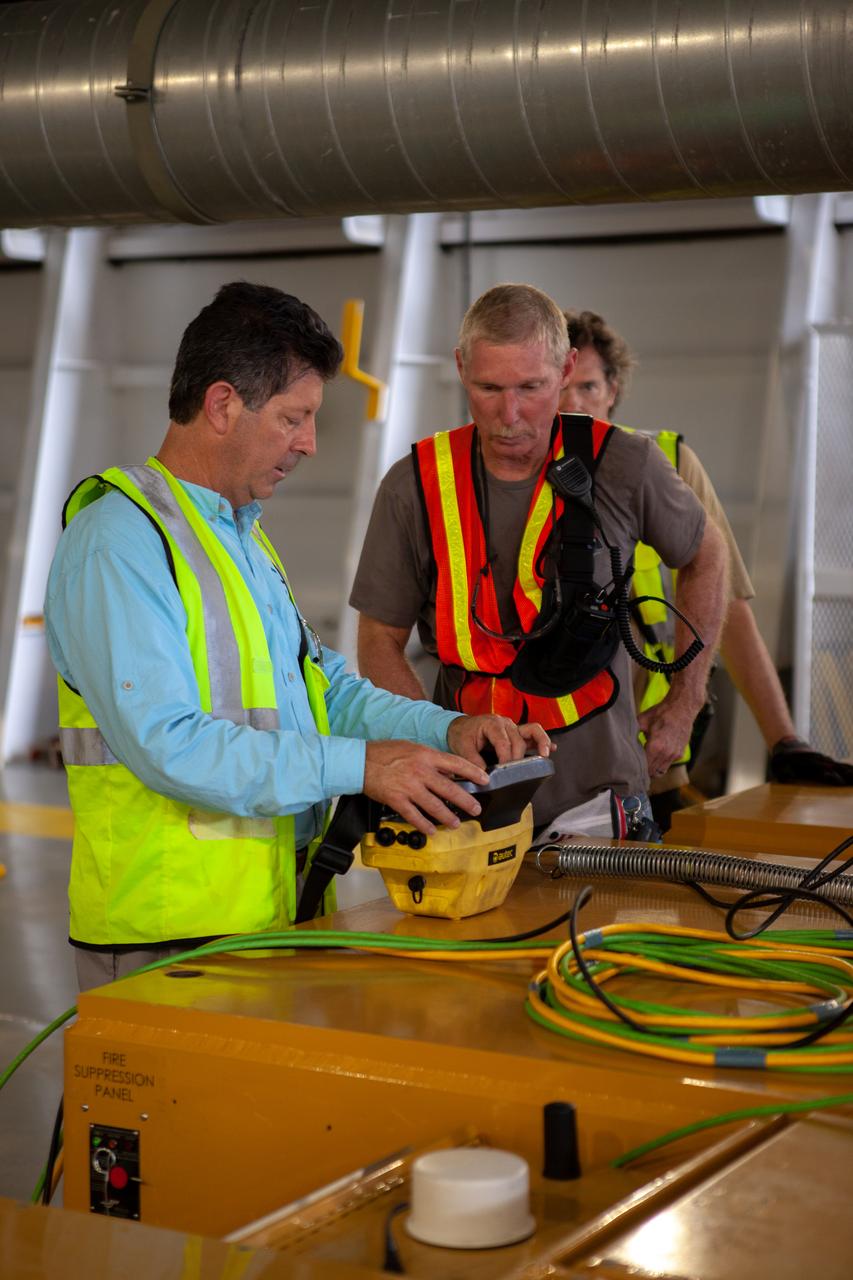
Jacobs TOSC Launch Vehicle Technical Operations technicians review procedures before the start of offloading the 212-foot-long Space Launch System (SLS) rocket core stage pathfinder from NASA's Pegasus Barge at Kennedy Space Center’s Launch Complex 39 turn basin wharf on Oct. 1, 2019. From left, are Dave Goetz, operator, John Stirling and Jack Gardner, both observers. The Pegasus Barge made its first delivery to Kennedy in support of the agency's Artemis missions. The upgraded 310-foot-long barge arrived Sept. 27, 2019, ferrying the SLS core stage pathfinder, a full-scale mock-up of the rocket's core stage. It will be used by Exploration Ground Systems and its contractor, Jacobs, to practice offloading, moving and stacking maneuvers, using important ground support equipment to train employees and certify all the equipment works properly. The pathfinder will stay at Kennedy for approximately one month before trekking back to NASA's Michoud Assembly Facility in Louisiana.
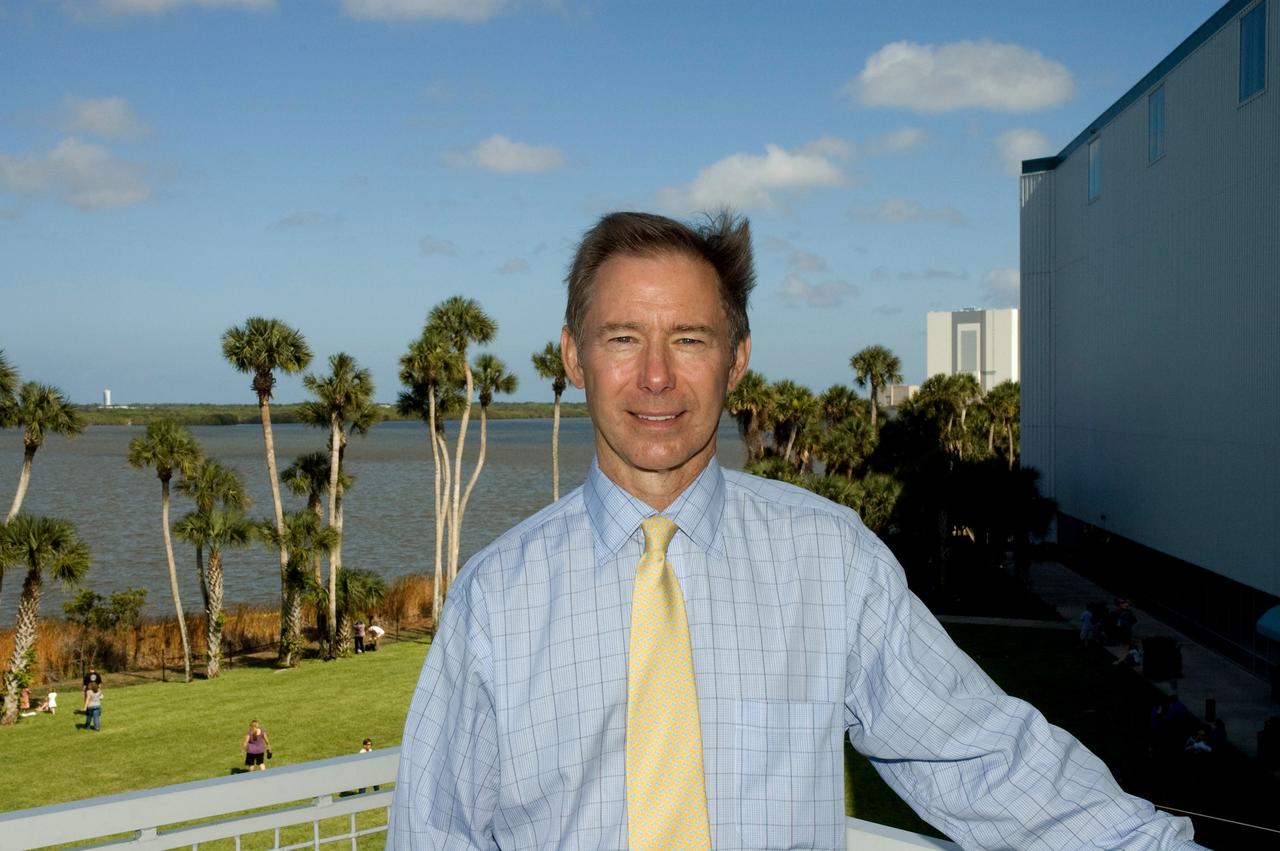
CAPE CANAVERAL, Fla. -- Brewster Shaw is a former astronaut from the first graduating class of astronauts after the Apollo program. He and others from the class were guests at NASA's Kennedy Space Center for the launch of space shuttle Discovery on its STS-124 mission. Shaw is Vice President and General Manager, Space Exploration, for Integrated Defense Systems, The Boeing Company. In 1978 a new group of 35 astronauts was selected after nine years without new astronauts. The pilots were Daniel Brandenstein, Michael Coats, Richard Covey, John Creighton, Robert Gibson, Frederick D. Gregory, Frederick Hauck, Jon McBride, Francis "Dick" Scobee, Brewster Shaw, Loren Shriver, David Walker and Donald Williams. The mission specialists were Guion Bluford, James Buchli, John Fabian, Anna Fisher, Dale Gardner, S. David Griggs, Terry Hart, Steven Hawley, Jeffrey Hoffman, Shannon Lucid, Ronald McNair, Richard Mullane, Steven Nagel, George Nelson, Ellison Onizuka, Judith Resnik, Sally Ride, Rhea Seddon, Robert Stewart, Kathryn D. Sullivan, Norman Thagard and James van Hoften. Since then, a new group has been selected roughly every two years. Photo credit: NASA/Jim Grossmann

CAPE CANAVERAL, Fla. -- A group from the first graduating class of astronauts after the Apollo program gathers at the Banana River viewing site at NASA's Kennedy Space Center before the launch of space shuttle Discovery on its STS-124 mission. In 1978 a new group of 35 astronauts was selected after nine years without new astronauts. The pilots were Daniel Brandenstein, Michael Coats, Richard Covey, John Creighton, Robert Gibson, Frederick D. Gregory, Frederick Hauck, Jon McBride, Francis "Dick" Scobee, Brewster Shaw, Loren Shriver, David Walker and Donald Williams. The mission specialists were Guion Bluford, James Buchli, John Fabian, Anna Fisher, Dale Gardner, S. David Griggs, Terry Hart, Steven Hawley, Jeffrey Hoffman, Shannon Lucid, Ronald McNair, Richard Mullane, Steven Nagel, George Nelson, Ellison Onizuka, Judith Resnik, Sally Ride, Rhea Seddon, Robert Stewart, Kathryn D. Sullivan, Norman Thagard and James van Hoften. Since then, a new group has been selected roughly every two years. Photo credit: NASA/Jim Grossmann

S78-26481 (January 1978) --- This is a montage of the individual portraits of the 35-member 1978 class of astronaut candidates. From left to right are Guion S. Bluford, Daniel C. Brandenstein, James F. Buchli, Michael L. Coats, Richard O. Covey, John O. Creighton, John M. Fabian, Anna L. Fisher, Dale A. Gardner, Robert L. Gibson, Frederick D. Gregory, S. David Griggs, Terry J. Hart, Frederick H. (Rick) Hauck, Steven A. Hawley, Jeffrey A. Hoffman, Shannon W. Lucid, Jon A. McBride, Ronald E. McNair, Richard M. (Mike) Mullane, Steven R. Nagel, George D. Nelson, Ellison S. Onizuka, Judith A. Resnik, Sally K. Ride, Francis R. (Dick) Scobee, Rhea Seddon, Brewster H. Shaw Jr., Loren J. Shriver, Robert L. Stewart, Kathryn D. Sullivan, Norman E. Thagard, James D. Van Hoften, David M. Walker and Donald E. Williams. Photo credit: NASA or National Aeronautics and Space Administration
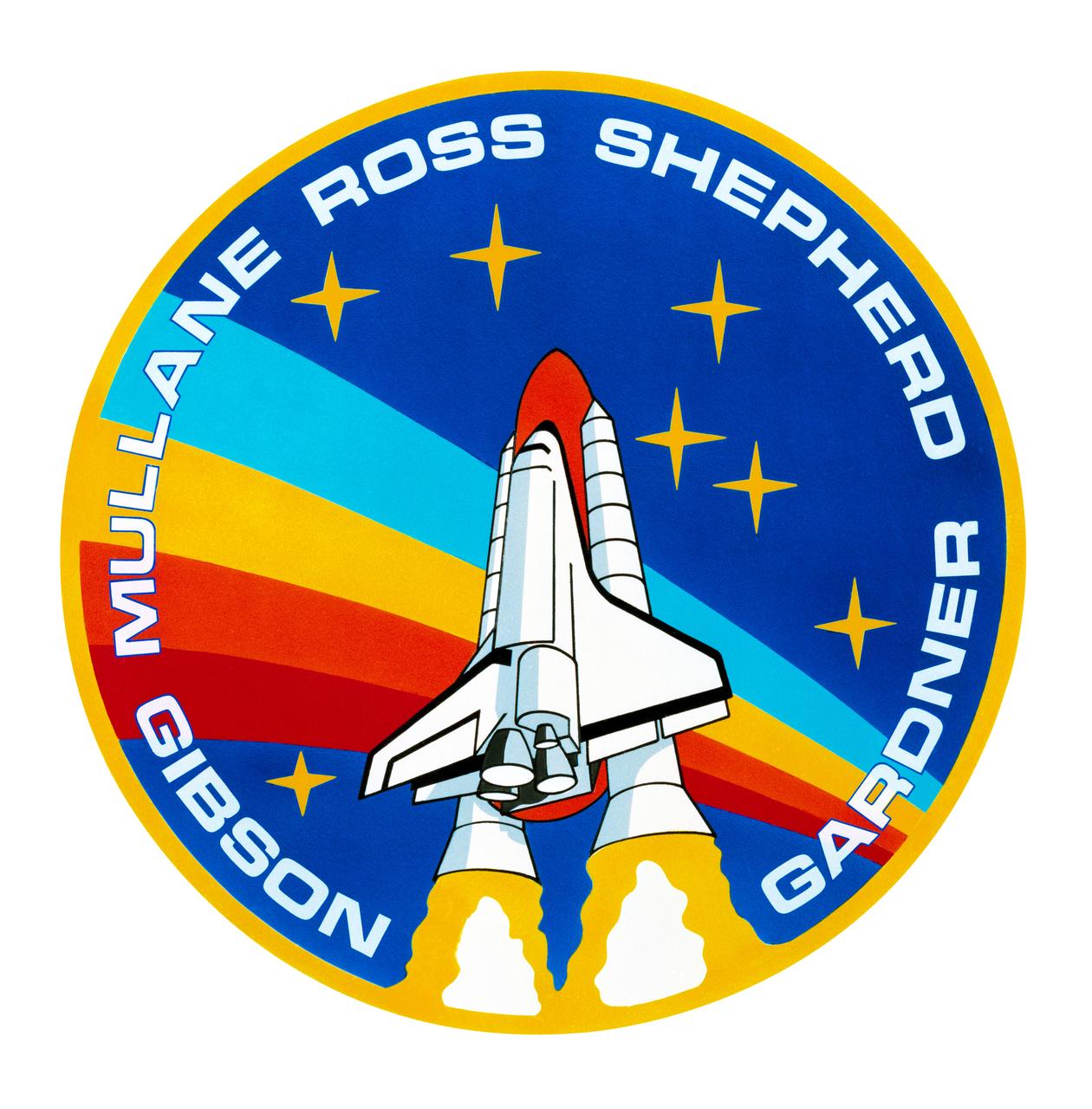
S88-41481 (15 July 1988) --- This is the official insignia of the NASA STS-27 mission. The patch depicts the space shuttle lifting off against the multi-colored backdrop of a rainbow, symbolizing the triumphal return to flight of our nation's manned space program. The design also commemorates the memory of the crew of Challenger mission STS51-L, represented by the seven stars. The names of the flight crew members of STS-27 are located along the border of the patch. They are astronauts Robert L. Gibson, commander; Guy S. Gardner, pilot; Jerry L. Ross, Richard M. (Mike) Mullane and William M. Shepherd, mission specialists. Each crew member contributed to the design of the insignia. The NASA insignia design for space shuttle flights is reserved for use by the astronauts and for other official use as the NASA Administrator may authorize. Public availability has been approved only in the forms of illustrations by the various news media. When and if there is any change in this policy, which is not anticipated, the change will be publicly announced. Photo credit: NASA
STS-35 lifted off December 2, 1990, at 1:19 am EST, aboard the Space Shuttle Orbiter Columbia. Her crew of eight included: Vance D. Brand, commander; Colonel Guy S. Gardner, pilot; mission specialists Dr. Robert A. R. Parker, John M. (Mike) Lounge, and Dr. Jeffery A. Hoffman; and payload specialists Dr. Kenneth H. Nordsieck, Dr. Samual T. Durrance, and Dr. Ronald A. Parise. The primary objective of the mission was round the clock observation of the celestial sphere in ultraviolet and X-Ray astronomy with the Astro-1 Observatory which consisted of four telescopes: the Hopkins Ultraviolet Telescope (HUT); the Wisconsin Ultraviolet Photo-Polarimeter Experiment (WUPPE); the Ultraviolet Imaging Telescope (UIT); and the Broad Band X-Ray Telescope (BBXRT). Due to loss of data used for pointing and operating the ultraviolet telescopes, Marshall Space Flight Center ground teams were forced to aim the telescopes with fine tuning by the flight crew.
Photographic documentation showing STS-27 crew activities. Views include: mission commander Robert L. Gibson sits in the commander's station on the flight deck, holding a checklist and talking to another crewmember (004); display screen (005); shadowed view of STS-27 mission patch (006); Gibson, wearing Launch Entry Suit (LES) and helmet, sits in commander's station on the flight deck (007-008); pilot Guy S. Gardner, wearing LES and helmet, sits in the pilot's station on the flight deck (009-011); dark view of a crewmember in LES and helmet (012); Mission Specialist (MS) Jerry L. Ross with MS William M. Shepherd and MS Richard M. Mullane, all wearing LESs (013); overexposed view of Ross and Shepherd (014); Ross and Mullane (015); Gibson (016); darkened view of forward flight deck (017); condensation on window (018); various views of windows (019-028, 034-037); various views of portions of command console on forward flight deck (029, 031-033); dark view of crewmember on forward flight deck (030);
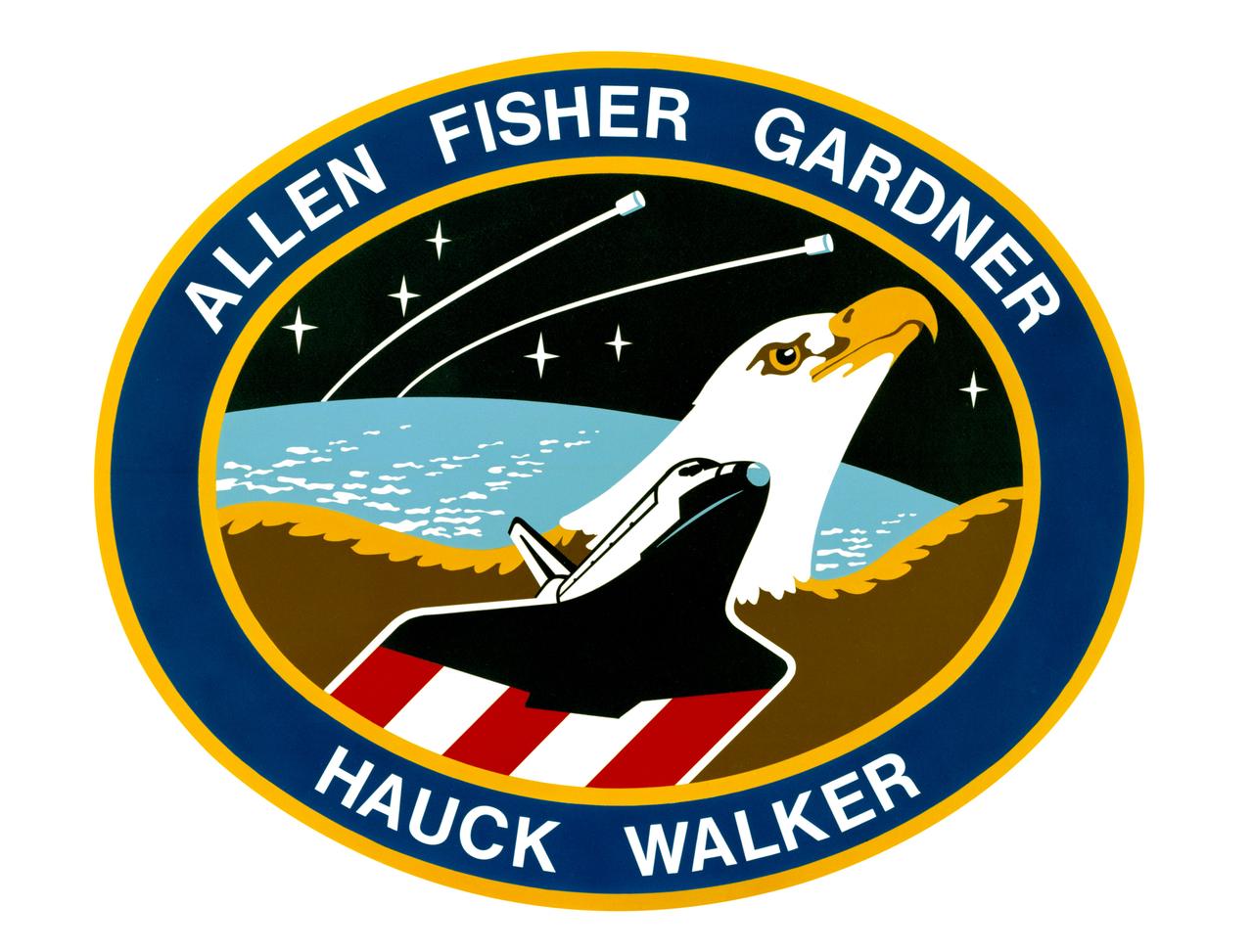
S84-40148 (8 Oct. 1984) --- The space shuttle Discovery en route to Earth orbit for NASA's 51-A mission is reminiscent of a soaring Eagle. The red and white trailing stripes and the blue background, along with the presence of the Eagle, generate memories of America's 208-year-old history and traditions. The two satellites orbiting Earth backgrounded amidst a celestial scene are a universal representation of the versatility of the space shuttle. White lettering against the blue border lists the surnames of the five-member crew--astronauts Frederick H. (Rick) Hauck, David M. Walker, Joseph P. Allen IV, Anna Lee Fisher and Dale A. Gardner. The artwork was done by artist Stephen R. Hustvedt. The NASA insignia design for space shuttle flights is reserved for use by the astronauts and for other official use as the NASA Administrator may authorize. Public availability has been approved only in the forms of illustrations by the various news media. When and if there is any change in this policy, which is not anticipated, the change will be publicly announced. Photo credit: NASA
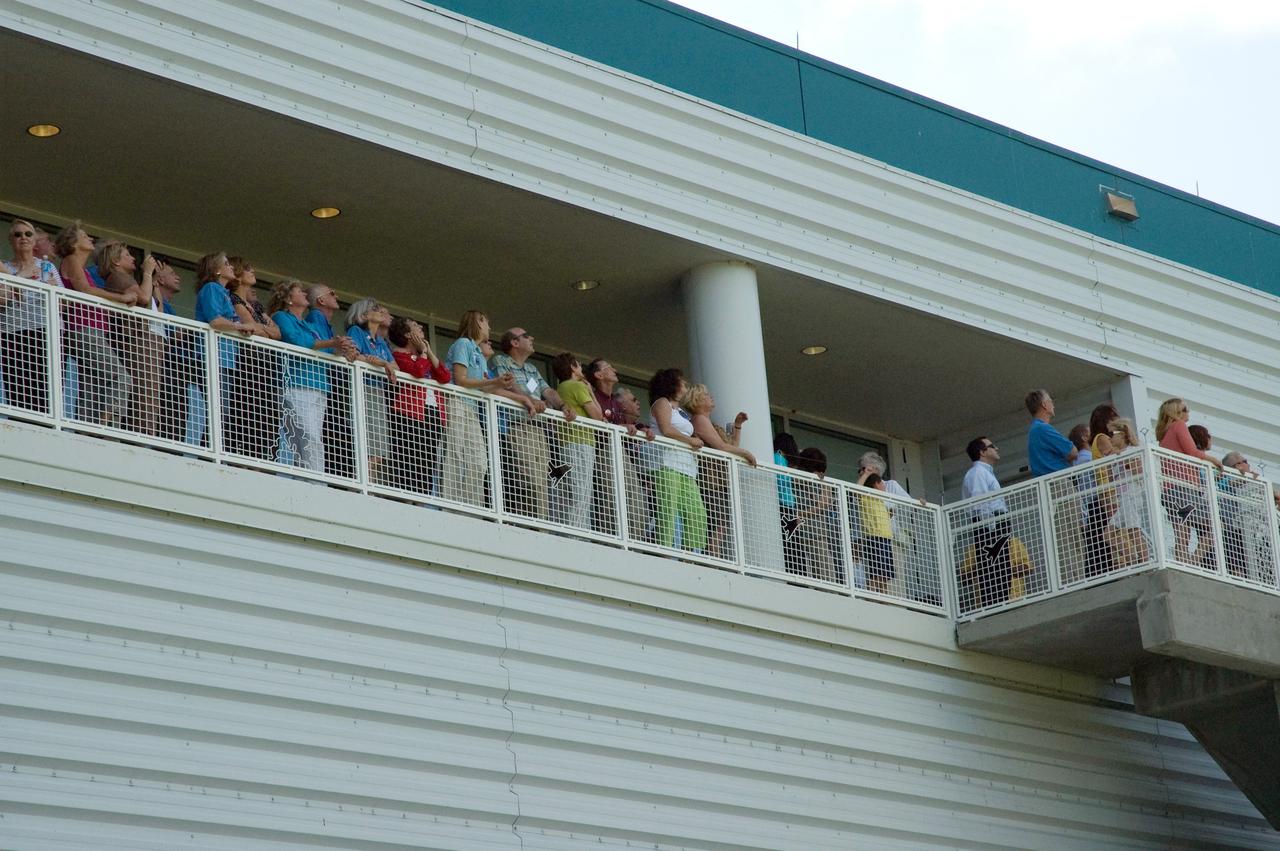
CAPE CANAVERAL, Fla. -- All eyes look skyward as space shuttle Discovery launches on its STS-124 mission. The group gathered here at the Banana River viewing site at NASA's Kennedy Space Center are members of the first graduating class of astronauts after the Apollo program. In 1978 a new group of 35 astronauts was selected after nine years without new astronauts. The pilots were Daniel Brandenstein, Michael Coats, Richard Covey, John Creighton, Robert Gibson, Frederick D. Gregory, Frederick Hauck, Jon McBride, Francis "Dick" Scobee, Brewster Shaw, Loren Shriver, David Walker and Donald Williams. The mission specialists were Guion Bluford, James Buchli, John Fabian, Anna Fisher, Dale Gardner, S. David Griggs, Terry Hart, Steven Hawley, Jeffrey Hoffman, Shannon Lucid, Ronald McNair, Richard Mullane, Steven Nagel, George Nelson, Ellison Onizuka, Judith Resnik, Sally Ride, Rhea Seddon, Robert Stewart, Kathryn D. Sullivan, Norman Thagard and James van Hoften. Since then, a new group has been selected roughly every two years. Photo credit: NASA/Jim Grossmann
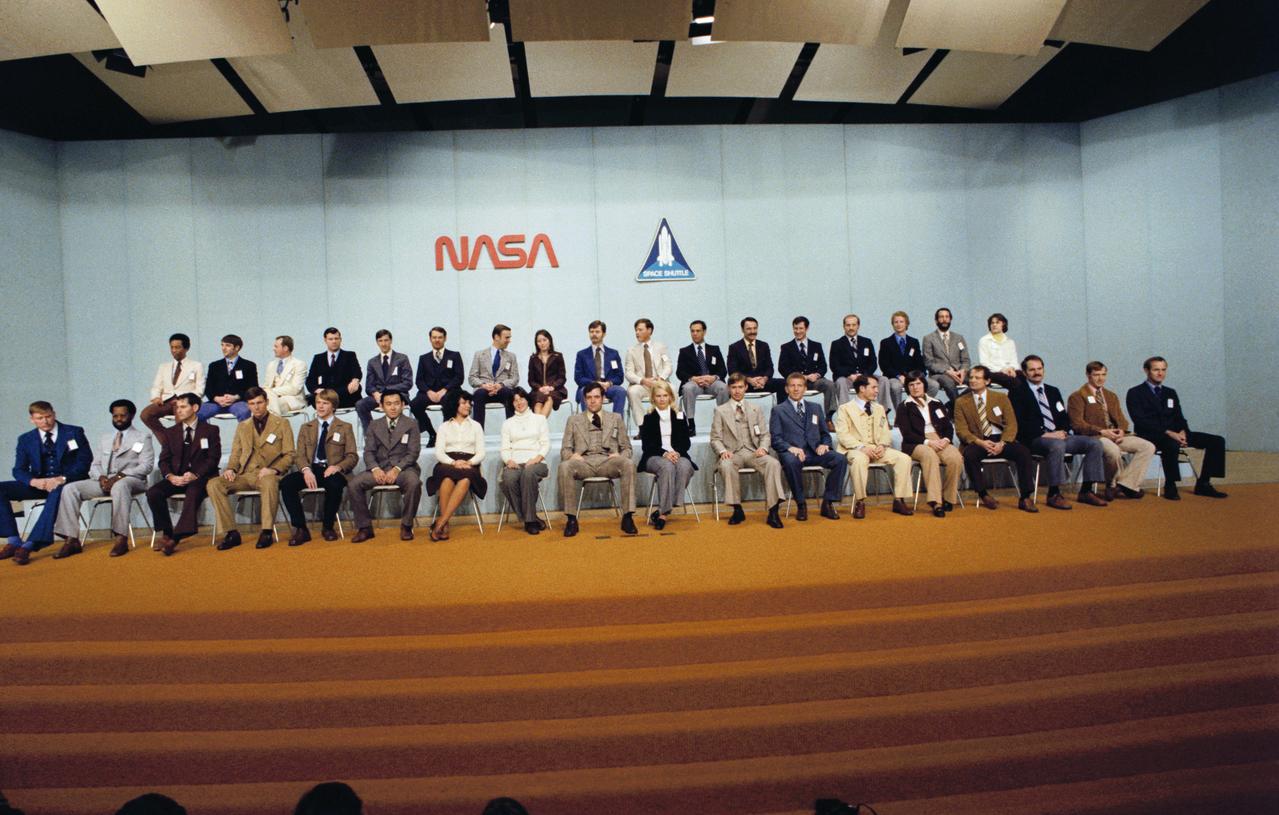
S78-26569 (31 Jan. 1978) --- The 35 new astronaut candidates, presented Jan. 31, 1978, in the Building 2 auditorium at NASA's Johnson Space Center, pose for photographers. They are arranged in alphabetical order with top left as beginning point and bottom right as stopping point. They are Guion S. Bluford, Daniel C. Brandenstein, James F. Buchli, Michael L. Coats, Richard O. Covey, John O. Creighton, John M. Fabian, Anna L. Fisher, Dale A. Gardner, Robert L. Gibson, Frederick D. Gregory, S. David Griggs, Terry J. Hart, Frederick H. (Rick) Hauck, Steven A. Hawley, Jeffrey A. Hoffman, Shannon W. Lucid, Jon A. McBride, Ronald E. McNair, Richard M. (Mike) Mullane, Steven R. Nagel, George D. Nelson, Ellison S. Onizuka, Judith A. Resnik, Sally K. Ride, Francis R. (Dick) Scobee, Rhea Seddon, Brewster H. Shaw Jr., Loren J. Shriver, Robert L. Stewart, Kathryn D. Sullivan, Norman E. Thagard, James D. van Hoften, David M. Walker and Donald E. Williams. Photo credit: NASA or National Aeronautics and Space Administration