
Kennedy Space Center Director Bob Cabana speaks during a wreath-laying ceremony honoring former astronaut Owen Garriott on April 18, 2019. The ceremony was held at the Heroes and Legends exhibit within the Astronaut Hall of Fame at the center’s visitor complex in Florida. Garriott flew aboard the Skylab space station during the Skylab 3 mission and also on space shuttle Columbia for the STS-9/Spacelab-1 mission. He passed away April 15 at the age of 88.

A memorial wreath has been placed in the Heroes and Legends exhibit at the Kennedy Space Center Visitor Complex in Florida following a ceremony honoring the memory of former astronaut Owen Garriott. The ceremony was held April 18, 2019. Garriott flew aboard the Skylab space station during the Skylab 3 mission and also on space shuttle Columbia for the STS-9/Spacelab-1 mission. He passed away April 15 at the age of 88.

Former NASA astronaut Jon McBride shares a few words during a wreath-laying ceremony honoring astronaut Owen Garriott on April 18, 2019. The ceremony was held at the Heroes and Legends exhibit within the Astronaut Hall of Fame at the Kennedy Space Center Visitor Complex in Florida. Garriott flew aboard the Skylab space station during the Skylab 3 mission and also on space shuttle Columbia for the STS-9/Spacelab-1 mission. He passed away April 15 at the age of 88.

Kennedy Space Center Director Bob Cabana is photographed at a wreath-laying ceremony honoring former astronaut Owen Garriott. The ceremony was held April 18, 2019, at the Heroes and Legends exhibit within the Astronaut Hall of Fame at the Florida spaceport’s visitor complex. Garriott flew aboard the Skylab space station during the Skylab 3 mission and also on space shuttle Columbia for the STS-9/Spacelab-1 mission. He passed away April 15 at the age of 88.

Therrin Protze, chief operating officer of the Kennedy Space Center Visitor Complex, is photographed at a wreath-laying ceremony honoring former astronaut Owen Garriott on April 18, 2019. The ceremony was held at the Heroes and Legends exhibit within the Astronaut Hall of Fame at the center’s visitor complex in Florida. Garriott flew aboard the Skylab space station during the Skylab 3 mission and also on space shuttle Columbia for the STS-9/Spacelab-1 mission. He passed away April 15 at the age of 88.

A memorial wreath has been placed in the Heroes and Legends exhibit at the Kennedy Space Center Visitor Complex in Florida following a ceremony honoring the memory of former astronaut Owen Garriott. The ceremony was held April 18, 2019. Garriott flew aboard the Skylab space station during the Skylab 3 mission and also on space shuttle Columbia for the STS-9/Spacelab-1 mission. He passed away April 15 at the age of 88.

In the Heroes and Legends exhibit at the Kennedy Space Center Visitor Complex in Florida, a memorial wreath was placed following a ceremony honoring the memory of former astronaut Owen Garriott. The ceremony was held April 18, 2019. Garriott flew aboard the Skylab space station during the Skylab 3 mission and also on space shuttle Columbia for the STS-9/Spacelab-1 mission. He passed away April 15 at the age of 88.

In the Heroes and Legends exhibit at the Kennedy Space Center Visitor Complex in Florida, a memorial wreath was placed following a ceremony honoring the memory of former astronaut Owen Garriott. The ceremony was held April 18, 2019. Garriott flew aboard the Skylab space station during the Skylab 3 mission and also on space shuttle Columbia for the STS-9/Spacelab-1 mission. He passed away April 15 at the age of 88.

A photo of former astronaut Owen Garriott is displayed during a memorial ceremony at NASA’s Kennedy Space Center in Florida. The ceremony was held April 18, 2019, at the Heroes and Legends exhibit within the Astronaut Hall of Fame at the center’s visitor complex. Garriott flew aboard the Skylab space station during the Skylab 3 mission and also on space shuttle Columbia for the STS-9/Spacelab-1 mission. He passed away April 15 at the age of 88.

S81-29032 (1981) --- Astronaut Dr. Owen K. Garriott.

S71-51299 (21 Sept. 1971) --- Astronaut Owen K. Garriott. Photo credit: NASA
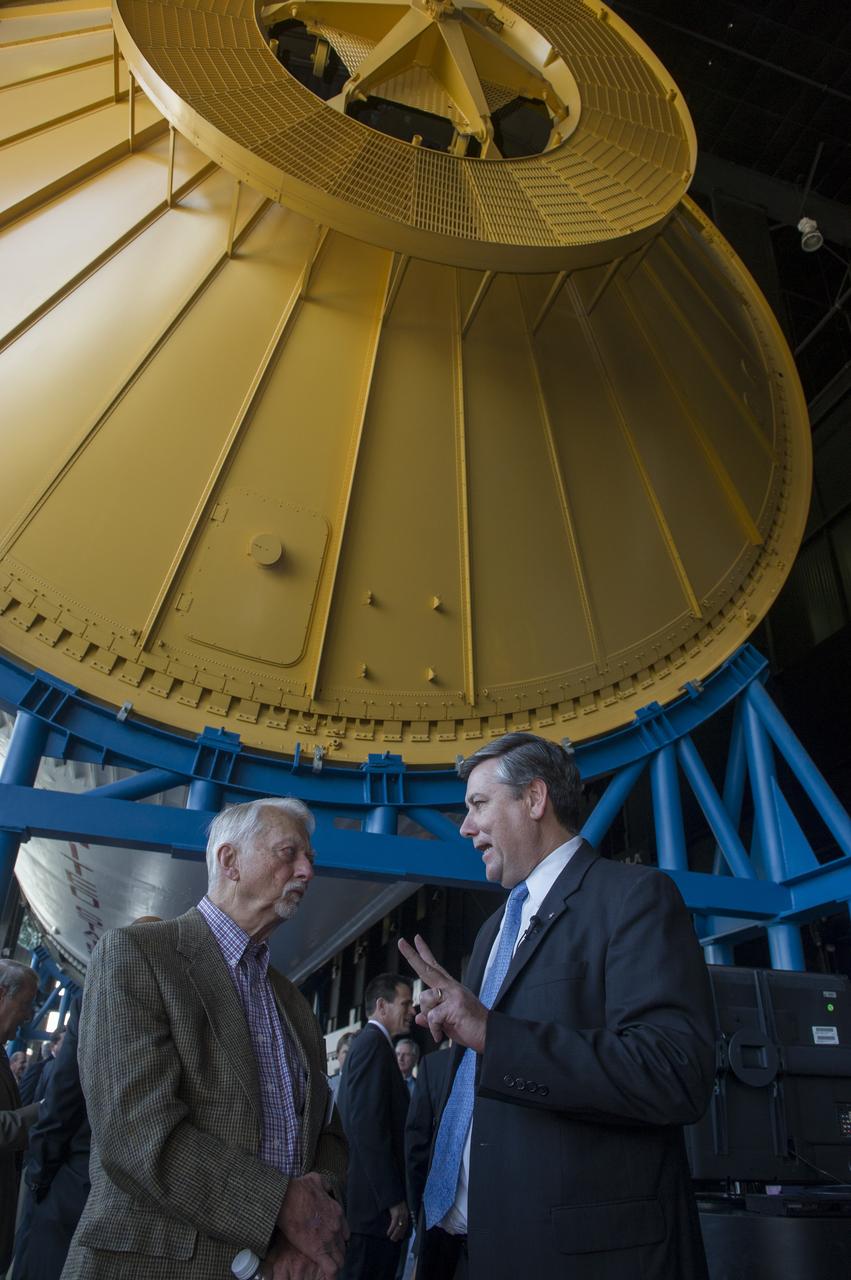
MARSHALL CENTER DIRECTOR PATRICK SCHEUERMANN, RIGHT, TALKS WITH FORMER ASTRONAUT OWEN GARRIOTT BENEATH THE SATURN V ROCKET SUSPENDED IN THE DAVIDSON CENTER FOR SPACE EXPLORATION AT THE U.S. SPACE & ROCKET CENTER
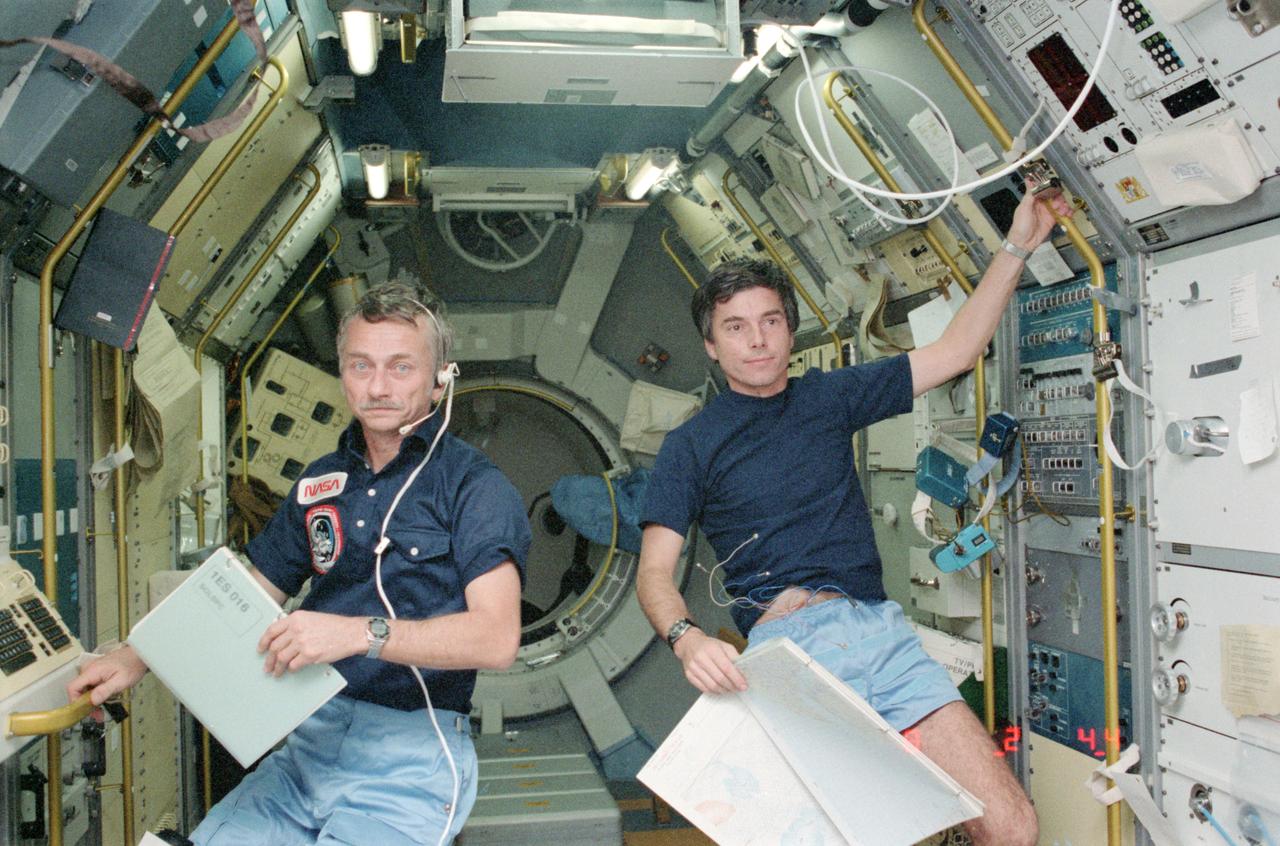
STS009-123-340 (28 Nov 1983) --- Astronaut Owen K. Garriott, STS-9 mission specialist, left, and Ulf Merbold, payload specialist, take a break from monitoring experimentation aboard Spacelab to be photographed. Dr. Garriott, holds in his left hand a data/log book for the solar spectrum experiment. Dr. Merbold, holds a map in his left hand for the monitoring of ground objectives of the metric camera.

SL3-111-1505 (July-September 1973) --- View of scientist-astronaut Owen K. Garriott, Skylab 3 science pilot, in his sleep restraints in the crew quarters of the Orbital Workshop (OWS). Photo credit: NASA

Huntsville’s Jack Giles, Alabama State Senator (left), and Dr. Rocco Petrone, Marshall Space Flight Center Director (Middle), speak with Astronaut Owen Garriott who is inside the Apollo 16 Command Module on display at the Alabama Space and Rocket Center in Huntsville, Alabama. The successful Apollo 16 manned lunar landing mission took place April 16, 1972 through April 27, 1972. (Photograph courtesy of Huntsville/Madison County Public Library)
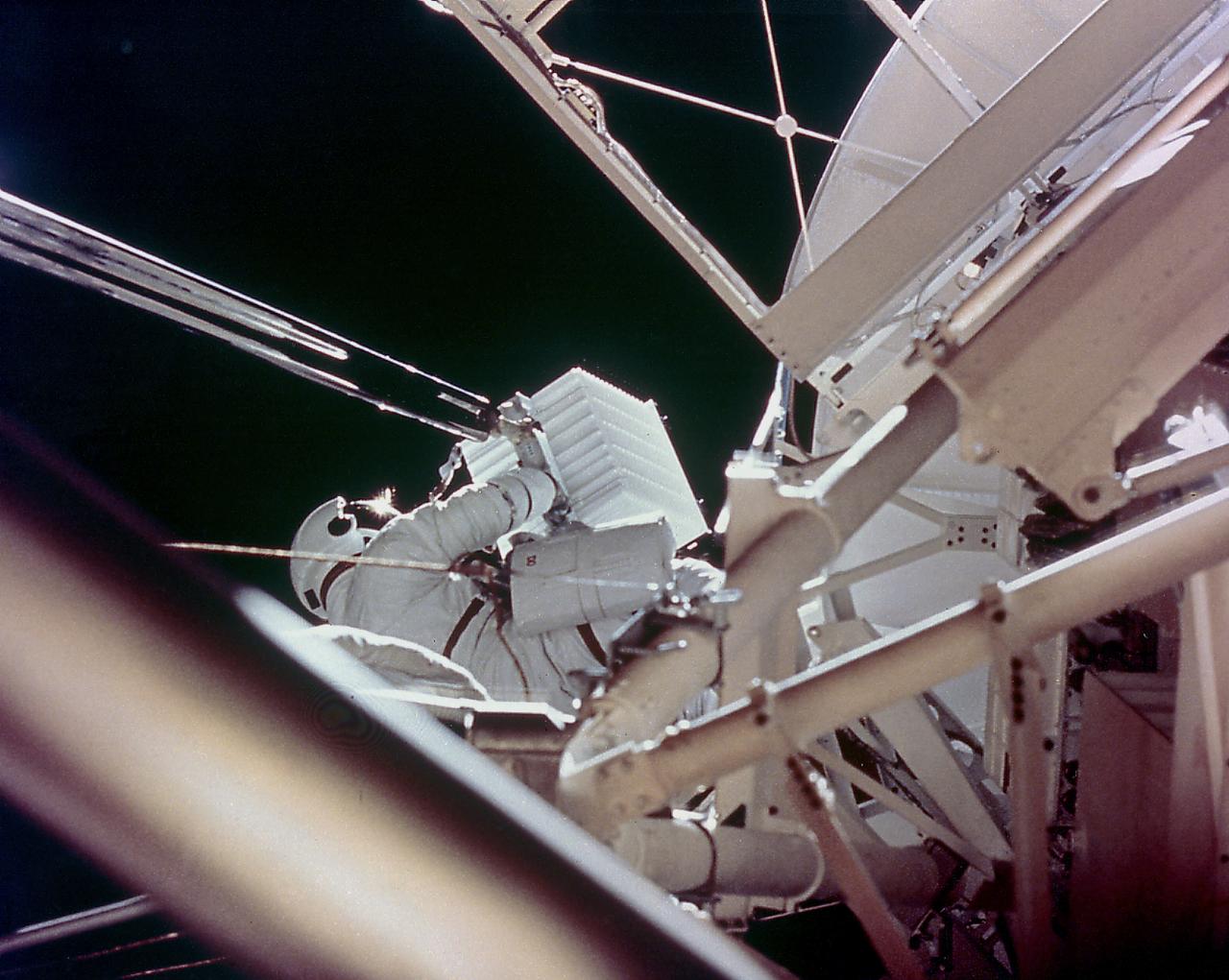
This onboard photograph depicts Astronaut Owen Garriott atop the Apollo Telescope Mount, removing a film magazine (white box) from one of Skylab's solar telescopes during an Extravehicular Activity (EVA) in the second marned Skylab mission (Skylab-3). A long boom transported it back into the waiting hands of another crew member at the airlock door below. During the operation, Garriott, film, boom, and Skylab were 435 kilometers high and speeding around the Earth at 29,000 kilometers per/hour. Because they moved together with no wind resistance, there was little sense of motion.
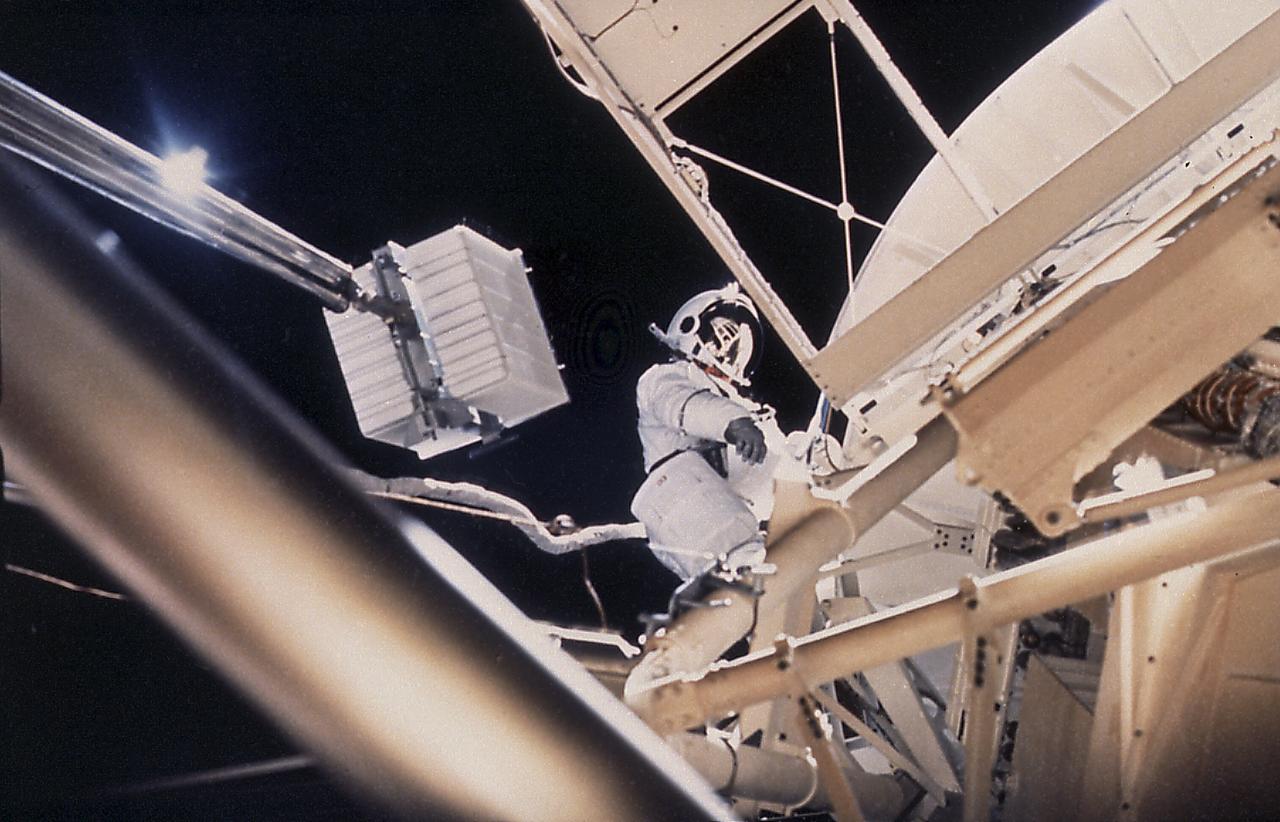
This onboard photograph depicts Astronaut Owen Garriott atop the Apollo Telescope Mount, removing a film magazine (white box) from one of Skylab's solar telescopes during an Extravehicular Activity (EVA) in the second marned Skylab mission (Skylab-3). A long boom transported it back into the waiting hands of another crew member at the airlock door below. During the operation, Garriott, film, boom, and Skylab were 435 kilometers high and speeding around the Earth at 29,000 kilometers per/hour. Because they moved together with no wind resistance, there was little sense of motion.
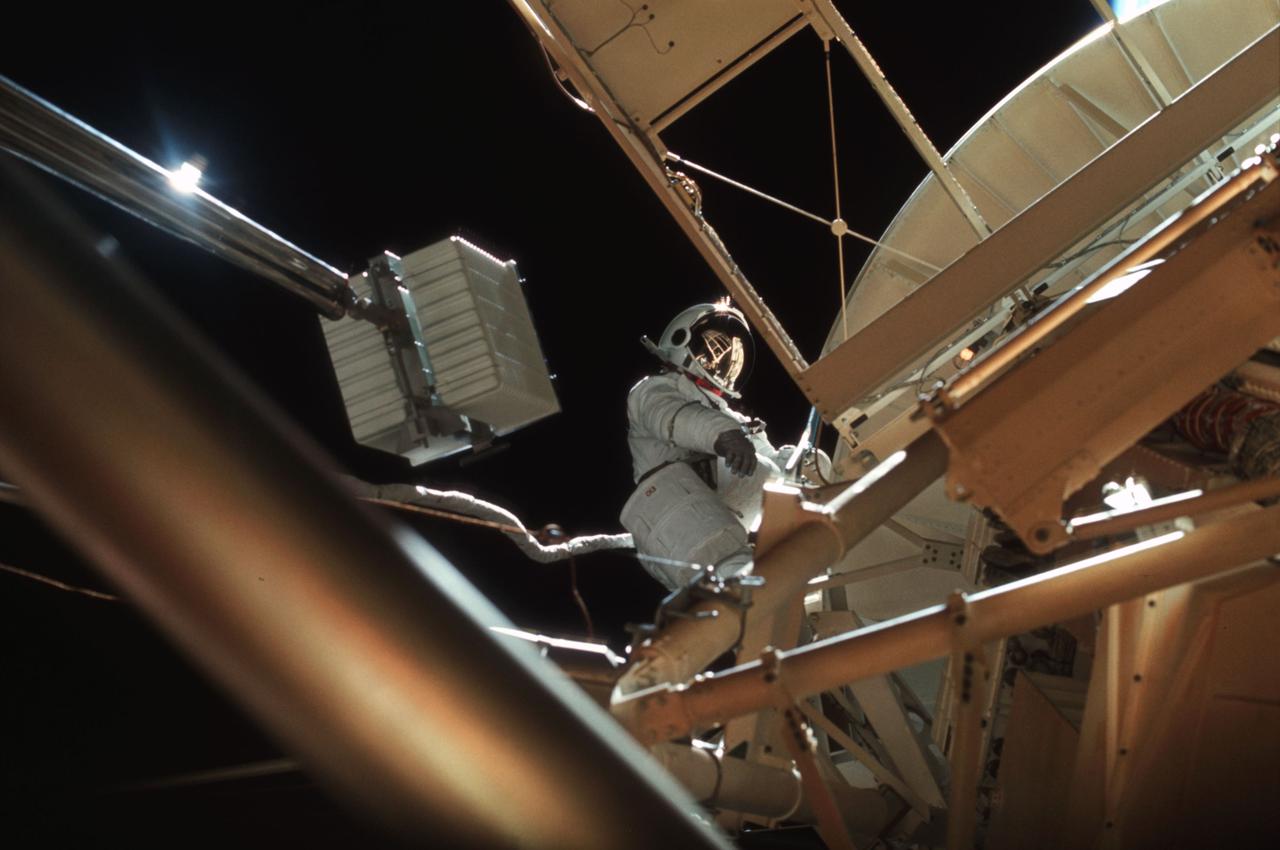
SL3-117-2109 (6 Aug. 1973) --- Scientist-astronaut Owen K. Garriott, Skylab 3 science pilot, participates in the Aug. 6, 1973 extravehicular activity (EVA) during which he and astronaut Jack Lousma, Skylab 3 pilot, deployed the twin pole solar shield to help shade the Orbital Workshop (OWS). Note the reflection of the solar shield in Garriott's helmet visor. Photo credit: NASA

Scientist-Astronaut Owen K. Garriott, science pilot of the Skylab 3 mission, is stationed at the Apollo Telescope Mount (ATM) console in the Multiple Docking Adapter of the Skylab space station in Earth orbit. From this console the astronauts actively control the ATM solar physics telescope.
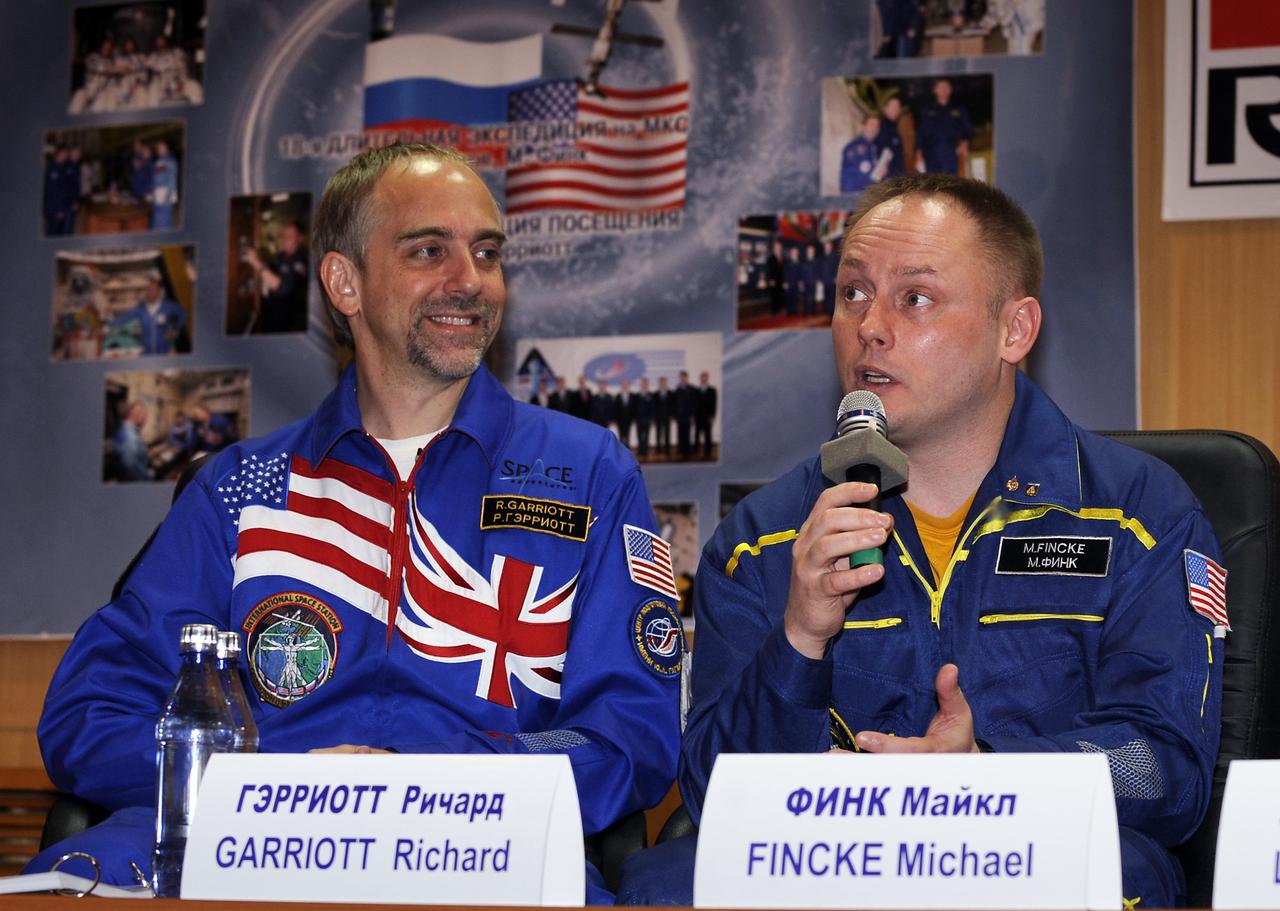
American spaceflight participant Richard Garriott, left, and Expedition 18 Commander Michael Fincke answer reporters' questions during a press conference held at the Cosmonaut Hotel, Saturday, Oct. 11, 2008, in Baikonur, Kazakhstan. Garriott and Fincke will launch on the Soyuz TMA-13 spacecraft along with Expedition 18 Flight Engineer Yuri V. Lonchakov on Oct. 12 and dock with the International Space Station on Oct. 14. Fincke and Lonchakov will spend six months on the station, while Garriott will return to Earth Oct. 24 with two of the Expedition 17 crew members currently on the International Space Station. Photo Credit: (NASA/Bill Ingalls)
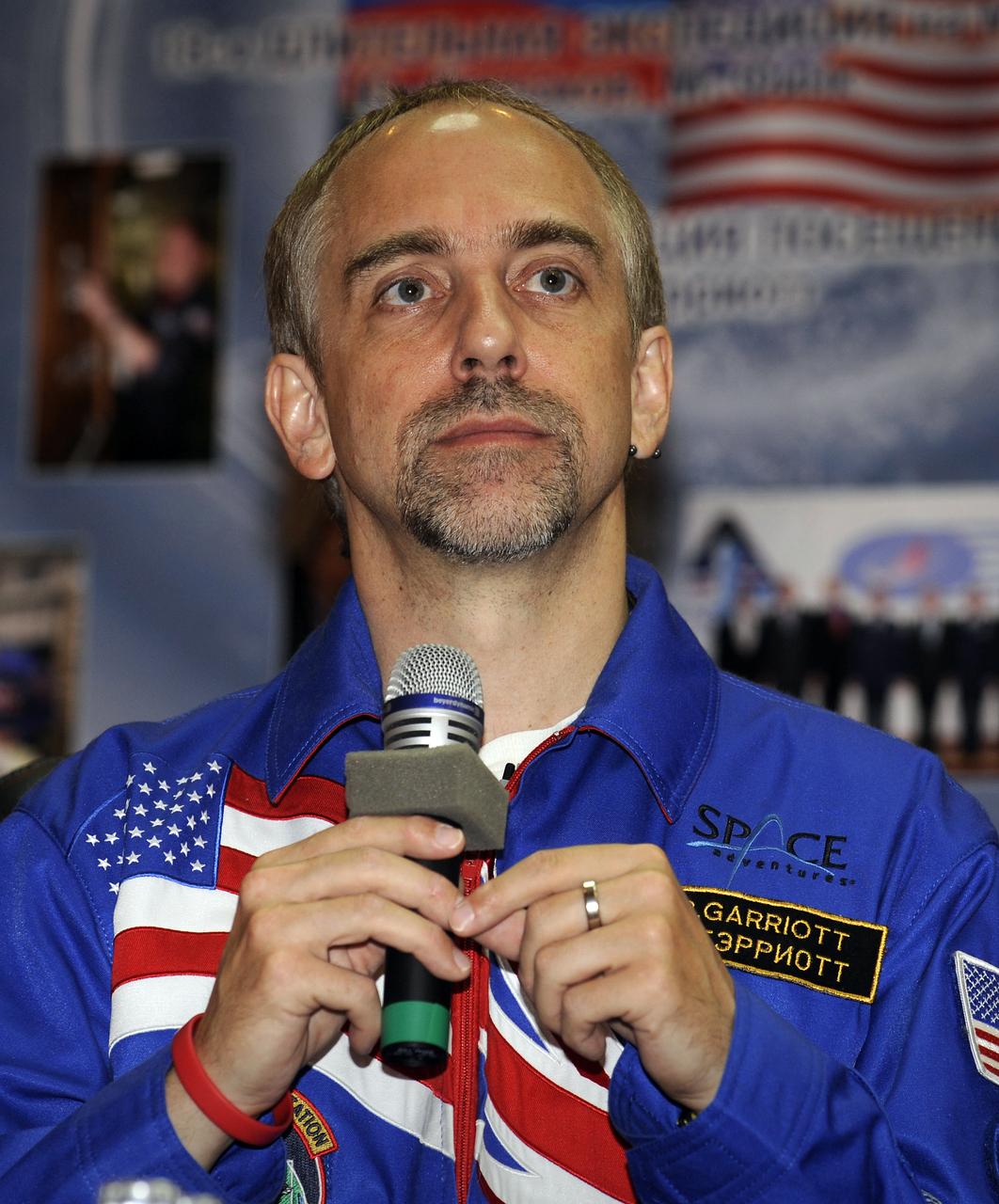
American spaceflight participant Richard Garriott answers reporters' questions during a press conference held at the Cosmonaut Hotel, Saturday, Oct. 11, 2008, in Baikonur, Kazakhstan. Garriott will launch on the Soyuz TMA-13 spacecraft along with Expedition 18 Commander Michael Fincke and Flight Engineer Yuri V. Lonchakov on Oct. 12 and dock with the International Space Station on Oct. 14. Fincke and Lonchakov will spend six months on the station, while Garriott will return to Earth Oct. 24 with two of the Expedition 17 crew members currently on the International Space Station. Photo Credit: (NASA/Bill Ingalls)
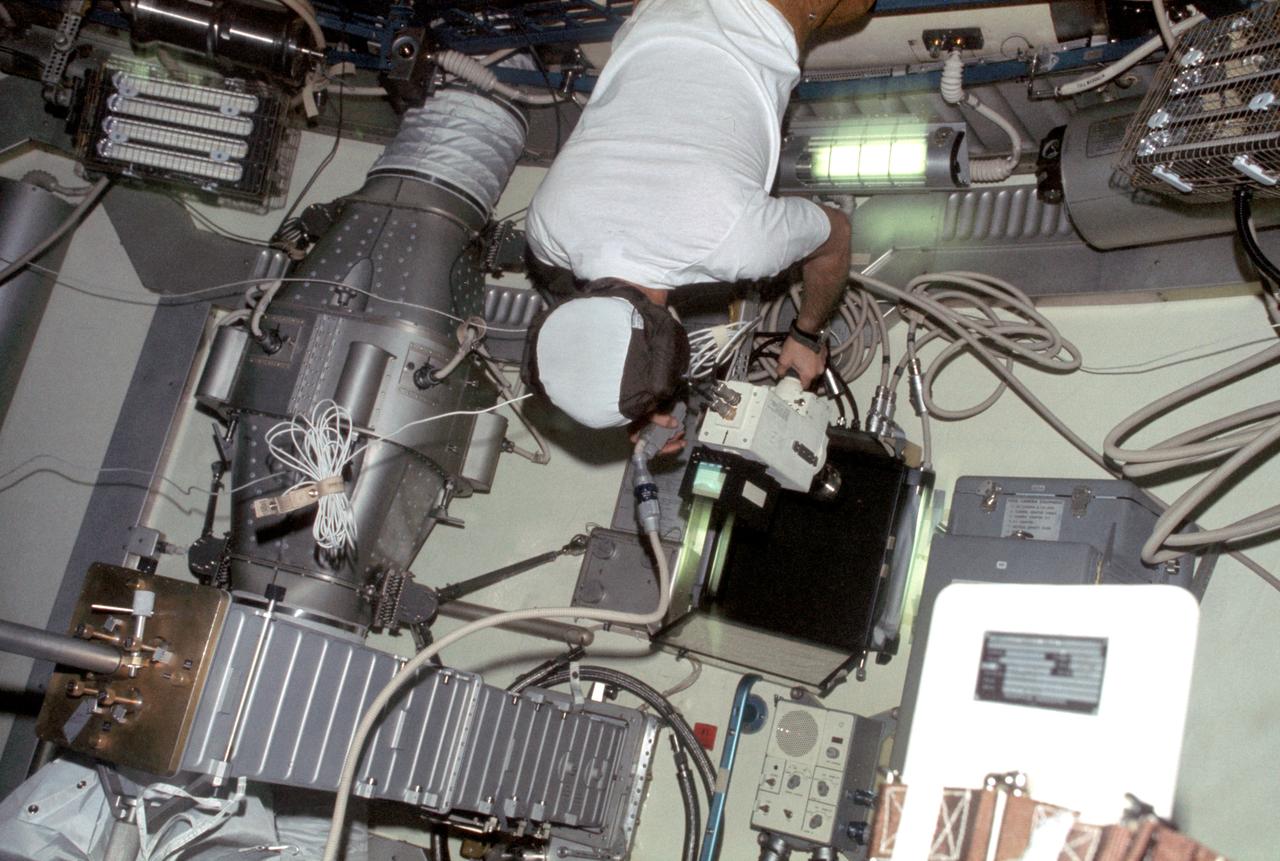
SL3-109-1345 (August 1973) --- View of scientist-astronaut Owen K. Garriott, Skylab 3 science pilot, taking TV footage of Arabella and Anita, the two Skylab 3 common cross spiders "aranous diadematus," aboard the Skylab space station cluster in Earth orbit. During the 59-day Skylab 3 mission the two spiders Arabella and Anita, were housed in an enclosure onto which a motion picture and still camera were attached to record the spiders' attempts to build a web in the weightless environment. Note the automatic data acquisition camera (DAC) about 3.5 feet to Garriott's right (about waist level). Photo credit: NASA

SL3-122-2609 (6 Aug. 1973) --- Scientist-astronaut Owen K. Garriott, Skylab 3 science pilot, looks at the camera as he participates in the Aug. 6, 1973 extravehicular activity (EVA) during which he and astronaut Jack R. Lousma, pilot, deployed the twin pole solar shield to help shade the Orbital Workshop (OWS). Photo credit: NASA

SL3-122-2610 (6 Aug. 1973) --- Scientist-astronaut Owen K. Garriott, Skylab 3 science pilot, looks at the camera as he participates in the Aug. 6, 1973 extravehicular activity (EVA) during which he and astronaut Jack R. Lousma, pilot, deployed the twin pole solar shield to help shade the Orbital Workshop (OWS). Photo credit: NASA
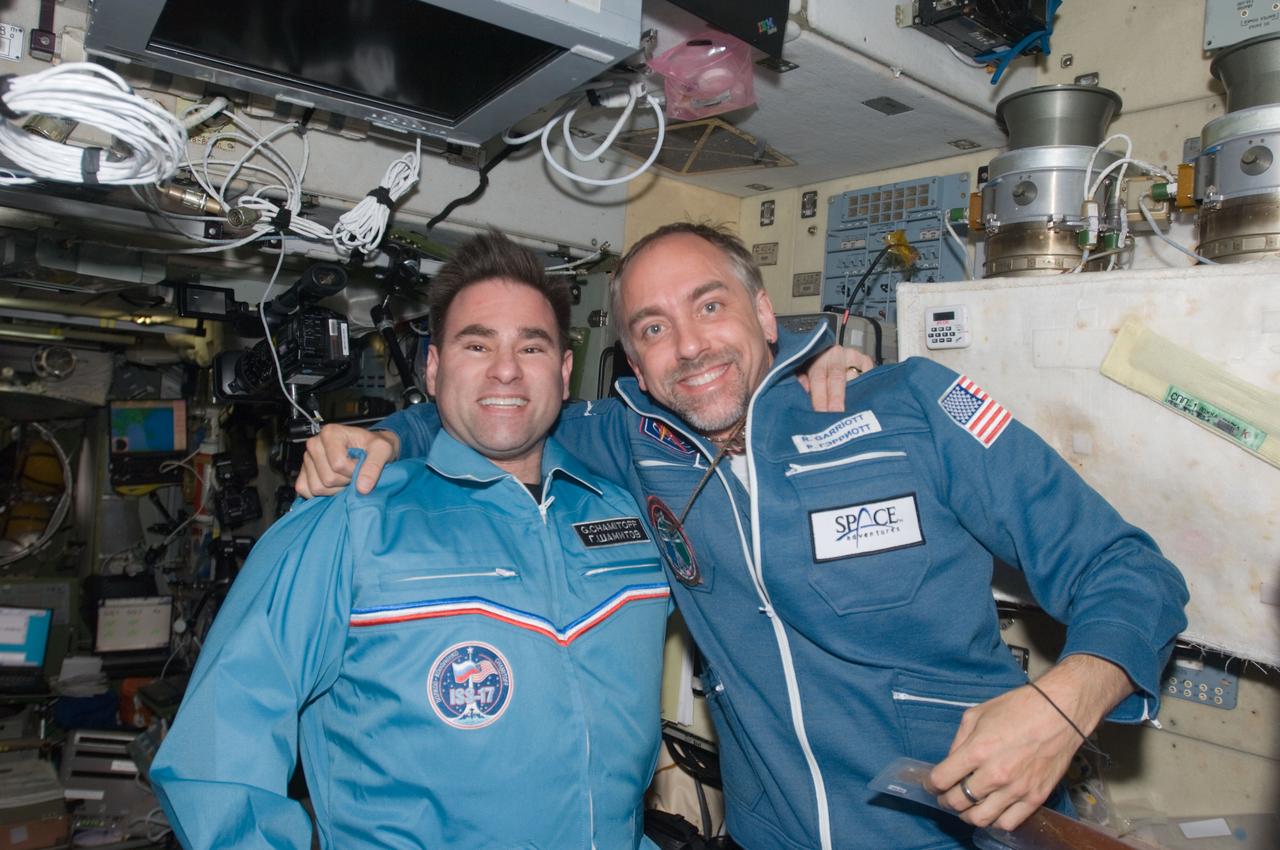
ISS017-E-018998 (14 Oct. 2008) --- NASA astronaut Greg Chamitoff (left), Expedition 17/18 flight engineer, and American spaceflight participant Richard Garriott pose for a photo in the Zvezda Service Module of the International Space Station.
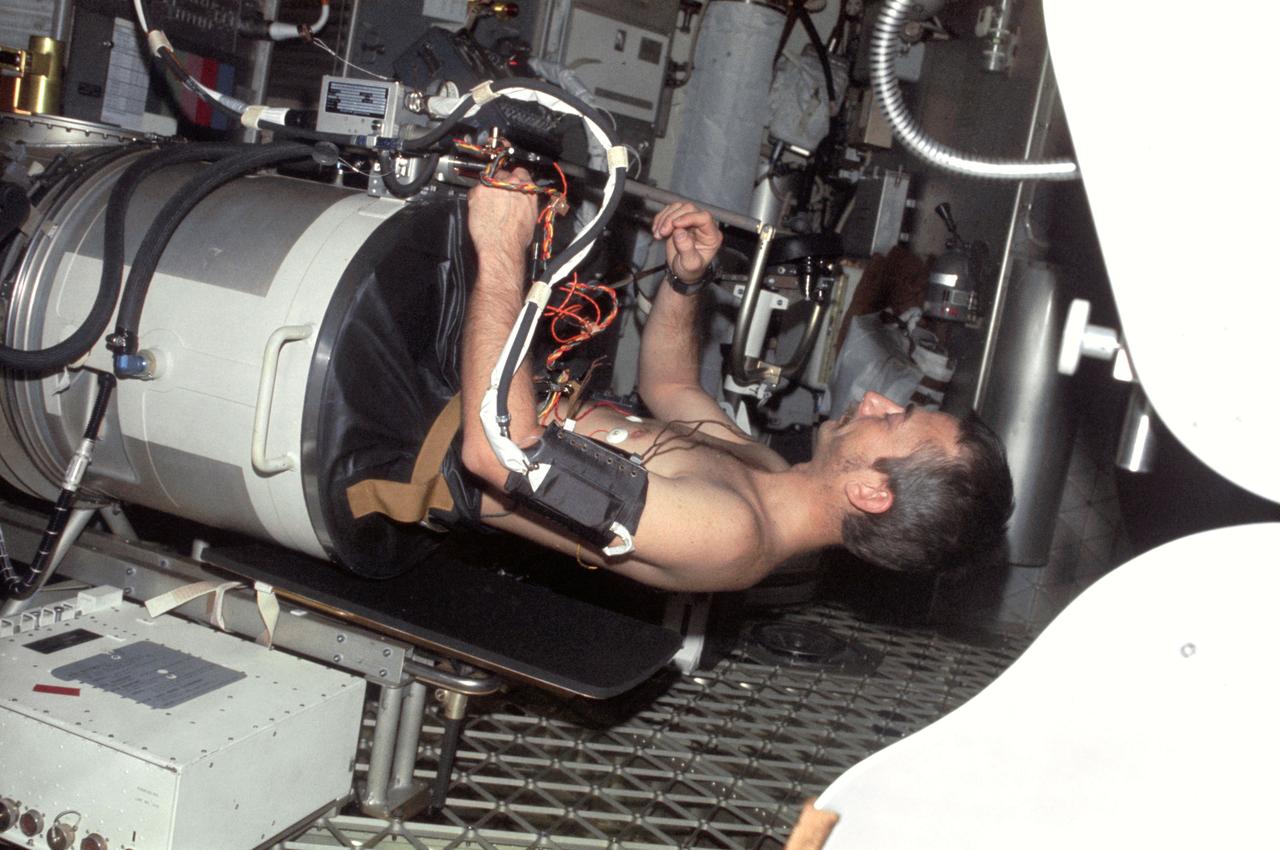
SL3-108-1278 (July-September 1973) --- Scientist-astronaut Owen K. Garriott, science pilot of the Skylab 3 mission, lies in the Lower Body Negative Pressure Device in the work and experiments area of the Orbital Workshop (OWS) crew quarters of the Skylab space station cluster in Earth orbit. This picture was taken with a hand-held 35mm Nikon camera. Astronauts Garriott, Alan L. Bean and Jack R. Lousma remained with the Skylab space station in orbit for 59 days conducting numerous medical, scientific and technological experiments. The LBNPD (MO92) Experiment is to provide information concerning the time course of cardiovascular adaptation during flight, and to provide in-flight data for predicting the degree of orthostatic intolerance and impairment of physical capacity to be expected upon return to Earth environment. The bicycle ergometer is in the right foreground. Photo credit: NASA
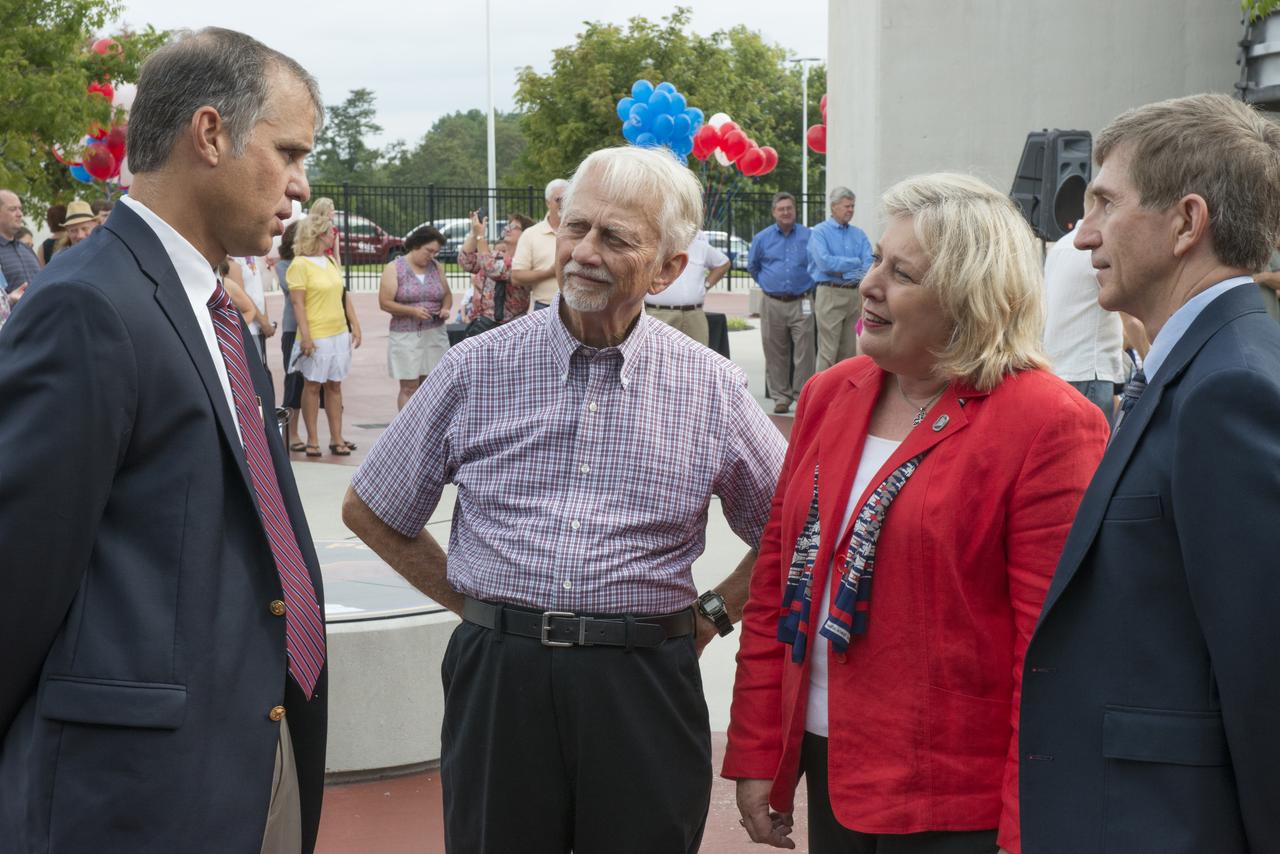
AUGUST 31, 2012 TRIBUTE TO APOLLO ASTRONAUT NEIL ARMSTRONG AT THE USSRC. L TO R: JONATHAN PETTUS, MSFC ACTING ASSOCIATE ADMINISTRATOR; FORMER ASTRONAUT OWEN GARRIOTT; FORMER ASTRONAUT JAN DAVIS AND FORMER ASTRONAUT FRED LESLIE.1200933F
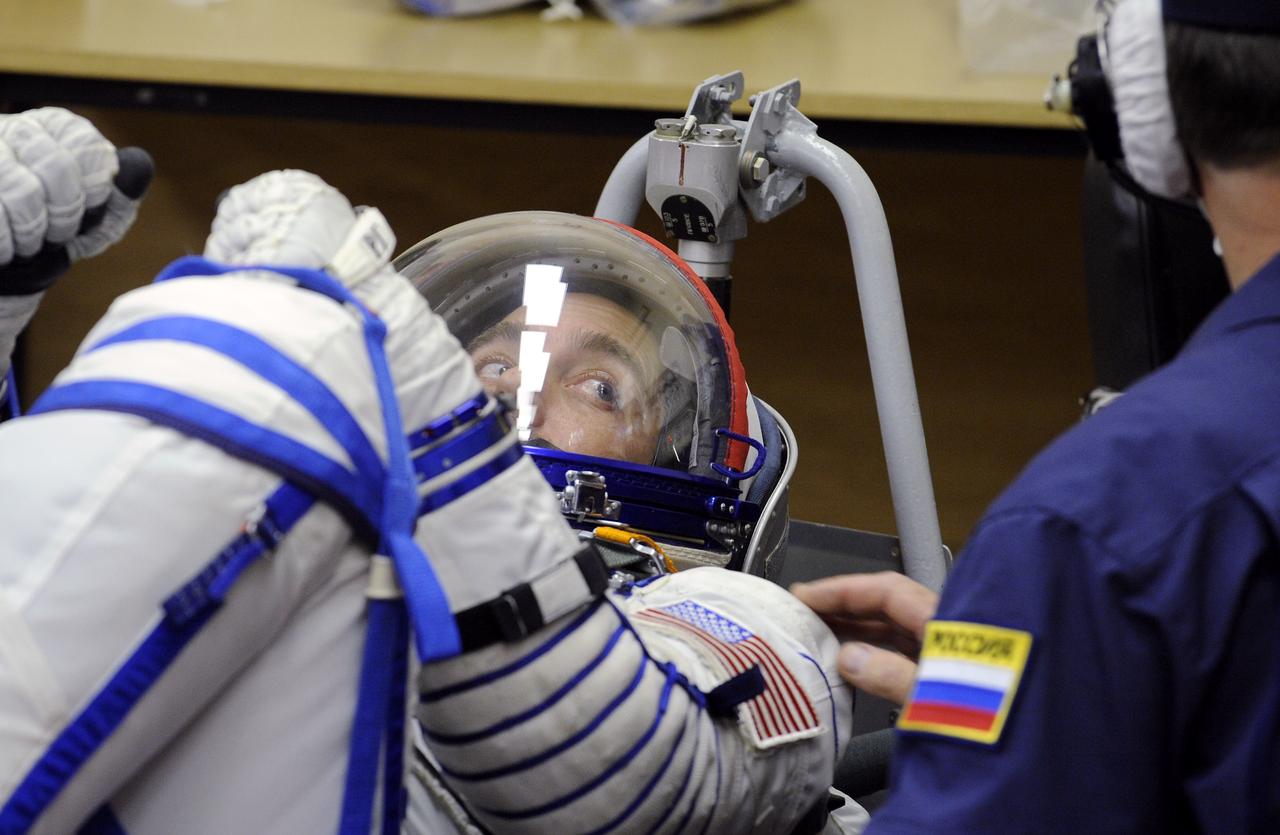
American Spaceflight Participant Richard Garriott has his Russian Sokol suit pressure checked prior to launching in the Soyuz TMA-13 spacecraft with Expedition 18 Commander Michael Fincke and Flight Engineer Yury V. Lonchakov, Sunday, Oct. 12, 2008 from the Baikonur Cosmodrome in Kazakhstan. The three crew members are scheduled to dock with the International Space Station on Oct. 14. Fincke and Lonchakov will spend six months on the station, while Garriott will return to Earth Oct. 24, 2008 with two of the Expedition 17 crewmembers currently on the International Space Station. Photo Credit: (NASA/Bill Ingalls)

American spaceflight participant Richard Garriott, left, Expedition 18 Flight Engineer Yuri V. Lonchakov and Expedition 18 Commander Michael Fincke, right, participate in the traditional blessing prior to the bus ride to building 254 where the crew don their spacesuits, Sunday, Oct. 12, 2008, in Baikonur, Kazakhstan. The Soyuz TMA-13 spacecraft launched from the Baikonur Cosmodrome in Kazakhstan carrying Fincke, Lonchakov and Garriott. Photo Credit: (NASA/Bill Ingalls)
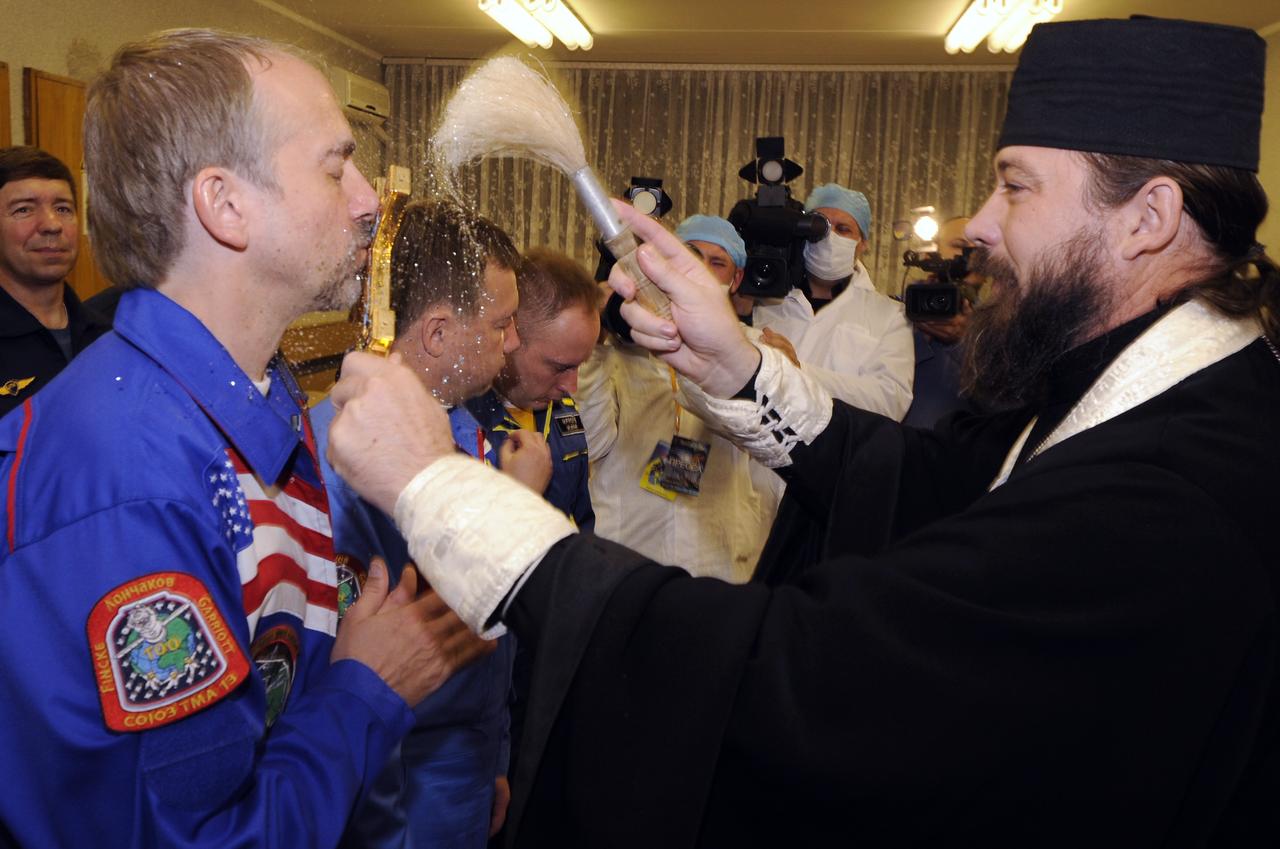
American spaceflight participant Richard Garriott, left, Expedition 18 Flight Engineer Yuri V. Lonchakov and Expedition 18 Commander Michael Fincke, right, participate in the traditional blessing prior to the bus ride to building 254 where the crew don their spacesuits, Sunday, Oct. 12, 2008, in Baikonur, Kazakhstan. The Soyuz TMA-13 spacecraft launched from the Baikonur Cosmodrome in Kazakhstan carrying Fincke, Lonchakov and Garriott. Photo Credit: (NASA/Bill Ingalls)
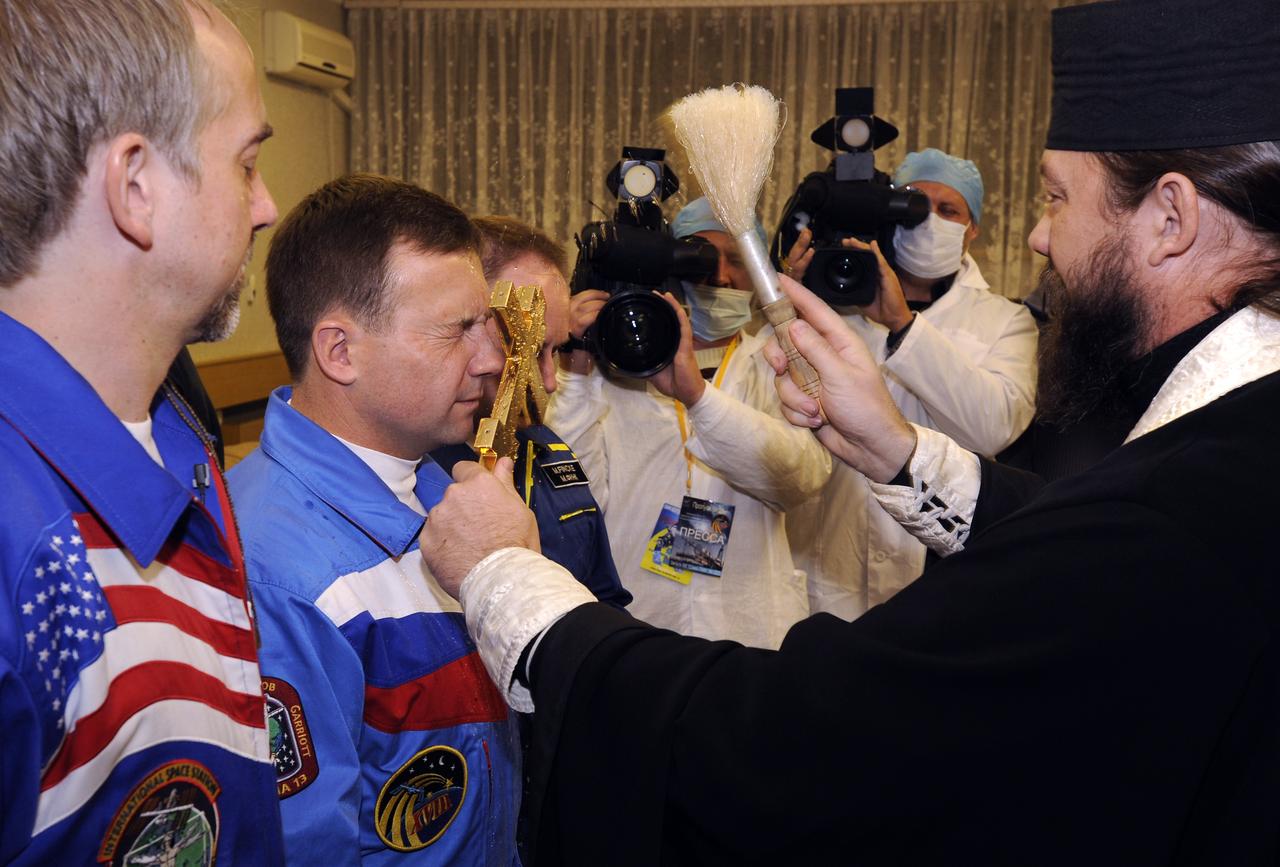
American spaceflight participant Richard Garriott, left, Expedition 18 Flight Engineer Yuri V. Lonchakov and Expedition 18 Commander Michael Fincke, right, participate in the traditional blessing prior to the bus ride to building 254 where the crew don their spacesuits, Sunday, Oct. 12, 2008, in Baikonur, Kazakhstan. The Soyuz TMA-13 spacecraft launched from the Baikonur Cosmodrome in Kazakhstan carrying Fincke, Lonchakov and Garriott. Photo Credit: (NASA/Bill Ingalls)
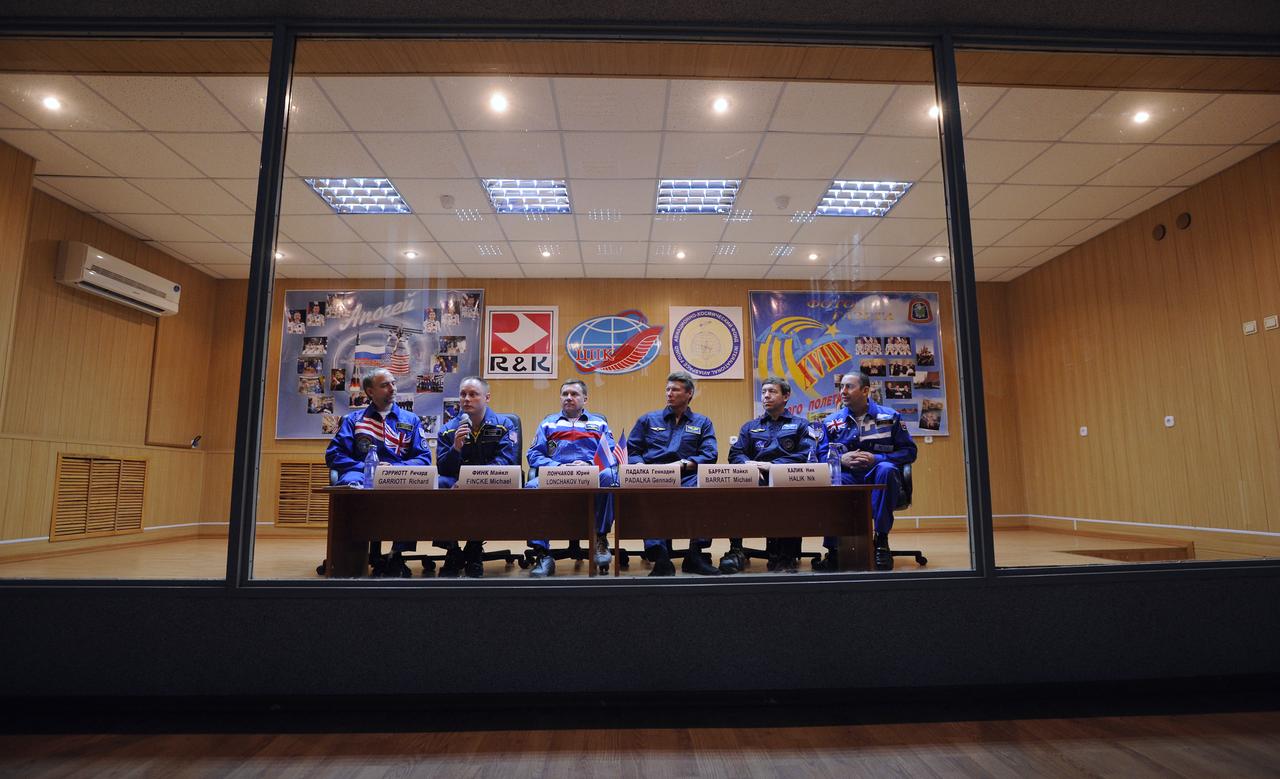
The quarantined crew, from left, American spaceflight participant Richard Garriott, Expedition 18 Commander Michael Fincke, Flight Engineer Yuri V. Lonchakov, back up Expedition 18 Commander Gennady Padalka, Flight Engineer Mike Barratt and spaceflight participant Nik Halik answer reporters questions during a press conference at the Cosmonaut Hotel, Saturday, Oct. 11, 2008, in Baikonur, Kazakhstan. Fincke, Lonchakov and Garriott are scheduled to launch Oct. 12 and dock with the International Space Station on Oct. 14. Fincke and Lonchakov will spend six months on the station, while Garriott will return to Earth Oct. 24 with two of the Expedition 17 crew members currently on the International Space Station. Photo Credit: (NASA/Bill Ingalls)
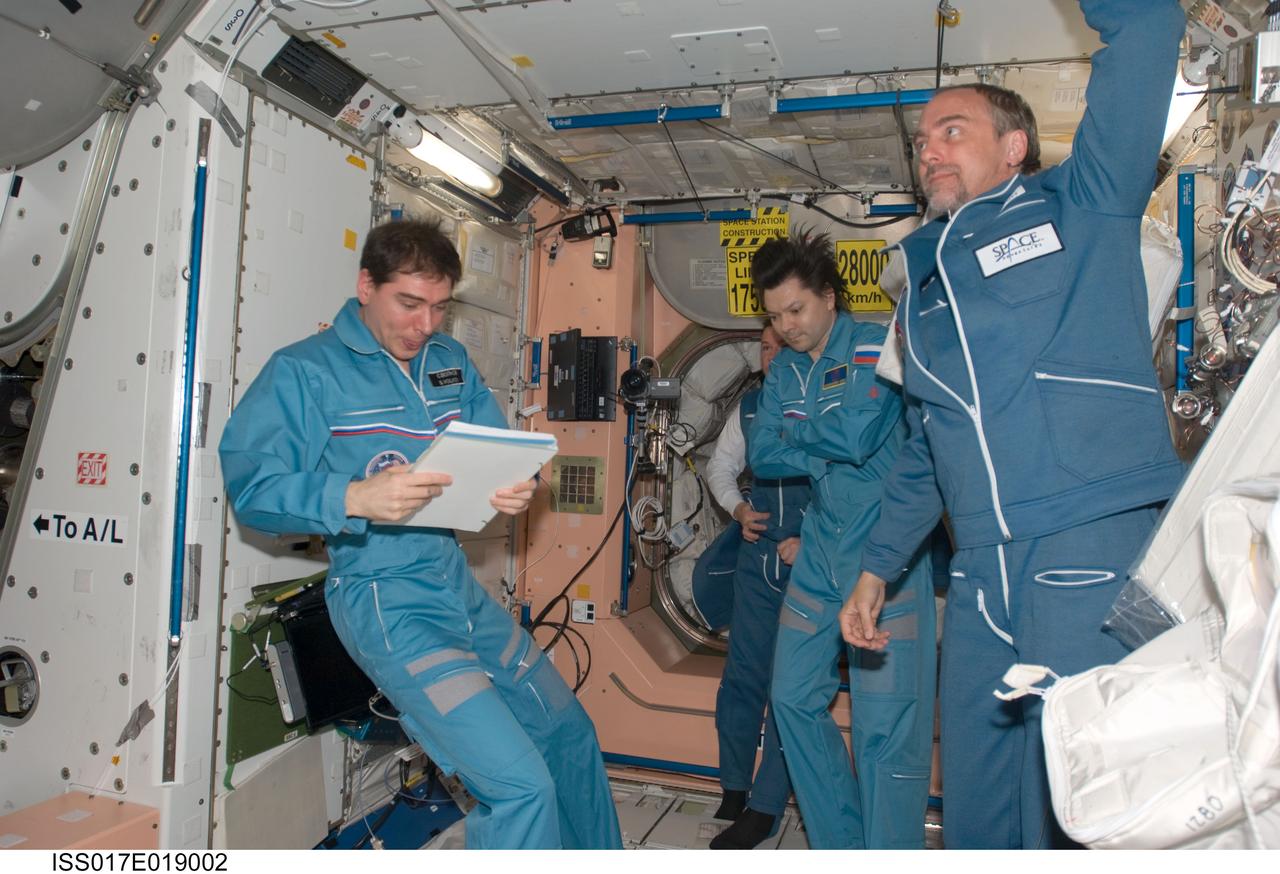
ISS017-E-019002 (14 Oct. 2008) --- Russian Federal Space Agency cosmonauts Sergei Volkov (left), Oleg Kononenko (center), Expedition 17 commander and flight engineer, respectively; Yury Lonchakov (background, partially obscured), Expedition 18 flight engineer; and American spaceflight participant Richard Garriott are pictured in the Unity node of the International Space Station.
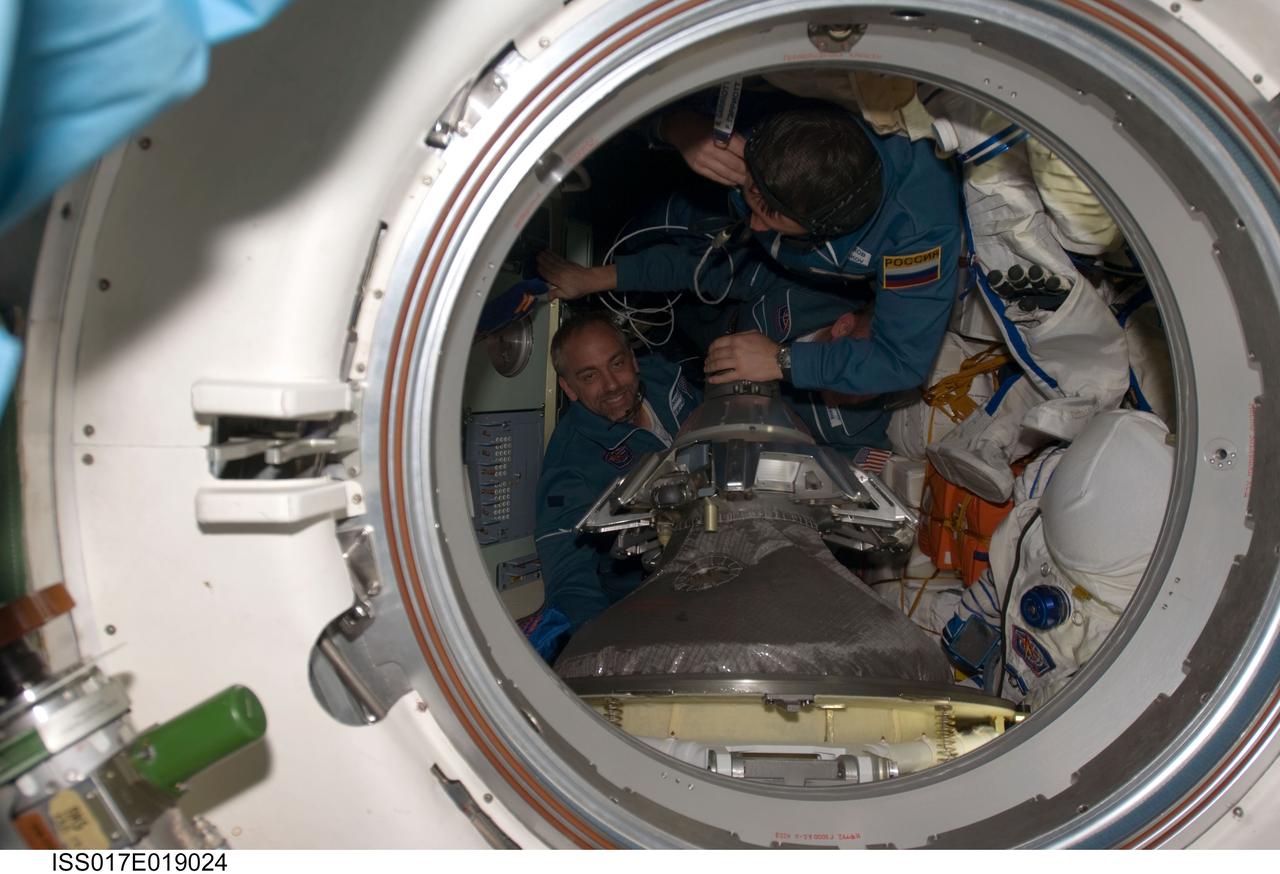
ISS017-E-019024 (14 Oct. 2008) --- Russian Federal Space Agency cosmonaut Yury Lonchakov (top), Expedition 18 flight engineer, and American spaceflight participant Richard Garriott ingress the Earth-facing port of the International Space Station's Zarya module after arriving onboard the Soyuz TMA-13 spacecraft with NASA astronaut Michael Fincke (out of frame), commander. Hatches between the two spacecraft were opened at 4:55 a.m. (CDT).
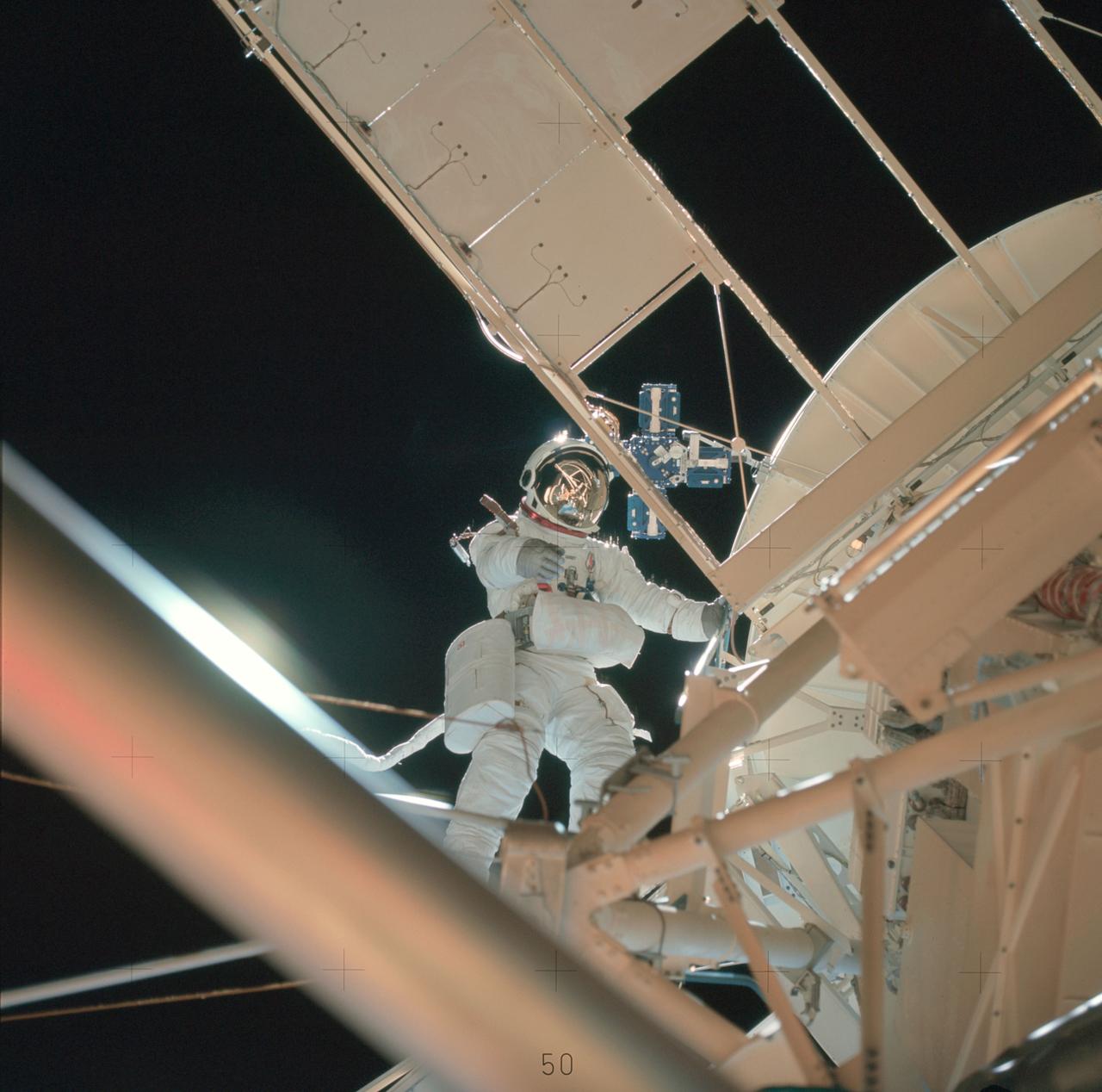
Scientist-Astronaut Owen K. Garriott, Skylab 3 science pilot, participates in the August 6, 1973 extravehicular activity (EVA) during which he and Astronaut Jack Lousma, Skylab pilot, deployed the twin pole solar shield to help shade the Orbital Workshop (OWS). Note the reflection of the solar shield in Garriett's helmet visor.
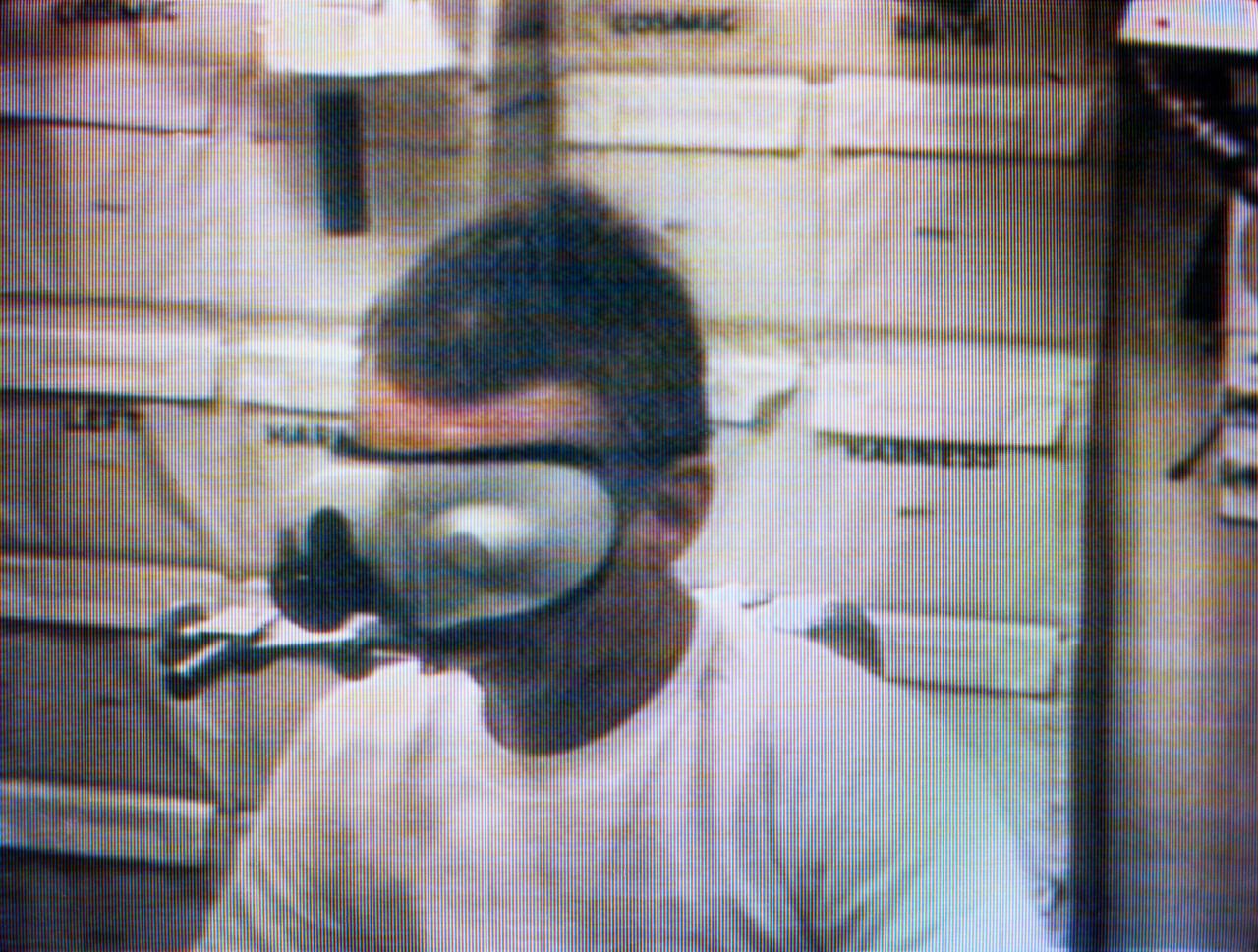
S73-32113 (9 Aug. 1973) --- Scientist-astronaut Owen K. Garriott, Skylab 3 science pilot, serves as test subject for the Skylab ?Human Vestibular Function? M131 Experiment, as seen in this photographic reproduction taken from a television transmission made by a color TV camera aboard the Skylab space station in Earth orbit. The objectives of the Skylab M131 experiment are to obtain data pertinent to establishing the validity of measurements of specific behavioral/physiological responses influenced by vestibular activity under one-g and zero-g conditions; to determine man?s adaptability to unusual vestibular conditions and predict habitability of future spacecraft conditions involving reduced gravity and Coriollis forces; and to measure the accuracy and variability in man?s judgment of spatial coordinates based on atypical gravity receptor cues and inadequate visual cues. Photo credit: NASA
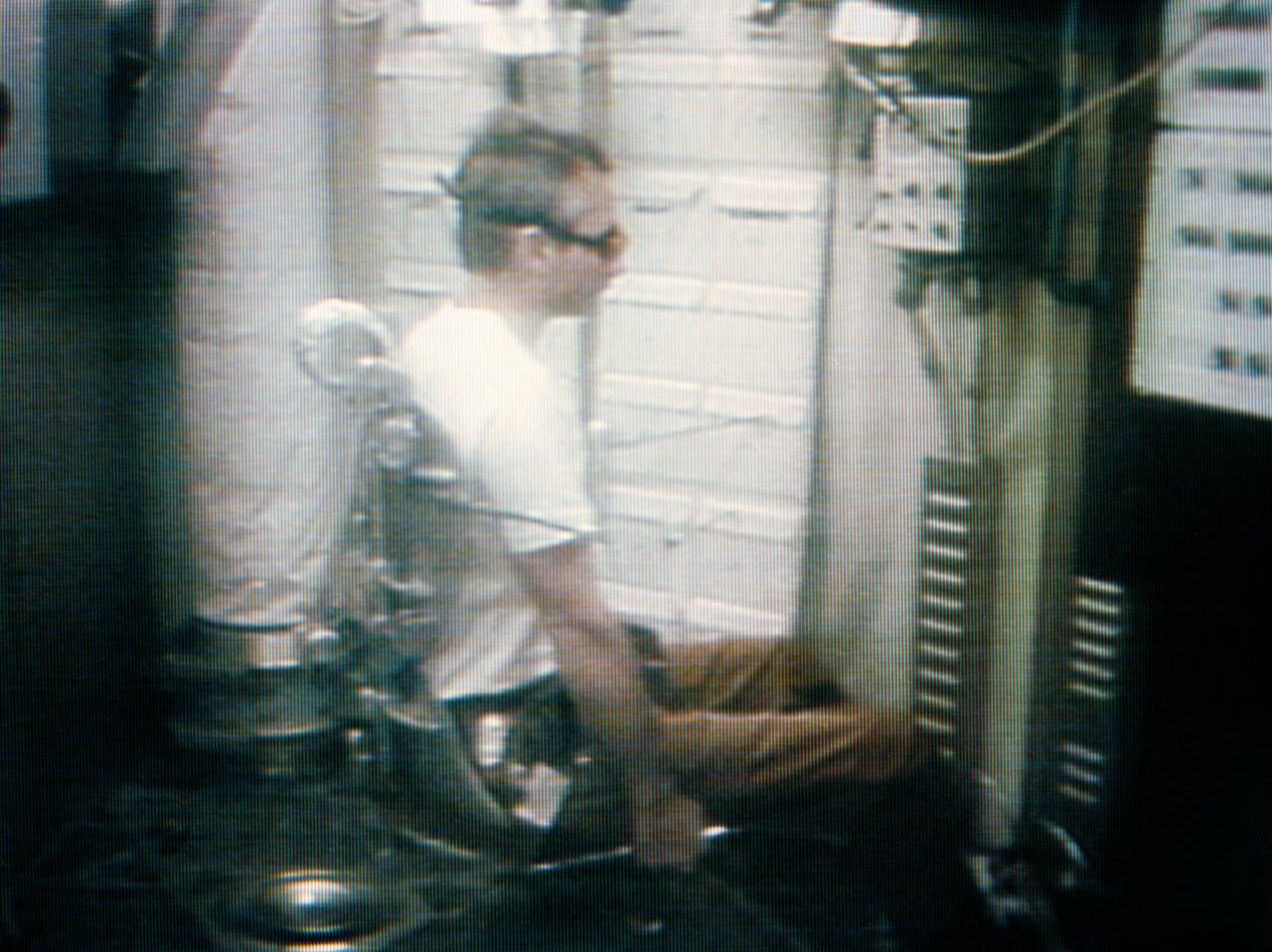
S73-34171 (9 Aug. 1973) --- Scientist-astronaut Owen K. Garriott, Skylab 3 science pilot, serves as test subject for the Skylab ?Human Vestibular Function? M131 Experiment, as seen in this photographic reproduction taken from a television transmission made by a color TV camera aboard the Skylab space station in Earth orbit. The objectives of the Skylab M131 experiment are to obtain data pertinent to establishing the validity of measurements of specific behavioral/physiological responses influenced by vestibular activity under one-g and zero-g conditions; to determine man?s adaptability to unusual vestibular conditions and predict habitability of future spacecraft conditions involving reduced gravity and Coriollis forces; and to measure the accuracy and variability in man?s judgment of spatial coordinates based on atypical gravity receptor cues and inadequate visual cures. Dr. Garriott is seated in the experiment?s litter chair which can rotate the test subject at predetermined rotational velocity or programmed acceleration/decelerational profile. Photo credit: NASA
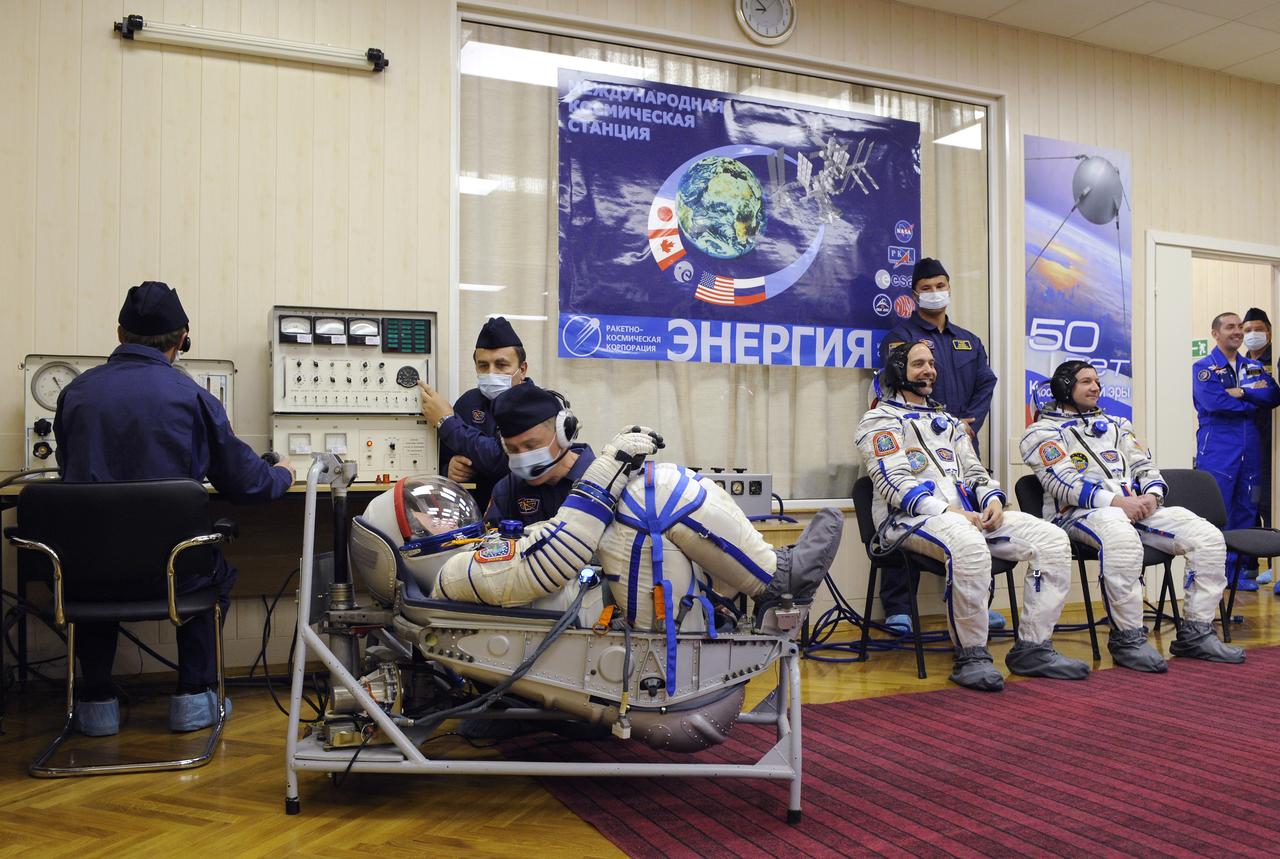
Expedition 18 Commander Michael Fincke, foreground, has his Russian Sokol suit pressure checked prior to launching in the Soyuz TMA-13 spacecraft with American spaceflight participant Richard Garriott and Expedition 18 Flight Engineer Yuri V. Lonchakov, right, Sunday, Oct. 12, 2008 from the Baikonur Cosmodrome in Kazakhstan. The three crew members are scheduled to dock with the International Space Station on Oct. 14. Fincke and Lonchakov will spend six months on the station, while Garriott will return to Earth Oct. 24 with two of the Expedition 17 crew members currently on the International Space Station. Photo Credit: (NASA/Bill Ingalls)
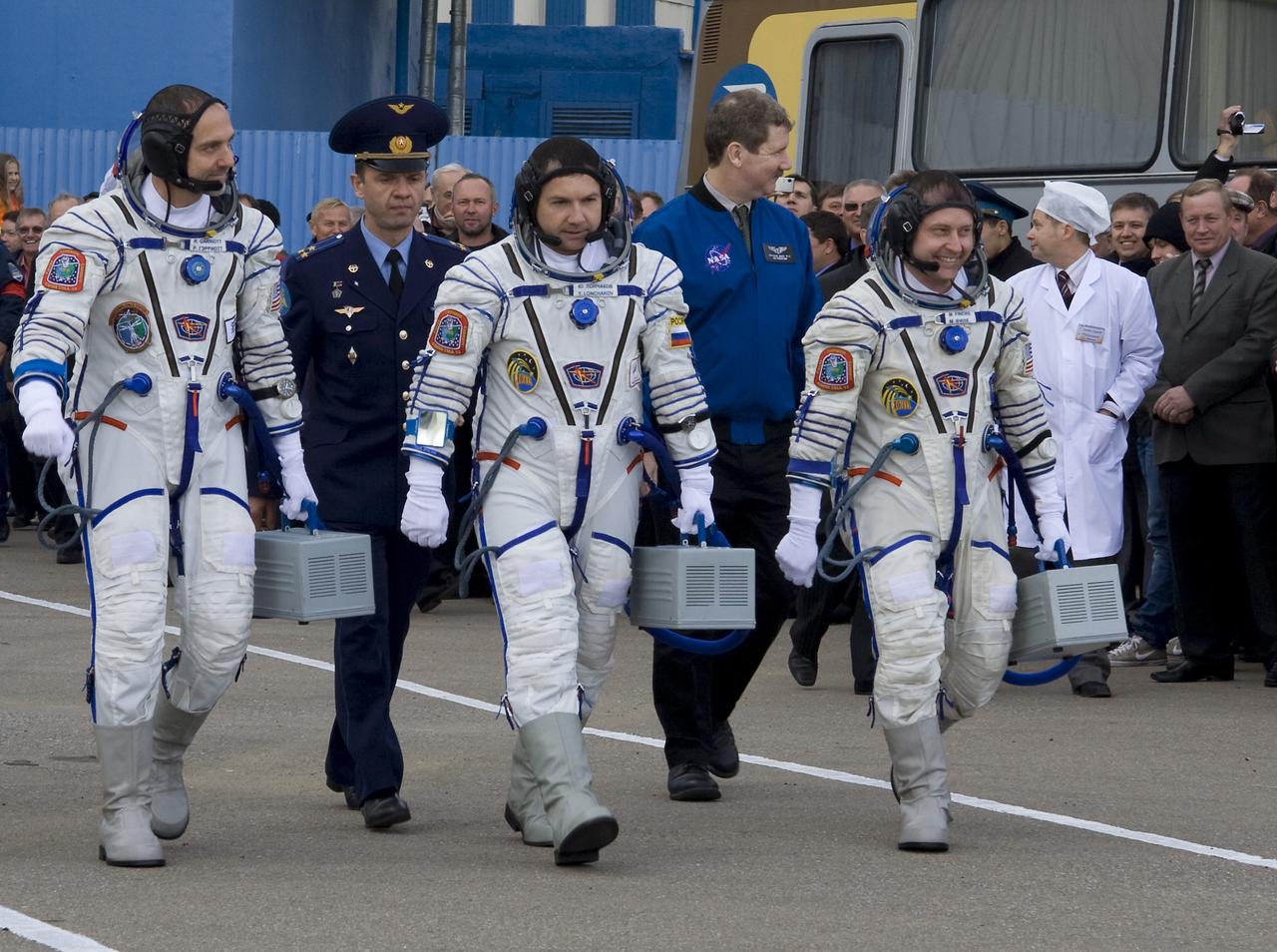
American spaceflight participant Richard Garriott, left, Expedition 18 Flight Engineer Yuri V. Lonchakov and Expedition 18 Commander Michael Fincke, right, depart building 254 where the crew donned their spacesuits prior to launch in the Soyuz TMA-13 spacecraft, Sunday Oct. 12, 2008 from the Baikonur Cosmodrome in Kazakhstan. The crew is scheduled to dock to the International Space Station on Oct. 14. Fincke and Lonchakov will spend six months on the station, while Garriott will return to Earth Oct. 24 with two of the Expedition 17 crewmembers currently on the International Space Station. Photo Credit: (NASA/Victor Zelentsov)
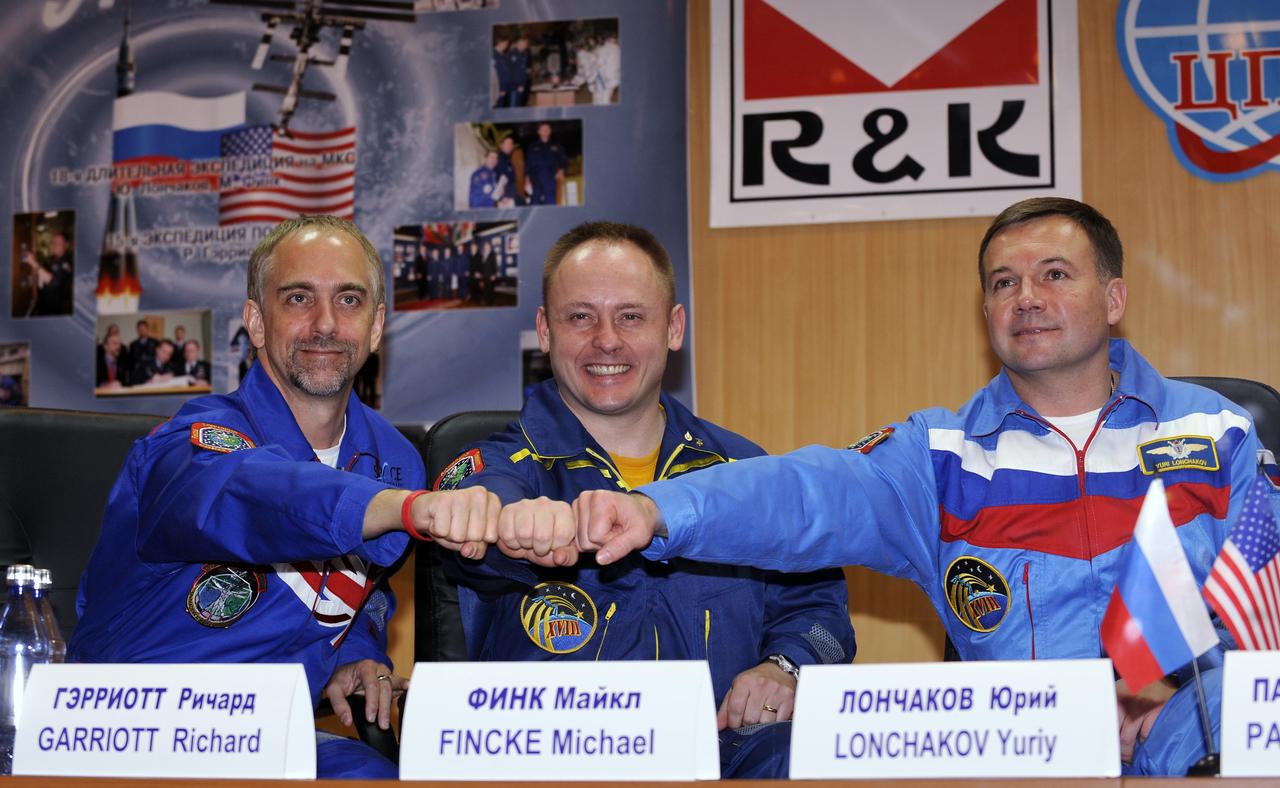
Expedition 18 Flight Engineer Yuri V. Lonchakov, right, Expedition 18 Commander Michael Fincke and American spaceflight participant Richard Garriott, left, pose for photographs after a press conference held at the Cosmonaut Hotel, Saturday, Oct. 11, 2008, in Baikonur, Kazakhstan. The Expedition 18 crew will launch on the Soyuz TMA-13 spacecraft on Oct. 12 and dock with the International Space Station on Oct. 14. Fincke and Lonchakov will spend six months on the station, while Garriott will return to Earth Oct. 24 with two of the Expedition 17 crew members currently on the International Space Station. Photo Credit: (NASA/Bill Ingalls)
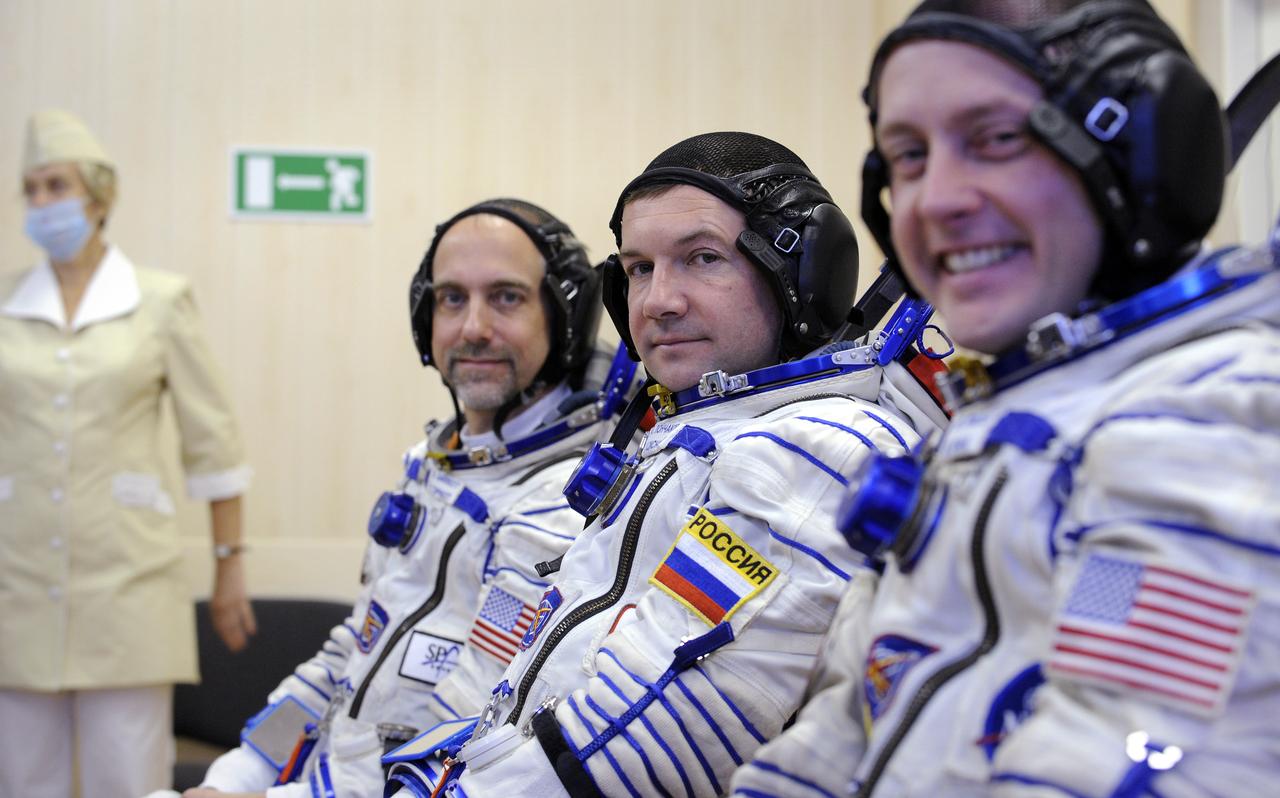
American spaceflight participant Richard Garriott, left, Expedition 18 Flight Engineer Yuri V. Lonchakov and Expedition 18 Commander Michael Fincke, right, smile for the camera after they had their Russian Sokol suits pressure checked in preparation for launch onboard the Soyuz TMA-13 spacecraft, Sunday, Oct. 12, 2008 from the Baikonur Cosmodrome in Kazakhstan. The three crew members are scheduled to dock with the International Space Station on Oct. 14. Fincke and Lonchakov will spend six months on the station, while Garriott will return to Earth Oct. 24 with two of the Expedition 17 crew members currently on the International Space Station. Photo Credit: (NASA/Bill Ingalls)
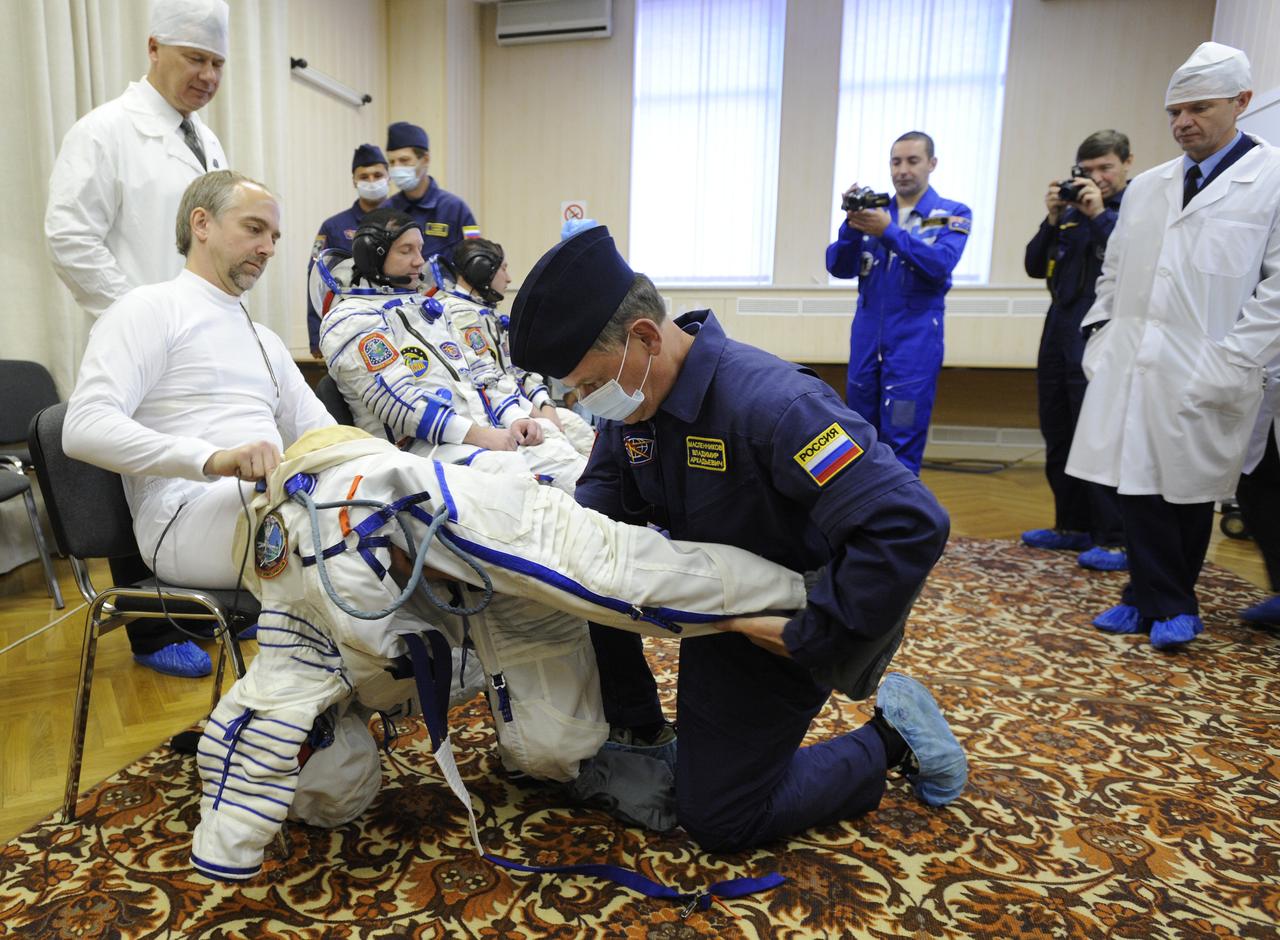
American spaceflight participant Richard Garriott, left, dons his Russian Sokol suit hours before he and Flight Engineer Yuri V. Lonchakov, second from left, and Expedition 18 Commander Michael Fincke launch in the Soyuz TMA-13 spacecraft, Sunday, Oct. 12, 2008 from the Baikonur Cosmodrome in Kazakhstan. The three crew members are scheduled to dock with the International Space Station on Oct. 14. Fincke and Lonchakov will spend six months on the station, while Garriott will return to Earth Oct. 24 with two of the Expedition 17 crew members currently on the International Space Station. Photo Credit: (NASA/Bill Ingalls)
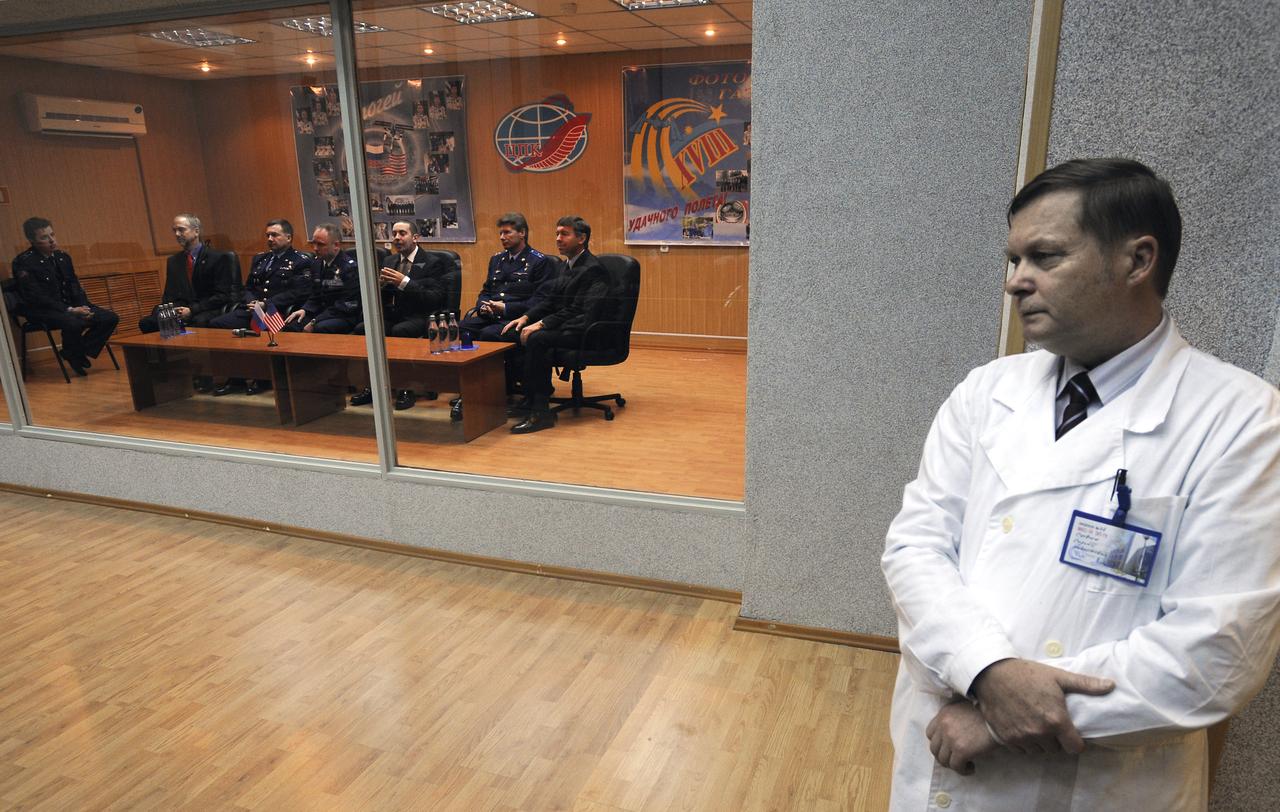
A Russian flight surgeon, right, along with the quarantined prime and backup crews listen to the State Commission give the final approval for the launch of the Soyuz TMA-13 spacecraft, Saturday, Oct. 11, 2008 in Baikonur, Kazakhstan. Expedition 18 Commander Michael Fincke, Flight Engineer Yuri V. Lonchakov and American spaceflight participant Richard Garriott are scheduled to launch Oct. 12 and dock with the International Space Station on Oct. 14. Fincke and Lonchakov will spend six months on the station, while Garriott will return to Earth Oct. 24 with two of the Expedition 17 crew members currently on the International Space Station. Photo Credit: (NASA/Bill Ingalls)
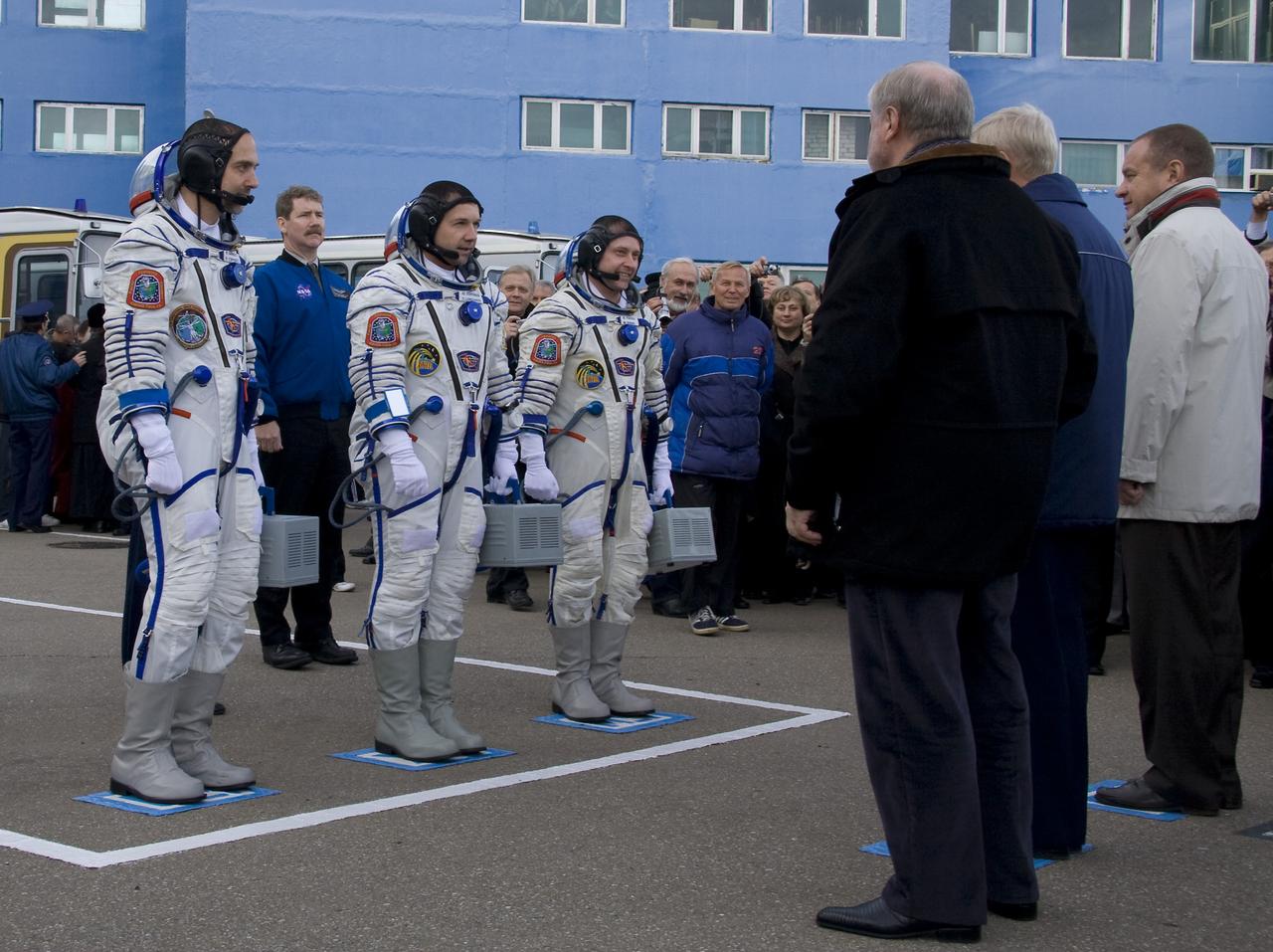
American spaceflight participant Richard Garriott, left, Expedition 18 Flight Engineer Yuri V. Lonchakov and Expedition 18 Commander Michael Fincke, right, prepare to salute officials prior to launch in the Soyuz TMA-13 spacecraft, Sunday Oct. 12, 2008 from the Baikonur Cosmodrome in Kazakhstan. The crew is scheduled to dock to the International Space Station on Oct. 14. Fincke and Lonchakov will spend six months on the station, while Garriott will return to Earth Oct. 24 with two of the Expedition 17 crewmembers currently on the International Space Station. Photo Credit: (NASA/Victor Zelentsov)
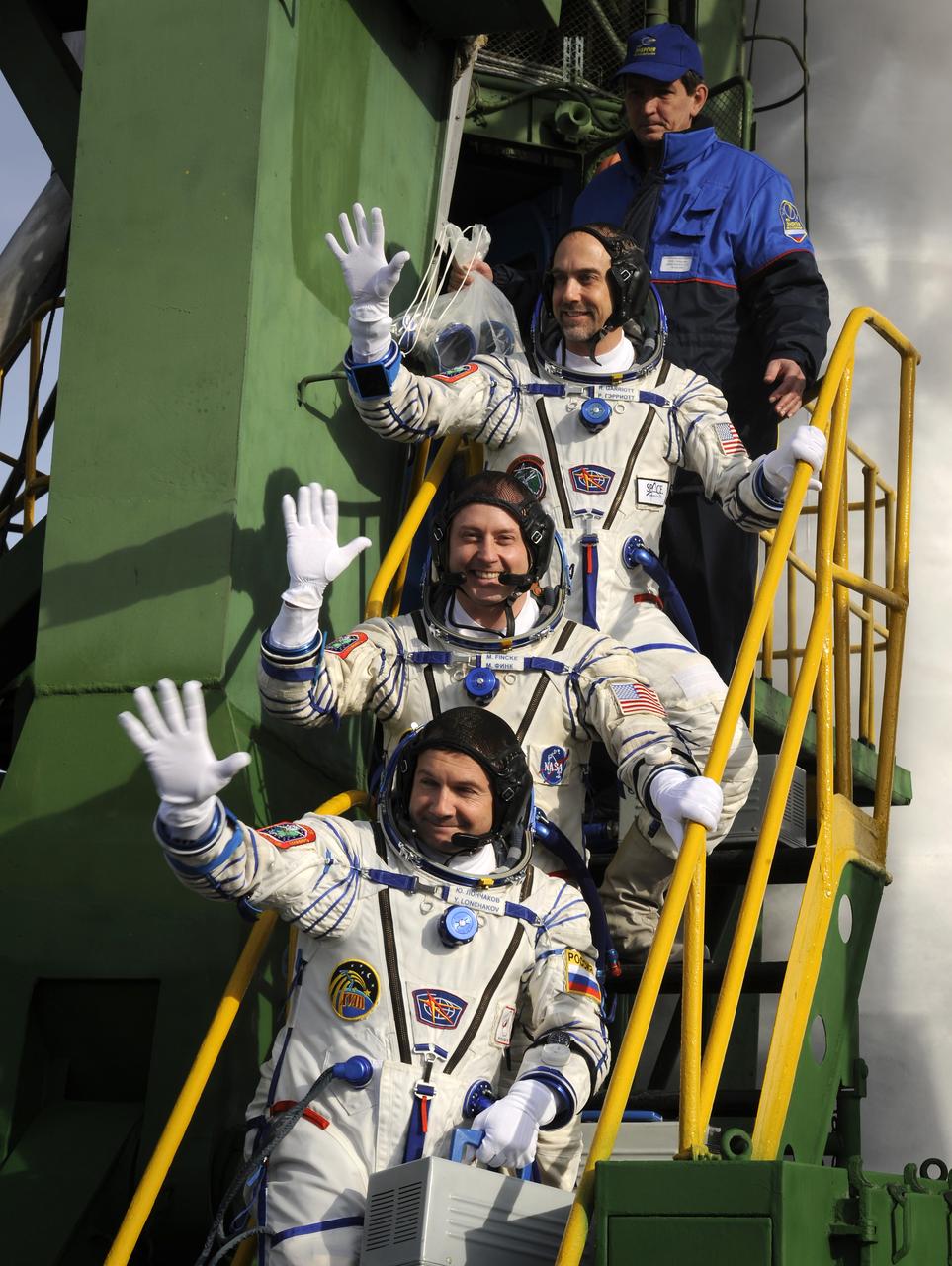
Expedition 18 Flight Engineer Yuri V. Lonchakov, bottom, Expedition 18 Commander Michael Fincke and American spaceflight participant Richard Garriott, top, wave farewell from the steps of the Soyuz launch pad prior to their launch in the Soyuz TMA-13 spacecraft, Sunday, Oct. 12, 2008 from the Baikonur Cosmodrome in Kazakhstan. The three crew members are scheduled to dock with the International Space Station on Oct. 14. Fincke and Lonchakov will spend six months on the station, while Garriott will return to Earth Oct. 24 with two of the Expedition 17 crew members currently on the International Space Station. Photo Credit: (NASA/Bill Ingalls)
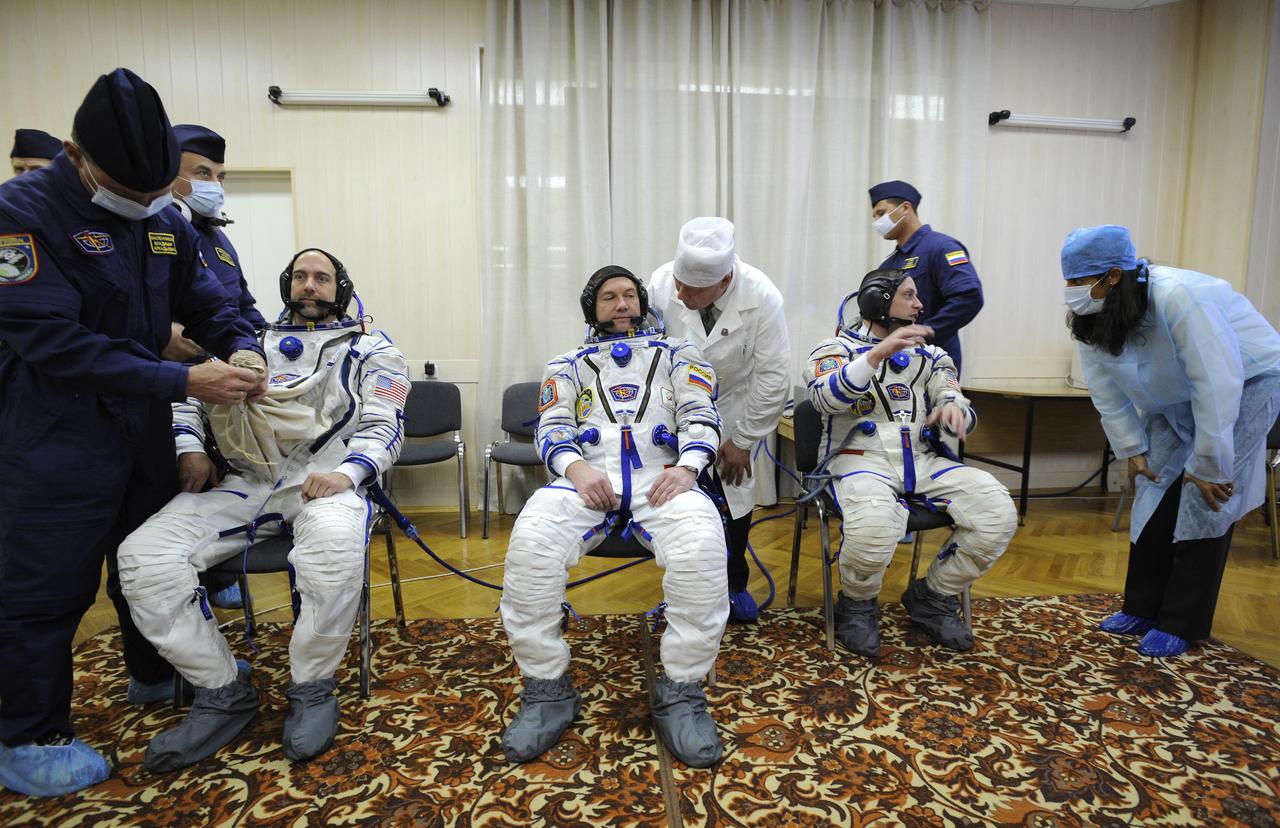
American spaceflight participant Richard Garriott, left, Expedition 18 Flight Engineer Yuri V. Lonchakov and Commander Michael Fincke, right, don their Russian Sokol suits hours before the launch in the Soyuz TMA-13 spacecraft, Sunday, Oct. 12, 2008 from the Baikonur Cosmodrome in Kazakhstan. The three crew members are scheduled to dock with the International Space Station on Oct. 14. Fincke and Lonchakov will spend six months on the station, while Garriott will return to Earth Oct. 24 with two of the Expedition 17 crew members currently on the International Space Station. Photo Credit: (NASA/Bill Ingalls)
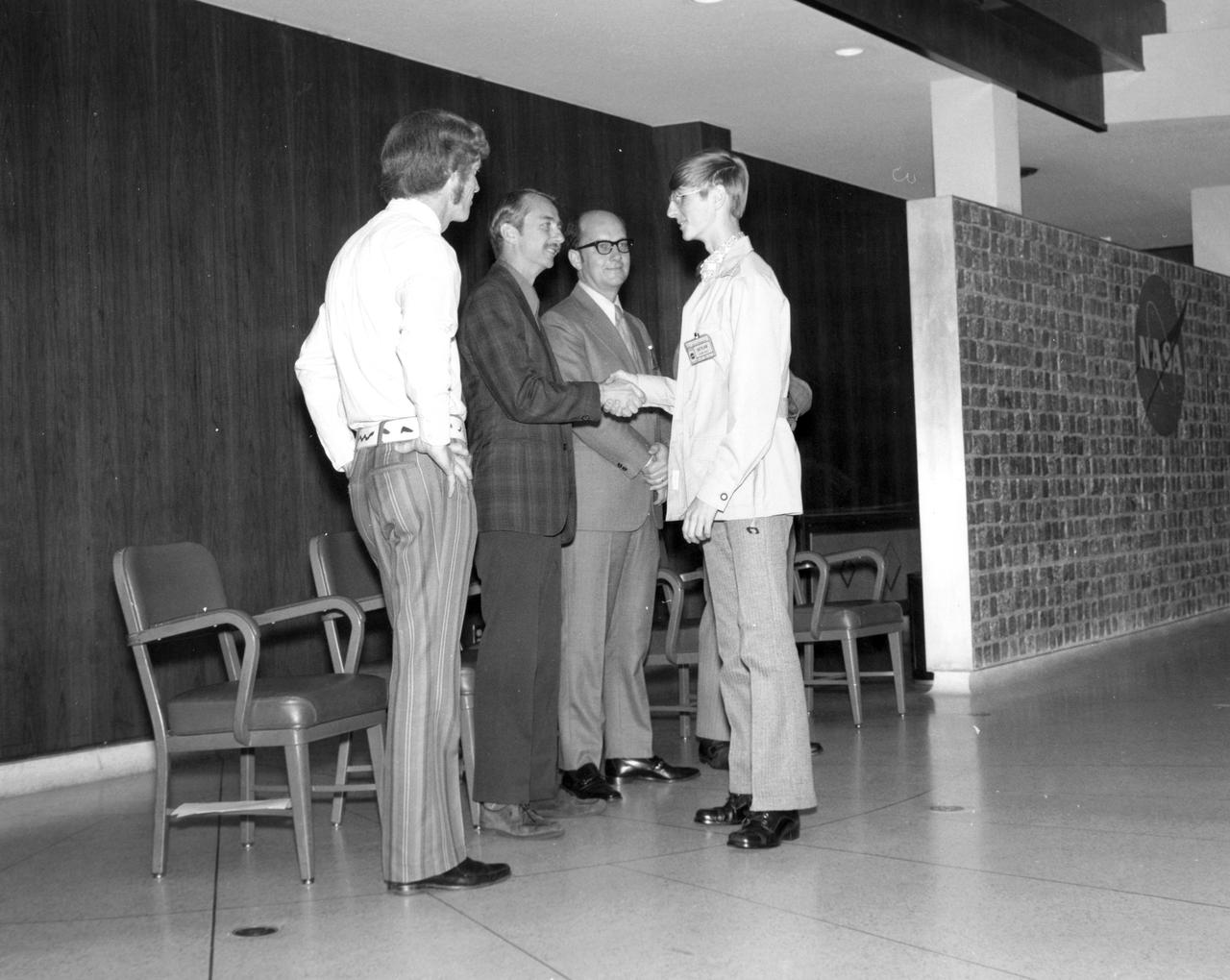
West Point, Nebraska high school student, Joel C. Wordekemper, is greeted by (left to right): Astronauts Russell L. Schweickart, and Owen K. Garriott; Marshall Space Flight Center (MSFC) Skylab Program Manager, Leland Belew; and MSFC Director of Administration and Technical Services, David Newby, during a tour of MSFC. Wordekemper was among 25 winners of a contest in which some 3,500 high school students proposed experiments for the following year’s Skylab mission. The nationwide scientific competition was sponsored by the National Science Teachers Association and the National Aeronautics and Space Administration (NASA). The winning students, along with their parents and sponsor teachers, visited MSFC where they met with scientists and engineers, participated in design reviews for their experiments, and toured MSFC facilities. Of the 25 students, 6 did not see their experiments conducted on Skylab because the experiments were not compatible with Skylab hardware and timelines. Of the 19 remaining, 11 experiments required the manufacture of additional equipment.
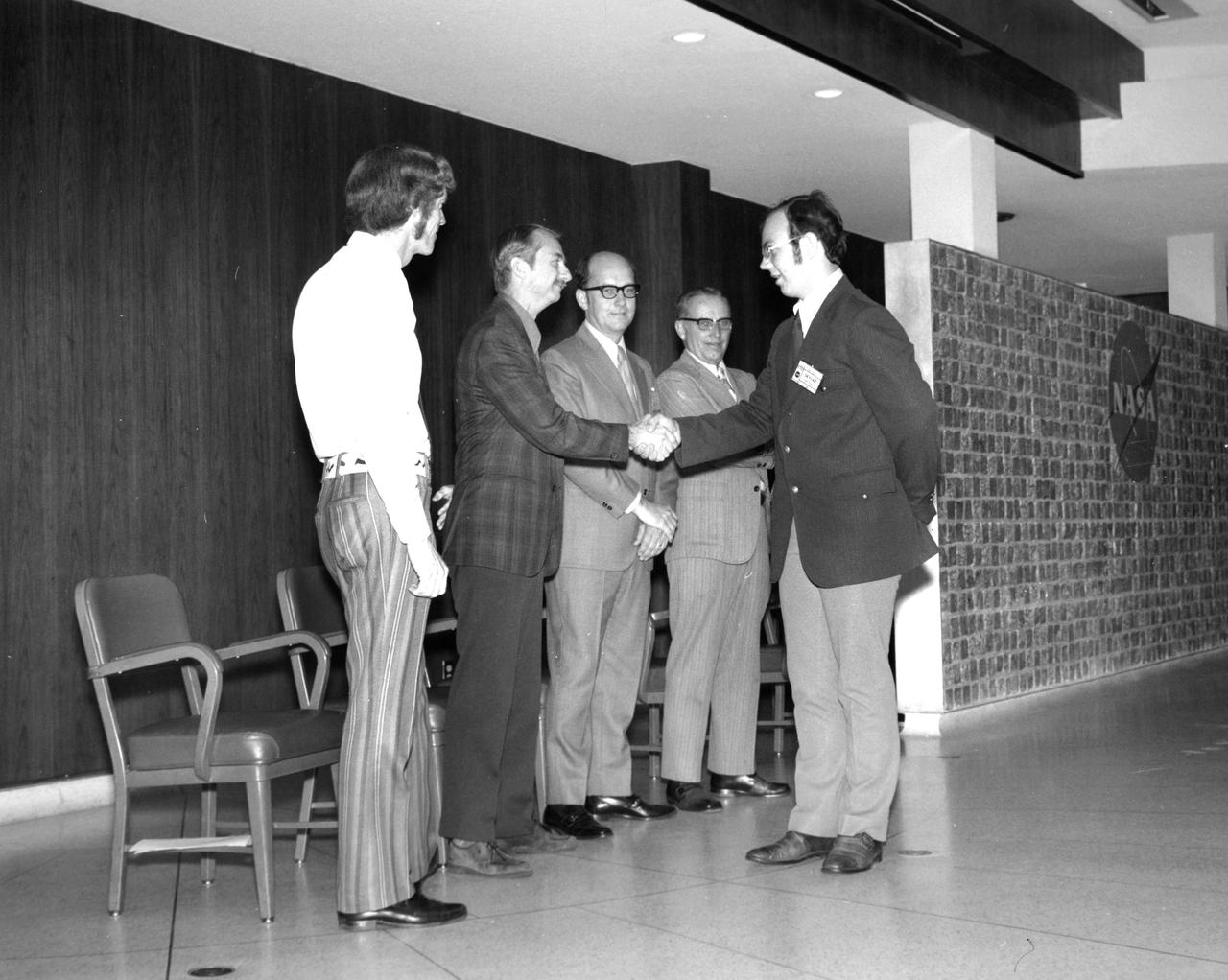
Baton Rouge, Louisiana high school student, Joe W. Reihs, is greeted by (left to right): Astronauts Russell L. Schweickart, and Owen K. Garriott; Marshall Space Flight Center (MSFC) Skylab Program Manager, Leland Belew; and MSFC Director of Administration and Technical Services, David Newby, during a tour of MSFC. Reihs was among 25 winners of a contest in which some 3,500 high school students proposed experiments for the following year’s Skylab mission. The nationwide scientific competition was sponsored by the National Science Teachers Association and the National Aeronautics and Space Administration (NASA). The winning students, along with their parents and sponsor teachers, visited MSFC where they met with scientists and engineers, participated in design reviews for their experiments, and toured MSFC facilities. Of the 25 students, 6 did not see their experiments conducted on Skylab because the experiments were not compatible with Skylab hardware and timelines. Of the 19 remaining, 11 experiments required the manufacture of additional equipment.
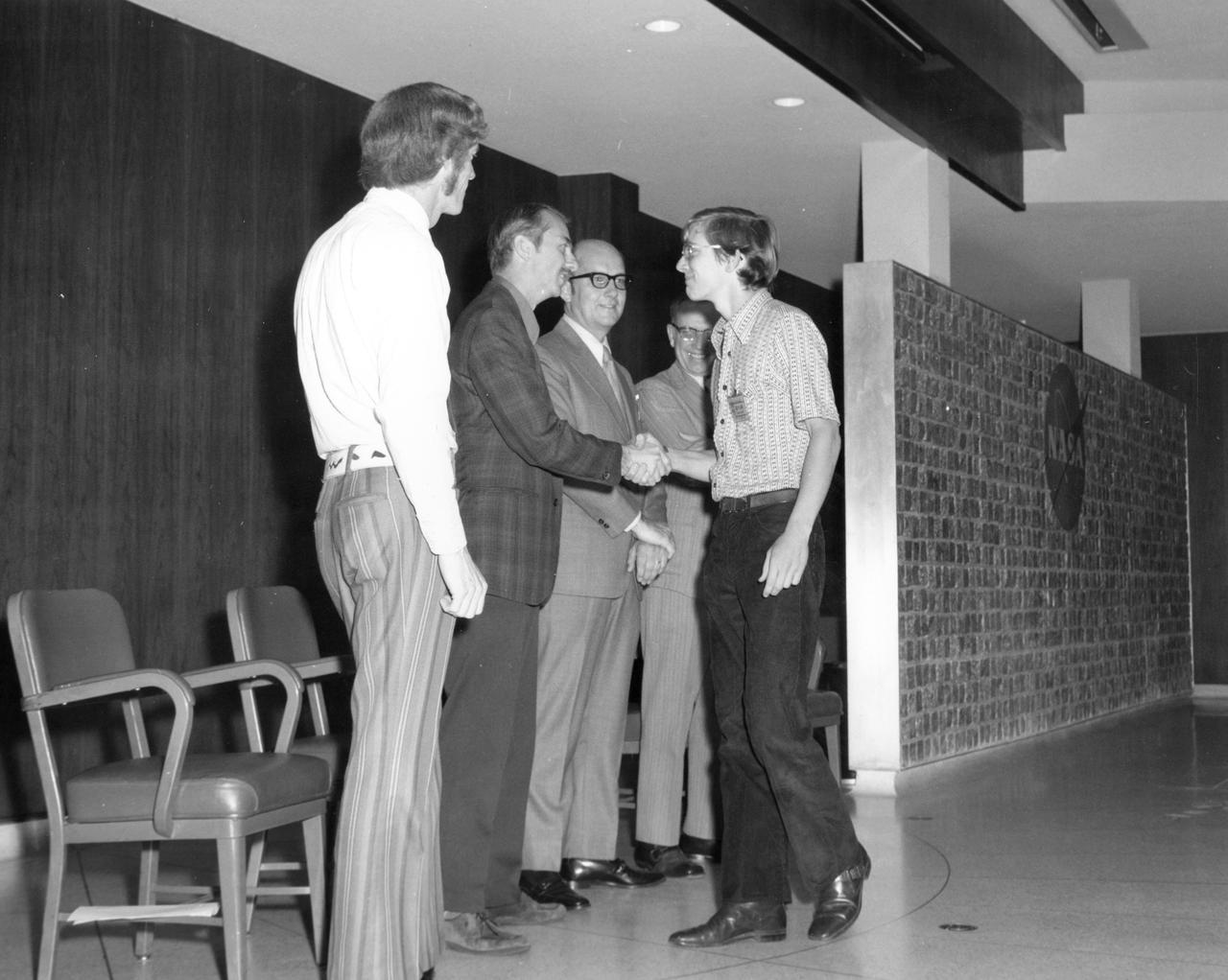
Downey, California high school student, Donald W. Shellack, is greeted by (left to right): Astronauts Russell L. Schweickart, and Owen K. Garriott; Marshall Space Flight Center (MSFC) Skylab Program Manager, Leland Belew; and MSFC Director of Administration and Technical Services, David Newby, during a tour of MSFC. Shellack was among 25 winners of a contest in which some 3,500 high school students proposed experiments for the following year’s Skylab mission. The nationwide scientific competition was sponsored by the National Science Teachers Association and the National Aeronautics and Space Administration (NASA). The winning students, along with their parents and sponsor teachers, visited MSFC where they met with scientists and engineers, participated in design reviews for their experiments, and toured MSFC facilities. Of the 25 students, 6 did not see their experiments conducted on Skylab because the experiments were not compatible with Skylab hardware and timelines. Of the 19 remaining, 11 experiments required the manufacture of additional equipment.
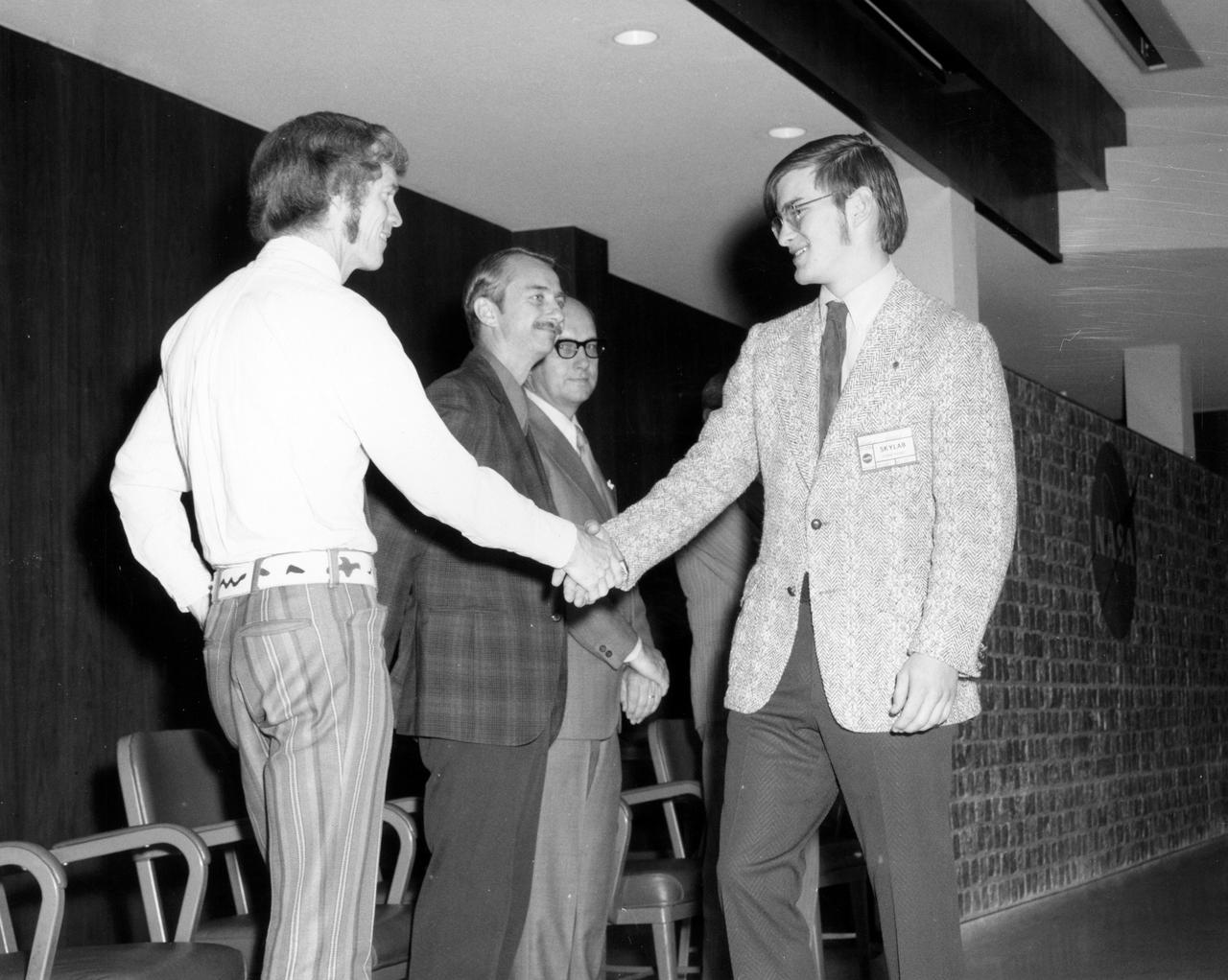
Bayport, New York high school student, James E. Healy, is greeted by (left to right): Astronauts Russell L. Schweickart, and Owen K. Garriott; Marshall Space Flight Center (MSFC) Skylab Program Manager, Leland Belew; and MSFC Director of Administration and Technical Services, David Newby, during a tour of MSFC. Healy was among 25 winners of a contest in which some 3,500 high school students proposed experiments for the following year’s Skylab mission. The nationwide scientific competition was sponsored by the National Science Teachers Association and the National Aeronautics and Space Administration (NASA). The winning students, along with their parents and sponsor teachers, visited MSFC where they met with scientists and engineers, participated in design reviews for their experiments, and toured MSFC facilities. Of the 25 students, 6 did not see their experiments conducted on Skylab because the experiments were not compatible with Skylab hardware and timelines. Of the 19 remaining, 11 experiments required the manufacture of additional equipment.
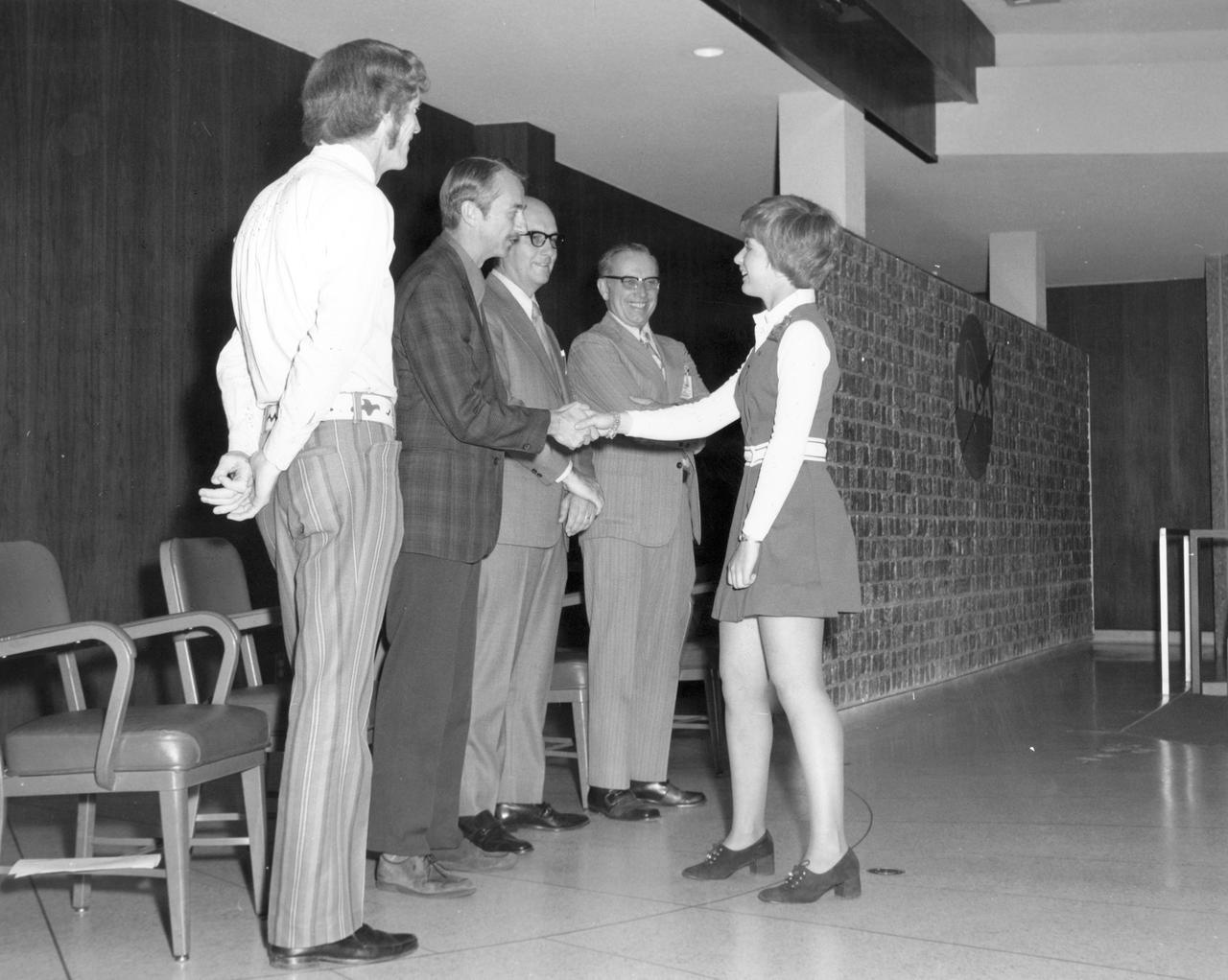
Littleton, Colorado high school student, Cheryl A. Peltz, is greeted by (left to right): Astronauts Russell L. Schweickart, and Owen K. Garriott; Marshall Space Flight Center (MSFC) Skylab Program Manager, Leland Belew; and MSFC Director of Administration and Technical Services, David Newby, during a tour of MSFC. Peltz was among 25 winners of a contest in which some 3,500 high school students proposed experiments for the following year’s Skylab mission. The nationwide scientific competition was sponsored by the National Science Teachers Association and the National Aeronautics and Space Administration (NASA). The winning students, along with their parents and sponsor teachers, visited MSFC where they met with scientists and engineers, participated in design reviews for their experiments, and toured MSFC facilities. Of the 25 students, 6 did not see their experiments conducted on Skylab because the experiments were not compatible with Skylab hardware and timelines. Of the 19 remaining, 11 experiments required the manufacture of additional equipment.
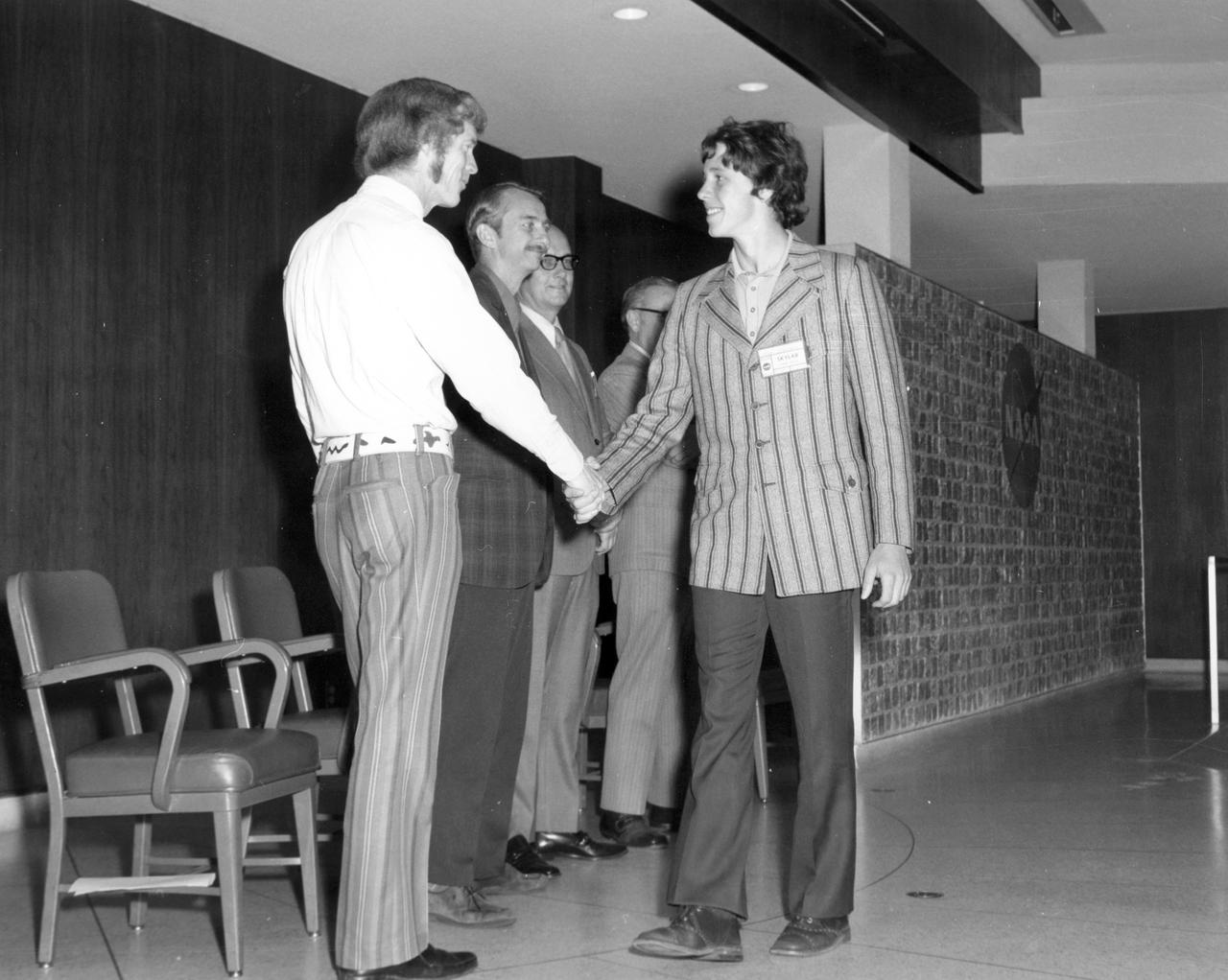
Oshkosh, Wisconsin high school student, Joe B. Zmolek, is greeted by (left to right): Astronauts Russell L. Schweickart, and Owen K. Garriott; Marshall Space Flight Center (MSFC) Skylab Program Manager, Leland Belew; and MSFC Director of Administration and Technical Services, David Newby, during a tour of MSFC. Zmolek was among 25 winners of a contest in which some 3,500 high school students proposed experiments for the following year’s Skylab mission. The nationwide scientific competition was sponsored by the National Science Teachers Association and the National Aeronautics and Space Administration (NASA). The winning students, along with their parents and sponsor teachers, visited MSFC where they met with scientists and engineers, participated in design reviews for their experiments, and toured MSFC facilities. Of the 25 students, 6 did not see their experiments conducted on Skylab because the experiments were not compatible with Skylab hardware and timelines. Of the 19 remaining, 11 experiments required the manufacture of additional equipment.
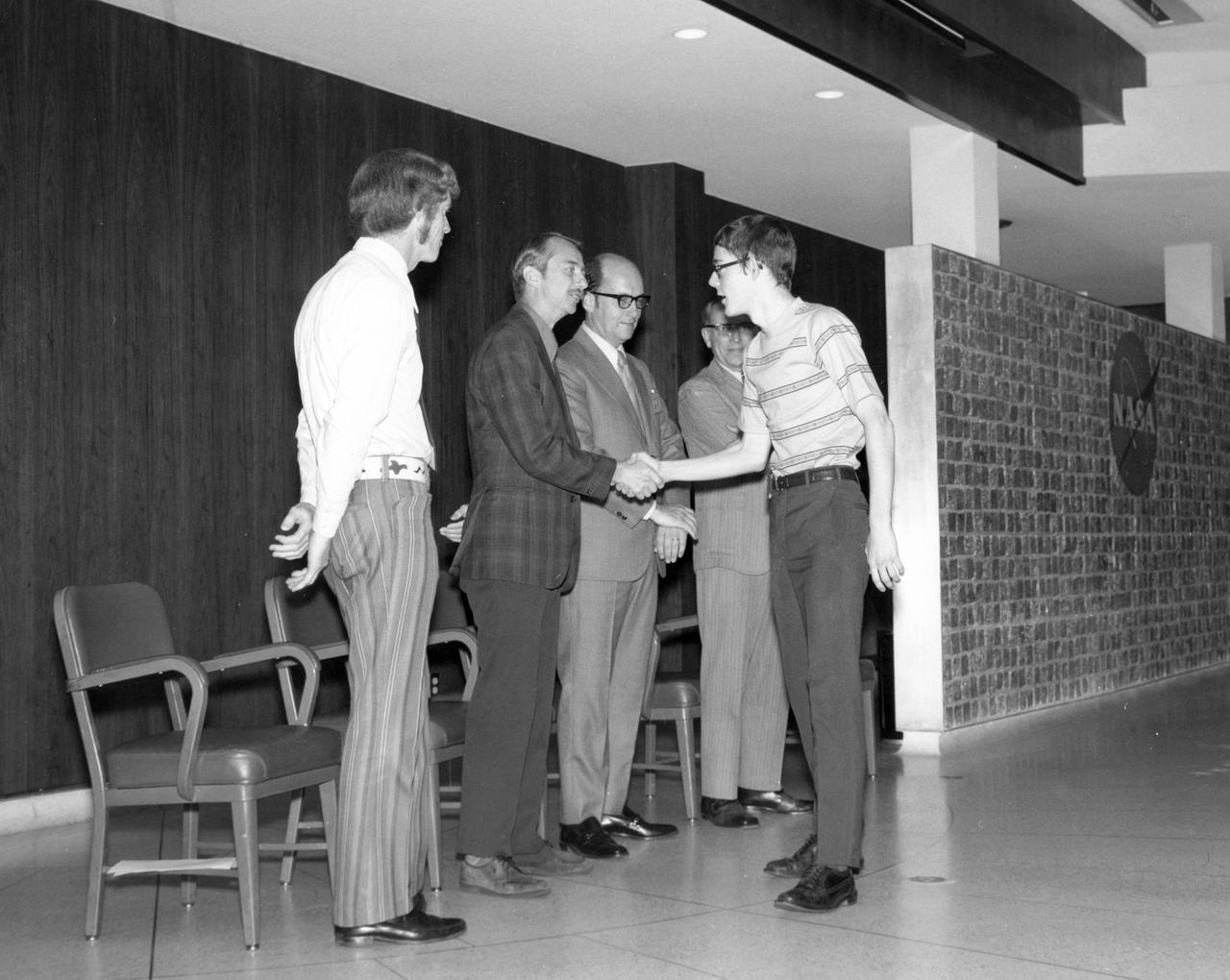
St. Paul, Minnesota high school student, Roger Johnston, is greeted by (left to right): Astronauts Russell L. Schweickart, and Owen K. Garriott; Marshall Space Flight Center (MSFC) Skylab Program Manager, Leland Belew; and MSFC Director of Administration and Technical Services, David Newby, during a tour of MSFC. Johnston was among 25 winners of a contest in which some 3,500 high school students proposed experiments for the following year’s Skylab mission. The nationwide scientific competition was sponsored by the National Science Teachers Association and the National Aeronautics and Space Administration (NASA). The winning students, along with their parents and sponsor teachers, visited MSFC where they met with scientists and engineers, participated in design reviews for their experiments, and toured MSFC facilities. Of the 25 students, 6 did not see their experiments conducted on Skylab because the experiments were not compatible with Skylab hardware and timelines. Of the 19 remaining, 11 experiments required the manufacture of additional equipment.
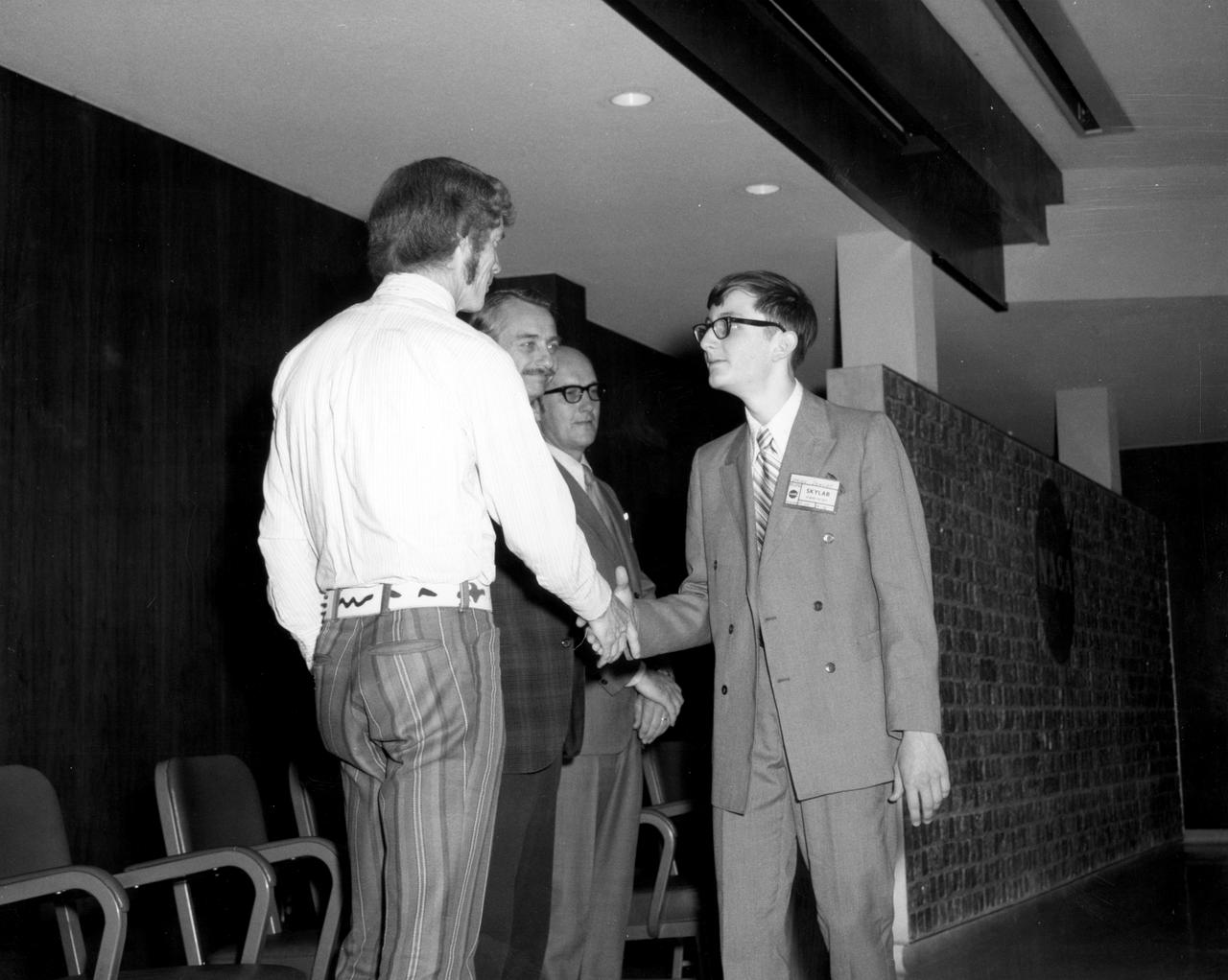
Youngstown, Ohio high school student, W. Brian Dunlap, is greeted by (left to right): Astronauts Russell L. Schweickart, and Owen K. Garriott; Marshall Space Flight Center (MSFC) Skylab Program Manager, Leland Belew; and MSFC Director of Administration and Technical Services, David Newby, during a tour of MSFC. Dunlap was among 25 winners of a contest in which some 3,500 high school students proposed experiments for the following year’s Skylab mission. The nationwide scientific competition was sponsored by the National Science Teachers Association and the National Aeronautics and Space Administration (NASA). The winning students, along with their parents and sponsor teachers, visited MSFC where they met with scientists and engineers, participated in design reviews for their experiments, and toured MSFC facilities. Of the 25 students, 6 did not see their experiments conducted on Skylab because the experiments were not compatible with Skylab hardware and timelines. Of the 19 remaining, 11 experiments required the manufacture of additional equipment.
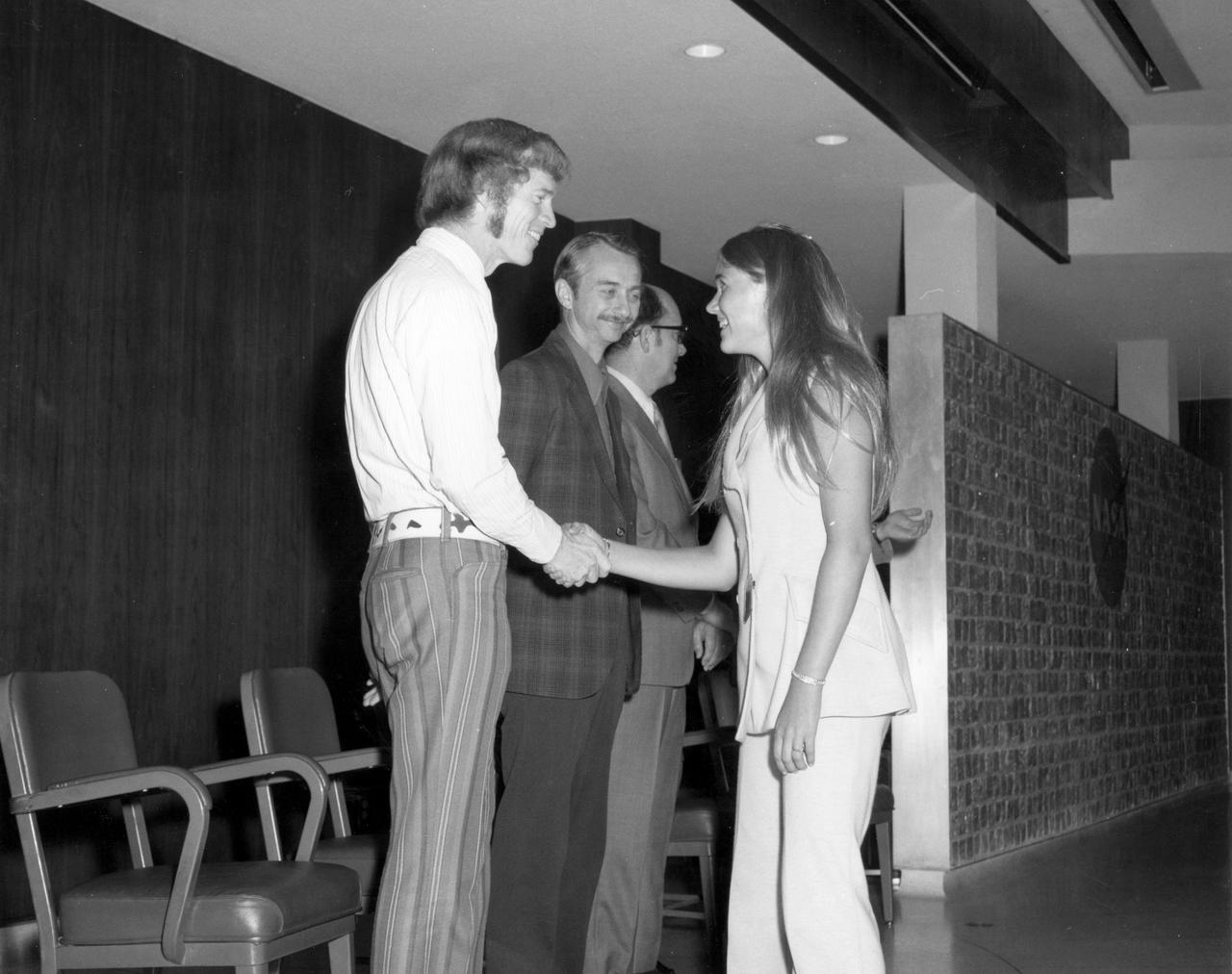
Houston, Texas high school student, Kathy L. Jackson, is greeted by astronauts Russell L. Schweickart (left) and Owen K. Garriott (center), and Marshall Space Flight Center (MSFC) Skylab Program Manager, Leland Belew during a tour of the Marshall Space Flight Center (MSFC). Jackson was among 25 winners of a contest in which some 3,500 high school students proposed experiments for the following year’s Skylab mission. The nationwide scientific competition was sponsored by the National Science Teachers Association and the National Aeronautics and Space Administration (NASA). The winning students, along with their parents and sponsor teachers, visited MSFC where they met with scientists and engineers, participated in design reviews for their experiments, and toured MSFC facilities. Of the 25 students, 6 did not see their experiments conducted on Skylab because the experiments were not compatible with Skylab hardware and timelines. Of the 19 remaining, 11 experiments required the manufacture of additional equipment.
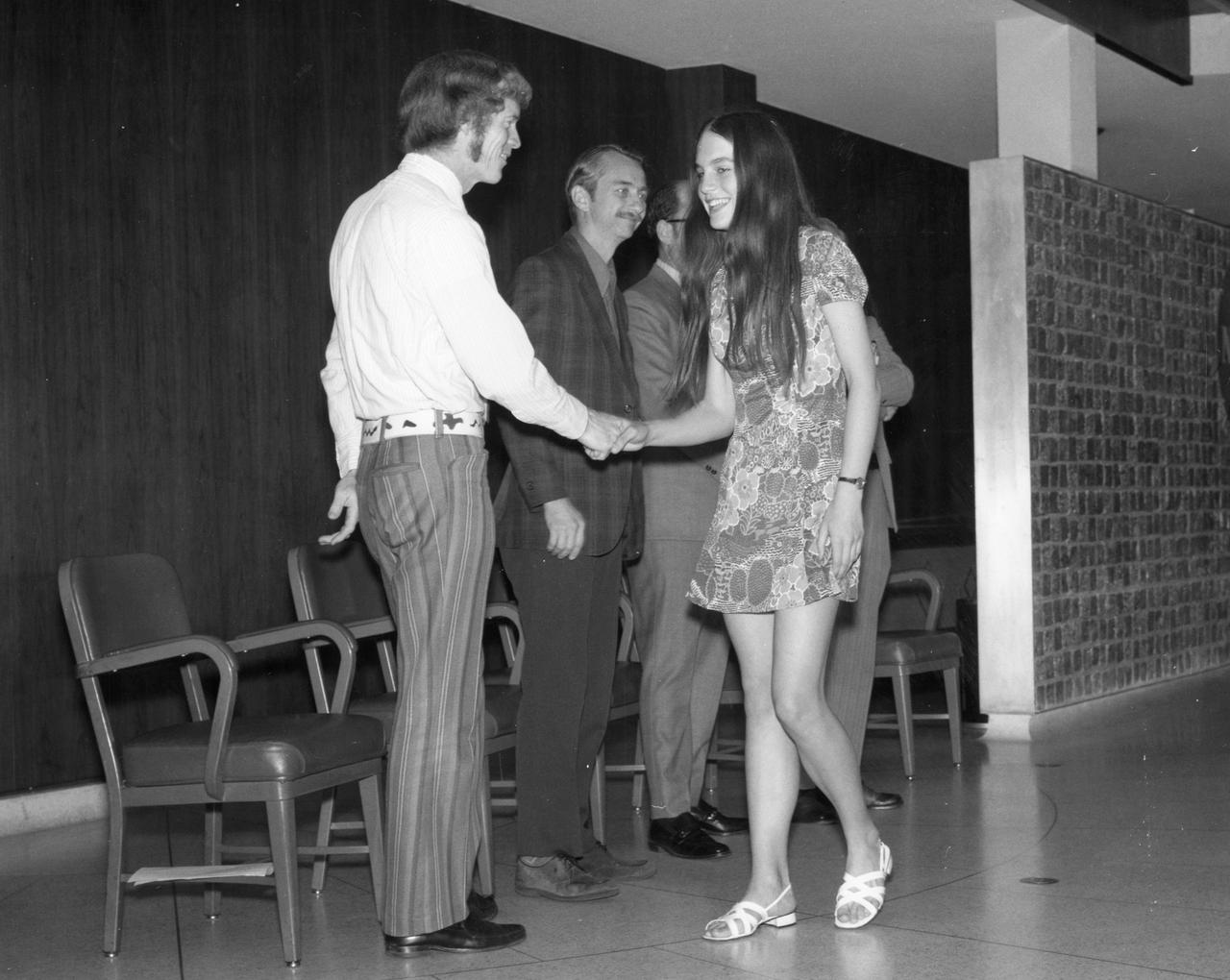
Princeton, New Jersey high school student, Alison Hopfield, is greeted by astronauts Russell L. Schweickart (left) and Owen K. Garriott (center) during a tour of the Marshall Space Flight Center (MSFC). Hopfield was among 25 winners of a contest in which some 3,500 high school students proposed experiments for the following year’s Skylab mission. The nationwide scientific competition was sponsored by the National Science Teachers Association and the National Aeronautics and Space Administration (NASA). The winning students, along with their parents and sponsor teachers, visited MSFC where they met with scientists and engineers, participated in design reviews for their experiments, and toured MSFC facilities. Of the 25 students, 6 did not see their experiments conducted on Skylab because the experiments were not compatible with Skylab hardware and timelines. Of the 19 remaining, 11 experiments required the manufacture of additional equipment.
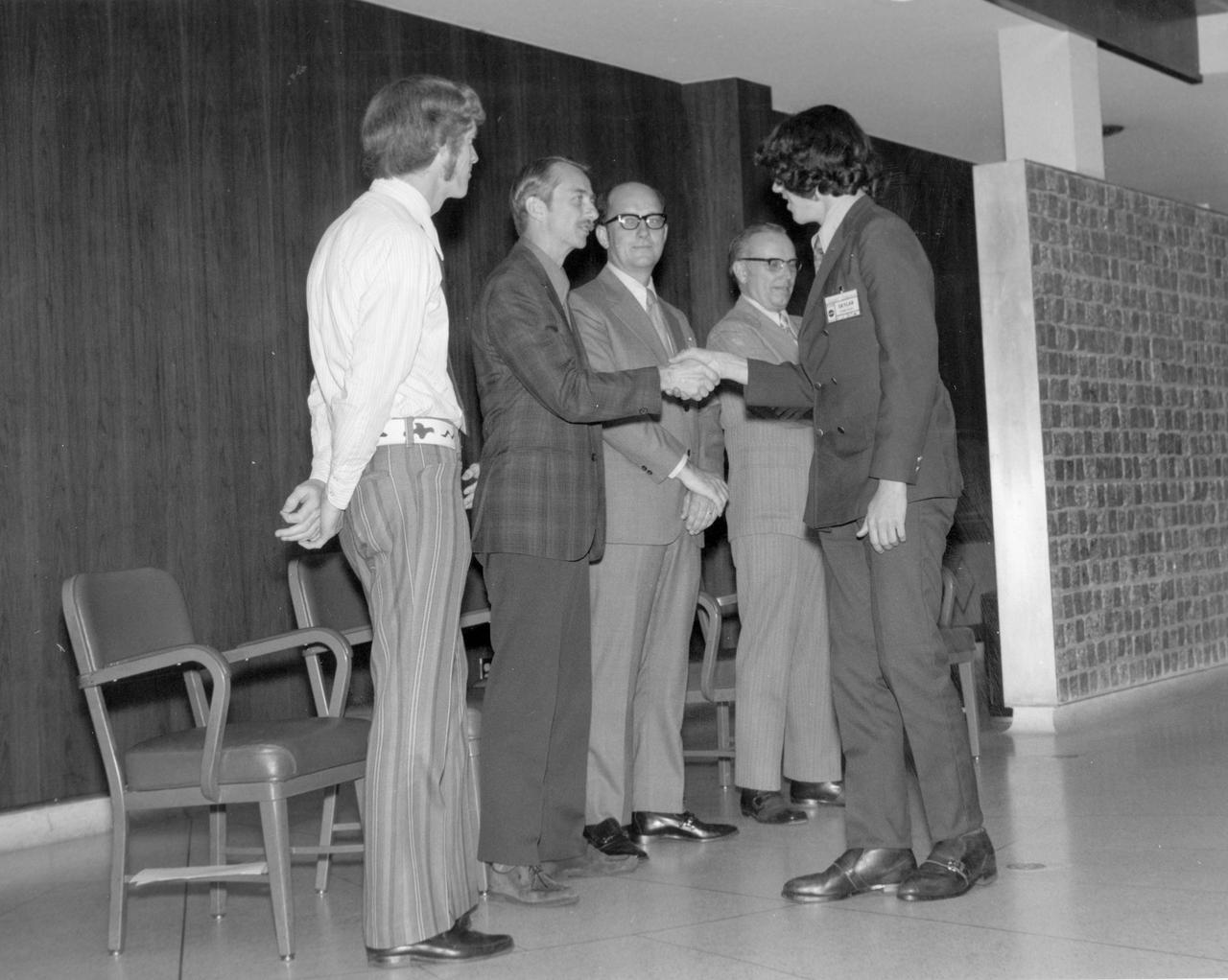
North Rochester, New York high school student, Robert L. Staehle, is greeted by (left to right): Astronauts Russell L. Schweickart, and Owen K. Garriott; Marshall Space Flight Center (MSFC) Skylab Program Manager, Leland Belew; and MSFC Director of Administration and Technical Services, David Newby, during a tour of MSFC. Staehle was among 25 winners of a contest in which some 3,500 high school students proposed experiments for the following year’s Skylab mission. The nationwide scientific competition was sponsored by the National Science Teachers Association and the National Aeronautics and Space Administration (NASA). The winning students, along with their parents and sponsor teachers, visited MSFC where they met with scientists and engineers, participated in design reviews for their experiments, and toured MSFC facilities. Of the 25 students, 6 did not see their experiments conducted on Skylab because the experiments were not compatible with Skylab hardware and timelines. Of the 19 remaining, 11 experiments required the manufacture of additional equipment.
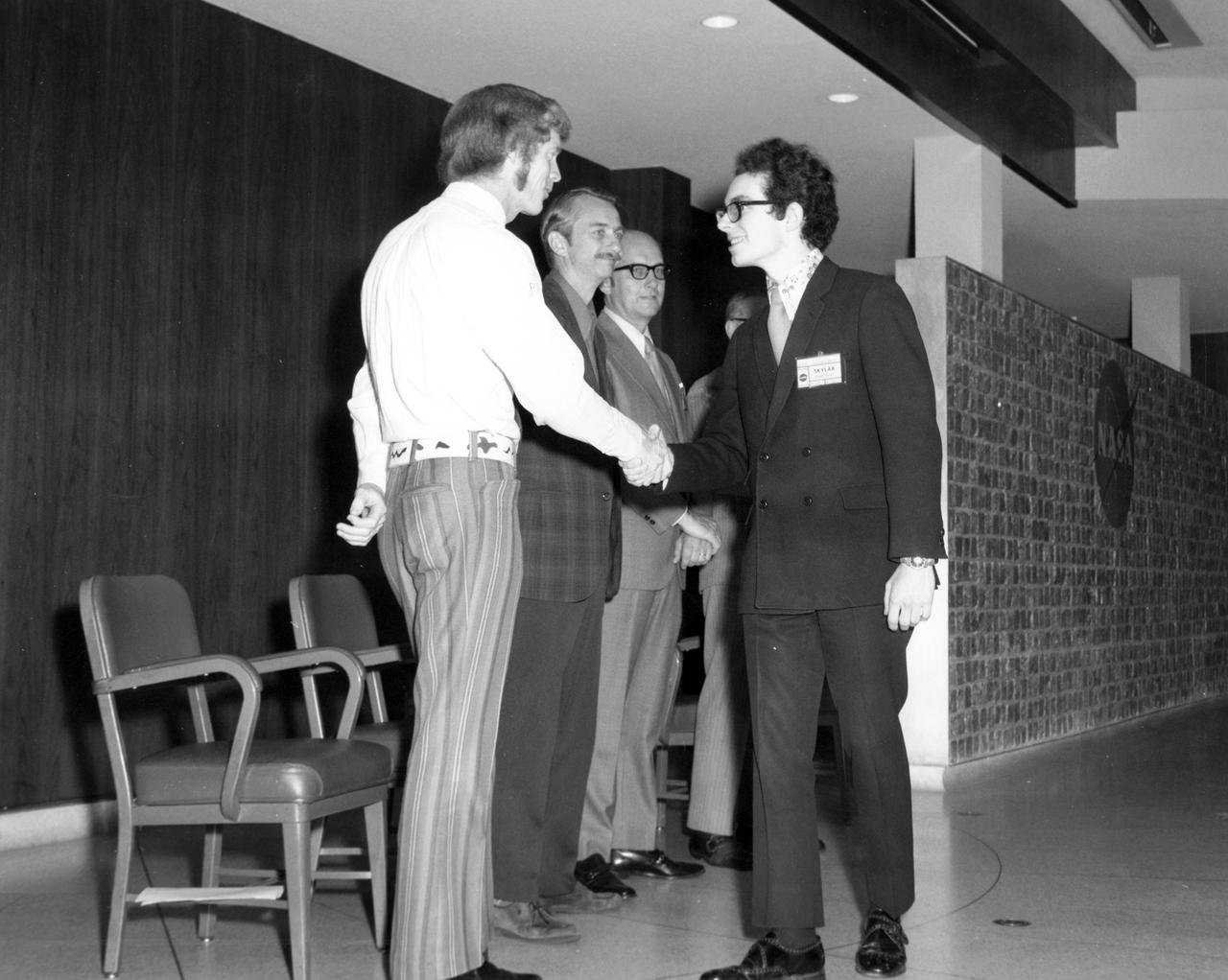
Berkley, Michigan high school student, Kirk M. Sherhart, is greeted by (left to right): Astronauts Russell L. Schweickart, and Owen K. Garriott; Marshall Space Flight Center (MSFC) Skylab Program Manager, Leland Belew; and MSFC Director of Administration and Technical Services, David Newby, during a tour of MSFC. Sherhart was among 25 winners of a contest in which some 3,500 high school students proposed experiments for the following year’s Skylab mission. The nationwide scientific competition was sponsored by the National Science Teachers Association and the National Aeronautics and Space Administration (NASA). The winning students, along with their parents and sponsor teachers, visited MSFC where they met with scientists and engineers, participated in design reviews for their experiments, and toured MSFC facilities. Of the 25 students, 6 did not see their experiments conducted on Skylab because the experiments were not compatible with Skylab hardware and timelines. Of the 19 remaining, 11 experiments required the manufacture of additional equipment.
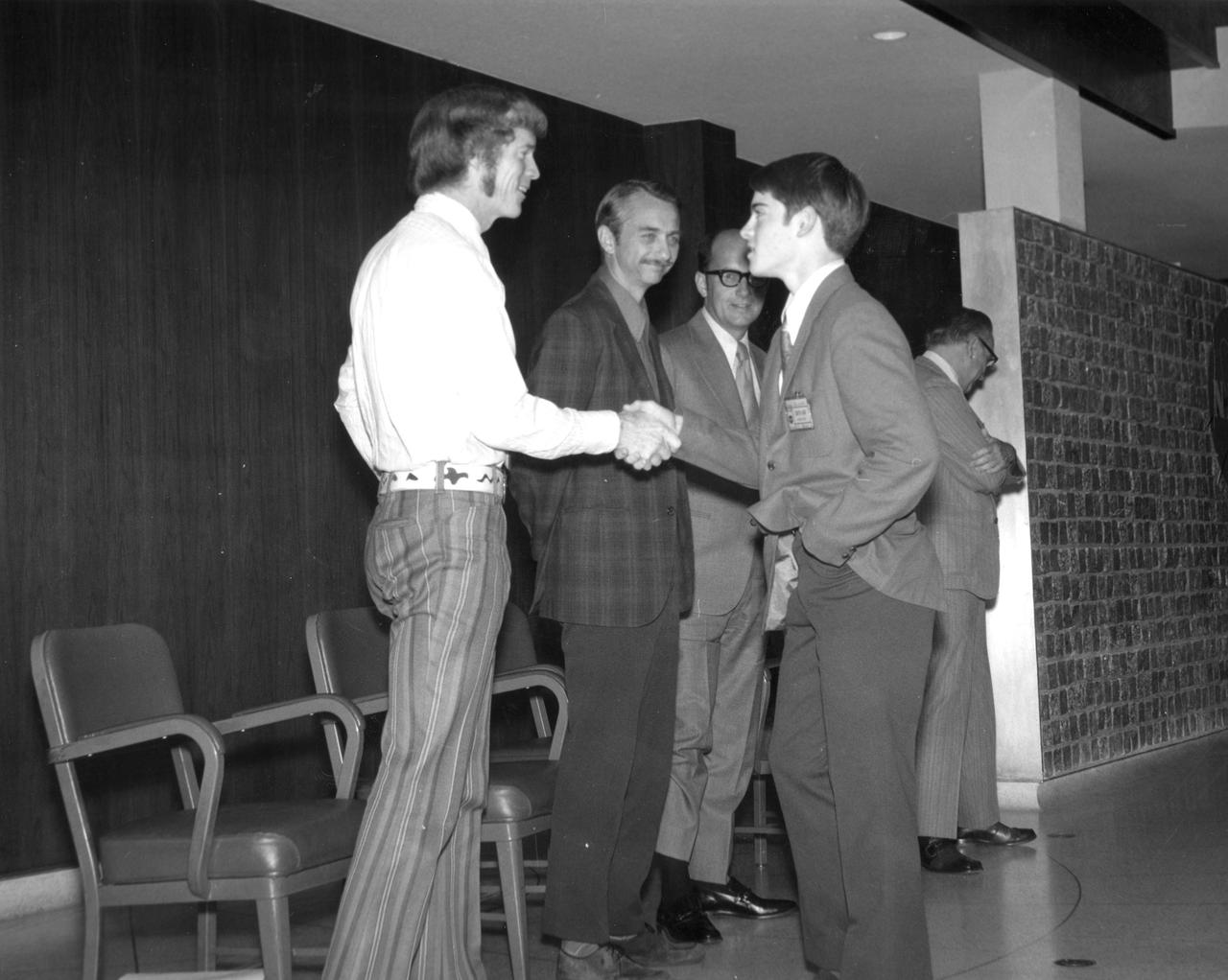
Silverton, Oregon high school student, Daniel C. Bochsler, is greeted by (left to right): Astronauts Russell L. Schweickart, and Owen K. Garriott; Marshall Space Flight Center (MSFC) Skylab Program Manager, Leland Belew; and MSFC Director of Administration and Technical Services, David Newby, during a tour of MSFC. Bochsler was among 25 winners of a contest in which some 3,500 high school students proposed experiments for the following year’s Skylab mission. The nationwide scientific competition was sponsored by the National Science Teachers Association and the National Aeronautics and Space Administration (NASA). The winning students, along with their parents and sponsor teachers, visited MSFC where they met with scientists and engineers, participated in design reviews for their experiments, and toured MSFC facilities. Of the 25 students, 6 did not see their experiments conducted on Skylab because the experiments were not compatible with Skylab hardware and timelines. Of the 19 remaining, 11 experiments required the manufacture of additional equipment.
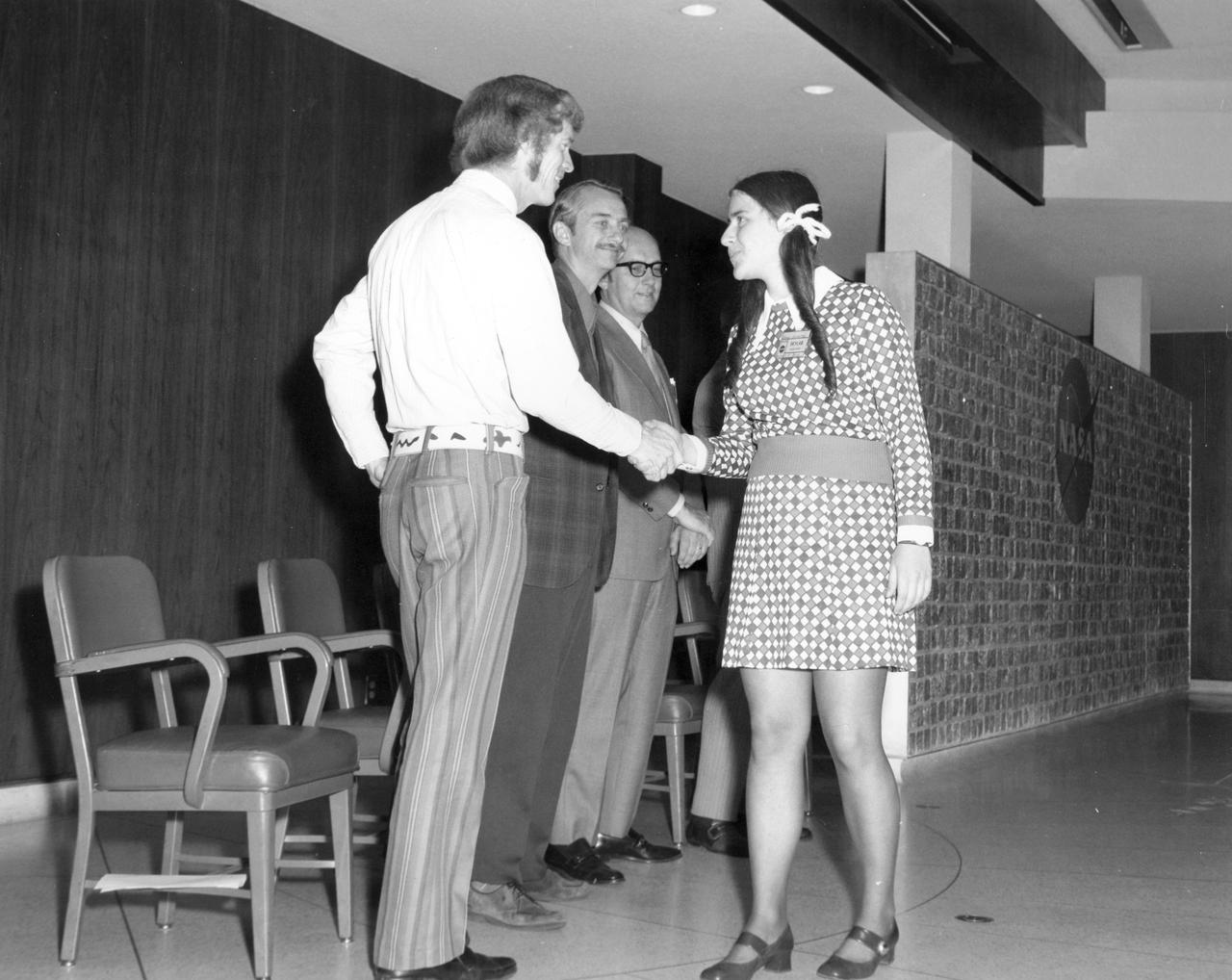
Berkley, California high school student, Jeanne L. Leventhal, is greeted by (left to right): Astronauts Russell L. Schweickart, and Owen K. Garriott; and Marshall Space Flight Center (MSFC) Skylab Program Manager, Leland Belew during a tour of MSFC. Leventhal was among 25 winners of a contest in which some 3,500 high school students proposed experiments for the following year’s Skylab mission. The nationwide scientific competition was sponsored by the National Science Teachers Association and the National Aeronautics and Space Administration (NASA). The winning students, along with their parents and sponsor teachers, visited MSFC where they met with scientists and engineers, participated in design reviews for their experiments, and toured MSFC facilities. Of the 25 students, 6 did not see their experiments conducted on Skylab because the experiments were not compatible with Skylab hardware and timelines. Of the 19 remaining, 11 experiments required the manufacture of additional equipment.
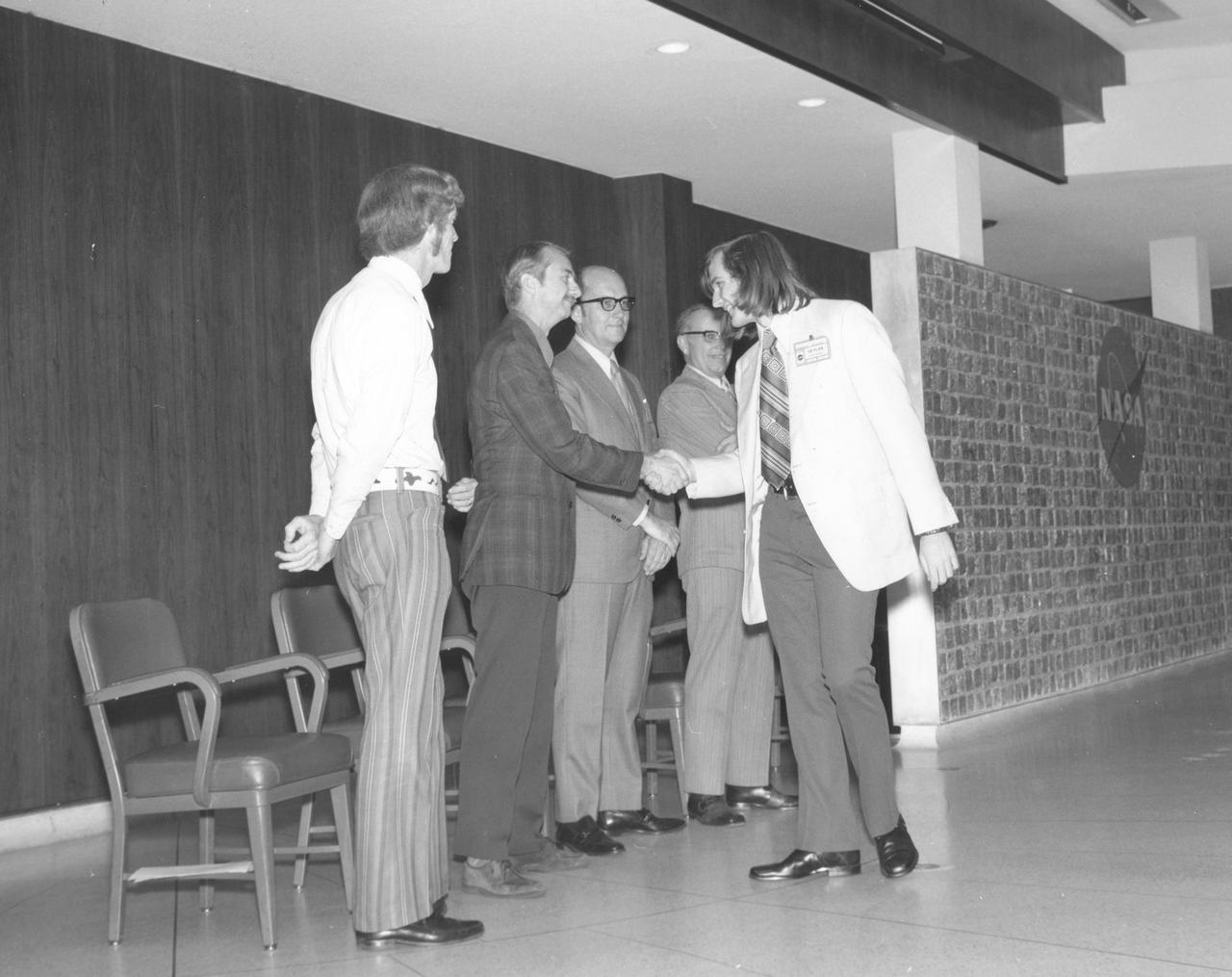
Springfield, Massachusetts high school student, Gregory A. Merkel, is greeted by (left to right): Astronauts Russell L. Schweickart, and Owen K. Garriott; Marshall Space Flight Center (MSFC) Skylab Program Manager, Leland Belew; and MSFC Director of Administration and Technical Services, David Newby, during a tour of MSFC. Merkel was among 25 winners of a contest in which some 3,500 high school students proposed experiments for the following year’s Skylab Mission. The nationwide scientific competition was sponsored by the National Science Teachers Association and the National Aeronautics and Space Administration (NASA). The winning students, along with their parents and sponsor teachers, visited MSFC where they met with scientists and engineers, participated in design reviews for their experiments, and toured MSFC facilities. Of the 25 students, 6 did not see their experiments conducted on Skylab because the experiments were not compatible with Skylab hardware and timelines. Of the 19 remaining, 11 experiments required the manufacture of additional equipment.
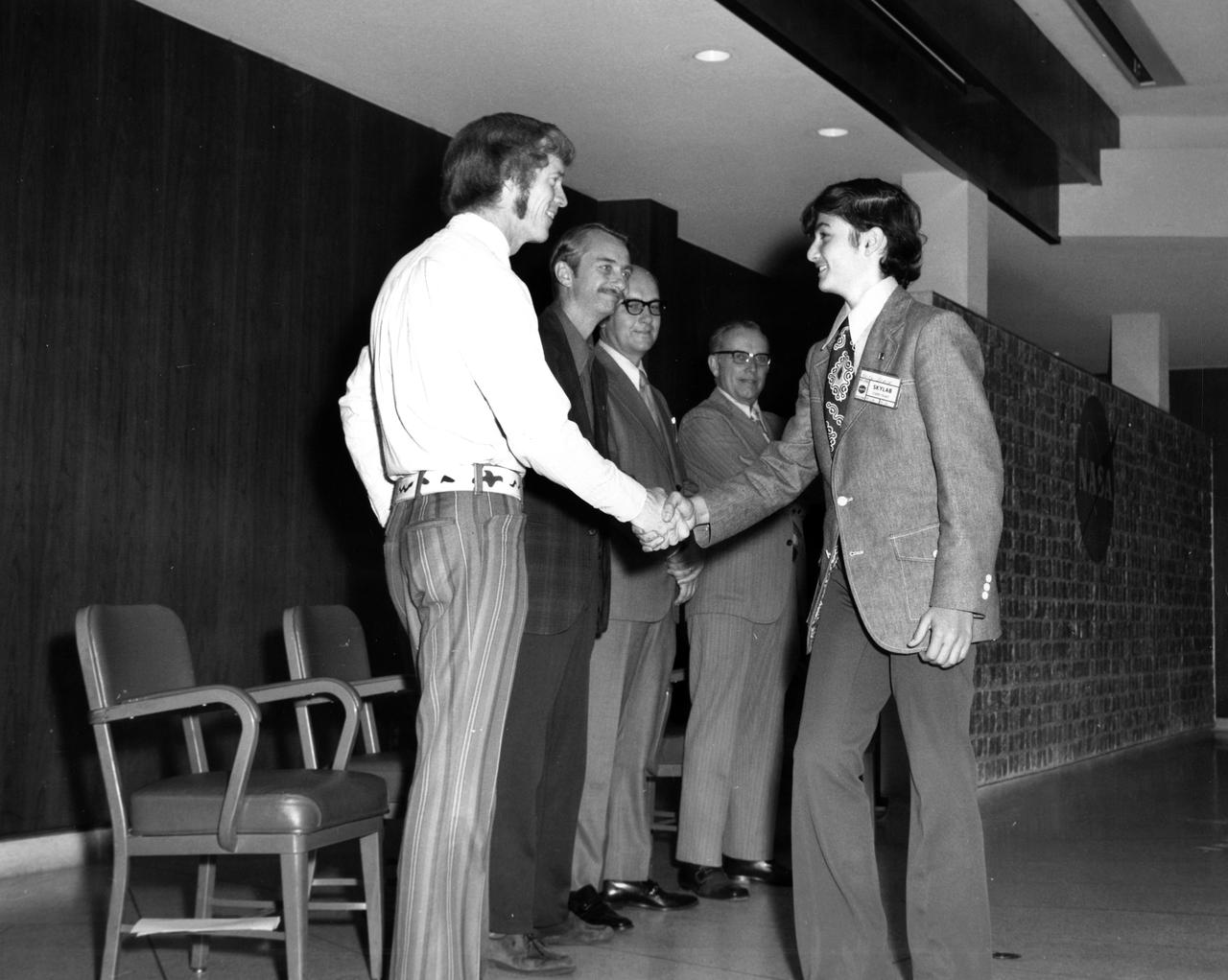
Westbury, New York high school student, Keith L.Stein , is greeted by (left to right): Astronauts Russell L. Schweickart, and Owen K. Garriott; Marshall Space Flight Center (MSFC) Skylab Program Manager, Leland Belew; and MSFC Director of Administration and Technical Services, David Newby, during a tour of MSFC. Stein was among 25 winners of a contest in which some 3,500 high school students proposed experiments for the following year’s Skylab mission. The nationwide scientific competition was sponsored by the National Science Teachers Association and the National Aeronautics and Space Administration (NASA). The winning students, along with their parents and sponsor teachers, visited MSFC where they met with scientists and engineers, participated in design reviews for their experiments, and toured MSFC facilities. Of the 25 students, 6 did not see their experiments conducted on Skylab because the experiments were not compatible with Skylab hardware and timelines. Of the 19 remaining, 11 experiments required the manufacture of additional equipment.

Atlanta, Georgia high school student, Neal W. Shannon, is greeted by (left to right): Astronauts Russell L. Schweickart, and Owen K. Garriott; Marshall Space Flight Center (MSFC) Skylab Program Manager, Leland Belew; and MSFC Director of Administration and Technical Services, David Newby, during a tour of MSFC. Shannon was among 25 winners of a contest in which some 3,500 high school students proposed experiments for the following year’s Skylab mission. The nationwide scientific competition was sponsored by the National Science Teachers Association and the National Aeronautics and Space Administration (NASA). The winning students, along with their parents and sponsor teachers, visited MSFC where they met with scientists and engineers, participated in design reviews for their experiments, and toured MSFC facilities. Of the 25 students, 6 did not see their experiments conducted on Skylab because the experiments were not compatible with Skylab hardware and timelines. Of the 19 remaining, 11 experiments required the manufacture of additional equipment.
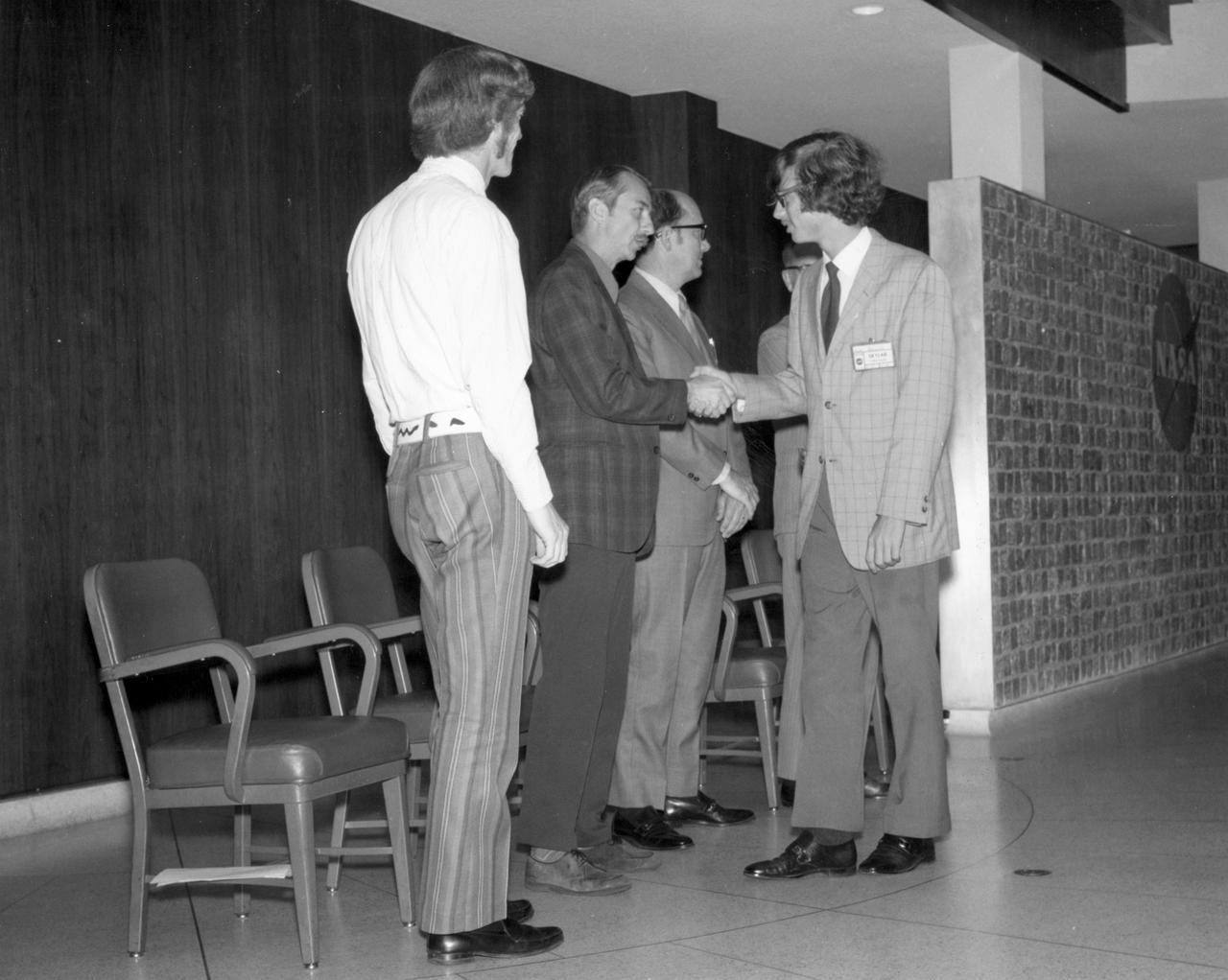
Aiea, Hawaii high school student, John C. Hamilton, is greeted by (left to right): Astronauts Russell L. Schweickart, and Owen K. Garriott; Marshall Space Flight Center (MSFC) Skylab Program Manager, Leland Belew; and MSFC Director of Administration and Technical Services, David Newby, during a tour of MSFC. Hamilton was among 25 winners of a contest in which some 3,500 high school students proposed experiments for the following year’s Skylab mission. The nationwide scientific competition was sponsored by the National Science Teachers Association and the National Aeronautics and Space Administration (NASA). The winning students, along with their parents and sponsor teachers, visited MSFC where they met with scientists and engineers, participated in design reviews for their experiments, and toured MSFC facilities. Of the 25 students, 6 did not see their experiments conducted on Skylab because the experiments were not compatible with Skylab hardware and timelines. Of the 19 remaining, 11 experiments required the manufacture of additional equipment.
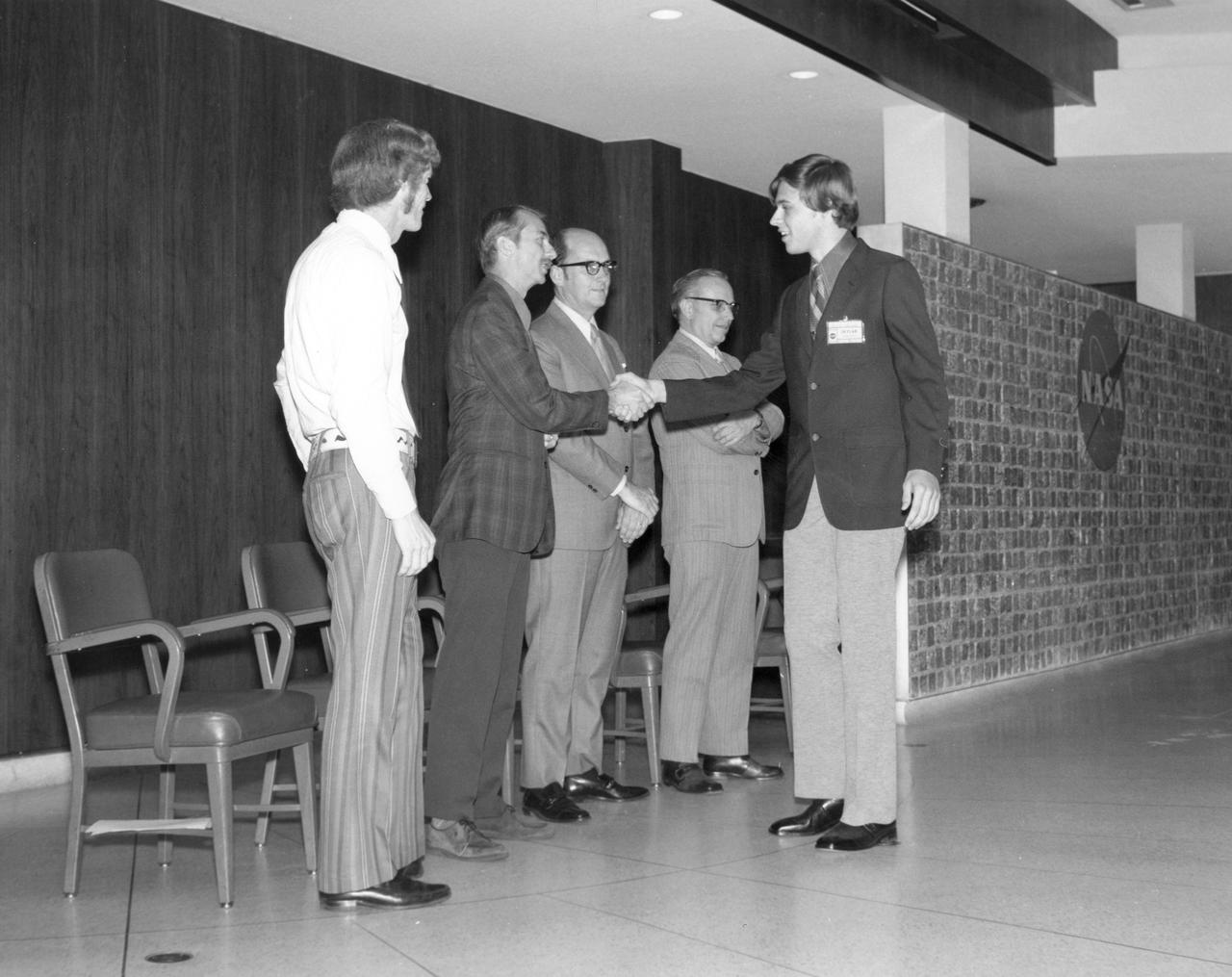
Garland, Texas high school student, Keith D. McGee, is greeted by (left to right): Astronauts Russell L. Schweickart, and Owen K. Garriott; Marshall Space Flight Center (MSFC) Skylab Program Manager, Leland Belew; and MSFC Director of Administration and Technical Services, David Newby, during a tour of MSFC. McGee was among 25 winners of a contest in which some 3,500 high school students proposed experiments for the following year’s Skylab Mission. The nationwide scientific competition was sponsored by the National Science Teachers Association and the National Aeronautics and Space Administration (NASA). The winning students, along with their parents and sponsor teachers, visited MSFC where they met with scientists and engineers, participated in design reviews for their experiments, and toured MSFC facilities. Of the 25 students, 6 did not see their experiments conducted on Skylab because the experiments were not compatible with Skylab hardware and timelines. Of the 19 remaining, 11 experiments required the manufacture of additional equipment.
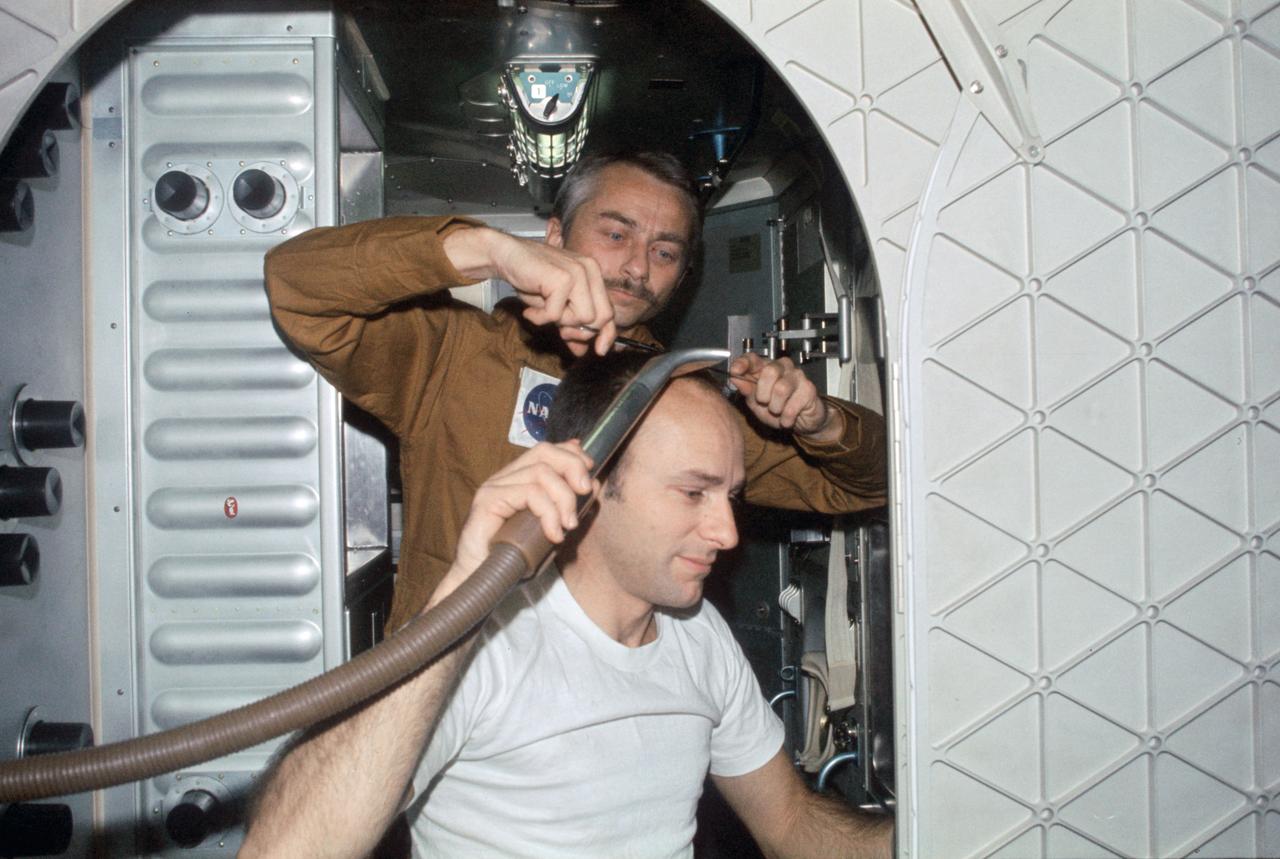
SL3-108-1292 (19 Aug. 1973) --- Scientist-astronaut Owen K. Garriott, Skylab 3 science pilot, trims the hair of astronaut Alan L. Bean, commander, in this onboard photograph from the Skylab Orbital Workshop (OWS) in Earth orbit. Astronaut Jack R. Lousma, pilot, took this picture with a 35mm Nikon camera. Bean holds a vacuum hose to gather in loose hair. The crew of the second manned Skylab flight went on to successfully complete 59 days aboard the Skylab space station cluster in Earth orbit. Photo credit: NASA
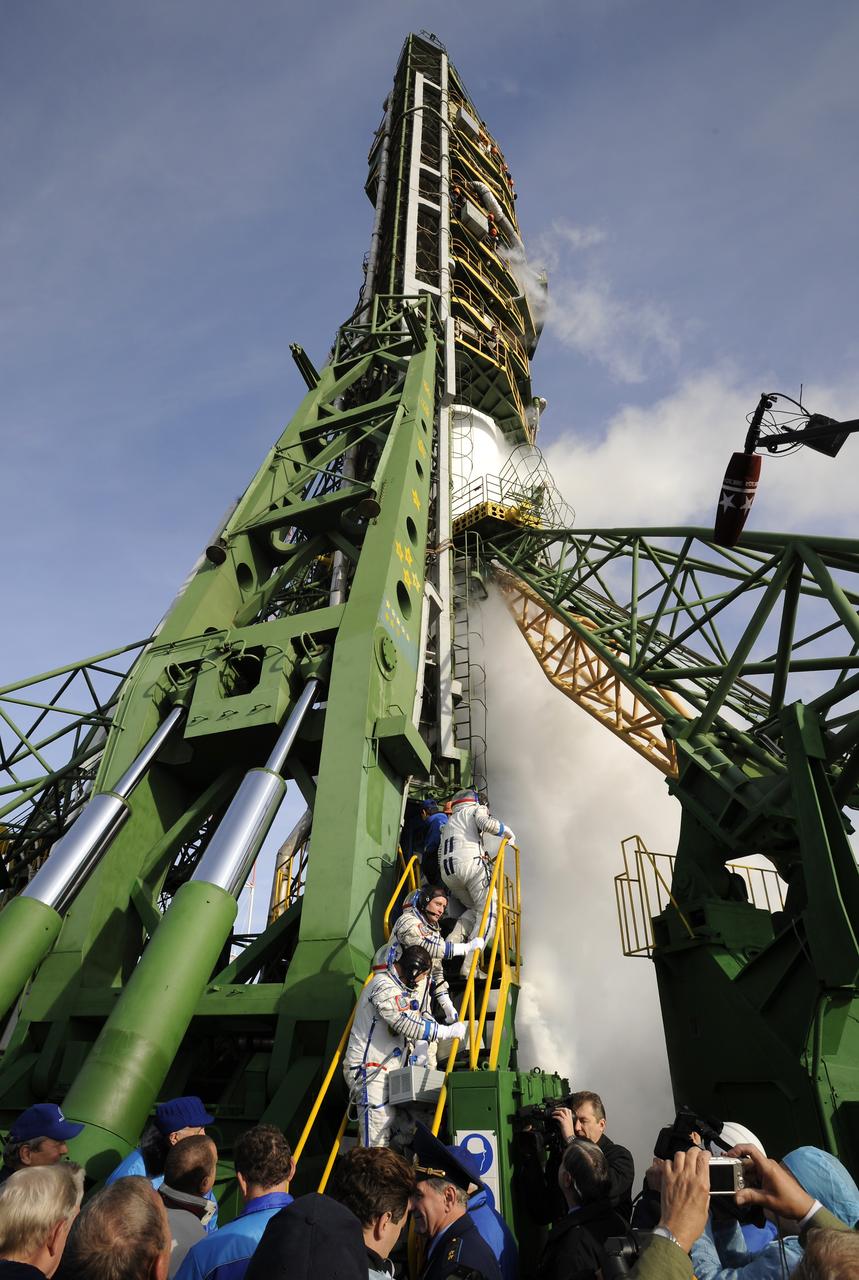
Expedition 18 Flight Engineer Yuri V. Lonchakov, bottom, Expedition 18 Commander Michael Fincke and American spaceflight participant Richard Garriott, top, board the Soyuz rocket prior to their launch in the Soyuz TMA-13 spacecraft, Sunday, Oct. 12, 2008 from the Baikonur Cosmodrome in Kazakhstan. The three crew members are scheduled to dock with the International Space Station on Oct. 14. Fincke and Lonchakov will spend six months on the station, while Garriott will return to Earth Oct. 24 with two of the Expedition 17 crew members currently on the International Space Station. Photo Credit: (NASA/Bill Ingalls)
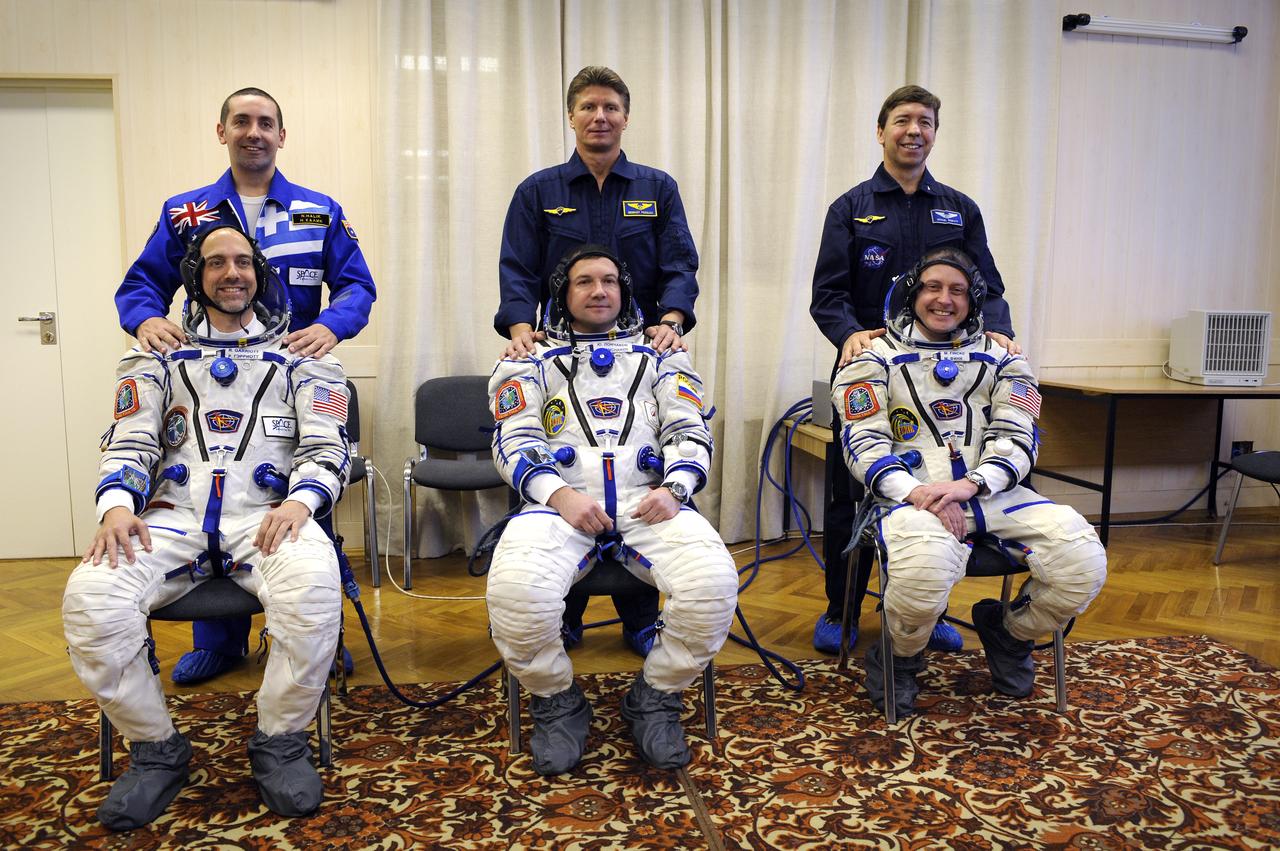
American spaceflight participant Richard Garriott, seated left, Expedition 18 Flight Engineer Yuri V. Lonchakov, Expedition 18 Commander Michael Fincke, seated right, back up spaceflight participant Nik Halik, standing left, backup Commander Gennady Padalka and backup Flight Engineer Mike Barratt pose for a photograph for the camera prior to the launch of the Soyuz TMA-13 spacecraft, Sunday, Oct. 12, 2008 from the Baikonur Cosmodrome in Kazakhstan. The three crew members are scheduled to dock with the International Space Station on Oct. 14. Fincke and Lonchakov will spend six months on the station, while Garriott will return to Earth Oct. 24 with two of the Expedition 17 crew members currently on the International Space Station. Photo Credit: (NASA/Bill Ingalls)

S73-34172 (August 1973) --- Scientist-astronaut Owen K. Garriott, Skylab 3 science pilot, watches a drink container spinning and tumbling in zero-gravity during a science demonstration television transmission from the Skylab space station in Earth orbit. Garriott is in the Orbital Workshop (OWS). Photo credit: NASA

View of STS-9 Mission Specialist (MS) Owen K. Garriott with hardware.
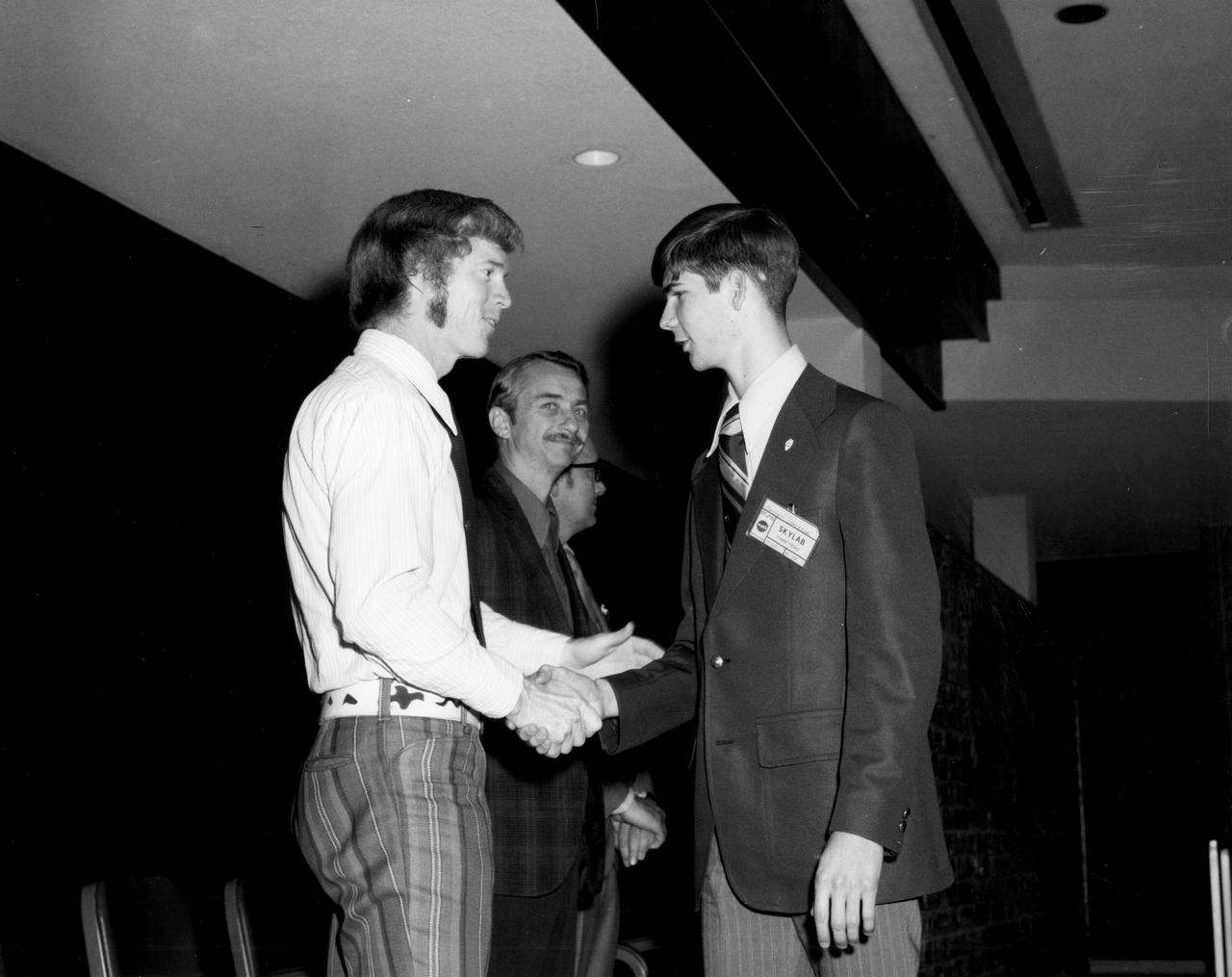
Rockford, Illinois high school student, Vincent Converse (right), is greeted by astronauts Russell L. Schweickart and Owen K. Garriott during a tour of the Marshall Space Flight Center (MSFC). Converse was among 25 winners of a contest in which some 3,500 high school students proposed experiments for the following year’s Skylab mission. His experiment, “Zero Gravity Mass Measurement” used a simple leaf spring with the mass to be weighed attached to the end. An electronic package oscillated the spring at a specific rate and the results were recorded electronically. The nationwide scientific competition was sponsored by the National Science Teachers Association and the National Aeronautics and Space Administration (NASA). The winning students, along with their parents and sponsor teachers, visited MSFC where they met with scientists and engineers, participated in design reviews for their experiments, and toured MSFC facilities. Of the 25 students, 6 did not see their experiments conducted on Skylab because the experiments were not compatible with Skylab hardware and timelines. Of the 19 remaining, 11 experiments required the manufacture of additional equipme
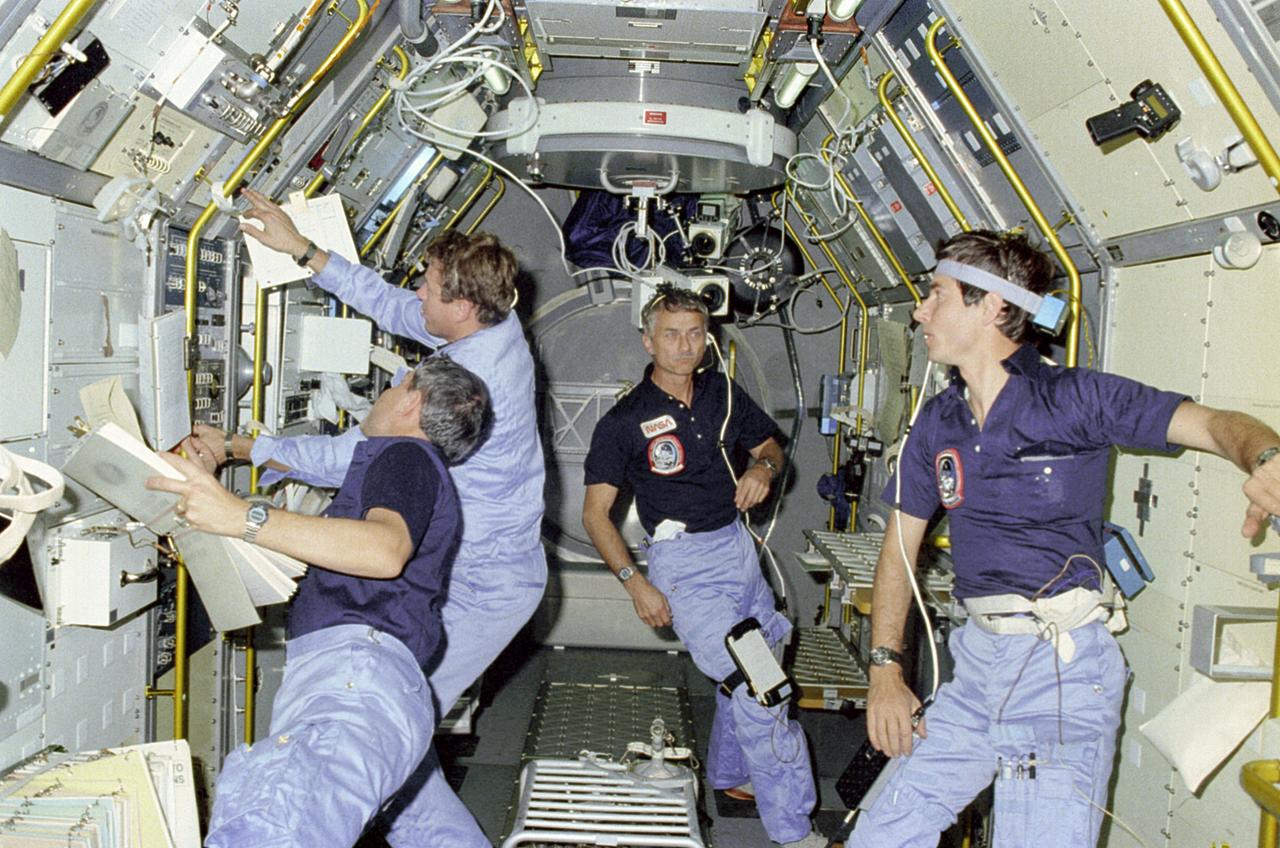
This photograph shows activities inside the science module during the Spacelab-1 (STS-9) mission. Left to right are Mission Specialist Robert Parker, Payload Specialist Byron Lichtenberg, Mission Specialist Owen Garriott, and Payload Specialist Ulf Merbold. The overall goal of the Spacelab-1 mission, the first mission of the Spacelab facility, were: (1) To verify the Spacelab system capability, (2) to obtain valuable scientific, applications, and technology data from a U.S./European multidisciplinary payload, and (3) to demonstrate the broad capability of Spacelab for scientific research. More than 70 experiments in 5 disciplines from 14 nations were conducted during the mission. The mission marked the the entry of non-astronaut persornel, called Payload Specialists, into space as working members of the crew. They are fellow scientists representing the international group of investigators using the mission. Mission Specialists are NASA astronauts who have broad scientific training. They operate various Orbiter-Spacelab systems, perform any required activity outside the spacecraft, and support investigations as needed. The Space Shuttle Orbiter Columbia that carried Spacelab-1 was operated by two other NASA astronauts serving as commander and pilot. The STS-9 mission, managed by the Marshall Space Flight Center, was launched on November 28, 1983.
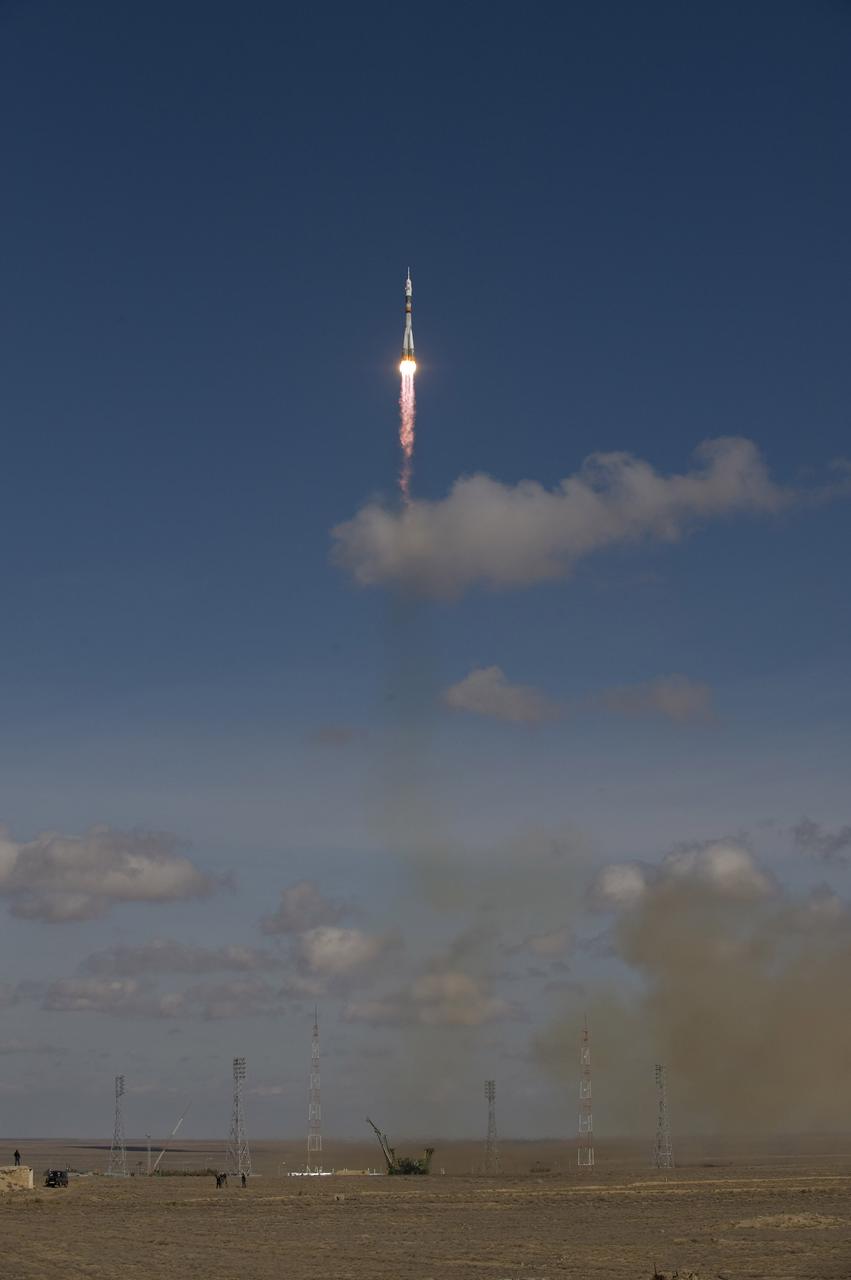
KAZAKHSTAN – The Soyuz TMA-13 spacecraft, carrying Expedition 18 Commander Michael Fincke, Flight Engineer Yury V. Lonchakov and American Spaceflight Participant Richard Garriott launches Oct. 12 from the Baikonur Cosmodrome in Kazakhstan. The three crew members are scheduled to dock with the International Space Station on Oct. 14. Fincke and Lonchakov will spend six months on the station, while Garriott will return to Earth Oct. 24 with two of the Expedition 17 crew members currently on the space station. Photo credit: NASA/Bill Ingalls
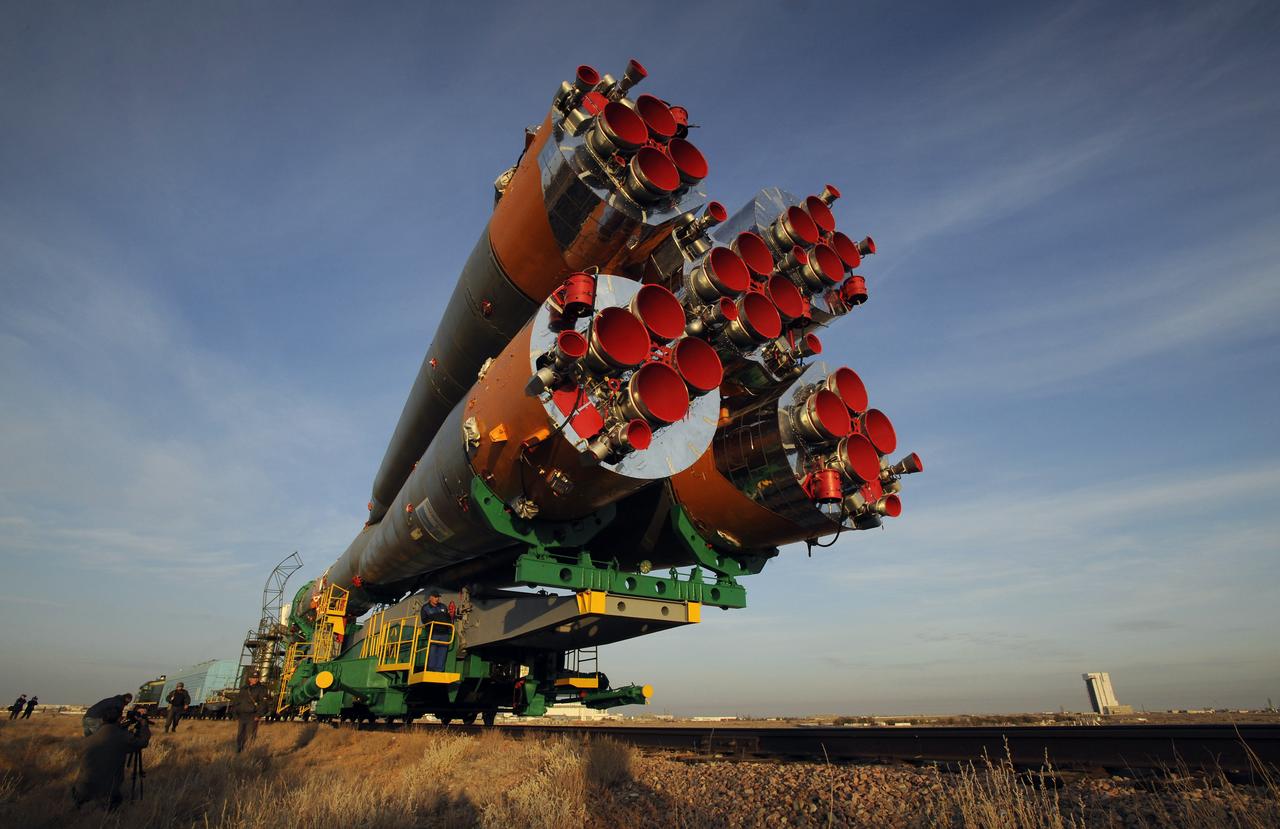
The Soyuz TMA-13 spacecraft is transported by railcar to its launch pad at the Baikonur Cosmodrome in Kazakhstan, Friday, Oct. 10, 2008. Expedition 18 Commander Michael Fincke, Flight Engineer Yuri V. Lonchakov and American spaceflight participant Richard Garriott will launch October 12 and dock with the International Space Station October 14. Fincke and Lonchakov will spend six months on the station, while Garriott will return to Earth after 10 days with the Expedition 17 crew members currently on the ISS. Photo Credit: (NASA/Bill Ingalls)
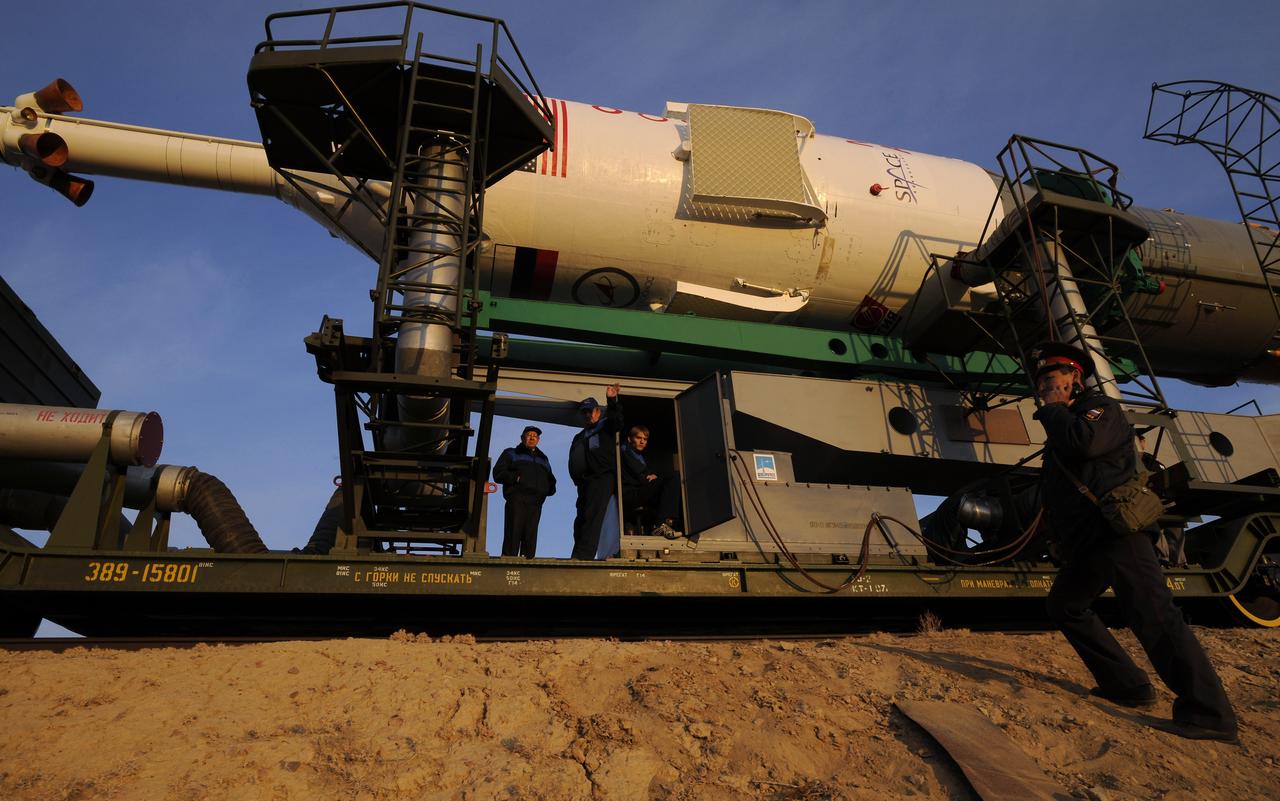
The Soyuz TMA-13 spacecraft is transported by railcar to its launch pad at the Baikonur Cosmodrome in Kazakhstan, Friday, Oct. 10, 2008. Expedition 18 Commander Michael Fincke, Flight Engineer Yuri V. Lonchakov and American spaceflight participant Richard Garriott will launch October 12 and dock with the International Space Station October 14. Fincke and Lonchakov will spend six months on the station, while Garriott will return to Earth after 10 days with the Expedition 17 crew members currently on the ISS. Photo Credit: (NASA/Bill Ingalls)
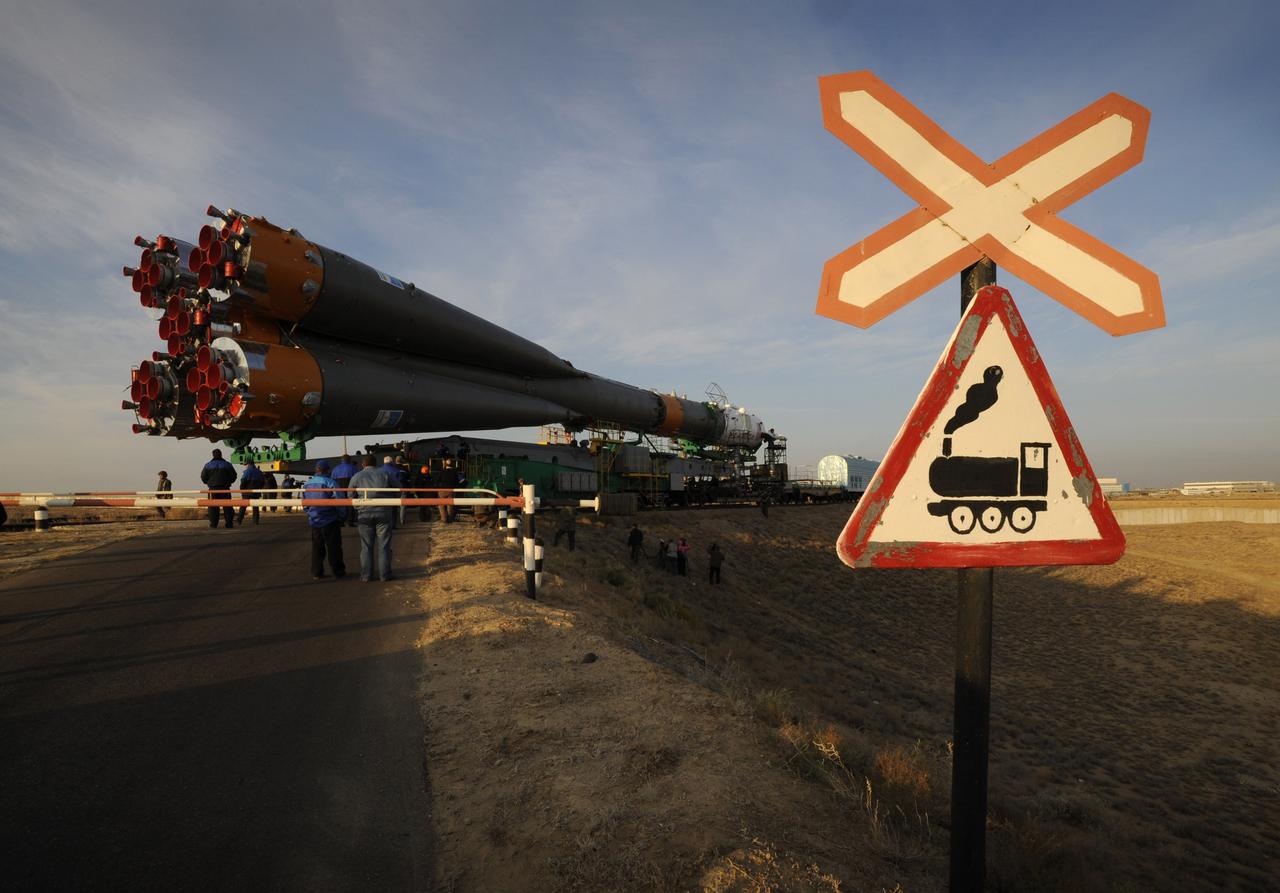
The Soyuz TMA-13 spacecraft is transported by railcar to its launch pad at the Baikonur Cosmodrome in Kazakhstan, Friday, Oct. 10, 2008. Expedition 18 Commander Michael Fincke, Flight Engineer Yuri V. Lonchakov and American spaceflight participant Richard Garriott will launch October 12 and dock with the International Space Station October 14. Fincke and Lonchakov will spend six months on the station, while Garriott will return to Earth after 10 days with the Expedition 17 crew members currently on the ISS. Photo Credit: (NASA/Bill Ingalls)
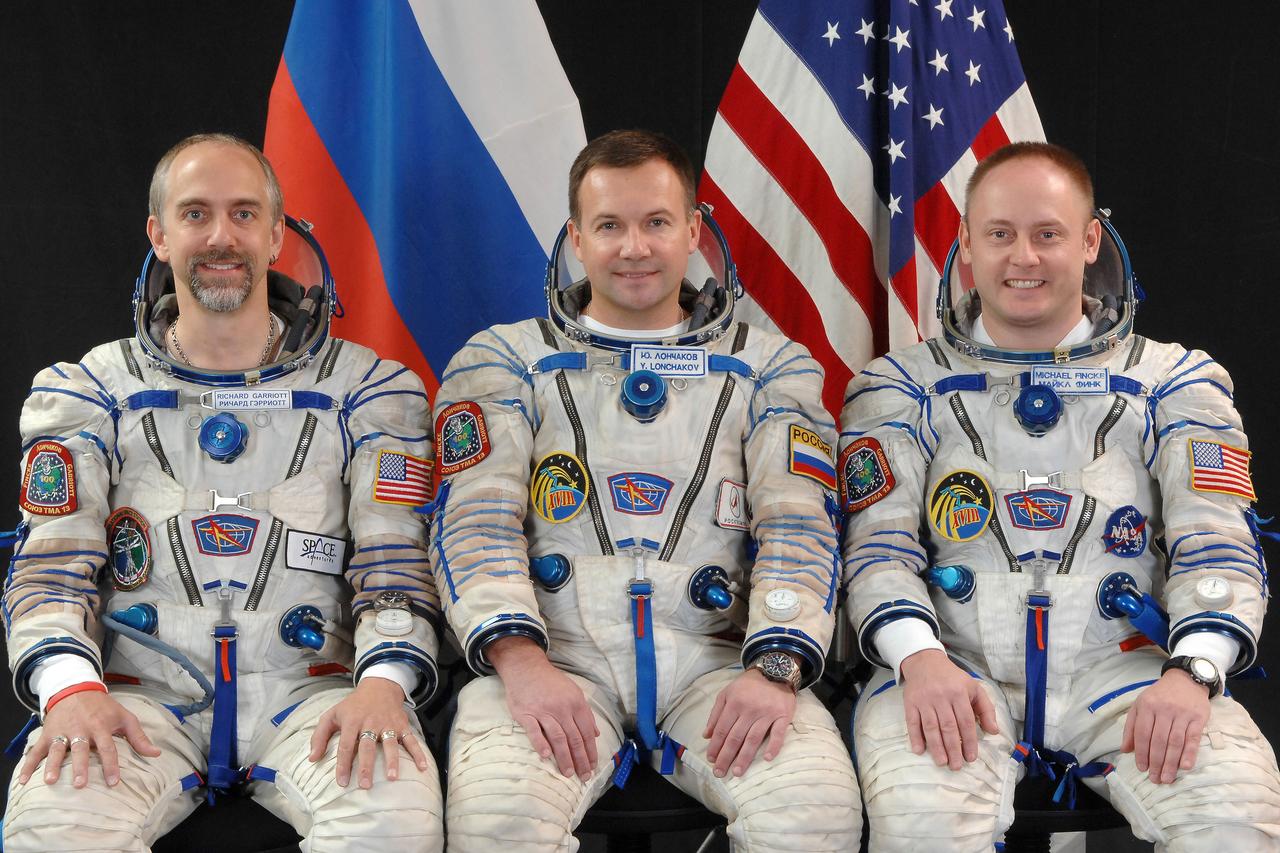
JSC2008-E-117656 (28 Aug. 2008) --- Attired in Russian Sokol launch and entry suits, NASA astronaut Michael Fincke (right), Expedition 18 commander; Russian Federal Space Agency cosmonaut Yury Lonchakov (center), flight engineer; and American spaceflight participant Richard Garriott take a break from training in Star City, Russia to pose for a portrait. Fincke, Lonchakov and Garriott are scheduled to launch to the International Space Station in a Soyuz spacecraft in October. Photo credit: Gagarin Cosmonaut Training Center
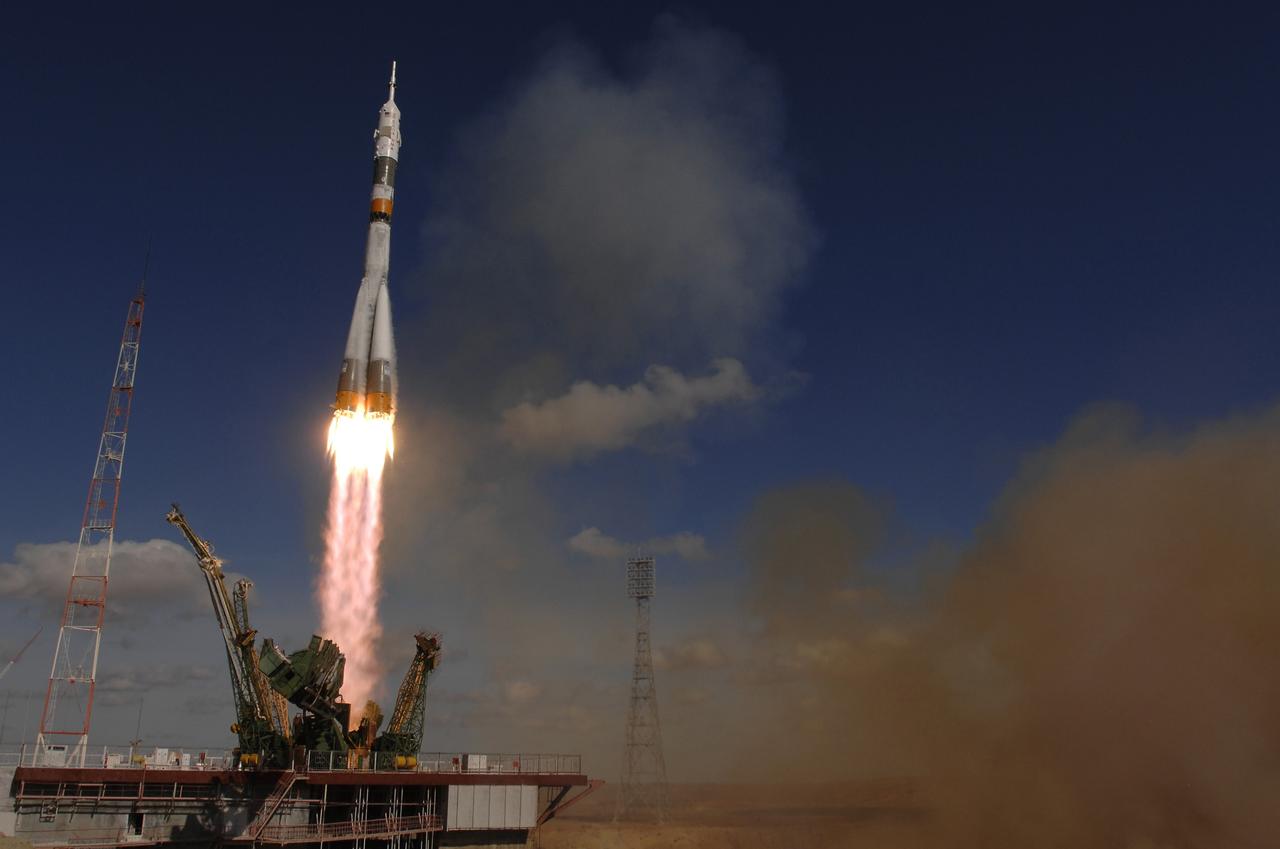
KAZAKHSTAN – The Soyuz TMA-13 spacecraft ,carrying Expedition 18 Commander Michael Fincke, Flight Engineer Yury V. Lonchakov and American Spaceflight Participant Richard Garriott launches Oct. 12 from the Baikonur Cosmodrome in Kazakhstan. The three crew members are scheduled to dock with the International Space Station on Oct. 14. Fincke and Lonchakov will spend six months on the station, while Garriott will return to Earth Oct. 24 with two of the Expedition 17 crew members currently on the space station. Photo credit: NASA/Bill Ingalls

View of Vice-President George Bush visiting with Astronaut Owen Garriott and Payload Specialist (PS) Wubbo Ockels of the Netherlands, inside the SL after the dedication ceremony, KSC Operations & Checkout (O&C) Building. 1. Astronaut Owen K. Garriott 2. Vice President George Bush 3. Wubbo Ockels - PS 4x5 Color and B&W
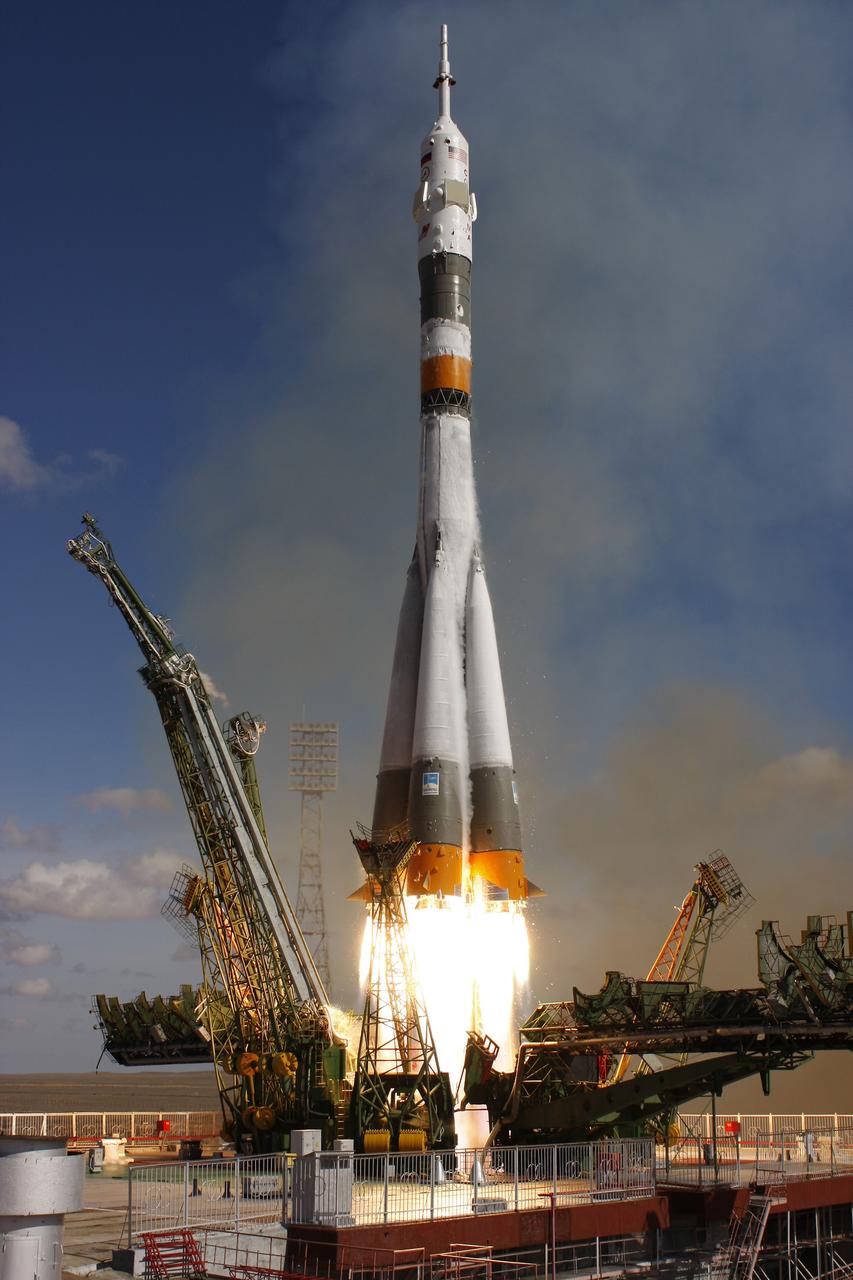
KAZAKHSTAN – The Soyuz TMA-13 spacecraft ,carrying Expedition 18 Commander Michael Fincke, Flight Engineer Yury V. Lonchakov and American Spaceflight Participant Richard Garriott launches Oct. 12 from the Baikonur Cosmodrome in Kazakhstan. The three crew members are scheduled to dock with the International Space Station on Oct. 14. Fincke and Lonchakov will spend six months on the station, while Garriott will return to Earth Oct. 24 with two of the Expedition 17 crew members currently on the space station. Photo credit: NASA/Bill Ingalls
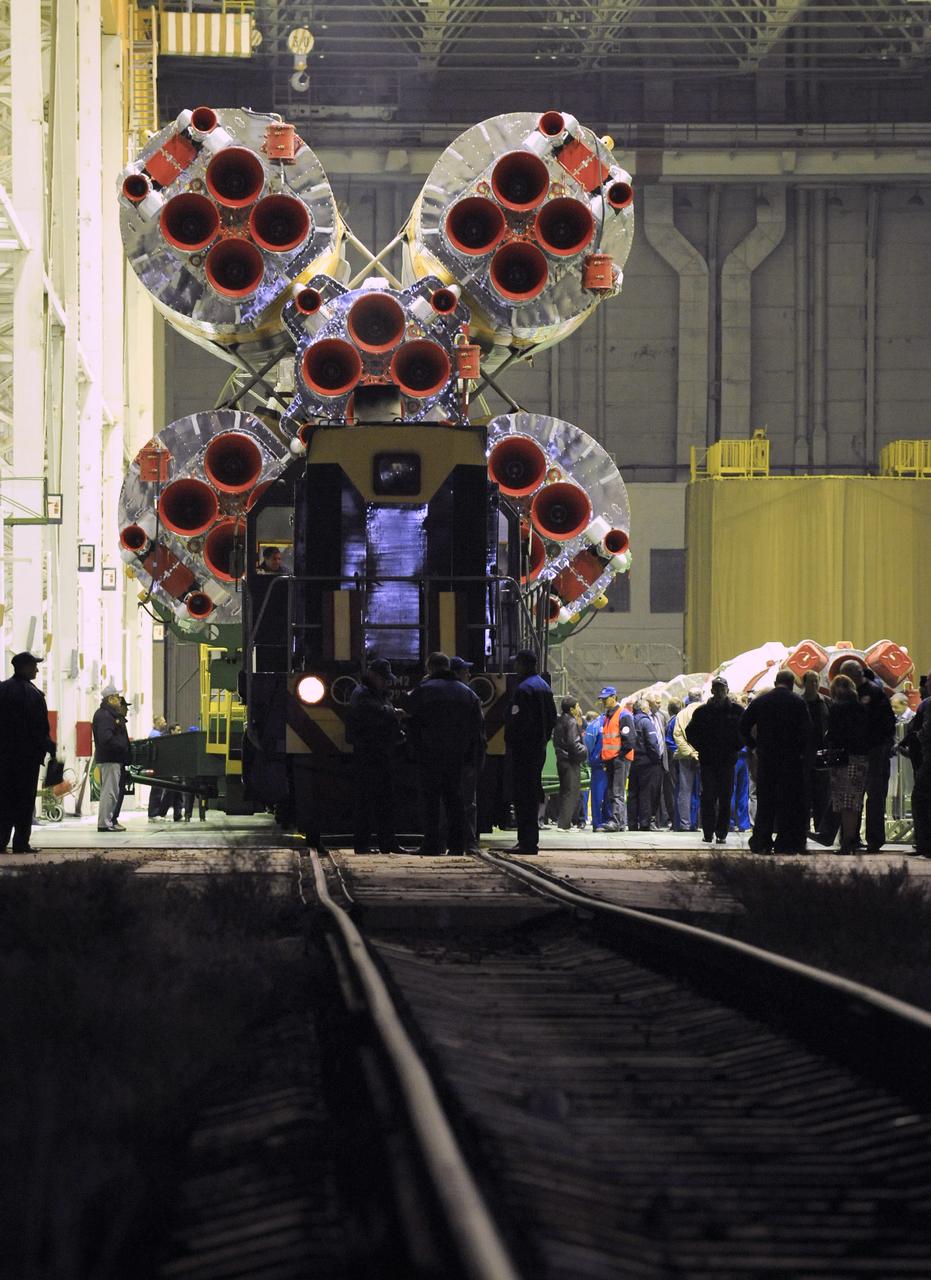
The Soyuz TMA-13 spacecraft is transported by railcar to its launch pad at the Baikonur Cosmodrome in Kazakhstan, Friday, Oct. 10, 2008. Expedition 18 Commander Michael Fincke, Flight Engineer Yuri V. Lonchakov and American spaceflight participant Richard Garriott will launch October 12 and dock with the International Space Station October 14. Fincke and Lonchakov will spend six months on the station, while Garriott will return to Earth after 10 days with the Expedition 17 crew members currently on the ISS. Photo Credit: (NASA/Bill Ingalls)
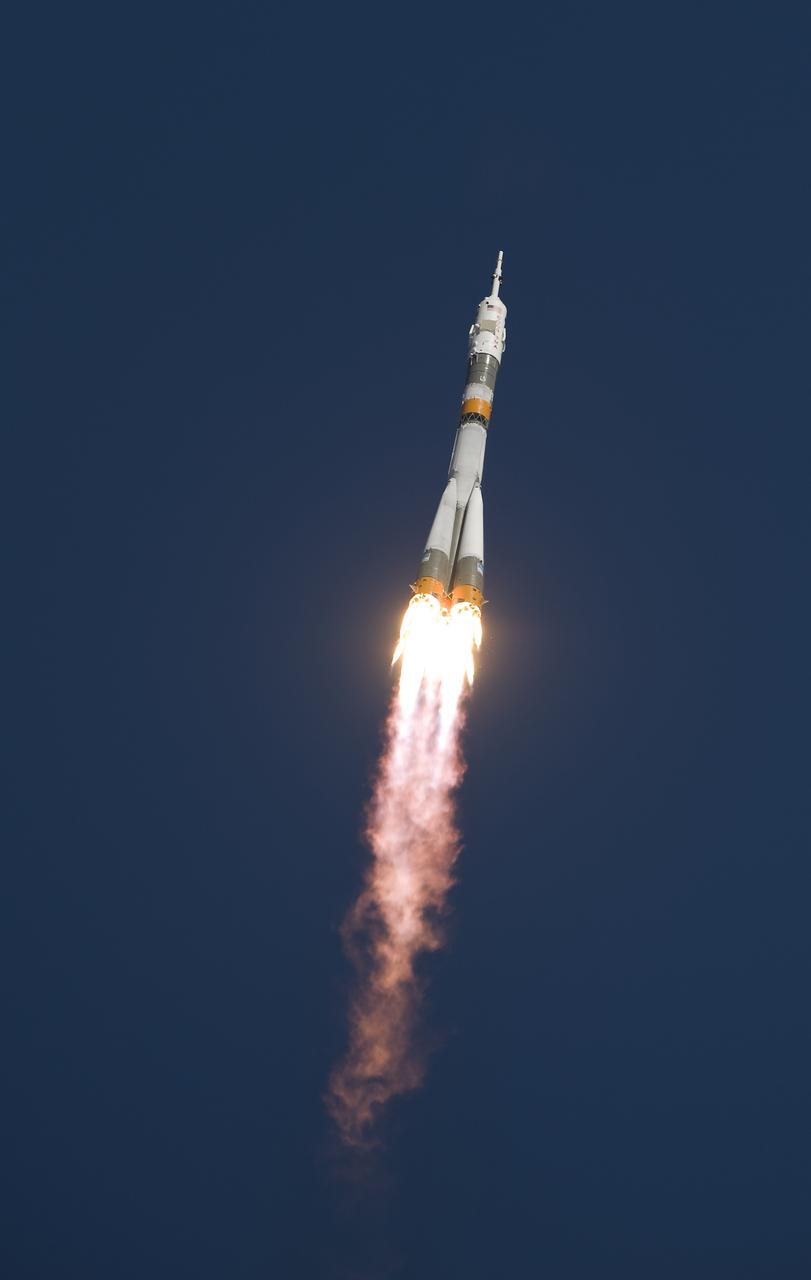
KAZAKHSTAN – The Soyuz TMA-13 spacecraft, carrying Expedition 18 Commander Michael Fincke, Flight Engineer Yury V. Lonchakov and American Spaceflight Participant Richard Garriott launches Oct. 12 from the Baikonur Cosmodrome in Kazakhstan. The three crew members are scheduled to dock with the International Space Station on Oct. 14. Fincke and Lonchakov will spend six months on the station, while Garriott will return to Earth Oct. 24 with two of the Expedition 17 crew members currently on the space station. Photo credit: NASA/Bill Ingalls
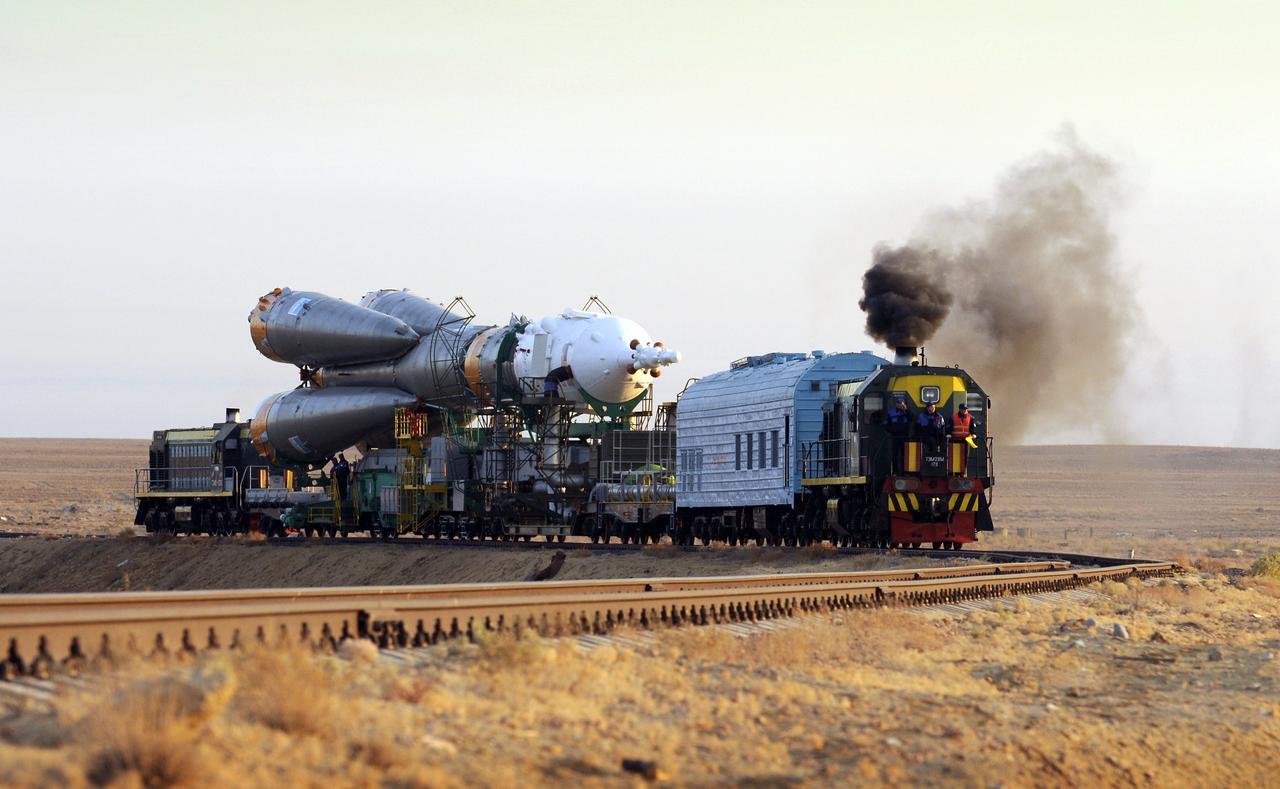
The Soyuz TMA-13 spacecraft is transported by railcar to its launch pad at the Baikonur Cosmodrome in Kazakhstan, Friday, Oct. 10, 2008. Expedition 18 Commander Michael Fincke, Flight Engineer Yuri V. Lonchakov and American spaceflight participant Richard Garriott will launch October 12 and dock with the International Space Station October 14. Fincke and Lonchakov will spend six months on the station, while Garriott will return to Earth after 10 days with the Expedition 17 crew members currently on the ISS. Photo Credit: (NASA/Bill Ingalls)
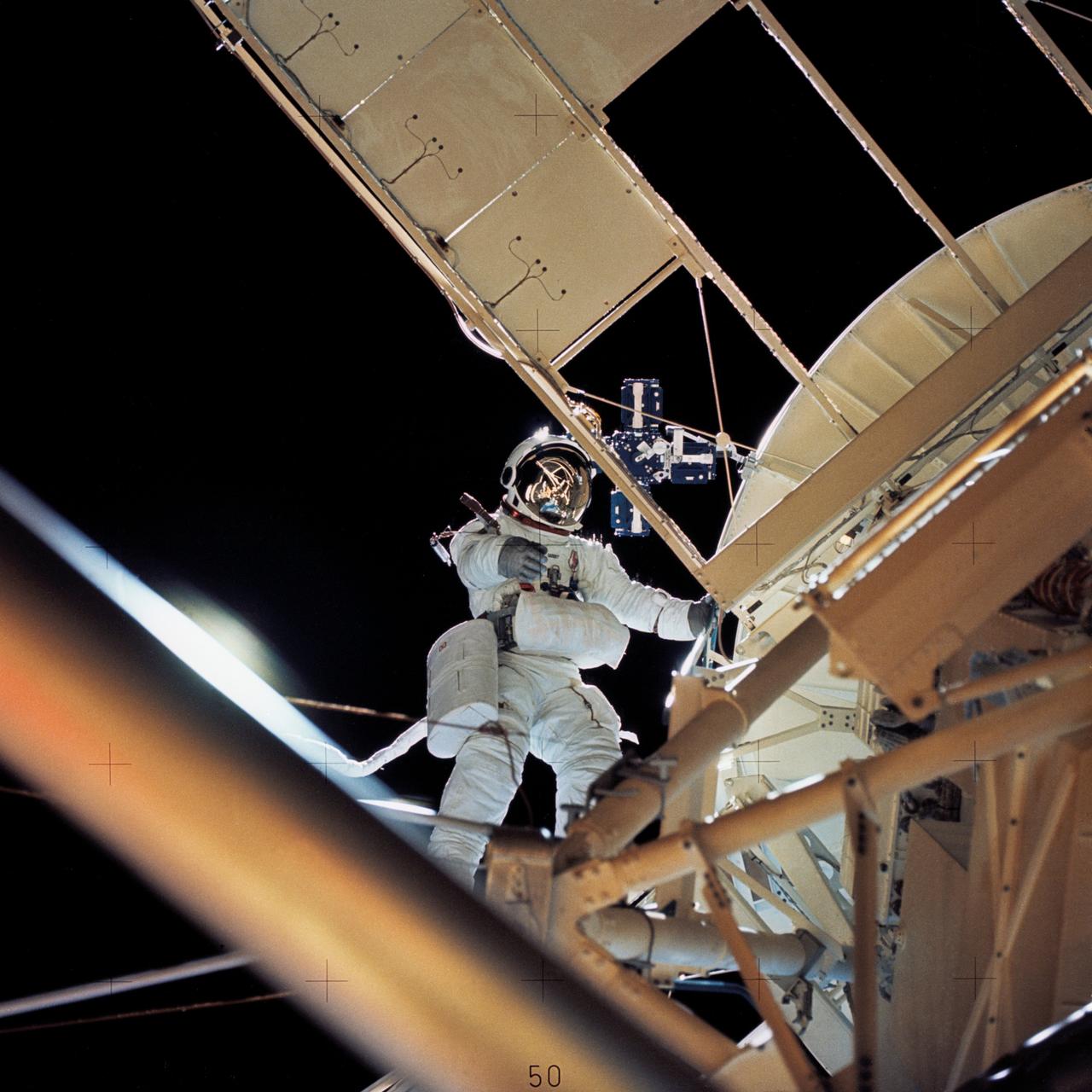
SL3-115-1837 (August 1973) --- Astronaut Owen K. Garriott, Skylab 3 science pilot, retrieves an imagery experiment from the Apollo Telescope Mount (ATM) attached to the Skylab in Earth orbit. Garriott’s was a special extravehicular activity (EVA) to remove from the attached ATM/orbiting observatory magazines which will be returned to Earth when the second manning of the Skylab space station has been completed. Photo credit: NASA
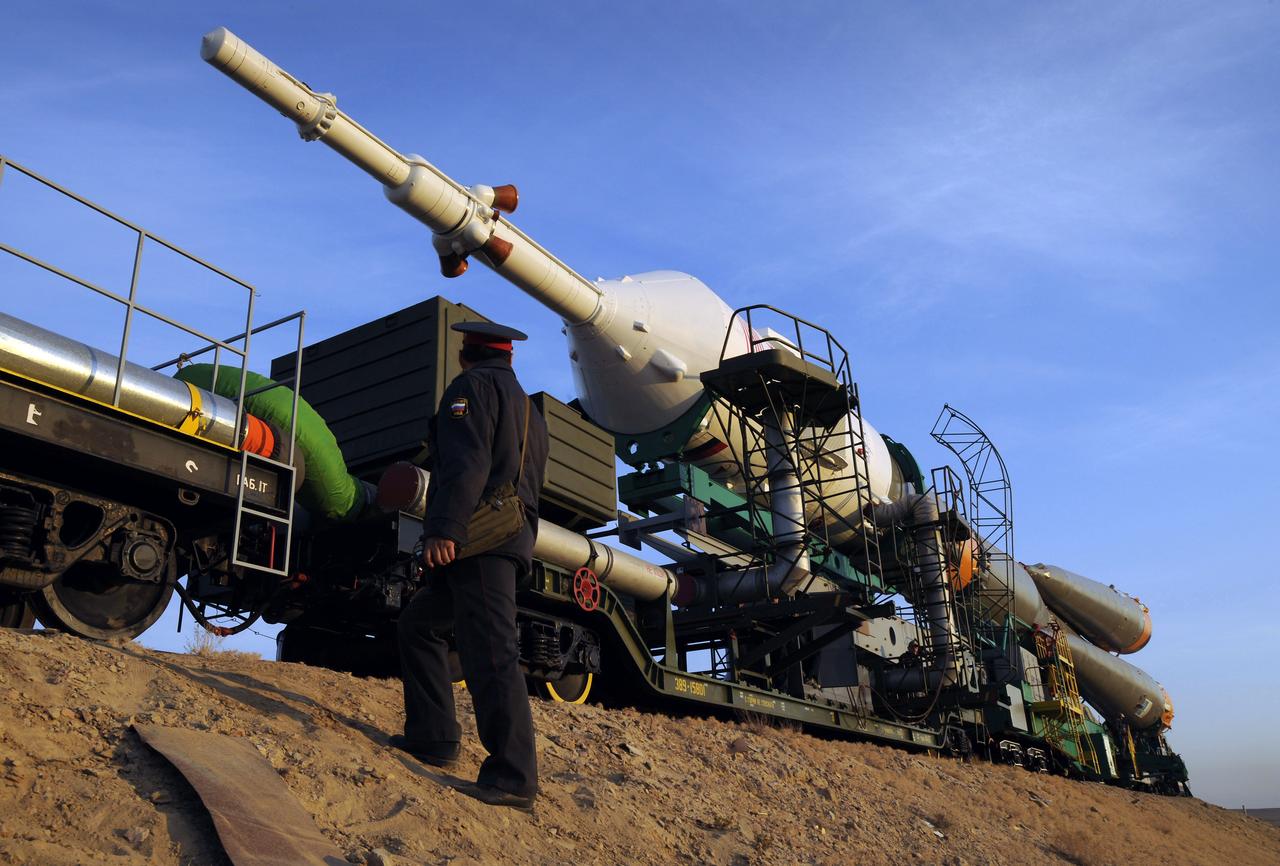
The Soyuz TMA-13 spacecraft is transported by railcar to its launch pad at the Baikonur Cosmodrome in Kazakhstan, Friday, Oct. 10, 2008. Expedition 18 Commander Michael Fincke, Flight Engineer Yuri V. Lonchakov and American spaceflight participant Richard Garriott will launch October 12 and dock with the International Space Station October 14. Fincke and Lonchakov will spend six months on the station, while Garriott will return to Earth after 10 days with the Expedition 17 crew members currently on the ISS. Photo Credit: (NASA/Bill Ingalls)
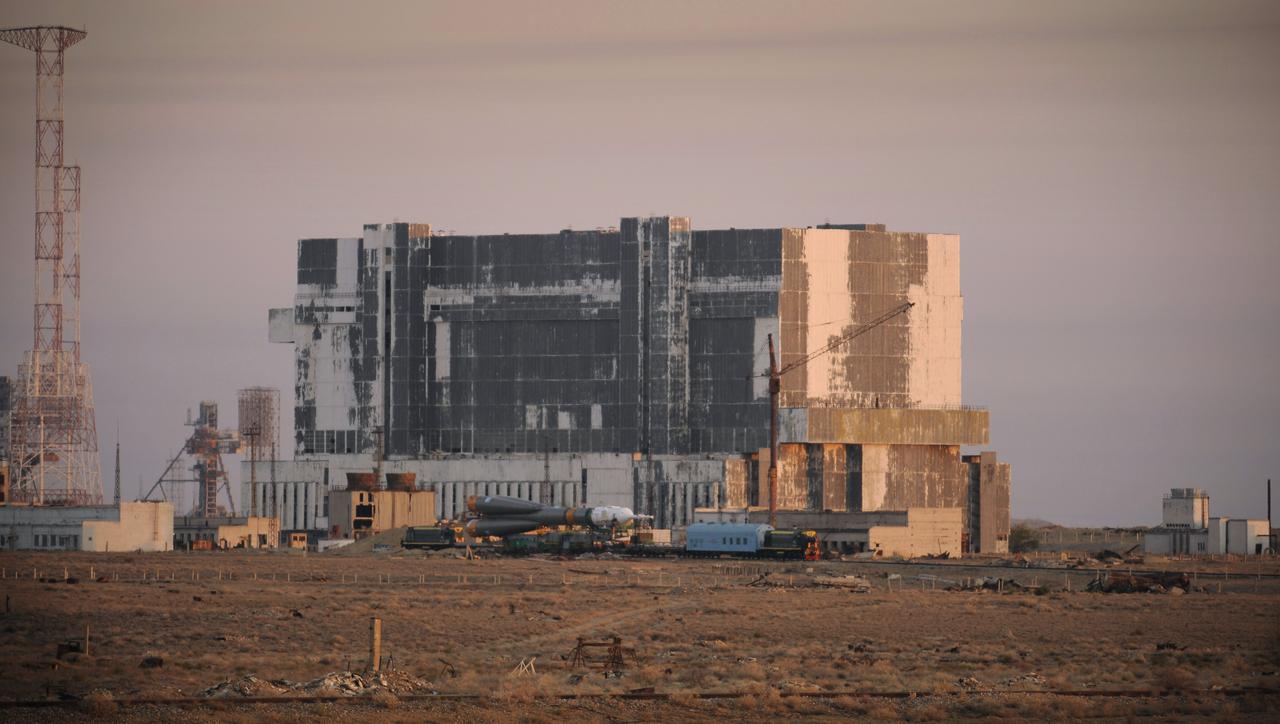
The Soyuz TMA-13 spacecraft is transported by railcar to its launch pad at the Baikonur Cosmodrome in Kazakhstan, Friday, Oct. 10, 2008. Expedition 18 Commander Michael Fincke, Flight Engineer Yuri V. Lonchakov and American spaceflight participant Richard Garriott will launch October 12 and dock with the International Space Station October 14. Fincke and Lonchakov will spend six months on the station, while Garriott will return to Earth after 10 days with the Expedition 17 crew members currently on the ISS. Photo Credit: (NASA/Bill Ingalls)

KAZAKHSTAN – The Soyuz TMA-13 spacecraft ,carrying Expedition 18 Commander Michael Fincke, Flight Engineer Yury V. Lonchakov and American Spaceflight Participant Richard Garriott launches Oct. 12 from the Baikonur Cosmodrome in Kazakhstan. The three crew members are scheduled to dock with the International Space Station on Oct. 14. Fincke and Lonchakov will spend six months on the station, while Garriott will return to Earth Oct. 24 with two of the Expedition 17 crew members currently on the space station. Photo credit: NASA/Bill Ingalls
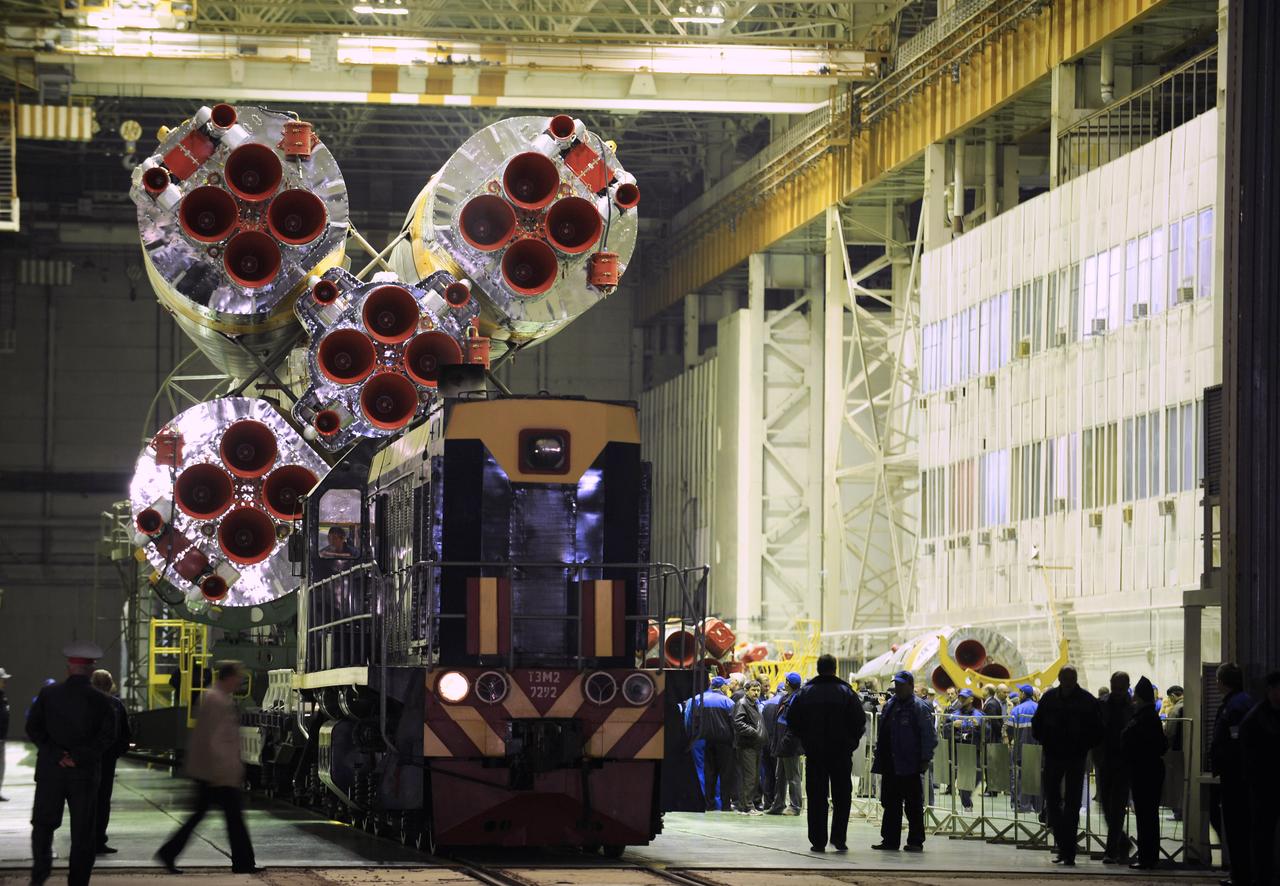
The Soyuz TMA-13 spacecraft is transported by railcar to its launch pad at the Baikonur Cosmodrome in Kazakhstan, Friday, Oct. 10, 2008. Expedition 18 Commander Michael Fincke, Flight Engineer Yuri V. Lonchakov and American spaceflight participant Richard Garriott will launch October 12 and dock with the International Space Station October 14. Fincke and Lonchakov will spend six months on the station, while Garriott will return to Earth after 10 days with the Expedition 17 crew members currently on the ISS. Photo Credit: (NASA/Bill Ingalls)
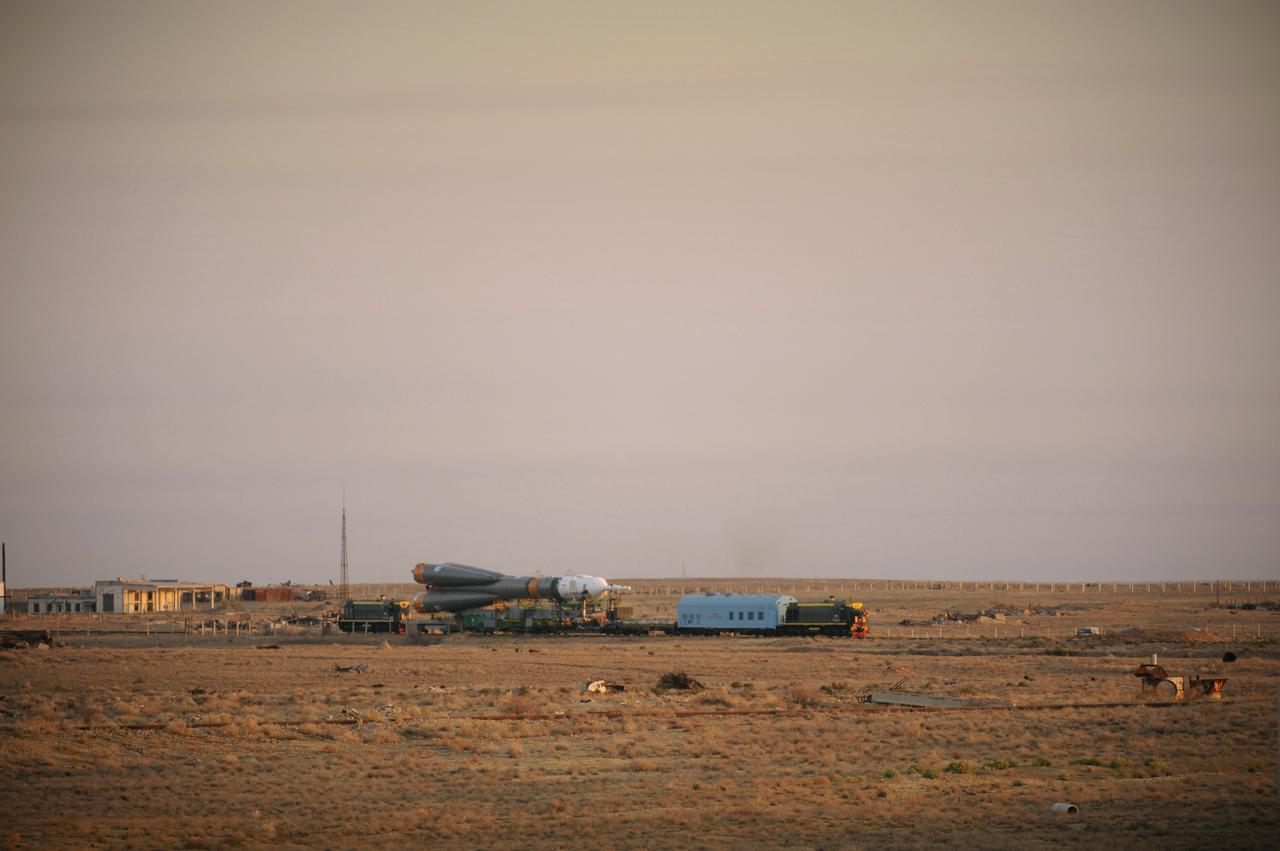
The Soyuz TMA-13 spacecraft is transported by railcar to its launch pad at the Baikonur Cosmodrome in Kazakhstan, Friday, Oct. 10, 2008. Expedition 18 Commander Michael Fincke, Flight Engineer Yuri V. Lonchakov and American spaceflight participant Richard Garriott will launch October 12 and dock with the International Space Station October 14. Fincke and Lonchakov will spend six months on the station, while Garriott will return to Earth after 10 days with the Expedition 17 crew members currently on the ISS. Photo Credit: (NASA/Bill Ingalls)
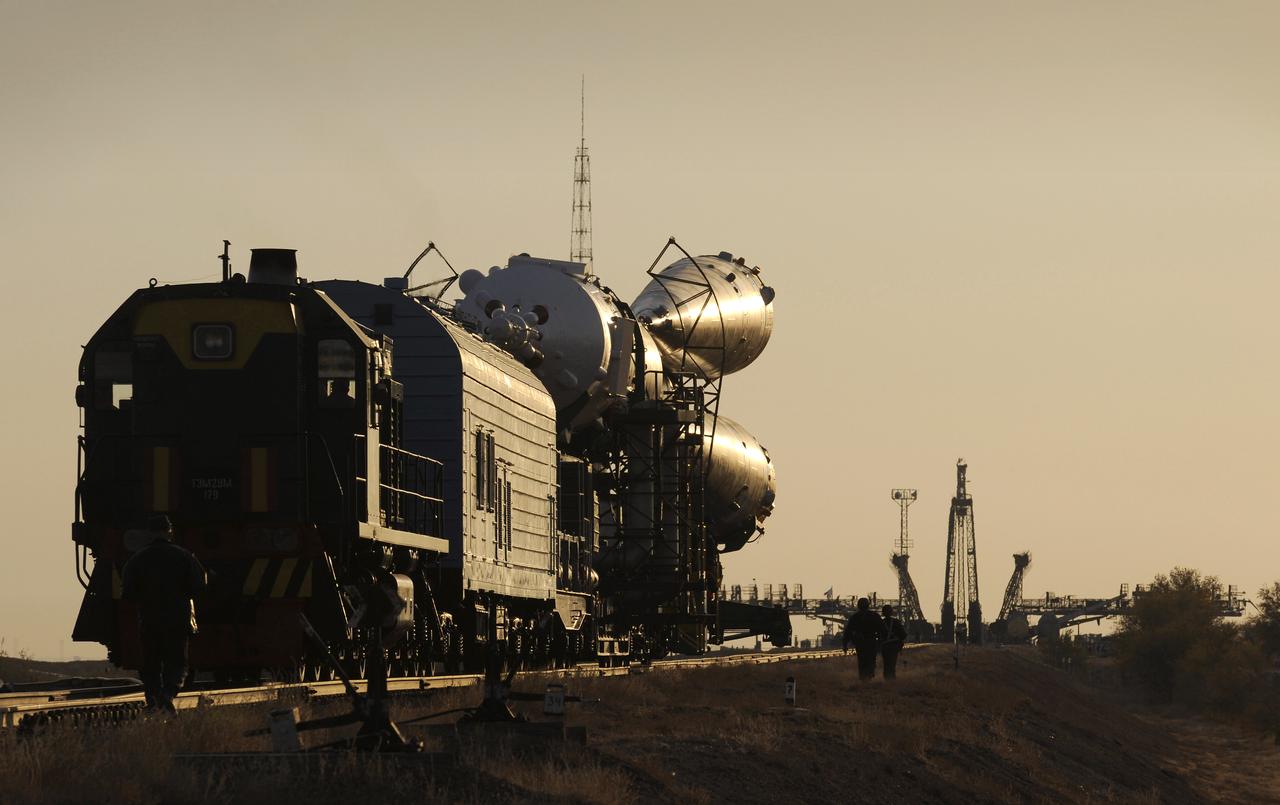
The Soyuz TMA-13 spacecraft is transported by railcar to its launch pad at the Baikonur Cosmodrome in Kazakhstan, Friday, Oct. 10, 2008. Expedition 18 Commander Michael Fincke, Flight Engineer Yuri V. Lonchakov and American spaceflight participant Richard Garriott will launch October 12 and dock with the International Space Station October 14. Fincke and Lonchakov will spend six months on the station, while Garriott will return to Earth after 10 days with the Expedition 17 crew members currently on the ISS. Photo Credit: (NASA/Bill Ingalls)
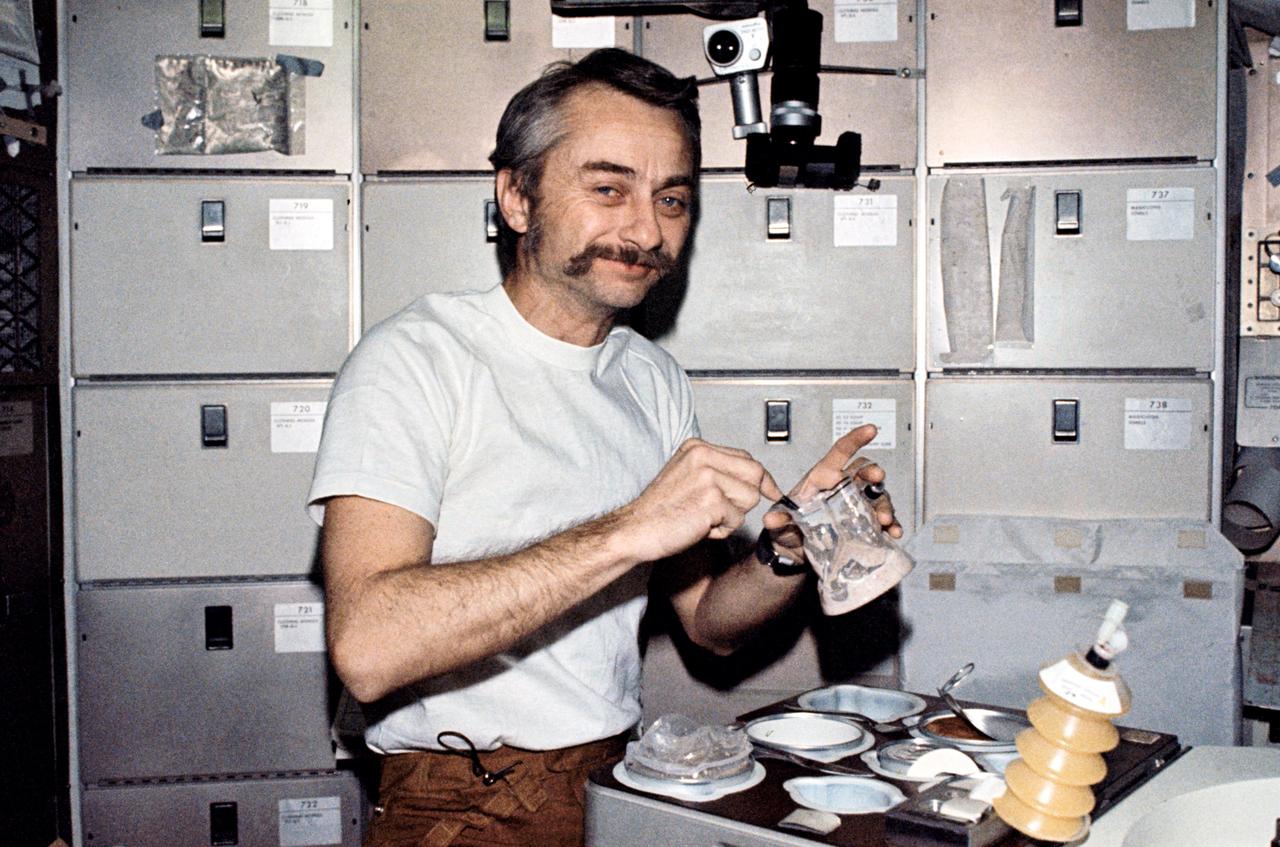
SL3-111-1519 (6 Aug. 1973) --- Scientist-astronaut Owen K. Garriott, Skylab 3 science pilot, reconstitutes a pre-packaged container of food at the crew quarters ward room table of the Orbital Workshop (OWS) of the Skylab Space Station cluster. This picture was taken with a hand-held 35mm Nikon camera. Astronauts Garriott, Alan L. Bean and Jack R. Lousma remained with the Skylab Space Station in Earth orbit for a total of 59 days conducting numerous medical, scientific and technological experiments. Note the knife and fork on the food tray and the utensil with which Garriott stirs the food mixed with water. Skylab is the first manned space program by NASA which affords the crew men an opportunity to eat with the same type utensils used on Earth. Photo credit: NASA
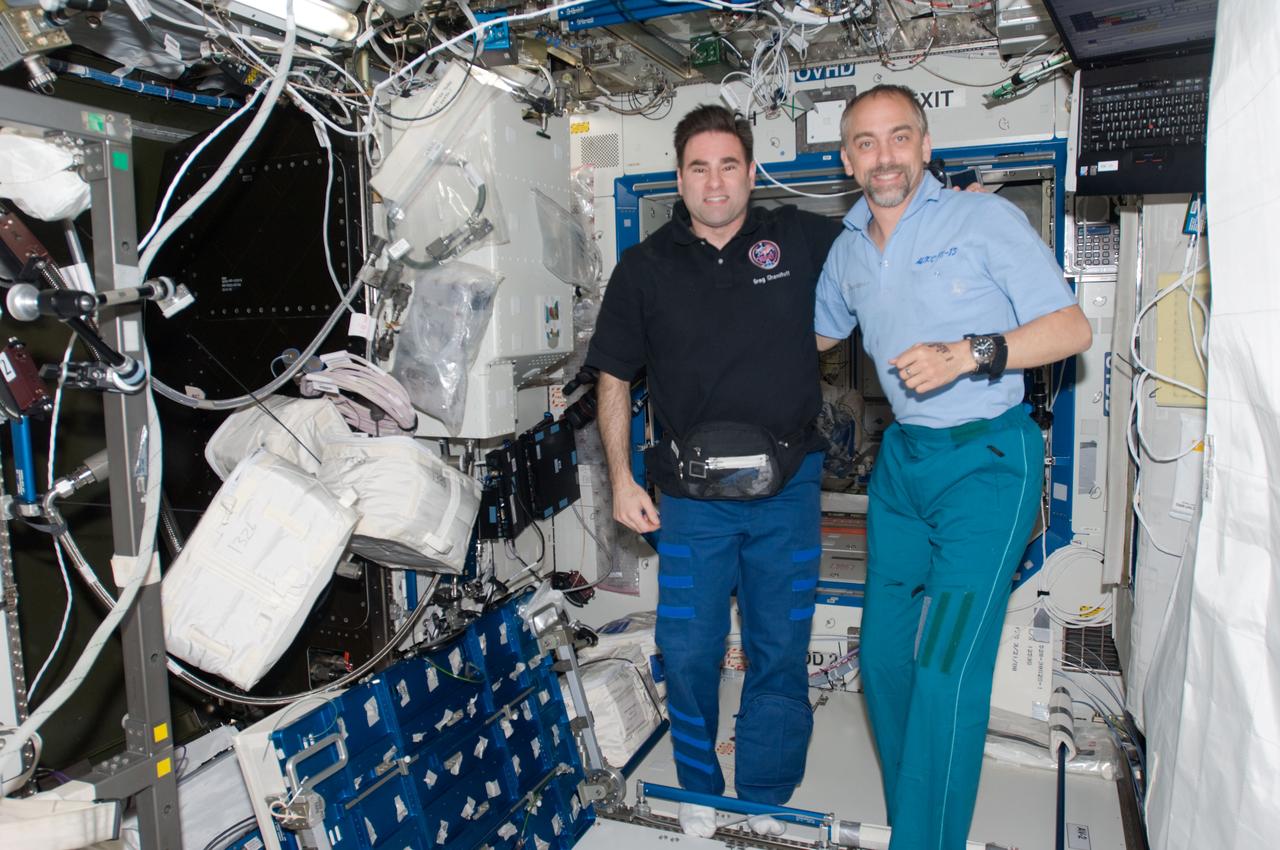
ISS017-E-021366 (23 Oct. 2008) --- Astronaut Greg Chamitoff (left), Expedition 18 flight engineer, and American spaceflight participant Richard Garriott pose for a photo in the Destiny laboratory of the International Space Station.

Prior to the commencement of Apollo 11th's 30th arniversary festivities at Marshall Space Flight Center, visiting Saturn astronauts take a tour of the Center. Pictured are (L/R): Dick Gordon, Owen Garriott and Edgar Mitchell
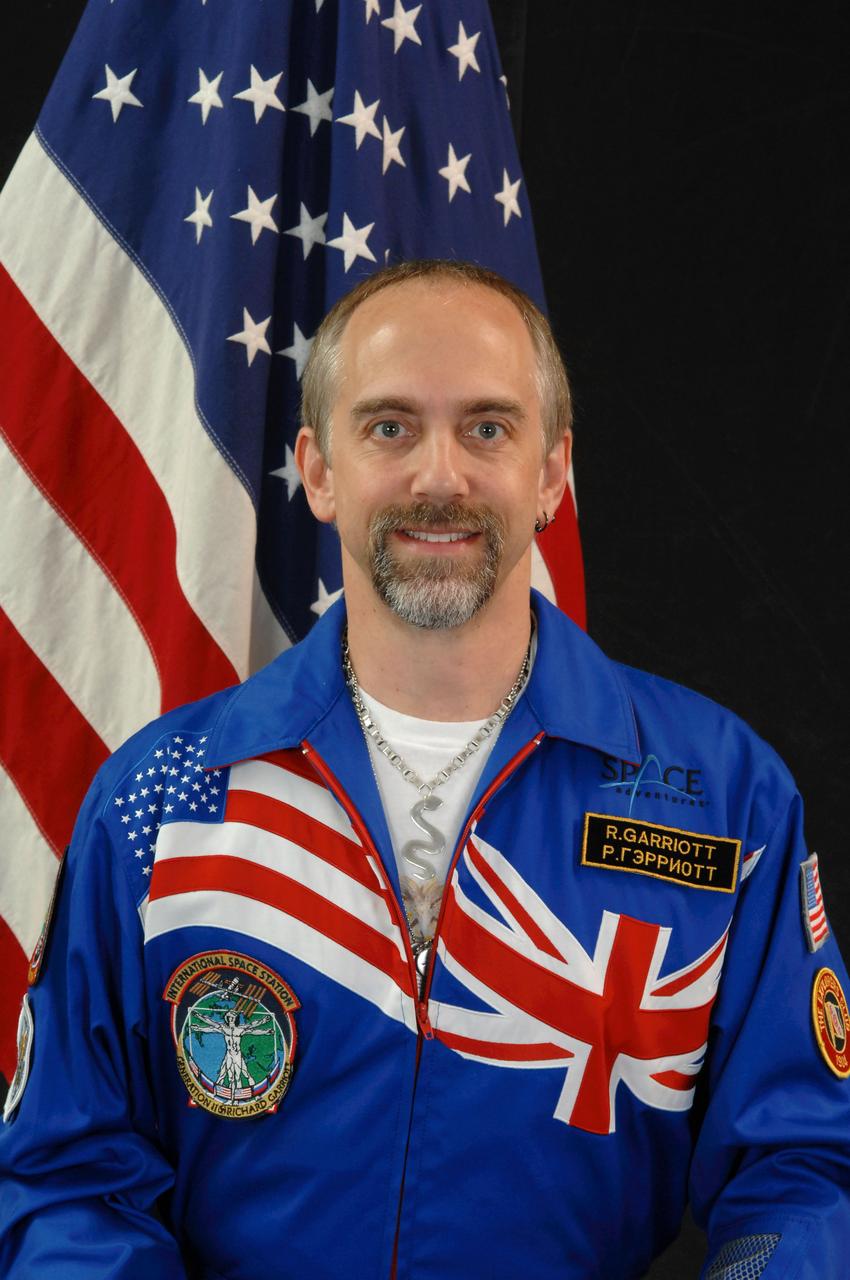
JSC2008-E-117659 (28 Aug. 2008) --- American spaceflight participant Richard Garriott takes a break from training in Star City, Russia to pose for a portrait. Photo credit: Gagarin Cosmonaut Training Center
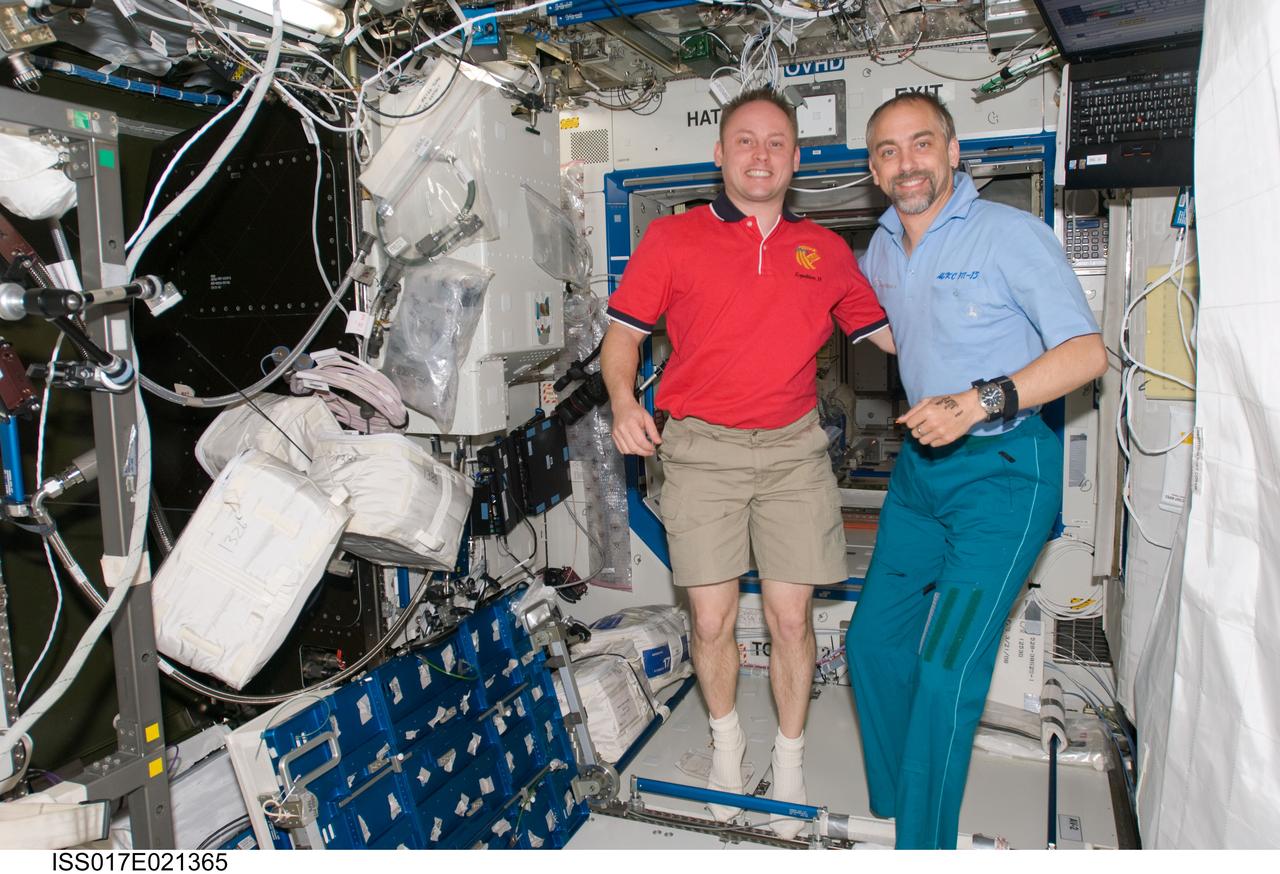
ISS017-E-021365 (23 Oct. 2008) --- Astronaut Michael Fincke (left), Expedition 18 commander, and American spaceflight participant Richard Garriott pose for a photo in the Destiny laboratory of the International Space Station.
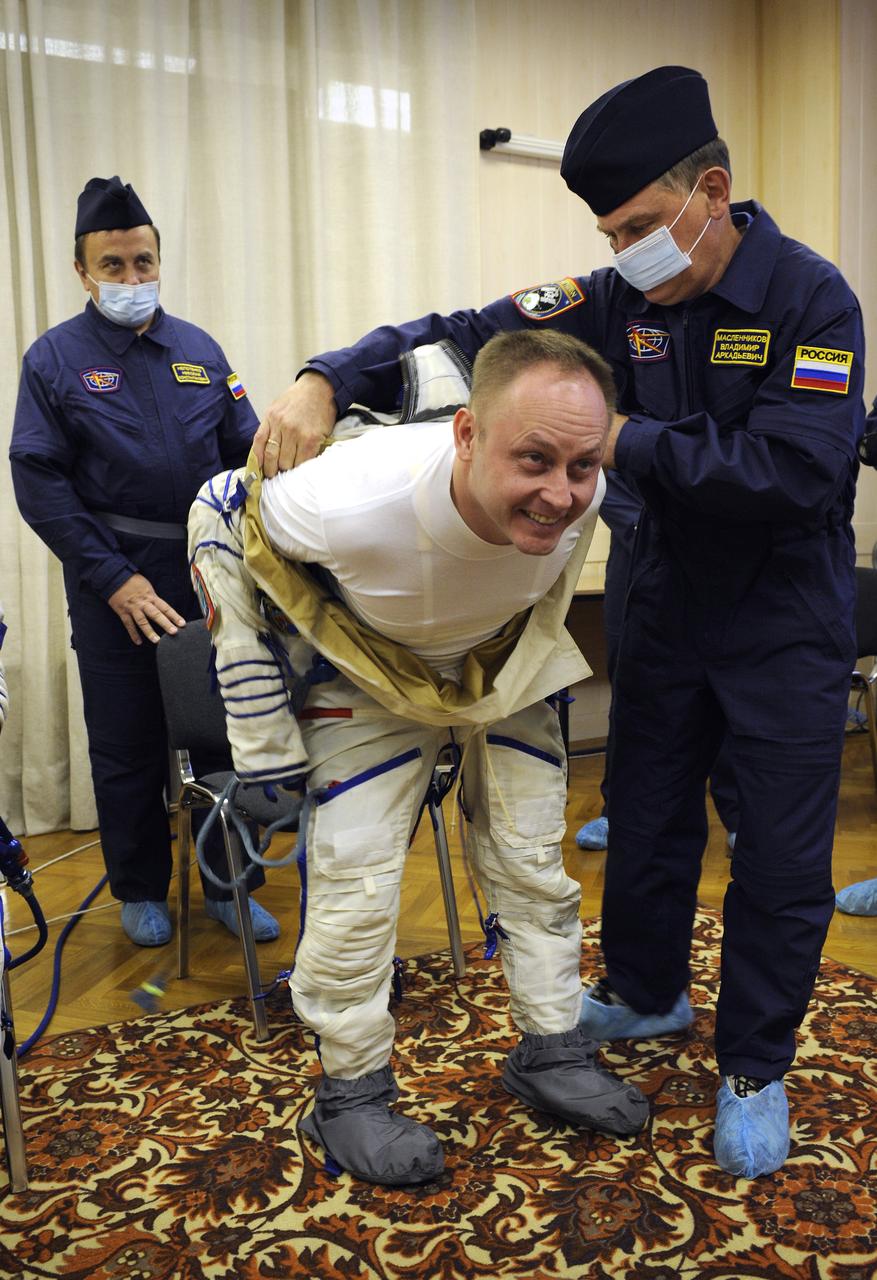
Expedition 18 Commander Michael Fincke dons his Russian Sokol suit hours before he and Expedition 18 Flight Engineer Yuri V. Lonchakov and American spaceflight participant Richard Garriott launch in the Soyuz TMA-13 spacecraft, Sunday, Oct. 12, 2008 from the Baikonur Cosmodrome in Kazakhstan. The three crew members are scheduled to dock with the International Space Station on Oct. 14. Fincke and Lonchakov will spend six months on the station, while Garriott will return to Earth Oct. 24 with two of the Expedition 17 crew members currently on the International Space Station. Photo Credit: (NASA/Bill Ingalls)
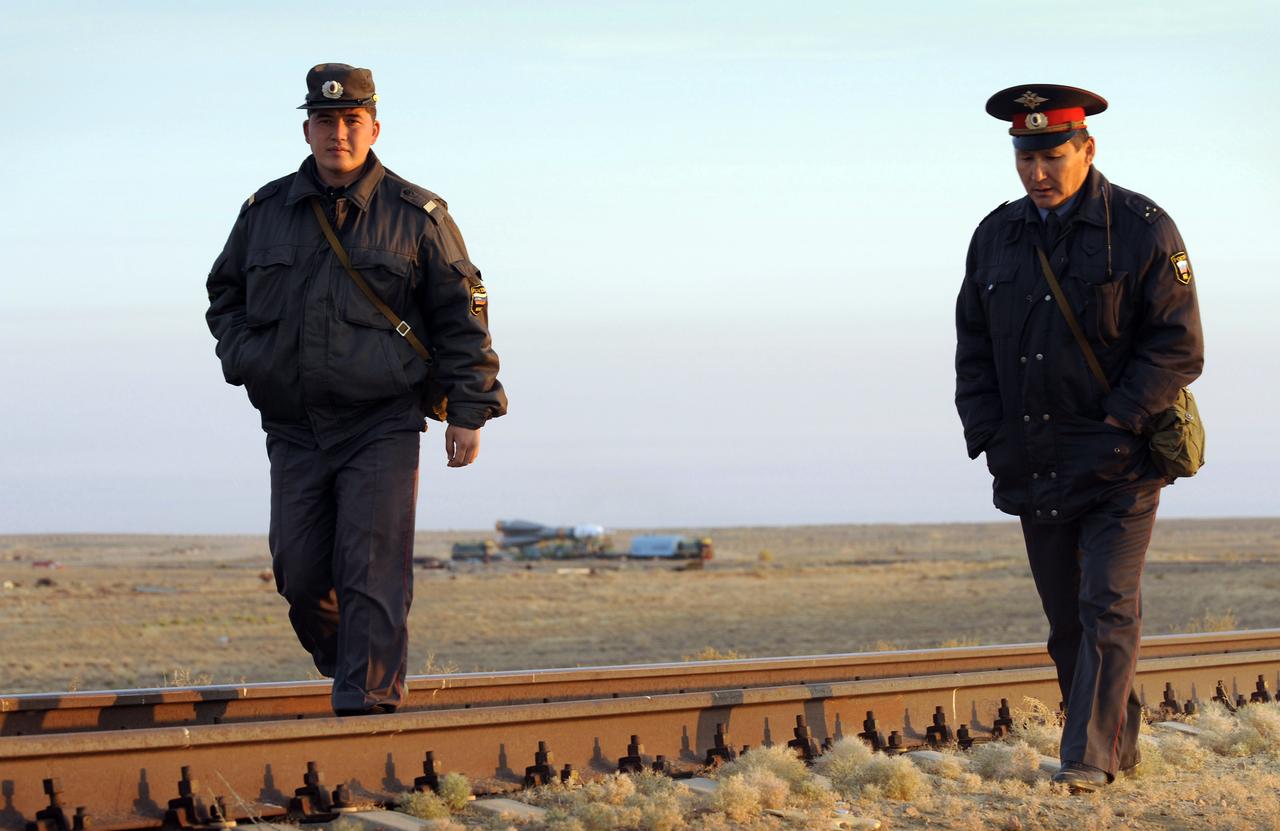
Russian security personnel walk the railroad line ahead of the Soyuz TMA-13 spacecraft as it is transported by railcar to its launch pad at the Baikonur Cosmodrome in Kazakhstan, Friday, Oct. 10, 2008. The Soyuz is scheduled to launch to the International Space Station Oct. 12 with Expedition 18 Commander Michael Fincke, Flight Engineer Yuri V. Lonchakov and American spaceflight participant Richard Garriott. The three crew members will dock their Soyuz to the International Space Station on Oct. 14. Fincke and Lonchakov will spend six months on the station, while Garriott will return to Earth Oct. 24 with two of the Expedition 17 crew members currently on the International Space Station. Photo Credit: (NASA/Bill Ingalls)
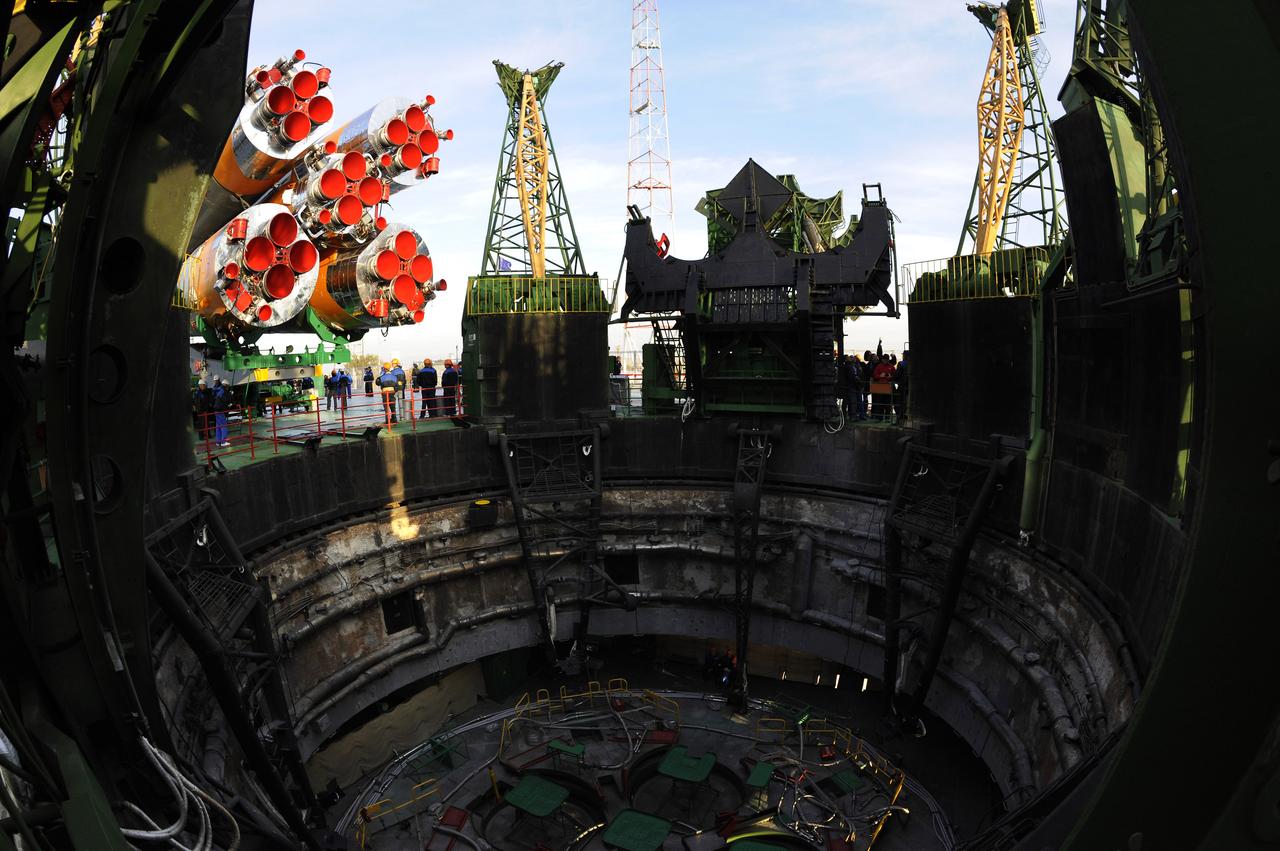
The Soyuz TMA-13 spacecraft arrives at the launch pad at the Baikonur Cosmodrome in Kazakhstan, Friday, Oct. 10, 2008 for launch Oct. 12 to carry Expedition 18 Commander Michael Fincke, Flight Engineer Yury V. Lonchakov and American Spaceflight Participant Richard Garriott to the International Space Station. The three crew members will dock their Soyuz to the International Space Station on Oct. 14. Fincke and Lonchakov will spend six months on the station, while Garriott will return to Earth Oct. 24, 2008 with two of the Expedition 17 crewmembers currently on the International Space Station. Photo Credit: (NASA/Bill Ingalls)
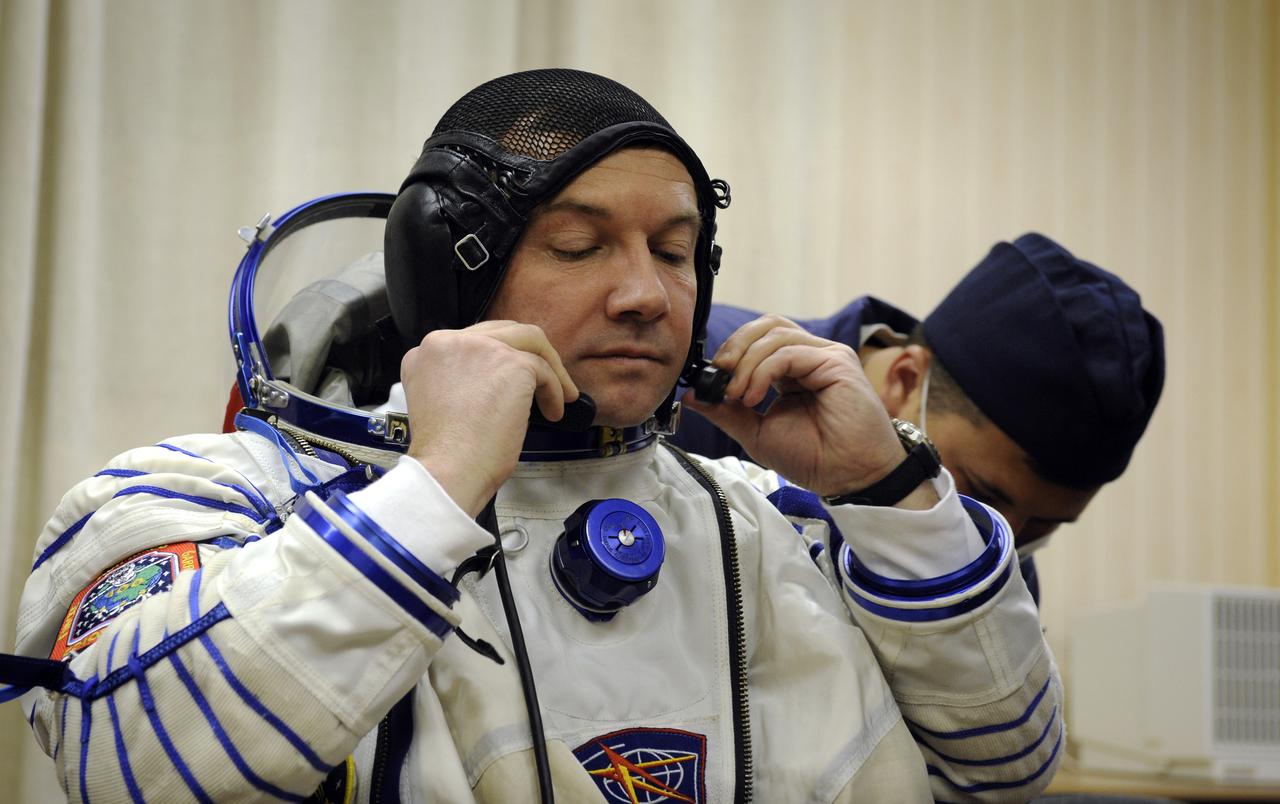
Expedition 18 Flight Engineer Yuri V. Lonchakov dons his Russian Sokol suit hours before he and Expedition 18 Commander Michael Fincke and American spaceflight participant Richard Garriott launch in the Soyuz TMA-13 spacecraft, Sunday, Oct. 12, 2008 from the Baikonur Cosmodrome in Kazakhstan. The three crew members are scheduled to dock with the International Space Station on Oct. 14. Fincke and Lonchakov will spend six months on the station, while Garriott will return to Earth Oct. 24 with two of the Expedition 17 crew members currently on the International Space Station. Photo Credit: (NASA/Bill Ingalls)
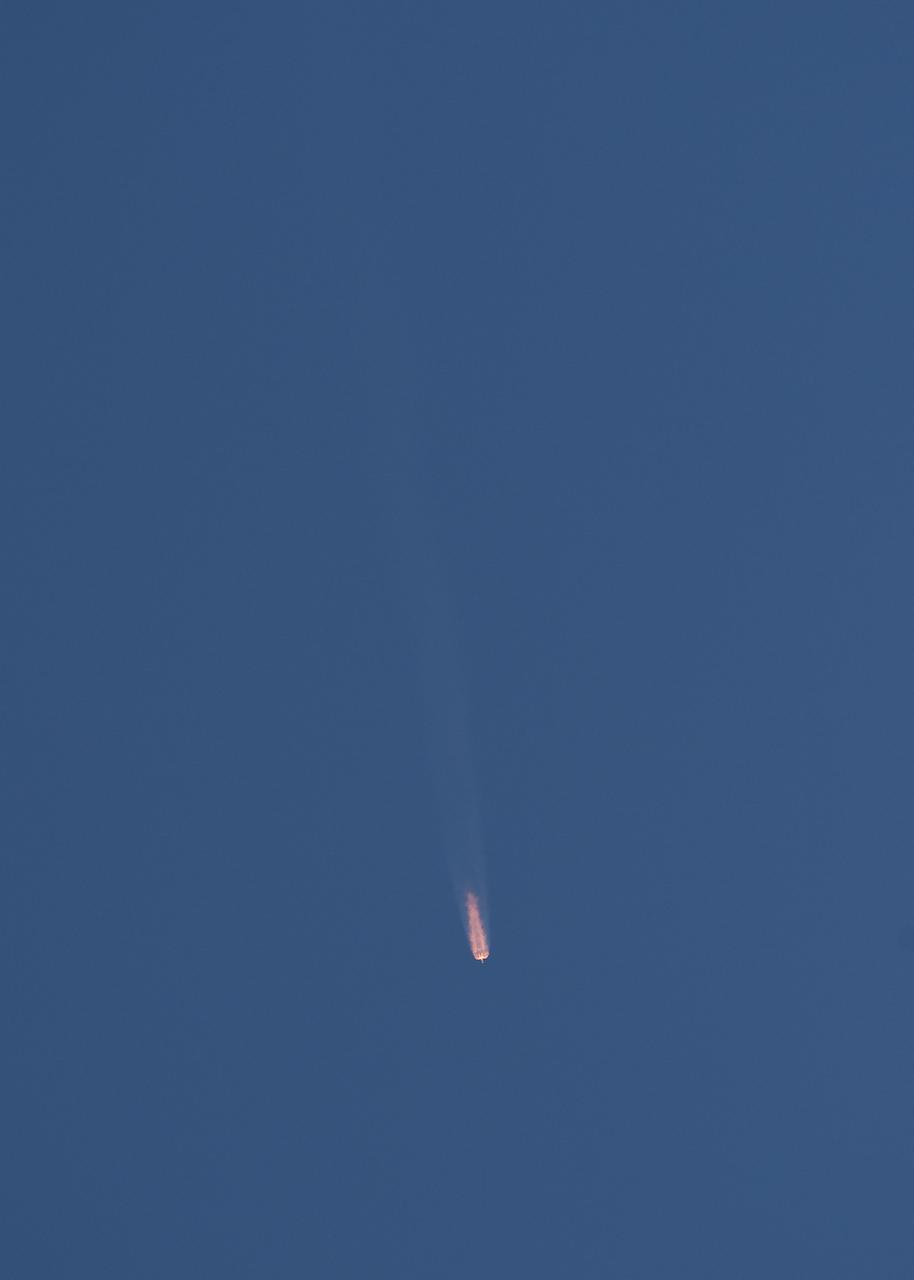
The Soyuz TMA-13 spacecraft launches carrying Expedition 18 Commander Michael Fincke, Flight Engineer Yuri V. Lonchakov and American spaceflight participant Richard Garriott, Sunday, Oct. 12, 2008, from the Baikonur Cosmodrome in Kazakhstan. The three crew members are scheduled to dock with the International Space Station on Oct. 14. Fincke and Lonchakov will spend six months on the station, while Garriott will return to Earth Oct. 24 with two of the Expedition 17 crew members currently on the International Space Station. Photo Credit: (NASA/Bill Ingalls)