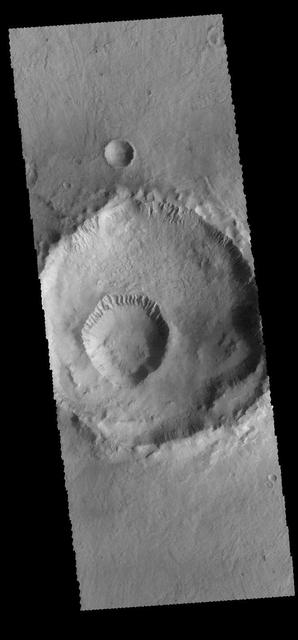
The smaller crater within the larger crater is called Gasa Crater (the larger crater is unnamed). Gullies dissect the inner rims of both craters. Orbit Number: 65538 Latitude: -35.6842 Longitude: 129.44 Instrument: VIS Captured: 2016-09-22 06:02 http://photojournal.jpl.nasa.gov/catalog/PIA21158
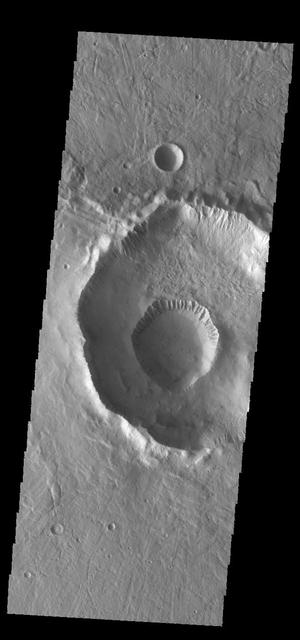
The small crater on the floor of the larger crater is called Gasa Crater. Gullies dissect the rims of both craters, as shown in this image captured by NASA 2001 Mars Odyssey spacecraft. These craters are located in Eridania Planitia. Orbit Number: 67465 Latitude: -35.7075 Longitude: 129.365 Instrument: VIS Captured: 2017-02-27 23:40 https://photojournal.jpl.nasa.gov/catalog/PIA21528
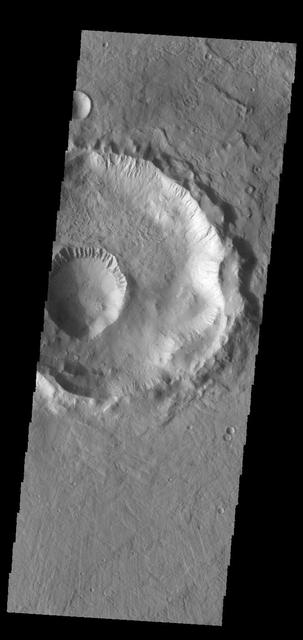
This VIS image shows Gasa Crater, a small crater within a larger crater. Orbit Number: 59119 Latitude: -35.7834 Longitude: 129.522 Instrument: VIS Captured: 2015-04-12 13:40 http://photojournal.jpl.nasa.gov/catalog/PIA19781

This VIS image shows Gasa Crater located on the floor of a larger unnamed crater Eridania Planitia. Gullies dissect the rims of both craters. Orbit Number: 83302 Latitude: -35.6906 Longitude: 129.494 Instrument: VIS Captured: 2020-09-24 09:28 https://photojournal.jpl.nasa.gov/catalog/PIA24253

This VIS image shows Gasa Crater located on the floor of a larger unnamed crater Eridania Planitia. Gullies dissect the rims of both craters. Orbit Number: 76121 Latitude: -35.639 Longitude: 129.538 Instrument: VIS Captured: 2019-02-11 01:31 https://photojournal.jpl.nasa.gov/catalog/PIA23189
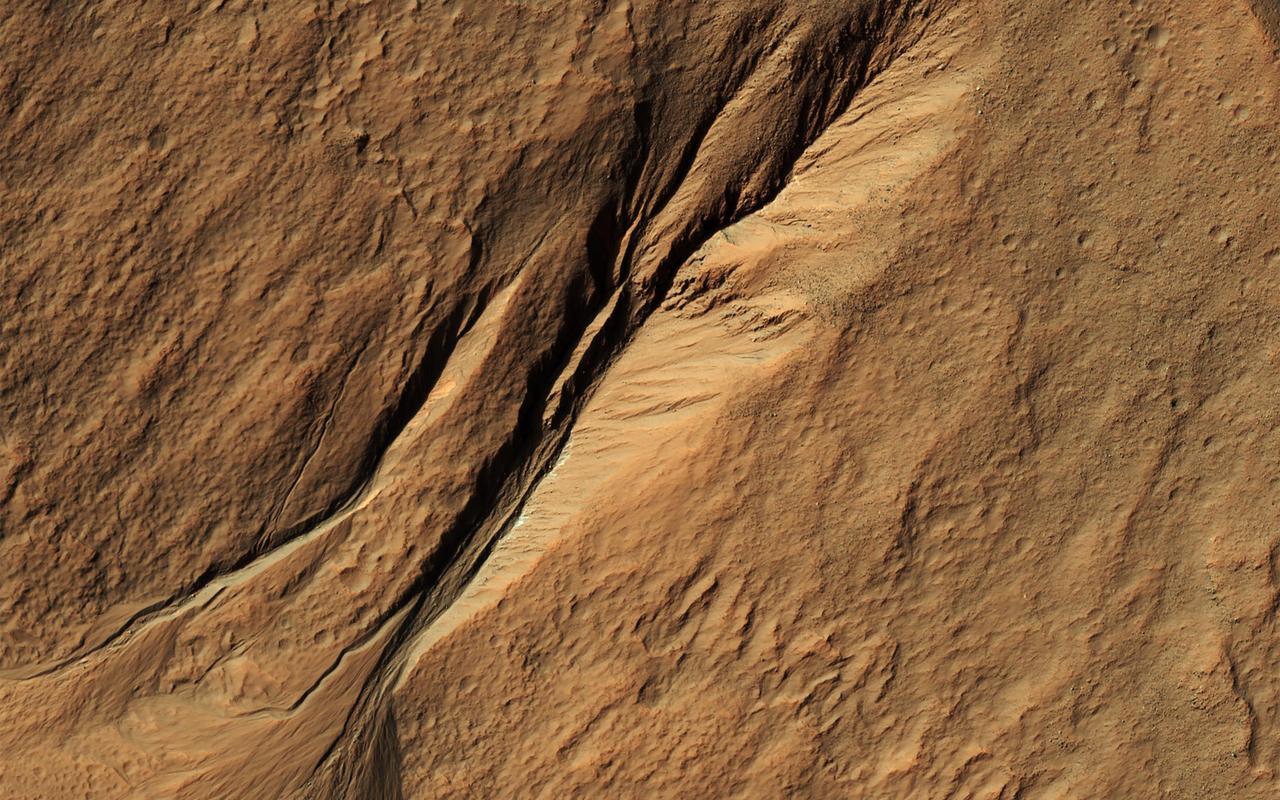
Gullies eroded into the steep inner slope of an impact crater at this location appear perfectly pristine in this image captured by NASA's Mars Reconnaissance Orbiter (MRO). Although at first glance it may appear that there are craters superimposed on the gully fans, inspection of HiRISE stereo coverage shows that the craters lie only on the pre-gully terrain. Distinctive colors in the gully channels and alcoves offer another indication of youth and recent activity. The pre-gully landscape is covered by secondary craters from nearby Gasa Crater, estimated to be about 1 million years old. Although some have suggested that the Martian gullies are also about a million years old and formed in a different environment, we now know that they are continuing to form today. https://photojournal.jpl.nasa.gov/catalog/PIA21599
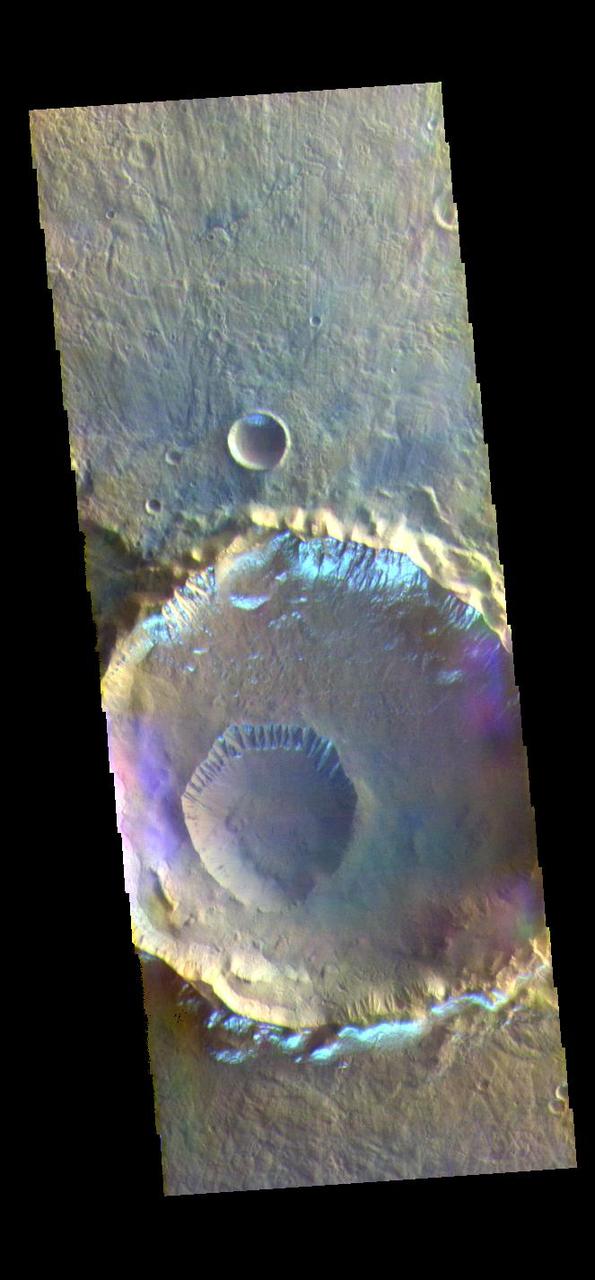
The THEMIS VIS camera contains 5 filters. The data from different filters can be combined in multiple ways to create a false color image. These false color images may reveal subtle variations of the surface not easily identified in a single band image. Today's false color image shows several craters in Eridania Planitia. The small crater inside the larger crater is Gasa Crater. The larger crater is unnamed. The bright silver-blue region on the inner and outer crater rim is morning frost. Collected during the winter, south facing slopes stay in shadow and retain frost longer than the rest of the rim already in sunlight. Frosts are only identifiable in multi filter images. The THEMIS VIS camera is capable of capturing color images of the Martian surface using five different color filters. In this mode of operation, the spatial resolution and coverage of the image must be reduced to accommodate the additional data volume produced from using multiple filters. To make a color image, three of the five filter images (each in grayscale) are selected. Each is contrast enhanced and then converted to a red, green, or blue intensity image. These three images are then combined to produce a full color, single image. Because the THEMIS color filters don't span the full range of colors seen by the human eye, a color THEMIS image does not represent true color. Also, because each single-filter image is contrast enhanced before inclusion in the three-color image, the apparent color variation of the scene is exaggerated. Nevertheless, the color variation that does appear is representative of some change in color, however subtle, in the actual scene. Note that the long edges of THEMIS color images typically contain color artifacts that do not represent surface variation. Orbit Number: 88618 Latitude: -35.5932 Longitude: 129.422 Instrument: VIS Captured: 2021-12-06 02:28 https://photojournal.jpl.nasa.gov/catalog/PIA25389