S65-54354 (30 Aug. 1965) --- The insignia of the Gemini Space Program is a disc of dark blue as a background for a gold Zodiac Gemini symbol. A white star on each of the two vertical curves of the Gemini symbol represent the Gemini twins, Pollux and Castor.    The NASA insignia design for Gemini flights is reserved for use by the astronauts and for other official use as the NASA Administrator may authorize. Public availability has been approved only in the form of illustrations by the various news media. When and if there is any change in this policy, which we do not anticipate, it will be publicly announced.
GEMINI- INSIGNIA - SPACE PROGRAM - MSC
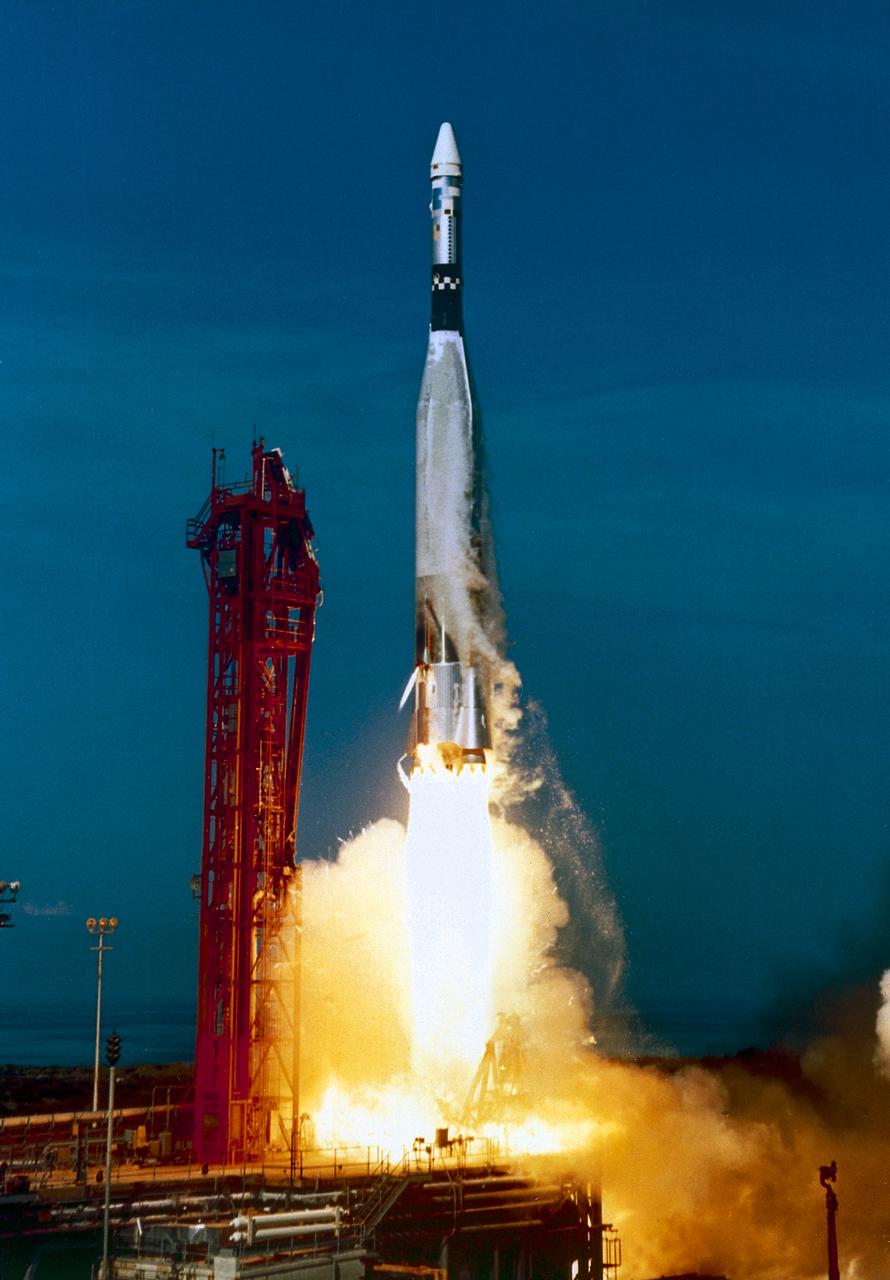
Launched atop an Atlas booster, the Agena target vehicle (ATV) was a spacecraft used by NASA to develop and practice orbital space rendezvous and docking techniques in preparation for the Apollo program lunar missions. This particular launch preceded the Gemini 12, which launched aboard a Titan launch vehicle one and one half hours later. The objective was for Agena and Gemini to rendezvous in space and practice docking procedures. An intermediate step between Project Mercury and the Apollo Program, the Gemini Program's major objectives were to subject two men and supporting equipment to long duration flights, to perfect rendezvous and docking with other orbiting vehicles, methods of reentry, and landing of the spacecraft.
n/a
S65-54129 (November 1965) --- Design for the emblem of the Gemini VII spaceflight. At left of hand-held torch is a Gemini spacecraft. Roman numeral indicates the seventh flight in the Gemini series. Prime crew men for the mission are astronauts Frank Borman, command pilot, and James A. Lovell Jr., pilot.    The NASA insignia design for Gemini flights is reserved for use by the astronauts and for other official use as the NASA Administrator may authorize. Public availability has been approved only in the form of illustrations by the various news media. When and if there is any change in this policy, which we do not anticipate, it will be publicly announced. Photo credit: NASA
GEMINI 7 - INSIGNIA - EMBLEM - PATCH - MSC
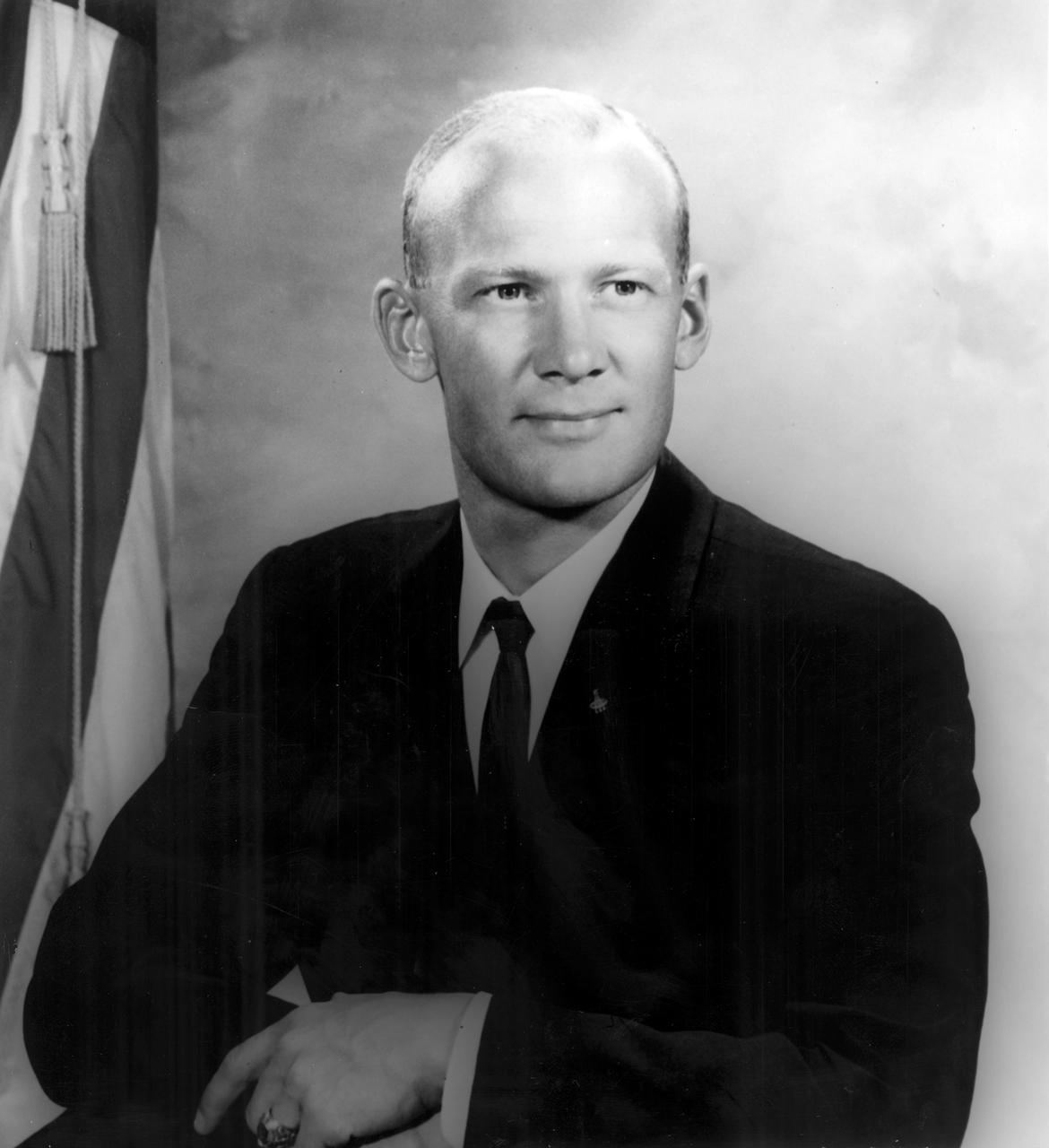
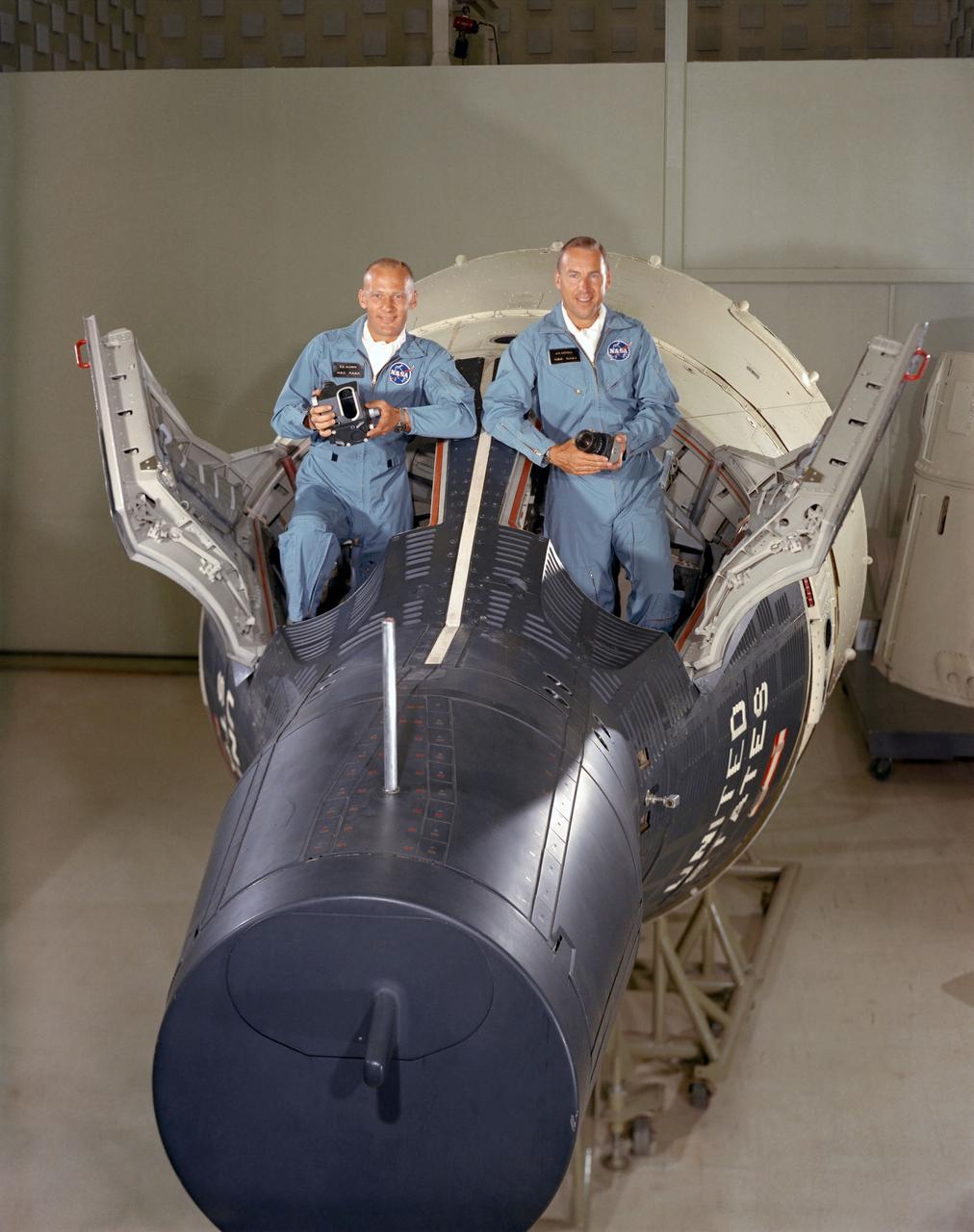
S66-46952 (September 1966) --- Astronauts James A. Lovell Jr. (right), command pilot, and Edwin E. Aldrin Jr., pilot. Photo credit: NASA
PORTRAIT - GEMINI 12 PRIME CREW
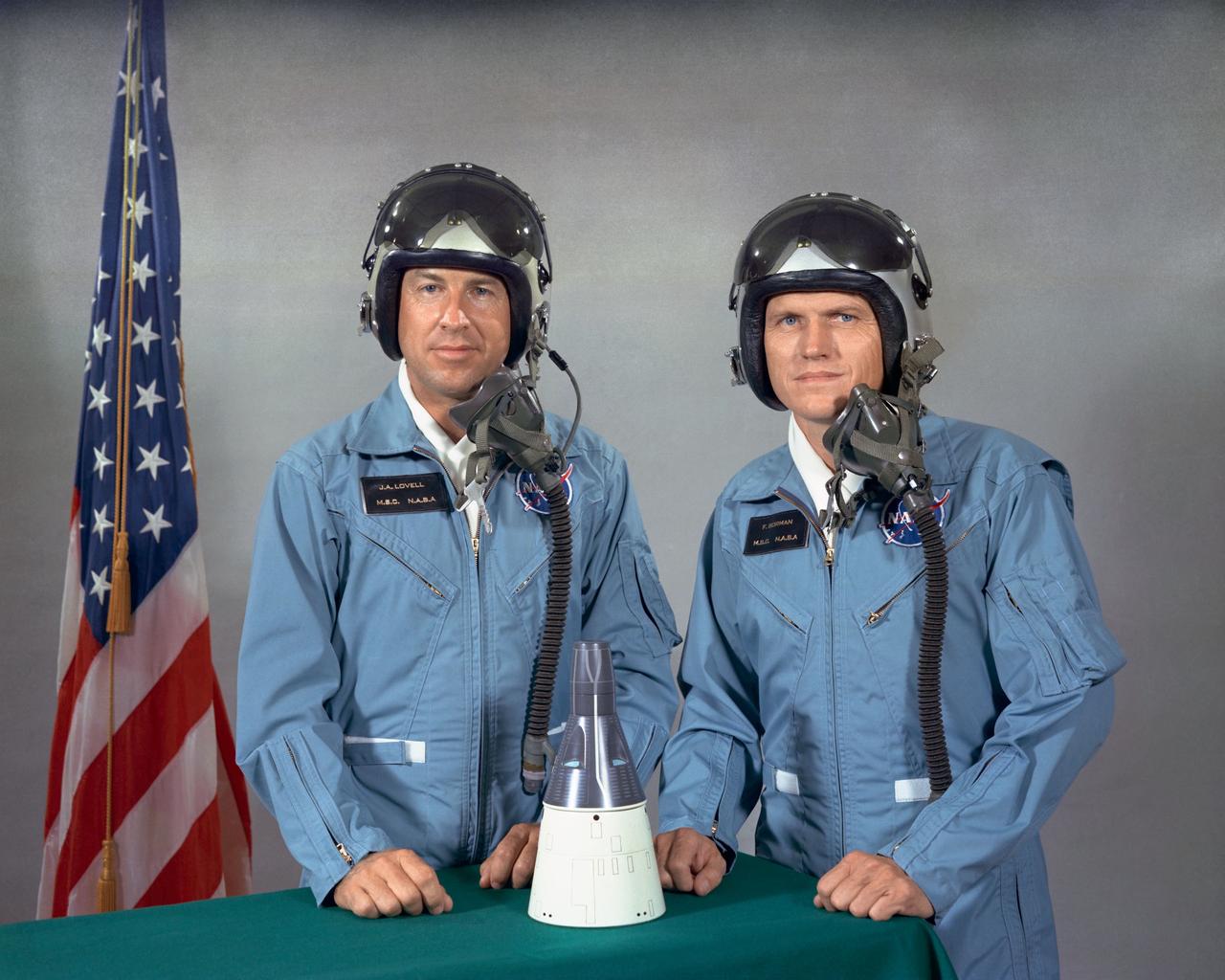
S65-41825 (1 July 1965) --- Astronauts Frank Borman (right), command pilot, and James A. Lovell Jr., pilot, are the prime crew members for NASA's Gemini-Titan 7 (GT-7) mission. Photo credit: NASA
Portrait - Gemini 7 Prime Crew Borman and Lovell
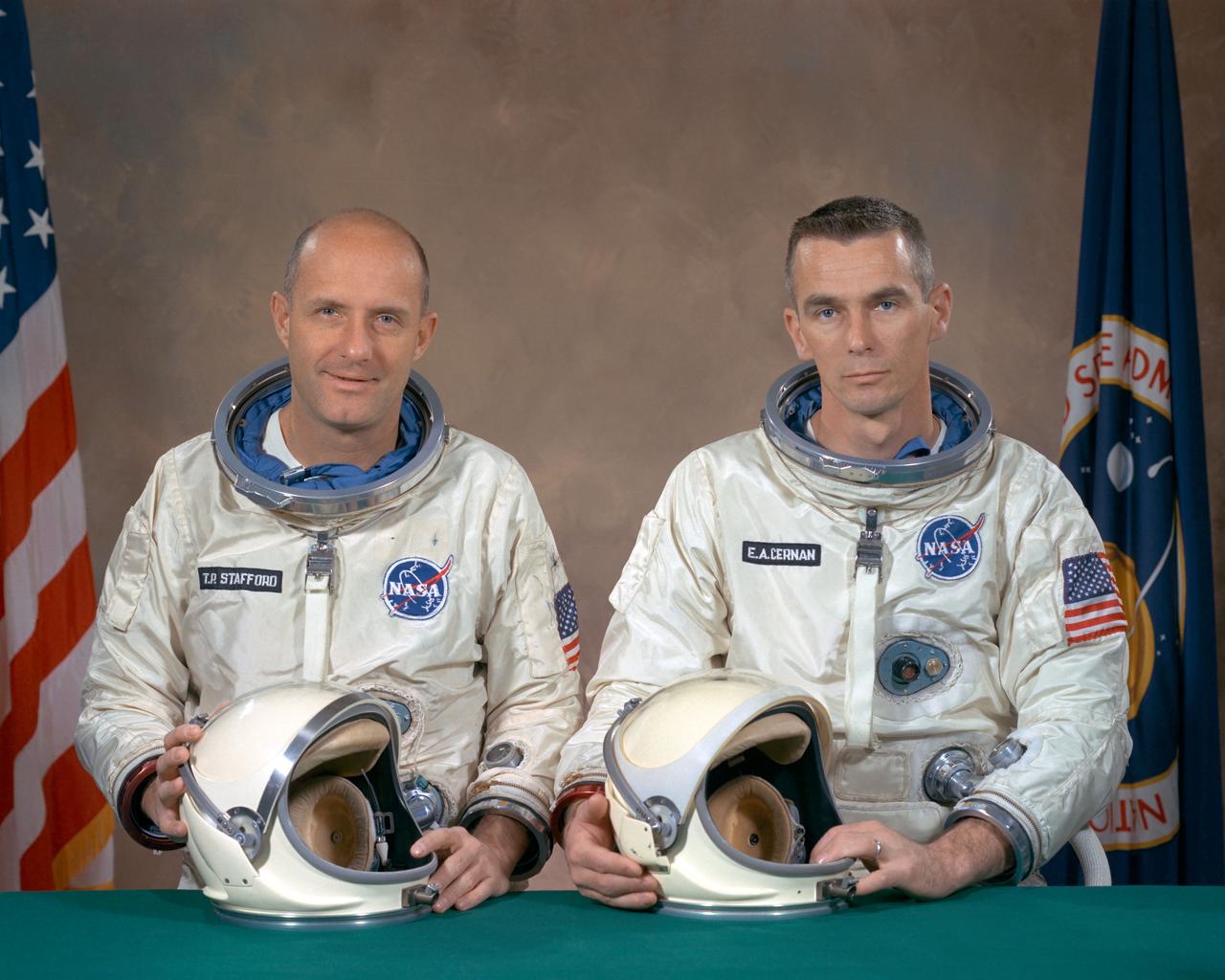
S66-15621 (January 1966) --- Gemini-9 prime crew portrait with astronauts Thomas P. Stafford (left), command pilot, and Eugene A. Cernan, pilot. Photo credit: NASA
GEMINI-9 - PRIME CREW PORTRAIT - ASTRONAUTS STAFFORD & CERNAN - MSC
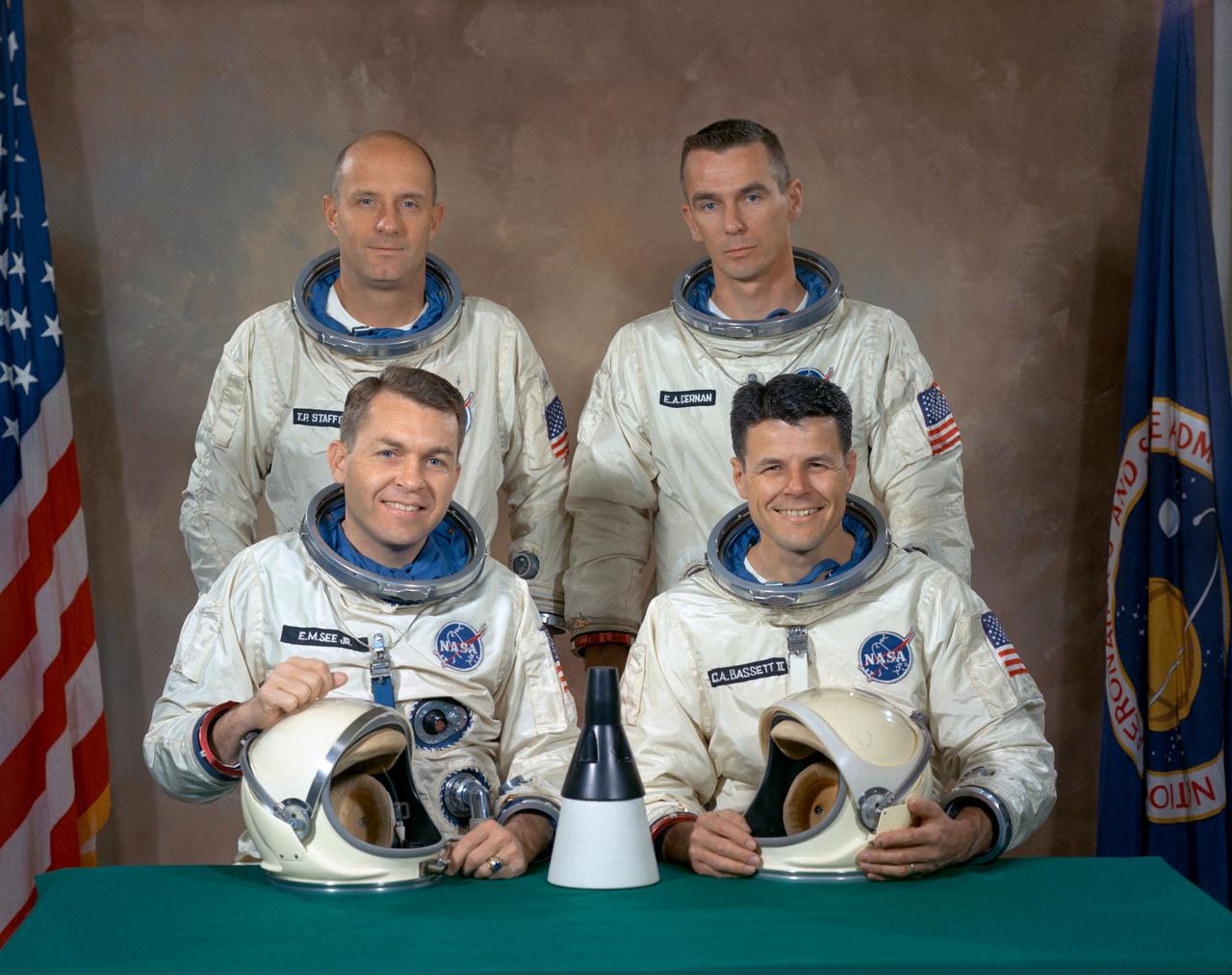
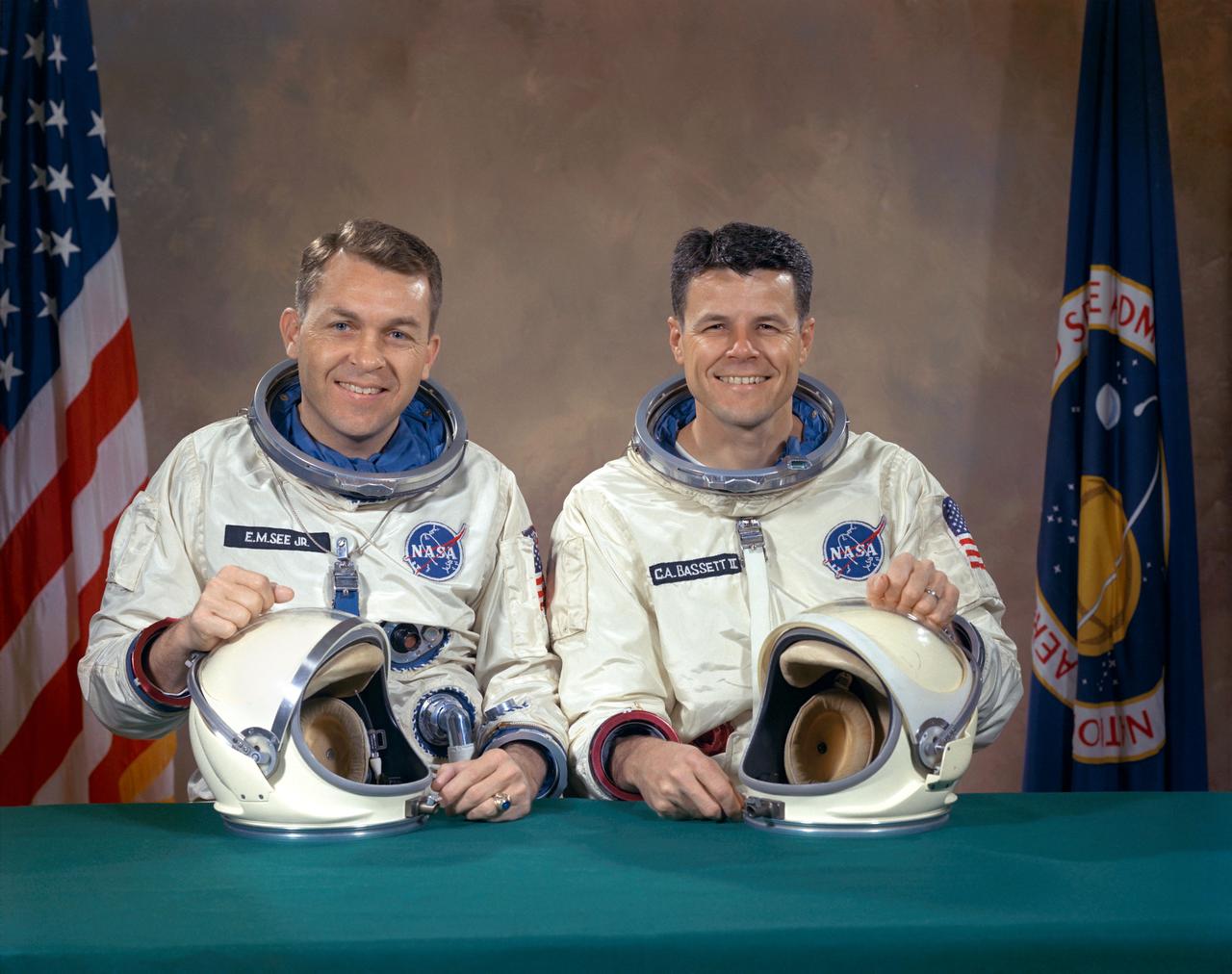
S66-15622 (January 1966) --- Portrait of the Gemini 9 prime and backup crews. Seated are the Prime crew consisting of Astronauts Elliot M. See Jr. (left), command pilot, and Charles A. Bassett II, pilot. Standing are the backup crew consisting of Astronauts Thomas P. Stafford (left), command pilot, and Eugene A. Cernan, pilot. Both crews are in space suits with their helmets on the table in front of them.
Portrait - Gemini 9 Prime and Backup Crews
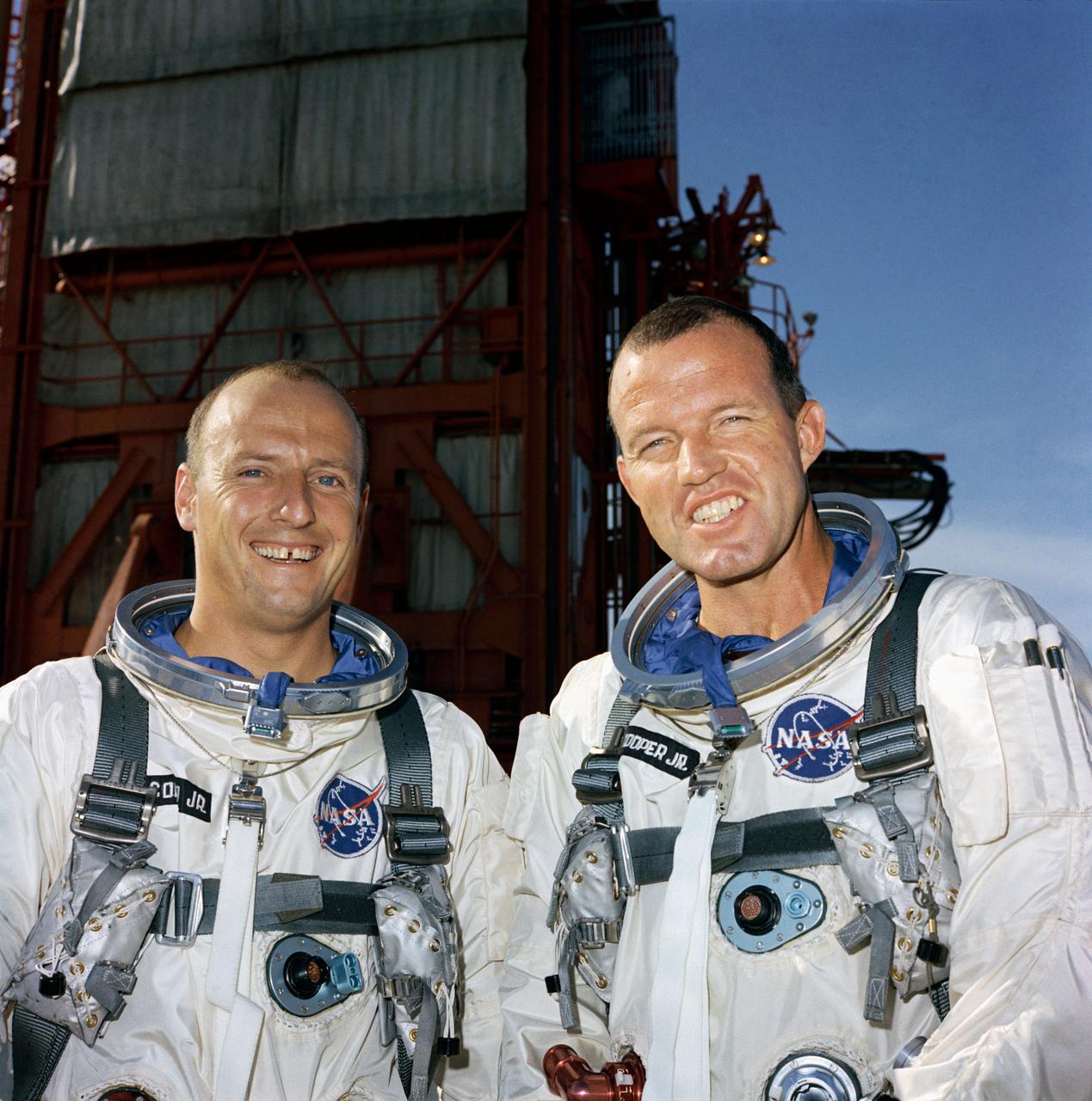
S65-46990 (16 Aug. 1965) --- Astronauts Charles Conrad Jr. (left), pilot, and L. Gordon Cooper Jr., command pilot, are the prime crew for the Gemini-Titan 5 mission.
Gemini-Titan (GT)- 5 - Prime Crew - Closeup - Cape
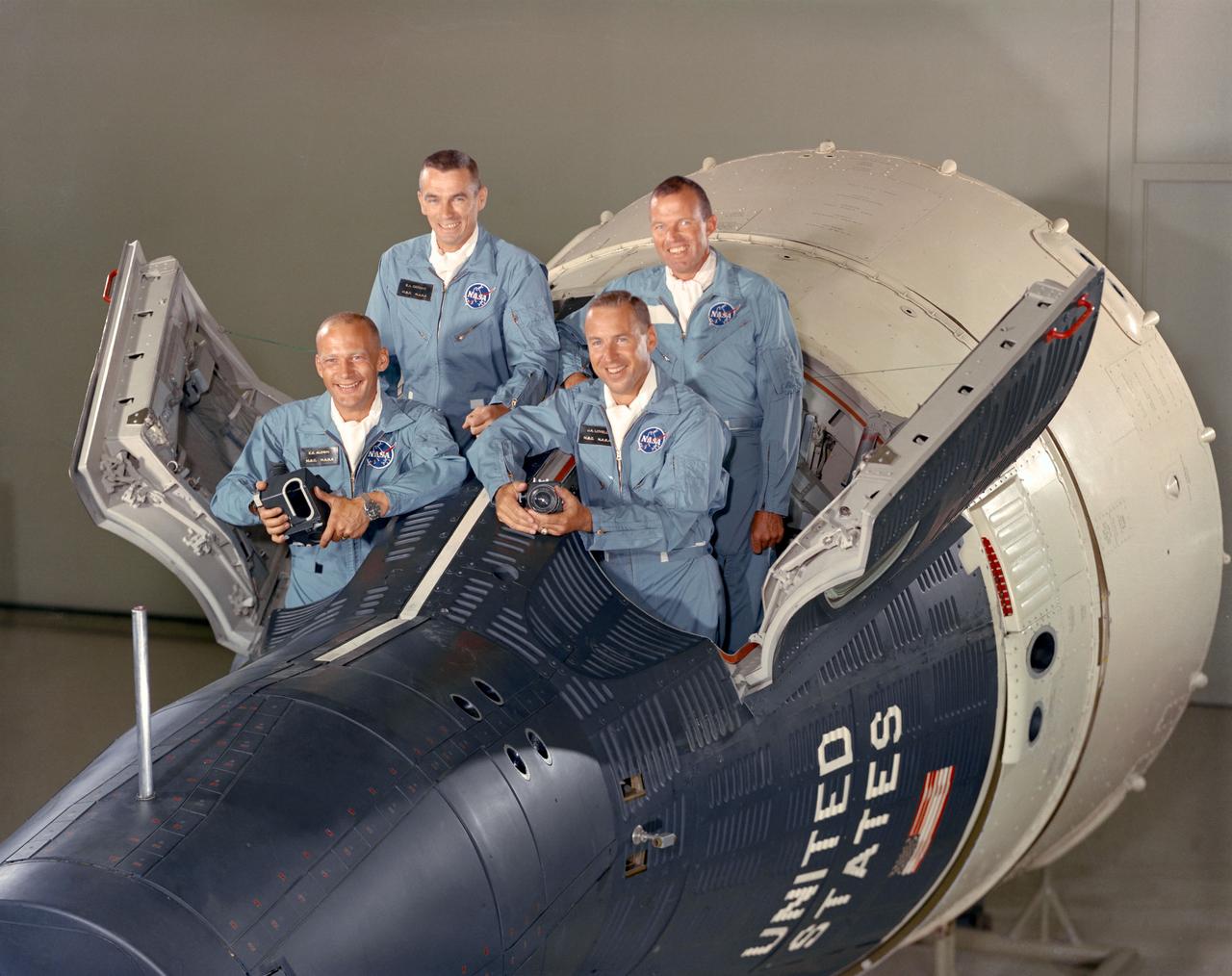
S66-46955 (September 1966) --- The Gemini-12 prime crew (in front) is astronauts James A. Lovell Jr. (right), command pilot, and Edwin E. Aldrin Jr. (left), pilot. In the rear is the Gemini-12 backup crew, astronauts L. Gordon Cooper Jr., (right), command pilot, and Eugene A. Cernan, pilot. Photo credit: NASA
Portrait - Gemini 12 - Prime and Backup Crews
S66-28075 (May 1966) --- Insignia of the Gemini IX spaceflight. Roman numeral indicates ninth flight in the Gemini series. Two spacecraft symbolize rendezvous and docking of Gemini with an Agena. Astronaut and umbilical (tether) line denote planned extravehicular activity (EVA). Astronauts Thomas P. Stafford, command pilot, and Eugene A. Cernan, pilot, are members of the Gemini IX prime crew.    The NASA insignia design for Gemini flights is reserved for use by the astronauts and for other official use as the NASA Administrator may authorize. Public availability has been approved only in the form of illustrations by the various news media. When and if there is any change in this policy, which we do not anticipate, it will be publicly announced. Photo credit: NASA
GEMINI-TITAN (GT)-9 - INSIGNIA - MSC
S66-15620 (January 1966) --- Gemini-9 backup crew portrait with astronauts Charles A. Bassett II (left), backup pilot and Elliot M. See Jr., backup command pilot. Photo credit: NASA
Portrait - Gemini 9 Prime Crew
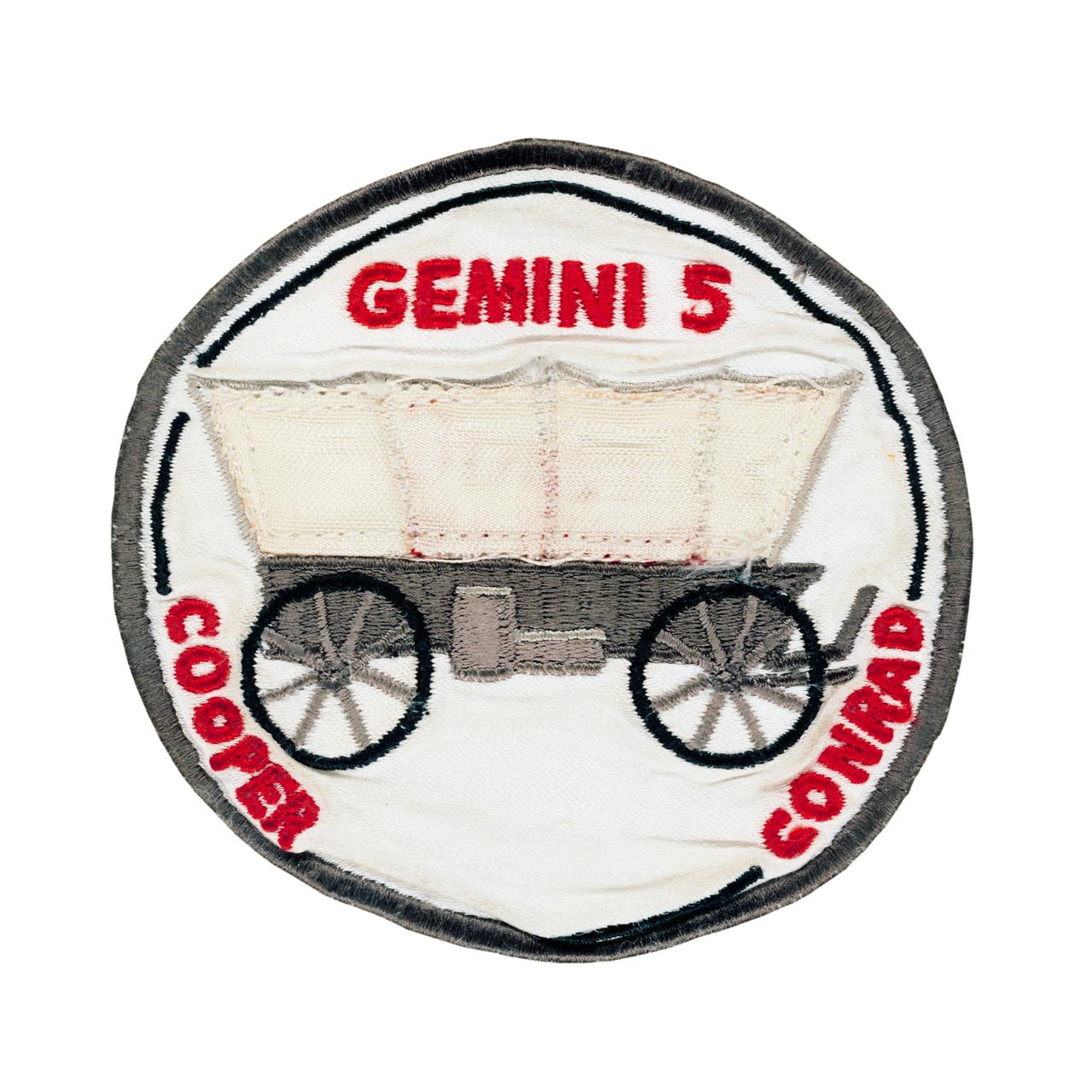
S66-59530 (August 1965) --- This is the insignia of the Gemini-Titan 5 (GT-5) spaceflight. The Gemini-5 prime crew members are astronauts L. Gordon Cooper Jr., command pilot; and Charles Conrad Jr., pilot. The covered wagon symbolizes pioneer spirit of space exploration.    The NASA insignia design for Gemini flights is reserved for use by the astronauts and for other official use as the NASA Administrator may authorize. Public availability has been approved only in the form of illustrations by the various news media. When and if there is any change in this policy, which we do not anticipate, it will be publicly announced.
MISSION PATCH - GEMINI-5 SPACE FLIGHT - MSC
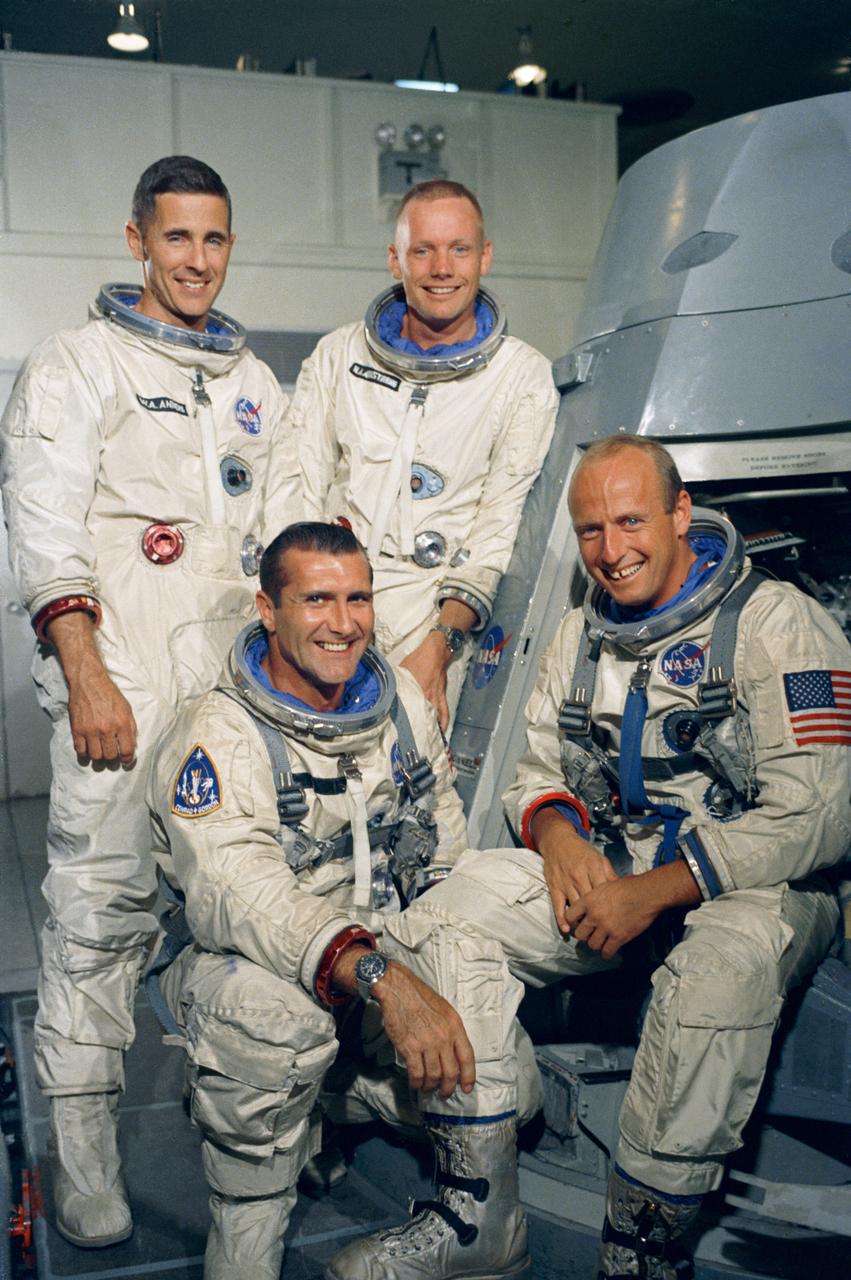
S66-50772 (7 Sept. 1966) --- The Gemini-Titan XI (GT-11) prime and backup crews pose for a group portrait. Seated is the prime crew, astronauts Charles Conrad Jr. (right), command pilot, and Richard F. Gordon Jr. (left), pilot. The backup crew (standing) is astronauts Neil A. Armstrong (right), command pilot, and William A. Anders (left), pilot. The two crews were suited up for a simulation test at the Kennedy Space Center. Photo credit: NASA
Portrait - Gemini 11 - Prime and Backup Crews
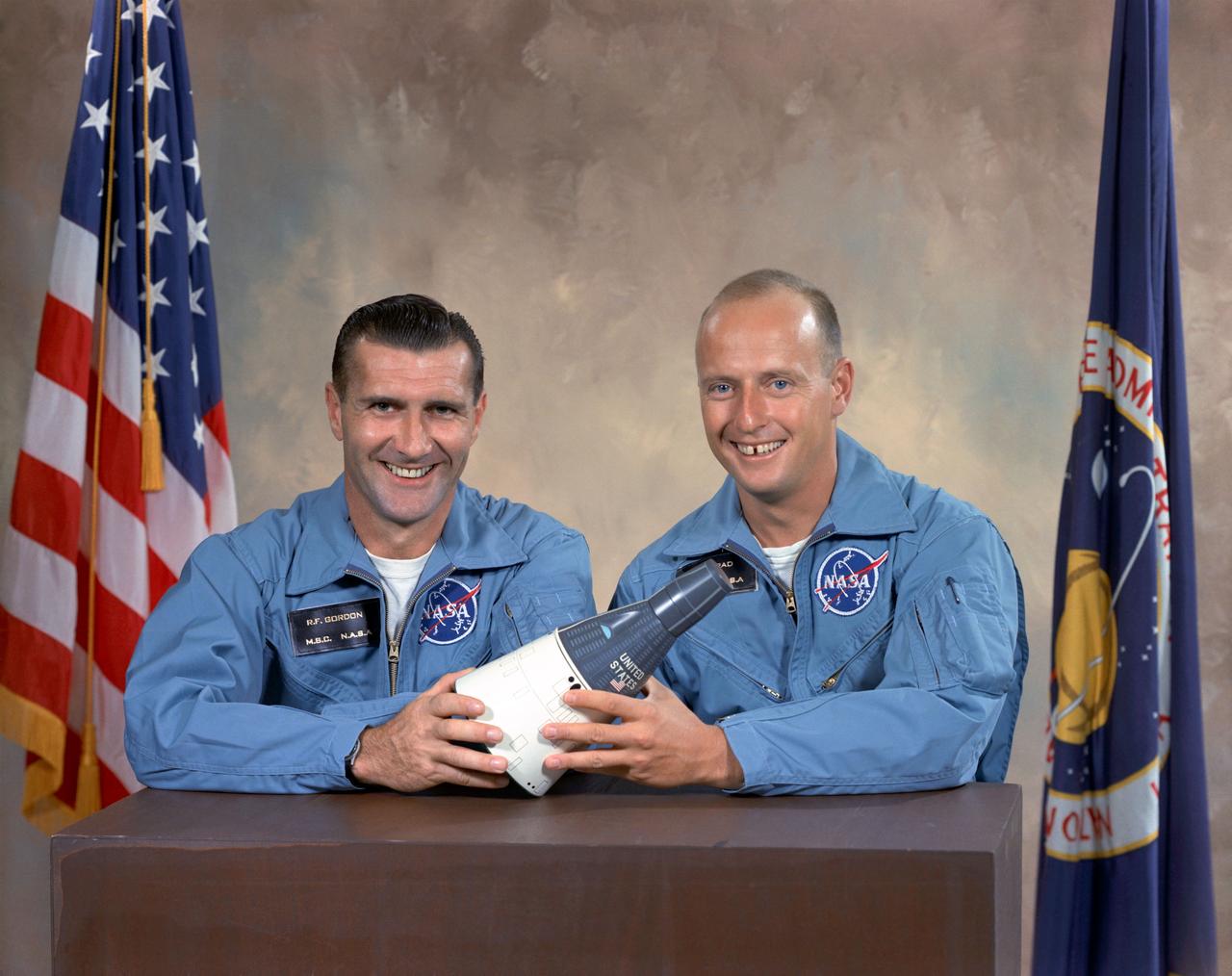
S65-58504 (4 Nov. 1965) --- Astronauts Charles Conrad Jr., (right) prime crew command pilot, and Richard F. Gordon Jr., prime crew pilot, for the Gemini-Titan XI (GT-11) Earth-orbital mission. Photo credit: NASA
Portrait - Gemini 11 - Prime Crew
S66-44308 (September 1966) --- Insignia of the Gemini-Titan XI (GT-11) spaceflight. Roman numeral indicates eleventh flight in the Gemini series. Two spacecraft symbolize rendezvous and docking of Gemini with an Agena. Astronaut and umbilical (tether) line denotes planned extravehicular activity. Astronauts Charles Conrad Jr., command pilot, and Richard F. Gordon Jr., pilot, are members of the Gemini-11 prime crew.     The NASA insignia design for Gemini flights is reserved for use by the astronauts and for other official use as the NASA Administrator may authorize. Public availability has been approved only in the form of illustrations by the various news media. When and if there is any change in this policy, which we do not anticipate, it will be publicly announced. Photo credit: NASA
ROUNDUP - EMBLEM - GEMINI-TITAN (GT)-11 - MSC
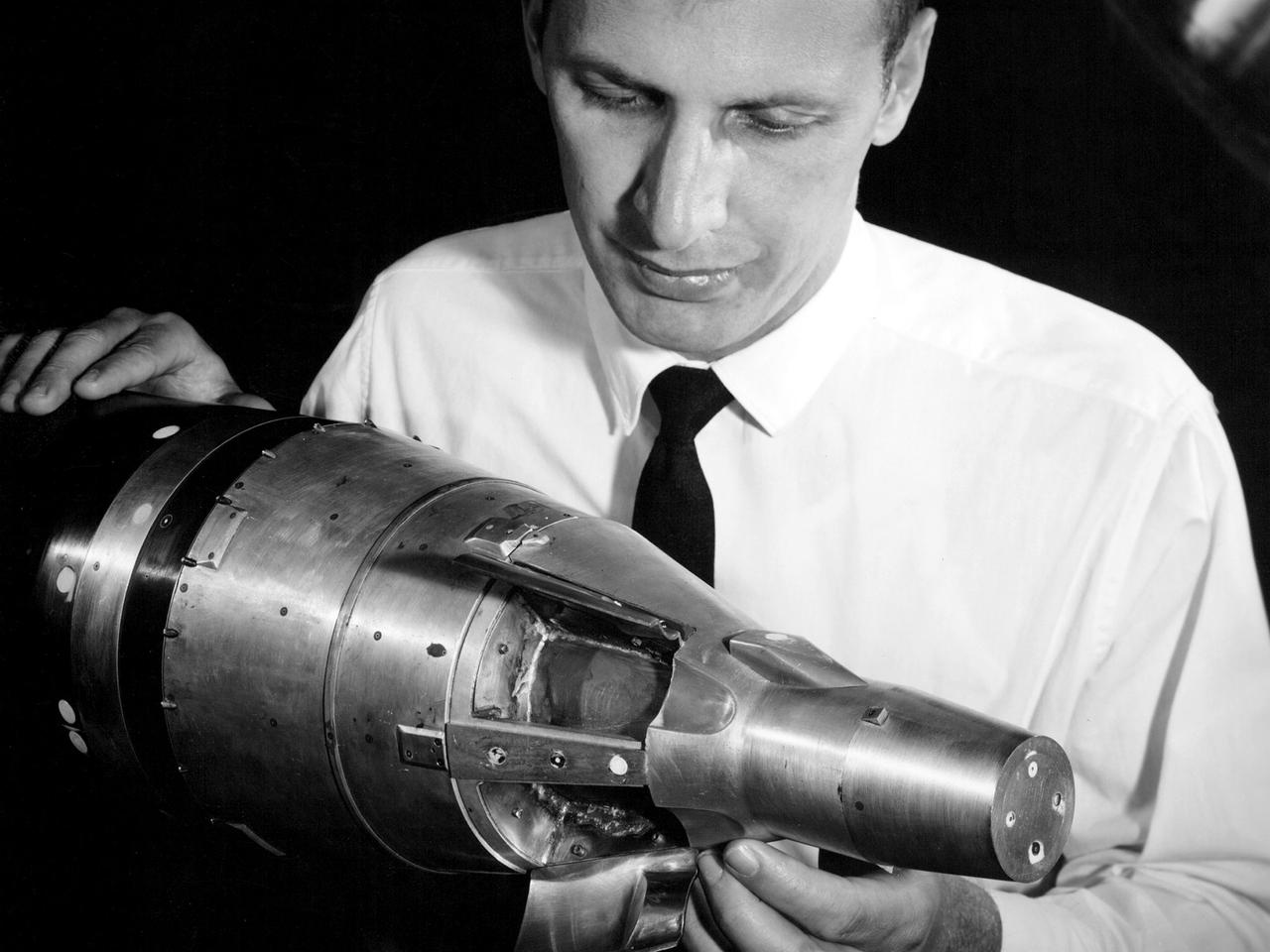
A researcher at the National Aeronautics and Space Administration (NASA) Lewis Research Center examines a small-scale model of the Gemini capsule in the 10- by 10-Foot Supersonic Wind Tunnel test section. Gemini was added to NASA’s manned space program after its predecessor, Mercury, and its antecedent, Apollo, were already established. Gemini was a transitional mission designed provide the astronauts with practice docking with other spacecraft and withstanding durations in space up to two weeks. The program was officially announced on December 7, 1961, but planning began in mid-1959. It was named Gemini after the zodiac twins because of the spacecraft’s two passenger capacity.    The Gemini Program was the first program to start at the new Manned Spacecraft Center in Houston, now the Johnson Space Center. Unlike Mercury and Apollo, Lewis had very little involvement with the Gemini Program. This model was tested in the 10- by 10 tunnel for several weeks in September 1962. Lewis began managing the Agena second-stage rocket program shortly after this photograph was taken. Agenas were used to launch a variety of spacecraft and satellites in the 1960s. They were also used on several Gemini missions to provide targets for the astronauts to practice their rendezvous maneuvers.     Gemini had two unmanned and ten manned flights in 1965 and 1966. These yielded the first spacewalks, long-duration space missions, first onboard computer, docking with a second spacecraft, and rendezvous maneuvers.
Gemini Model in the 10- by 10-Foot Supersonic Wind Tunnel
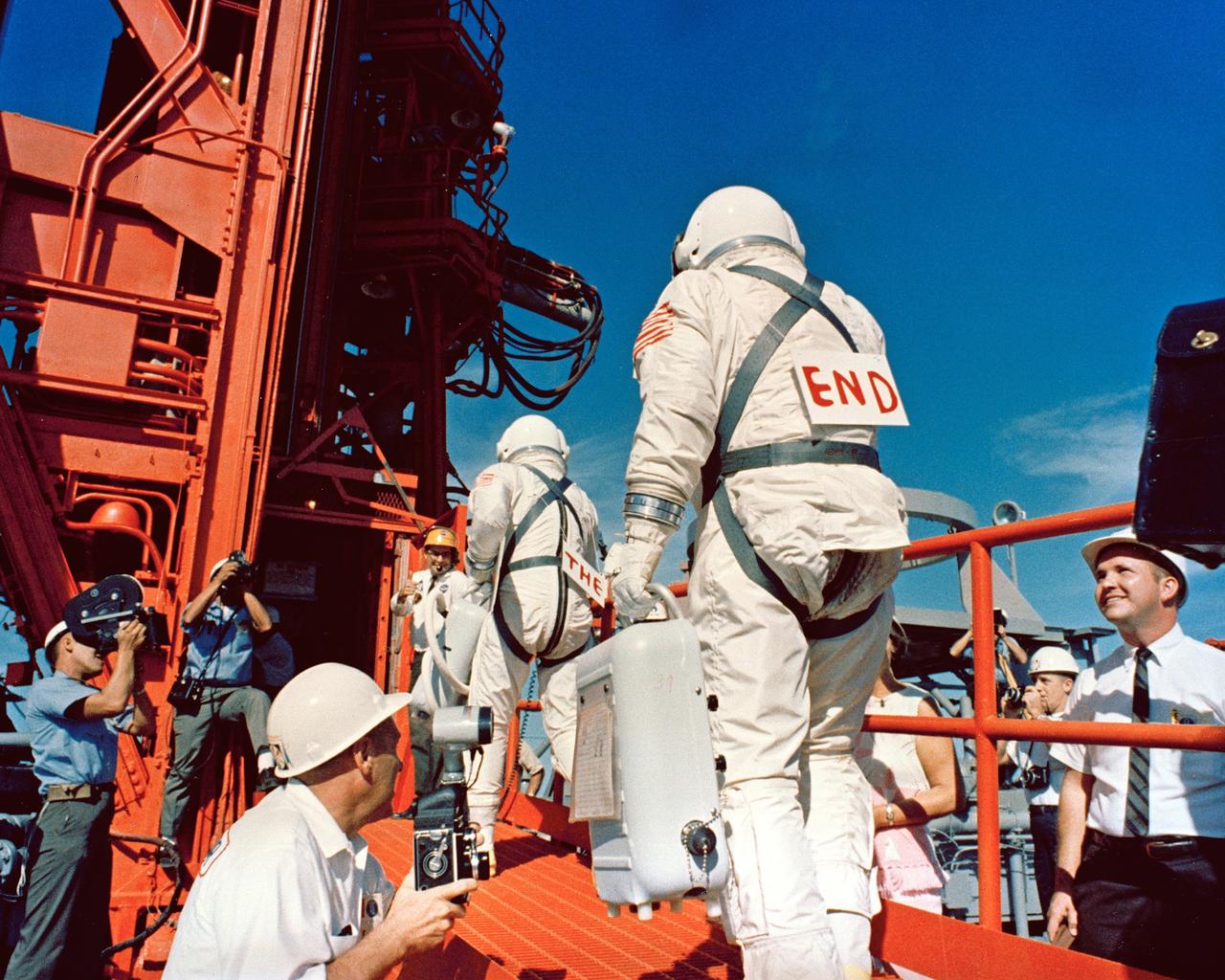
CAPE KENNEDY, Fla. -- At Cape Kennedy Air Force Station in Florida, the crew for Gemini 12 arrives at Launch Complex 19. Command pilot James A. Lovell is followed by pilot Edwin E. Buzz Aldrin Jr. The signs on their backs note that this mission is the final flight of the Gemini Program. Photo Credit: NASA
KSC-66C-9220
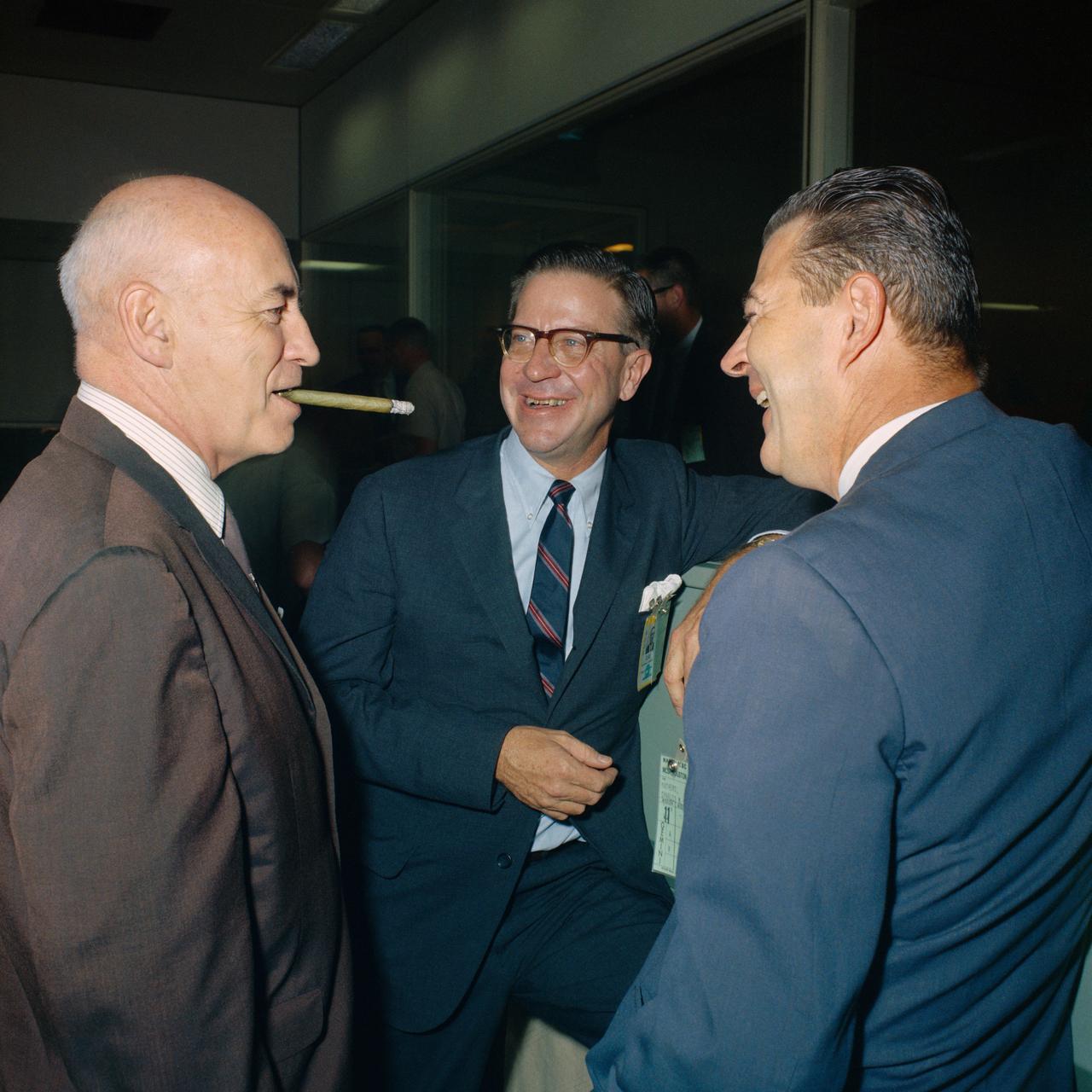
S66-52762 (15 Sept. 1966) --- Dr. Robert R. Gilruth (left) smokes a cigar in Houston's Mission Control Center to celebrate the successful splashdown of Gemini-11. Looking on are James C. Elms (center), MSC deputy director, and Charles W. Mathews, Gemini program manager. Photo credit: NASA
MCC During GT-11
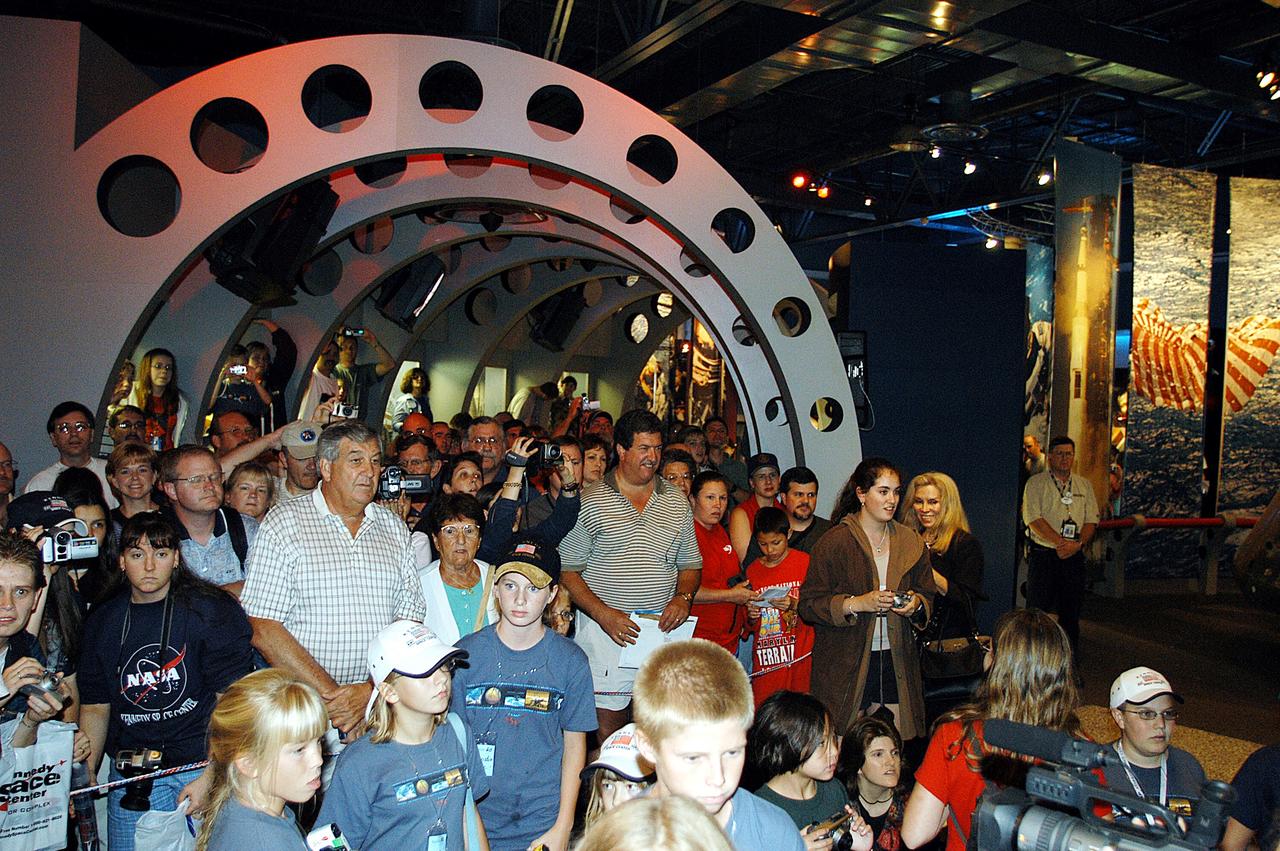
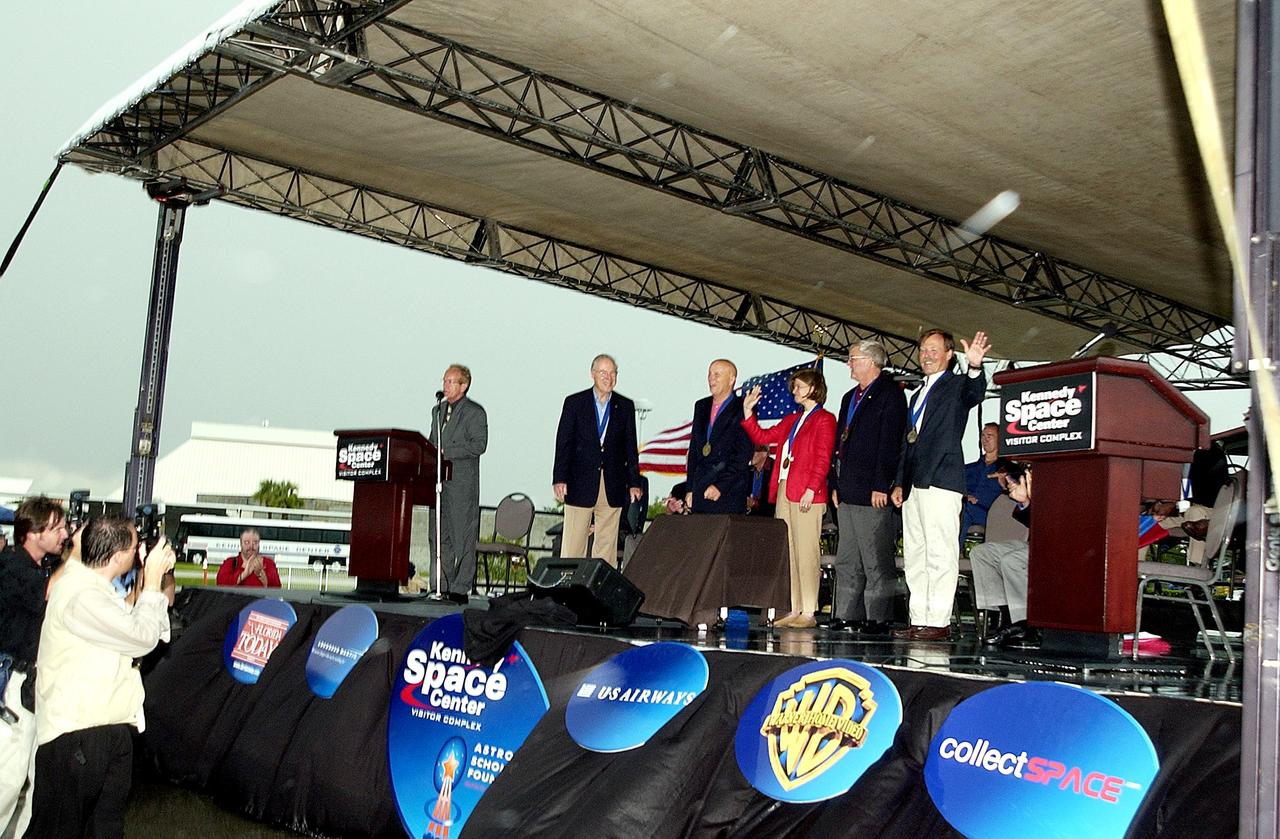
KENNEDY SPACE CENTER, FLA. -  Hundreds of guests attend a ribbon cutting ceremony officially opening the U.S. Astronaut Hall of Fame as part of the Kennedy Space Center Visitor Complex. The ceremony was held in conjunction with the induction of four Space Shuttle astronauts into the Hall of Fame including Daniel Brandenstein, Robert "Hoot" Gibson, Story Musgrave, and Sally Ride. Conceived by six of the Mercury Program astronauts, the U.S. Astronaut Hall of Fame opened in 1990 to provide a place where space travelers could be remembered for their participation and accomplishments in the U.S. space program. The four new inductees join 48 previously honored astronauts from the ranks of the Gemini, Apollo, Skylab, Apollo-Soyuz, and Space Shuttle programs.

KENNEDY SPACE CENTER, FLA. - Hundreds of guests attend a ribbon cutting ceremony officially opening the U.S. Astronaut Hall of Fame as part of the Kennedy Space Center Visitor Complex. The ceremony was held in conjunction with the induction of four Space Shuttle astronauts into the Hall of Fame including Daniel Brandenstein, Robert "Hoot" Gibson, Story Musgrave, and Sally Ride. Conceived by six of the Mercury Program astronauts, the U.S. Astronaut Hall of Fame opened in 1990 to provide a place where space travelers could be remembered for their participation and accomplishments in the U.S. space program. The four new inductees join 48 previously honored astronauts from the ranks of the Gemini, Apollo, Skylab, Apollo-Soyuz, and Space Shuttle programs.
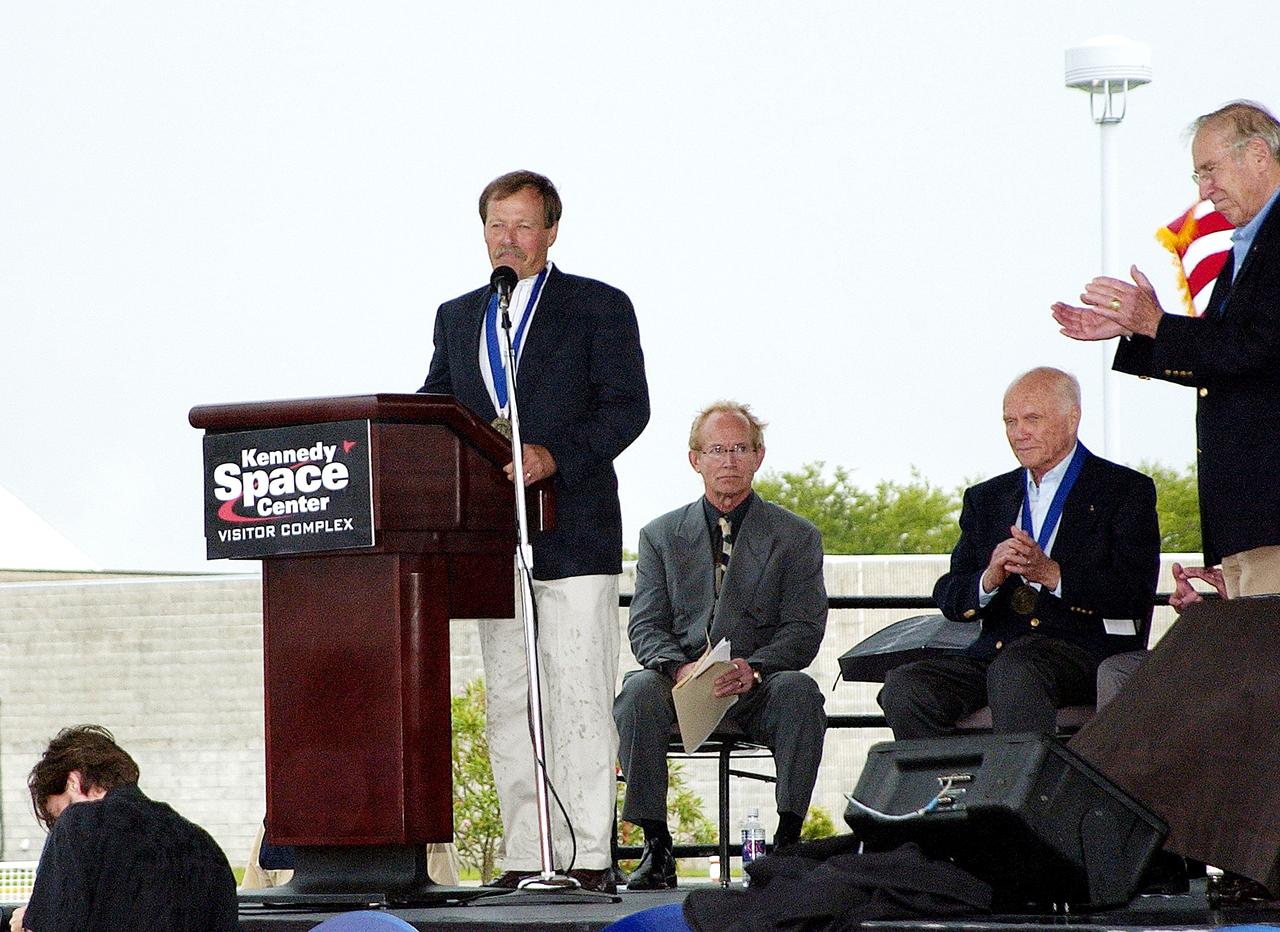
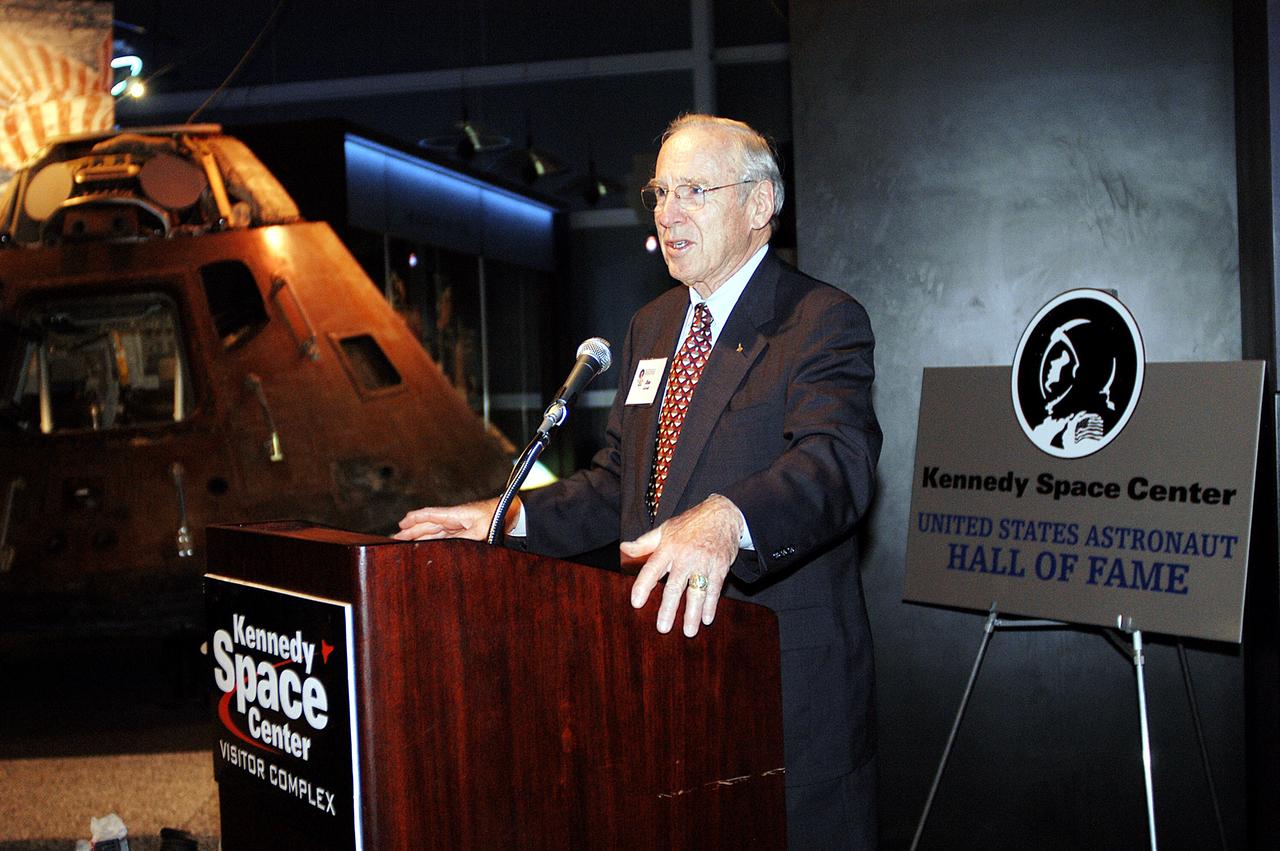
KENNEDY SPACE CENTER, FLA. -  At the KSC Visitor Complex, former astronaut James Lovell makes the opening remarks at the induction ceremony of four Space Shuttle astronauts into the U.S. Astronaut Hall of Fame. Being inducted are Daniel Brandenstein, Robert "Hoot" Gibson, Story Musgrave, and Sally Ride. Conceived by six of the Mercury Program astronauts, the U.S. Astronaut Hall of Fame opened in 1990 to provide a place where space travelers could be remembered for their participation and accomplishments in the U.S. space program. The four new inductees join 48 previously honored astronauts from the ranks of the Gemini, Apollo, Skylab, Apollo-Soyuz, and Space Shuttle programs.
KENNEDY SPACE CENTER, FLA. - At the KSC Visitor Complex, former astronaut James Lovell makes the opening remarks at the induction ceremony of four Space Shuttle astronauts into the U.S. Astronaut Hall of Fame. Being inducted are Daniel Brandenstein, Robert "Hoot" Gibson, Story Musgrave, and Sally Ride. Conceived by six of the Mercury Program astronauts, the U.S. Astronaut Hall of Fame opened in 1990 to provide a place where space travelers could be remembered for their participation and accomplishments in the U.S. space program. The four new inductees join 48 previously honored astronauts from the ranks of the Gemini, Apollo, Skylab, Apollo-Soyuz, and Space Shuttle programs.
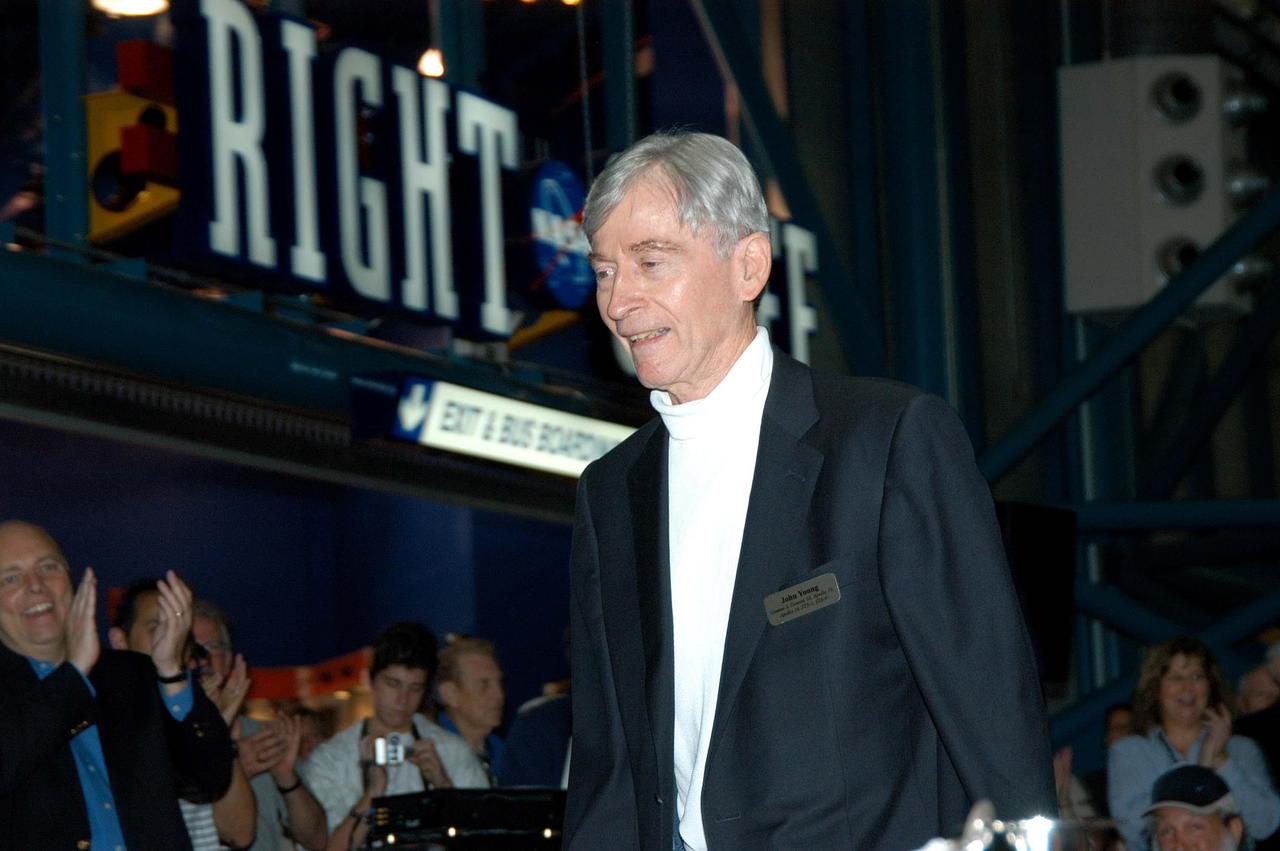
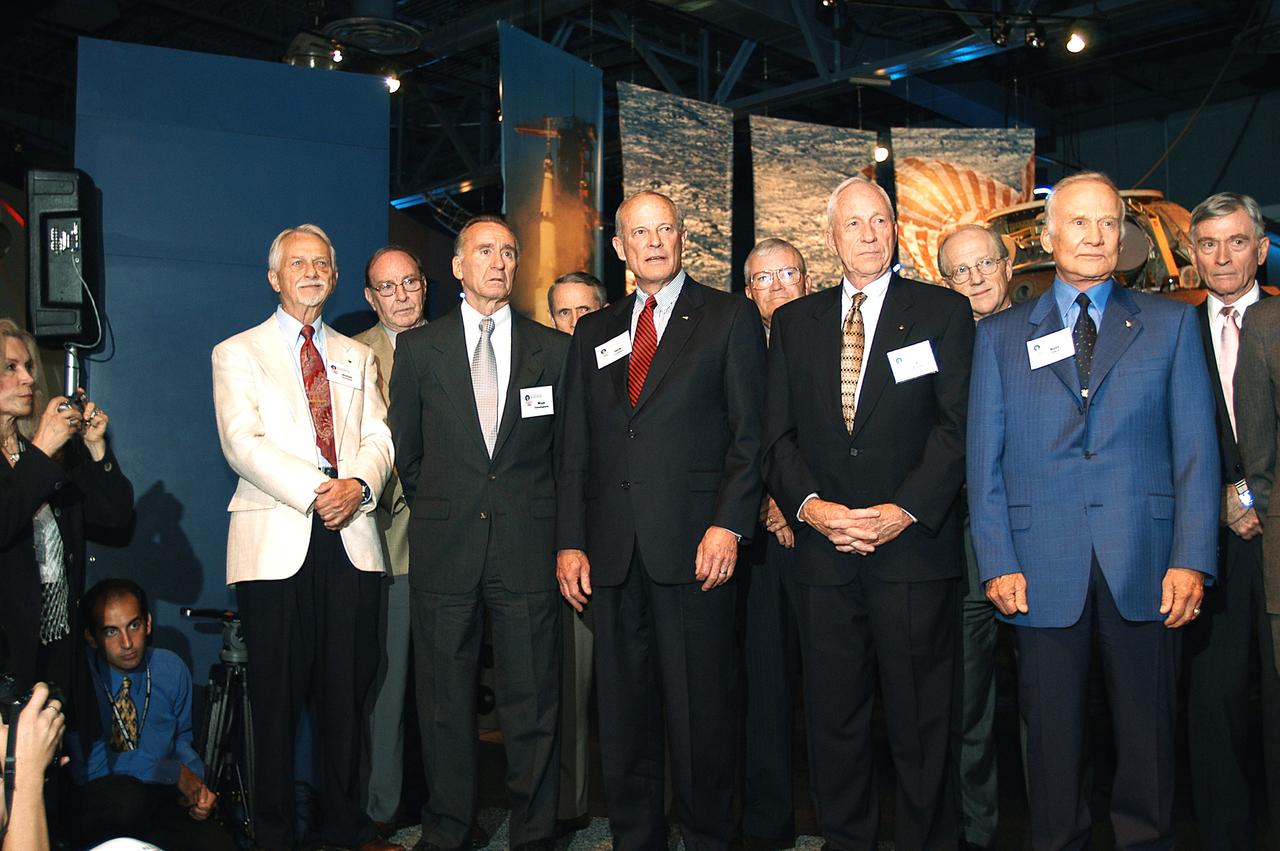
KENNEDY SPACE CENTER, FLA.  - Veterans of the space program enjoy a guided tour of the Kennedy Space Center following a ceremony marking the 40th anniversary of Project Gemini.  More than 50 former Gemini workers attended the event.  Astronaut John Young, himself a veteran of Project Gemini,  was the key speaker, telling members of the group they should be pleased with their accomplishments, which ultimately helped to land a man on the moon and will lead to future Mars exploration.  Photo credit:NASA/George Shelton
KSC-06pd0703
S66-59986 (15 Nov. 1966) --- The Gemini spaceflight program concludes as the Gemini-12 spacecraft, with astronaut James A. Lovell Jr., command pilot, and Edwin E. Aldrin Jr., pilot, aboard, nears touchdown in the Atlantic Ocean 2.5 nautical miles from the prime recovery ship, USS Wasp. Gemini-12 splashed down at 2:21 p.m. (EST), Nov. 11, 1966, to conclude the four-day mission in space. Photo credit: NASA
Splashdown - Gemini-Titan (GT-12) Spacecraft - Mission Close - Atlantic
KENNEDY SPACE CENTER, FLA.  - Astronaut John Young speaks to veterans of the space program in front of the U.S. Space Walk of Fame’s Gemini Monument in Space View Park in Titusville, Fla.  More than 50 former Gemini workers attended the event marking the 40th anniversary of Project Gemini.  Young, himself a veteran of Project Gemini, told members of the group they should be pleased with their accomplishments, which ultimately helped to land a man on the moon and will lead to future Mars exploration.  Following the ceremony, the former workers and their families enjoyed a guided tour of the Kennedy Space Center.
KSC-06pd0701
KENNEDY SPACE CENTER, FLA.  - Astronaut John Young speaks to veterans of the space program in front of the U.S. Space Walk of Fame’s Gemini Monument in Space View Park in Titusville, Fla.  More than 50 former Gemini workers attended the event marking the 40th anniversary of Project Gemini.  Young, himself a veteran of Project Gemini, told members of the group they should be pleased with their accomplishments, which ultimately helped to land a man on the moon and will lead to future Mars exploration.  Following the ceremony, the former workers and their families enjoyed a guided tour of the Kennedy Space Center. Photo credit:NASA/George Shelton
KSC-06pd0702
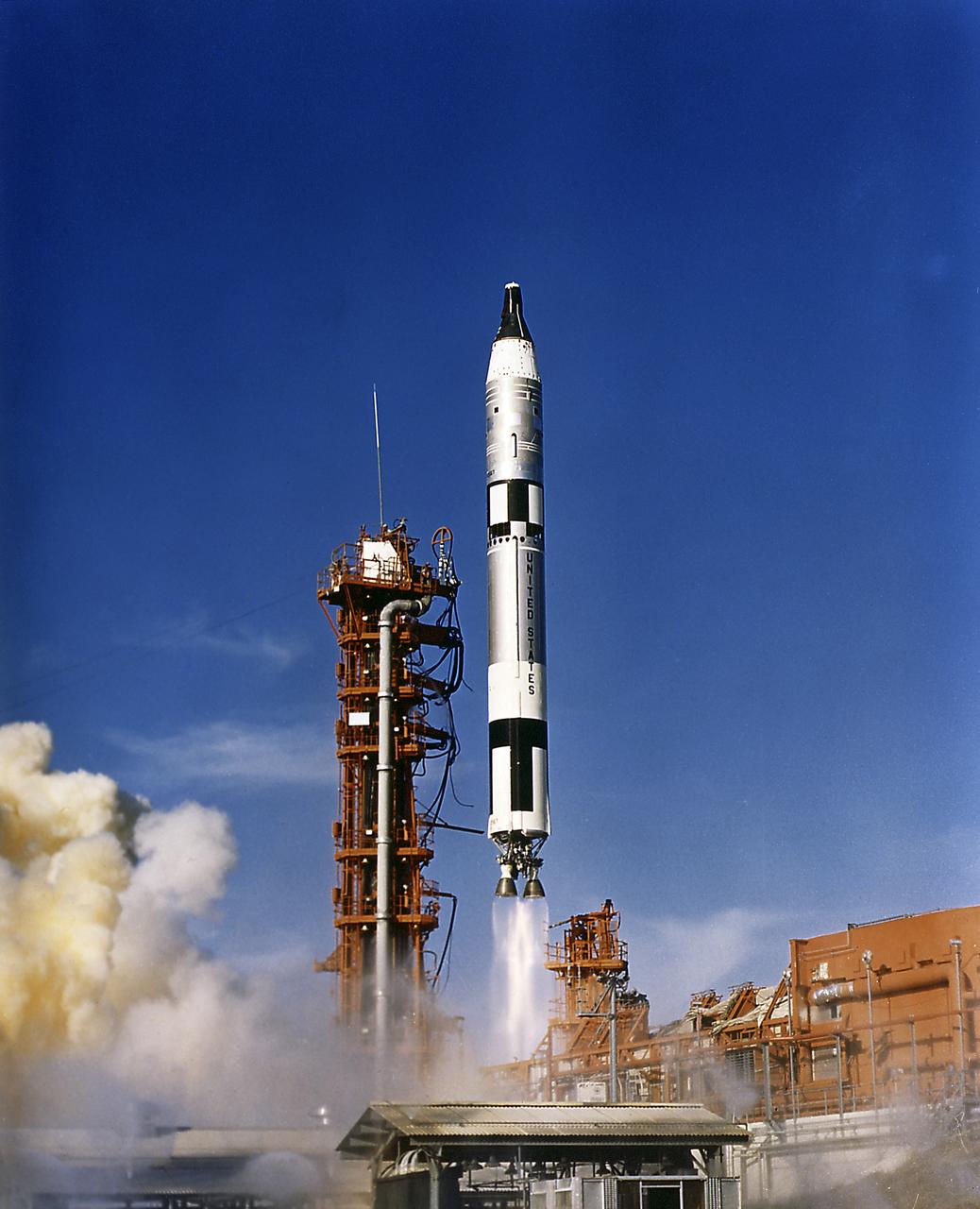
The Titan II liftoff. The Titan II launch vehicle was used for carrying astronauts on the Gemini mission. The Gemini Program was an intermediate step between the Project Mercury and the Apollo Program. The major objectives were to subject are two men and supporting equipment to long duration flights, to effect rendezvous and docking with other orbiting vehicle, and to perfect methods of reentry, and landing the spacecraft.
Launch Vehicles
The Gemini 12 astronauts James Lovell and Edwin Aldrin lifted off aboard a Titan launch vehicle from the Kennedy Space Center on November 11, 1966, an hour and a half after their Agena target vehicle was orbited by an Atlas rocket. Launched atop an Atlas booster, the Agena target vehicle (ATV) was a spacecraft used by NASA to develop and practice orbital space rendezvous and docking techniques in preparation for the Apollo program lunar missions. The objective was for Agena and Gemini to rendezvous in space and practice docking procedures. An intermediate step between Project Mercury and the Apollo Program, the Gemini Program's major objectives were to subject two men and supporting equipment to long duration flights, to perfect rendezvous and docking with other orbiting vehicles, methods of reentry, and landing of the spacecraft.
n/a
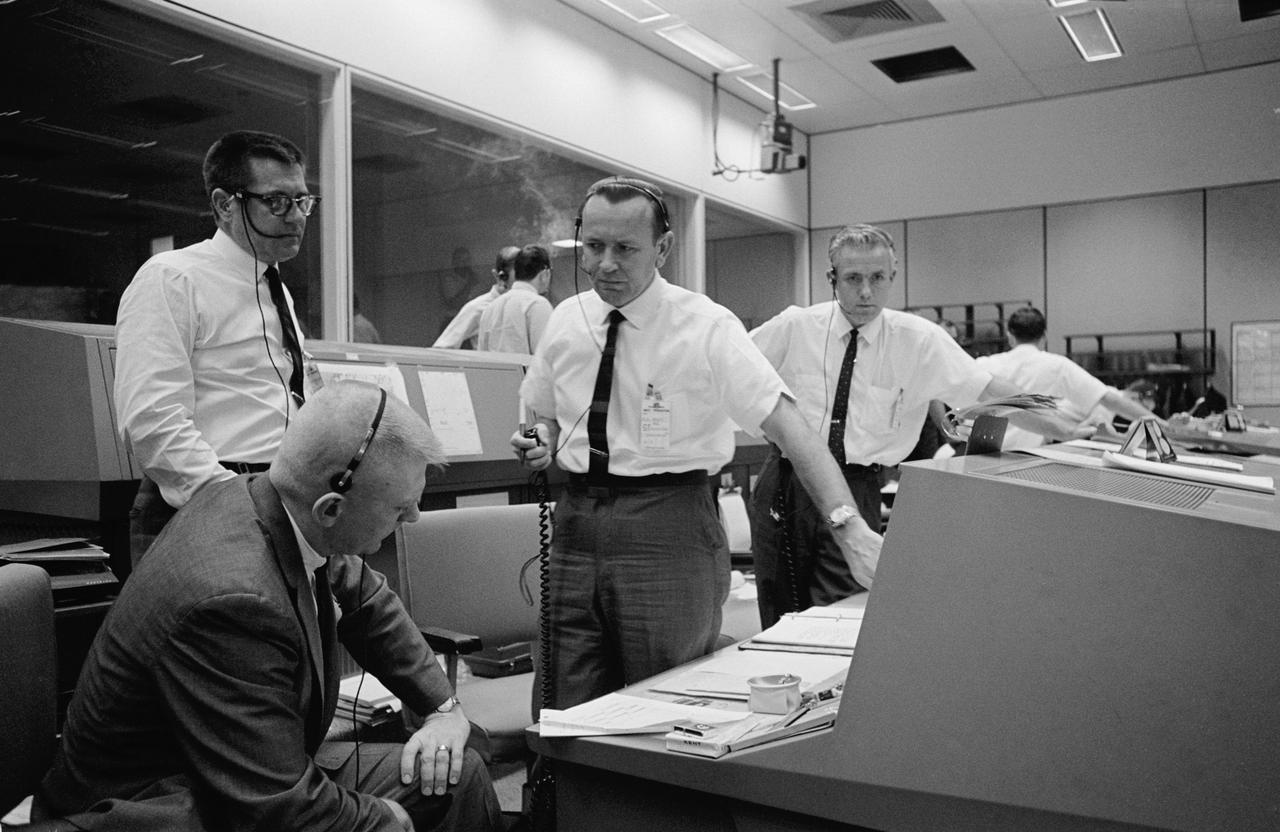
S65-62062 (12 Dec. 1965) --- Discussing the scrubbing of the planned National Aeronautics and Space Administration?s Gemini-6 spaceflight are (from left) William C. Schneider (standing), deputy director, Gemini Program Office of Manned Spaceflight, NASA Headquarters, Washington, D.C.; Eugene F. Kranz (seated), white team flight director; Christopher C. Kraft Jr., red team flight director; and John D. Hodge, blue team flight director. The Gemini-6 mission has been rescheduled for Dec. 15, 1965. Photo credit: NASA or National Aeronautics and Space Administration
MISSION CONTROL CENTER (MCC) - GEMINI-TITAN (GT)-6 ACTIVITY - MSC
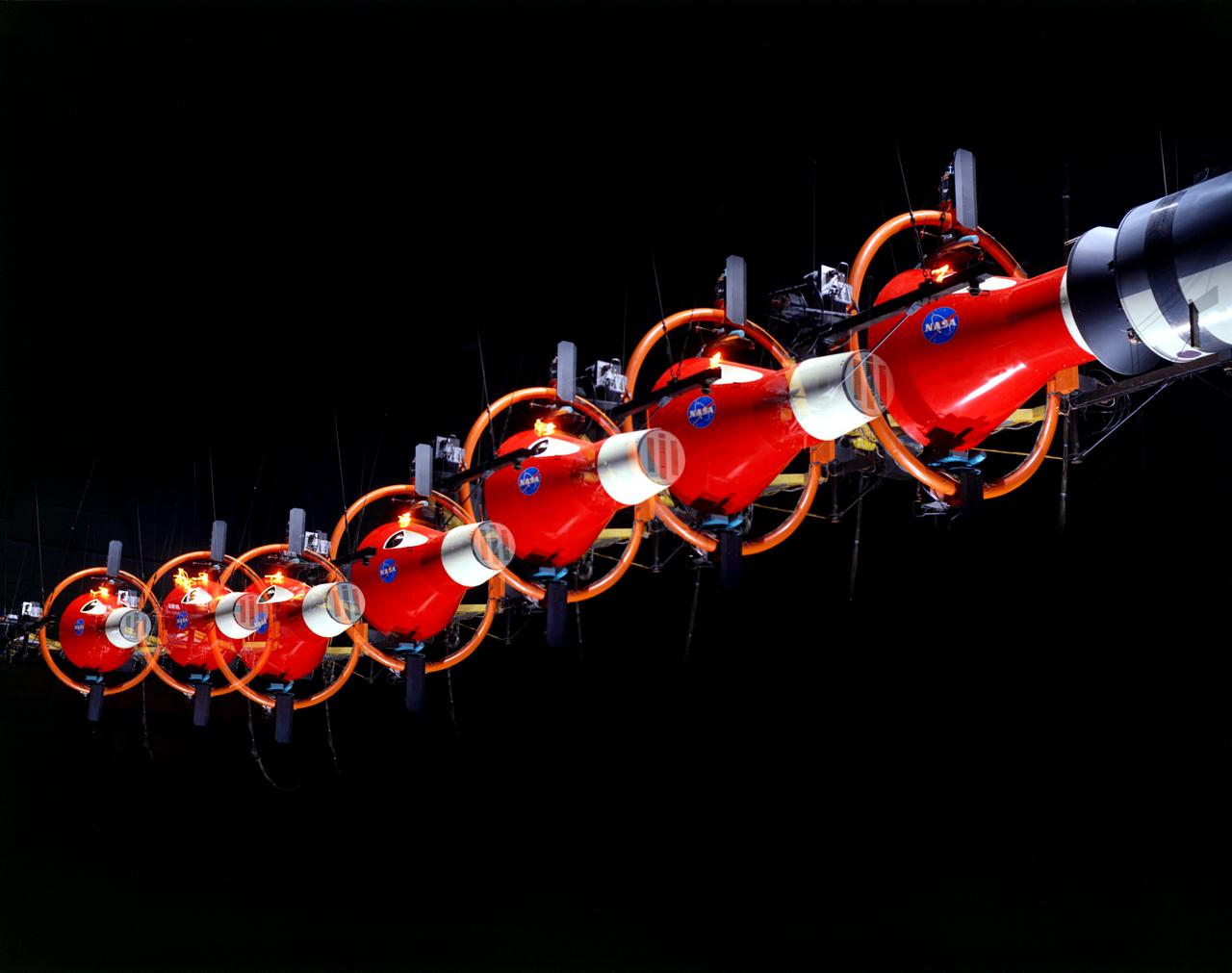
Multiple exposure of Rendezvous Docking Simulator. Francis B. Smith, described the simulator as follows:  The rendezvous and docking operation of the Gemini spacecraft with the Agena and of the Apollo Command Module with the Lunar Excursion Module have been the subject of simulator studies for several years.  This figure  illustrates the Gemini-Agena rendezvous docking simulator at Langley. The Gemini spacecraft was supported in a gimbal system by an overhead crane and gantry arrangement which provided 6 degrees of freedom - roll, pitch, yaw, and translation in any direction - all controllable by the astronaut in the spacecraft. Here again the controls fed into a computer which in turn provided an input to the servos driving the spacecraft so that it responded to control motions in a manner which accurately simulated the Gemini spacecraft.  -- Published in Barton C. Hacker and James M. Grimwood, On the Shoulders of Titans: A History of Project Gemini, NASA SP-4203  Francis B. Smith,  Simulators for Manned Space Research,  Paper presented at the 1966 IEEE International convention, March 21-25, 1966.
Multiple Exposure of Rendezvous Docking Simulator - Gemini Program
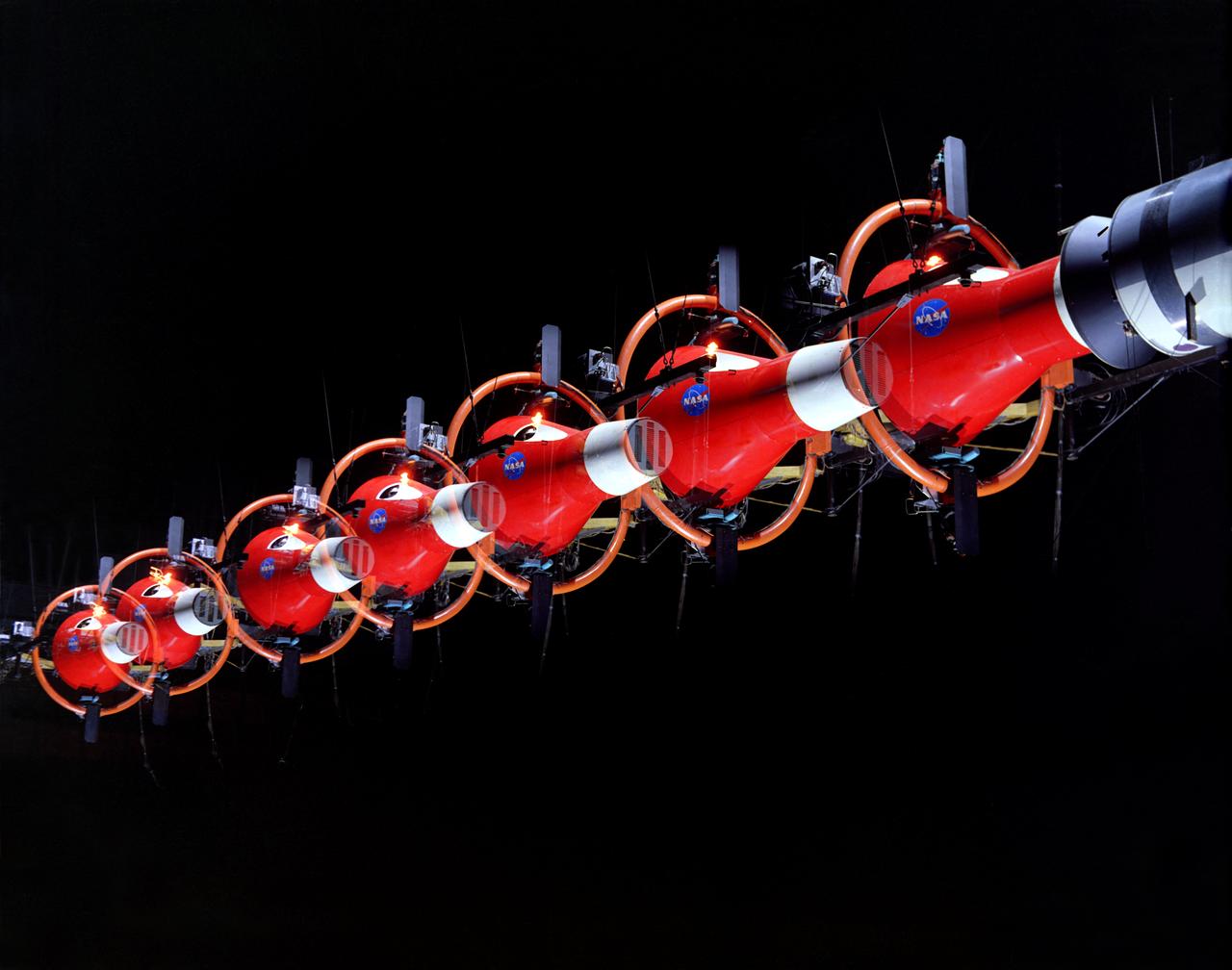
Multiple exposure of Rendezvous Docking Simulator. Francis B. Smith, described the simulator as follows:  The rendezvous and docking operation of the Gemini spacecraft with the Agena and of the Apollo Command Module with the Lunar Excursion Module have been the subject of simulator studies for several years.  This figure  illustrates the Gemini-Agena rendezvous docking simulator at Langley. The Gemini spacecraft was supported in a gimbal system by an overhead crane and gantry arrangement which provided 6 degrees of freedom - roll, pitch, yaw, and translation in any direction - all controllable by the astronaut in the spacecraft. Here again the controls fed into a computer which in turn provided an input to the servos driving the spacecraft so that it responded to control motions in a manner which accurately simulated the Gemini spacecraft.  -- Published in Barton C. Hacker and James M. Grimwood, On the Shoulders of Titans: A History of Project Gemini, NASA SP-4203  Francis B. Smith,  Simulators for Manned Space Research,  Paper presented at the 1966 IEEE International convention, March 21-25, 1966.
Multiple Exposure of Rendezvous Docking Simulator - Gemini Program
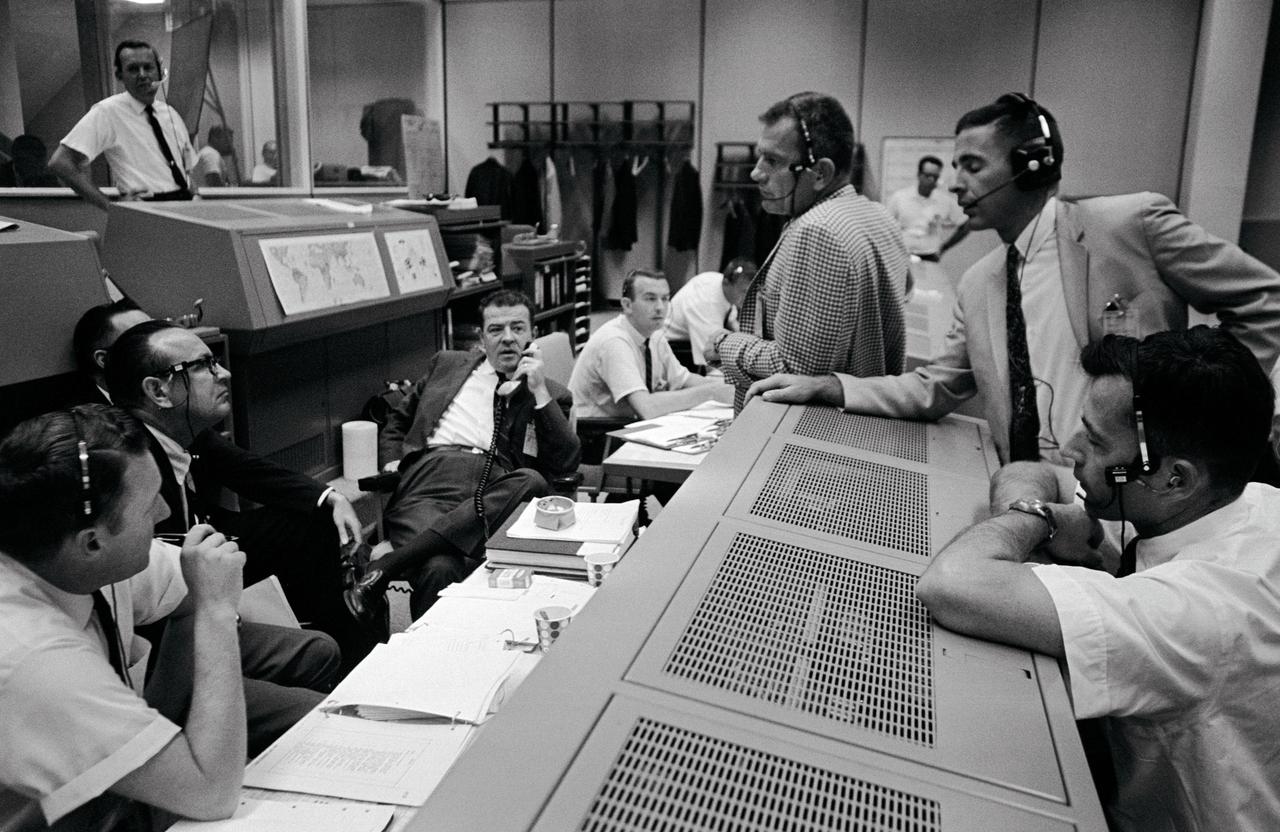
S66-52157 (12 Sept. 1966) --- Discussing the Gemini-11 spaceflight in the Mission Control Center are: (left to right) Christopher C. Kraft Jr., (wearing glasses), Director of Flight Operations; Charles W. Mathews (holding phone), Manager, Gemini Program Office; Dr. Donald K. Slayton (center, checked coat), Director of Flight Crew Operations; astronaut William A. Anders, and astronaut John W. Young. Photo credit: NASA
Personnel discussing Gemini 11 space flight in Mission Control
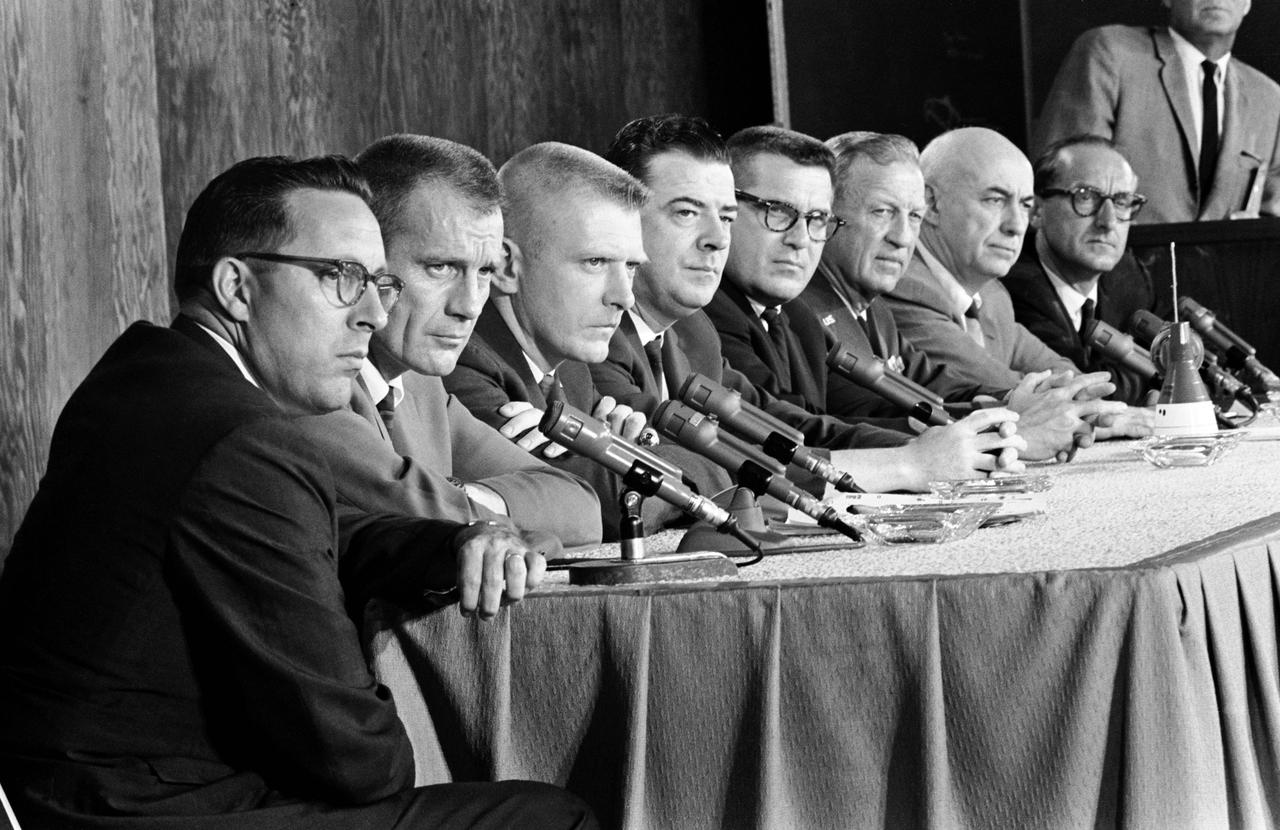
S66-32629 (1966) --- Left to right are Dr. Charles A. Berry, MSC Medical Director; Dr. Donald K. (Deke) Slayton, Director of Flight Crew Operations; Eugene F. Kranz, Flight Director; Charles W. Mathews, Gemini Program Manager, Manned Spacecraft Center; William C. Schneider, Gemini Mission Manager, NASA Headquarters; General Leighton Davis; Dr. Robert R. Gilruth, MSC Director; and Dr. George E. Mueller, Associate Administrator for Manned Space Flight, NASA Headquarters.
S66-32629
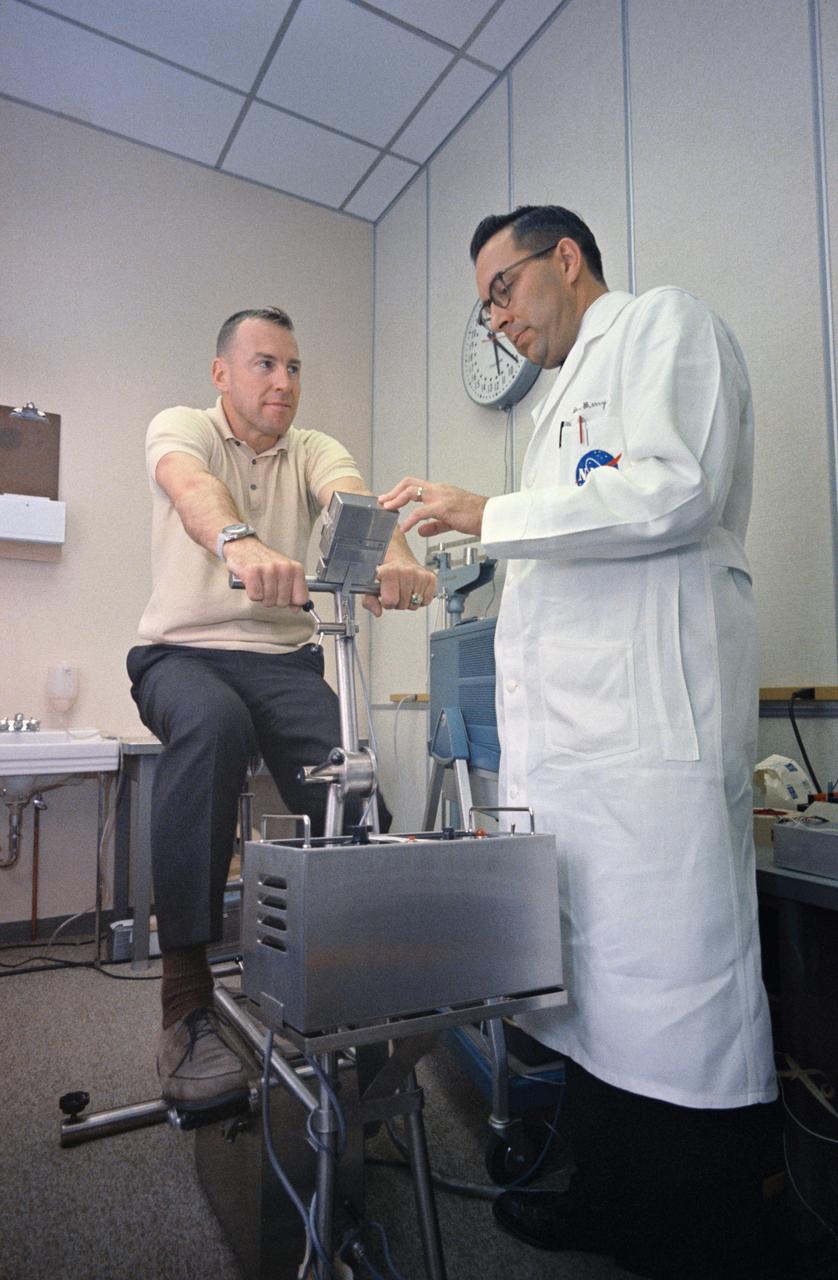
S65-60602 (2 Dec. 1965) --- Dr. Charles A. Berry checks astronaut James A. Lovell Jr., Gemini-7 prime crew pilot, following a workout on an exercise machine. Results will be compared with those obtained during spaceflight for evaluation. Lovell and astronaut Frank Borman (not pictured), command pilot, will pilot the Gemini-7 spacecraft on a planned 14-day mission. Dr. Berry is chief, MSC Center Medical Programs. Photo credit: NASA
Berry examines Lovell following a workout on exercise machine
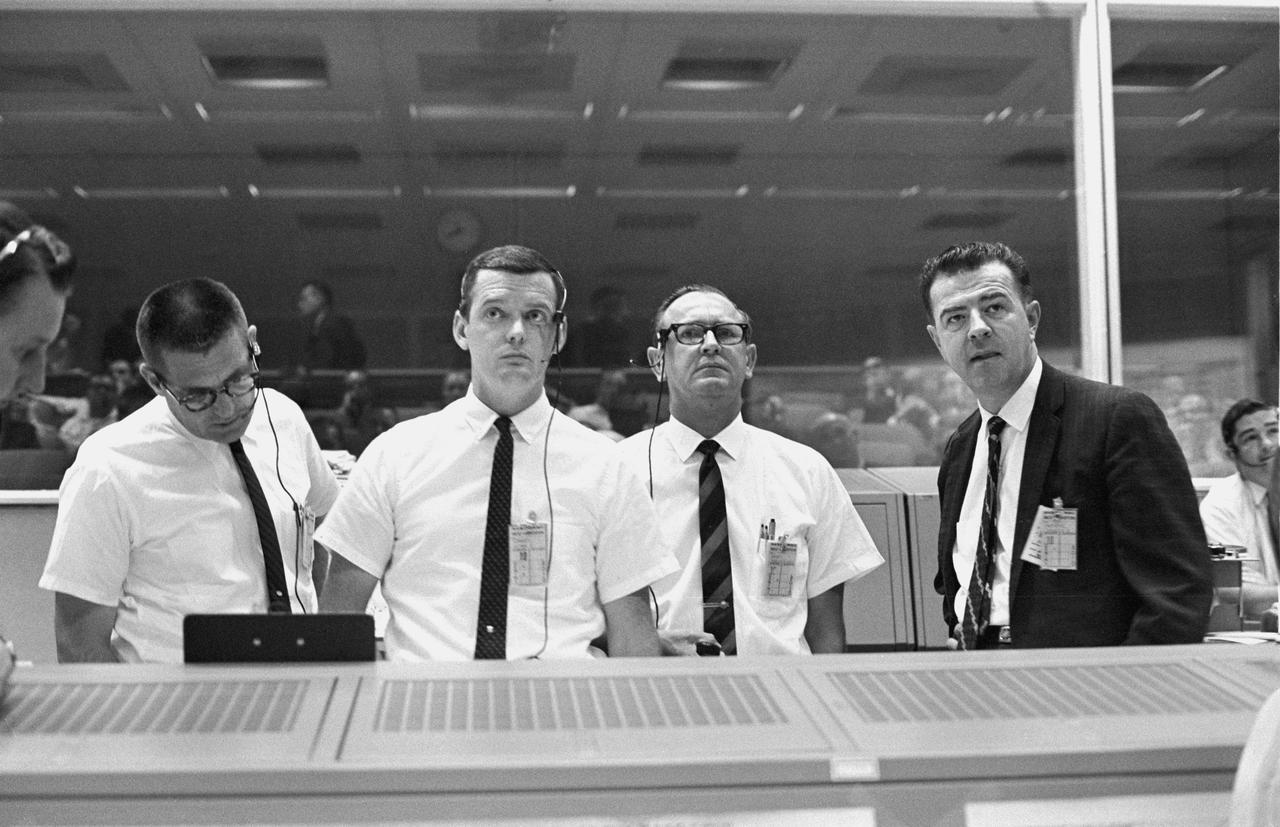
S66-43377 (18 July 1966) --- Standing at the flight director's console, viewing the Gemini-10 flight display in the Mission Control Center, are (left to right) William C. Schneider, Mission Director; Glynn Lunney, Prime Flight Director; Christopher C. Kraft Jr., MSC Director of Flight Operations; and Charles W. Mathews, Manager, Gemini Program Office. Photo credit: NASA
Personnel - Gemini-Titan (GT)-10 - Mission Control Center (MCC) - MSC
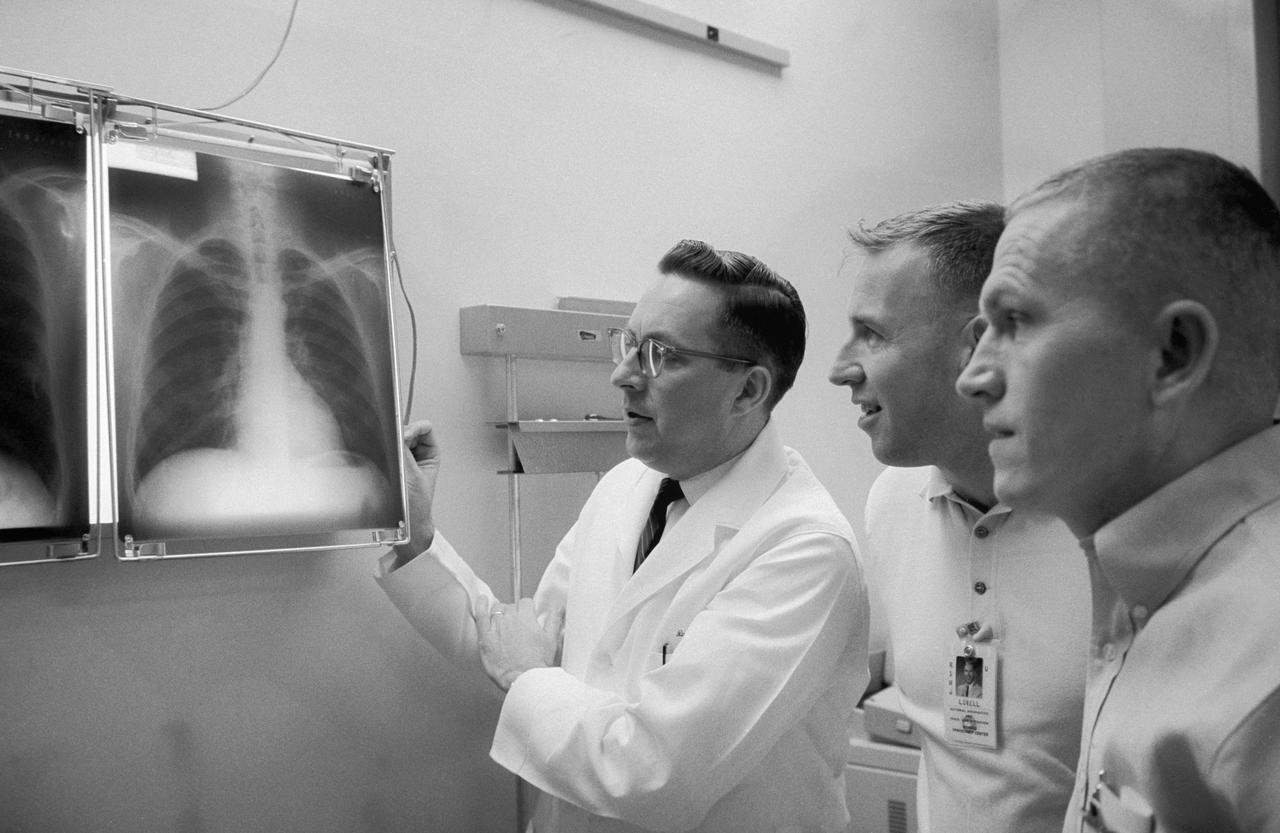
S65-56315 (2 Dec. 1965) --- Dr. Charles A. Berry (left), chief of the Manned Spacecraft Center (MSC) Medical Programs, and astronauts James A. Lovell Jr. (center), Gemini-7 pilot, and Frank Borman, Gemini-7 command pilot, examine a series of chest x-rays taken during the preflight physical. Photo credit: NASA
PREFLIGHT MEDICAL (GT-7)
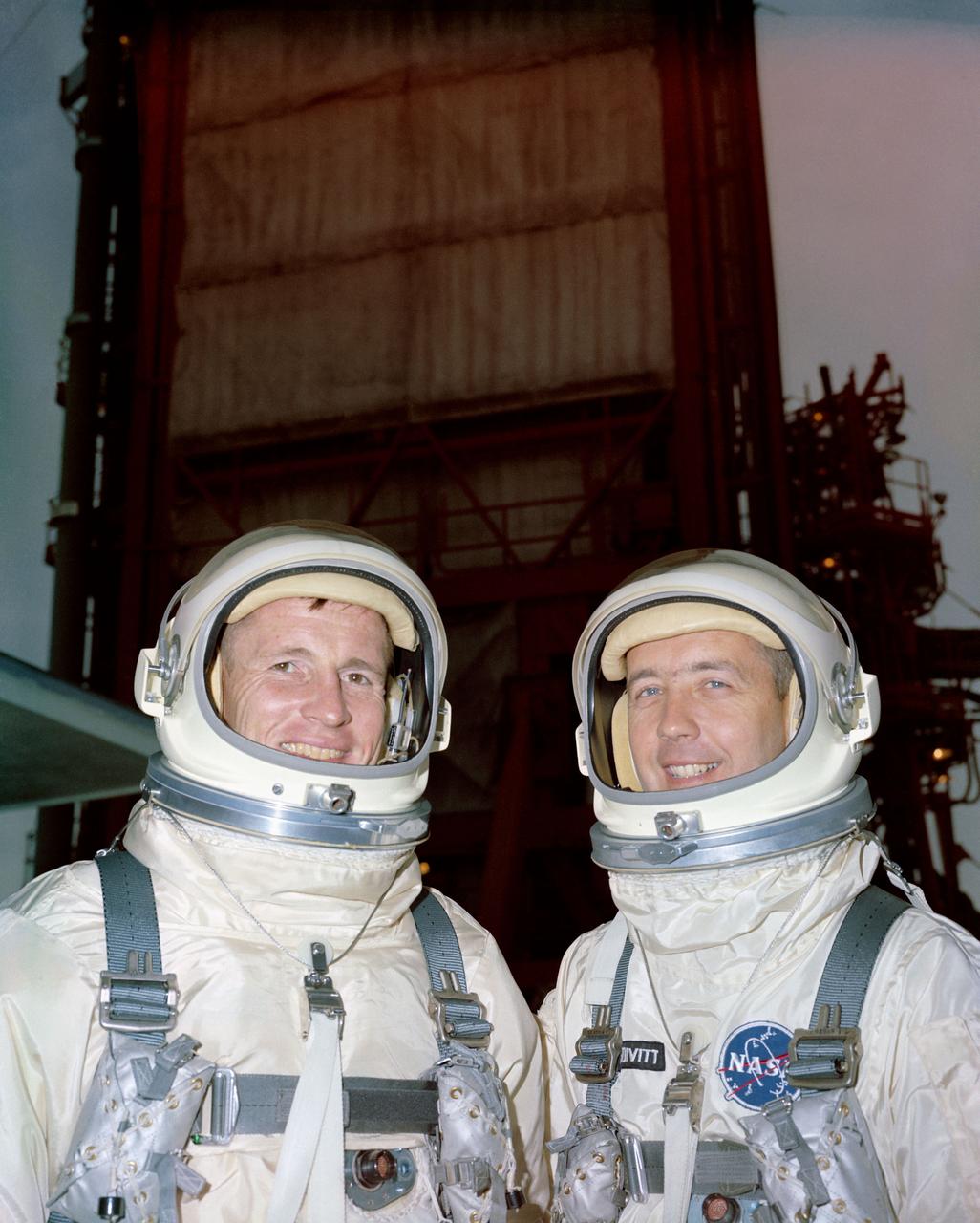
S65-19528 (1 June 1965) --- Astronauts Edward H. White II (left), Gemini-Titan 4 pilot; and James A. McDivitt, command pilot.    EDITOR?S NOTE: Astronaut White died in the Apollo 1/Saturn 204 fire at Cape Kennedy on Jan. 27, 1967.
GEMINI-TITAN-IV - SUITED (CLOSEUP) - CAPE
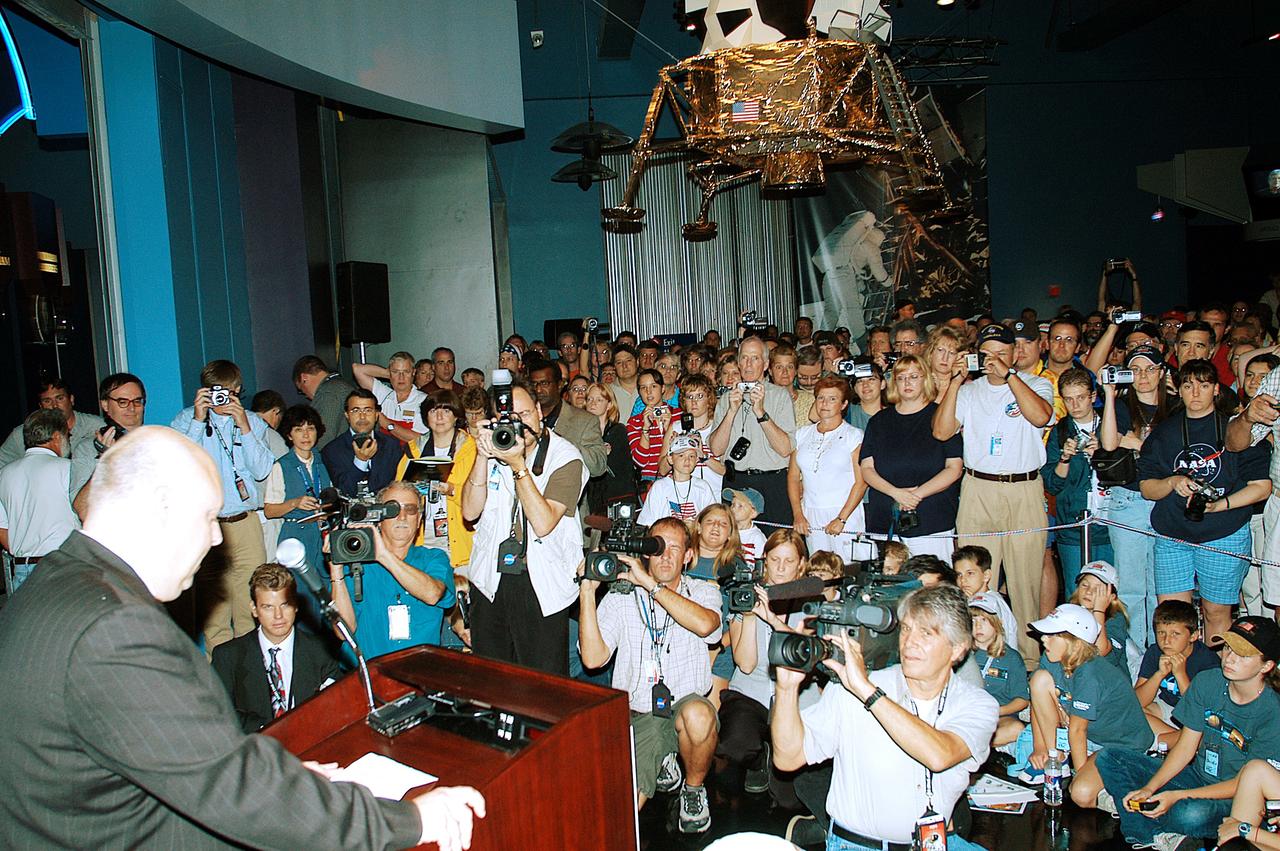
KENNEDY SPACE CENTER, FLA. -  Daniel LeBlanc, chief operating officer of Delaware North Companies Parks and Resorts at KSC, makes the opening remarks to hundreds of guests and media representatives attending a ribbon cutting ceremony officially opening the U.S. Astronaut Hall of Fame as part of the Kennedy Space Center Visitor Complex.  The ceremony was held in conjunction with the induction of four Space Shuttle astronauts into the Hall of Fame including Daniel Brandenstein, Robert "Hoot" Gibson, Story Musgrave, and Sally Ride.  Conceived by six of the Mercury Program astronauts, the U.S. Astronaut Hall of Fame opened in 1990 to provide a place where space travelers could be remembered for their participation and accomplishments in the U.S. space program.  The four new inductees join 48 previously honored astronauts from the ranks of the Gemini, Apollo, Skylab, Apollo-Soyuz, and Space Shuttle programs.
KENNEDY SPACE CENTER, FLA. - Daniel LeBlanc, chief operating officer of Delaware North Companies Parks and Resorts at KSC, makes the opening remarks to hundreds of guests and media representatives attending a ribbon cutting ceremony officially opening the U.S. Astronaut Hall of Fame as part of the Kennedy Space Center Visitor Complex. The ceremony was held in conjunction with the induction of four Space Shuttle astronauts into the Hall of Fame including Daniel Brandenstein, Robert "Hoot" Gibson, Story Musgrave, and Sally Ride. Conceived by six of the Mercury Program astronauts, the U.S. Astronaut Hall of Fame opened in 1990 to provide a place where space travelers could be remembered for their participation and accomplishments in the U.S. space program. The four new inductees join 48 previously honored astronauts from the ranks of the Gemini, Apollo, Skylab, Apollo-Soyuz, and Space Shuttle programs.
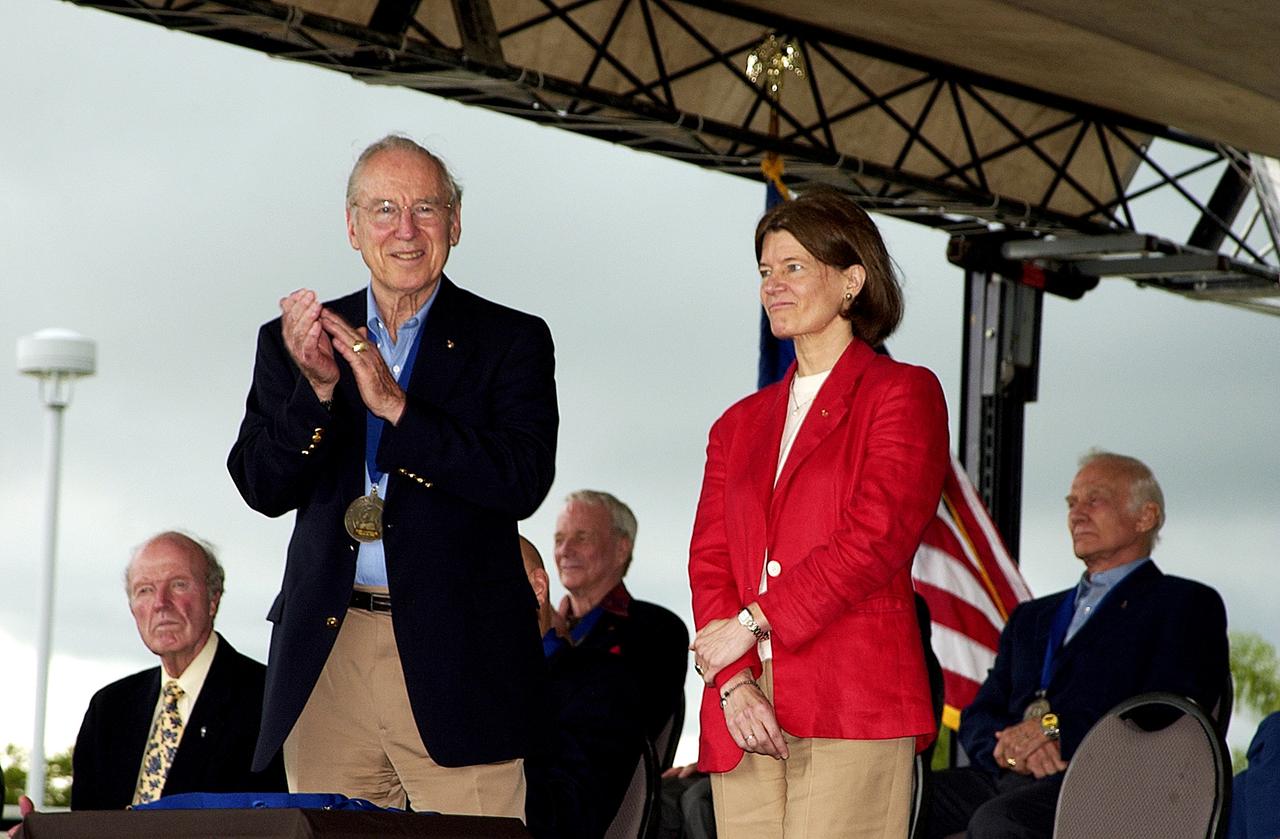
KENNEDY SPACE CENTER, FLA. -  At the KSC Visitor Complex, former astronaut James A. Lovell (standing left) applauds former astronaut Sally K. Ride at her induction ceremony into the U.S. Astronaut Hall of Fame. Seated on the dais, from left, are former astronauts Gordon Cooper, Scott Carpenter, and  Buzz Aldrin, all previously inducted into the Hall of Fame. Being inducted with Ride are Space Shuttle astronauts Daniel Brandenstein, Robert "Hoot" Gibson, and Story Musgrave. Conceived by six of the Mercury Program astronauts, the U.S. Astronaut Hall of Fame opened in 1990 to provide a place where space travelers could be remembered for their participation and accomplishments in the U.S. space program. The four new inductees join 48 previously honored astronauts from the ranks of the Gemini, Apollo, Skylab, Apollo-Soyuz, and Space Shuttle programs.
KENNEDY SPACE CENTER, FLA. - At the KSC Visitor Complex, former astronaut James A. Lovell (standing left) applauds former astronaut Sally K. Ride at her induction ceremony into the U.S. Astronaut Hall of Fame. Seated on the dais, from left, are former astronauts Gordon Cooper, Scott Carpenter, and Buzz Aldrin, all previously inducted into the Hall of Fame. Being inducted with Ride are Space Shuttle astronauts Daniel Brandenstein, Robert "Hoot" Gibson, and Story Musgrave. Conceived by six of the Mercury Program astronauts, the U.S. Astronaut Hall of Fame opened in 1990 to provide a place where space travelers could be remembered for their participation and accomplishments in the U.S. space program. The four new inductees join 48 previously honored astronauts from the ranks of the Gemini, Apollo, Skylab, Apollo-Soyuz, and Space Shuttle programs.
KENNEDY SPACE CENTER, FLA. -  At the KSC Visitor Complex, former astronaut Robert "Hoot" Gibson (at podium) addresses the audience at his induction ceremony into the U.S. Astronaut Hall of Fame. Also standing is former astronaut James A. Lovell.  Seated on the dais, from left, are actor and Master of Ceremonies Lance Henriksen and former astronaut John H. Glenn.  Also being inducted with Gibson are Space Shuttle astronauts Daniel Brandenstein, Story Musgrave, and Sally K. Ride. Conceived by six of the Mercury Program astronauts, the U.S. Astronaut Hall of Fame opened in 1990 to provide a place where space travelers could be remembered for their participation and accomplishments in the U.S. space program. The four new inductees join 48 previously honored astronauts from the ranks of the Gemini, Apollo, Skylab, Apollo-Soyuz, and Space Shuttle programs.
KENNEDY SPACE CENTER, FLA. - At the KSC Visitor Complex, former astronaut Robert "Hoot" Gibson (at podium) addresses the audience at his induction ceremony into the U.S. Astronaut Hall of Fame. Also standing is former astronaut James A. Lovell. Seated on the dais, from left, are actor and Master of Ceremonies Lance Henriksen and former astronaut John H. Glenn. Also being inducted with Gibson are Space Shuttle astronauts Daniel Brandenstein, Story Musgrave, and Sally K. Ride. Conceived by six of the Mercury Program astronauts, the U.S. Astronaut Hall of Fame opened in 1990 to provide a place where space travelers could be remembered for their participation and accomplishments in the U.S. space program. The four new inductees join 48 previously honored astronauts from the ranks of the Gemini, Apollo, Skylab, Apollo-Soyuz, and Space Shuttle programs.
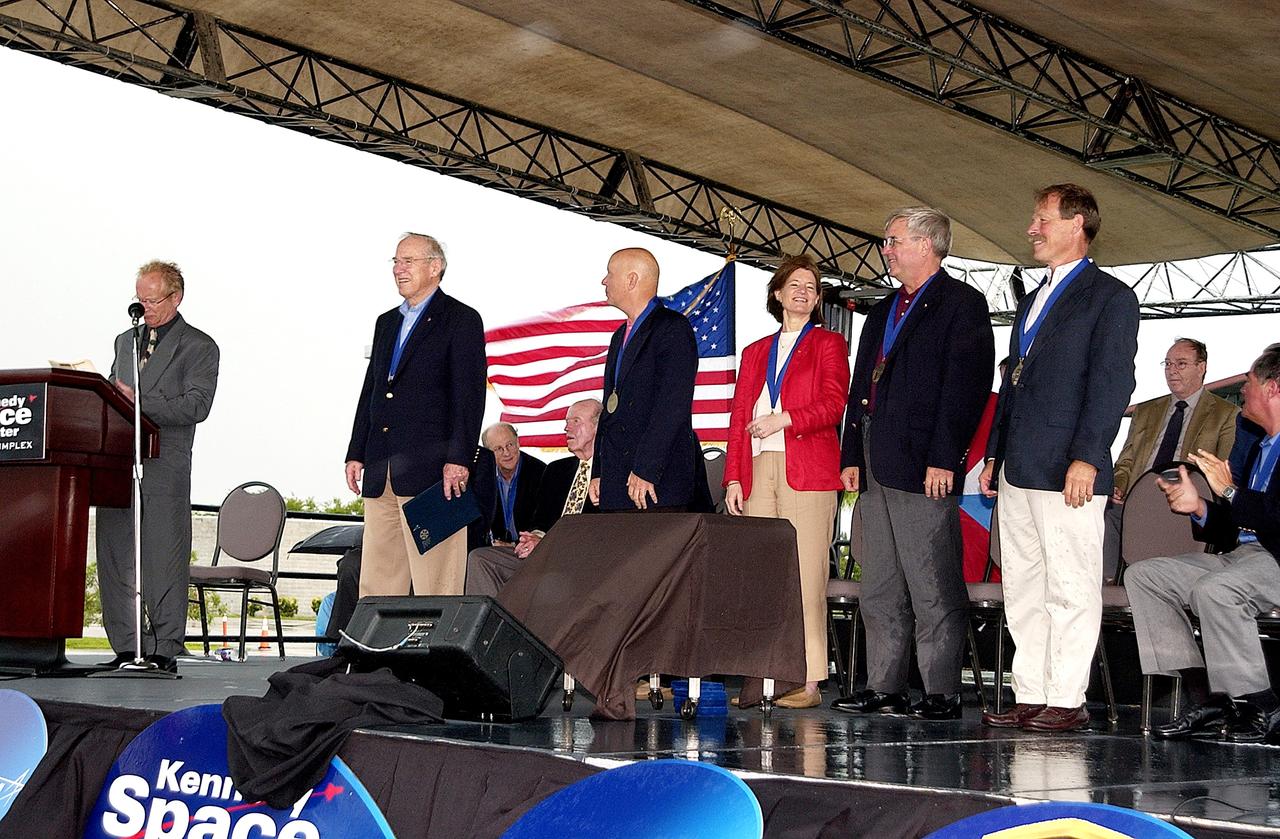
KENNEDY SPACE CENTER, FLA. -  At the KSC Visitor Complex, actor and Master of Ceremonies Lance Henriksen (at podium) introduces four newly inducted Space Shuttle astronauts to the audience at their induction ceremony into the U.S. Astronaut Hall of Fame. From left center, they are Story Musgrave, Sally K. Ride, Daniel Brandenstein, and Robert "Hoot" Gibson. Also standing, left, is former astronaut James A. Lovell.  Conceived by six of the Mercury Program astronauts, the U.S. Astronaut Hall of Fame opened in 1990 to provide a place where space travelers could be remembered for their participation and accomplishments in the U.S. space program. The four new inductees join 48 previously honored astronauts from the ranks of the Gemini, Apollo, Skylab, Apollo-Soyuz, and Space Shuttle programs.
KENNEDY SPACE CENTER, FLA. - At the KSC Visitor Complex, actor and Master of Ceremonies Lance Henriksen (at podium) introduces four newly inducted Space Shuttle astronauts to the audience at their induction ceremony into the U.S. Astronaut Hall of Fame. From left center, they are Story Musgrave, Sally K. Ride, Daniel Brandenstein, and Robert "Hoot" Gibson. Also standing, left, is former astronaut James A. Lovell. Conceived by six of the Mercury Program astronauts, the U.S. Astronaut Hall of Fame opened in 1990 to provide a place where space travelers could be remembered for their participation and accomplishments in the U.S. space program. The four new inductees join 48 previously honored astronauts from the ranks of the Gemini, Apollo, Skylab, Apollo-Soyuz, and Space Shuttle programs.
KENNEDY SPACE CENTER, FLA. -  Former astronaut James Lovell addresses the audience at a ribbon cutting ceremony officially opening the U.S. Astronaut Hall of Fame as part of the Kennedy Space Center Visitor Complex.  The ceremony was held in conjunction with the induction of four Space Shuttle astronauts into the Hall of Fame including Daniel Brandenstein, Robert "Hoot" Gibson, Story Musgrave, and Sally Ride.  Conceived by six of the Mercury Program astronauts, the U.S. Astronaut Hall of Fame opened in 1990 to provide a place where space travelers could be remembered for their participation and accomplishments in the U.S. space program.  The four new inductees join 48 previously honored astronauts from the ranks of the Gemini, Apollo, Skylab, Apollo-Soyuz, and Space Shuttle programs.
KENNEDY SPACE CENTER, FLA. - Former astronaut James Lovell addresses the audience at a ribbon cutting ceremony officially opening the U.S. Astronaut Hall of Fame as part of the Kennedy Space Center Visitor Complex. The ceremony was held in conjunction with the induction of four Space Shuttle astronauts into the Hall of Fame including Daniel Brandenstein, Robert "Hoot" Gibson, Story Musgrave, and Sally Ride. Conceived by six of the Mercury Program astronauts, the U.S. Astronaut Hall of Fame opened in 1990 to provide a place where space travelers could be remembered for their participation and accomplishments in the U.S. space program. The four new inductees join 48 previously honored astronauts from the ranks of the Gemini, Apollo, Skylab, Apollo-Soyuz, and Space Shuttle programs.
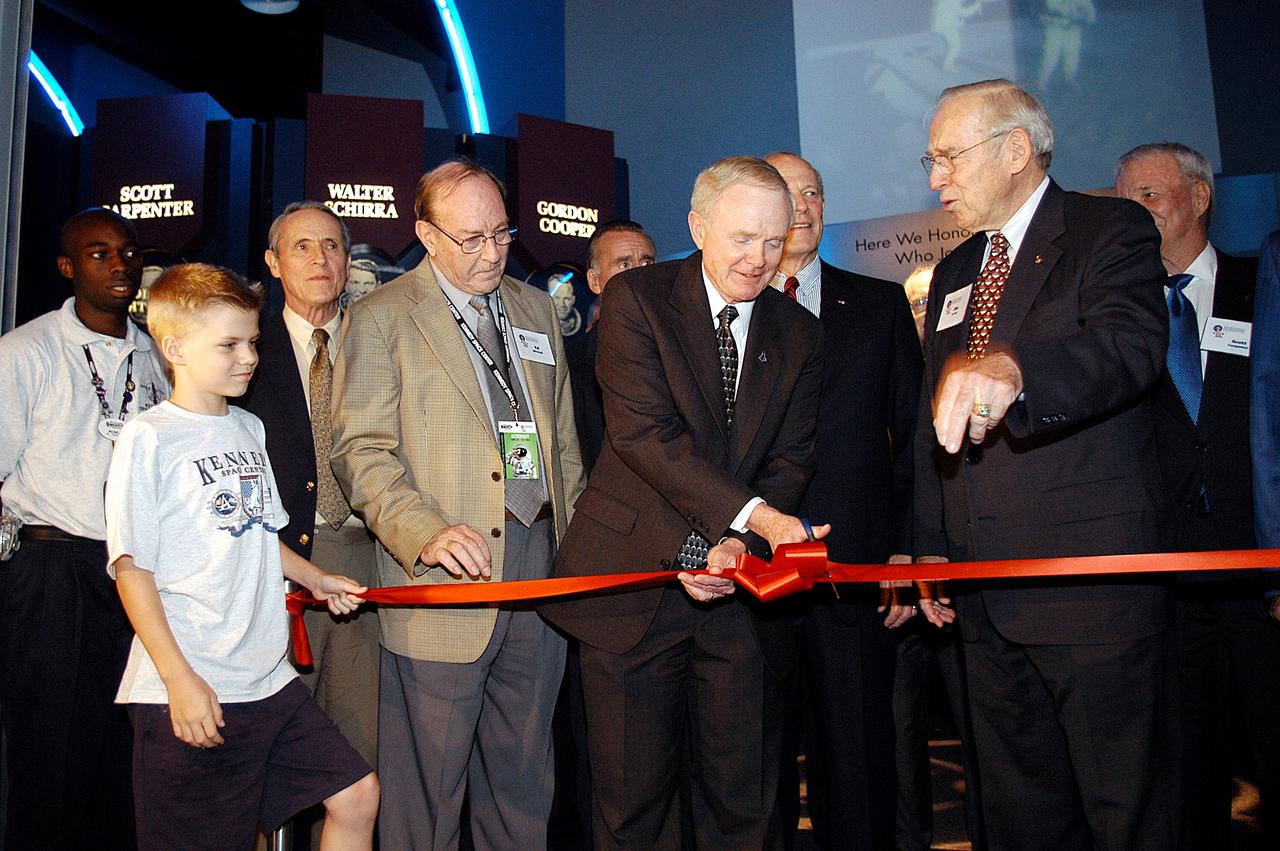
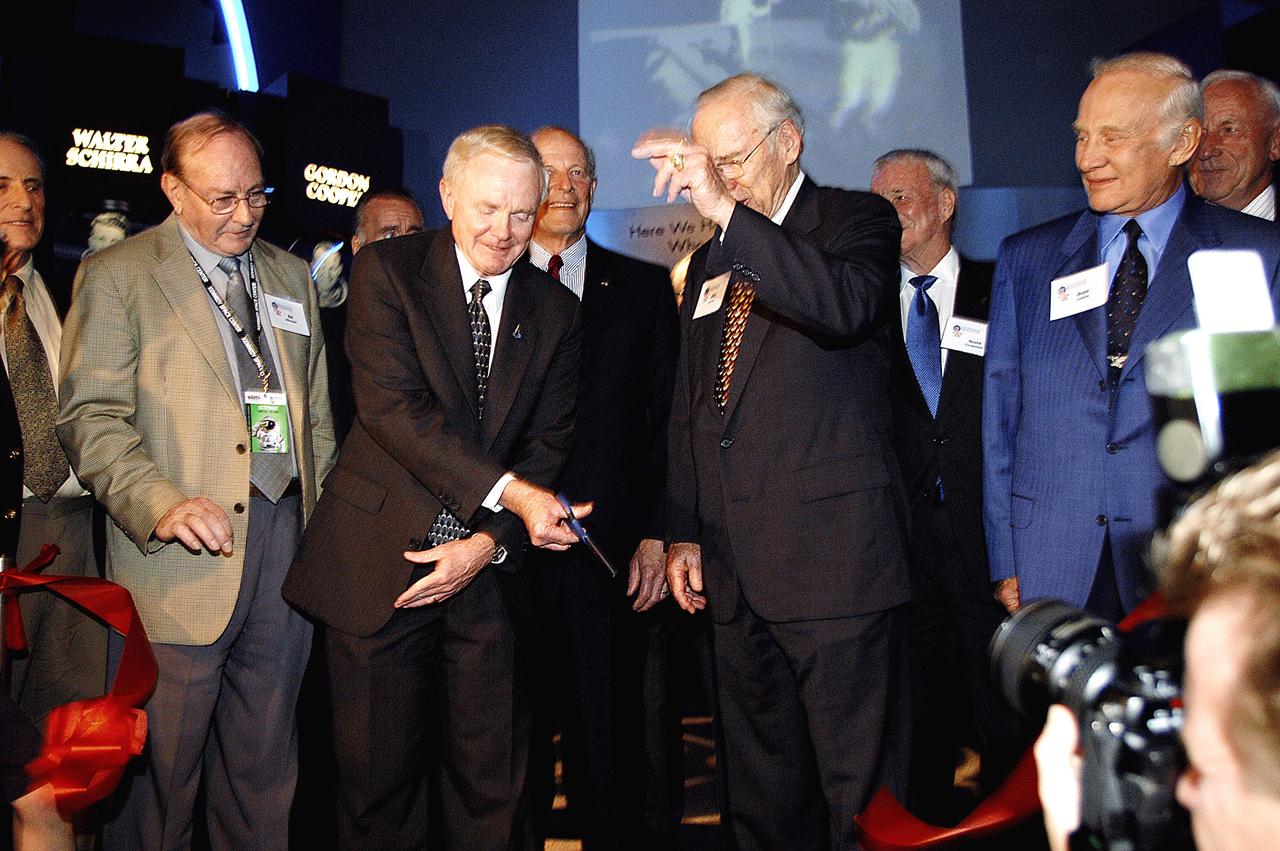
KENNEDY SPACE CENTER, FLA. -  Center Director and former astronaut Roy D. Bridges, Jr., (holding scissors) cuts the ribbon at a ceremony officially opening the U.S. Astronaut Hall of Fame as part of the Kennedy Space Center Visitor Complex.  Invited guests and dignitaries look on, such as former astronauts Edgar D. Mitchell on Bridges' left and James Lovell (hand up) and Buzz Aldrin on his right.  The ceremony was held in conjunction with the induction of four Space Shuttle astronauts into the Hall of Fame including Daniel Brandenstein, Robert "Hoot" Gibson, Story Musgrave, and Sally Ride.  Conceived by six of the Mercury Program astronauts, the U.S. Astronaut Hall of Fame opened in 1990 to provide a place where space travelers could be remembered for their participation and accomplishments in the U.S. space program.  The four new inductees join 48 previously honored astronauts from the ranks of the Gemini, Apollo, Skylab, Apollo-Soyuz, and Space Shuttle programs.
KENNEDY SPACE CENTER, FLA. - Center Director and former astronaut Roy D. Bridges, Jr., (holding scissors) cuts the ribbon at a ceremony officially opening the U.S. Astronaut Hall of Fame as part of the Kennedy Space Center Visitor Complex. Invited guests and dignitaries look on, such as former astronauts Edgar D. Mitchell on Bridges' left and James Lovell (hand up) and Buzz Aldrin on his right. The ceremony was held in conjunction with the induction of four Space Shuttle astronauts into the Hall of Fame including Daniel Brandenstein, Robert "Hoot" Gibson, Story Musgrave, and Sally Ride. Conceived by six of the Mercury Program astronauts, the U.S. Astronaut Hall of Fame opened in 1990 to provide a place where space travelers could be remembered for their participation and accomplishments in the U.S. space program. The four new inductees join 48 previously honored astronauts from the ranks of the Gemini, Apollo, Skylab, Apollo-Soyuz, and Space Shuttle programs.
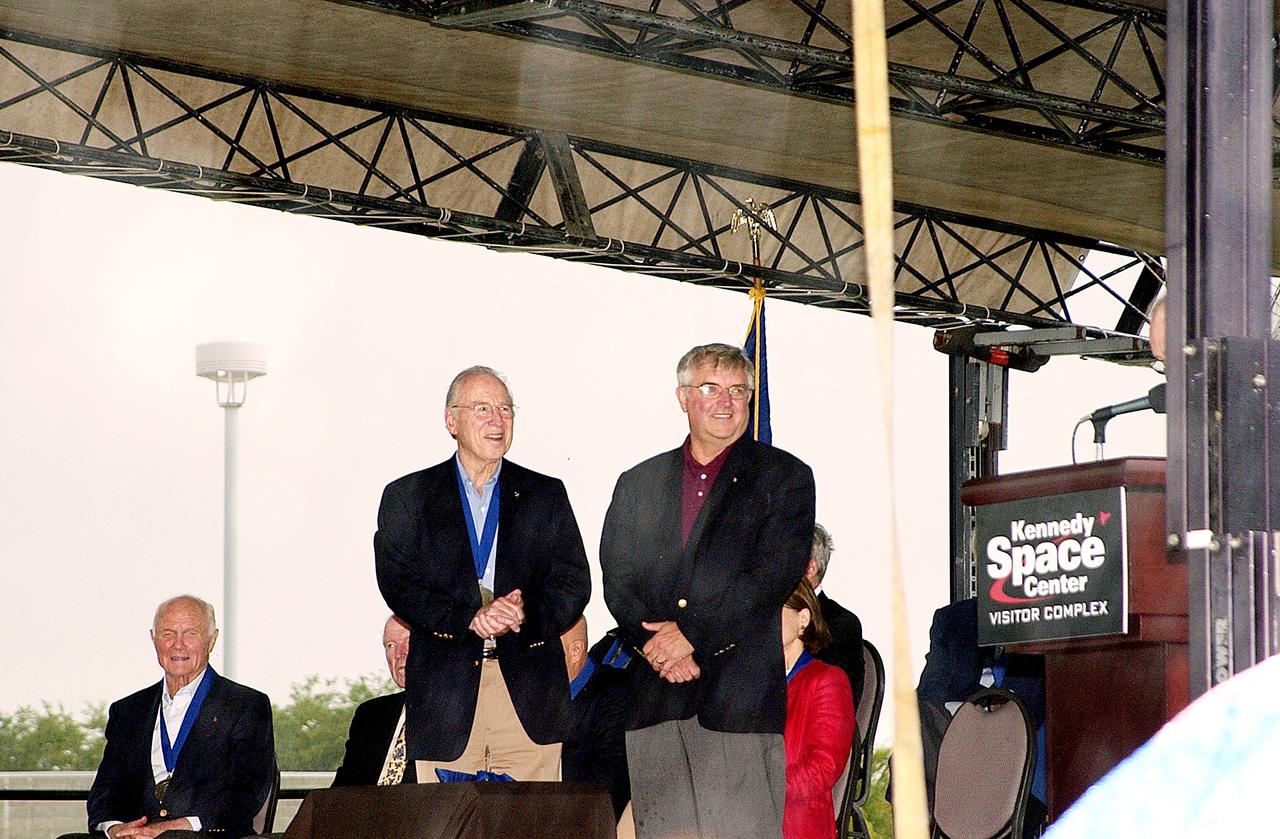
KENNEDY SPACE CENTER, FLA. -  At the KSC Visitor Complex, former astronaut Frederick H. (Rick) Hauck (standing right) congratulates former astronaut Daniel Brandenstein (standing center) at his induction ceremony into the U.S. Astronaut Hall of Fame. Also standing is former astronaut James A. Lovell.  Seated on the dais, from left, are former astronauts John H. Glenn and Gordon Cooper, both previously inducted into the Hall of Fame. Being inducted with Brandenstein are Space Shuttle astronauts Robert "Hoot" Gibson, Story Musgrave, and Sally K. Ride. Conceived by six of the Mercury Program astronauts, the U.S. Astronaut Hall of Fame opened in 1990 to provide a place where space travelers could be remembered for their participation and accomplishments in the U.S. space program. The four new inductees join 48 previously honored astronauts from the ranks of the Gemini, Apollo, Skylab, Apollo-Soyuz, and Space Shuttle programs.
KENNEDY SPACE CENTER, FLA. - At the KSC Visitor Complex, former astronaut Frederick H. (Rick) Hauck (standing right) congratulates former astronaut Daniel Brandenstein (standing center) at his induction ceremony into the U.S. Astronaut Hall of Fame. Also standing is former astronaut James A. Lovell. Seated on the dais, from left, are former astronauts John H. Glenn and Gordon Cooper, both previously inducted into the Hall of Fame. Being inducted with Brandenstein are Space Shuttle astronauts Robert "Hoot" Gibson, Story Musgrave, and Sally K. Ride. Conceived by six of the Mercury Program astronauts, the U.S. Astronaut Hall of Fame opened in 1990 to provide a place where space travelers could be remembered for their participation and accomplishments in the U.S. space program. The four new inductees join 48 previously honored astronauts from the ranks of the Gemini, Apollo, Skylab, Apollo-Soyuz, and Space Shuttle programs.
KENNEDY SPACE CENTER, FLA. -  At the KSC Visitor Complex, former astronaut Robert L. Crippen (right) presents former astronaut Sally K. Ride (standing center) at her induction ceremony into the U.S. Astronaut Hall of Fame. Also standing is former astronaut James A. Lovell.  Seated on the dais are, from left, former astronauts John H. Glenn, Gordon Cooper, Buzz Aldrin, and Walter Cunningham, all previously inducted into the Hall of Fame. Being inducted with Ride are Space Shuttle astronauts Daniel Brandenstein, Robert "Hoot" Gibson, and Story Musgrave. Conceived by six of the Mercury Program astronauts, the U.S. Astronaut Hall of Fame opened in 1990 to provide a place where space travelers could be remembered for their participation and accomplishments in the U.S. space program. The four new inductees join 48 previously honored astronauts from the ranks of the Gemini, Apollo, Skylab, Apollo-Soyuz, and Space Shuttle programs.
KENNEDY SPACE CENTER, FLA. - At the KSC Visitor Complex, former astronaut Robert L. Crippen (right) presents former astronaut Sally K. Ride (standing center) at her induction ceremony into the U.S. Astronaut Hall of Fame. Also standing is former astronaut James A. Lovell. Seated on the dais are, from left, former astronauts John H. Glenn, Gordon Cooper, Buzz Aldrin, and Walter Cunningham, all previously inducted into the Hall of Fame. Being inducted with Ride are Space Shuttle astronauts Daniel Brandenstein, Robert "Hoot" Gibson, and Story Musgrave. Conceived by six of the Mercury Program astronauts, the U.S. Astronaut Hall of Fame opened in 1990 to provide a place where space travelers could be remembered for their participation and accomplishments in the U.S. space program. The four new inductees join 48 previously honored astronauts from the ranks of the Gemini, Apollo, Skylab, Apollo-Soyuz, and Space Shuttle programs.
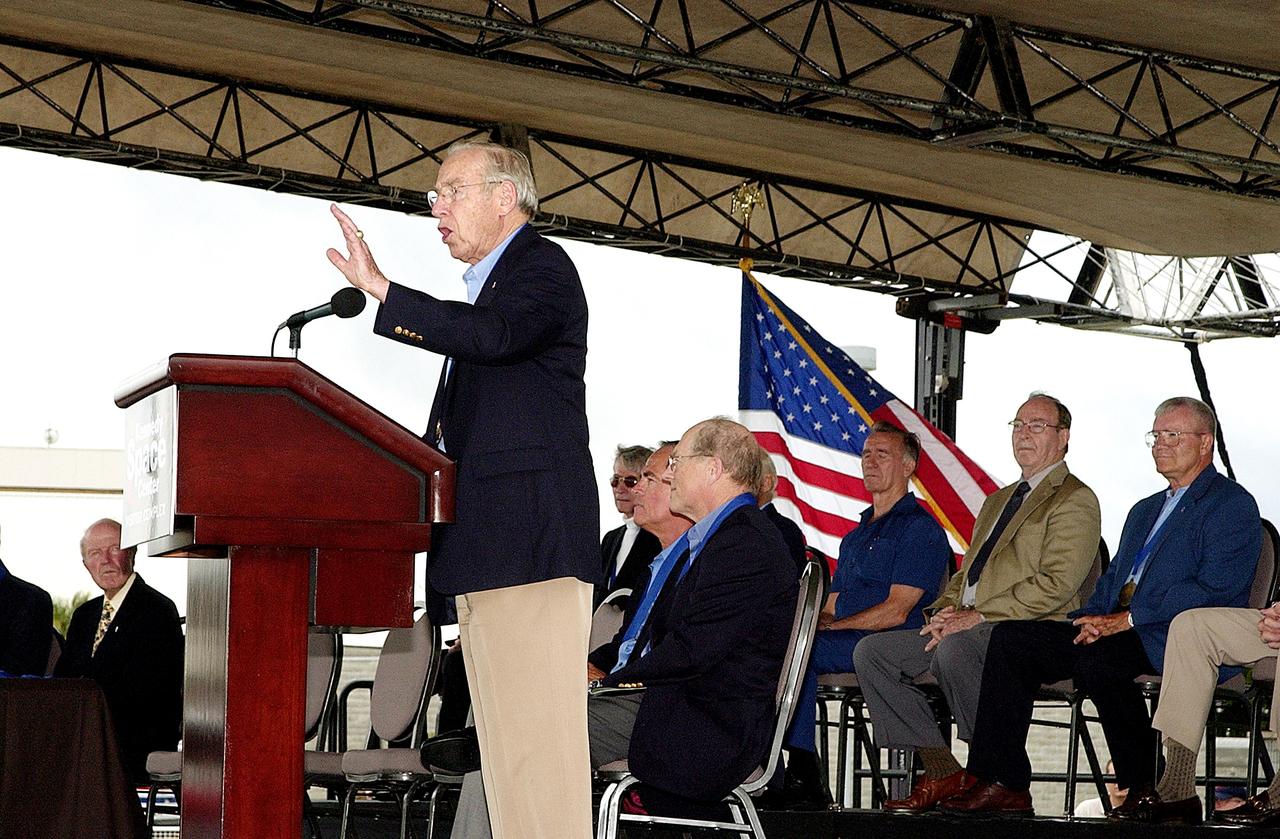
KENNEDY SPACE CENTER, FLA. -  At the KSC Visitor Complex, former astronaut Daniel Brandenstein (standing right) is presented to the audience at his induction ceremony into the U.S. Astronaut Hall of Fame. Also standing is former astronaut James A. Lovell.  Seated on the dais, from left, are former astronauts John H. Glenn and Gordon Cooper, both previously inducted into the Hall of Fame. Being inducted with Brandenstein are Space Shuttle astronauts Robert "Hoot" Gibson, Story Musgrave, and Sally K. Ride. Conceived by six of the Mercury Program astronauts, the U.S. Astronaut Hall of Fame opened in 1990 to provide a place where space travelers could be remembered for their participation and accomplishments in the U.S. space program. The four new inductees join 48 previously honored astronauts from the ranks of the Gemini, Apollo, Skylab, Apollo-Soyuz, and Space Shuttle programs.
KENNEDY SPACE CENTER, FLA. - At the KSC Visitor Complex, former astronaut Daniel Brandenstein (standing right) is presented to the audience at his induction ceremony into the U.S. Astronaut Hall of Fame. Also standing is former astronaut James A. Lovell. Seated on the dais, from left, are former astronauts John H. Glenn and Gordon Cooper, both previously inducted into the Hall of Fame. Being inducted with Brandenstein are Space Shuttle astronauts Robert "Hoot" Gibson, Story Musgrave, and Sally K. Ride. Conceived by six of the Mercury Program astronauts, the U.S. Astronaut Hall of Fame opened in 1990 to provide a place where space travelers could be remembered for their participation and accomplishments in the U.S. space program. The four new inductees join 48 previously honored astronauts from the ranks of the Gemini, Apollo, Skylab, Apollo-Soyuz, and Space Shuttle programs.
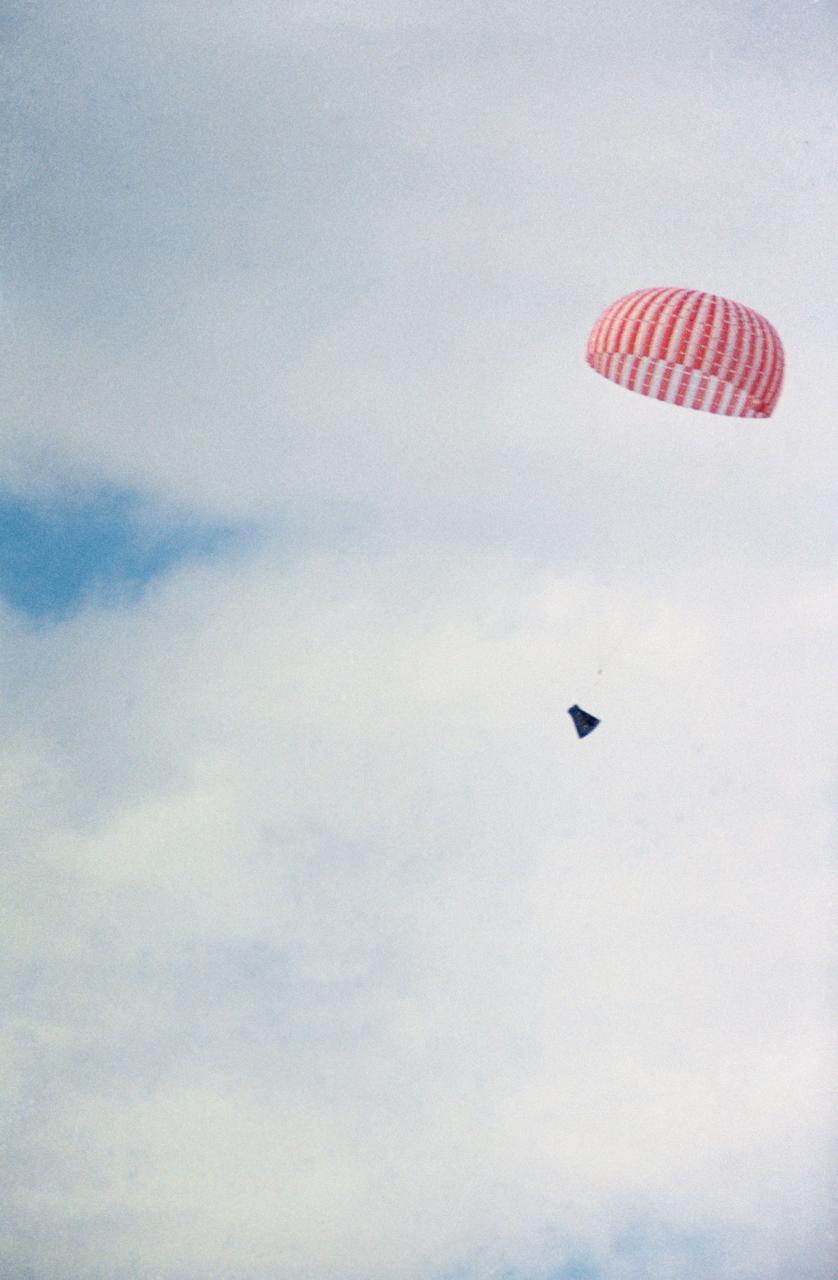
KENNEDY SPACE CENTER, FLA. -  At the KSC Visitor Complex, former astronaut John H. Glenn (at podium) presents former astronaut Robert "Hoot" Gibson (standing right) at his induction ceremony into the U.S. Astronaut Hall of Fame. Also standing is former astronaut James A. Lovell.  Seated on the dais, from left, are actor and Master of Ceremonies Lance Henriksen (left), and former astronauts Sally K. Ride and Daniel Brandenstein (right), both inducted into the Hall of Fame today. Also being inducted is Space Shuttle astronaut Story Musgrave. Conceived by six of the Mercury Program astronauts, the U.S. Astronaut Hall of Fame opened in 1990 to provide a place where space travelers could be remembered for their participation and accomplishments in the U.S. space program. The four new inductees join 48 previously honored astronauts from the ranks of the Gemini, Apollo, Skylab, Apollo-Soyuz, and Space Shuttle programs.
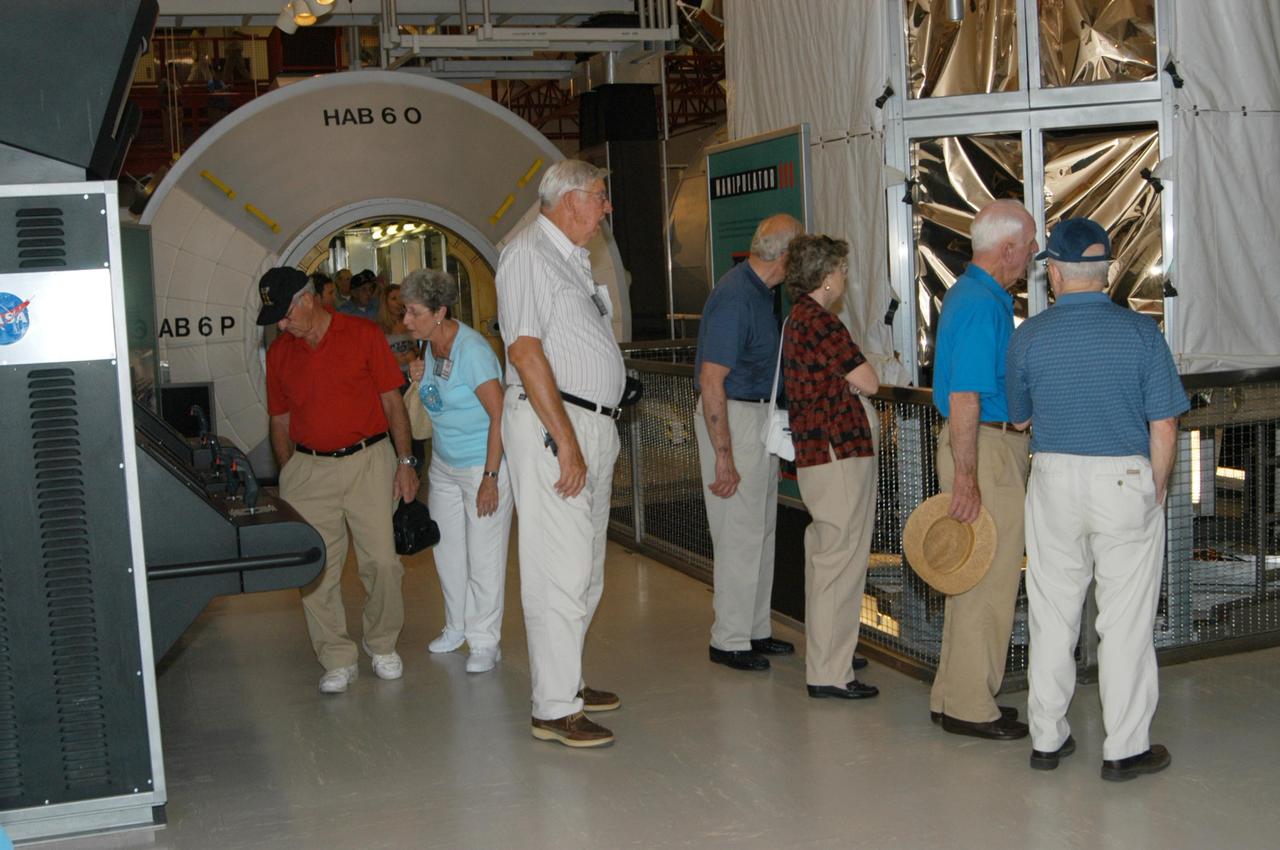
KENNEDY SPACE CENTER, FLA. - At the KSC Visitor Complex, former astronaut John H. Glenn (at podium) presents former astronaut Robert "Hoot" Gibson (standing right) at his induction ceremony into the U.S. Astronaut Hall of Fame. Also standing is former astronaut James A. Lovell. Seated on the dais, from left, are actor and Master of Ceremonies Lance Henriksen (left), and former astronauts Sally K. Ride and Daniel Brandenstein (right), both inducted into the Hall of Fame today. Also being inducted is Space Shuttle astronaut Story Musgrave. Conceived by six of the Mercury Program astronauts, the U.S. Astronaut Hall of Fame opened in 1990 to provide a place where space travelers could be remembered for their participation and accomplishments in the U.S. space program. The four new inductees join 48 previously honored astronauts from the ranks of the Gemini, Apollo, Skylab, Apollo-Soyuz, and Space Shuttle programs.
KENNEDY SPACE CENTER, FLA. -  Center Director and former astronaut Roy D. Bridges, Jr., (holding scissors) cuts the ribbon at a ceremony officially opening the U.S. Astronaut Hall of Fame as part of the Kennedy Space Center Visitor Complex.  Invited guests and dignitaries look on, such as former astronauts Edgar D. Mitchell on Bridges' left and James Lovell on his right.  The ceremony was held in conjunction with the induction of four Space Shuttle astronauts into the Hall of Fame including Daniel Brandenstein, Robert "Hoot" Gibson, Story Musgrave, and Sally Ride.  Conceived by six of the Mercury Program astronauts, the U.S. Astronaut Hall of Fame opened in 1990 to provide a place where space travelers could be remembered for their participation and accomplishments in the U.S. space program.  The four new inductees join 48 previously honored astronauts from the ranks of the Gemini, Apollo, Skylab, Apollo-Soyuz, and Space Shuttle programs.
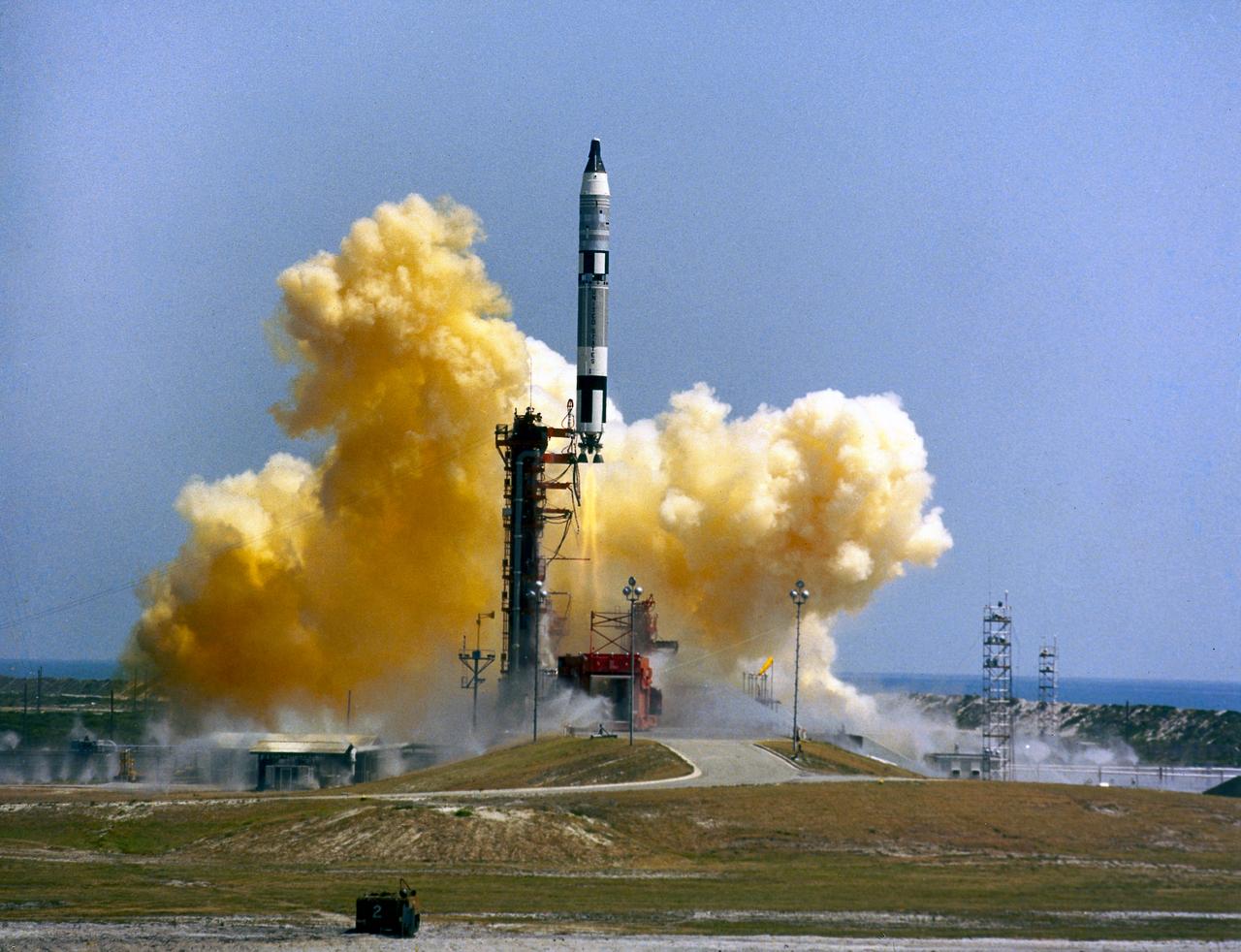
KENNEDY SPACE CENTER, FLA. - Center Director and former astronaut Roy D. Bridges, Jr., (holding scissors) cuts the ribbon at a ceremony officially opening the U.S. Astronaut Hall of Fame as part of the Kennedy Space Center Visitor Complex. Invited guests and dignitaries look on, such as former astronauts Edgar D. Mitchell on Bridges' left and James Lovell on his right. The ceremony was held in conjunction with the induction of four Space Shuttle astronauts into the Hall of Fame including Daniel Brandenstein, Robert "Hoot" Gibson, Story Musgrave, and Sally Ride. Conceived by six of the Mercury Program astronauts, the U.S. Astronaut Hall of Fame opened in 1990 to provide a place where space travelers could be remembered for their participation and accomplishments in the U.S. space program. The four new inductees join 48 previously honored astronauts from the ranks of the Gemini, Apollo, Skylab, Apollo-Soyuz, and Space Shuttle programs.
KENNEDY SPACE CENTER, FLA. -  At the KSC Visitor Complex, former astronaut Robert L. Crippen (standing right) congratulates former astronaut Sally K. Ride at her induction ceremony into the U.S. Astronaut Hall of Fame. Also standing is former astronaut James A. Lovell.  Seated on the dais, from left, are former astronauts Gordon Cooper, Scott Carpenter, Buzz Aldrin, Walter Cunningham, Edgar B. Mitchell, and Fred W. Haise, all previously inducted into the Hall of Fame. Being inducted with Ride are Space Shuttle astronauts Daniel Brandenstein, Robert "Hoot" Gibson, and Story Musgrave. Conceived by six of the Mercury Program astronauts, the U.S. Astronaut Hall of Fame opened in 1990 to provide a place where space travelers could be remembered for their participation and accomplishments in the U.S. space program. The four new inductees join 48 previously honored astronauts from the ranks of the Gemini, Apollo, Skylab, Apollo-Soyuz, and Space Shuttle programs.
KENNEDY SPACE CENTER, FLA. - At the KSC Visitor Complex, former astronaut Robert L. Crippen (standing right) congratulates former astronaut Sally K. Ride at her induction ceremony into the U.S. Astronaut Hall of Fame. Also standing is former astronaut James A. Lovell. Seated on the dais, from left, are former astronauts Gordon Cooper, Scott Carpenter, Buzz Aldrin, Walter Cunningham, Edgar B. Mitchell, and Fred W. Haise, all previously inducted into the Hall of Fame. Being inducted with Ride are Space Shuttle astronauts Daniel Brandenstein, Robert "Hoot" Gibson, and Story Musgrave. Conceived by six of the Mercury Program astronauts, the U.S. Astronaut Hall of Fame opened in 1990 to provide a place where space travelers could be remembered for their participation and accomplishments in the U.S. space program. The four new inductees join 48 previously honored astronauts from the ranks of the Gemini, Apollo, Skylab, Apollo-Soyuz, and Space Shuttle programs.
KENNEDY SPACE CENTER, FLA. -  At the KSC Visitor Complex, actor and Master of Ceremonies Lance Henriksen (at podium) introduces four newly inducted Space Shuttle astronauts to the audience at their induction ceremony into the U.S. Astronaut Hall of Fame. From left center, they are Story Musgrave, Sally K. Ride, Daniel Brandenstein, and Robert "Hoot" Gibson. Also standing, left, is former astronaut James A. Lovell.  Conceived by six of the Mercury Program astronauts, the U.S. Astronaut Hall of Fame opened in 1990 to provide a place where space travelers could be remembered for their participation and accomplishments in the U.S. space program. The four new inductees join 48 previously honored astronauts from the ranks of the Gemini, Apollo, Skylab, Apollo-Soyuz, and Space Shuttle programs.
KENNEDY SPACE CENTER, FLA. - At the KSC Visitor Complex, actor and Master of Ceremonies Lance Henriksen (at podium) introduces four newly inducted Space Shuttle astronauts to the audience at their induction ceremony into the U.S. Astronaut Hall of Fame. From left center, they are Story Musgrave, Sally K. Ride, Daniel Brandenstein, and Robert "Hoot" Gibson. Also standing, left, is former astronaut James A. Lovell. Conceived by six of the Mercury Program astronauts, the U.S. Astronaut Hall of Fame opened in 1990 to provide a place where space travelers could be remembered for their participation and accomplishments in the U.S. space program. The four new inductees join 48 previously honored astronauts from the ranks of the Gemini, Apollo, Skylab, Apollo-Soyuz, and Space Shuttle programs.
KENNEDY SPACE CENTER, FLA. -  At the KSC Visitor Complex, former astronaut James A. Lovell (standing left) greets former astronaut Story Musgrave (standing right) at his induction ceremony into the U.S. Astronaut Hall of Fame. Also seated on the dais are, from left, former astronaut and Senator John H. Glenn, astronaut and Associate Director (Technical) of the Johnson Space Center John W. Young, and former astronaut Buzz Aldrin, all previously inducted into the Hall of Fame. Being inducted with Musgrave are Space Shuttle astronauts Daniel Brandenstein, Robert "Hoot" Gibson, and Sally Ride. Conceived by six of the Mercury Program astronauts, the U.S. Astronaut Hall of Fame opened in 1990 to provide a place where space travelers could be remembered for their participation and accomplishments in the U.S. space program. The four new inductees join 48 previously honored astronauts from the ranks of the Gemini, Apollo, Skylab, Apollo-Soyuz, and Space Shuttle programs.
KENNEDY SPACE CENTER, FLA. - At the KSC Visitor Complex, former astronaut James A. Lovell (standing left) greets former astronaut Story Musgrave (standing right) at his induction ceremony into the U.S. Astronaut Hall of Fame. Also seated on the dais are, from left, former astronaut and Senator John H. Glenn, astronaut and Associate Director (Technical) of the Johnson Space Center John W. Young, and former astronaut Buzz Aldrin, all previously inducted into the Hall of Fame. Being inducted with Musgrave are Space Shuttle astronauts Daniel Brandenstein, Robert "Hoot" Gibson, and Sally Ride. Conceived by six of the Mercury Program astronauts, the U.S. Astronaut Hall of Fame opened in 1990 to provide a place where space travelers could be remembered for their participation and accomplishments in the U.S. space program. The four new inductees join 48 previously honored astronauts from the ranks of the Gemini, Apollo, Skylab, Apollo-Soyuz, and Space Shuttle programs.
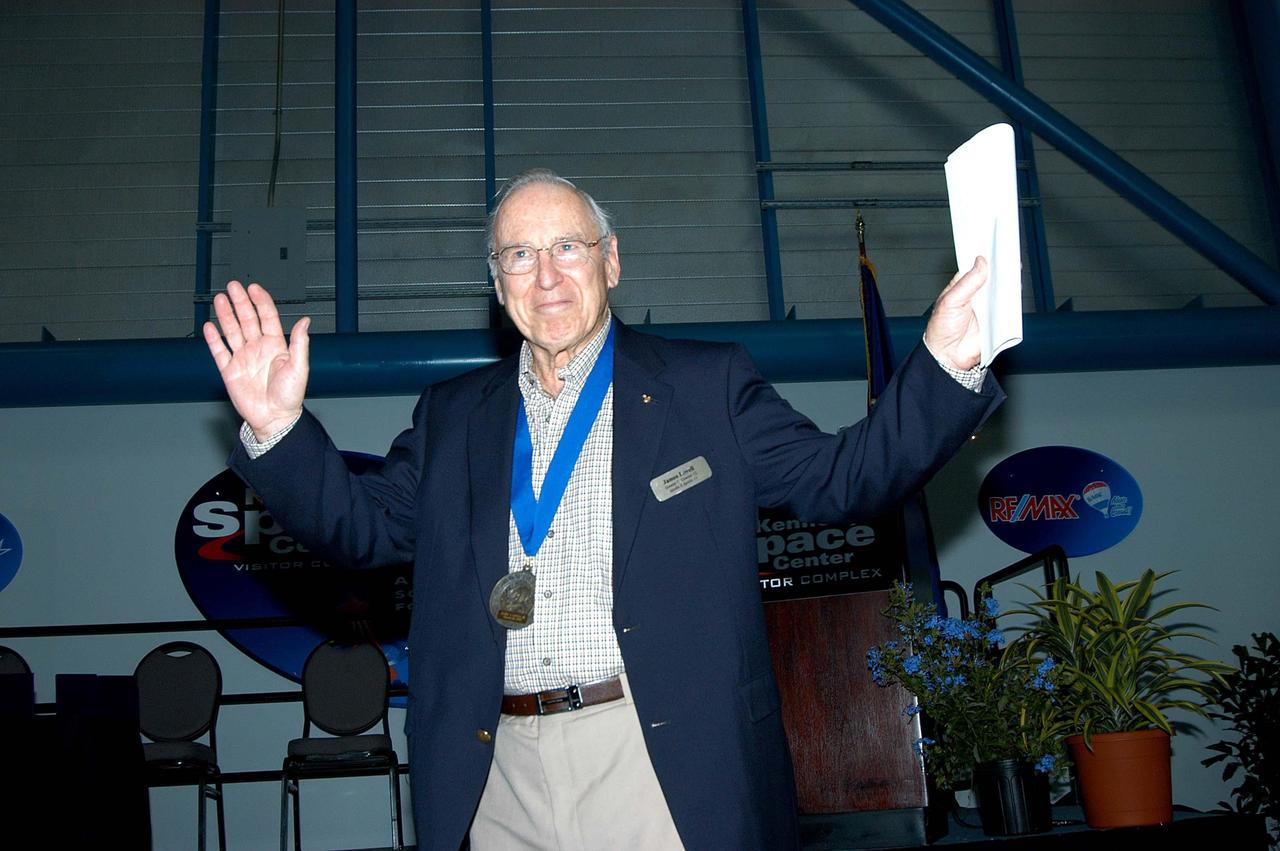
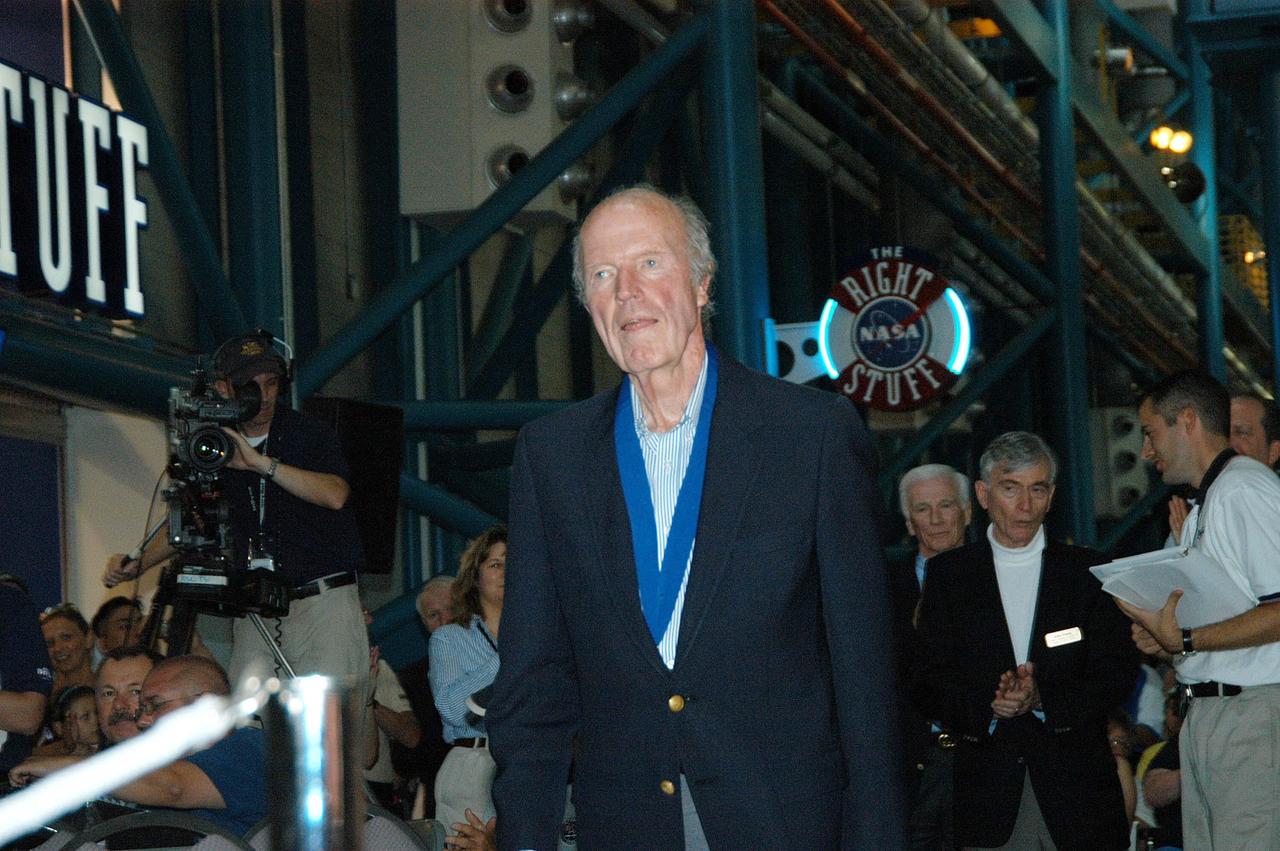
KENNEDY SPACE CENTER, FLA. -- Former astronaut Jim Lovell acknowledges the applause as he is introduced as a previous inductee into the U.S. Astronaut Hall of Fame.  He and other  Hall of Fame members were present for the induction of five new space program heroes into the U.S. Astronaut Hall of Fame: Richard O. Covey, commander of the Hubble Space Telescope repair mission; Norman E. Thagard, the first American to occupy Russia’s Mir space station; the late Francis R. "Dick" Scobee, commander of the ill-fated 1986 Challenger mission; Kathryn D. Sullivan, the first American woman to walk in space; and Frederick D. Gregory, the first African-American to command a space mission and the current NASA deputy administrator. Lovell piloted Gemini 7, commanded Gemini 12, orbited the Moon on Apollo 8 and commanded the aborted Apollo 13 moon flight.  The induction ceremony was held at the Apollo/Saturn V Center at KSC.  The U.S. Astronaut Hall of Fame opened in 1990 to provide a place where space travelers could be remembered for their participation and accomplishments in the U.S. space program. The five inductees join 52 previously honored astronauts from the ranks of the Gemini, Apollo, Skylab, Apollo-Soyuz, and Space Shuttle programs.
KSC-04pd1020
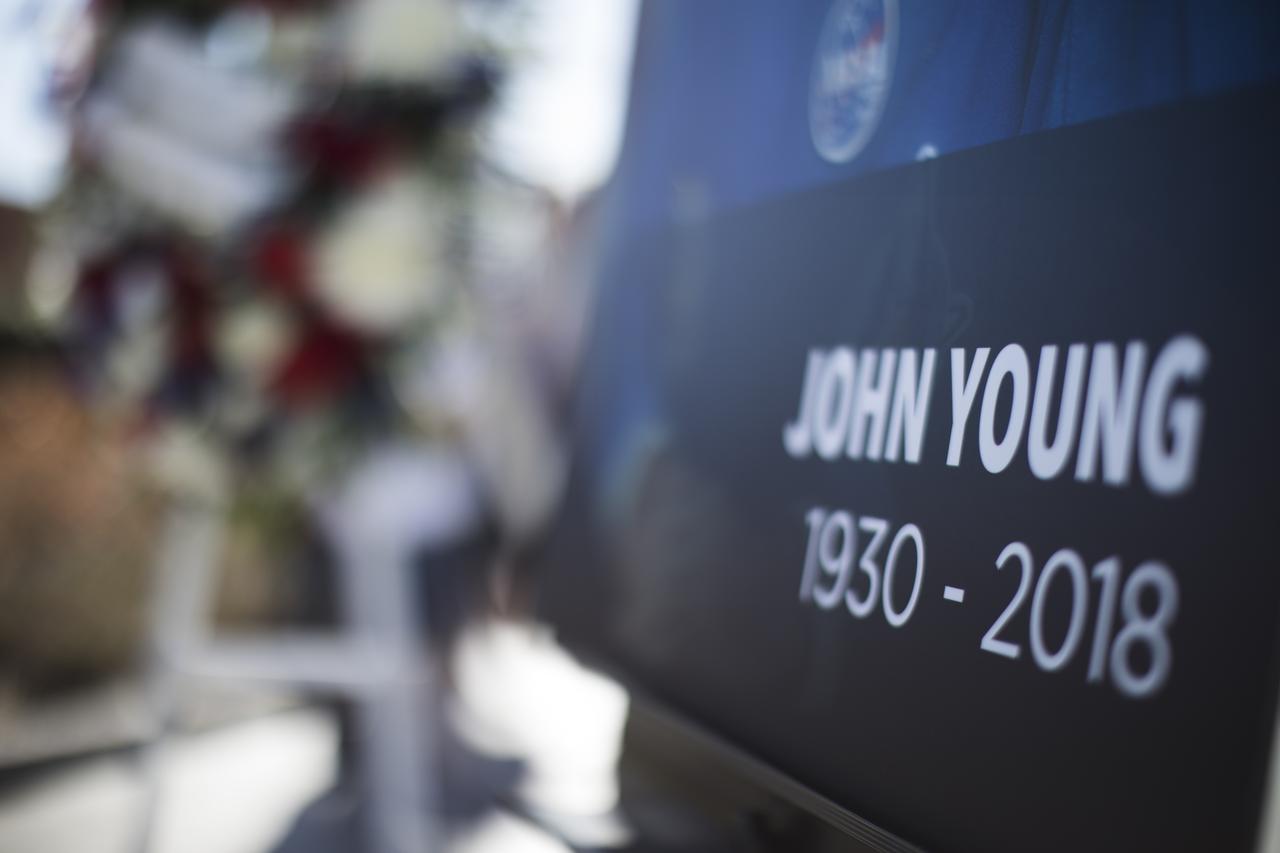
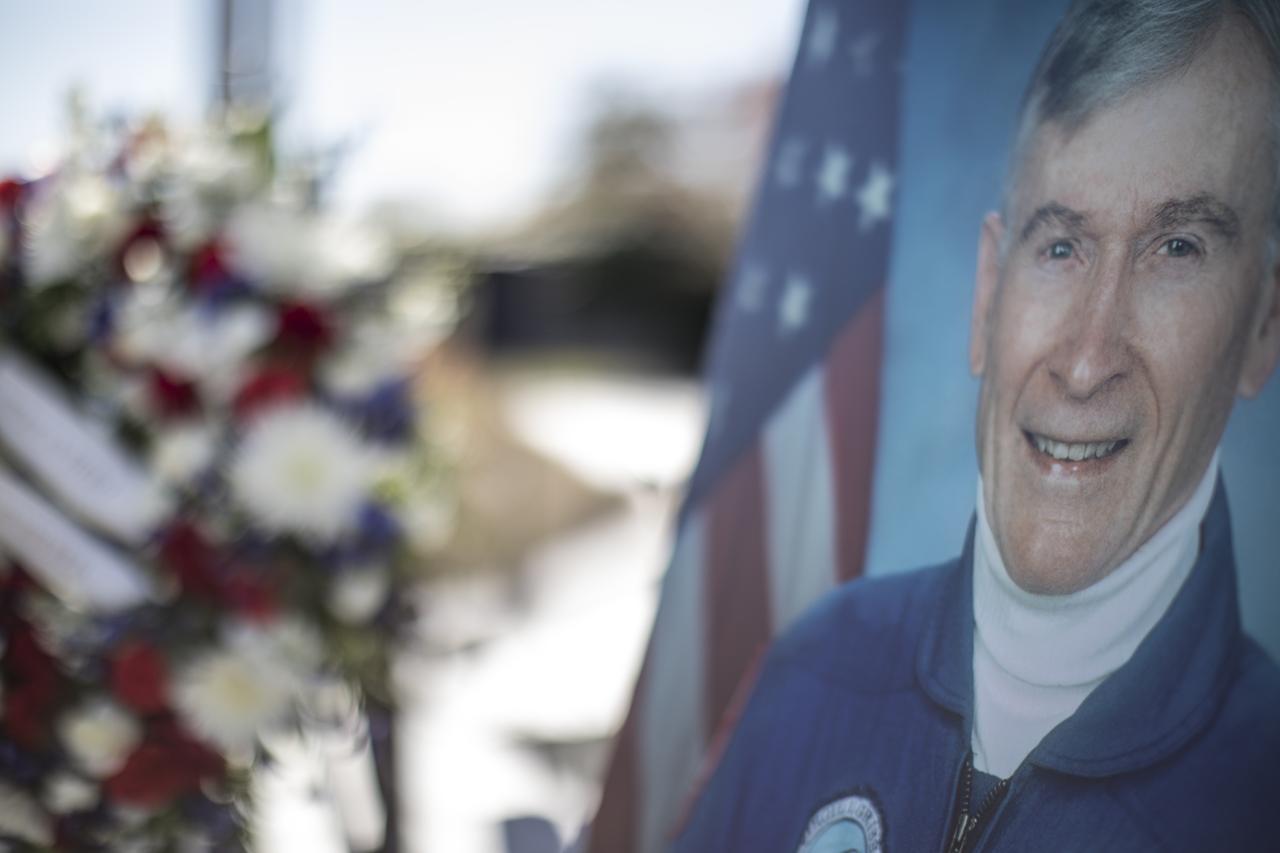
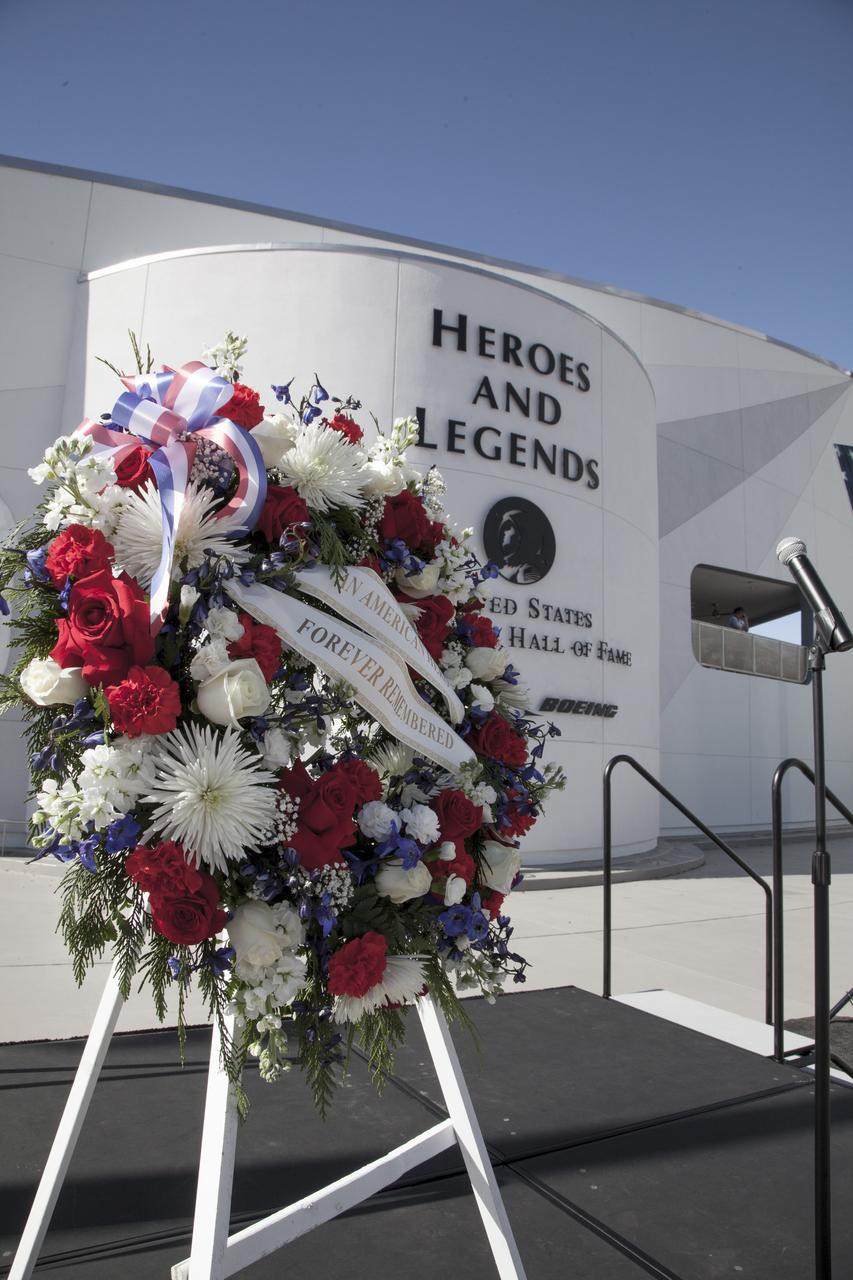
NASA astronaut John Young was remembered in a ceremony at the Heroes and Legends exhibit at the Kennedy Space Center Visitor Complex. The brief memorial took place on the afternoon of Jan. 11, 2018. Young died Jan. 5, 2018, in Houston at the age of 87. He was the only astronaut to fly in NASA's Gemini, Apollo and Space Shuttle Programs.
John Young Memorial Tribute
NASA astronaut John Young was remembered in a ceremony at the Heroes and Legends exhibit at the Kennedy Space Center Visitor Complex. The brief memorial took place on the afternoon of Jan. 11, 2018. Young died Jan. 5, 2018, in Houston at the age of 87. He was the only astronaut to fly in NASA's Gemini, Apollo and Space Shuttle Programs.
John Young Memorial Tribute
NASA astronaut John Young was remembered in a ceremony at the Heroes and Legends exhibit at the Kennedy Space Center Visitor Complex. The brief memorial took place on the afternoon of Jan. 11, 2018. Young died Jan. 5, 2018, in Houston at the age of 87. He was the only astronaut to fly in NASA's Gemini, Apollo and Space Shuttle Programs.
John Young Memorial Tribute
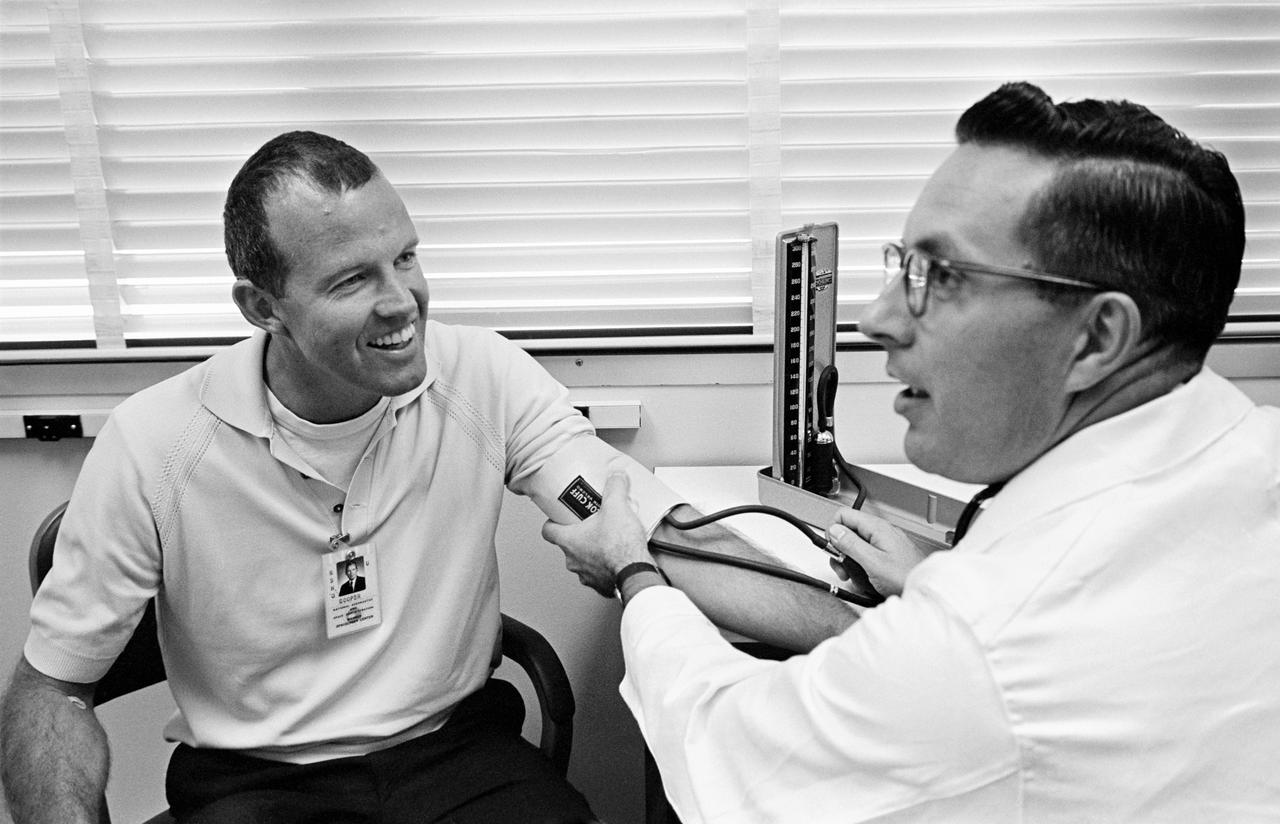
S65-28710 (17 Aug. 1965) --- Astronaut L. Gordon Cooper Jr., command pilot for the Gemini-5 spaceflight, has his blood pressure checked by Dr. Charles A. Berry, chief, Center Medical Programs, Manned Spacecraft Center, during a preflight physical examination.
Astronaut Gordon Cooper receives preflight medical exam for Gemini 5 flight
NASA astronaut John Young was remembered in a ceremony at the Heroes and Legends exhibit at the Kennedy Space Center Visitor Complex. The brief memorial took place on the afternoon of Jan. 11, 2018. Young died Jan. 5, 2018, in Houston at the age of 87. He was the only astronaut to fly in NASA's Gemini, Apollo and Space Shuttle Programs.
John Young Memorial Tribute
NASA astronaut John Young was remembered in a ceremony at the Heroes and Legends exhibit at the Kennedy Space Center Visitor Complex. The brief memorial took place on the afternoon of Jan. 11, 2018. Young died Jan. 5, 2018, in Houston at the age of 87. He was the only astronaut to fly in NASA's Gemini, Apollo and Space Shuttle Programs.
John Young Memorial Tribute
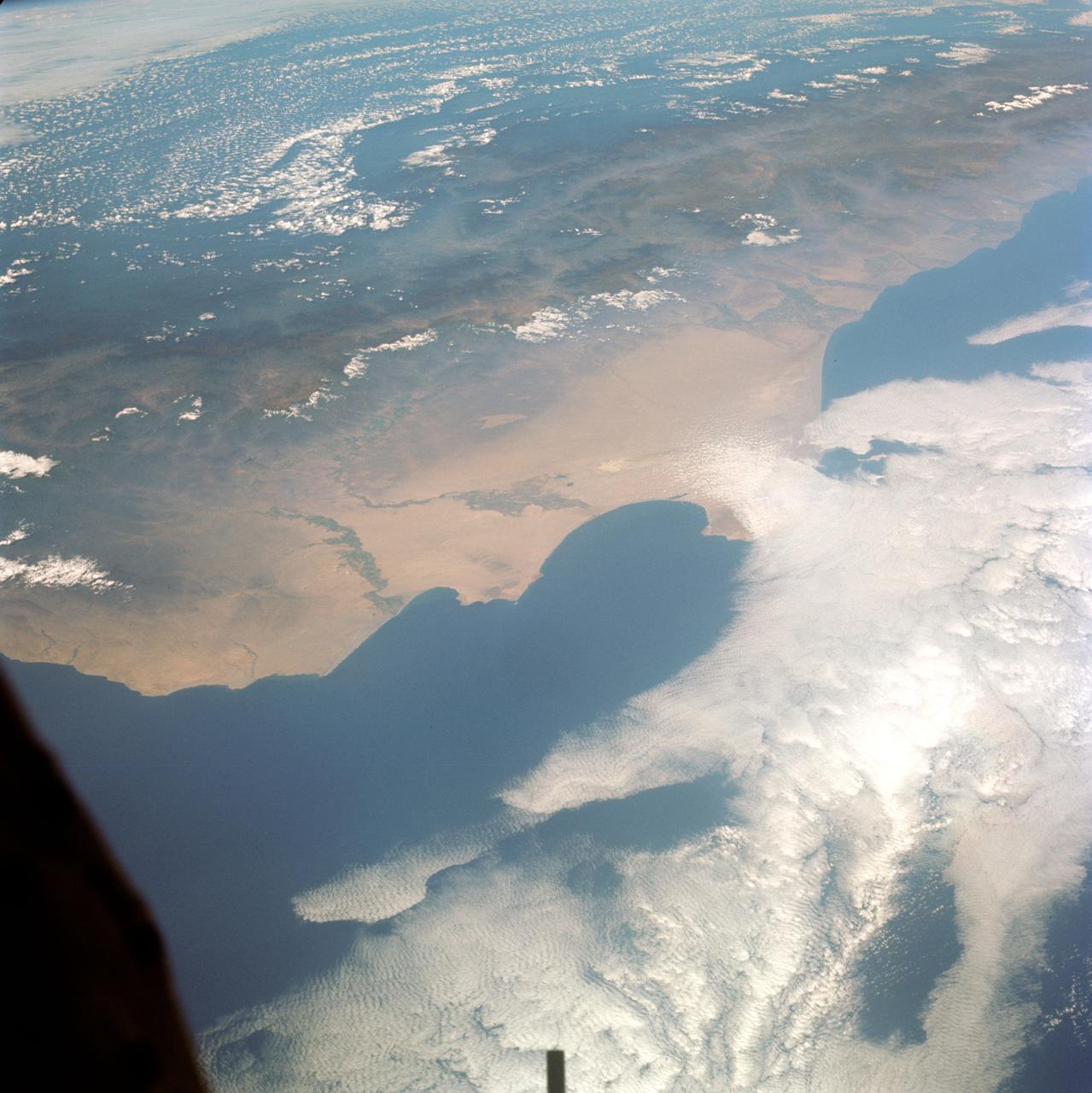
S66-38290 (5 June 1966) --- The north coastal area of Peru looking southeast across the Andes Mountains as seen from the National Aeronautics and Space Administration's Gemini-9A spacecraft. The body of water is the Pacific Ocean. The image was taken with a modified 70mm Hasselblad camera, using Eastman Kodak, Ektachrome MS (S.O. 217) color film. Photo credit: NASA
GEMINI-TITAN (GT)-9 - EARTH-SKY VIEW - PERU - OUTER SPACE
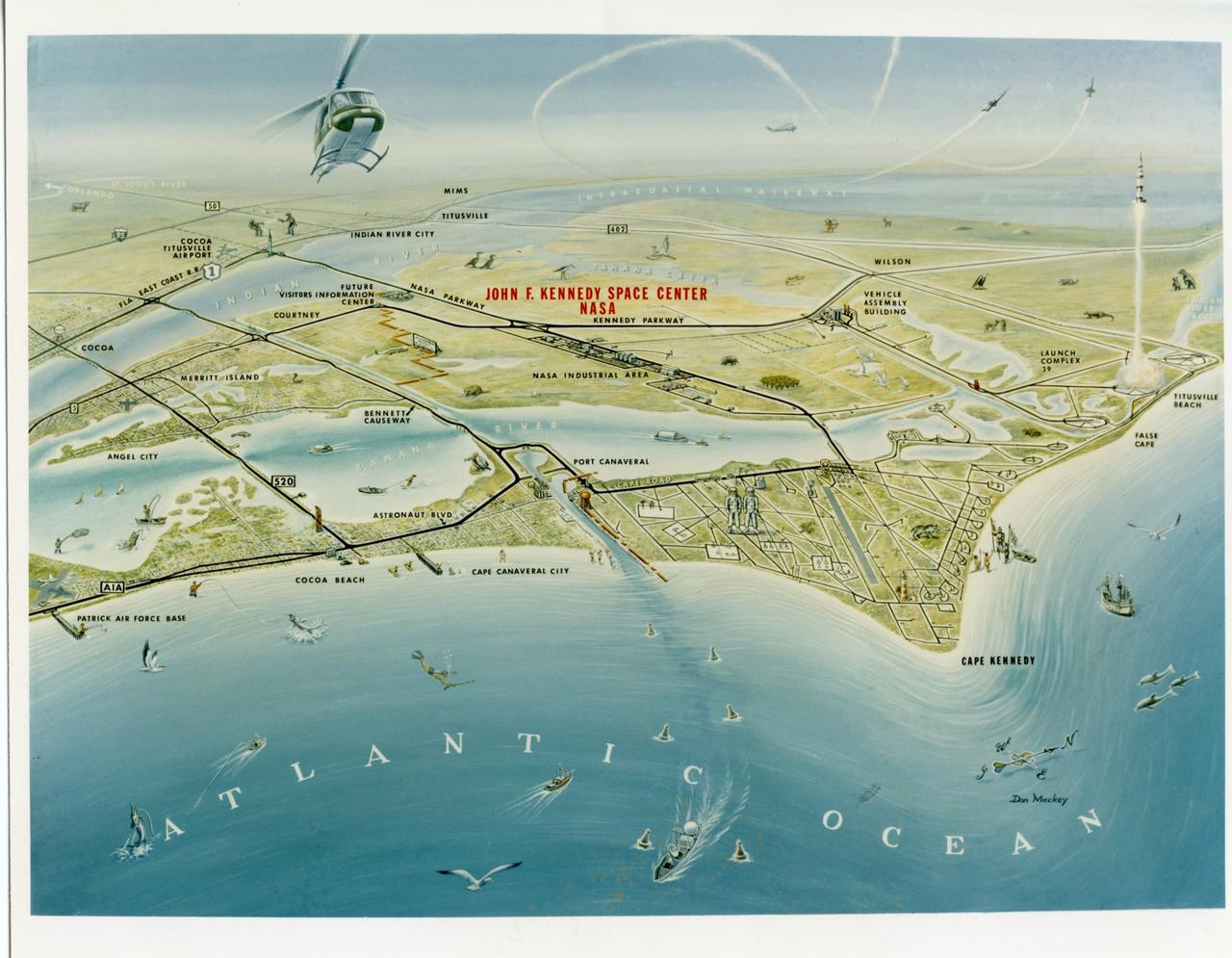
CAPE KENNEDY, Fla. -- This artist's rendering depicts Florida's Space Coast where NASA's two-man Gemini Program is paving the way for manned flight to the moon before the end of the decade. Adjacent to Cape Kennedy Air Force Station is Merritt Island where facilities are being built at the John F. Kennedy Space Center to launch the Saturn V rockets for the Apollo Program. Image Credit: NASA
KSC-65C-4228
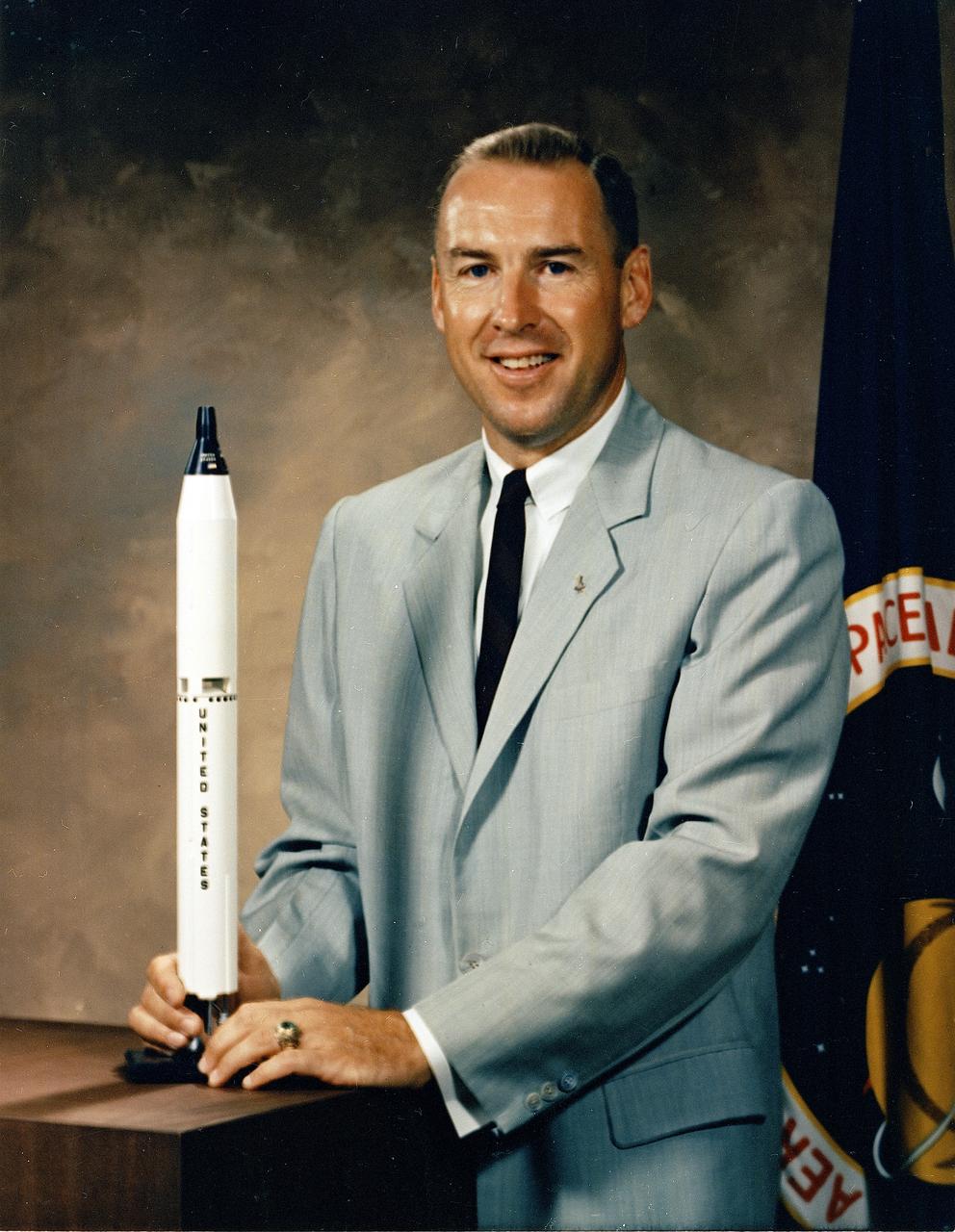
This is the official NASA portrait of astronaut James Lovell. Captain Lovell was selected as an Astronaut by NASA in September 1962. He has since served as backup pilot for the Gemini 4 flight and backup Commander for the Gemini 9 flight, as well as backup Commander to Neil Armstrong for the Apollo 11 lunar landing mission. On December 4, 1965, he and Frank Borman were launched into space on the history making Gemini 7 mission. The flight lasted 330 hours and 35 minutes and included the first rendezvous of two manned maneuverable spacecraft. The Gemini 12 mission, commanded by Lovell with Pilot Edwin Aldrin, began on November 11, 1966 for a 4-day, 59-revolution flight that brought the Gemini program to a successful close. Lovell served as Command Module Pilot and Navigator on the epic six-day journey of Apollo 8, the first manned Saturn V liftoff responsible for allowing the first humans to leave the gravitational influence of Earth. He completed his fourth mission as Spacecraft Commander of the Apollo 13 flight, April 11-17, 1970, and became the first man to journey twice to the moon. The Apollo 13 mission was cut short due to a failure of the Service Module cryogenic oxygen system. Aborting the lunar course, Lovell and fellow crewmen, John L. Swigert and Fred W. Haise, working closely with Houston ground controllers, converted their lunar module, Aquarius, into an effective lifeboat that got them safely back to Earth. Captain Lovell held the record for time in space with a total of 715 hours and 5 minutes until surpassed by the Skylab flights. On March 1, 1973, Captain Lovell retired from the Navy and the Space Program.
Saturn Apollo Program
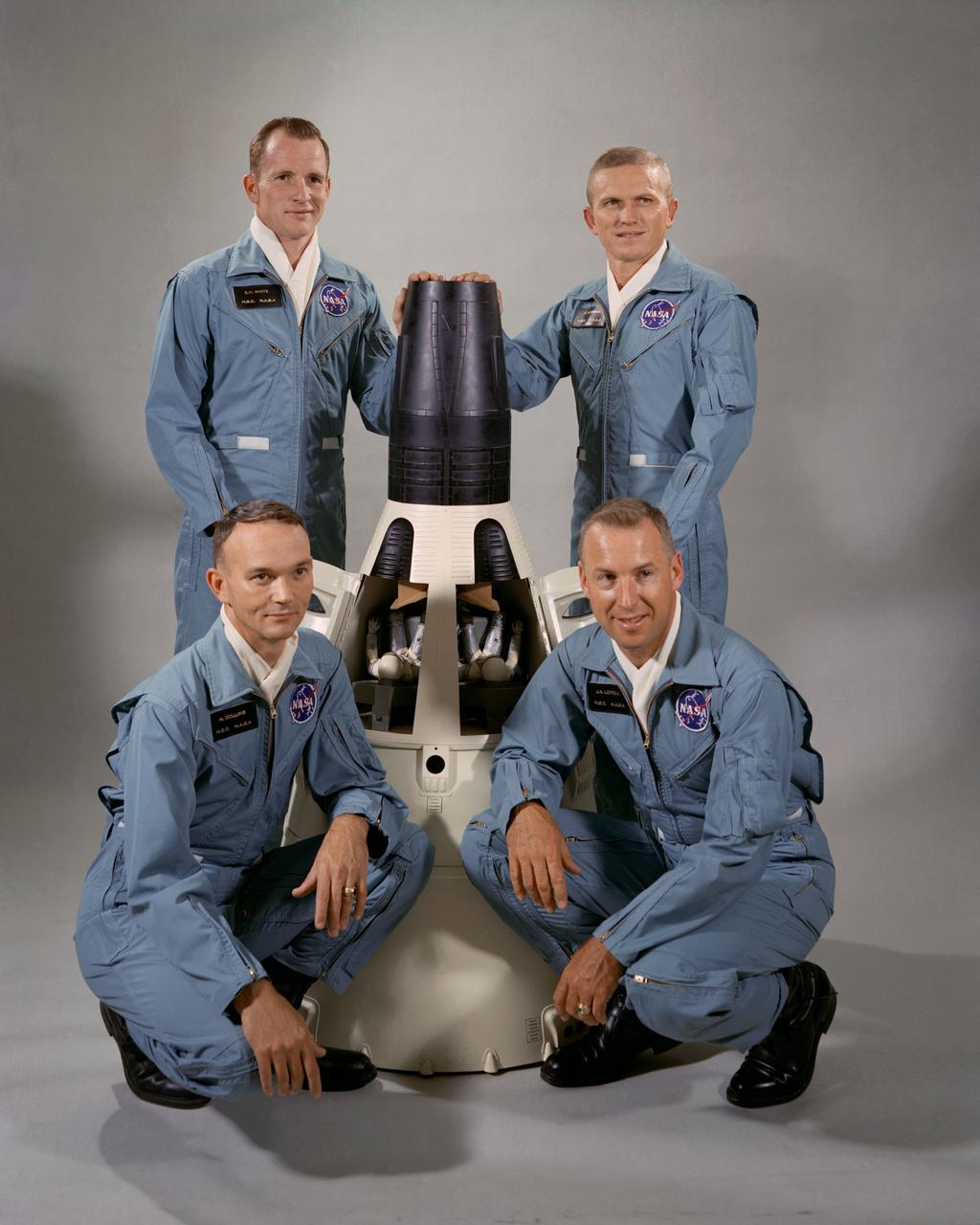
S65-41828 (September 1965) --- Portrait of the Gemini-7 prime and backup crew members around a model of the Gemini-7 spacecraft. The prime crew members for the Gemini-Titan 7 (GT-7) are astronauts Frank Borman (standing right), command pilot, and James A. Lovell Jr. (kneeling right), pilot. Astronauts Michael Collins (kneeling left), pilot, and Edward H. White II (standing left), command pilot, were named as GT-7 backup crew members on July 1, 1965. Photo credit: NASA
GEMINI-TITAN (GT)-7 - PRIME AND BACKUP CREW PROGRAM
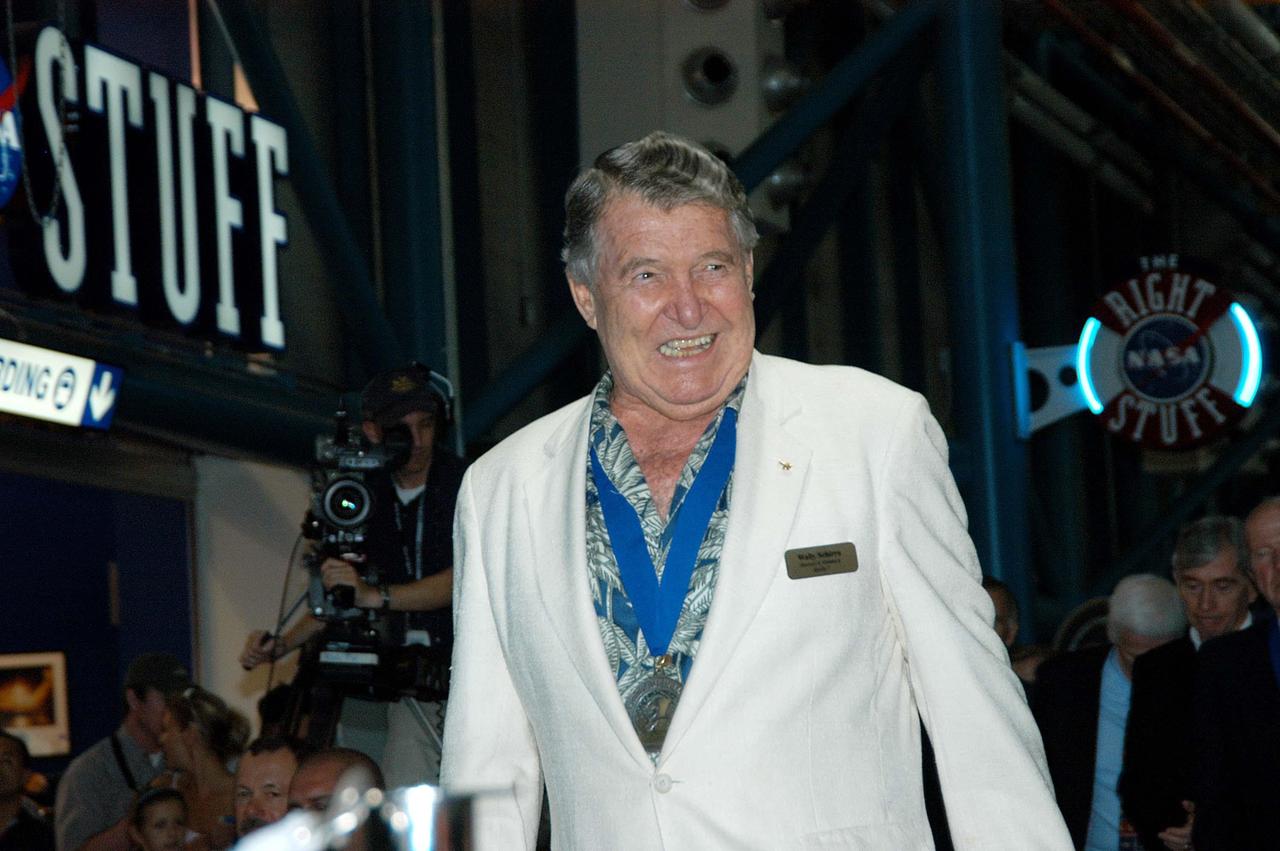
KENNEDY SPACE CENTER, FLA. --  Before the induction ceremony of five space program heroes into the U.S. Astronaut Hall of Fame, former astronaut Wally Schirra is greeted with applause as he is introduced as a previous inductee.  One of America's original Mercury Seven astronauts, Schirra is  the only one who flew in all three of the nation's pioneering space programs, Mercury, Gemini, and Apollo. The ceremony was held at the Apollo/Saturn V Center at KSC.  New inductees are Richard O. Covey, commander of the Hubble Space Telescope repair mission; Norman E. Thagard, the first American to occupy Russia’s Mir space station; the late Francis R. "Dick" Scobee, commander of the ill-fated 1986 Challenger mission; Kathryn D. Sullivan, the first American woman to walk in space; and Frederick D. Gregory, the first African-American to command a space mission and the current NASA deputy administrator. The U.S. Astronaut Hall of Fame opened in 1990 to provide a place where space travelers could be remembered for their participation and accomplishments in the U.S. space program. The five inductees join 52 previously honored astronauts from the ranks of the Gemini, Apollo, Skylab, Apollo-Soyuz, and Space Shuttle programs.
KSC-04pd1005
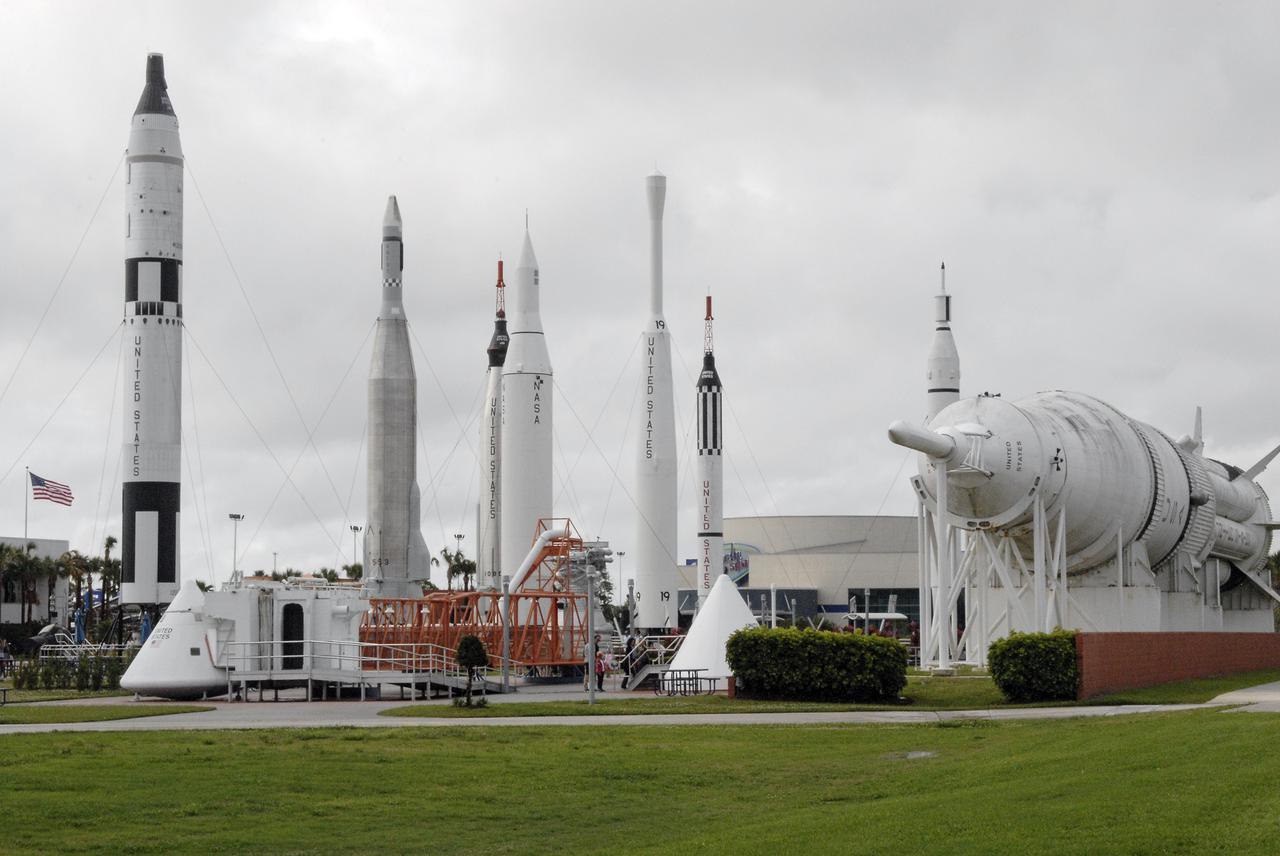
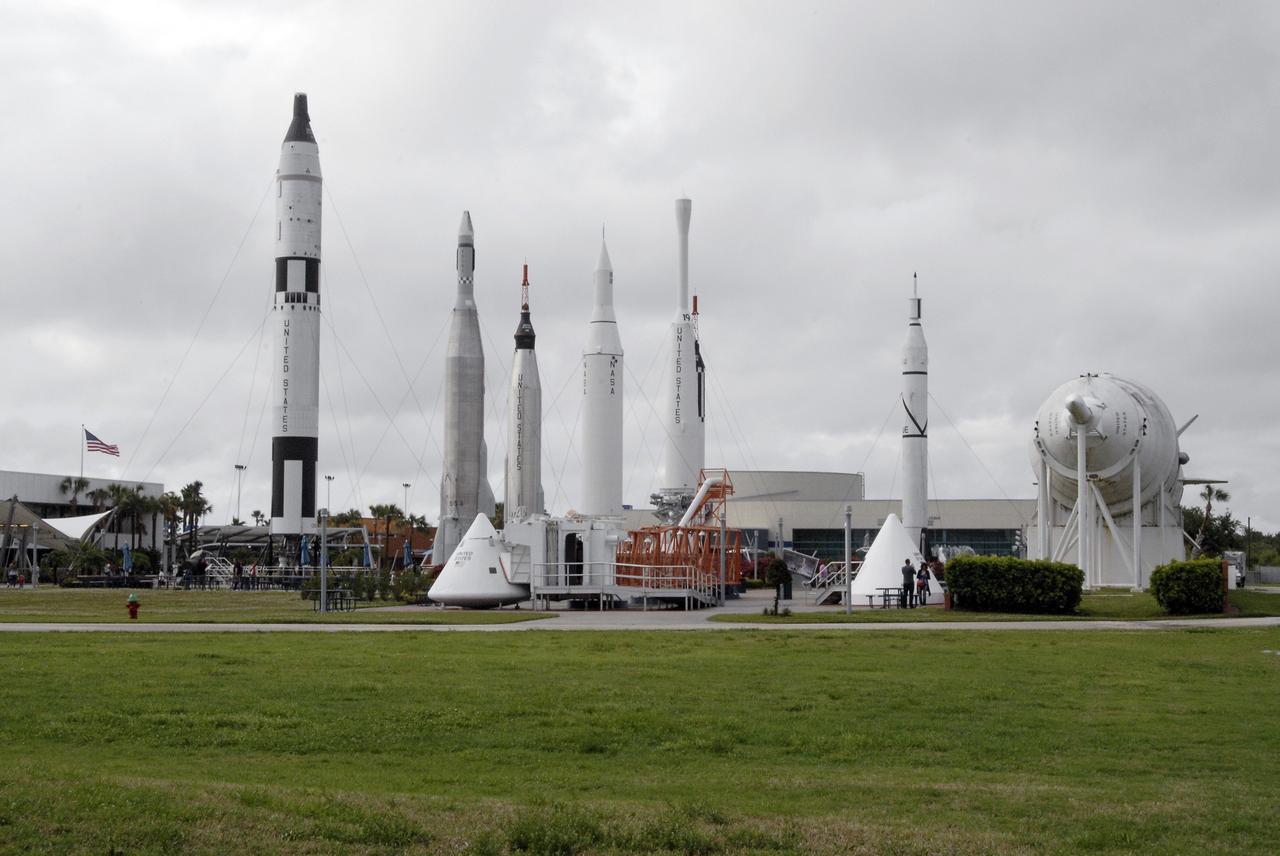
CAPE CANAVERAL, Fla. – The Rocket Garden at the Kennedy Space Center Visitor Complex in Florida, features real and mock-up rockets from NASA’s Mercury, Gemini and Apollo programs, as well as others from uncrewed missions. The large rocket positioned horizontally at far right is an Apollo Saturn 1B, while the rocket standing at far left is a Gemini Titan launch vehicle. The visitor complex is managed for NASA by Delaware North Companies Parks and Resorts. The complex features interactive displays, astronaut encounters, IMAX movies and attractions that help to tell the story of U.S. space exploration. It is home to the recently-opened Angry Birds Space attraction and the Space Shuttle Atlantis exhibit that will open to the general public this summer.  Photo credit: NASA_Charisse Nahser
KSC-2013-2103
CAPE CANAVERAL, Fla. – The Rocket Garden at the Kennedy Space Center Visitor Complex in Florida, features real and mock-up rockets from NASA’s Mercury, Gemini and Apollo programs, as well as others from uncrewed missions. The large rocket positioned horizontally at far right is an Apollo Saturn 1B, while the rocket standing at far left is a Gemini Titan launch vehicle. The visitor complex is managed for NASA by Delaware North Companies Parks and Resorts. The complex features interactive displays, astronaut encounters, IMAX movies and attractions that help to tell the story of U.S. space exploration. It is home to the recently-opened Angry Birds Space attraction and the Space Shuttle Atlantis exhibit that will open to the general public this summer.  Photo credit: NASA_Charisse Nahser
KSC-2013-2104
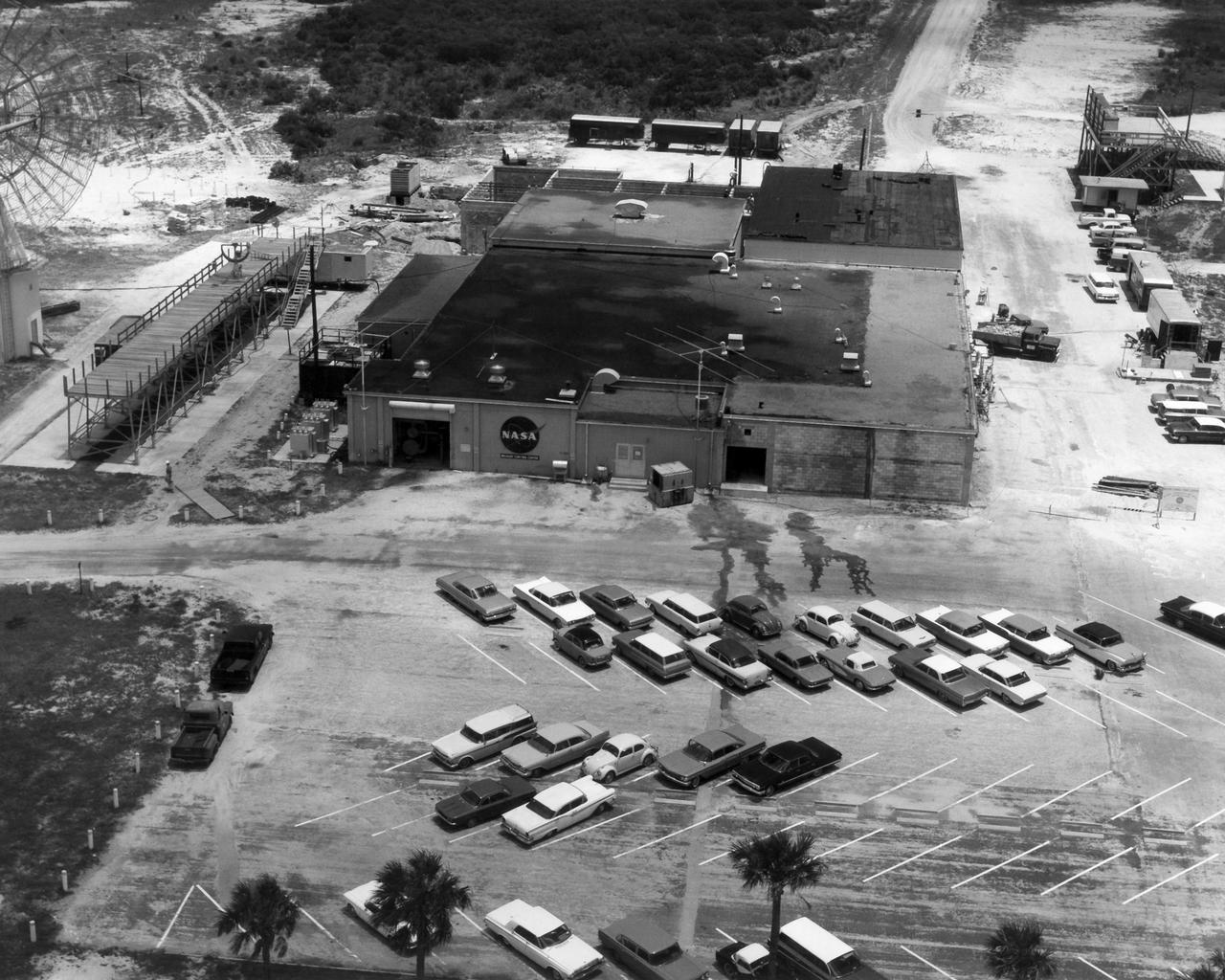
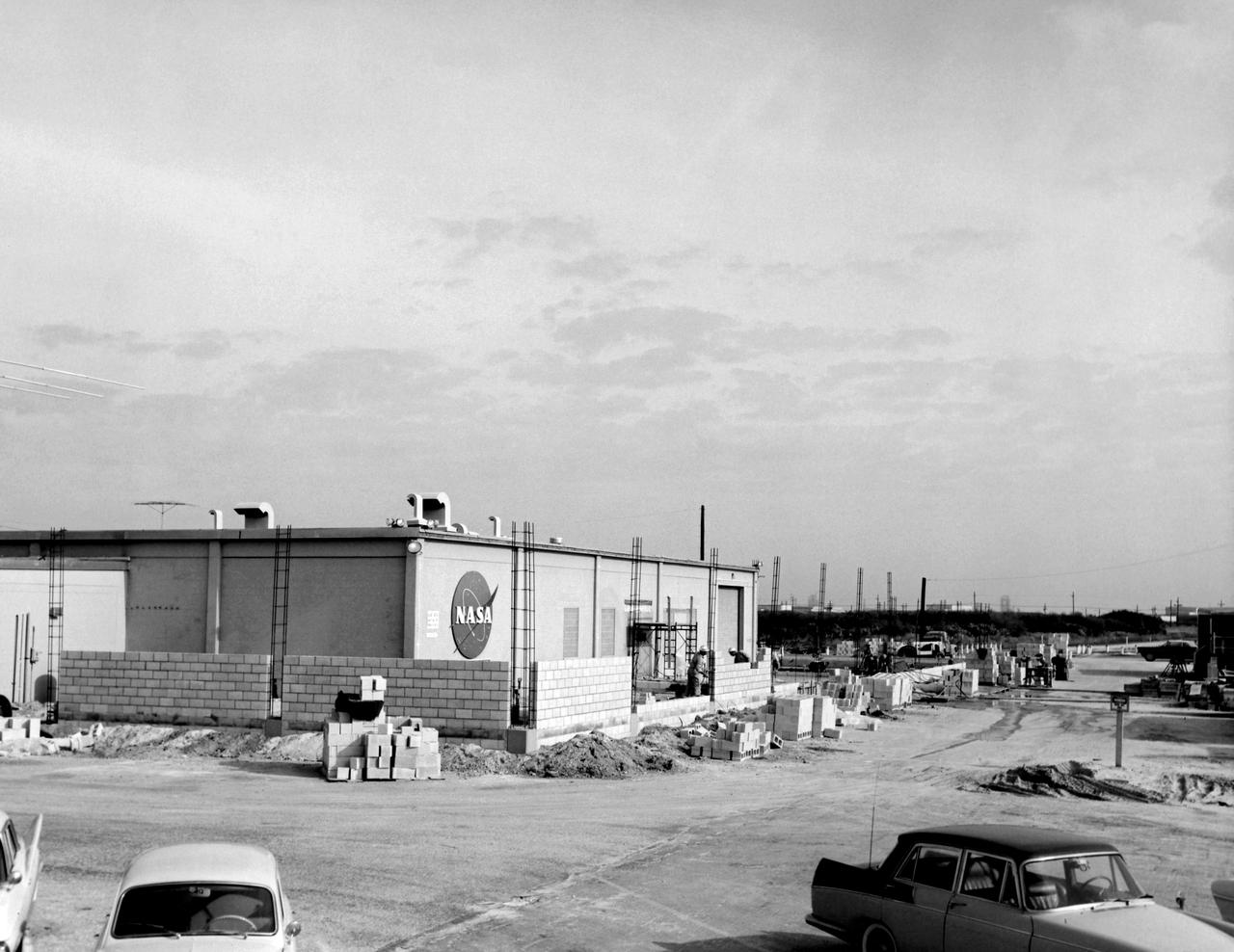
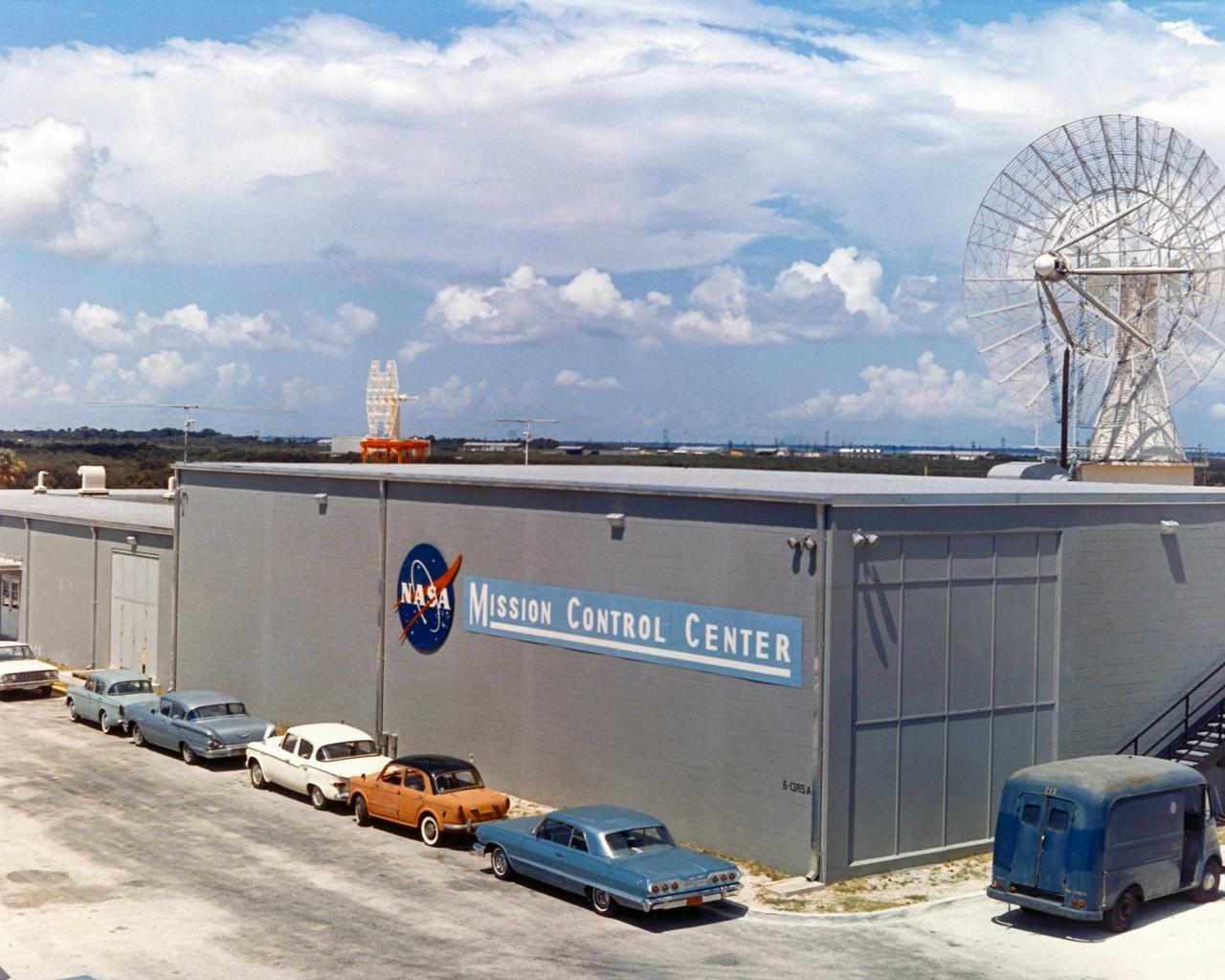
CAPE CANAVERAL, Fla. - Between 1962 and 1963, the Mission Control Center was modified to handle the additional complexities of the Gemini Program. In 1962, Pan American World Airways Inc. was contracted to design an addition to the facility, which wrapped around the east, north, and most of the west and south sides.           The Mercury Mission Control Center in Florida played a key role in the United States' early spaceflight program. Located at Cape Canaveral Air Force Station, the original part of the building was constructed between 1956 and 1958, with additions in 1959 and 1963. The facility officially was transferred to NASA on Dec. 26, 1963, and served as mission control during all the Project Mercury missions, as well as the first three flights of the Gemini Program, when it was renamed Mission Control Center. With its operational days behind, on June 1, 1967, the Mission Control Center became a stop on the public tour of NASA facilities until the mid-90s. In 1999, much of the equipment and furnishings from the Flight Control Area were moved to the Kennedy Space Center Visitor Complex where they became part of the exhibit there. The building was demolished in spring 2010. Photo credit: NASA
KSC-LOC-63-5635
KENNEDY SPACE CENTER, FLA. -- Before the induction ceremony of five space program heroes into the U.S. Astronaut Hall of Fame, former astronaut Gordon Cooper is introduced as a previous inductee.  One of America’s original Mercury Seven astronauts, Cooper flew the last and longest Project Mercury orbital mission and spent eight days in space aboard Gemini 5. The ceremony was held at the Apollo/Saturn V Center at KSC.  New inductees are Richard O. Covey, commander of the Hubble Space Telescope repair mission; Norman E. Thagard, the first American to occupy Russia’s Mir space station; the late Francis R. "Dick" Scobee, commander of the ill-fated 1986 Challenger mission; Kathryn D. Sullivan, the first American woman to walk in space; and Frederick D. Gregory, the first African-American to command a space mission and the current NASA deputy administrator. The U.S. Astronaut Hall of Fame opened in 1990 to provide a place where space travelers could be remembered for their participation and accomplishments in the U.S. space program. The five inductees join 52 previously honored astronauts from the ranks of the Gemini, Apollo, Skylab, Apollo-Soyuz, and Space Shuttle programs.
KSC-04pd1006
KENNEDY SPACE CENTER, FLA. --  Before the induction ceremony of five space program heroes into the U.S. Astronaut Hall of Fame, astronaut John Young is warmly greeted as he is introduced as a previous inductee.  Co-holder of a record for the most space flights, six, he flew on Gemini 3 and 10, orbited the Moon on Apollo 10, walked on the Moon on Apollo 16, and commanded two space shuttle missions, STS-1 and STS-9.  Young currently serves as associate director, technical, at  Johnson Space Center. The induction ceremony was held at the Apollo/Saturn V Center at KSC.  New inductees are Richard O. Covey, commander of the Hubble Space Telescope repair mission; Norman E. Thagard, the first American to occupy Russia’s Mir space station; the late Francis R. "Dick" Scobee, commander of the ill-fated 1986 Challenger mission; Kathryn D. Sullivan, the first American woman to walk in space; and Frederick D. Gregory, the first African-American to command a space mission and the current NASA deputy administrator. The U.S. Astronaut Hall of Fame opened in 1990 to provide a place where space travelers could be remembered for their participation and accomplishments in the U.S. space program. The five inductees join 52 previously honored astronauts from the ranks of the Gemini, Apollo, Skylab, Apollo-Soyuz, and Space Shuttle programs.
KSC-04pd1007
CAPE CANAVERAL, Fla. - Between 1962 and 1963, the Mission Control Center was modified to handle the additional complexities of the Gemini Program. In 1962, Pan American World Airways Inc. was contracted to design an addition to the facility, which wrapped around the east, north, and most of the west and south sides.           The Mercury Mission Control Center in Florida played a key role in the United States' early spaceflight program. Located at Cape Canaveral Air Force Station, the original part of the building was constructed between 1956 and 1958, with additions in 1959 and 1963. The facility officially was transferred to NASA on Dec. 26, 1963, and served as mission control during all the Project Mercury missions, as well as the first three flights of the Gemini Program, when it was renamed Mission Control Center. With its operational days behind, on June 1, 1967, the Mission Control Center became a stop on the public tour of NASA facilities until the mid-90s. In 1999, much of the equipment and furnishings from the Flight Control Area were moved to the Kennedy Space Center Visitor Complex where they became part of the exhibit there. The building was demolished in spring 2010. Photo credit: NASA
KSC-LOC-63-5674
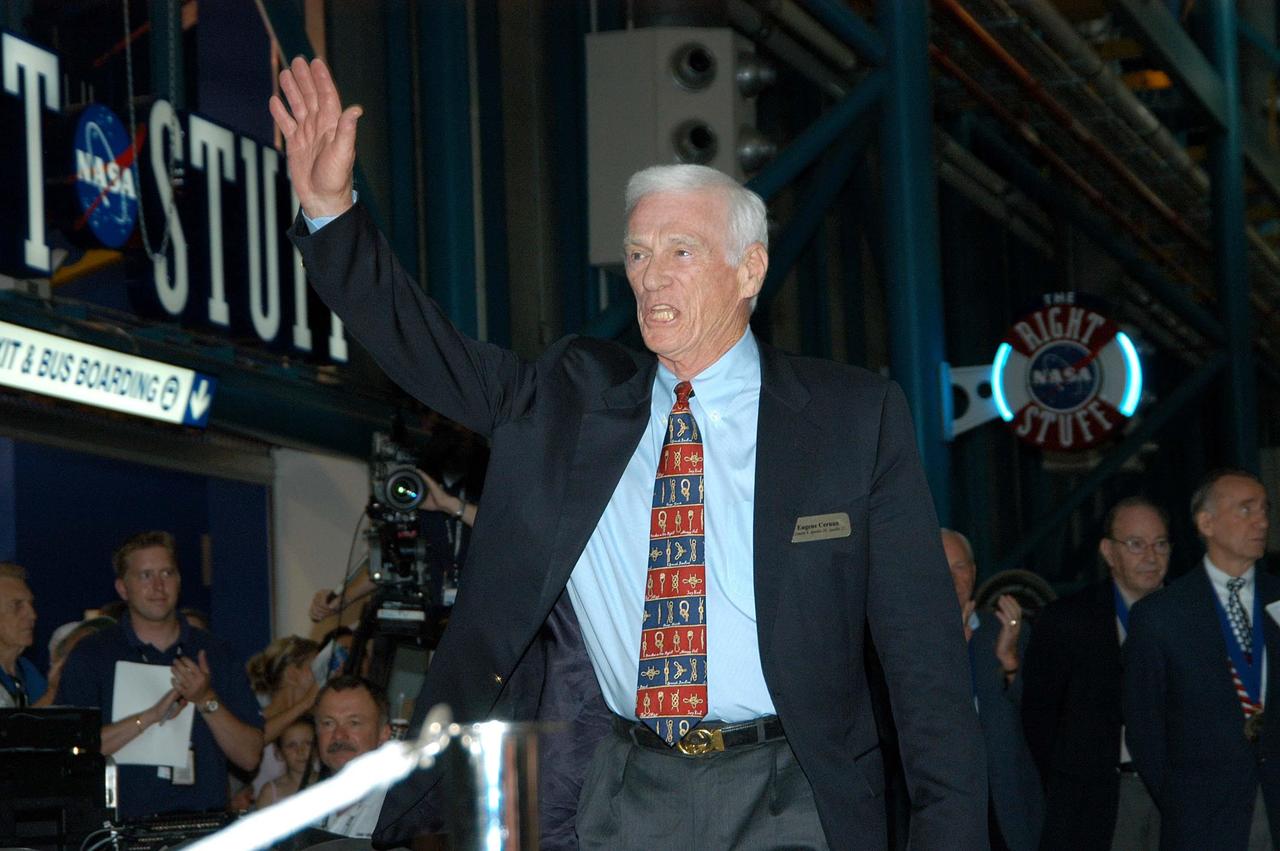
KENNEDY SPACE CENTER, FLA. --  Before the induction ceremony of five space program heroes into the U.S. Astronaut Hall of Fame, former astronaut Gene Cernan waves to guests as he is introduced as a previous inductee.  He walked in space on Gemini 9, orbited the Moon on Apollo 10 and walked on the Moon as commander of Apollo 17. The ceremony was held at the Apollo/Saturn V Center at KSC.  New inductees are Richard O. Covey, commander of the Hubble Space Telescope repair mission; Norman E. Thagard, the first American to occupy Russia’s Mir space station; the late Francis R. "Dick" Scobee, commander of the ill-fated 1986 Challenger mission; Kathryn D. Sullivan, the first American woman to walk in space; and Frederick D. Gregory, the first African-American to command a space mission and the current NASA deputy administrator. The U.S. Astronaut Hall of Fame opened in 1990 to provide a place where space travelers could be remembered for their participation and accomplishments in the U.S. space program. The five inductees join 52 previously honored astronauts from the ranks of the Gemini, Apollo, Skylab, Apollo-Soyuz, and Space Shuttle programs.
KSC-04pd1008
CAPE CANAVERAL, Fla. - Between 1962 and 1963, the Mission Control Center was modified to handle the additional complexities of the Gemini Program. In 1962, Pan American World Airways Inc. was contracted to design an addition to the facility, which wrapped around the east, north, and most of the west and south sides.           The Mercury Mission Control Center in Florida played a key role in the United States' early spaceflight program. Located at Cape Canaveral Air Force Station, the original part of the building was constructed between 1956 and 1958, with additions in 1959 and 1963. The facility officially was transferred to NASA on Dec. 26, 1963, and served as mission control during all the Project Mercury missions, as well as the first three flights of the Gemini Program, when it was renamed Mission Control Center. With its operational days behind, on June 1, 1967, the Mission Control Center became a stop on the public tour of NASA facilities until the mid-90s. In 1999, much of the equipment and furnishings from the Flight Control Area were moved to the Kennedy Space Center Visitor Complex where they became part of the exhibit there. The building was demolished in spring 2010. Photo credit: NASA
KSC-LOC-63-1971
CAPE CANAVERAL, Fla. - Between 1962 and 1963, the Mission Control Center was modified to handle the additional complexities of the Gemini Program. In 1962, Pan American World Airways Inc. was contracted to design an addition to the facility, which wrapped around the east, north, and most of the west and south sides.           The Mercury Mission Control Center in Florida played a key role in the United States' early spaceflight program. Located at Cape Canaveral Air Force Station, the original part of the building was constructed between 1956 and 1958, with additions in 1959 and 1963. The facility officially was transferred to NASA on Dec. 26, 1963, and served as mission control during all the Project Mercury missions, as well as the first three flights of the Gemini Program, when it was renamed Mission Control Center. With its operational days behind, on June 1, 1967, the Mission Control Center became a stop on the public tour of NASA facilities until the mid-90s. In 1999, much of the equipment and furnishings from the Flight Control Area were moved to the Kennedy Space Center Visitor Complex where they became part of the exhibit there. The building was demolished in spring 2010. Photo credit: NASA
KSC-LOC-63-1017
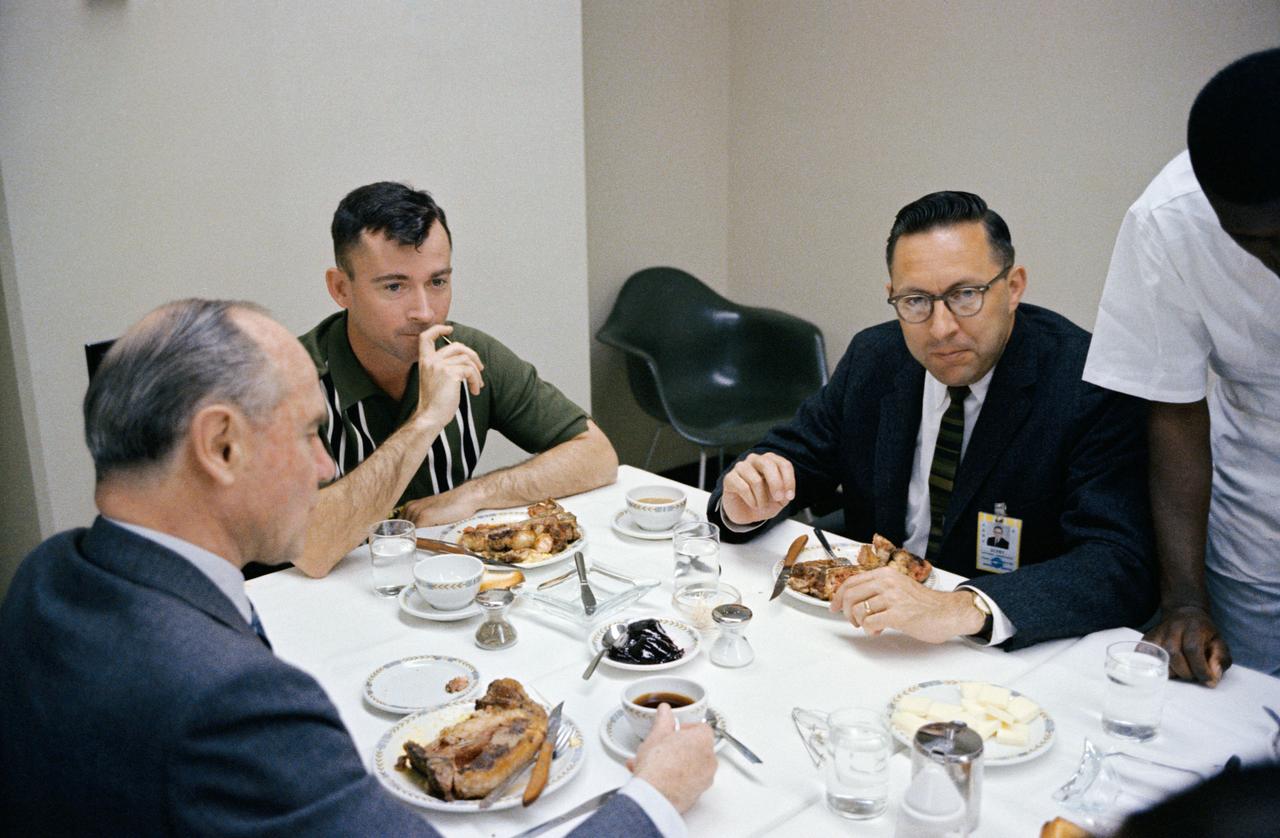
S65-20428 (23 March 1965) --- Astronaut John W. Young (center), pilot of the Gemini-Titan 3 flight, is shown during a steak breakfast which he was served about two hours prior to the 9:24 a.m. (EST) GT-3 launch. At left is J.S. McDonnell, board chairman and Chief Executive Officer of the McDonnell Aircraft Corporation. Dr. Charles A. Berry, chief of Center Medical Programs, is at right.
STEAK BREAKFAST - ASTRONAUT JOHN W. YOUNG - PERSONNEL
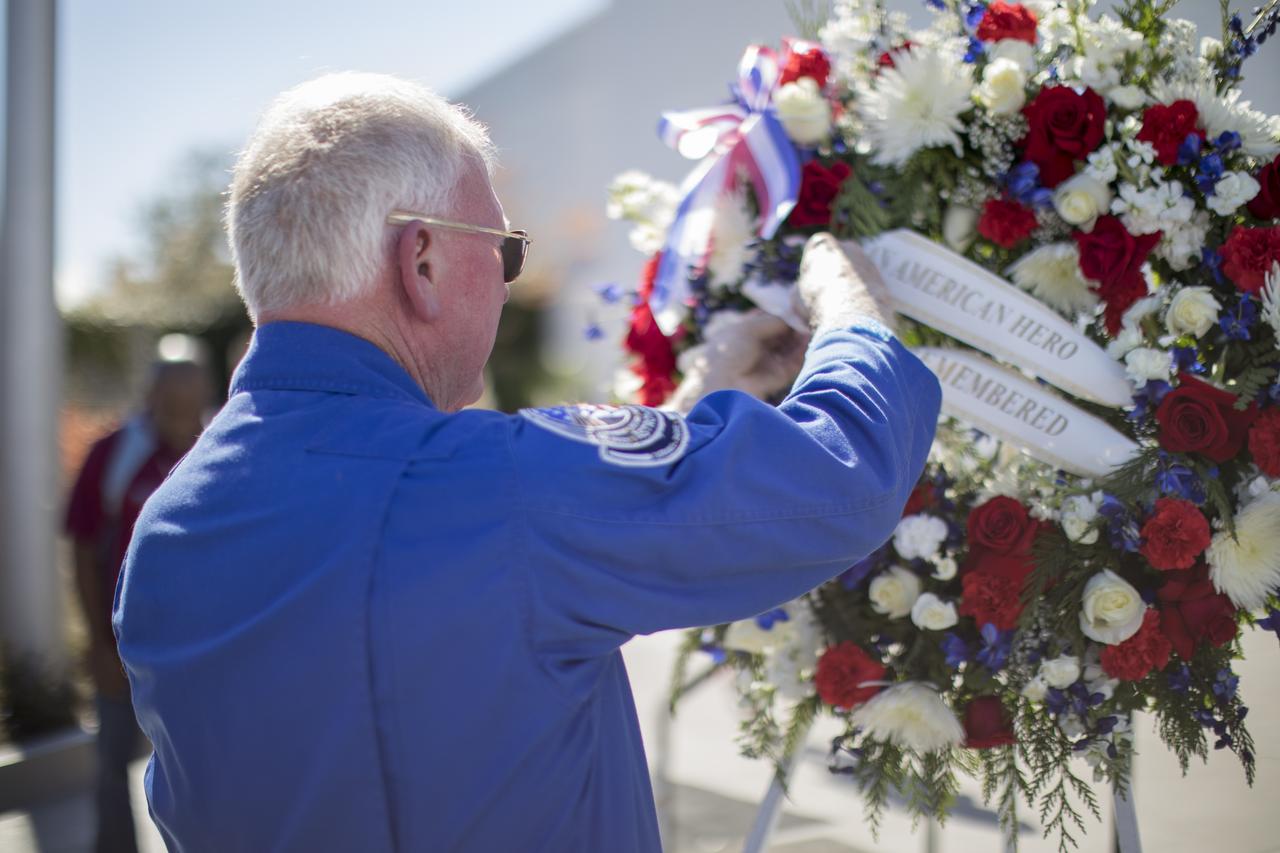
Former NASA astronaut Jon McBride places a wreath at the Heroes and Legends exhibit at the Kennedy Space Center Visitor Complex. The brief memorial honoring NASA astronaut John Young took place on the afternoon of Jan. 11, 2018. Young died Jan. 5, 2018, in Houston at the age of 87. He was the only astronaut to fly in NASA's Gemini, Apollo and Space Shuttle Programs.
John Young Memorial Tribute
Delaware North COO Therrin Protze speaks during a ceremony at the Heroes and Legends exhibit at the Kennedy Space Center Visitor Complex. The brief memorial honoring NASA astronaut John Young took place on the afternoon of Jan. 11, 2018. Young died Jan. 5, 2018, in Houston at the age of 87. He was the only astronaut to fly in NASA's Gemini, Apollo and Space Shuttle Programs.
John Young Memorial Tribute
S65-28699 (17 Aug. 1965) --- Astronaut Charles Conrad Jr. (dark shirt), pilot for the Gemini-5 spaceflight, discusses x-rays with members of the medical team at Cape Kennedy. Left to right are Dr. Eugene Tubbs; astronaut Conrad; Dr. Charles A. Berry, chief, Center Medical Programs, Manned Spacecraft Center; and Dr. Robert Moser (seated), Medical Monitor with the U.S. Army.
ASTRONAUT CONRAD, CHARLES (PETE), JR. - X-RAYS - MEDICAL TEAM MEMBERS - CAPE
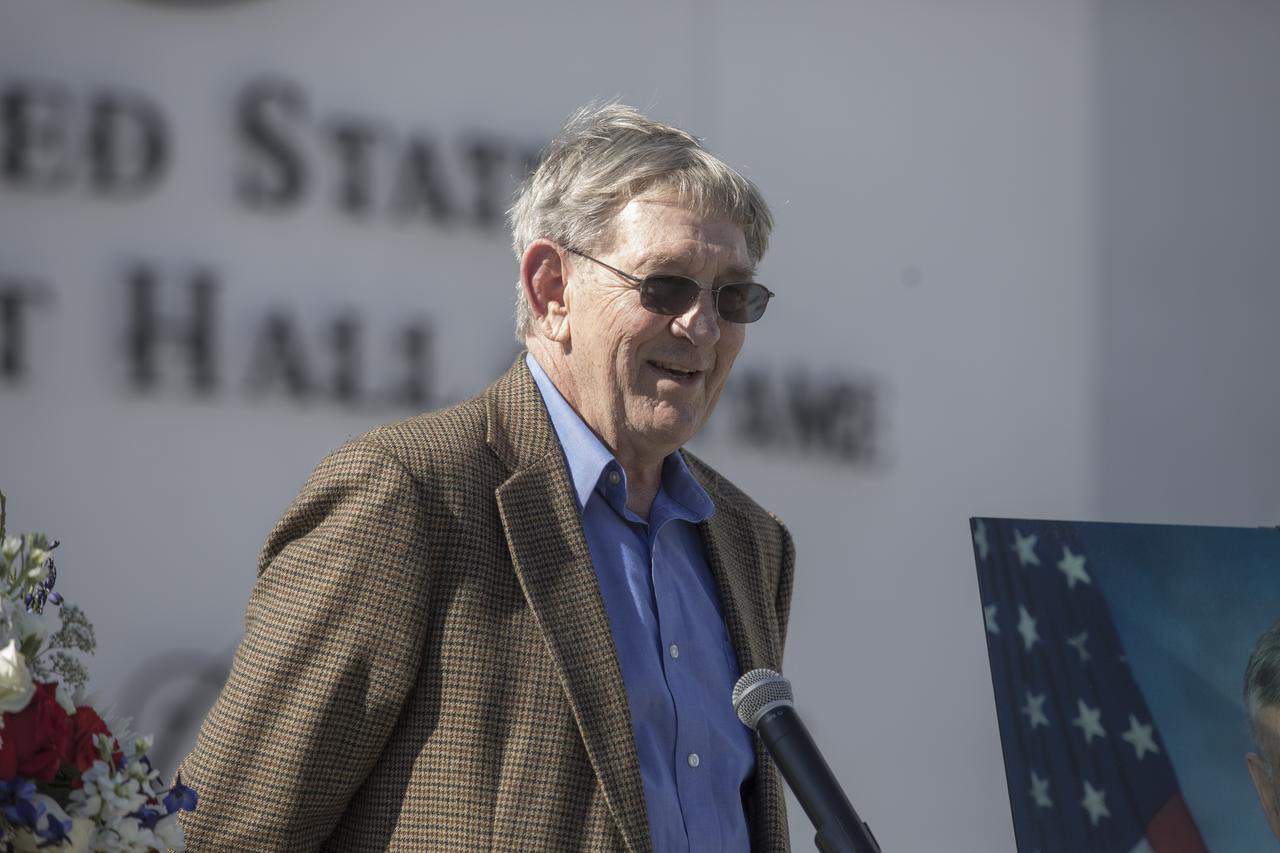
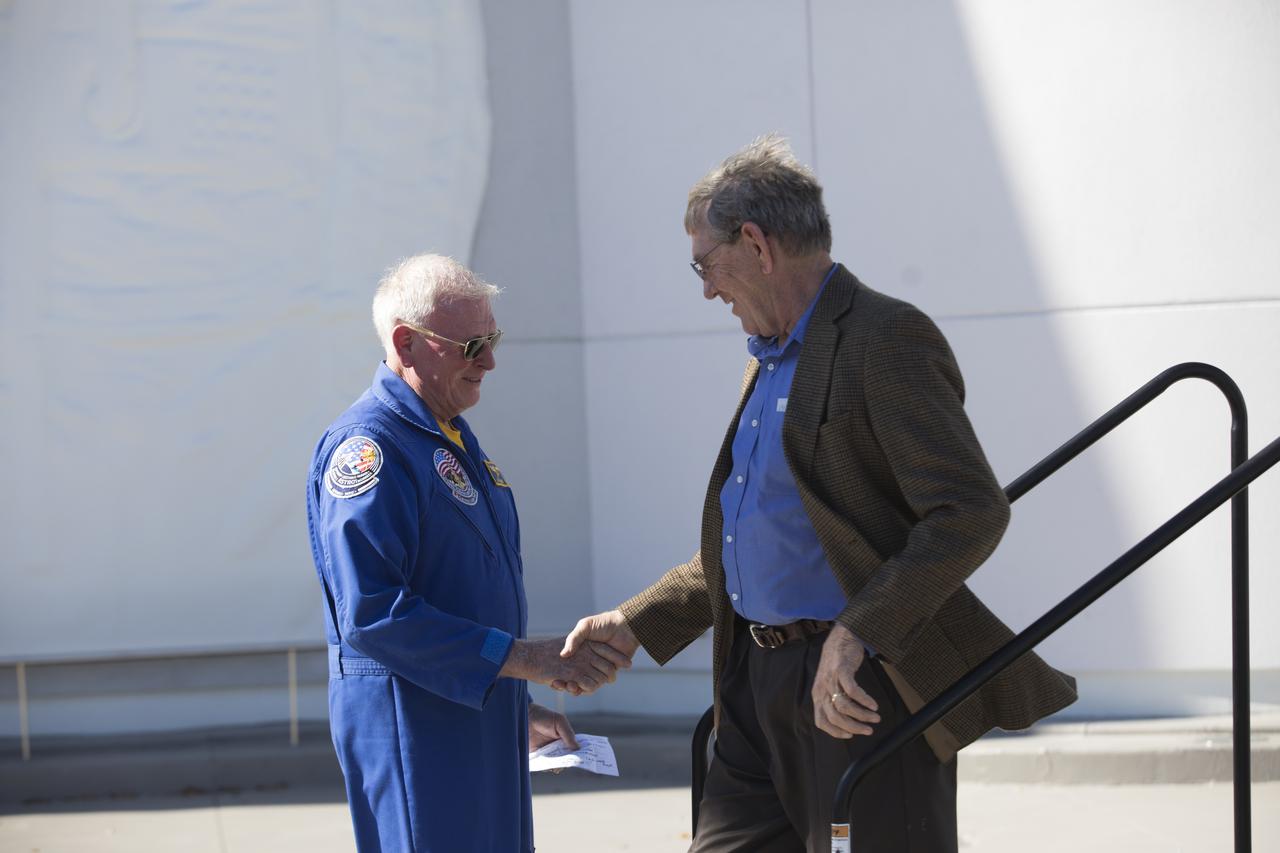
Former NASA astronaut Jon McBride, left, greets Mike McCulley during a ceremony at the Heroes and Legends exhibit at the Kennedy Space Center Visitor Complex. The brief memorial honoring NASA astronaut John Young took place on the afternoon of Jan. 11, 2018. Young died Jan. 5, 2018, in Houston at the age of 87. He was the only astronaut to fly in NASA's Gemini, Apollo and Space Shuttle Programs.
John Young Memorial Tribute
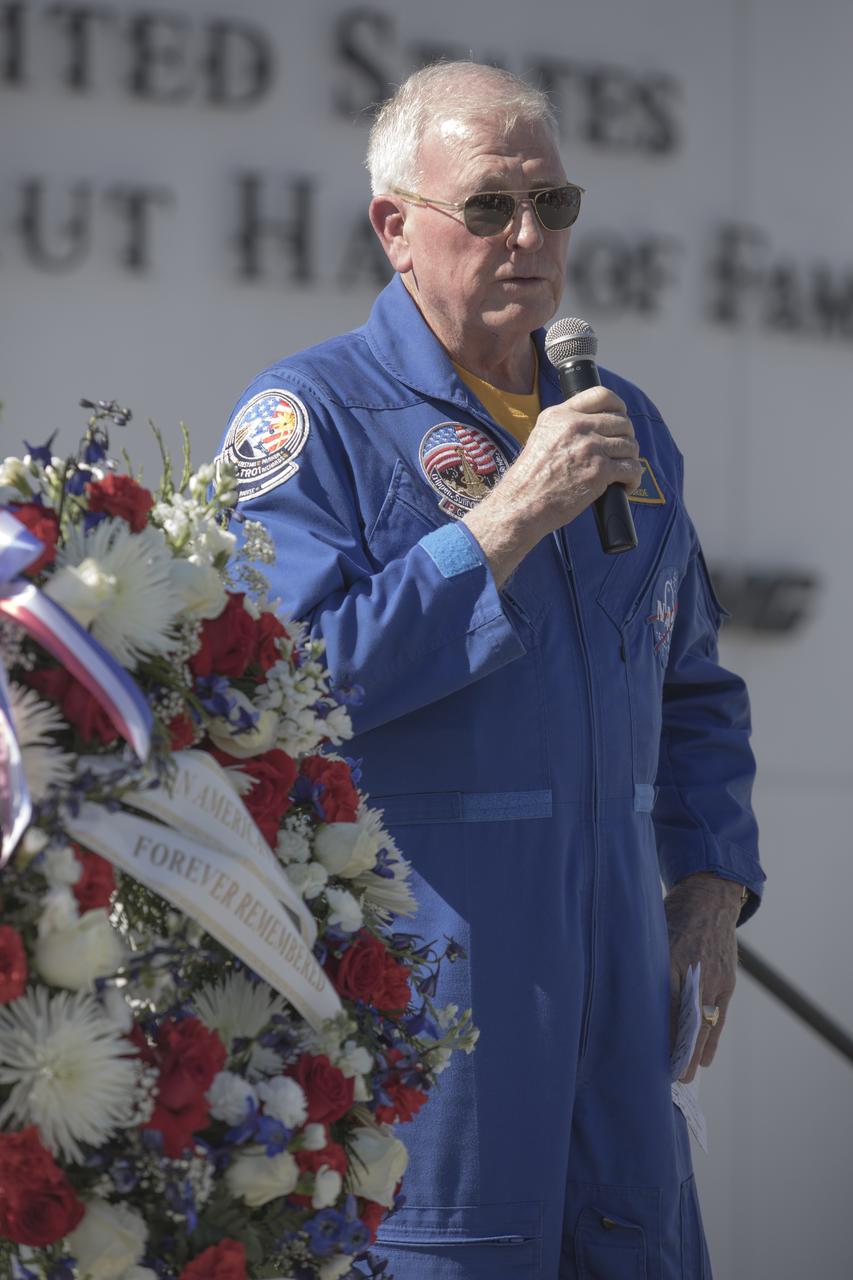
Former NASA astronaut Mike McCulley speaks during a ceremony at the Heroes and Legends exhibit at the Kennedy Space Center Visitor Complex. The brief memorial honoring NASA astronaut John Young took place on the afternoon of Jan. 11, 2018. Young died Jan. 5, 2018, in Houston at the age of 87.He was the only astronaut to fly in NASA's Gemini, Apollo and Space Shuttle Programs.
John Young Memorial Tribute
Former NASA astronaut Jon McBride speaks during a ceremony at the Heroes and Legends exhibit at the Kennedy Space Center Visitor Complex. The brief memorial honoring NASA astronaut John Young took place on the afternoon of Jan. 11, 2018. Young died Jan. 5, 2018, in Houston at the age of 87. He was the only astronaut to fly in NASA's Gemini, Apollo and Space Shuttle Programs.
John Young Memorial Tribute
KENNEDY SPACE CENTER, FLA. -  A group of current and former U.S. astronauts are introduced to the audience at a ribbon cutting ceremony officially opening the U.S. Astronaut Hall of Fame as part of the Kennedy Space Center Visitor Complex.  In the front row, from left, are Owen K. Garriott, Walter Cunningham, Jack R. Lousma, Alfred M. Worden, and Buzz Aldrin.  In the back row, from left, are Edgar D. Mitchell, Edward G. Gibson, Fred W. Haise, Frederick H. (Rick) Hauck, and John W. Young.  The ceremony was held in conjunction with the induction of four Space Shuttle astronauts into the Hall of Fame including Daniel Brandenstein, Robert "Hoot" Gibson, Story Musgrave, and Sally Ride.  Conceived by six of the Mercury Program astronauts, the U.S. Astronaut Hall of Fame opened in 1990 to provide a place where space travelers could be remembered for their participation and accomplishments in the U.S. space program.  The four new inductees join 48 previously honored astronauts from the ranks of the Gemini, Apollo, Skylab, Apollo-Soyuz, and Space Shuttle programs.
KENNEDY SPACE CENTER, FLA. - A group of current and former U.S. astronauts are introduced to the audience at a ribbon cutting ceremony officially opening the U.S. Astronaut Hall of Fame as part of the Kennedy Space Center Visitor Complex. In the front row, from left, are Owen K. Garriott, Walter Cunningham, Jack R. Lousma, Alfred M. Worden, and Buzz Aldrin. In the back row, from left, are Edgar D. Mitchell, Edward G. Gibson, Fred W. Haise, Frederick H. (Rick) Hauck, and John W. Young. The ceremony was held in conjunction with the induction of four Space Shuttle astronauts into the Hall of Fame including Daniel Brandenstein, Robert "Hoot" Gibson, Story Musgrave, and Sally Ride. Conceived by six of the Mercury Program astronauts, the U.S. Astronaut Hall of Fame opened in 1990 to provide a place where space travelers could be remembered for their participation and accomplishments in the U.S. space program. The four new inductees join 48 previously honored astronauts from the ranks of the Gemini, Apollo, Skylab, Apollo-Soyuz, and Space Shuttle programs.
KENNEDY SPACE CENTER, FLA. -  Center Director and former astronaut Roy D. Bridges, Jr., (left) shakes hands with former astronaut James Lovell following a ribbon cutting ceremony officially opening the U.S. Astronaut Hall of Fame as part of the Kennedy Space Center Visitor Complex.  Invited guests and dignitaries look on, such as, from left, former astronauts Edward G. Gibson, Edgar D. Mitchell, Jack R. Lousma, Frederick H. (Rick) Hauck, and Buzz Aldrin (far right).  The ceremony was held in conjunction with the induction of four Space Shuttle astronauts into the Hall of Fame including Daniel Brandenstein, Robert "Hoot" Gibson, Story Musgrave, and Sally Ride.  Conceived by six of the Mercury Program astronauts, the U.S. Astronaut Hall of Fame opened in 1990 to provide a place where space travelers could be remembered for their participation and accomplishments in the U.S. space program.  The four new inductees join 48 previously honored astronauts from the ranks of the Gemini, Apollo, Skylab, Apollo-Soyuz, and Space Shuttle programs.
KENNEDY SPACE CENTER, FLA. - Center Director and former astronaut Roy D. Bridges, Jr., (left) shakes hands with former astronaut James Lovell following a ribbon cutting ceremony officially opening the U.S. Astronaut Hall of Fame as part of the Kennedy Space Center Visitor Complex. Invited guests and dignitaries look on, such as, from left, former astronauts Edward G. Gibson, Edgar D. Mitchell, Jack R. Lousma, Frederick H. (Rick) Hauck, and Buzz Aldrin (far right). The ceremony was held in conjunction with the induction of four Space Shuttle astronauts into the Hall of Fame including Daniel Brandenstein, Robert "Hoot" Gibson, Story Musgrave, and Sally Ride. Conceived by six of the Mercury Program astronauts, the U.S. Astronaut Hall of Fame opened in 1990 to provide a place where space travelers could be remembered for their participation and accomplishments in the U.S. space program. The four new inductees join 48 previously honored astronauts from the ranks of the Gemini, Apollo, Skylab, Apollo-Soyuz, and Space Shuttle programs.
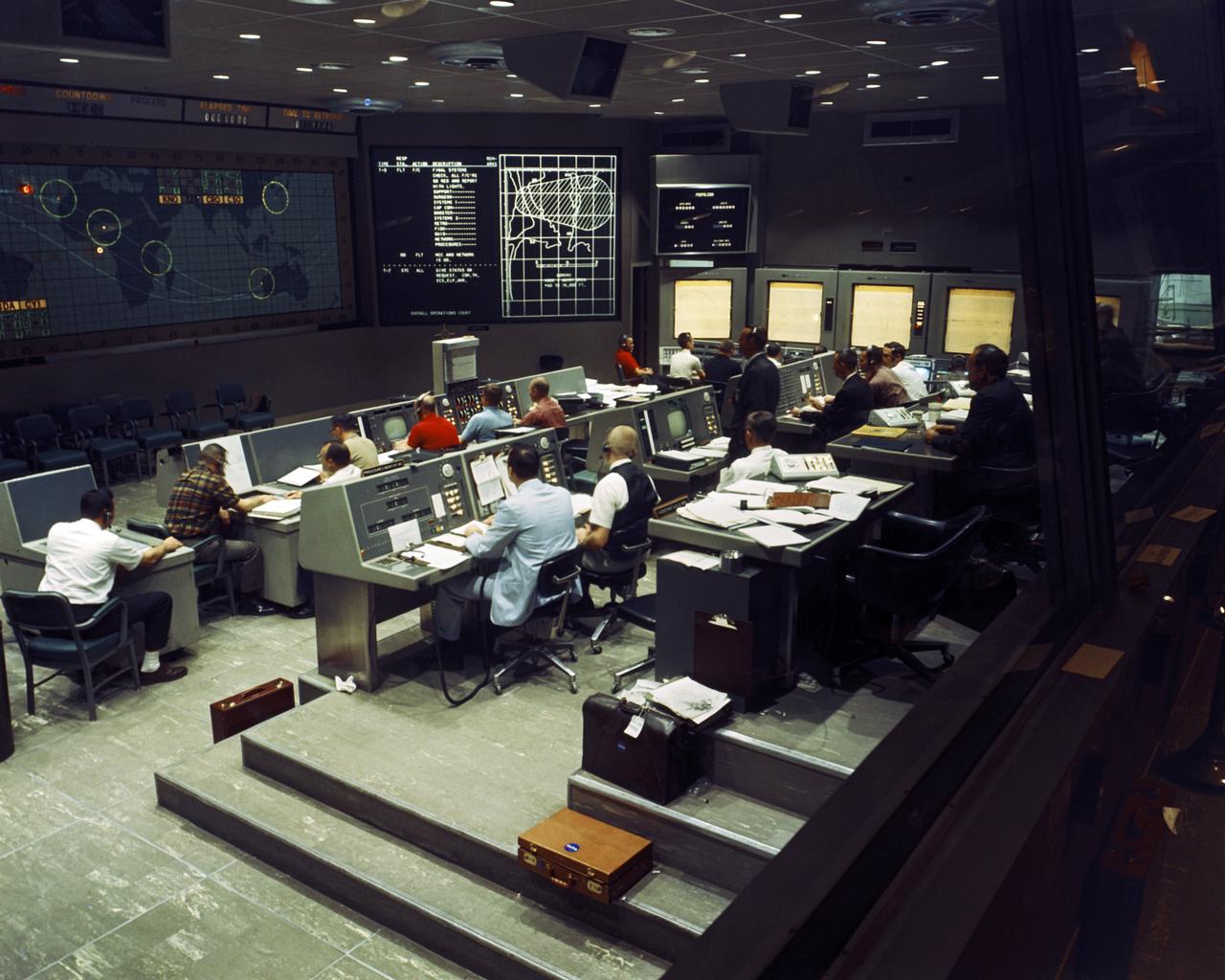
CAPE CANAVERAL, Fla. - The tracking board and consoles are seen inside the Mission Control Center during the early Gemini flights.    The Mercury Mission Control Center in Florida played a key role in the United States' early spaceflight program. Located at Cape Canaveral Air Force Station, the original part of the building was constructed between 1956 and 1958, with additions in 1959 and 1963. The facility officially was transferred to NASA on Dec. 26, 1963, and served as mission control during all the Project Mercury missions, as well as the first three flights of the Gemini Program, when it was renamed Mission Control Center. With its operational days behind, on June 1, 1967, the Mission Control Center became a stop on the public tour of NASA facilities until the mid-90s. In 1999, much of the equipment and furnishings from the Flight Control Area were moved to the Kennedy Space Center Visitor Complex where they became part of the exhibit there. The building was demolished in spring 2010. Photo credit: NASA
KSC-64C-1868
CAPE CANAVERAL, Fla. - Renamed the Mission Control Center, the facility continued to be the flight control through the first three missions of Project Gemini.     The Mercury Mission Control Center in Florida played a key role in the United States' early spaceflight program. Located at Cape Canaveral Air Force Station, the original part of the building was constructed between 1956 and 1958, with additions in 1959 and 1963. The facility officially was transferred to NASA on Dec. 26, 1963, and served as mission control during all the Project Mercury missions, as well as the first three flights of the Gemini Program, when it was renamed Mission Control Center. With its operational days behind, on June 1, 1967, the Mission Control Center became a stop on the public tour of NASA facilities until the mid-90s. In 1999, much of the equipment and furnishings from the Flight Control Area were moved to the Kennedy Space Center Visitor Complex where they became part of the exhibit there. The building was demolished in spring 2010. Photo credit: NASA
KSC-64C-1889
CAPE CANAVERAL, Fla. - Renamed the Mission Control Center, the facility continued to be the flight control through the first three missions of Project Gemini.     The Mercury Mission Control Center in Florida played a key role in the United States' early spaceflight program. Located at Cape Canaveral Air Force Station, the original part of the building was constructed between 1956 and 1958, with additions in 1959 and 1963. The facility officially was transferred to NASA on Dec. 26, 1963, and served as mission control during all the Project Mercury missions, as well as the first three flights of the Gemini Program, when it was renamed Mission Control Center. With its operational days behind, on June 1, 1967, the Mission Control Center became a stop on the public tour of NASA facilities until the mid-90s. In 1999, much of the equipment and furnishings from the Flight Control Area were moved to the Kennedy Space Center Visitor Complex where they became part of the exhibit there. The building was demolished in spring 2010. Photo credit: NASA
KSC-64C-2699
CAPE CANAVERAL, Fla. - Inside the Mission Control Center, flight controllers work during the Gemini I mission, an orbital test of the Titan-II launch vehicle.    The Mercury Mission Control Center in Florida played a key role in the United States' early spaceflight program. Located at Cape Canaveral Air Force Station, the original part of the building was constructed between 1956 and 1958, with additions in 1959 and 1963. The facility officially was transferred to NASA on Dec. 26, 1963, and served as mission control during all the Project Mercury missions, as well as the first three flights of the Gemini Program, when it was renamed Mission Control Center. With its operational days behind, on June 1, 1967, the Mission Control Center became a stop on the public tour of NASA facilities until the mid-90s. In 1999, much of the equipment and furnishings from the Flight Control Area were moved to the Kennedy Space Center Visitor Complex where they became part of the exhibit there. The building was demolished in spring 2010. Photo credit: NASA
KSC-64C-861
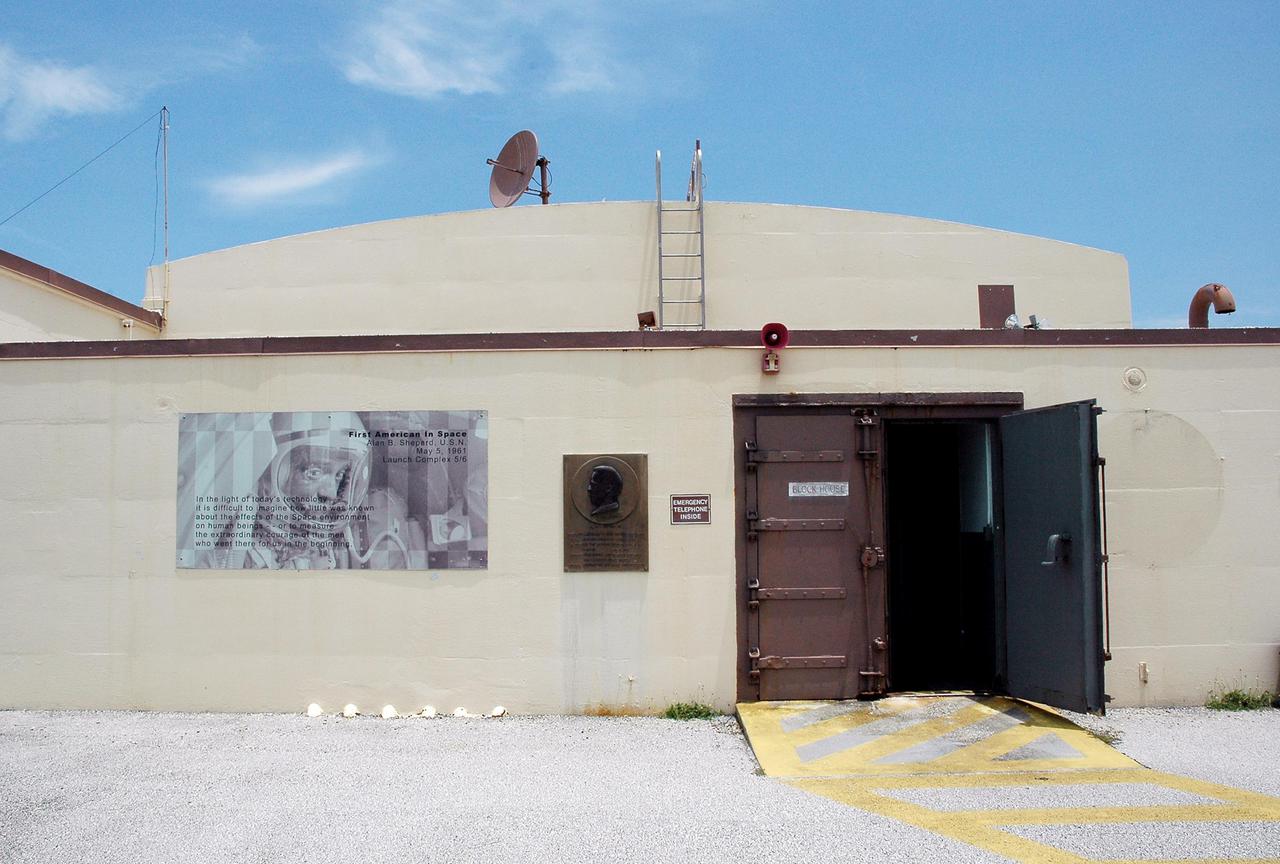
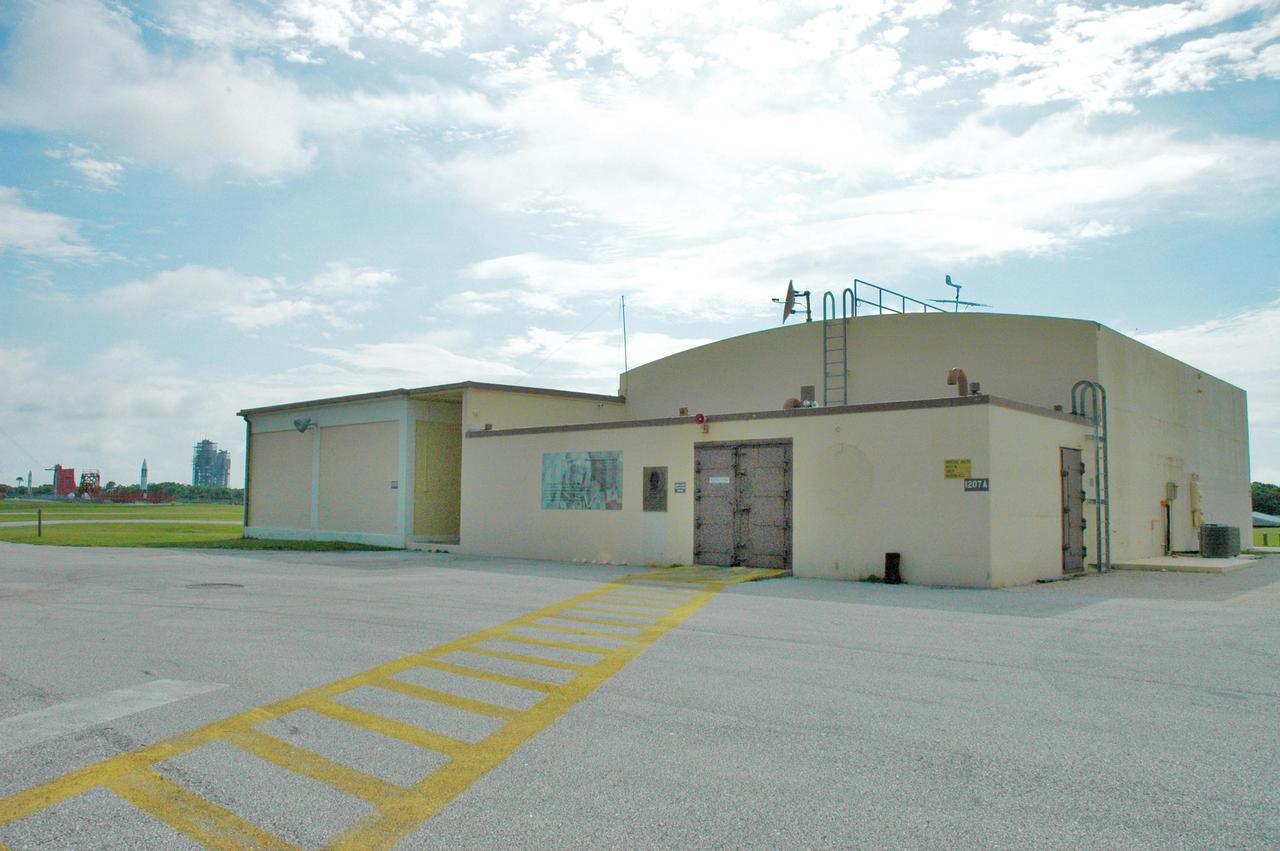
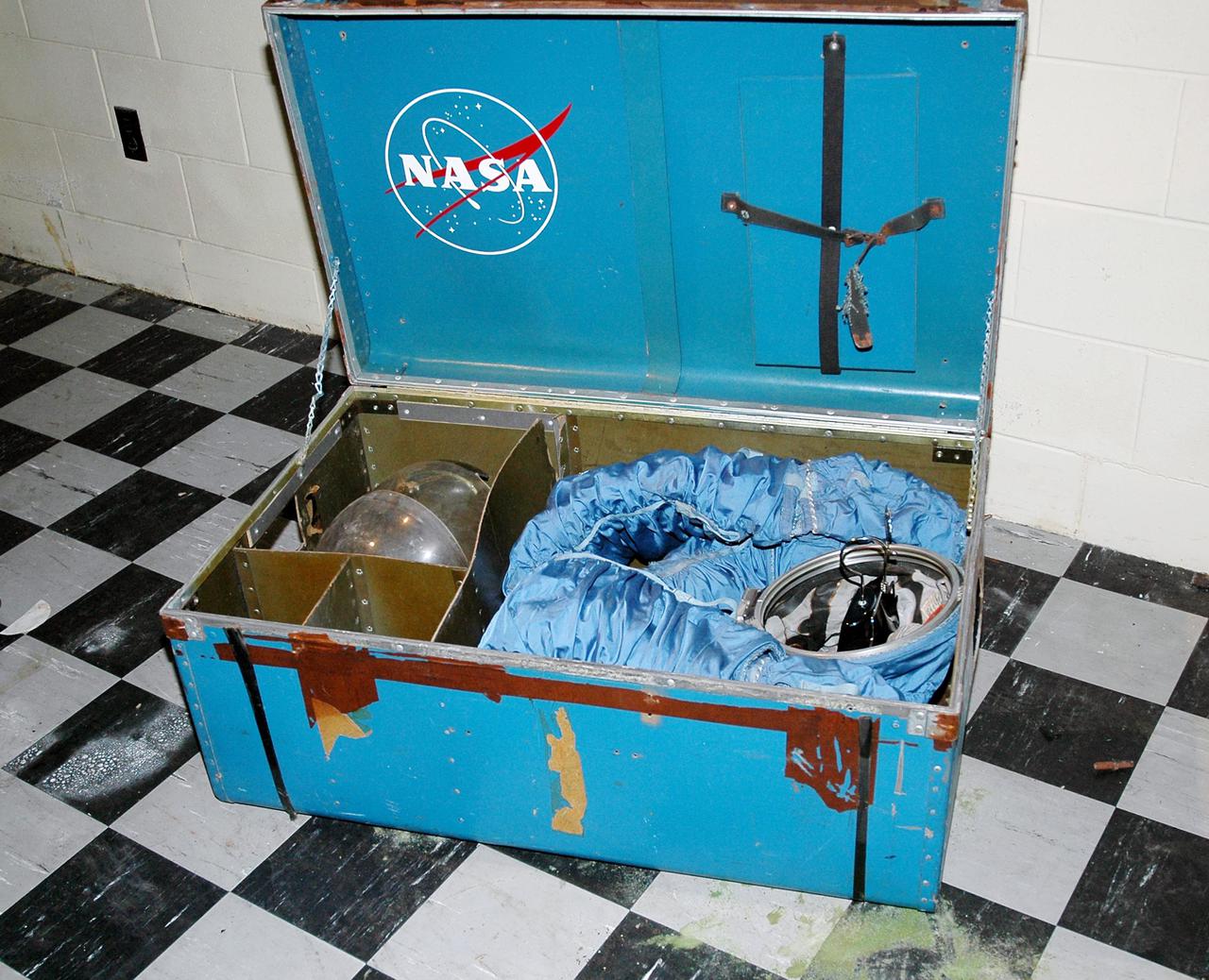
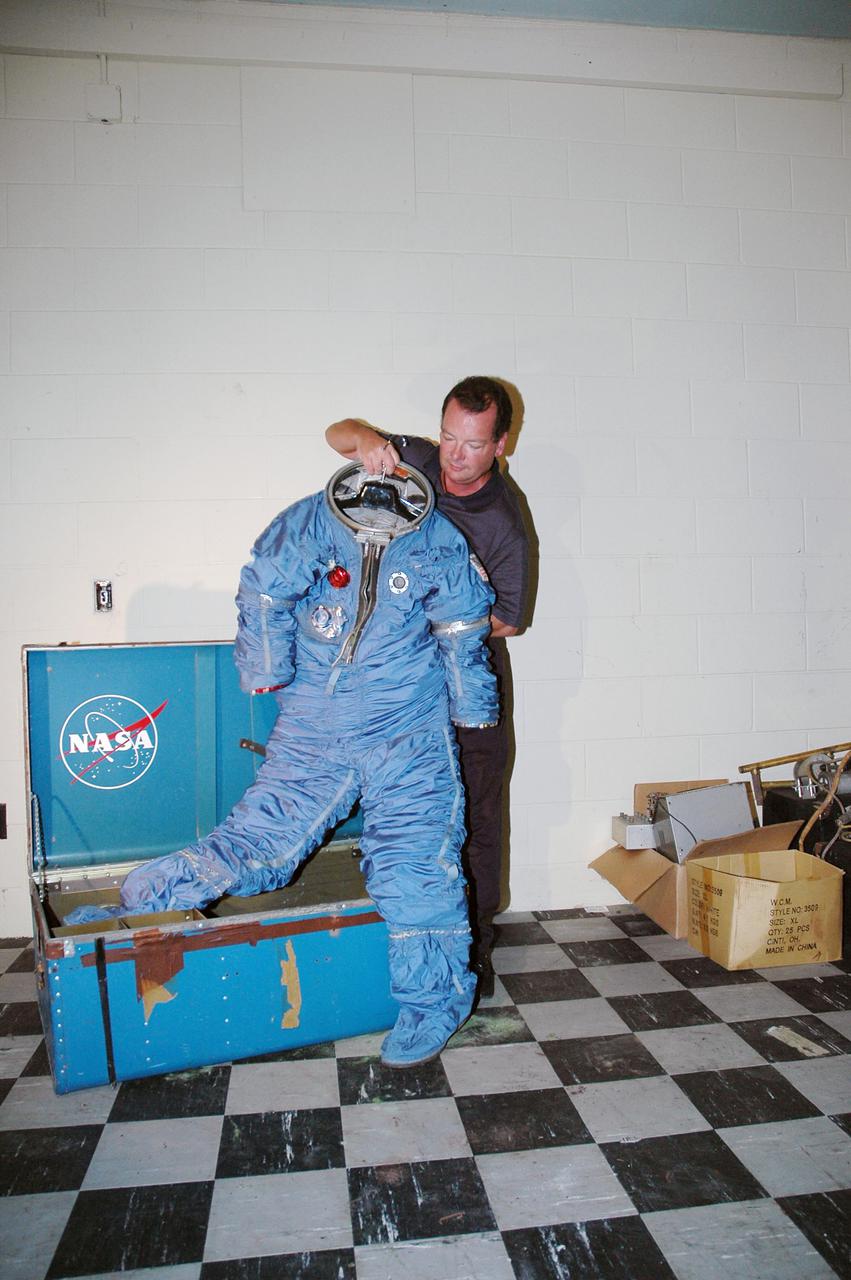
KENNEDY SPACE CENTER, FLA.  -   NASA Special Agent Dan Oakland holds up a long-lost spacesuit recently uncovered at the Cape Canaveral Air Force Station  (CCAFS) in Florida.  A recent venture into a long-locked room at CCAFS uncovered interesting artifacts of a by-gone era: retired space suits from Americans who trained in the 1960s to be astronauts aboard an Air Force orbiting reconnaissance laboratory.  Two security officers were doing a check of a facility at Launch Complex 5_6 blockhouse. Oakland and Security Manager Henry Butler, who is with Delaware North Parks and Resorts, the company that oversees the museum, discovered a locked room. Space suits from the Air Force’s planned Manned Orbiting Laboratory (MOL) program were found in the room  Begun in 1964, the MOL program was an Air Force initiative that would have sent Air Force astronauts to a space station in a Gemini capsule. After spending a few weeks in orbit, the crew would undock and return to Earth. A test launch from Complex 40 on Nov. 30, 1966, of a MOL was conducted with an unmanned Gemini capsule.  The MOL was constructed from tankage of a Titan II rocket.  The operational MOL was planned to be launched into a polar orbit from Vandenberg Air Force Base in California.  The Air Force abandoned the program in 1969, but the program produced a great deal of technological development, and three groups of military officers trained to be MOL astronauts. When the program was cancelled, seven of the younger astronauts were transferred to the agency’s human space flight program and went on to have standout careers. Among them were Robert Crippen, pilot of the first Space Shuttle mission, and Richard H. 'Dick' Truly, who later became NASA Administrator.
KSC-05pd-1266
KENNEDY SPACE CENTER, FLA.  -   This is Launch Complex 5_6 blockhouse, now a museum at the Cape Canaveral Air Force Station  (CCAFS) in Florida, where long-lost spacesuits were found.  A recent venture into a long-locked room at CCAFS uncovered interesting artifacts of a bygone era: retired space suits from Americans who trained in the 1960s to be astronauts aboard an Air Force orbiting reconnaissance laboratory.  Two security officers were doing a check of a facility at Launch Complex 5_6 blockhouse. NASA Special Agent Dan E. Oakland and Security Manager Henry Butler, with Delaware North Parks and Resorts, which oversees the museum, discovered a locked room. Space suits from the Air Force’s planned Manned Orbiting Laboratory (MOL) program were found in the room  Begun in 1964, the MOL program was an Air Force initiative that would have sent Air Force astronauts to a space station in a Gemini capsule. After spending a few weeks in orbit, the crew would undock and return to Earth. A test launch from Complex 40 on Nov. 30, 1966, of a MOL was conducted with an unmanned Gemini capsule.  The MOL was constructed from tankage of a Titan II rocket.  The operational MOL was planned to be launched into a polar orbit from Vandenberg Air Force Base in California.  The Air Force abandoned the program in 1969, but the program produced a great deal of technological development, and three groups of military officers trained to be MOL astronauts. When the program was cancelled, seven of the younger astronauts were transferred to the agency’s human space flight program and went on to have standout careers. Among them were Robert Crippen, pilot of the first Space Shuttle mission, and Richard H. 'Dick' Truly, who later became NASA Administrator.
KSC-05pd-1274
KENNEDY SPACE CENTER, FLA.  -   This locker reveals a long-lost spacesuit recently uncovered at the Cape Canaveral Air Force Station  (CCAFS) in Florida.  A recent venture into a long-locked room at CCAFS uncovered interesting artifacts of a bygone era: retired space suits from Americans who trained in the 1960s to be astronauts aboard an Air Force orbiting reconnaissance laboratory.  Two security officers were doing a check of a facility at Launch Complex 5_6 blockhouse. NASA Special Agent Dan E. Oakland and Security Manager Henry Butler, who is with Delaware North Parks and Resorts, the company that oversees the museum, discovered a locked room. Space suits from the Air Force’s planned Manned Orbiting Laboratory (MOL) program were found in the room  Begun in 1964, the MOL program was an Air Force initiative that would have sent Air Force astronauts to a space station in a Gemini capsule. After spending a few weeks in orbit, the crew would undock and return to Earth. A test launch from Complex 40 on Nov. 30, 1966, of a MOL was conducted with an unmanned Gemini capsule.  The MOL was constructed from tankage of a Titan II rocket.  The operational MOL was planned to be launched into a polar orbit from Vandenberg Air Force Base in California.  The Air Force abandoned the program in 1969, but the program produced a great deal of technological development, and three groups of military officers trained to be MOL astronauts. When the program was cancelled, seven of the younger astronauts were transferred to the agency’s human space flight program and went on to have standout careers. Among them were Robert Crippen, pilot of the first Space Shuttle mission, and Richard H. 'Dick' Truly, who later became NASA Administrator.
KSC-05pd-1265
KENNEDY SPACE CENTER, FLA.  -   This is Launch Complex 5_6 blockhouse, now a museum at the Cape Canaveral Air Force Station  (CCAFS) in Florida, where long-lost space suits were found.  A recent venture into a long-locked room at CCAFS uncovered interesting artifacts of a bygone era: retired space suits from Americans who trained in the 1960s to be astronauts aboard an Air Force orbiting reconnaissance laboratory. Two security officers were doing a check of a facility at Launch Complex 5_6 blockhouse. NASA Special Agent Dan E. Oakland and Security Manager Henry Butler, who is with Delaware North Parks and Resorts, the company that oversees the museum, discovered a locked room. Space suits from the Air Force’s planned Manned Orbiting Laboratory (MOL) program were found in the room  Begun in 1964, the MOL program was an Air Force initiative that would have sent Air Force astronauts to a space station in a Gemini capsule. After spending a few weeks in orbit, the crew would undock and return to Earth. A test launch from Complex 40 on Nov. 30, 1966, of a MOL was conducted with an unmanned Gemini capsule.  The MOL was constructed from tankage of a Titan II rocket.  The operational MOL was planned to be launched into a polar orbit from Vandenberg Air Force Base in California.  The Air Force abandoned the program in 1969, but the program produced a great deal of technological development, and three groups of military officers trained to be MOL astronauts. When the program was cancelled, seven of the younger astronauts were transferred to the agency’s human space flight program and went on to have standout careers. Among them were Robert Crippen, pilot of the first Space Shuttle mission, and Richard H. 'Dick' Truly, who later became NASA Administrator.
KSC-05pd-1267
STS008-16-454 (30 Aug-5 Sept 1983) ---  Following a precedent set early two decades ago during the Gemini program, three members of the STS-8 astronaut crew aboard the Earth-orbiting Space Shuttle Challenger reveal their military backgrounds and loyalties.  Astronauts (left to right) Dale A. Gardner, Richard H. Truly and Daniel C. Brandenstein leave no mystery as to their alma mater and gridiron sentimentalities as they display U.S. Navy stickers.  The trio was photographed by Astronaut Guion S. Bluford on the flight deck.  Truly is crew commander; Brandenstein, pilot; and Gardner and Bluford, along with Dr. William E. Thornton are all mission specialists for this six-day flight.
U.S. Navy crew members display decals on forward flight deck
iss064e020868 (Jan. 6, 2021) --- The seven-member Expedition 64 crew poses for a portrait inside the International Space Station's Kibo laboratory module from JAXA (Japan Aerospace Exploration Module). In the bottom row from left are, NASA astronaut Kate Rubins and Roscosmos cosmonauts Sergey Ryzhikov and Sergey Kud-Sverchkov. In the top row are, JAXA astronaut Soichi Noguchi and NASA astronauts Michael Hopkins, Victor Glover and Shannon Walker.  Glover and Hopkins are wearing white uniforms that commemorate the NASA human spaceflight programs Mercury, Gemini, Apollo, Apollo-Soyuz, Space Shuttle, Shuttle-Mir, International Space Station and Commercial Crew.
iss064e020868
iss064e020871 (1/6/2021) --- The seven-member Expedition 64 crew poses for a portrait inside the International Space Station's Kibo laboratory module from JAXA (Japan Aerospace Exploration Module). In the bottom row from left are, NASA astronaut Kate Rubins and Roscosmos cosmonauts Sergey Ryzhikov and Sergey Kud-Sverchkov. In the top row are, JAXA astronaut Soichi Noguchi and NASA astronauts Michael Hopkins, Victor Glover and Shannon Walker. Glover and Hopkins are wearing white uniforms that commemorate the NASA human spaceflight programs Mercury, Gemini, Apollo, Apollo-Soyuz, Space Shuttle, Shuttle-Mir, International Space Station and Commercial Crew.
iss064e020871
iss064e020858 (Jan. 6, 2021) --- The seven-member Expedition 64 crew poses for a portrait inside the International Space Station's Kibo laboratory module from JAXA (Japan Aerospace Exploration Module). From left are, NASA astronauts Shannon Walker, Victor Glover and Kate Rubins; Roscosmos cosmonauts Sergey Ryzhikov and Sergey Kud-Sverchkov; NASA astronaut Michael Hopkins; and JAXA astronaut Soichi Noguchi. Glover and Hopkins are wearing white uniforms that commemorate the NASA human spaceflight programs Mercury, Gemini, Apollo, Apollo-Soyuz, Space Shuttle, Shuttle-Mir, International Space Station and Commercial Crew.
iss064e020858
CINCINNATI, OHIO - Former astronaut Neil Armstrong stands next to the NASA Ambassadors of Exploration award presented to him by NASA Administrator Michael Griffin.  Armstrong received the award that includes a moon rock to recognize the sacrifices and dedication of the astronauts and others who were part of the Mercury, Gemini and Apollo programs.  A former naval aviator, NASA test pilot and Apollo 11 commander, Armstrong was the first human to ever land a spacecraft on the moon and the first to step on the lunar surface.  Armstrong's award will be displayed at the Cincinnati Museum Center at Union Terminal.  Photo credit: NASA/Bill Ingalls
KSC-06pd0687
S65-19524 (1 June 1965) --- Dr. Charles A. Berry, chief of Center Medical Programs, MSC, Houston, Texas, prepares to check the blood pressure of astronaut James A. McDivitt, command pilot for the Gemini-Titan 4 spaceflight. McDivitt is on the tilt table at the Aero Medical Area, MSC, Merritt Island, where he and astronaut Edward H. White II (out of frame), GT-4 pilot, underwent preflight physicals in preparation for the four-day, 62-revolution spaceflight. The two astronauts were declared in top physical condition. In the background is Dr. Gordon Benson, NASA physician at Cape Kennedy.
Astronaut McDivitt - Blood Pressure Check - Preflight Examination - Merritt Island, FL
CINCINNATI, OHIO - NASA Administrator Michael Griffin presented the NASA Ambassadors of Exploration award to Neil Armstrong (left).  At right is former awardee John Glenn.  Armstrong received the award that includes a moon rock to recognize the sacrifices and dedication of the astronauts and others who were part of the Mercury, Gemini and Apollo programs.  A former naval aviator, NASA test pilot and Apollo 11 commander, Armstrong was the first human to ever land a spacecraft on the moon and the first to step on the lunar surface.  Armstrong's award will be displayed at the Cincinnati Museum Center at Union Terminal.  Photo credit: NASA/Bill Ingalls
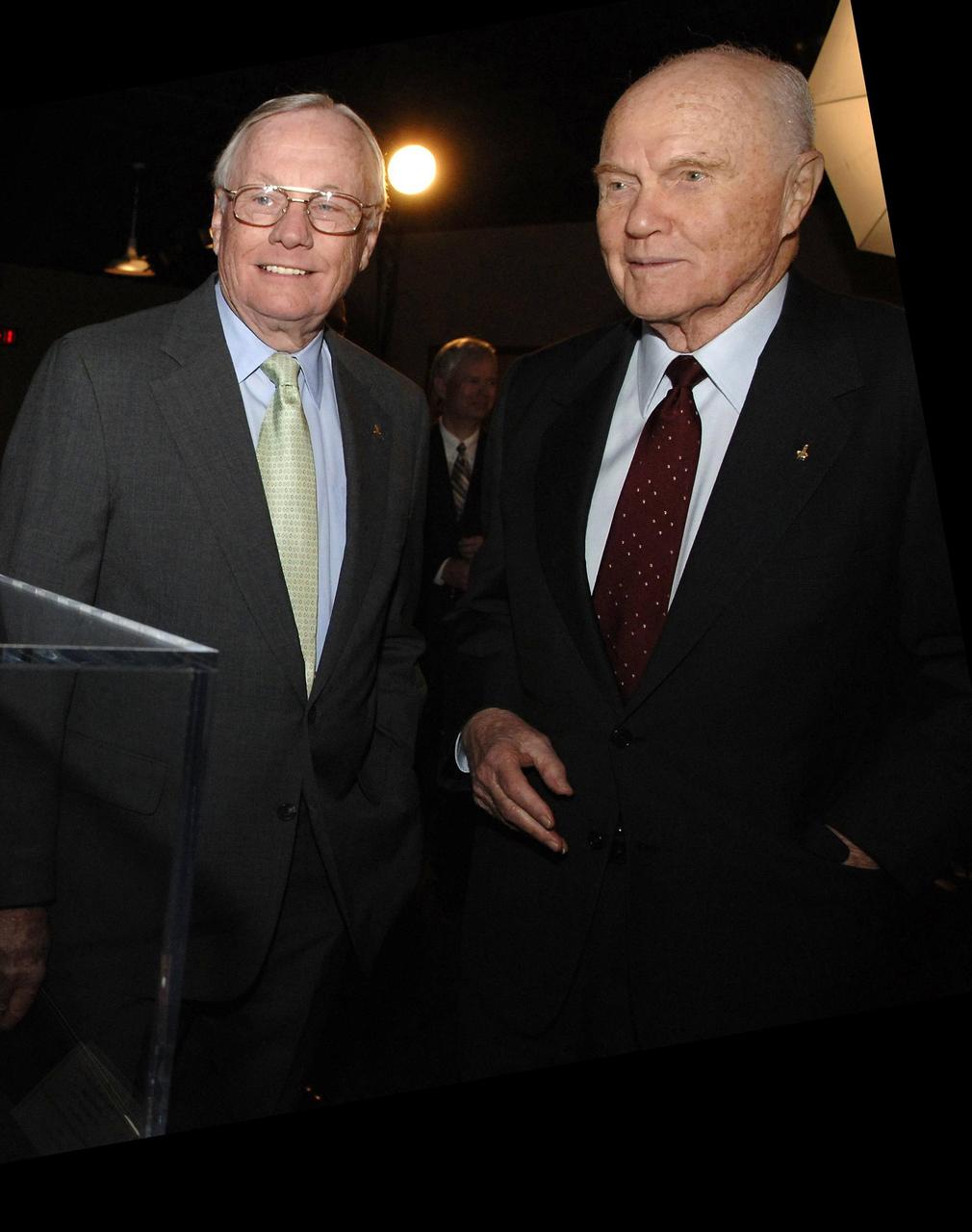
KSC-06pd0686
S66-27990 (March 1966) --- Astronaut Eugene A. Cernan, pilot for the Gemini-9 spaceflight, works out procedures for his historic space excursion in a unique manned Aerospace Flight Simulator at LTV Corp. at Dallas, Texas. The LTV simulator is used frequently by NASA astronauts for a variety of space programs maneuvers to provide many of the sensations and visual scenes of actual spaceflight. Controlled through a complex of computers, the device makes it possible for the astronauts to work out procedures, solve problems and simulate missions in real time with great accuracy. The astronaut rides in a spacecraft-like gondola which moves in roll, pitch and yaw in response to his controls and accurate computer inputs. The simulator's usual spacecraft displays and canopy have been removed and AMU backpack complete with control electronics installed. The astronaut makes his simulated flight in an inflated pressure suit and with the NASA-developed Extravehicular Life Support system chest pack which will be used in the Gemini flight. Photo credit: NASA
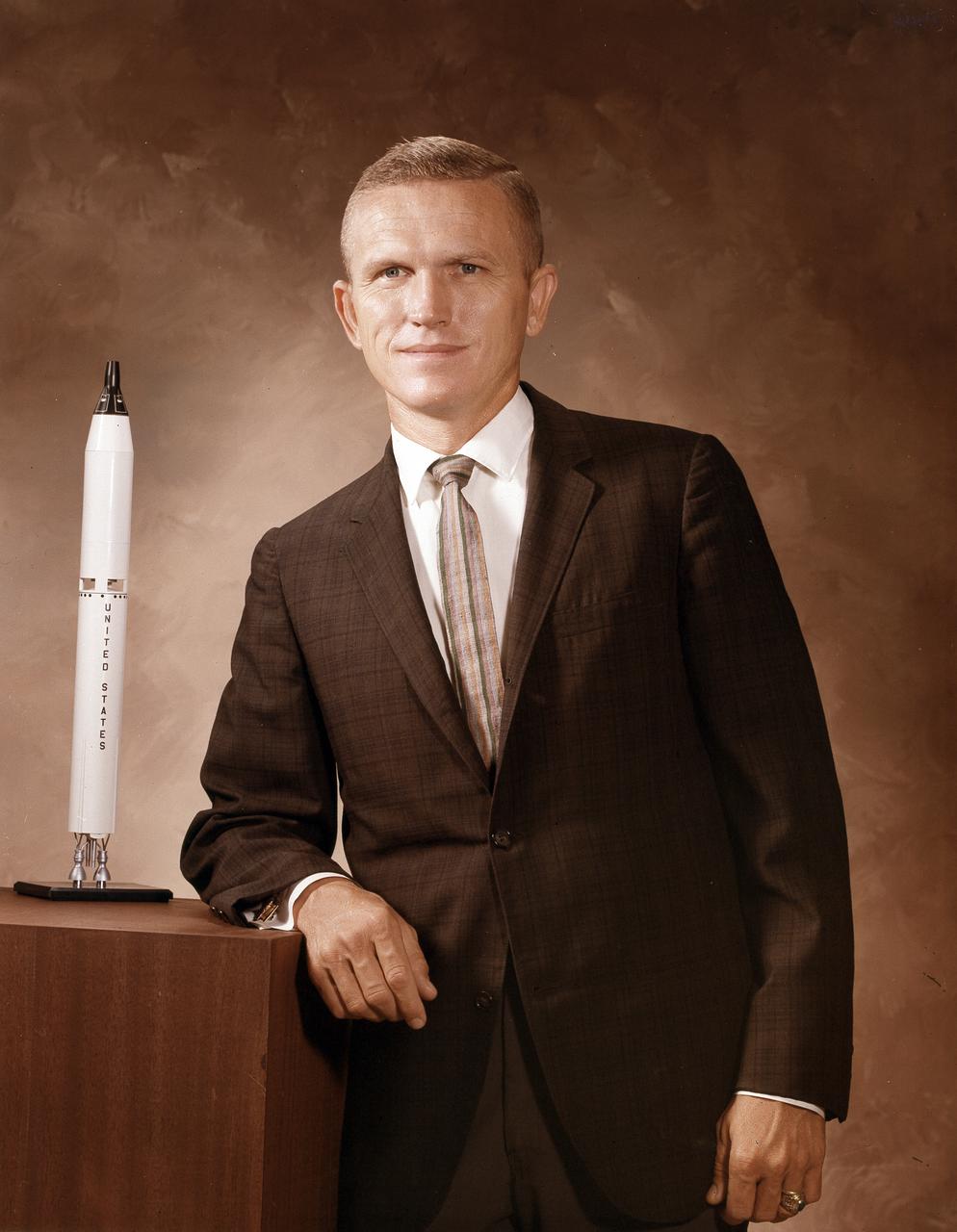

GEMINI-TITAN (GT)-9- TRAINING - AEROSPACE FLIGHT SIMULATOR - PILOT - TX
This is the official NASA portrait of astronaut Edwin E. (Buzz) Aldrin. Prior to joining NASA, Aldrin flew 66 combat missions in F-86s while on duty in Korea. At Nellis Air Force Base, Nevada, he served as an aerial gunnery instructor. Following his assignment as aide to the dean of faculty at the Air Force Academy, Aldrin flew F-100s as a flight commander at Bitburg, Germany. Aldrin was one of the third group of astronauts named by NASA in October 1963 and has logged 289 hours and 53 minutes in space, of which, 7 hours and 52 minutes were spent in Extra Vehicular Activity (EVA). On November 11, 1966, he launched into space aboard the Gemini 12 spacecraft on a 4-day flight, which brought the Gemini program to a successful close. During that mission, Aldrin established a new record for EVA, spending 5-1/2 hours outside the spacecraft. July 16-24, 1969, Aldrin served as lunar module pilot for Apollo 11, the first manned lunar landing mission. Aldrin followed Neil Armstrong onto the lunar surface on July 20, 1969, completing a 2-hour and 15 minute lunar EVA. Aldrin resigned from NASA in July 1971.
Saturn Apollo Program
CAPE CANAVERAL, Fla. – At Cape Canaveral Air Force Station in Florida, preparations are under way to tear down the Mercury Mission Control Center.  The original building, constructed between 1956 and 1958, was last modified in 1963.  The center succumbed to the two worst enemies of structures along the space coast - time and salt air - necessitating that it be demolished as a safety measure.  The facility served as mission control during all the Project Mercury missions, as well as the first three flights of the Gemini Program. The center housed the flight controllers whose duty was to take over flight control after liftoff and follow it through until splashdown. Additionally, it supported vehicle checkout, spacecraft tracking, and astronaut training. With Gemini IV, mission control moved to Houston, and the facility took on the roles of launch control and tracking station. In 1999, much of the equipment and furnishings from the flight control area was moved to Kennedy Space Center's Visitor Complex.  A re-created mission control room currently is on display in the complex's Dr. Kurt H. Debus Conference Facility.  Speegle II of Cocoa, Fla., was awarded the contract for the deconstruction project.  Frank-Lin Excavating is performing the demolition for Sunrise Systems of Brevard, a subcontractor to Speegle II.  Photo credit: NASA_Jack Pfaller
KSC-2010-3102
CAPE CANAVERAL, Fla. – At Cape Canaveral Air Force Station in Florida, a Caterpillar 330 track-hoe punches a hole in the wall of the Mercury Mission Control Center.  The original building, constructed between 1956 and 1958, was last modified in 1963.  The center succumbed to the two worst enemies of structures along the space coast - time and salt air - necessitating that it be demolished as a safety measure.  The facility served as mission control during all the Project Mercury missions, as well as the first three flights of the Gemini Program. The center housed the flight controllers whose duty was to take over flight control after liftoff and follow it through until splashdown. Additionally, it supported vehicle checkout, spacecraft tracking, and astronaut training. With Gemini IV, mission control moved to Houston, and the facility took on the roles of launch control and tracking station. In 1999, much of the equipment and furnishings from the flight control area was moved to Kennedy Space Center's Visitor Complex.  A re-created mission control room currently is on display in the complex's Dr. Kurt H. Debus Conference Facility.  Speegle II of Cocoa, Fla., was awarded the contract for the deconstruction project.  Frank-Lin Excavating is performing the demolition for Sunrise Systems of Brevard, a subcontractor to Speegle II.  Photo credit: NASA_Jack Pfaller
KSC-2010-3103
Astronaut Edwin  Buzz  Aldrin Lunar Module Pilot  at the (LLRF) Lunar Landing Research Facility.  Aldrin was one of the third group of astronauts named by NASA in October 1963. On November 11, 1966, he and command pilot James Lovell were launched into space in the Gemini 12 spacecraft on a 4-day flight, which brought the Gemini program to a successful close. Aldrin established a new record for extravehicular activity (EVA), spending 5-1/2 hours outside the spacecraft. He served as lunar module pilot for Apollo 11, July 16-24, 1969, the first manned lunar landing mission. Aldrin followed Neil Armstrong onto the lunar surface on July 20, 1969, completing a 2-hour and 15 minute lunar EVA. In July 1971, Aldrin resigned from NASA. Aldrin has logged 289 hours and 53 minutes in space, of which, 7 hours and 52 minutes were spent in EVA. https://www.nasa.gov/astronauts/biographies/former
Edwin "Buzz" Aldrin at the (LLRF) Lunar Landing Research Facility
CAPE CANAVERAL, Fla. – At Cape Canaveral Air Force Station in Florida, a Caterpillar 330 track-hoe rips through the wall of the Mercury Mission Control Center.  The original building, constructed between 1956 and 1958, was last modified in 1963.  The center succumbed to the two worst enemies of structures along the space coast - time and salt air - necessitating that it be demolished as a safety measure.  The facility served as mission control during all the Project Mercury missions, as well as the first three flights of the Gemini Program. The center housed the flight controllers whose duty was to take over flight control after liftoff and follow it through until splashdown. Additionally, it supported vehicle checkout, spacecraft tracking, and astronaut training. With Gemini IV, mission control moved to Houston, and the facility took on the roles of launch control and tracking station. In 1999, much of the equipment and furnishings from the flight control area was moved to Kennedy Space Center's Visitor Complex.  A re-created mission control room currently is on display in the complex's Dr. Kurt H. Debus Conference Facility.  Speegle II of Cocoa, Fla., was awarded the contract for the deconstruction project.  Frank-Lin Excavating is performing the demolition for Sunrise Systems of Brevard, a subcontractor to Speegle II.  Photo credit: NASA_Jack Pfaller
KSC-2010-3104