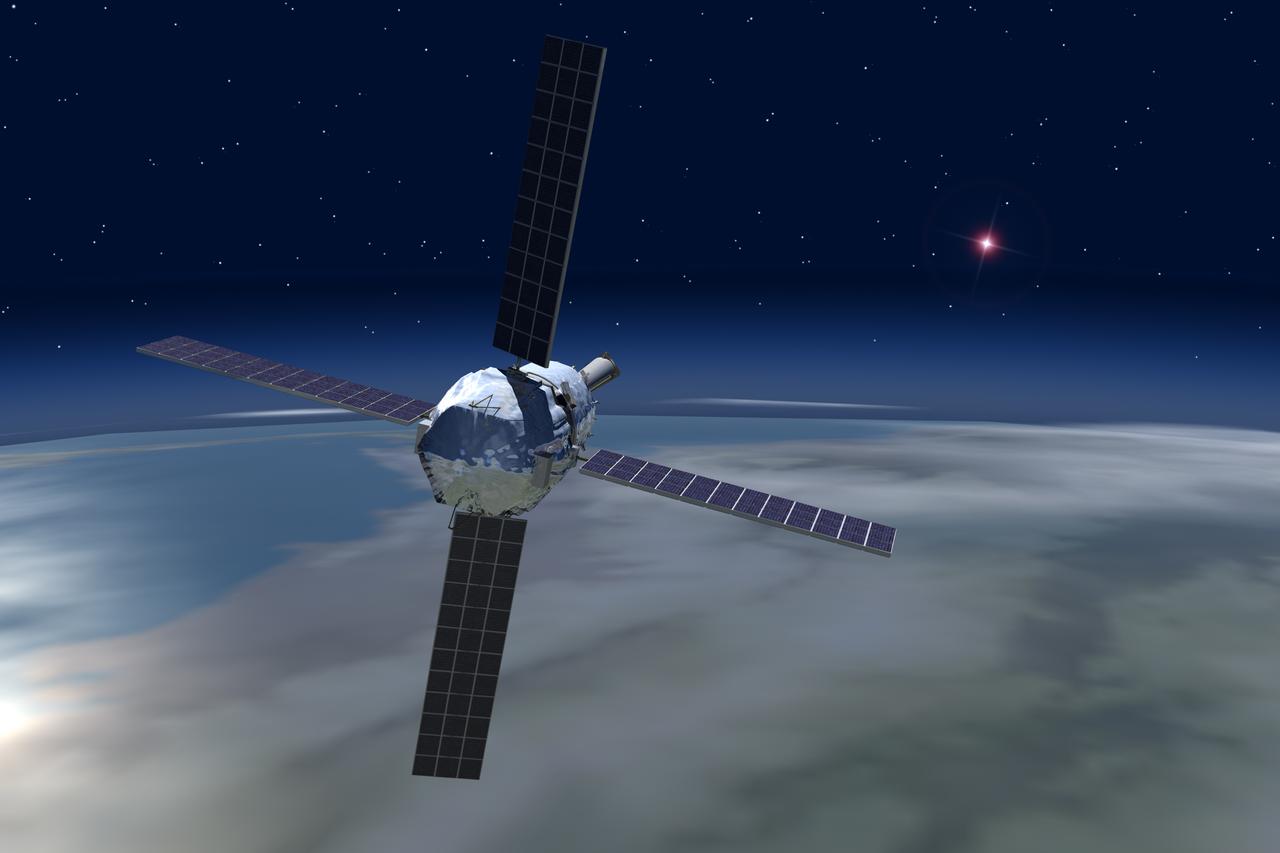
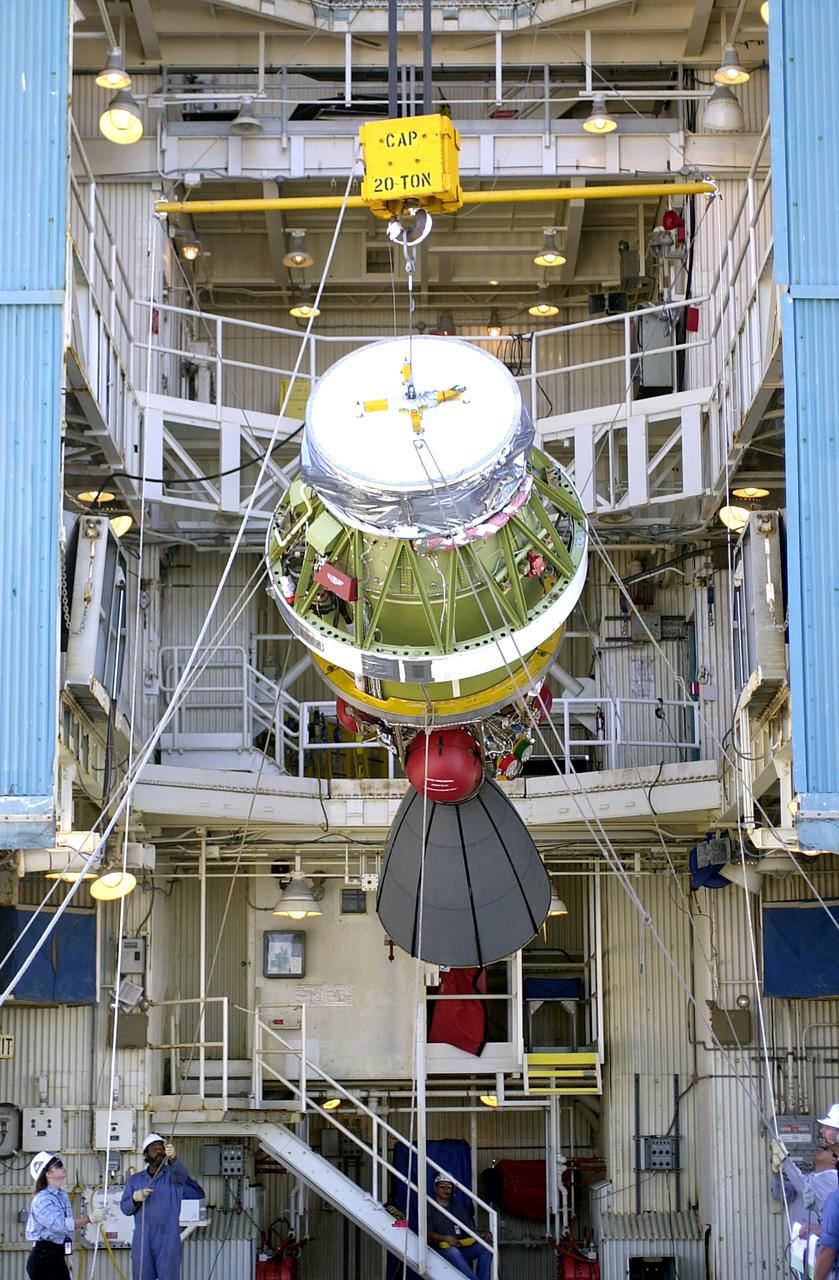
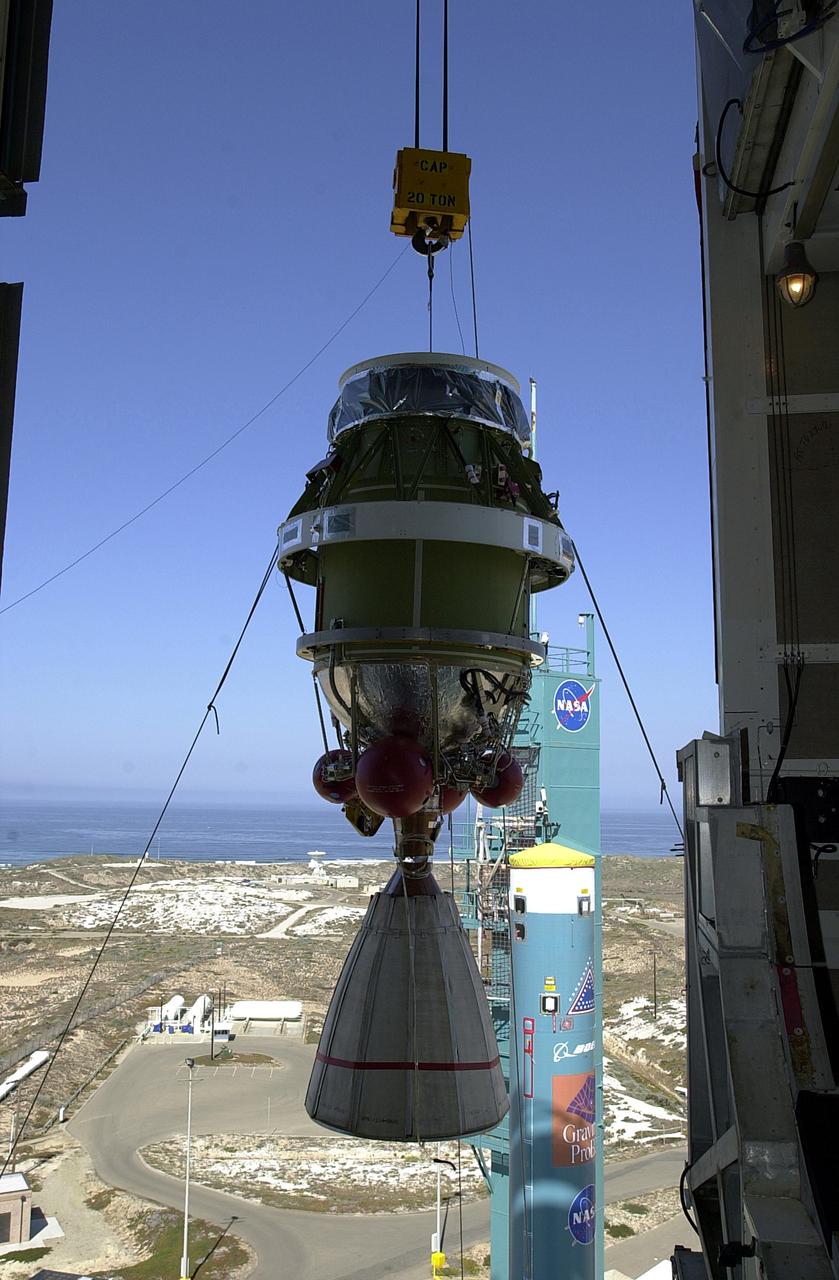
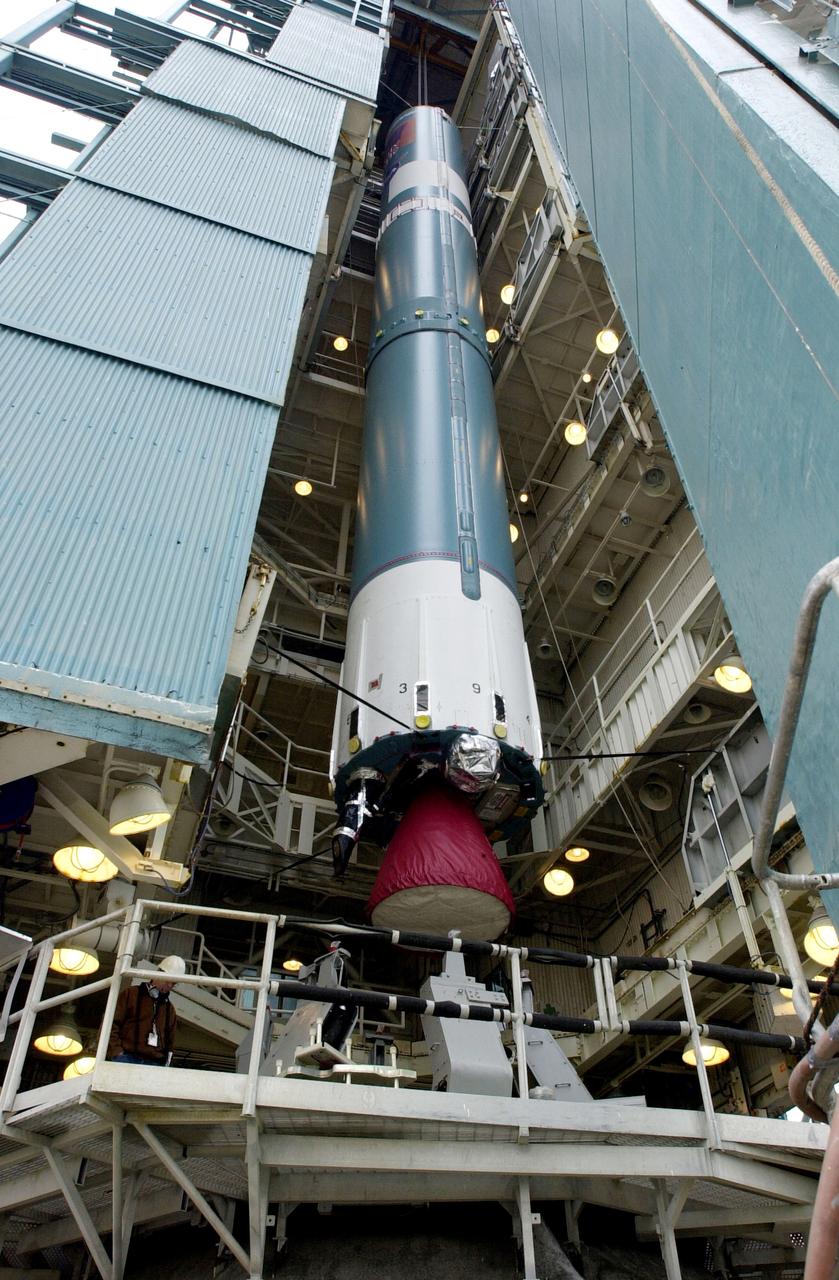
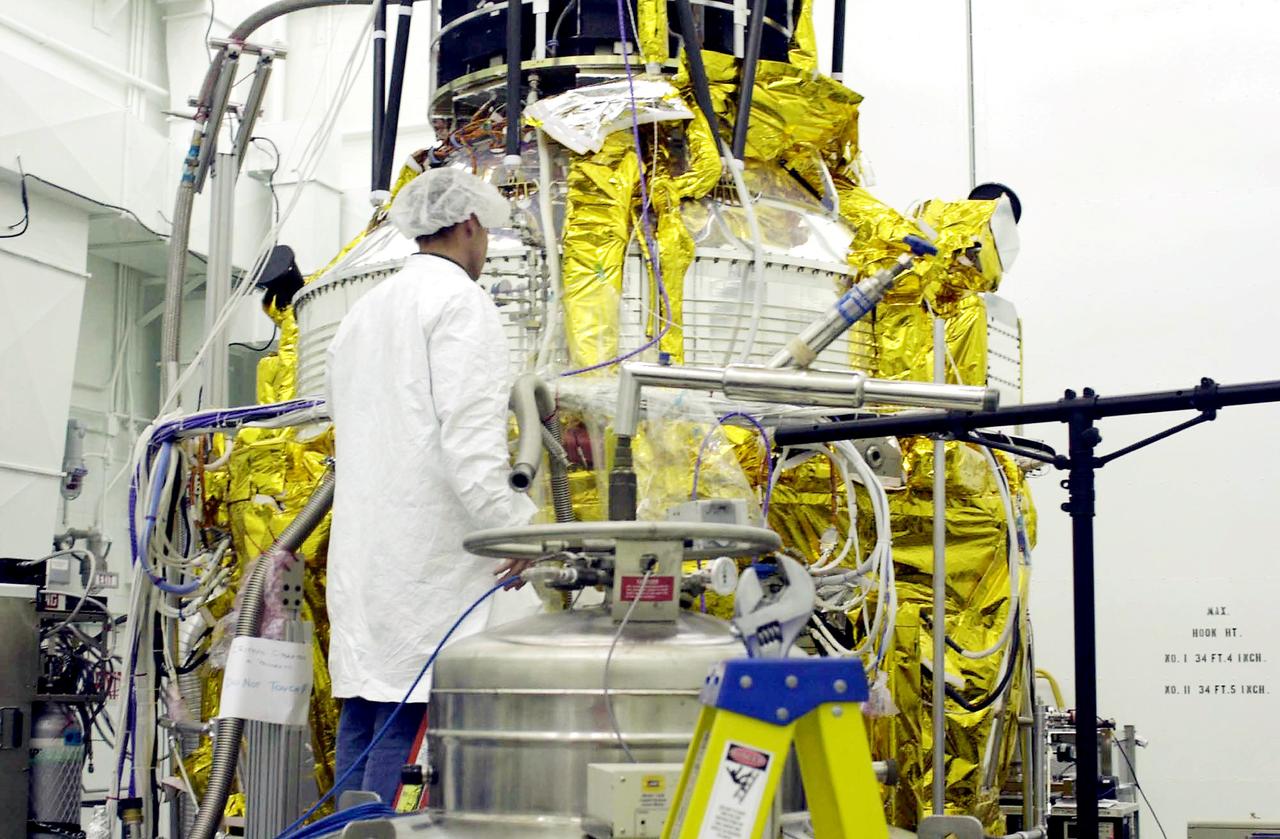
Gravity Probe-B (GP-B) is the relativity experiment being developed at Stanford University to test two extraordinary predictions of Albert Einstein's general theory of relativity. The experiment will measure, very precisely, the expected tiny changes in the direction of the spin axes of four gyroscopes contained in an Earth-orbiting satellite at a 400-mile altitude. So free are the gyroscopes from disturbance that they will provide an almost perfect space-time reference system. They will measure how space and time are very slightly warped by the presence of the Earth, and, more profoundly, how the Earth's rotation very slightly drags space-time around with it. These effects, though small for the Earth, have far-reaching implications for the nature of matter and the structure of the Universe. GP-B is among the most thoroughly researched programs ever undertaken by NASA. This is the story of a scientific quest in which physicists and engineers have collaborated closely over many years. Inspired by their quest, they have invented a whole range of technologies -- technologies that are already enlivening other branches of science and engineering. Scheduled for launch in 2003 and managed for NASA by Marshall Space Flight Center, development of GP-B is the responsibility of Stanford University, with major subcontractor Lockheed Martin Corporation.
Space Science
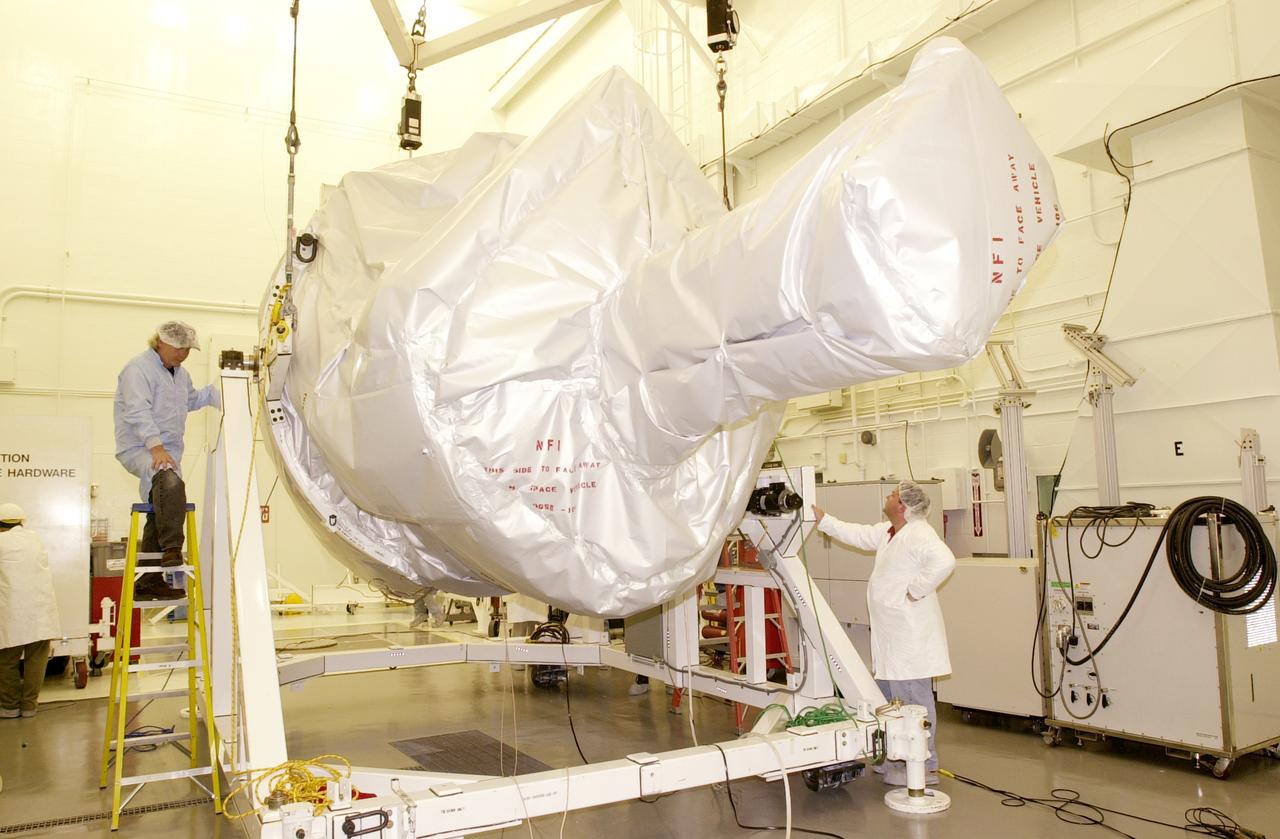
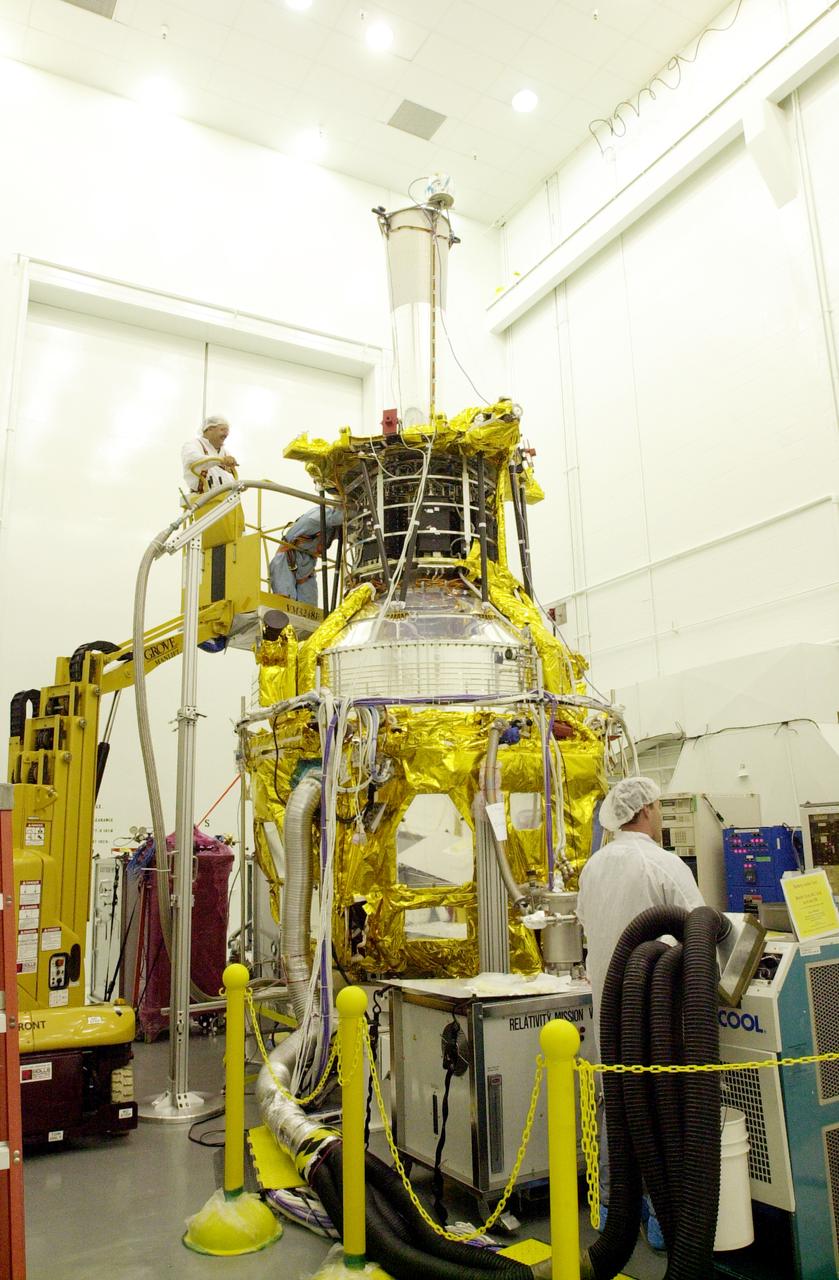
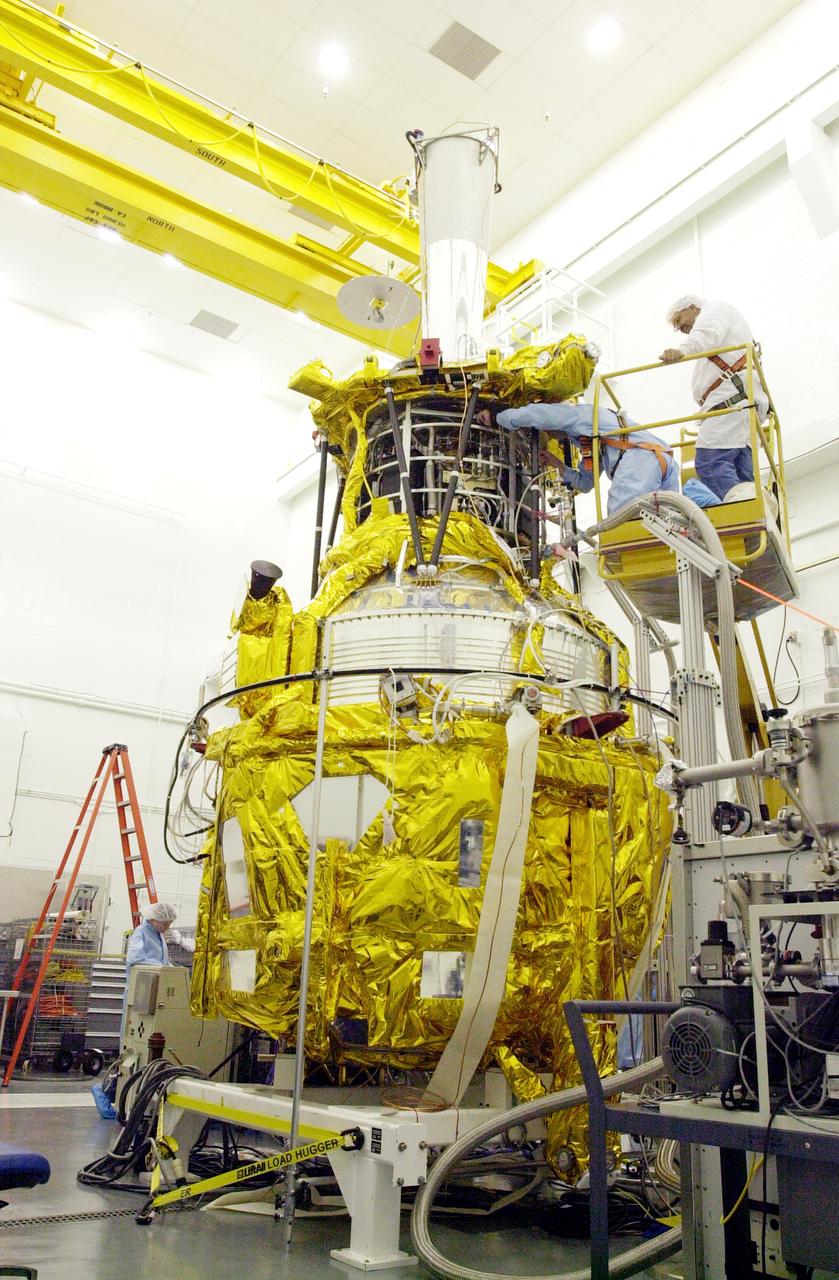
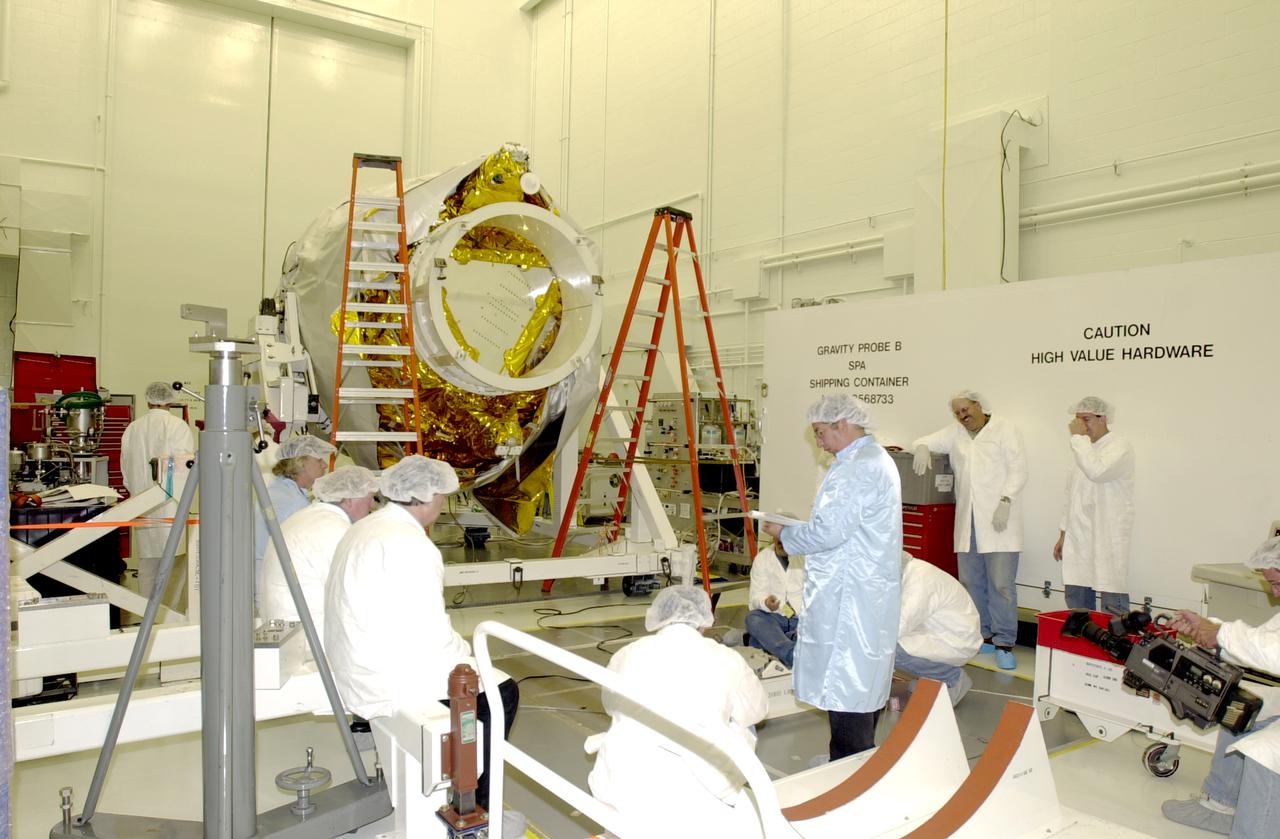
In this photo, the Gravity Probe B (GP-B) space vehicle is being assembled at the Sunnyvale, California location of the Lockheed Martin Corporation. The GP-B is the relativity experiment developed at Stanford University to test two extraordinary predictions of Albert Einstein’s general theory of relativity. The experiment will measure, very precisely, the expected tiny changes in the direction of the spin axes of four gyroscopes contained in an Earth-orbiting satellite at a 400-mile altitude. So free are the gyroscopes from disturbance that they will provide an almost perfect space-time reference system. They will measure how space and time are very slightly warped by the presence of the Earth, and, more profoundly, how the Earth’s rotation very slightly drags space-time around with it. These effects, though small for the Earth, have far-reaching implications for the nature of matter and the structure of the Universe. GP-B is among the most thoroughly researched programs ever undertaken by NASA. This is the story of a scientific quest in which physicists and engineers have collaborated closely over many years. Inspired by their quest, they have invented a whole range of technologies that are already enlivening other branches of science and engineering.  Launched  April 20, 2004 , the GP-B program was managed for NASA by the Marshall Space Flight Center. Development of the GP-B is the responsibility of Stanford University along with major subcontractor Lockheed Martin Corporation.  (Image credit to Russ Underwood, Lockheed Martin Corporation).
Space Science
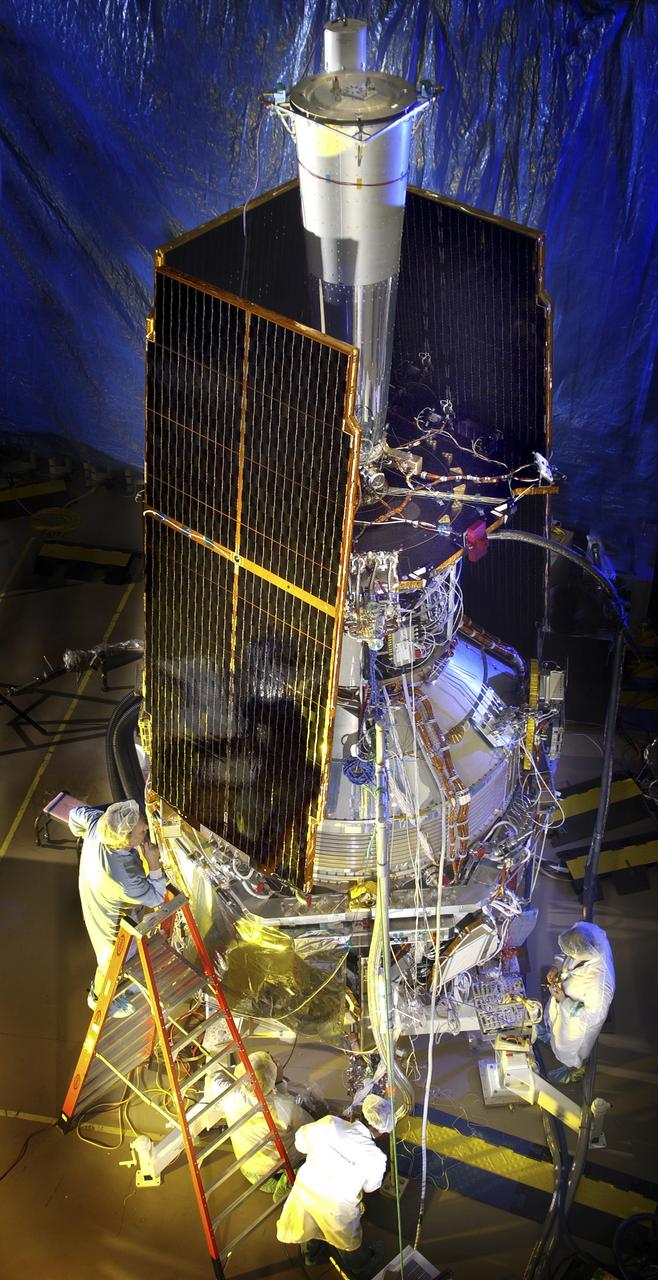
In this photo, the Gravity Probe B (GP-B) space vehicle is completed during the solar array installation. The GP-B is the relativity experiment developed at Stanford University to test two extraordinary predictions of Albert Einstein’s general theory of relativity. The experiment will measure, very precisely, the expected tiny changes in the direction of the spin axes of four gyroscopes contained in an Earth-orbiting satellite at a 400-mile altitude. So free are the gyroscopes from disturbance that they will provide an almost perfect space-time reference system. They will measure how space and time are very slightly warped by the presence of the Earth, and, more profoundly, how the Earth’s rotation very slightly drags space-time around with it. These effects, though small for the Earth, have far-reaching implications for the nature of matter and the structure of the Universe. GP-B is among the most thoroughly researched programs ever undertaken by NASA. This is the story of a scientific quest in which physicists and engineers have collaborated closely over many years. Inspired by their quest, they have invented a whole range of technologies that are already enlivening other branches of science and engineering.  GP-B is scheduled for launch in April 2004 and managed for NASA by the Marshall Space Flight Center. Development of the GP-B is the responsibility of Stanford University along with major subcontractor Lockheed Martin Corporation.  (Image credit to Russ Underwood, Lockheed Martin Corporation).
Space Science
In this photo, the Gravity Probe B (GP-B) space vehicle is being encapsulated atop the Delta II launch vehicle. The GP-B is the relativity experiment developed at Stanford University to test two extraordinary predictions of Albert Einstein’s general theory of relativity. The experiment will measure, very precisely, the expected tiny changes in the direction of the spin axes of four gyroscopes contained in an Earth-orbiting satellite at a 400-mile altitude. So free are the gyroscopes from disturbance that they will provide an almost perfect space-time reference system. They will measure how space and time are very slightly warped by the presence of the Earth, and, more profoundly, how the Earth’s rotation very slightly drags space-time around with it. These effects, though small for the Earth, have far-reaching implications for the nature of matter and the structure of the Universe. GP-B is among the most thoroughly researched programs ever undertaken by NASA. This is the story of a scientific quest in which physicists and engineers have collaborated closely over many years. Inspired by their quest, they have invented a whole range of technologies that are already enlivening other branches of science and engineering.  Launched  April 20, 2004 , the GP-B program was managed for NASA by the Marshall Space Flight Center. Development of the GP-B is the responsibility of Stanford University along with major subcontractor Lockheed Martin Corporation.  (Image credit to Russ Underwood, Lockheed Martin Corporation).
Space Science
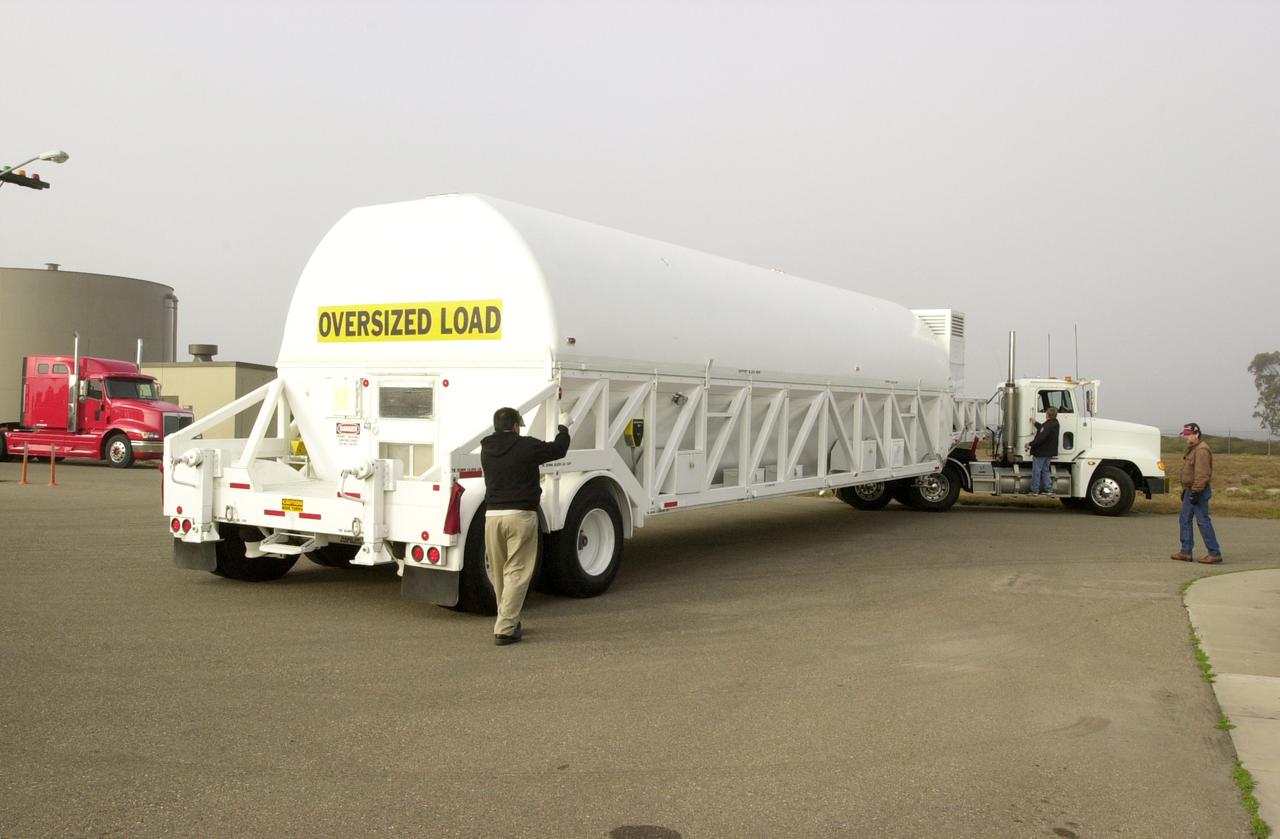
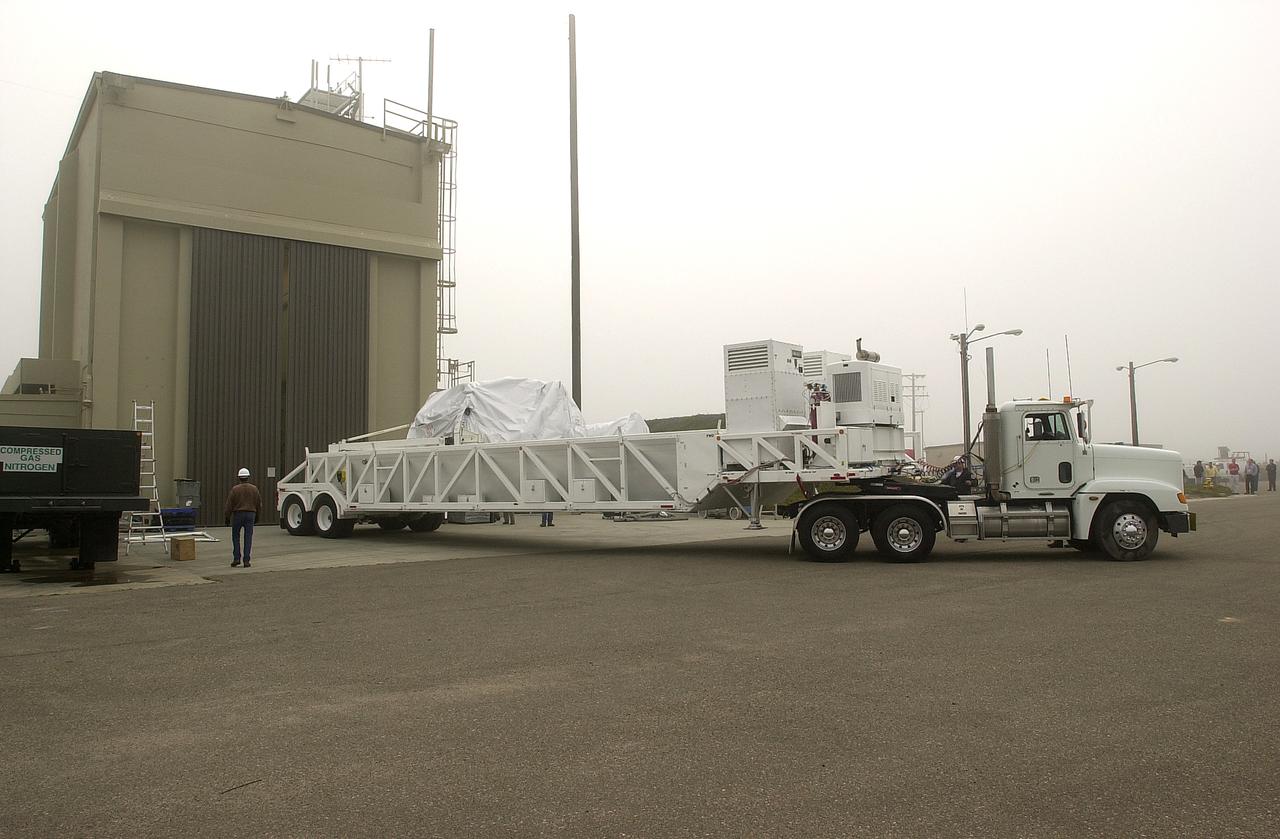
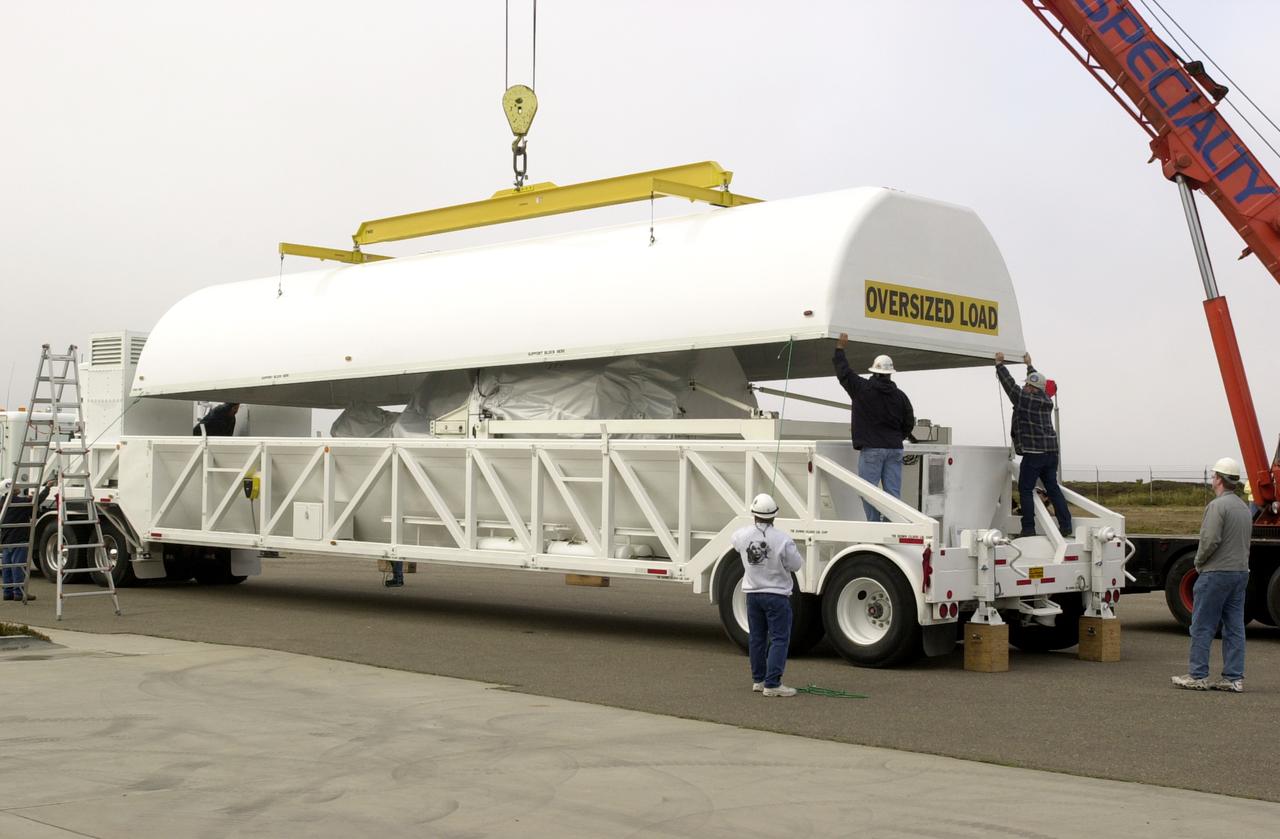
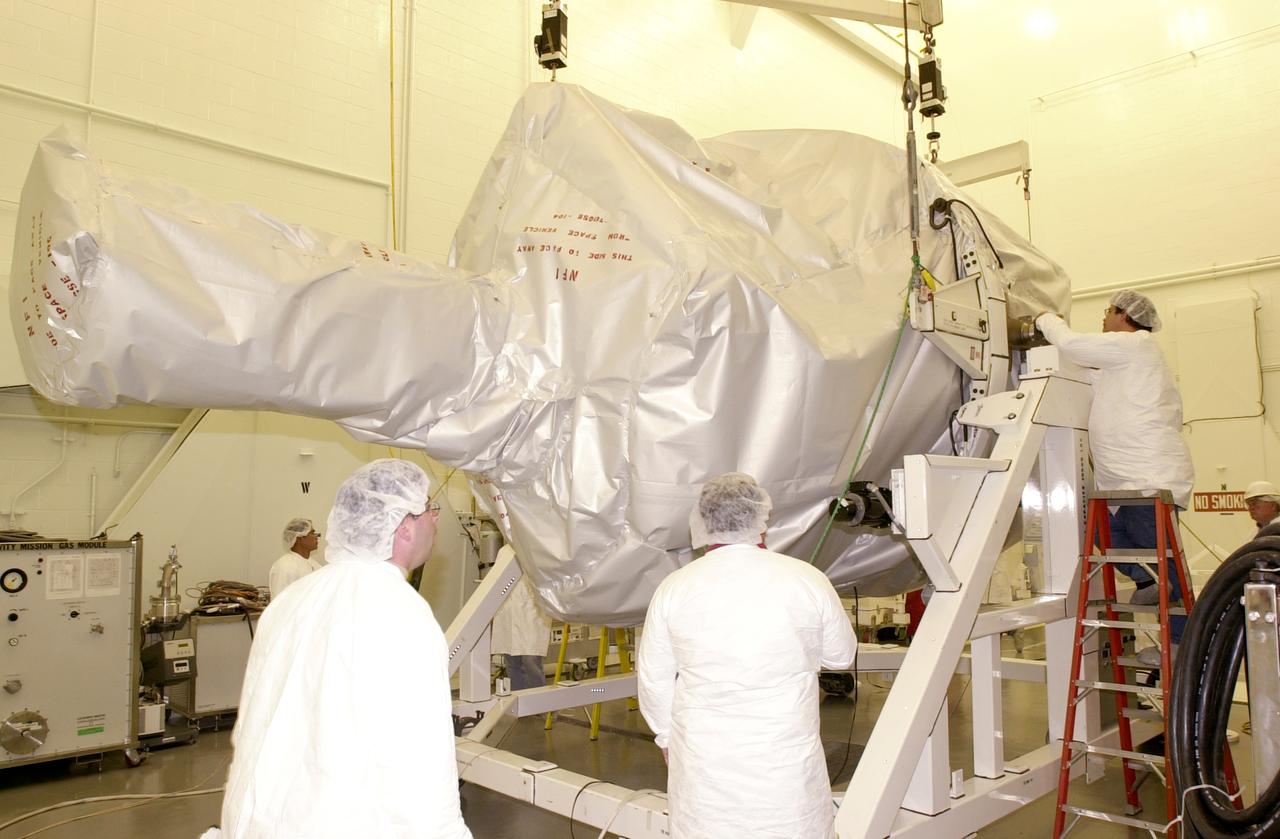
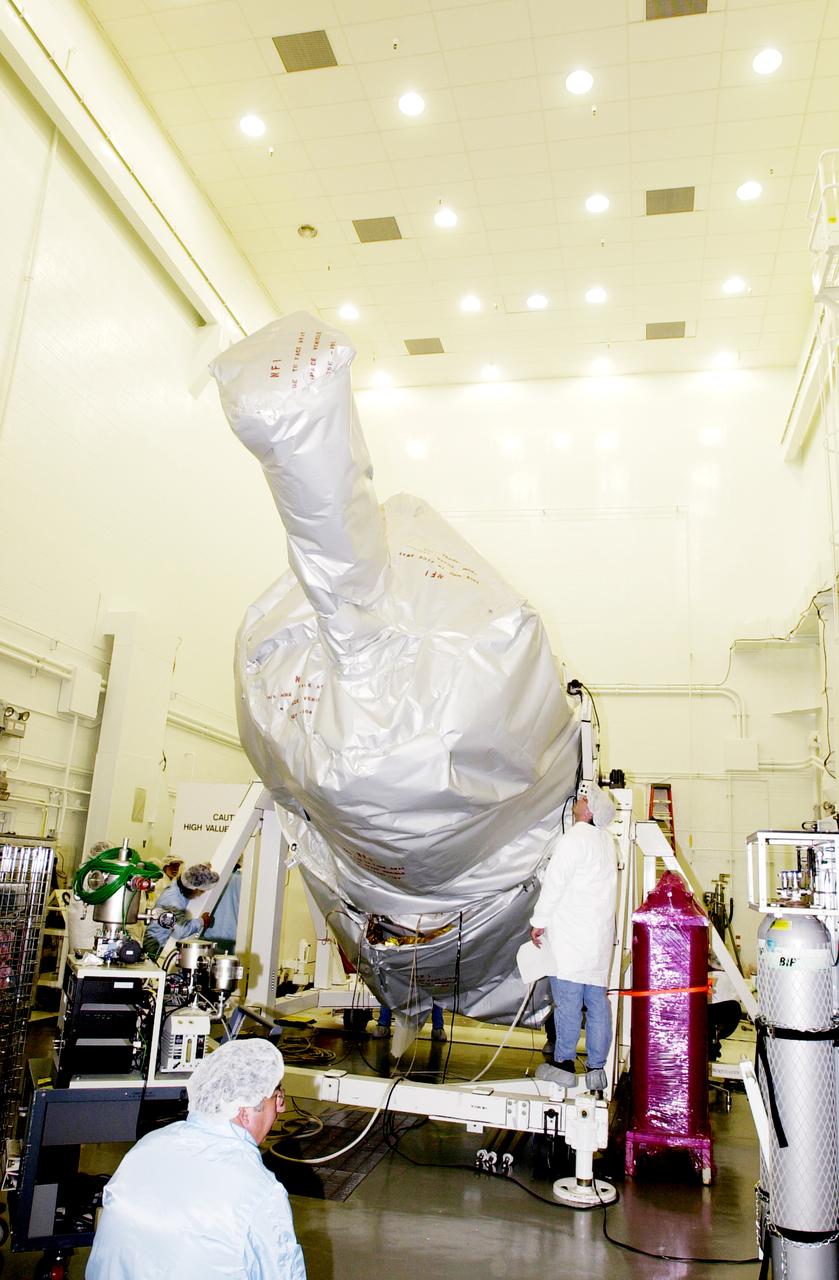
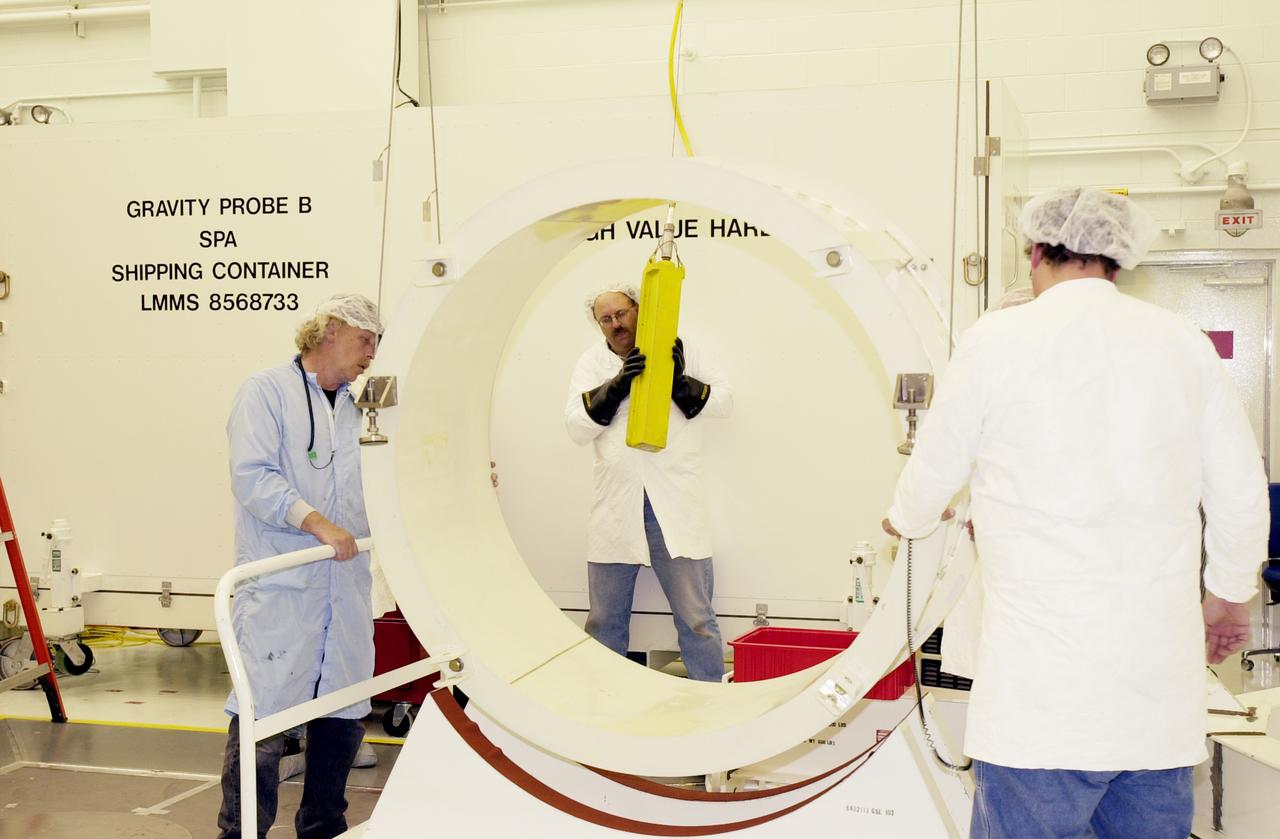
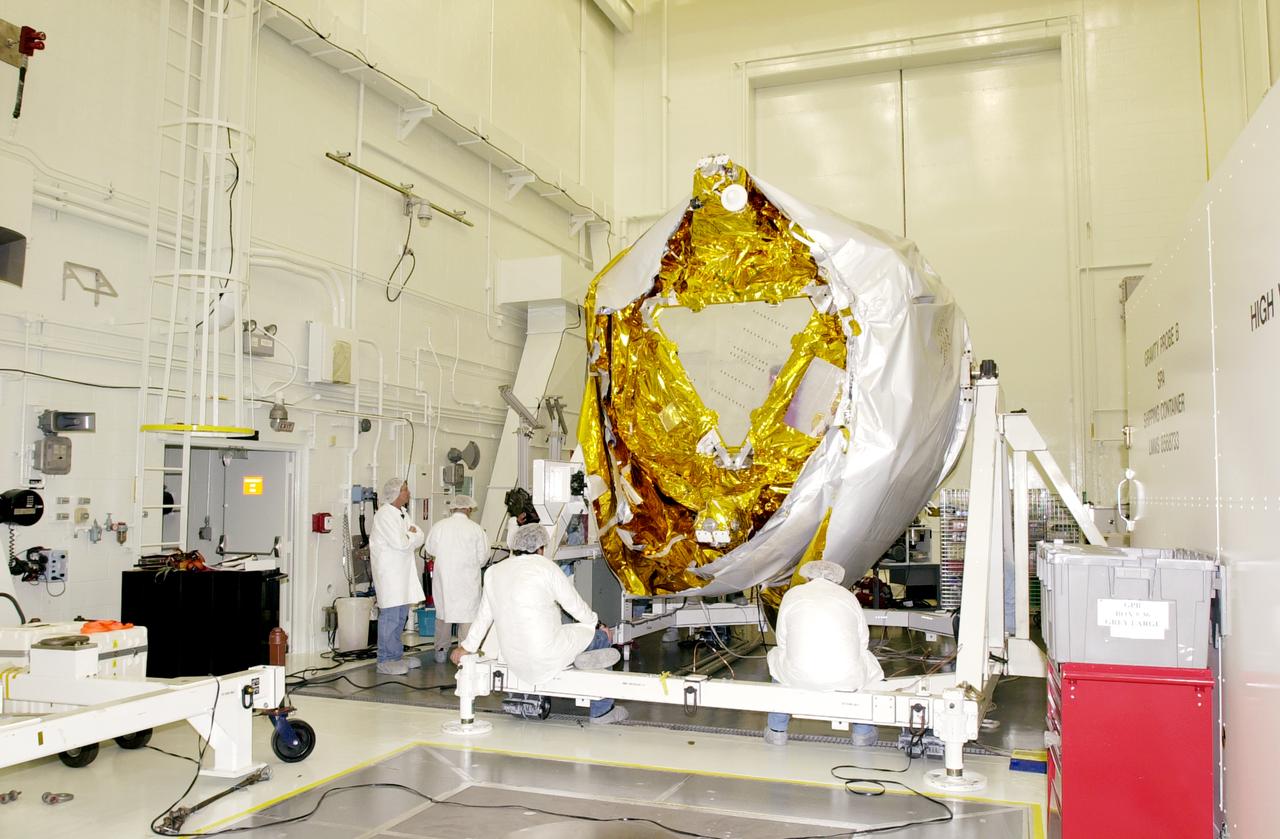
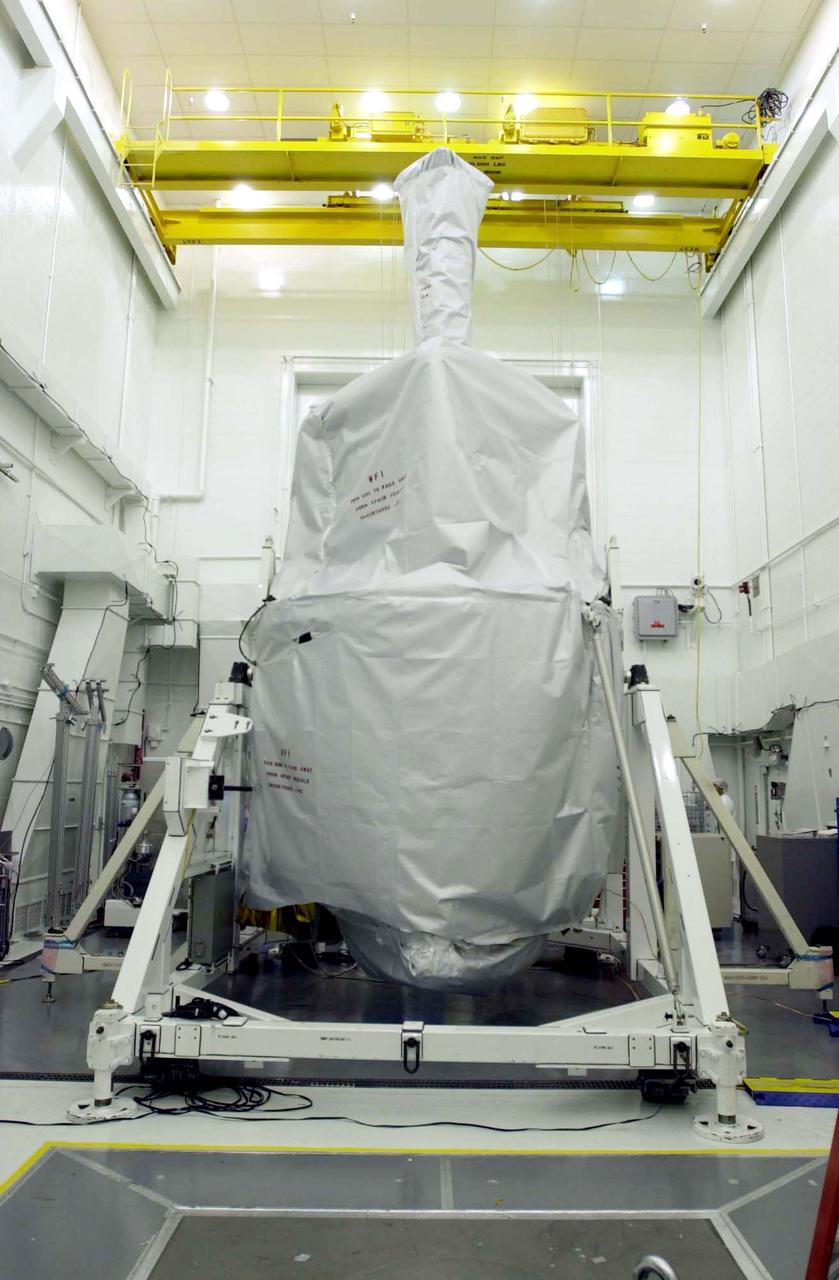
The space vehicle for Gravity Probe B (GP-B) arrives at the launch site at Vandenburg Air Force Base. GP-B is the relativity experiment being developed at Stanford University to test two extraordinary predictions of Albert Einstein's general theory of relativity. The experiment will measure, very precisely, the expected tiny changes in the direction of the spin axes of four gyroscopes contained in an Earth-orbiting satellite at a 400-mile altitude. So free are the gyroscopes from disturbance that they will provide an almost perfect space-time reference system. They will measure how space and time are very slightly warped by the presence of the Earth, and, more profoundly, how the Earth's rotation very slightly drags space-time around with it. These effects, though small for the Earth, have far-reaching implications for the nature of matter and the structure of the Universe. GP-B is among the most thoroughly researched programs ever undertaken by NASA. This is the story of a scientific quest in which physicists and engineers have collaborated closely over many years. Inspired by their quest, they have invented a whole range of technologies that are already enlivening other branches of science and engineering. Scheduled for launch in 2003 and managed for NASA by the Marshall Space Flight Center, development of the GP-B is the responsibility of Stanford University, with major subcontractor Lockheed Martin Corporation.
Space Science
Gravity Probe-B (GP-B) is the relativity experiment being developed at Stanford University to test two extraordinary predictions of Albert Einstein's general theory of relativity. The experiment will measure, very precisely, the expected tiny changes in the direction of the spin axes of four gyroscopes contained in an Earth-orbiting satellite at a 400-mile altitude. So free are the gyroscopes from disturbance that they will provide an almost perfect space-time reference system. They will measure how space and time are very slightly warped by the presence of the Earth, and, more profoundly, how the Earth's rotation very slightly drags space-time around with it. These effects, though small for the Earth, have far-reaching implications for the nature of matter and the structure of the Universe. GP-B is among the most thoroughly researched programs ever undertaken by NASA. This is the story of a scientific quest in which physicists and engineers have collaborated closely over many years. Inspired by their quest, they have invented a whole range of technologies -- technologies that are already enlivening other branches of science and engineering. Scheduled for launch in 2003 and managed for NASA by Marshall Space Flight Center, development of the GP-B is the responsibility of Stanford University, with major subcontractor Lockheed Martin Corporation.
Space Science
In this photo, the Gravity Probe B (GP-B) space vehicle is being encapsulated atop the Delta II launch vehicle. The GP-B is the relativity experiment developed at Stanford University to test two extraordinary predictions of Albert Einstein’s general theory of relativity. The experiment will measure, very precisely, the expected tiny changes in the direction of the spin axes of four gyroscopes contained in an Earth-orbiting satellite at a 400-mile altitude. So free are the gyroscopes from disturbance that they will provide an almost perfect space-time reference system. They will measure how space and time are very slightly warped by the presence of the Earth, and, more profoundly, how the Earth’s rotation very slightly drags space-time around with it. These effects, though small for the Earth, have far-reaching implications for the nature of matter and the structure of the Universe. GP-B is among the most thoroughly researched programs ever undertaken by NASA. This is the story of a scientific quest in which physicists and engineers have collaborated closely over many years. Inspired by their quest, they have invented a whole range of technologies that are already enlivening other branches of science and engineering.  Launched  April 20, 2004 , the GP-B program was managed for NASA by the Marshall Space Flight Center. Development of the GP-B is the responsibility of Stanford University along with major subcontractor Lockheed Martin Corporation.  (Image credit to Russ Underwood, Lockheed Martin Corporation).
Space Science
Gravity Probe-B (GP-B) is the relativity experiment being developed at Stanford University to test two extraordinary predictions of Albert Einstein's general theory of relativity. The experiment will measure, very precisely, the expected tiny changes in the direction of the spin axes of four gyroscopes contained in an Earth-orbiting satellite at a 400-mile altitude. So free are the gyroscopes from disturbance that they will provide an almost perfect space-time reference system. They will measure how space and time are very slightly warped by the presence of the Earth, and, more profoundly, how the Earth's rotation very slightly drags space-time around with it. These effects, though small for the Earth, have far-reaching implications for the nature of matter and the structure of the Universe. GP-B is among the most thoroughly researched programs ever undertaken by NASA. This is the story of a scientific quest in which physicists and engineers have collaborated closely over many years. Inspired by their quest, they have invented a whole range of technologies -- technologies that are already enlivening other branches of science and engineering. Scheduled for launch in 2003 and managed for NASA by the Marshall Space Flight Center, development of GP-B is the responsibility of Stanford University, with major subcontractor Lockheed Martin Corporation.
Space Science
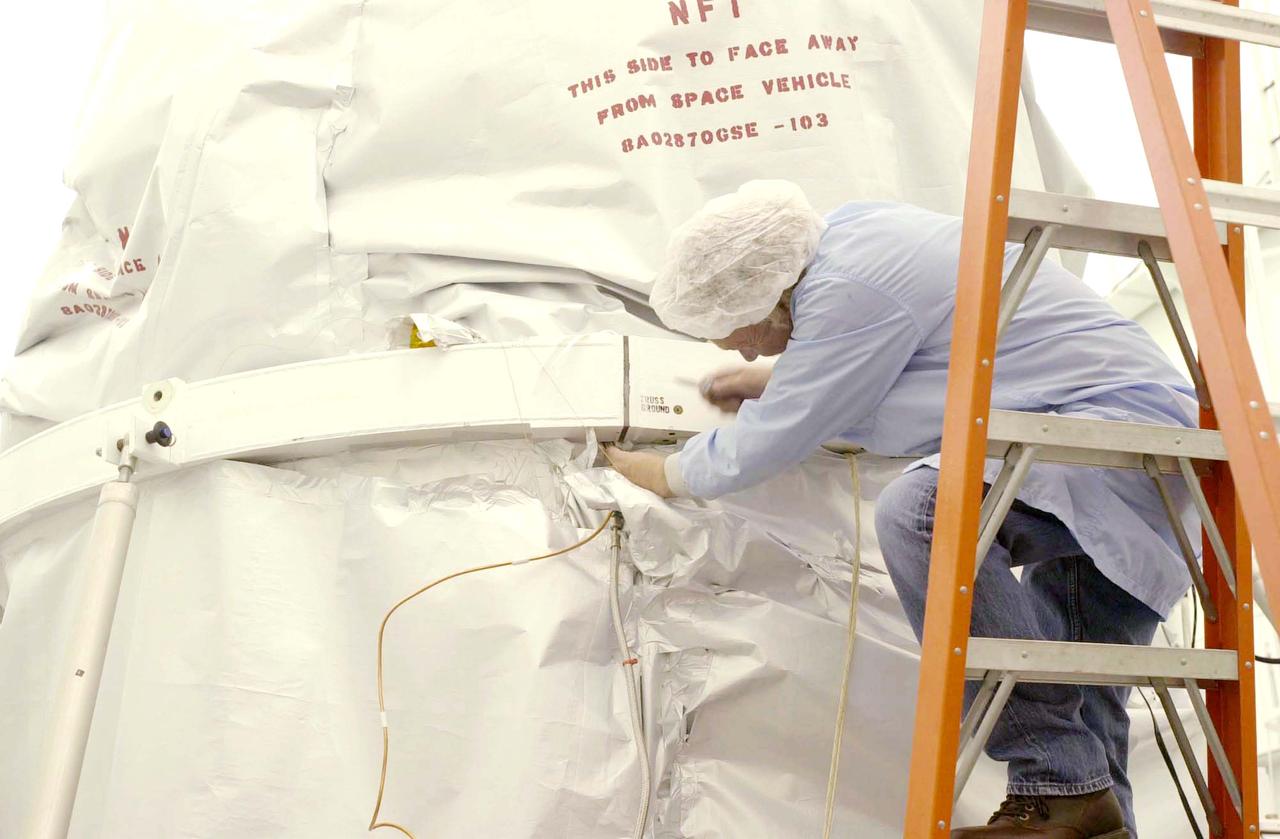
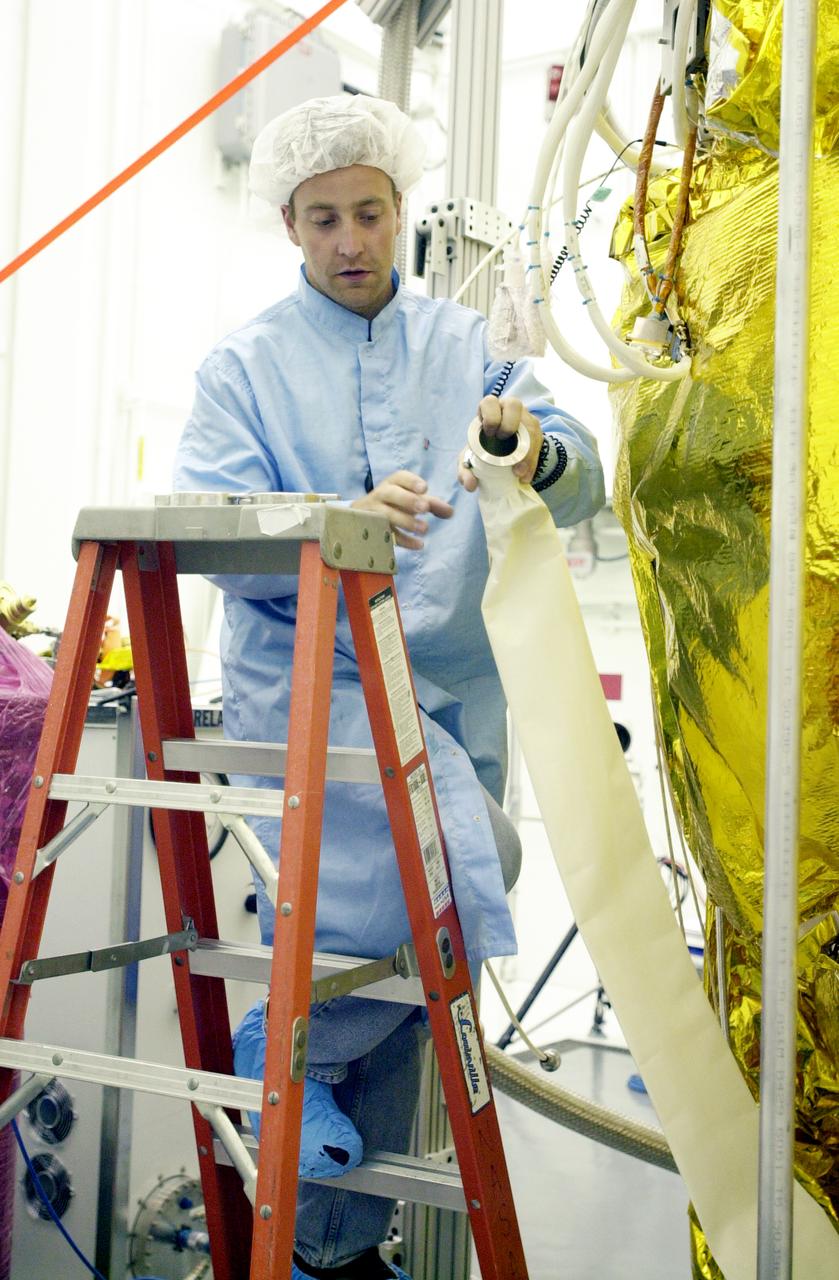
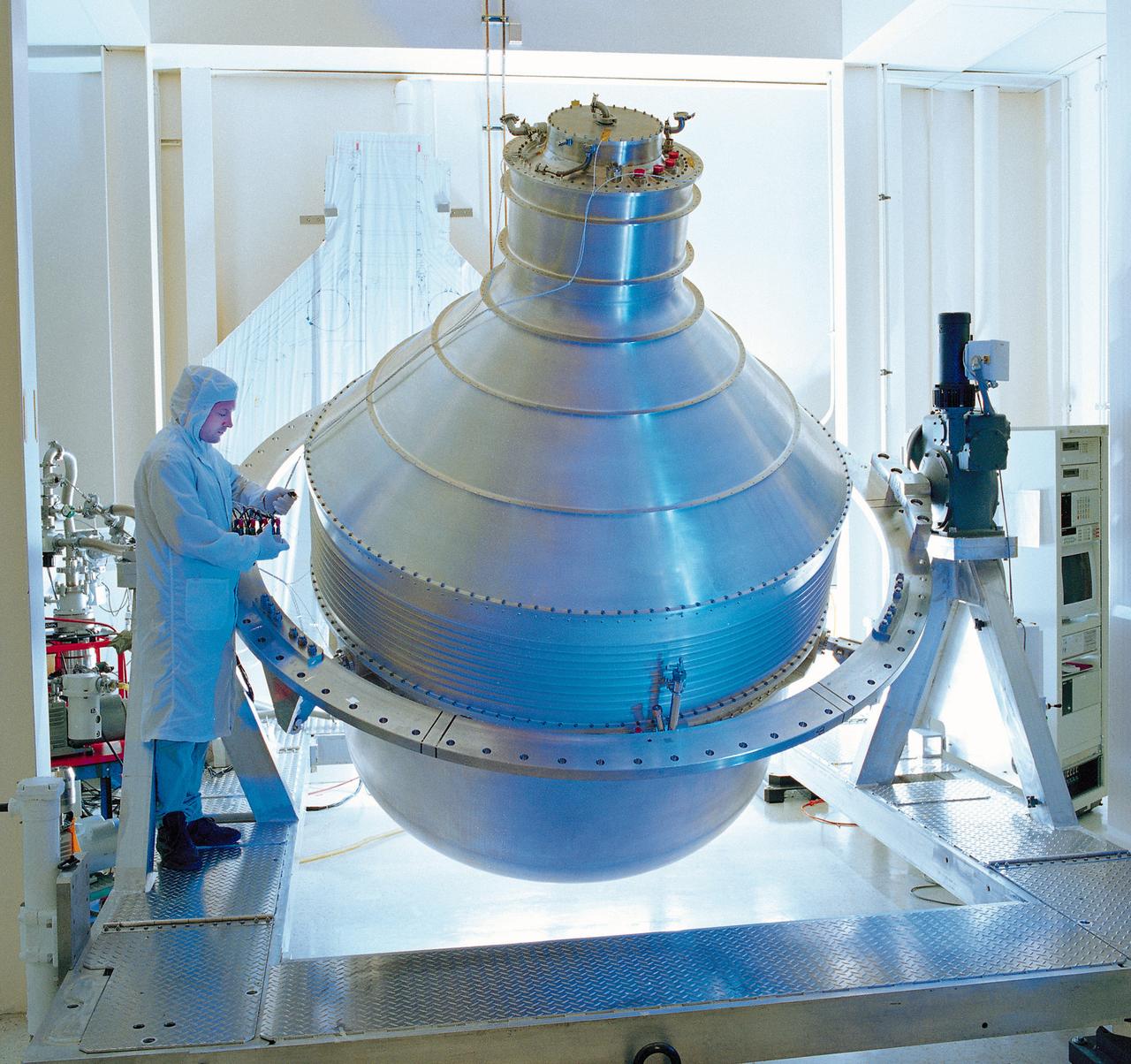
The space vehicle Gravity Probe B (GP-B) is the relativity experiment developed at Stanford University to test two extraordinary predictions of Albert Einstein’s general theory of relativity. The experiment will measure, very precisely, the expected tiny changes in the direction of the spin axes of four gyroscopes contained in an Earth-orbiting satellite at a 400-mile altitude. So free are the gyroscopes from disturbance that they will provide an almost perfect space-time reference system. They will measure how space and time are very slightly warped by the presence of the Earth, and, more profoundly, how the Earth’s rotation very slightly drags space-time around with it. These effects, though small for the Earth, have far-reaching implications for the nature of matter and the structure of the Universe. GP-B is among the most thoroughly researched programs ever undertaken by NASA. This is the story of a scientific quest in which physicists and engineers have collaborated closely over many years. Inspired by their quest, they have invented a whole range of technologies that are already enlivening other branches of science and engineering. In this photograph, engineer Gary Reynolds is inspecting the inside of the probe neck during probe thermal repairs. GP-B is scheduled for launch in April 2004 and managed for NASA by the Marshall Space Flight Center. Development of the GP-B is the responsibility of Stanford University along with major subcontractor Lockheed Martin Corporation.  (Image credit to Russ Leese, Gravity Probe B, Stanford University)
Space Science
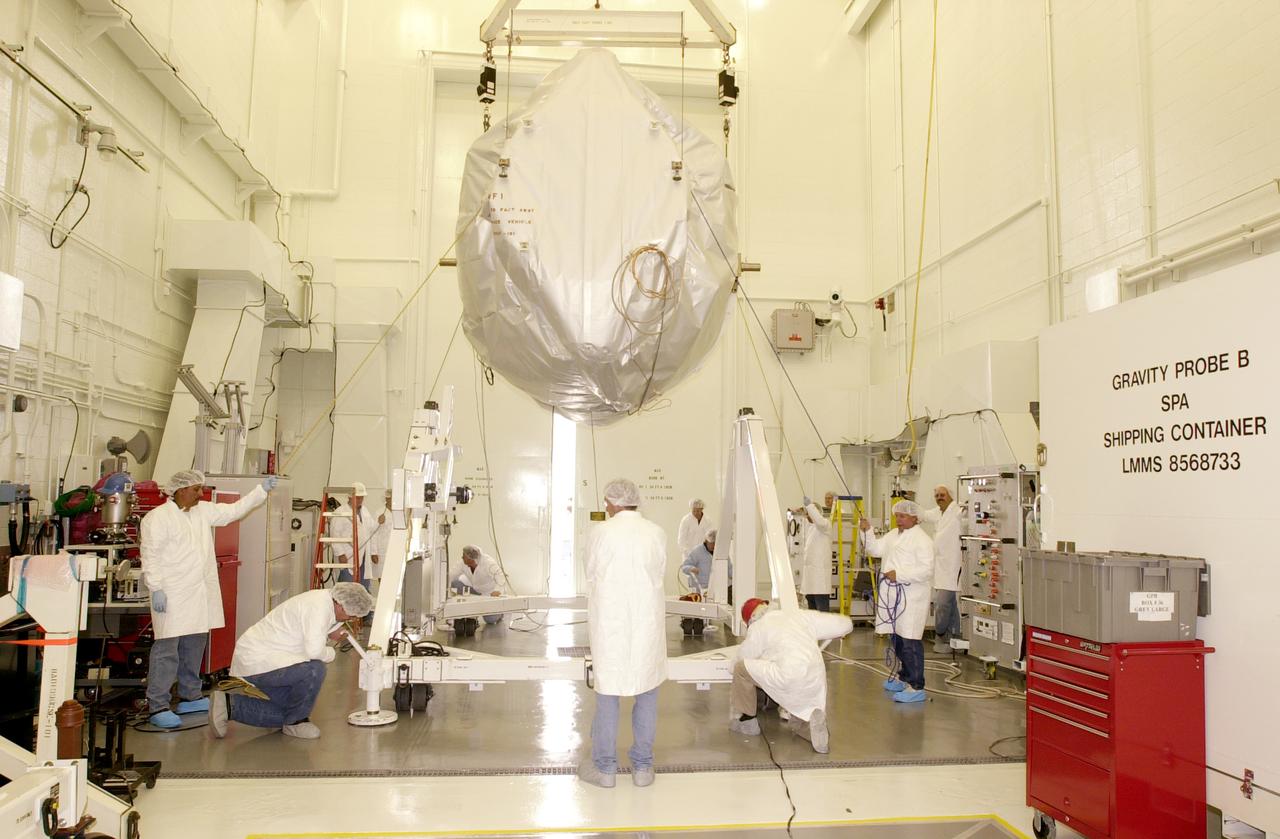
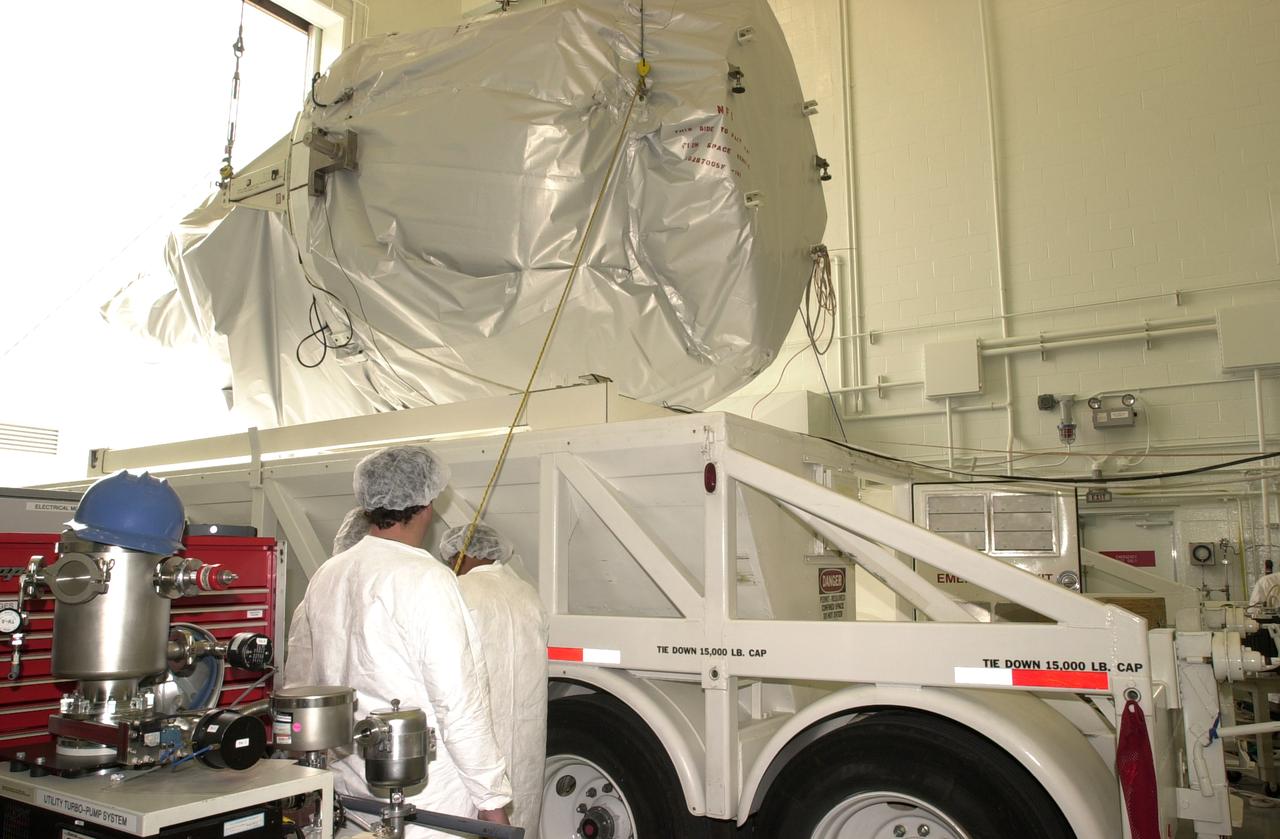
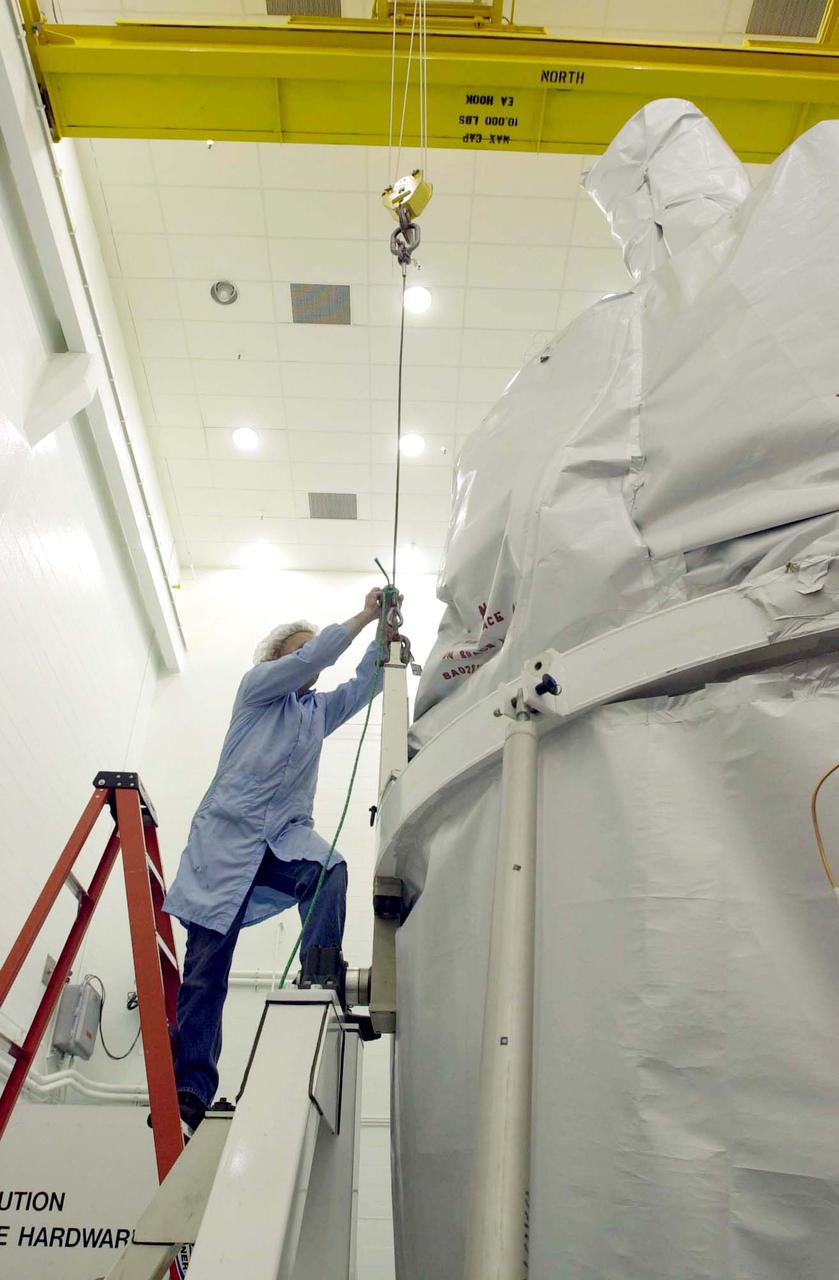
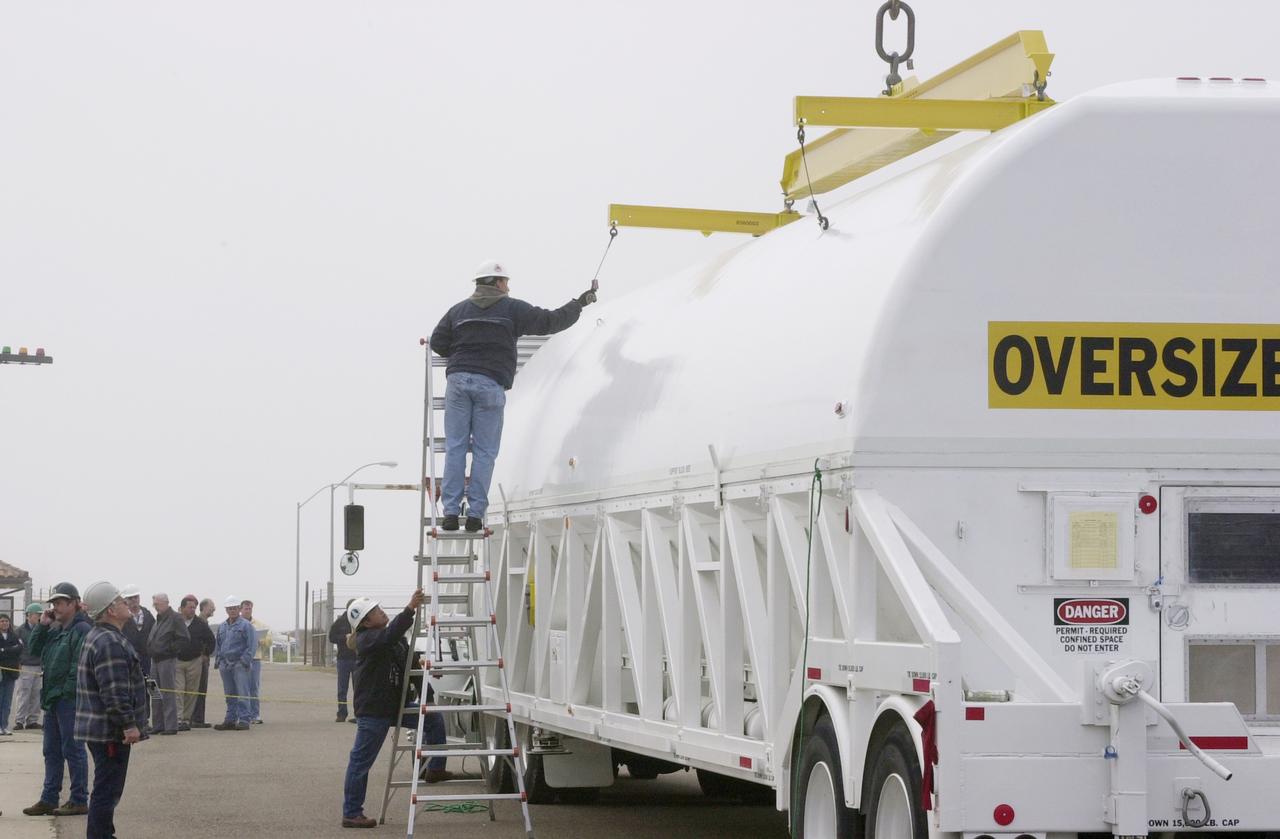
The Gravity Probe B (GP-B) payload was hoisted by crane to the transportation truck in the W.W. Hansen Experimental Physics Laboratory in Stanford, California for shipment to the launch site at Vandenburg Air Force Base. GP-B is the relativity experiment being developed at Stanford University to test two extraordinary predictions of Albert Einstein’s general theory of relativity. The experiment will measure, very precisely, the expected tiny changes in the direction of the spin axes of four gyroscopes contained in an Earth-orbiting satellite at a 400-mile altitude. So free are the gyroscopes from disturbance that they will provide an almost perfect space-time reference system. They will measure how space and time are very slightly warped by the presence of the Earth, and, more profoundly, how the Earth’s rotation very slightly drags space-time around with it. These effects, though small for the Earth, have far-reaching implications for the nature of matter and the structure of the Universe. GP-B is among the most thoroughly researched programs ever undertaken by NASA. This is the story of a scientific quest in which physicists and engineers have collaborated closely over many years. Inspired by their quest, they have invented a whole range of technologies that are already enlivening other branches of science and engineering. Launched April 20, 2004, the GP-B program was managed for NASA by the Marshall Space Flight Center. Development of the GP-B is the responsibility of Stanford University, along with major subcontractor Lockheed Martin Corporation. (Photo Credit: Stanford University)
Space Science
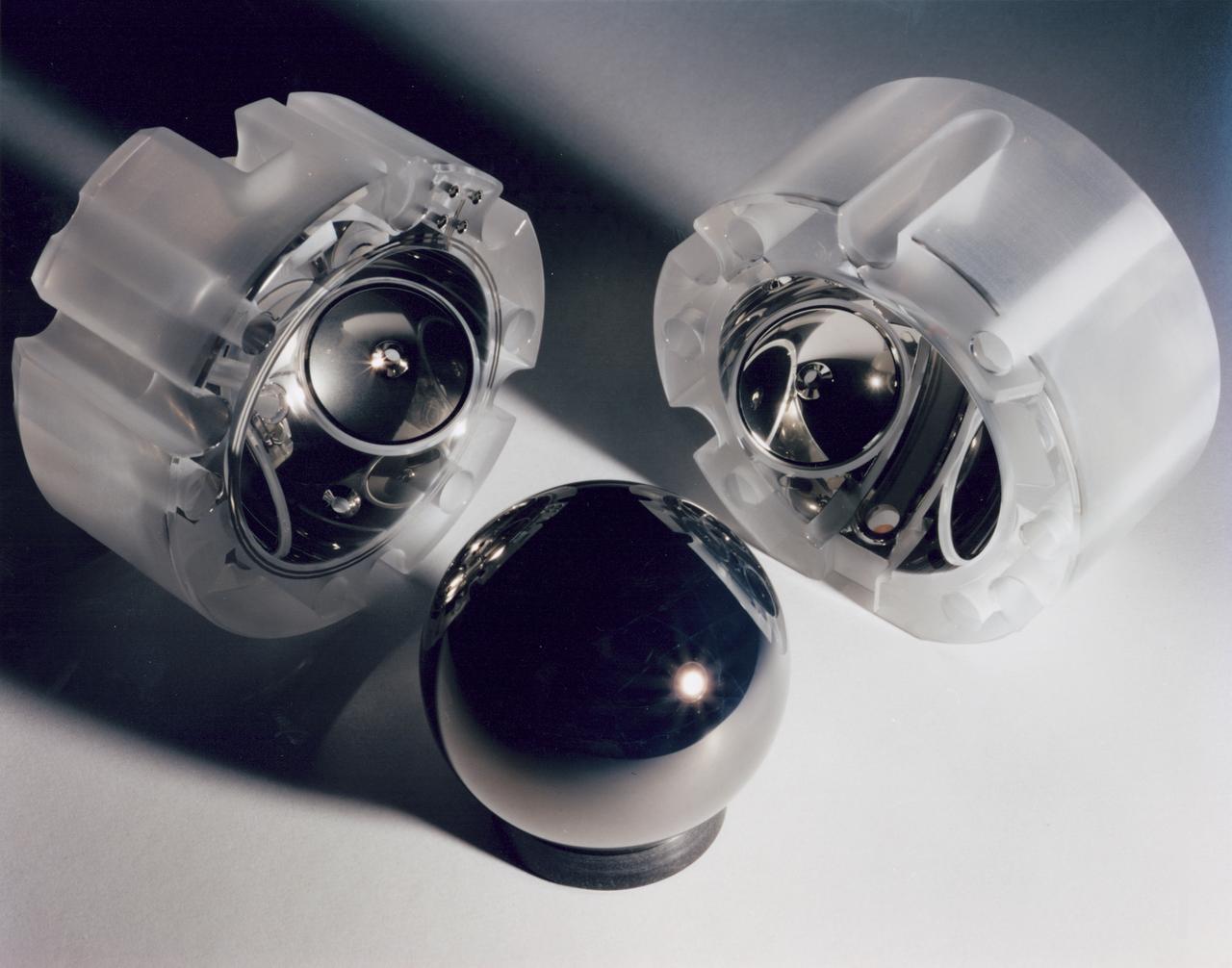
The Gravity Probe B (GP-B) is the relativity experiment developed at Stanford University to test two extraordinary predictions of Albert Einstein’s general theory of relativity. The experiment will measure, very precisely, the expected tiny changes in the direction of the spin axes of four gyroscopes contained in an Earth-orbiting satellite at a 400-mile altitude. So free are the gyroscopes from disturbance that they will provide an almost perfect space-time reference system. They will measure how space and time are very slightly warped by the presence of the Earth, and, more profoundly, how the Earth’s rotation very slightly drags space-time around with it. These effects, though small for the Earth, have far-reaching implications for the nature of matter and the structure of the Universe. This photograph is a close up of a niobium-coated gyroscope motor and its housing halves. GP-B is among the most thoroughly researched programs ever undertaken by NASA. This is the story of a scientific quest in which physicists and engineers have collaborated closely over many years. Inspired by their quest, they have invented a whole range of technologies that are already enlivening other branches of science and engineering.  Launched  April 20, 2004 , the GP-B program was managed for NASA by the Marshall Space Flight Center. Development of the GP-B is the responsibility of Stanford University along with major subcontractor Lockheed Martin Corporation.  (Image credit to Don Harley.)
Space Science
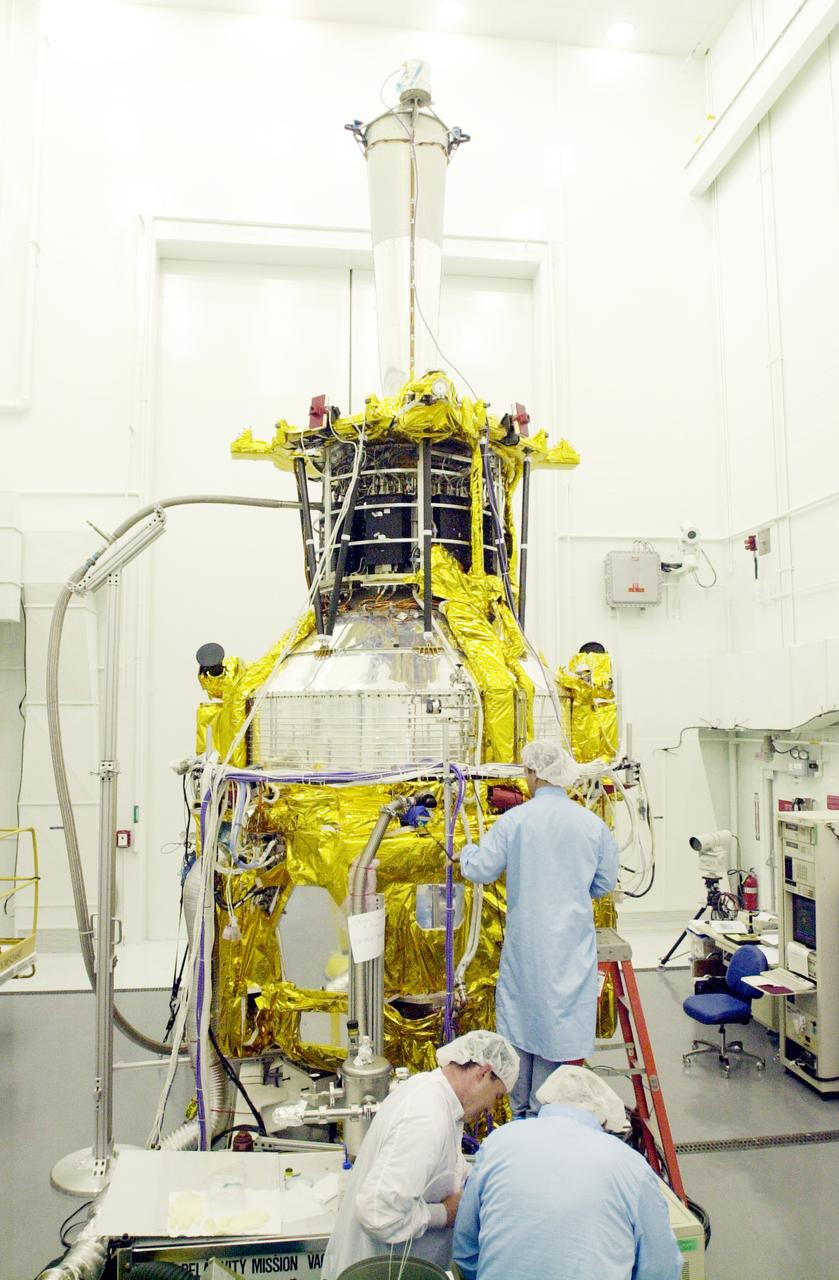
The Gravity Probe B (GP-B) is the relativity experiment developed at Stanford University to test two extraordinary predictions of Albert Einstein’s general theory of relativity. The experiment will measure, very precisely, the expected tiny changes in the direction of the spin axes of four gyroscopes contained in an Earth-orbiting satellite at a 400-mile altitude. So free are the gyroscopes from disturbance that they will provide an almost perfect space-time reference system. They will measure how space and time are very slightly warped by the presence of the Earth, and, more profoundly, how the Earth’s rotation very slightly drags space-time around with it. These effects, though small for the Earth, have far-reaching implications for the nature of matter and the structure of the Universe. In this photograph, the completed space vehicle is undergoing thermal vacuum environment testing. GP-B is among the most thoroughly researched programs ever undertaken by NASA. This is the story of a scientific quest in which physicists and engineers have collaborated closely over many years. Inspired by their quest, they have invented a whole range of technologies that are already enlivening other branches of science and engineering.  Launched April 20, 2004 , the GP-B program was managed for NASA by the Marshall Space Flight Center. Development of the GP-B is the responsibility of Stanford University along with major subcontractor Lockheed Martin Corporation.  (Image credit to Russ Underwood, Lockheed Martin Corporation.)
Space Science
The Gravity Probe B (GP-B) is the relativity experiment developed at Stanford University to test two extraordinary predictions of Albert Einstein’s general theory of relativity. The experiment will measure, very precisely, the expected tiny changes in the direction of the spin axes of four gyroscopes contained in an Earth-orbiting satellite at a 400-mile altitude. So free are the gyroscopes from disturbance that they will provide an almost perfect space-time reference system. They will measure how space and time are very slightly warped by the presence of the Earth, and, more profoundly, how the Earth’s rotation very slightly drags space-time around with it. These effects, though small for the Earth, have far-reaching implications for the nature of matter and the structure of the Universe. In this photograph, Stanford engineer, Chris Gray, is inspecting the number 4 gyro under monochromatic light. GP-B is among the most thoroughly researched programs ever undertaken by NASA. This is the story of a scientific quest in which physicists and engineers have collaborated closely over many years. Inspired by their quest, they have invented a whole range of technologies that are already enlivening other branches of science and engineering.  Launched  April 20, 2004 , the GP-B program was managed for NASA by the Marshall Space Flight Center. Development of the GP-B is the responsibility of Stanford University along with major subcontractor Lockheed Martin Corporation.  (Image credit to Russ Leese, Stanford University.)
Space Science
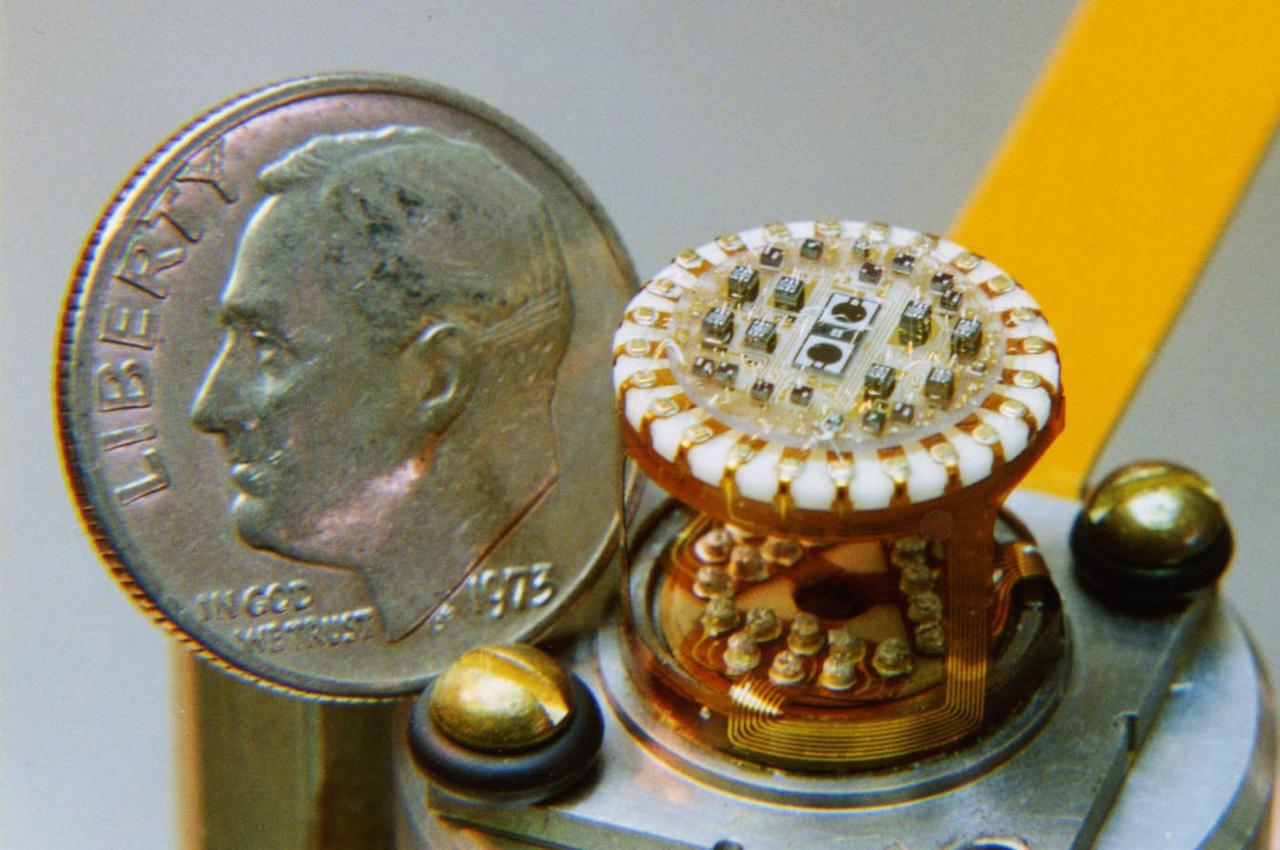
In this photo, the Gravity Probe B (GP-B) detector mount assembly is shown in comparison to the size of a dime.  The assembly is used to detect exactly how much starlight is coming through different beams from the beam splitter in the telescope.  The measurements from the tiny chips inside are what keeps GP-B aimed at the guide star. The GP-B is the relativity experiment developed at Stanford University to test two extraordinary predictions of Albert Einstein’s general theory of relativity. The experiment will measure, very precisely, the expected tiny changes in the direction of the spin axes of four gyroscopes contained in an Earth-orbiting satellite at a 400-mile altitude. So free are the gyroscopes from disturbance that they will provide an almost perfect space-time reference system. They will measure how space and time are very slightly warped by the presence of the Earth, and, more profoundly, how the Earth’s rotation very slightly drags space-time around with it. These effects, though small for the Earth, have far-reaching implications for the nature of matter and the structure of the Universe. GP-B is among the most thoroughly researched programs ever undertaken by NASA. This is the story of a scientific quest in which physicists and engineers have collaborated closely over many years. Inspired by their quest, they have invented a whole range of technologies that are already enlivening other branches of science and engineering.  Launched  April 20, 2004 , the GP-B program was managed for NASA by the Marshall Space Flight Center. Development of the GP-B is the responsibility of Stanford University along with major subcontractor Lockheed Martin Corporation.  (Image credit to Paul Ehrensberger, Stanford University.)
Space Science
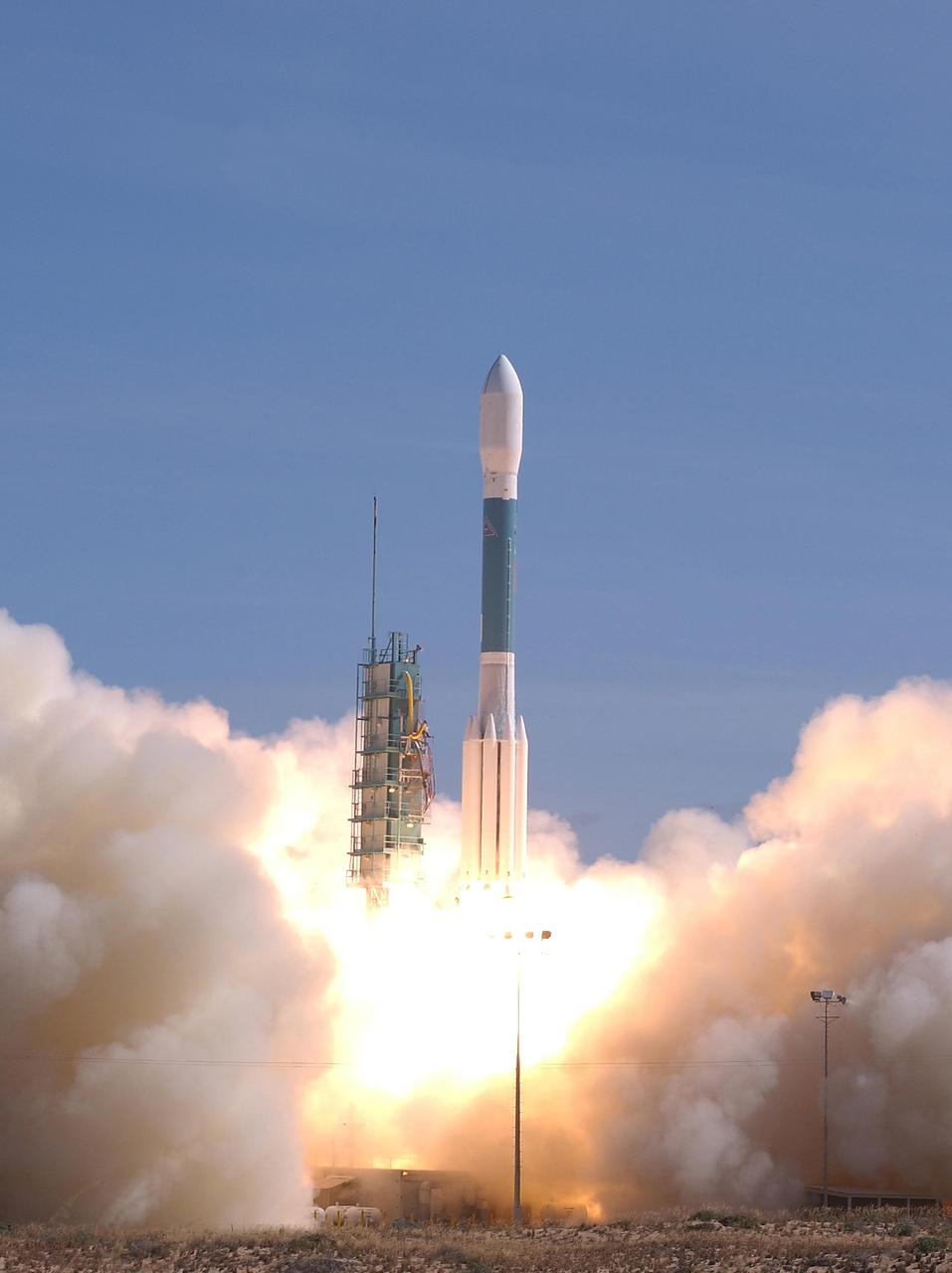
KENNEDY SPACE CENTER, FLA. -  The Gravity Probe B spacecraft, atop a Boeing Delta II vehicle, launches at 12:57:24 p.m. EDT from Space Launch Complex 2 at Vandenberg Air Force Base, Calif.  Gravity Probe B is the relativity gyroscope experiment being developed by NASA and Stanford University to test two extraordinary, unverified predictions of Albert Einstein's general theory of relativity.
KSC-04pd0940
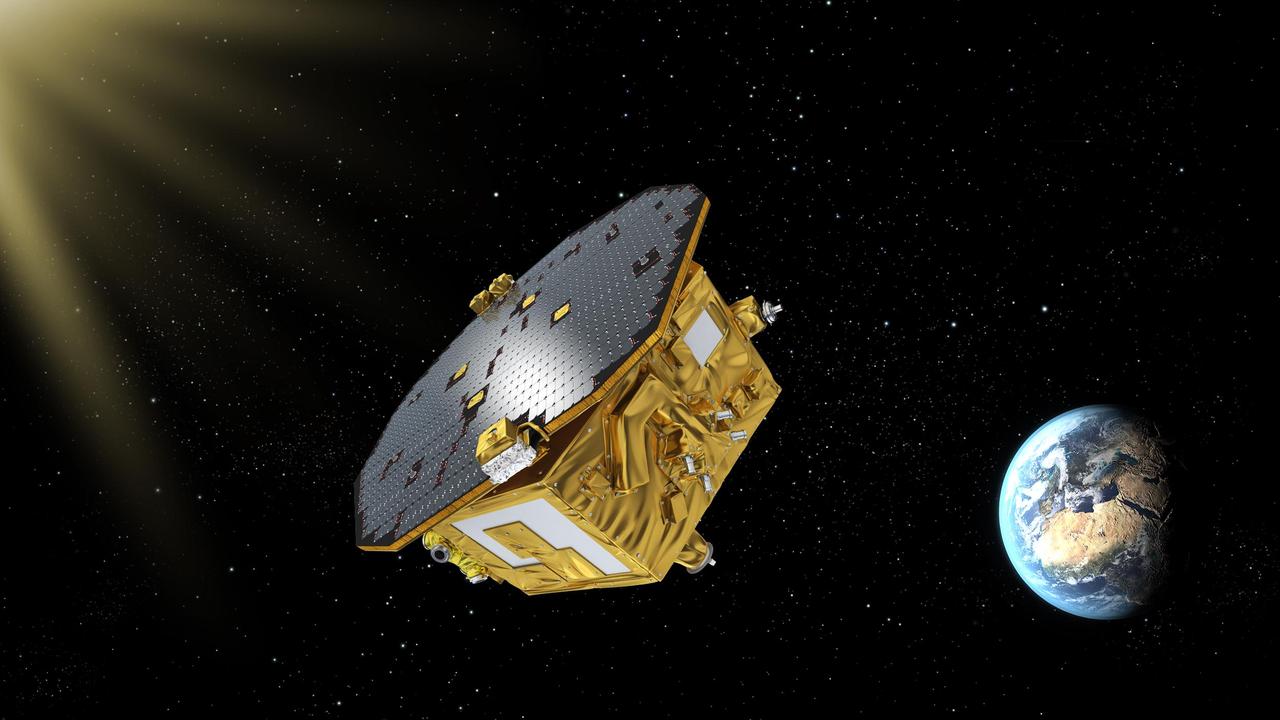
When two black holes collide, they release massive amounts of energy in the form of gravitational waves that last a fraction of a second and can be &quot;heard&quot; throughout the universe - if you have the right instruments.   Today we learned that the #LIGO project heard the telltale chirp of black holes colliding, fulfilling Einstein's General Theory of Relativity.   NASA's LISA mission will look for direct evidence of gravitational waves. <a href="http://go.nasa.gov/23ZbqoE" rel="nofollow">go.nasa.gov/23ZbqoE</a>  This video illustrates what that collision might look like.
Black Holes Collide
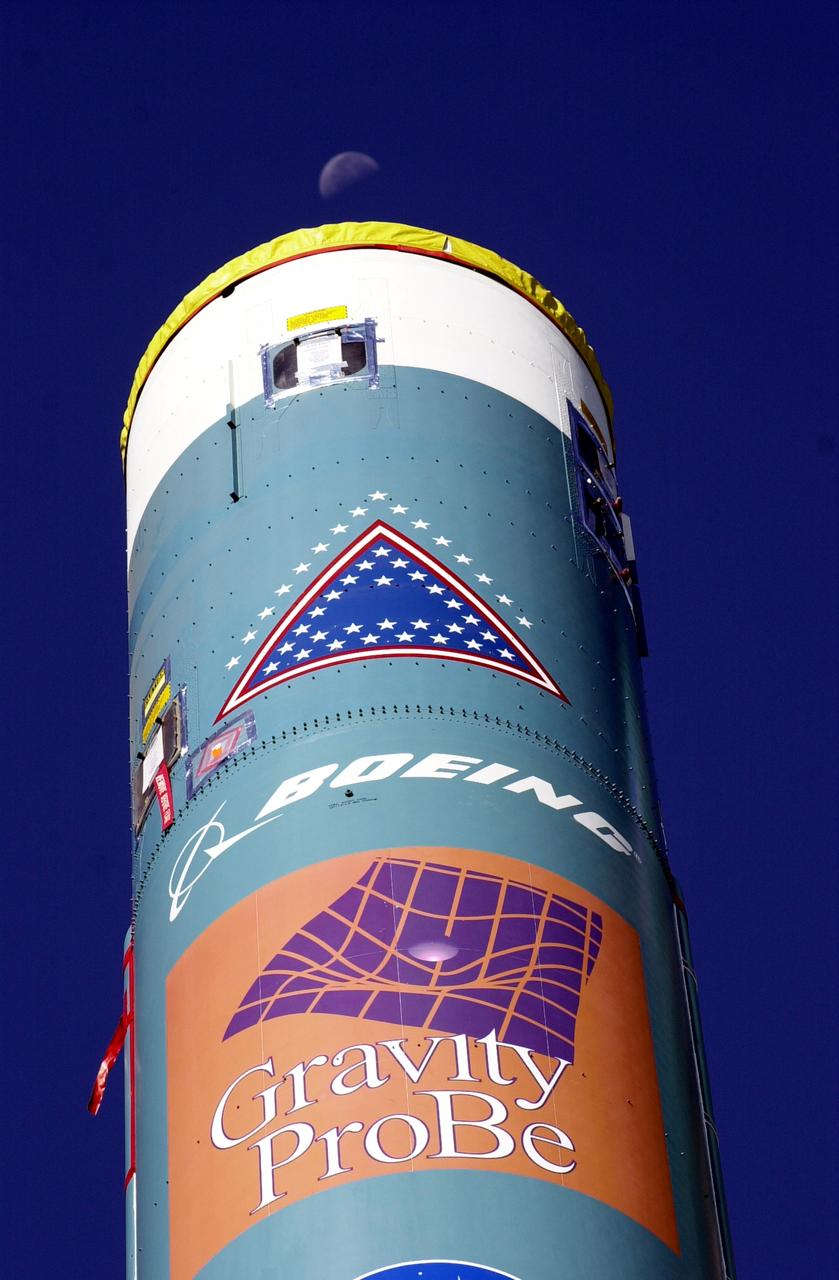
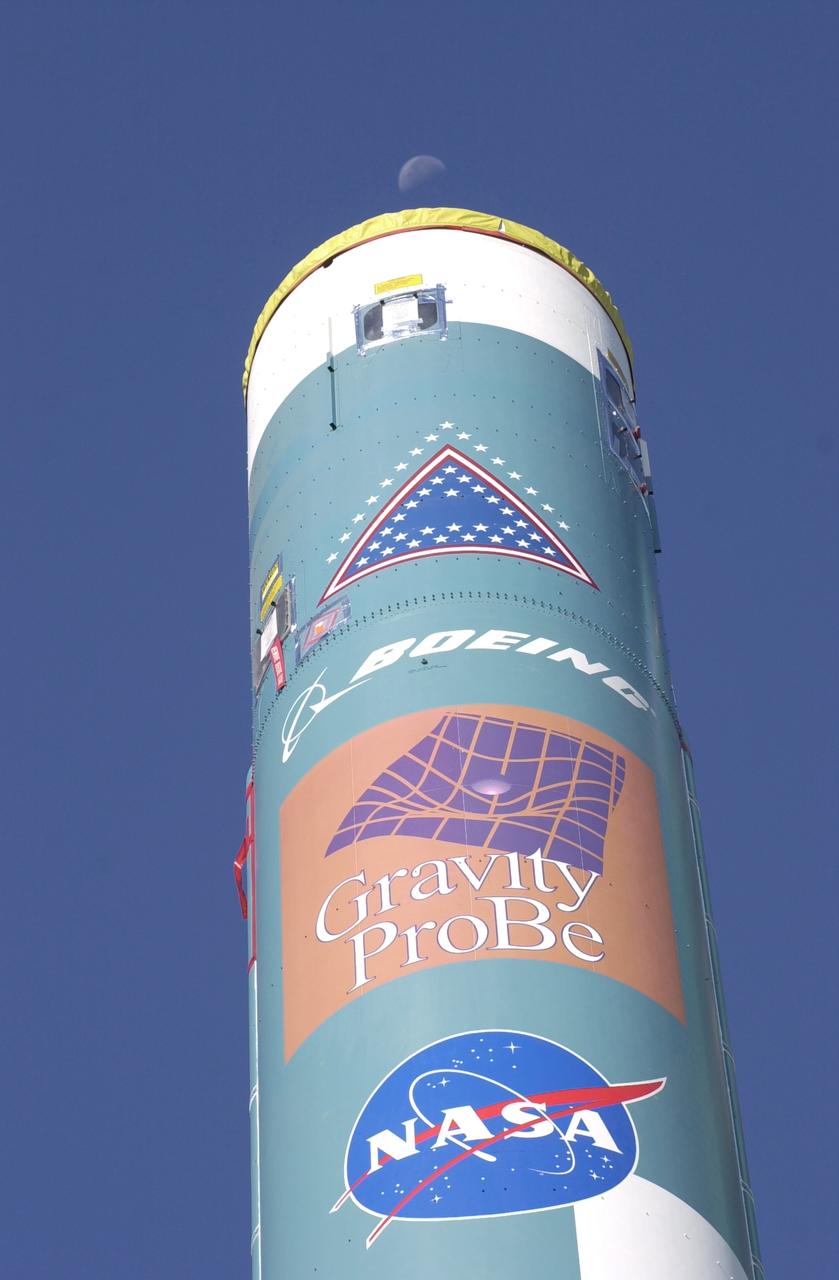
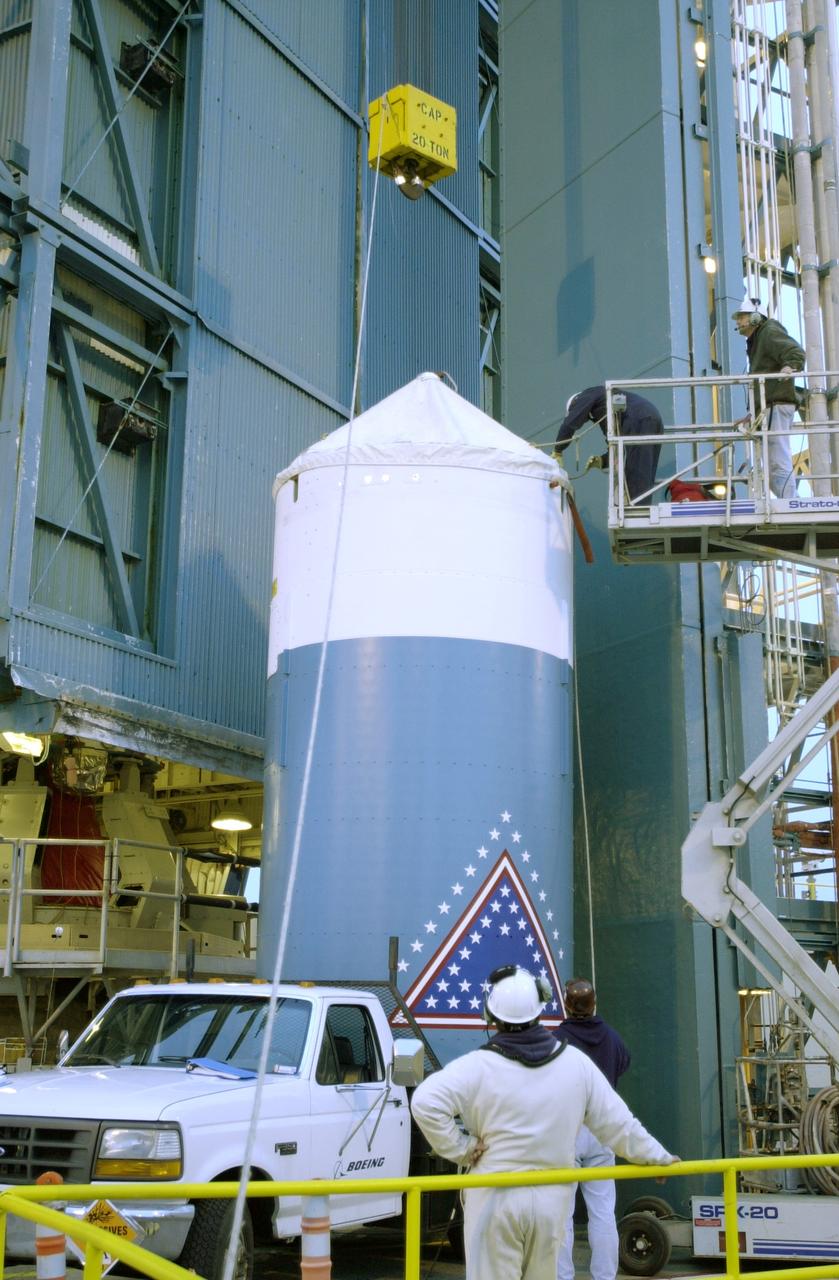
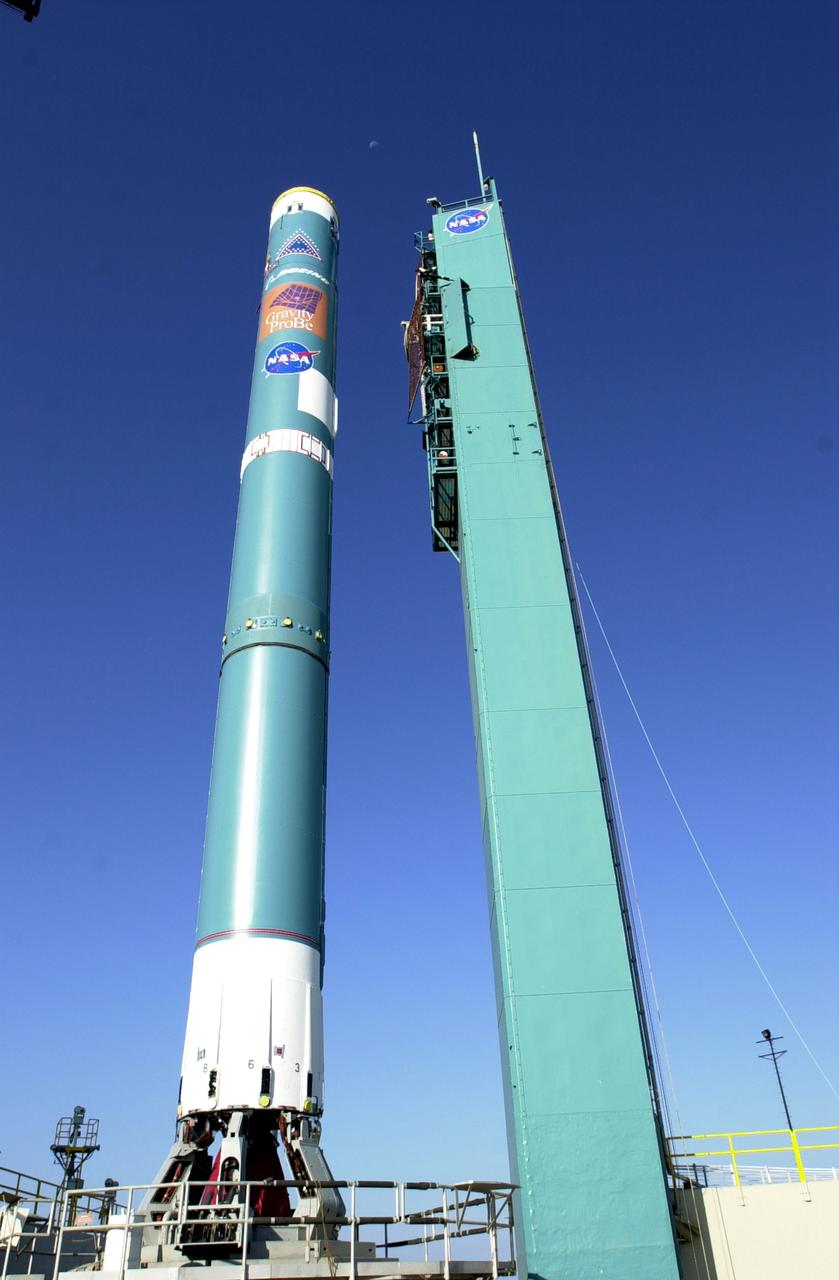
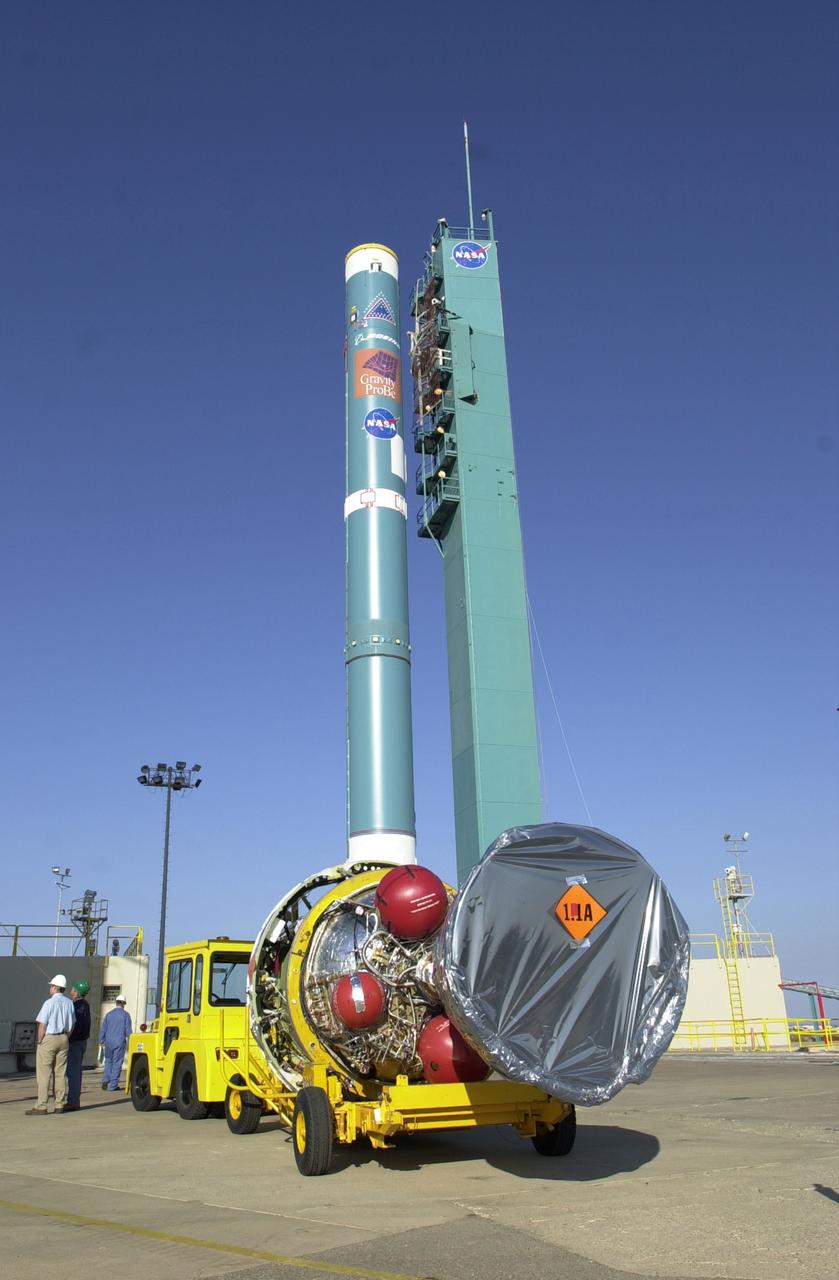
VANDENBERG AFB, CALIF. -  Logos identify the mission of this Delta II rocket that will launch the Gravity Probe B experiment, developed by Stanford University, Lockheed Martin and NASA’s Marshall Space Flight Center.   The Gravity Probe B will launch a payload of four gyroscopes into low-Earth polar orbit to test two extraordinary predictions of Albert Einstein’s general theory of relativity: the geodetic effect (how space and time are warped by the presence of the Earth) and frame dragging (how Earth’s rotation drags space and time around with it). Once in orbit, for 18 months each gyroscope’s spin axis will be monitored as it travels through local spacetime, observing and measuring these effects. The targeted launch date is Dec. 6, 2003.
VANDENBERG AFB, CALIF. - Logos identify the mission of this Delta II rocket that will launch the Gravity Probe B experiment, developed by Stanford University, Lockheed Martin and NASA’s Marshall Space Flight Center. The Gravity Probe B will launch a payload of four gyroscopes into low-Earth polar orbit to test two extraordinary predictions of Albert Einstein’s general theory of relativity: the geodetic effect (how space and time are warped by the presence of the Earth) and frame dragging (how Earth’s rotation drags space and time around with it). Once in orbit, for 18 months each gyroscope’s spin axis will be monitored as it travels through local spacetime, observing and measuring these effects. The targeted launch date is Dec. 6, 2003.
VANDENBERG AFB, CALIF. -  Logos identify the mission of this Delta II rocket that will launch the Gravity Probe B experiment, developed by Stanford University, Lockheed Martin and NASA’s Marshall Space Flight Center.   The Gravity Probe B will launch a payload of four gyroscopes into low-Earth polar orbit to test two extraordinary predictions of Albert Einstein’s general theory of relativity: the geodetic effect (how space and time are warped by the presence of the Earth) and frame dragging (how Earth’s rotation drags space and time around with it). Once in orbit, for 18 months each gyroscope’s spin axis will be monitored as it travels through local spacetime, observing and measuring these effects. The targeted launch date is Dec. 6, 2003.
VANDENBERG AFB, CALIF. - Logos identify the mission of this Delta II rocket that will launch the Gravity Probe B experiment, developed by Stanford University, Lockheed Martin and NASA’s Marshall Space Flight Center. The Gravity Probe B will launch a payload of four gyroscopes into low-Earth polar orbit to test two extraordinary predictions of Albert Einstein’s general theory of relativity: the geodetic effect (how space and time are warped by the presence of the Earth) and frame dragging (how Earth’s rotation drags space and time around with it). Once in orbit, for 18 months each gyroscope’s spin axis will be monitored as it travels through local spacetime, observing and measuring these effects. The targeted launch date is Dec. 6, 2003.
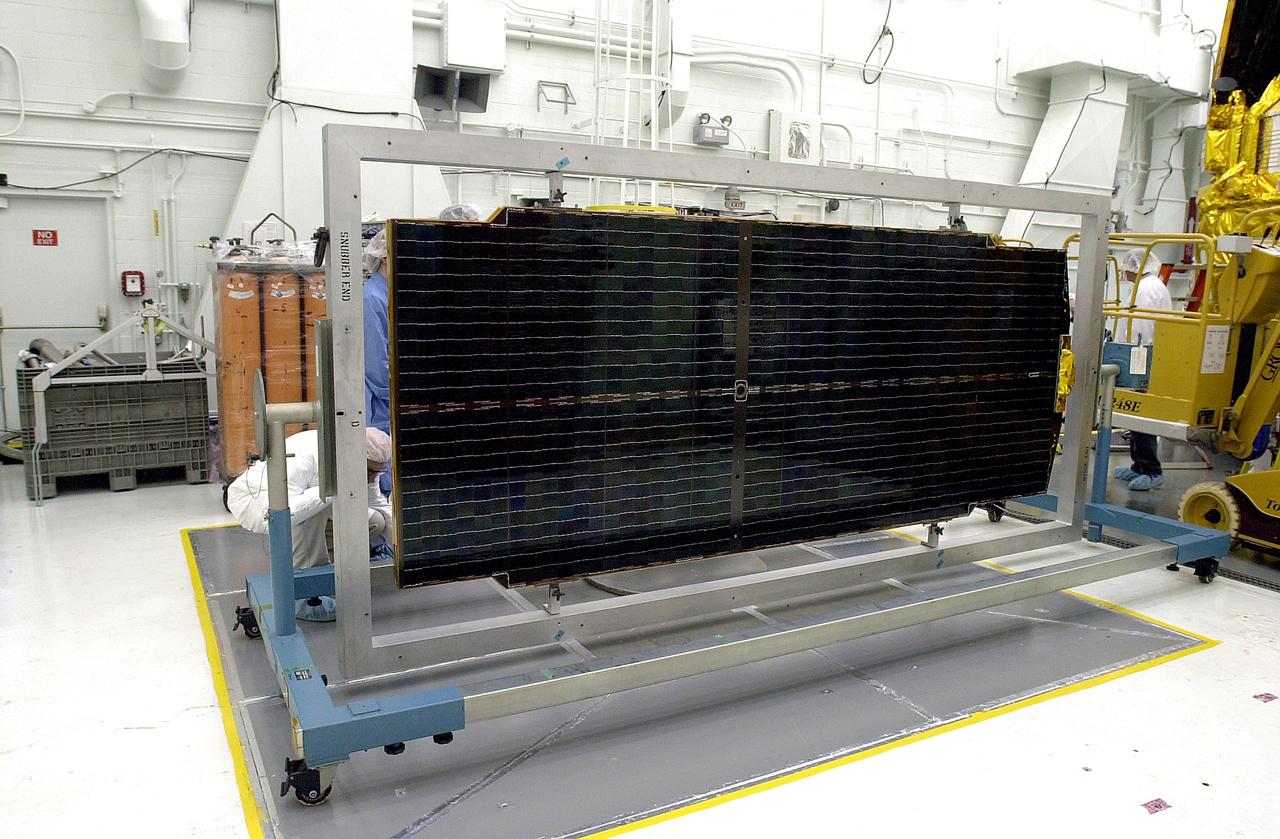
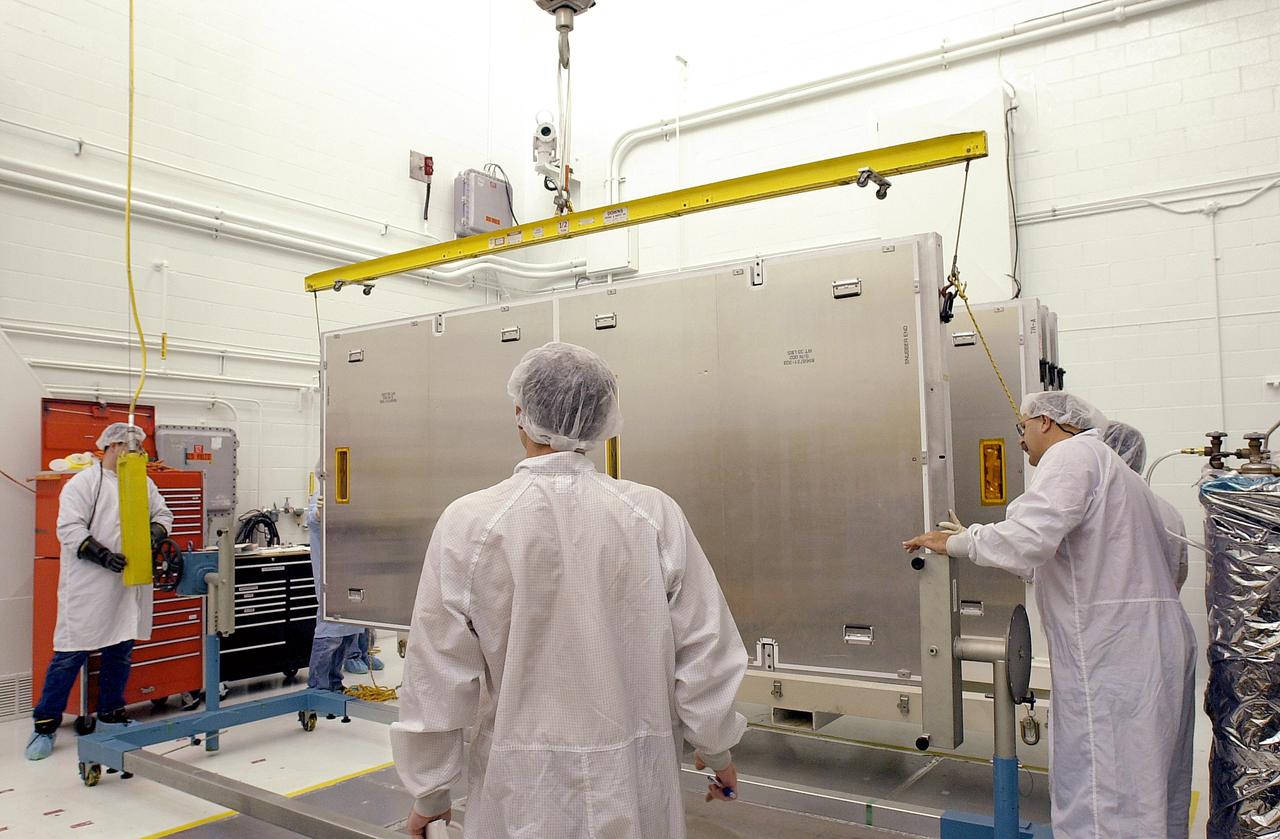
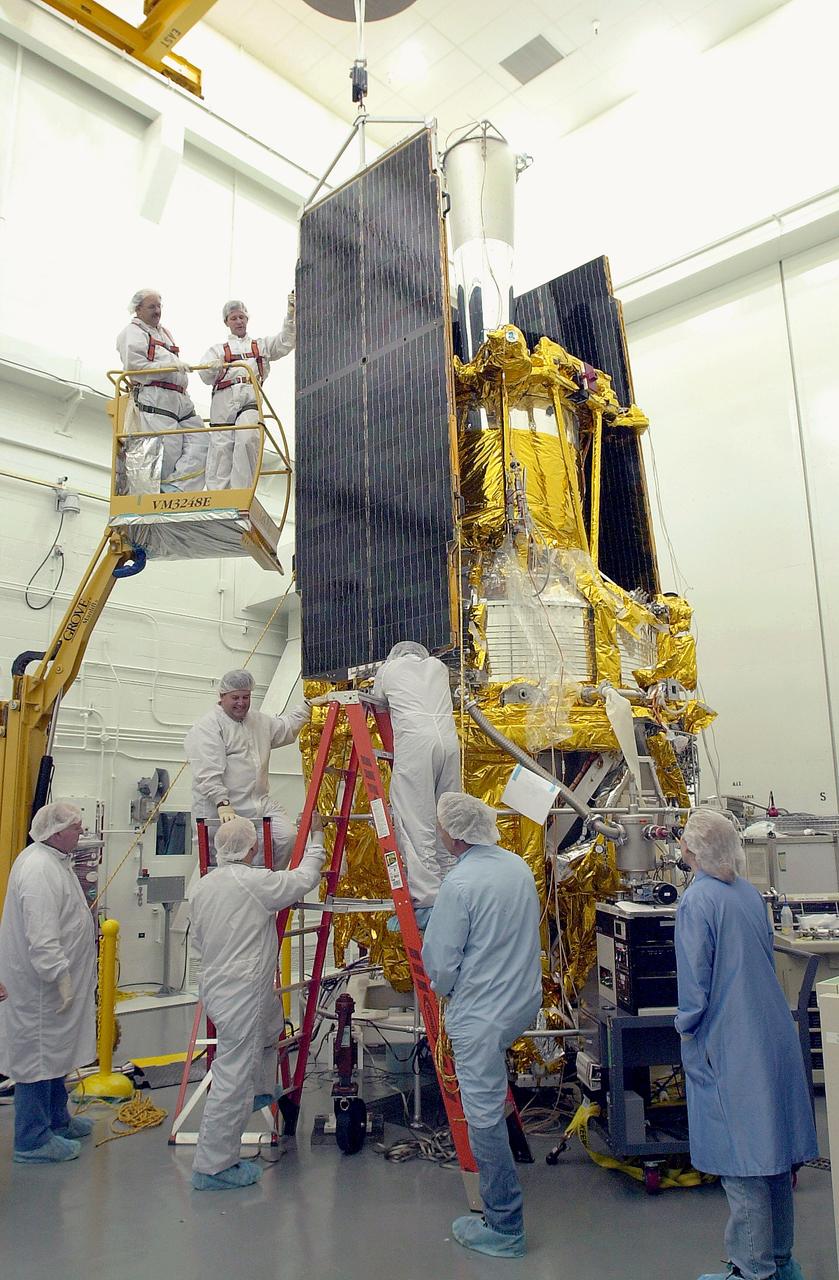
VANDENBERG AFB, CALIF. -  Workers in the NASA spacecraft processing facility on North Vandenberg Air Force Base attach a solar array panel on the Gravity Probe B spacecraft.  Installing each array is a 3-day process and includes a functional deployment test.  The Gravity Probe B mission is a relativity experiment developed by NASA’s Marshall Space Flight Center, Stanford University and Lockheed Martin.  The spacecraft will test two extraordinary predictions of Albert Einstein’s general theory of relativity that he advanced in 1916: the geodetic effect (how space and time are warped by the presence of the Earth) and frame dragging (how Earth’s rotation drags space and time around with it).  Gravity Probe B consists of four sophisticated gyroscopes that will provide an almost perfect space-time reference system.  The mission will look in a precision manner for tiny changes in the direction of spin.
VANDENBERG AFB, CALIF. - Workers in the NASA spacecraft processing facility on North Vandenberg Air Force Base attach a solar array panel on the Gravity Probe B spacecraft. Installing each array is a 3-day process and includes a functional deployment test. The Gravity Probe B mission is a relativity experiment developed by NASA’s Marshall Space Flight Center, Stanford University and Lockheed Martin. The spacecraft will test two extraordinary predictions of Albert Einstein’s general theory of relativity that he advanced in 1916: the geodetic effect (how space and time are warped by the presence of the Earth) and frame dragging (how Earth’s rotation drags space and time around with it). Gravity Probe B consists of four sophisticated gyroscopes that will provide an almost perfect space-time reference system. The mission will look in a precision manner for tiny changes in the direction of spin.
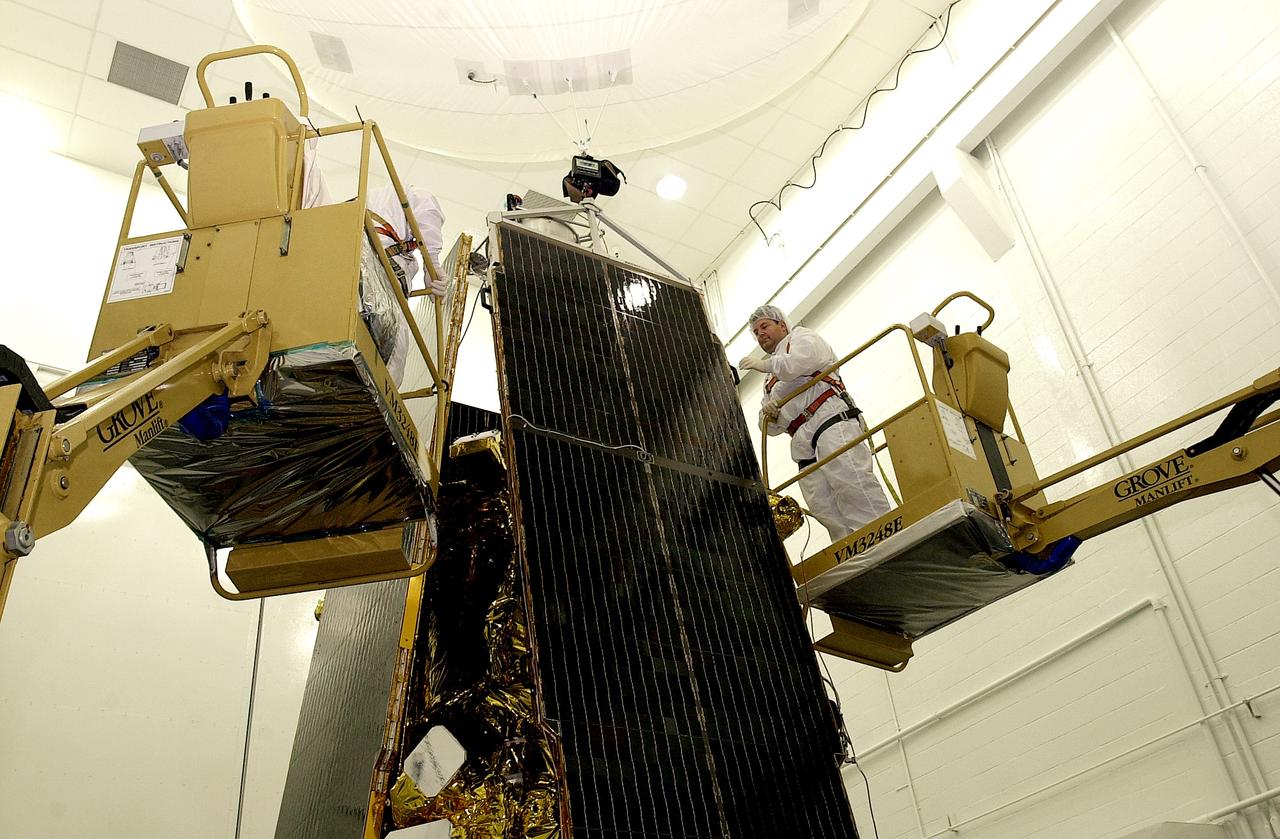
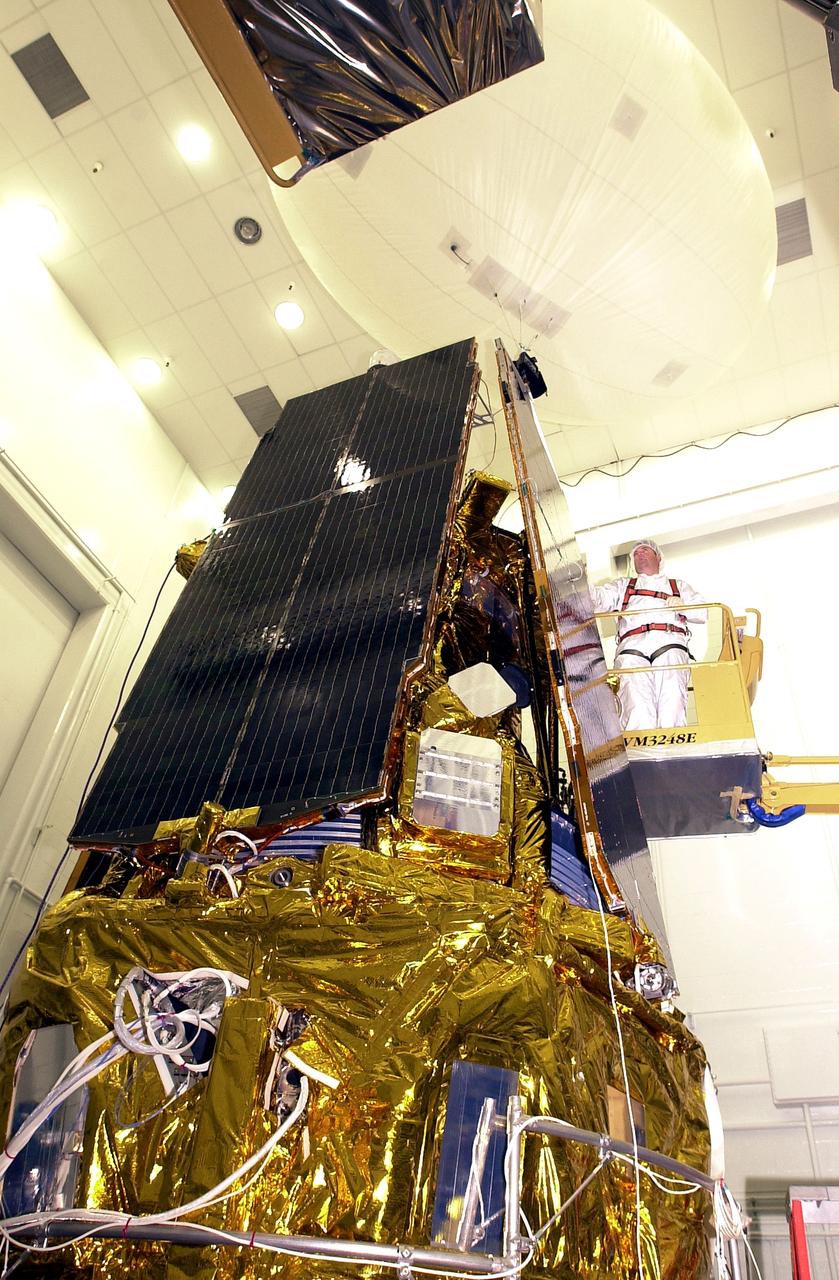
VANDENBERG AFB, CALIF. -  In the NASA spacecraft processing facility on North Vandenberg Air Force Base, the Gravity Probe B spacecraft is seen with two solar array panels installed.  Installing each array is a 3-day process and includes a functional deployment test.  The Gravity Probe B mission is a relativity experiment developed by NASA’s Marshall Space Flight Center, Stanford University and Lockheed Martin.  The spacecraft will test two extraordinary predictions of Albert Einstein’s general theory of relativity that he advanced in 1916: the geodetic effect (how space and time are warped by the presence of the Earth) and frame dragging (how Earth’s rotation drags space and time around with it).  Gravity Probe B consists of four sophisticated gyroscopes that will provide an almost perfect space-time reference system.  The mission will look in a precision manner for tiny changes in the direction of spin.
VANDENBERG AFB, CALIF. - In the NASA spacecraft processing facility on North Vandenberg Air Force Base, the Gravity Probe B spacecraft is seen with two solar array panels installed. Installing each array is a 3-day process and includes a functional deployment test. The Gravity Probe B mission is a relativity experiment developed by NASA’s Marshall Space Flight Center, Stanford University and Lockheed Martin. The spacecraft will test two extraordinary predictions of Albert Einstein’s general theory of relativity that he advanced in 1916: the geodetic effect (how space and time are warped by the presence of the Earth) and frame dragging (how Earth’s rotation drags space and time around with it). Gravity Probe B consists of four sophisticated gyroscopes that will provide an almost perfect space-time reference system. The mission will look in a precision manner for tiny changes in the direction of spin.
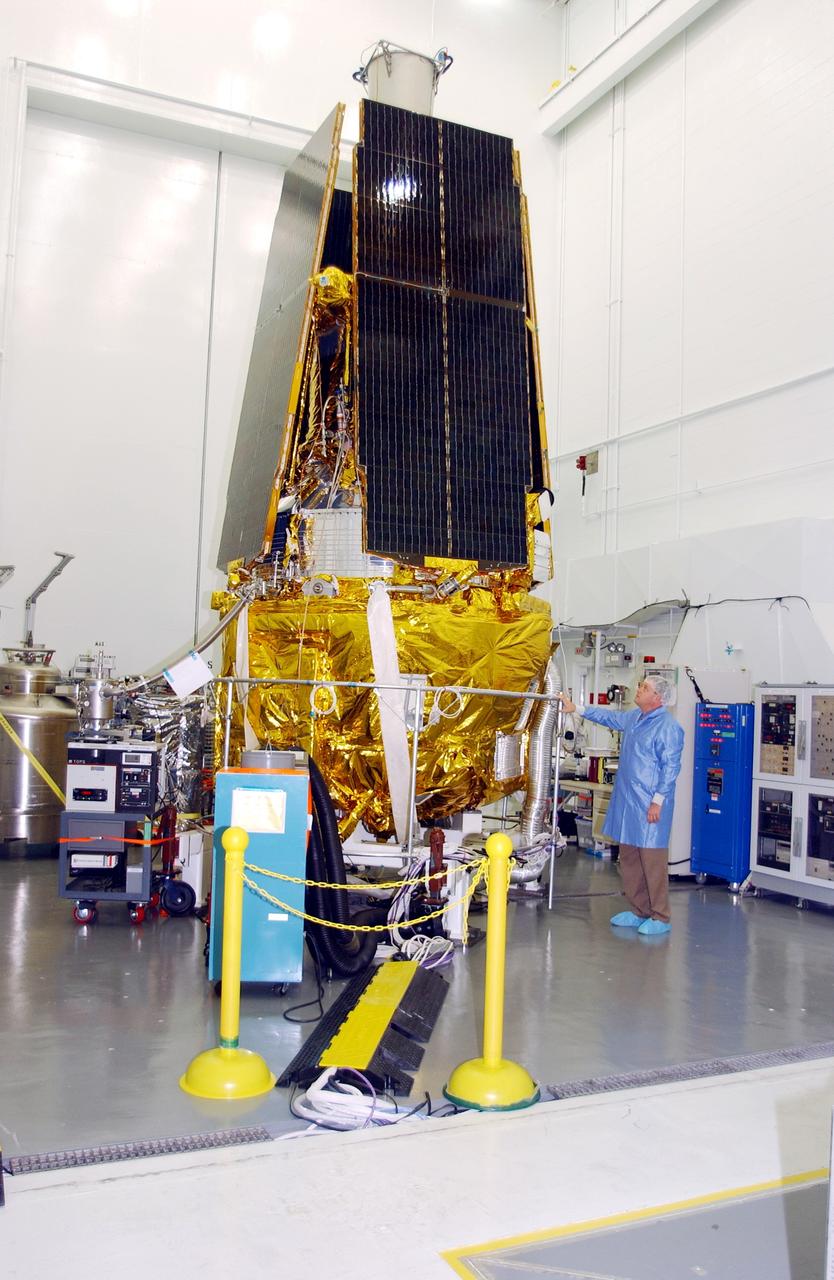
VANDENBERG AFB, CALIF. -  In the NASA spacecraft processing facility on North Vandenberg Air Force Base, the Gravity Probe B spacecraft is seen with all four solar array panels installed.  Installing each array is a 3-day process and includes a functional deployment test.  The Gravity Probe B mission is a relativity experiment developed by NASA’s Marshall Space Flight Center, Stanford University and Lockheed Martin.  The spacecraft will test two extraordinary predictions of Albert Einstein’s general theory of relativity that he advanced in 1916: the geodetic effect (how space and time are warped by the presence of the Earth) and frame dragging (how Earth’s rotation drags space and time around with it).  Gravity Probe B consists of four sophisticated gyroscopes that will provide an almost perfect space-time reference system.  The mission will look in a precision manner for tiny changes in the direction of spin.
VANDENBERG AFB, CALIF. - In the NASA spacecraft processing facility on North Vandenberg Air Force Base, the Gravity Probe B spacecraft is seen with all four solar array panels installed. Installing each array is a 3-day process and includes a functional deployment test. The Gravity Probe B mission is a relativity experiment developed by NASA’s Marshall Space Flight Center, Stanford University and Lockheed Martin. The spacecraft will test two extraordinary predictions of Albert Einstein’s general theory of relativity that he advanced in 1916: the geodetic effect (how space and time are warped by the presence of the Earth) and frame dragging (how Earth’s rotation drags space and time around with it). Gravity Probe B consists of four sophisticated gyroscopes that will provide an almost perfect space-time reference system. The mission will look in a precision manner for tiny changes in the direction of spin.
VANDENBERG AFB, CALIF. - Workers in the NASA spacecraft processing facility on North Vandenberg Air Force Base attach a solar array panel on the Gravity Probe B spacecraft.  Installing each array is a 3-day process and includes a functional deployment test.  The Gravity Probe B mission is a relativity experiment developed by NASA’s Marshall Space Flight Center, Stanford University and Lockheed Martin.  The spacecraft will test two extraordinary predictions of Albert Einstein’s general theory of relativity that he advanced in 1916: the geodetic effect (how space and time are warped by the presence of the Earth) and frame dragging (how Earth’s rotation drags space and time around with it).  Gravity Probe B consists of four sophisticated gyroscopes that will provide an almost perfect space-time reference system.  The mission will look in a precision manner for tiny changes in the direction of spin.
VANDENBERG AFB, CALIF. - Workers in the NASA spacecraft processing facility on North Vandenberg Air Force Base attach a solar array panel on the Gravity Probe B spacecraft. Installing each array is a 3-day process and includes a functional deployment test. The Gravity Probe B mission is a relativity experiment developed by NASA’s Marshall Space Flight Center, Stanford University and Lockheed Martin. The spacecraft will test two extraordinary predictions of Albert Einstein’s general theory of relativity that he advanced in 1916: the geodetic effect (how space and time are warped by the presence of the Earth) and frame dragging (how Earth’s rotation drags space and time around with it). Gravity Probe B consists of four sophisticated gyroscopes that will provide an almost perfect space-time reference system. The mission will look in a precision manner for tiny changes in the direction of spin.
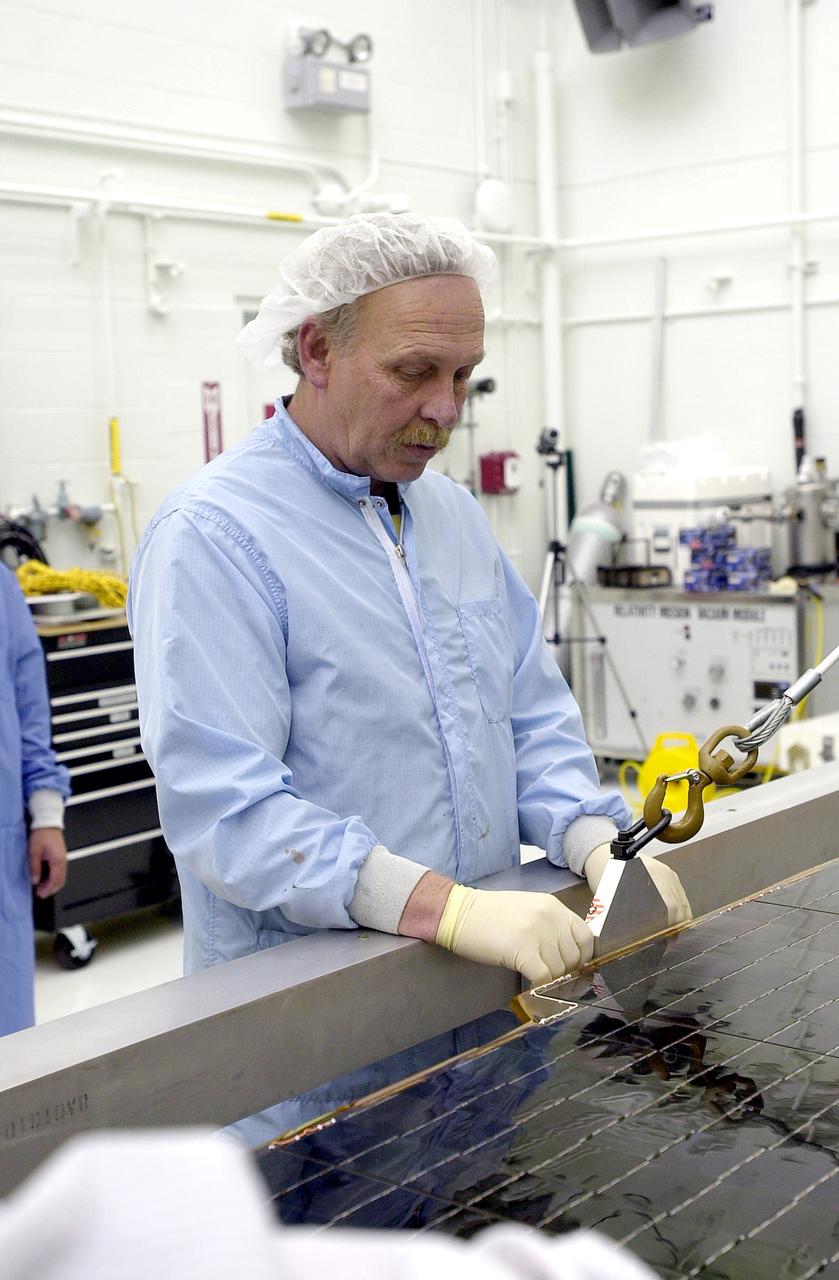
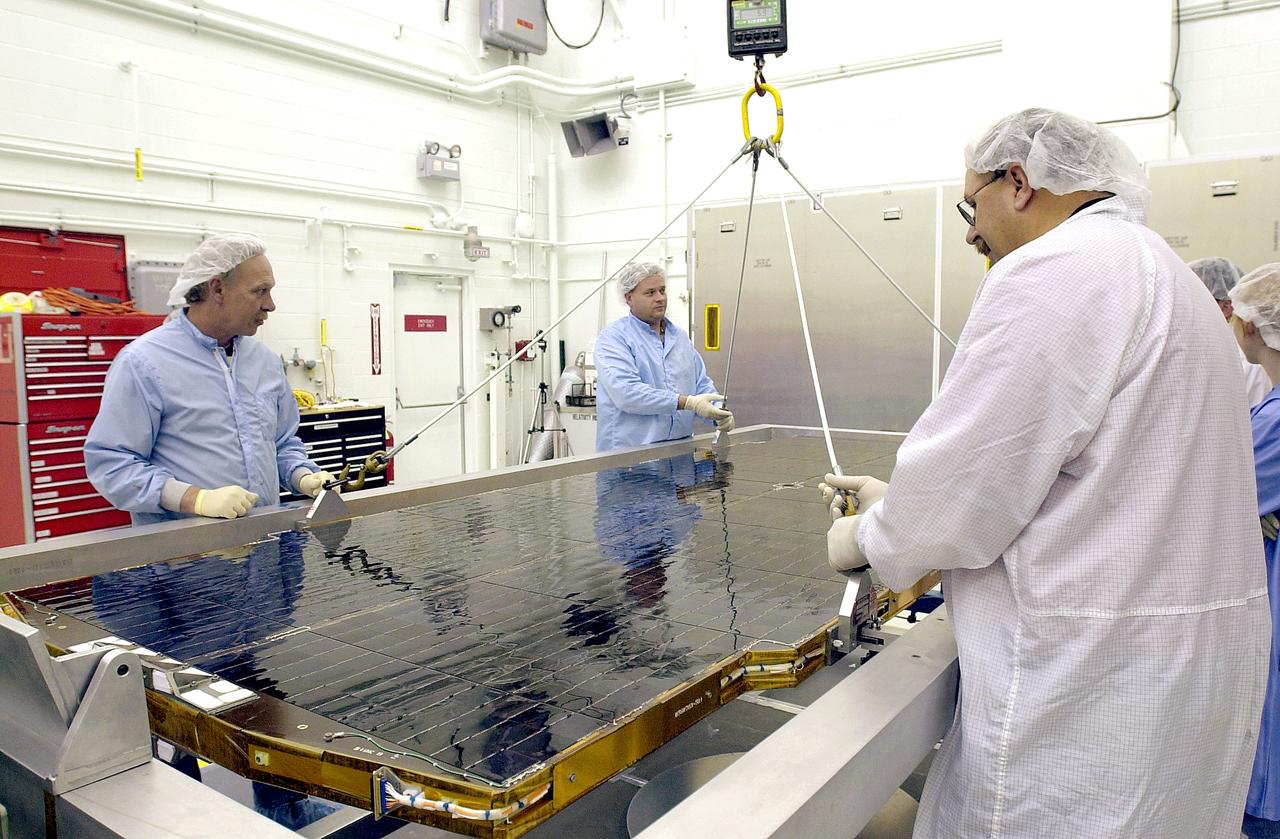
VANDENBERG AFB, CALIF. - A worker in the NASA spacecraft processing facility on North Vandenberg Air Force Base adjust the supports on a solar array panel to be lifted and  installed on the Gravity Probe B spacecraft.  Installing each array is a 3-day process and includes a functional deployment test.  The Gravity Probe B mission is a relativity experiment developed by NASA’s Marshall Space Flight Center, Stanford University and Lockheed Martin.  The spacecraft will test two extraordinary predictions of Albert Einstein’s general theory of relativity that he advanced in 1916: the geodetic effect (how space and time are warped by the presence of the Earth) and frame dragging (how Earth’s rotation drags space and time around with it).  Gravity Probe B consists of four sophisticated gyroscopes that will provide an almost perfect space-time reference system.  The mission will look in a precision manner for tiny changes in the direction of spin.
VANDENBERG AFB, CALIF. - A worker in the NASA spacecraft processing facility on North Vandenberg Air Force Base adjust the supports on a solar array panel to be lifted and installed on the Gravity Probe B spacecraft. Installing each array is a 3-day process and includes a functional deployment test. The Gravity Probe B mission is a relativity experiment developed by NASA’s Marshall Space Flight Center, Stanford University and Lockheed Martin. The spacecraft will test two extraordinary predictions of Albert Einstein’s general theory of relativity that he advanced in 1916: the geodetic effect (how space and time are warped by the presence of the Earth) and frame dragging (how Earth’s rotation drags space and time around with it). Gravity Probe B consists of four sophisticated gyroscopes that will provide an almost perfect space-time reference system. The mission will look in a precision manner for tiny changes in the direction of spin.
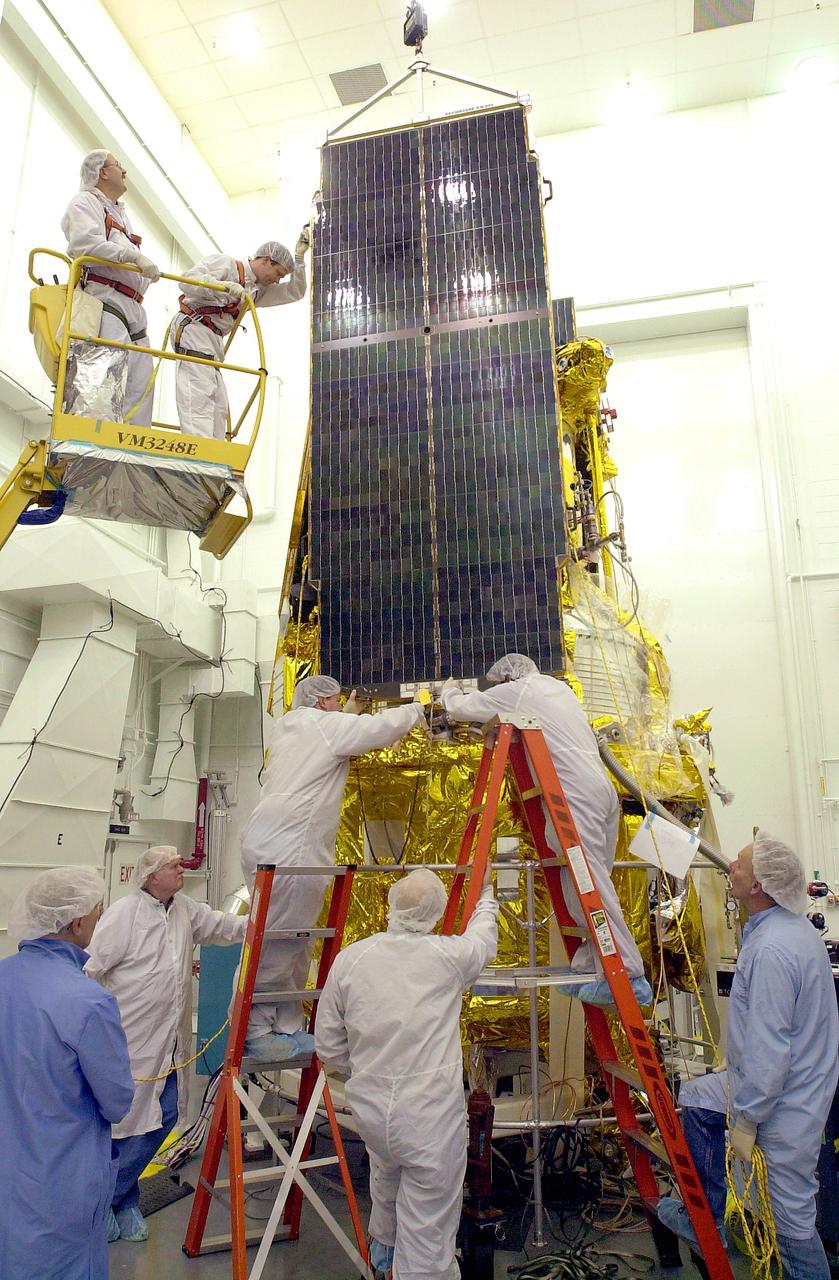
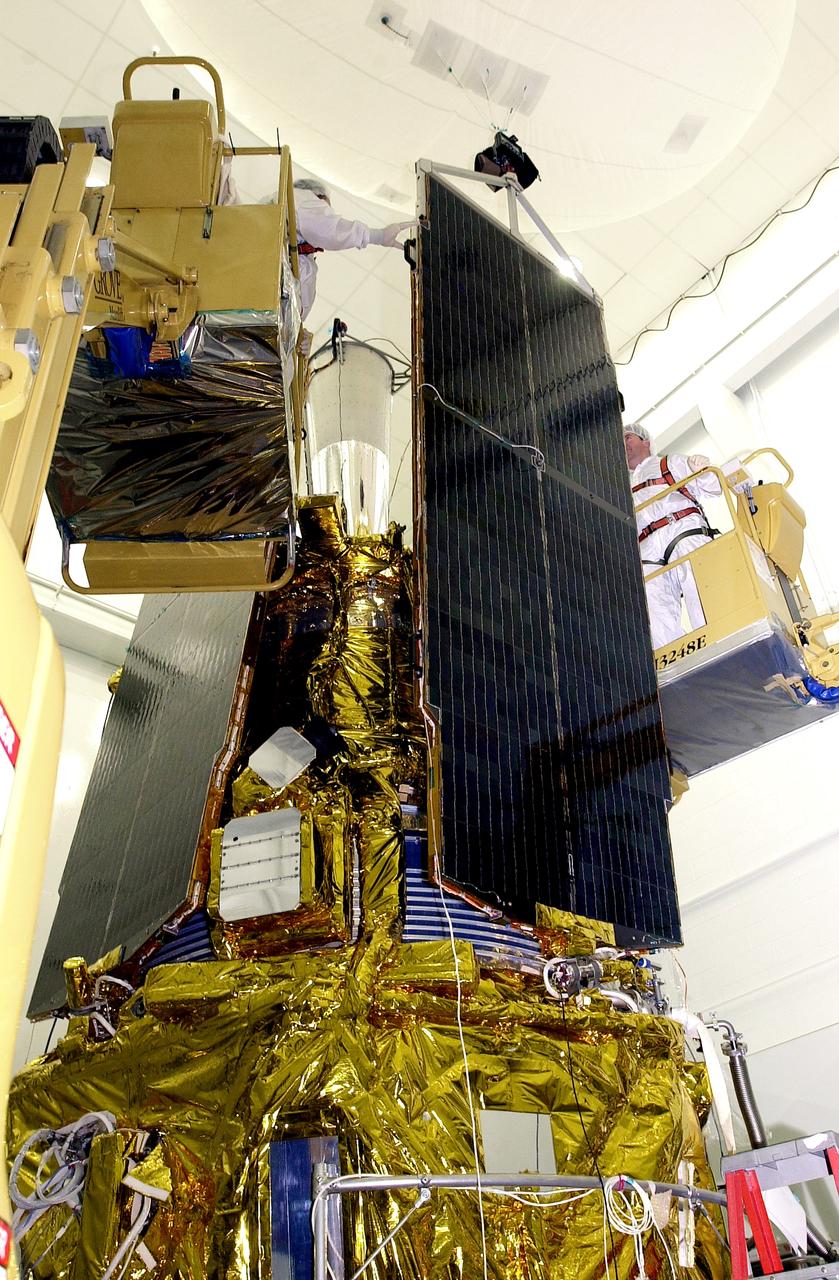
VANDENBERG AFB, CALIF. -  In the NASA spacecraft processing facility on North Vandenberg Air Force Base, workers prepare to attach the top of a solar array panel onto the Gravity Probe B spacecraft.  Installing each array is a 3-day process and includes a functional deployment test.  The Gravity Probe B mission is a relativity experiment developed by NASA’s Marshall Space Flight Center, Stanford University and Lockheed Martin.  The spacecraft will test two extraordinary predictions of Albert Einstein’s general theory of relativity that he advanced in 1916: the geodetic effect (how space and time are warped by the presence of the Earth) and frame dragging (how Earth’s rotation drags space and time around with it).  Gravity Probe B consists of four sophisticated gyroscopes that will provide an almost perfect space-time reference system.  The mission will look in a precision manner for tiny changes in the direction of spin.
VANDENBERG AFB, CALIF. - In the NASA spacecraft processing facility on North Vandenberg Air Force Base, workers prepare to attach the top of a solar array panel onto the Gravity Probe B spacecraft. Installing each array is a 3-day process and includes a functional deployment test. The Gravity Probe B mission is a relativity experiment developed by NASA’s Marshall Space Flight Center, Stanford University and Lockheed Martin. The spacecraft will test two extraordinary predictions of Albert Einstein’s general theory of relativity that he advanced in 1916: the geodetic effect (how space and time are warped by the presence of the Earth) and frame dragging (how Earth’s rotation drags space and time around with it). Gravity Probe B consists of four sophisticated gyroscopes that will provide an almost perfect space-time reference system. The mission will look in a precision manner for tiny changes in the direction of spin.
VANDENBERG AFB, CALIF. -  In the NASA spacecraft processing facility on North Vandenberg Air Force Base, workers prepare to attach the top of a solar array panel onto the Gravity Probe B spacecraft.  Installing each array is a 3-day process and includes a functional deployment test.  The Gravity Probe B mission is a relativity experiment developed by NASA’s Marshall Space Flight Center, Stanford University and Lockheed Martin.  The spacecraft will test two extraordinary predictions of Albert Einstein’s general theory of relativity that he advanced in 1916: the geodetic effect (how space and time are warped by the presence of the Earth) and frame dragging (how Earth’s rotation drags space and time around with it).  Gravity Probe B consists of four sophisticated gyroscopes that will provide an almost perfect space-time reference system.  The mission will look in a precision manner for tiny changes in the direction of spin.
VANDENBERG AFB, CALIF. - In the NASA spacecraft processing facility on North Vandenberg Air Force Base, workers prepare to attach the top of a solar array panel onto the Gravity Probe B spacecraft. Installing each array is a 3-day process and includes a functional deployment test. The Gravity Probe B mission is a relativity experiment developed by NASA’s Marshall Space Flight Center, Stanford University and Lockheed Martin. The spacecraft will test two extraordinary predictions of Albert Einstein’s general theory of relativity that he advanced in 1916: the geodetic effect (how space and time are warped by the presence of the Earth) and frame dragging (how Earth’s rotation drags space and time around with it). Gravity Probe B consists of four sophisticated gyroscopes that will provide an almost perfect space-time reference system. The mission will look in a precision manner for tiny changes in the direction of spin.
VANDENBERG AFB, CALIF. - Workers in the NASA spacecraft processing facility on North Vandenberg Air Force Base attach supports to a solar array panel to be lifted and  installed on the Gravity Probe B spacecraft.  Installing each array is a 3-day process and includes a functional deployment test.  The Gravity Probe B mission is a relativity experiment developed by NASA’s Marshall Space Flight Center, Stanford University and Lockheed Martin.  The spacecraft will test two extraordinary predictions of Albert Einstein’s general theory of relativity that he advanced in 1916: the geodetic effect (how space and time are warped by the presence of the Earth) and frame dragging (how Earth’s rotation drags space and time around with it).  Gravity Probe B consists of four sophisticated gyroscopes that will provide an almost perfect space-time reference system.  The mission will look in a precision manner for tiny changes in the direction of spin.
VANDENBERG AFB, CALIF. - Workers in the NASA spacecraft processing facility on North Vandenberg Air Force Base attach supports to a solar array panel to be lifted and installed on the Gravity Probe B spacecraft. Installing each array is a 3-day process and includes a functional deployment test. The Gravity Probe B mission is a relativity experiment developed by NASA’s Marshall Space Flight Center, Stanford University and Lockheed Martin. The spacecraft will test two extraordinary predictions of Albert Einstein’s general theory of relativity that he advanced in 1916: the geodetic effect (how space and time are warped by the presence of the Earth) and frame dragging (how Earth’s rotation drags space and time around with it). Gravity Probe B consists of four sophisticated gyroscopes that will provide an almost perfect space-time reference system. The mission will look in a precision manner for tiny changes in the direction of spin.
VANDENBERG AFB, CALIF. - Workers in the NASA spacecraft processing facility on North Vandenberg Air Force Base work on a solar array panel to be installed on the Gravity Probe B spacecraft.  Installing each array is a 3-day process and includes a functional deployment test.  The Gravity Probe B mission is a relativity experiment developed by NASA’s Marshall Space Flight Center, Stanford University and Lockheed Martin.  The spacecraft will test two extraordinary predictions of Albert Einstein’s general theory of relativity that he advanced in 1916: the geodetic effect (how space and time are warped by the presence of the Earth) and frame dragging (how Earth’s rotation drags space and time around with it).  Gravity Probe B consists of four sophisticated gyroscopes that will provide an almost perfect space-time reference system.  The mission will look in a precision manner for tiny changes in the direction of spin.
VANDENBERG AFB, CALIF. - Workers in the NASA spacecraft processing facility on North Vandenberg Air Force Base work on a solar array panel to be installed on the Gravity Probe B spacecraft. Installing each array is a 3-day process and includes a functional deployment test. The Gravity Probe B mission is a relativity experiment developed by NASA’s Marshall Space Flight Center, Stanford University and Lockheed Martin. The spacecraft will test two extraordinary predictions of Albert Einstein’s general theory of relativity that he advanced in 1916: the geodetic effect (how space and time are warped by the presence of the Earth) and frame dragging (how Earth’s rotation drags space and time around with it). Gravity Probe B consists of four sophisticated gyroscopes that will provide an almost perfect space-time reference system. The mission will look in a precision manner for tiny changes in the direction of spin.
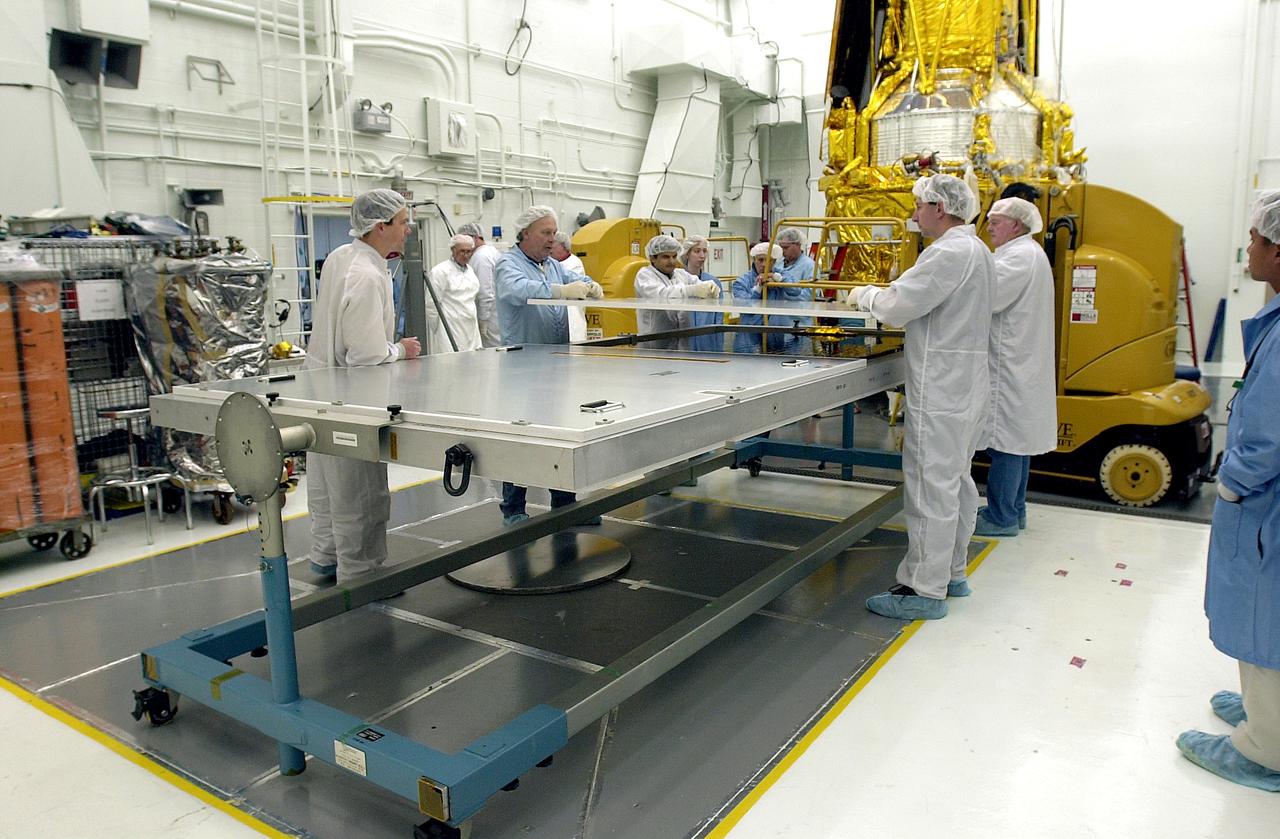
VANDENBERG AFB, CALIF. - Workers in the NASA spacecraft processing facility on North Vandenberg Air Force Base prepare to rotate the framework containing one of four solar panels to be installed on the Gravity Probe B spacecraft.  Installing each array is a 3-day process and includes a functional deployment test.  The Gravity Probe B mission is a relativity experiment developed by NASA’s Marshall Space Flight Center, Stanford University and Lockheed Martin.  The spacecraft will test two extraordinary predictions of Albert Einstein’s general theory of relativity that he advanced in 1916: the geodetic effect (how space and time are warped by the presence of the Earth) and frame dragging (how Earth’s rotation drags space and time around with it).  Gravity Probe B consists of four sophisticated gyroscopes that will provide an almost perfect space-time reference system.  The mission will look in a precision manner for tiny changes in the direction of spin.
VANDENBERG AFB, CALIF. - Workers in the NASA spacecraft processing facility on North Vandenberg Air Force Base prepare to rotate the framework containing one of four solar panels to be installed on the Gravity Probe B spacecraft. Installing each array is a 3-day process and includes a functional deployment test. The Gravity Probe B mission is a relativity experiment developed by NASA’s Marshall Space Flight Center, Stanford University and Lockheed Martin. The spacecraft will test two extraordinary predictions of Albert Einstein’s general theory of relativity that he advanced in 1916: the geodetic effect (how space and time are warped by the presence of the Earth) and frame dragging (how Earth’s rotation drags space and time around with it). Gravity Probe B consists of four sophisticated gyroscopes that will provide an almost perfect space-time reference system. The mission will look in a precision manner for tiny changes in the direction of spin.
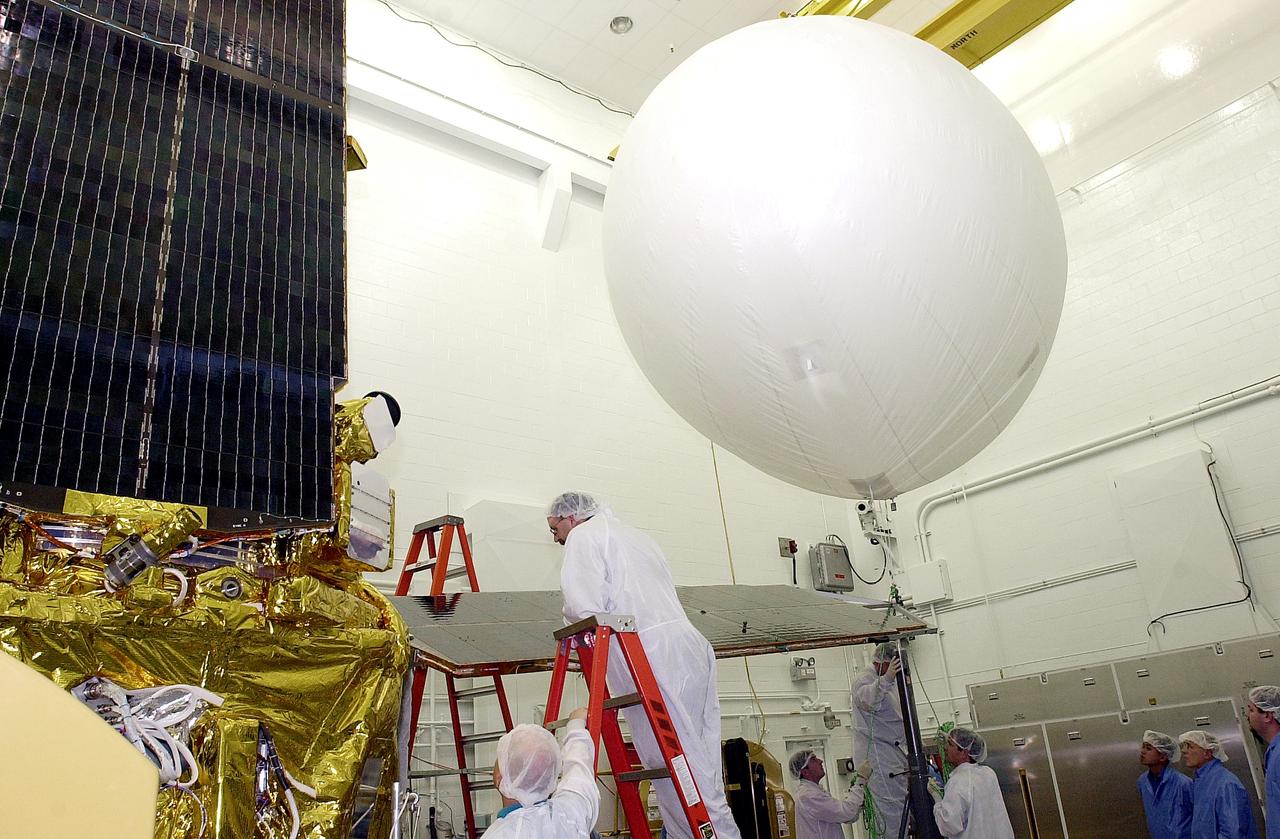
VANDENBERG AFB, CALIF. -  In the NASA spacecraft processing facility on North Vandenberg Air Force Base, workers stand by as the balloon at right is released to lift the solar array panel into position for installation on the Gravity Probe B spacecraft.  Installing each array is a 3-day process and includes a functional deployment test.  The Gravity Probe B mission is a relativity experiment developed by NASA’s Marshall Space Flight Center, Stanford University and Lockheed Martin.  The spacecraft will test two extraordinary predictions of Albert Einstein’s general theory of relativity that he advanced in 1916: the geodetic effect (how space and time are warped by the presence of the Earth) and frame dragging (how Earth’s rotation drags space and time around with it).  Gravity Probe B consists of four sophisticated gyroscopes that will provide an almost perfect space-time reference system.  The mission will look in a precision manner for tiny changes in the direction of spin.
VANDENBERG AFB, CALIF. - In the NASA spacecraft processing facility on North Vandenberg Air Force Base, workers stand by as the balloon at right is released to lift the solar array panel into position for installation on the Gravity Probe B spacecraft. Installing each array is a 3-day process and includes a functional deployment test. The Gravity Probe B mission is a relativity experiment developed by NASA’s Marshall Space Flight Center, Stanford University and Lockheed Martin. The spacecraft will test two extraordinary predictions of Albert Einstein’s general theory of relativity that he advanced in 1916: the geodetic effect (how space and time are warped by the presence of the Earth) and frame dragging (how Earth’s rotation drags space and time around with it). Gravity Probe B consists of four sophisticated gyroscopes that will provide an almost perfect space-time reference system. The mission will look in a precision manner for tiny changes in the direction of spin.
VANDENBERG AFB, CALIF. -  In the NASA spacecraft processing facility on North Vandenberg Air Force Base, a worker checks the installation of a solar array panel onto the Gravity Probe B spacecraft.  Installing each array is a 3-day process and includes a functional deployment test.  The Gravity Probe B mission is a relativity experiment developed by NASA’s Marshall Space Flight Center, Stanford University and Lockheed Martin.  The spacecraft will test two extraordinary predictions of Albert Einstein’s general theory of relativity that he advanced in 1916: the geodetic effect (how space and time are warped by the presence of the Earth) and frame dragging (how Earth’s rotation drags space and time around with it).  Gravity Probe B consists of four sophisticated gyroscopes that will provide an almost perfect space-time reference system.  The mission will look in a precision manner for tiny changes in the direction of spin.
VANDENBERG AFB, CALIF. - In the NASA spacecraft processing facility on North Vandenberg Air Force Base, a worker checks the installation of a solar array panel onto the Gravity Probe B spacecraft. Installing each array is a 3-day process and includes a functional deployment test. The Gravity Probe B mission is a relativity experiment developed by NASA’s Marshall Space Flight Center, Stanford University and Lockheed Martin. The spacecraft will test two extraordinary predictions of Albert Einstein’s general theory of relativity that he advanced in 1916: the geodetic effect (how space and time are warped by the presence of the Earth) and frame dragging (how Earth’s rotation drags space and time around with it). Gravity Probe B consists of four sophisticated gyroscopes that will provide an almost perfect space-time reference system. The mission will look in a precision manner for tiny changes in the direction of spin.
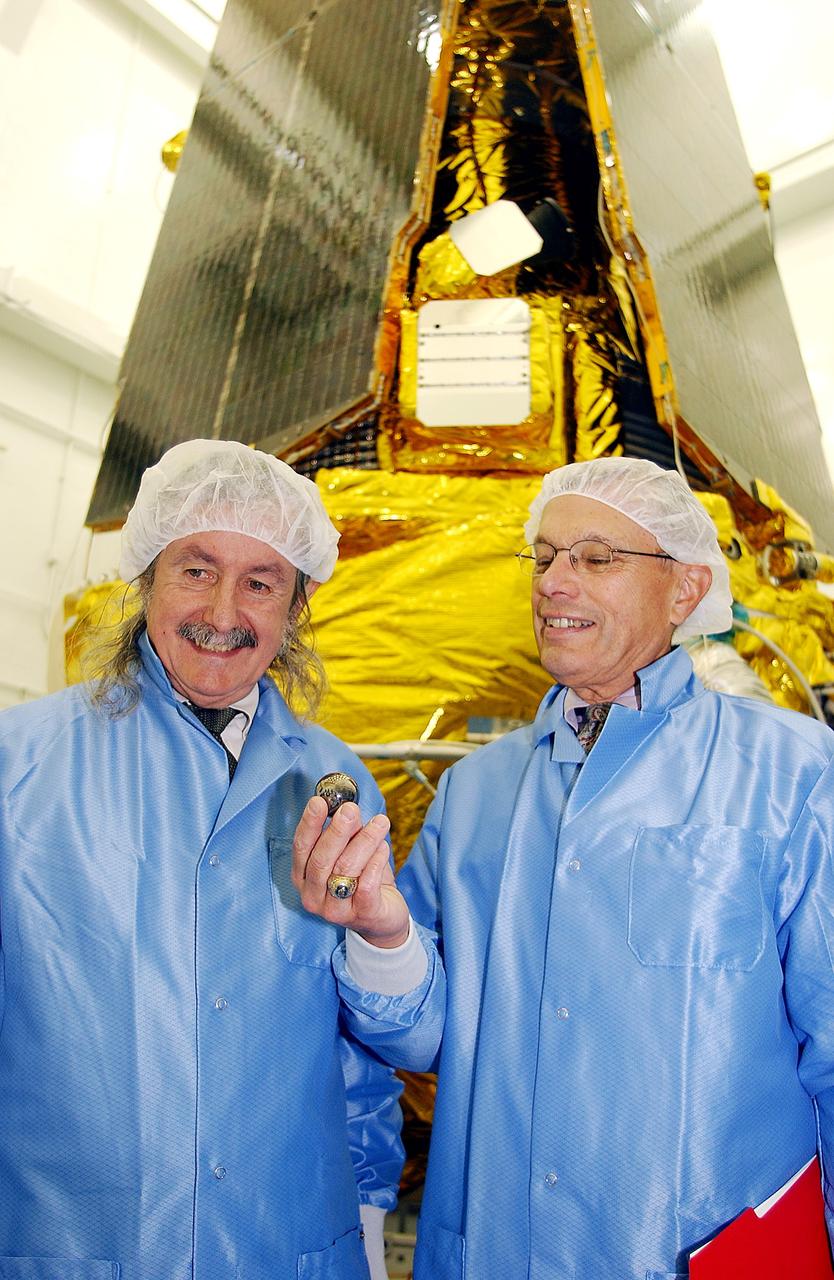
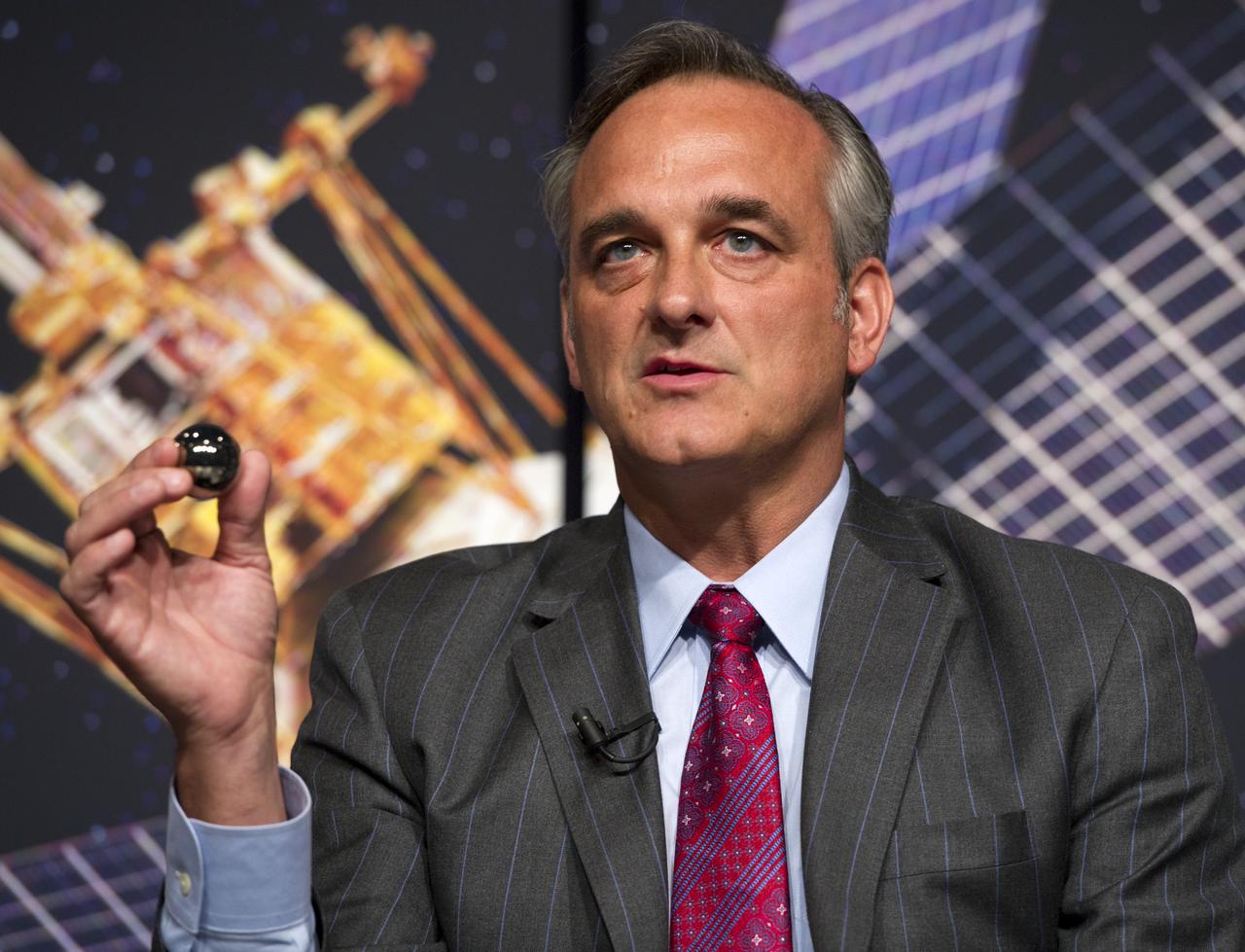
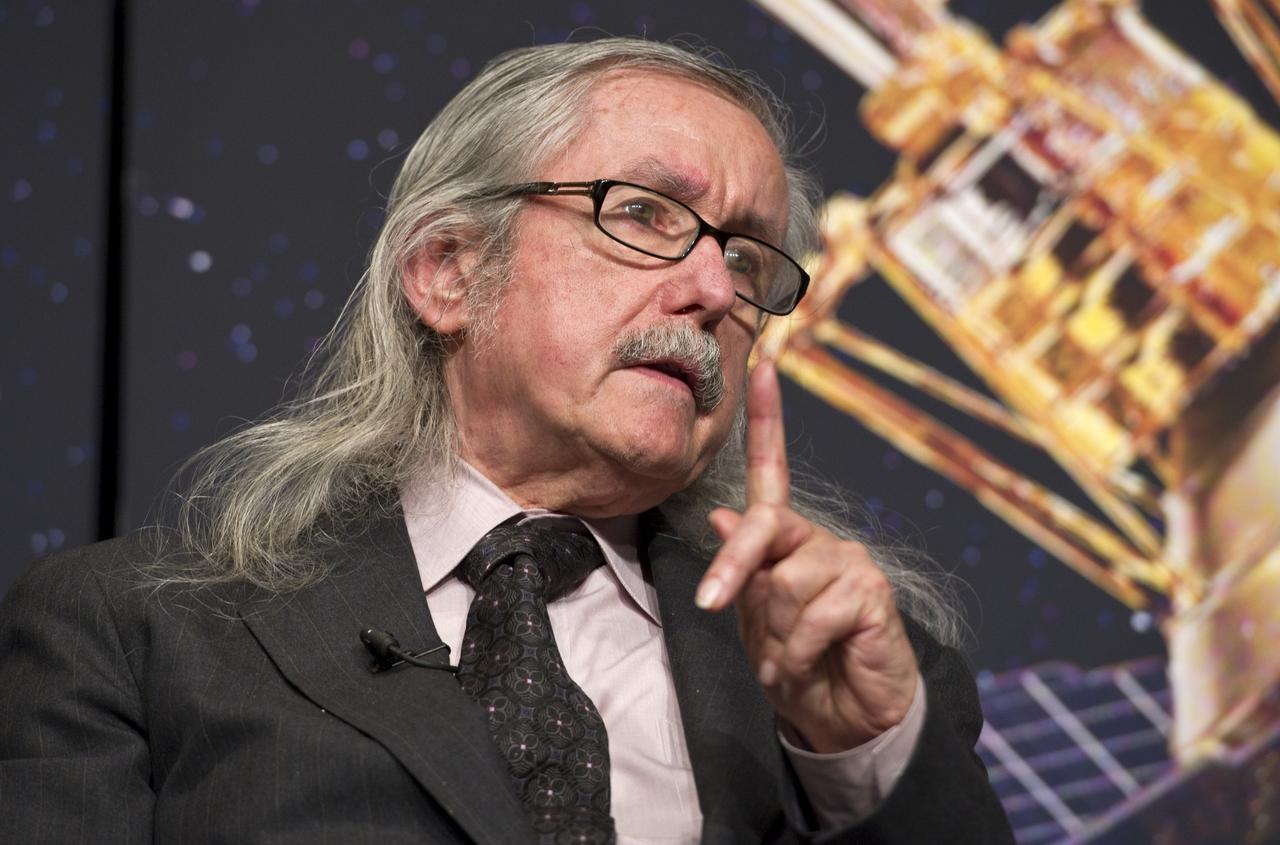
VANDENBERG AFB, CALIF. -  In the NASA spacecraft processing facility on North Vandenberg Air Force Base,  Dr. Francis Everitt, principal investigator, and Brad Parkinson, co-principal investigator, both from Stanford University, hold one of the small gyroscopes used in the Gravity Probe B spacecraft.  The GP-B towers behind them.  The Gravity Probe B mission is a relativity experiment developed by NASA’s Marshall Space Flight Center, Stanford University and Lockheed Martin.  The spacecraft will test two extraordinary predictions of Albert Einstein’s general theory of relativity that he advanced in 1916: the geodetic effect (how space and time are warped by the presence of the Earth) and frame dragging (how Earth’s rotation drags space and time around with it).  Gravity Probe B consists of four sophisticated gyroscopes that will provide an almost perfect space-time reference system.  The mission will look in a precision manner for tiny changes in the direction of spin.
VANDENBERG AFB, CALIF. - In the NASA spacecraft processing facility on North Vandenberg Air Force Base, Dr. Francis Everitt, principal investigator, and Brad Parkinson, co-principal investigator, both from Stanford University, hold one of the small gyroscopes used in the Gravity Probe B spacecraft. The GP-B towers behind them. The Gravity Probe B mission is a relativity experiment developed by NASA’s Marshall Space Flight Center, Stanford University and Lockheed Martin. The spacecraft will test two extraordinary predictions of Albert Einstein’s general theory of relativity that he advanced in 1916: the geodetic effect (how space and time are warped by the presence of the Earth) and frame dragging (how Earth’s rotation drags space and time around with it). Gravity Probe B consists of four sophisticated gyroscopes that will provide an almost perfect space-time reference system. The mission will look in a precision manner for tiny changes in the direction of spin.
VANDENBERG AFB, CALIF. - Workers in the NASA spacecraft processing facility on North Vandenberg Air Force Base prepare for the installation of solar array panel 3 on the Gravity Probe B spacecraft.  Installing each array is a 3-day process and includes a functional deployment test.  The Gravity Probe B mission is a relativity experiment developed by NASA’s Marshall Space Flight Center, Stanford University and Lockheed Martin.  The spacecraft will test two extraordinary predictions of Albert Einstein’s general theory of relativity that he advanced in 1916: the geodetic effect (how space and time are warped by the presence of the Earth) and frame dragging (how Earth’s rotation drags space and time around with it).  Gravity Probe B consists of four sophisticated gyroscopes that will provide an almost perfect space-time reference system.  The mission will look in a precision manner for tiny changes in the direction of spin.
VANDENBERG AFB, CALIF. - Workers in the NASA spacecraft processing facility on North Vandenberg Air Force Base prepare for the installation of solar array panel 3 on the Gravity Probe B spacecraft. Installing each array is a 3-day process and includes a functional deployment test. The Gravity Probe B mission is a relativity experiment developed by NASA’s Marshall Space Flight Center, Stanford University and Lockheed Martin. The spacecraft will test two extraordinary predictions of Albert Einstein’s general theory of relativity that he advanced in 1916: the geodetic effect (how space and time are warped by the presence of the Earth) and frame dragging (how Earth’s rotation drags space and time around with it). Gravity Probe B consists of four sophisticated gyroscopes that will provide an almost perfect space-time reference system. The mission will look in a precision manner for tiny changes in the direction of spin.
VANDENBERG AFB, CALIF. -  In the NASA spacecraft processing facility on North Vandenberg Air Force Base, a balloon gently lifts the solar array panel to be installed on the Gravity Probe B spacecraft.  Installing each array is a 3-day process and includes a functional deployment test.  The Gravity Probe B mission is a relativity experiment developed by NASA’s Marshall Space Flight Center, Stanford University and Lockheed Martin.  The spacecraft will test two extraordinary predictions of Albert Einstein’s general theory of relativity that he advanced in 1916: the geodetic effect (how space and time are warped by the presence of the Earth) and frame dragging (how Earth’s rotation drags space and time around with it).  Gravity Probe B consists of four sophisticated gyroscopes that will provide an almost perfect space-time reference system.  The mission will look in a precision manner for tiny changes in the direction of spin.
VANDENBERG AFB, CALIF. - In the NASA spacecraft processing facility on North Vandenberg Air Force Base, a balloon gently lifts the solar array panel to be installed on the Gravity Probe B spacecraft. Installing each array is a 3-day process and includes a functional deployment test. The Gravity Probe B mission is a relativity experiment developed by NASA’s Marshall Space Flight Center, Stanford University and Lockheed Martin. The spacecraft will test two extraordinary predictions of Albert Einstein’s general theory of relativity that he advanced in 1916: the geodetic effect (how space and time are warped by the presence of the Earth) and frame dragging (how Earth’s rotation drags space and time around with it). Gravity Probe B consists of four sophisticated gyroscopes that will provide an almost perfect space-time reference system. The mission will look in a precision manner for tiny changes in the direction of spin.
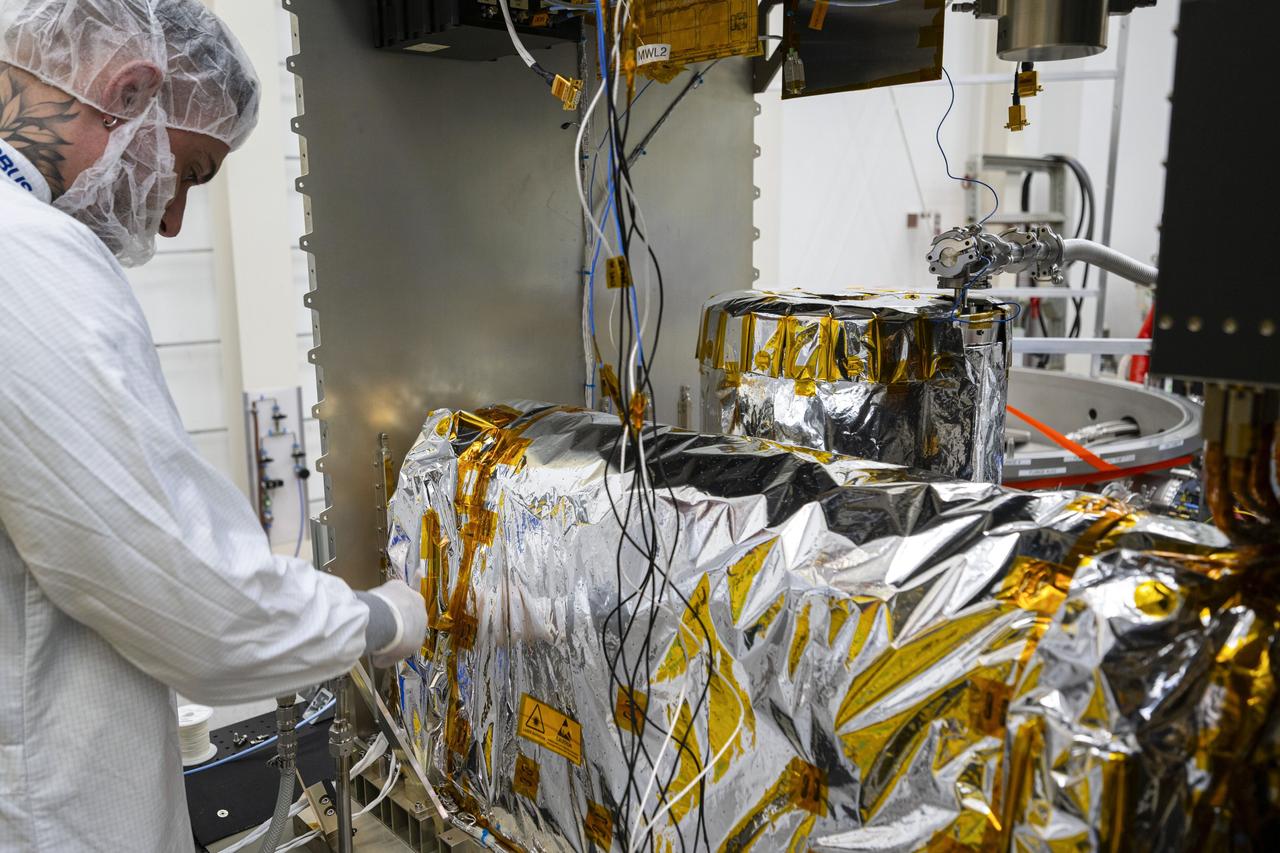
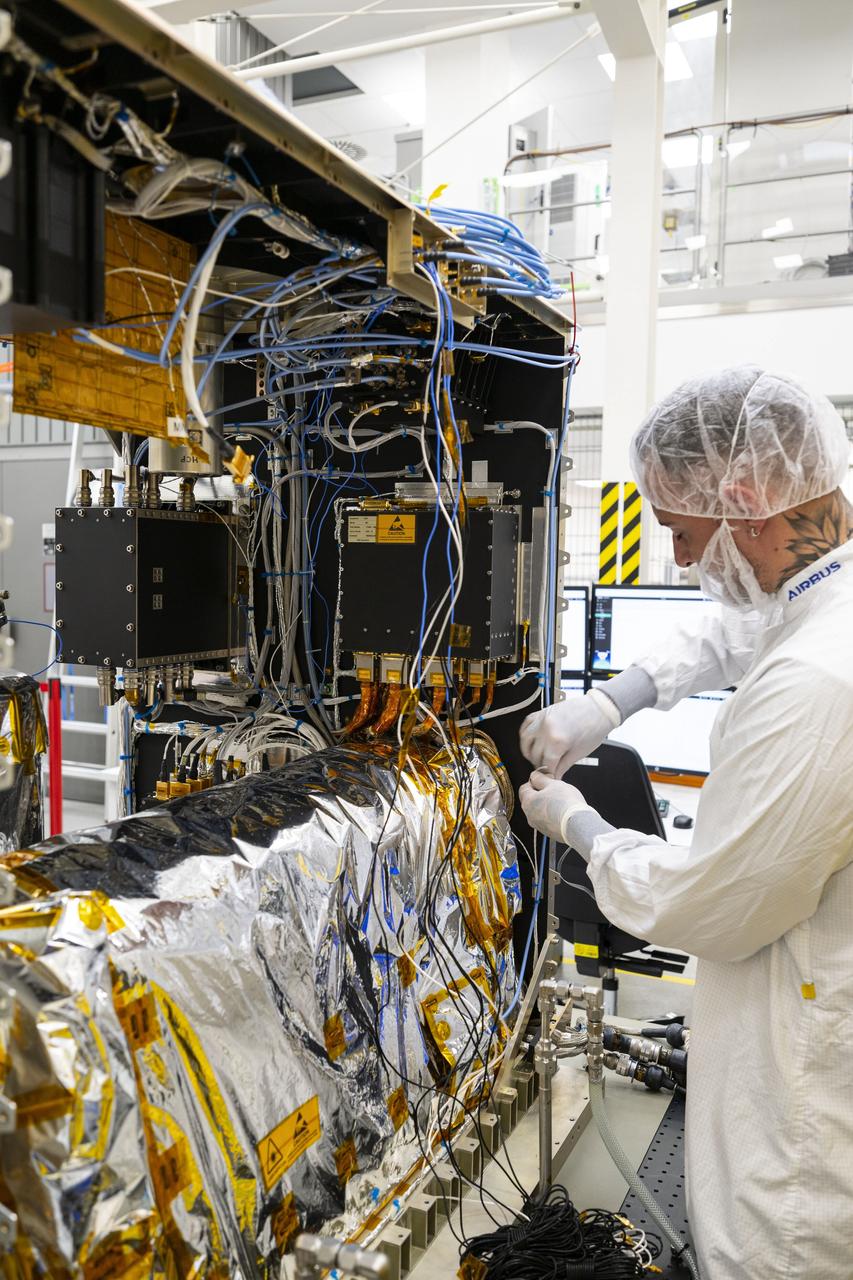
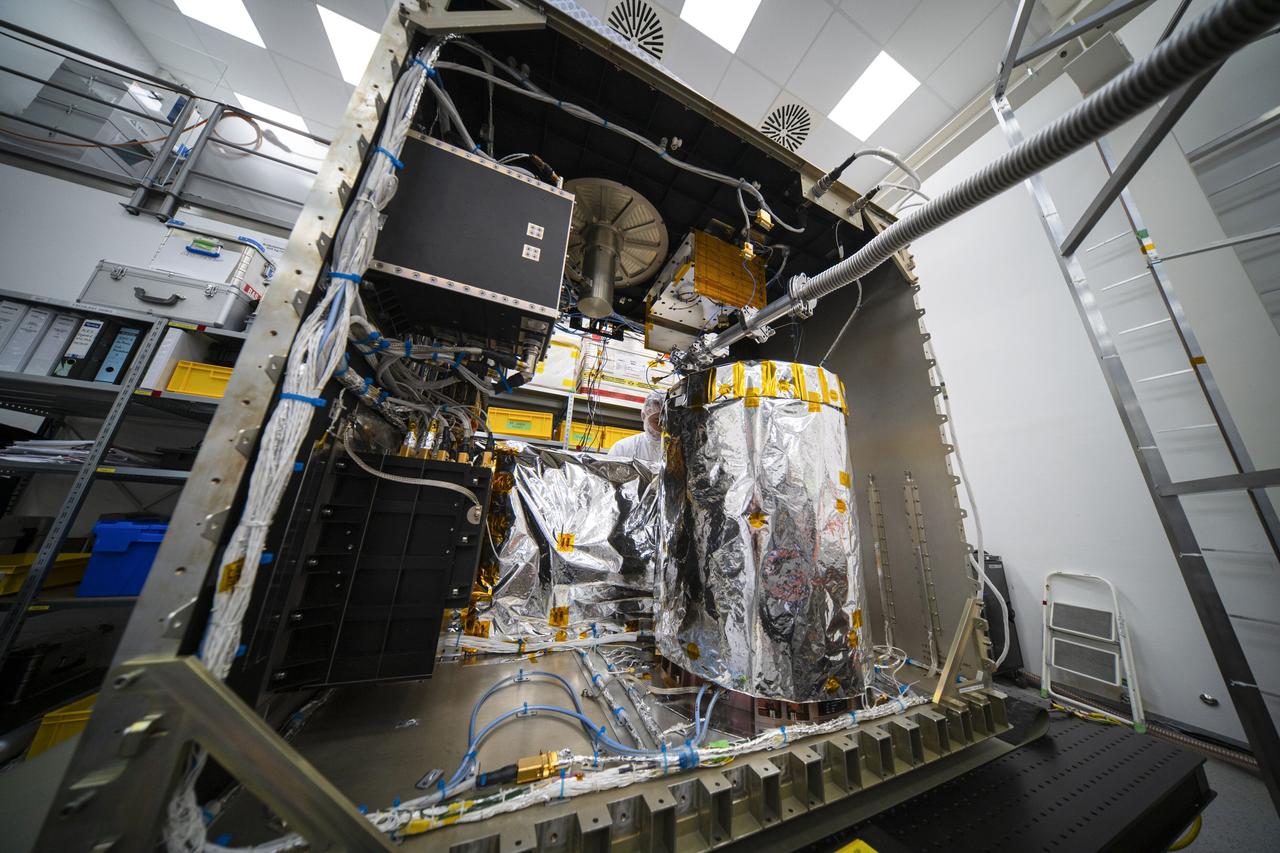
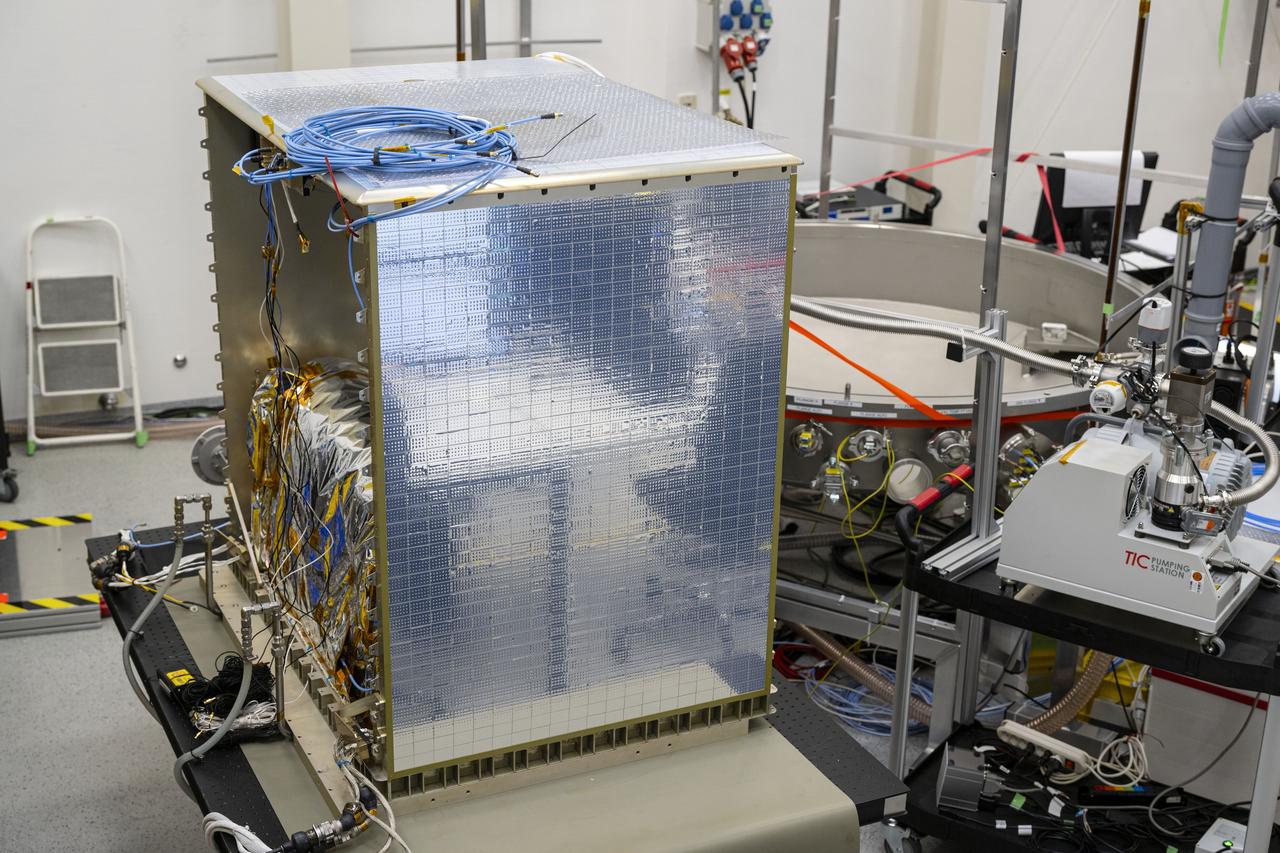
jsc2025e015677 (3/6/2025) --- The closure of the instrument panel of the Atomic Clock Ensemble in Space (ACES) has taken place at Airbus Friedrichshafen, Germany. ACES is an ESA instrument that tests fundamental physics, such as Einstein’s theory of general relativity, from the International Space Station. According to this theory, gravity affects the passing of time—time flies faster at the top of Mount Everest than at sea level. This effect has been proven in experiments on Earth, and ACES will make more precise measurements of this phenomenon and other fundamental physics such as the standard model of particle physics, as it flies 400 km high on the space station. ACES contains two clocks: PHARAO, a caesium atomic clock developed by the French Space Agency CNES, and the Space Hydrogen Maser developed by Spectratime, which uses hydrogen atoms as a frequency reference. The payload will be externally mounted to ESA’s Columbus laboratory on the space station. Image courtesy of S. Corvaja (ESA).
PRO Imagery Submittal - ACES
jsc2025e015679 (3/6/2025) --- The closure of the instrument panel of the Atomic Clock Ensemble in Space (ACES) has taken place at Airbus Friedrichshafen, Germany. ACES is an ESA instrument that tests fundamental physics, such as Einstein’s theory of general relativity, from the International Space Station. According to this theory, gravity affects the passing of time—time flies faster at the top of Mount Everest than at sea level. This effect has been proven in experiments on Earth, and ACES will make more precise measurements of this phenomenon and other fundamental physics such as the standard model of particle physics, as it flies 400 km high on the space station. ACES contains two clocks: PHARAO, a caesium atomic clock developed by the French Space Agency CNES, and the Space Hydrogen Maser developed by Spectratime, which uses hydrogen atoms as a frequency reference. The payload will be externally mounted to ESA’s Columbus laboratory on the space station. Image courtesy of S. Corvaja (ESA).
PRO Imagery Submittal - ACES
jsc2025e015680 (3/6/2025) --- The closure of the instrument panel of the Atomic Clock Ensemble in Space (ACES) has taken place at Airbus Friedrichshafen, Germany. ACES is an ESA instrument that tests fundamental physics, such as Einstein’s theory of general relativity, from the International Space Station. According to this theory, gravity affects the passing of time—time flies faster at the top of Mount Everest than at sea level. This effect has been proven in experiments on Earth, and ACES will make more precise measurements of this phenomenon and other fundamental physics such as the standard model of particle physics, as it flies 400 km high on the space station. ACES contains two clocks: PHARAO, a caesium atomic clock developed by the French Space Agency CNES, and the Space Hydrogen Maser developed by Spectratime, which uses hydrogen atoms as a frequency reference. The payload will be externally mounted to ESA’s Columbus laboratory on the space station. Image courtesy of S. Corvaja (ESA).
PRO Imagery Submittal - ACES
jsc2025e015678 (3/6/2025) --- The closure of the instrument panel of the Atomic Clock Ensemble in Space (ACES) has taken place at Airbus Friedrichshafen, Germany. ACES is an ESA instrument that tests fundamental physics, such as Einstein’s theory of general relativity, from the International Space Station. According to this theory, gravity affects the passing of time—time flies faster at the top of Mount Everest than at sea level. This effect has been proven in experiments on Earth, and ACES will make more precise measurements of this phenomenon and other fundamental physics such as the standard model of particle physics, as it flies 400 km high on the space station. ACES contains two clocks: PHARAO, a caesium atomic clock developed by the French Space Agency CNES, and the Space Hydrogen Maser developed by Spectratime, which uses hydrogen atoms as a frequency reference. The payload will be externally mounted to ESA’s Columbus laboratory on the space station. Image courtesy of S. Corvaja (ESA).
PRO Imagery Submittal - ACES
VANDENBERG AFB, CALIF. - Workers on the mobile service tower at Space Launch Complex 2, Vandenberg Air Force Base, Calif., check the Delta II rocket’s second stage as it is mated with the first stage. The Delta II is the launch vehicle for the Gravity Probe B experiment, developed by Stanford University, Lockheed Martin and NASA’s Marshall Space Flight Center.   The Gravity Probe B will launch a payload of four gyroscopes into low-Earth polar orbit to test two extraordinary predictions of Albert Einstein’s general theory of relativity: the geodetic effect (how space and time are warped by the presence of the Earth) and frame dragging (how Earth’s rotation drags space and time around with it). Once in orbit, for 18 months each gyroscope’s spin axis will be monitored as it travels through local spacetime, observing and measuring these effects. The targeted launch date is Dec. 6, 2003.
VANDENBERG AFB, CALIF. - Workers on the mobile service tower at Space Launch Complex 2, Vandenberg Air Force Base, Calif., check the Delta II rocket’s second stage as it is mated with the first stage. The Delta II is the launch vehicle for the Gravity Probe B experiment, developed by Stanford University, Lockheed Martin and NASA’s Marshall Space Flight Center. The Gravity Probe B will launch a payload of four gyroscopes into low-Earth polar orbit to test two extraordinary predictions of Albert Einstein’s general theory of relativity: the geodetic effect (how space and time are warped by the presence of the Earth) and frame dragging (how Earth’s rotation drags space and time around with it). Once in orbit, for 18 months each gyroscope’s spin axis will be monitored as it travels through local spacetime, observing and measuring these effects. The targeted launch date is Dec. 6, 2003.
VANDENBERG AFB, CALIF. -   A worker in the spacecraft processing facility on North Vandenberg Air Force Base checks the Gravity Probe B experiment during prelaunch testing.  The Gravity Probe B will launch a payload of four gyroscopes into low-Earth polar orbit to test two extraordinary predictions of Albert Einstein’s general theory of relativity: the geodetic effect (how space and time are warped by the presence of the Earth) and frame dragging (how Earth’s rotation drags space and time around with it). Once in orbit, for 18 months each gyroscope’s spin axis will be monitored as it travels through local spacetime, observing and measuring these effects.  The experiment was developed by Stanford University, Lockheed Martin and NASA’s Marshall Space Flight Center.   The targeted launch date is Dec. 6, 2003.
VANDENBERG AFB, CALIF. - A worker in the spacecraft processing facility on North Vandenberg Air Force Base checks the Gravity Probe B experiment during prelaunch testing. The Gravity Probe B will launch a payload of four gyroscopes into low-Earth polar orbit to test two extraordinary predictions of Albert Einstein’s general theory of relativity: the geodetic effect (how space and time are warped by the presence of the Earth) and frame dragging (how Earth’s rotation drags space and time around with it). Once in orbit, for 18 months each gyroscope’s spin axis will be monitored as it travels through local spacetime, observing and measuring these effects. The experiment was developed by Stanford University, Lockheed Martin and NASA’s Marshall Space Flight Center. The targeted launch date is Dec. 6, 2003.
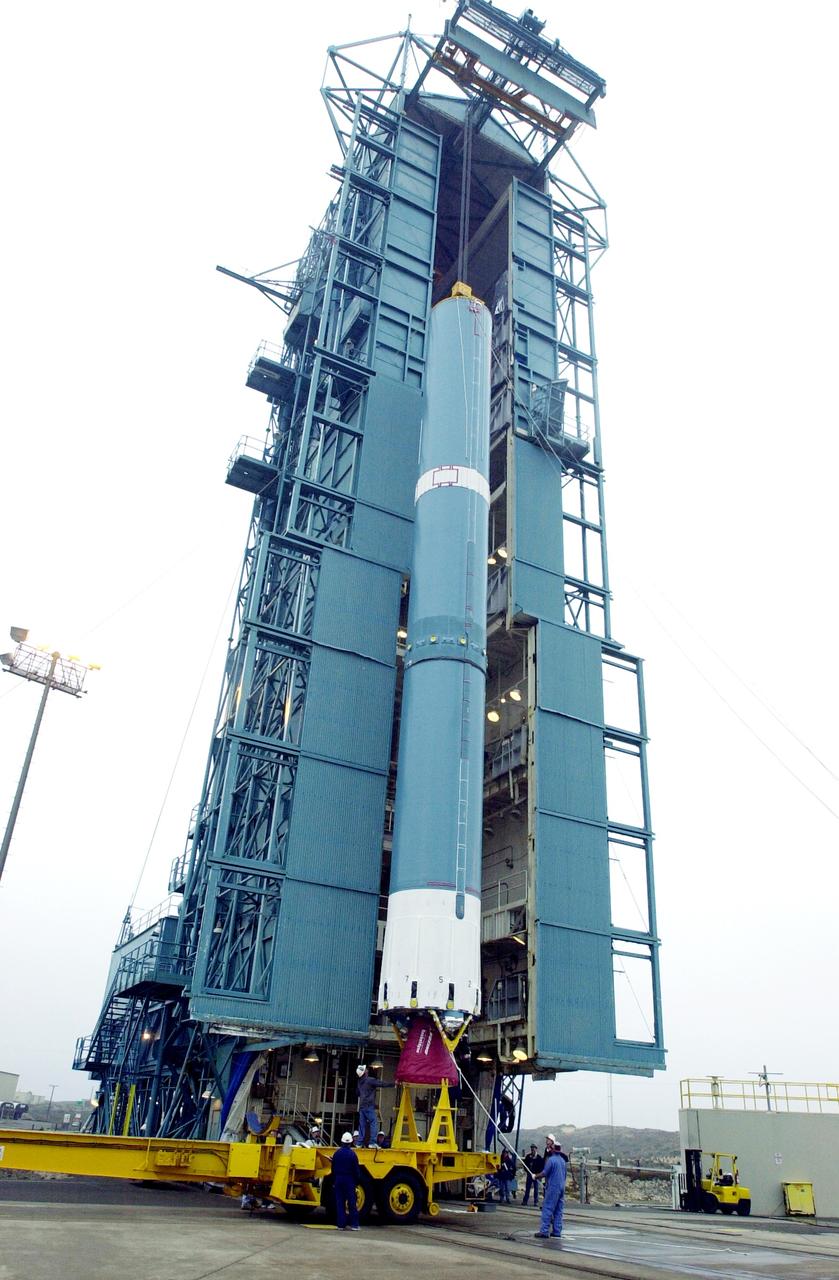
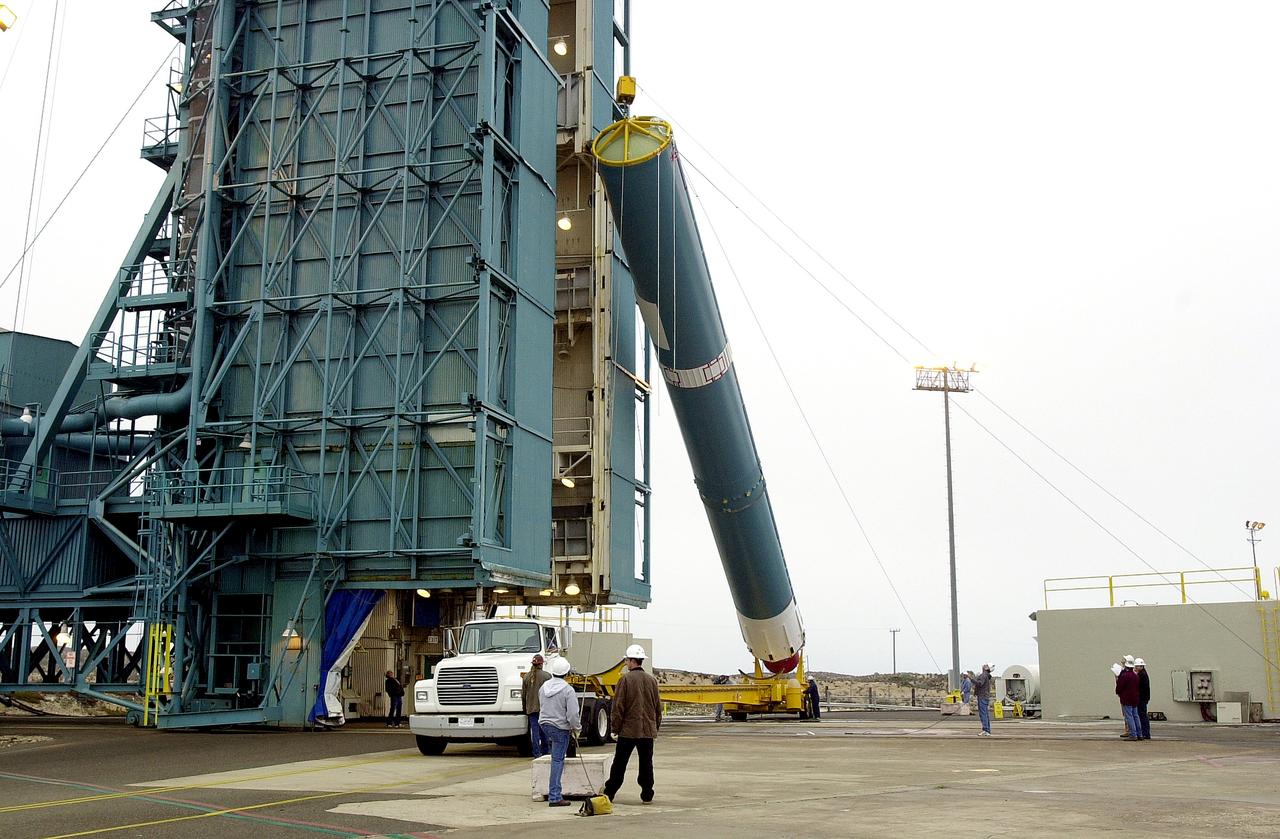
VANDENBERG AFB, CALIF. -  The first stage of the Delta II launch vehicle for the Gravity Probe B experiment is raised to a vertical position at Space Launch Complex 2, Vandenberg Air Force Base, Calif.  The Gravity Probe B will launch a payload of four gyroscopes into low-Earth polar orbit to test two extraordinary predictions of Albert Einstein’s general theory of relativity: the geodetic effect (how space and time are warped by the presence of the Earth) and frame dragging (how Earth’s rotation drags space and time around with it). Once in orbit, for 18 months each gyroscope’s spin axis will be monitored as it travels through local spacetime, observing and measuring these effects.  The experiment was developed by Stanford University, Lockheed Martin and NASA’s Marshall Space Flight Center.  The targeted launch date is Dec. 6, 2003.
VANDENBERG AFB, CALIF. - The first stage of the Delta II launch vehicle for the Gravity Probe B experiment is raised to a vertical position at Space Launch Complex 2, Vandenberg Air Force Base, Calif. The Gravity Probe B will launch a payload of four gyroscopes into low-Earth polar orbit to test two extraordinary predictions of Albert Einstein’s general theory of relativity: the geodetic effect (how space and time are warped by the presence of the Earth) and frame dragging (how Earth’s rotation drags space and time around with it). Once in orbit, for 18 months each gyroscope’s spin axis will be monitored as it travels through local spacetime, observing and measuring these effects. The experiment was developed by Stanford University, Lockheed Martin and NASA’s Marshall Space Flight Center. The targeted launch date is Dec. 6, 2003.
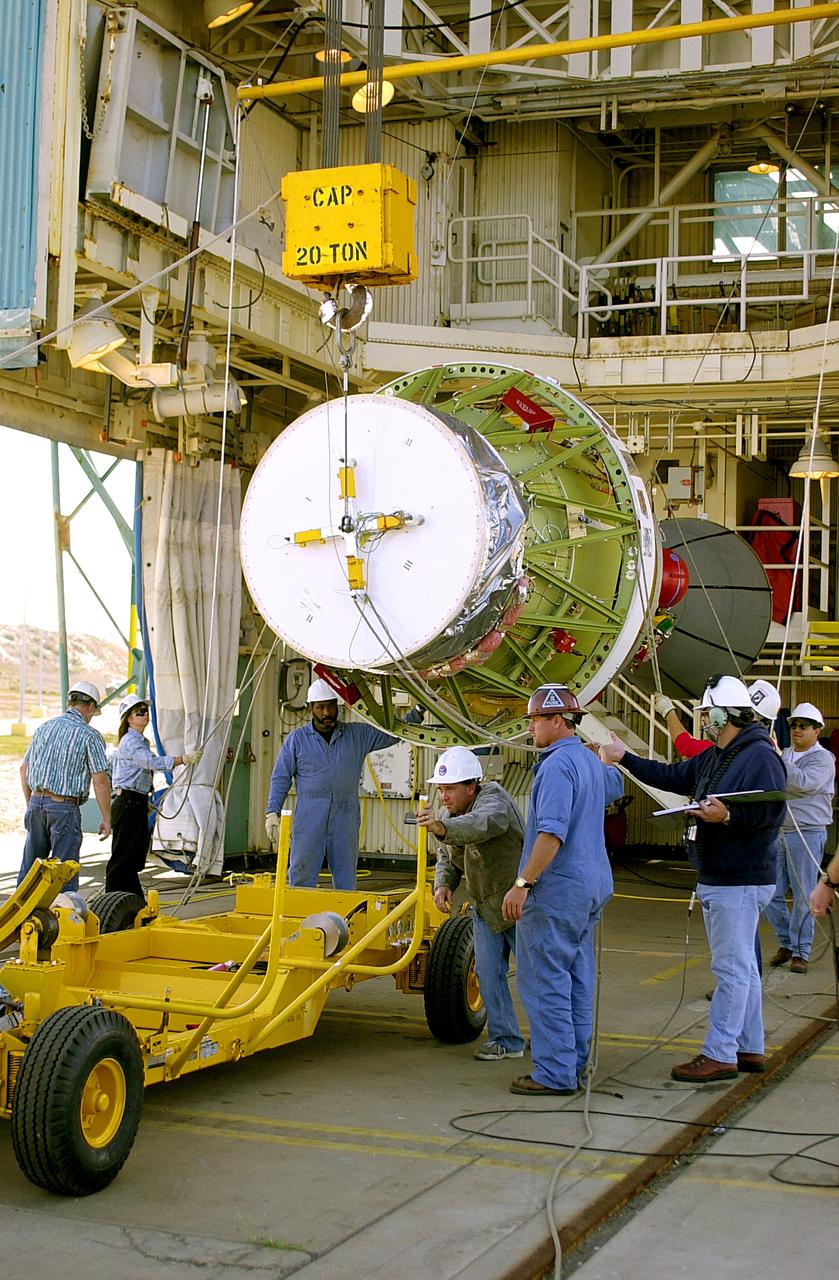
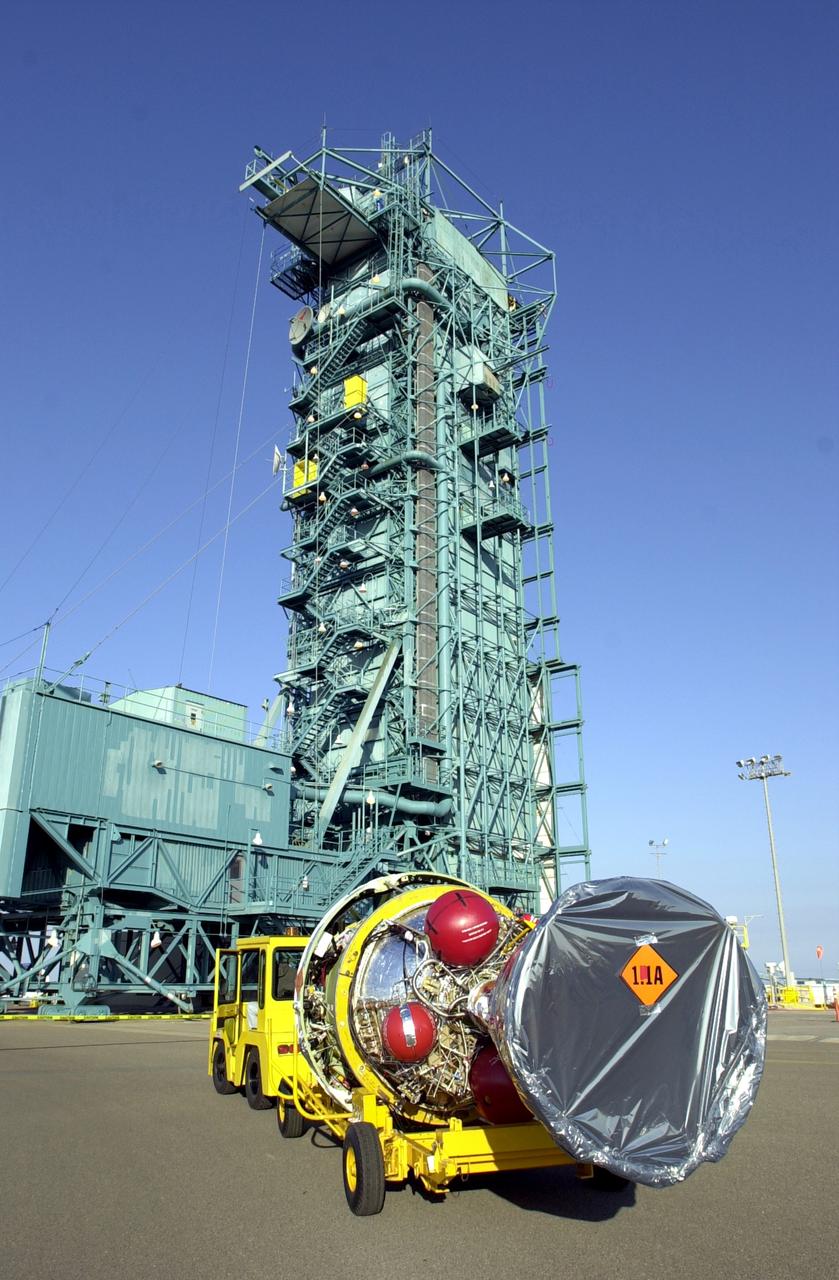
VANDENBERG AFB, CALIF. -  The second stage of the Delta II launch vehicle for the Gravity Probe B experiment arrives at the mobile service tower on Space Launch Complex 2, Vandenberg Air Force Base, Calif.  The Gravity Probe B will launch a payload of four gyroscopes into low-Earth polar orbit to test two extraordinary predictions of Albert Einstein’s general theory of relativity: the geodetic effect (how space and time are warped by the presence of the Earth) and frame dragging (how Earth’s rotation drags space and time around with it). Once in orbit, for 18 months each gyroscope’s spin axis will be monitored as it travels through local spacetime, observing and measuring these effects.  The experiment was developed by Stanford University, Lockheed Martin and NASA’s Marshall Space Flight Center.  The targeted launch date is Dec. 6, 2003.
VANDENBERG AFB, CALIF. - The second stage of the Delta II launch vehicle for the Gravity Probe B experiment arrives at the mobile service tower on Space Launch Complex 2, Vandenberg Air Force Base, Calif. The Gravity Probe B will launch a payload of four gyroscopes into low-Earth polar orbit to test two extraordinary predictions of Albert Einstein’s general theory of relativity: the geodetic effect (how space and time are warped by the presence of the Earth) and frame dragging (how Earth’s rotation drags space and time around with it). Once in orbit, for 18 months each gyroscope’s spin axis will be monitored as it travels through local spacetime, observing and measuring these effects. The experiment was developed by Stanford University, Lockheed Martin and NASA’s Marshall Space Flight Center. The targeted launch date is Dec. 6, 2003.
VANDENBERG AFB, CALIF. -   The interstage of the Delta II launch vehicle for the Gravity Probe B experiment is moved into the mobile service tower on Space Launch Complex 2, Vandenberg Air Force Base, Calif., where it will be mated with the second stage.  The Gravity Probe B will launch a payload of four gyroscopes into low-Earth polar orbit to test two extraordinary predictions of Albert Einstein’s general theory of relativity: the geodetic effect (how space and time are warped by the presence of the Earth) and frame dragging (how Earth’s rotation drags space and time around with it). Once in orbit, for 18 months each gyroscope’s spin axis will be monitored as it travels through local spacetime, observing and measuring these effects.  The experiment was developed by Stanford University, Lockheed Martin and NASA’s Marshall Space Flight Center.  The targeted launch date is Dec. 6, 2003.
VANDENBERG AFB, CALIF. - The interstage of the Delta II launch vehicle for the Gravity Probe B experiment is moved into the mobile service tower on Space Launch Complex 2, Vandenberg Air Force Base, Calif., where it will be mated with the second stage. The Gravity Probe B will launch a payload of four gyroscopes into low-Earth polar orbit to test two extraordinary predictions of Albert Einstein’s general theory of relativity: the geodetic effect (how space and time are warped by the presence of the Earth) and frame dragging (how Earth’s rotation drags space and time around with it). Once in orbit, for 18 months each gyroscope’s spin axis will be monitored as it travels through local spacetime, observing and measuring these effects. The experiment was developed by Stanford University, Lockheed Martin and NASA’s Marshall Space Flight Center. The targeted launch date is Dec. 6, 2003.
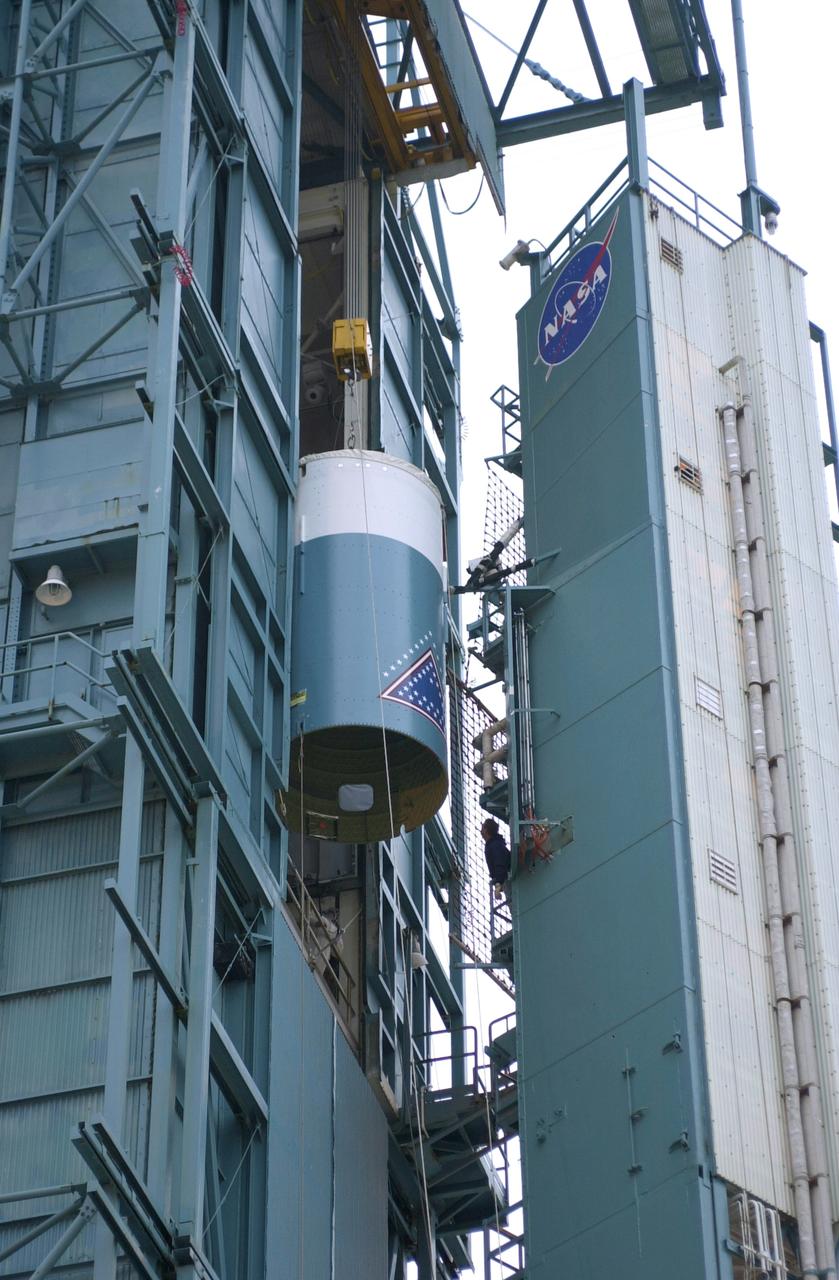
VANDENBERG AFB, CALIF. -  The second stage of the Delta II launch vehicle for the Gravity Probe B experiment is lifted up the mobile service tower on Space Launch Complex 2, Vandenberg Air Force Base, Calif.  The Gravity Probe B will launch a payload of four gyroscopes into low-Earth polar orbit to test two extraordinary predictions of Albert Einstein’s general theory of relativity: the geodetic effect (how space and time are warped by the presence of the Earth) and frame dragging (how Earth’s rotation drags space and time around with it). Once in orbit, for 18 months each gyroscope’s spin axis will be monitored as it travels through local spacetime, observing and measuring these effects.  The experiment was developed by Stanford University, Lockheed Martin and NASA’s Marshall Space Flight Center.  The targeted launch date is Dec. 6, 2003.
VANDENBERG AFB, CALIF. - The second stage of the Delta II launch vehicle for the Gravity Probe B experiment is lifted up the mobile service tower on Space Launch Complex 2, Vandenberg Air Force Base, Calif. The Gravity Probe B will launch a payload of four gyroscopes into low-Earth polar orbit to test two extraordinary predictions of Albert Einstein’s general theory of relativity: the geodetic effect (how space and time are warped by the presence of the Earth) and frame dragging (how Earth’s rotation drags space and time around with it). Once in orbit, for 18 months each gyroscope’s spin axis will be monitored as it travels through local spacetime, observing and measuring these effects. The experiment was developed by Stanford University, Lockheed Martin and NASA’s Marshall Space Flight Center. The targeted launch date is Dec. 6, 2003.
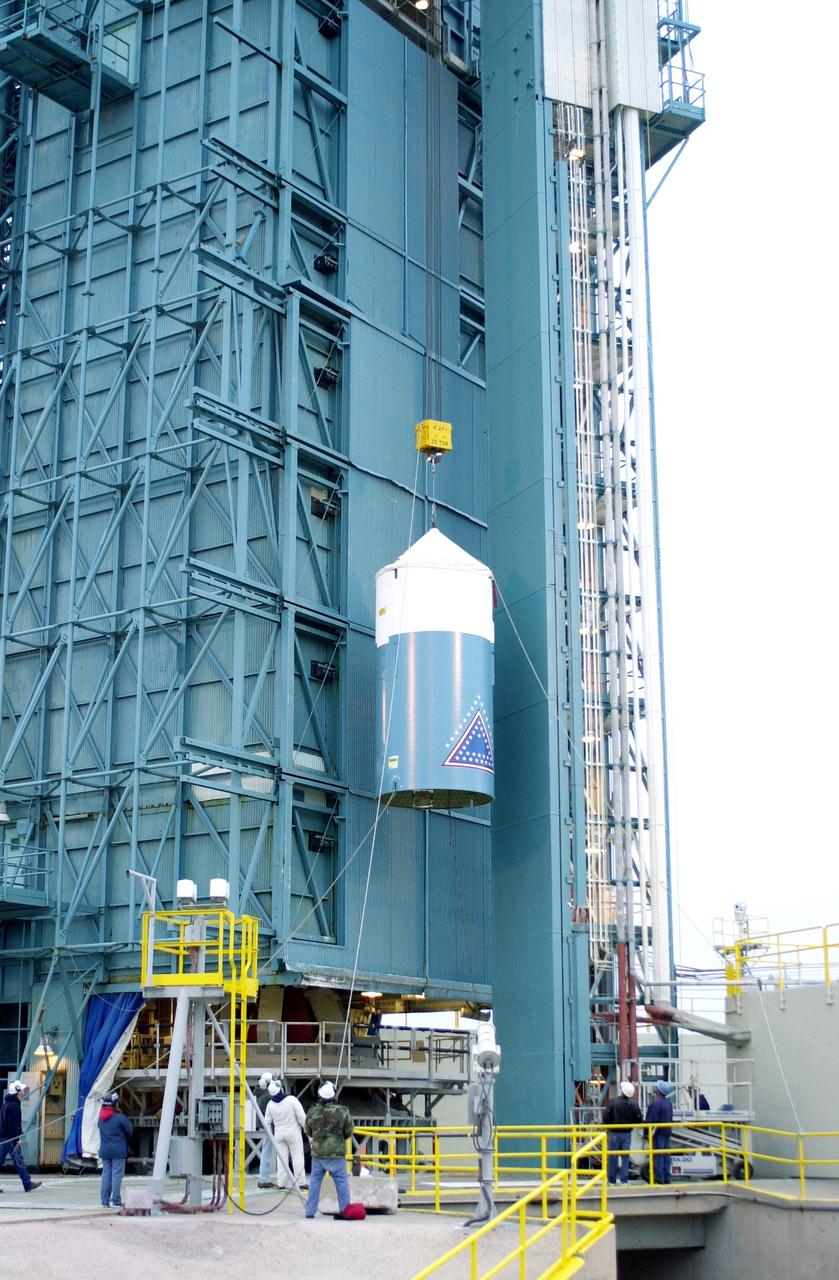
VANDENBERG AFB, CALIF. -  The interstage of the Delta II launch vehicle for the Gravity Probe B experiment is lifted up the mobile service tower on Space Launch Complex 2, Vandenberg Air Force Base, Calif.  It will enclose the second stage.  The Gravity Probe B will launch a payload of four gyroscopes into low-Earth polar orbit to test two extraordinary predictions of Albert Einstein’s general theory of relativity: the geodetic effect (how space and time are warped by the presence of the Earth) and frame dragging (how Earth’s rotation drags space and time around with it). Once in orbit, for 18 months each gyroscope’s spin axis will be monitored as it travels through local spacetime, observing and measuring these effects.  The experiment was developed by Stanford University, Lockheed Martin and NASA’s Marshall Space Flight Center.  The targeted launch date is Dec. 6, 2003.
VANDENBERG AFB, CALIF. - The interstage of the Delta II launch vehicle for the Gravity Probe B experiment is lifted up the mobile service tower on Space Launch Complex 2, Vandenberg Air Force Base, Calif. It will enclose the second stage. The Gravity Probe B will launch a payload of four gyroscopes into low-Earth polar orbit to test two extraordinary predictions of Albert Einstein’s general theory of relativity: the geodetic effect (how space and time are warped by the presence of the Earth) and frame dragging (how Earth’s rotation drags space and time around with it). Once in orbit, for 18 months each gyroscope’s spin axis will be monitored as it travels through local spacetime, observing and measuring these effects. The experiment was developed by Stanford University, Lockheed Martin and NASA’s Marshall Space Flight Center. The targeted launch date is Dec. 6, 2003.
VANDENBERG AFB, CALIF. -  The second stage of the Delta II launch vehicle for the Gravity Probe B experiment is moved into the mobile service tower on Space Launch Complex 2, Vandenberg Air Force Base, Calif.   Behind it can be seen the first stage of the Delta II.  The Gravity Probe B will launch a payload of four gyroscopes into low-Earth polar orbit to test two extraordinary predictions of Albert Einstein’s general theory of relativity: the geodetic effect (how space and time are warped by the presence of the Earth) and frame dragging (how Earth’s rotation drags space and time around with it). Once in orbit, for 18 months each gyroscope’s spin axis will be monitored as it travels through local spacetime, observing and measuring these effects.  The experiment was developed by Stanford University, Lockheed Martin and NASA’s Marshall Space Flight Center.  The targeted launch date is Dec. 6, 2003.
VANDENBERG AFB, CALIF. - The second stage of the Delta II launch vehicle for the Gravity Probe B experiment is moved into the mobile service tower on Space Launch Complex 2, Vandenberg Air Force Base, Calif. Behind it can be seen the first stage of the Delta II. The Gravity Probe B will launch a payload of four gyroscopes into low-Earth polar orbit to test two extraordinary predictions of Albert Einstein’s general theory of relativity: the geodetic effect (how space and time are warped by the presence of the Earth) and frame dragging (how Earth’s rotation drags space and time around with it). Once in orbit, for 18 months each gyroscope’s spin axis will be monitored as it travels through local spacetime, observing and measuring these effects. The experiment was developed by Stanford University, Lockheed Martin and NASA’s Marshall Space Flight Center. The targeted launch date is Dec. 6, 2003.
VANDENBERG AFB, CALIF. -  Viewed from inside, the second stage of the Delta II launch vehicle for the Gravity Probe B experiment is lifted up the mobile service tower on Space Launch Complex 2, Vandenberg Air Force Base, Calif.   Behind it is the first stage of the Delta II.  The Gravity Probe B will launch a payload of four gyroscopes into low-Earth polar orbit to test two extraordinary predictions of Albert Einstein’s general theory of relativity: the geodetic effect (how space and time are warped by the presence of the Earth) and frame dragging (how Earth’s rotation drags space and time around with it). Once in orbit, for 18 months each gyroscope’s spin axis will be monitored as it travels through local spacetime, observing and measuring these effects.  The experiment was developed by Stanford University, Lockheed Martin and NASA’s Marshall Space Flight Center.  The targeted launch date is Dec. 6, 2003.
VANDENBERG AFB, CALIF. - Viewed from inside, the second stage of the Delta II launch vehicle for the Gravity Probe B experiment is lifted up the mobile service tower on Space Launch Complex 2, Vandenberg Air Force Base, Calif. Behind it is the first stage of the Delta II. The Gravity Probe B will launch a payload of four gyroscopes into low-Earth polar orbit to test two extraordinary predictions of Albert Einstein’s general theory of relativity: the geodetic effect (how space and time are warped by the presence of the Earth) and frame dragging (how Earth’s rotation drags space and time around with it). Once in orbit, for 18 months each gyroscope’s spin axis will be monitored as it travels through local spacetime, observing and measuring these effects. The experiment was developed by Stanford University, Lockheed Martin and NASA’s Marshall Space Flight Center. The targeted launch date is Dec. 6, 2003.
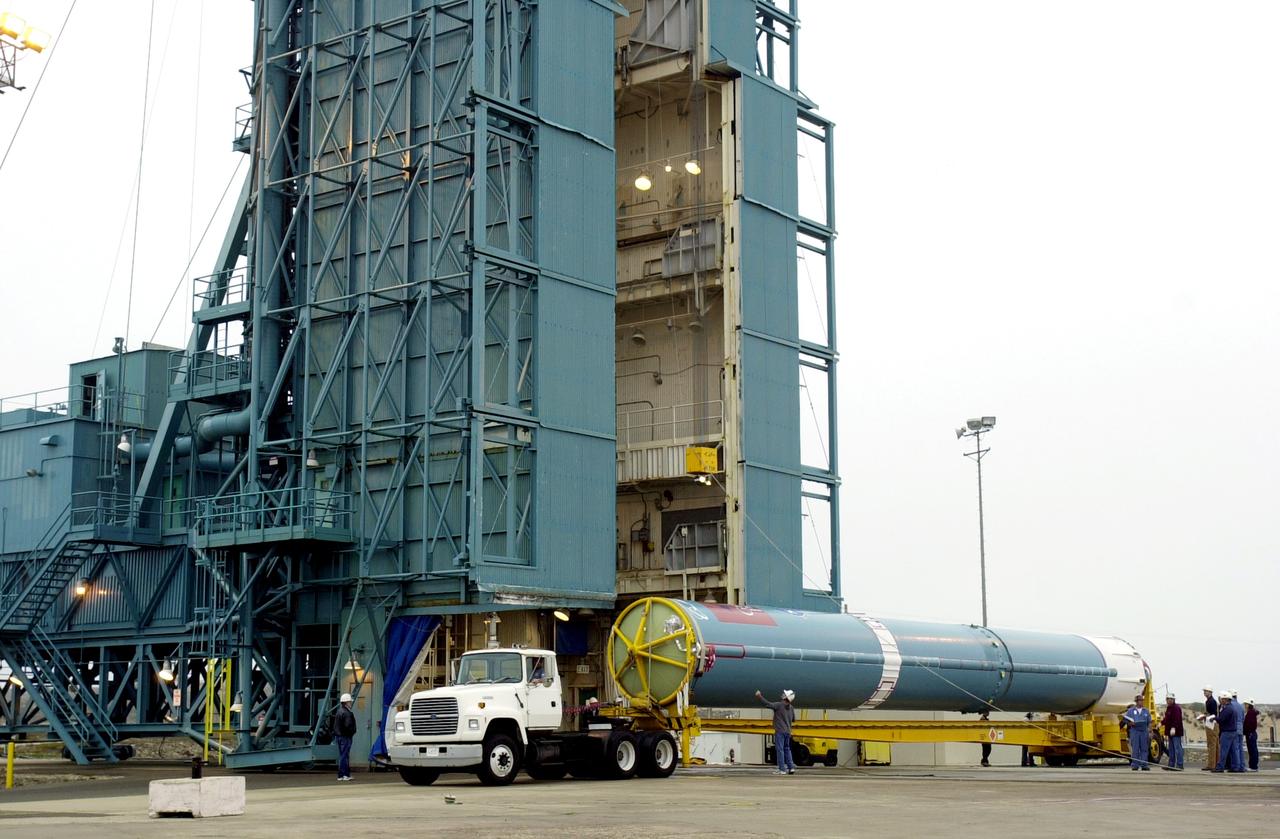
VANDENBERG AFB, CALIF. - The second stage of the Delta II launch vehicle for the Gravity Probe B experiment is lifted off the transporter after its arrival on Space Launch Complex 2, Vandenberg Air Force Base, Calif.  The Gravity Probe B will launch a payload of four gyroscopes into low-Earth polar orbit to test two extraordinary predictions of Albert Einstein’s general theory of relativity: the geodetic effect (how space and time are warped by the presence of the Earth) and frame dragging (how Earth’s rotation drags space and time around with it). Once in orbit, for 18 months each gyroscope’s spin axis will be monitored as it travels through local spacetime, observing and measuring these effects.  The experiment was developed by Stanford University, Lockheed Martin and NASA’s Marshall Space Flight Center.  The targeted launch date is Dec. 6, 2003.
VANDENBERG AFB, CALIF. - The second stage of the Delta II launch vehicle for the Gravity Probe B experiment is lifted off the transporter after its arrival on Space Launch Complex 2, Vandenberg Air Force Base, Calif. The Gravity Probe B will launch a payload of four gyroscopes into low-Earth polar orbit to test two extraordinary predictions of Albert Einstein’s general theory of relativity: the geodetic effect (how space and time are warped by the presence of the Earth) and frame dragging (how Earth’s rotation drags space and time around with it). Once in orbit, for 18 months each gyroscope’s spin axis will be monitored as it travels through local spacetime, observing and measuring these effects. The experiment was developed by Stanford University, Lockheed Martin and NASA’s Marshall Space Flight Center. The targeted launch date is Dec. 6, 2003.
VANDENBERG AFB, CALIF. -  Viewed from inside, the second stage of the Delta II launch vehicle for the Gravity Probe B experiment is lifted up the mobile service tower on Space Launch Complex 2, Vandenberg Air Force Base, Calif.   The Gravity Probe B will launch a payload of four gyroscopes into low-Earth polar orbit to test two extraordinary predictions of Albert Einstein’s general theory of relativity: the geodetic effect (how space and time are warped by the presence of the Earth) and frame dragging (how Earth’s rotation drags space and time around with it). Once in orbit, for 18 months each gyroscope’s spin axis will be monitored as it travels through local spacetime, observing and measuring these effects.  The experiment was developed by Stanford University, Lockheed Martin and NASA’s Marshall Space Flight Center.  The targeted launch date is Dec. 6, 2003.
VANDENBERG AFB, CALIF. - Viewed from inside, the second stage of the Delta II launch vehicle for the Gravity Probe B experiment is lifted up the mobile service tower on Space Launch Complex 2, Vandenberg Air Force Base, Calif. The Gravity Probe B will launch a payload of four gyroscopes into low-Earth polar orbit to test two extraordinary predictions of Albert Einstein’s general theory of relativity: the geodetic effect (how space and time are warped by the presence of the Earth) and frame dragging (how Earth’s rotation drags space and time around with it). Once in orbit, for 18 months each gyroscope’s spin axis will be monitored as it travels through local spacetime, observing and measuring these effects. The experiment was developed by Stanford University, Lockheed Martin and NASA’s Marshall Space Flight Center. The targeted launch date is Dec. 6, 2003.
VANDENBERG AFB, CALIF. -   The first stage of the Delta II launch vehicle for the Gravity Probe B experiment is lifted up the mobile service tower on Space Launch Complex 2, Vandenberg Air Force Base, Calif.  The Gravity Probe B will launch a payload of four gyroscopes into low-Earth polar orbit to test two extraordinary predictions of Albert Einstein’s general theory of relativity: the geodetic effect (how space and time are warped by the presence of the Earth) and frame dragging (how Earth’s rotation drags space and time around with it). Once in orbit, for 18 months each gyroscope’s spin axis will be monitored as it travels through local spacetime, observing and measuring these effects.  The experiment was developed by Stanford University, Lockheed Martin and NASA’s Marshall Space Flight Center.  The targeted launch date is Dec. 6, 2003.
VANDENBERG AFB, CALIF. - The first stage of the Delta II launch vehicle for the Gravity Probe B experiment is lifted up the mobile service tower on Space Launch Complex 2, Vandenberg Air Force Base, Calif. The Gravity Probe B will launch a payload of four gyroscopes into low-Earth polar orbit to test two extraordinary predictions of Albert Einstein’s general theory of relativity: the geodetic effect (how space and time are warped by the presence of the Earth) and frame dragging (how Earth’s rotation drags space and time around with it). Once in orbit, for 18 months each gyroscope’s spin axis will be monitored as it travels through local spacetime, observing and measuring these effects. The experiment was developed by Stanford University, Lockheed Martin and NASA’s Marshall Space Flight Center. The targeted launch date is Dec. 6, 2003.
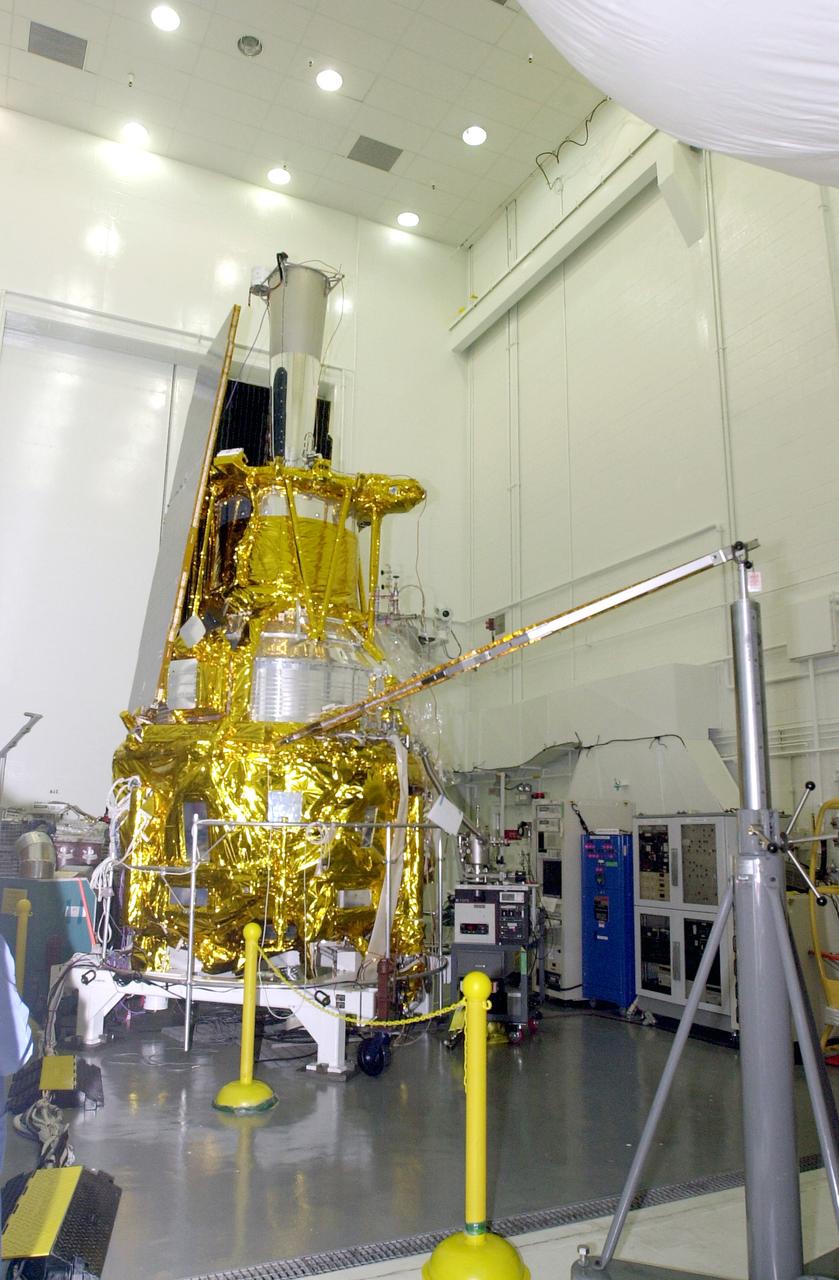
VANDENBERG AFB, CALIF. -   In the spacecraft processing facility on North Vandenberg Air Force Base, the Gravity Probe B experiment sits on an assembly and test stand where it has been subject to various prelaunch testing.  The Gravity Probe B will launch a payload of four gyroscopes into low-Earth polar orbit to test two extraordinary predictions of Albert Einstein’s general theory of relativity: the geodetic effect (how space and time are warped by the presence of the Earth) and frame dragging (how Earth’s rotation drags space and time around with it). Once in orbit, for 18 months each gyroscope’s spin axis will be monitored as it travels through local spacetime, observing and measuring these effects.  The experiment was developed by Stanford University, Lockheed Martin and NASA’s Marshall Space Flight Center.   The targeted launch date is Dec. 6, 2003.
VANDENBERG AFB, CALIF. - In the spacecraft processing facility on North Vandenberg Air Force Base, the Gravity Probe B experiment sits on an assembly and test stand where it has been subject to various prelaunch testing. The Gravity Probe B will launch a payload of four gyroscopes into low-Earth polar orbit to test two extraordinary predictions of Albert Einstein’s general theory of relativity: the geodetic effect (how space and time are warped by the presence of the Earth) and frame dragging (how Earth’s rotation drags space and time around with it). Once in orbit, for 18 months each gyroscope’s spin axis will be monitored as it travels through local spacetime, observing and measuring these effects. The experiment was developed by Stanford University, Lockheed Martin and NASA’s Marshall Space Flight Center. The targeted launch date is Dec. 6, 2003.
VANDENBERG AFB, CALIF. -  The second stage of the Delta II launch vehicle for the Gravity Probe B experiment arrives at the mobile service tower on Space Launch Complex 2, Vandenberg Air Force Base, Calif.  The Gravity Probe B will launch a payload of four gyroscopes into low-Earth polar orbit to test two extraordinary predictions of Albert Einstein’s general theory of relativity: the geodetic effect (how space and time are warped by the presence of the Earth) and frame dragging (how Earth’s rotation drags space and time around with it). Once in orbit, for 18 months each gyroscope’s spin axis will be monitored as it travels through local spacetime, observing and measuring these effects.  The experiment was developed by Stanford University, Lockheed Martin and NASA’s Marshall Space Flight Center.  The targeted launch date is Dec. 6, 2003.
VANDENBERG AFB, CALIF. - The second stage of the Delta II launch vehicle for the Gravity Probe B experiment arrives at the mobile service tower on Space Launch Complex 2, Vandenberg Air Force Base, Calif. The Gravity Probe B will launch a payload of four gyroscopes into low-Earth polar orbit to test two extraordinary predictions of Albert Einstein’s general theory of relativity: the geodetic effect (how space and time are warped by the presence of the Earth) and frame dragging (how Earth’s rotation drags space and time around with it). Once in orbit, for 18 months each gyroscope’s spin axis will be monitored as it travels through local spacetime, observing and measuring these effects. The experiment was developed by Stanford University, Lockheed Martin and NASA’s Marshall Space Flight Center. The targeted launch date is Dec. 6, 2003.
VANDENBERG AFB, CALIF. -  The first stage of the Delta II launch vehicle for the Gravity Probe B experiment arrives at Space Launch Complex 2, Vandenberg Air Force Base, Calif.  The Gravity Probe B will launch a payload of four gyroscopes into low-Earth polar orbit to test two extraordinary predictions of Albert Einstein’s general theory of relativity: the geodetic effect (how space and time are warped by the presence of the Earth) and frame dragging (how Earth’s rotation drags space and time around with it). Once in orbit, for 18 months each gyroscope’s spin axis will be monitored as it travels through local spacetime, observing and measuring these effects.  The experiment was developed by Stanford University, Lockheed Martin and NASA’s Marshall Space Flight Center.  The targeted launch date is Dec. 6, 2003.
VANDENBERG AFB, CALIF. - The first stage of the Delta II launch vehicle for the Gravity Probe B experiment arrives at Space Launch Complex 2, Vandenberg Air Force Base, Calif. The Gravity Probe B will launch a payload of four gyroscopes into low-Earth polar orbit to test two extraordinary predictions of Albert Einstein’s general theory of relativity: the geodetic effect (how space and time are warped by the presence of the Earth) and frame dragging (how Earth’s rotation drags space and time around with it). Once in orbit, for 18 months each gyroscope’s spin axis will be monitored as it travels through local spacetime, observing and measuring these effects. The experiment was developed by Stanford University, Lockheed Martin and NASA’s Marshall Space Flight Center. The targeted launch date is Dec. 6, 2003.
VANDENBERG AFB, CALIF. -  The interstage of the Delta II launch vehicle for the Gravity Probe B experiment is  prepared for lifting up the mobile service tower on Space Launch Complex 2, Vandenberg Air Force Base, Calif.  It will enclose the second stage.  The Gravity Probe B will launch a payload of four gyroscopes into low-Earth polar orbit to test two extraordinary predictions of Albert Einstein’s general theory of relativity: the geodetic effect (how space and time are warped by the presence of the Earth) and frame dragging (how Earth’s rotation drags space and time around with it). Once in orbit, for 18 months each gyroscope’s spin axis will be monitored as it travels through local spacetime, observing and measuring these effects.  The experiment was developed by Stanford University, Lockheed Martin and NASA’s Marshall Space Flight Center.  The targeted launch date is Dec. 6, 2003.
VANDENBERG AFB, CALIF. - The interstage of the Delta II launch vehicle for the Gravity Probe B experiment is prepared for lifting up the mobile service tower on Space Launch Complex 2, Vandenberg Air Force Base, Calif. It will enclose the second stage. The Gravity Probe B will launch a payload of four gyroscopes into low-Earth polar orbit to test two extraordinary predictions of Albert Einstein’s general theory of relativity: the geodetic effect (how space and time are warped by the presence of the Earth) and frame dragging (how Earth’s rotation drags space and time around with it). Once in orbit, for 18 months each gyroscope’s spin axis will be monitored as it travels through local spacetime, observing and measuring these effects. The experiment was developed by Stanford University, Lockheed Martin and NASA’s Marshall Space Flight Center. The targeted launch date is Dec. 6, 2003.
VANDENBERG AFB, CALIF. -   The interstage of the Delta II launch vehicle for the Gravity Probe B experiment is moved into the mobile service tower on Space Launch Complex 2, Vandenberg Air Force Base, Calif., where it will be mated with the second stage.  The Gravity Probe B will launch a payload of four gyroscopes into low-Earth polar orbit to test two extraordinary predictions of Albert Einstein’s general theory of relativity: the geodetic effect (how space and time are warped by the presence of the Earth) and frame dragging (how Earth’s rotation drags space and time around with it). Once in orbit, for 18 months each gyroscope’s spin axis will be monitored as it travels through local spacetime, observing and measuring these effects.  The experiment was developed by Stanford University, Lockheed Martin and NASA’s Marshall Space Flight Center.  The targeted launch date is Dec. 6, 2003.
VANDENBERG AFB, CALIF. - The interstage of the Delta II launch vehicle for the Gravity Probe B experiment is moved into the mobile service tower on Space Launch Complex 2, Vandenberg Air Force Base, Calif., where it will be mated with the second stage. The Gravity Probe B will launch a payload of four gyroscopes into low-Earth polar orbit to test two extraordinary predictions of Albert Einstein’s general theory of relativity: the geodetic effect (how space and time are warped by the presence of the Earth) and frame dragging (how Earth’s rotation drags space and time around with it). Once in orbit, for 18 months each gyroscope’s spin axis will be monitored as it travels through local spacetime, observing and measuring these effects. The experiment was developed by Stanford University, Lockheed Martin and NASA’s Marshall Space Flight Center. The targeted launch date is Dec. 6, 2003.
VANDENBERG AFB, CALIF. -  The first stage of the Delta II launch vehicle for the Gravity Probe B experiment is ready to be lifted up the mobile service tower on Space Launch Complex 2, Vandenberg Air Force Base, Calif.  The Gravity Probe B will launch a payload of four gyroscopes into low-Earth polar orbit to test two extraordinary predictions of Albert Einstein’s general theory of relativity: the geodetic effect (how space and time are warped by the presence of the Earth) and frame dragging (how Earth’s rotation drags space and time around with it). Once in orbit, for 18 months each gyroscope’s spin axis will be monitored as it travels through local spacetime, observing and measuring these effects.  The experiment was developed by Stanford University, Lockheed Martin and NASA’s Marshall Space Flight Center.  The targeted launch date is Dec. 6, 2003.
VANDENBERG AFB, CALIF. - The first stage of the Delta II launch vehicle for the Gravity Probe B experiment is ready to be lifted up the mobile service tower on Space Launch Complex 2, Vandenberg Air Force Base, Calif. The Gravity Probe B will launch a payload of four gyroscopes into low-Earth polar orbit to test two extraordinary predictions of Albert Einstein’s general theory of relativity: the geodetic effect (how space and time are warped by the presence of the Earth) and frame dragging (how Earth’s rotation drags space and time around with it). Once in orbit, for 18 months each gyroscope’s spin axis will be monitored as it travels through local spacetime, observing and measuring these effects. The experiment was developed by Stanford University, Lockheed Martin and NASA’s Marshall Space Flight Center. The targeted launch date is Dec. 6, 2003.
VANDENBERG AFB, CALIF. -  The mobile service tower on Space Launch Complex 2, Vandenberg Air Force Base, Calif., rolls back from the Delta II rocket that will launch the Gravity Probe B experiment.  The Gravity Probe B will launch a payload of four gyroscopes into low-Earth polar orbit to test two extraordinary predictions of Albert Einstein’s general theory of relativity: the geodetic effect (how space and time are warped by the presence of the Earth) and frame dragging (how Earth’s rotation drags space and time around with it). Once in orbit, for 18 months each gyroscope’s spin axis will be monitored as it travels through local spacetime, observing and measuring these effects.  The experiment was developed by Stanford University, Lockheed Martin and NASA’s Marshall Space Flight Center.  The targeted launch date is Dec. 6, 2003.
VANDENBERG AFB, CALIF. - The mobile service tower on Space Launch Complex 2, Vandenberg Air Force Base, Calif., rolls back from the Delta II rocket that will launch the Gravity Probe B experiment. The Gravity Probe B will launch a payload of four gyroscopes into low-Earth polar orbit to test two extraordinary predictions of Albert Einstein’s general theory of relativity: the geodetic effect (how space and time are warped by the presence of the Earth) and frame dragging (how Earth’s rotation drags space and time around with it). Once in orbit, for 18 months each gyroscope’s spin axis will be monitored as it travels through local spacetime, observing and measuring these effects. The experiment was developed by Stanford University, Lockheed Martin and NASA’s Marshall Space Flight Center. The targeted launch date is Dec. 6, 2003.
The Gravity Probe B experiment rests on an assembly and test stand in the spacecraft processing facility on North Vandenberg Air Force Base. Gravity Probe B will launch a payload of four gyroscopes into low-Earth polar orbit to test two extraordinary predictions of Albert Einstein’s general theory of relativity: the geodetic effect (how space and time are warped by the presence of the Earth) and frame dragging (how Earth’s rotation drags space and time around with it). Once in orbit, for 18 months each gyroscope’s spin axis will be monitored as it travels through local spacetime, observing and measuring these effects. The experiment was developed by Stanford University, Lockheed Martin and NASA’s Marshall Space Flight Center.
Gravity Probe B
Seated from left, Bill Danchi, Senior Astrophysicist and Program Scientist at NASA Headquarters, Francis Everitt, Principal Investigator for the Gravity Probe B Mission at Stanford University, Rex Geveden, President of Teledyne Brown Engineering, Colleen Hartman, a research professor at George Washington University, and Clifford Will, Professor of Physics at Washington University in St. Louis, Mo., conduct a press conference, Wednesday, May 4, 2011, to discuss NASA's Gravity Probe B (GP-B) mission which has confirmed two key predictions derived from Albert Einstein's general theory of relativity, which the spacecraft was designed to test. at NASA Headquarters in Washington. Photo Credit: (NASA/Paul E. Alers)
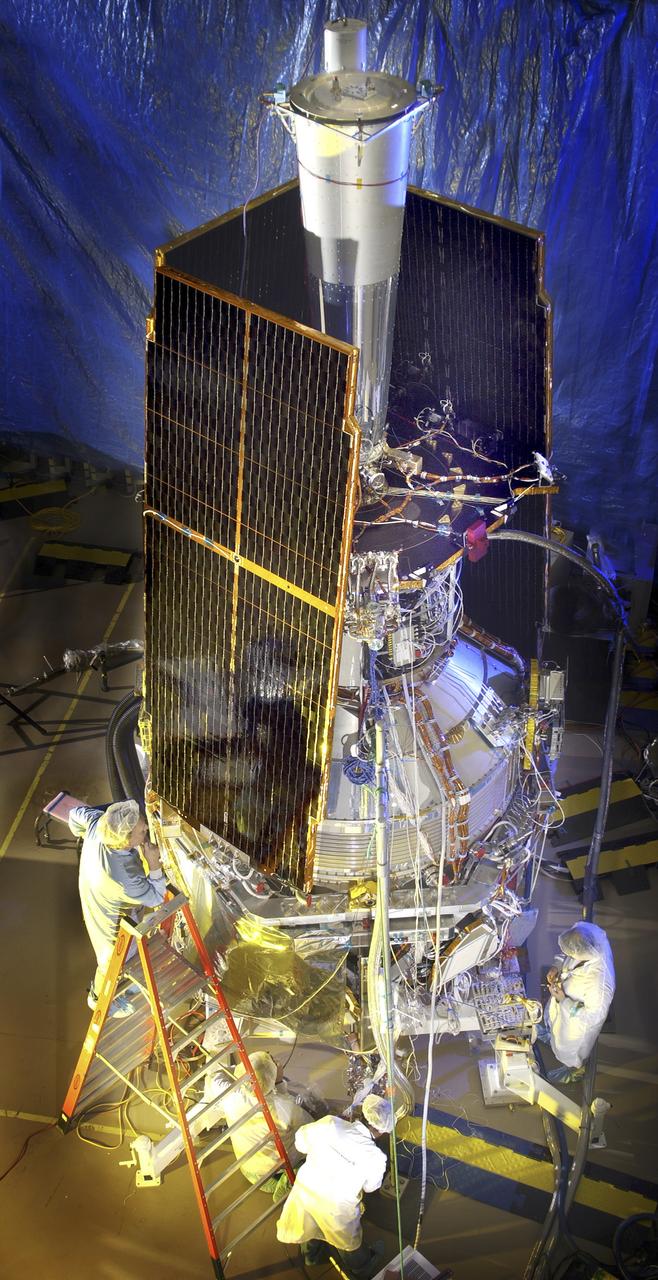
Space Time Theories Confirmed
Clifford Will, Professor of Physics at Washington University in St. Louis, makes a point during a press conference, Wednesday, May 4, 2011, to discuss NASA's Gravity Probe B (GP-B) mission which has confirmed two key predictions derived from Albert Einstein's general theory of relativity, which the spacecraft was designed to test at NASA Headquarters in Washington. The experiment, launched in 2004, used four ultra-precise gyroscopes to measure the hypothesized geodetic effect, the warping of space and time around a gravitational body, and frame-dragging, the amount a spinning object pulls space and time with it as it rotates. Photo Credit: (NASA/Paul E. Alers)
Space Time Theories Confirmed
Francis Everitt, Principal Investigator for the Gravity Probe B Mission at Stanford University, second from left, makes a point during a press conference, Wednesday, May 4, 2011, to discuss NASA's Gravity Probe B (GP-B) mission which has confirmed two key predictions derived from Albert Einstein's general theory of relativity, which the spacecraft was designed to test at NASA Headquarters in Washington. The experiment, launched in 2004, used four ultra-precise gyroscopes to measure the hypothesized geodetic effect, the warping of space and time around a gravitational body, and frame-dragging, the amount a spinning object pulls space and time with it as it rotates. Photo Credit: (NASA/Paul E. Alers)
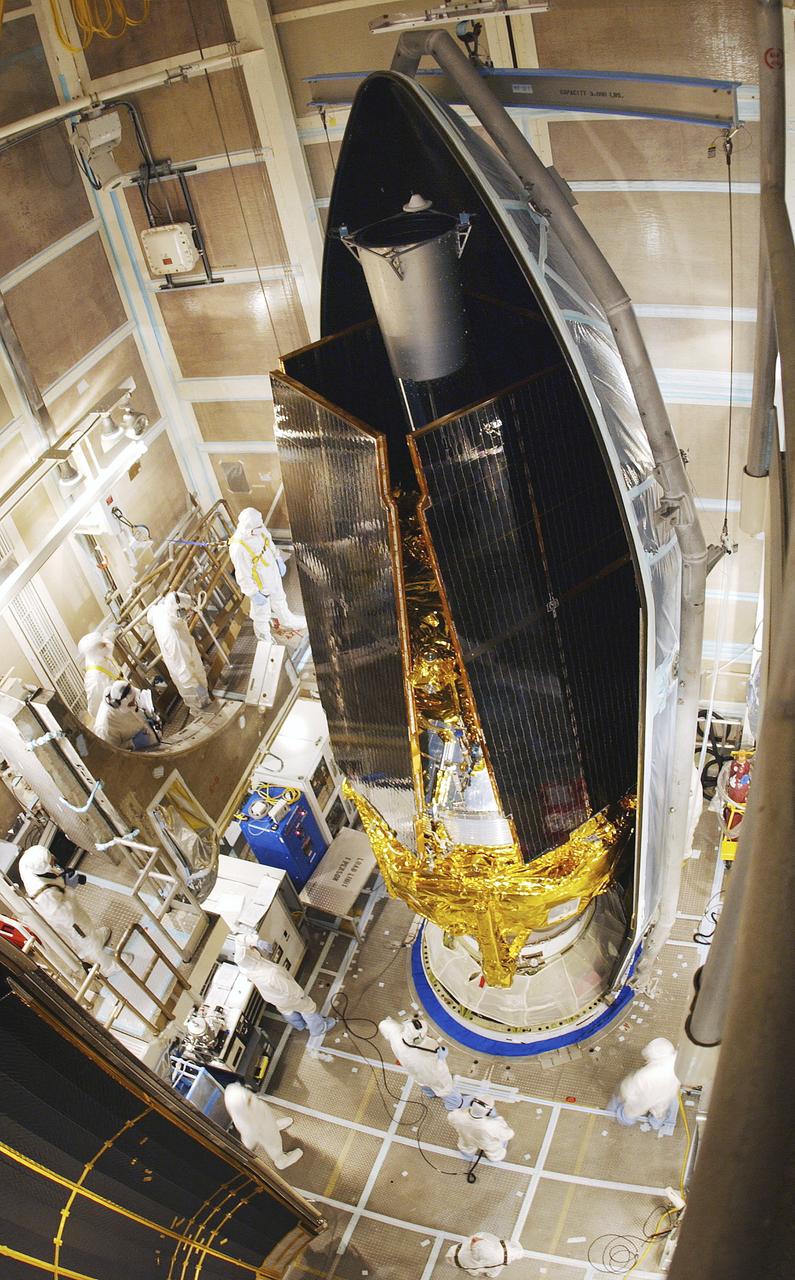
Space Time Theories Confirmed
The Gravity Probe B experiment is lifted from its transporter in the spacecraft processing facility on North Vandenberg Air Force Base. Gravity Probe B will launch a payload of four gyroscopes into low-Earth polar orbit to test two extraordinary predictions of Albert Einstein’s general theory of relativity: the geodetic effect (how space and time are warped by the presence of the Earth) and frame dragging (how Earth’s rotation drags space and time around with it). Once in orbit, for 18 months each gyroscope’s spin axis will be monitored as it travels through local spacetime, observing and measuring these effects. The experiment was developed by Stanford University, Lockheed Martin and NASA’s Marshall Space Flight Center.
Gravity Probe B
STEP will carry concentric test masses to Earth orbit to test a fundamental assumption underlying Einstein's theory of general relativity: that gravitational mass is equivalent to inertial mass. STEP is a 21st-century version of the test that Galileo is said to have performed by dropping a carnon ball and a musket ball simultaneously from the top of the Leaning Tower of Pisa to compare their accelerations. During the STEP experiment, four pairs of test masses will be falling around the Earth, and their accelerations will be measured by superconducting quantum interference devices (SQUIDS). The extended time sensitivity of the instruments will allow the measurements to be a million times more accurate than those made in modern ground-based tests.
Microgravity
Francis Everitt, Principal Investigator for the Gravity Probe B Mission at Stanford University, makes a point during a press conference, Wednesday, May 4, 2011, to discuss NASA's Gravity Probe B (GP-B) mission which has confirmed two key predictions derived from Albert Einstein's general theory of relativity, which the spacecraft was designed to test at NASA Headquarters in Washington. The experiment, launched in 2004, used four ultra-precise gyroscopes to measure the hypothesized geodetic effect, the warping of space and time around a gravitational body, and frame-dragging, the amount a spinning object pulls space and time with it as it rotates. Photo Credit: (NASA/Paul E. Alers)
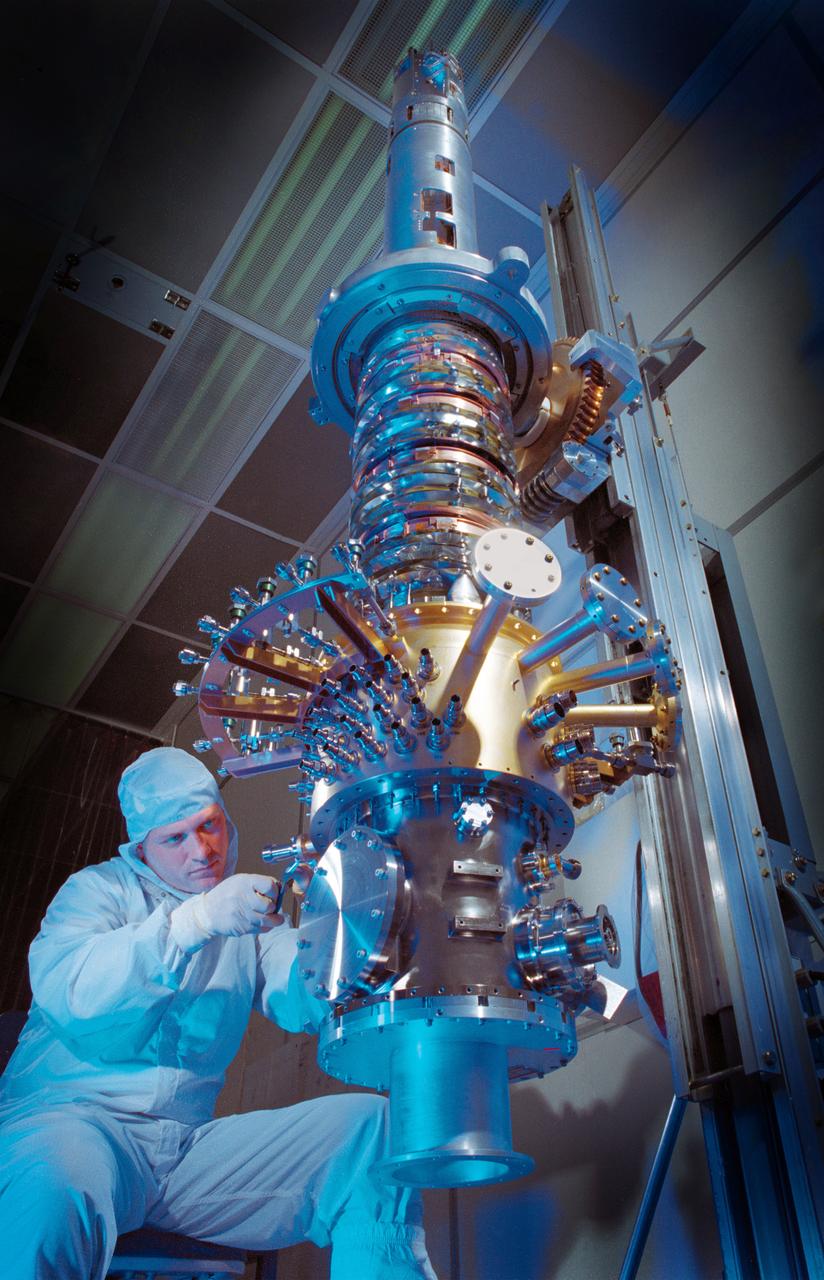
Space Time Theories Confirmed
Enclosed in a canister, the Gravity Probe B (GP-B) spacecraft arrives on Vandenberg Air Force Base, headed for the spacecraft processing facility. Gravity Probe B will launch a payload of four gyroscopes into low-Earth polar orbit to test two extraordinary predictions of Albert Einstein’s general theory of relativity: the geodetic effect (how space and time are warped by the presence of the Earth) and frame dragging (how Earth’s rotation drags space and time around with it). Once in orbit, for 18 months each gyroscope’s spin axis will be monitored as it travels through local spacetime, observing and measuring these effects. The experiment was developed by Stanford University, Lockheed Martin and NASA’s Marshall Space Flight Center.
Gravity Probe B
Francis Everitt, Principal Investigator for the Gravity Probe B Mission at Stanford University, makes a point during a press conference, Wednesday, May 4, 2011, to discuss NASA's Gravity Probe B (GP-B) mission which has confirmed two key predictions derived from Albert Einstein's general theory of relativity, which the spacecraft was designed to test at NASA Headquarters in Washington. The experiment, launched in 2004, used four ultra-precise gyroscopes to measure the hypothesized geodetic effect, the warping of space and time around a gravitational body, and frame-dragging, the amount a spinning object pulls space and time with it as it rotates. Photo Credit: (NASA/Paul E. Alers)
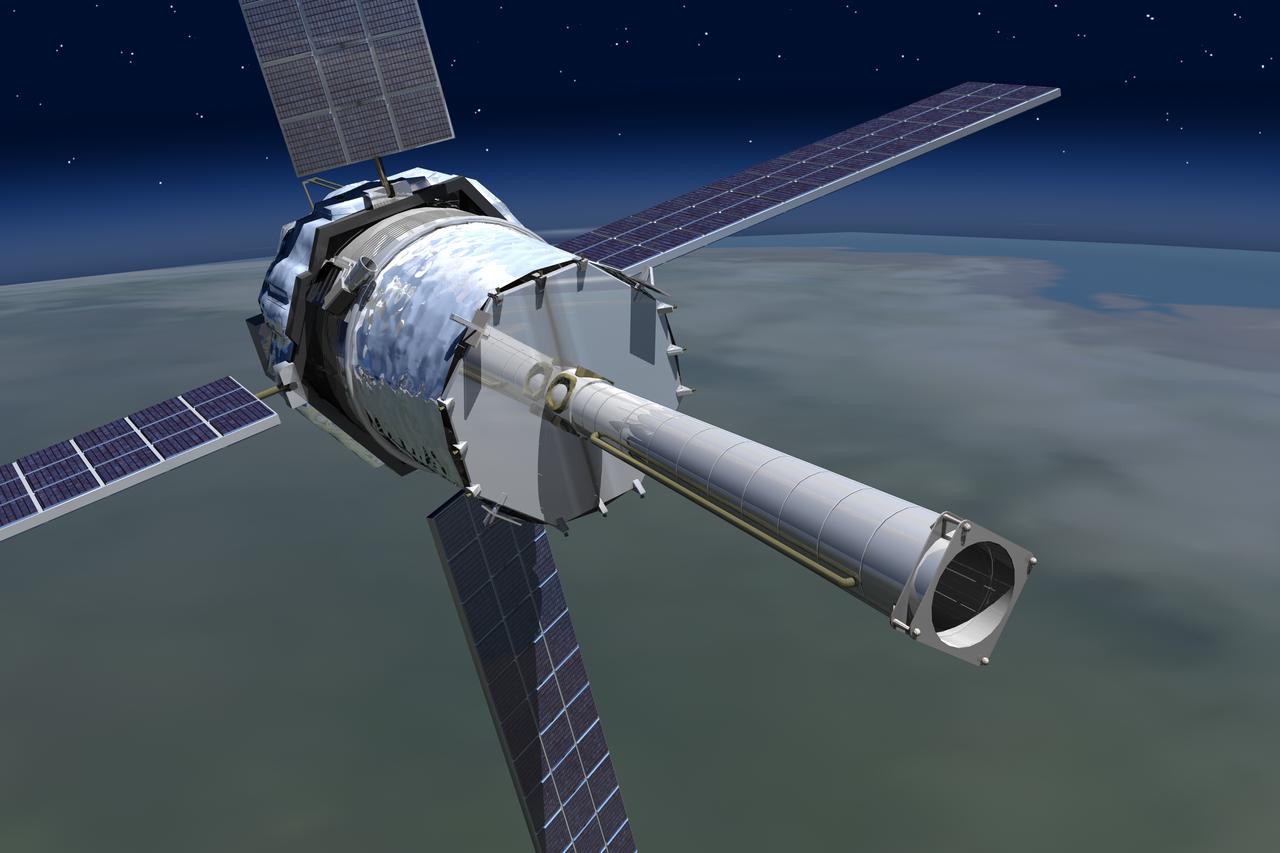
Space Time Theories Confirmed
Rex Geveden, President of Teledyne Brown Engineering, makes a point during a press conference, Wednesday, May 4, 2011, to discuss NASA's Gravity Probe B (GP-B) mission which has confirmed two key predictions derived from Albert Einstein's general theory of relativity, which the spacecraft was designed to test at NASA Headquarters in Washington. The experiment, launched in 2004, used four ultra-precise gyroscopes to measure the hypothesized geodetic effect, the warping of space and time around a gravitational body, and frame-dragging, the amount a spinning object pulls space and time with it as it rotates. Photo Credit: (NASA/Paul E. Alers)
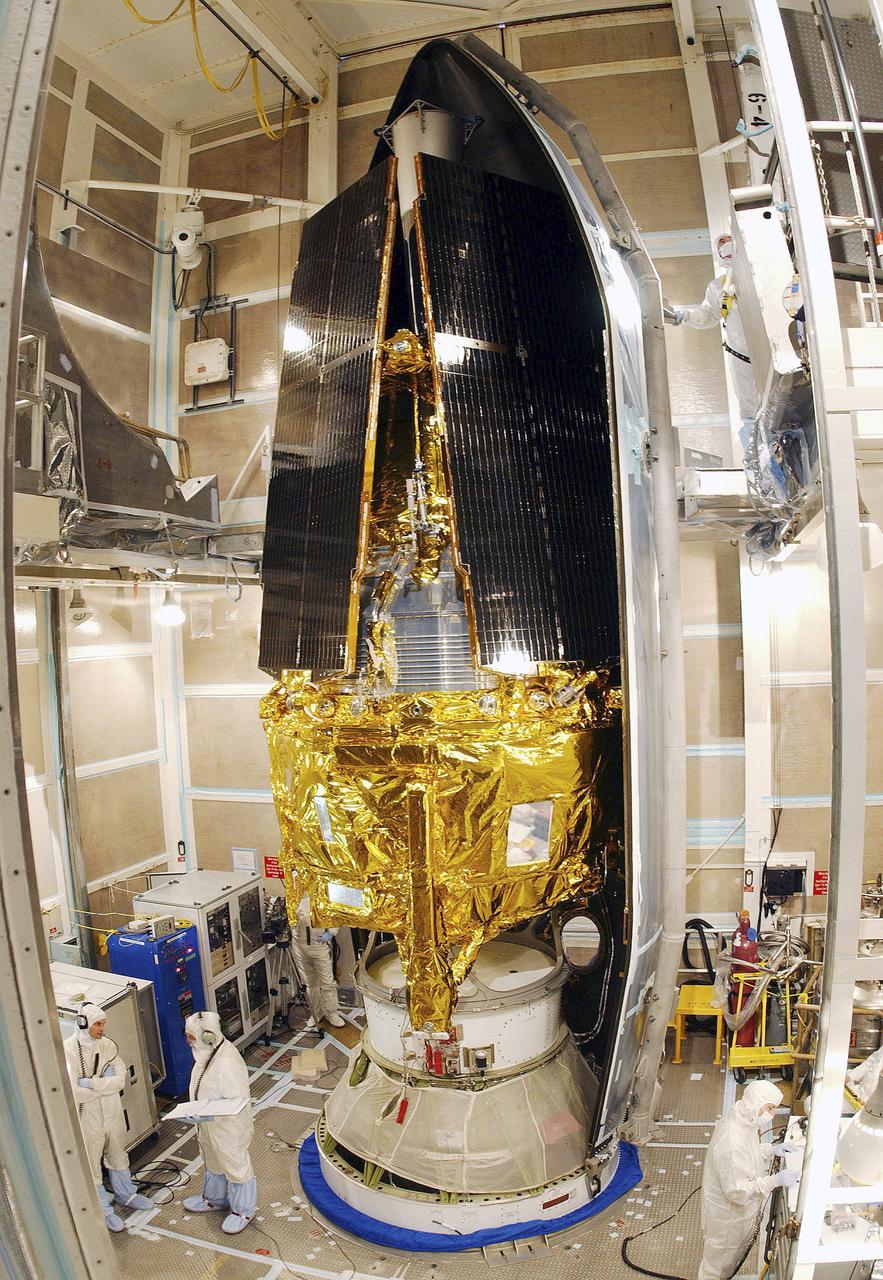
Space Time Theories Confirmed
Clifford Will, Professor of Physics at Washington University in St. Louis, foreground, answers questions during a press conference, Wednesday, May 4, 2011, to discuss NASA's Gravity Probe B (GP-B) mission which has confirmed two key predictions derived from Albert Einstein's general theory of relativity, which the spacecraft was designed to test at NASA Headquarters in Washington. The experiment, launched in 2004, used four ultra-precise gyroscopes to measure the hypothesized geodetic effect, the warping of space and time around a gravitational body, and frame-dragging, the amount a spinning object pulls space and time with it as it rotates. Photo Credit: (NASA/Paul E. Alers)
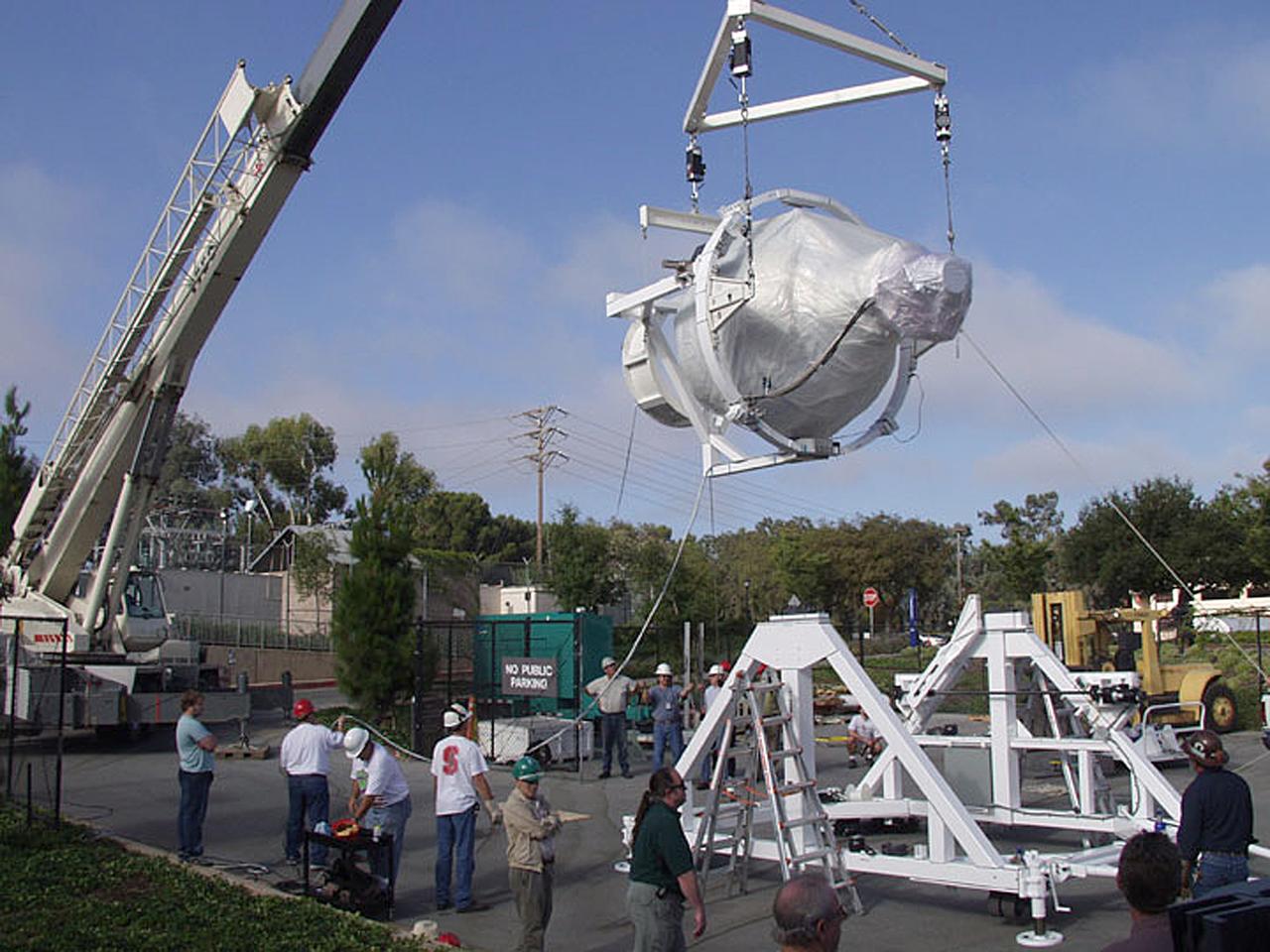
Space Time Theories Confirmed
Colleen Hartman, Senior Advisor at NASA Headquarters and Research Professor at George Washington University, makes a point during a press conference, Wednesday, May 4, 2011, to discuss NASA's Gravity Probe B (GP-B) mission which has confirmed two key predictions derived from Albert Einstein's general theory of relativity, which the spacecraft was designed to test at NASA Headquarters in Washington. The experiment, launched in 2004, used four ultra-precise gyroscopes to measure the hypothesized geodetic effect, the warping of space and time around a gravitational body, and frame-dragging, the amount a spinning object pulls space and time with it as it rotates. Photo Credit: (NASA/Paul E. Alers)
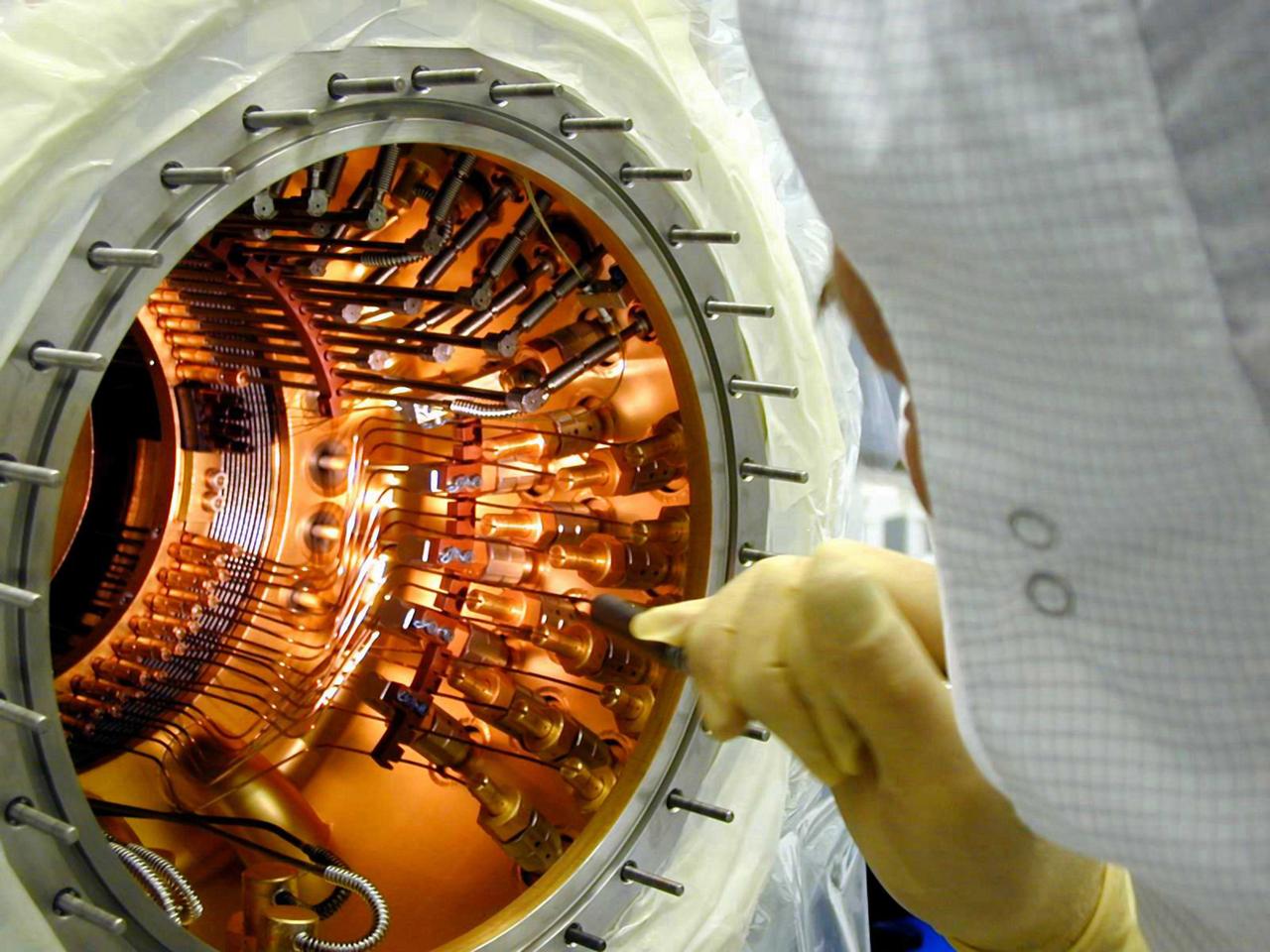
Space Time Theories Confirmed
Rex Geveden, President of Teledyne Brown Engineering, makes a point during a press conference, Wednesday, May 4, 2011, to discuss NASA's Gravity Probe B (GP-B) mission which has confirmed two key predictions derived from Albert Einstein's general theory of relativity, which the spacecraft was designed to test at NASA Headquarters in Washington. The experiment, launched in 2004, used four ultra-precise gyroscopes to measure the hypothesized geodetic effect, the warping of space and time around a gravitational body, and frame-dragging, the amount a spinning object pulls space and time with it as it rotates. Photo Credit: (NASA/Paul E. Alers)
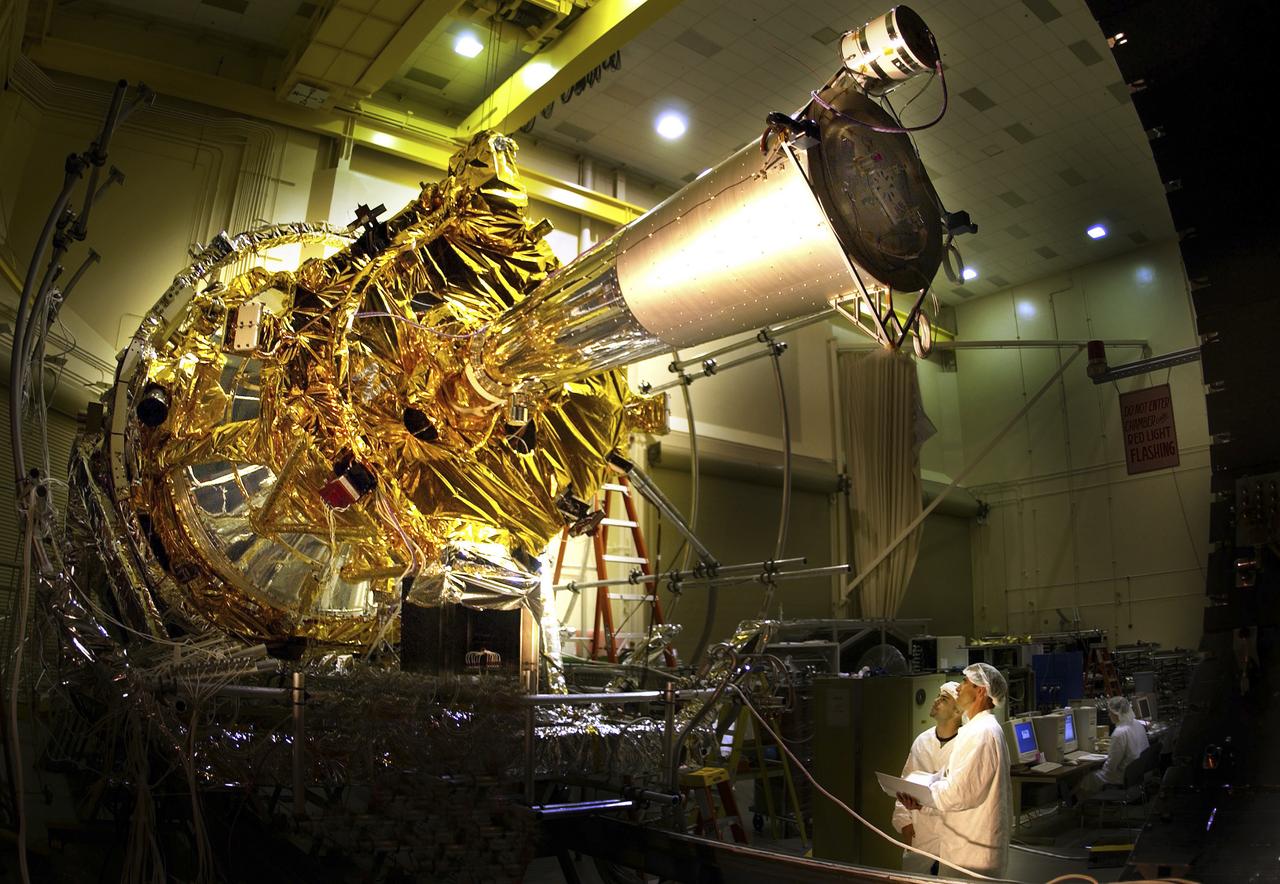
Space Time Theories Confirmed
The Gravity Probe B experiment enters the spacecraft processing facility on North Vandenberg Air Force Base. Gravity Probe B will launch a payload of four gyroscopes into low-Earth polar orbit to test two extraordinary predictions of Albert Einstein’s general theory of relativity: the geodetic effect (how space and time are warped by the presence of the Earth) and frame dragging (how Earth’s rotation drags space and time around with it). Once in orbit, for 18 months each gyroscope’s spin axis will be monitored as it travels through local spacetime, observing and measuring these effects. The experiment was developed by Stanford University, Lockheed Martin and NASA’s Marshall Space Flight Center.
Gravity Probe B
A transporter carrying the Gravity Probe B experiment backs into the spacecraft processing facility on North Vandenberg Air Force Base. Gravity Probe B will launch a payload of four gyroscopes into low-Earth polar orbit to test two extraordinary predictions of Albert Einstein’s general theory of relativity: the geodetic effect (how space and time are warped by the presence of the Earth) and frame dragging (how Earth’s rotation drags space and time around with it). Once in orbit, for 18 months each gyroscope’s spin axis will be monitored as it travels through local spacetime, observing and measuring these effects. The experiment was developed by Stanford University, Lockheed Martin and NASA’s Marshall Space Flight Center.
Gravity Probe B
At Vandenberg AFB, the canister enclosing the Gravity Probe B (GP-B) spacecraft is removed from the transporter. Gravity Probe B will launch a payload of four gyroscopes into low-Earth polar orbit to test two extraordinary predictions of Albert Einstein’s general theory of relativity: the geodetic effect (how space and time are warped by the presence of the Earth) and frame dragging (how Earth’s rotation drags space and time around with it). Once in orbit, for 18 months each gyroscope’s spin axis will be monitored as it travels through local spacetime, observing and measuring these effects. The experiment was developed by Stanford University, Lockheed Martin and NASA’s Marshall Space Flight Center.
Gravity Probe B
The Gravity Probe B experiment is lowered onto an assembly and test stand in the spacecraft processing facility on North Vandenberg Air Force Base. Gravity Probe B will launch a payload of four gyroscopes into low-Earth polar orbit to test two extraordinary predictions of Albert Einstein’s general theory of relativity: the geodetic effect (how space and time are warped by the presence of the Earth) and frame dragging (how Earth’s rotation drags space and time around with it). Once in orbit, for 18 months each gyroscope’s spin axis will be monitored as it travels through local spacetime, observing and measuring these effects. The experiment was developed by Stanford University, Lockheed Martin and NASA’s Marshall Space Flight Center.
Gravity Probe B
In the spacecraft processing facility on North Vandenberg Air Force Base, workers conduct battery charge/discharge cycles as part of the battery conditioning process on Gravity Probe B. The Gravity Probe B will launch a payload of four gyroscopes into low-Earth polar orbit to test two extraordinary predictions of Albert Einstein’s general theory of relativity: the geodetic effect (how space and time are warped by the presence of the Earth) and frame dragging (how Earth’s rotation drags space and time around with it). Once in orbit, for 18 months each gyroscope’s spin axis will be monitored as it travels through local spacetime, observing and measuring these effects. The experiment was developed by Stanford University, Lockheed Martin and NASA’s Marshall Space Flight Center.
Gravity Probe B
In the spacecraft processing facility on North Vandenberg Air Force Base, workers conduct battery charge/discharge cycles as part of the battery conditioning process on Gravity Probe B. The Gravity Probe B will launch a payload of four gyroscopes into low-Earth polar orbit to test two extraordinary predictions of Albert Einstein’s general theory of relativity: the geodetic effect (how space and time are warped by the presence of the Earth) and frame dragging (how Earth’s rotation drags space and time around with it). Once in orbit, for 18 months each gyroscope’s spin axis will be monitored as it travels through local spacetime, observing and measuring these effects. The experiment was developed by Stanford University, Lockheed Martin and NASA’s Marshall Space Flight Center.
Gravity Probe B
Workers in the spacecraft processing facility on North Vandenberg Air Force Base get ready to begin processing the Gravity Probe B experiment, including setting up mechanical and electrical ground support equipment, making necessary connections and conditioning the spacecraft battery. The Gravity Probe B will launch a payload of four gyroscopes into low-Earth polar orbit to test two extraordinary predictions of Albert Einstein’s general theory of relativity: the geodetic effect (how space and time are warped by the presence of the Earth) and frame dragging (how Earth’s rotation drags space and time around with it). Once in orbit, for 18 months each gyroscope’s spin axis will be monitored as it travels through local spacetime, observing and measuring these effects. The experiment was developed by Stanford University, Lockheed Martin and NASA’s Marshall Space Flight Center.
Gravity Probe B
In the spacecraft processing facility on North Vandenberg Air Force Base, battery charge/discharge cycles are underway as part of the battery conditioning process on Gravity Probe B. The Gravity Probe B will launch a payload of four gyroscopes into low-Earth polar orbit to test two extraordinary predictions of Albert Einstein’s general theory of relativity: the geodetic effect (how space and time are warped by the presence of the Earth) and frame dragging (how Earth’s rotation drags space and time around with it). Once in orbit, for 18 months each gyroscope’s spin axis will be monitored as it travels through local spacetime, observing and measuring these effects. The experiment was developed by Stanford University, Lockheed Martin and NASA’s Marshall Space Flight Center.
Gravity Probe B
VANDENBERG AFB, CALIF. -   Enclosed in a canister, the Gravity Probe B (GP-B) spacecraft arrives at the spacecraft processing facility on North Vandenberg Air Force Base .  Gravity Probe B will launch a payload of four gyroscopes into low-Earth polar orbit to test two extraordinary predictions of Albert Einstein’s general theory of relativity: the geodetic effect (how space and time are warped by the presence of the Earth) and frame dragging (how Earth’s rotation drags space and time around with it). Once in orbit, for 18 months each gyroscope’s spin axis will be monitored as it travels through local spacetime, observing and measuring these effects.  The experiment was developed by Stanford University, Lockheed Martin and NASA’s Marshall Space Flight Center.
KSC-03pd2743
In the spacecraft processing facility on North Vandenberg Air Force Base, workers conduct battery charge/discharge cycles as part of the battery conditioning process on Gravity Probe B. The Gravity Probe B will launch a payload of four gyroscopes into low-Earth polar orbit to test two extraordinary predictions of Albert Einstein’s general theory of relativity: the geodetic effect (how space and time are warped by the presence of the Earth) and frame dragging (how Earth’s rotation drags space and time around with it). Once in orbit, for 18 months each gyroscope’s spin axis will be monitored as it travels through local spacetime, observing and measuring these effects. The experiment was developed by Stanford University, Lockheed Martin and NASA’s Marshall Space Flight Center.
Gravity Probe B
Workers in the spacecraft processing facility on North Vandenberg Air Force Base get ready to begin processing the Gravity Probe B experiment, including setting up mechanical and electrical ground support equipment, making necessary connections and conditioning the spacecraft battery. The Gravity Probe B will launch a payload of four gyroscopes into low-Earth polar orbit to test two extraordinary predictions of Albert Einstein’s general theory of relativity: the geodetic effect (how space and time are warped by the presence of the Earth) and frame dragging (how Earth’s rotation drags space and time around with it). Once in orbit, for 18 months each gyroscope’s spin axis will be monitored as it travels through local spacetime, observing and measuring these effects. The experiment was developed by Stanford University, Lockheed Martin and NASA’s Marshall Space Flight Center.
Gravity Probe B
In the spacecraft processing facility on North Vandenberg Air Force Base, workers conduct battery charge/discharge cycles as part of the battery conditioning process on Gravity Probe B. The Gravity Probe B will launch a payload of four gyroscopes into low-Earth polar orbit to test two extraordinary predictions of Albert Einstein’s general theory of relativity: the geodetic effect (how space and time are warped by the presence of the Earth) and frame dragging (how Earth’s rotation drags space and time around with it). Once in orbit, for 18 months each gyroscope’s spin axis will be monitored as it travels through local spacetime, observing and measuring these effects. The experiment was developed by Stanford University, Lockheed Martin and NASA’s Marshall Space Flight Center.
Gravity Probe B
Workers in the spacecraft processing facility on North Vandenberg Air Force Base get ready to begin processing the Gravity Probe B experiment, including setting up mechanical and electrical ground support equipment, making necessary connections and conditioning the spacecraft battery. The Gravity Probe B will launch a payload of four gyroscopes into low-Earth polar orbit to test two extraordinary predictions of Albert Einstein’s general theory of relativity: the geodetic effect (how space and time are warped by the presence of the Earth) and frame dragging (how Earth’s rotation drags space and time around with it). Once in orbit, for 18 months each gyroscope’s spin axis will be monitored as it travels through local spacetime, observing and measuring these effects. The experiment was developed by Stanford University, Lockheed Martin and NASA’s Marshall Space Flight Center.
Gravity Probe B
In the spacecraft processing facility on North Vandenberg Air Force Base, workers prepare to remove the soft shipping cover from the Gravity Probe B experiment.  Immediate processing includes setting up mechanical and electrical ground support equipment, making necessary connections and conditioning the spacecraft battery.   The Gravity Probe B will launch a payload of four gyroscopes into low-Earth polar orbit to test two extraordinary predictions of Albert Einstein’s general theory of relativity: the geodetic effect (how space and time are warped by the presence of the Earth) and frame dragging (how Earth’s rotation drags space and time around with it). Once in orbit, for 18 months each gyroscope’s spin axis will be monitored as it travels through local spacetime, observing and measuring these effects.  The experiment was developed by Stanford University, Lockheed Martin and NASA’s Marshall Space Flight Center.
Gravity Probe B
In the spacecraft processing facility on North Vandenberg Air Force Base, workers prepare to remove the soft shipping cover from the Gravity Probe B experiment.  Immediate processing includes setting up mechanical and electrical ground support equipment, making necessary connections and conditioning the spacecraft battery.   The Gravity Probe B will launch a payload of four gyroscopes into low-Earth polar orbit to test two extraordinary predictions of Albert Einstein’s general theory of relativity: the geodetic effect (how space and time are warped by the presence of the Earth) and frame dragging (how Earth’s rotation drags space and time around with it). Once in orbit, for 18 months each gyroscope’s spin axis will be monitored as it travels through local spacetime, observing and measuring these effects.  The experiment was developed by Stanford University, Lockheed Martin and NASA’s Marshall Space Flight Center.
Gravity Probe B
This artist's concept shows ESA's LISA Pathfinder spacecraft, which launched on Dec. 3, 2015, from Kourou, French Guiana, will help pave the way for a mission to detect gravitational waves.  LISA Pathfinder, led by the European Space Agency (ESA), is designed to test technologies that could one day detect gravitational waves. Gravitational waves, predicted by Einstein's theory of general relativity, are ripples in spacetime produced by any accelerating body. But the waves are so weak that Earth- or space-based observatories would likely only be able to directly detect such signals coming from massive astronomical systems, such as binary black holes or exploding stars. Detecting gravitational waves would be an important piece in the puzzle of how our universe began.  http://photojournal.jpl.nasa.gov/catalog/PIA20196
LISA Pathfinder Spacecraft Artist Concept
Workers in the spacecraft processing facility on North Vandenberg Air Force Base get ready to begin processing the Gravity Probe B experiment. Mechanical and electrical ground support equipment will be set up and necessary connections made with the spacecraft. Spacecraft battery conditioning will also begin. The Gravity Probe B will launch a payload of four gyroscopes into low-Earth polar orbit to test two extraordinary predictions of Albert Einstein’s general theory of relativity: the geodetic effect (how space and time are warped by the presence of the Earth) and frame dragging (how Earth’s rotation drags space and time around with it). Once in orbit, for 18 months each gyroscope’s spin axis will be monitored as it travels through local spacetime, observing and measuring these effects. The experiment was developed by Stanford University, Lockheed Martin and NASA’s Marshall Space Flight Center.
Gravity Probe B
In the spacecraft processing facility on North Vandenberg Air Force Base, workers prepare to remove the soft shipping cover from the Gravity Probe B experiment. Immediate processing includes setting up mechanical and electrical ground support equipment, making necessary connections and conditioning the spacecraft battery. The Gravity Probe B will launch a payload of four gyroscopes into low-Earth polar orbit to test two extraordinary predictions of Albert Einstein’s general theory of relativity: the geodetic effect (how space and time are warped by the presence of the Earth) and frame dragging (how Earth’s rotation drags space and time around with it). Once in orbit, for 18 months each gyroscope’s spin axis will be monitored as it travels through local spacetime, observing and measuring these effects. The experiment was developed by Stanford University, Lockheed Martin and NASA’s Marshall Space Flight Center.
Gravity Probe B
In the center of this image, taken with the NASA/ESA Hubble Space Telescope, is the galaxy cluster SDSS J1038+4849 — and it seems to be smiling.  You can make out its two orange eyes and white button nose. In the case of this “happy face”, the two eyes are very bright galaxies and the misleading smile lines are actually arcs caused by an effect known as strong gravitational lensing.  Galaxy clusters are the most massive structures in the Universe and exert such a powerful gravitational pull that they warp the spacetime around them and act as cosmic lenses which can magnify, distort and bend the light behind them. This phenomenon, crucial to many of Hubble’s discoveries, can be explained by Einstein’s theory of general relativity.  In this special case of gravitational lensing, a ring — known as an Einstein Ring — is produced from this bending of light, a consequence of the exact and symmetrical alignment of the source, lens and observer and resulting in the ring-like structure we see here.  Hubble has provided astronomers with the tools to probe these massive galaxies and model their lensing effects, allowing us to peer further into the early Universe than ever before. This object was studied by Hubble’s Wide Field and Planetary Camera 2 (WFPC2) and Wide Field Camera 3 (WFC3) as part of a survey of strong lenses.  A version of this image was entered into the Hubble’s Hidden Treasures image processing competition by contestant Judy Schmidt.  Image Credit: NASA/ESA
Hubble Sees A Smiling Lens
Gravity Probe B (GP-B) is the relativity experiment developed at Stanford University to test two extraordinary predictions of Albert Einstein’s general theory of relativity. This photograph is of the Gravity Probe B flight dewar, a metal container made like a vacuum bottle that is used especially for storing liquefied gases, that will maintain the experiment at a temperature just above absolute zero, staying cold for two years. The experiment will measure, very precisely, the expected tiny changes in the direction of the spin axes of four gyroscopes contained in an Earth-orbiting satellite at 400-mile altitude. So free are the gyroscopes from disturbance that they will provide an almost perfect space-time reference system. They will measure how space and time are very slightly warped by the presence of the Earth, and, more profoundly, how the Earth’s rotation very slightly drags space-time around with it. These effects, though small for the Earth, have far-reaching implications for the nature of matter and the structure of the Universe. GP-B is among the most thoroughly researched programs ever undertaken by NASA. This is the story of a scientific quest in which physicists and engineers have collaborated closely over many years. Inspired by their quest, they have invented a whole range of technologies -- technologies that are already enlivening other branches of science and engineering. Launched in 2004 and managed for NASA by the Marshall Space Flight Center, development of the GP-B is the responsibility of Stanford University, with major subcontractor Lockheed Martin Corporation. (Photo Credit: Lockheed Martin Corporation/R. Underwood)
Space Science