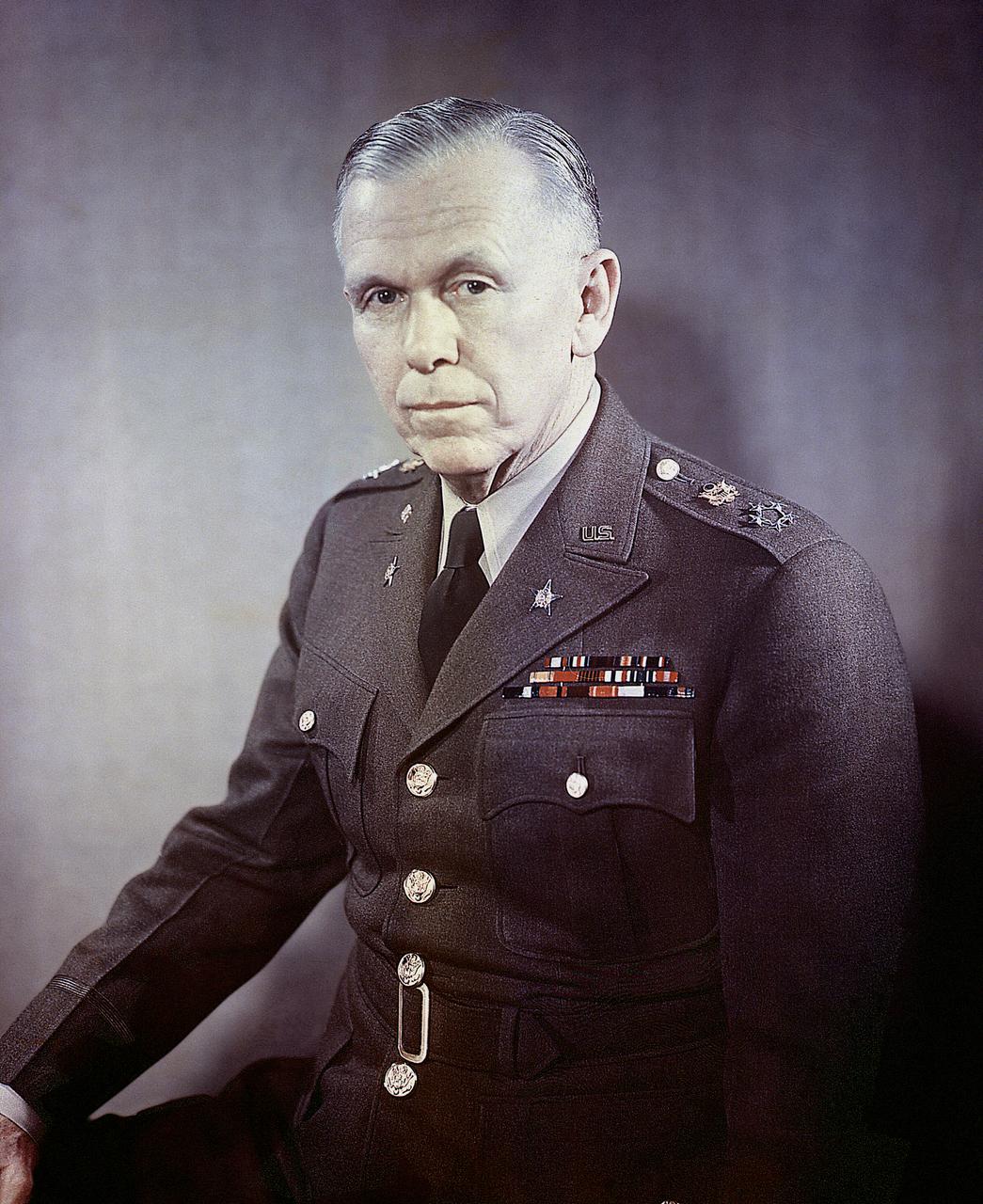
This is a portrait of General George C. Marshall in Army uniform. The Marshall Space Flight Center, a NASA field installation, was established in Huntsville, Alabama, in 1960. The Center was named in honor of General George C. Marshall, the Army Chief of Staff during World War II, Secretary of State, and Nobel Prize Winner for his world-renowned Marshall Plan.
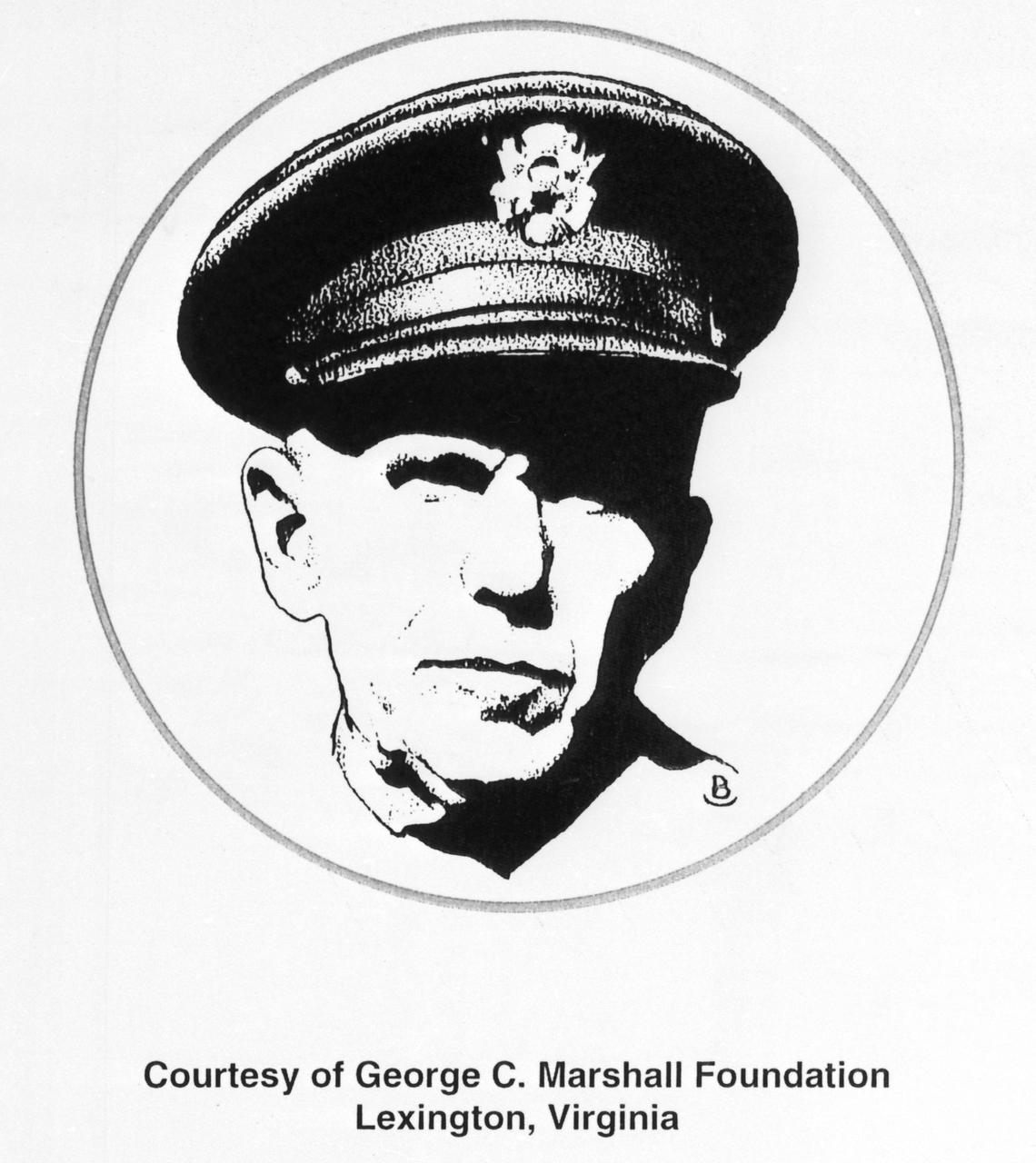
The Marshall Space Flight Center, a NASA field installation, was established at Huntsville, Alabama, in 1960. The Center was named in honor of General George C. Marshall, the Army Chief of Staff during World War II, Secretary of State, and Nobel Prize Wirner for his world-renowned Marshall Plan.
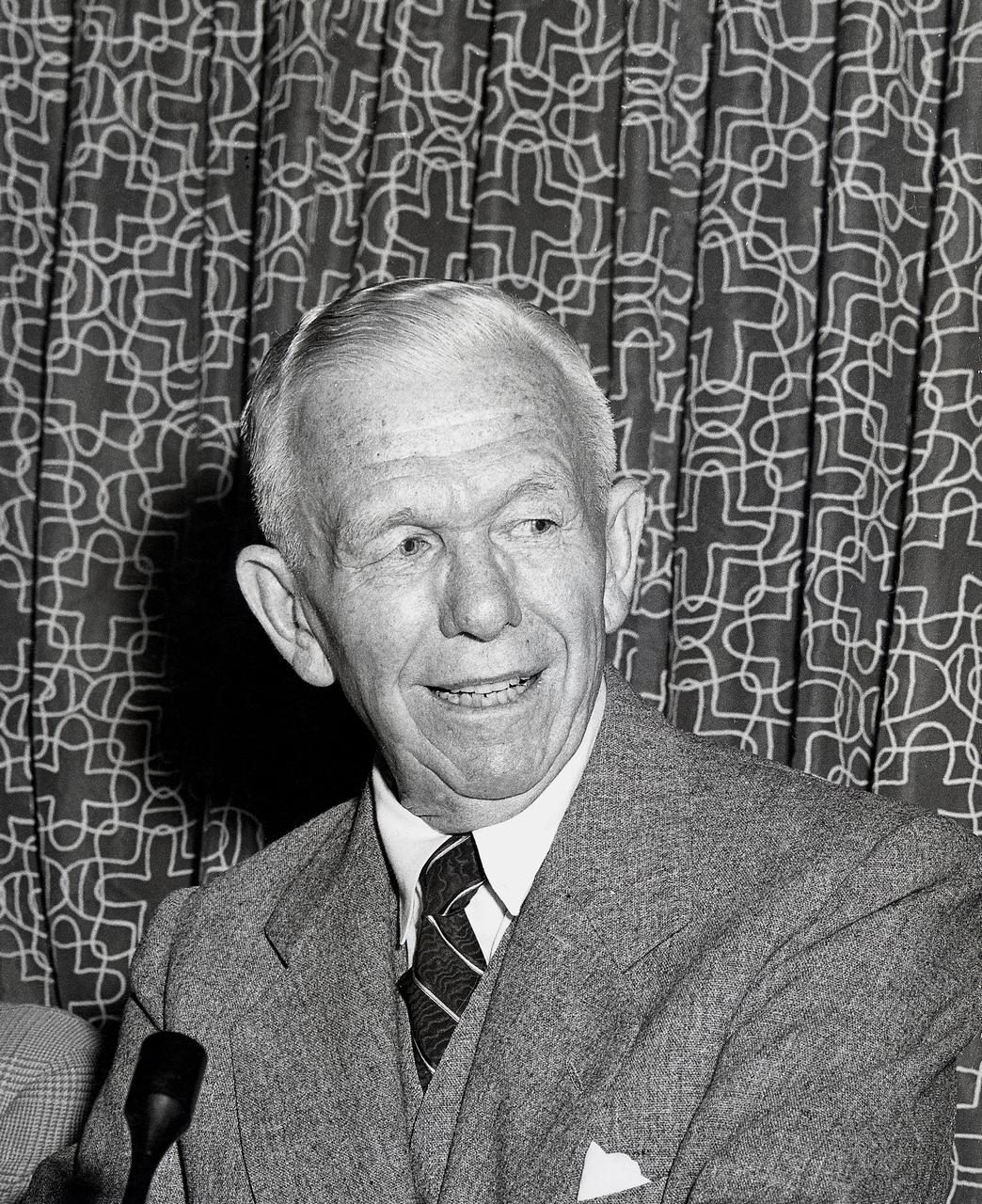
The Marshall Space Flight Center, a NASA field installation, was established at Huntsville, Alabama, in 1960. The Center was named in honor of General George C. Marshall, the Army Chief of Staff during World War II, Secretary of State, and Nobel Prize Wirner for his world-renowned Marshall Plan.
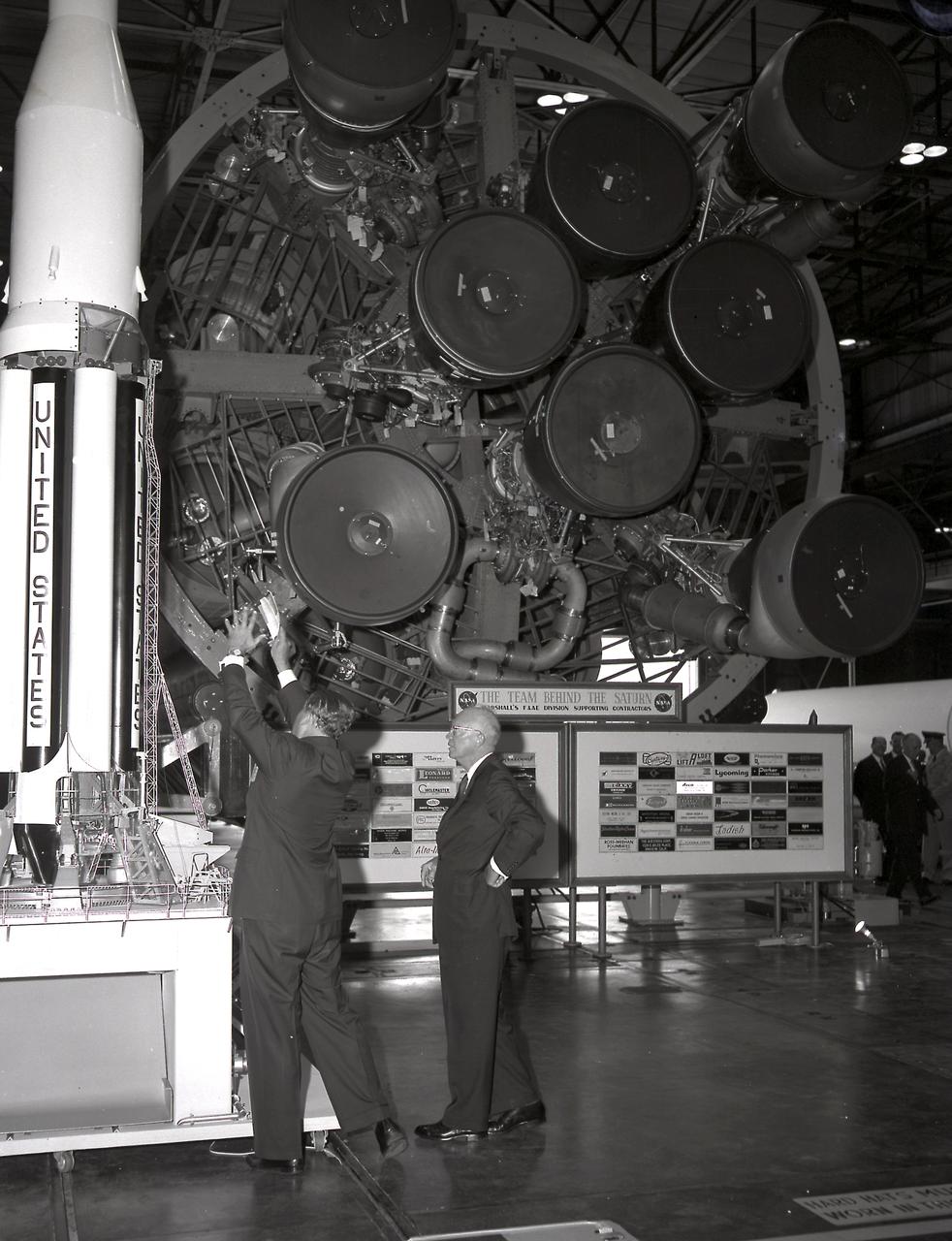
Dr. von Braun briefs President Eisenhower at the front of the S1 Stage (first Stage) of the Saturn 1 vehicle at the Marshall Space Flight Center (MSFC) on September 8, 1960. The President's visit was to dedicate Marshall Space Flight Center as a new NASA field center in honor of General George C. Marshall.
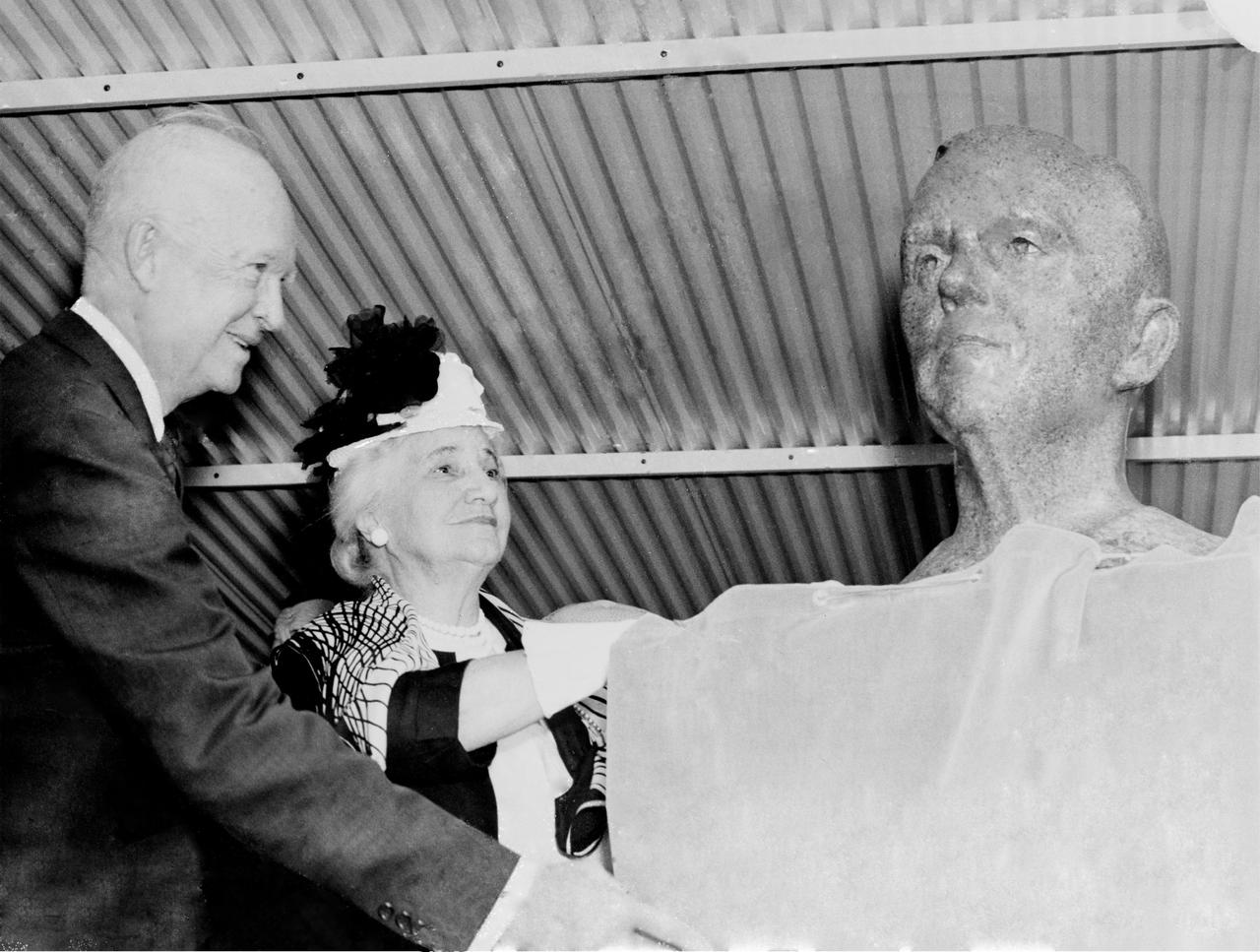
President Dwight D. Eisenhower and Mrs. George C. Marshall unveil the bronze bust of General George C. Marshall during the dedication of the Marshall Space Flight Center. Eisenhower signed an Executive Order on October 21, 1959 directing the transfer of persornel from the Redstone Arsenal's Army Ballistic Missile Agency Development Operations Division to NASA. On March 15, 1960, another Executive Order announced that the space complex formed within the boundaries of Redstone Arsenal would become the George C. Marshall Space Flight Center. The Center was activated on July 1, 1960, with dedication ceremonies taking place September 8, 1960.
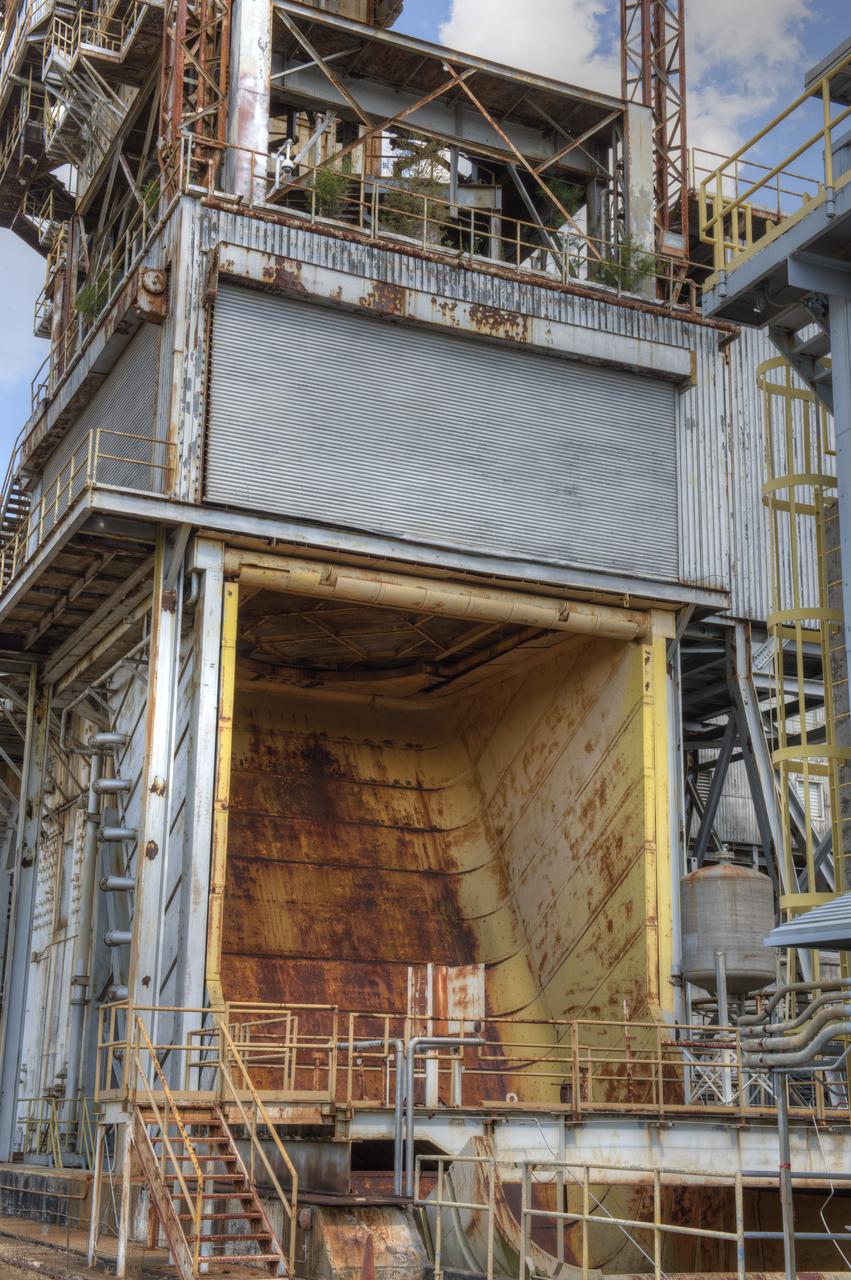
PROPULSION AND STRUCTURAL TEST FACILITY (BUILDING 4572) AT THE GEORGE C. MARSHALL SPACE FLIGHT CENTER IN HUNTSVILLE, ALABAMA
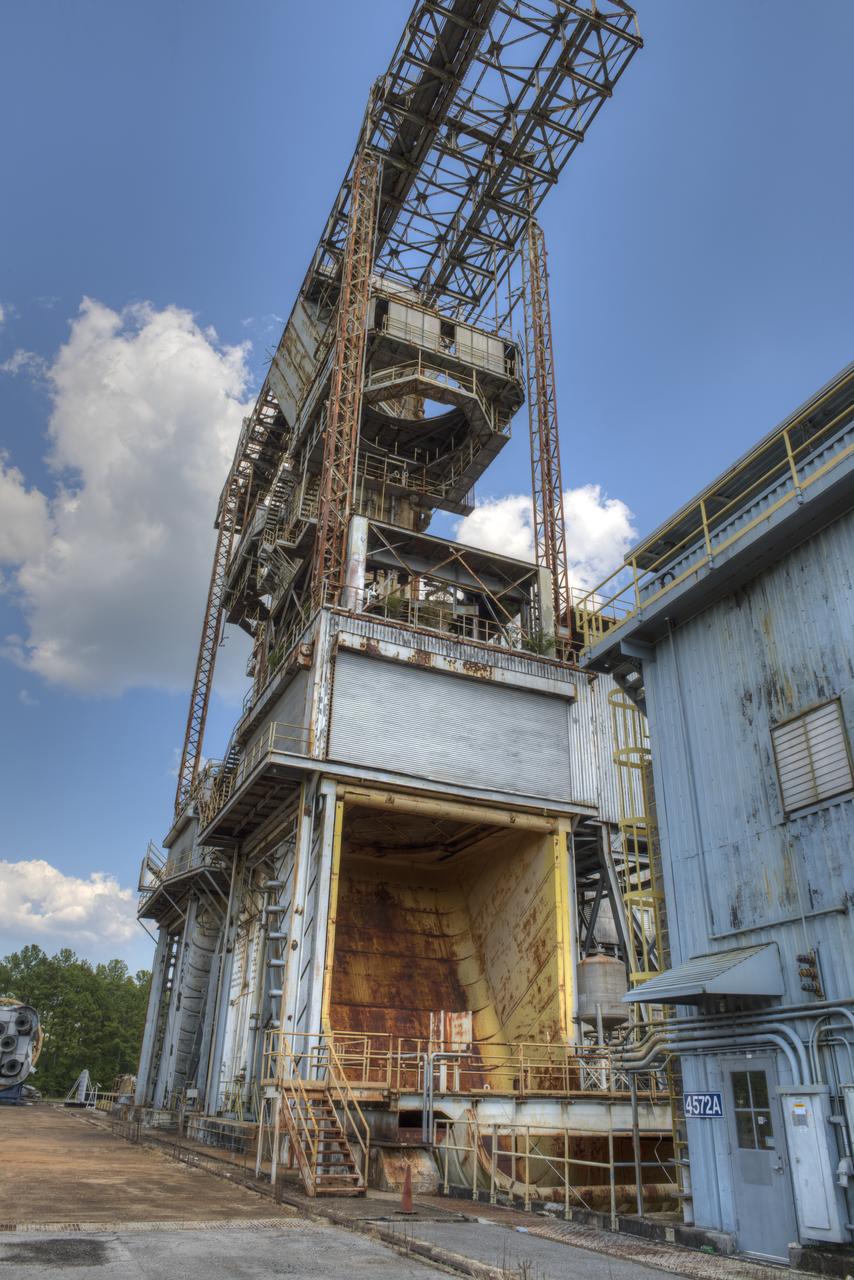
PROPULSION AND STRUCTURAL TEST FACILITY (BUILDING 4572) AT THE GEORGE C. MARSHALL SPACE FLIGHT CENTER IN HUNTSVILLE, ALABAMA
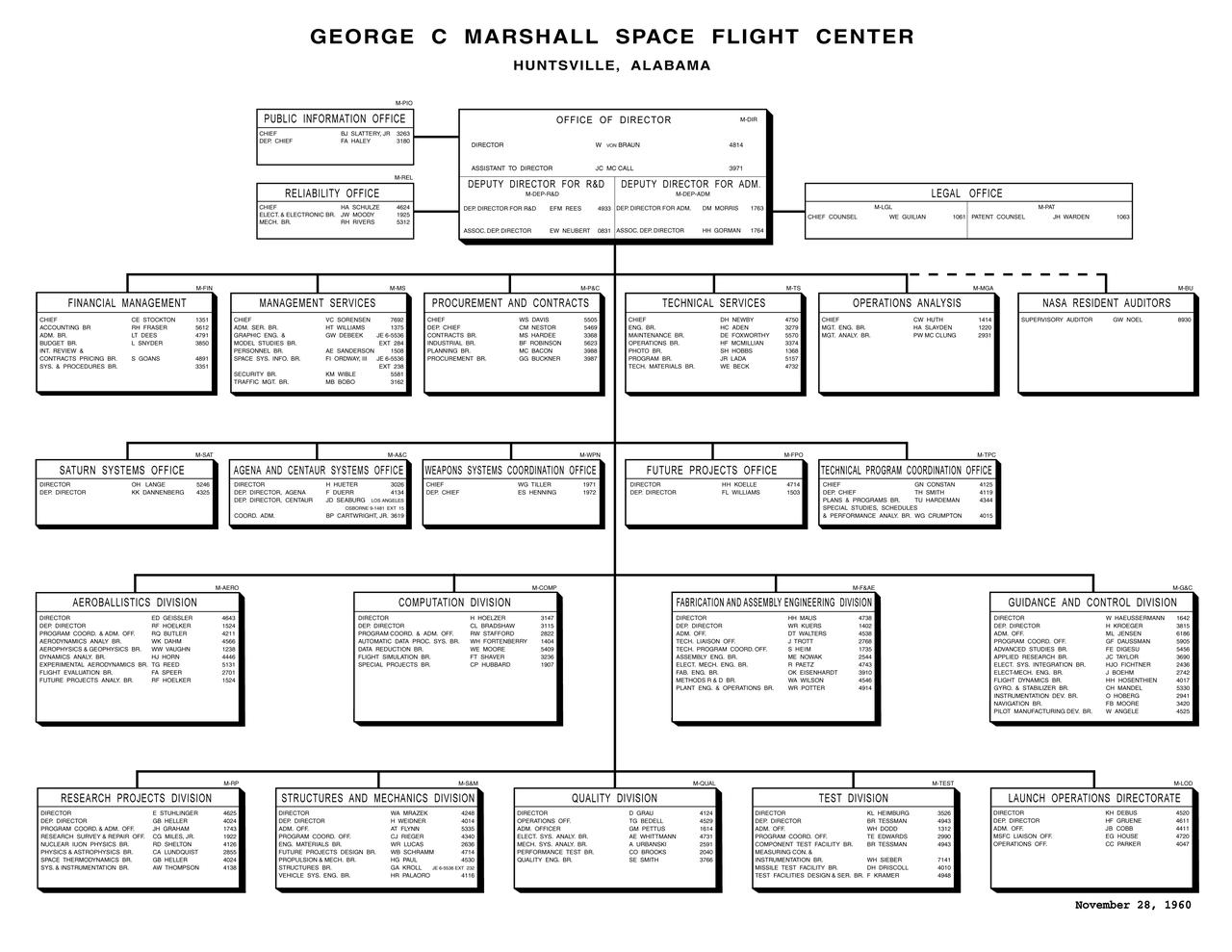
The first organizational chart for the George C. Marshall Space Flight Center (MSFC) with individual assignments, dated November 28, 1960.
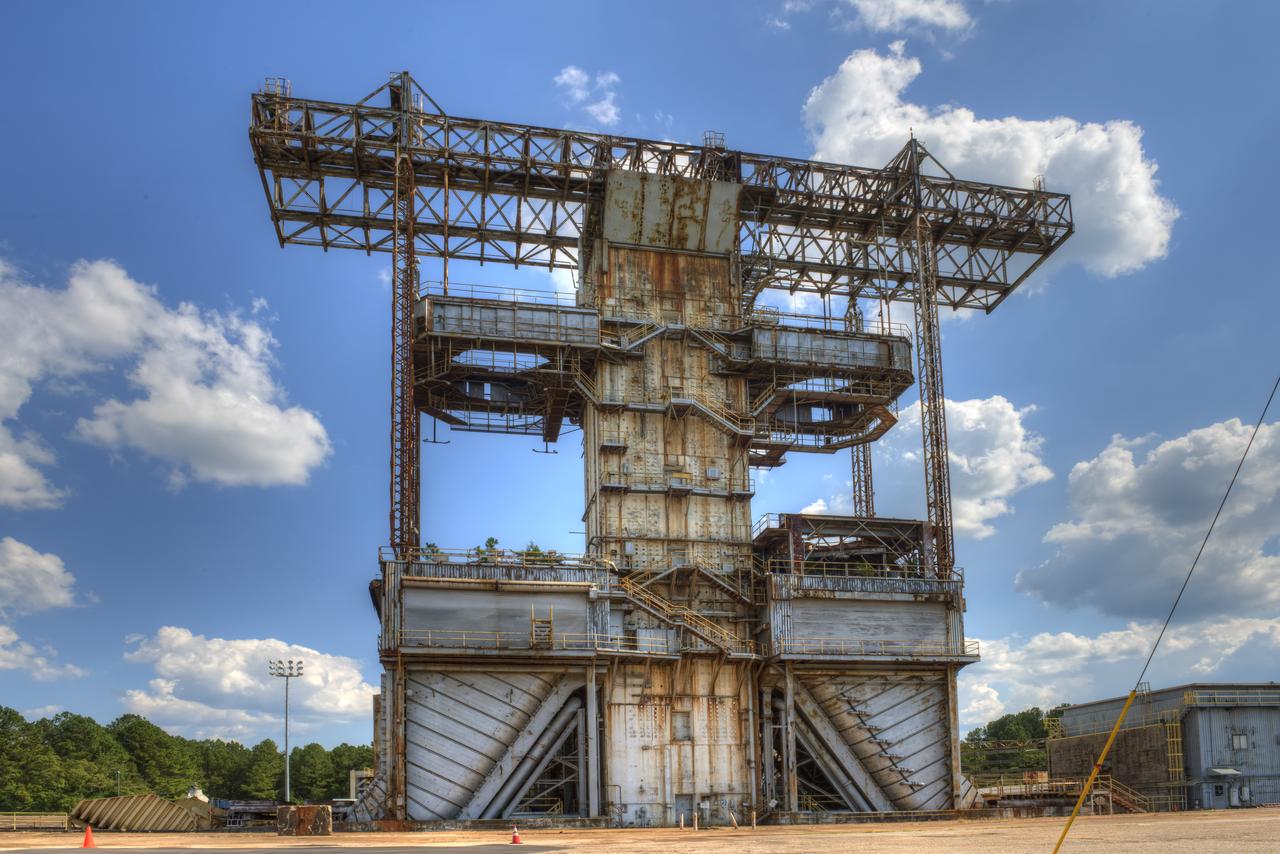
PROPULSION AND STRUCTURAL TEST FACILITY (BUILDING 4572) AT THE GEORGE C. MARSHALL SPACE FLIGHT CENTER IN HUNTSVILLE, ALABAMA
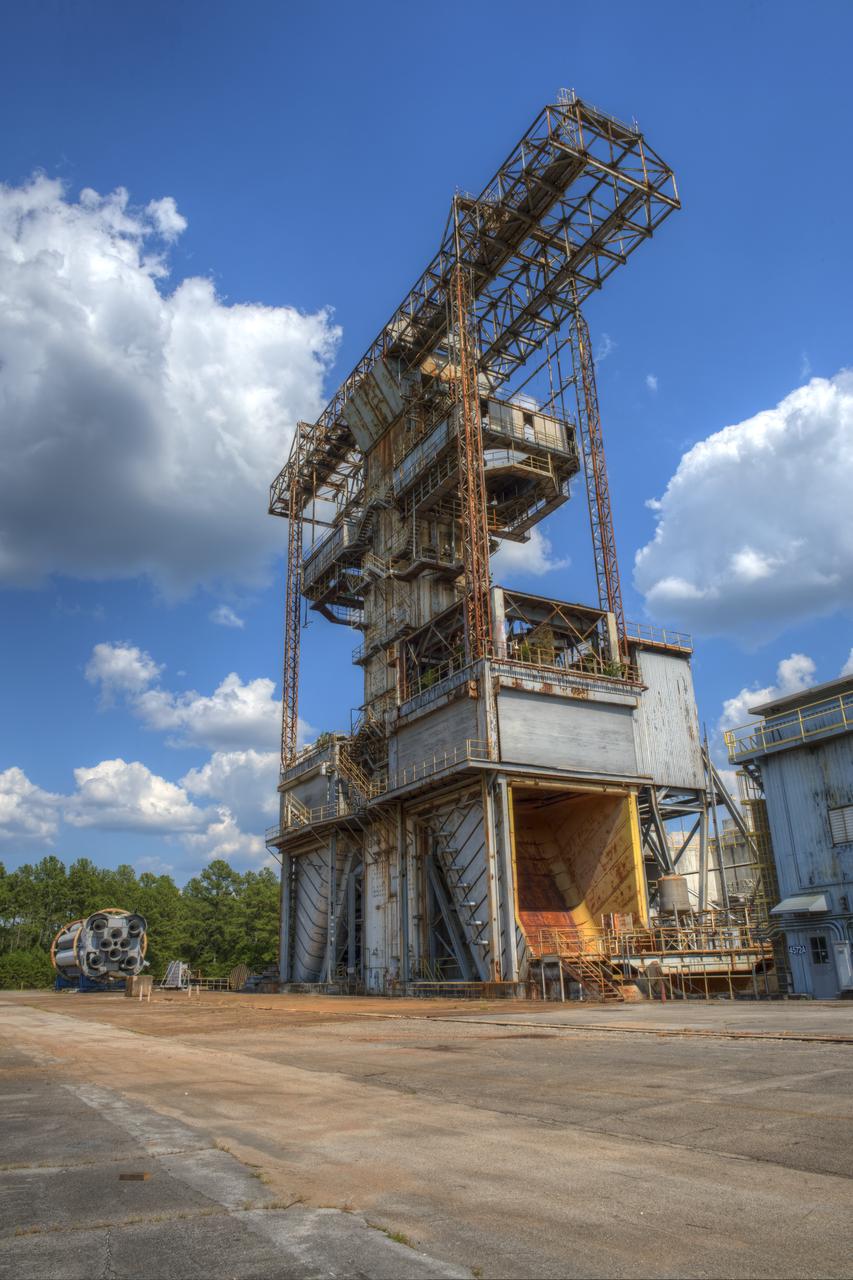
PROPULSION AND STRUCTURAL TEST FACILITY (BUILDING 4572) AT THE GEORGE C. MARSHALL SPACE FLIGHT CENTER IN HUNTSVILLE, ALABAMA
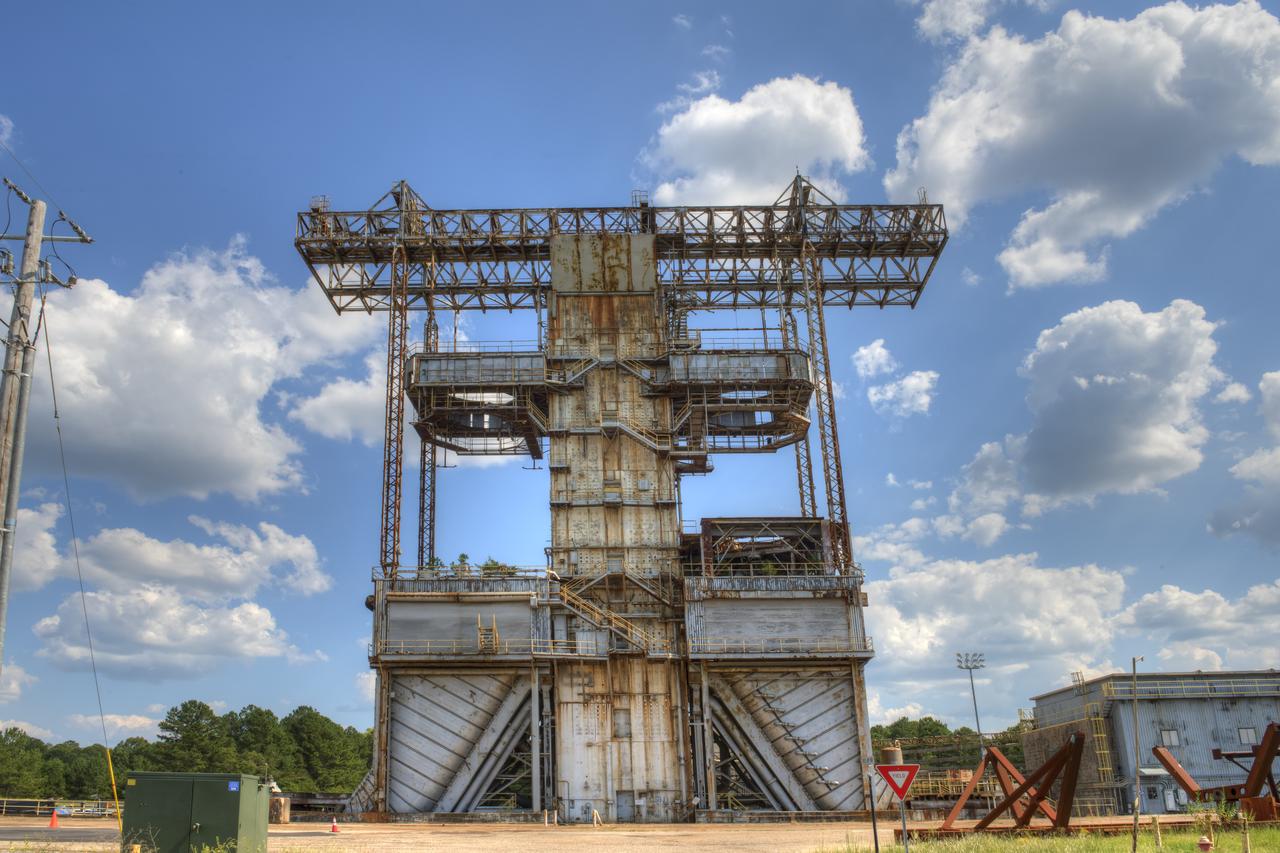
PROPULSION AND STRUCTURAL TEST FACILITY (BUILDING 4572) AT THE GEORGE C. MARSHALL SPACE FLIGHT CENTER IN HUNTSVILLE, ALABAMA
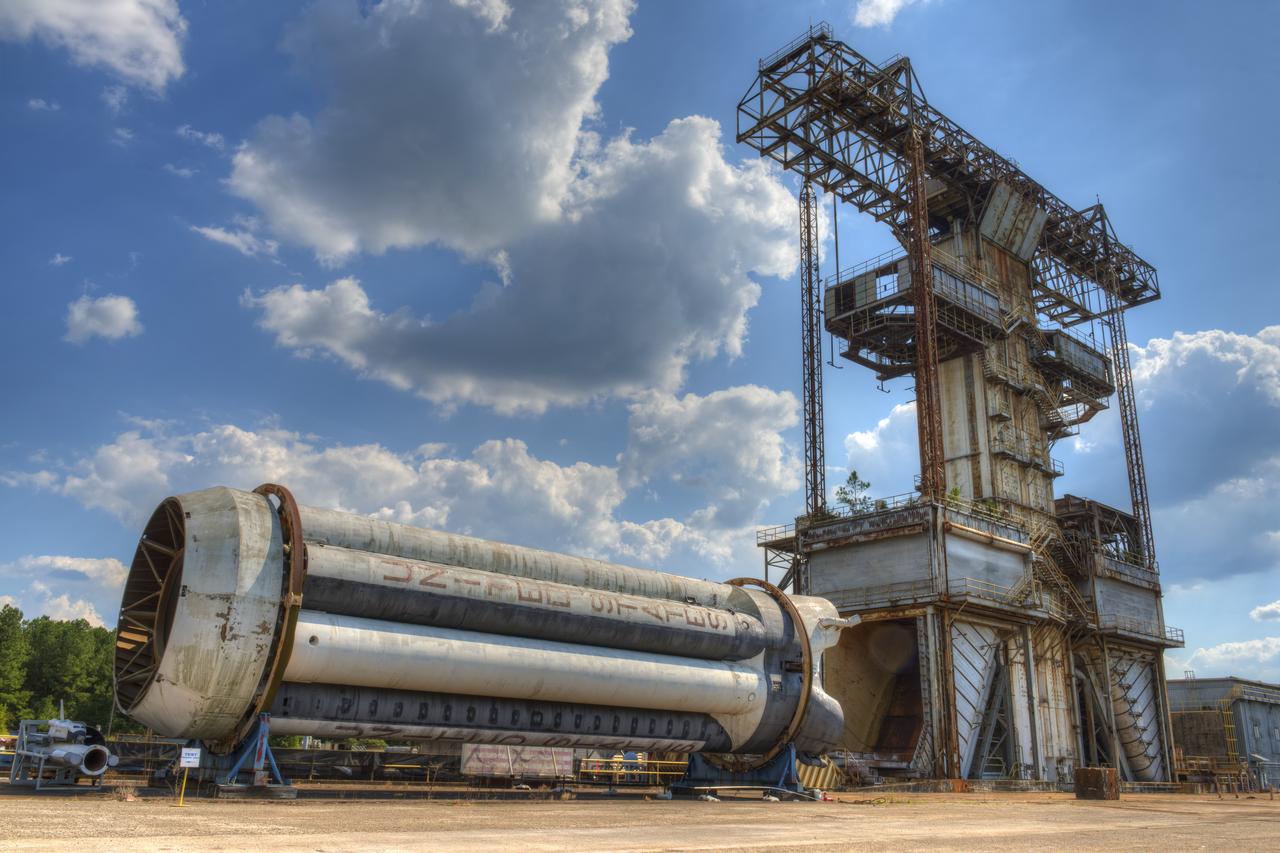
PROPULSION AND STRUCTURAL TEST FACILITY (BUILDING 4572) AT THE GEORGE C. MARSHALL SPACE FLIGHT CENTER IN HUNTSVILLE, ALABAMA WITH THE SATURN S-1B STAGE (SA-) IN FOREGROUND
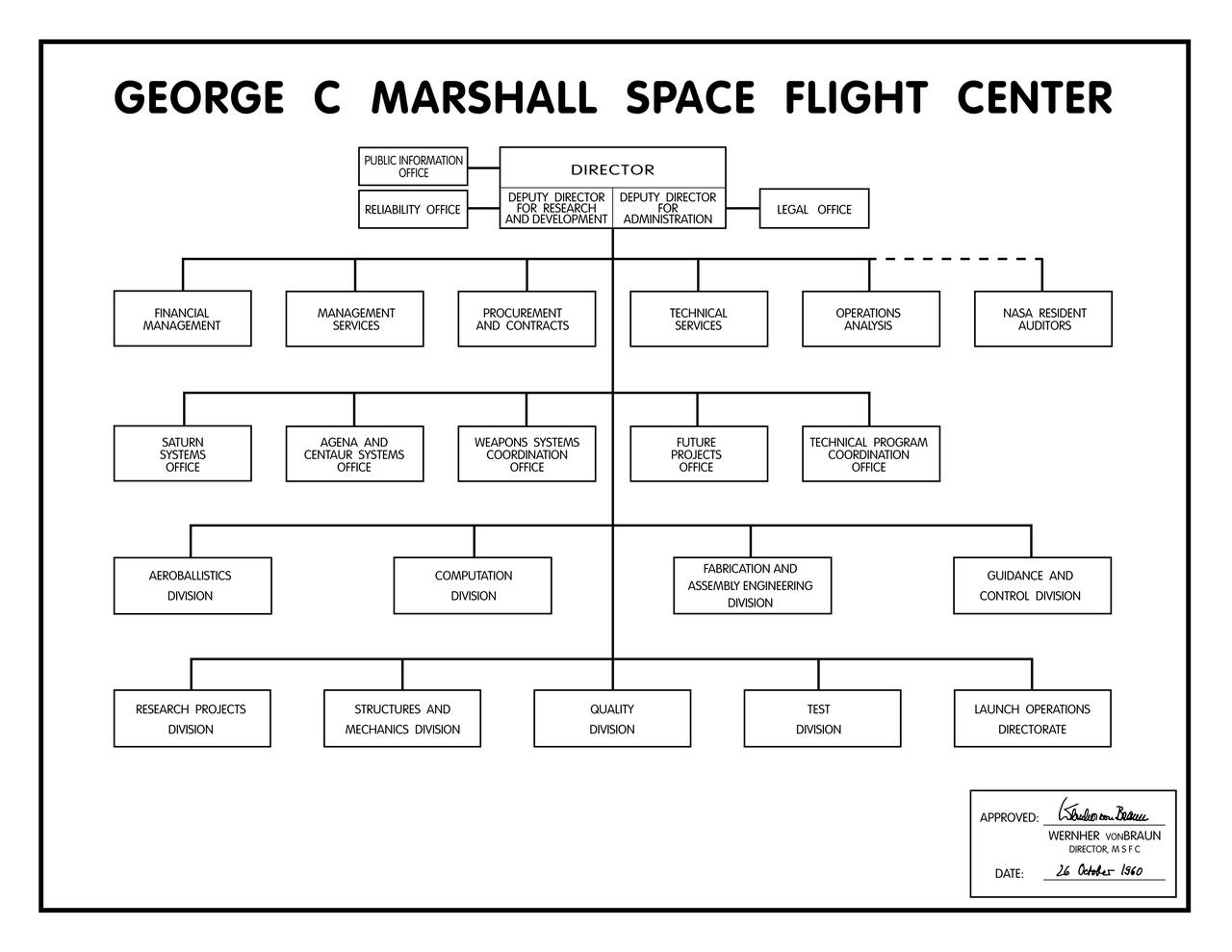
The first organizational chart of the George C. Marshall Space Flight Center (MSFC) which was approved and signed by Dr. Wernher von Braun, Director, MSFC, on 26 October 1960.
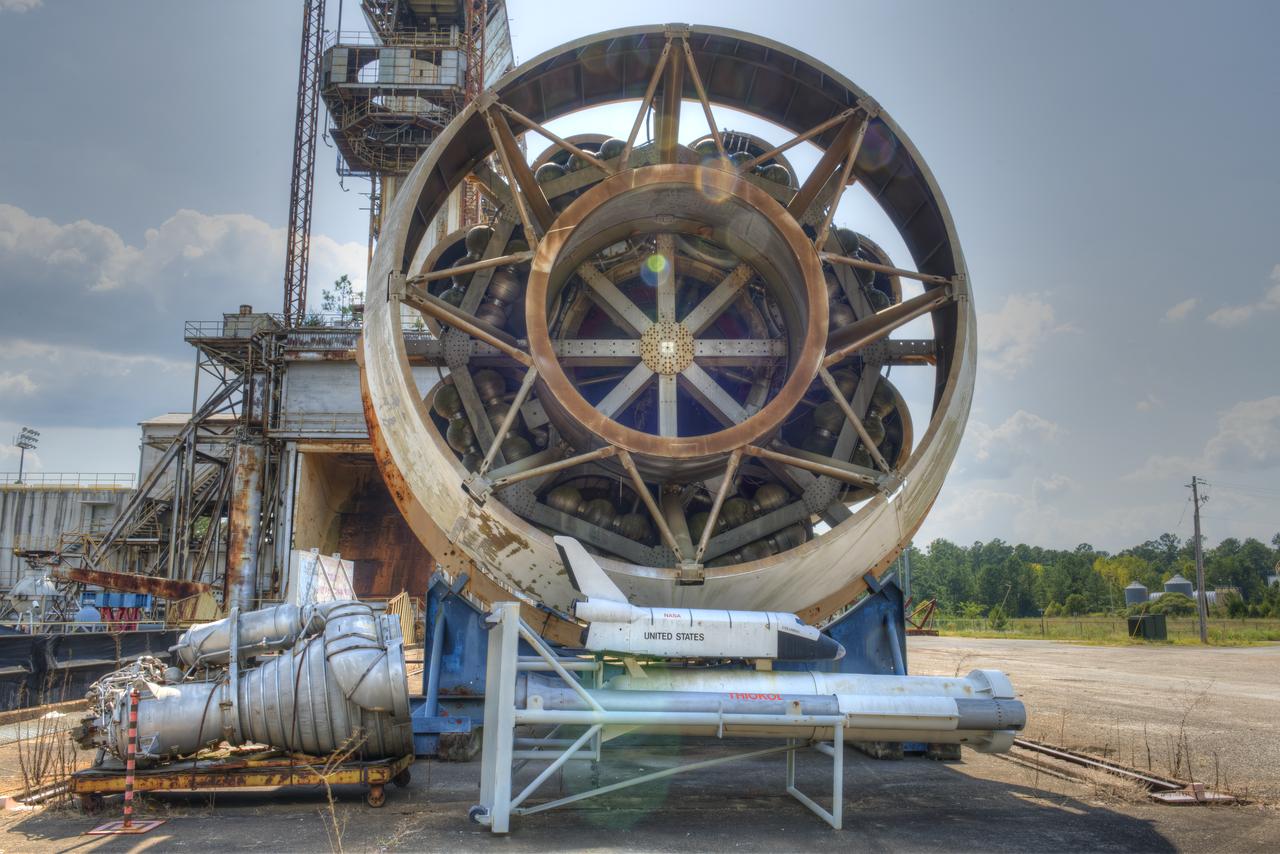
FORWARD END OF SATURN S-1B STAGE (SA-T) NEAR PROPULSION AND STRUCTURAL TEST FACILITY (BUILDING 4572) AT THE GEORGE C. MARSHALL SPACE FLIGHT CENTER IN HUNTSVILLE, ALABAMA
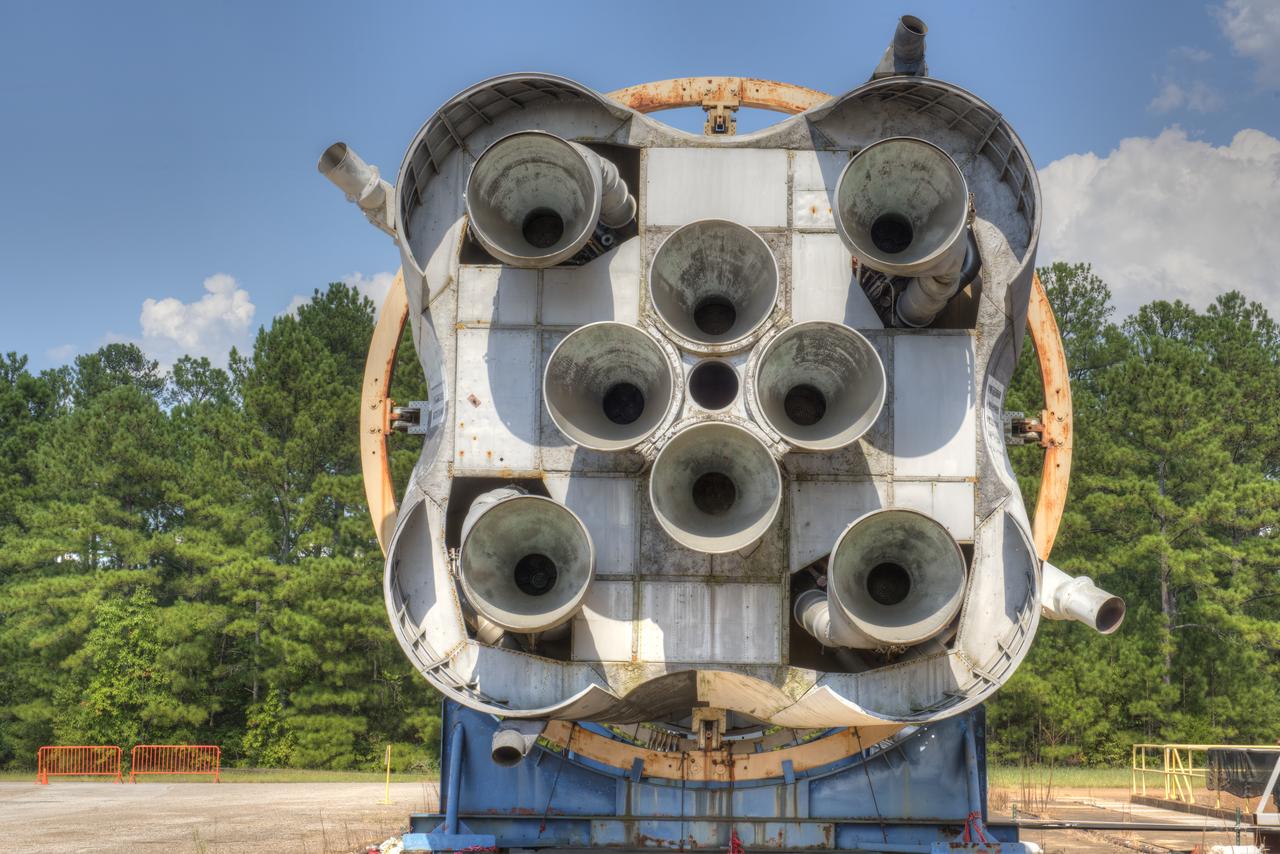
CLOSE-UP OF AFT END OF SATURN S-1B STAGE (SA-T) NEAR PROPULSION AND STRUCTURAL TEST FACILITY (BUILDING 4572) AT THE GEORGE C. MARSHALL SPACE FLIGHT CENTER IN HUNTSVILLE, ALABAMA.
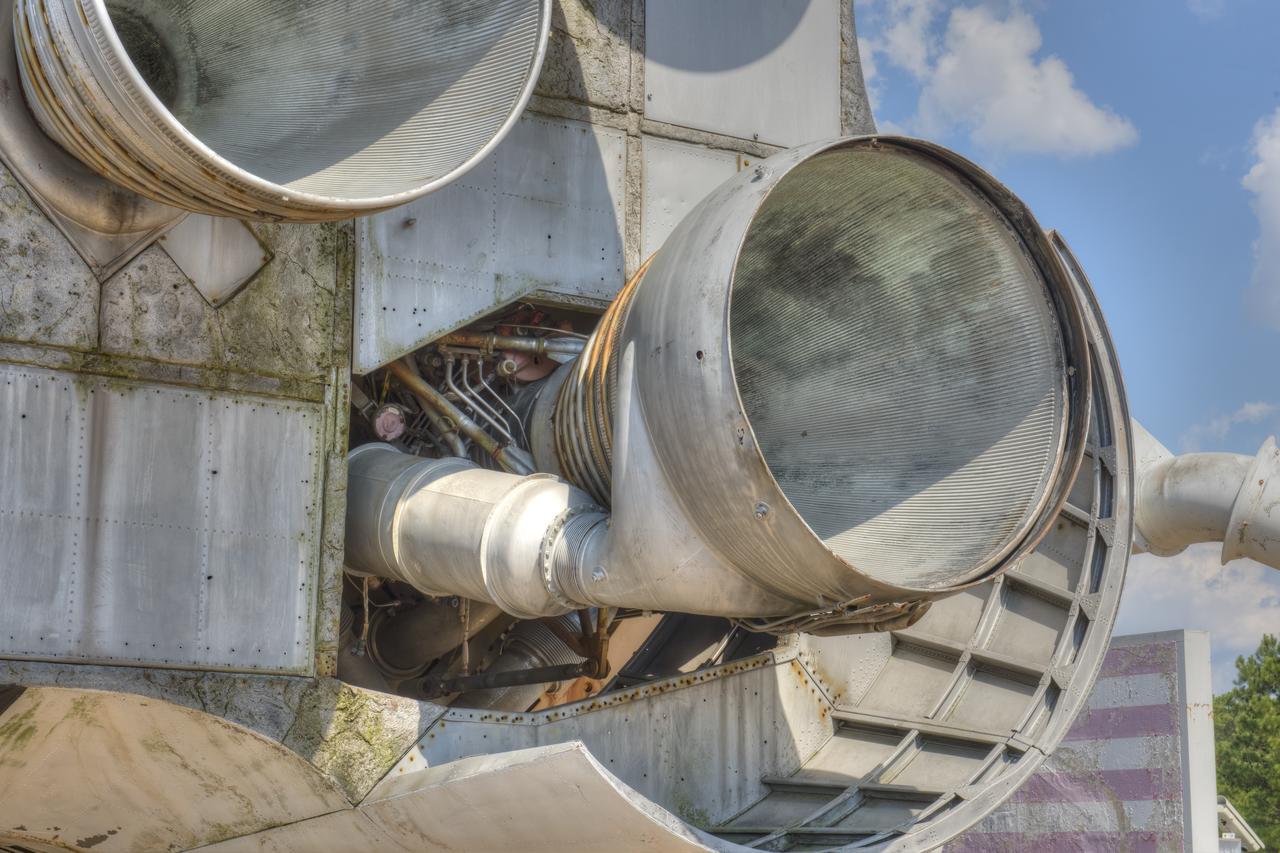
CLOSE-UP OF H-1 ENGINE INSTALLED ON SATURN S-1B STAGE (SA-T) NEAR PROPULSION AND STRUCTURAL TEST FACILITY (BUILDING 4572) AT THE GEORGE C. MARSHALL SPACE FLIGHT CENTER.
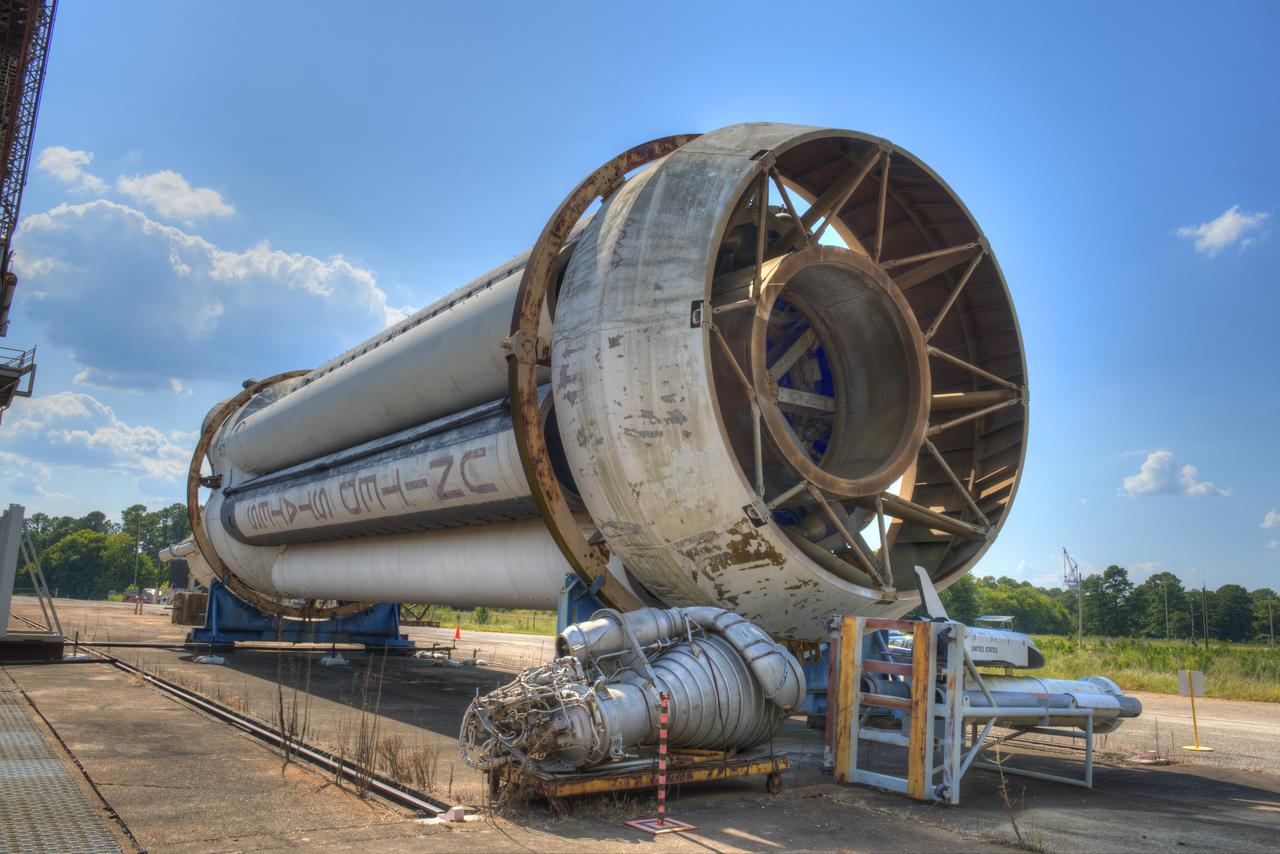
FORWARD END OF SATURN S-1B STAGE (SA-T) NEAR PROPULSION AND STRUCTURAL TEST FACILITY (BUILDING 4572) AT THE GEORGE C. MARSHALL SPACE FLIGHT CENTER IN HUNTSVILLE, ALABAMA
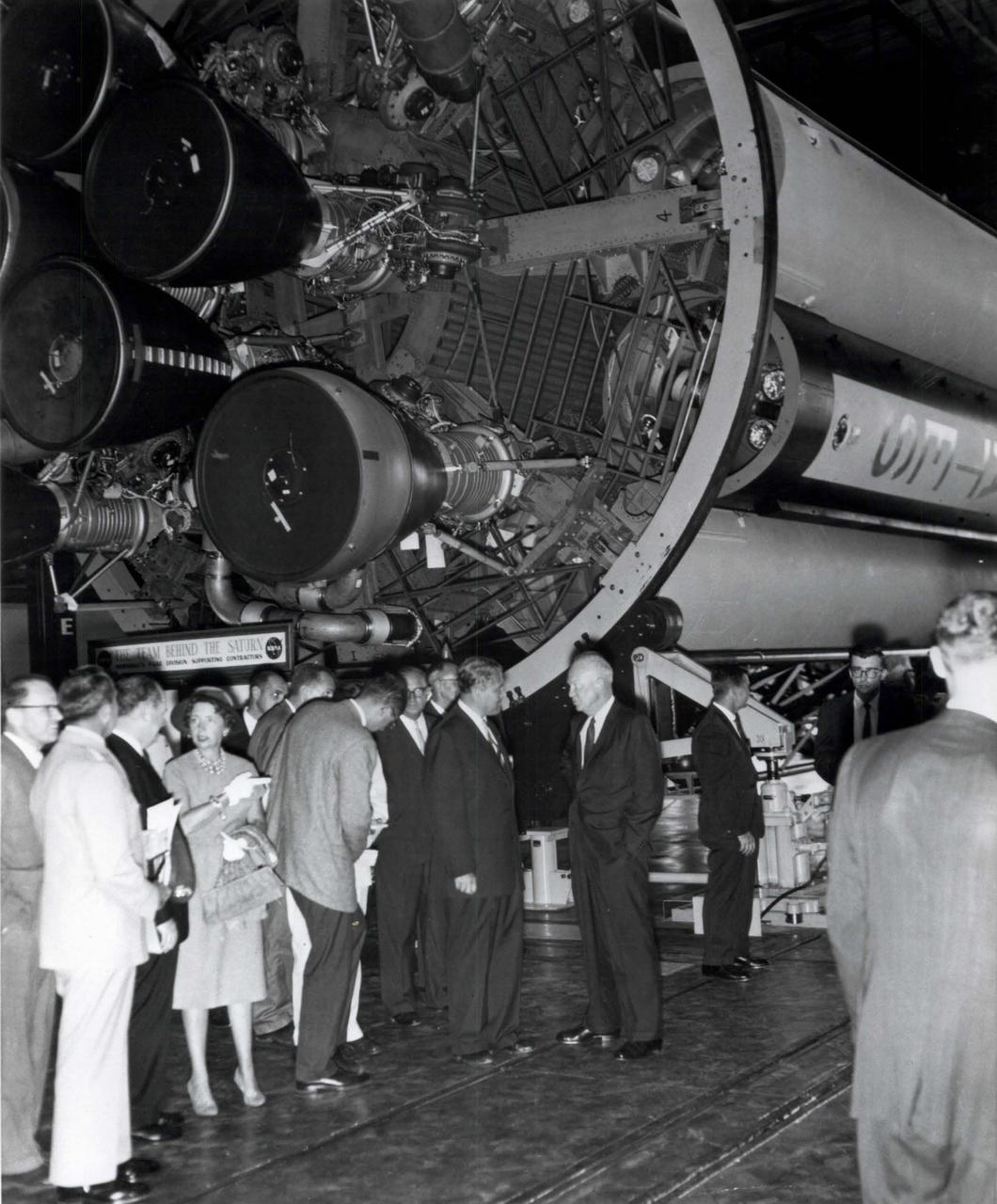
On September 8, 1960 President Dwight D. Eisenhower visited Huntsville, Alabama to dedicate a new NASA field center in honor of General George C. Marshall, Eisenhower's wartime colleague and the founder of the famous Marshall Plan for European recover after World War II. The new George C. Marshall Space Flight Center was placed under the control of Dr. Wernher Von Braun shown here talking with President Eisenhower. As parto f his remarks dedicating the center, President Eisenhowe refereed to General Marshall as a "man of yar, yet a builder of peace". the Marshall Center's first major assignment including building the huge Saturn V rocket that launched human beings on their first journey to the surface of the moon in 1969.
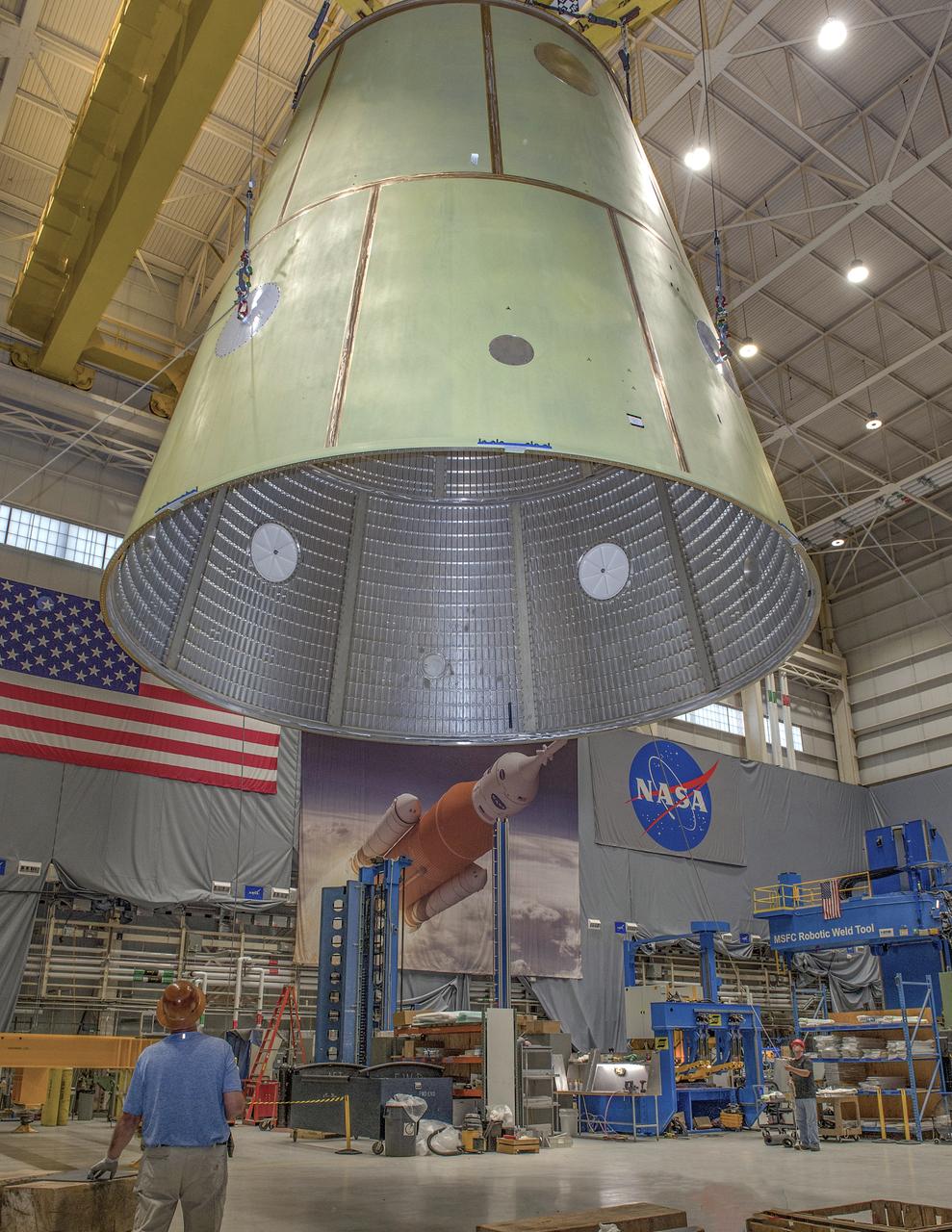
Lifting of the Launch Vehicle Stage Adapter (LVSA) in preparation for transport. The LVSA was fabricated in the EM32 Advanced Welding Development Facility at the NASA George C. Marshall Space Flight Center. The LVSA was welded using the conventional and self-reacting friction stir process and has approximately 375 feet of weld.
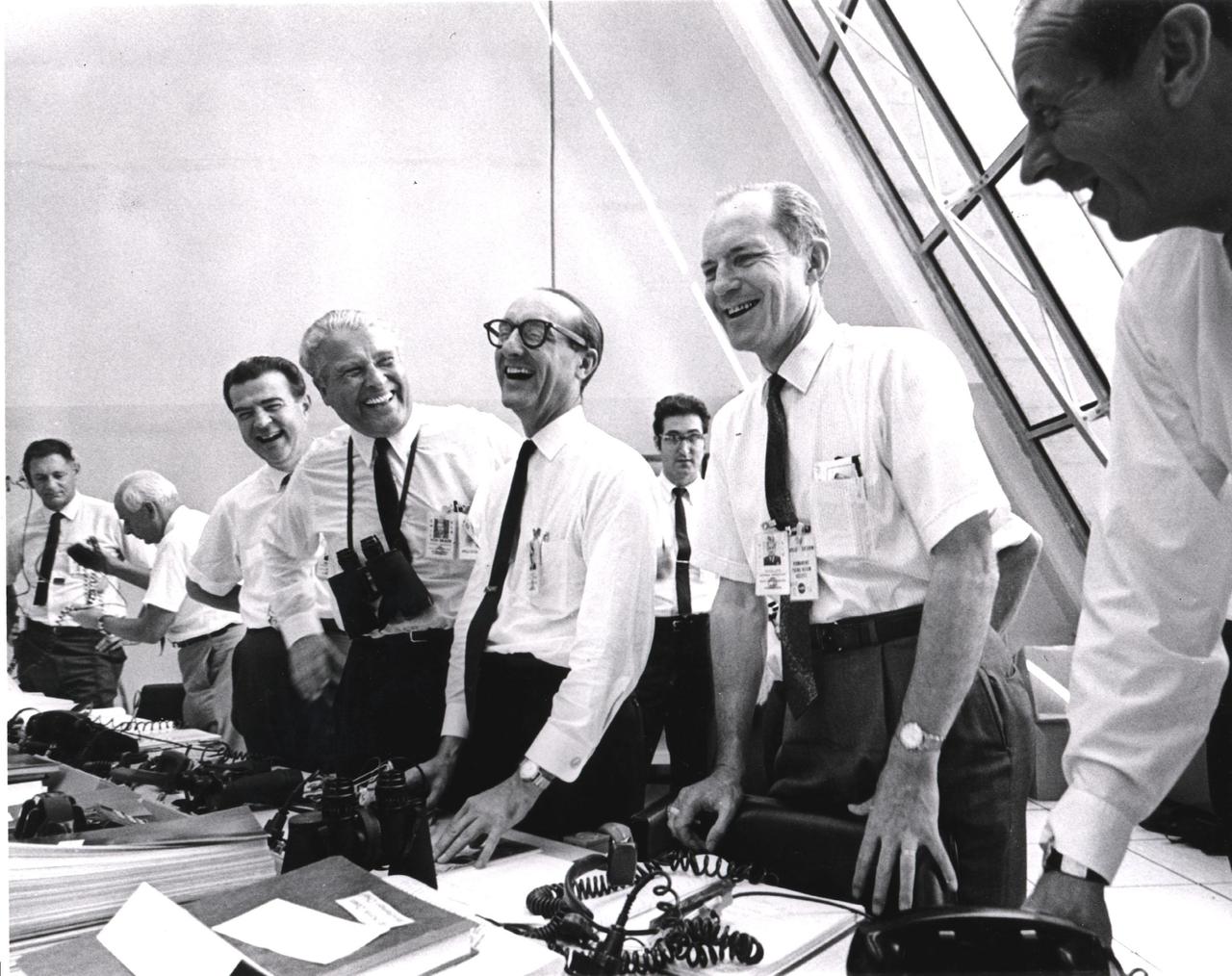
KENNEDY SPACE CENTER, FLA. - Apollo 11 mission officials relax in the Launch Control Center following the successful Apollo liftoff today. From left to right are Charles W. Mathews, deputy associate administrator for Manned Space Flight; Dr. Wernher von Braun, director of the Marshall Space Flight Center; Dr. George E. Mueller, associate administrator for Manned Space Flight; and Lt. Gen. Samuel C. Phillips, director of the Apollo Program.
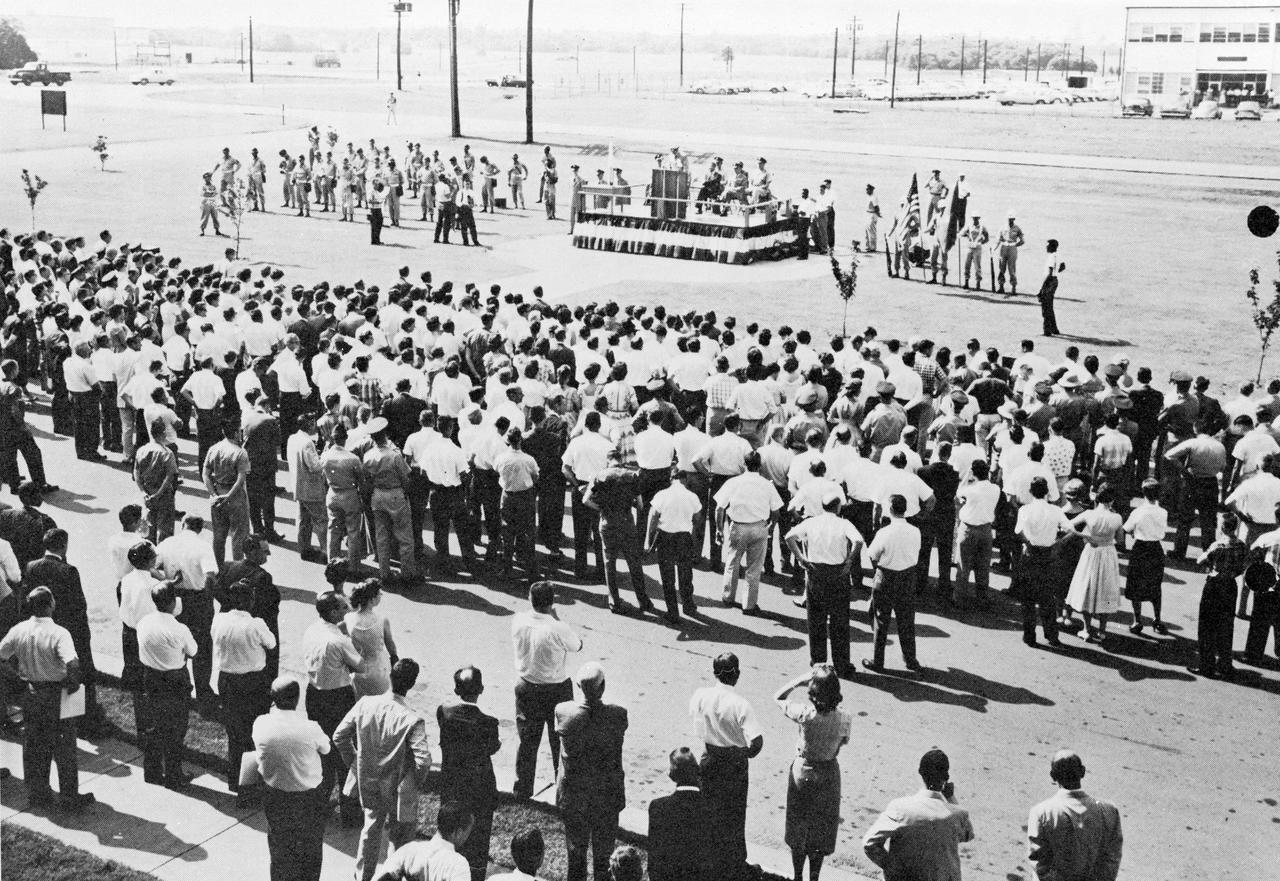
Dr. Wernher von Braun and Maj. Gen. August Schomburg officiate the official transfer of the Army Ballistic Missile Agency (ABMA) to the NASA George C. Marshall Space Flight Center (MSFC) on July 1, 1960. The Official transfer ceremony took place in the front of the ABMA-MSFC joint headquarters, building 4488, Redstone Arsenal, Alabama.
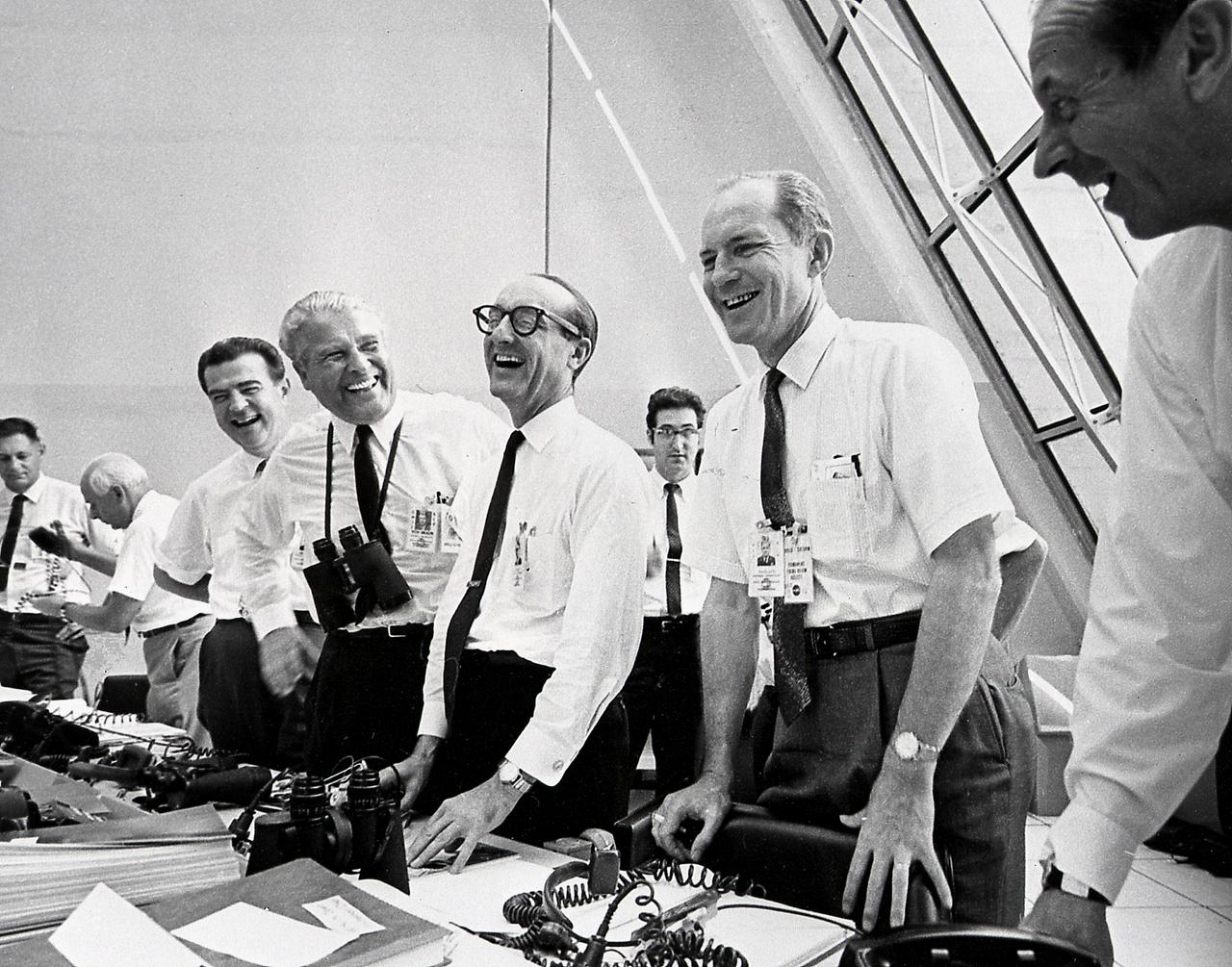
NASA officials, (left to right) Charles W. Mathews; Dr. Wernher von Braun, Director, Marshall Space Flight Center (MSFC); Dr. George E. Mueller, Associate Administrator for Marned Space Flight; and Air Force Lt. General Samuel C. Phillips, Apollo Program Director celebrate the successful launch of Apollo 11 in the control room at Kennedy Space Center (KSC) on July 16, 1969. Boosted by the Saturn V launch vehicle, the Apollo 11 mission with a crew of three: Astronauts Neil A. Armstrong, Michael Collins, and Edwin E. Aldrin, made the first manned lunar landing. The Saturn V vehicle was developed by Marshall Space Flight Center (MSFC) under the direction of Dr. von Braun.
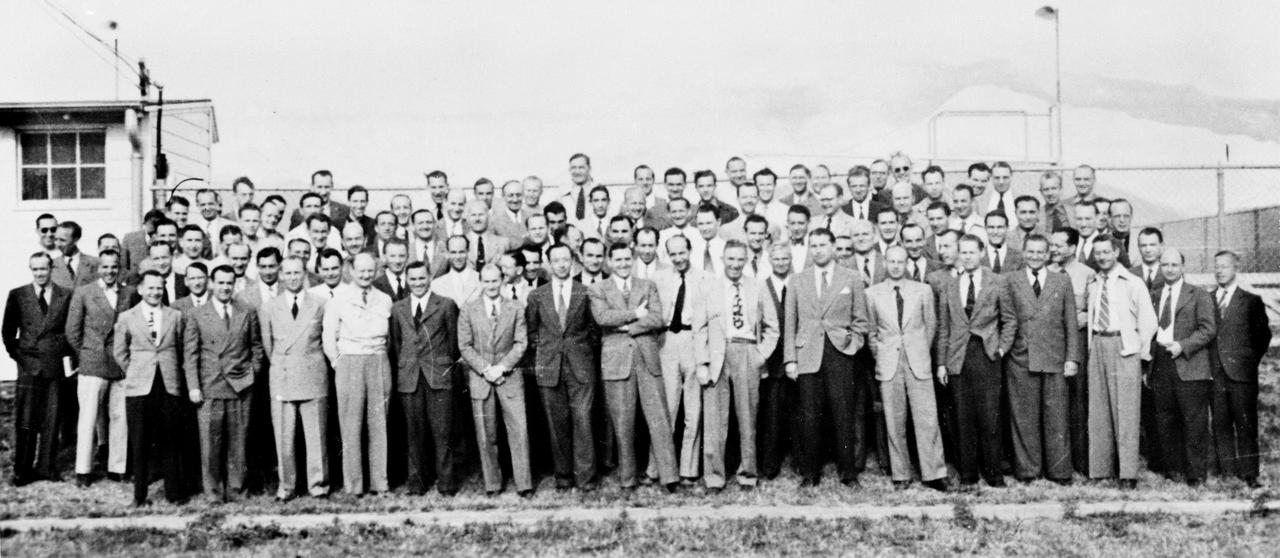
The German Rocket Team, also known as the Von Braun Rocket Team, poses for a group photograph at Fort Bliss, Texas. After World War II ended in 1945, Dr. Wernher von Braun led some 120 of his Peenemuende Colleagues, who developed the V-2 rocket for the German military during the War, to the United Sttes under a contract to the U.S. Army Corps as part of Operation Paperclip. During the following five years the team worked on high altitude firings of the captured V-2 rockets at the White Sands Missile Range in New Mexico, and a guided missile development unit at Fort Bliss, Texas. In April 1950, the group was transferred to the Army Ballistic Missile Agency (ABMA) at Redstone Arsenal in Huntsville, Alabama, and continued to work on the development of the guided missiles for the U.S. Army until transferring to a newly established field center of the National Aeronautic and Space Administration (NASA), George C. Marshall Space Flight Center (MSFC).
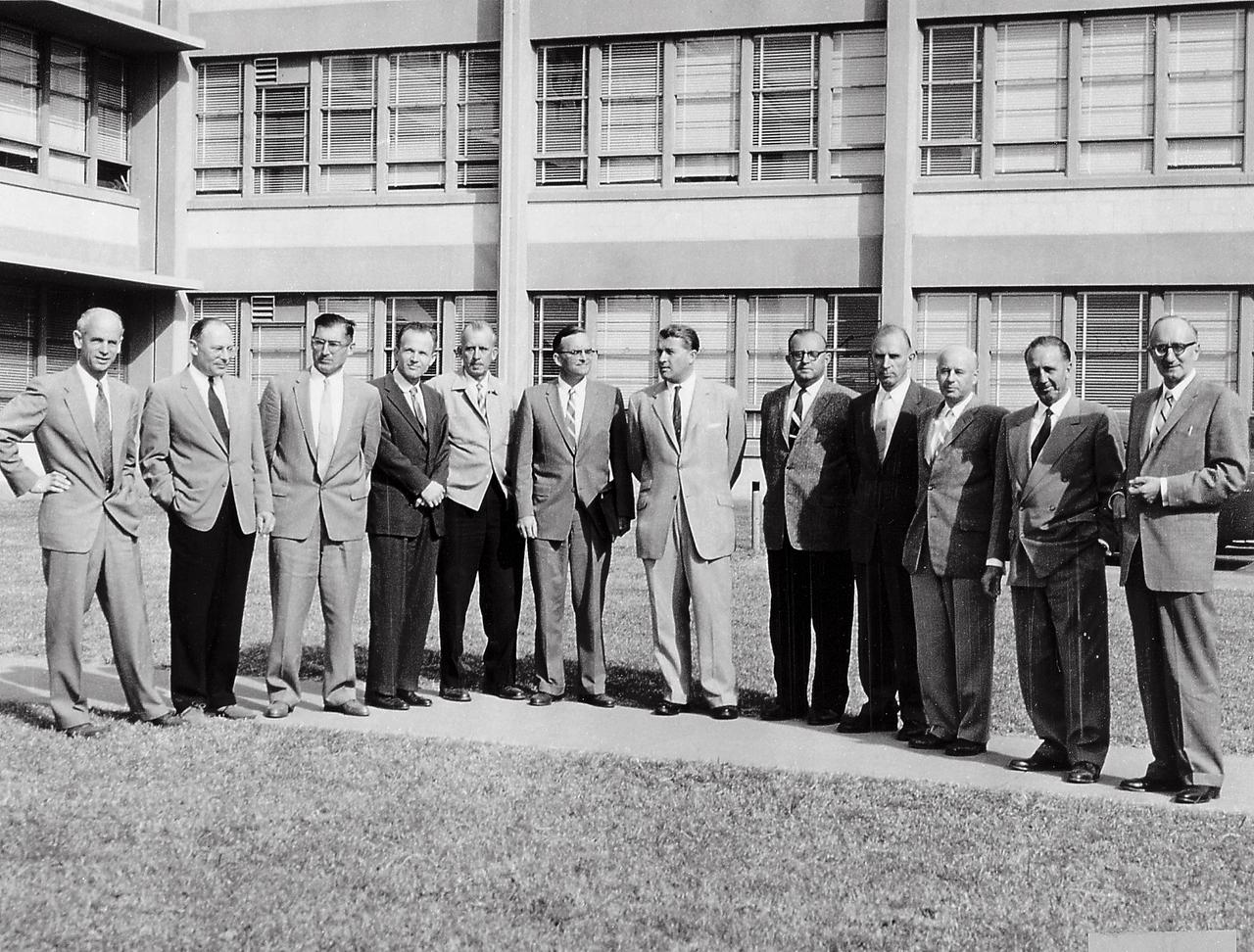
Twelve scientific specialists of the Peenemuende team at the front of Building 4488, Redstone Arsenal, Huntsville, Alabama. They led the Army's space efforts at ABMA before transfer of the team to National Aeronautic and Space Administration (NASA), George C. Marshall Space Flight Center (MSFC). (Left to right) Dr. Ernst Stuhlinger, Director, Research Projects Office; Dr. Helmut Hoelzer, Director, Computation Laboratory: Karl L. Heimburg, Director, Test Laboratory; Dr. Ernst Geissler, Director, Aeroballistics Laboratory; Erich W. Neubert, Director, Systems Analysis Reliability Laboratory; Dr. Walter Haeussermarn, Director, Guidance and Control Laboratory; Dr. Wernher von Braun, Director Development Operations Division; William A. Mrazek, Director, Structures and Mechanics Laboratory; Hans Hueter, Director, System Support Equipment Laboratory;Eberhard Rees, Deputy Director, Development Operations Division; Dr. Kurt Debus, Director Missile Firing Laboratory; Hans H. Maus, Director, Fabrication and Assembly Engineering Laboratory
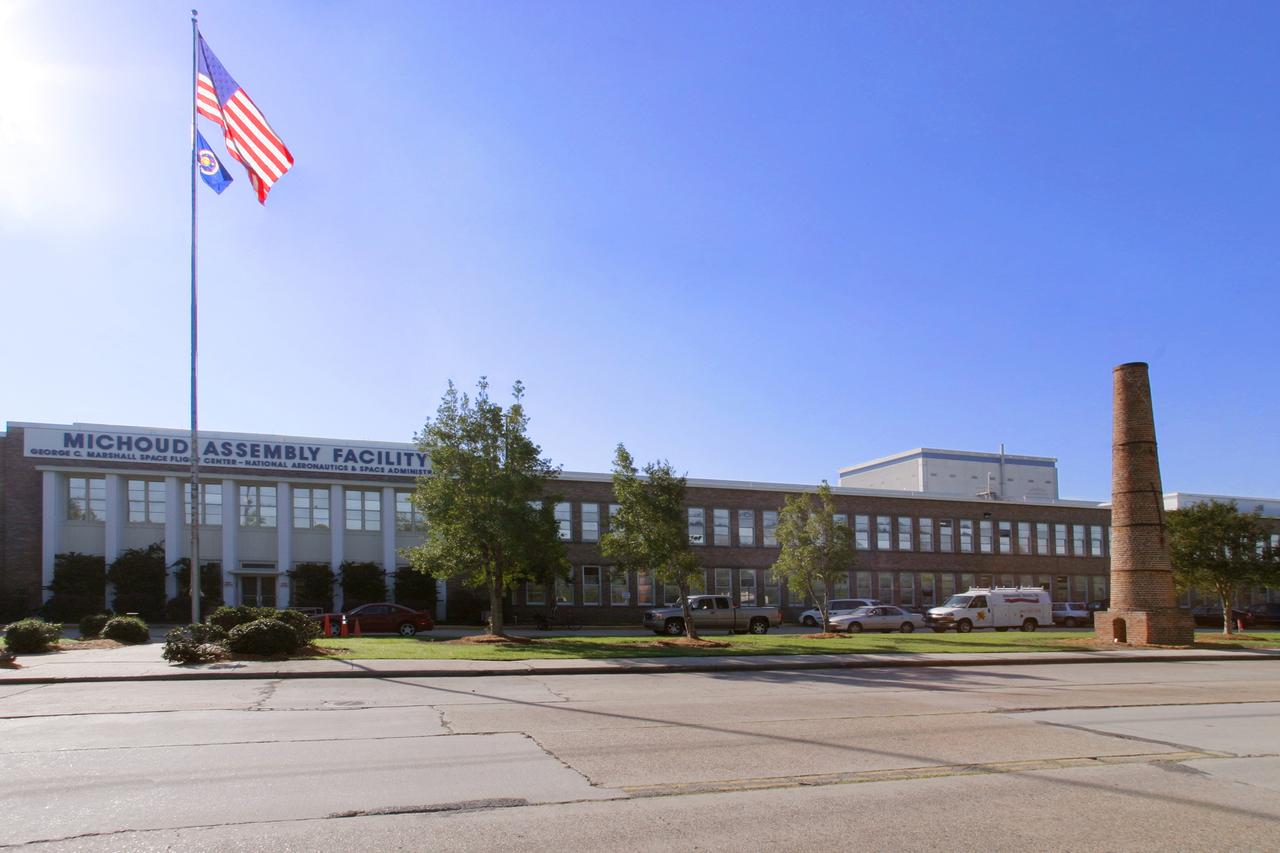
NASA's Michoud Assembly Facility, located in eastern New Orleans, Louisiana, is an 832 acre site that is a government-owned, contractor-operated component of the George C. Marshall Space Flight Center (MSFC). The facility was acquired by NASA in 1961 at the recommendation of Dr. Wernher von Braun and his rocket team in Huntsville Alabama. The cavernous plant served as the assembly facility for the Saturn launch vehicles and most recently the external tank (ET) used for the Space Shuttle Program. The facility features one of the world's biggest manufacturing plants with 43 acres under one roof and a port with deep-water access for the transportation of large space structures. When completed, space hardware is towed on a barge across the Gulf of Mexico, around Florida and up to Kennedy Space Center. The original tract of land was part of a 34,500 acre French Royal land grant to local merchant, Gilbert Antoine de St. Maxent in 1763. Later, the land was acquired by French transplant Antoine Michoud, the son of Napoleon's Administrator of Domains, who moved to the city in 1827. Michoud operated a sugar cane plantation and refinery on the site until his death in 1863. His heirs continued operating the refinery and kept the original St. Maxent estate intact into the 20th century. Visible on the right, is one of two brick smokestacks from the original refinery that still stand before the Michoud facility today.
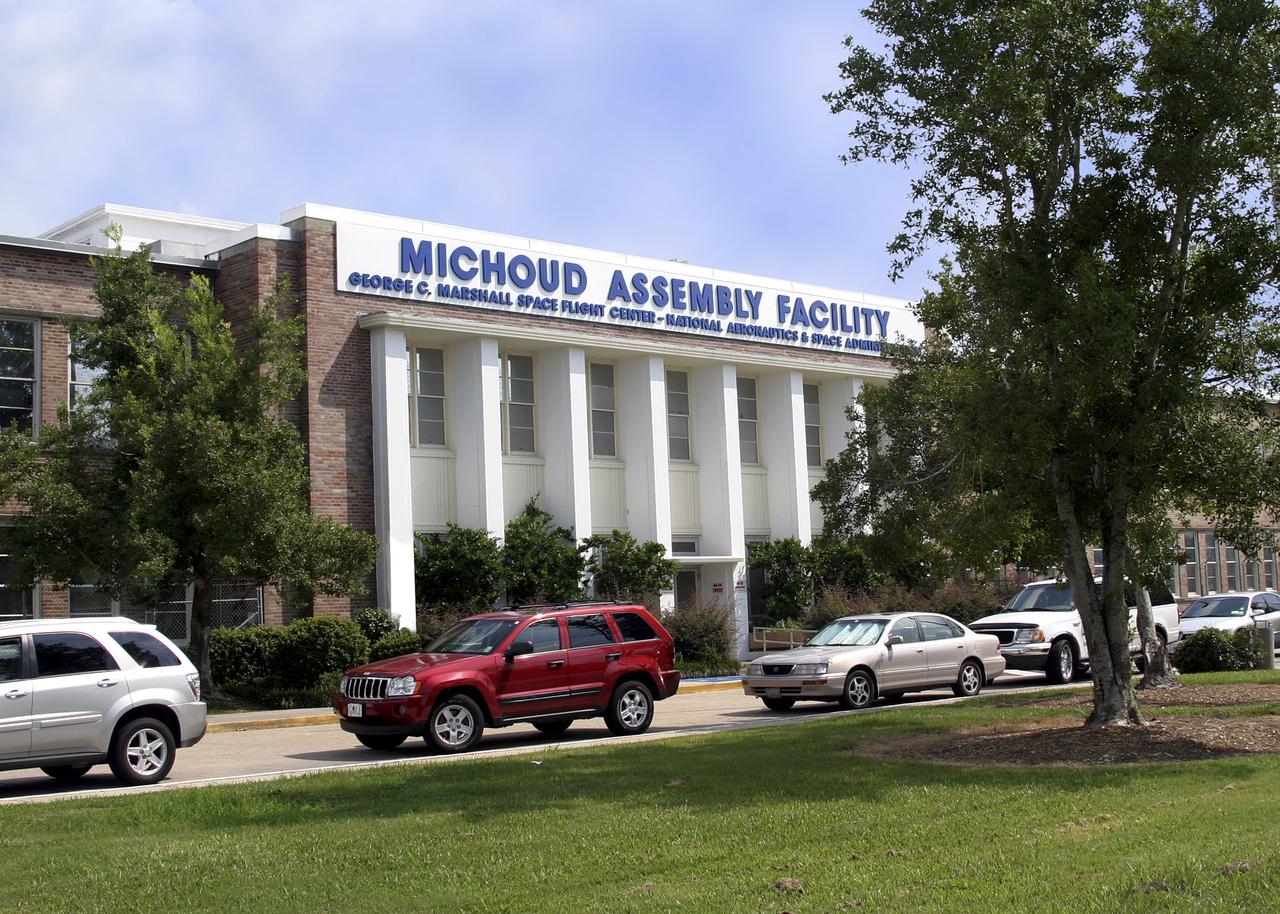
NASA's Michoud Assembly Facility, located in eastern New Orleans, Louisiana, is an 832 acre site that is a government-owned, contractor-operated component of the George C. Marshall Space Flight Center (MSFC). The facility was acquired by NASA in 1961 at the recommendation of Dr. Wernher von Braun and his rocket team in Huntsville Alabama. The cavernous plant served as the assembly facility for the Saturn launch vehicles and most recently the external tank (ET) used for the Space Shuttle Program. The facility features one of the world's biggest manufacturing plants with 43 acres under one roof and a port with deep-water access for the transportation of large space structures. When completed, space hardware is towed on a barge across the Gulf of Mexico, around Florida and up to Kennedy Space Center. The original tract of land was part of a 34,500 acre French Royal land grant to local merchant, Gilbert Antoine de St. Maxent in 1763. Later, the land was acquired by French transplant Antoine Michoud, the son of Napoleon's Administrator of Domains, who moved to the city in 1827. Michoud operated a sugar cane plantation and refinery on the site until his death in 1863. His heirs continued operating the refinery and kept the original St. Maxent estate intact into the 20th century. Two brick smokestacks from the original refinery still stand before the Michoud facility today.
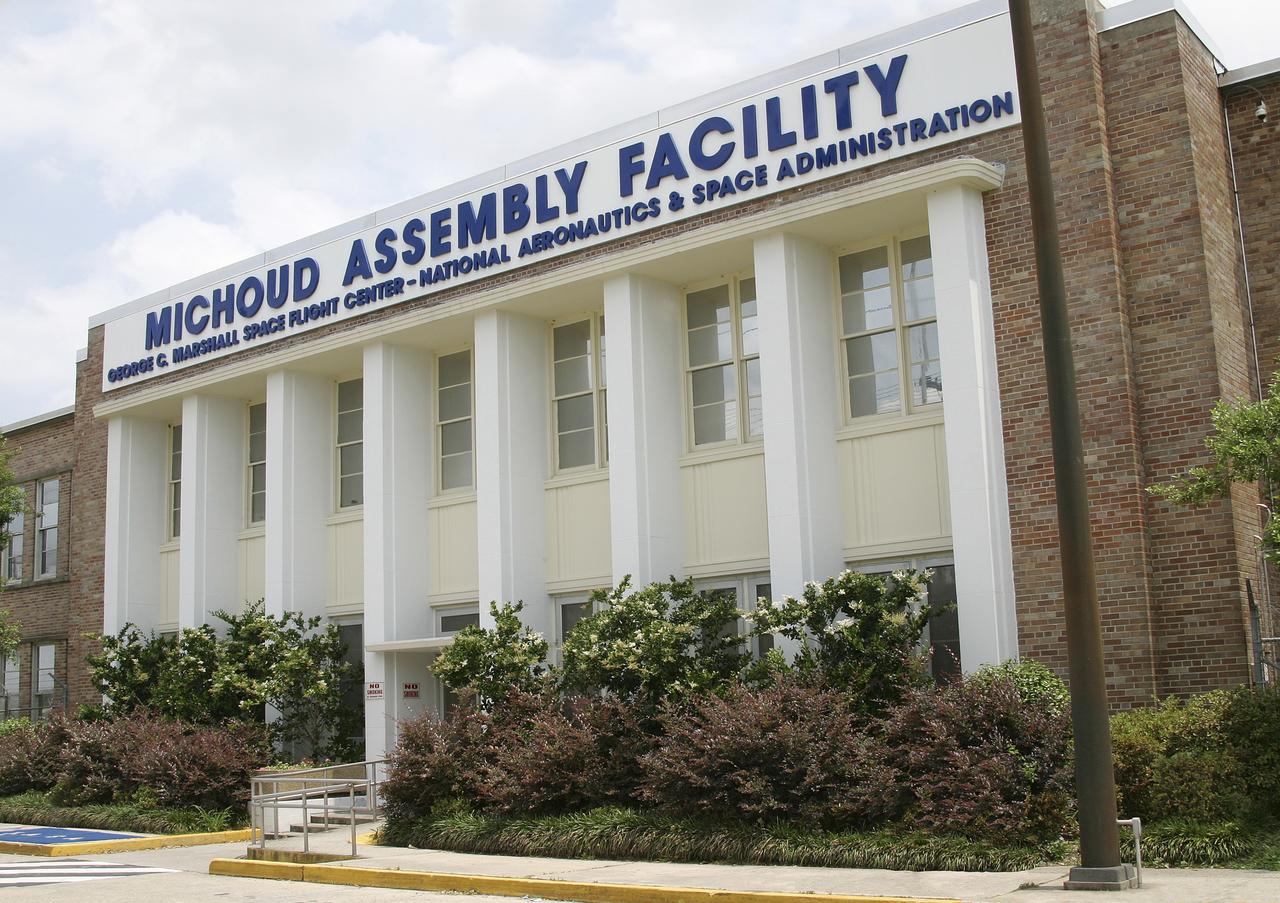
NASA's Michoud Assembly Facility, located in eastern New Orleans, Louisiana, is an 832 acre site that is a government-owned, contractor-operated component of the George C. Marshall Space Flight Center (MSFC). The facility was acquired by NASA in 1961 at the recommendation of Dr. Wernher von Braun and his rocket team in Huntsville Alabama. The cavernous plant served as the assembly facility for the Saturn launch vehicles and most recently the external tank (ET) used for the Space Shuttle Program. The facility features one of the world's biggest manufacturing plants with 43 acres under one roof and a port with deep-water access for the transportation of large space structures. When completed, space hardware is towed on a barge across the Gulf of Mexico, around Florida and up to Kennedy Space Center. The original tract of land was part of a 34,500 acre French Royal land grant to local merchant, Gilbert Antoine de St. Maxent in 1763. Later, the land was acquired by French transplant Antoine Michoud, the son of Napoleon's Administrator of Domains, who moved to the city in 1827. Michoud operated a sugar cane plantation and refinery on the site until his death in 1863. His heirs continued operating the refinery and kept the original St. Maxent estate intact into the 20th century. Two brick smokestacks from the original refinery still stand before the Michoud facility today.
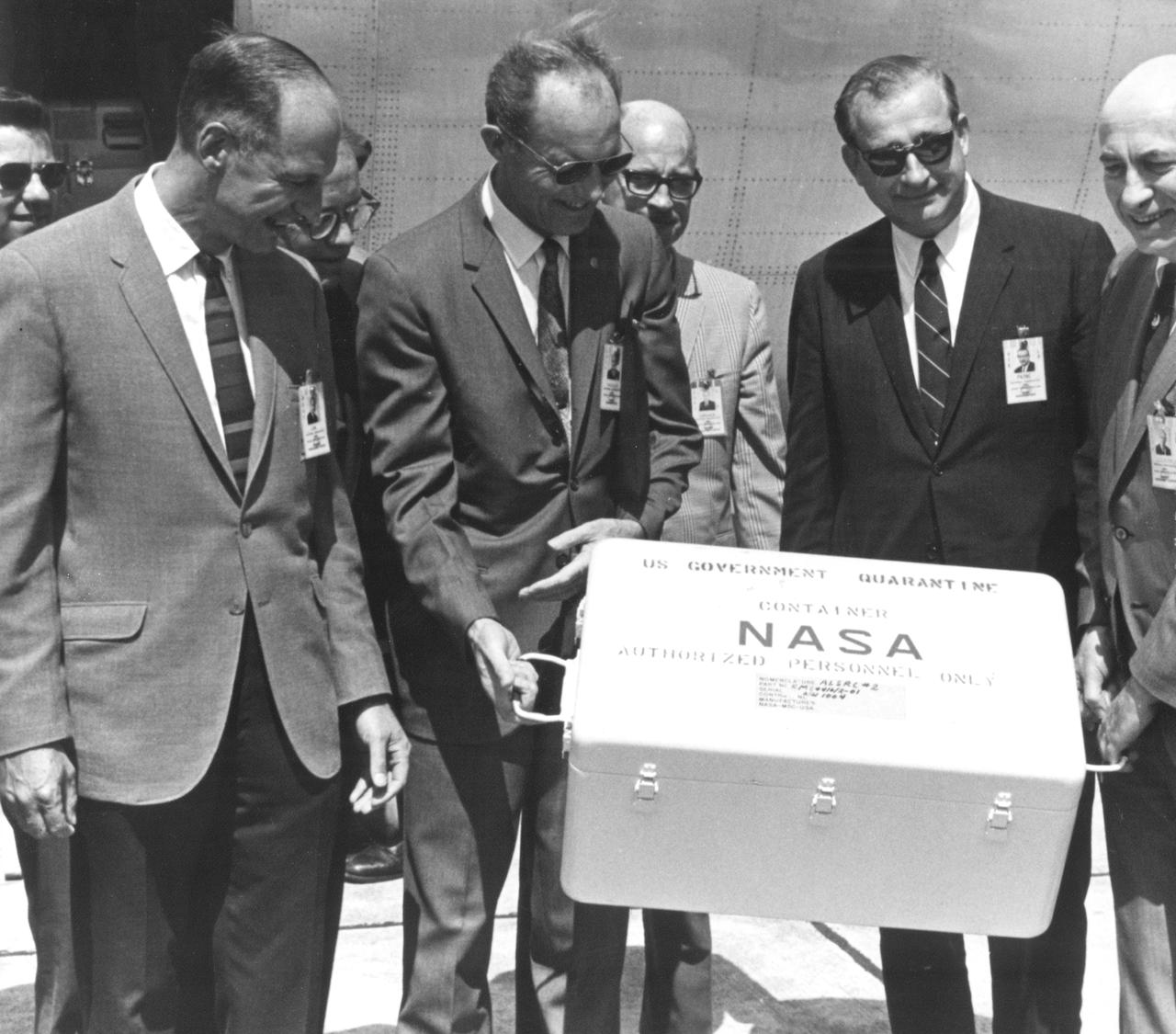
The Apollo 11 mission, the first manned lunar mission, launched from the Kennedy Space Center, Florida via the Marshall Space Flight Center (MSFC) developed Saturn V launch vehicle on July 16, 1969 and safely returned to Earth on July 24, 1969. Aboard the space craft were astronauts Neil A. Armstrong, commander; Michael Collins, Command Module (CM) pilot; and Edwin E. Aldrin Jr., Lunar Module (LM) pilot. The CM, piloted by Michael Collins remained in a parking orbit around the Moon while the LM, named “Eagle’’, carrying astronauts Neil Armstrong and Edwin Aldrin, landed on the Moon. During 2½ hours of surface exploration, the crew collected 47 pounds of lunar surface material for analysis back on Earth. This photograph was taken as the mission’s first loaded sample return container arrived at Ellington Air Force Base by air from the Pacific recovery area. The rock box was immediately taken to the Lunar Receiving Laboratory at the Manned Spacecraft Center (MSC) in Houston, Texas. Happily posing for the photograph with the rock container are (L-R) Richard S. Johnston (back), special assistant to the MSC Director; George M. Low, MSC Apollo Spacecraft Program manager; George S. Trimble (back), MSC Deputy Director; Lt. General Samuel C. Phillips, Apollo Program Director, Office of Manned Spaceflight at NASA headquarters; Eugene G. Edmonds, MSC Photographic Technology Laboratory; Dr. Thomas O. Paine, NASA Administrator; and Dr. Robert R. Gilruth, MSC Director.
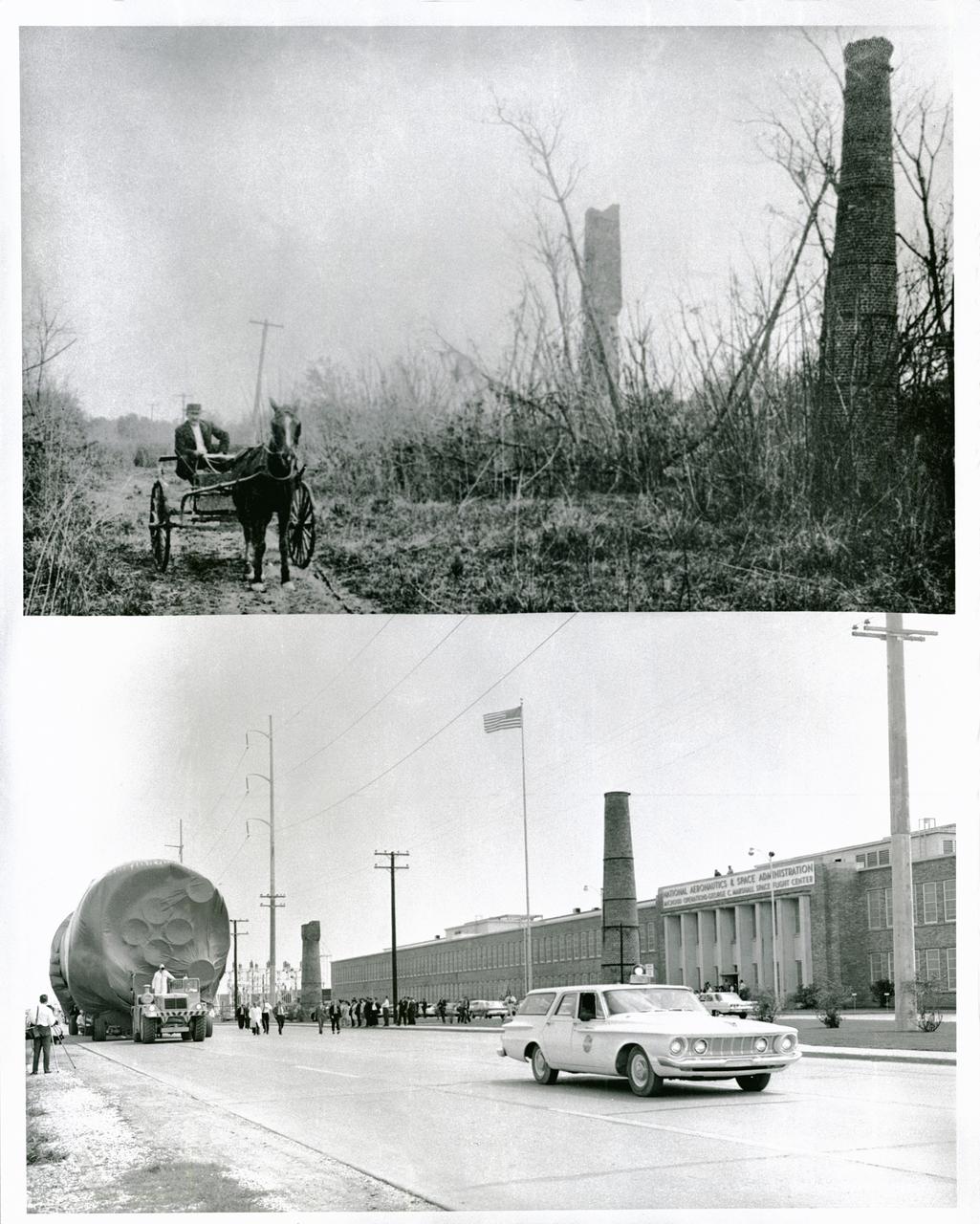
NASA's Michoud Assembly Facility, located in eastern New Orleans, Louisiana, is an 832 acre site that is a government-owned, contractor-operated component of the George C. Marshall Space Flight Center (MSFC). The facility was acquired by NASA in 1961 at the recommendation of Dr. Wernher von Braun and his rocket team in Huntsville Alabama. The cavernous plant served as the assembly facility for the Saturn launch vehicles and most recently the external tank (ET) used for the Space Shuttle Program. The facility features one of the world's biggest manufacturing plants with 43 acres under one roof and a port with deep-water access for the transportation of large space structures. When completed, space hardware is towed on a barge across the Gulf of Mexico, around Florida and up to Kennedy Space Center. The original tract of land was part of a 34,500 acre French Royal land grant to local merchant, Gilbert Antoine de St. Maxent in 1763. Later, the land was acquired by French transplant Antoine Michoud, the son of Napoleon's Administrator of Domains, who moved to the city in 1827. Michoud operated a sugar cane plantation and refinery on the site until his death in 1863. His heirs continued operating the refinery and kept the original St. Maxent estate intact into the 20th century. Two brick smokestacks from the original refinery still stand before the Michoud facility today as seen in the lower half of this photograph taken in the 1960's, while the upper half reflects the area during the time of the sugar cane plantation workers.