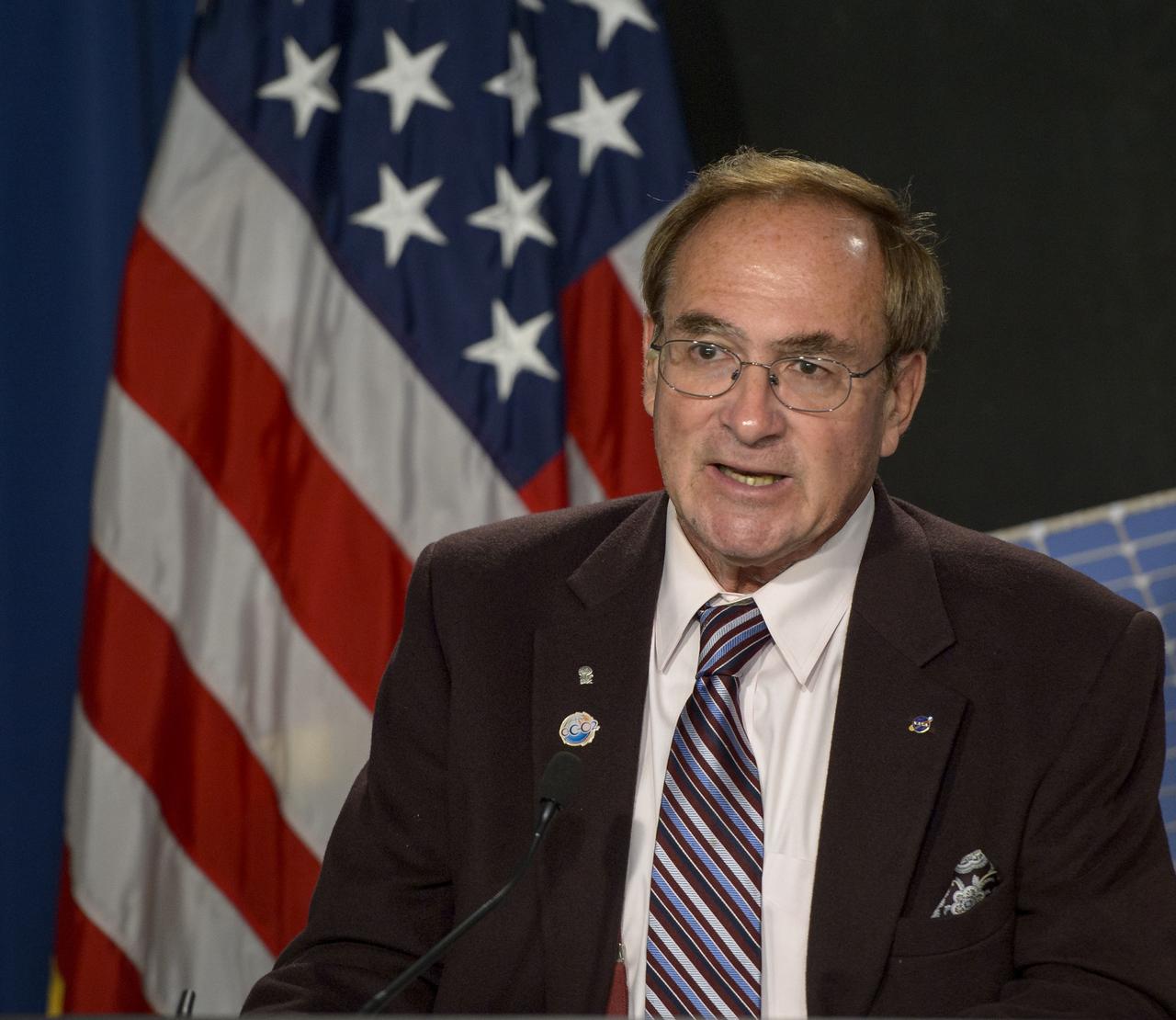
NASA Kennedy Space Center Public Affairs Officer George Diller, moderates a briefing ahead of the planned launch of the Orbiting Carbon Observatory-2 (OCO-2), Sunday, June 29, 2014, Vandenberg Air Force Base, Calif. OCO-2 will measure the global distribution of carbon dioxide, the leading human-produced greenhouse gas driving changes in Earth’s climate. OCO-2 is set to launch on July 1, 2014 at 2:59 a.m. PDT. Photo Credit: (NASA/Bill Ingalls)
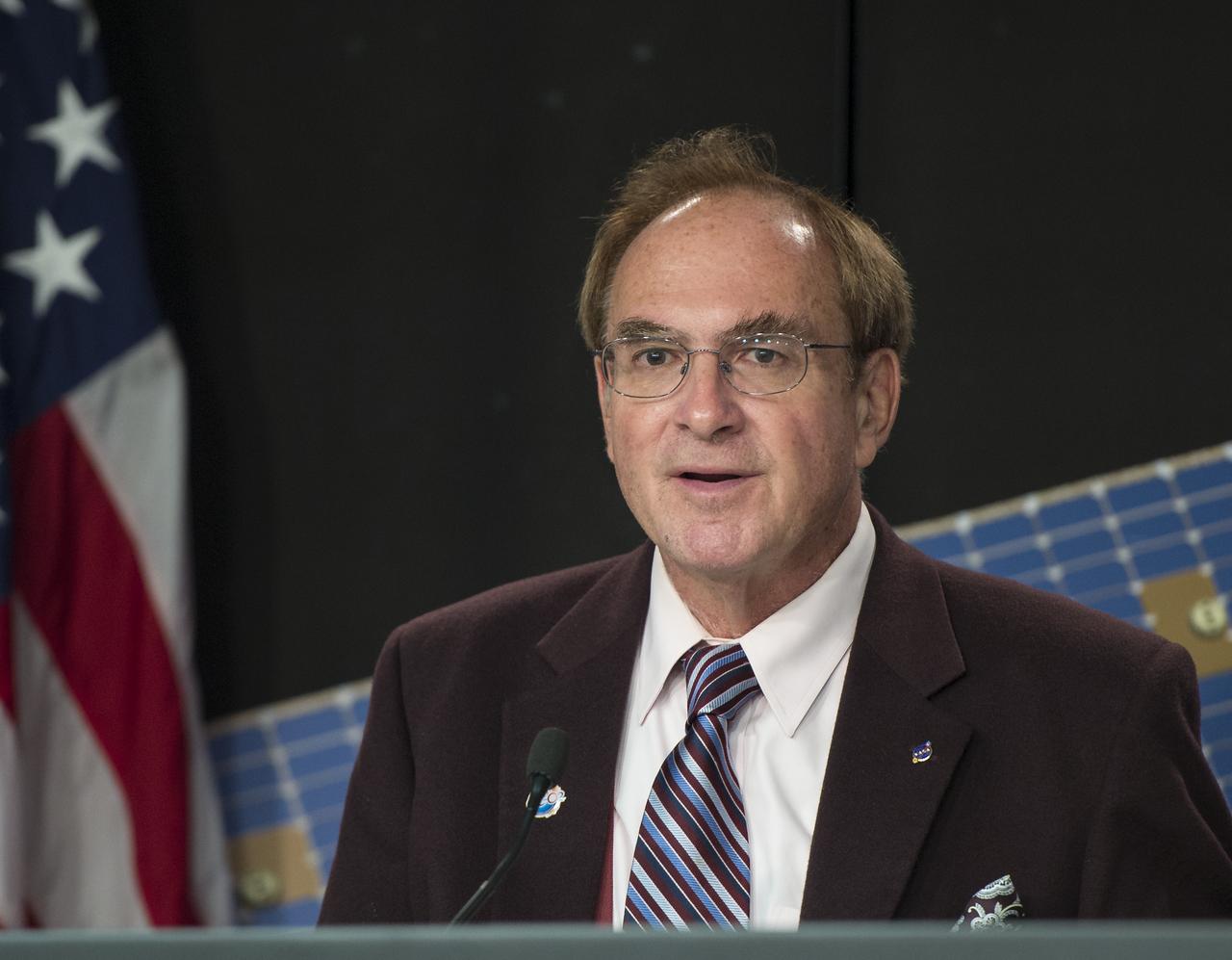
NASA Kennedy Space Center Public Affairs Officer George Diller, moderates a post-launch press briefing, following the successful launch of the Orbiting Carbon Observatory-2 (OCO-2), NASA’s first spacecraft dedicated to studying carbon dioxide, Wednesday, July 2, 2014, at the Vandenberg Air Force Base, Calif. OCO-2 will measure the global distribution of carbon dioxide, the leading human-produced greenhouse gas driving changes in Earth’s climate. Photo Credit: (NASA/Bill Ingalls)
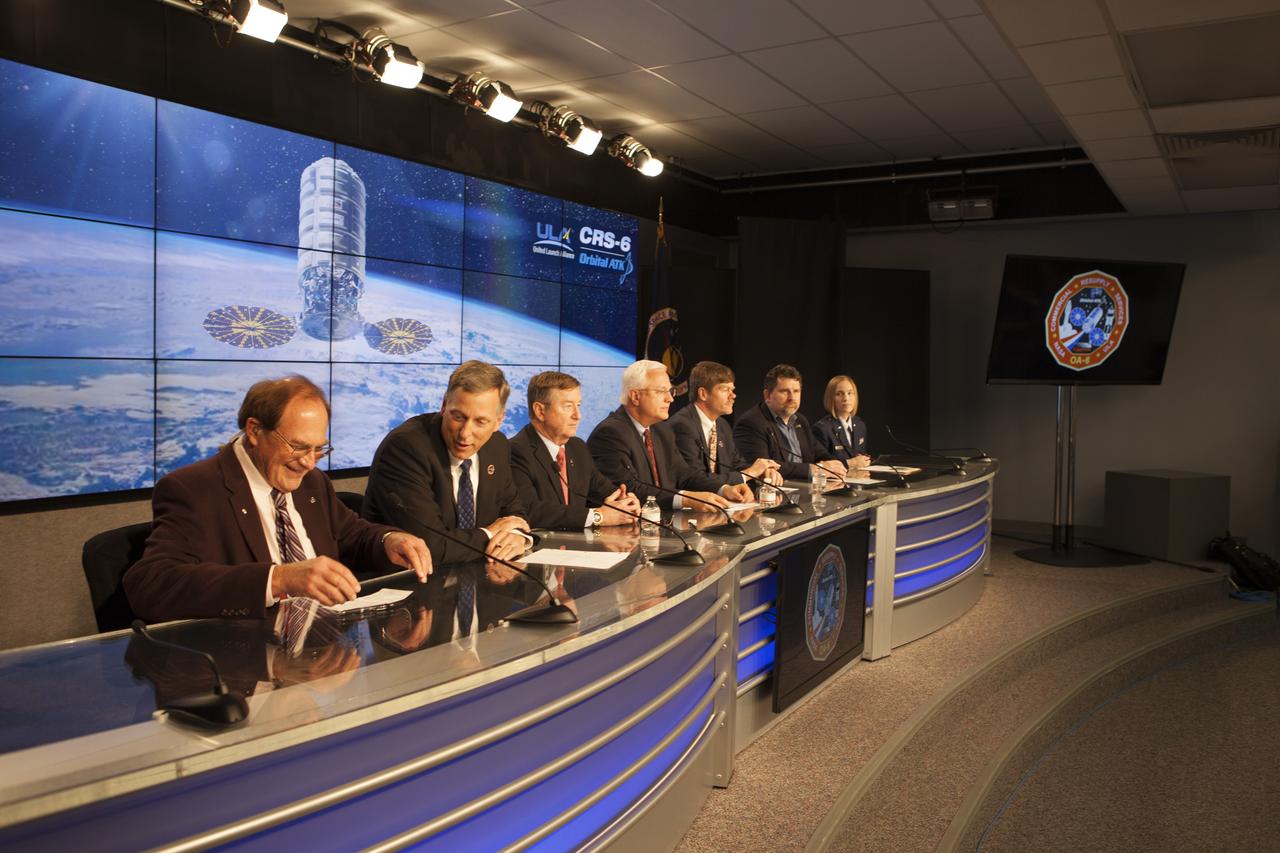
In the Kennedy Space Center’s Press Site auditorium, agency and industry leaders speak to members of the media at a prelaunch news conference for Orbital ATK CRS-6 commercial resupply services mission to the International Space Station. From left are: George Diller of NASA Communications; Kenneth Todd, NASA ISS Operations Integration manager; Frank Culbertson, president of Orbital ATK's Space System Group; Vern Thorp, United Space Alliance's program manager for NASA missions; Pete Hasbrook, NASA associate program scientist for the ISS Program at the Johnson Space Center in Houston; Dr. Michael Roberts deputy chief scientist for the Center for the Advancement for Science in Space, or CASIS; and Capt. Laura Godoy, launch weather officer of the U.S. Air Force 45th Weather Squadron.
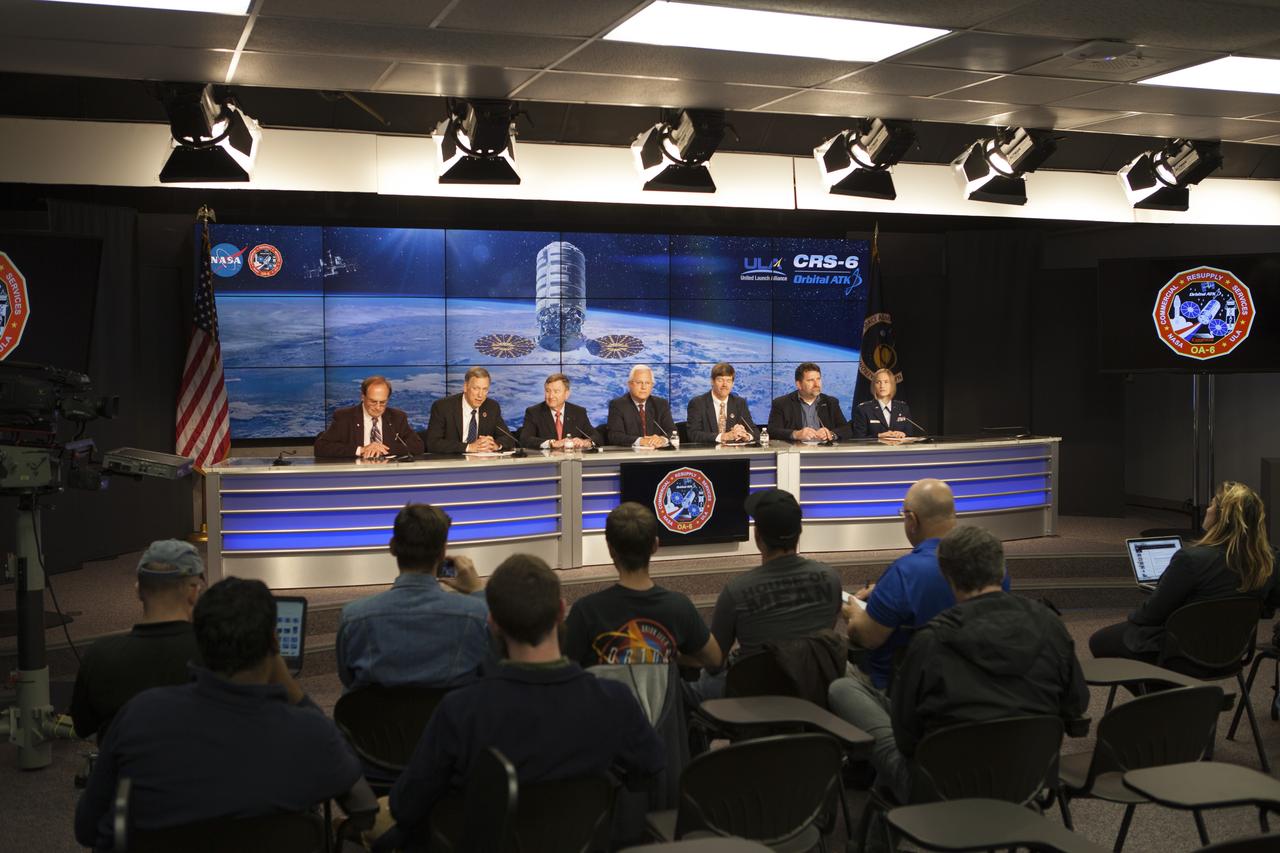
In the Kennedy Space Center’s Press Site auditorium, agency and industry leaders speak to members of the media at a prelaunch news conference for Orbital ATK CRS-6 commercial resupply services mission to the International Space Station. From left are: George Diller of NASA Communications; Kenneth Todd, NASA ISS Operations Integration manager; Frank Culbertson, president of Orbital ATK's Space System Group; Vern Thorp, United Space Alliance's program manager for NASA missions; Pete Hasbrook, NASA associate program scientist for the ISS Program at the Johnson Space Center in Houston; Dr. Michael Roberts deputy chief scientist for the Center for the Advancement for Science in Space, or CASIS; and Capt. Laura Godoy, launch weather officer of the U.S. Air Force 45th Weather Squadron.

From left, NASA Kennedy Space Center Public Affairs Officer George Diller, Ken Jucks, OCO-2 program scientist, NASA Headquarters, Dave Crisp, OCO-2 science team leader, JPL, and Annmarie Eldering, OCO-2 deputy project scientist, JPL, give a science briefing ahead of the planned launch of the Orbiting Carbon Observatory-2 (OCO-2), Sunday, June 29, 2014, Vandenberg Air Force Base, Calif. OCO-2 will measure the global distribution of carbon dioxide, the leading human-produced greenhouse gas driving changes in Earth’s climate. OCO-2 is set to launch on July 1, 2014 at 2:59 a.m. PDT. Photo Credit: (NASA/Bill Ingalls)
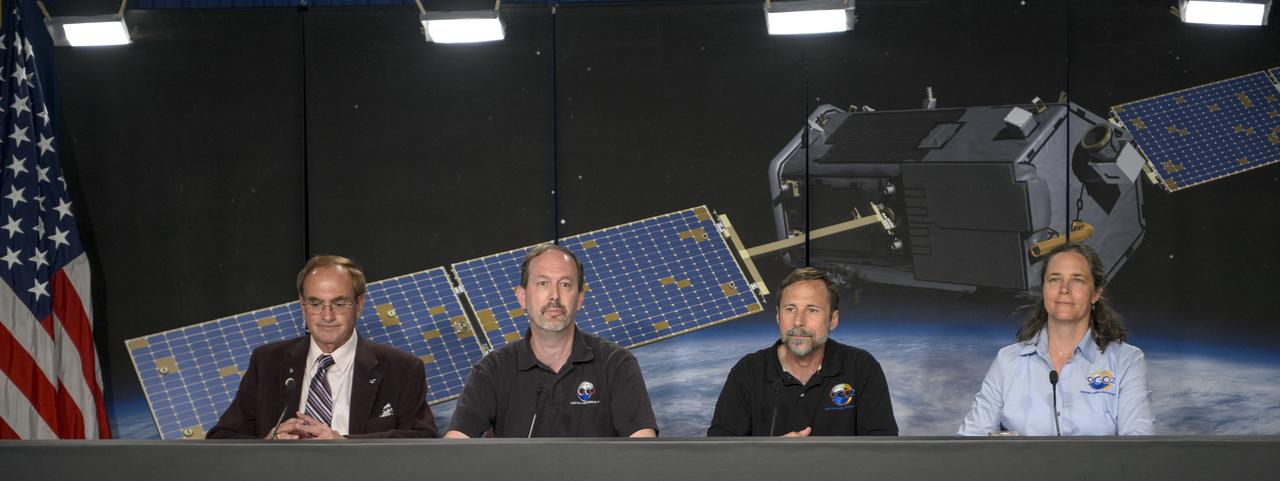
From left, NASA Kennedy Space Center Public Affairs Officer George Diller, Ken Jucks, OCO-2 program scientist, NASA Headquarters, Dave Crisp, OCO-2 science team leader, JPL, and Annmarie Eldering, OCO-2 deputy project scientist, JPL, give a science briefing ahead of the planned launch of the Orbiting Carbon Observatory-2 (OCO-2), Sunday, June 29, 2014, Vandenberg Air Force Base, Calif. OCO-2 will measure the global distribution of carbon dioxide, the leading human-produced greenhouse gas driving changes in Earth’s climate. OCO-2 is set to launch on July 1, 2014 at 2:59 a.m. PDT. Photo Credit: (NASA/Bill Ingalls)
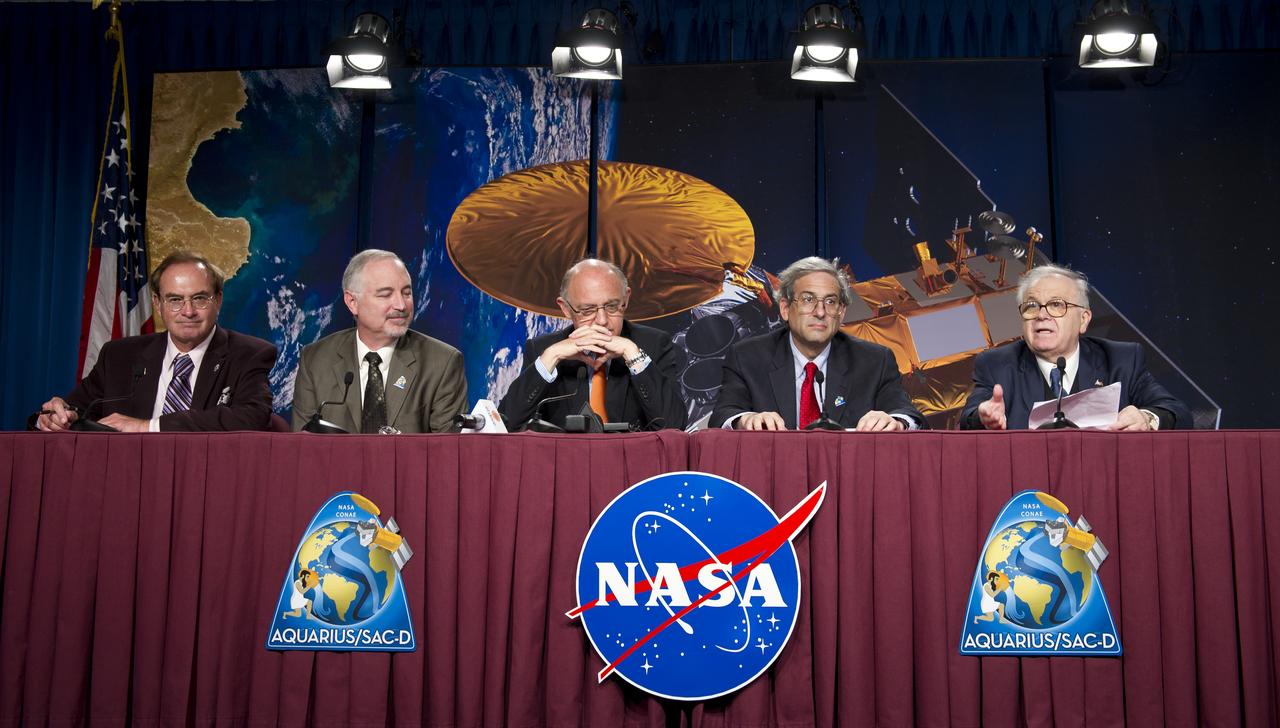
From left, George Diller, NASA Public Affairs Officer; Charles Gay, Deputy Associate Administrator, NASA Science Mission Directorate; Hector Timerman, Foreign Minister of Argentina, Buenos Aires; Michael Freilich, NASA Earth Science Division Director, NASA Headquarters; and Conrado Varotto, CONAE Executive and Technical Director, Buenos Aires, are seen at the Aquarius/SAC-D post-launch press conference on Friday, June 10, 2011 at the NASA Resident Office, Vandenberg Air Force Base, Calif. The joint U.S./Argentinian Aquarius/Satélite de Aplicaciones Científicas (SAC)-D mission, launched earlier on Friday June 10, will map the salinity at the ocean surface, information critical to improving our understanding of two major components of Earth's climate system: the water cycle and ocean circulation. Photo Credit: (NASA/Bill Ingalls)
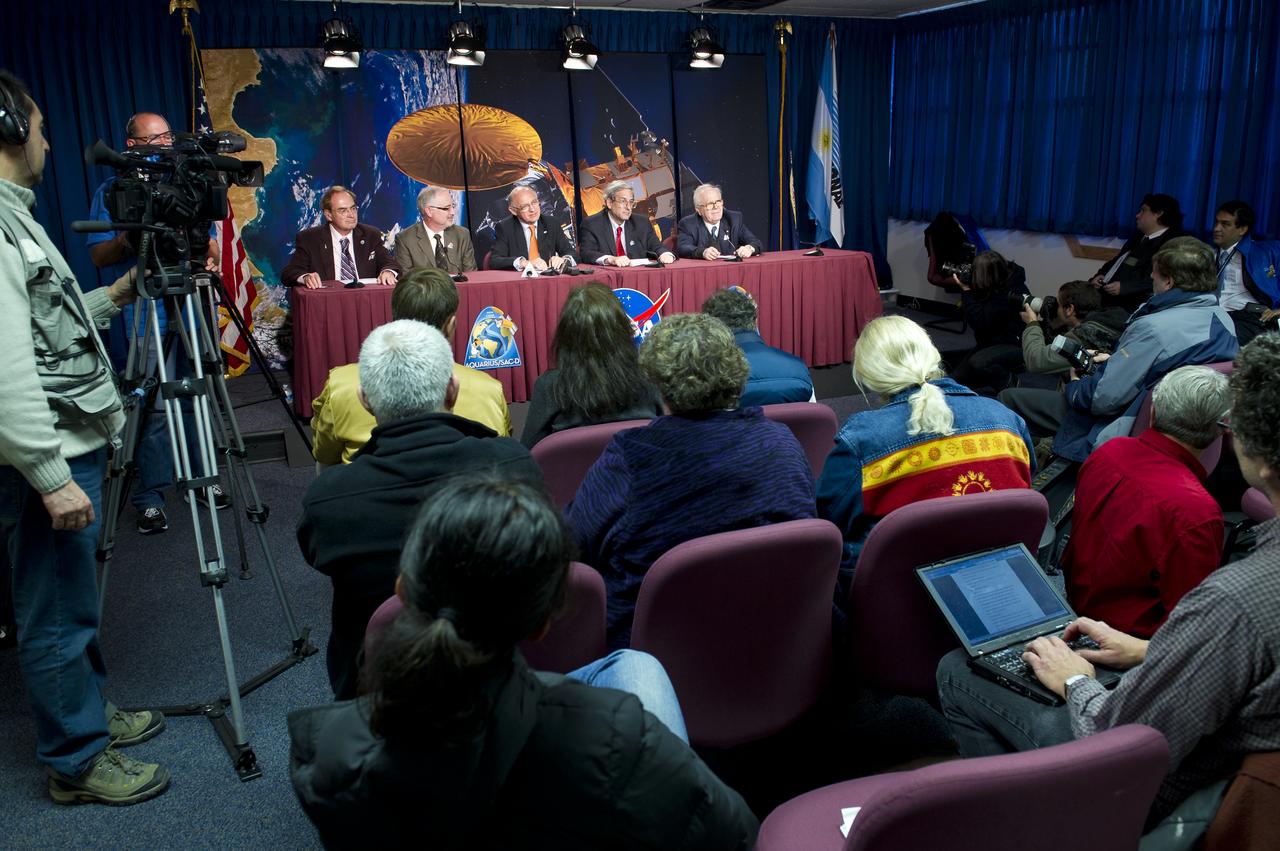
Seated from left, George Diller, NASA Public Affairs Officer; Charles Gay, Deputy Associate Administrator, NASA Science Mission Directorate; Hector Timerman, Foreign Minister of Argentina, Buenos Aires; Michael Freilich, NASA Earth Science Division Director, NASA Headquarters; and Conrado Varotto, CONAE Executive and Technical Director, Buenos Aires, are seen at the Aquarius/SAC-D post-launch press conference on Friday, June 10, 2011 at the NASA Resident Office, Vandenberg Air Force Base, Calif. The joint U.S./Argentinian Aquarius/Satélite de Aplicaciones Científicas (SAC)-D mission, launched earlier on Friday June 10, will map the salinity at the ocean surface, information critical to improving our understanding of two major components of Earth's climate system: the water cycle and ocean circulation. Photo Credit: (NASA/Bill Ingalls)
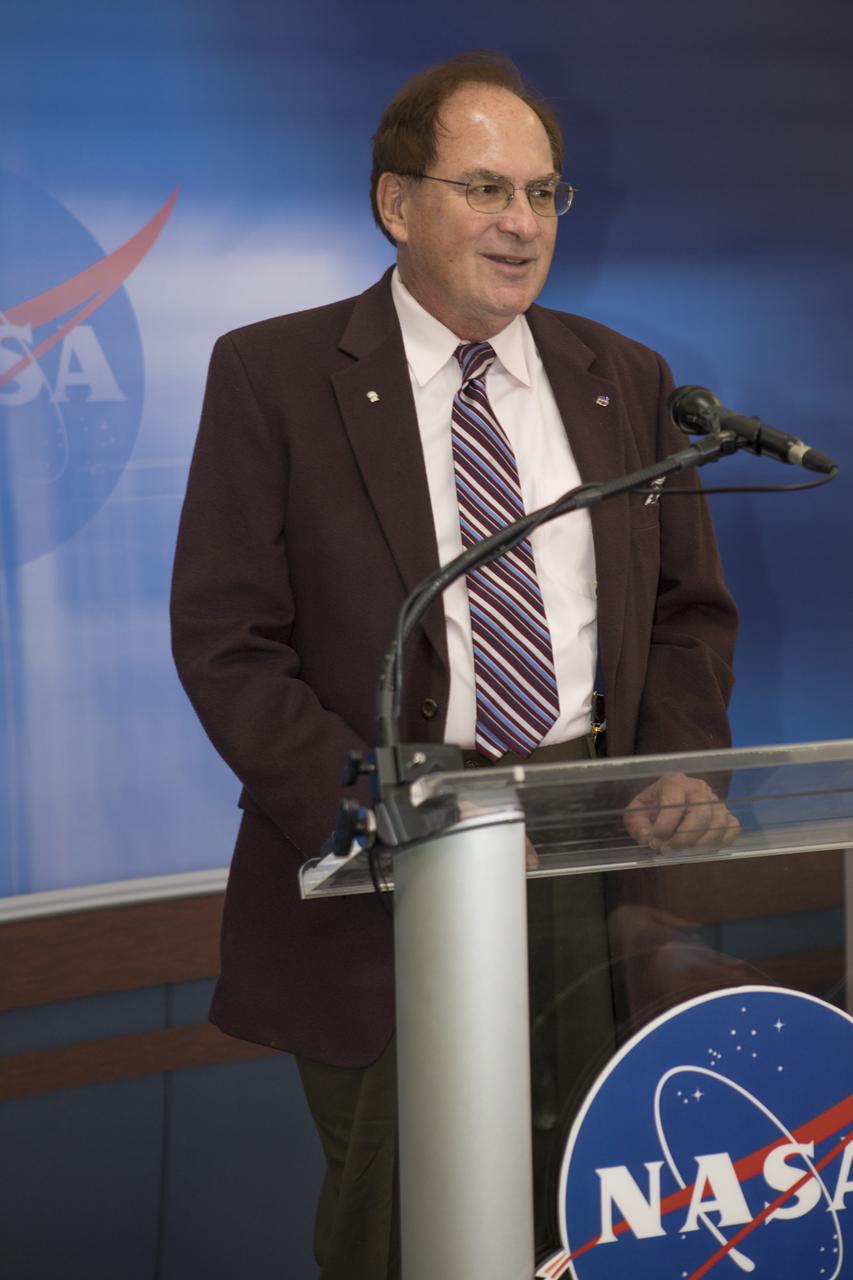
George Diller, who retired in 2017 after a 37-year career in NASA Public Affairs, was honored as a 2018 “Chronicler” during a ceremony at Kennedy Space Center’s NASA News Center in Florida on Friday, May 4. Diller and Craig Covault had their names officially added to the “Chroniclers wall” during the event. “Chroniclers” recognizes retirees of the news and communications business who helped spread news of American space exploration from Kennedy for 10 years or more. Diller was known by many as “The Voice of Kennedy Launch Control.”
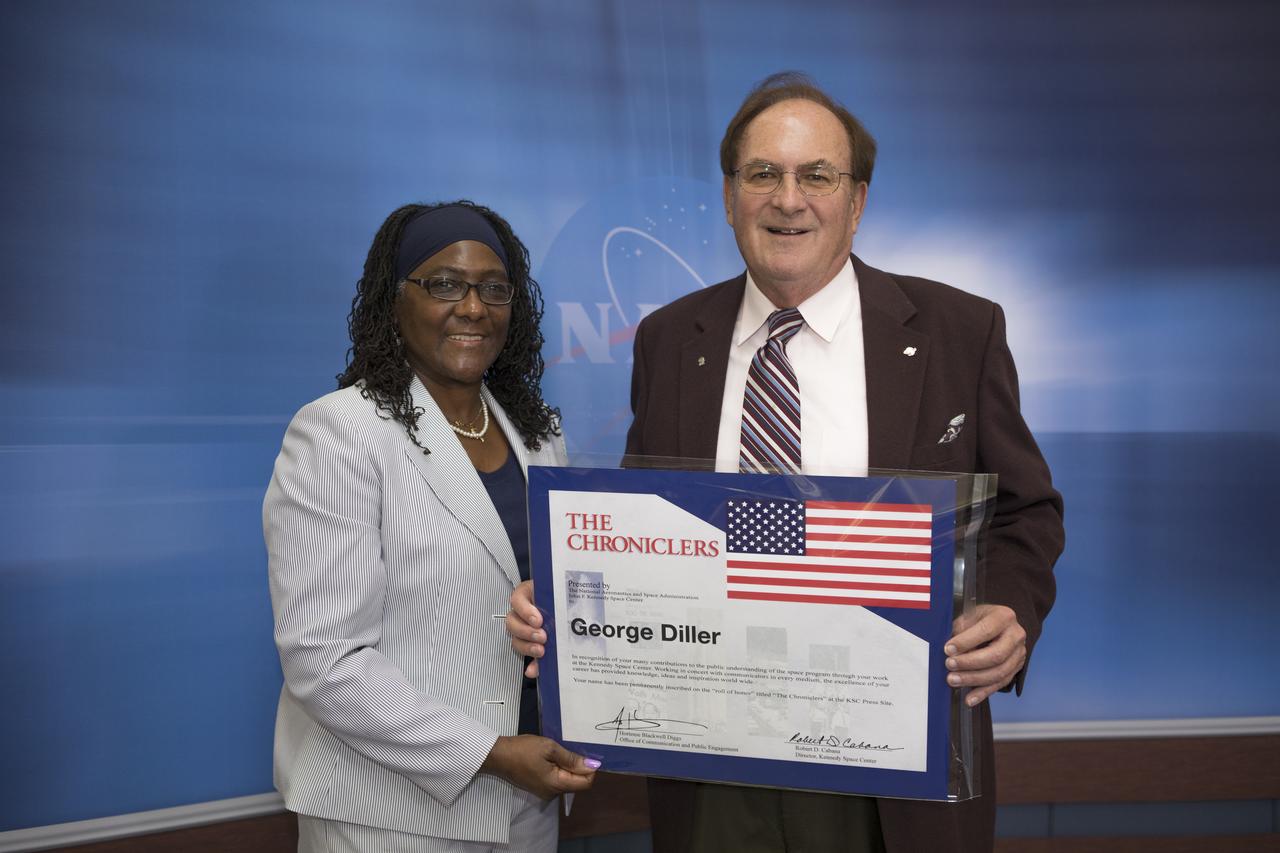
Kennedy Space Center Office of Communication and Public Engagement Deputy Director Hortense Diggs, left, poses with “Chronicler” George Diller during an event at Kennedy’s NASA News Center in Florida on Friday, May 4. Diller, who retired in 2017, had a 37-year career in NASA Public Affairs. “Chroniclers” recognizes retirees of the news and communications business who helped spread news of American space exploration from Kennedy for 10 years or more.
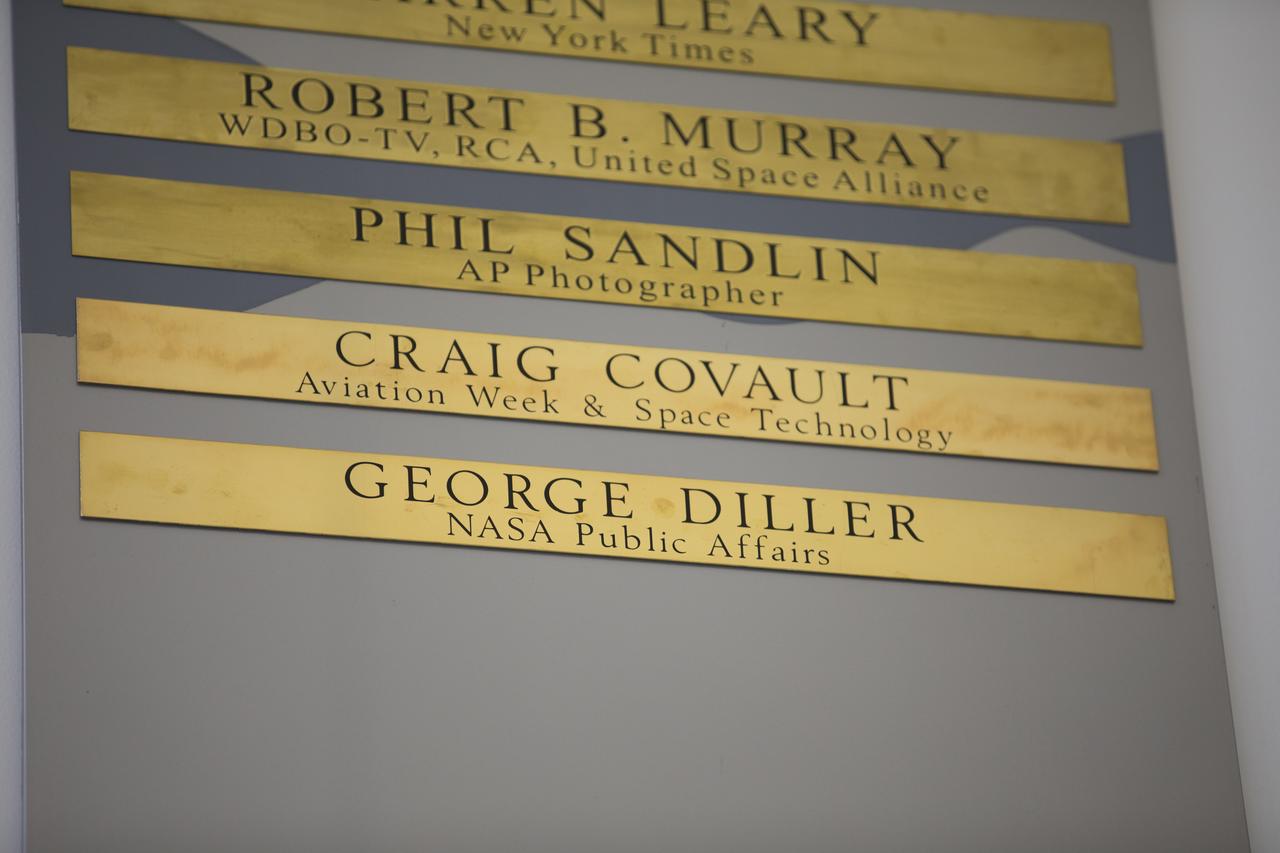
Brass strips engraved with the names of Craig Covault and George Diller were unveiled during a ceremony at Kennedy Space Center’s NASA News Center in Florida on Friday, May 4. Covault covered approximately 100 space shuttle launches and missions during his 48-year career. Diller was known by many as “The Voice of Kennedy Launch Control” during his 37-year career in NASA Public Affairs. “Chroniclers” recognizes retirees of the news and communications business who helped spread news of American space exploration from Kennedy for 10 years or more.
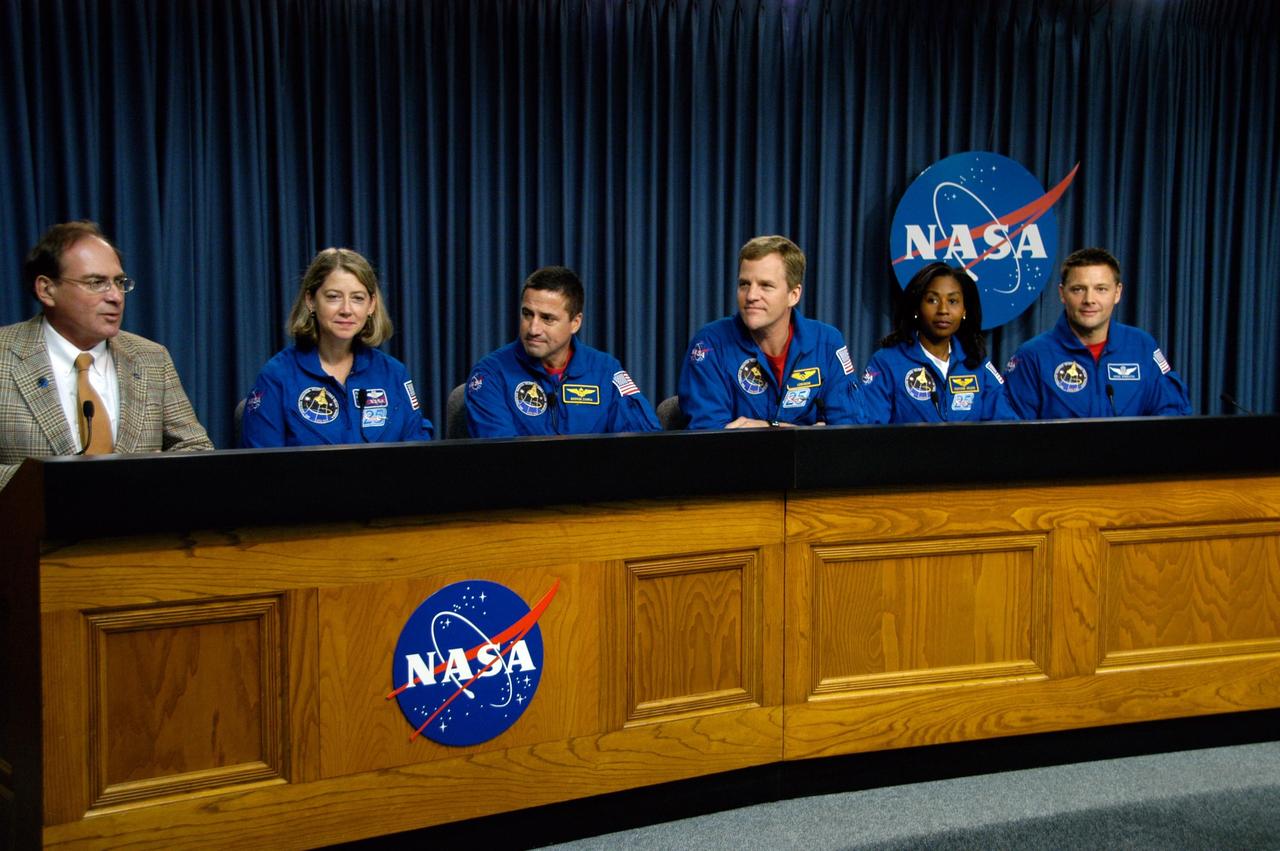
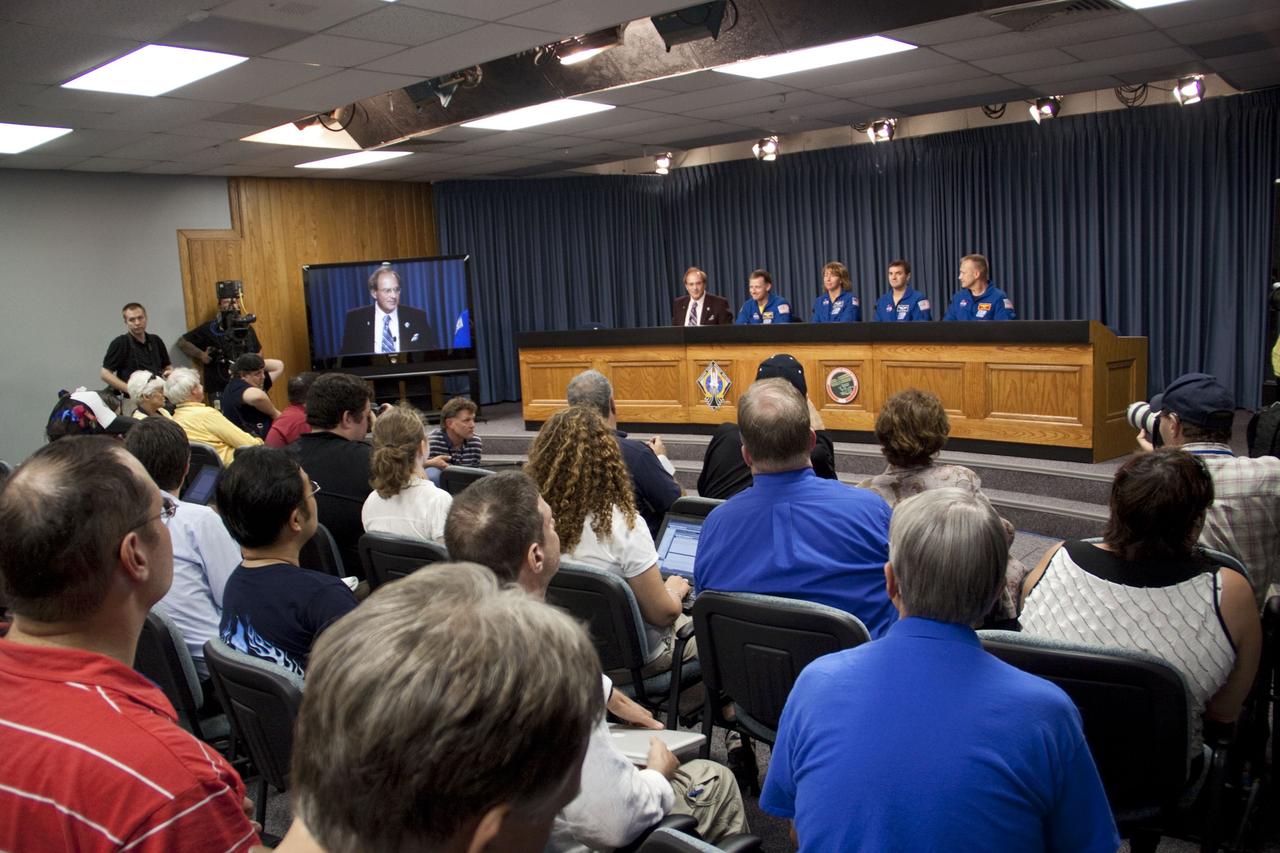
KENNEDY SPACE CENTER, FLA. -- Moderator George Diller, public information officer at the NASA News Center at NASA's Kennedy Space Center, introduces the STS-120 crew after their successful landing aboard space shuttle Discovery earlier in the day. From left are Commander Pamela Melroy, Pilot George Zamka and mission specialists Scott Parazynski, Stephanie Wilson and Doug Wheelock. The crew completed a 15-day mission to the International Space Station with a smooth landing on Runway 33. Main gear touchdown was 1:01:16 p.m. Wheel stop was at 1:02:07 p.m. Mission elapsed time was 15 days, 2 hours, 24 minutes and 2 seconds. Mission STS-120 continued the construction of the station with the installation of the Harmony Node 2 module and the relocation of the P6 truss. Photo credit: NASA/George Shelton
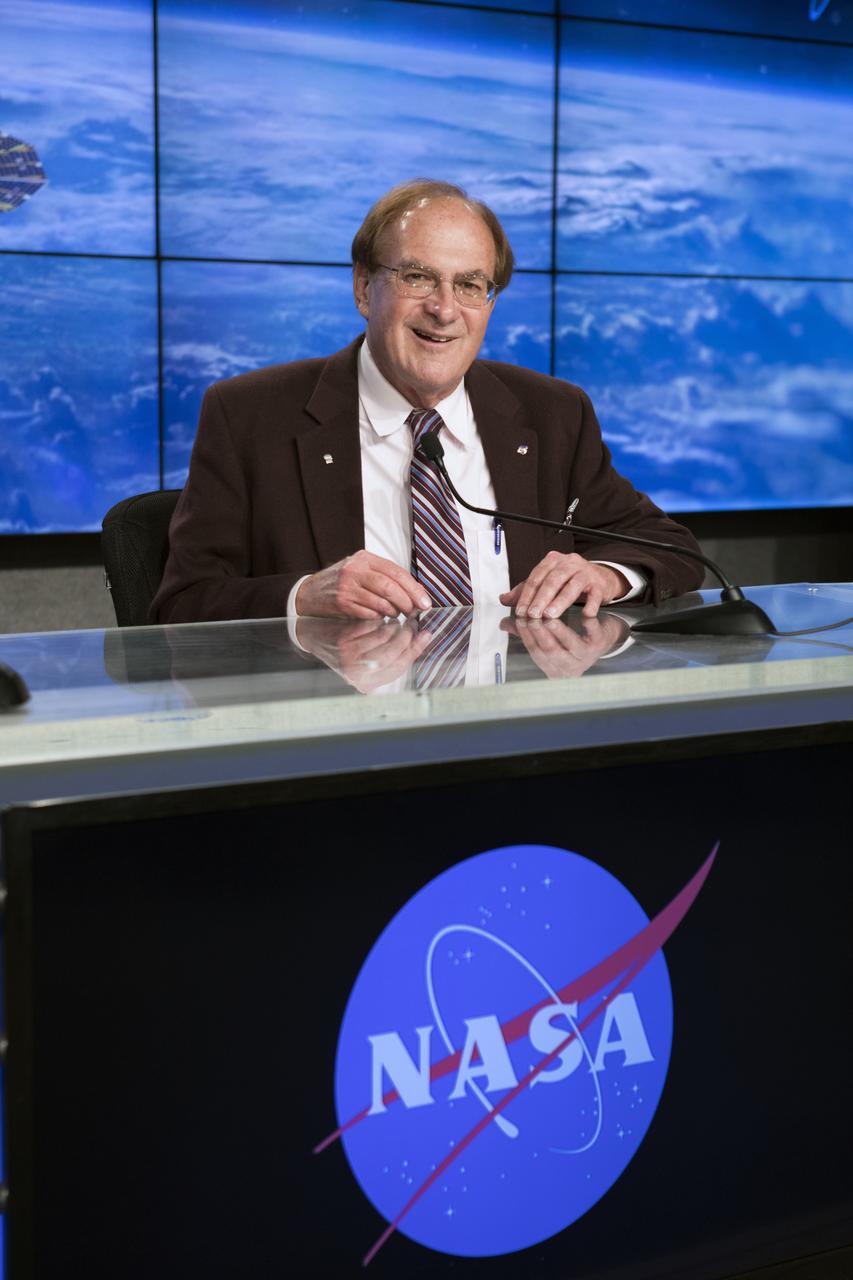
Members of the news media attend a press conference at NASA's Kennedy Space Center in Florida, after the launch of the Orbital ATK Cygnus pressurized cargo module atop a United Launch Alliance Atlas V rocket from Space Launch Complex 41 at Cape Canaveral Air Force Station. It was Orbital ATK's seventh commercial resupply services mission to the International Space Station. Liftoff was at 11:11 a.m. EDT. Moderating the press conference is George Diller, NASA Kennedy Communications.

Members of the news media attend a press conference at NASA's Kennedy Space Center in Florida, after the launch of the Orbital ATK Cygnus pressurized cargo module atop a United Launch Alliance Atlas V rocket from Space Launch Complex 41 at Cape Canaveral Air Force Station. It was Orbital ATK's seventh commercial resupply services mission to the International Space Station. Liftoff was at 11:11 a.m. EDT. Moderating the press conference is George Diller, NASA Kennedy Communications.
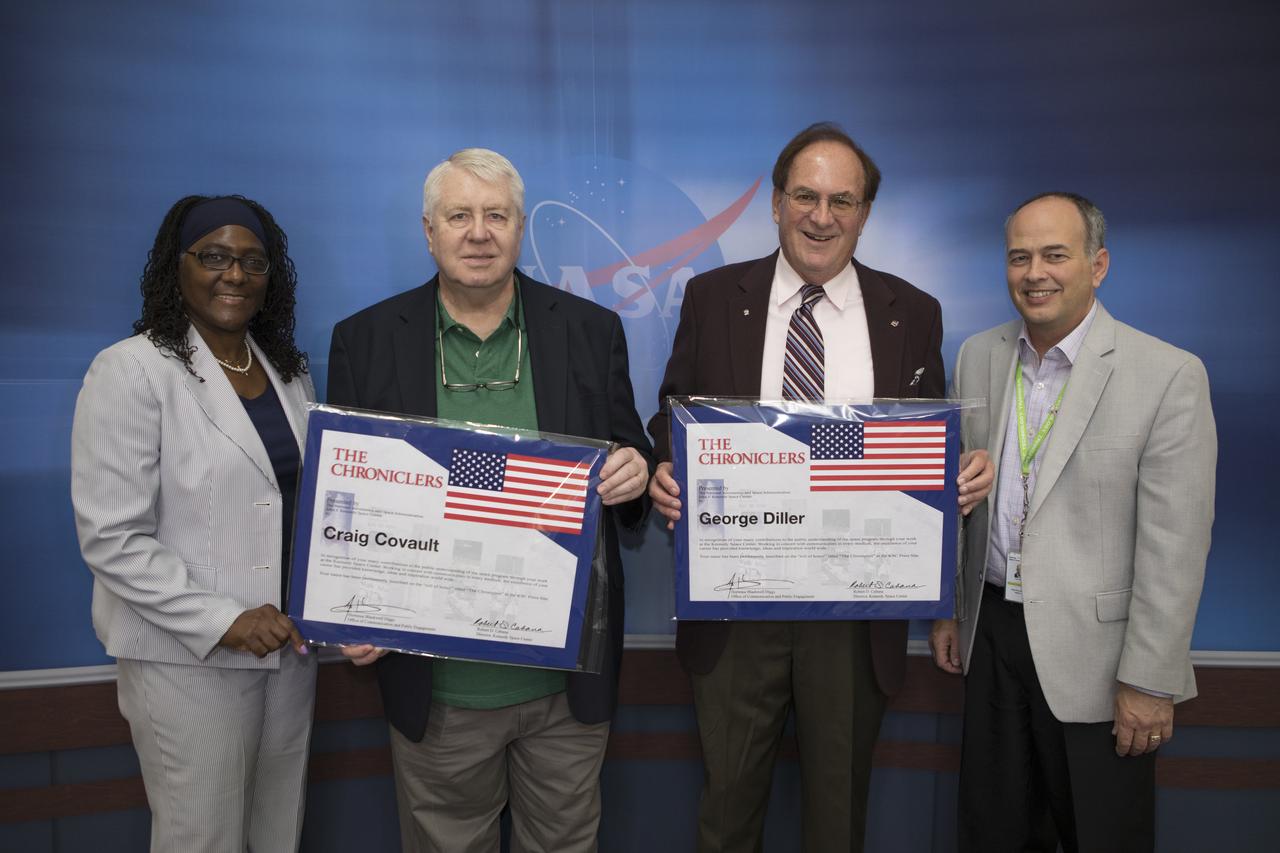
Craig Covault and George Diller are the newest additions to the “Chroniclers wall,” which recognizes retirees of the news and communications business who helped spread news of American space exploration from Kennedy Space Center in Florida for 10 years or more. The two men were honored during a gathering at Kennedy’s NASA News Center on Friday, May 4. Posing with the inductees are, far left, Hortense Diggs, Office of Communication and Public Engagement deputy director at Kennedy; and far right, Kennedy Office of Communication Division Chief David Culp.
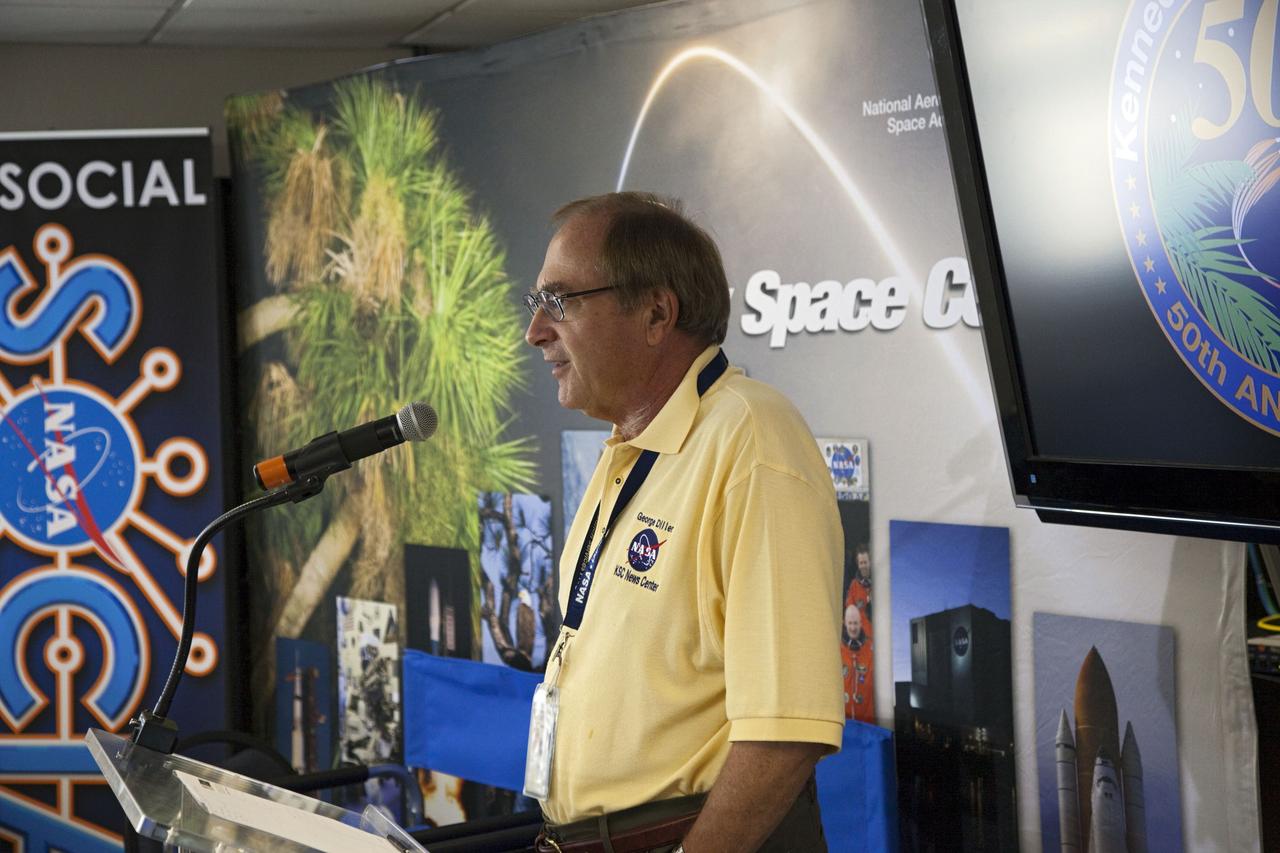
CAPE CANAVERAL, Fla. -- NASA Public Affairs Officer George Diller speaks to about 45 of NASA’s social media followers during two days of presentations on the Kennedy's past, present and future. The social media participants gathered at the Florida spaceport on Aug. 2 and 3, 2012 to hear from key former and current leaders who related stories of the space agency's efforts to explore the unknown. It was the first social media event totally run by Kennedy. Photo credit: NASA/ Gianni Woods
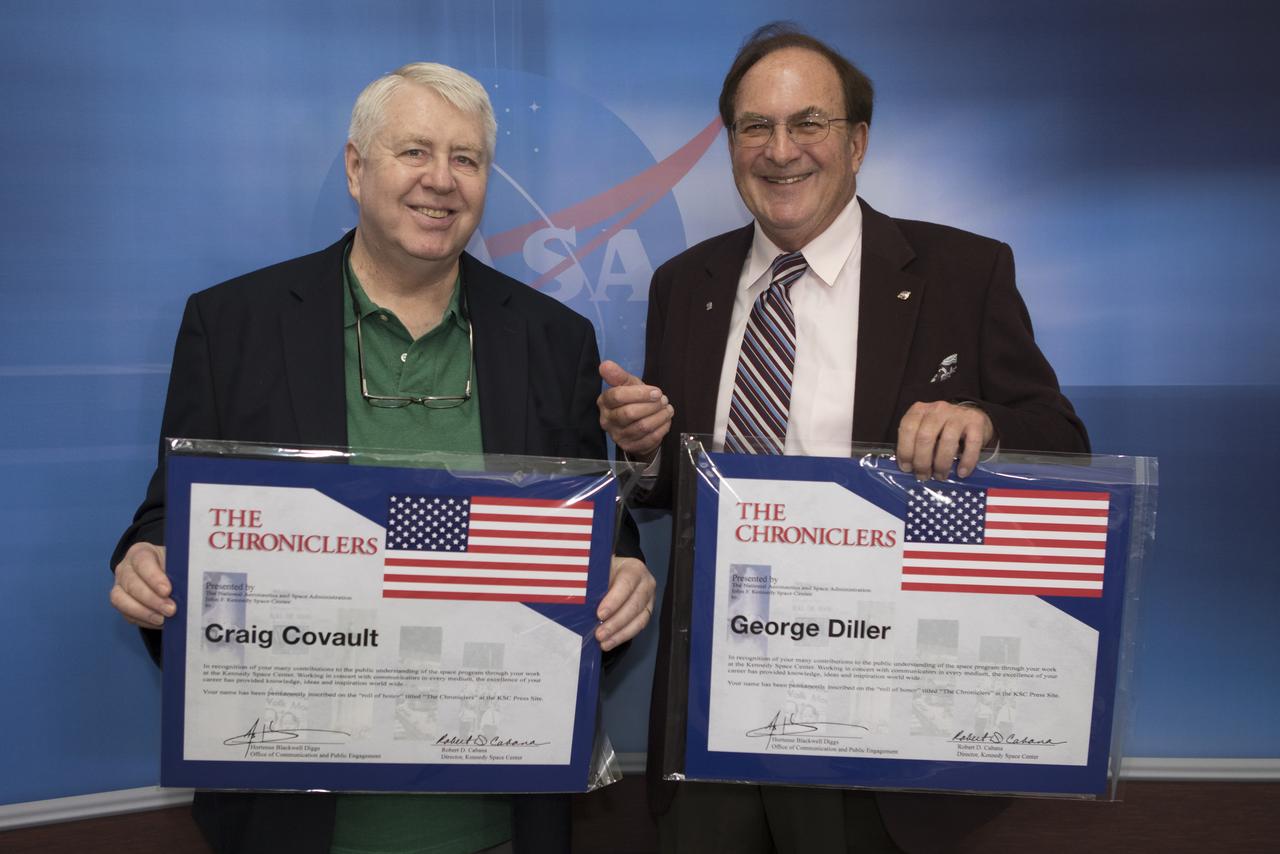
Craig Covault, left, and George Diller were honored as “Chroniclers” during an event at Kennedy Space Center’s NASA News Center on Friday, May 4. The longtime friends combined for more than 80 years of U.S. space exploration news reporting. “Chroniclers” recognizes retirees of the news and communications business who helped spread news of American space exploration from Kennedy for 10 years or more.
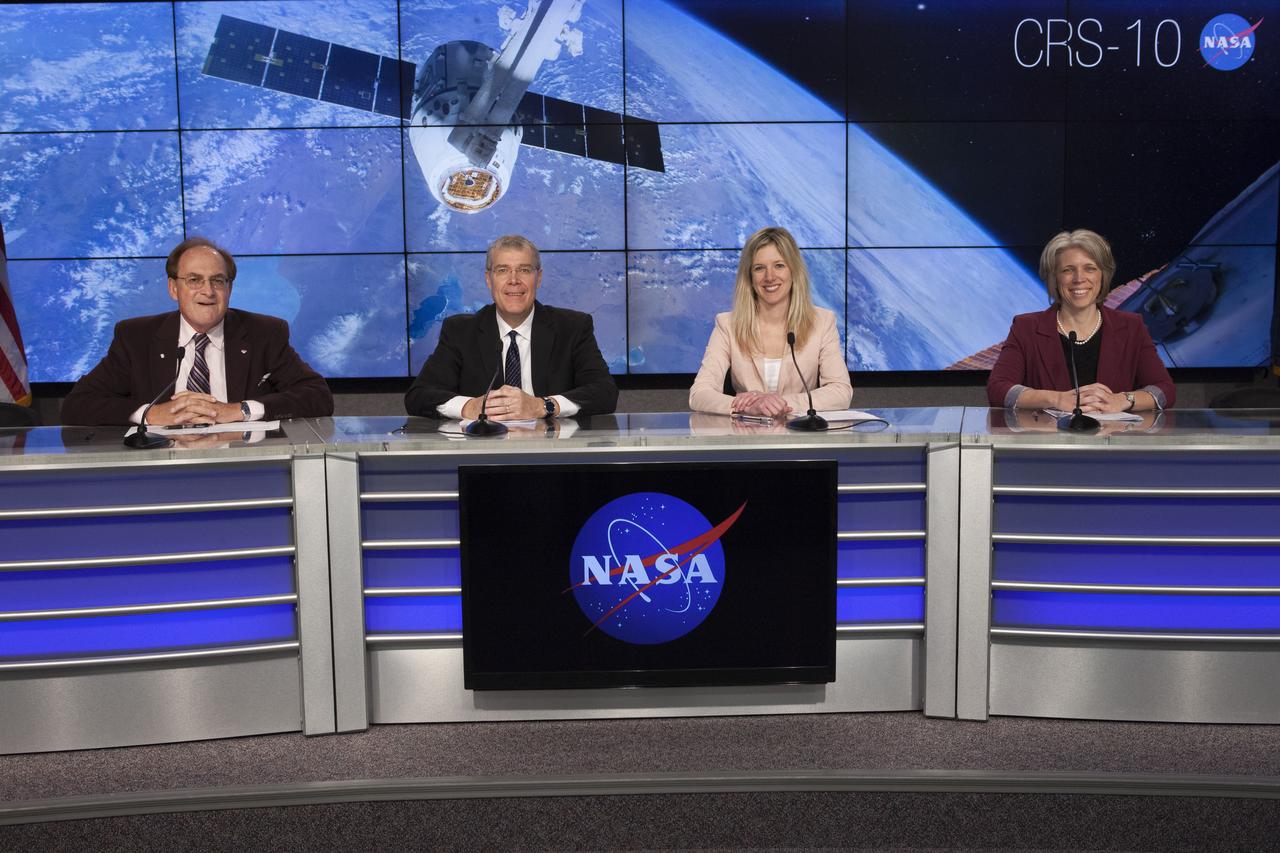
In the Kennedy Space Center’s Press Site auditorium, agency and industry leaders speak to members of the media at a prelaunch news conference for the SpaceX CRS-10 commercial resupply services mission to the International Space Station. From left are: George Diller of NASA Communications; Dan Hartman, deputy manager for the International Space Station Program at NASA's Johnson Space Center in Texas; Jessica Jensen, director of Dragon mission management for SpaceX; and Tara Ruttley, associate scientist for the International Space Station Program at Johnson.
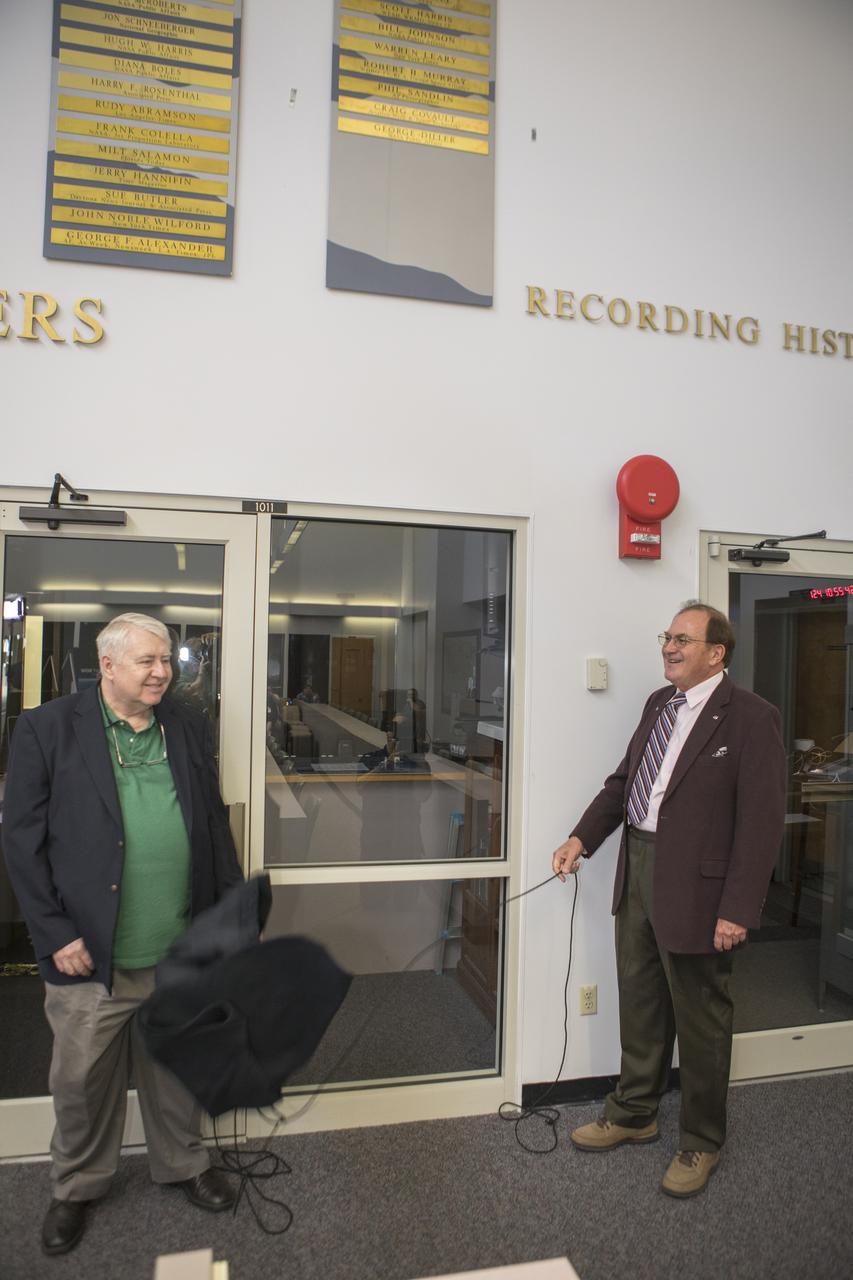
Craig Covault, left, and George Diller unveil their names on the “Chroniclers wall” during a gathering of the honorees’ friends, family, media, and current and former NASA officials at Kennedy Space Center’s NASA News Center in Florida on Friday, May 4. “Chroniclers” recognizes retirees of the news and communications business who helped spread news of American space exploration from Kennedy for 10 years or more. The two men combined for 85 years of U.S. space exploration coverage.
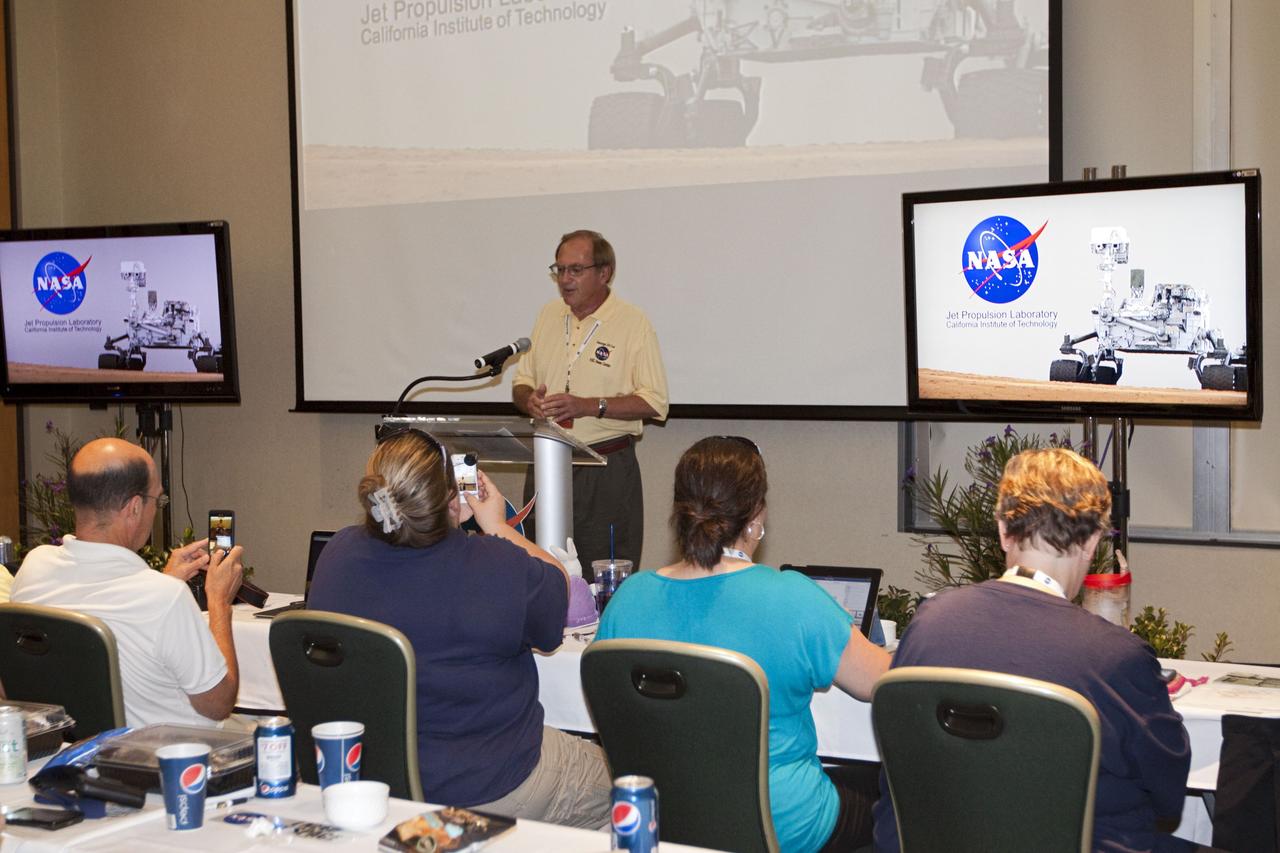
CAPE CANAVERAL, Fla. -- NASA Public Affairs Officer George Diller speaks to about 45 of NASA’s social media followers during two days of presentations on the Kennedy's past, present and future. The social media participants gathered at the Florida spaceport on Aug. 2 and 3, 2012 to hear from key former and current leaders who related stories of the space agency's efforts to explore the unknown. It was the first social media event totally run by Kennedy. Photo credit: NASA/ Kim Shiflett
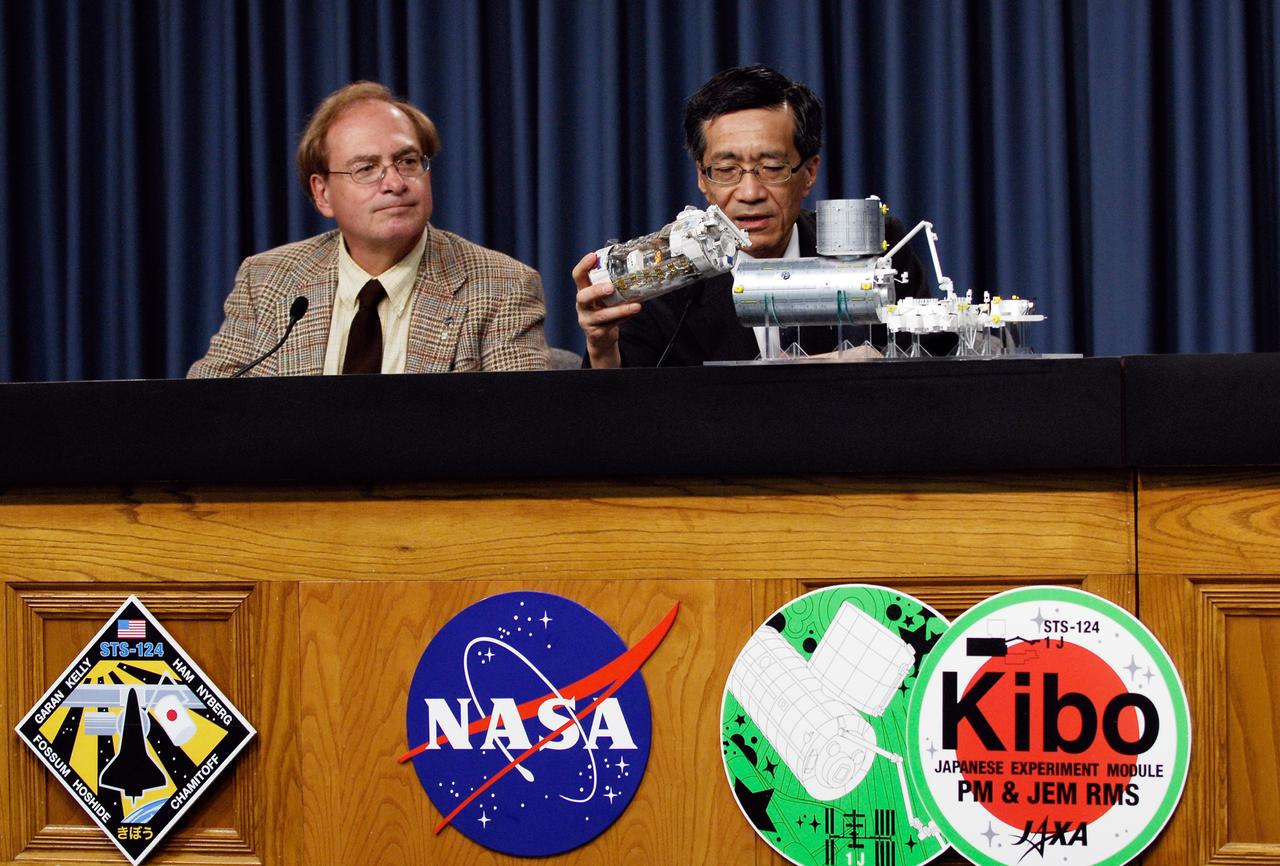
CAPE CANAVERAL, Fla. -- At a Japan Aerospace Exploration Agency briefing, Japanese Experiment Module Program Manager Yoshiyuki Hasegawa (right) explains how the Japanese Experiment Module – Pressurized Module will fit with the other segments on the International Space Station. The final segment of the Kibo laboratory will be delivered to the space station on the STS-124 mission, which is scheduled to launch May 31. NASA spokesman George Diller is at left. Photo credit: NASA/Kim Shiflett
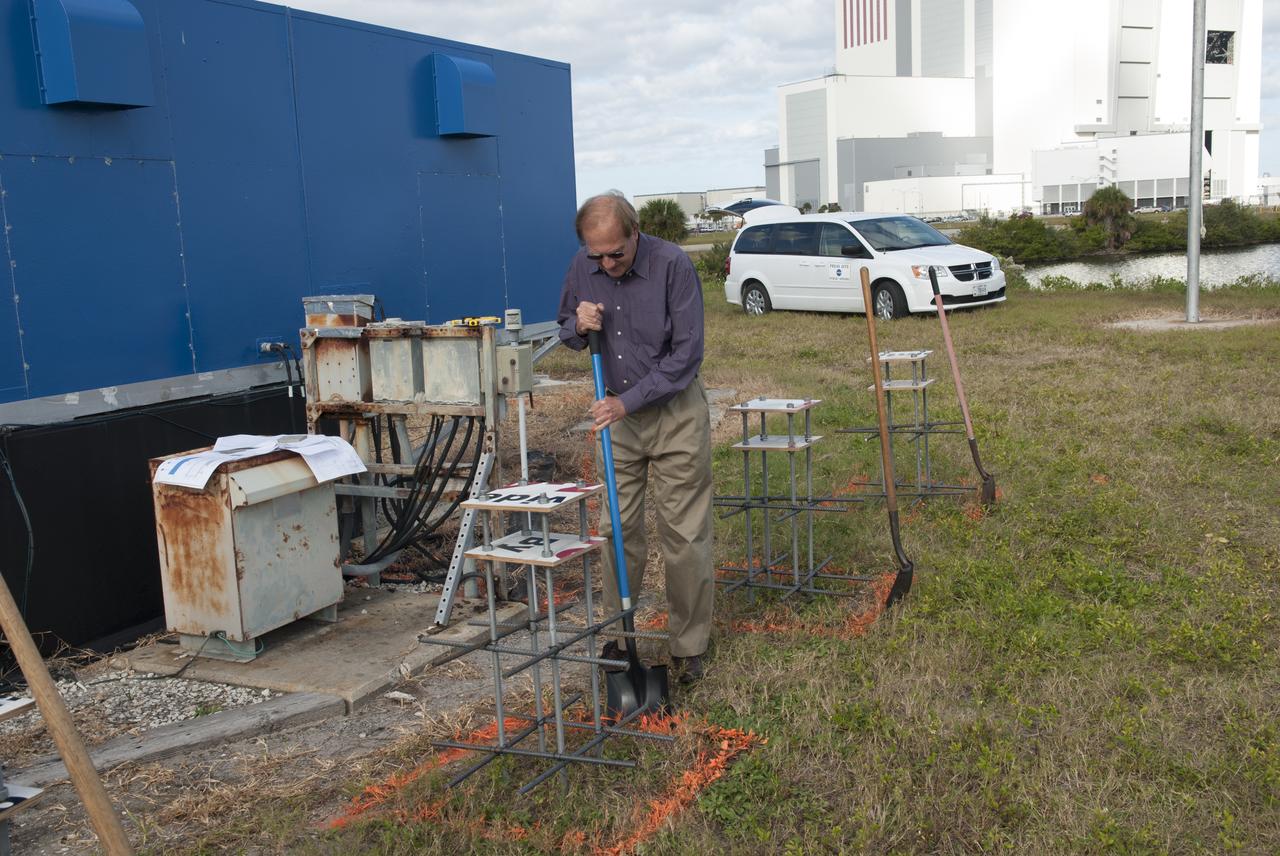
At NASA's Kennedy Space Center in Florida, Public Affairs Officer George Diller digs in behind the current countdown clock during the groundbreaking ceremony for the new countdown clock. The old timepiece was designed by Kennedy engineers and built by Kennedy technicians in 1969. Not including the triangular concrete and aluminum base, the famous landmark is nearly 6 feet 70 inches high, 26 feet 315 inches wide and 3 feet deep. The new display will be similar in size, with the screen being nearly 26 feet wide by 7 feet high.
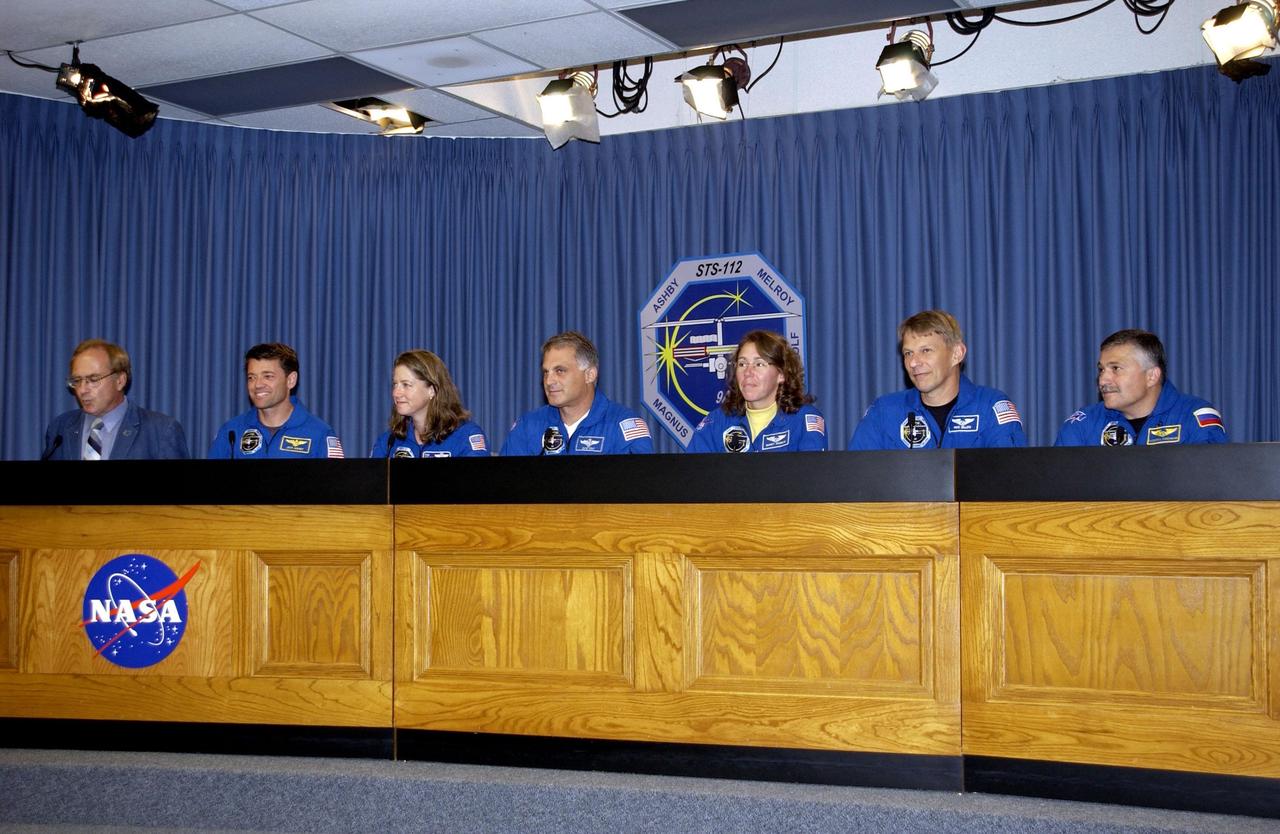
KENNEDY SPACE CENTER, FLA. -- The STS-112 crew takes part in a post-landing briefing for the media. Moderating, at left, is George Diller, with the NASA News Center. The crew, from left, are Commander Jeffrey Ashby, Pilot Pamela Melroy and Mission Specialists David Wolf, Sandra Magnus, Piers Sellers and cosmonaut Fyodor Yurchikhin. Mission STS-112 was the 15th assembly flight to the International Space Station, installing the S1 truss. The landing was the 60th at KSC in the history of the Shuttle program.
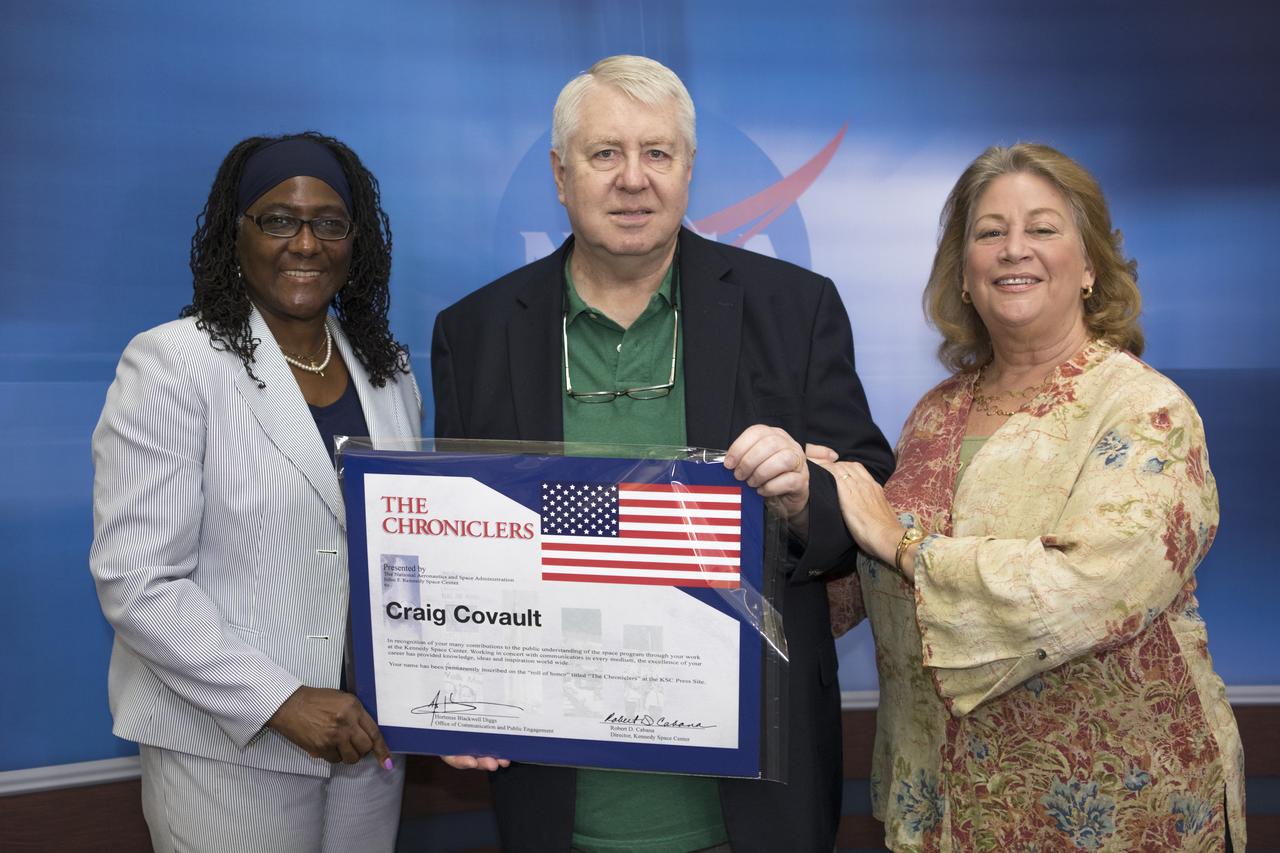
Craig Covault and George Diller were honored as the 75th and 76th members of the “Chroniclers” roll of honor during an event at Kennedy Space Center’s NASA News Center in Florida on Friday, May 4. From left to right are Hortense Diggs, deputy director of Kennedy’s Office of Communication and Public Engagement, Craig Covault, and Covault’s wife, Nancy. “Chroniclers” recognizes retirees of the news and communications business who helped spread news of American space exploration from Kennedy for 10 years or more.

KENNEDY SPACE CENTER, FLA. - NASA public affairs specialist George Diller (left) is honored with a Harry Kolcum Memorial News and Communications Award for 2004 by the National Space Club Florida Committee at the Radisson Resort at the Port, Cape Canaveral, Fla. He is joined by Marcie Young, wife of the late chief of NASA news operations at Kennedy Space Center, Dick Young, with whom Diller worked for many years. Each year, the National Space Club Florida Committee recognizes area representatives of the news media and communications professions for excellence in their ability to communicate the space story along Florida’s Space Coast and throughout the world. The award is named in honor of Harry Kolcum, the former managing editor of Aviation Week and Space Technology, who was Cape bureau chief from 1980 to 1993 prior to his death in 1994. Kolcum was a founding member of the National Space Club Florida Committee.
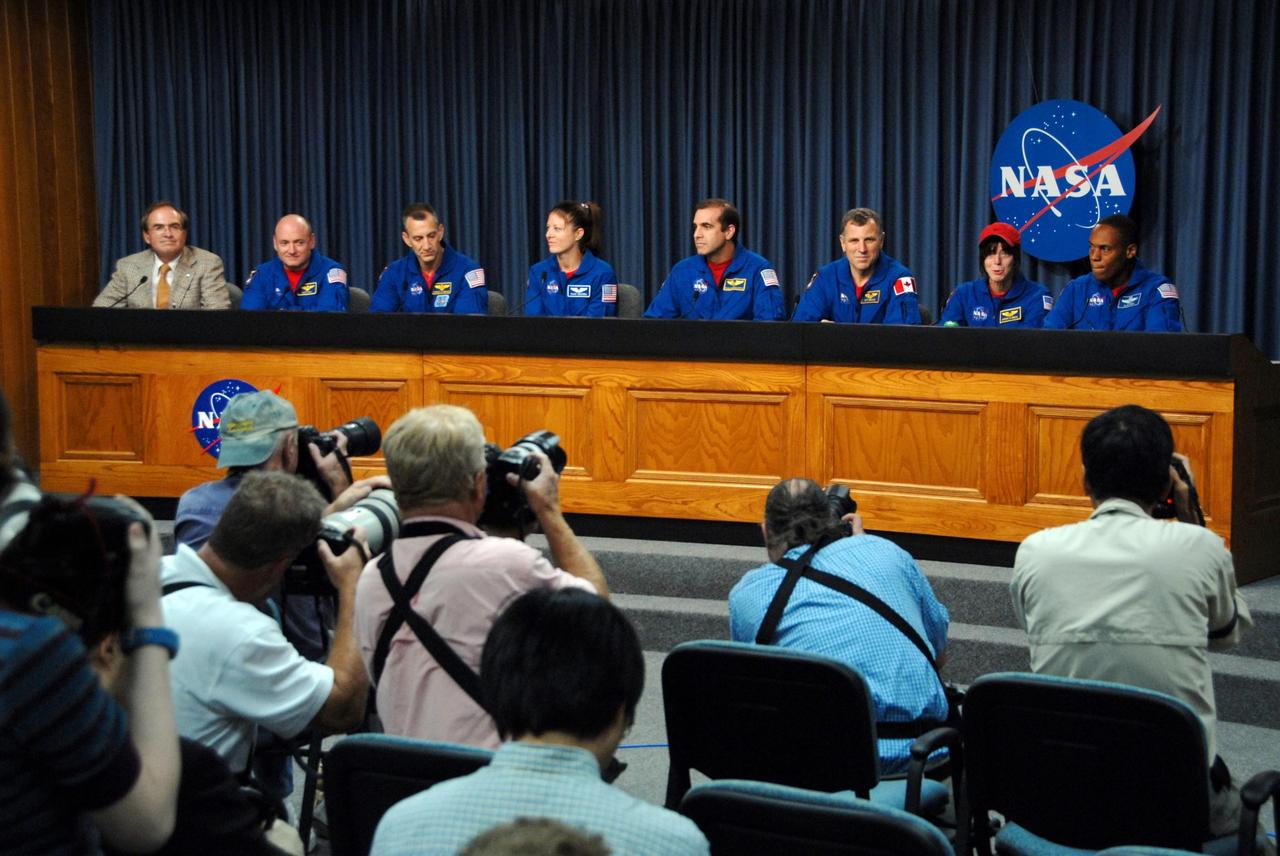
KENNEDY SPACE CENTER, FLA. -- At the NASA television studio, photographers focus on STS-118 Mission Specialist Barbara R. Morgan (second from right) as she answers a question about her experiences during the mission. Others seated at the dais (from left) are NASA Public Information Officer George Diller, Commander Scott Kelly, Pilot Charlie Hobaugh and Mission Specialists Tracy Caldwell, Rick Mastracchio, Dave Williams and Alvin Drew. The crew has just returned from a 13-day mission to the International Space Station. On the mission, the crew installed a new gyroscope, an external spare parts platform and another truss segment to the expanding station. STS-118 was the 119th space shuttle flight, the 22nd flight to the station, the 20th flight for Endeavour and the second of four missions planned for 2007. Photo credit: NASA/George Shelton
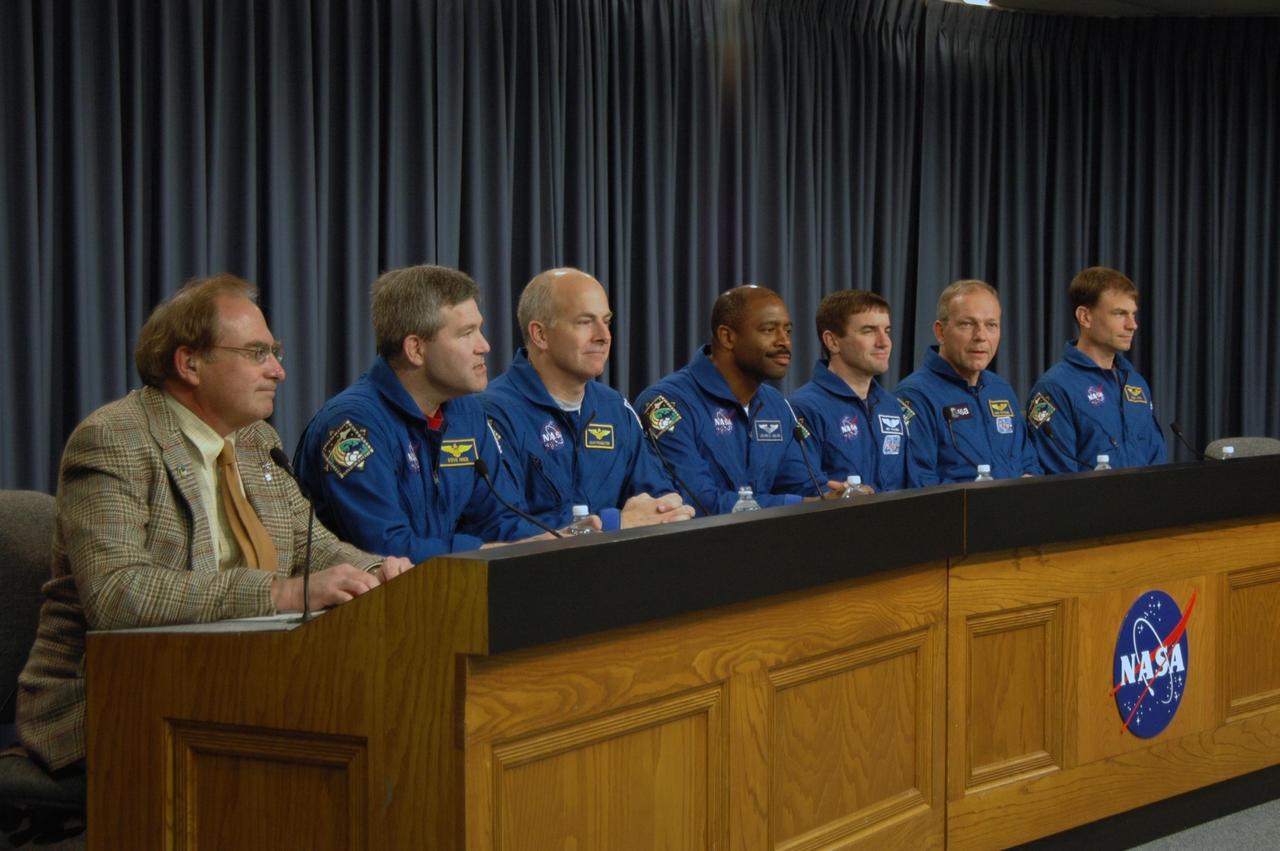
KENNEDY SPACE CENTER, FLA. -- The STS-122 crew discusses its mission at a post-landing conference. Moderating at left is NASA Public Affairs Officer George Diller. The crewmembers, from left, are Commander Steve Frick, Pilot Alan Poindexter and Mission Specialists Leland Melvin, Rex Walheim, Hans Schlegel and Stanley Love. After a round trip of nearly 5.3 million miles, space shuttle Atlantis and crew returned to Earth with a landing at 9:07 a.m. EST on Runway 15 at NASA's Kennedy Space Center. Photo credit: NASA/Jack Pfaller
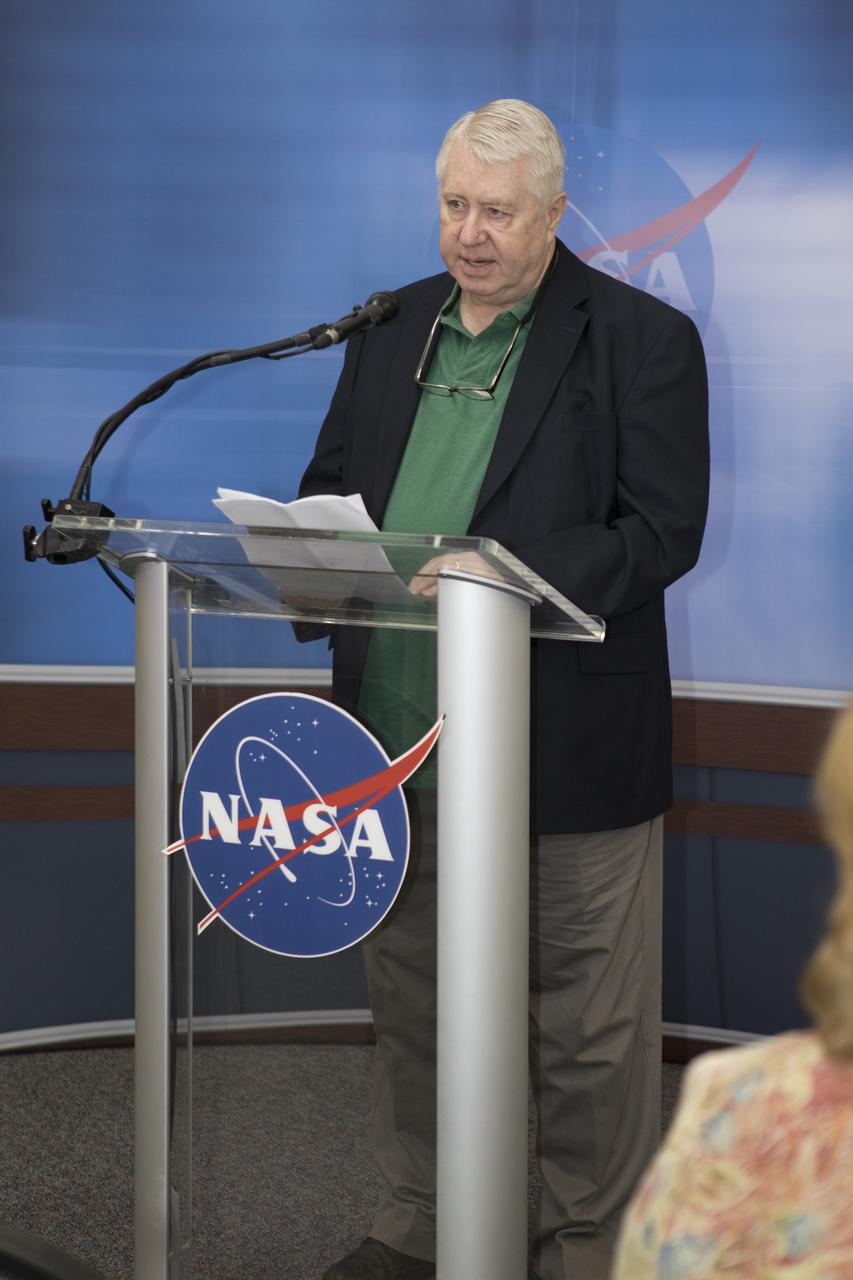
Craig Covault covered approximately 100 space shuttle launches and missions from Kennedy Space Center in Florida during his 48-year career writing about space and aeronautics. Covault, who is credited with 2,000 news and feature stories for Aviation Week & Space Technology, was installed as a member of the “Chroniclers” during a ceremony at Kennedy’s NASA News Center on Friday, May 4. “Chroniclers” recognizes retirees of the news and communications business who helped spread news of American space exploration from Kennedy for 10 years or more. George Diller also earned a spot on the “Chroniclers wall” at the event.
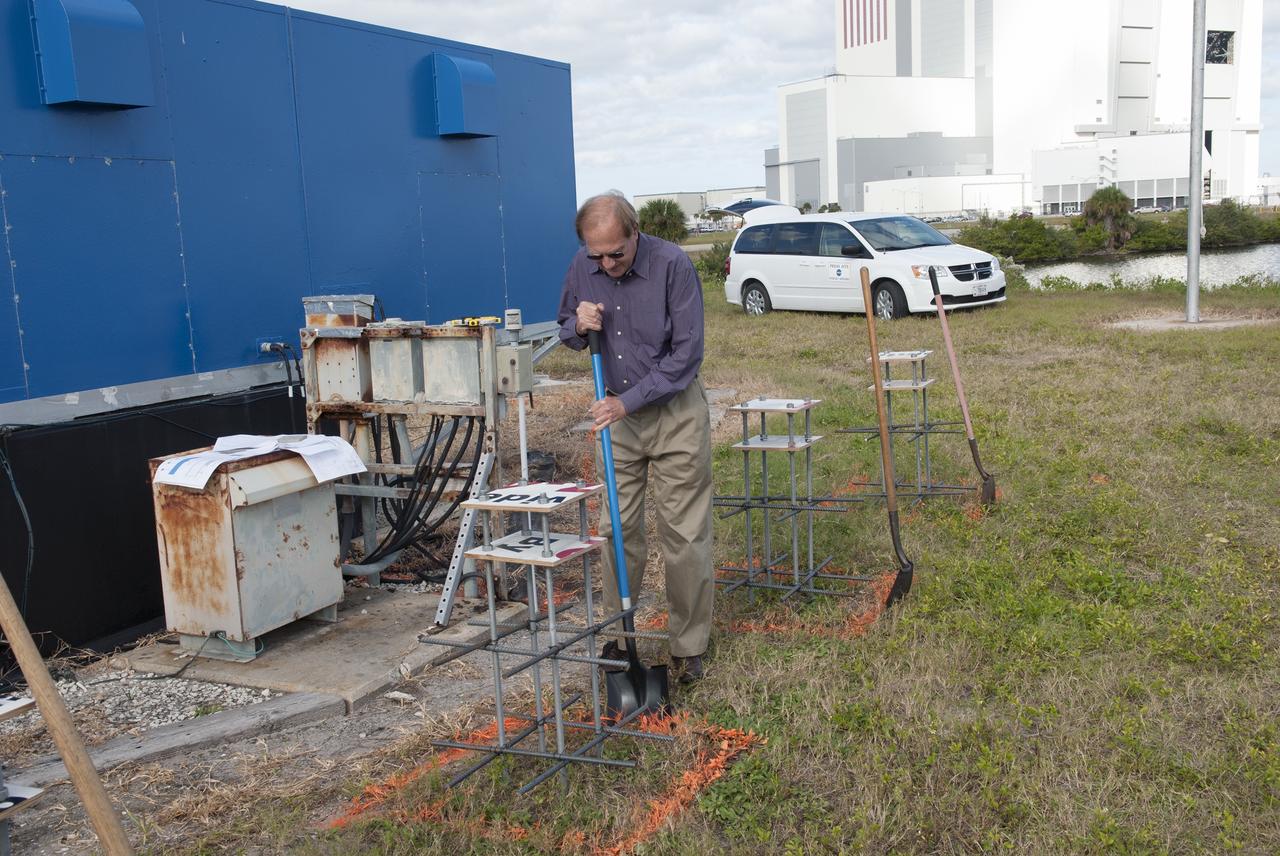
CAPE CANAVERAL, Fla. -- At NASA's Kennedy Space Center in Florida, Public Affairs Officer George Diller digs in behind the current countdown clock during the groundbreaking ceremony for the new countdown clock. The old timepiece was designed by Kennedy engineers and built by Kennedy technicians in 1969. Not including the triangular concrete and aluminum base, the famous landmark is nearly 6 feet 70 inches high, 26 feet 315 inches wide and 3 feet deep. The new display will be similar in size, with the screen being nearly 26 feet wide by 7 feet high. For more information on the countdown clock, go to http://go.nasa.gov/10Zku10. Photo credit: NASA/Jim Grossmann
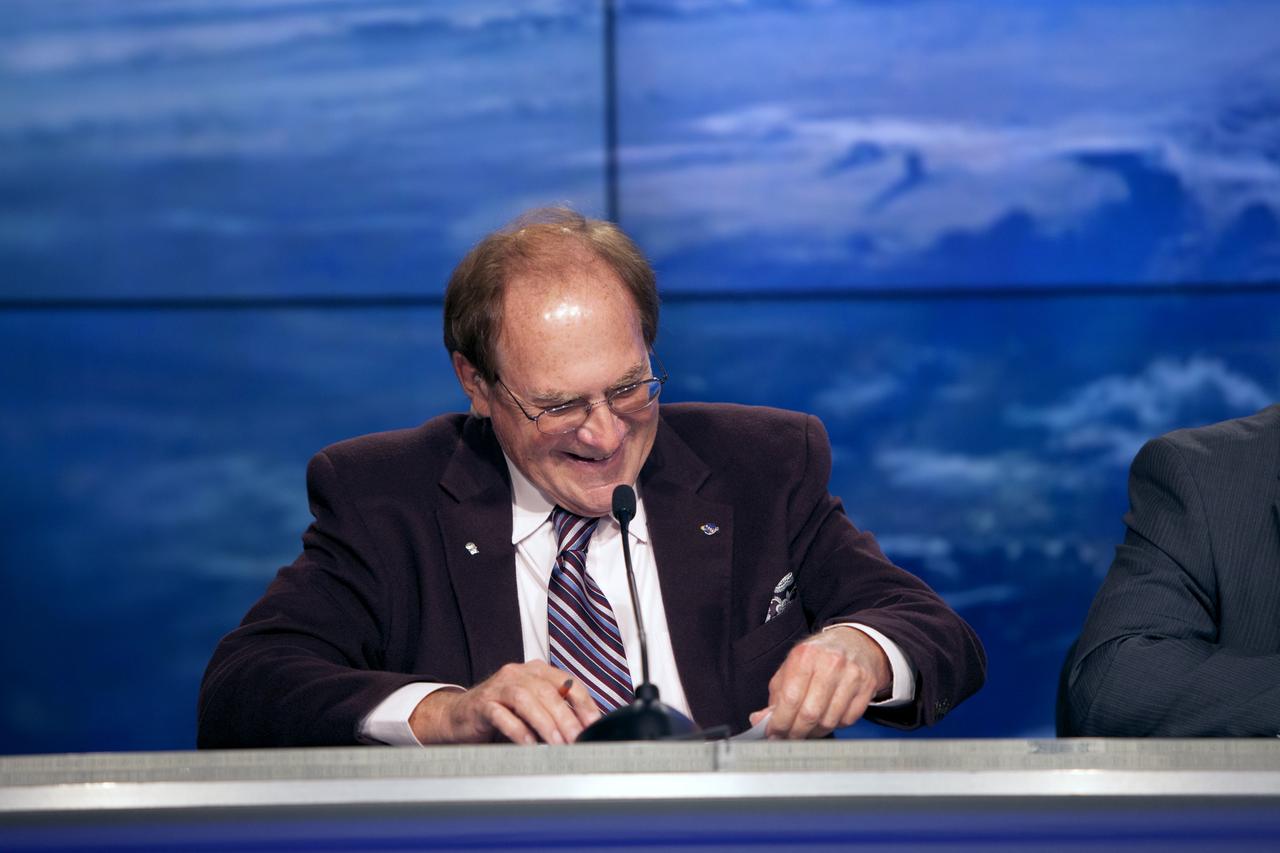
A prelaunch status briefing for Orbital ATK's seventh commercial resupply mission, CRS-7, to the International Space Station, is held at NASA Kennedy Space Center's Press Site in Florida. Moderating the briefing is George Diller, NASA Kennedy Public Affairs. Orbital ATK's Cygnus pressurized cargo module is set to launch atop the ULA Atlas V rocket from Space Launch Complex 41 at Cape Canaveral Air Force Station on April 18. Cygnus will deliver 7,600 pounds of supplies, equipment and scientific research materials to the space station. Liftoff is scheduled for 11:11 a.m. EDT.
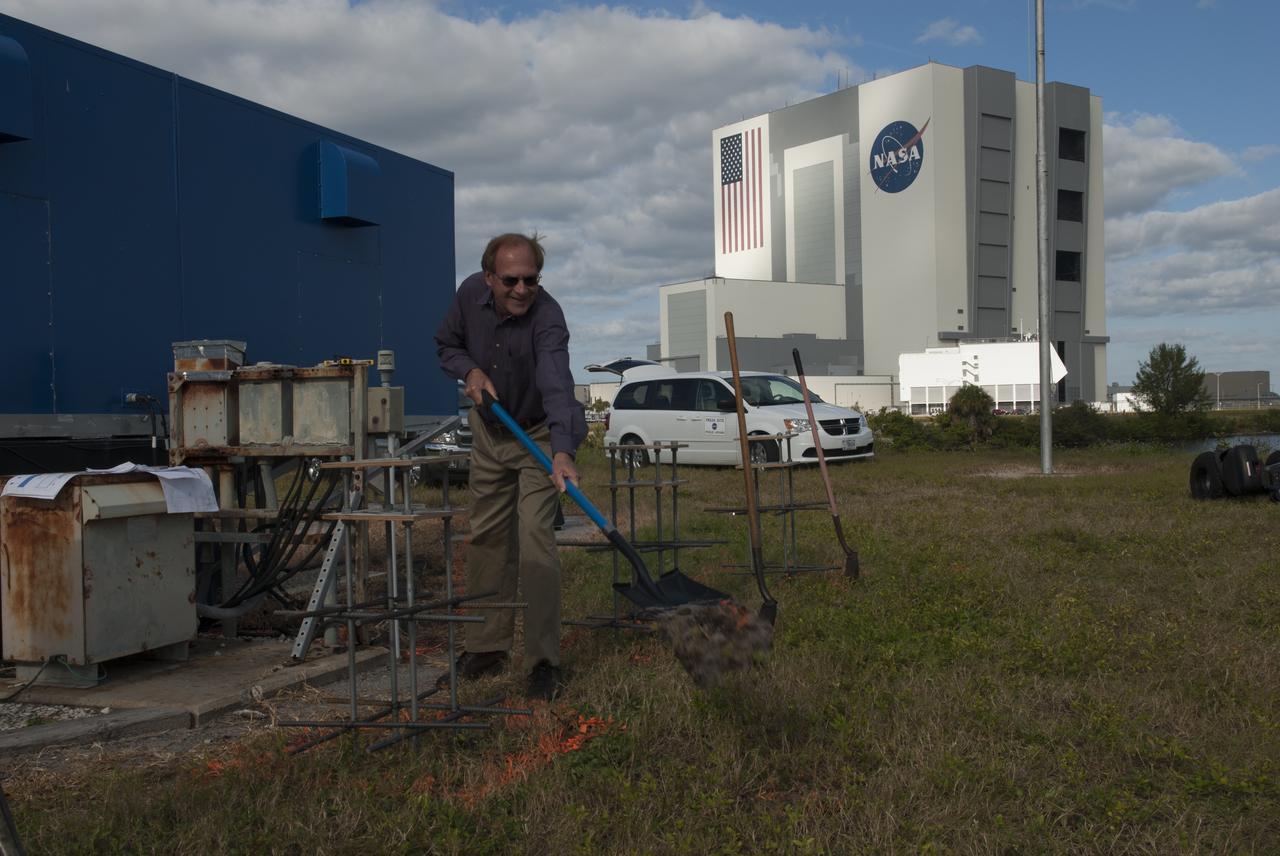
At NASA's Kennedy Space Center in Florida, Public Affairs Officer George Diller shovels the first scoop of soil behind the current countdown clock during the groundbreaking ceremony for the new countdown clock. The old timepiece was designed by Kennedy engineers and built by Kennedy technicians in 1969. Not including the triangular concrete and aluminum base, the famous landmark is nearly 6 feet 70 inches high, 26 feet 315 inches wide and 3 feet deep. The new display will be similar in size, with the screen being nearly 26 feet wide by 7 feet high.
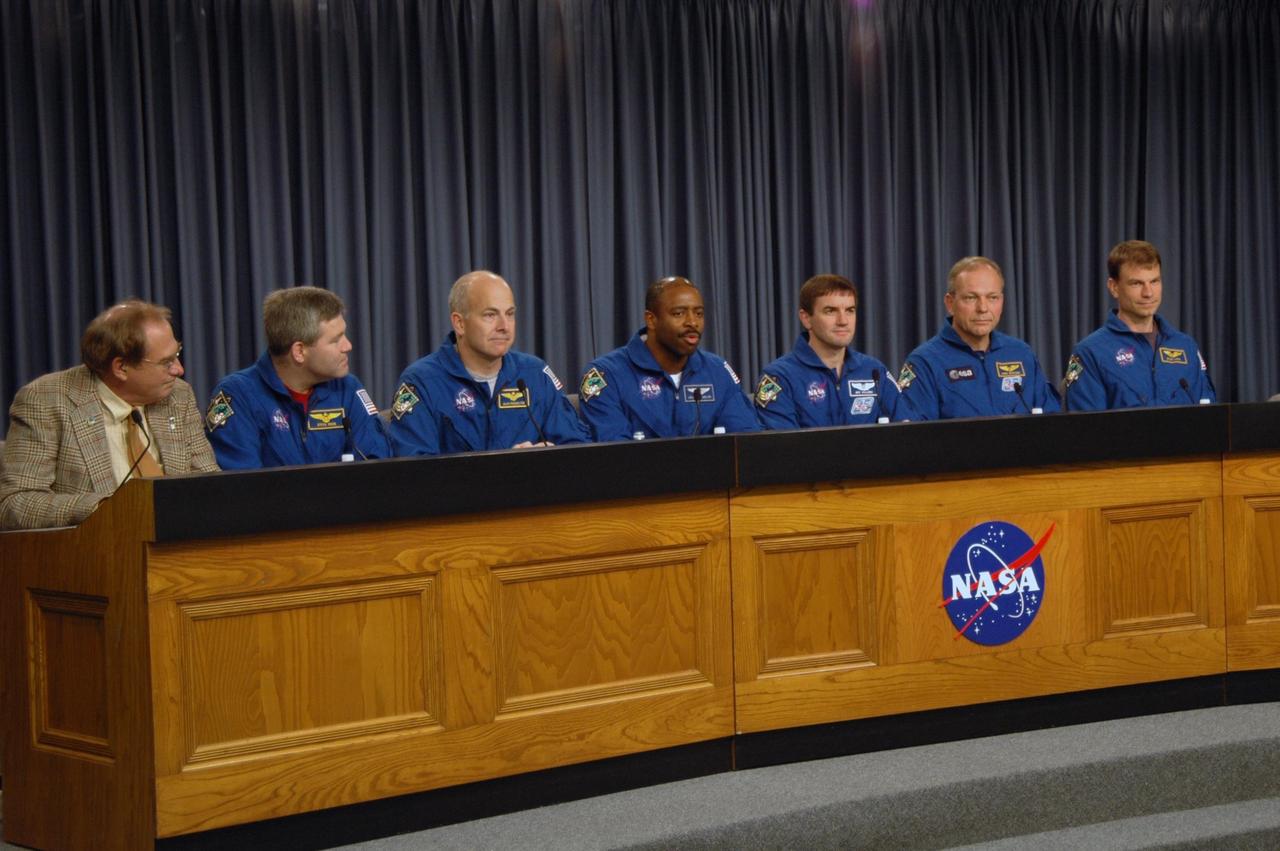
KENNEDY SPACE CENTER, FLA. -- The STS-122 crew discusses its mission at a post-landing conference. Moderating at left is NASA Public Affairs Officer George Diller. The crewmembers, from left, are Commander Steve Frick, Pilot Alan Poindexter and Mission Specialists Leland Melvin, Rex Walheim, Hans Schlegel and Stanley Love. After a round trip of nearly 5.3 million miles, space shuttle Atlantis and crew returned to Earth with a landing at 9:07 a.m. EST on Runway 15 at NASA's Kennedy Space Center. Photo credit: NASA/Jack Pfaller
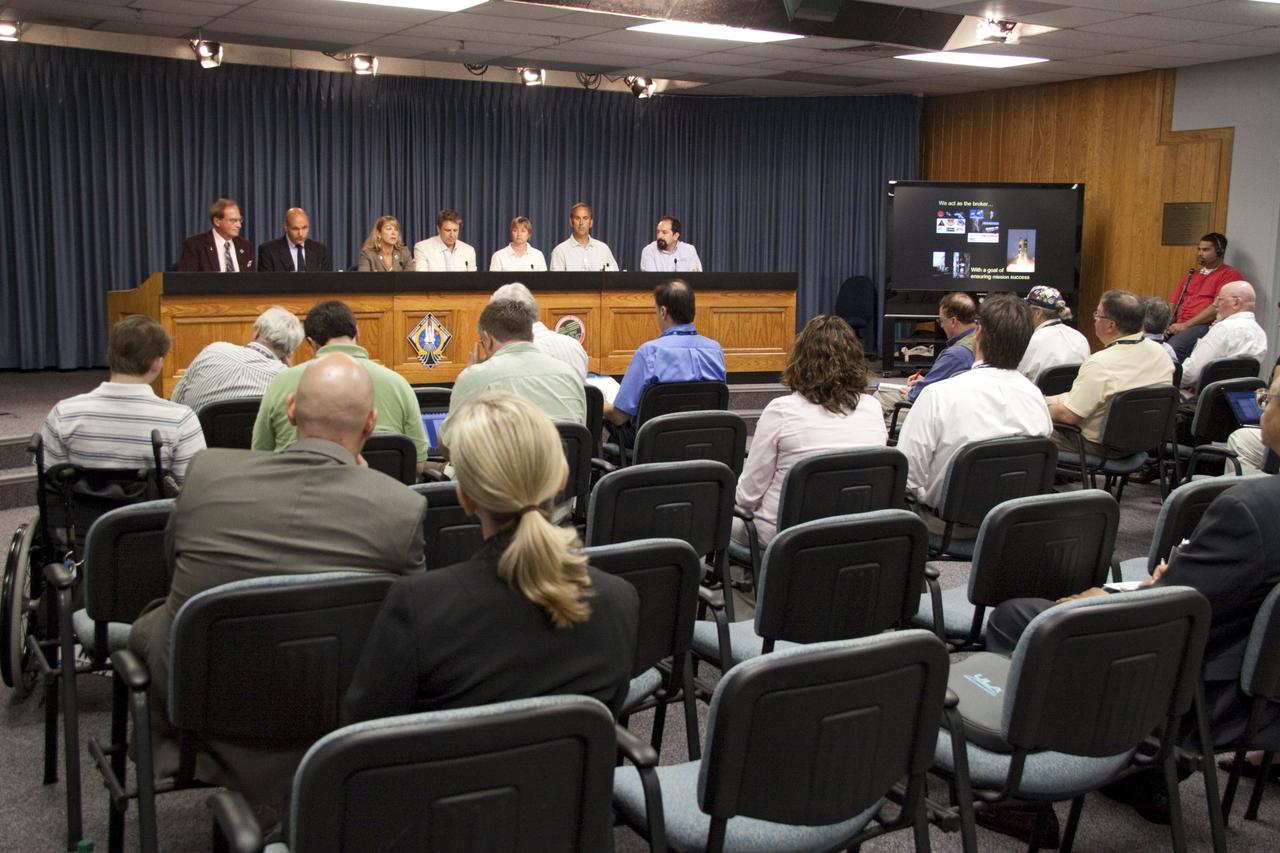
CAPE CANAVERAL, Fla. -- In the Press Site auditorium at NASA's Kennedy Space Center in Florida, media were briefed about NASA's future science missions. Seen here are NASA Public Affairs Officer George Diller (left); Waleed Abdalati, NASA chief scientist; Amanda Mitskevich, NASA Launch Services Program manager; Scott Bolton, Juno principal investigator with the Southwest Research Institute, San Antonio; Maria Zuber, GRAIL principal investigator with the Massachusetts Institute of Technology; John Grotzinger, Mars Science Lab project scientist with the California Institute of Technology and Daniel Stern, NuStar project scientist with NASA's Jet Propulsion Laboratory in Calif. Photo credit: NASA/Jack Pfaller
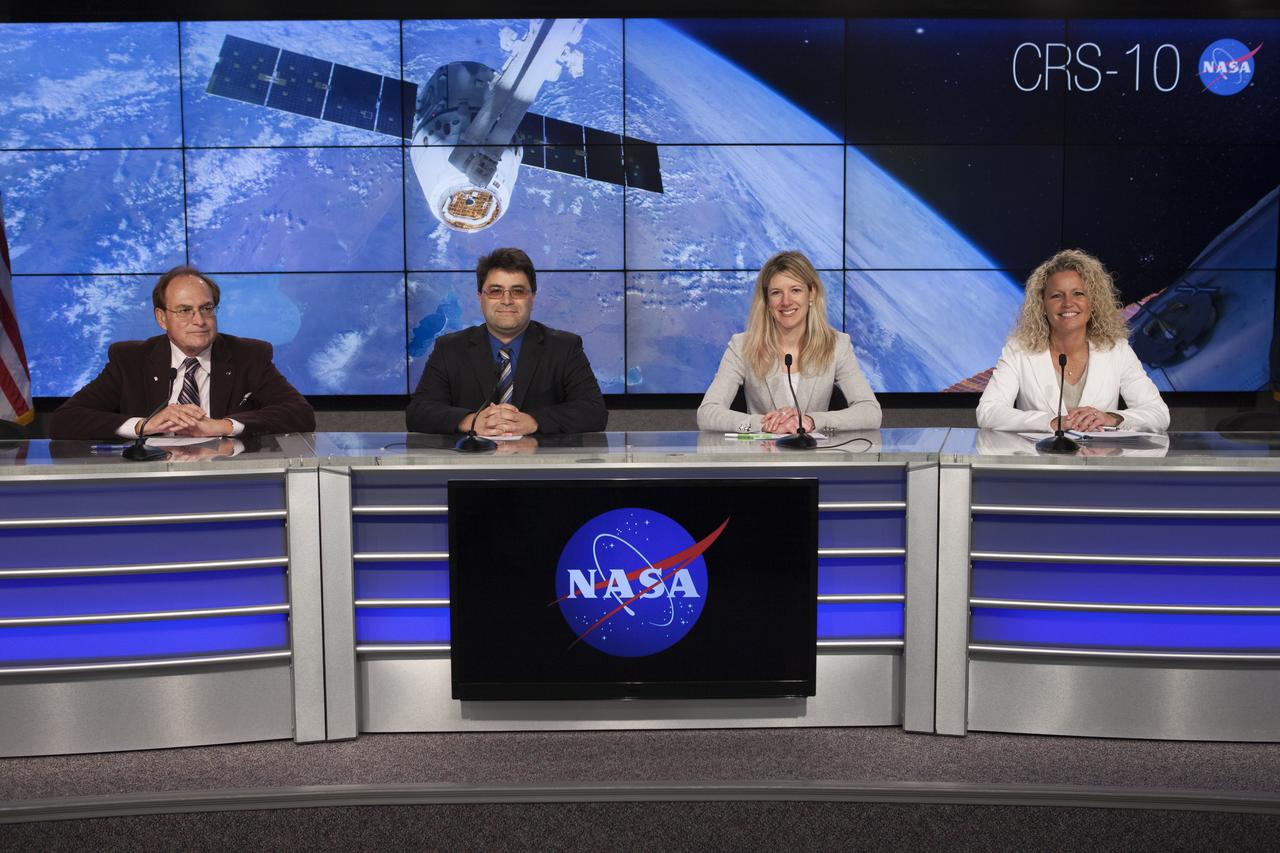
In the Press Site auditorium of NASA's Kennedy Space Center in Florida, NASA and industry leaders speak to media at a post-launch news conference following the liftoff of SpaceX CRS-10, a commercial resupply services mission to the International Space Station. From left are: George Diller, NASA Communications; William Spetch, deputy manager of the International Space Station Transportation Office; Jessica Jensen, Dragon mission manager for SpaceX; and Pam Underwood, manager of the Operations Integration Division of the Federal Aviation Administration Office of Commercial Space Transportation. SpaceX CRS-10 lifted off atop a Falcon 9 rocket from Kennedy's Launch Complex 39A at 9:39 a.m. EST.
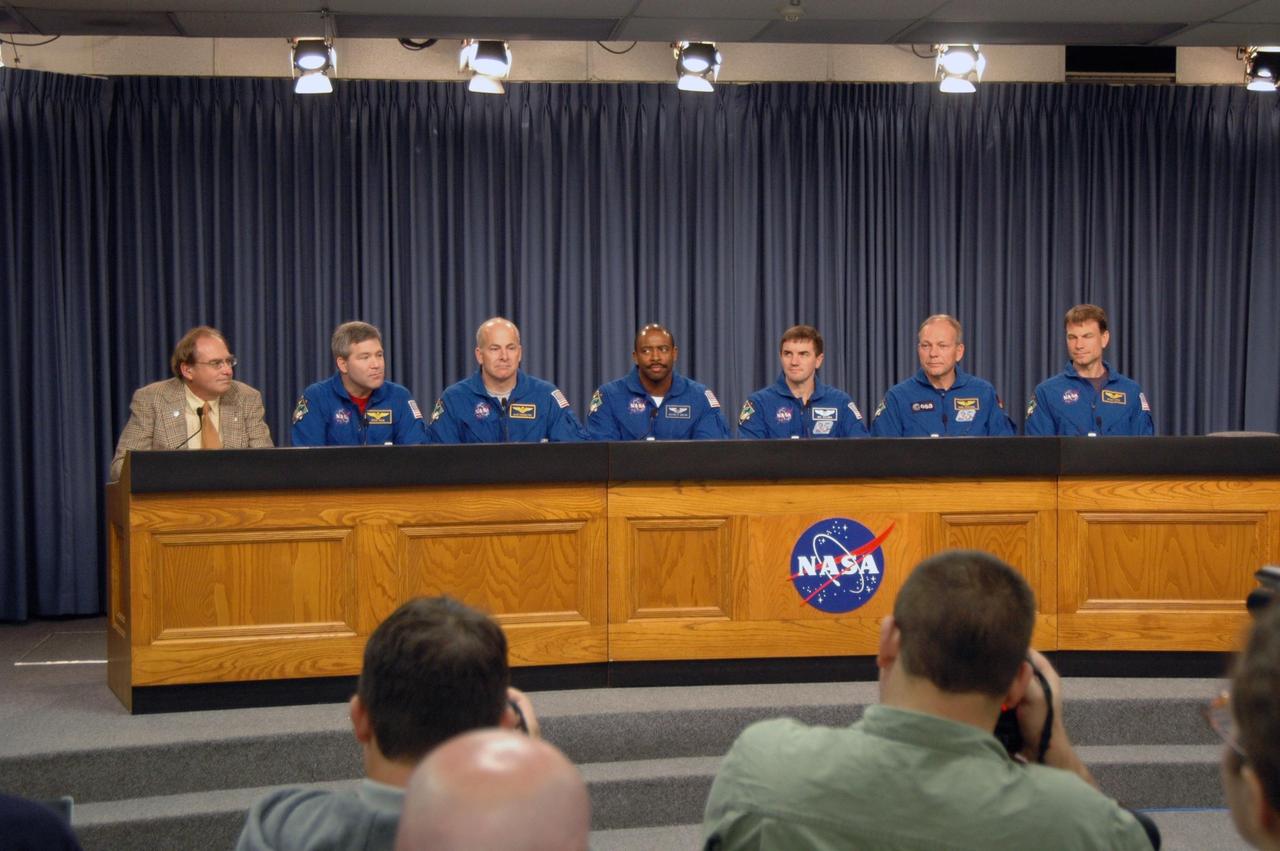
KENNEDY SPACE CENTER, FLA. -- The STS-122 crew discusses its mission at a post-landing conference. Moderating at left is NASA Public Affairs Officer George Diller. The crewmembers, from left, are Commander Steve Frick, Pilot Alan Poindexter and Mission Specialists Leland Melvin, Rex Walheim, Hans Schlegel and Stanley Love. After a round trip of nearly 5.3 million miles, space shuttle Atlantis and crew returned to Earth with a landing at 9:07 a.m. EST on Runway 15 at NASA's Kennedy Space Center. Photo credit: NASA/Jack Pfaller
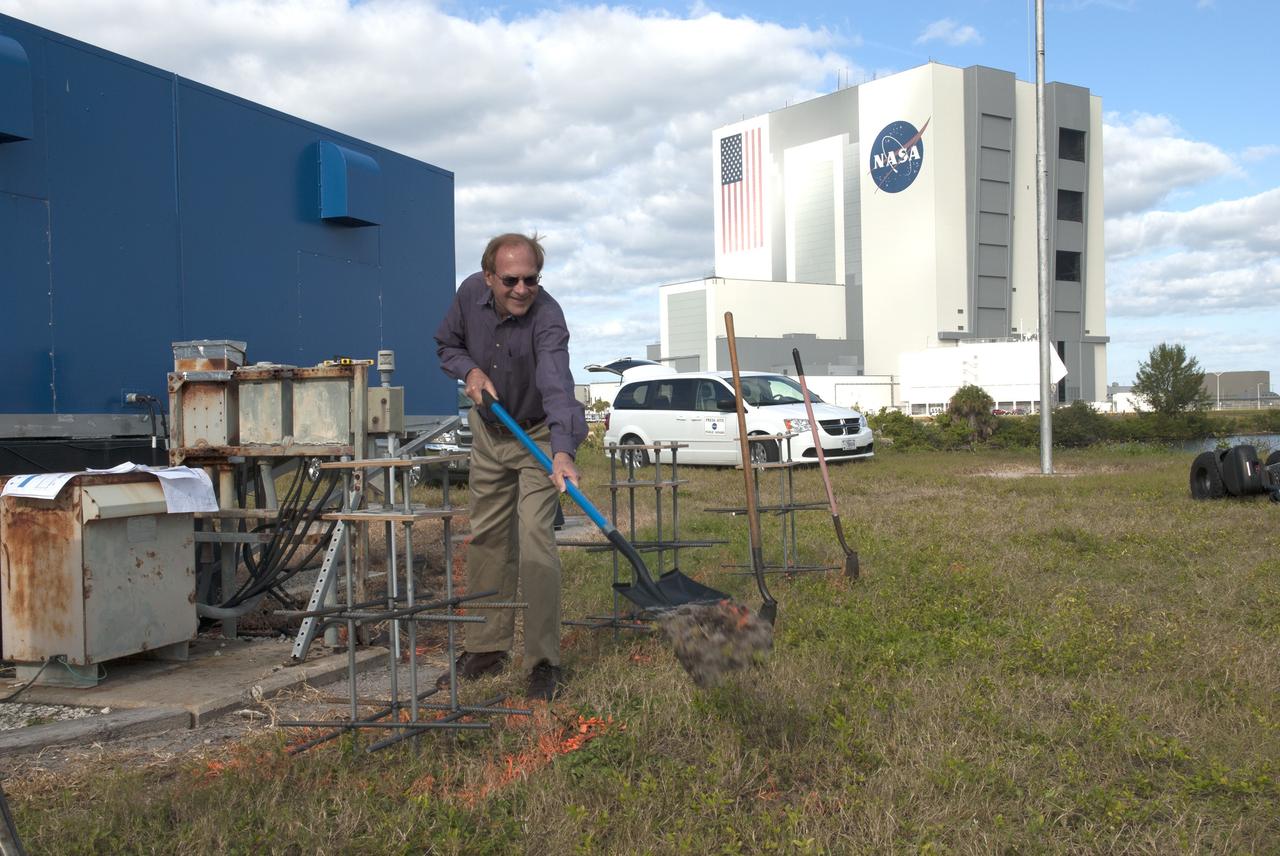
CAPE CANAVERAL, Fla. -- At NASA's Kennedy Space Center in Florida, Public Affairs Officer George Diller shovels the first scoop of soil behind the current countdown clock during the groundbreaking ceremony for the new countdown clock. The old timepiece was designed by Kennedy engineers and built by Kennedy technicians in 1969. Not including the triangular concrete and aluminum base, the famous landmark is nearly 6 feet 70 inches high, 26 feet 315 inches wide and 3 feet deep. The new display will be similar in size, with the screen being nearly 26 feet wide by 7 feet high. For more information on the countdown clock, go to http://go.nasa.gov/10Zku10. Photo credit: NASA/Jim Grossmann

Hortense Diggs, deputy director of Kennedy Space Center’s Office of Communication and Public Engagement, delivers remarks during The Chroniclers 2018 ceremony at Kennedy’s NASA News Center in Florida on Friday, May 4. Craig Covault and George Diller were inducted as the 75th and 76th members of the “Chroniclers,” which recognizes retirees of the news and communications business who helped spread news of American space exploration from Kennedy for 10 years or more. Brass strips engraved with each awardee’s name and affiliation were added to the “Chroniclers wall” and unveiled during the event at the NASA News Center.
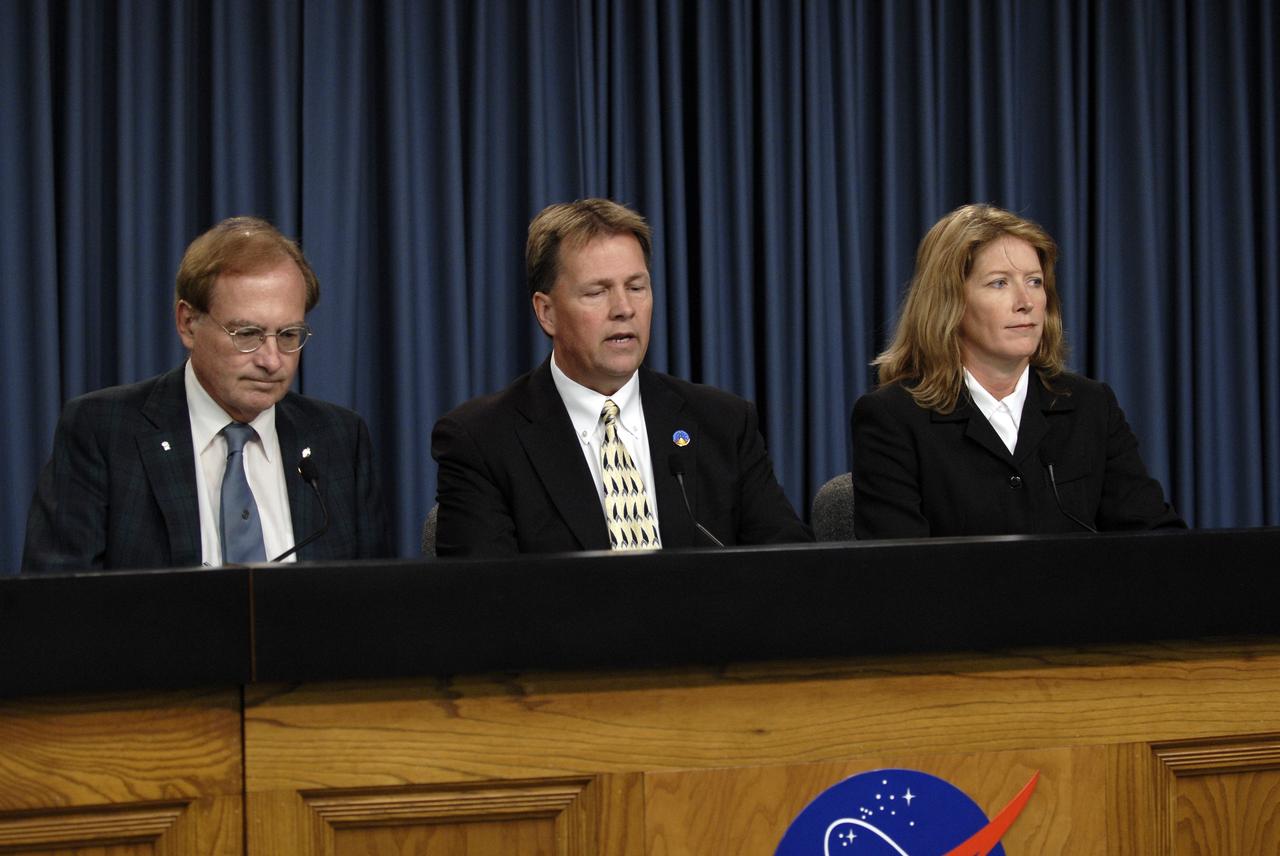
CAPE CANAVERAL, Fla. – At NASA's Kennedy Space Center in Florida, a launch status briefing for the Ares I-X rocket's flight test is held in the Press Site auditorium. From left are moderator George Diller, NASA Public Affairs officer; Jeff Spaulding, NASA test director for Ares I-X; and Kathy Winters, launch weather officer. The team is not tracking any problems, the rocket is in great shape, and they are ready for liftoff from Launch Pad 39B on Oct. 27 at 8 a.m. EDT. For information on the Ares I-X vehicle and flight test, visit http://www.nasa.gov/aresIX. Photo credit: NASA/Kim Shiflett
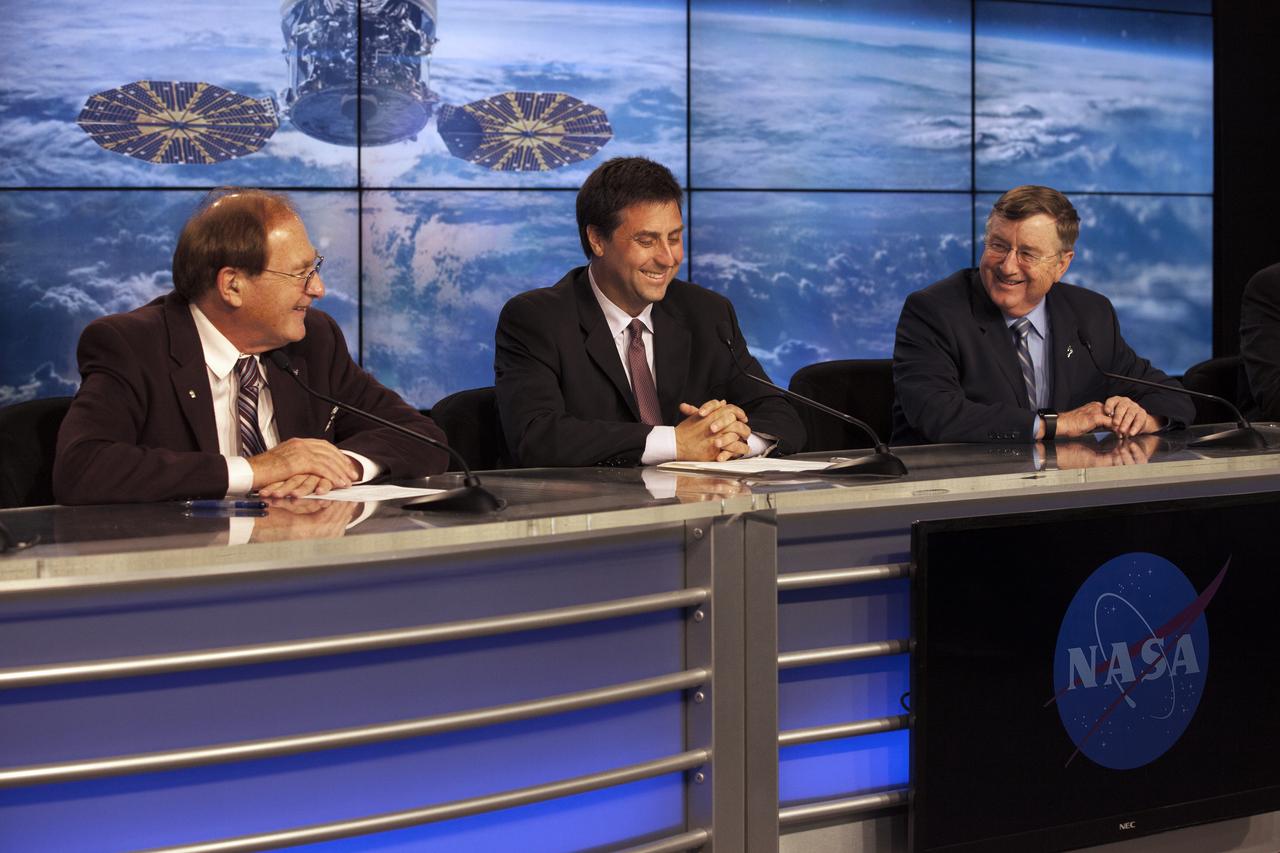
Members of the news media attend a press conference at NASA's Kennedy Space Center in Florida, after the launch of the Orbital ATK Cygnus pressurized cargo module atop a United Launch Alliance Atlas V rocket from Space Launch Complex 41 at Cape Canaveral Air Force Station. It was Orbital ATK's seventh commercial resupply services mission to the International Space Station. Liftoff was at 11:11 a.m. EDT. Speaking to the media are, from left, George Diller, NASA Kennedy Communications; Joel Montalbano, deputy manager, International Space Station Program, NASA Johnson Space Center in Houston; and Frank Culbertson, president, Orbital ATK Space Systems Group.
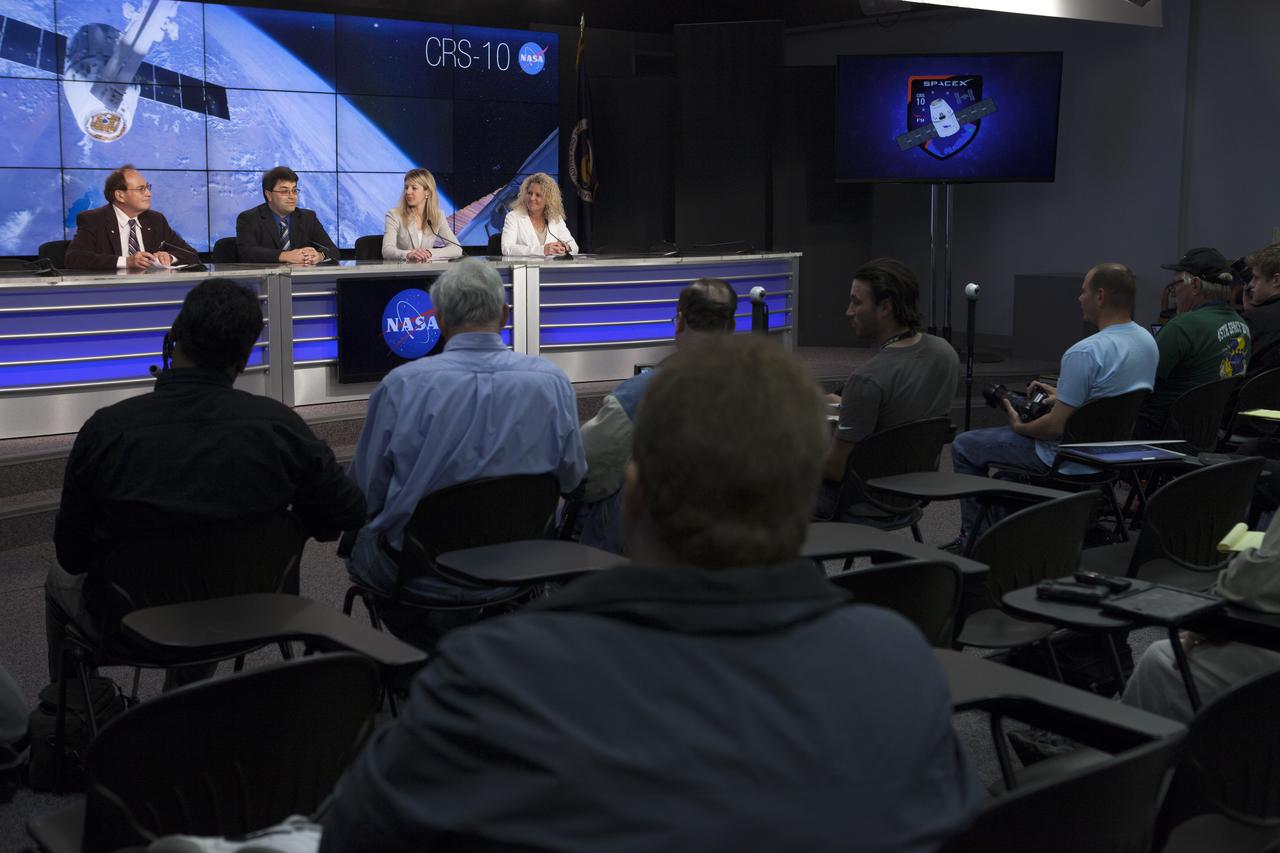
In the Press Site auditorium of NASA's Kennedy Space Center in Florida, NASA and industry leaders speak to media at a post-launch news conference following the liftoff of SpaceX CRS-10, a commercial resupply services mission to the International Space Station. From left are: George Diller, NASA Communications; William Spetch, deputy manager of the International Space Station Transportation Office; Jessica Jensen, Dragon mission manager for SpaceX; and Pam Underwood, manager of the Operations Integration Division of the Federal Aviation Administration Office of Commercial Space Transportation. SpaceX CRS-10 lifted off atop a Falcon 9 rocket from Kennedy's Launch Complex 39A at 9:39 a.m. EST.
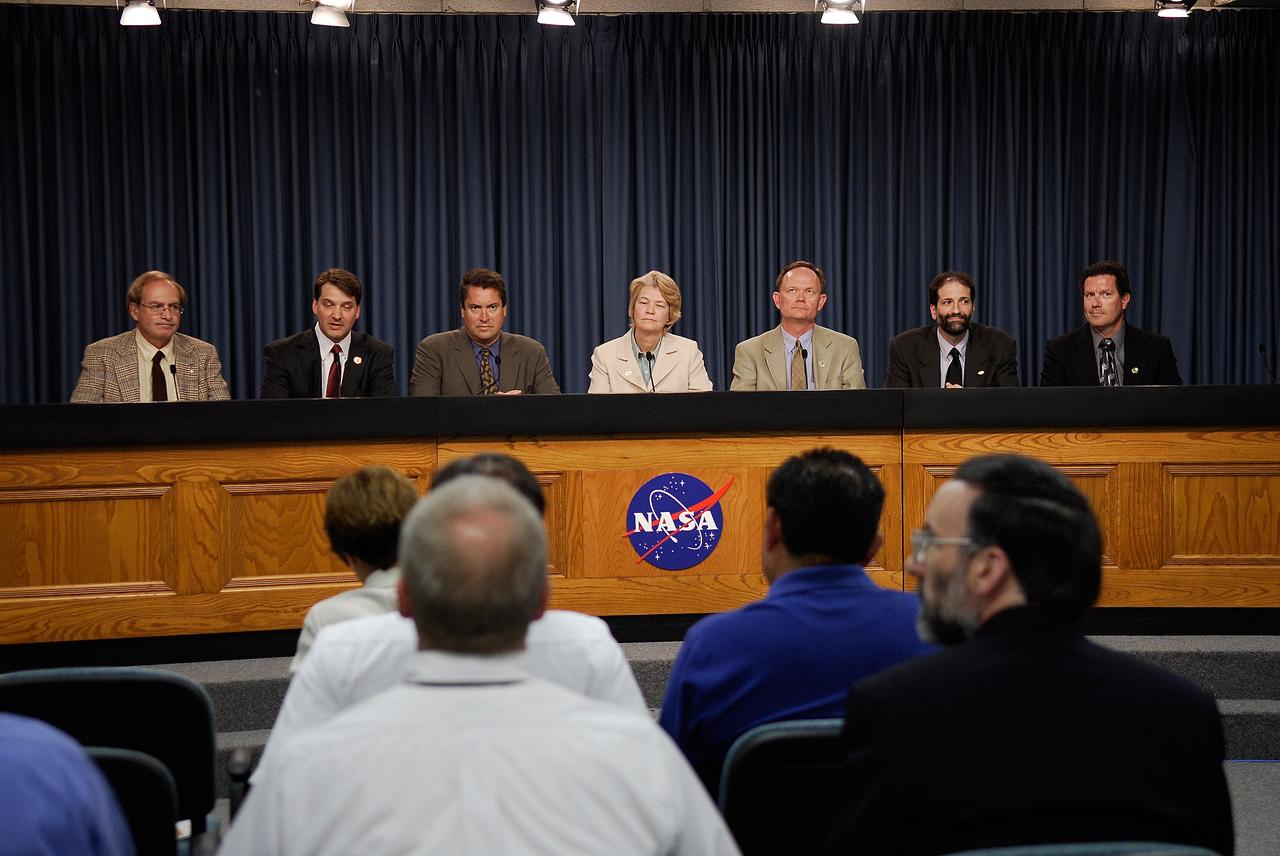
CAPE CANAVERAL, Fla. -- At left, Public Information Officer George Diller moderates a media briefing on NASA's Gamma-Ray Large Area Space Telescope, or GLAST, launch scheduled for June 11. On the panel next to Diller are Dr. Jon Morse, director of NASA's Astrophysics Division; Omar Baez, NASA launch director/launch manager at Kennedy; Kris Walsh, director of the Delta NASA and Commercial Programs with United Launch Alliance; Kevin Grady, GLAST project manager at NASA's Goddard Space Flight Center; Dr. Steven Ritz, GLAST project scientist/astrophysicist at Goddard; and Joel Tumbiolo, the U.S. Air Force Delta II launch weather officer with the 45th Weather Squadron at Cape Canaveral Air Force Station. GLAST is a powerful space observatory that will explore the Universe's ultimate frontier, where nature harnesses forces and energies far beyond anything possible on Earth; probe some of science's deepest questions, such as what our Universe is made of, and search for new laws of physics; explain how black holes accelerate jets of material to nearly light speed; and help crack the mystery of stupendously powerful explosions known as gamma-ray bursts. Photo credit: NASA/Kim Shiflett
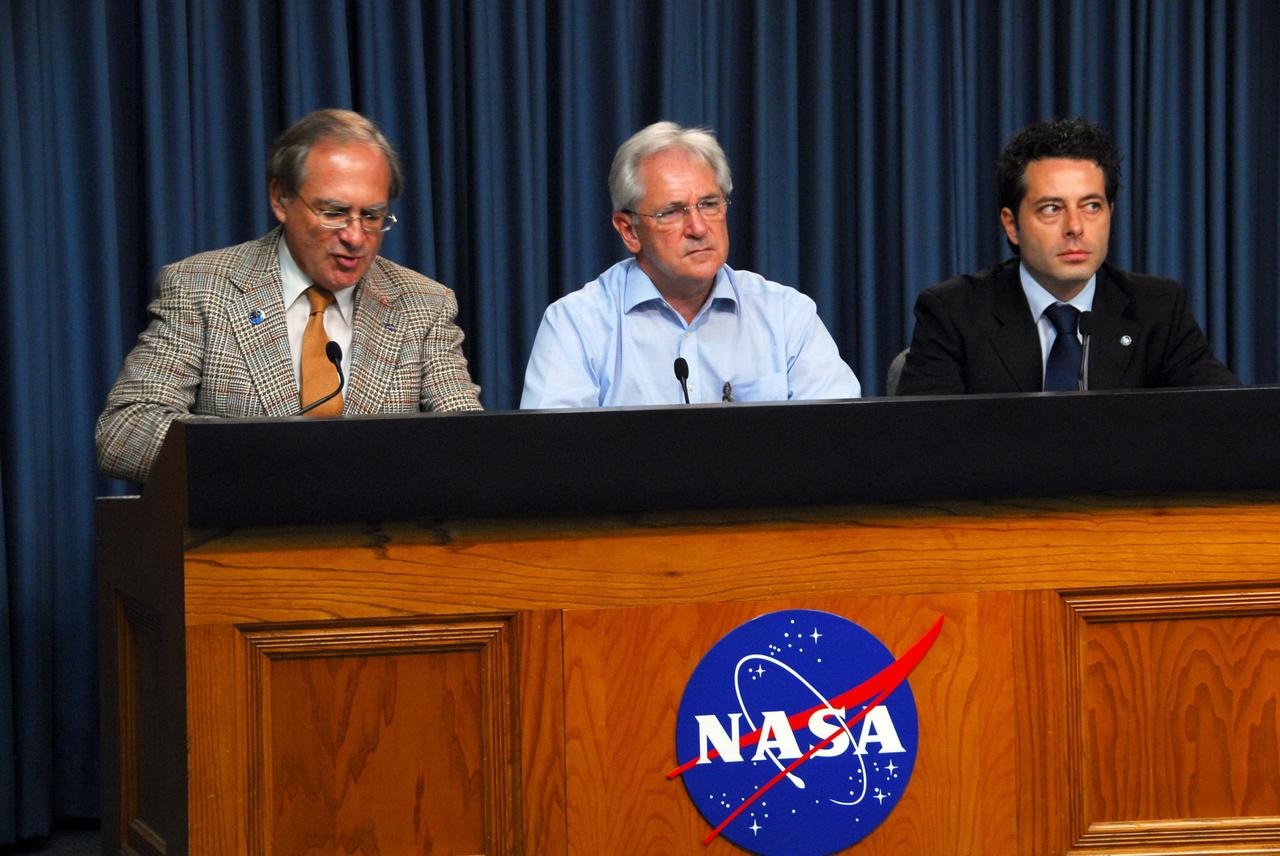
KENNEDY SPACE CENTER, FLA. -- Representatives of NASA's international partners participate in a news briefing on the launch readiness of space shuttle mission STS-120. From left are George Diller, briefing moderator for NASA; Alan Thirkettle, International Space Station Program Manager for ESA, the European Space Agency; and Mauro Piermaria, ESPERIA mission manager for ASI, the Italian Space Agency. The STS-120 mission will be the 23rd shuttle flight to the International Space Station, delivering the Italian-built U.S. Node 2, called Harmony. The seven-member crew includes ESA astronaut Paolo Nespoli from Italy. The 14-day mission includes five spacewalks -- four by shuttle crew members and one by the station's Expedition 16 crew -- to install Harmony and move the P6 solar arrays to their permanent position and deploy them. Launch aboard space shuttle Discovery is planned for 11:38 a.m. EDT Oct. 23, and Discovery is scheduled to complete its mission and return home on Nov. 6. Photo credit: NASA/George Shelton
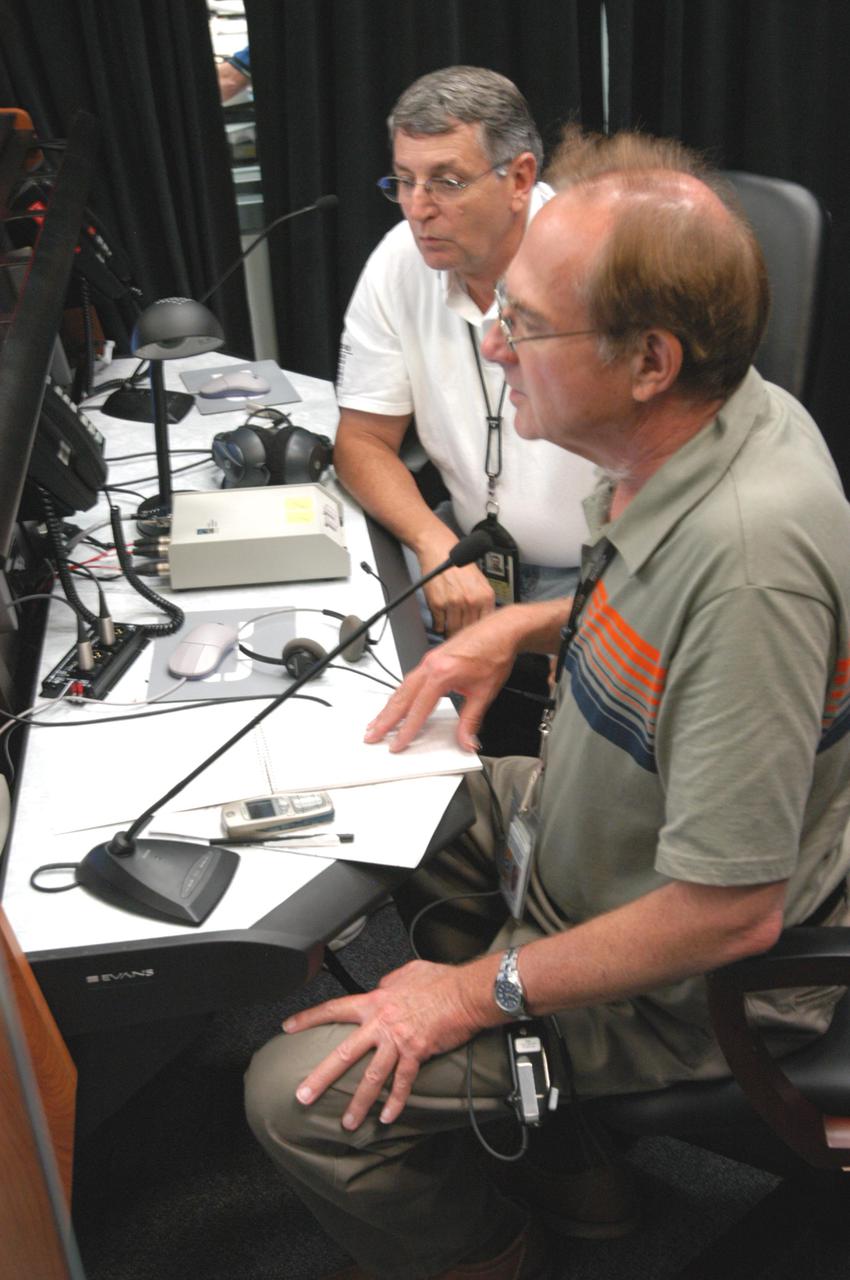
KENNEDY SPACE CENTER, FLA. - At the Atlas V Spaceflight Operations Center, the launch team goes through a wet dress rehearsal for launch of the Mars Reconnaissance Orbiter (MRO), scheduled for Aug. 10. At right, in the foreground, is NASA’s Public Information Officer George Diller, who is commentator for launches of NASA payloads on expendable launch vehicles. Launch of the MRO aboard an Atlas V rocket will be from Launch Complex 41 at Cape Canaveral Air Force Station in Florida. A wet rehearsal includes pre-liftoff operations and fueling the rocket’s engine. The MRO was built by Lockheed Martin for NASA Jet Propulsion Laboratory in California. It is the next major step in Mars exploration and scheduled for launch from Cape Canaveral Air Force Station. The MRO is an important next step in fulfilling NASA’s vision of space exploration and ultimately sending human explorers to Mars and beyond.
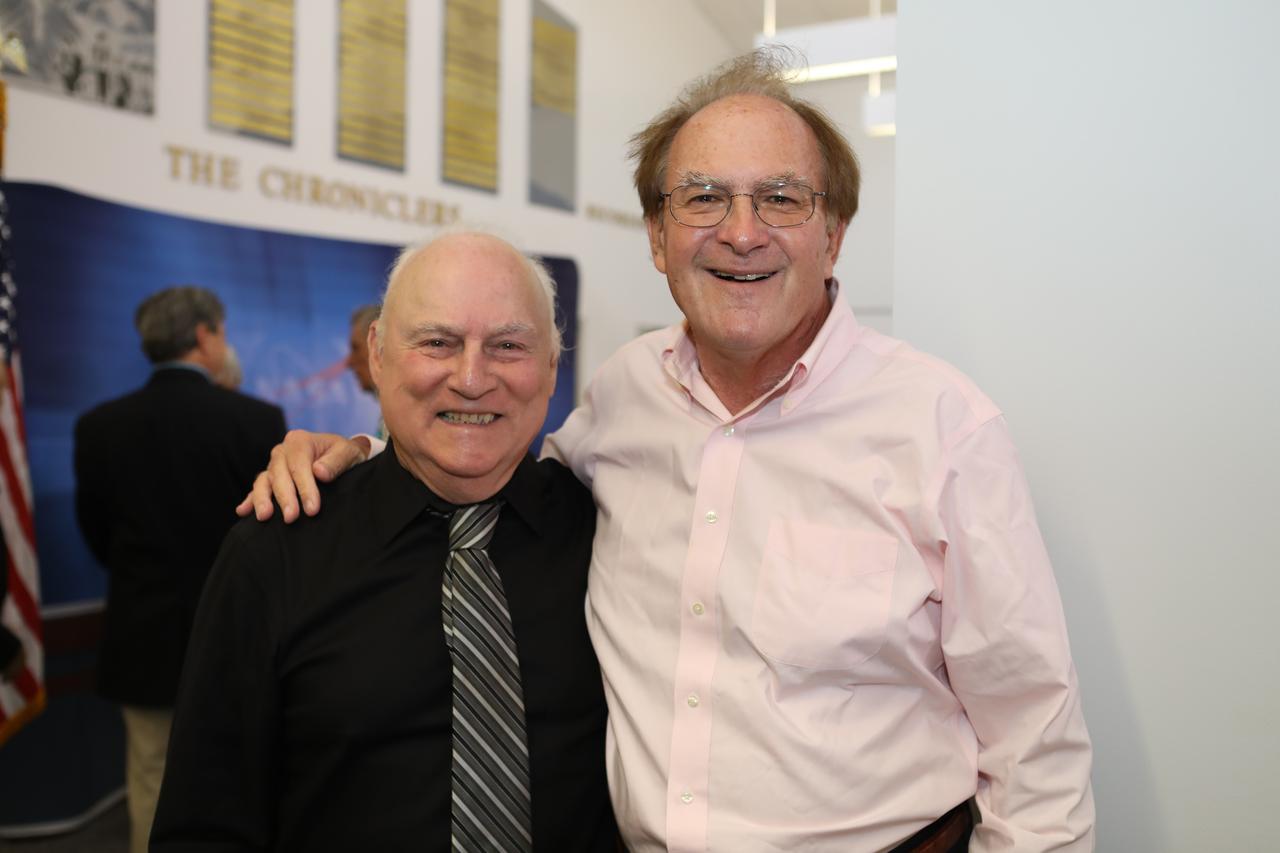
Bill Johnson, left, retired NASA chief of Media Services at Kennedy Space Center in Florida, is congratulated by NASA Public Information Specialist George Diller during a ceremony for six new honorees added to the "Chroniclers" roll of honor in the NASA News Center. Johnson, whose career at Kennedy spanned more than 45 years, was one of the six added to the Chroniclers list. Also added were Bruce Hall, CBS News and NBC News; Scott Harris, WESH, WKMG and Central Florida News 13; Warren Leary, The New York Times; Bob Murray, WDBO-TV, RCA and United Space Alliance; and Phillip Sandlin, Associated Press photographer. The Chroniclers program recognizes retirees of the news and communications business who helped spread news of American space exploration from Kennedy Space Center for ten years or more.
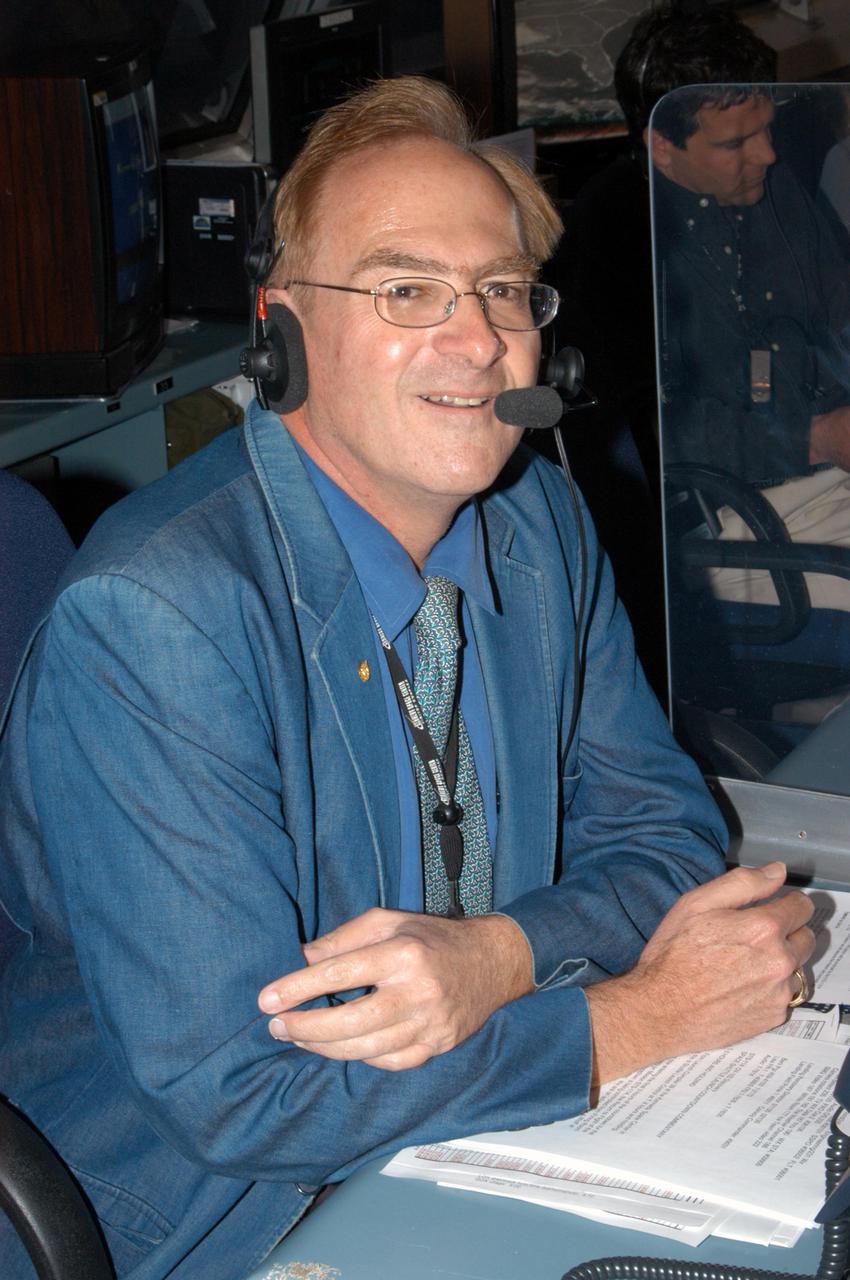
KENNEDY SPACE CENTER, FLA. - Public Information Officer George Diller plays his role as commentator during in an End-to-End (ETE) Mission Management Team (MMT) launch simulation at KSC. In Firing Room 1 at KSC, Shuttle launch team members put the Shuttle system through an integrated simulation. The control room is set up with software used to simulate flight and ground systems in the launch configuration. The ETE MMT simulation included L-2 and L-1 day Prelaunch MMT meetings, an external tanking_weather briefing, and a launch countdown. The ETE transitioned to the Johnson Space Center for the flight portion of the simulation, with the STS-114 crew in a simulator at JSC. Such simulations are common before a launch to keep the Shuttle launch team sharp and ready for liftoff.
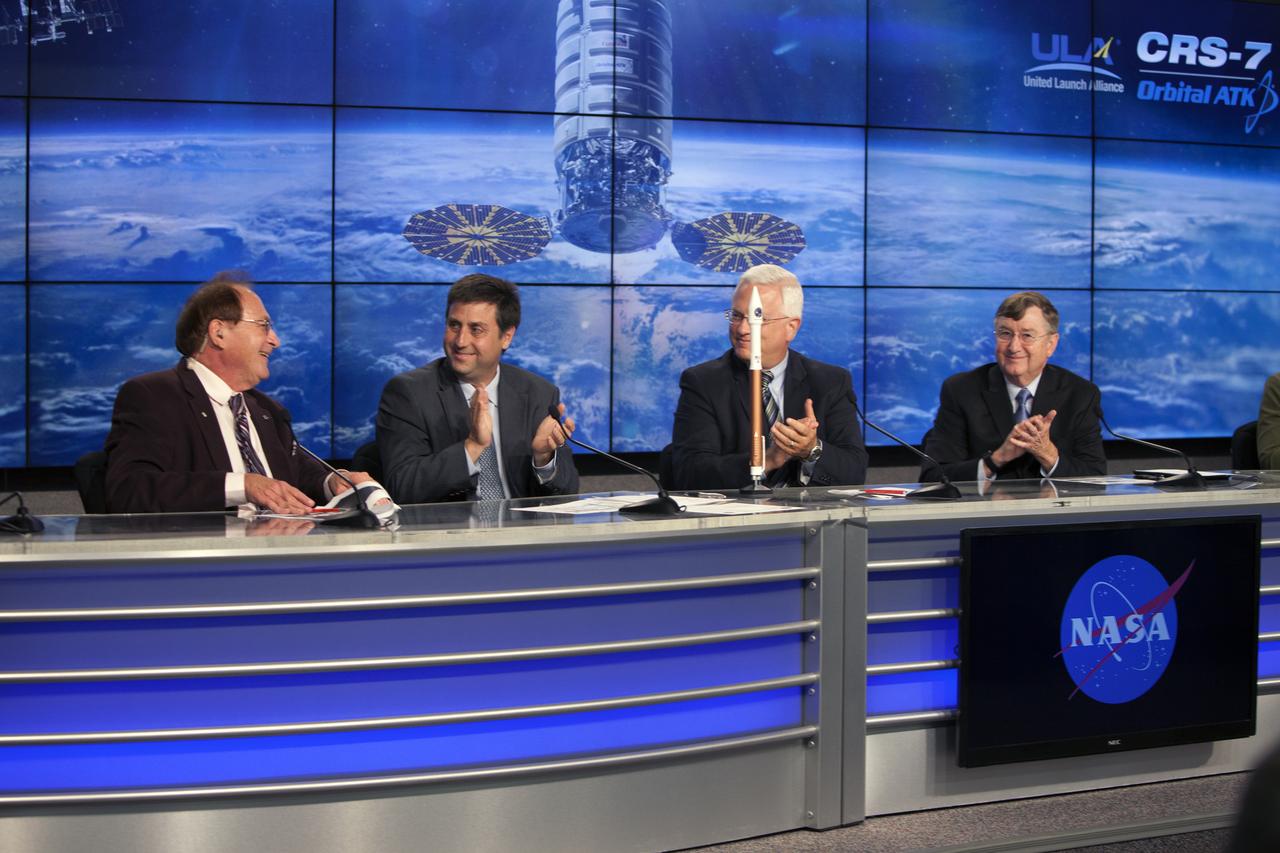
A prelaunch status briefing for Orbital ATK's seventh commercial resupply mission, CRS-7, to the International Space Station, is held at NASA Kennedy Space Center's Press Site in Florida. Participating in the briefing are, from left, George Diller, NASA Kennedy Public Affairs; Joel Montalbano, deputy manager, NASA International Space Station Program; Vern Thorp, program manager, commercial missions, United Launch Alliance; and Frank Culbertson, Space Systems Group president, Orbital ATK. Orbital ATK's Cygnus pressurized cargo module is set to launch atop the ULA Atlas V rocket from Space Launch Complex 41 at Cape Canaveral Air Force Station on April 18. Cygnus will deliver 7,600 pounds of supplies, equipment and scientific research materials to the space station. Liftoff is scheduled for 11:11 a.m. EDT.
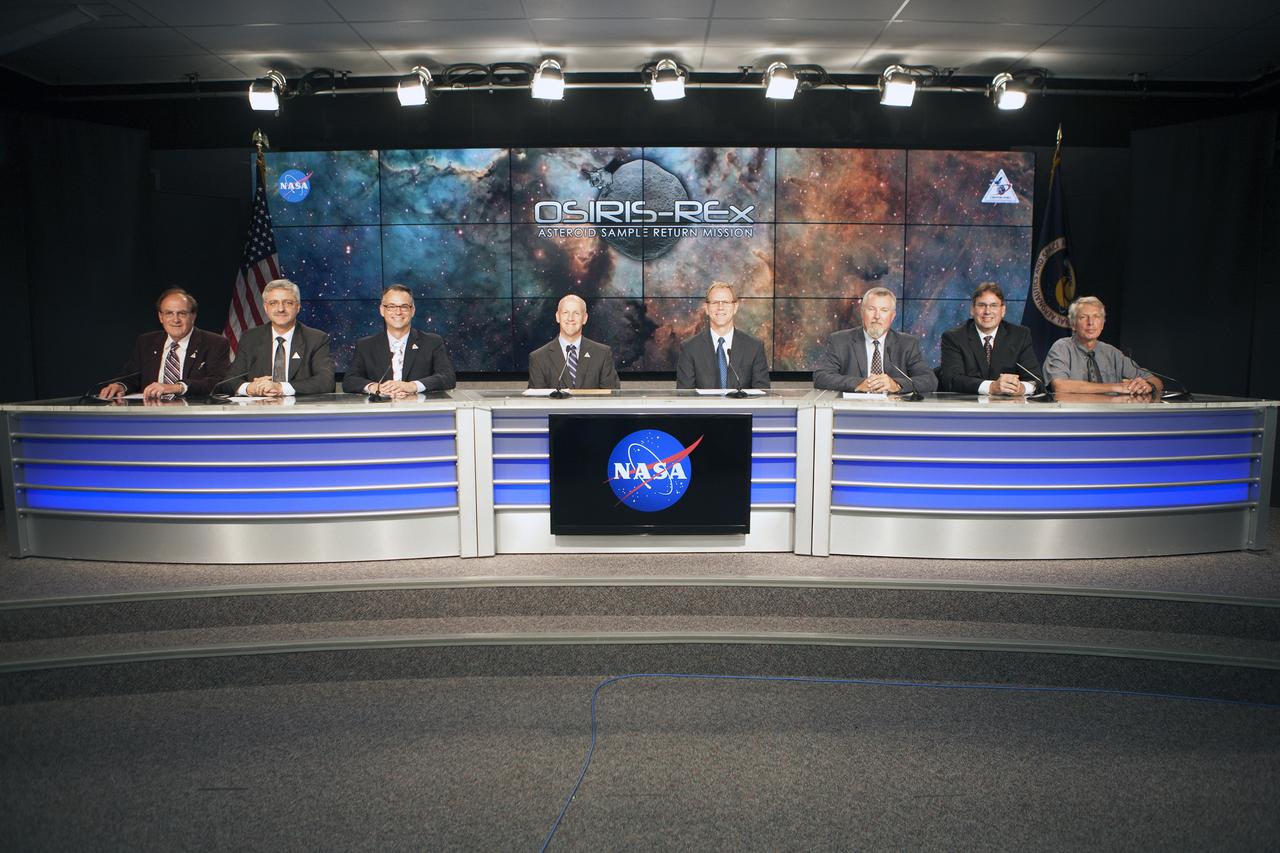
In the Kennedy Space Center’s Press Site auditorium, NASA and industry leaders speak to members of the media at a prelaunch news conference for the agency’s Origins, Spectral Interpretation, Resource Identification, Security-Regolith Explorer, or OSIRIS-REx spacecraft. From left are: George Diller of NASA Communications; Geoffrey Yoder, acting associate administrator of NASA’s Science Mission Directorate in Washington; Dante Lauretta, OSIRIS-REx principal investigator at the University of Arizona, Tucson; Tim Dunn, NASA launch manager at Kennedy; Scott Messer, program manager for NASA missions at United Launch Alliance in Centennial, Colorado; Michael Donnelly, OSIRIS-REx project manager at NASA’s Goddard Space Flight Center in Greenbelt, Maryland; Rich Kuhns, OSIRIS-REx program manager for Lockheed Martin Space Systems in Denver; and Clay Flinn, launch weather officer for the 45th Weather Squadron at Cape Canaveral Air Force Station, Florida.
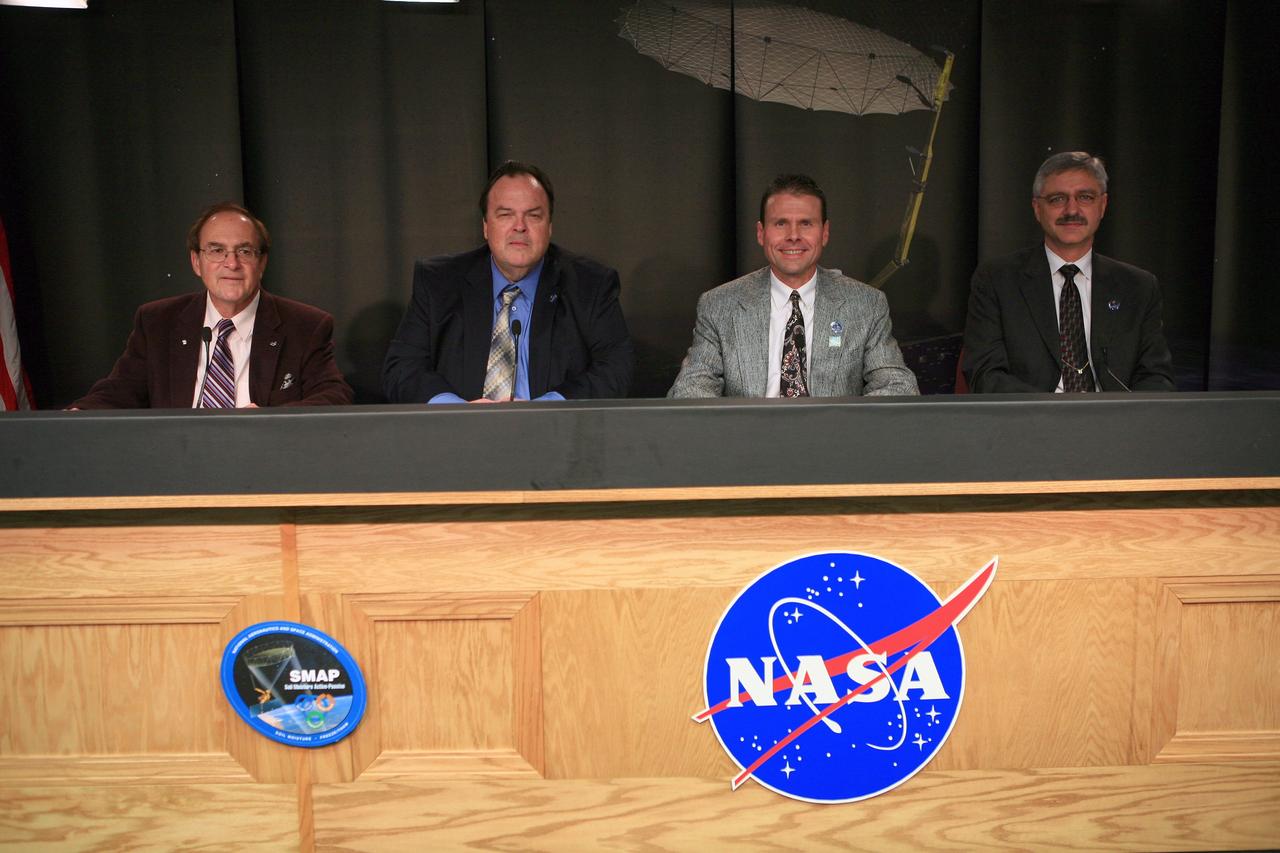
VANDENBERG AIR FORCE BASE, Calif. – During a news conference at Vandenberg Air Force Base in California, NASA officials discuss the launch of the Soil Moisture Active Passive satellite, or SMAP, and its mission to study the Earth's soil moisture. Participating in the briefing, from left, are George Diller of NASA Public Affairs, Kent Kellogg, SMAP project manager at the Jet Propulsion Laboratory in Pasadena, California, Scott Higginbotham, NASA mission manager for Educational Launch of Nanosatellites, or ELaNa-X, at the Kennedy Space Center, and Geoff Yoder, deputy associate administrator of the Science Mission Directorate at NASA Headquarters. To learn more about SMAP, visit http://www.nasa.gov/smap. Photo credit: NASA/Kim Shiflett
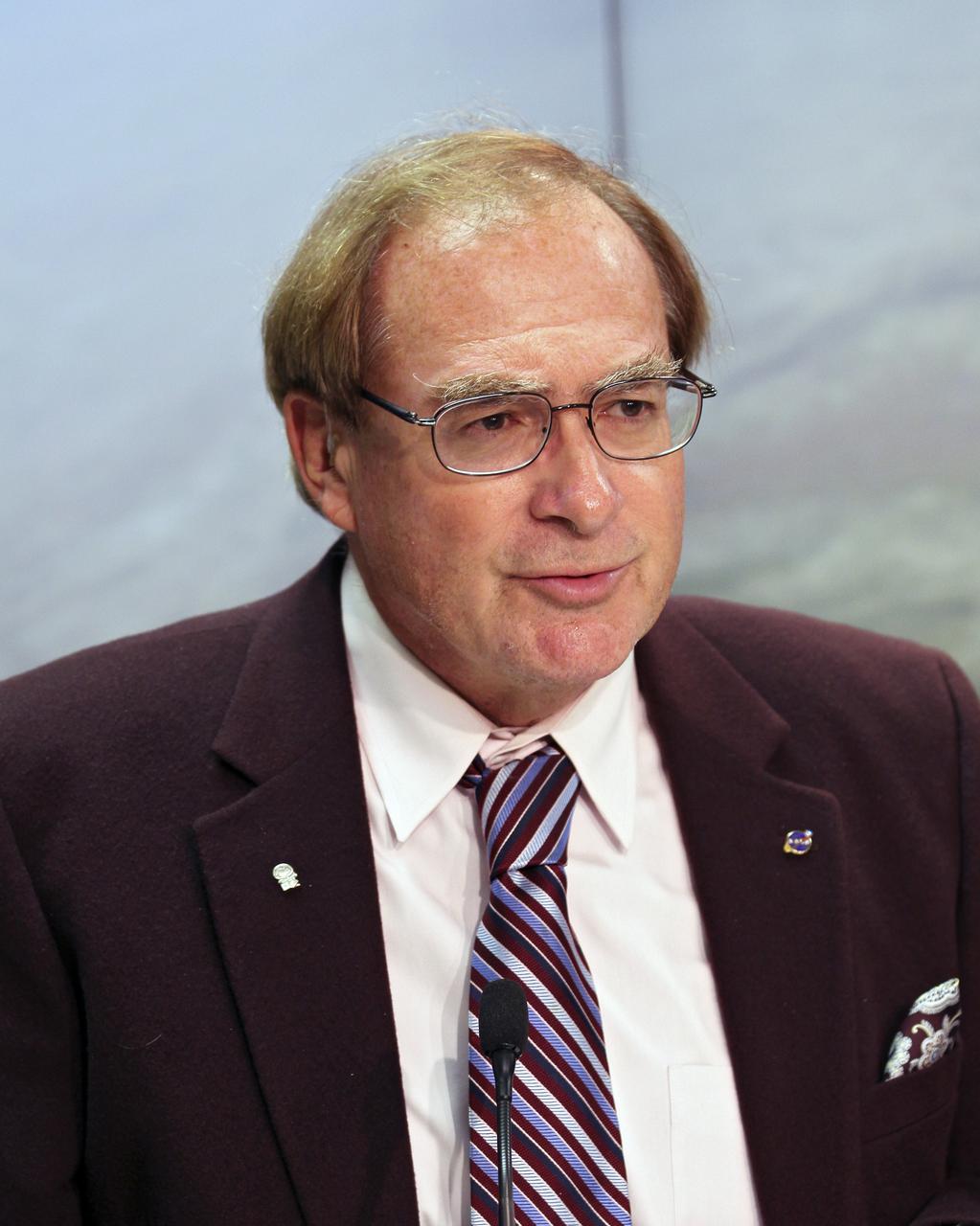
VANDENBERG AFB, Calif. -- George Diller of NASA Public Affairs moderated a prelaunch news conference at Vandenberg Air Force Base, Calif. during which NASA and contractor officials discussed NASA's readiness to launch the Landsat Data Continuity Mission, or LDCM. The Landsat Data Continuity Mission LDCM is the future of Landsat satellites. It will continue to obtain valuable data and imagery to be used in agriculture, education, business, science, and government. The Landsat Program provides repetitive acquisition of high resolution multispectral data of the Earth's surface on a global basis. The data from the Landsat spacecraft constitute the longest record of the Earth's continental surfaces as seen from space. It is a record unmatched in quality, detail, coverage, and value. Liftoff is planned for Feb. 11, 2013 aboard a United Launch Alliance Atlas V rocket. For more information, visit: http:__www.nasa.gov_mission_pages_landsat_main_index.html Photo credit: NASA_Kim Shiflett
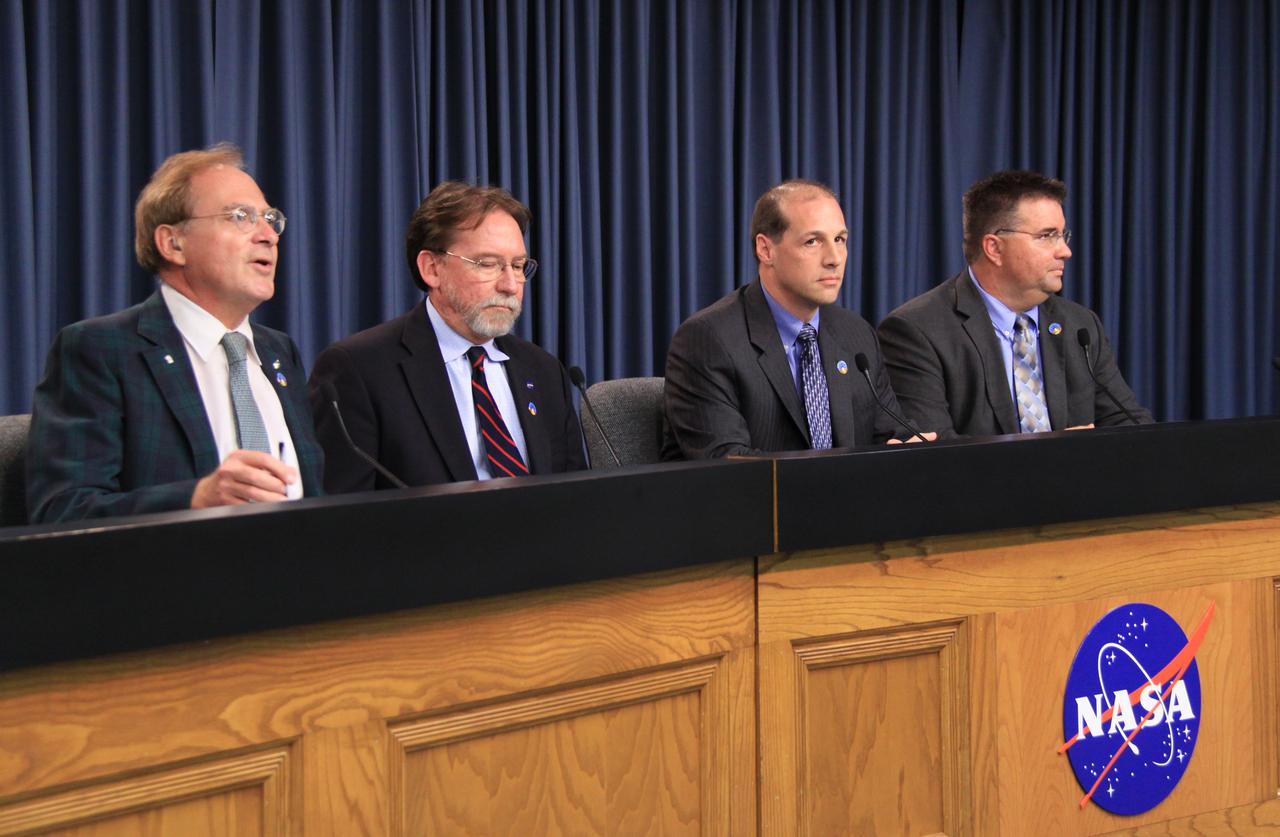
CAPE CANAVERAL, Fla. - At NASA's Kennedy Space Center in Florida, a news conference is held in the Press Site auditorium following the conclusion of the flight test readiness review, or FTRR, for the Ares I-X test rocket. From left are moderator George Diller, NASA Public Affairs officer; Doug Cooke, associate administrator for NASA's Exploration Systems Mission Directorate; Bob Ess, mission manager for the Ares I-X flight test; and Edward Mango, launch director for the Ares I-X flight test. During the meeting, senior NASA and contractor managers assessed the risks associated with the test and determined the rocket, support systems and procedures are ready for launch. The Ares I-X launch date was announced after the FTRR and is officially set for Oct. 27. For information on the Ares I-X vehicle and flight test, visit http://www.nasa.gov/aresIX. Photo credit: NASA/Jack Pfaller
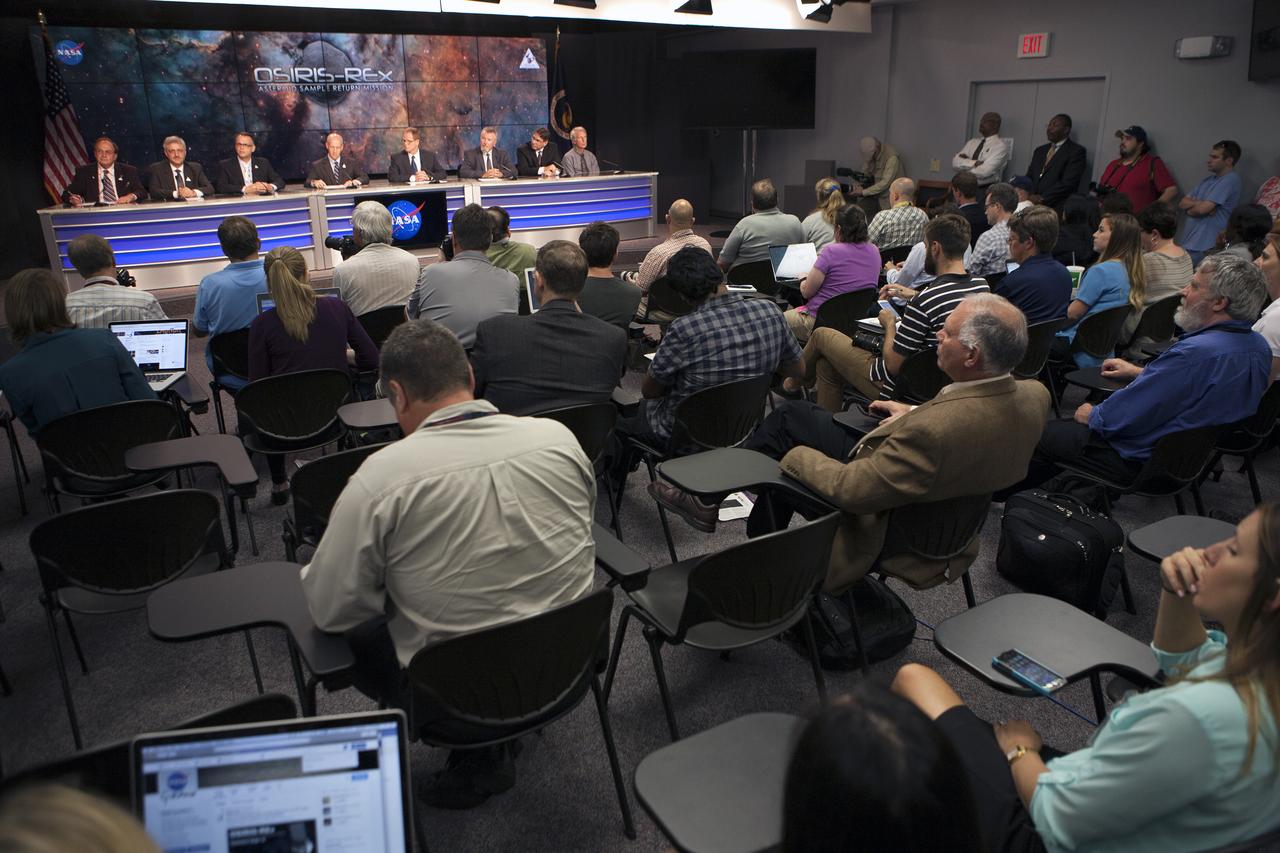
In the Kennedy Space Center’s Press Site auditorium, NASA and industry leaders speak to members of the media at a prelaunch news conference for the agency’s Origins, Spectral Interpretation, Resource Identification, Security-Regolith Explorer, or OSIRIS-REx spacecraft. From left are: George Diller of NASA Communications; Geoffrey Yoder, acting associate administrator of NASA’s Science Mission Directorate in Washington; Dante Lauretta, OSIRIS-REx principal investigator at the University of Arizona, Tucson; Tim Dunn, NASA launch manager at Kennedy; Scott Messer, program manager for NASA missions at United Launch Alliance in Centennial, Colorado; Michael Donnelly, OSIRIS-REx project manager at NASA’s Goddard Space Flight Center in Greenbelt, Maryland; Rich Kuhns, OSIRIS-REx program manager for Lockheed Martin Space Systems in Denver; and Clay Flinn, launch weather officer for the 45th Weather Squadron at Cape Canaveral Air Force Station, Florida.
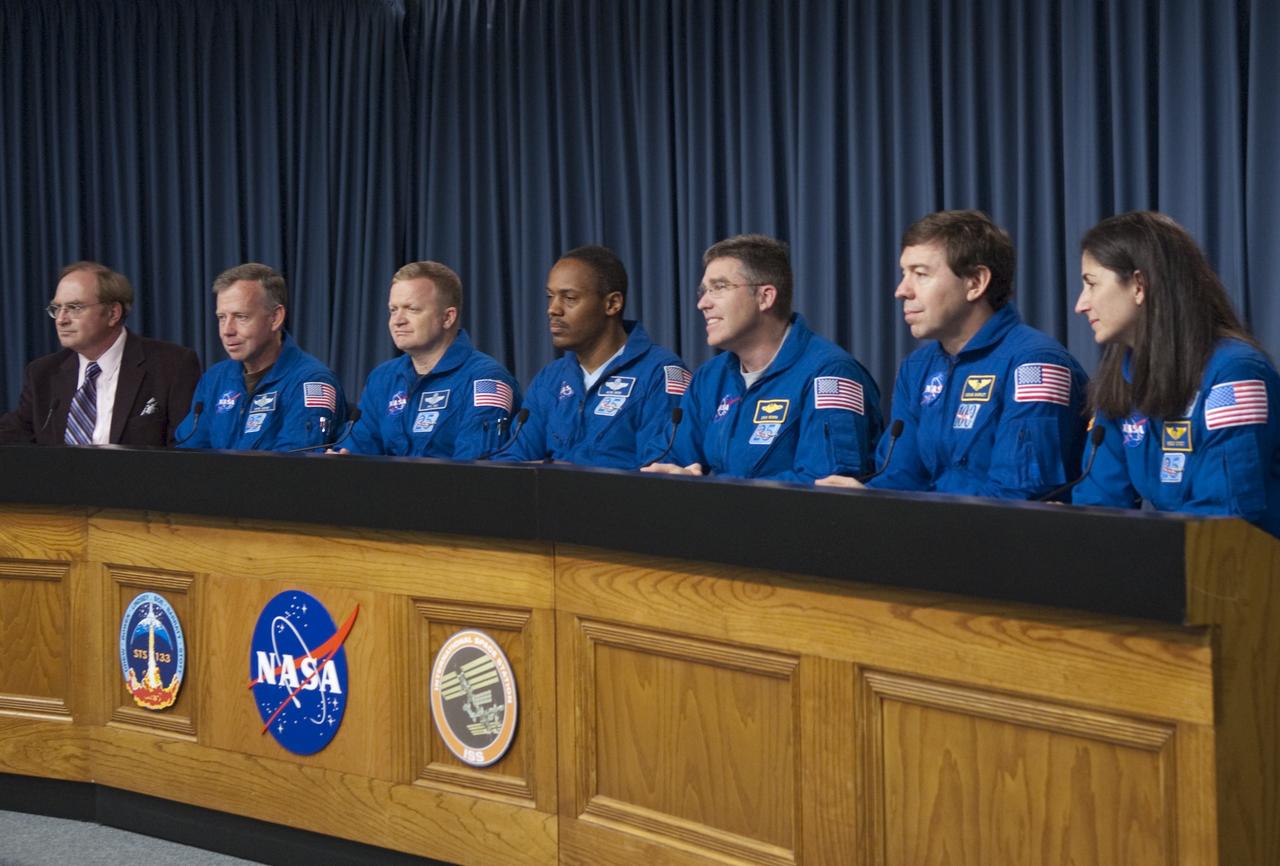
CAPE CANAVERAL, Fla. -- Space shuttle Discovery's STS-133 crew participates in a post-landing news conference in the Press Site TV Auditorium at NASA's Kennedy Space Center in Florida. From left, are NASA Public Affairs Officer George Diller, STS-133 Commander Steve Lindsey, Pilot Eric Boe, and Mission Specialists Alvin Drew, Steve Bowen, Michael Barratt and Nicole Stott. Discovery and crew landed on the Shuttle Landing Facility's Runway 15 at 11:57 a.m., completing a 13-day, 5.3-million-mile mission to the International Space Station. STS-133 delivered the Permanent Multipurpose Module, packed with supplies and critical spare parts, as well as Robonaut 2, the dexterous humanoid astronaut helper, to the orbiting outpost. STS-133 was Discovery's 39th and final mission. This was the 133rd Space Shuttle Program mission and the 35th shuttle voyage to the space station. Photo credit: NASA/Kim Shiflett
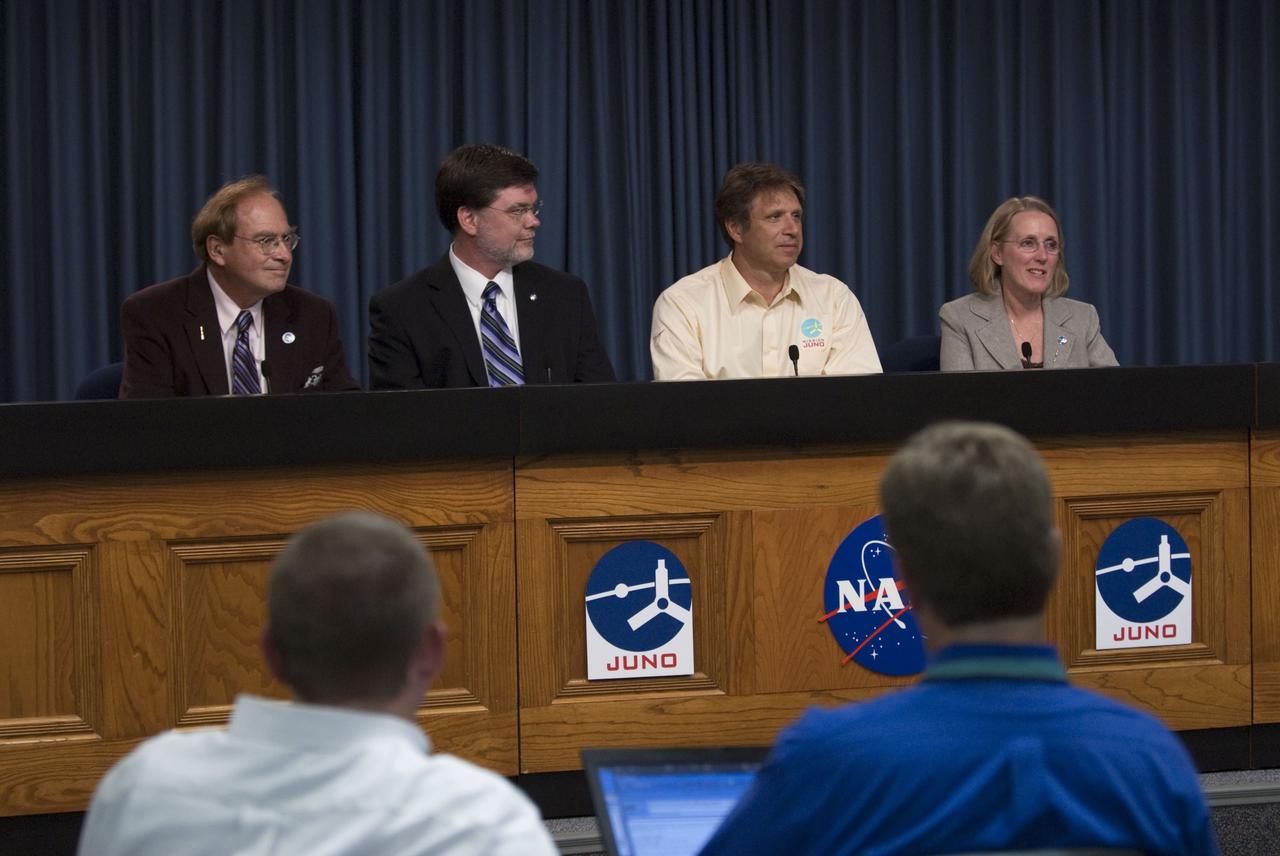
CAPE CANAVERAL, Fla. -- From left, NASA Public Affairs Officer George Diller; Jim Adams, the deputy director of NASA's Planetary Science Division; Scott Bolton, Juno's principal investigator at the Southwest Research Institute (SWRI); and Jan Chodas, Juno's project manager at the Jet Propulsion Laboratory (JPL), participate in a post-launch news conference following the successful liftoff of the Juno spacecraft atop a United Launch Alliance Atlas V rocket. Launch was at 12:25 p.m. EDT Aug. 5. The solar-powered spacecraft now is on a five-year journey to Jupiter, where it will orbit the planet's poles 33 times to find out more about the gas giant's origins, structure, atmosphere and magnetosphere and investigate the existence of a solid planetary core. For more information, visit www.nasa.gov/juno. Photo credit: Kim Shiflett
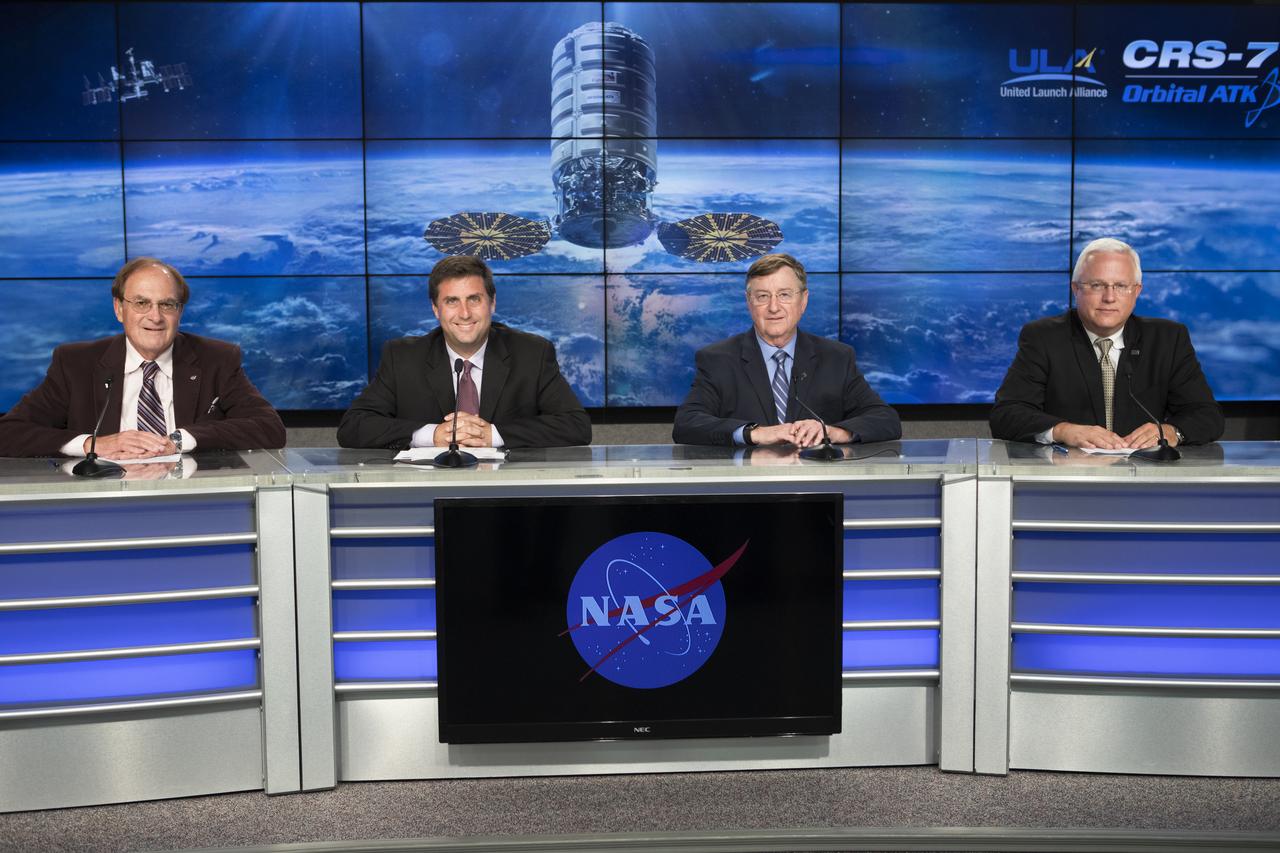
Members of the news media attend a press conference at NASA's Kennedy Space Center in Florida, after the launch of the Orbital ATK Cygnus pressurized cargo module atop a United Launch Alliance Atlas V rocket from Space Launch Complex 41 at Cape Canaveral Air Force Station. It was Orbital ATK's seventh commercial resupply services mission to the International Space Station. Liftoff was at 11:11 a.m. EDT. Speaking to the media are, from left, George Diller, NASA Kennedy Communications; Joel Montalbano, deputy manager, International Space Station Program, NASA Johnson Space Center in Houston; Frank Culbertson, president, Orbital ATK Space Systems Group; and Vern Thorp, program manager, commercial missions, United Launch Alliance.
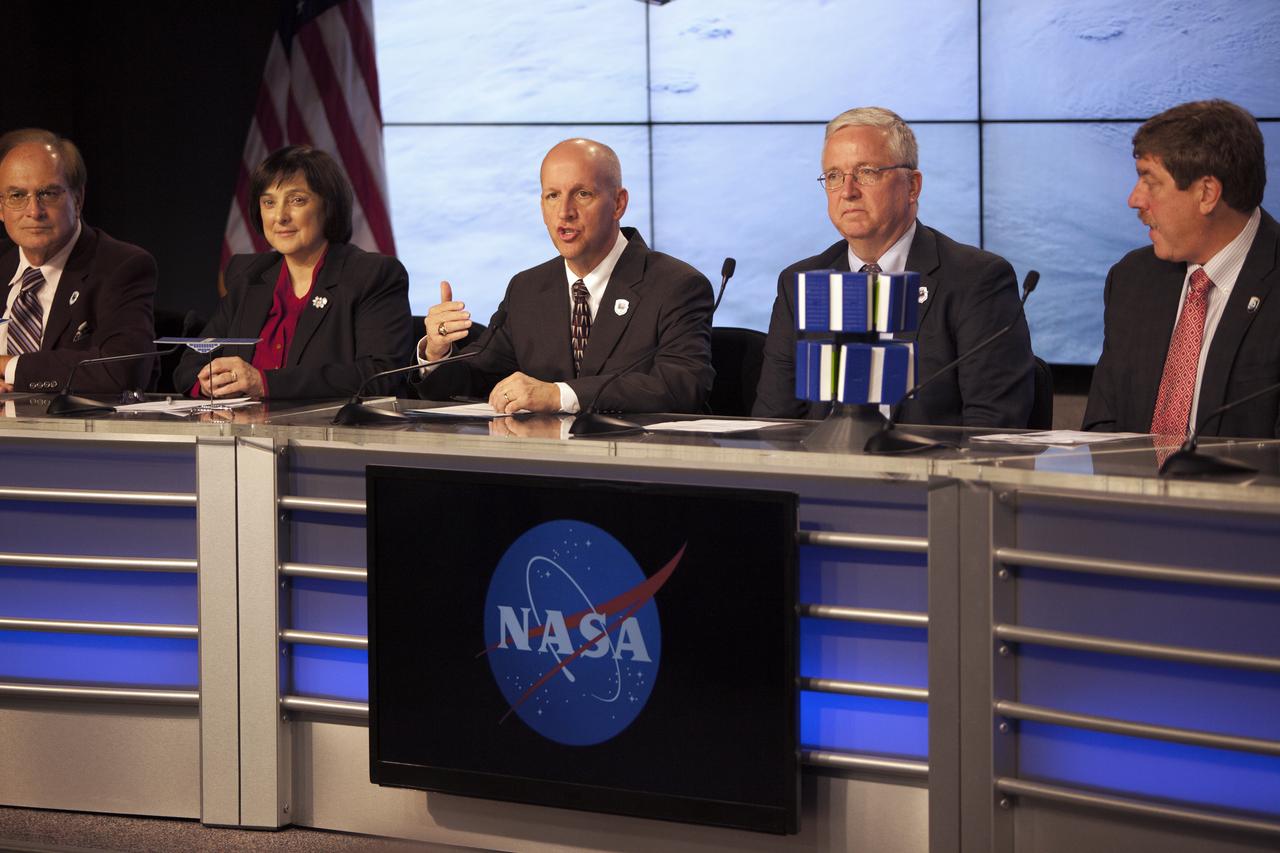
In the Kennedy Space Center’s Press Site auditorium, NASA and industry leaders speak to members of the media during a prelaunch news conference for the agency’s Cyclone Global Navigation Satellite System, or CYGNSS, spacecraft. From left are: George Diller of NASA Communications; Christine Bonniksen, CYGNSS program executive in the Earth Science Division of the Science Mission Directorate at NASA Headquarters in Washington, D.C.; Tim Dunn, NASA launch director at Kennedy; Bryan Baldwin, Pegasus launch vehicle program manager for Orbital ATK, Dulles, Virginia; and John Scherrer, CYGNSS project manager for the Southwest Research Institute in San Antonio, Texas. The eight CYGNSS satellites will make frequent and accurate measurements of ocean surface winds throughout the life cycle of tropical storms and hurricanes. The data will help scientists probe key air-sea interaction processes that take place near the core of storms, which are rapidly changing and play a crucial role in the beginning and intensification of hurricanes.
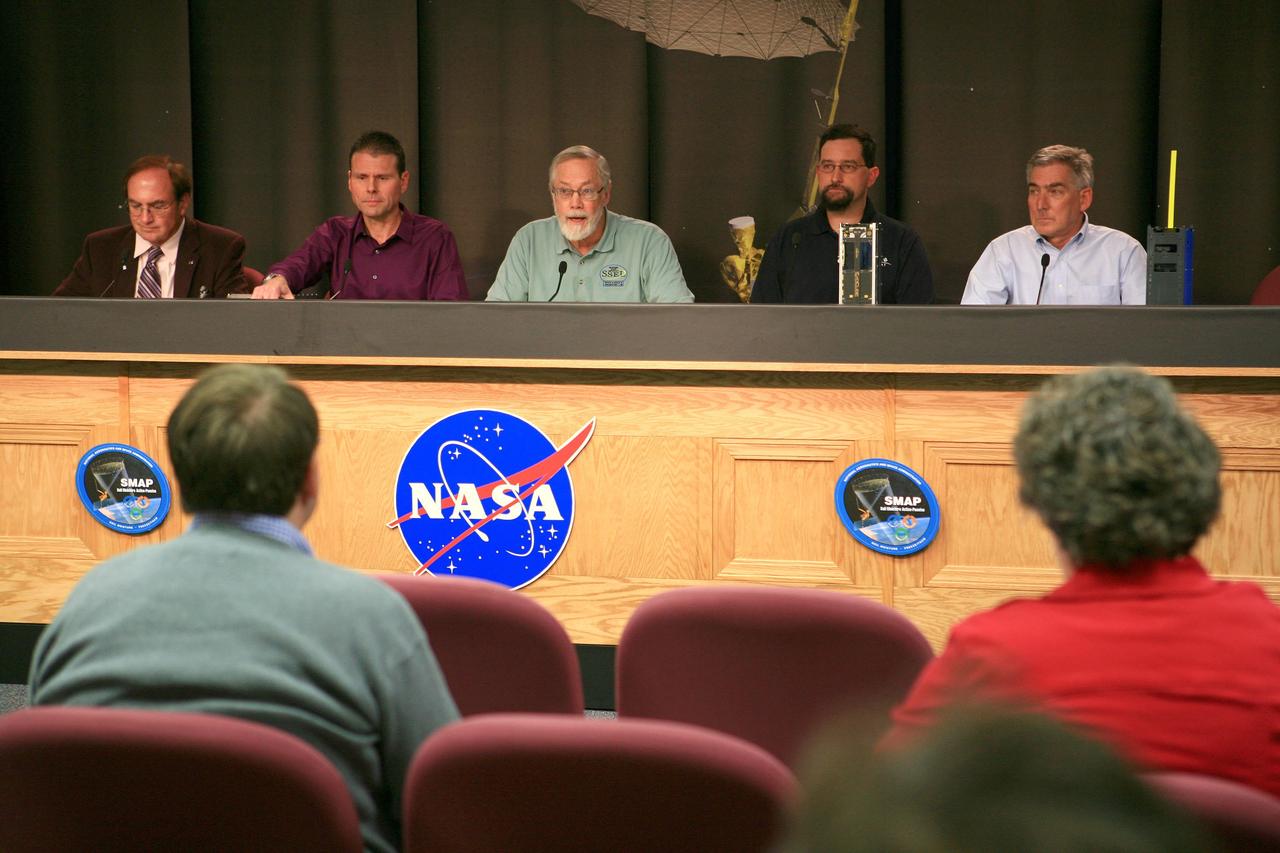
VANDENBERG AIR FORCE BASE, California– At Vandenberg Air Force Base, California, agency leaders held an Educational Launch of Nanosatellites, or ELaNa, CubeSat briefing to discuss three small research satellites that are being flown as auxiliary payloads on the SMAP mission. More than 100 university students have been involved in the design, development and construction of the CubeSats. Presenting the mission science objectives for the ELaNa CubeSats are George Diller of NASA Public Affairs, Scott Higginbotham, NASA ELaNa-X Mission Manager at the Kennedy Space Center, Florida, Dave Klumpar, Firebird-II principal investigator and director of the Space Science and Engineering Laboratory at Montana State University in Bozeman, Montana, Jordi Puig-Sauri, EXOCUBE principal investigator at the California Polytechnic State University in San Luis Obispo, California, and David Rider, GRIFEX principal investigator at Jet Propulsion Laboratory, Pasadena, California. Photo credit: NASA/Kim Shiflett
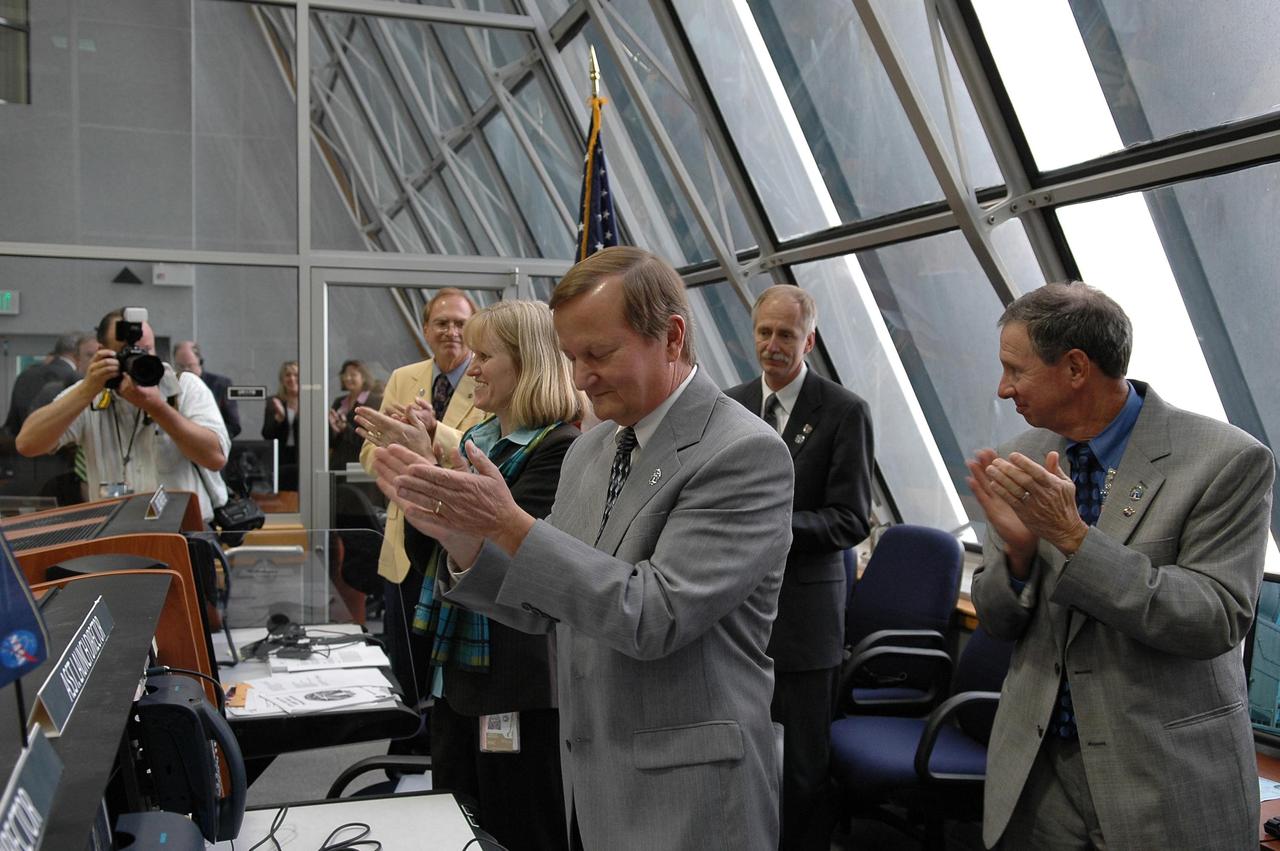
KENNEDY SPACE CENTER, FLA. - Inside the Launch Control Center, NASA and KSC officials applaud the successful launch of Space Shuttle Atlantis on mission STS-115. From right are NASA Administrator Michael Griffin, Associate Administrator for Space Operations Mission William Gerstenmaier, Shuttle Launch Director Mike Leinbach, NASA Flow Director Angie Brewer, and Public Affairs Officer George Diller, who provided commentary leading up to the launch. Mission STS-115 is the 116th space shuttle flight, the 27th flight for orbiter Atlantis, and the 19th U.S. flight to the International Space Station. STS-115 is scheduled to last 11 days with a planned landing at KSC. Photo credit: NASA/Kim Shiflett
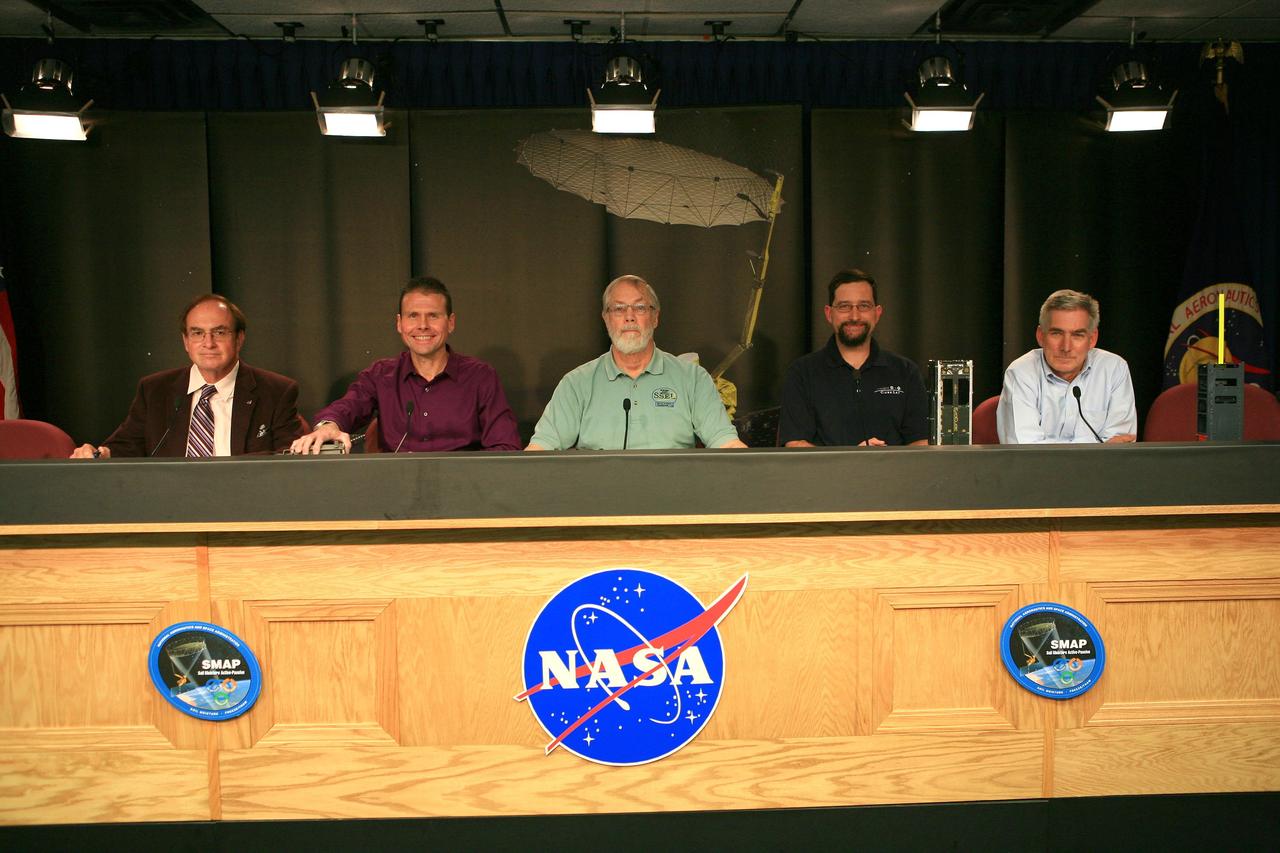
VANDENBERG AIR FORCE BASE, California– At Vandenberg Air Force Base, California, agency leaders held an Educational Launch of Nanosatellites, or ELaNa, CubeSat briefing to discuss three small research satellites that are being flown as auxiliary payloads on the SMAP mission. More than 100 university students have been involved in the design, development and construction of the CubeSats. Presenting the mission science objectives for the ELaNa CubeSats are George Diller of NASA Public Affairs, Scott Higginbotham, NASA ELaNa-X Mission Manager at the Kennedy Space Center, Florida, Dave Klumpar, Firebird-II principal investigator and director of the Space Science and Engineering Laboratory at Montana State University in Bozeman, Montana, Jordi Puig-Sauri, EXOCUBE principal investigator at the California Polytechnic State University in San Luis Obispo, California, and David Rider, GRIFEX principal investigator at Jet Propulsion Laboratory, Pasadena, California. Photo credit: NASA/Kim Shiflett

VANDENBERG AIR FORCE BASE, California – At Vandenberg Air Force Base, California, agency and industry leaders spoke to members of the news media as the Soil Moisture Active Passive, or SMAP, satellite and its Delta II rocket were being prepared for launch. From left are: George Diller of NASA Public Affairs, Christine Bonniksen, SMAP program executive at NASA Headquarters, Tim Dunn, NASA launch manager at Kennedy Space Center, Florida Vern Thorp, program manager for NASA Missions for United Launch Alliance in Centennial, Colorado, Kent Kellogg, SMAP Project manager at the Jet Propulsion Laboratory in Pasadena, California, Dara Entekhabi, SMAP science team leader at the Massachusetts Institute of Technology in Cambridge, Massachusetts, and 1st Lt. John Martin, launch weather officer, 30th Operations Support Squadron at Vandenberg. Photo credit: NASA/Kim Shiflett
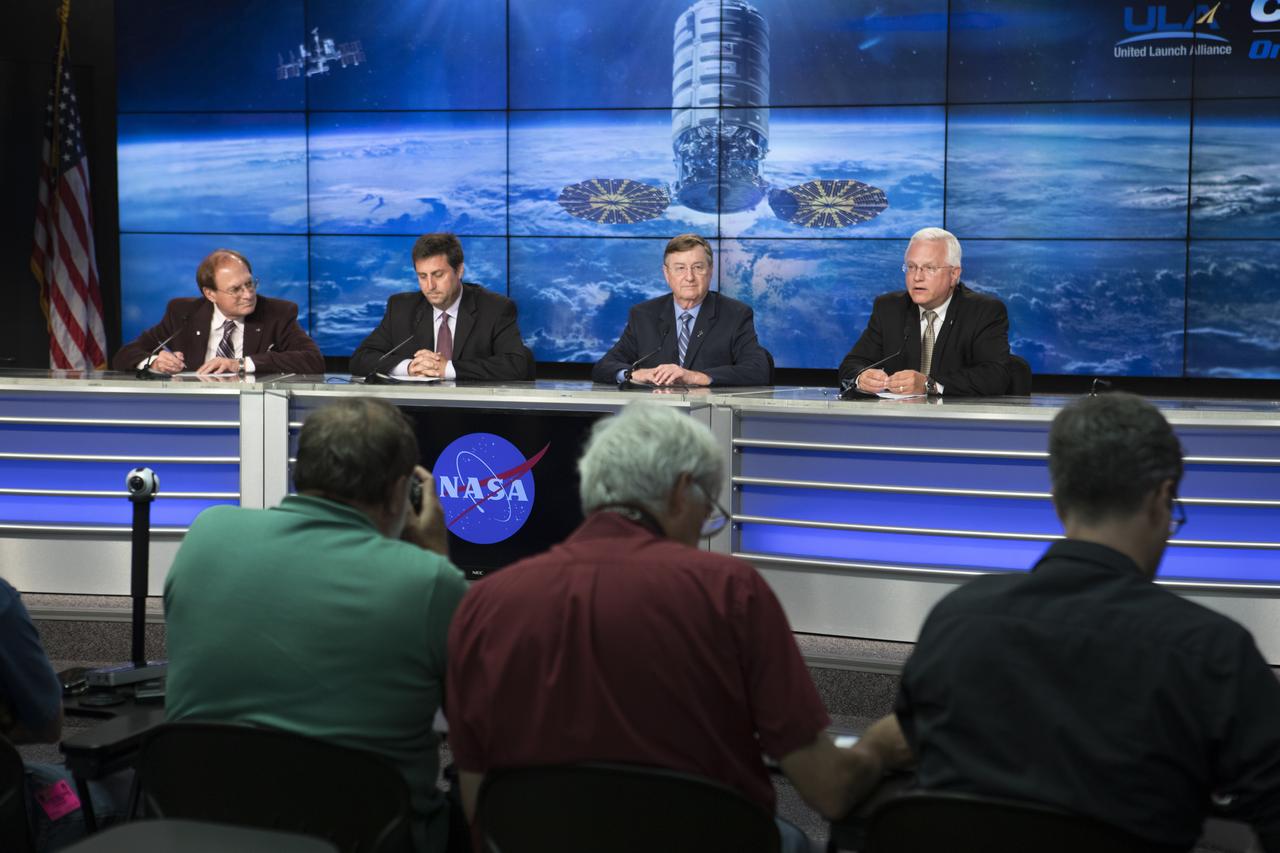
Members of the news media attend a press conference at NASA's Kennedy Space Center in Florida, after the launch of the Orbital ATK Cygnus pressurized cargo module atop a United Launch Alliance Atlas V rocket from Space Launch Complex 41 at Cape Canaveral Air Force Station. It was Orbital ATK's seventh commercial resupply services mission to the International Space Station. Liftoff was at 11:11 a.m. EDT. Speaking to the media are, from left, George Diller, NASA Kennedy Communications; Joel Montalbano, deputy manager, International Space Station Program, NASA Johnson Space Center in Houston; Frank Culbertson, president, Orbital ATK Space Systems Group; and Vern Thorp, program manager, commercial missions, United Launch Alliance.
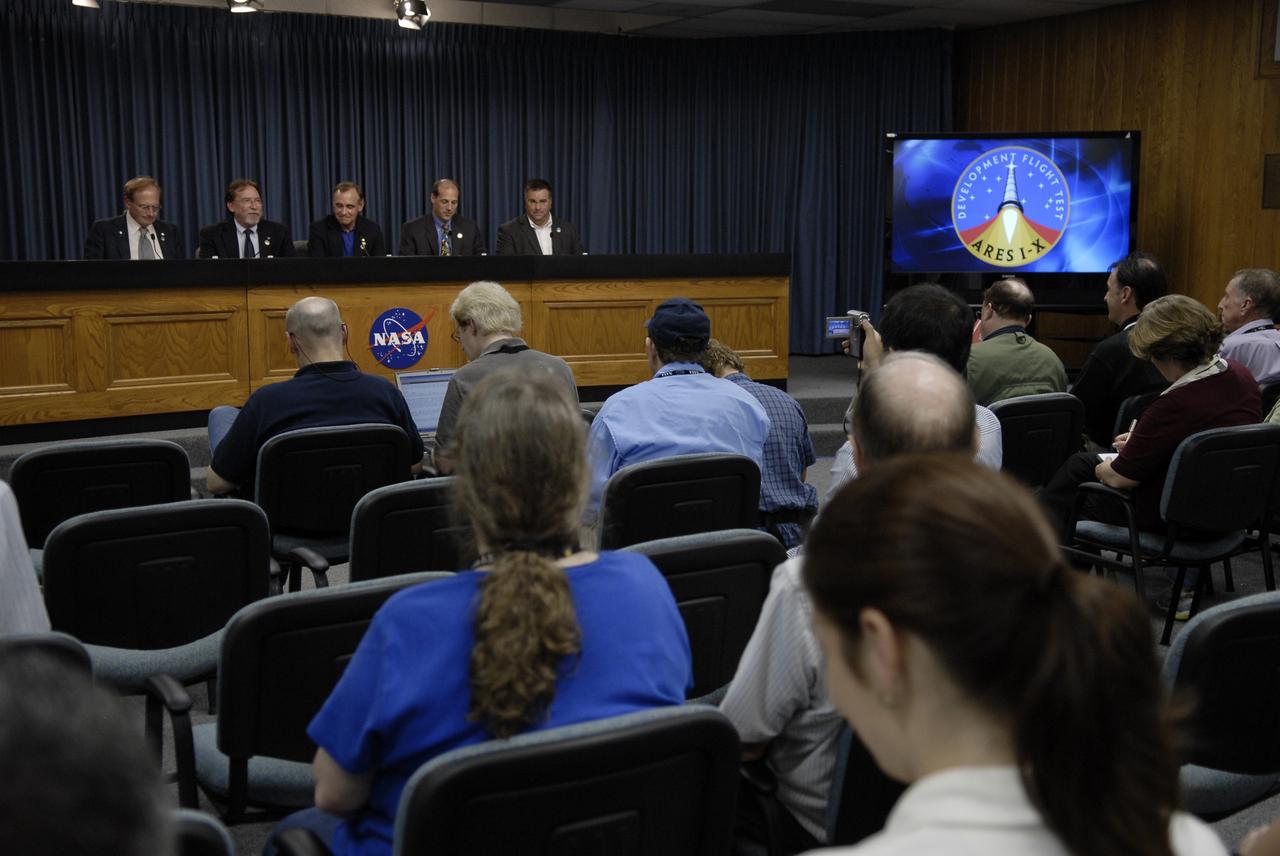
CAPE CANAVERAL, Fla. - At NASA's Kennedy Space Center in Florida, members of the news media attend a post-launch news conference in the Press Site auditorium following the successful launch of the Ares I-X test rocket at 11:30 a.m. EDT Oct. 28. Onstage, from left, are moderator George Diller, NASA Public Affairs officer; Doug Cooke, associate administrator for NASA's Exploration Systems Mission Directorate; Jeff Hanley, Constellation Program manager; Bob Ess, mission manager for the Ares I-X flight test; and Edward Mango, launch director for the Ares I-X flight test. For more information on the Ares I-X vehicle and flight test, visit http://www.nasa.gov/aresIX. Photo credit: NASA/Kim Shiflett
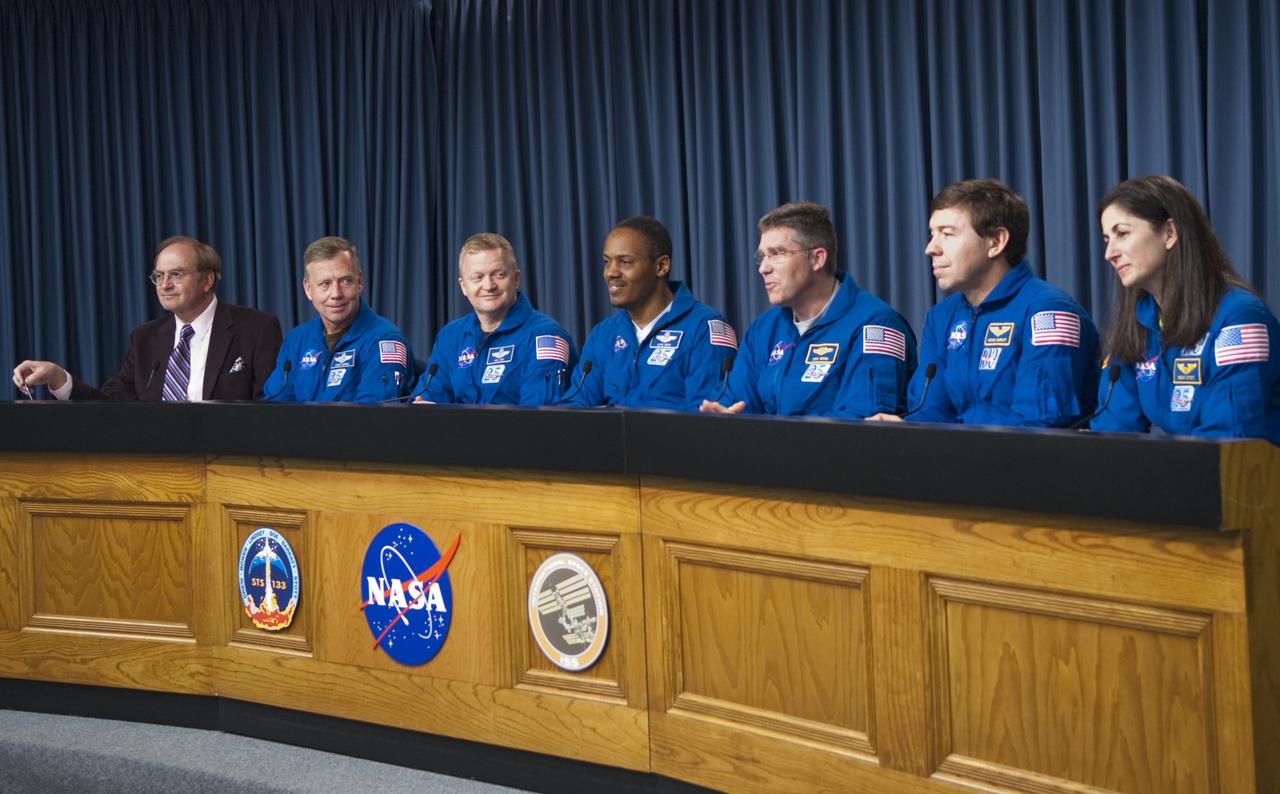
CAPE CANAVERAL, Fla. -- Space shuttle Discovery's STS-133 crew participates in a post-landing news conference in the Press Site TV Auditorium at NASA's Kennedy Space Center in Florida. From left, are NASA Public Affairs Officer George Diller, STS-133 Commander Steve Lindsey, Pilot Eric Boe, and Mission Specialists Alvin Drew, Steve Bowen, Michael Barratt and Nicole Stott. Discovery and crew landed on the Shuttle Landing Facility's Runway 15 at 11:57 a.m., completing a 13-day, 5.3-million-mile mission to the International Space Station. STS-133 delivered the Permanent Multipurpose Module, packed with supplies and critical spare parts, as well as Robonaut 2, the dexterous humanoid astronaut helper, to the orbiting outpost. STS-133 was Discovery's 39th and final mission. This was the 133rd Space Shuttle Program mission and the 35th shuttle voyage to the space station. Photo credit: NASA/Kim Shiflett
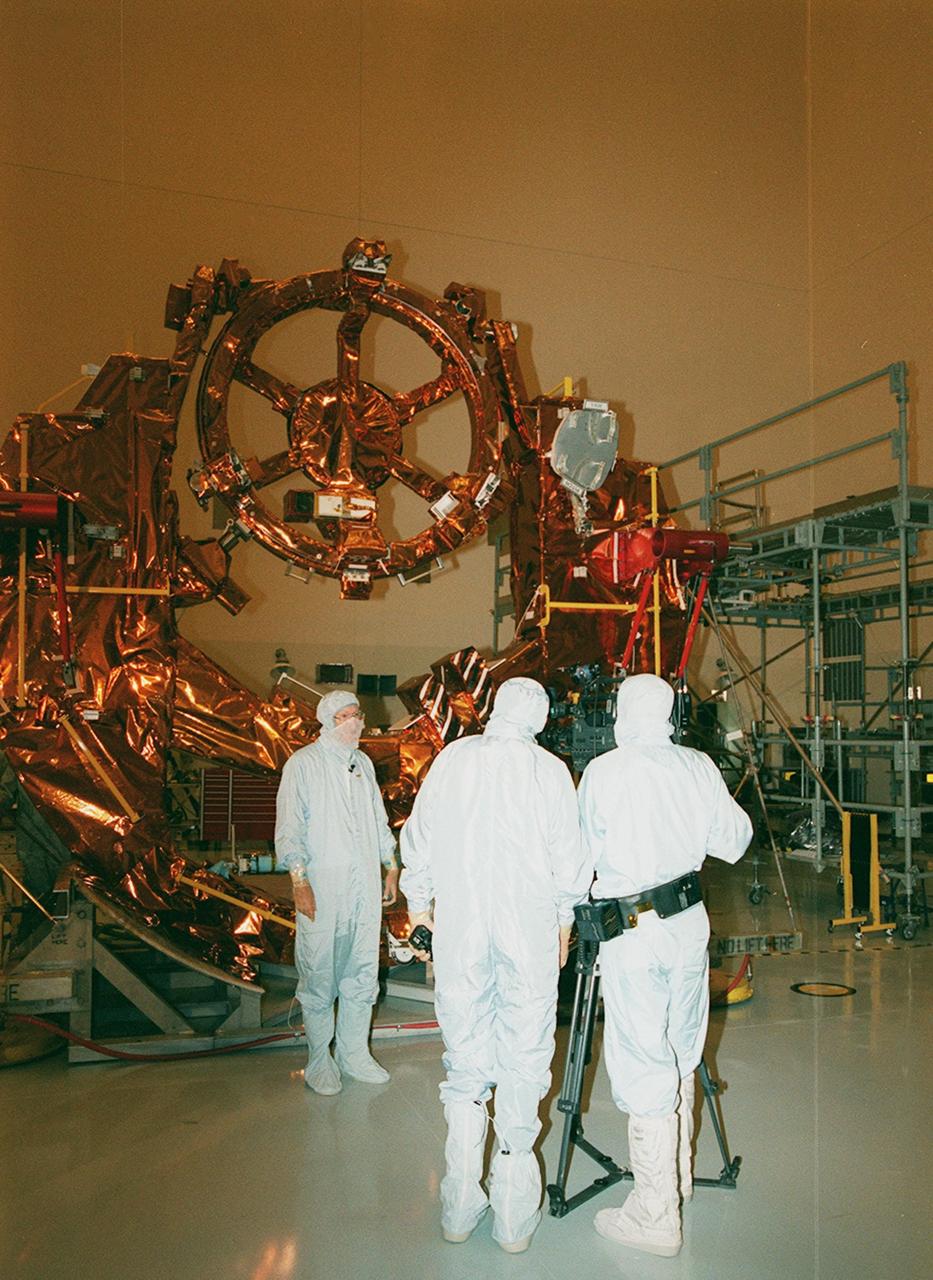
KENNEDY SPACE CENTER, FLA. -- In the Payload Hazardous Servicing Facility clean room, part of the flight hardware for the Hubble Space Telescope Servicing mission is on display for media representatives. Dr. John Campbell, associate director, Hubble Space Telescope, provides commentary for a video being recorded for NASA by videographer Glen Benson (right). Between them is George Diller, public information officer for KSC. This mission is designed to replace aging parts on the nine-year-old observatory and to upgrade some of its functioning systems. During the flight, the astronaut crew will replace all six of Hubble's gyroscopes, a fine guidance sensor, the observatory's main computer, and other equipment. The 10-day mission is scheduled to launch no earlier than Dec. 2 at 4:32 a.m. EST from Launch Complex 39
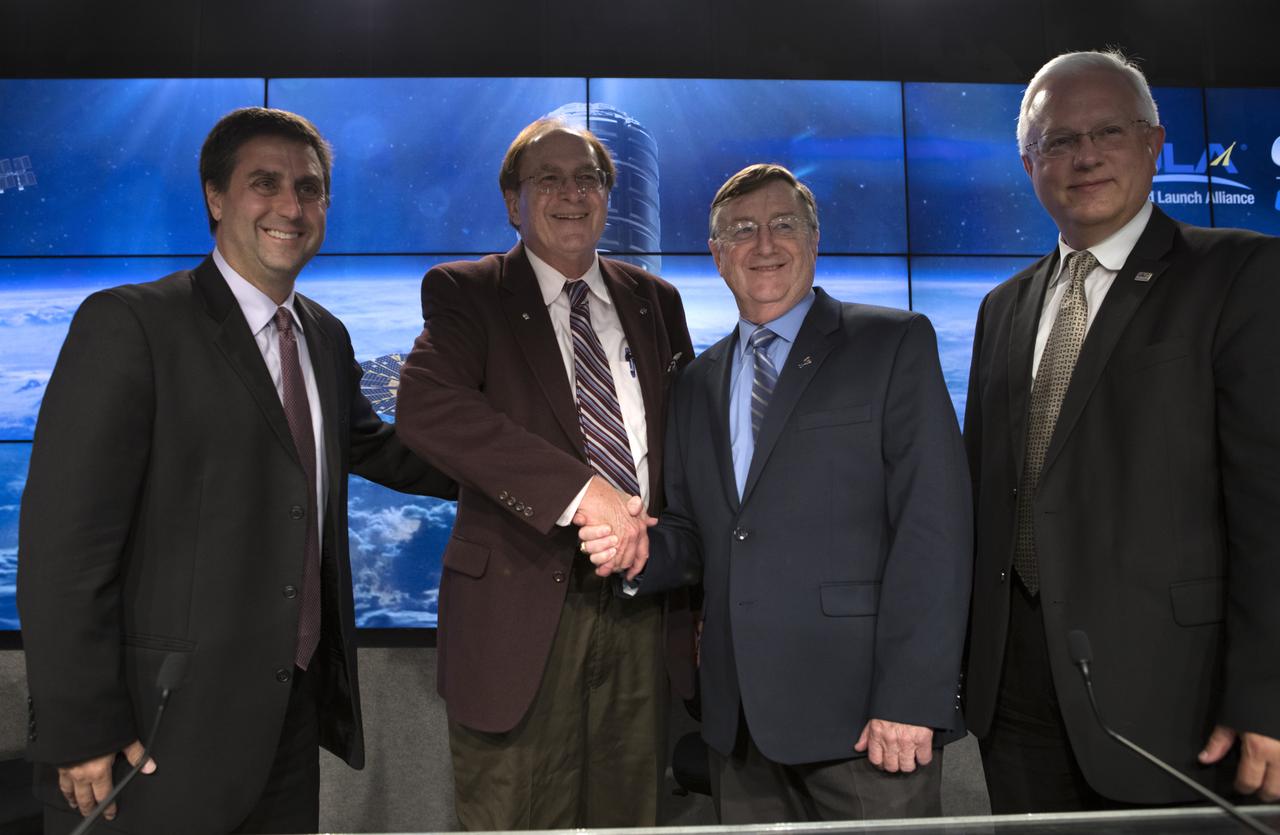
At the conclusion of the Orbital ATK CRS-7 post-launch press conference, moderator George Diller, second from left, NASA Kennedy Communications; shakes hands with Joel Montalbano, deputy manager, International Space Station Program, NASA Johnson Space Center in Houston. Also with them are Frank Culbertson, president, Orbital ATK Space Systems Group; and Vern Thorp, program manager, commercial missions, United Launch Alliance. A United Launch Alliance Atlas V rocket lifted off from Space Launch Complex 41 at Cape Canaveral Air Force Station in Florida, carrying Orbital ATK's Cygnus pressurized cargo module. It is Orbital ATK's seventh commercial resupply services mission to the International Space Station. Liftoff was at 11:11 a.m. EDT.
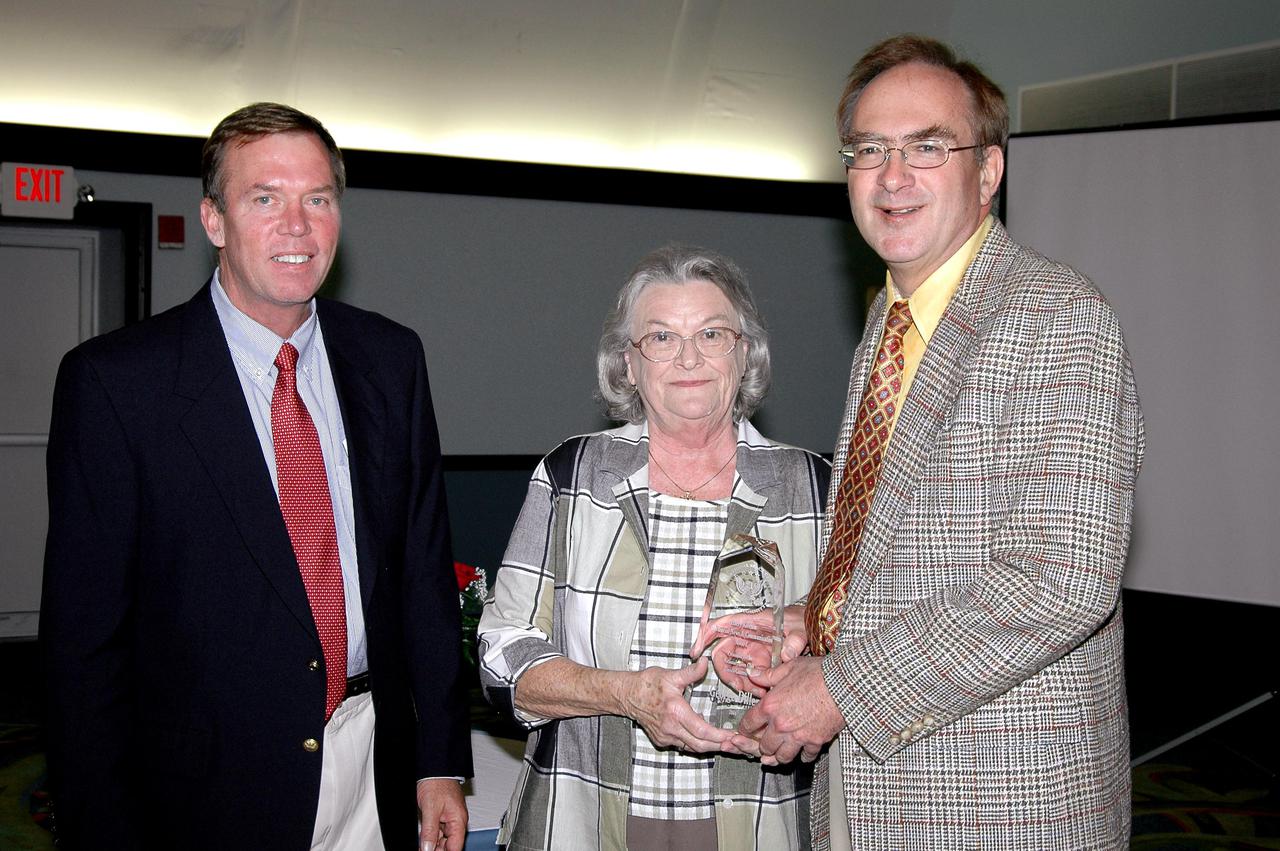
KENNEDY SPACE CENTER, FLA. - NASA public affairs specialist George Diller (right) is honored with a Harry Kolcum Memorial News and Communications Award for 2004 by the National Space Club Florida Committee at the Radisson Resort at the Port, Cape Canaveral, Fla. He is joined by Committee Chairman Jerry Moyer (left) and Eddie Kolcum, wife of the late journalist for whom the award is named. Each year, the National Space Club Florida Committee recognizes area representatives of the news media and communications professions for excellence in their ability to communicate the space story along Florida’s Space Coast and throughout the world. The award is named in honor of Harry Kolcum, the former managing editor of Aviation Week and Space Technology, who was Cape bureau chief from 1980 to 1993 prior to his death in 1994. Kolcum was a founding member of the National Space Club Florida Committee.
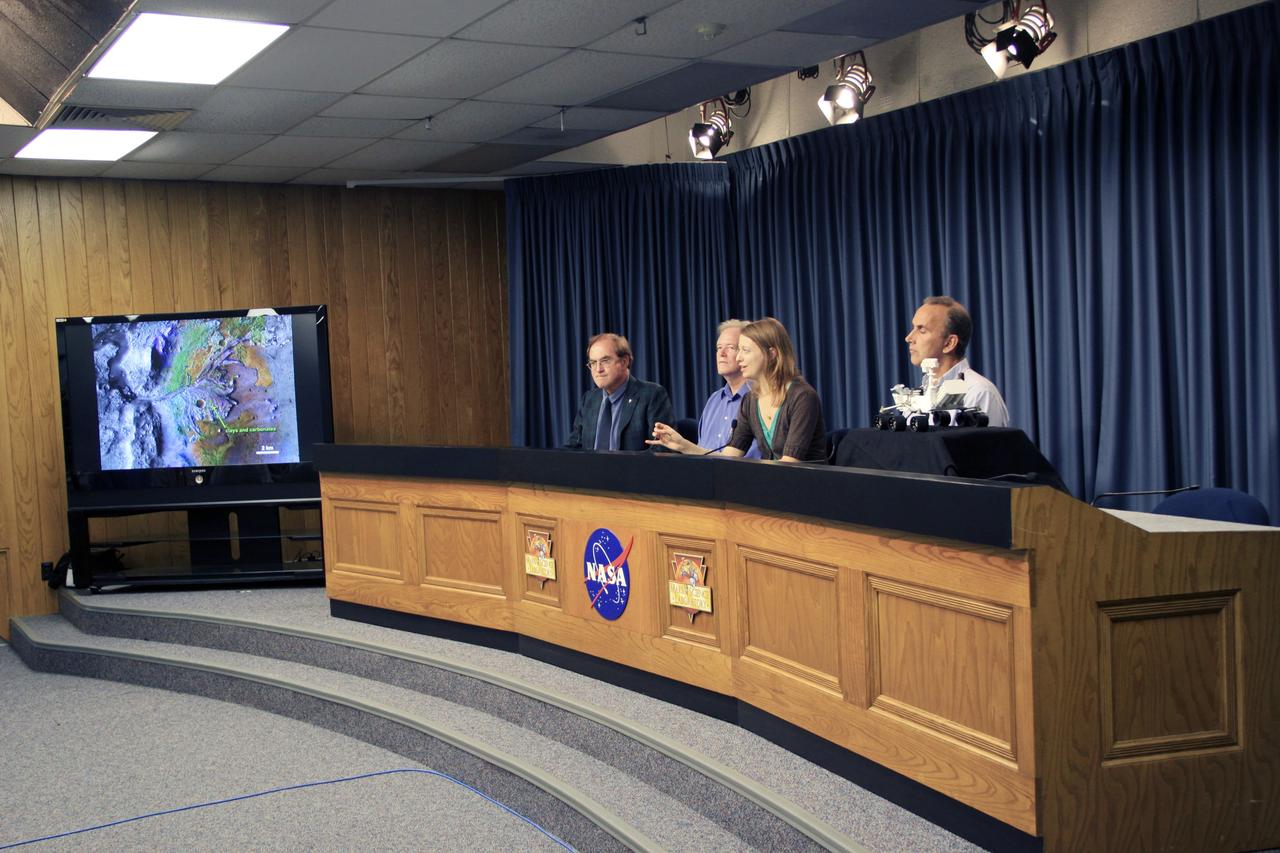
CAPE CANAVERAL, Fla. – At NASA’s Kennedy Space Center in Florida, Scientist and Assistant Professor Bethany Ehlmann with the California Institute of Technology and Jet Propulsion Laboratory, answers a question from the media during a “What Do We Know About Mars” news conference, Nov. 21. The press conference was part of preflight activities for the Mars Science Laboratory (MSL) mission. NASA Public Affairs Officer George Diller, at left, moderates the conference that also features Lead Scientist Michael Meyer, Mars Exploration Program and Mars Science Laboratory Project Scientist John Grotzinger from the California Institute of Technology. MSL’s components include a car-sized rover, Curiosity, which has 10 science instruments designed to search for signs of life, including methane, and help determine if the gas is from a biological or geological source. Launch of MSL aboard a United Launch Alliance Atlas V rocket is targeted for Nov. 26 from Space Launch Complex 41 on Cape Canaveral Air Force Station in Florida. For more information, visit http://www.nasa.gov/msl. Photo credit: NASA/Jim Grossmann
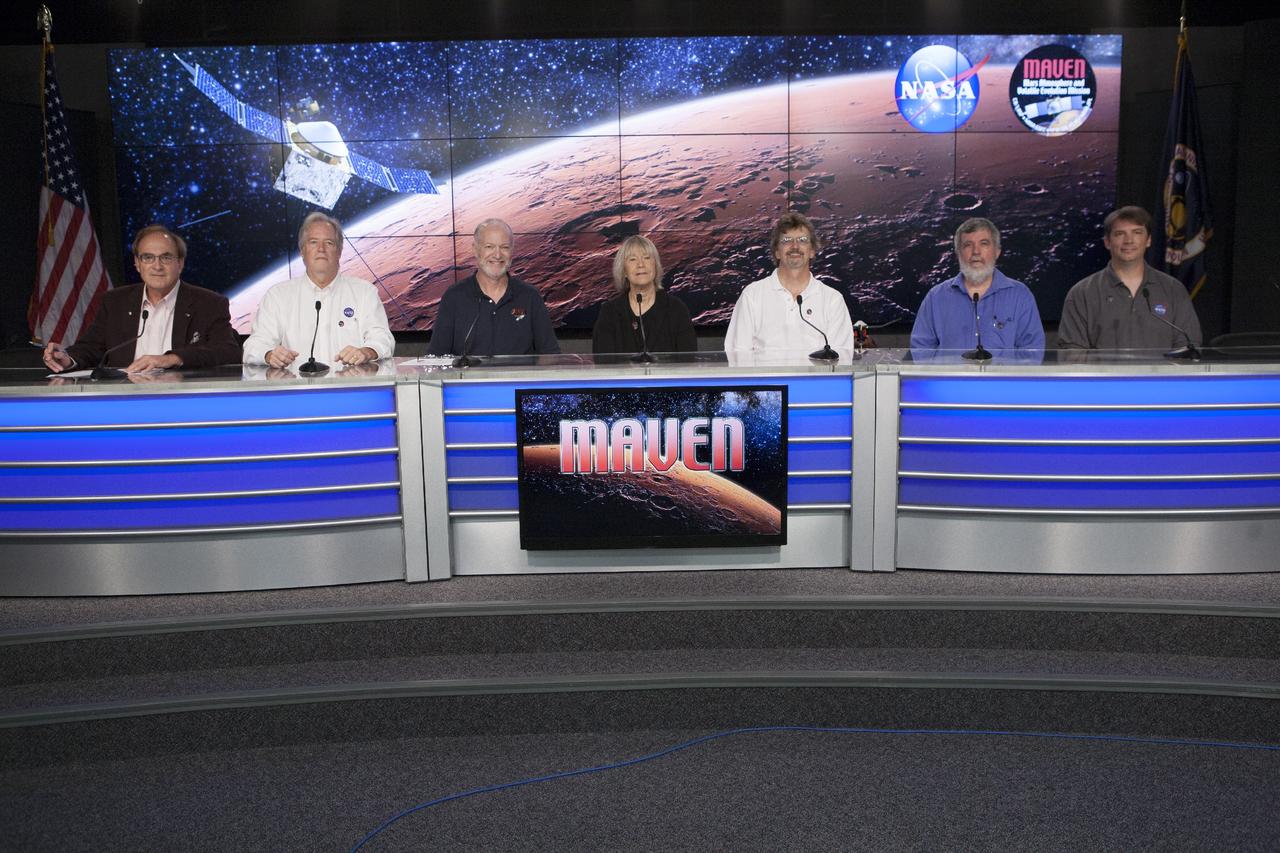
CAPE CANAVERAL, Fla. – During a news conference at NASA's Kennedy Space Center in Florida, NASA officials and university investigators outlined science plans for the Mars Atmosphere and Volatile EvolutioN, or MAVEN, mission. Participating in the briefing, from the left, are George Diller of NASA Public Affairs, Michael Meyer, lead Mars Scientist at NASA Headquarters, Bruce Jakosky, MAVEN principal investigator from the Laboratory for Atmospheric and Space Physics at the University of Colorado at Boulder, Janet Luhmann, MAVEN deputy principal investigator from the University of California at Berkeley, Nick Schneider, MAVEN Imaging Ultraviolet Spectrograph, or IUVS, instrument lead at the University of Colorado, Paul Mahaffy, MAVEN Neutral Gas and Ion Mass Spectrometer, or NGIMS, instrument lead at NASA's Goddard Space Flight Center in Greenbelt, Md., and David Mitchell, MAVEN Solar Wind Electron Analyzer, or SWEA, instrument lead at the University of California. MAVEN is being prepared for its scheduled launch on Nov 18, 2013 from Cape Canaveral Air Force Station, Fla. atop a United Launch Alliance Atlas V rocket. Positioned in an orbit above the Red Planet, MAVEN will study the upper atmosphere of Mars in unprecedented detail. For information on the MAVEN mission, visit: http://www.nasa.gov/mission_pages/maven/main/index.html. Photo credit: NASA/Kim Shiflett
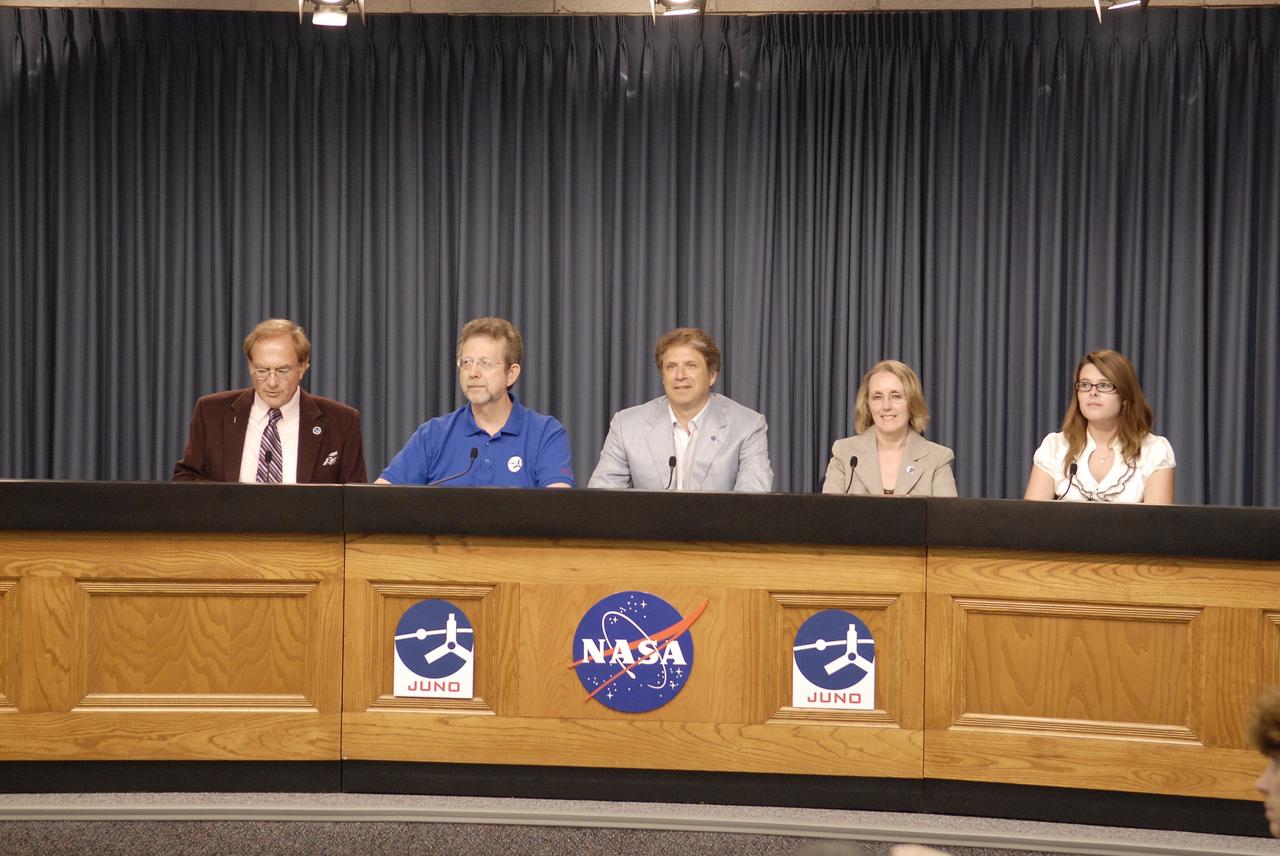
CAPE CANAVERAL, Fla. -- In the Press Site auditorium at NASA's Kennedy Space Center in Florida, a briefing was held to update media on the upcoming launch of NASA's Juno spacecraft. Seen here are NASA Panel Moderator and Public Affairs Officer George Diller (left), Jim Green, director of the Planetary Science Division at Headquarters in Washington, D.C.; Scott Bolton, Juno principal investigator with the Southwest Research Institute in San Antonio, Texas; Jan Chodas, Juno project manager with the Jet Propulsion Laboratory in Pasadena, Calif., and Kaelyn Badura, Pine Ridge High School, Deltona, Fla. high school student, Juno Education program participant and Goldstone Apple Valley Radio Telescope Project participant. Juno is scheduled to launch aboard an United Launch Alliance Atlas V from Cape Canaveral, Fla. Aug. 5.The solar-powered spacecraft will orbit Jupiter's poles 33 times to find out more about the gas giant's origins, structure, atmosphere and magnetosphere and investigate the existence of a solid planetary core. For more information visit: www.nasa.gov/juno. Photo credit: NASA/Gianni M. Woods
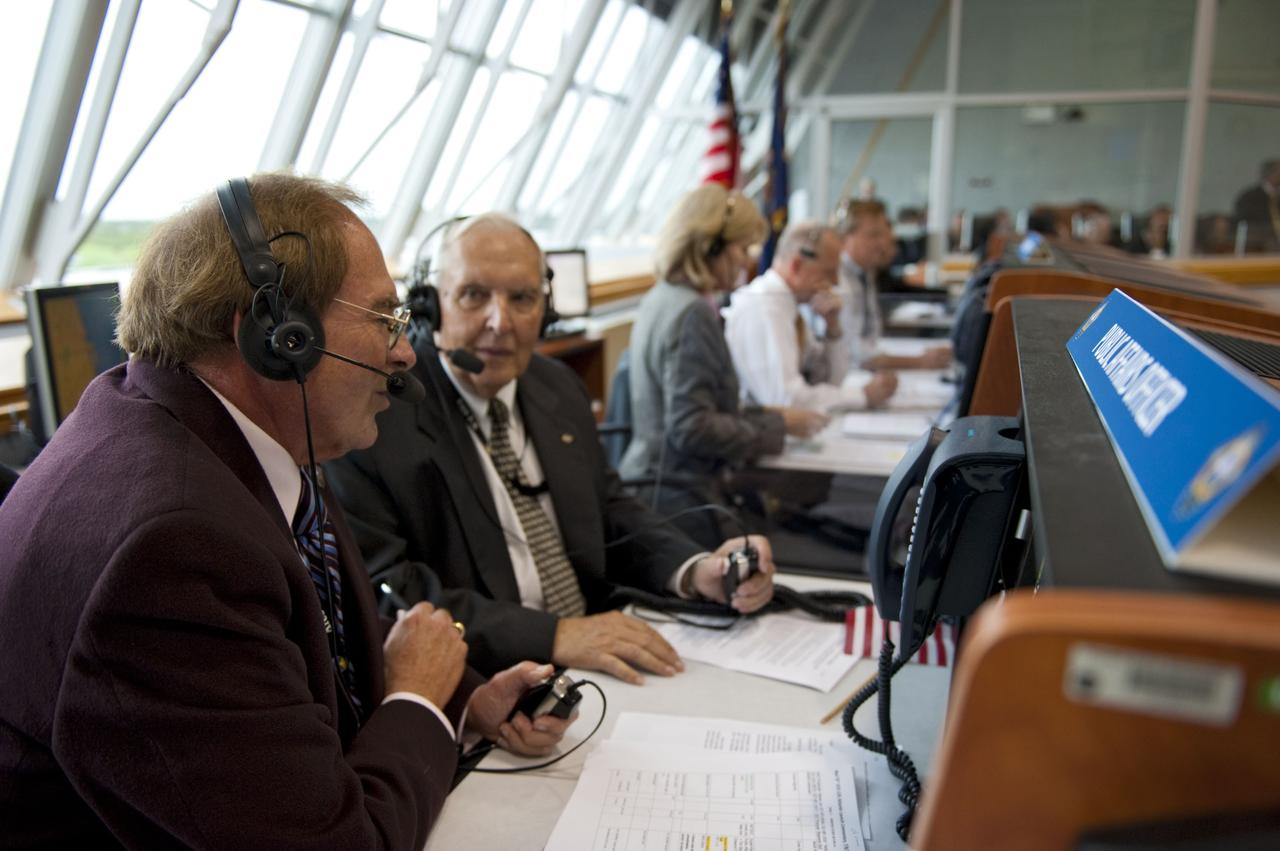
CAPE CANAVERAL, Fla. -- In Firing Room 4 of the Launch Control Center at NASA's Kennedy Space Center in Florida, NASA Launch Commentator and Public Affairs Officer George Diller interviews former Kennedy Director of Public Affairs Hugh Harris during prelaunch activities before liftoff of space shuttle Atlantis on its STS-135 mission. Atlantis with its crew of four; Commander Chris Ferguson, Pilot Doug Hurley, Mission Specialists Sandy Magnus and Rex Walheim, lifted off at 11:29 a.m. EDT on July 8, 2011 to deliver the Raffaello multi-purpose logistics module packed with supplies and spare parts for the station. Atlantis also will fly the Robotic Refueling Mission experiment that will investigate the potential for robotically refueling existing satellites in orbit. In addition, Atlantis will return with a failed ammonia pump module to help NASA better understand the failure mechanism and improve pump designs for future systems. STS-135 will be the 33rd flight of Atlantis, the 37th shuttle mission to the space station, and the 135th and final mission of NASA's Space Shuttle Program. For more information, visit www.nasa.gov/mission_pages/shuttle/shuttlemissions/sts135/index.html. Photo credit: NASA/Kim Shiflett
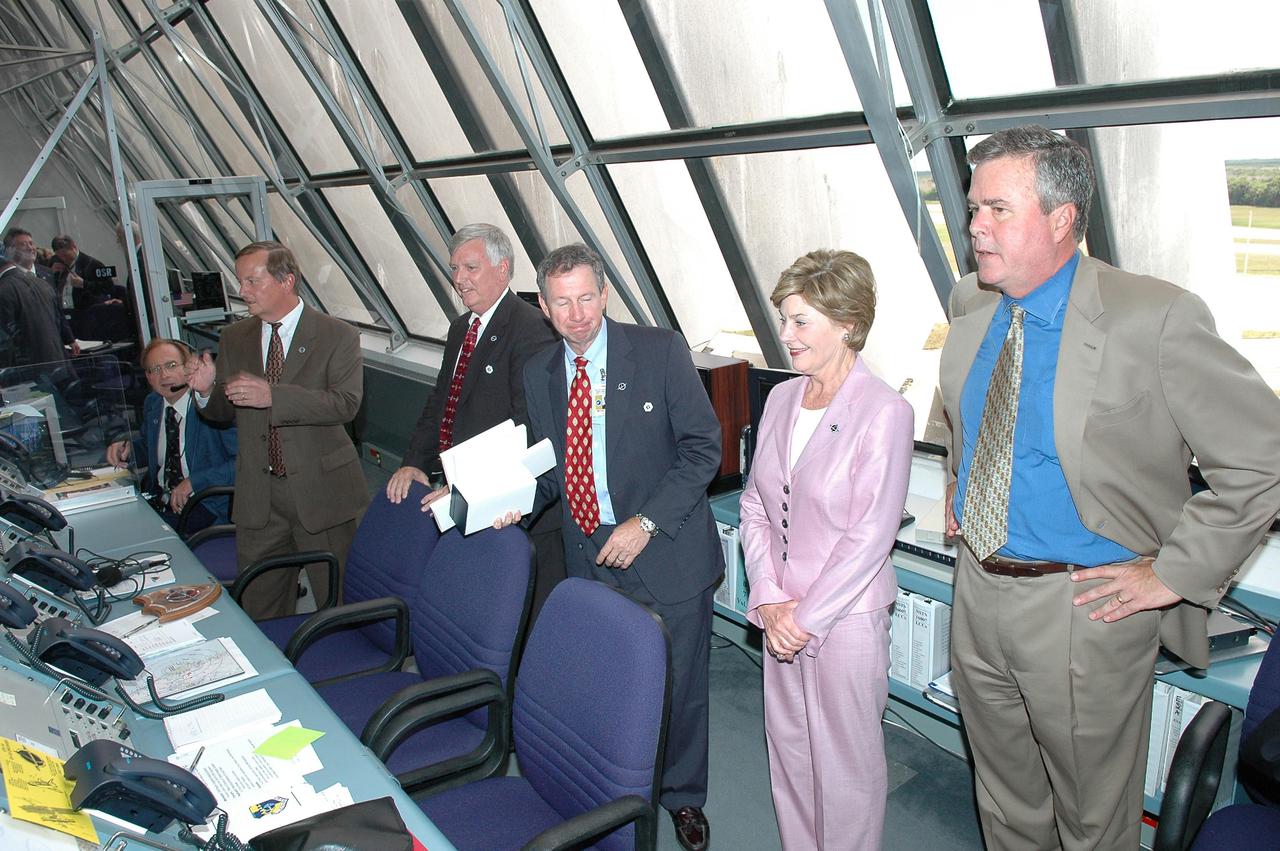
KENNEDY SPACE CENTER, FLA. - In the Launch Control Center at NASA Kennedy Space Center, First Lady Laura Bush congratulates NASA officials for a successful launch of Space Shuttle Discovery on Return to Flight mission STS-114. From left are NASA launch commentator George Diller, Shuttle Launch Director Mike Leinbach, Center Director Jim Kennedy, NASA Administrator Mike Griffin, Mrs. Bush and Florida Gov. Jeb Bush. On this mission to the International Space Station the crew will perform inspections on-orbit for the first time of all of the Reinforced Carbon-Carbon (RCC) panels on the leading edge of the wings and the Thermal Protection System tiles using the new Canadian-built Orbiter Boom Sensor System and the data from 176 impact and temperature sensors. Mission Specialists will also practice repair techniques on RCC and tile samples during a spacewalk in the payload bay. During two additional spacewalks, the crew will install the External Stowage Platform-2, equipped with spare part assemblies, and a replacement Control Moment Gyroscope contained in the Lightweight Multi-Purpose Experiment Support Structure. The 12-day mission is expected to end with touchdown at the Shuttle Landing Facility on Aug. 7.
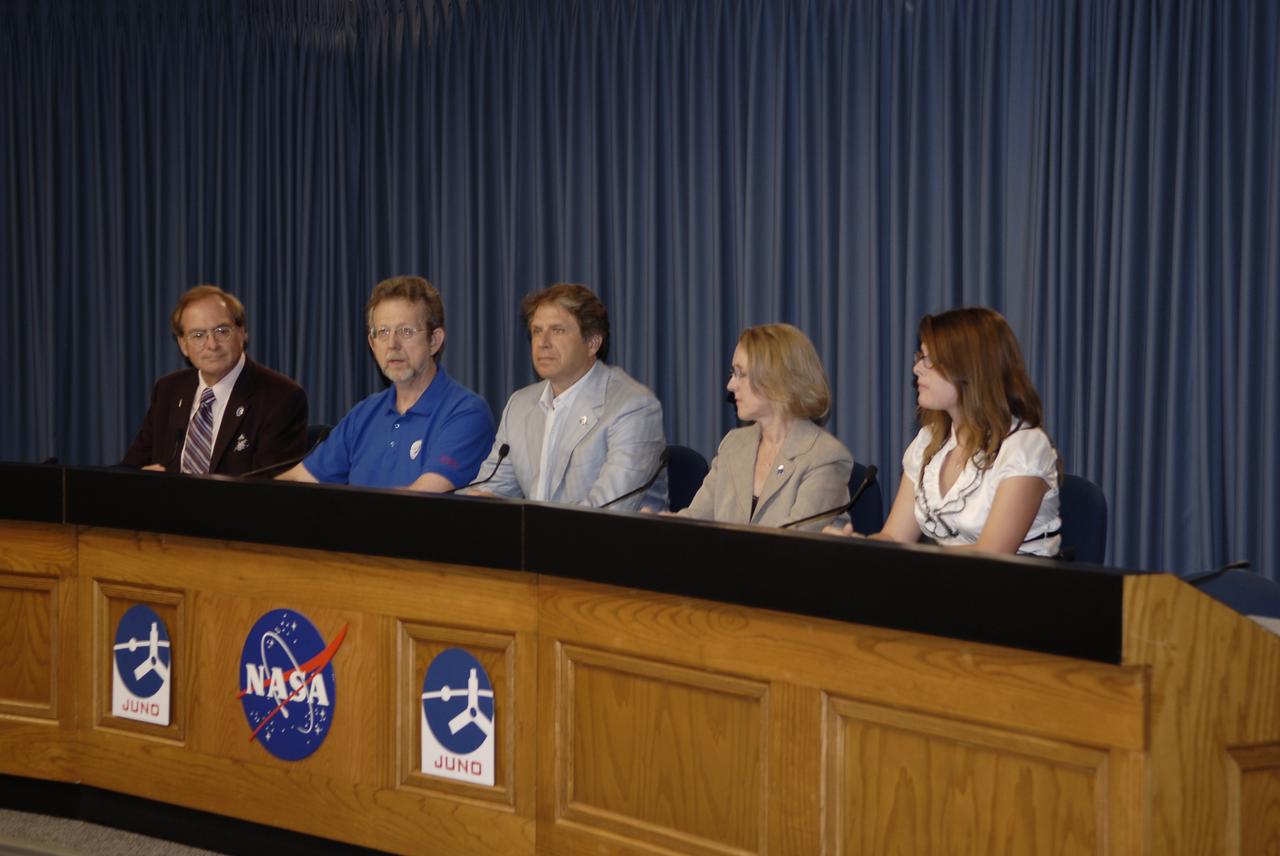
CAPE CANAVERAL, Fla. -- In the Press Site auditorium at NASA's Kennedy Space Center in Florida, a briefing was held to update media on the upcoming launch of NASA's Juno spacecraft. Seen here are NASA Panel Moderator and Public Affairs Officer George Diller (left), Jim Green, director of the Planetary Science Division at Headquarters in Washington, D.C.; Scott Bolton, Juno principal investigator with the Southwest Research Institute in San Antonio, Texas; Jan Chodas, Juno project manager with the Jet Propulsion Laboratory in Pasadena, Calif., and Kaelyn Badura, Pine Ridge High School, Deltona, Fla. high school student, Juno Education program participant and Goldstone Apple Valley Radio Telescope Project participant. Juno is scheduled to launch aboard an United Launch Alliance Atlas V from Cape Canaveral, Fla. Aug. 5.The solar-powered spacecraft will orbit Jupiter's poles 33 times to find out more about the gas giant's origins, structure, atmosphere and magnetosphere and investigate the existence of a solid planetary core. For more information visit: www.nasa.gov/juno. Photo credit: NASA/Gianni M. Woods
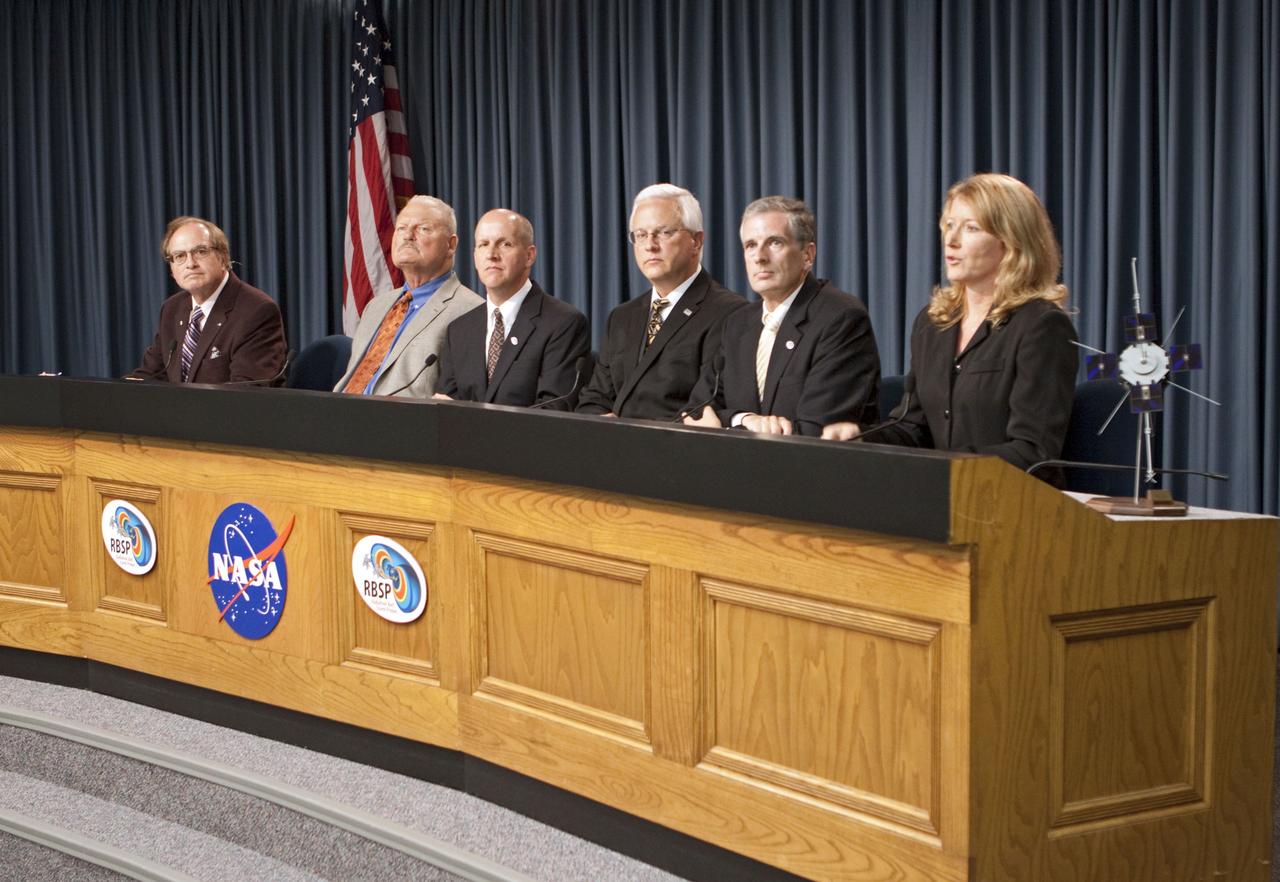
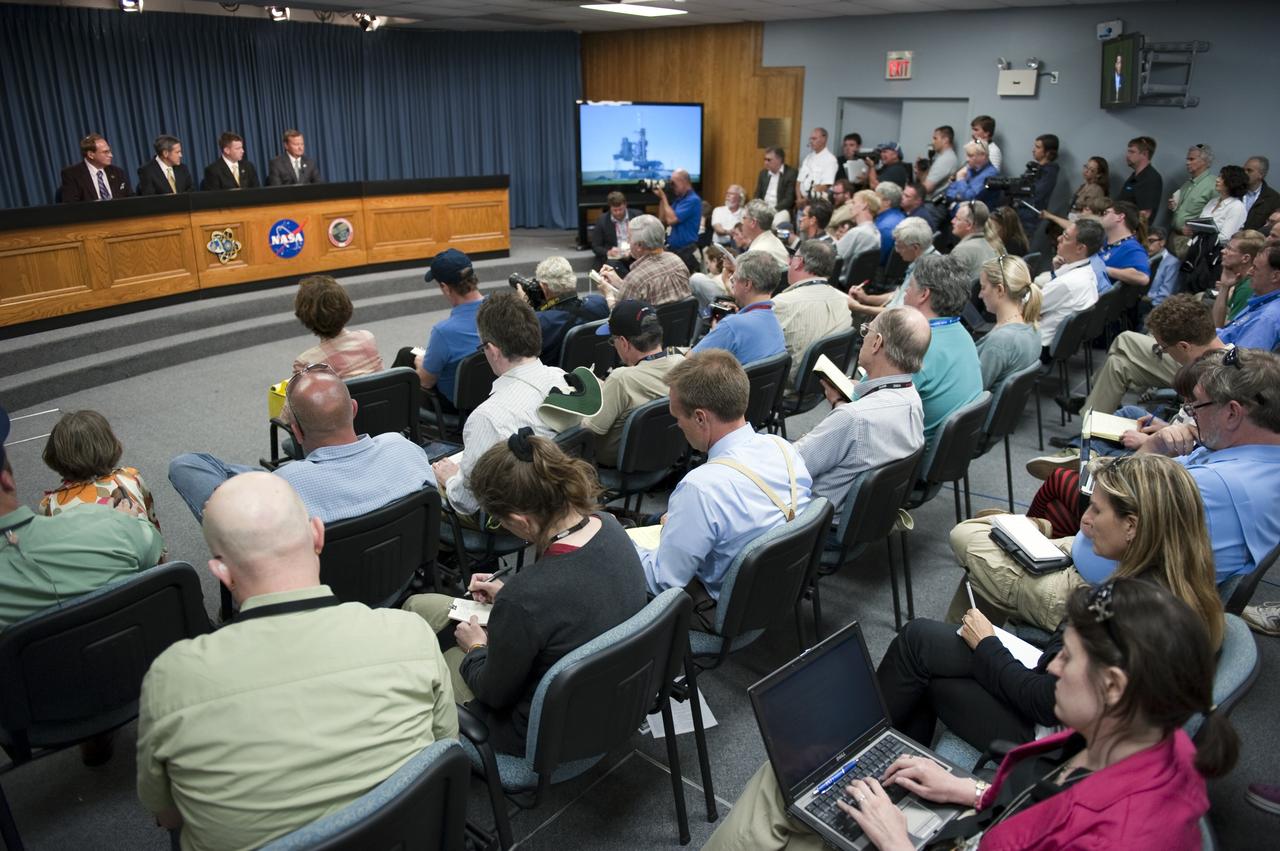
CAPE CANAVERAL, Fla. - A prelaunch news conference was held at NASA Kennedy Space Center’s Press Site in Florida for the Radiation Belt Storm Probes, or RBSP, mission. From left, are George Diller, public affairs specialist and news conference moderator, Michael Luther, deputy associate administrator for programs in NASA’s Science Mission Directorate, Tim Dunn, NASA launch director at Kennedy, Vernon Thorp, program manager, NASA missions, United Launch Alliance, Richard Fitzgerald, RBSP project manager at Johns Hopkins Applied Physics Laboratory in Laurel, Md., and Kathy Winters, launch weather officer with the 45th Weather Squadron at Cape Canaveral Air Force Station in Florida. NASA’s RBSP mission will help us understand the sun’s influence on Earth and near-Earth space by studying the Earth’s radiation belts on various scales of space and time. RBSP will begin its mission of exploration of Earth’s Van Allen radiation belts and the extremes of space weather after its launch aboard an Atlas V rocket. Launch is targeted for Aug. 24. For more information, visit http://www.nasa.gov/rbsp. Photo credit: NASA/Glenn Benson
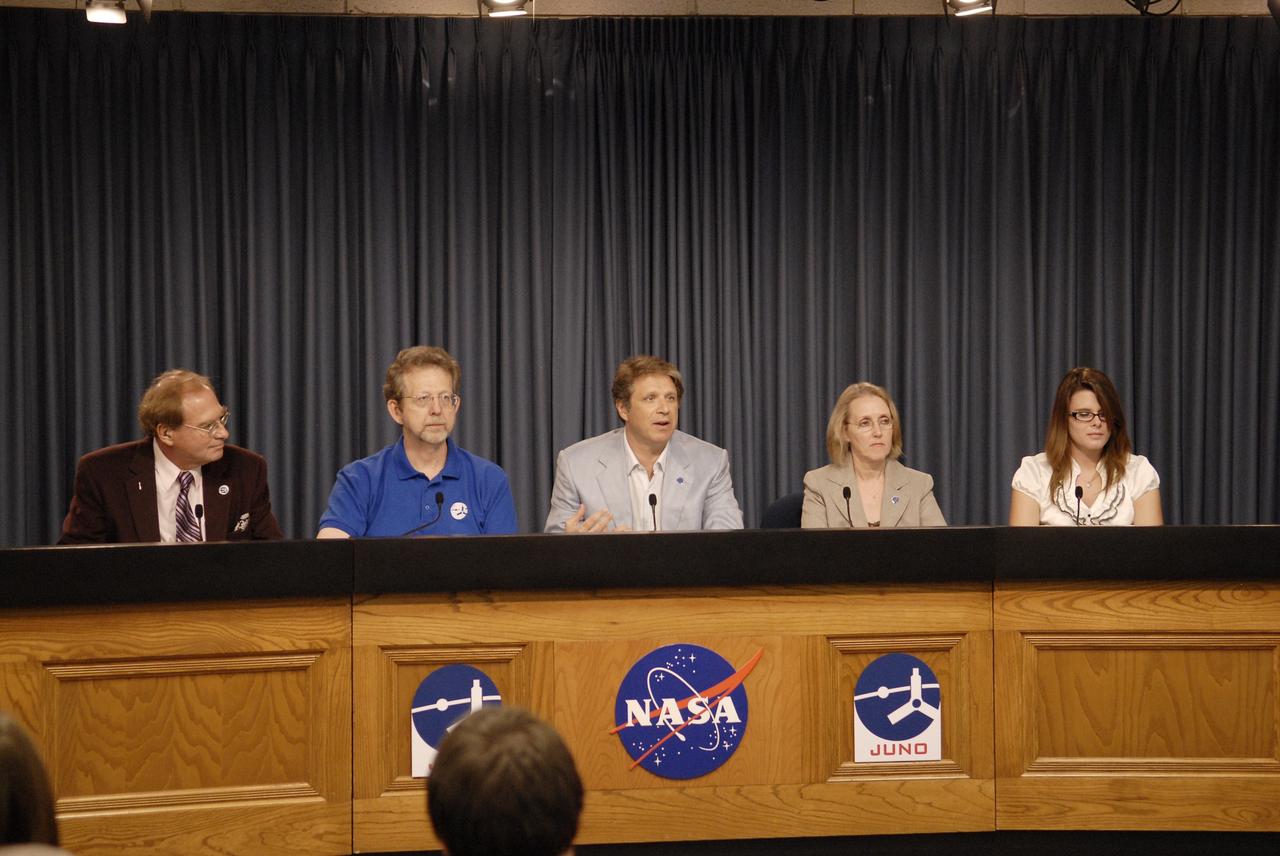
CAPE CANAVERAL, Fla. -- In the Press Site auditorium at NASA's Kennedy Space Center in Florida, a briefing was held to update media on the upcoming launch of NASA's Juno spacecraft. Seen here are NASA Panel Moderator and Public Affairs Officer George Diller (left), Jim Green, director of the Planetary Science Division at Headquarters in Washington, D.C.; Scott Bolton, Juno principal investigator with the Southwest Research Institute in San Antonio, Texas; Jan Chodas, Juno project manager with the Jet Propulsion Laboratory in Pasadena, Calif., and Kaelyn Badura, Pine Ridge High School, Deltona, Fla. high school student, Juno Education program participant and Goldstone Apple Valley Radio Telescope Project participant. Juno is scheduled to launch aboard an United Launch Alliance Atlas V from Cape Canaveral, Fla. Aug. 5.The solar-powered spacecraft will orbit Jupiter's poles 33 times to find out more about the gas giant's origins, structure, atmosphere and magnetosphere and investigate the existence of a solid planetary core. For more information visit: www.nasa.gov/juno. Photo credit: NASA/Gianni M. Woods
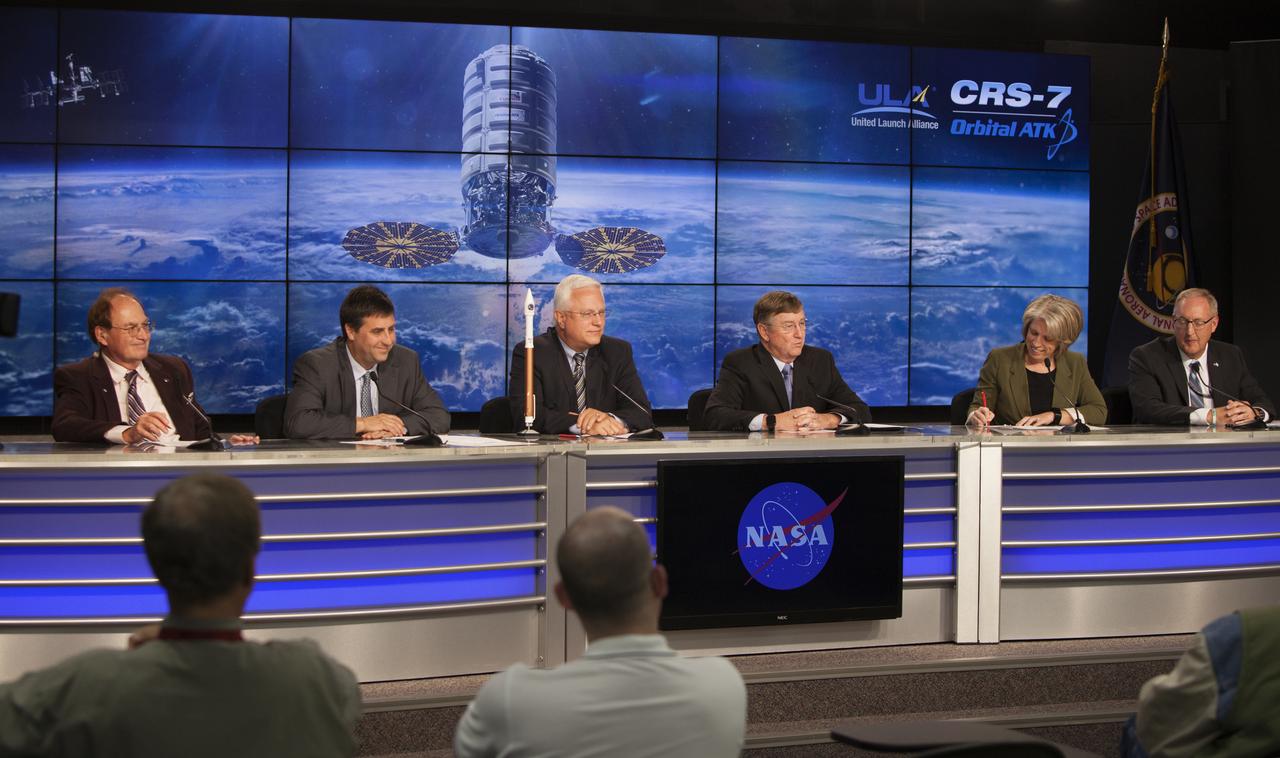
A prelaunch status briefing for Orbital ATK's seventh commercial resupply mission, CRS-7, to the International Space Station, is held at NASA Kennedy Space Center's Press Site in Florida. Participating in the briefing are, from left, George Diller, NASA Kennedy Public Affairs; Joel Montalbano, deputy manager, NASA International Space Station Program; Vern Thorp, program manager, commercial missions, United Launch Alliance; Frank Culbertson, Space Systems Group president, Orbital ATK; Tara Ruttley, Johnson Space Center Program Science Office; and David Craft, weather officer, 45th Weather Squadron. Orbital ATK's Cygnus pressurized cargo module is set to launch atop the ULA Atlas V rocket from Space Launch Complex 41 at Cape Canaveral Air Force Station on April 18. Cygnus will deliver 7,600 pounds of supplies, equipment and scientific research materials to the space station. Liftoff is scheduled for 11:11 a.m. EDT.
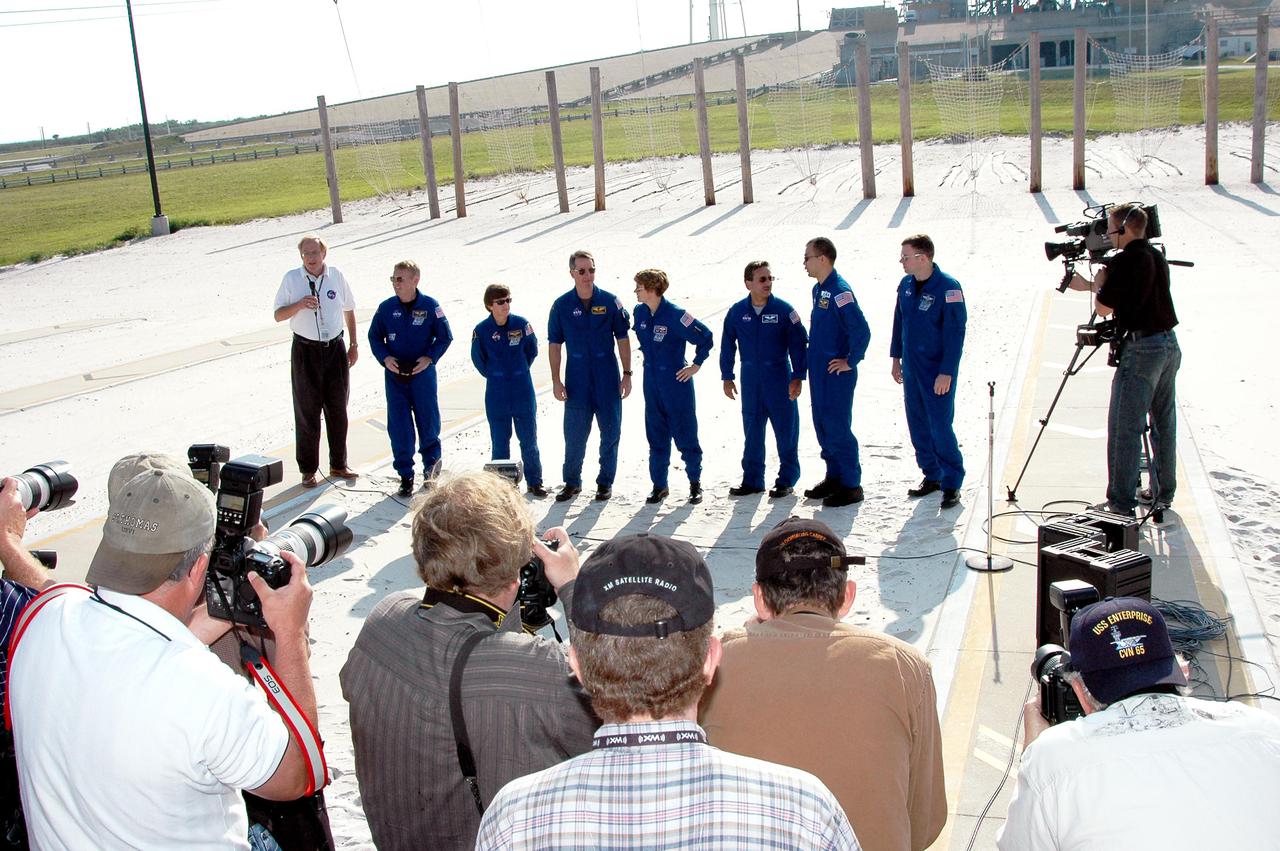
KENNEDY SPACE CENTER, FLA. - The STS-114 crew gathers for media questions at the slidewire basket landing area on Launch Pad 39B. Monitored by NASA Public Affairs Officer George Diller (at left with microphone), members of the crew are, from left, Mission Specialists Andrew Thomas, Wendy Lawrence and Stephen Robinson, Commander Eileen Collins, Mission Specialists Charles Camarda and Soichi Noguchi, and Pilot James Kelly. Noguchi is with the Japan Aerospace Exploration Agency. The crew is at KSC for Terminal Countdown Demonstration Test (TCDT) activities. The TCDT is held at KSC prior to each Space Shuttle flight. It provides the crew of each mission an opportunity to participate in simulated countdown activities. The test ends with a mock launch countdown culminating in a simulated main engine cutoff. The crew also spends time undergoing emergency egress training exercises at the launch pad. STS-114 is designated the first Return to Flight mission, with a launch window extending from July 13 to July 31.
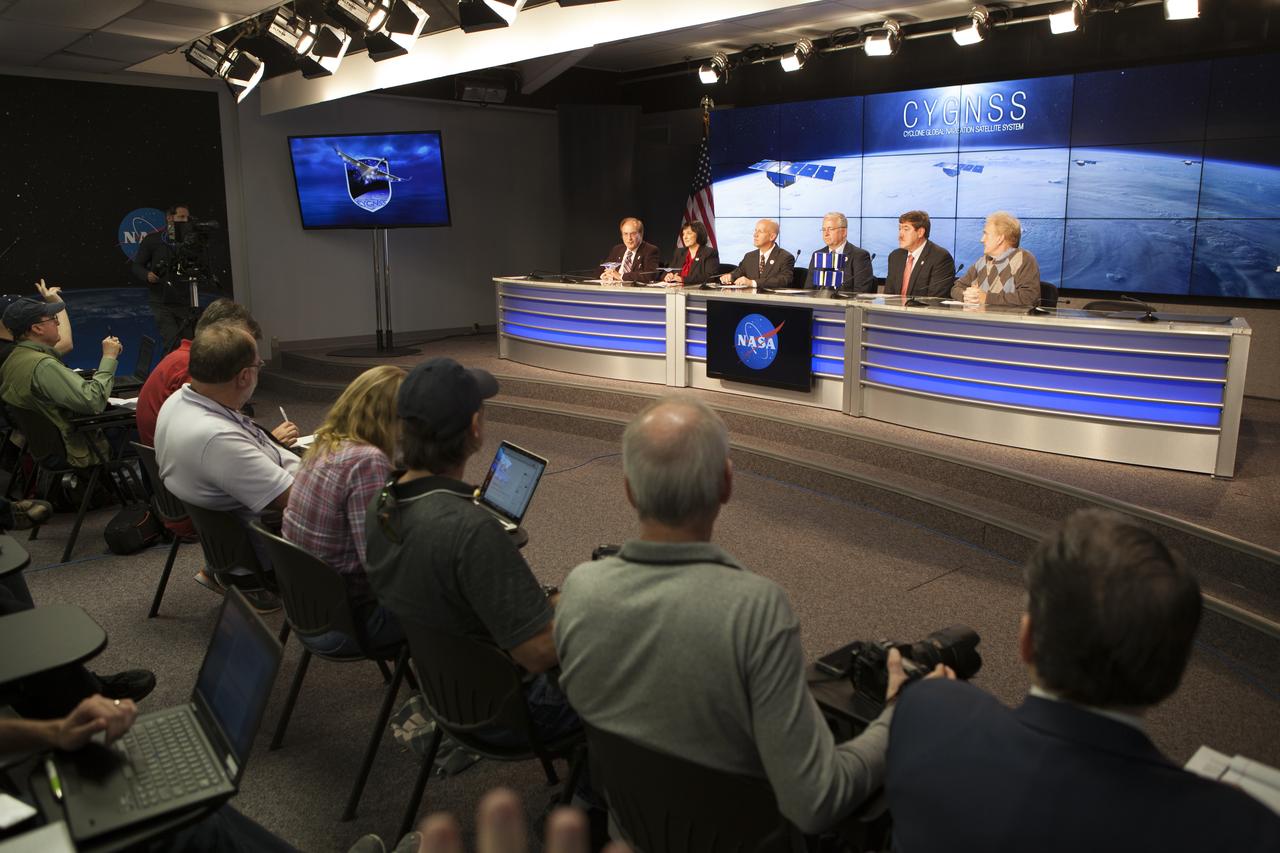
In the Kennedy Space Center’s Press Site auditorium, NASA and industry leaders speak to members of the media during a prelaunch news conference for the agency’s Cyclone Global Navigation Satellite System, or CYGNSS, spacecraft. From left are: George Diller of NASA Communications; Christine Bonniksen, CYGNSS program executive in the Earth Science Division of the Science Mission Directorate at NASA Headquarters in Washington, D.C.; Tim Dunn, NASA launch director at Kennedy; Bryan Baldwin, Pegasus launch vehicle program manager for Orbital ATK, Dulles, Virginia; John Scherrer, CYGNSS project manager for the Southwest Research Institute in San Antonio, Texas; and Mike Rehbein, launch weather officer for the 45th Weather Squadron at Cape Canaveral Air Force Station, Florida. The eight CYGNSS satellites will make frequent and accurate measurements of ocean surface winds throughout the life cycle of tropical storms and hurricanes. The data will help scientists probe key air-sea interaction processes that take place near the core of storms, which are rapidly changing and play a crucial role in the beginning and intensification of hurricanes.
CAPE CANAVERAL, Fla. -- The crew of space shuttle Atlantis' STS-135 and Space Shuttle Program Flight, participates in a news conference in the Press Site auditorium at NASA's Kennedy Space Center in Florida on landing day. Seen here are NASA Commentator and Public Affairs Officer George Diller (left), STS-135 Commander Chris Ferguson, Mission Specialists Sandy Magnus and Rex Walheim, and Pilot Doug Hurley. Securing the space shuttle fleet's place in history, Atlantis marked the 26th nighttime landing of NASA's Space Shuttle Program and the 78th landing at Kennedy. Main gear touchdown was at 5:57:00 a.m. EDT, followed by nose gear touchdown at 5:57:20 a.m., and wheelstop at 5:57:54 a.m. Atlantis and its crew delivered to the International Space Station the Raffaello multi-purpose logistics module packed with more than 9,400 pounds of spare parts, equipment and supplies that will sustain station operations for the next year. STS-135 was the 33rd and final flight for Atlantis, which has spent 307 days in space, orbited Earth 4,848 times and traveled 125,935,769 miles. For more information, visit www.nasa.gov/mission_pages/shuttle/shuttlemissions/sts135/index.html. Photo credit: NASA/Jim Grossmann
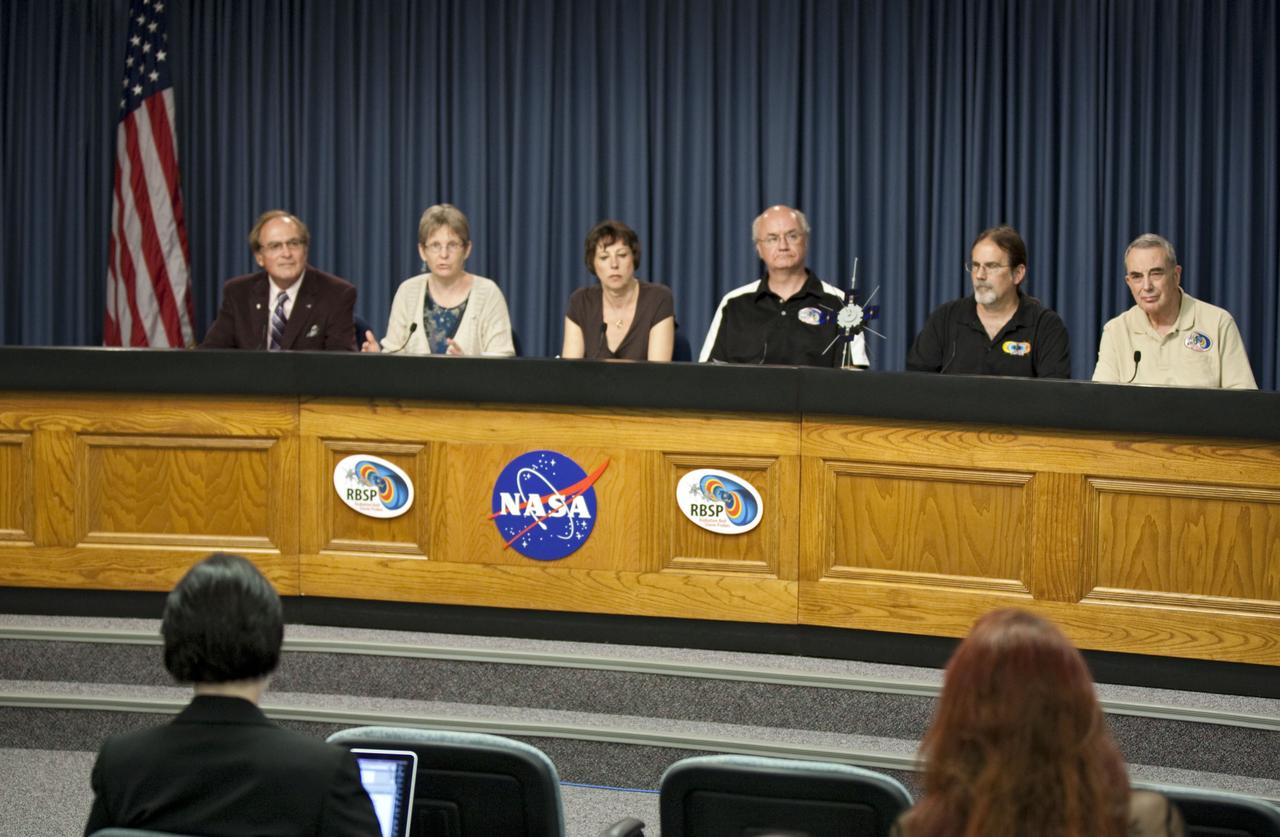
CAPE CANAVERAL, Fla. - A mission science briefing was held at NASA Kennedy Space Center’s Press Site in Florida for the Radiation Belt Storm Probes, or RBSP, mission. From left, are George Diller, public affairs specialist and news conference moderator, Mona Kessel, RBSP program scientist from NASA Headquarters in Washington, Nicola Fox, RBSP deputy project scientist at Johns Hopkins Applied Physics Laboratory in Laurel, Md., Craig Kletzing, principal investigator from the University of Iowa, Harlan Spence, principal investigator from the University of New Hampshire, and Lou Lanzerotti, principal investigator from the New Jersey Institute of Technology. NASA’s RBSP mission will help us understand the sun’s influence on Earth and near-Earth space by studying the Earth’s radiation belts on various scales of space and time. RBSP will begin its mission of exploration of Earth’s Van Allen radiation belts and the extremes of space weather after its launch aboard an Atlas V rocket. Launch is targeted for Aug. 24. For more information, visit http://www.nasa.gov/rbsp. Photo credit: NASA/Glenn Benson
CAPE CANAVERAL, Fla. -- At NASA's Kennedy Space Center in Florida, Public Affairs Officer George Diller, Kennedy Director Bob Cabana, Space Shuttle Program Launch Integration Manager Mike Moses and Shuttle Launch Director Mike Leinbach participate in a news conference following the April 29 scrubbed launch attempt of space shuttle Endeavour. During the STS-134 countdown, fuel line heaters for Endeavour's auxiliary power unit-1 (APU-1) failed. Technicians later discovered that the Load Control Assembly-2 (LCA-2), which distributes power to nine shuttle systems, was the cause of the failure reading. The LCA-2 located in Endeavour's aft section will be replaced and systems will be retested before the launch is rescheduled. STS-134 will deliver the Express Logistics Carrier-3, Alpha Magnetic Spectrometer-2 (AMS), a high-pressure gas tank and additional spare parts for the Dextre robotic helper to the International Space Station. The mission also will be the final spaceflight for Endeavour. For more information, visit www.nasa.gov/mission_pages/shuttle/shuttlemissions/sts134/index.html. Photo credit: NASA/Kim Shiflett
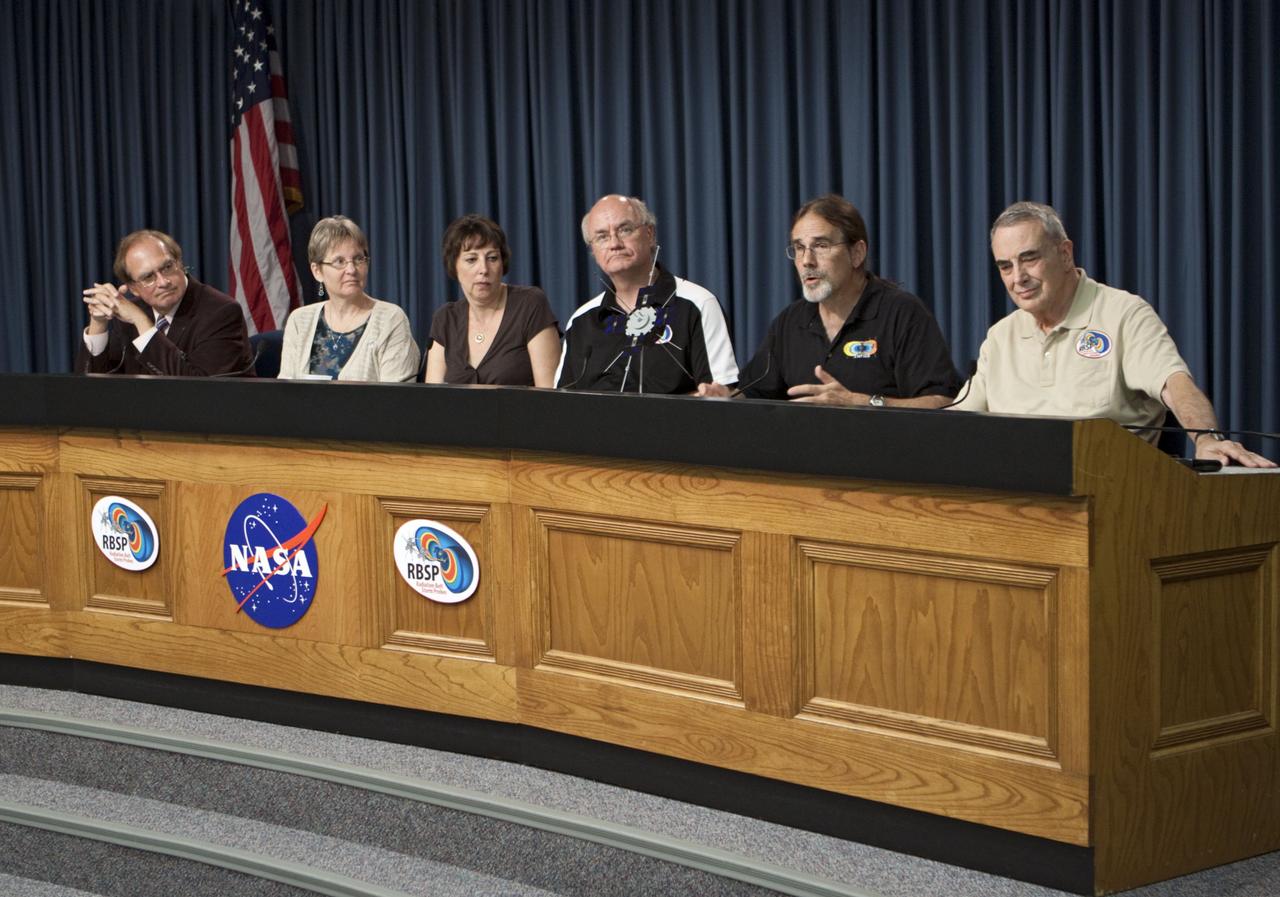
CAPE CANAVERAL, Fla. - A mission science briefing was held at NASA Kennedy Space Center’s Press Site in Florida for the Radiation Belt Storm Probes, or RBSP, mission. From left, are George Diller, public affairs specialist and news conference moderator, Mona Kessel, RBSP program scientist from NASA Headquarters in Washington, Nicola Fox, RBSP deputy project scientist at Johns Hopkins Applied Physics Laboratory in Laurel, Md., Craig Kletzing, principal investigator from the University of Iowa, Harlan Spence, principal investigator from the University of New Hampshire, and Lou Lanzerotti, principal investigator from the New Jersey Institute of Technology. NASA’s RBSP mission will help us understand the sun’s influence on Earth and near-Earth space by studying the Earth’s radiation belts on various scales of space and time. RBSP will begin its mission of exploration of Earth’s Van Allen radiation belts and the extremes of space weather after its launch aboard an Atlas V rocket. Launch is targeted for Aug. 24. For more information, visit http://www.nasa.gov/rbsp. Photo credit: NASA/Glenn Benson
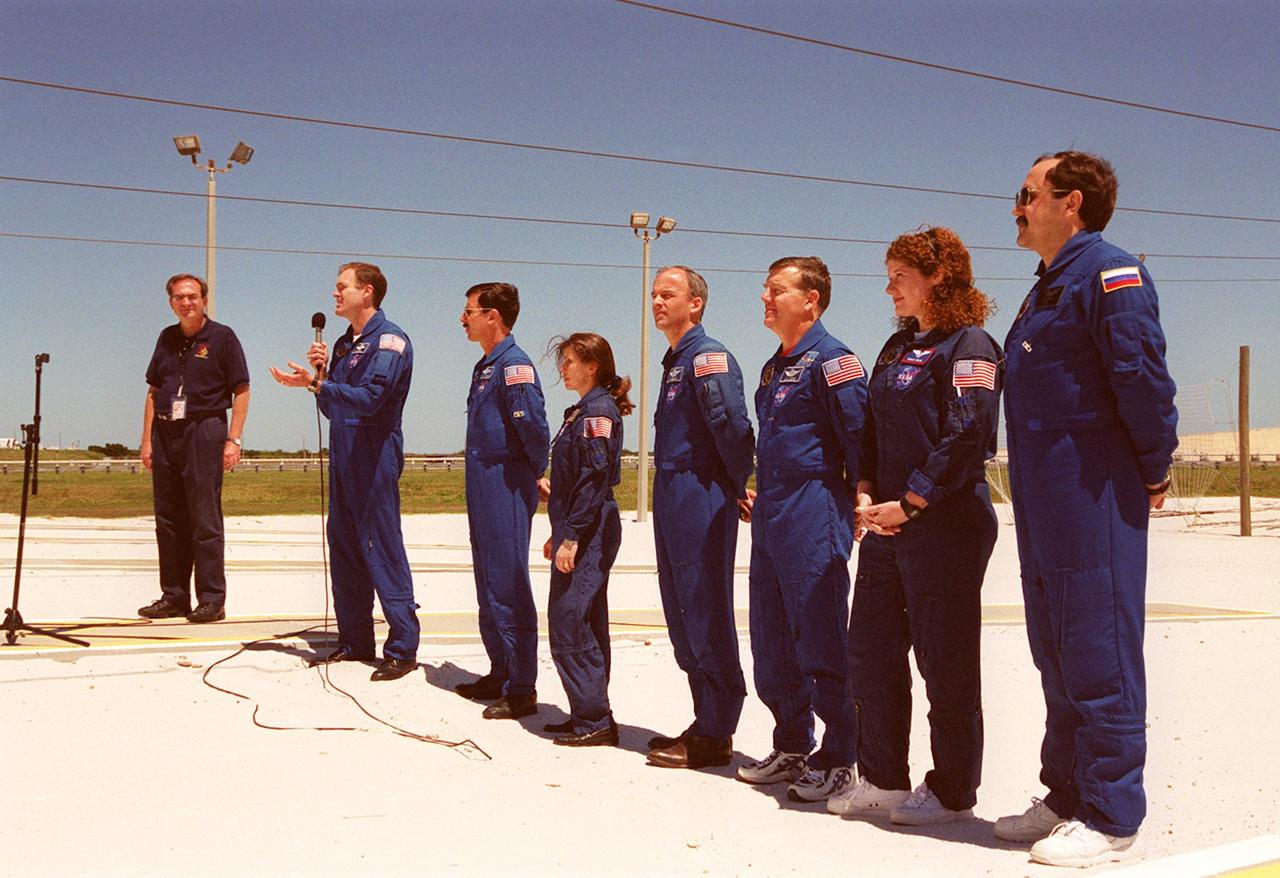
KENNEDY SPACE CENTER, Fla. -- After Terminal Countdown Demonstration Test (TCDT) activities at Launch Pad 39A, the STS-101 crew talk to the media. At the far left is George Diller, with NASA Public Affairs, who is moderating the event. At the microphone Commander James D. Halsell Jr. answers a question. Next to him, standing left to right, are Pilot Scott J. "Doc" Horowitz and Mission Specialists Mary Ellen Weber, Jeffrey N. Williams, James Voss, Susan J. Helms and Yury Usachev of Russia. The TCDT includes emergency egress training and a simulated launch countdown. During their mission to the International Space Station, the STS-101 crew will be delivering logistics and supplies, plus preparing the Station for the arrival of the Zvezda Service Module, expected to be launched by Russia in July 2000. Also, the crew will conduct one space walk to perform maintenance on the Space Station. This will be the third assembly flight for the Space Station. STS-101 is scheduled to launch April 24 at 4:15 p.m. from Launch Pad 39A
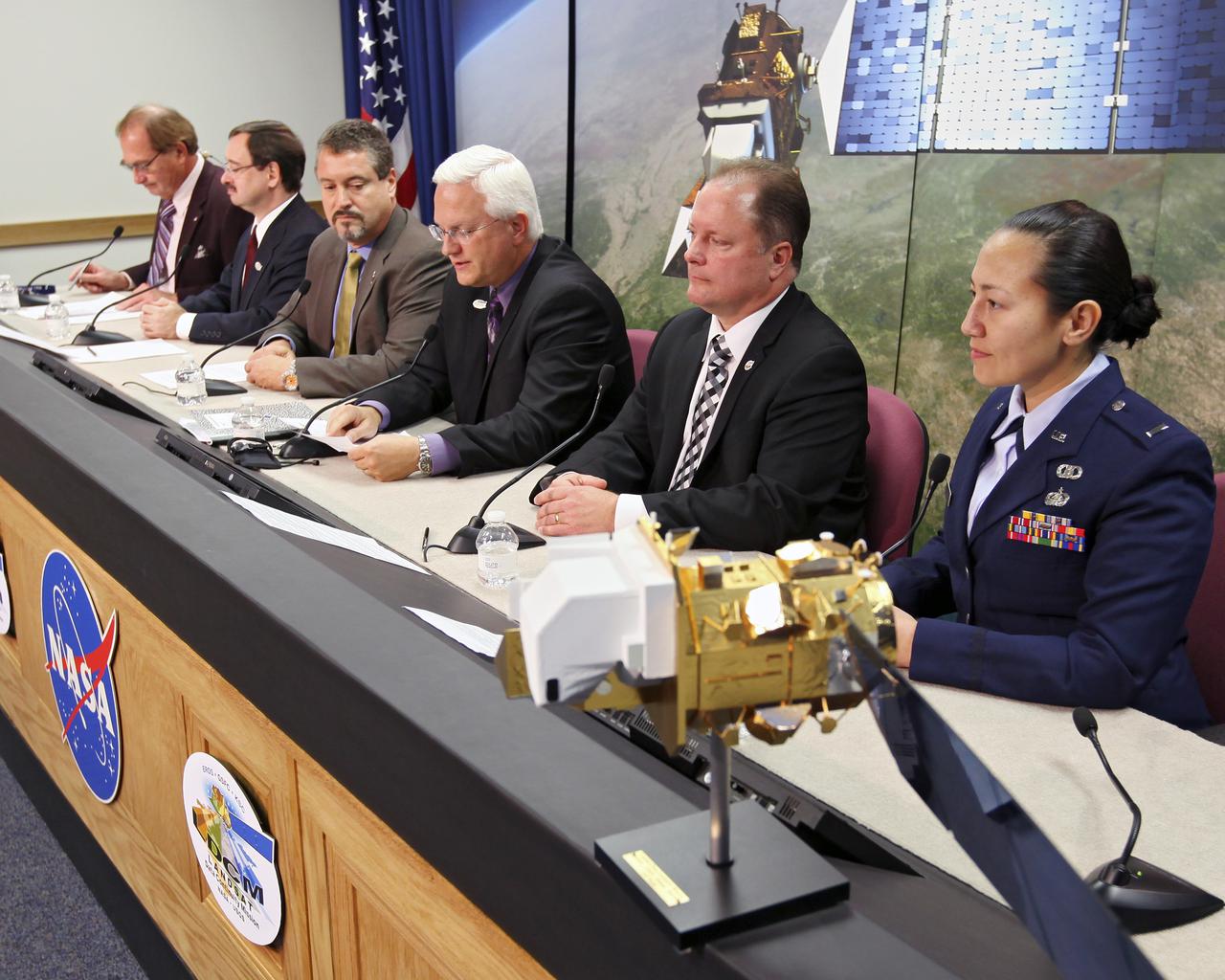
VANDENBERG AIR FORCE BASE, Calif. -- Media attend a prelaunch press conference at Vandenberg Air Force Base in California to discuss NASA's readiness to launch the Landsat Data Continuity Mission LDCM. From left are George Diller of NASA Public Affairs, LDCM program executive David Jarrett from NASA Headquarters, NASA Launch Director Omar Baez from Kennedy Space Center, United Launch Alliance Program Manager for NASA Missions Vernon Thorp, LDCM Project Manager Ken Schwer from Goddard Space Flight Center, and 1st Lt. Jennifer Kelley, launch weather officer for the 30th Operations Support Squadron at Vandenberg. The Landsat Data Continuity Mission LDCM is the future of Landsat satellites. It will continue to obtain valuable data and imagery to be used in agriculture, education, business, science, and government. The Landsat Program provides repetitive acquisition of high resolution multispectral data of the Earth's surface on a global basis. The data from the Landsat spacecraft constitute the longest record of the Earth's continental surfaces as seen from space. It is a record unmatched in quality, detail, coverage, and value. Liftoff is planned for Feb. 11, 2013 aboard a United Launch Alliance Atlas V rocket. For more information, visit: http:__www.nasa.gov_mission_pages_landsat_main_index.html Photo credit: NASA_Kim Shiflett

KENNEDY SPACE CENTER, Fla. -- After Terminal Countdown Demonstration Test (TCDT) activities at Launch Pad 39A, the STS-101 crew talk to the media. At the far left is George Diller, with NASA Public Affairs, who is moderating the event. At the microphone Commander James D. Halsell Jr. answers a question. Next to him, standing left to right, are Pilot Scott J. "Doc" Horowitz and Mission Specialists Mary Ellen Weber, Jeffrey N. Williams, James Voss, Susan J. Helms and Yury Usachev of Russia. The TCDT includes emergency egress training and a simulated launch countdown. During their mission to the International Space Station, the STS-101 crew will be delivering logistics and supplies, plus preparing the Station for the arrival of the Zvezda Service Module, expected to be launched by Russia in July 2000. Also, the crew will conduct one space walk to perform maintenance on the Space Station. This will be the third assembly flight for the Space Station. STS-101 is scheduled to launch April 24 at 4:15 p.m. from Launch Pad 39A
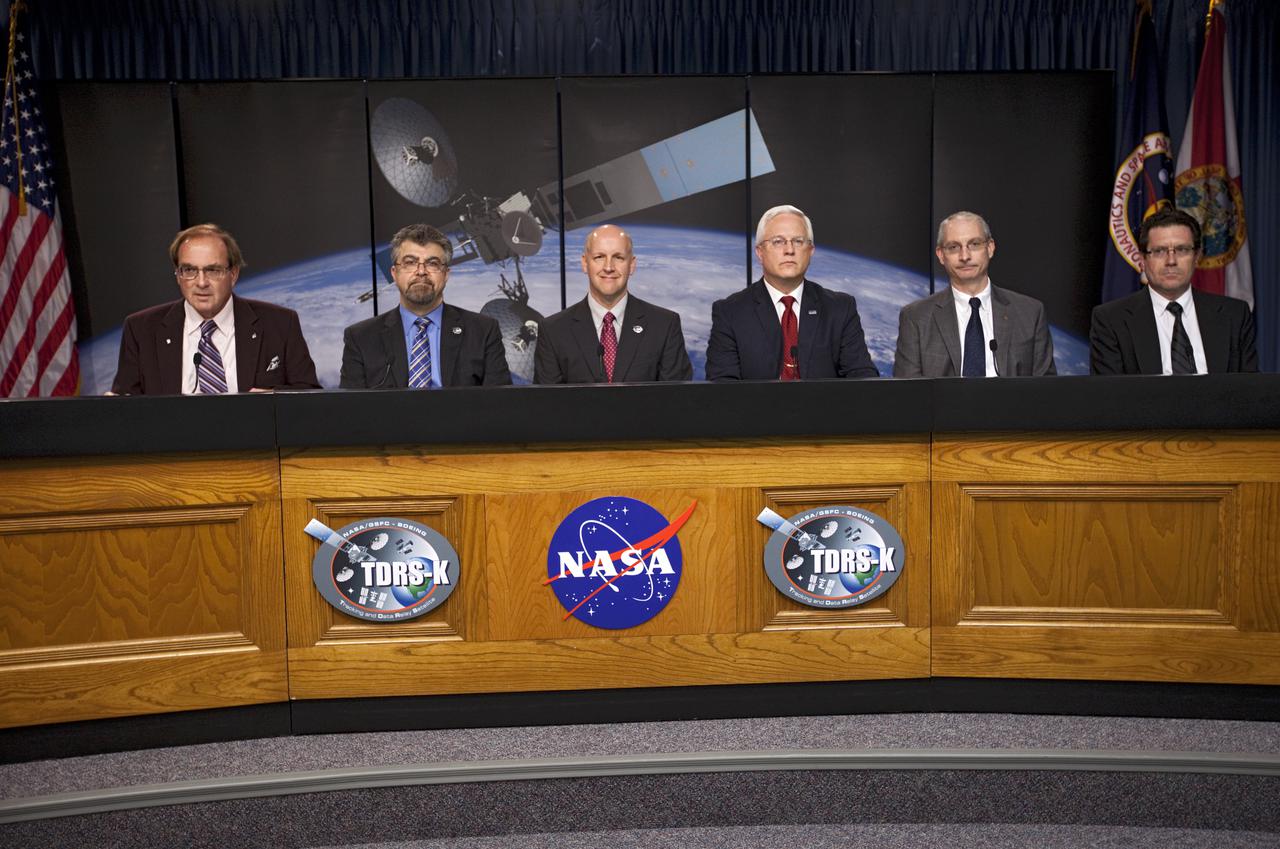
CAPE CANAVERAL, Fla. –- At a news conference, NASA and United Launch Alliance officials discussed preparations for the planned launch of NASA's Tracking and Data Relay Satellite, TDRS-K, atop an Atlas V rocket. Participating in the briefing, from the left are, George Diller, NASA Public Affairs, Badri Younes, deputy associate administrator, Space Communications and Navigation SCaN, NASA Human Exploration and Operations Mission Directorate in Washington Tim Dunn, NASA launch director at the Kennedy Space Center Vernon Thorp, program manager, NASA Missions for United Launch Alliance in Denver, Colo. Jeffrey Gramling, NASA TDRS-K project manager, Goddard Space Flight Center in Greenbelt, Md. and Joel Tumbiolo, launch weather officer, 45th Weather Squadron at Cape Canaveral Air Force Station, Fla. Liftoff for the TDRS-K is planned for Jan. 30, 2013. The TDRS-K spacecraft is part of the next-generation series in the Tracking and Data Relay Satellite System, a constellation of space-based communication satellites providing tracking, telemetry, command and high-bandwidth data return services. For more information, visit http:__www.nasa.gov_mission_pages_tdrs_index.html Photo credit: NASA_Kim Shiflett
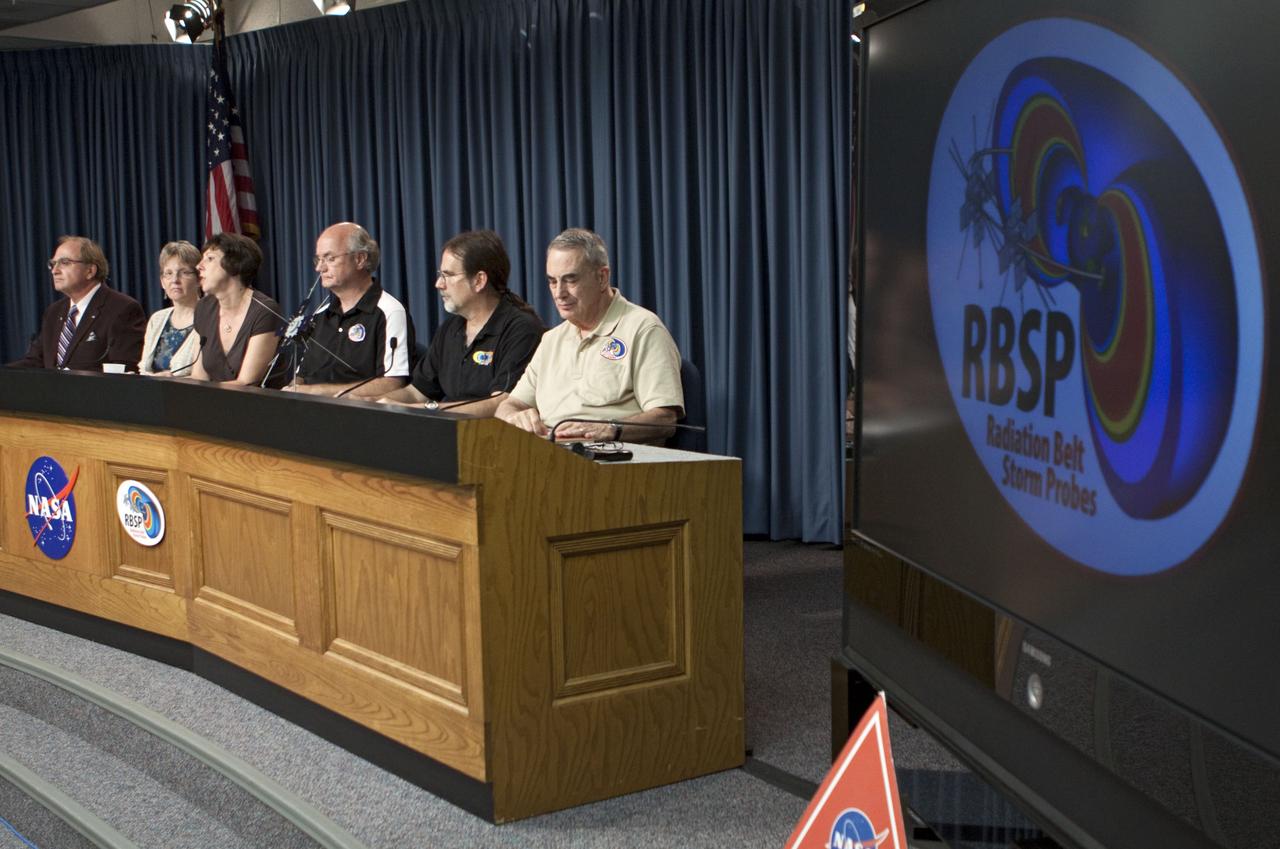
CAPE CANAVERAL, Fla. - A mission science briefing was held at NASA Kennedy Space Center’s Press Site in Florida for the Radiation Belt Storm Probes, or RBSP, mission. From left, are George Diller, public affairs specialist and news conference moderator, Mona Kessel, RBSP program scientist from NASA Headquarters in Washington, Nicola Fox, RBSP deputy project scientist at Johns Hopkins Applied Physics Laboratory in Laurel, Md., Craig Kletzing, principal investigator from the University of Iowa, Harlan Spence, principal investigator from the University of New Hampshire, and Lou Lanzerotti, principal investigator from the New Jersey Institute of Technology. NASA’s RBSP mission will help us understand the sun’s influence on Earth and near-Earth space by studying the Earth’s radiation belts on various scales of space and time. RBSP will begin its mission of exploration of Earth’s Van Allen radiation belts and the extremes of space weather after its launch aboard an Atlas V rocket. Launch is targeted for Aug. 24. For more information, visit http://www.nasa.gov/rbsp. Photo credit: NASA/Glenn Benson
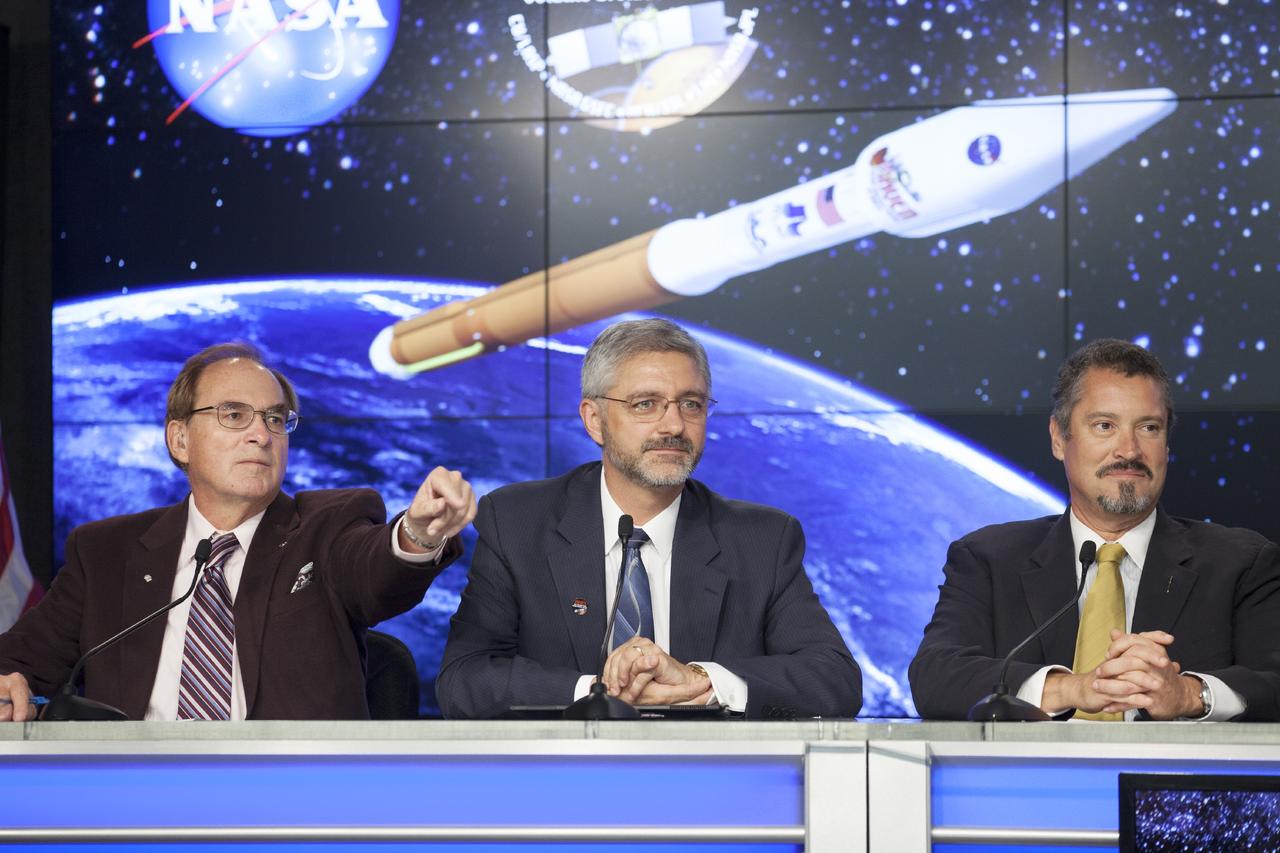
CAPE CANAVERAL, Fla. – During a news conference at NASA's Kennedy Space Center in Florida, agency and contractor officials discussed preparations for the launch of the Mars Atmosphere and Volatile EvolutioN, or MAVEN, mission. Calling on a member of the news media for a question, is George Diller of NASA Public Affairs, left. Also participating are Geoffrey Yoder, NASA deputy associate administrator of programs in the Science Mission Directorate, center, and Omar Baez, NASA launch director. MAVEN is being prepared for its scheduled launch on Nov 18, 2013 from Cape Canaveral Air Force Station, Fla. atop a United Launch Alliance Atlas V rocket. Positioned in an orbit above the Red Planet, MAVEN will study the upper atmosphere of Mars in unprecedented detail. For information on the MAVEN mission, visit: http://www.nasa.gov/mission_pages/maven/main/index.html. Photo credit: NASA MAVEN is being prepared for its scheduled launch on Nov 18, 2013 from Cape Canaveral Air Force Station, Fla. atop a United Launch Alliance Atlas V rocket. Positioned in an orbit above the Red Planet, MAVEN will study the upper atmosphere of Mars in unprecedented detail. For more information, visit: http://www.nasa.gov/mission_pages/maven/main/index.html Photo credit: NASA/Kim Shiflett
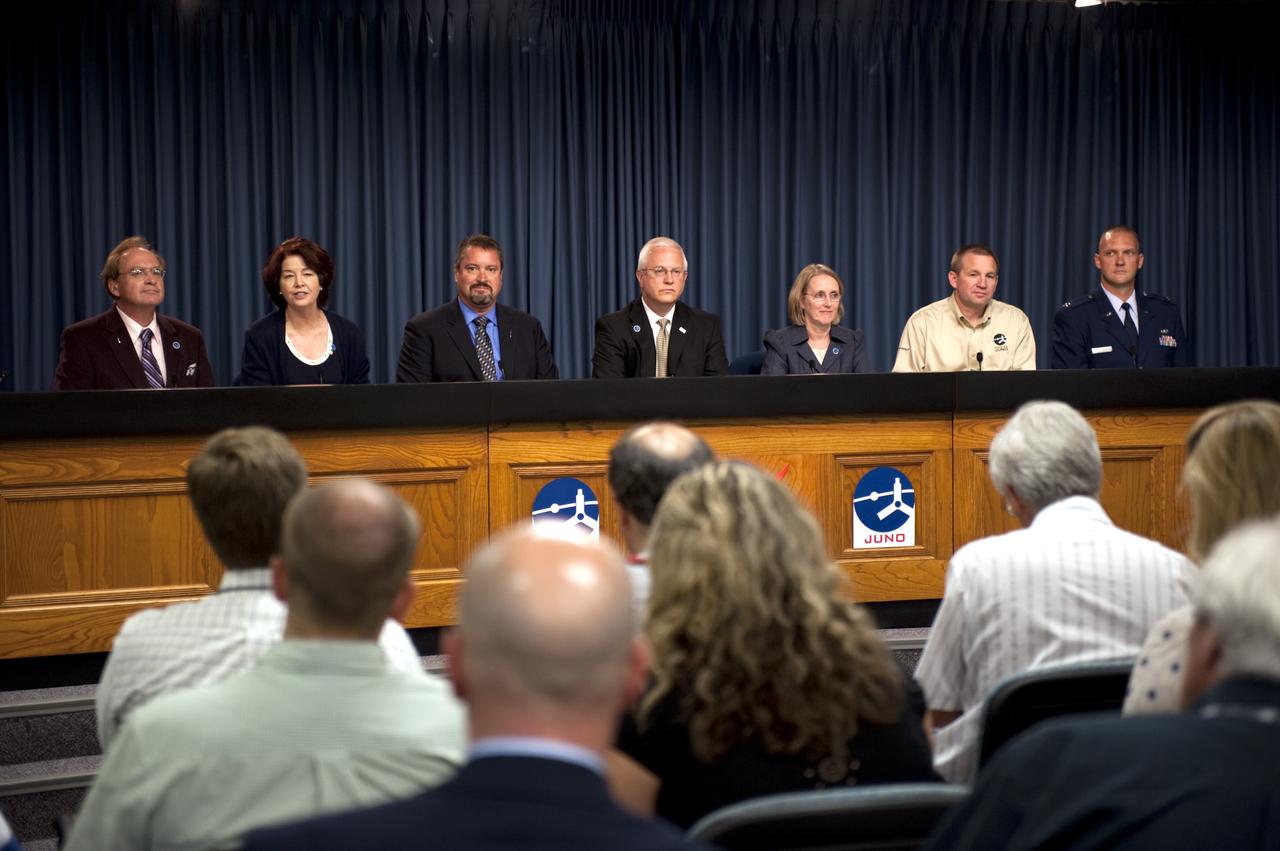
CAPE CANAVERAL, Fla. -- A Juno prelaunch news conference is held in the NASA Press Site auditorium at NASA's Kennedy Space Center in Florida. From left are George Diller, NASA Public Affairs; Colleen Hartman, assistant associate administrator, Science Mission Directorate, NASA Headquarters, Washington; Omar Baez, NASA launch director, Kennedy Space Center, Cape Canaveral, Fla.; Vernon Thorp, program manager, NASA Missions, United Launch Alliance, Denver, Colo.; Jan Chodas, Juno project manager, Jet Propulsion Laboratory, Pasadena, Calif.; Tim Gasparrini, Juno program manager, Lockheed Martin Space Systems, Denver, Colo.; and Capt. Billy Whisel, launch weather officer, 45th Weather Squadron, Cape Canaveral Air Force Station, Fla. Juno is scheduled to launch Aug. 5 aboard a United Launch Alliance Atlas V rocket from Cape Canaveral Air Force Station in Florida. The solar-powered spacecraft will orbit Jupiter's poles 33 times to find out more about the gas giant's origins, structure, atmosphere and magnetosphere and investigate the existence of a solid planetary core. For more information, visit www.nasa.gov/juno. Photo credit: NASA/Kim Shiflett
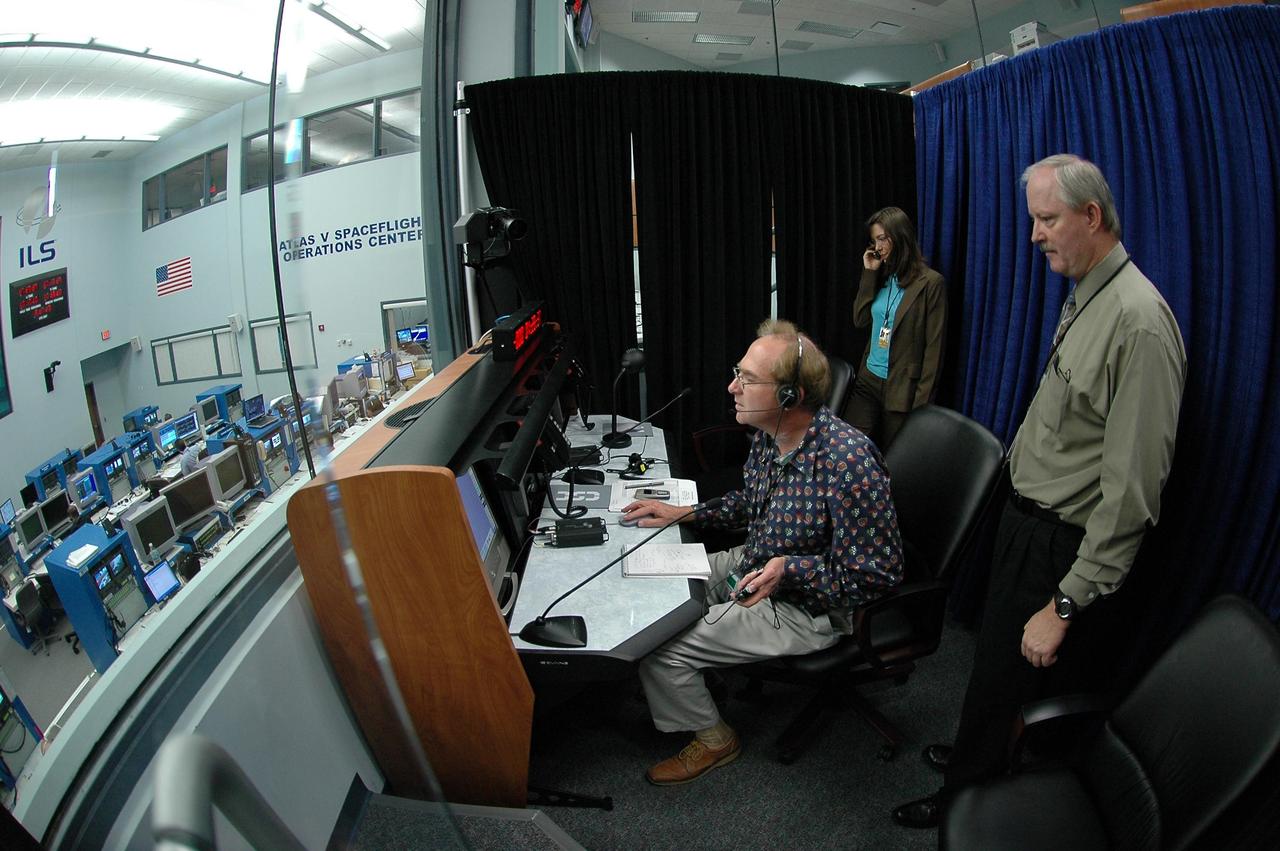
KENNEDY SPACE CENTER, FLA. - In the communications room above the Atlas V Spaceflight Operations Center on Cape Canaveral Air Force Station, NASA Public Information Officer George Diller rehearses his role for the upcoming launch of the New Horizons spacecraft. Behind him are Tiffany Nail, with the Launch Services Program at Kennedy Space Center, and Bob Summerville, a Lockheed Martin console system software engineer. Members of the New Horizons team are taking part in a dress rehearsal for the launch scheduled in mid-January. New Horizons carries seven scientific instruments that will characterize the global geology and geomorphology of Pluto and its moon Charon, map their surface compositions and temperatures, and examine Pluto's complex atmosphere. After that, flybys of Kuiper Belt objects from even farther in the solar system may be undertaken in an extended mission. New Horizons is the first mission in NASA's New Frontiers program of medium-class planetary missions. The spacecraft, designed for NASA by the Johns Hopkins University Applied Physics Laboratory in Laurel, Md., will launch aboard a Lockheed Martin Atlas V rocket and fly by Pluto and Charon as early as summer 2015.

VANDENBERG AIR FORCE BASE, Calif. -- Media attending a post-launch news conference at Vandenberg Air Force Base, Calif. heard from officials who described the successful launch of the Landsat Data Continuity Mission, or LDCM. From the left are: George Diller of NASA Public Affairs, Ken Schwer, LDCM project manager Goddard Space Flight Center, Greenbelt, Md., Michael Luther, deputy associate administrator for programs, Science Mission Directorate at NASA Headquarters, Michael Freilich, director of the Earth Science Division, Science Mission Directorate, at Headquarters, Anne Castle, assistant secretary for Water and Science, U.S. Department of the Interior, and Marsha McNutt, director of the U.S. Geological Survey. The Landsat Data Continuity Mission LDCM is the future of Landsat satellites. It will continue to obtain valuable data and imagery to be used in agriculture, education, business, science, and government. The Landsat Program provides repetitive acquisition of high resolution multispectral data of the Earth's surface on a global basis. The data from the Landsat spacecraft constitute the longest record of the Earth's continental surfaces as seen from space. It is a record unmatched in quality, detail, coverage, and value. Liftoff took place at 10:02 a.m. PST 1:02 P.M. EST) on Feb. 11, 2013 aboard a United Launch Alliance Atlas V rocket. For more information, visit: http:__www.nasa.gov_mission_pages_landsat_main_index.html Photo credit: NASA_Kim Shiflett
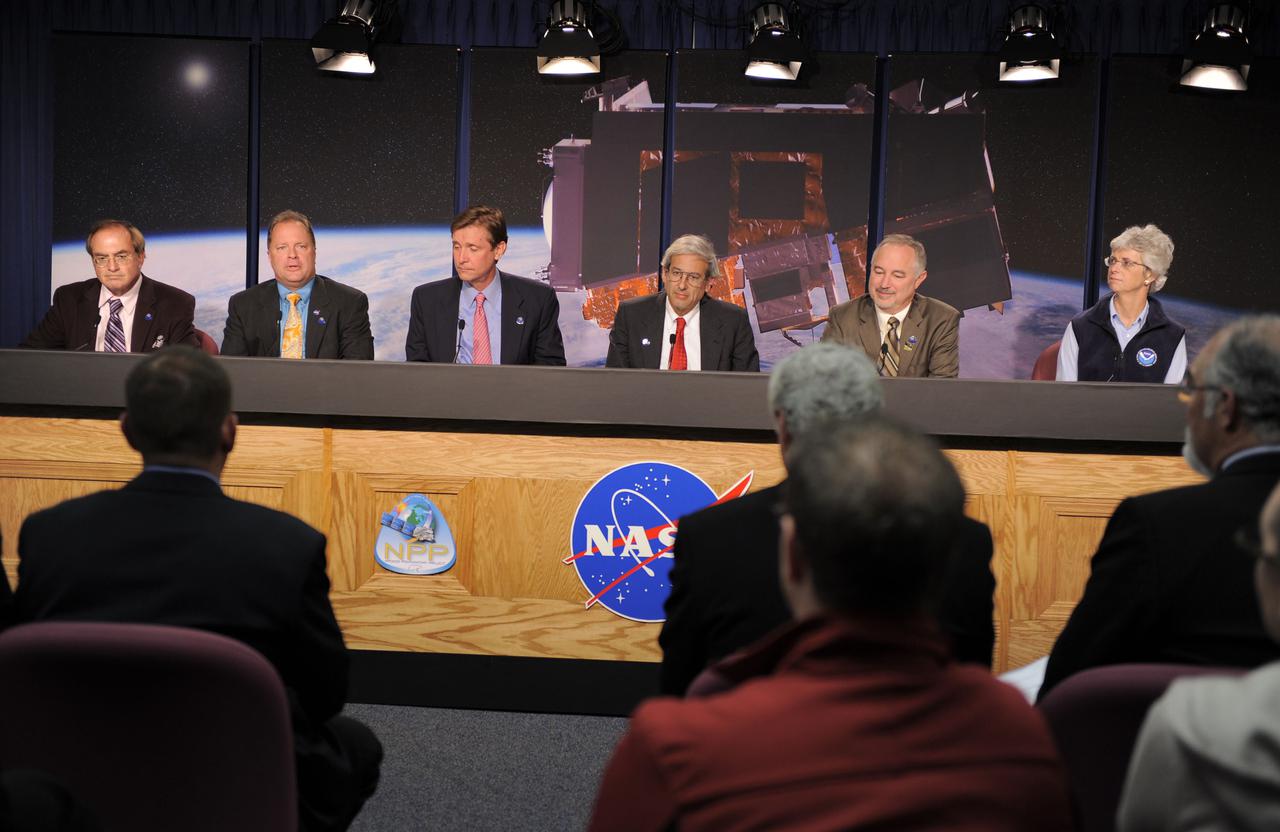
VANDENBERG AIR FORCE BASE, Calif. -- At Vandenberg Air Force Base in California, NASA and NOAA managers participate in a news briefing following the successful launch of NASA's National Polar-orbiting Operational Environmental Satellite System Preparatory Project (NPP) aboard a United Launch Alliance Delta II rocket. From left are George Diller, NASA Public Affairs; Ken Schwer, NPP project manager, NASA's Goddard Space Flight Center; Jim Gleason, NPP project scientist, NASA's Goddard Space Flight Center; Mike Frielich, director, NASA Earth Science Division; Charles Gay, acting associate administrator, NASA Mission Directorate; and Mary Glackin, deputy undersecretary for Operations, National Oceanic and Atmospheric Administration. Launch was at 2:48 a.m. PDT. NPP represents a critical first step in building the next-generation of Earth-observing satellites. NPP will carry the first of the new sensors developed for this satellite fleet, now known as the Joint Polar Satellite System (JPSS) to be launched in 2016. NPP is the bridge between NASA's Earth Observing System (EOS) satellites and the forthcoming series of JPSS satellites. The mission will test key technologies and instruments for the JPSS missions. For more information, visit http:__www.nasa.gov_NPP. Photo credit: NASA_Kim Shiflett
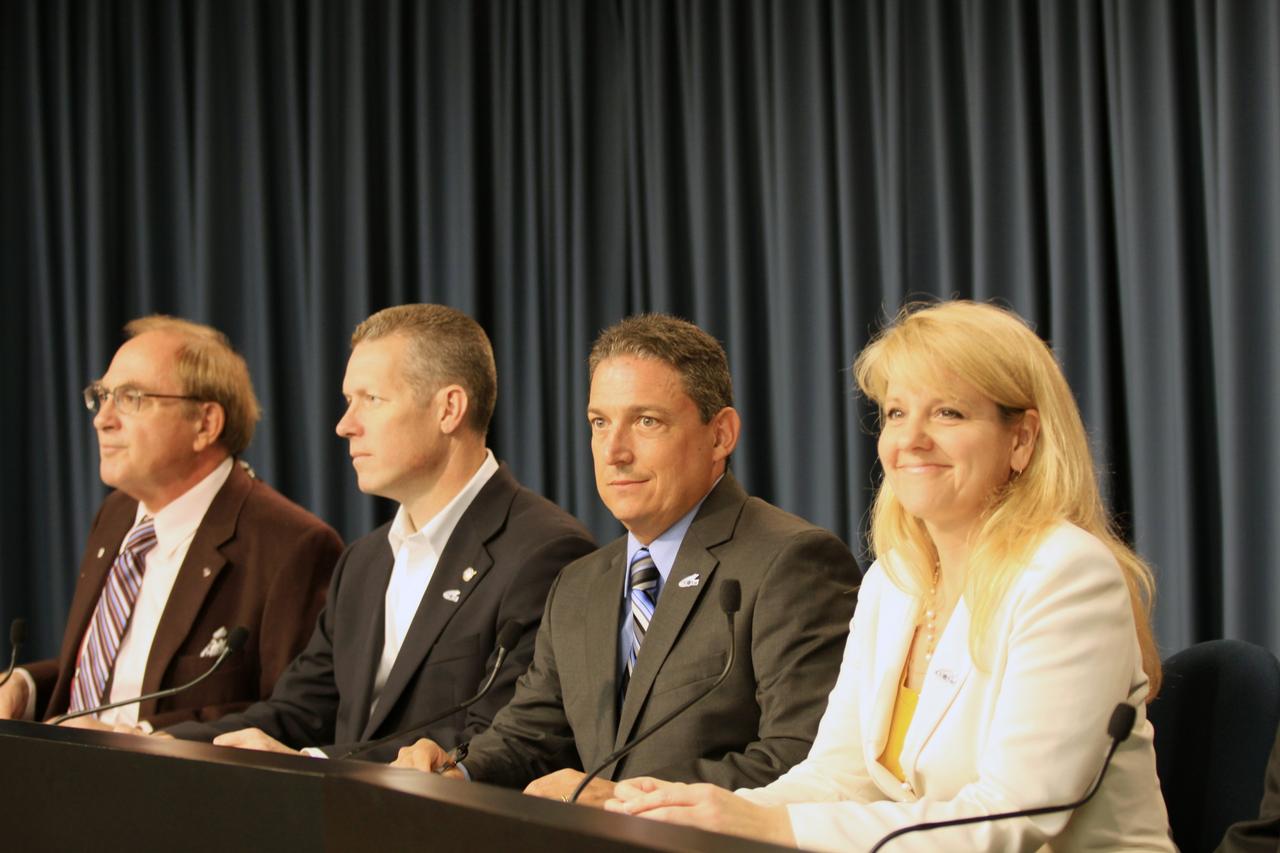
CAPE CANAVERAL, Fla. – Participating in a prelaunch news conference in the Press Site Auditorium at NASA’s Kennedy Space Center in Florida are, from left, George H. Diller, NASA Public Affairs, Phil McAlister, director, NASA Commercial Spaceflight Development, Alan Lindenmoyer, manager, NASA Commercial Crew and Cargo Program, and Gwynne Shotwell, president, SpaceX. Liftoff of the SpaceX Falcon 9 rocket carrying a Dragon capsule to orbit is set for 4:55 a.m. EDT on May 19. The launch will be the company's second demonstration test flight for NASA's Commercial Orbital Transportation Services Program, or COTS. During the flight, the capsule will conduct a series of check-out procedures to test and prove its systems, including rendezvous and berthing with the International Space Station. If the capsule performs as planned, the cargo and experiments it is carrying will be transferred to the station. The cargo includes food, water and provisions for the station’s Expedition crews, such as clothing, batteries and computer equipment. Under COTS, NASA has partnered with two aerospace companies to deliver cargo to the station. For more information, visit http://www.nasa.gov/spacex. Photo credit: NASA/Jim Grossmann
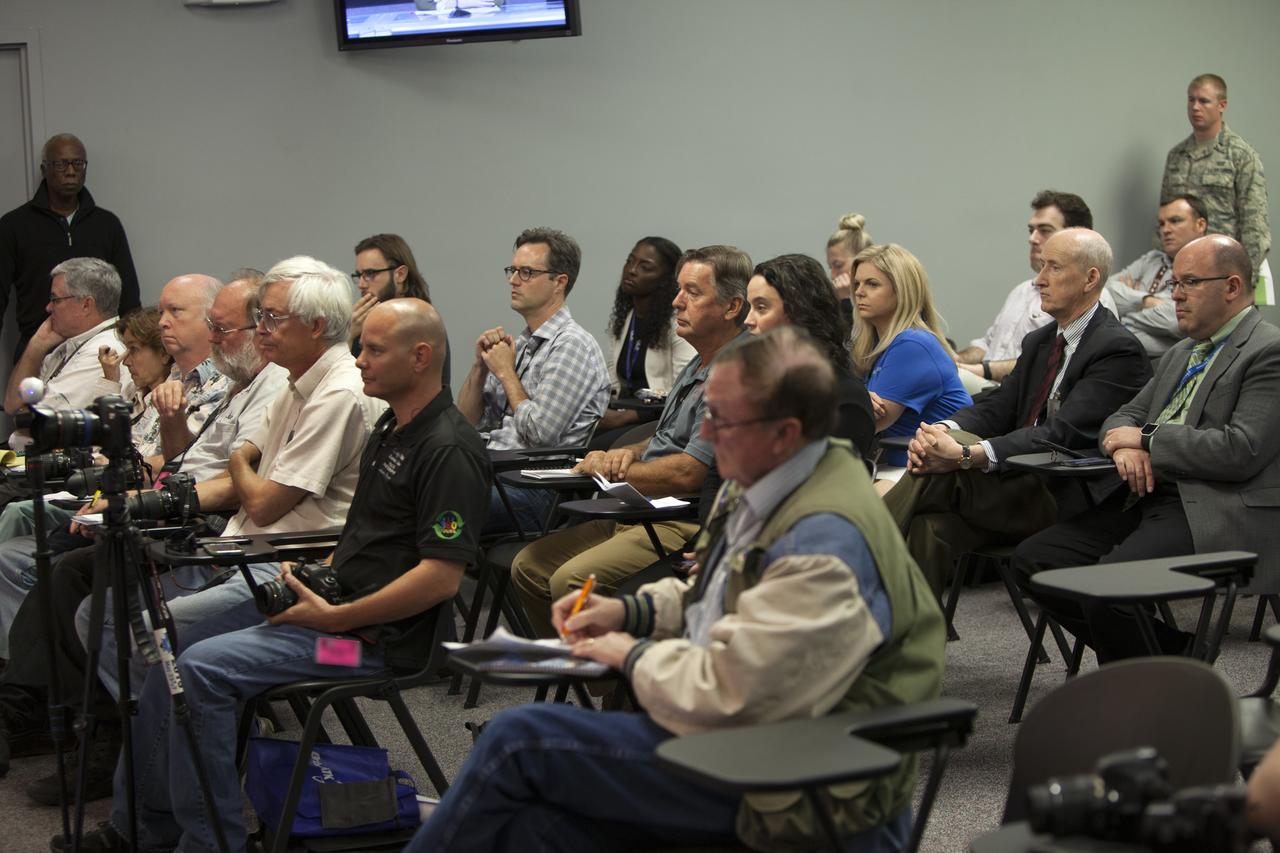
Members of the media listen to a prelaunch status briefing for Orbital ATK's seventh commercial resupply mission, CRS-7, to the International Space Station, at NASA Kennedy Space Center's Press Site in Florida. Moderating the briefing is George Diller, NASA Kennedy Public Affairs. Participants in the briefing are Joel Montalbano, deputy manager, NASA International Space Station Program; Vern Thorp, program manager, commercial missions, United Launch Alliance; Frank Culbertson, Space Systems Group president, Orbital ATK; Tara Ruttley, Johnson Space Center Program Science Office; and David Craft, weather officer, 45th Weather Squadron. Orbital ATK's Cygnus pressurized cargo module is set to launch atop the ULA Atlas V rocket from Space Launch Complex 41 at Cape Canaveral Air Force Station on April 18. Cygnus will deliver 7,600 pounds of supplies, equipment and scientific research materials to the space station. Liftoff is scheduled for 11:11 a.m. EDT.
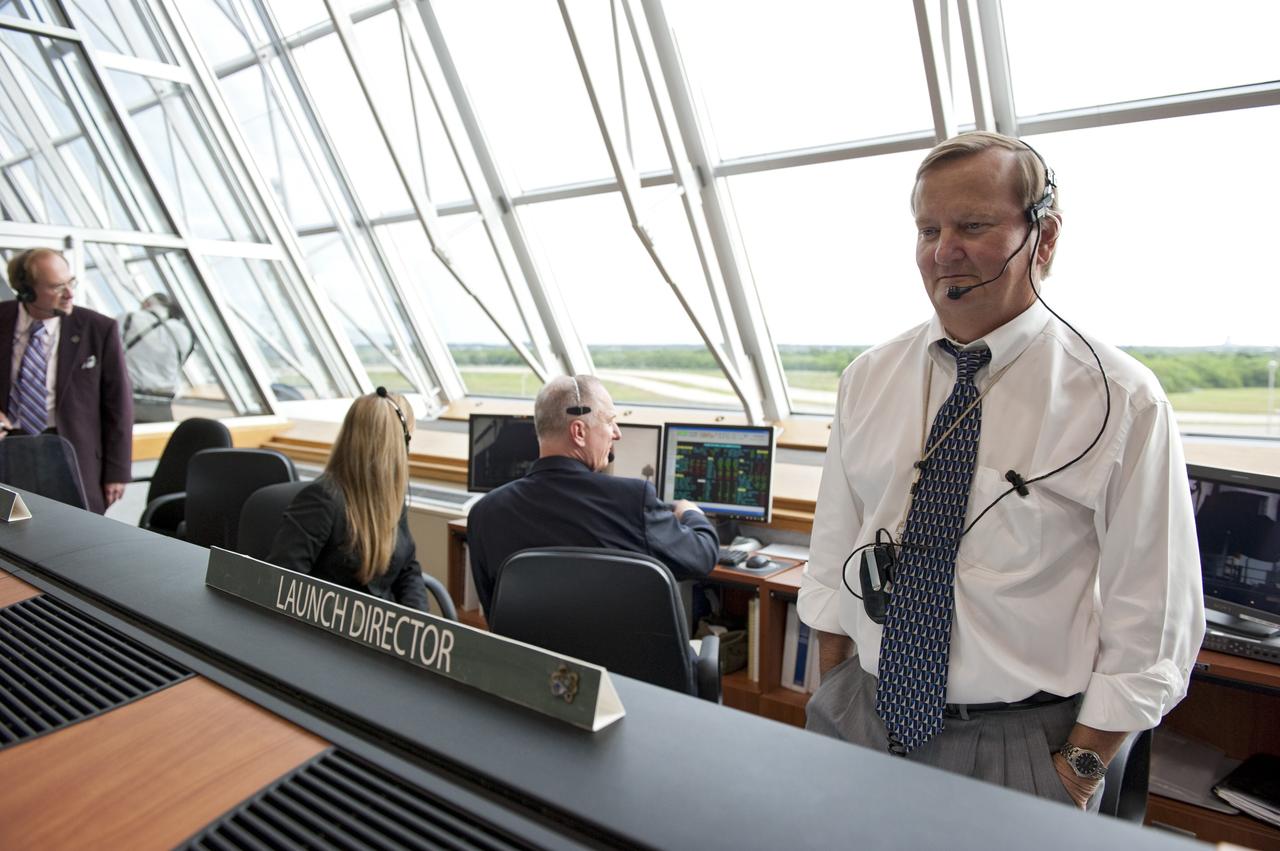
CAPE CANAVERAL, Fla. - Shuttle Launch Director Mike Leinbach monitors the countdown to liftoff of space shuttle Endeavour in Firing Room 4 of the Launch Control Center at NASA's Kennedy Space Center in Florida. Behind Leinbach, from left, are STS-134 Launch Commentator George Diller, Endeavour's NASA Flow Director Dana Hutcherson and STS-134 Assistant Launch Director Pete Nickolenko. Endeavour lifted off on its STS-134 mission to the International Space Station on time at 8:56 a.m. EDT on May 16. The shuttle and its six-member crew are embarking on a mission to deliver the Alpha Magnetic Spectrometer-2 (AMS), Express Logistics Carrier-3, a high-pressure gas tank and additional spare parts for the Dextre robotic helper to the space station. Endeavour's first launch attempt on April 29 was scrubbed because of an issue associated with a faulty power distribution box called the aft load control assembly-2 (ALCA-2). For more information visit, www.nasa.gov/mission_pages/shuttle/shuttlemissions/sts134/index.html. Photo credit: NASA/Kim Shiflett
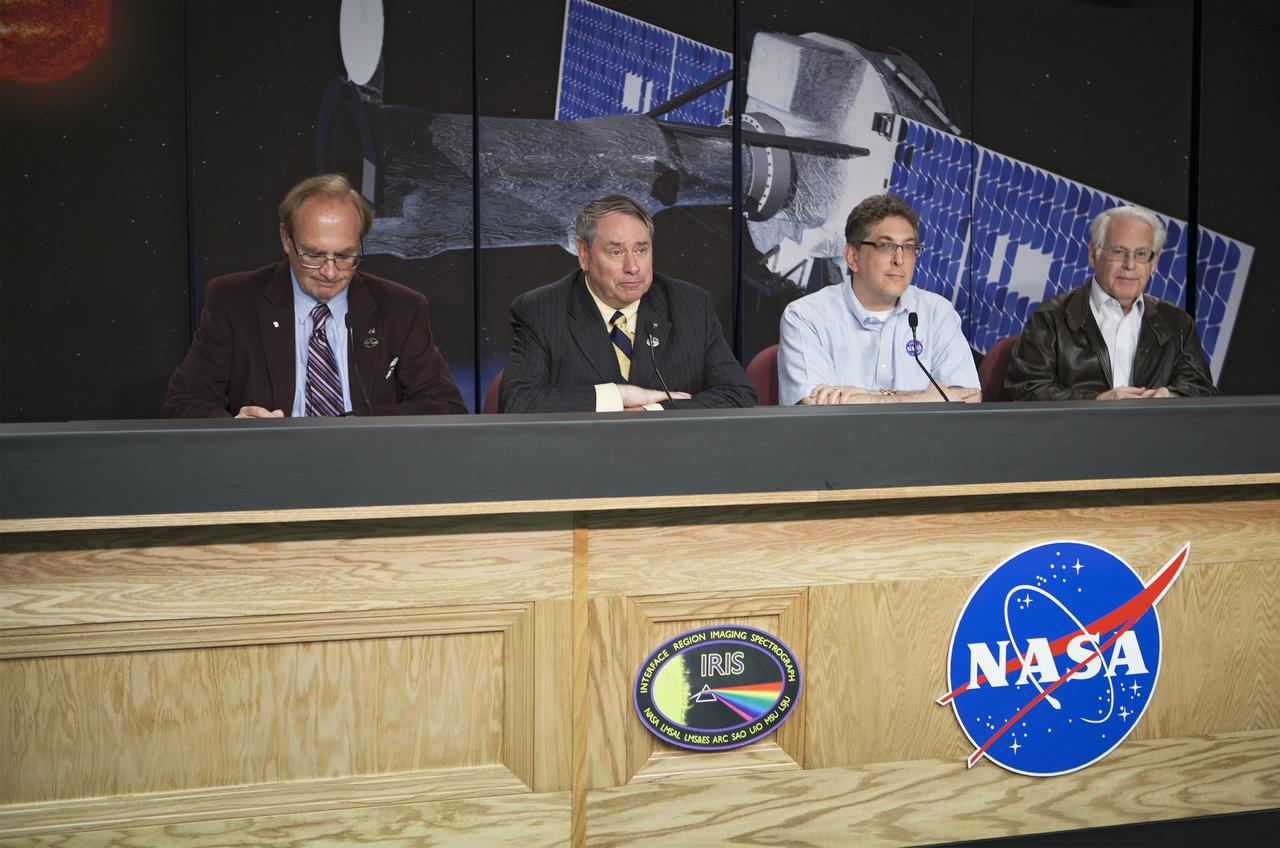
VANDENBERG AIR FORCE BASE, Calif. – At Vandenberg Air Force Base in California, NASA hosted a prelaunch mission briefing on the Interface Region Imaging Spectrograph, or IRIS, solar observatory scheduled to launch on a Pegasus XL rocket. Participating in the news conference are George Diller, NASA Public Affairs, Dr. S. Pete Worden, director of NASA's Ames Research Center in Calif., Jeffrey Newmark, IRIS Program scientist at NASA Headquarters in Washington D.C., and Alan Title, IRIS principal investigator with Lockheed Martin. Scheduled for launch from Vandenberg on June 26, 2013, IRIS will open a new window of discovery by tracing the flow of energy and plasma through the chromospheres and transition region into the sun’s corona using spectrometry and imaging. The IRIS mission will observe how solar material moves, gathers energy and heats up as it travels through a largely unexplored region of the solar atmosphere. The interface region, located between the sun's visible surface and upper atmosphere, is where most of the sun's ultraviolet emission is generated. These emissions impact the near-Earth space environment and Earth's climate. For more information, visit http://www.nasa.gov/iris Photo credit: NASA/ Daniel Casper
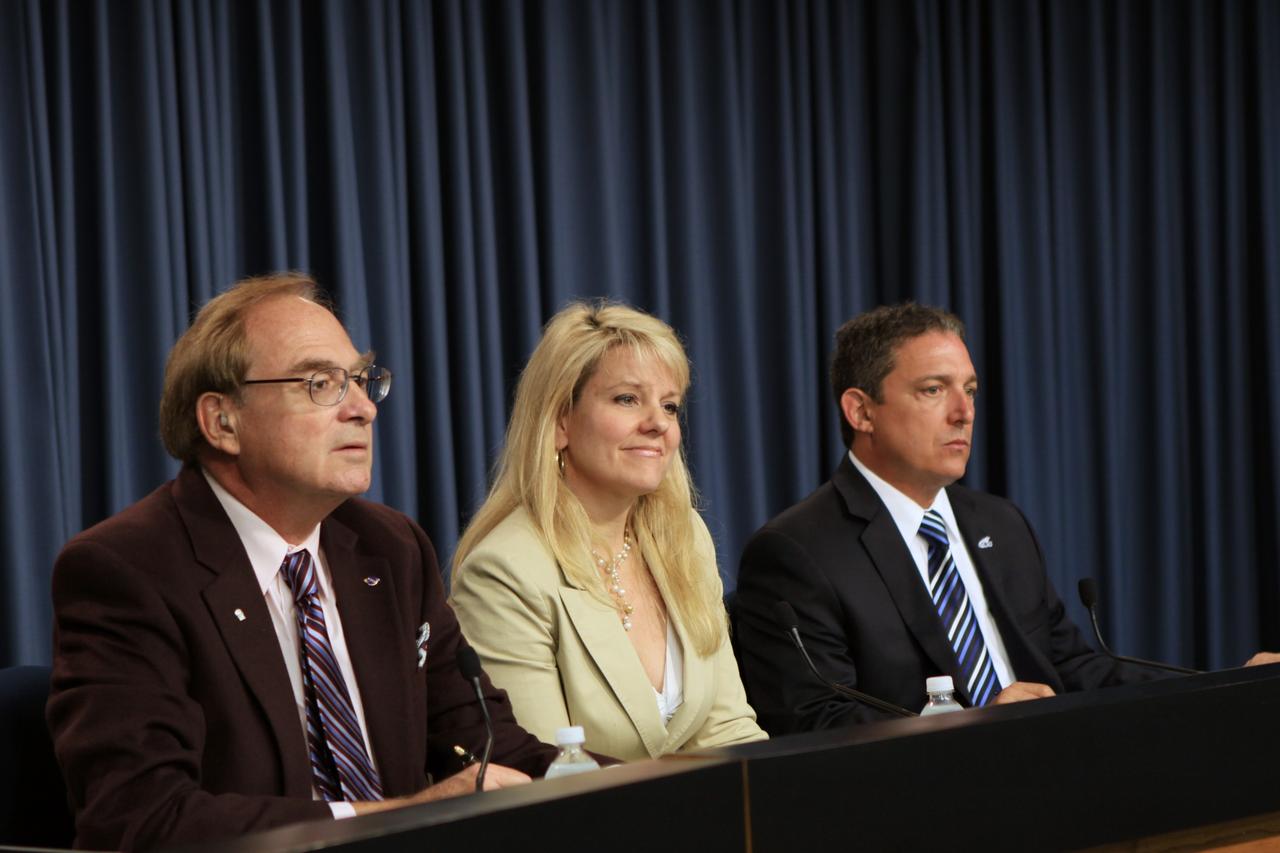
CAPE CANAVERAL, Fla. – A news conference is held in the Press Site auditorium at NASA’s Kennedy Space Center in Florida following the launch abort of the SpaceX demonstration test flight. From left are George H. Diller, NASA Public Affairs, Gwynne Shotwell, president, SpaceX, and Alan Lindenmoyer, manager, NASA Commercial Crew and Cargo Program. The next opportunity for liftoff of the SpaceX Falcon 9 rocket to carry the Dragon capsule to orbit is 4:33 a.m. EDT on May 22. The launch will be the company's second demonstration test flight for NASA's Commercial Orbital Transportation Services Program, or COTS. During the flight, the capsule will conduct a series of check-out procedures to test and prove its systems, including rendezvous and berthing with the International Space Station. If the capsule performs as planned, the cargo and experiments it is carrying will be transferred to the station. The cargo includes food, water and provisions for the station’s Expedition crews, such as clothing, batteries and computer equipment. Under COTS, NASA has partnered with two aerospace companies to deliver cargo to the station. For more information, visit http://www.nasa.gov/spacex. Photo credit: NASA/Jim Grossmann
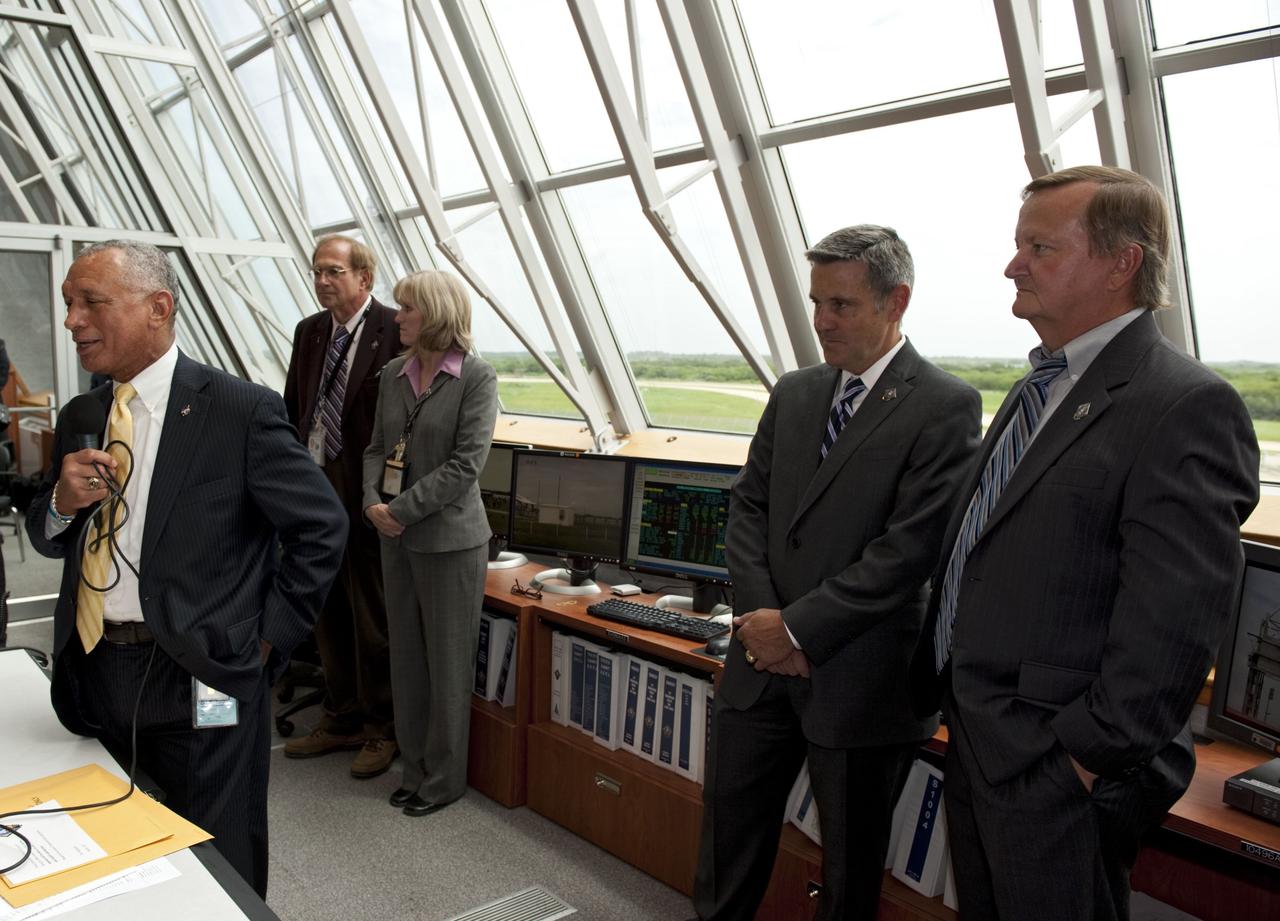
CAPE CANAVERAL, Fla. -- NASA Administrator Charlie Bolden congratulates the launch team in Firing Room 4 of the Launch Control Center following the successful launch of space shuttle Atlantis from NASA's Kennedy Space Center in Florida. Behind Bolden, from left, are STS-135 Launch Commentator George Diller, Atlantis' NASA Flow Director Angie Brewer, Kennedy Space Center Director Bob Cabana and Shuttle Launch Director Mike Leinbach. Atlantis began its final flight, the STS-135 mission to the International Space Station, at 11:29 a.m. EDT on July 8. STS-135 will deliver the Raffaello multi-purpose logistics module packed with supplies and spare parts for the International Space Station. Atlantis also is flying the Robotic Refueling Mission experiment that will investigate the potential for robotically refueling existing satellites in orbit. In addition, Atlantis will return with a failed ammonia pump module to help NASA better understand the failure mechanism and improve pump designs for future systems. STS-135 is the 33rd flight of Atlantis, the 37th shuttle mission to the space station, and the 135th and final mission of NASA's Space Shuttle Program. For more information, visit www.nasa.gov/mission_pages/shuttle/shuttlemissions/sts135/index.html. Photo credit: NASA/Kim Shiflett
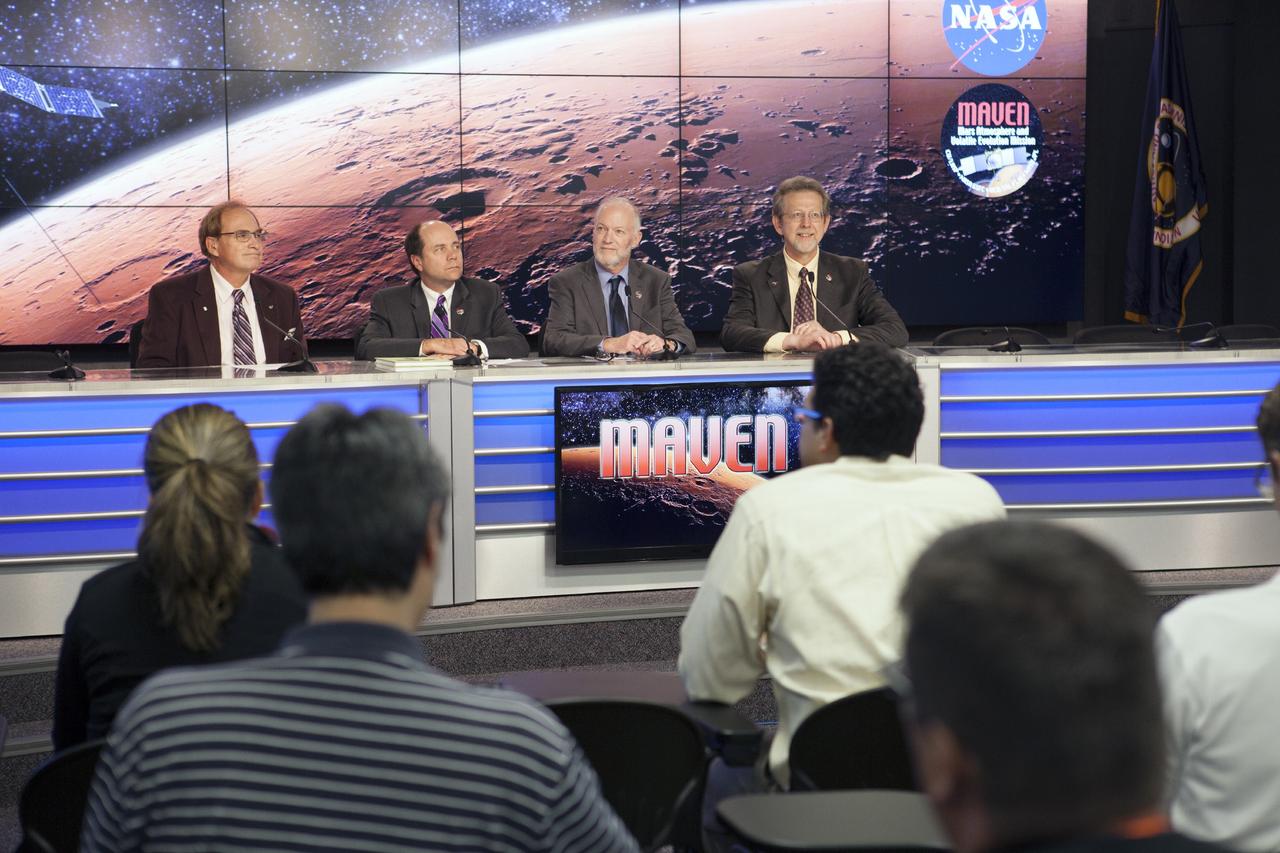
CAPE CANAVERAL, Fla. -- A post-launch news conference is held in NASA's Press Site TV auditorium following the successful launch of NASA’s Mars Atmosphere and Volatile EvolutioN, or MAVEN, spacecraft. Participating from left are moderator George Diller, NASA Public Affairs, David Mitchell, NASA MAVEN project manager at the Goddard Space Flight Center in Greenbelt, Md., Bruce Jakosky, MAVEN principal investigator from the Laboratory for Atmospheric and Space Physics at the University of Colorado at Boulder, and Dr. Jim Green, director of the Planetary Science Division at NASA Headquarters. Launch was on schedule at 1:28 p.m. EST Nov. 18 at the opening of a two-hour launch window. After a 10-month journey to the Red Planet, MAVEN will study its upper atmosphere in unprecedented detail from orbit above the planet. Built by Lockheed Martin in Littleton, Colo., MAVEN will arrive at Mars in September 2014 and will be inserted into an elliptical orbit with a high point of 3,900 miles, swooping down to as close as 93 miles above the planet's surface. For more information, visit: http://www.nasa.gov/mission_pages/maven/main/index.html. Photo credit: NASA/Kim Shiflett
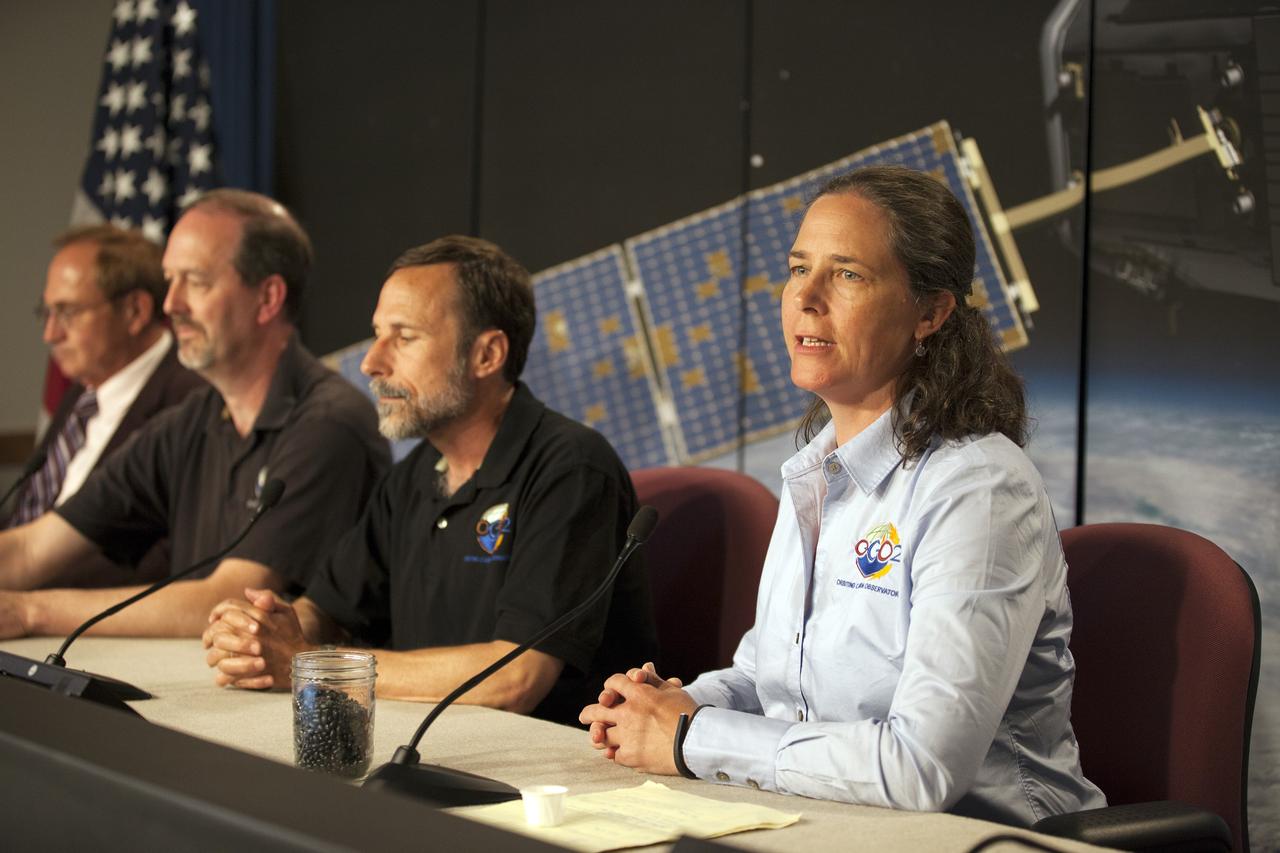
VANDENBERG AIR FORCE BASE, Calif. – From left, George Diller, NASA Public Affairs Ken Jucks, Orbiting Carbon Observatory-2, or OCO-2, project executive at NASA Headquarters David Crisp, OCO-2 science team leader at NASA's Jet Propulsion Laboratory, or JPL and Annmarie Eldering, OCO-2 deputy project scientist at JPL, participate in a mission science briefing at Vandenberg Air Force Base in California prior to the launch of the observatory. Launch aboard a United Launch Alliance Delta II rocket from Space Launch Complex 2 is scheduled for 5:56 a.m. EDT on July 1. OCO-2 is NASA’s first mission dedicated to studying atmospheric carbon dioxide, the leading human-produced greenhouse gas driving changes in Earth’s climate. OCO-2 will provide a new tool for understanding the human and natural sources of carbon dioxide emissions and the natural "sinks" that absorb carbon dioxide and help control its buildup. The observatory will measure the global geographic distribution of these sources and sinks and study their changes over time. To learn more about OCO-2, visit http://www.nasa.gov/oco2. Photo credit: NASA/Kim Shiflett
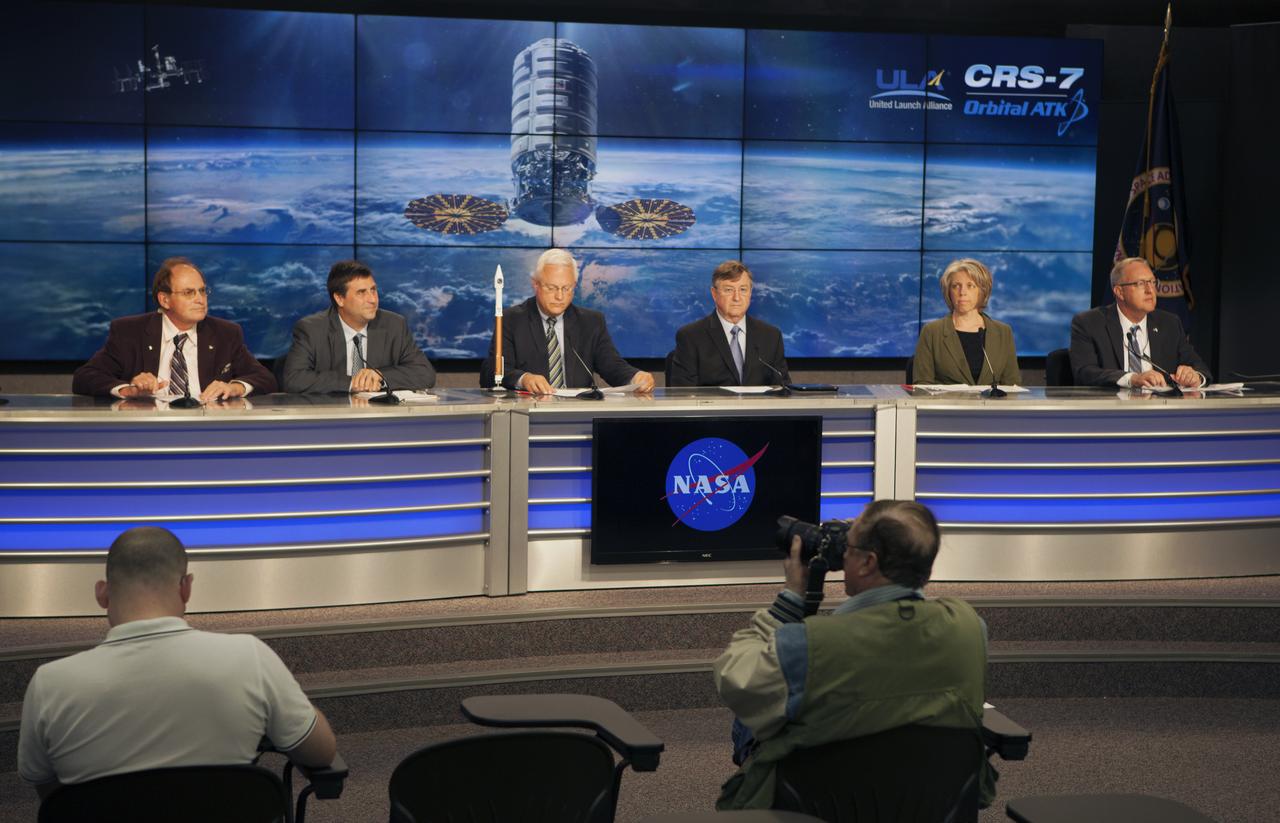
A prelaunch status briefing for Orbital ATK's seventh commercial resupply mission, CRS-7, to the International Space Station, is held at NASA Kennedy Space Center's Press Site in Florida. Participating in the briefing are, from left, George Diller, NASA Kennedy Public Affairs; Joel Montalbano, deputy manager, NASA International Space Station Program; Vern Thorp, program manager, commercial missions, United Launch Alliance; Frank Culbertson, Space Systems Group president, Orbital ATK; Tara Ruttley, Johnson Space Center Program Science Office; and David Craft, weather officer, 45th Weather Squadron. Orbital ATK's Cygnus pressurized cargo module is set to launch atop the ULA Atlas V rocket from Space Launch Complex 41 at Cape Canaveral Air Force Station on April 18. Cygnus will deliver 7,600 pounds of supplies, equipment and scientific research materials to the space station. Liftoff is scheduled for 11:11 a.m. EDT.
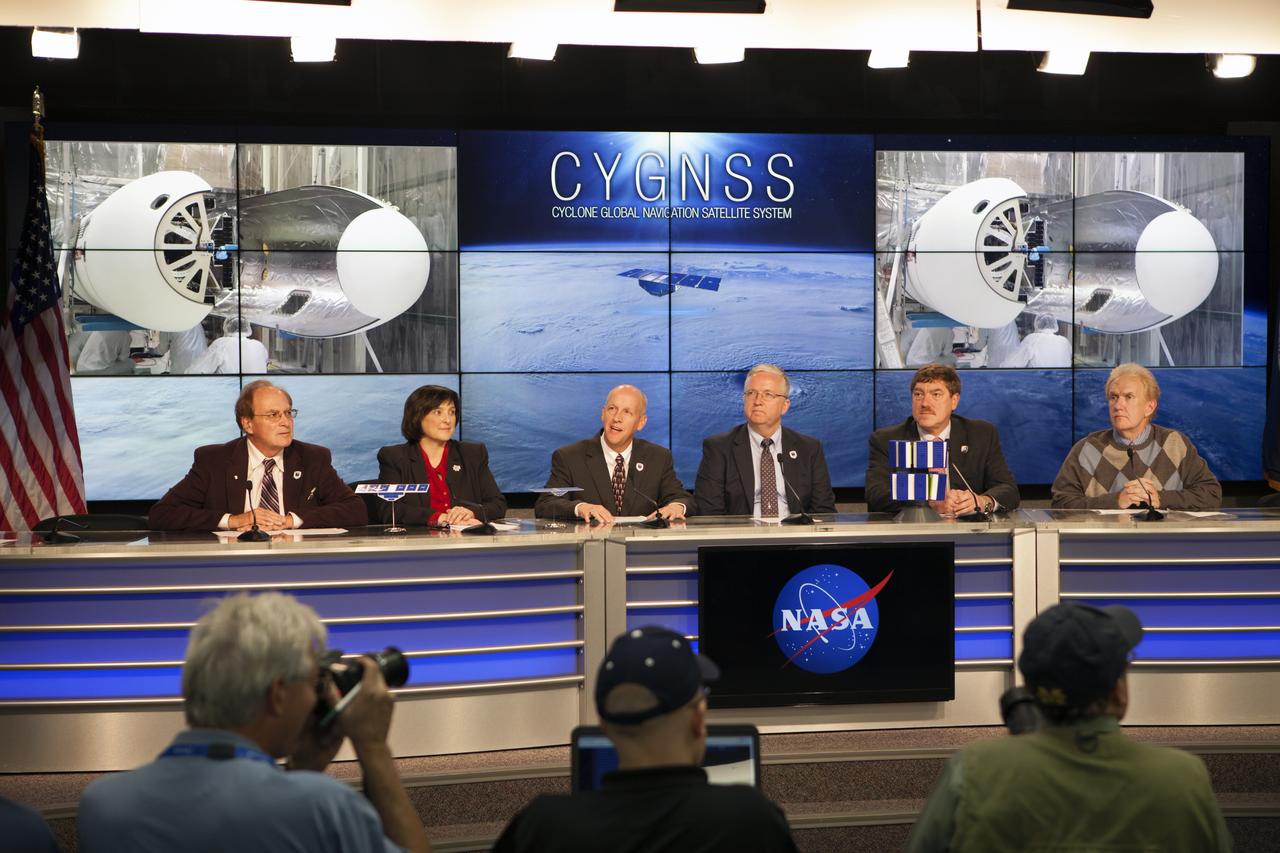
In the Kennedy Space Center’s Press Site auditorium, NASA and industry leaders speak to members of the media during a prelaunch news conference for the agency’s Cyclone Global Navigation Satellite System, or CYGNSS, spacecraft. From left are: George Diller of NASA Communications; Christine Bonniksen, CYGNSS program executive in the Earth Science Division of the Science Mission Directorate at NASA Headquarters in Washington, D.C.; Tim Dunn, NASA launch director at Kennedy; Bryan Baldwin, Pegasus launch vehicle program manager for Orbital ATK, Dulles, Virginia; John Scherrer, CYGNSS project manager for the Southwest Research Institute in San Antonio, Texas; and Mike Rehbein, launch weather officer for the 45th Weather Squadron at Cape Canaveral Air Force Station, Florida. The eight CYGNSS satellites will make frequent and accurate measurements of ocean surface winds throughout the life cycle of tropical storms and hurricanes. The data will help scientists probe key air-sea interaction processes that take place near the core of storms, which are rapidly changing and play a crucial role in the beginning and intensification of hurricanes.