
S71-51282 (1971) --- Astronaut Gerald P. Carr. Photo credit: NASA

CAPE CANAVERAL, Fla. – Former NASA astronaut Gerald P. Carr remarks on his friendship with former NASA astronaut William R. Pogue during a wreath laying ceremony at the United States Astronaut Hall of Fame at the Kennedy Space Center Visitor Complex. Col. Pogue, pilot on NASA's Skylab 4 mission in 1973-74, died March 3. He was 84 years old. Skylab 4 was the third and final manned visit to the Skylab orbital workshop, launched Nov. 16, 1973, and concluded Feb. 8, 1974. At 84 days, 1 hour and 15 minutes, Skylab 4 was the longest manned space flight to that date. Pogue was accompanied on the record-setting 34.5-million-mile flight by Commander Carr and science-pilot Dr. Edward G. Gibson. They conducted dozens of experiments and science demonstrations during their 1,214 orbits of Earth. Pogue logged 13 hours and 31 minutes in two spacewalks outside the orbital workshop. For more information, visit http://www.nasa.gov/content/skylab-4-pilot-william-pogue-dies. Photo credit: NASA/Kim Shiflett

CAPE CANAVERAL, Fla. – Former NASA astronauts Gerald P. Carr, left, and Edward G. Gibson place a wreath on an easel during a ceremony to honor former NASA astronaut William R. Pogue at the United States Astronaut Hall of Fame at the Kennedy Space Center Visitor Complex. In the background is a painting by former NASA astronaut Alan Bean. Col. Pogue, pilot on NASA's Skylab 4 mission in 1973-74, died March 3. He was 84 years old. Skylab 4 was the third and final manned visit to the Skylab orbital workshop, launched Nov. 16, 1973, and concluded Feb. 8, 1974. At 84 days, 1 hour and 15 minutes, Skylab 4 was the longest manned space flight to that date. Pogue was accompanied on the record-setting 34.5-million-mile flight by Commander Carr and science-pilot Gibson. They conducted dozens of experiments and science demonstrations during their 1,214 orbits of Earth. Pogue logged 13 hours and 31 minutes in two spacewalks outside the orbital workshop. For more information, visit http://www.nasa.gov/content/skylab-4-pilot-william-pogue-dies. Photo credit: NASA/Kim Shiflett

CAPE CANAVERAL, Fla. – From left, former NASA astronauts Robert Cabana, Gerald P. Carr and Edward G. Gibson pay their respects to former NASA astronaut William R. Pogue during a wreath laying ceremony at the United States Astronaut Hall of Fame at the Kennedy Space Center Visitor Complex. Cabana now is the director of Kennedy Space Center. In the background is a painting by former NASA astronaut Alan Bean. Col. Pogue, pilot on NASA's Skylab 4 mission in 1973-74, died March 3. He was 84 years old. Skylab 4 was the third and final manned visit to the Skylab orbital workshop, launched Nov. 16, 1973, and concluded Feb. 8, 1974. At 84 days, 1 hour and 15 minutes, Skylab 4 was the longest manned space flight to that date. Pogue was accompanied on the record-setting 34.5-million-mile flight by Commander Carr and science-pilot Gibson. They conducted dozens of experiments and science demonstrations during their 1,214 orbits of Earth. Pogue logged 13 hours and 31 minutes in two spacewalks outside the orbital workshop. For more information, visit http://www.nasa.gov/content/skylab-4-pilot-william-pogue-dies. Photo credit: NASA/Kim Shiflett
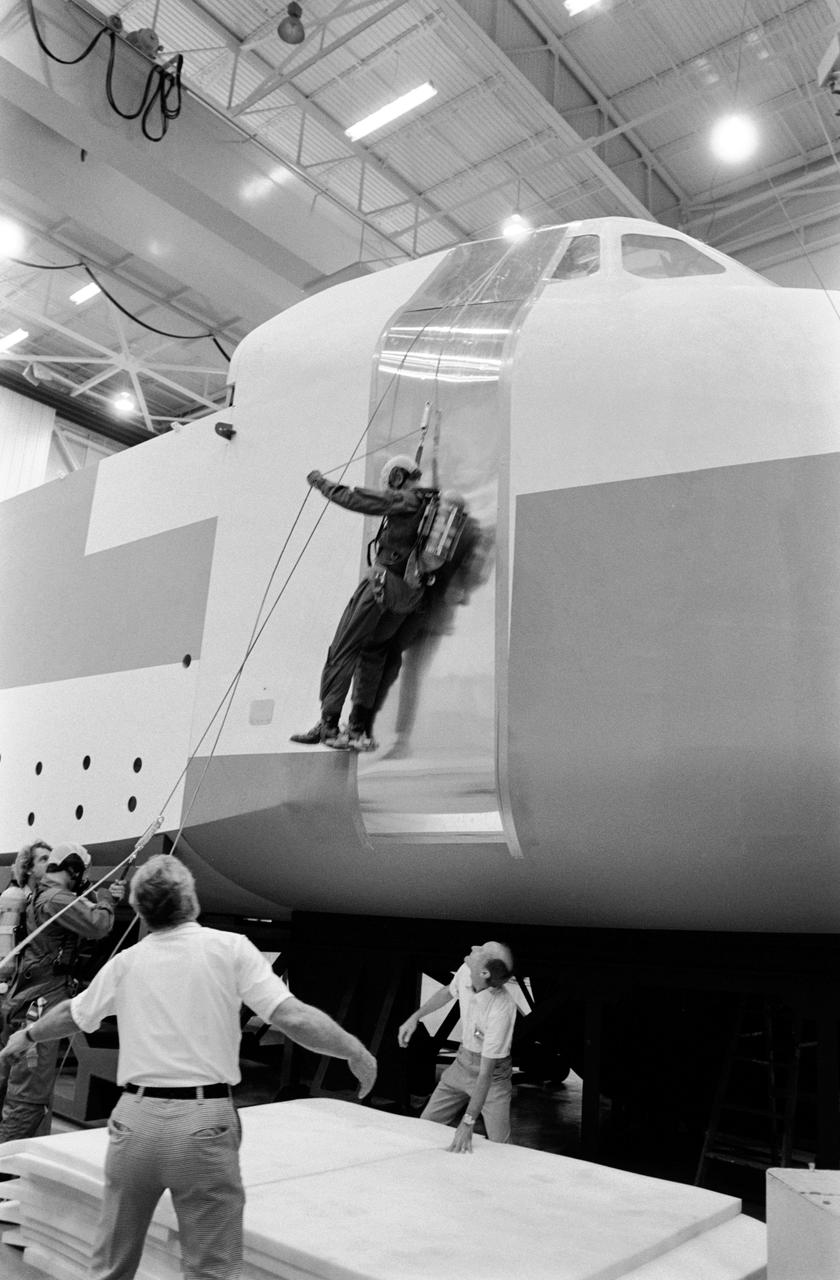
Twelve (12) views of Shuttle emergency training in JSC, Bldg. 9A. Training Officer R. Terry Neal with Astronaut Gerald P. Carr. 1. Astronaut Gerald P. Carr 2. Terry Neal JSC, Houston, TX

Astronaut Gerald P. Carr, commander for the Skylab 4 mission, demonstrates the effects of zero-gravity as he floats in the forward dome area of the Orbital Workshop of the Skylab space station while in Earth orbit.
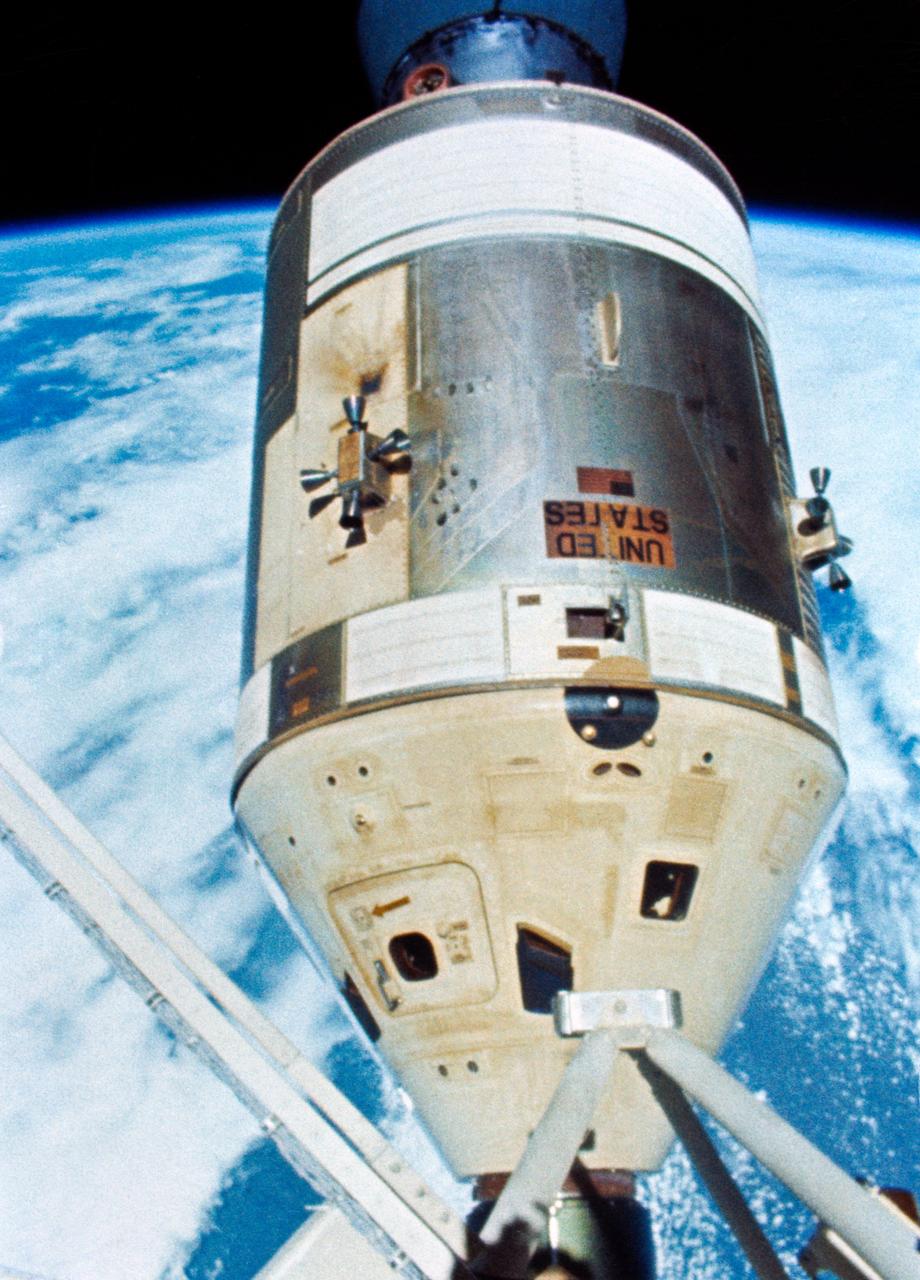
S74-17457 (3 Feb. 1974) --- This view of the Skylab 4 Command/Service Module in a docked configuration is a frame from a roll of movie film exposed by a 16mm Maurer camera. The other four components of the Skylab space station in Earth orbit are out of view to the right. This picture was taken by astronaut Gerald P. Carr, Skylab 4 commander, during the final Skylab extravehicular activity (EVA) which took place on Feb. 3, 1974. The crew members -- Gerald Carr, Edward Gibson and William Pogue -- were the first NASA astronauts to spend New Year's in space. A week earlier, they became the first crew to perform an EVA on Christmas day. Photo credit: NASA
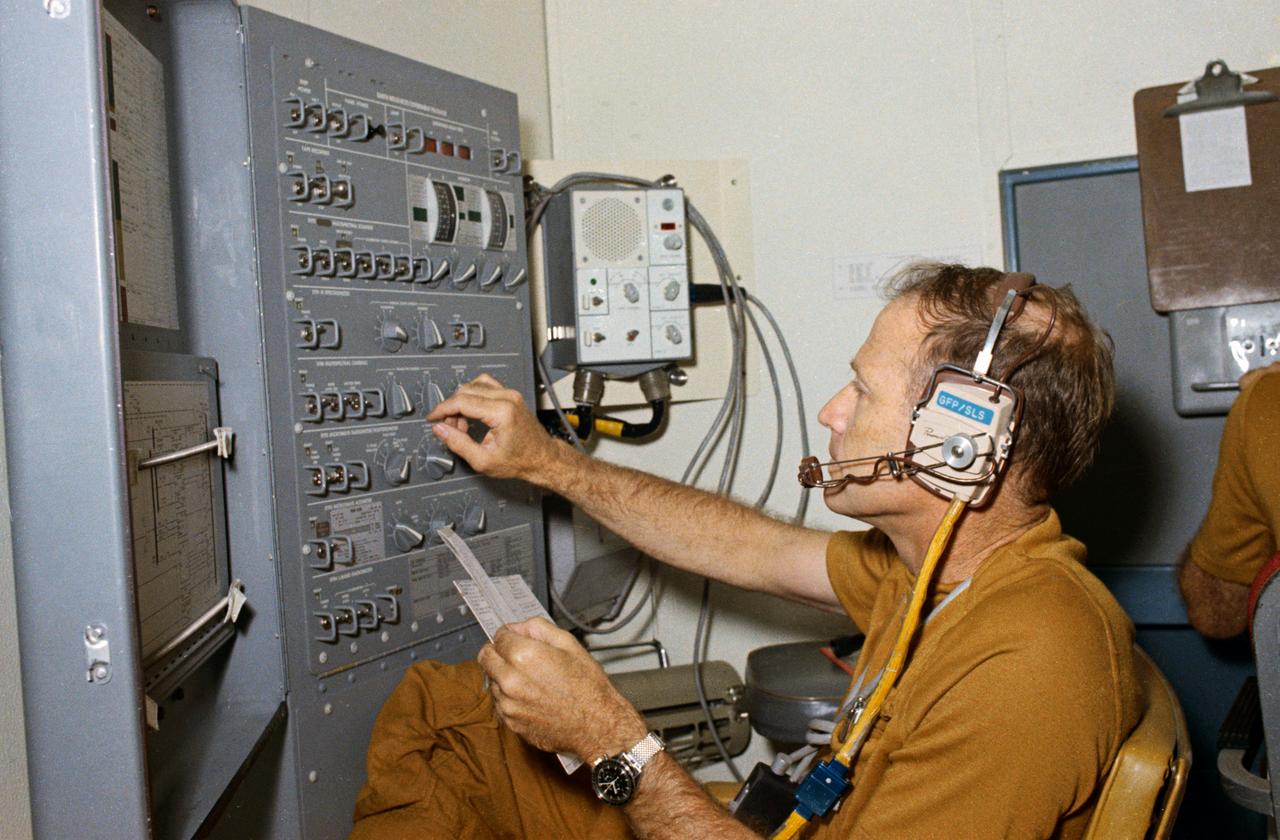
S73-32847 (10 Sept. 1973) --- Astronaut Gerald P. Carr, Skylab 4 commander, changes a dial on the control and display panel for the Earth Resources Experiments package (EREP) during a training exercise in the Multiple Docking Adapter (MDA) one-G trainer at Johnson Space Center. Photo credit: NASA
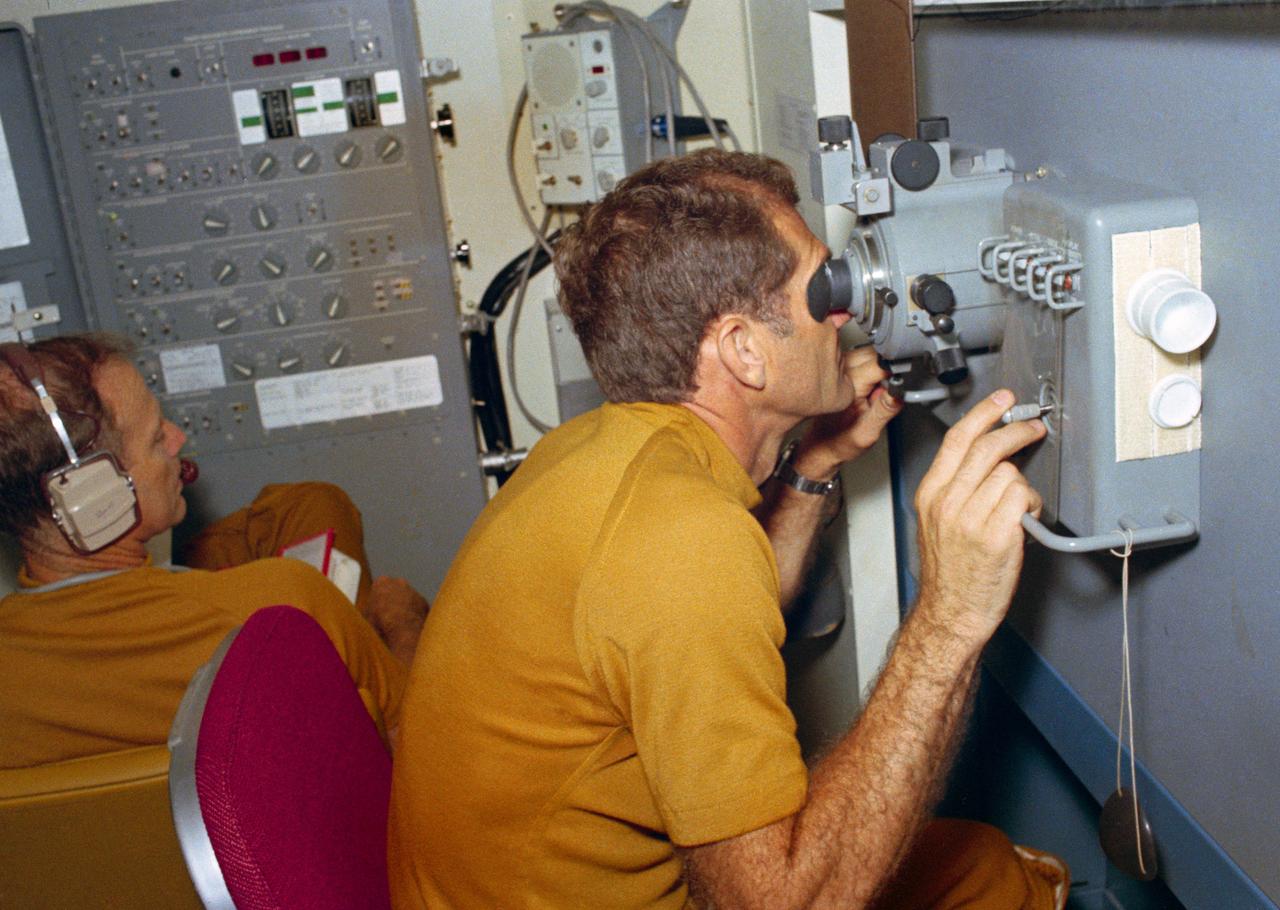
S73-32854 (10 Sept. 1973) --- Astronaut William R. Pogue, Skylab 4 pilot, uses the Skylab Viewfinder Tracking System (S191 experiment) during a training exercise in the Multiple Docking Adapter (MDA) one-G trainer at Johnson Space Center. In the background is astronaut Gerald P. Carr, seated at the control panel for the Earth Resources Experiments Package (EREP). Carr is Skylab 4 crew commander, and Gibson is science pilot. Photo credit: NASA

S74-17456 (3 Feb. 1974) --- Scientist-astronaut Edward G. Gibson has just egressed the Skylab EVA hatchway in this frame taken from a roll of movie film exposed by a 16mm Maurer camera. Astronaut Gerald P. Carr, Skylab 4 commander, took this picture during the final Skylab extravehicular activity (EVA) which took place on Feb. 3, 1974. Carr was above on the Apollo Telescope Mount (ATM) when he shot this frame of Gibson. Note Carr's umbilical/tether line extending from inside the space station up toward the camera. Astronaut William R. Pogue, Skylab 4 pilot, remained inside the space station during the EVA by Carr and Gibson. Photo credit: NASA
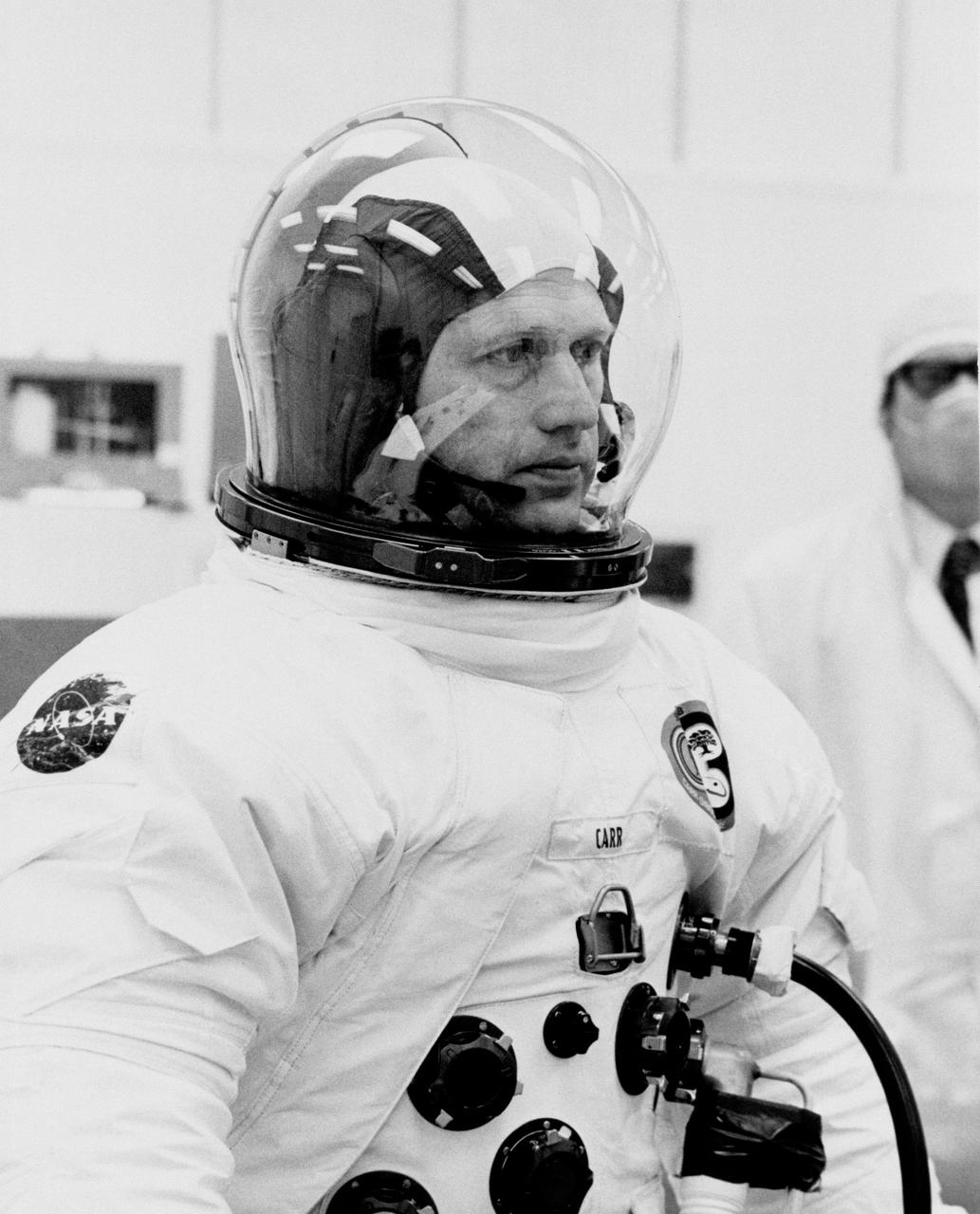
S73-36908 (8 Nov. 1973) --- Astronaut Gerald P. Carr, commander of the Skylab 4 mission, undergoes spacesuit pressure and fit checks at the Kennedy Space Center, Florida. This shoulder and head shot of Carr was taken a few days before the scheduled Skylab 4 launch. This third and last visit to the Skylab space station in Earth orbit will return additional information on the Earth and sun, as well as provide a favorable location from which to observe the recently discovered Comet Kohoutek. The other two members of the Skylab 4 crew will be astronaut William R. Pogue, pilot; and scientist-astronaut Edward G. Gibson, science pilot. Photo credit: NASA
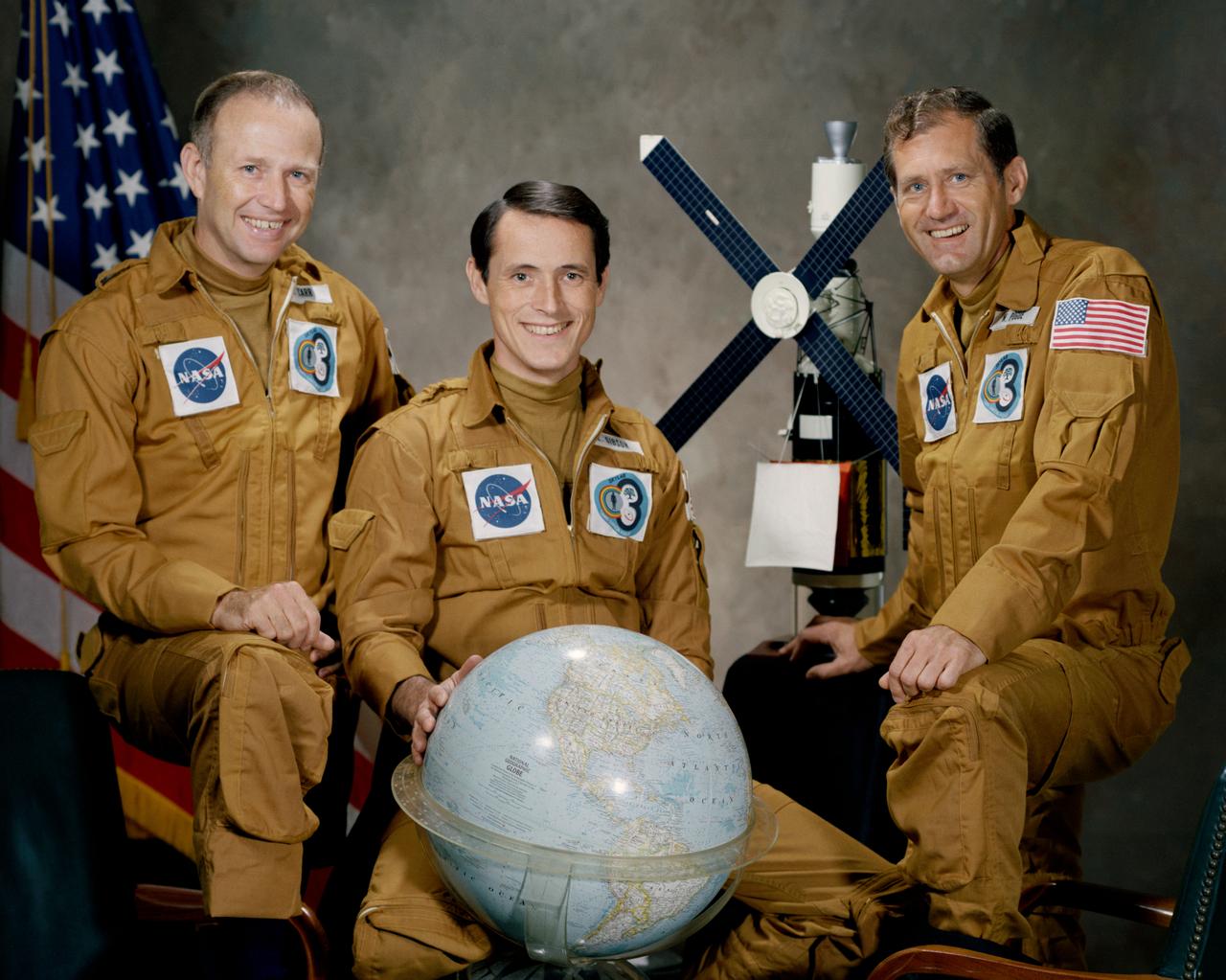
S73-33207 (August 1973) --- These three men are the prime crew for the Skylab 4 mission. Pictured in their Skylab spacesuits with a globe and a model of the Skylab space station are, left to right, astronaut Gerald P. Carr, commander; scientist-astronaut Edward G. Gibson, science pilot; and astronaut William R. Pogue, pilot. Photo credit: NASA
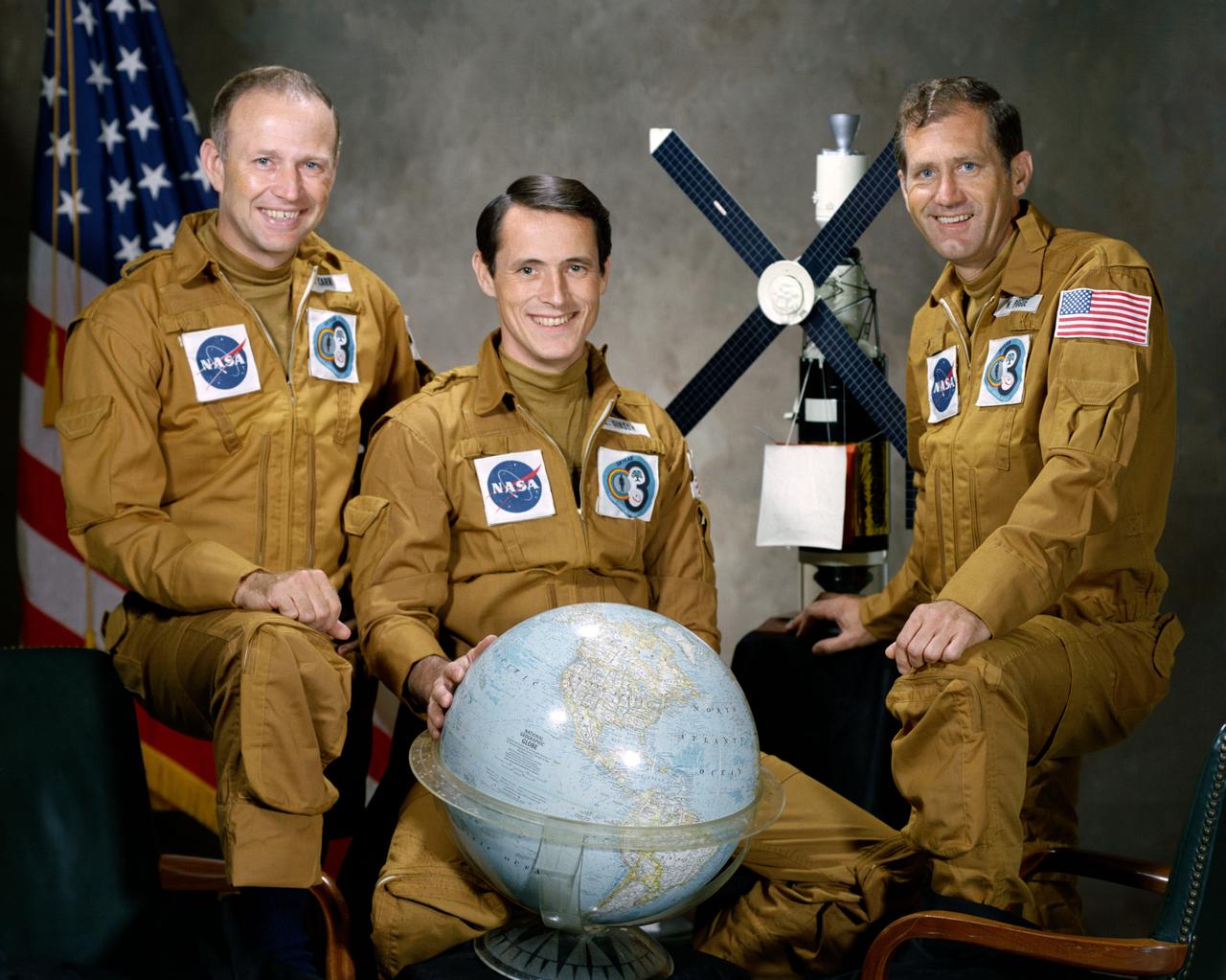
S73-33208 (August 1973) --- These three men are the prime crewmen for the Skylab 4 mission. Pictured in their flight suits with a globe and a model of the Skylab space station are, left to right, astronaut Gerald P. Carr, commander; scientist-astronaut Edward G. Gibson, science pilot; and astronaut William R. Pogue, pilot. Photo credit: NASA
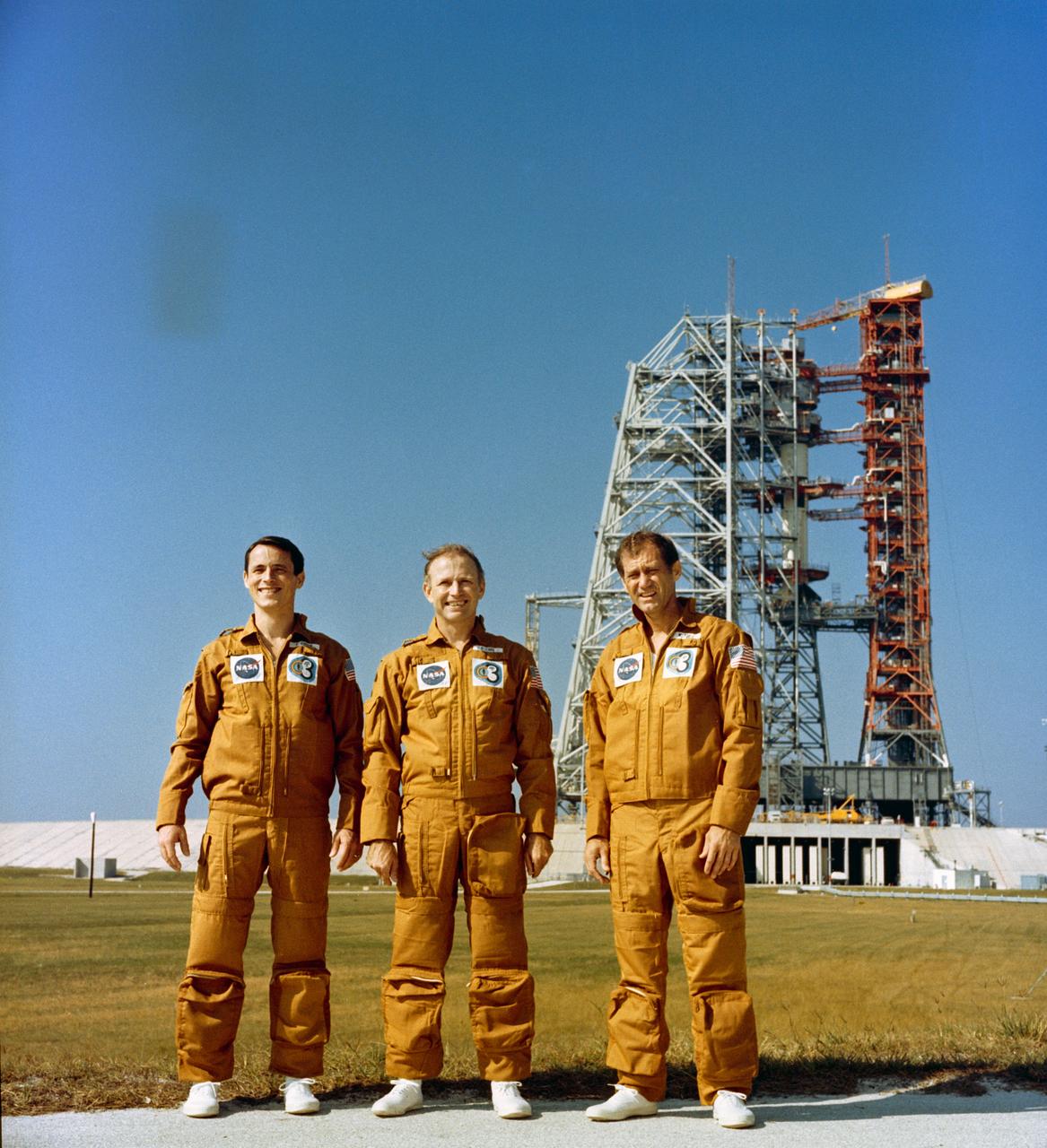
S73-36904 (8 Nov. 1973) --- The three members of the Skylab 4 crew are photographed standing near Pad B, Launch Complex 39, Kennedy Space Cneter, Florida, during the preflight activity. They are, left to right, scientist-astronaut Edward G. Gibson, science pilot; astronaut Gerald P. Carr, commander; and astronaut William R. Pogue, pilot. Photo credit: NASA
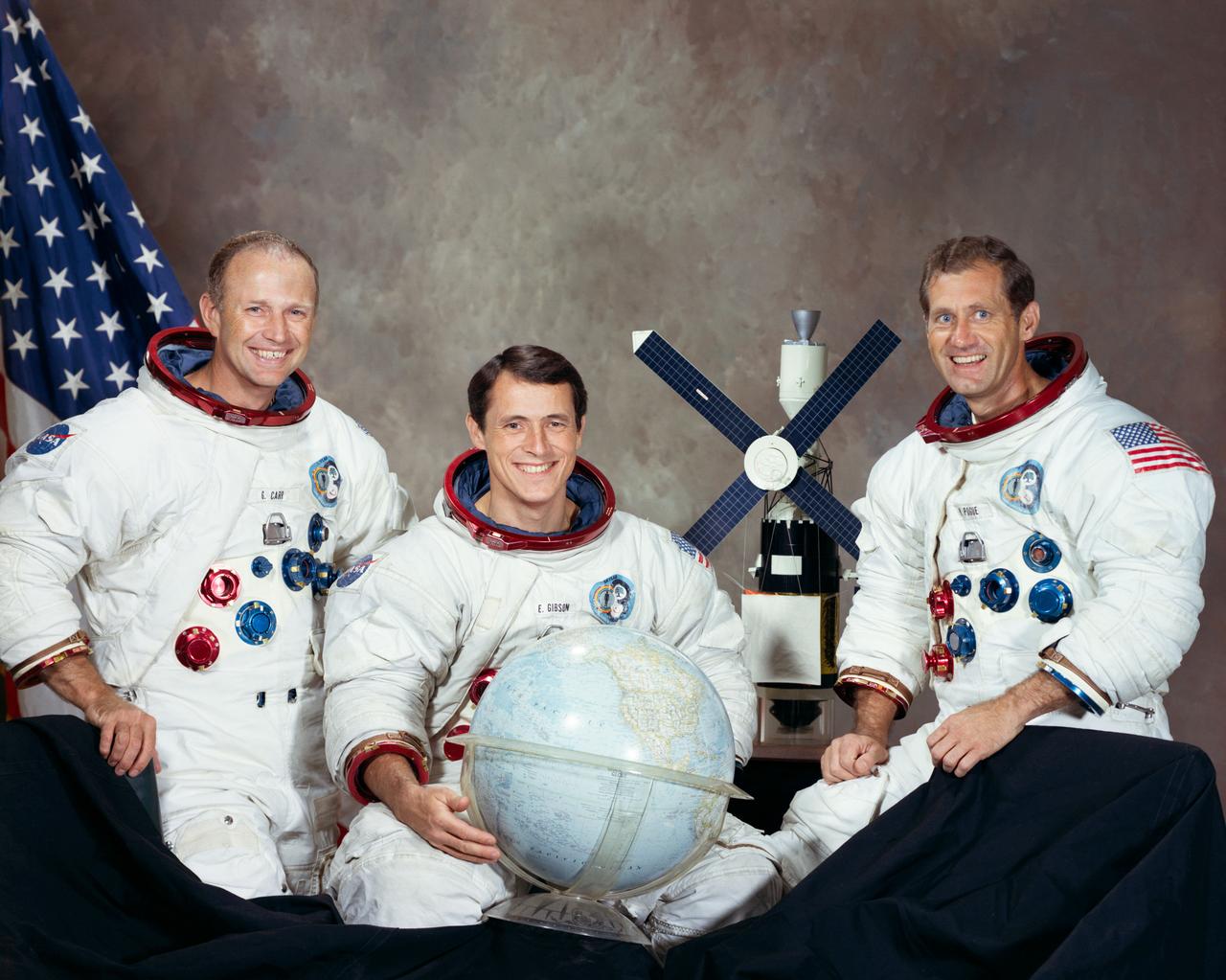
S73-33206 (August 1973) --- These three men are the prime crew for the Skylab 4 mission. Pictured in their Skylab spacesuits with a globe and a model of the Skylab space station are, left to right, astronaut Gerald P. Carr, commander; scientist-astronaut Edward G. Gibson, science pilot; and astronaut William R. Pogue, pilot. Photo credit: NASA
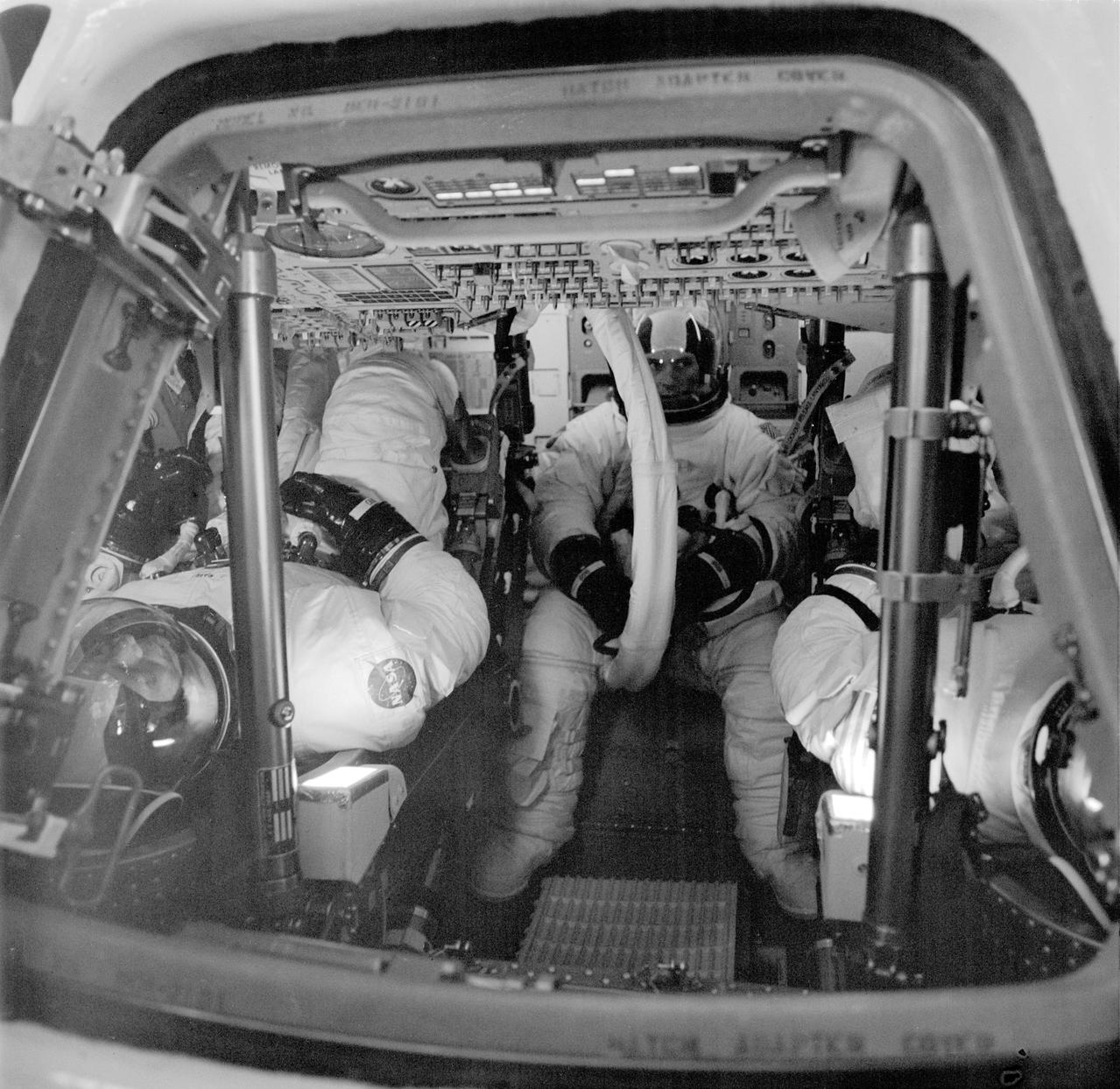
S73-34094 (6 Aug. 1973) --- The Skylab 4 crewmen, fully suited, are seated inside their Command Module, which has been undergoing high altitude chamber test runs at the Kennedy Space Center (KSC) after being considered as a possible rescue vehicle, if needed, for the Skylab 3 crewmen. Facing the camera is scientist-astronaut Edward G. Gibson, science pilot. Astronauts Gerald P. Carr, right, commander, and William R. Pogue, pilot, are also pictured. Photo credit: NASA
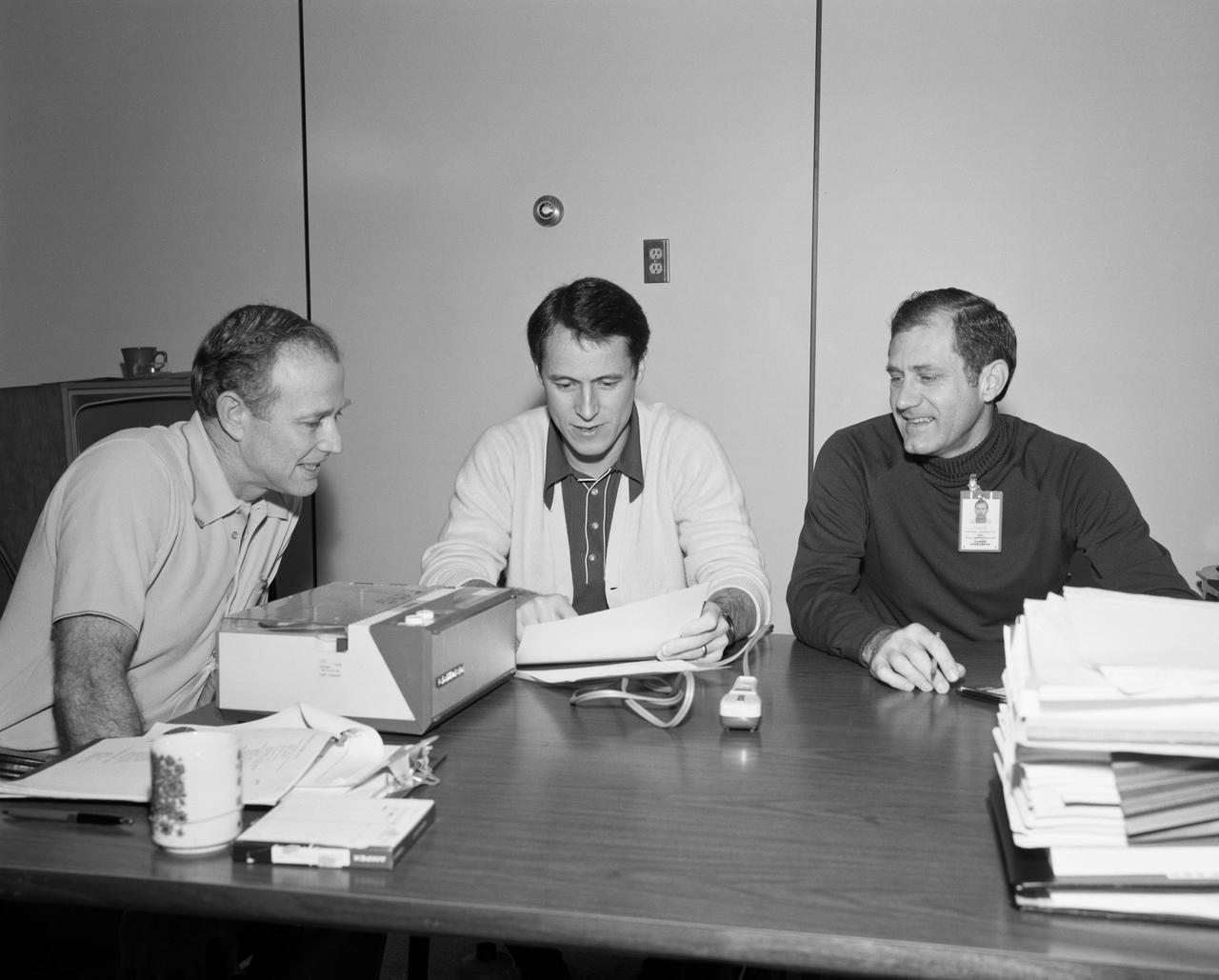
S74-17735 (February 1974) --- The three crewmen of the third manned Skylab mission (Skylab 4) look over their notes for their upcoming post-mission press conference at Johnson Space Center. They are, from left to right, astronaut Gerald P. Carr, commander; scientist-astronaut Edward G. Gibson, science pilot; and astronaut William R. Pogue, pilot. The three astronauts spent 84 days aboard the Skylab space station cluster in Earth orbit. Photo credit: NASA
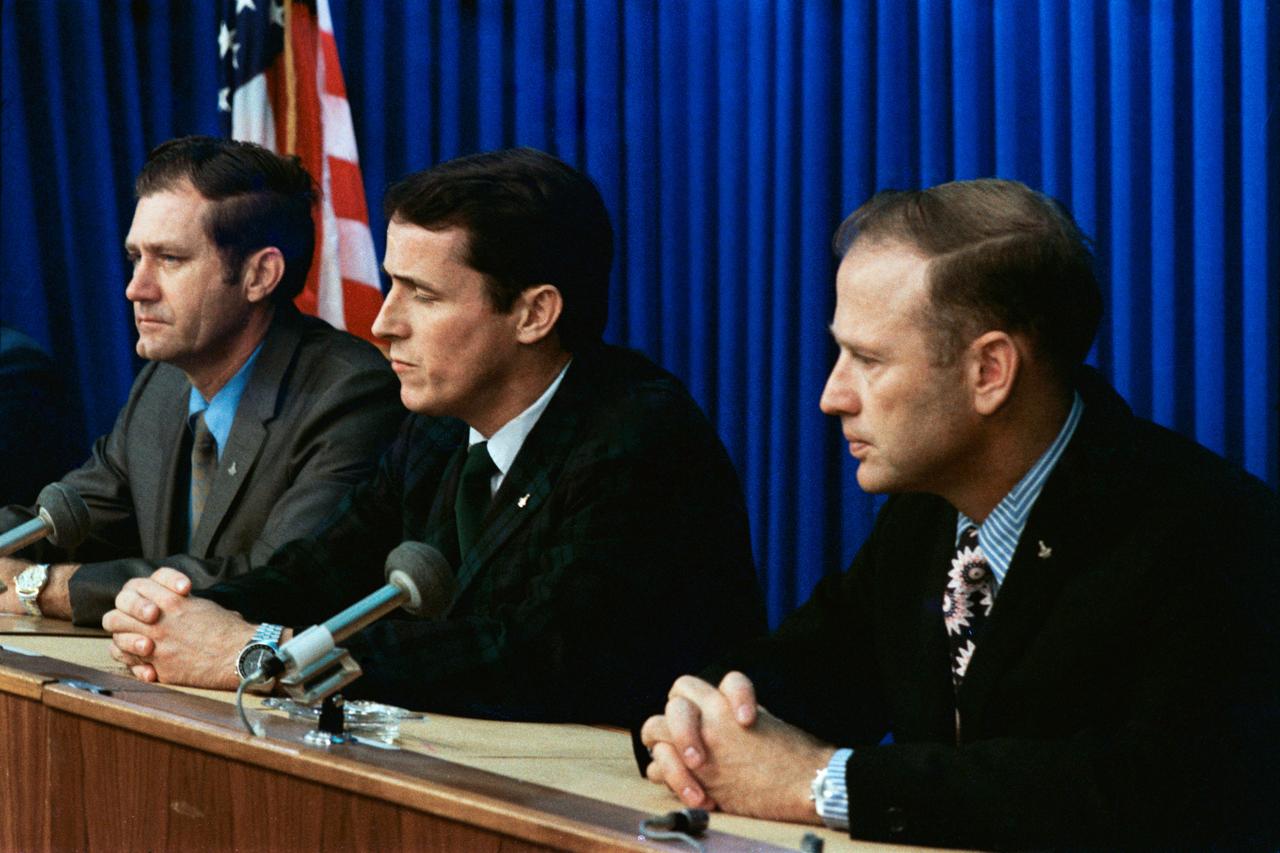
S72-46702 (December 1972) --- The three members of the prime crew of the third of three scheduled manned Skylab missions (Skylab 4) appear before a gathering of news media representatives at a press conference held at the Manned Spacecraft Center. They are, left to right, astronaut William R. Pogue, pilot; scientist-astronaut Edward G. Gibson, science pilot; and astronaut Gerald P. Carr, commander. Photo credit: NASA
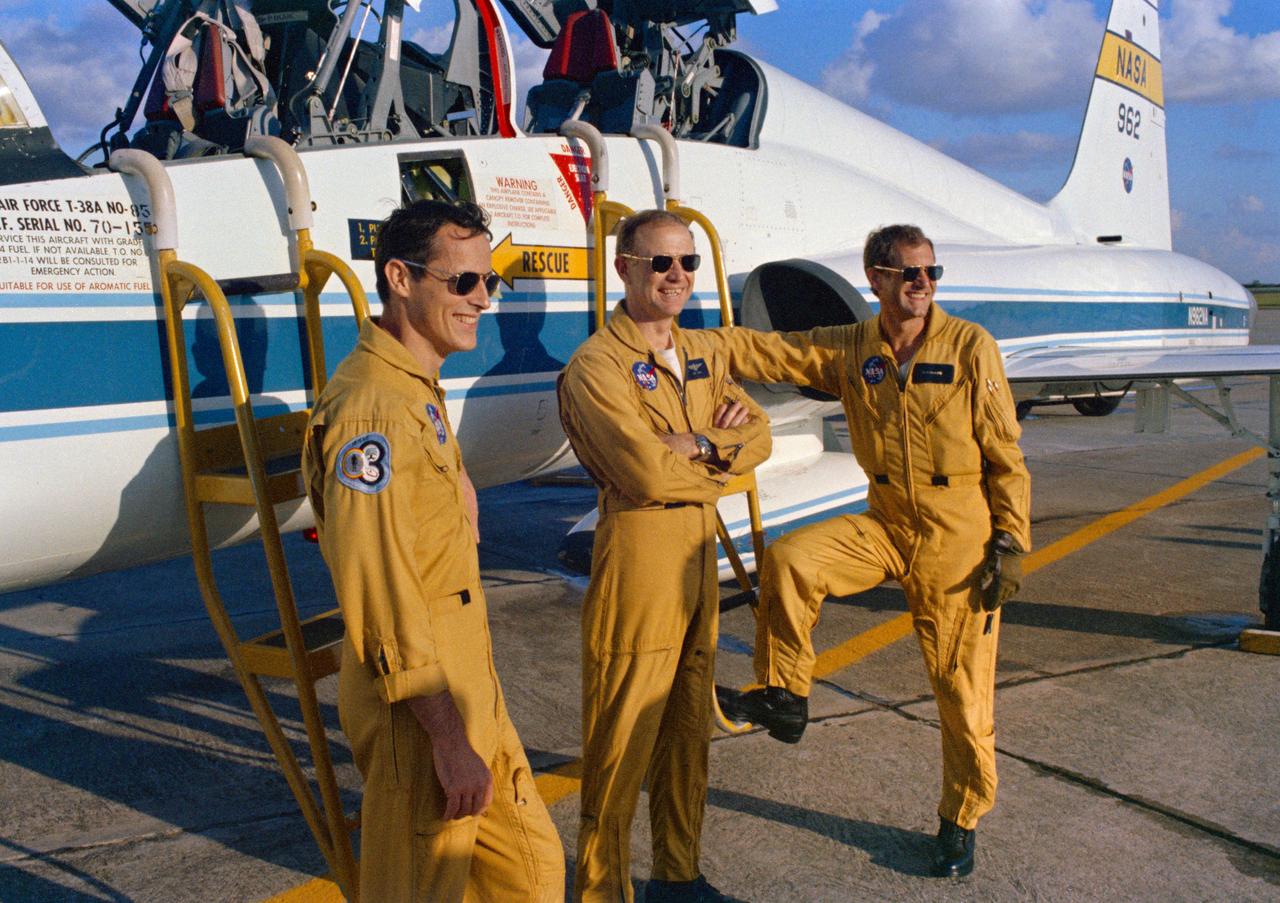
S73-36766 (November 1973) --- The prime crewmen of the third manned Skylab mission (Skylab 4) pause at a USAF T-38A jet at Ellington Air Force Base, Texas before flying to Kennedy Space Center (KSC) at Cape Canaveral, Florida. Skylab 4 crewmen are astronaut Gerald P. Carr, center, commander; scientist-astronaut Edward G. Gibson, science pilot, left; and astronaut William R. Pogue, pilot. Photo credit: NASA
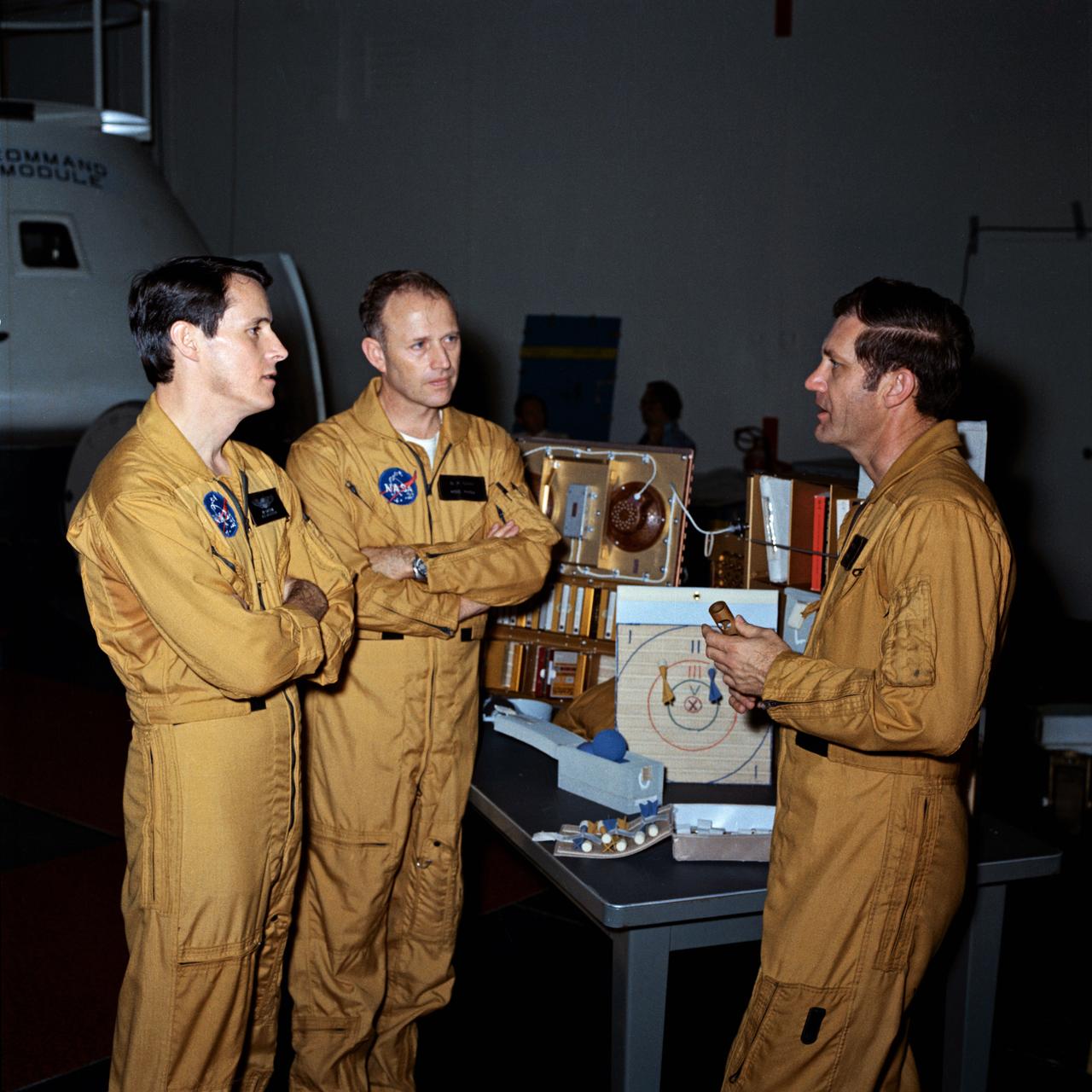
S72-17494 (19 Jan. 1972) --- These three men make up the crew of the Skylab 4 mission. They are, left to right, scientist-astronaut Edward G. Gibson, science pilot; astronaut Gerald P. Carr, commander; and astronaut William R. Pogue, pilot. They were photographed and interviewed during an "open house" press day in the realistic atmosphere of Skylab mock-up and trainers in the Mission Simulation and Training facility at the Manned Spacecraft Center. Photo credit: NASA
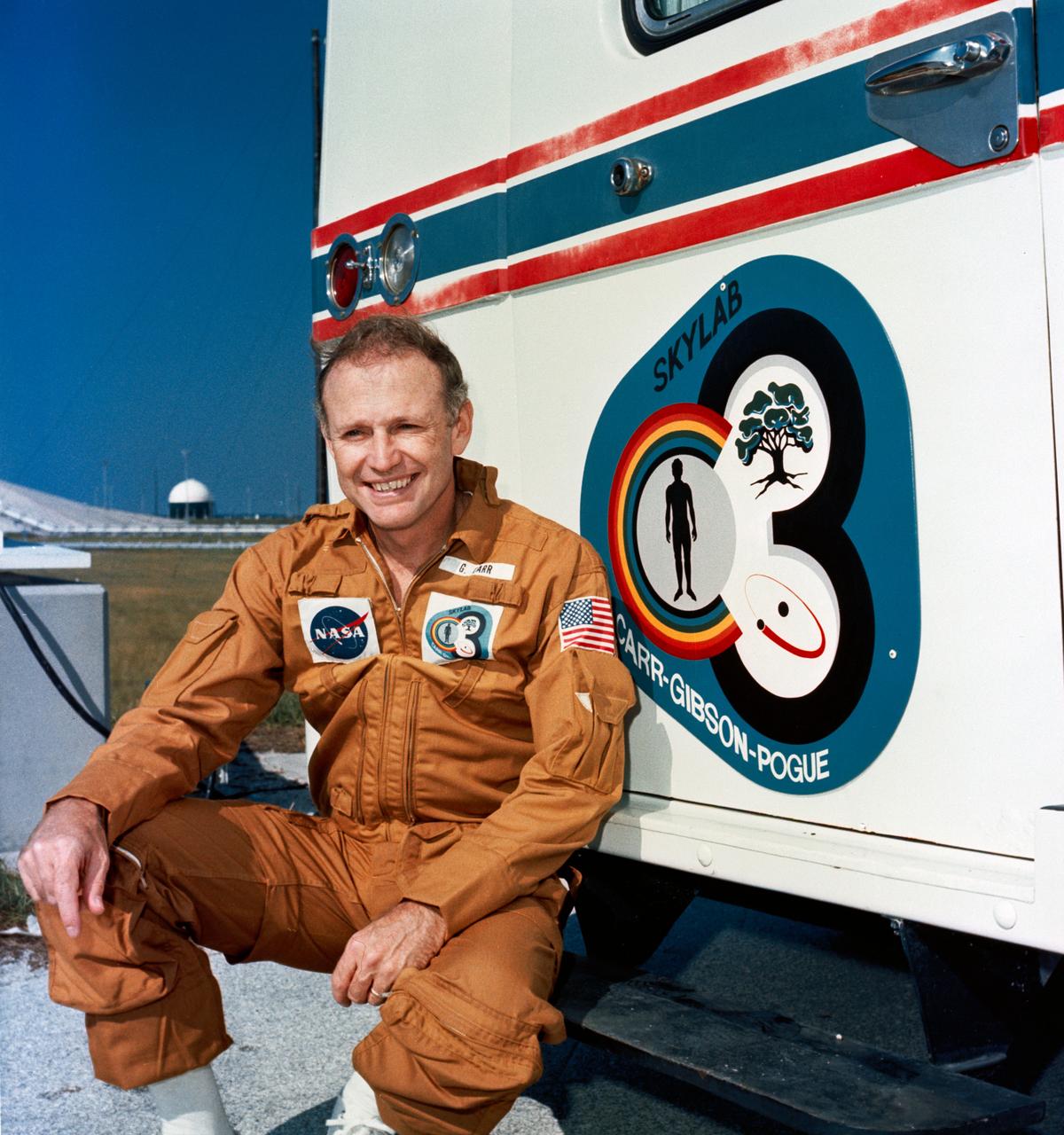
S73-36902 (8 Nov. 1973) --- Astronaut Gerald P. Carr, commander of the Skylab 4 mission, relaxes on the running board of the transfer van during a visit to the Skylab 4/Saturn 1B space vehicle at Pad B, Launch Complex 39, at the Kennedy Space Center, Florida. On the morning of the launch the transfer van will transport astronauts Carr; William R. Pogue, pilot; and Edward G. Gibson, science pilot, from the suiting building to Pad B. Skylab 4, the third and last visit to the Skylab space station in Earth orbit, will return additional information the Earth and sun, as well as provide a favorable location from which to observe the recently discovered Comet Kohoutek. Photo credit: NASA
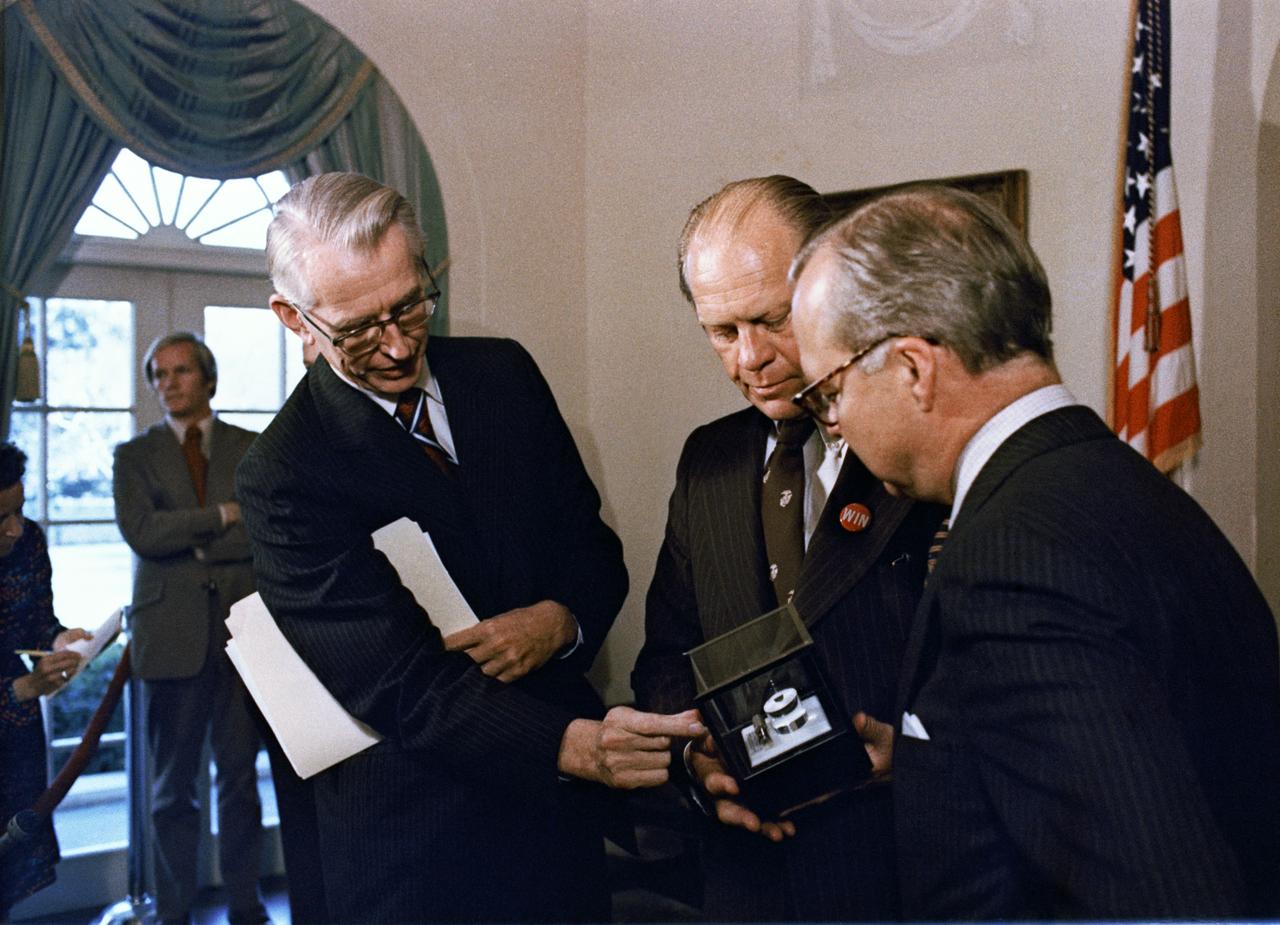
S74-34046 (October 1974) --- Dr. James C. Fletcher, left, NASA Administrator, explains the formation of the indium-antimonide crystal, manufactured in space, to President Gerald R. Ford at the White House. Standing at right is Harold Johnson, Chairman of the Massachusetts Institute of Technology. The segment of indium-antimonide is cut from a cylindrical single crystal that was partially melted and resolidified aboard the Skylab space station on Jan. 6, 1974, during the third and final manned flight. This segment is approximately one by one centimeters and about three millimeters thick. The sequence of heating and cooling was started and supervised by the members of the third Skylab crew, astronauts Gerald P. Carr, Edward G. Gibson and William R. Pogue. The crystal forming was accomplished in a special multipurpose furnace, known as the Materials Processing Facility (Skylab Technology Experiment M512). Photo credit: NASA
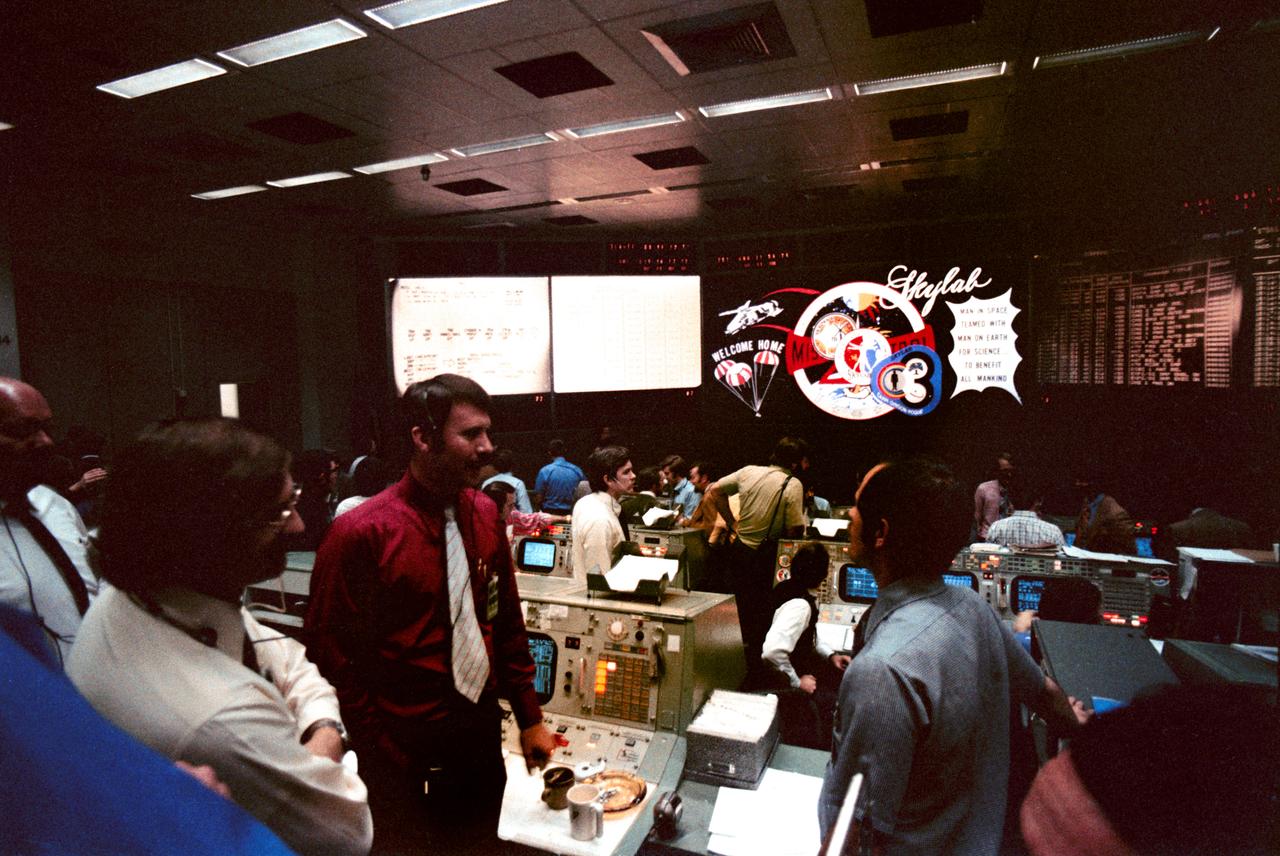
S74-19160 (8 Feb. 1974) --- An overall view of activity in the Mission Operations Control Room in the Mission Control Counter following the successful splashdown of the Skylab 4 command module in the Pacific Ocean. The three flight controllers in the foreground, left to right, are flight director Neil B. Hutchinson; flight director Donald R. Puddy; and astronaut Robert L. Crippen, a spacecraft communicator (CAPCOM). Astronauts Gerald P. Carr, Edward G. Gibson and William R. Pogue had just completed an 84-day mission with the Skylab space station in Earth orbit. Photo credit: NASA
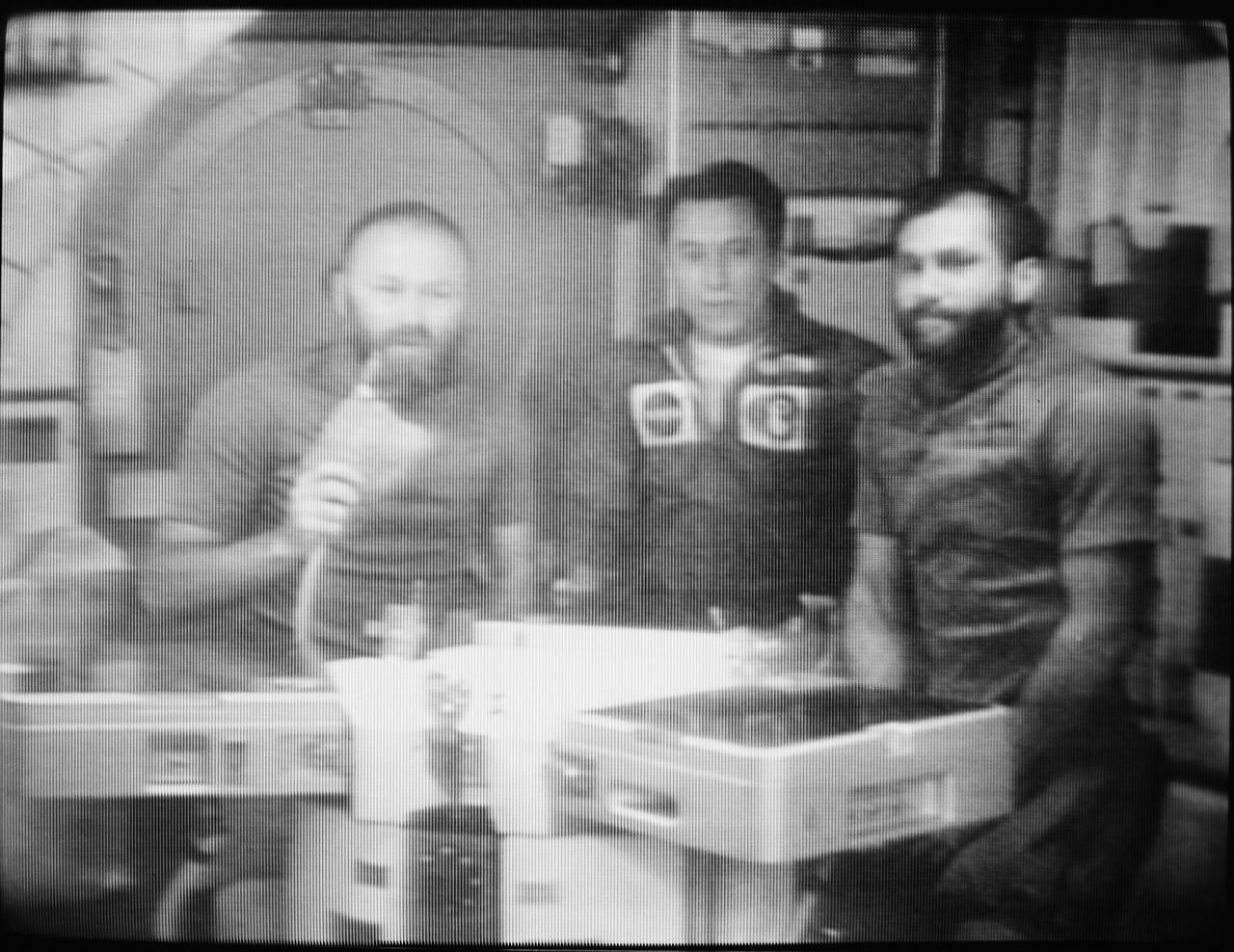
S73-38962 (28 Dec. 1973) --- The three members of the Skylab 4 crew confer via television communication with Dr. Lubos Kohoutek, discoverer of the Comet Kohoutek. This picture of the three astronauts was reproduced from a TV transmission made by a TV camera aboard the space station in Earth orbit. They are, left to right, Gerald P. Carr, commander; Edward G. Gibson, science pilot; and William R. Pogue, pilot. They are seated in the crew quarters wardroom of the Orbital Workshop. Professor Kohoutek, who is employed at the Hamburg Observatory in West Germany, was visiting the Johnson Space Center in Houston when he conferred with the Skylab 4 crewmen. Photo credit: NASA
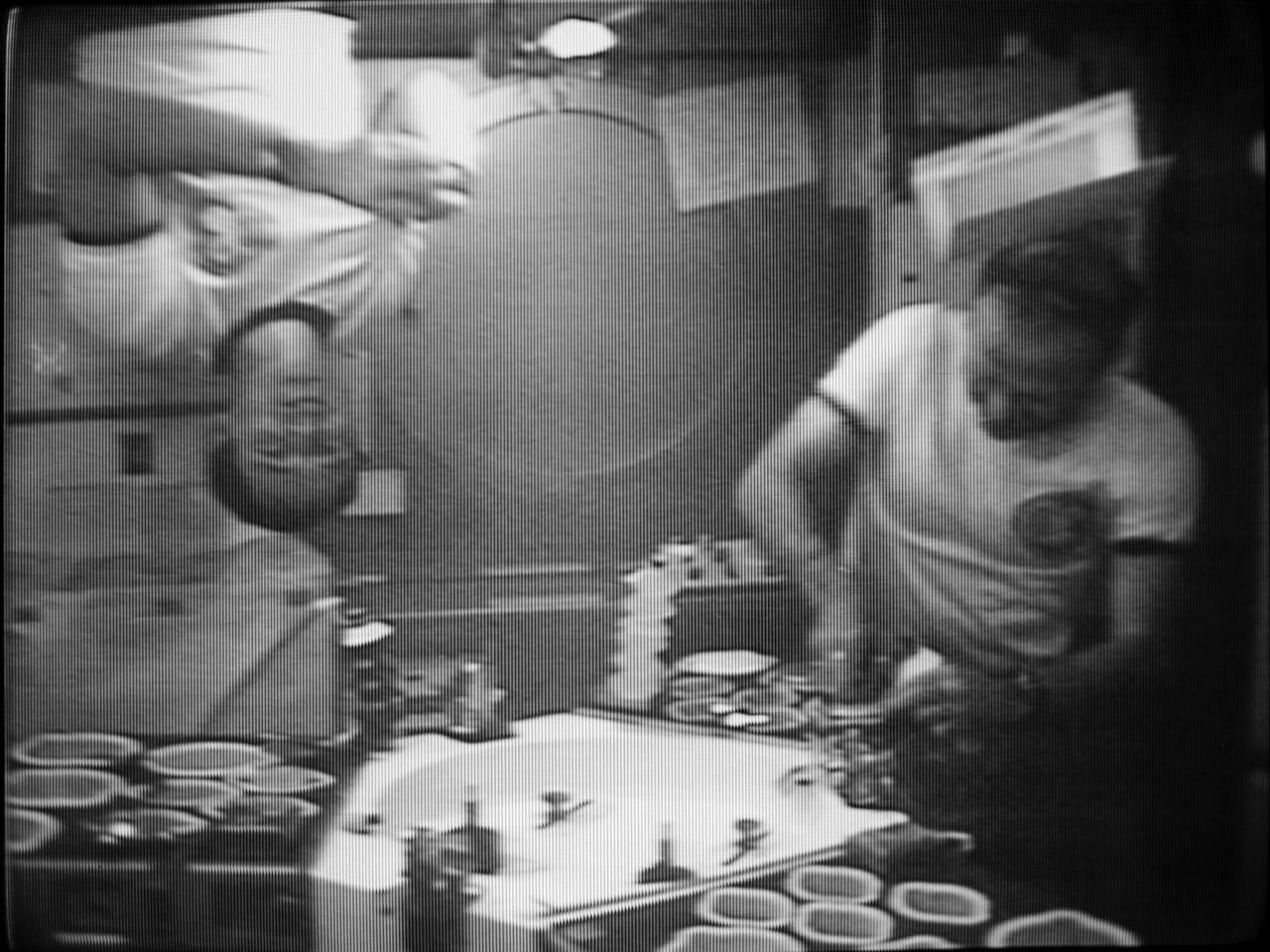
S73-37650 (28 Nov. 1973) --- Astronaut Gerald P. Carr, right, Skylab 4 commander, enjoys a meal aboard the orbiting Skylab space station in this photographic reproduction from a television of Nov. 28, 1973. Scientist-astronaut Edward G. Gibson, science pilot for the third manned Skylab flight, demonstrates the zero-gravity environment by turning upside. The two crewmen were joined by astronaut William R. Pogue, pilot, for the evening meal. The food station is in the wardroom of the Crew Quarters in the Orbital Workshop (OWS). Photo credit: NASA
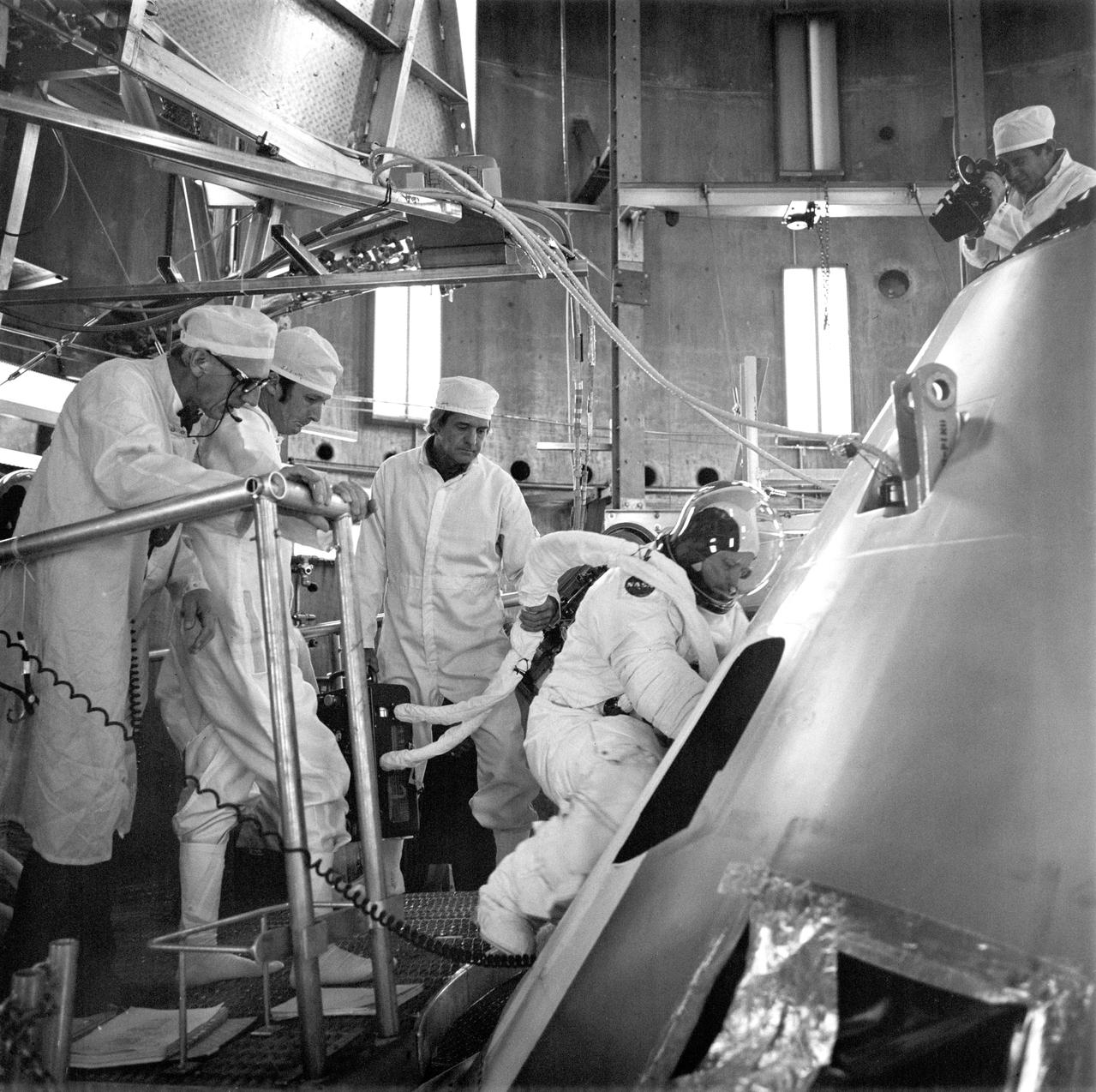
S73-34093 (6 Aug. 1973) --- Astronaut Gerald P. Carr, fully suited, Skylab 4 commander, prepares to enter spacecraft 118 (the Skylab 4 vehicle) at the start of a high altitude chamber test at the Kennedy Space Center (KSC). Also participating in the test were scientist-astronaut Edward G. Gibson, science pilot, and astronaut William R. Pogue, pilot. The Skylab 4 spacecraft is to be moved to the Vehicle Assembly Building (VAB) on Aug. 12, where it will be mated with the launch vehicle as a possible rescue craft for the Skylab 3 crewmen if needed. Photo credit: NASA

S73-32839 (10 Sept. 1973) --- Scientist-astronaut Edward G. Gibson, science pilot for the third manned Skylab mission (Skylab 4), enters a notation in a manual while seated at the control and display panel for the Apollo Telescope Mount (ATM) during simulations inside the one-G trainer for the Multiple Docking Adapter (MDA) at the Johnson Space Center (JSC). Dr. Gibson will be joined by astronauts Gerald P. Carr, commander, and William R. Pogue, pilot, when the Skylab 4 mission begins in November 1973. Photo credit: NASA
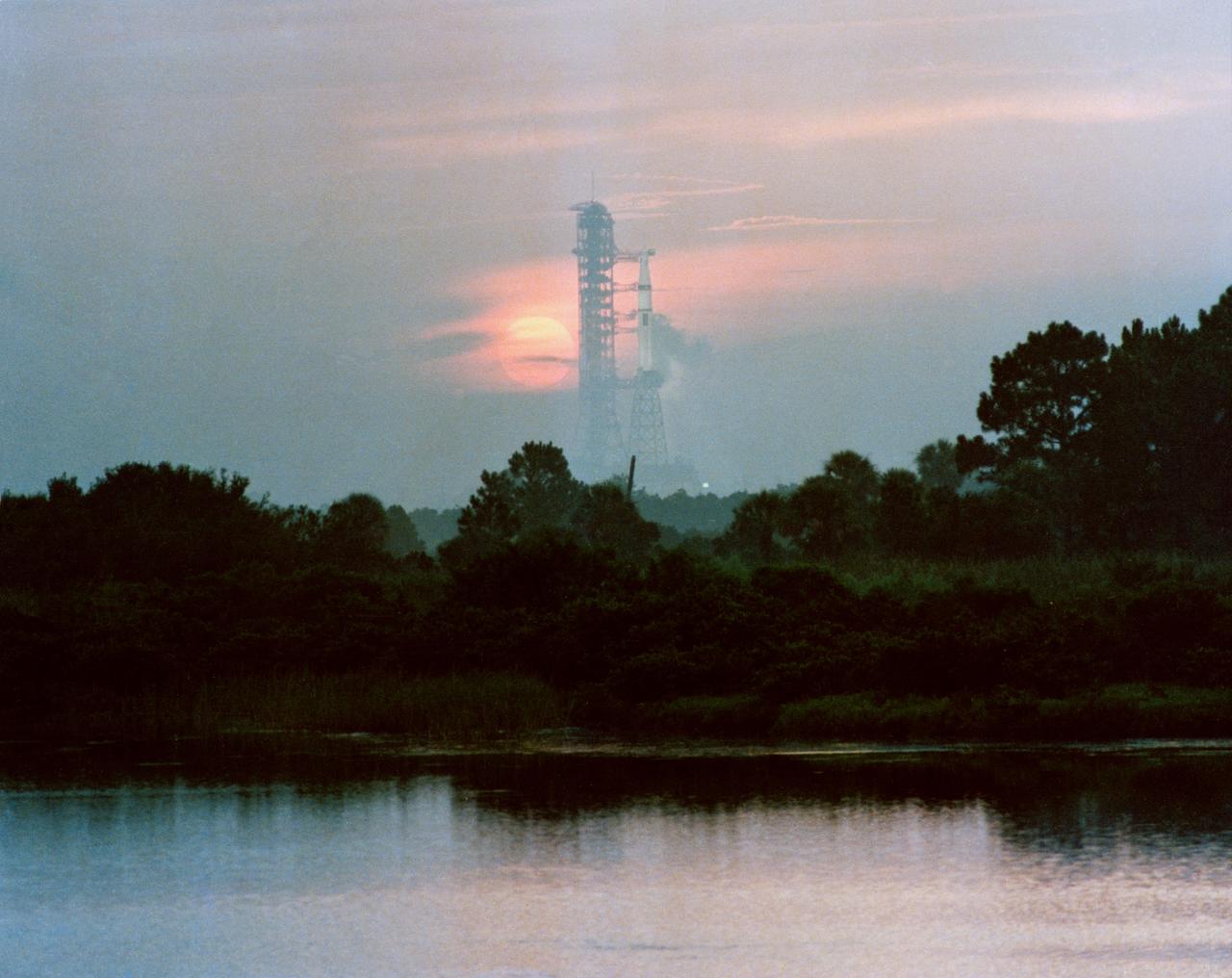
S73-37929 (16 Nov. 1973) --- A sunrise view at the Kennedy Space Center showing in the near distance the Skylab 4/Saturn 1B space vehicle on Pad B, Launch Complex 39, on the morning of the launch. The liftoff was at 9:01:23 a.m. (EST), Friday, Nov. 16, 1973. Skylab 4 is the third and last of three scheduled manned Skylab missions. Aboard the Skylab 4 Command/Service Module were astronauts Gerald P. Carr, Edward G. Gibson and William R. Pogue. This picture was photographed by astronaut Bruce McCandless II. Photo credit: NASA
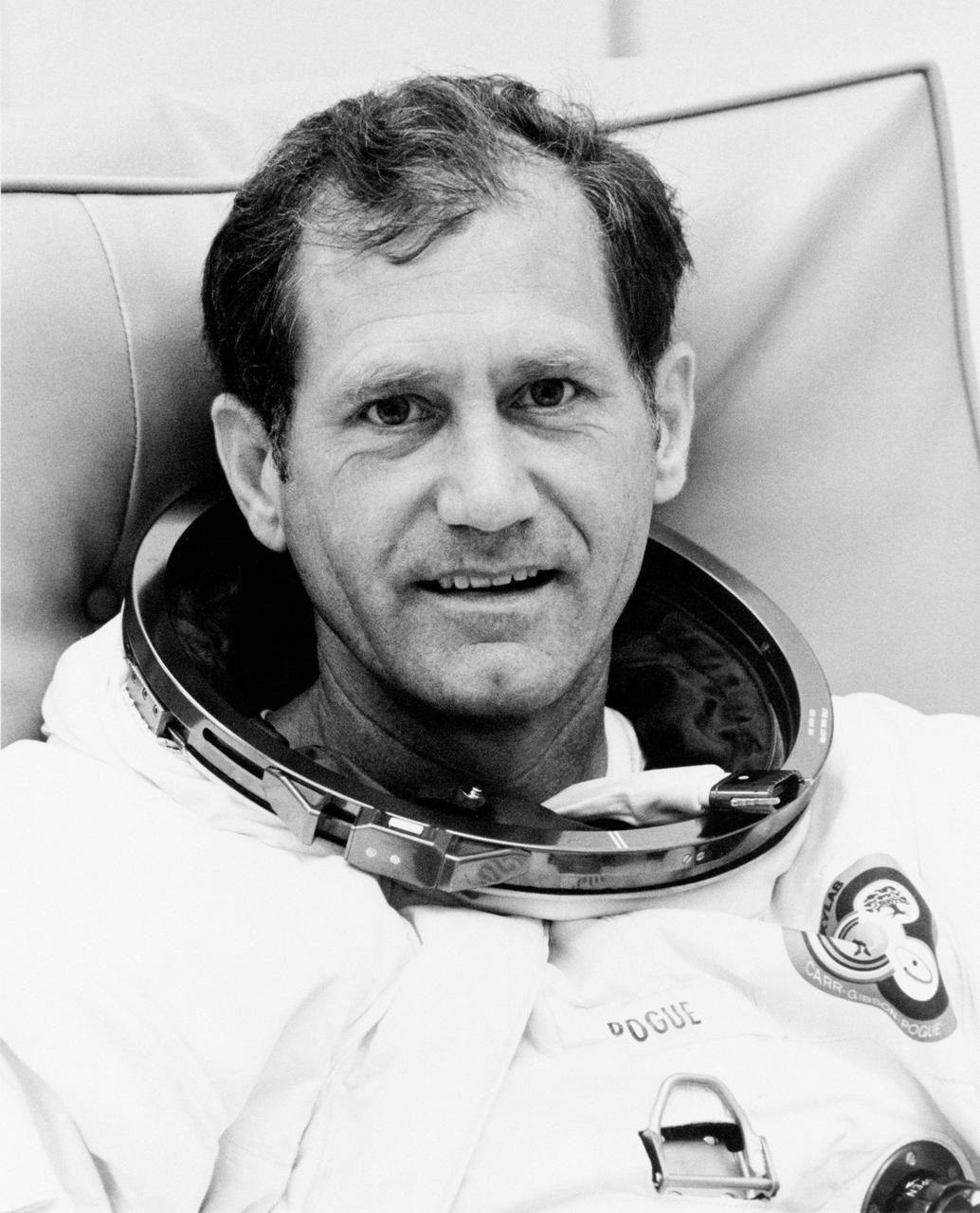
S73-36905 (8 Nov. 1973) --- Astronaut William R. Pogue, pilot of the Skylab 4 mission, relaxes during spacesuit pressure and fit checks at the Kennedy Space Center, Florida. This shoulder and head shot of Pogue was taken a few days before the scheduled Skylab 4 launch. This third and last visit to the Skylab space station in Earth orbit will return additional information on the Earth and sun, as well as provide favorable location from which to observe the recently discovered Comet Kohoutek. The other two members of the Skylab 4 crew will be astronaut Gerald P. Carr, commander; and scientist-astronaut Edward G. Gibson, science pilot. Photo credit: NASA
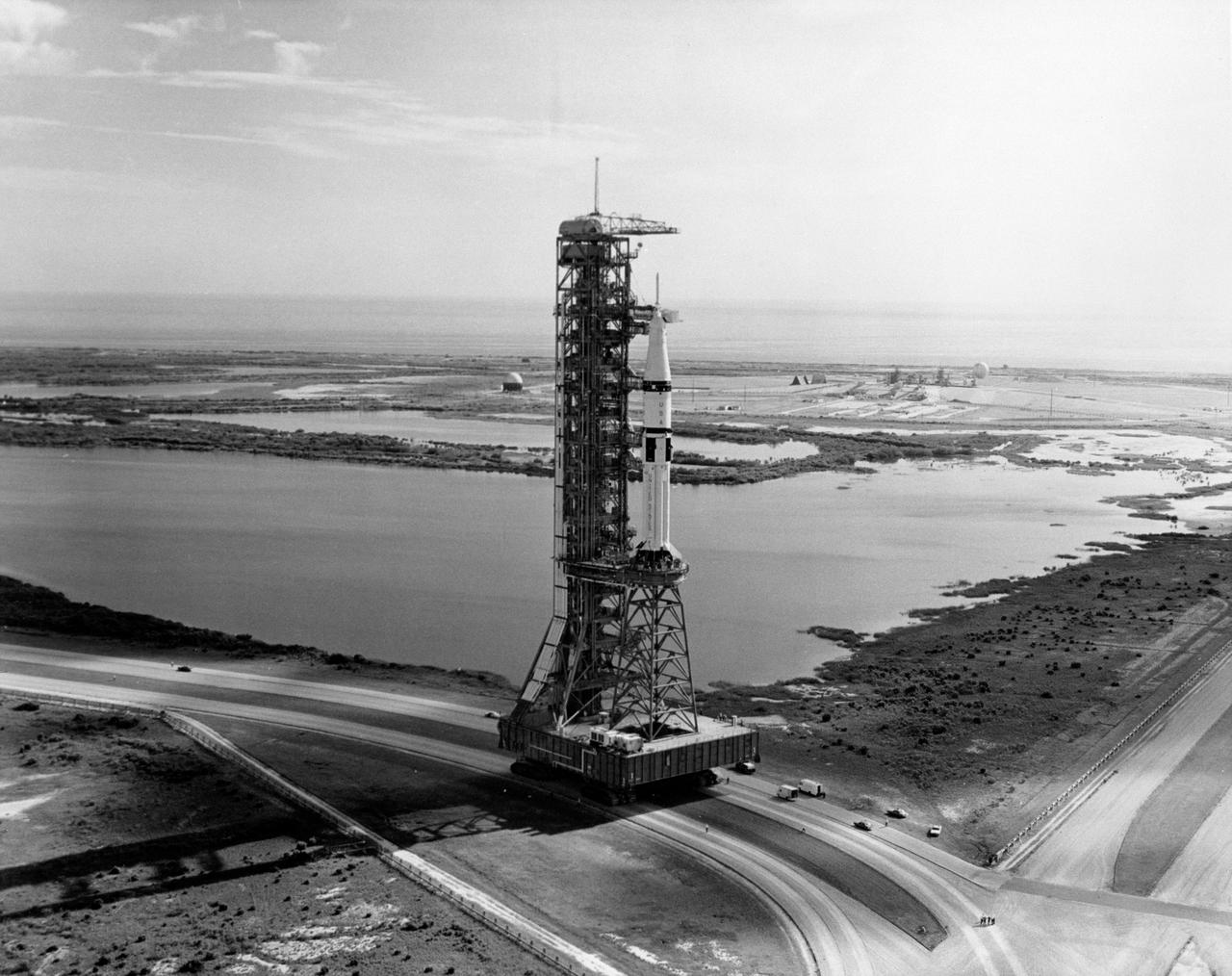
S73-34369 (14 Aug. 1973) --- A Saturn 1B launch vehicle is rolled to Launch Complex 39, Pad B. The space vehicle, to be launched by the Saturn 1B, will carry the third Skylab crew (Skylab 4) to the now-orbiting Orbital Workshop (OWS) and the other four components making up the cluster. The Skylab crewmen, astronaut Gerald P. Carr, commander; scientist-astronaut Edward G. Gibson, science pilot; and astronaut William R. Pogue, pilot, are scheduled to be launched from here in November 1973. Photo credit: NASA
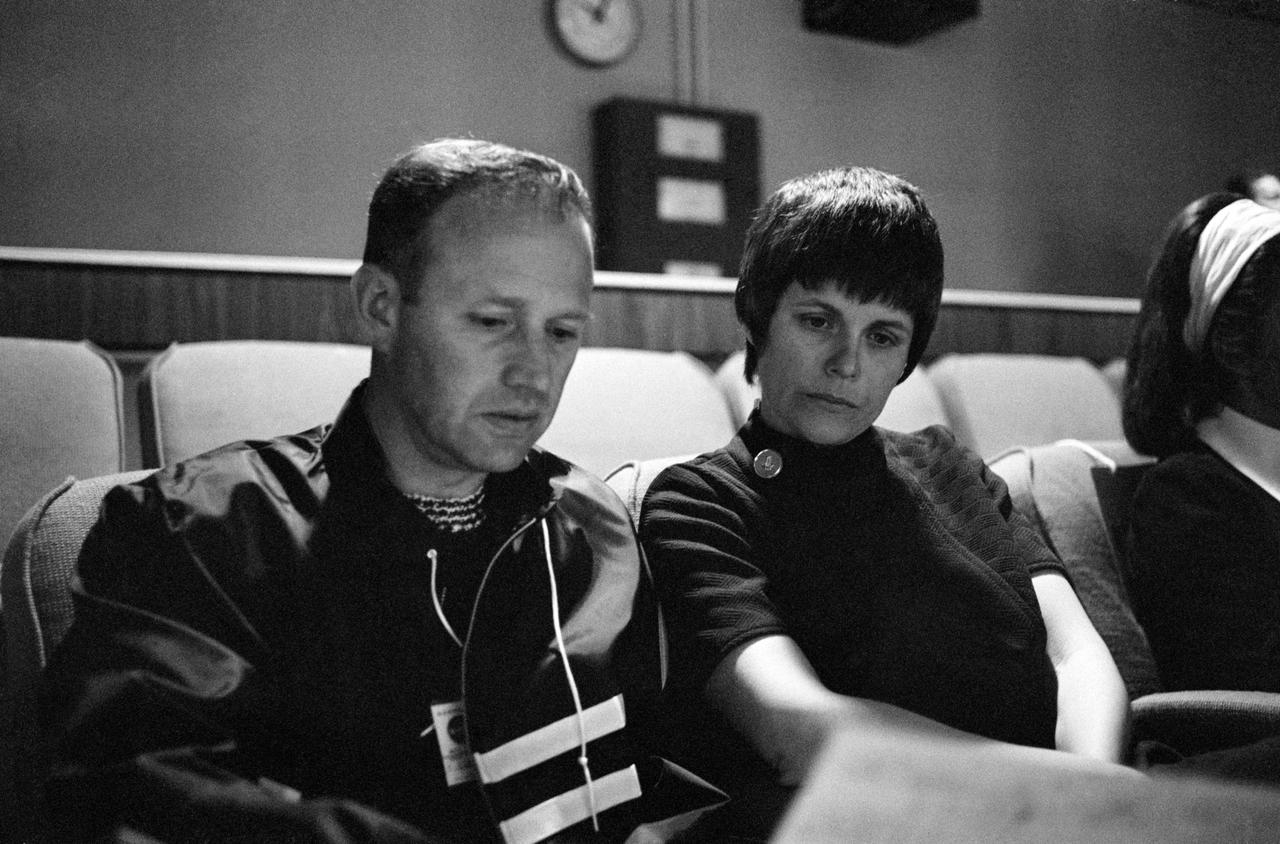
S70-34900 (14 April 1970) --- Mrs. Mary Haise receives an explanation of the revised flight plan of the Apollo 13 mission from astronaut Gerald P. Carr in the viewing room of the Mission Control Center (MCC), Building 30, at the Manned Spacecraft Center (MSC). Her husband, astronaut Fred W. Haise Jr., lunar module pilot for the Apollo 13 mission, was joining fellow crew members, astronauts James A. Lovell Jr., and John L. Swigert Jr. in making correction in their spacecraft following discovery of an oxygen cell failure several hours earlier.
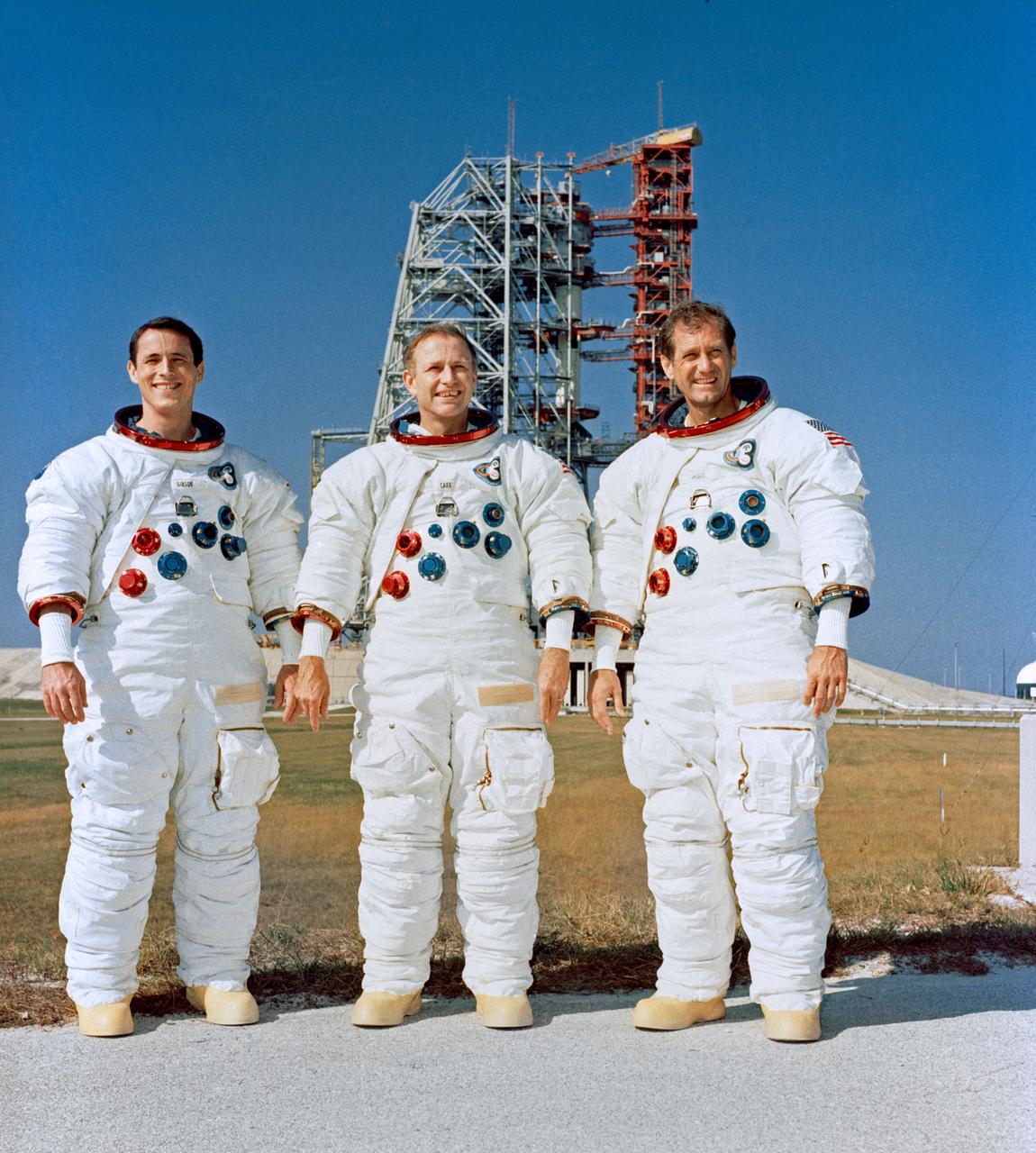
S73-37248 (8 Nov. 1973) --- The three members of the Skylab 4 crew are photographed standing near Pad B, Launch Complex 39, Kennedy Space Center, Florida, during preflight activity. They are, left to right, scientist-astronaut Edward G. Gibson, science pilot; astronaut Gerald P. Carr, commander; and astronaut William R. Pogue, pilot. The Skylab 4/Saturn 1B space vehicle is on the pad in the background. Skylab 4, the third and last manned visit to the Skylab space station in Earth orbit, will return additional information on the Earth and sun, as well as provide a favorable location from which to observe the recently discovered Comet Kohoutek. Photo credit: NASA

S73-32840 (10 Sept. 1973) --- Scientist-astronaut Edward G. Gibson, Skylab 4 science pilot, turns on a switch on the control box of the S190B camera, one of the components of the Earth Resources Experiments Package (EREP). The single lens Earth Terrain Camera takes five-inch photographs. Behind Gibson is the stowed suit of astronaut Gerald P. Carr, commander for the third manned mission. The crew's other member is astronaut William R. Pogue, pilot. The training exercise took place in the Orbital Workshop one-G trainer at Johnson Space Center. Photo credit: NASA
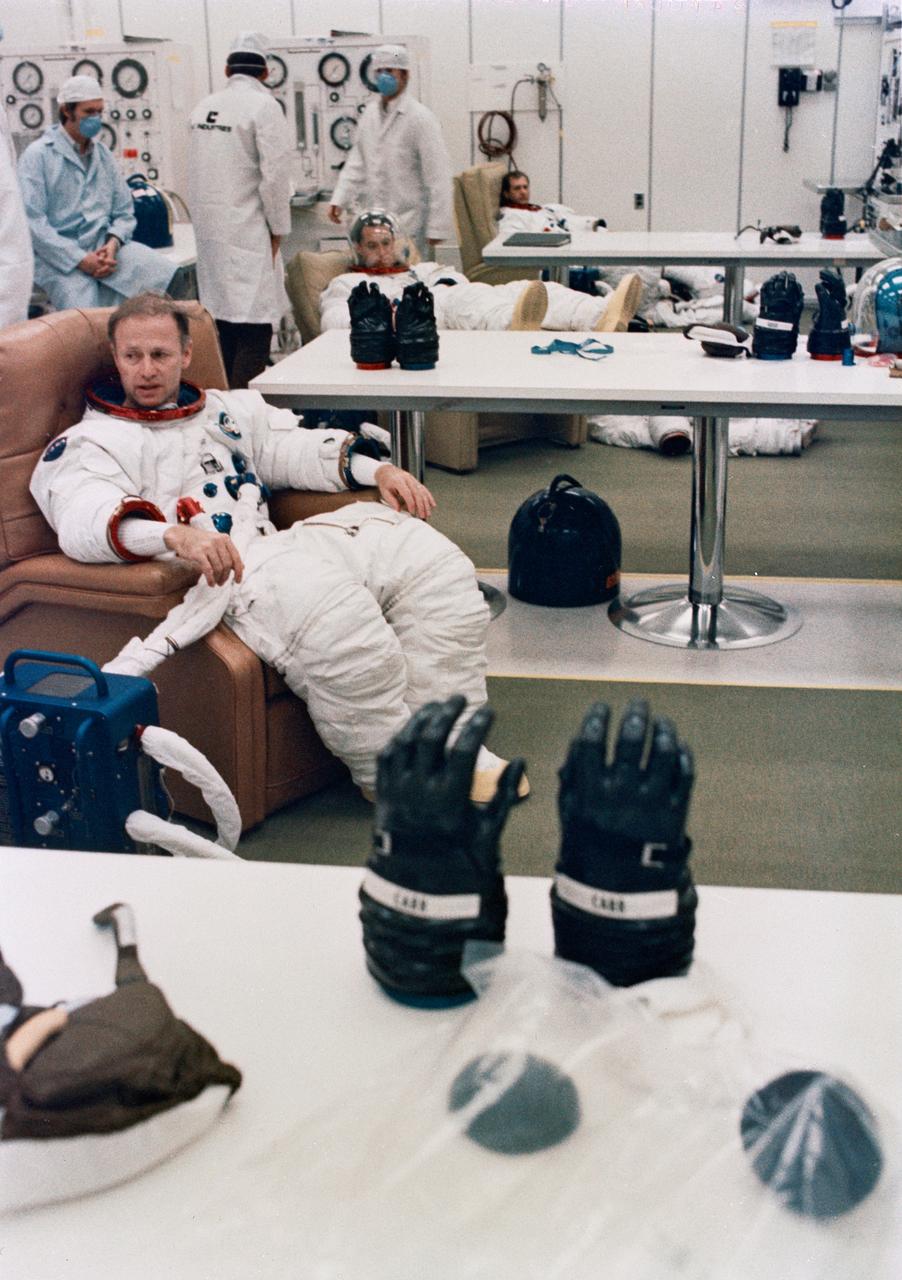
S73-36900 (8 Nov. 1973) --- The three members of the Skylab 4 crew undergo spacesuit fit and pressure checks in the suiting building during preflight activity at the Kennedy Space Center, Florida. They are astronaut Gerald P. Carr (foreground), commander; scientist-astronaut Edward G. Gibson (center), science pilot; and astronaut William R. Pogue (background), pilot. Skylab 4, the third and last visit to the Skylab space station in Earth orbit, will return additional information on the Earth and sun, as well as provide a favorable location from which to observe the recently discovered Comet Kohoutek. Photo credit: NASA
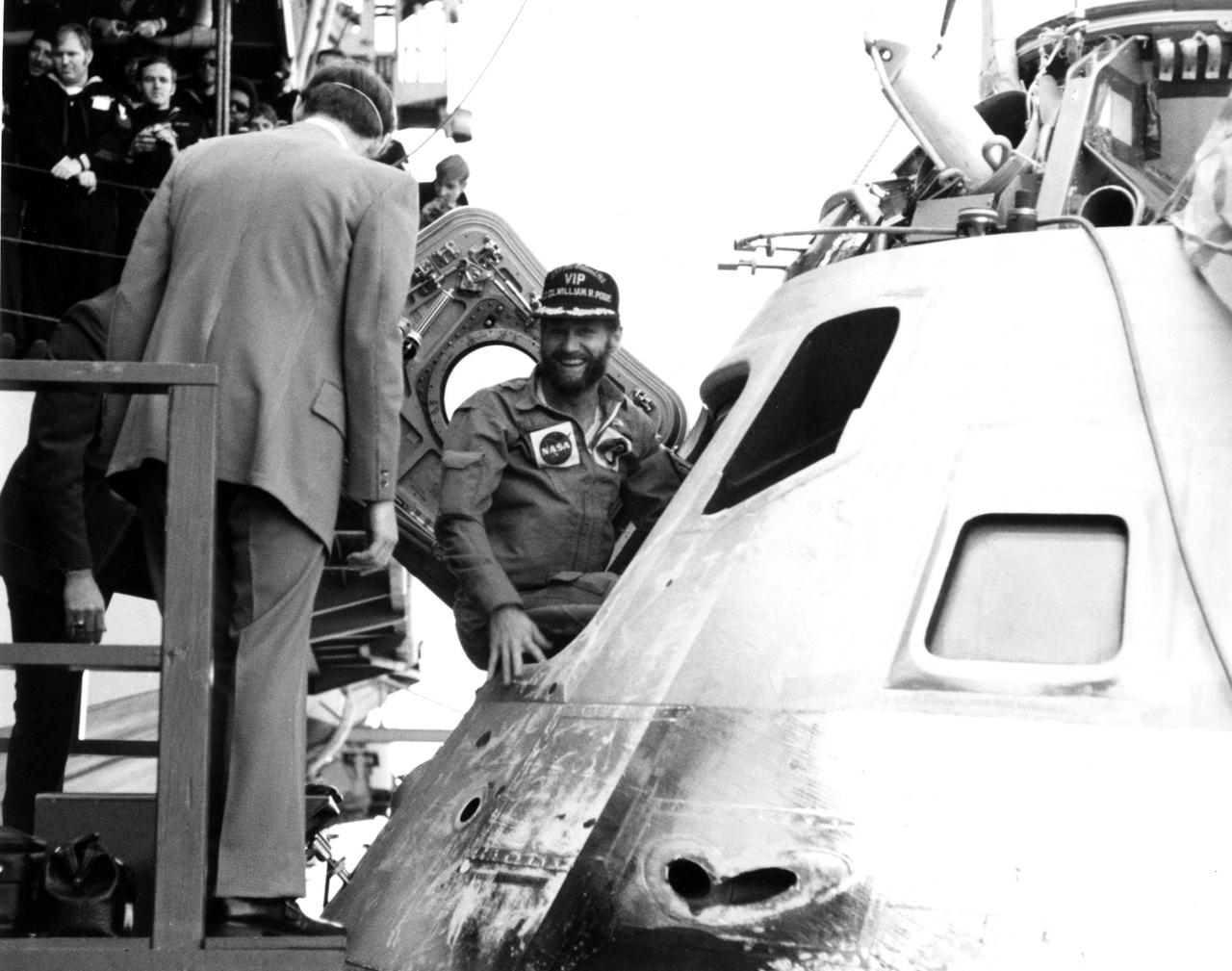
SKYLAB 4 PACIFIC RECOVERY AREA -- A smiling William R. Pogue pauses in hatchway of Skylab 4 command module during recovery activities today aboard the USS New Orleans at the completion of man's longest space journey to date. Pogue splashed down with astronauts Gerald P. Carr and Dr. Edward G. Gibson at 11:17 a.m. EDT Feb. 8, 1974, 84 days after the trio was launched by a Saturn IB rocket from Kennedy Space Center. Circling the globe 1, 214 times aboard the sophisticated Skklab space station during the nearly three-month flight, the astronauts demonstrated man's ability to live and work in space for extended periods.
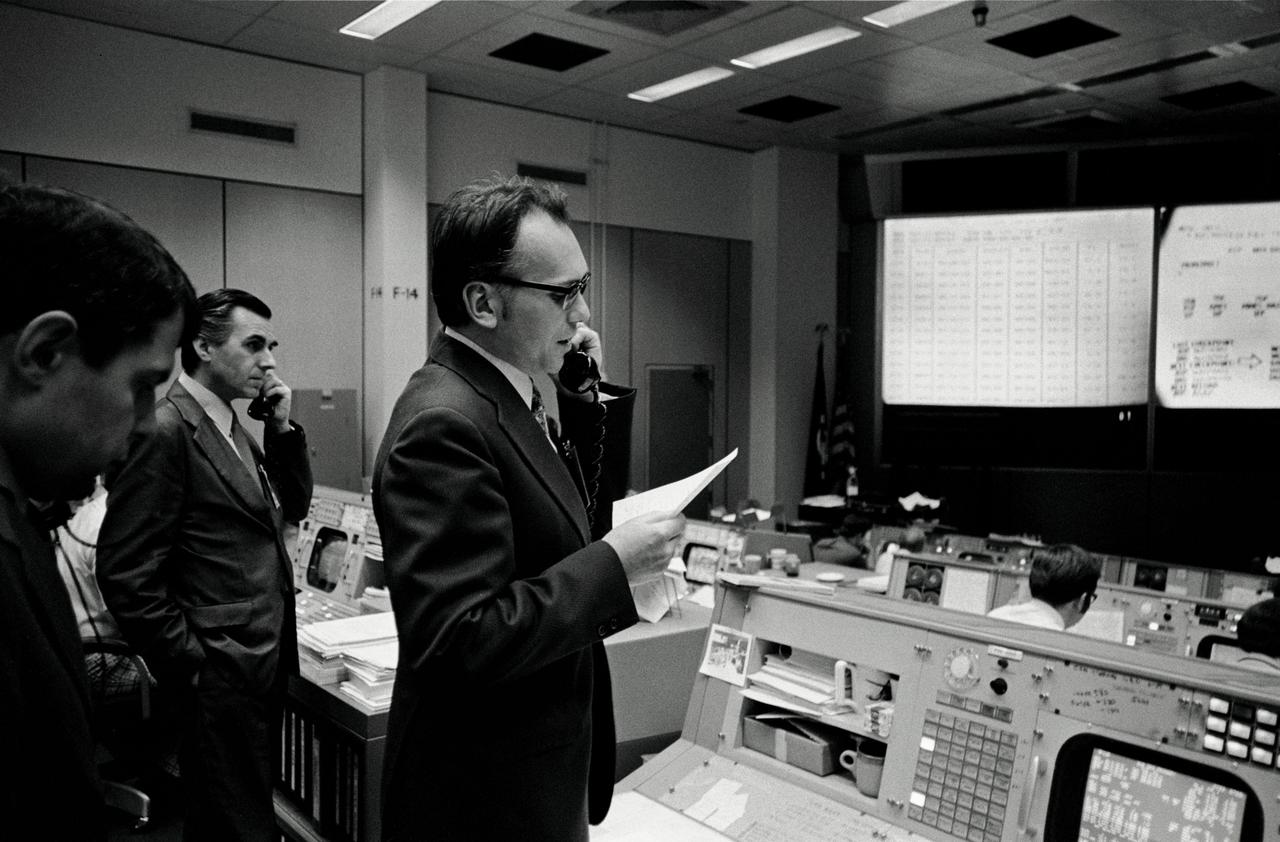
S74-15064 (28 Dec. 1973) --- Dr. Lubos Kohoutek, discoverer of the Comet Kohoutek, is seen in the Mission Operations Control Room in the Mission Control Center during a visit to the Johnson Space Center. He is talking over a radio-telephone with the Skylab 4 crewmen in the Skylab space station in Earth orbit. Professor Kohoutek, a well-known Czechoslovakian astronomer who works at the Hamburg Observatory in West Germany, discussed the comet with astronauts Gerald P. Carr, Edward G. Gibson and William R. Pogue. One of the major objectives of the Skylab 4 mission is to monitor the passing of the Comet Kohoutek. Dr. Zdenek Sekania, who accompanied Dr. Kohoutek on the visit to JSC, is on the telephone in the left background. Dr. Sekania is with the Smithsonian Observatory in Cambridge, Massachusetts. Photo credit: NASA
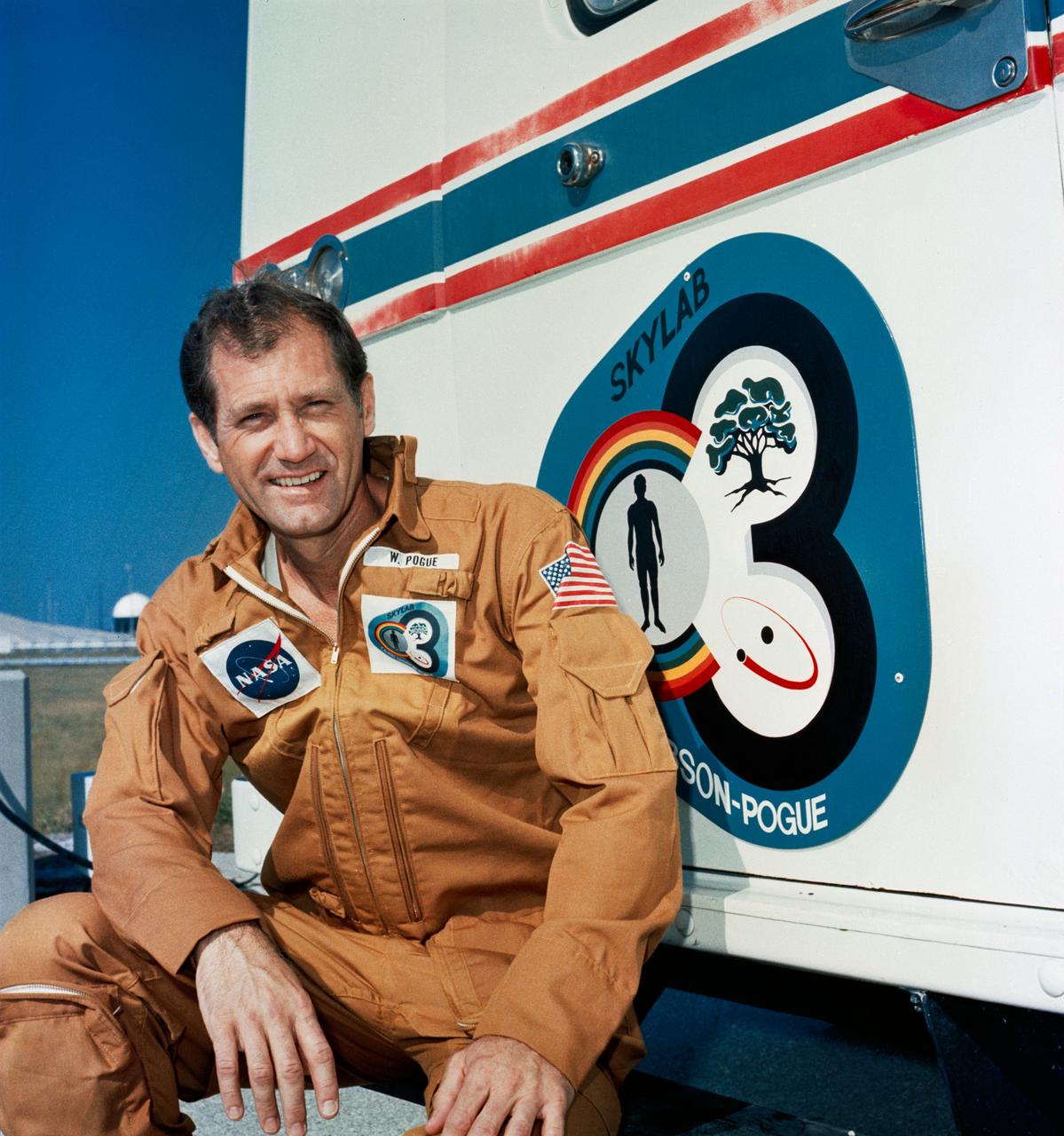
S73-36901 (8 Nov. 1973) --- Astronaut William R. Pogue, pilot of the Skylab 4 mission, relaxes on the running board of the transfer van during a visit to the Skylab 4/Saturn 1B space vehicle at Pad B, Launch Complex 39, Kennedy Space Center, Florida. On the morning of the launch the transfer van will transport astronauts Pogue, Gerald P. Carr, commander; and Edward G. Gibson, science pilot, from the suiting building to Pad B. Skylab 4, the third and last visit to the Skylab space station in Earth orbit, will return additional information on the Earth and sun, as well as provide a favorable location from which to observe the recently discovered Comet Kohoutek. Photo credit: NASA
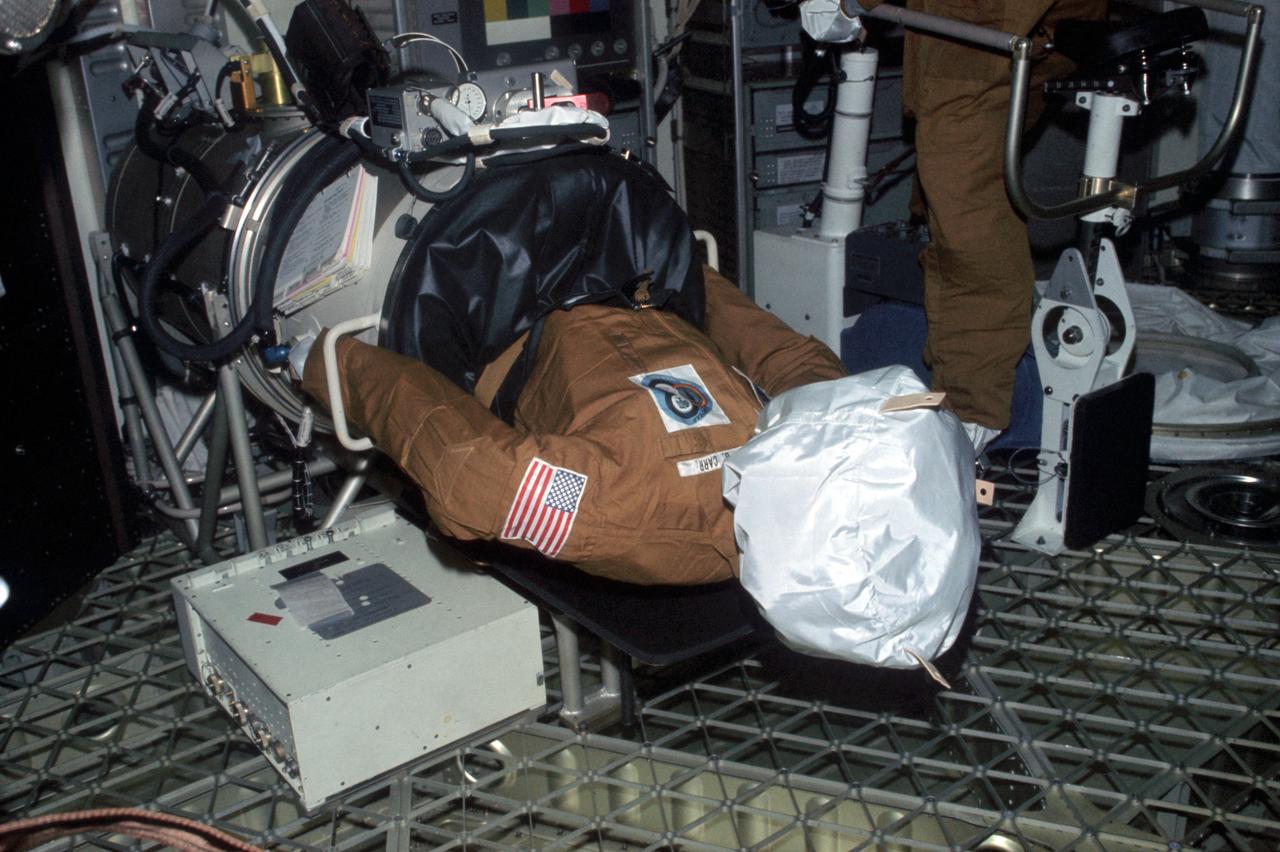
SL3-113-1586 (July-September 1973) --- This photograph is an illustration of the humorous side of the Skylab 3 crew. This dummy was left behind in the Skylab space station by the Skylab 3 crew to be found by the Skylab 4 crew. The dummy is dressed in a flight suit and placed in the Lower Body Negative Pressure Device. The name tag indicates that it represents Gerald P. Carr, Skylab 4 commander, in the background is a partial view of the dummy for William R. Pogue, Skylab 4 pilot, propped upon the bicycle ergometer. The dummy representing Edward G. Gibson, Skylab science pilot, was left in the waste compartment. Astronauts Alan L. Bean, Owen K. Garriott and Jack R. Lousma were the Skylab 3 crewmen. Photo credit: NASA
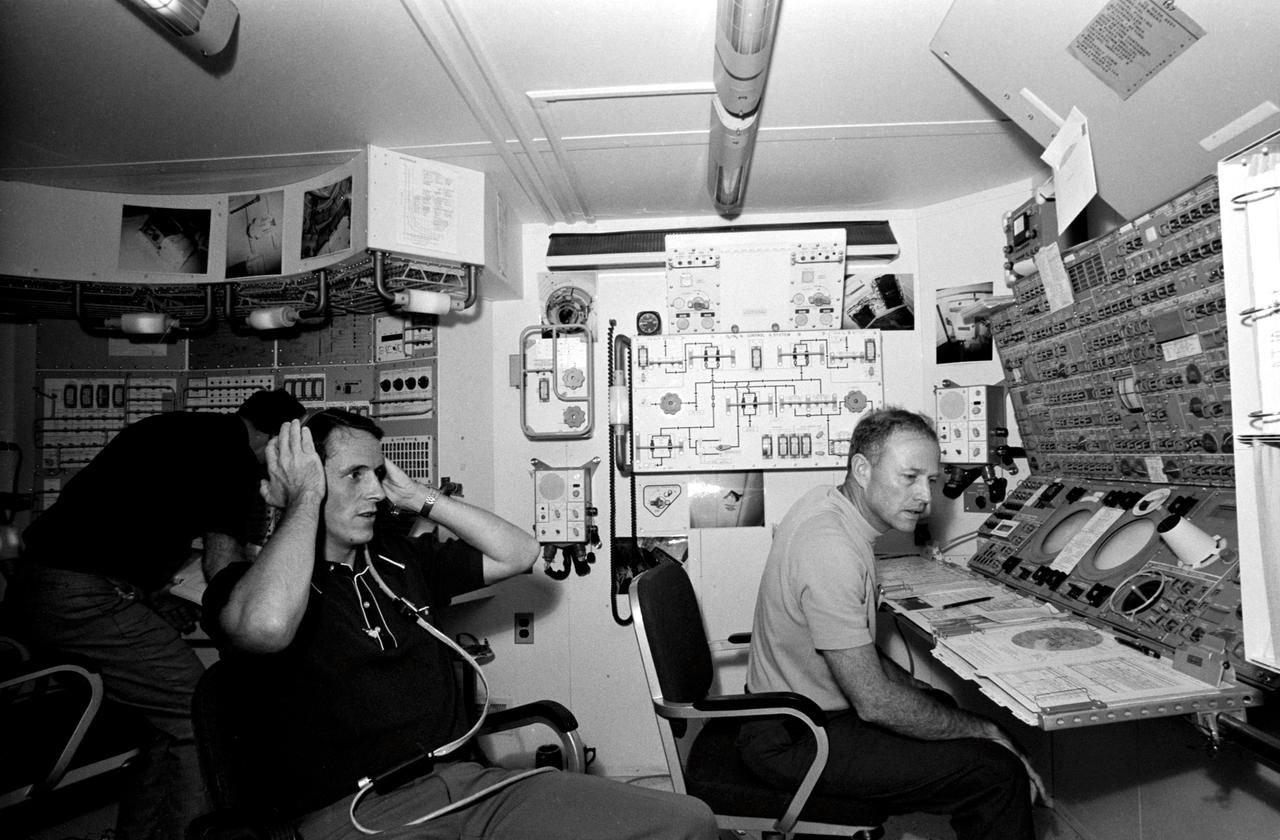
S73-28411 (February 1973) --- The three members of the prime crew of the third of three scheduled manned Skylab missions (Skylab 4) go through Skylab preflight training in the Mission Training and Simulation Facility at the Johnson Space Center. Astronaut Gerald P. Carr (on right), Skylab 4 commander, is seated at a simulator which represents the control and display console of the Apollo Telescope Mount which is located in the space station's Multiple Docking Adapter. Seated on the left is scientist-astronaut Edward G. Gibson, Skylab 4 science pilot. In the left background is astronaut William R. Pogue, Skylab 4 pilot. (Unmanned Skylab 1 will carry the Skylab space station payload into Earth orbit). Photo credit: NASA
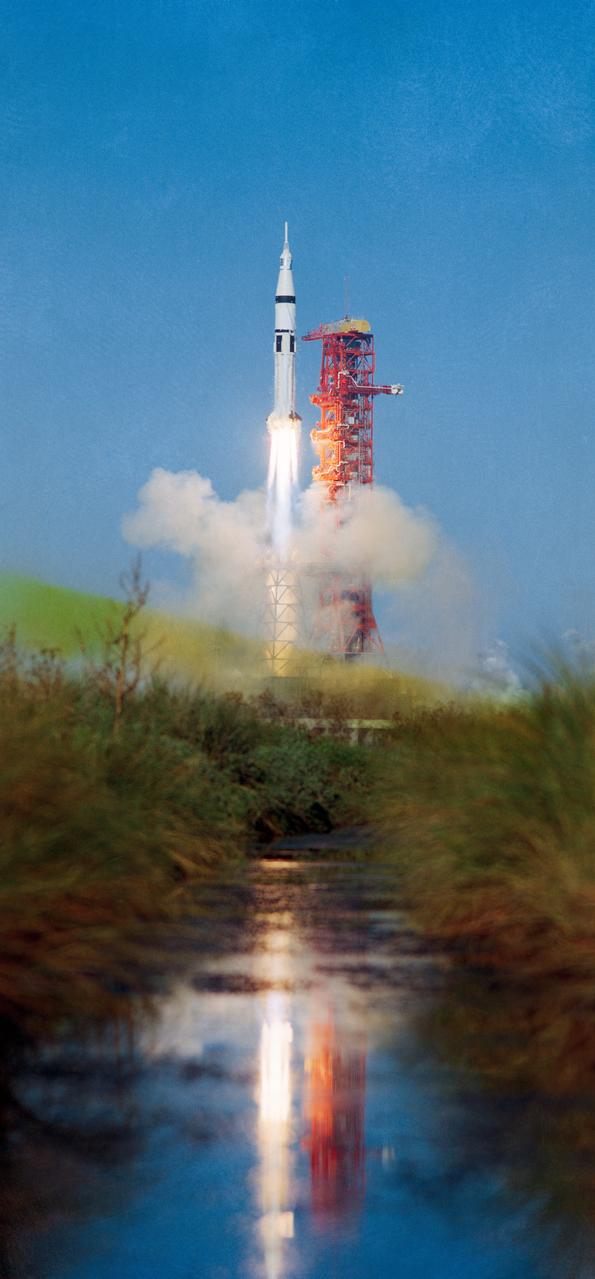
S73-37285 (16 Nov. 1973) --- The Skylab 4/Saturn 1B space vehicle is launched from Pad B, Launch Complex 39, Kennedy Space Center, Florida, at 9:01:23 a.m. (EST), Friday, Nov. 16, 1973. Skylab 4 is the third and last of three scheduled manned Skylab missions. Aboard the Skylab 4 Command/Service Module were astronauts Gerald P. Carr, Edward G. Gibson and William R. Pogue. In addition to the CSM and its launch escape system, the Skylab 4 space vehicle consisted of the Saturn 1B first (S-1B) stage and the Saturn 1B second (S-IVB) stage. (The Skylab 1/Saturn V unmanned space vehicle with the space station payload was launched from Pad A on May 14, 1973). Photo credit: NASA
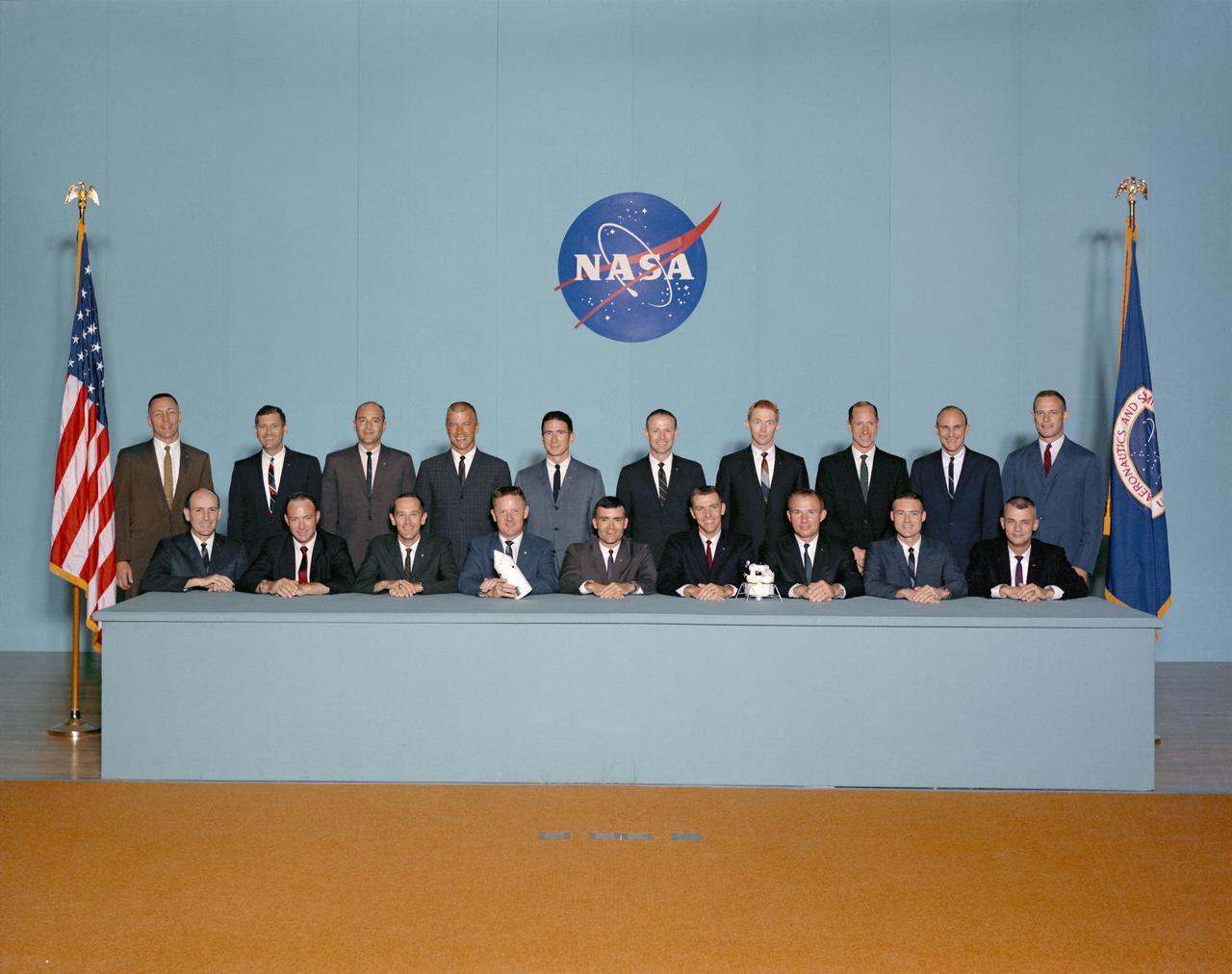
S67-30404 (May 1967) --- Portrait of astronaut group selected April 4, 1966. Seated, left to right, are Edward G. Givens Jr., Edgar D. Mitchell, Charles M. Duke Jr., Don L. Lind, Fred W. Haise Jr., Joe H. Engle, Vance D. Brand, John S. Bull and Bruce McCandless II. Standing, left to right, are John L. Swigert Jr., William R. Pogue, Ronald E. Evans, Paul J. Weitz, James B. Irwin, Gerald P. Carr, Stuart A. Roosa, Alfred M. Worden, Thomas K. Mattingly and Jack R. Lousma. Photo credit: NASA or National Aeronautics and Space Administration

SL3-113-1587 (July-September 1973) --- This photograph is an illustration of the humorous side of the Skylab 3 crew. This dummy was left behind in the Skylab space station by the Skylab 3 crew to be found by the Skylab 4 crew. The dummy is dressed in a flight suit and propped upon the bicycle ergometer. The name tag indicated that it represents William R. Pogue, Skylab pilot. The dummy for Gerald P. Carr, Skylab 4 commander, was placed in the Lower Body Negative Pressure Device. The dummy representing Edward G. Gibson was left in the waste compartment. Astronauts Alan L. Bean, Owen K. Garriott and Jack R. Lousma were the Skylab 3 crewmen. Gibson is the Skylab 4 science pilot. Photo credit: NASA

S74-17306 (5 Dec. 1973) --- Scientist-astronaut Edward G. Gibson, Skylab 4 science pilot, stands at the Apollo Telescope Mount (ATM) console in the Multiple Docking Adapter (MDA) of the Skylab space station cluster in Earth orbit. This picture was taken with a hand-held 35mm Nikon camera. The ATM console was one of the busiest areas of the space station during the 84-day third manned Skylab mission, as Comet Kohoutek and solar activity were closely followed by the ATM and monitored by the crewmen from the ATM console. As Gibson demonstrated during a television transmission on Dec. 5, 1973, the ATM console controls several instruments on the solar telescope. Joining Gibson for the record-setting Skylab 4 mission were astronauts Gerald P. Carr, commander, and William R. Pogue, pilot. Photo credit: NASA
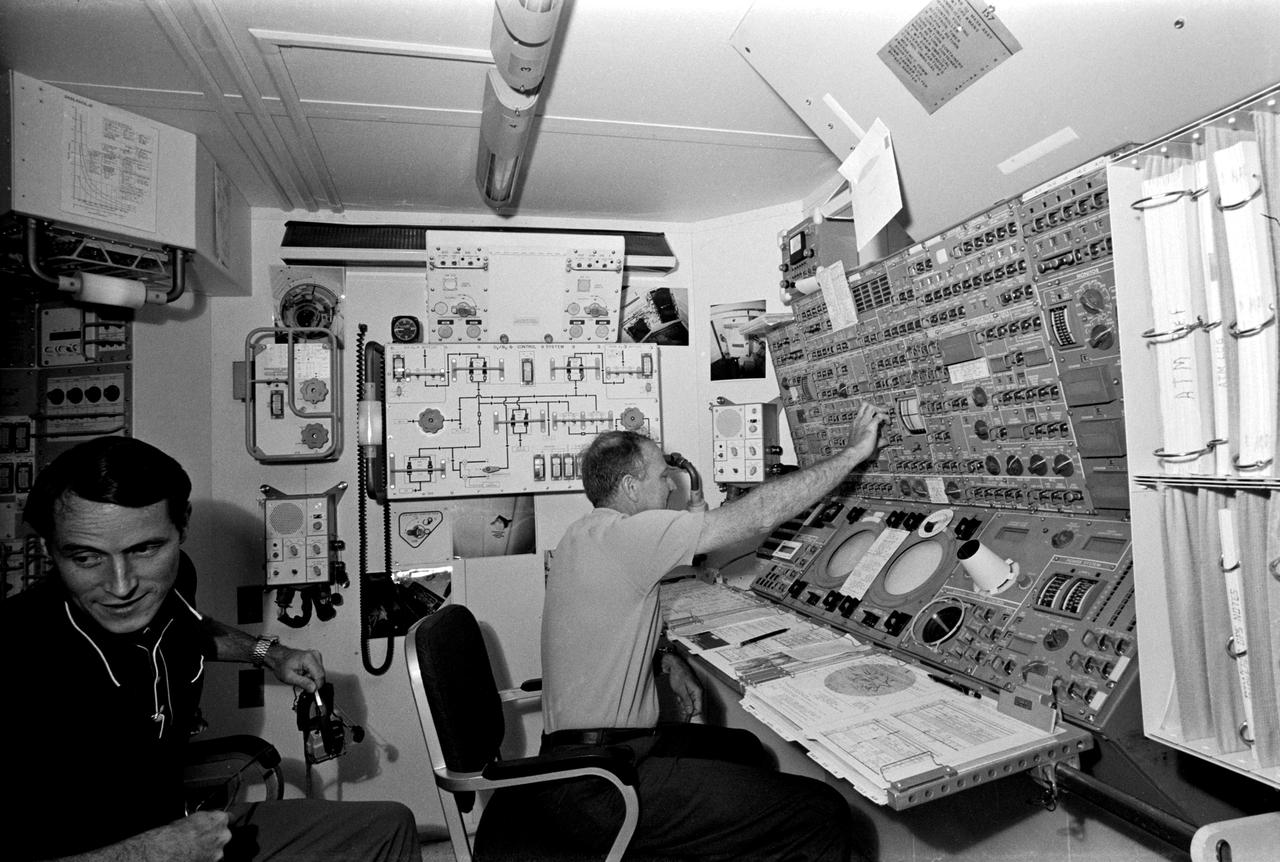
S73-28412 (February 1973) --- The three members of the prime crew of the third of three scheduled manned Skylab missions (Skylab 4) go through Skylab preflight training in the Mission Training and Simulation Facility at the Johnson Space Center. Astronaut Gerald P. Carr (on right), Skylab 4 commander, is seated at a simulator which represents the control and display console of the Apollo Telescope Mount which is located in the space station's Multiple Docking Adapter. Seated on the left is scientist-astronaut Edward G. Gibson, Skylab 4 science pilot. In the left background is astronaut William R. Pogue, Skylab 4 pilot. (Unmanned Skylab 1 will carry the Skylab space station payload into Earth orbit). Photo credit: NASA
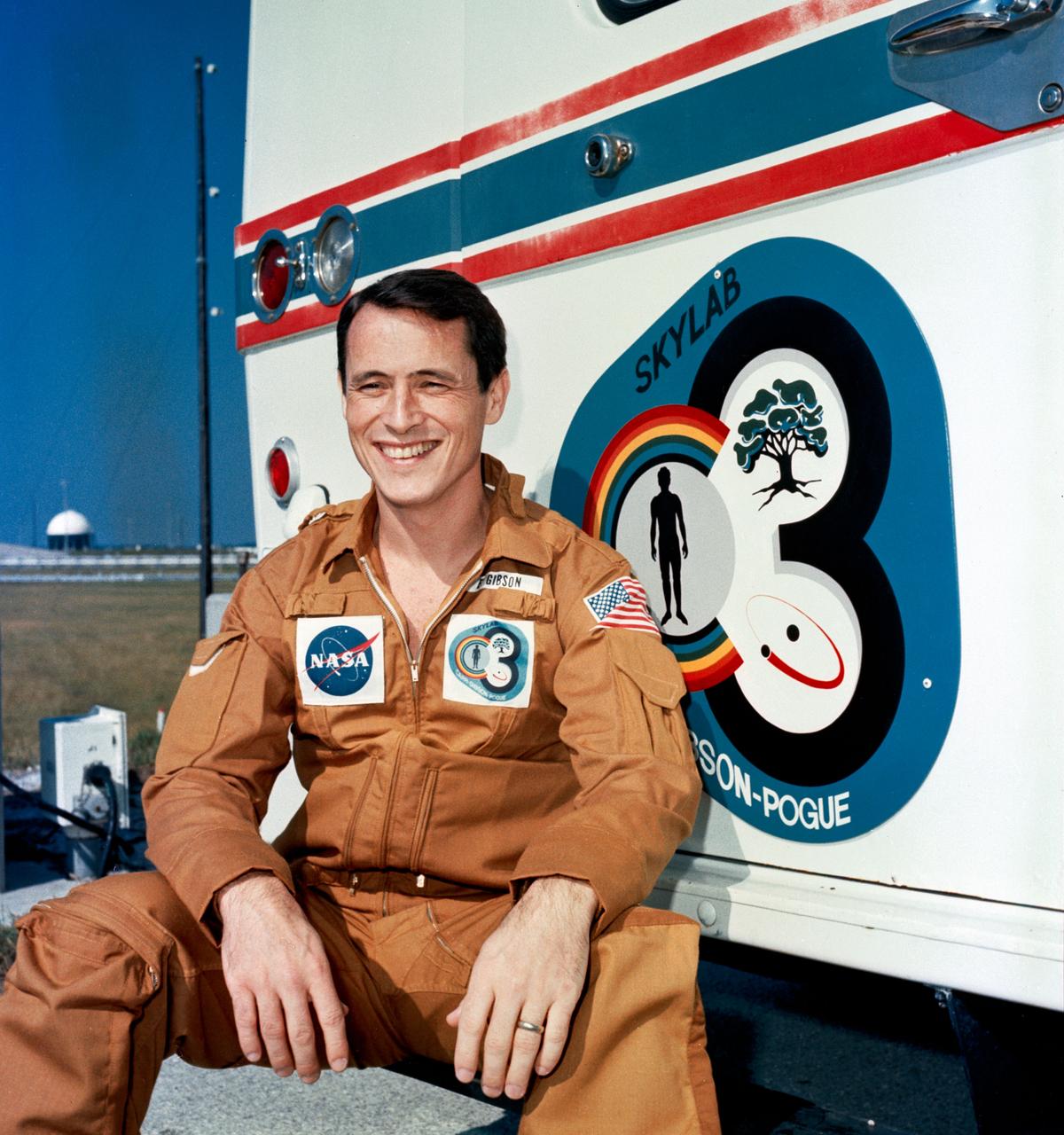
S73-36903 (8 Nov. 1973) --- Scientist-astronaut Edward G. Gibson, Skylab 4 science pilot, relaxes on the running board of the transfer van during a visit to the Skylab 4/Saturn 1B space vehicle at Pad B, Launch Complex 39, Kennedy Space Center, Florida. On the morning of the launch the transfer van will transport astronauts Gibson; Gerald P. Carr, commander; and William R. Pogue, pilot, from the suiting building to Pad B. Skylab 4, the third and last visit to the Skylab space station in Earth orbit, will return additional information on the Earth and sun, as well as provide a favorable location from which to observe the recently discovered Comet Kohoutek. Photo credit: NASA
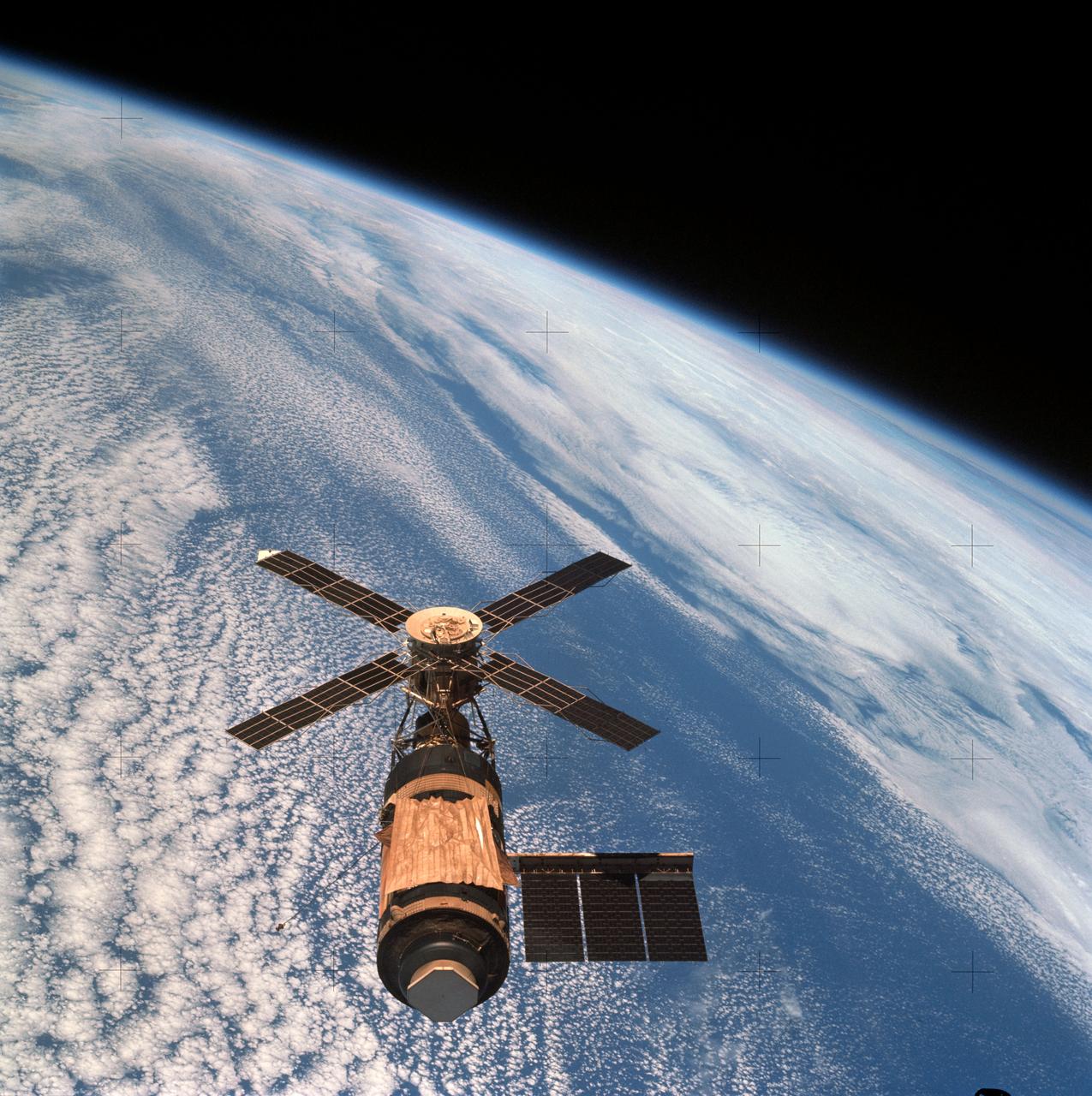
SL4-143-4706 (8 Feb. 1974) --- An overhead view of the Skylab space station cluster in Earth orbit as photographed from the Skylab 4 Command and Service Modules (CSM) during the final fly-around by the CSM before returning home. The space station is contrasted against a cloud-covered Earth. Note the solar shield which was deployed by the second crew of Skylab and from which a micro meteoroid shield has been missing since the cluster was launched on May 14, 1973. The Orbital Workshop (OWS) solar panel on the left side was also lost on workshop launch day. Inside the Command Module (CM) when this picture was made were astronaut Gerald P. Carr, commander; scientist-astronaut Edward G. Gibson, science pilot; and astronaut William R. Pogue, pilot. The crew used a 70mm hand-held Hasselblad camera to take this photograph. Photo credit: NASA
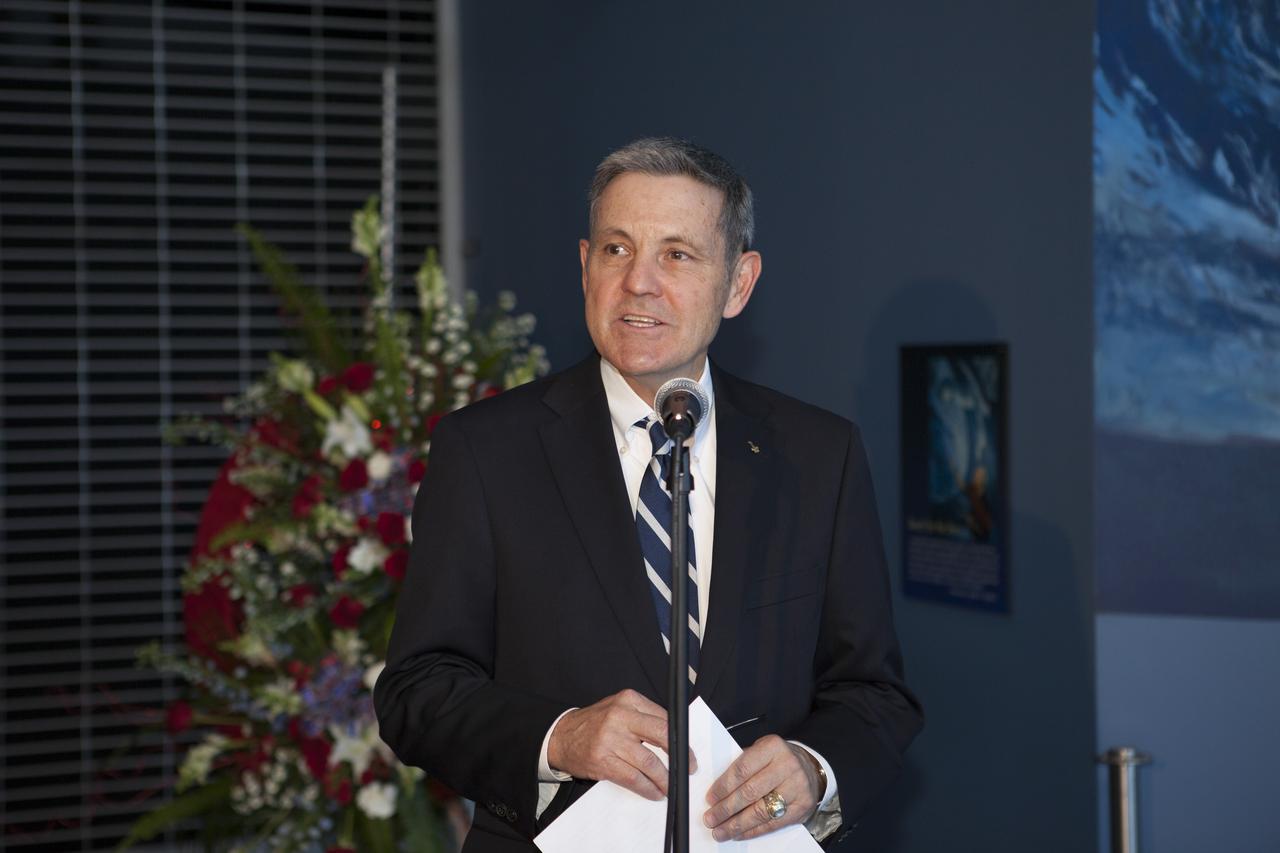
CAPE CANAVERAL, Fla. – NASA Kennedy Space Center Director Robert Cabana welcomes guests to the United States Astronaut Hall of Fame at the Kennedy Space Center Visitor Complex for a wreath laying ceremony to honor former NASA astronaut William R. Pogue. Col. Pogue, pilot on NASA's Skylab 4 mission in 1973-74, died March 3. He was 84 years old. Skylab 4 was the third and final manned visit to the Skylab orbital workshop, launched Nov. 16, 1973, and concluded Feb. 8, 1974. At 84 days, 1 hour and 15 minutes, Skylab 4 was the longest manned space flight to that date. Pogue was accompanied on the record-setting 34.5-million-mile flight by Commander Gerald P. Carr and science-pilot Dr. Edward G. Gibson. They conducted dozens of experiments and science demonstrations during their 1,214 orbits of Earth. Pogue logged 13 hours and 31 minutes in two spacewalks outside the orbital workshop. For more information, visit http://www.nasa.gov/content/skylab-4-pilot-william-pogue-dies. Photo credit: NASA/Kim Shiflett
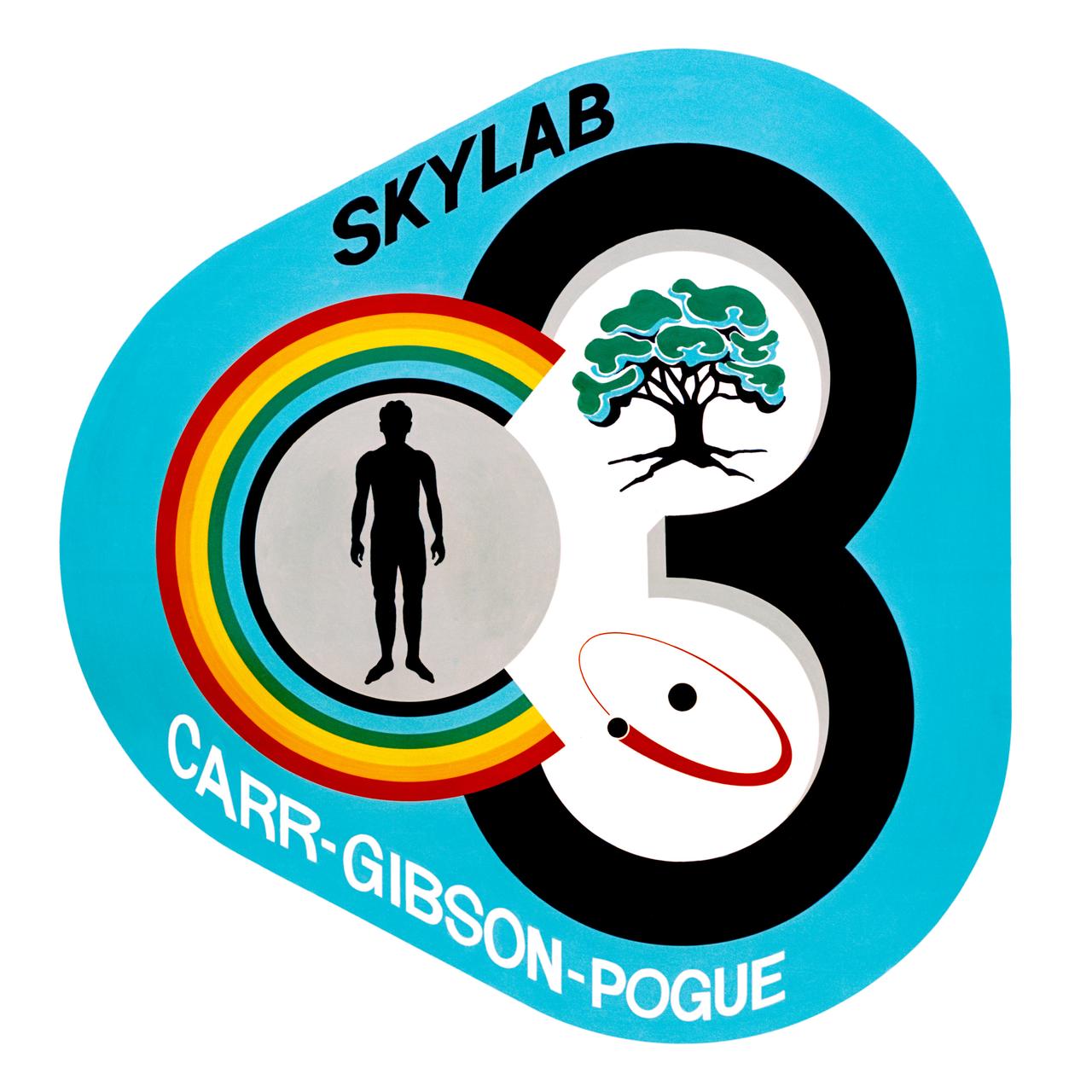
S72-53094 (For release February 1973) --- This is the emblem for the third manned Skylab mission. It will be a mission of up to 56 days. Skylab is an experimental space station consisting of a 100-ton laboratory complex in which medical, scientific and technological experiments will be performed in Earth orbit. The members of the crew will be astronaut Gerald P. Carr, commander; scientist-astronaut Edward G. Gibson, science pilot; and astronaut William R. Pogue, pilot. The symbols in the patch refer to the three major areas of investigation proposed in the mission. The tree represents man's natural environment and relates directly to the Skylab mission objectives of advancing the study of Earth resources. The hydrogen atom, as the basic building block of the universe, represents man's exploration of the physical world, his application of knowledge, and his development of technology. Since the sun is composed primarily of hydrogen, it is appropriate that the symbol refers to the solar physics mission objectives. The human silhouette represents mankind and the human capacity to direct technology with a wisdom tempered by regard for his natural environment. It also directly relates to the Skylab medical studies of man himself. The rainbow, adopted from the Biblical story of the flood, symbolizes the promise that is offered man. It embraces man and extends to the tree and the hydrogen atom emphasizing man's pivotal role in the conciliation of technology with nature. Photo credit: NASA

CAPE CANAVERAL, Fla. – Former NASA astronaut Edward G. Gibson, Ph.D., remarks on his friendship with former NASA astronaut William R. Pogue during a wreath laying ceremony at the United States Astronaut Hall of Fame at the Kennedy Space Center Visitor Complex. Col. Pogue, pilot on NASA's Skylab 4 mission in 1973-74, died March 3. He was 84 years old. Skylab 4 was the third and final manned visit to the Skylab orbital workshop, launched Nov. 16, 1973, and concluded Feb. 8, 1974. At 84 days, 1 hour and 15 minutes, Skylab 4 was the longest manned space flight to that date. Pogue was accompanied on the record-setting 34.5-million-mile flight by Commander Gerald P. Carr and science-pilot Gibson. They conducted dozens of experiments and science demonstrations during their 1,214 orbits of Earth. Pogue logged 13 hours and 31 minutes in two spacewalks outside the orbital workshop. For more information, visit http://www.nasa.gov/content/skylab-4-pilot-william-pogue-dies. Photo credit: NASA/Kim Shiflett
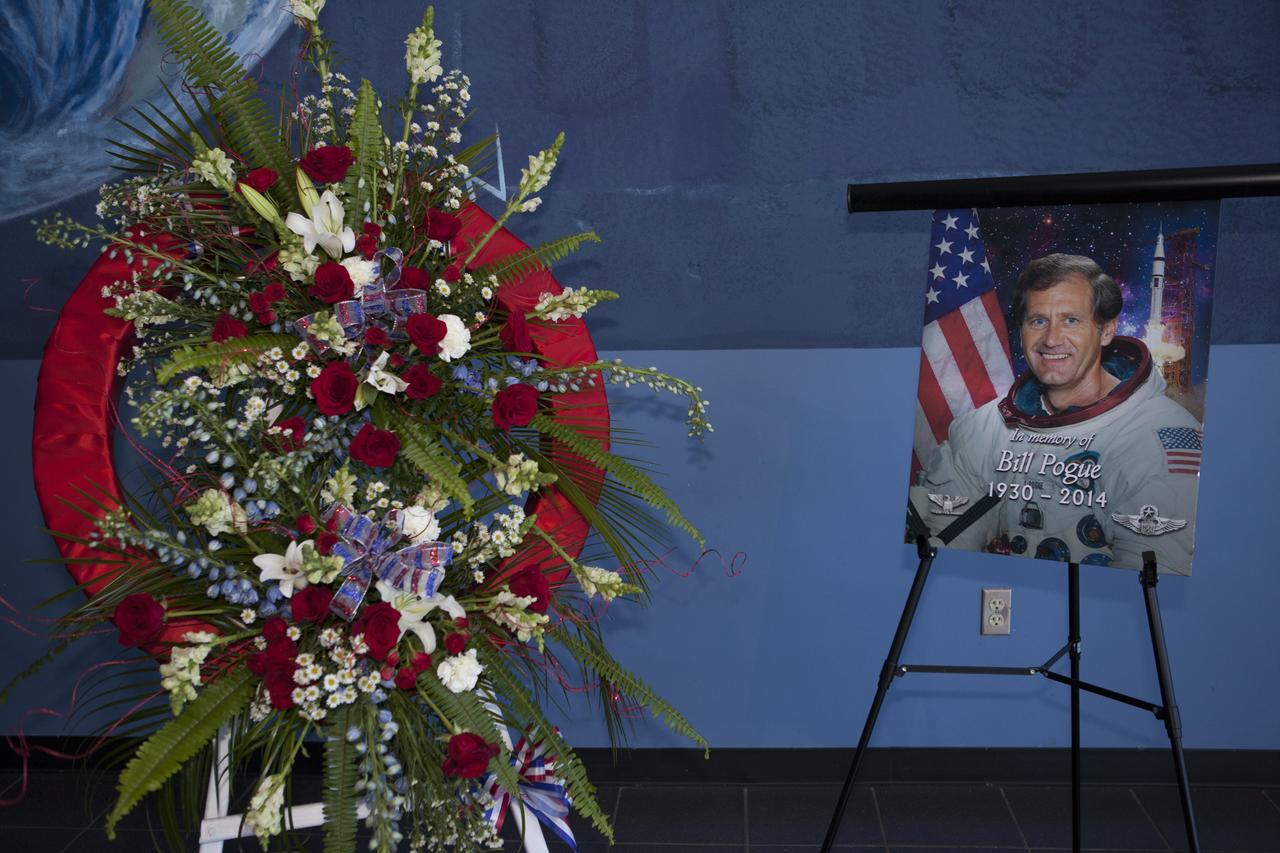
CAPE CANAVERAL, Fla. – A wreath is placed next to a photo of former NASA astronaut William R. Pogue during a ceremony to honor Pogue held at the United States Astronaut Hall of Fame at the Kennedy Space Center Visitor Complex. Col. Pogue, pilot on NASA's Skylab 4 mission in 1973-74, died March 3. He was 84 years old. Skylab 4 was the third and final manned visit to the Skylab orbital workshop, launched Nov. 16, 1973, and concluded Feb. 8, 1974. At 84 days, 1 hour and 15 minutes, Skylab 4 was the longest manned space flight to that date. Pogue was accompanied on the record-setting 34.5-million-mile flight by Commander Gerald P. Carr and science-pilot Dr. Edward G. Gibson. They conducted dozens of experiments and science demonstrations during their 1,214 orbits of Earth. Pogue logged 13 hours and 31 minutes in two spacewalks outside the orbital workshop. For more information, visit http://www.nasa.gov/content/skylab-4-pilot-william-pogue-dies. Photo credit: NASA/Kim Shiflett