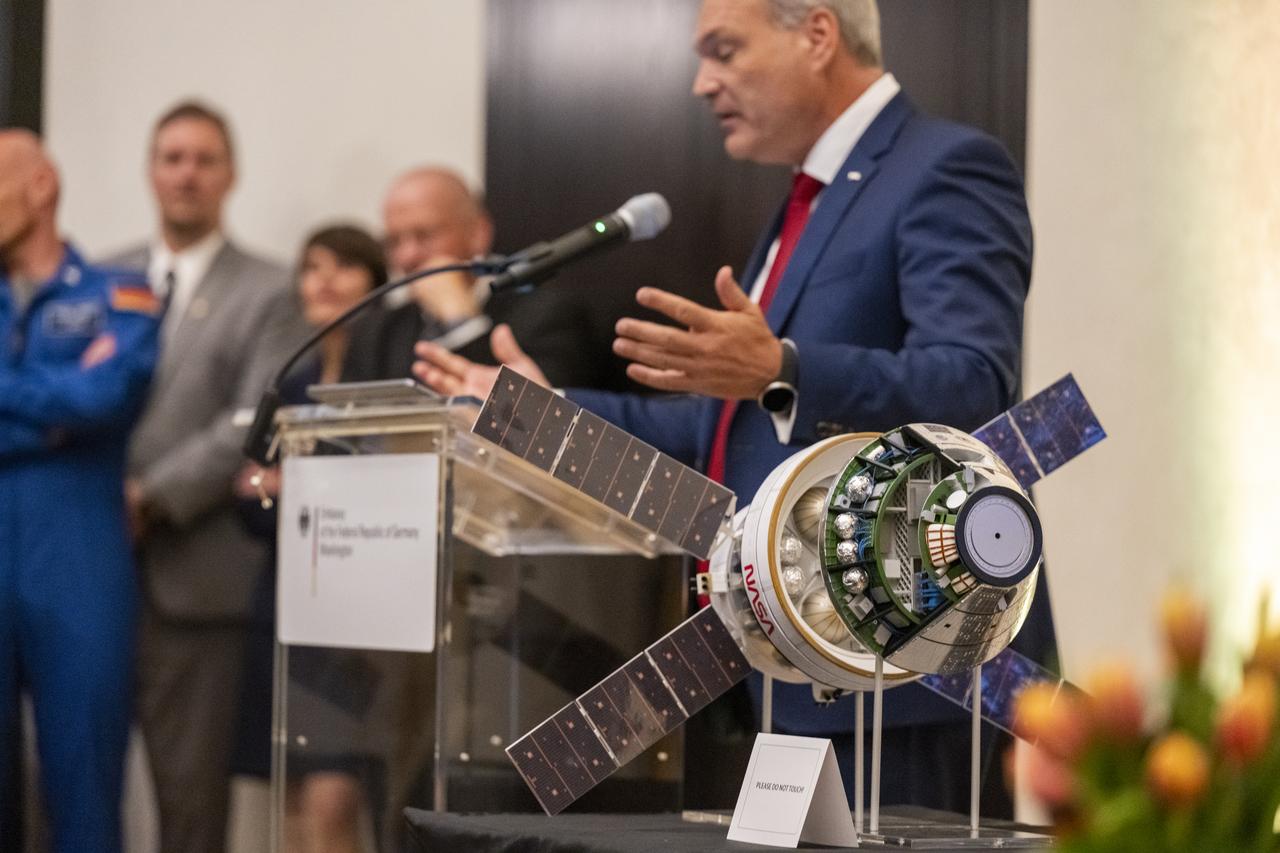
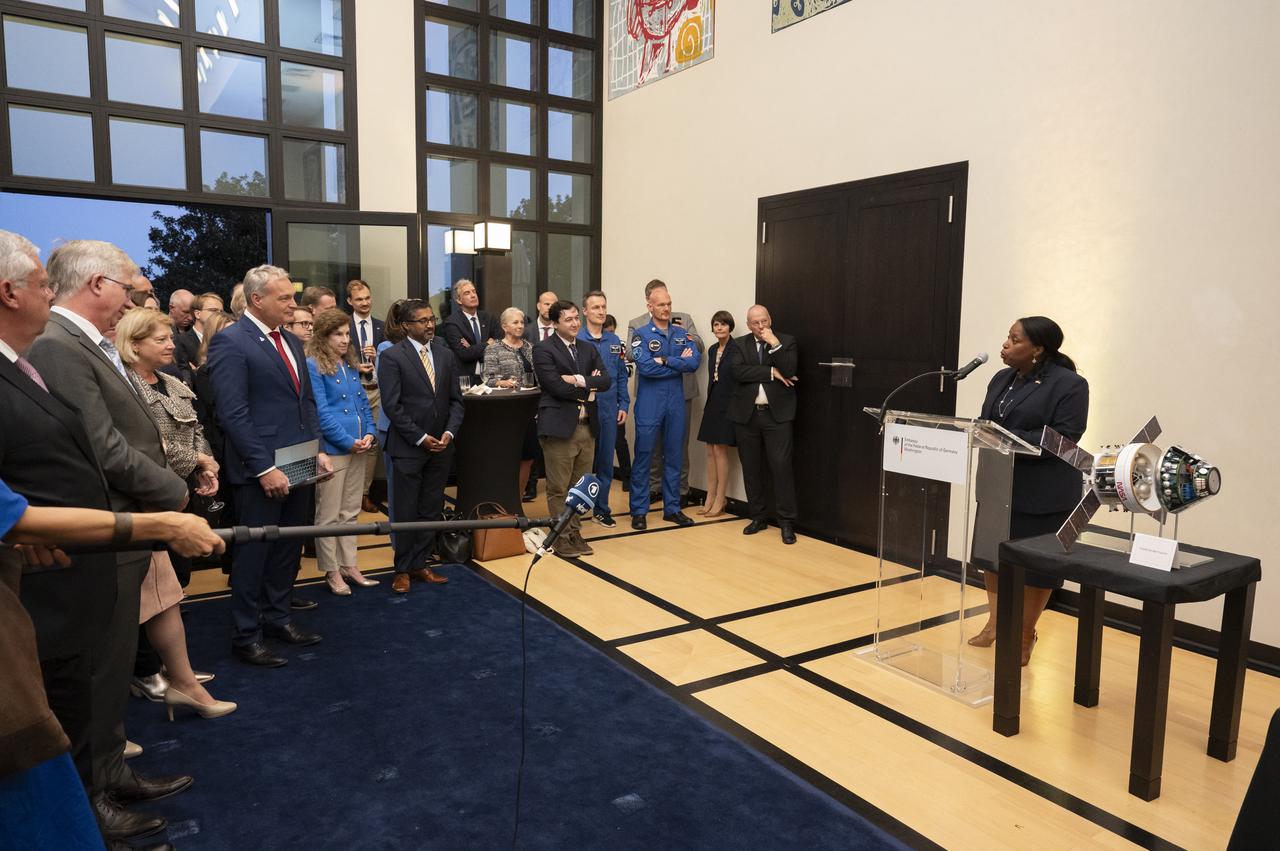
A model of the Orion Spacecraft is seen in the foreground as Director General of the German Space Agency at the German Aerospace Center (DLR) Walther Pelzer delivers remarks during an Artemis Accords signing ceremony, Thursday, September 14, 2023, at the German Ambassador’s Residence in Washington. Germany is the 29th country to sign the Artemis Accords, which establish a practical set of principles to guide space exploration cooperation among nations participating in NASA’s Artemis program. Photo Credit: (NASA/Keegan Barber)
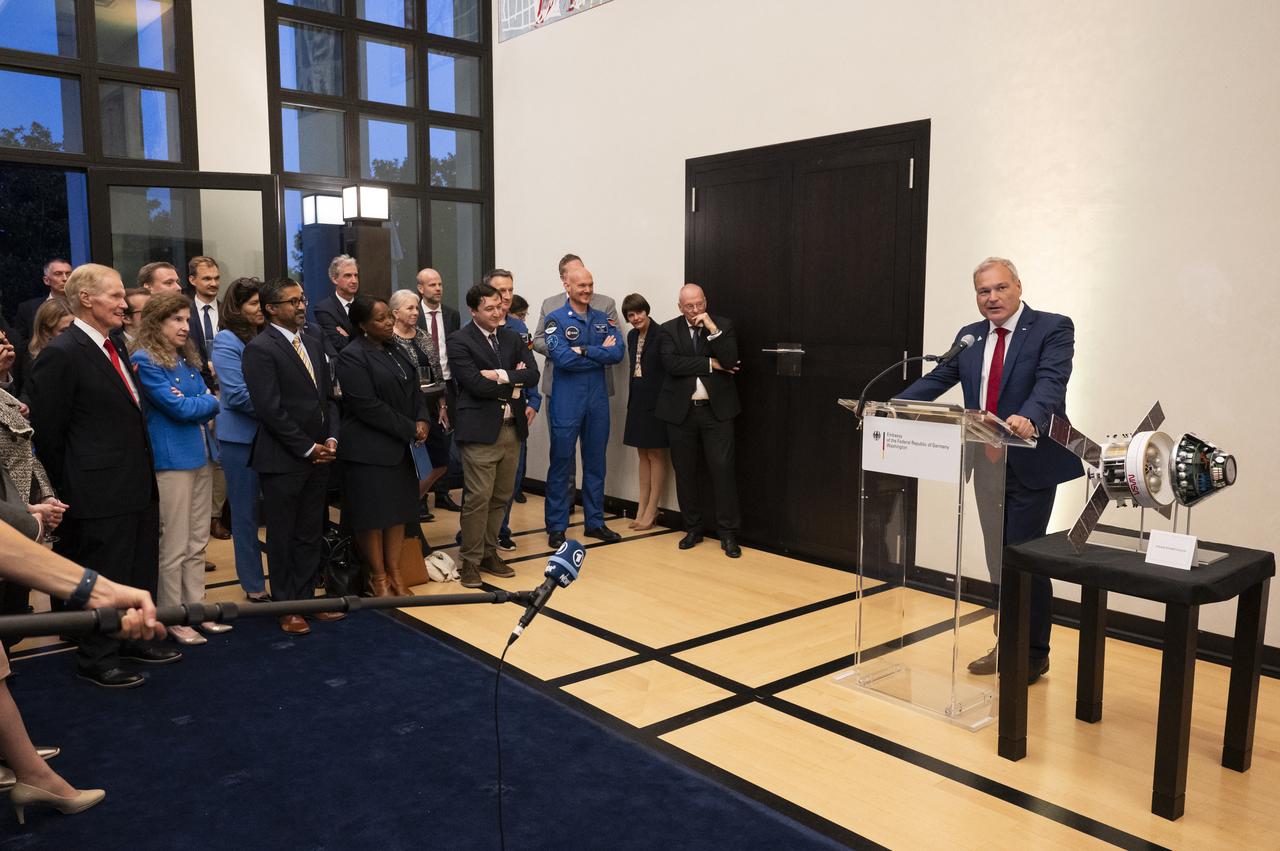
Director General of the German Space Agency at the German Aerospace Center (DLR) Walther Pelzer delivers remarks during an Artemis Accords signing ceremony, Thursday, September 14, 2023, at the German Ambassador’s Residence in Washington. Germany is the 29th country to sign the Artemis Accords, which establish a practical set of principles to guide space exploration cooperation among nations participating in NASA’s Artemis program. Photo Credit: (NASA/Keegan Barber)
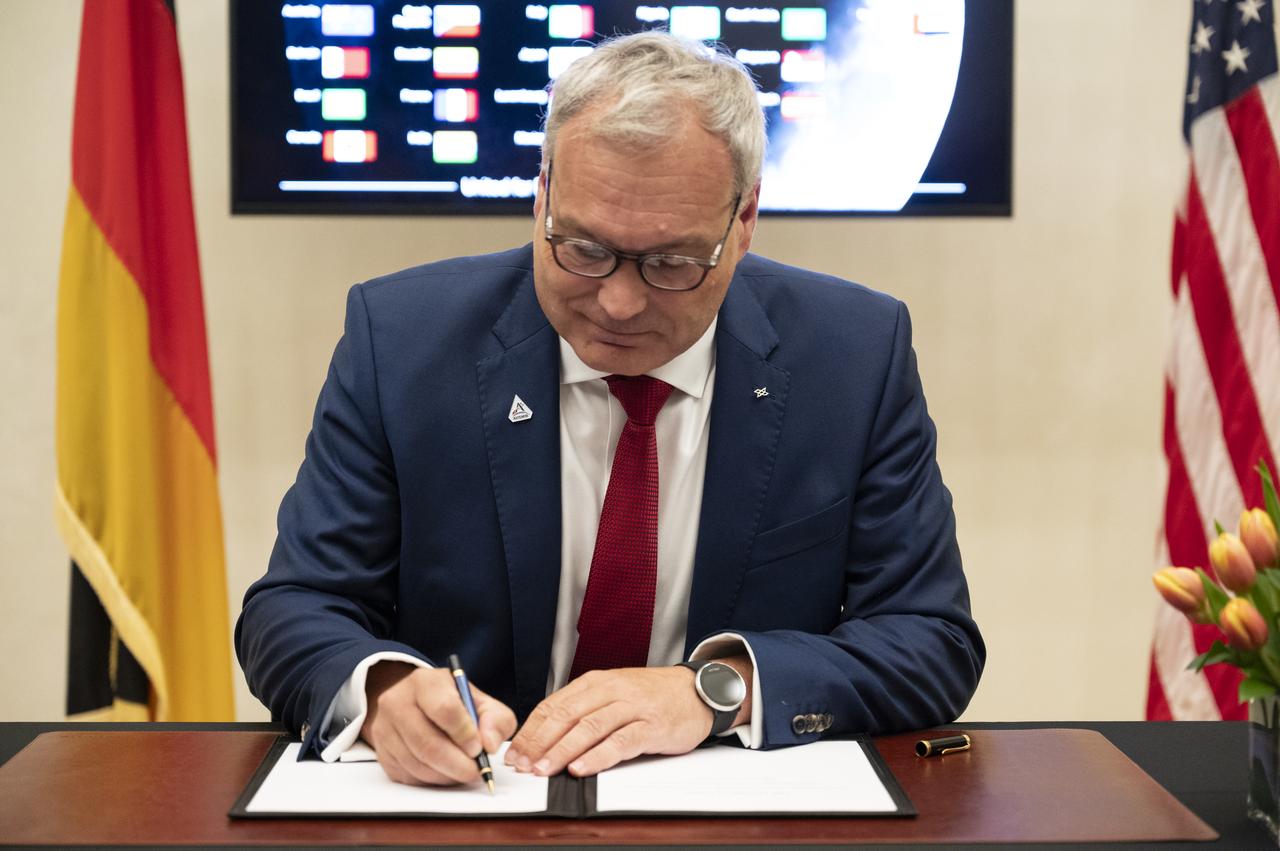
Director General of the German Space Agency at the German Aerospace Center (DLR) Walther Pelzer signs the Artemis Accords, Thursday, September 14, 2023, at the German Ambassador’s Residence in Washington. Germany is the 29th country to sign the Artemis Accords, which establish a practical set of principles to guide space exploration cooperation among nations participating in NASA’s Artemis program. Photo Credit: (NASA/Keegan Barber)
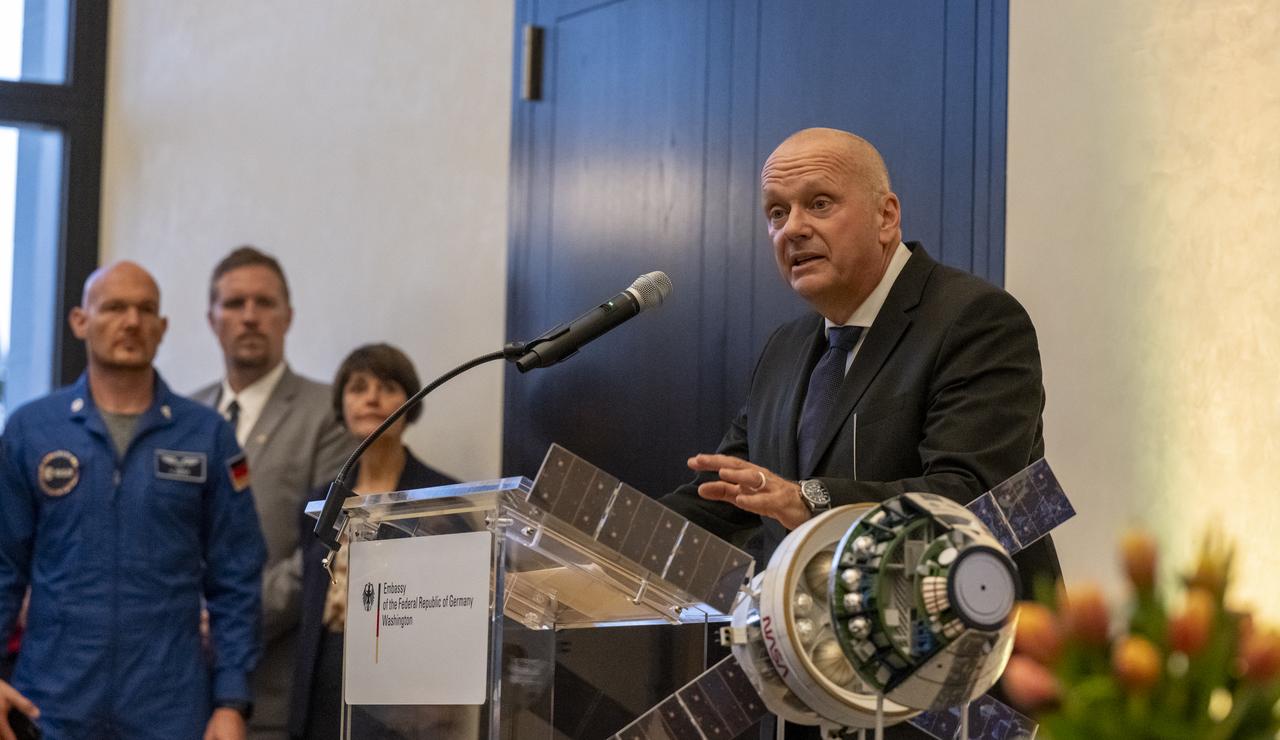
German Ambassador to the United States Andreas Michaelis delivers remarks during an Artemis Accords signing ceremony, Thursday, September 14, 2023, at the German Ambassador’s Residence in Washington. Germany is the 29th country to sign the Artemis Accords, which establish a practical set of principles to guide space exploration cooperation among nations participating in NASA’s Artemis program. Photo Credit: (NASA/Keegan Barber)
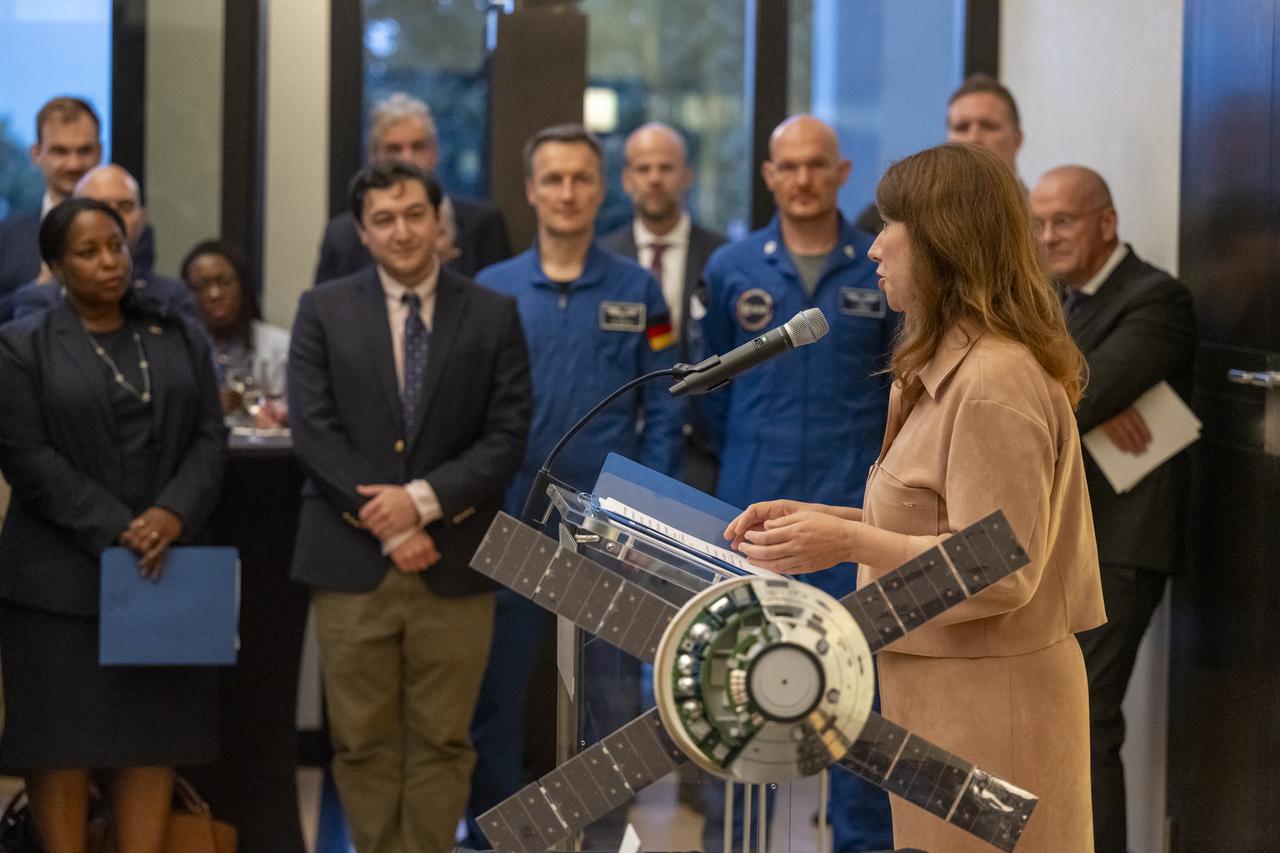
Federal Government Coordinator of German Aerospace Policy Anna Christmann delivers remarks during an Artemis Accords signing ceremony, Thursday, September 14, 2023, at the German Ambassador’s Residence in Washington. Germany is the 29th country to sign the Artemis Accords, which establish a practical set of principles to guide space exploration cooperation among nations participating in NASA’s Artemis program. Photo Credit: (NASA/Keegan Barber)
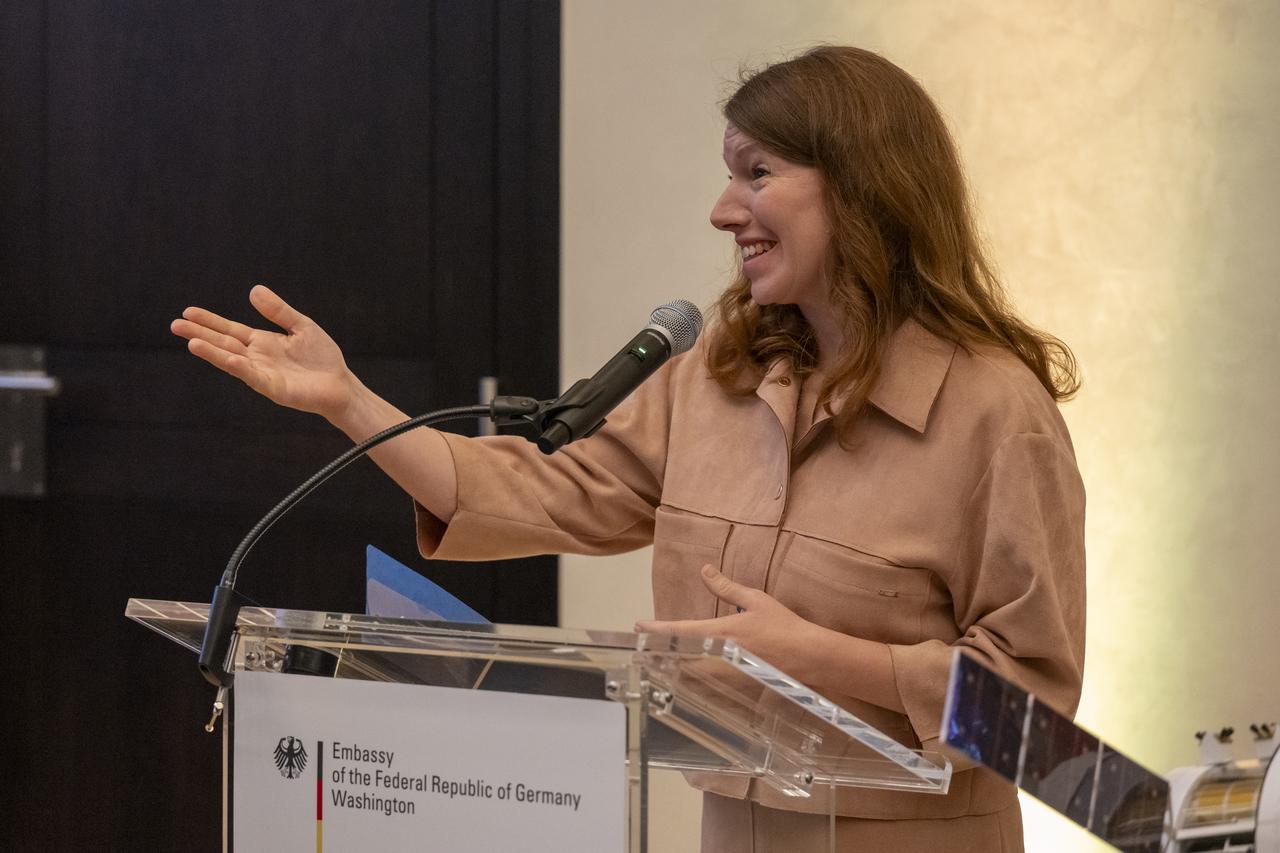
Federal Government Coordinator of German Aerospace Policy Anna Christmann delivers remarks during an Artemis Accords signing ceremony, Thursday, September 14, 2023, at the German Ambassador’s Residence in Washington. Germany is the 29th country to sign the Artemis Accords, which establish a practical set of principles to guide space exploration cooperation among nations participating in NASA’s Artemis program. Photo Credit: (NASA/Keegan Barber)
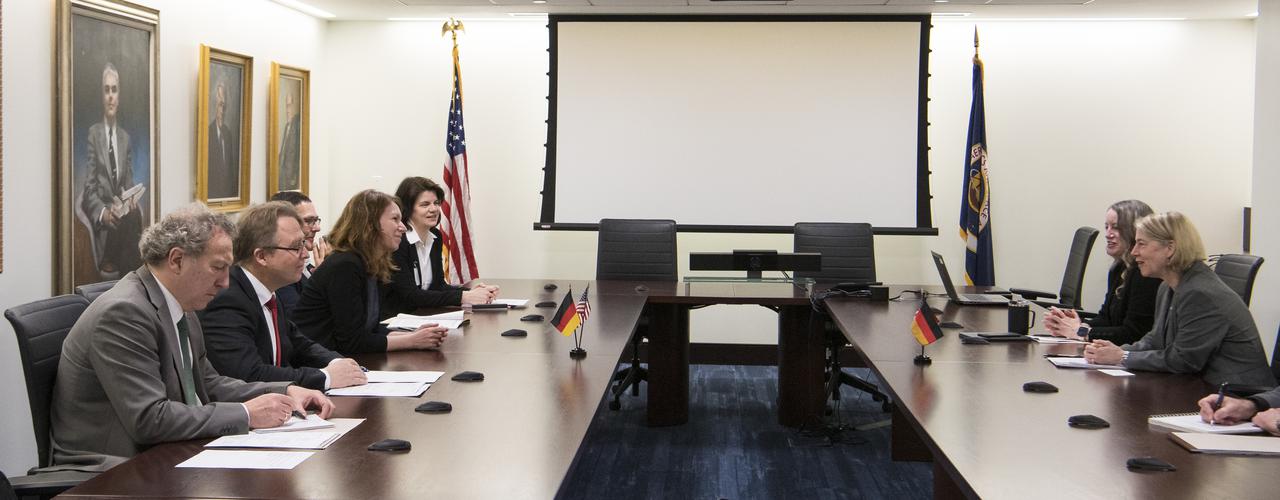
From left to right, Head of Science and Technology Section, German Embassy, Dr. René Haak; Head of the German Aerospace Center’s (DLR) Washington Office, Mr. Marc Jochemich; the Federal Government Coordinator of German Aerospace Policy, Dr. Anna Christmann; Deputy Director General, Federal Ministry for Economic Affairs and Climate Action (BMWK), Holger Schlienkamp; Head of Division, BMWK, Claudia Andree; NASA Office of International and Interagency Relations Deputy Associate Administrator, Meredith McKay; and NASA Deputy Administrator Pam Melroy speak during a meeting, Thursday, March 31, 2022, at NASA Headquarters in Washington DC. Photo Credit: (NASA/Aubrey Gemignani)
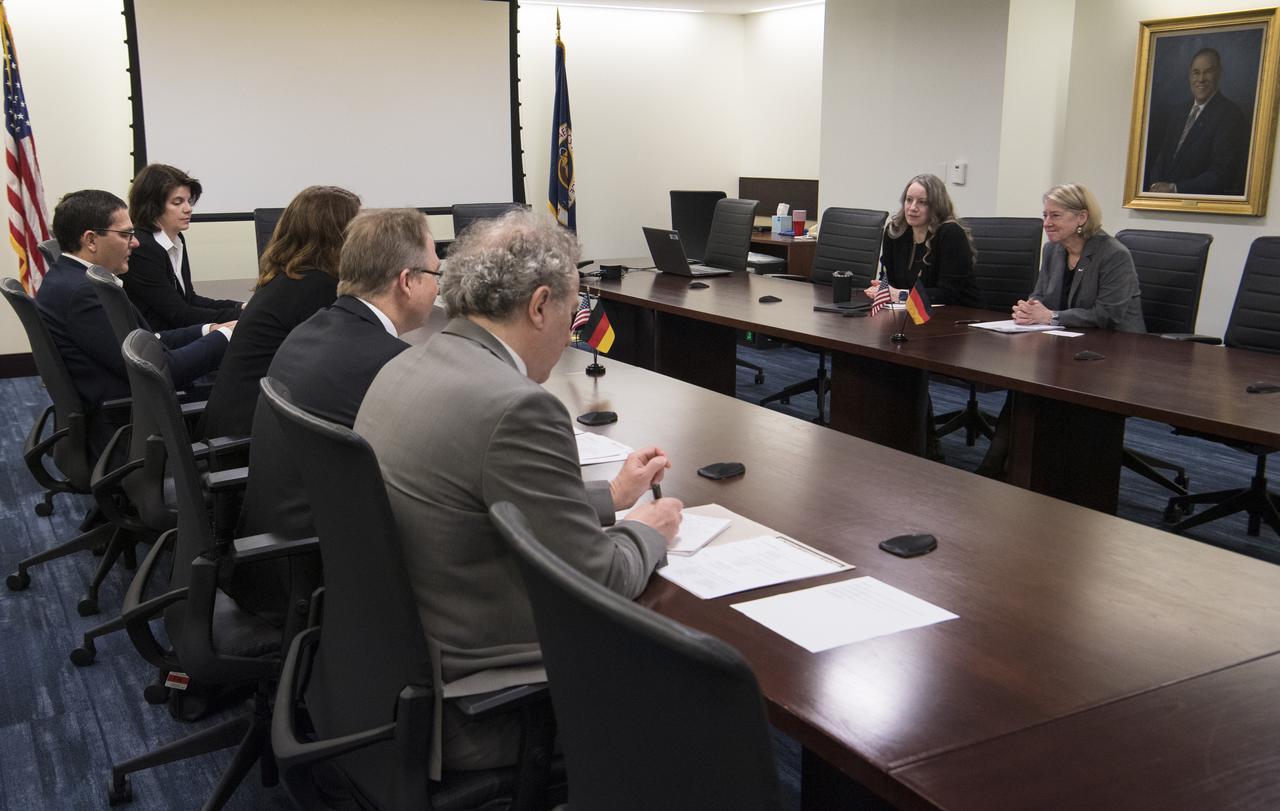
From left to right, Head of Science and Technology Section, German Embassy, Dr. René Haak; Head of the German Aerospace Center’s (DLR) Washington Office, Mr. Marc Jochemich; the Federal Government Coordinator of German Aerospace Policy, Dr. Anna Christmann; Deputy Director General, Federal Ministry for Economic Affairs and Climate Action (BMWK), Holger Schlienkamp; Head of Division, BMWK, Claudia Andree; NASA Office of International and Interagency Relations Deputy Associate Administrator, Meredith McKay; and NASA Deputy Administrator Pam Melroy speak during a meeting, Thursday, March 31, 2022, at NASA Headquarters in Washington DC. Photo Credit: (NASA/Aubrey Gemignani)
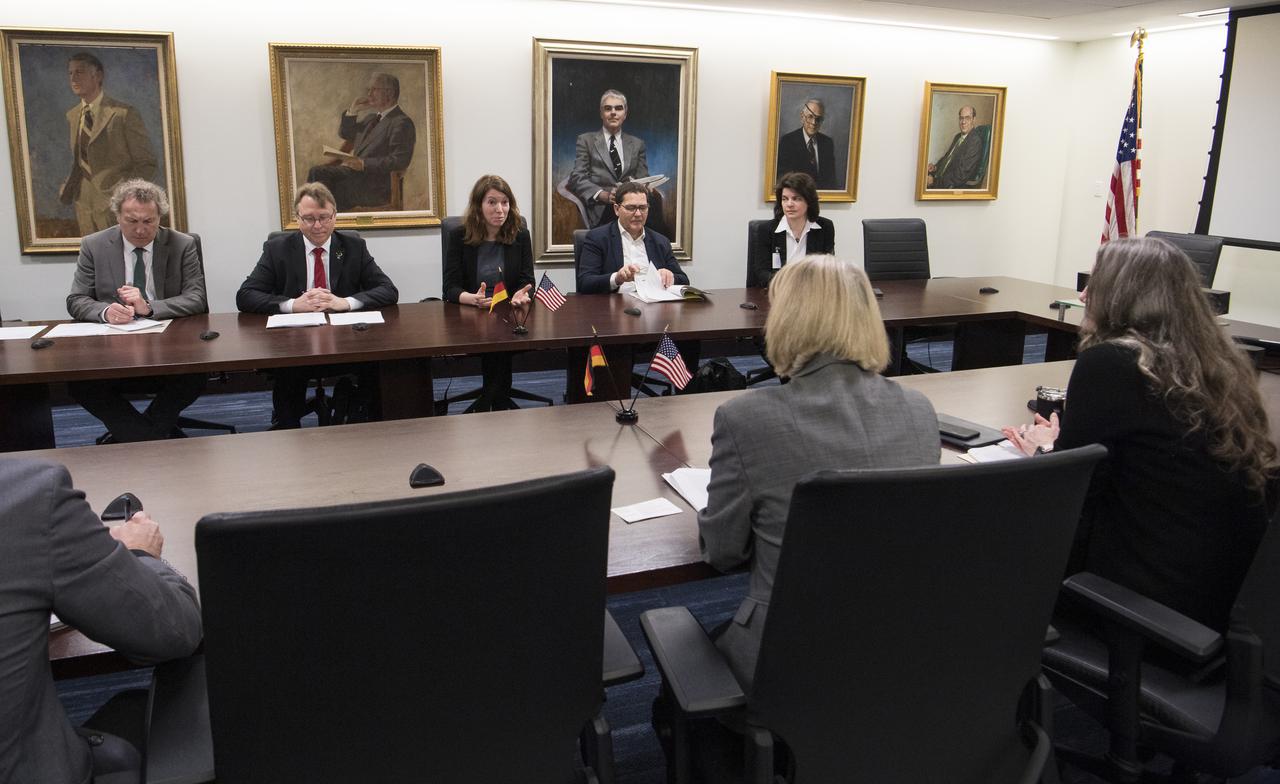
From left to right, Head of Science and Technology Section, German Embassy, Dr. René Haak; Head of the German Aerospace Center’s (DLR) Washington Office, Mr. Marc Jochemich; the Federal Government Coordinator of German Aerospace Policy, Dr. Anna Christmann; Deputy Director General, Federal Ministry for Economic Affairs and Climate Action (BMWK), Holger Schlienkamp; Head of Division, BMWK, Claudia Andree, speak with NASA Office of International and Interagency Relations Deputy Associate Administrator, Meredith McKay, front right, and NASA Deputy Administrator Pam Melroy, during a meeting, Thursday, March 31, 2022, at NASA Headquarters in Washington DC. Photo Credit: (NASA/Aubrey Gemignani)
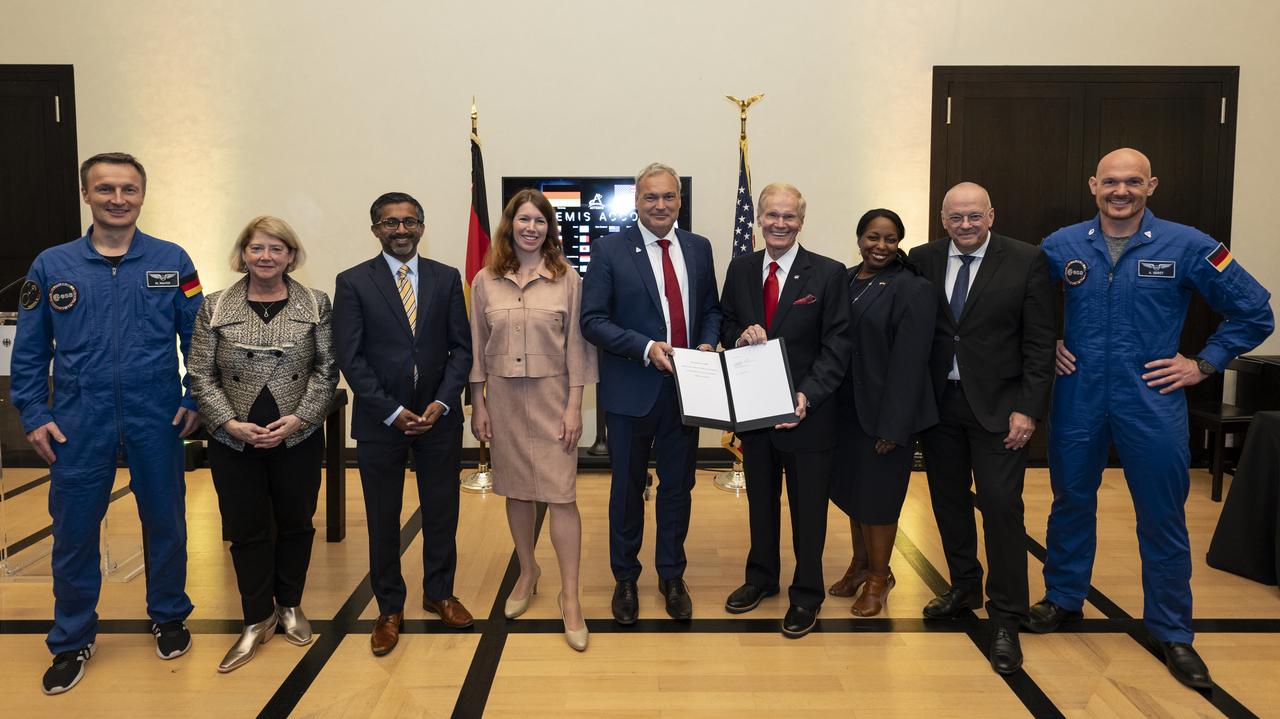
From left to right, ESA (European Space Agency) astronaut Matthias Maurer, NASA Deputy Administrator Pam Melroy, National Space Council (NSpC) Executive Secretary Chirag Parikh, Federal Government Coordinator of German Aerospace Policy Anna Christmann, NASA Administrator Bill Nelson, Director General of the German Space Agency at the German Aerospace Center (DLR) Walther Pelzer, Acting Assistant Secretary of State for Oceans and International Environmental and Scientific Affairs Jennifer R. Littlejohn, German Ambassador to the United States Andreas Michaelis, and ESA astronaut Alexander Gerst pose for a group photo during an Artemis Accords signing ceremony, Thursday, September 14, 2023, at the German Ambassador’s Residence in Washington. Germany is the 29th country to sign the Artemis Accords, which establish a practical set of principles to guide space exploration cooperation among nations participating in NASA’s Artemis program. Photo Credit: (NASA/Keegan Barber)
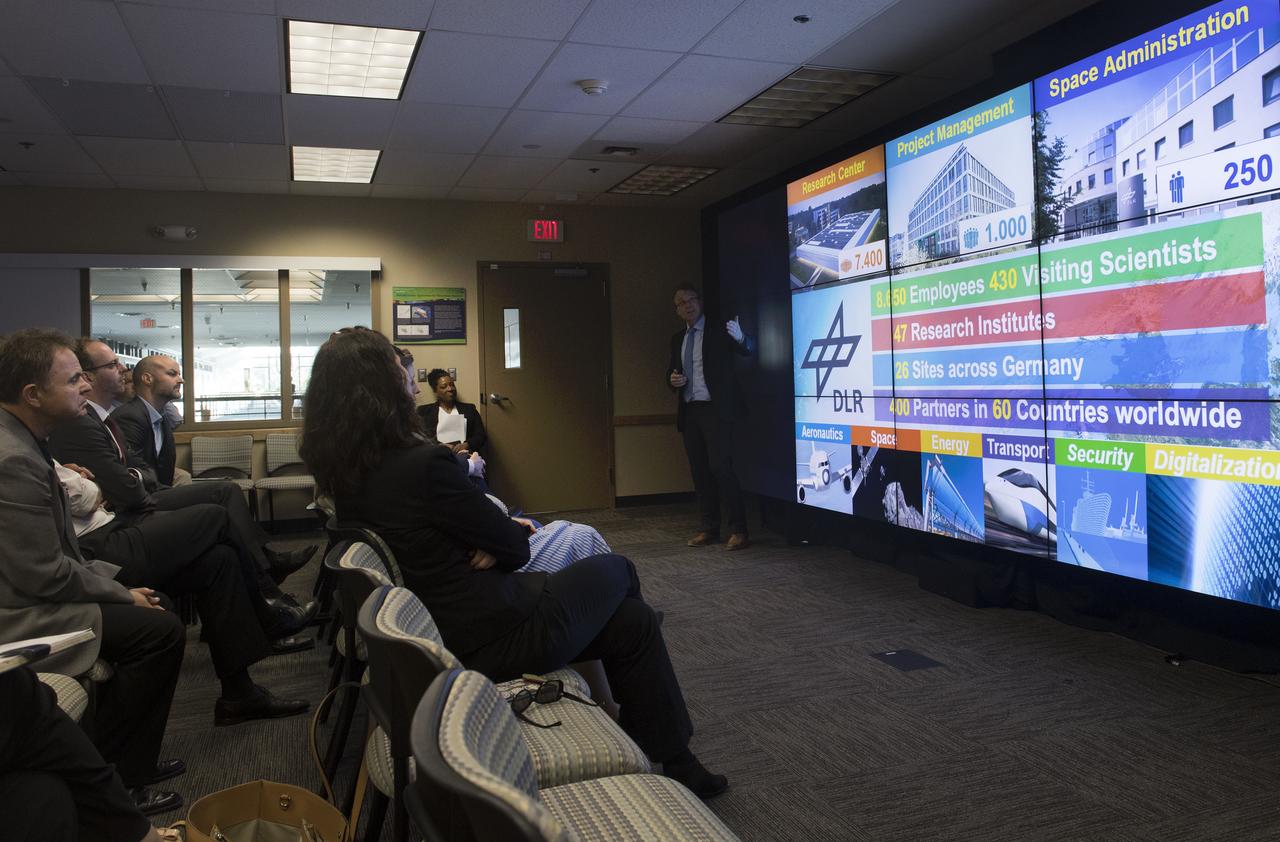
German Parliament and Space Agency Reps visited Hyperwall, Satellite Servicing, WOW Helio and NIC Sept 19, 2019
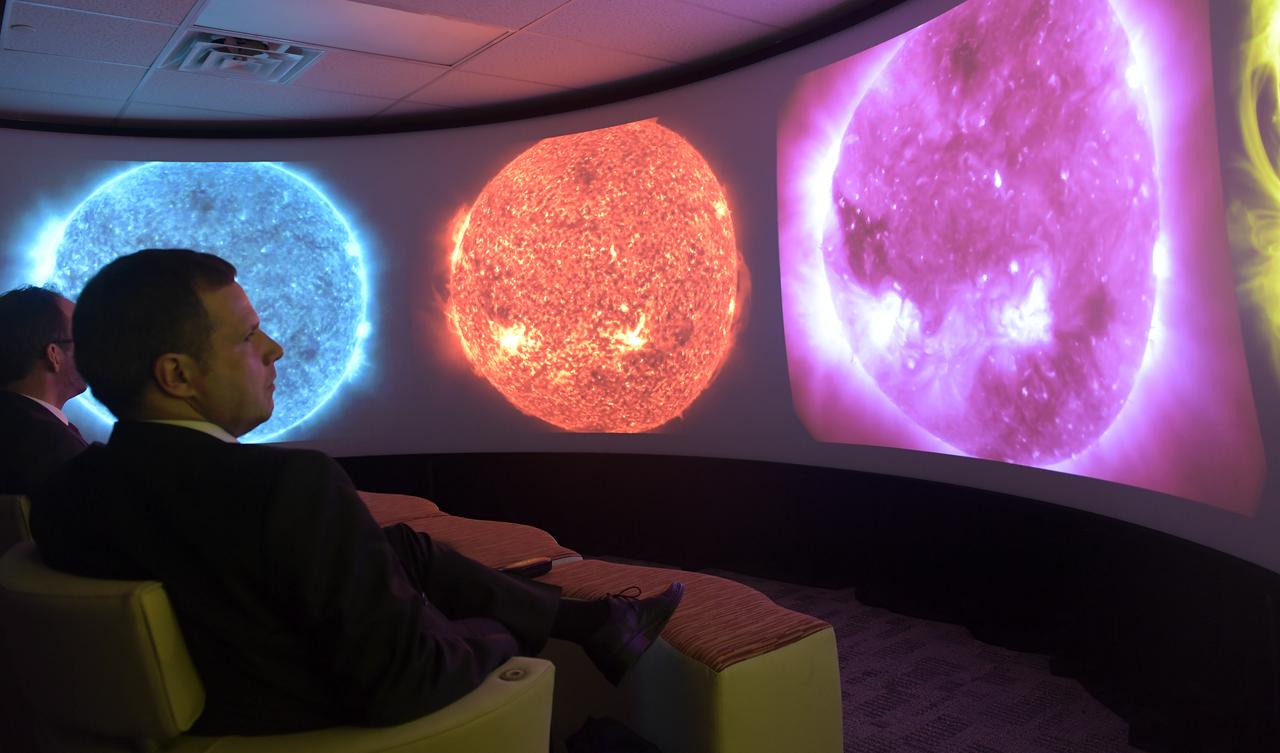
German Parliament and Space Agency Reps visited WOW Heliophysics facility B21 - Dr. Alex Young
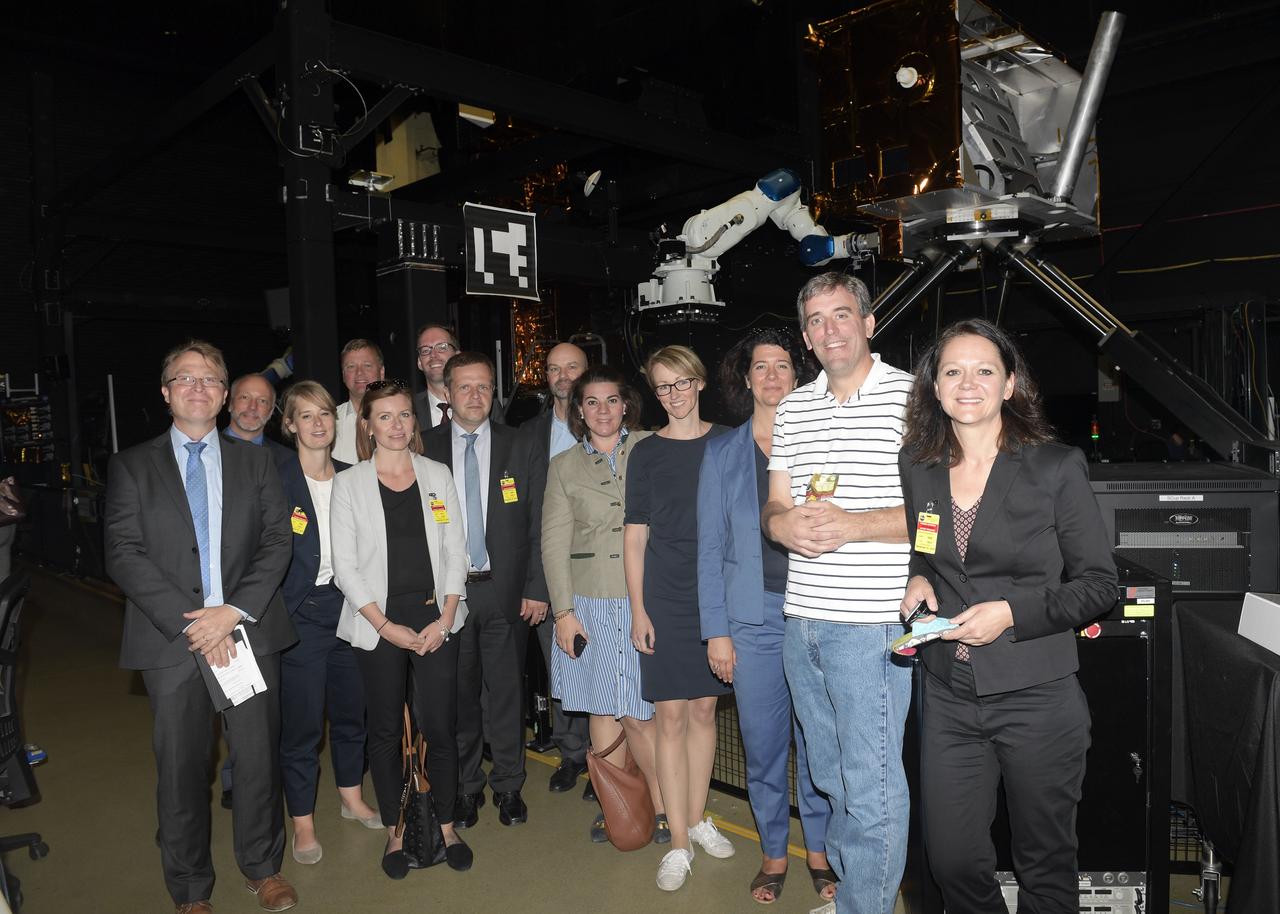
German Parliament and Space Agency Reps visited Satellite Servicing facility B29 with Brian Roberts Sept 19, 2019
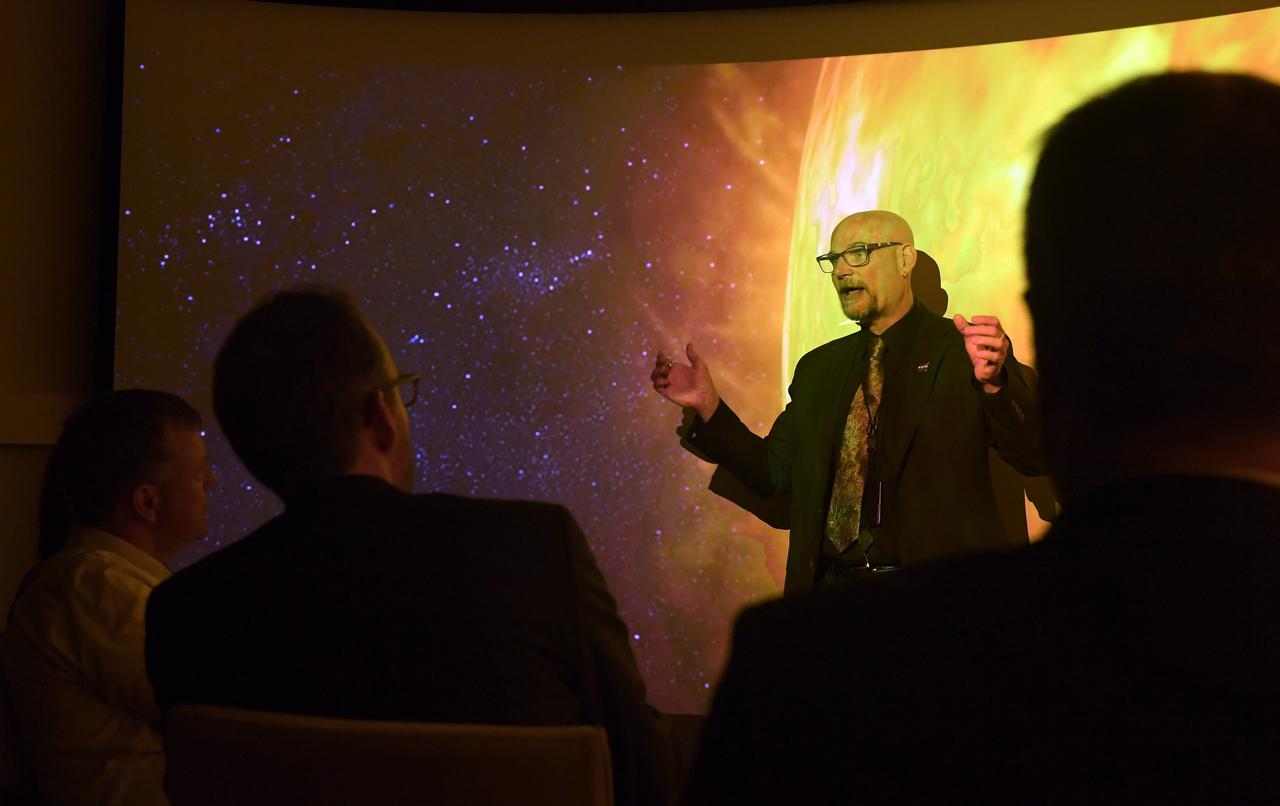
German Parliament and Space Agency Reps visited WOW Heliophysics facility - Dr. Alex Young
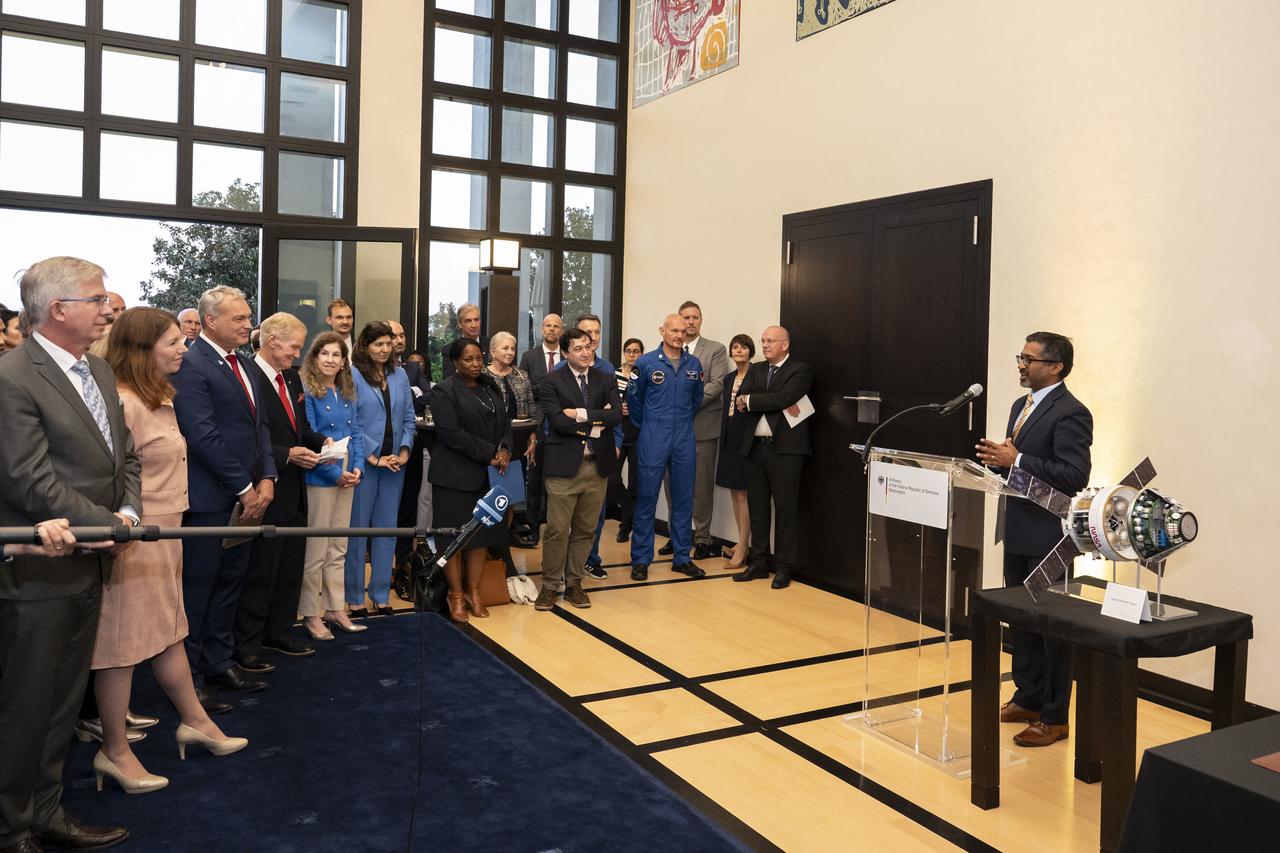
National Space Council (NSpC) Executive Secretary Chirag Parikh delivers remarks during an Artemis Accords signing ceremony, Thursday, September 14, 2023, at the German Ambassador’s Residence in Washington. Germany is the 29th country to sign the Artemis Accords, which establish a practical set of principles to guide space exploration cooperation among nations participating in NASA’s Artemis program. Photo Credit: (NASA/Keegan Barber)
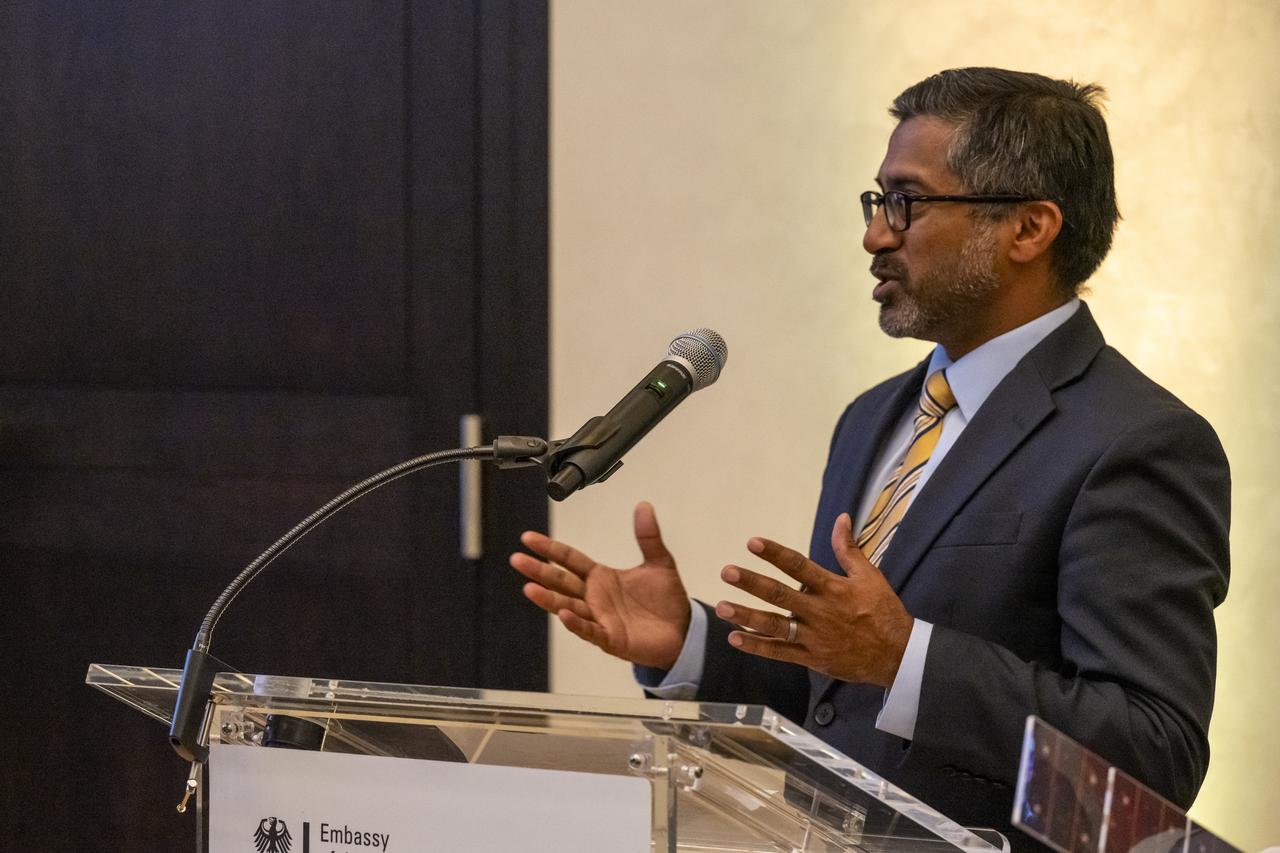
National Space Council (NSpC) Executive Secretary Chirag Parikh delivers remarks during an Artemis Accords signing ceremony, Thursday, September 14, 2023, at the German Ambassador’s Residence in Washington. Germany is the 29th country to sign the Artemis Accords, which establish a practical set of principles to guide space exploration cooperation among nations participating in NASA’s Artemis program. Photo Credit: (NASA/Keegan Barber)
Acting Assistant Secretary of State for Oceans and International Environmental and Scientific Affairs Jennifer R. Littlejohn delivers remarks during an Artemis Accords signing ceremony, Thursday, September 14, 2023, at the German Ambassador’s Residence in Washington. Germany is the 29th country to sign the Artemis Accords, which establish a practical set of principles to guide space exploration cooperation among nations participating in NASA’s Artemis program. Photo Credit: (NASA/Keegan Barber)

Acting Assistant Secretary of State for Oceans and International Environmental and Scientific Affairs Jennifer R. Littlejohn delivers remarks during an Artemis Accords signing ceremony, Thursday, September 14, 2023, at the German Ambassador’s Residence in Washington. Germany is the 29th country to sign the Artemis Accords, which establish a practical set of principles to guide space exploration cooperation among nations participating in NASA’s Artemis program. Photo Credit: (NASA/Keegan Barber)
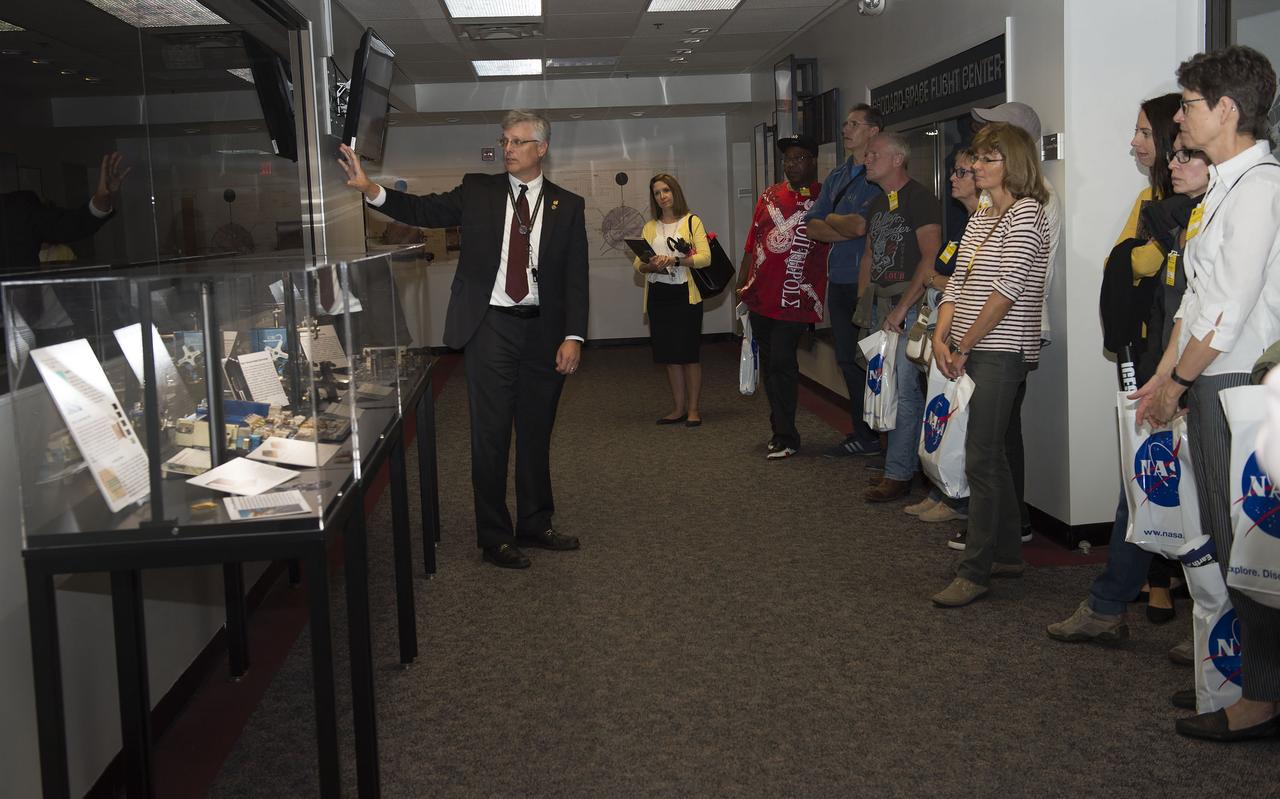
German Ambassador Hans Peter Wittig and staff visited Goddard on Sept 6, 2017. They toured facilities including: Hubble Control Room, JWST clean room, Hyperwall and Robotics etc
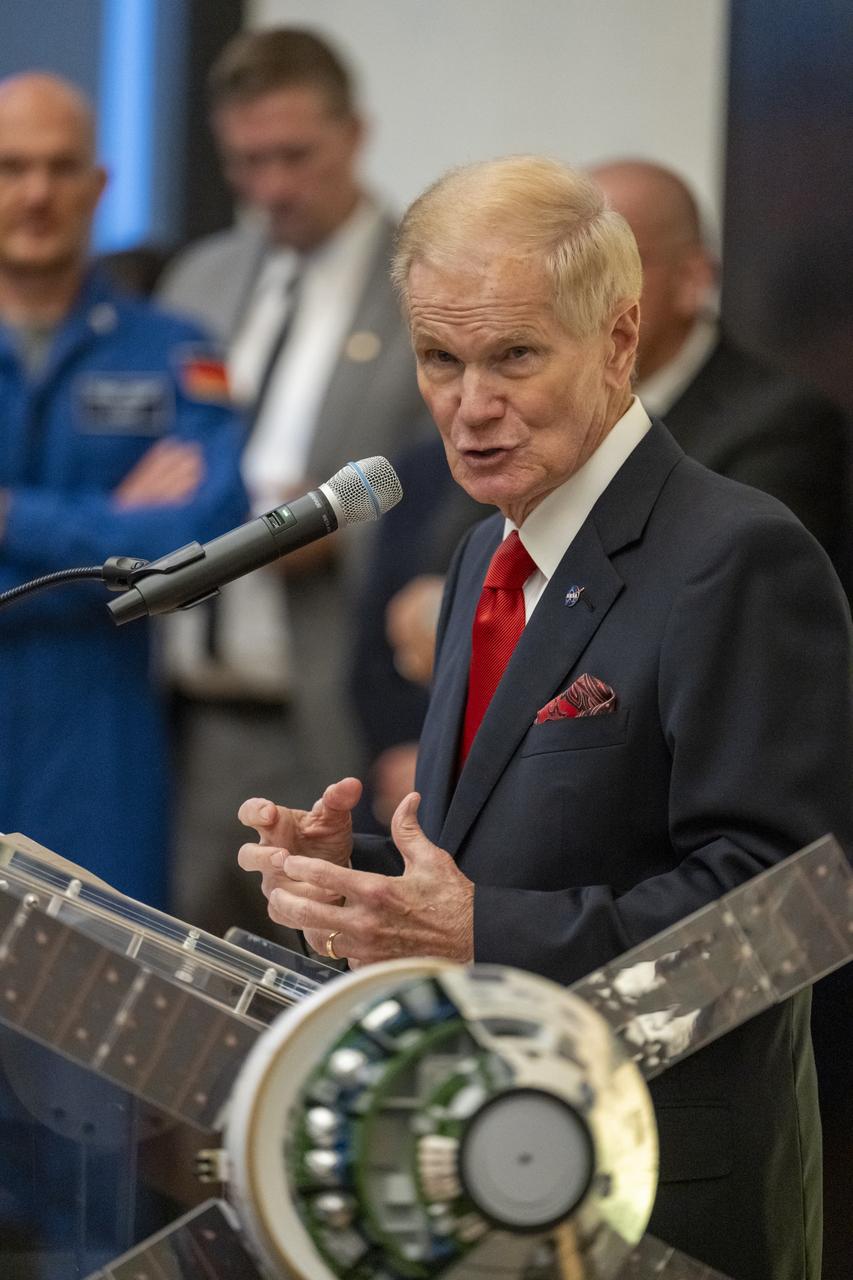
NASA Administrator Bill Nelson delivers remarks during an Artemis Accords signing ceremony, Thursday, September 14, 2023, at the German Ambassador’s Residence in Washington. Germany is the 29th country to sign the Artemis Accords, which establish a practical set of principles to guide space exploration cooperation among nations participating in NASA’s Artemis program. Photo Credit: (NASA/Keegan Barber)
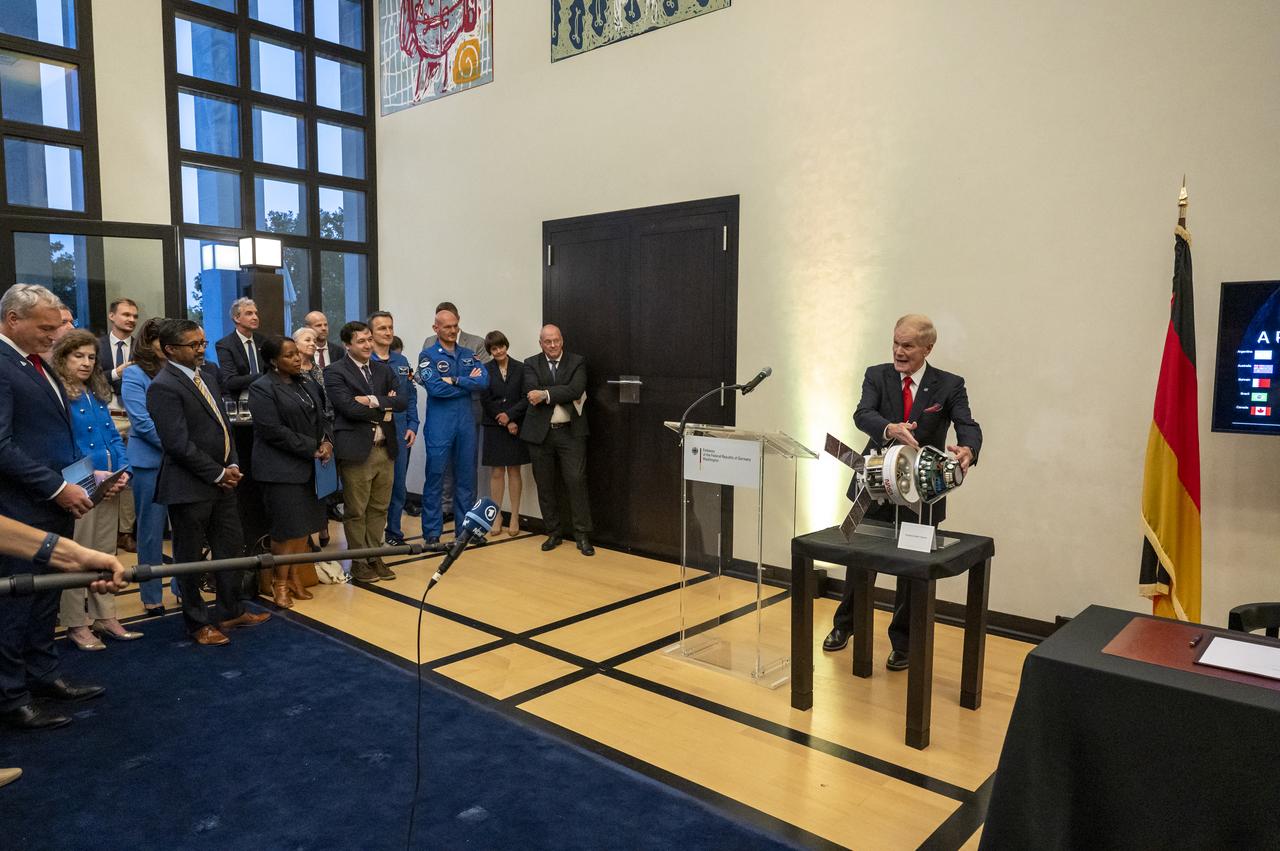
NASA Administrator Bill Nelson delivers remarks during an Artemis Accords signing ceremony, Thursday, September 14, 2023, at the German Ambassador’s Residence in Washington. Germany is the 29th country to sign the Artemis Accords, which establish a practical set of principles to guide space exploration cooperation among nations participating in NASA’s Artemis program. Photo Credit: (NASA/Keegan Barber)
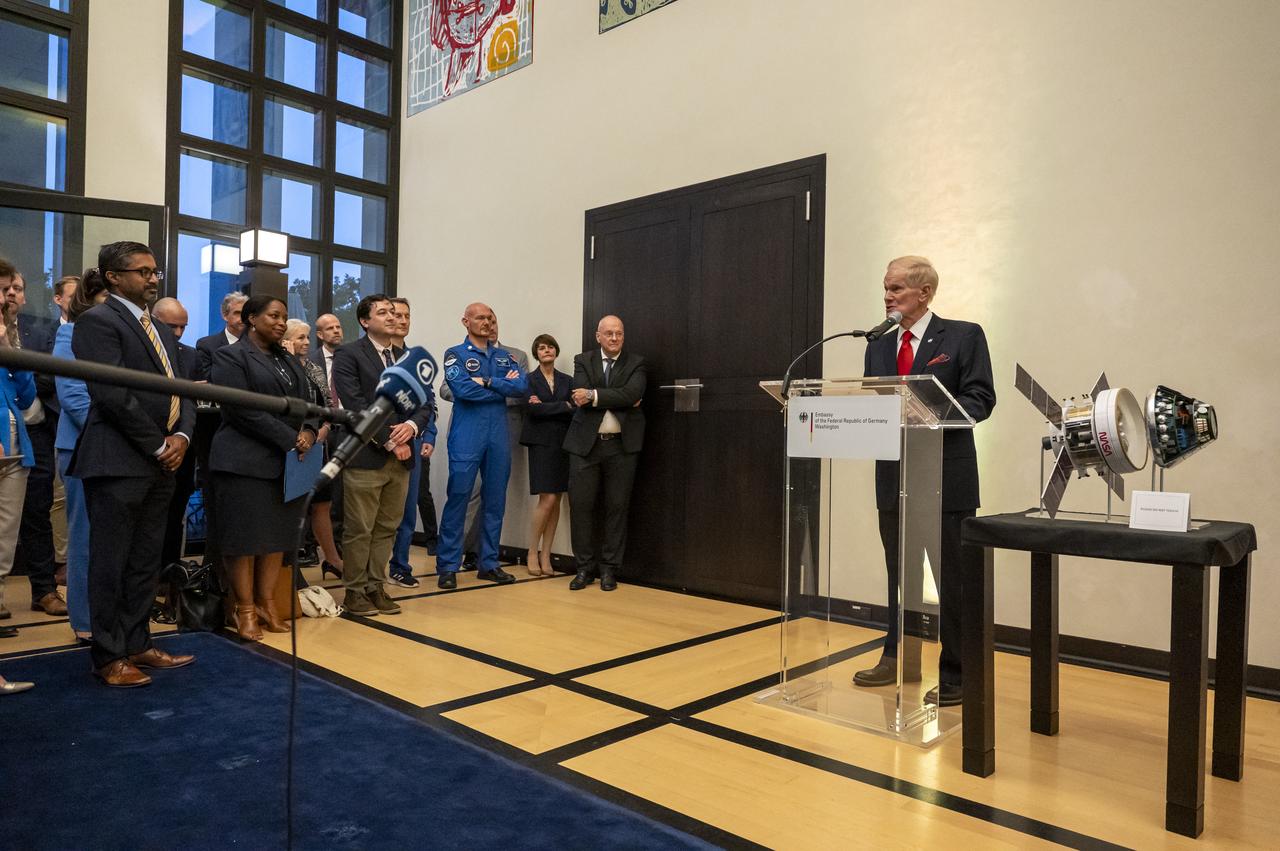
NASA Administrator Bill Nelson delivers remarks during an Artemis Accords signing ceremony, Thursday, September 14, 2023, at the German Ambassador’s Residence in Washington. Germany is the 29th country to sign the Artemis Accords, which establish a practical set of principles to guide space exploration cooperation among nations participating in NASA’s Artemis program. Photo Credit: (NASA/Keegan Barber)
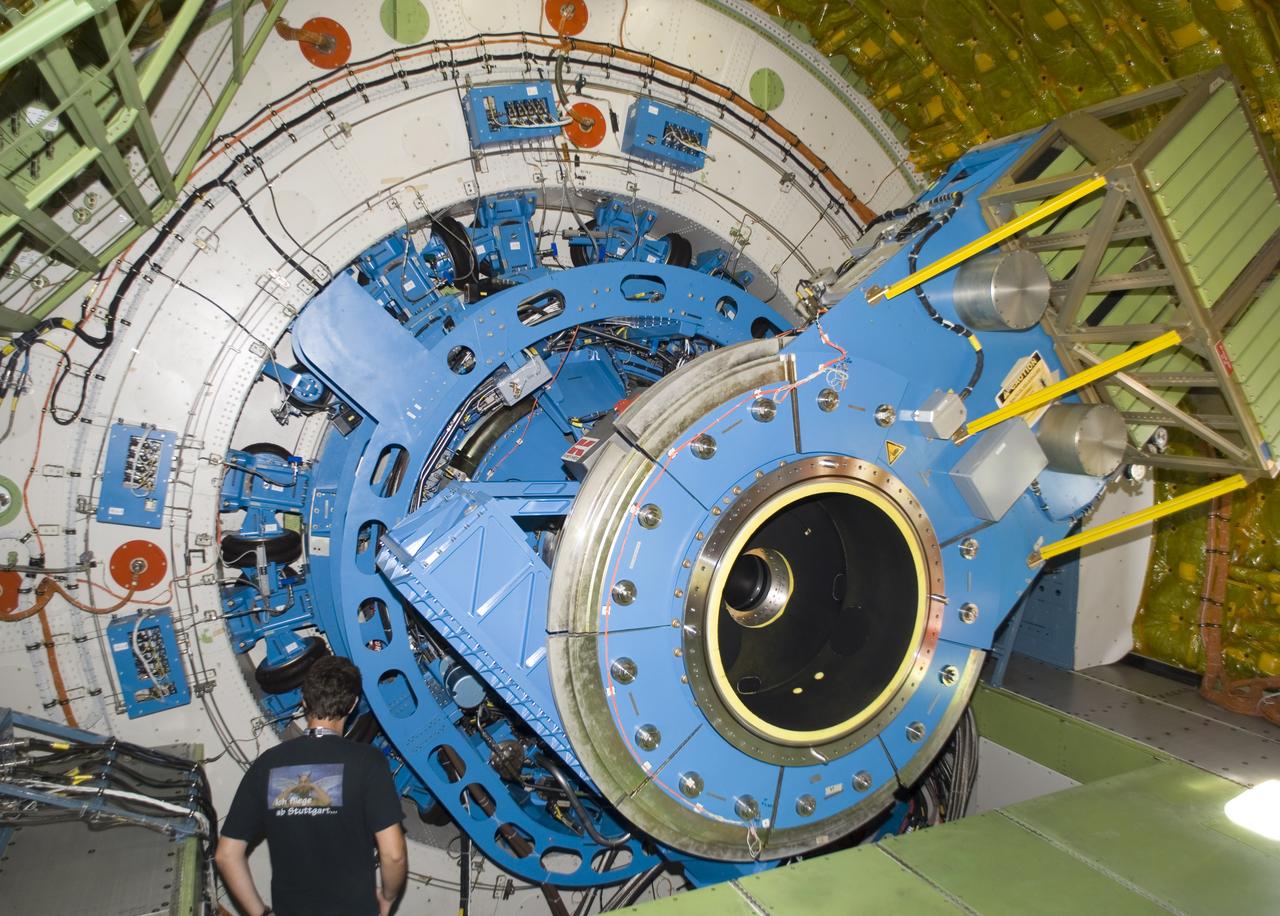
A technician examines the instrument mounting structure and bulkhead of the German-built infrared telescope installed in NASA's SOFIA airborne observatory.

Logos of NASA and the German Aerospace Center (DLR) are displayed prominently on the tail of the Stratospheric Observatory for Infrared Astronomy (SOFIA) 747SP.
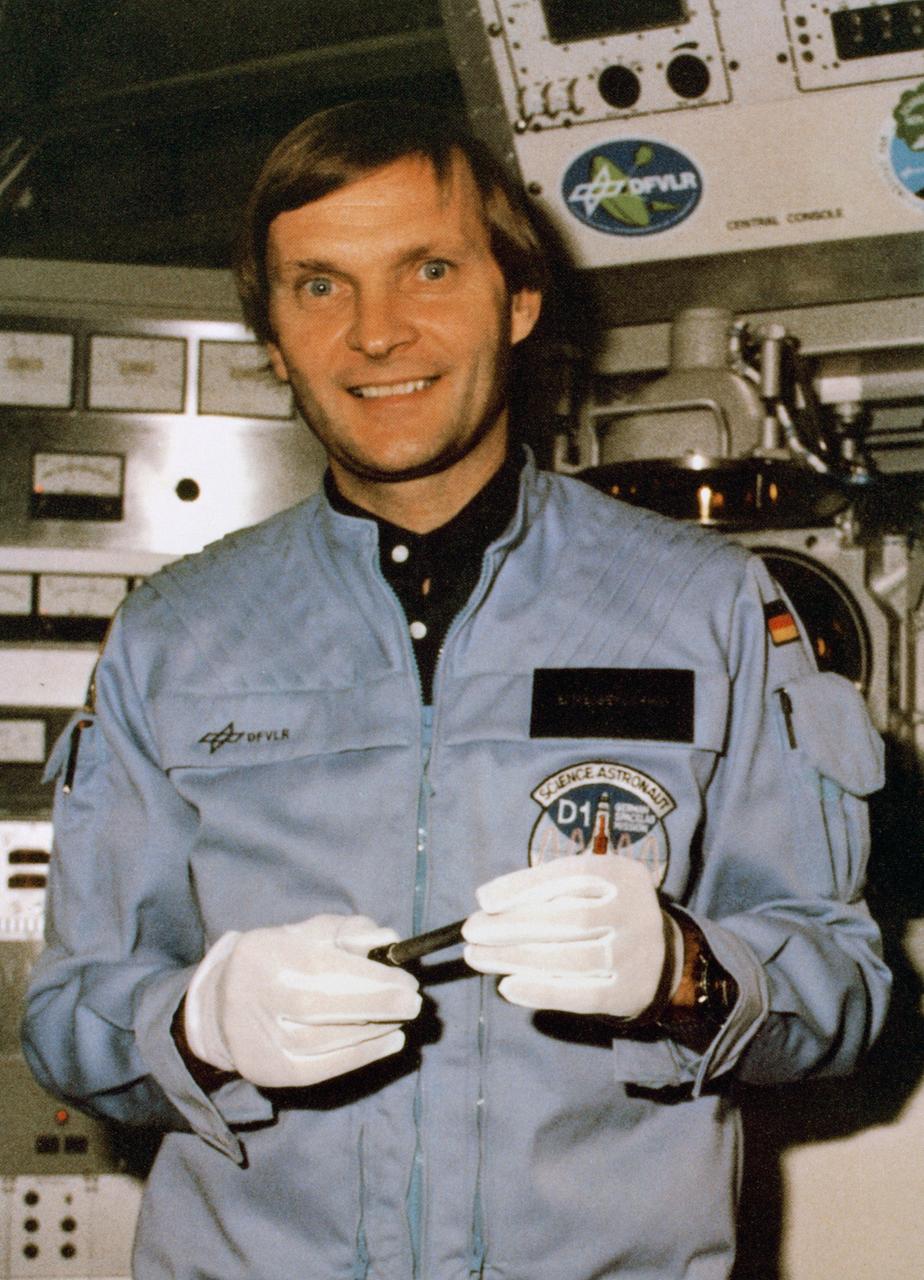
S84-47034 (Nov 1984) --- Astronaut Ernst Messerschmid, payload specialist, D-1 German Spacelab mission.

The German-built 100-inch telescope that is the heart of NASA's Stratospheric Observatory for Infrared Astronomy is nestled in the SOFIA 747's rear fuselage.
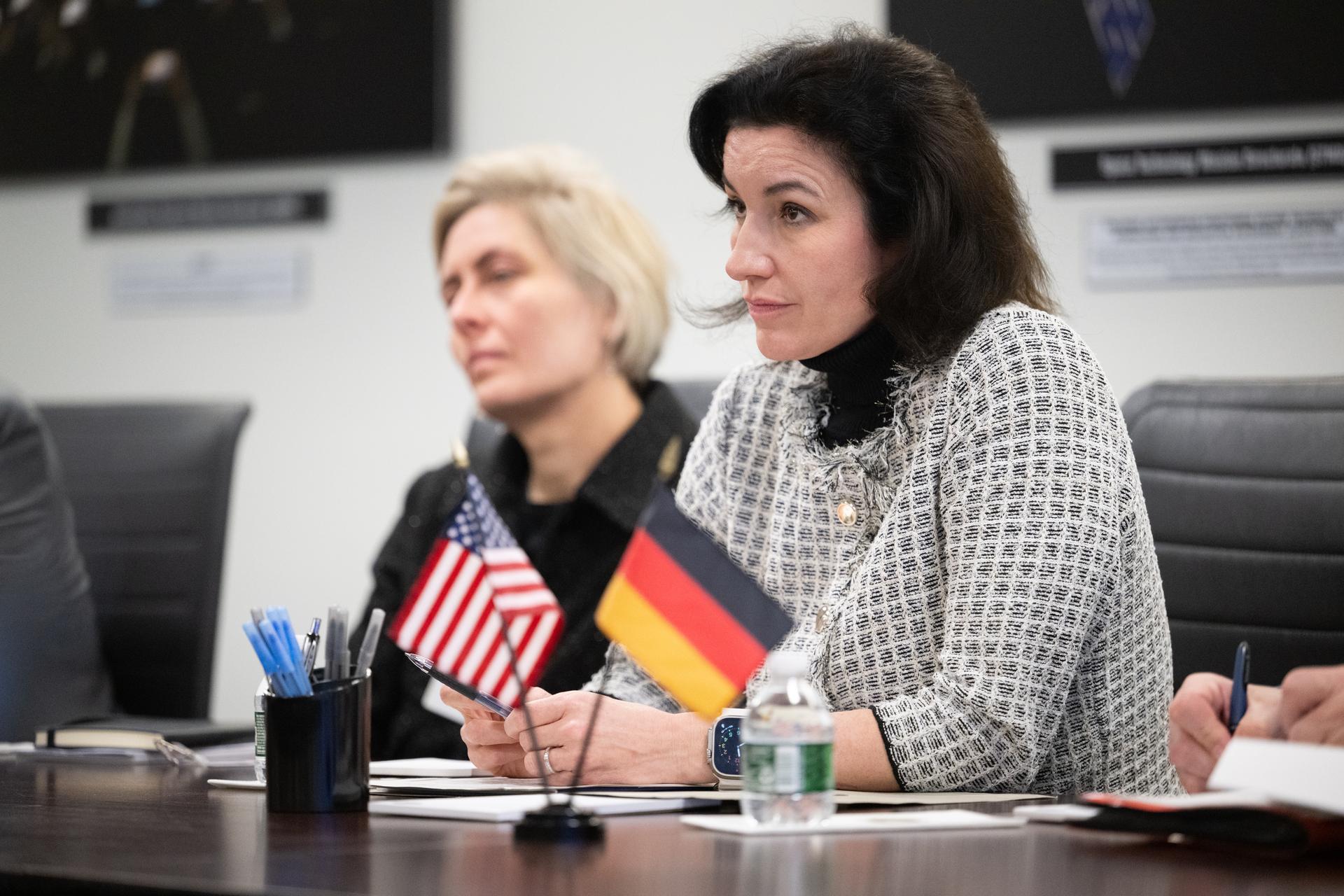
German Minister for Research, Technology, and Space Dorothee Bär is seen during a meeting with NASA leadership, Tuesday, Dec. 9, 2025, at the Mary W. Jackson NASA Headquarters building in Washington. Photo Credit: (NASA/Joel Kowsky)
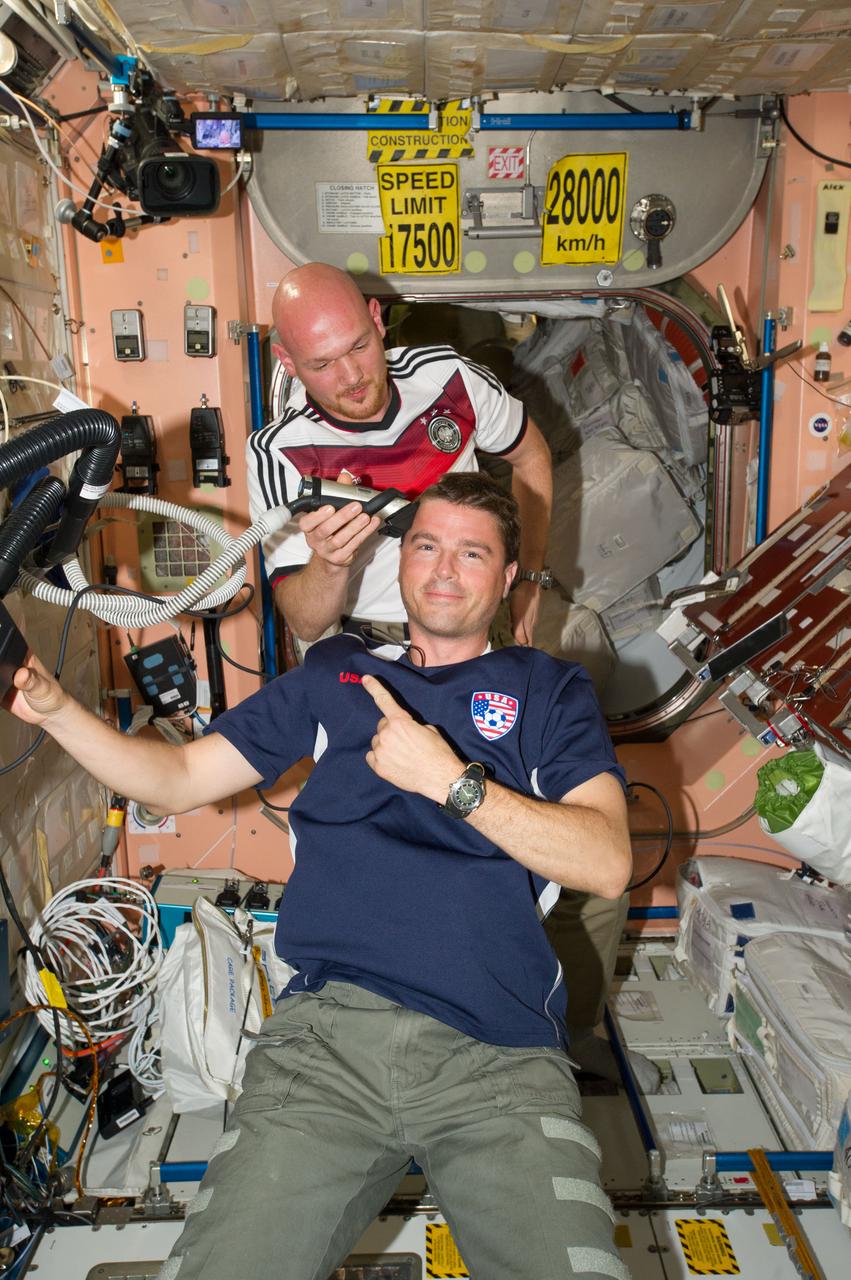
ISS040-E-020378 (26 June 2014) --- European Space Agency astronaut Alexander Gerst, Expedition 40 flight engineer, shaves the head of NASA astronaut Reid Wiseman, flight engineer, in the Unity node of the International Space Station. Gerst used hair clippers fashioned with a vacuum device to garner freshly cut hair. A friendly World Cup Soccer-related agreement between the crew members representing the USA, and Gerst, a German citizen who represents the European Space Agency, called for the American losers of a German-USA match to have their heads shaved. The German team won the match 1-0.
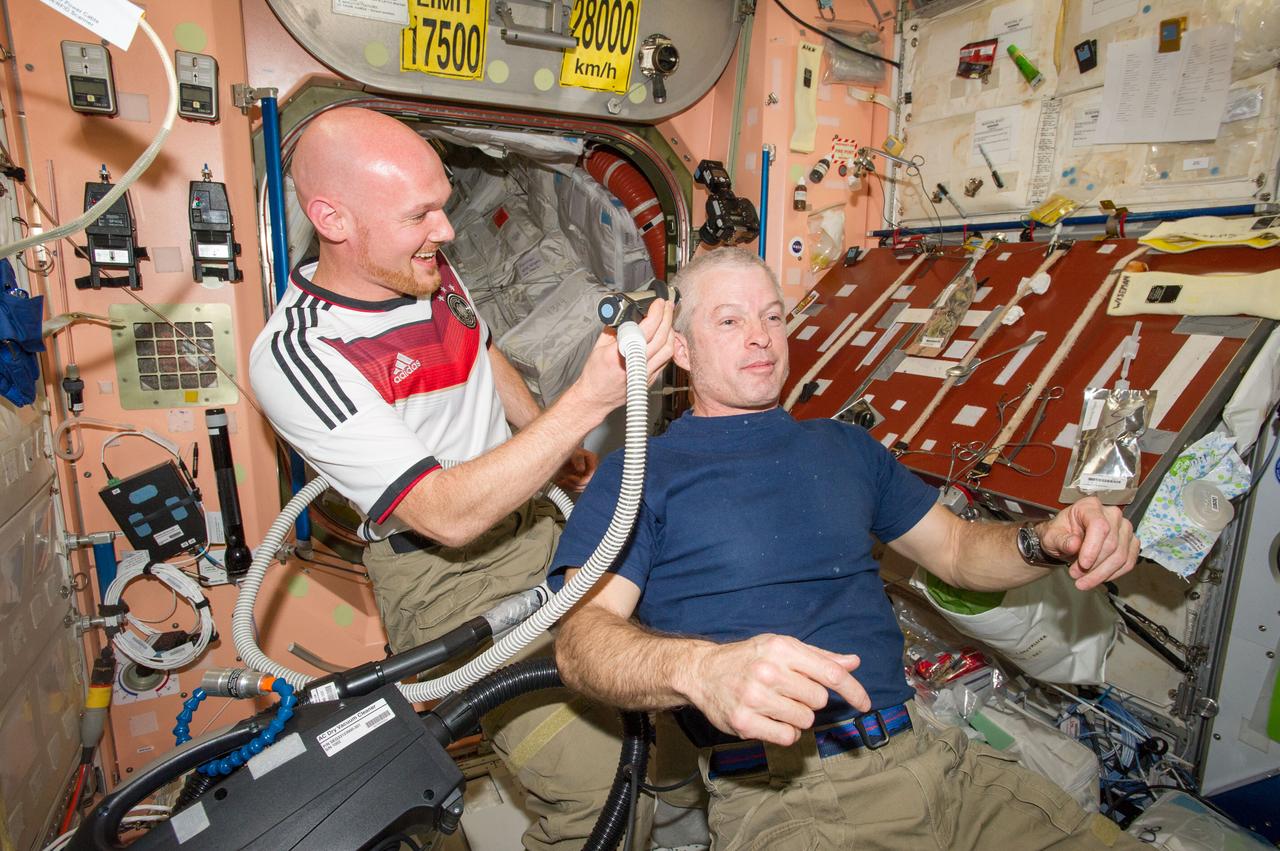
ISS040-E-020364 (26 June 2014) --- European Space Agency astronaut Alexander Gerst, Expedition 40 flight engineer, shaves the head of NASA astronaut Steve Swanson, commander, in the Unity node of the International Space Station. Gerst used hair clippers fashioned with a vacuum device to garner freshly cut hair. A friendly World Cup Soccer-related agreement between the crew members representing the USA, and Gerst, a German citizen who represents the European Space Agency, called for the American losers of a German-USA match to have their heads shaved. The German team won the match 1-0.
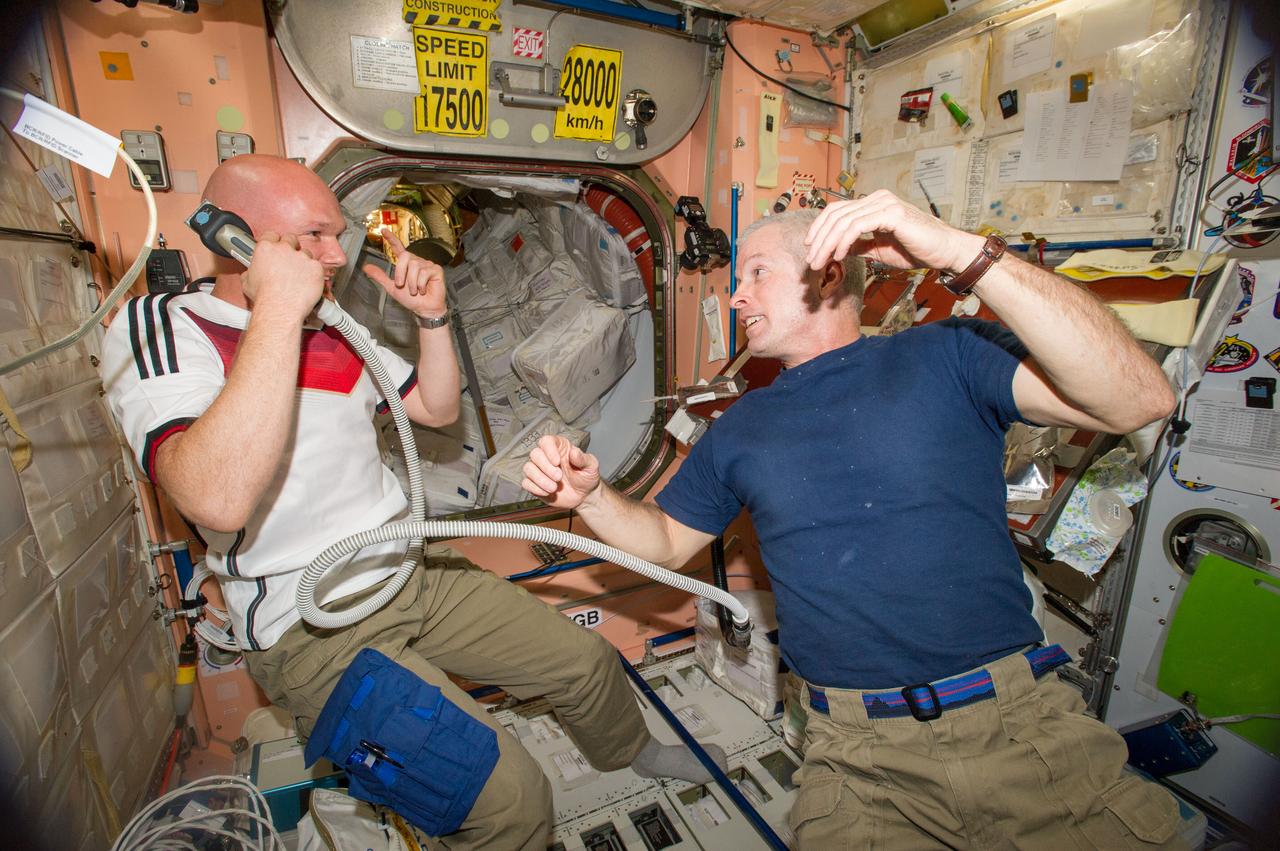
ISS040-E-020361 (26 June 2014) --- NASA astronaut Steve Swanson (right), Expedition 40 commander; and European Space Agency astronaut Alexander Gerst, flight engineer, enjoy a light moment in the Unity node of the International Space Station. Gerst is holding hair clippers fashioned with a vacuum device to garner freshly cut hair. A friendly World Cup Soccer-related agreement between the crew members representing the USA, and Gerst, a German citizen who represents the European Space Agency, called for the American losers of a German-USA match to have their heads shaved. The German team won the match 1-0.
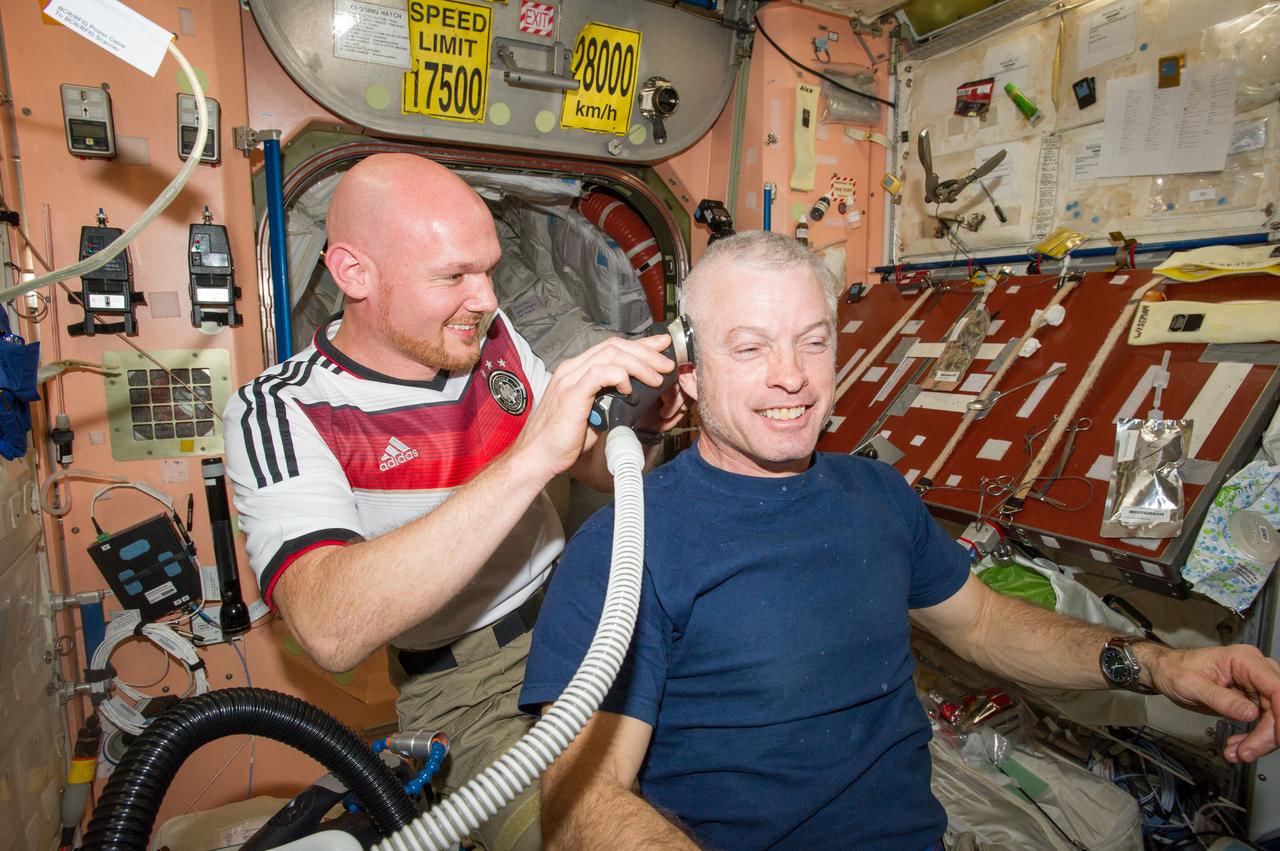
ISS040-E-020368 (26 June 2014) --- European Space Agency astronaut Alexander Gerst, Expedition 40 flight engineer, shaves the head of NASA astronaut Steve Swanson, commander, in the Unity node of the International Space Station. Gerst used hair clippers fashioned with a vacuum device to garner freshly cut hair. A friendly World Cup Soccer-related agreement between the crew members representing the USA, and Gerst, a German citizen who represents the European Space Agency, called for the American losers of a German-USA match to have their heads shaved. The German team won the match 1-0.
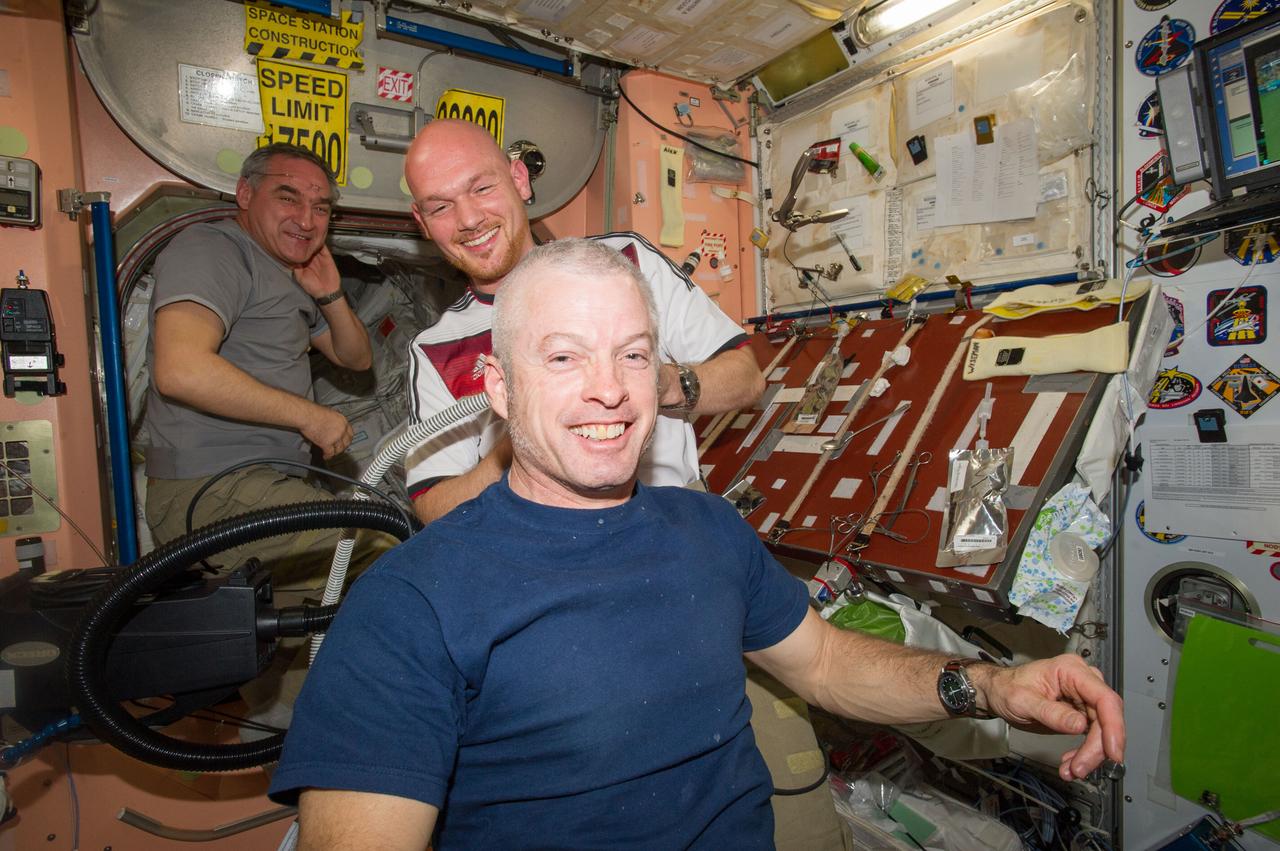
ISS040-E-020367 (26 June 2014) --- European Space Agency astronaut Alexander Gerst, Expedition 40 flight engineer, shaves the head of NASA astronaut Steve Swanson, commander, in the Unity node of the International Space Station. Gerst used hair clippers fashioned with a vacuum device to garner freshly cut hair. Russian cosmonaut Alexander Skvortsov, flight engineer, is visible in the background. A friendly World Cup Soccer-related agreement between the crew members representing the USA, and Gerst, a German citizen who represents the European Space Agency, called for the American losers of a German-USA match to have their heads shaved. The German team won the match 1-0.
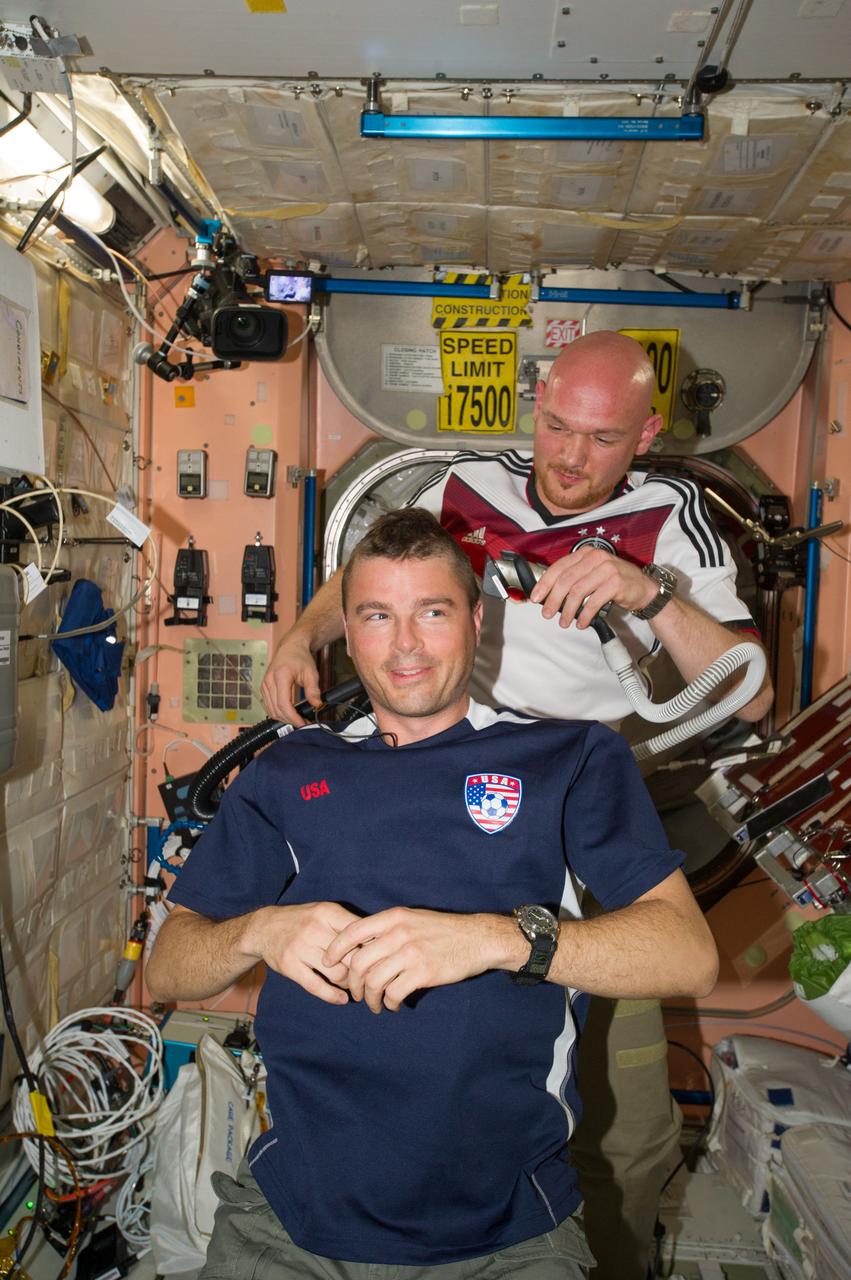
ISS040-E-020384 (26 June 2014) --- European Space Agency astronaut Alexander Gerst, Expedition 40 flight engineer, shaves the head of NASA astronaut Reid Wiseman, flight engineer, in the Unity node of the International Space Station. Gerst used hair clippers fashioned with a vacuum device to garner freshly cut hair. A friendly World Cup Soccer-related agreement between the crew members representing the USA, and Gerst, a German citizen who represents the European Space Agency, called for the American losers of a German-USA match to have their heads shaved. The German team won the match 1-0.
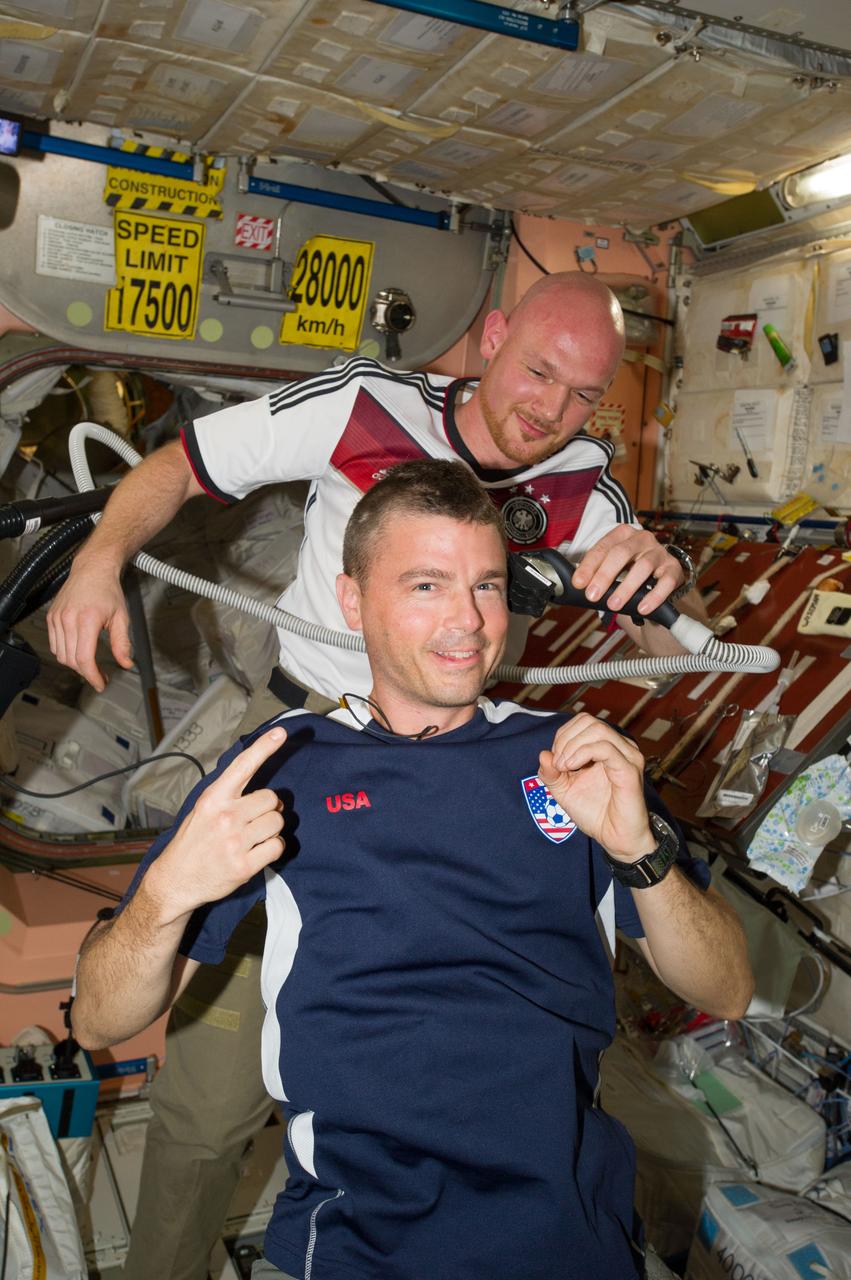
ISS040-E-020383 (26 June 2014) --- European Space Agency astronaut Alexander Gerst, Expedition 40 flight engineer, shaves the head of NASA astronaut Reid Wiseman, flight engineer, in the Unity node of the International Space Station. Gerst used hair clippers fashioned with a vacuum device to garner freshly cut hair. A friendly World Cup Soccer-related agreement between the crew members representing the USA, and Gerst, a German citizen who represents the European Space Agency, called for the American losers of a German-USA match to have their heads shaved. The German team won the match 1-0.
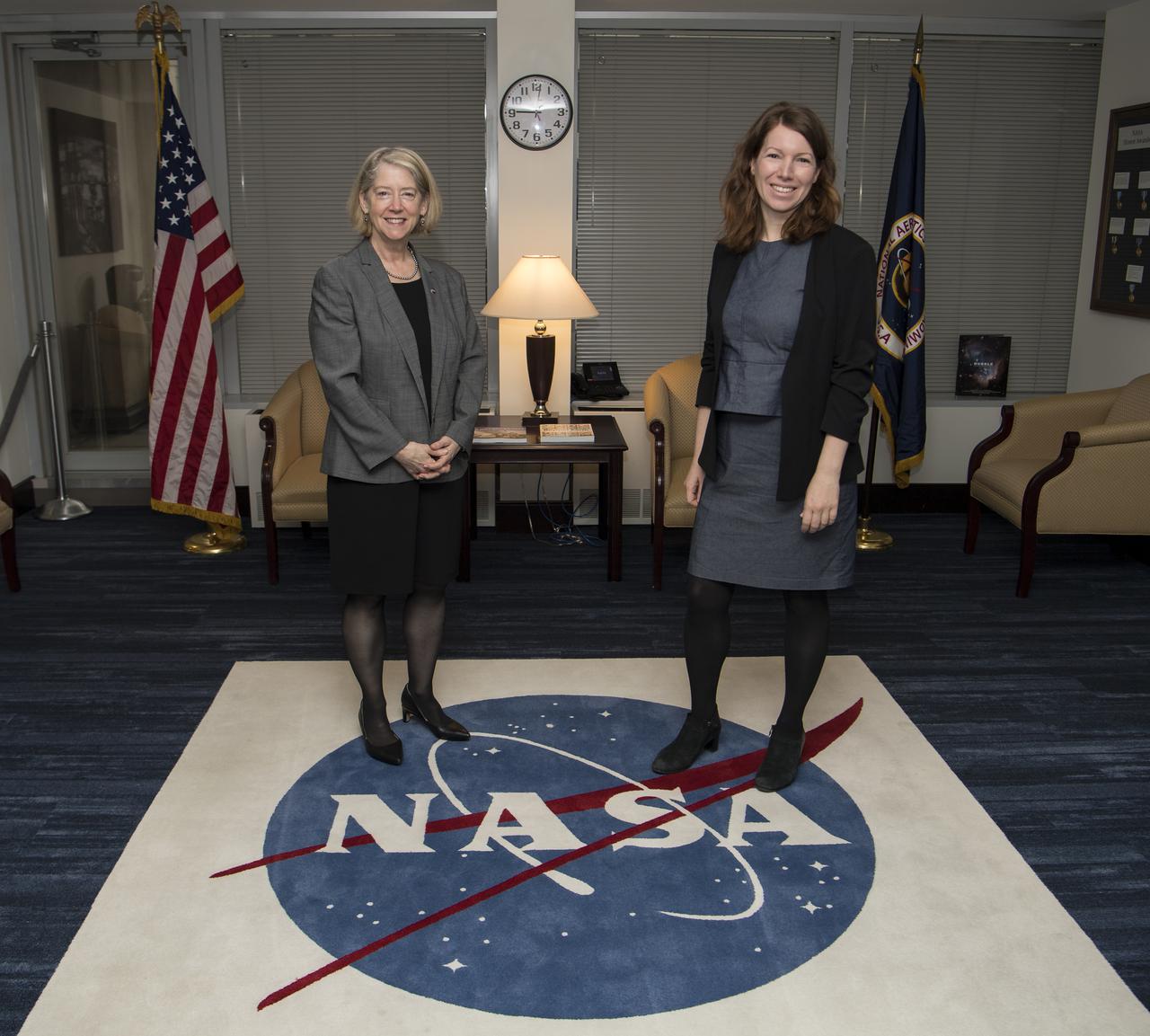
NASA Deputy Administrator, Pam Melroy, left, poses for a photo with the Federal Government Coordinator of German Aerospace Policy, Dr. Anna Christmann, Thursday, March 31, 2022, at NASA Headquarters in Washington DC. Photo Credit: (NASA/Aubrey Gemignani)
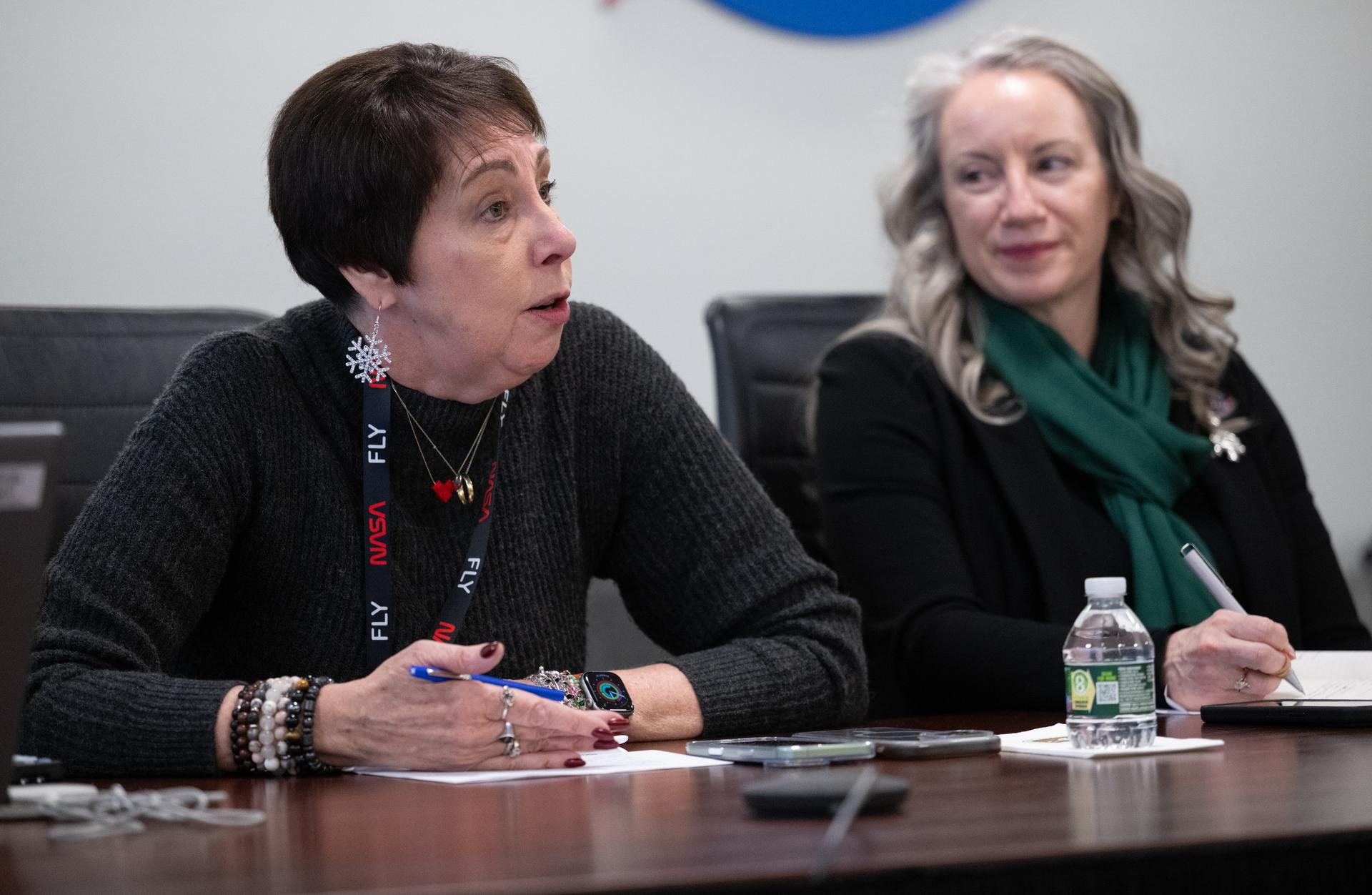
Nicola Fox, associate administrator for NASA’s Science Mission Directorate, is seen during a meeting with German Minister for Research, Technology, and Space Dorothee Bär, Tuesday, Dec. 9, 2025, at the Mary W. Jackson NASA Headquarters building in Washington. Photo Credit: (NASA/Joel Kowsky)
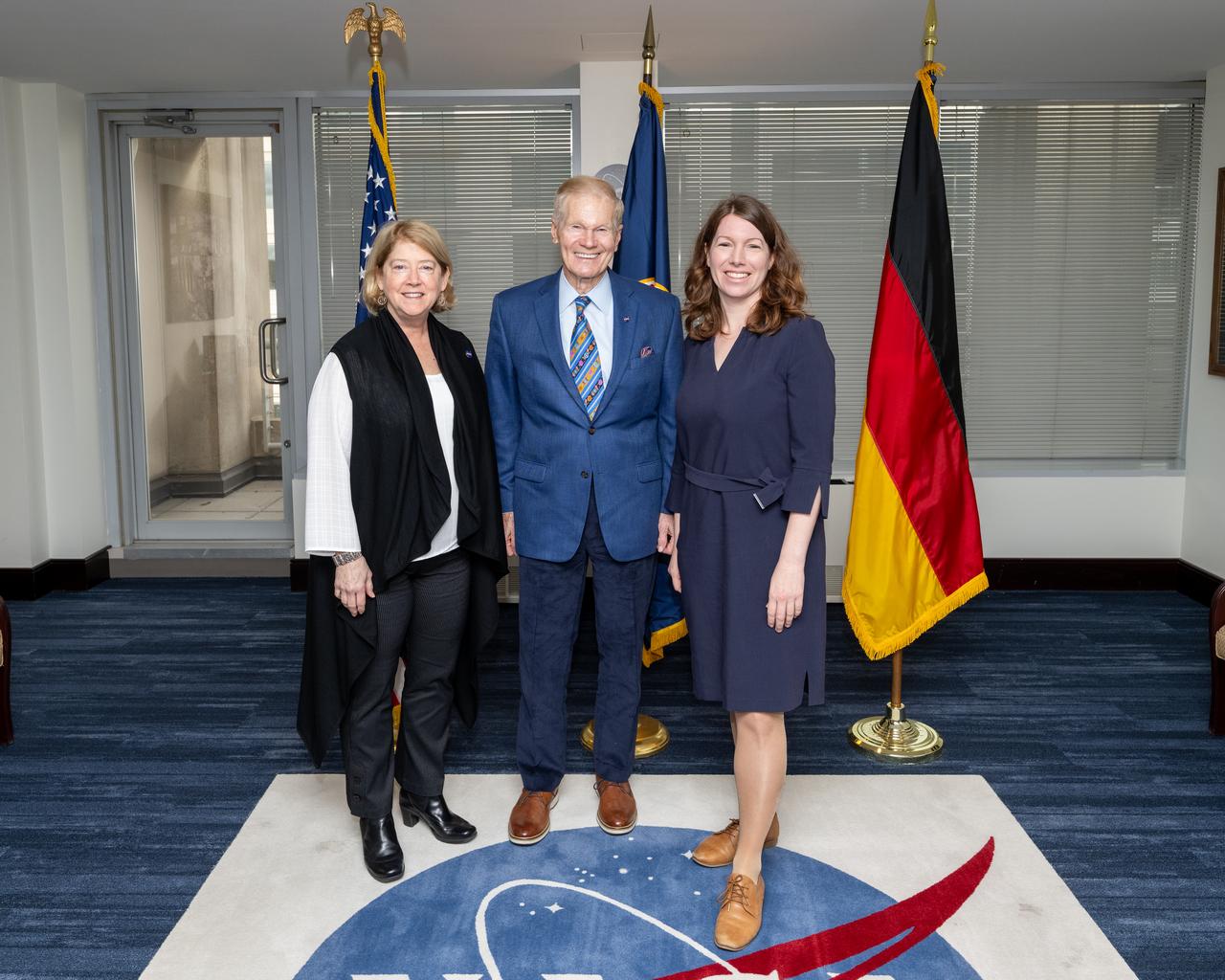
From left to right, NASA Deputy Administrator Pam Melroy, NASA Administrator Bill Nelson, and Federal Government Coordinator of German Aerospace Policy Dr. Anna Christmann pose for a photo, Thursday, March 7, 2024, at the Mary W. Jackson NASA Headquarters building in Washington. Photo Credit: (NASA/Keegan Barber)

NASA Associate Administrator Amit Kshatriya is seen during a meeting with German Minister for Research, Technology, and Space Dorothee Bär, Tuesday, Dec. 9, 2025, at the Mary W. Jackson NASA Headquarters building in Washington. Photo Credit: (NASA/Joel Kowsky)

NASA Deputy Administrator Pam Melroy, right, speaks during a meeting with Federal Government Coordinator of German Aerospace Policy Dr. Anna Christmann, left, Thursday, March 7, 2024, at the Mary W. Jackson NASA Headquarters building in Washington. Photo Credit: (NASA/Keegan Barber)
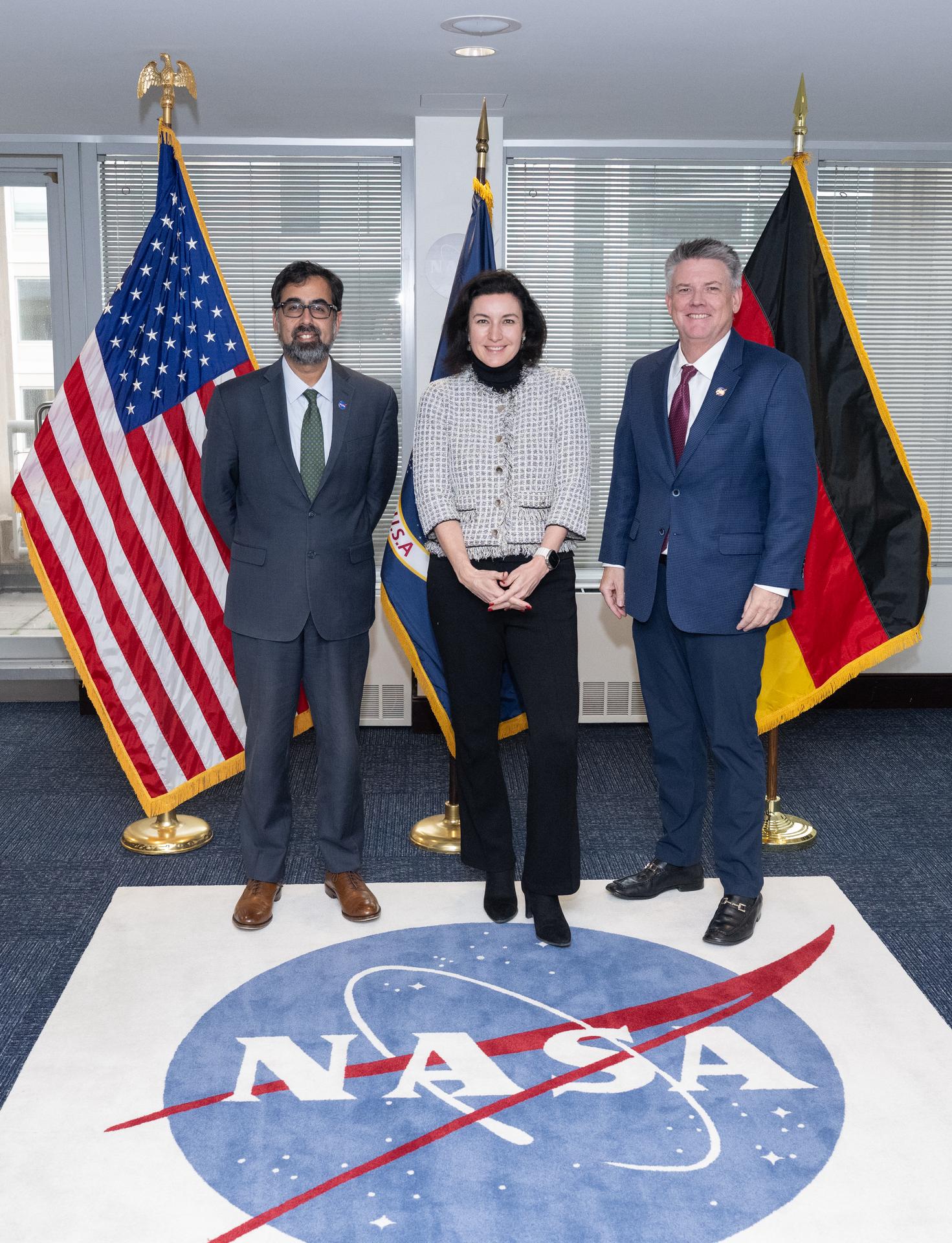
NASA Associate Administrator Amit Kshatriya, left, German Minister for Research, Technology, and Space Dorothee Bär, center, and NASA Chief off Staff Brian Hughes, pose for a picture, Tuesday, Dec. 9, 2025, before a meeting at the Mary W. Jackson NASA Headquarters building in Washington. Photo Credit: (NASA/Joel Kowsky)
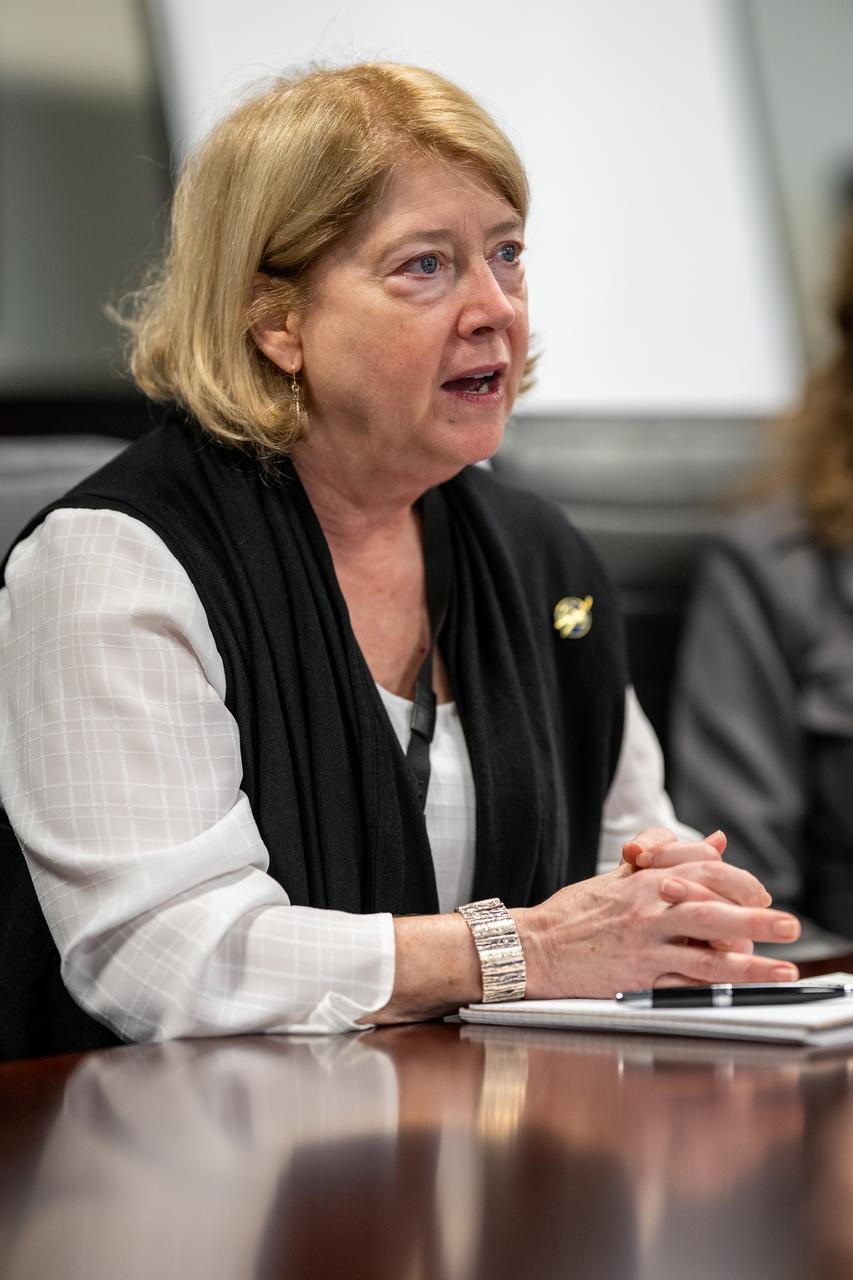
NASA Deputy Administrator Pam Melroy speaks during a meeting with Federal Government Coordinator of German Aerospace Policy Dr. Anna Christmann, Thursday, March 7, 2024, at the Mary W. Jackson NASA Headquarters building in Washington. Photo Credit: (NASA/Keegan Barber)
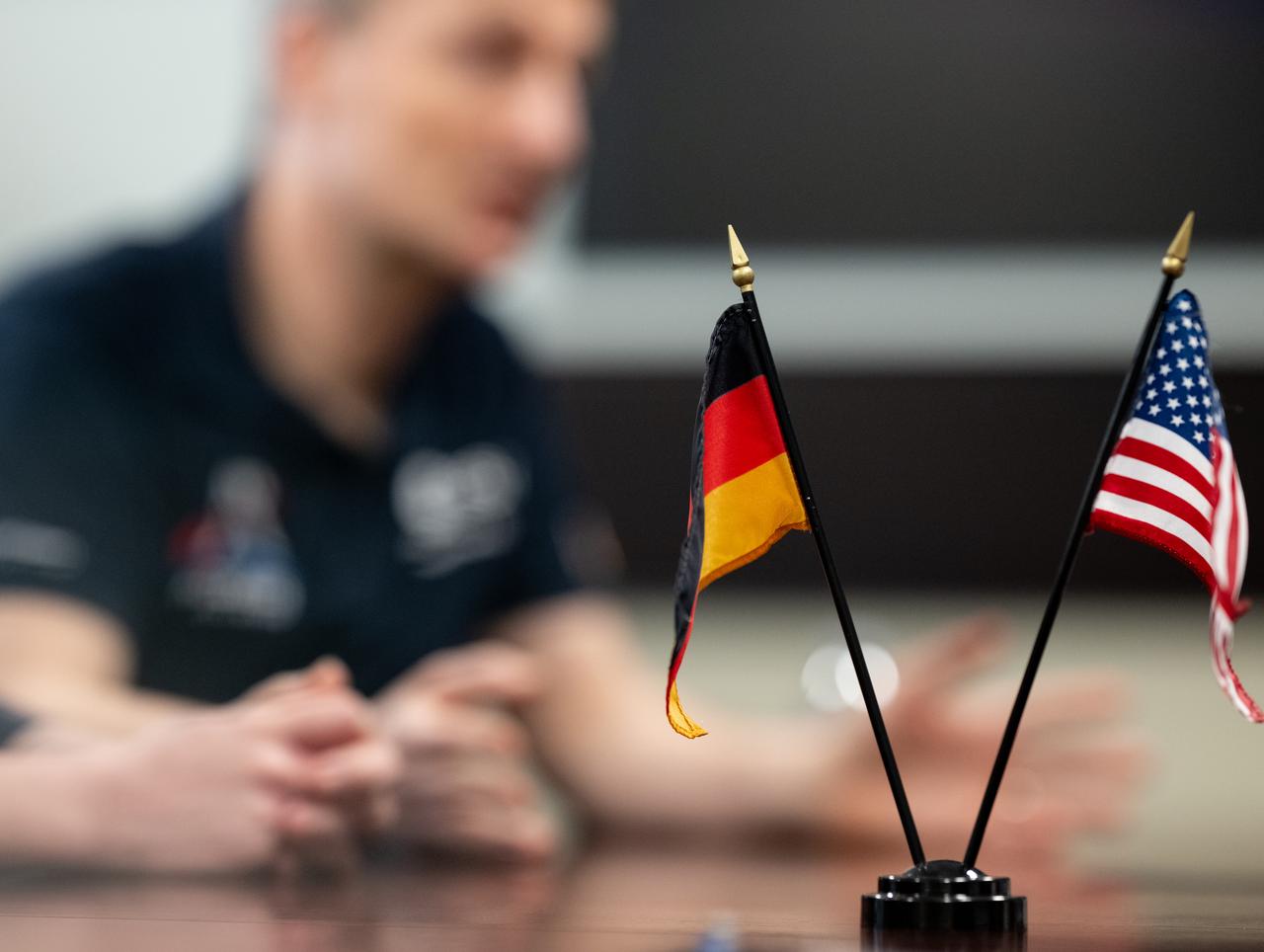
Flags of Germany and the United States are seen during a meeting with NASA Deputy Administrator Pam Melroy and Federal Government Coordinator of German Aerospace Policy Dr. Anna Christmann, Thursday, March 7, 2024, at the Mary W. Jackson NASA Headquarters building in Washington. Photo Credit: (NASA/Keegan Barber)
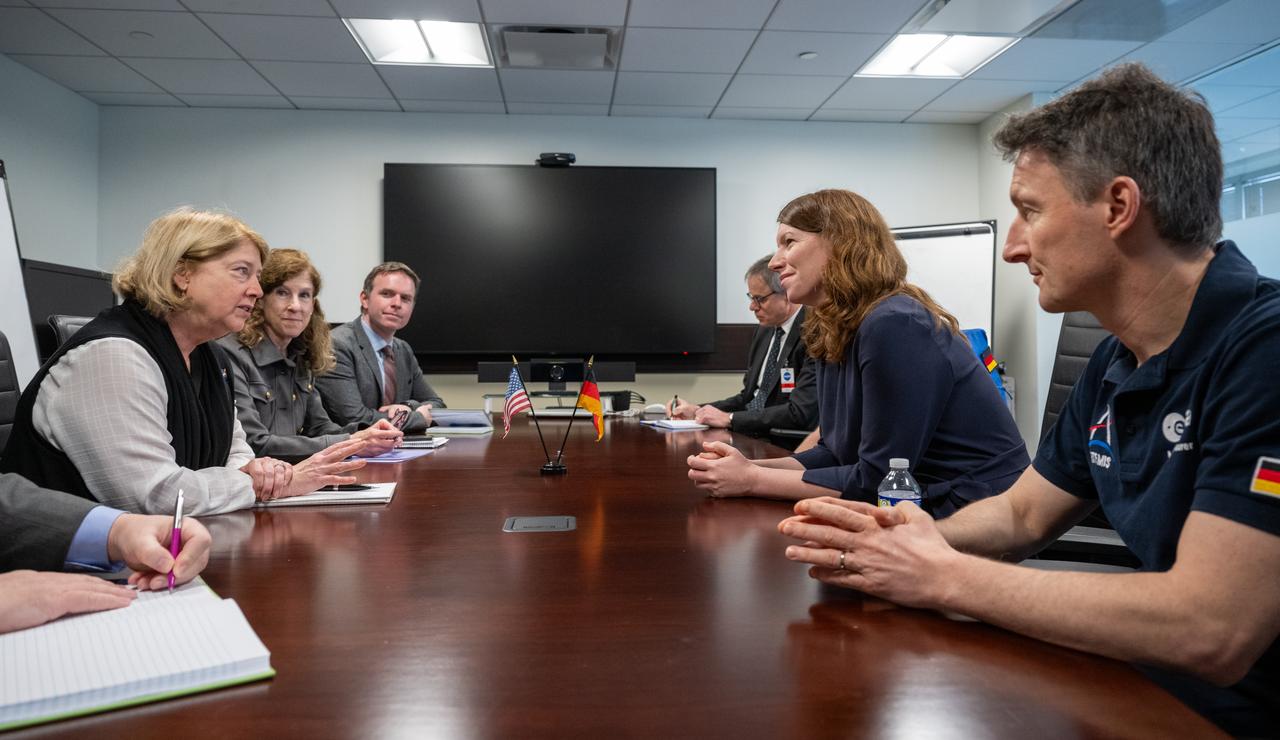
NASA Deputy Administrator Pam Melroy, left, speaks during a meeting with Federal Government Coordinator of German Aerospace Policy Dr. Anna Christmann, second from right, Thursday, March 7, 2024, at the Mary W. Jackson NASA Headquarters building in Washington. Photo Credit: (NASA/Keegan Barber)

NASA Deputy Administrator Pam Melroy, left, shakes hands with Federal Government Coordinator of German Aerospace Policy Dr. Anna Christmann, right, Thursday, March 7, 2024, at the Mary W. Jackson NASA Headquarters building in Washington. Photo Credit: (NASA/Keegan Barber)
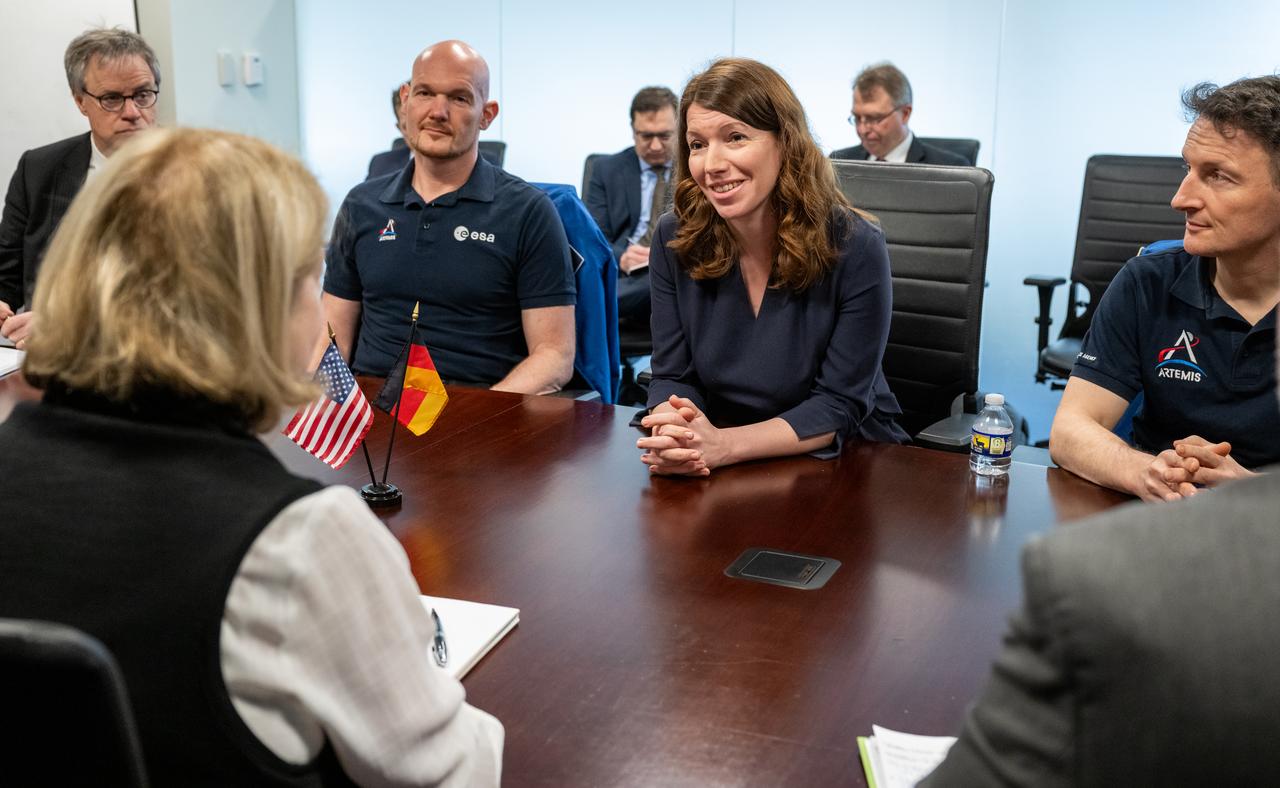
Federal Government Coordinator of German Aerospace Policy Dr. Anna Christmann, center, speaks during a meeting with NASA Deputy Administrator Pam Melroy, left, Thursday, March 7, 2024, at the Mary W. Jackson NASA Headquarters building in Washington. Photo Credit: (NASA/Keegan Barber)
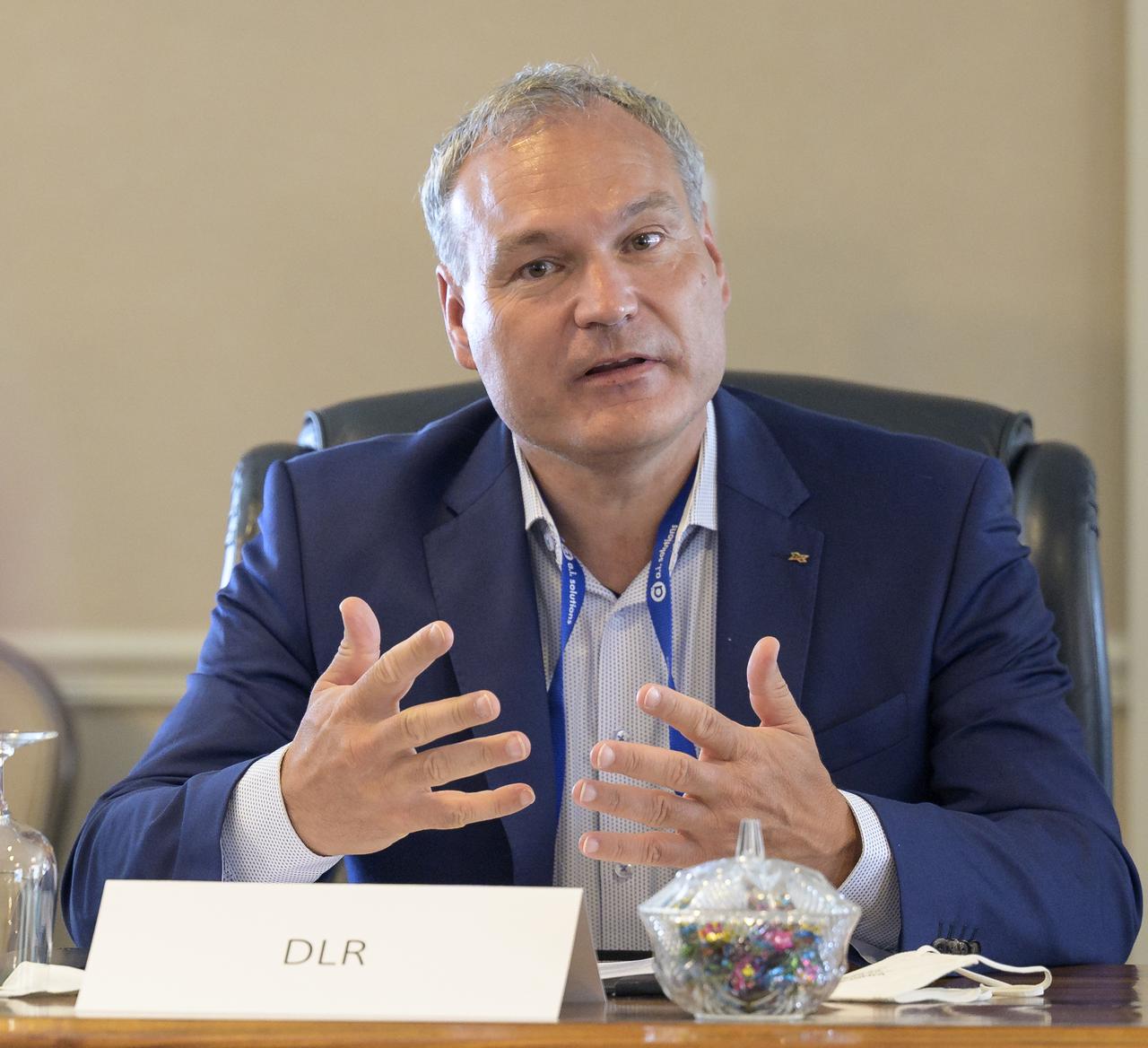
Dr. Walther Pelzer, Member of the German Aerospace Center (DLR) Executive Board, Head of the German Space Agency at DLR speaks in a bilateral meeting with NASA during the 36th Space Symposium, Monday, Aug. 23, 2021, in Colorado Springs, Colorado. Photo Credit: (NASA/Bill Ingalls)
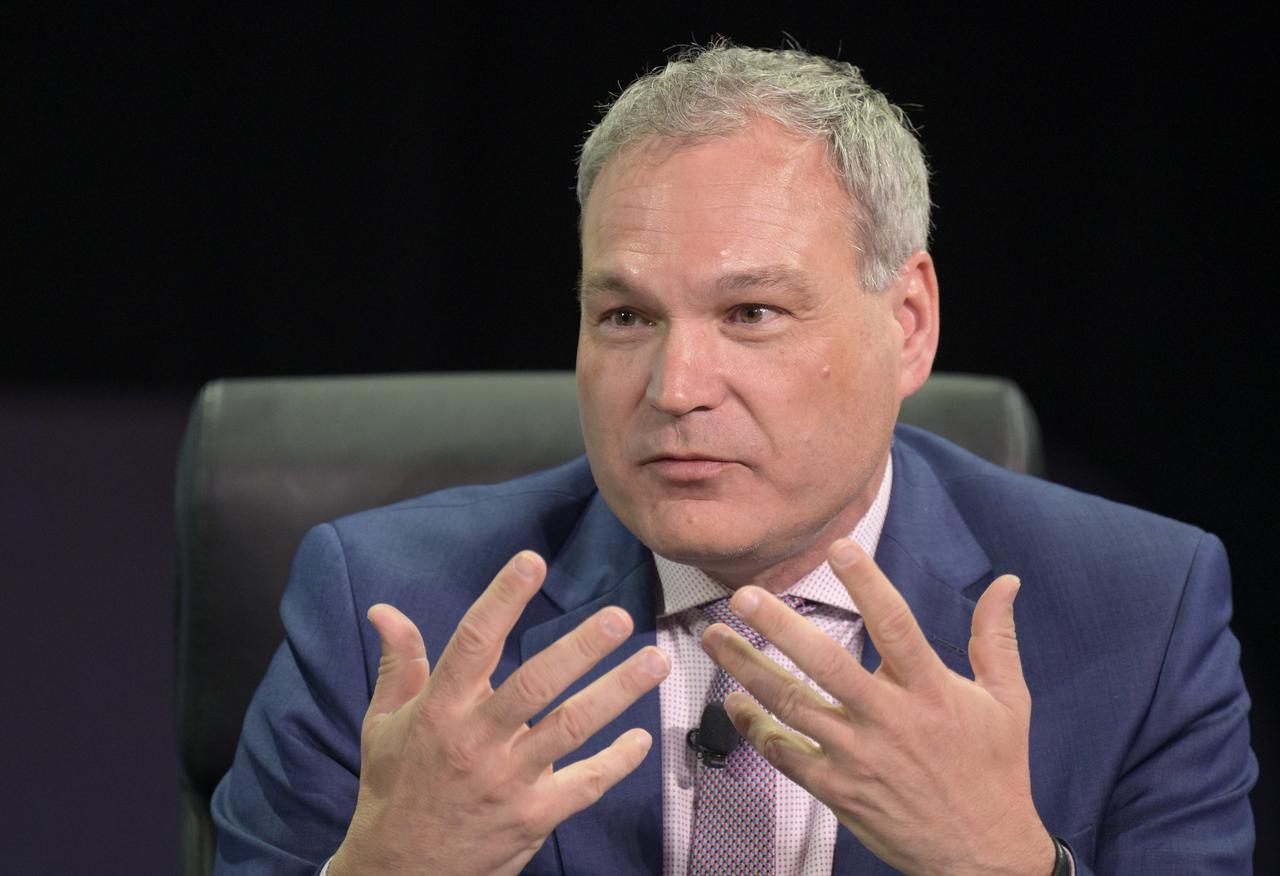
Dr. Walther Pelzer, Executive Board Member and Head of the German Space Agency at the German Aerospace Center (DLR) speaks in a Heads of Agency panel during the 37th Space Symposium, Wednesday, April 6, 2022, in Colorado Springs, Colorado. Photo Credit: (NASA/Bill Ingalls)

Dr. Walther Pelzer, Head of the German Space Agency, German Aerospace Center (DLR) gives remarks in a Heads of Agency panel discussion, during the 36th Space Symposium, Wednesday, Aug. 25, 2021, in Colorado Springs, Colorado. Photo Credit: (NASA/Bill Ingalls)
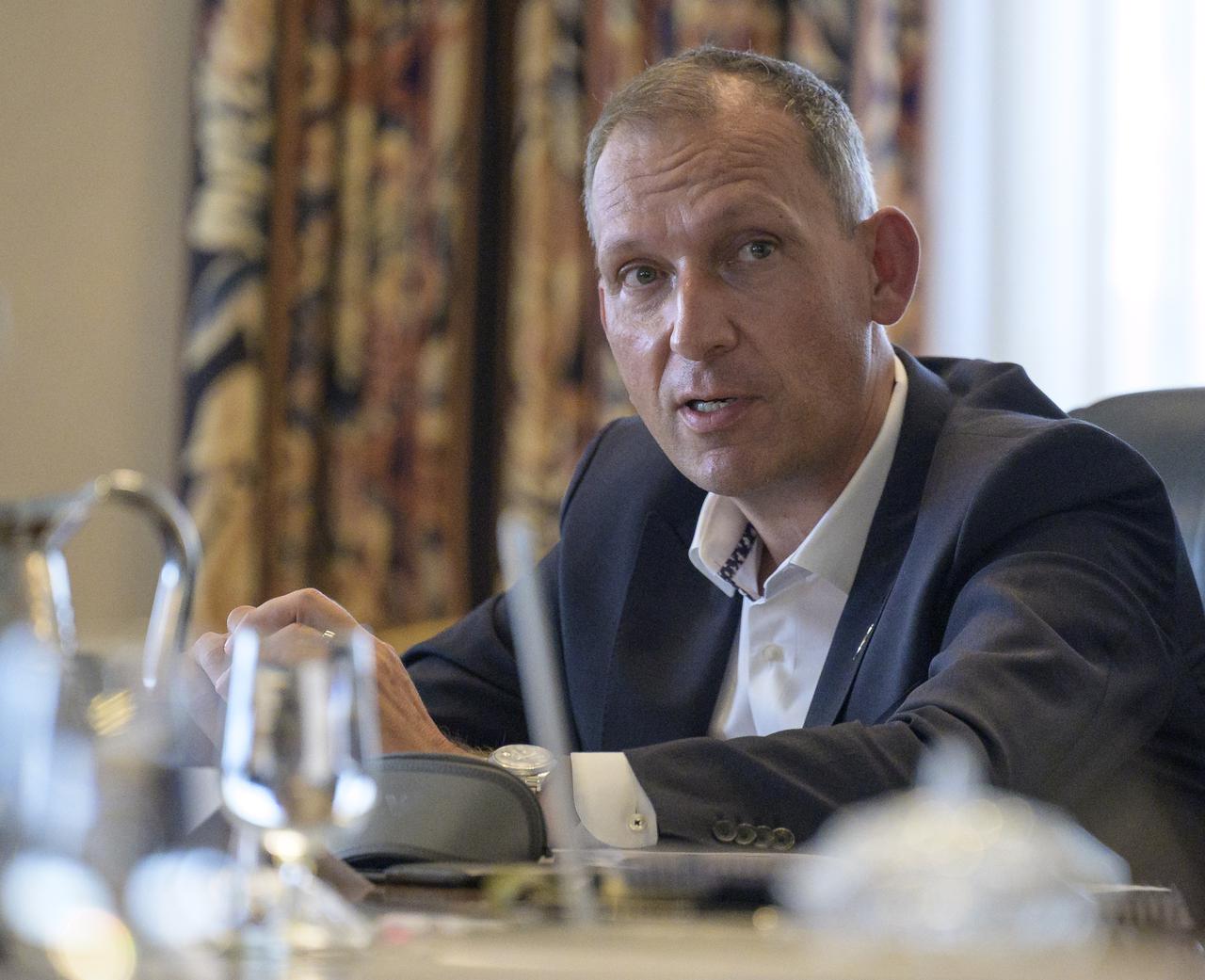
NASA Associate Administrator for Science Thomas Zurbuchenlistens during a bilateral meeting with Dr. Walther Pelzer, Member of the German Aerospace Center (DLR) Executive Board, Head of the German Space Agency at DLR, Monday, Aug. 23, 2021, during the 36th Space Symposium in Colorado Springs, Colorado. Photo Credit: (NASA/Bill Ingalls)
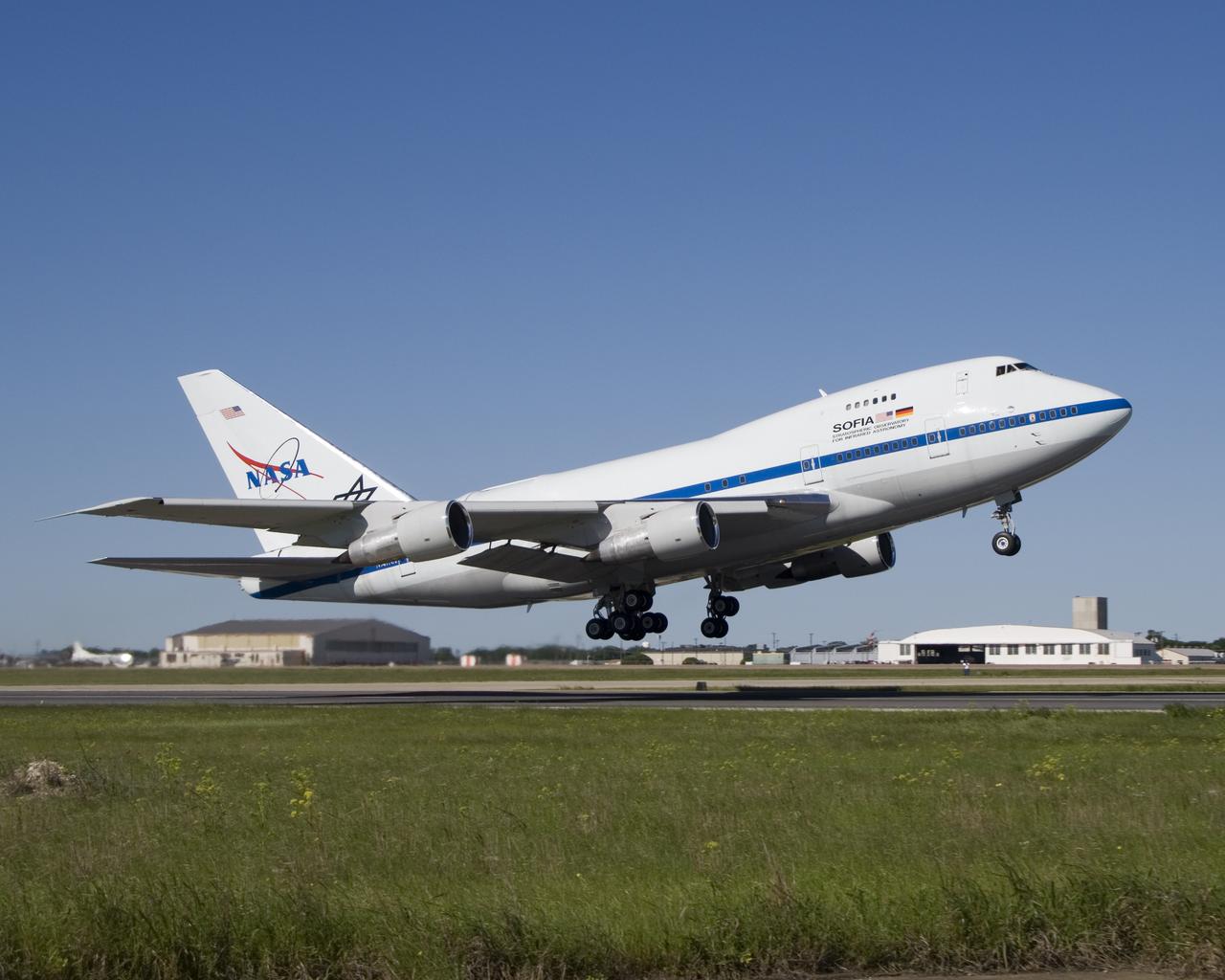
The NASA and German Aerospace Center SOFIA airborne infrared observatory took flight for the first time April 26, 2007, from its modification center in Waco, Texas.
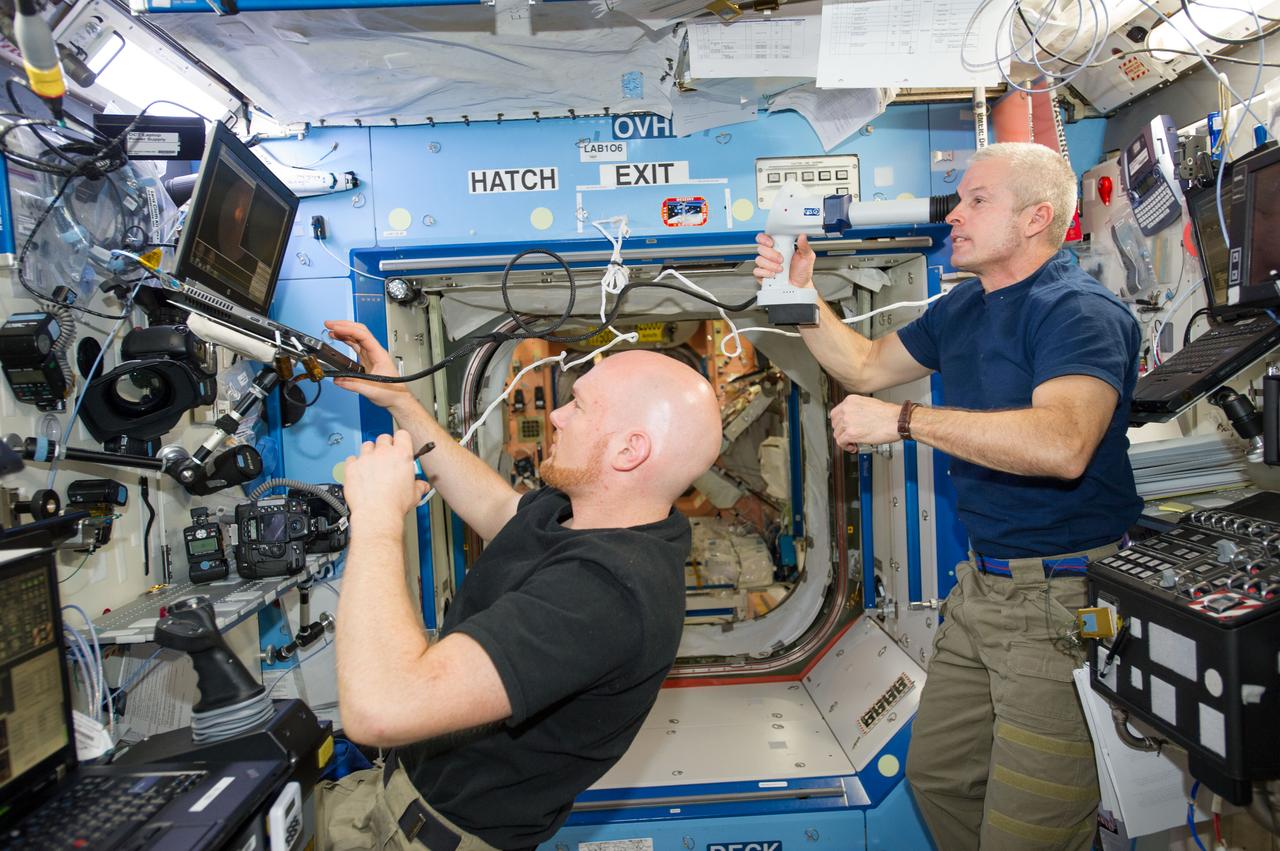
European Space Agency astronaut Alexander Gerst, Expedition 40 flight engineer, and NASA astronaut Steve Swanson, commander, gather around a computer in the Unity node of the International Space Station after the German-USA soccer match.

NASA Administrator Bill Nelson meets with Dr. Walther Pelzer, Member of the German Aerospace Center (DLR) Executive Board, Head of the German Space Agency at DLR in a bilateral meeting during the 36th Space Symposium, Monday, Aug. 23, 2021, in Colorado Springs, Colorado. Photo Credit: (NASA/Bill Ingalls)
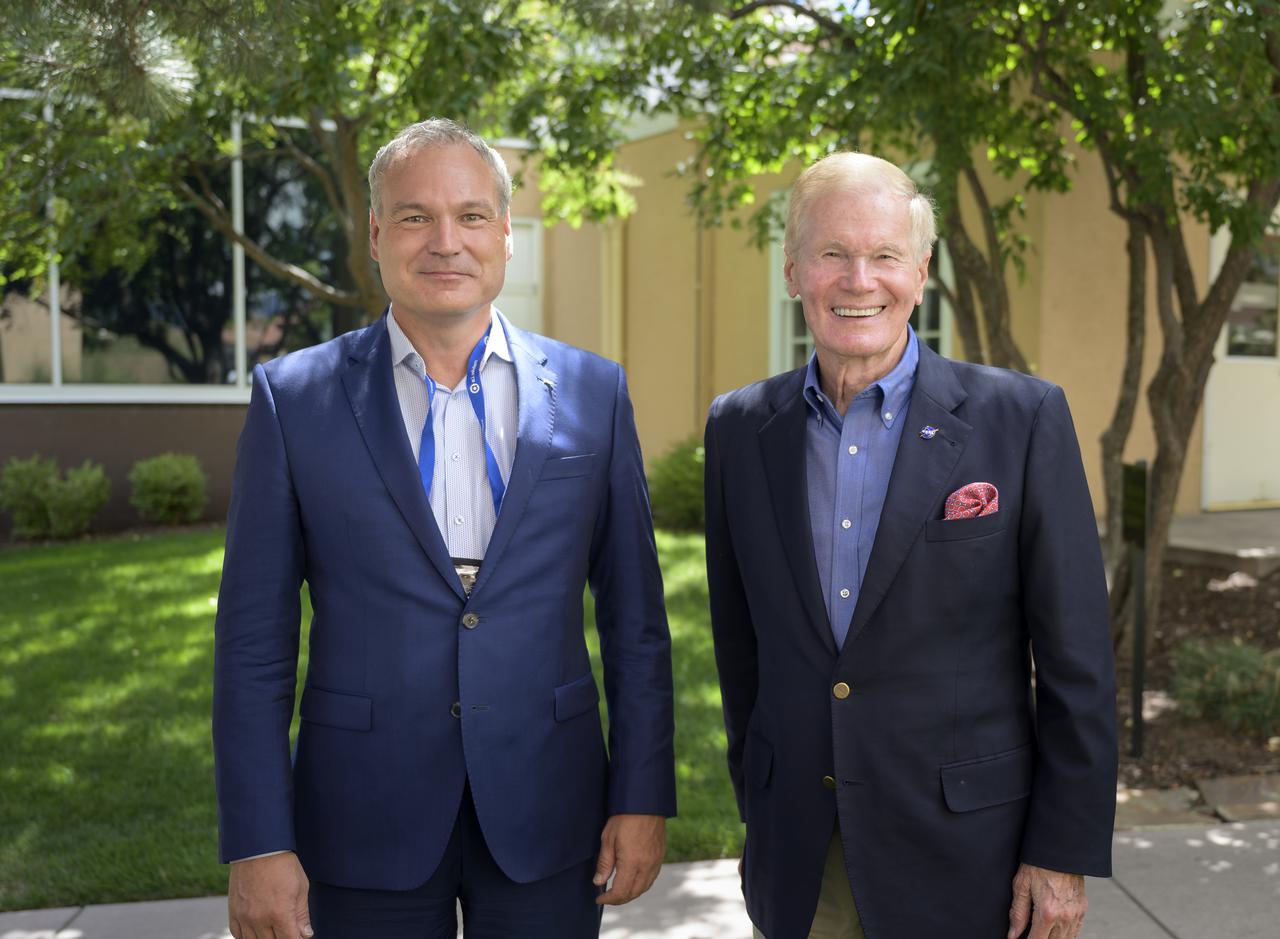
NASA Administrator Bill Nelson, right, meets with Dr. Walther Pelzer, Member of the German Aerospace Center (DLR) Executive Board, Head of the German Space Agency at DLR in a bilateral meeting during the 36th Space Symposium, Monday, Aug. 23, 2021, in Colorado Springs, Colorado. Photo Credit: (NASA/Bill Ingalls)
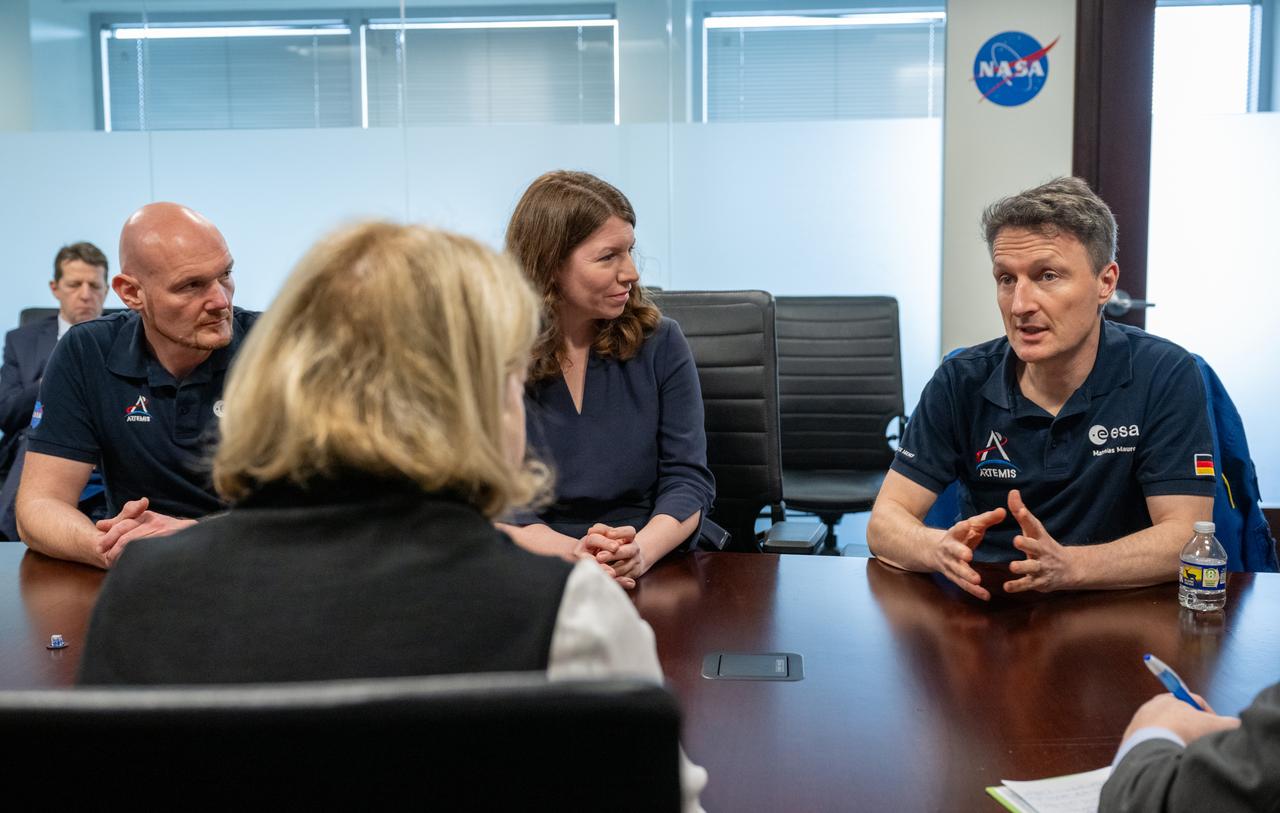
ESA astronaut Matthias Maurer, right, speaks during a meeting with NASA Deputy Administrator Pam Melroy, second from left, and Federal Government Coordinator of German Aerospace Policy Dr. Anna Christmann, second from right, Thursday, March 7, 2024, at the Mary W. Jackson NASA Headquarters building in Washington. Photo Credit: (NASA/Keegan Barber)
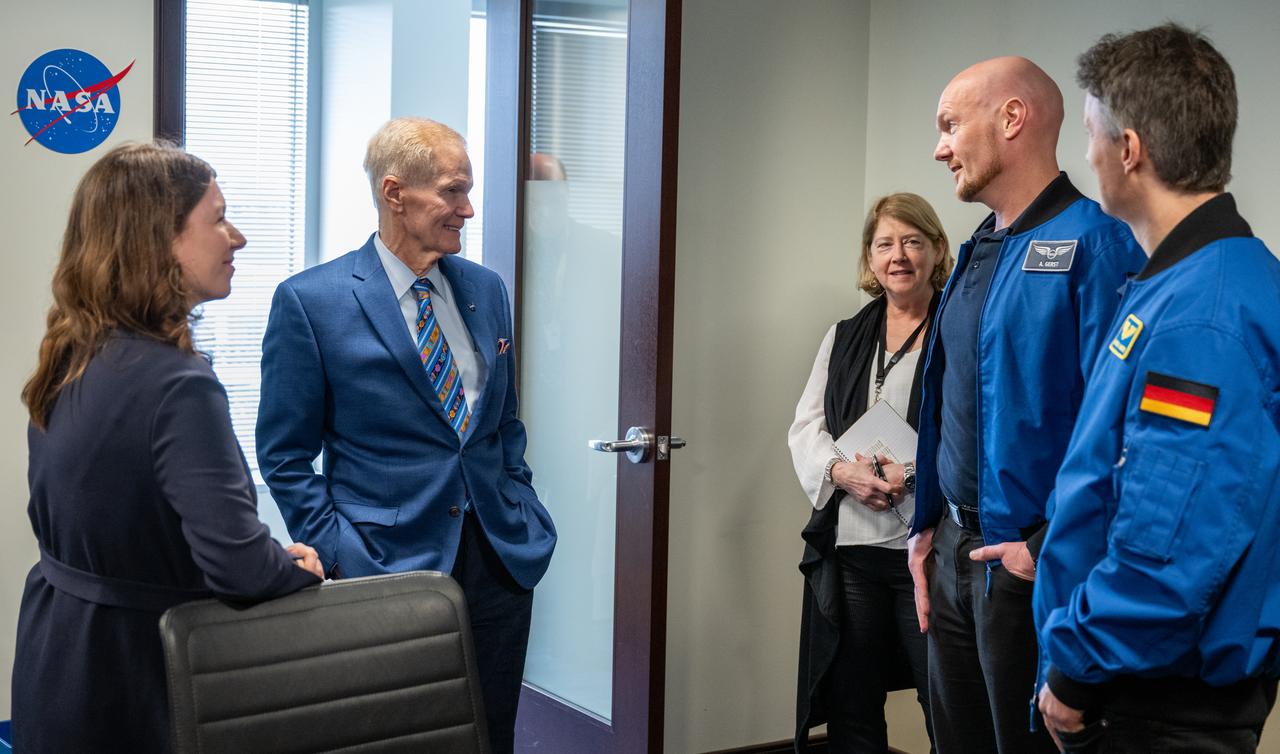
From left to right, Federal Government Coordinator of German Aerospace Policy Dr. Anna Christmann, NASA Administrator Bill Nelson, NASA Deputy Administrator Pam Melroy, ESA astronaut Alexander Gerst, and ESA astronaut Matthias Maurer are seen prior to a meeting, Thursday, March 7, 2024, at the Mary W. Jackson NASA Headquarters building in Washington. Photo Credit: (NASA/Keegan Barber)
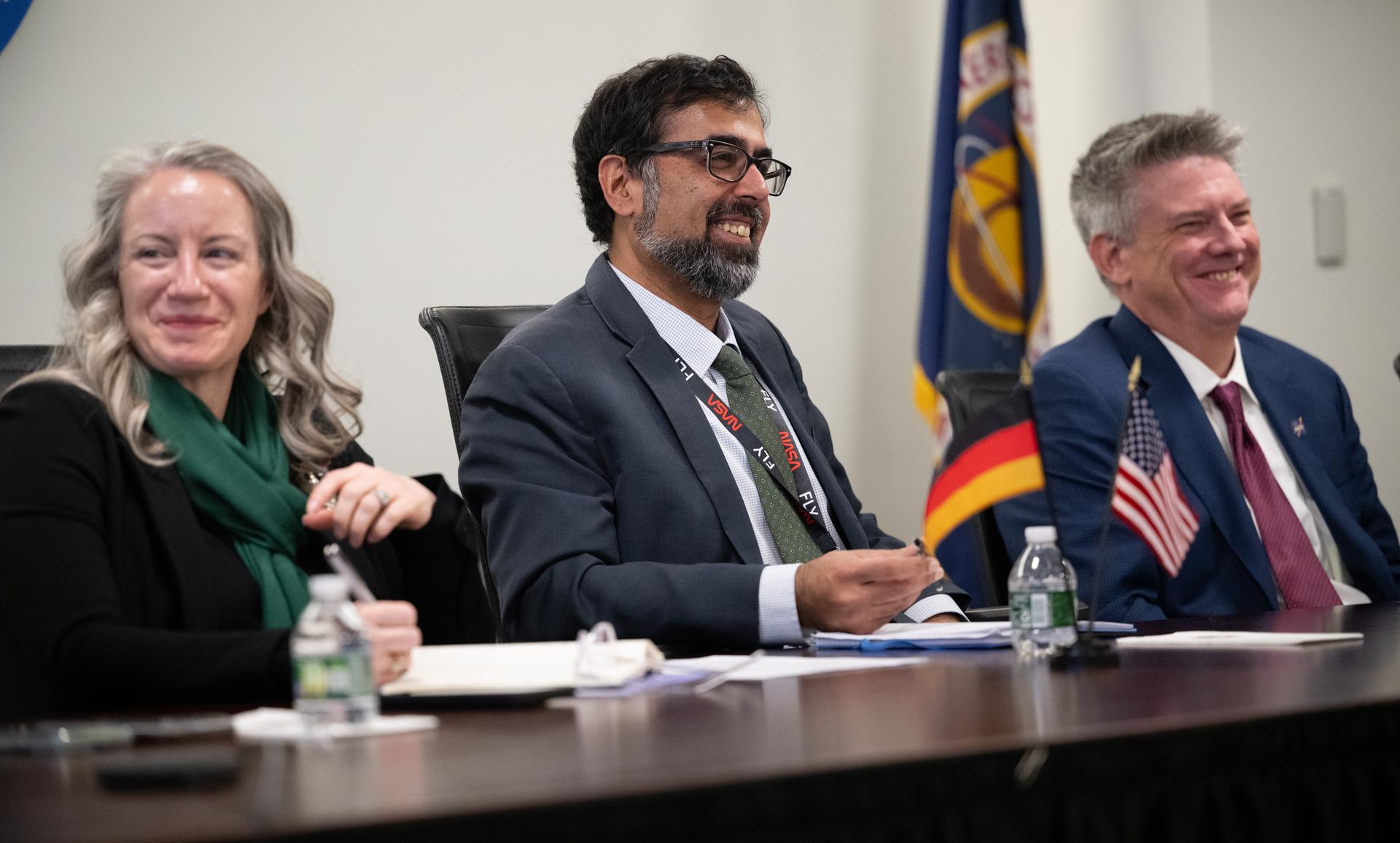
NASA Associate Administrator Amit Kshatriya, center, is seen along with Meredith McKay, acting associate administrator for NASA’s Office of International and Interagency Relations, left, and NASA Chief of Staff Brian Hughes, during a meeting with German Minister for Research, Technology, and Space Dorothee Bär, Tuesday, Dec. 9, 2025, at the Mary W. Jackson NASA Headquarters building in Washington. Photo Credit: (NASA/Joel Kowsky)
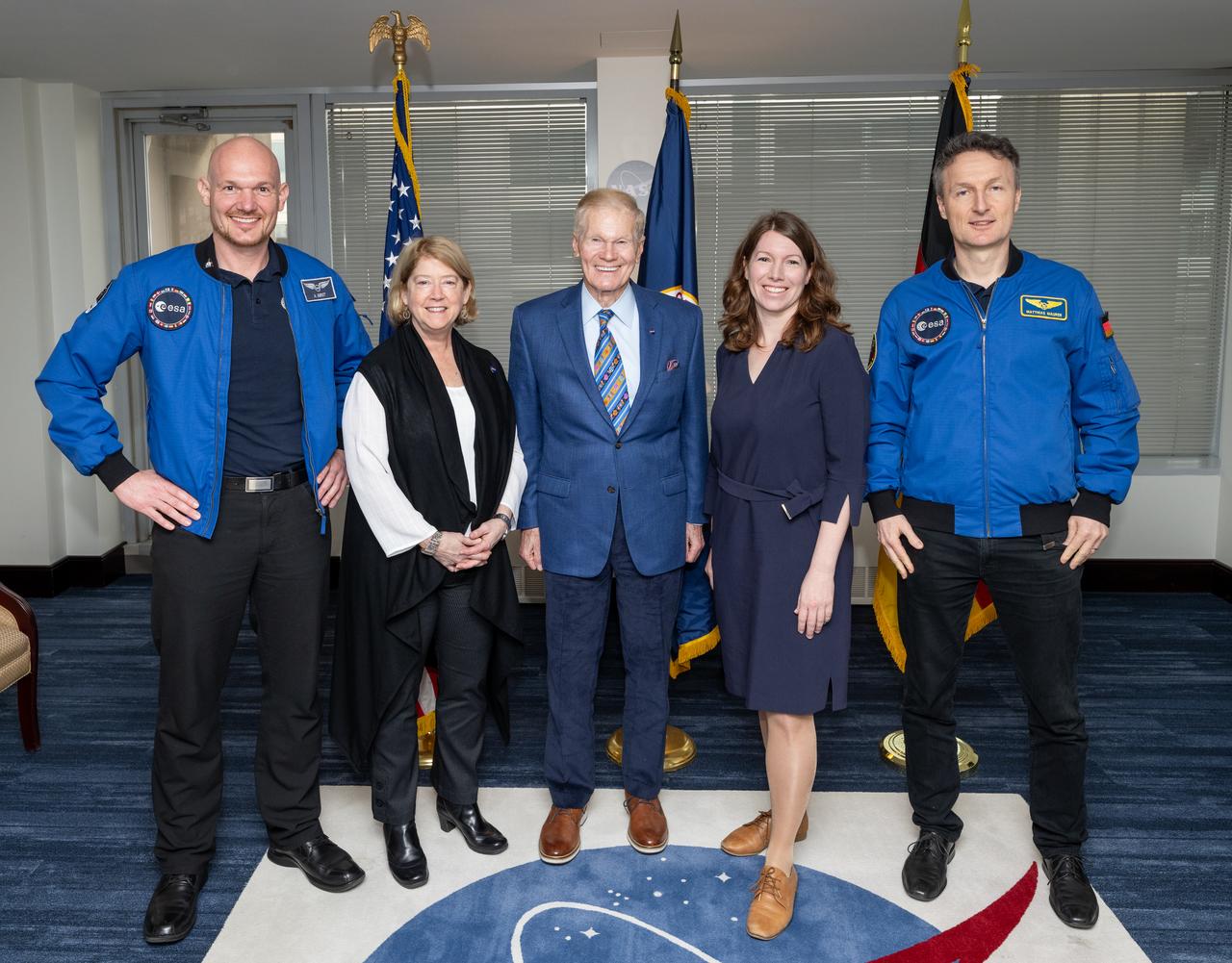
From left to right, ESA astronaut Alexander Gerst, NASA Deputy Administrator Pam Melroy, NASA Administrator Bill Nelson, Federal Government Coordinator of German Aerospace Policy Dr. Anna Christmann, and ESA astronaut Matthias Maurer pose for a photo, Thursday, March 7, 2024, at the Mary W. Jackson NASA Headquarters building in Washington. Photo Credit: (NASA/Keegan Barber)
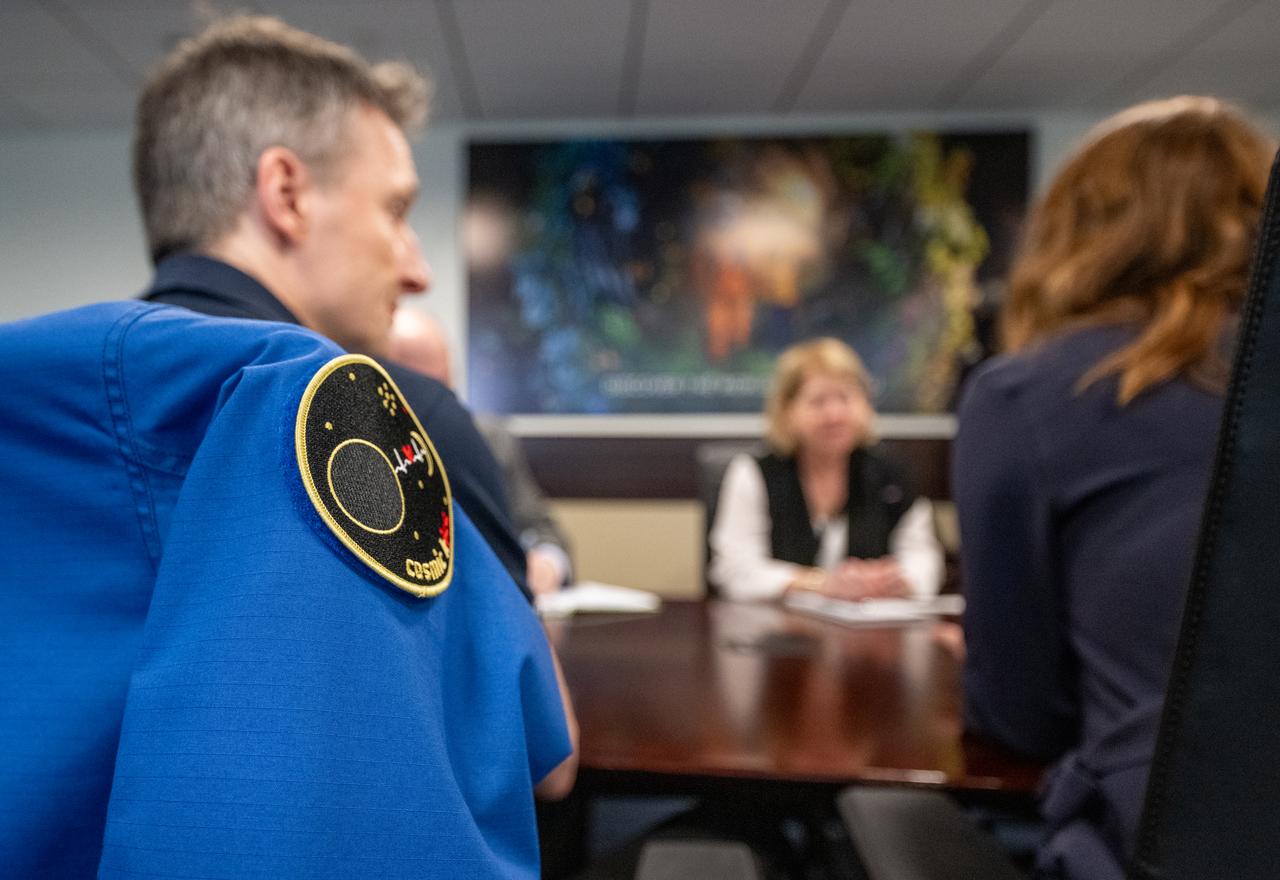
A patch belonging ESA astronaut Matthias Maurer, left, is seen during a meeting with NASA Deputy Administrator Pam Melroy, center, and Federal Government Coordinator of German Aerospace Policy Dr. Anna Christmann, right, Thursday, March 7, 2024, at the Mary W. Jackson NASA Headquarters building in Washington. Photo Credit: (NASA/Keegan Barber)
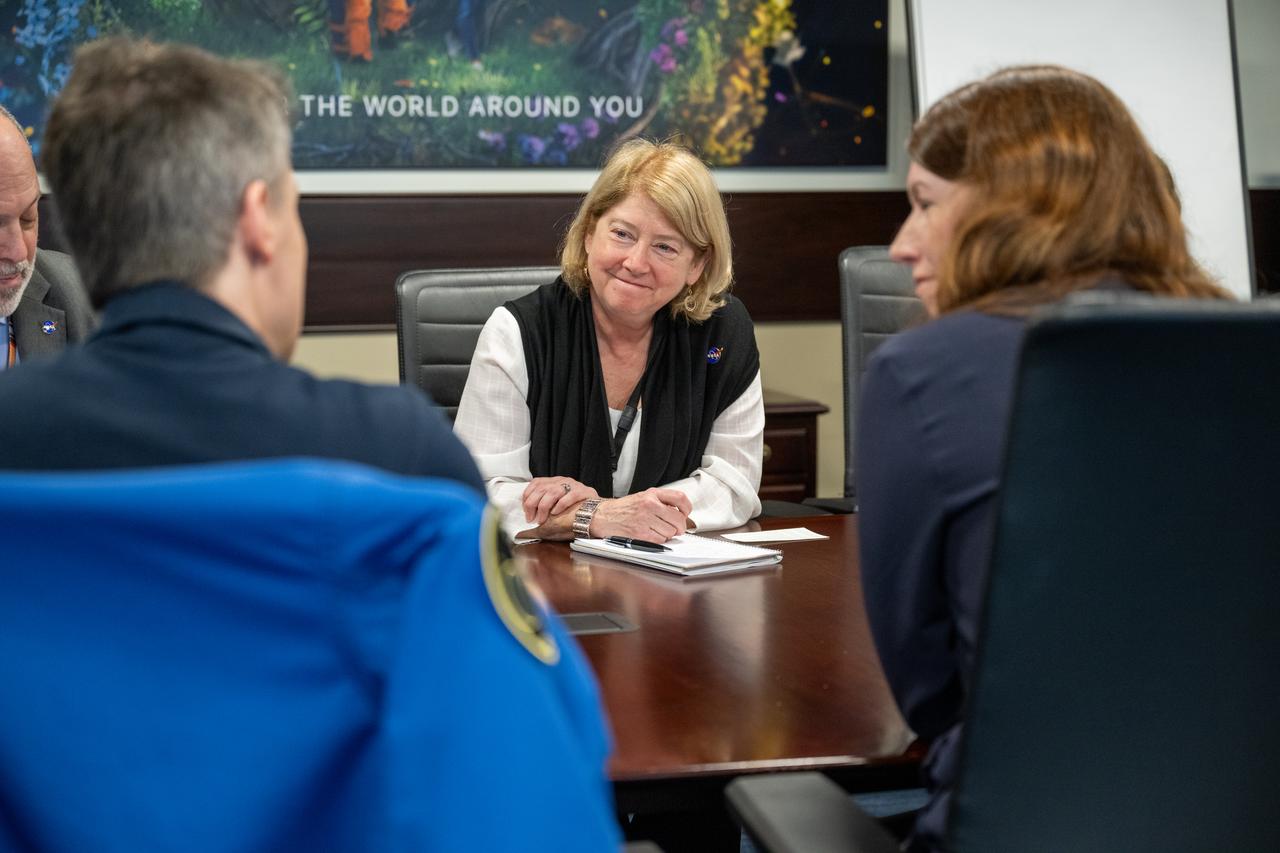
NASA Deputy Administrator Pam Melroy, center, listens as ESA astronaut Matthias Maurer, left, speaks during a meeting with Federal Government Coordinator of German Aerospace Policy Dr. Anna Christmann, right, Thursday, March 7, 2024, at the Mary W. Jackson NASA Headquarters building in Washington. Photo Credit: (NASA/Keegan Barber)
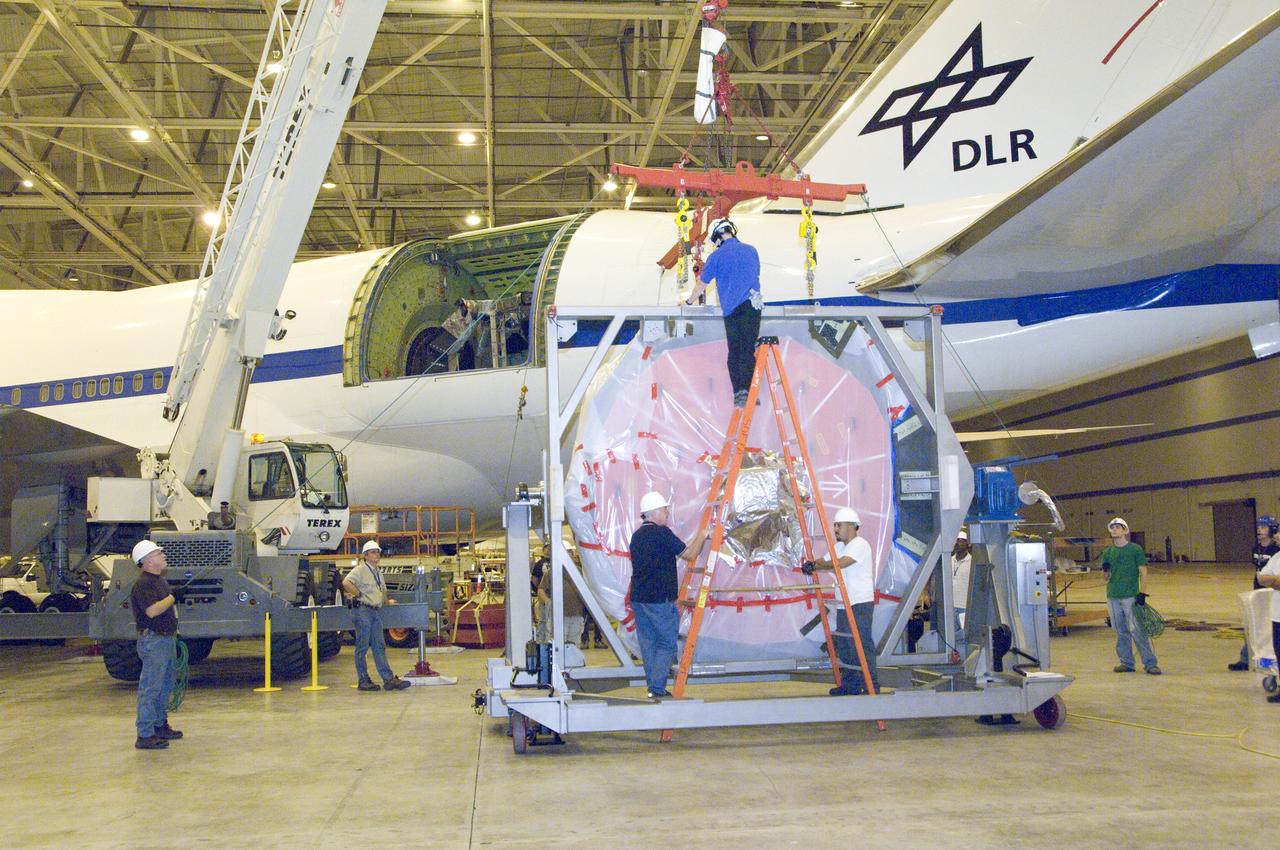
Engineers and technicians prepare SOFIA's German-built primary mirror assembly for reinstallation into NASA's 747SP airborne observatory.
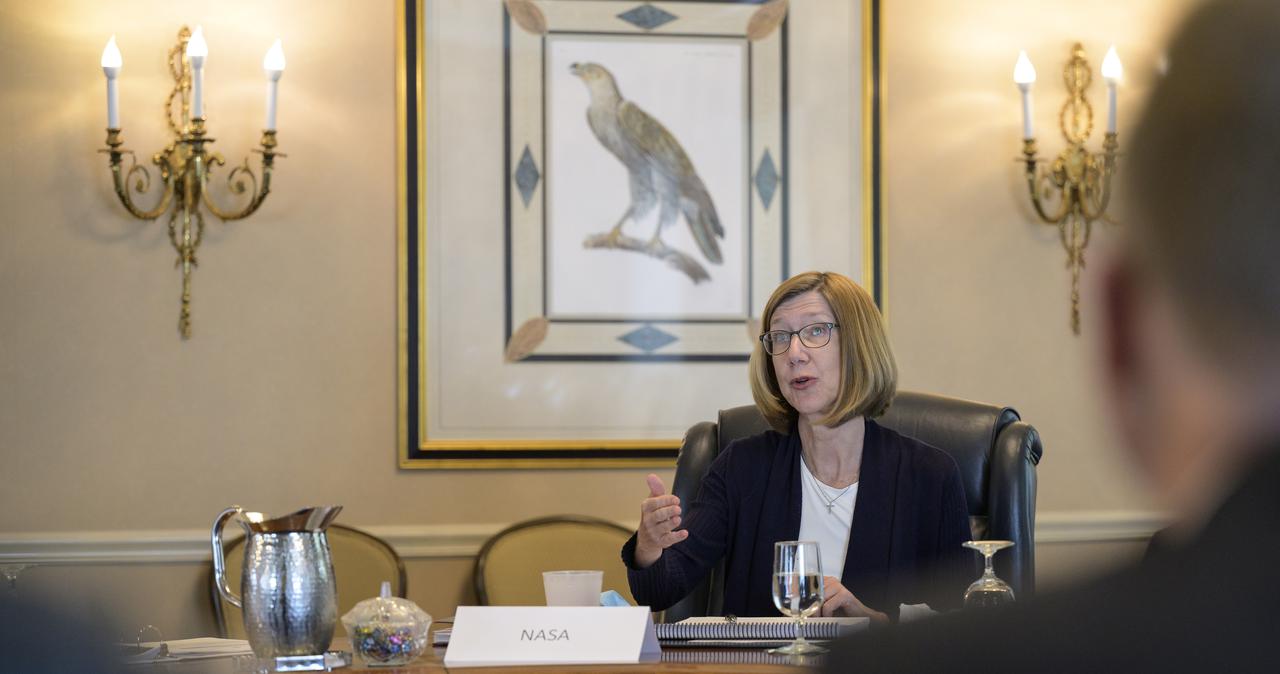
NASA Associate Administrator for Human Exploration and Operations Kathy Lueders meets with Dr. Walther Pelzer, Member of the German Aerospace Center (DLR) Executive Board, Head of the German Space Agency at DLR in a bilateral meeting during the 36th Space Symposium, Monday, Aug. 23, 2021, in Colorado Springs, Colorado. Photo Credit: (NASA/Bill Ingalls)
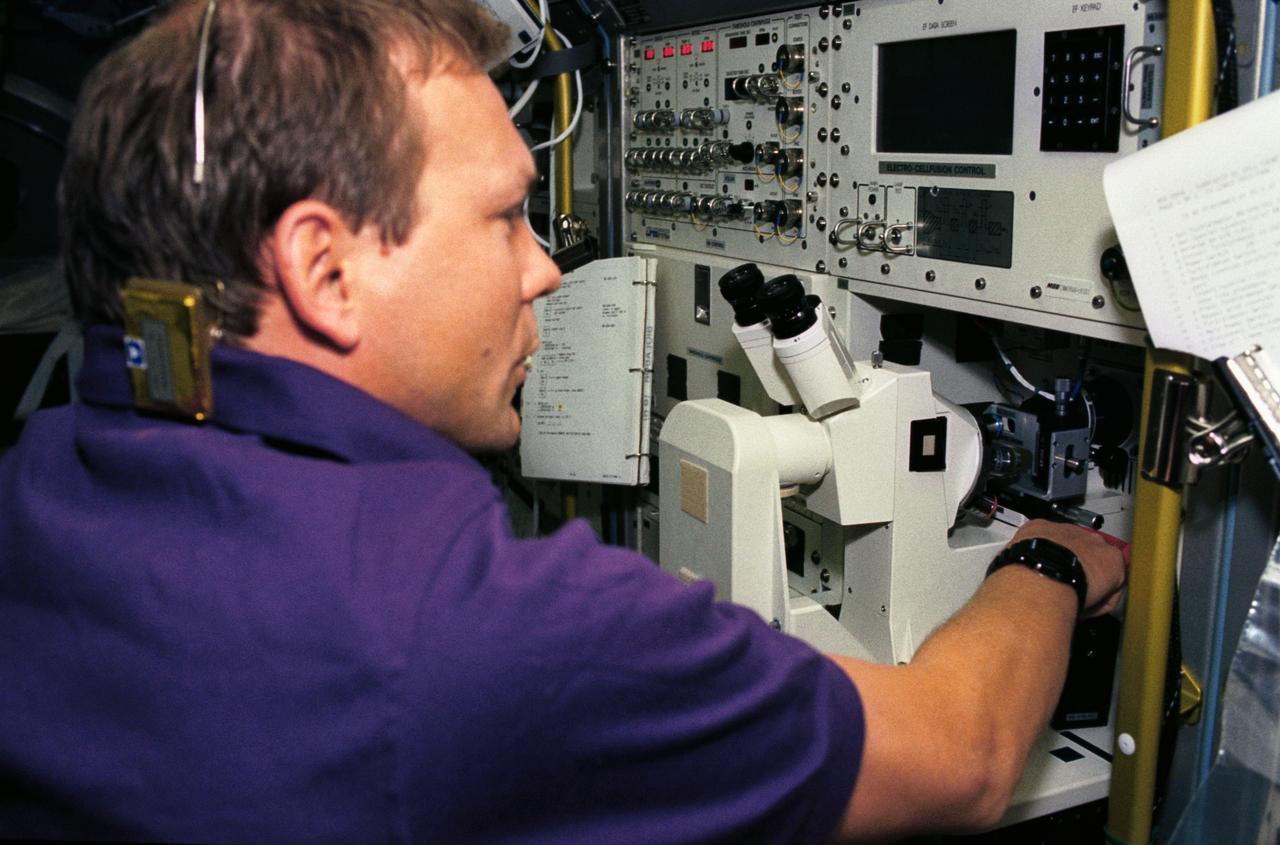
STS055-233-025 (26 April-6 May 1993) --- German payload specialist Hans Schlegel uses a microscope at the Biolabor workstation in the Spacelab D-2 science module. The Biolabor facility is a life sciences and biotechnology research device developed by Germany (MBB/ERNO) for use aboard Spacelab. Schlegel was joined by five NASA astronauts and a fellow German payload specialist for the 10-day mission aboard the Space Shuttle Columbia.
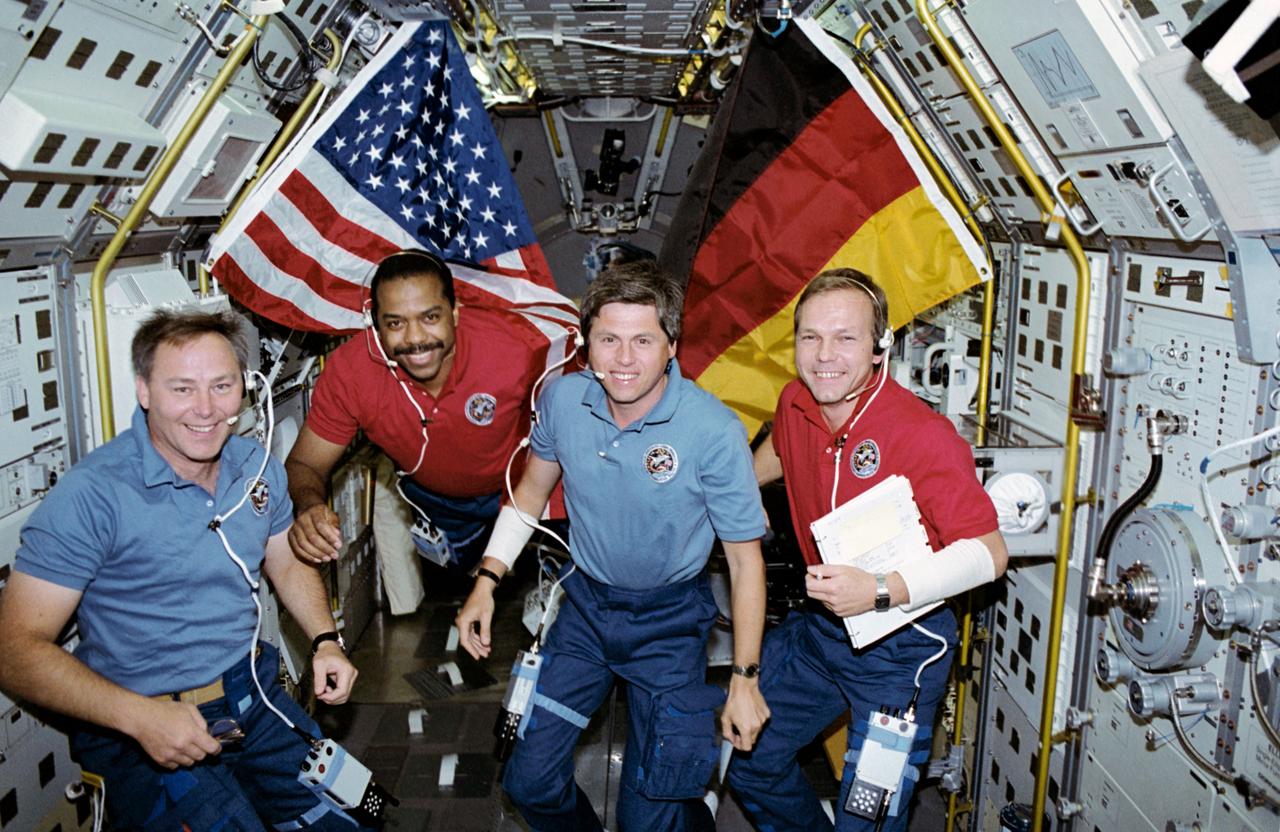
STS-55 crewmembers pose with United States and German flags inside the Spacelab Deutsche 2 (SL-D2) science module located in the payload bay (PLB) of Columbia, Orbiter Vehicle (OV) 102. Wearing communications kit assembly headsets (HDSTs) are (left to right) Mission Specialist 1 (MS1) and Payload Commander (PLC) Jerry L. Ross, MS3 Bernard A. Harris, Jr, German Payload Specialist 1 Ulrich Walter, and Payload Specialist 2 Hans Schlegel.
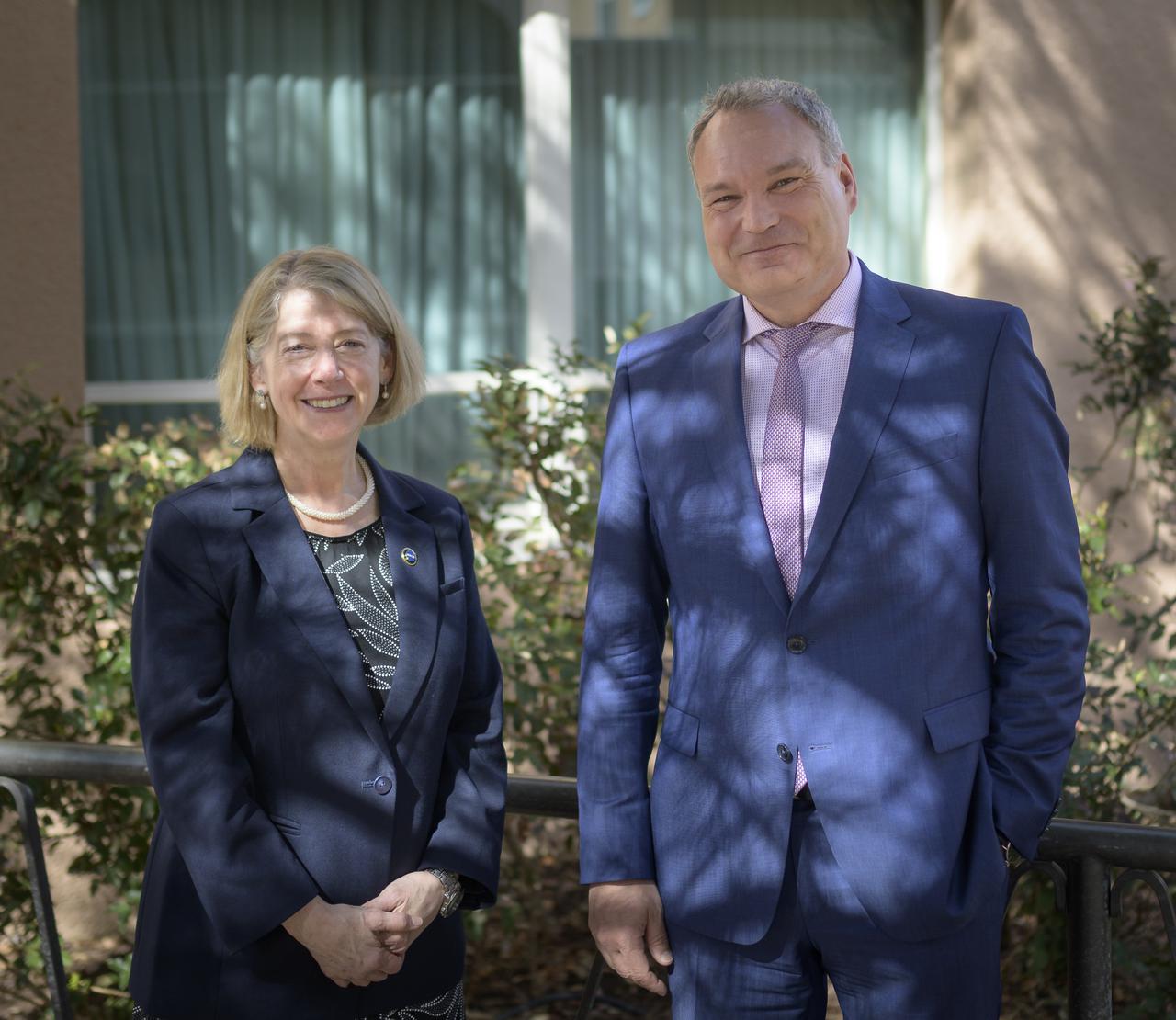
NASA Deputy Administrator Pam Melroy, left, and Executive Board Member and Head of the German Space Agency at the German Aerospace Center (DLR) Dr. Walther Pelzer, pose for a photograph prior to starting at meeting during the 37th Space Symposium, Monday, April 4, 2022, in Colorado Springs, Colorado. Photo Credit: (NASA/Bill Ingalls)
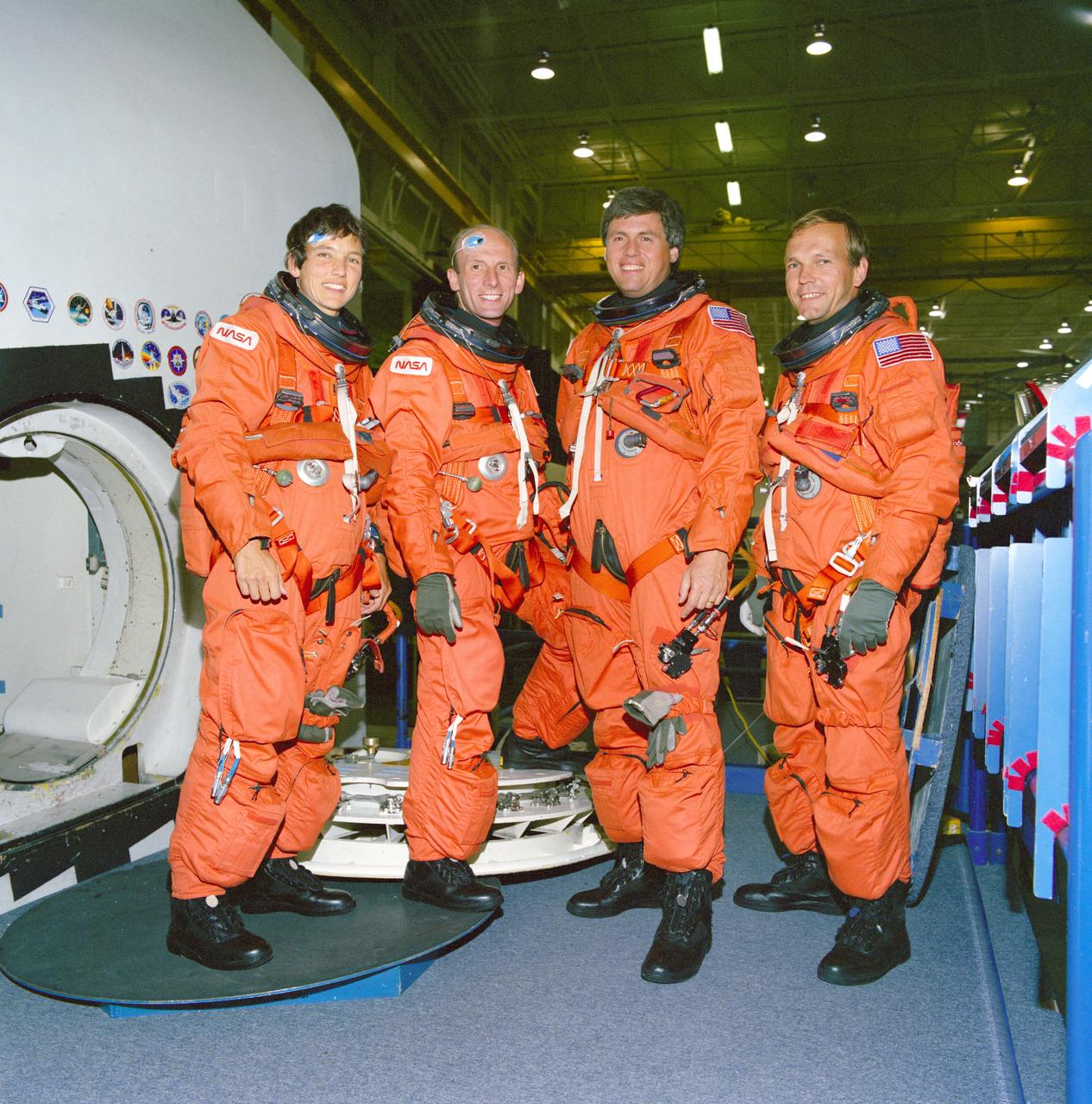
S92-48735 (18 Sept 1992) --- These four Germans have been assigned as payload specialists to support the STS-55\Spacelab D-2 mission. Left to right are Renate Brummer, Gerhard Thiele, Ulrich Walter and Hans Schlegel. Walter and Schlegel are scheduled to fly aboard the Space Shuttle Columbia for the mission, while Brummer and Thiele will serve as alternates and fill supportive roles on the ground. They are seen during a break in training in the Shuttle mockup and integration laboratory at the Johnson Space Center.
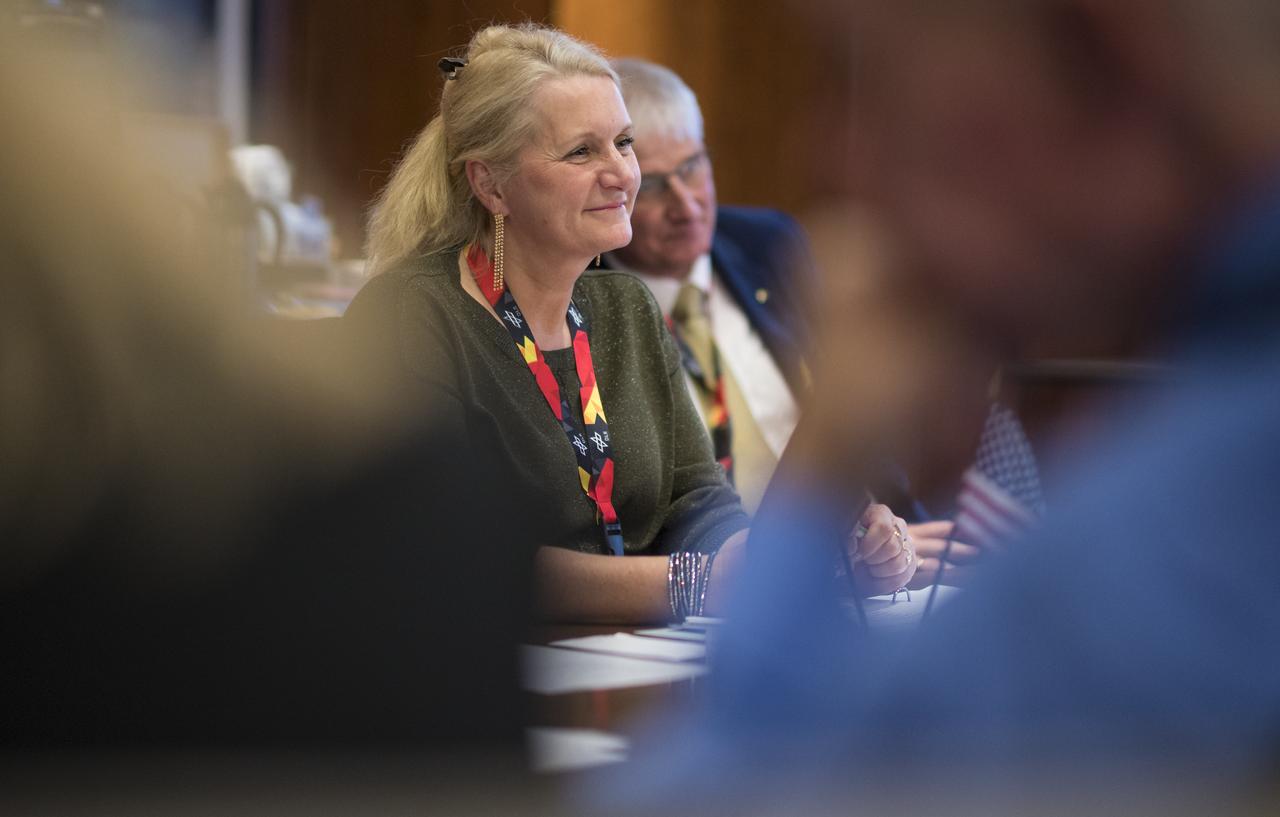
Pascale Ehrenfreund, Chair of the Executive Board of the German Aerospace Center (DLR) is seen during a meeting with NASA Administrator Jim Bridenstine, Deputy Administrator Jim Morhard and other senior NASA leaders at the 70th International Astronautical Congress, Wednesday, Oct. 23, 2019 in Washington. Photo Credit: (NASA/Joel Kowsky)
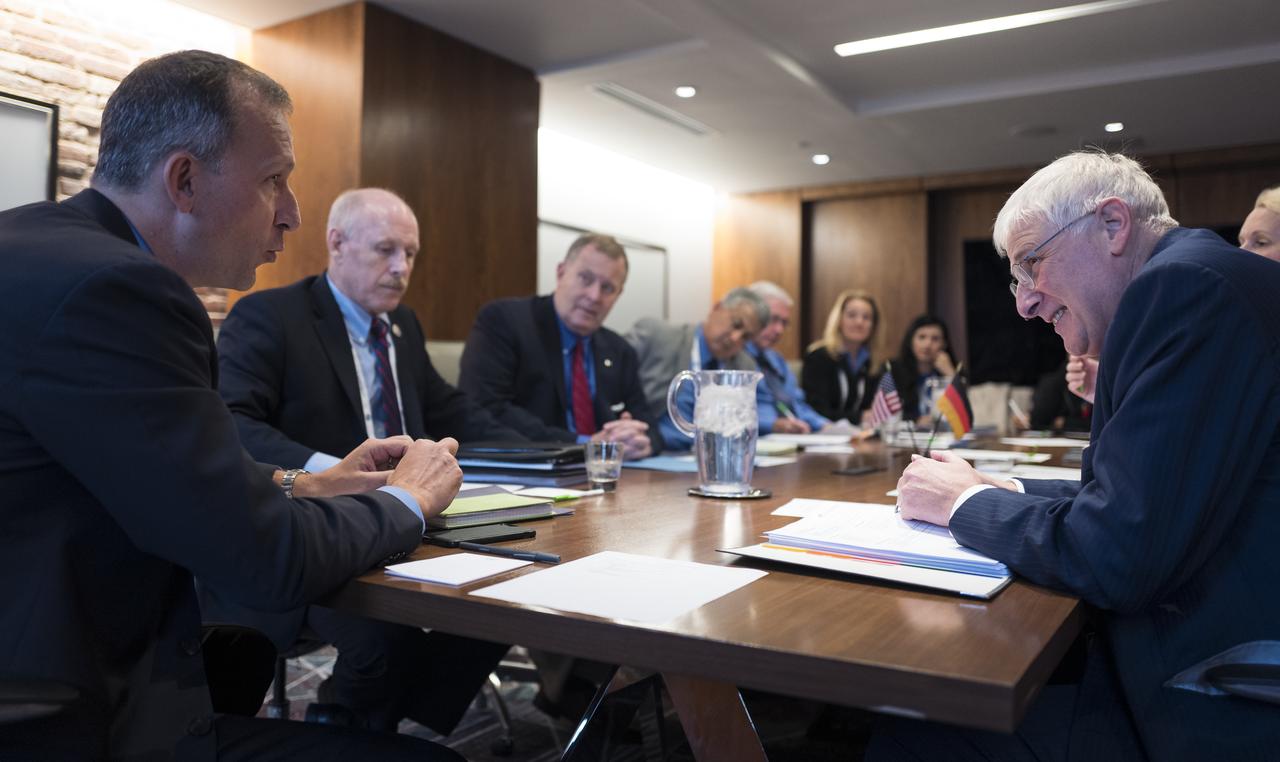
Thomas Zurbuchen, Associate Administrator of NASA's Science Mission Directorate, left, speaks with Hansjörg Dittus, Executive Board Member for Space Research and Technology at the German Aerospace Center (DLR) during a meeting at the 70th International Astronautical Congress, Wednesday, Oct. 23, 2019 in Washington. Photo Credit: (NASA/Joel Kowsky)
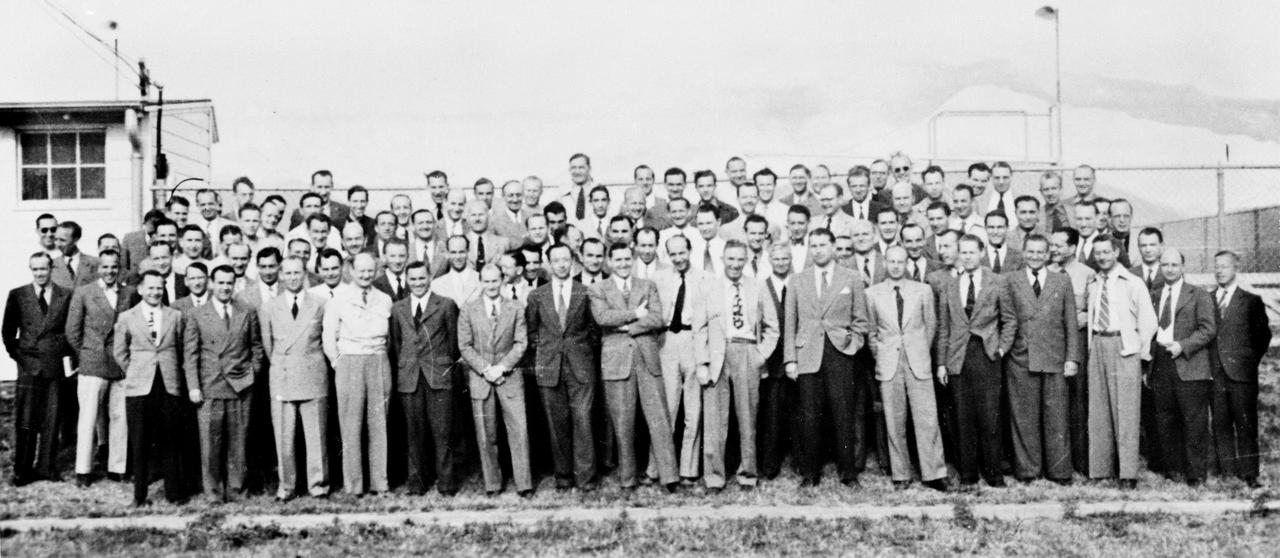
The German Rocket Team, also known as the Von Braun Rocket Team, poses for a group photograph at Fort Bliss, Texas. After World War II ended in 1945, Dr. Wernher von Braun led some 120 of his Peenemuende Colleagues, who developed the V-2 rocket for the German military during the War, to the United Sttes under a contract to the U.S. Army Corps as part of Operation Paperclip. During the following five years the team worked on high altitude firings of the captured V-2 rockets at the White Sands Missile Range in New Mexico, and a guided missile development unit at Fort Bliss, Texas. In April 1950, the group was transferred to the Army Ballistic Missile Agency (ABMA) at Redstone Arsenal in Huntsville, Alabama, and continued to work on the development of the guided missiles for the U.S. Army until transferring to a newly established field center of the National Aeronautic and Space Administration (NASA), George C. Marshall Space Flight Center (MSFC).
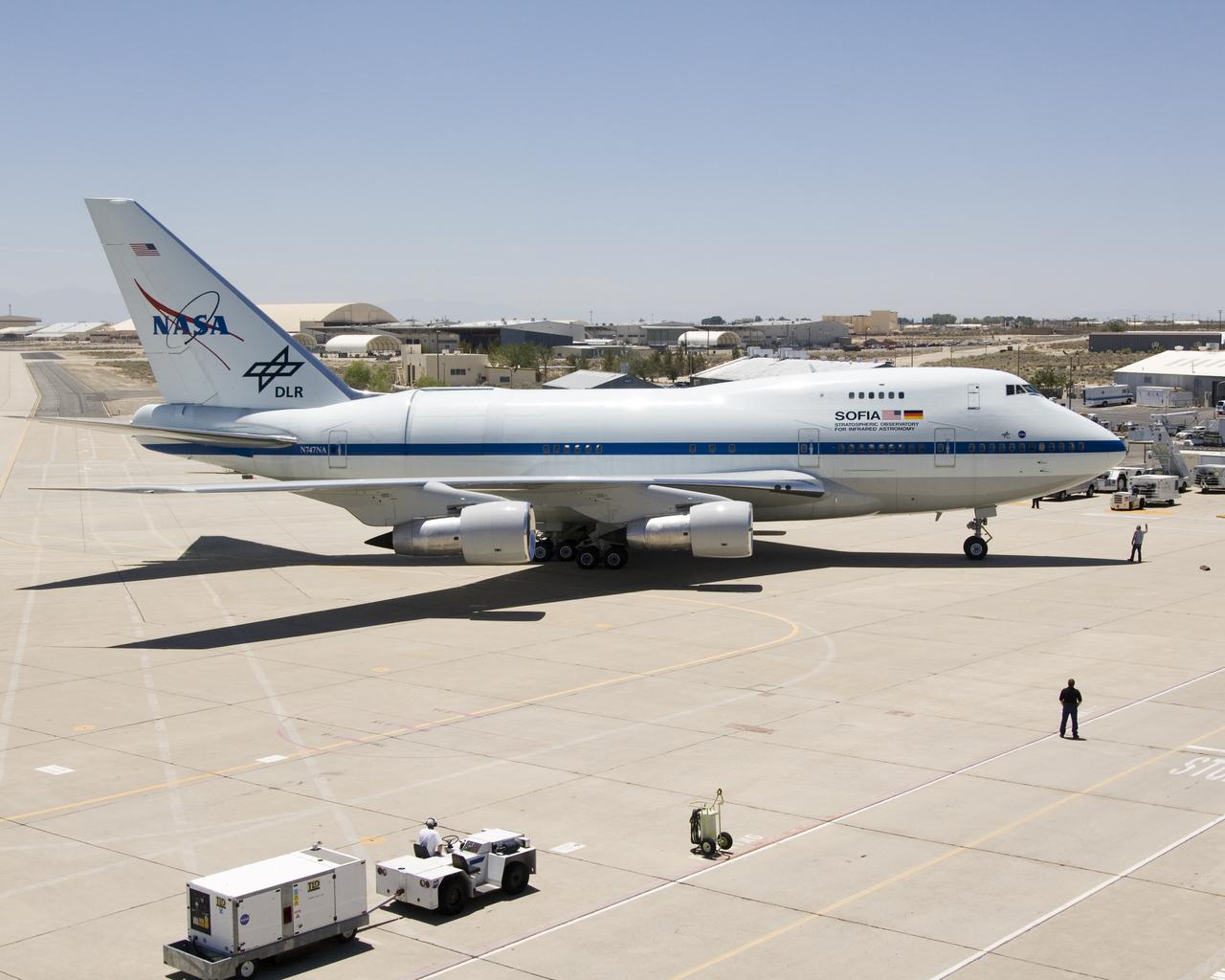
NASA's SOFIA 747SP bearing a German-built 2.5-meter infrared telescope in its rear fuselage taxis up to NASA Dryden's ramp after a ferry flight from Waco, Texas. NASA's Stratospheric Observatory for Infrared Astronomy, or SOFIA, arrived at NASA's Dryden Flight Research Center at Edwards Air Force Base, Calif. on May 31, 2007. The heavily modified Boeing 747SP was ferried to Dryden from Waco, Texas, where L-3 Communications Integrated Systems installed a German-built 2.5-meter infrared telescope and made other major modifications over the past several years. SOFIA is scheduled to undergo installation and integration of mission systems and a multi-phase flight test program at Dryden over the next three years that is expected to lead to a full operational capability to conduct astronomy missions in about 2010. During its expected 20-year lifetime, SOFIA will be capable of "Great Observatory" class astronomical science, providing astronomers with access to the visible, infrared and sub-millimeter spectrum with optimized performance in the mid-infrared to sub-millimeter range.
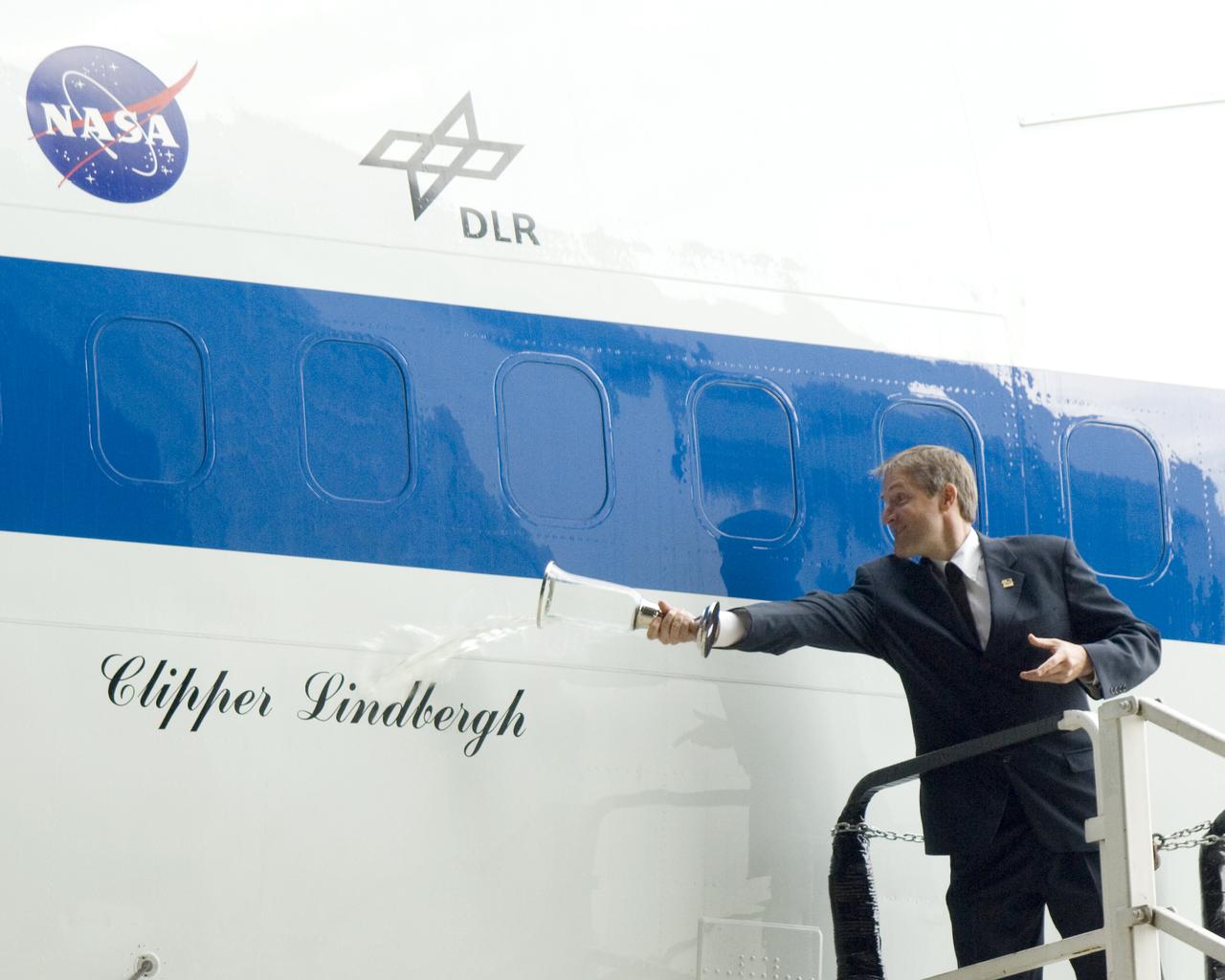
Erik Lindbergh christens NASA's 747 Clipper Lindbergh, the Stratospheric Observatory for Infrared Astronomy, with a special commemorative concoction representing local, NASA, and industry partners. The liquid consisted of a small amount of California wine representing NASA Dryden where the aircraft will be stationed, a small amount of Dr. Pepper (a Waco, TX invention), a quantity of French bottled water (to symbolize Charles Lindbergh's flight to Paris on this date), and a dash of German beer to represent the SOFIA German industry partners.

Groundwater storage trends around the United States as measured by the NASA/German Aerospace Center Gravity Recovery and Climate Experiment GRACE satellites between 2003 and 2012.
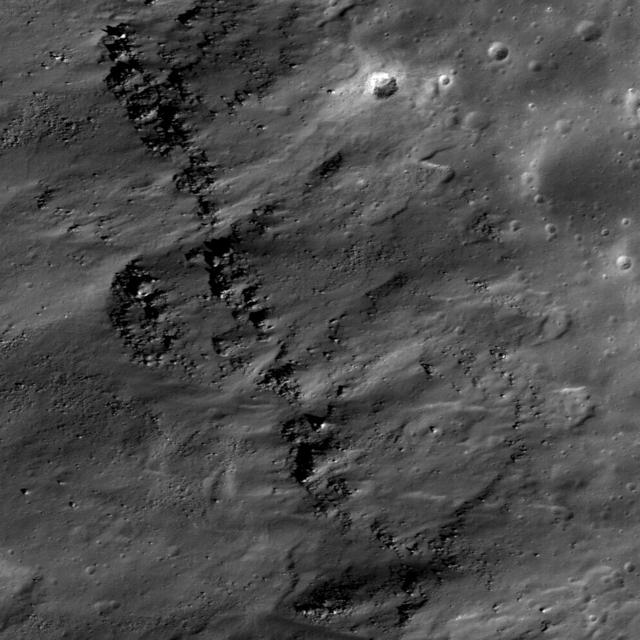
Lichtenberg crater is of Eratosthenian age, located in western Oceanus Procellarum. It is named after George C. Lichtenberg, a German professor of experimental physics 16th century.
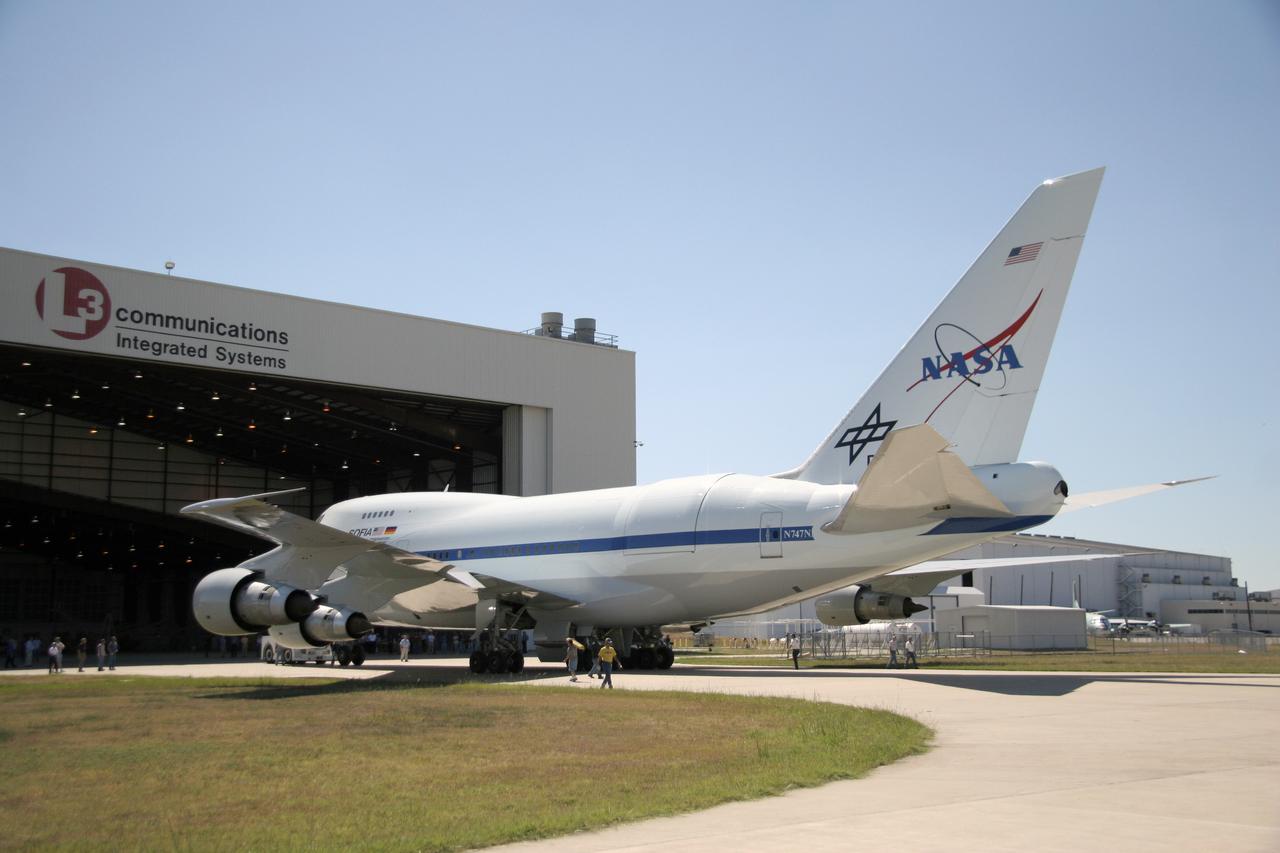
NASA's freshly painted Stratospheric Observatory for Infrared Astronomy (SOFIA) 747SP aircraft sits outside a hangar at L-3 Communications Integrated Systems' facility in Waco, Texas. The observatory, which features a German-built 100-inch (2.5 meter) diameter infrared telescope weighing 20 tons, is approaching the flight test phase as part of a joint program by NASA and DLR Deutsches Zentrum fuer Luft- und Raumfahrt (German Aerospace Center). SOFIA's science and mission operations are being planned jointly by Universities Space Research Association (USRA) and the Deutsches SOFIA Institut (DSI). Once operational, SOFIA will be the world's primary infrared observatory during a mission lasting up to 20 years, as well as an outstanding laboratory for developing and testing instrumentation and detector technology.
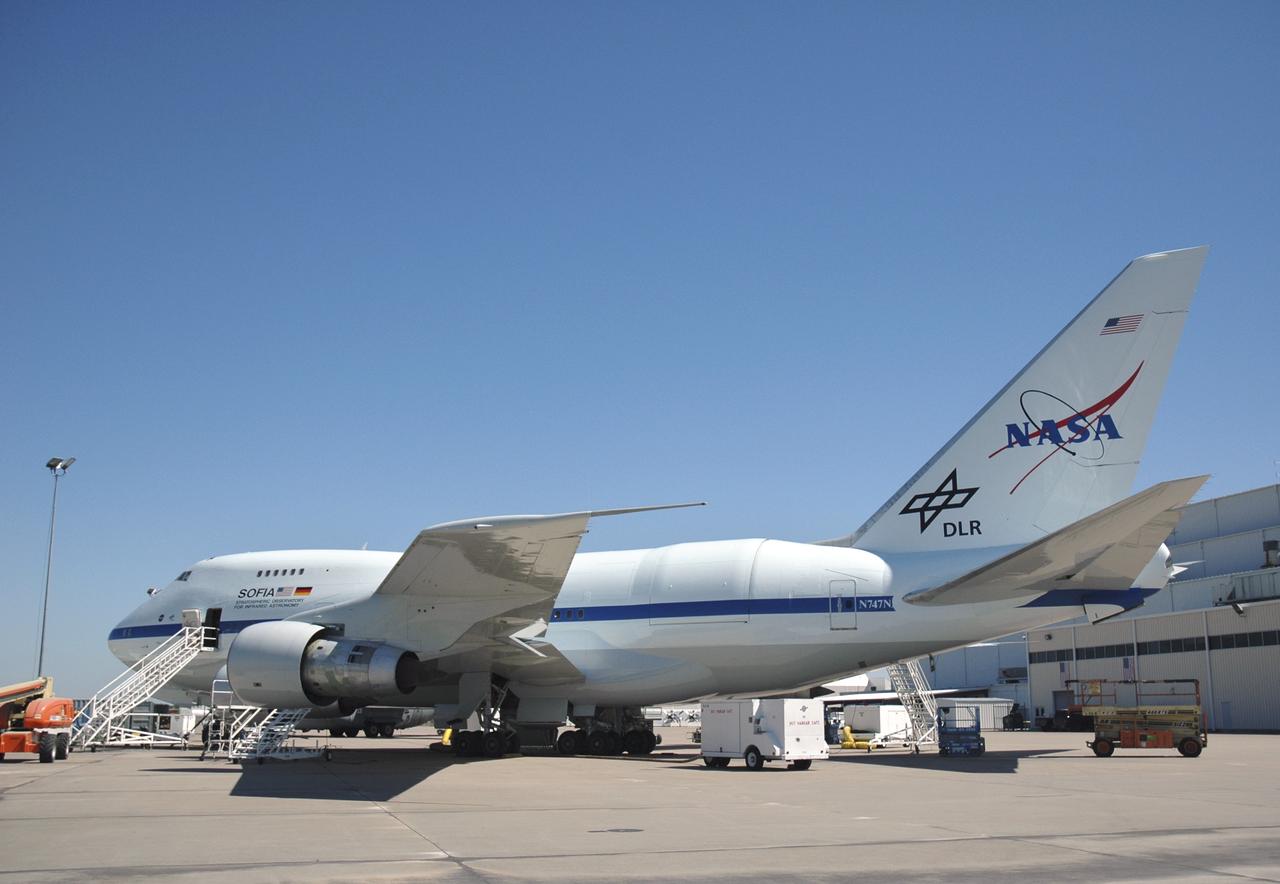
NASA's freshly painted Stratospheric Observatory for Infrared Astronomy (SOFIA) 747SP is shown at L-3 Communications Integrated Systems' facility in Waco, Texas, where major modifications and installation was performed. The observatory, which features a German-built 100-inch (2.5 meter) diameter infrared telescope weighing 20 tons, is approaching the flight test phase as part of a joint program by NASA and DLR Deutsches Zentrum fuer Luft- und Raumfahrt (German Aerospace Center). SOFIA's science and mission operations are being planned jointly by Universities Space Research Association (USRA) and the Deutsches SOFIA Institut (DSI). Once operational, SOFIA will be the world's primary infrared observatory during a mission lasting up to 20 years, as well as an outstanding laboratory for developing and testing instrumentation and detector technology.
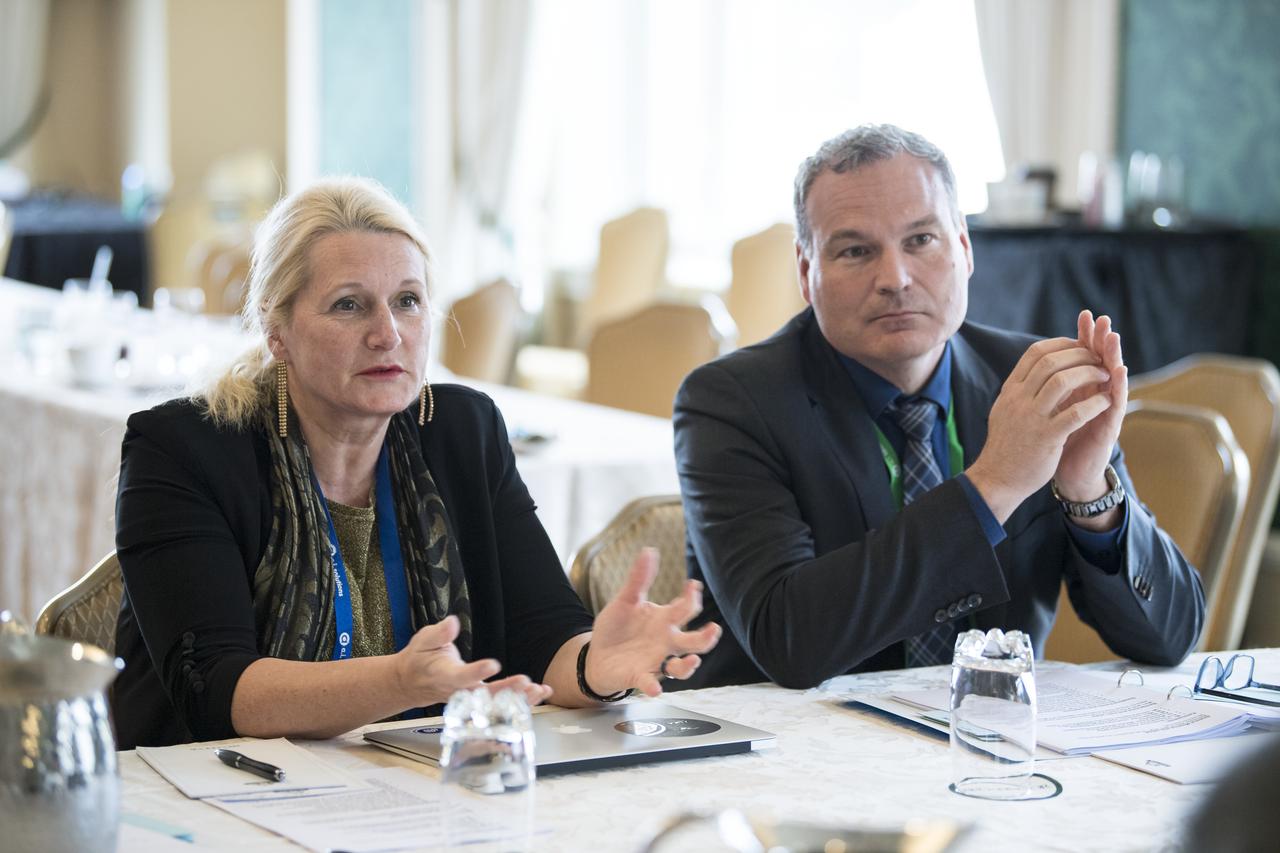
German Aerospace Center (DLR) executive board chair, Dr. Pascale Ehrenfreund, left, and Walther Pelzer, DLR executive board member, speak with NASA Administrator Jim Bridenstine about the robust relationship between their agencies in human and robotic exploration, and prospects for cooperation as NASA pursues the landing of humans on the Moon by 2024, at the Space Symposium, Wednesday, April 10, 2019 in Colorado Springs, Colorado. Photo Credit: (NASA/Aubrey Gemignani)

NASA Administrator Jim Bridenstine listens as German Aerospace Center (DLR) executive board chair, Dr. Pascale Ehrenfreund, speaks about the robust relationship between their agencies in human and robotic exploration, and prospects for cooperation as NASA pursues the landing of humans on the Moon by 2024, at the Space Symposium, Wednesday, April 10, 2019 in Colorado Springs, Colorado. Photo Credit: (NASA/Aubrey Gemignani)
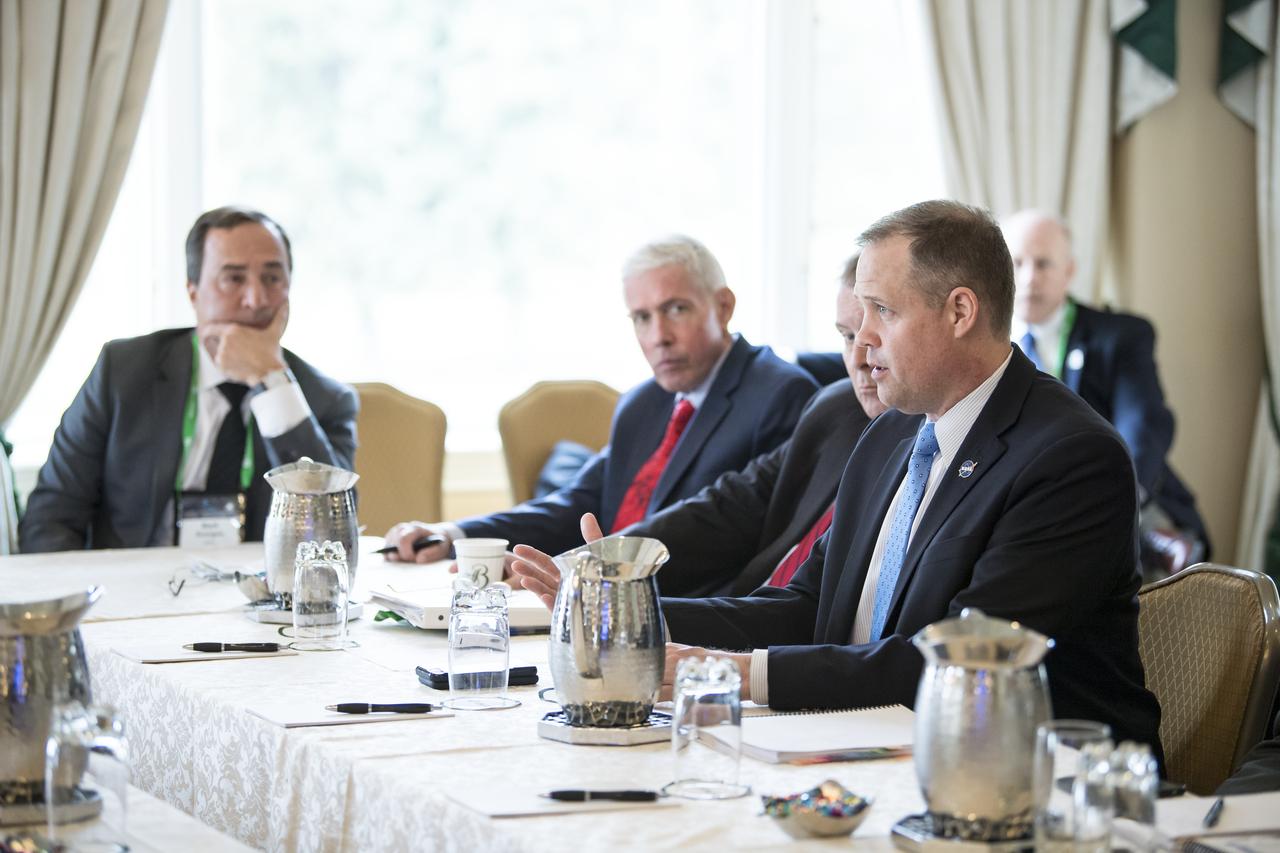
NASA Administrator Jim Bridenstine, right, speaks with officials from the German Aerospace Center (DLR) executive board about the robust relationship between their agencies in human and robotic exploration, and prospects for cooperation as NASA pursues the landing of humans on the Moon by 2024, at the Space Symposium, Wednesday, April 10, 2019 in Colorado Springs, Colorado. Photo Credit: (NASA/Aubrey Gemignani)

German Aerospace Center (DLR) executive board chair, Dr. Pascale Ehrenfreund, center, speaks with NASA Administrator Jim Bridenstine about the robust relationship between their agencies in human and robotic exploration, and prospects for cooperation as NASA pursues the landing of humans on the Moon by 2024, at the Space Symposium, Wednesday, April 10, 2019 in Colorado Springs, Colorado. Photo Credit: (NASA/Aubrey Gemignani)
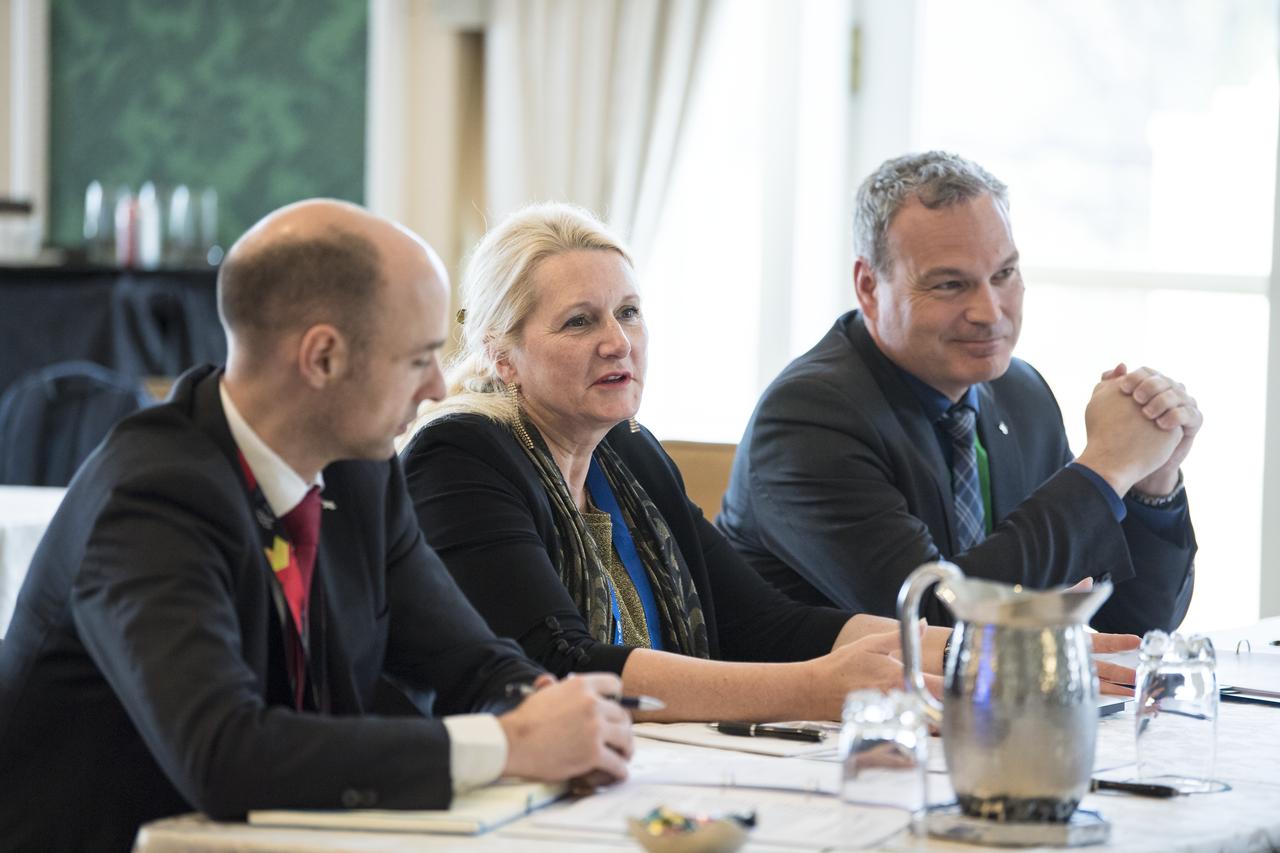
German Aerospace Center (DLR) executive board chair, Dr. Pascale Ehrenfreund, center, speaks with NASA Administrator Jim Bridenstine about the robust relationship between their agencies in human and robotic exploration, and prospects for cooperation as NASA pursues the landing of humans on the Moon by 2024, at the Space Symposium, Wednesday, April 10, 2019 in Colorado Springs, Colorado. Photo Credit: (NASA/Aubrey Gemignani)
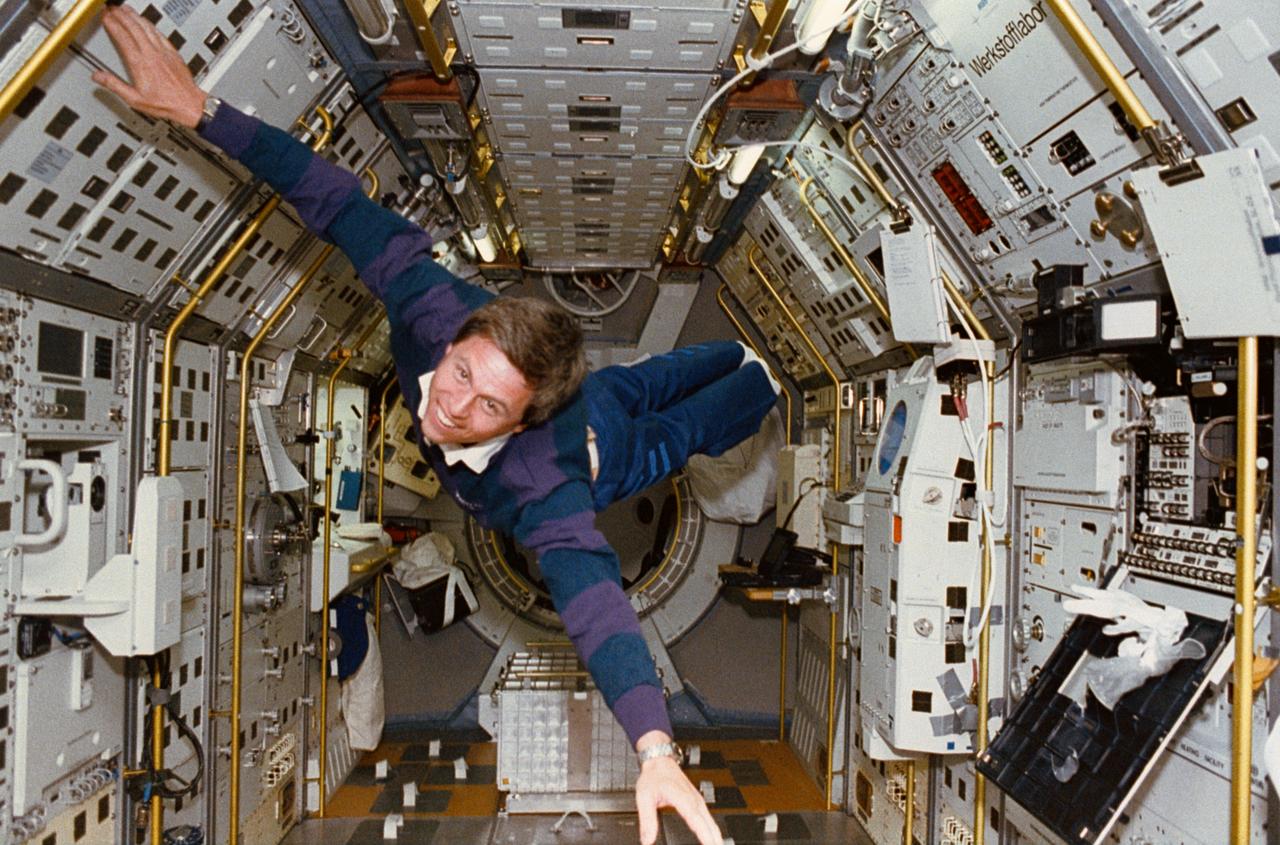
STS055-219-024 (26 April-6 May 1993) --- Ulrich Walter, STS-55 payload specialist representing the German Aerospace Research Establishment (DLR), demonstrates the microgravity aboard the Spacelab D-2 science module in Columbia's cargo bay. The module served as his space laboratory and that of his six crewmates for l0 days.
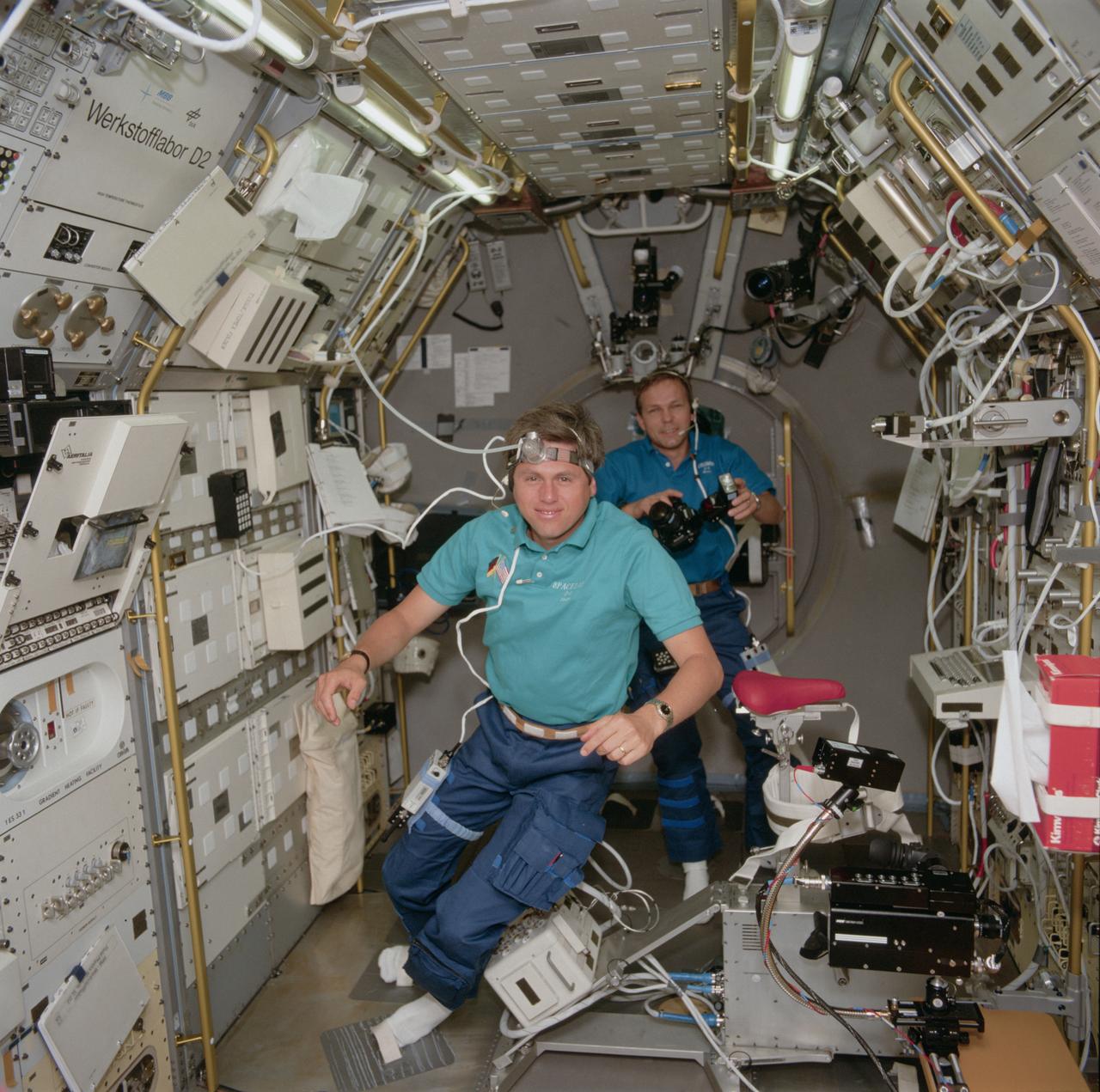
STS055-106-056 (26 April-6 May 1993) --- Ulrich Walter, one of two payload specialists representing the German Aerospace Research Establishment (DLR) onboard Columbia, plants his socked feet into temporary foot restraints. Walter's headwear telltales his participation in a Tissue experiment. Fellow payload specialist Hans Schlegel prepares to take a photo in the background.
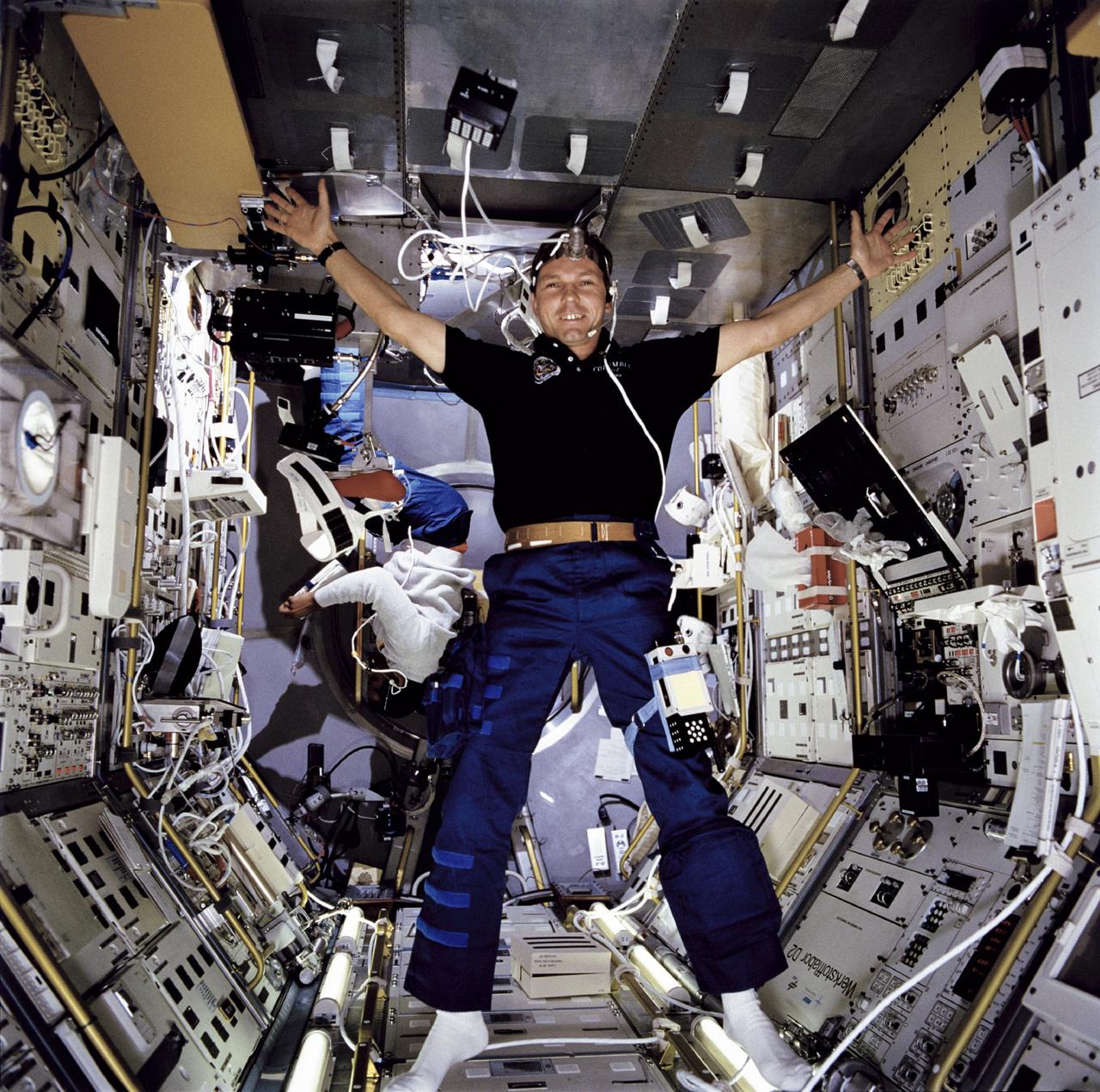
STS055-106-090 (26 April- 6 May 1993) --- Hans Schlegel, one of two STS-55 payload specialists representing the German Aerospace Research Establishment (DLR) onboard the Space Shuttle Columbia, finds plenty of room to "spread out" while participating in a Tissue experiment. Astronaut Bernard A. Harris, Jr., mission specialist, monitors an experiment in the background.
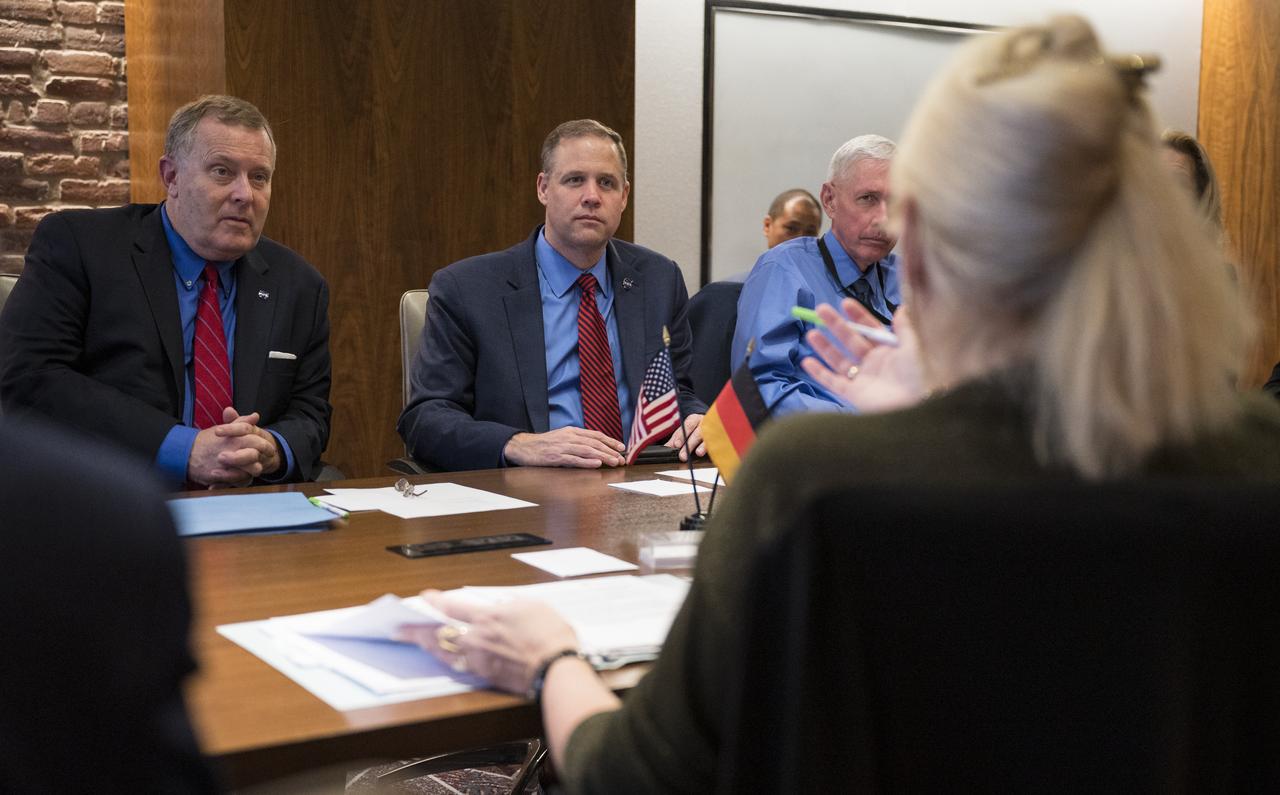
NASA Administrator Jim Bridenstine, right, and Deputy Administrator Jim Morhard, are seen during a meeting with Pascale Ehrenfreund, Chair of the Executive Board of the German Aerospace Center (DLR) and other members of the executive board at the 70th International Astronautical Congress, Wednesday, Oct. 23, 2019 in Washington. Photo Credit: (NASA/Joel Kowsky)
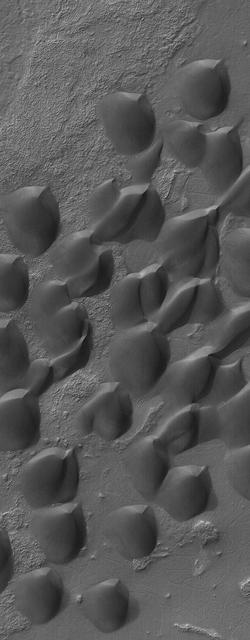
This MOC image shows dark sand dunes, formed by winds blowing from the southwest lower left, in Wirtz Crater. The crater is named for Carl Wilhelm Wirtz , a German astronomer
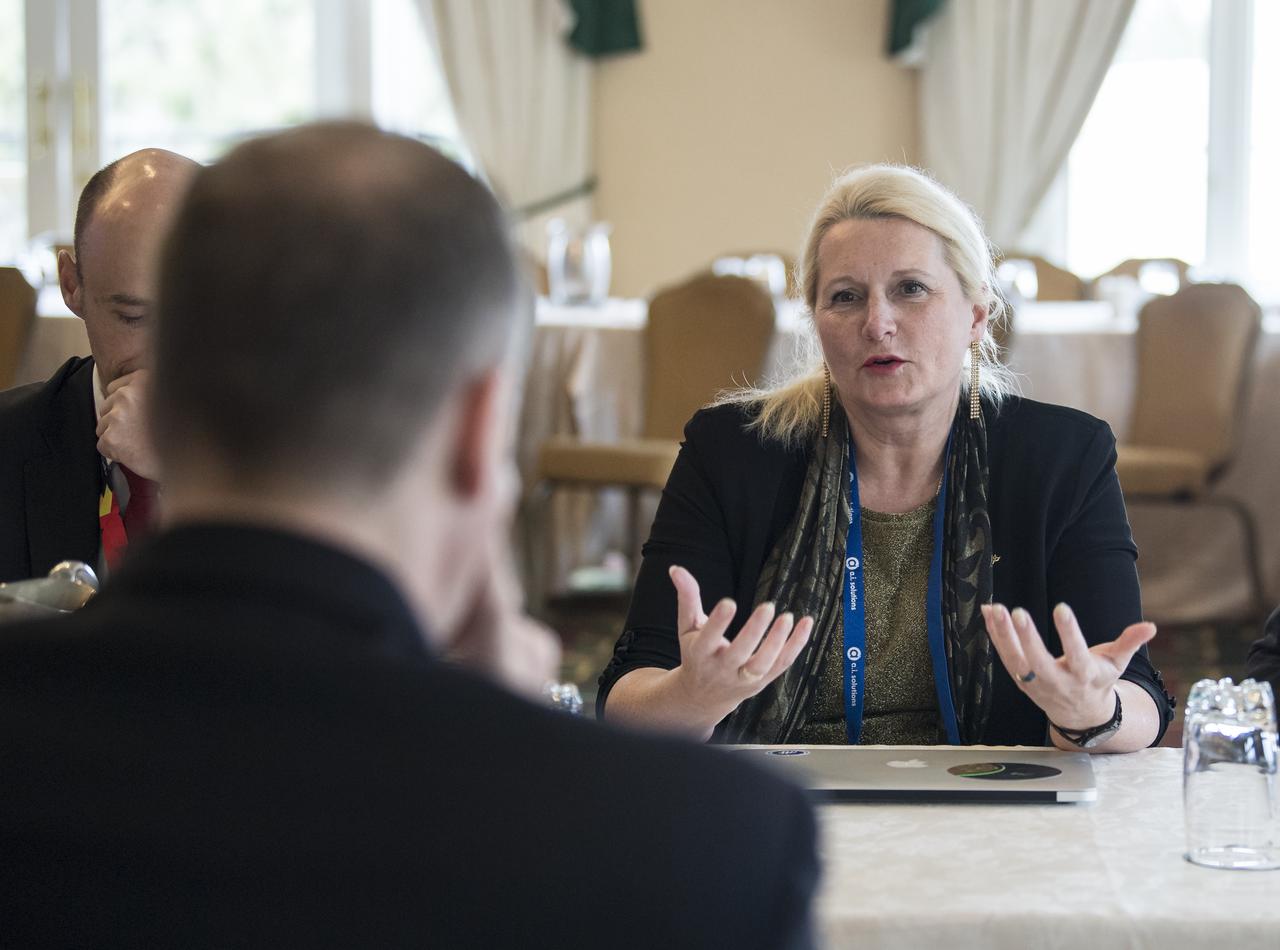
German Aerospace Center (DLR) executive board chair, Dr. Pascale Ehrenfreund, speaks with NASA Administrator Jim Bridenstine about the robust relationship between their agencies in human and robotic exploration, and prospects for cooperation as NASA pursues the landing of humans on the Moon by 2024, at the Space Symposium, Wednesday, April 10, 2019 in Colorado Springs, Colorado. Photo Credit: (NASA/Aubrey Gemignani)
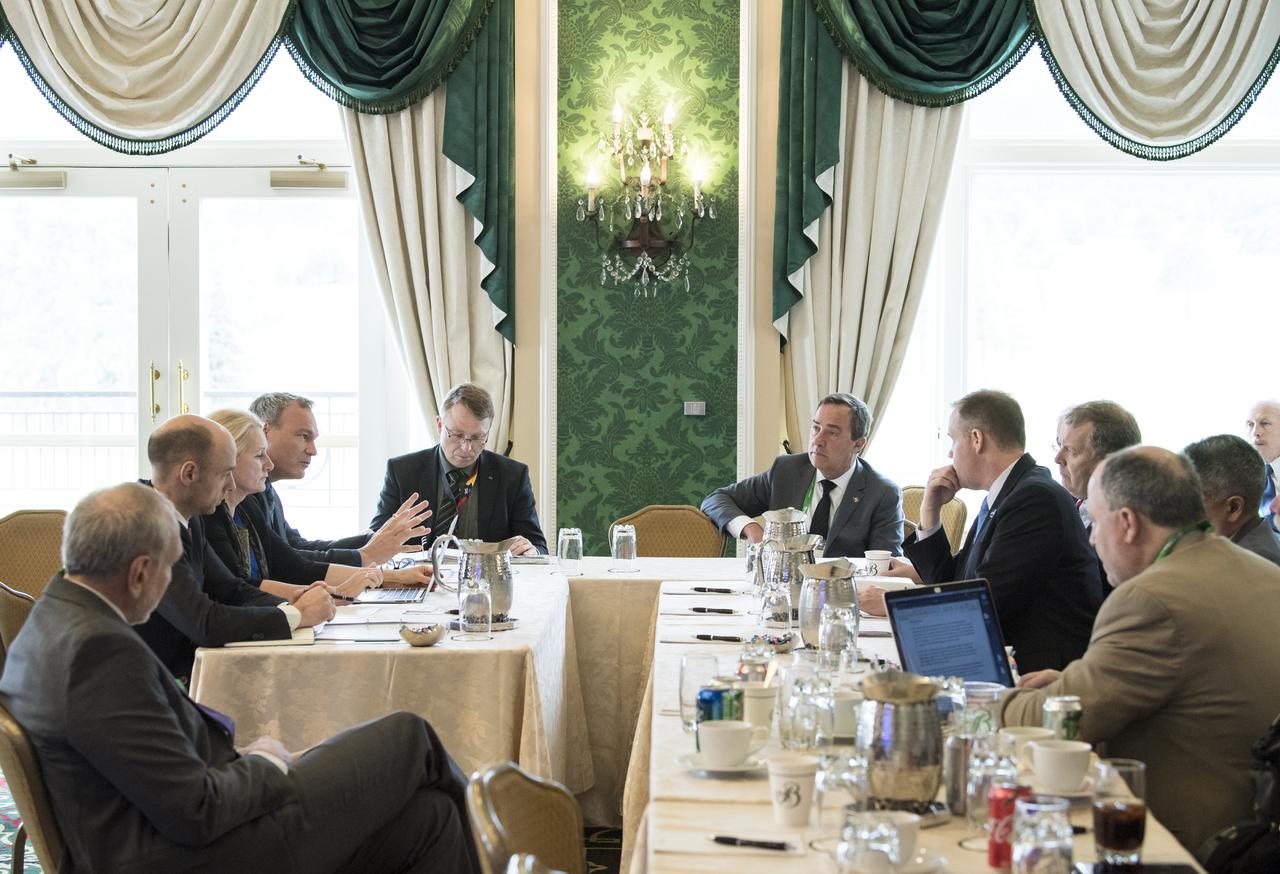
Walther Pelzer, German Aerospace Center (DLR) executive board member, speaks with NASA Administrator Jim Bridenstine about the robust relationship between their agencies in human and robotic exploration, and prospects for cooperation as NASA pursues the landing of humans on the Moon by 2024, at the Space Symposium, Wednesday, April 10, 2019 in Colorado Springs, Colorado. Photo Credit: (NASA/Aubrey Gemignani)
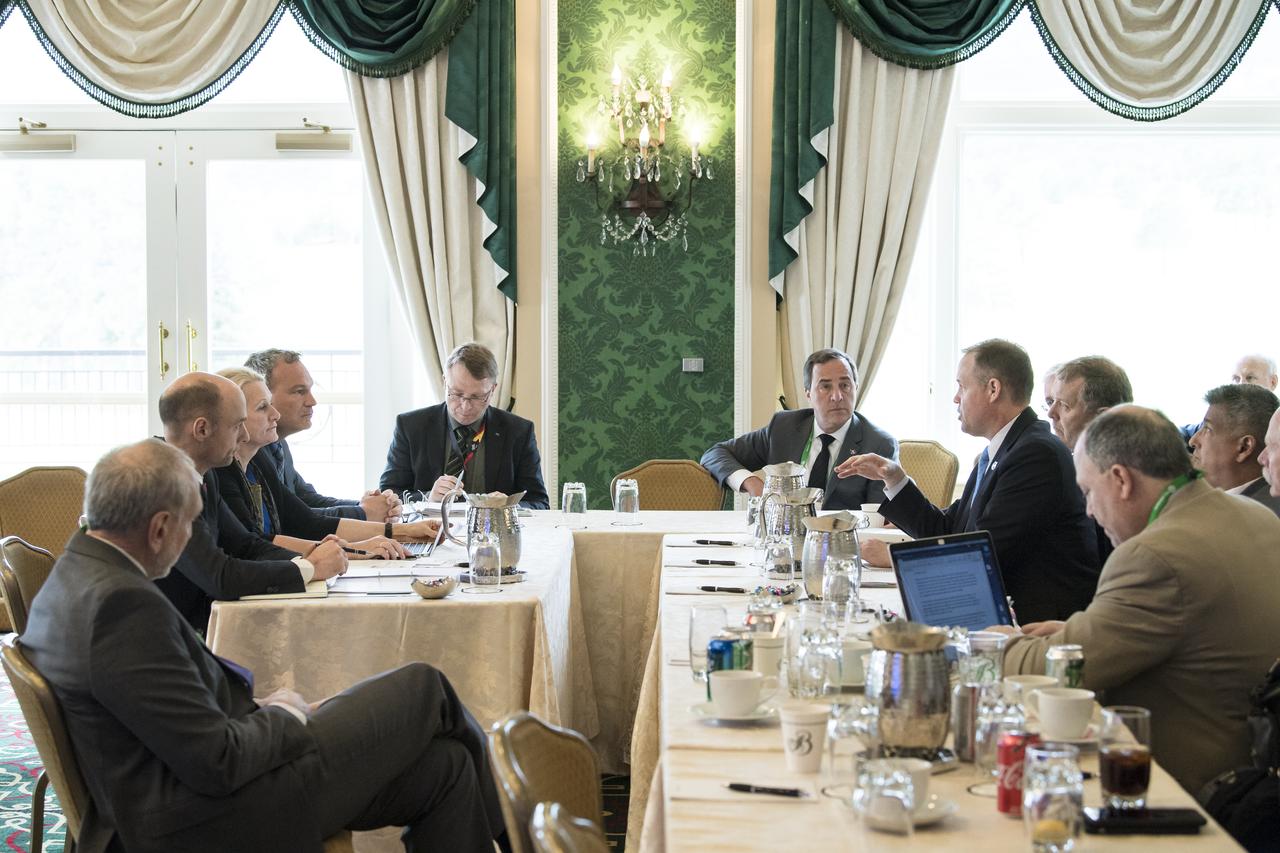
NASA Administrator Jim Bridenstine speaks with German Aerospace Center (DLR) executive board chair, Dr. Pascale Ehrenfreund, about the robust relationship between their agencies in human and robotic exploration, and prospects for cooperation as NASA pursues the landing of humans on the Moon by 2024, at the Space Symposium, Wednesday, April 10, 2019 in Colorado Springs, Colorado. Photo Credit: (NASA/Aubrey Gemignani)
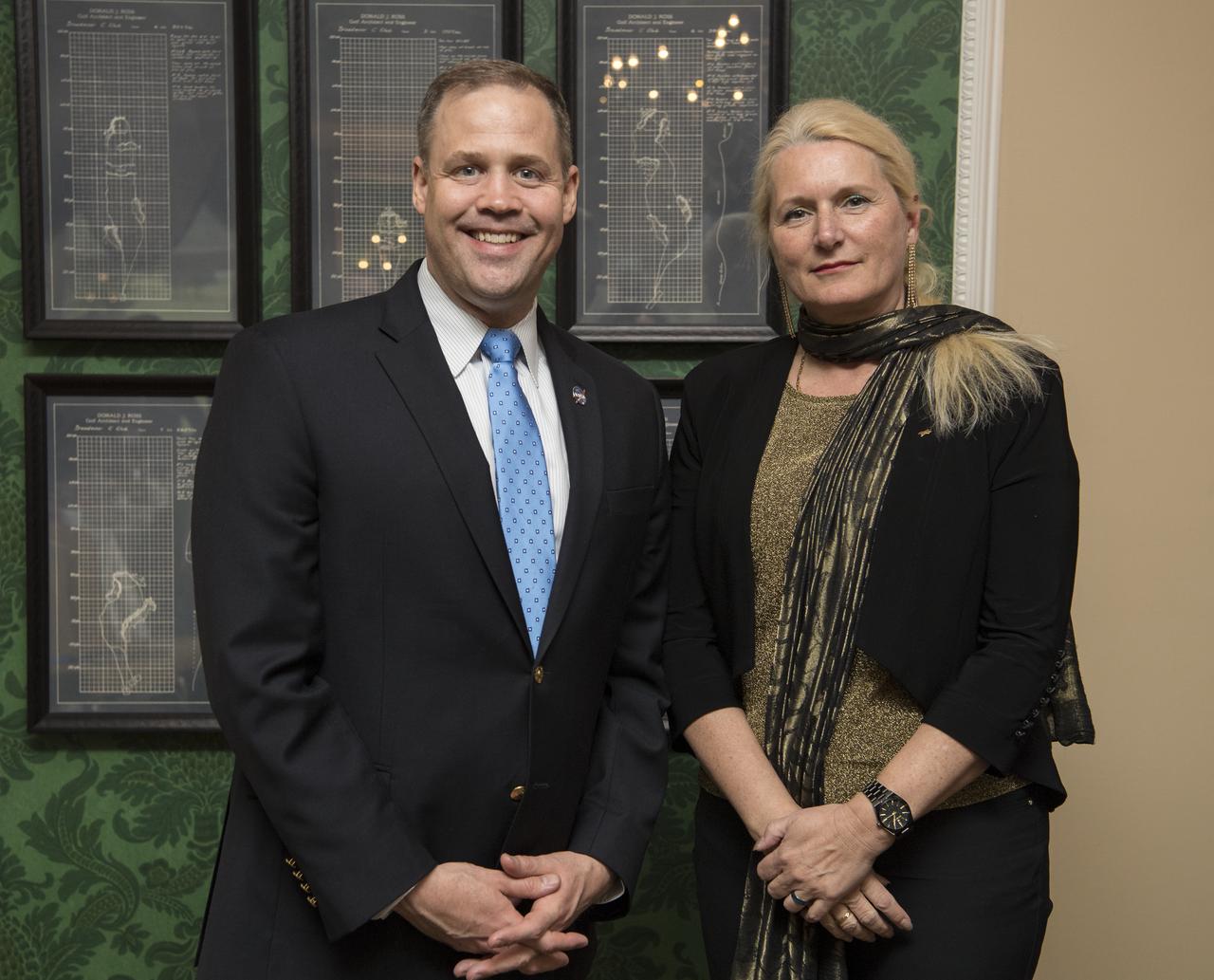
NASA Administrator Jim Bridenstine, left, poses for a photo with German Aerospace Center (DLR) executive board chair, Dr. Pascale Ehrenfreund after meeting to discuss the robust relationship between their agencies in human and robotic exploration, and prospects for cooperation as NASA pursues the landing of humans on the Moon by 2024, at the Space Symposium, Wednesday, April 10, 2019 in Colorado Springs, Colorado. Photo Credit: (NASA/Aubrey Gemignani)
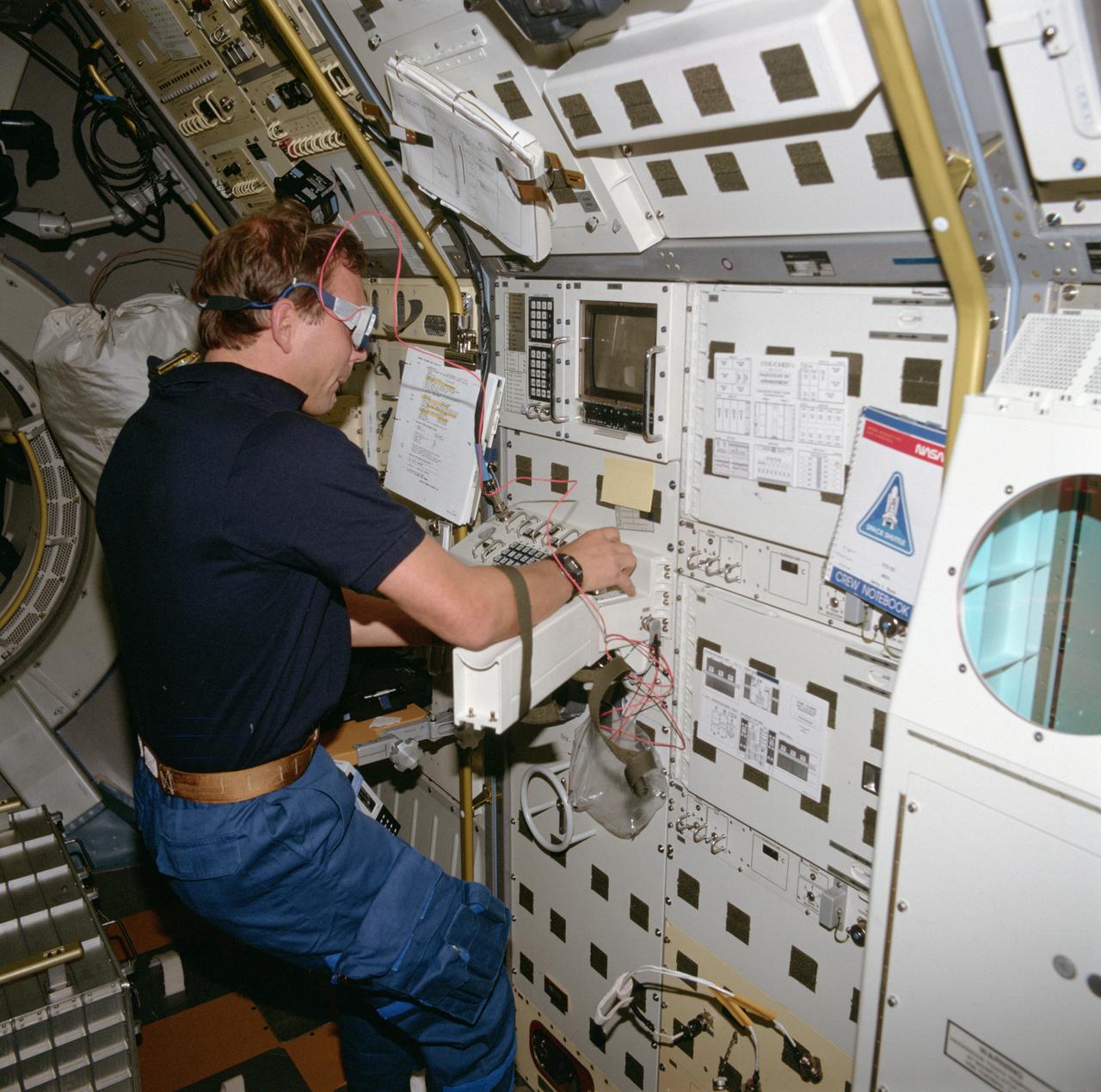
STS055-106-100 (26 April-6 May 1993) --- Hans Schlegel, wearing special glasses, works at the Robotics Experiment (ROTEX) workstation in the science module aboard the Earth-orbiting Space Shuttle Columbia. Schlegel was one of two payload specialists representing the German Aerospace Research Establishment (DLR) on the 10-day Spacelab D-2 mission. ROTEX is a robotic arm that operates within an enclosed workcell in rack 6 of the Spacelab module and uses teleoperation from both an onboard station located nearby in rack 4 and from a station on the ground. The device uses teleprogramming and artificial intelligence to look at the design, verification and operation of advanced autonomous systems for use in future applications.
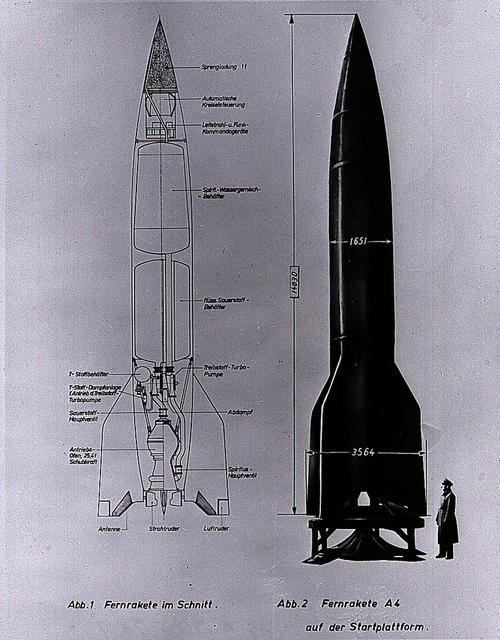
This German cutaway drawing of the Aggregate-4 (A-4) illustrates the dimensions and internal workings of the rocket. Later renamed the V-2, the rocket was developed by Dr. Wernher von Braun and the German Rocket Team at Peenemuende on the Baltic Sea. At the end of World War II, the team of German engineers and scientists came to the United States to work for the Army at Fort Bliss, Texas, and Redstone Arsenal in Huntsville, Alabama.
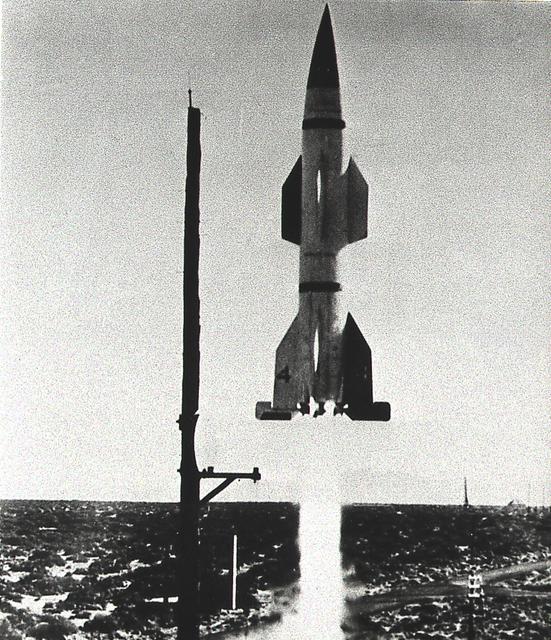
The Hermes A-1 rocket was designed by the U. S. Army after capturing the V-2 rocket from the German army at the conclusion of the Second World War. The Hermes A-1 is a modified V-2 rocket; it utilized the German aerodynamic configuration; however, internally it was a completely new design. This rocket was the first designed by the German Rocket Team at Redstone Arsenal in Huntsville, AL.
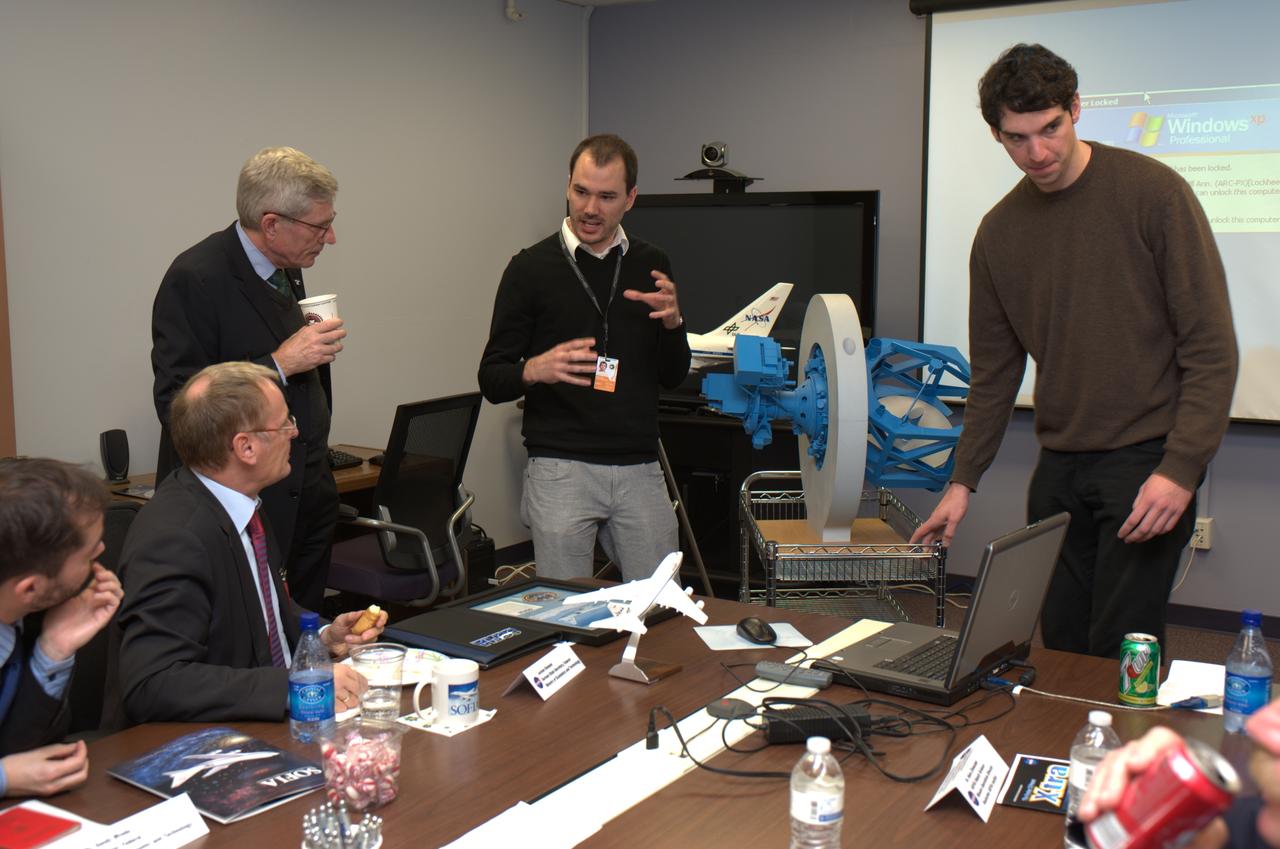
German Deligation visits Ames SOFIA Science Office for briefing. Left to right Jochen Homann, German State Secretary Federal Ministry of Economics and Technology, Dr. Benno Bunse, President & CEO, German American Chamber of Commerce, New York, Manuel Wiedemann, post-doctorate student from the Deutsches SOFIA Institute, University of Stuttgart.
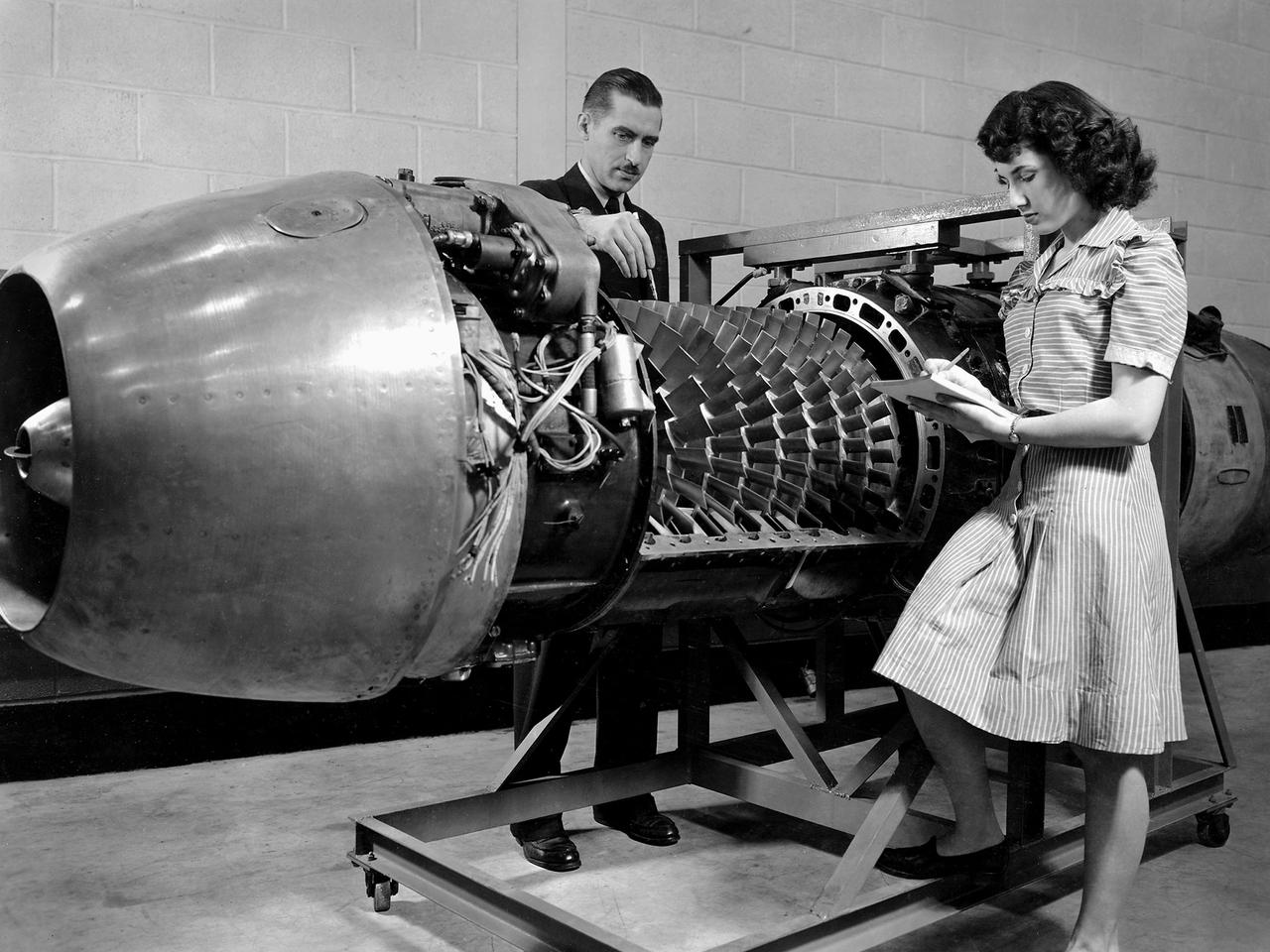
Researcher Robert Miller led an investigation into the combustor performance of a German Jumo 004 engine at the National Advisory Committee for Aeronautics (NACA) Lewis Flight Propulsion Laboratory. The Jumo 004 powered the world's first operational jet fighter, the Messerschmitt Me 262, beginning in 1942. The Me 262 was the only jet aircraft used in combat during World War II. The eight-stage axial-flow compressor Jumo 004 produced 2000 pounds of thrust. The US Army Air Forces provided the NACA with a Jumo 004 engine in 1945 to study the compressor’s design and performance. Conveniently the engine’s designer Anselm Franz had recently arrived at Wright-Patterson Air Force Base in nearby Dayton, Ohio as part of Project Paperclip. The Lewis researchers used a test rig in the Engine Research Building to analyze one of the six combustion chambers. It was difficult to isolate a single combustor’s performance when testing an entire engine. The combustion efficiency, outlet-temperature distribution, and total pressure drop were measured. The researchers determined the Jumo 004’s maximum performance was 5000 revolutions per minute at a 27,000 foot altitude and 11,000 revolutions per minute at a 45,000 foot altitude. The setup in this photograph was created for a tour of NACA Lewis by members of the Institute of Aeronautical Science on March 22, 1945.

The SOFIA telescope team collected baseline operational measurements during several nights of characterization testing in March 2008 while the SOFIA 747SP aircraft that houses the German-built infrared telescope was parked on an unlit ramp next to its hangar at the NASA Dryden Flight Operations Facility in Palmdale, Calif. The primary celestial target was Polaris, the North Star. The activity provided the team with a working knowledge of how telescope operating systems interact and the experience of tracking celestial targets from the ground.

The SOFIA telescope team collected baseline operational measurements during several nights of characterization testing in March 2008 while the SOFIA 747SP aircraft that houses the German-built infrared telescope was parked on an unlit ramp next to its hangar at the NASA Dryden Flight Operations Facility in Palmdale, Calif. The primary celestial target was Polaris, the North Star. The activity provided the team with a working knowledge of how telescope operating systems interact and the experience of tracking celestial targets from the ground.
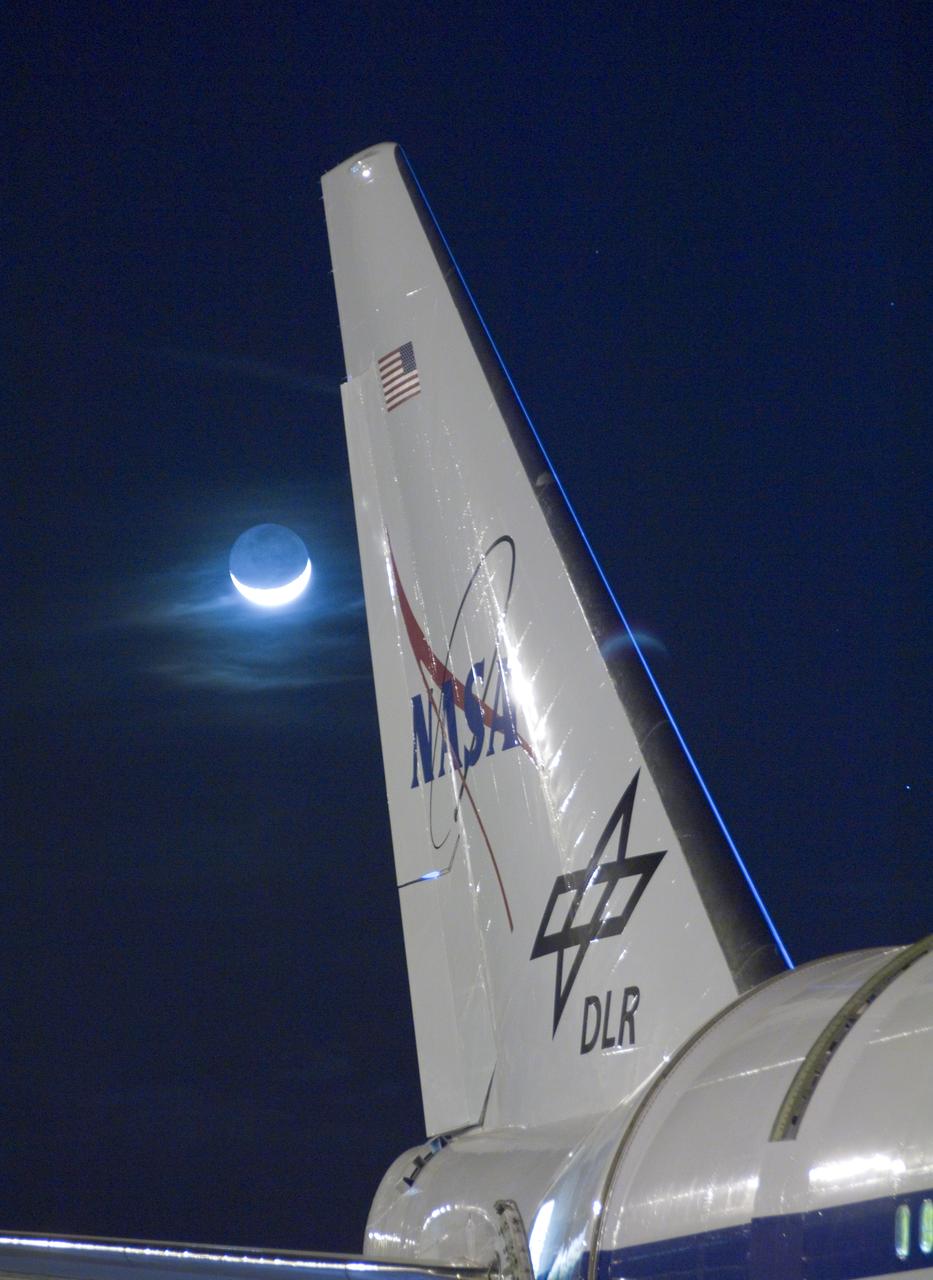
The SOFIA telescope team collected baseline operational measurements during several nights of characterization testing in March 2008 while the SOFIA 747SP aircraft that houses the German-built infrared telescope was parked on an unlit ramp next to its hangar at the NASA Dryden Flight Operations Facility in Palmdale, Calif. The primary celestial target was Polaris, the North Star. The activity provided the team with a working knowledge of how telescope operating systems interact and the experience of tracking celestial targets from the ground.

The SOFIA telescope team collected baseline operational measurements during several nights of characterization testing in March 2008 while the SOFIA 747SP aircraft that houses the German-built infrared telescope was parked on an unlit ramp next to its hangar at the NASA Dryden Flight Operations Facility in Palmdale, Calif. The primary celestial target was Polaris, the North Star. The activity provided the team with a working knowledge of how telescope operating systems interact and the experience of tracking celestial targets from the ground.

The SOFIA telescope team collected baseline operational measurements during several nights of characterization testing in March 2008 while the SOFIA 747SP aircraft that houses the German-built infrared telescope was parked on an unlit ramp next to its hangar at the NASA Dryden Flight Operations Facility in Palmdale, Calif. The primary celestial target was Polaris, the North Star. The activity provided the team with a working knowledge of how telescope operating systems interact and the experience of tracking celestial targets from the ground.

The SOFIA telescope team collected baseline operational measurements during several nights of characterization testing in March 2008 while the SOFIA 747SP aircraft that houses the German-built infrared telescope was parked on an unlit ramp next to its hangar at the NASA Dryden Flight Operations Facility in Palmdale, Calif. The primary celestial target was Polaris, the North Star. The activity provided the team with a working knowledge of how telescope operating systems interact and the experience of tracking celestial targets from the ground.

Illustration of the twin spacecraft of the NASA/German Research Centre for Geosciences (GFZ) Gravity Recovery and Climate Experiment Follow-On (GRACE-FO) mission. GRACE-FO will continue tracking the evolution of Earth's water cycle by monitoring changes in the distribution of mass on Earth. https://photojournal.jpl.nasa.gov/catalog/PIA22445