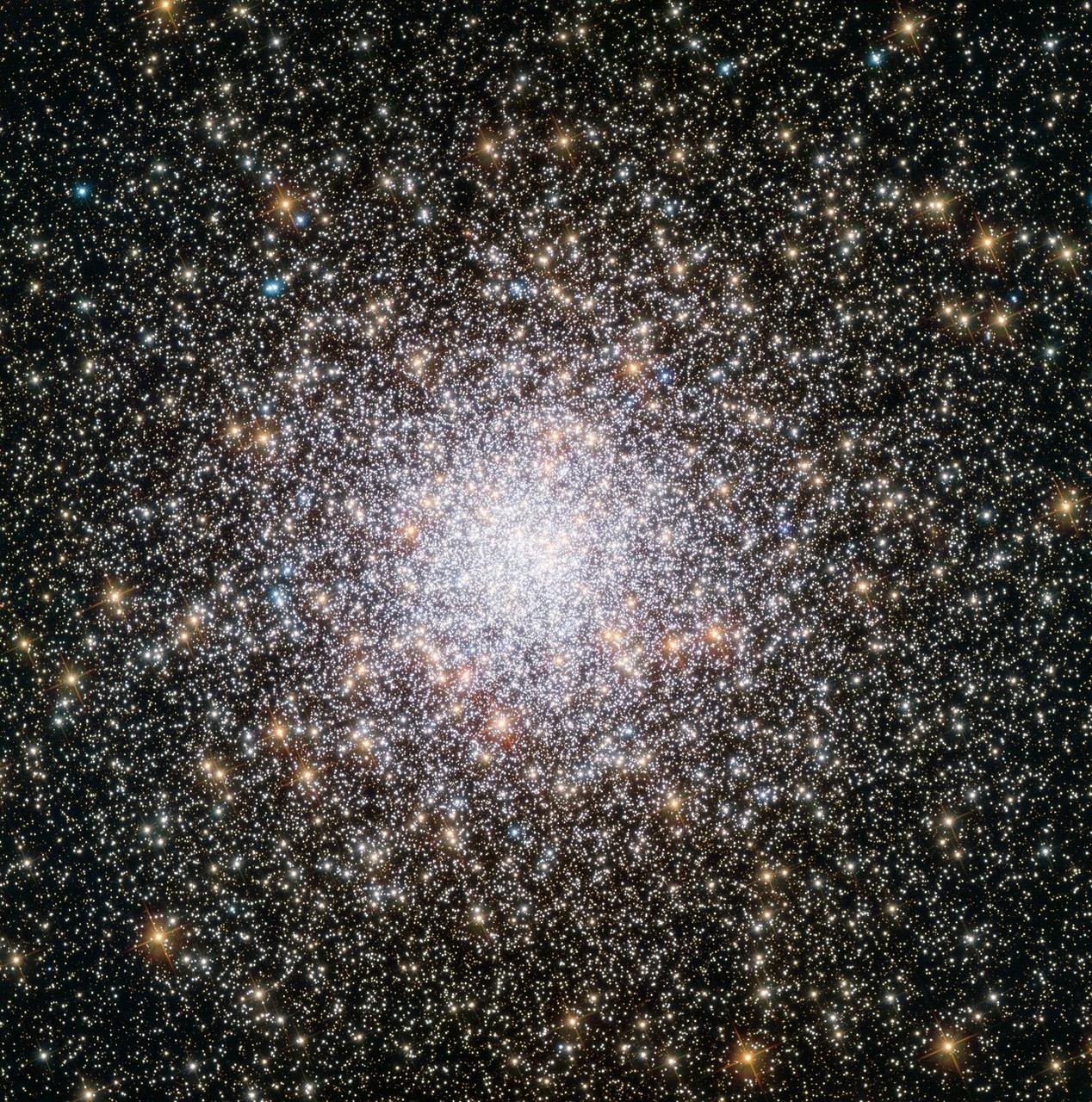
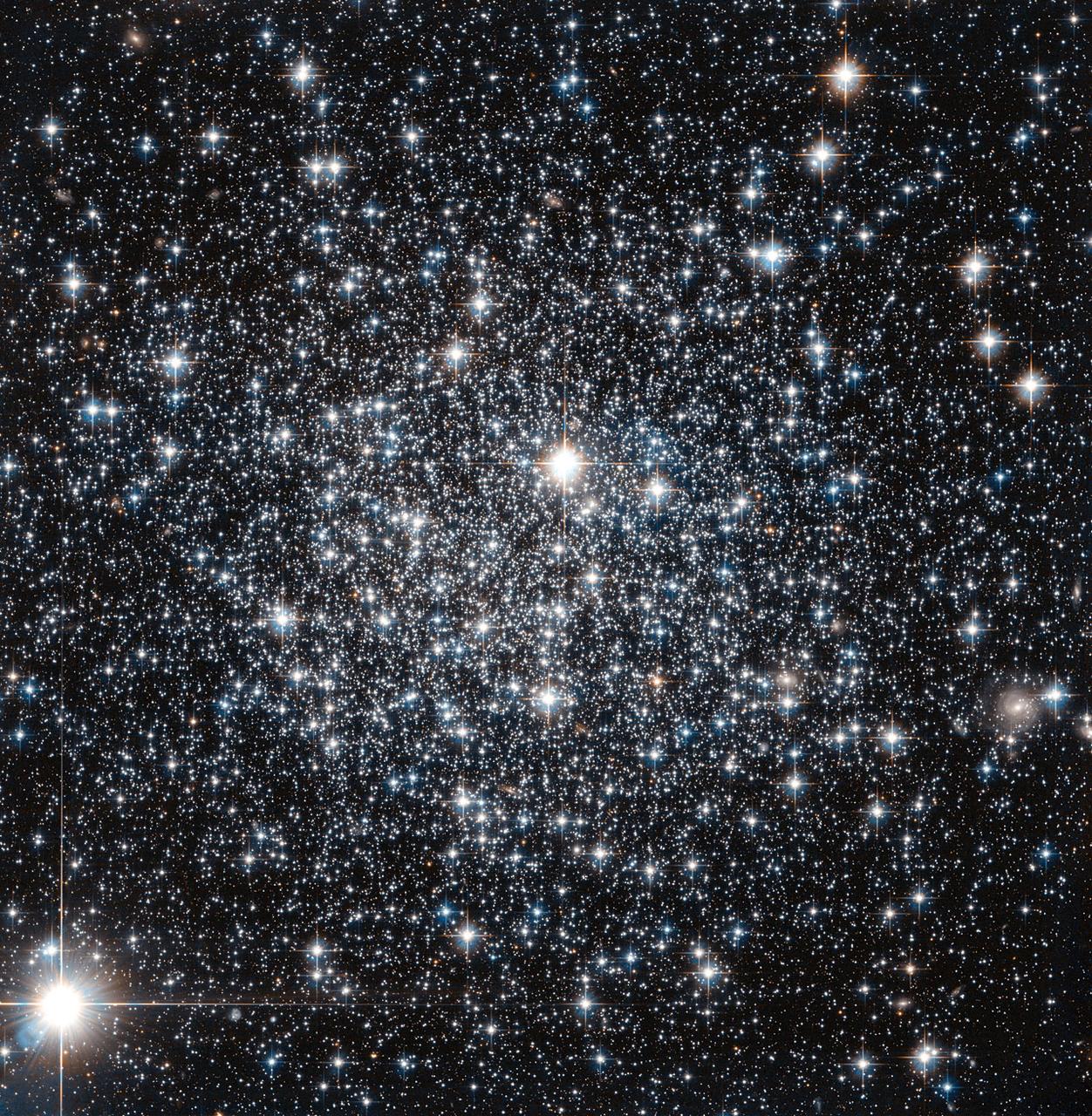
Hubble sees an unusal global cluster that is enriching the interstellar medium with metals Globular clusters offer some of the most spectacular sights in the night sky. These ornate spheres contain hundreds of thousands of stars, and reside in the outskirts of galaxies. The Milky Way contains over 150 such clusters — and the one shown in this NASA/ESA Hubble Space Telescope image, named NGC 362, is one of the more unusual ones. As stars make their way through life they fuse elements together in their cores, creating heavier and heavier elements — known in astronomy as metals — in the process. When these stars die, they flood their surroundings with the material they have formed during their lifetimes, enriching the interstellar medium with metals. Stars that form later therefore contain higher proportions of metals than their older relatives. By studying the different elements present within individual stars in NGC 362, astronomers discovered that the cluster boasts a surprisingly high metal content, indicating that it is younger than expected. Although most globular clusters are much older than the majority of stars in their host galaxy, NGC 362 bucks the trend, with an age lying between 10 and 11 billion years old. For reference, the age of the Milky Way is estimated to be above 13 billion years. This image, in which you can view NGC 362’s individual stars, was taken by Hubble’s Advanced Camera for Surveys (ACS). Credit: ESA/Hubble& NASA <b><a href="http://www.nasa.gov/audience/formedia/features/MP_Photo_Guidelines.html" rel="nofollow">NASA image use policy.</a></b> <b><a href="http://www.nasa.gov/centers/goddard/home/index.html" rel="nofollow">NASA Goddard Space Flight Center</a></b> enables NASA’s mission through four scientific endeavors: Earth Science, Heliophysics, Solar System Exploration, and Astrophysics. Goddard plays a leading role in NASA’s accomplishments by contributing compelling scientific knowledge to advance the Agency’s mission. <b>Follow us on <a href="http://twitter.com/NASAGoddardPix" rel="nofollow">Twitter</a></b> <b>Like us on <a href="http://www.facebook.com/pages/Greenbelt-MD/NASA-Goddard/395013845897?ref=tsd" rel="nofollow">Facebook</a></b> <b>Find us on <a href="http://instagrid.me/nasagoddard/?vm=grid" rel="nofollow">Instagram</a></b>

Using NASA’s Hubble Space Telescope, astronomers have captured for the first time snapshots of fledging white dwarf stars beginning their slow-paced, 40-million-year migration from the crowded center of an ancient star cluster to the less populated suburbs. White dwarfs are the burned-out relics of stars that rapidly lose mass, cool down and shut off their nuclear furnaces. As these glowing carcasses age and shed weight, their orbits begin to expand outward from the star cluster’s packed downtown. This migration is caused by a gravitational tussle among stars inside the cluster. Globular star clusters sort out stars according to their mass, governed by a gravitational billiard ball game where lower mass stars rob momentum from more massive stars. The result is that heavier stars slow down and sink to the cluster's core, while lighter stars pick up speed and move across the cluster to the edge. This process is known as "mass segregation." Until these Hubble observations, astronomers had never definitively seen the dynamical conveyor belt in action. Astronomers used Hubble to watch the white-dwarf exodus in the globular star cluster 47 Tucanae, a dense swarm of hundreds of thousands of stars in our Milky Way galaxy. The cluster resides 16,700 light-years away in the southern constellation Tucana. Credits: NASA, ESA, and H. Richer and J. Heyl (University of British Columbia, Vancouver, Canada); acknowledgement: J. Mack (STScI) and G. Piotto (University of Padova, Italy)
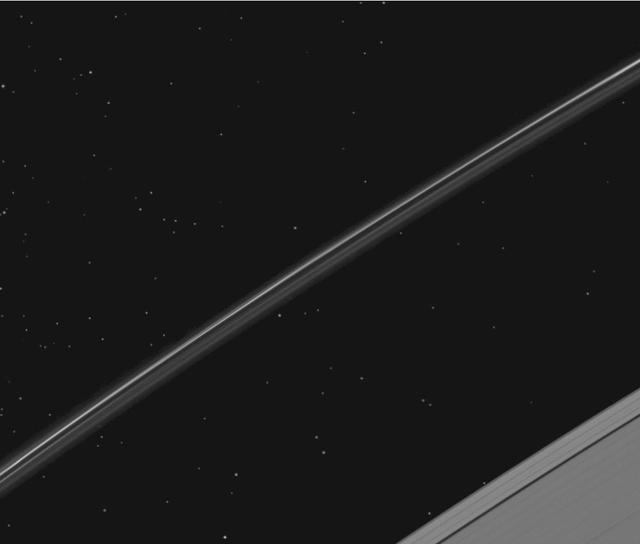
While NASA Cassini spacecraft was pointed to study Saturn F ring, it happened to catch a globular star cluster passing through the camera field of view. Animations are available at the Photojournal.

By spying on a neighboring galaxy, NASA Hubble Space Telescope has captured an image of a young, globular-like star cluster—a type of object unknown in our Milky Way Galaxy.

This image, taken with the Wide Field Planetary Camera 2 on board the NASA/ESA Hubble Space Telescope, shows the globular cluster Terzan 1. Lying around 20 000 light-years from us in the constellation of Scorpius (The Scorpion), it is one of about 150 globular clusters belonging to our galaxy, the Milky Way. Typical globular clusters are collections of around a hundred thousand stars, held together by their mutual gravitational attraction in a spherical shape a few hundred light-years across. It is thought that every galaxy has a population of globular clusters. Some, like the Milky Way, have a few hundred, while giant elliptical galaxies can have several thousand. They contain some of the oldest stars in a galaxy, hence the reddish colours of the stars in this image — the bright blue ones are foreground stars, not part of the cluster. The ages of the stars in the globular cluster tell us that they were formed during the early stages of galaxy formation! Studying them can also help us to understand how galaxies formed. Terzan 1, like many globular clusters, is a source of X-rays. It is likely that these X-rays come from binary star systems that contain a dense neutron star and a normal star. The neutron star drags material from the companion star, causing a burst of X-ray emission. The system then enters a quiescent phase in which the neutron star cools, giving off X-ray emission with different characteristics, before enough material from the companion builds up to trigger another outburst.
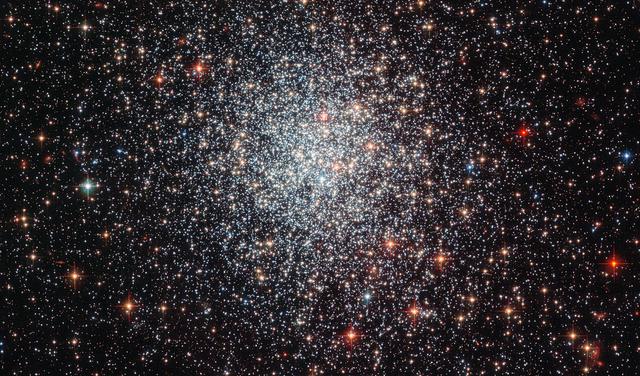
Shown here in a new image taken with the Advanced Camera for Surveys (ACS) on board the NASA/ESA Hubble Space Telescope, is the globular cluster NGC 1783. This is one of the biggest globular clusters in the Large Magellanic Cloud, a satellite galaxy of our own galaxy, the Milky Way, in the southern hemisphere constellation of Dorado. First observed by John Herschel in 1835, NGC 1783 is nearly 160 000 light-years from Earth, and has a mass around 170 000 times that of the Sun. Globular clusters are dense collections of stars held together by their own gravity, which orbit around galaxies like satellites. The image clearly shows the symmetrical shape of NGC 1783 and the concentration of stars towards the centre, both typical features of globular clusters. By measuring the colour and brightness of individual stars, astronomers can deduce an overall age for a cluster and a picture of its star formation history. NGC 1783 is thought to be under one and a half billion years old — which is very young for globular clusters, which are typically several billion years old. During that time, it is thought to have undergone at least two periods of star formation, separated by 50 to 100 million years. This ebb and flow of star-forming activity is an indicator of how much gas is available for star formation at any one time. When the most massive stars created in the first burst of formation explode as supernovae they blow away the gas needed to form further stars, but the gas reservoir can later be replenished by less massive stars which last longer and shed their gas less violently. After this gas flows to the dense central regions of the star cluster, a second phase of star formation can take place and once again the short-lived massive stars blow away any leftover gas. This cycle can continue a few times, at which time the remaining gas reservoir is thought to be too small to form any new stars. A version of this image was entered into the Hubble's Hidden Treasures image pr

Globular star cluster NGC 362, in a false-color image from NASA's Galaxy Evolution Explorer. Image credit: NASA/JPL-Caltech/Univ. of Virginia The Galaxy Evolution Explorer's ultraviolet eyes have captured a globular star cluster, called NGC 362, in our own Milky Way galaxy. In this new image, the cluster appears next to stars from a more distant neighboring galaxy, known as the Small Magellanic Cloud. "This image is so interesting because it allows a study of the final stages of evolution of low-mass stars in NGC 362, as well as the history of star formation in the Small Magellanic Cloud," said Ricardo Schiavon of the University of Virginia, Charlottesville, Va. Globular clusters are densely packed bunches of old stars scattered in galaxies throughout the universe. NGC 362, located 30,000 light-years away, can be spotted as the dense collection of mostly yellow-tinted stars surrounding a large white-yellow spot toward the top-right of this image. The white spot is actually the core of the cluster, which is made up of stars so closely packed together that the Galaxy Evolution Explorer cannot see them individually. The light blue dots surrounding the cluster core are called extreme horizontal branch stars. These stars used to be very similar to our sun and are nearing the end of their lives. They are very hot, with temperatures reaching up to about four times that of the surface of our sun (25,000 Kelvin or 45,500 degrees Fahrenheit). A star like our sun spends most of its life fusing hydrogen atoms in its core into helium. When the star runs out of hydrogen in its core, its outer envelope will expand. The star then becomes a red giant, which burns hydrogen in a shell surrounding its inner core. Throughout its life as a red giant, the star loses a lot of mass, then begins to burn helium at its core. Some stars will have lost so much mass at the end of this process, up to 85 percent of their envelopes, that most of the envelope is gone. What is left is a very hot ultraviolet-bright core, or extreme horizontal branch star. Blue dots scattered throughout the image are hot, young stars in the Small Magellanic Cloud, a satellite galaxy of the Milky Way located approximately 200,000 light-years away. The stars in this galaxy are much brighter intrinsically than extreme horizontal branch stars, but they appear just as bright because they are farther away. The blue stars in the Small Magellanic Cloud are only about a few tens of millions of years old, much younger than the approximately 10-million-year-old stars in NGC 362. Because NGC 362 sits on the northern edge of the Small Magellanic Cloud galaxy, the blue stars are denser toward the south, or bottom, of the image. Some of the yellow spots in this image are stars in the Milky Way galaxy that are along this line of sight. Astronomers believe that some of the other spots, particularly those closer to NGC 362, might actually be a relatively ultraviolet-dim family of stars called "blue stragglers." These stars are formed from collisions or close encounters between two closely orbiting stars in a globular cluster. "This observation could only be done with the Galaxy Evolution Explorer because it is the only ultraviolet imager available to the astronomical community with such a large field of view," said Schiavon. This image is a false-color composite, where light detected by the Galaxy Evolution Explorer's far-ultraviolet detector is colored blue, and light from the telescope's near-ultraviolet detector is red. Written by Linda Vu, Spitzer Science Center Media contact: Whitney Clavin/JPL (818) 354-4673
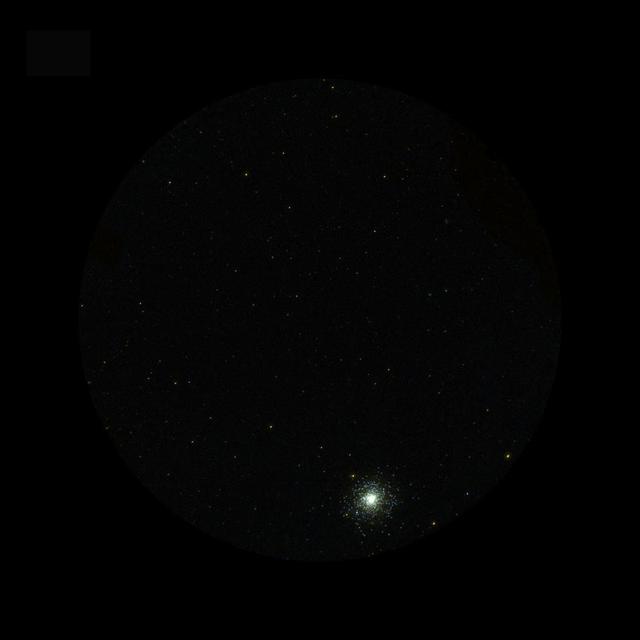
This image of the Globular cluster Messier 2 (M2) was taken by Galaxy Evolution Explorer on August 20, 2003. This image is a small section of a single All Sky Imaging Survey exposure of only 129 seconds in the constellation Aquarius. This picture is a combination of Galaxy Evolution Explorer images taken with the far ultraviolet (colored blue) and near ultraviolet detectors (colored red). Globular clusters are gravitationally bound systems of hundreds of thousands of stars that orbit in the halos of galaxies. The globular clusters in out Milky Way galaxy contain some of the oldest stars known. M2 lies 33,000 light years from our Sun with stars distributed in a spherical system with a radius of approximately 100 light years. http://photojournal.jpl.nasa.gov/catalog/PIA04926
This new NASA/ESA Hubble Space Telescope image shows the globular cluster IC 4499. Globular clusters are big balls of old stars that orbit around their host galaxy. It has long been believed that all the stars within a globular cluster form at the about same time, a property which can be used to determine the cluster's age. For more massive globulars however, detailed observations have shown that this is not entirely true — there is evidence that they instead consist of multiple populations of stars born at different times. One of the driving forces behind this behavior is thought to be gravity: more massive globulars manage to grab more gas and dust, which can then be transformed into new stars. IC 4499 is a somewhat special case. Its mass lies somewhere between low-mass globulars, which show a single generation build-up, and the more complex and massive globulars which can contain more than one generation of stars. By studying objects like IC 4499 astronomers can therefore explore how mass affects a cluster's contents. Astronomers found no sign of multiple generations of stars in IC 4499 — supporting the idea that less massive clusters in general only consist of a single stellar generation. Hubble observations of IC 4499 have also helped to pinpoint the cluster's age: observations of this cluster from the 1990s suggested a puzzlingly young age when compared to other globular clusters within the Milky Way. However, since those first estimates new Hubble data have been obtained and it has been found to be much more likely that IC 4499 is actually roughly the same age as other Milky Way clusters at approximately 12 billion years old. Credit: ESA and NASA <b><a href="http://www.nasa.gov/audience/formedia/features/MP_Photo_Guidelines.html" rel="nofollow">NASA image use policy.</a></b> <b><a href="http://www.nasa.gov/centers/goddard/home/index.html" rel="nofollow">NASA Goddard Space Flight Center</a></b> enables NASA’s mission through four scientific endeavors: Earth Science, Heliophysics, Solar System Exploration, and Astrophysics. Goddard plays a leading role in NASA’s accomplishments by contributing compelling scientific knowledge to advance the Agency’s mission. <b>Follow us on <a href="http://twitter.com/NASAGoddardPix" rel="nofollow">Twitter</a></b> <b>Like us on <a href="http://www.facebook.com/pages/Greenbelt-MD/NASA-Goddard/395013845897?ref=tsd" rel="nofollow">Facebook</a></b> <b>Find us on <a href="http://instagram.com/nasagoddard?vm=grid" rel="nofollow">Instagram</a></b>
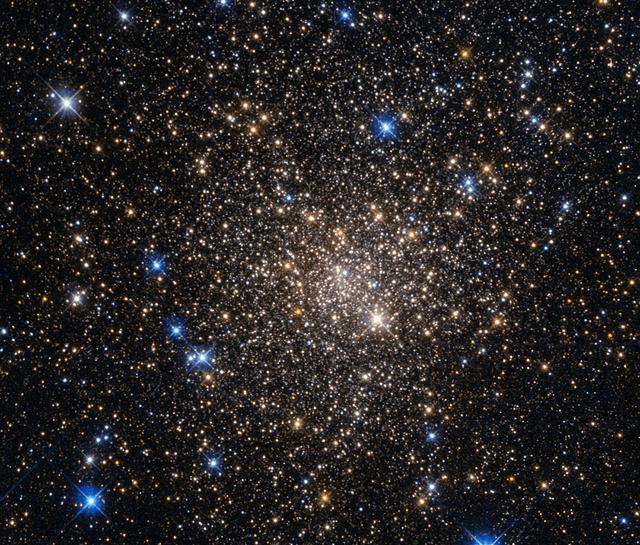
This image, taken with the Wide Field Planetary Camera 2 on board the NASA/ESA Hubble Space Telescope, shows the globular cluster Terzan 1. Lying around 20,000 light-years from us in the constellation of Scorpius (The Scorpion), it is one of about 150 globular clusters belonging to our galaxy, the Milky Way. Typical globular clusters are collections of around a hundred thousand stars, held together by their mutual gravitational attraction in a spherical shape a few hundred light-years across. It is thought that every galaxy has a population of globular clusters. Some, like the Milky Way, have a few hundred, while giant elliptical galaxies can have several thousand. They contain some of the oldest stars in a galaxy, hence the reddish colors of the stars in this image — the bright blue ones are foreground stars, not part of the cluster. The ages of the stars in the globular cluster tell us that they were formed during the early stages of galaxy formation! Studying them can also help us to understand how galaxies formed. Terzan 1, like many globular clusters, is a source of X-rays. It is likely that these X-rays come from binary star systems that contain a dense neutron star and a normal star. The neutron star drags material from the companion star, causing a burst of X-ray emission. The system then enters a quiescent phase in which the neutron star cools, giving off X-ray emission with different characteristics, before enough material from the companion builds up to trigger another outburst. Image credit: NASA & ESA, Acknowledgement: Judy Schmidt <b><a href="http://www.nasa.gov/audience/formedia/features/MP_Photo_Guidelines.html" rel="nofollow">NASA image use policy.</a></b> <b><a href="http://www.nasa.gov/centers/goddard/home/index.html" rel="nofollow">NASA Goddard Space Flight Center</a></b> enables NASA’s mission through four scientific endeavors: Earth Science, Heliophysics, Solar System Exploration, and Astrophysics. Goddard plays a leading role in NASA’s accomplishments by contributing compelling scientific knowledge to advance the Agency’s mission. <b>Follow us on <a href="http://twitter.com/NASAGoddardPix" rel="nofollow">Twitter</a></b> <b>Like us on <a href="http://www.facebook.com/pages/Greenbelt-MD/NASA-Goddard/395013845897?ref=tsd" rel="nofollow">Facebook</a></b> <b>Find us on <a href="http://instagrid.me/nasagoddard/?vm=grid" rel="nofollow">Instagram</a></b>
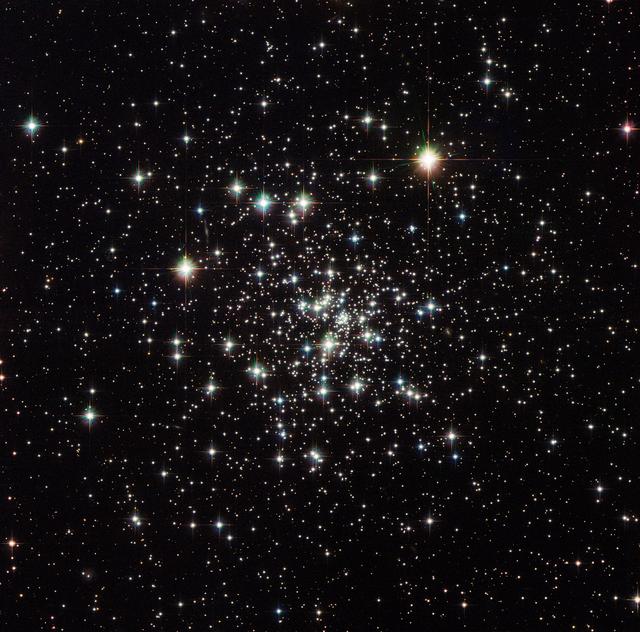
This image captures the stunning NGC 6535, a globular cluster 22,000 light-years away in the constellation of Serpens (The Serpent) that measures one light-year across. Globular clusters are tightly bound groups of stars which orbit galaxies. The large mass in the rich stellar centre of the globular cluster pulls the stars inward to form a ball of stars. The word globulus, from which these clusters take their name, is Latin for small sphere. Globular clusters are generally very ancient objects formed around the same time as their host galaxy. To date, no new star formation has been observed within a globular cluster, which explains the abundance of aging yellow stars in this image, most of them containing very few heavy elements. NGC 6535 was first discovered in 1852 by English astronomer John Russell Hind. The cluster would have appeared to Hind as a small, faint smudge through his telescope. Now, over 160 years later, instruments like the Advanced Camera for Surveys (ACS) and Wide Field Camera 3 (WFC3) on the NASA/ European Space Agency (ESA) Hubble Space Telescope allow us to marvel at the cluster and its contents in greater detail. Credit: ESA/Hubble & NASA, Acknowledgement: Gilles Chapdelaine <b><a href="http://www.nasa.gov/audience/formedia/features/MP_Photo_Guidelines.html" rel="nofollow">NASA image use policy.</a></b> <b><a href="http://www.nasa.gov/centers/goddard/home/index.html" rel="nofollow">NASA Goddard Space Flight Center</a></b> enables NASA’s mission through four scientific endeavors: Earth Science, Heliophysics, Solar System Exploration, and Astrophysics. Goddard plays a leading role in NASA’s accomplishments by contributing compelling scientific knowledge to advance the Agency’s mission. <b>Follow us on <a href="http://twitter.com/NASAGoddardPix" rel="nofollow">Twitter</a></b> <b>Like us on <a href="http://www.facebook.com/pages/Greenbelt-MD/NASA-Goddard/395013845897?ref=tsd" rel="nofollow">Facebook</a></b> <b>Find us on <a href="http://instagrid.me/nasagoddard/?vm=grid" rel="nofollow">Instagram</a></b>
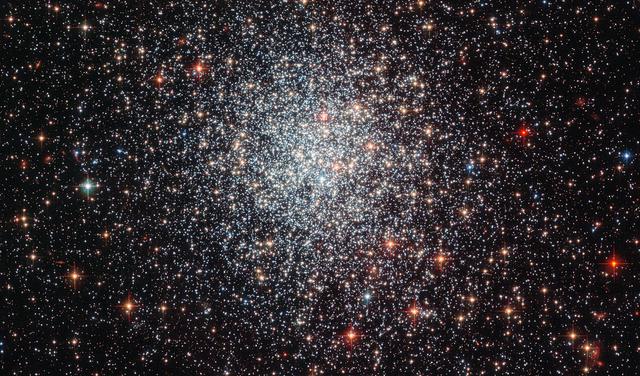
Shown here in a new image taken with the Advanced Camera for Surveys (ACS) on board the NASA/ESA Hubble Space Telescope is the globular cluster NGC 1783. This is one of the biggest globular clusters in the Large Magellanic Cloud, a satellite galaxy of our own galaxy, the Milky Way, in the southern hemisphere constellation of Dorado. First observed by John Herschel in 1835, NGC 1783 is nearly 160,000 light-years from Earth, and has a mass around 170,000 times that of the sun. Globular clusters are dense collections of stars held together by their own gravity, which orbit around galaxies like satellites. The image clearly shows the symmetrical shape of NGC 1783 and the concentration of stars towards the center, both typical features of globular clusters. By measuring the color and brightness of individual stars, astronomers can deduce an overall age for a cluster and a picture of its star formation history. NGC 1783 is thought to be less than one and a half billion years old — which is very young for globular clusters, which are typically several billion years old. During that time, it is thought to have undergone at least two periods of star formation, separated by 50 to 100 million years. This ebb and flow of star-forming activity is an indicator of how much gas is available for star formation at any one time. When the most massive stars created in the first burst of formation explode as supernovae they blow away the gas needed to form further stars, but the gas reservoir can later be replenished by less massive stars which last longer and shed their gas less violently. After this gas flows to the dense central regions of the star cluster, a second phase of star formation can take place and once again the short-lived massive stars blow away any leftover gas. This cycle can continue a few times, at which time the remaining gas reservoir is thought to be too small to form any new stars. Image credit: ESA/Hubble & NASA, Acknowledgement: Judy Schmidt <b><a href="http://www.nasa.gov/audience/formedia/features/MP_Photo_Guidelines.html" rel="nofollow">NASA image use policy.</a></b> <b><a href="http://www.nasa.gov/centers/goddard/home/index.html" rel="nofollow">NASA Goddard Space Flight Center</a></b> enables NASA’s mission through four scientific endeavors: Earth Science, Heliophysics, Solar System Exploration, and Astrophysics. Goddard plays a leading role in NASA’s accomplishments by contributing compelling scientific knowledge to advance the Agency’s mission. <b>Follow us on <a href="http://twitter.com/NASAGoddardPix" rel="nofollow">Twitter</a></b> <b>Like us on <a href="http://www.facebook.com/pages/Greenbelt-MD/NASA-Goddard/395013845897?ref=tsd" rel="nofollow">Facebook</a></b> <b>Find us on <a href="http://instagrid.me/nasagoddard/?vm=grid" rel="nofollow">Instagram</a></b>
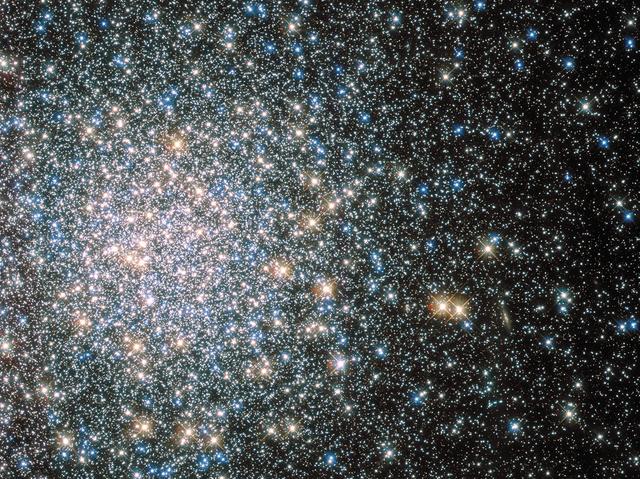
This sparkling jumble is Messier 5 — a globular cluster consisting of hundreds of thousands of stars bound together by their collective gravity. But Messier 5 is no normal globular cluster. At 13 billion years old it dates back to close to the beginning of the Universe, which is some 13.8 billion years of age. It is also one of the biggest clusters known, and at only 24 500 light-years away, it is no wonder that Messier 5 is a popular site for astronomers to train their telescopes on. Messier 5 also presents a puzzle. Stars in globular clusters grow old and wise together. So Messier 5 should, by now, consist of old, low-mass red giants and other ancient stars. But it is actually teeming with young blue stars known as blue stragglers. These stars spring to life when stars collide, or rip material from one another. Credit: ESA/NASA <b><a href="http://www.nasa.gov/audience/formedia/features/MP_Photo_Guidelines.html" rel="nofollow">NASA image use policy.</a></b> <b><a href="http://www.nasa.gov/centers/goddard/home/index.html" rel="nofollow">NASA Goddard Space Flight Center</a></b> enables NASA’s mission through four scientific endeavors: Earth Science, Heliophysics, Solar System Exploration, and Astrophysics. Goddard plays a leading role in NASA’s accomplishments by contributing compelling scientific knowledge to advance the Agency’s mission. <b>Follow us on <a href="http://twitter.com/NASAGoddardPix" rel="nofollow">Twitter</a></b> <b>Like us on <a href="http://www.facebook.com/pages/Greenbelt-MD/NASA-Goddard/395013845897?ref=tsd" rel="nofollow">Facebook</a></b> <b>Find us on <a href="http://instagram.com/nasagoddard?vm=grid" rel="nofollow">Instagram</a></b>
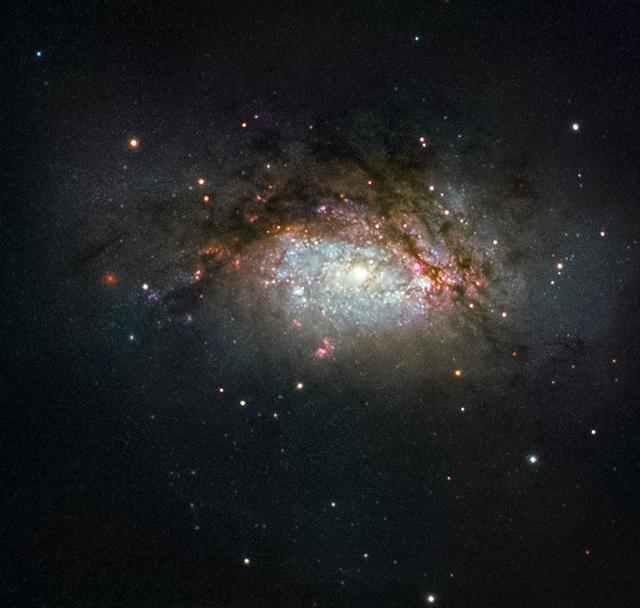
The subject of this NASA/ESA Hubble Space Telescope image is known as NGC 3597. It is the product of a collision between two good-sized galaxies, and is slowly evolving to become a giant elliptical galaxy. This type of galaxy has grown more and more common as the Universe has evolved, with initially small galaxies merging and progressively building up into larger galactic structures over time. NGC 3597 is located approximately 150 million light-years away in the constellation of Crater (The Cup). Astronomers study NGC 3597 to learn more about how elliptical galaxies form — many ellipticals began their lives far earlier in the history of the Universe. Older ellipticals are nicknamed “red and dead” by astronomers because these bloated galaxies are not anymore producing new, bluer, stars in ages, and are thus packed full of old and redder stellar populations. Before infirmity sets in, some freshly formed elliptical galaxies experience a final flush of youth, as is the case with NGC 3597. Galaxies smashing together pool their available gas and dust, triggering new rounds of star birth. Some of this material ends up in dense pockets initially called proto-globular clusters, dozens of which festoon NGC 3597. These pockets will go on to collapse and form fully-fledged globular clusters, large spheres that orbit the centres of galaxies like satellites, packed tightly full of millions of stars.
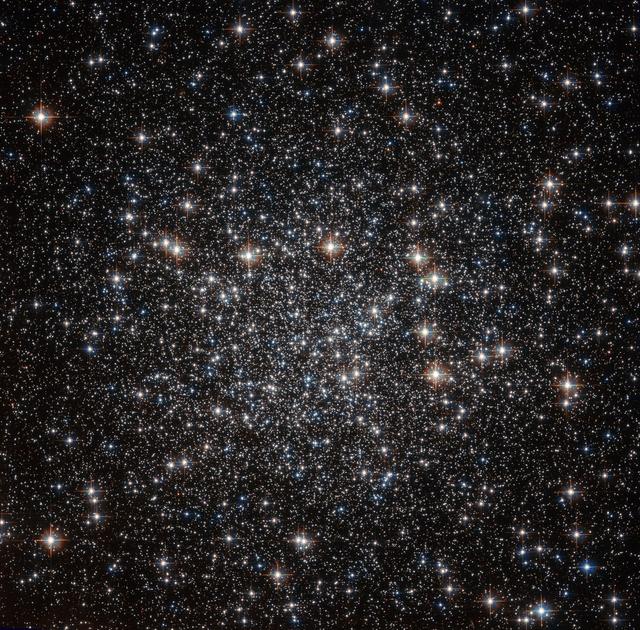
So Coldplay isn't the only one to see a sky full of stars, these are 22K light-years away Located approximately 22,000 light-years away in the constellation of Musca (The Fly), this tightly packed collection of stars — known as a globular cluster — goes by the name of NGC 4833. This NASA/ESA Hubble Space Telescope image shows the dazzling stellar group in all its glory. NGC 4833 is one of the over 150 globular clusters known to reside within the Milky Way. These objects are thought to contain some of the oldest stars in our galaxy. Studying these ancient cosmic clusters can help astronomers to unravel how a galaxy formed and evolved, and give an idea of the galaxy’s age. Globular clusters are responsible for some of the most striking sights in the cosmos, with hundreds of thousands of stars congregating in the same region of space. Hubble has observed many of these clusters during its time in orbit around our planet, each as breathtaking as the last. bit.ly/2b85p36 Image credit: ESA/Hubble and NASA <b><a href="http://www.nasa.gov/audience/formedia/features/MP_Photo_Guidelines.html" rel="nofollow">NASA image use policy.</a></b> <b><a href="http://www.nasa.gov/centers/goddard/home/index.html" rel="nofollow">NASA Goddard Space Flight Center</a></b> enables NASA’s mission through four scientific endeavors: Earth Science, Heliophysics, Solar System Exploration, and Astrophysics. Goddard plays a leading role in NASA’s accomplishments by contributing compelling scientific knowledge to advance the Agency’s mission. <b>Follow us on <a href="http://twitter.com/NASAGoddardPix" rel="nofollow">Twitter</a></b> <b>Like us on <a href="http://www.facebook.com/pages/Greenbelt-MD/NASA-Goddard/395013845897?ref=tsd" rel="nofollow">Facebook</a></b> <b>Find us on <a href="http://instagrid.me/nasagoddard/?vm=grid" rel="nofollow">Instagram</a></b>

This is a Hubble Space Telescope image of a concentration of stars within the globular cluster NGC 6752. Hidden among the stars is an image of a background galaxy that is much farther away. The diminutive galaxy, named by its discoverers as Bedin 1, measures only around 3,000 light-years at its greatest extent — a fraction of the size of the Milky Way. Not only is it tiny, but it is also incredibly faint. These properties led astronomers to classify it as a dwarf spheroidal galaxy that is as old as the universe. More info: https://go.nasa.gov/2tCaxGS Credits: NASA, ESA and L. Bedin (Astronomical Observatory of Padua, Italy)

Release Date: July 10, 2003 A rich starry sky fills the view from an ancient gas-giant planet in the core of the globular star cluster M4, as imagined in this artist's concept. The 13-billion-year-old planet orbits a helium white-dwarf star and the millisecond pulsar B1620-26, seen at lower left. The globular cluster is deficient in heavier elements for making planets, so the existence of such a world implies that planet formation may have been quite efficient and common in the early universe. Object Names: B1620-26, M4 Image Type: Artwork Illustration Credit: NASA and G. Bacon (STScI) To learn more about this image go to: <a href="http://www.nasa.gov/centers/goddard/news/topstory/2003/0709hstssu.html" rel="nofollow">www.nasa.gov/centers/goddard/news/topstory/2003/0709hstss...</a> <b><a href="http://www.nasa.gov/centers/goddard/home/index.html" rel="nofollow">NASA Goddard Space Flight Center</a></b> is home to the nation's largest organization of combined scientists, engineers and technologists that build spacecraft, instruments and new technology to study the Earth, the sun, our solar system, and the universe.
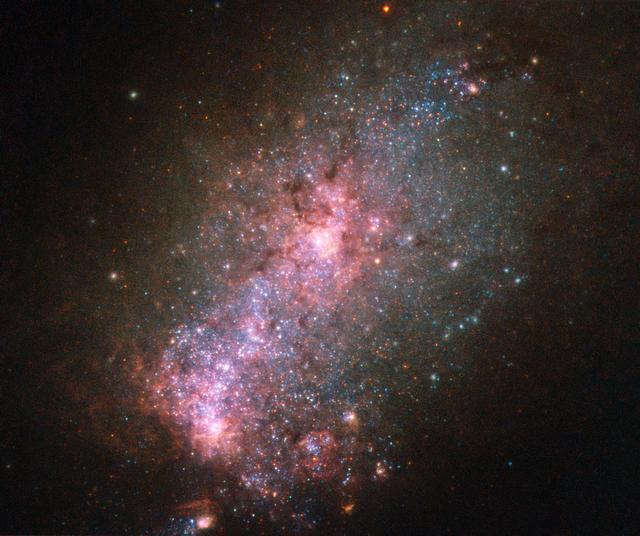
This NASA/ESA Hubble Space Telescope image reveals the vibrant core of the galaxy NGC 3125. Discovered by John Herschel in 1835, NGC 3125 is a great example of a starburst galaxy — a galaxy in which unusually high numbers of new stars are forming, springing to life within intensely hot clouds of gas. Located approximately 50 million light-years away in the constellation of Antlia (The Air Pump), NGC 3125 is similar to, but unfathomably brighter and more energetic than, one of the Magellanic Clouds. Spanning 15,000 light-years, the galaxy displays massive and violent bursts of star formation, as shown by the hot, young, and blue stars scattered throughout the galaxy’s rose-tinted core. Some of these clumps of stars are notable — one of the most extreme Wolf–Rayet star clusters in the local Universe, NGC 3125-A1, resides within NGC 3125. Despite their appearance, the fuzzy white blobs dotted around the edge of this galaxy are not stars, but globular clusters. Found within a galaxy’s halo, globular clusters are ancient collections of hundreds of thousands of stars. They orbit around galactic centers like satellites — the Milky Way, for example, hosts over 150 of them. Image credit: ESA/Hubble & NASA, Acknowledgement: Judy Schmidt <b><a href="http://www.nasa.gov/audience/formedia/features/MP_Photo_Guidelines.html" rel="nofollow">NASA image use policy.</a></b> <b><a href="http://www.nasa.gov/centers/goddard/home/index.html" rel="nofollow">NASA Goddard Space Flight Center</a></b> enables NASA’s mission through four scientific endeavors: Earth Science, Heliophysics, Solar System Exploration, and Astrophysics. Goddard plays a leading role in NASA’s accomplishments by contributing compelling scientific knowledge to advance the Agency’s mission. <b>Follow us on <a href="http://twitter.com/NASAGoddardPix" rel="nofollow">Twitter</a></b> <b>Like us on <a href="http://www.facebook.com/pages/Greenbelt-MD/NASA-Goddard/395013845897?ref=tsd" rel="nofollow">Facebook</a></b> <b>Find us on <a href="http://instagrid.me/nasagoddard/?vm=grid" rel="nofollow">Instagram</a></b>

NASA image release February 8, 2012 Looking like a hoard of gems fit for an emperor's collection, this deep sky object called NGC 6752 is in fact far more worthy of admiration. It is a globular cluster, and at over 10 billion years old is one the most ancient collections of stars known. It has been blazing for well over twice as long as our solar system has existed. NGC 6752 contains a high number of "blue straggler'' stars, some of which are visible in this image. These stars display characteristics of stars younger than their neighbors, despite models suggesting that most of the stars within globular clusters should have formed at approximately the same time. Their origin is therefore something of a mystery. Studies of NGC 6752 may shed light on this situation. It appears that a very high number -- up to 38 percent -- of the stars within its core region are binary systems. Collisions between stars in this turbulent area could produce the blue stragglers that are so prevalent. Lying 13,000 light-years distant, NGC 6752 is far beyond our reach, yet the clarity of Hubble's images brings it tantalizingly close. Credit: ESA/Hubble & NASA <b><a href="http://www.nasa.gov/audience/formedia/features/MP_Photo_Guidelines.html" rel="nofollow">NASA image use policy.</a></b> <b><a href="http://www.nasa.gov/centers/goddard/home/index.html" rel="nofollow">NASA Goddard Space Flight Center</a></b> enables NASA’s mission through four scientific endeavors: Earth Science, Heliophysics, Solar System Exploration, and Astrophysics. Goddard plays a leading role in NASA’s accomplishments by contributing compelling scientific knowledge to advance the Agency’s mission. <b>Follow us on <a href="http://twitter.com/NASA_GoddardPix" rel="nofollow">Twitter</a></b> <b>Like us on <a href="http://www.facebook.com/pages/Greenbelt-MD/NASA-Goddard/395013845897?ref=tsd" rel="nofollow">Facebook</a></b> <b>Find us on <a href="http://instagrid.me/nasagoddard/?vm=grid" rel="nofollow">Instagram</a></b>
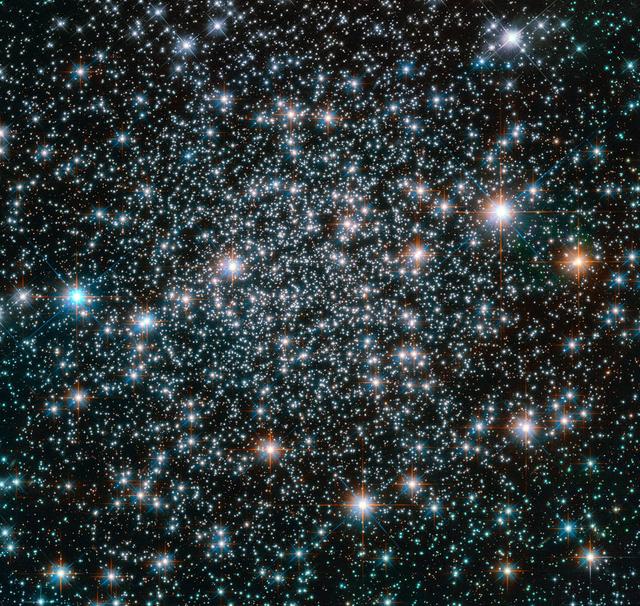
Hubble rocks out with heavy metal stars! This 10.5-billion-year-old globular cluster, NGC 6496, is home to heavy-metal stars of a celestial kind! The stars comprising this spectacular spherical cluster are enriched with much higher proportions of metals — elements heavier than hydrogen and helium are curiously known as metals in astronomy — than stars found in similar clusters. A handful of these high-metallicity stars are also variable stars, meaning that their brightness fluctuates over time. NGC 6496 hosts a selection of long-period variables — giant pulsating stars whose brightness can take up to, and even over, a thousand days to change — and short-period eclipsing binaries, which dim when eclipsed by a stellar companion. The nature of the variability of these stars can reveal important information about their mass, radius, luminosity, temperature, composition, and evolution, providing astronomers with measurements that would be difficult or even impossible to obtain through other methods. NGC 6496 was discovered in 1826 by Scottish astronomer James Dunlop. The cluster resides at about 35,000 light-years away in the southern constellation of Scorpius (The Scorpion). Image credit: ESA/Hubble & NASA, Acknowledgement: Judy Schmidt Text credit: European Space Agency Read more: <a href="http://go.nasa.gov/1U2wqGW" rel="nofollow">go.nasa.gov/1U2wqGW</a>

Using NASA’s Hubble Space Telescope, astronomers have captured for the first time snapshots of fledging white dwarf stars beginning their slow-paced, 40-million-year migration from the crowded center of an ancient star cluster to the less populated suburbs. White dwarfs are the burned-out relics of stars that rapidly lose mass, cool down and shut off their nuclear furnaces. As these glowing carcasses age and shed weight, their orbits begin to expand outward from the star cluster’s packed downtown. This migration is caused by a gravitational tussle among stars inside the cluster. Globular star clusters sort out stars according to their mass, governed by a gravitational billiard ball game where lower mass stars rob momentum from more massive stars. The result is that heavier stars slow down and sink to the cluster's core, while lighter stars pick up speed and move across the cluster to the edge. This process is known as "mass segregation." Until these Hubble observations, astronomers had never definitively seen the dynamical conveyor belt in action. Astronomers used Hubble to watch the white-dwarf exodus in the globular star cluster 47 Tucanae, a dense swarm of hundreds of thousands of stars in our Milky Way galaxy. The cluster resides 16,700 light-years away in the southern constellation Tucana. Read more: <a href="http://www.nasa.gov/feature/goddard/hubble-catches-stellar-exodus-in-action" rel="nofollow">www.nasa.gov/feature/goddard/hubble-catches-stellar-exodu...</a> Credits: NASA, ESA, and H. Richer and J. Heyl (University of British Columbia, Vancouver, Canada); acknowledgement: J. Mack (STScI) and G. Piotto (University of Padova, Italy) <b><a href="http://www.nasa.gov/audience/formedia/features/MP_Photo_Guidelines.html" rel="nofollow">NASA image use policy.</a></b> <b><a href="http://www.nasa.gov/centers/goddard/home/index.html" rel="nofollow">NASA Goddard Space Flight Center</a></b> enables NASA’s mission through four scientific endeavors: Earth Science, Heliophysics, Solar System Exploration, and Astrophysics. Goddard plays a leading role in NASA’s accomplishments by contributing compelling scientific knowledge to advance the Agency’s mission. <b>Follow us on <a href="http://twitter.com/NASAGoddardPix" rel="nofollow">Twitter</a></b> <b>Like us on <a href="http://www.facebook.com/pages/Greenbelt-MD/NASA-Goddard/395013845897?ref=tsd" rel="nofollow">Facebook</a></b> <b>Find us on <a href="http://instagrid.me/nasagoddard/?vm=grid" rel="nofollow">Instagram</a></b>
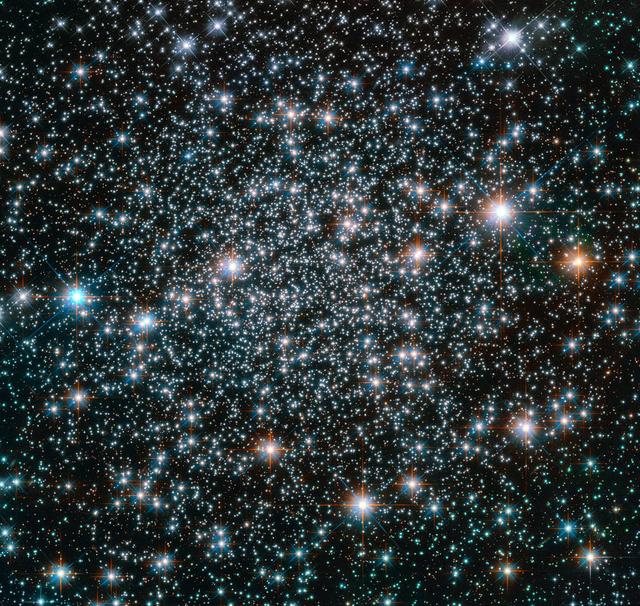
This 10.5-billion-year-old globular cluster, NGC 6496, is home to heavy-metal stars of a celestial kind! The stars comprising this spectacular spherical cluster are enriched with much higher proportions of metals — elements heavier than hydrogen and helium, are in astronomy curiously known as metals — than stars found in similar clusters. A handful of these high-metallicity stars are also variable stars, meaning that their brightness fluctuates over time. NGC 6496 hosts a selection of long-period variables — giant pulsating stars whose brightness can take up to, and even over, a thousand days to change — and short-period eclipsing binaries, which dim when eclipsed by a stellar companion. The nature of the variability of these stars can reveal important information about their mass, radius, luminosity, temperature, composition, and evolution, providing astronomers with measurements that would be difficult or even impossible to obtain through other methods. NGC 6496 was discovered in 1826 by Scottish astronomer James Dunlop. The cluster resides at about 35 000 light-years away in the southern constellation of Scorpius (The Scorpion).
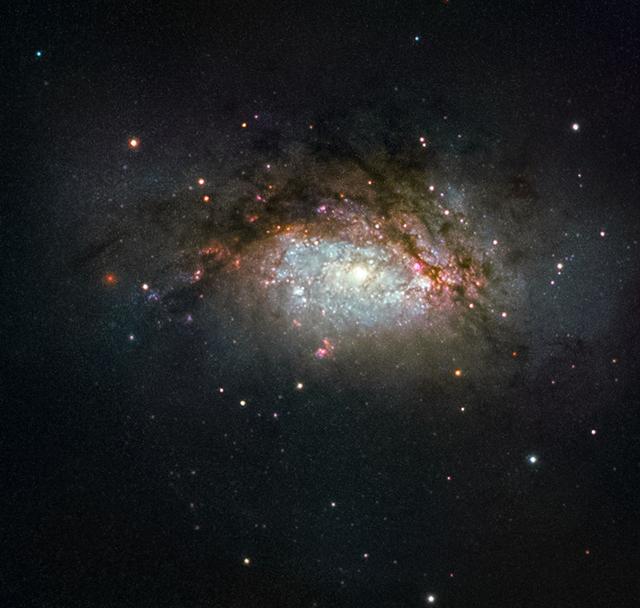
The subject of this NASA/ESA Hubble Space Telescope image is known as NGC 3597. It is the product of a collision between two good-sized galaxies, and is slowly evolving to become a giant elliptical galaxy. This type of galaxy has grown more and more common as the universe has evolved, with initially small galaxies merging and progressively building up into larger galactic structures over time. NGC 3597 is located approximately 150 million light-years away in the constellation of Crater (The Cup). Astronomers study NGC 3597 to learn more about how elliptical galaxies form — many ellipticals began their lives far earlier in the history of the universe. Older ellipticals are nicknamed “red and dead” by astronomers because these bloated galaxies are not anymore producing new, bluer stars, and are thus packed full of old and redder stellar populations. Before infirmity sets in, some freshly formed elliptical galaxies experience a final flush of youth, as is the case with NGC 3597. Galaxies smashing together pool their available gas and dust, triggering new rounds of star birth. Some of this material ends up in dense pockets initially called proto-globular clusters, dozens of which festoon NGC 3597. These pockets will go on to collapse and form fully-fledged globular clusters, large spheres that orbit the centers of galaxies like satellites, packed tightly full of millions of stars. Image credit: ESA/Hubble & NASA, Acknowledgement: Judy Schmidt <b><a href="http://www.nasa.gov/audience/formedia/features/MP_Photo_Guidelines.html" rel="nofollow">NASA image use policy.</a></b> <b><a href="http://www.nasa.gov/centers/goddard/home/index.html" rel="nofollow">NASA Goddard Space Flight Center</a></b> enables NASA’s mission through four scientific endeavors: Earth Science, Heliophysics, Solar System Exploration, and Astrophysics. Goddard plays a leading role in NASA’s accomplishments by contributing compelling scientific knowledge to advance the Agency’s mission. <b>Follow us on <a href="http://twitter.com/NASAGoddardPix" rel="nofollow">Twitter</a></b> <b>Like us on <a href="http://www.facebook.com/pages/Greenbelt-MD/NASA-Goddard/395013845897?ref=tsd" rel="nofollow">Facebook</a></b> <b>Find us on <a href="http://instagrid.me/nasagoddard/?vm=grid" rel="nofollow">Instagram</a></b>
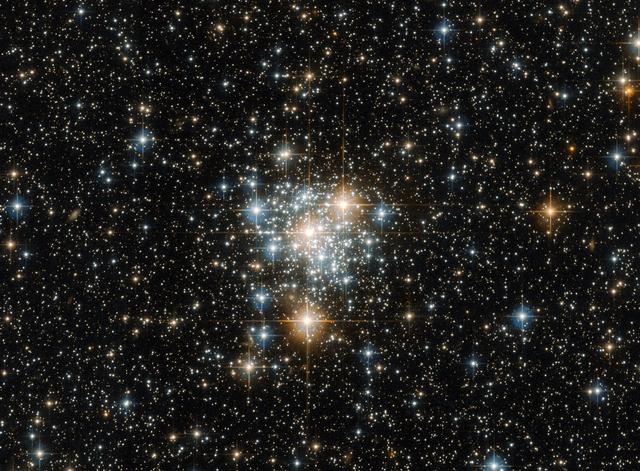
It may be famous for hosting spectacular sights such as the Tucana Dwarf Galaxy and 47 Tucanae (heic1510), the second brightest globular cluster in the night sky, but the southern constellation of Tucana (The Toucan) also possesses a variety of unsung cosmic beauties. One such beauty is NGC 299, an open star cluster located within the Small Magellanic Cloud just under 200,000 light-years away. Open clusters such as this are collections of stars weakly bound by the shackles of gravity, all of which formed from the same massive molecular cloud of gas and dust. Because of this, all the stars have the same age and composition, but vary in their mass because they formed at different positions within the cloud. This unique property not only ensures a spectacular sight when viewed through a sophisticated instrument attached to a telescope such as Hubble’s Advanced Camera for Surveys, but gives astronomers a cosmic laboratory in which to study the formation and evolution of stars — a process that is thought to depend strongly on a star’s mass. Credit: ESA/Hubble & NASA <b><a href="http://www.nasa.gov/audience/formedia/features/MP_Photo_Guidelines.html" rel="nofollow">NASA image use policy.</a></b> <b><a href="http://www.nasa.gov/centers/goddard/home/index.html" rel="nofollow">NASA Goddard Space Flight Center</a></b> enables NASA’s mission through four scientific endeavors: Earth Science, Heliophysics, Solar System Exploration, and Astrophysics. Goddard plays a leading role in NASA’s accomplishments by contributing compelling scientific knowledge to advance the Agency’s mission. <b>Follow us on <a href="http://twitter.com/NASAGoddardPix" rel="nofollow">Twitter</a></b> <b>Like us on <a href="http://www.facebook.com/pages/Greenbelt-MD/NASA-Goddard/395013845897?ref=tsd" rel="nofollow">Facebook</a></b> <b>Find us on <a href="http://instagrid.me/nasagoddard/?vm=grid" rel="nofollow">Instagram</a></b>

Panta rhei is a simplified version of the famous Greek philosopher Heraclitus' teachings. It basically means, everything flows. And everything in the Universe is indeed continually on the move, spiraling and shifting through space. Some cosmic objects move a little further than others — take the subject of this NASA/ESA Hubble Space Telescope image, a globular cluster of stars known as Palomar 12. Although it currently lies on the outskirts of the Milky Way’s halo, Palomar 12 was not born here. When astronomers first studied this cluster, they were puzzled by its strangely young age when compared to the other clusters in the galaxy. It appeared to be around 30 percent younger than other Milky Way globulars. Surely if it had been born within our galaxy, it would have sprung to life at a similar time to its cluster companions? A bit more digging revealed that Palomar 12 was actually ripped from its initial home, the Sagittarius Dwarf Elliptical galaxy, around 1.7 billion years ago via tidal interactions between its former home and our galaxy. The dwarf galaxy that Palomar 12 once called home is a satellite galaxy to ours, and closely orbits around us — even occasionally passing through the plane of our galaxy. In fact, it is being slowly torn apart and consumed by the Milky Way. The sparkling stars in this picture were imaged by Hubble’s Advanced Camera for Surveys. Credit: ESA/NASA <b><a href="http://www.nasa.gov/audience/formedia/features/MP_Photo_Guidelines.html" rel="nofollow">NASA image use policy.</a></b> <b><a href="http://www.nasa.gov/centers/goddard/home/index.html" rel="nofollow">NASA Goddard Space Flight Center</a></b> enables NASA’s mission through four scientific endeavors: Earth Science, Heliophysics, Solar System Exploration, and Astrophysics. Goddard plays a leading role in NASA’s accomplishments by contributing compelling scientific knowledge to advance the Agency’s mission. <b>Follow us on <a href="http://twitter.com/NASAGoddardPix" rel="nofollow">Twitter</a></b> <b>Like us on <a href="http://www.facebook.com/pages/Greenbelt-MD/NASA-Goddard/395013845897?ref=tsd" rel="nofollow">Facebook</a></b> <b>Find us on <a href="http://instagram.com/nasagoddard?vm=grid" rel="nofollow">Instagram</a></b>
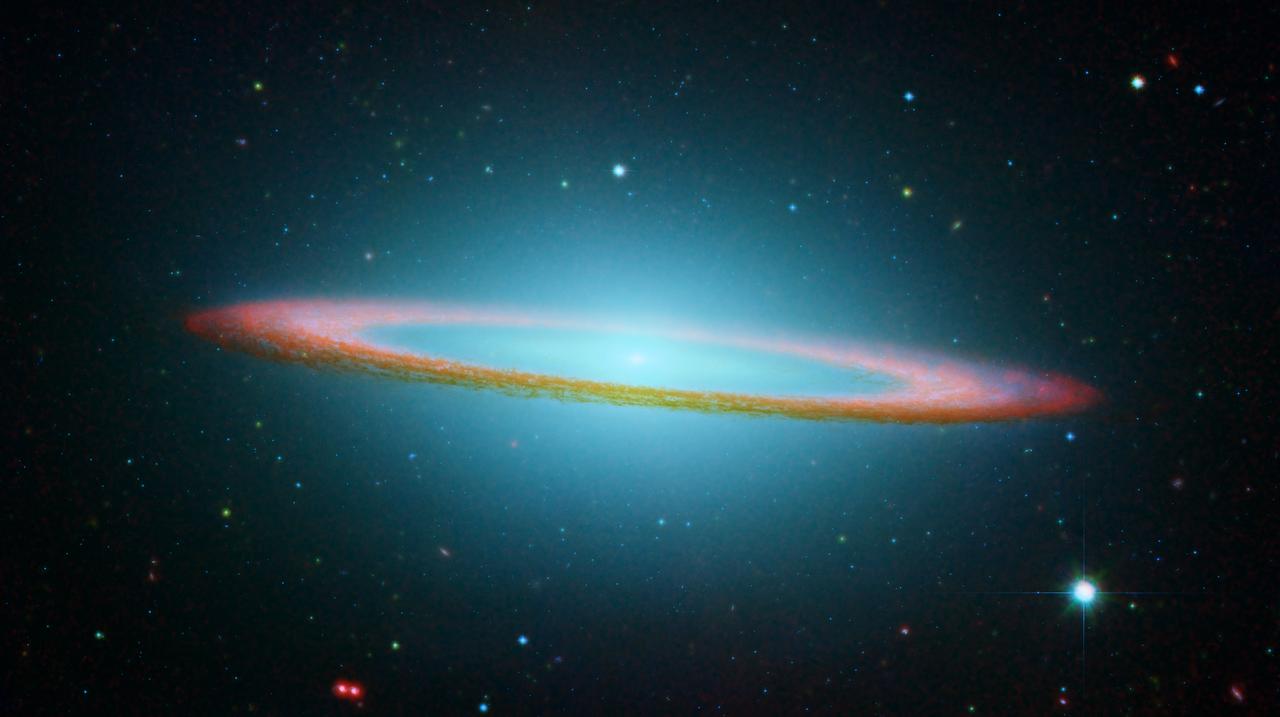
The razor sharp eye of the Hubble Space Telescope (HST) easily resolves the Sombrero galaxy, Messier 104 (M104). 50,000 light-years across, the galaxy is located 28 million light-years from Earth at the southern edge of the rich Virgo cluster of galaxies. Equivalent to 800 billion suns, Sombrero is one of the most massive objects in that group. The hallmark of Sombrero is a brilliant white, bulbous core encircled by the thick dust lanes comprising the spiral structure of the galaxy. As seen from Earth, the galaxy is tilted nearly edge-on. We view it from just six degrees north of its equatorial plane. This rich system of globular clusters is estimated to be nearly 2,000 in number which is 10 times as many as in our Milky Way galaxy. Similar to the clusters in the Milky Way, the ages range from 10-13 billion years old. Embedded in the bright core of M104 is a smaller disk, which is tilted relative to the large disk. The HST paired with the Spitzer infrared telescope, offers this striking composite capturing the magnificence of the Sombrero galaxy. In the Hubble view, the galaxy resembles a broad-rimmed Mexican hat, whereas in the Spitzer striking infrared view, the galaxy looks more like a bulls eye. The full view provided by Spitzer shows the disk is warped, which is often the result of a gravitational encounter with another galaxy, and clumpy areas spotted in the far edges of the ring indicate young star forming regions. Spitzer detected infrared emission not only from the ring, but from the center of the galaxy as well, where there is a huge black hole believed to be a billion times more massive than our Sun. The Marshall Space Flight Center (MSFC) had responsibility for design, development, and construction of the HST.