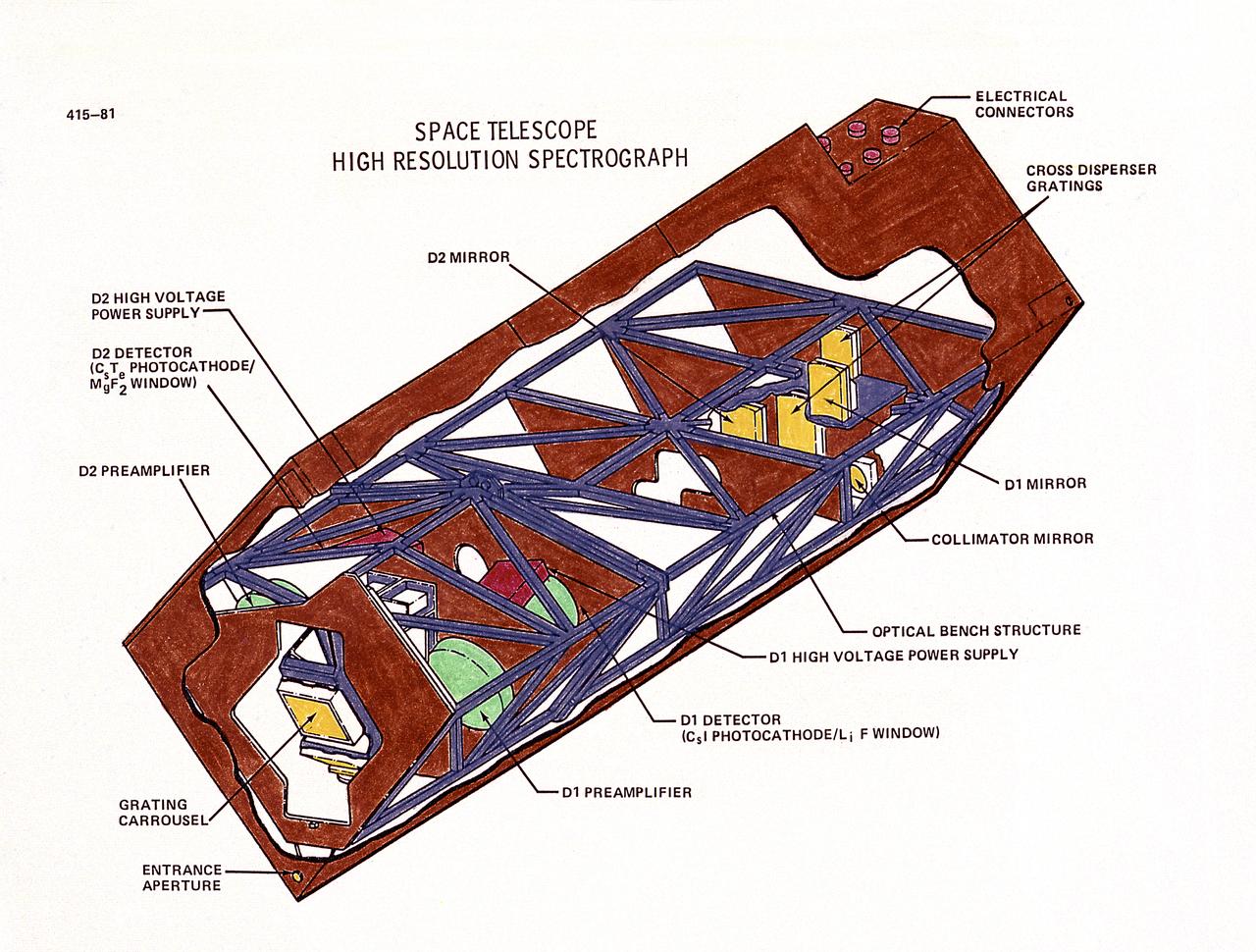
This drawing illustrates the Hubble Space Telescope's (HST's), Goddard High-Resolution Spectrograph (GHRS). The HST's two spectrographs, the GHRS and the Faint Object Spectrograph (FOS), can detect a broader range of wavelengths than is possible from Earth because there is no atmosphere to absorb certain wavelengths. Scientists can determine the chemical composition, temperature, pressure, and turbulence of the stellar atmosphere producing the light, all from spectral data. The GHRS can detect fine details in the light from somewhat brighter objects but only ultraviolet light. Both spectrographs operate in essentially the same way. The incoming light passes through a small entrance aperture, then passes through filters and diffraction gratings, that work like prisms. The filter or grating used determines what range of wavelength will be examined and in what detail. Then the spectrograph detectors record the strength of each wavelength band and sends it back to Earth. The purpose of the HST, the most complex and sensitive optical telescope ever made, is to study the cosmos from a low-Earth orbit. By placing the telescope in space, astronomers are able to collect data that is free of the Earth's atmosphere. The HST views galaxies, stars, planets, comets, possibly other solar systems, and even unusual phenomena such as quasars, with 10 times the clarity of ground-based telescopes. The HST was deployed from the Space Shuttle Discovery (STS-31 mission) into Earth orbit in April 1990. The Marshall Space Flight Center had responsibility for design, development, and construction of the HST. The Perkin-Elmer Corporation, in Danbury, Cornecticut, developed the optical system and guidance sensors.
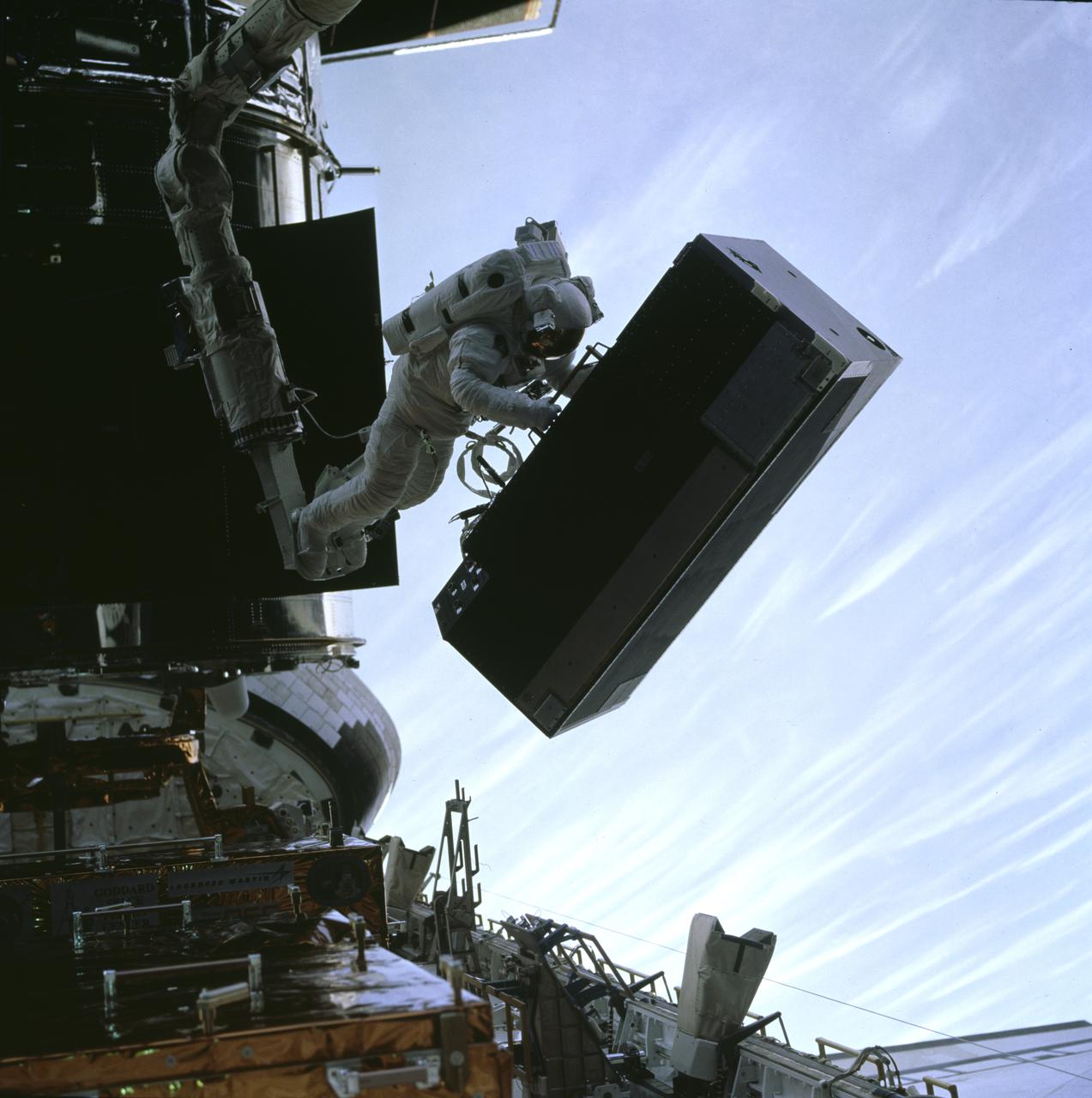
STS082-730-090 (11-21 Feb. 1997) --- Astronaut Steven L. Smith handles one of the Goddard High Resolution Spectrograph (GHRS) boxes, changed out on the Hubble Space Telescope (HST) on Flight Day 4. Astronauts Smith and Mark C. Lee were participating in the first of five eventual days of Extravehicular Activity (EVA) to service the giant orbital observatory. Smith is standing on the end of the Remote Manipulator System (RMS) arm, which was controlled by astronaut Steven A. Hawley inside the Space Shuttle Discovery's crew cabin.
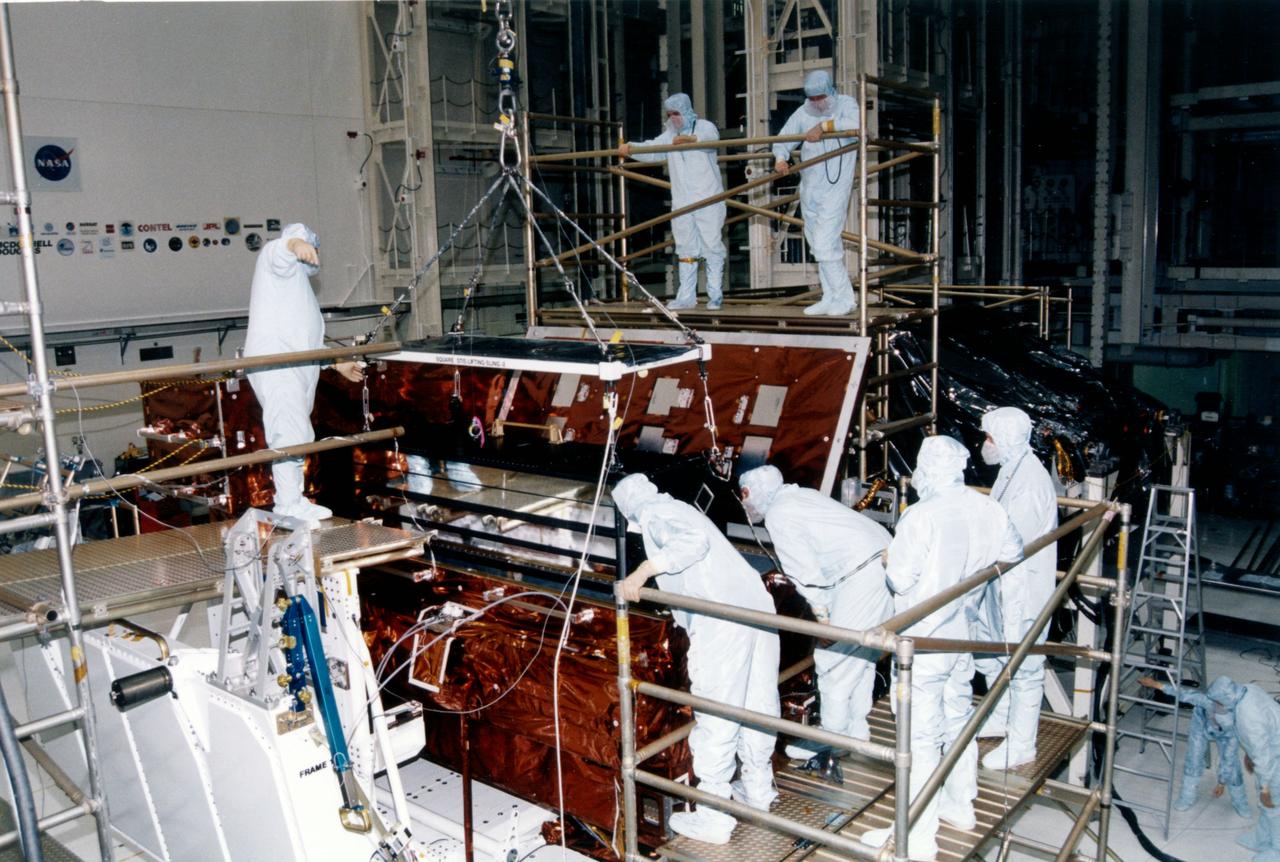
KENNEDY SPACE CENTER, FLORIDA STS-82 PREPARATIONS VIEW --- Payload processing workers in the Kennedy Space Center (KSC) Vertical Processing Facility (VPF) prepare to integrate the Space Telescope Imaging Spectrograph (STIS), suspended at center, into the Orbiter Replacement Unit (ORU) Carrier and Scientific Instrument Protective Enclosure (SIPE). STIS will replace the Goddard High Resolution Spectrograph (GHRS) on the Hubble Space Telescope (HST). Four of the seven STS-82 crew members will perform a series of spacewalks to replace two scientific instruments with two new instruments, including STIS, and perform other tasks during the second HST servicing mission. HST was deployed nearly seven years ago and was initially serviced in 1993.
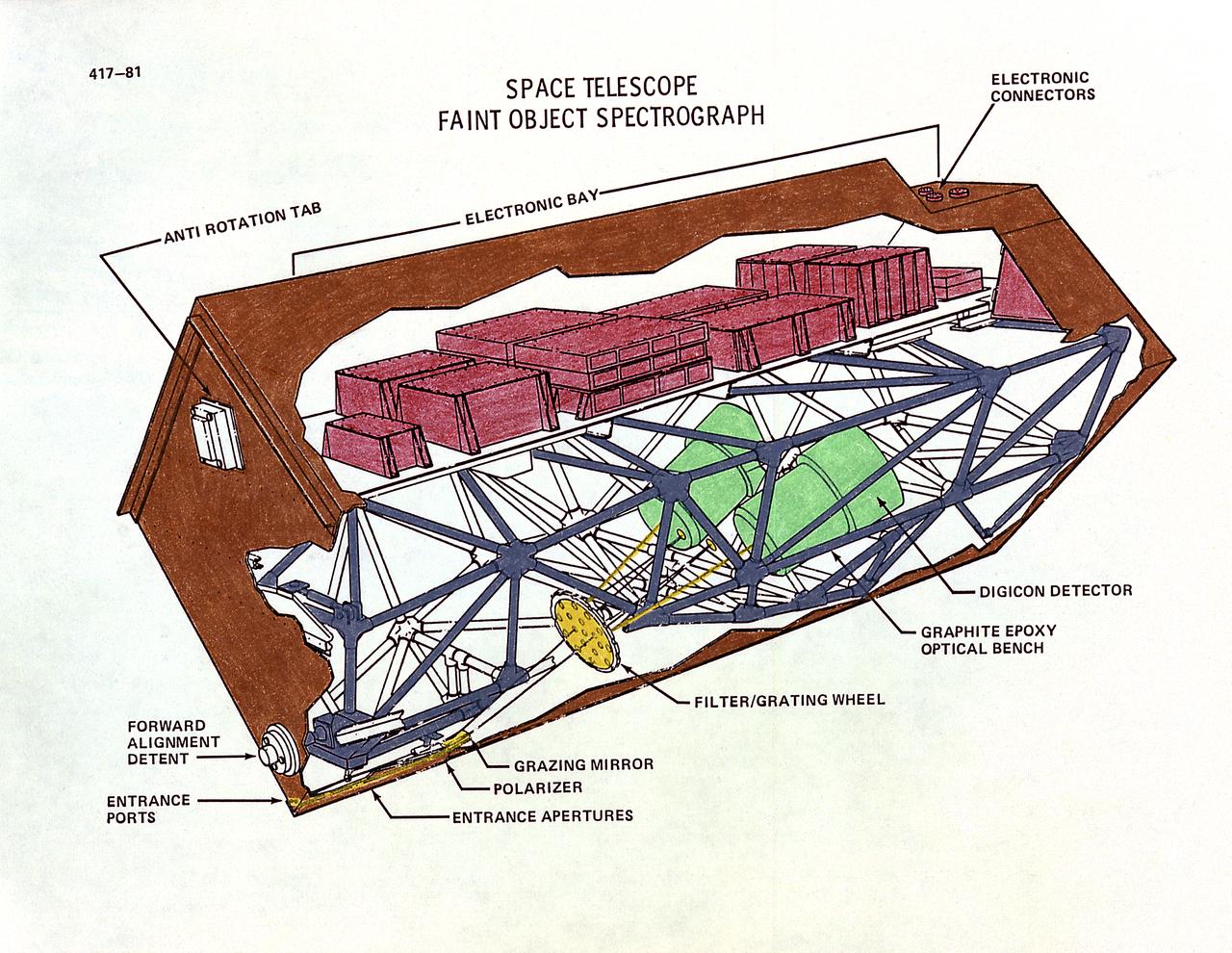
This drawing illustrates the Hubble Space Telescope's (HST's), Faint Object Spectrograph (FOS). The HST's two spectrographs, the Goddard High-Resolution Spectrograph and the FOS, can detect a broader range of wavelengths than is possible from the Earth because there is no atmosphere to absorb certain wavelengths. Scientists can determine the chemical composition, temperature, pressure, and turbulence of the stellar atmosphere producing the light, all from spectral data. The FOC can detect detail in very faint objects, such as those at great distances, and light ranging from ultraviolet to red spectral bands. Both spectrographs operate in essentially the same way. The incoming light passes through a small entrance aperture, then passes through filters and diffraction gratings, that work like prisms. The filter or grating used determines what range of wavelength will be examined and in what detail. Then the spectrograph detectors record the strength of each wavelength band and sends it back to Earth. The purpose of the HST, the most complex and sensitive optical telescope ever made, is to study the cosmos from a low-Earth orbit. By placing the telescope in space, astronomers are able to collect data that is free of the Earth's atmosphere. The HST views galaxies, stars, planets, comets, possibly other solar systems, and even unusual phenomena such as quasars, with 10 times the clarity of ground-based telescopes. The HST was deployed from the Space Shuttle Discovery (STS-31 mission) into Earth orbit in April 1990. The Marshall Space Flight Center had responsibility for design, development, and construction of the HST. The Perkin-Elmer Corporation, in Danbury, Cornecticut, developed the optical system and guidance sensors.
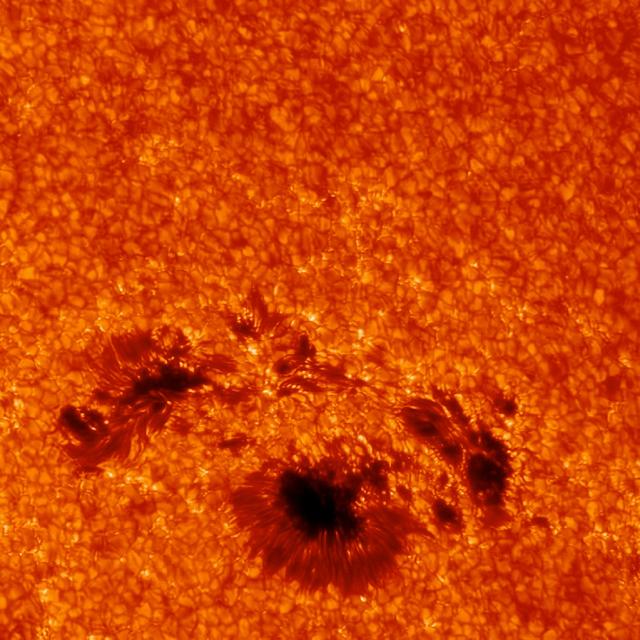
This close-up of the sunspot underneath the March 29, 2014, flare shows incredible detail. The image was captured by the G-band camera at Sacramento Peak in New Mexico. This instrument can focus on only a small area at once, but provide very high resolution. Ground-based telescope data can be hindered by Earth's atmosphere, which blocks much of the sun's ultraviolet and X-ray light, and causes twinkling even in the light it does allow through. As it happens, the March 29 flare occurred at a time of day in New Mexico that often results in the best viewing times from the ground. Credit: Kevin Reardon (National Solar Observatory), Lucia Kleint (BAER Institute) -- On March 29, 2014 the sun released an X-class flare. It was observed by NASA's Interface Region Imaging Spectrograph, or IRIS; NASA's Solar Dynamics Observatory, or SDO; NASA's Reuven Ramaty High Energy Solar Spectroscopic Imager, or RHESSI; the Japanese Aerospace Exploration Agency's Hinode; and the National Solar Observatory's Dunn Solar Telescope located at Sacramento Peak in New Mexico. To have a record of such an intense flare from so many observatories is unprecedented. Such research can help scientists better understand what catalyst sets off these large explosions on the sun. Perhaps we may even some day be able to predict their onset and forewarn of the radio blackouts solar flares can cause near Earth - blackouts that can interfere with airplane, ship and military communications. Read more: <a href="http://1.usa.gov/1kMDQbO" rel="nofollow">1.usa.gov/1kMDQbO</a> Join our Google+ Hangout on May 8 at 2:30pm EST: <a href="http://go.nasa.gov/1mwbBEZ" rel="nofollow">go.nasa.gov/1mwbBEZ</a> Credit: NASA Goddard <b><a href="http://www.nasa.gov/audience/formedia/features/MP_Photo_Guidelines.html" rel="nofollow">NASA image use policy.</a></b> <b><a href="http://www.nasa.gov/centers/goddard/home/index.html" rel="nofollow">NASA Goddard Space Flight Center</a></b> enables NASA’s mission through four scientific endeavors: Earth Science, Heliophysics, Solar System Exploration, and Astrophysics. Goddard plays a leading role in NASA’s accomplishments by contributing compelling scientific knowledge to advance the Agency’s mission. <b>Follow us on <a href="http://twitter.com/NASAGoddardPix" rel="nofollow">Twitter</a></b> <b>Like us on <a href="http://www.facebook.com/pages/Greenbelt-MD/NASA-Goddard/395013845897?ref=tsd" rel="nofollow">Facebook</a></b> <b>Find us on <a href="http://instagram.com/nasagoddard?vm=grid" rel="nofollow">Instagram</a></b>