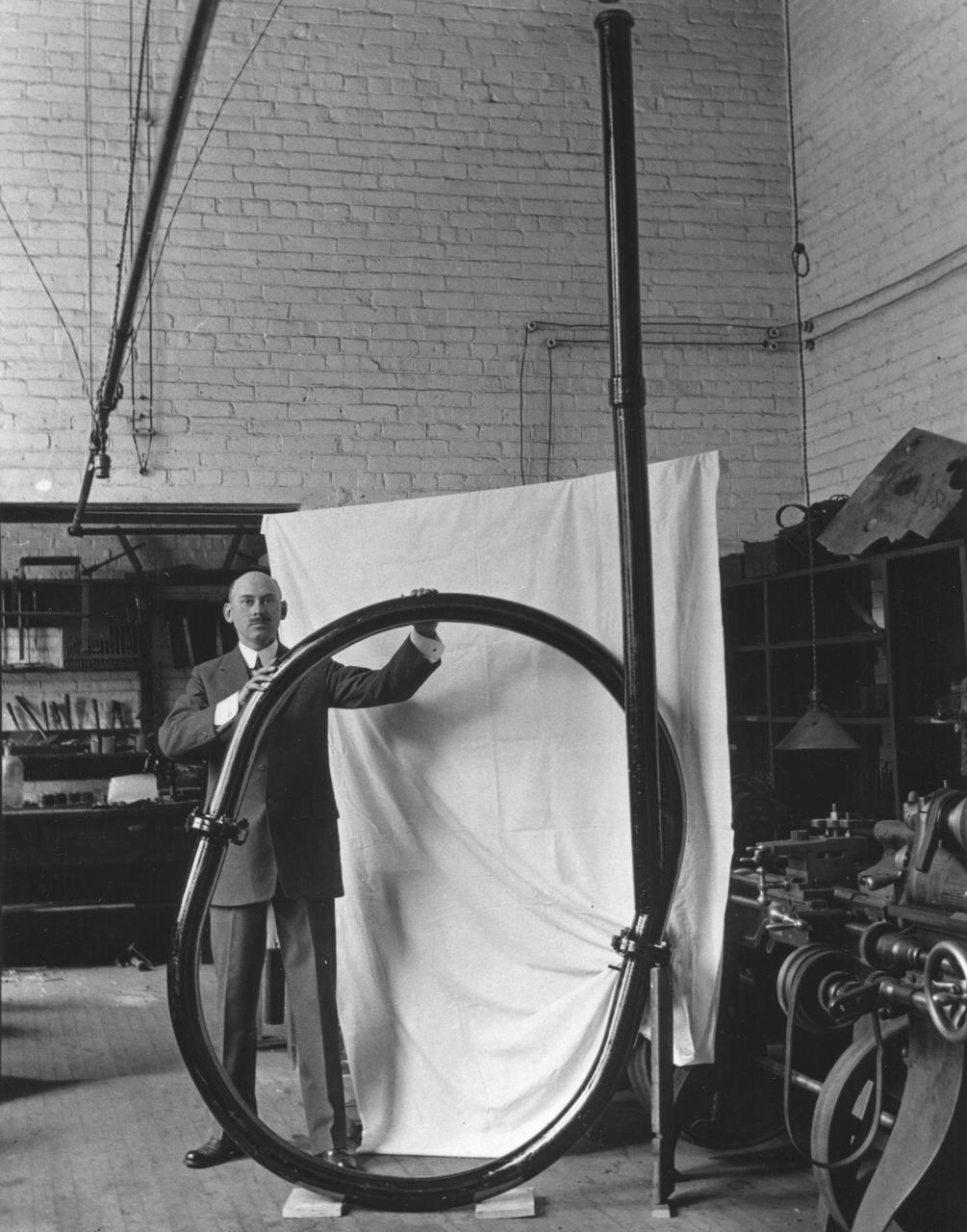
Robert H. Goddard with vacuum tube apparatus he built in 1916 to research rocket efficiency. Dr. Robert Hutchings Goddard is commonly referred to as the father of American rocketry. The same year he built the apparatus, Goddard wrote a study requesting funding from the Smithsonian Institution so that he could continue his rocket research, which he had begun in 1907 while still a student at Worcester Polytechnic Institute. A brilliant physicist, with a unique genius for invention, Goddard may not have succeeded had it not been for the Smithsonian Institution and later the Daniel Guggenheim Foundation and his employer the Worcester Polytechnic Institute of Clark University. The former gave him research monies while the Institute provided leaves of absence so that he could continue his life's work. He was the first scientist who not only realized the potential of missiles and space flight, but also contributed directly to making them a reality. <b><a href="http://www.nasa.gov/centers/goddard/home/index.html" rel="nofollow">NASA Goddard Space Flight Center</a></b> enables NASA’s mission through four scientific endeavors: Earth Science, Heliophysics, Solar System Exploration, and Astrophysics. Goddard plays a leading role in NASA’s accomplishments by contributing compelling scientific knowledge to advance the Agency’s mission. <b>Follow us on <a href="http://twitter.com/NASA_GoddardPix" rel="nofollow">Twitter</a></b> <b>Join us on <a href="http://www.facebook.com/pages/Greenbelt-MD/NASA-Goddard/395013845897?ref=tsd" rel="nofollow">Facebook</a></b>