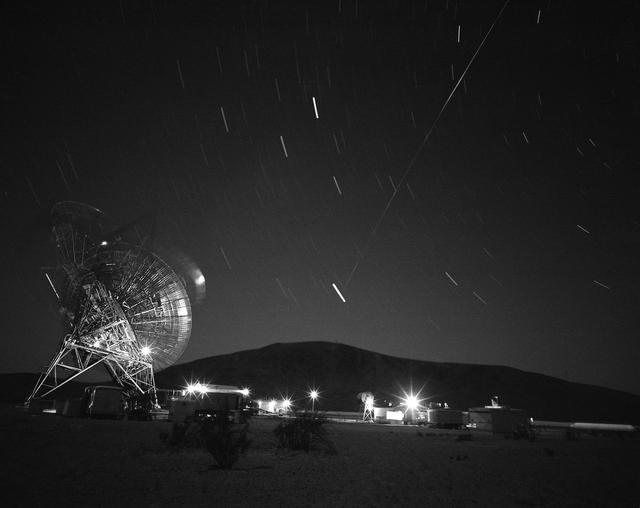
This archival image was released as part of a gallery comparing JPL’s past and present, commemorating the 80th anniversary of NASA’s Jet Propulsion Laboratory on Oct. 31, 2016. This photograph shows the first pass of Echo 1, NASA's first communications satellite, over the Goldstone Tracking Station managed by NASA's Jet Propulsion Laboratory, in Pasadena, California, in the early morning of Aug. 12, 1960. The movement of the antenna, star trails (shorter streaks), and Echo 1 (the long streak in the middle) are visible in this image. Project Echo bounced radio signals off a 10-story-high, aluminum-coated balloon orbiting the Earth. This form of "passive" satellite communication -- which mission managers dubbed a "satelloon" -- was an idea conceived by an engineer from NASA's Langley Research Center in Hampton, Virginia, and was a project managed by NASA's Goddard Space Flight Center in Greenbelt, Maryland. JPL's role involved sending and receiving signals through two of its 85-foot-diameter (26-meter-diameter) antennas at the Goldstone Tracking Station in California's Mojave Desert. The Goldstone station later became part of NASA's Deep Space Network. JPL, a division of Caltech in Pasadena, California, manages the Deep Space Network for NASA. http://photojournal.jpl.nasa.gov/catalog/PIA21114
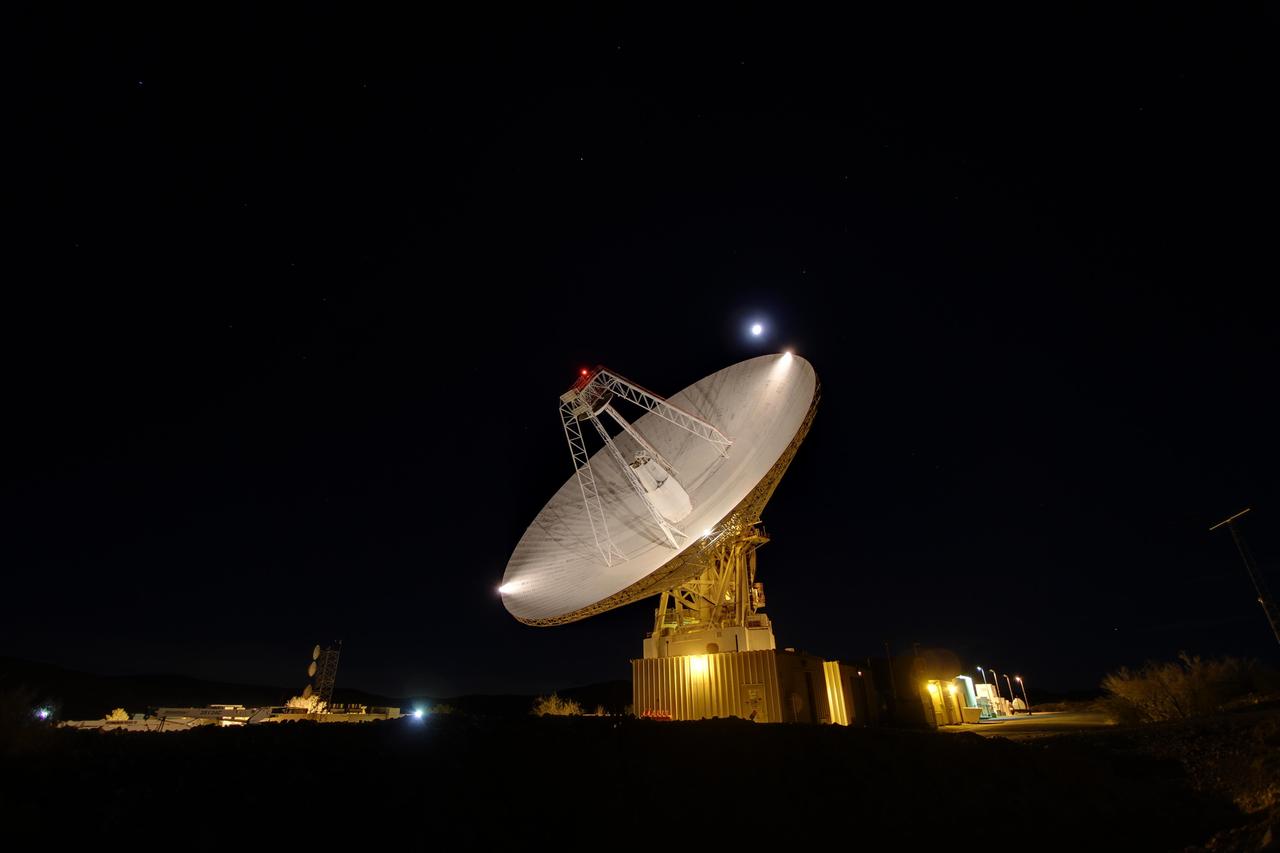
Goldstone 230-foot 70-m antenna tracks under a full moon. The Goldstone Deep Space Communications Complex is located in the Mojave Desert in California, USA.
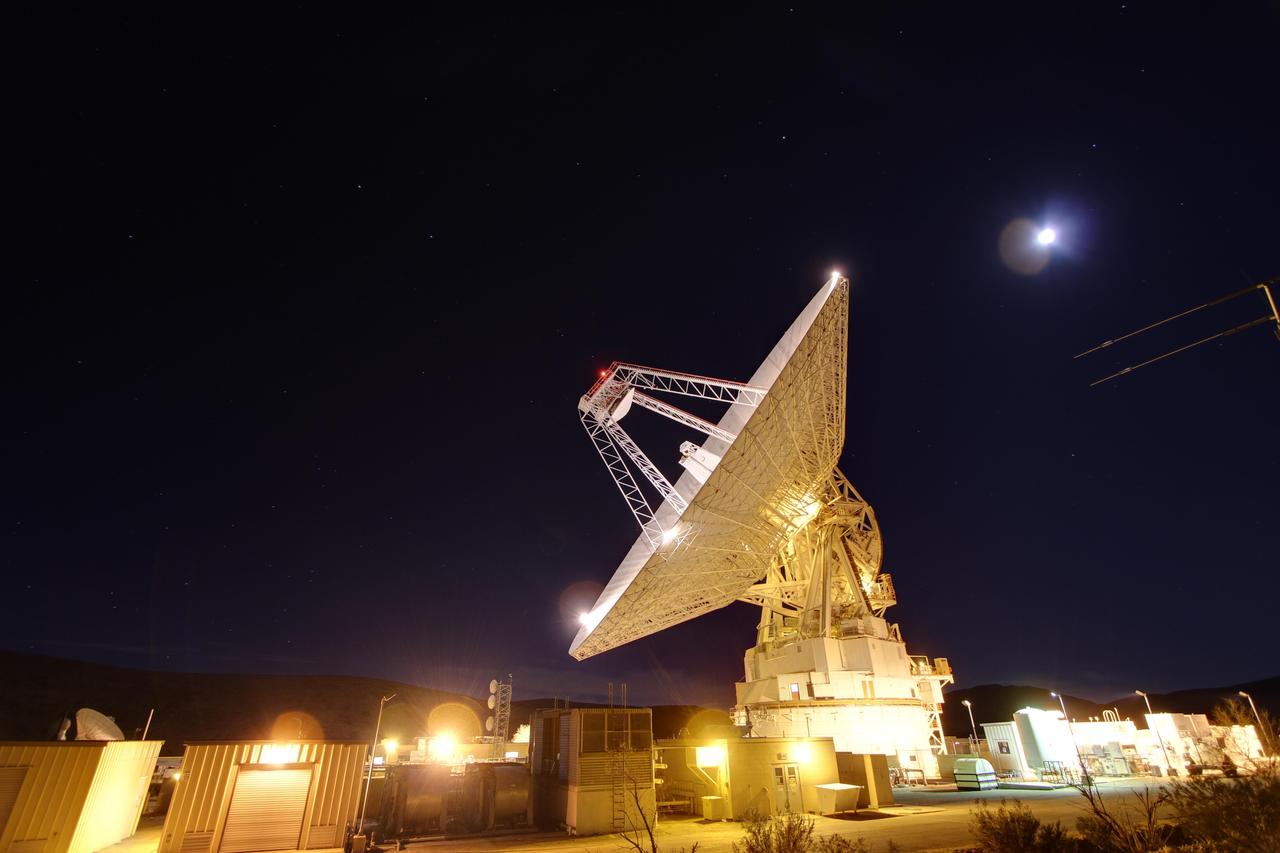
Late night in the desert: Goldstone 230-foot 70-meter antenna tracks spacecraft day and night. This photograph was taken on Jan. 11, 2012. The Goldstone Deep Space Communications Complex is located in the Mojave Desert in California, USA.
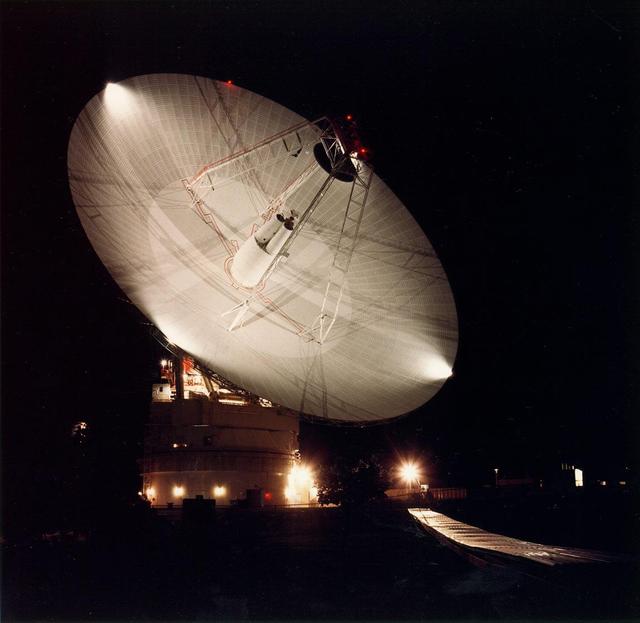
Night shot of the 70m antenna at Goldstone, California. The parabolic dish is 70m 230 ft. in diameter. The Goldstone Deep Space Communications Complex, located in the Mojave Desert in California, is one of three complexes which comprise NASA DSN.
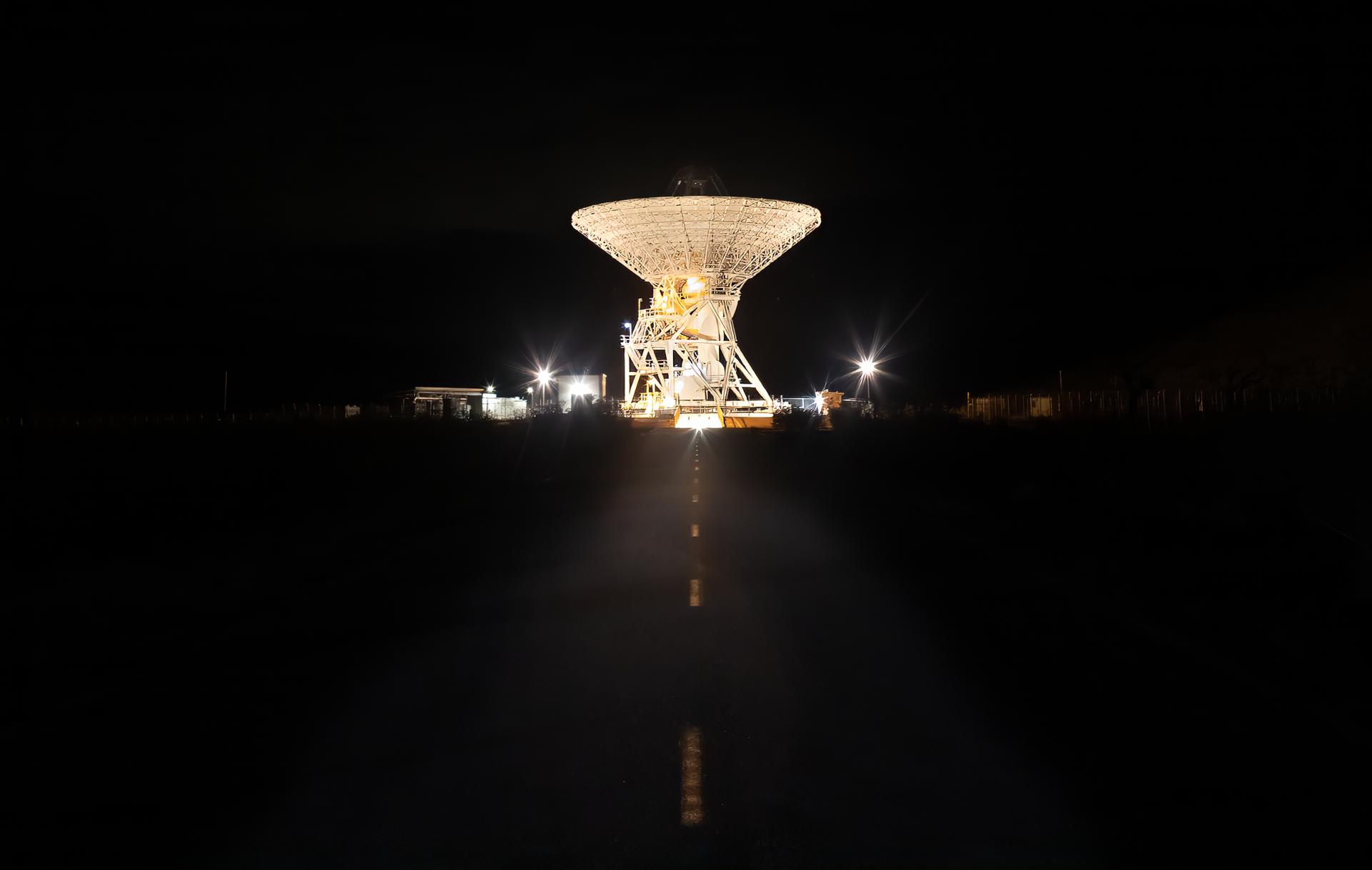
A 112-foot (34-meter) antenna glows from within a nighttime scene at the Goldstone Deep Space Communications Complex near Barstow, California, in September 2025. Goldstone is part of NASA’s Deep Space Network (DSN), which operates three complexes around the globe that support communications with dozens of deep space missions. For more information about the DSN, visit: https://www.nasa.gov/communicating-with-missions/dsn/
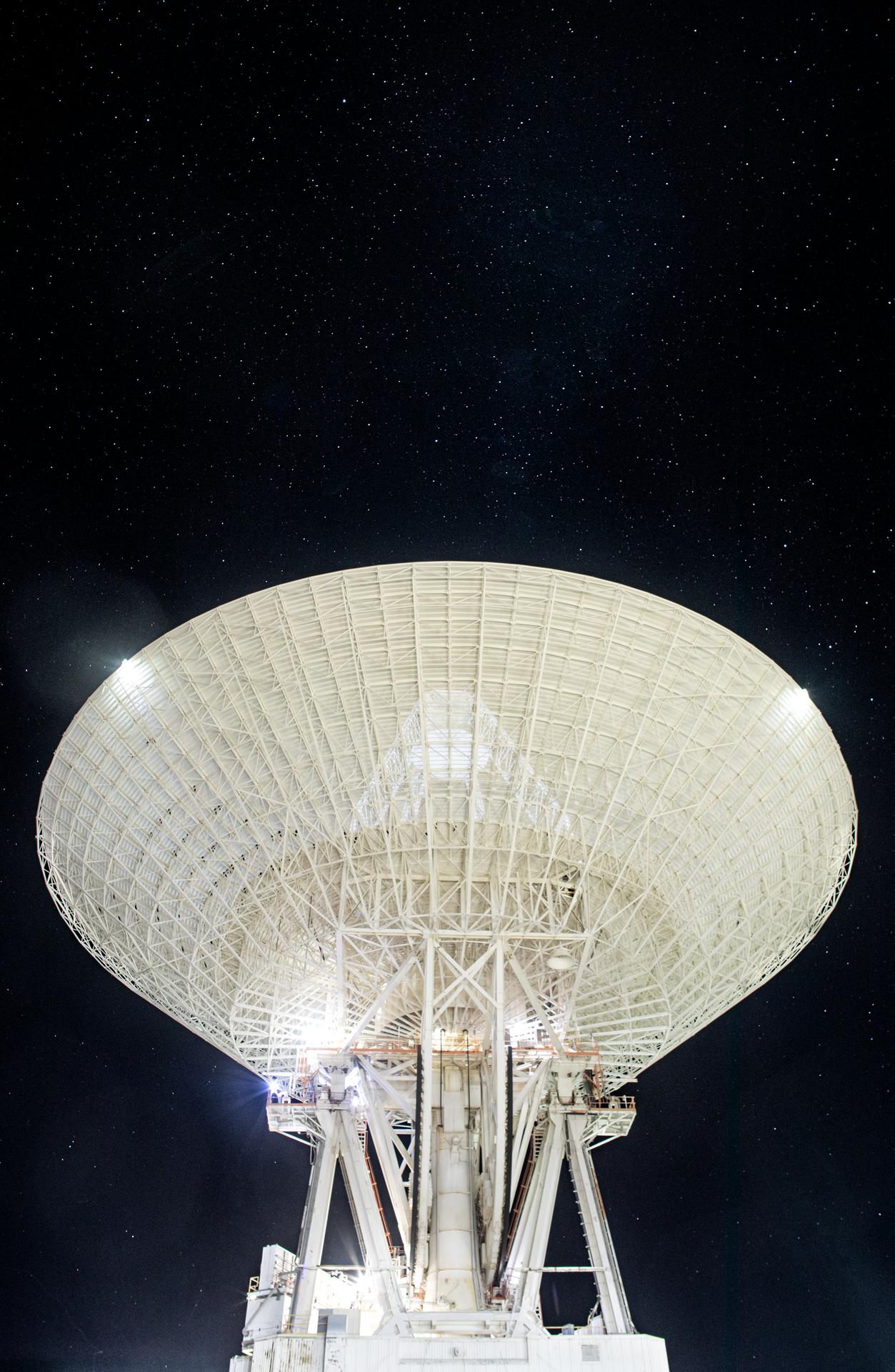
Deep Space Station 14 (DSS-14), the 230-foot-wide (70-meter) antenna at the Goldstone Deep Space Communications Complex near Barstow, California, points up toward a starry sky in September 2025. Goldstone is part of NASA’s Deep Space Network (DSN), which operates three complexes around the globe to support communications with dozens of deep space missions. DSS-14 is also the agency’s Goldstone Solar System Radar, which is used to observe asteroids that come close to Earth. For more information about the DSN, visit: https://www.nasa.gov/communicating-with-missions/dsn/
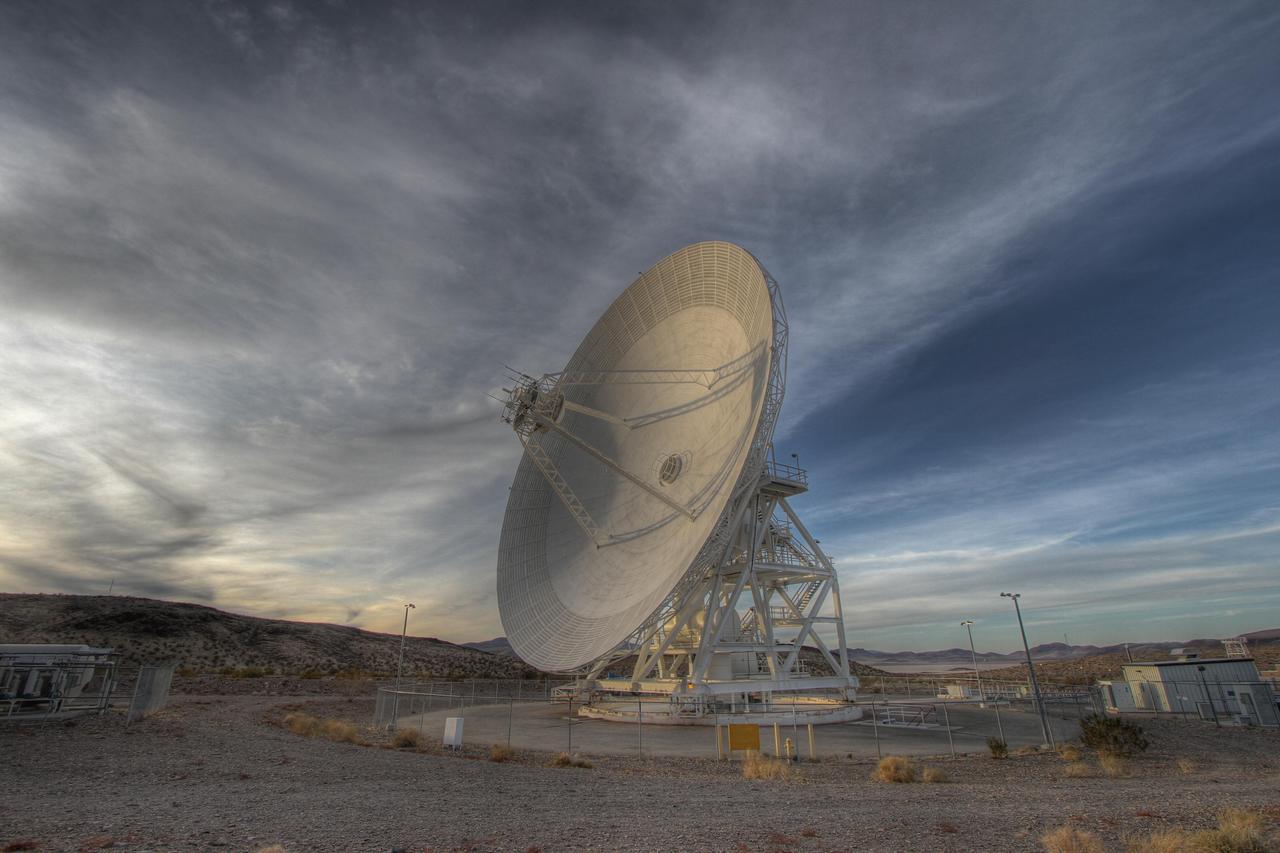
Goldstone 111.5-foot 34-meter Beam Waveguide tracks a spacecraft as it comes into view. The Goldstone Deep Space Communications Complex is located in the Mojave Desert in California, USA.
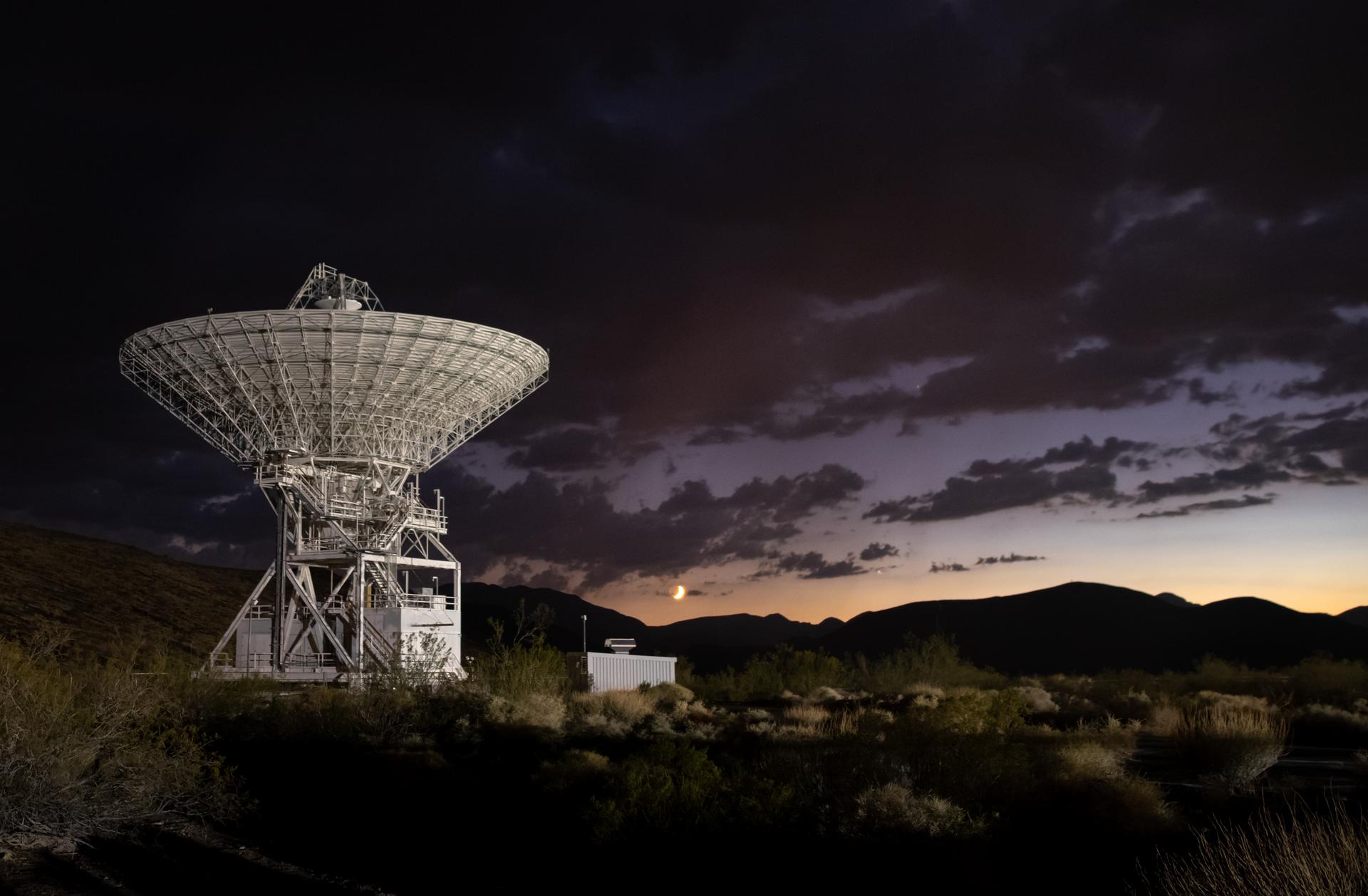
Deep Space Station 15 (DSS-15), one of the 112-foot (34-meter) antennas at the Goldstone Deep Space Communications Complex near Barstow, California, is seen at sunset in September 2025. The crescent Moon hangs just above the horizon. Goldstone is part of NASA’s Deep Space Network (DSN), which operates three complexes around the globe that support communications with dozens of deep space missions. For more information about the DSN, visit: https://www.nasa.gov/communicating-with-missions/dsn/
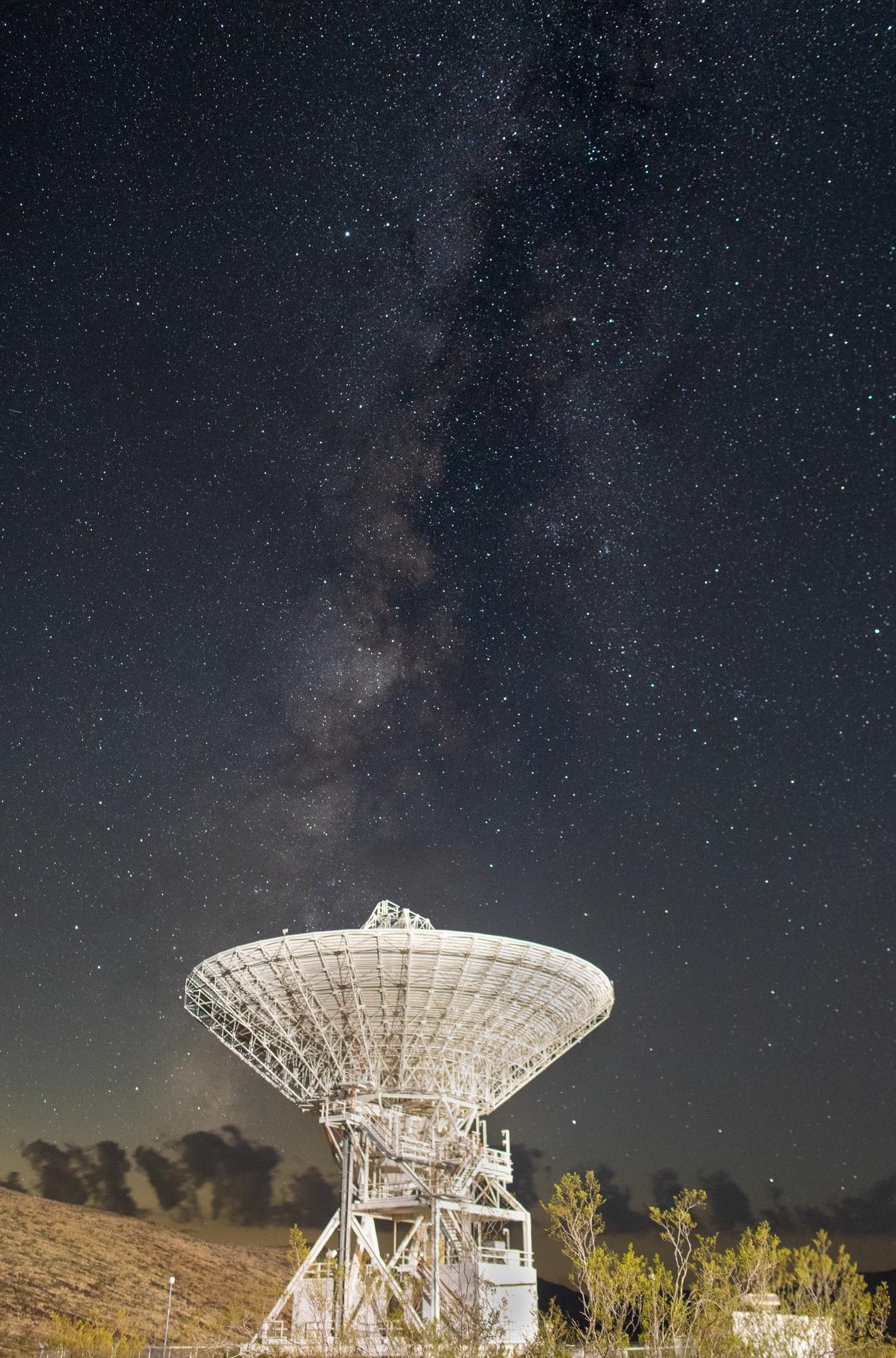
Deep Space Station 15 (DSS-15), one of the 112-foot (34-meter) antennas at the Goldstone Deep Space Communications Complex near Barstow, California, looks skyward, with the stars of the Milky Way overhead, in September 2025. Goldstone is part of NASA’s Deep Space Network (DSN), which operates three complexes around the globe that support communications with dozens of deep space missions. For more information about the DSN, visit: https://www.nasa.gov/communicating-with-missions/dsn/
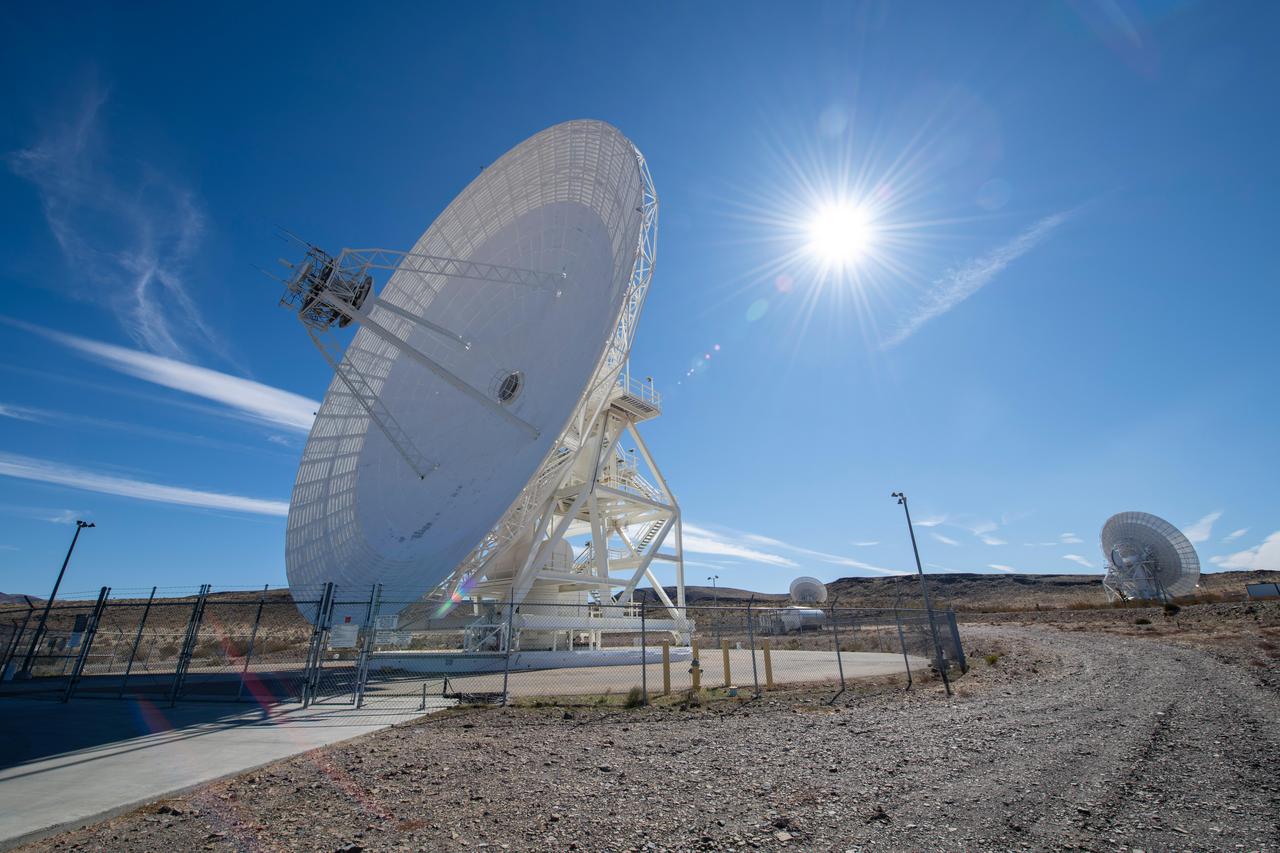
Antenna dishes at NASA's Deep Space Network complex in Goldstone, California, photographed on Feb. 11, 2020. https://photojournal.jpl.nasa.gov/catalog/PIA23214
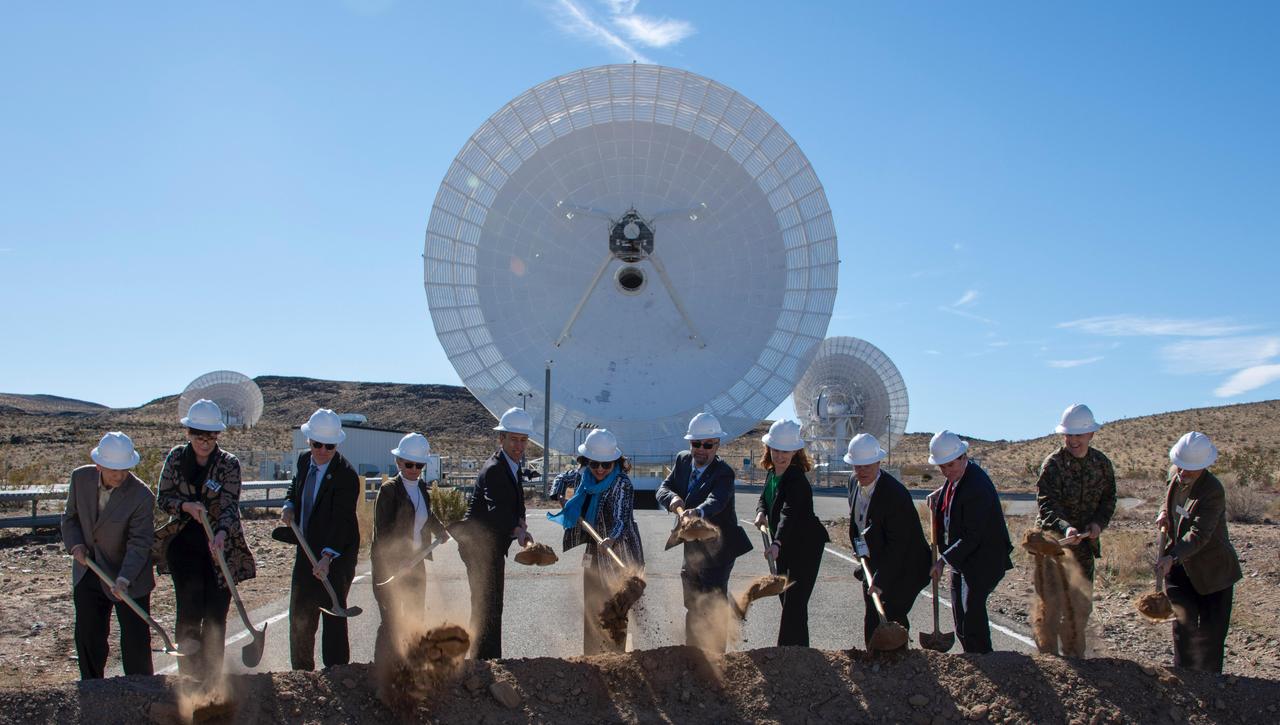
On Feb. 11, 2020, NASA, JPL, military and local officials broke ground in Goldstone, California, for a new antenna in the agency's Deep Space Network, which communicates with all its deep space missions. When completed in 2 ½ years, the new 112-foot-wide (34-meter-wide) antenna dish will include mirrors and a special receiver for optical, or laser, communications from deep space missions. https://photojournal.jpl.nasa.gov/catalog/PIA23618
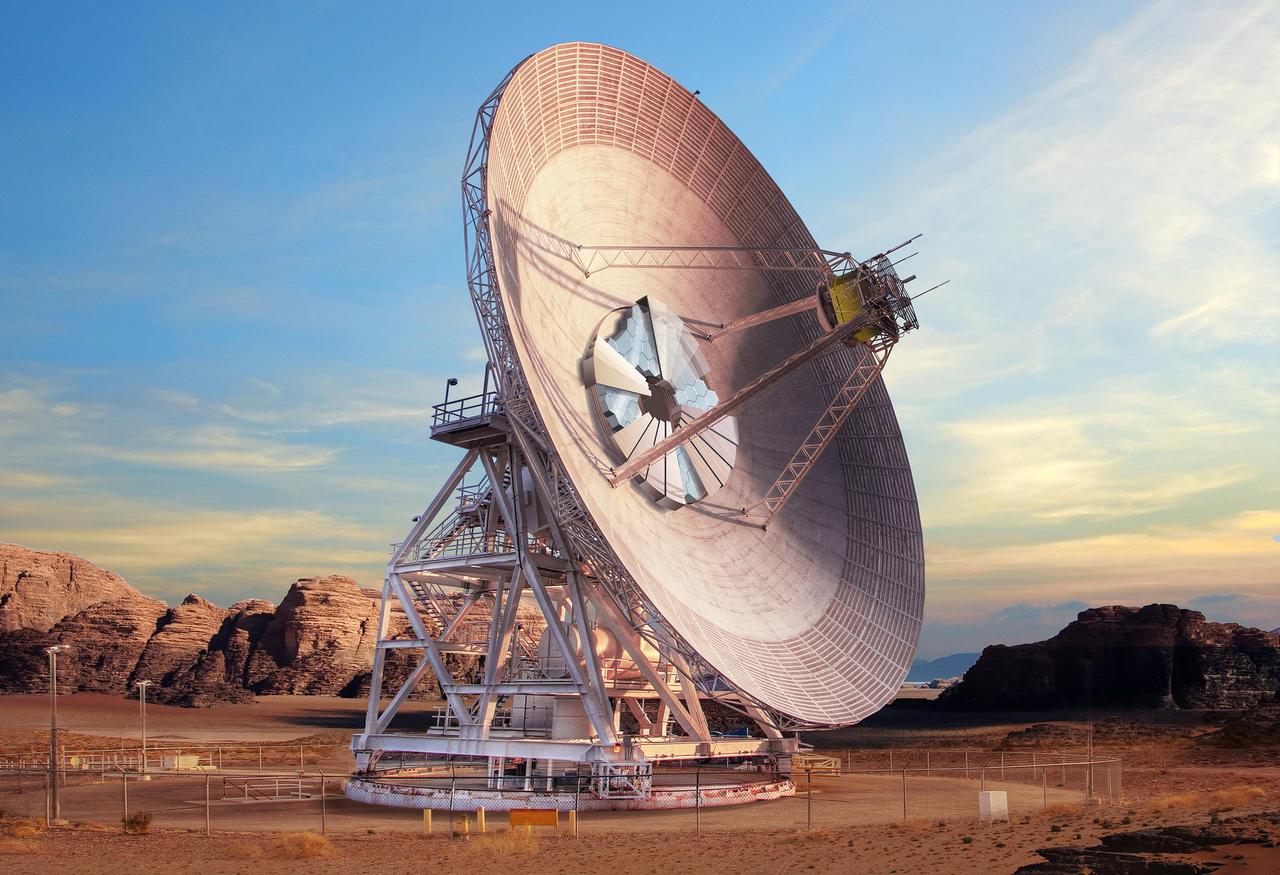
This artist's concept shows what Deep Space Station-23, a new antenna dish at the Deep Space Network's complex in Goldstone, California, will look like when complete in several years. DSS-23 will communicate with NASA's deep space missions using radio waves and lasers. Retractable covers will be able to fan out across the mirrors at the center of the dish to protect them from the elements. https://photojournal.jpl.nasa.gov/catalog/PIA23617
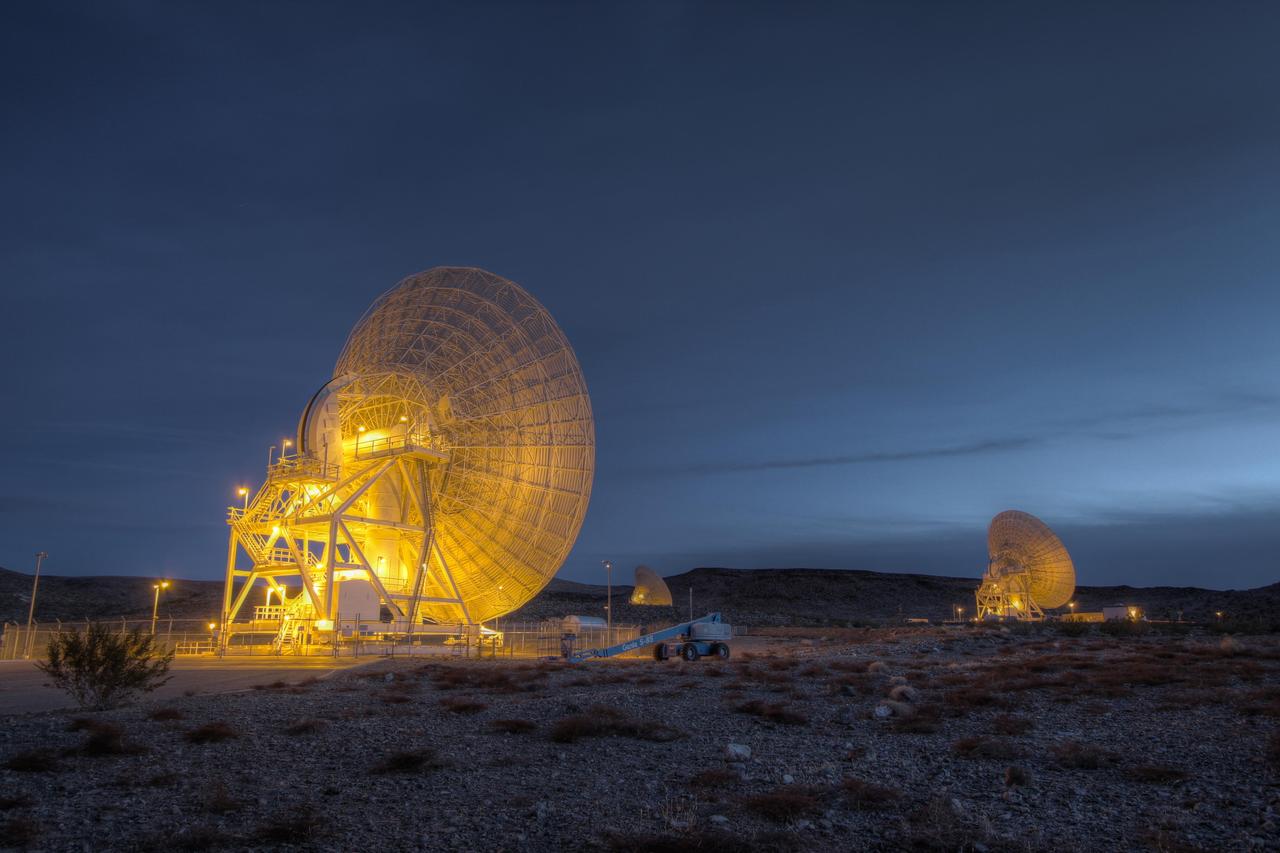
Beam Wave Guide antennas at Goldstone, known as the Beam Waveguide Cluster. They are located in an area at Goldstone called Apollo Valley. The Goldstone Deep Space Communications Complex is located in the Mojave Desert in California, USA.
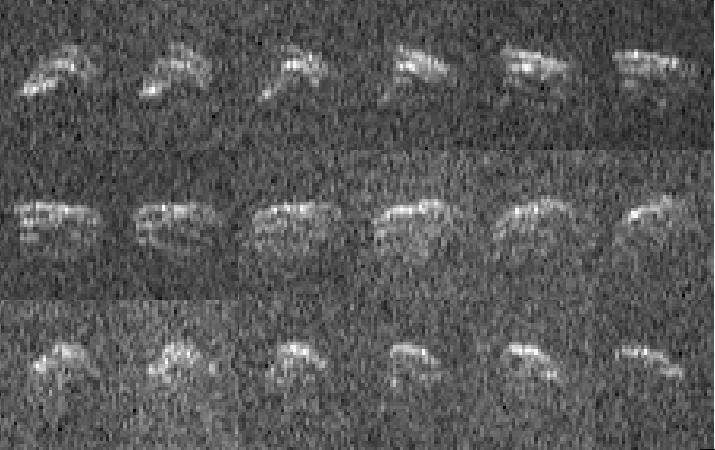
This sequence of radar images of asteroid 2013 ET was obtained on Mar. 10, 2013, by NASA scientists using the 230-foot 70-meter DSN antenna at Goldstone, CA, when the asteroid was about 693,000 mi 1.1 million km from Earth.
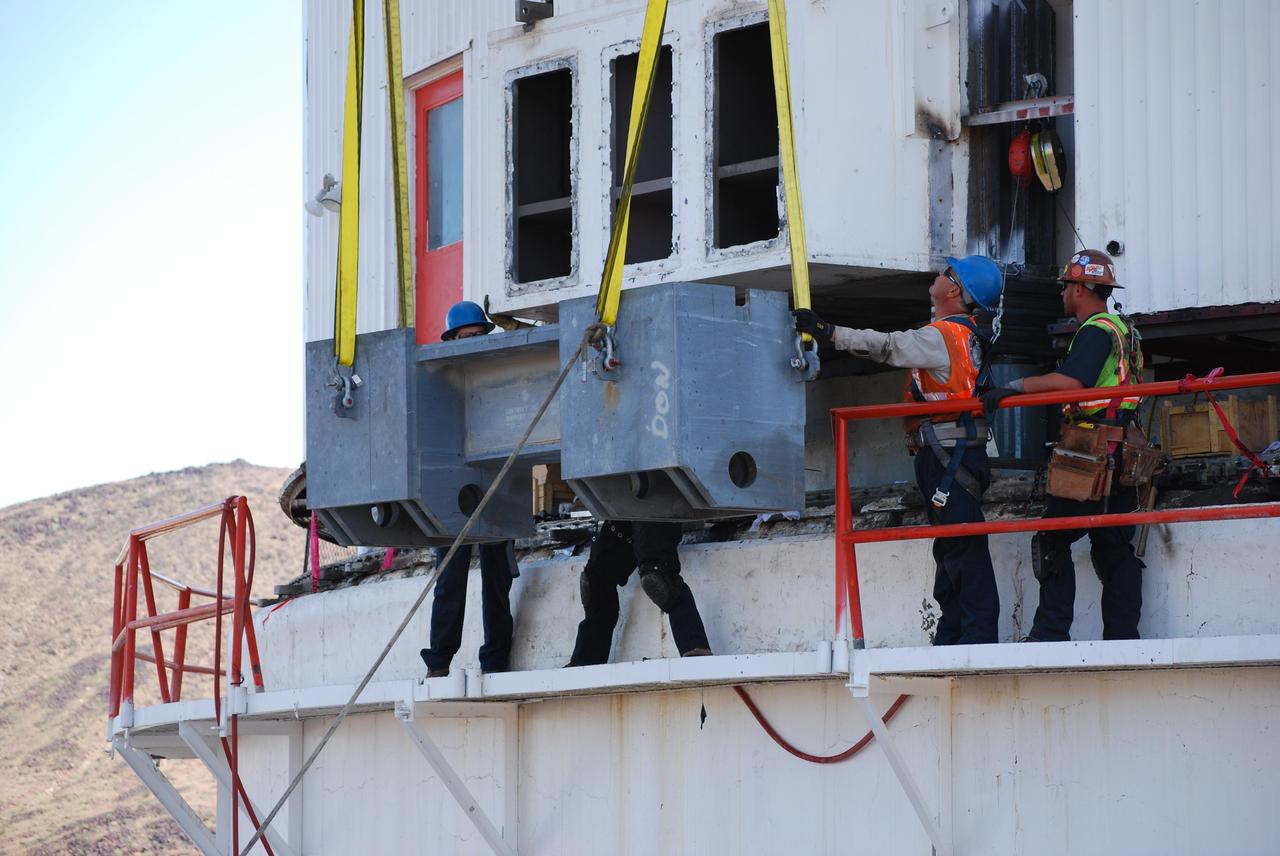
As part of a major refurbishment for the giant Mars antenna at NASA Deep Space Network Goldstone Deep Space Communications Complex, a stringer box is lowered into place.
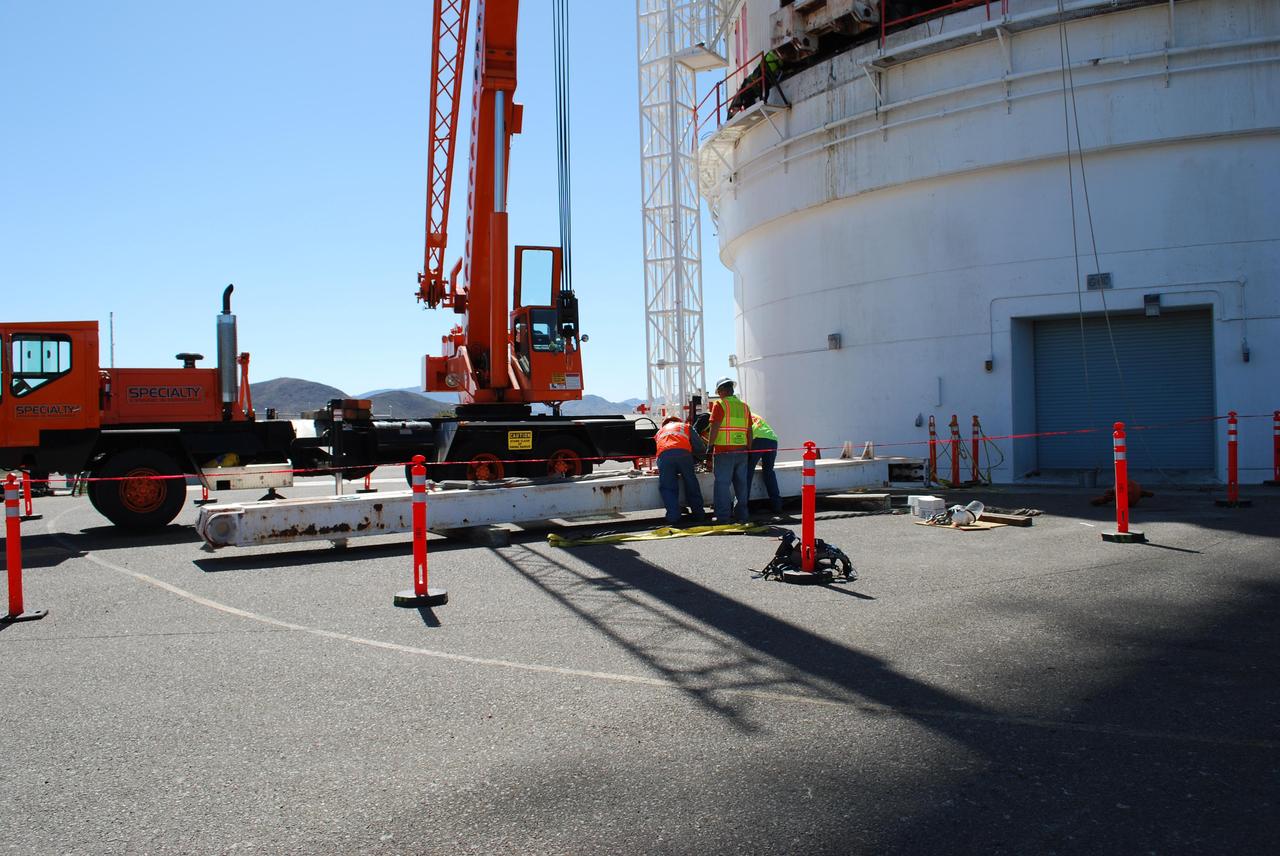
Workers at NASA Deep Space Network Goldstone Deep Space Communications Complex prepare a support leg that would help raise a portion of the giant Mars antenna.
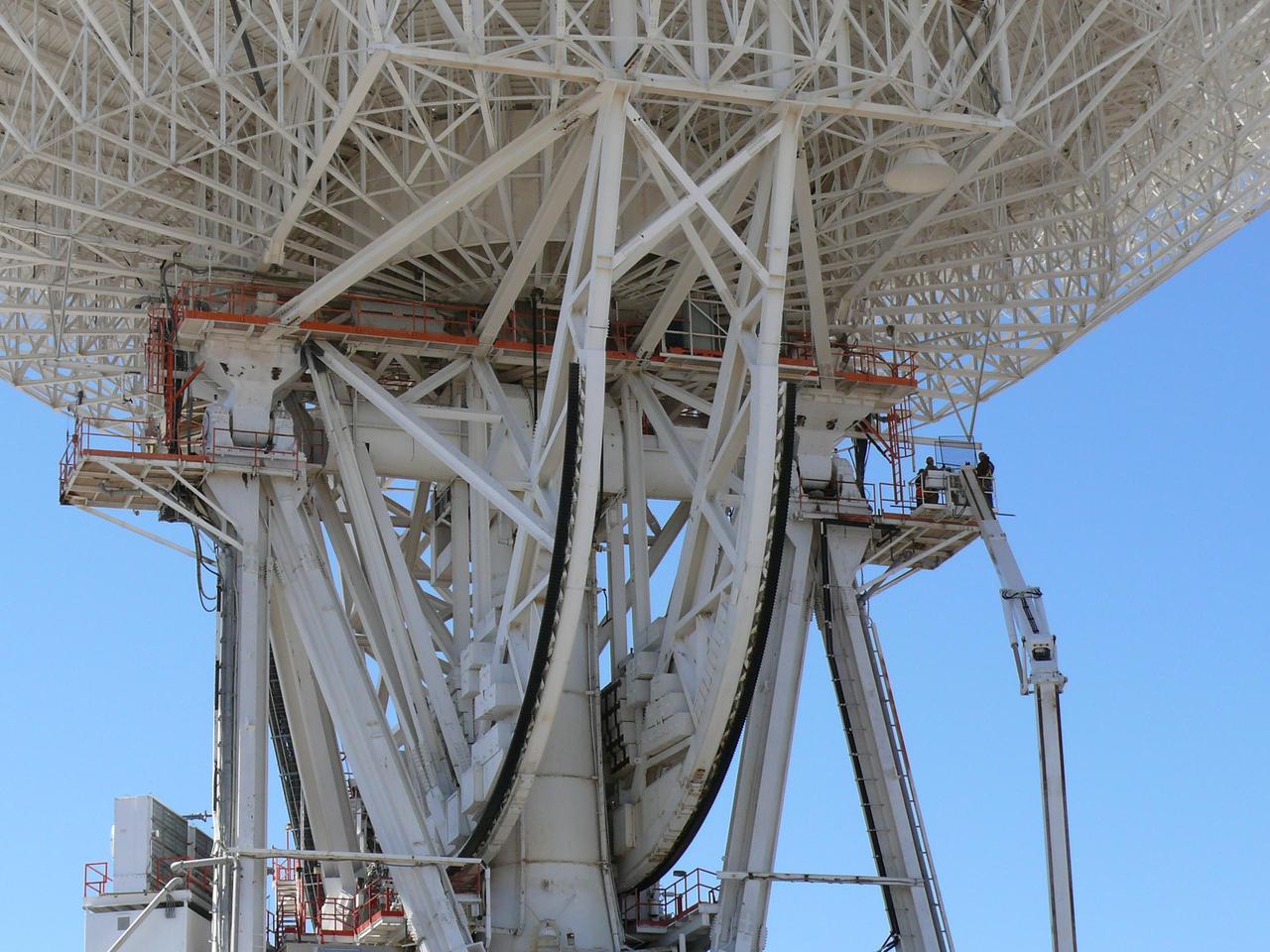
Work began on March 11, 2010 to replace a set of elevation bearings on the giant Mars antenna at NASA Deep Space Network complex in Goldstone, Calif.
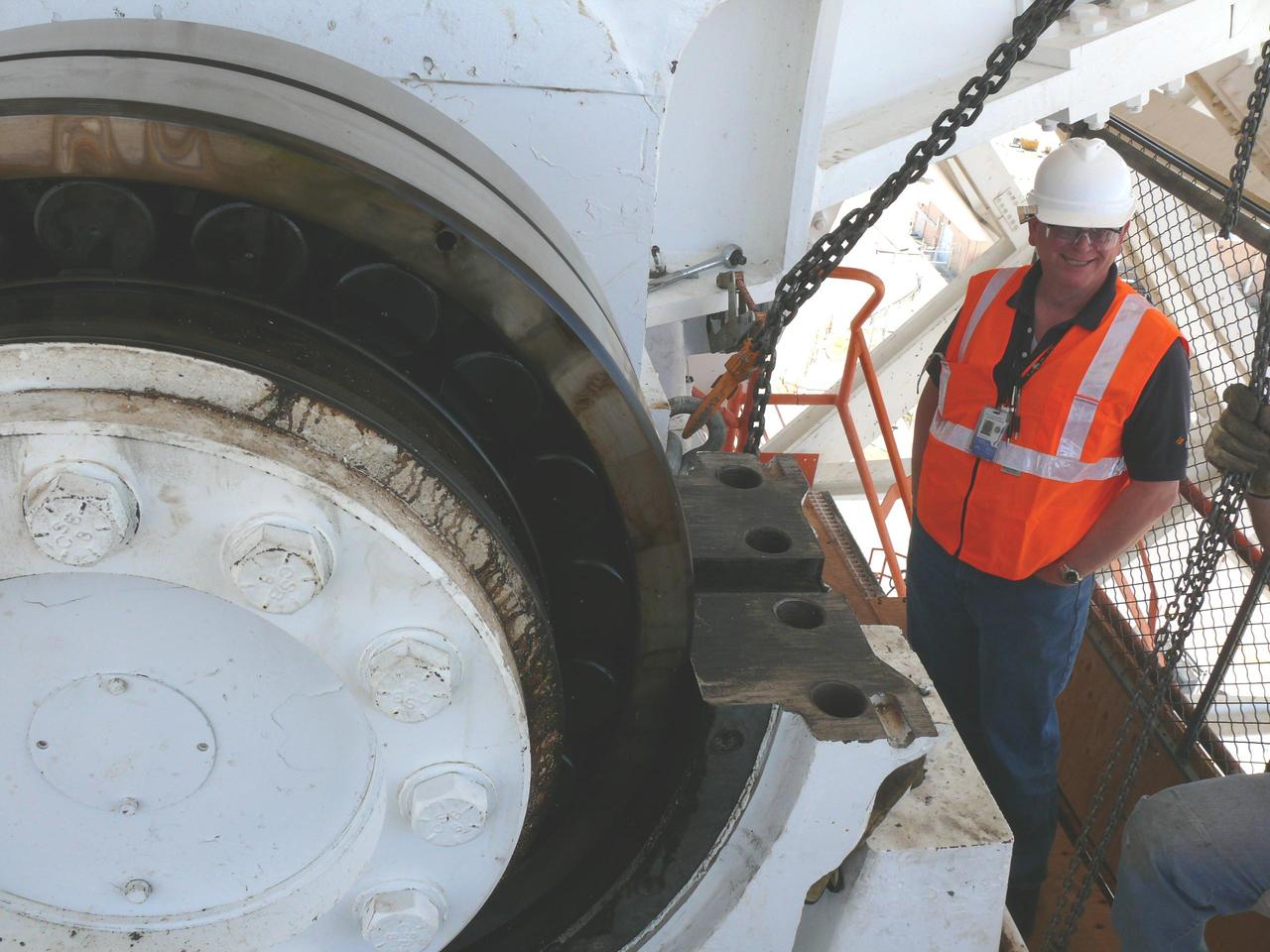
The giant Mars antenna at NASA Deep Space Network Goldstone Deep Space Communications Complex replaced four elevation bearings as part of a major refurbishment.
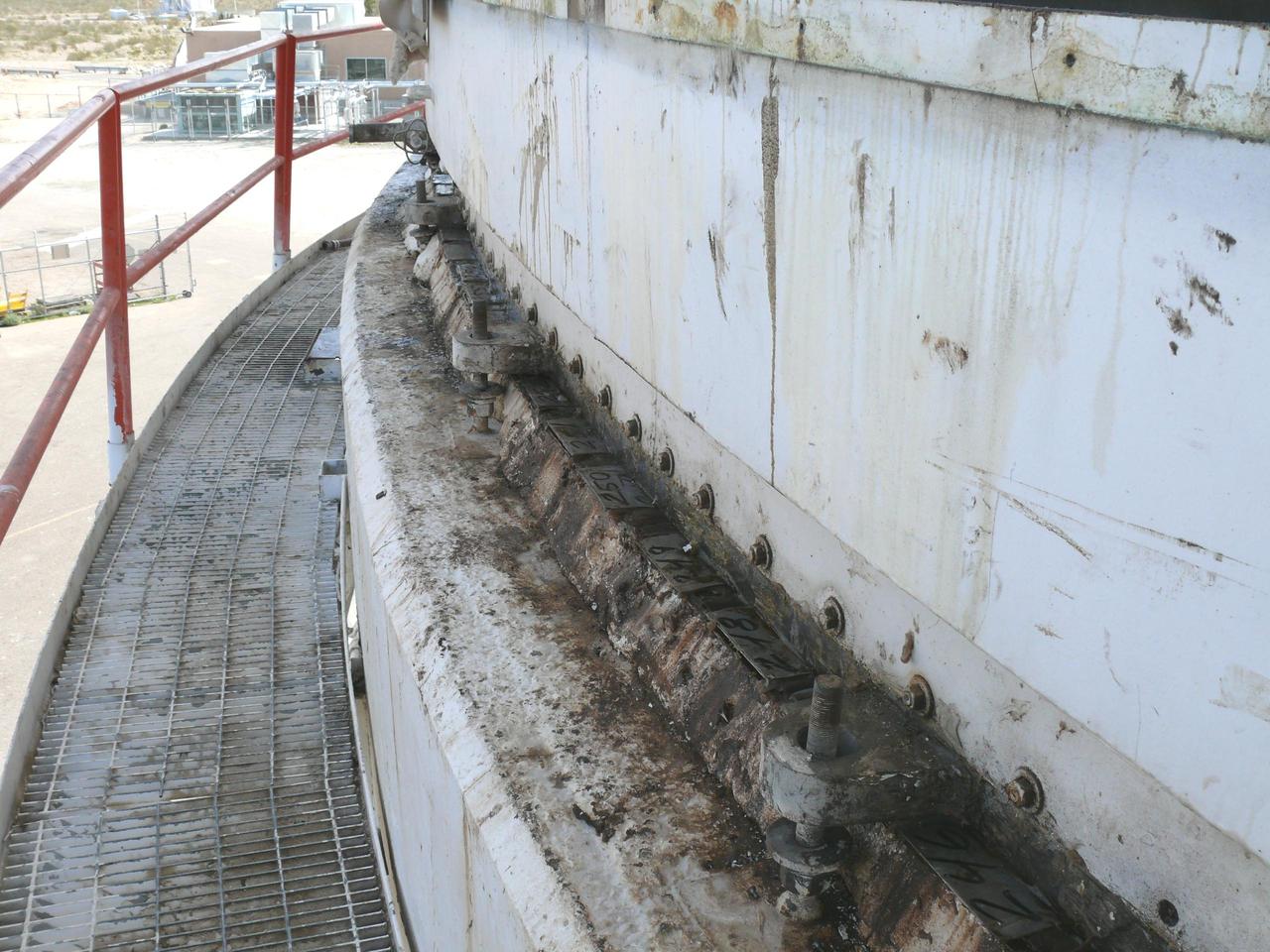
This image, taken on March 22, 2010, shows the condition of grout that was replaced in the giant Mars antenna at NASA Deep Space Network Goldstone, Calif. complex.

Workers at NASA Deep Space Network Goldstone Deep Space Communications Complex check on a set of jacks used to raise the upper part of the giant Mars antenna.
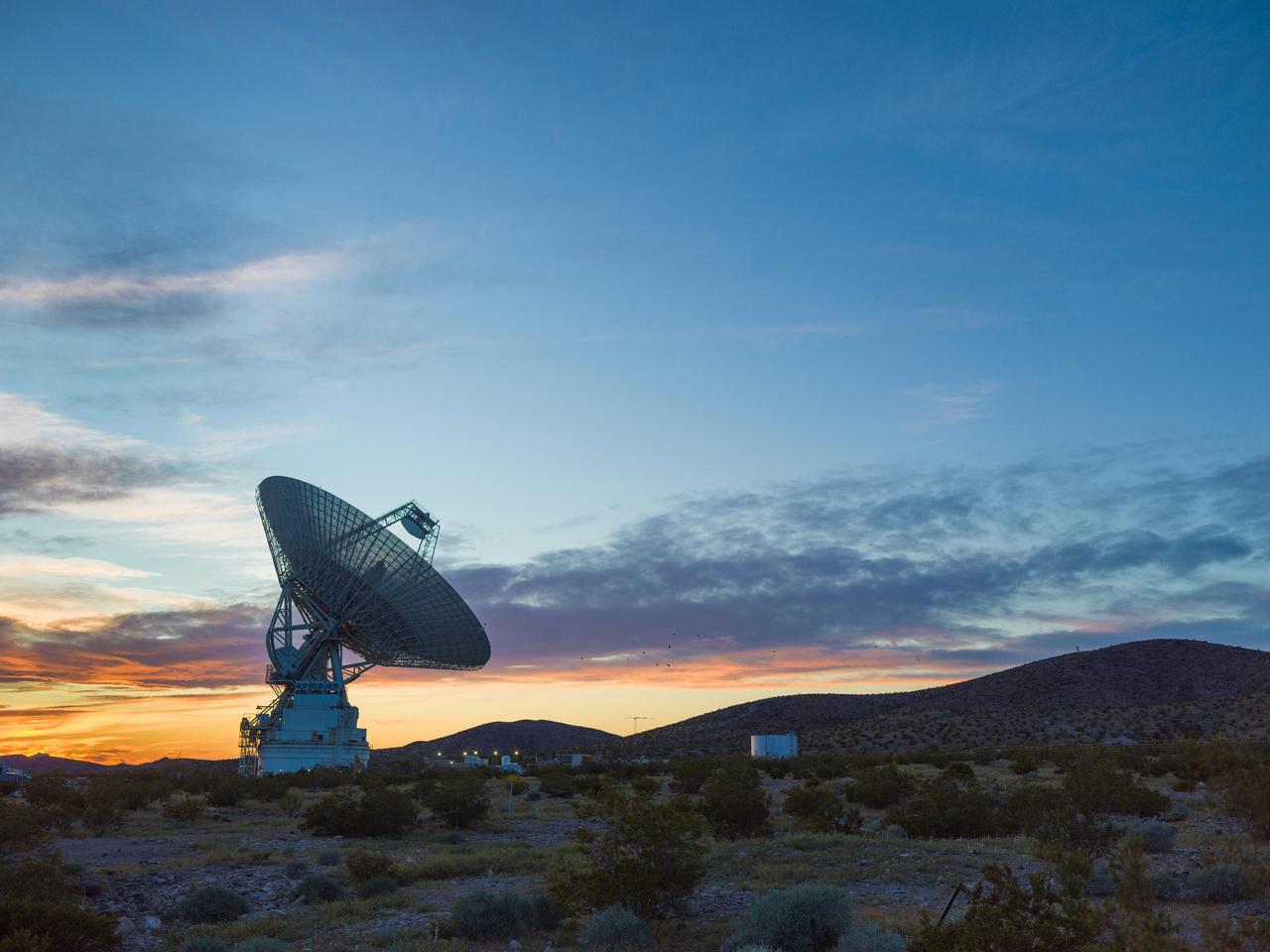
This sunset photo shows Deep Space Station 14 (DSS-14), the 230-foot-wide (70-meter) antenna at the Goldstone Deep Space Communications Complex near Barstow, California, part of NASA's Deep Space Network. The network's three complexes around the globe support communications with dozens of deep space missions. DSS-14 is also the agency's Goldstone Solar System Radar, which is used to observe asteroids that come close to Earth. https://photojournal.jpl.nasa.gov/catalog/PIA26150
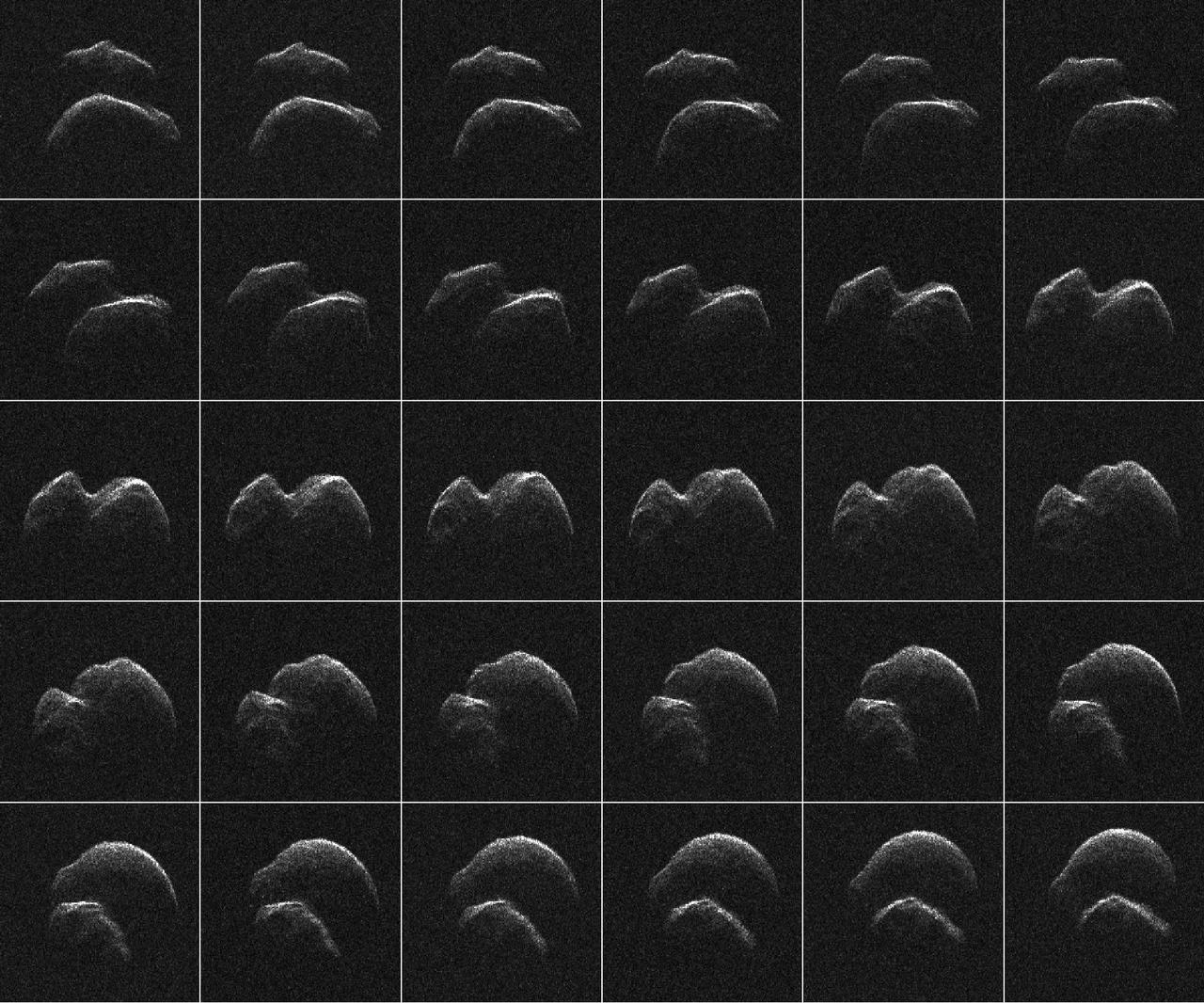
This composite of 30 images of asteroid 2014 JO25 was generated with radar data collected using NASA Goldstone Solar System Radar in California Mojave Desert. https://photojournal.jpl.nasa.gov/catalog/PIA21594
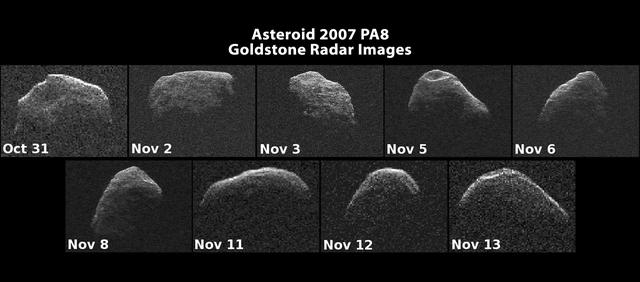
Images of asteroid 2007 PA8 have been generated with data collected by NASA Goldstone Solar System Radar. The images of 2007 PA8 reveal possible craters, boulders, an irregular, asymmetric shape, and very slow rotation.

On May 3, 2010, workers at NASA Deep Space Network Goldstone Deep Space Communications Complex removed one of the large steel pads that help the giant Mars antenna rotate sideways.
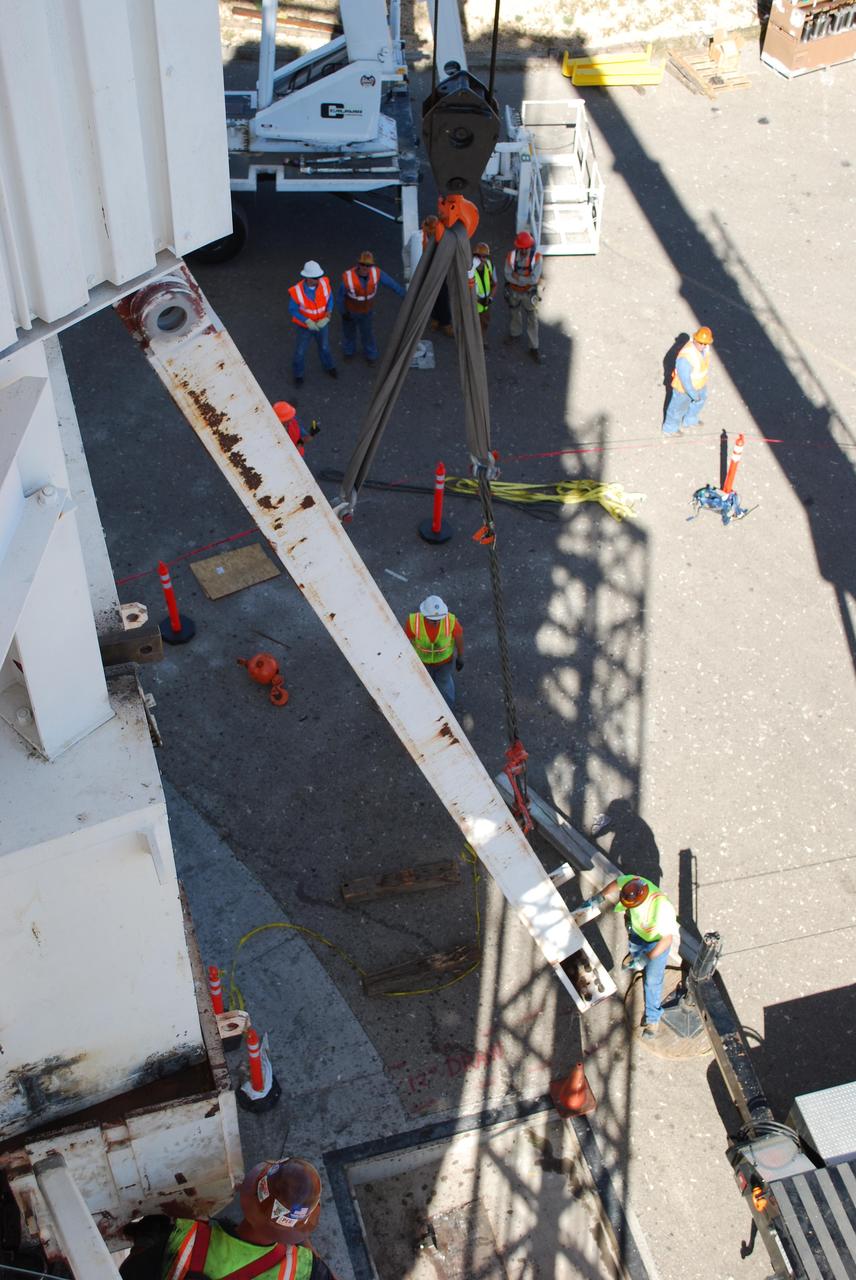
Workers at NASA Deep Space Network Goldstone Deep Space Communications Complex put into place a set of support legs to help hold up a portion of the giant Mars antenna on May 4, 2010.

A worker at NASA Deep Space Network Goldstone Deep Space Communications Complex radios to his colleagues that 12 jacks are ready to lift the upper section of the giant Mars antenna.
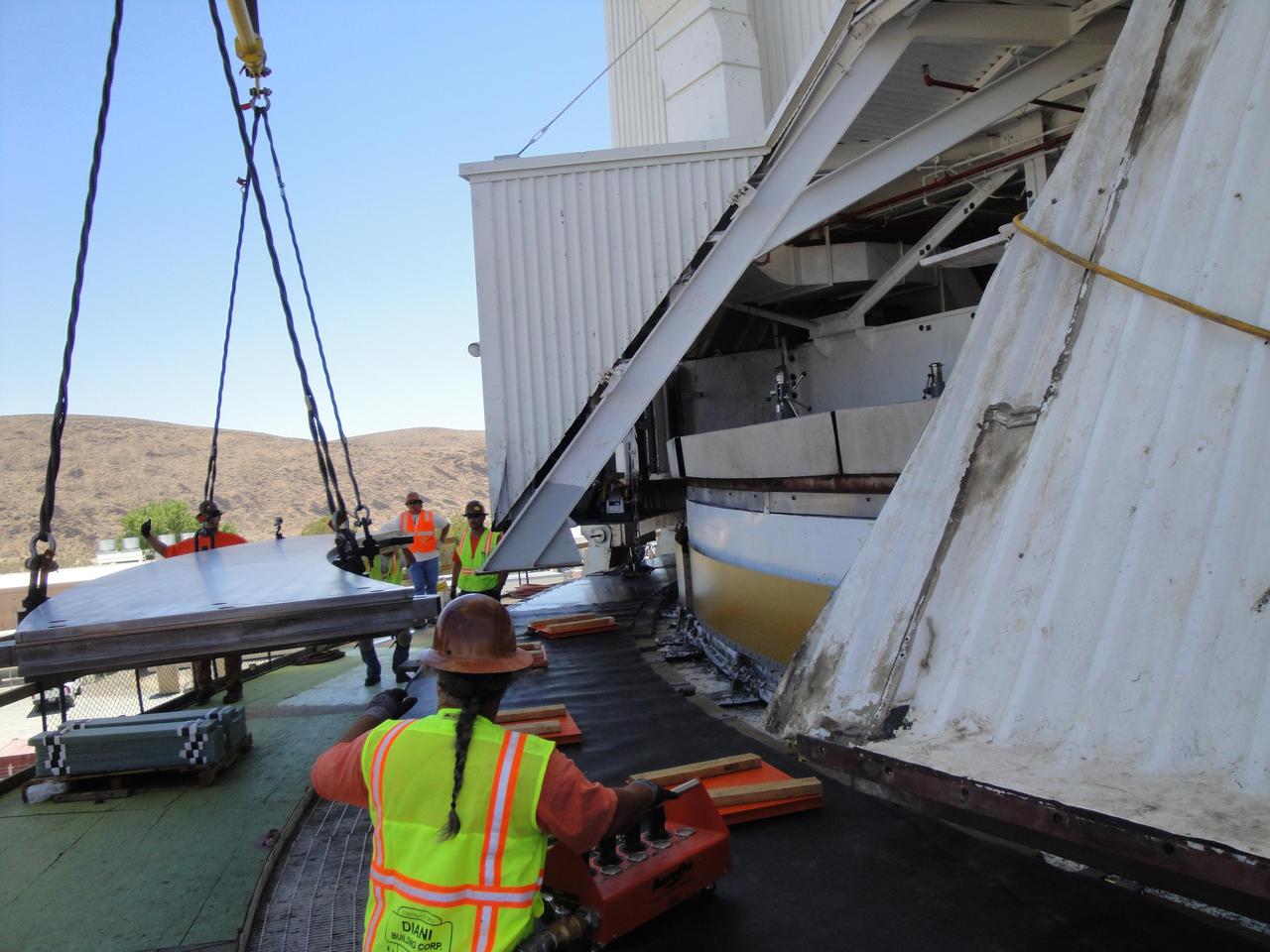
Workers in Goldstone, Calif., guide a new runner segment into the hydrostatic bearing assembly of a giant, 70-meter-wide 230-foot-wide antenna that is a critical part of NASA Deep Space Network.
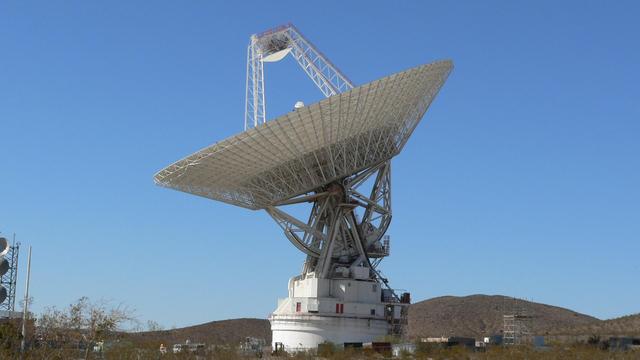
The giant, 70-meter-wide antenna at NASA Deep Space Network complex in Goldstone, Calif., tracks a spacecraft on Nov. 17, 2009. This antenna, officially known as Deep Space Station 14, is also nicknamed the Mars antenna.
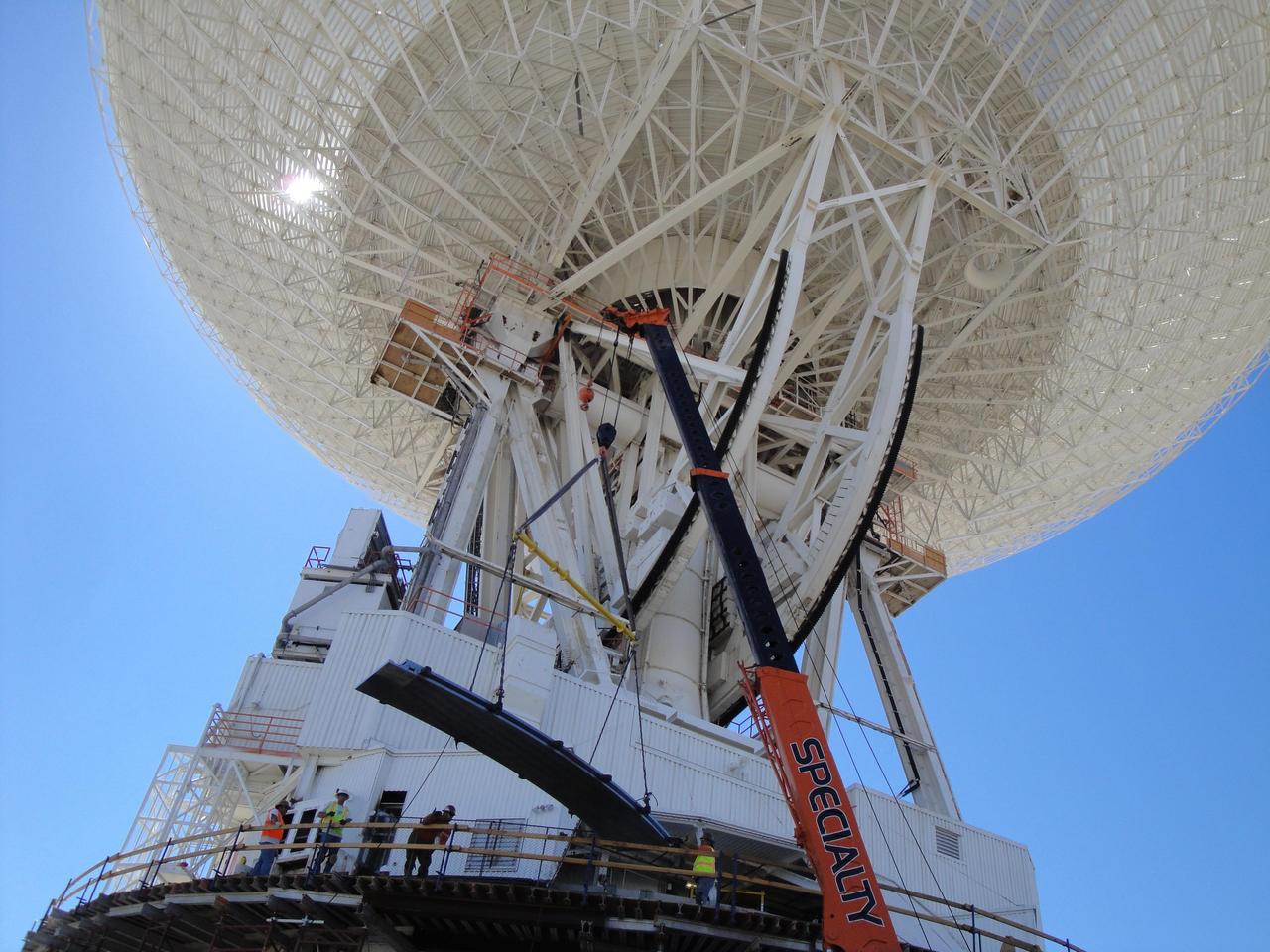
Under the unflinching summer sun, workers at NASA Deep Space Network complex in Goldstone, Calif., use a crane to lift a runner segment that is part of major surgery on a giant, 70-meter-wide antenna.
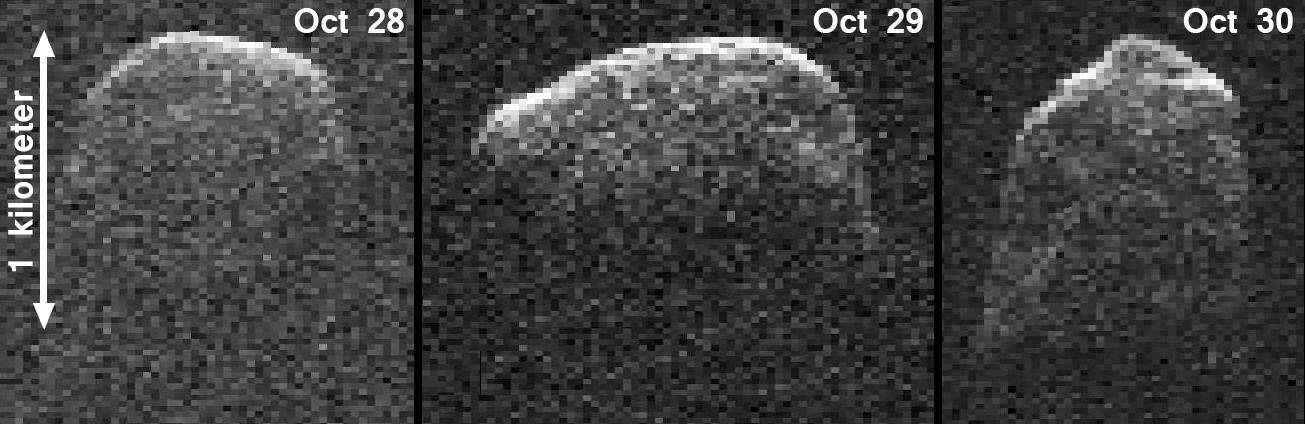
This composite image of asteroid 2007 PA8 was obtained using data taken by NASA 230-foot-wide 70-meter Deep Space Network antenna at Goldstone, Calif.

Asteroid 1998 WT24 left in December 2001, right on December 11, 2015 taken by NASA the 230-foot 70-meter DSS-14 antenna at Goldstone, California.
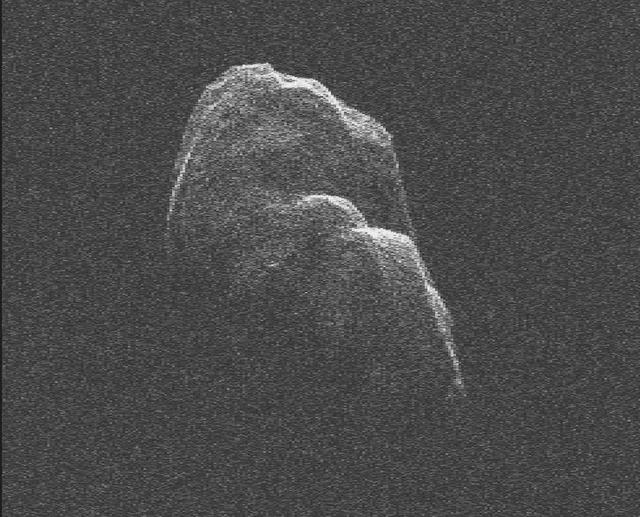
This image of asteroid Toutatis was generated with data collected using NASA Deep Space Network antenna at Goldstone, Calif., on Dec. 12 and 13, 2012 and indicates that it is an elongated, irregularly shaped object with ridges and perhaps craters.
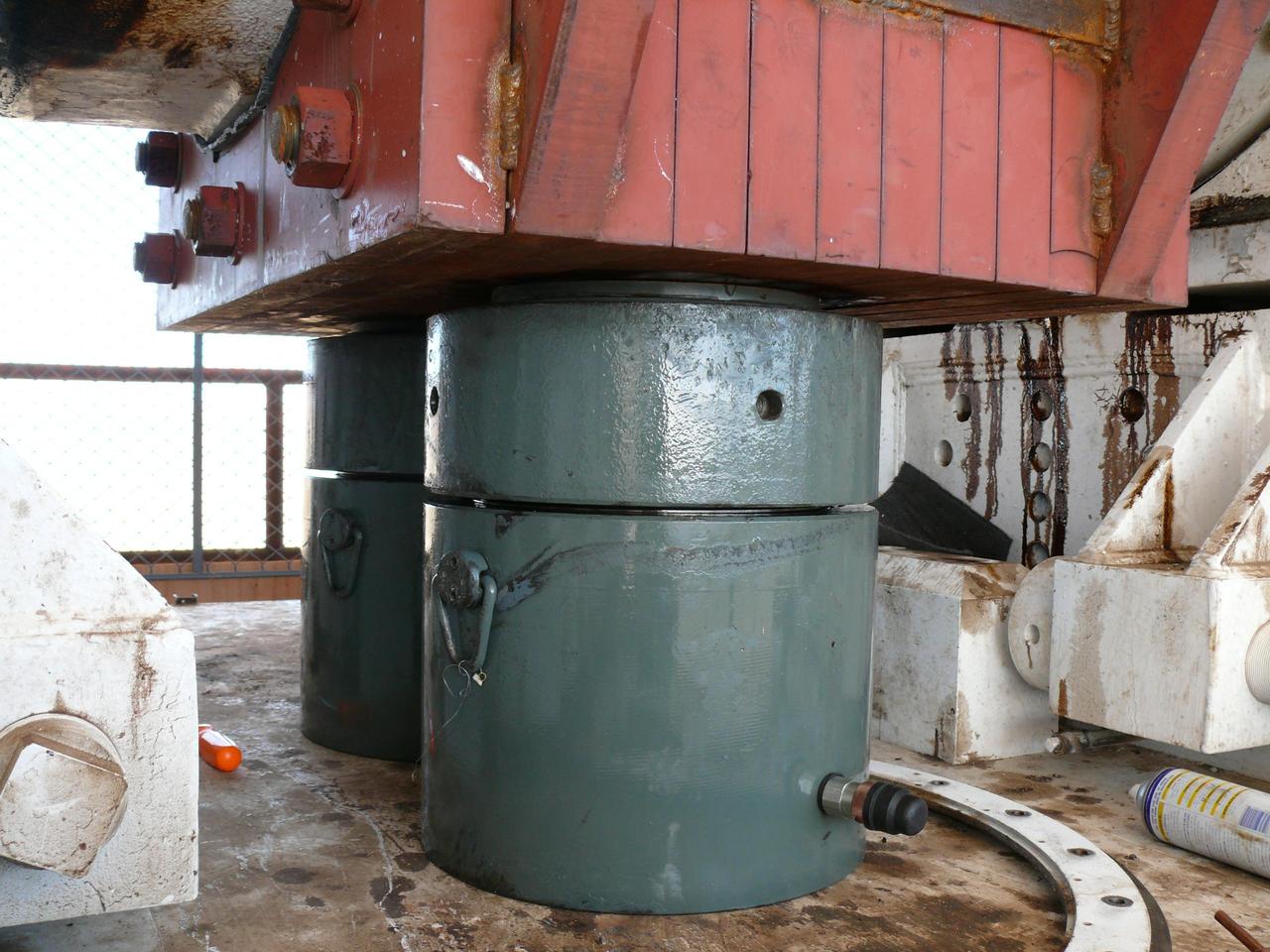
A major refurbishment of the giant Mars antenna at NASA Deep Space Network Goldstone Deep Space Communications Complex in California Mojave Desert required workers to jack up millions of pounds of delicate scientific equipment.
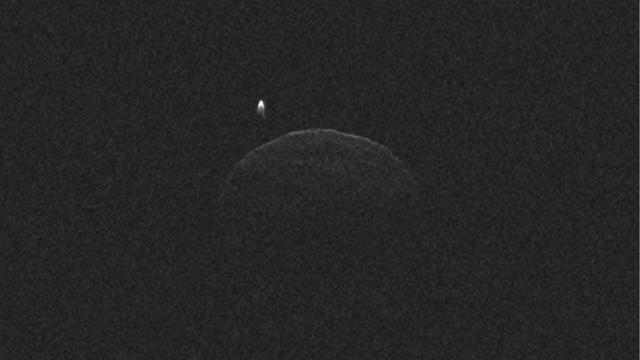
This radar imagery of asteroid 1998 QE2 and its moon was generated from data collected by NASA 230-foot-wide 70-meter Deep Space Network antenna at Goldstone, Calif., on June 1, 2013.
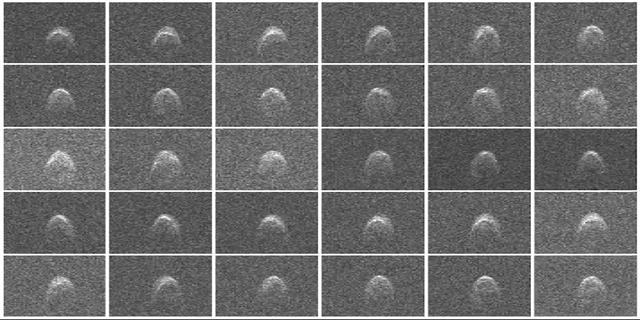
This collage of radar images of near-Earth asteroid 2005 WK4 was collected by NASA scientists using the 230-foot 70-meter Deep Space Network antenna at Goldstone, Calif., on Aug. 8, 2013.

Workers at NASA Deep Space Network complex in Goldstone, Calif., pour in a new epoxy grout as the giant Mars
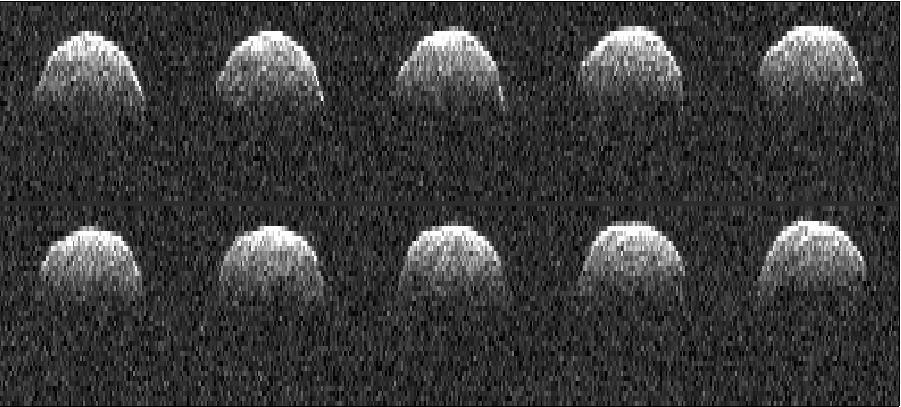
This radar image of asteroid 1999 RQ36 was obtained NASA Deep Space Network antenna in Goldstone, Calif. on Sept 23, 1999. NASA detects, tracks and characterizes asteroids and comets passing close to Earth using both ground- and space-based telescopes.
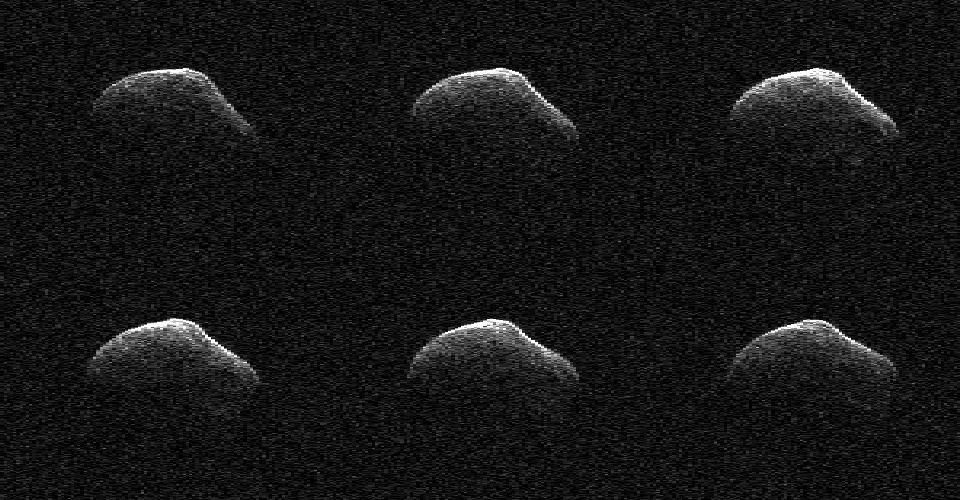
These radar images of comet P/2016 BA14 were taken on March 23, 2016, by scientists using an antenna of NASA Deep Space Network at Goldstone, California. At the time, the comet was about 2.2 million miles 3.6 million kilometers from Earth.

This radar image of asteroid 2005 YU55 was obtained NASA Deep Space Network antenna in Goldstone, Calif. on Nov. 7, 2011, when the space rock was at 3.6 lunar distances, which is about 860,000 miles, or 1.38 million kilometers, from Earth.
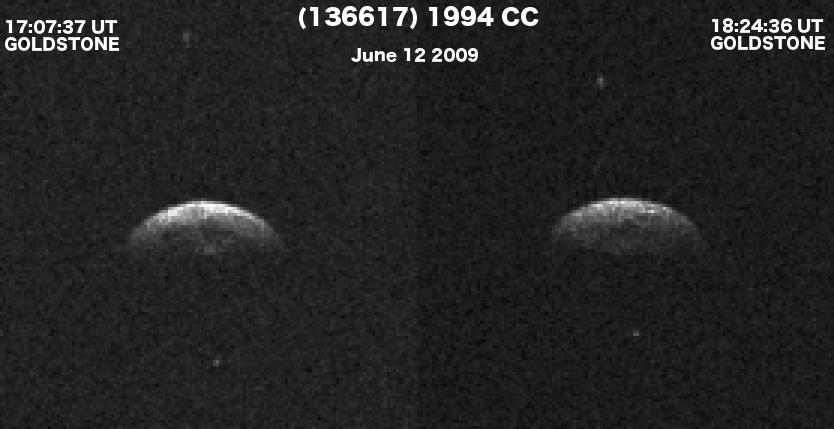
NASA Deep Space Network, Goldstone radar images show triple asteroid 1994 CC, which consists of a central object approximately 700 meters 2,300 feet in diameter and two smaller moons that orbit the central body. Animation available at the Photojournal
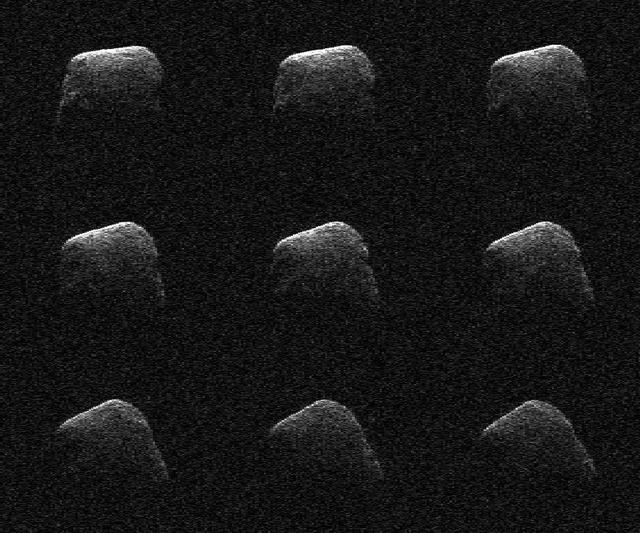
These radar images of comet P/2016 BA14 were taken on March 22, 2016, by scientists using an antenna of NASA Deep Space Network at Goldstone, CA. At the time, the comet was about 2.2 million miles 3.6 million kilometers from Earth.
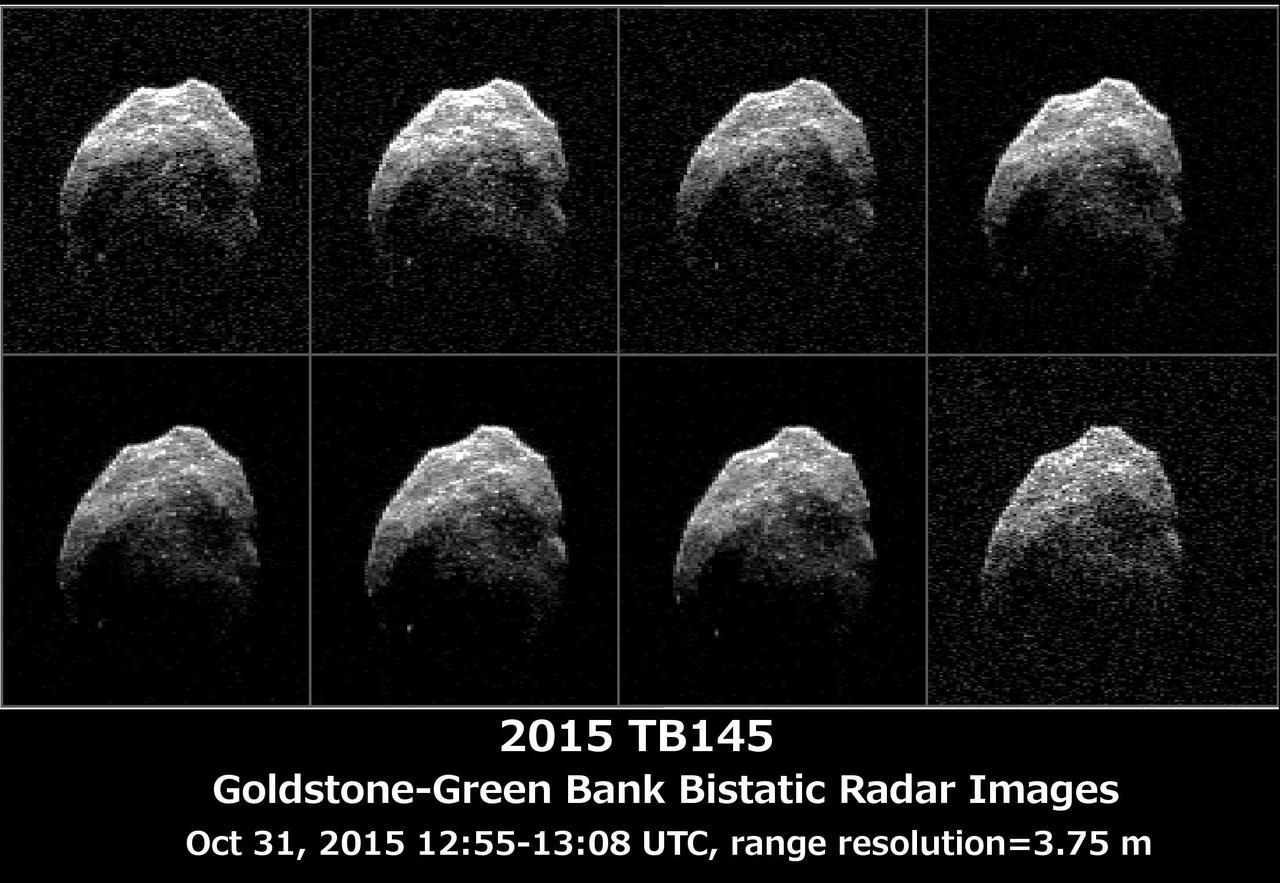
The 230-foot 70-meter DSS-14 antenna at Goldstone, Ca. obtained these radar images of asteroid 2015 TB145 on Oct. 31, 2015. Asteroid 2015 TB145 is depicted in eight individual radar images collected on Oct. 31, 2015 between 5:55 a.m. PDT (8:55 a.m. EDT) and 6:08 a.m. PDT (9:08 a.m. EDT). At the time the radar images were taken, the asteroid was between 440,000 miles (710,000 kilometers) and about 430,000 miles (690,000 kilometers) distant. Asteroid 2015 TB145 safely flew past Earth on Oct. 31, at 10:00 a.m. PDT (1 p.m. EDT) at about 1.3 lunar distances (300,000 miles, 480,000 kilometers). To obtain the radar images, the scientists used the 230-foot (70-meter) DSS-14 antenna at Goldstone, California, to transmit high power microwaves toward the asteroid. The signal bounced of the asteroid, and their radar echoes were received by the National Radio Astronomy Observatory's 100-meter (330-foot) Green Bank Telescope in West Virginia. The images achieve a spatial resolution of about 13 feet (4 meters) per pixel. http://photojournal.jpl.nasa.gov/catalog/PIA20043
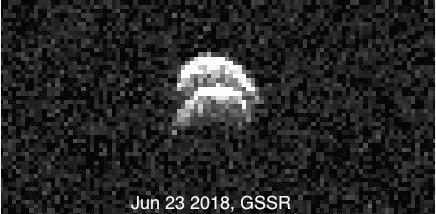
Radar images of the binary asteroid 2017 YE5 from NASA's Goldstone Solar System Radar (GSSR). The observations, conducted on June 23, 2018, show two lobes, but do not yet show two separate objects. A movie is available at https://photojournal.jpl.nasa.gov/catalog/PIA22557
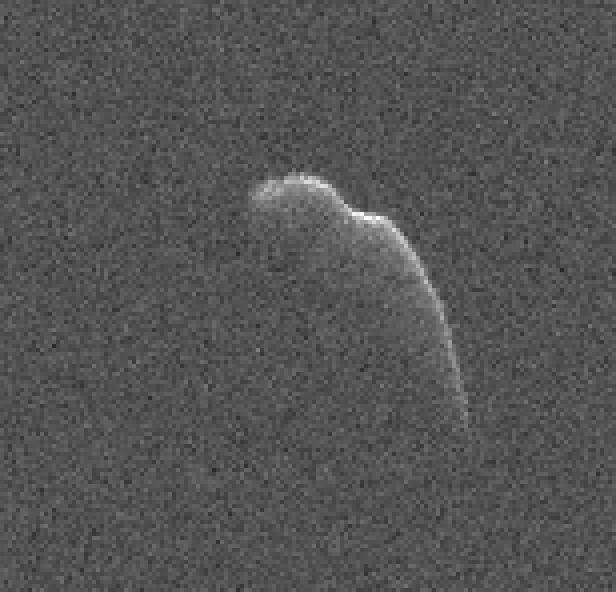
This image of an asteroid that is at least 3,600 feet (1,100 meters) long was taken on Dec. 17, 2015, by scientists using NASA's 230-foot (70-meter) DSS-14 antenna at Goldstone, California. This asteroid, named 2003 SD2020, will safely fly past Earth on Thursday, Dec. 24, at a distance of 6.8 million miles (11 million kilometers). At the time this image was taken, the asteroid was about 7.3 million miles (12 million kilometers) from Earth. In 2018, this asteroid will fly past Earth at a distance of 1.8 million miles (2.8 million kilometers). http://photojournal.jpl.nasa.gov/catalog/PIA20279
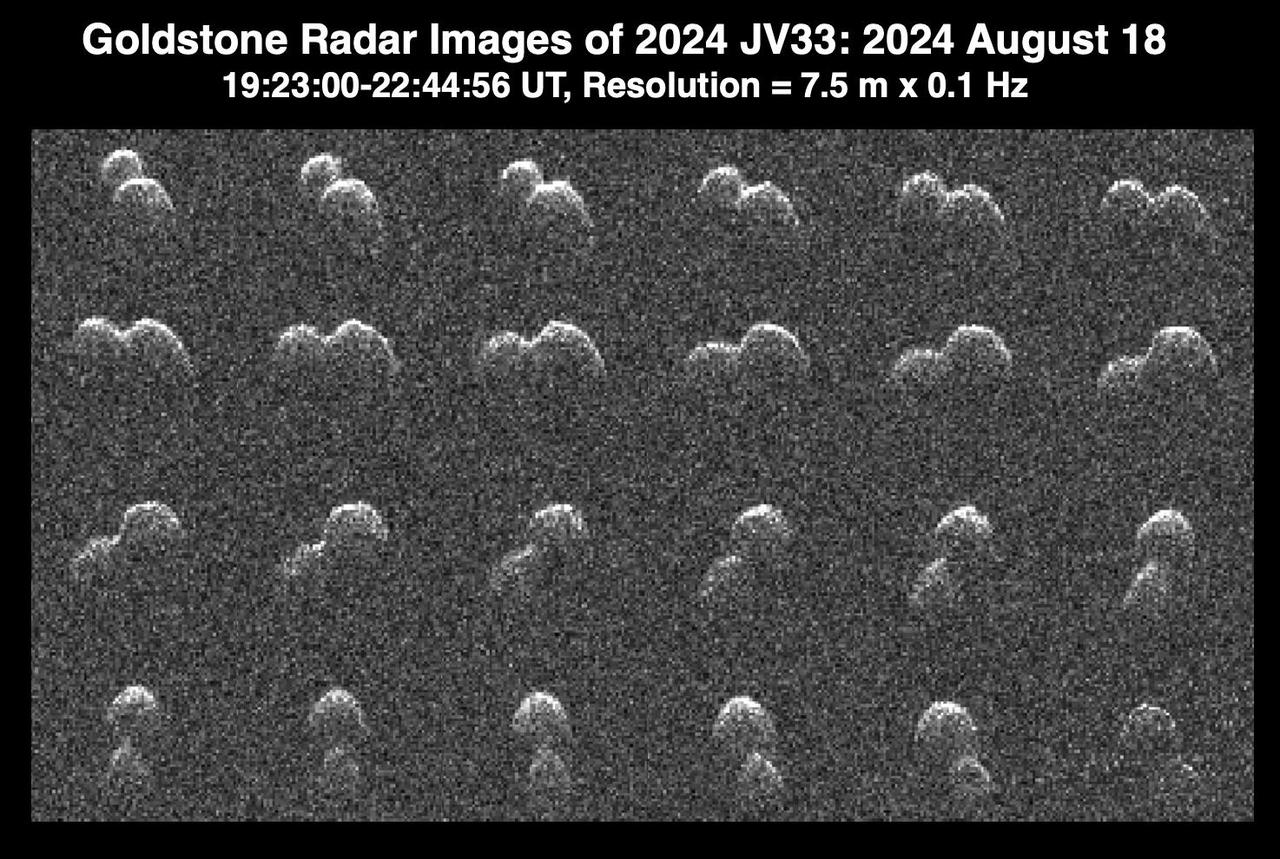
This series of radar images obtained by the Goldstone Solar System Radar near Barstow, California, on Aug. 18, 2024, shows the asteroid 2024 JV33 shortly before its close approach with Earth. The images were captured when the asteroid was at a distance of 2.8 million miles (4.6 million kilometers), about 12 times the distance between the Moon and Earth. Discovered by the NASA-funded Catalina Sky Survey in Tucson, Arizona, on May 4, the near-Earth asteroid's shape resembles that of a peanut – with two rounded lobes, one lobe larger than the other. Scientists used the radar images to determine that it is about 980 feet (300 meters) long and that its length is about double its width. Asteroid 2024 JV33 rotates once every seven hours. Radar is the principal technique for discovering such asteroids, which are called contact binaries. Dozens of them have been imaged by Goldstone, which is part of NASA's Deep Space Network. At least 14% of near-Earth asteroids larger than about 660 feet (200 meters) have a contact binary shape. Asteroid 2024 JV33 has an elongated orbit similar to that of many comets that are strongly influenced by the gravity of Jupiter. While no comet-like activity has been observed, the possibility remains that the asteroid may be an inactive cometary nucleus. The asteroid is classified as potentially hazardous, but it does not pose a hazard to Earth for the foreseeable future. These Goldstone measurements have greatly reduced the uncertainties in the asteroid's distance from Earth and in its future motion for many decades. https://photojournal.jpl.nasa.gov/catalog/PIA26389
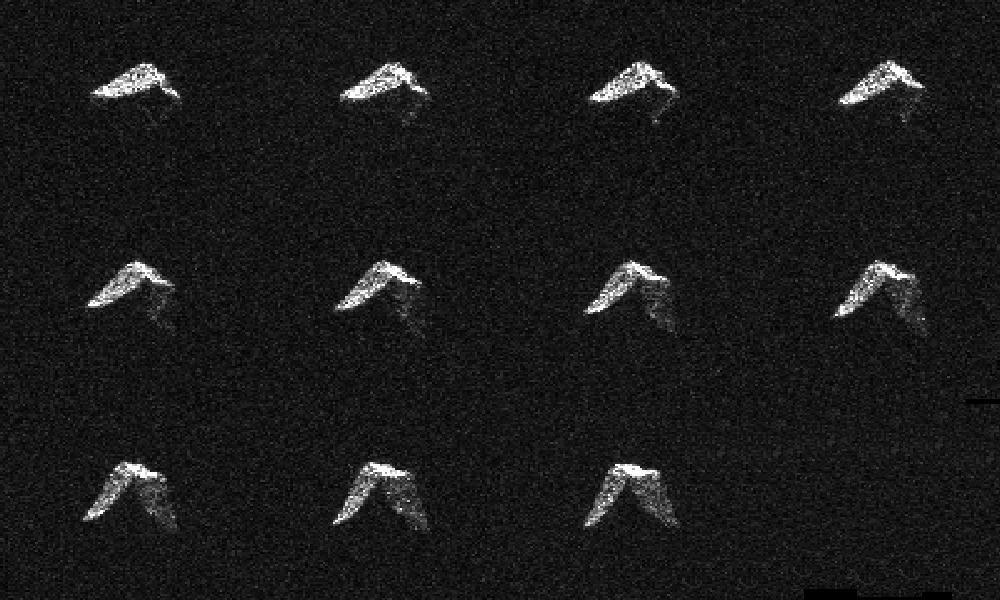
This composite of 11 images of asteroid 2017 BQ6 was generated with radar data collected using NASA's Goldstone Solar System Radar in California's Mojave Desert on Feb. 5, 2017, between 5:24 and 5:52 p.m. PST (8:24 to 8:52 p.m. EST / 1:24 to 1:52 UTC). The images have resolutions as fine as 12 feet (3.75 meters) per pixel. http://photojournal.jpl.nasa.gov/catalog/PIA21453
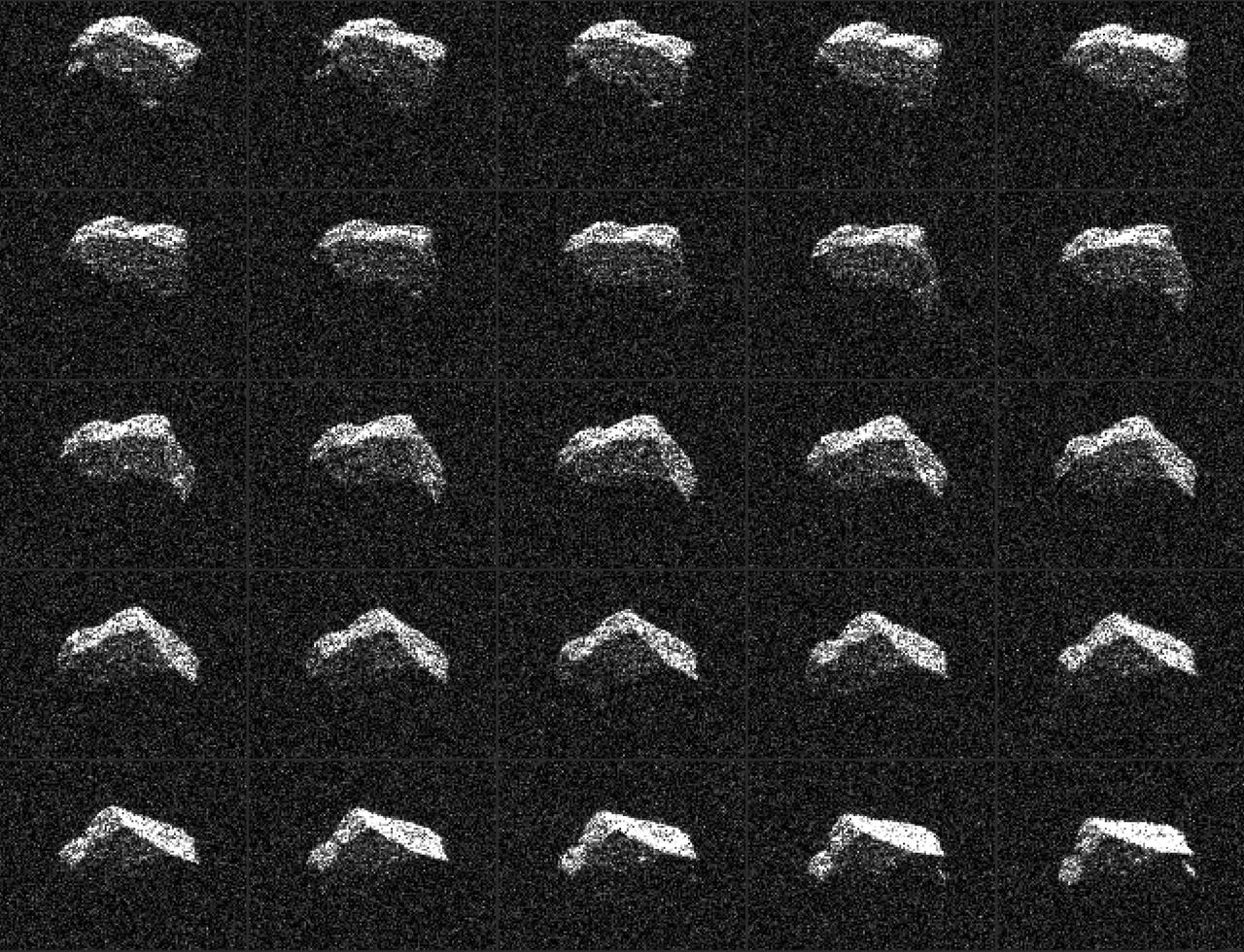
This composite of 25 images of asteroid 2017 BQ6 was generated with radar data collected using NASA's Goldstone Solar System Radar in California's Mojave Desert. The images were gathered on Feb. 7, 2017, between 8:39 and 9:50 p.m. PST (11:39 p.m. EST and 12:50 a.m., Feb. 7), revealing an irregular, angular-appearing asteroid about 660 feet (200 meters) in size that rotates about once every three hours. The images have resolutions as fine as 12 feet (3.75 meters) per pixel. http://photojournal.jpl.nasa.gov/catalog/PIA21452
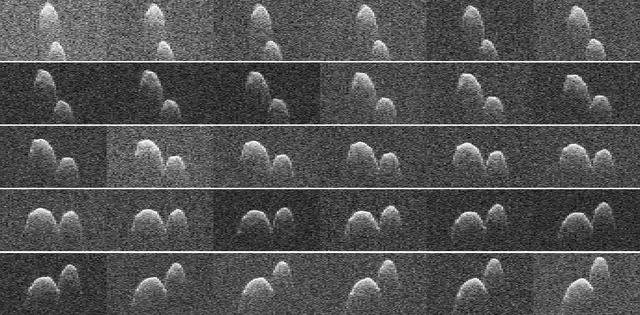
This collage of radar images of near-Earth asteroid 1999 JD6 was collected by NASA scientists on July 25, 2015. The images show the rotation of the asteroid, which made its closest approach on July 24 at 9:55 p.m. PDT (12:55 a.m. EDT on July 25) at a distance of about 4.5 million miles (7.2 million kilometers, or about 19 times the distance from Earth to the moon). The asteroid appears to be a contact binary -- an asteroid with two lobes that are stuck together. These views, which are radar echoes, were obtained by pairing NASA's 230-foot-wide (70-meter) Deep Space Network antenna at Goldstone, California, with the 330-foot (100-meter) National Science Foundation Green Bank Telescope in West Virginia. Using this approach, the Goldstone antenna beams a radar signal at an asteroid and Green Bank receives the reflections. The technique, referred to as a bistatic observation, dramatically improves the amount of detail that can be seen in radar images. The new views obtained with the technique show features as small as about 25 feet (7.5 meters) wide. The images show the asteroid is highly elongated, with a length of approximately 1.2 miles (2 kilometers) on its long axis. http://photojournal.jpl.nasa.gov/catalog/PIA19647
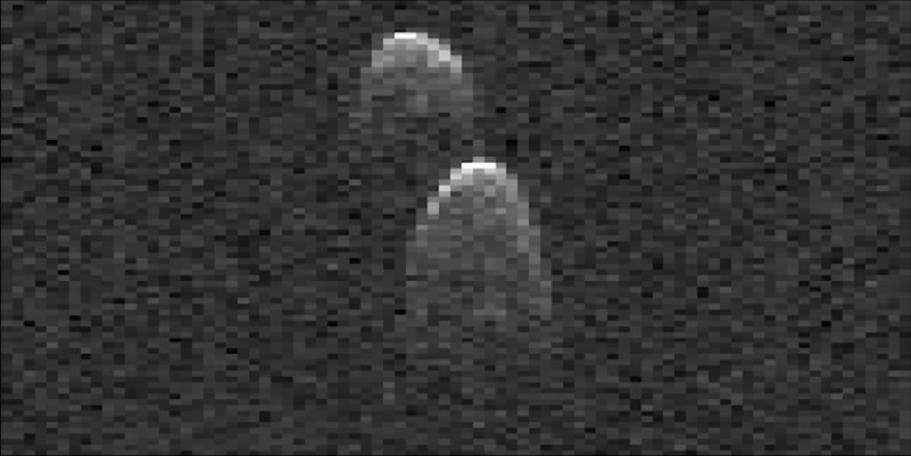
This frame from a movie made from radar images of asteroid 1999 JD6 was collected by NASA scientists on July 25, 2015. The images show the rotation of the asteroid, which made its closest approach on July 24 at 9:55 p.m. PDT (12:55 a.m. EDT on July 25) at a distance of about 4.5 million miles (7.2 million kilometers, or about 19 times the distance from Earth to the moon). The asteroid appears to be a contact binary -- an asteroid with two lobes that are stuck together. The radar images show the asteroid is highly elongated, with a length of approximately 1.2 miles (2 kilometers) on its long axis. These images are radar echoes, which are more like a sonogram than a photograph. The views were obtained by pairing NASA's 230-foot-wide (70-meter) Deep Space Network antenna at Goldstone, California, with the 330-foot (100-meter) National Science Foundation Green Bank Telescope in West Virginia. Using this approach, the Goldstone antenna beams a radar signal at an asteroid and Green Bank receives the reflections. The technique, referred to as a bistatic observation, dramatically improves the amount of detail that can be seen in radar images. The new views obtained with the technique show features as small as about 25 feet (7.5 meters) wide. http://photojournal.jpl.nasa.gov/catalog/PIA19646
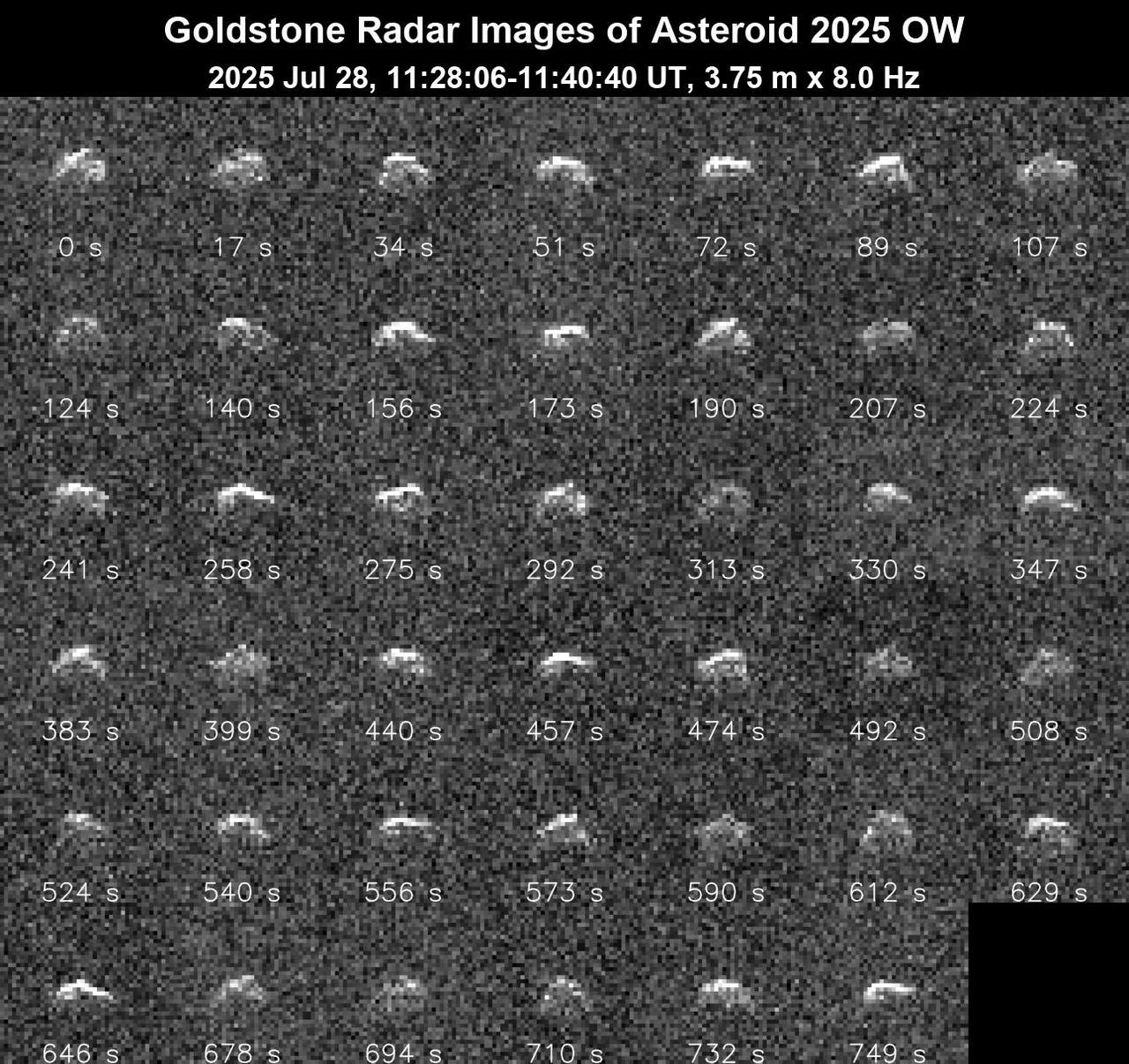
This series of 41 radar images obtained by the Deep Space Network's Goldstone Solar System Radar on July 28, 2025, shows the near-Earth asteroid 2025 OW as it made its close approach with our planet. The asteroid safely passed at about 400,000 miles (640,000 kilometers), or 1.6 times the distance from Earth to the Moon. The asteroid was discovered on July 4, 2025, by the NASA-funded Pan-STARRS2 survey telescope on Haleakala in Maui, Hawaii. These Goldstone observations suggest that 2025 OW is about 200 feet (60 meters) wide and has an irregular shape. The observations also indicate that it is rapidly spinning, completing one rotation every 1½ to 3 minutes, making it one of the fastest-spinning near-Earth asteroids that the powerful radar system has observed. The observations resolve surface features down to 12 feet (3.75 meters) wide. Asteroids can be "spun up" by sunlight being unevenly absorbed and re-emitted across their irregular surfaces. As photons (quantum particles of light) carry a tiny amount of momentum away from the asteroid, a tiny amount of torque is applied and, over time, the asteroid's spin can increase – a phenomenon known as the YORP effect. For 2025 OW to maintain such a fast rotation without breaking apart, it may be a solid object rather than a loosely bound rubble pile like many asteroids. The Goldstone measurements have allowed scientists to greatly reduce uncertainties in the asteroid's distance from Earth and in its future motion for many decades. This July 28 close approach is the closest asteroid 2025 OW will come to Earth for the foreseeable future. Animation available at https://photojournal.jpl.nasa.gov/catalog/PIA26587
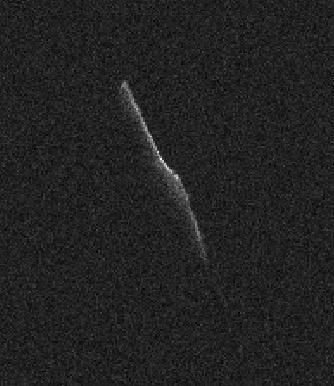
The elongated asteroid in this radar image, named 2003 SD220, will safely fly past Earth on Thursday, Dec. 24, 2015, at a distance of 6.8 million miles (11 million kilometers). The image was taken on Dec. 22 by scientists using NASA's 230-foot (70-meter) Deep Space Network antenna at Goldstone, California, when the asteroid was approaching its flyby distance. This asteroid is at least 3,600 feet (1,100 meters) long. In 2018, it will safely pass Earth at a distance of 1.8 million miles (2.8 million kilometers). http://photojournal.jpl.nasa.gov/catalog/PIA20280
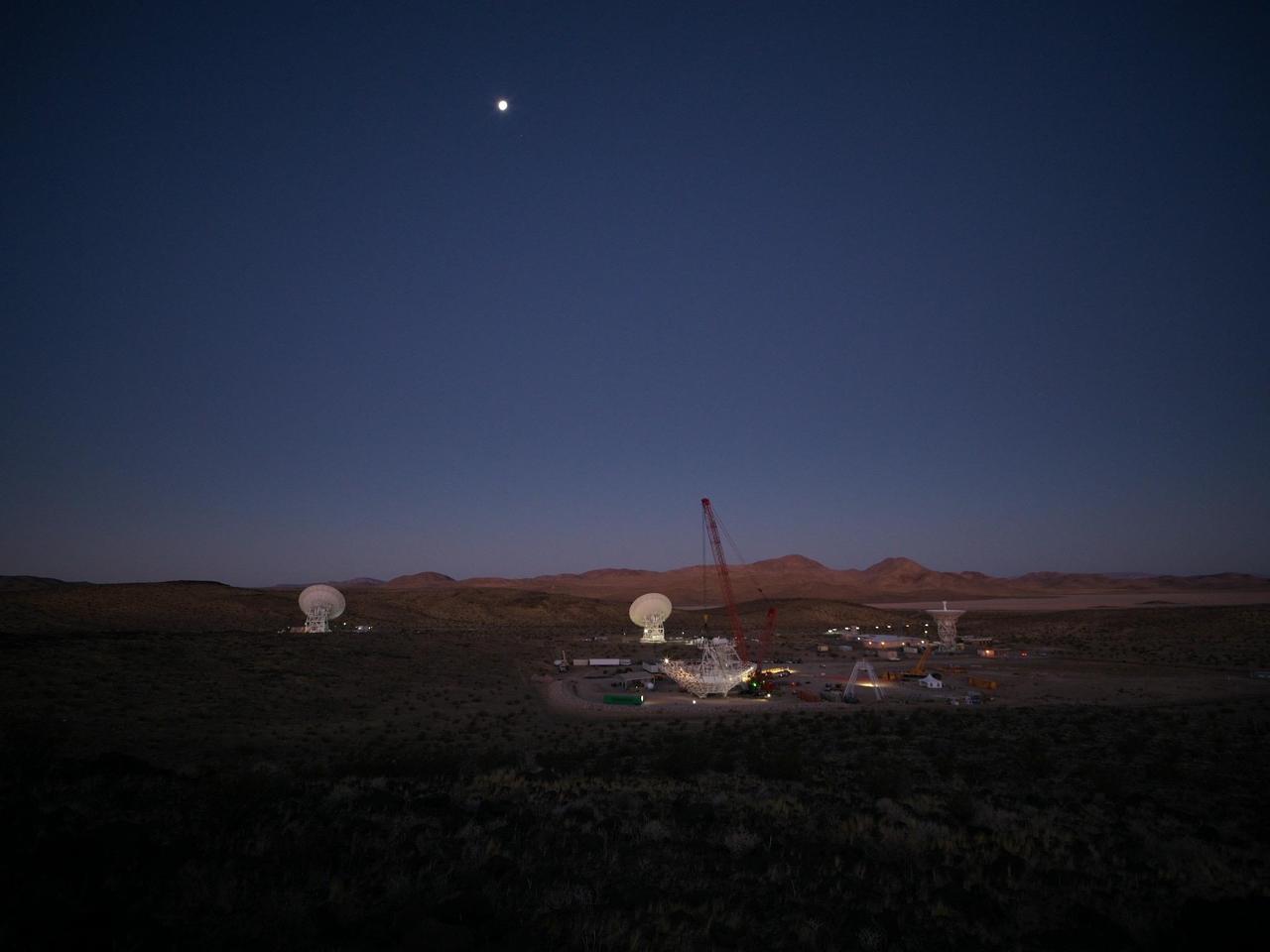
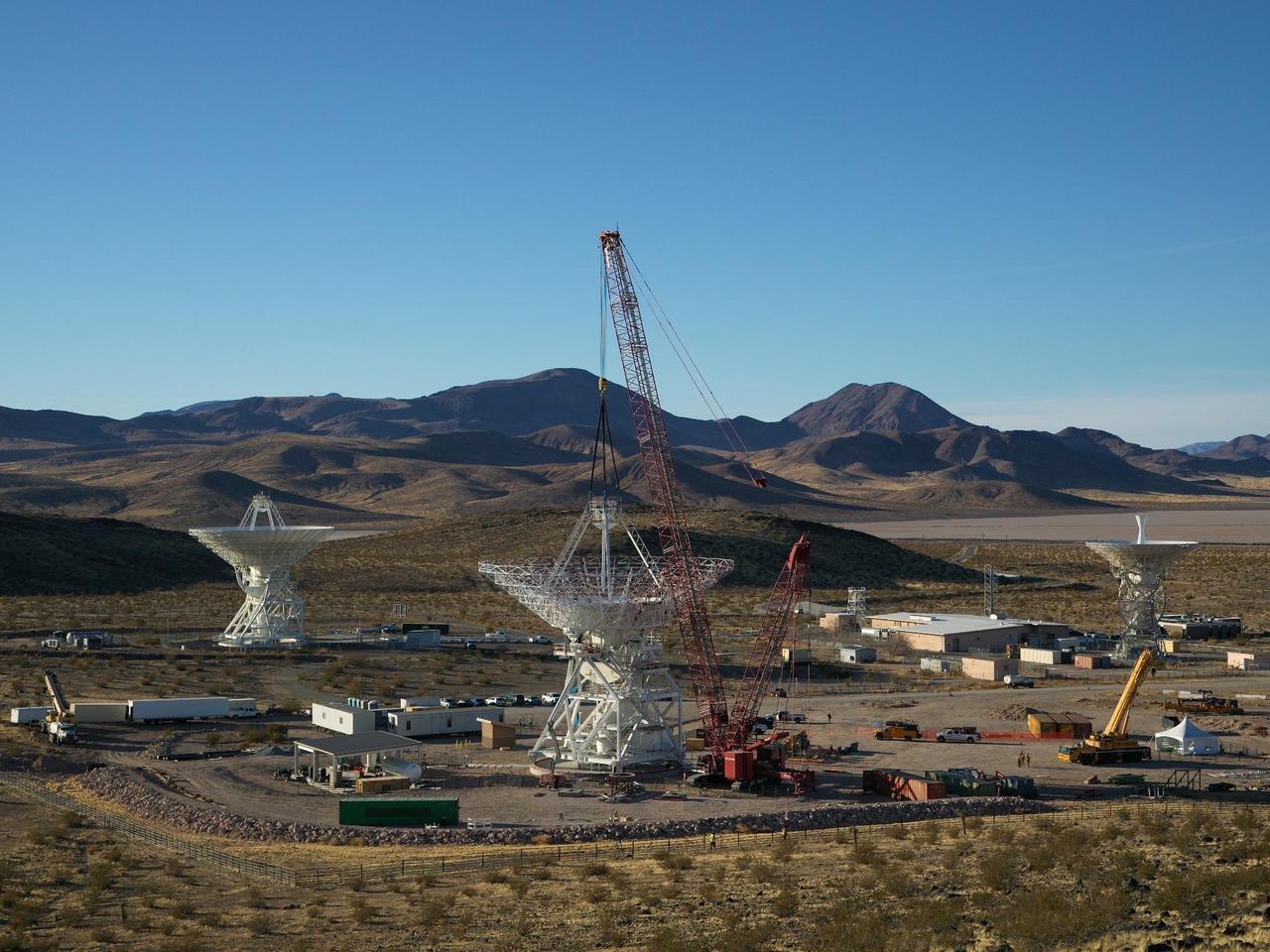
In the early morning of Dec. 18, 2024, a crane looms over the 112-foot-wide (34-meter-wide) steel framework for Deep Space Station 23 (DSS-23) reflector dish, which will soon be lowered into position on the antenna's base structure. Located at the Deep Space Network's Goldstone Space Communications Complex near Barstow, California, DSS-23 is a multi-frequency beam waveguide antenna that will boost the DSN's capacity and enhance NASA's deep space communications capabilities for decades to come. In the background are, from left to right, the beam waveguide antennas DSS-25 and DSS-26, and the decommissioned 85-foot (26-meter) Apollo antenna. https://photojournal.jpl.nasa.gov/catalog/PIA26456
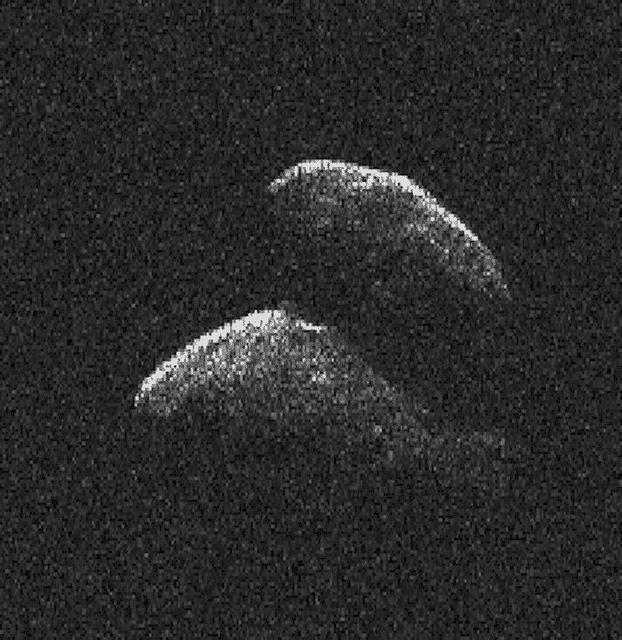
This frame from a movie of asteroid 2014 JO25 was generated using radar data collected by NASA 230-foot-wide 70-meter Deep Space Network antenna at Goldstone, California on April 19, 2017. When the observations began 2014 JO25 was 1.53 million miles (2.47 million kilometers) from Earth. By the time the observations concluded, the asteroid was 1.61 million miles (2.59 million kilometers) away. The asteroid has a contact binary structure -- two lobes connected by a neck-like region. The largest of the asteroid's two lobes is estimated to be 2,000 feet (610 meters) across. Asteroid 2014 JO25 approached to within 1.1 million miles (1.8 million kilometers) of Earth on April 19. There are no future flybys by 2014 JO25 as close as this one for more than 400 years. The resolution of the radar images is about 25 feet (7.5 meters) per pixel. 154 images were used to create a movie. The movie can be seen at. https://photojournal.jpl.nasa.gov/catalog/PIA21597
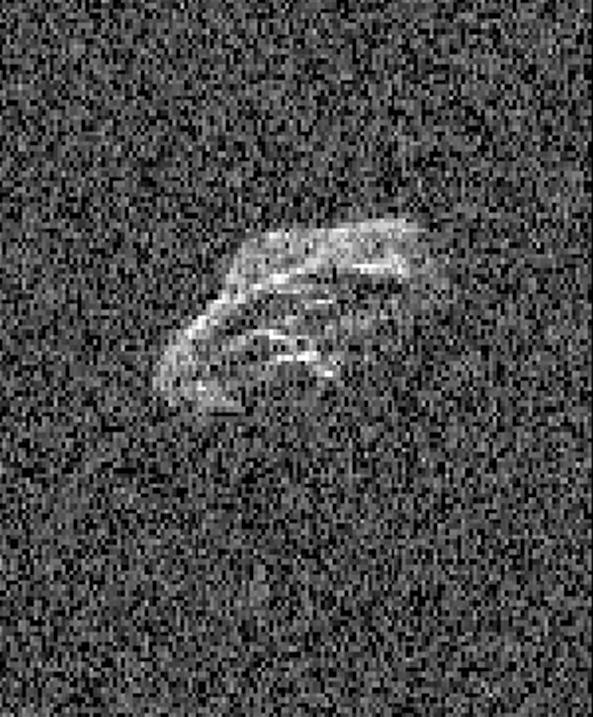
Scientists using two giant, Earth-based radio telescopes bounced radar signals off passing asteroid 2011 UW158 to create images for this animation showing the rocky body's fast rotation. The passing asteroid made its closest approach to Earth on July 19, 2015 at 7:37 a.m. PST (4:37 a.m. EST) at a distance of about 1.5 million miles (2.4 million kilometers, or 6 times the distance from Earth to the moon). The close proximity during the pass made 2011 UW158 one of the best asteroid flybys of 2015 for imaging from Earth using radar. The radar images reveal that the shape of the asteroid is extremely irregular and quite elongated. Prominent parallel, linear features run along the length of the object that cause a large increase in brightness of the radar images as they rotate into view. Scientists note that the asteroid appears to be fairly unusual. Its fast rotation suggests the object has greater mechanical strength than other asteroids its size. A fast-rotating asteroid with lower mechanical strength would tend to split apart. To obtain the views, researchers paired the 230-foot- (70-meter-) wide Deep Space Network antenna at Goldstone, California, in concert with the National Radio Astronomy Observatory's 330-foot (100-meter) Green Bank Telescope. Using this technique, the Goldstone antenna beams a radar signal at an asteroid and Green Bank receives the reflections. The technique, referred to as a bi-static observation, dramatically improves the amount of detail that can be seen in radar images. The new views obtained with the technique show features as small as about 24 feet (7.5 meters) wide. The 171 individual images used in the movie were generated from data collected on July 18. They show the asteroid is approximately 2000 by 1000 feet (600 by 300 meters) across. The observations also confirm earlier estimates by astronomers that the asteroid rotates quickly, completing one spin in just over half an hour. The movie spans a period of about an hour and 45 minutes. The trajectory of asteroid 2011 UW158 is well understood. This flyby was the closest approach the asteroid will make to Earth for at least the next 93 years. Asteroid 2011 UW158 was discovered on October 25, 2011, by the PanSTARRS 1 telescope, located on the summit of Haleakala on Maui, Hawaii. Managed by the University of Hawaii, the PanSTARRS survey receives NASA funding. Radar is a powerful technique for studying an asteroid's size, shape, rotation state, surface features and surface roughness, and for improving the calculation of asteroid orbits. Radar measurements of asteroid distances and velocities often enable computation of asteroid orbits much further into the future than if radar observations weren't available. http://photojournal.jpl.nasa.gov/catalog/PIA19644
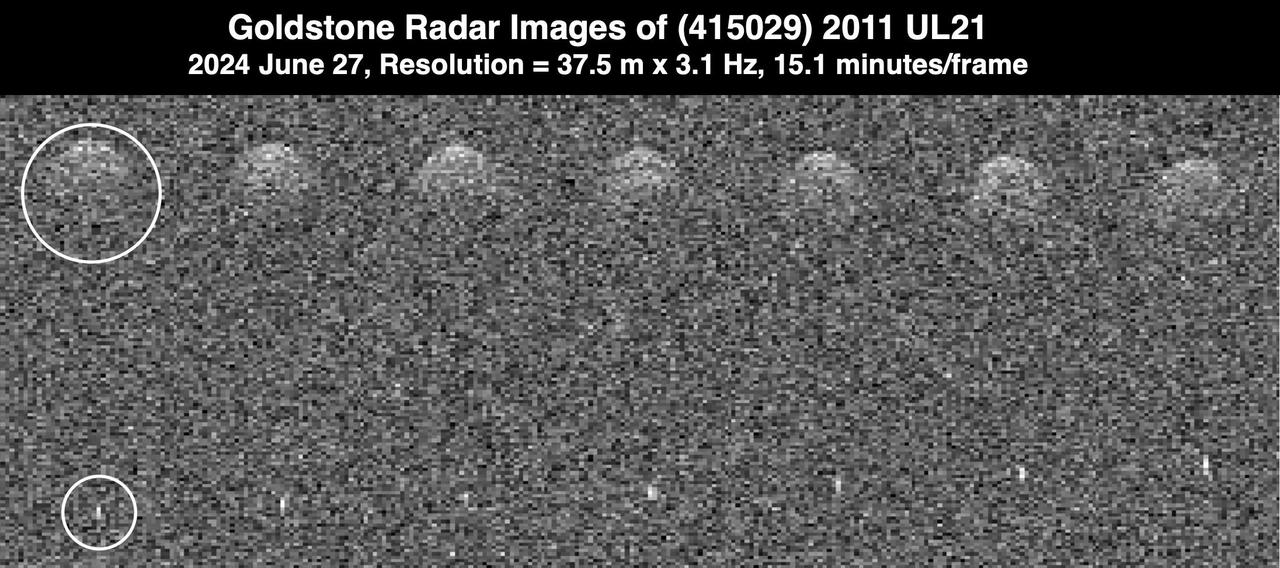
This series of seven radar observations by the Deep Space Network's Goldstone Solar System Radar shows the asteroid 2011 UL21 during its close approach with Earth from 4.1 million miles (6.6 million kilometers) away – about 17 times the distance between the Moon and Earth. White circles highlight the main asteroid and its small moon (a bright dot at the bottom of the image). Passing Earth on June 27, 2024, the asteroid was discovered in 2011 by the NASA-funded Catalina Sky Survey, in Tucson, Arizona. This marked the first time it came close enough to Earth to be imaged by radar. While the nearly mile-wide (1.5-kilometer-wide) object is classified as being potentially hazardous, calculations of its future orbits show that it won't pose a threat to our planet for the foreseeable future. In addition to determining the asteroid is roughly spherical, scientists at NASA's Jet Propulsion Laboratory discovered that it's a binary system: A smaller asteroid, or moonlet, orbits it from a distance of about 1.9 miles (3 kilometers). https://photojournal.jpl.nasa.gov/catalog/PIA26384
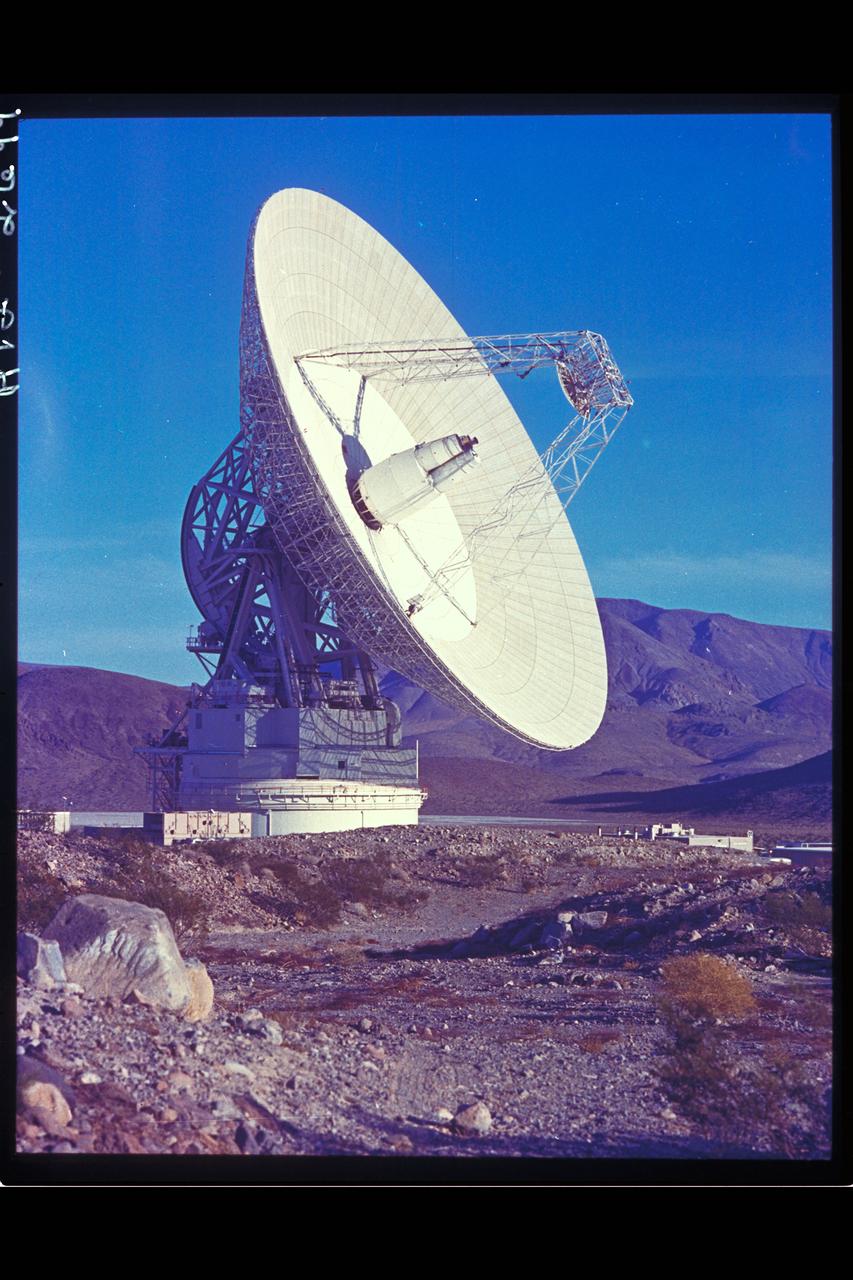
Deep Space Antenna 210' at Goldstone, CA (JPL ref: P-116594AC)
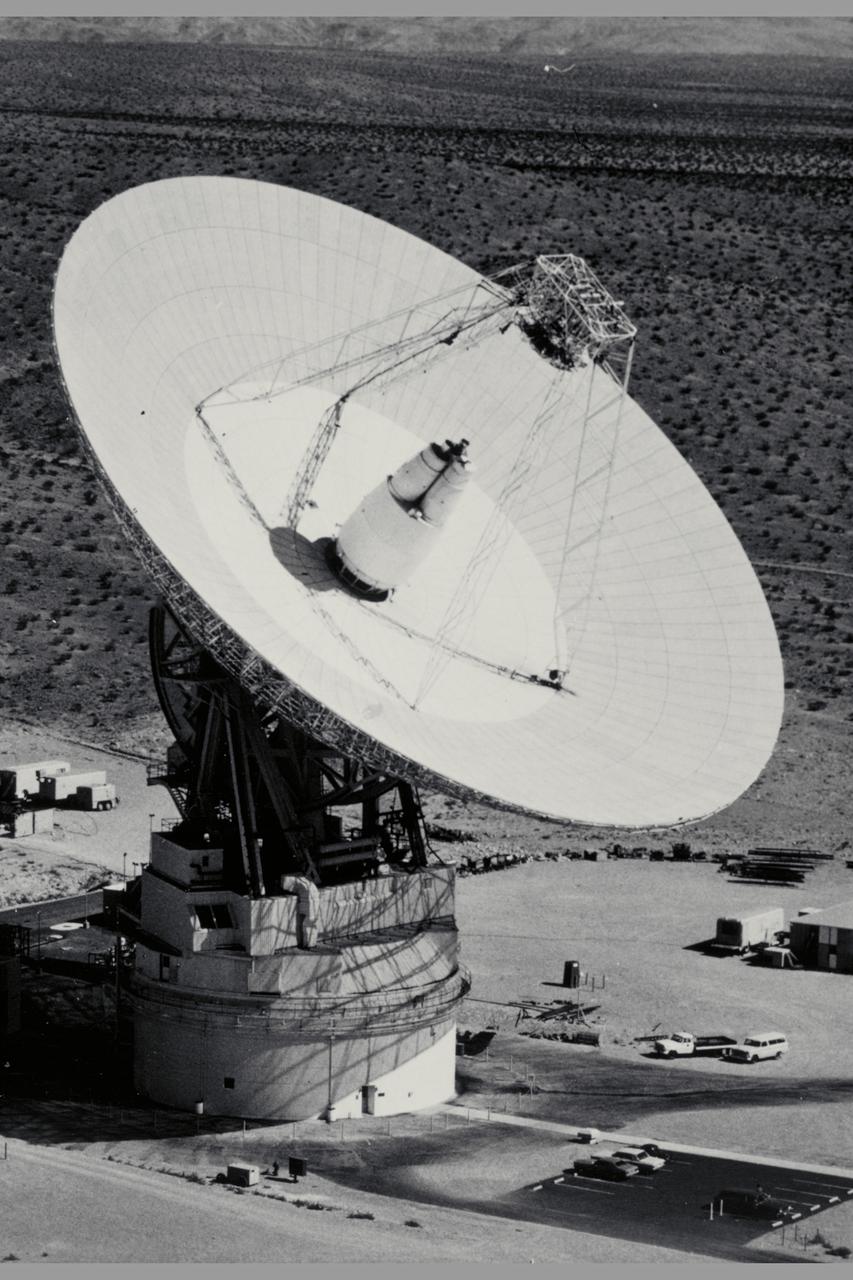
210' Dish Antenna at Goldstone Ca - used in tracking Pioneer spacecraft
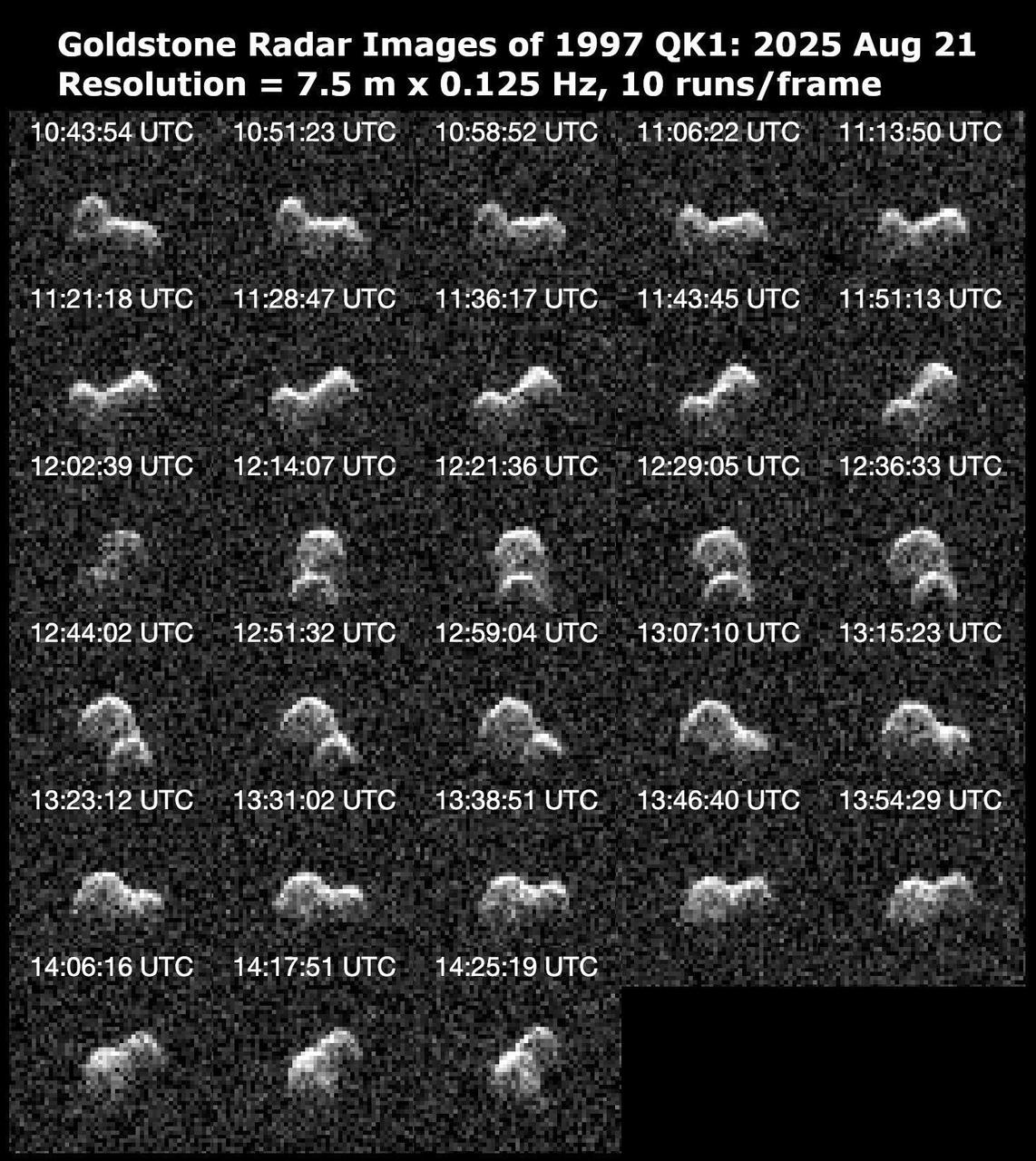
Asteroid 1997 QK1 is shown to be an elongated, peanut-shaped near-Earth object in this series of 28 radar images obtained by the Deep Space Network's Goldstone Solar System Radar on Aug. 21, 2025. The asteroid is about 660 feet (200 meters) long and completes one rotation every 4.8 hours. It passed closest to our planet on the day before these observations were made at a distance of about 1.9 million miles (3 million kilometers), or within eight times the distance between Earth and the Moon. The 2025 flyby is the closest that 1997 QK1 has approached to Earth in more than 350 years. Prior to the recent Goldstone observations, very little was known about the asteroid. These observations resolve surface features down to a resolution of about 25 feet (7.5 meters) and reveal that the object has two rounded lobes that are connected, with one lobe twice the size of the other. Both lobes appear to have concavities that are tens of meters deep. Asteroid 1997 QK1 is likely a "contact binary," one of dozens of such objects imaged by Goldstone. At least 15% of near-Earth asteroids larger than about 660 feet (200 meters) have a contact binary shape. The asteroid is classified as potentially hazardous, but it does not pose a hazard to Earth for the foreseeable future. These Goldstone measurements have greatly reduced the uncertainties in the asteroid's distance from Earth and in its future motion for many decades. The Goldstone Solar System Radar Group is supported by NASA's Near-Earth Object Observations Program within the Planetary Defense Coordination Office at the agency's headquarters in Washington. Managed by NASA's Jet Propulsion Laboratory, the Deep Space Network receives programmatic oversight from Space Communications and Navigation program office within the Space Operations Mission Directorate, also at NASA Headquarters. https://photojournal.jpl.nasa.gov/catalog/PIA26588
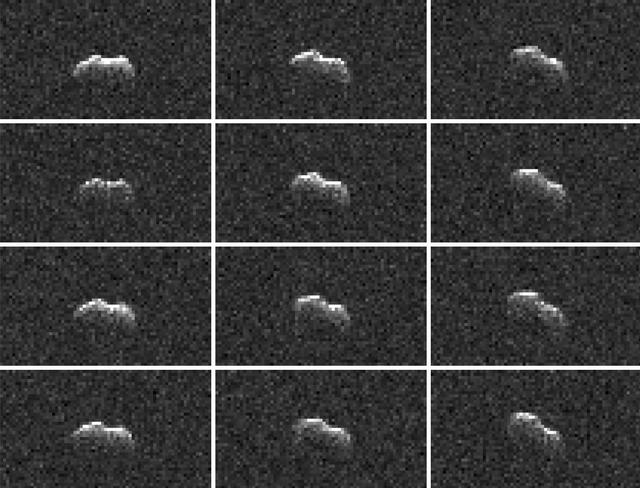
On March 21, 2021, the large asteroid 2001 FO32 made a close approach with our planet, passing at a distance of about 1.25 million miles (2 million kilometers) — or 5 1/4 times the distance from Earth to the Moon. While there was no risk of the near-Earth asteroid colliding with Earth as its orbit is very well known, scientists at NASA's Jet Propulsion Laboratory in Southern California took the opportunity to capture these radar images of the asteroid as it tumbled past. Using NASA's 34-meter (111.5-feet) Deep Space Station 13 (DSS-13) radio antenna at the Deep Space Network's Goldstone Deep Space Communication Complex near Barstow, California, radio signals were transmitted to 2001 FO32. The signals then bounced off the surface of the asteroid and were received by the 100-meter (328-feet) Green Bank Telescope in West Virginia. Such radar observations can offer additional insight into the asteroid's orbit, provide a better estimate of its dimensions and rotation rate, and help glimpse surface features (like large boulders or craters). Other radar observations were carried out by scientists using the 34-meter DSS-43 antenna at the Deep Space Network's Canberra Deep Space Communication Complex in Australia. Along with the Commonwealth Scientific and Industrial Research Organisation's Australia Telescope Compact Array near Narrabri in New South Wales, both antennas worked together to track 2001 FO32. Asteroid 2001 FO32 was discovered in March 2001 by the Lincoln Near-Earth Asteroid Research (LINEAR) program in Socorro, New Mexico, and had been estimated, based on optical measurements, to be roughly 3,000 feet (1 kilometer) wide. In more recent follow-up observations by NEOWISE, 2001 FO32 appears to be faint when observed in infrared wavelengths, which suggests the object is likely less than 1 kilometer in diameter. Analysis by the NEOWISE team shows that it is between 1,300 to 2,230 feet (440 to 680 meters) wide. Further analysis of data from the radar campaign will better refine the size of the asteroid and increase the precision of its orbital calculations. For more information about 2001 FO32 and observing campaign, read: https://www.jpl.nasa.gov/news/asteroid-2001-fo32-will-safely-pass-by-earth-march-21 https://photojournal.jpl.nasa.gov/catalog/PIA24561
A crane lowers a four-legged support structure called a quadripod onto the steel framework of the Deep Space Station 23 (DSS-23) reflector dish on Dec. 18, 2024. The reflector framework was bolted into place earlier in the day, and the quadripod, which weighs 16 ½ tons, was the last major component to be installed that day. The reflector dish will be fitted with panels to create a curved surface to collect radio frequency signals. The quadripod features a curved subreflector that will direct radio frequency signals from deep space that bounce off the main reflector into the antenna's receiver in its pedestal, where the antenna's receivers are housed. The new 112-foot-wide (34-meter-wide) dish is located at the Deep Space Network's Goldstone Space Communications Complex near Barstow, California. A multi-frequency beam waveguide antenna, DSS-23 will come online in 2026, boosting the DSN's capacity and enhance NASA's deep space communications capabilities for decades to come. It is the fifth of six new beam waveguide antennas to be added to the network, following DSS-53, which was added at the DSN's Madrid complex in 2022. The DSN allows missions to track, send commands to, and receive scientific data from faraway spacecraft. It is managed by NASA's Jet Propulsion Laboratory in Southern California for the agency's Space Communications and Navigation (SCaN) program, which is located at NASA Headquarters within the Space Operations Mission Directorate. https://photojournal.jpl.nasa.gov/catalog/PIA26455
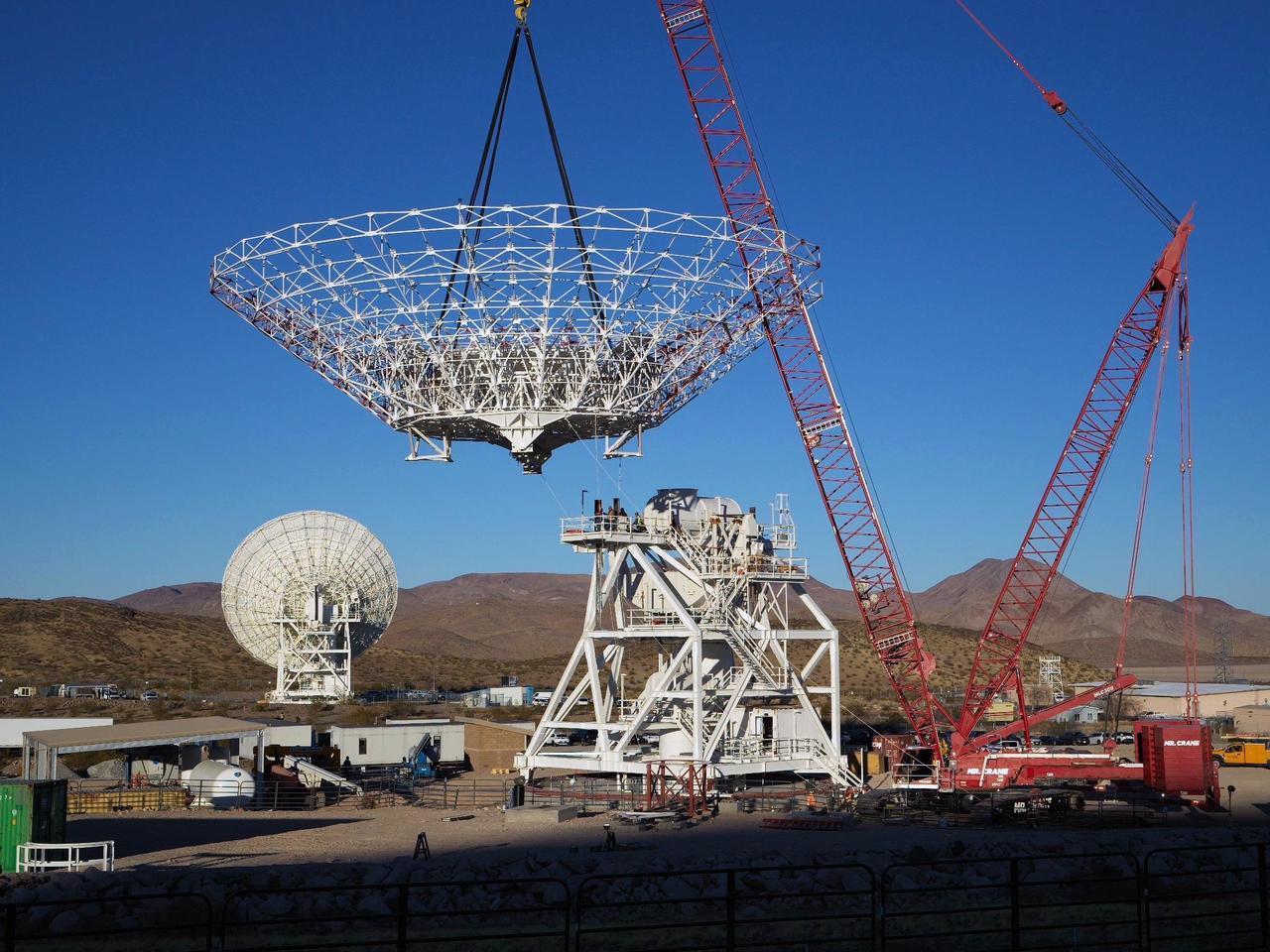
A crane lowers the 112-foot-wide (34-meter-wide) steel framework for the Deep Space Station 23 (DSS-23) reflector dish into position on Dec. 18, 2024, at the Deep Space Network's Goldstone Space Communications Complex near Barstow, California. A multi-frequency beam waveguide antenna, DSS-23 will boost the DSN's capacity and enhance NASA's deep space communications capabilities for decades to come. Once online in 2026, DSS-23 will be the fifth of six new beam waveguide antennas to be added to the network, following DSS-53, which was added at the DSN's Madrid complex in 2022. After the reflector skeleton was bolted into place, engineers placed what's called a quadripod into the center of the structure. A four-legged support structure weighing 16 ½ tons, the quadripod is fitted with a curved subreflector that will direct radio frequency signals from deep space that bounce off the main reflector into the antenna's pedestal where the antenna's receivers are housed. Next steps: to fit panels onto the steel skeleton of the parabolic reflector to create a curved surface to collect radio frequency signals. The DSN allows missions to track, send commands to, and receive scientific data from faraway spacecraft. It is managed by NASA's Jet Propulsion Laboratory in Southern California for the agency's Space Communications and Navigation (SCaN) program, which is located at NASA Headquarters within the Space Operations Mission Directorate. https://photojournal.jpl.nasa.gov/catalog/PIA26454

Deep Space Station 13 (DSS-13) at NASA's Goldstone Deep Space Communications Complex near Barstow, California – part of the agency's Deep Space Network – is a 34-meter (112-foot) experimental antenna that has been retrofitted with an optical terminal (the boxy instrument below the center of the antenna's dish). Since November 2023, DSS-13 has been tracking the downlink laser of the Deep Space Optical Communications (DSOC) experiment that is aboard NASA's Psyche mission, which launched on Oct. 13, 2023. In a first, the antenna also synchronously received radio-frequency signals from the spacecraft as it travels through deep space on its way to investigate the metal-rich asteroid Psyche. The laser signal collected by the camera is then transmitted through optical fiber that feeds into a cryogenically cooled semiconducting nanowire single photon detector. Designed and built by JPL's Microdevices Laboratory, the detector is identical to the one used at Caltech's Palomar Observatory, in San Diego County, California, that acts as DSOC's downlink ground station. Goldstone is one of three complexes that comprise NASA's Deep Space Network, which provides radio communications for all of the agency's interplanetary spacecraft and is also utilized for radio astronomy and radar observations of the solar system and the universe. NASA's Jet Propulsion Laboratory, a division of Caltech in Pasadena, California, manages the DSN for the agency. https://photojournal.jpl.nasa.gov/catalog/PIA26148
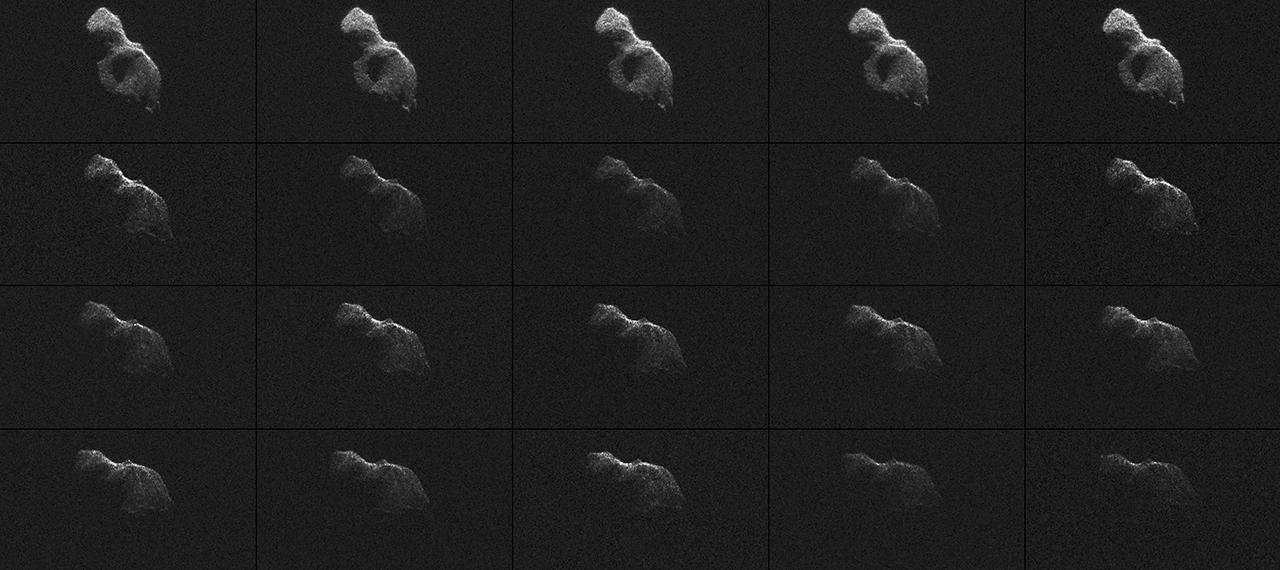
NASA scientists used Earth-based radar to produce these sharp views -- an image montage and a movie sequence -- of the asteroid designated 2014 HQ124 on June 8, 2014.
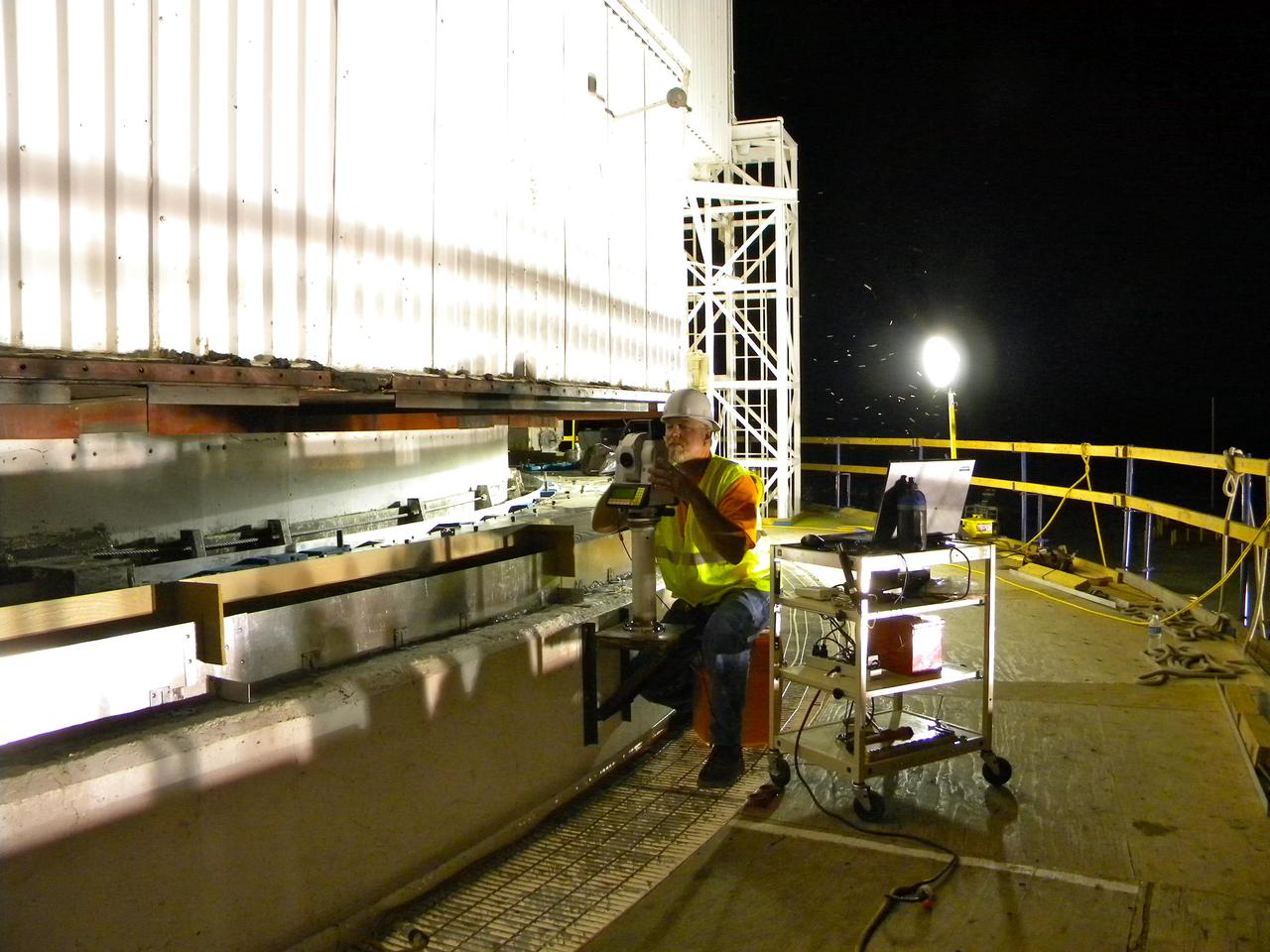
An engineer at NASA Jet Propulsion Laboratory in Pasadena, Calif., checks the evenness of sole plates installed on the giant Mars
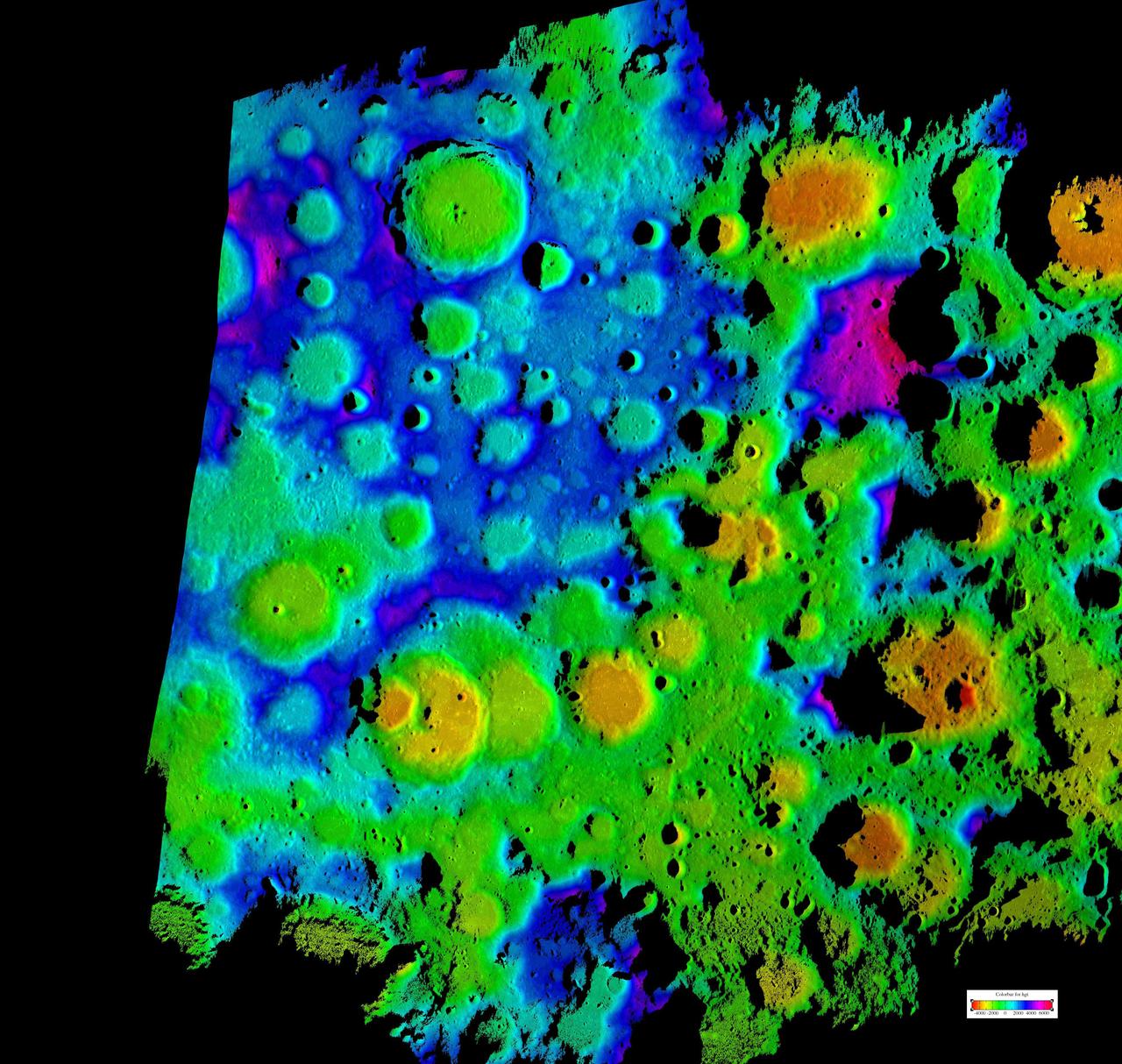
This composite image depicts the moon rugged south polar region in two lights. The color image is the highest resolution topography map to date of the moon south pole.
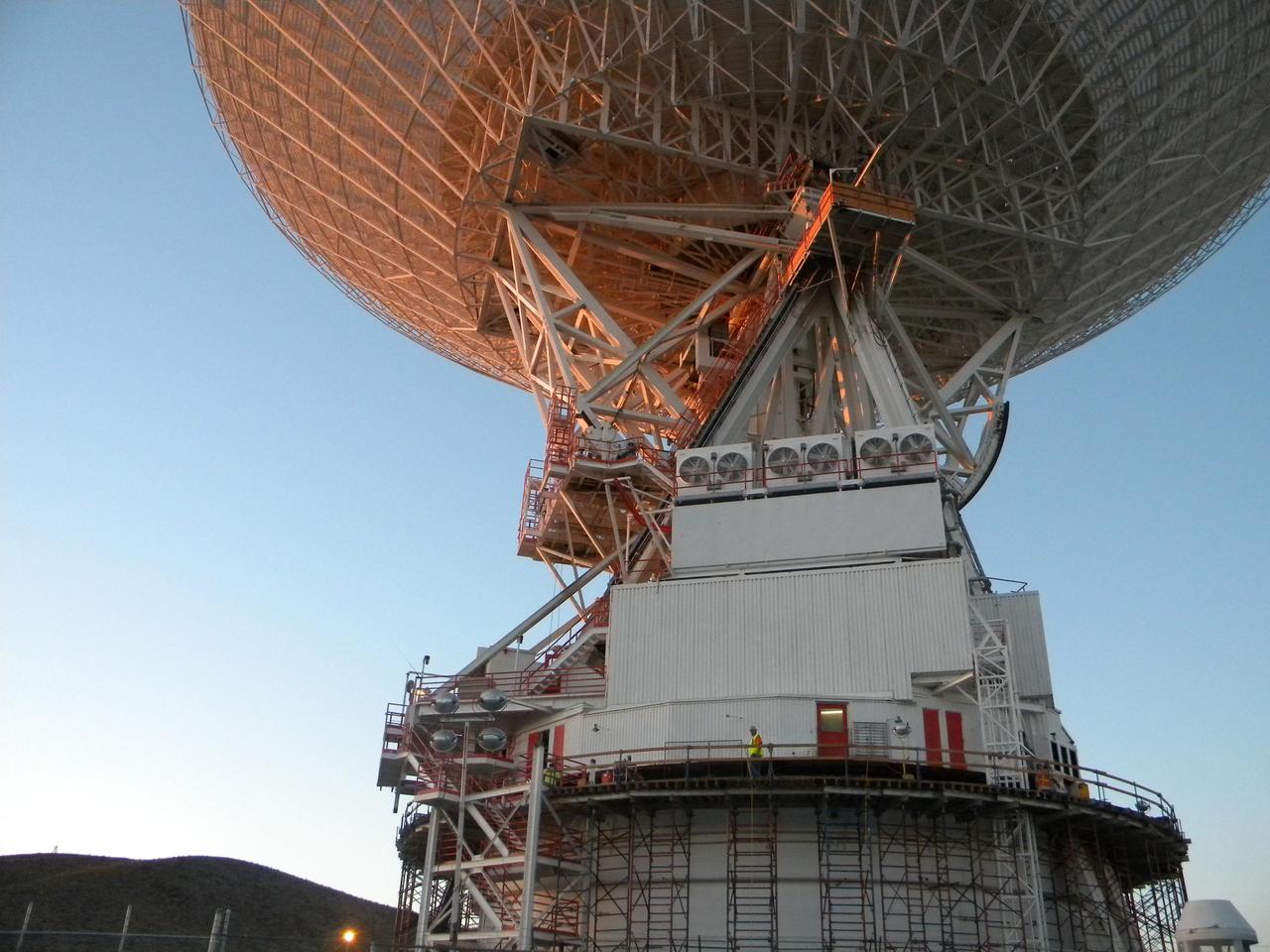
As the sun sets on July 8, 2010, workers prepare to pour new epoxy grout for the hydrostatic bearing assembly of the giant Mars

Suzanne Dodd, the director for the Interplanetary Network Directorate at NASA's Jet Propulsion Laboratory in Southern California, addresses an audience at the Deep Space Network's Canberra complex on March 19, 2025. That day marked 60 years since the Australian facility joined the network. JPL's Interplanetary Network Directorate oversees the Deep Space Network's three complexes in Canberra, Madrid, and Goldstone, near Barstow, California. JPL manages the Deep Space Network for the agency's Space Communications and Navigation program at NASA Headquarters in Washington. https://photojournal.jpl.nasa.gov/catalog/PIA26585
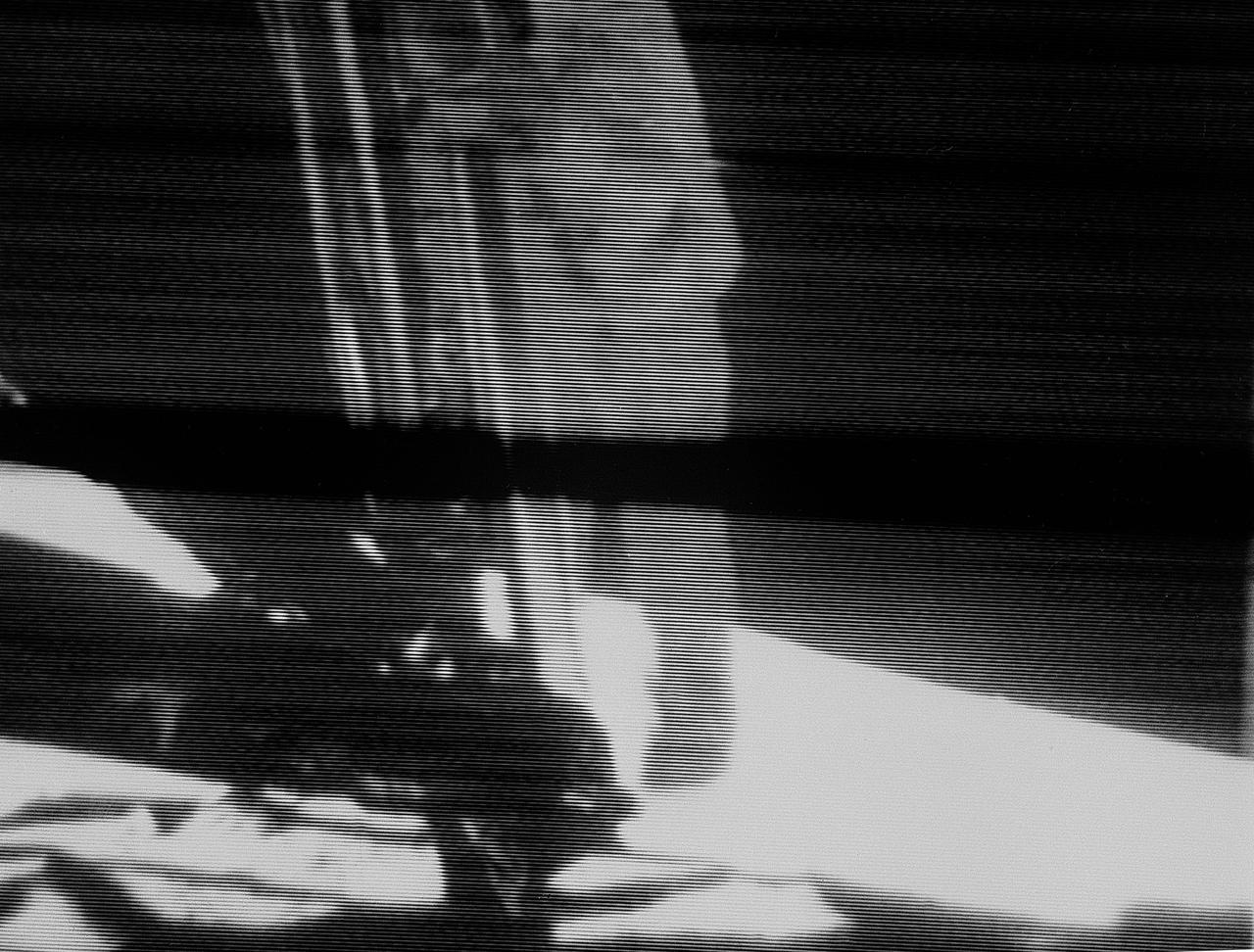
S69-42583 (20 July 1969) --- Astronaut Neil A. Armstrong, Apollo 11 commander, descends the ladder of the Apollo 11 Lunar Module (LM) prior to making the first step by man on another celestial body. This view is a black and white reproduction taken from a telecast by the Apollo 11 lunar surface camera during extravehicular activity (EVA). The black bar running through the center of the picture is an anomaly in the television ground data system at the Goldstone Tracking Station.
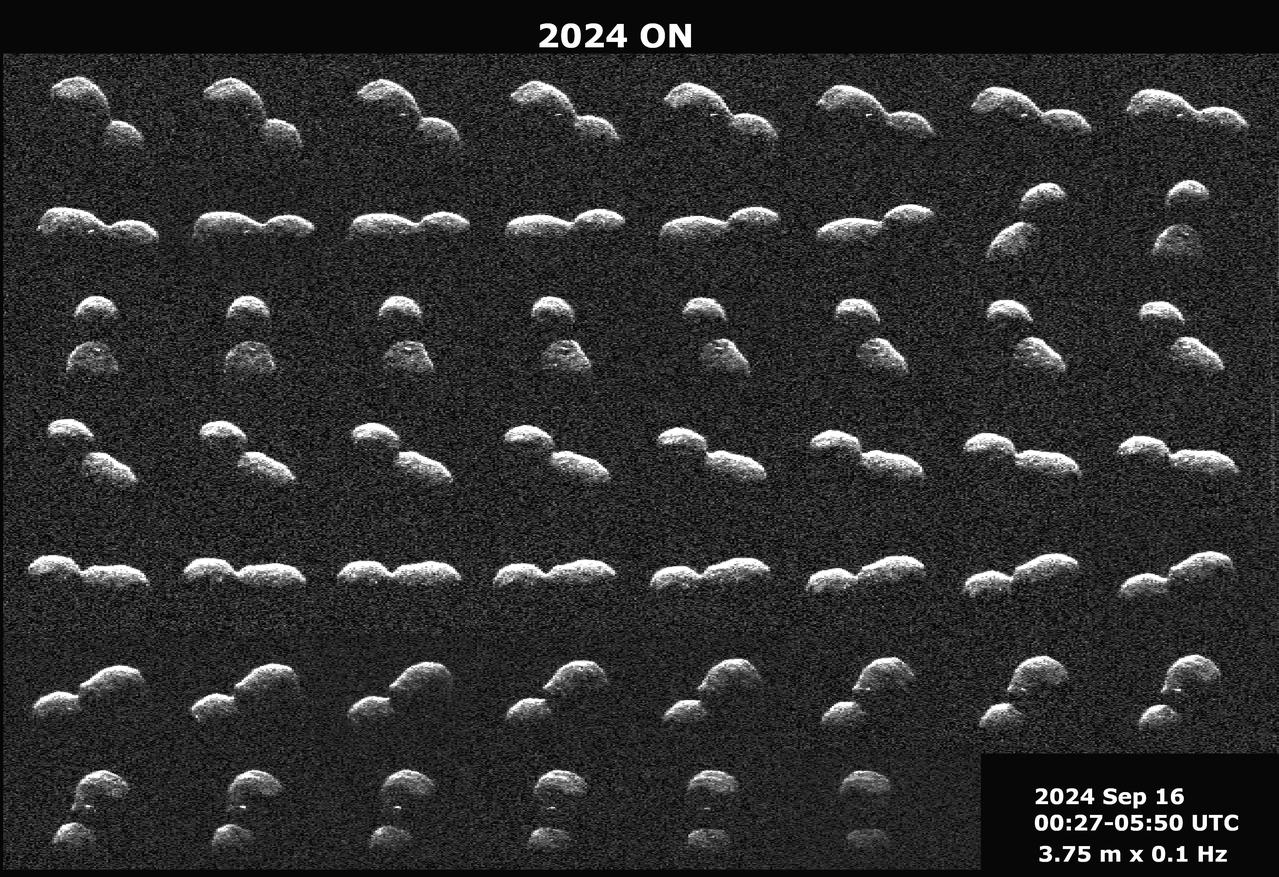
This series of radar images obtained by the Deep Space Network's Goldstone Solar System Radar near Barstow, California, on Sept. 16, 2024, shows the near-Earth asteroid 2024 ON a day before its close approach with our planet. The asteroid passed Earth at a distance of 620,000 miles (1 million kilometers) – about 2.6 times the distance between the Moon and Earth. Discovered by the NASA-funded Asteroid Terrestrial-impact Last Alert System (ATLAS) on Mauna Loa in Hawaii on July 27, the near-Earth asteroid's shape resembles that of a peanut. Like the asteroid 2024 JV33 that made close approach with Earth a month earlier, 2024 ON is likely a contact binary, with two rounded lobes separated by a pronounced neck, one lobe about 50% larger than the other. The radar images determined that it is about 1150 feet (350 meters) long. Features larger than 12.3 feet (3.75 meters) across can be seen on the surface. Bright radar spots on the asteroid's surface likely indicate large boulders. The images show about 90% of one rotation over the course of about six hours. Radar is the principal technique for discovering contact binaries, dozens of which have been imaged by planetary radar. At least 14% of near-Earth asteroids larger than about 200 meters (660 feet) have a contact binary shape. This asteroid is classified as potentially hazardous, but it does not pose a hazard to Earth for the foreseeable future. These Goldstone measurements have allowed scientists to greatly reduce the uncertainties in the asteroid's distance from Earth and in its future motion for many decades. Animation available at https://photojournal.jpl.nasa.gov/catalog/PIA26451
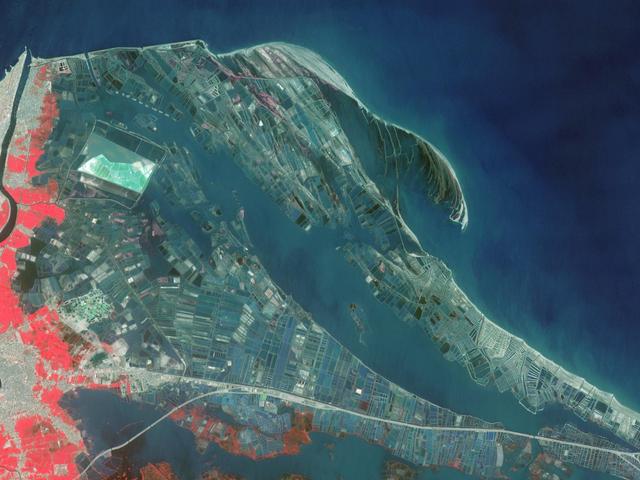
On the left is a radar image of asteroid 1998 WT24 taken in December 2001 by scientists using NASA's the 230-foot (70-meter) DSS-14 antenna at Goldstone, California. On the right is a radar image of the same asteroid acquired on Dec. 11, 2015, during the asteroid's most recent Earth flyby. The radar images from 2001 (on the left), have a resolution of about 60 feet (19 meters) per pixel. The radar image from 2015 (on the right) achieved a spatial resolution as fine as 25 feet (7.5 meters) per pixel. The 2015 radar image was obtained using the same DSS-14 antenna at Goldstone to transmit high-power microwaves toward the asteroid. However, this time, the radar echoes bounced off the asteroid were received by the National Radio Astronomy Observatory's 100-meter (330-foot) Green Bank Telescope in West Virginia. The next visit of asteroid 1998 WT24 to Earth's neighborhood will be on Nov. 11, 2018, when it will make a distant pass at about 12.5-million miles (52 lunar distances). http://photojournal.jpl.nasa.gov/catalog/PIA20216
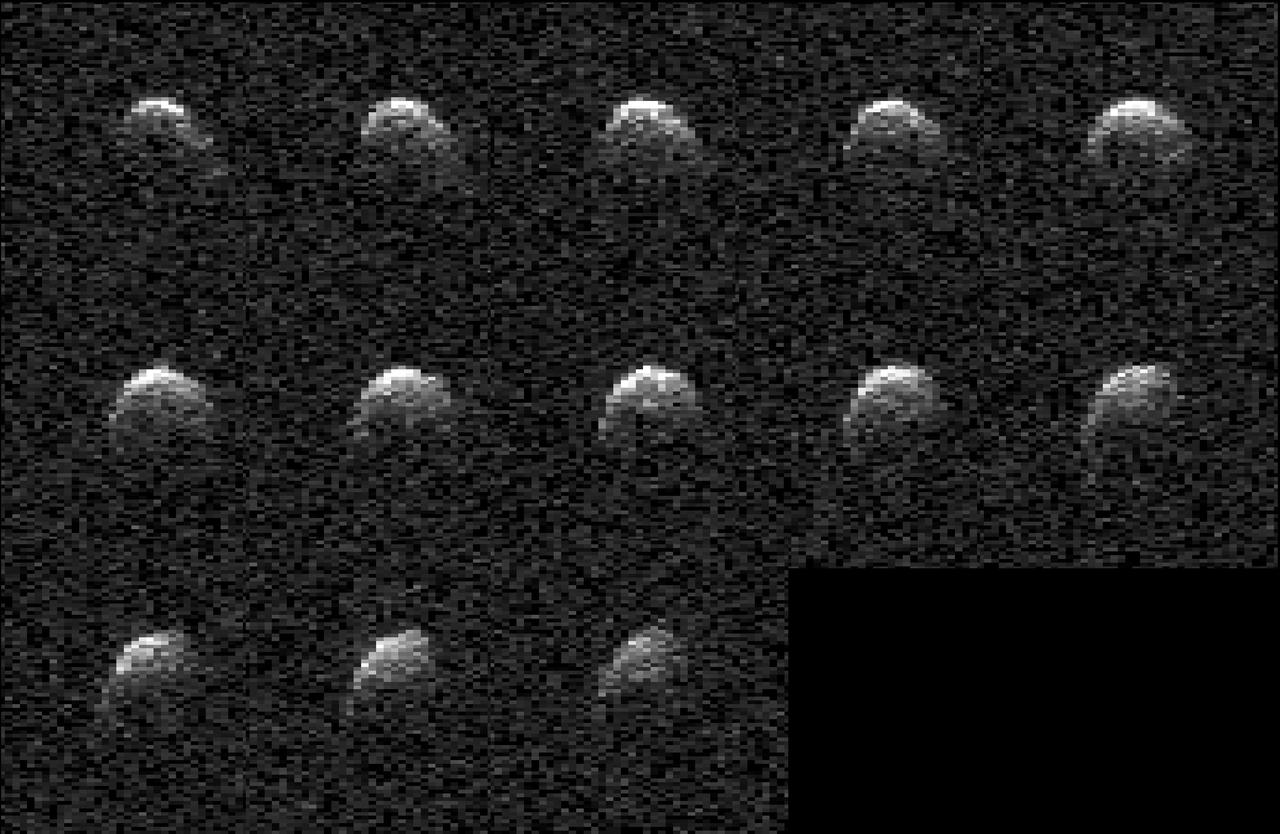
This collage represents a selection of planetary radar observations of asteroid 2008 OS7 that were made the day before its close approach with our planet on Feb. 2, 2024. The stadium-size near-Earth object passed at a distance of about 1.8 million miles (2.9 million kilometers, or 7 ½ times the distance between Earth and the Moon). Scientists at NASA's Jet Propulsion Laboratory used the powerful 230-foot (70-meter) Goldstone Solar System Radar antenna at the Deep Space Network's facility near Barstow, California, to capture these images. The observations will help scientists better understand the asteroid's size, rotation, shape, and surface details. Until this close approach, very little was known about 2008 OS7 as it has been too distant for planetary radar to image it. The asteroid was discovered on July 30, 2008, during routine search operations for NEOs by the NASA-funded Catalina Sky Survey, which is headquartered at the University of Arizona in Tucson. Observations revealed that the asteroid is comparatively slow rotating, completing one rotation every 29 ½ hours. The rotational period of 2008 OS7 was determined Petr Pravec, at the Astronomical Institute of the Czech Academy of Sciences in Ondřejov, Czech Republic, who observed the asteroid's light curve – or how the brightness of the object changes over time. As the asteroid spins, variations on its shape can change the brightness of reflected light astronomers can see, and those changes can be recorded to understand the period of the asteroid's rotation. The Goldstone observations confirm the asteroid's uncommonly slow rotation. https://photojournal.jpl.nasa.gov/catalog/PIA26149
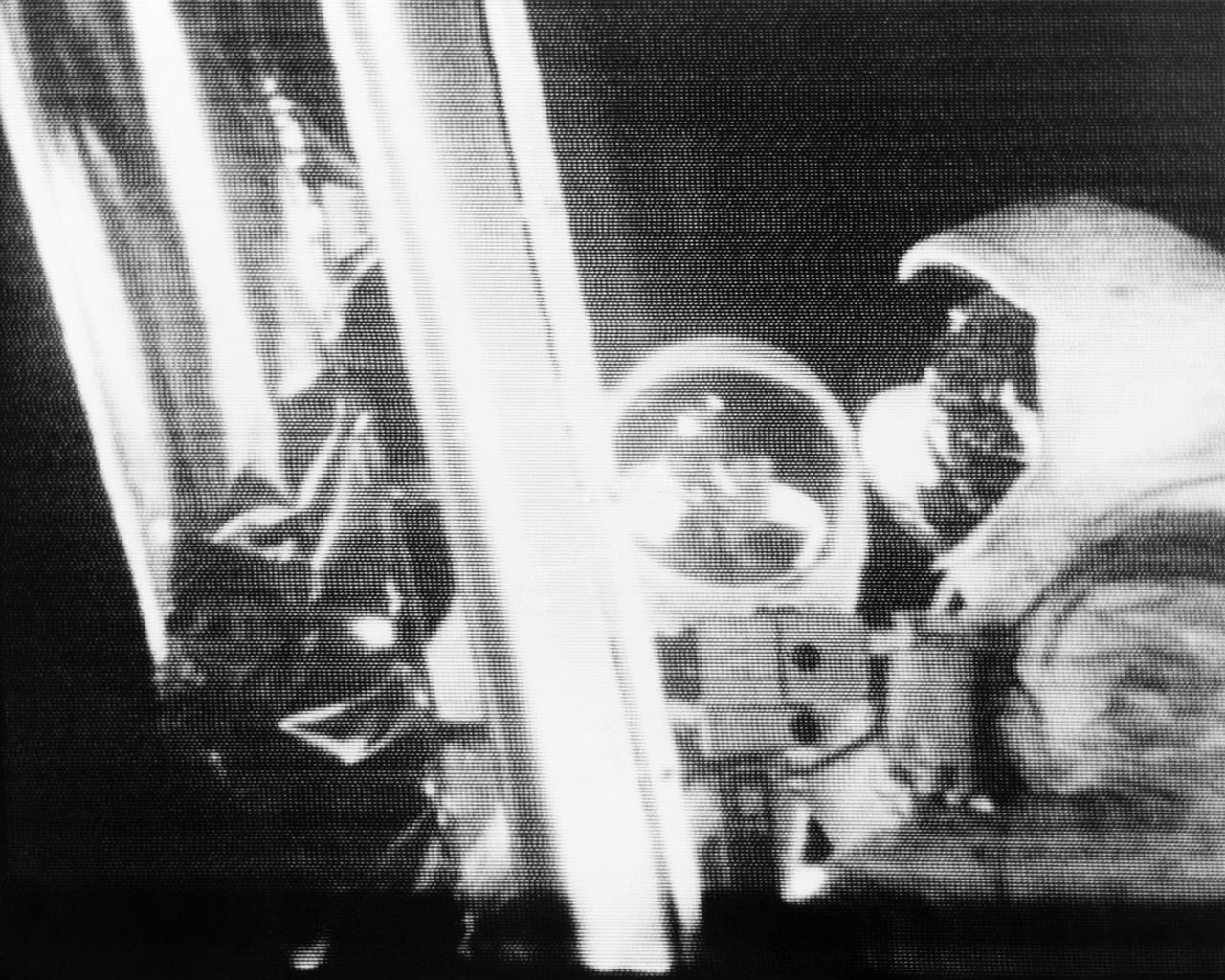
S69-39563 (20 July 1969) --- Astronauts Neil A. Armstrong (left), commander, and Edwin E. Aldrin Jr., lunar module pilot, are seen standing by the Lunar Module (LM) "Eagle" ladder in this black and white reproduction taken from a telecast by the Apollo 11 lunar surface television camera during the Apollo 11 extravehicular activity (EVA). This picture was made from a televised image received at the Deep Space Network (DSN) tracking station at Goldstone, California. While astronauts Armstrong and Aldrin descended in the "Eagle" to explore the Sea of Tranquility region of the moon, astronaut Michael Collins, command module pilot, remained with the Command and Service Modules (CSM) "Columbia" in lunar orbit.
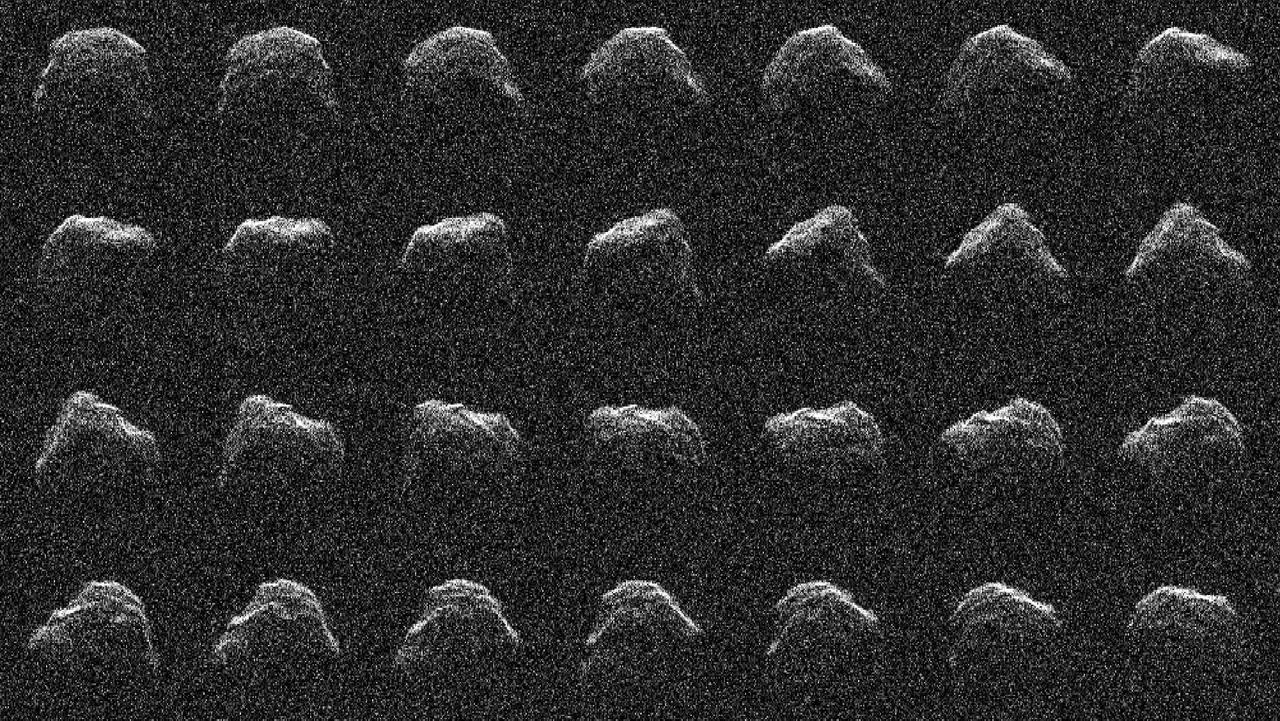
Between Aug. 20 and 24, near-Earth asteroid (NEA) 2016 AJ193 drifted past Earth at a distance of 2.1 million miles (about 3.4 million kilometers), creating an opportunity for planetary radar to image its surface for the first time since its discovery in 2016. Using the 70-meter (230-foot) Deep Space Station 14 antenna at the Deep Space Network's Goldstone Deep Space Complex near Barstow, California, considerable detail in the asteroid's surface was revealed, including ridges, small hills, flat areas, concavities, and possible boulders. In addition, the radar observations of 2016 AJ193 confirmed that it is about three-quarters-of-a-mile (1.3-kilometers) wide. This series of images show the asteroid rotate (with a period of 3.5 hours) as each radar observation was made. 2016 AJ193 is the 1,001st asteroid to be observed by planetary radar, making its close approach with Earth only seven days after the 1,000th NEA to be observed by radar – asteroid 2021 PJ1, which measures between 65 and 100 feet (20 and 30 meters) wide – approached Earth at a distance of 1 million miles (about 1.7 million kilometers). https://photojournal.jpl.nasa.gov/catalog/PIA24564
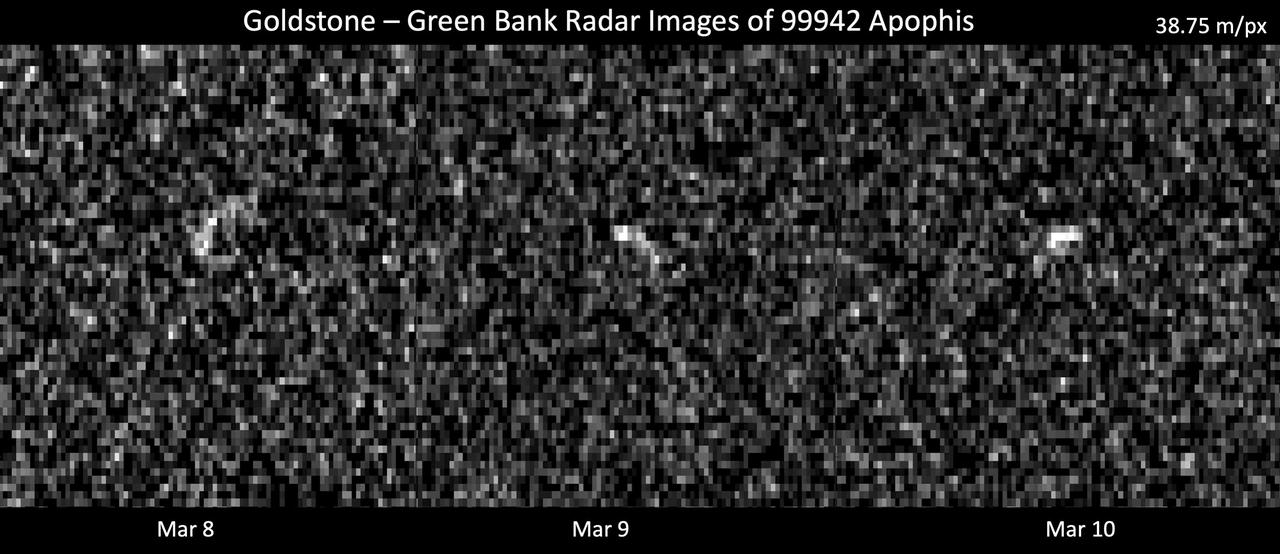
These images represent radar observations of asteroid 99942 Apophis on March 8, 9, and 10, 2021, as it made its last close approach before its 2029 Earth encounter that will see the object pass our planet by less than 20,000 miles (32,000 kilometers). The 70-meter radio antenna at the Deep Space Network's Goldstone Deep Space Communications Complex near Barstow, California, and the 100-meter Green Bank Telescope in West Virginia used radar to precisely track Apophis' motion. At the time of these observations, Apophis was about 10.6 million miles (17 million kilometers) from Earth, and each pixel has a resolution of 127 feet (38.75 meters). These observations helped scientists of the Center for Near Earth Object Studies (CNEOS), managed by NASA's Jet Propulsion Laboratory, precisely determine the 1,100-feet-wide (340-meter-wide) asteroid's orbit around the Sun, ruling out any Earth impact threat for the next hundred years or more. As a result of these observations, Apophis was removed from the Sentry Impact Risk Table. The radar team will continue to analyze these observations to determine more information about Apophis' size, shape, and rate of spin. Relying on optical telescopes and ground-based radar to help characterize every near-Earth object's orbit to improve long-term hazard assessments, CNEOS computes high-precision orbits in support of NASA's Planetary Defense Coordination Office. https://photojournal.jpl.nasa.gov/catalog/PIA24168
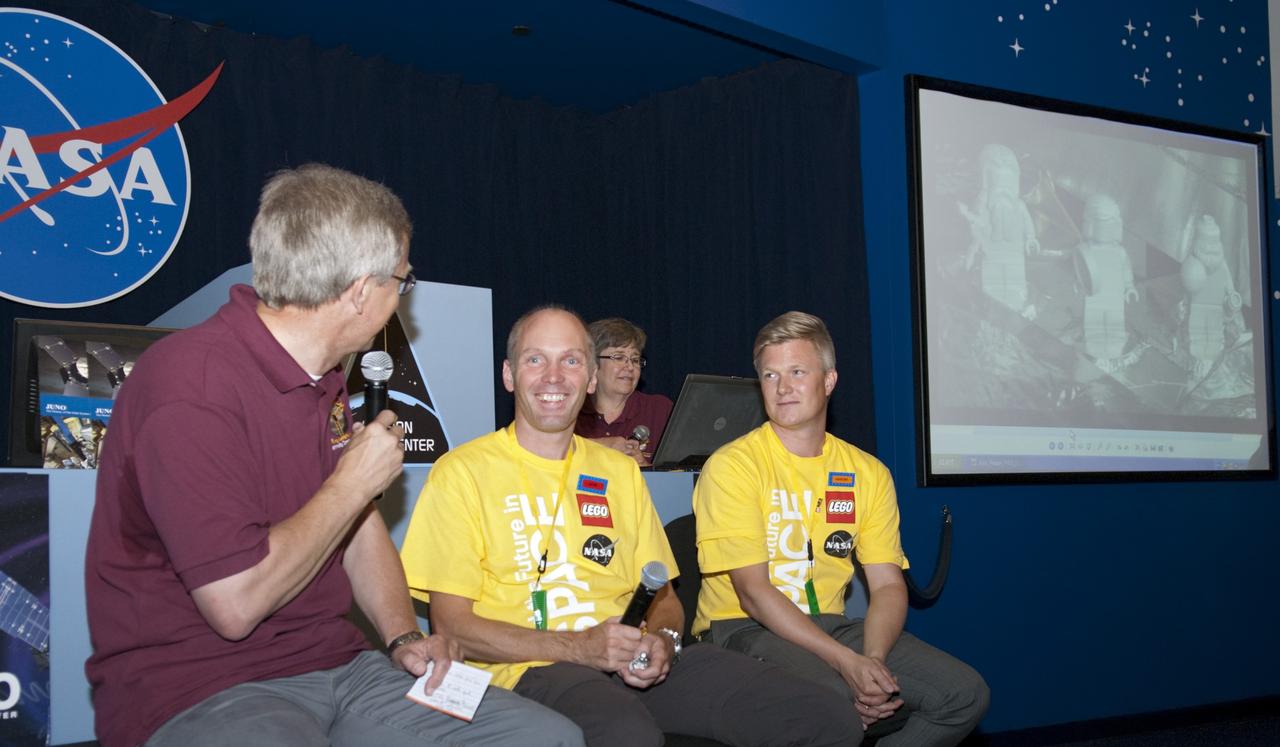
CAPE CANAVERAL, Fla. -- From left, Dr. Steve Lee, with the Denver Museum of Nature and Science; Ulrik Solberg Lund, a LEGO minifigure designer; and Karsten Juel Bunch, a LEGO City senior designer, participate in an educational webcast in the Mission Status Center at the Kennedy Space Center Visitor Complex in Florida. On hand to ask questions of the guests were students, teachers, and mentors of the Goldstone Apple Valley Radio Telescope (GAVRT) project who were invited to Kennedy to watch the launch of NASA's Juno spacecraft atop a United Launch Alliance Atlas V rocket. GAVRT is a partnership between NASA, the Jet Propulsion Laboratory (JPL), and The Lewis Center for Educational Research (LCER) in Apple Valley, Calif. It allows students to control a 34-meter radio telescope that, until recently, was part of NASA’s Deep Space Network, and to interact with scientists outside the classroom setting. Photo credit: NASA/Glenn Benson
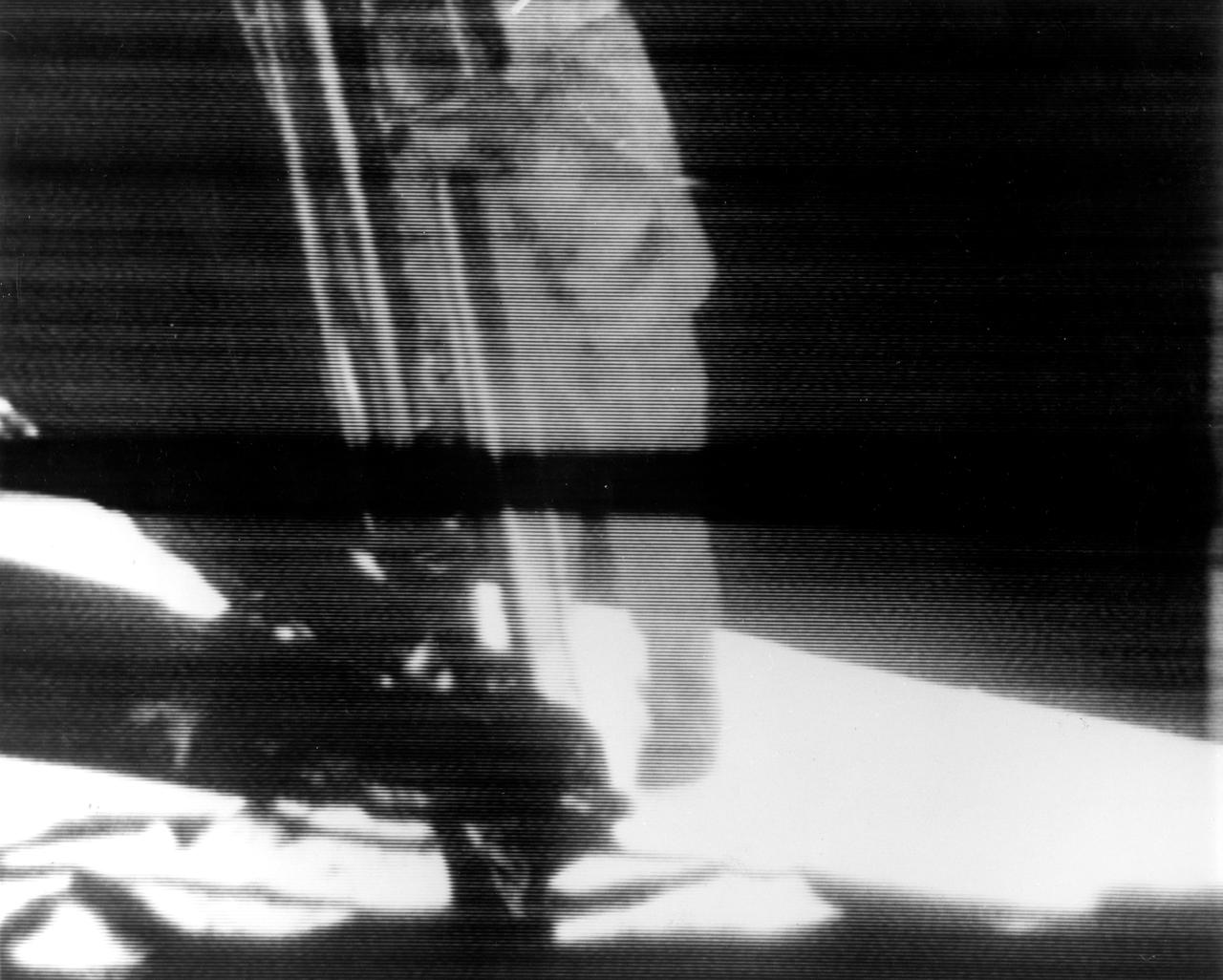
The first manned lunar landing mission, Apollo 11, launched from the Kennedy Space Flight Center (KSC) in Florida via the Marshall Space Flight Center (MSFC) developed Saturn V launch vehicle on July 16, 1969 and safely returned to Earth on July 24, 1969. Astronauts onboard included Neil A. Armstrong, commander; Michael Collins, Command Module (CM) pilot; and Edwin E. Aldrin, Jr., Lunar Module (LM) pilot. The CM, “Columbia”, piloted by Collins, remained in a parking orbit around the Moon while the LM, “Eagle’’, carrying astronauts Armstrong and Aldrin, landed on the Moon in the Sea of Tranquility. On July 20, 1969, Armstrong was the first human to ever stand on the lunar surface, followed by Aldrin. This is a reproduction of the television image that was transmitted to the world on July 20th, as Armstrong egressed the ladder to the lunar surface. The black bar running through the center of the photograph is an anomaly in the TV Ground Data System at Goldstone Tracking Station.

CAPE CANAVERAL, Fla. -- Dr. Steve Lee, with the Denver Museum of Nature and Science, left, hosts an educational webcast in the Mission Status Center at the Kennedy Space Center Visitor Complex in Florida. On hand to ask questions were students, teachers, and mentors of the Goldstone Apple Valley Radio Telescope (GAVRT) project who were invited to Kennedy to watch the launch of NASA's Juno spacecraft atop a United Launch Alliance Atlas V rocket. GAVRT is a partnership between NASA, the Jet Propulsion Laboratory (JPL), and The Lewis Center for Educational Research (LCER) in Apple Valley, Calif. It allows students to control a 34-meter radio telescope that, until recently, was part of NASA’s Deep Space Network, and to interact with scientists outside the classroom setting. Photo credit: NASA/Glenn Benson
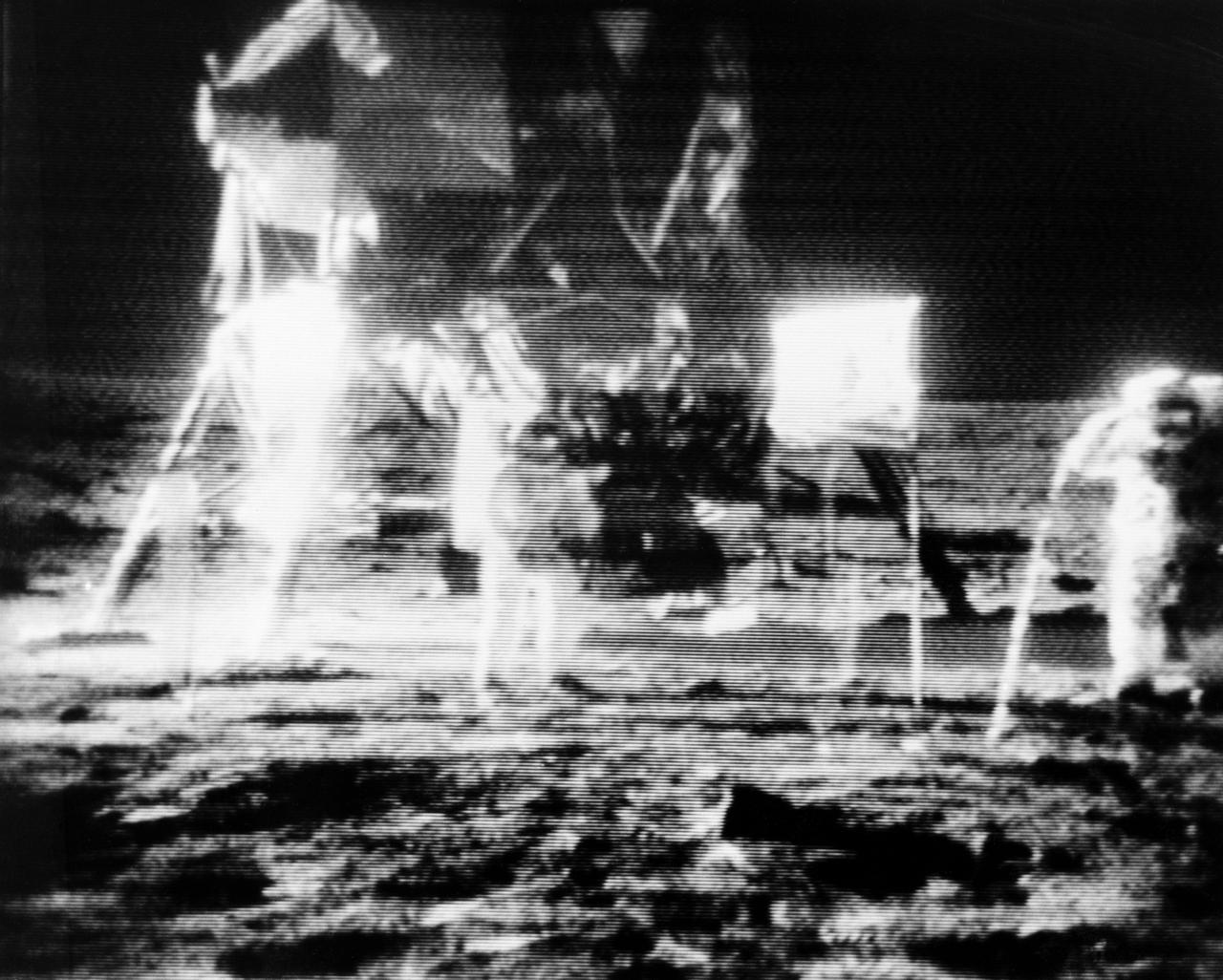
S69-39562 (20 July 1969) --- Astronauts Neil A. Armstrong (center), commander; and Edwin E. Aldrin Jr. (right), lunar module pilot, are seen standing near their Lunar Module (LM) in this black and white reproduction taken from a telecast by the Apollo 11 lunar surface camera during the Apollo 11 extravehicular activity (EVA). This picture was made from a televised image received at the Deep Space Network (DSN) tracking station at Goldstone, California. United States President Richard M. Nixon had just spoken to the two astronauts by radio. Aldrin, a Colonel in the United States Air Force, is saluting the Commander-in-Chief. While astronauts Armstrong and Aldrin descended in the LM "Eagle" to explore the Sea of Tranquility region of the moon, astronaut Michael Collins, command module pilot, remained with the Command and Service Modules (CSM) "Columbia" in lunar orbit.

CAPE CANAVERAL, Fla. -- From left, Dr. Steve Lee, with the Denver Museum of Nature and Science; Ulrik Solberg Lund, a LEGO minifigure designer; and Karsten Juel Bunch, a LEGO City senior designer, participate in an educational webcast in the Mission Status Center at the Kennedy Space Center Visitor Complex in Florida. On hand to ask questions of the guests were students, teachers, and mentors of the Goldstone Apple Valley Radio Telescope (GAVRT) project who were invited to Kennedy to watch the launch of NASA's Juno spacecraft atop a United Launch Alliance Atlas V rocket. GAVRT is a partnership between NASA, the Jet Propulsion Laboratory (JPL), and The Lewis Center for Educational Research (LCER) in Apple Valley, Calif. It allows students to control a 34-meter radio telescope that, until recently, was part of NASA’s Deep Space Network, and to interact with scientists outside the classroom setting. Photo credit: NASA/Glenn Benson
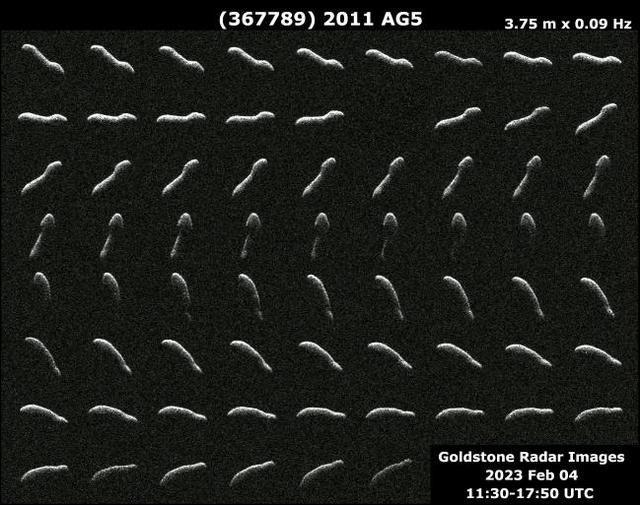
This collage represents NASA radar observations of near-Earth asteroid 2011 AG5 on Feb. 4, 2023, one day after its close approach to Earth brought it about 1.1 million miles (1.8 million kilometers, or a little under five times the distance between the Moon and Earth) from our planet. While there was no risk of 2011 AG5 impacting Earth, scientists at NASA's Jet Propulsion Laboratory in Southern California closely tracked the asteroid, making invaluable observations to help determine its size, rotation, surface details, and shape. More than three times as long as it is wide, 2011 AG5 is one of the most elongated asteroids to be observed by planetary radar to date. This close approach provided the first opportunity to take a detailed look at the asteroid since it was discovered in 2011, showing an object about 1,600 feet (500 meters) long and about 500 feet (150 meters) wide – dimensions comparable to the Empire State Building. The powerful 230-foot (70-meter) Goldstone Solar System Radar antenna dish at the Deep Space Network's facility near Barstow, California, revealed the asteroid's noteworthy dimensions. The Goldstone observations show that 2011 AG5 has a large concavity in one of its hemispheres and some subtle dark and lighter regions that may indicate small-scale surface features a few dozen meters across. If viewed by the human eye, 2011 AG5 would appear as dark as charcoal. The observations also confirmed the asteroid has a slow rotation rate, taking nine hours to fully rotate. https://photojournal.jpl.nasa.gov/catalog/PIA25259
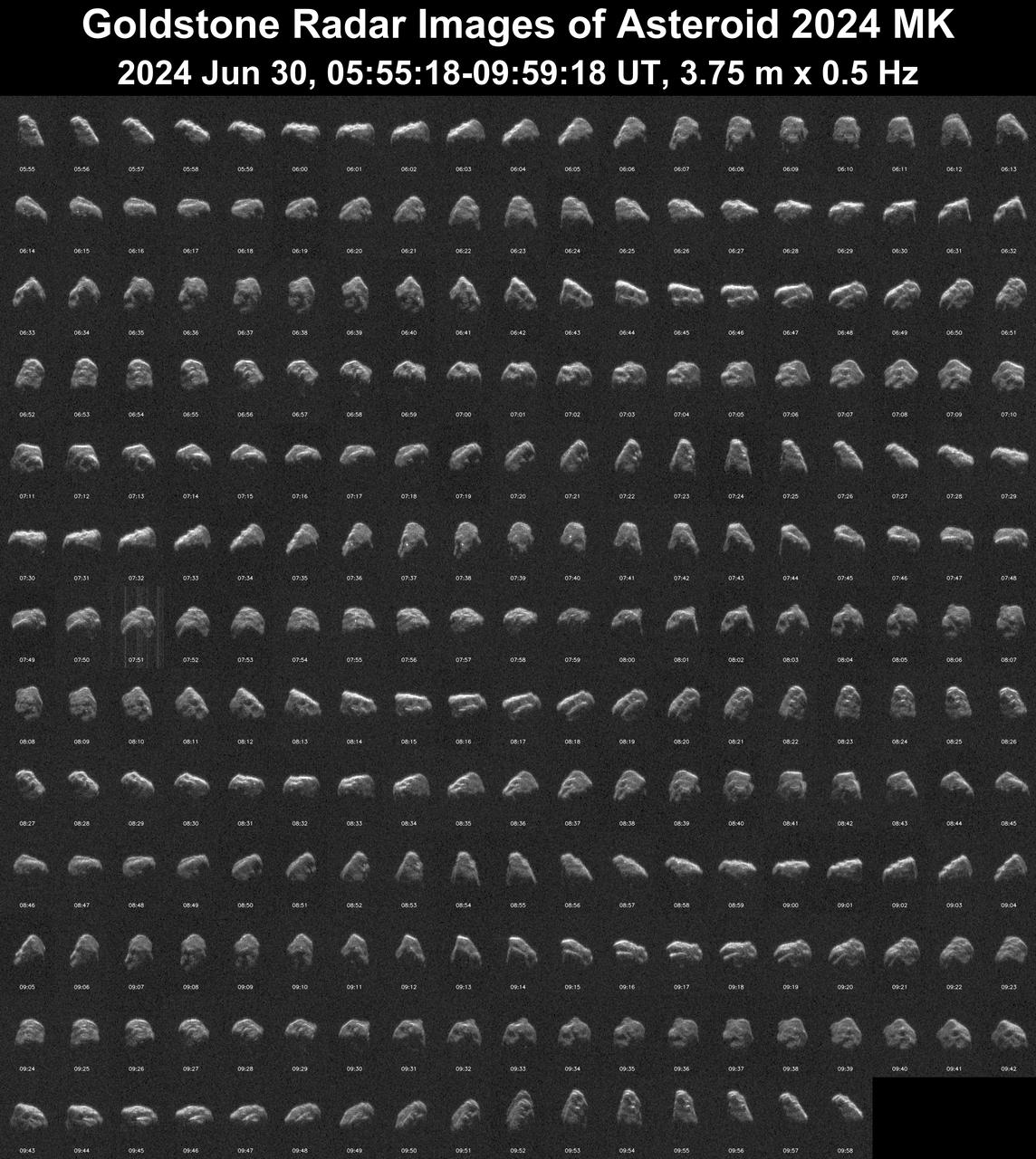
This mosaic shows NASA's radar observations in one-minute increments of asteroid 2024 MK, a 500-foot-wide (150-meter-wide) near-Earth object, made June 30, 2024, a day after it passed our planet from a distance of only 184,00 miles (295,000 kilometers). The Deep Space Network's 230-foot (70-meter) Goldstone Solar System Radar, called Deep Space Station 14 (or DSS-14), was used to transmit radio frequency signals to the asteroid, and the 114-foot (34-meter) DSS-13 received the reflected signals. The result of this "bistatic" radar observation is a detailed image of the asteroid's surface, revealing concavities, ridges, and boulders about 30 feet (10 meters) wide. The observations were made just before 5:55 a.m. UTC June 30 (10:55 p.m. PDT June 29). The asteroid's close approach occurred at 13:49 UTC June 29 (6:49 a.m. PDT June 29). Close approaches of near-Earth objects the size of 2024 MK are relatively rare, occurring about every couple of decades, on average, so scientists at NASA's Jet Propulsion Laboratory in Southern California sought to gather as much data about the object as possible. The Goldstone Solar System Radar Group is supported by NASA's Near-Earth Object Observations Program within the Planetary Defense Coordination Office at the agency's headquarters in Washington. Managed by NASA's Jet Propulsion Laboratory, the Deep Space Network receives programmatic oversight from Space Communications and Navigation program office within the Space Operations Mission Directorate, also at NASA Headquarters. Animation available at https://photojournal.jpl.nasa.gov/catalog/PIA26383

This collage and animation represent NASA radar observations of near-Earth asteroid 7335 1989 JA on May 26, 2022, one day before it made its closest approach with Earth. The potentially hazardous asteroid came within 2.5 million miles (4 million kilometers) of our planet, or 10.5 times the distance between the Earth and the Moon. Astronomers at NASA's Jet Propulsion Laboratory used the 230-foot (70-meter) radio antenna at the Deep Space Network's Goldstone Deep Space Communications Complex near Barstow, California, to precisely track the asteroid's motion and obtain detailed radar images. 1989 JA is a binary system, consisting of a large asteroid and a significantly smaller satellite asteroid that revolve around each other without touching. The larger asteroid is about 0.4 miles (700 meters) across and shows several topographic features as it rotates. The secondary asteroid, which was discovered this year, is between 100 and 200 meters in diameter and has an orbital period of about 17 hours. 1989 JA was discovered by Eleanor F. Helin at Palomar Observatory in Southern California on May 1, 1989. Follow-up radar observations that year did not reveal a satellite. In 2010, NASA's Wide-field Infrared Survey Explorer (WISE) was used to help determine the primary asteroid's size. This year, a few weeks before the asteroid's most recent close approach, astronomers at Ondrejov Observatory in the Czech Republic measured the asteroid's light curve (the change in reflected light intensity over time) and found hints of the satellite in orbit. The new Goldstone observations refined the size of 1989 JA and established that it is a binary system. 1989 JA does not currently pose an impact risk to Earth, but observations by planetary radar can help astronomers better understand its orbit around the Sun so that any future risk can be continually assessed. https://photojournal.jpl.nasa.gov/catalog/PIA25251
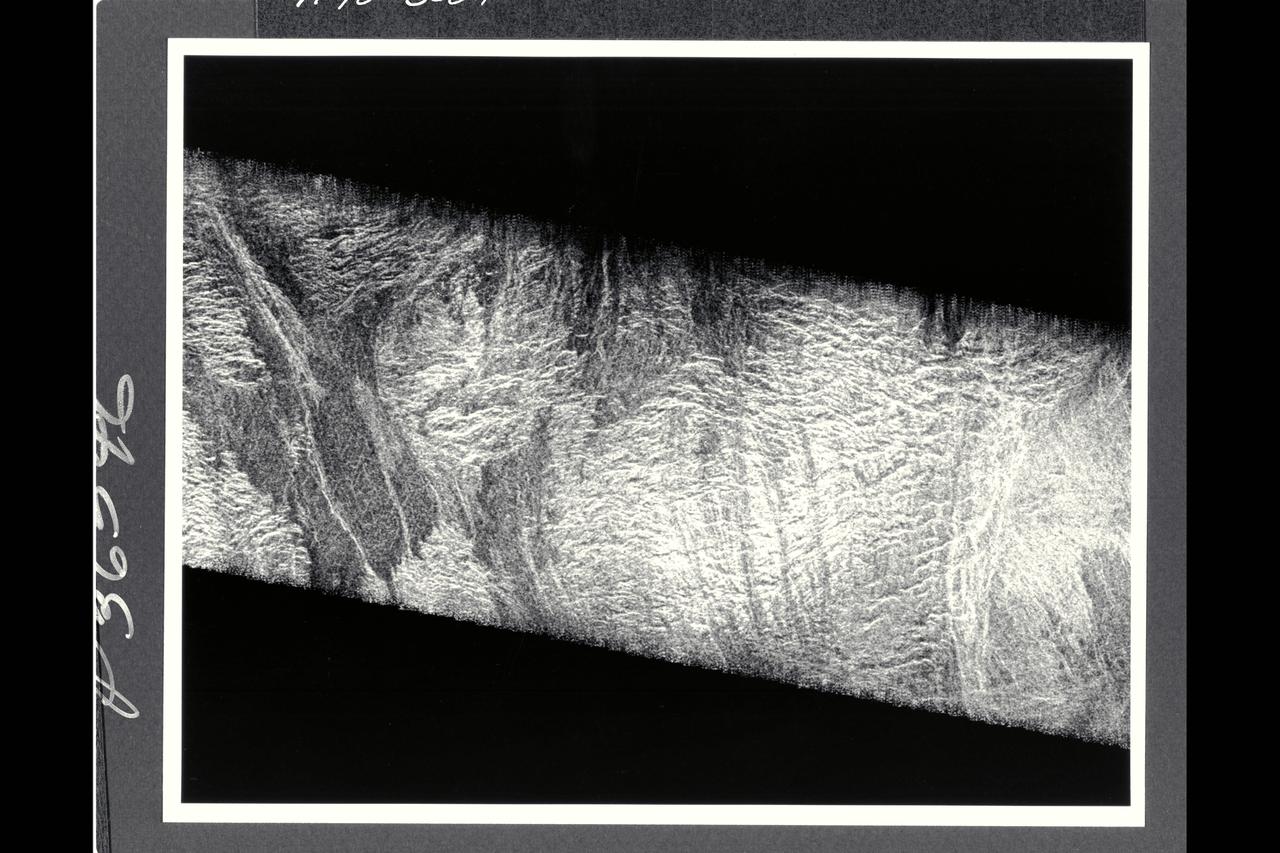
Two mosaicked pieces of Magellan image strips display the area east of the Rhea Mons volcano on Venus. This image is centered at about 32.5 degrees north latitude and 286.6 degrees east longitude. The mosaic is 47 km (28 mi.) wide and 135 km (81 mi.) long. This region has been previously identified as 'tessera'from Earth-based radar (Arecibo) images. The center of the image is dominated by a network of intersection ridges and valleys. The radar-bright north-south trending features in this image range from 1 km (0.6 mi.) to 3 km (1.8 mi.) in length. The average spacing between these ridges is about 1.5 km (0.9 mi.). The dark patches at the top of the image are smooth surfaces and may be lava flows located in lowlands between the higher ridge and the valley terrain. This image is a mosaic of two orbits obtained in the first Magellan stations near Goldstone, CA and Canberra, Australia. The resolution of this image is approx. 120 meters (400 feet).
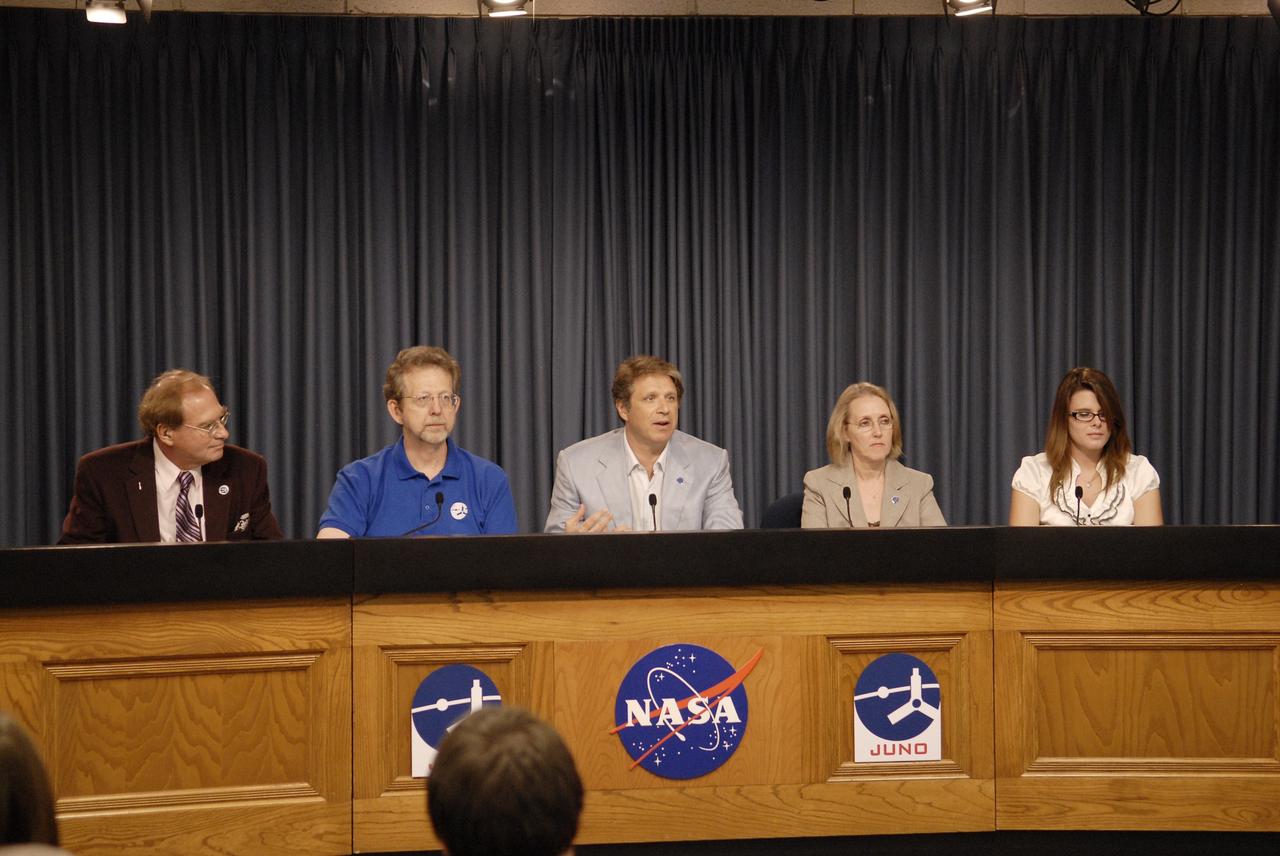
CAPE CANAVERAL, Fla. -- In the Press Site auditorium at NASA's Kennedy Space Center in Florida, a briefing was held to update media on the upcoming launch of NASA's Juno spacecraft. Seen here are NASA Panel Moderator and Public Affairs Officer George Diller (left), Jim Green, director of the Planetary Science Division at Headquarters in Washington, D.C.; Scott Bolton, Juno principal investigator with the Southwest Research Institute in San Antonio, Texas; Jan Chodas, Juno project manager with the Jet Propulsion Laboratory in Pasadena, Calif., and Kaelyn Badura, Pine Ridge High School, Deltona, Fla. high school student, Juno Education program participant and Goldstone Apple Valley Radio Telescope Project participant. Juno is scheduled to launch aboard an United Launch Alliance Atlas V from Cape Canaveral, Fla. Aug. 5.The solar-powered spacecraft will orbit Jupiter's poles 33 times to find out more about the gas giant's origins, structure, atmosphere and magnetosphere and investigate the existence of a solid planetary core. For more information visit: www.nasa.gov/juno. Photo credit: NASA/Gianni M. Woods
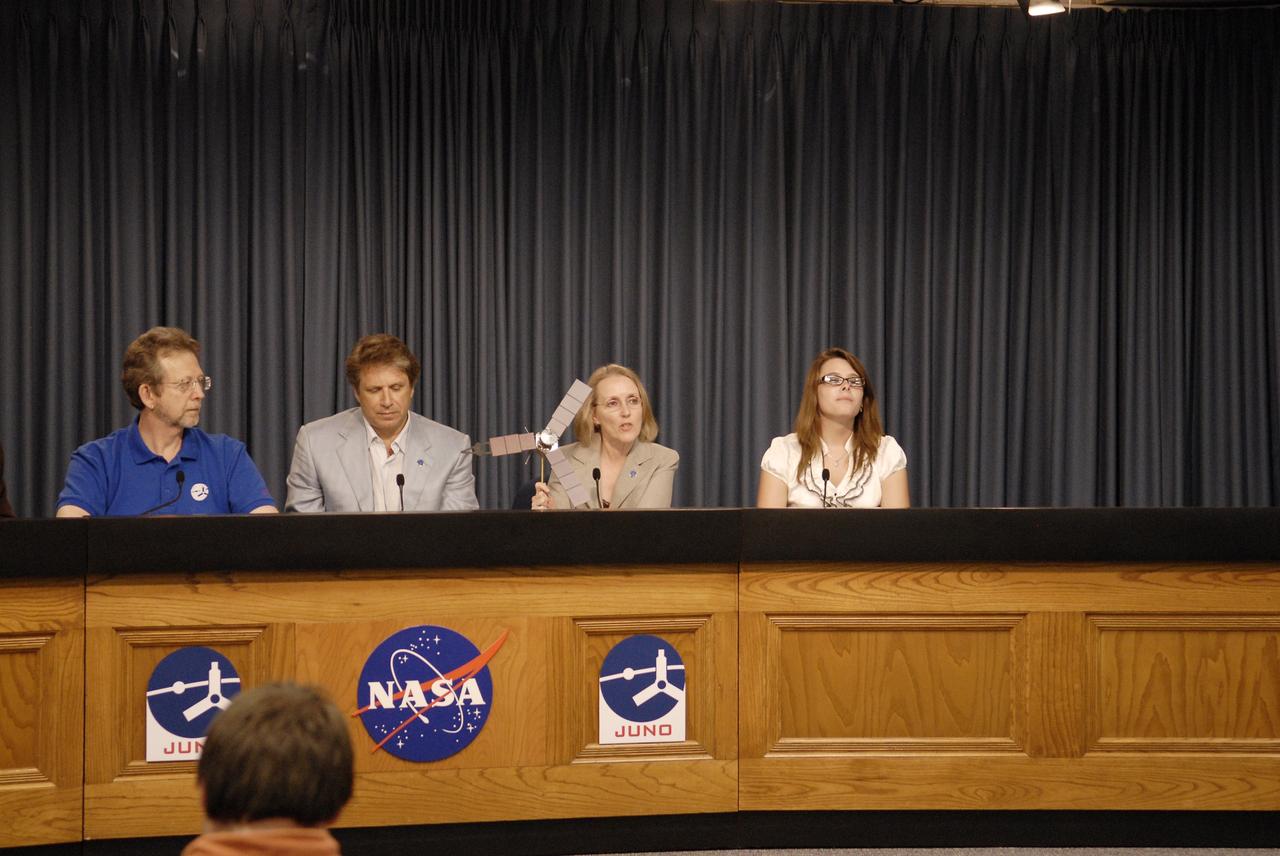
CAPE CANAVERAL, Fla. -- In the Press Site auditorium at NASA's Kennedy Space Center in Florida, a briefing was held to update media on the upcoming launch of NASA's Juno spacecraft. Seen here are Jim Green, director of the Planetary Science Division at Headquarters in Washington, D.C.; Scott Bolton, Juno principal investigator with the Southwest Research Institute in San Antonio, Texas; Jan Chodas, Juno project manager with the Jet Propulsion Laboratory in Pasadena, Calif., and Kaelyn Badura, Pine Ridge High School, Deltona, Fla. high school student, Juno Education program participant and Goldstone Apple Valley Radio Telescope Project participant. Juno is scheduled to launch aboard an United Launch Alliance Atlas V from Cape Canaveral, Fla. Aug. 5.The solar-powered spacecraft will orbit Jupiter's poles 33 times to find out more about the gas giant's origins, structure, atmosphere and magnetosphere and investigate the existence of a solid planetary core. For more information visit: www.nasa.gov/juno. Photo credit: NASA/Gianni M. Woods
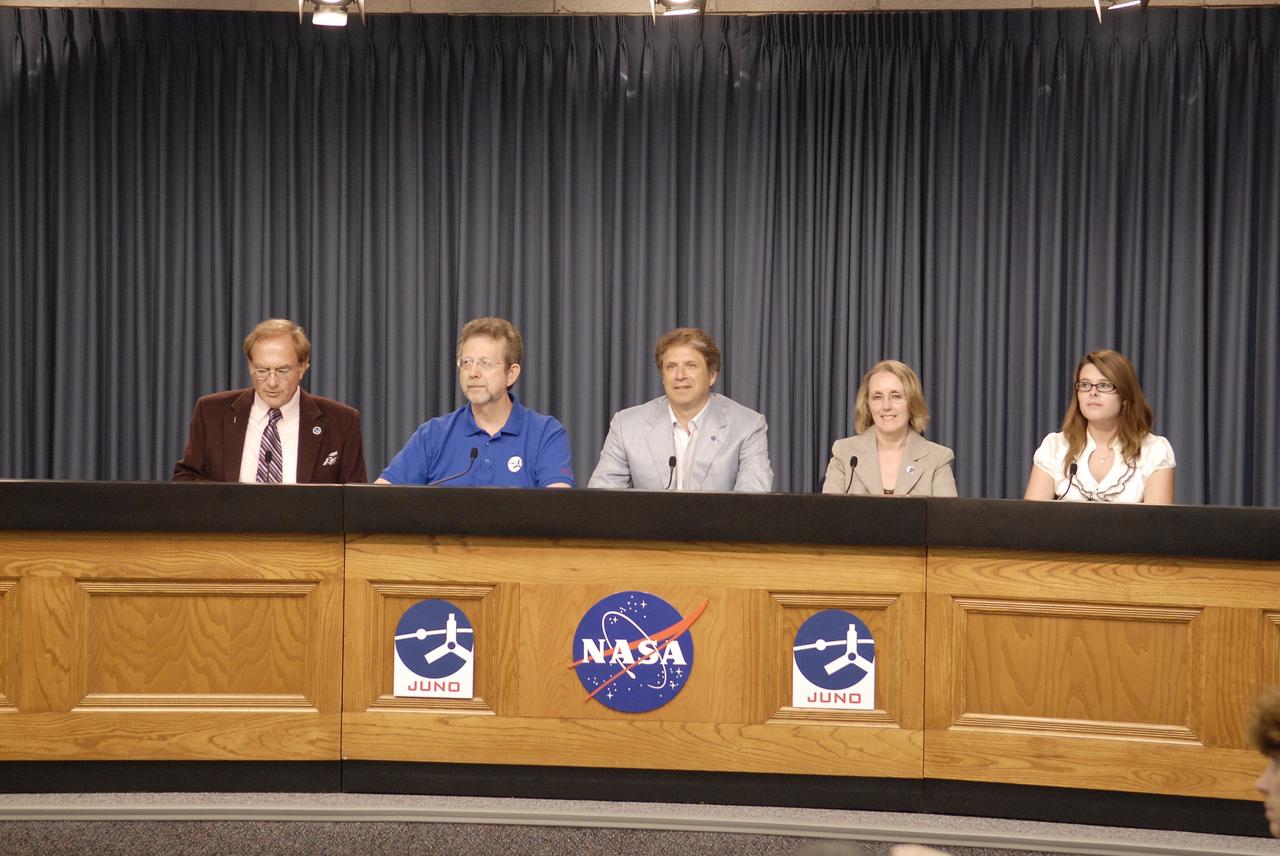
CAPE CANAVERAL, Fla. -- In the Press Site auditorium at NASA's Kennedy Space Center in Florida, a briefing was held to update media on the upcoming launch of NASA's Juno spacecraft. Seen here are NASA Panel Moderator and Public Affairs Officer George Diller (left), Jim Green, director of the Planetary Science Division at Headquarters in Washington, D.C.; Scott Bolton, Juno principal investigator with the Southwest Research Institute in San Antonio, Texas; Jan Chodas, Juno project manager with the Jet Propulsion Laboratory in Pasadena, Calif., and Kaelyn Badura, Pine Ridge High School, Deltona, Fla. high school student, Juno Education program participant and Goldstone Apple Valley Radio Telescope Project participant. Juno is scheduled to launch aboard an United Launch Alliance Atlas V from Cape Canaveral, Fla. Aug. 5.The solar-powered spacecraft will orbit Jupiter's poles 33 times to find out more about the gas giant's origins, structure, atmosphere and magnetosphere and investigate the existence of a solid planetary core. For more information visit: www.nasa.gov/juno. Photo credit: NASA/Gianni M. Woods
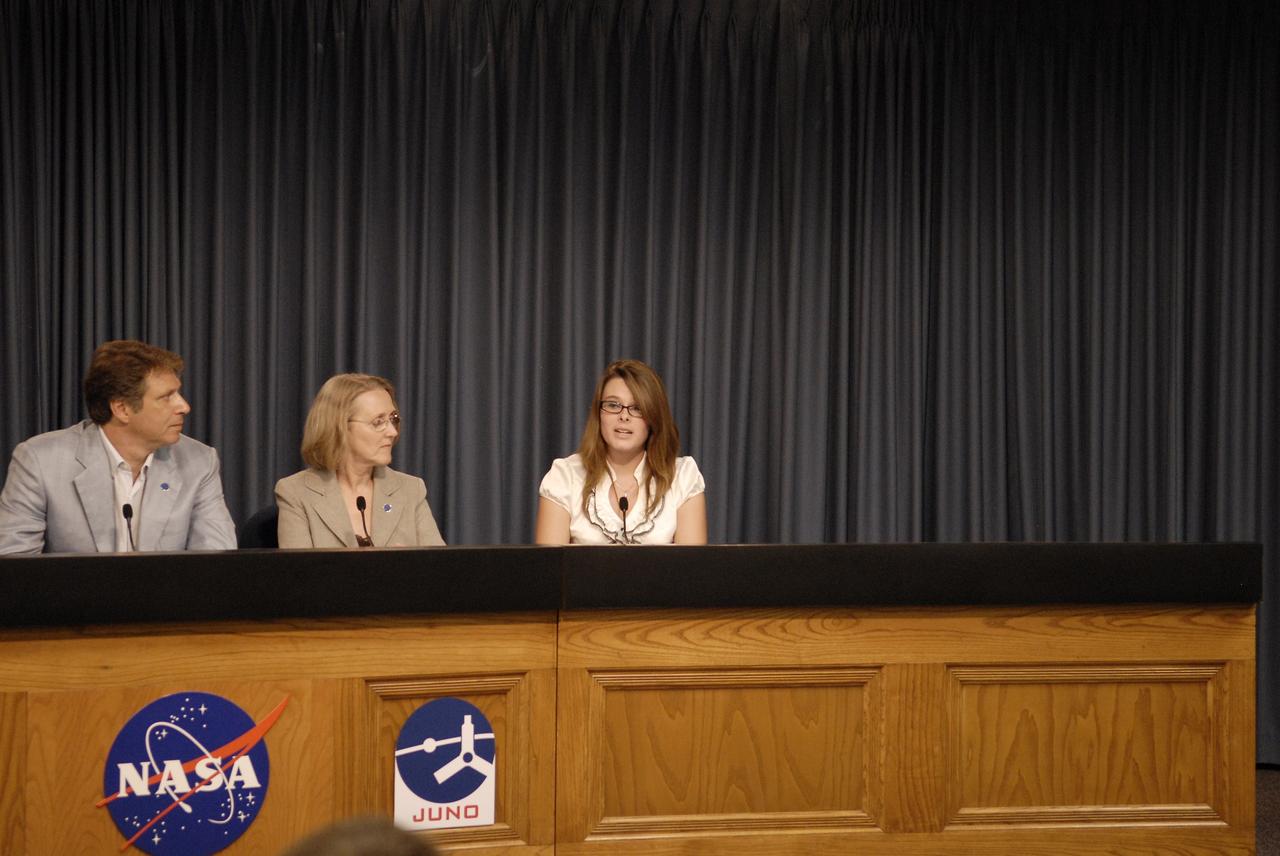
CAPE CANAVERAL, Fla. -- In the Press Site auditorium at NASA's Kennedy Space Center in Florida, a briefing was held to update media on the upcoming launch of NASA's Juno spacecraft. Seen here are Scott Bolton, Juno principal investigator with the Southwest Research Institute in San Antonio, Texas; Jan Chodas, Juno project manager with the Jet Propulsion Laboratory in Pasadena, Calif., and Kaelyn Badura, Pine Ridge High School, Deltona, Fla. high school student, Juno Education program participant and Goldstone Apple Valley Radio Telescope Project participant. Juno is scheduled to launch aboard an United Launch Alliance Atlas V from Cape Canaveral, Fla. Aug. 5.The solar-powered spacecraft will orbit Jupiter's poles 33 times to find out more about the gas giant's origins, structure, atmosphere and magnetosphere and investigate the existence of a solid planetary core. For more information visit: www.nasa.gov/juno. Photo credit: NASA/Gianni M. Woods

CAPE CANAVERAL, Fla. -- In the Press Site auditorium at NASA's Kennedy Space Center in Florida, a briefing was held to update media on the upcoming launch of NASA's Juno spacecraft. Seen here are NASA Panel Moderator and Public Affairs Officer George Diller (left), Jim Green, director of the Planetary Science Division at Headquarters in Washington, D.C.; Scott Bolton, Juno principal investigator with the Southwest Research Institute in San Antonio, Texas; Jan Chodas, Juno project manager with the Jet Propulsion Laboratory in Pasadena, Calif., and Kaelyn Badura, Pine Ridge High School, Deltona, Fla. high school student, Juno Education program participant and Goldstone Apple Valley Radio Telescope Project participant. Juno is scheduled to launch aboard an United Launch Alliance Atlas V from Cape Canaveral, Fla. Aug. 5.The solar-powered spacecraft will orbit Jupiter's poles 33 times to find out more about the gas giant's origins, structure, atmosphere and magnetosphere and investigate the existence of a solid planetary core. For more information visit: www.nasa.gov/juno. Photo credit: NASA/Gianni M. Woods

CAPE CANAVERAL, Fla. -- In the Press Site auditorium at NASA's Kennedy Space Center in Florida, a briefing was held to update media on the upcoming launch of NASA's Juno spacecraft. Seen here are NASA Panel Moderator and Public Affairs Officer George Diller (left), Jim Green, director of the Planetary Science Division at Headquarters in Washington, D.C.; Scott Bolton, Juno principal investigator with the Southwest Research Institute in San Antonio, Texas; Jan Chodas, Juno project manager with the Jet Propulsion Laboratory in Pasadena, Calif., and Kaelyn Badura, Pine Ridge High School, Deltona, Fla. high school student, Juno Education program participant and Goldstone Apple Valley Radio Telescope Project participant. Juno is scheduled to launch aboard an United Launch Alliance Atlas V from Cape Canaveral, Fla. Aug. 5.The solar-powered spacecraft will orbit Jupiter's poles 33 times to find out more about the gas giant's origins, structure, atmosphere and magnetosphere and investigate the existence of a solid planetary core. For more information visit: www.nasa.gov/juno. Photo credit: NASA/Gianni M. Woods
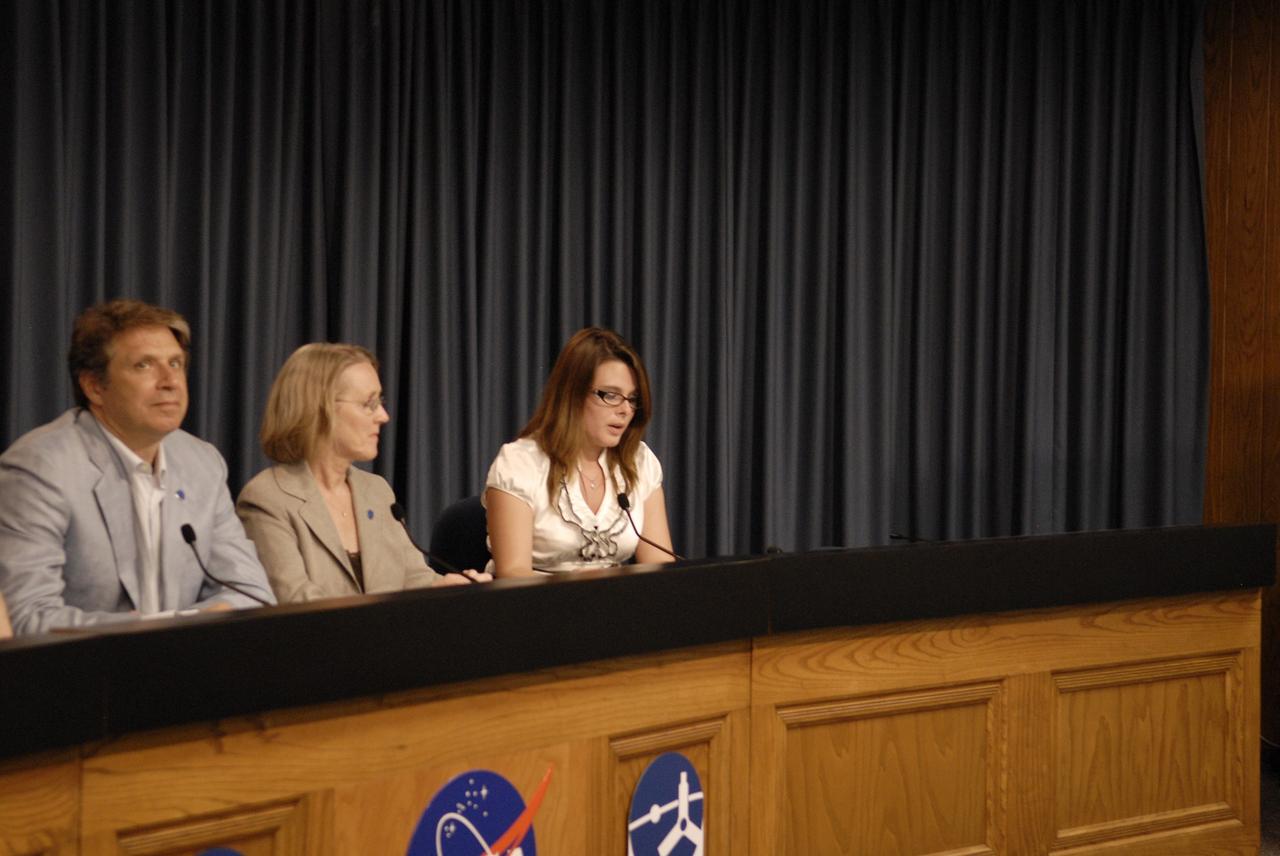
CAPE CANAVERAL, Fla. -- In the Press Site auditorium at NASA's Kennedy Space Center in Florida, a briefing was held to update media on the upcoming launch of NASA's Juno spacecraft. Seen here are Scott Bolton, Juno principal investigator with the Southwest Research Institute in San Antonio, Texas; Jan Chodas, Juno project manager with the Jet Propulsion Laboratory in Pasadena, Calif., and Kaelyn Badura, Pine Ridge High School, Deltona, Fla. high school student, Juno Education program participant and Goldstone Apple Valley Radio Telescope Project participant. Juno is scheduled to launch aboard an United Launch Alliance Atlas V from Cape Canaveral, Fla. Aug. 5.The solar-powered spacecraft will orbit Jupiter's poles 33 times to find out more about the gas giant's origins, structure, atmosphere and magnetosphere and investigate the existence of a solid planetary core. For more information visit: www.nasa.gov/juno. Photo credit: NASA/Gianni M. Woods
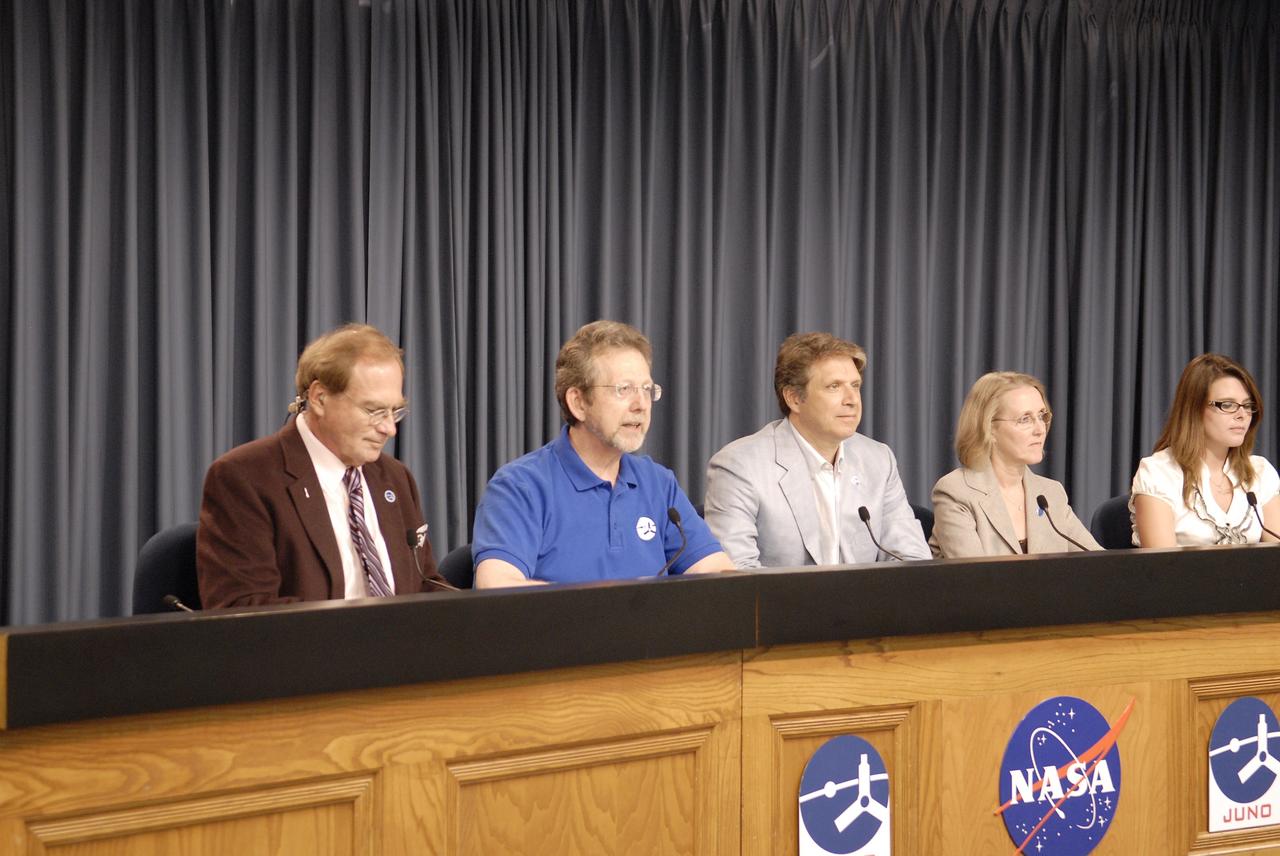
CAPE CANAVERAL, Fla. -- In the Press Site auditorium at NASA's Kennedy Space Center in Florida, a briefing was held to update media on the upcoming launch of NASA's Juno spacecraft. Seen here are NASA Panel Moderator and Public Affairs Officer George Diller (left), Jim Green, director of the Planetary Science Division at Headquarters in Washington, D.C.; Scott Bolton, Juno principal investigator with the Southwest Research Institute in San Antonio, Texas; Jan Chodas, Juno project manager with the Jet Propulsion Laboratory in Pasadena, Calif., and Kaelyn Badura, Pine Ridge High School, Deltona, Fla. high school student, Juno Education program participant and Goldstone Apple Valley Radio Telescope Project participant. Juno is scheduled to launch aboard an United Launch Alliance Atlas V from Cape Canaveral, Fla. Aug. 5.The solar-powered spacecraft will orbit Jupiter's poles 33 times to find out more about the gas giant's origins, structure, atmosphere and magnetosphere and investigate the existence of a solid planetary core. For more information visit: www.nasa.gov/juno. Photo credit: NASA/Gianni M. Woods
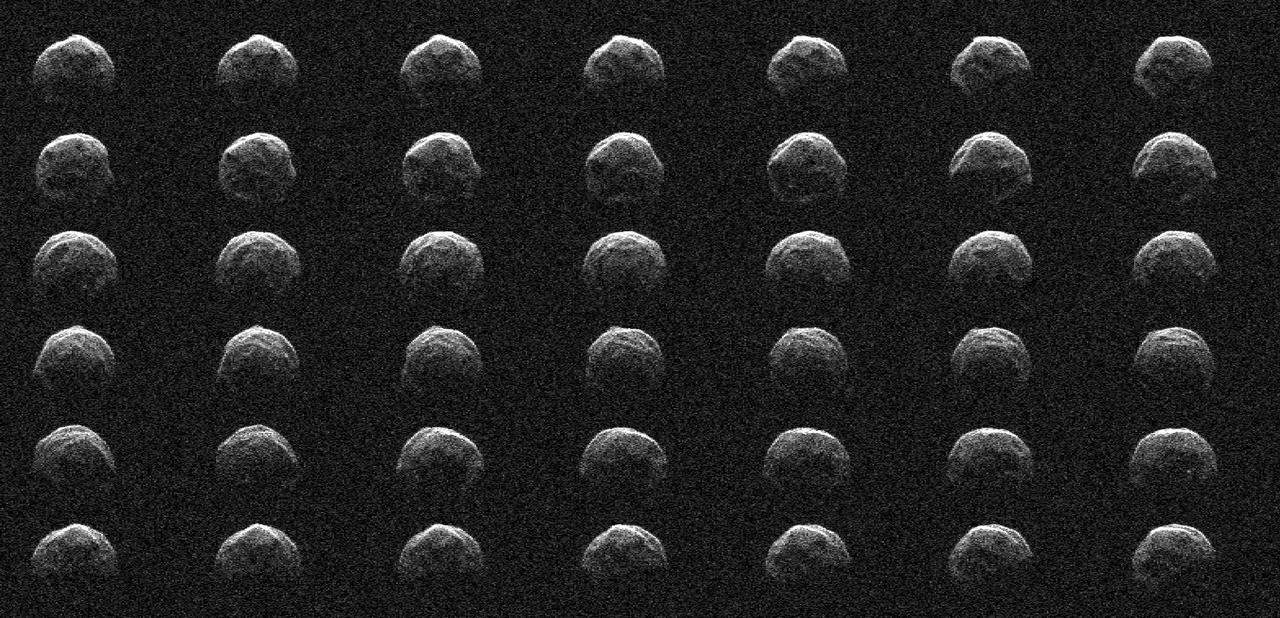
This collage represents a selection of NASA radar observations of near-Earth asteroid 2006 HV5 on April 25, 2023, less than one day before its close approach with our planet at a distance of about 1.5 million miles (2.4 million kilometers, or about 6.3 times the distance between the Moon and Earth). Asteroid 2006 HV5 was discovered by the Lincoln Near-Earth Asteroid Research (LINEAR) program in New Mexico in April 2006. The radar images show that 2006 HV5 is about 1,000 feet (300 meters) across, roughly the height of the Eiffel Tower, confirming size estimates derived from infrared observations made previously by NASA's NEOWISE mission. 2006 HV5 is classified as a potentially hazardous asteroid as its orbit brings it close to Earth, but its path around the Sun is very well known and the asteroid is not an impact risk to our planet. Asteroids of this size come this close to Earth roughly once a year, on average. The new observations were made by scientists at NASA's Jet Propulsion Laboratory using the powerful 230-foot (70-meter) Goldstone Solar System Radar antenna at the Deep Space Network's facility near Barstow, California. The images confirm the asteroid's size, while also providing a detailed look at its meatball-like shape. The asteroid has a rounded appearance, is "squished" at the poles (i.e., it is oblate), and has a rotation period of about 3.6 hours. The sequence of radar images spans slightly more than one rotation. The images, which have a resolution of about 12 feet (3.75 meters) per pixel, reveal surface features such as ridges, flat regions, concavities, and small-scale topography that might indicate boulders. https://photojournal.jpl.nasa.gov/catalog/PIA25834
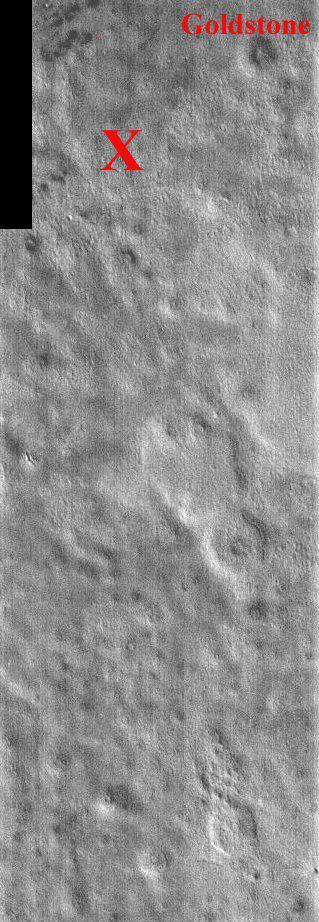
This portion of NASA Mars Odyssey image covers NASA Viking 2 landing site shown with the X. The second landing on Mars took place September 3, 1976 in Utopia Planitia. The exact location of Lander 2 is not as well established as Lander 1 because there were no clearly identifiable features in the lander images as there were for the site of Lander 1. The Utopia landing site region contains pedestal craters, shallow swales and gentle ridges. The crater Goldstone was named in honor of the Tracking Station in the desert of California. The two Viking Landers operated for over 6 years (nearly four martian years) after landing. This one band IR (band 9 at 12.6 microns) image shows bright and dark textures, which are primarily due to differences in the abundance of rocks on the surface. The relatively cool (dark) regions during the day are rocky or indurated materials, fine sand and dust are warmer (bright). Many of the temperature variations are due to slope effects, with sun-facing slopes warmer than shaded slopes. The dark rings around several of the craters are due to the presence of rocky (cool) material ejected from the crater. These rocks are well below the resolution of any existing Mars camera, but THEMIS can detect the temperature variations they produce. Daytime temperature variations are produced by a combination of topographic (solar heating) and thermophysical (thermal inertia and albedo) effects. Due to topographic heating the surface morphologies seen in THEMIS daytime IR images are similar to those seen in previous imagery and MOLA topography. http://photojournal.jpl.nasa.gov/catalog/PIA04023
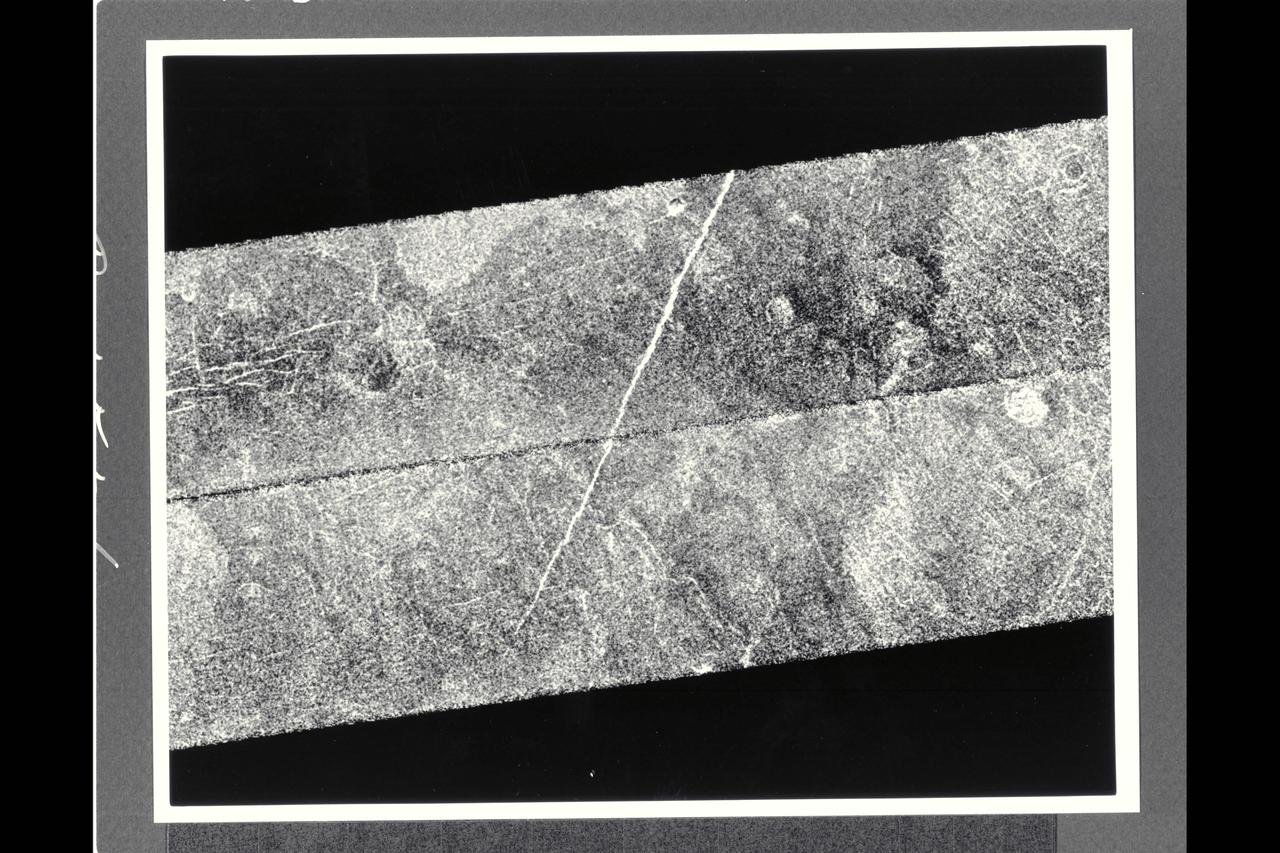
After traveling more than 1.5 billion km (948 million mi.), the Magellan spacecraft was inserted into orbit around Venus on Aug. 10, 1990. This mosaic consists of adjacent pieces of two magellan image strips obtained in the first radar test. The radar test was part of a planned In-Orbit Checkout sequence designed to prepare the magellan spacecraft and radar to begin mapping after Aug. 31. The strip on the left was returned to the Goldstone Deep Space Network station in California; the strip to the right was received at the DSN in Canberra, Australia. A third station that will be receiving Magellan data is locaterd near Madrid, Spain. Each image strip is 20 km (12 mi.) wide and 16,000 km (10,000 mi.) long. This mosaic is a small portion 80 km (50 mi.) long. This image is centered at 21 degrees north latitude and 286.8 degrees east longitude, southeast of a volcanic highland region called Beta Regio. The resolution of the image is about 120 meters (400 feet), 10 times better than revious images of the same area of Venus, revealing many new geologic features. The bright line trending northwest-southeast across the center of the image is a fracture or fault zone cutting the volcanic plains. In the upper lest corner of the image, a multiple-ring circular feature of probable volcanic origin can be seen, approx. 4.27 km (2.65 mi.) across. The bright and dark variations seen in the plains surrounding these features correspond to volcanic lava flows of varying ages. The volcanic lava flows in the southern half of the image have been cut by north-south trending faults. This area is similar geologically to volcanic deposits seen on Earth at Hawaii and the Snake River Plains in Idaho.
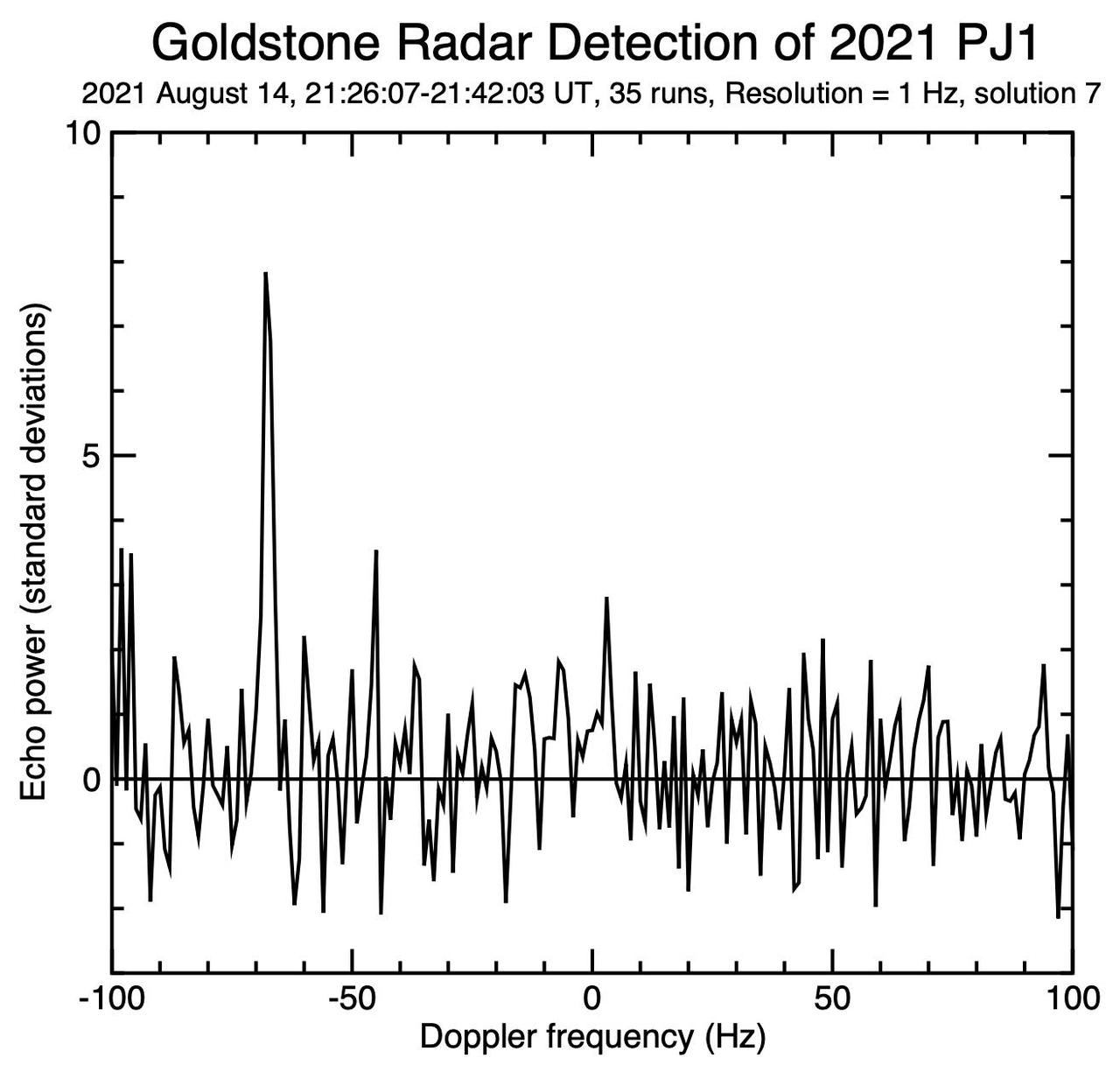
This figure represents the 1,000th near-Earth asteroid (NEA) to be detected by planetary radar since 1968. Being only 65 to 100 feet (20 to 30 meters) wide, asteroid 2021 PJ1 was too small to be imaged in any detail, but the powerful 70-meter (230-foot) Deep Space Station 14 (DSS-14) antenna at the Deep Space Network's Goldstone Deep Space Complex near Barstow, California, was able to measure the Doppler frequency of the radio waves that reflected off the object's surface. The data was recorded for 16 minutes between 2:26 p.m. and 2:42 p.m. PDT on Aug. 14, 2021. The figure shows radar echo signal strength on the vertical axis versus Doppler frequency (in units of hertz, or Hz) on the horizontal axis. The strong spike at a value of minus 70 Hz is the reflected signal (or "echo") from 2021 PJ1; the other, smaller spikes are receiver noise, which is like the static on an AM radio if there aren't any nearby stations. Using this information, scientists at NASA's Jet Propulsion Laboratory in Southern California could more accurately calculate the asteroid's velocity, its distance from Earth and its future motion around the Sun. These observations used a prediction – known as an "ephemeris" – that had relatively large uncertainties because the asteroid had been discovered only a few days earlier. If the original prediction had been perfect, the radar echo would appear at zero Hz. The fact that the radar echo is at minus 70 Hz indicates a correction could be made to the predicted velocity of minus 2.7 miles per hour (minus 1.2 meters per second). This measurement also reduced the uncertainty in the asteroid's distance from Earth from 1,300 miles (2,100 kilometers) to 5.2 miles (8.3 kilometers) – a reduction of a factor of about 250. https://photojournal.jpl.nasa.gov/catalog/PIA24563
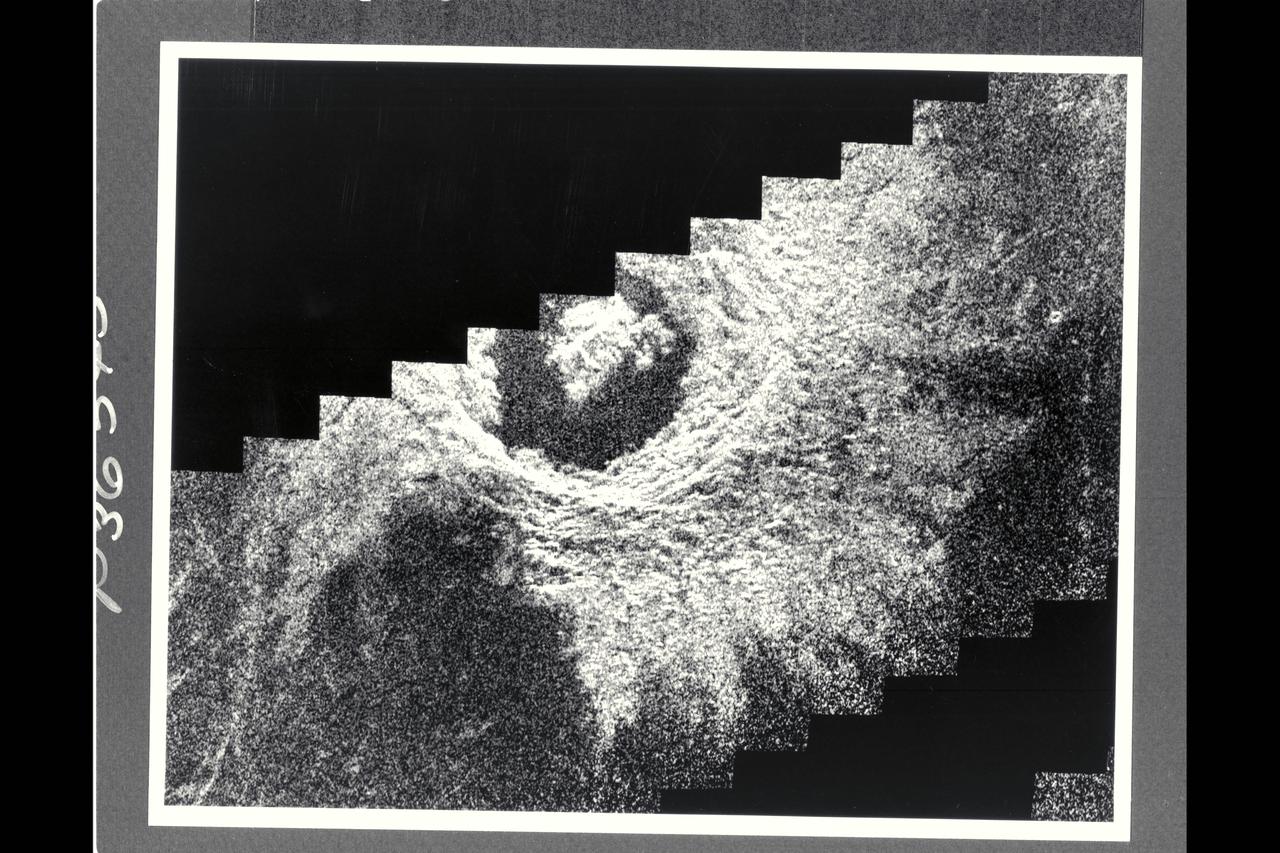
This Magellan image mosaic shows the impact crater Golubkina, first identified in Soviet Venera 15/16 data. The crater is names after Anna Golubkina (1864-1927), a Soviet sculptor. The crater is about 34 km (20.4 mi.) across, similar to the size of the West Clearwater impact structure in Canada. The crater Golubkina is located at about 60.5 degrees north latitude, 286.7 degrees est longitude. Magellan data reveal that Golubkina has many characteristics typical of craters formed by a mereorite impact including terraced inner walls, a central peak, and radar-bright rough ejecta surrounding the crater. The extreme darkness of the crater floor indicates a smooth surface, perhaps formed by the ponding of lava flows in the crater floor as seen in may lunar impact craters. The radar-bright ejecta surrounding the crater indicates a relatively fresh or young crater. Craters with centeral peaks in the Soviet data range in size from about 10-60 km (6-36 mi.) across. The largest crater identifed in the Soviet Venera data is 140 km (84 mi) in diameter. This Magellan image strip in approx. 100 km (62 mi.) long. The image is a mosaic of two orbits obtained in the first Magellan radar test and played back to Earth to the Deep Space Network stations near Goldstone, CA and Canberra, Australia, respectively. The resolution of this image is approximately 120 meters (400 feet). The see-saw margins result from the offset of individual radar frames obtained along the orbit. The spacecraft moved from the north (top) to the south, looking to the left.
KENNEDY SPACE CENTER, FLA. -- NASA's Comet Nucleus Tour (CONTOUR) spacecraft successfully launches at 2:47:41 a.m. EDT aboard a Boeing Delta II rocket from Cape Canaveral Air Force Station, Fla. Designed and built by The Johns Hopkins University Applied Physics Laboratory (APL) in Laurel, Md., the 2,138-pound (970-kilogram) spacecraft was placed into an elliptical Earth orbit 63 minutes after launch. About 19 minutes later the mission operations team at APL acquired a signal from the spacecraft through the Deep Space Network antenna station in Goldstone, Calif., and by 5:45 a.m. EDT Mission Director Dr. Robert W. Farquhar of the Applied Physics Lab confirmed the craft was operating normally and ready to carry out its early orbit maneuvers. CONTOUR will orbit Earth until Aug. 15, when it is scheduled to fire its main engine and enter a comet-chasing orbit around the sun. The mission's flexible four-year plan includes encounters with comets Encke (Nov. 12, 2003) and Schwassmann-Wachmann 3 (June 19, 2006), though it can add an encounter with a "new" and scientifically valuable comet from the outer solar system, should one be discovered in time for CONTOUR to fly past it. CONTOUR's four scientific instruments will take detailed pictures and measure the chemical makeup of each comet's nucleus -- a chunk of ice and rock -- while analyzing the surrounding gas and dust.
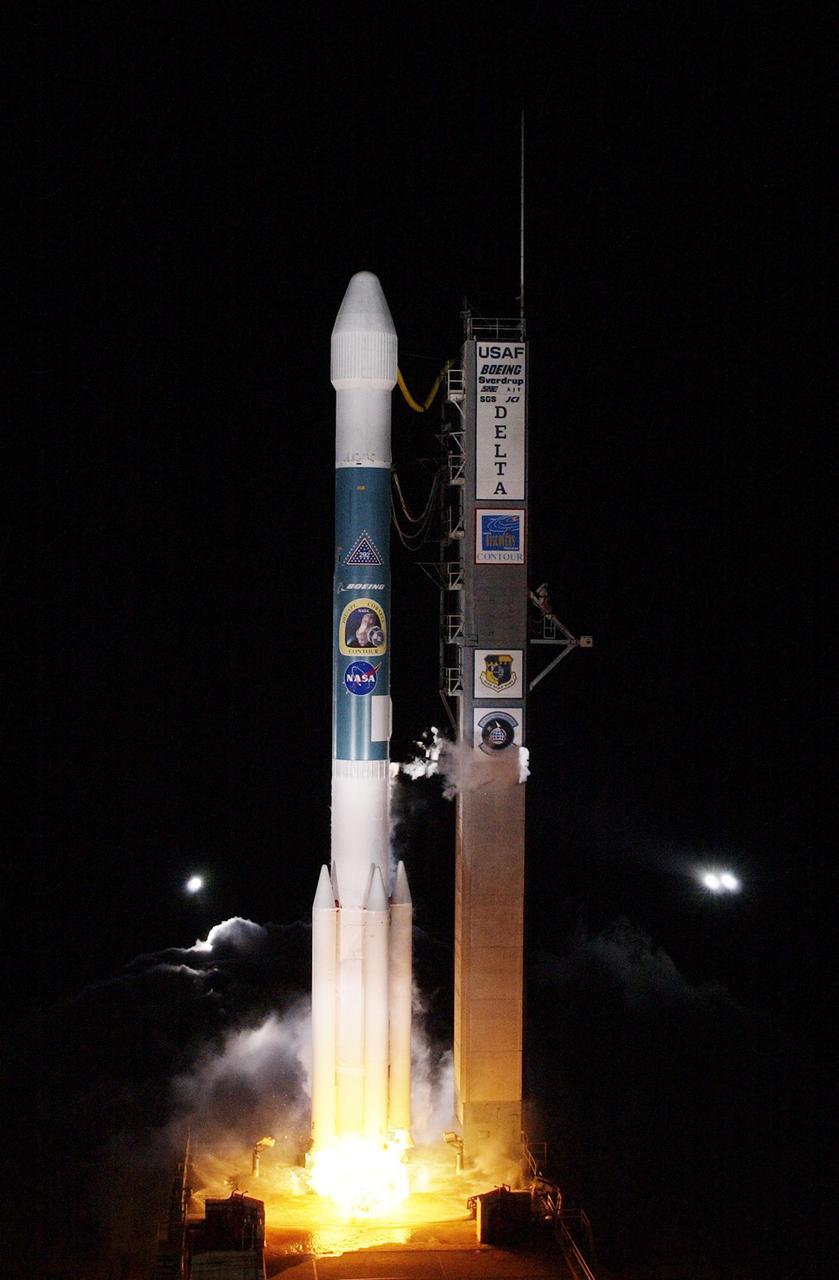
KENNEDY SPACE CENTER, FLA. -- NASA's Comet Nucleus Tour (CONTOUR) spacecraft successfully launches at 2:47 a.m. EDT aboard a Boeing Delta II rocket from Cape Canaveral Air Force Station, Fla. Designed and built by The Johns Hopkins University Applied Physics Laboratory (APL) in Laurel, Md., the 2,138-pound (970-kilogram) spacecraft was placed into an elliptical Earth orbit 63 minutes after launch. About 19 minutes later the mission operations team at APL acquired a signal from the spacecraft through the Deep Space Network antenna station in Goldstone, Calif., and by 5:45 a.m. EDT Mission Director Dr. Robert W. Farquhar of the Applied Physics Lab confirmed the craft was operating normally and ready to carry out its early orbit maneuvers. CONTOUR will orbit Earth until Aug. 15, when it is scheduled to fire its main engine and enter a comet-chasing orbit around the sun. The mission's flexible four-year plan includes encounters with comets Encke (Nov. 12, 2003) and Schwassmann-Wachmann 3 (June 19, 2006), though it can add an encounter with a "new" and scientifically valuable comet from the outer solar system, should one be discovered in time for CONTOUR to fly past it. CONTOUR's four scientific instruments will take detailed pictures and measure the chemical makeup of each comet's nucleus -- a chunk of ice and rock -- while analyzing the surrounding gas and dust.
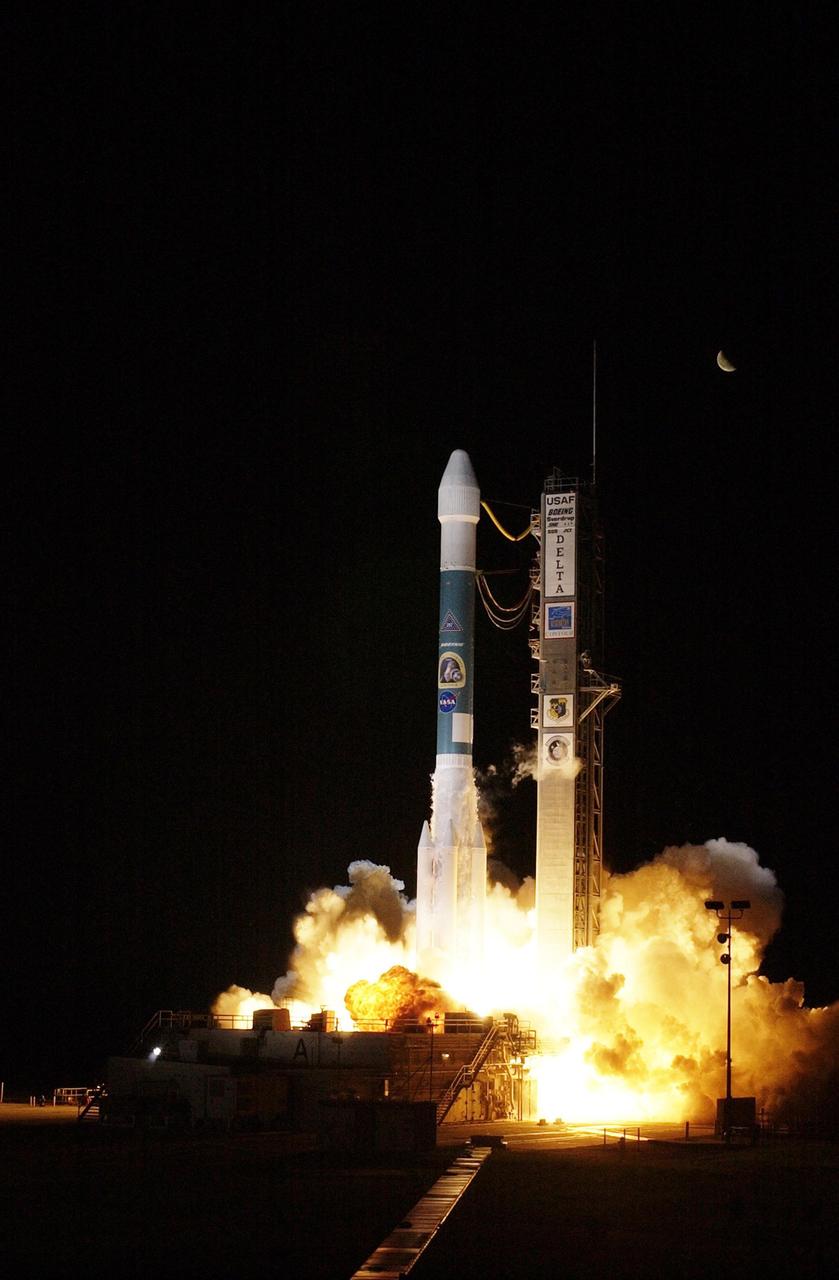
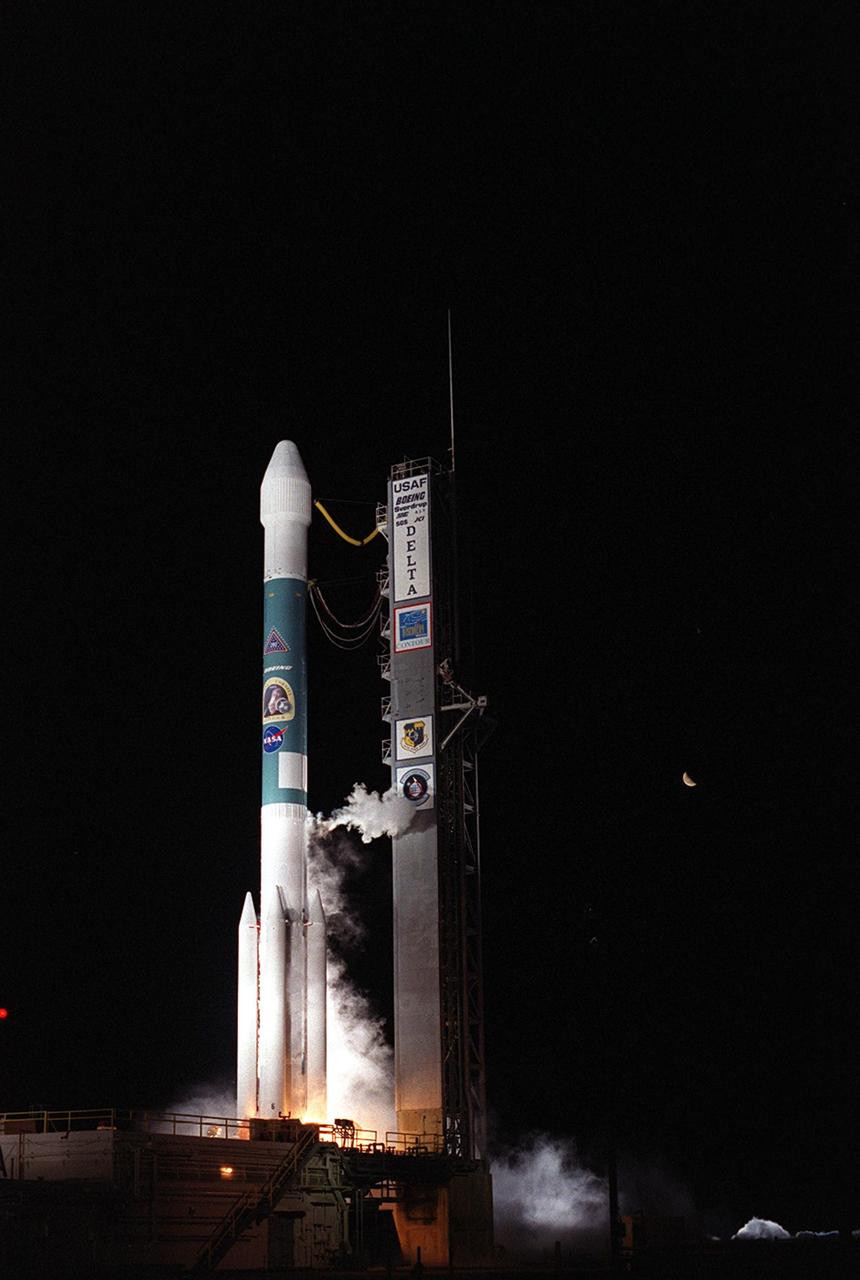
KENNEDY SPACE CENTER, FLA. - A third-quarter moon is the only visible element in the sky as NASA's Comet Nucleus Tour (CONTOUR) spacecraft successfully launches at 2:47 a.m. EDT aboard a Boeing Delta II rocket from Cape Canaveral Air Force Station, Fla. Designed and built by The Johns Hopkins University Applied Physics Laboratory (APL) in Laurel, Md., the 2,138-pound (970-kilogram) spacecraft was placed into an elliptical Earth orbit 63 minutes after launch. About 19 minutes later the mission operations team at APL acquired a signal from the spacecraft through the Deep Space Network antenna station in Goldstone, Calif., and by 5:45 a.m. EDT Mission Director Dr. Robert W. Farquhar of the Applied Physics Lab confirmed the craft was operating normally and ready to carry out its early orbit maneuvers. CONTOUR will orbit Earth until Aug. 15, when it is scheduled to fire its main engine and enter a comet-chasing orbit around the sun. The mission's flexible four-year plan includes encounters with comets Encke (Nov. 12, 2003) and Schwassmann-Wachmann 3 (June 19, 2006), though it can add an encounter with a "new" and scientifically valuable comet from the outer solar system, should one be discovered in time for CONTOUR to fly past it. CONTOUR's four scientific instruments will take detailed pictures and measure the chemical makeup of each comet's nucleus -- a chunk of ice and rock -- while analyzing the surrounding gas and dust.
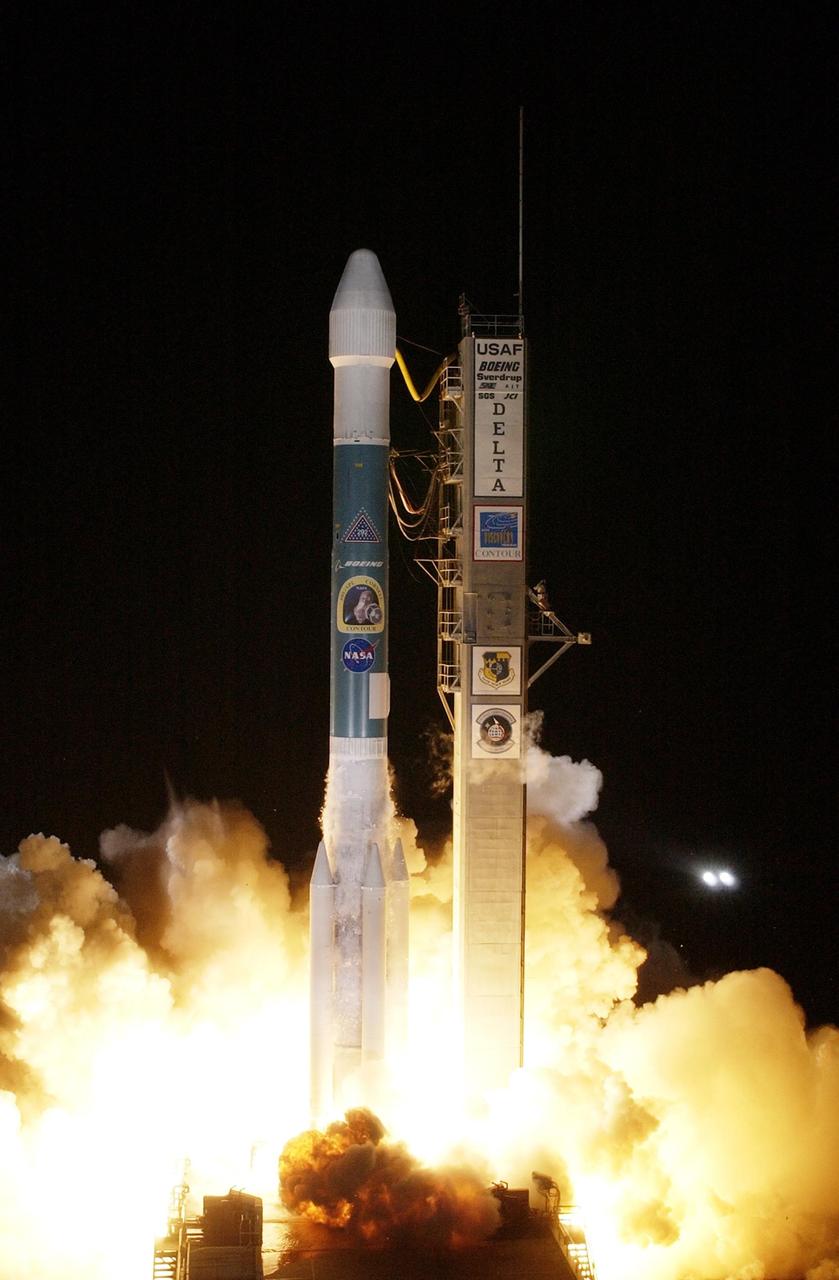
KENNEDY SPACE CENTER, FLA. -- NASA's Comet Nucleus Tour (CONTOUR) spacecraft successfully launches at 2:47 a.m. EDT aboard a Boeing Delta II rocket from Cape Canaveral Air Force Station, Fla. Designed and built by The Johns Hopkins University Applied Physics Laboratory (APL) in Laurel, Md., the 2,138-pound (970-kilogram) spacecraft was placed into an elliptical Earth orbit 63 minutes after launch. About 19 minutes later the mission operations team at APL acquired a signal from the spacecraft through the Deep Space Network antenna station in Goldstone, Calif., and by 5:45 a.m. EDT Mission Director Dr. Robert W. Farquhar of the Applied Physics Lab confirmed the craft was operating normally and ready to carry out its early orbit maneuvers. CONTOUR will orbit Earth until Aug. 15, when it is scheduled to fire its main engine and enter a comet-chasing orbit around the sun. The mission's flexible four-year plan includes encounters with comets Encke (Nov. 12, 2003) and Schwassmann-Wachmann 3 (June 19, 2006), though it can add an encounter with a "new" and scientifically valuable comet from the outer solar system, should one be discovered in time for CONTOUR to fly past it. CONTOUR's four scientific instruments will take detailed pictures and measure the chemical makeup of each comet's nucleus -- a chunk of ice and rock -- while analyzing the surrounding gas and dust.