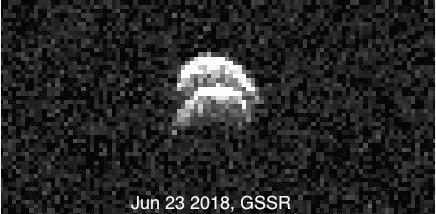
Radar images of the binary asteroid 2017 YE5 from NASA's Goldstone Solar System Radar (GSSR). The observations, conducted on June 23, 2018, show two lobes, but do not yet show two separate objects. A movie is available at https://photojournal.jpl.nasa.gov/catalog/PIA22557
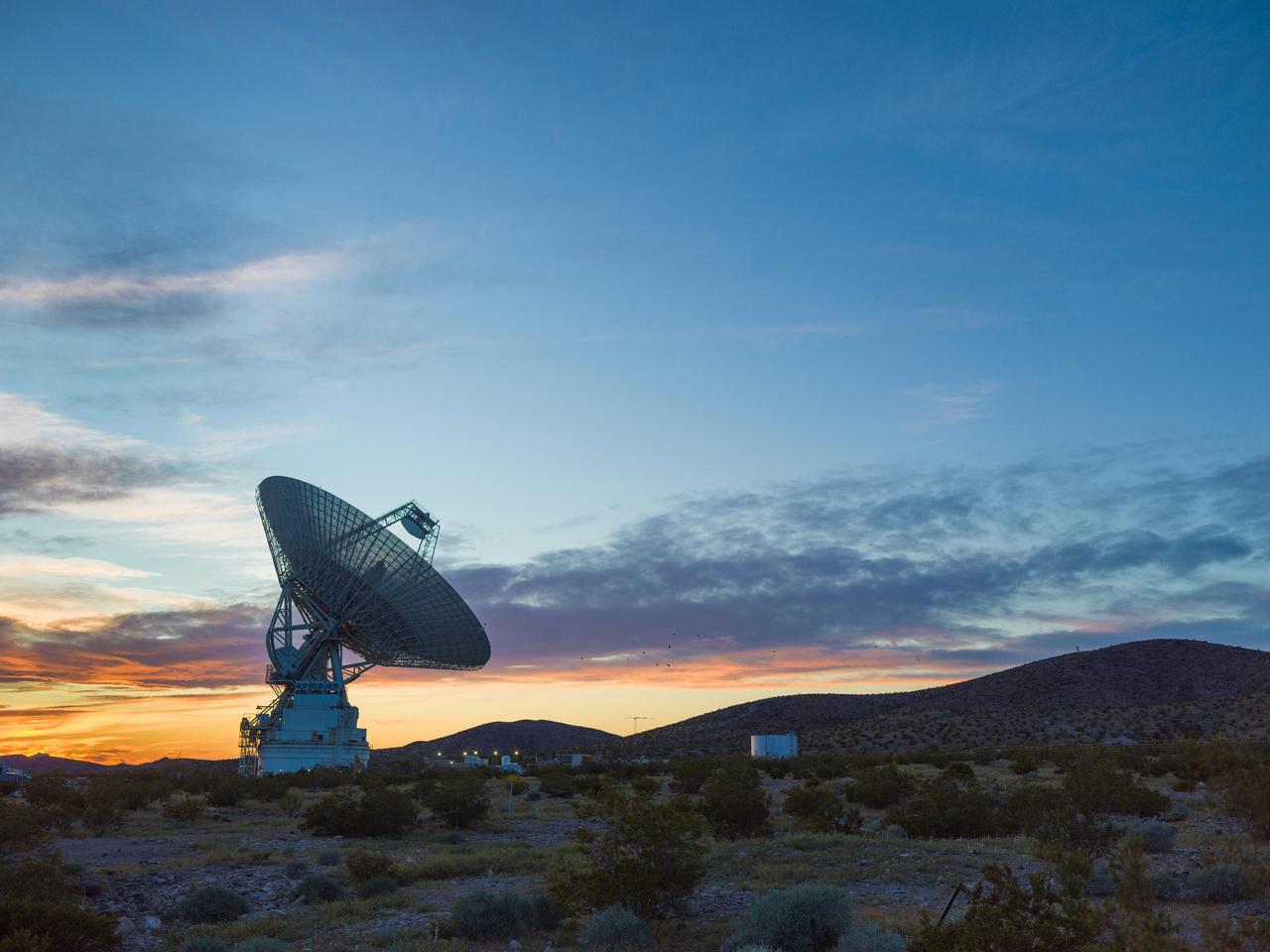
This sunset photo shows Deep Space Station 14 (DSS-14), the 230-foot-wide (70-meter) antenna at the Goldstone Deep Space Communications Complex near Barstow, California, part of NASA's Deep Space Network. The network's three complexes around the globe support communications with dozens of deep space missions. DSS-14 is also the agency's Goldstone Solar System Radar, which is used to observe asteroids that come close to Earth. https://photojournal.jpl.nasa.gov/catalog/PIA26150
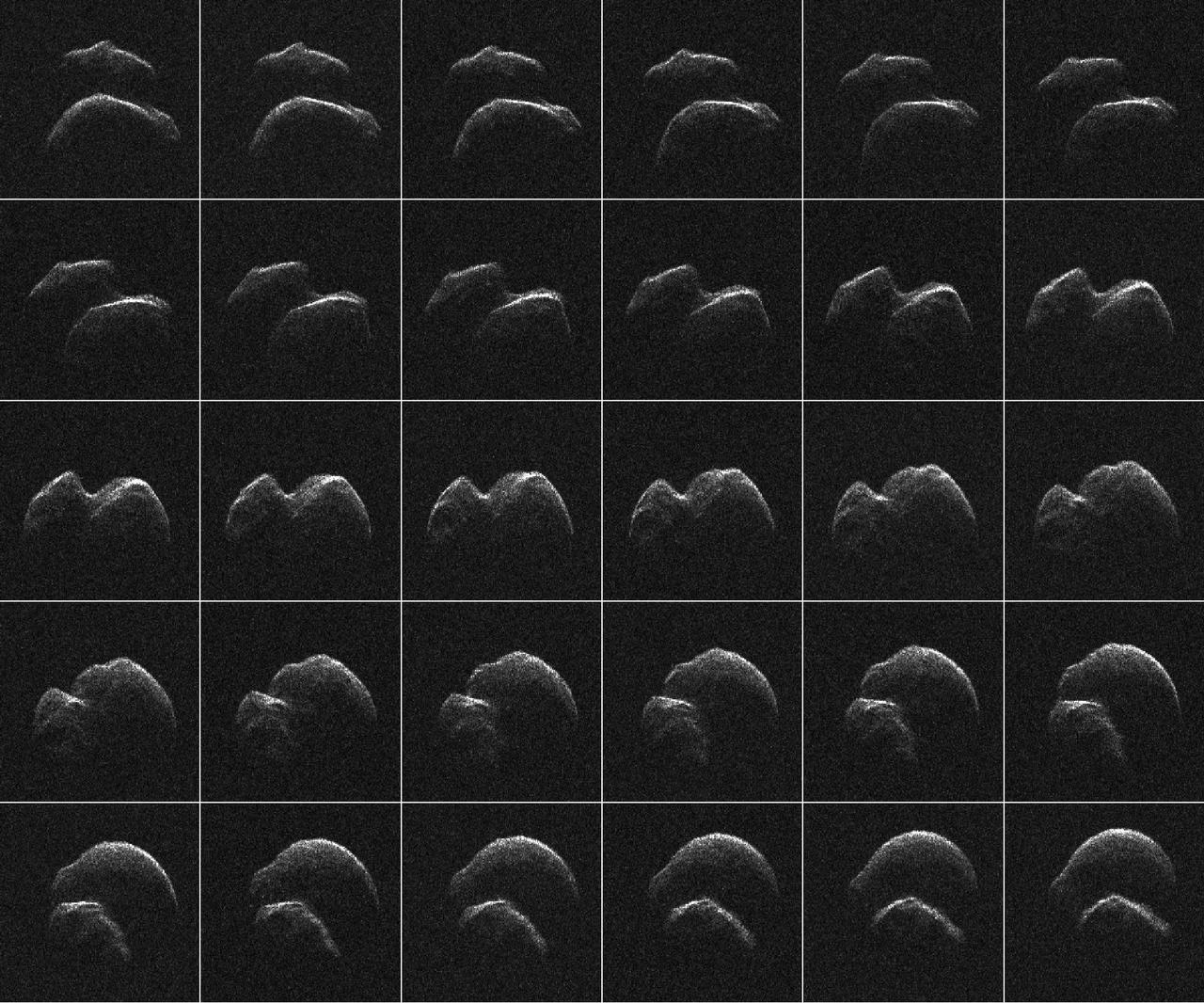
This composite of 30 images of asteroid 2014 JO25 was generated with radar data collected using NASA Goldstone Solar System Radar in California Mojave Desert. https://photojournal.jpl.nasa.gov/catalog/PIA21594
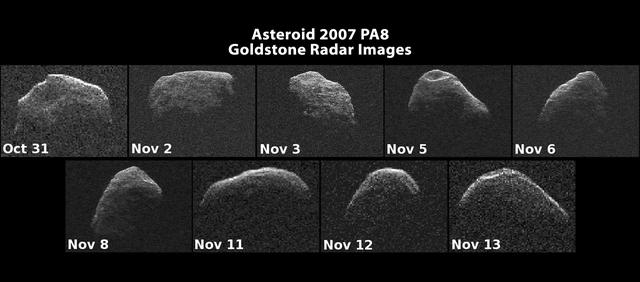
Images of asteroid 2007 PA8 have been generated with data collected by NASA Goldstone Solar System Radar. The images of 2007 PA8 reveal possible craters, boulders, an irregular, asymmetric shape, and very slow rotation.
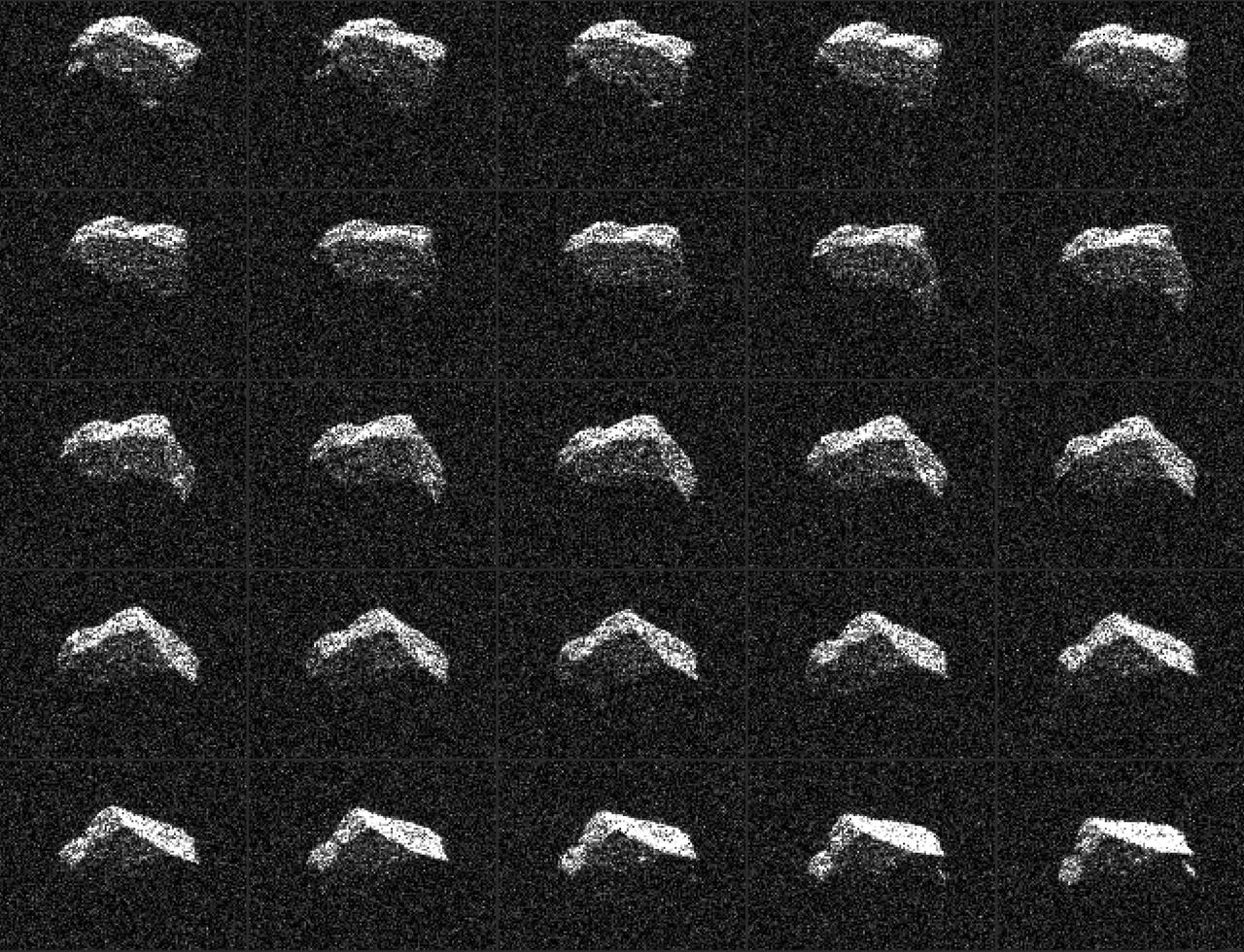
This composite of 25 images of asteroid 2017 BQ6 was generated with radar data collected using NASA's Goldstone Solar System Radar in California's Mojave Desert. The images were gathered on Feb. 7, 2017, between 8:39 and 9:50 p.m. PST (11:39 p.m. EST and 12:50 a.m., Feb. 7), revealing an irregular, angular-appearing asteroid about 660 feet (200 meters) in size that rotates about once every three hours. The images have resolutions as fine as 12 feet (3.75 meters) per pixel. http://photojournal.jpl.nasa.gov/catalog/PIA21452
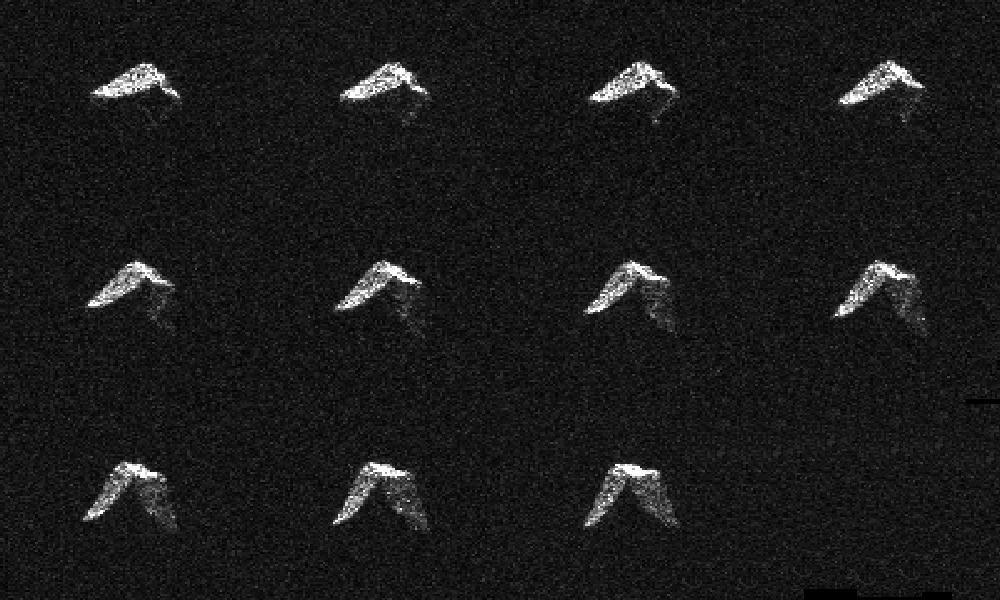
This composite of 11 images of asteroid 2017 BQ6 was generated with radar data collected using NASA's Goldstone Solar System Radar in California's Mojave Desert on Feb. 5, 2017, between 5:24 and 5:52 p.m. PST (8:24 to 8:52 p.m. EST / 1:24 to 1:52 UTC). The images have resolutions as fine as 12 feet (3.75 meters) per pixel. http://photojournal.jpl.nasa.gov/catalog/PIA21453
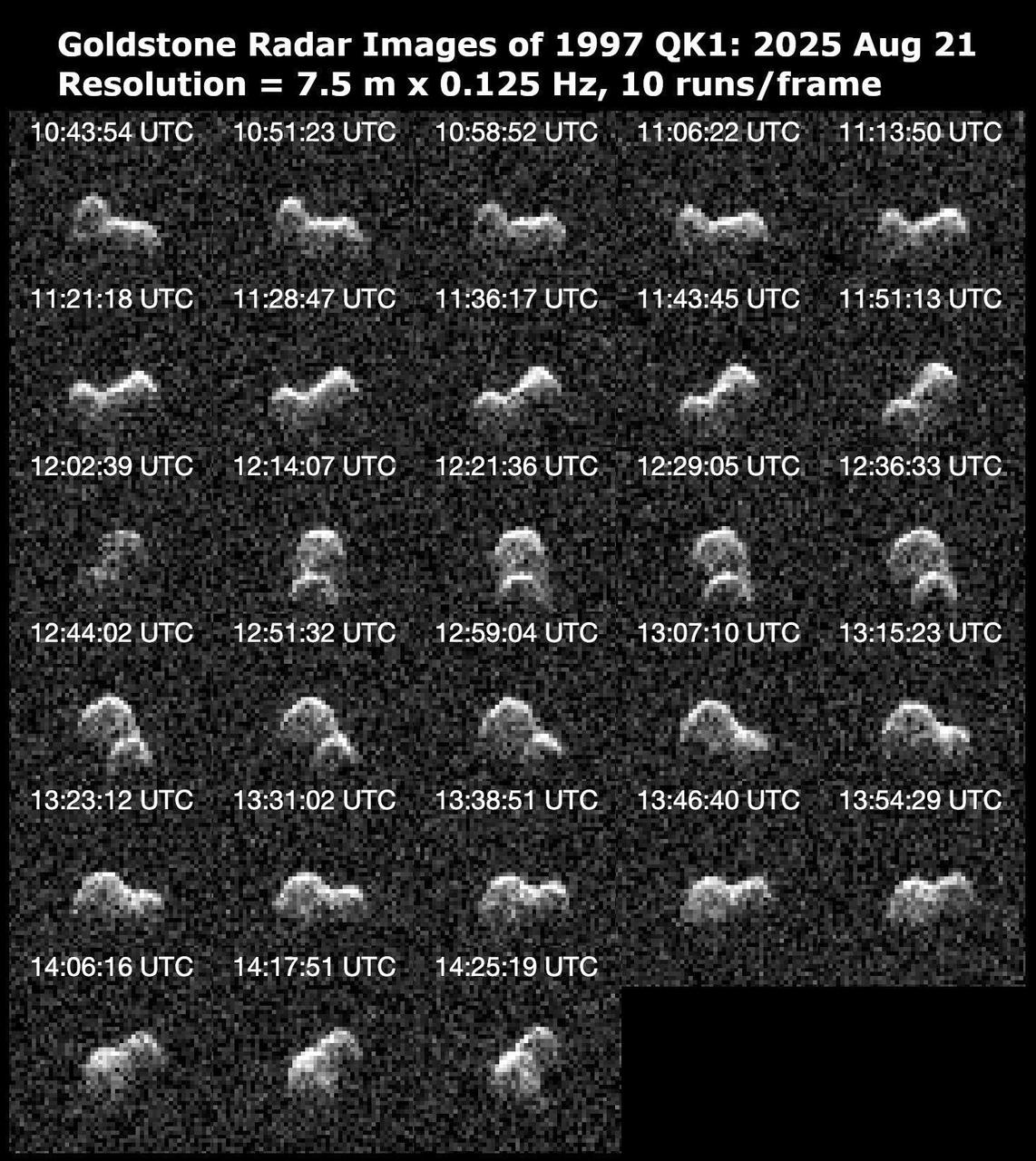
Asteroid 1997 QK1 is shown to be an elongated, peanut-shaped near-Earth object in this series of 28 radar images obtained by the Deep Space Network's Goldstone Solar System Radar on Aug. 21, 2025. The asteroid is about 660 feet (200 meters) long and completes one rotation every 4.8 hours. It passed closest to our planet on the day before these observations were made at a distance of about 1.9 million miles (3 million kilometers), or within eight times the distance between Earth and the Moon. The 2025 flyby is the closest that 1997 QK1 has approached to Earth in more than 350 years. Prior to the recent Goldstone observations, very little was known about the asteroid. These observations resolve surface features down to a resolution of about 25 feet (7.5 meters) and reveal that the object has two rounded lobes that are connected, with one lobe twice the size of the other. Both lobes appear to have concavities that are tens of meters deep. Asteroid 1997 QK1 is likely a "contact binary," one of dozens of such objects imaged by Goldstone. At least 15% of near-Earth asteroids larger than about 660 feet (200 meters) have a contact binary shape. The asteroid is classified as potentially hazardous, but it does not pose a hazard to Earth for the foreseeable future. These Goldstone measurements have greatly reduced the uncertainties in the asteroid's distance from Earth and in its future motion for many decades. The Goldstone Solar System Radar Group is supported by NASA's Near-Earth Object Observations Program within the Planetary Defense Coordination Office at the agency's headquarters in Washington. Managed by NASA's Jet Propulsion Laboratory, the Deep Space Network receives programmatic oversight from Space Communications and Navigation program office within the Space Operations Mission Directorate, also at NASA Headquarters. https://photojournal.jpl.nasa.gov/catalog/PIA26588
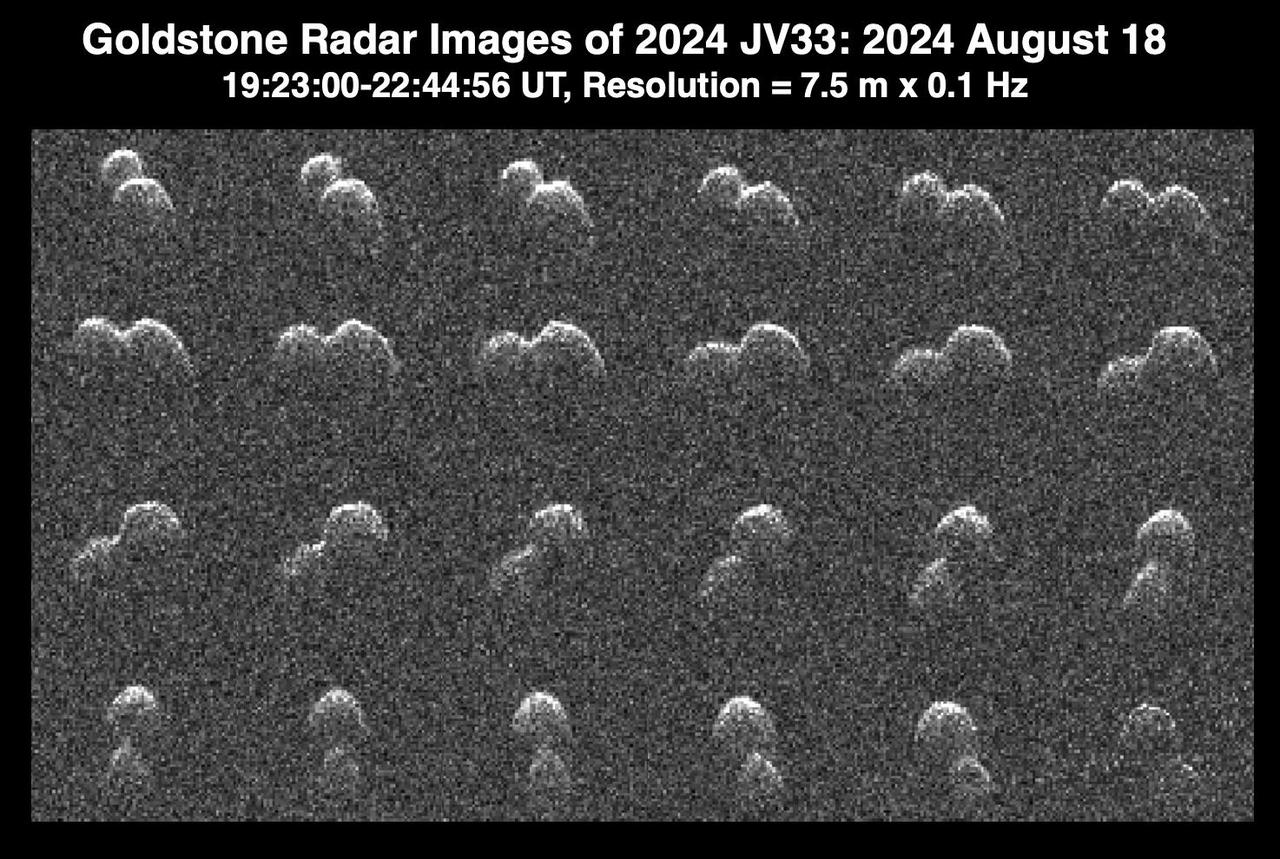
This series of radar images obtained by the Goldstone Solar System Radar near Barstow, California, on Aug. 18, 2024, shows the asteroid 2024 JV33 shortly before its close approach with Earth. The images were captured when the asteroid was at a distance of 2.8 million miles (4.6 million kilometers), about 12 times the distance between the Moon and Earth. Discovered by the NASA-funded Catalina Sky Survey in Tucson, Arizona, on May 4, the near-Earth asteroid's shape resembles that of a peanut – with two rounded lobes, one lobe larger than the other. Scientists used the radar images to determine that it is about 980 feet (300 meters) long and that its length is about double its width. Asteroid 2024 JV33 rotates once every seven hours. Radar is the principal technique for discovering such asteroids, which are called contact binaries. Dozens of them have been imaged by Goldstone, which is part of NASA's Deep Space Network. At least 14% of near-Earth asteroids larger than about 660 feet (200 meters) have a contact binary shape. Asteroid 2024 JV33 has an elongated orbit similar to that of many comets that are strongly influenced by the gravity of Jupiter. While no comet-like activity has been observed, the possibility remains that the asteroid may be an inactive cometary nucleus. The asteroid is classified as potentially hazardous, but it does not pose a hazard to Earth for the foreseeable future. These Goldstone measurements have greatly reduced the uncertainties in the asteroid's distance from Earth and in its future motion for many decades. https://photojournal.jpl.nasa.gov/catalog/PIA26389
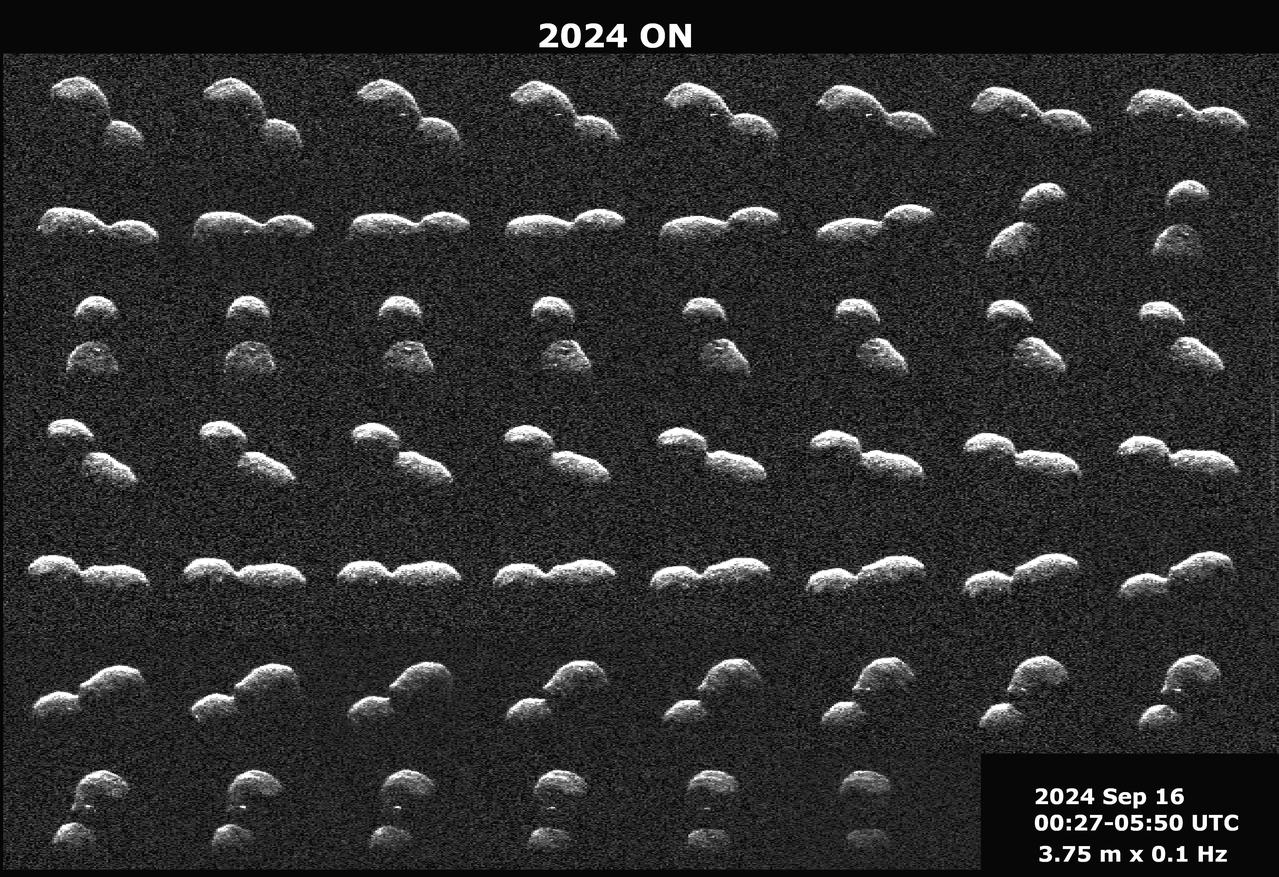
This series of radar images obtained by the Deep Space Network's Goldstone Solar System Radar near Barstow, California, on Sept. 16, 2024, shows the near-Earth asteroid 2024 ON a day before its close approach with our planet. The asteroid passed Earth at a distance of 620,000 miles (1 million kilometers) – about 2.6 times the distance between the Moon and Earth. Discovered by the NASA-funded Asteroid Terrestrial-impact Last Alert System (ATLAS) on Mauna Loa in Hawaii on July 27, the near-Earth asteroid's shape resembles that of a peanut. Like the asteroid 2024 JV33 that made close approach with Earth a month earlier, 2024 ON is likely a contact binary, with two rounded lobes separated by a pronounced neck, one lobe about 50% larger than the other. The radar images determined that it is about 1150 feet (350 meters) long. Features larger than 12.3 feet (3.75 meters) across can be seen on the surface. Bright radar spots on the asteroid's surface likely indicate large boulders. The images show about 90% of one rotation over the course of about six hours. Radar is the principal technique for discovering contact binaries, dozens of which have been imaged by planetary radar. At least 14% of near-Earth asteroids larger than about 200 meters (660 feet) have a contact binary shape. This asteroid is classified as potentially hazardous, but it does not pose a hazard to Earth for the foreseeable future. These Goldstone measurements have allowed scientists to greatly reduce the uncertainties in the asteroid's distance from Earth and in its future motion for many decades. Animation available at https://photojournal.jpl.nasa.gov/catalog/PIA26451
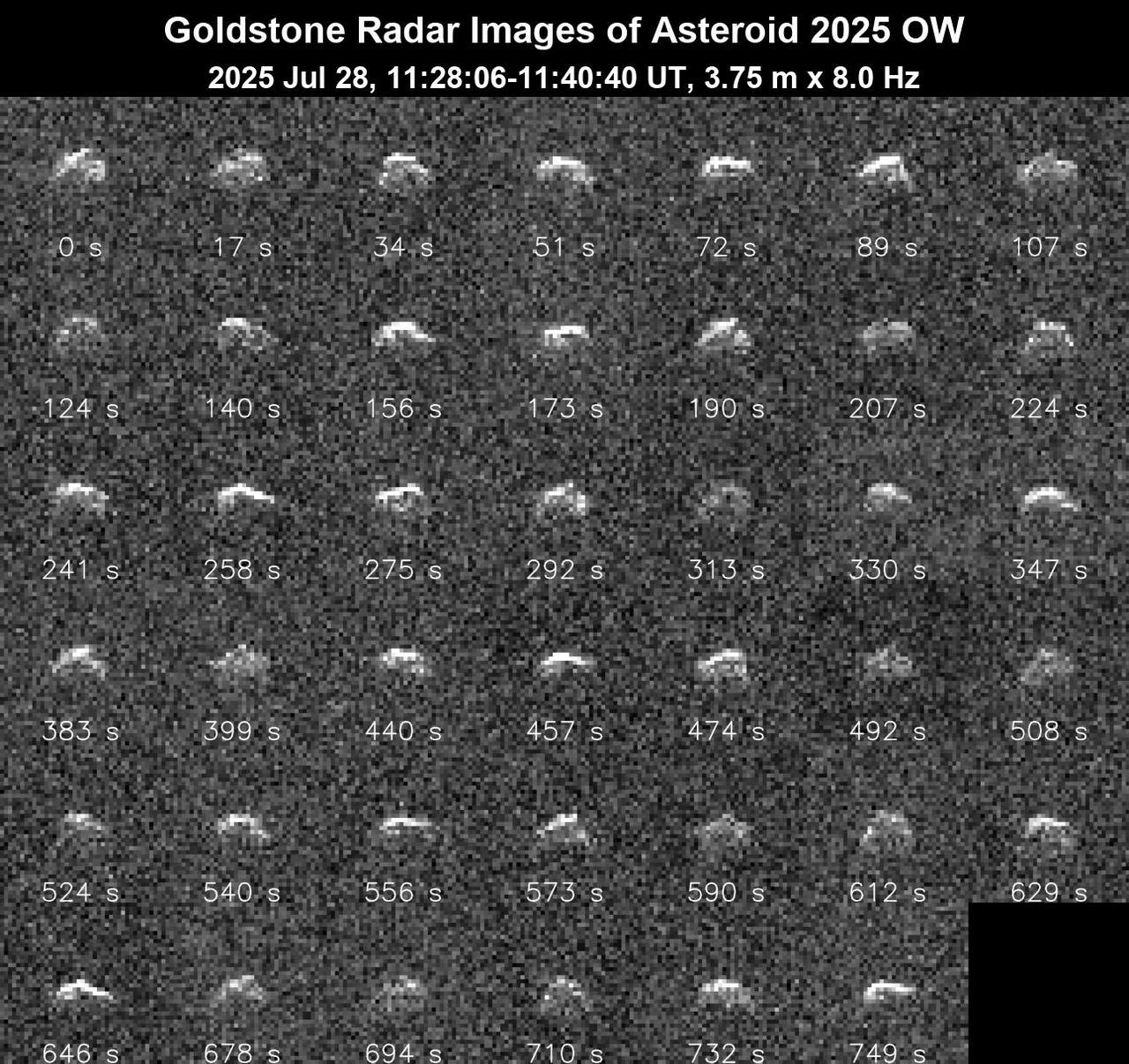
This series of 41 radar images obtained by the Deep Space Network's Goldstone Solar System Radar on July 28, 2025, shows the near-Earth asteroid 2025 OW as it made its close approach with our planet. The asteroid safely passed at about 400,000 miles (640,000 kilometers), or 1.6 times the distance from Earth to the Moon. The asteroid was discovered on July 4, 2025, by the NASA-funded Pan-STARRS2 survey telescope on Haleakala in Maui, Hawaii. These Goldstone observations suggest that 2025 OW is about 200 feet (60 meters) wide and has an irregular shape. The observations also indicate that it is rapidly spinning, completing one rotation every 1½ to 3 minutes, making it one of the fastest-spinning near-Earth asteroids that the powerful radar system has observed. The observations resolve surface features down to 12 feet (3.75 meters) wide. Asteroids can be "spun up" by sunlight being unevenly absorbed and re-emitted across their irregular surfaces. As photons (quantum particles of light) carry a tiny amount of momentum away from the asteroid, a tiny amount of torque is applied and, over time, the asteroid's spin can increase – a phenomenon known as the YORP effect. For 2025 OW to maintain such a fast rotation without breaking apart, it may be a solid object rather than a loosely bound rubble pile like many asteroids. The Goldstone measurements have allowed scientists to greatly reduce uncertainties in the asteroid's distance from Earth and in its future motion for many decades. This July 28 close approach is the closest asteroid 2025 OW will come to Earth for the foreseeable future. Animation available at https://photojournal.jpl.nasa.gov/catalog/PIA26587
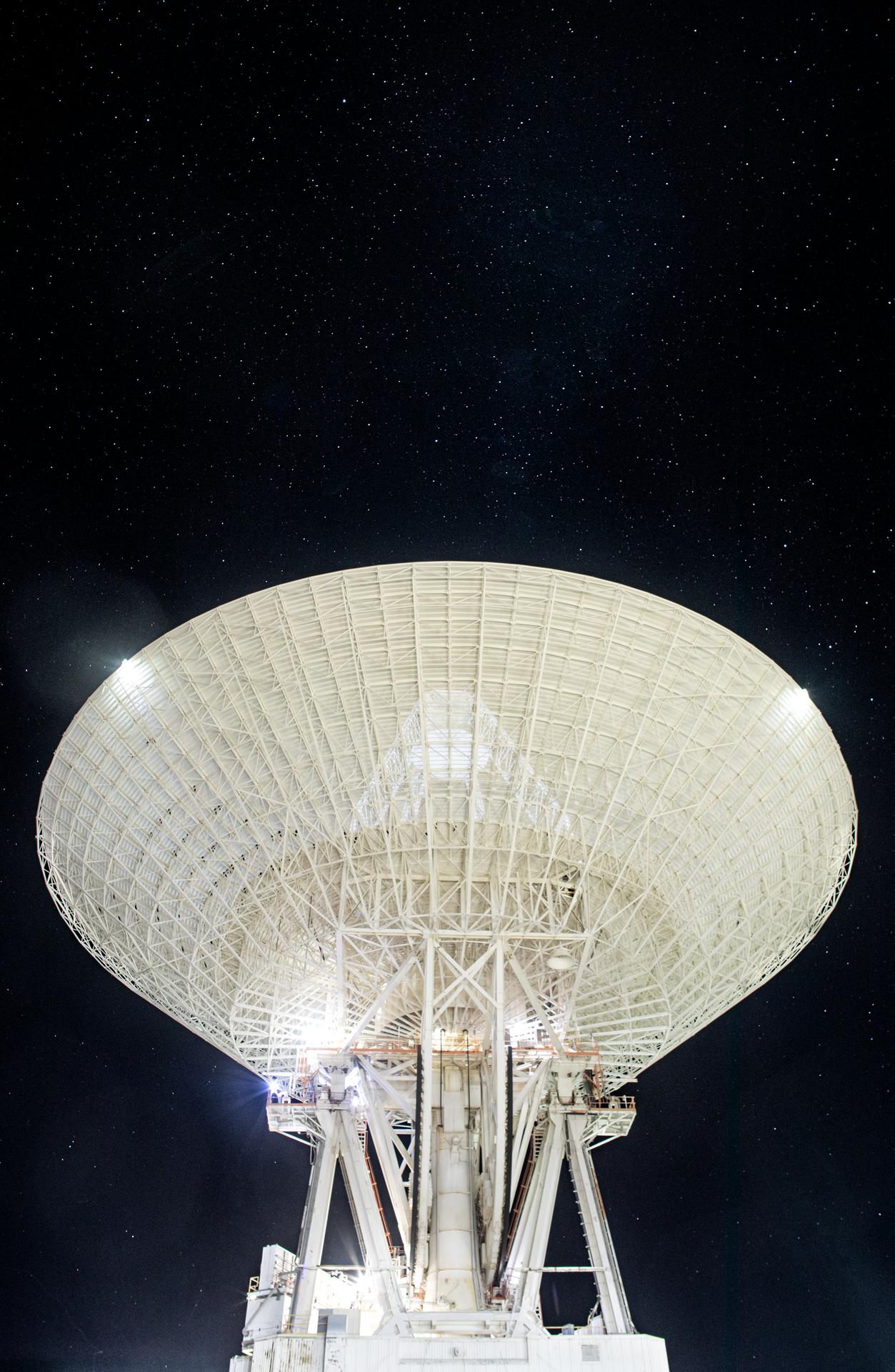
Deep Space Station 14 (DSS-14), the 230-foot-wide (70-meter) antenna at the Goldstone Deep Space Communications Complex near Barstow, California, points up toward a starry sky in September 2025. Goldstone is part of NASA’s Deep Space Network (DSN), which operates three complexes around the globe to support communications with dozens of deep space missions. DSS-14 is also the agency’s Goldstone Solar System Radar, which is used to observe asteroids that come close to Earth. For more information about the DSN, visit: https://www.nasa.gov/communicating-with-missions/dsn/
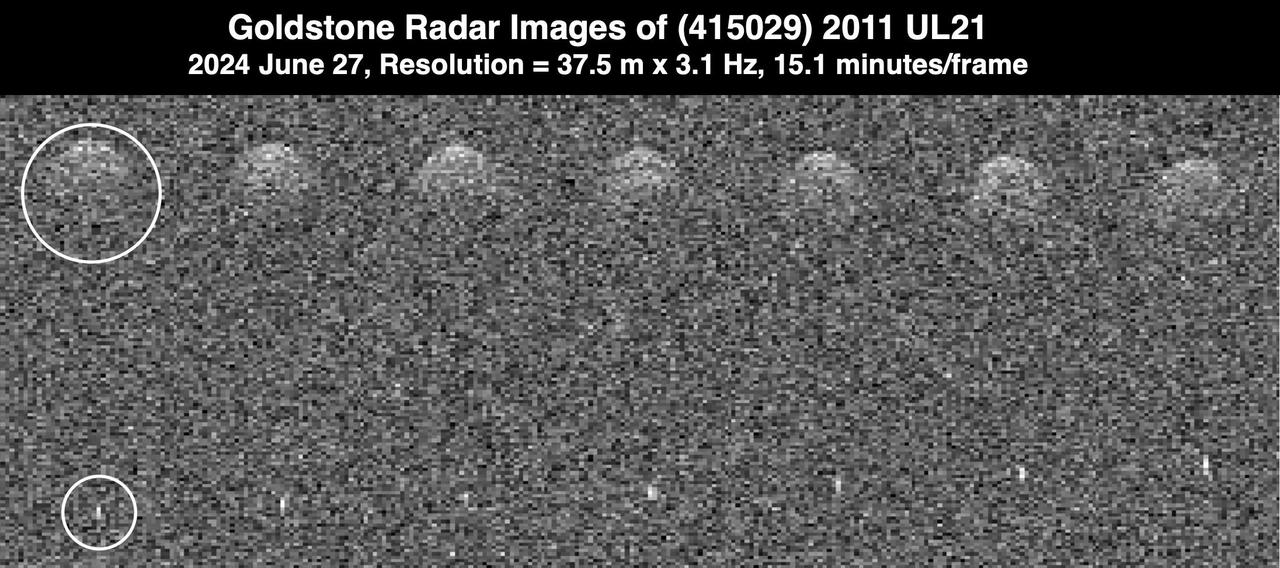
This series of seven radar observations by the Deep Space Network's Goldstone Solar System Radar shows the asteroid 2011 UL21 during its close approach with Earth from 4.1 million miles (6.6 million kilometers) away – about 17 times the distance between the Moon and Earth. White circles highlight the main asteroid and its small moon (a bright dot at the bottom of the image). Passing Earth on June 27, 2024, the asteroid was discovered in 2011 by the NASA-funded Catalina Sky Survey, in Tucson, Arizona. This marked the first time it came close enough to Earth to be imaged by radar. While the nearly mile-wide (1.5-kilometer-wide) object is classified as being potentially hazardous, calculations of its future orbits show that it won't pose a threat to our planet for the foreseeable future. In addition to determining the asteroid is roughly spherical, scientists at NASA's Jet Propulsion Laboratory discovered that it's a binary system: A smaller asteroid, or moonlet, orbits it from a distance of about 1.9 miles (3 kilometers). https://photojournal.jpl.nasa.gov/catalog/PIA26384
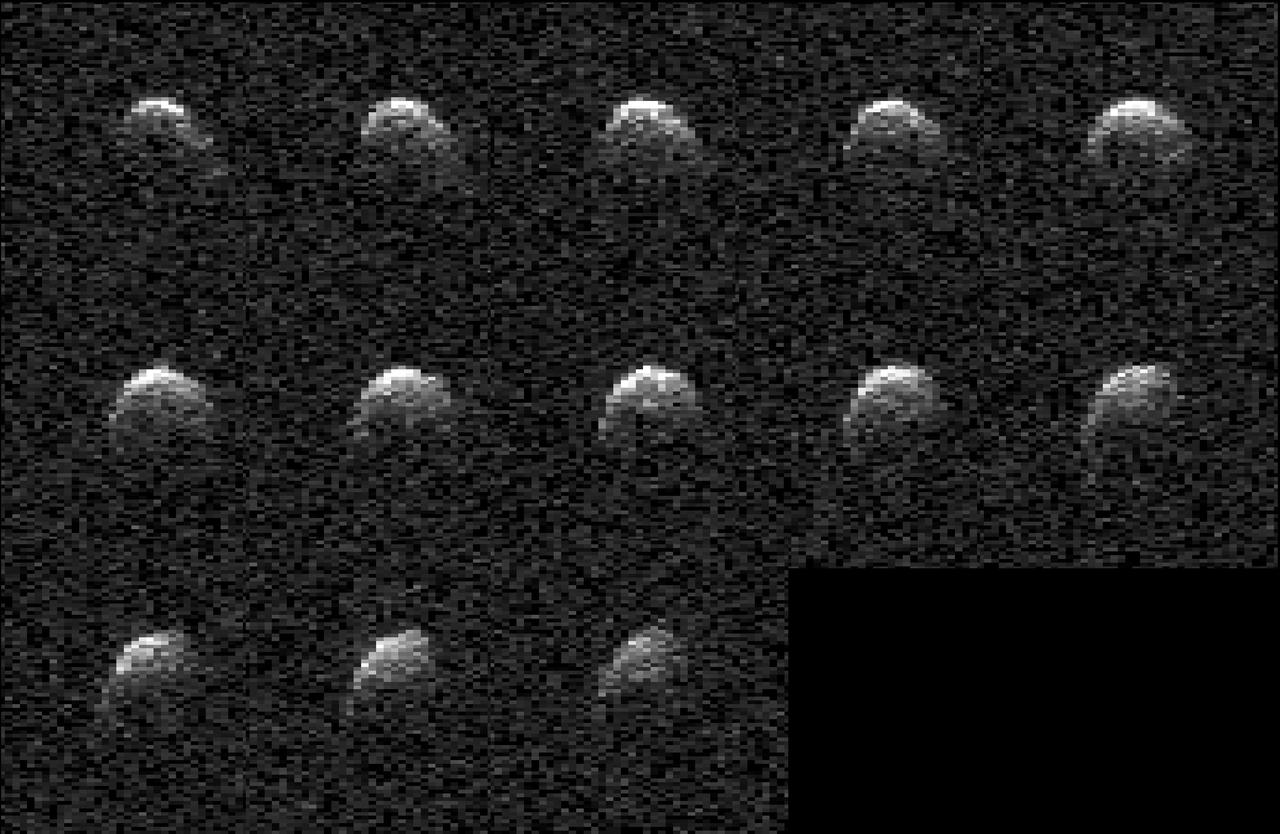
This collage represents a selection of planetary radar observations of asteroid 2008 OS7 that were made the day before its close approach with our planet on Feb. 2, 2024. The stadium-size near-Earth object passed at a distance of about 1.8 million miles (2.9 million kilometers, or 7 ½ times the distance between Earth and the Moon). Scientists at NASA's Jet Propulsion Laboratory used the powerful 230-foot (70-meter) Goldstone Solar System Radar antenna at the Deep Space Network's facility near Barstow, California, to capture these images. The observations will help scientists better understand the asteroid's size, rotation, shape, and surface details. Until this close approach, very little was known about 2008 OS7 as it has been too distant for planetary radar to image it. The asteroid was discovered on July 30, 2008, during routine search operations for NEOs by the NASA-funded Catalina Sky Survey, which is headquartered at the University of Arizona in Tucson. Observations revealed that the asteroid is comparatively slow rotating, completing one rotation every 29 ½ hours. The rotational period of 2008 OS7 was determined Petr Pravec, at the Astronomical Institute of the Czech Academy of Sciences in Ondřejov, Czech Republic, who observed the asteroid's light curve – or how the brightness of the object changes over time. As the asteroid spins, variations on its shape can change the brightness of reflected light astronomers can see, and those changes can be recorded to understand the period of the asteroid's rotation. The Goldstone observations confirm the asteroid's uncommonly slow rotation. https://photojournal.jpl.nasa.gov/catalog/PIA26149
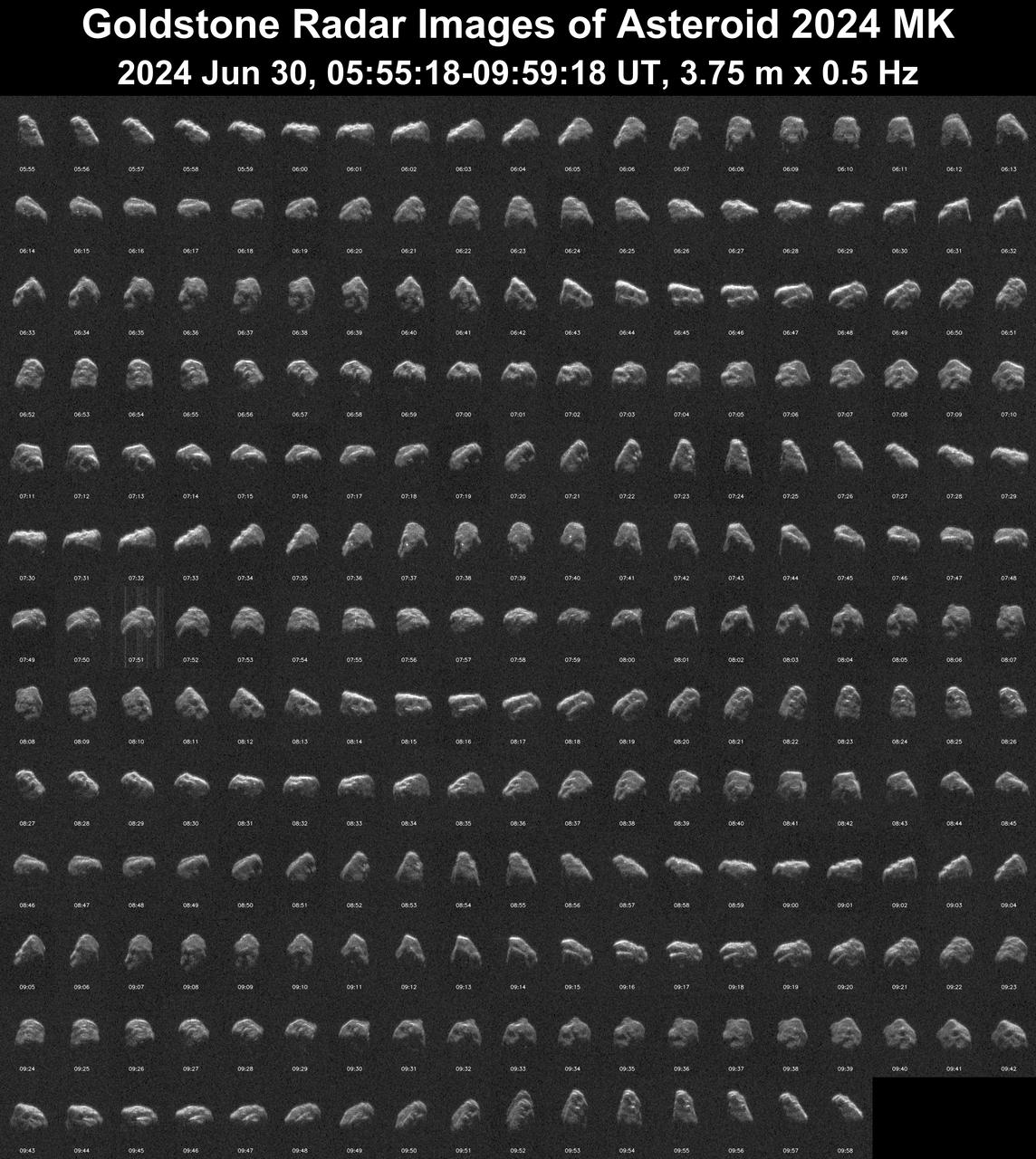
This mosaic shows NASA's radar observations in one-minute increments of asteroid 2024 MK, a 500-foot-wide (150-meter-wide) near-Earth object, made June 30, 2024, a day after it passed our planet from a distance of only 184,00 miles (295,000 kilometers). The Deep Space Network's 230-foot (70-meter) Goldstone Solar System Radar, called Deep Space Station 14 (or DSS-14), was used to transmit radio frequency signals to the asteroid, and the 114-foot (34-meter) DSS-13 received the reflected signals. The result of this "bistatic" radar observation is a detailed image of the asteroid's surface, revealing concavities, ridges, and boulders about 30 feet (10 meters) wide. The observations were made just before 5:55 a.m. UTC June 30 (10:55 p.m. PDT June 29). The asteroid's close approach occurred at 13:49 UTC June 29 (6:49 a.m. PDT June 29). Close approaches of near-Earth objects the size of 2024 MK are relatively rare, occurring about every couple of decades, on average, so scientists at NASA's Jet Propulsion Laboratory in Southern California sought to gather as much data about the object as possible. The Goldstone Solar System Radar Group is supported by NASA's Near-Earth Object Observations Program within the Planetary Defense Coordination Office at the agency's headquarters in Washington. Managed by NASA's Jet Propulsion Laboratory, the Deep Space Network receives programmatic oversight from Space Communications and Navigation program office within the Space Operations Mission Directorate, also at NASA Headquarters. Animation available at https://photojournal.jpl.nasa.gov/catalog/PIA26383

Deep Space Station 13 (DSS-13) at NASA's Goldstone Deep Space Communications Complex near Barstow, California – part of the agency's Deep Space Network – is a 34-meter (112-foot) experimental antenna that has been retrofitted with an optical terminal (the boxy instrument below the center of the antenna's dish). Since November 2023, DSS-13 has been tracking the downlink laser of the Deep Space Optical Communications (DSOC) experiment that is aboard NASA's Psyche mission, which launched on Oct. 13, 2023. In a first, the antenna also synchronously received radio-frequency signals from the spacecraft as it travels through deep space on its way to investigate the metal-rich asteroid Psyche. The laser signal collected by the camera is then transmitted through optical fiber that feeds into a cryogenically cooled semiconducting nanowire single photon detector. Designed and built by JPL's Microdevices Laboratory, the detector is identical to the one used at Caltech's Palomar Observatory, in San Diego County, California, that acts as DSOC's downlink ground station. Goldstone is one of three complexes that comprise NASA's Deep Space Network, which provides radio communications for all of the agency's interplanetary spacecraft and is also utilized for radio astronomy and radar observations of the solar system and the universe. NASA's Jet Propulsion Laboratory, a division of Caltech in Pasadena, California, manages the DSN for the agency. https://photojournal.jpl.nasa.gov/catalog/PIA26148
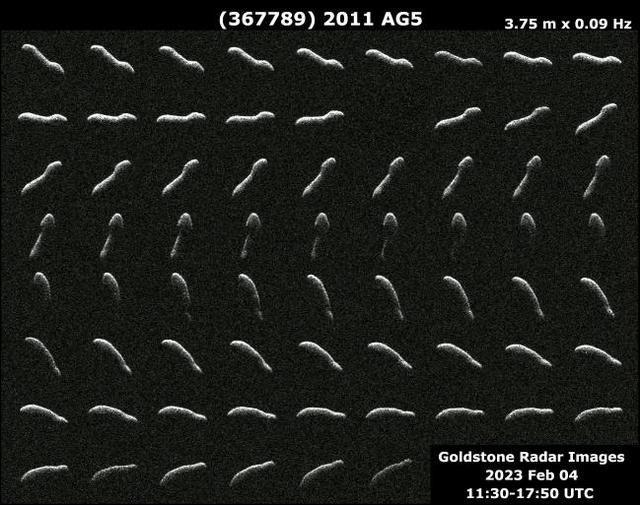
This collage represents NASA radar observations of near-Earth asteroid 2011 AG5 on Feb. 4, 2023, one day after its close approach to Earth brought it about 1.1 million miles (1.8 million kilometers, or a little under five times the distance between the Moon and Earth) from our planet. While there was no risk of 2011 AG5 impacting Earth, scientists at NASA's Jet Propulsion Laboratory in Southern California closely tracked the asteroid, making invaluable observations to help determine its size, rotation, surface details, and shape. More than three times as long as it is wide, 2011 AG5 is one of the most elongated asteroids to be observed by planetary radar to date. This close approach provided the first opportunity to take a detailed look at the asteroid since it was discovered in 2011, showing an object about 1,600 feet (500 meters) long and about 500 feet (150 meters) wide – dimensions comparable to the Empire State Building. The powerful 230-foot (70-meter) Goldstone Solar System Radar antenna dish at the Deep Space Network's facility near Barstow, California, revealed the asteroid's noteworthy dimensions. The Goldstone observations show that 2011 AG5 has a large concavity in one of its hemispheres and some subtle dark and lighter regions that may indicate small-scale surface features a few dozen meters across. If viewed by the human eye, 2011 AG5 would appear as dark as charcoal. The observations also confirmed the asteroid has a slow rotation rate, taking nine hours to fully rotate. https://photojournal.jpl.nasa.gov/catalog/PIA25259
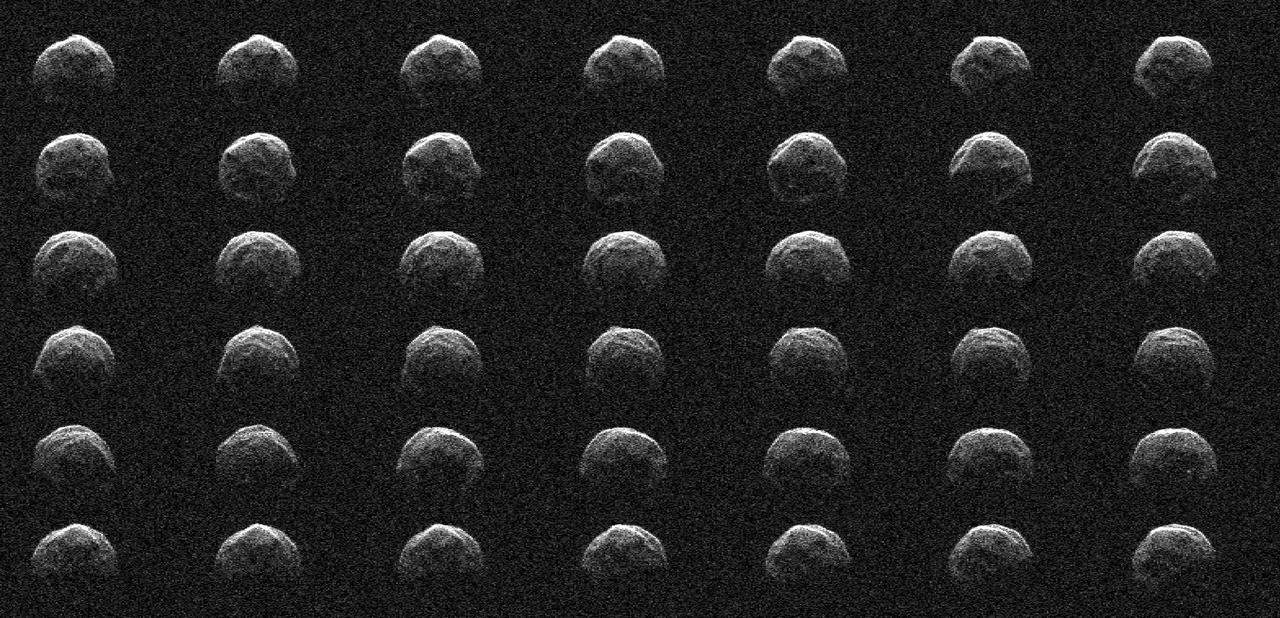
This collage represents a selection of NASA radar observations of near-Earth asteroid 2006 HV5 on April 25, 2023, less than one day before its close approach with our planet at a distance of about 1.5 million miles (2.4 million kilometers, or about 6.3 times the distance between the Moon and Earth). Asteroid 2006 HV5 was discovered by the Lincoln Near-Earth Asteroid Research (LINEAR) program in New Mexico in April 2006. The radar images show that 2006 HV5 is about 1,000 feet (300 meters) across, roughly the height of the Eiffel Tower, confirming size estimates derived from infrared observations made previously by NASA's NEOWISE mission. 2006 HV5 is classified as a potentially hazardous asteroid as its orbit brings it close to Earth, but its path around the Sun is very well known and the asteroid is not an impact risk to our planet. Asteroids of this size come this close to Earth roughly once a year, on average. The new observations were made by scientists at NASA's Jet Propulsion Laboratory using the powerful 230-foot (70-meter) Goldstone Solar System Radar antenna at the Deep Space Network's facility near Barstow, California. The images confirm the asteroid's size, while also providing a detailed look at its meatball-like shape. The asteroid has a rounded appearance, is "squished" at the poles (i.e., it is oblate), and has a rotation period of about 3.6 hours. The sequence of radar images spans slightly more than one rotation. The images, which have a resolution of about 12 feet (3.75 meters) per pixel, reveal surface features such as ridges, flat regions, concavities, and small-scale topography that might indicate boulders. https://photojournal.jpl.nasa.gov/catalog/PIA25834