
<b>To view a video of the Gradient Sun go to: <a href="http://www.flickr.com/photos/gsfc/8103212817">www.flickr.com/photos/gsfc/8103212817</a></b> Looking at a particularly beautiful image of the sun helps show how the lines between science and art can sometimes blur. But there is more to the connection between the two disciplines: science and art techniques are often quite similar, indeed one may inform the other or be improved based on lessons from the other arena. One such case is a technique known as a "gradient filter" – recognizable to many people as an option available on a photo-editing program. Gradients are, in fact, a mathematical description that highlights the places of greatest physical change in space. A gradient filter, in turn, enhances places of contrast, making them all the more obviously different, a useful tool when adjusting photos. Scientists, too, use gradient filters to enhance contrast, using them to accentuate fine structures that might otherwise be lost in the background noise. On the sun, for example, scientists wish to study a phenomenon known as coronal loops, which are giant arcs of solar material constrained to travel along that particular path by the magnetic fields in the sun's atmosphere. Observations of the loops, which can be more or less tangled and complex during different phases of the sun's 11-year activity cycle, can help researchers understand what's happening with the sun's complex magnetic fields, fields that can also power great eruptions on the sun such as solar flares or coronal mass ejections. The still here shows an unfiltered image from the sun next to one that has been processed using a gradient filter. Note how the coronal loops are sharp and defined, making them all the more easy to study. On the other hand, gradients also make great art. NASA/Goddard Space Flight Center To download this video go to: <a href="http://svs.gsfc.nasa.gov/goto?11112" rel="nofollow">svs.gsfc.nasa.gov/goto?11112</a> <b><a href="http://www.nasa.gov/audience/formedia/features/MP_Photo_Guidelines.html" rel="nofollow">NASA image use policy.</a></b> <b><a href="http://www.nasa.gov/centers/goddard/home/index.html" rel="nofollow">NASA Goddard Space Flight Center</a></b> enables NASA’s mission through four scientific endeavors: Earth Science, Heliophysics, Solar System Exploration, and Astrophysics. Goddard plays a leading role in NASA’s accomplishments by contributing compelling scientific knowledge to advance the Agency’s mission. <b>Follow us on <a href="http://twitter.com/NASA_GoddardPix" rel="nofollow">Twitter</a></b> <b>Like us on <a href="http://www.facebook.com/pages/Greenbelt-MD/NASA-Goddard/395013845897?ref=tsd" rel="nofollow">Facebook</a></b> <b>Find us on <a href="http://instagrid.me/nasagoddard/?vm=grid" rel="nofollow">Instagram</a></b>
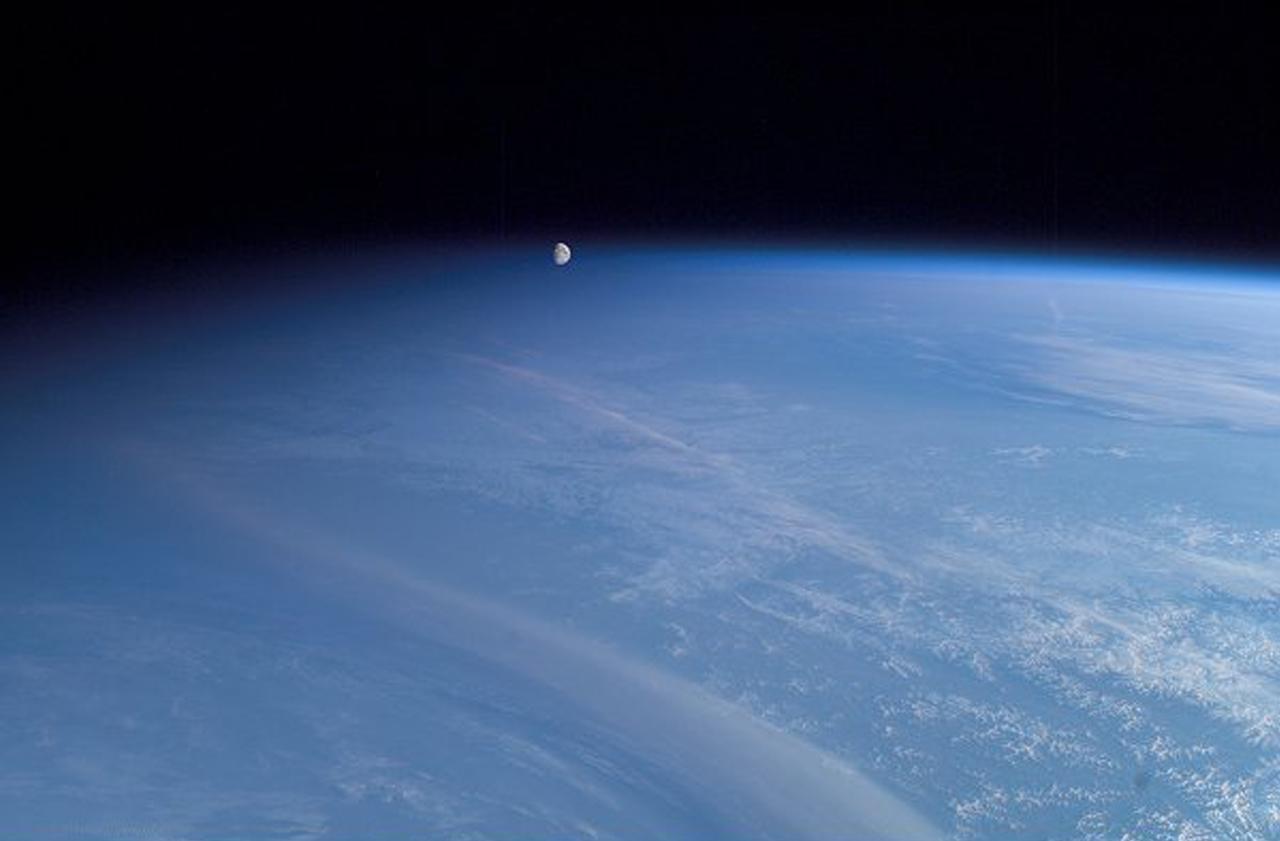
Many odd looking moon photos have been captured over the years by astronauts aboard the International Space Station. Even so, this photograph, taken by the crew over Russia on May 11, 2003, must have come as a surprise. The moon which is really a quarter of a million miles away, appears to be floating inside the Earth's atmosphere. The picture is tricky because of its uneven lighting. With the sun's elevation angle at only 6 degrees, night is falling on the left side of the image while it is still broad daylight on the right side. This gradient of sunlight is the key to the illusion.
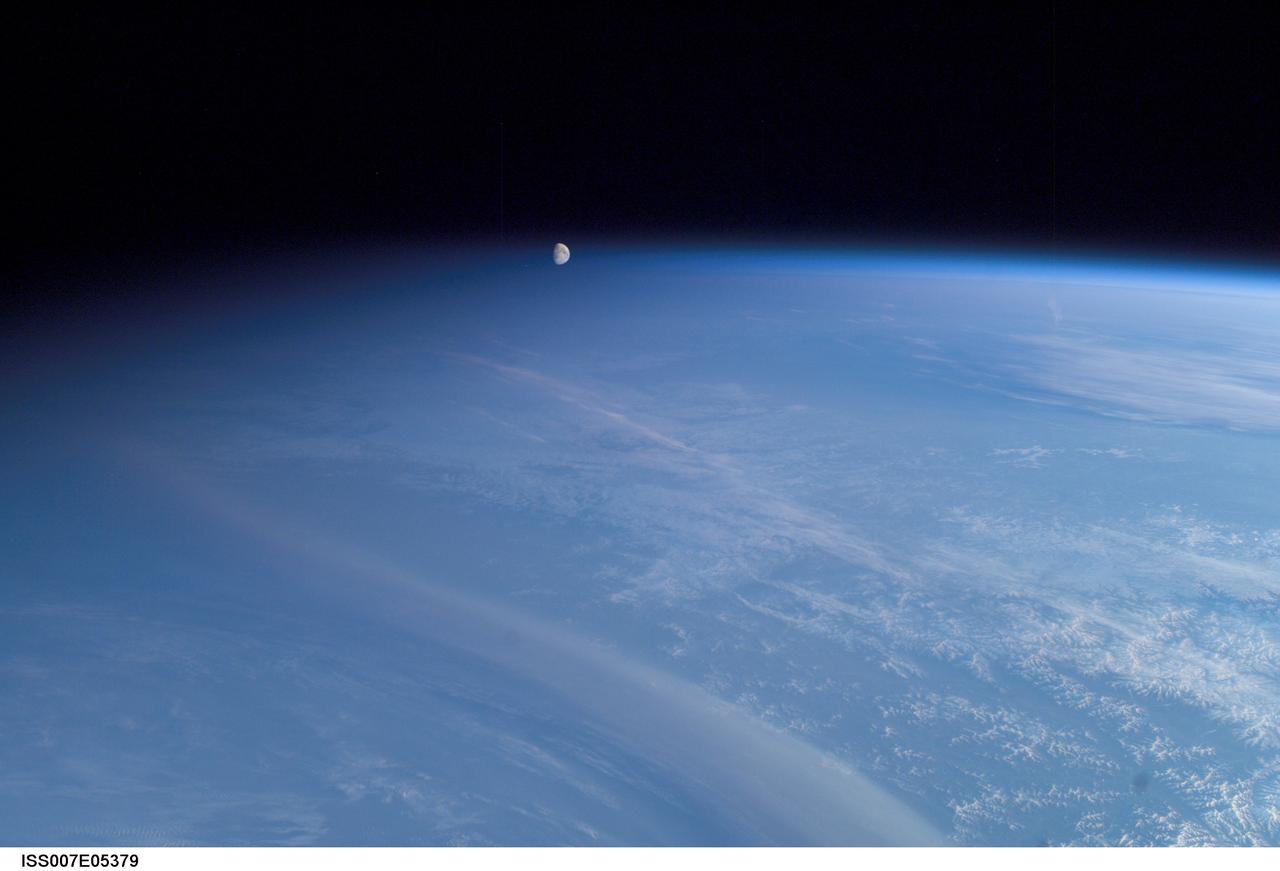
ISS007-E-05379 (11 May 2003) --- The moon seems to be floating inside Earth’s atmosphere as it was photographed by an Expedition 7 crewmember onboard the International Space Station (ISS) while above Russia. It’s an illusion, of course. The moon is really a quarter of a million miles away. The picture is tricky because of its uneven lighting. The sun’s elevation angle is only 6 degrees. On the left side of the image, night is falling; on the right side, it’s still broad daylight. This gradient of sunlight is the key to the illusion.