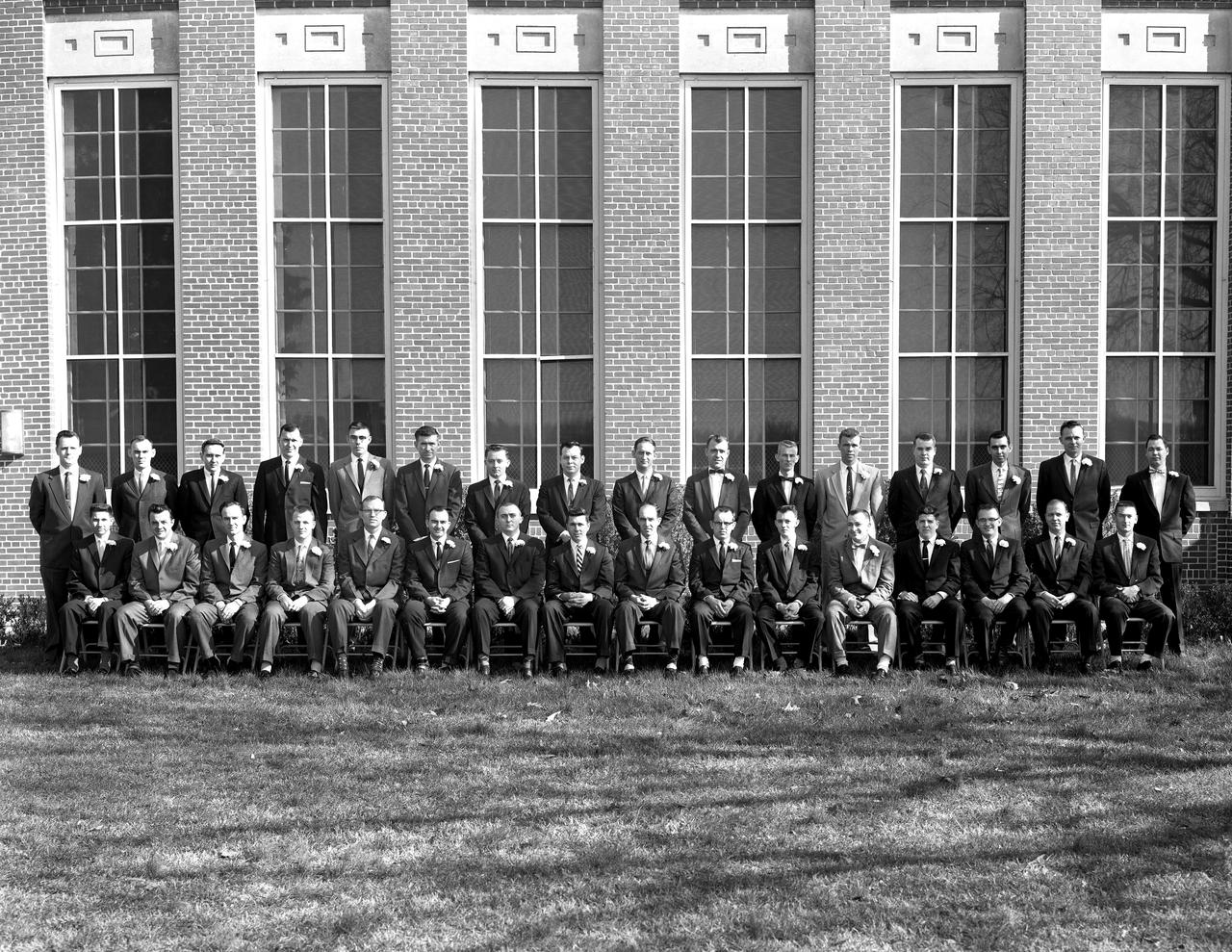
Apprentice Class Graduates: 32 Apprentice Greaduates: Ivan E. Albertson, Colossie N. Batts, Billy W. Beasley, John H. Belveal, Ernest R. Dunnigan, Durwood W. Davis, Charles E. Drummond, John R.Ellingsworth, Jr., Hugh D. Fitzgerald, Ernest A. Gurganus, Joseph R. Guy, William C. Henley,Jr., Richard N. Hill, Hiram R. Hogge, Jr., James D. Holt, James L. Hudgins, Robert F. Macklin, Roy W. Mason, Clyde J. May,Roger N. Messier, William C. Moughon, William S. Pillow, Wayne R. Posey, Mark E. Price, John W. Schwartz, Herbert F. Shackleford, John W. Simpson,John B. Slight, Cecil W. Stephens, Richard K. Stoops, John W. Sundy, Dave, E. Williams.

The 1969 class of graduating apprentices pose for a group photograph during a rehearsal ceremony at the National Aeronautics and Space Administration (NASA) Lewis Research Center. The 35 men completed four years of classroom and hands-on training in various aerospace research trades. Center Director Bruce Lundin and President of Cuyahoga Community College Dr. Bernard Silk addressed the graduates at the ceremony. The Ohio State Apprenticeship Council officially accredited them as journeymen. The journeymen specialized in one of the following fields: aerospace laboratory mechanic, aerospace service operator, experimental electronic equipment mechanic, experimental facilities electrician, experimental metal modelmaker, experimental metal worker, research equipment mechanic, research instrumentation mechanic, or utilities mechanic.
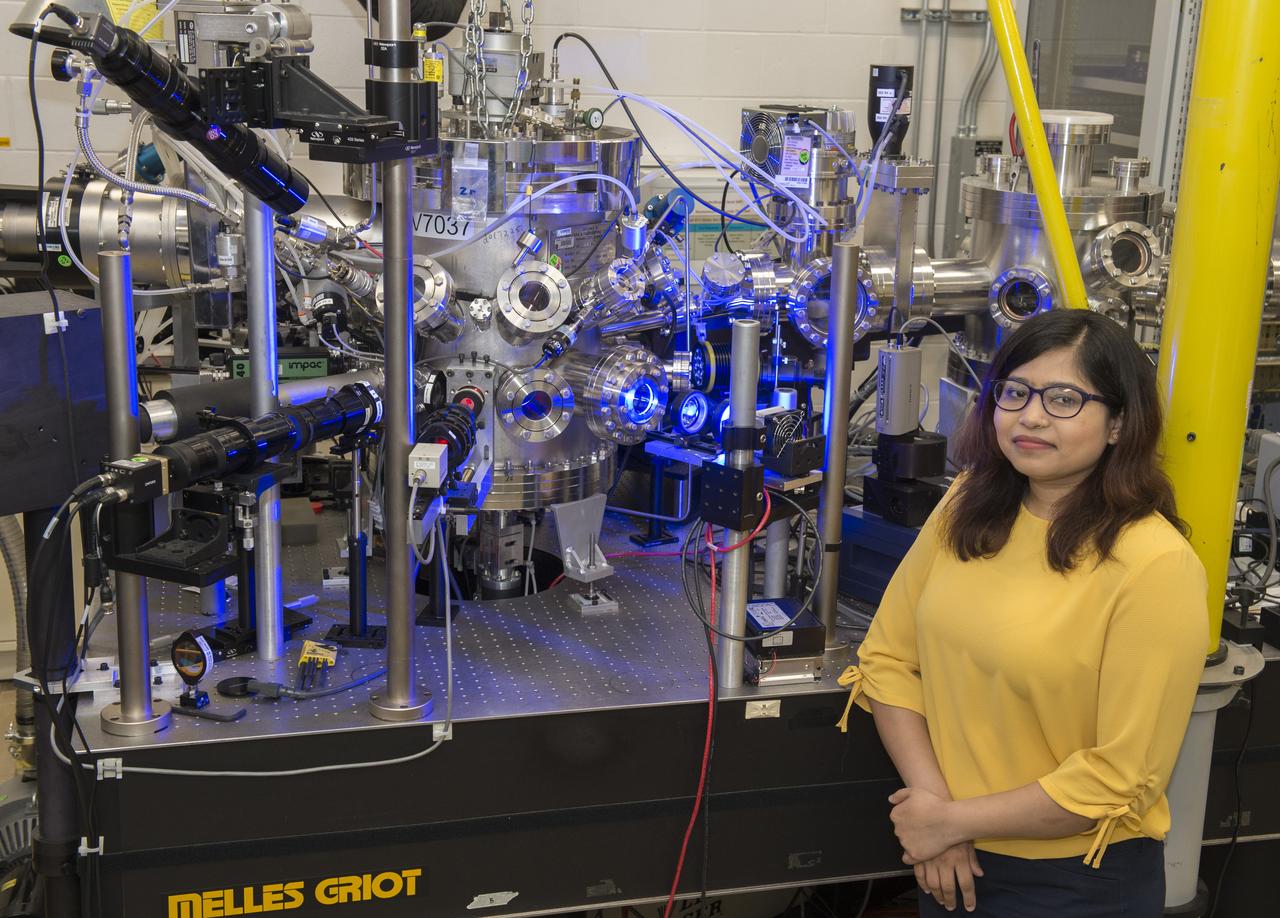
Jannatun Nawer (graduate student from Tufts University) visited the MSFC electrostatic levitation (ESL) laboratory is support of Dr. Douglas Matson’s (Tufts University) grant, “Round Robin - Thermophysical Property Measurement†(NNX17AH41G). Ms. Nawer is researching CMSX-4 Plus, a nickel-based superalloy, in support of future experiments on the International Space Station (ISS).
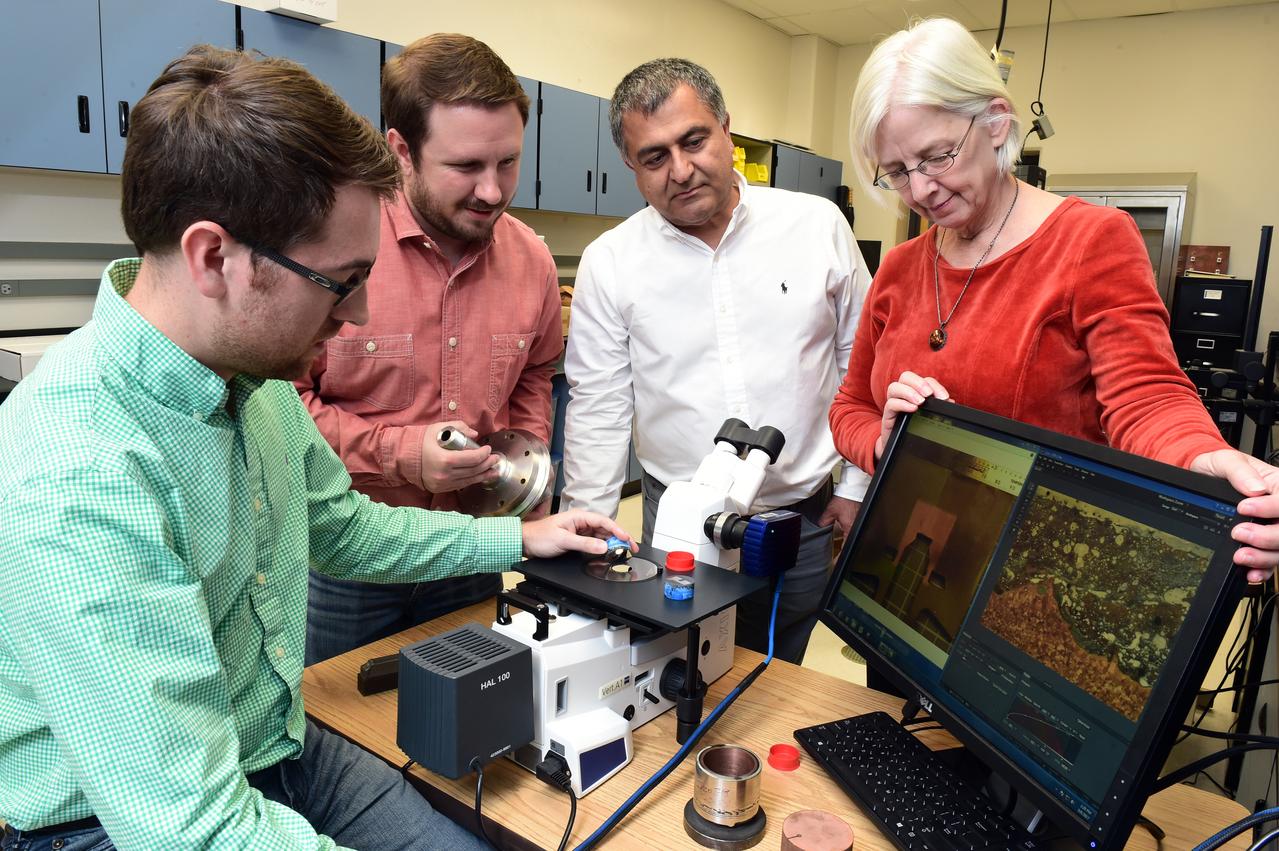
Majid Babai along with Dr. Judy Schneider, and graduate students Chris Hill and Ryan Anderson examine a cross section of the prototype rocket engine igniter created by an innovative bi-metallic 3-D printing advanced manufacturing process under a microscope.
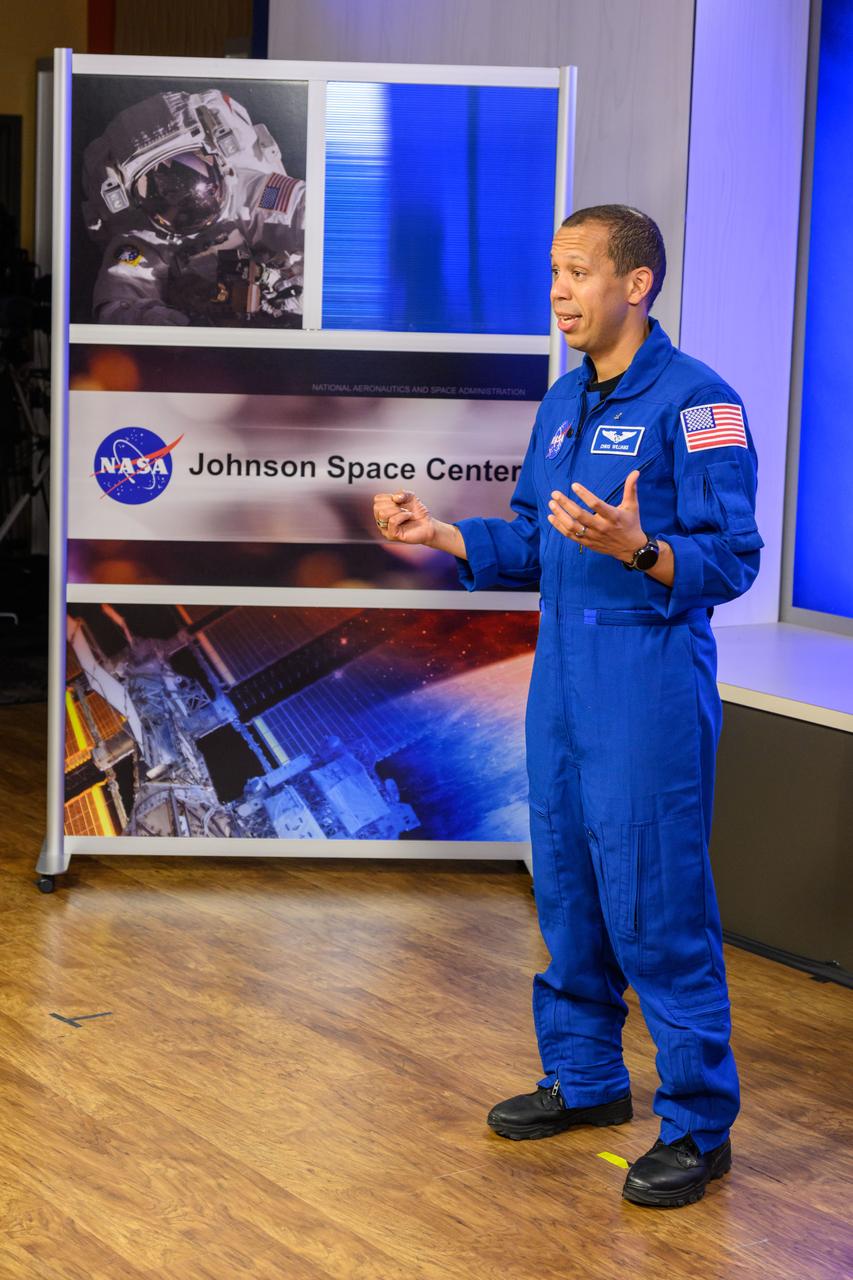
jsc2024e018416 (March 5, 2024) --- NASA astronaut Chris Williams participates in media interviews shortly after his graduation as an astronaut in Houston, Texas.
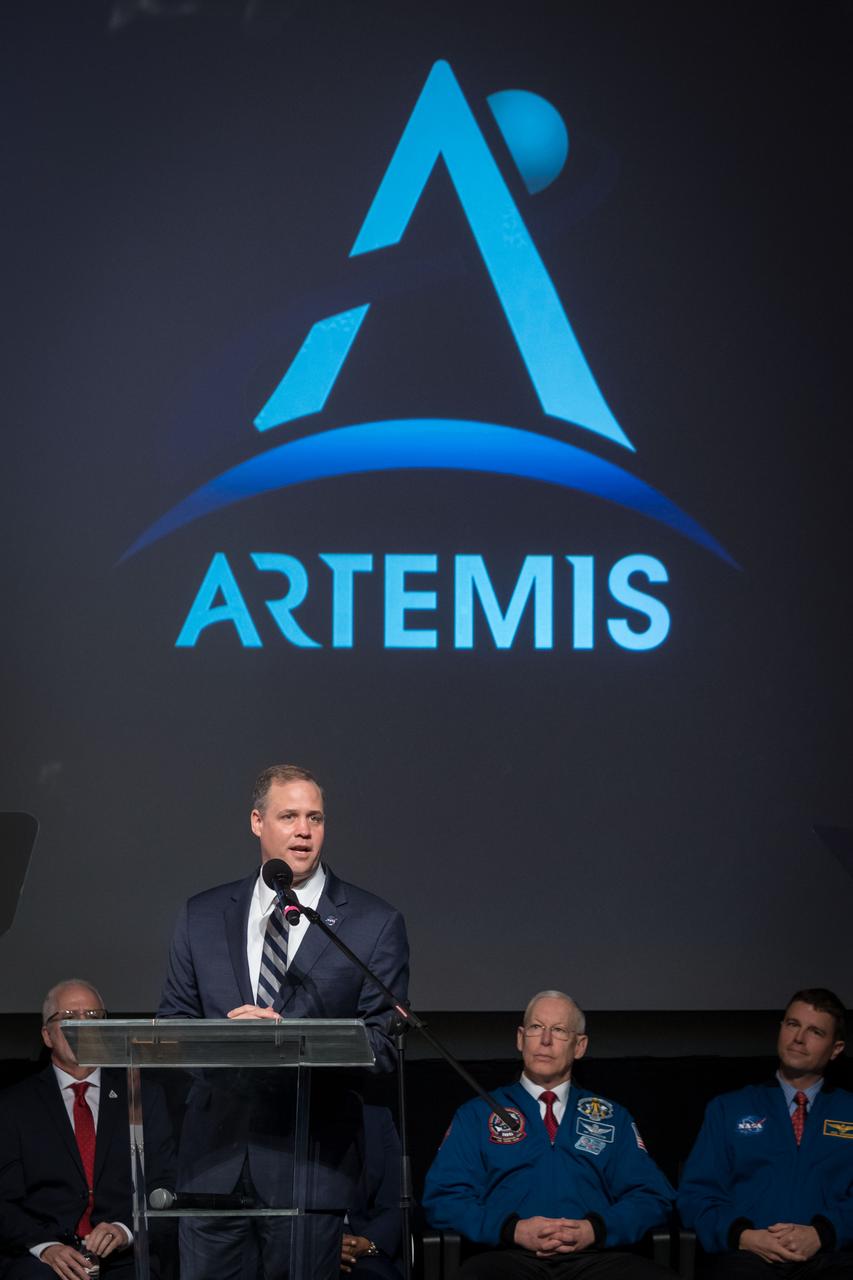
jsc2020e000604 (Jan. 10, 2020) --- NASA Administrator Jim Bridenstine addresses visitors attending the graduation of the 2017 Class of Astronauts at the Johnson Space Center in Houston, Texas. This is the first class of astronauts to graduate under the Artemis program and are now eligible for assignments to the International Space Station, Artemis missions to the Moon, and ultimately, missions to Mars.
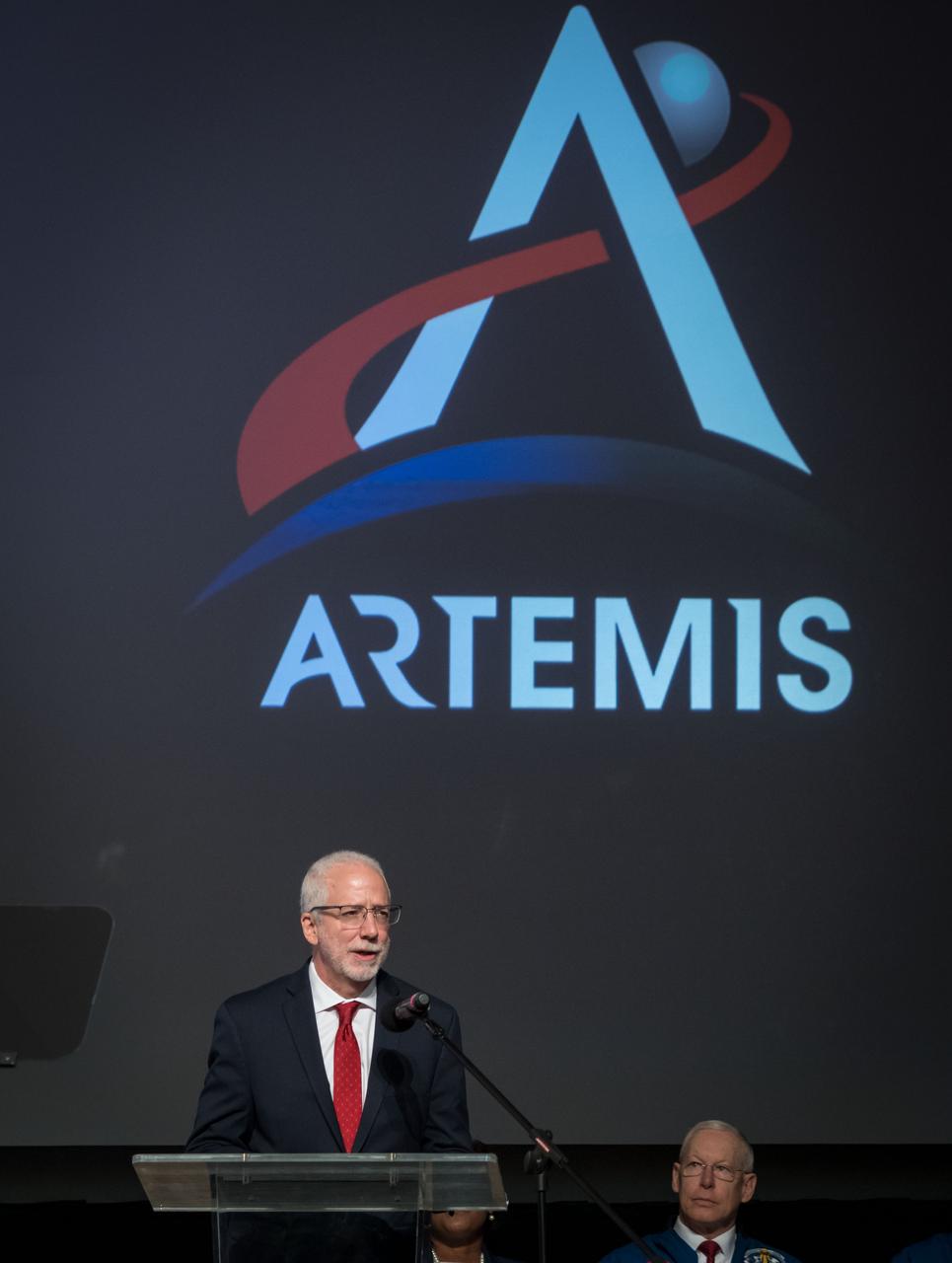
jsc2020e000600 (Jan. 10, 2020) --- Johnson Space Center Director Mark Geyer addresses visitors attending the graduation of the 2017 Class of Astronauts in Houston, Texas. This is the first class of astronauts to graduate under the Artemis program and are now eligible for assignments to the International Space Station, Artemis missions to the Moon, and ultimately, missions to Mars.

NASA Ames Foothill De Anza Student Program Graduation Ceremony
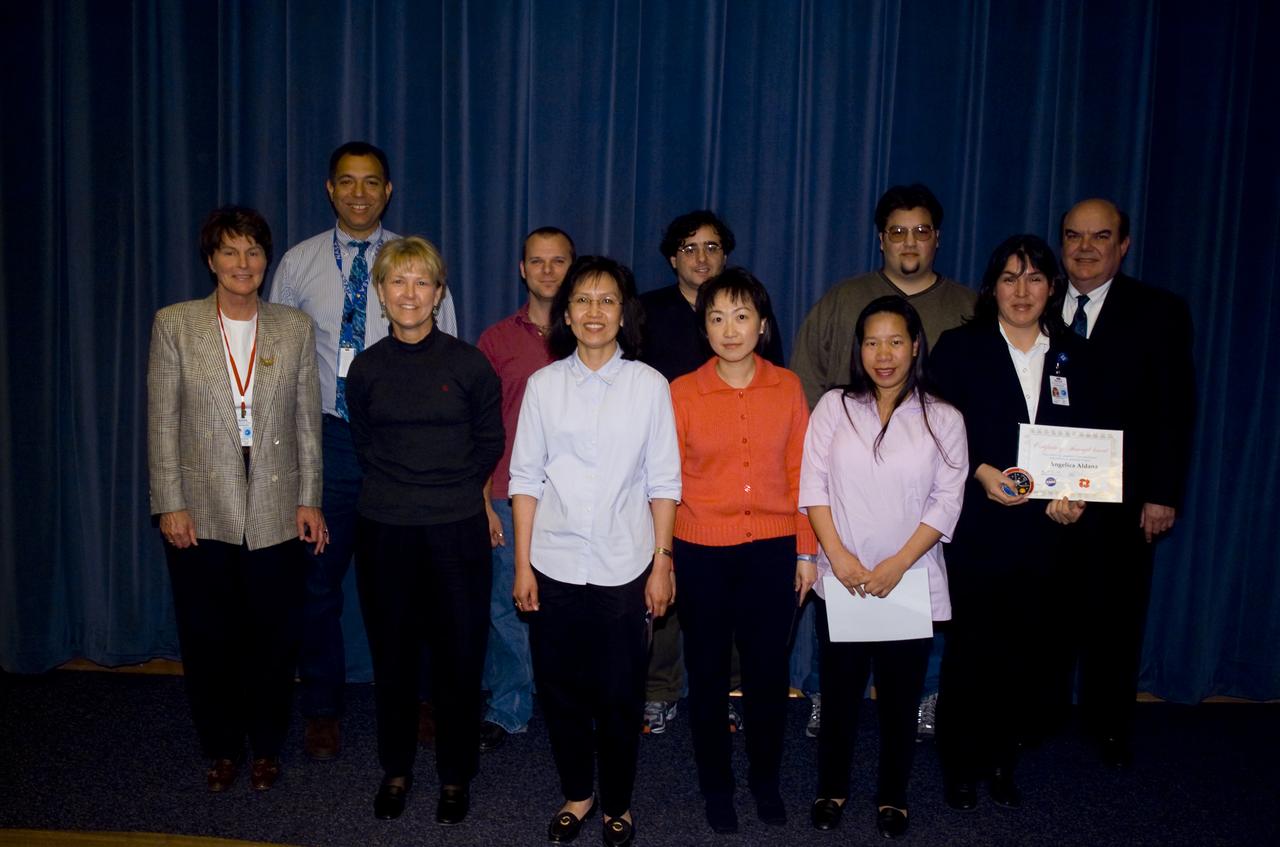
NASA Ames Foothill De Anza Student Program Graduation Ceremony
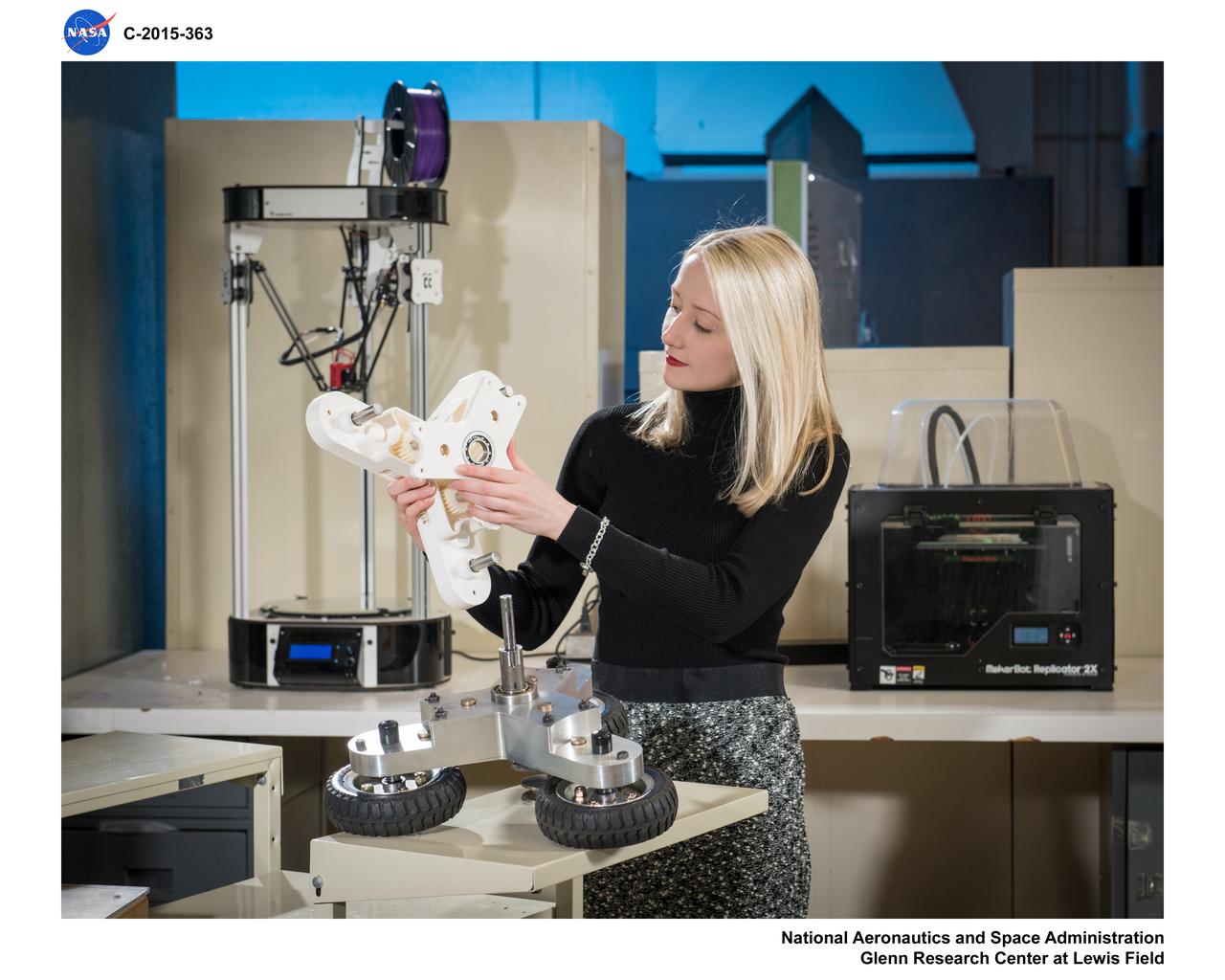
Tri Wheel Robot at i-Lab Creative and Innovation Lab at NASA GRC, Case Western Reserve University, CWRU, Masters of Science Graduate Student Partnership
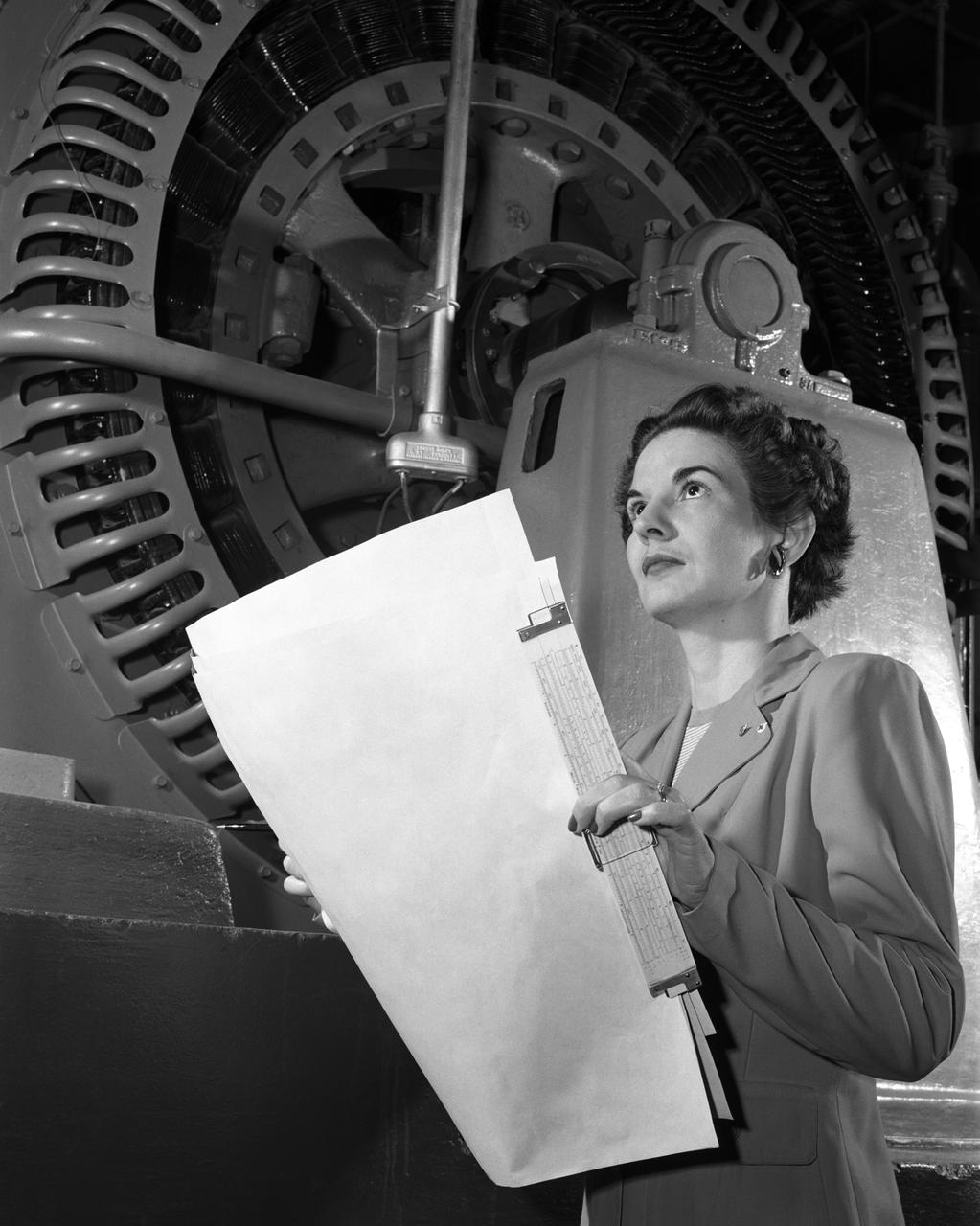
electrical engineer.NACA engineer Kitty Joyner, believed to be the first NACA female engineer, as well as the first women engineer to graduate from UVA.
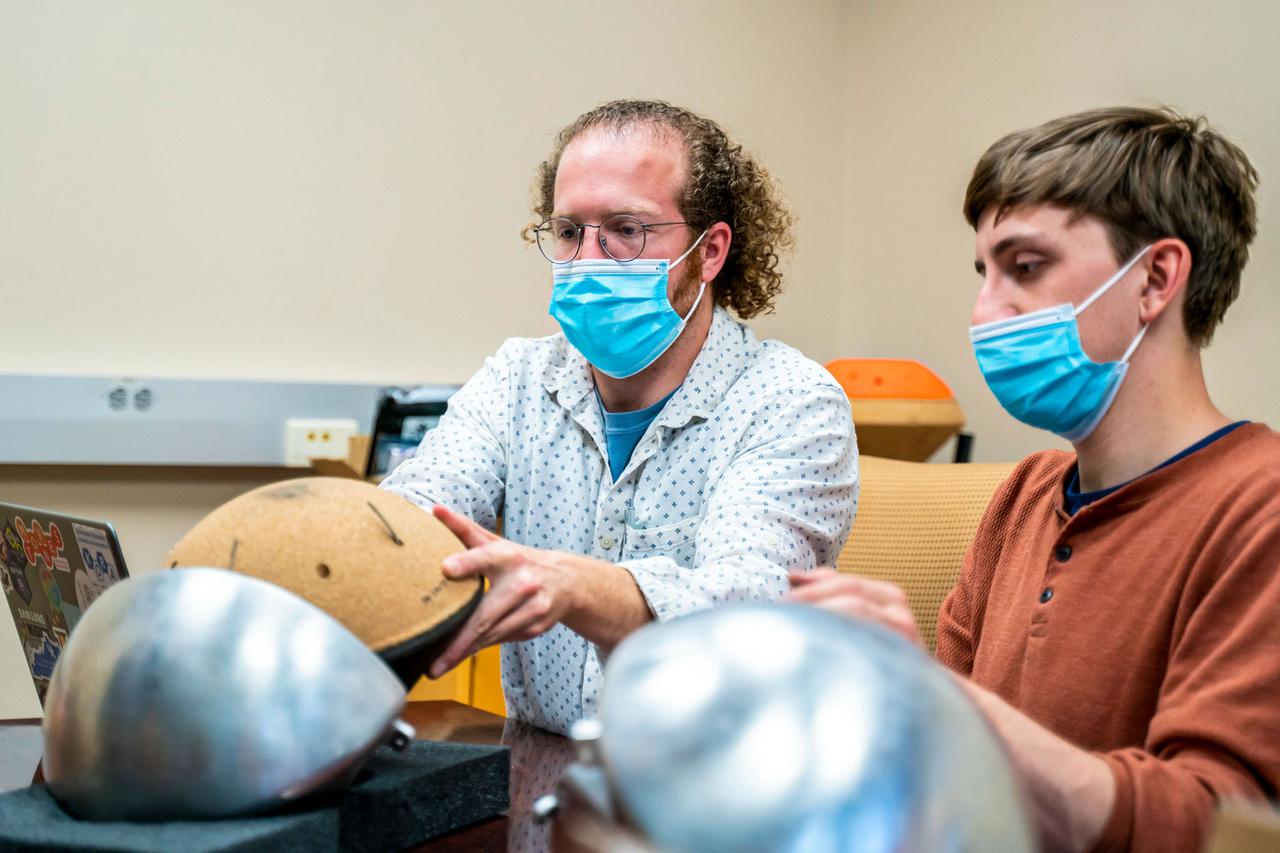
jsc2021e031159 (7/22/2021) --- John Schmidt, graduate student and mechanical engineering lead and Matthew Ruffner, graduate student and electrical engineering lead of KREPE. The Kentucky Re-Entry Probe Experiment (KREPE) demonstrates an affordable technology for re-entry experiments and provides flight data on Thermal Protection Systems (TPS) to help validate computational models. Photo courtesy of the University of Kentucky.

Stability and Control Branch Photo: Names, rows front to back, people left to right: Row 1: 1. ?? Graduate Student (USAF) 2. Robert Dunning 3. Rhonda Harvey Poppen 4. Katherine G. Johnson 5. ?? Graduate Student (USAF) 6. Vladislav Klein Row 2: 1. Mario Smith 2. Jeff Williams 3. N. Sundararajan 4. Tony Fontana 5. John Young Row 3: 1. Lawrence Taylor 2. Jim Batterson 3. Suresh Joshi 4. Daniel P. Giesy Row 4: 1. Bill Suit 2. Albert A. Schy 3. Al Hamer 4. Ernest Armstrong 5. Claude Keckler Row 5: 1. Chris Brown 2. Robert Bullock 3. Ray Montgomery 4. Jim Williams 5. Sahajendra Singh 6. Graduate Student (Egypt) Names given by Daniel P. Giesy.
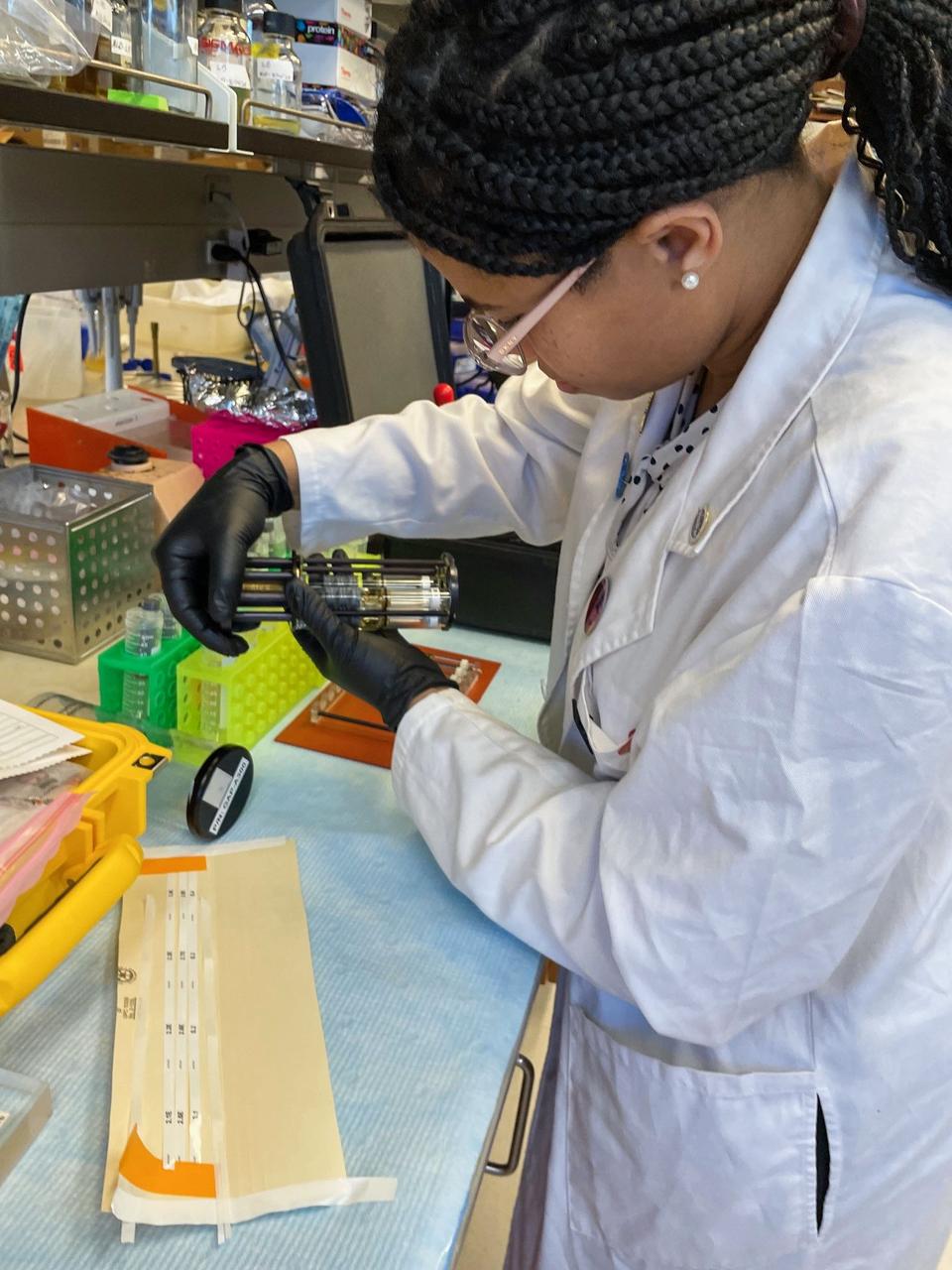
jsc2025e007254 (2/14/2025) --- Graduate student Lanie Briggs loads a Group Activation Pack (GAP) for the Polaris Bioremediation Science Experiment - Genetic Exchange in Microgravity for Biofilm Bioremediation (GEM-B2).
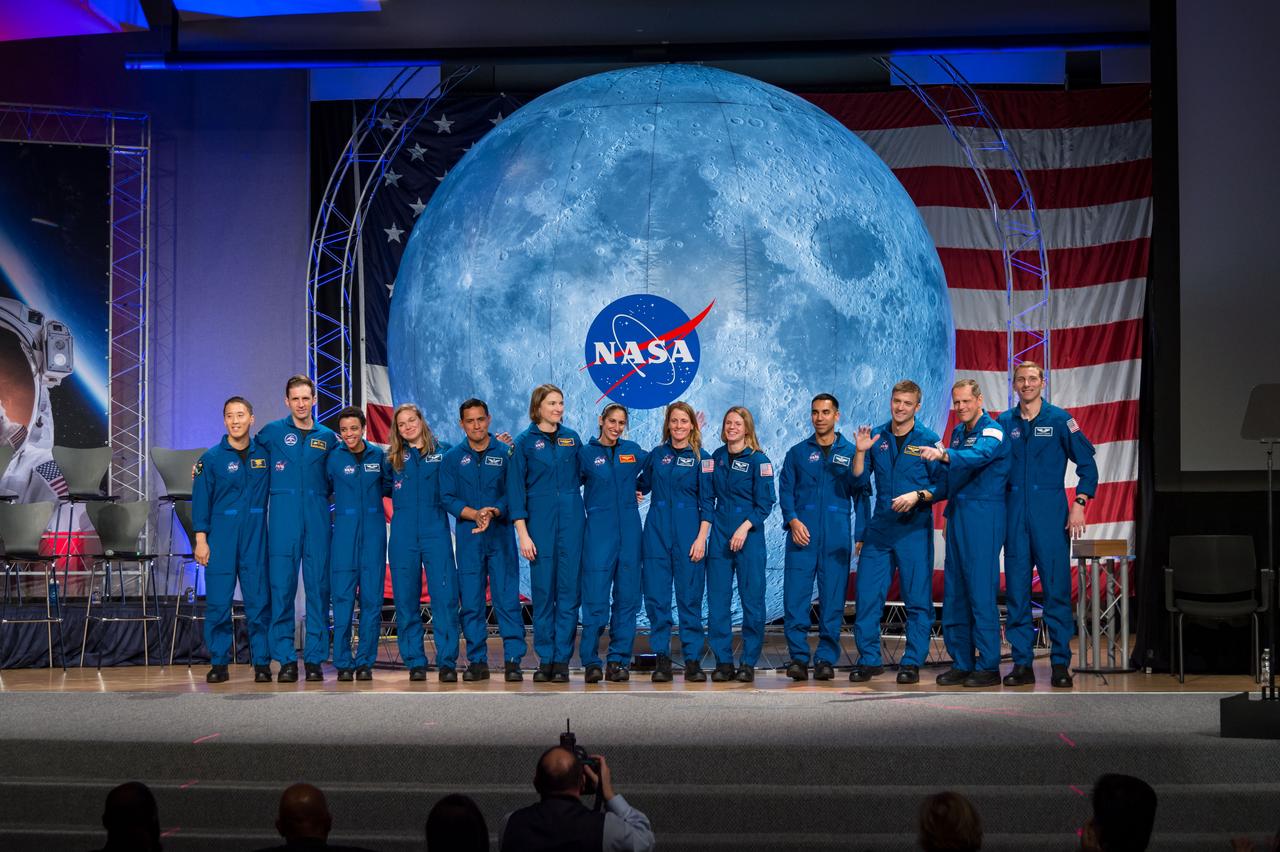
jsc2020e000649 (Jan. 10, 2020) --- The 2017 Class of Astronauts participate in graduation ceremonies at the Johnson Space Center in Houston, Texas. From left are, NASA astronaut Jonny Kim, Canadian Space Agency (CSA) astronaut Joshua Kutryk, NASA astronaut Jessica Watkins, CSA astronaut Jennifer Sidey-Gibbon, NASA astronauts Kayla Barron, Jasmin Moghbeli, Loral O'Hara, Zena Cardman, Raja Chari, Matthew Dominick, Bob Hines and Warren Hoburg. This is the first class of astronauts to graduate under the Artemis program and are now eligible for assignments to the International Space Station, Artemis missions to the Moon, and ultimately, missions to Mars.
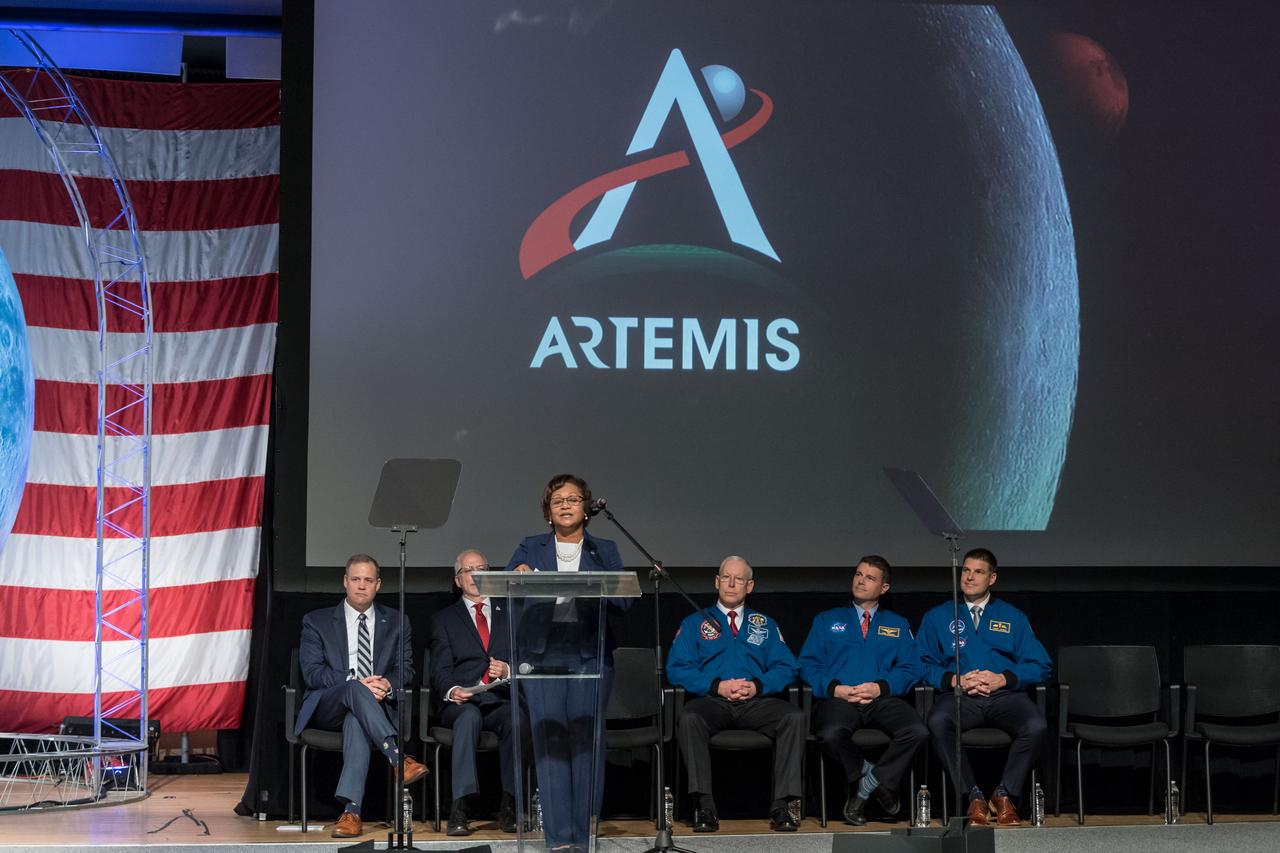
jsc2020e000599 (Jan. 10, 2020) --- Johnson Space Center Deputy Director Vanessa Wyche addresses visitors attending the graduation of the 2017 Class of Astronauts at the Johnson Space Center in Houston, Texas. In the back row (from left) are NASA Administrator Jim Bridenstine, Johnson Space Center Director Mark Geyer, Chief of the Astronuat Office Patrick Forrester, NASA astronaut Reid Wiseman and Canadian Space Agency (CSA) astronaut Jeremy Hansen. This is the first class of astronauts to graduate under the Artemis program and are now eligible for assignments to the International Space Station, Artemis missions to the Moon, and ultimately, missions to Mars.
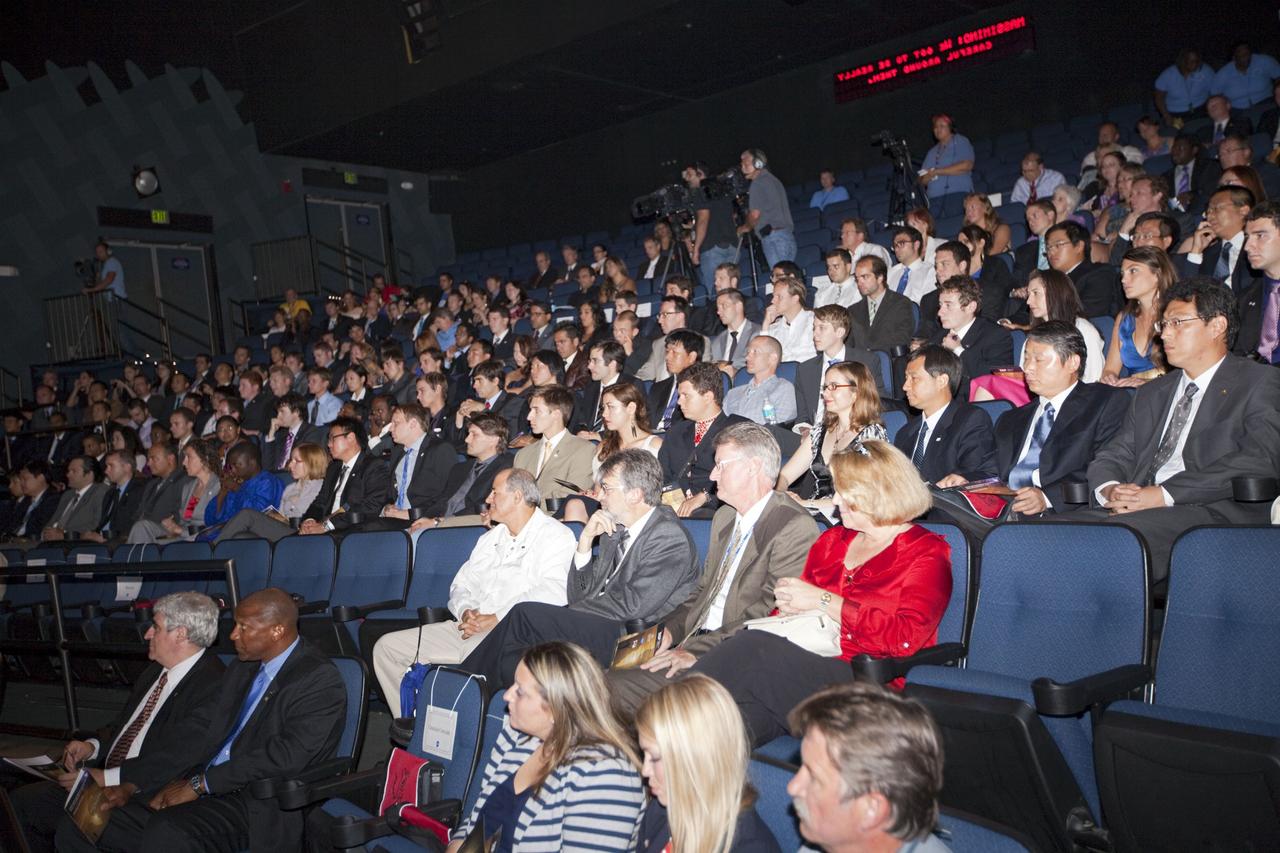
CAPE CANAVERAL, Fla. – Graduates and guests gather for the closing ceremonies for the International Space University at the Kennedy Space center Visitor Complex on Aug. 3, 2012. The International Space University is a nine-week intensive course designed for post-graduate university students and professionals during the summer. The program is hosted by a different country each year, providing a unique educational experience for participants from around the world. NASA Kennedy Space Center and the Florida Institute of Technology co-hosted this year's event which ran from June 4 to Aug. 3. There were about 125 participants representing 31 countries. For more information, visit http://www.isunet.edu Photo credit: NASA/Kim Shiflett
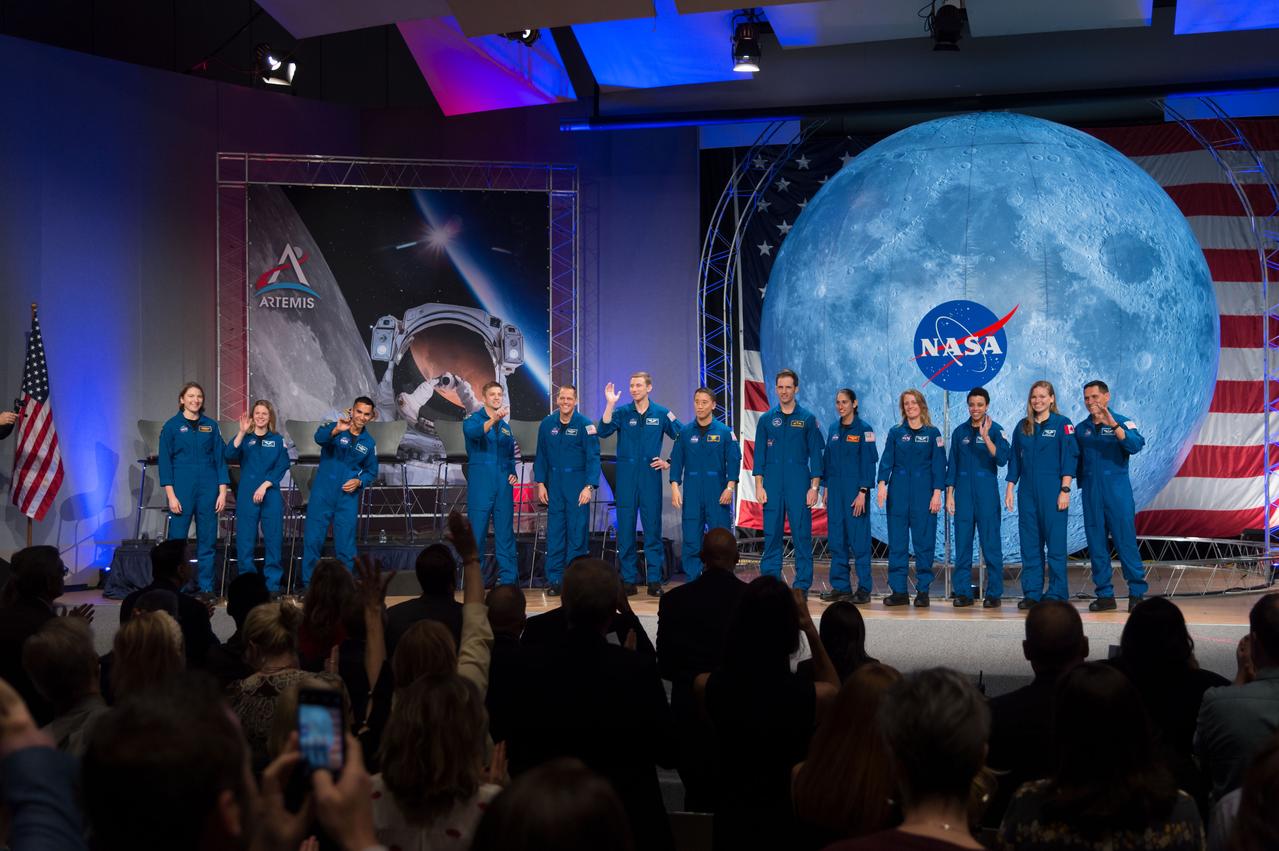
jsc2020e000607 (Jan. 10, 2020) --- The 2017 Class of Astronauts participate in graduation ceremonies at the Johnson Space Center in Houston, Texas. From left are, NASA astronauts Kayla Barron, Zena Cardman, Raja Chari, Matthew Dominick, Bob Hines, Warren Hoburg, Jonny Kim, Canadian Space Agency (CSA) astronaut Joshua Kutryk, NASA astronauts Jasmin Moghbeli, Loral O'Hara and Jessica Watkins, CSA astronaut Jennifer Sidey-Gibbon and NASA astronaut Frank Rubio. This is the first class of astronauts to graduate under the Artemis program and are now eligible for assignments to the International Space Station, Artemis missions to the Moon, and ultimately, missions to Mars.

Howard University graduate student LaRay Hare discusses his CubeRover project in the Laser Spectroscopy Laboratory with NASA astronaut Jessica Watkins, Friday, March 31, 2023, at Howard University in Washington. Photo Credit: (NASA/Aubrey Gemignani)
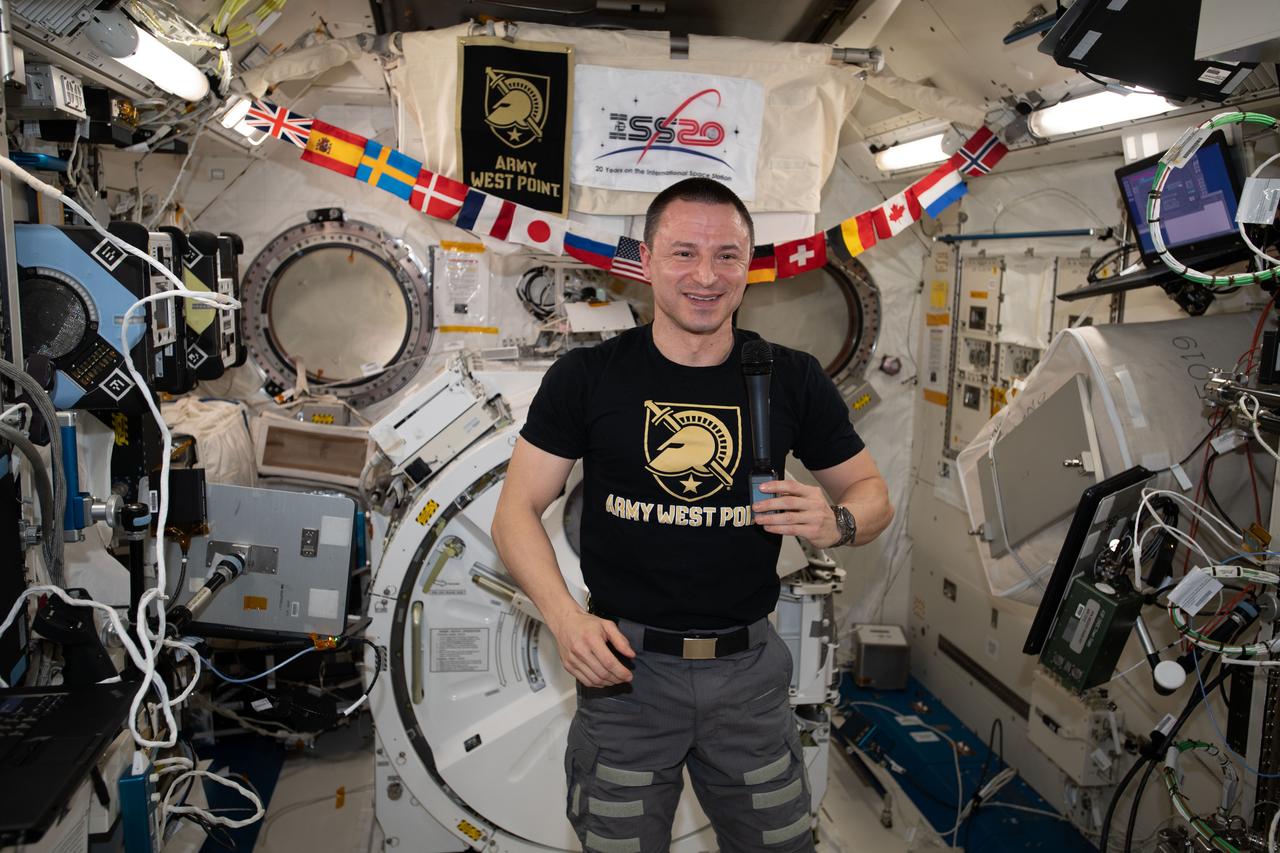
iss062e112559 (March 24, 2020) --- NASA astronaut and Expedition 62 Flight Engineer Andrew Morgan, a graduate of the U.S. Military Academy in West Point, New York, and the Uniformed Services University of the Health Sciences in Bethesda, Maryland, is pictured inside the Kibo laboratory module talking to personnel on the ground.
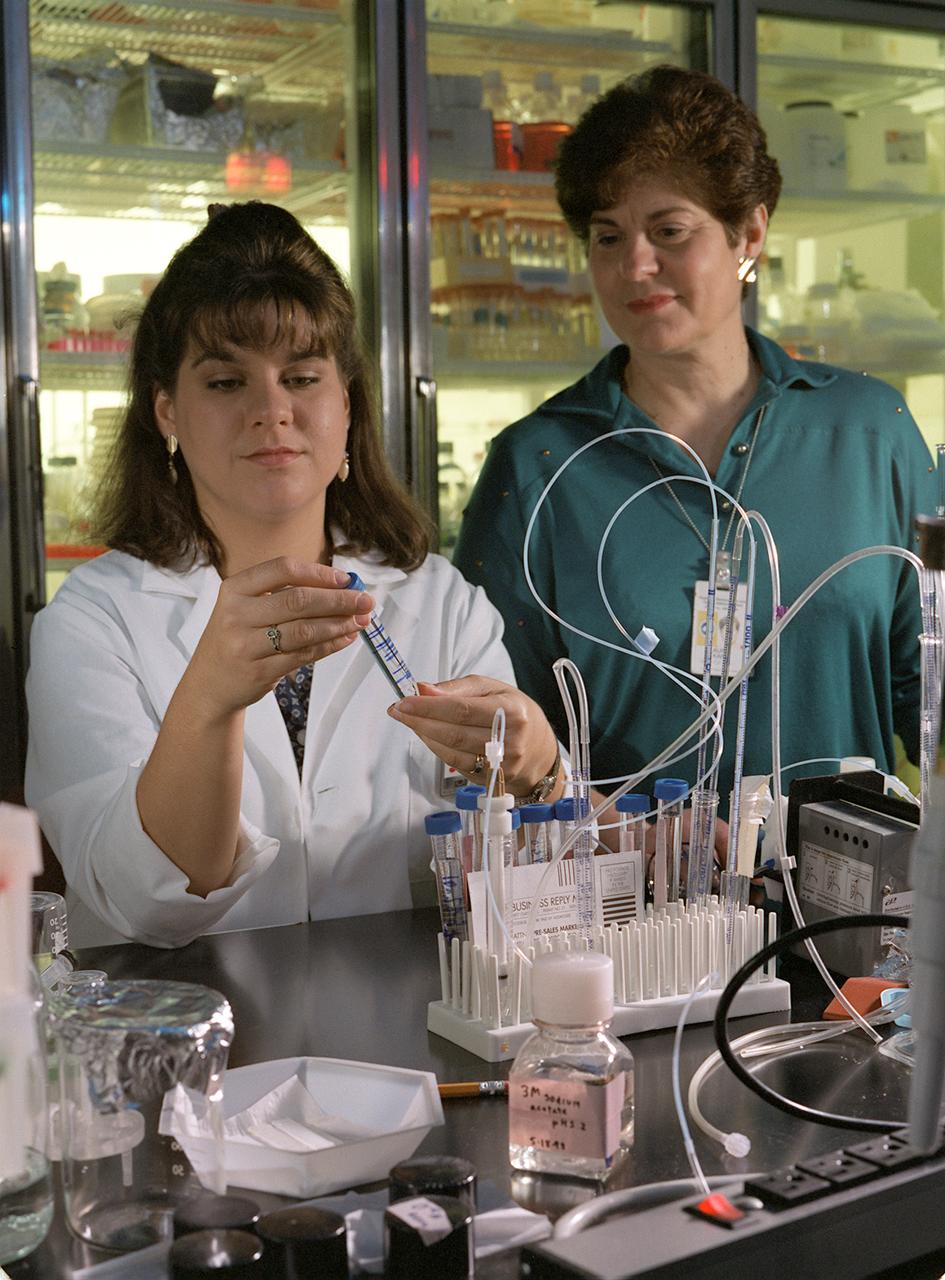
Lisa Crawford, a graduate research assistant from the University of Toledo, works with Laurel Karr of Marshall Space Flight Center (MSFC) in the molecular biology laboratory. They are donducting genetic manipulation of bacteria and yeast for the production of large amount of desired protein. Photo credit: NASA/Marshall Space Flight Center (MSFC)
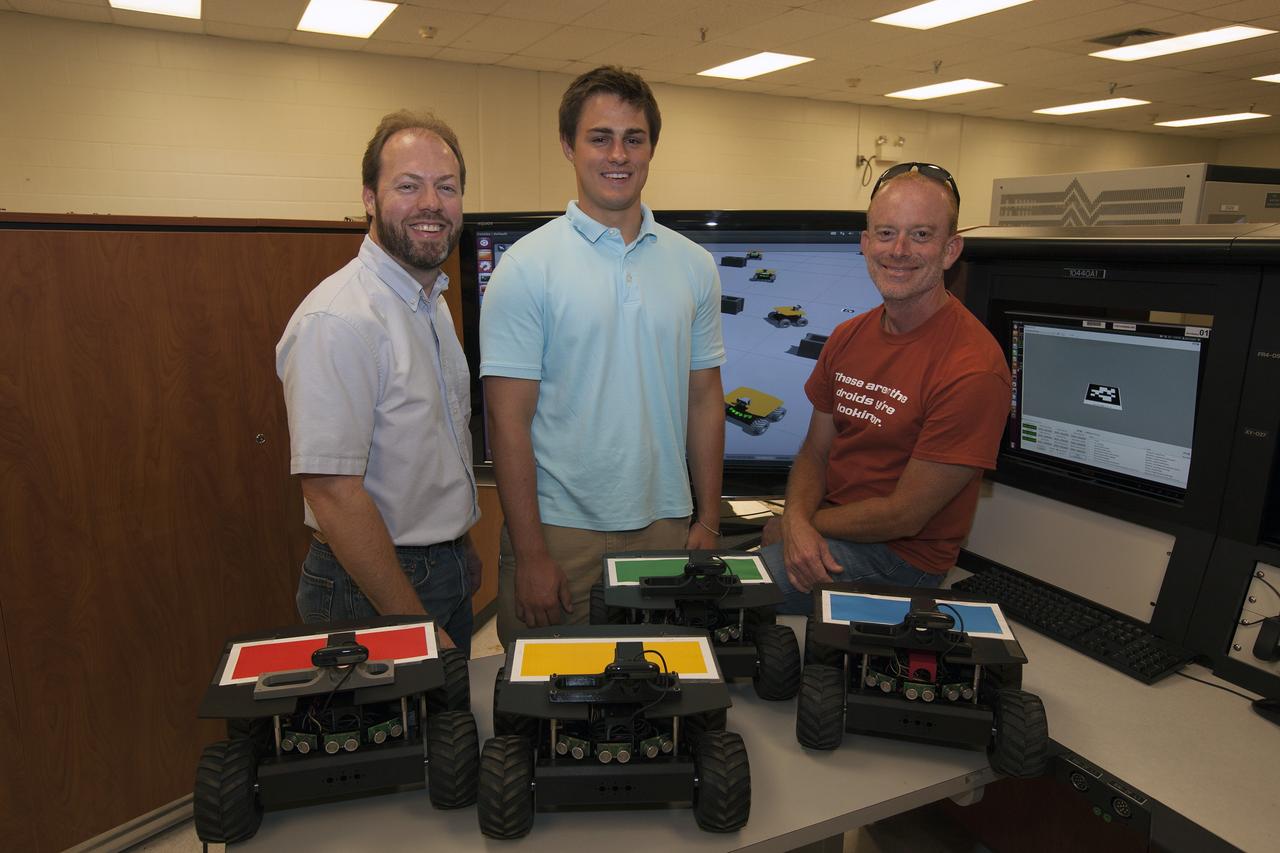
CAPE CANAVERAL, Fla. – NASA's Kurt Leucht, from left, is working with undergraduate intern Gil Montague and post-graduate intern Karl Stolleis to develop the software that will control independent robots in a way that mimics the process ants use to scout for and then collect resources. Photo credit: NASA/Dmitri Gerondidakis
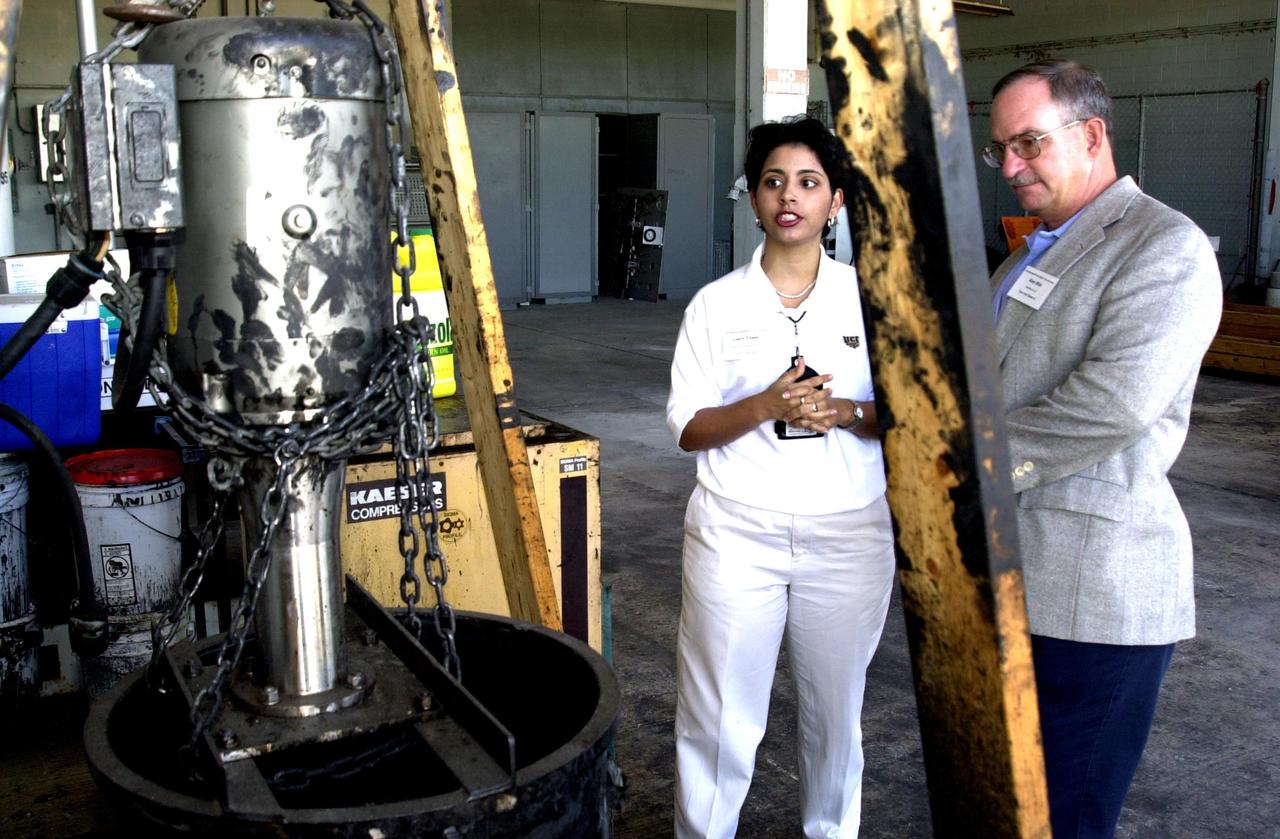
KENNEDY SPACE CENTER, FLA. -- New methods of environmental cleanup are explained during a presentation to government and business representatives, scientists and engineers at Launch Complex 34-A, Cape Canaveral Spaceport. At left is Laura Filipek, a University of Central Florida graduate chemistry student involved in the science.

Howard University graduate student LaRay Hare discusses his CubeRover project in the Laser Spectroscopy Laboratory with NASA astronaut Jessica Watkins, Friday, March 31, 2023, at Howard University in Washington. Photo Credit: (NASA/Aubrey Gemignani)
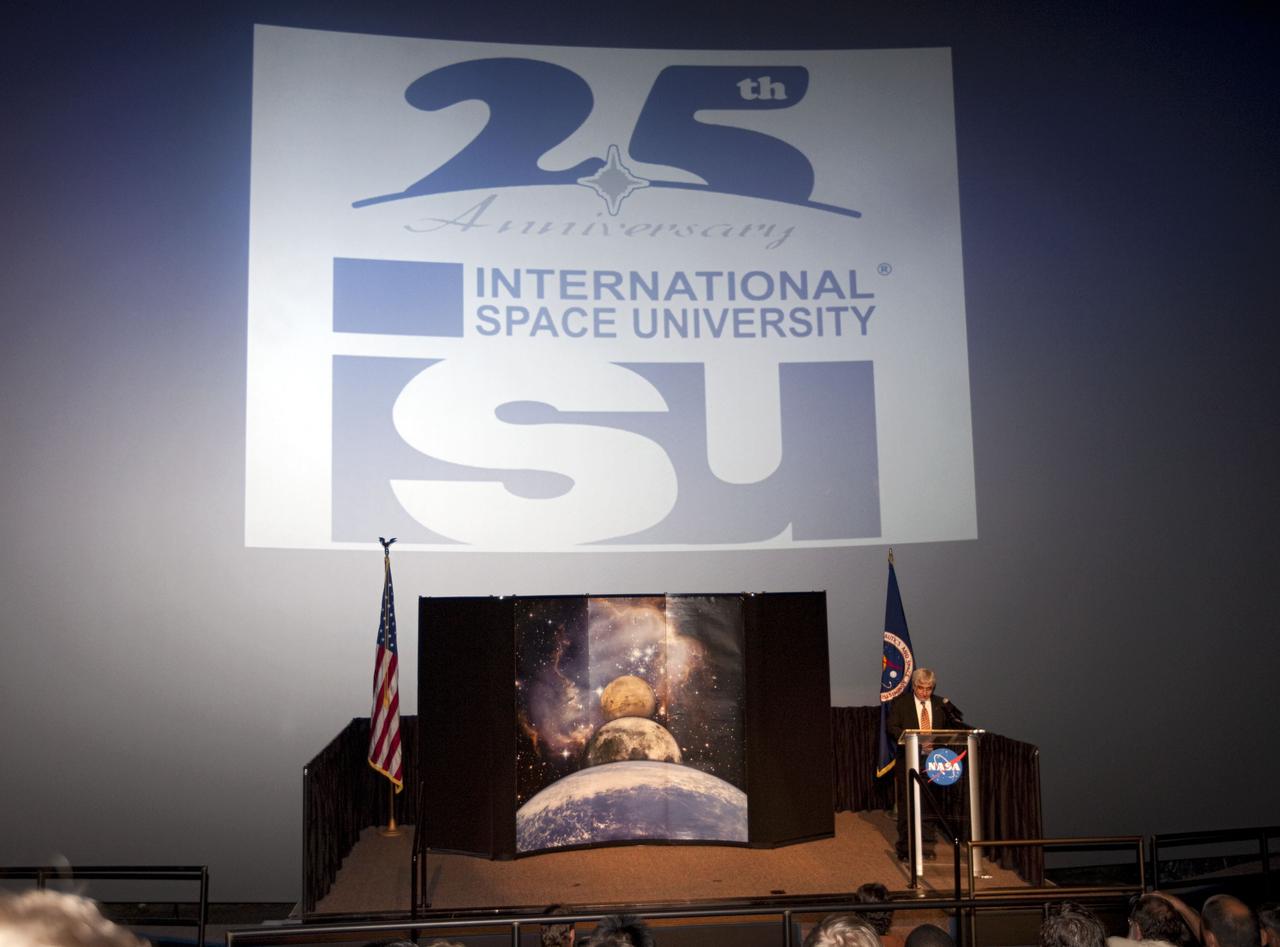
CAPE CANAVERAL, Fla. – Gary Martin, 2012 director of Space Studies Program for the International Space University, or ISU, welcomes graduates and guest gather for the closing ceremonies for the ISU at the Kennedy Space center Visitor Complex on Aug. 3, 2012. The International Space University is a nine-week intensive course designed for post-graduate university students and professionals during the summer. The program is hosted by a different country each year, providing a unique educational experience for participants from around the world. NASA Kennedy Space Center and the Florida Institute of Technology co-hosted this year's event which ran from June 4 to Aug. 3. There were about 125 participants representing 31 countries. For more information, visit http://www.isunet.edu Photo credit: NASA/Kim Shiflett
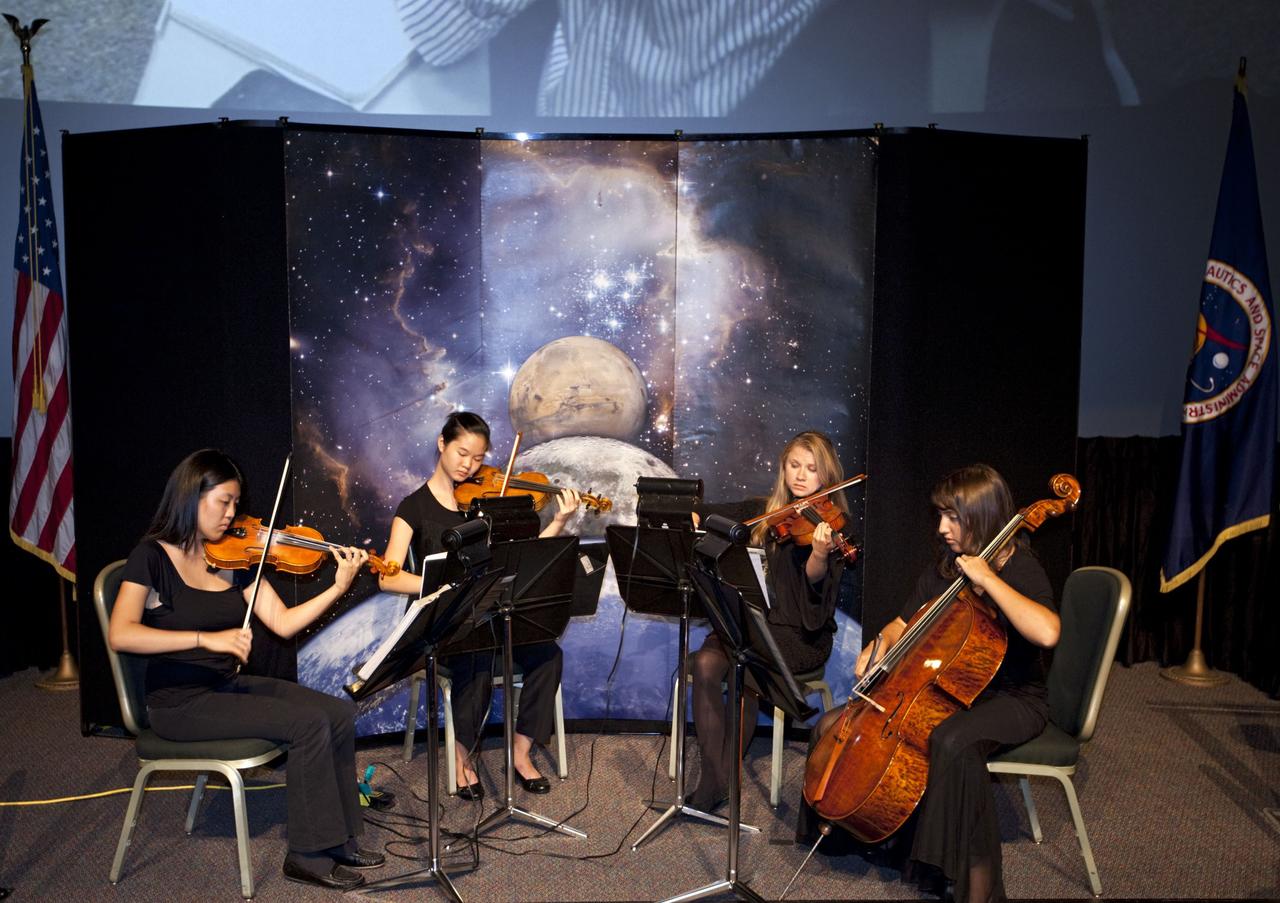
CAPE CANAVERAL, Fla. – A string quartet from the Brevard Symphony Orchestra performed for graduates and guests at the closing ceremonies for the International Space University at the Kennedy Space center Visitor Complex on Aug. 3, 2012. The International Space University is a nine-week intensive course designed for post-graduate university students and professionals during the summer. The program is hosted by a different country each year, providing a unique educational experience for participants from around the world. NASA Kennedy Space Center and the Florida Institute of Technology co-hosted this year's event which ran from June 4 to Aug. 3. There were about 125 participants representing 31 countries. For more information, visit http://www.isunet.edu Photo credit: NASA/Kim Shiflett
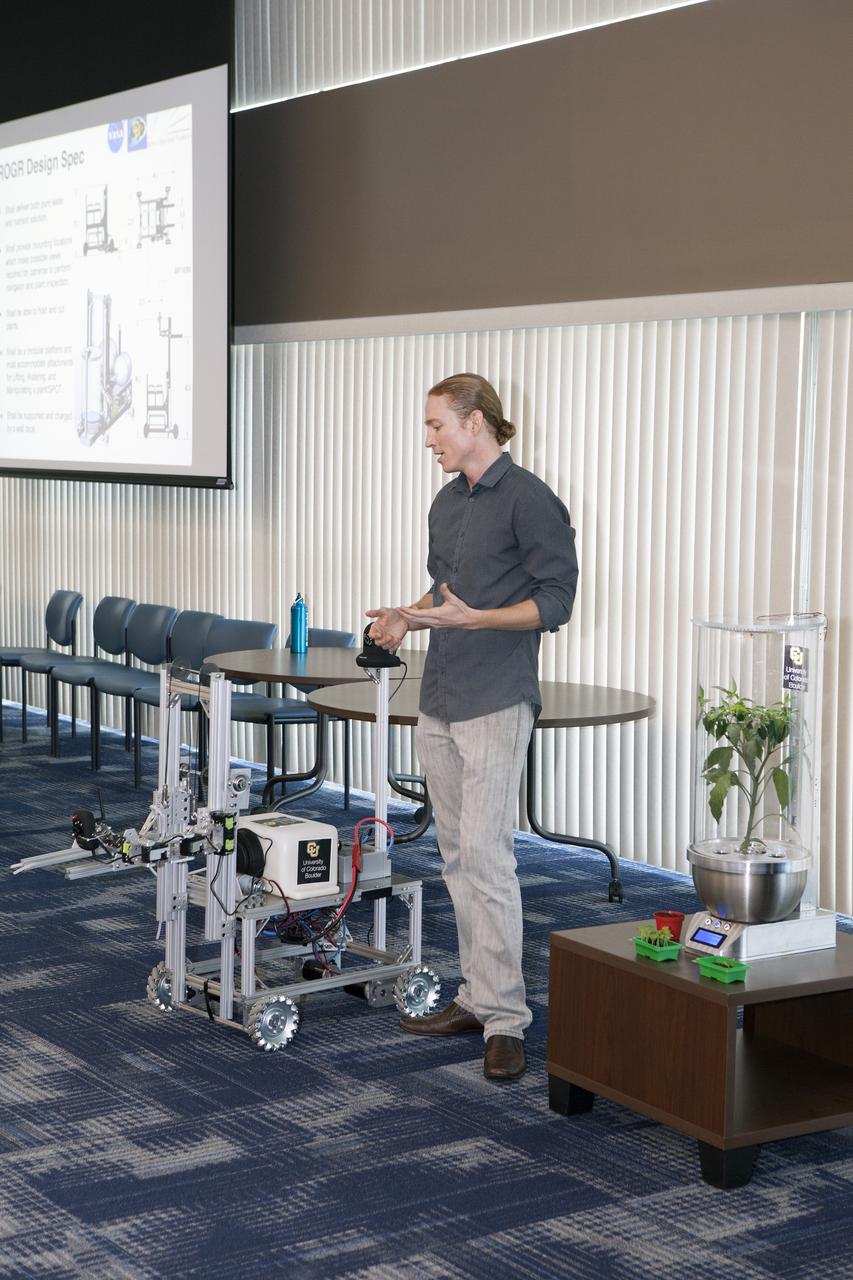
CAPE CANAVERAL, Fla. -- At the Kennedy Space Center in Florida, Daniel Zukowski, a University of Colorado Boulder graduate student, describes a Remotely Operated Gardening Rover, or ROGR, which could tend to plants grown in one of the SmartPots, or SPOTS, seen on the right. The system is being developed by the graduate students participating in the eXploration HABitation X-Hab Academic Innovation Challenge. X-Hab Academic Innovation Challenge is a university-level activity designed to engage and retain students in science, technology, engineering and math, or STEM, disciplines. NASA will directly benefit from the effort by sponsoring the development of innovative habitat concepts from universities which may result in innovative ideas and solutions that could be applied to exploration habitats. For more: http://www.nasa.gov/exploration/technology/deep_space_habitat/xhab/ Photo credit: NASA/Daniel Casper
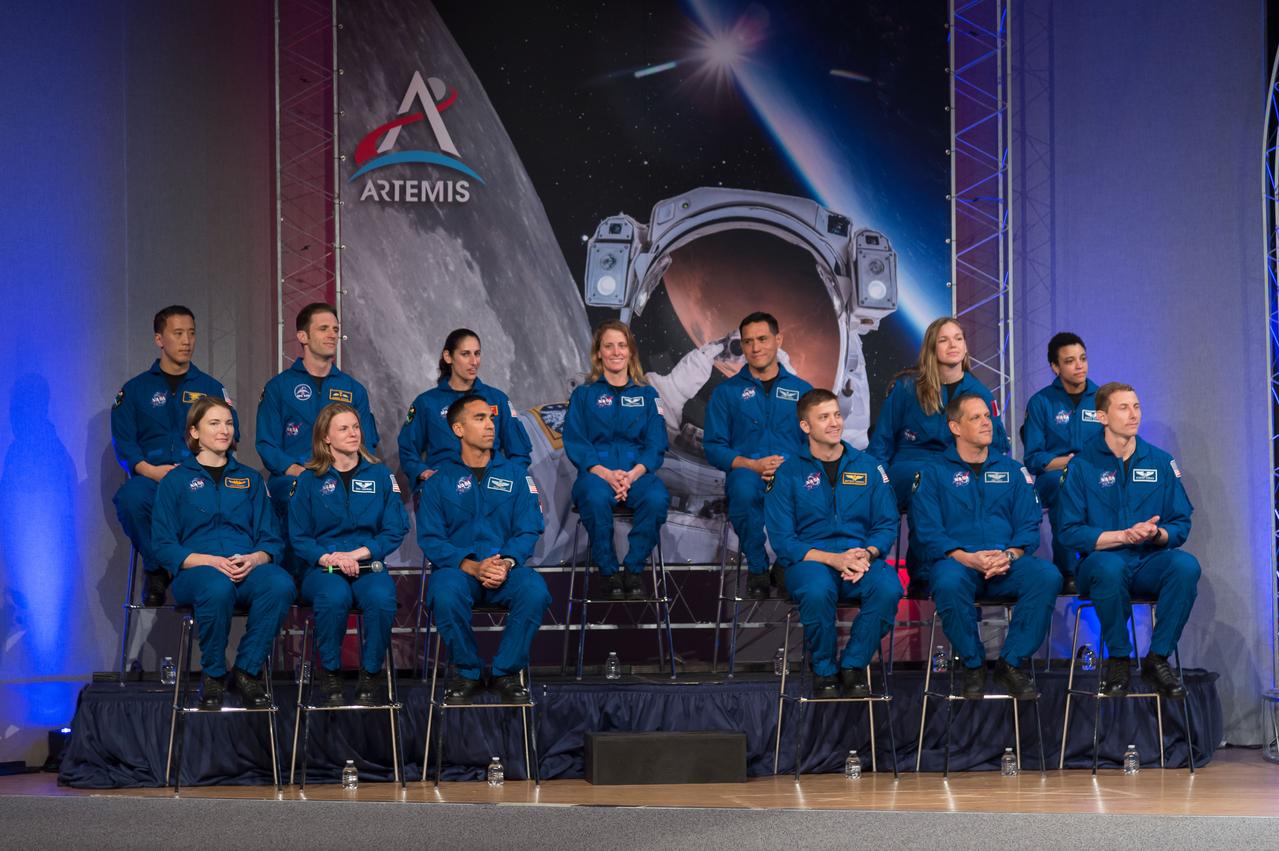
jsc2020e000609 (Jan. 10, 2020) --- The 2017 Class of Astronauts participate in graduation ceremonies at the Johnson Space Center in Houston, Texas. In the front row (from left) are, NASA astronauts Kayla Barron, Zena Cardman, Raja Chari, Matthew Dominick, Bob Hines and Warren Hoburg. In the back row (from left) are, NASA astronaut Jonny Kim, Canadian Space Agency (CSA) astronaut Joshua Kutryk, NASA astronauts Jasmin Moghbeli, Loral O'Hara and Frank Rubio, CSA astronaut Jennifer Sidey-Gibbon and NASA astronaut Jessica Watkins. This is the first class of astronauts to graduate under the Artemis program and are now eligible for assignments to the International Space Station, Artemis missions to the Moon, and ultimately, missions to Mars.
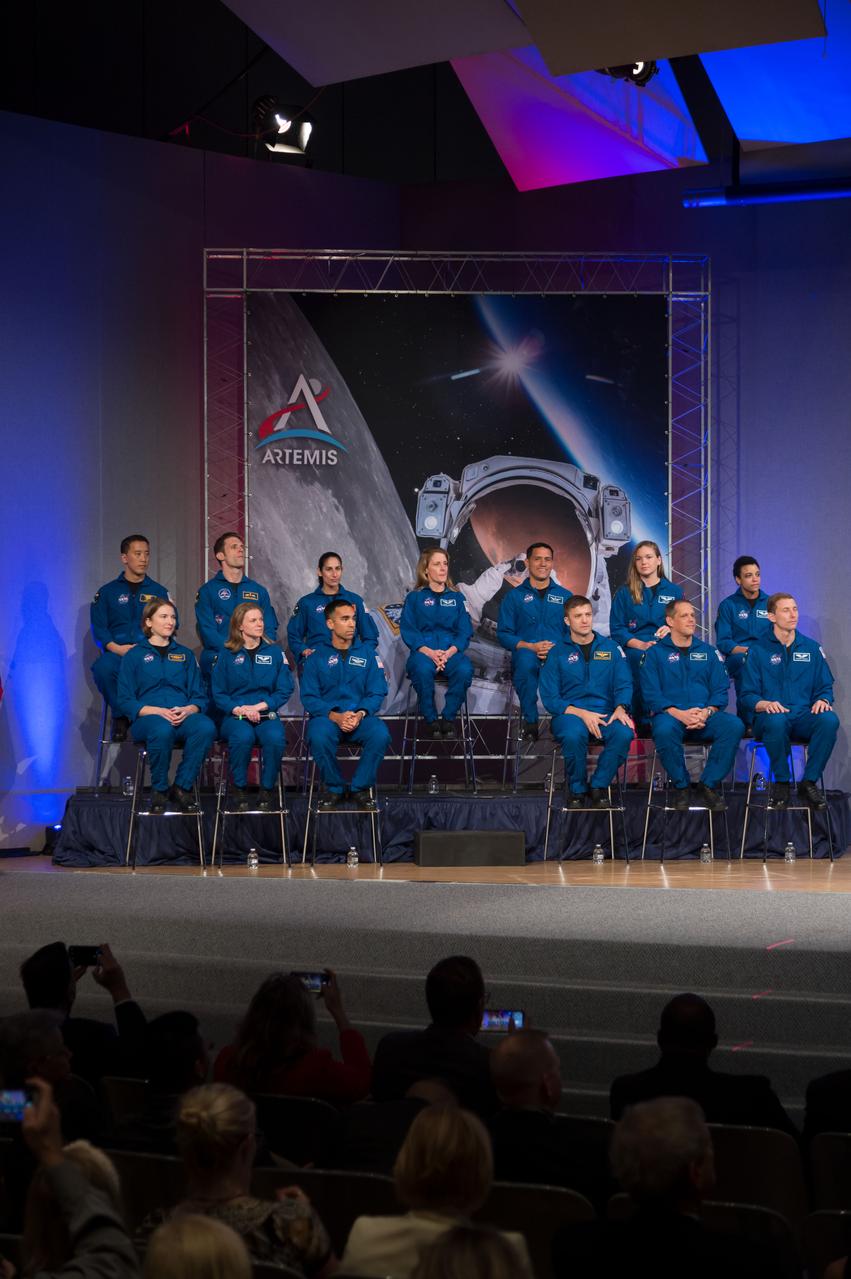
jsc2020e000610 (Jan. 10, 2020) --- The 2017 Class of Astronauts participate in graduation ceremonies at the Johnson Space Center in Houston, Texas. In the front row (from left) are, NASA astronauts Kayla Barron, Zena Cardman, Raja Chari, Matthew Dominick, Bob Hines and Warren Hoburg. In the back row (from left) are, NASA astronaut Jonny Kim, Canadian Space Agency (CSA) astronaut Joshua Kutryk, NASA astronauts Jasmin Moghbeli, Loral O'Hara and Frank Rubio, CSA astronaut Jennifer Sidey-Gibbon and NASA astronaut Jessica Watkins. This is the first class of astronauts to graduate under the Artemis program and are now eligible for assignments to the International Space Station, Artemis missions to the Moon, and ultimately, missions to Mars.
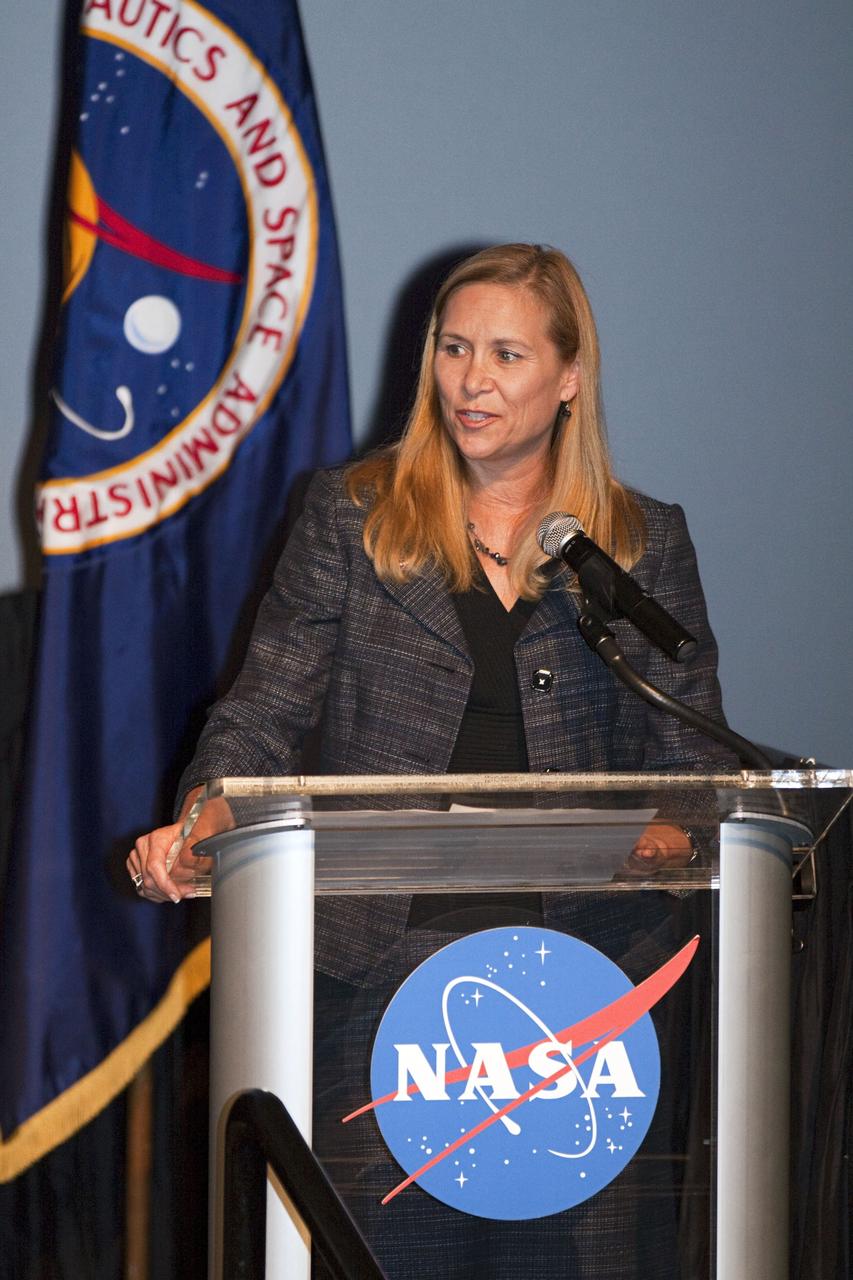
CAPE CANAVERAL, Fla. –Kennedy Space Center Deputy Director Janet Petro speaks to graduates and guests who gathered for the closing ceremonies for the International Space University at the Kennedy Space center Visitor Complex on Aug. 3, 2012. The International Space University is a nine-week intensive course designed for post-graduate university students and professionals during the summer. The program is hosted by a different country each year, providing a unique educational experience for participants from around the world. NASA Kennedy Space Center and the Florida Institute of Technology co-hosted this year's event which ran from June 4 to Aug. 3. There were about 125 participants representing 31 countries. For more information, visit http://www.isunet.edu Photo credit: NASA/Kim Shiflett
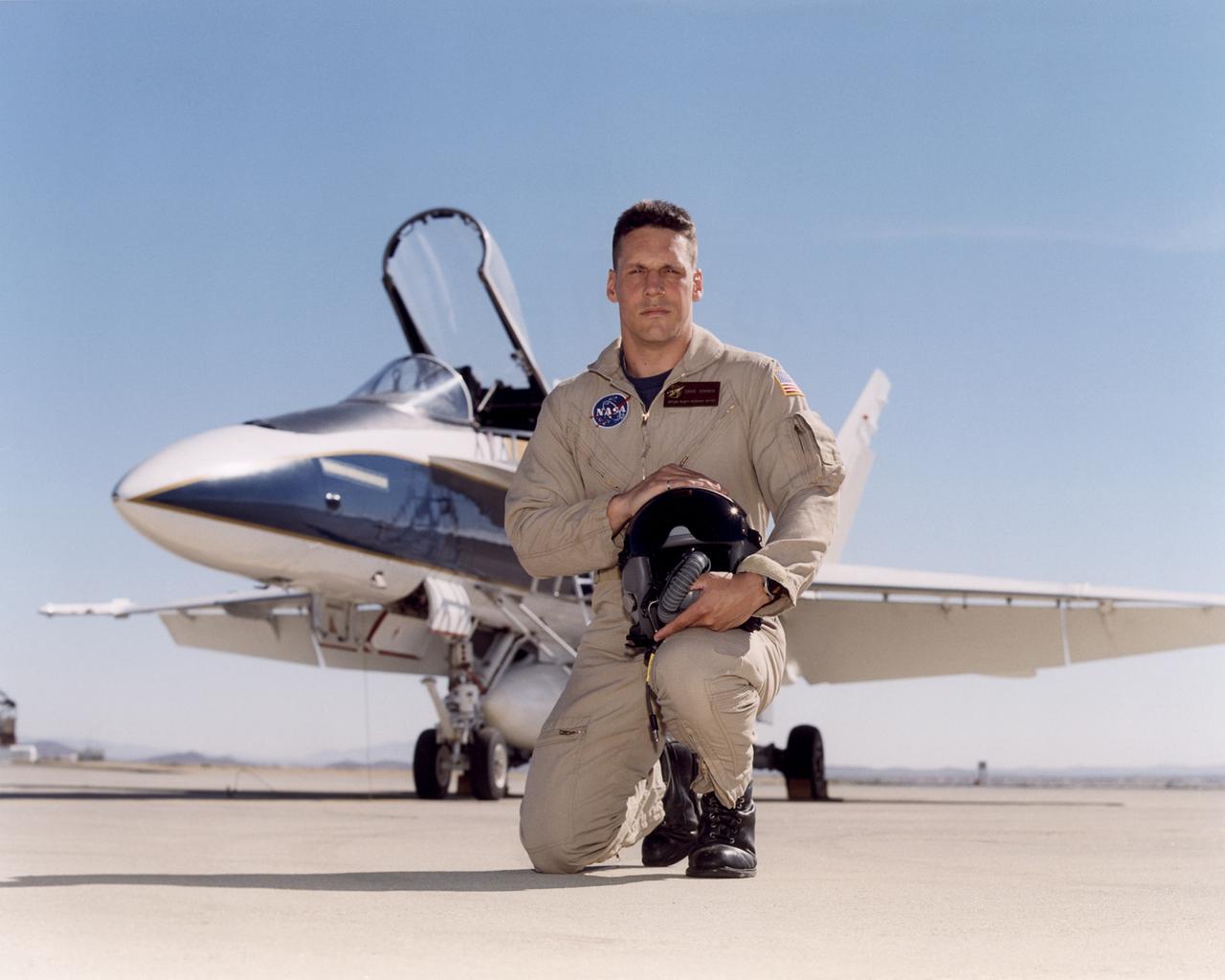
Craig R. Bomben became a pilot in the Flight Crew Branch of NASA's Dryden Flight Research Center, Edwards, Calif., in June 2001. His flying duties include a variety of research and support activities while piloting the F/A-18, DC-8, T-34C and King Air aircraft. He has more than 17 years and 3,800 hours of military and civilian flight experience in over 50 different aircraft types. Bomben came to NASA Dryden from a U.S. Navy assignment to the Personnel Exchange Program, Canada. He served as a test pilot in the Canadian Armed Forces located in Cold Lake, Alberta. He participated in numerous developmental programs to include CT-133 airborne ejection seat testing, F/A-18 weapons flutter testing and F/A-18 night vision goggles integration. Bomben performed U.S. Navy fleet service in 1995 as a strike-fighter department head. He completed two overseas deployments onboard the USS George Washington and USS Stennis. As a combat strike leader, he headed numerous multi-national missions over Iraq in support of Operation Southern Watch. Bomben graduated from the U.S. Naval Test Pilot School in 1992 and was subsequently assigned to the Naval Weapons Test Squadron at Pt. Mugu, Calif. During this tour he developed the F-14D bombsight and worked on various other F-14D and F/A-18 weapon systems developmental programs. Bomben is a 1985 graduate of Washington State University with a bachelor of science degree in electrical engineering. He graduated from naval flight training in 1987 and was recognized as a Commodore List graduate. His first assignment was to Naval Air Station Pensacola, Fla., where he was an instructor in the T-2B Buckeye. When selected to fly the F/A-18 in 1989, he joined a fleet squadron and deployed aboard the USS Forrestal. Bomben is married to the former Aissa Asuncion. They live in Lancaster, Calif., with their 3 children.
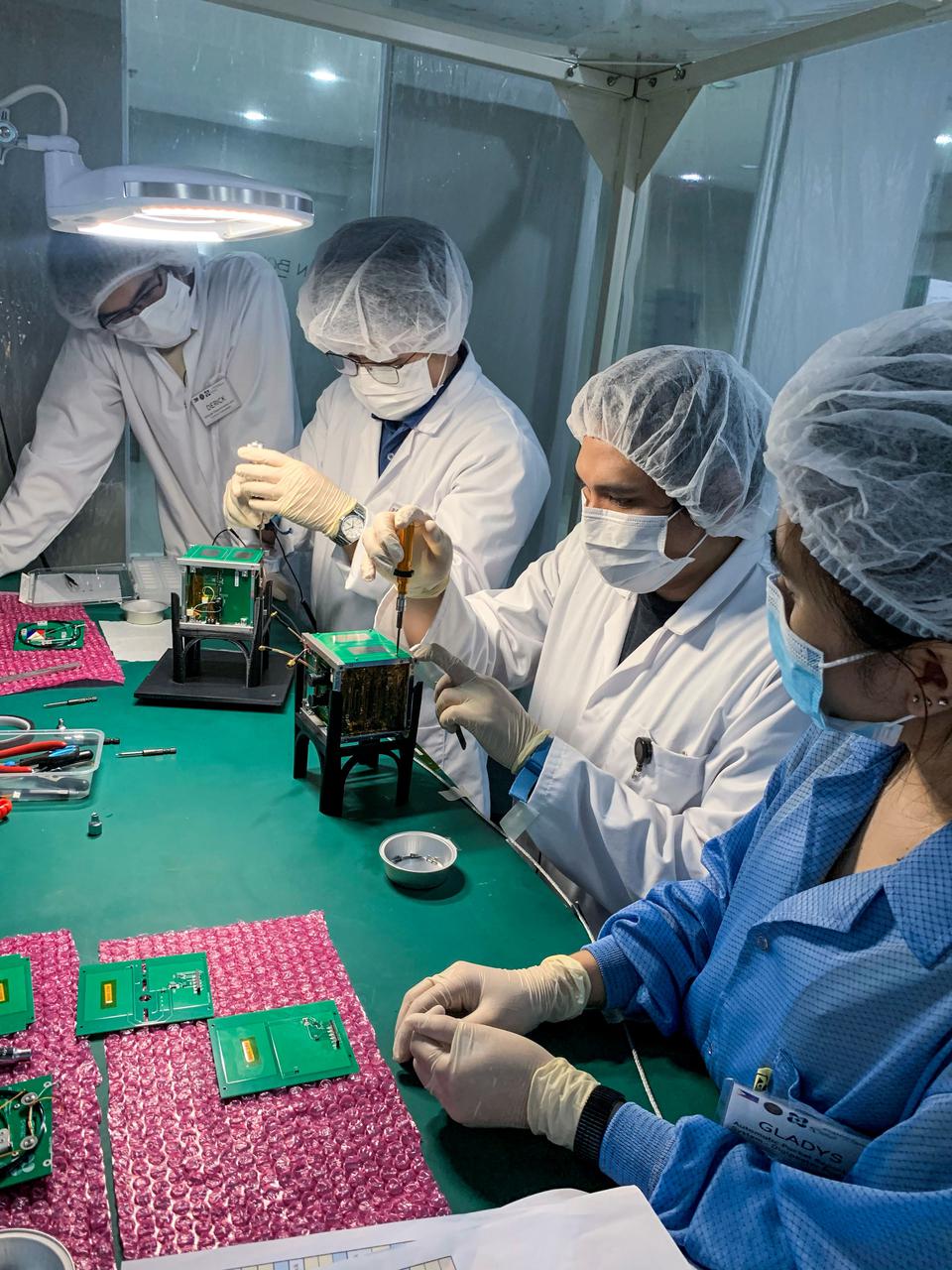
jsc2021e042552 (10/29/2020) --- Maya-3 and Maya-4 Flight Model Assembly inside the Clean Booth at the University Laboratory for Small Satellites and Space Engineering Systems (ULyS3Es), University of the Philippines-Diliman . The BIRDS-2S project consists of the Maya-3 and Maya-4 CubeSats, the first Philippine university-built cube satellites developed by eight graduate students under the Space science education and Technology Proliferation through University Partnerships (STeP-UP) Project. Image Credit: Batch-1 STeP-UP Scholars
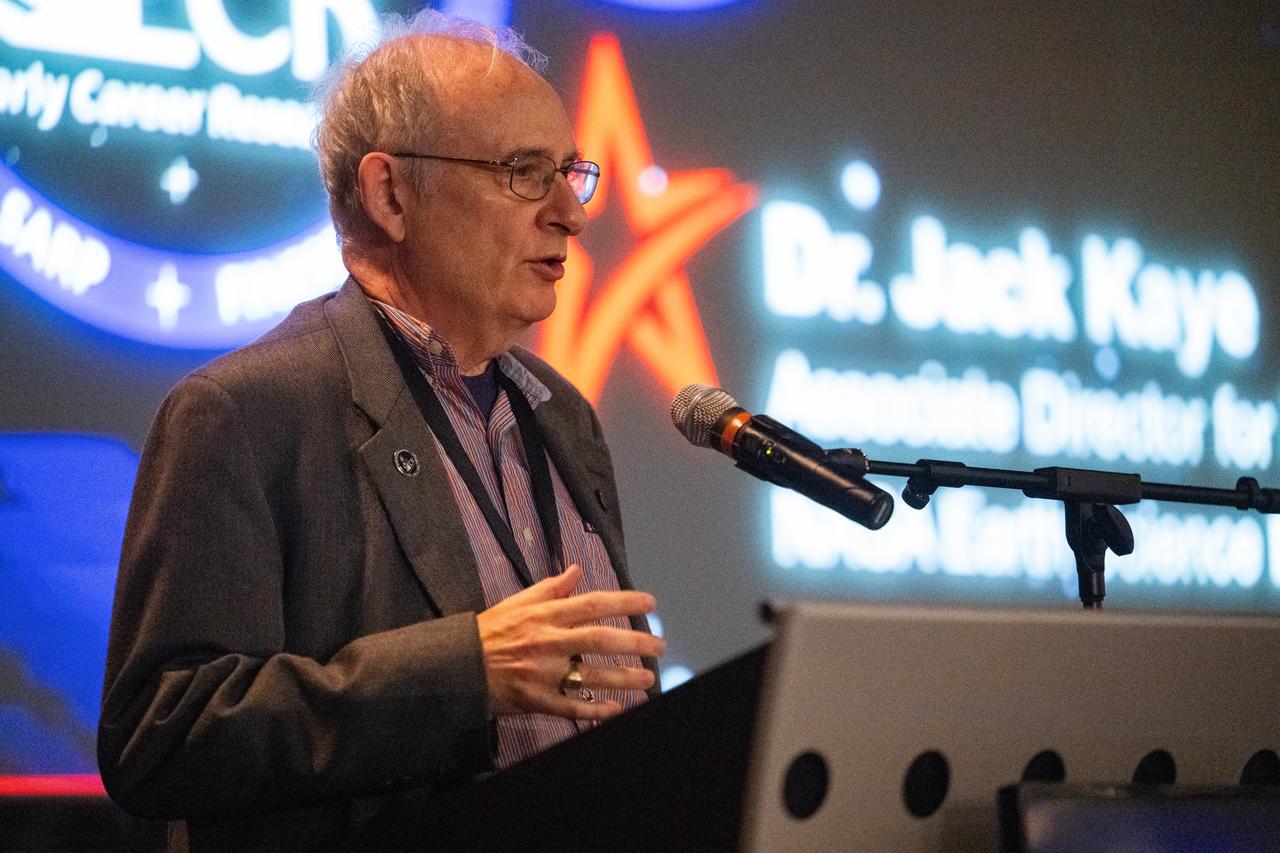
Jack Kaye, associate director for research in the Earth Science Division of NASA’s Science Mission Directorate, speaks with the Climate Change Research Initiative (CCRI) cohort, Wednesday, Aug. 7, 2024, at the Mary W. Jackson NASA Headquarters building in Washington, DC. The Earth Science Division’s Early Career Research Program’s Climate Change Research Initiative (CCRI) is a year-long STEM engagement and experiential learning opportunity for educators and students from high school to graduate level. Photo Credit: (NASA/Joel Kowsky)
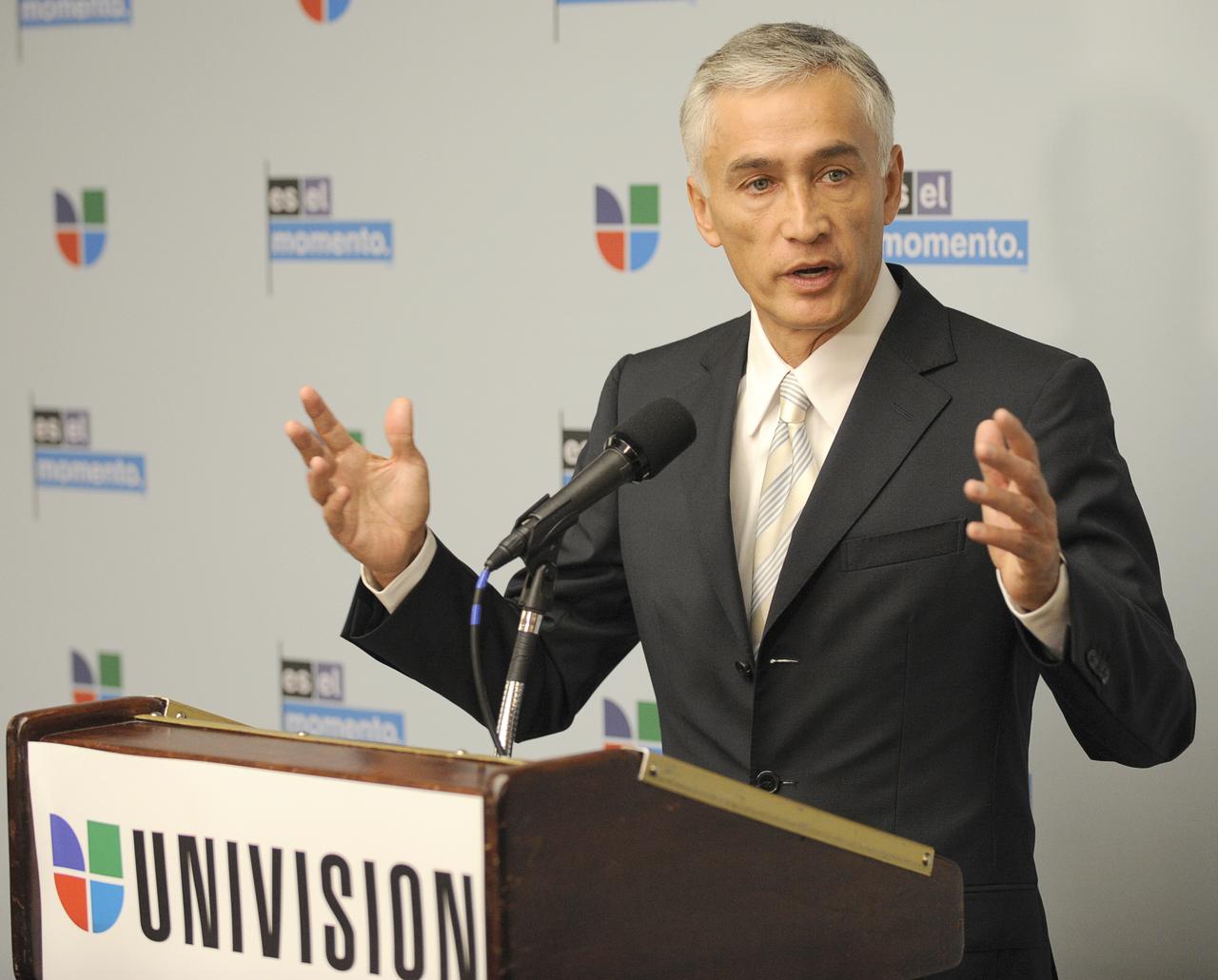
Univision news anchor Jorge Ramos speaks at an event at the National Press Club in Washington, Tuesday, Feb. 23, 2010. NASA is working with Univision Communications Inc. to develop a partnership in support of the Spanish-language media outlet's initiative to improve high school graduation rates, prepare Hispanic students for college, and encourage them to pursue careers in science, technology, engineering and mathematics, or STEM, disciplines. Photo Credit: (NASA/Bill Ingalls)
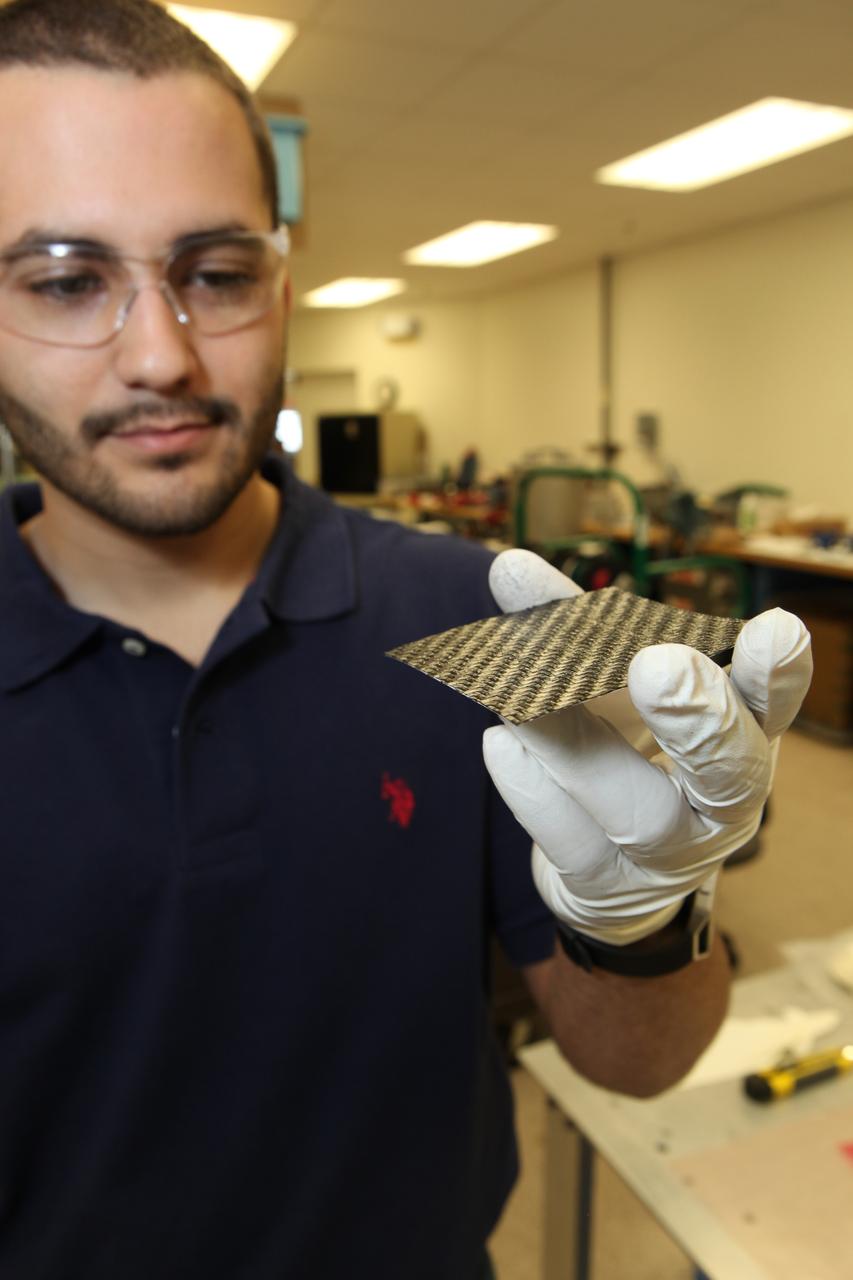
Daniel Perez, Ph.D., a graduate student from the University of Miami, displays a piece of the prototype structure for a new solid-state battery in the Prototype Laboratory at NASA's Kennedy Space Center in Florida. The size of the battery is so small that it could be a prime candidate for use in microsatellites, including CubeSats. Researchers at Kennedy are collaborating with experts at the University of Miami. The university partnership is funded through the Small Spacecraft Technology Program, in NASA's Space Technology Mission Directorate.
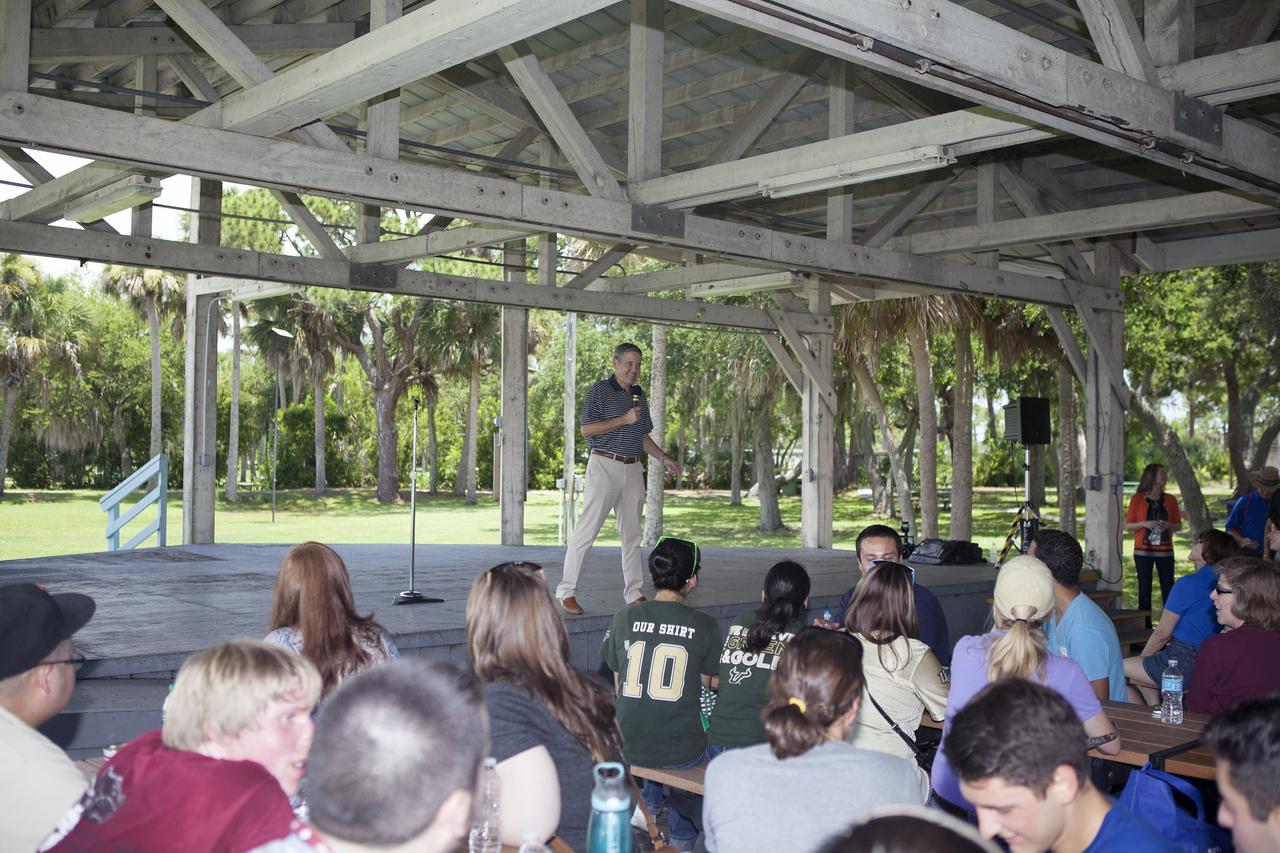
CAPE CANAVERAL, Fla. – Kennedy Space Center Director Bob Cabana speaks to Pathways and summer interns at the KARS Park I facility near the center. High school, undergraduate and graduate students participated in a team building exercise and received advice on leadership skills and working together from Kennedy's senior management. About 160 students are working and gaining experience in many of the directorates and programs during their time at Kennedy. Photo credit: NASA/Daniel Casper
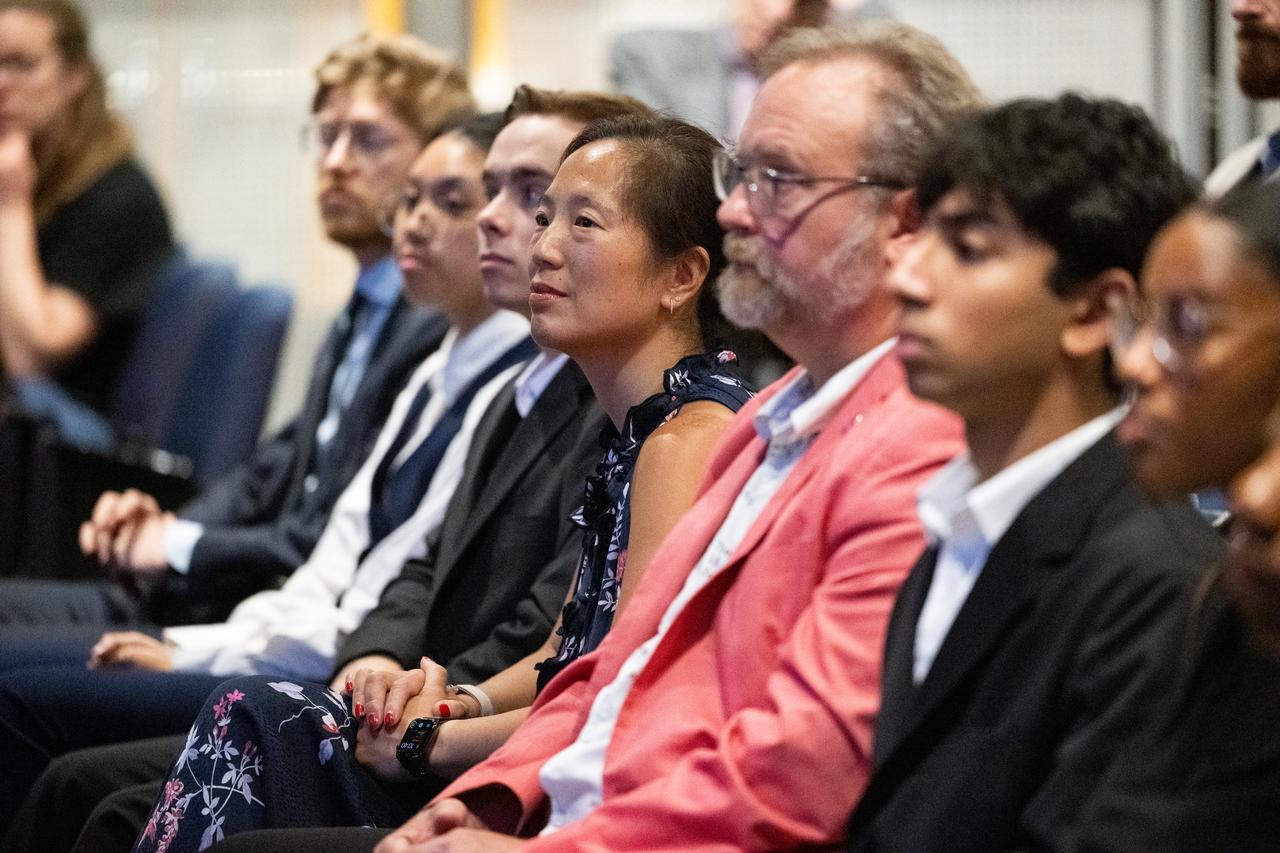
Members of the Climate Change Research Initiative (CCRI) cohort listen as Karen St. Germain, director of the Earth Science Division of NASA’s Science Mission Directorate speaks, Wednesday, Aug. 7, 2024, at the Mary W. Jackson NASA Headquarters building in Washington, DC. The Earth Science Division’s Early Career Research Program’s Climate Change Research Initiative (CCRI) is a year-long STEM engagement and experiential learning opportunity for educators and students from high school to graduate level. Photo Credit: (NASA/Joel Kowsky)
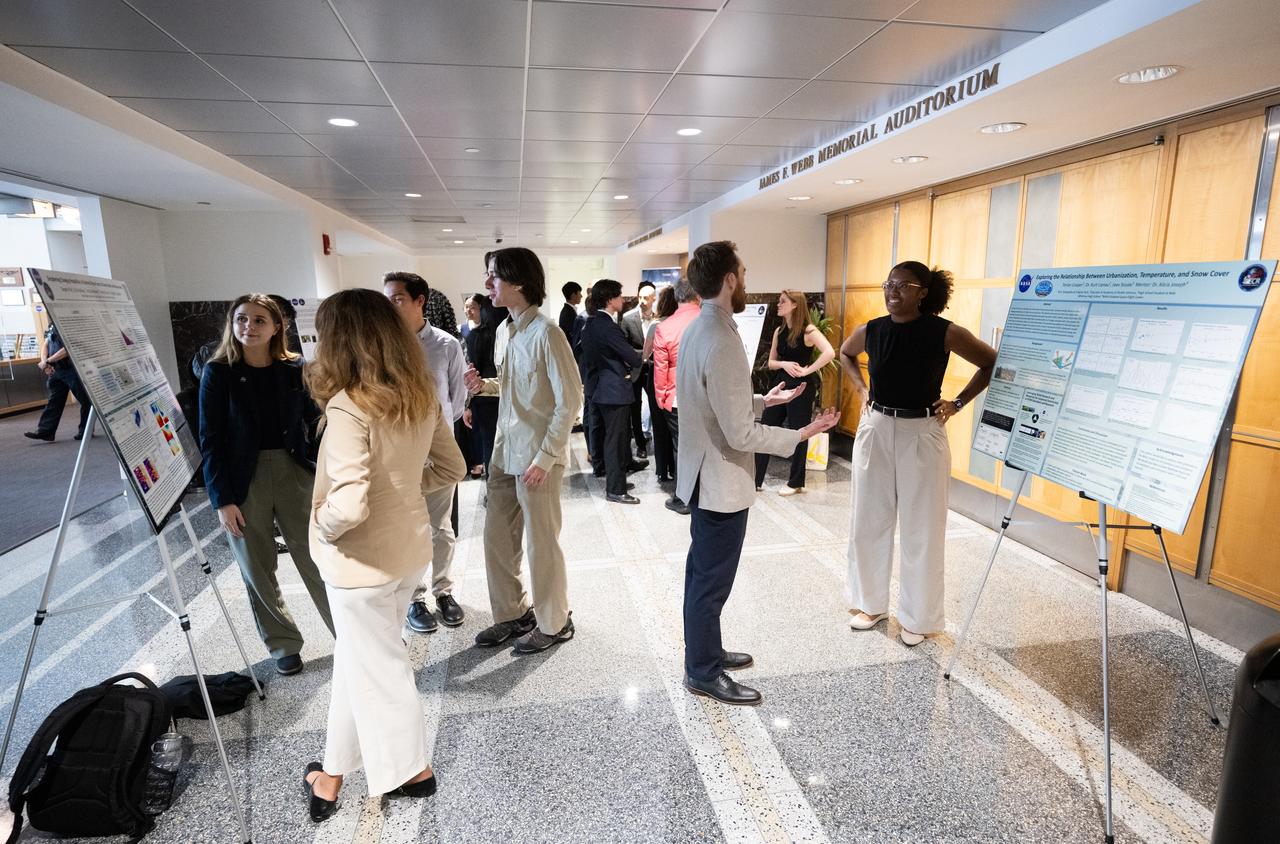
Members of the Climate Change Research Initiative (CCRI) cohort discuss their research during a poster session, Wednesday, Aug. 7, 2024, at the Mary W. Jackson NASA Headquarters building in Washington, DC. The Earth Science Division’s Early Career Research Program’s Climate Change Research Initiative (CCRI) is a year-long STEM engagement and experiential learning opportunity for educators and students from high school to graduate level. Photo Credit: (NASA/Joel Kowsky)
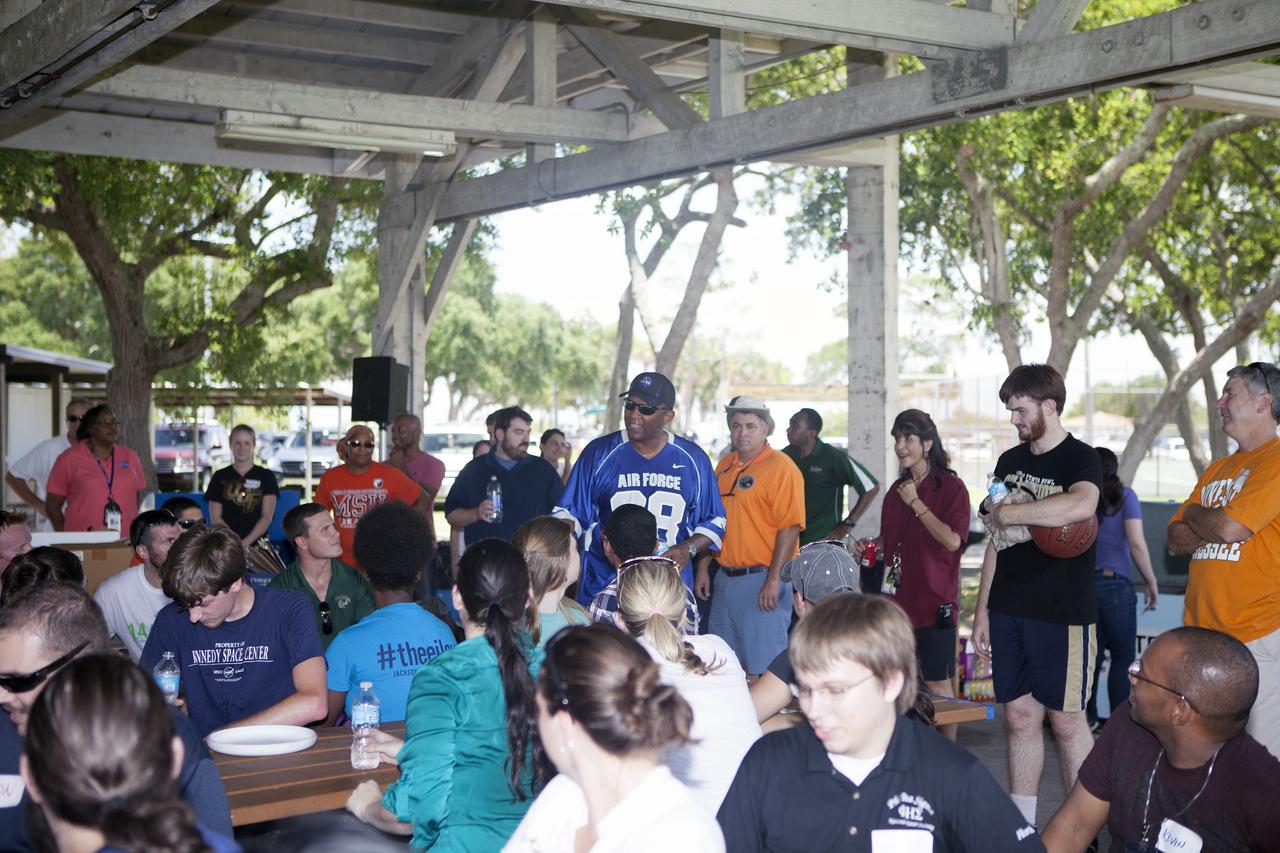
CAPE CANAVERAL, Fla. – Kennedy Space Center Associate Director Kelvin Manning, in the blue Air Force shirt, speaks to Pathways and summer interns at the KARS Park I facility near the center. High school, undergraduate and graduate students participated in a team building exercise and received advice on leadership skills and working together from Kennedy's senior management. About 160 students are working and gaining experience in many of the directorates and programs during their time at Kennedy. Photo credit: NASA/Daniel Casper
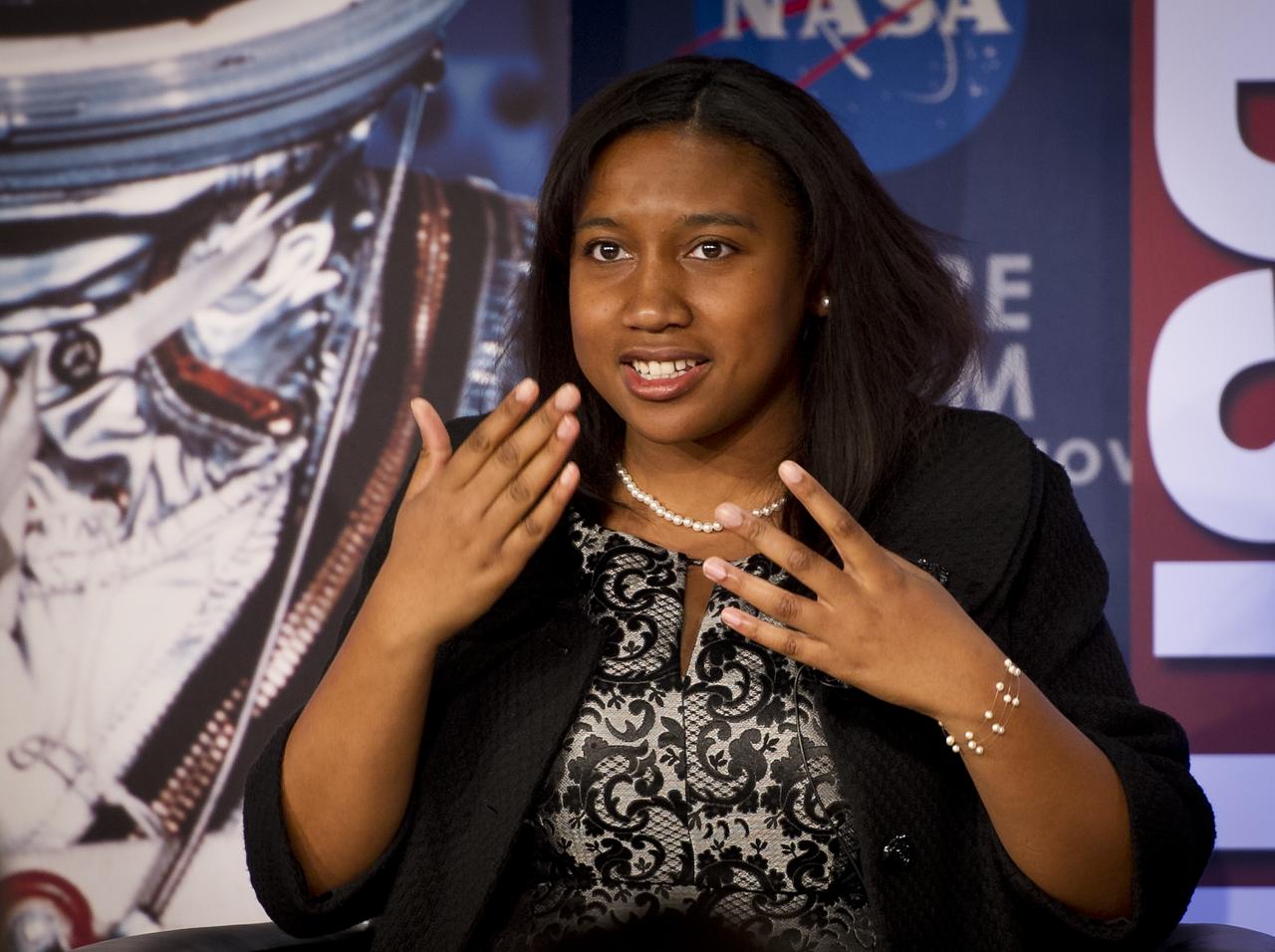
Ohio State University graduate student, biological sciences and NASA Student Ambassador, Monica Okon talks during the NASA Future Forum Inspiration and Education Panel at The Ohio State University on Monday, Feb. 20, 2012, in Columbus, Ohio. The NASA Future Forum features panel discussions on the importance of education to our nation's future in space, the benefit of commercialized space technology to our economy and lives here on Earth, and the shifting roles for the public, commercial and international communities in space. Photo Credit: (NASA/Bill Ingalls)
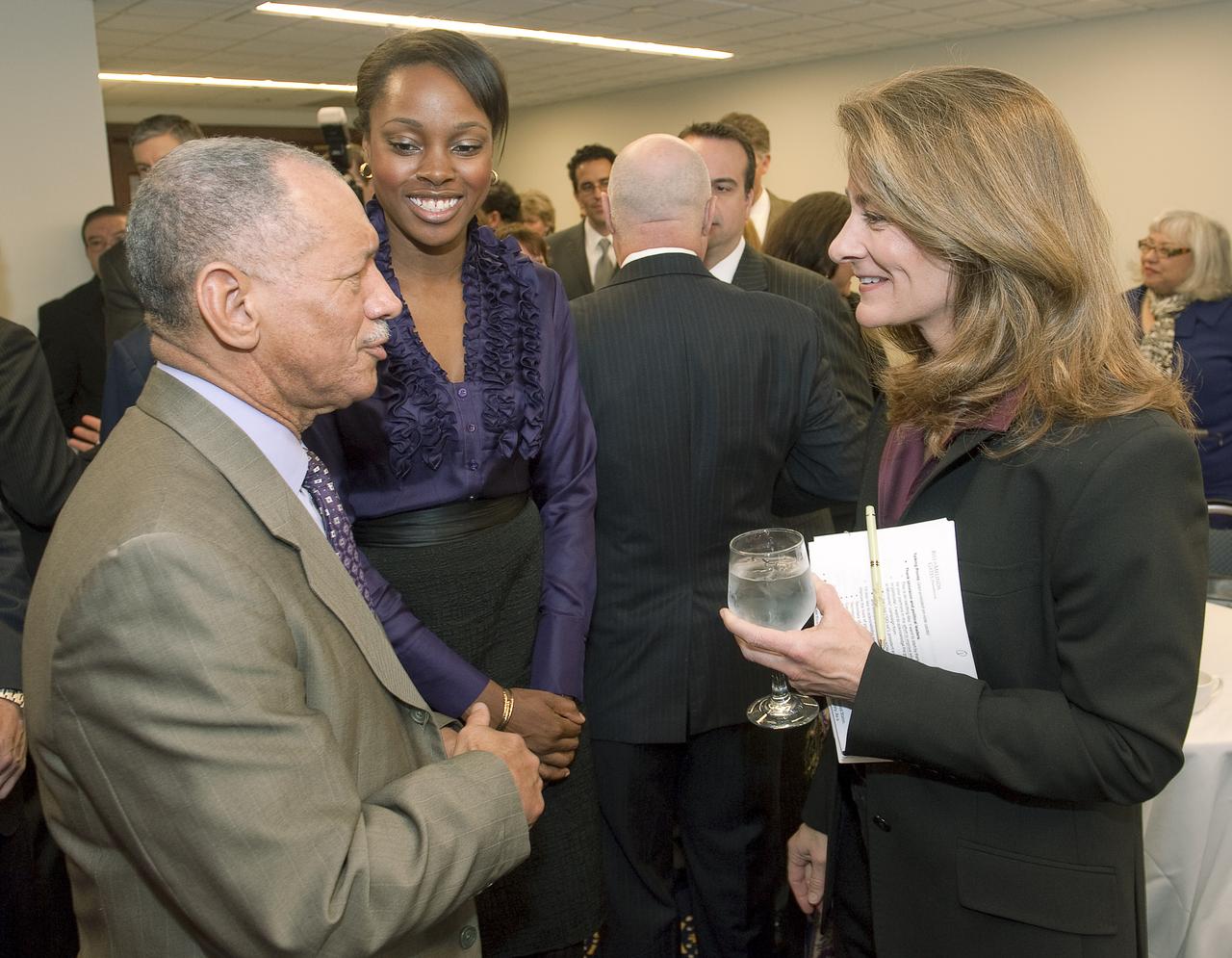
NASA Administrator Charles Bolden, left, speaks with Melinda French Gates, of the Bill & Melinda Gates Foundation, right, prior to the start of an event at the National Press Club in Washington, Tuesday, Feb. 23, 2010. NASA is working with Univision Communications Inc. to develop a partnership in support of the Spanish-language media outlet's initiative to improve high school graduation rates, prepare Hispanic students for college, and encourage them to pursue careers in science, technology, engineering and mathematics, or STEM, disciplines. Photo Credit: (NASA/Bill Ingalls)
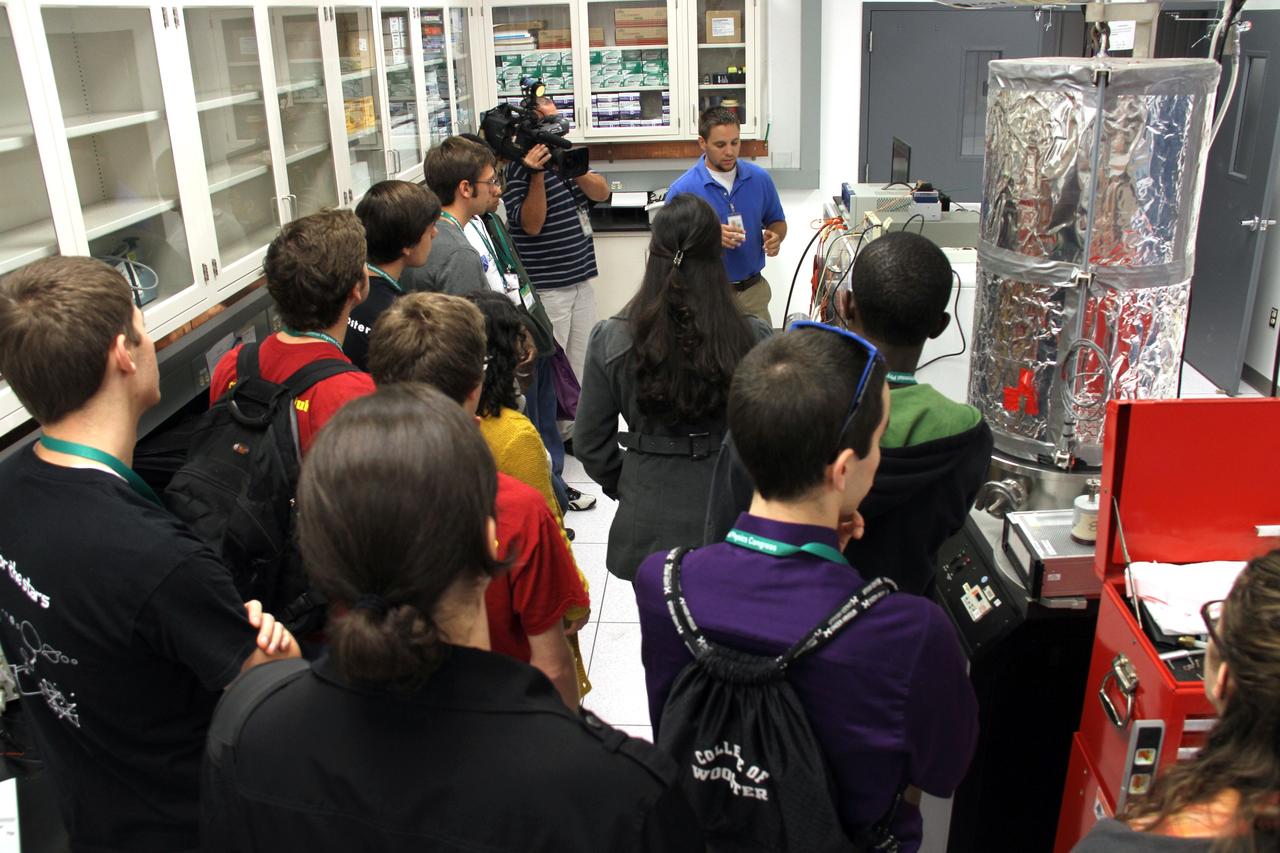
CAPE CANAVERAL, Fla. -- – Inside a laboratory in the Engineering Development Laboratory, or EDL, at NASA’s Kennedy Space Center in Florida, research scientist Michael Johansen, in the blue polo shirt, describes dust mitigation technology to a group of Society of Physics students. About 800 graduate and undergraduate physics students toured Kennedy facilities. A group of about 40 students toured laboratories in the Operations and Checkout Building and the EDL during their visit. The physics students were in Orlando for the 2012 Quadrennial Physics Congress. Photo credit: NASA/Cory Huston
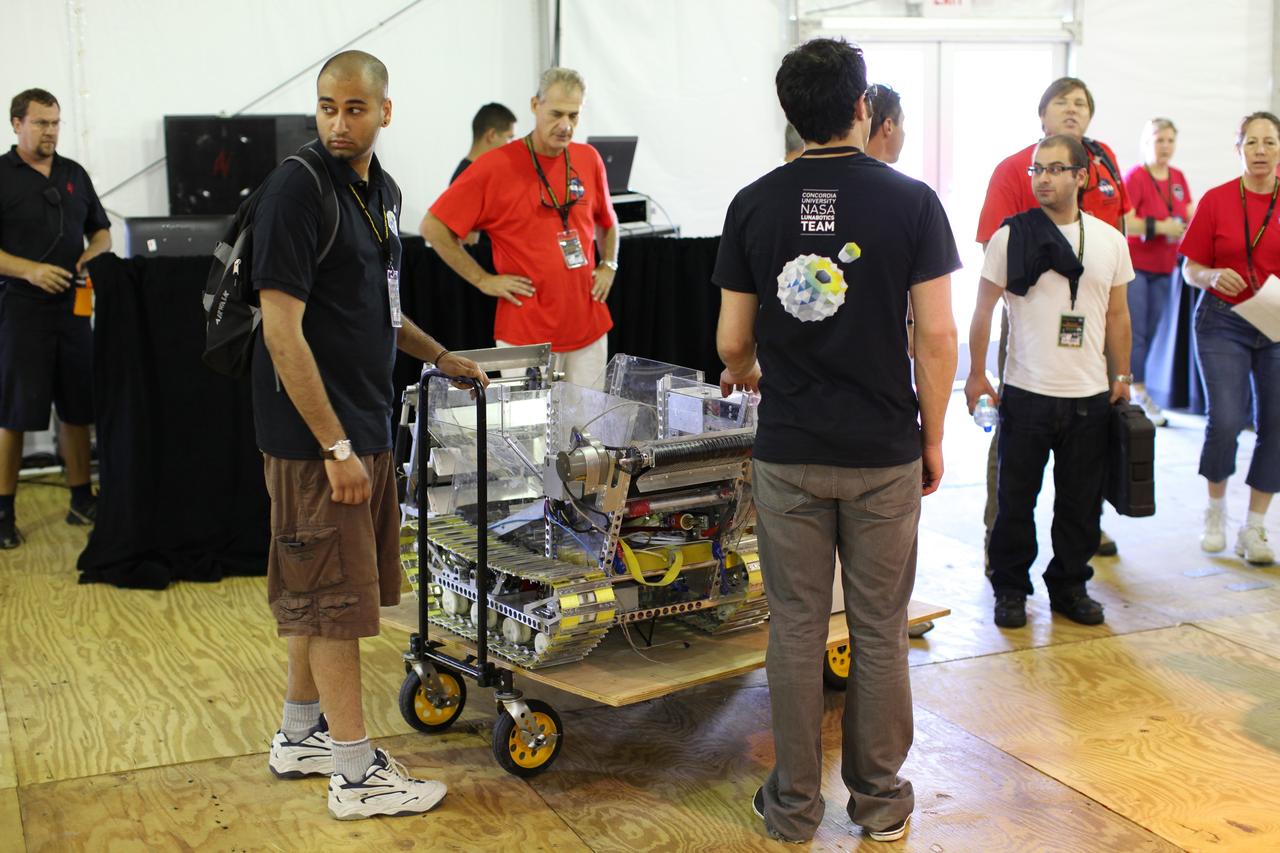
CAPE CANAVERAL, Fla. – At NASA’s Kennedy Space Center Visitor Complex in Florida, college students arrive for NASA’s Lunabotics Mining Competition. The mining competition is sponsored by NASA Kennedy Space Center’s Education Office for the agency’s Exploration Systems Mission Directorate. Undergraduate and graduate students from more than 50 universities and colleges in the U.S. and other countries use their remote-controlled Lunabots to maneuver and dig in a supersized sandbox filled with a crushed material that has characteristics similar to lunar soil. Photo credit: NASA/Frankie Martin
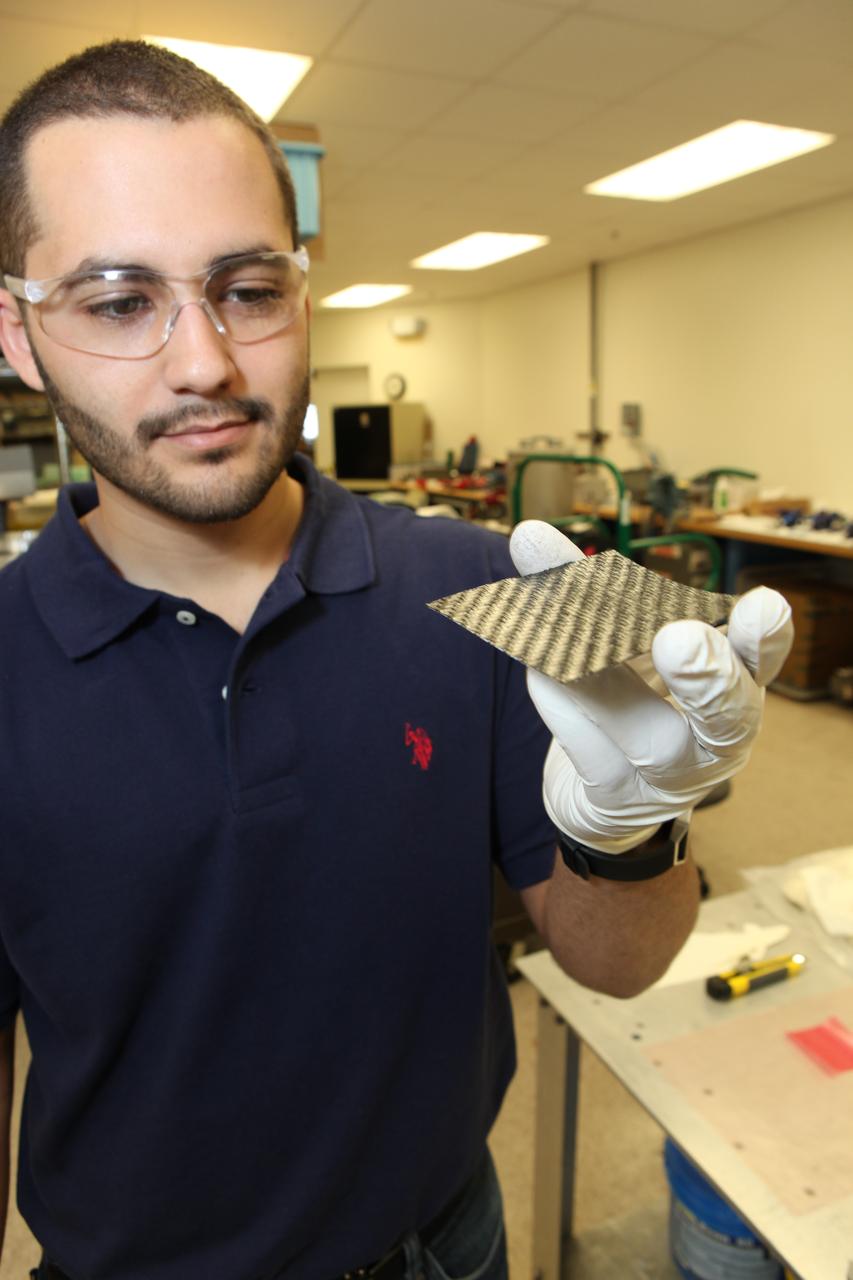
Daniel Perez, Ph.D., a graduate student from the University of Miami, displays a piece of the prototype structure for a new solid-state battery in the Prototype Laboratory at NASA's Kennedy Space Center in Florida. The size of the battery is so small that it could be a prime candidate for use in microsatellites, including CubeSats. Researchers at Kennedy are collaborating with experts at the University of Miami. The university partnership is funded through the Small Spacecraft Technology Program, in NASA's Space Technology Mission Directorate.
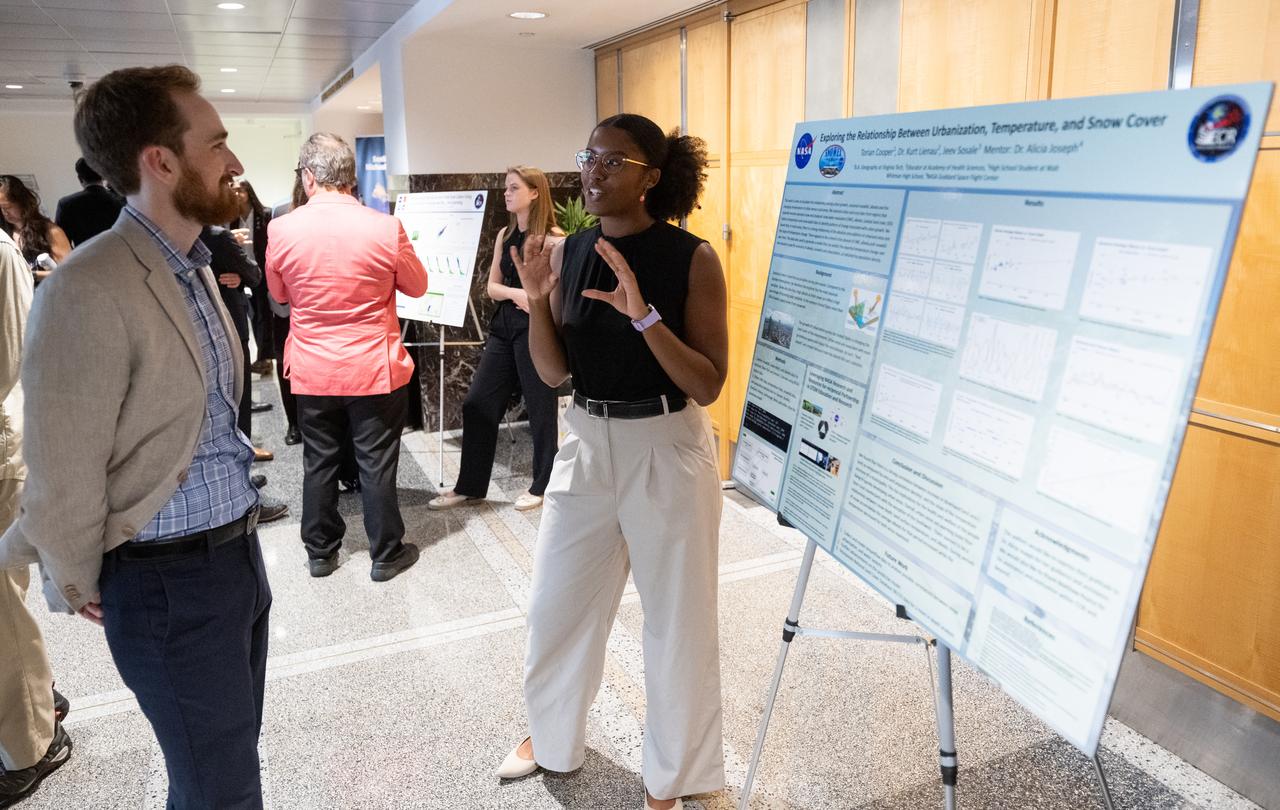
Members of the Climate Change Research Initiative (CCRI) cohort discuss their research during a poster session, Wednesday, Aug. 7, 2024, at the Mary W. Jackson NASA Headquarters building in Washington, DC. The Earth Science Division’s Early Career Research Program’s Climate Change Research Initiative (CCRI) is a year-long STEM engagement and experiential learning opportunity for educators and students from high school to graduate level. Photo Credit: (NASA/Joel Kowsky)
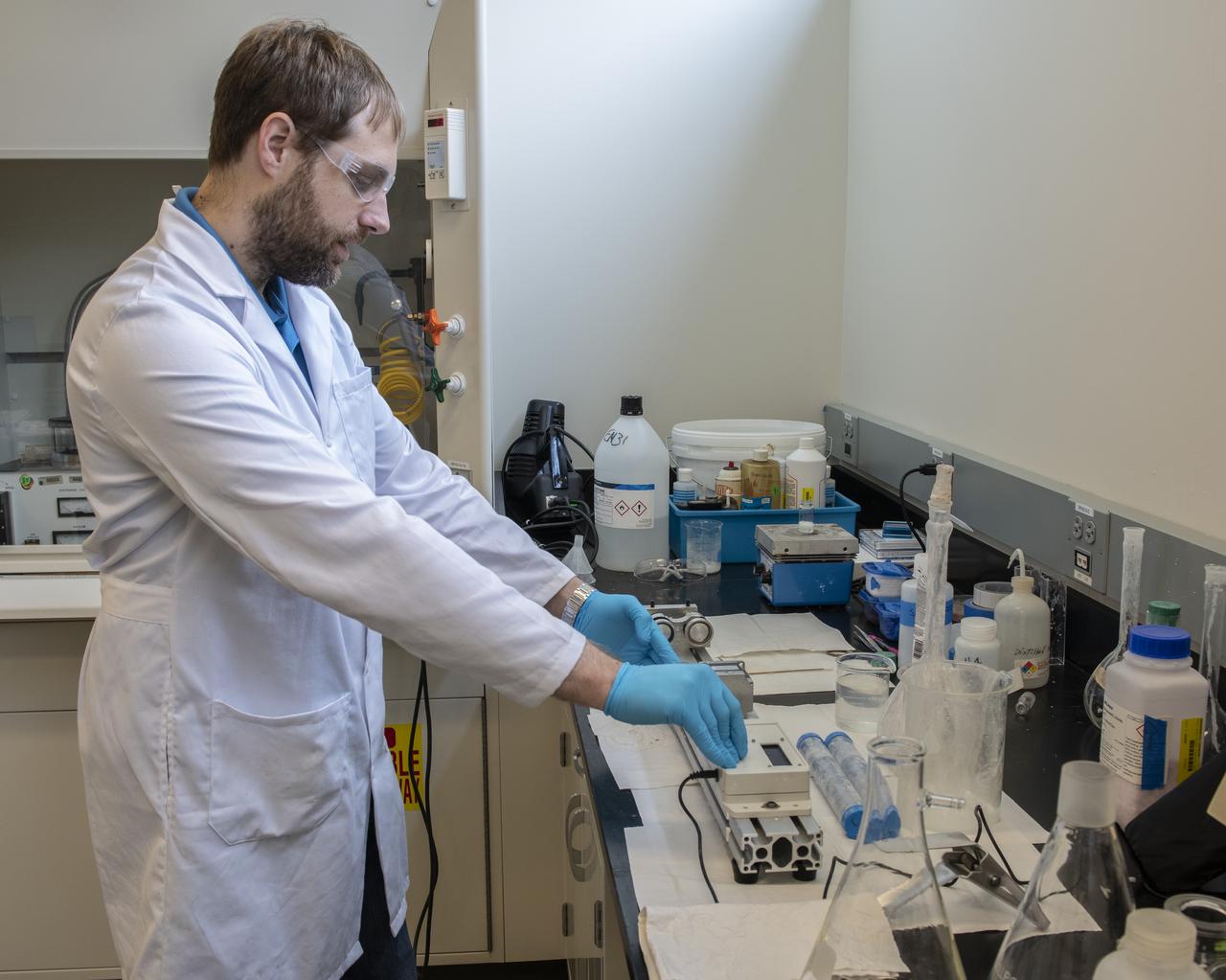
Alexander Blanchard, a chemistry doctoral student at Florida State University and graduate student at Marshall this summer, conducts analysis in a Marshall laboratory on the Chemical Gardens experiment, which is growing delicate crystalline structures in solution in the microgravity environment on the space station. Researchers hope the study could yield practical benefits for bioremediation and other "green" commercial applications.
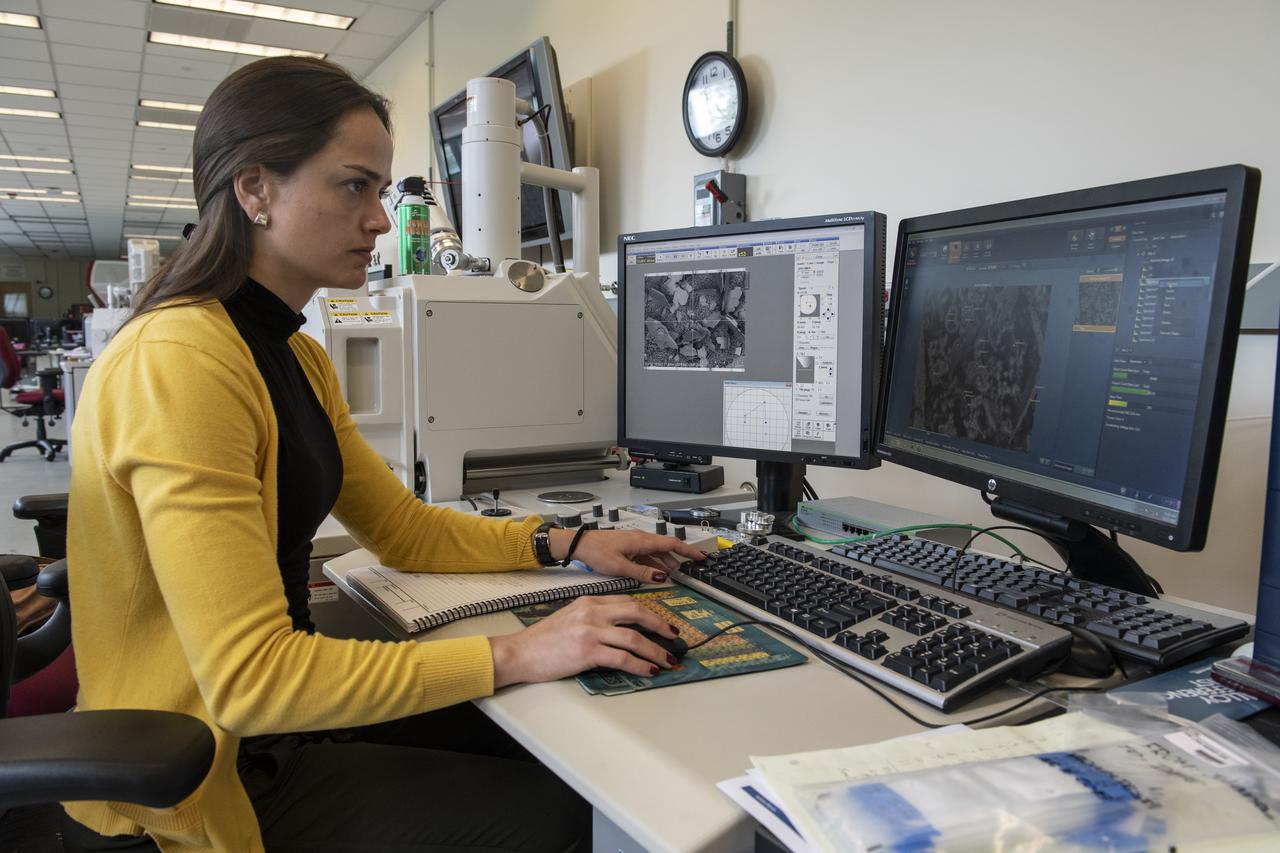
Marshall graduate student researcher Juliana Neves, who is pursuing her doctorate in civil engineering at Pennsylvania State University, monitors cement paste samples returned from space as part of the Microgravity Investigation of Cement Solidification. Neves, investigators at Penn State and Marshall researchers led by NASA materials scientist Richard Grugel mirrored each sample experiment conducted on the International Space Station -- 120 tests on the ground, 120 in orbit -- and will continue to assess their findings in months to come.
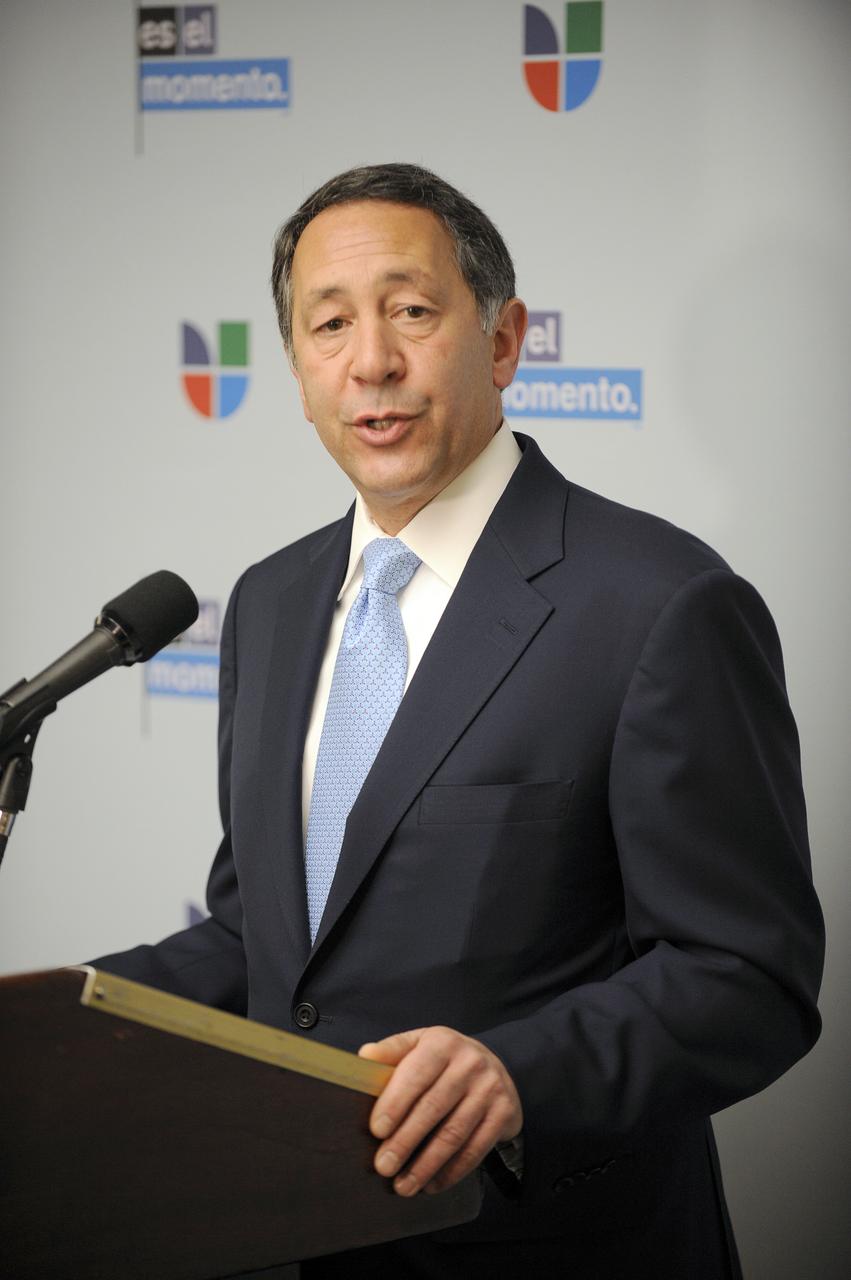
Univision Communications President and Chief Executive Officer Joe Uva speaks at an event at the National Press Club in Washington, Tuesday, Feb. 23, 2010. NASA is working with Univision Communications Inc. to develop a partnership in support of the Spanish-language media outlet's initiative to improve high school graduation rates, prepare Hispanic students for college, and encourage them to pursue careers in science, technology, engineering and mathematics, or STEM, disciplines. Photo Credit: (NASA/Bill Ingalls)
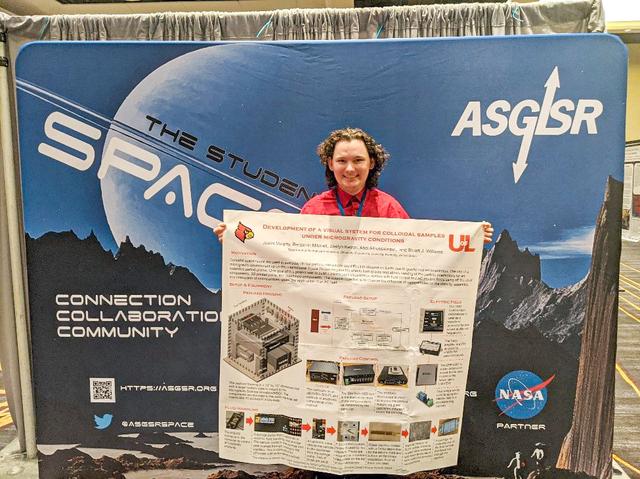
jsc2024e016255 (2/6/2024) --- Justin Murphy is an undergraduate Mechanical Engineering student (graduated May 2023) who has worked on the “Nano Halo” project and gave a poster presentation of his payload at ASGSR 2022 in Houston, Texas. The Nano Particle Haloing Suspension project tests controlled assembly of nanoparticles that could have applications in an enhanced solar cell generation technology known as quantum-dot solar synthesis. Image courtesy of the University of Louisville.
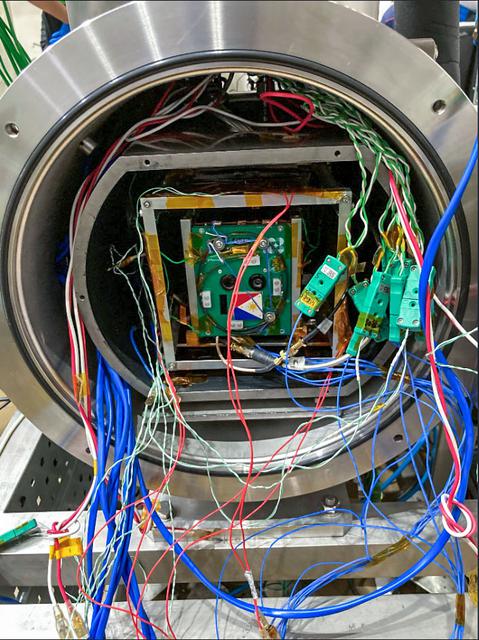
jsc2021e042551 (8/31/2021) --- Maya-3 and Maya-4 (Maya-3 in front) inside the Small Thermal Vacuum Chamber at the Center for Nanosatellite Testing, Kyushu Institute of Technology. The BIRDS-2S project consists of the Maya-3 and Maya-4 CubeSats, the first Philippine university-built cube satellites developed by eight graduate students under the Space science education and Technology Proliferation through University Partnerships (STeP-UP) Project.
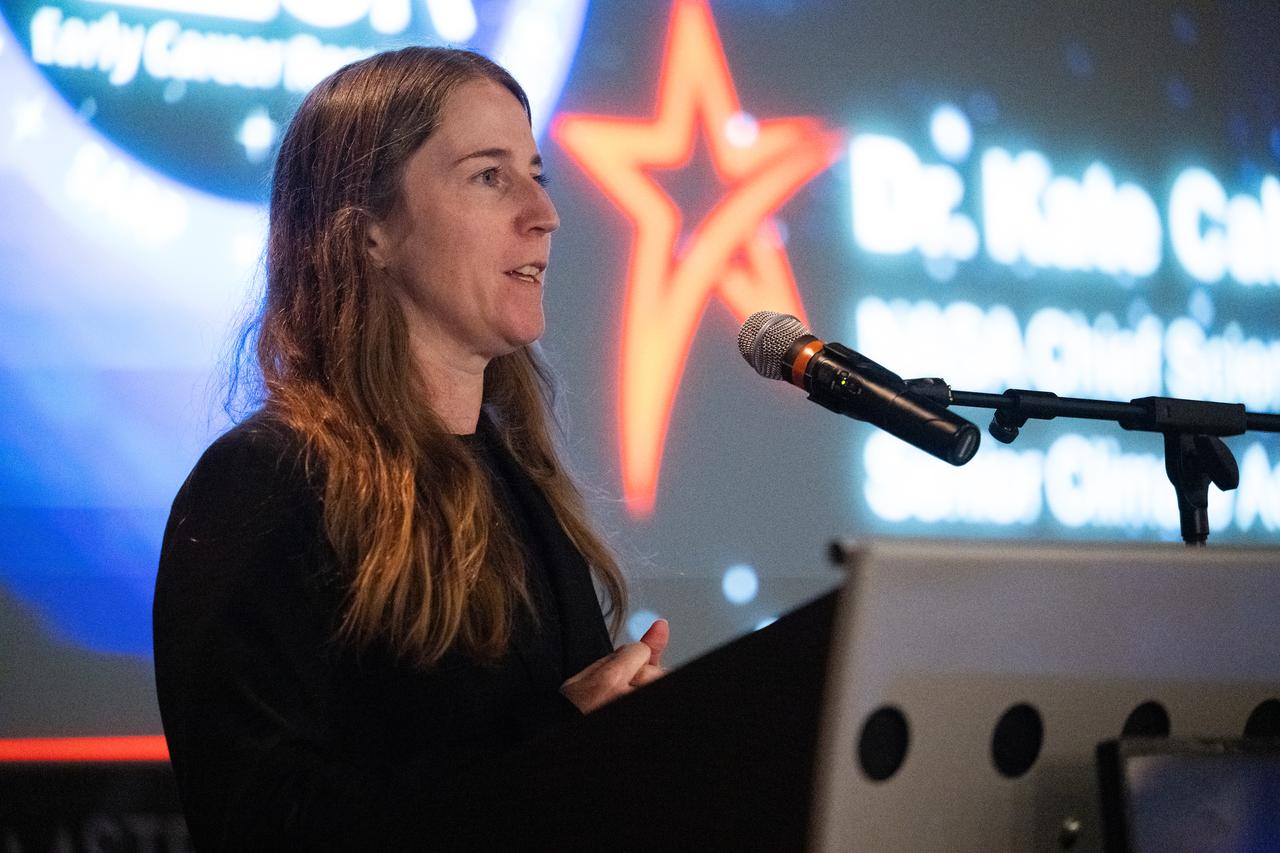
Kate Calvin, NASA’s Chief Scientist, speaks to the Climate Change Research Initiative (CCRI) cohort, Wednesday, Aug. 7, 2024, at the Mary W. Jackson NASA Headquarters building in Washington, DC. The Earth Science Division’s Early Career Research Program’s Climate Change Research Initiative (CCRI) is a year-long STEM engagement and experiential learning opportunity for educators and students from high school to graduate level. Photo Credit: (NASA/Joel Kowsky)
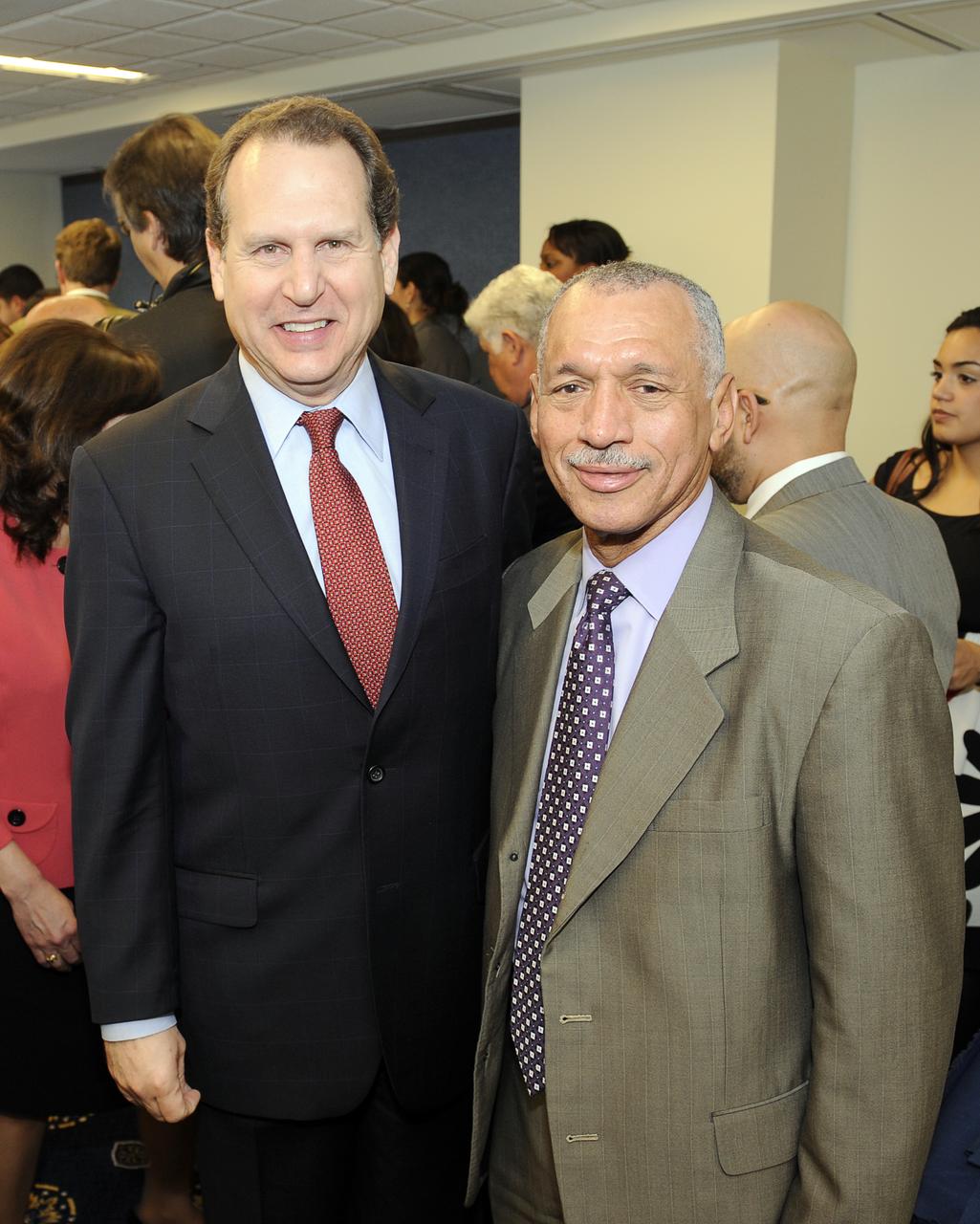
NASA Administrator Charles Bolden, right, poses with U.S. Rep. Lincoln Diaz-Balart, R-Fla., prior to the start of an event at the National Press Club in Washington, Tuesday, Feb. 23, 2010. NASA is working with Univision Communications Inc. to develop a partnership in support of the Spanish-language media outlet's initiative to improve high school graduation rates, prepare Hispanic students for college, and encourage them to pursue careers in science, technology, engineering and mathematics, or STEM, disciplines. Photo Credit: (NASA/Bill Ingalls)
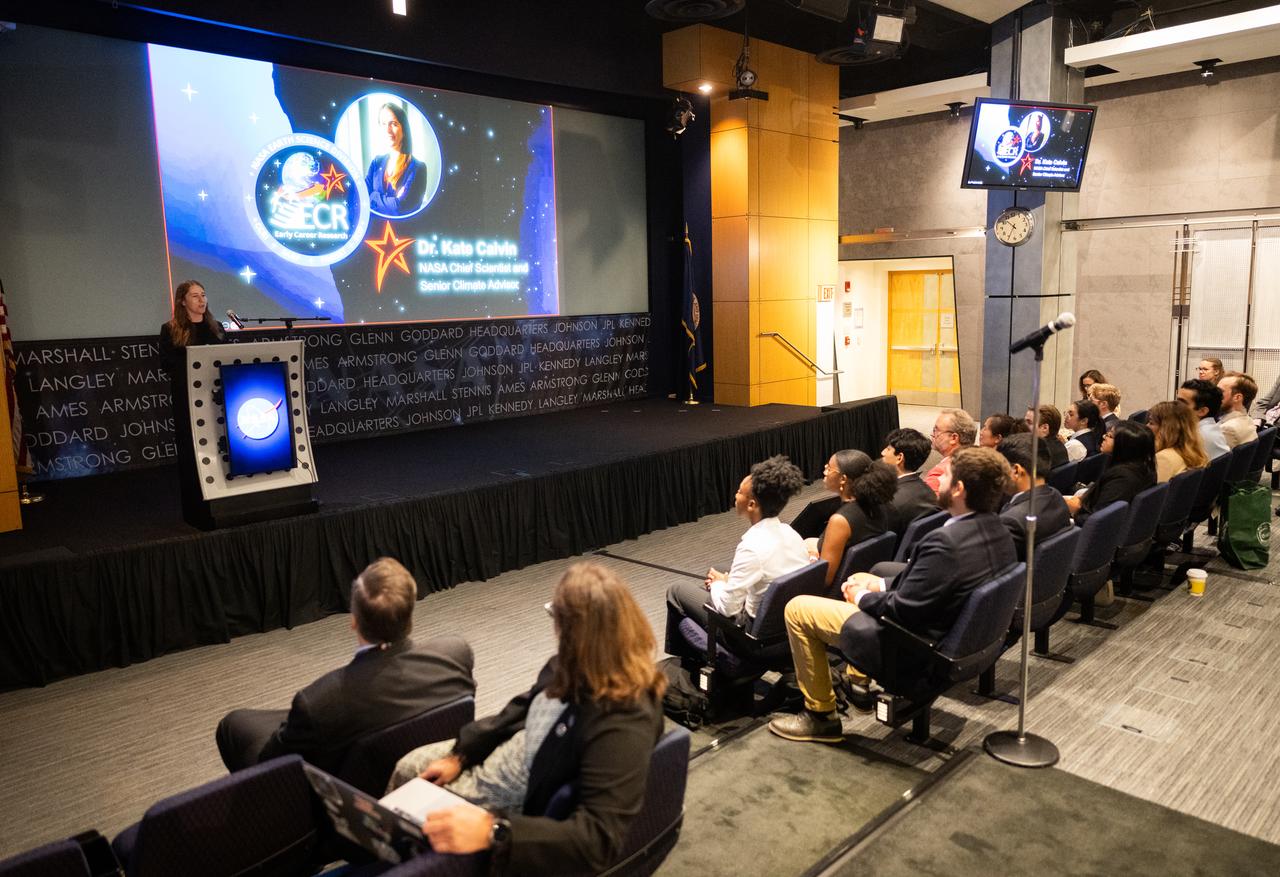
Kate Calvin, NASA’s Chief Scientist, speaks to the Climate Change Research Initiative (CCRI) cohort, Wednesday, Aug. 7, 2024, at the Mary W. Jackson NASA Headquarters building in Washington, DC. The Earth Science Division’s Early Career Research Program’s Climate Change Research Initiative (CCRI) is a year-long STEM engagement and experiential learning opportunity for educators and students from high school to graduate level. Photo Credit: (NASA/Joel Kowsky)
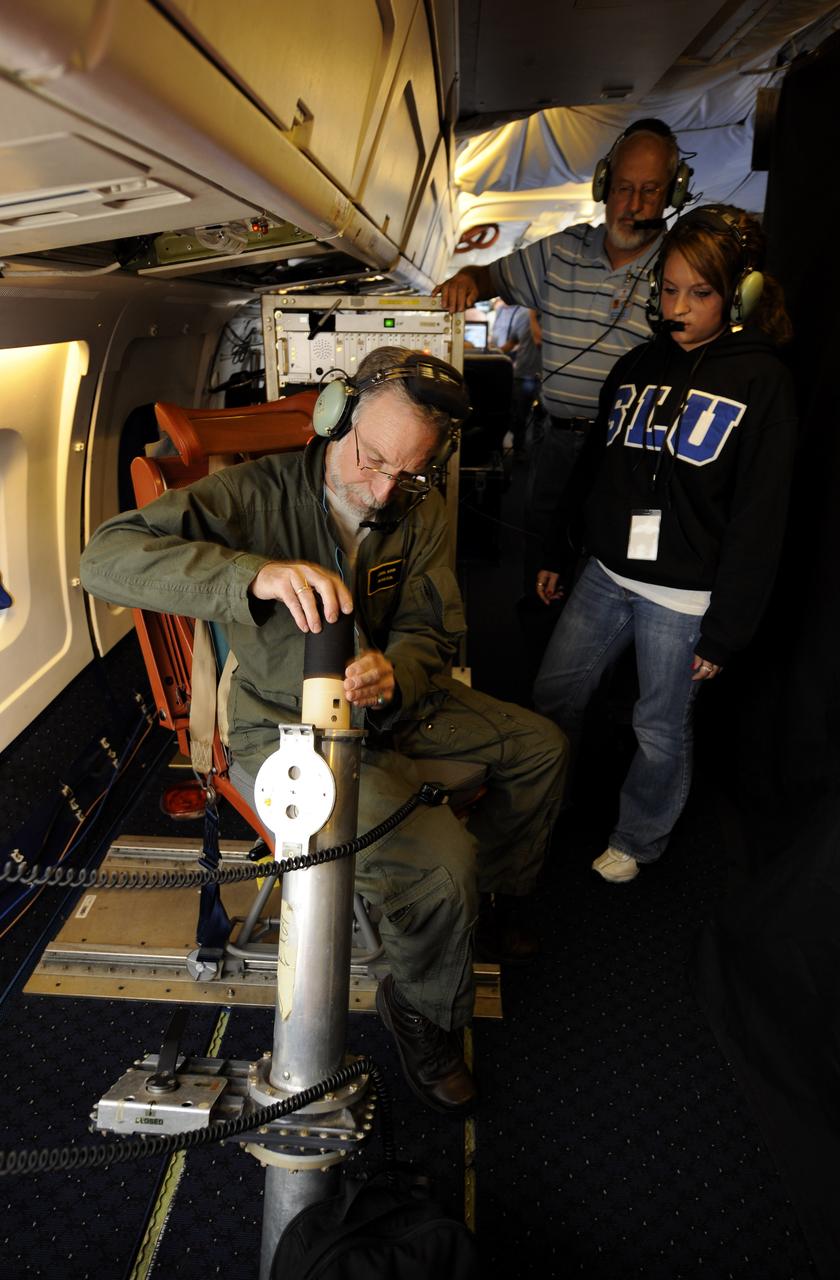
Errol Korn, seated left, deploys a dropsonde experiment over the Gulf of Mexico during a flight aboard the NASA DC-8 as Janel Thomas, a University of Maryland Baltimore County (UMBC) graduate student, and Bob Pasken, look on , Tuesday, Aug. 17, 2010. The Genesis and Rapid Intensification Processes (GRIP) experiment is a NASA Earth science field experiment in 2010 that is being conducted to better understand how tropical storms form and develop into major hurricanes. Photo Credit: (NASA/Paul E. Alers)
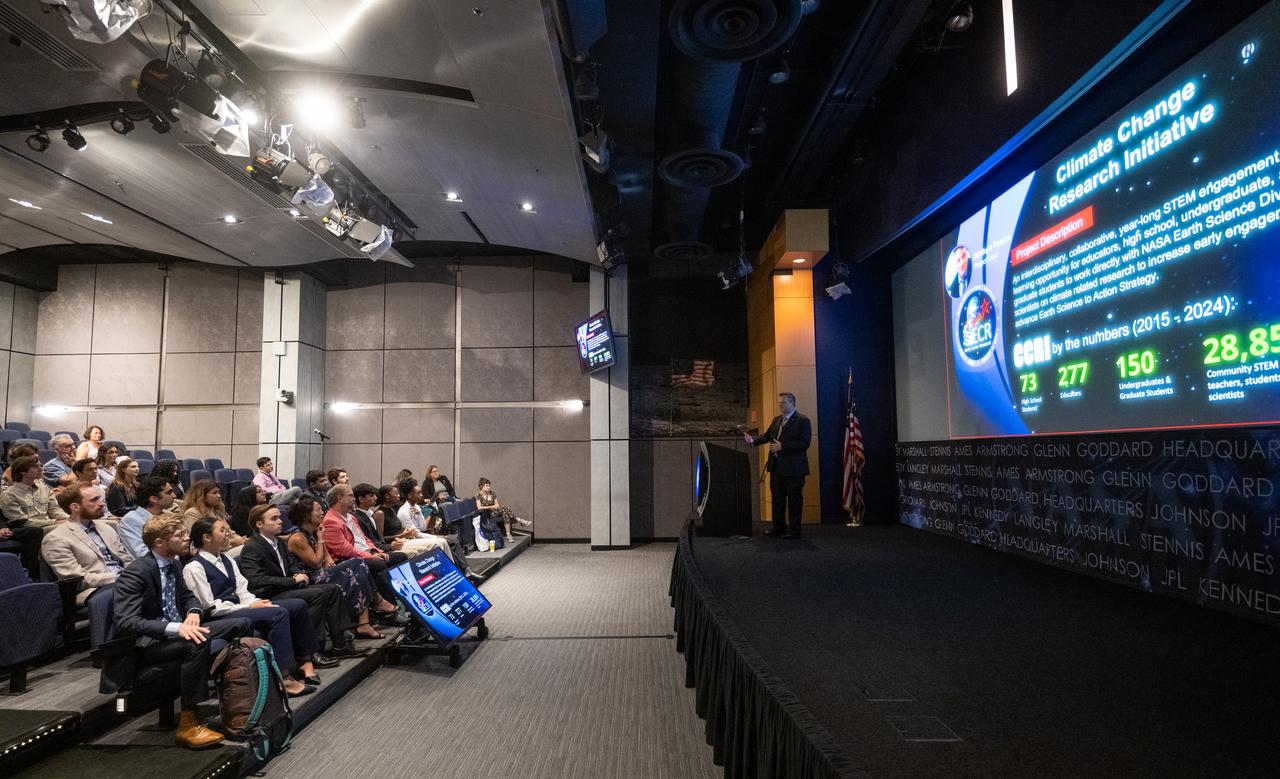
Matthew Pearce, education officer at NASA’s Goddard Institute for Space Studies and project lead for the Climate Change Research Initiative (CCRI), speaks with the CCRI cohort, Wednesday, Aug. 7, 2024, at the Mary W. Jackson NASA Headquarters building in Washington, DC. The Earth Science Division’s Early Career Research Program’s Climate Change Research Initiative (CCRI) is a year-long STEM engagement and experiential learning opportunity for educators and students from high school to graduate level. Photo Credit: (NASA/Joel Kowsky)
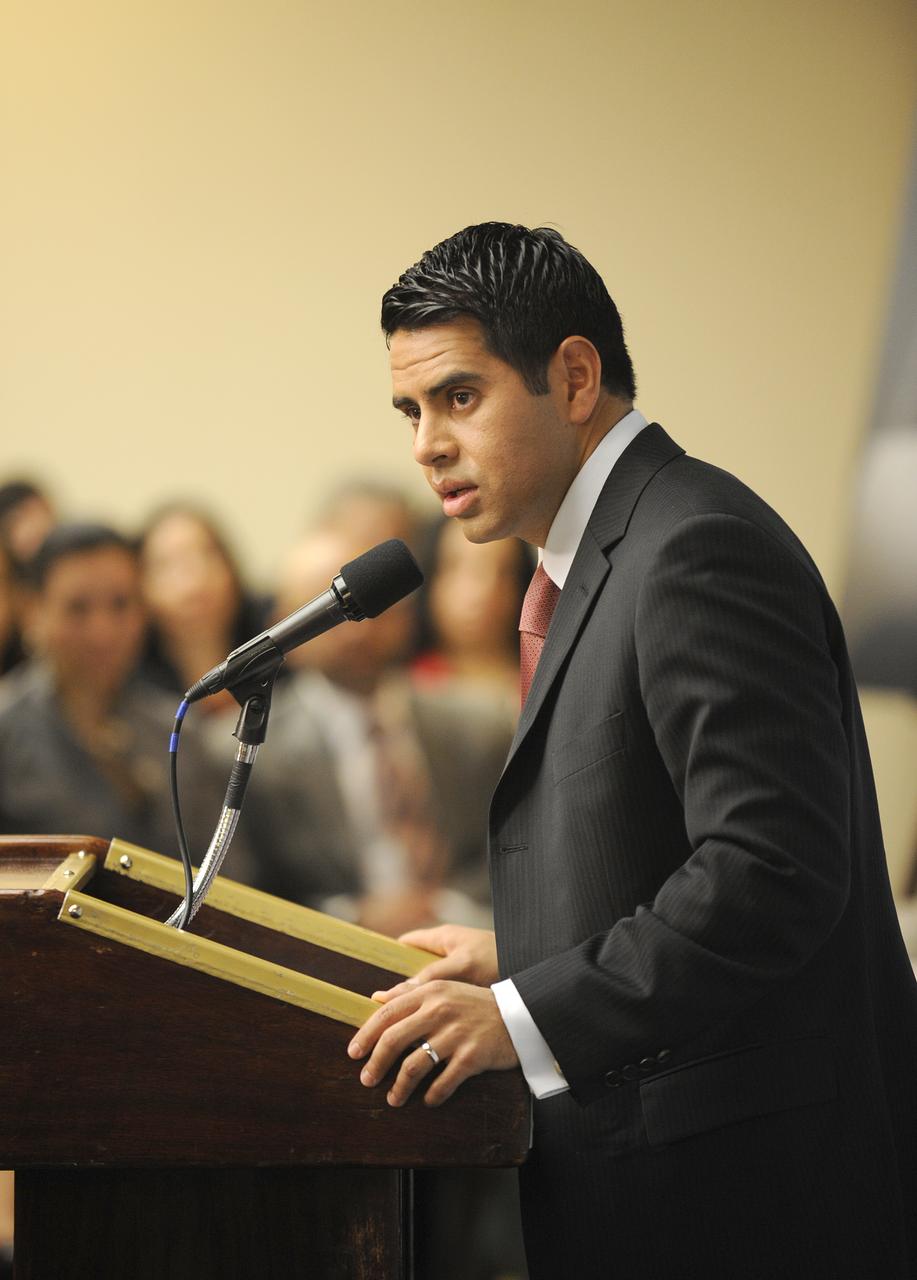
Univision Networks president Cesar Conde speaks at the National Press Club in Washington, Tuesday, Feb. 23, 2010. NASA is working with Univision Communications Inc. to develop a partnership in support of the Spanish-language media outlet's initiative to improve high school graduation rates, prepare Hispanic students for college, and encourage them to pursue careers in science, technology, engineering and mathematics, or STEM, disciplines. Photo Credit: (NASA/Bill Ingalls)
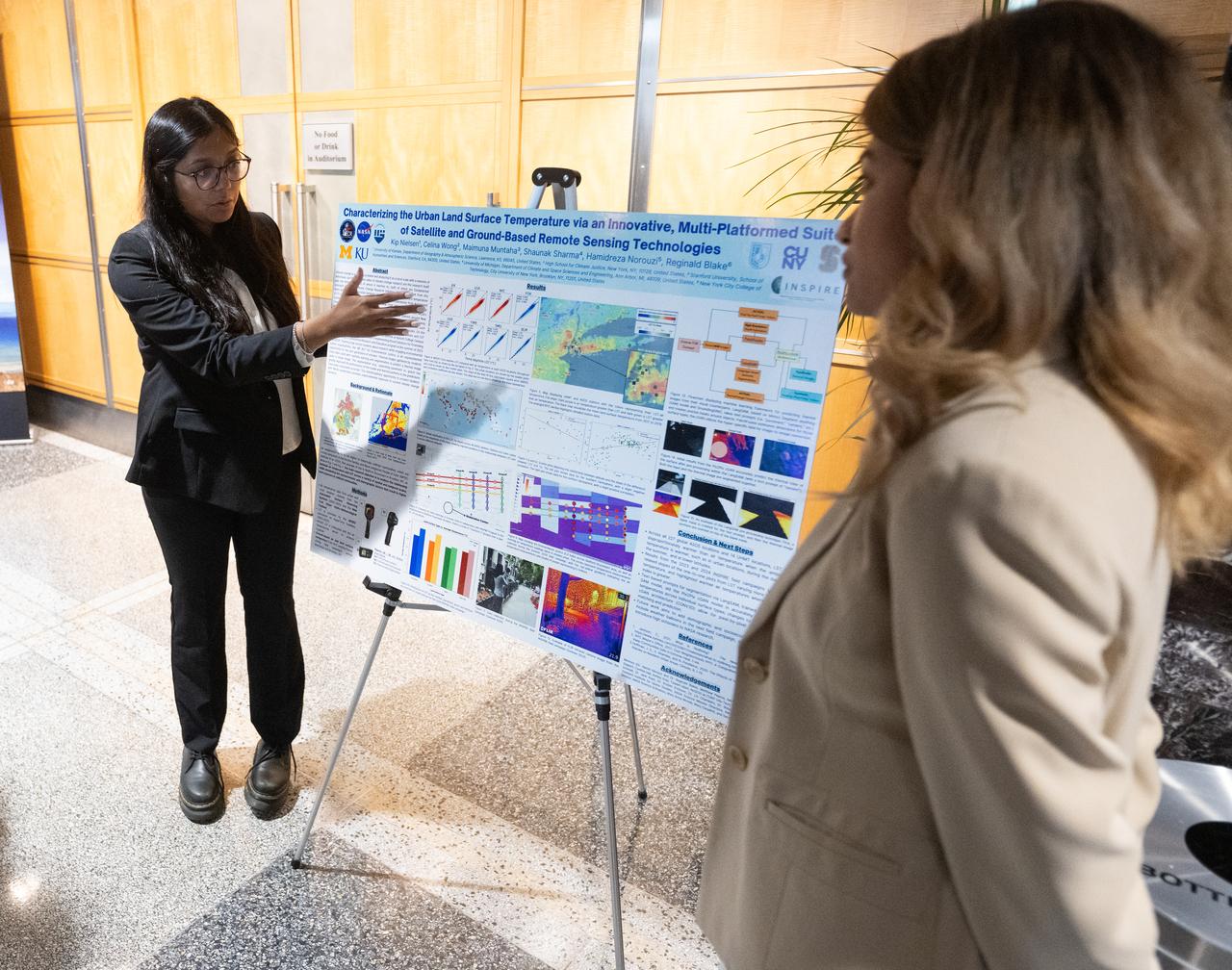
Members of the Climate Change Research Initiative (CCRI) cohort discuss their research during a poster session, Wednesday, Aug. 7, 2024, at the Mary W. Jackson NASA Headquarters building in Washington, DC. The Earth Science Division’s Early Career Research Program’s Climate Change Research Initiative (CCRI) is a year-long STEM engagement and experiential learning opportunity for educators and students from high school to graduate level. Photo Credit: (NASA/Joel Kowsky)
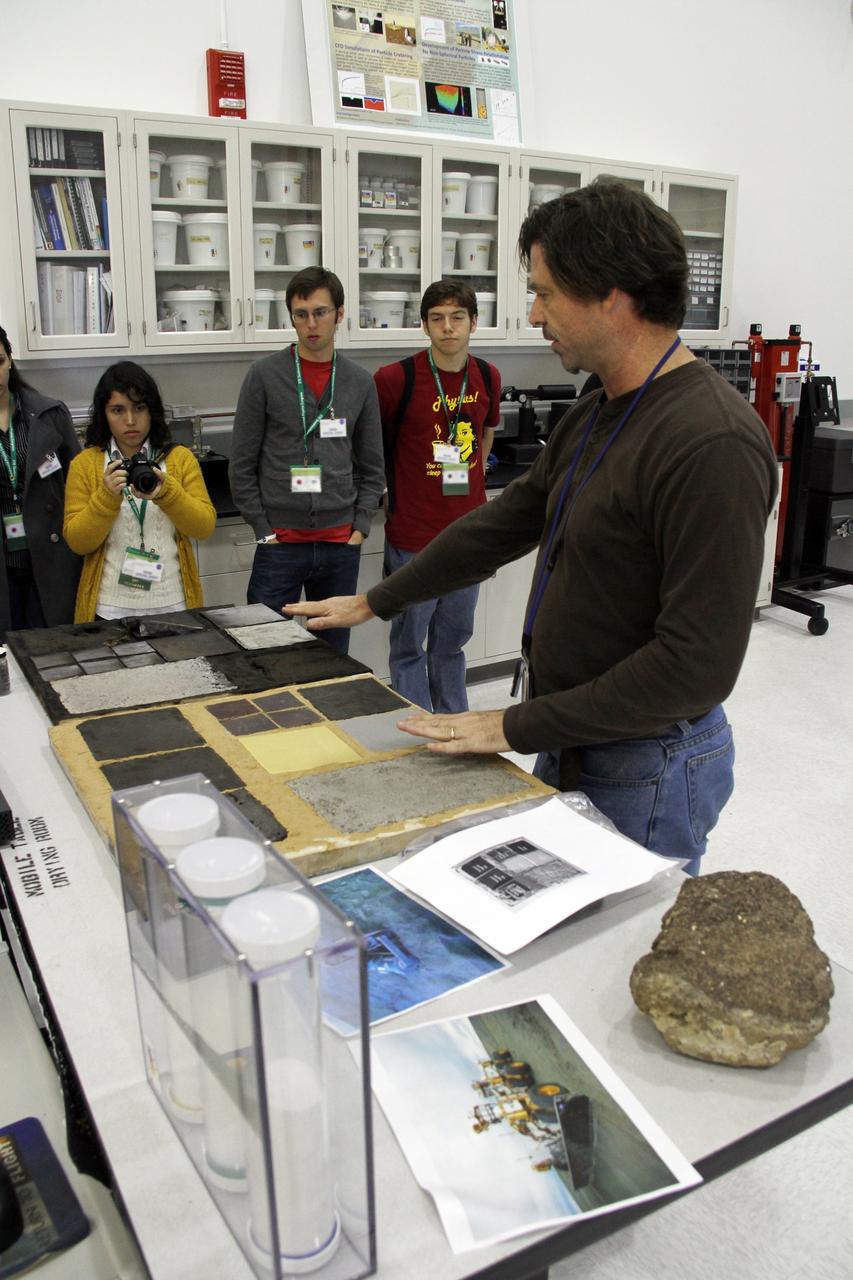
CAPE CANAVERAL, Fla. -- Inside a laboratory in the Engineering Development Laboratory, or EDL, at NASA’s Kennedy Space Center in Florida, research physicist Phil Metzger describes lunar excavators and soil processing technologies to a group of Society of Physics students. About 800 graduate and undergraduate physics students toured Kennedy facilities. A group of about 40 students toured laboratories in the Operations and Checkout Building and the EDL during their visit. The physics students were in Orlando for the 2012 Quadrennial Physics Congress. Photo credit: NASA/Cory Huston
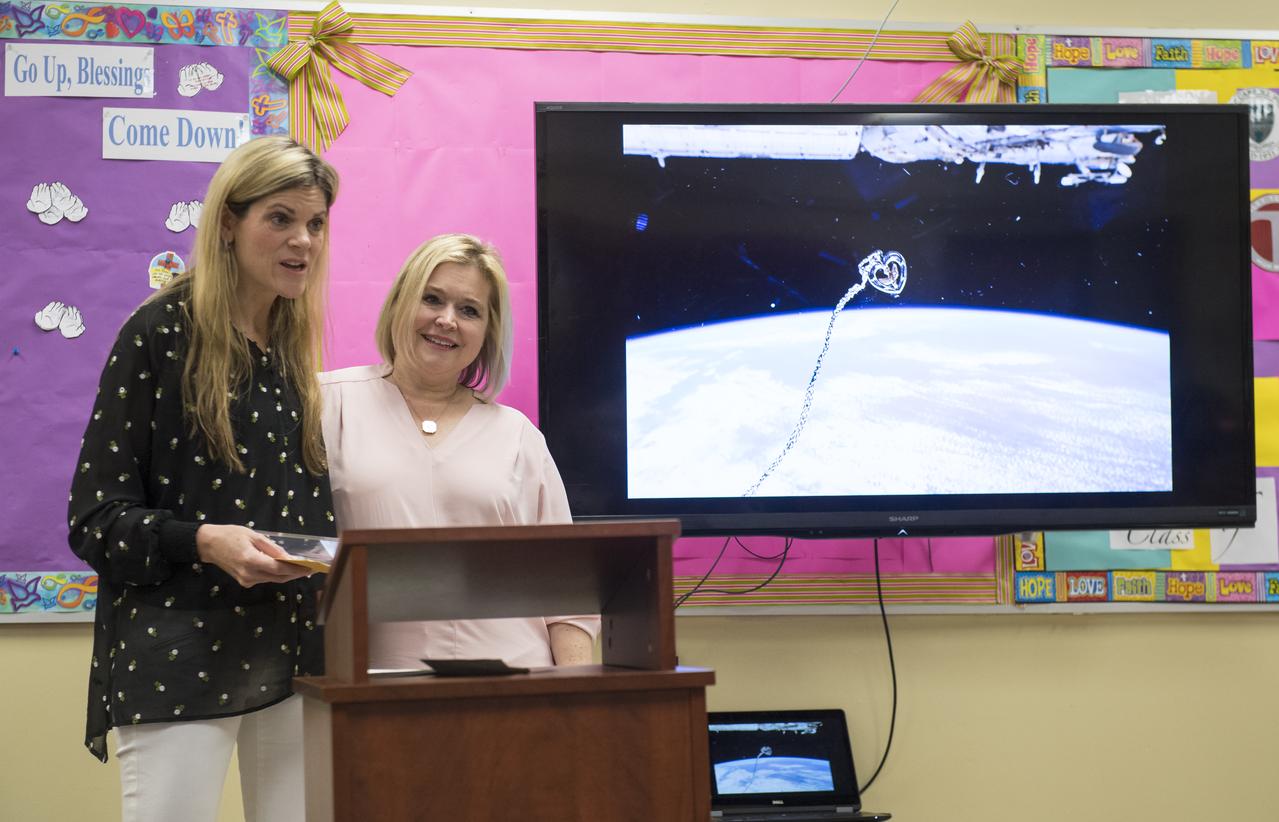
NASA astronaut Randy Bresnik's wife Rebecca and her friend Shiela present the Washington School for Girls a necklace that was flown in space onboard the International Space Station, Friday, May 11, 2018 at the Washington School for Girls in Washington. The necklace is a graduation gift for each student when they complete 8th grade. Photo Credit: (NASA/Aubrey Gemignani)
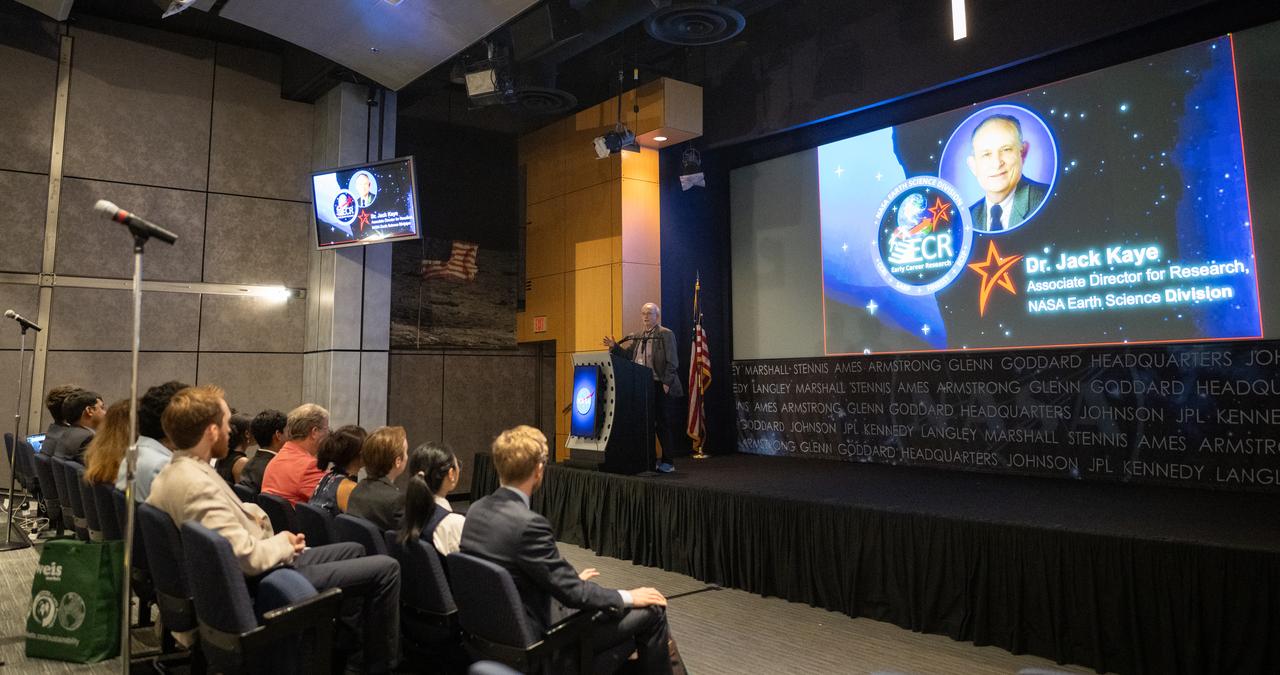
Jack Kaye, associate director for research in the Earth Science Division of NASA’s Science Mission Directorate, speaks with the Climate Change Research Initiative (CCRI) cohort, Wednesday, Aug. 7, 2024, at the Mary W. Jackson NASA Headquarters building in Washington, DC. The Earth Science Division’s Early Career Research Program’s Climate Change Research Initiative (CCRI) is a year-long STEM engagement and experiential learning opportunity for educators and students from high school to graduate level. Photo Credit: (NASA/Joel Kowsky)
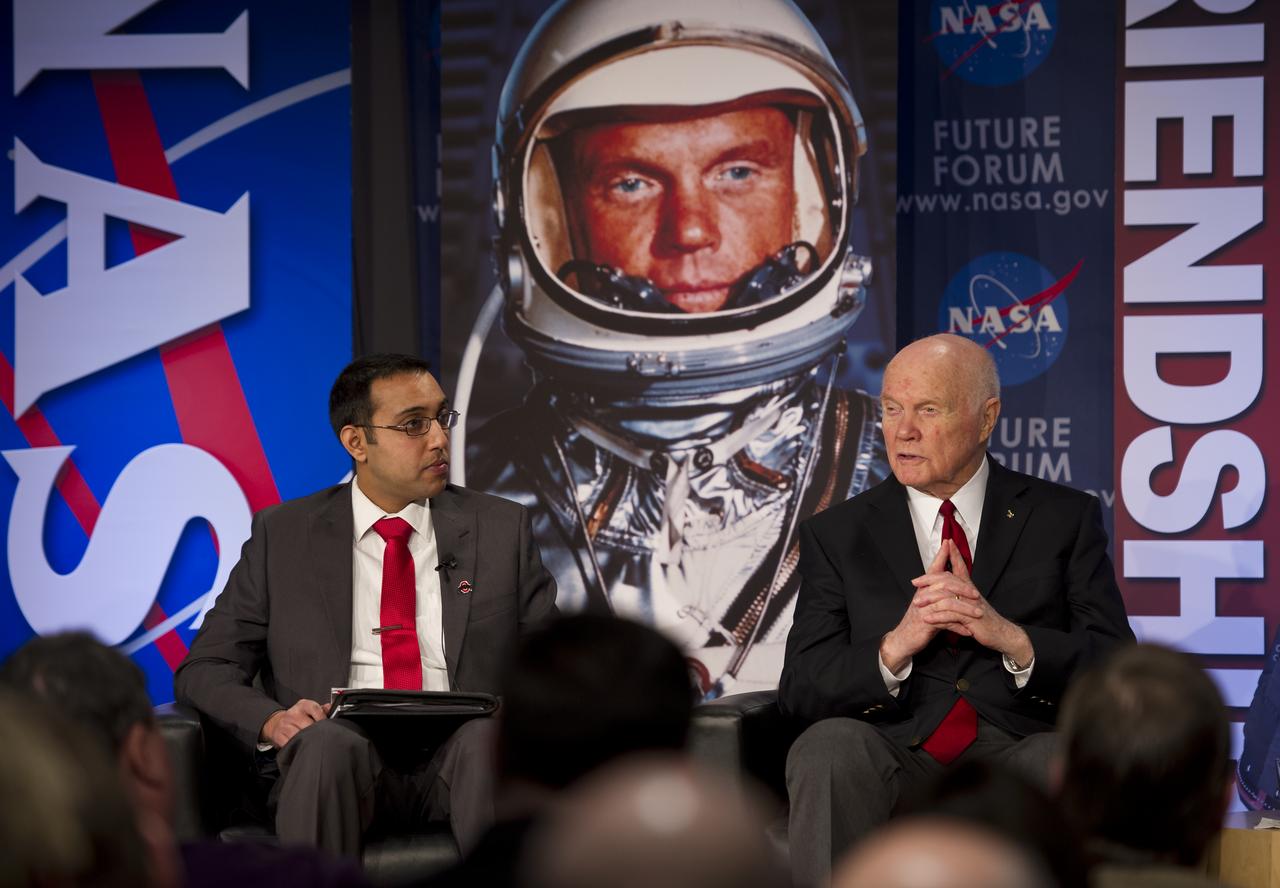
Ohio State University Graduate Research Associate Vijay Gadepally, left, listens as Sen. John Glenn talks during a NASA Future Forum panel discussion at The Ohio State University on Monday, Feb. 20, 2012, in Columbus, Ohio. Monday marked the 50th anniversary of Glenn's historic flight as the first American to orbit Earth. Photo Credit: (NASA/Bill Ingalls)
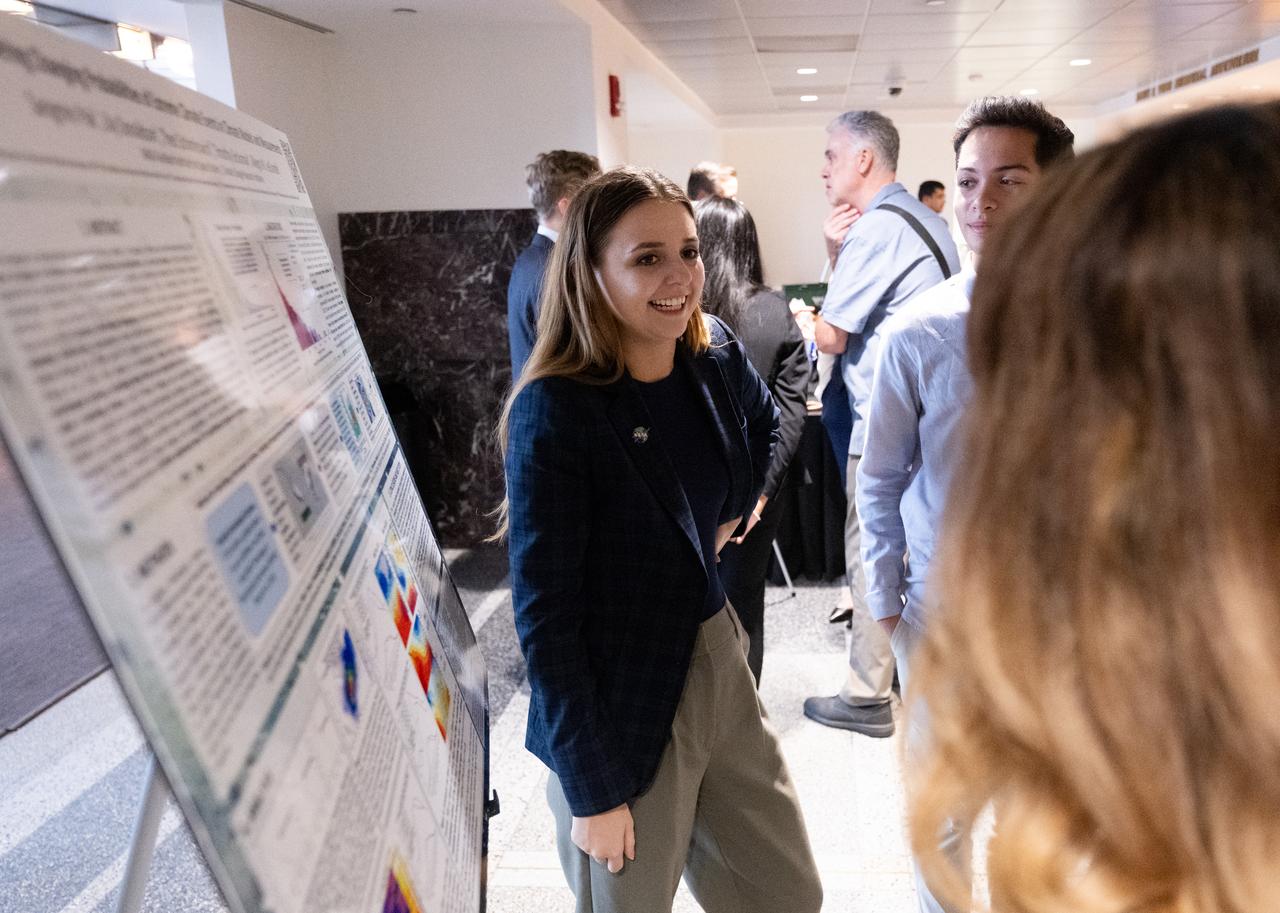
Members of the Climate Change Research Initiative (CCRI) cohort discuss their research during a poster session, Wednesday, Aug. 7, 2024, at the Mary W. Jackson NASA Headquarters building in Washington, DC. The Earth Science Division’s Early Career Research Program’s Climate Change Research Initiative (CCRI) is a year-long STEM engagement and experiential learning opportunity for educators and students from high school to graduate level. Photo Credit: (NASA/Joel Kowsky)
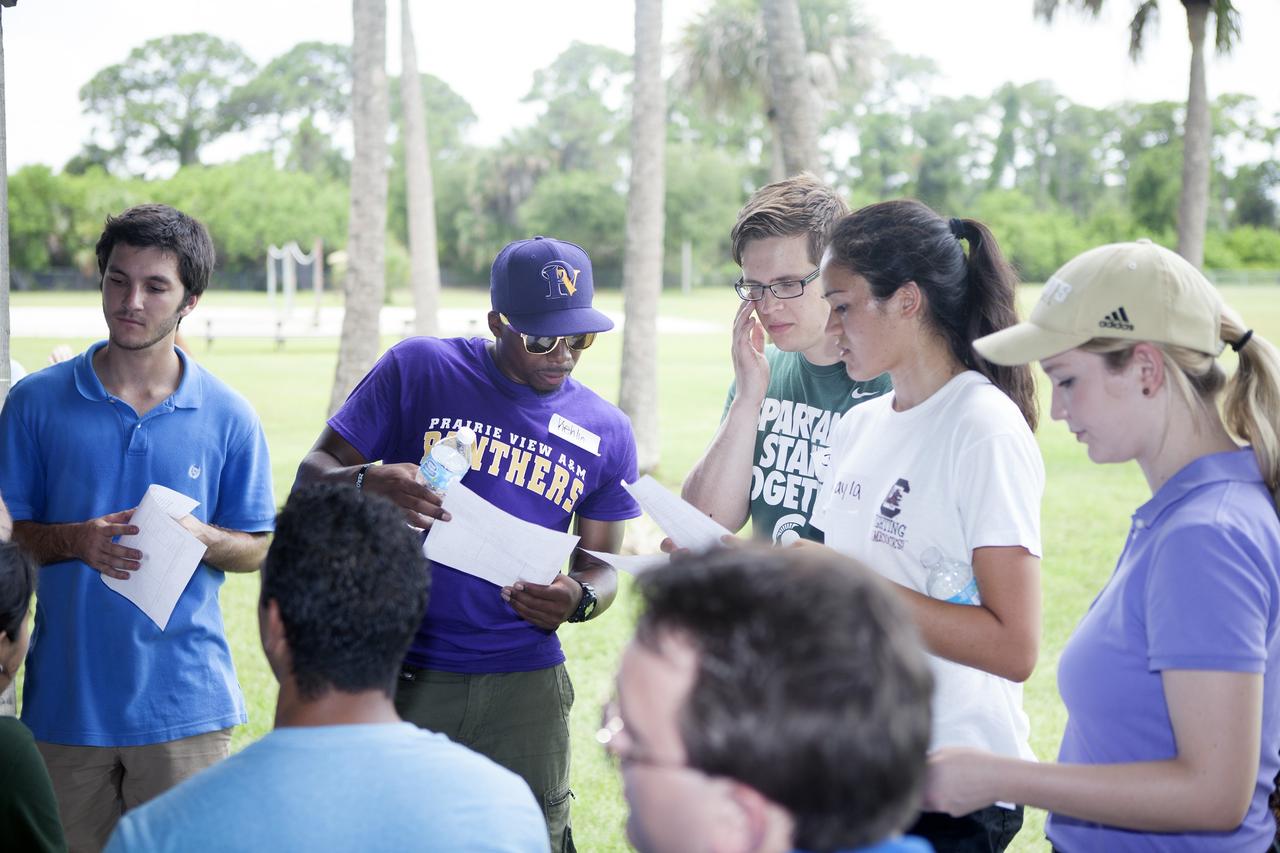
CAPE CANAVERAL, Fla. – Kennedy Space Center Pathways and summer intern students participate in a team building exercise at the KARS Park I facility near the center. High school, undergraduate and graduate students also received advice on leadership skills and working together from Kennedy's senior management, including Center Director Bob Cabana and Associate Director Kelvin Manning. About 160 students are working and gaining experience in many of the directorates and programs during their time at Kennedy. Photo credit: NASA/Daniel Casper
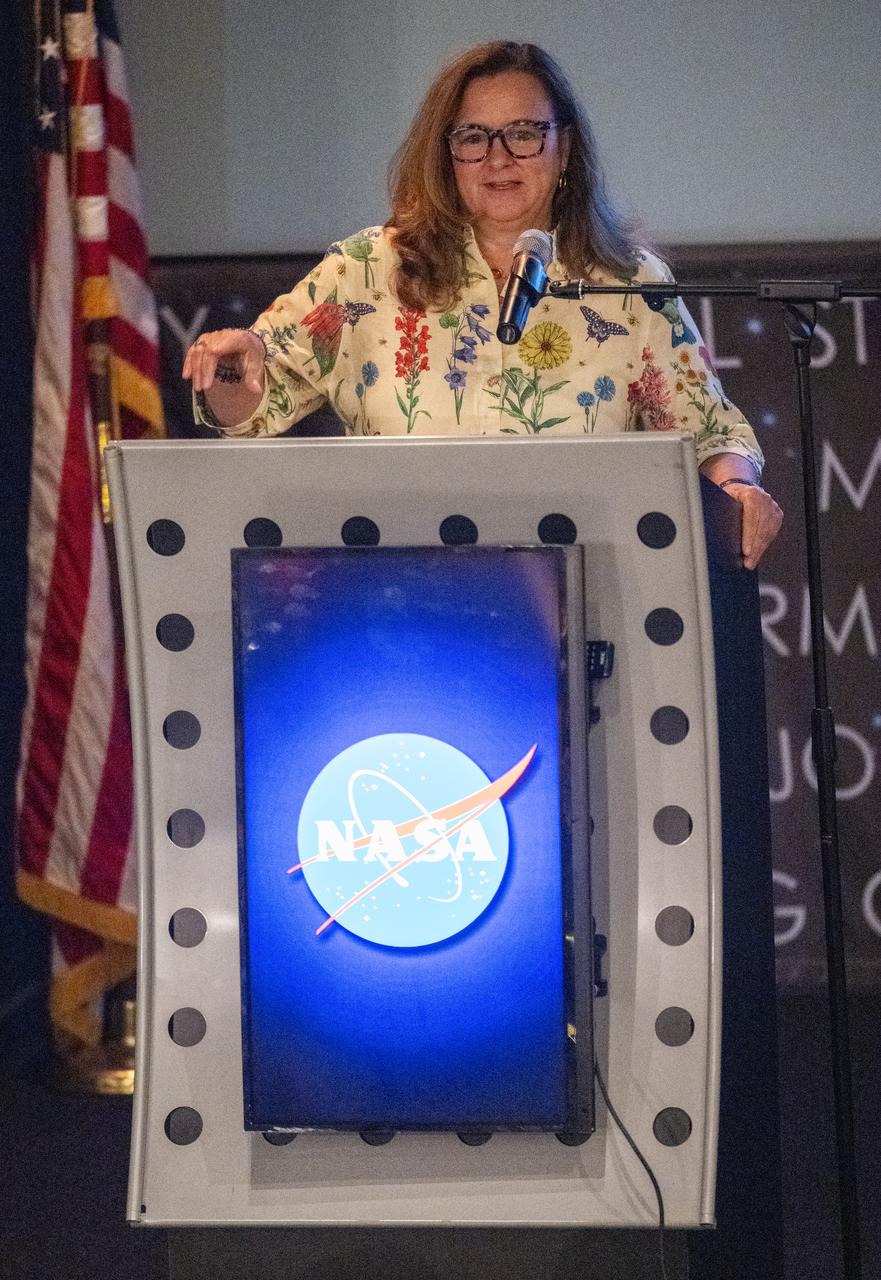
Karen St. Germain, director of the Earth Science Division of NASA’s Science Mission Directorate, speaks with the Climate Change Research Initiative (CCRI) cohort, Wednesday, Aug. 7, 2024, at the Mary W. Jackson NASA Headquarters building in Washington, DC. The Earth Science Division’s Early Career Research Program’s Climate Change Research Initiative (CCRI) is a year-long STEM engagement and experiential learning opportunity for educators and students from high school to graduate level. Photo Credit: (NASA/Joel Kowsky)
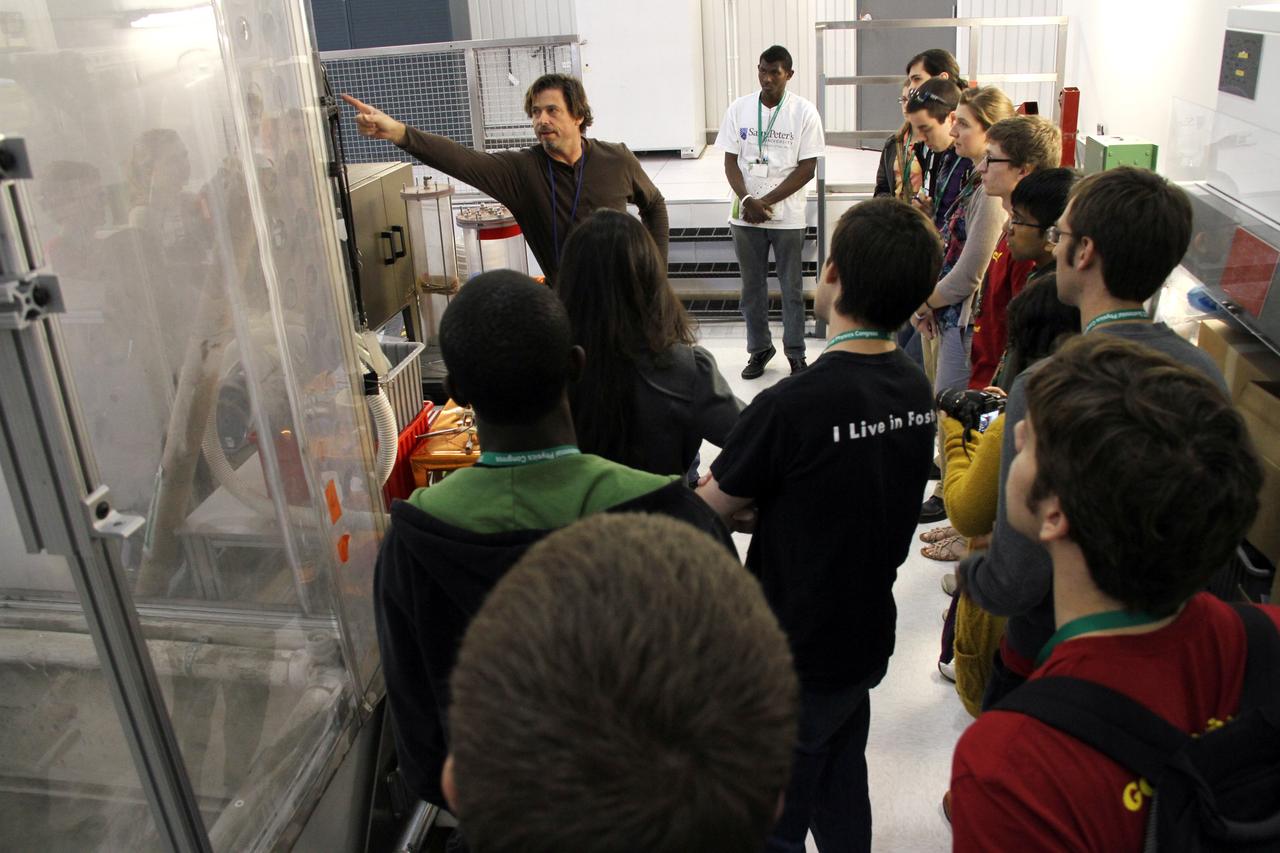
CAPE CANAVERAL, Fla. -- Inside a laboratory in the Engineering Development Laboratory, or EDL, at NASA’s Kennedy Space Center in Florida, research physicist Phil Metzger describes lunar excavators and soil processing technologies to a group of Society of Physics students. About 800 graduate and undergraduate physics students toured Kennedy facilities. A group of about 40 students toured laboratories in the Operations and Checkout Building and the EDL during their visit. The physics students were in Orlando for the 2012 Quadrennial Physics Congress. Photo credit: NASA/Cory Huston
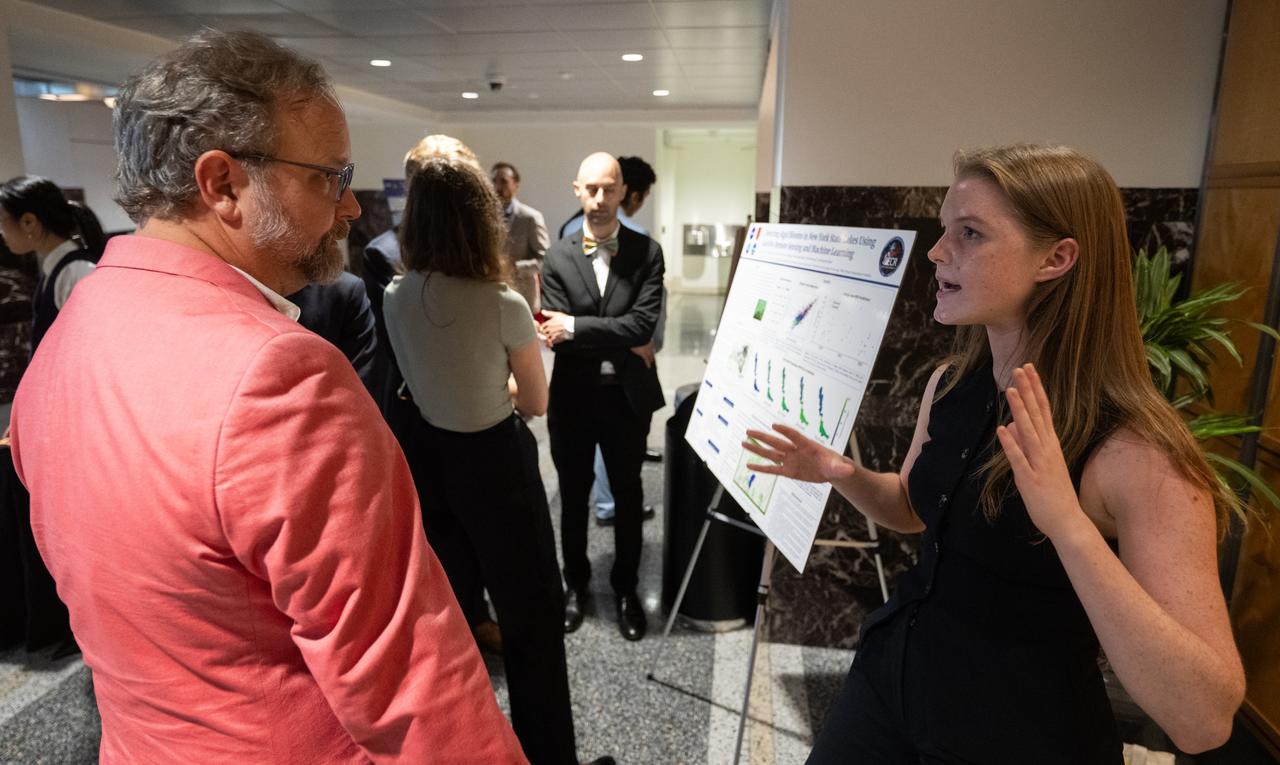
Members of the Climate Change Research Initiative (CCRI) cohort discuss their research during a poster session, Wednesday, Aug. 7, 2024, at the Mary W. Jackson NASA Headquarters building in Washington, DC. The Earth Science Division’s Early Career Research Program’s Climate Change Research Initiative (CCRI) is a year-long STEM engagement and experiential learning opportunity for educators and students from high school to graduate level. Photo Credit: (NASA/Joel Kowsky)
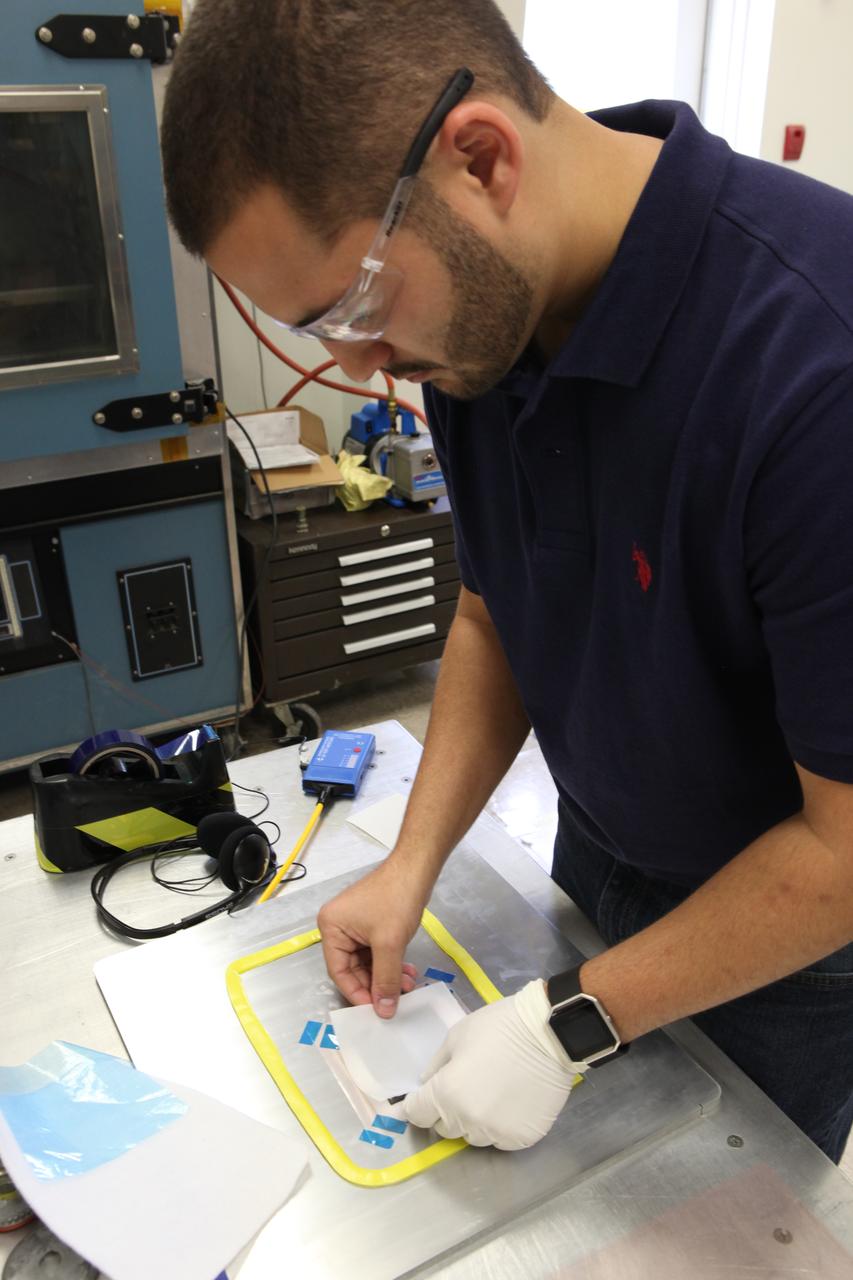
Daniel Perez, Ph.D., a graduate student from the University of Miami, prepares layers of the prototype structure for a new solid-state battery in the Prototype Laboratory at NASA's Kennedy Space Center in Florida. The size of the battery is so small that it could be a prime candidate for use in microsatellites, including CubeSats. Researchers at Kennedy are collaborating with experts at the University of Miami. The university partnership is funded through the Small Spacecraft Technology Program, in NASA's Space Technology Mission Directorate.
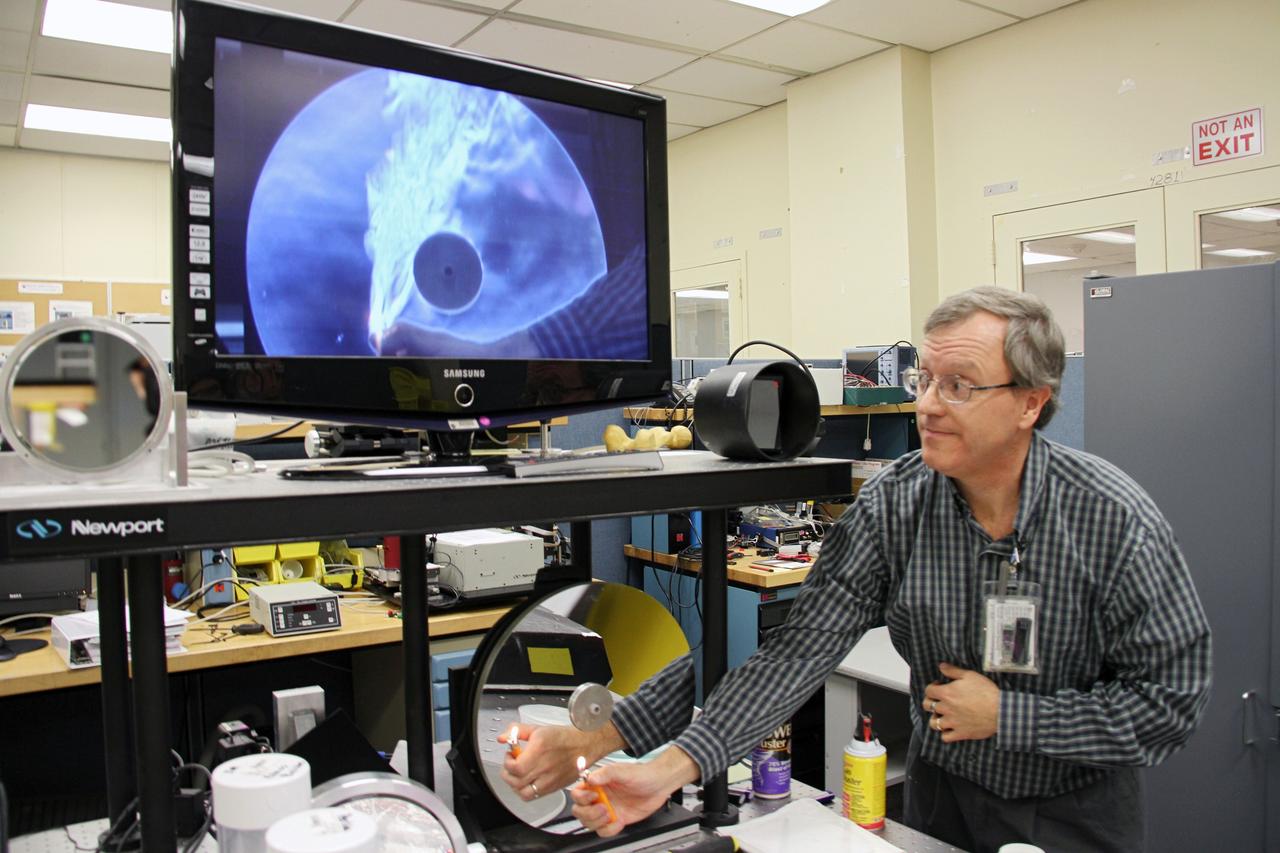
CAPE CANAVERAL, Fla. -- Inside the Applied Physics Laboratory in the Operations and Checkout Building at NASA’s Kennedy Space Center in Florida, lead researcher Dr. Bob Youngquist demonstrates a technology developed for the Space Shuttle Program to a group of Society of Physics students. About 800 graduate and undergraduate physics students toured Kennedy facilities. A group of about 40 students toured laboratories in the Operations and Checkout Building and the EDL during their visit. The physics students were in Orlando for the 2012 Quadrennial Physics Congress. Photo credit: NASA/Cory Huston
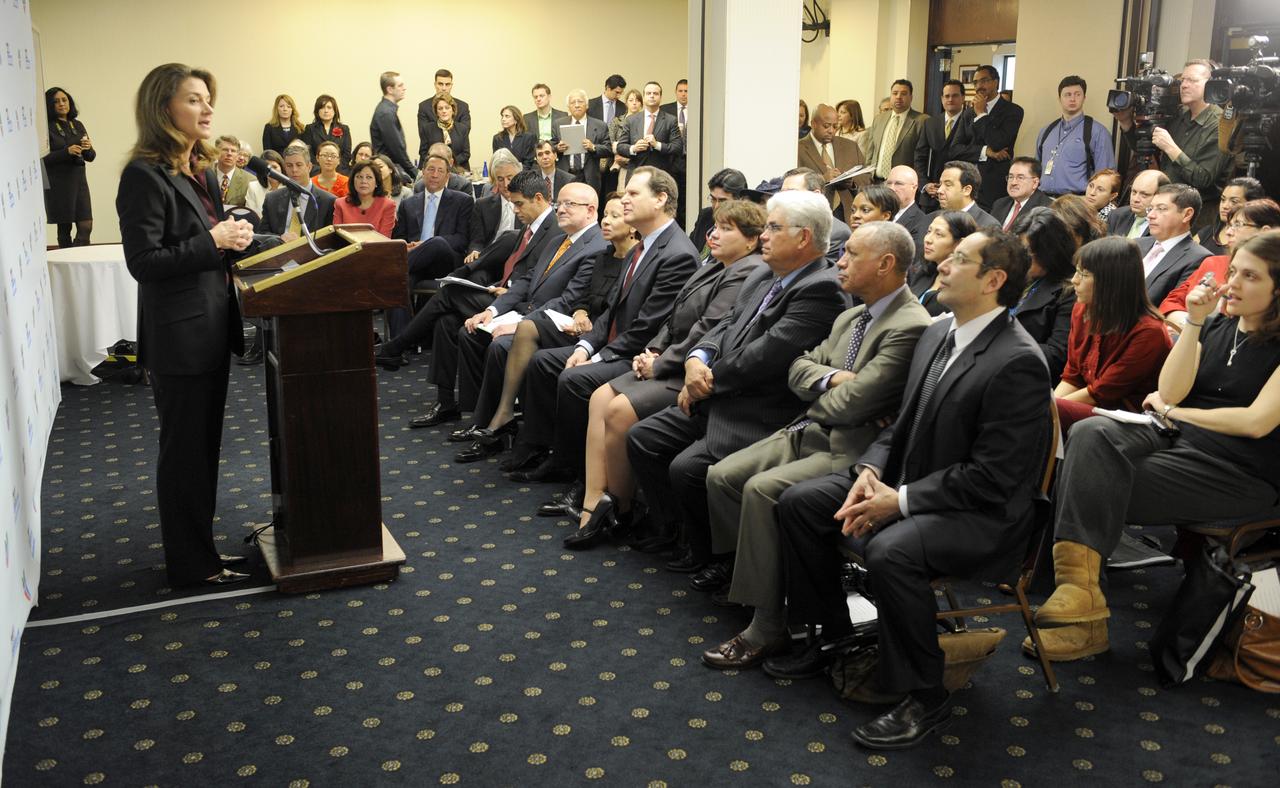
Melinda French Gates, of the Bill & Melinda Gates Foundation speaks at an event at the National Press Club in Washington, Tuesday, Feb. 23, 2010. NASA is working with Univision Communications Inc. to develop a partnership in support of the Spanish-language media outlet's initiative to improve high school graduation rates, prepare Hispanic students for college, and encourage them to pursue careers in science, technology, engineering and mathematics, or STEM, disciplines. Photo Credit: (NASA/Bill Ingalls)
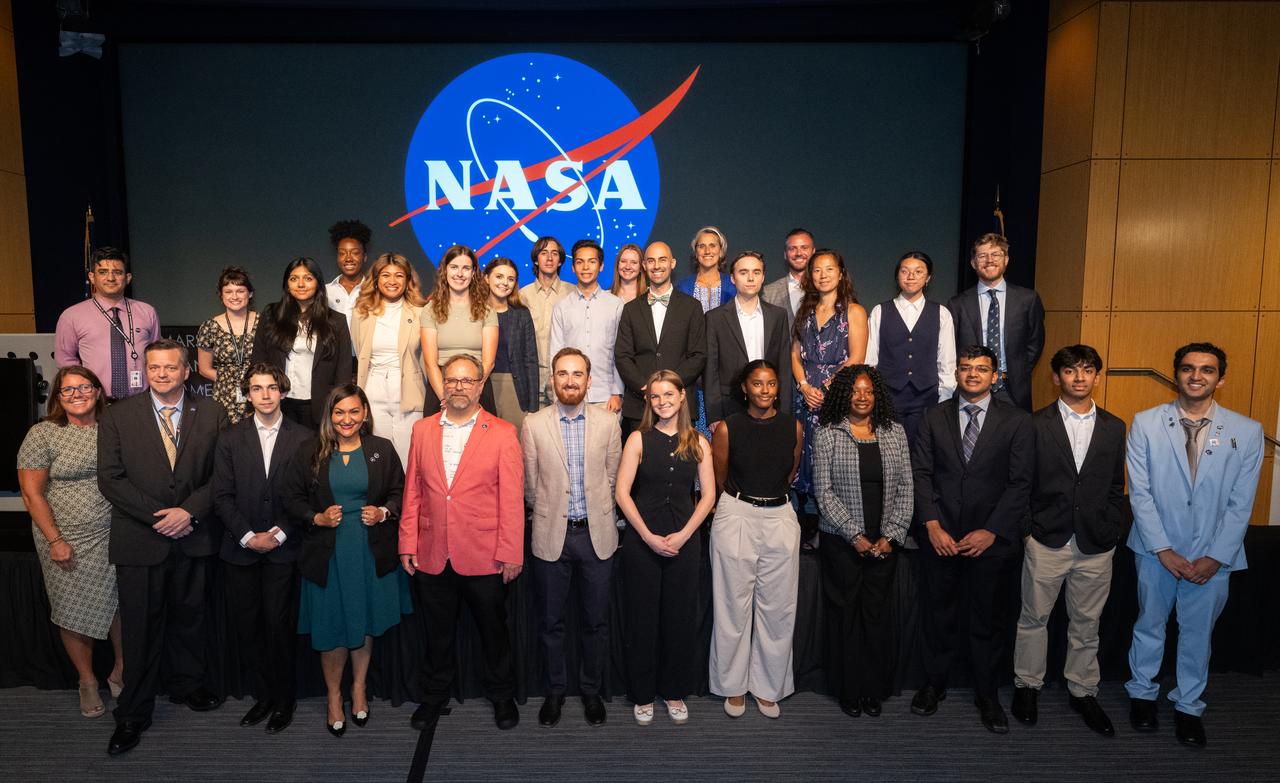
The Climate Change Research Initiative (CCRI) cohort poses for a group photo, Wednesday, Aug. 7, 2024, at the Mary W. Jackson NASA Headquarters building in Washington, DC. The Earth Science Division’s Early Career Research Program’s Climate Change Research Initiative (CCRI) is a year-long STEM engagement and experiential learning opportunity for educators and students from high school to graduate level. Photo Credit: (NASA/Joel Kowsky)
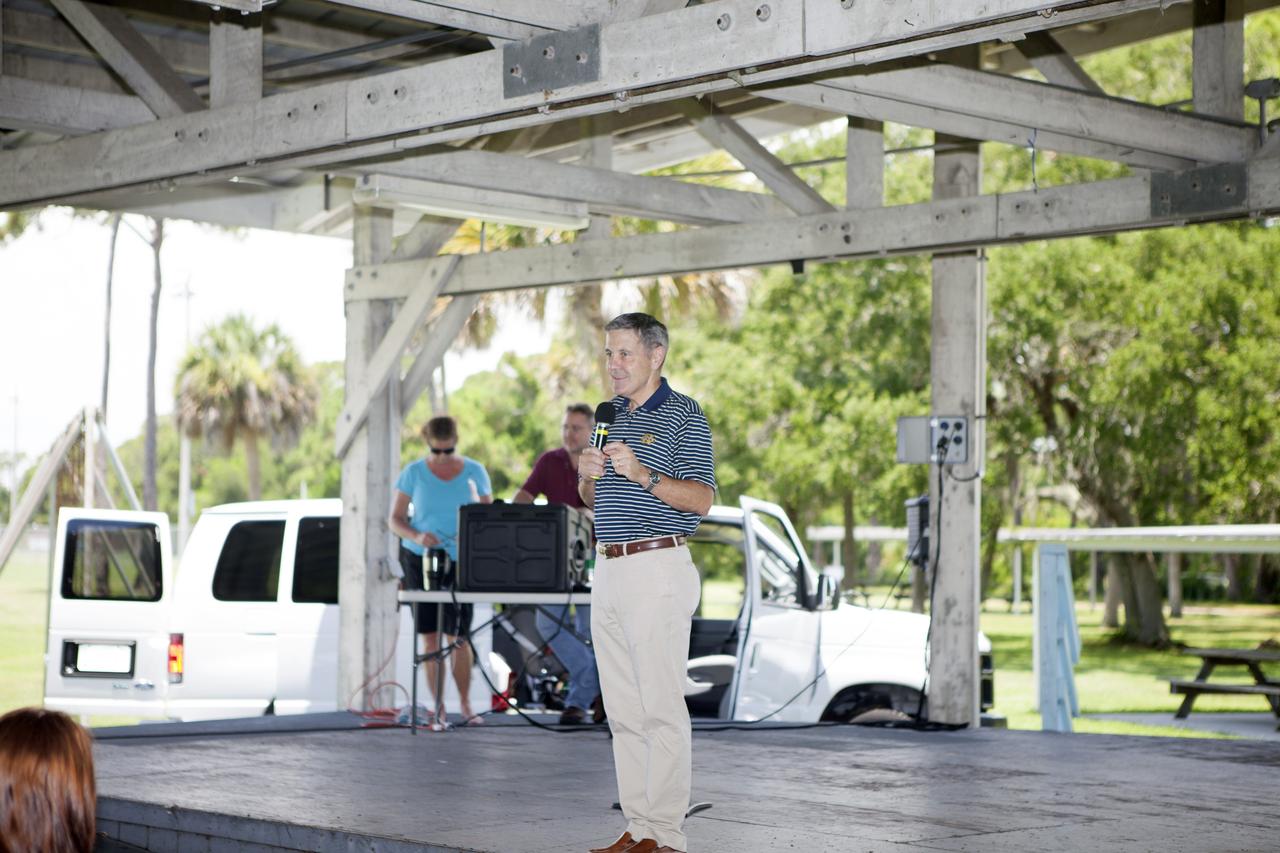
CAPE CANAVERAL, Fla. – Kennedy Space Center Director Bob Cabana speaks to Pathways and summer interns at the KARS Park I facility near the center. High school, undergraduate and graduate students participated in a team building exercise and received advice on leadership skills and working together from Kennedy's senior management. About 160 students are working and gaining experience in many of the directorates and programs during their time at Kennedy. Photo credit: NASA/Daniel Casper
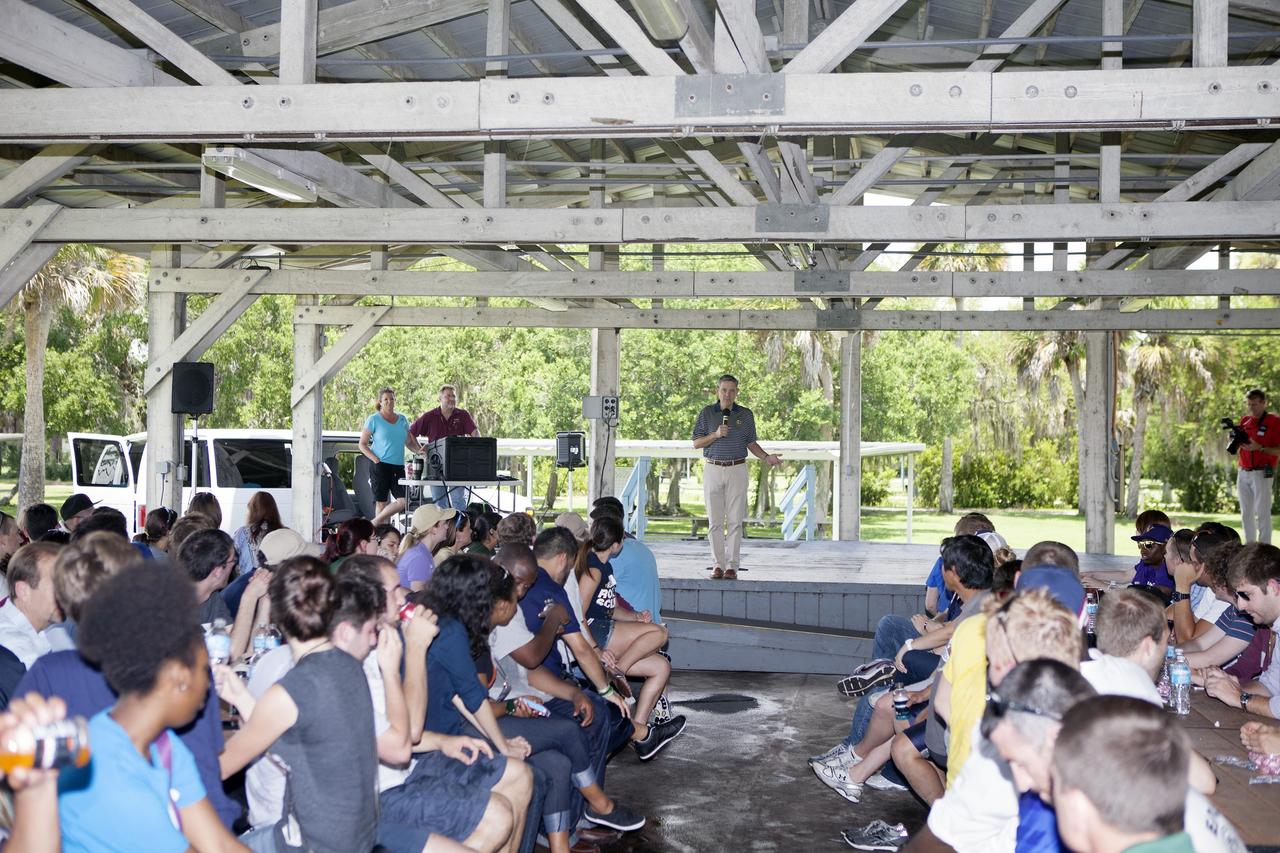
CAPE CANAVERAL, Fla. – Kennedy Space Center Director Bob Cabana speaks to Pathways and summer interns at the KARS Park I facility near the center. High school, undergraduate and graduate students participated in a team building exercise and received advice on leadership skills and working together from Kennedy's senior management. About 160 students are working and gaining experience in many of the directorates and programs during their time at Kennedy. Photo credit: NASA/Daniel Casper
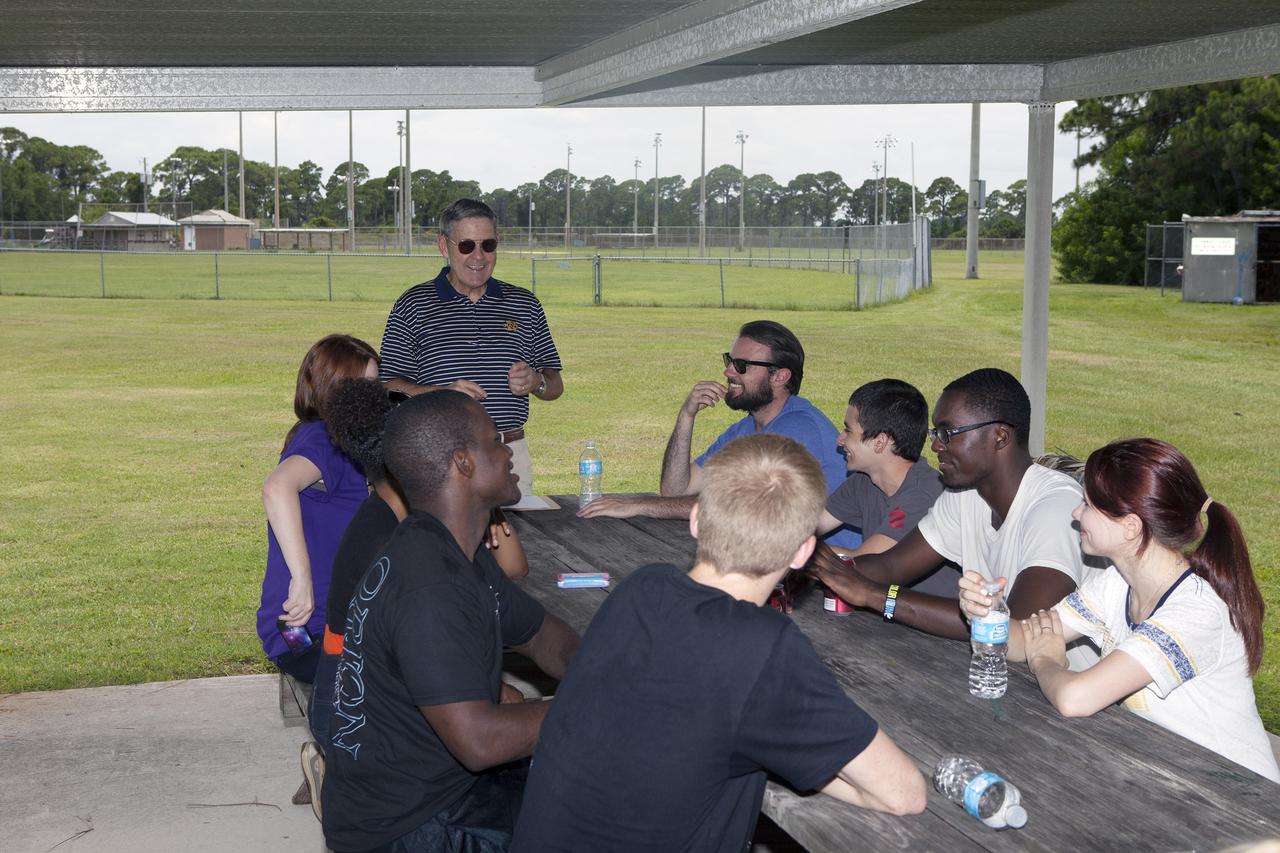
CAPE CANAVERAL, Fla. – Kennedy Space Center Director Bob Cabana talks to student interns during an event at the KARS Park I facility near the center. High school, undergraduate and graduate students participate in a team building exercise and received advice on leadership skills and working together from Kennedy's senior management. About 160 students are working and gaining experience in many of the directorates and programs during their time at Kennedy. Photo credit: NASA/Daniel Casper
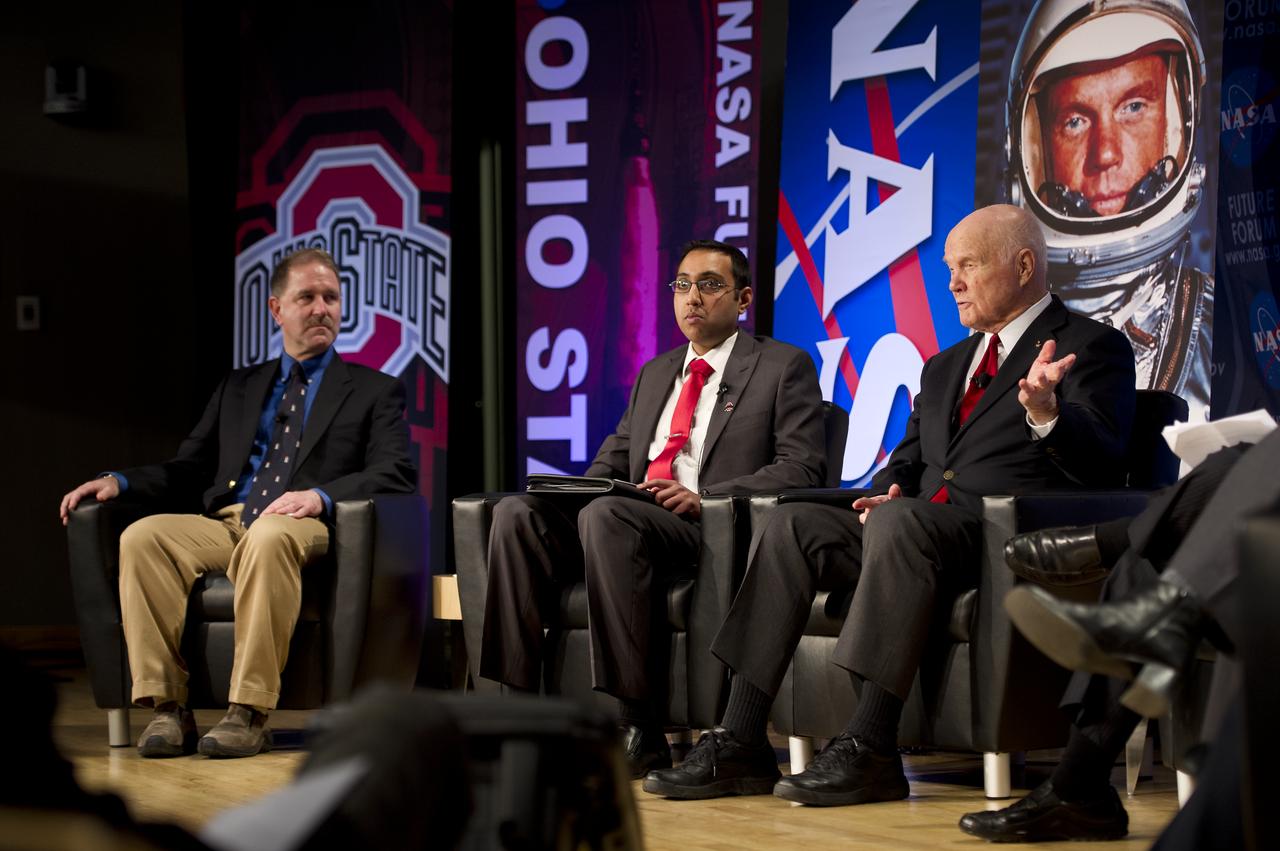
Sen. John Glenn, right, talks during a NASA Future Forum panel discussion at The Ohio State University as NASA Associate Administrator for Science Mission Directorate John Grunsfeld, left, and Ohio State University Graduate Research Associate Vijay Gadepally look on, Monday, Feb. 20, 2012, in Columbus, Ohio. Monday marked the 50th anniversary of Glenn's historic flight as the first American to orbit Earth. Photo Credit: (NASA/Bill Ingalls)

NASA Administrator Charles Bolden, right, talks as Sen. John Glenn, and Ohio State University Graduate Research Associate Vijay Gadepally, left, listen during a NASA Future Forum panel discussion at The Ohio State University on Monday, Feb. 20, 2012, in Columbus, Ohio. Monday marked the 50th anniversary of Glenn's historic flight as the first American to orbit Earth. Photo Credit: (NASA/Bill Ingalls)
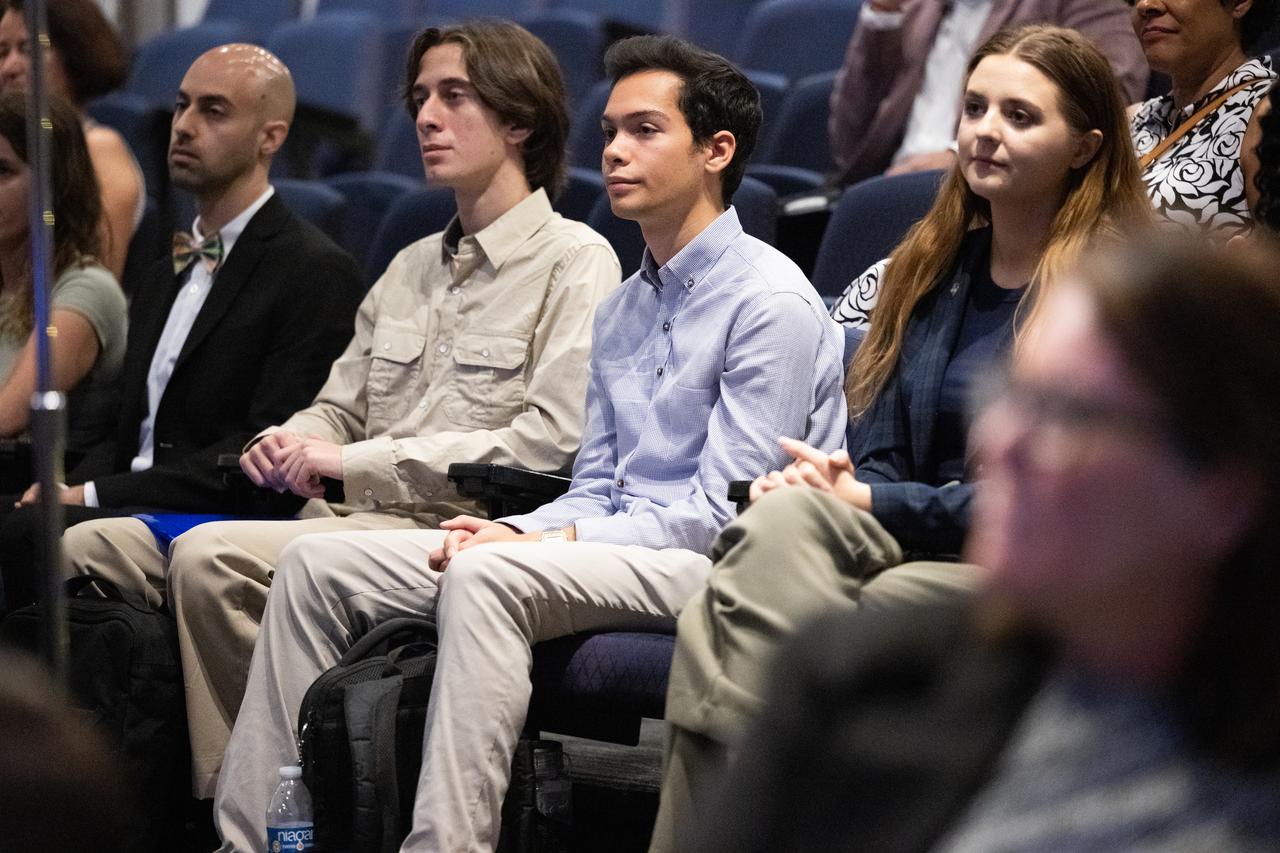
Members of the Climate Change Research Initiative (CCRI) cohort listen as Karen St. Germain, director of the Earth Science Division of NASA’s Science Mission Directorate speaks, Wednesday, Aug. 7, 2024, at the Mary W. Jackson NASA Headquarters building in Washington, DC. The Earth Science Division’s Early Career Research Program’s Climate Change Research Initiative (CCRI) is a year-long STEM engagement and experiential learning opportunity for educators and students from high school to graduate level. Photo Credit: (NASA/Joel Kowsky)
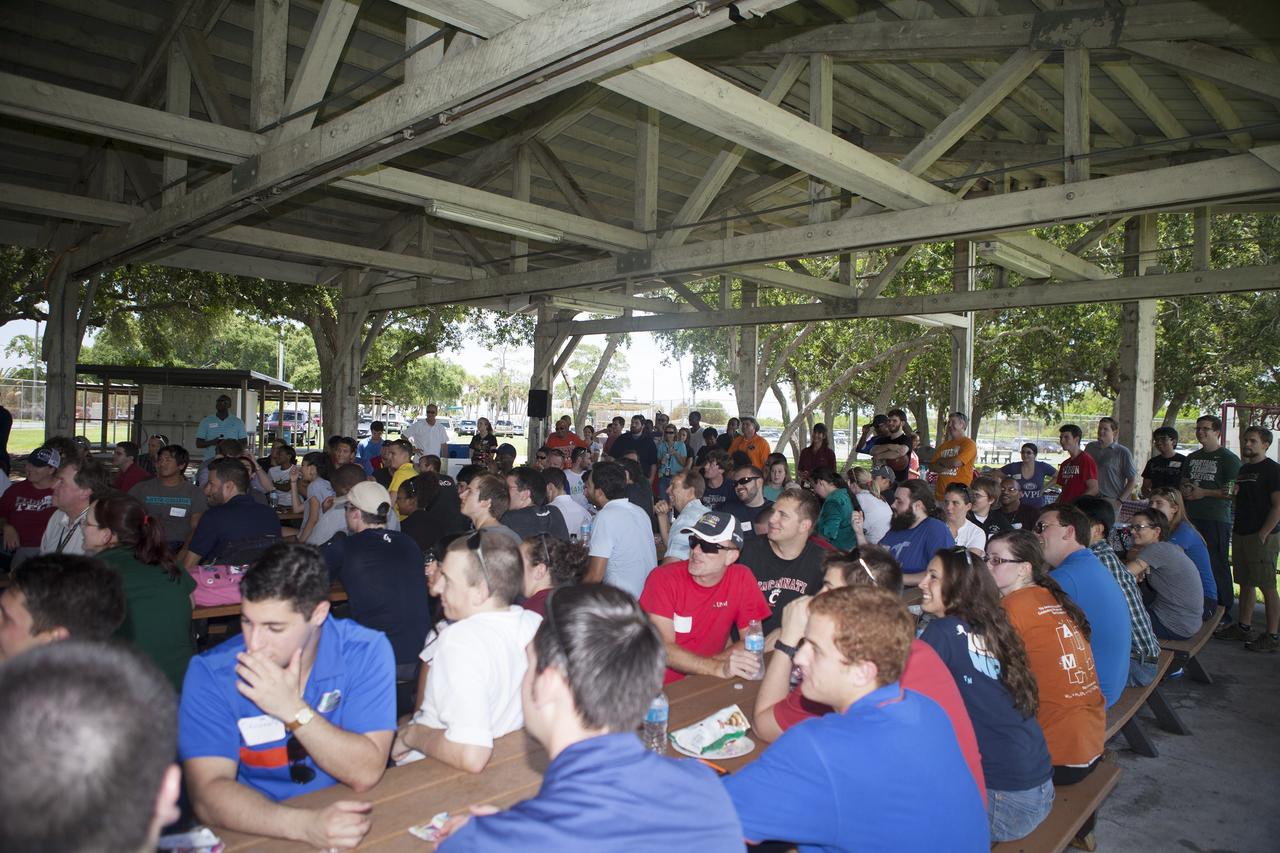
CAPE CANAVERAL, Fla. – Pathways and summer interns listen as Kennedy Space Center Director Bob Cabana speaks to them during an event at the KARS Park I facility near the center. High school, undergraduate and graduate students participated in a team building exercise and received advice on leadership skills and working together from Kennedy's senior management. About 160 students are working and gaining experience in many of the directorates and programs during their time at Kennedy. Photo credit: NASA/Daniel Casper
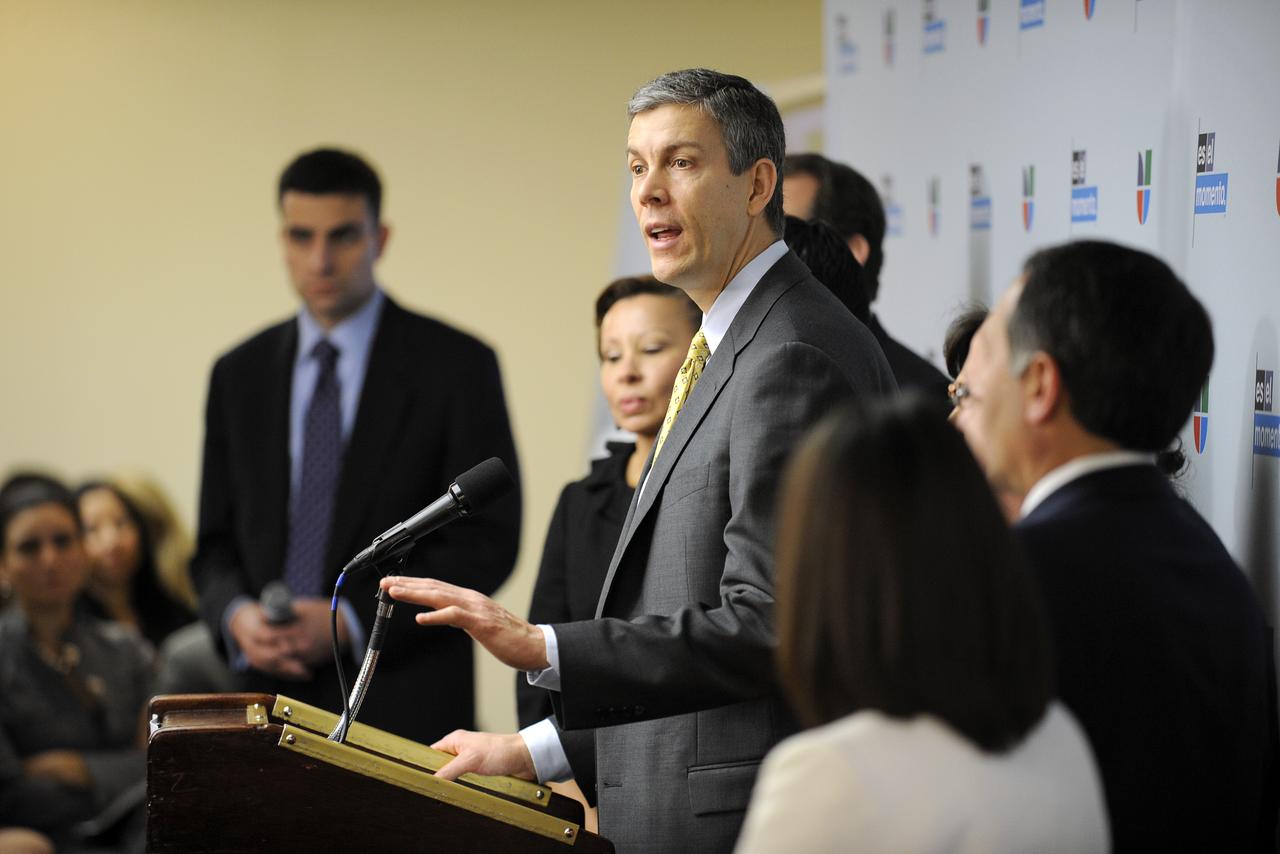
U.S. Secretary of Education Arne Duncan speaks during an event at the National Press Club in Washington, Tuesday, Feb. 23, 2010. NASA is working with Univision Communications Inc. to develop a partnership in support of the Spanish-language media outlet's initiative to improve high school graduation rates, prepare Hispanic students for college, and encourage them to pursue careers in science, technology, engineering and mathematics, or STEM, disciplines. Photo Credit: (NASA/Bill Ingalls)
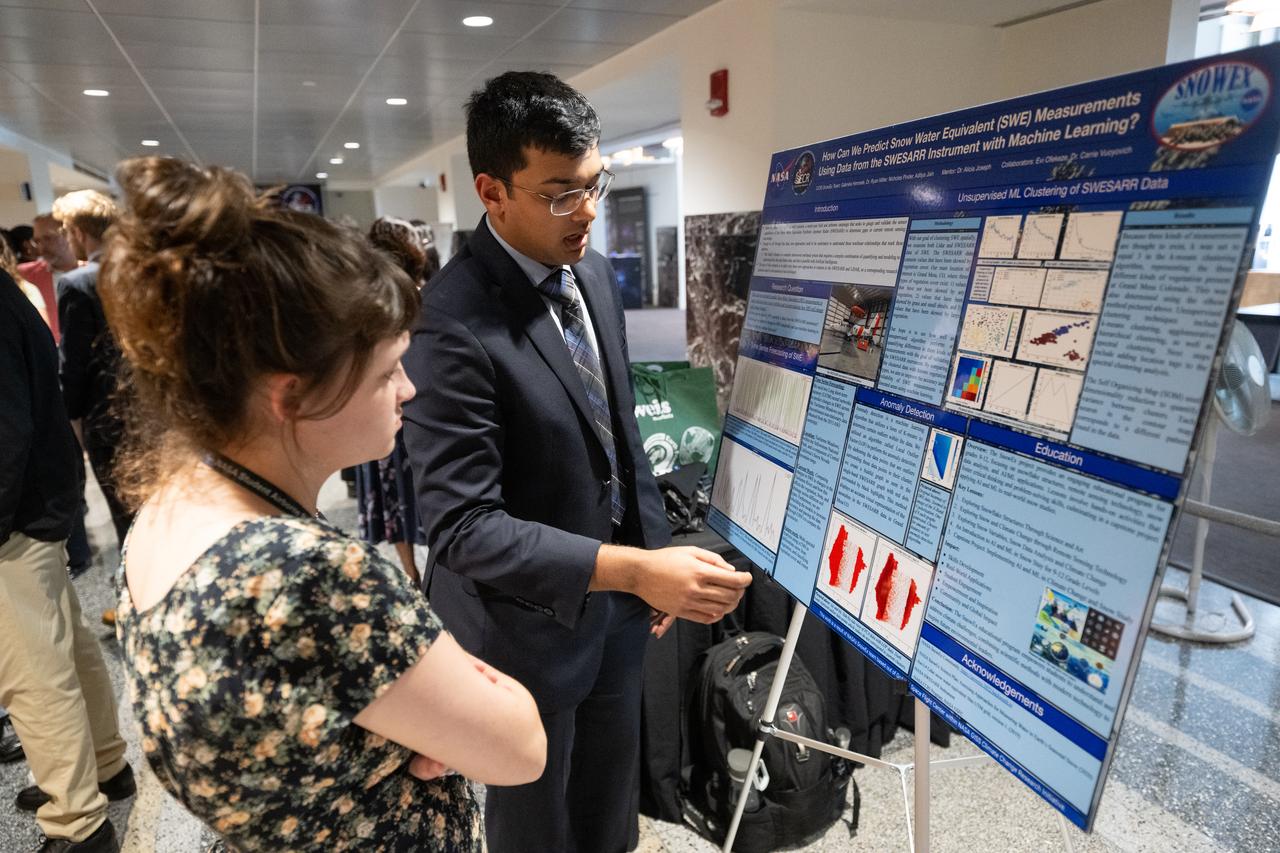
Members of the Climate Change Research Initiative (CCRI) cohort discuss their research during a poster session, Wednesday, Aug. 7, 2024, at the Mary W. Jackson NASA Headquarters building in Washington, DC. The Earth Science Division’s Early Career Research Program’s Climate Change Research Initiative (CCRI) is a year-long STEM engagement and experiential learning opportunity for educators and students from high school to graduate level. Photo Credit: (NASA/Joel Kowsky)
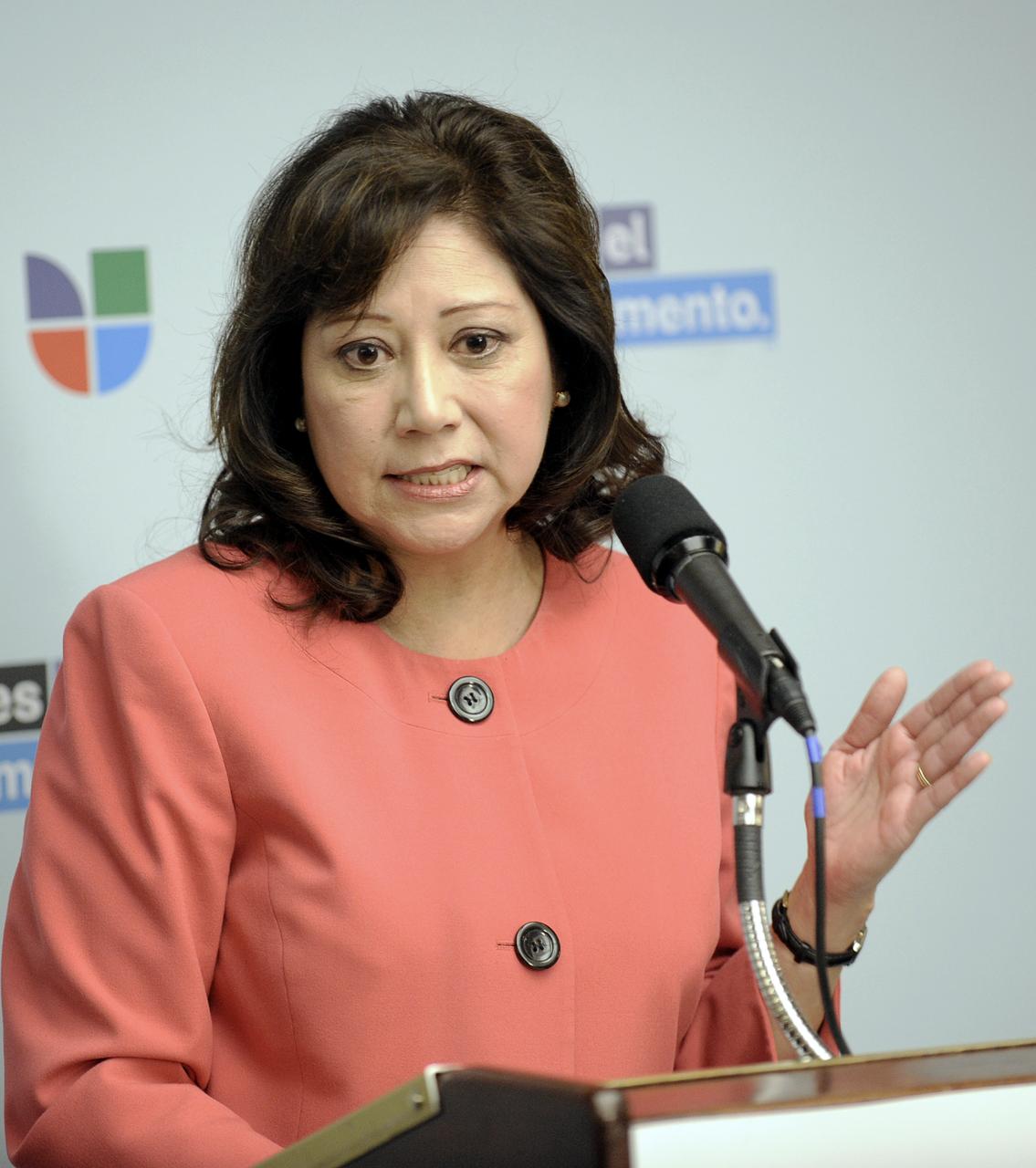
U.S. Secretary of Labor Hilda Solis speaks at an event at the National Press Club in Washington, Tuesday, Feb. 23, 2010. NASA is working with Univision Communications Inc. to develop a partnership in support of the Spanish-language media outlet's initiative to improve high school graduation rates, prepare Hispanic students for college, and encourage them to pursue careers in science, technology, engineering and mathematics, or STEM, disciplines. Photo Credit: (NASA/Bill Ingalls)
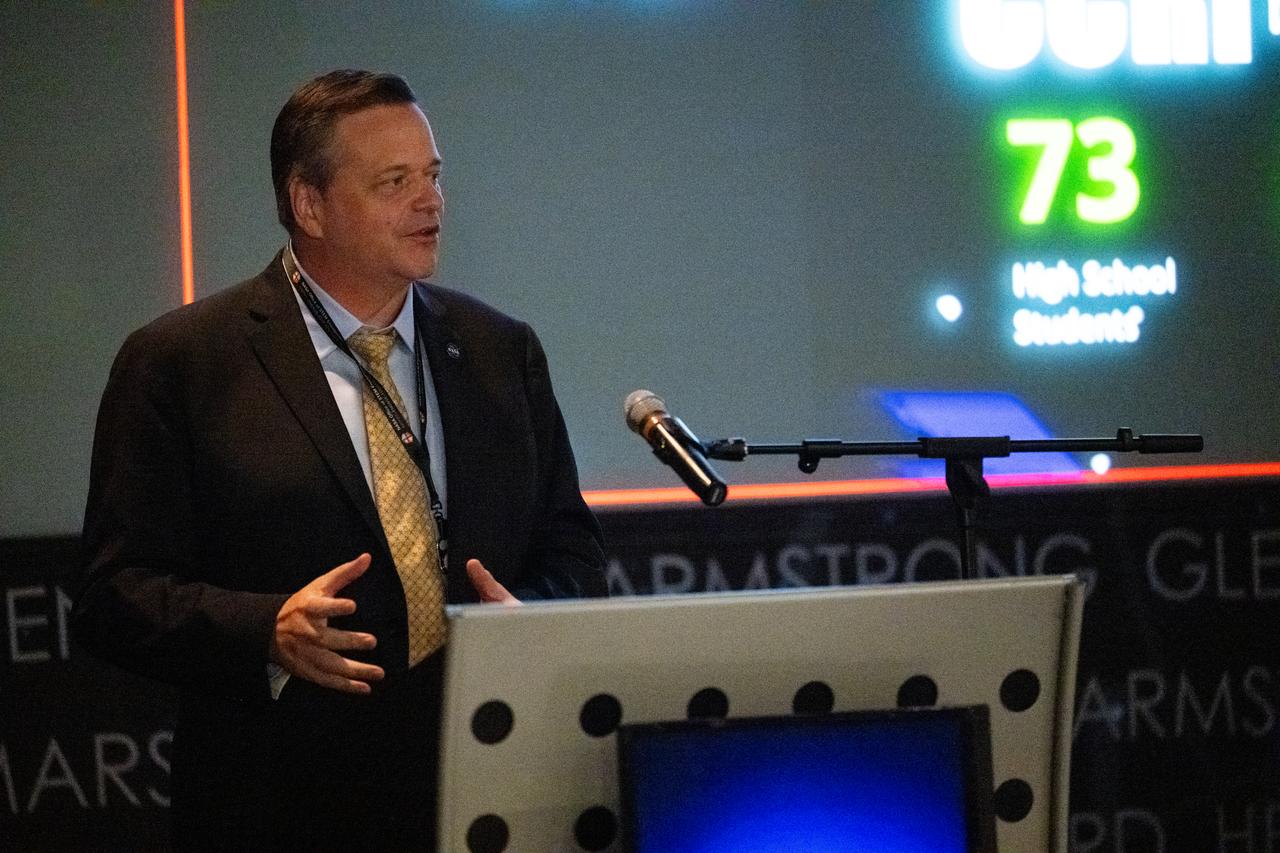
Matthew Pearce, education officer at NASA’s Goddard Institute for Space Studies and project lead for the Climate Change Research Initiative (CCRI), speaks with the CCRI cohort, Wednesday, Aug. 7, 2024, at the Mary W. Jackson NASA Headquarters building in Washington, DC. The Earth Science Division’s Early Career Research Program’s Climate Change Research Initiative (CCRI) is a year-long STEM engagement and experiential learning opportunity for educators and students from high school to graduate level. Photo Credit: (NASA/Joel Kowsky)
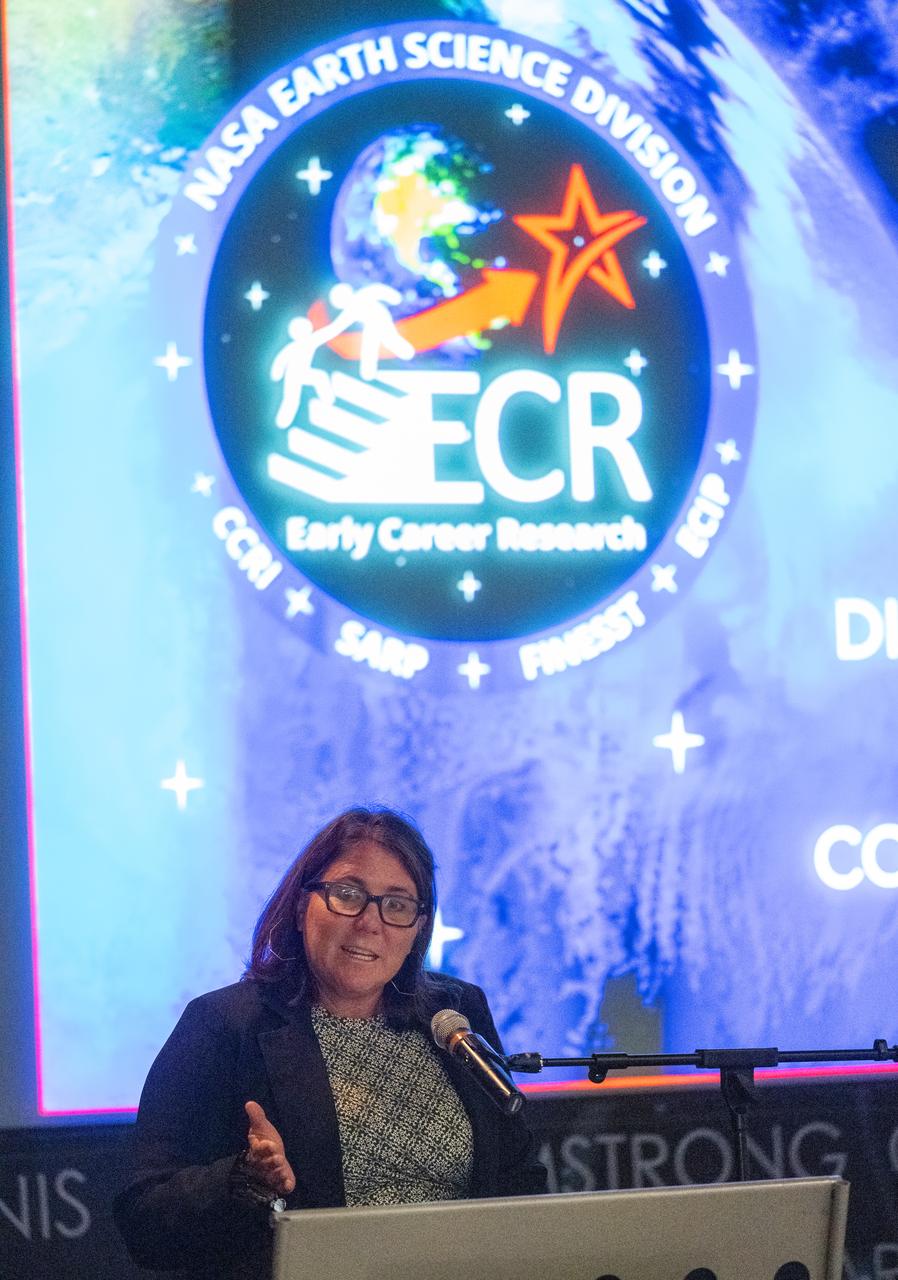
Cynthia Hall, support scientist for the Early Career Research Program in NASA’s Earth Science Division, speaks to the Climate Change Research Initiative (CCRI) cohort, Wednesday, Aug. 7, 2024, at the Mary W. Jackson NASA Headquarters building in Washington, DC. The Earth Science Division’s Early Career Research Program’s Climate Change Research Initiative (CCRI) is a year-long STEM engagement and experiential learning opportunity for educators and students from high school to graduate level. Photo Credit: (NASA/Joel Kowsky)
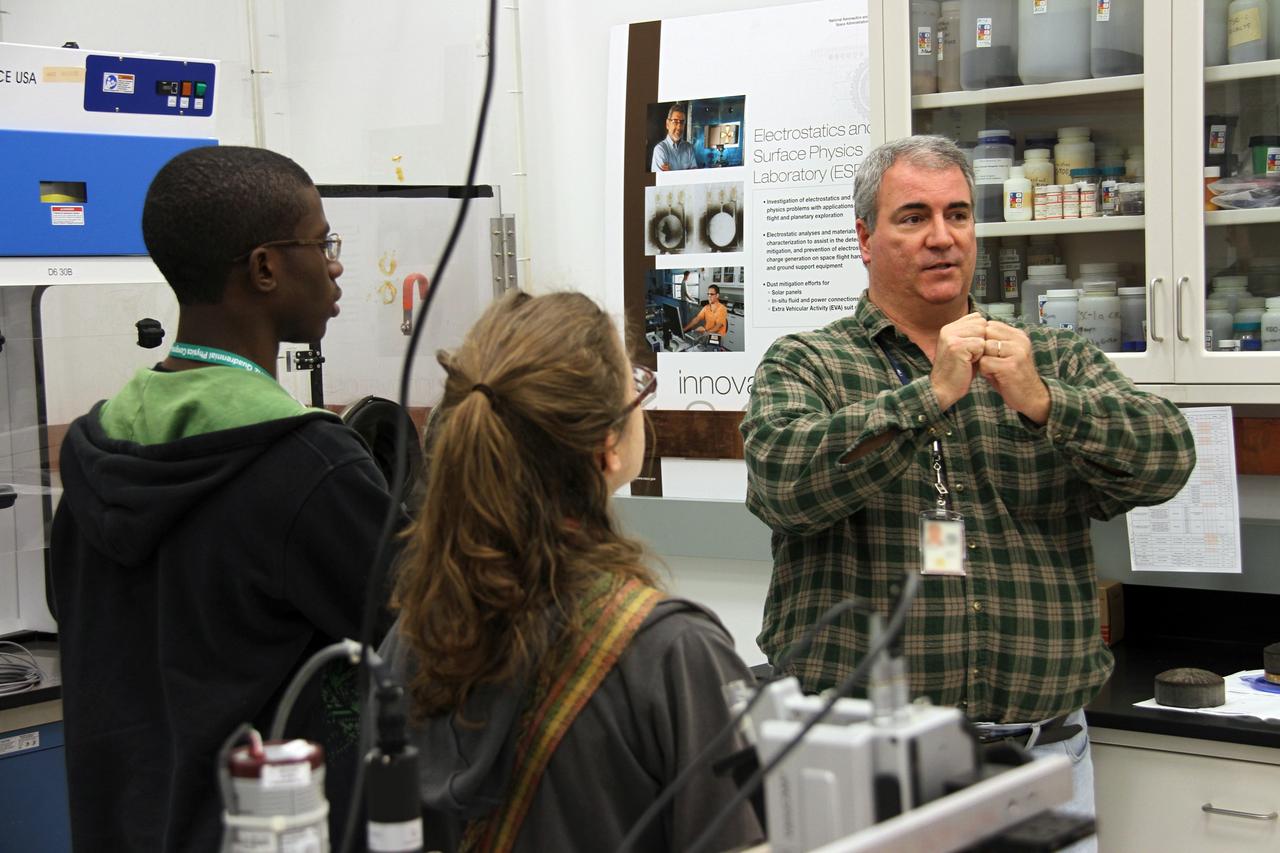
CAPE CANAVERAL, Fla. -- Inside a laboratory in the Engineering Development Laboratory, or EDL, at NASA’s Kennedy Space Center in Florida, research scientist Michael Hogue, in the green plaid shirt, describes several technologies to a group of Society of Physics students. About 800 graduate and undergraduate physics students toured Kennedy facilities. A group of about 40 students toured laboratories in the Operations and Checkout Building and the EDL during their visit. The physics students were in Orlando for the 2012 Quadrennial Physics Congress. Photo credit: NASA/Cory Huston
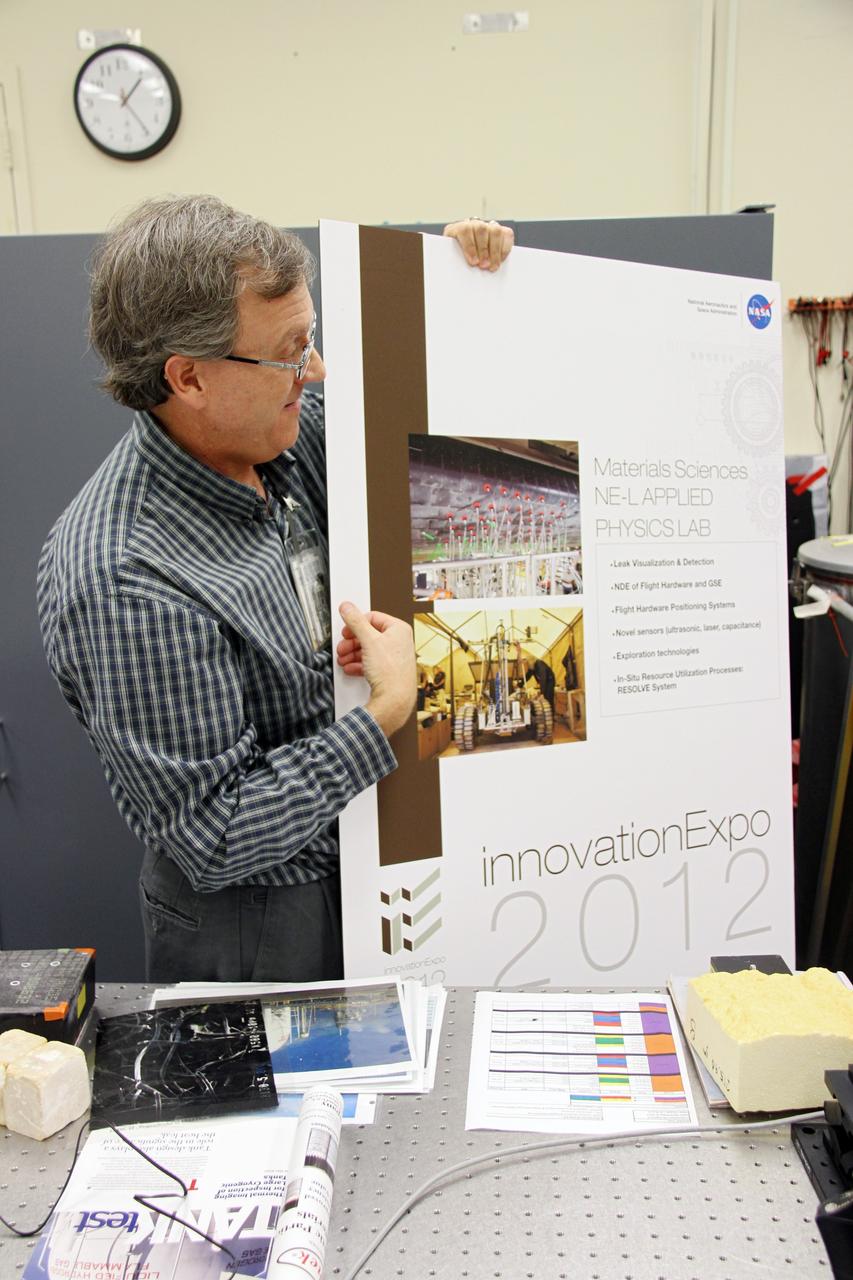
CAPE CANAVERAL, Fla. -- Inside the Applied Physics Laboratory in the Operations and Checkout Building at NASA’s Kennedy Space Center in Florida, lead researcher Dr. Bob Youngquist describes technologies developed for the Space Shuttle Program to a group of Society of Physics students. About 800 graduate and undergraduate physics students toured Kennedy facilities. A group of about 40 students toured laboratories in the Operations and Checkout Building and the EDL during their visit. The physics students were in Orlando for the 2012 Quadrennial Physics Congress. Photo credit: NASA/Cory Huston
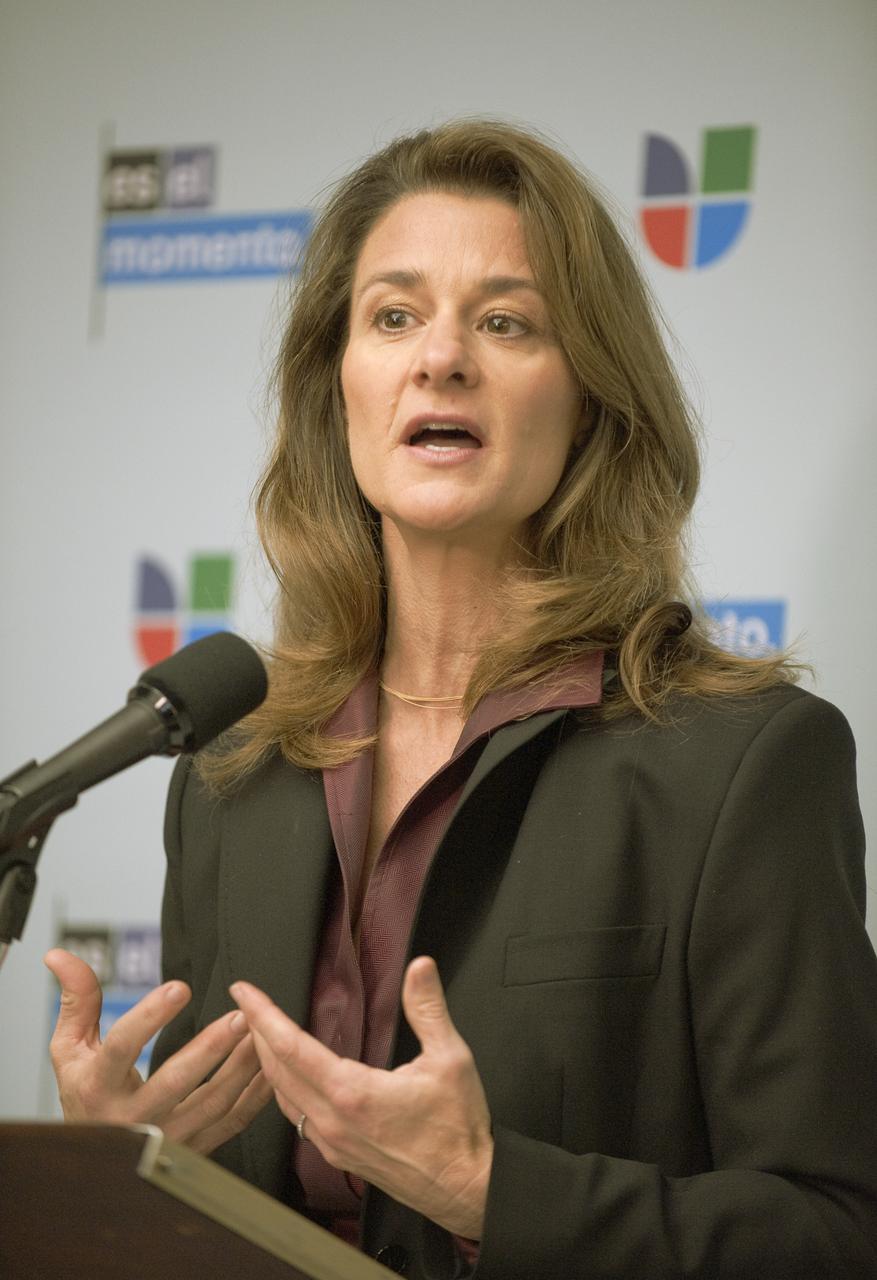
Melinda French Gates, of the Bill & Melinda Gates Foundation, speaks during an event at the National Press Club in Washington, Tuesday, Feb. 23, 2010. NASA is working with Univision Communications Inc. to develop a partnership in support of the Spanish-language media outlet's initiative to improve high school graduation rates, prepare Hispanic students for college, and encourage them to pursue careers in science, technology, engineering and mathematics, or STEM, disciplines. Photo Credit: (NASA/Bill Ingalls)
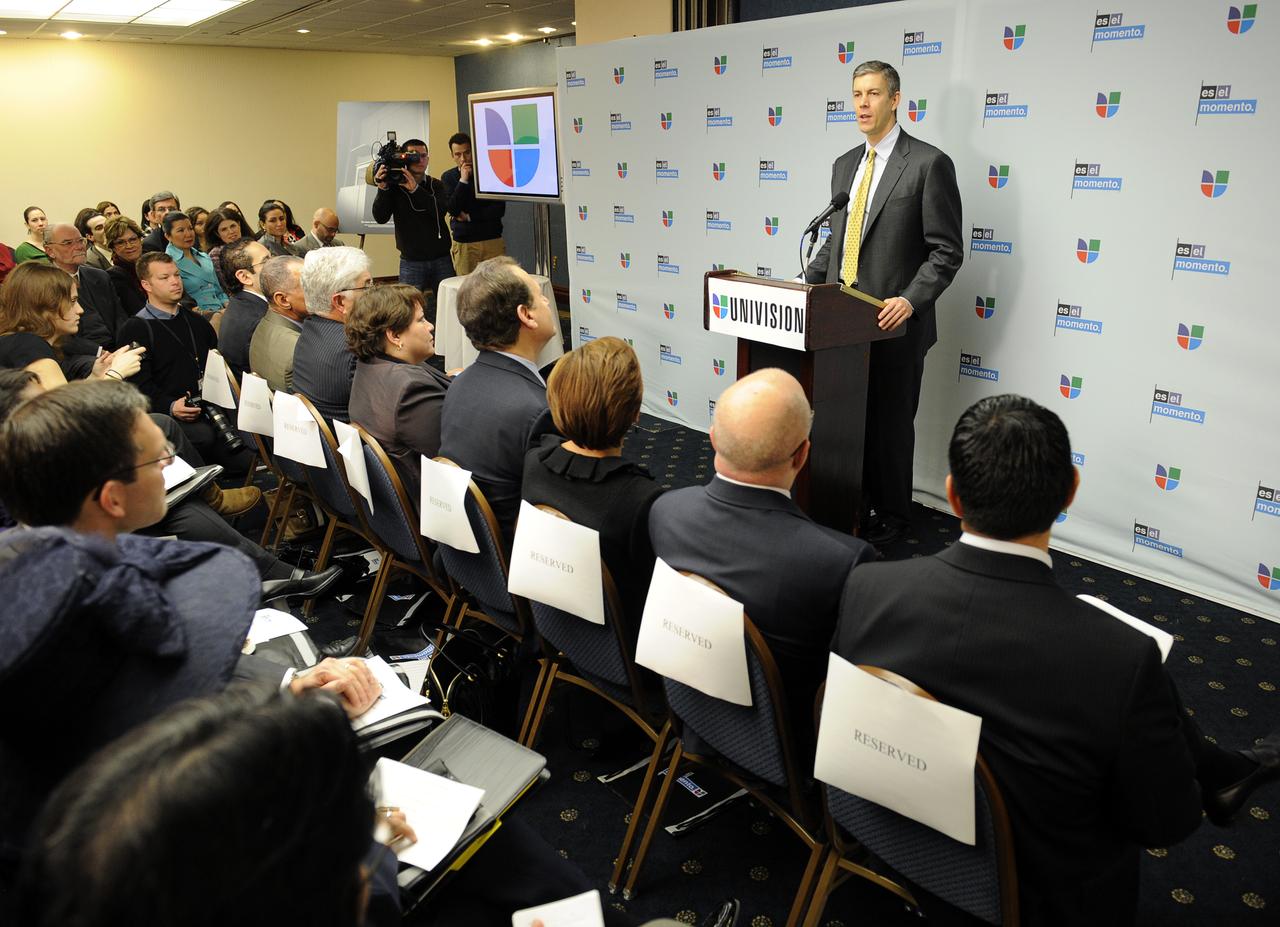
U.S. Secretary of Education Arne Duncan speaks at an event at the National Press Club in Washington, Tuesday, Feb. 23, 2010. NASA is working with Univision Communications Inc. to develop a partnership in support of the Spanish-language media outlet's initiative to improve high school graduation rates, prepare Hispanic students for college, and encourage them to pursue careers in science, technology, engineering and mathematics, or STEM, disciplines. Photo Credit: (NASA/Bill Ingalls)
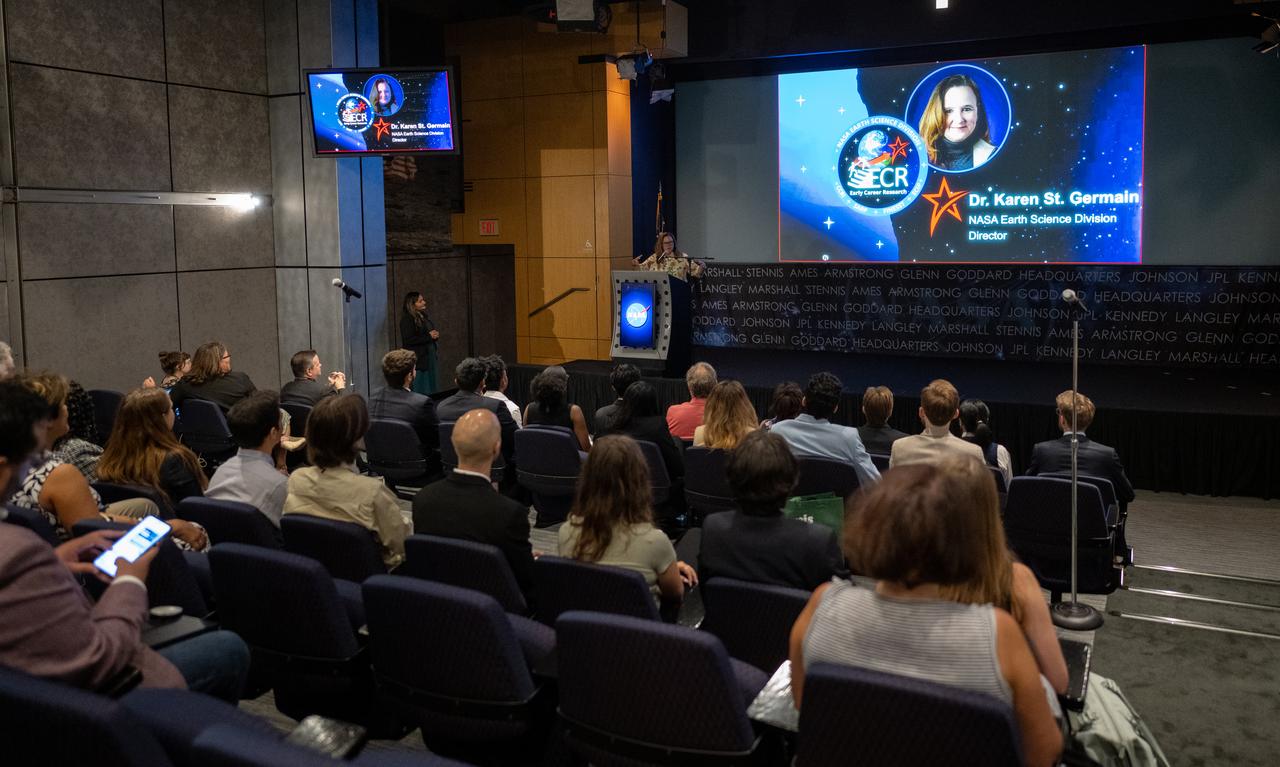
Karen St. Germain, director of the Earth Science Division of NASA’s Science Mission Directorate, speaks with the Climate Change Research Initiative (CCRI) cohort, Wednesday, Aug. 7, 2024, at the Mary W. Jackson NASA Headquarters building in Washington, DC. The Earth Science Division’s Early Career Research Program’s Climate Change Research Initiative (CCRI) is a year-long STEM engagement and experiential learning opportunity for educators and students from high school to graduate level. Photo Credit: (NASA/Joel Kowsky)
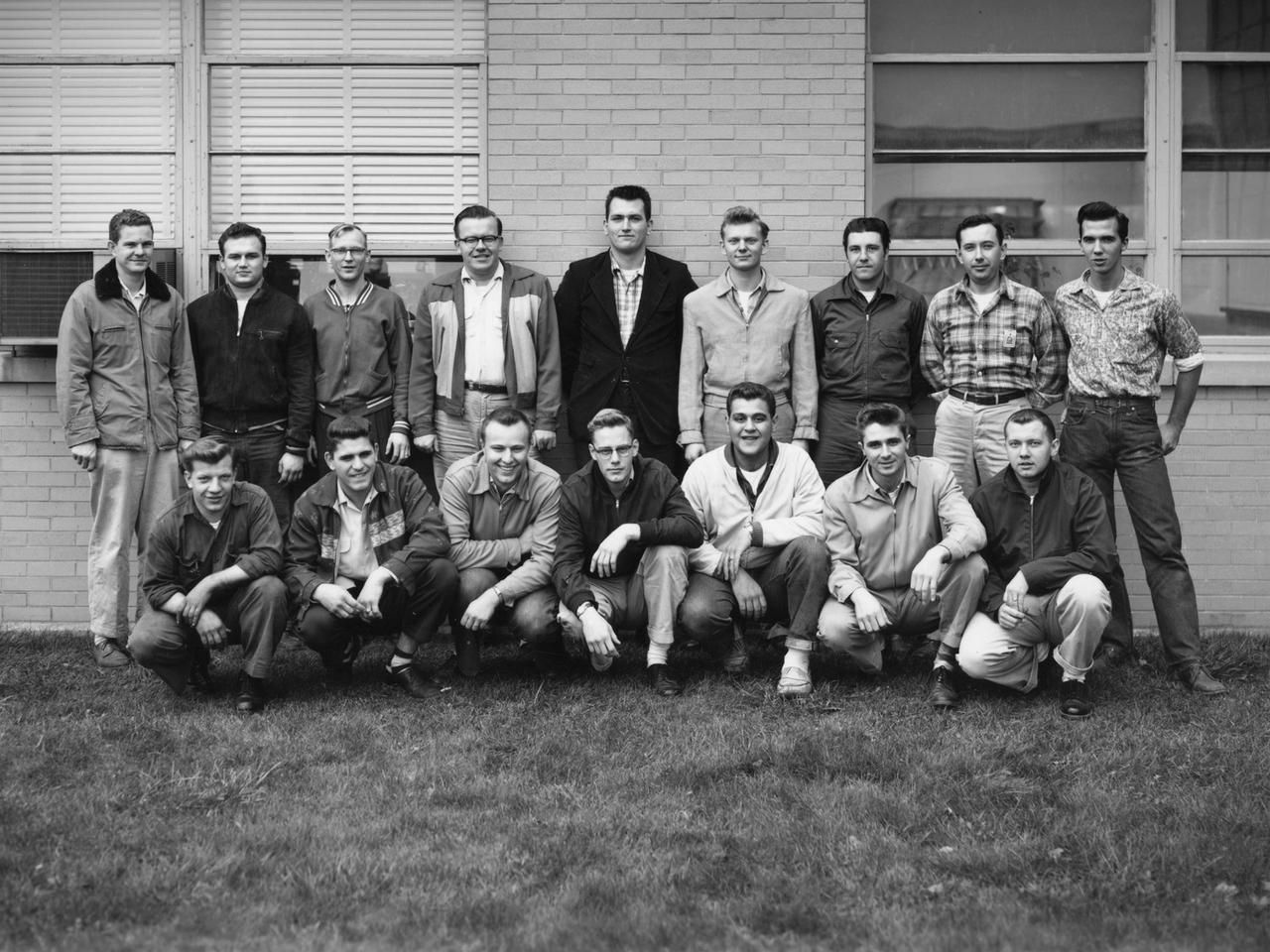
A group of apprentices takes a break from their studies to pose for a photograph at the National Advisory Committee for Aeronautics (NACA) Lewis Flight Propulsion Laboratory. To facilitate the close interaction of the lab’s engineers, mechanics, technicians, and scientists, Lewis Director Ray Sharp established a four-year apprentice program to train craftsmen on a particular trade and basic scientific principles. The apprentice school covered a variety of trades, from aircraft mechanic to electronic instrumentation, machinist, and altitude systems mechanic. The school was established in 1942, but faltered when over 90 percent of its students entered the military. After World War II, 40 of the original members returned to the NACA lab. In some cases they were bumped to journeymen positions because of training received in the military. The honorary first class in 1949 had only 15 graduates, but the number steadily increased to 45 with the next class in 1952 and to 110 in 1957. There were over 600 graduates by 1969, and the program remained strong for decades. Many of the laboratory’s future managers began their careers as apprentices. The program, which was certified by both the Department of Labor and the State of Ohio, included classroom lectures, the study of models, and hands-on work. The apprentices rotated through the various shops and facilities to provide them with a well-rounded understanding of the work at the lab.
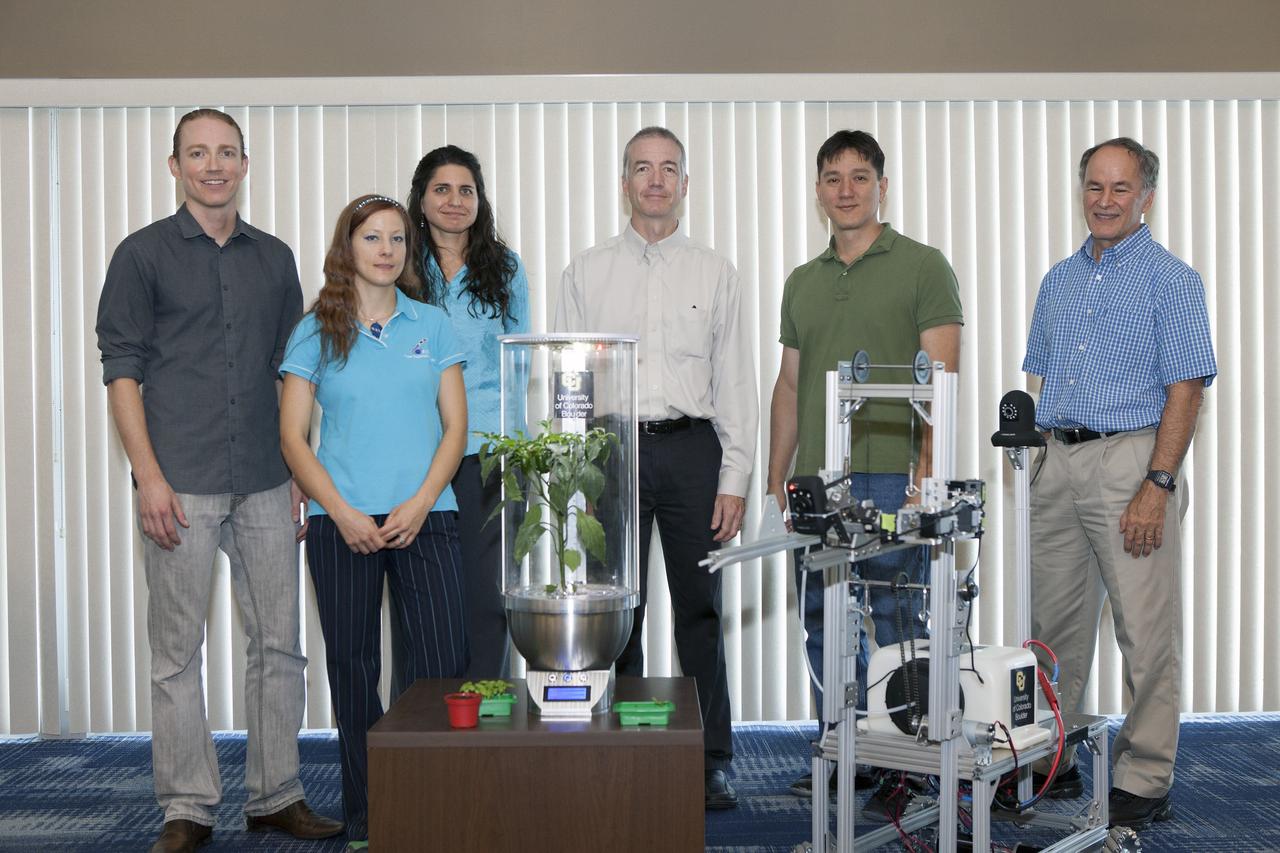
CAPE CANAVERAL, Fla. -- At the Kennedy Space Center in Florida, University of Colorado Boulder graduate students Heather Hava, far left, and Daniel Zukowski, second from the left, pose with a computerized SmartPot, or SPOT, which could be used to grow plants in a deep-space habitat. To the right of the SPOT is a Remotely Operated Gardening Rover, or ROGR. The system is being developed by the graduate students participating in the eXploration HABitat X-Hab Academic Innovation Challenge. From the left are Zukowski, Hava, Gioia Massa of the NASA International Space Station Ground Processing and Research Project Office, Tracy Gill of the NASA Center Planning and Development Directorate, Morgan Simpson of the NASA Ground Processing Directorate, and Ray Wheeler of the NASA Engineering and Technology Directorate. X-Hab Academic Innovation Challenge is a university-level activity designed to engage and retain students in science, technology, engineering and math, or STEM, disciplines. NASA will directly benefit from the effort by sponsoring the development of innovative habitat concepts from universities which may result in innovative ideas and solutions that could be applied to exploration habitats. For more: http://www.nasa.gov/exploration/technology/deep_space_habitat/xhab/ Photo credit: NASA/Daniel Casper
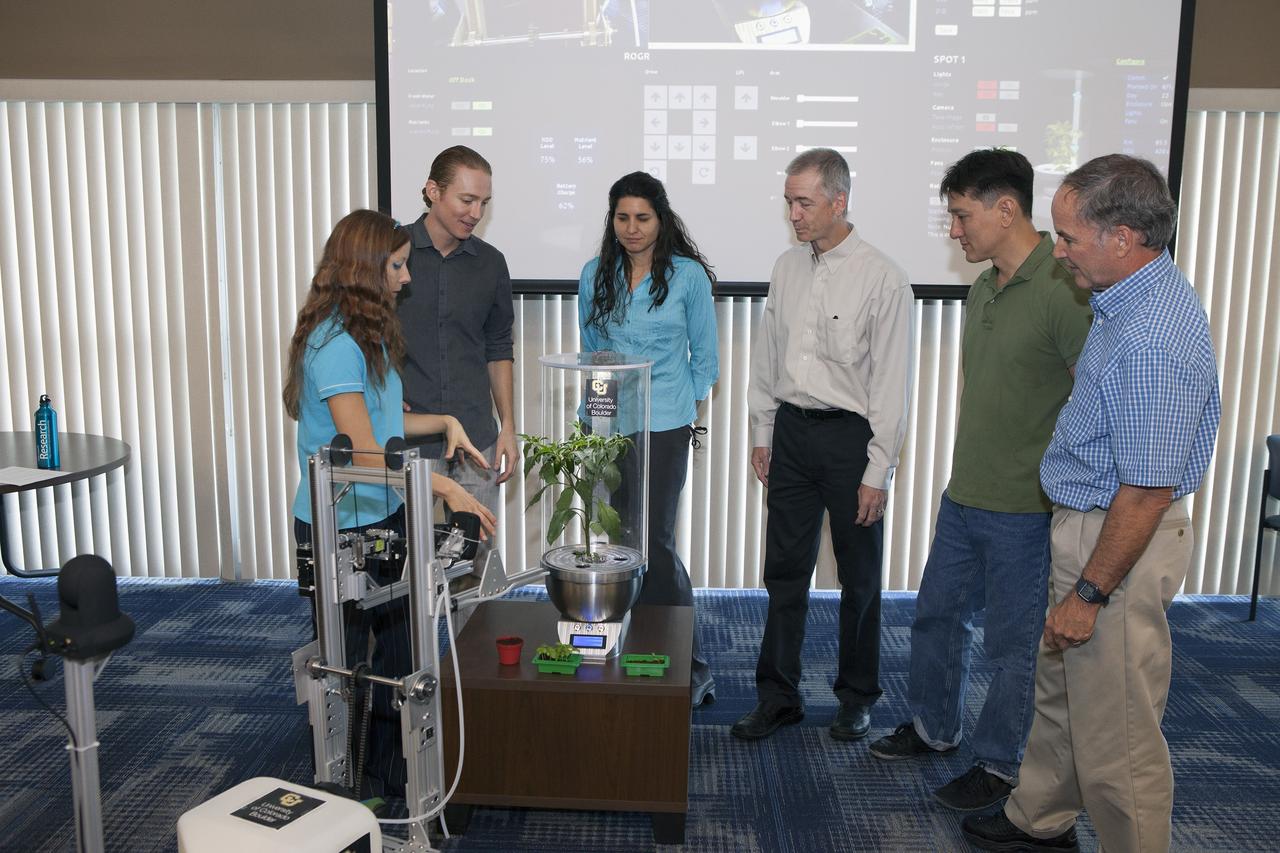
CAPE CANAVERAL, Fla. -- At the Kennedy Space Center in Florida, University of Colorado Boulder graduate students Heather Hava, far left, and Daniel Zukowski, second from the left, describe a computerized SmartPot, or SPOT, which could be used to grow plants in a deep-space habitat. The SPOTs could be tended by a Remotely Operated Gardening Rover, or ROGR, seen on the left. The system is being developed by the graduate students participating in the eXploration HABitat X-Hab Academic Innovation Challenge. From the left are Hava, Zukowski, Gioia Massa of the NASA International Space Station Ground Processing and Research Project Office, Tracy Gill of the NASA Center Planning and Development Directorate, Morgan Simpson of the NASA Ground Processing Directorate, and Ray Wheeler of the NASA Engineering and Technology Directorate. X-Hab Academic Innovation Challenge is a university-level activity designed to engage and retain students in science, technology, engineering and math, or STEM, disciplines. NASA will directly benefit from the effort by sponsoring the development of innovative habitat concepts from universities which may result in innovative ideas and solutions that could be applied to exploration habitats. For more: http://www.nasa.gov/exploration/technology/deep_space_habitat/xhab/ Photo credit: NASA/Daniel Casper
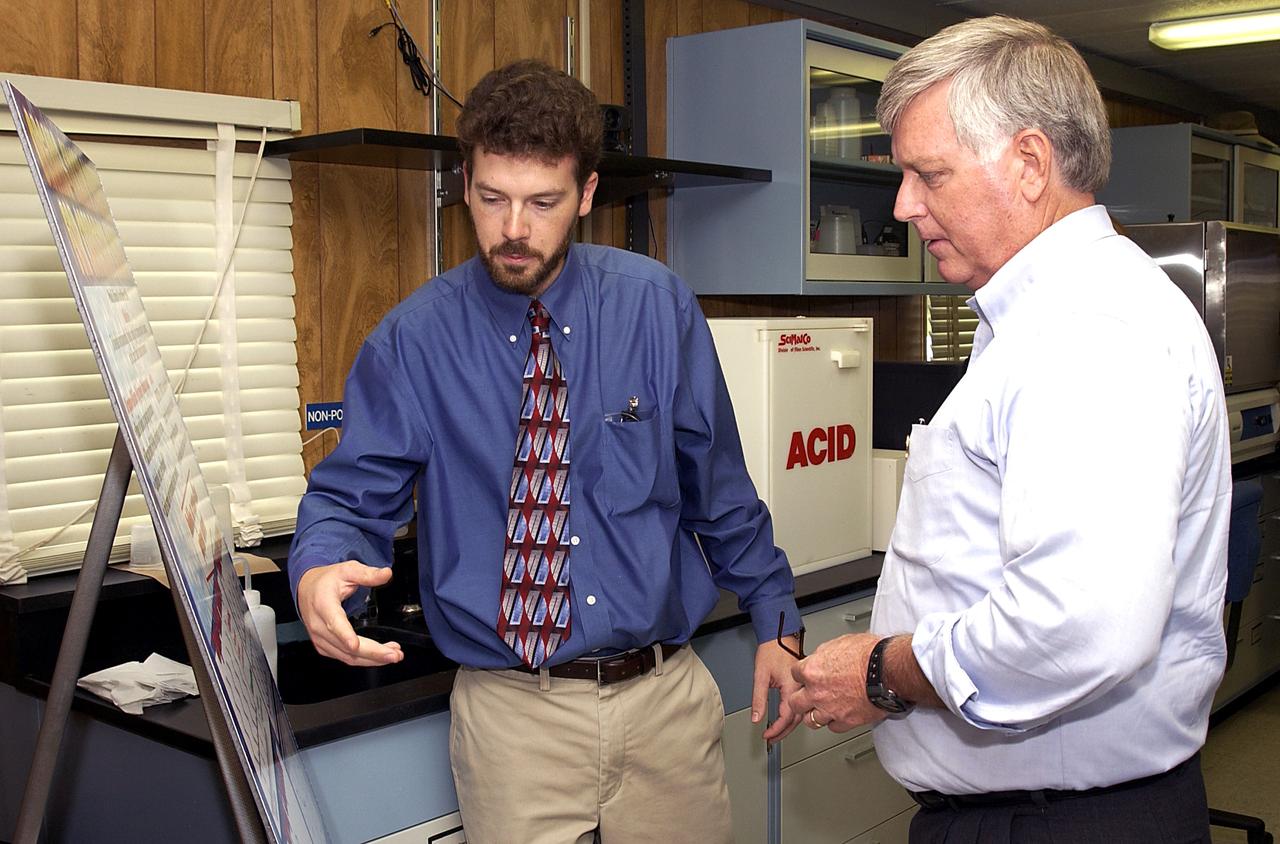
KENNEDY SPACE CENTER, FLA. - Dr. Paul Hintze (left) explains to Center Director Jim Kennedy a project he is working at the KSC Beach Corrosion Test Site. Hitze is doing post-graduate work for the National Research Council. The test facility site was established in the 1960s and has provided more than 30 years of historical information on the long-term performance of many materials in use at KSC and other locations around the world. Located 100 feet from the Atlantic Ocean approximately 1 mile south of the Space Shuttle launch sites, the test facility includes an atmospheric exposure site, a flowing seawater exposure site, and an on-site electrochemistry laboratory and monitoring station. The beach laboratory is used to conduct real-time corrosion experiments and provides for the remote monitoring of surrounding weather conditions. The newly added flowing seawater immersion facility provides for the immersion testing of materials and devices under controlled conditions.

Retired NASA astronaut Bob Springer is the presenter during "Lunch with an Astronaut" on Nov. 7, 2018, at the NASA Kennedy Space Center Visitor Complex in Florida. Top scholars from Brevard County public high schools were invited to Kennedy Space Center for a tour of facilities, lunch and a roundtable discussion with engineers, scientists and business experts at the center. The 2018 Brevard Top Scholars event was hosted by the center's Academic Engagement Office to honor the top three scholars of the 2018-2019 graduating student class from each of Brevard County’s public high schools. The students received a personalized certificate of recognition at the end of the day.
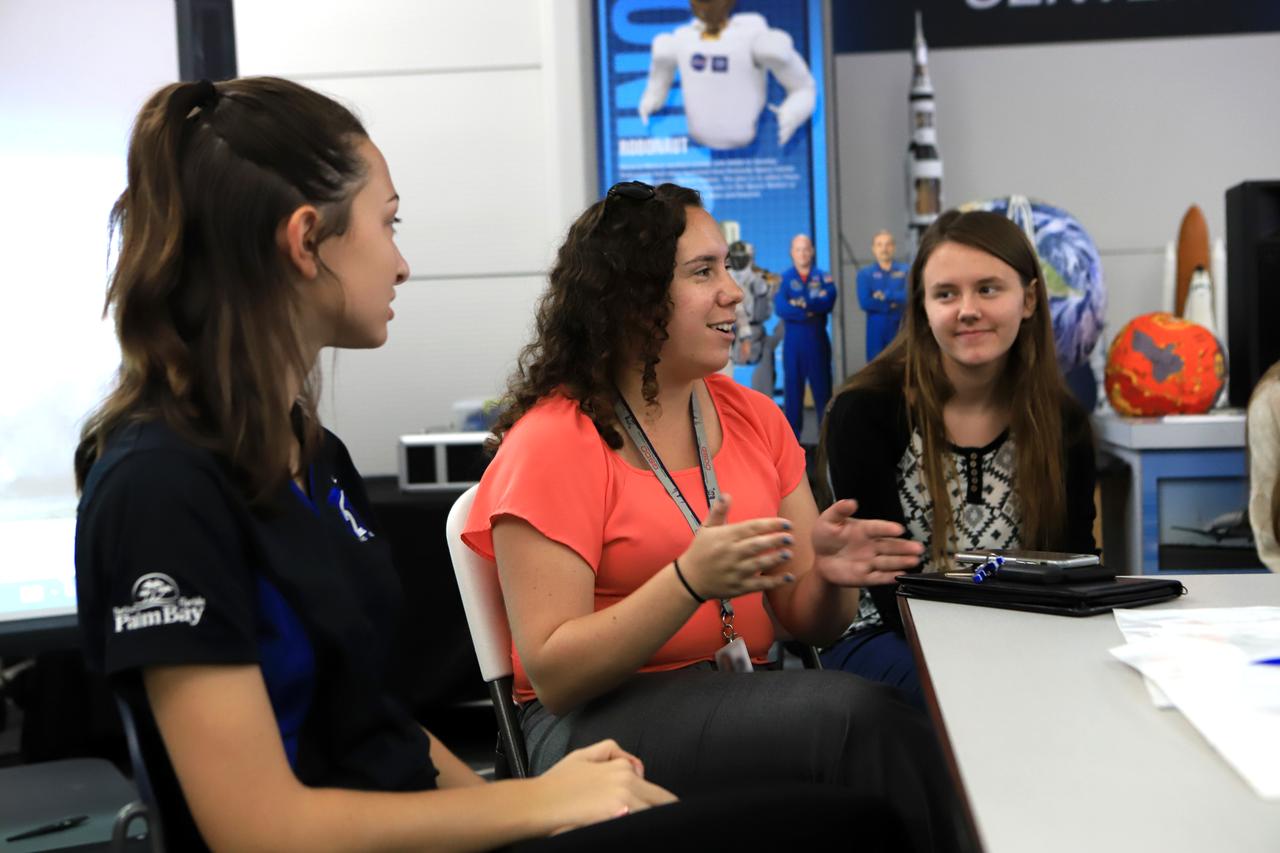
Rebecca Baturin, center, a project engineer in Exploration Ground Systems, speaks to students from Brevard County high schools during a panel discussion session at the NASA Kennedy Space Center Visitor Complex in Florida, on Nov. 7, 2018. The high school seniors were invited to Kennedy Space Center for a tour of facilities, lunch and a roundtable discussion with engineers, scientists and business experts at the center. The 2018 Brevard Top Scholars event was hosted by the center's Academic Engagement Office to honor the top three scholars of the 2018-2019 graduating student class from each of Brevard County’s public high schools. The students received a personalized certificate of recognition at the end of the day.
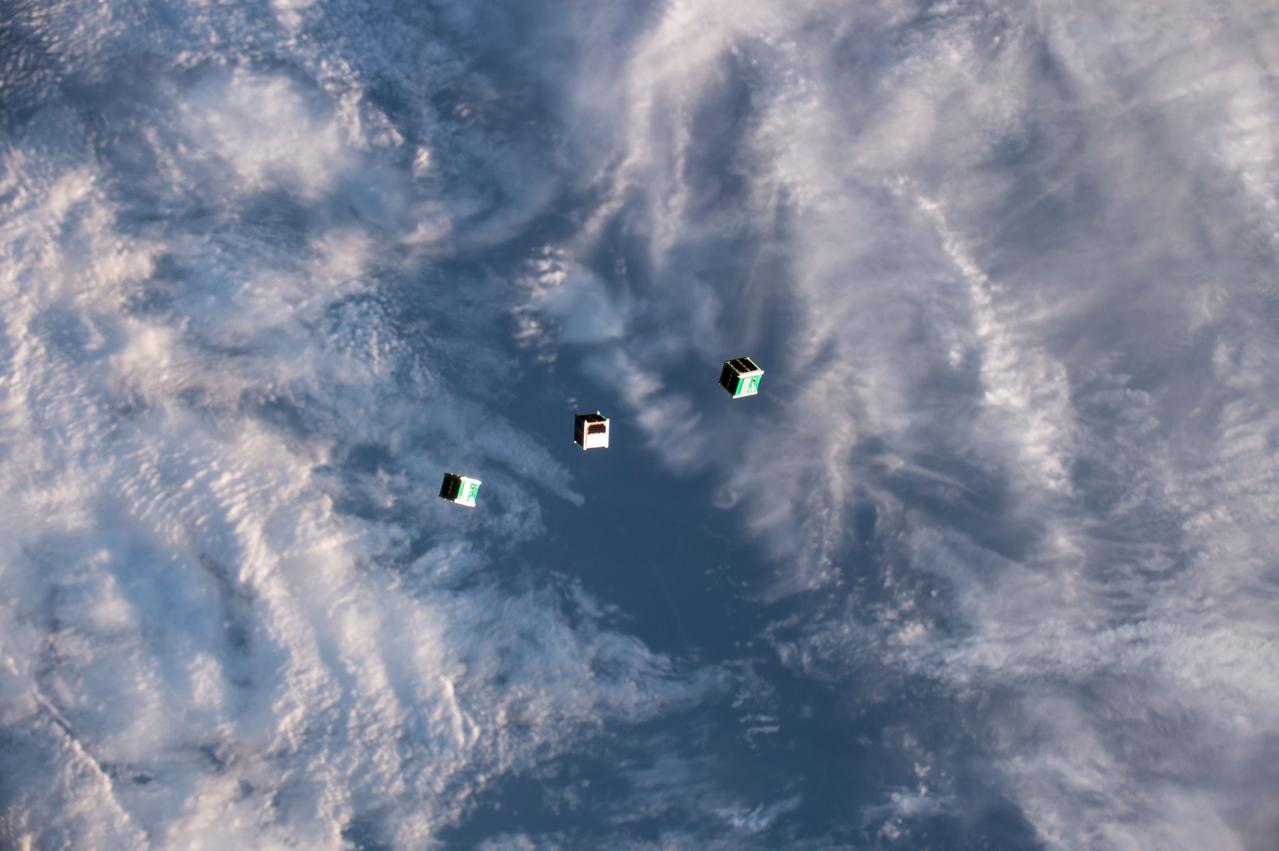
iss052e011205 (7/7/2017) --- A view taken of CubeSats from Japan, Ghana, Mongolia, Bangladesh and Nigeria deployed from the Japanese Experiment Module (JEM) Satellite Orbital Deployer 7 (J-SSOD 7) (with Earth visible in the background). These satellites are part of the Joint Global Multi-Nation Birds Satellite project (BIRDS-1), a cross-border interdisciplinary satellite project for non-space faring countries supported by Japan. During this 2-year project, students from the Graduate School of Engineering of the Kyushu Institute of Technology design, develop and operate CubeSats belonging to the five participating countries.
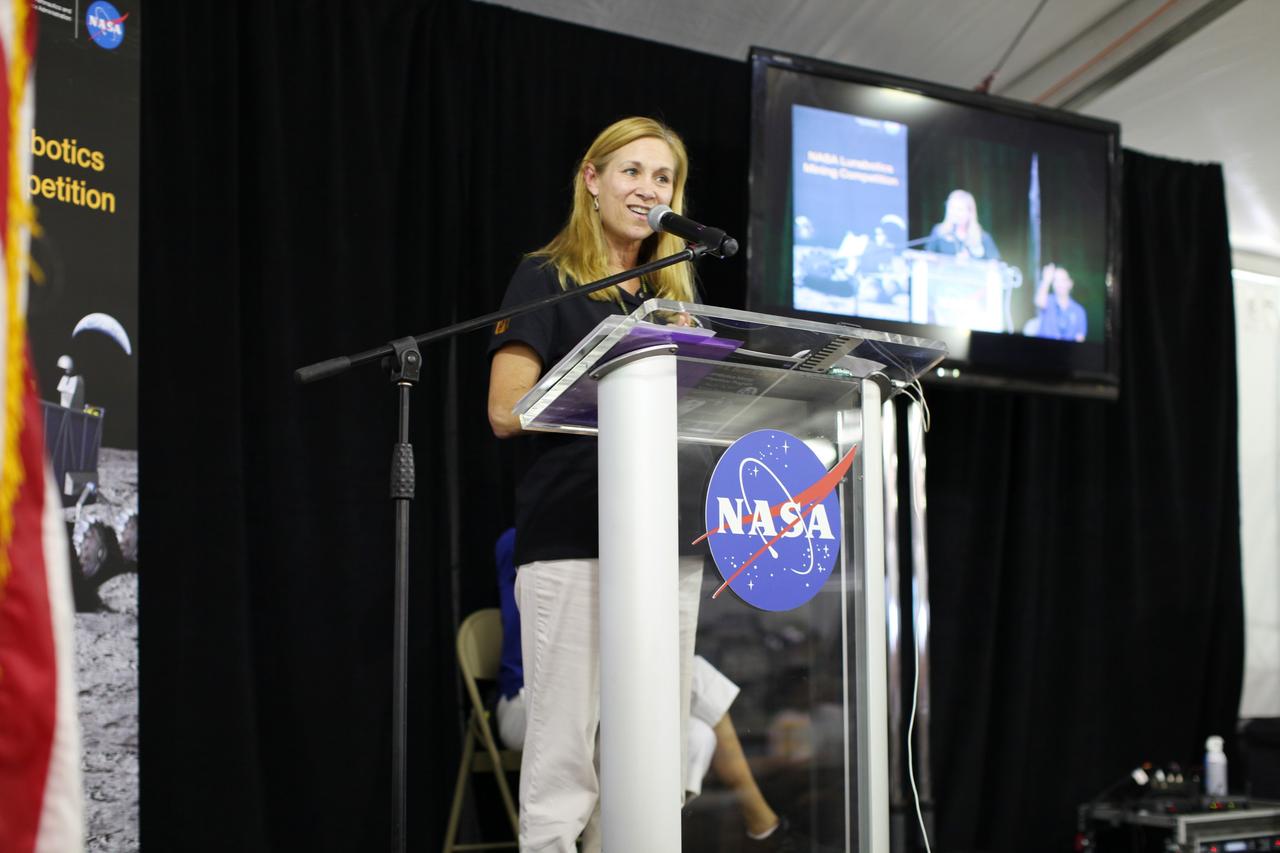
CAPE CANAVERAL, Fla. - At NASA’s Kennedy Space Center Visitor Complex in Florida, Kennedy Space Center’s Deputy Director Janet Petro speaks during the opening ceremony for NASA’s Lunabotics Mining Competition. The mining competition is sponsored by NASA Kennedy Space Center’s Education Office for the agency’s Exploration Systems Mission Directorate. Undergraduate and graduate students from more than 50 universities and colleges in the U.S. and other countries use their remote-controlled Lunabots to maneuver and dig in a supersized sandbox filled with a crushed material that has characteristics similar to lunar soil. For more information, visit www.nasa.gov/lunabotics. Photo credit: NASA/Frankie Martin
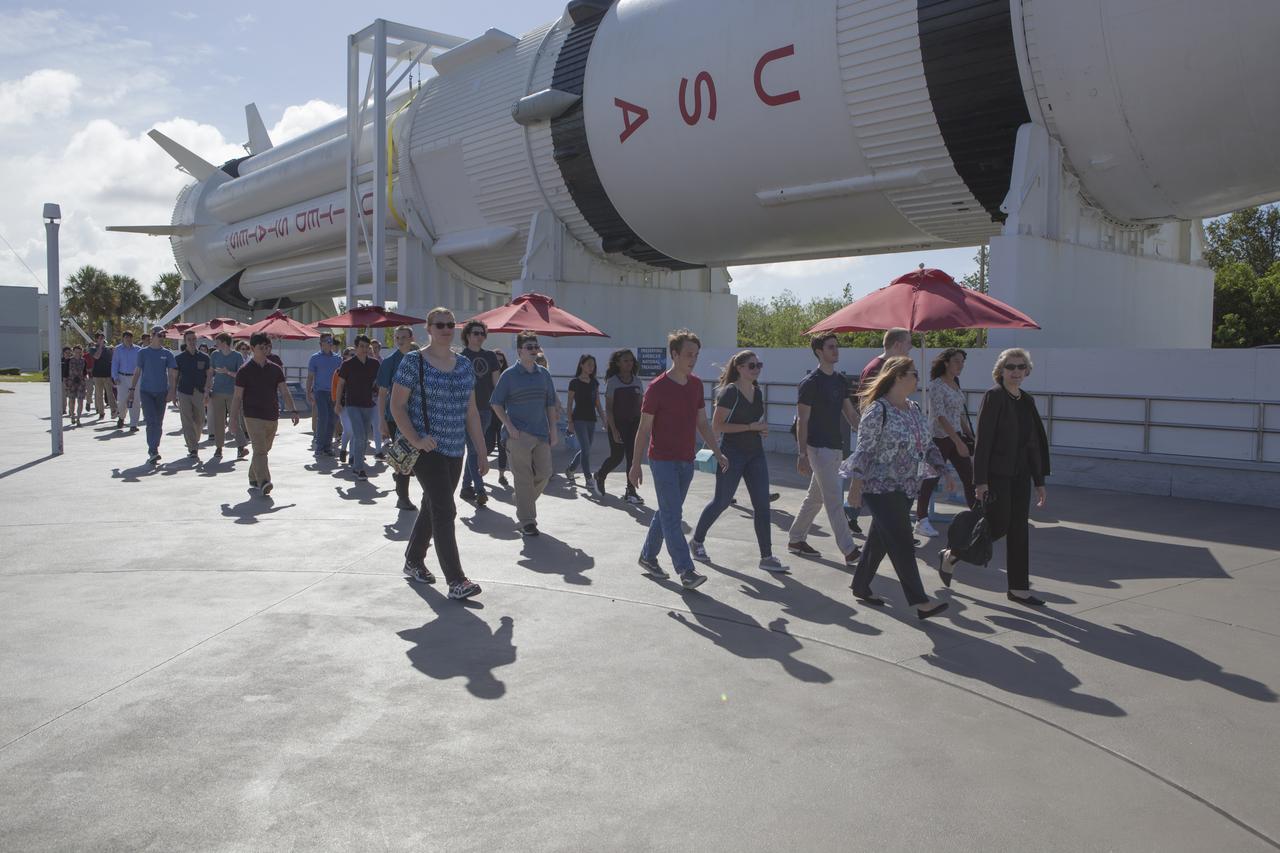
Students from Brevard County public high schools arrive at the NASA Kennedy Space Center Visitor Complex in Florida. Top scholars from the high schools were invited to Kennedy Space Center for a tour of facilities, lunch and a roundtable discussion with engineers and scientists at the center. The 2017-2018 Brevard Top Scholars event was hosted by the center's Education Projects and Youth Engagement office to honor the top three scholars of the graduating student class from each of Brevard County’s public high schools. The students received a personalized certificate at the end of the day.
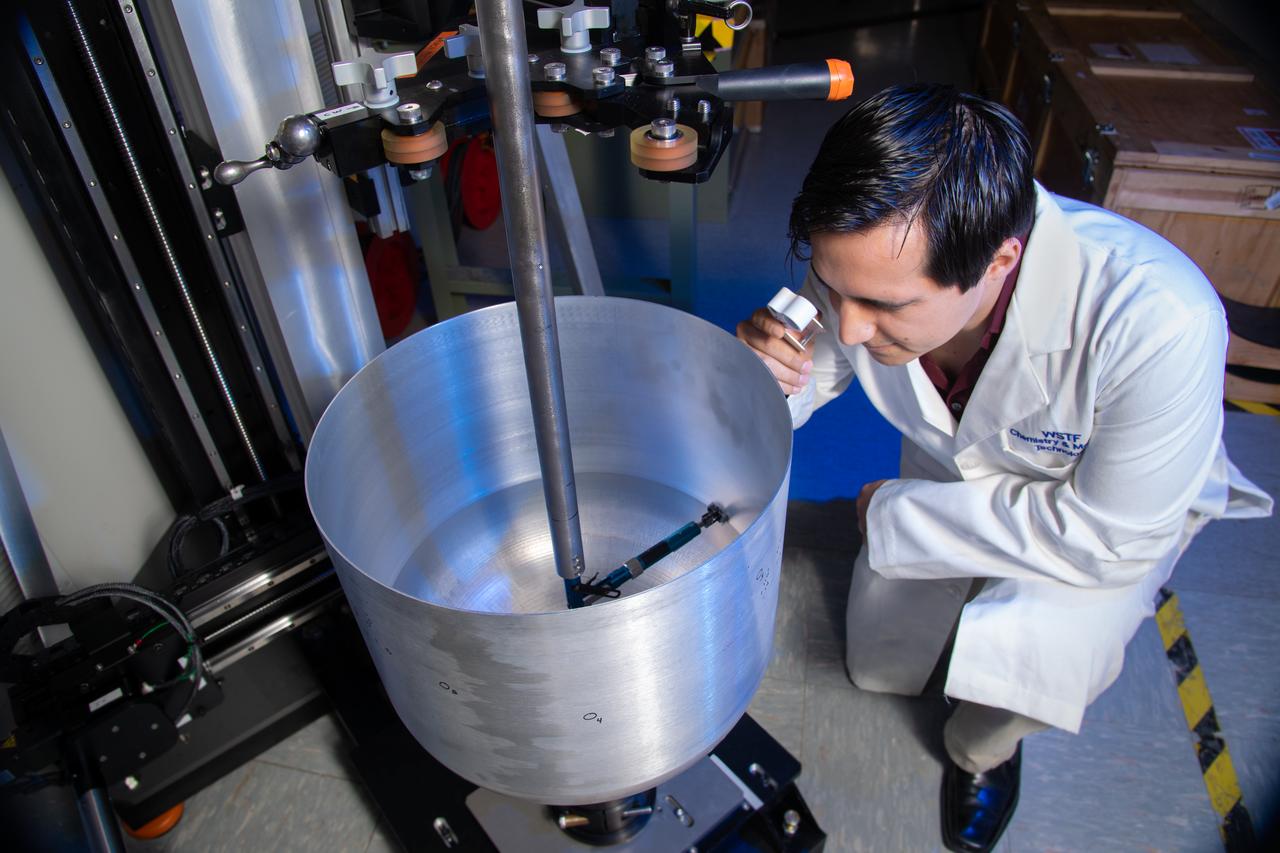
Edgar Reyes, a materials engineer and recent graduate of The University of Texas at El Paso, visually inspects a crack identified on the outer surface of a composite overwrapped pressure vessel (COPV) following an internal eddy-current through-wall nondestructive inspection conducted at the NASA White Sands Test Facility in Las Cruces, N.M. Eddy-current testing is one of many electromagnetic testing methods used in nondestructive testing to identify cracks in COPVS that can potentially threaten spacecraft crew and mission success. Photo Credit: (NASA/Reed P. Elliott)
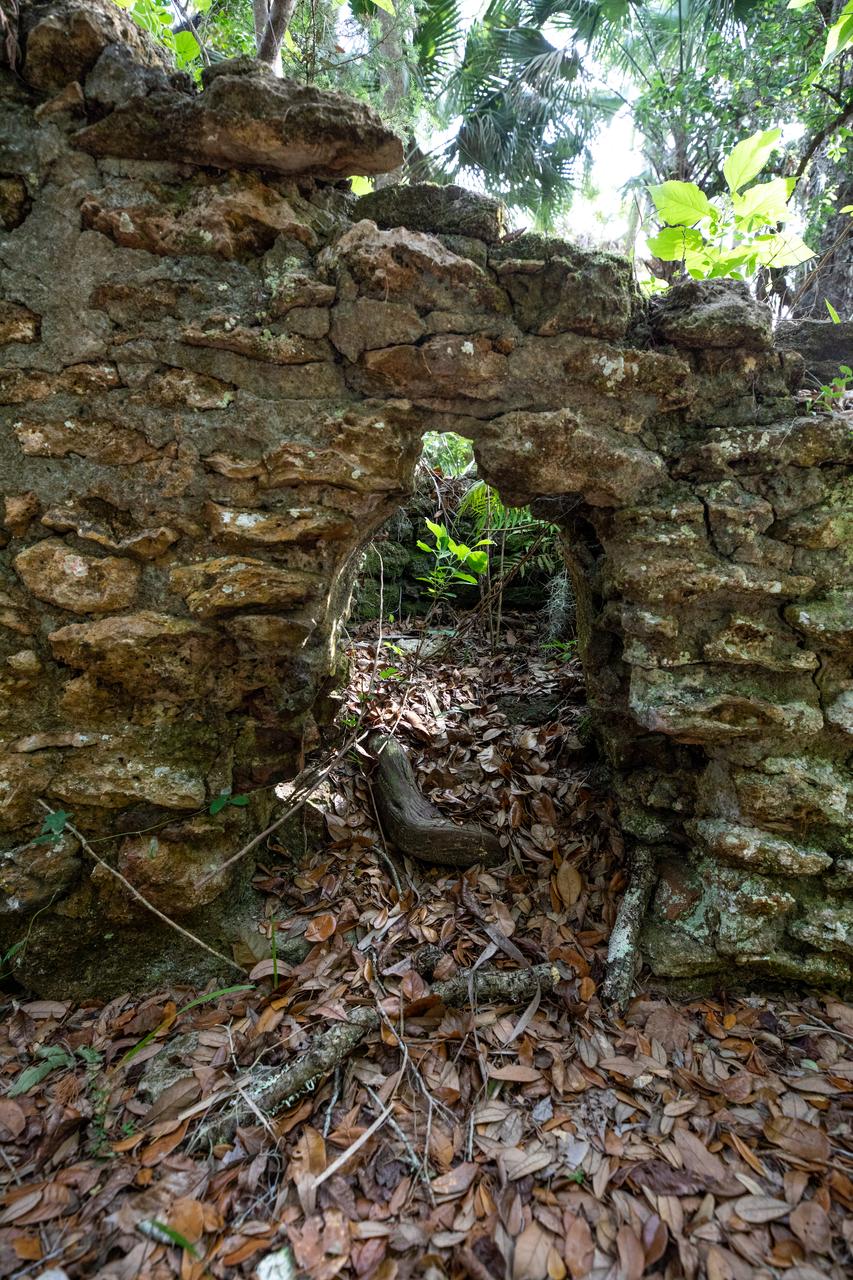
Archeological ruins of the Elliot Plantation sugar mill are revealed through the oak hammock at NASA’s Kennedy Space Center in Florida on May 26, 2022. The plantation’s enslaved community built the sugar mill structure, or sugar train, where sugar cane juice would be boiled during processing in graduated copper kettles until the liquid reduced into a thick syrup. The ruins of Elliot Plantation date from the 1760s and represent the largest, earliest, and southernmost British period sugar plantation in the U.S., as well as one of the most intact and best examples of a completely preserved enslaved landscape. The archeological site is managed through interagency cooperation between the National Park Service, the U.S. Fish and Wildlife Service, and NASA.
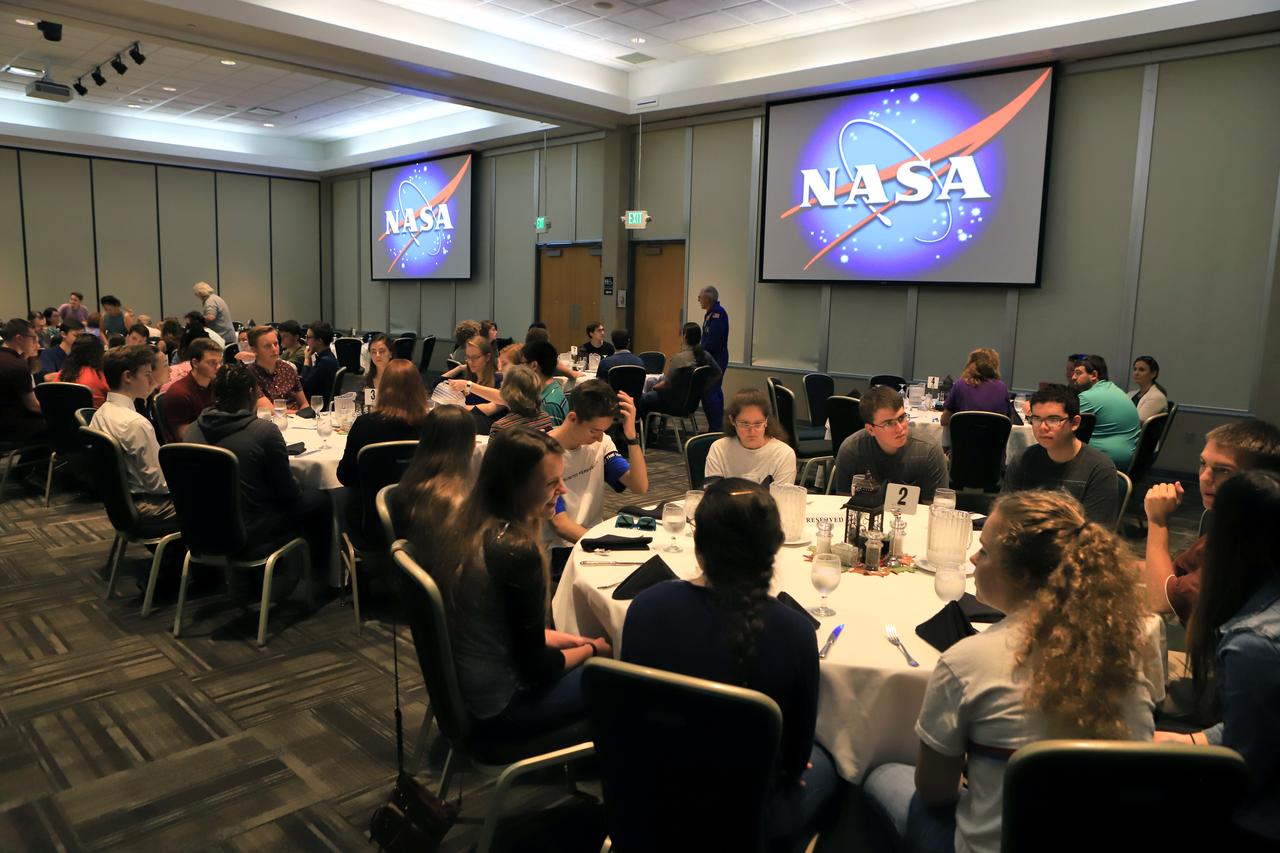
Retired NASA astronaut Bob Springer, standing in front, talks to high school students during "Lunch with an Astronaut" on Nov. 7, 2018, at the NASA Kennedy Space Center Visitor Complex in Florida. Top scholars from Brevard County public high schools were invited to Kennedy Space Center for a tour of facilities, lunch and a roundtable discussion with engineers, scientists and business experts at the center. The 2018 Brevard Top Scholars event was hosted by the center's Academic Engagement Office to honor the top three scholars of the 2018-2019 graduating student class from each of Brevard County’s public high schools. The students received a personalized certificate of recognition at the end of the day.
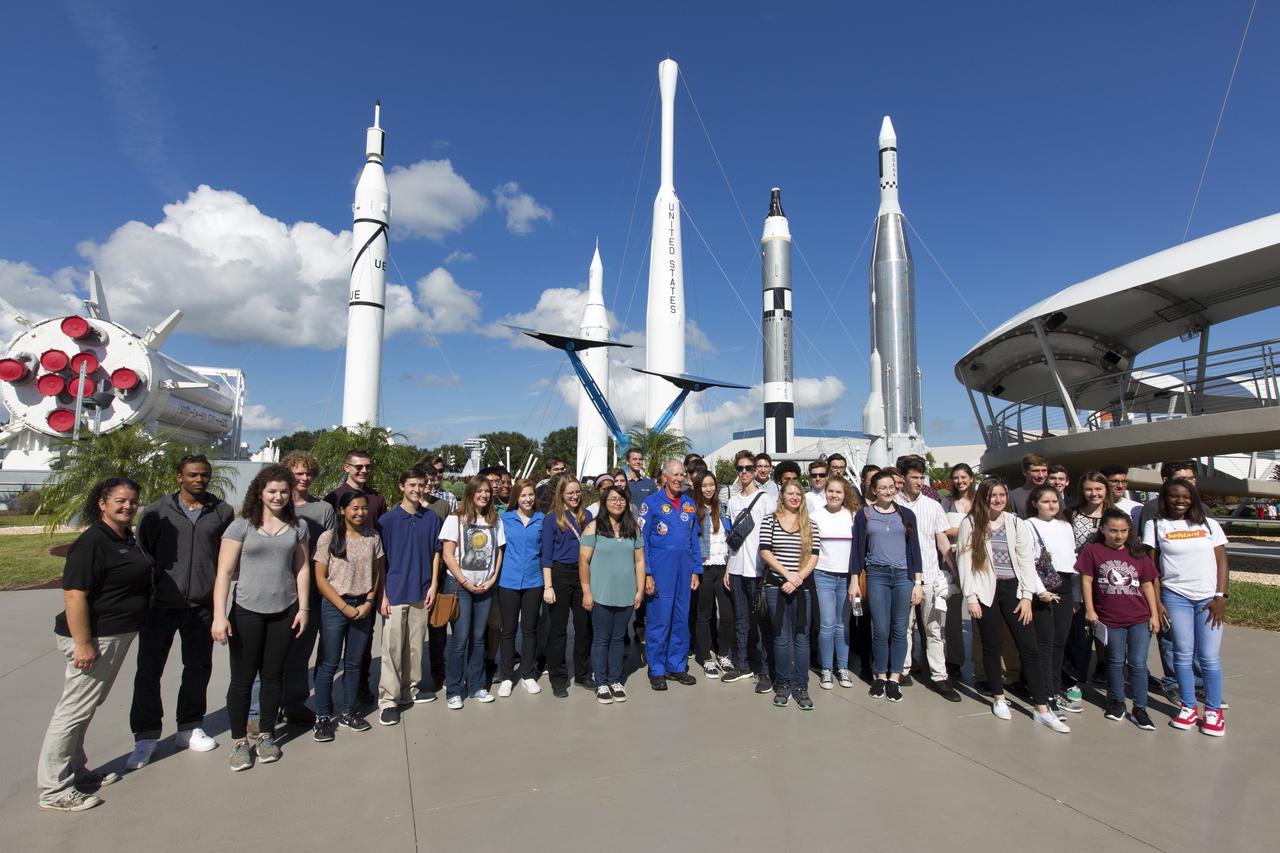
Retired NASA astronaut Bob Springer, center, takes a photograph with top scholars from Brevard County high schools near the Rocket Garden at the NASA Kennedy Space Center Visitor Complex in Florida, on Nov. 7, 2018. The high school seniors were invited to Kennedy Space Center for a tour of facilities, lunch and a roundtable discussion with engineers, scientists and business experts at the center. The 2018 Brevard Top Scholars event was hosted by the center's Academic Engagement Office to honor the top three scholars of the 2018-2019 graduating student class from each of Brevard County’s public high schools. The students received a personalized certificate of recognition at the end of the day.