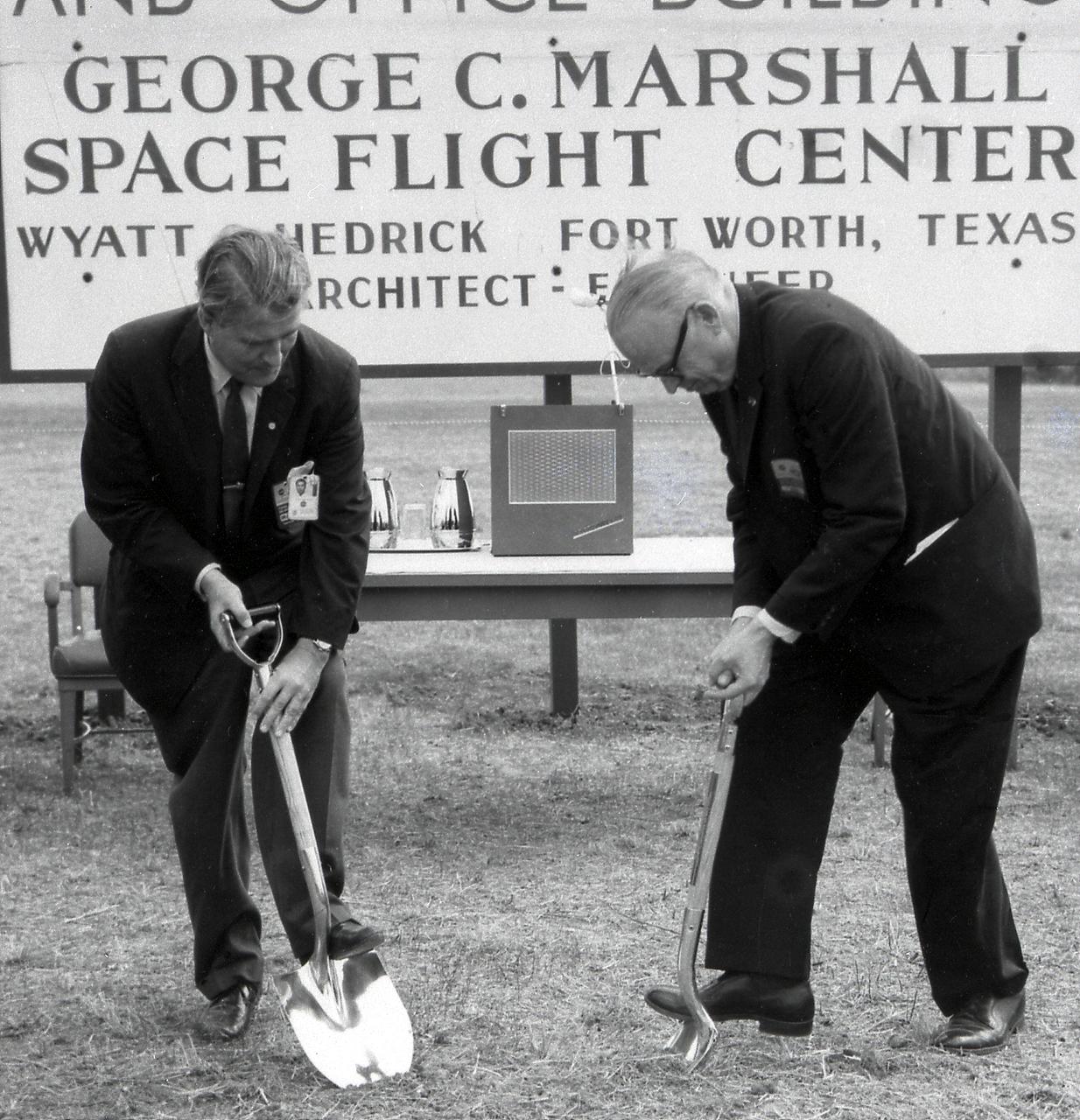
Dr. Wernher von Braun, Director of Marshall Space Flight Center (MSFC), teams up with Senator Robert S. Kerr, a chairman of the Senate Committee on Aeronautical and Space Sciences to break ground for MSFC's new Central Laboratory and Office Facility.
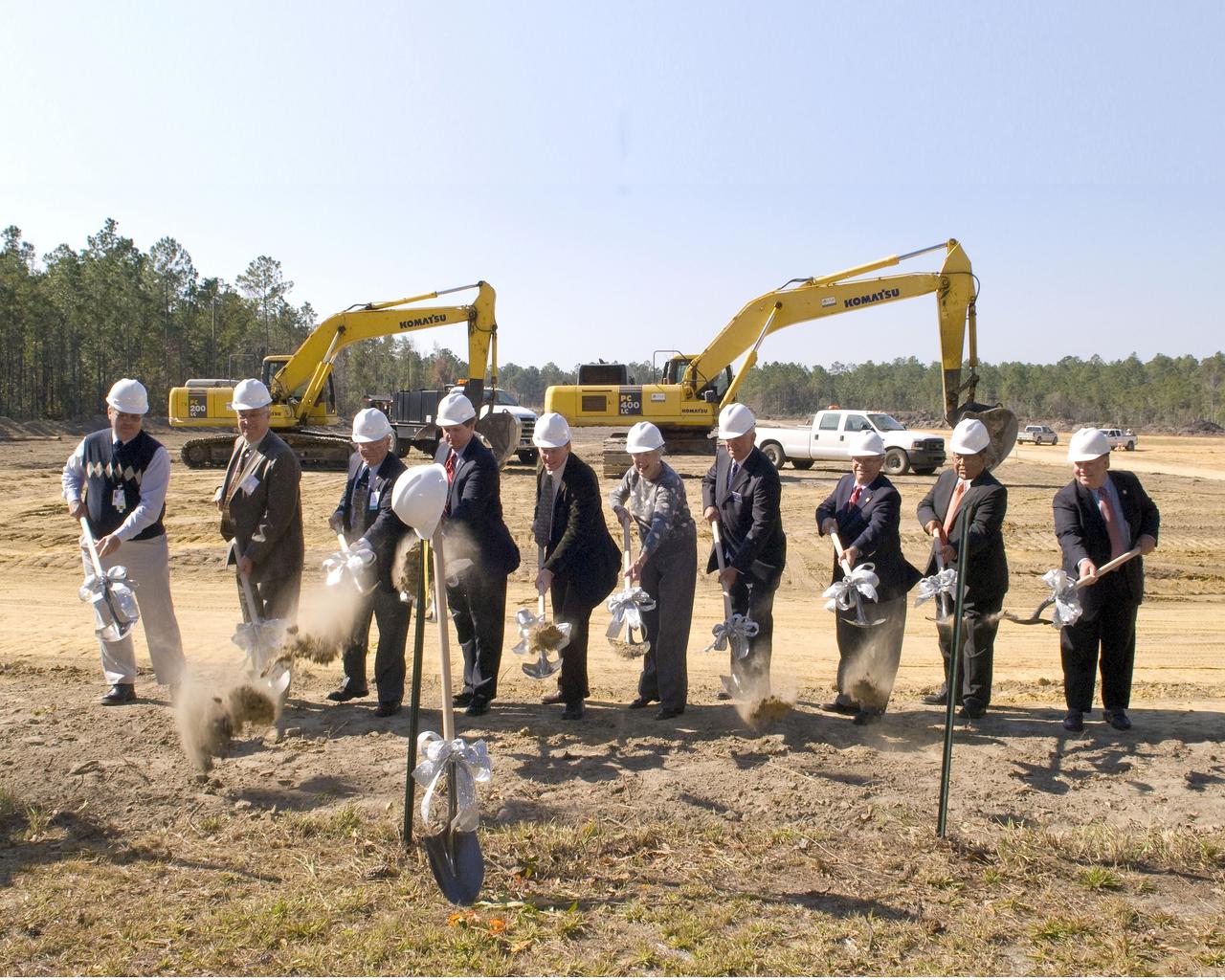
Community leaders from Mississippi and Louisiana break ground for the new INFINITY at NASA Stennis Space Center facility during a Nov. 20 ceremony. Groundbreaking participants included (l to r): Gottfried Construction representative John Smith, Mississippi Highway Commissioner Wayne Brown, INFINITY board member and Apollo 13 astronaut Fred Haise, Stennis Director Gene Goldman, Studio South representative David Hardy, Leo Seal Jr. family representative Virginia Wagner, Hancock Bank President George Schloegel, Mississippi Rep. J.P. Compretta, Mississippi Band of Choctaw Indians representative Charlie Benn and Louisiana Sen. A.G. Crowe.
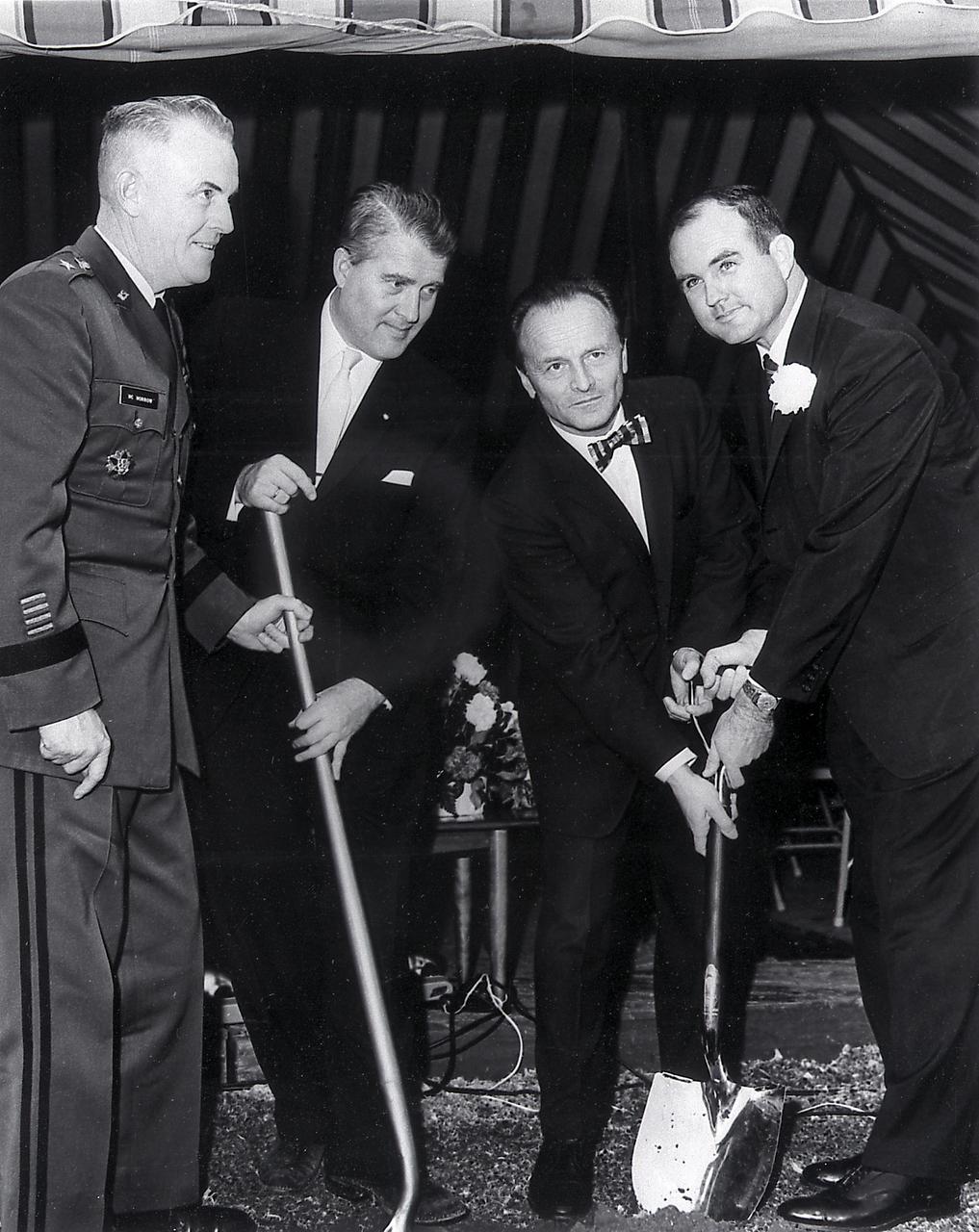
Dr. von Braun, Major General Francis McMorrow, and Alabama Governor, John Patterson (far left) participated in the ground breaking ceremony for the University of Alabama Research Institute in Huntsville, December 20, 1962.

This artist's concept portrays the plan for the new Engineering Directorate office to be constructed at the Marshall Space Flight Center. The first of several new buildings to be constructed as replacements for older Center facilities, the 5-story, 139,000-square-foot building will house approximately 500 current Marshall employees that provide development and research engineering services for the Marshall Center. Ground breaking ceremonies took place on June 10, 2003 at the construction site, southwest of the Martin and Rideout Roads intersection on Redstone Arsenal. GSC Construction of Waynesboro, Georgia has been selected as the contractor for the facility, which is scheduled for a September 2004 completion.
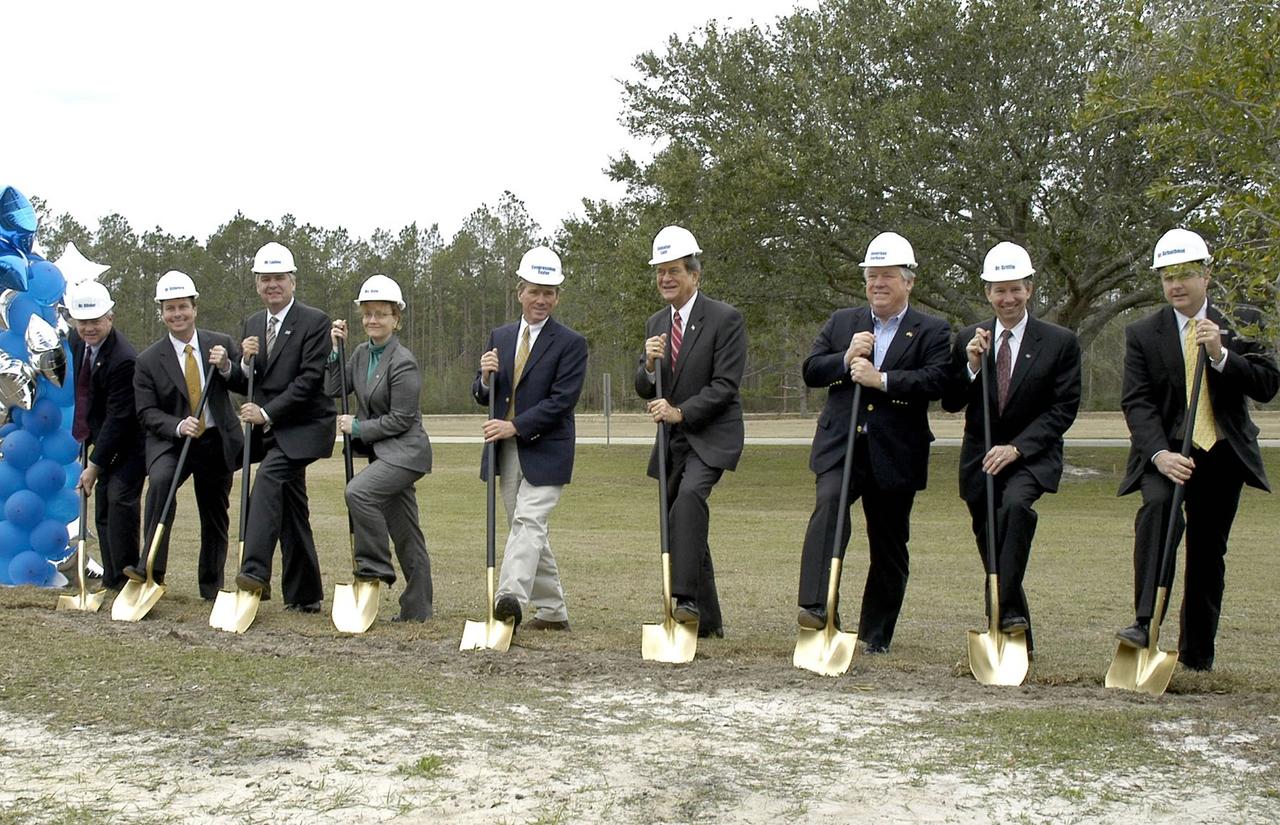
NASA officials and elected leaders were on hand for the groundbreaking ceremony of the NASA Shared Services Center Feb. 24, 2006, on the grounds of Stennis Space Center. The NSSC provides agency centralized administrative processing, human resources, procurement and financial services. From left, Louisiana Economic Development Secretary Mike Olivier, Stennis Space Center Director Rick Gilbrech, Computer Sciences Corp. President Michael Laphen, NASA Deputy Administrator Shana Dale, Rep. Gene Taylor, Sen. Trent Lott, Mississippi Gov. Haley Barbour, NASA Administrator Mike Griffin and Shared Services Center Executive Director Arbuthnot use golden shovels to break ground at the site.
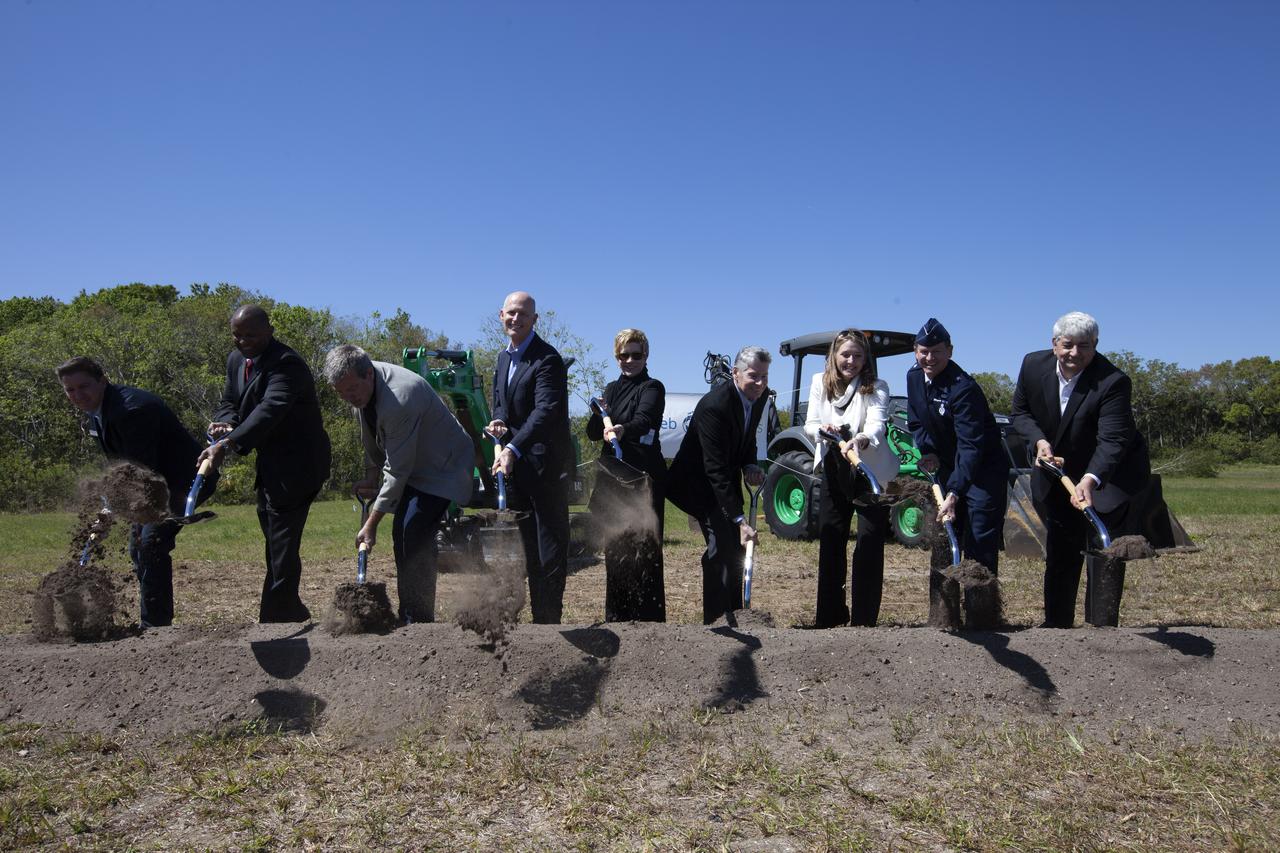
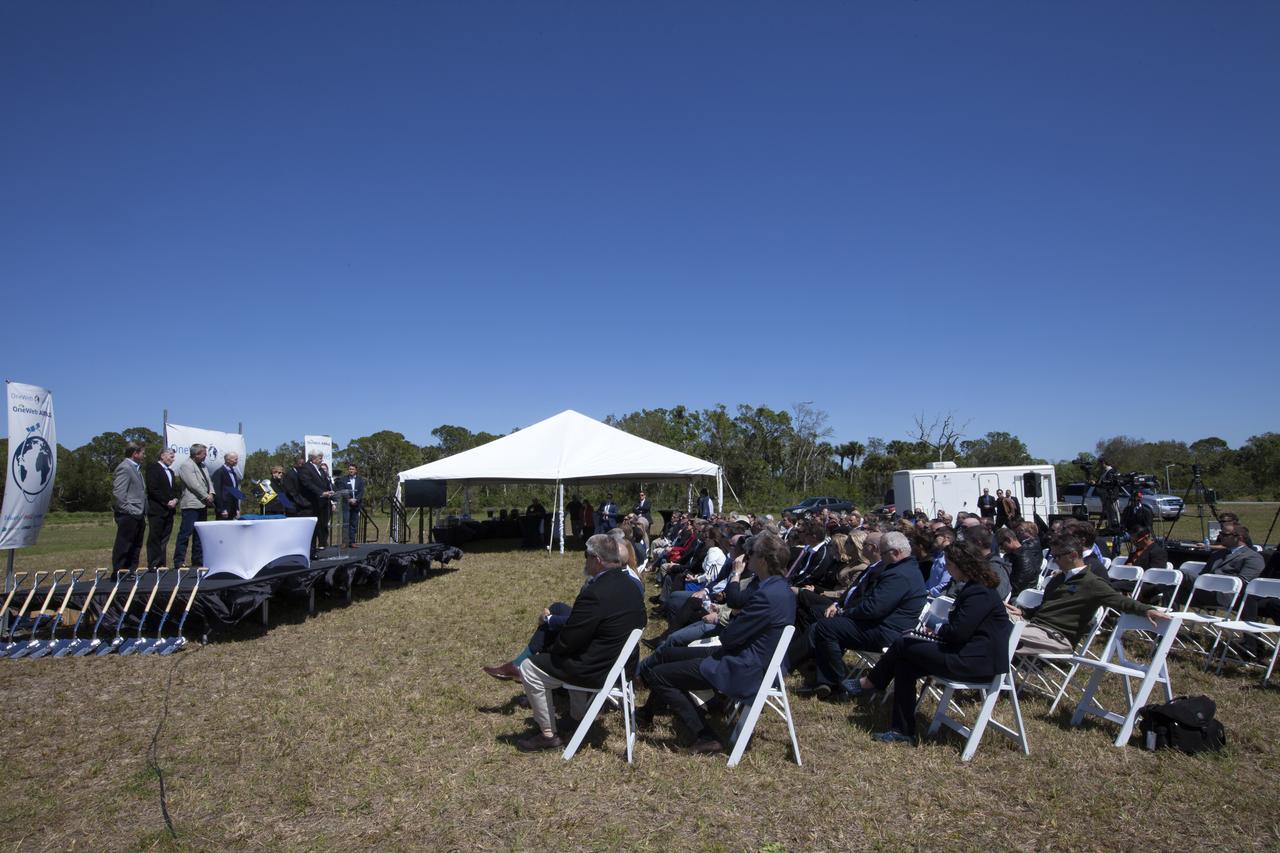
Officials break ground for a 150,000-square-foot manufacturing facility for OneWeb Satellites at Exploration Park at NASA's Kennedy Space Center. The company, in partnership with Airbus, is building a 150,000-square-foot factory to manufacture satellites that will connect all areas of the world to the Internet wirelessly. The officials are, from left, John Saul, operations manager of Hensell-Phelps; Kelvin Manning, associate director of NASA's Kennedy Space Center; Brian Holz, CEO of OneWeb Satellites; Rick Scott, governor of Florida; Lynda Weatherman, president and CEO of the Economic Development Council of the Space Coast; Mike Cosentino, president, Airbus Defense and Space; Cissy Procter, executive director of the Florida Department of Economic Activity; Gen. Wayne Monteith, commander of the 45th Space Wing of the U.S. Air Force; and Jim Kuzma, COO of Space Florida. Photo credit: NASA/Kim Shiflett
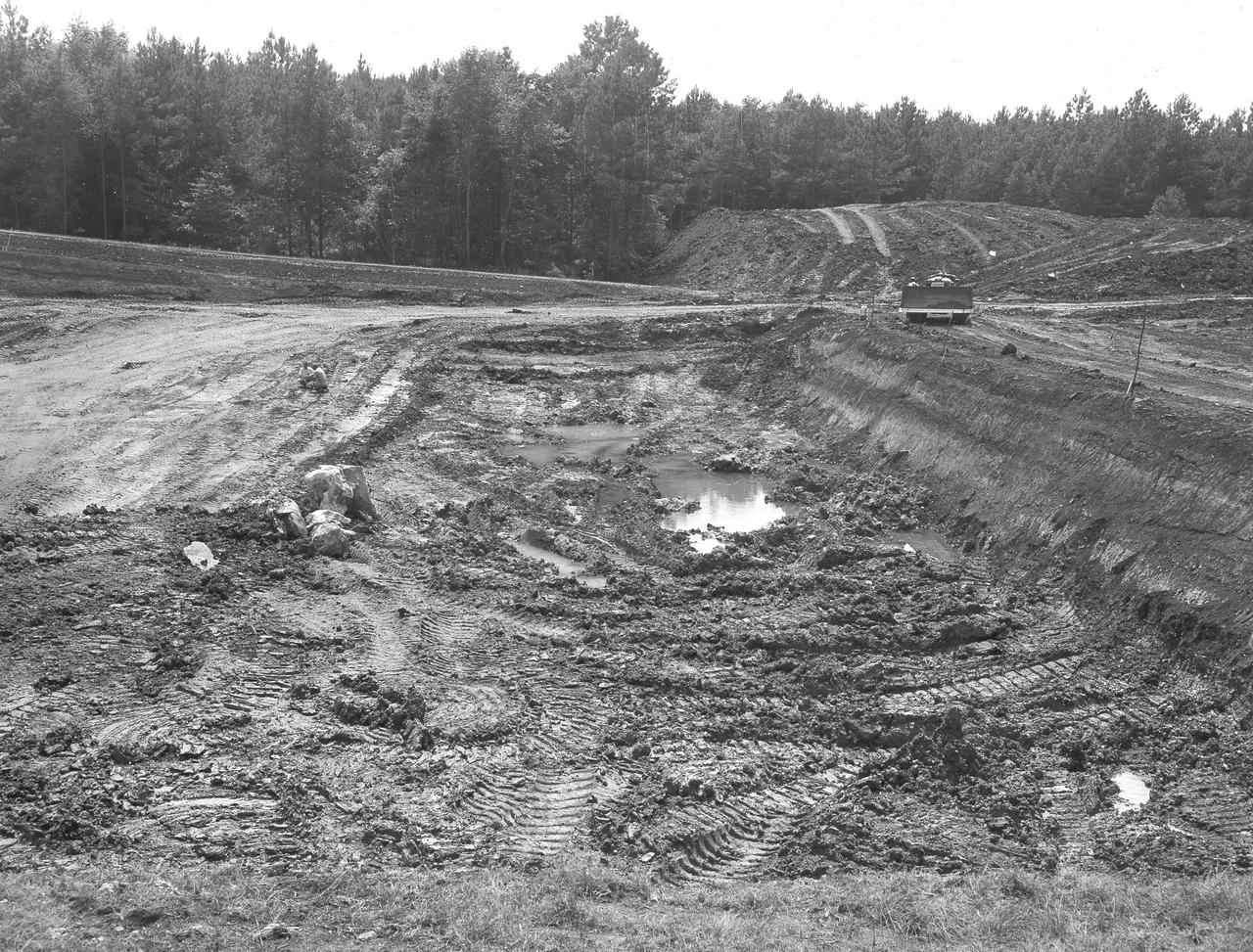
At its founding, the Marshall Space Flight Center (MSFC) inherited the Army’s Jupiter and Redstone test stands, but much larger facilities were needed for the giant stages of the Saturn V. From 1960 to 1964, the existing stands were remodeled and a sizable new test area was developed. The new comprehensive test complex for propulsion and structural dynamics was unique within the nation and the free world, and they remain so today because they were constructed with foresight to meet the future as well as on going needs. Construction of the S-IC Static test stand complex began in 1961 in the west test area of MSFC, and was completed in 1964. The S-IC static test stand was designed to develop and test the 138-ft long and 33-ft diameter Saturn V S-IC first stage, or booster stage, weighing in at 280,000 pounds. Required to hold down the brute force of a 7,500,000-pound thrust produced by 5 F-1 engines, the S-IC static test stand was designed and constructed with the strength of hundreds of tons of steel and 12,000,000 pounds of cement, planted down to bedrock 40 feet below ground level. The foundation walls, constructed with concrete and steel, are 4 feet thick. The base structure consists of four towers with 40-foot-thick walls extending upward 144 feet above ground level. The structure was topped by a crane with a 135-foot boom. With the boom in the upright position, the stand was given an overall height of 405 feet, placing it among the highest structures in Alabama at the time. In this photo, taken July 10, 1961, actual ground breaking has occurred for the S-IC test stand site.
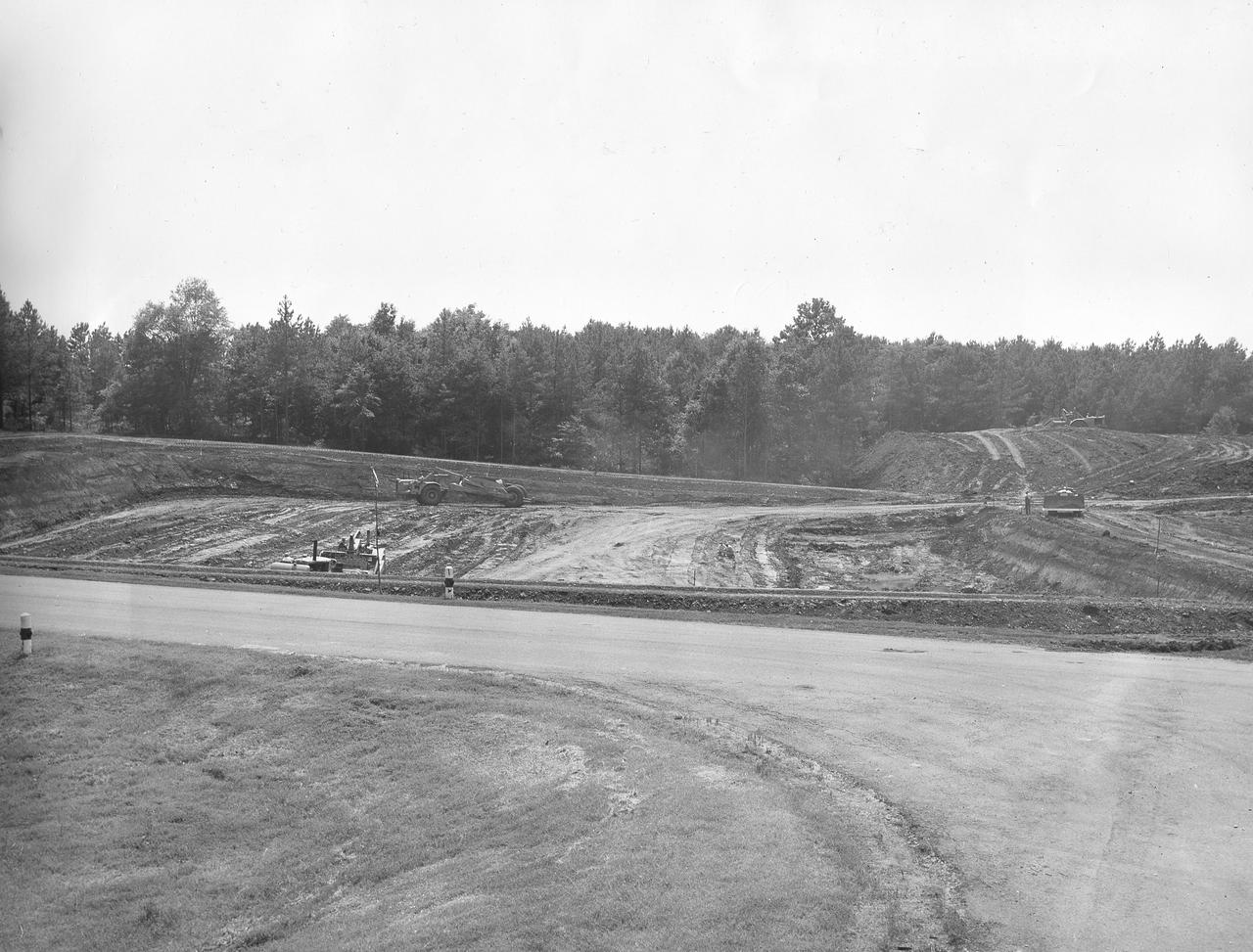
At its founding, the Marshall Space Flight Center (MSFC) inherited the Army’s Jupiter and Redstone test stands, but much larger facilities were needed for the giant stages of the Saturn V. From 1960 to 1964, the existing stands were remodeled and a sizable new test area was developed. The new comprehensive test complex for propulsion and structural dynamics was unique within the nation and the free world, and they remain so today because they were constructed with foresight to meet the future as well as on going needs. Construction of the S-IC Static test stand complex began in 1961 in the west test area of MSFC, and was completed in 1964. The S-IC static test stand was designed to develop and test the 138-ft long and 33-ft diameter Saturn V S-IC first stage, or booster stage, weighing in at 280,000 pounds. Required to hold down the brute force of a 7,500,000-pound thrust produced by 5 F-1 engines, the S-IC static test stand was designed and constructed with the strength of hundreds of tons of steel and 12,000,000 pounds of cement, planted down to bedrock 40 feet below ground level. The foundation walls, constructed with concrete and steel, are 4 feet thick. The base structure consists of four towers with 40-foot-thick walls extending upward 144 feet above ground level. The structure was topped by a crane with a 135-foot boom. With the boom in the upright position, the stand was given an overall height of 405 feet, placing it among the highest structures in Alabama at the time. In this photo, taken July 10, 1961, actual ground breaking has occurred for the S-IC test stand site.
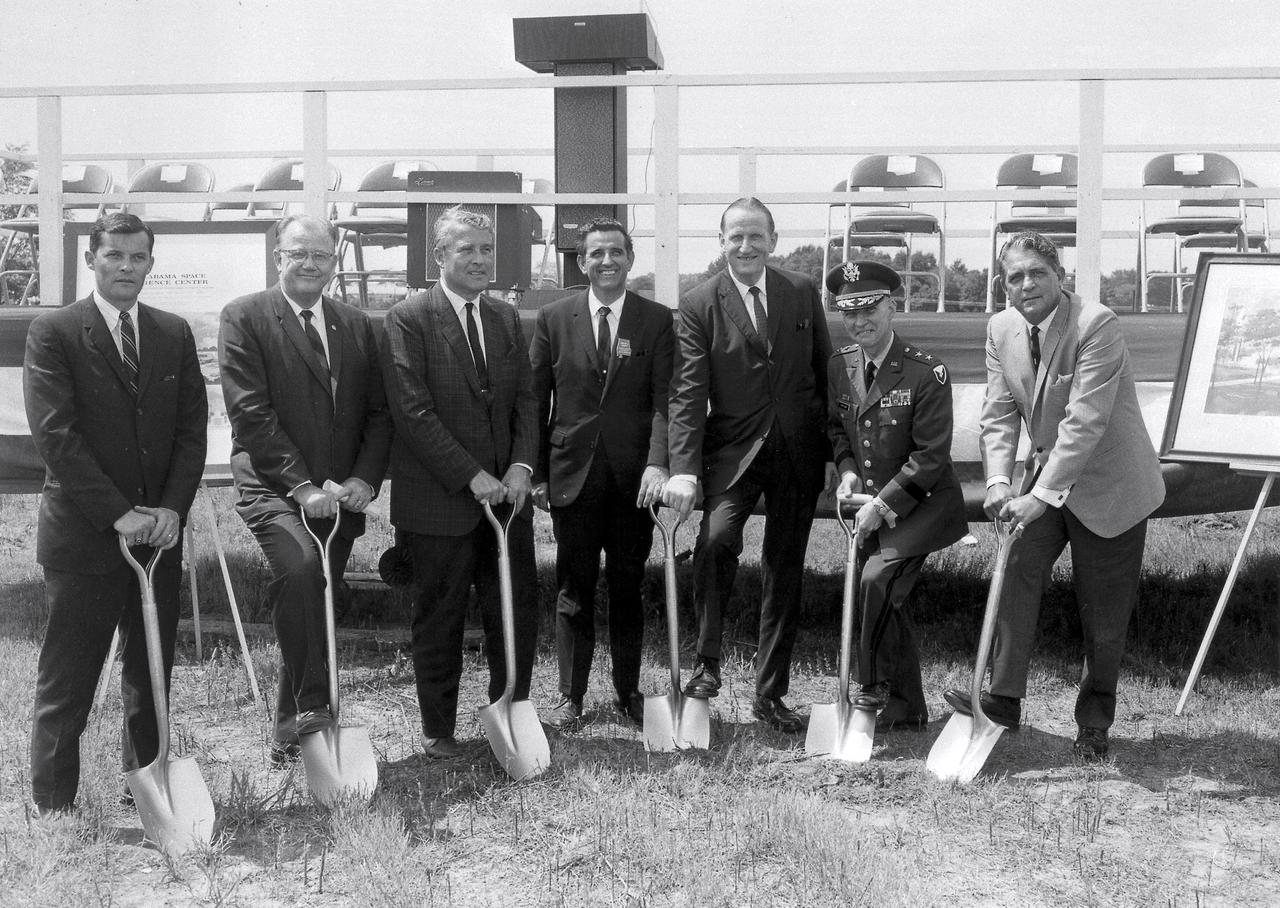
Ground breaking ceremony for the Alabama Space Science Center, later renamed the U.S. Space and Rocket Center. Shown in this picture, left to right, are Edward O. Buckbee, Space Center Director; Jack Giles, Alabama State Senator of Huntsville; Dr. Wernher on Braun, Marshall Space Flight Center (MSFC) Director; Martin Darity, head of the Alabama Publicity Bureau (representing Governor Albert Brewer); James Allen, former Lieutenant governor, chairman of the Alabama Space Science Exhibit Commission; Major General Charles Eifler, commanding general of the Army Ordnance Missile Command; and Huntsville Mayor Glenrn Hearn. (Courtesy of Huntsville/Madison County Public Library)
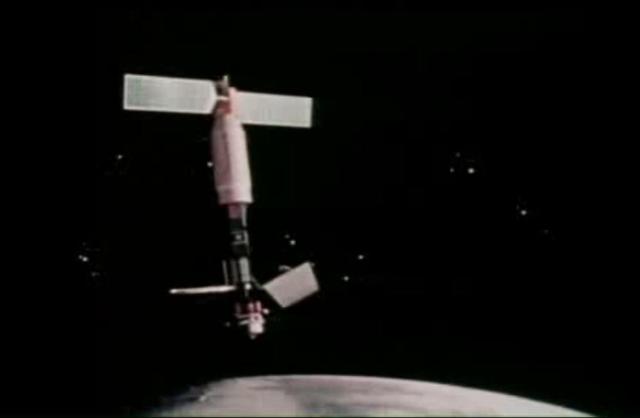
Seasat, built and managed by NASA Jet Propulsion Laboratory JPL, was launched thirty-five years ago, on June 27, 1978. It was the first satellite designed for remote sensing of the Earth oceans using many ground-breaking technologies.

If a meteorite breaks in two shortly before hitting the ground, the typical bowl shape of a single impact crater becomes doubled. This image is from NASA Mars Odyssey, one of an All Star set.

Brian Holz, CEO of OneWeb Satellites, speaks during the groundbreaking ceremony at Kennedy's Exploration Park for OneWeb. The company, in partnership with Airbus, is building a 150,000-square-foot factory to manufacture satellites that will connect all areas of the world to the Internet wirelessly. Photo credit: NASA/Kim Shiflett
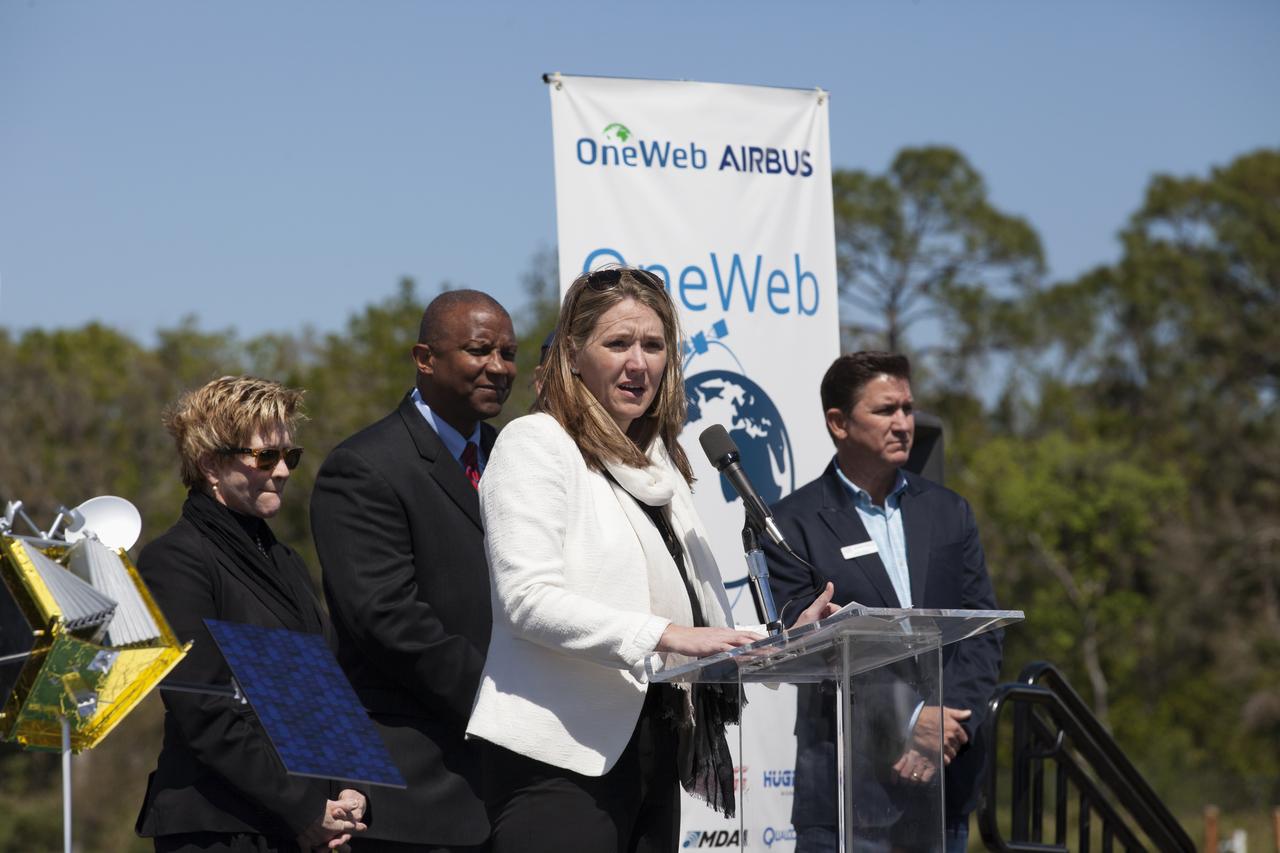
Cissy Procter, executive director of the Florida Department of Economic Activity, speaks during the groundbreaking ceremony at Kennedy's Exploration Park for OneWeb. The company, in partnership with Airbus, is building a 150,000-square-foot factory to manufacture satellites that will connect all areas of the world to the Internet wirelessly. Photo credit: NASA/Kim Shiflett
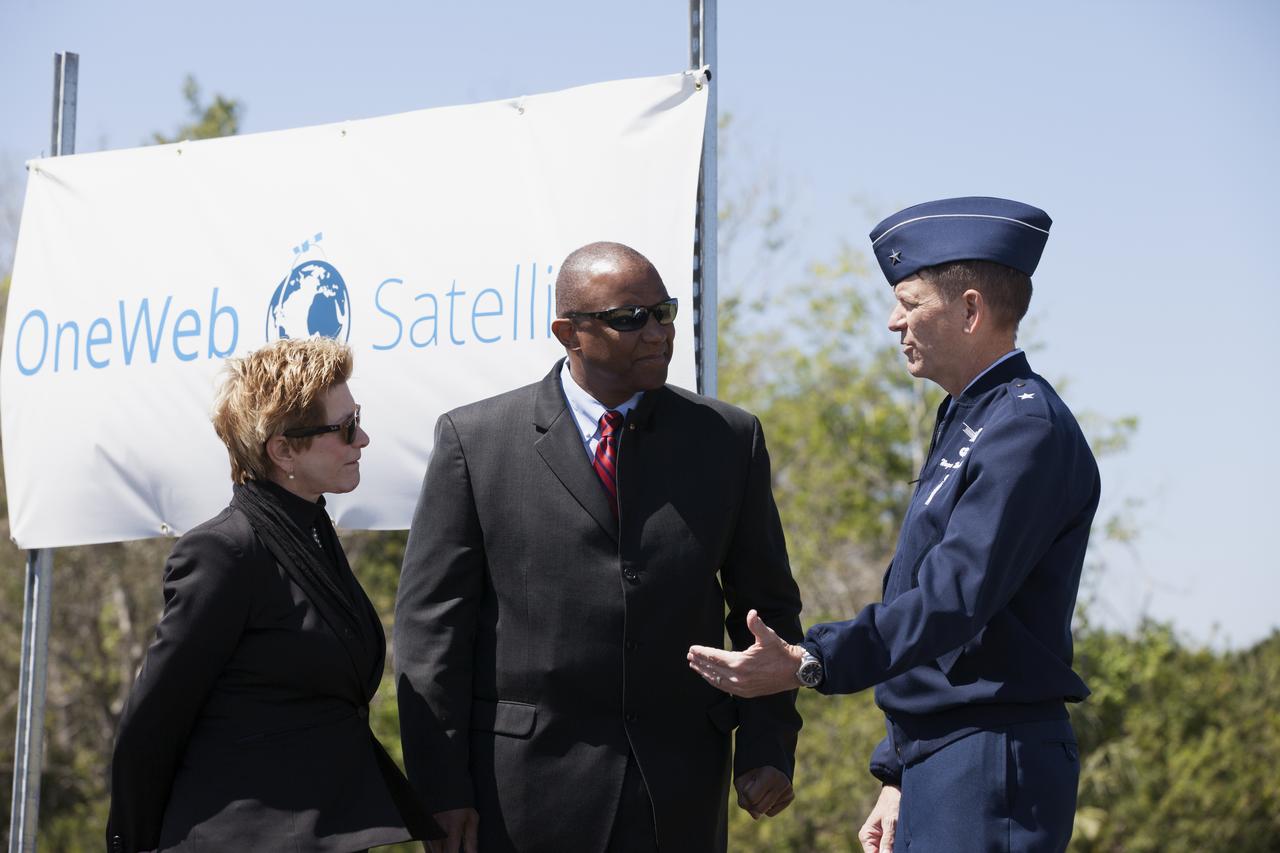
Lynda Weatherman, president and CEO of the Economic Development Council of the Space Coast, talks with Kelvin Manning, associate director of NASA's Kennedy Space Center, and Gen. Wayne Monteith, commander of the 45th Space Wing of the U.S. Air Force, prior to a groundbreaking ceremony at Kennedy's Exploration Park for OneWeb. The company, in partnership with Airbus, is building a 150,000-square-foot factory to manufacture satellites that will connect all areas of the world to the Internet wirelessly. Photo credit: NASA/Kim Shiflett
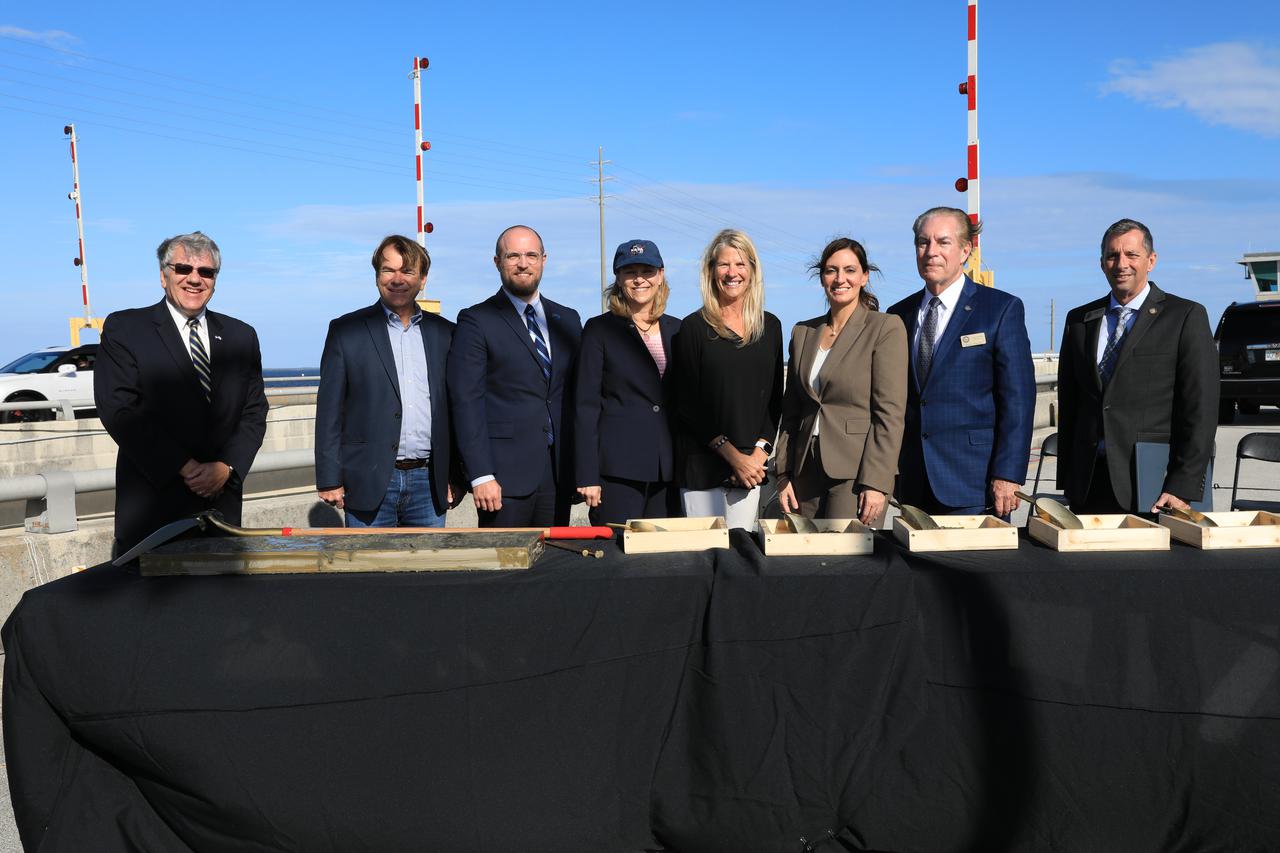
Center Director Janet Petro joins partners and elected officials for a groundbreaking ceremony on a new NASA Causeway bridge over the Indian River leading to NASA’s Kennedy Space Center on Merritt Island in Florida. The construction is made possible through a $90M Infrastructure for Rebuilding America (INFRA) grant, which was awarded thanks to an extensive effort by NASA, the State of Florida – through Florida Department of Transportation and Space Florida – as well as support from industry partners, other local, state, and federal government agencies. The new bridge enables Kennedy’s growth as a multi-user spaceport and will allow NASA to better support the space industry. Construction is scheduled to take several years. To commemorate the day, speakers left a handprint and signed their name in cement.
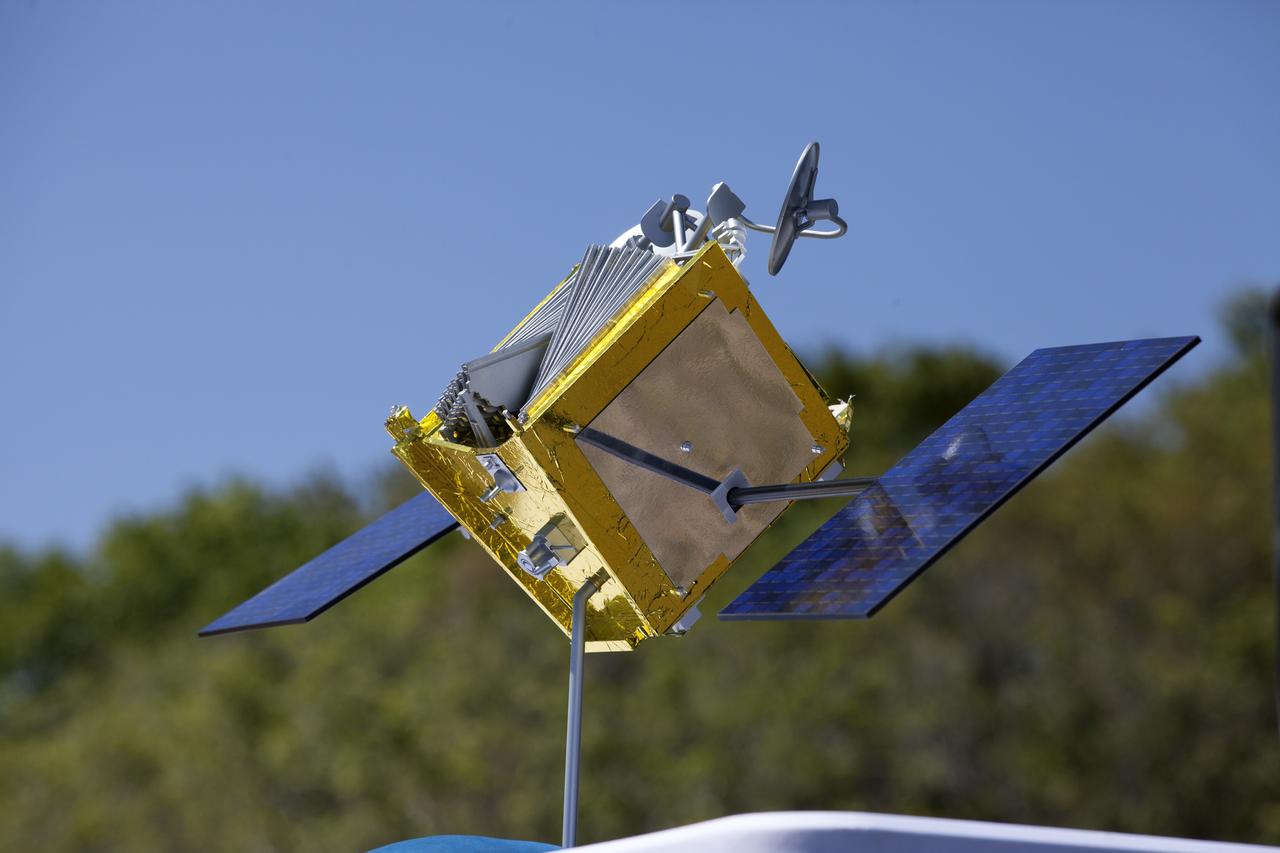
A model of a OneWeb satellite like those the company will build to will connect all areas of the world to the Internet wirelessly. The company plans to launch 2,000 of the satellites as part of its constellation. The satellites will be built at a new factory at Exploration Park at NASA's Kennedy Space Center. The company held a groundbreaking ceremony for the factory. Photo credit: NASA/Kim Shiflett
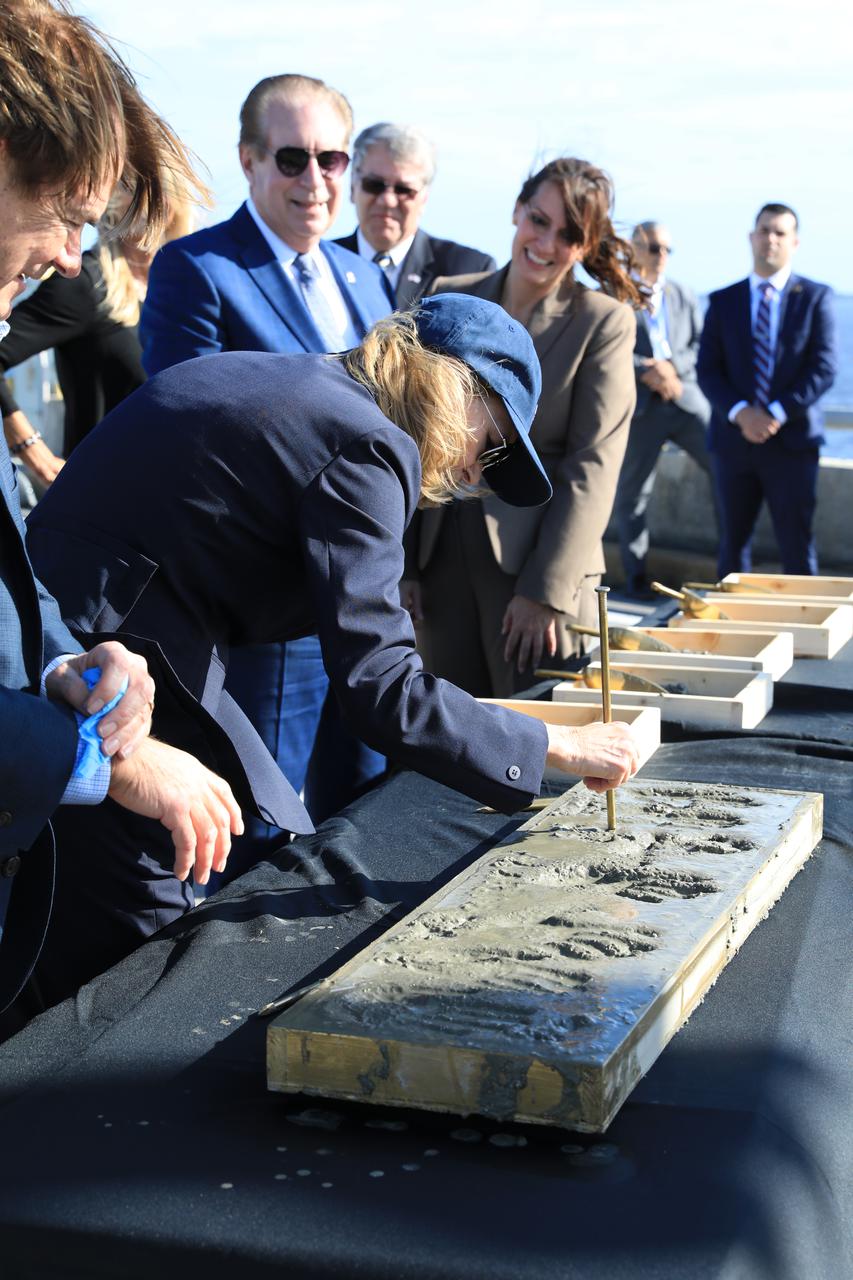
Center Director Janet Petro joins partners and elected officials for a groundbreaking ceremony on a new NASA Causeway bridge over the Indian River leading to NASA’s Kennedy Space Center on Merritt Island in Florida. The construction is made possible through a $90M Infrastructure for Rebuilding America (INFRA) grant, which was awarded thanks to an extensive effort by NASA, the State of Florida – through Florida Department of Transportation and Space Florida – as well as support from industry partners, other local, state, and federal government agencies. The new bridge enables Kennedy’s growth as a multi-user spaceport and will allow NASA to better support the space industry. Construction is scheduled to take several years. To commemorate the day, speakers left a handprint and signed their name in cement.
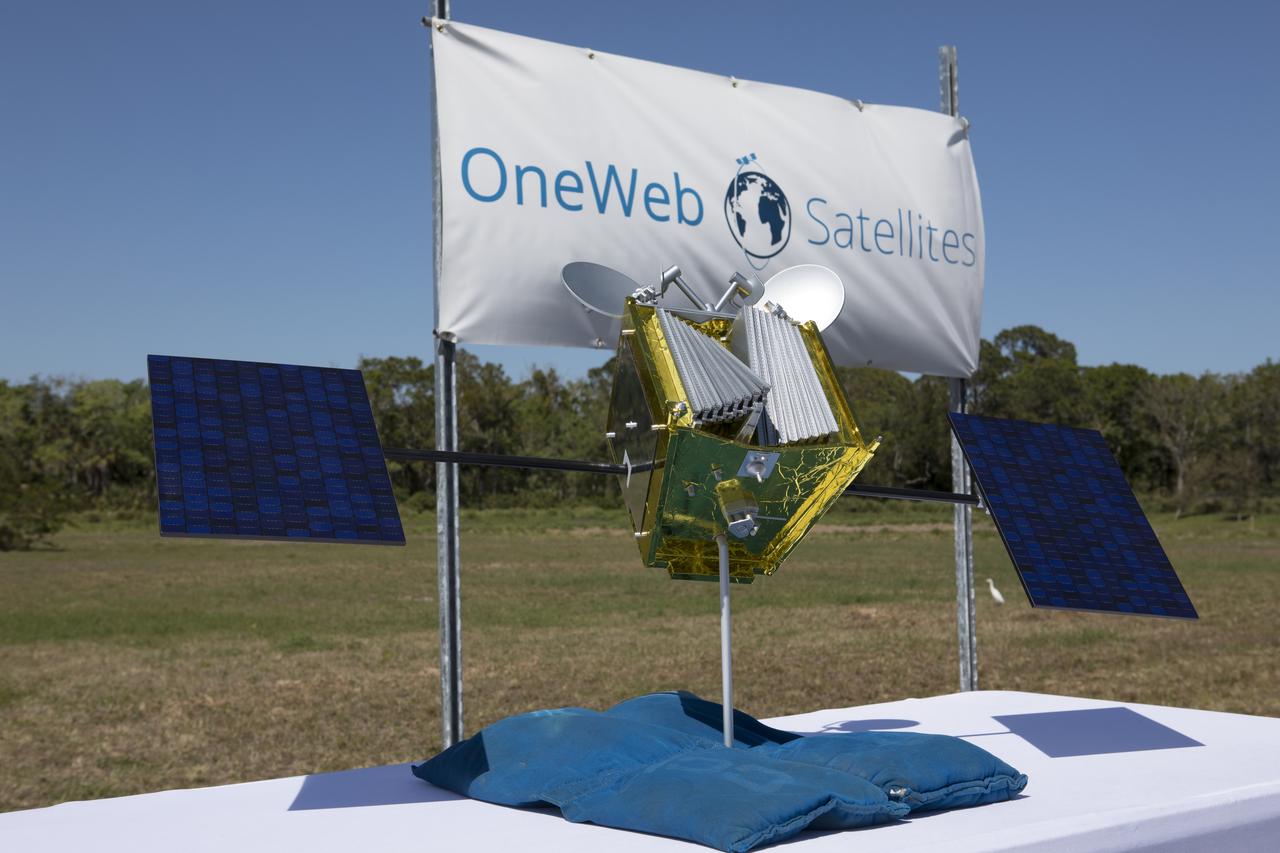
A model of a OneWeb satellite like those the company will build to will connect all areas of the world to the Internet wirelessly. The company plans to launch 2,000 of the satellites as part of its constellation. The satellites will be built at a new factory at Exploration Park at NASA's Kennedy Space Center. The company held a groundbreaking ceremony for the factory. Photo credit: NASA/Kim Shiflett
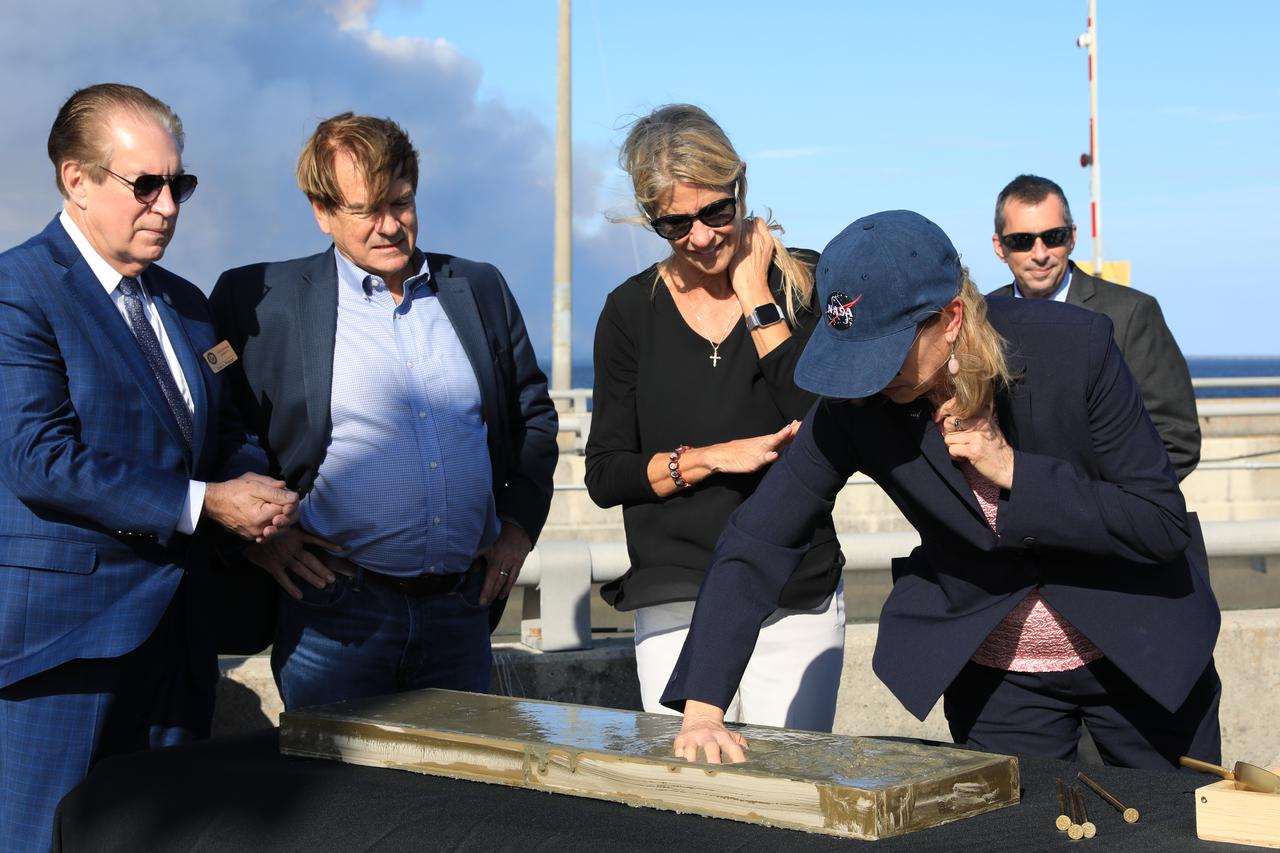
Center Director Janet Petro joins partners and elected officials for a groundbreaking ceremony on a new NASA Causeway bridge over the Indian River leading to NASA’s Kennedy Space Center on Merritt Island in Florida. The construction is made possible through a $90M Infrastructure for Rebuilding America (INFRA) grant, which was awarded thanks to an extensive effort by NASA, the State of Florida – through Florida Department of Transportation and Space Florida – as well as support from industry partners, other local, state, and federal government agencies. The new bridge enables Kennedy’s growth as a multi-user spaceport and will allow NASA to better support the space industry. Construction is scheduled to take several years. To commemorate the day, speakers left a handprint and signed their name in cement.

Dale Ketchum of Space Florida opens the groundbreaking ceremony at Kennedy's Exploration Park for OneWeb. The company, in partnership with Airbus, is building a 150,000-square-foot factory to manufacture satellites that will connect all areas of the world to the Internet wirelessly. Behind him are, from left, Jim Kuzma, COO of Space Florida; Mike Cosentino, president, Airbus Defense and Space; Brian Holz, CEO of OneWeb Satellites; Rick Scott, governor of Florida; Lynda Weatherman, president and CEO of the Economic Development Council of the Space Coast; Kelvin Manning, associate director of NASA's Kennedy Space Center; Gen. Wayne Monteith, commander of the 45th Space Wing of the U.S. Air Force; Cissy Procter, executive director of the Florida Department of Economic Activity; and John Saul, operations manager of Hensell-Phelps. Photo credit: NASA/Kim Shiflett
Jim Kuzma, COO of Space Florida, speaks during the groundbreaking ceremony at Kennedy's Exploration Park for OneWeb. The company, in partnership with Airbus, is building a 150,000-square-foot factory to manufacture satellites that will connect all areas of the world to the Internet wirelessly. Photo credit: NASA/Kim Shiflett
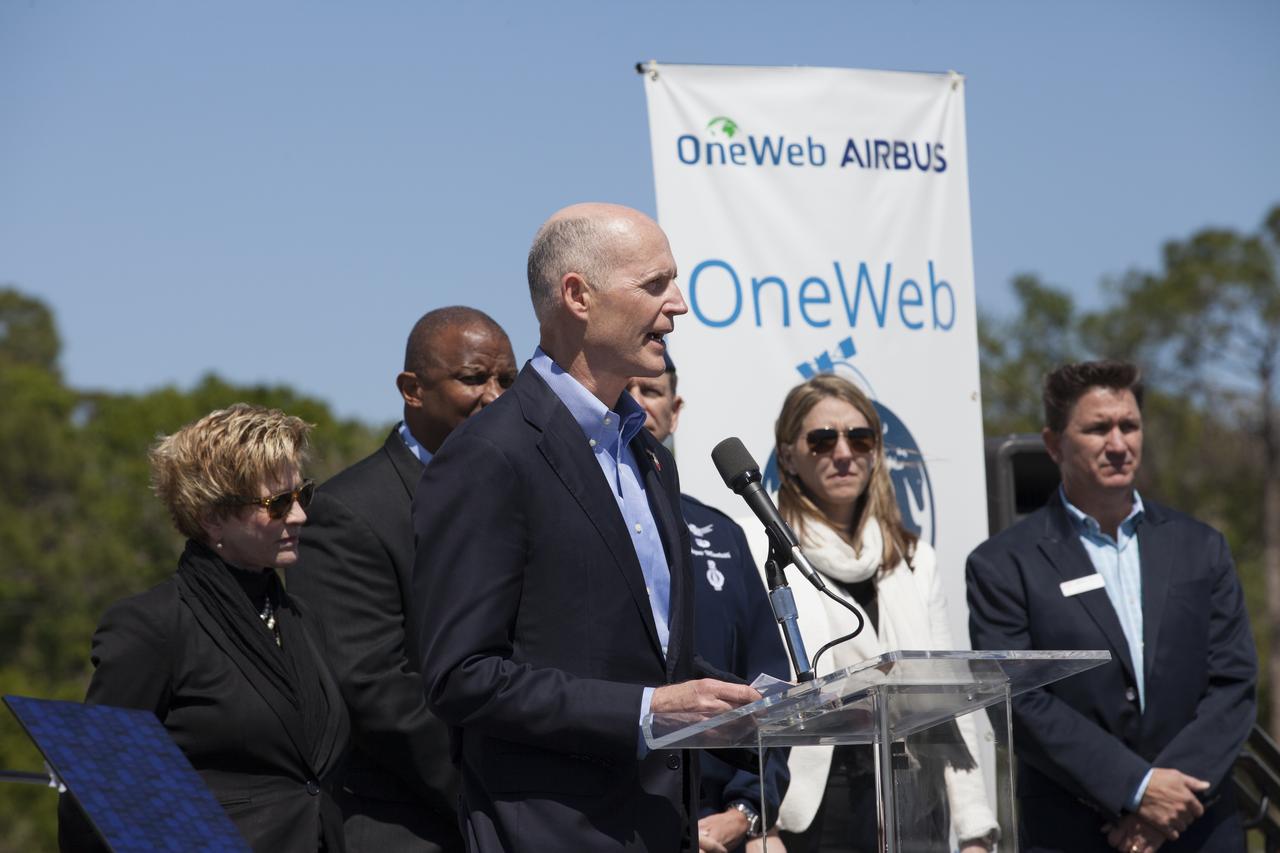
Florida Governor Rick Scott speaks during the groundbreaking ceremony at Kennedy's Exploration Park for OneWeb. The company, in partnership with Airbus, is building a 150,000-square-foot factory to manufacture satellites that will connect all areas of the world to the Internet wirelessly. Photo credit: NASA/Kim Shiflett
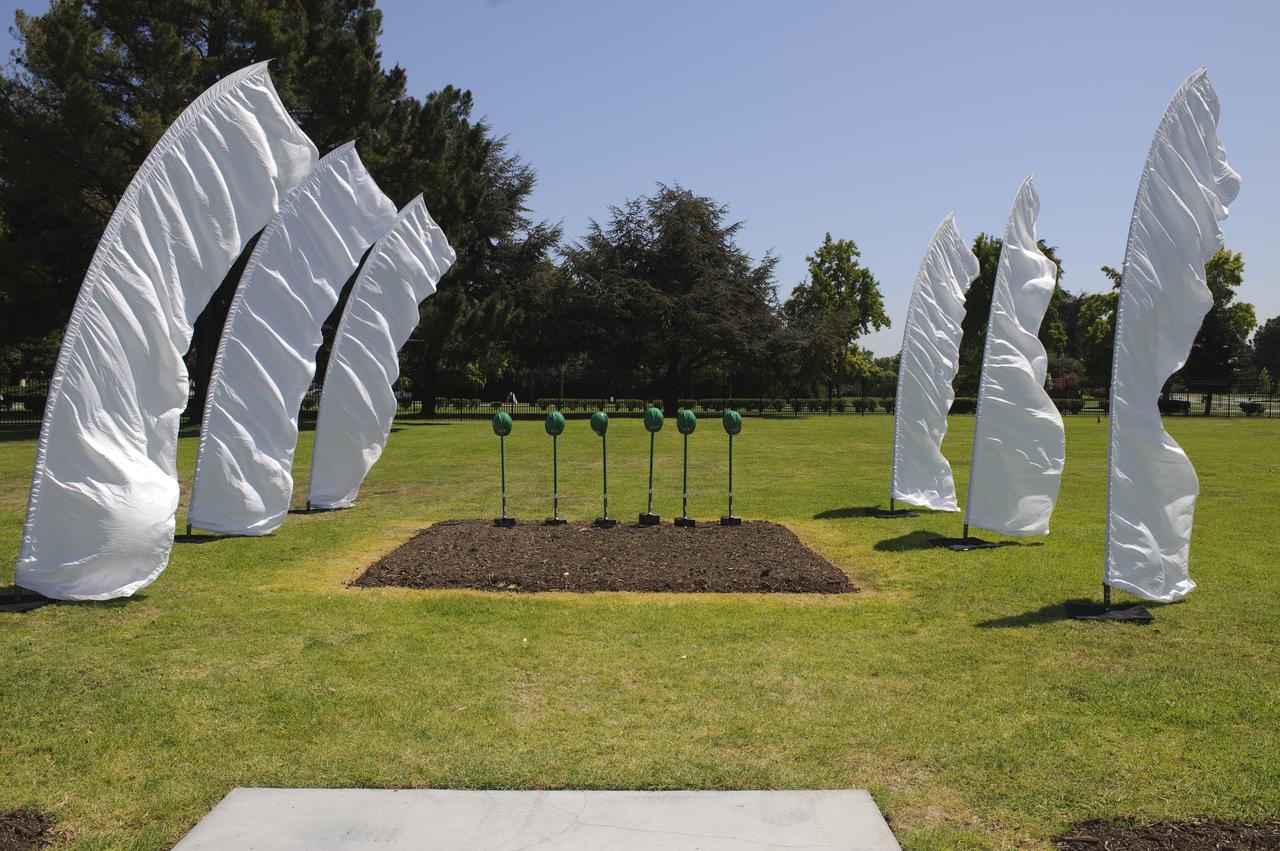
Sustainability Base Ground Breaking ceremony
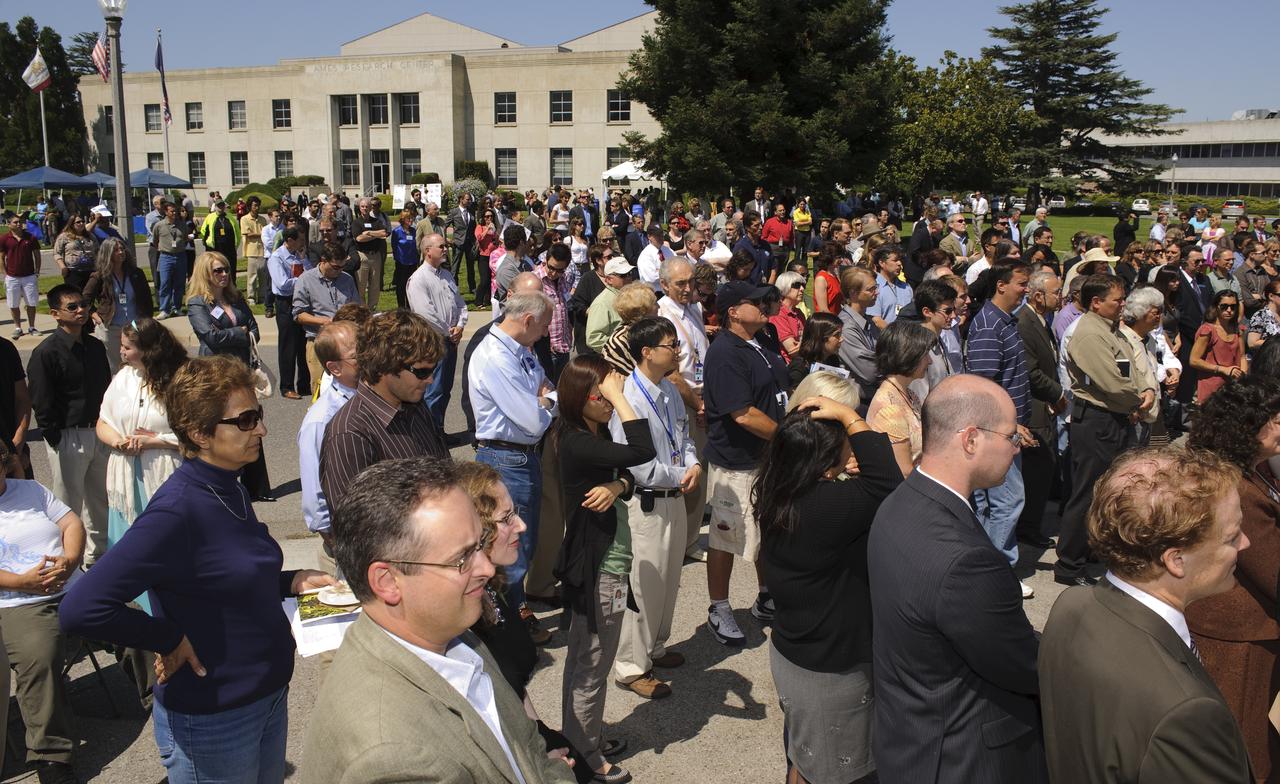
Sustainability Base Ground Breaking ceremony
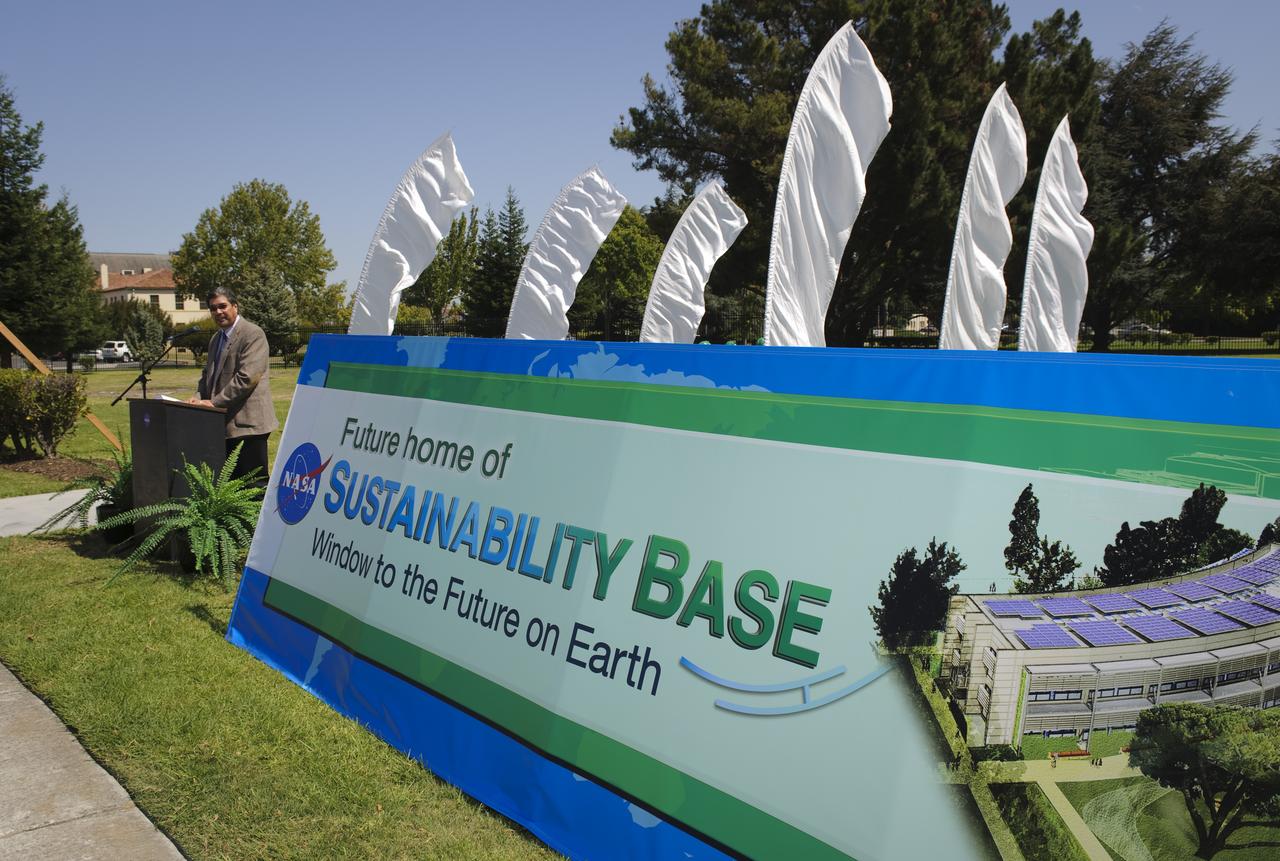
Sustainability Base Ground Breaking ceremony

Commemorating the NACA Aircraft Engine Research Laboratory Ground Breaking Ceremony
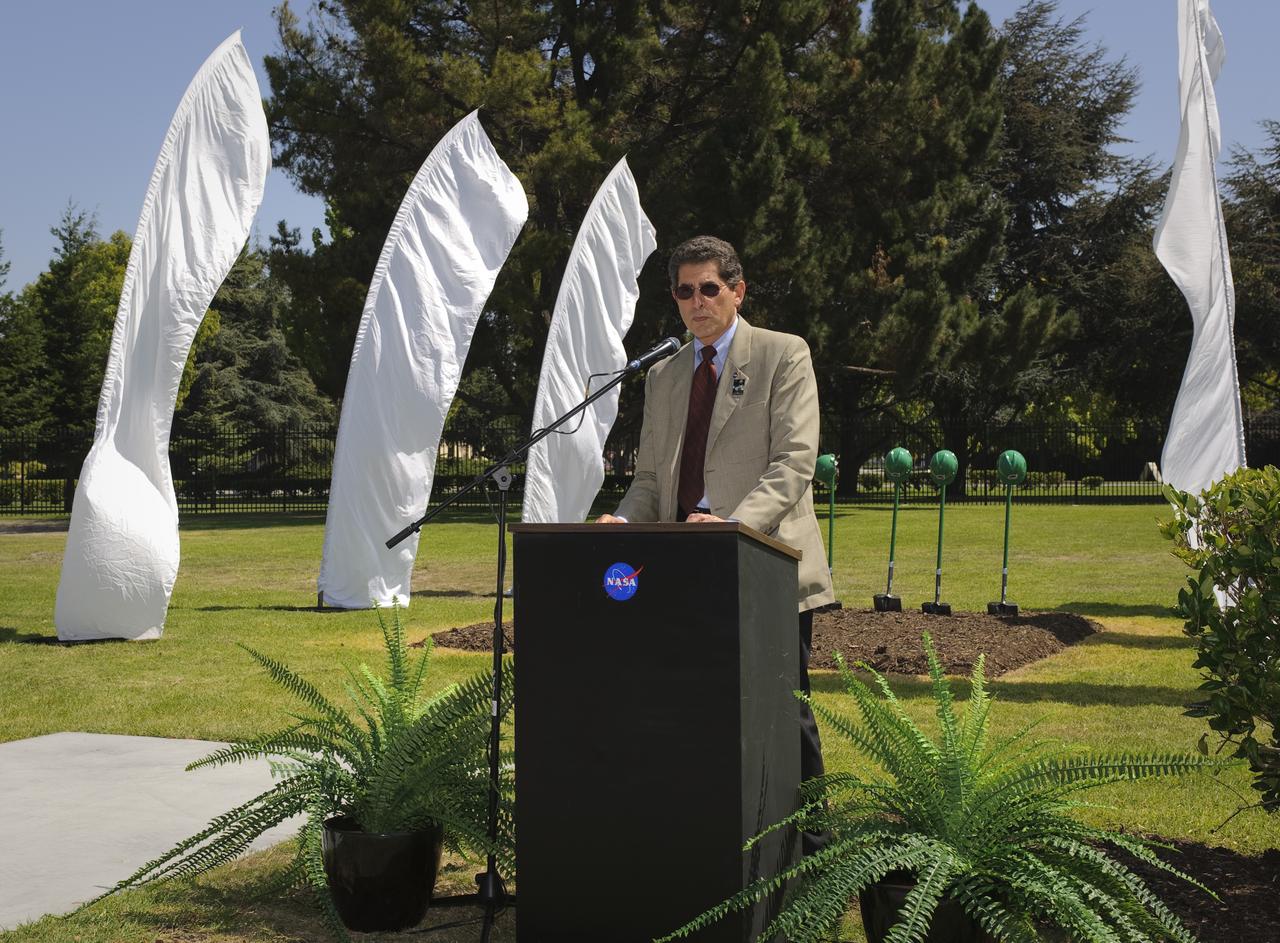
Sustainability Base Ground Breaking ceremony with Steve Zornetzer, Ames Associate Director
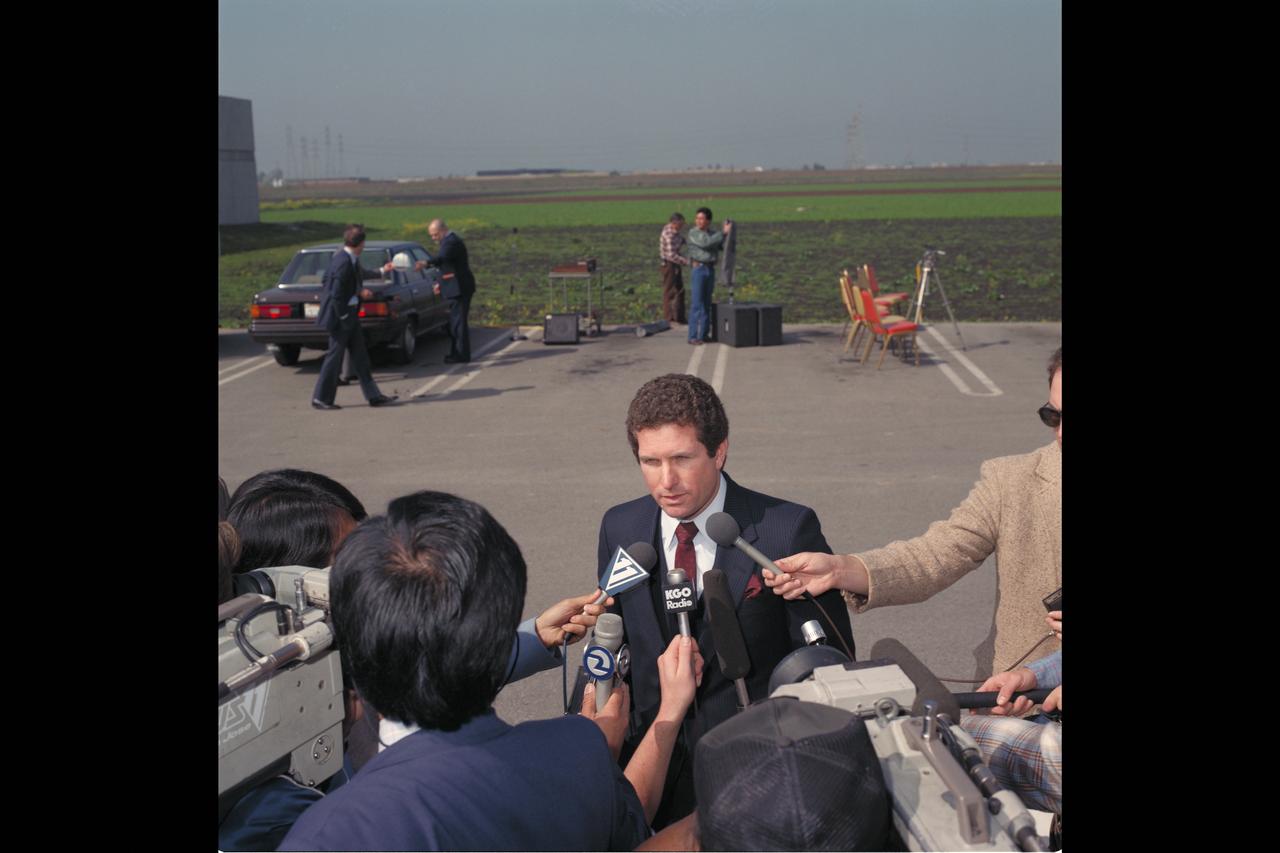
N-258 NAS (Numerical Aerodynamic Simulation) ground breaking with Dr Bill Ballhaus, Ames Director
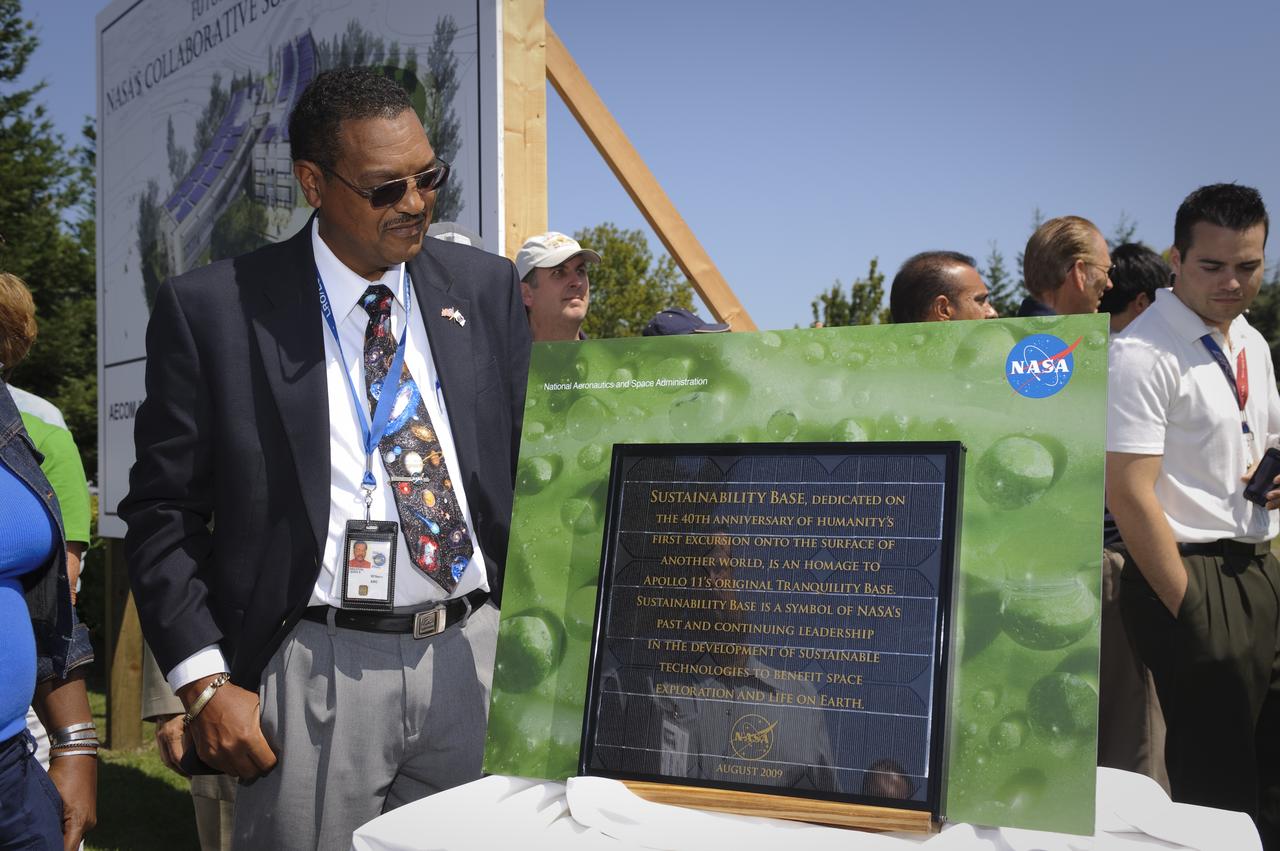
Sustainability Base Ground Breaking ceremony Lewis Braxton III, Deputy Director Ames Research Center with dedication plaque

N-258 NAS (Numerical Aerodynamic Simulation) ground breaking with Dr Bill Ballhaus, Ames Director
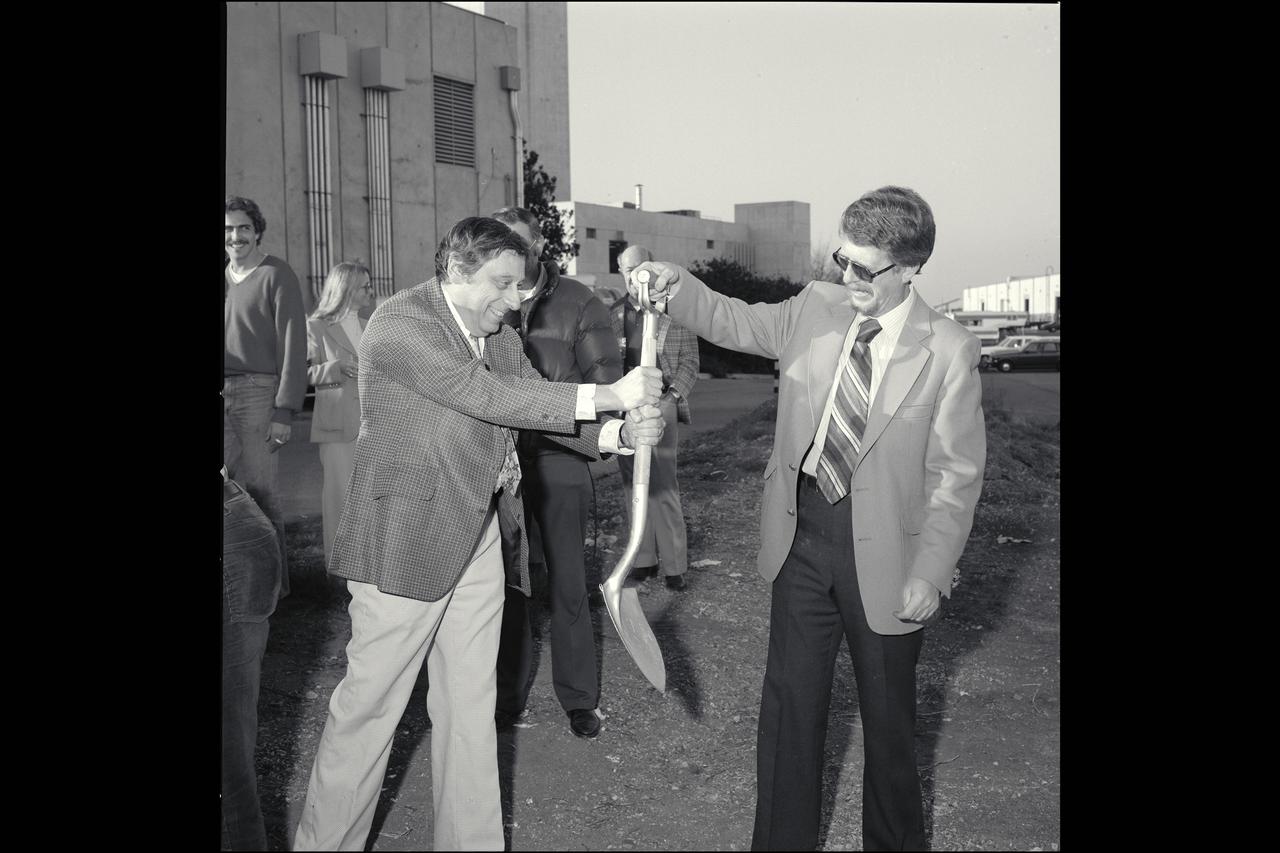
Ground breaking ceremony for the Space Sciences (Airborne Missions and Applications) building N-240 with Dr Harold Klein
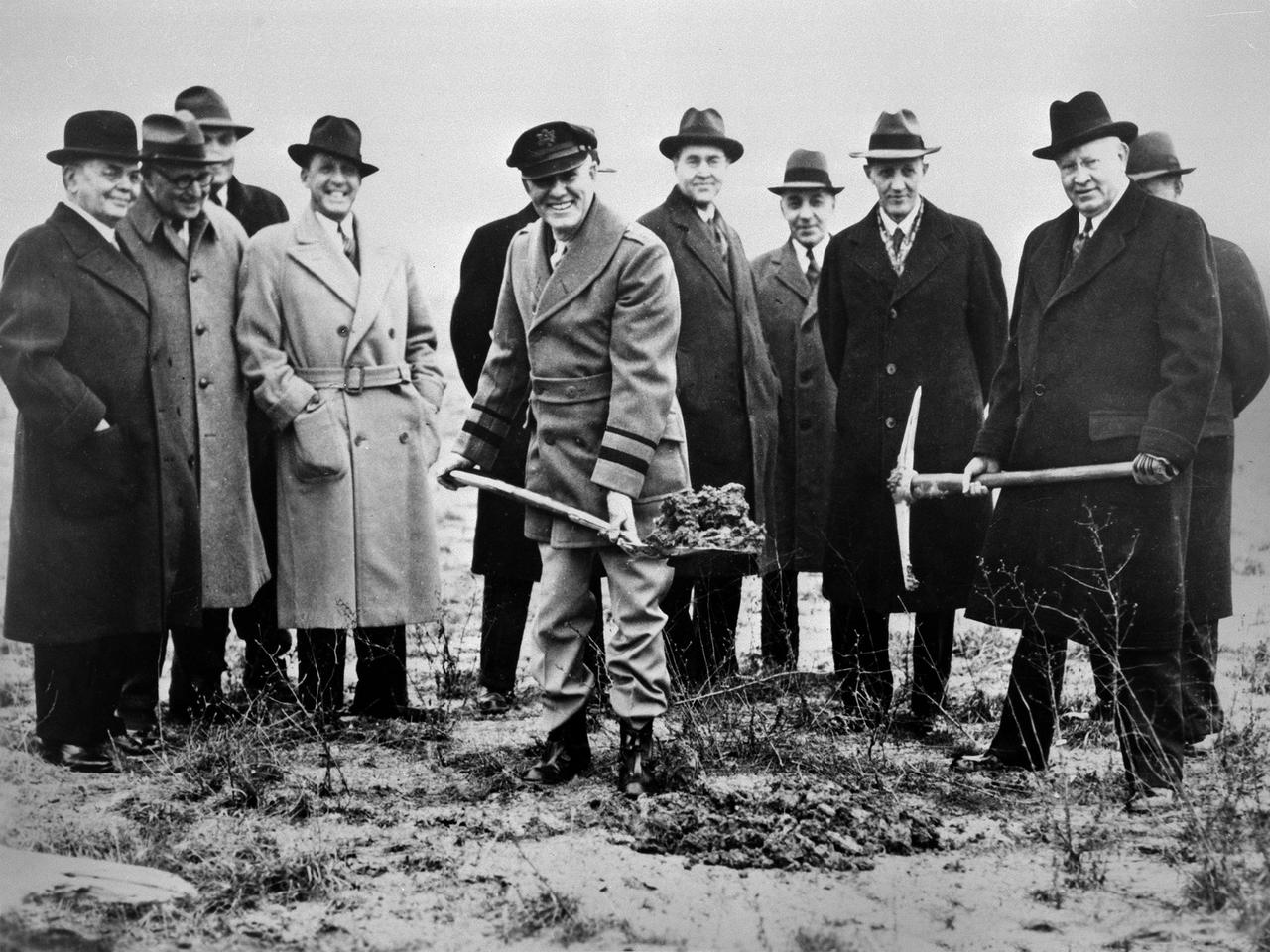
Local politicians and National Advisory Committee for Aeronautics (NACA) officials were on hand for the January 23, 1941 groundbreaking for the NACA’s Aircraft Engine Research Laboratory (AERL). The NACA was established in 1915 to coordinate the nation’s aeronautical research. The committee opened a research laboratory at Langley Field in 1920. By the late 1930s, however, European nations, Germany in particular, were building faster and higher flying aircraft. The NACA decided to expand with a new Ames Aeronautical Laboratory dedicated to high-speed flight and the AERL to handle engine-related research. The NACA examined a number of Midwest locations for its new engine lab before deciding on Cleveland. At the time, Cleveland possessed the nation’s most advanced airport, several key aircraft manufacturing companies, and was home to the National Air Races. Local officials were also able to broker a deal with the power company to discount its electricity rates if the large wind tunnels were operated overnight. The decision was made in October 1940, and the groundbreaking alongside the airport took place on January 23, 1941. From left to right: William Hopkins, John Berry, Ray Sharp, Frederick Crawford, George Brett, Edward Warner, Sydney Kraus, Edward Blythin, and George Lewis
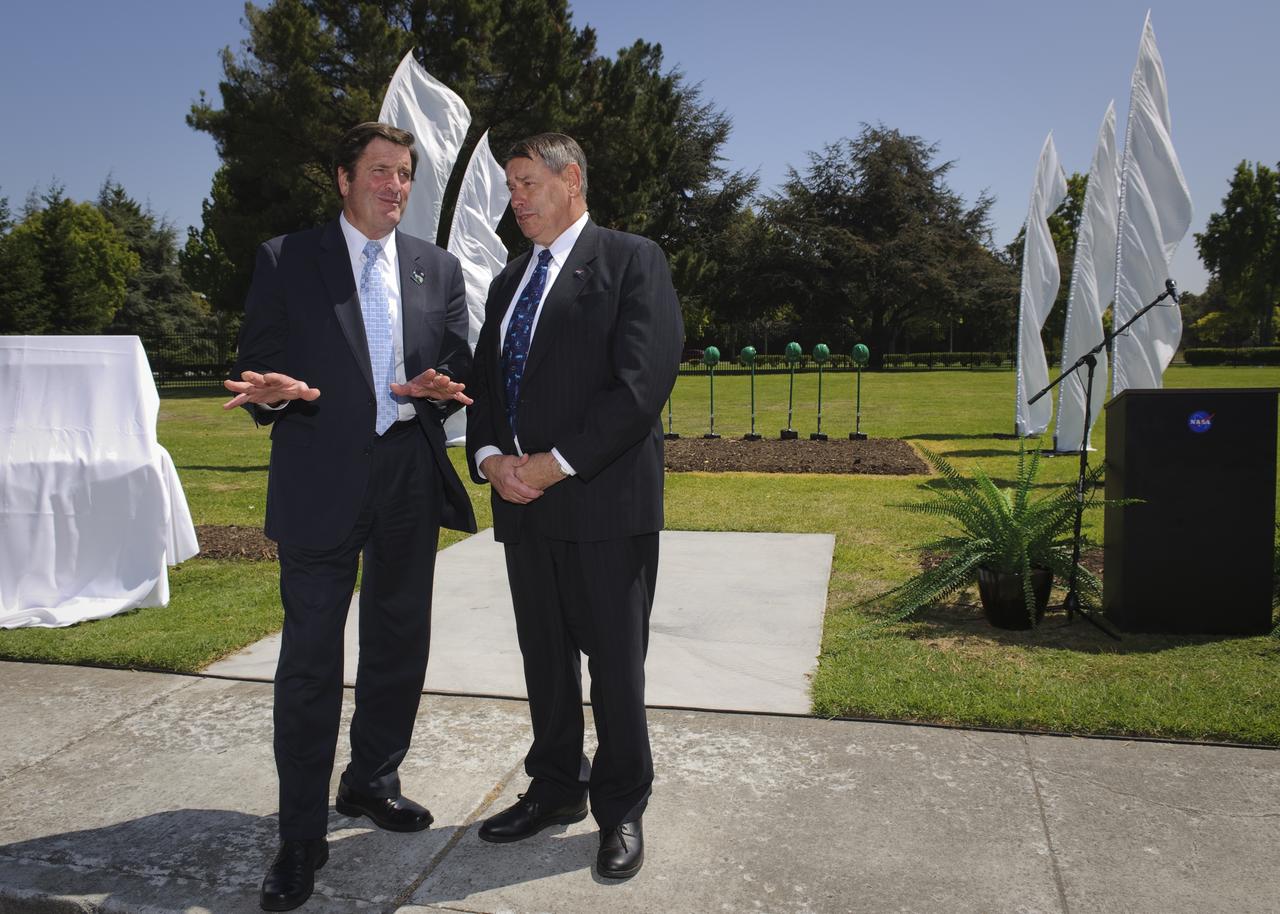
Sustainability Base Ground Breaking ceremony with Lt. Governor John Garamendi of California with Pete Worden, Director Ames Research Center on right.
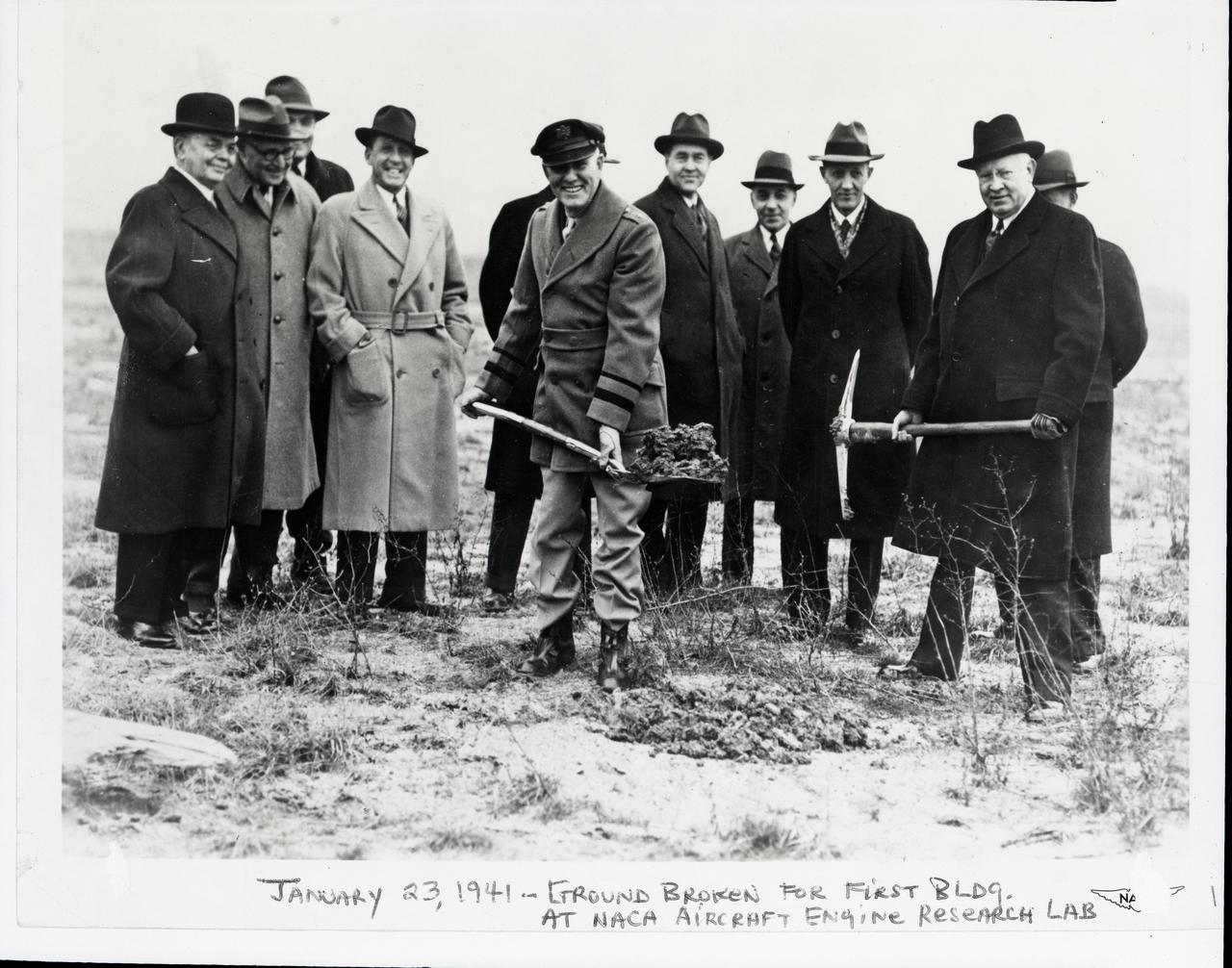
January 23, 1941 groundbreaking ceremony at the NACA Aircraft Engine Research Laboratory: left to right (does not include two individuals obscured from view behind Maj. Brett and Dr. Lewis): • William R. Hopkins – Cleveland City Manager from 1924-1930, was personally responsible for planning and acquiring the land for the Cleveland Airport. The airport’s huge capacity for handling aircraft was one factor in selecting Cleveland for the site of the research center. The Cleveland Airport was renamed Cleveland Hopkins airport in his honor in 1951. • Major John Berry – Cleveland Airport Manager • Edward R. Sharp – GRC’s first director, serving from 1942 to his retirement in 1961. He came to Cleveland in 1941 as the construction manager for the new facility. • Frederick C. Crawford – President of Thompson Products, which became the Thompson-Ramo-Woolridge Corporation (TRW) in 1958. Crawford was, at the time, also president of the Cleveland Chamber of Commerce. He began in 1939 to campaign for Cleveland as the location for the new NACA facility. • Major George H. Brett – A Cleveland native, Brett served in WWI and was commanding officer at Wright Field in Dayton, Ohio before becoming chief of the Army Air Corps. • Dr. Edward P. Warner – Acting chairman of the NACA. • Captain Sydney M. Kraus – Officer in charge of Navy procurement • Edward Blythin – Mayor of Cleveland • Dr. George Lewis – Director of Aeronautical Research for the NACA from 1924-1947, Lewis devoted his life to building a scientific basis for aeronautical engineering. The Cleveland laboratory was renamed the Lewis Flight Propulsion Laboratory in his honor in 1948. A description of the event, based on newspaper accounts and later NASA publications is as follows: On January 23, 1941, a brief groundbreaking ceremony at the site marked the start of construction. Dr. George W. Lewis, director of research for the NACA, loosened the soil with a
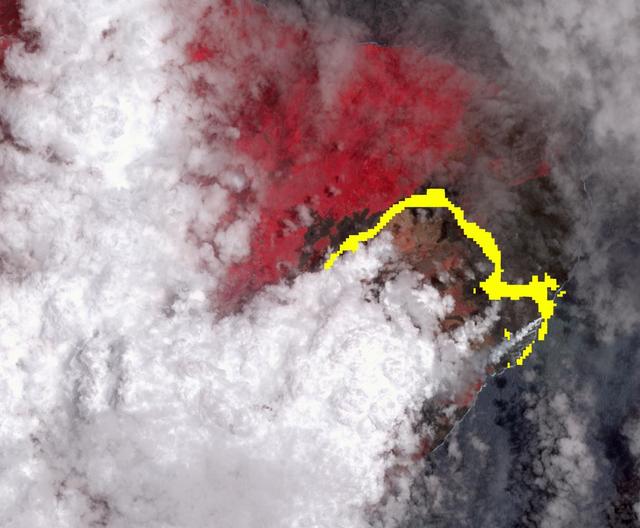
Hawaii's Kilauea volcano continues to create new land as flows from fissure 8, one of the most active to break ground since the eruption began in early May, reach the ocean. The Advanced Spaceborne Thermal Emission and Reflection (ASTER) radiometer instrument on NASA's Terra satellite detected the lava flow of fissure 8 -- which extends from Leilani Estates to the Pacific Ocean -- on July 25. In the image, vegetation is displayed in red, clouds are white and the hot lava flows, detected by ASTER's thermal infrared channels, are overlaid in yellow. The image covers an area of 9.5 by 11.5 miles (15.3 by 18.6 kilometers). https://photojournal.jpl.nasa.gov/catalog/PIA22489
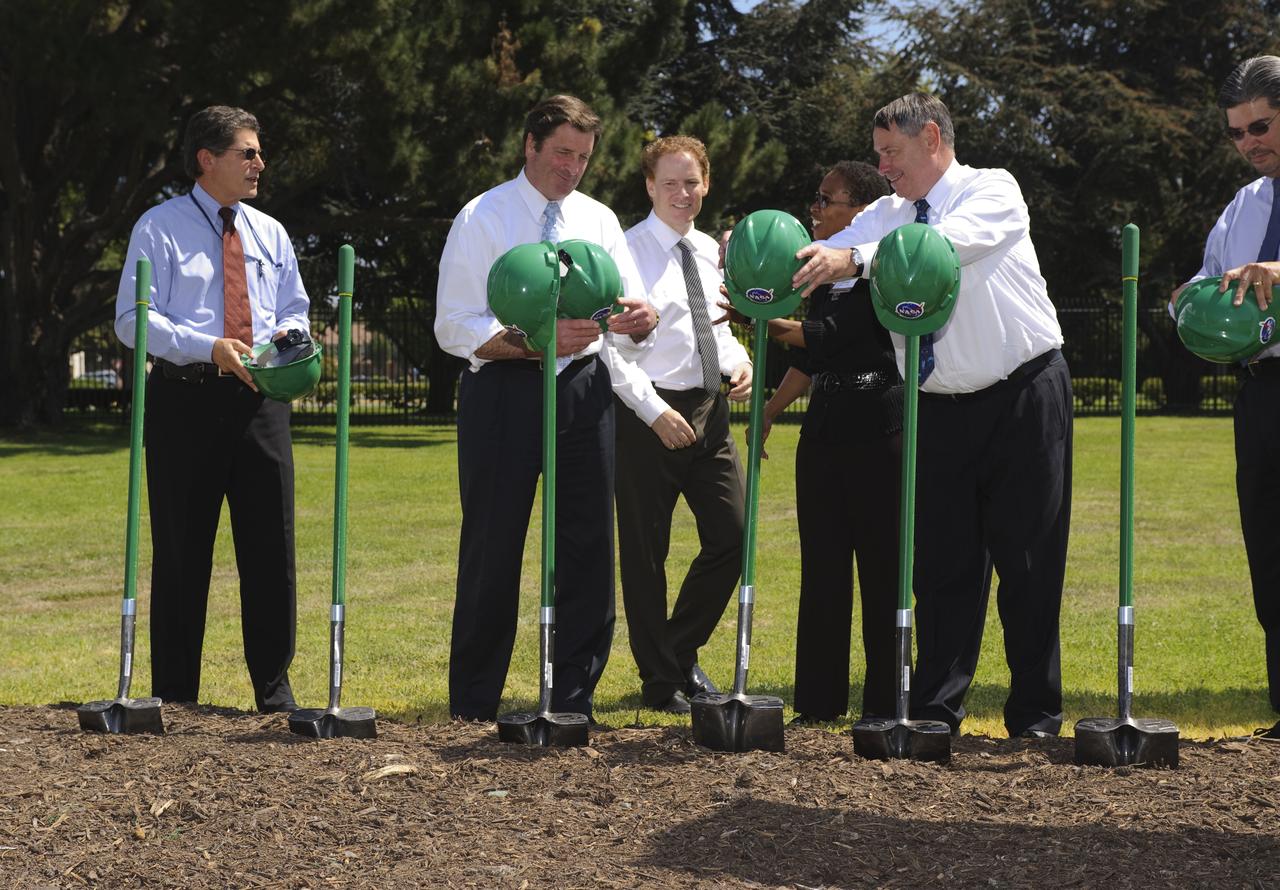
Sustainability Base Ground Breaking ceremony with Steve Zornetzer, Associate Director Ames Research Center, Lt. Governor John Garamendi of California, Kenvin Burke, Jane Grant, Architect AECOM, Pete Worden, Director Ames Research Center, Swinerton Builders Rep. ready to turn the first shovel.
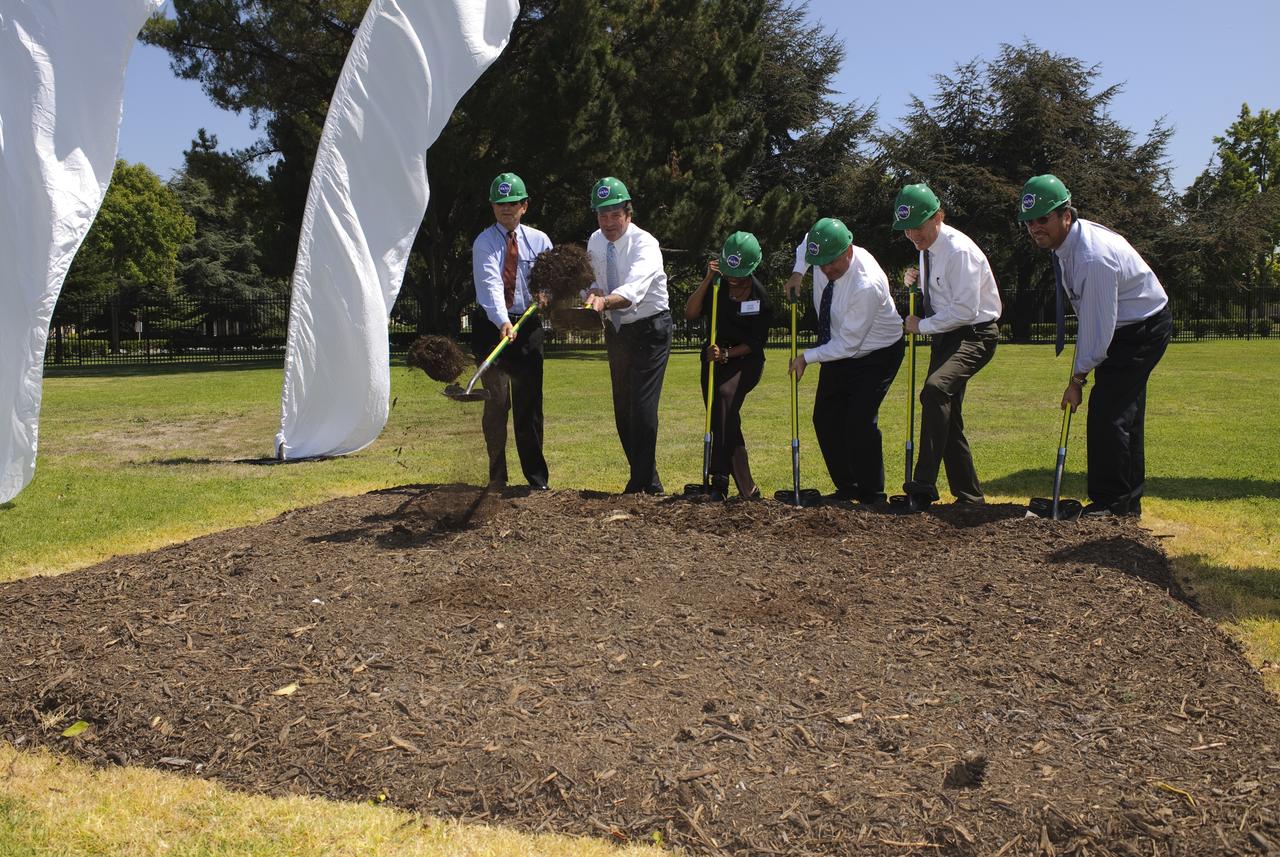
Sustainability Base Ground Breaking ceremony with Steve Zornetzer, Associate Director Ames Research Center, Lt. Governor John Garamendi of California, Jane Grant, Architect AECOM, Pete Worden, Director Ames Research Center, Kenvin Burke, Swinerton Builders Rep. ready to turn the first shovel.
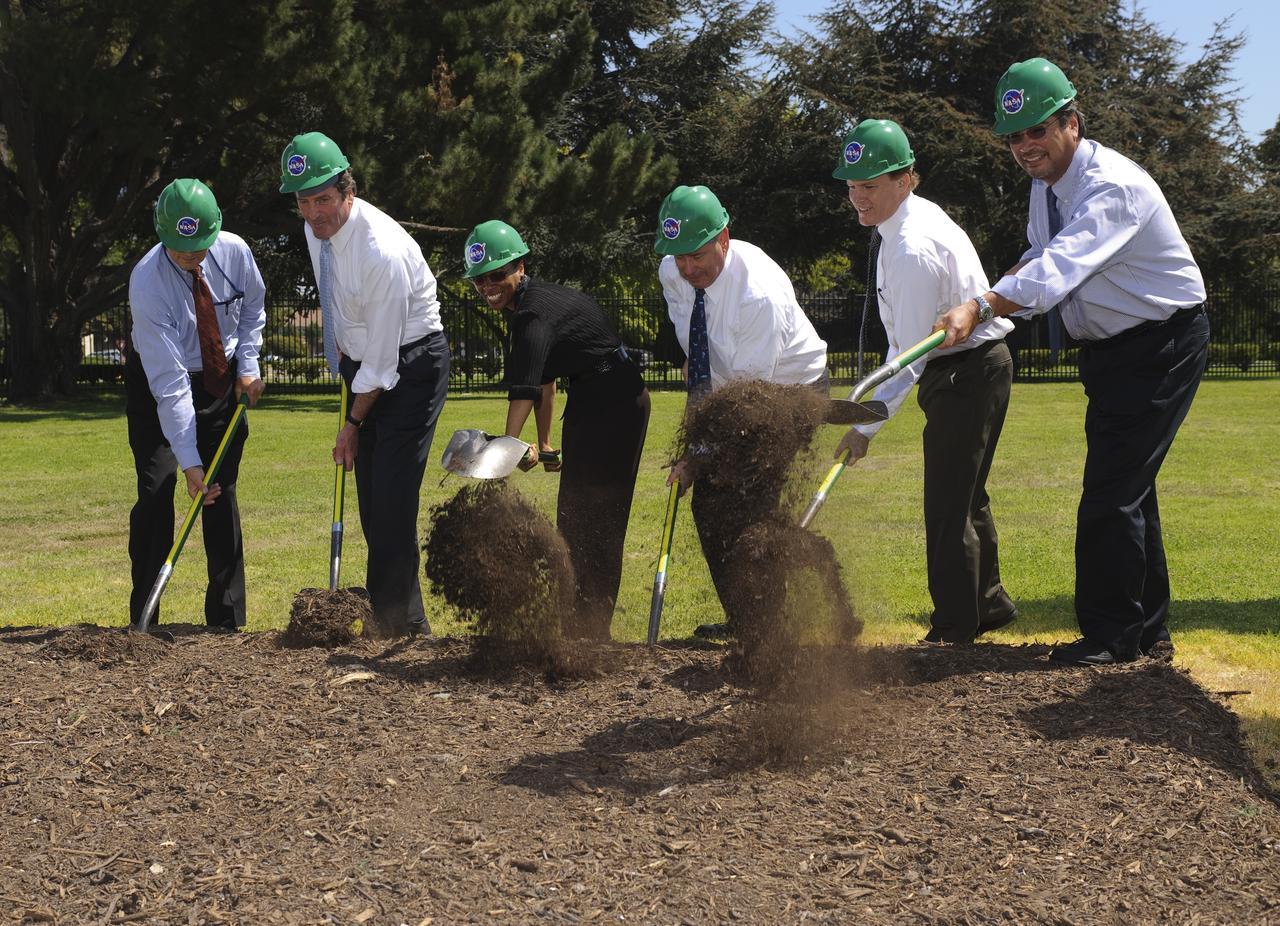
Sustainability Base Ground Breaking ceremony with Steve Zornetzer, Associate Director Ames Research Center, Lt. Governor John Garamendi of California, Jane Grant, Architect AECOM, Pete Worden, Director Ames Research Center, Kenvin Burke, Swinerton Builders Rep. ready to turn the first shovel.
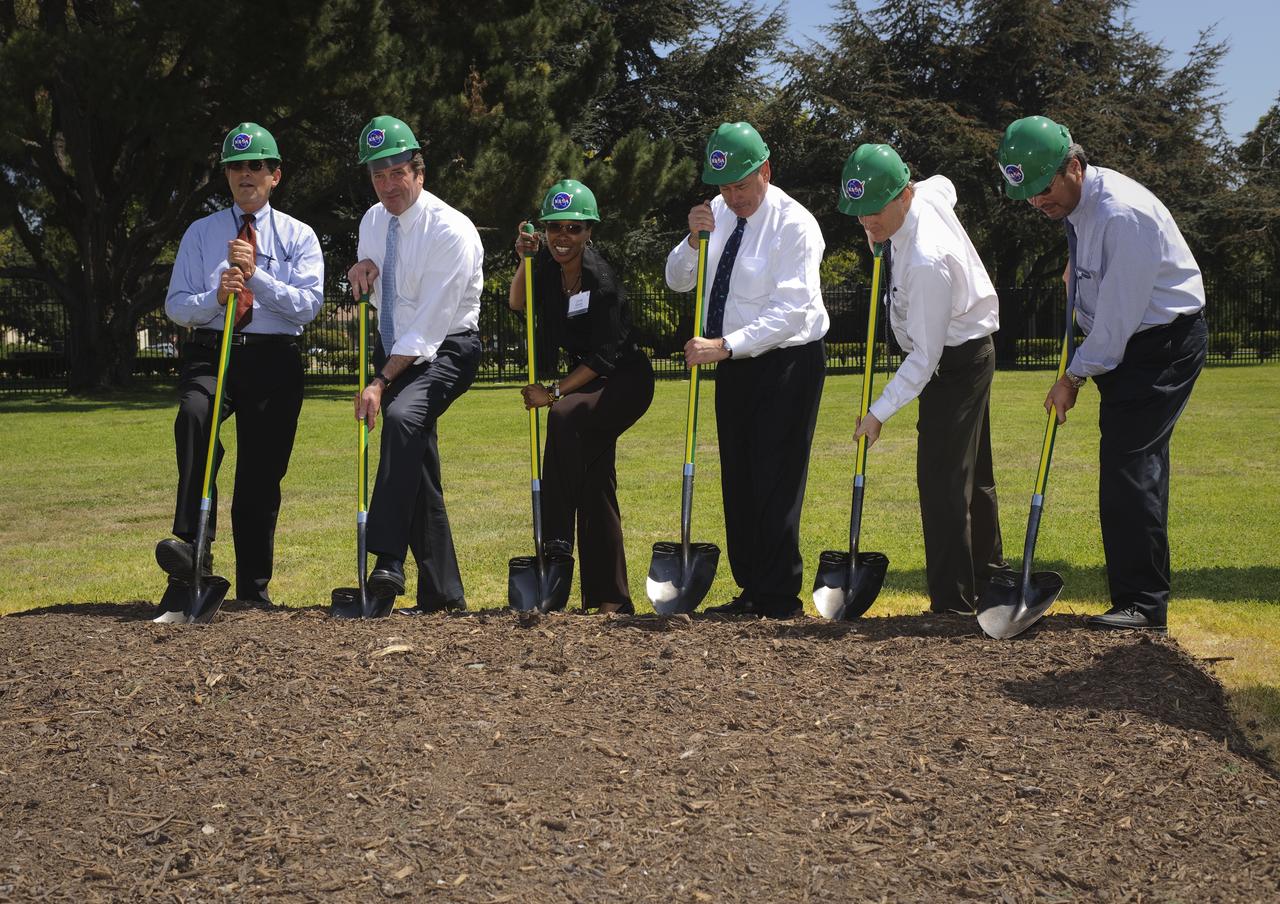
Sustainability Base Ground Breaking ceremony with Steve Zornetzer, Associate Director Ames Research Center, Lt. Governor John Garamendi of California, Jane Grant, Architect AECOM, Pete Worden, Director Ames Research Center, Kenvin Burke, Swinerton Builders Rep. ready to turn the first shovel.
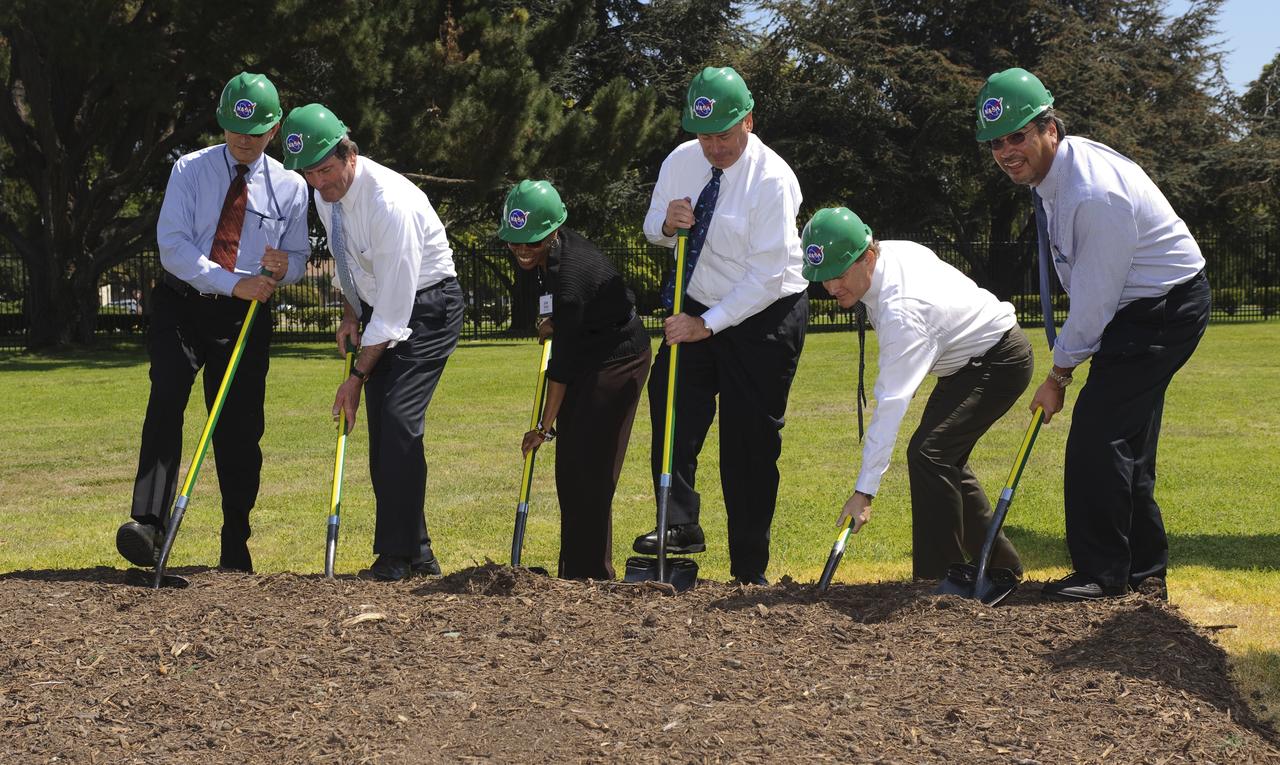
Sustainability Base Ground Breaking ceremony with Steve Zornetzer, Associate Director Ames Research Center, Lt. Governor John Garamendi of California, Jane Grant, Architect AECOM, Pete Worden, Director Ames Research Center, Kenvin Burke, Swinerton Builders Rep. ready to turn the first shovel.
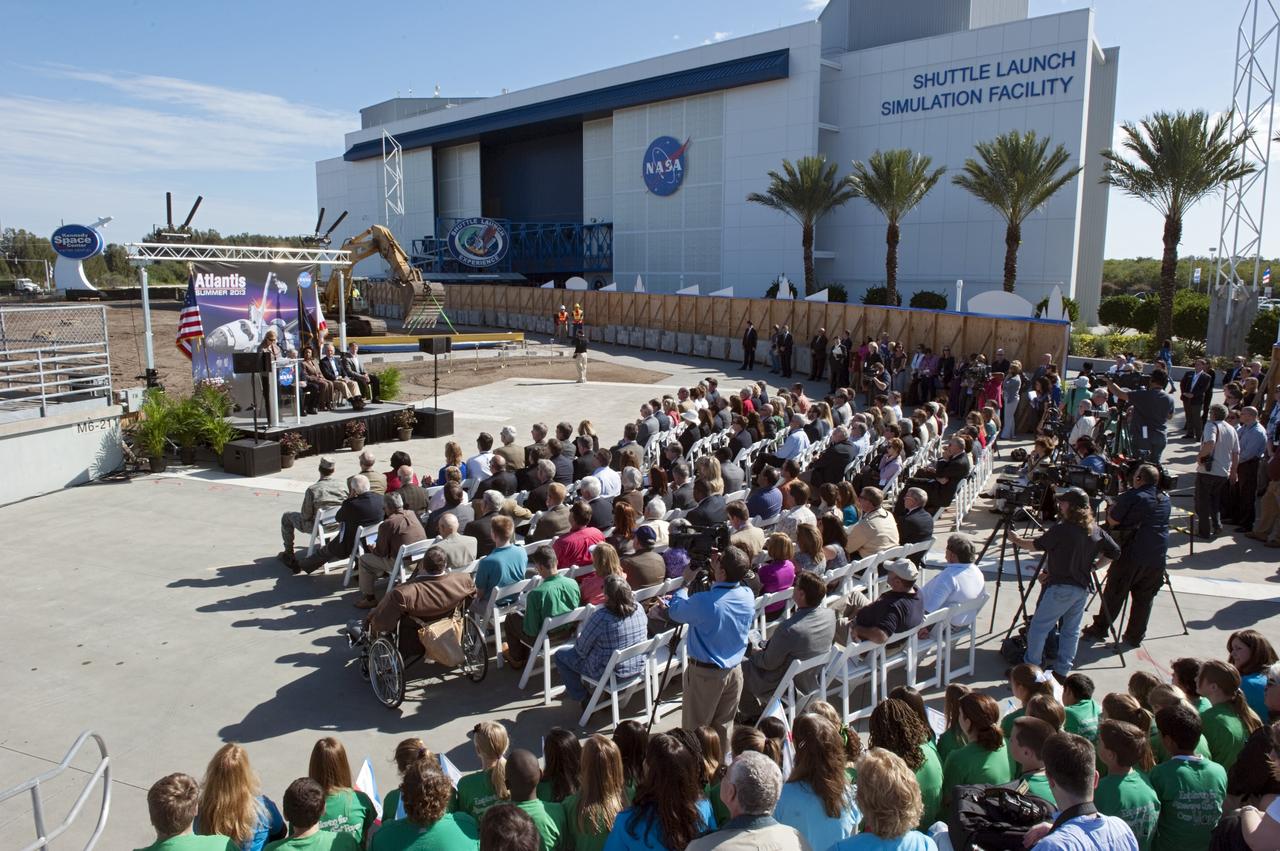
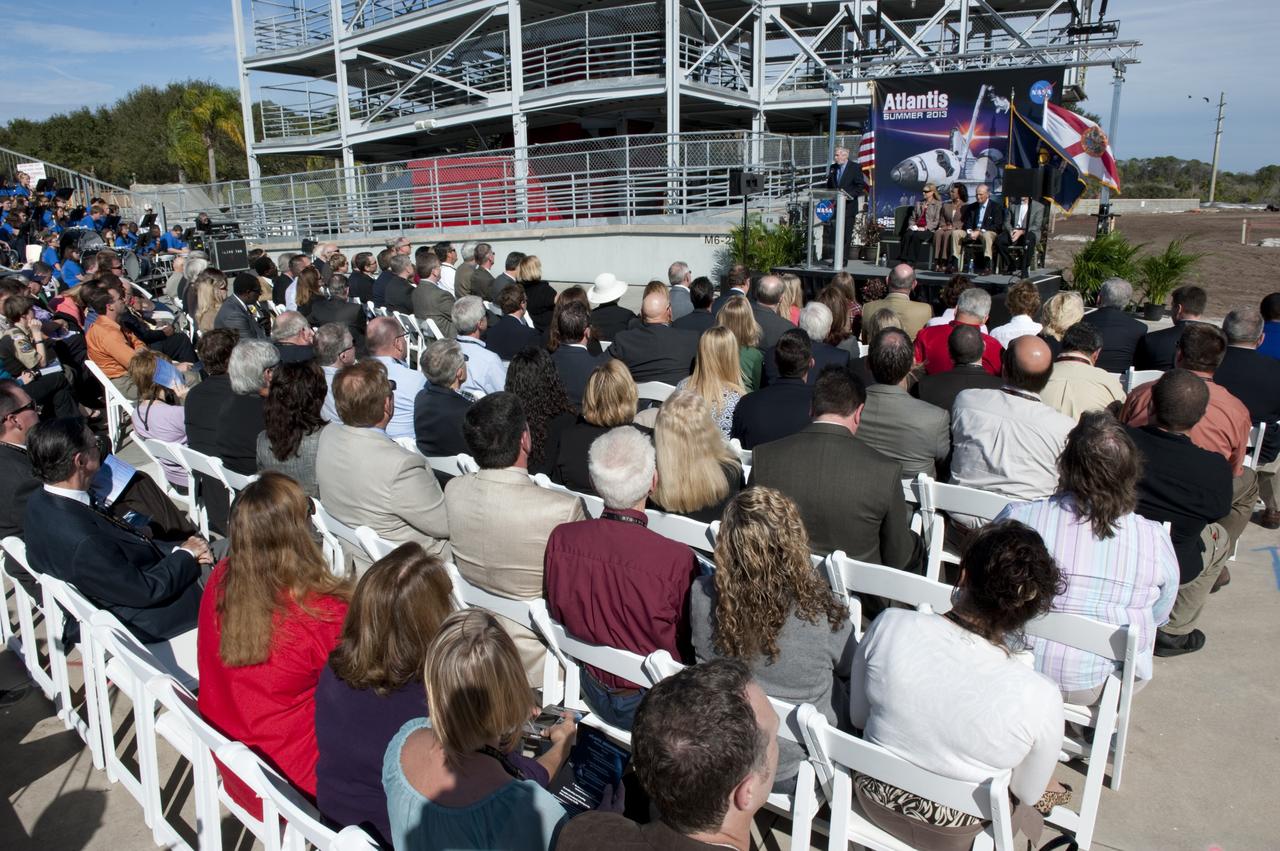
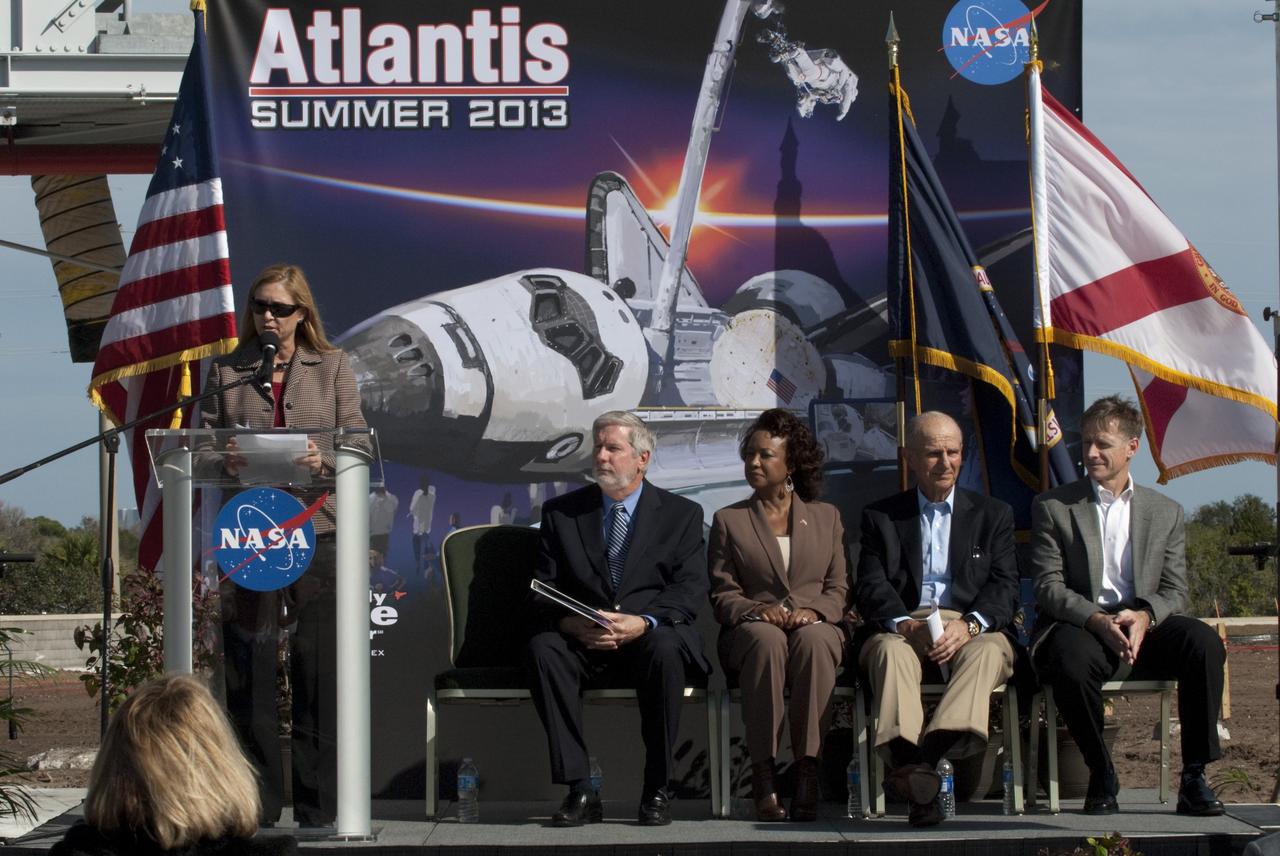
CAPE CANAVERAL, Fla. – In the Shuttle Plaza area at the Kennedy Space Center Visitor Complex in Florida, state and local dignitaries speak during the Ground Breaking Ceremony for the future home of space shuttle Atlantis. Delaware North Parks & Resorts, in partnership with NASA’s Kennedy Space Center, broke ground for the 65,000 square-foot exhibit that will house Atlantis at the visitor complex. For more information, visit www.KennedySpaceCenter.com. Photo credit: NASA/Kim Shiflett
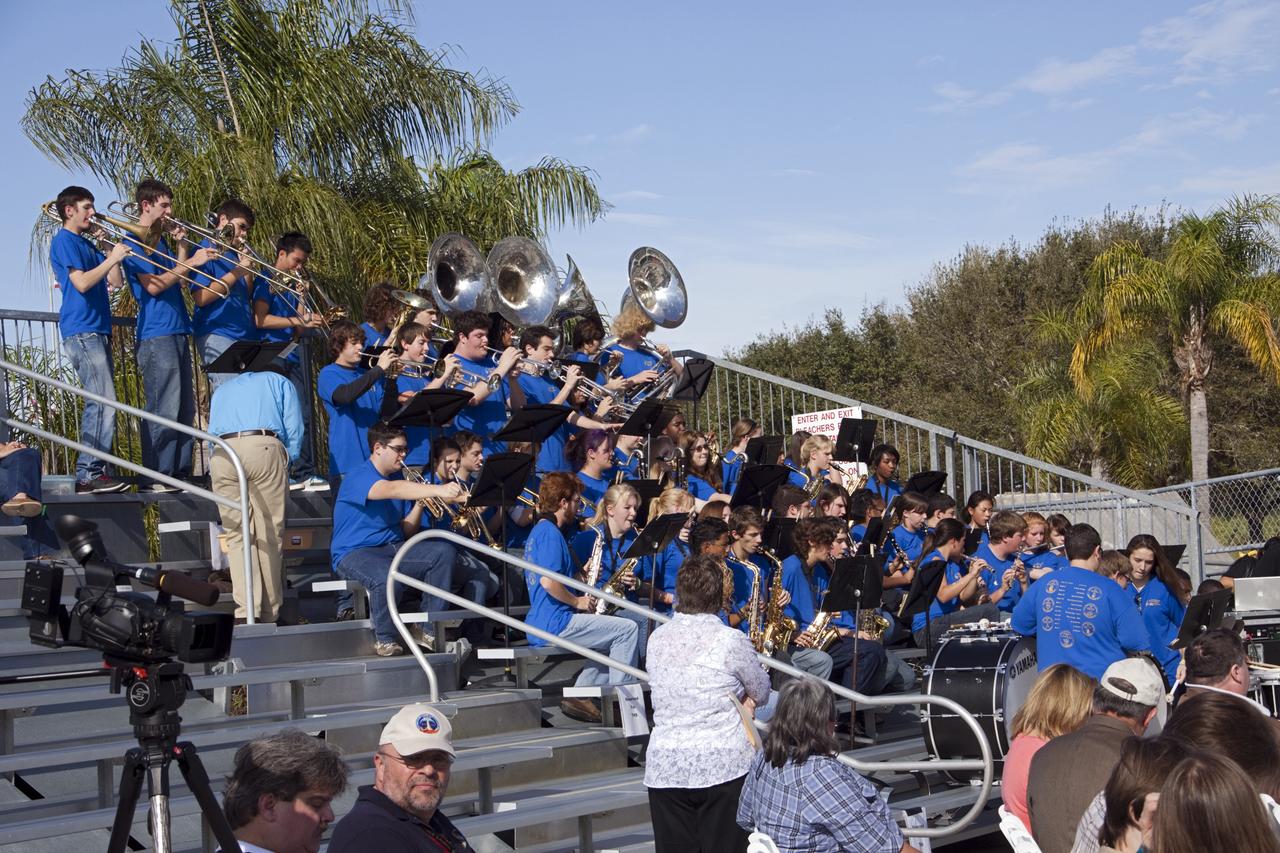
CAPE CANAVERAL, Fla. – In the Shuttle Plaza area at the Kennedy Space Center Visitor Complex in Florida, members of the Titusville High School marching band play music before the start of a Ground Breaking Ceremony for the future home of space shuttle Atlantis. Delaware North Parks & Resorts, in partnership with NASA’s Kennedy Space Center, broke ground for the 65,000 square-foot exhibit that will house Atlantis at the visitor complex. For more information, visit www.KennedySpaceCenter.com. Photo credit: NASA/Jim Grossmann
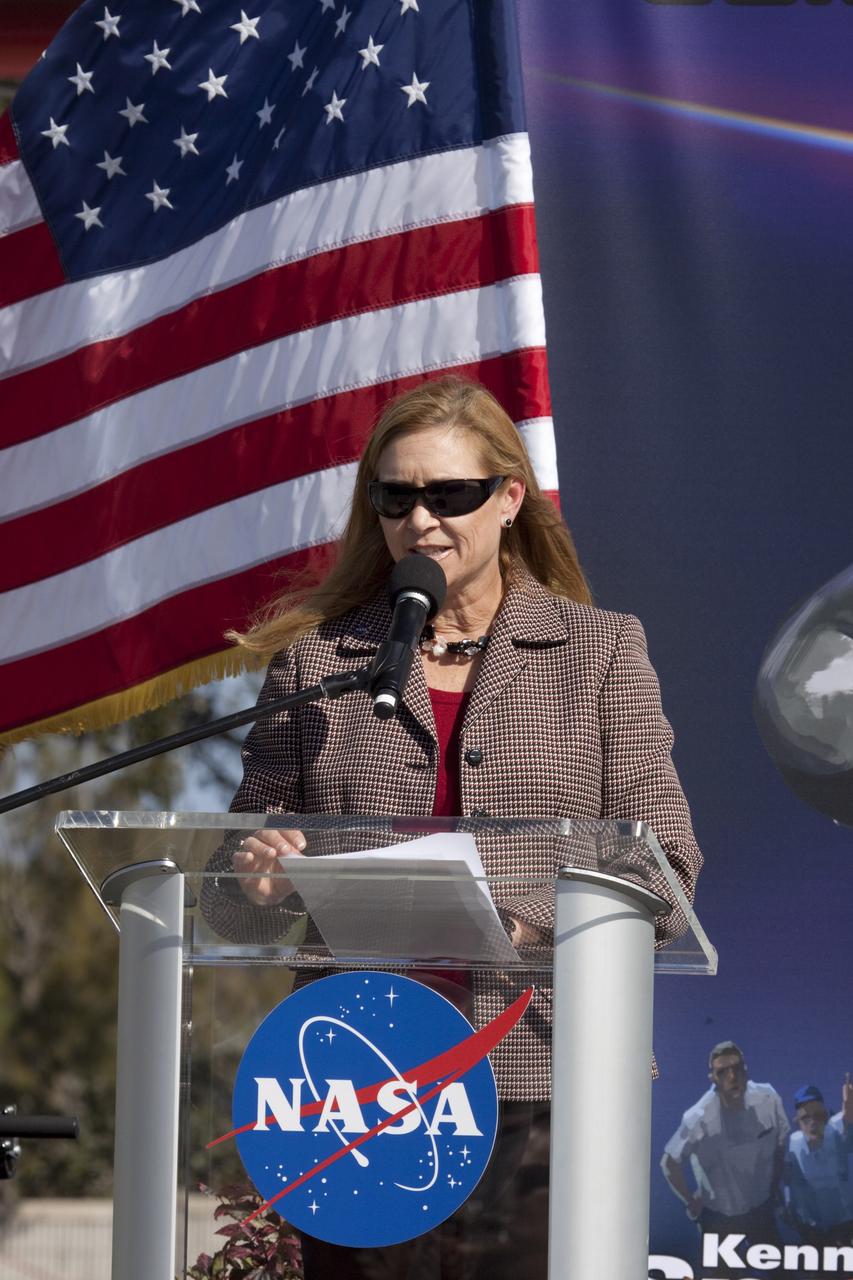
CAPE CANAVERAL, Fla. – In the Shuttle Plaza area at the Kennedy Space Center Visitor Complex in Florida, Kennedy Space Center Deputy Director Janet Petro speaks during the Ground Breaking Ceremony for the future home of space shuttle Atlantis. Delaware North Parks & Resorts, in partnership with NASA’s Kennedy Space Center, broke ground for the 65,000 square-foot exhibit that will house Atlantis at the visitor complex. For more information, visit www.KennedySpaceCenter.com. Photo credit: NASA/Jim Grossmann
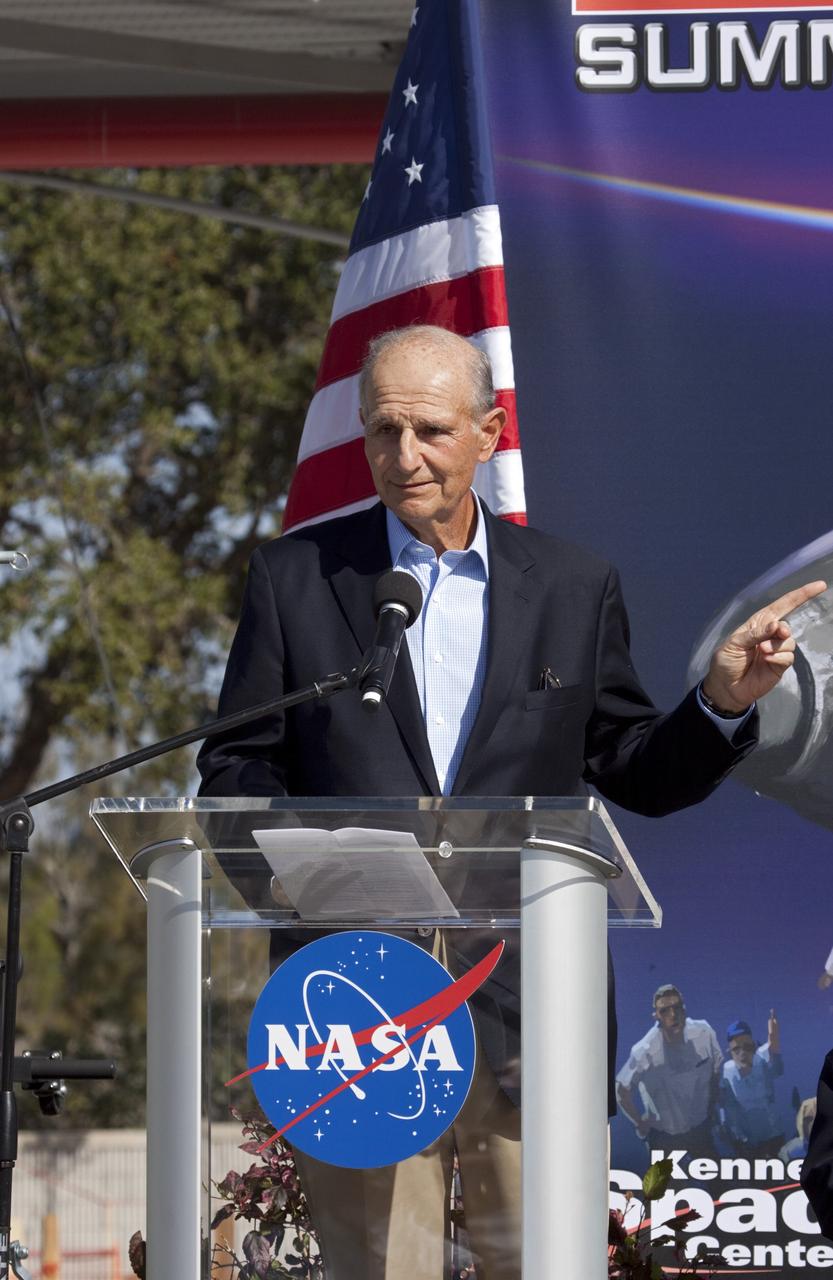
CAPE CANAVERAL, Fla. – In the Shuttle Plaza area at the Kennedy Space Center Visitor Complex in Florida, Jeremy Jacobs, chairman and chief executive officer of Delaware North Companies, speaks during the Ground Breaking Ceremony for the future home of space shuttle Atlantis. Delaware North Parks & Resorts, in partnership with NASA’s Kennedy Space Center, broke ground for the 65,000 square-foot exhibit that will house Atlantis at the visitor complex. For more information, visit www.KennedySpaceCenter.com. Photo credit: NASA/Jim Grossmann
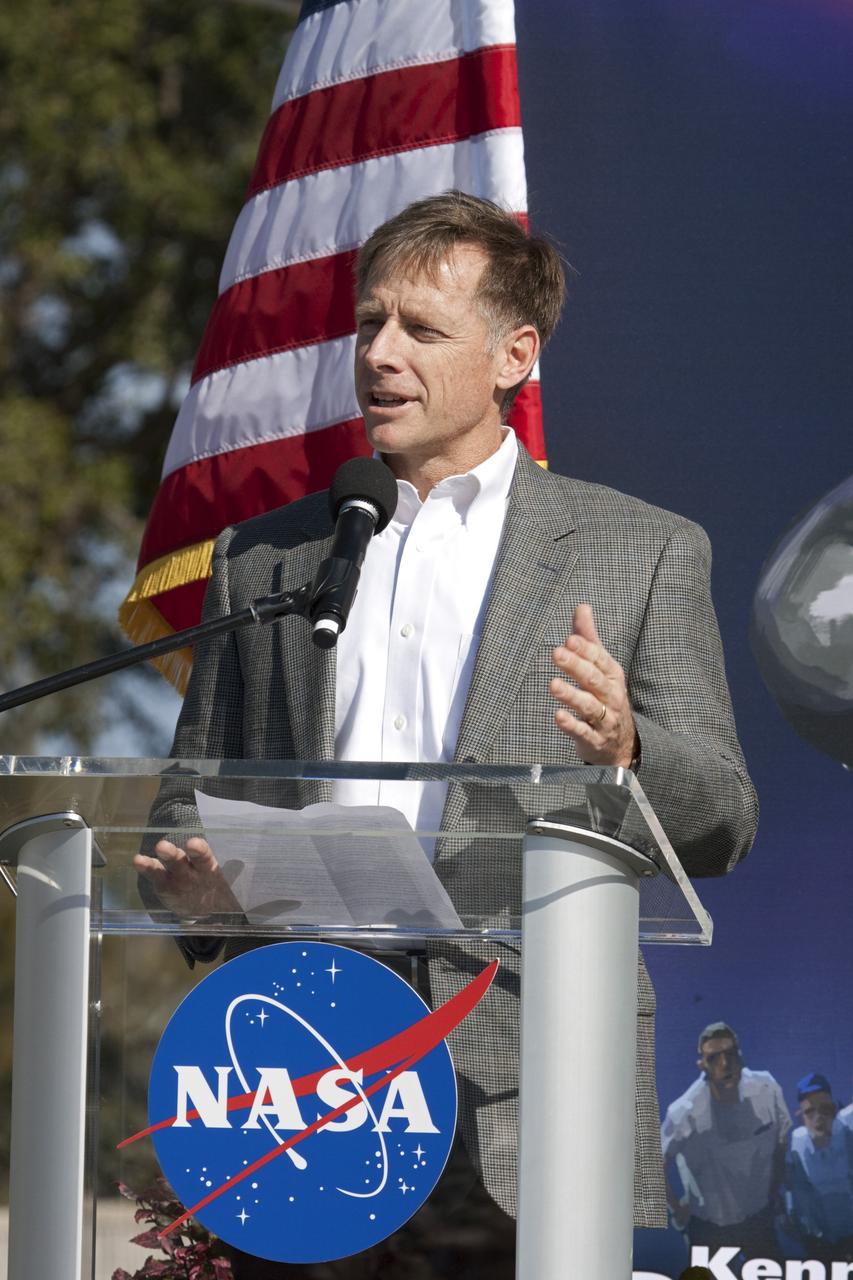
CAPE CANAVERAL, Fla. – In the Shuttle Plaza area at the Kennedy Space Center Visitor Complex in Florida, STS-135 Commander Chris Ferguson speaks during the Ground Breaking Ceremony for the future home of space shuttle Atlantis. Delaware North Parks & Resorts, in partnership with NASA’s Kennedy Space Center, broke ground for the 65,000 square-foot exhibit that will house Atlantis at the visitor complex. For more information, visit www.KennedySpaceCenter.com. Photo credit: NASA/Jim Grossmann
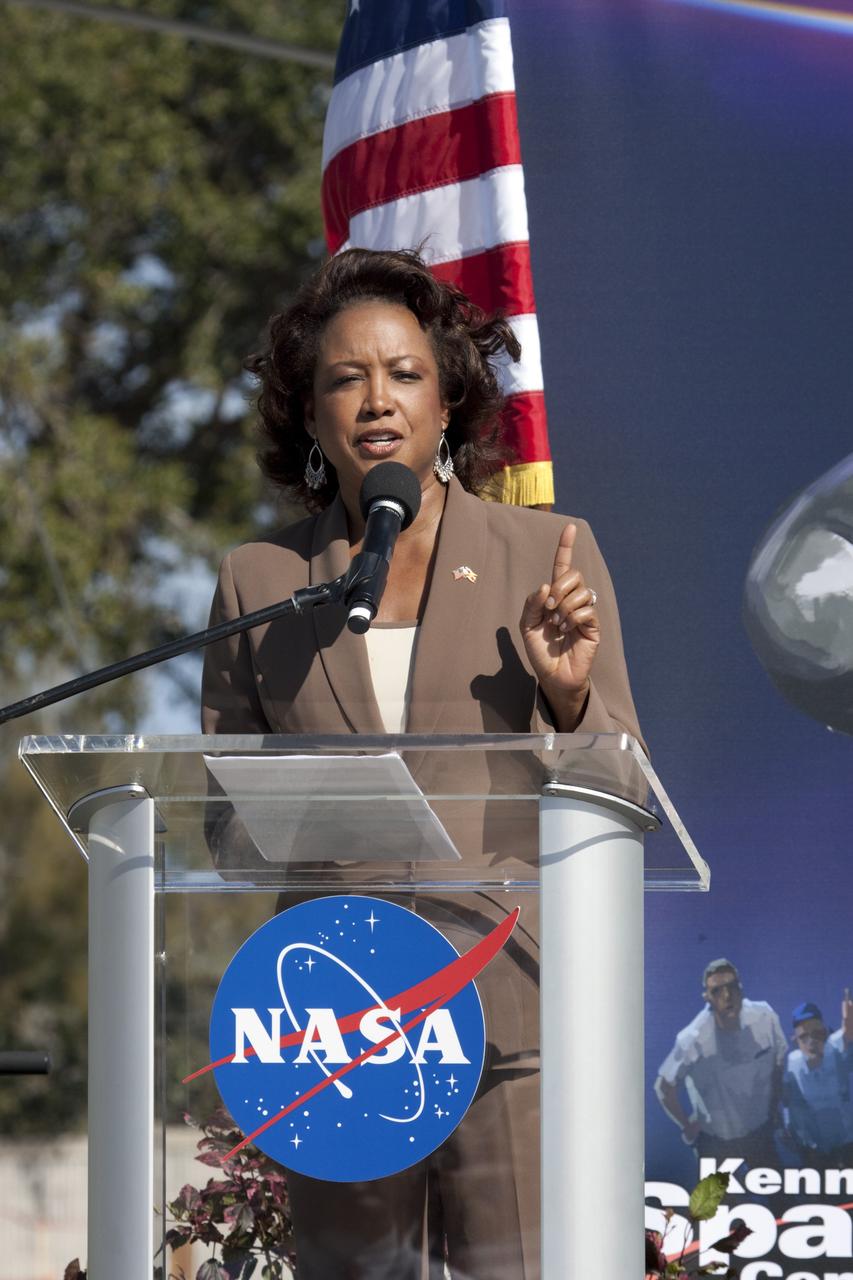
CAPE CANAVERAL, Fla. – In the Shuttle Plaza area at the Kennedy Space Center Visitor Complex in Florida, Lt. Governor of Florida Jennifer Carroll speaks during the Ground Breaking Ceremony for the future home of space shuttle Atlantis. Delaware North Parks & Resorts, in partnership with NASA’s Kennedy Space Center, broke ground for the 65,000 square-foot exhibit that will house Atlantis at the visitor complex. For more information, visit www.KennedySpaceCenter.com. Photo credit: NASA/Jim Grossmann
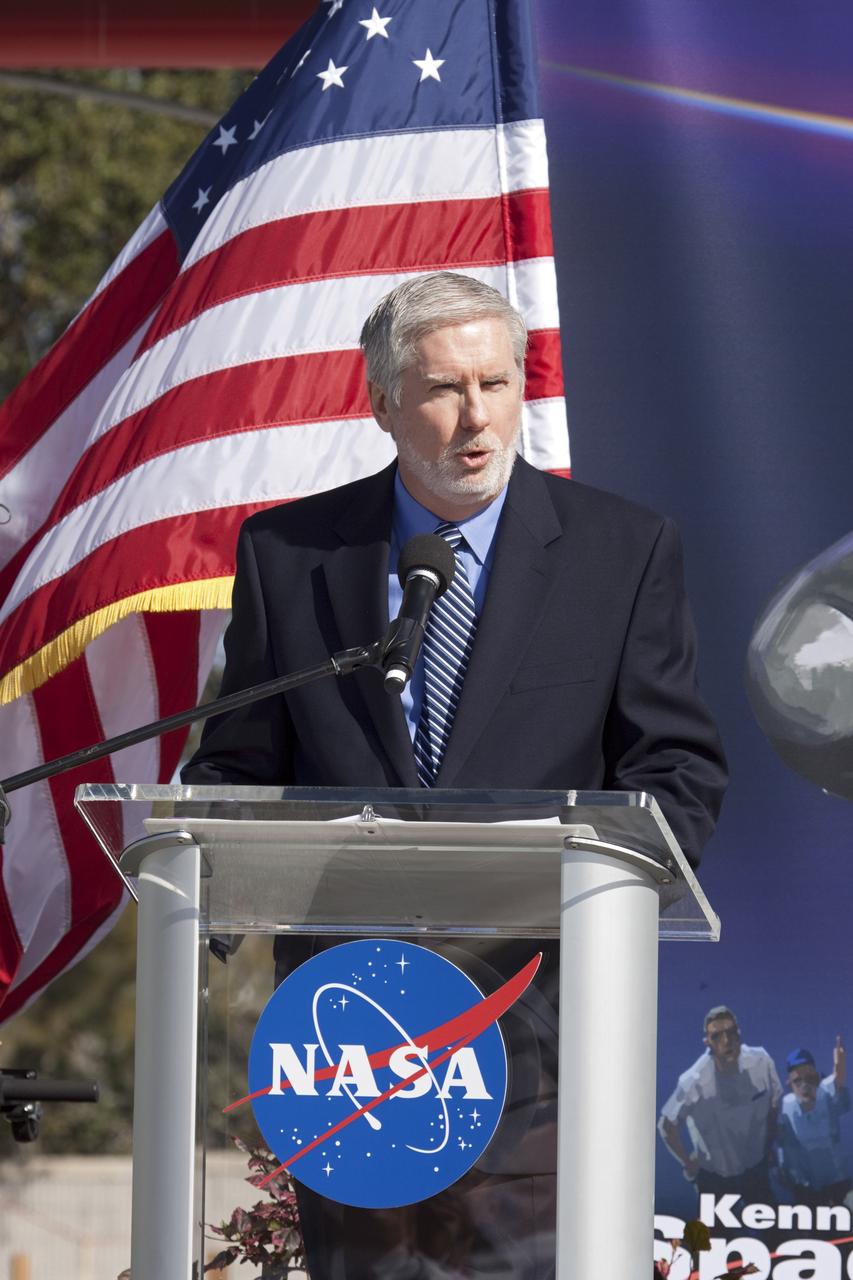
CAPE CANAVERAL, Fla. – In the Shuttle Plaza area at the Kennedy Space Center Visitor Complex (KSCVC) in Florida, KSCVC Chief Operating Officer Bill Moore speaks during the Ground Breaking Ceremony for the future home of space shuttle Atlantis. Delaware North Parks & Resorts, in partnership with NASA’s Kennedy Space Center, broke ground for the 65,000 square-foot exhibit that will house Atlantis at the visitor complex. For more information, visit www.KennedySpaceCenter.com. Photo credit: NASA/Jim Grossmann
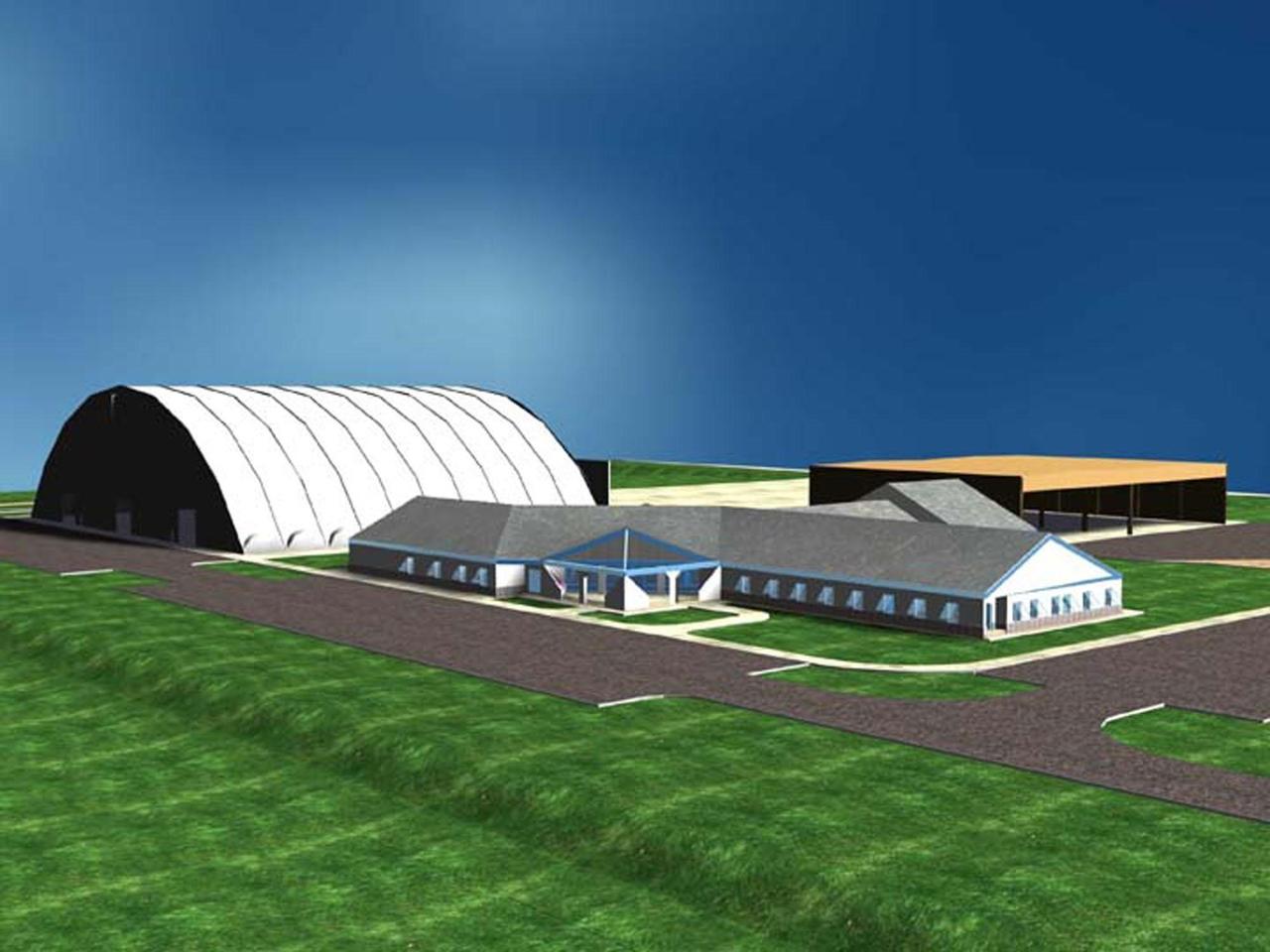
An artist's rendering shows the $8-million Reusable Launch Vehicle (RLV) Support Complex planned for the Shuttle Landing Facility (SLF) at Kennedy Space Center. The ground breaking took place today. To be located at the tow-way adjacent to the SLF, the complex will include a multi-purpose RLV hangar and adjacent facilities for related ground support equipment and administrative/technical support. It will be available to accommodate the Space Shuttle, the X-34 RLV technology demonstrator, the L-1011 carrier aircraft for Pegasus and X-34, and other RLV and X-vehicle programs. The complex is jointly funded by the Spaceport Florida Authority, NASA's Space Shuttle Program and KSC. The facility will be operational in early 2000
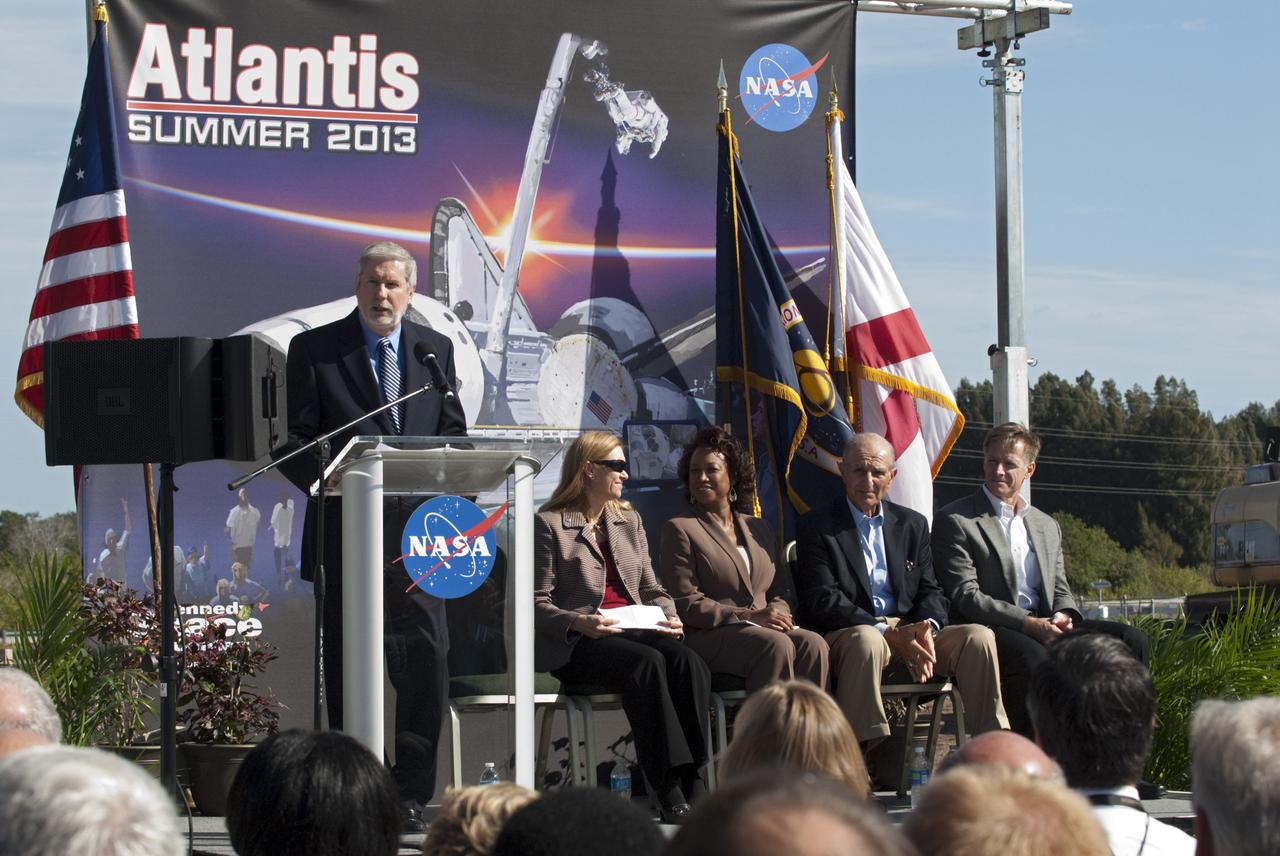
CAPE CANAVERAL, Fla. – In the Shuttle Plaza area at the Kennedy Space Center Visitor Complex in Florida, Chief Operating Officer Bill Moore speaks during a Ground Breaking Ceremony for the future home of space shuttle Atlantis. Seated at right, are Kennedy Space Center Deputy Director Janet Petro; Lt. Governor of Florida Jennifer Carroll; Jeremy Jacobs, chairman and chief executive officer of Delaware North Companies; and STS-135 Commander Chris Ferguson. Delaware North Parks & Resorts, in partnership with NASA’s Kennedy Space Center, broke ground for the 65,000 square-foot exhibit that will house Atlantis at the visitor complex. For more information, visit www.KennedySpaceCenter.com. Photo credit: NASA/Kim Shiflett
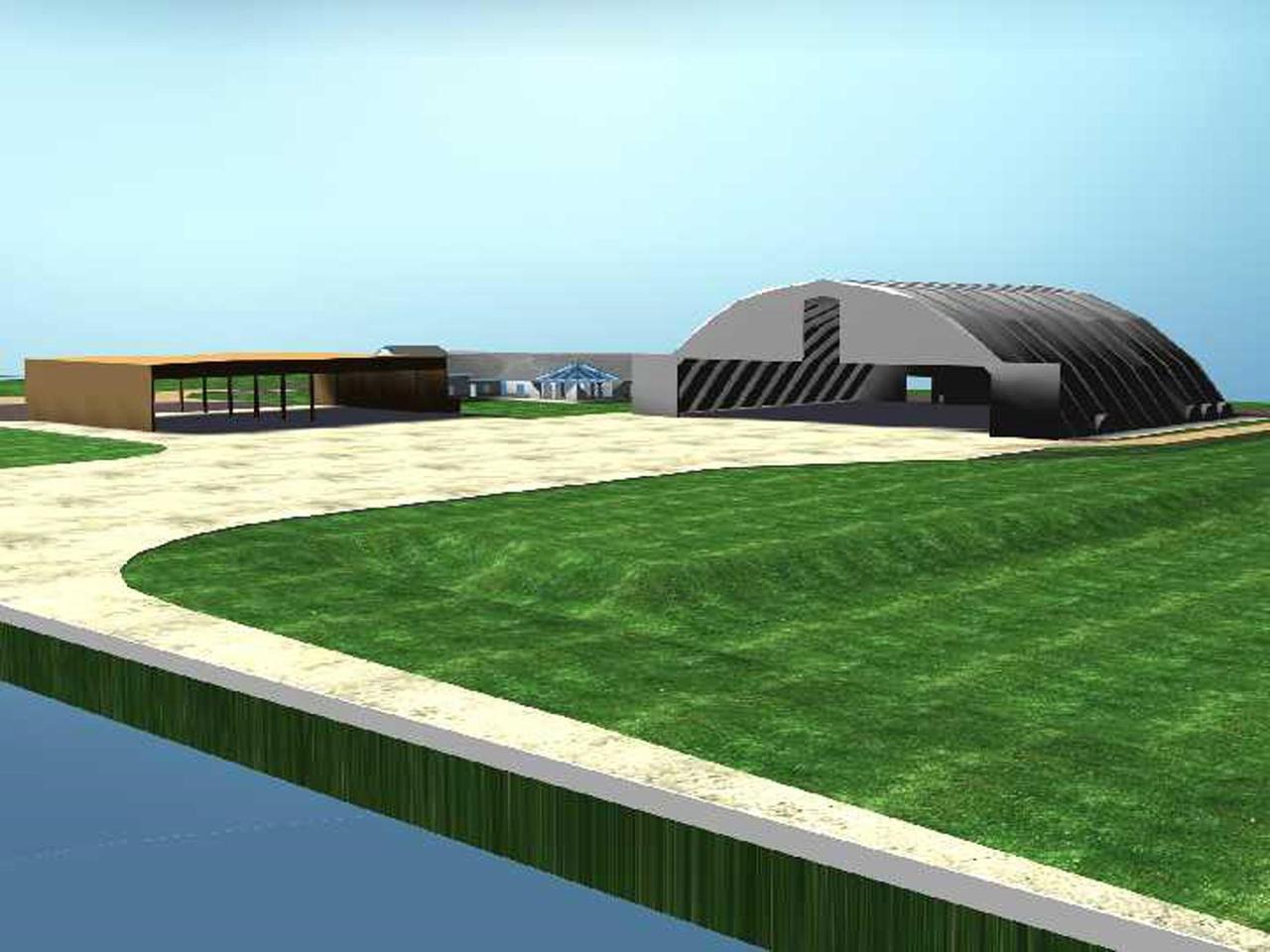
An artist's rendering shows the $8-million Reusable Launch Vehicle (RLV) Support Complex planned for the Shuttle Landing Facility (SLF) at Kennedy Space Center. The ground breaking took place today. To be located at the tow-way adjacent to the SLF, the complex will include a multi-purpose RLV hangar and adjacent facilities for related ground support equipment and administrative/technical support. It will be available to accommodate the Space Shuttle, the X-34 RLV technology demonstrator, the L-1011 carrier aircraft for Pegasus and X-34, and other RLV and X-vehicle programs. The complex is jointly funded by the Spaceport Florida Authority, NASA's Space Shuttle Program and KSC. The facility will be operational in early 2000
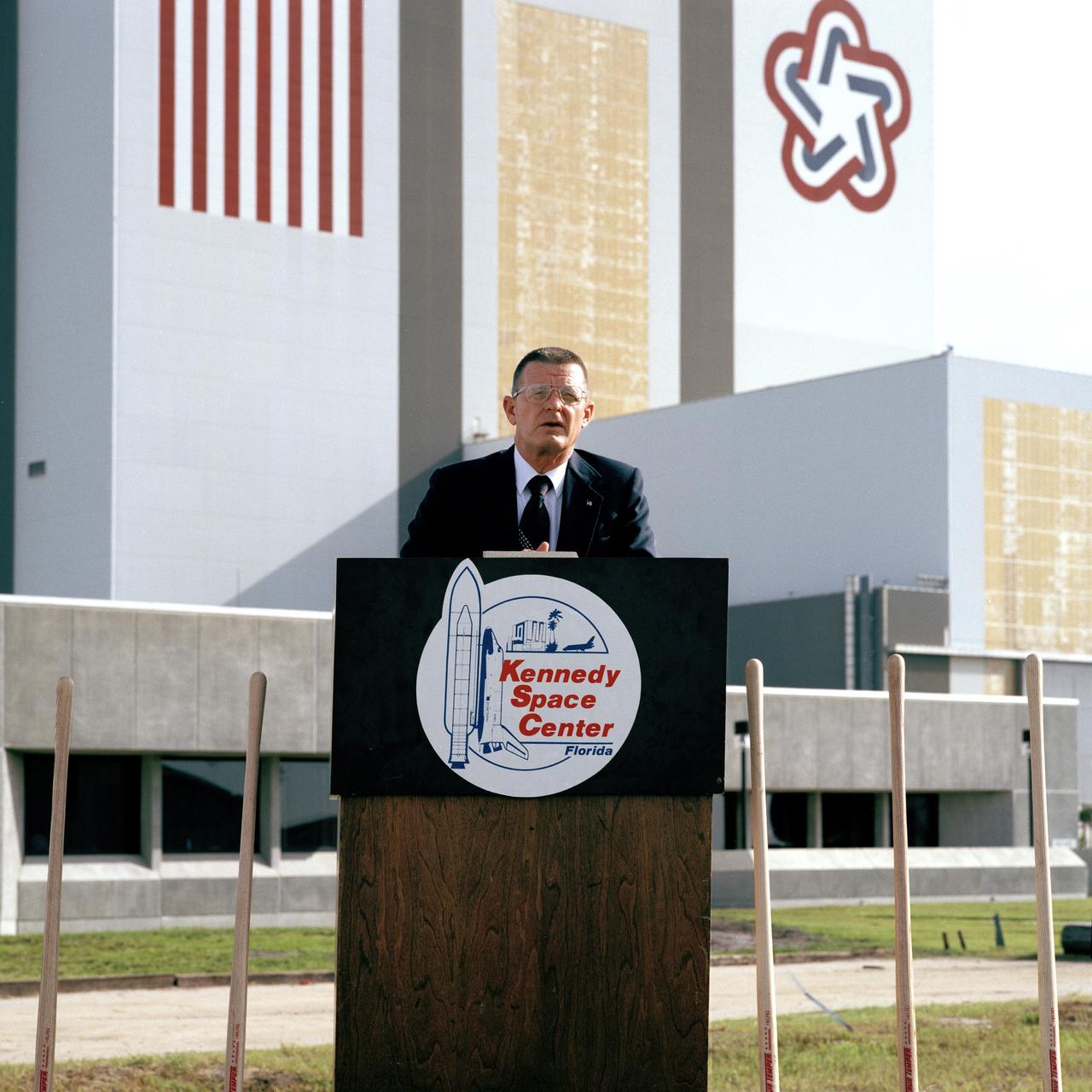
CAPE CANAVERAL, Fla. - Kennedy Space Center Director Forrest McCartney speaks at the ground-breaking ceremonies for the new Operations Support Building. This new facility will provide office accommodations for 1,700 NASA and contractor personnel. The $20,695,000, six-story, 300,000-square-foot building is located southwest of the Multi-Function Facility near the corner of the Saturn Causeway and Kennedy Parkway Roads. Construction is due to be completed by June 1990. Photo credit: NASA
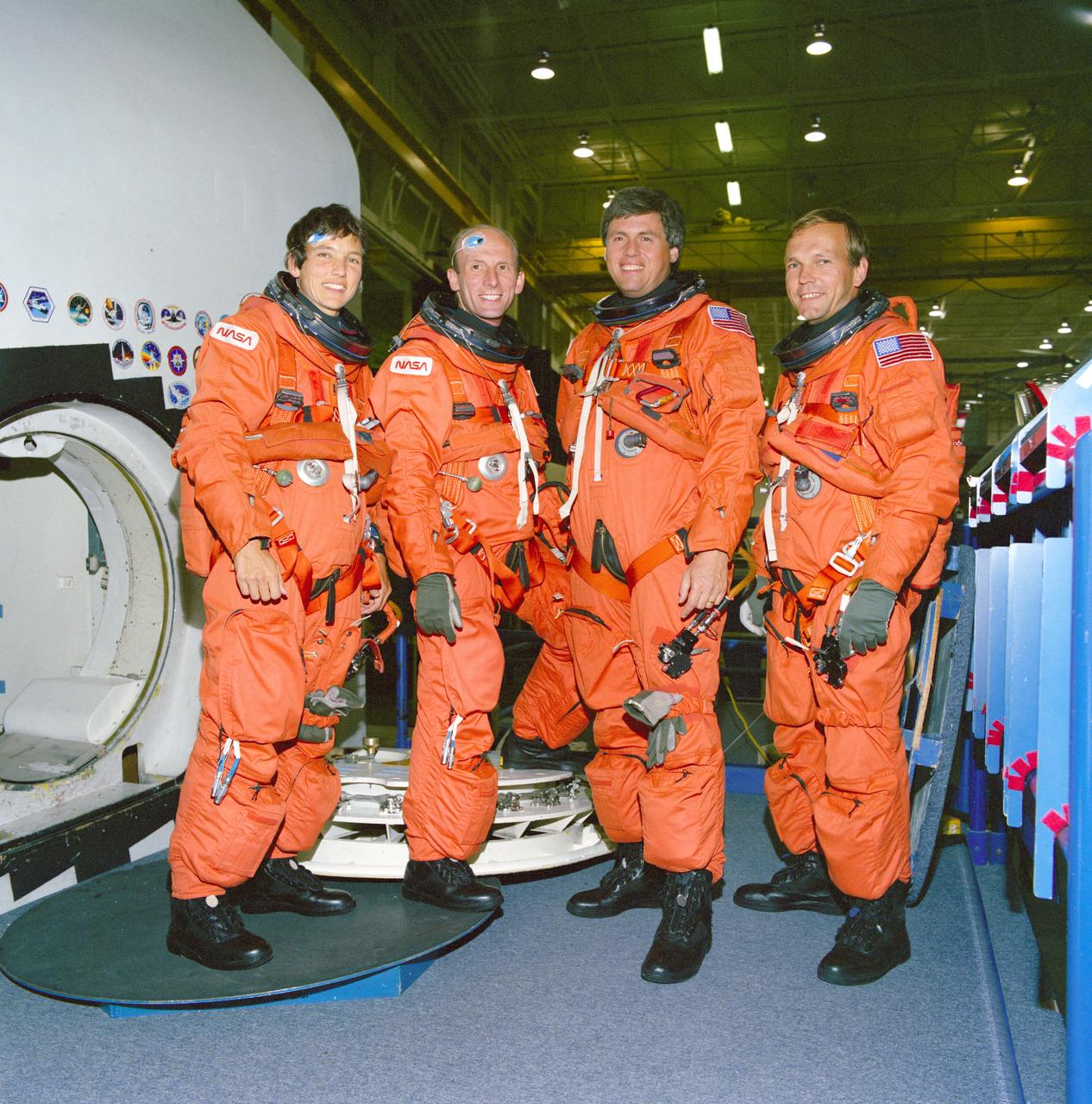
S92-48735 (18 Sept 1992) --- These four Germans have been assigned as payload specialists to support the STS-55\Spacelab D-2 mission. Left to right are Renate Brummer, Gerhard Thiele, Ulrich Walter and Hans Schlegel. Walter and Schlegel are scheduled to fly aboard the Space Shuttle Columbia for the mission, while Brummer and Thiele will serve as alternates and fill supportive roles on the ground. They are seen during a break in training in the Shuttle mockup and integration laboratory at the Johnson Space Center.
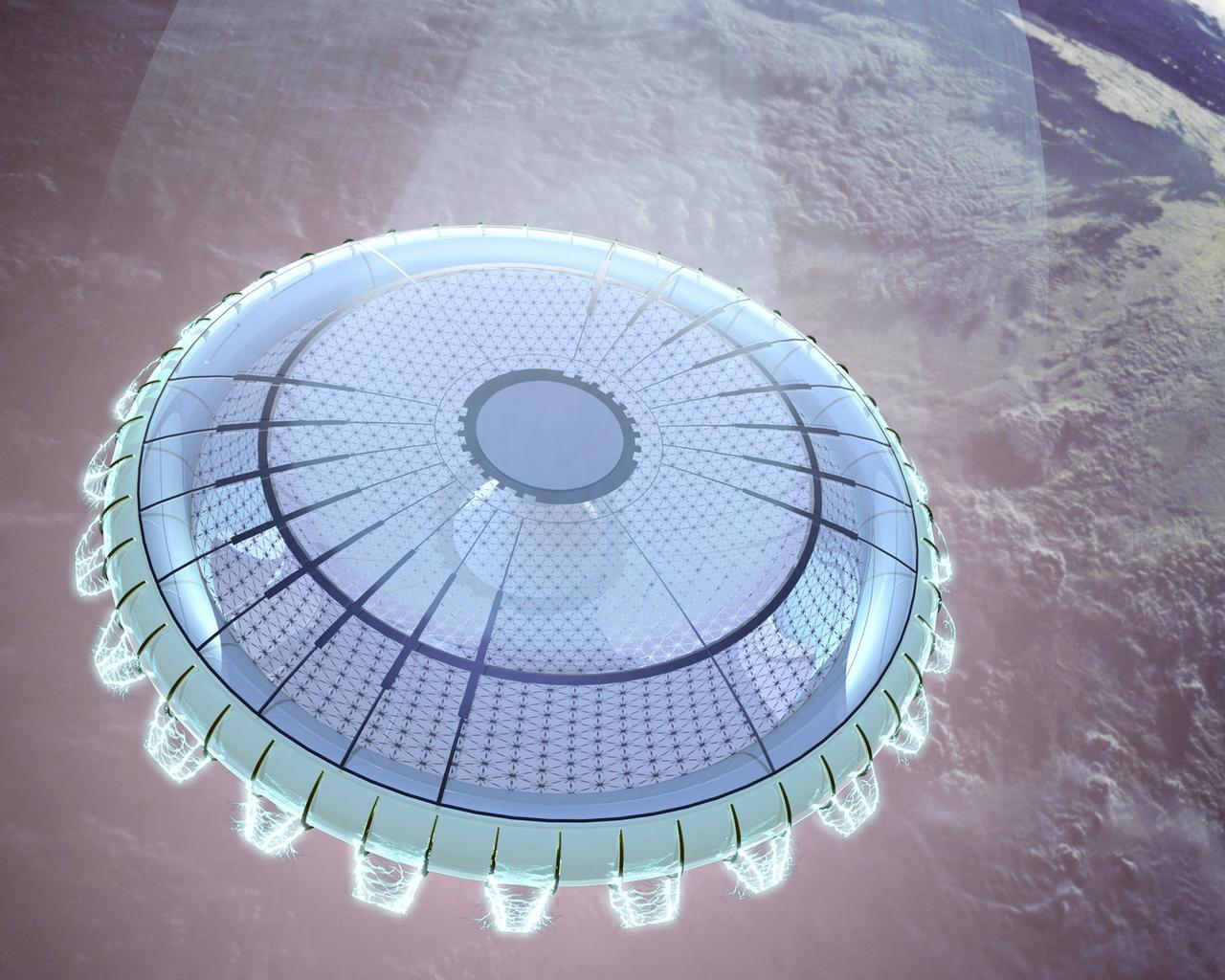
Looking like an alien space ship or a flying saucer the Microwave Lightcraft is an unconventional launch vehicle approach for delivering payload to orbit using power transmitted via microwaves. Microwaves re beamed from either a ground station or an orbiting solar power satellite to the lightcraft. The energy received breaks air molecules into a plasma and a magnetohydrodynamic fanjet provides the lifting force. Only a small amount of propellant is required for circulation, attitude control and deorbit.
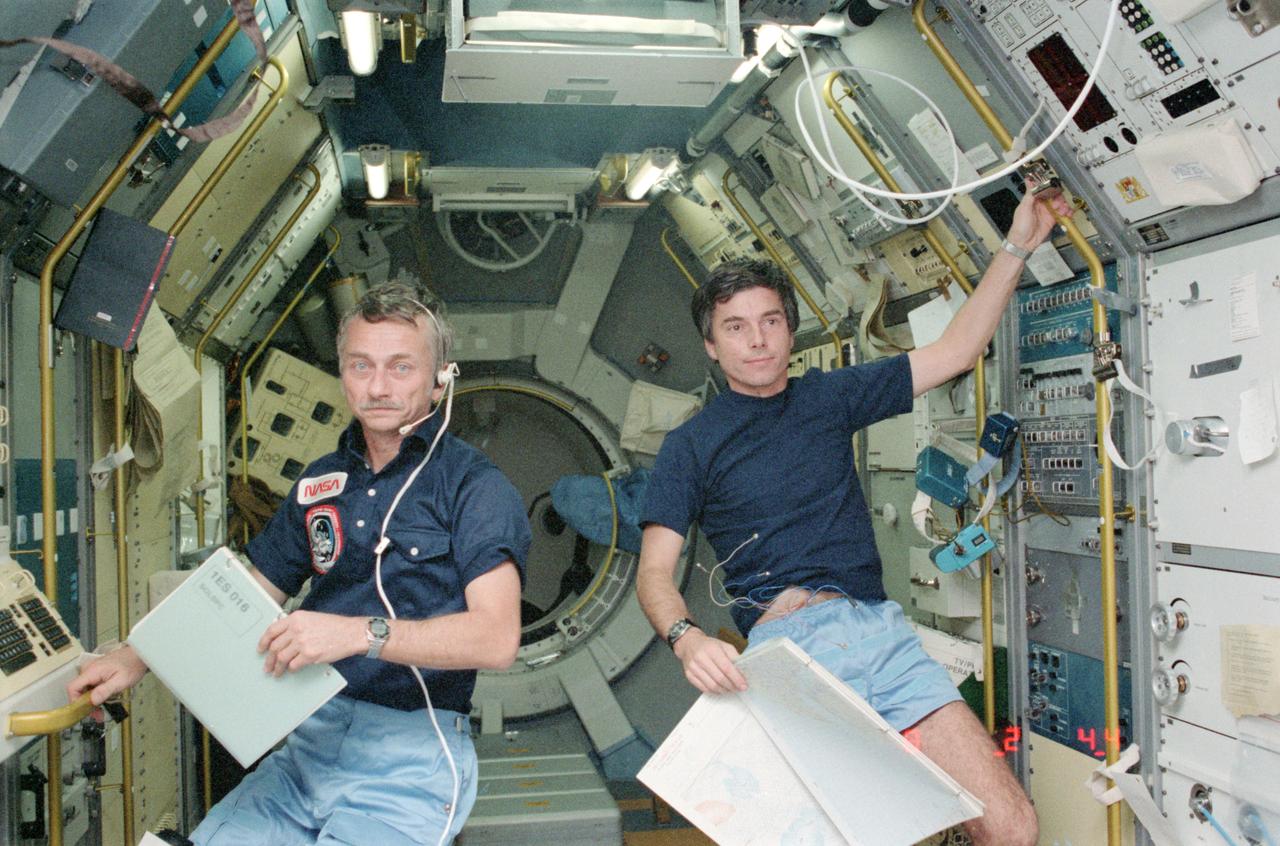
STS009-123-340 (28 Nov 1983) --- Astronaut Owen K. Garriott, STS-9 mission specialist, left, and Ulf Merbold, payload specialist, take a break from monitoring experimentation aboard Spacelab to be photographed. Dr. Garriott, holds in his left hand a data/log book for the solar spectrum experiment. Dr. Merbold, holds a map in his left hand for the monitoring of ground objectives of the metric camera.

The linear features in this VIS image are graben called Sirenum Fossae. Graben are formed when blocks of material move downward between parallel faults. The faults were created by tectonic stresses in this region. The ground is pulling apart and breaks into faults, continued stress moves the sides of the faults further apart and form the graben. Orbit Number: 75220 Latitude: -31.3869 Longitude: 208.356 Instrument: VIS Captured: 2018-11-28 20:39 https://photojournal.jpl.nasa.gov/catalog/PIA22989
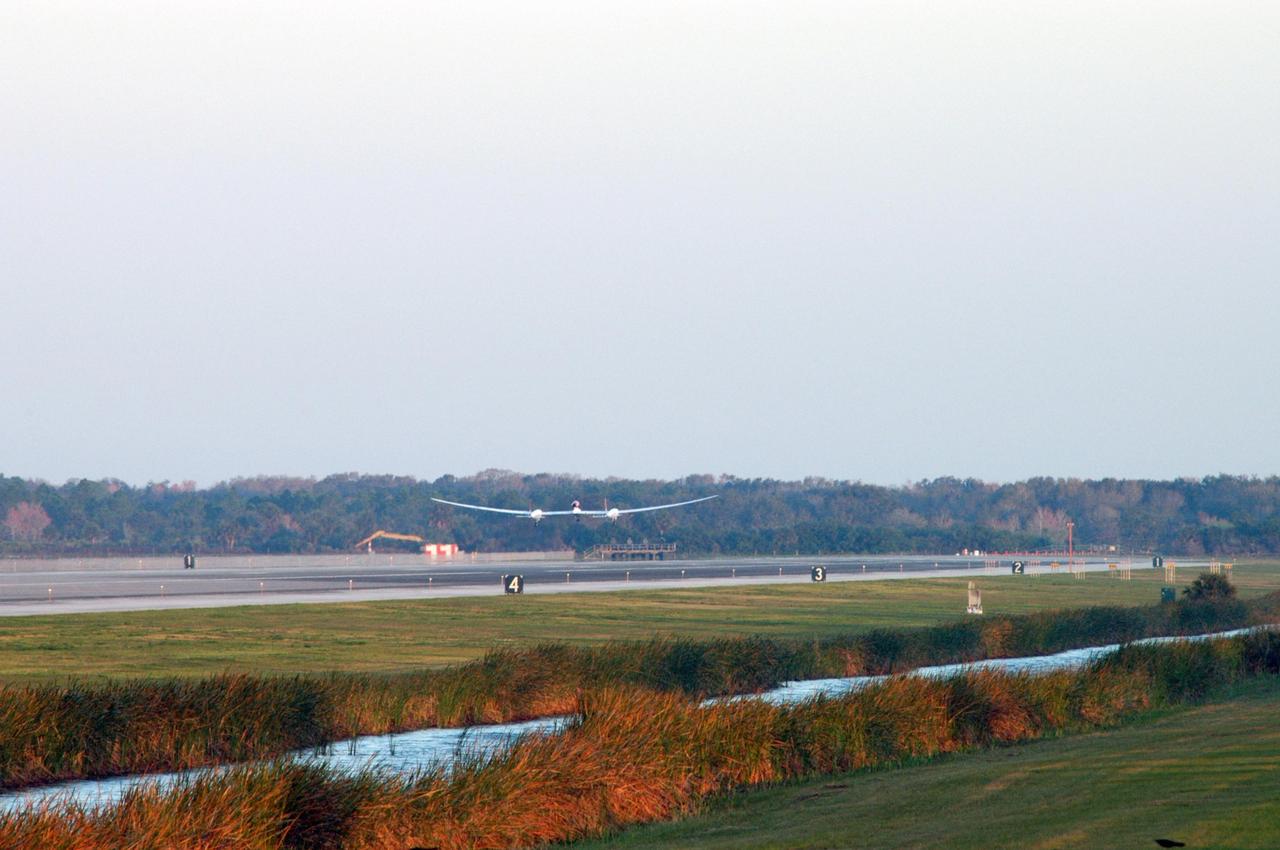
KENNEDY SPACE CENTER, FLA. - On NASA Kennedy Space Center’s Shuttle Landing Facility runway, the Virgin Atlantic GlobalFlyer, piloted by Steve Fossett, lifts off the ground. Fossett is attempting a record-breaking solo flight, non-stop without refueling, to surpass the current record for the longest flight of any aircraft. This is the second attempt in two days after a fuel leak was detected Feb. 7. The actual launch time was 7:22 a.m. Feb. 8. Photo credit: NASA/George Shelton
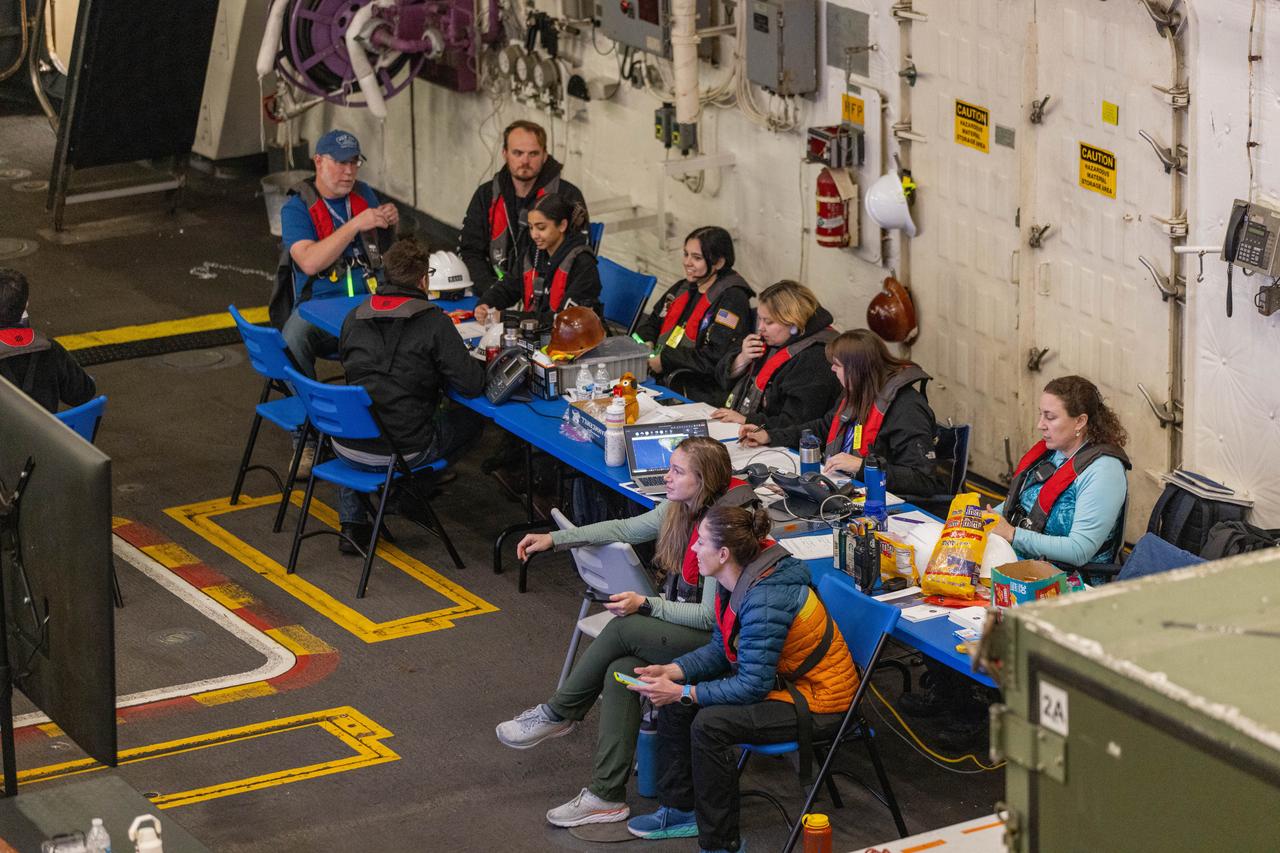
Members of NASA’s Exploration Ground System’s Landing and Recovery team and partners from the Department of Defense aboard the USS San Diego take a break following practice recovery procedures during Underway Recovery Test 11 (URT-11) off the coast of San Diego on Tuesday, Feb. 27, 2024. URT-11 is the eleventh in a series of Artemis recovery tests, and the first time NASA and its partners put their Artemis II recovery procedures to the test with the astronauts.
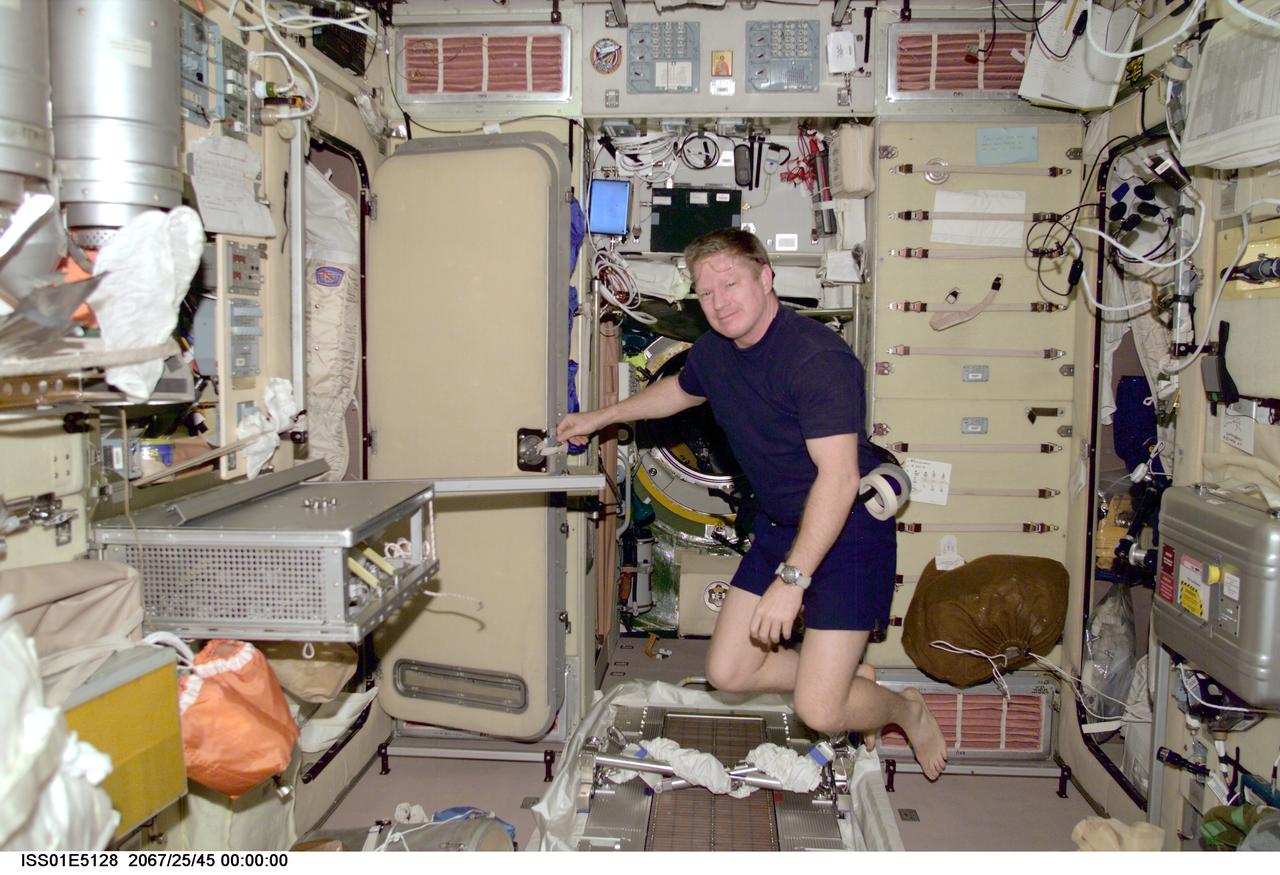
ISS01-E-5128 (December 2000) --- Astronaut William M. Shepherd, commander for the Expedition One mission, floats in the microgravity, shirt-sleeve environment of the International Space Station's Zvezda Service Module. Shepherd was taking a brief break from work to install various furnishings for the SM. The image was taken with a digital still camera and down linked from the station to ground controllers in Houston.
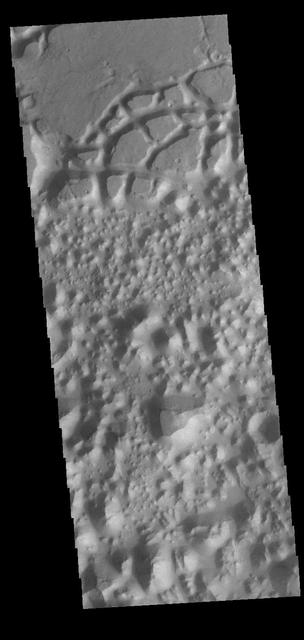
Today's VIS image is located in Margaritifer Terra near Eos Chasma. The ground in this region has been broken up into mesas and valleys, with the initial break up thought to be due to a release of groundwater. With continued erosion, the mesas become smaller and smaller, creating the jumble of hills seen at the bottom of this image. Orbit Number: 82609 Latitude: -16.5146 Longitude: 319.112 Instrument: VIS Captured: 2020-07-29 08:06 https://photojournal.jpl.nasa.gov/catalog/PIA24145
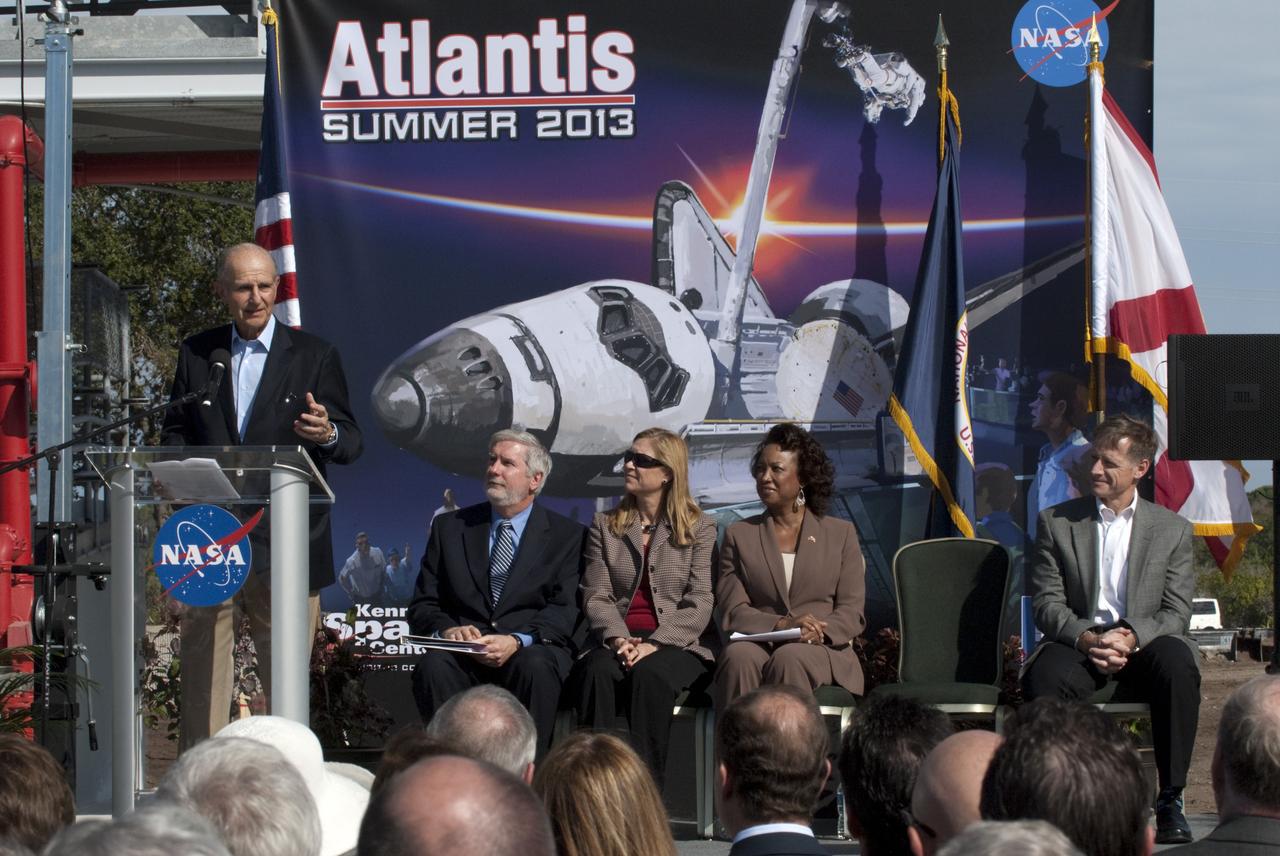
CAPE CANAVERAL, Fla. – In the Shuttle Plaza area at the Kennedy Space Center Visitor Complex (KSCVC) in Florida, Jeremy Jacobs, chairman and chief executive officer of Delaware North Companies, speaks during the Ground Breaking Ceremony for the future home of space shuttle Atlantis. Seated at right, are KSCVC Chief Operating Officer Bill Moore; Kennedy Space Center Deputy Director Janet Petro; Lt. Governor of Florida Jennifer Carroll; and STS-135 Commander Chris Ferguson. Delaware North Parks & Resorts, in partnership with NASA’s Kennedy Space Center, broke ground for the 65,000 square-foot exhibit that will house Atlantis at the visitor complex. For more information, visit www.KennedySpaceCenter.com. Photo credit: NASA/Kim Shiflett
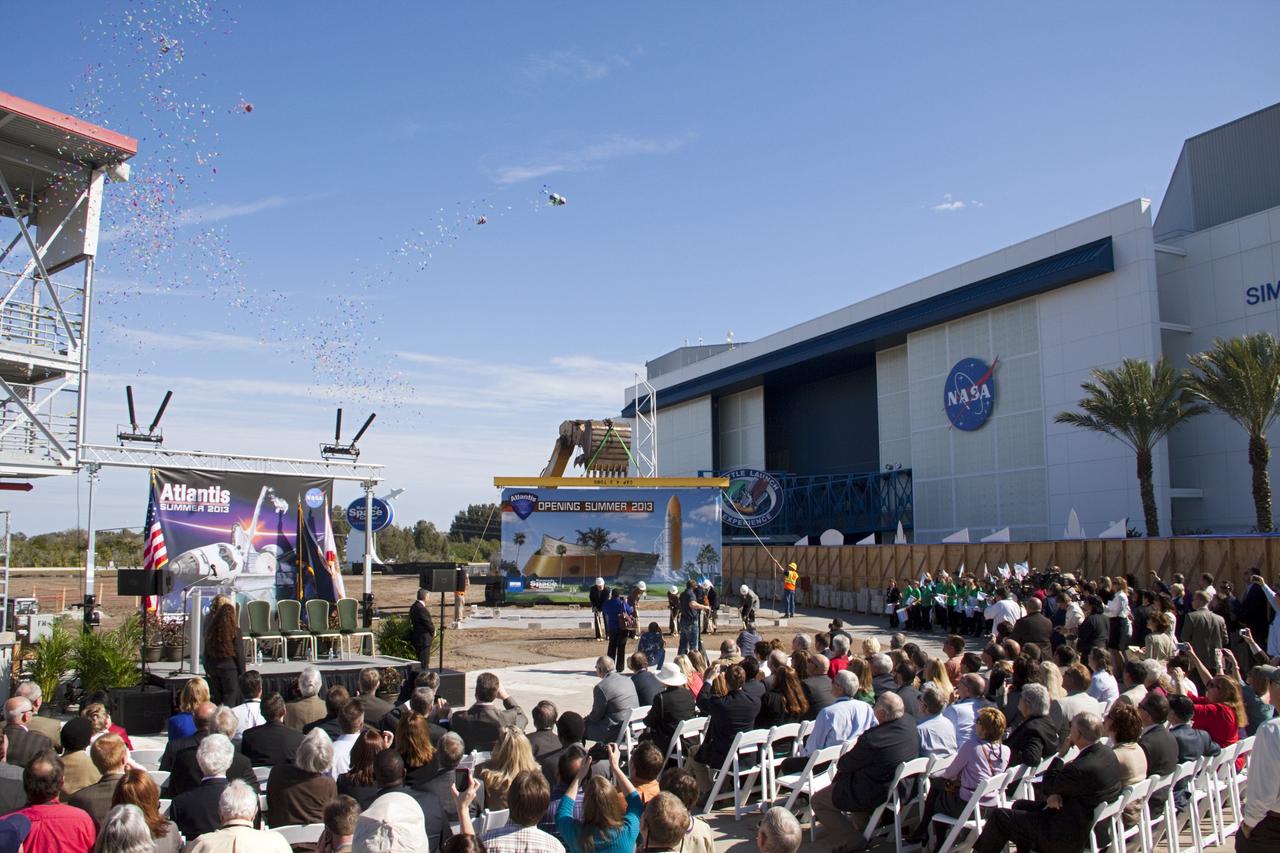
CAPE CANAVERAL, Fla. – In the Shuttle Plaza area at the Kennedy Space Center Visitor Complex in Florida, state and local dignitaries participate in a Ground Breaking Ceremony for the future home of space shuttle Atlantis. The group includes KSCVC Chief Operating Officer Bill Moore; Kennedy Space Center Deputy Director Janet Petro; Lt. Governor of Florida Jennifer Carroll; Jeremy Jacobs, chairman and chief executive officer of Delaware North Companies; and STS-135 Commander Chris Ferguson. Delaware North Parks & Resorts, in partnership with NASA’s Kennedy Space Center, broke ground for the 65,000 square-foot exhibit that will house Atlantis at the visitor complex. For more information, visit www.KennedySpaceCenter.com. Photo credit: NASA/Jim Grossmann
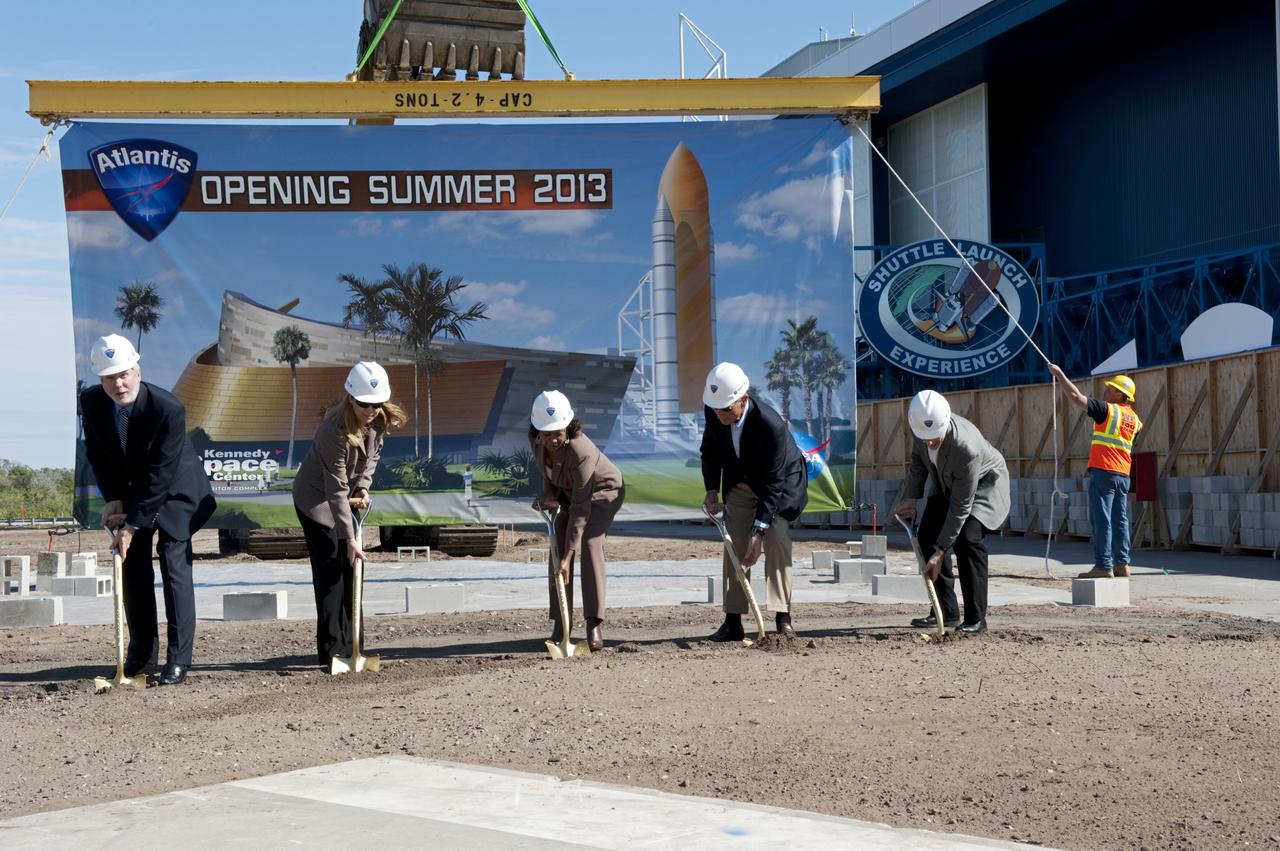
CAPE CANAVERAL, Fla. – In the Shuttle Plaza area at the Kennedy Space Center Visitor Complex (KSCVC) in Florida, state and local dignitaries participate in a Ground Breaking Ceremony for the future home of space shuttle Atlantis. From left, are KSCVC Chief Operating Officer Bill Moore; Kennedy Space Center Deputy Director Janet Petro; Lt. Governor of Florida Jennifer Carroll; Jeremy Jacobs, chairman and chief executive officer of Delaware North Companies; and STS-135 Commander Chris Ferguson. Delaware North Parks & Resorts, in partnership with NASA’s Kennedy Space Center, broke ground for the 65,000 square-foot exhibit that will house Atlantis at the visitor complex. For more information, visit www.KennedySpaceCenter.com. Photo credit: NASA/Kim Shiflett
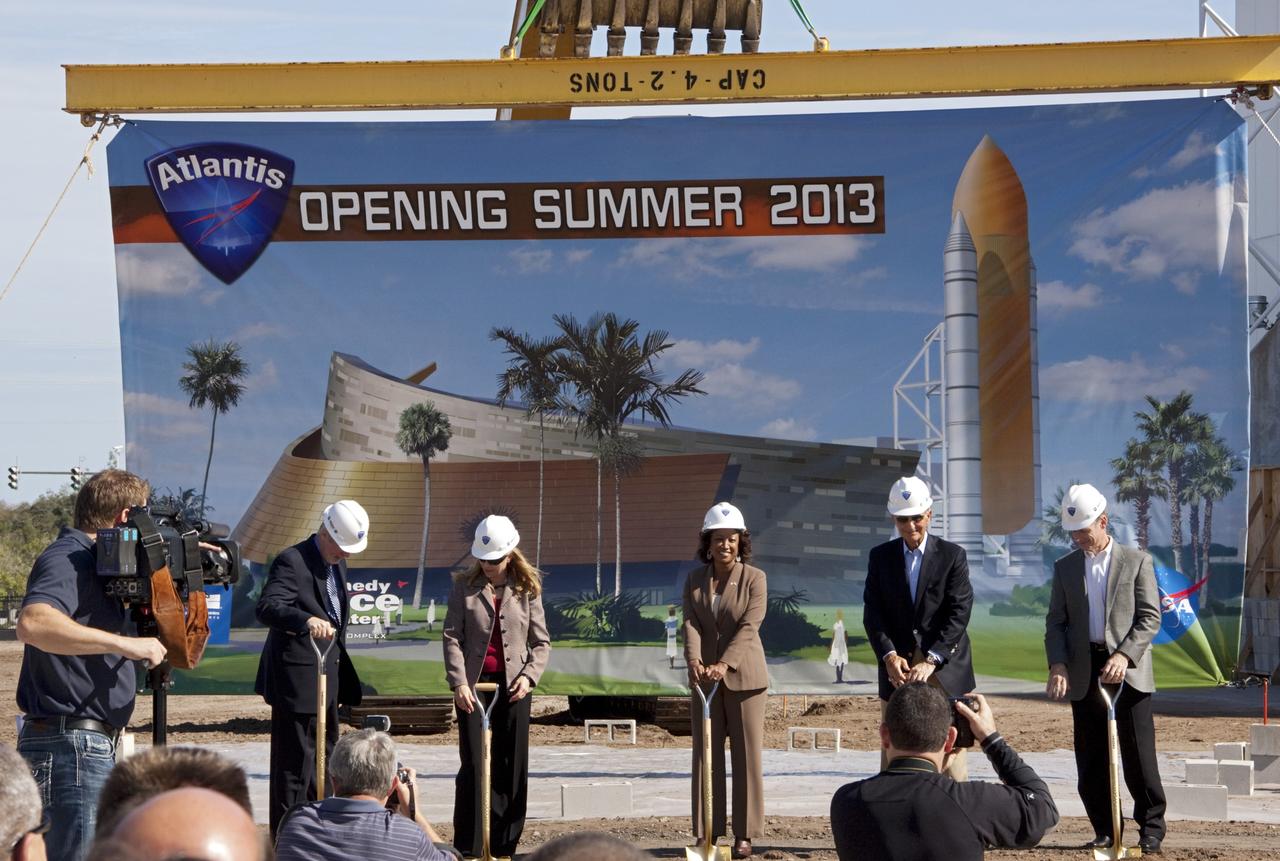
CAPE CANAVERAL, Fla. – During a ceremony in the Shuttle Plaza area at the Kennedy Space Center Visitor Complex in Florida, state and local dignitaries break ground for the future home of space shuttle Atlantis. From left, are KSCVC Chief Operating Officer Bill Moore; Kennedy Space Center Deputy Director Janet Petro; Lt. Governor of Florida Jennifer Carroll; Jeremy Jacobs, chairman and chief executive officer of Delaware North Companies; and STS-135 Commander Chris Ferguson. Delaware North Parks & Resorts, in partnership with NASA’s Kennedy Space Center, broke ground for the 65,000 square-foot exhibit that will house Atlantis at the visitor complex. For more information, visit www.KennedySpaceCenter.com. Photo credit: NASA/Jim Grossmann
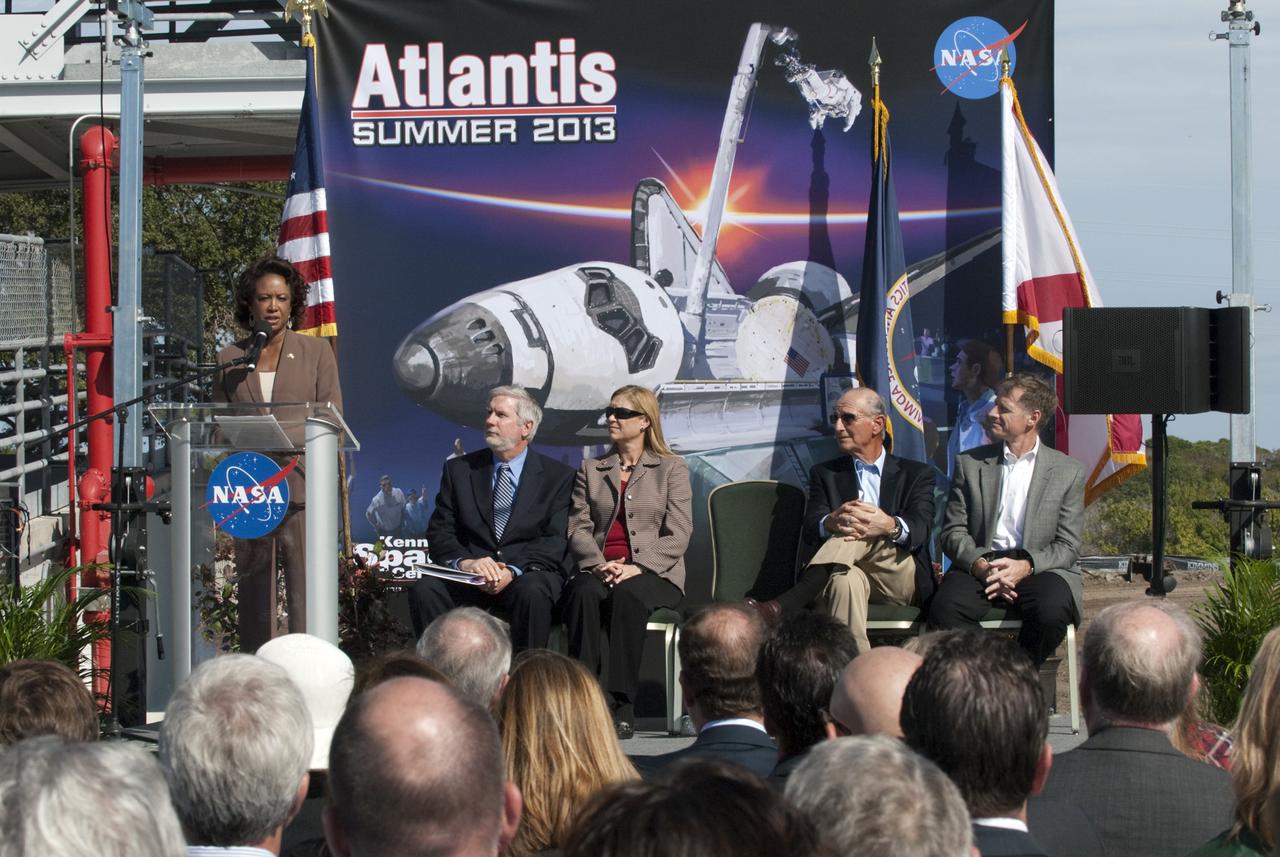
CAPE CANAVERAL, Fla. – In the Shuttle Plaza area at the Kennedy Space Center Visitor Complex (KSCVC) in Florida, Lt. Governor Jennifer Carroll speaks during the Ground Breaking Ceremony for the future home of space shuttle Atlantis. Seated at right, are KSCVC Chief Operating Officer Bill Moore; Kennedy Space Center Deputy Director Janet Petro; Jeremy Jacobs, chairman and chief executive officer of Delaware North Companies; and STS-135 Commander Chris Ferguson. Delaware North Parks & Resorts, in partnership with NASA’s Kennedy Space Center, broke ground for the 65,000 square-foot exhibit that will house Atlantis at the visitor complex. For more information, visit www.KennedySpaceCenter.com. Photo credit: NASA/Kim Shiflett
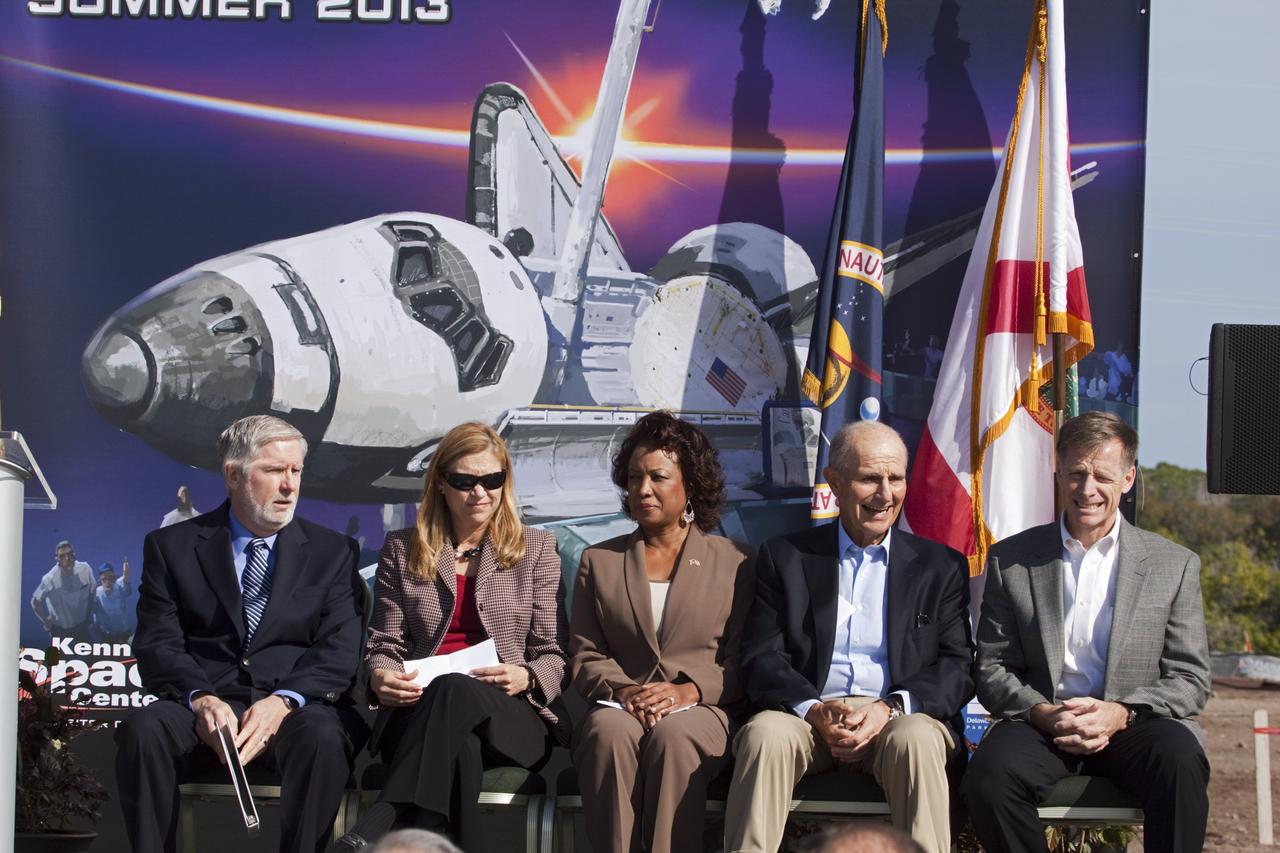
CAPE CANAVERAL, Fla. – In the Shuttle Plaza area at the Kennedy Space Center Visitor Complex (KSCVC) in Florida, dignitaries wait to speak during the Ground Breaking Ceremony for the future home of space shuttle Atlantis. From left, are KSCVC Chief Operating Officer Bill Moore; Kennedy Space Center Deputy Director Janet Petro; Lt. Governor of Florida Jennifer Carroll; Jeremy Jacobs, chairman and chief executive officer of Delaware North Companies; and STS-135 Commander Chris Ferguson. Delaware North Parks & Resorts, in partnership with NASA’s Kennedy Space Center, broke ground for the 65,000 square-foot exhibit that will house Atlantis at the visitor complex. For more information, visit www.KennedySpaceCenter.com. Photo credit: NASA/Jim Grossmann
CAPE CANAVERAL, Fla. – In the Shuttle Plaza area at the Kennedy Space Center Visitor Complex (KSCVC) in Florida, Chief Operating Officer Bill Moore speaks during the Ground Breaking Ceremony for the future home of space shuttle Atlantis. Seated at right, are Kennedy Space Center Deputy Director Janet Petro; Lt. Governor of Florida Jennifer Carroll; and Jeremy Jacobs, chairman and chief executive officer of Delaware North Companies. Partially blocked from view is STS-135 Commander Chris Ferguson. Delaware North Parks & Resorts, in partnership with NASA’s Kennedy Space Center, broke ground for the 65,000 square-foot exhibit that will house Atlantis at the visitor complex. For more information, visit www.KennedySpaceCenter.com. Photo credit: NASA/Kim Shiflett
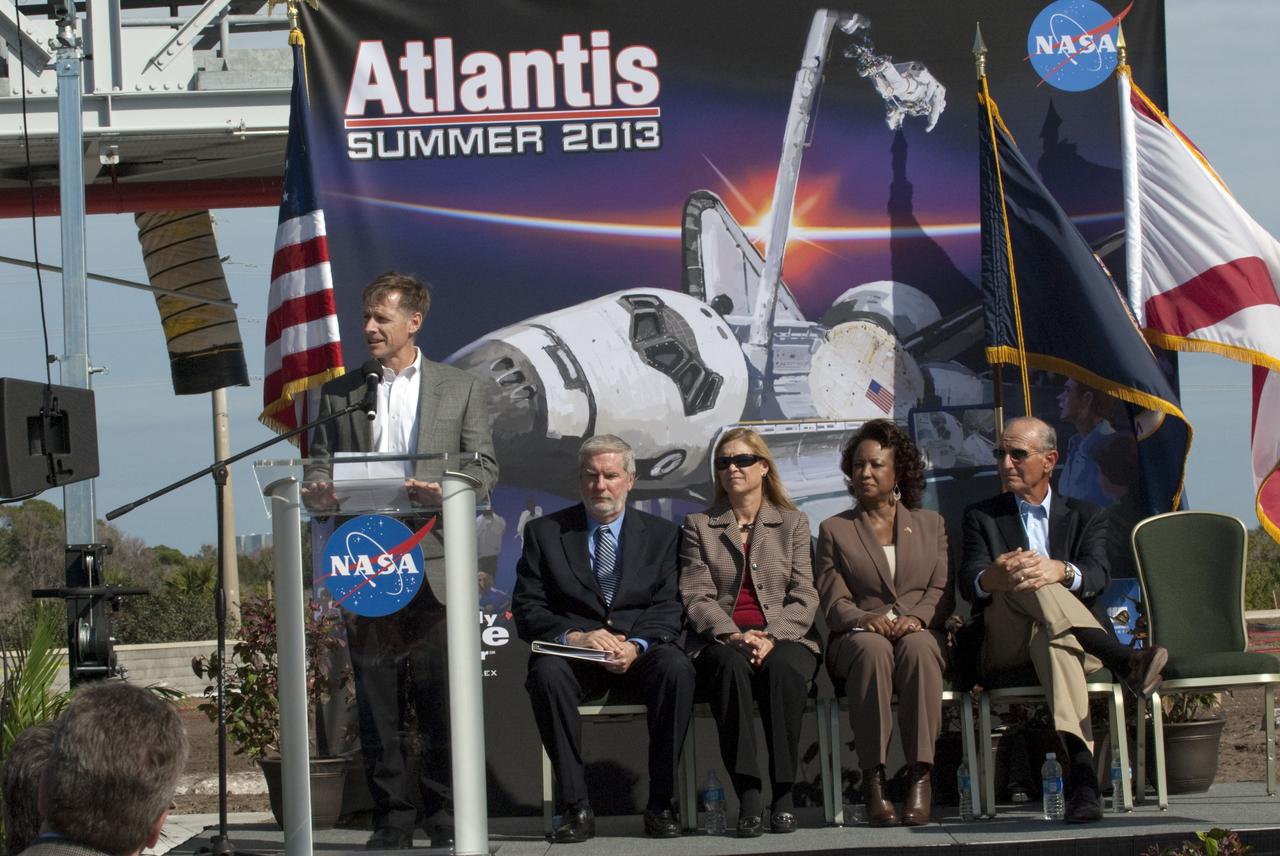
CAPE CANAVERAL, Fla. – In the Shuttle Plaza area at the Kennedy Space Center Visitor Complex (KSCVC) in Florida, STS-135 Commander Chris Ferguson speaks during the Ground Breaking Ceremony for the future home of space shuttle Atlantis. Seated at right, are KSCVC Chief Operating Officer Bill Moore; Kennedy Space Center Deputy Director Janet Petro; Lt. Governor of Florida Jennifer Carroll; and Jeremy Jacobs, chairman and chief executive officer of Delaware North Companies. Delaware North Parks & Resorts, in partnership with NASA’s Kennedy Space Center, broke ground for the 65,000 square-foot exhibit that will house Atlantis at the visitor complex. For more information, visit www.KennedySpaceCenter.com. Photo credit: NASA/Kim Shiflett
CAPE CANAVERAL, Fla. – In the Shuttle Plaza area at the Kennedy Space Center Visitor Complex (KSCVC) in Florida, Kennedy Space Center Deputy Director Janet Petro speaks during the Ground Breaking Ceremony for the future home of space shuttle Atlantis. Seated at right, are KSCVC Chief Operating Officer Bill Moore; Lt. Governor of Florida Jennifer Carroll; Jeremy Jacobs, chairman and chief executive officer of Delaware North Companies; and STS-135 Commander Chris Ferguson. Delaware North Parks & Resorts, in partnership with NASA’s Kennedy Space Center, broke ground for the 65,000 square-foot exhibit that will house Atlantis at the visitor complex. For more information, visit www.KennedySpaceCenter.com. Photo credit: NASA/Kim Shiflett
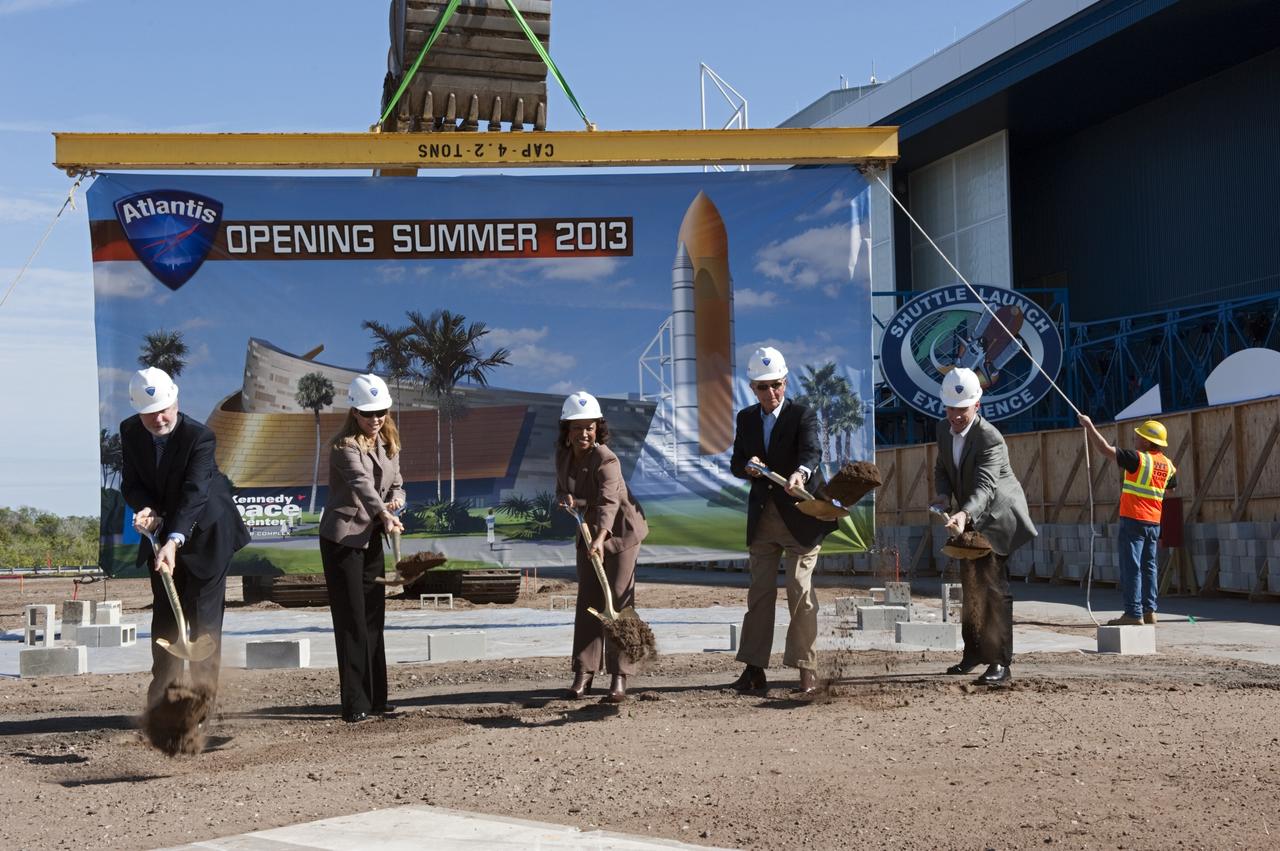
CAPE CANAVERAL, Fla. – During a ceremony in the Shuttle Plaza area at the Kennedy Space Center Visitor Complex (KSCVC) in Florida, state and local dignitaries break ground for the future home of space shuttle Atlantis. From left, are KSCVC Chief Operating Officer Bill Moore; Kennedy Space Center Deputy Director Janet Petro; Lt. Governor of Florida Jennifer Carroll; Jeremy Jacobs, chairman and chief executive officer of Delaware North Companies; and STS-135 Commander Chris Ferguson. Delaware North Parks & Resorts, in partnership with NASA’s Kennedy Space Center, broke ground for the 65,000 square-foot exhibit that will house Atlantis at the visitor complex. For more information, visit www.KennedySpaceCenter.com. Photo credit: NASA/Kim Shiflett
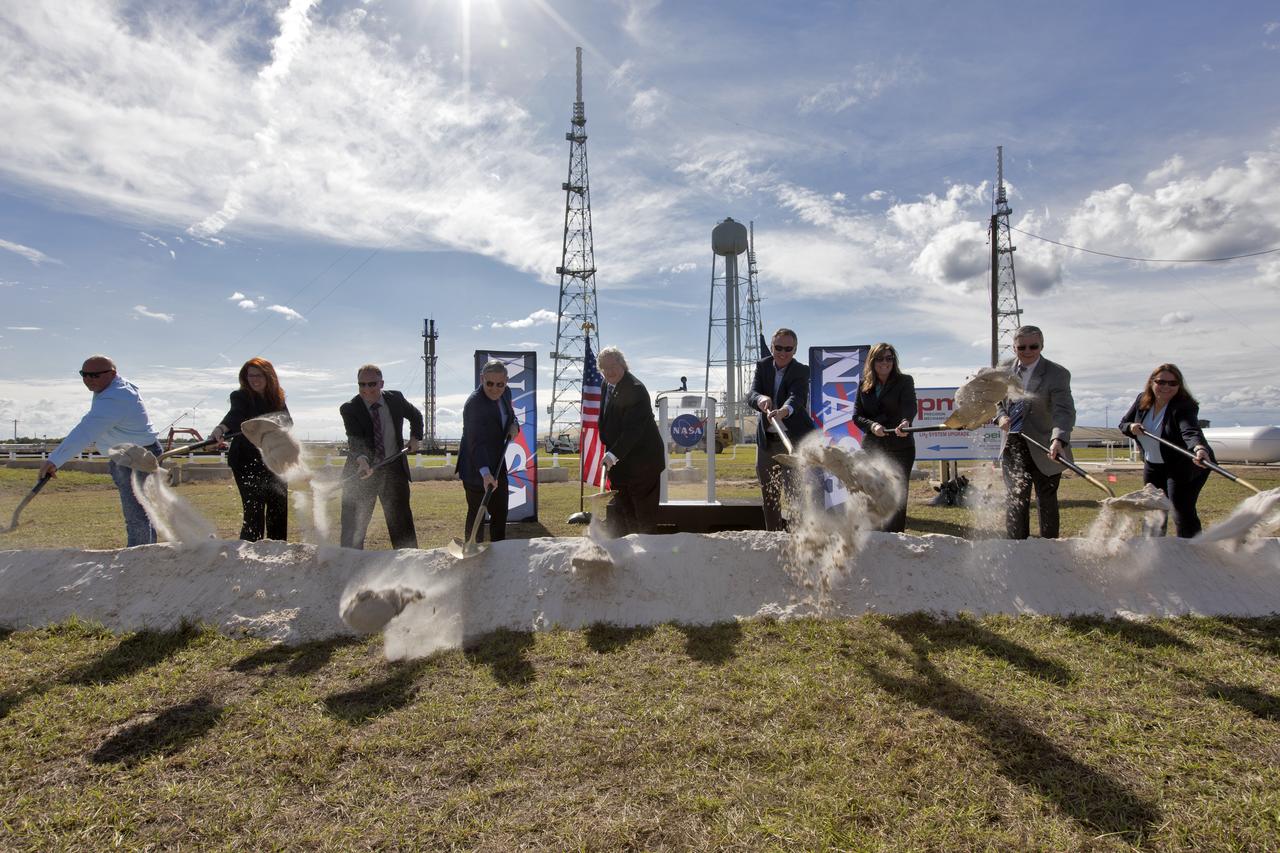
On Dec. 19, 2018, at NASA Kennedy Space Center's Launch Complex 39B, agency and contractor managers break ground for a new liquid hydrogen tank. Participating, from the left, are Todd Gray, president of Precision Mechanical, prime contractor for the project; Charlie Blackwell-Thompson, launch director; Shawn Quinn, director of Engineering; Bob Cabana, center director; Bill Hill, deputy associate administrator for Exploration Systems Development at NASA Headquarters in Washington; Mike Bolger, program manager for Exploration Ground Systems (EGS); Jennifer Kunz, deputy program manager for EGS, Andy Allen, general manager for Jacobs, NASA's Test and Operations Support Contractor; and Regina Spellman, launch pad senior project manager in EGS. The storage facility will hold 1.25 million gallons of the propellant for NASA's Space Launch System rocket designed to boost the agency's Orion spacecraft, sending humans to distant destinations such as the Moon and Mars.
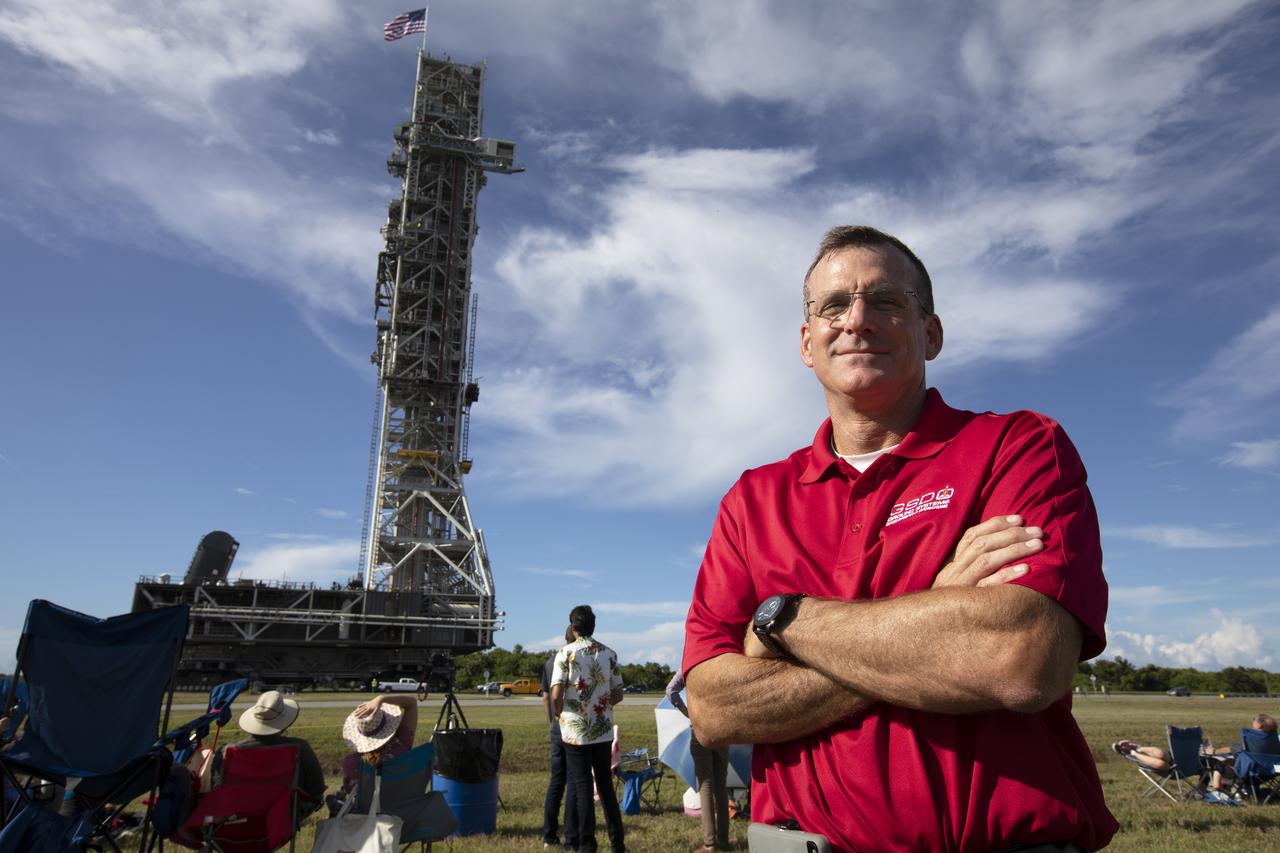
Cliff Lanham, NASA project manager for the mobile launcher, takes a break to attend the employee event for the mobile launcher move to the Vehicle Assembly Building (VAB) on Sept. 7, 2018, at NASA's Kennedy Space Center in Florida. The mobile launcher, atop crawler-transporter 2, began its trek from Launch Pad 39B along the crawlerway after undergoing a fit check and several days of systems testing with the pad. This is the first time that the modified mobile launcher made the trip to the pad. The 380-foot-tall mobile launcher is equipped with the crew access arm and several umbilicals that will provide power, environmental control, pneumatics, communication and electrical connections to the agency's Space Launch System and Orion spacecraft. The mobile launcher will spend seven months in the VAB undergoing testing. Exploration Ground Systems is preparing the ground systems necessary to launch SLS and Orion on Exploration Mission-1, missions to the Moon and on to Mars.
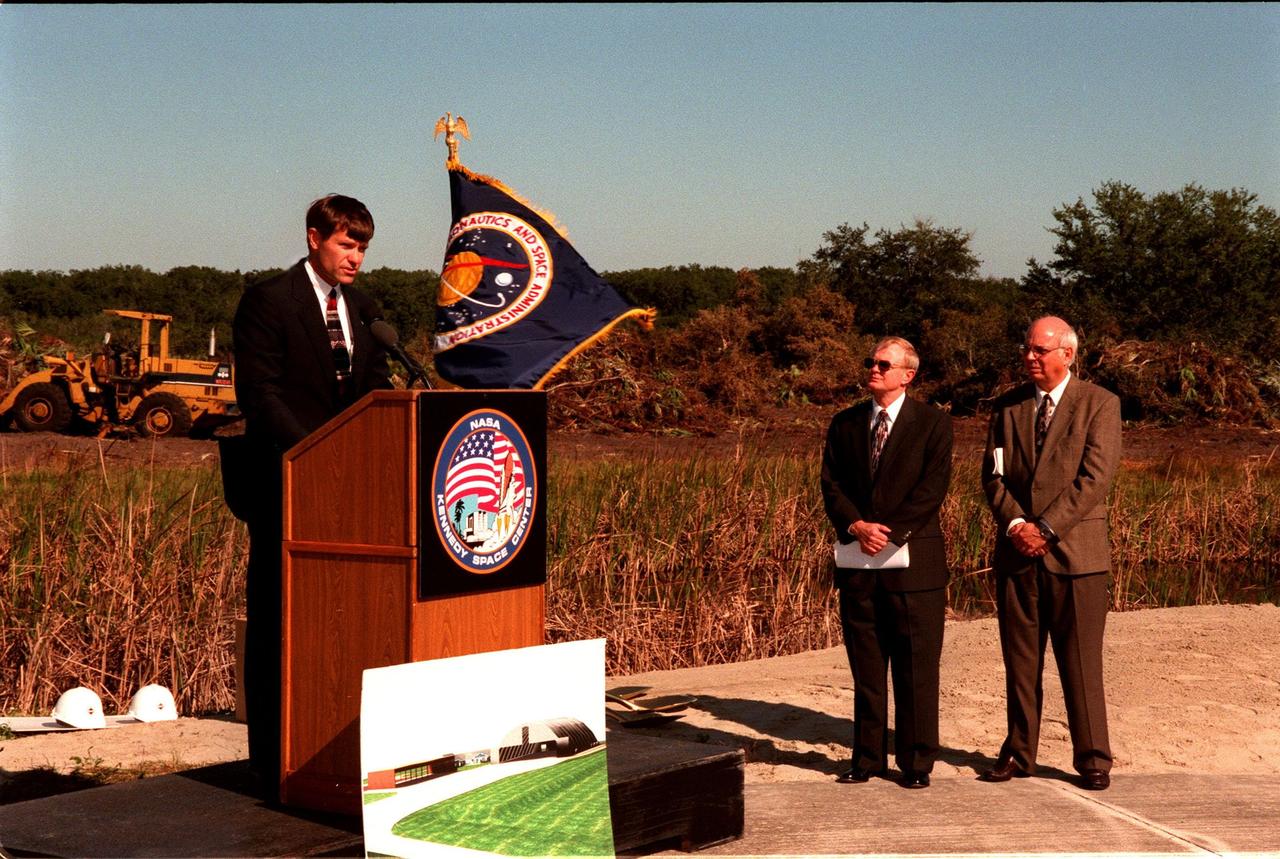
Donald McMonagle (left), manager, Launch Integration, speaks to federal and state elected officials during the ground breaking ceremony for a multi-purpose hangar, phase one of the Reusable Launch Vehicle (RLV) Support Complex to be built near the Shuttle Landing Facility. At right are Center Director Roy Bridges and Executive Director of the Spaceport Florida Authority (SFA) Ed O'Connor. The new complex is jointly funded by SFA, NASA's Space Shuttle Program and Kennedy Space Center. It is intended to support the Space Shuttle and other RLV land X-vehicle systems. Completion is expected by the year 2000
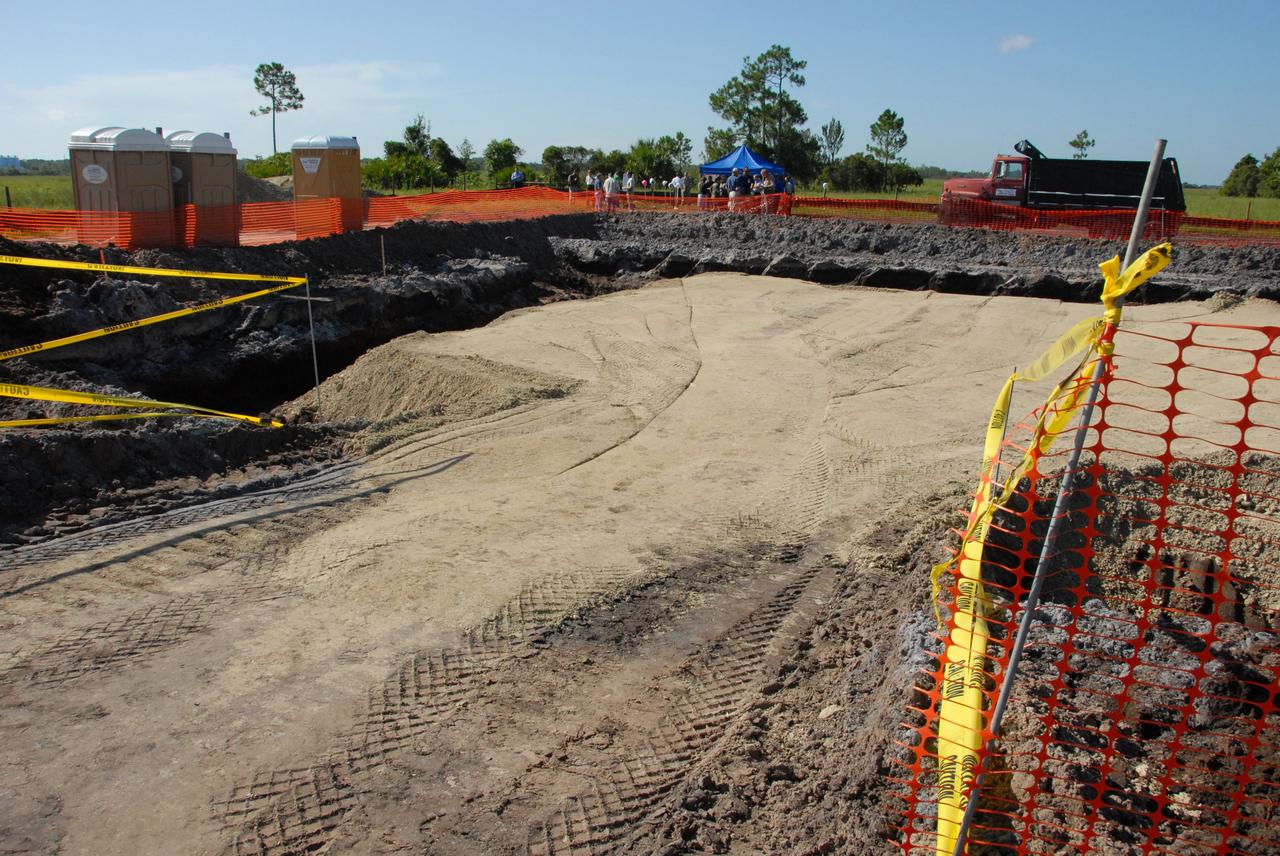
CAPE CANAVERAL, Fla. - The construction site is leveled for a new weather radar to be used by NASA's Kennedy Space Center, the 45th Space Wing and their customers. In the background is the location where a mock ground-breaking ceremony was held. The weather radar is essential in issuing lightning and other severe weather warnings and vital in evaluating lightning launch commit criteria. The new radar, replacing what was installed 25 years ago, includes Doppler capability to detect winds and identify the type, size and number of precipitation particles. The site is ideally distant from the launch pads and has unobstructed views of Cape Canaveral Air Force Station and Kennedy. Photo credit: NASA/Amanda Diller
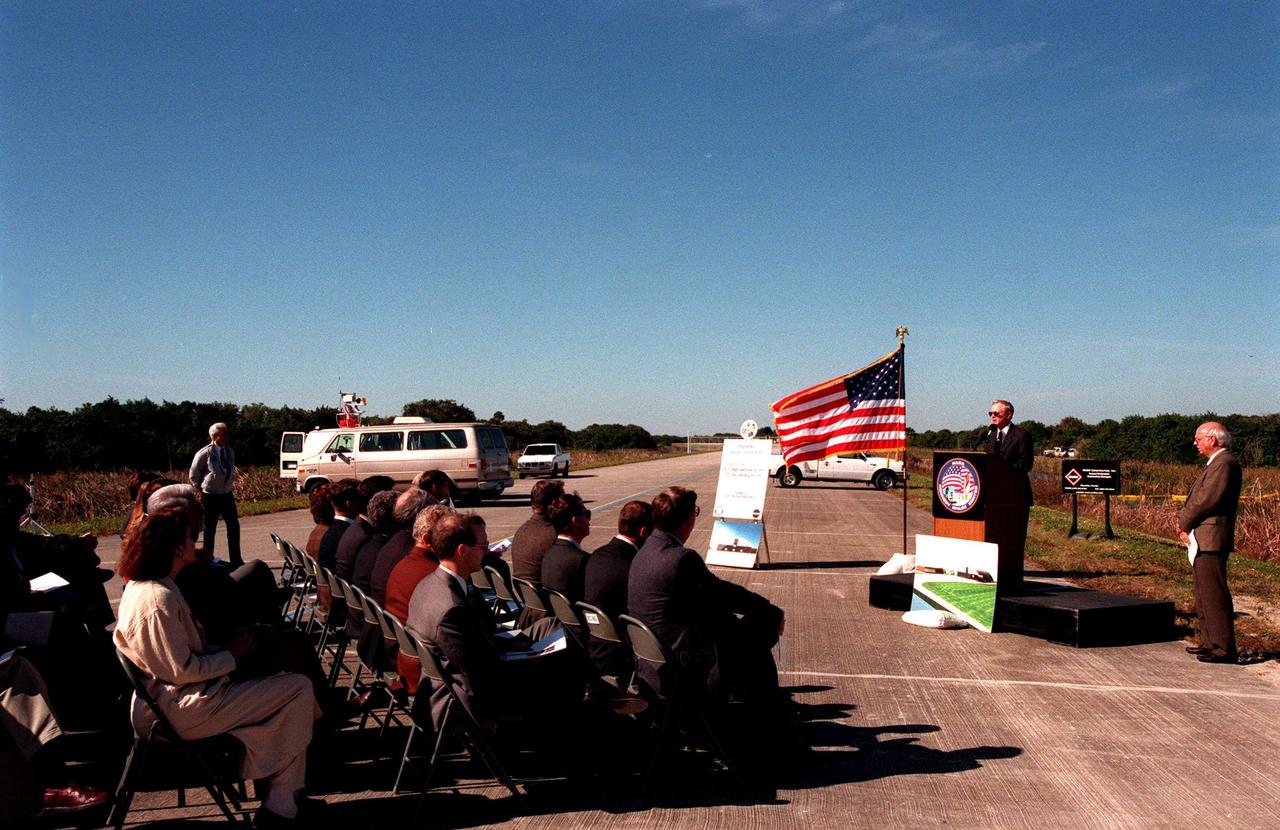
Center Director Roy Bridges, at the podium, speaks to federal and state elected officials during the ground breaking ceremony for a multi-purpose hangar, phase one of the Reusable Launch Vehicle (RLV) Support Complex to be built near the Shuttle Landing Facility. At right is Ed O'Connor, executive director of the Spaceport Florida Authority (SFA). The new complex is jointly funded by SFA, NASA's Space Shuttle Program and Kennedy Space Center. It is intended to support the Space Shuttle and other RLV land X-vehicle systems. Completion is expected by the year 2000
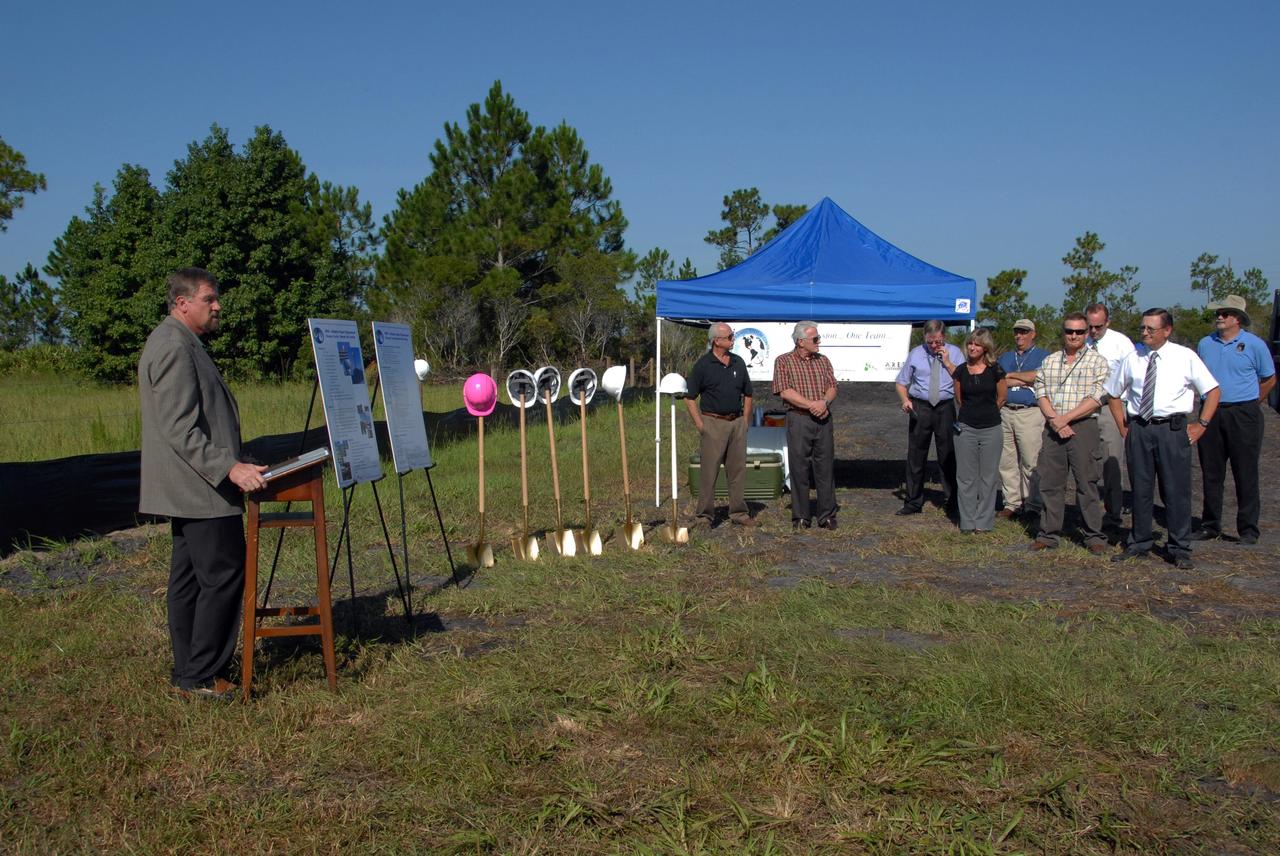
CAPE CANAVERAL, Fla. - A new weather radar site is dedicated with a mock ground-breaking ceremony. At the podium is Pat Carr, SLRSC program director with ITT. The site will be used by NASA's Kennedy Space Center, the 45th Space Wing and their customers. The weather radar is essential in issuing lightning and other severe weather warnings and vital in evaluating lightning launch commit criteria. The new radar, replacing what was installed 25 years ago, includes Doppler capability to detect winds and identify the type, size and number of precipitation particles. The site is ideally distant from the launch pads and has unobstructed views of Cape Canaveral Air Force Station and Kennedy. Photo credit: NASA/Amanda Diller

CAPE CANAVERAL, Fla. – Sunrise breaks on the mate/demate device at the Shuttle Landing Facility at NASA's Kennedy Space Center in Florida. Space shuttle Atlantis will be lifted from the Shuttle Carrier Aircraft, or SCA, underneath and lowered to the ground. Atlantis returned from California atop the SCA after its May 24 landing at Edwards Air Force Base, concluding mission STS-125. The ferry flight from Edwards Air Force Base began June 1. Atlantis' next assignment is the STS-129 mission, targeted to launch in November 2009. Photo credit: NASA/Dimitri Gerondidakis
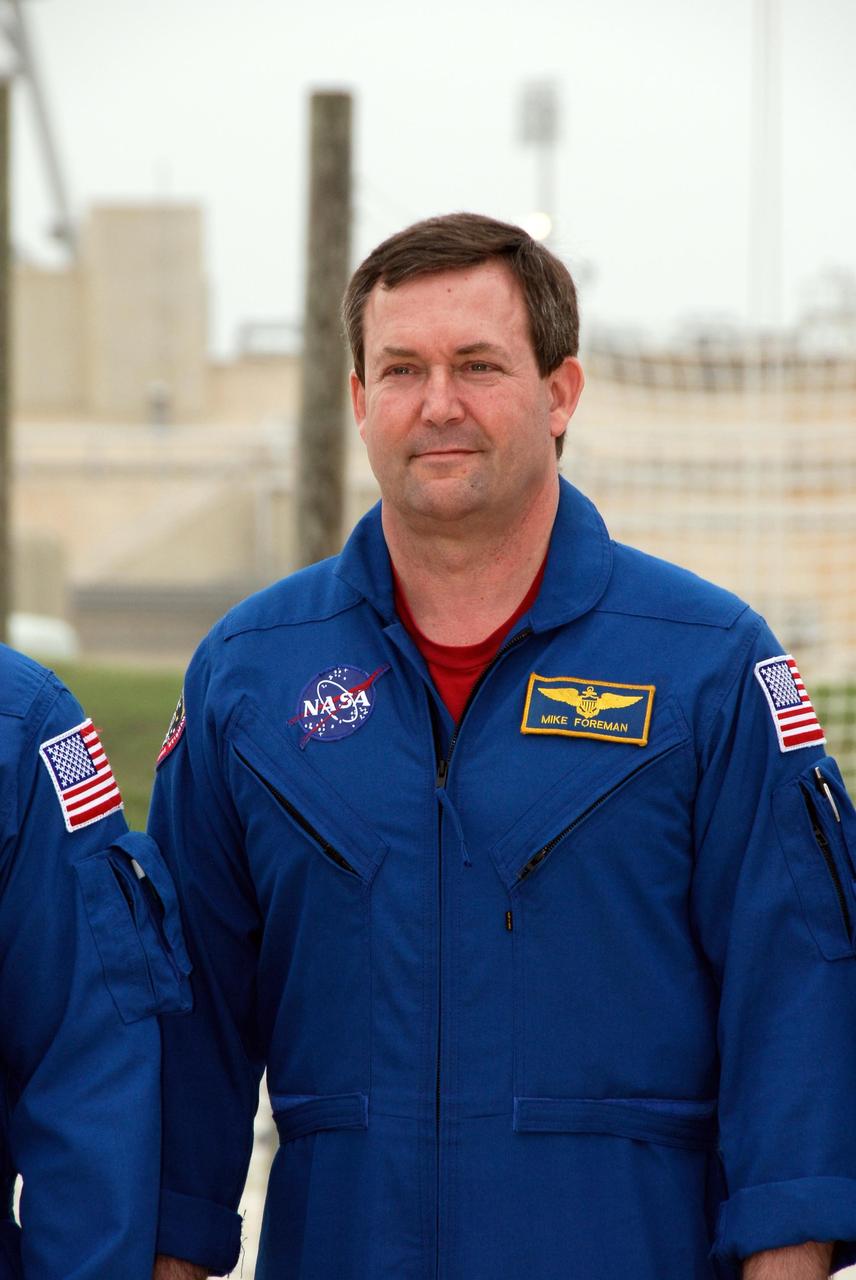
KENNEDY SPACE CENTER, FLA. -- At NASA Kennedy Space Center's Launch Pad 39A, a mission specialist on space shuttle Endeavour's STS-123 mission, Mike Foreman, prepares to take questions from the media during a break from emergency egress training. The crew is at Kennedy for a full launch dress rehearsal, known as the terminal countdown demonstration test or TCDT. The terminal countdown demonstration test provides astronauts and ground crews with an opportunity to participate in various simulated countdown activities, including equipment familiarization and emergency training. Endeavour is targeted to launch March 11 at 2:28 a.m. EDT on a 16-day mission to the International Space Station. On the mission, Endeavour and its crew will deliver the first section of the Japan Aerospace Exploration Agency's Kibo laboratory and the Canadian Space Agency's two-armed robotic system, Dextre. Photo credit: NASA/Kim Shiflett
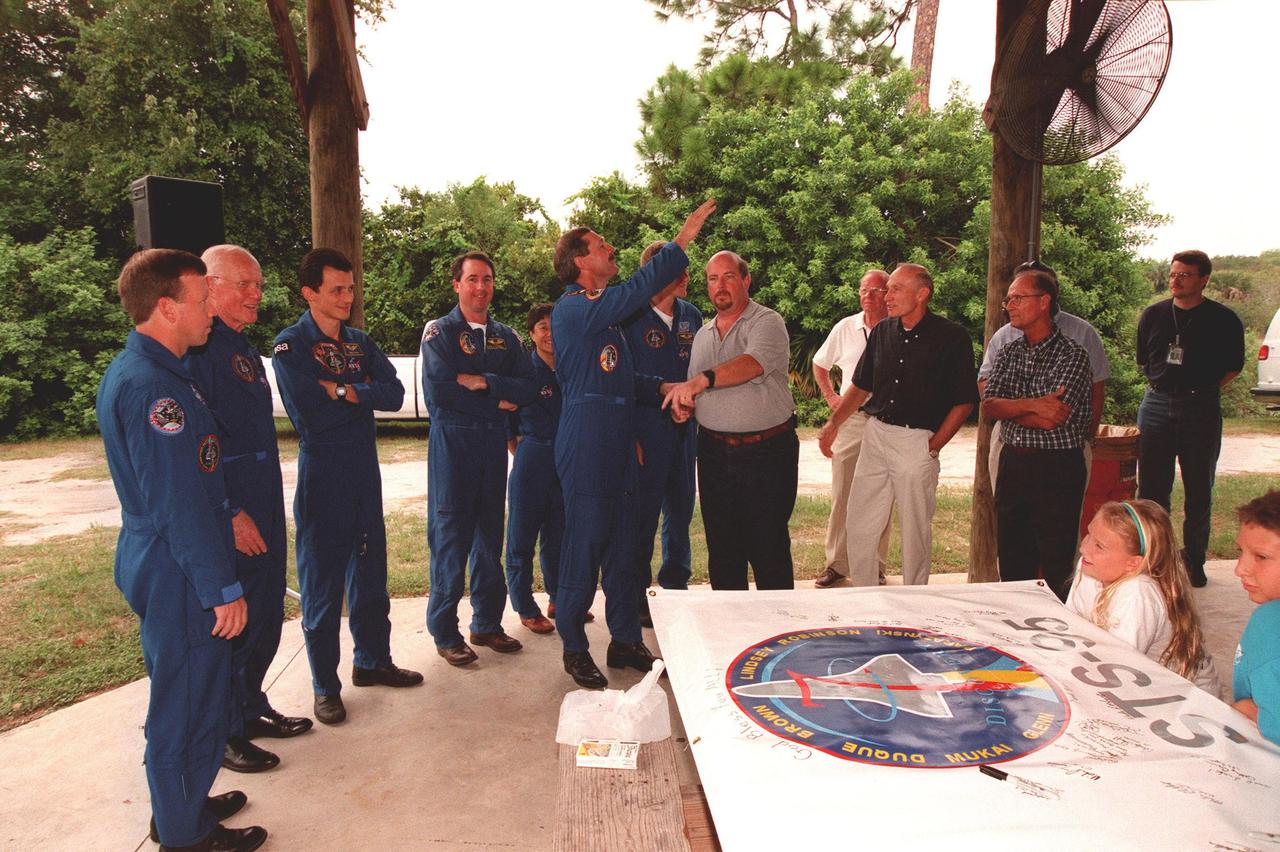
During a break in the Crew Equipment Interface Test (CEIT), the STS-95 crew gathers with United Space Alliance (USA) personnel and their families. From left are Pilot Steven W. Lindsey; Payload Specialist John H. Glenn Jr., a senator from Ohio; Pedro Duque, with the European Space Agency (ESA); Mission Specialist Stephen K. Robinson, Ph.D.; Chiaki Mukai, with the National Space Development Agency of Japan (NASDA); Mission Commander Curtis L. Brown Jr. (with arm raised); Mission Specialist Scott E. Parazynski, M.D.; Jim Furr, USA National Space Flight Awareness representative; Jack King, USA Public Affairs; Bob Sieck, KSC director of Shuttle Processing; and Ed Adamek, USA vice president and associate program manager for Ground Operations at KSC
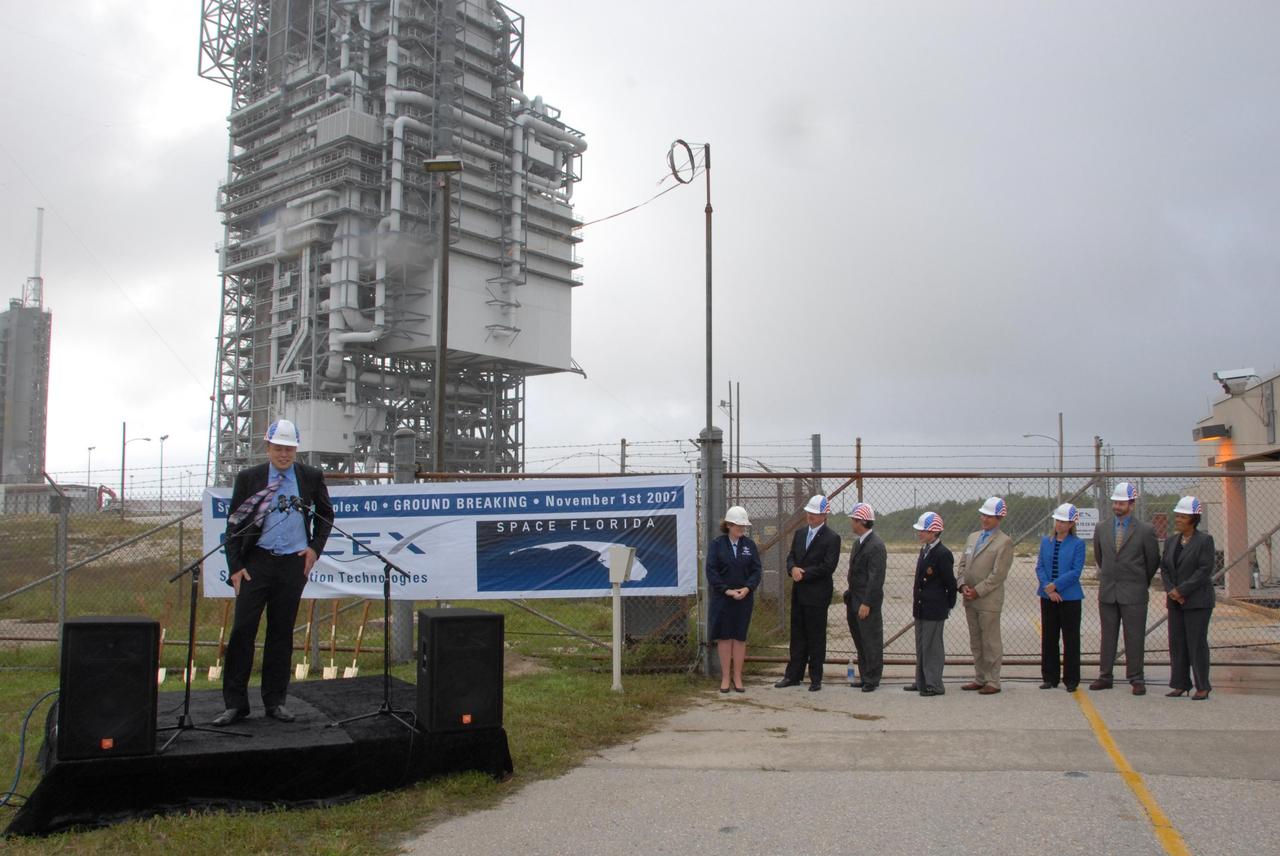
KENNEDY SPACE CENTER, FLA. -- At ground-breaking ceremonies for SpaceX's new Falcon 9 rocket launch facilities at Space Launch Complex 40 at Cape Canaveral, Elon Musk, founder and CEO of Space Exploration Technologies, talks about opportunity for both SpaceX and the 45th Space Wing that the new facility will provide. As part of NASA’s Commercial Orbital Transportation Services, or COTS, competition, SpaceX will launch a Falcon 9 with a cargo-carrying payload on a series of three demonstration missions from Cape Canaveral to the International Space Station, culminating with the delivery of supplies to the $100 billion dollar orbiting laboratory. SpaceX intends to demonstrate its launch, maneuvering, berthing and return abilities by 2009 – a year before NASA has scheduled the conclusion of Space Shuttle operations. Photo credit: NASA/George Shelton
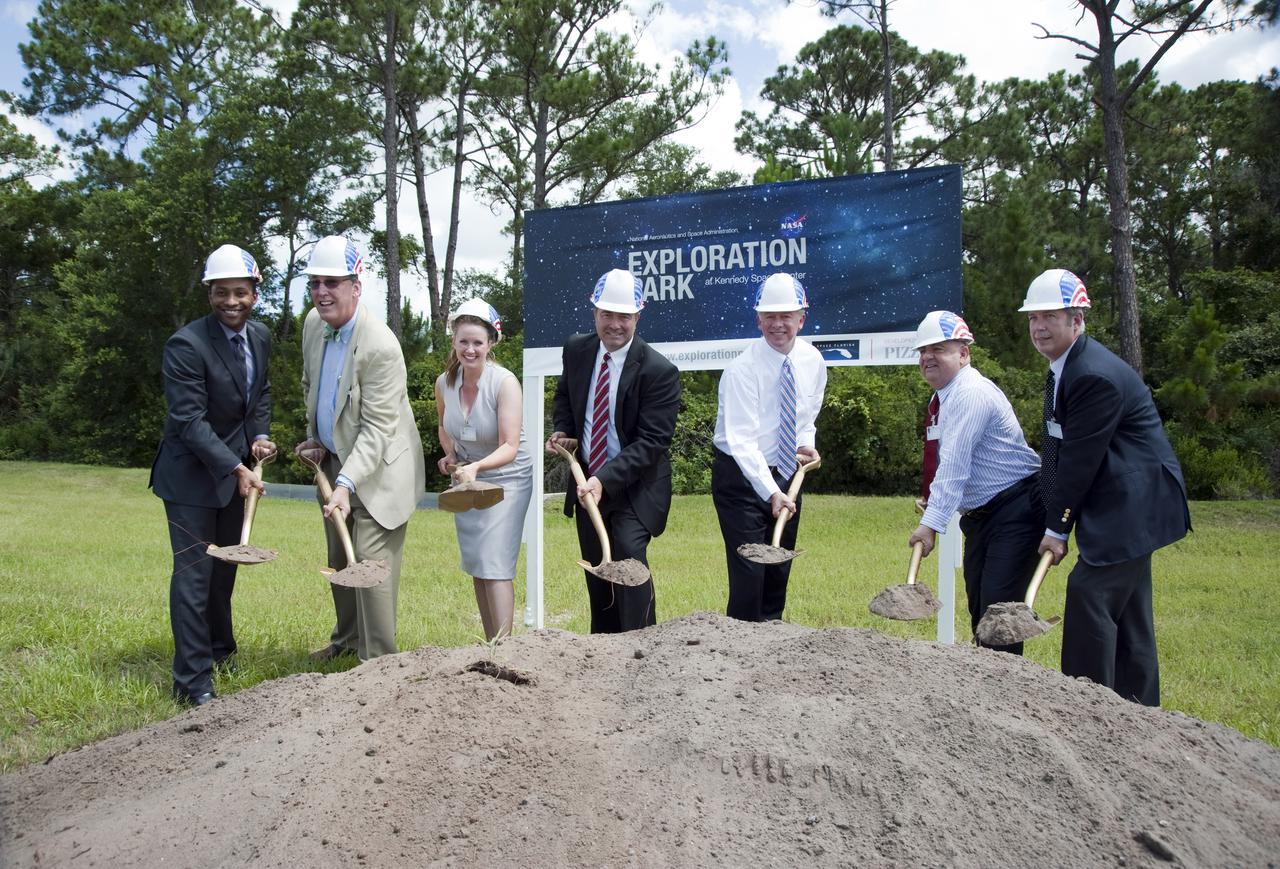
CAPE CANAVERAL, Fla. – At NASA's Kennedy Space Center in Florida, The Pizzuti Companies Naeem Coleman, left, Mike Bird, Stephanie Moreton and Tom Harmer, Florida Lt. Gov. Jeff Kottkamp, and The Pizzuti Companies Ron Pizzuti and Jim Russell break ground on Exploration Park outside of the Space Life Sciences Laboratory, or SLSL. Exploration Park is designed to be a strategically located complex, adjacent to the SLSL, for servicing diverse tenants and uses that will engage in activities to support space-related activities of NASA, other government agencies and the U.S. commercial space industry, as well as bring new aerospace work to the Space Coast. The SLSL will be the anchor facility for the park, which is expected to open its first new facility in early 2012. Photo Credit: NASA_Kim Shiflett
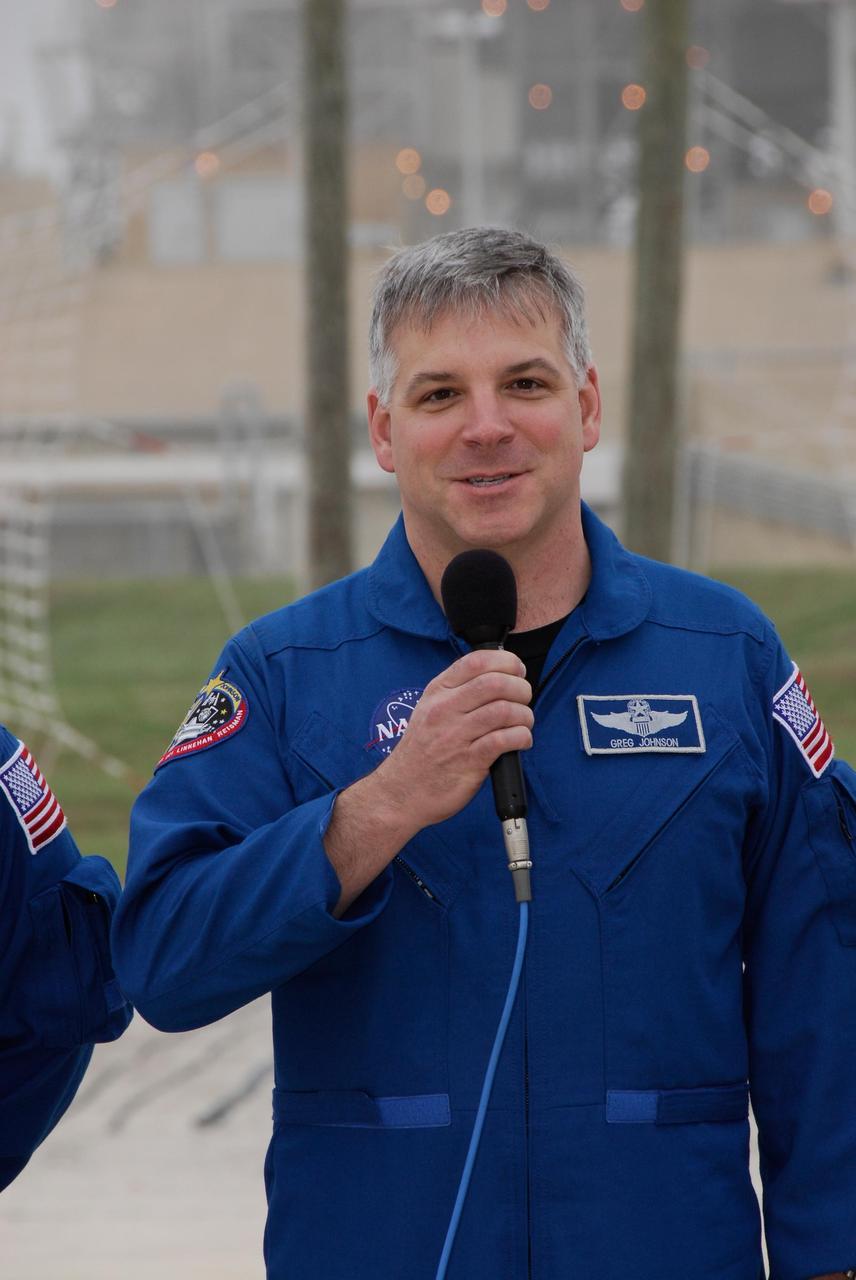
KENNEDY SPACE CENTER, FLA. -- At NASA Kennedy Space Center's Launch Pad 39A, the pilot of space shuttle Endeavour's STS-123 mission, Gregory H. Johnson, answers a question from the media during a break from emergency egress training. The crew is at Kennedy for a full launch dress rehearsal, known as the terminal countdown demonstration test or TCDT. The terminal countdown demonstration test provides astronauts and ground crews with an opportunity to participate in various simulated countdown activities, including equipment familiarization and emergency training. Endeavour is targeted to launch March 11 at 2:28 a.m. EDT on a 16-day mission to the International Space Station. On the mission, Endeavour and its crew will deliver the first section of the Japan Aerospace Exploration Agency's Kibo laboratory and the Canadian Space Agency's two-armed robotic system, Dextre. Photo credit: NASA/Kim Shiflett
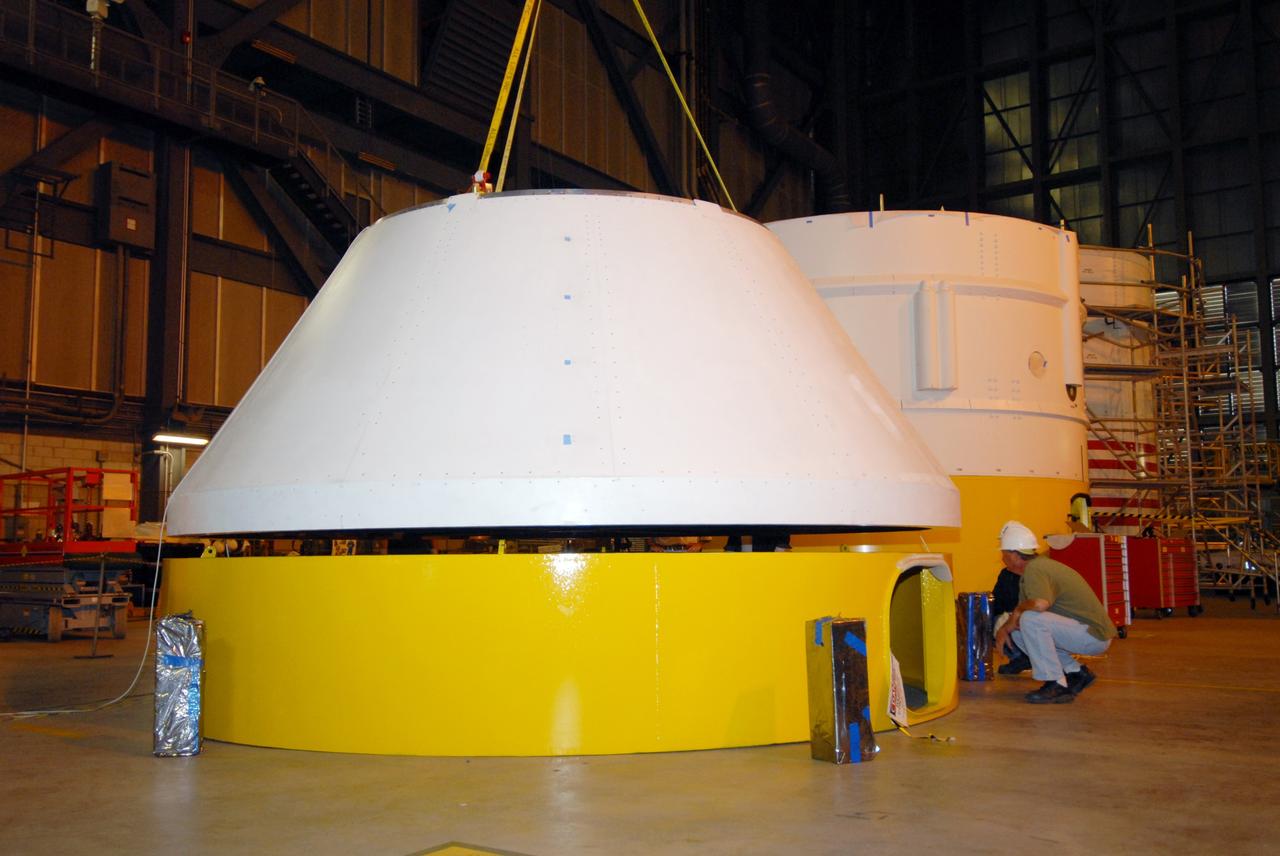
CAPE CANAVERAL, Fla. – In high bay 4 of the Vehicle Assembly Building at NASA's Kennedy Space Center, workers lift the Ares I-X crew module mock-up from a work stand for a fit check with a mock-up of the service module. When fully developed, the 16-foot diameter crew module will furnish living space and reentry protection for future astronauts, and the service module’s main engine will be used to break out of lunar orbit for the return trip to Earth. Ares I-X is the test flight for the Ares I, which is part of the Constellation Program to return men to the moon and beyond. The I-X flight will provide NASA an early opportunity to test and prove hardware, facilities and ground operations associated with Ares I launches. Targeted for the summer of 2009, the launch of the full-scale Ares I-X will be the first in a series of unpiloted rocket launches from Kennedy. Photo credit: NASA/Jack Pfaller
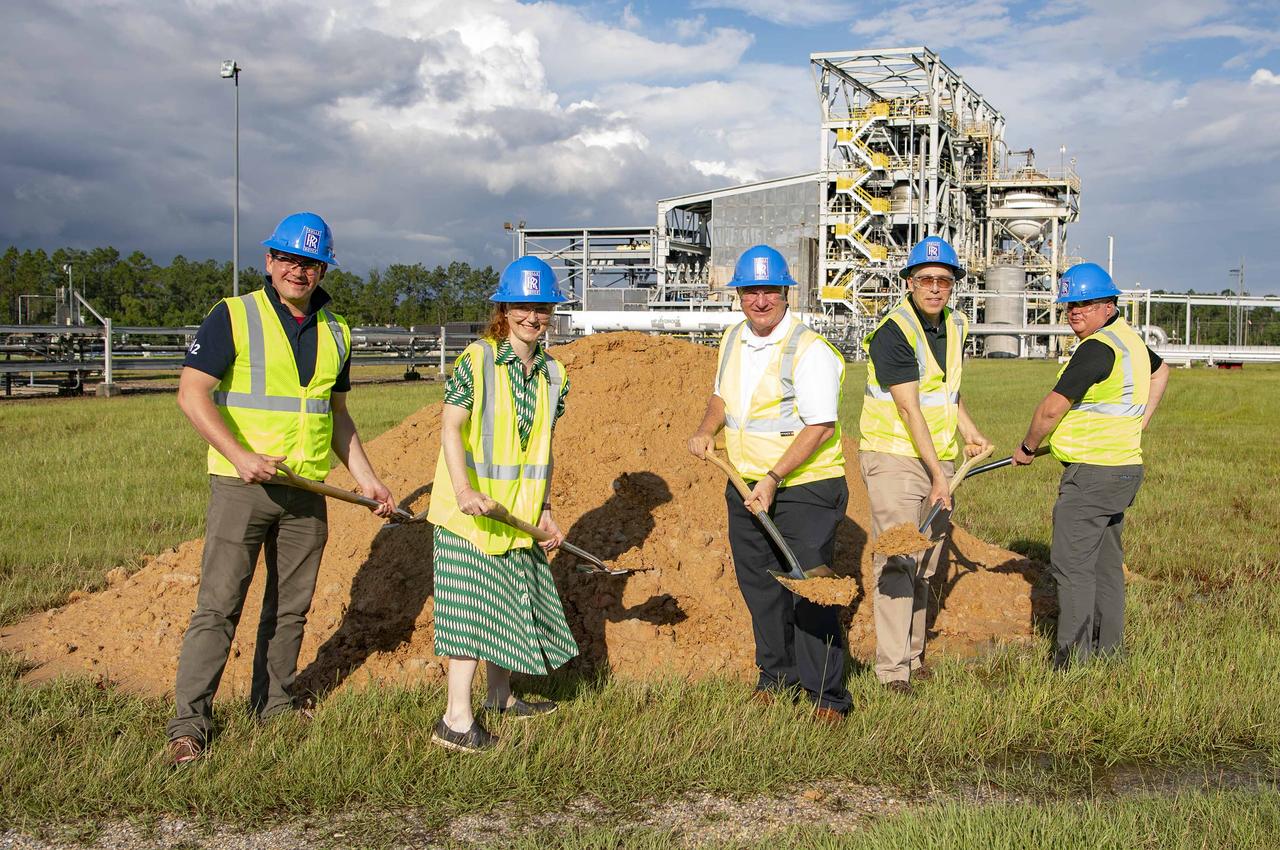
: NASA’s Stennis Space Center continues to support commercial companies and benefit the aerospace industry. The latest example comes as officials from NASA Stennis and Rolls-Royce break ground for the E-1 Hydrogen Test Pad, located at the NASA Stennis E-Complex Test Facility, during a June 27 ceremony. The site will be where Rolls-Royce conducts hydrogen testing for the Pearl 15 engine. The Pearl 15 engine helps power the Bombardier Global 5500 & 6500 aircraft and enables top speeds of Mach 0.90. Groundbreaking participants include (left to right): Adam Newman, Rolls-Royce chief engineer of hydrogen technology; Deborah Robinson, Rolls-Royce director of test and experimental engineering; Troy Frisbie, NASA Stennis legislative affairs specialist and chief of staff; Dan Lyon, Rolls-Royce North America general manager; and Steven Blake, Rolls-Royce North America indirect purchasing, global commodity manager.
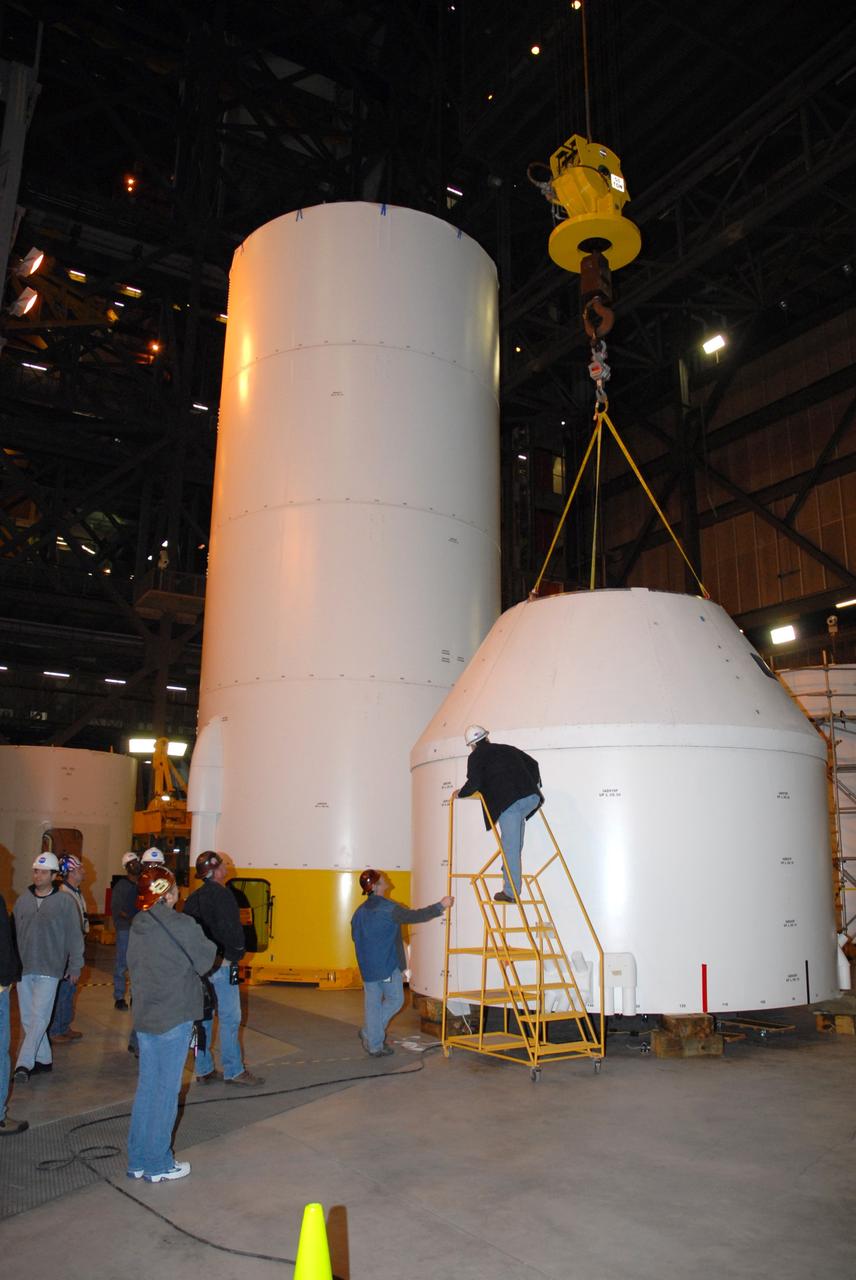
CAPE CANAVERAL, Fla. – In high bay 4 of the Vehicle Assembly Building at NASA's Kennedy Space Center, the Ares I-X crew module mock-up is positioned onto a mock-up of the service module to determine that the pieces of hardware are a perfect fit. When fully developed, the 16-foot diameter crew module will furnish living space and reentry protection for future astronauts, and the service module’s main engine will be used to break out of lunar orbit for the return trip to Earth. Ares I-X is the test flight for the Ares I, which is part of the Constellation Program to return men to the moon and beyond. The I-X flight will provide NASA an early opportunity to test and prove hardware, facilities and ground operations associated with Ares I launches. Targeted for the summer of 2009, the launch of the full-scale Ares I-X will be the first in a series of unpiloted rocket launches from Kennedy. Photo credit: NASA/Jack Pfaller
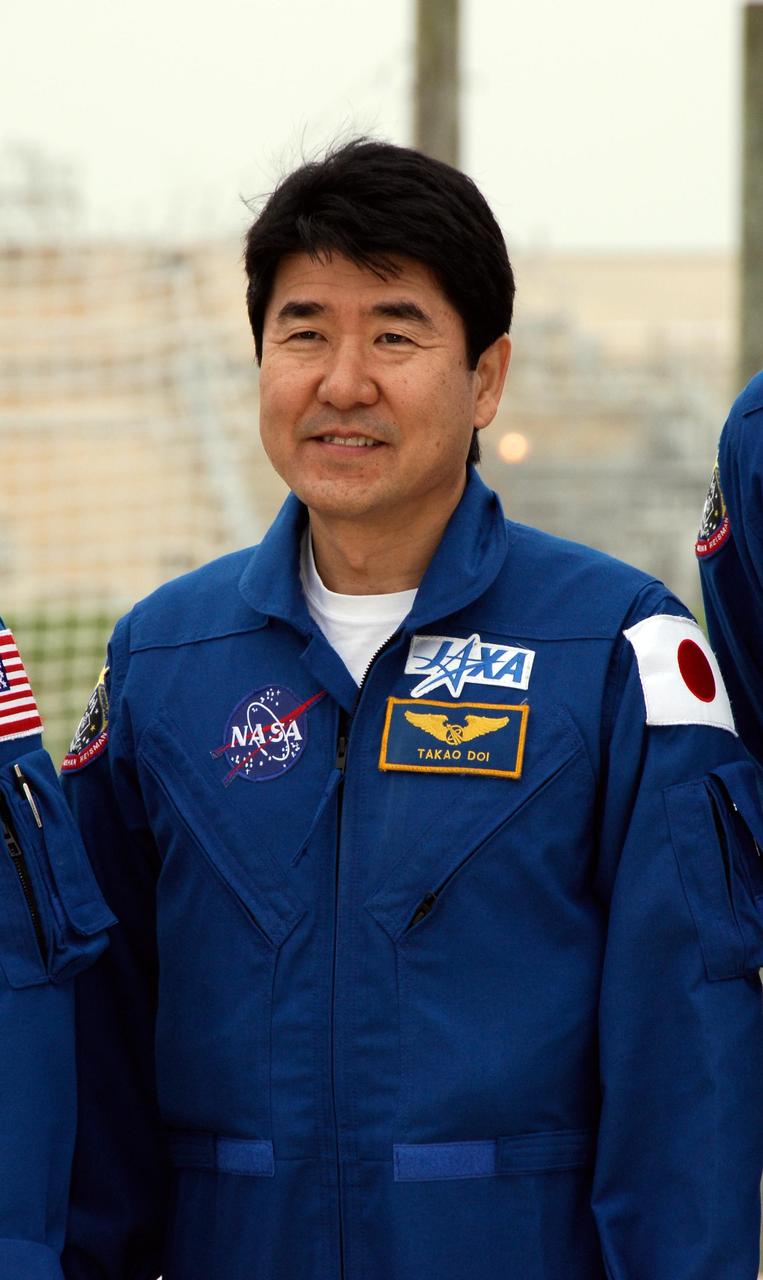
KENNEDY SPACE CENTER, FLA. -- At NASA Kennedy Space Center's Launch Pad 39A, a mission specialist on space shuttle Endeavour's STS-123 mission, Takao Doi of the Japan Aerospace Exploration Agency, prepares to take questions from the media during a break from emergency egress training. The crew is at Kennedy for a full launch dress rehearsal, known as the terminal countdown demonstration test or TCDT. The terminal countdown demonstration test provides astronauts and ground crews with an opportunity to participate in various simulated countdown activities, including equipment familiarization and emergency training. Endeavour is targeted to launch March 11 at 2:28 a.m. EDT on a 16-day mission to the International Space Station. On the mission, Endeavour and its crew will deliver the first section of the Japan Aerospace Exploration Agency's Kibo laboratory and the Canadian Space Agency's two-armed robotic system, Dextre. Photo credit: NASA/Kim Shiflett

Leaders from NASA’s Kennedy Space Center in Florida and the Kennedy Space Center Visitor Complex break ground on a new attraction at the complex on Thursday, May 14, 2026. From left to right, Therrin Protze, chief operating officer, Kennedy Space Center Visitor Complex; Jack McNeill, chief corporate affairs officer, Delaware North Parks and Resorts; Derek Zwickey, chief operating officer, Delaware North Parks and Resorts; Scott Socha, president, Delaware North Parks and Resorts and Delaware North Australia; Kelvin Manning deputy director, NASA Kennedy Space Center; Jennifer Kunz, associate director, technical, NASA Kennedy Space Center; Burt Summerfield, associate director, management, NASA Kennedy Space Center; and Kimberlyn Carter, director, Center Engagement and Business integration Services, NASA Kennedy Space Center. The attraction, south of the Space Shuttle Atlantis building, is slated to open in early 2028.

KENNEDY SPACE CENTER, FLA. -- At ground-breaking ceremonies for SpaceX's new Falcon 9 rocket launch facilities at Space Launch Complex 40 at Cape Canaveral, Brig. Gen. Susan J. Helms (left) talks about the opportunity for both SpaceX and the 45th Space Wing. As part of NASA’s Commercial Orbital Transportation Services, or COTS, competition, SpaceX will launch a Falcon 9 with a cargo-carrying payload on a series of three demonstration missions from Cape Canaveral to the International Space Station, culminating with the delivery of supplies to the $100 billion dollar orbiting laboratory. SpaceX intends to demonstrate its launch, maneuvering, berthing and return abilities by 2009 – a year before NASA has scheduled the conclusion of Space Shuttle operations. Photo credit: NASA/George Shelton
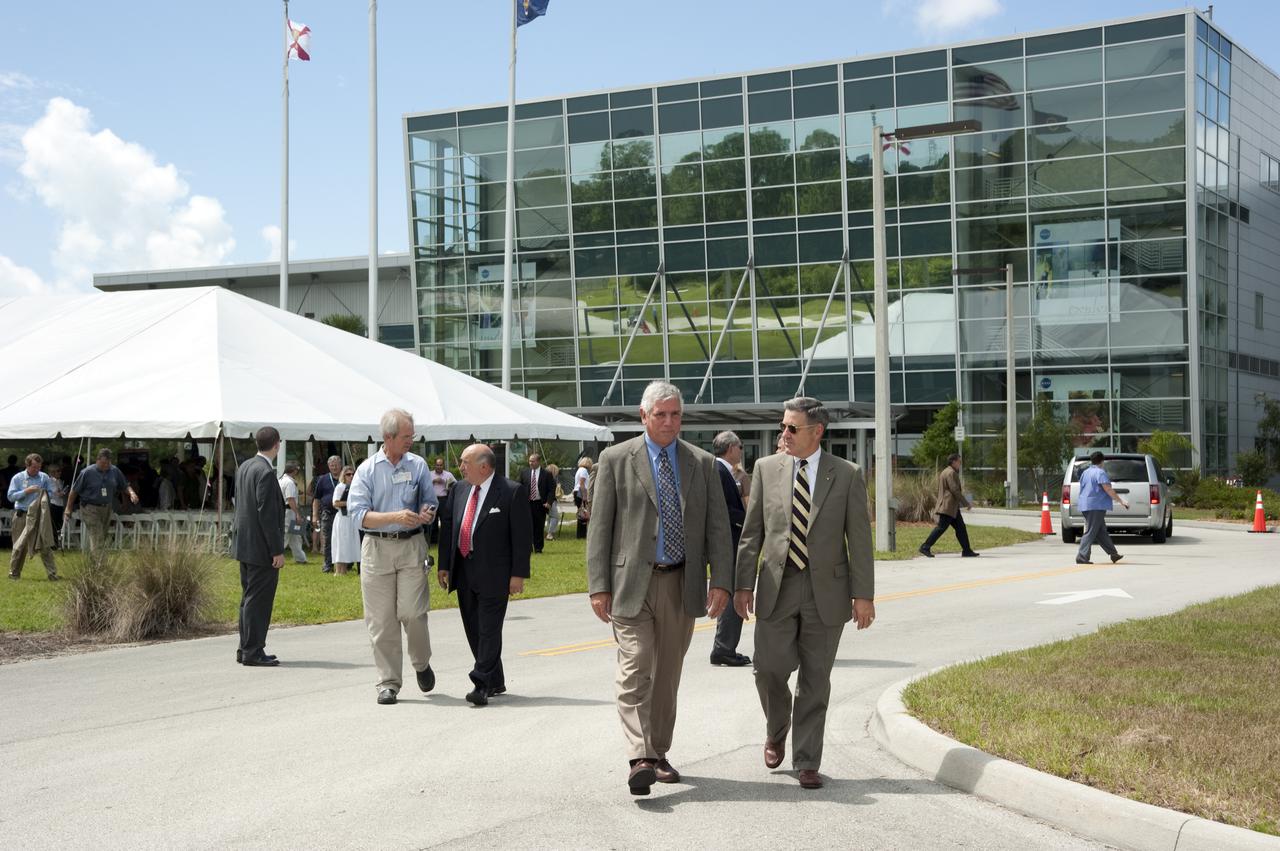
CAPE CANAVERAL, Fla. – At NASA's Kennedy Space Center in Florida, Kennedy Center Director Bob Cabana, right, walks with Program Manager for Strategic Partnerships at Kennedy Jim Ball to the ground breaking site of Exploration Park outside of the Space Life Sciences Laboratory, or SLSL. To their left, are The Pizzuti Companies Chairman and CEO Ron Pizzuti and Patrick Peterson, a space reporter with Florida Today. Exploration Park is designed to be a strategically located complex, adjacent to the SLSL, for servicing diverse tenants and uses that will engage in activities to support space-related activities of NASA, other government agencies and the U.S. commercial space industry, as well as bring new aerospace work to the Space Coast. The SLSL will be the anchor facility for the park, which is expected to open its first new facility in early 2012. Photo Credit: NASA_Kim Shiflett
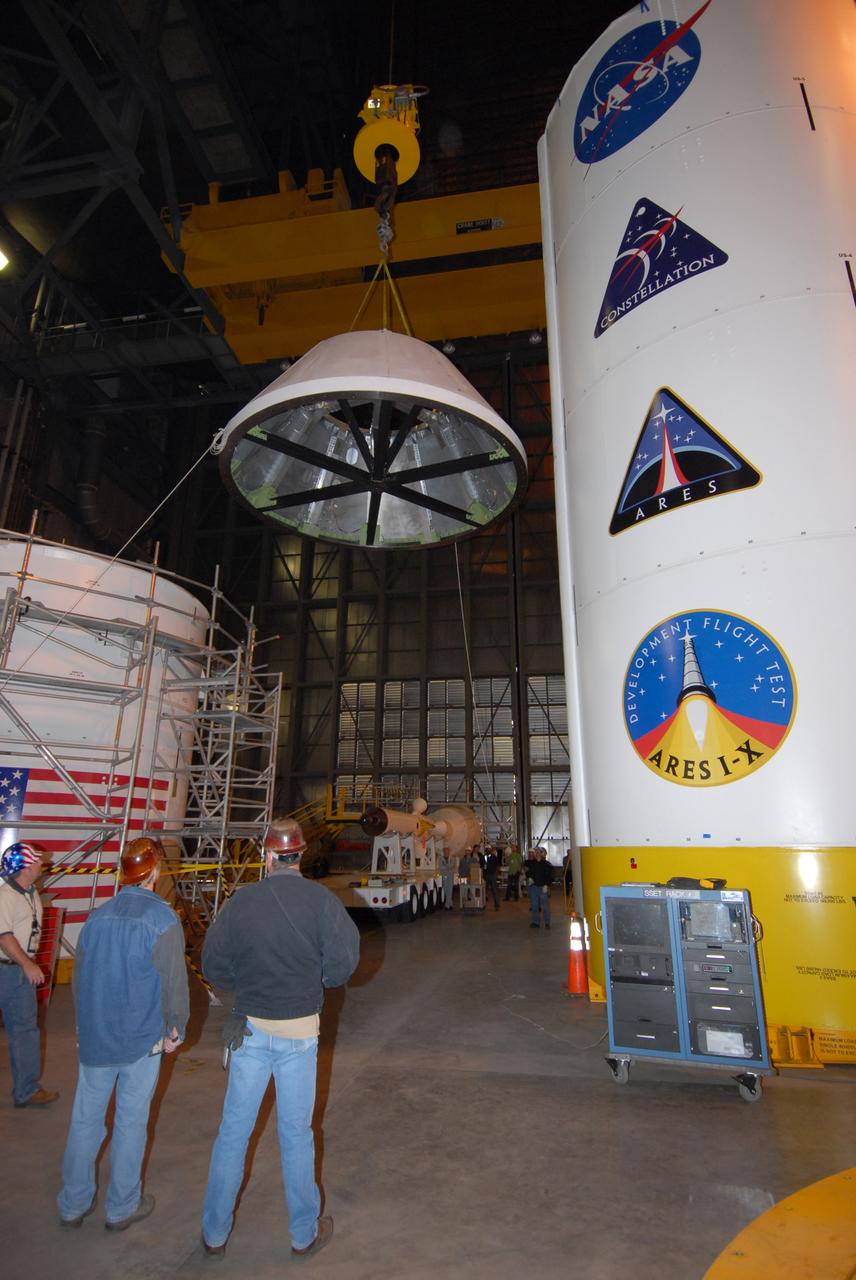
CAPE CANAVERAL, Fla. – In high bay 4 of the Vehicle Assembly Building at NASA's Kennedy Space Center, the Ares I-X crew module mock-up hangs suspended from a crane as it is moved for a fit check with a mock-up of the service module. When fully developed, the 16-foot diameter crew module will furnish living space and reentry protection for future astronauts, and the service module’s main engine will be used to break out of lunar orbit for the return trip to Earth. Ares I-X is the test flight for the Ares I, which is part of the Constellation Program to return men to the moon and beyond. The I-X flight will provide NASA an early opportunity to test and prove hardware, facilities and ground operations associated with Ares I launches. Targeted for the summer of 2009, the launch of the full-scale Ares I-X will be the first in a series of unpiloted rocket launches from Kennedy. Photo credit: NASA/Jack Pfaller
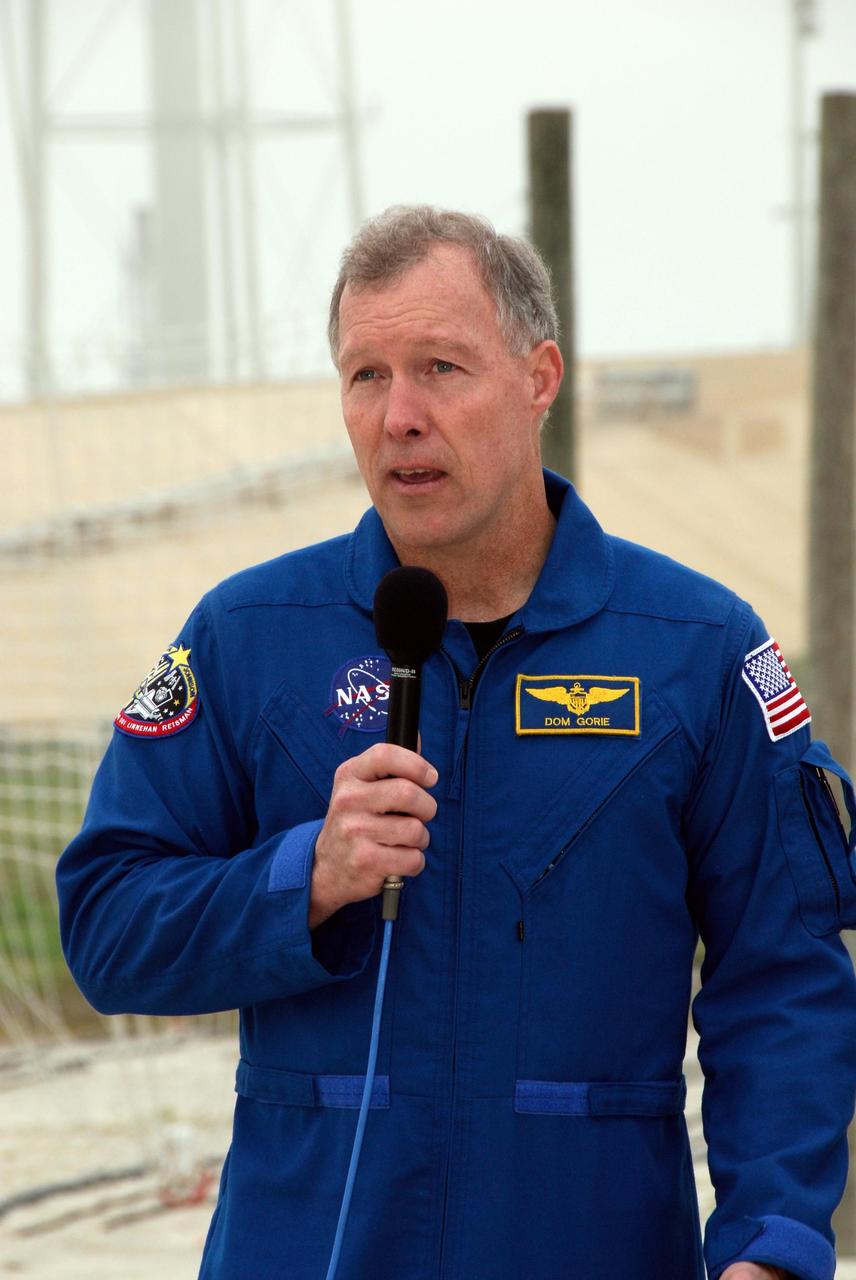
KENNEDY SPACE CENTER, FLA. -- At NASA Kennedy Space Center's Launch Pad 39A, the commander of space shuttle Endeavour's STS-123 mission, Dominic Gorie, answers a question from the media during a break from emergency egress training. The crew is at Kennedy for a full launch dress rehearsal, known as the terminal countdown demonstration test or TCDT. The terminal countdown demonstration test provides astronauts and ground crews with an opportunity to participate in various simulated countdown activities, including equipment familiarization and emergency training. Endeavour is targeted to launch March 11 at 2:28 a.m. EDT on a 16-day mission to the International Space Station. On the mission, Endeavour and its crew will deliver the first section of the Japan Aerospace Exploration Agency's Kibo laboratory and the Canadian Space Agency's two-armed robotic system, Dextre. Photo credit: NASA/Kim Shiflett
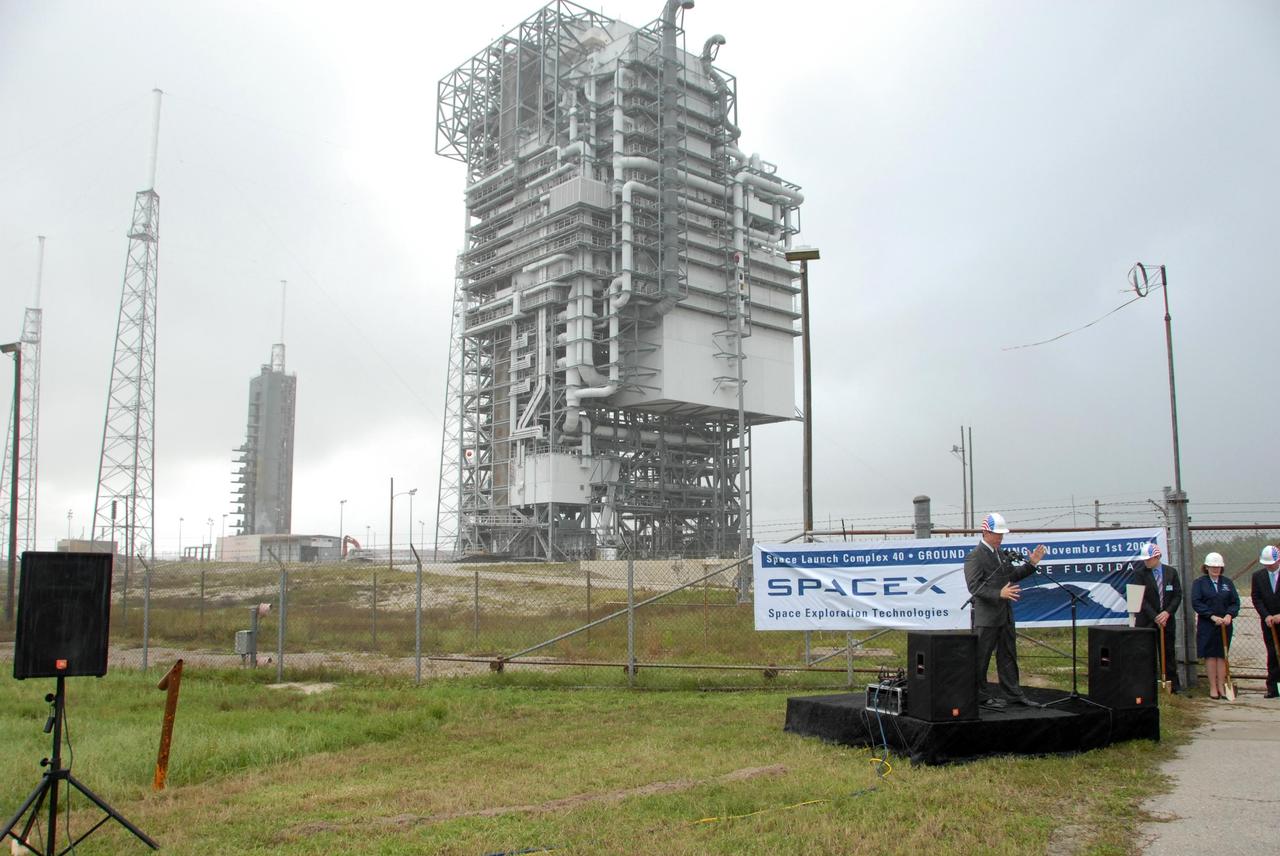
KENNEDY SPACE CENTER, FLA. -- At ground-breaking ceremonies for SpaceX's new Falcon 9 rocket launch facilities at Space Launch Complex 40 at Cape Canaveral, Steve Koehler, president of Space Florida, talks about the opportunity for both SpaceX and the 45th Space Wing that the new facility will provide As part of NASA’s Commercial Orbital Transportation Services, or COTS, competition, SpaceX will launch a Falcon 9 with a cargo-carrying payload on a series of three demonstration missions from Cape Canaveral to the International Space Station, culminating with the delivery of supplies to the $100 billion dollar orbiting laboratory. SpaceX intends to demonstrate its launch, maneuvering, berthing and return abilities by 2009 – a year before NASA has scheduled the conclusion of Space Shuttle operations. Photo credit: NASA/George Shelton
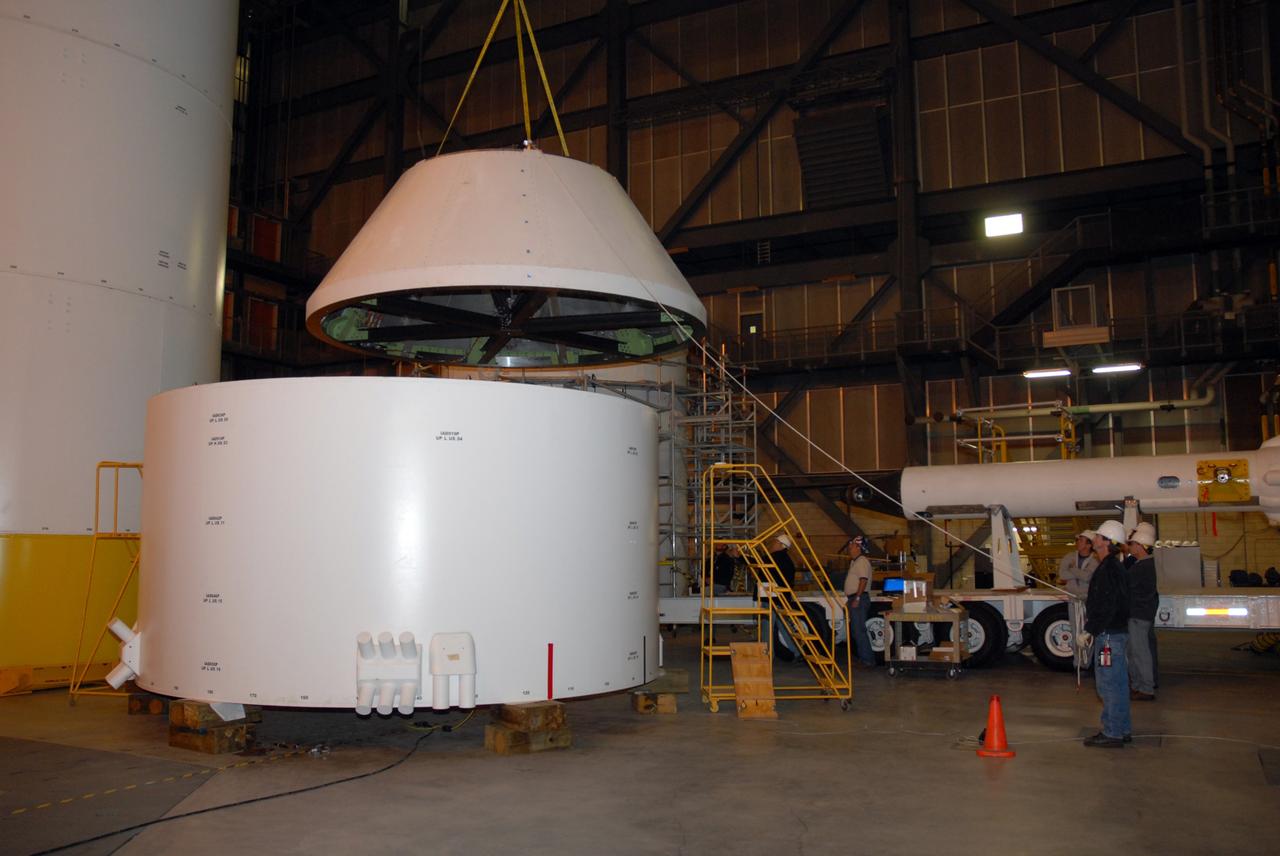
CAPE CANAVERAL, Fla. – In high bay 4 of the Vehicle Assembly Building at NASA's Kennedy Space Center, workers lower the Ares I-X crew module mock-up onto a mock-up of the service module during a fit check of the hardware. When fully developed, the 16-foot diameter crew module will furnish living space and reentry protection for future astronauts, and the service module’s main engine will be used to break out of lunar orbit for the return trip to Earth. Ares I-X is the test flight for the Ares I, which is part of the Constellation Program to return men to the moon and beyond. The I-X flight will provide NASA an early opportunity to test and prove hardware, facilities and ground operations associated with Ares I launches. Targeted for the summer of 2009, the launch of the full-scale Ares I-X will be the first in a series of unpiloted rocket launches from Kennedy. Photo credit: NASA/Jack Pfaller
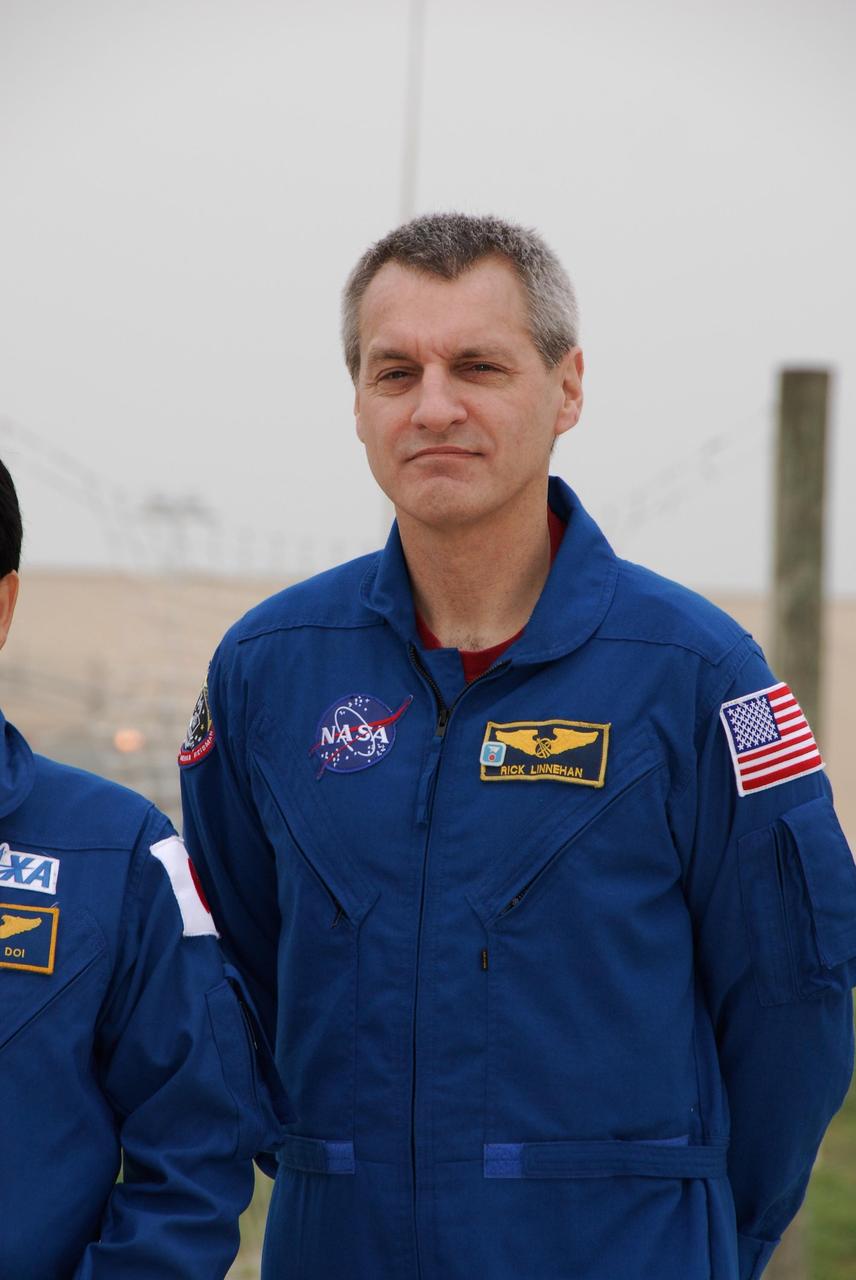
KENNEDY SPACE CENTER, FLA. -- At NASA Kennedy Space Center's Launch Pad 39A, a mission specialist on space shuttle Endeavour's STS-123 mission, Rick Linnehan, prepares to take questions from the media during a break from emergency egress training. The crew is at Kennedy for a full launch dress rehearsal, known as the terminal countdown demonstration test or TCDT. The terminal countdown demonstration test provides astronauts and ground crews with an opportunity to participate in various simulated countdown activities, including equipment familiarization and emergency training. Endeavour is targeted to launch March 11 at 2:28 a.m. EDT on a 16-day mission to the International Space Station. On the mission, Endeavour and its crew will deliver the first section of the Japan Aerospace Exploration Agency's Kibo laboratory and the Canadian Space Agency's two-armed robotic system, Dextre. Photo credit: NASA/Kim Shiflett
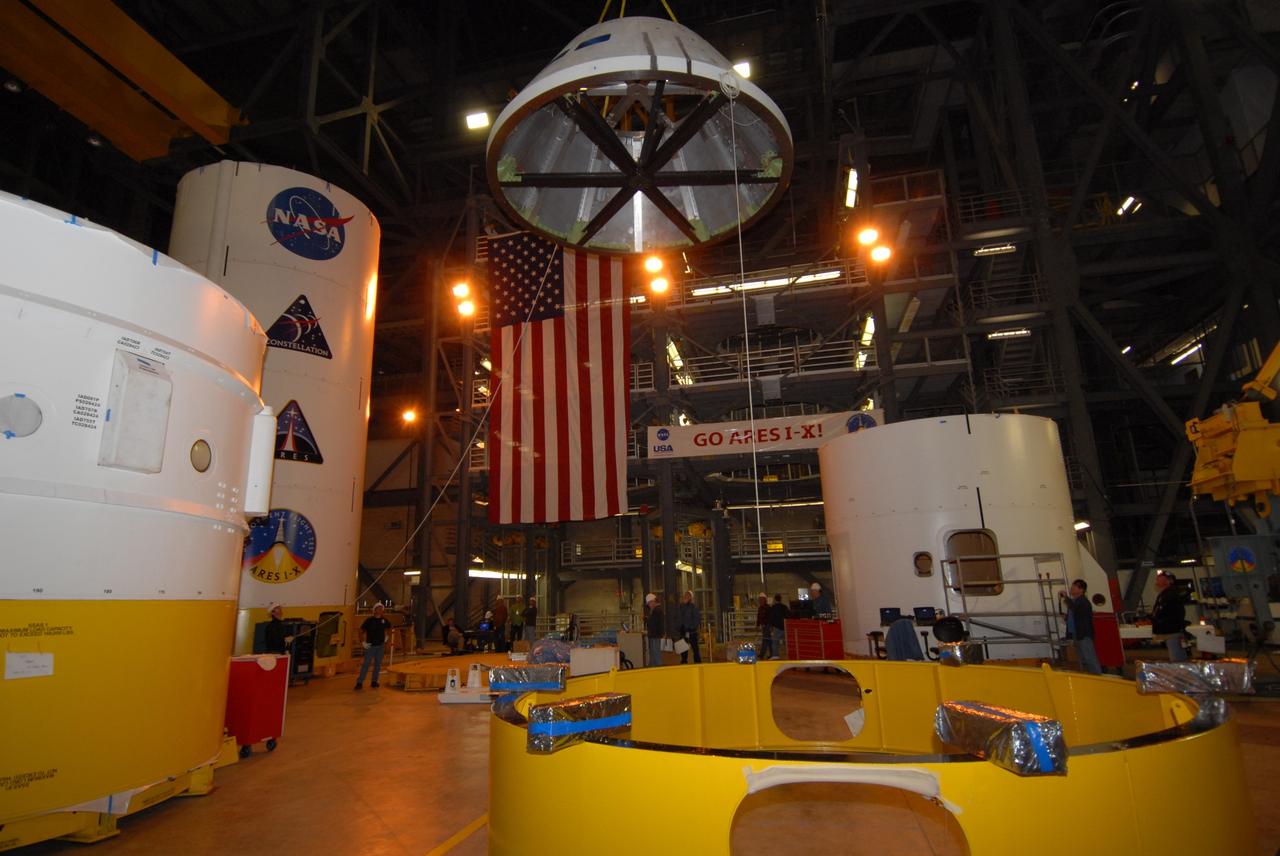
CAPE CANAVERAL, Fla. – In high bay 4 of the Vehicle Assembly Building at NASA's Kennedy Space Center, workers lift the Ares I-X crew module mock-up during a fit check with a mock-up of the service module. When fully developed, the 16-foot diameter crew module will furnish living space and reentry protection for future astronauts, and the service module’s main engine will be used to break out of lunar orbit for the return trip to Earth. Ares I-X is the test flight for the Ares I, which is part of the Constellation Program to return men to the moon and beyond. The I-X flight will provide NASA an early opportunity to test and prove hardware, facilities and ground operations associated with Ares I launches. Targeted for the summer of 2009, the launch of the full-scale Ares I-X will be the first in a series of unpiloted rocket launches from Kennedy. Photo credit: NASA/Jack Pfaller
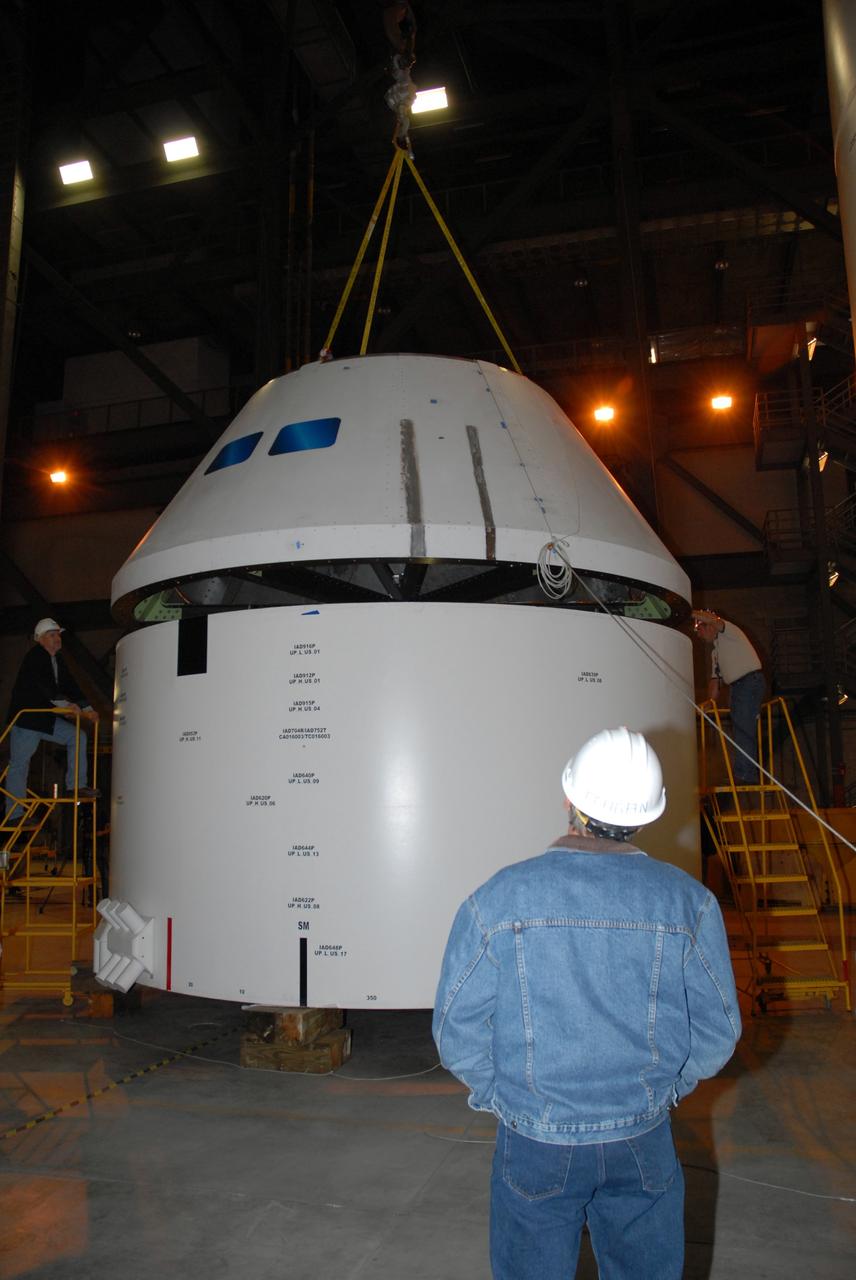
CAPE CANAVERAL, Fla. – In high bay 4 of the Vehicle Assembly Building at NASA's Kennedy Space Center, workers position the Ares I-X crew module mock-up onto a mock-up of the service module during a fit check of the hardware. When fully developed, the 16-foot diameter crew module will furnish living space and reentry protection for future astronauts, and the service module’s main engine will be used to break out of lunar orbit for the return trip to Earth. Ares I-X is the test flight for the Ares I, which is part of the Constellation Program to return men to the moon and beyond. The I-X flight will provide NASA an early opportunity to test and prove hardware, facilities and ground operations associated with Ares I launches. Targeted for the summer of 2009, the launch of the full-scale Ares I-X will be the first in a series of unpiloted rocket launches from Kennedy. Photo credit: NASA/Jack Pfaller
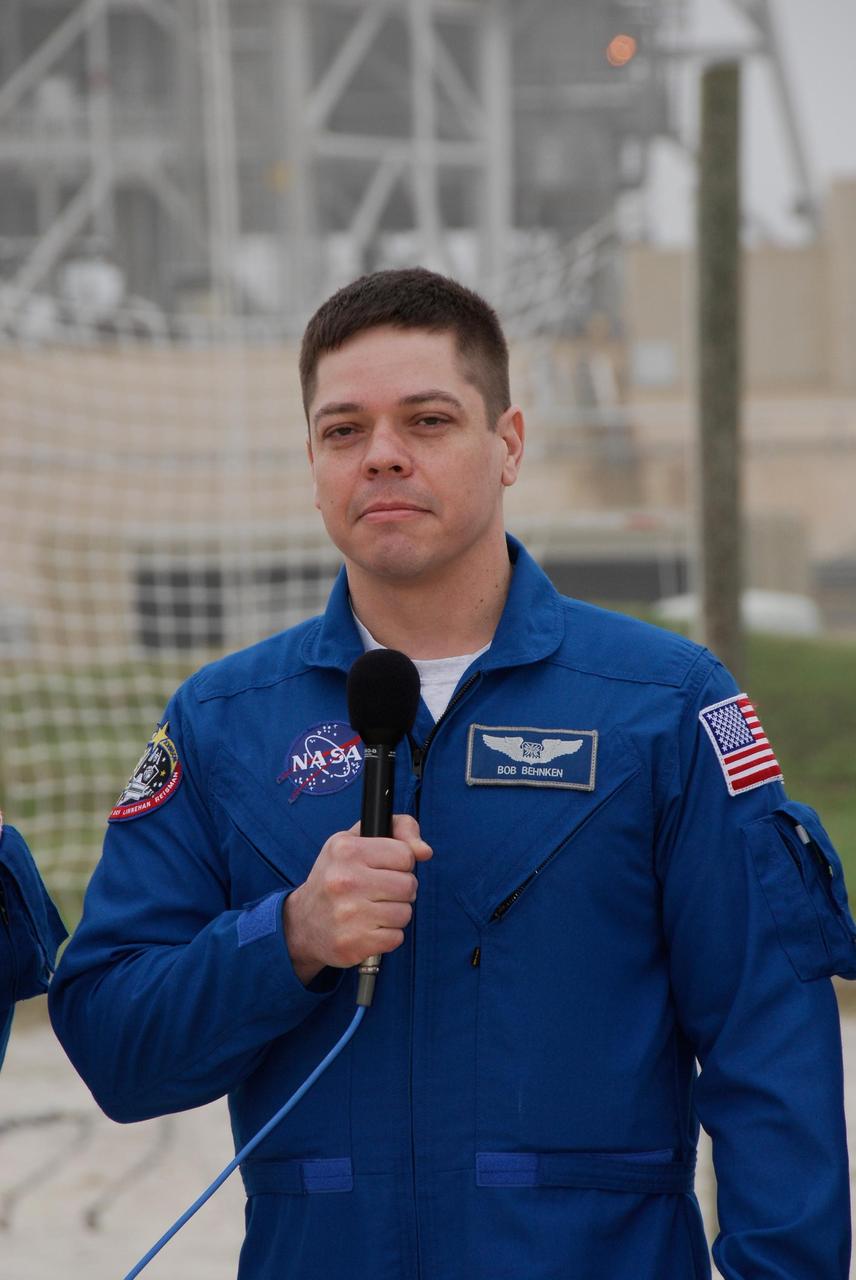
KENNEDY SPACE CENTER, FLA. -- At NASA Kennedy Space Center's Launch Pad 39A, a mission specialist on space shuttle Endeavour's STS-123 mission, Robert L. Behnken, answers a question from the media during a break from emergency egress training. The crew is at Kennedy for a full launch dress rehearsal, known as the terminal countdown demonstration test or TCDT. The terminal countdown demonstration test provides astronauts and ground crews with an opportunity to participate in various simulated countdown activities, including equipment familiarization and emergency training. Endeavour is targeted to launch March 11 at 2:28 a.m. EDT on a 16-day mission to the International Space Station. On the mission, Endeavour and its crew will deliver the first section of the Japan Aerospace Exploration Agency's Kibo laboratory and the Canadian Space Agency's two-armed robotic system, Dextre. Photo credit: NASA/Kim Shiflett
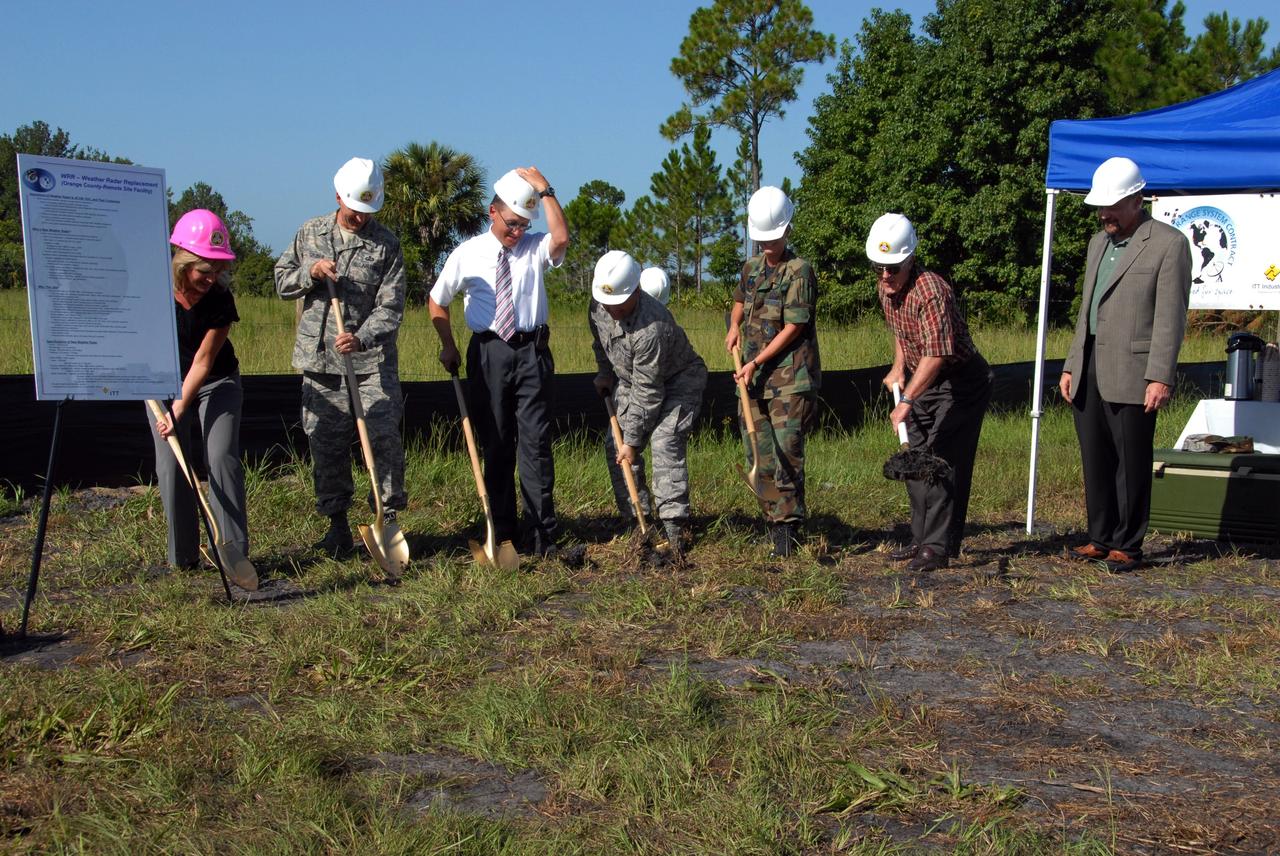
CAPE CANAVERAL, Fla. - Breaking ground in a mock ceremony for a new weather radar site are (left to right) Project Lead Kim Gwaltney, with SLRSC; 45th Space Wing Operations Group Commander Col. Bernard Gruber; Range Systems Support Manager Walt Danewood; Lt. Col. Stacy Exum with the 45th Space Wing; Lt. Col. Jennifer Alexander with the 45th Space Wing; Harry Earl with Heard Construction and Pat Carr, SLRSC program director with ITT. The site will be used by NASA's Kennedy Space Center, the 45th Space Wing and their customers. The weather radar is essential in issuing lightning and other severe weather warnings and vital in evaluating lightning launch commit criteria. The new radar, replacing what was installed 25 years ago, includes Doppler capability to detect winds and identify the type, size and number of precipitation particles. The site is ideally distant from the launch pads and has unobstructed views of Cape Canaveral Air Force Station and Kennedy. Photo credit: NASA/Amanda Diller
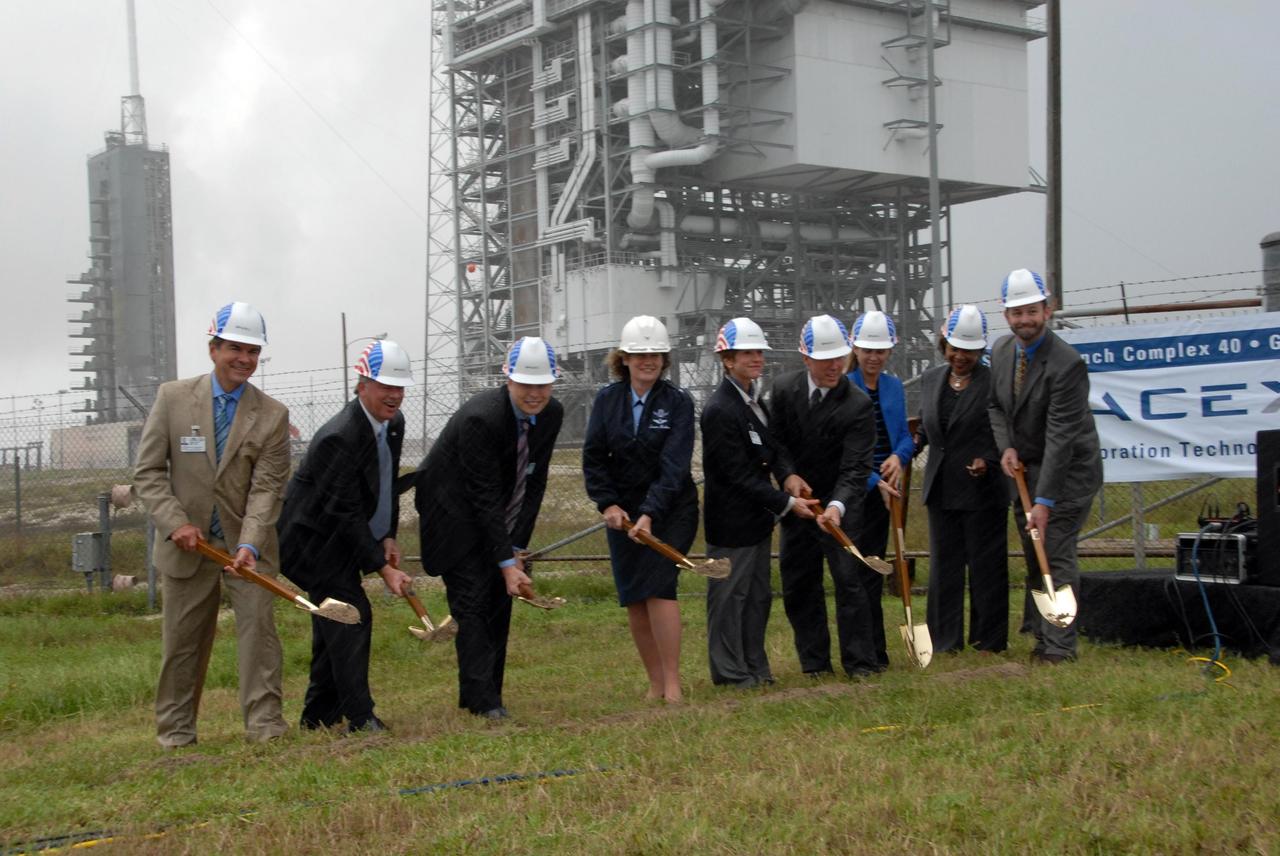
KENNEDY SPACE CENTER, FLA. -- Ready to put spades to work at ground-breaking ceremonies for SpaceX's new Falcon 9 rocket launch facilities at Space Launch Complex 40 at Cape Canaveral are (from left) Thad Altman, Florida State representative; Jeff Kottkamp, Florida State Lt. Governor; Elon Musk, founder and CEO of Space Exploration Technologies; Brig. Gen. Susan J. Helms, commander of the U.S. Air Force 45th Space Wing; Lynda Weatherman, Brevard County Economic Development Commission CEO and president; Steve Koehler, president of Space Florida; Janet Petro, deputy director of NASA Kennedy Space Center; Patricia Grace Smith, FAA associate administrator for Commercial Space Transportation; and Steve Cain, NASA Kennedy Space Center COTS project manager. As part of NASA’s Commercial Orbital Transportation Services, or COTS, competition, SpaceX will launch a Falcon 9 with a cargo-carrying payload on a series of three demonstration missions from Cape Canaveral to the International Space Station, culminating with the delivery of supplies to the $100 billion dollar orbiting laboratory. SpaceX intends to demonstrate its launch, maneuvering, berthing and return abilities by 2009 – a year before NASA has scheduled the conclusion of Space Shuttle operations. Photo credit: NASA/George Shelton
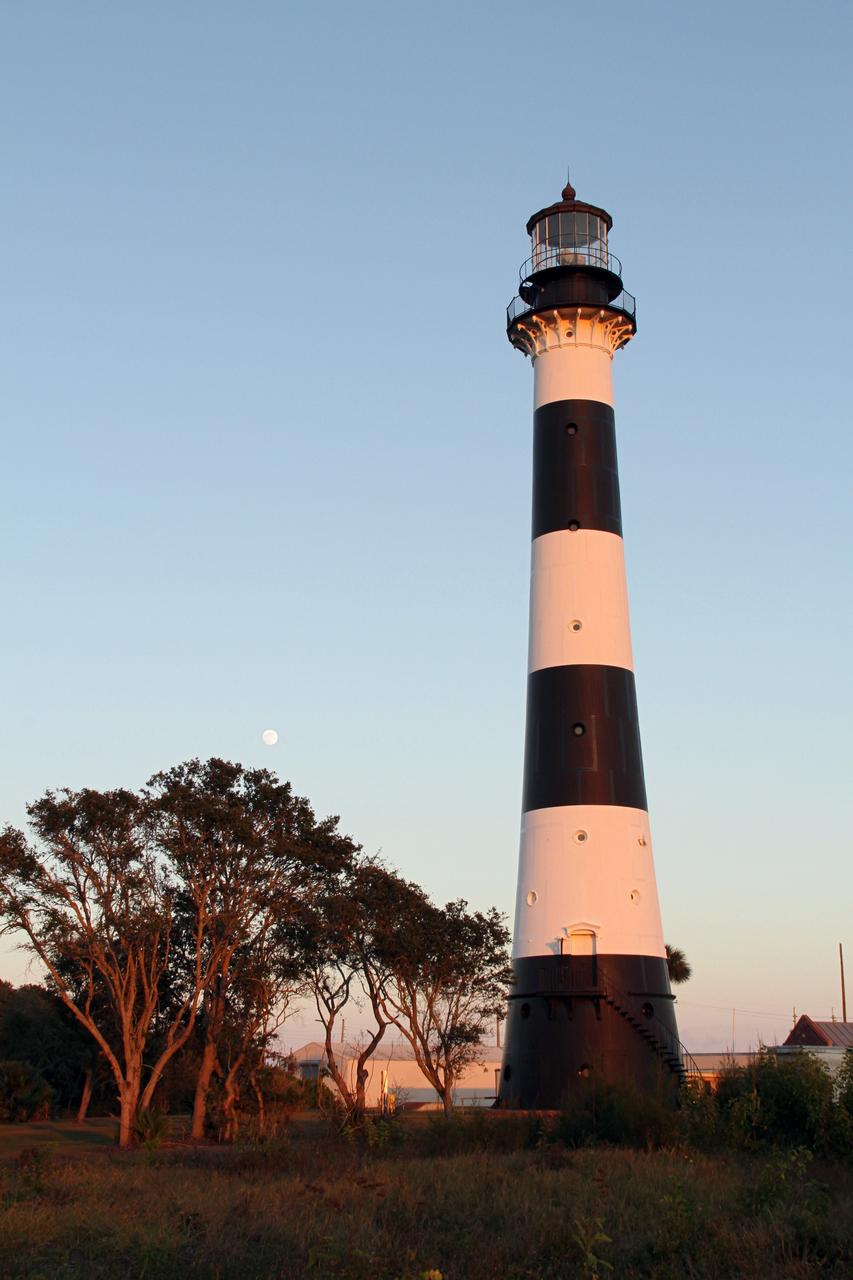
CAPE CANAVERAL AIR FORCE STATION, Fla. – The Cape Canaveral Air Force Station lighthouse takes on a warm glow as dawn breaks and a full moon still shines in the background. The Canaveral light is the only one owned by the U.S. Air Force. In 2000, the Coast Guard transferred ownership of the lighthouse structure and its grounds to the Air Force, which is now responsible for maintaining it. The U.S. Coast Guard continues to operate the beacon as an active navigational aid. The first lighthouse at Cape Canaveral was built near the tip of the Cape in 1848. The structure was only about 60 feet high with a rather dim light powered by whale oil. In 1859, work began nearby on a new, taller iron structure. Construction was halted during the Civil War, and the lighthouse finally was finished in 1868. The structure, with a brick lining inside its iron exterior, was painted with its "daymark" black and white horizontal bands in 1873 to make it easier to identify during the day as a navigation point. Between 1892 and 1894, the lighthouse was dismantled and moved to its new home about a mile from the coast, where it stands today. Photo credit: NASA/Ben Smegelsky
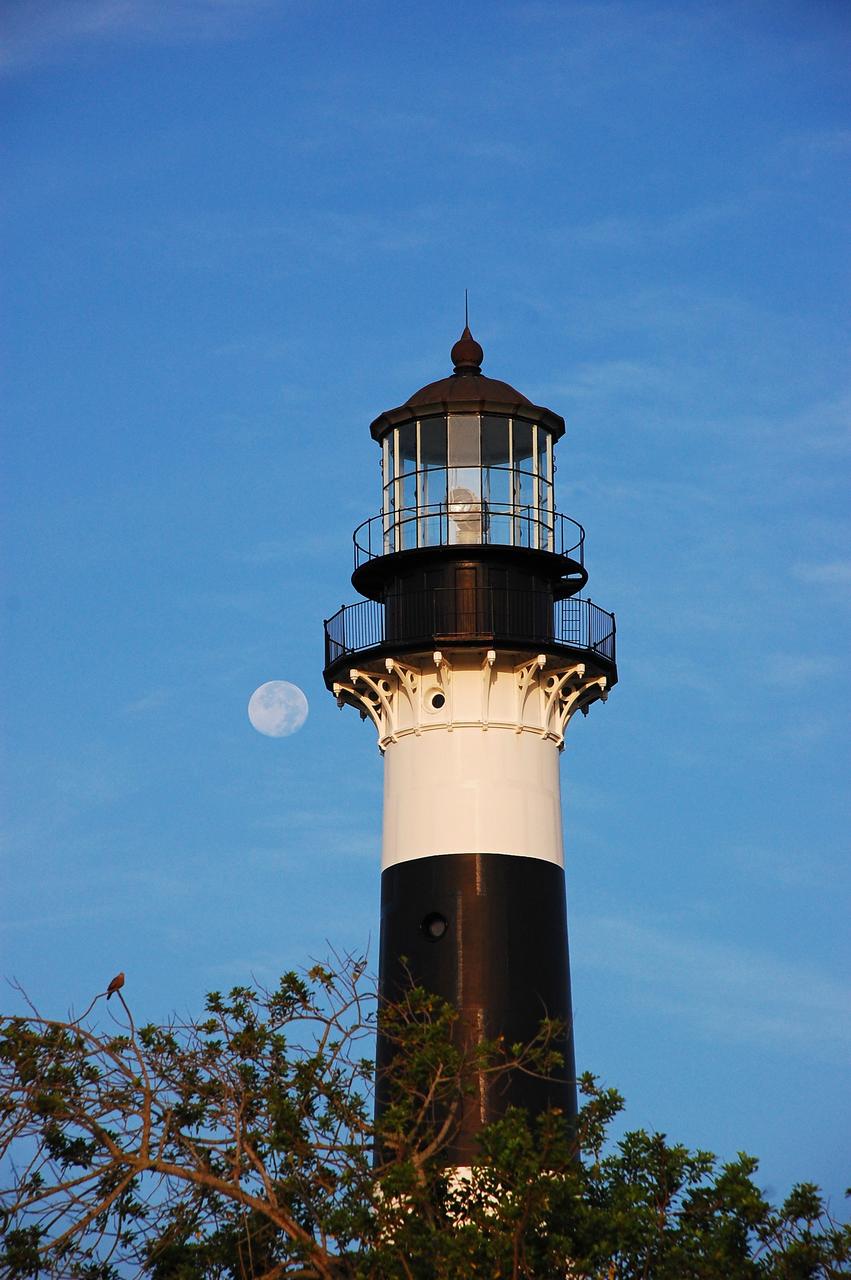
Cape Canaveral Air Force Station, Fla. -- The lantern room of the Cape Canaveral Lighthouse, with its modern first-order optic, takes on a warm glow as dawn breaks and a full moon still shines overhead. The Canaveral light is the only operating lighthouse owned by the U.S. Air Force. In 2000, the Coast Guard transferred ownership of the lighthouse structure and its grounds to the Air Force, which is now responsible for maintaining it. The U.S. Coast Guard continues to operate the beacon as an active navigational aid. The first lighthouse at Cape Canaveral was built near the tip of the Cape in 1848. The structure was only about 60 feet high with a rather dim light powered by whale oil. In 1859, work began nearby on a new, taller iron structure. Construction was halted during the Civil War, and the lighthouse finally was finished in 1868. The structure, with a brick lining inside its iron exterior, was painted with its "daymark" black and white horizontal bands in 1873 to make it easier to identify during the day as a navigation point. Between 1892 and 1894, the lighthouse was dismantled and moved to its new home about a mile from the coast, where it stands today. Photo credit: NASA/Ben Smegelsky