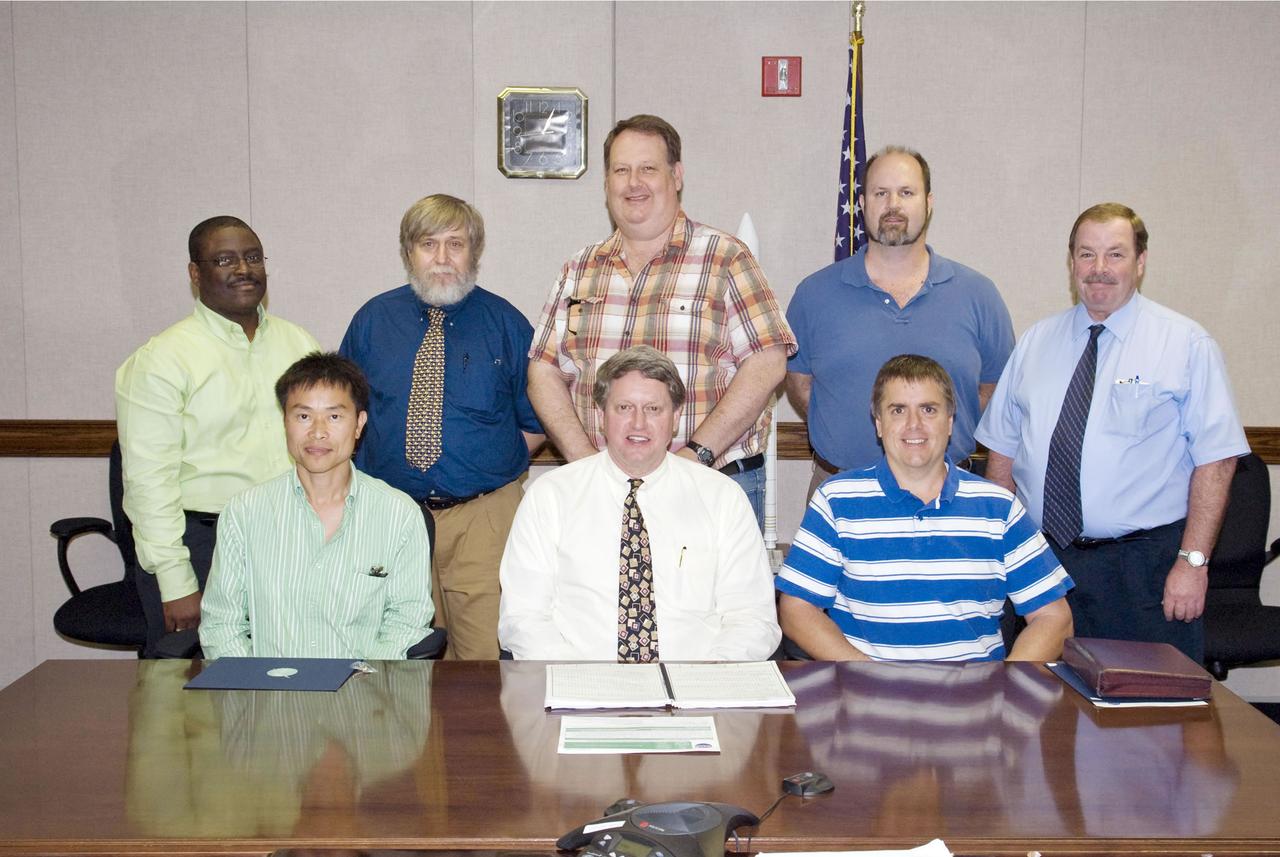
The NASA Engineering & Safety Center recently presented its Group Achievement Award to a Stennis team in recognition of technical excellence in evaluating the operational anomalies and reliability improvements associated with the space shuttle engine cut-off system. Stennis employees receiving the award were: (standing, l to r) Freddie Douglas (NASA), George Drouant (Jacobs Technology Inc.), Fred Abell (Jacobs), Robert Drackett (Jacobs) and Mike Smiles (NASA); (seated, l to r): Binh Nguyen (Jacobs), Stennis Director Gene Goldman and Joseph Lacker (NASA). Phillip Hebert of NASA is not pictured.

U.S. Coast Guard Admiral Linda Fagan receives NASA’s Silver Group Achievement Award from NASA’s Kennedy Space Center Director Janet Petro in a ceremony held at Kennedy’s headquarters building on Thursday, March 14, 2024. The Silver Group Achievement Award recognizes the commitment of the U.S. Coast Guard Sector Jacksonville in providing splashdown and recovery support for the safe return of crew and cargo space capsules.

U.S. Coast Guard Admiral Linda Fagan receives NASA’s Silver Group Achievement Award during a ceremony held the headquarters building at NASA’s Kennedy Space Center in Florida on Thursday, March 14, 2024. The Silver Group Achievement Award recognizes the commitment of the U.S. Coast Guard Sector Jacksonville in providing splashdown and recovery support for the safe return of crew and cargo space capsules.
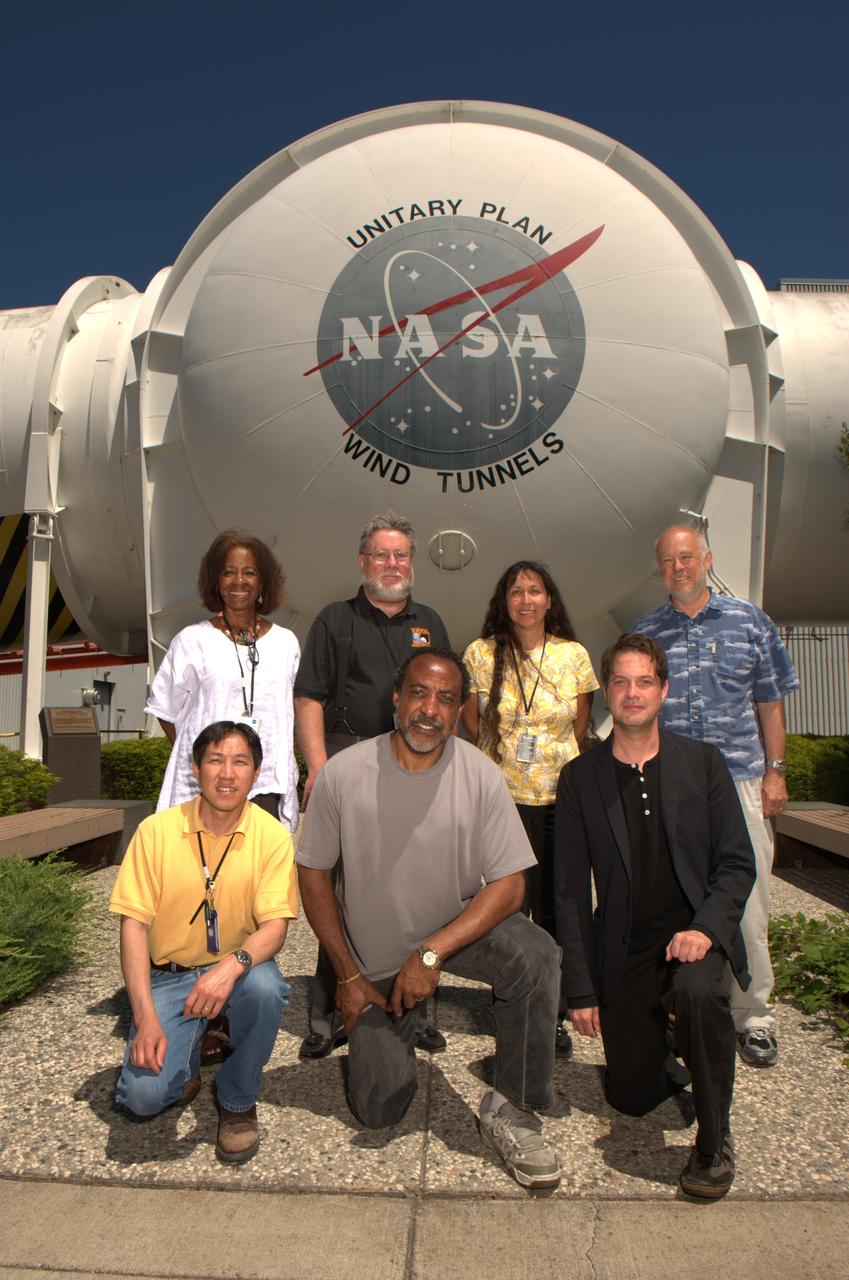
MODIM Teacher Professional Development Pilot Team (for Group Achievement Award) Frank Hui, Vern Battiste, David Hash, Leslye Mogford, Erie Fretter, Imelda Terresas-Salinas, Walter Johnson.

Leaders from NASA’s Commercial Crew Program and Exploration Ground Systems at the agency’s Kennedy Space Center in Florida, and members of the U.S. Coast Guard Sector Jacksonville pose for photos during a NASA Silver Group Achievement award ceremony held inside Kennedy’s headquarters building on Thursday, March 14, 2024. The agency’s Silver Group Achievement Award is presented to U.S. Coast Guard Admiral Linda Fagan to recognize the commitment of the U.S. Coast Guard Sector Jacksonville in providing splashdown and recovery support for the safe return of crew and cargo space capsules.
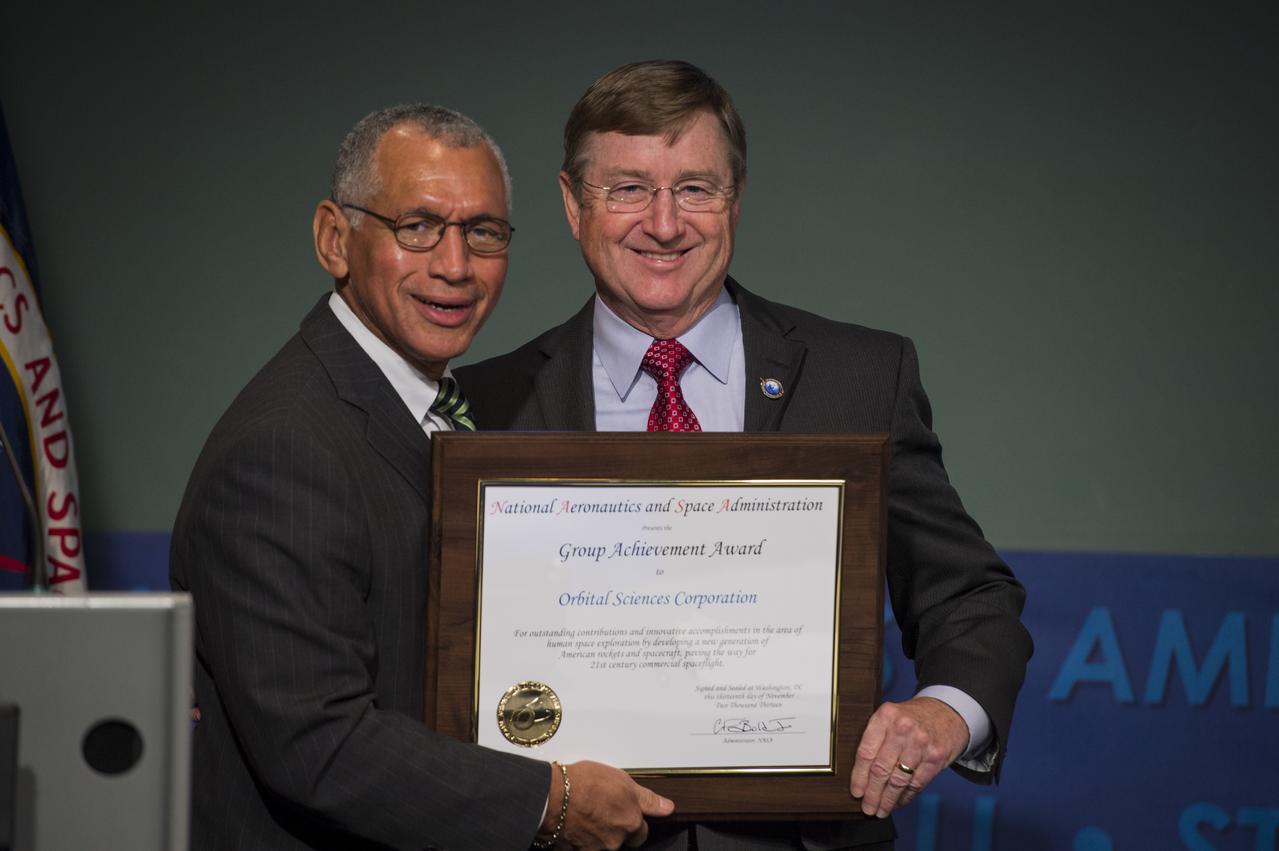
NASA Administrator Charles Bolden, left, presents NASA's Group Achievement Award to (L-R) Frank Culbertson, Executive Vice President and General Manager, Orbital Sciences Advanced Programs Group,at NASA Headquarters in Washington on Thursday, November 13, 2013. Culbertson received the award for outstanding contributions and innovative accomplishments in the completion of the Commercial Orbital Transportation Services (COTS) initiative. Through COTS, NASA's partners Space Exploration Technologies Corp. (SpaceX) and Orbital Sciences Corp., developed new U.S. rockets and spacecraft, launched from U.S. soil, capable of transporting cargo to low-Earth orbit and the International Space Station. Photo Credit: (NASA/Jay Westcott)
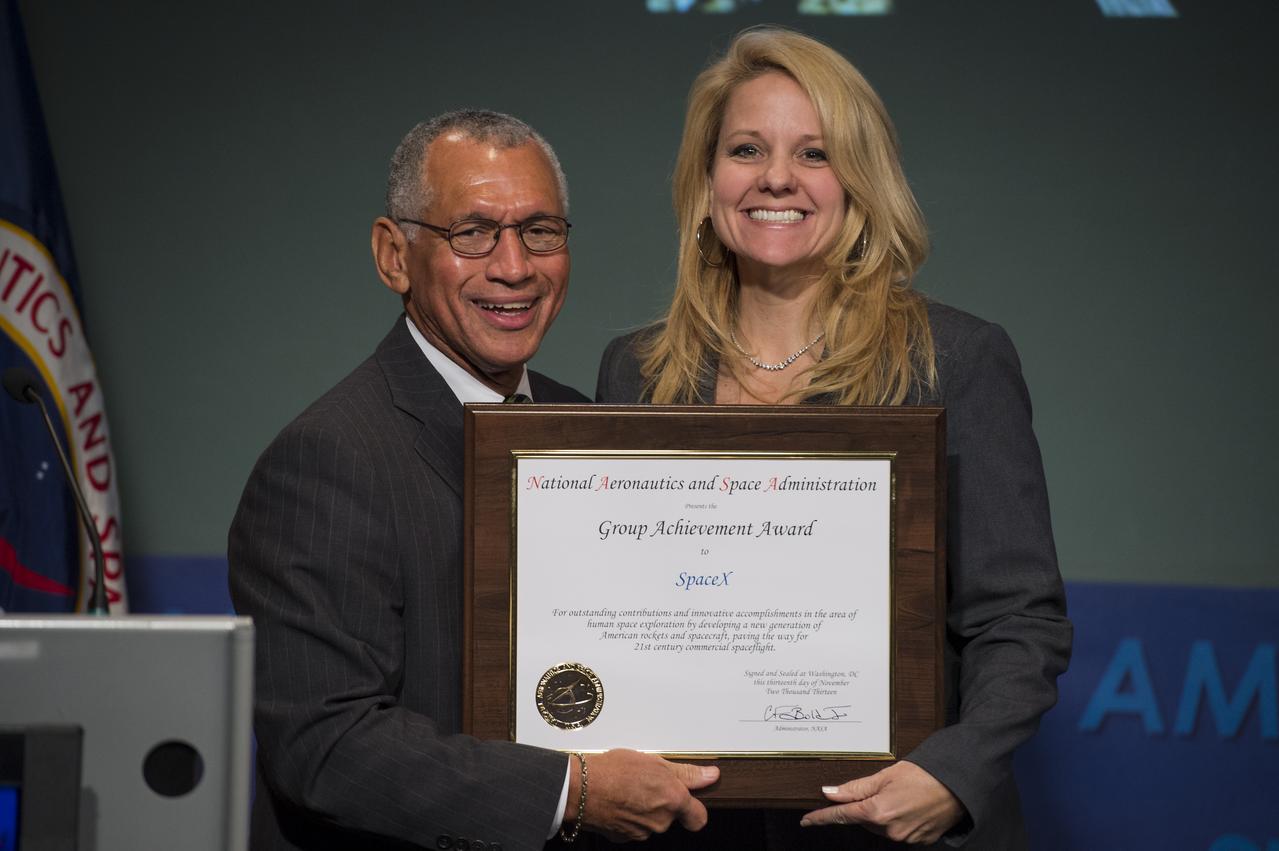
NASA Administrator Charles Bolden, left, presents NASA's Group Achievement Award to Gwynne Shotwell, President, SpaceX, at NASA Headquarters in Washington on Thursday, November 13, 2013. Shotwell received the award for outstanding contributions and innovative accomplishments in the completion of the Commercial Orbital Transportation Services (COTS) initiative. Through COTS, NASA's partners Space Exploration Technologies Corp. (SpaceX) and Orbital Sciences Corp., developed new U.S. rockets and spacecraft, launched from U.S. soil, capable of transporting cargo to low-Earth orbit and the International Space Station. Photo Credit: (NASA/Jay Westcott)
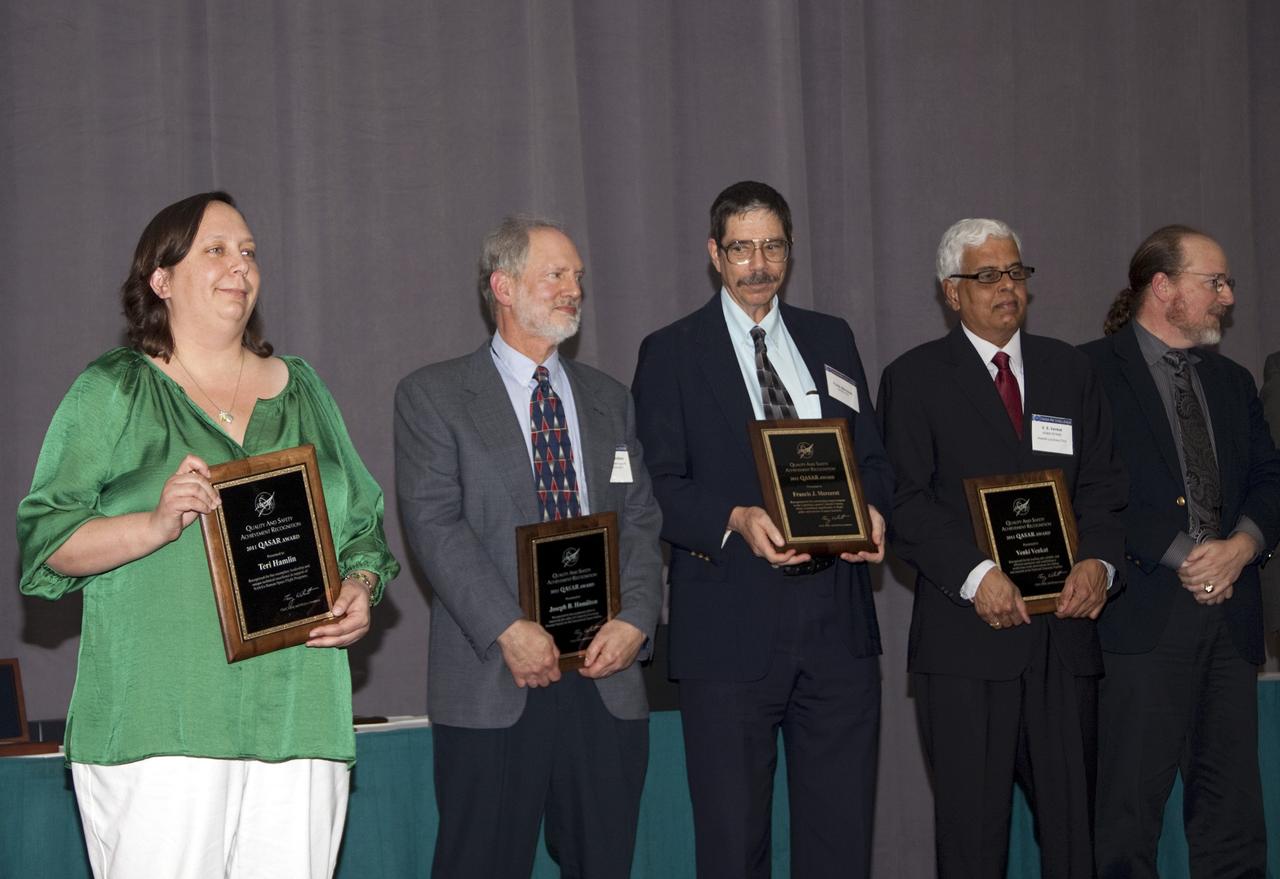
ORLANDO, Fla. -- The winners of NASA’s Quality and Safety Achievement Recognition, or QASAR, awards for 2011 pose for a group portrait during NASA’s ninth annual Project Management Challenge. From left are Teri Hamlin, Johnson Space Center Joseph B. Hamilton, Kennedy Space Center Francis “Frank” Merceret, Kennedy Space Center and Venki Venkat, Langley Research Center. Kennedy retiree Humberto "Bert" T. Garrido, not pictured, also received the award. NASA's QASAR award recognizes individual government and contractor employees who have demonstrated exemplary performance in contributing to the quality or safety of products, services, processes, or management programs and activities. PM Challenge 2012 was held at the Caribe Royale Hotel and Convention Center in Orlando, Fla., on February 22-23, to provide a forum for all stakeholders in the project management community to meet and share stories, lessons learned and new uses of technology in the industry. The PM Challenge is sponsored by NASA's Office of the Chief Engineer. For additional information, visit http://www.nasa.gov/offices/oce/pmchallenge/index.html. Photo credit: NASA/Jim Grossmann
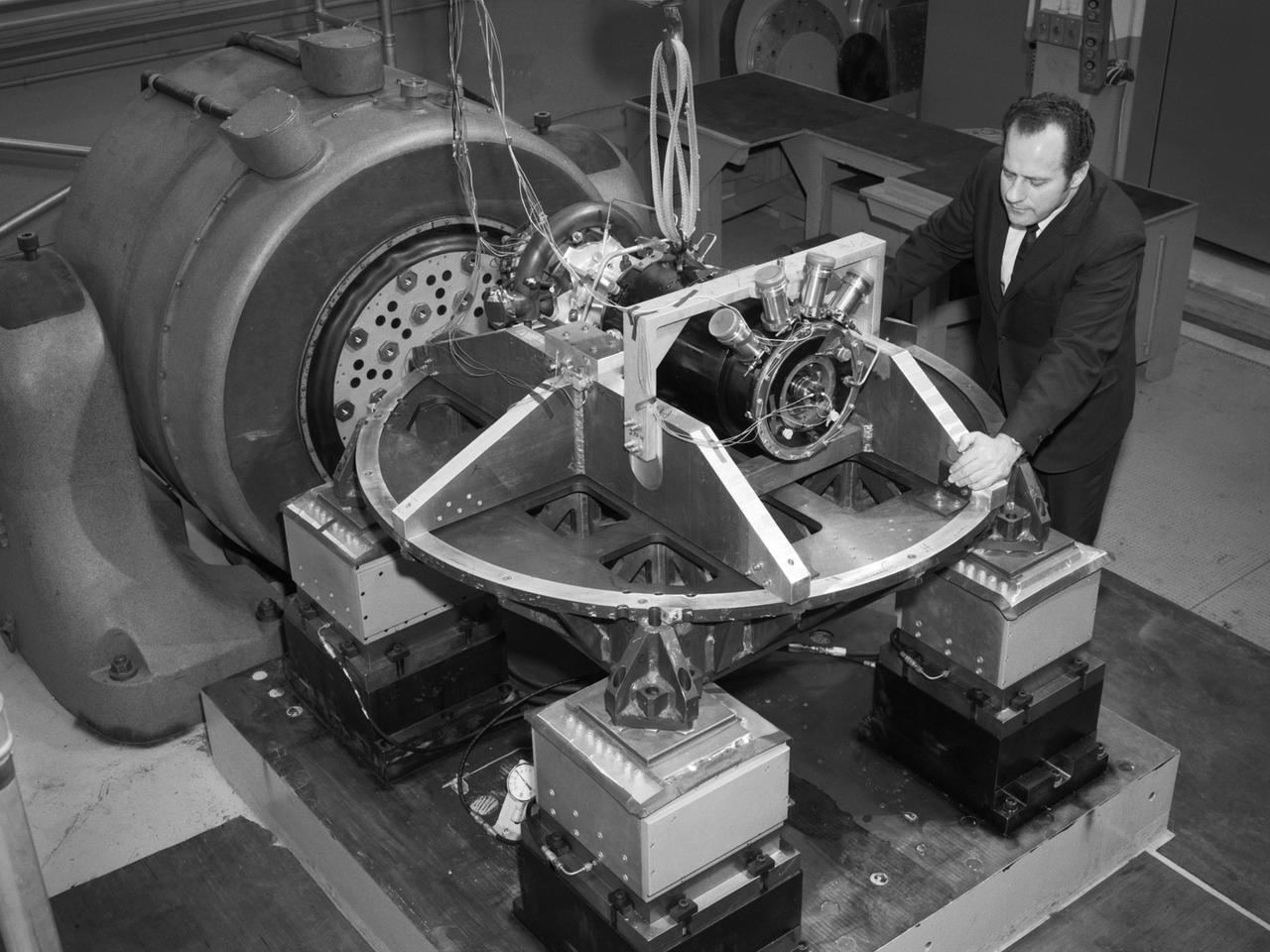
Aeronautics and Space Administration (NASA) Lewis Research Center. Aerojet General was contracted to design the SNAP-8 generator which employed a mercury Rankine system to convert the reactor’s heat into electrical power. The hermetically-sealed pump was designed to generate from 35 to 90 kilowatts of electrical power. In 1964 a SNAP-8 test rig with a mercury boiler and condenser was set up in cell W-1 of Lewis’ Engine Research Building to study the transients in the system’s three loops. In 1967 a complete Rankine system was operated for 60 days in W-1 to verify the integrity of the Lewis-developed mercury boiler. Further tests in 1969 verified the shutdown and startup of the system under normal and emergency conditions. Aerojet operated the first full-Rankine system in June 1966 and completed a 2500-hour endurance test in early 1969. Lewis and Aerojet’s success on the Rankine system was acknowledged with NASA Group Achievement Award in November 1970. The 1970 vibration tests, seen here, were conducted in Lewis’ Engine Research Building’s environmental laboratory. The testing replicated the shock and vibration expected to occur during the launch into space and subsequent maneuvering. The pump was analyzed on each of its major axes.